/




Текст
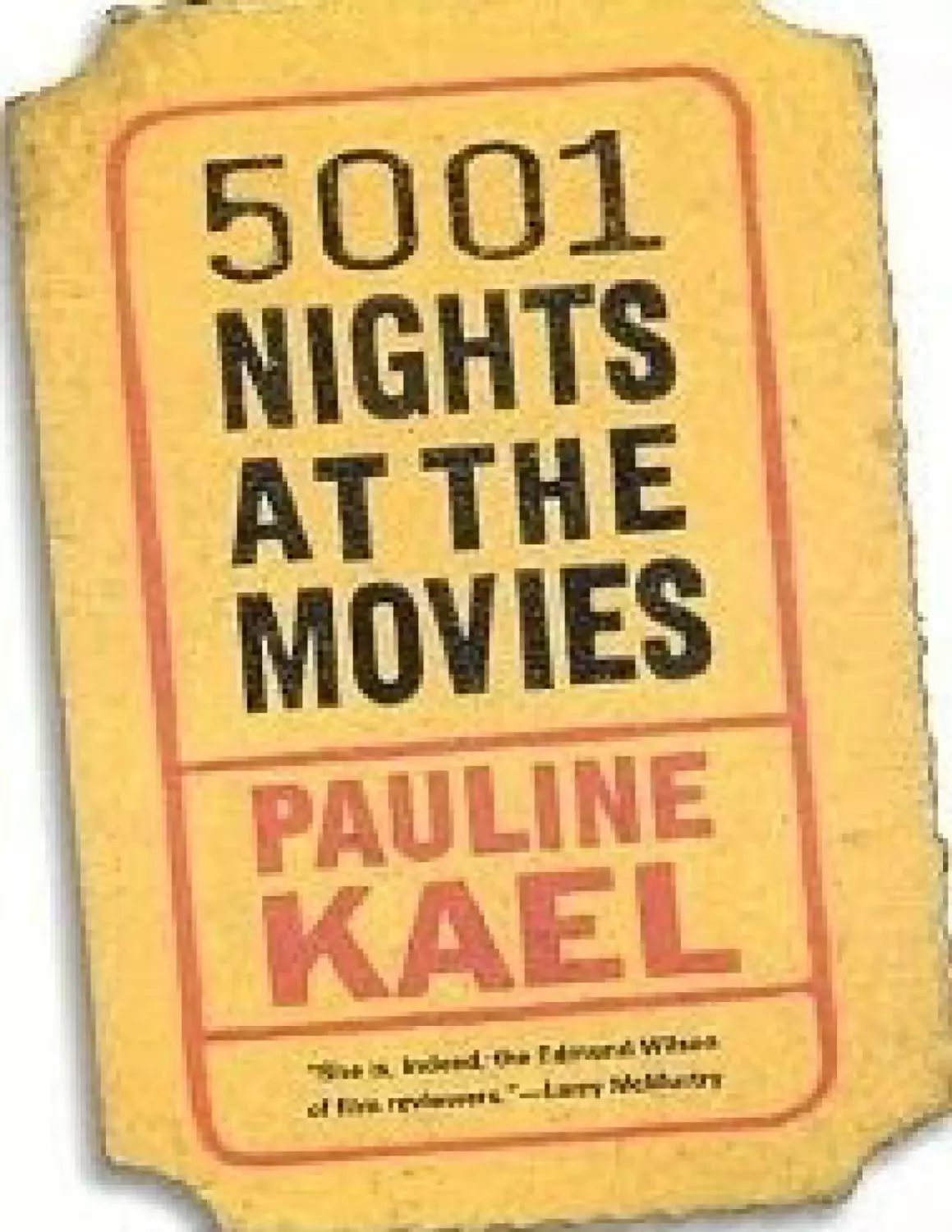
                    FOREWORD by Wallace Shawn

It is unlikely that anyone in the world has reviewed more movies than Pauline
Kael. It is also unlikely that anyone in the world carries around in his or her head
more information about movies. When Pauline Kael sits down to review a new
film, she is able to sum up pertinent details from the thousnds of American and
foreign films that preceded it. She remembers, and can describe, scenes,
sequences, performances, shots, images, touches, gestures, effects. In herself, she
is the international history, library, archive, encyclopedia of film—the
cinematheque. If numbers, or even knowledgeability, were all that mattered, she
would be the champion. But these are merely a point of departure. She brings to
her criticism more than stamina and a phenomenal memory, more than scholarship. What is most important, perhaps, is that she loves movies. Good and bad,
they are her passion. Movies sustain her, and she, in turn, sustains many of the
people who make them. Moviemakers may be satisfied or dissatisfied with her
reaction to any given picture, but they are not inclined to dismiss it, and they
never question her rapt involvement with movies. They know that she takes their
work seriously, that she judges it by the most rigorous standards, that she gives it
the attention it deserves. When she thinks that a picture has failed, she can
become so intent on getting to the bottom of what went wrong that now and
then, to her own astonishment, she wounds somebody's feelings, but even on
those occasions the charms of her criticism are such that she is apt to be
forgiven. And when she thinks that a picture succeeds she rejoices.
The originality of Pauline Kael's mind and temperament, her formidable
intelligence, her eloquent use of the vernacular, her extraordinary analytical
powers, her insight into character, her ability to shed light wherever the real
world intersects with the world on film, her enormous gift for social observation,
the wit and energy and clarity of her prose all go into making her the singular
critic she is. What she is primarily is a writer; one reads her for the sheer
pleasure her writing affords. Her opinions are forceful, convincing, often
unexpected, but whether or not one agrees with them one comes away from her
writings in a state of exhilaration.
Pauline Kael's reviews are normally longer than most—long enough to daunt the

uninitiated but not too long for her admirers. Yet in this volume she has
assembled several thousand reviews—written for the Going On About Town
department of The New Yorker— that are not only dazzling but brief, are models
of compression. Nothing like this collection of short reviews has ever been seen
before. They can be read by moviegoers or television viewers as a guide or they
can be read for their own sake: either way they are a marvel. A master of
synopsis, Pauline Kael has contrived to tell us between the covers of one book
what eight decades of film are about and who is in them and behind them, and to
reflect, swiftly but astutely, on what they signify. No one else has done that; no
one else could have done that.
— William Shawn

AUTHOR'S NOTE
To the 1991 edition
I'm grateful to the people who took me up on the suggestion that they let me
know about errors. I'm grateful also to those who wrote in suggesting titles to be
included in this expanded edition. Whenever time and memory made it possible,
I've complied. Roughly eight hundred titles have been added; they include most
of the important films of the '80s. I know that there are still major omissions
from every period, but I've done my damnedest. (If I go on, I'll never stop.)

To the original edition
For a long time, despite persistent requests by the readers of The New Yorker, I
resisted the idea of a collection of these notes, which were printed
(anonymously) in the Goings On About Town section of the magazine, because
they are often written hurriedly and are frequently dependent on my old, spotty
memories. Also, there are so many different versions of them that I knew it
would be a nightmare to sort out what should be reprinted. (Before I began
writing for the magazine I had been doing short descriptions for theatres and
colleges. Then, in my first years at the magazine I wrote three notes for each
new film, so that they could be rotated, and if I wrote a longish note, this would
gradually be cut down if the film continued to play.) And there was another
reason: many of the notes are vandalized from my own reviews, and, in my first
years at The New Yorker, when the Goings On was expanded to include revivals
—partly because of my feeling that readers might be missing out on older films
that they hadn't heard of—I sometimes tried to blend my view of a movie with
some of the language from the magazine's initial review of it. So I've had to
check those reviews to give the proper credits.
Phrases from other reviewers still appear in eighty-odd cases—from Russell
Maloney in Alexander's Ragtime Band, Here Comes Mr. Jordan, and They Drive
By Night; from Theodore Shane in Ben-Hur (1925); from Philip Hamburger in
lvanhoe; from Brendan Gill in The Agony and the Ecstasy, The Appaloosa, Hush
. . . Hush, Sweet Charlotte, Sweet Bird of Youth, and To Kill a Mockingbird; from

David Lardner in Air Force, Lady of Burlesque, and This Is the Army, from John
Lardner in Kismet (1944) and Step Lively; from Edith Oliver in The Blue Max;
from Wolcott Gibbs in Over 21, Practically Yours, and The Thin Man Goes
Home; from John McCarten in Anna and the King of Siam, Autumn Leaves,
Blithe Spirit, A Connecticut Yankee in King Arthur's Court (1949), Down to the
Sea in Ships, Forever Amber, Friendly Persuasion, Green Dolphin Street,
Humoresque (1946), It Should Happen to You, Lady in the Lake, Lady on a
Train, Leave Her to Heaven, Mighty Joe Young, Miss Sadie Thompson, Night
and Day, The Outlaw, Possessed, The Razor's Edge, The Revolt of Mamie Stover,
Ride the Pink Horse, Samson and Delilah, The Sea of Grass, Smash-Up, The
Spiral Staircase, The Strange Love of Martha Ivers, The Teahouse of the August
Moon, The Ten Commandments, The Three Musketeers (1948), and Titanic; from
John Mosher in Blockade, Cleopatra (1934), Dr. Cyclops, Drums Along the
Mohawk, The Garden of Allah, The Grade Allen Murder Case, Hold Your Man,
Hollywood Party, The Informer, Intermezzo (1939), Invitation to Happiness,
Jamaica Inn, Lillian Russell, The Mad Miss Manton, Made for Each Other
(1939), Maid of Salem, Mannequin, The Mark ofZorro (1940), Meet Nero Wolfe,
Mrs. Miniver, Mr. Smith Goes to Washington, Our Modern Maidens, Road to
Singapore, The Shining Hour, The Sign of the Cross, Strange Cargo, A Tale of
Two Cities (1935), Tarzan and His Mate, This Gun for Hire, Up the River,
Weekend in Havana, Zaza, and Zoo in Budapest. Most of the time, these
borrowings are no more than a few words, but in some I lifted descriptive
passages that I liked. To these predecessors and colleagues I offer my thanks.
There were no strict rules in selecting the batch of brief notices from among the
thousands more that I've got piled up. I wanted to suggest the range of what
movies have done, and so I've brought together silent films and talkies, foreign
films and American ones, and even some shorts. You won't find Gone With the
Wind or The Wizard of Oz. Omitting them is a gesture: I wouldn't want anyone to
take this book for a complete guide to movies. But I hope that it is a guide to the
varieties of pleasures that are available at the movies—from the fun to be had at
the juicier forms of trash to the overwhelming emotions that are called up by
great work.
For those who may want a fuller analysis of a film: if I have written a review and
if s included in one of my collections, this is indicated at the end of the notice.
No doubt errors have crept in—faulty recollections as well as typos. If you'll
write to me (at The New Yorker, 25 West 43 St., New York, NY 10036), I'll do

my best to see that such mishaps are corrected in any subsequent editions. And if
there are films you'd particularly like to see added, please let me know and if (as
I hope) I get the chance to expand this book I'll try to fit them in.
This book is for my daughter Gina and for the one to whom I hope it will prove
most useful, her son William.

A Nous la Liberté
France (1931): Comedy
97 min, No rating, B&W
René Clair's imaginative social satire on the mechanization of modern life begins
with a man (Raymond Cordy) who escapes from prison and builds a
phonograph-record business with an assembly line that's as regimented as the
prison. This factory owner is modelled on Charles Pathé, who said of his
phonograph-cinema empire, "Only the armaments industry made profits like
ours." The tycoon's pal from his prison days is a softhearted "little man" (Henri
Marchand)-the underdog embodiment of a free, humanistic spirit. Beautifully
made, the picture has elegantly futuristic sets by Lazare Meerson, and Georges
Périnal's cinematography has a simplified, formal perfection; the whole film is
paced to Georges Auric's memorable score-one of the earliest (yet best) film
scores ever written. Clair's directing demonstrates that sound pictures can be as
fluid as silents were, and this picture is rightly considered a classic. Yet it isn't as
entertaining as his earlier (silent) THE ITALIAN STRAW HAT or his later LE
MILLION; the scenario (which he wrote) turns a little too carefree and ironic-the
film grows dull. A NOUS LA LIBERTÉ was obviously the source of some of the
ideas in Chaplin's 1936 MODERN TIMES; the producing company filed suit
against Chaplin for copyright infringement, but Clair had the suit dropped,
saying that "All of us flow" from Chaplin, and "I am honored if he was inspired
by my film." In French.

The Abdication
UK (1974): Historical
103 min, Rated PG, Color
This Warners picture about Queen Christina's stepping down from the Swedish
throne, in 1654, is embalmed in such reverence for its own cultural elevation that
it loses all contact with the audience. Liv Ullmann is the virgin queen who
becomes a Catholic hoping to find ecstasy in God, and Peter Finch is the
cardinal who examines her motives. Anthony Harvey directed, on his knees.
We're never allowed to forget the exalted rank of the characters, and nothing like
human speech intrudes upon the relentless dignity of Ruth Wolff's script
(adapted from her own play). Ullmann doesn't have the high style or the mystery

that her grand-gesture role requires; her performance is dutifully wrought and
properly weighted-she's like a hausfrau who's too conscientious to give good
parties. With Cyril Cusack, Paul Rogers, Michael Dunn, and Edward
Underdown. The turbulent, pseudo-liturgical score is by Nino Rota; the pictorial
cinematography is by Geoffrey Unsworth.
see Reeling.

About Last Night…
US (1986): Romance/Comedy
113 min, Rated R, Color
In Sexual Perversity in Chicago, David Mamet's one-act play about singles bars
and the hostility between the sexes, Bernie, the major character, is a macho
braggart; his stooge, the passive Danny, soaks up Bernie's poison-his obsession
that women are out to trap them. In this adaptation, written by Tim Kazurinsky
and Denise DeClue, and directed by Edward Zwick (it's his first picture), Danny,
played by Rob Lowe, is the major character-and a hero. He's intimidated by his
pal Bernie (Jim Belushi), but he learns to trust his love for Debbie (Demi Moore)
and get off the singles treadmill. And Debbie casts out the doubts that are
engendered by her roommate, the caustic Joan (Elizabeth Perkins). The movie is
close to being a conventional romance about the adjustments that lovers have to
make in their first year together-except that Bernie is around yelling, and Joan
keeps putting everybody down. The screenwriters retain much of Mamet's
dialogue, but they piece it out, and the director punches up the breaks between
scenes with rock music. It's like being pounded on the back every two minutes
when your back is already sore (because the dialogue has been whacking you so
hard). If anyone comes out of this enterprise with honor it's Perkins, who, in her
first screen appearance, brings appealing, plaintive undercurrents to a ghastly
role. Tri-Star.
see Hooked.

Absence of Malice
US (1981): Drama
116 min, Rated PG, Color
A trim, well-paced newspaper melodrama that queries journalistic practices.
Sally Field is the basically insensitive, eager-beaver Miami reporter who snaps

up a story that the head of a federal strike force investigating the disappearance
of a union leader leaks to her. The story is false-the federal man's purpose is
simply to stir things up by putting pressure on an honest businessman who has
Mafia relatives. Paul Newman is the victim, and the movie is about how he turns
the methods of the authorities and the newspaperwoman against them. It's
doubtful that people who are out to get even are as calm and well-balanced as
this character; Newman gives revenge class, so we can all enjoy it. The script, by
Kurt Luedtke, a former newspaperman, is crisply plotted, but he doesn't write
scenes to reveal anything more in the characters than the plot requires. Sydney
Pollack's directing is efficient and the film is moderately entertaining, but it
leaves no residue. Except for the intensity of Newman's sly, compact
performance (especially in the one scene when he blows up at the reporter and
hisses his rage right into her ear), and the marvellously inventive acting of
Melinda Dillon, in the role of an achingly helpless, frightened woman, and the
character bits by Barry Primus, Luther Adler, Josef Sommer, Wilford Brimley,
Don Hood, and John Harkins you could get it all by reading an article. As the
head of the strike force, Bob Balaban must think that he's doing Captain Queeg.
He has devised an attention-getting nervous shtick-he spins his hands around
while playing with rubber bands-and he never gives it a rest. Columbia.
see Taking It All In.

Absolute Beginners
UK (1986): Musical
107 min, Rated PG-13, Color
Colin MacInnes's 1959 novel-an inventive, slangy, poetic celebration of youth
and jazz and London, and a cry of disgust at the way teenagers, who didn't
emerge as a group with money to spend until the 50s, are already being
commercialized and corrupted-has been turned into a stylized, wide-screen
musical by Julien Temple. Whether because of the fast-cutting style that Temple
developed from his work in rock videos or because of the generally
undistinguished choreography, it's peculiarly unlyrical and ephemeral. The film
has a glossy immediacy, and you can feel the flash and determination that went
into it. What you don't feel is the tormented romanticism that made English
adolescents in the 70s swear by the novel the way American kids had earlier
sworn by The Catcher in the Rye. David Bowie, James Fox, Ray Davies, Anita
Morris, and Sade provide entertaining moments; Lionel Blair, Bruce Payne, and
Graham Fletcher-Cook come through with glints of humor. But the two central

teenage characters-Colin (Eddie O'Connell) and the girl he loves, Suzette (Patsy
Kensit)-seem generic. Musical arrangements by Gil Evans; cinematography by
Oliver Stapleton; screenplay by Richard Burridge, Christopher Wicking, and
Don MacPherson. Also with Slim Gaillard, Steven Berkoff, and Mandy RiceDavies. Released in the U.S. by Orion.
see Hooked.

Accident
UK (1967): Drama
105 min, No rating, Color
Joseph Losey and his scenarist, Harold Pinter, use sexual desperation amid the
beauty of Oxford in summertime to make our flesh crawl. A cleverly barbed
comedy of depravity-uneven, unsatisfying, but with virtuoso passages of
calculated meanness and, as the centerpiece, a long, drunken Sunday party, with
people sitting down to supper when they're too soused to eat. As a weakling
philosophy don, Dirk Bogarde goes through his middle-aged-frustration
specialty brilliantly, gripping his jaw to stop a stutter or folding his arms to keep
his hands out of trouble. With Baker, who is properly swinish as another
academic, and Vivien Merchant, Jacqueline Sassard, Michael York, Alexander
Knox, and Delphine Seyrig as a dumb blonde. From the novel by Nicholas
Mosley; cinematography by Gerry Fisher; music by Johnny Dankworth.
see Kiss Kiss Bang Bang.

The Accidental Tourist
US (1988): Comedy
121 min, Rated PG, Color
It begins with the numb grief of a punctilious Baltimore travel writer, Macon
Leary (William Hurt), whose 12-year-old son was senselessly shot by a gunman
in a Burger Bonanza. Macon has become such a depressed loner that his wife
(Kathleen Turner) leaves him. The movie, directed by Lawrence Kasdan, who
wrote the screenplay with Frank Galati, closely follows the 1985 Anne Tyler
novel, and it's about Macon's coming to life. A fiercely eager oddball (Geena
Davis) who pulls him into her bed turns out to be his salvation. The plot
construction is that of a screwball comedy of the 30s: poor working girl has the
life force that upper-class prig needs. But people talk a formal, affected English

that sounds counterfeit and everyone seems catatonic-even the skinny oddball,
whose tense talkativeness is as panicked as Macon's recessiveness and silence.
This picture's ponderousness doesn't keep it from affecting some people deeply.
It provides a new romantic myth of the 80s-a time of widespread remarriage and
hoped-for rebirth. Essentially, this is a dating movie, like Claude Lelouch's A
MAN AND A WOMAN, but for darker times, for times of lower expectations.
The film's minimal fun has to do with the wry, pixillated family humor of Macon
and his siblings (Amy Wright, Ed Begley, Jr., and David Ogden Stiers). The cast
includes Bill Pullman and Robert Gorman. Cinematography by John Bailey; the
offensive rippling score is by John Williams. Warners.
see Movie Love.

Across the Bridge
UK (1957): Crime
103 min, No rating, B&W
Graham Greene's protagonist is a crooked international financier (Rod Steiger)
who runs to Mexico, and the film is one long chase after this disintegrating
quarry. Ken Annakin directed this English production, photographed in Spain,
which some English critics regarded as their best thriller since THE THIRD
MAN. (There may not have been much competition.) If the film had sustained
the tension of its opening scenes the comparison with THE THIRD MAN might
be apt, but the middle of the picture (and it's an extended middle) falls apart. It
was invented by the screenwriters, Guy Elmes and Denis Freeman, who filled
out Greene's 1938 short story. Steiger gives a dominating performance; Bill
Nagy plays Scarff, whose identity the financier takes, not knowing that Scarff is
a revolutionary, who is wanted in Mexico. Noel Willman is the vicious police
chief; David Knight and Marla Landi are young lovers (she is beautiful, he is
dreary).

Across the Pacific
US (1942): Spy
97 min, No rating, B&W
After his exhilarating début film, THE MALTESE FALCON (1941), John
Huston had a commercial failure with IN THIS OUR LIFE; then he tried to
repeat the success of the FALCON with an action-adventure story, using some of

the FALCON cast-Humphrey Bogart, Mary Astor, Sydney Greenstreet. The film
was supposed to be about a group sailing to Honolulu to thwart a Japanese plan
to blow up Pearl Harbor; during the second week of shooting, the Japanese did
blow up Pearl Harbor. The production was shut down and there was a hasty
rewrite. The result is a complicated plot about spies who plan to blow up the
Panama Canal, and there are assorted captures and hairbreadth escapes. Huston
manages to give the sequences some tension, and though the shipboard scenes
were-in the custom of the time-filmed on the studio back lot, the images are airy
and spacious. But Huston couldn't do anything about the essential mediocrity of
the material, and when he was drafted into the Army Special Services before the
picture was finished, he showed what he thought of the mess: he hurriedly shot a
scene with Bogart trussed up and about to be killed, and then left his
replacement director, Vincent Sherman, to figure out how to save Bogart in time
to prevent the bombing of the Canal. The movie isn't really bad-just bewildering.
Mary Astor comes off the worst; cast as a conventional heroine, she looks heavy
and uncomfortable, and too big for Bogart, who, incidentally, was called Rick
here-the name that was carried over the next year in CASABLANCA. With
Victor Sen Yung, Charles Halton, Richard Loo, Keye Luke, and Monte Blue.
Script by Richard Macaulay, from Robert Carson's SatEvePost serial Aloha
Means Goodbye; montages by Don Siegel; cinematography by Arthur Edeson;
music by Adolph Deutsch. Produced by Jerry Wald and Jack Saper, for Warners.

Act of the Heart
Canada (1970): Drama
103 min, Rated PG, Color
Geneviève Bujold, in one of those passionate, spiritual jobs about a girl who is
"different." The heroine sings the solo with the church choir; she suffers while
singing in a nightclub; she even-God help us-makes love with an Augustinian
monk (in the unlikely, affable person of Donald Sutherland) at the front of the
altar. After hours of fire symbolism, she finally pours kerosene on herself to
create a new sacrifice for a world that has forgotten Jesus; by then you're ready
to toss her a match. This Canadian film was written and directed by Paul
Almond (Bujold's husband at the time) who goes for obsessions and fatalities
and an elliptical style, and is very high on portents. Bujold has some lovely bits,
but the masochistic feminine-fantasy material forces her to fall back on the old
fragile, incandescent child-woman shtick.
see Deeper into Movies.

The Actress
US (1953): Drama
91 min, No rating, Black & White
Ruth Gordon adapted her autobiographical play Years Ago, which dealt with a
young girl in New England determined to make her way in the theatre, and it
was turned into a pleasantly modest though disappointing picture by the director,
George Cukor. Jean Simmons plays the title role with grace, but the author has
neglected to provide indications of talent and drive in the character; this girl
seems too nice, too ordinary-she could never grow up to be that tough,
indefatigable trouper Ruth Gordon. (The heroine sets out on her own in 1911.)
Despite the title, the central character is the girl's gruff, lovable father (Spencer
Tracy); Tracy overdoes it, but he shows some energy, and the film is sadly short
of it. With Teresa Wright giving a wan performance as the mother, Anthony
Perkins making his first screen appearance, Ian Wolfe, Mary Wickes, Jackie
Coogan as the joker in the gymnasium, and, in the best sequence, Kay Williams
as a musical-comedy star. MGM.

Adalen 31
Sweden (1969): Historical
115 min, Rated X, Color
An extraordinarily sensitive re-creation of a strike and riot that altered the course
of Swedish political life, seen through the eyes of an adolescent boy whose
father dies in the events. Bo Widerberg, whose previous film was ELVIRA
MADIGAN, wrote and directed this beautiful yet uninspired piece of work; lush
and lyrical as it is, it's fundamentally didactic, with stereotyped social-realist
characters. And because Widerberg seems to work best in vignettes and to have
architectural problems when he's working on such a large scale, his argument
isn't clear; he makes the little points but not the big ones. So when the violence
erupts, we don't really understand its political significance-we're left
"appreciating" it, in a rather embarrassed way, for its pictorial values. In
Swedish.
see Deeper into Movies.

Adam's Rib

US (1949): Comedy
100 min, No rating, B&W
George Cukor directed this "uncinematic" but well-played and often witty MGM
comedy about the battle of the sexes. Katharine Hepburn, thin, nervous, and
high-strung, keeps pecking away at Spencer Tracy, who is solid, imperturbable,
and maddeningly sane. She attacks, he blocks; their skirmishes are desperately,
ludicrously civilized. They are married lawyers on opposing sides in a court
battle; the case involves equal rights for women, i.e., does Judy Holliday have
the right to shoot her two-timing husband, Tom Ewell, in order to protect her
home against Jean Hagen? The script by Ruth Gordon and Garson Kanin is
lively and ingenious (though it stoops to easy laughs now and then). Cukor's
work is too arch, too consciously, commercially clever, but it's also spirited,
confident. Holliday and Ewell have roles that seem just the right size for them;
intermittently, Holliday lifts the picture to a higher, free-style wit. And as a
composer-neighbor of the married lawyers David Wayne airily upstages the two
stars; Hepburn is overly intense and Tracy does some coy mugging, but Wayne
stays right on target. With Polly Moran, Clarence Kolb, and Hope Emerson (as a
circus strong woman).

The Admirable Crichton
UK (1957): Comedy
94 min, No rating, Color
Also known as PARADISE LAGOON.
James M. Barrie's comedy about class distinctions was turned into the epic
MALE AND FEMALE by Cecil B. De Mille in 1919 (the shipwrecked Gloria
Swanson looked wonderful in wet satin). The best qualities of this English
version derive from Barrie's original-solid construction, a sense of fun, and wellturned phrases at the expense of the English aristocracy (who seem to be more
useful to the theatre than to the country). However, the director, Lewis Gilbert,
works somewhat heavily and for rather boisterous effects, as if Barrie's gentle,
expert style could be updated by noise. Kenneth More is "the perfect butler"stuffy, tyrannical Crichton, and Cecil Parker is the democratic, liberal Lord
Loam. Cast on a desert island where there are no classes, where skill and
aptitude count, the servant becomes master, the master servant. This will hold
few surprises for audiences; still there's something rather satisfying in the
demonstration. PARADISE LAGOON is an interesting example of the way

movies scavenge on themselves and their theatrical ancestors, and an indication
of why: there's a solid nugget of entertainment in many of the old repertory
items. The cast includes Martita Hunt, Sally Ann Howes, and Diane Cilento.

The Adventure of Sherlock Holmes' Smarter Brother
US (1975): Mystery/Comedy
91 min, Rated PG, Color
Gene Wilder's talent is evident in the many nice leafy touches, but in his first
attempt at a triple-header (writer-director-star) he shows poor judgment and he
gets bogged down in an overelaborate production. The idea-Holmes' bringing in
his insanely jealous younger brother, Sigerson, to help on a case involving
Queen Victoria's state secrets-has mouth-watering possibilities, but they aren't
developed. There's no mystery, and since you can't have a parody of a mystery
without a mystery, there's no comic suspense. And Wilder, keeping his eye on
his responsibilities as a director, loses his performing rhythm. A vaudeville
number is disconcertingly like the specialty number in Mel Brooks' YOUNG
FRANKENSTEIN (which Wilder co-wrote and starred in) and calls attention to
the general similarity between the two films. With Madeline Kahn, Marty
Feldman, Dom De Luise, Leo McKern, and Roy Kinnear. 20th Century-Fox.
see When the Lights Go Down.

The Adventurers
US (1970): Adventure
171 min, Rated PG, Color
This Paramount-Joseph E. Levine release seems to have been put together by
scavengers with computers. It cuts back and forth between the massacres and
upheavals of a mythical poor country in South America and the tortured sex
lives of the international celebrity set in Europe and America, and every 15
minutes or so there's carnage or a cloddish sex scene to keep you from losing
interest in the slack story. Sleazy (the Harold Robbins novel) and square (the
approach of the director, Lewis Gilbert) don't blend entertainingly here; the film
lacks crude dynamism-it's dispiriting. There are only a couple of amusing
scenes: a nice moment when Thommy Berggren, as a gigolo, tips his doorman
father (Ferdy Mayne), and a villainous moment or two by Alan Badel, as a
Trujillo-style dictator. The international cast of this $10 million clinker includes

Bekim Fehmiu as the Porfirio Rubirosa-like hero, Candice Bergen, Charles
Aznavour, Rossano Brazzi, Olivia De Havilland, Leigh Taylor-Young, Fernando
Rey, Sydney Tafler, Ernest Borgnine, Anna Moffo, and John Ireland. The script
is by Michael Hastings and Gilbert, the music is by Jobim, and the
cinematographer, Claude Renoir, gives it all a better look than it deserves.
see Deeper Into Movies.

The Adventures of Baron Munchausen
US (1989): Fantasy
126 min, Rated PG, Color
The Baron, who lived from 1720 to 1797, was a fibber of genius-a fabulist. Terry
Gilliam, who directed this special effects extravaganza, sees his theme as the liar
as artist; his Munchausen (John Neville) is a poet, a man of imagination. He's
pitted against the practical men who believe in facts and compromise and
conformity (i.e., the men who finance movies). The elements are here for a
fantasy on the order of THE WIZARD OF OZ and PINOCCHIO and the 1940
THE THIEF OF BAGDAD; the Baron and a 10-year-old girl (Sarah Polley)
voyage to a city on the moon, fall into the fire god Vulcan's foundry inside the
belching Mt. Etna, and are swallowed by a monster fish. Yet the picture is dry
and choppy and remote. The design (by Dante Ferretti) and the cinematography
(by Giuseppe Rotunno) are sometimes magnificent, and there are scenes that are
near-inspired. Something is missing, though: a bit of conviction-of ardor and
awe. Gilliam's hip silliness is deflating; his gifts-his gagster's prankishness and
his sense of beauty-don't harmonize. The picture is almost devoid of emotional
shadings. With Oliver Reed, who's a great rampaging Vulcan, Robin Williams
(uncredited) as the King of the Moon, Uma Thurman as Venus, and Eric Idle,
Jonathan Pryce, Sting, Valentina Cortese, Bill Paterson, Winston Dennis, Jack
Purvis, Alison Steadman, and Charles McKeown, who co-wrote the script with
Gilliam. Released by Columbia.
see Movie Love.

The Adventures of Buckaroo Banzai Across the Eighth Dimension
US (1984): Science Fiction/Comedy
103 min, Rated PG, Color
Also known as BUCKAROO BANZAI and ADVENTURES OF BUCKAROO
BANZAI.

Making his debut as a director, W.D. "Rick" Richter doesn't bring out the
baroque lunacy of the material-a kind of fermented parody of M*A*S*H, STAR
WARS, RAIDERS OF THE LOST ARK, and the TV series "The A-Team"-but
though the characters don't develop and the laughs don't build or come together,
the film's uninflected deadpan tone is somehow likable. Dr. Buckaroo Banzai
(Peter Weller), the half-Japanese, half-American hero, is a neurosurgeon, a
physicist, a jet-car racer (who goes right through a mountain), and the leader of
the Team Banzai-seven dapper whizbang Renaissance men. For relaxation,
Buckaroo and a few of the others have formed their own rock group, the Hong
Kong Cavaliers, and it's at a Cavaliers' performance in a New Jersey night spot
that the hypersensitive Buckaroo picks up the disturbed vibes of someone in the
audience; that's how he meets the heroine, Penny Priddy (Ellen Barkin). Richter
and the scriptwriter Earl Mac Rauch don't seem to have an angle of vision on the
interplanetary fantasy world they present; what they've got are an unmoored
hipsterism and a lot of inventiveness. As Dr. Lizardo, the mad-genius villain (a
comic-strip mixture of Eisenstein, Klaus Kinski, and a Wagnerian tenor), John
Lithgow gives the movie the anchor it needs. White-faced, with bloodshot eyes,
dark greenish teeth, and a wild foreign accent, Lithgow's Dr. Lizardo can make
you crazy with happiness. With Jeff Goldblum, Matt Clark as the Secretary of
Defense, Carl Lumbly as the friendly alien who disguises himself as a
Rastafarian, Christopher Lloyd, Vincent Schiavelli, Rosalind Cash, Ronald
Lacey, and the platinum-blond Lewis Smith. The picture went through a change
of cinematographers (it was completed by Fred J. Koenekamp), but the young
production designer J. Michael Riva has given it a consistent-and radiantwhimsicality. 20th Century-Fox.
see State of the Art.

Adventures of Don Juan
US (1948): Romance/Adventure
110 min, No rating, Color
By this time, Errol Flynn's offscreen life had colored the public's view of him,
and this wry, semi-satirical swashbuckler was designed to exploit his reputation
for debauchery. William Faulkner and Frederick Faust (Max Brand) were among
the writers whom the Warners producer, Jerry Wald, brought in to work on
various drafts of the screenplay, which was finally credited to George
Oppenheimer and Harry Kurnitz. Flynn looks far from his best, and the whole

lavish production has a somewhat depressed tone. The story has Juan saving
Queen Margaret of Spain (Viveca Lindfors) from a traitor's skulduggery. With
Romney Brent, Ann Rutherford, Alan Hale, Robert Warwick, Robert Douglas,
Helen Westcott, Raymond Burr, Una O'Connor, Fortunio Bonanova, and Monte
Blue. Those with keen eyes may spot bits of footage lifted from THE PRIVATE
LIVES OF ELIZABETH AND ESSEX and THE ADVENTURES OF ROBIN
HOOD. The director Vincent Sherman's work is no more than adequate.

The Adventures of Robin Hood
US (1938): Adventure
102 min, No rating, Color
One of the most popular of all adventure films-stirring for children and intensely
nostalgic for adults. As Robin, Errol Flynn slings a deer across his shoulders
with exuberant aplomb; he achieves a mixture of daring and self-mockery, like
that of Fairbanks, in the 20s. The film gives the legend a light, satirical edge:
everyone is a bit too much of what he is. (The archetypal roles that the actors
played here clung to their later performances.) With improbably pretty Olivia De
Havilland as Maid Marian, Alan Hale as Little John, Ian Hunter as Richard the
Lion-Hearted, Basil Rathbone and Claude Rains as the villains, and Herbert
Mundin, Patric Knowles, Melville Cooper, Una O'Connor, Montagu Love, and
Robert Warwick. The story is clear, the color ravishing, the acting simple and
crude. Erich Wolfgang Korngold did the marvellous score; the script is by
Norman Reilly Raine and Seton I. Miller; the rousing, buoyant direction is
credited to Michael Curtiz and William Keighley, the former having replaced the
latter. Hal B. Wallis produced, for Warners.

Adventures of Robinson Crusoe
Mexico (1952): Adventure
90 min, No rating, Color
Luis Buñuel's version of the Defoe novel (made in English) is free of that deadly
solicitude that usually kills off classics. The film is a simple, unsentimental
account of Defoe's basic themes: a man alone face to face with nature; then a
man terribly alone, unable to face lack of love and friendship; and finally, after
the lacerations of desire, a man ludicrously alone. Buñuel used Dan O'Herlihy, a
fine actor with a beautiful voice, and photographed him in the jungle of

Manzanillo, near Acapulco. In the delirium sequence, Buñuel is the same
startling director who made film history. When Crusoe shouts to the hills in
order to hear the companionable echo, and when he rushes to the sea in
desperate longing for a ship, loneliness is brought in sudden shocks, to the pitch
of awe and terror. Crusoe's eventual meeting with Friday (James Fernandez)
changes the tone to irony.

The Adventures of Tom Sawyer
US (1938): Adventure
77 min, No rating, Color
Norman Taurog, who had scored at the box office with SKIPPY and other films
starring children, directed this fairly straightforward version, for David O.
Selznick. It's a reasonably good family-style comedy-melodrama of its period,
and the humor in many of Mark Twain's episodes survives the studio-made
scenery, the Technicolor sunsets, and the obviousness of the tone. May Robson is
Aunt Polly, tapping her thimble briskly; Tommy Kelly plays Tom, and Ann
Gillis is Becky Thatcher. The adaptation is by John Weaver.

The Adventuress
UK (1946): Spy
98 min, No rating, B&W
A romantic suspense comedy, with Deborah Kerr as an Irish girl, fed on antiBritish folklore by her father. On her 21st birthday she goes off to Dublin,
hoping to join the I.R.A., but becomes involved in a different kind of anti-British
activity: spying for the Nazis. Frank Launder and Sidney Gilliat, who produced,
with Launder also directing, had written Hitchcock's THE LADY VANISHES
and Sir Carol Reed's NIGHT TRAIN TO MUNICH and other witty thrillers; this
script, which they wrote with Wolfgang Wilhelm, has the same basic ingredients.
But without a Hitchcock or a Reed to supply style and terror, the results seem too
consciously clever. The musical score and the attitudes are a little arch, a little
condescending. It's pleasant enough, but unexciting; its only spark is from Kerr,
who's fresh and lovely, with full pouty young lips. The hero, Trevor Howard, has
nothing to do but follow her around, adoringly; Raymond Huntley plays the Nazi
who recruits her. .

Advise and Consent
US (1962): Political
139 min, No rating, B&W
Mindless "inside" story of Washington political shenanigans, directed by Otto
Preminger. Accused of having been a Communist, Leffingwell (Henry Fonda),
the nominee for Secretary of State, perjures himself. A senator (Don Murray) is
victimized because of a homosexual episode in his past. (When he goes to a gay
bar, it's such a lurid, evil place that the director seems grotesquely straight.)
There are noteworthy performances by Burgess Meredith, as Leffingwell's
accuser, and by Franchot Tone, as the President; Charles Laughton is
entertainingly flamboyant as a Southern senator. With Lew Ayres as the VicePresident, and Walter Pidgeon, Gene Tierney, Peter Lawford, Paul Ford, George
Grizzard, Inga Swenson, Will Geer, Betty White, and some actual Washington
personages. The procession of people helps to take one's mind off the
overwrought melodrama. Wendell Mayes adapted Allen Drury's best-seller.
Columbia.

The African Queen
US (1951): War/Romance/Adventure
105 min, No rating, Color
An inspired piece of casting brought Humphrey Bogart and Katharine Hepburn
together. This is a comedy, a love story, and a tale of adventure, and it is one of
the most charming and entertaining movies ever made. The director, John
Huston, has written that the comedy was not present either in the novel by C.S.
Forester or in the original screenplay by James Agee, John Collier, and himself,
but that it grew out of the relationship of Hepburn and Bogart, who were just
naturally funny when they worked together. Hepburn has revealed that the
picture wasn't going well until Huston came up with the inspiration that she
should think of Rosie as Mrs. Roosevelt. After that, Bogart and Hepburn played
together with an ease and humor that makes their love affair-the mating of a
forbidding, ironclad spinster and a tough, gin-soaked riverboat captain-seem not
only inevitable, but perfect. The story, set in central Africa in 1914, is so
convincingly acted that you may feel a bit jarred at the end; after the lovers have
brought the boat, the African Queen, over dangerous rapids to torpedo a German
battleship, Huston seems to stop taking the movie seriously. With Robert Morley
as Hepburn's missionary brother, and Peter Bull. Cinematography by Jack
Cardiff. Bogart's performance took the Academy Award for Best Actor. (Peter
Viertel, who worked on the dialogue while the company was on location in
Africa, wrote White Hunter, Black Heart-one of the best of all moviemaking
novels-about his experiences with Huston.) Produced by Sam Spiegel, for United
Artists.

After Hours
US (1985): Comedy
97 min, Rated R, Color
Martin Scorsese directed, and his work here is lively and companionable; the
camera scoots around, making jokes-or, at least, near-jokes. But this skittish
paranoid fantasy is just a classroom exercise of a movie: elegant, crisp, and
flashy, with perky zooms and cute little dissolves. Scorsese uses his skills (and
even his personality) like a hired hand, making a vacuous, polished piece of
consumer goods-all surface. Griffin Dunne plays a young word-processor

operator in midtown New York, who goes down to SoHo for a date and finds
himself trapped in a nightmare world, where he has to contend with one flaky,
threatening woman after another: Rosanna Arquette, Linda Fiorentino, Teri Garr,
Catherine O'Hara, and Verna Bloom. The cast includes John Heard, who gives
the movie its only rooted moments, and Cheech and Chong, Dick Miller, and
Bronson Pinchot. Script by Joseph Minion; cinematography by Michael
Ballhaus. Released by Warners.
see Hooked.

After the Fox
Italy-UK (1966): Comedy
103 min, No rating, Color
An international collaboration that turned into a box-office calamity, yet, for a
messy satirical farce, this picture has a surprising number of funny moments.
Neil Simon and Cesare Zavattini wrote the screenplay about a crook who
pretends to be a moviemaker. Vittorio De Sica directed, and the cast includes
Peter Sellers as the crook, his then-wife, Britt Ekland, playing his sister, Martin
Balsam, Victor Mature (who parodies himself and earns the biggest laughs),
Paolo Stoppa, Akim Tamiroff, and De Sica himself. The score is by Burt
Bacharach.

After the Thin Man
US (1936): Mystery/Comedy
113 min, No rating, B&W
This second of the six films that make up the Thin Man Series, starring William
Powell and Myrna Loy as Nick and Nora Charles, doesn't live up to the first. It
isn't particularly entertaining; it's just busy. Elissa Landi (who has peculiarly
mushy, ladylike diction) is in distress because she has lost her husband (Alan
Marshal) to Penny Singleton. There are a couple of murders, and Asta's mate has
puppies. The cast includes James Stewart, Joseph Calleia, Sam Levene, and
Jessie Ralph. Like the first film, this one was directed by W.S. Van Dyke, from a
screenplay by Albert Hackett and Frances Goodrich. MGM.

Against All Odds

US (1984): Crime
128 min, Rated R, Color
Suggested by the 1947 Jacques Tourneur suspense film OUT OF THE PAST,
this revved-up picture is of the "everybody uses everybody" genre, set in swank
surroundings and outfitted with electronic music to make you twitch. With a plot
that borrows from CHINATOWN and NORTH DALLAS FORTY, it has so
many convoluted double crosses that each time you're told what was "really"
going on behind the scene you just witnessed you care less. Rachel Ward is the
woman who steals and kills, lies all the time, and makes love alternately to Jeff
Bridges, a pro football player, and to James (The Snake) Woods, a gamblin' man.
It turns out that she's just confused, from having grown up in a nest of vipers,
with a real-estate-tycoon mother (played with considerable cool by Jane Greer)
and a smoothly villainous stepfather (a hambone special by Richard Widmark).
The scenes aren't shaped to get anywhere, so even though the movie hops about
LA and Mexico, the effect is static, and some sequences-such as the lovemaking
set in the ancient Mayan steam house at Chichén Itzá-should earn their place in
the annals of camp. With Dorian Harewood, Saul Rubinek, Alex Karras, and
Swoosie Kurtz, who has only two or three minutes onscreen (as a lawyer's
secretary) but gets a relationship going with the audience; she's the only member
of the cast who doesn't seem to have been pulped. Directed by Taylor Hackford,
from a script by Eric Hughes. Columbia.
see State of the Art.

Agatha
US (1979): Romance
98 min, Rated PG, Color
Vanessa Redgrave has a luminously loony quality as the distraught heroine of
this fictional romantic mystery, which purports to be about the 11 days in 1926
when Agatha Christie, whose husband wanted a divorce so he could marry his
mistress, took off for a Yorkshire spa, where she used the mistress's name.
Dustin Hoffman is furiously theatrical in the role of a preening star journalist
from America who trails Agatha to the spa and falls in love with her. There is a
blissful romantic moment when the goddess-tall, swan-necked Agatha responds
to the journalist's (previously denied) request for a kiss by coiling over and down
to reach him. The movie has a general air of knowingness, and some of the
incidental dialogue is clever, though it doesn't seem to have a story-with its

lulling tempo and languid elegance, it seems to be from a musing. The talent of
the director, Michael Apted, is for the tactile, the plangent, the indefinite; when
the action dawdles, he lets the cinematographer, Vittorio Storaro, take over. The
rooms look smoked, and everything is in soft movement; this is the rare movie
that is too fluid. Yet there's a gentle pull to it, and Redgrave endows Agatha
Christie with the oddness of genius. With Timothy Dalton, who gives a strong,
funny performance as the husband exhausted by his wife's high-powered
sensitivity, and the curly-mouthed Helen Morse as the friendly woman Agatha
meets at the spa, and Celia Gregory, Carolyn Pickles, Tony Britton, Timothy
West, and Alan Badel. The script is credited to Kathleen Tynan, who initiated the
project, and Arthur Hopcraft; additional writers were also involved. The
production designer was Shirley Russell. A First Artists Production, for Warners.
see When the Lights Go Down.

The Agony and the Ecstasy
US (1965): Biography
140 min, No rating, Color
There is a dreadful discrepancy between Michelangelo's works and the words
put in the mouth of Charlton Heston, who represents him here, and this picturewhich is mostly about a prolonged wrangle between the sculptor and Pope Julius
II (Rex Harrison), who keeps sweeping into the Sistine Chapel and barking,
"When will you make an end of it?"-isn't believable for an instant. It was a
terrible fiasco for all concerned-the financiers as well as the artists. Carol Reed
directed, from Philip Dunne's lugubrious adaptation of the massive Irving Stone
best-seller. With Diane Cilento and Harry Andrews. Released by 20th CenturyFox.

Ah, Wilderness
US (1935): Comedy
101 min, No rating, B&W
This piece of ordinary-family-life Americana, centering on the sweet love pangs
of adolescence, is so remote from Eugene O'Neill's life and his other work that
it's something of a freak. O'Neill said that the play came to him at night, as a
dream, but it seems to be a dream based on Booth Tarkington's world. Eric
Linden (who always looks as if he's just about to cry) plays the mooning high-

school-valedictorian hero in the era of choking starched collars; that cloying old
fraud Lionel Barrymore is his father; Wallace Beery is his tippling uncle;
Mickey Rooney is his little brother; and Aline MacMahon and Spring Byington
wear neat shirtwaists and make themselves useful about the house. If it sounds
Andy Hardyish, it is, and more than a little; in 1948, MGM tried to capitalize on
the resemblance by starring Rooney in a musical version of the play, called
SUMMER HOLIDAY. The musical turned out to be an abomination, but this
early version, directed by Clarence Brown, while not a world-shaker, and rather
dim as entertainment, has at last a nice, quiet, comic sense of period. With
Cecilia Parker, Charley Grapewin, Frank Albertson, Bonita Granville, and Eddie
Nugent. The adaptation is by Albert Hackett and Frances Goodrich. MGM

Air Force
US (1943): War
124 min, No rating, B&W
One of the "contribution-to-the-war-effort" specials-the biography of a Flying
Fortress, a Boeing B-17 nicknamed Mary Ann, that heads out into the Pacific on
the eve of Pearl Harbor and goes on to Wake Island and then takes part in the
Coral Sea battle and, at the last, is about to participate in the raid on Tokyo. The
film is one crisis after another, and the director, Howard Hawks, stages the air
battles handsomely, but for the rest it helps if you're interested in the factors
involved in getting a bomber somewhere and back. This is one of the most
impersonal of the Hawks films; it feels manufactured rather than made. The
script by Dudley Nichols, with dialogue by William Faulkner, provided what is
meant to be a microcosm of democracy in motion-a melting-pot crew; on board
are John Garfield as aerial gunner Winocki, George Tobias as assistant crew
chief Weinberg, Gig Young as co-pilot Williams, John Ridgely as Captain
Quincannon, Arthur Kennedy as bombardier McMartins, Harry Carey as crew
chief White, Charles Drake as the navigator, and James Brown as Rader, who
replaces the pilot. Stereotypes all, though acted with professional conviction.
The cast includes Edward S. Brophy, Faye Emerson, Dorothy Peterson, Addison
Richards, Ann Doran, Stanley Ridges, Willard Robertson, and Moroni Olsen.
Cinematography by James Wong Howe. Warners.

Airplane!
US (1980): Comedy

86 min, Rated PG, Color
If you were a teenager in the late 50s and read the movie lampoons in Mad and
watched a lot of TV series shows and a lot of cheapie old movies on television
and remembered parts of all of them, jumbled together into one dumb moviethat's AIRPLANE! It's compiled like a jokebook. Except for a genuinely funny
sequence that parodies SATURDAY NIGHT FEVER, it has the kind of pacing
that goes with a laughtrack. But the three writer-directors (Jim Abrahams and
David and Jerry Zucker) keep the gags coming pop pop pop, and the picture is
over blessedly fast. With Julie Hagerty and Robert Hays as the young lovers, and
Leslie Nielsen, Peter Graves, Robert Stack, Lloyd Bridges, and Kareem AbdulJabbar; celebrities such as Howard Jarvis, Maureen McGovern, Jimmie Walker,
and Ethel Merman turn up in bits. Based on the 1957 movie ZERO HOUR.
Paramount.
see Taking It All In.

Airport
US (1970): Disaster
137 min, Rated G, Color
Arthur Hailey, the author of the novel on which it's based, publicly explained his
methods of work-the number of hours of research per character, the amount of
time spent on plotting, etc. The result was the No. 1 best-seller-it sold over 4
million copies-and was bought by the producer Ross Hunter, who assembled a
cast and crew with 23 Oscars among them. The baldness of all this might lull
you into imagining that the result would be slick fun, but there's no electricity in
it, no smart talk, no flair. Written and directed by George Seaton, it's bland
entertainment of the old school: every stereotyped action is followed by a
stereotyped reaction-clichés commenting on clichés. The actors play such roles
as responsible, harried executive (Burt Lancaster), understanding mistress (Jean
Seberg), spoiled, selfish wife (Dana Wynter), man who needs to care for
someone (Dean Martin), and the someone (Jacqueline Bisset), with Helen Hayes
doing her lovable-old-pixie act. The only performer who suggests a human being
is Maureen Stapleton; she manages to bring some intensity out of herself-it
certainly isn't in the lines. The picture was a huge success. The cast includes
Barry Nelson, George Kennedy, Lloyd Nolan, Barbara Hale, and Jessie Royce
Landis. Universal.

Airport 1975
US (1974): Disaster
106 min, Rated PG, Color
Processed schlock. This could only have been designed as a TV movie and then
blown up to cheapie-epic proportions. One can have a fairly good time laughing
at it, but it doesn't sit too well as a joke, because the people on the screen are
being humiliated. Jack Smight directed, fumblingly; Karen Black and Charlton
Heston do the most emoting. The cast includes George Kennedy, Myrna Loy,
Linda Blair, Helen Reddy, Gloria Swanson, Dana Andrews, and Sid Caesar.
Universal.
see Reeling.

Alex and the Gypsy
US (1976): Drama
99 min, Rated PG, Color
Off the beaten track, but that's just about the only thing you can give it points for.
Jack Lemmon is Alex, a cynical, loquacious bailbondsman, whose character is
taken from the Stanley Elkin short novel The Bailbondsman, but the movie
involves him with a gypsy (Geneviève Bujold) invented by the screenwriter,
Lawrence B. Marcus. Lemmon is always up, and works desperately hard. And so
Bujold, who's meant to be the vibrant, tempestuous one, has to fight him for
every bit of audience attention, and what should be a love story is a shouting
match-ersatz D. H. Lawrence and ersatz Billy Wilder. Directed by John Korty;
cinematography by Bill Butler. With James Woods, Robert Emhardt, and Gino
Ardito. Produced by Richard Shepherd; released by 20th Century-Fox.
see When the Lights Go Down.

Alex in Wonderland
US (1970): Comedy
109 min, Rated R, Color
Paul Mazursky's account of a movie director (Donald Sutherland), who has just
made his first picture (Mazursky had just made his first, BOB & CAROL &
TED & ALICE), fretting and fantasizing over his next project. Alex's fantasy life

has no intensity-it's a series of emotionally antiseptic reveries, staged like the big
production numbers in a musical. And the film is so loose that one's attention
wanders. (It was a total commercial failure.) But Mazursky and his co-writer,
Larry Tucker, have an affectionate, ambivalent way of observing the
contradictions in how people live-especially in the domestic scenes of Alex and
his wife (Ellen Burstyn) and their two daughters, and in the chaotic ambiance of
the late-60s Hollywood, where bearded executives wear Indian headbands and
consider themselves anti-Establishment. The film has very funny moments, and
at least one satiric triumph: a long revue skit in which Alex goes to lunch with a
manic producer (played by Mazursky). Sutherland isn't bad-he has a soft-spoken
way with dialogue and he's wonderful when he leans back in fatuous satisfaction
as Jeanne Moreau (who appears briefly as herself) sings to him, though he's so
cool he drifts away while you're watching him. With Federico Fellini (as
himself), Meg Mazursky, Glenna Sergent, and Viola Spolin. Cinematography by
Laszlo Kovacs. Produced by Tucker, for MGM.
see Deeper into Movies.

Alexander Nevsky
Russia (1938): War/Historical
107 min, No rating, B&W
Sergei Eisenstein's ponderously surging epic has a famous score by Prokofiev
and a stunning battle on ice. When it's great it's very great, but there are long
deadly stretches (which isn't the case with Eisenstein's other films). The plot has
something to do with the 13th-century invasion of Russia by German knights;
needless to say, the Russians drive the invaders out. The propaganda isn't
Communist but nationalist: the medieval story was used to warn Hitler to stay
out. Photographed (as were all Eisenstein's feature films) by Edouard Tissé; with
Nikolai Cherkassov as Prince Nevsky. In Russian.

Alexander's Ragtime Band
US (1938): Musical
105 min, No rating, B&W
The twenty Irving Berlin songs are reason enough for seeing the film, but you
have to be prepared for the persistent, mosquito-like irritation of the plot-from
1911 to 1939 two songwriters (Tyrone Power and Don Ameche) are rivals for

the affections of Alice Faye, who smiles her overripe, slow smile. Her mellow
voice is wonderful on the title song and you want to cheer her rendition of
"When That Midnight Choo-Choo Leaves for Alabam'," but you may get to
shuddering when she ponders the First World War (exhibited to us in three
seconds of newsreel shots) and murmurs, "It was all so futile, wasn't it?" This
big, lavish 20th Century-Fox musical, directed by Henry King, has Ethel
Merman, Jack Haley, Dixie Dunbar, Chick Chandler, Douglas Fowley, John
Carradine, Helen Westley, Ruth Terry, Wally Vernon, and Jean Hersholt. Sets by
Boris Leven; dances staged by Seymour Felix; the writers include Kathryn
Scola, Lamar Trotti, Richard Sherman, and Irving Berlin.

Alfie
UK (1966): Drama
114 min, No rating, Color
Michael Caine gives us Alfie, the swaggering Cockney Don Juan, as he sees
himself. Alfie doesn't know his own limitations; that's what makes it possible for
him to charm so many "birds." Bill Naughton adapted his own material (it had
already been a radio play, a stage play, and a novel-in that order) for this British
picture, directed by Lewis Gilbert. It's still basically oral-Alfie addresses us,
narrating his own story, and his sexual encounters are used as illustrations of his
character. But Caine brings out the gusto in Naughton's dialogue and despite the
obvious weaknesses in the film (the gratuitous "cinematic" barroom brawl, the
clumsy witnessing of the christening, the symbolism of the dog), he keeps the
viewer absorbed in Alfie, the cold-hearted sexual hotshot, and his selfexculpatory line of reasoning. The supporting performers, who appear in a series
of sketches and have highly individualized roles, include Julia Foster, Jane
Asher, Vivien Merchant, Millicent Martin, Eleanor Bron, Shirley Anne Field,
Shelley Winters, Denholm Elliott, Alfie Bass, Graham Stark, Murray Melvin,
and Sydney Tafler. The score is by Sonny Rollins.

Alfredo, Alfredo
Italy (1972): Comedy
98 min, Rated R, Color
Dubbed with a mellifluous Italian voice, Dustin Hoffman gives a warm and
friendly performance as a shy young Italian bank clerk, and the novelty of seeing

him without his own frightened, choked-up voice adds an extra dimension to this
Pietro Germi comedy. Germi's method pits individuals-heaping collections of
foibles-against the rigid Italian legal system, with its irrational laws governing
marriage, divorce, and cohabitation. But the comic tone is a bit used; everything
Germi does here he has done before, and better (especially in DIVORCEITALIAN STYLE). Stefania Sandrelli plays the flighty, extravagantly romantic
girl Alfredo marries; his bride's exquisite features give her a look of mystery, but
she's an imbecile sphinx, mysterious yet dumb as a cow. The early scenes of her
imperiousness and her enslavement of the deliriously impressed Alfredo are high
slapstick. But since this character's comedy is all based on the one gag of her
insatiability, she becomes as wearying to us as to the exhausted Alfredo. After
the first third, the picture sags under a load of uninspired, forced gaiety. It has
some beautiful gags, though. Carla Gravina plays the modern independent
working woman who liberates Alfredo. Written by Leo Benvenuti, Piero De
Bernardi, Tullio Pinelli, and the director. In Italian.
see Reeling.

Algiers
US (1938): Crime
95 min, No rating, B&W
An entertaining piece of kitsch, featuring a torrid romance between Charles
Boyer and Hedy Lamarr, making her American film début. Directed by John
Cromwell, it's a remake of the infinitely superior French film, PÉPÉ LE MOKO,
directed by Julien Duvivier-and so close a remake that many of the original
sequences are followed shot by shot. Yet this version is pure Hollywood,
sacrificing everything to glamour, and the heavy makeup and studio lighting
make it all seem so artificial one can get giggly. In the role that Jean Gabin made
famous, Boyer (who may be an even greater actor than Gabin) is reduced to
giving so many passionate, hot glances at the inhumanly beautiful Lamarr that
he almost becomes a self-caricature. He plays Pépé, the French crook who is
safe in the Casbah, where he lives like a lord, but who longs for Paris. And
Lamarr, with her slurry German-English, plays a Parisienne visiting Algiers.
Sigrid Gurie is the native girl in love with Pépé, Joseph Calleia slinks about
corners as the suave detective, and Gene Lockhart is the rotten squealer. With
Johnny Downs, Alan Hale. Cinematography by James Wong Howe; adaptation
by John Howard Lawson, with additional dialogue by James M. Cain. (A 1948
remake, CASBAH, with Tony Martin as a singing Pépé, tried for-but missed-the

heat and glamour.) A Walter Wanger Production; released by United Artists.

Ali Baba and the Forty Thieves
US (1944): Adventure
87 min, No rating, Color
Maria Montez and Jon Hall in a follow-up to ARABIAN NIGHTS, a picture of
such dreamy fatuousness that Universal made a bundle out of it. This time,
plump-cheeked, slit-eyed Turhan Bey is the camp treat. With Andy Devine and
Fortunio Bonanova. Directed by Arthur Lubin.

Alice Adams
US (1935): Drama/Comedy
99 min, No rating, B&W
Katharine Hepburn, with her young, beautiful angularity and her faintly absurd
Bryn Mawr accent, is superbly cast as Booth Tarkington's eager, desperate,
small-town social climber. Her Alice is one of the few authentic American
movie heroines. George Stevens directed with such a fine sense of detail and
milieu that the small-town nagging-family atmosphere is nerve-rackingly
accurate and funny. Alice is cursed with a pushing mother (Ann Shoemaker), an
infantile father (Fred Stone), and a vulgar brother (Frank Albertson). The picture
is cursed only by a fake happy ending: Alice gets what the movie companies
considered a proper Prince Charming for her-Fred MacMurray, as a wealthy
young man. Even with this flaw, it's a classic, and Hepburn gives one of her two
or three finest performances-rivalled, perhaps, only by her work in LITTLE
WOMEN and LONG DAY'S JOURNEY INTO NIGHT. With Hattie McDaniel,
Evelyn Venable, and Hedda Hopper as a rich bitch. (A 1923 silent version, with
Florence Vidor, had a more realistic ending.) RKO.

Alice Doesn't Live Here Anymore
US (1974): Drama/Comedy
113 min, Rated PG, Color
Ellen Burstyn stars in this Martin Scorsese comedy, from an original script by
Robert Getchell, about a 35-year-old widow who sets out with her young son to

make a new life. Full of funny malice and breakneck vitality, it's absorbing and
intelligent even when the issues it raises get all fouled up. With Harvey Keitel,
Kris Kristofferson, Valerie Curtin, Lelia Goldoni, Lane Bradbury, Diane Ladd,
Jodie Foster, and, as the son, wire-drawn little Alfred Lutter, who has crack
comedy timing. Warners.
see Reeling.

Alice in Wonderland
US (1933): Fantasy
77 min, No rating, Black & White
Charmless, wooden version, with Paramount's most famous stars barely
recognizable-and then only by their voices, since they appear in huge false
heads. And though it's fun to recognize them that way, those voices don't do
much for the Lewis Carroll lines. The film was lavishly produced, with great
care given to the sets and costumes and makeup, but the spirit is missing.
Charlotte Henry plays Alice (with plucked eyebrows), Cary Grant is the Mock
Turtle, Gary Cooper is the White Knight, Louise Fazenda is the White Queen,
Richard Arlen is the Cheshire Cat, Ned Sparks is the Caterpillar, Jack Oakie is
Tweedledum, and Alison Skipworth is the Duchess. Perhaps the best
remembered, however, are W.C. Fields as Humpty Dumpty, Edna May Oliver as
the Red Queen, Sterling Holloway as the Frog, and Baby LeRoy as the Joker.
Norman McLeod directed; the text, by Joseph L. Mankiewicz and William
Cameron Menzies, includes material from Through the Looking Glass.

Aliens
US (1986): Science Fiction
137 min, Rated R, Color
An inflated sci-fi action-horror film, this sequel to Ridley Scott's 1979 ALIEN is
more mechanical than the first film-more addicted to "advanced" weaponry and
military hardware. The movie is really a combat picture set in the future, in
space. The writer-director James Cameron pits a platoon of United States
Marines (ethnically assorted, of course) against a family of extraterrestrial
monsters-a queen and her slimy brood. He does it in an energetic, systematic,
relentless way, with an action director's gusto, and a shortage of imagination.
The imagery has a fair amount of graphic power, but there's too much

claustrophobic blue-green dankness. As Warrant Officer Ripley, the only human
survivor of the spaceship that voyaged forth in the earlier picture, Sigourney
Weaver seems to take over by natural authority and her strength as an actress.
She gives the movie a presence, and Cameron toys with the sex-role reversal by
turning the final confrontation with the queen into the Battle of the Big Mamas.
But at 2 hours and 17 minutes this is just a very big "Boo!" movie, with bum
dialogue. With Michael Biehn, Paul Reiser, Lance Henriksen, Jenette Goldstein
as Vasquez the bodybuilder, and Carrie Henn as the wraithlike little girl, Newt,
who is out there in space to arouse Ripley's maternal instinct. Produced by Gale
Anne Hurd, for 20thCentury-Fox.
see Hooked.

All About Eve
US (1950): Drama
138 min, No rating, B&W
Ersatz art of a very high grade, and one of the most enjoyable movies ever made.
A young aspiring actress, Eve Harrington (Anne Baxter), intrigues to take the
place of an aging star, Margo Channing (Bette Davis), on stage and in bed, and
the battle is fought with tooth, claw, and a battery of epigrams. The synthetic has
qualities of its own-glib, overexplicit, self-important, the "You're sneaky and
corrupt but so am I-We belong to each other darling" style of writing. The
scriptwriter-director Joseph L. Mankiewicz's bad taste, exhibited with verve, is
more fun than careful, mousy, dehydrated good taste. His nonsense about
"theatre" is saved by one performance that is the real thing: Bette Davis is at her
most instinctive and assured. Her actress-vain, scared, a woman who goes too far
in her reactions and emotions-makes the whole thing come alive (though it's hard
to believe Anne Baxter could ever be a threat to Bette Davis). With George
Sanders (as the critic Addison De Witt), Celeste Holm, Gary Merrill, Thelma
Ritter, Gregory Ratoff, Hugh Marlowe, Barbara Bates, Walter Hampden, and
Marilyn Monroe, who has one of her best early roles. Based on a short story and
radio play by Mary Orr. Academy Awards: Best Picture, Director, Screenplay,
Supporting Actor (Sanders), Costume Design (Edith Head, Charles LeMaire),
Sound Recording. 20th Century-Fox.

All Fall Down
US (1962): Drama
110 min, No rating, B&W
Adapted by William Inge from a James Leo Herlihy novel, this ambitious and
elaborately staged John Frankenheimer film is set deep in the Inge territory of
homespun and gothic-that strange area of nostalgic Americana where the
familiar is the Freudian grotesque. It's also a peculiar kind of fantasy, in which
hideous, lecherous women (schoolteachers seem to be the worst offenders) paw
handsome young men, and the one girl who might seem attractive (played by
Eva Marie Saint) disqualifies herself by becoming pathetically pregnant. As the
mother, Angela Lansbury at times steps free of the howling caricature she's
playing and becomes extraordinarily moving. But the film turns out to be a

portrait of the writer as an adolescent (Brandon de Wilde plays the part) who
grows up-"matures"-when he learns that the older brother he idolizes (Warren
Beatty) is an empty wreck. Does anybody really grow up the way this boy grows
up? He learns the truth, squares his shoulders, and walks out into the bright
sunlight, as Alex North's music rises and swells in victory. How many movies
have pulled this damned visual homily on us, this synthetic growing-into-a-man,
as if it happened all at once and forever? Suggested party game: ask your friends
to tell about the summer they grew up. The one who tells the best lie has a
promising career ahead as a Hollywood screenwriter. With Karl Malden, Barbara
Baxley, and Madame Spivy; cinematography by Lionel Lindon. Produced by
John Houseman, for MGM.

All My Sons
US (1948): Drama
94 min, No rating, Black & White
Edward G. Robinson is the money-hungry industrialist who ships a batch of
defective airplane-engine cylinders to the Air Force, blames his partner for the
crime, and causes one of his sons, an aviator, to commit suicide out of shame.
Another son, Burt Lancaster, newly returned from the war, refuses to believe in
his father's guilt until overwhelmed by incriminating facts, whereupon he tries to
kill the old man. Meanwhile Lancaster has fallen in love with the partner's
daughter (Louisa Horton), and has also had a soggy time of it at home, owing to
the iron refusal of his mother (Mady Christians) to believe in the death of his
aviator brother. Arthur Miller conceived this idea-ridden melodrama, and Irving
Reis directed it. Surprisingly, it does work up some energy, but by then you have
to be a little saintly to care. With Howard Duff and Frank Conroy. Adapted by
Chester Erskine. Universal.

All Night Long
US (1981): Comedy
88 min, Rated R, Color
This sophisticated slapstick romance starring Gene Hackman and Barbra
Streisand is a happy surprise. Hackman, doing the kind of comic acting that
rings true on every note, plays a Los Angeles business executive who gives up
the phony obligations he has accumulated, drops out, and tries to find a way to

do what he enjoys. Streisand plays a soft-spoken bleached blonde-intuitive and
cuddly-who joins him. Directed by Jean-Claude Tramont and written by W.D.
"Rick" Richter, it has a distinctive comic sensibility; at times it suggests Tati, at
other times W.C. Fields, and then, maybe, Lubitsch or Max Ophüls. With Dennis
Quaid as Hackman's muscular, inarticulate son; Diane Ladd as Hackman's wife;
Kevin Dobson as Streisand's husband; and William Daniels as a lawyer. The
poignant music that is heard is José Padilla's "La Violetera," which was also
heard in Chaplin's CITY LIGHTS. Universal.
see Taking It All In.

All of Me
US (1984): Comedy
93 min, Rated PG, Color
Steve Martin is Roger, a lawyer who has been sent to revise the will of Edwina
(Lily Tomlin), a rich, bedridden spinster. Edwina has imported a Tibetan swami
(Richard Libertini), who at the moment of her death is supposed to capture her
spiritual substance in a bronze pot and transfer it into the curvy body of the
lovely Terry (Victoria Tennant), who has agreed to vacate it. Edwina instructs
Roger to arrange for Terry to inherit everything she has, but he thinks she's crazy
and refuses. The argument precipitates her demise, and in the confusion her
spirit pops into Roger's body, and enters into joint occupancy with him. This is
the nifty premise of a romantic comedy about how two antagonists in the same
body fall in love. Martin and Tomlin are both uninhibited physical comics. They
tune in to each other's timing the way lovers do in life, only more so, and in her
early scenes Tomlin presents a distinctive enough caricature for us to sense
Edwina's presence when Martin simulates her being inside him. He's a wizard at
keeping her vivid for us. And the director, Carl Reiner, seems to have an
intuitive rapport with the two leads, with Libertini as the disoriented Tibetan,
with Jason Bernard, who plays a black musician pal of Roger's, and with the
talented Madolyn Smith, who plays Roger's nasty fiancée. Reiner's weakness is
that the gags aren't thought out visually in terms of the LA locations; the camera
setups are often klunky, especially in Edwina's mansion (it's Greystone, where
THE LOVED ONE was also shot, and which was for some years the base of the
American Film Institute). The film has a halfhearted subplot about Dana Elcar as
Roger's philandering boss; it also suffers a dip in energy when Edwina's spirit
finally enters Terry's body, because the beautiful, mild Victoria Tennant doesn't
indicate that Terry is at all changed. Edwina seems to disappear (but she comes

back). Parts of this picture give viewers the kind of giddy pleasure that is often
what we most want from the movies. The ingenious script, by Phil Alden
Robinson, was adapted from an unpublished novel, Me Two, by Ed Davis.
Universal.
see State of the Art.

All Quiet on the Western Front
US (1930): War
105 min, No rating, B&W
Over a hundred million people have gone to theatres to see it and have-perhapsresponded to its pacifist message. One could be cynical about the results, but the
film itself does not invite cynical reactions, and the fact that it has frequently
been banned in countries preparing for war suggests that it makes militarists
uncomfortable. Erich Maria Remarque's 1929 novel, on which it is based, was
already famous when Lewis Milestone directed this attack on the senseless
human waste of war, made in Hollywood. It follows a handful of young German
volunteers in the First World War from school to battlefield, and shows the
disintegration of their romantic ideas of war, gallantry, and fatherland in the
squalor of the trenches. Except for Louis Wolheim, who is capable of creating a
character with a minimum of material, the actors-Lew Ayres, Slim Summerville,
Russell Gleason, Billy Bakewell, John Wray, Raymond Griffith, Ben Alexanderare often awkward, uncertain, and overemphatic, but this doesn't seem to matter
very much. The point of the film gets to you, and though you may wince at the
lines Maxwell Anderson wrote (every time he opens his heart, he sticks his
poetic foot in it), you know what he means. (The year 1930 was, of course, a
good year for pacifism, which always flourishes between wars; Milestone didn't
make pacifist films during the Second World War-nor did anybody else working
in Hollywood. And wasn't it perhaps easier to make ALL QUIET just because its
heroes were German? War always seems like a tragic waste when told from the
point of view of the losers. It would be an altogether different matter to present
the death of, say, R.A.F. pilots in the Second World War as tragic waste.) George
Cukor was dialogue director, coaching Lew Ayres, in particular; Arthur Edeson
did the cinematography; George Abbott, Del Andrews, and Milestone also had a
hand in the script. The cast includes Beryl Mercer, Vince Barnett, Heinie
Conklin, Edwin Maxwell, Marion Clayton, Yola D'Avril, and Fred Zinnemann,
who had just arrived in Hollywood after studying film in Paris and Berlin-he
does double duty as a German soldier and a French ambulance driver. Academy

Awards: Best Picture, Best Director. Originally 145 minutes; cut when it was
reissued in 1939. (Remade in 1979 as a film for TV, with Delbert Mann as
director.) Universal.

All Screwed Up
Italy (1974): Drama/Comedy
105 min, Rated PG, Color
Also known as TUTTO A POSTO E NIENTE IN ORDINE.
Lina Wertmüller finished this film early in 1974, just before starting SWEPT
AWAY. It's a noisy, sprawling, incident-filled, slice-of-life comedy-melodrama
about the corruption of the Sicilians who go to Milan. Several aspects of the
film, such as its poignant hero, Carletto (Nino Bignamini), and the scene
showing the monotonous dehumanization of labor, are reminiscent of René
Clair's A NOUS LA LIBERTÉ (1931) (which also influenced Chaplin's
MODERN TIMES). But Wertmuller's point of view is chaotic. The women
workers are shown as tightfisted petit-bourgeois schemers who manipulate and
exploit their likable proletarian men, and there's a ballet in a slaughterhouse,
which has comic bravura but is so ambiguous that we seem to be asked to laugh
at the dead animals. Lina Polito, who was the dark Tripolina in LOVE AND
ANARCHY, is here thin and blond as the lovely Mariuccia, who has quintuplets;
Isa Danieli is the dark, soft-faced Elizabeth Taylor-type who turns prostitute.
Cinematography by Giuseppe Rotunno. In Italian.

All That Heaven Allows
US (1955): Drama
89 min, No rating, Color
A trashy love story about the attraction between a natural man (Rock Hudson, as
a New England tree surgeon) and a frustrated-by-respectability rich widow (Jane
Wyman) who is some fifteen years older than he and has two grown children.
Hudson and Wyman are hardly an electric combination, but this Ross Hunter
production is made with so much symbolism that some people actually see it as
allegorical. Its reputation derives from the slurpy, peculiarly glossy intensity of
Douglas Sirk's direction-the same sort of pop spirituality that he had brought to
Ross Hunter's MAGNIFICENT OBSESSION, with the same two stars, the year
before. Sirk's blend of Germanic kitsch and Hollywood kitsch was a major

influence on the young German director Fassbinder, whose work is a further
formalization of Sirk's schematic sentimentality. With Agnes Moorehead,
Conrad Nagel, Virginia Grey, Gloria Talbott, and Charles Drake. Written by Peg
Fenwick. Universal.

All the King's Men
US (1949): Political
109 min, No rating, B&W
Broderick Crawford's Willie Stark might just make you feel better about the
President you've got. Robert Penn Warren's novel about the rise of a bullheaded
demagogue (modelled on Huey Long) was turned into a rousing melodrama, full
of graft, double-dealing, and strong-arm excitement. Robert Rossen adapted the
novel and directed; the film took the Academy Award for Best Picture, with
Broderick Crawford also winning Best Actor, and Mercedes McCambridge, as
tough Sadie, winning Best Supporting Actress. It's by no means a great film, but
it moves along. With John Ireland, Joanne Dru, John Derek, and Shepperd
Strudwick; cinematography by Burnett Guffey. Columbia.

All the Way Home
US (1963): Drama
103 min, No rating, Black & White
This adaptation of the Tad Mosel play, set in Knoxville in 1915 and based on
James Agee's semi-autobiographical novel A Death in the Family, is terribly
earnest, pictorial, and well-intentioned. And a terrible mistake. Robert Preston
had been a favorite actor of Agee's, but he's clearly in the wrong age bracket to
play a young married man, and even the lovely Jean Simmons can't do anything
to save her role as his wife, who soon becomes his widow. Michael Kearney is
extremely unengaging as the bereaved child. With Aline MacMahon and Pat
Hingle. Directed by Alex Segal; adapted by Philip Reisman, Jr.; cinematography
by Boris Kaufman. Paramount.

All Through the Night
US (1942): Spy
107 min, No rating, B&W

The title of this Humphrey Bogart picture is taken from the Johnny Mercer and
Arthur Schwartz song (which is sung in a nightclub sequence) and doesn't
provide a clue to what the story is about. Some people might think this is one of
the good Bogarts that they've missed; on the contrary it's a sugar-coated antiNazi message comedy, and so negligible that you've forgotten it ten minutes after
you've staggered out. (It feels long.) Concocted by Leonard Spigelgass and
Edwin Gilbert from a rattlebrained screen story by Spigelgass and Leonard Ross,
and directed (ineptly) by Vincent Sherman, it's set in New York (a studio
version) during the Second World War. Bogart is "Gloves" Donohue, a
Broadway gambler-promoter, and he and his bunch of meant-to-be-lovable
Damon Runyonesque demi-racketeers (among them, Frank McHugh, William
Demarest, Jackie Gleason) rout an entire Nazi fifth column organization, headed
by the supersuave Conrad Veidt, dachshund-loving Judith Anderson, and babyface hit-man Peter Lorre, who operate under cover of an antiques-auction
business. This movie oozes sentimentality, and the coy, frolicsome music is like
a TV laugh track. With Jane Darwell at her folksy phoniest as Bogart's Irish ma,
Phil Silvers as a nearsighted waiter, Kaaren Verne as the heroine, and Martin
Kosleck, Sam McDaniel, Barton MacLane, Wallace Ford, and Ludwig Stossel.
Produced by Hal B. Wallis and Jerry Wald, for Warners.

The All-American Boy
US (1973): Sports
118 min, Rated R, Color
Jon Voight is a prizefighter suffering from a type of working-class alienation that
is indistinguishable from bellyache. He mopes through the picture looking puffy,
like a rain cloud about to spritz. Charles Eastman wrote and directed this
disgracefully condescending view of America as a wasteland populated by
grotesques, stupes, and sons of bitches; they are incapable of love and have false
values-and to prove it Eastman sets Voight to walking the Antonioni walk. This
is probably the only movie on record in which you can watch boxers working
out in a gym while you hear a Gregorian chant. With Carol Androsky, Art
Metrano, E.J. Peaker, Anne Archer, Ned Glass, Harry Northup, Rosalind Cash,
Jeanne Cooper, and Jaye P. Morgan. Warners.

The Alphabet Murders

UK (1966): Mystery/Comedy
90 min, No rating, B&W
Tony Randall as Agatha Christie's Hercule Poirot, with Robert Morley as Major
Hastings. Frank Tashlin directed this attempt at a stylish comedy-thriller; it goes
very wrong-there's no suspense, because we have no idea what's going on, and
the spoofy, slapstick embellishments are almost painfully self-conscious.
Randall-perhaps just because he's so talented and inventive-mugs too much: he's
always doing something, and then when he does something really good, we're
too tired of him to react. Adapted from The ABC Murders, by David Pursall and
Jack Seddon. With Anita Ekberg, Maurice Denham, James Villiers, and Guy
Rolfe. Made in England.

Alphaville
France (1965): Science Fiction
95 min, No rating, B&W
Jean-Luc Godard ventures into science fiction, with mixed results. The picture is
brilliant, yet it's no good. Godard found enough of the future in present-day Paris
to create a vision of a new world without constructing sets; it's a sleek, dark,
glittering society-at first, the dehumanization is funny and alluring and a little
eerie. The modern corridors and ramps and the flickering lights suggest
something almost supernaturally impersonal. But the people of Alphaville are
ruled by a giant computer, and soullessness can be very monotonous. The movie
was shot at night, and it seems to give off powerfully soporific vapors, especially
since the comic-strip story is an uninspired mixture of sci-fi and private eye that
never takes hold. With Eddie Constantine as cool, tough Lemmy Caution (his
face is so tired and leathery he's like an old shoe); Anna Karina-she's the most
radiant of robots; Akim Tamiroff; Laszlo Szabo; Michel Delahaye; and Howard
Vernon. Written and directed by Godard; cinematography by Raoul Coutard; the
score, which has elements of parody, is by Paul Misraki. (In the 1968
WEEKEND, Godard has a very different vision of the dehumanized future: the
consumer society regresses to barbarism and cannibalism.) In French.

Altered States
US (1980): Science Fiction
102 min, Rated R, Color

An aggressively silly head-horror movie, the result of the misalliance of two
wildly different hyperbolic talents-the director Ken Russell and the writer Paddy
Chayefsky. The picture deals with the efforts of a psychophysiologist (William
Hurt), who has lost his belief in God, to find the source and meaning of life by
immersing himself in an isolation tank, and ingesting a brew of blood and sacred
mushrooms. Chayefsky's dialogue is like a series of position papers. Russell uses
a lot of tricks to spare you the misery of hearing the words declaimed straight,
but no matter how hopped up the delivery is, you can't help feeling that you're in
a lecture hall and that the characters should all have pointers. There are some
effectively scary Jekyll-and-Hyde tricks, and Hurt, making his movie début,
brings a cool, quivering untrustworthiness to his revved-up mad-scientist role;
this young scientist is neurasthenic, charismatic, and ready to try anything. But
Russell clomps from one scene to the next, the psychedelic visions come at you
like choppy slide shows, and the picture has a dismal, tired humanistic ending.
With Bob Balaban and Charles Haid, and with Blair Brown in an updated
version of the thankless role of the worrying, hand-wringing wife. She's an
anthropologist with a job at Harvard, but all she does is fret. Cinematography by
Jordan Cronenweth. Released in the U.S. by Warners.
see Taking It All In.

Alvin Purple
Australia (1974): Romance
97 min, No rating, Color
Soft-core porno from Australia, said to be the most financially successful film
made there up to that time. It's reminiscent of Russ Meyer's THE IMMORAL
MR. TEAS, but the director, Tim Burstall, isn't innocently clunky like Meyer;
his film gives one the impression of a director who is trying to regress to a
pubescent state. The premise is that every girl and woman, and even a fella,
wants Alvin (Graeme Blundell); as a high-school boy, he is besieged, and when
he goes out into the world it's even worse. He functions without a visible
erection, which probably accounts for the R rating. A half hour of this picture,
and you feel sentenced to eternal giggly imbecility.

Always
US (1989): Romance/Fantasy
121 min, Rated PG, Color

A GUY NAMED JOE made Steven Spielberg cry when he was 12; his remake
can make you want to cry at the waste of his talent and your time. All he seems
to want to do in each scene is get an audience reaction; almost everything is
grandiloquent, rushed, confusing. And the whole idea has a voyeuristic
queasiness. A miscast Richard Dreyfuss is the daredevil hero. The ace pilot of
the wilderness-fire-fighting service, he is in love with Holly Hunter. He dies, but
returns to serve as the spiritual guide of a shy young pilot (amateurish Brad
Johnson), who replaces him in her (grief-stricken) affections. As Dreyfuss's
supervisory angel, Audrey Hepburn delivers transcendental inanities in the
cadences that have stoned audiences at the Academy Awards; she's become a
ceremonial icon. As Dreyfuss's best friend, John Goodman is turned into a fatjolly-buddy icon; he saves himself from darlingness, but just barely. With Marg
Helgenberger as Rachel. The new screenplay is credited to Jerry Belson, though
it plays like an amalgam. Amblin Entertainment, for Universal.
see Movie Love.

Always a Bride
UK (1954): Comedy
83 min, No rating, Black & White
Peggy Cummins is the girl who goes from hotel to hotel playing a deserted bride
in a suave little confidence game. The English had a phenomenal streak during
the 50s; they made so many pleasant, deft comedies that this one didn't get much
attention here. Peggy Cummins is a fresh comedienne; it's a pity she couldn't
have been paired with someone livelier than Terence Morgan, but she does have
Ronald Squire as her father, and the cast includes James Hayter, Marie Lohr,
Jacques Brunius, Charles Goldner, and Sebastian Cabot. The director, Ralph
Smart, wrote the script with Peter Jones.

Amadeus
US (1984): Musical/Biography
158 min, Rated PG, Color
The lofty playwright Peter Shaffer has the minor composer Salieri (F. Murray
Abraham) declaring war on Heaven for gypping him, and determined to ruin the
incomparable Wolfgang Amadeus Mozart (Tom Hulce) because God's voice is

speaking through him. The story is told to a priest (and to us) many years later,
by the mad, suicidal old Salieri, and there is the suggestion that what we're
seeing is his delusion, but the weight of the production, which is reminiscent of
big biographical movies such as THE LIFE OF EMILE ZOLA and A SONG TO
REMEMBER, asserts its own kind of authority. The director, Miloš Forman,
trudges through the movie as if every step were a major contribution to art, and
he keeps the audience hooked. Some redeeming qualities: Amadeus Mozart's
music, Twyla Tharp's staging of the dances and opera excerpts, Abraham's eager,
slimy Salieri, Jeffrey Jones' amusingly vapid Emperor Joseph II, and downtown
Prague as 18th-century Vienna. Academy Awards: Best Picture, Director, Actor
(F. Murray Abraham), Adapted Screenplay, Art Direction, Costume Design,
Makeup, Sound. Produced by Saul Zaentz; an Orion release.
see State of the Art.

America at the Movies
US (1976): Documentary
116 min, Rated PG, Color and B&W
An anxiously inspirational compilation film put together by the American Film
Institute for the American Revolution Bicentennial Administration; you can't just
enjoy the clips as reminders of the 83 movies they're from, because the whole
enterprise has such an official, high moral tone. You feel as if you're supposed to
go out determined to do better on your next report card.
see When the Lights Go Down.

America, America
US (1963): Drama
168 min, No rating, B&W
Elia Kazan's account, drawn from his own family background, of the fierce
struggle of a Greek boy at the turn of the century to escape the persecutions that
the Greeks suffered in Turkey and to make his way to the fabled land of
opportunity. Though the picture is flawed by the miscasting of the central role
(Stathis Giallelis doesn't convince you that he has the will or the passion-or the
brains-to realize his dream), and the main narrative line is unconvincing
melodrama, there are some fine images, such as the sealed, stifling, yet warm
and inviting interiors of a rich merchant's home in Constantinople, and some

memorable performances, such as Paul Mann's as the merchant and Linda
Marsh's as his daughter. You can feel the desperate ambitiousness to create an
epic (this film was intended as the first of a trilogy), and some of the crowd
scenes that the cinematographer, Haskell Wexler, has shot have scale and turmoil
and a feeling of authenticity. Yet the hero is so blandly uninteresting that there's
nothing to hold the movie together, and the tired ideas in the script (by Kazan)such as a Judas figure who robs the hero and a Christ figure who gives his life
for the hero-become embarrassing. With Lou Antonio, Salem Ludwig, Frank
Wolff, and John Marley. Music by Manos Hadjidakis; editing by Dede Allen;
production design by Gene Callahan. Warners.

The American Friend
France-Germany-US (1977): Mystery
127 min, No rating, Color
The young German director Wim Wenders is attracted to the idea of telling a
story, but he can't quite keep his mind on it; he overdoses on mood-poetic urban
masochism-in this adaptation of Patricia Highsmith's crime novel Ripley's
Game. Wenders' unsettling compositions are neurotically beautiful visions of a
disordered world, but the film doesn't have the nasty, pleasurable cleverness of a
good thriller; dramatically, it's stagnant-inverted Wagnerianism. Bruno Ganz is
impressive as the watchful, anxious-eyed hero; with more than a half-dozen
directors (including Dennis Hopper, Nicholas Ray, Gérard Blain, and Samuel
Fuller) playing crooks. Script by Wenders; cinematography by Robby Müller. In
English, German, and French.
see When the Lights Go Down.

American Hot Wax
US (1978): Musical
91 min, Rated PG, Color
Cheerfully, trashily enjoyable, even though the hero, the disc jockey Alan Freed
(well played by Tim McIntire), is made so righteous that he's like Buford Pusser
fighting the enemies of rock `n' roll. The moviemakers (the director Floyd
Mutrux, the producer Art Linson, the screenwriter John Kaye) should have had
more trust in the 50s rock milieu and in their own talents. Freed's secretary,
Sheryl (Fran Drescher), is so entertainingly shrill that she might have had Jean
Harlow for a voice teacher; his shovel-faced chauffeur, Mookie (Jay Leno),
teases her and keeps her shrieking in outrage. This is a super B-movie. With
Laraine Newman, Chuck Berry, Jerry Lee Lewis, and Moosie Drier as the 12year-old president of the Buddy Holly Fan Club (5,000 members). The lively
cinematography is by William A. Fraker. Paramount.
see When the Lights Go Down.

An American in Paris
US (1951): Musical/Dance

115 min, No rating, Color
The Academy Award-winning musical, directed by Vincente Minnelli, about a
romance between an American painter (Gene Kelly) and a French girl (Leslie
Caron). Too fancy and overblown (there's a ballet with scenes in the styles of
Dufy, Renoir, Utrillo, Rousseau, van Gogh, and Toulouse-Lautrec), but the two
dancing lovers have infectious grins and the Gershwin music keeps everything
good-spirited. The songs include "I Got Rhythm," "Embraceable You," and " 'S
Wonderful," and Georges Guétary sings a spiffy arrangement of "I'll Build a
Stairway to Paradise." With Nina Foch as a rich, decadent American, and Oscar
Levant thumping away happily on the piano. Written by Alan Jay Lerner;
choreographed by Kelly; art direction by Cedric Gibbons and Preston Ames;
produced by Arthur Freed. MGM.

American Madness
US (1932): Drama
81 min, No rating, Black & White
A topical melodrama of the Depression. It's about a run on a bank-and with a
twist that is purest Hollywood. The big banker (Walter Huston) is the hero, and
it's his lower-echelon employees who are the villains. Frank Capra directed, and
Robert Riskin wrote the script. Capra's dramatic use of the bank, where almost
all the action is set, is ingenious, and the sequences of the mounting panic and
the storming of the bank are effectively staged, but the resolution is the usual
Capra-Riskin populist hokum: the small depositors, grateful to Huston for his
help in the past, bring in their savings to preserve his bank from ruin. (Even this
early in his career, Capra often underestimated the audience.) In some cities, the
picture was too topical: in Baltimore, it opened the day after a bank panic and
closed in 48 hours. With Pat O'Brien, Constance Cummings, Kay Johnson, and
Gavin Gordon. Columbia.

An American Tragedy
US (1931): Drama
95 min, No rating, Black & White
This version of the Dreiser novel, scripted by Samuel Hoffenstein and directed
by Josef von Sternberg, is best in the scenes relating to the poor, pregnant factory

girl, Roberta (Sylvia Sidney), and her drowning; Sylvia Sidney is so appealing
that the pathos of Roberta's situation is intensified. However, the film vulgarizes
Dreiser's conception of Clyde Griffiths (the handsome, long-jawed, blond
Phillips Holmes, who died young), and turns his drives and actions into tabloid
commonplaces. Sternberg shows surprisingly little of the feeling for
psychological complexity that he had brought to THE BLUE ANGEL the year
before, and Dreiser furiously protested this picture (he sued Paramount).
Although the film respects his framework, it seems indifferent to what it meant
in the novel. What's left-a tragic romance-is still very affecting. Frances Dee is
the rich Sondra (the role Elizabeth Taylor played in a later version, A PLACE IN
THE SUN), and the cast includes Irving Pichel. Lee Garmes is the
cinematographer.

Amici Per la Pelle
Italy (1955): Drama
No rating, Black & White
Also known as FRIENDS FOR LIFE and THE WOMAN IN THE PAINTING.
Franco Rossi's film is an intuitive study of the emotional involvement of two
boys-glittering little fawns who suggest an earlier stage in the lives of the
schoolboys of LES ENFANTS TERRIBLES (1948). Films that deal with the
pains of love in the undifferentiated period of early adolescence are usually
crude and coy; this one is almost too tender, too "sensitive" to the beauty of
youthful agony. But it respects the dreams and the humor of its subjects. Dark,
incredibly beautiful Geronimo Meynier is the assured Mario; blond Andrea Scire
(the more gifted actor of the two) is Franco. This movie is conceived on a small
scale and it never attracted much of an audience here except among
homosexuals-although it doesn't have any overt homosexual content. In Italian.

Among the Living
US (1941): Thriller
68 min, No rating, Black & White
Forgettable horror item about two brothers, one of them a homicidal maniac, the
other a prosperous, married citizen; Albert Dekker, unshaved when mad, shaved
when sane, plays the pair. With Frances Farmer and Harry Carey. Directed by
Stuart Heisler. Paramount.

The Amorous Bus Driver
Italy (1953): Romance/Comedy
92 min, No rating, Black & White
(From TEMPI NOSTRI, the omnibus of five short stories directed by Alessandro
Blasetti, released in the U.S. in 1959 as ANATOMY OF LOVE.)
In middle age, Vittorio De Sica exhibited a facility for romantic self-satire (Gina
Lollobrigida and Sophia Loren bloomed when he leered). His performance here
is a demonstration of the traditional (and highly enjoyable) Italian overacting in
which character is subordinate to the florid gestures of gallantry. He's a happy
Neapolitan bus-driver who swerves from his prescribed route whenever he sees a
woman he deems worth following. With Maria Fiore (who did some chasing of
her own in TWO CENTS WORTH OF HOPE) and Eduardo de Filippo. In
Italian.

Anatahan
Japan (1953): War/Drama
90 min, No rating, Black & White
Josef von Sternberg's last film; he did not, regrettably, go out in glory. He wrote
the screenplay, directed, photographed, and narrated this story, which was shot in
a Japanese studio and is based on an actual incident involving a group of
Japanese soldiers who were castaways for seven years on a tiny Pacific island
during and after the Second World War. However, as he tells it, the men's battles
over a sulky, lusting femme fatale called Keiko (Akemi Negishi, who is
photographed as if she were Marlene Dietrich in a 30s Paramount swampy
jungle) are so pointless and unbelievable that you barely react as they kill one
another off. The island has so many dead trees, shining leaves, and writhing
shadows that you just want to get out of there.

Anchors Aweigh
US (1945): Musical/Dance
140 min, No rating, Color
This Gene Kelly-Frank Sinatra musical has an abundance of energy and spirit,
and you may feel it could be wonderful if it weren't so stupidly wholesome, and

if you could just do something about Kathryn Grayson and José Iturbi-like
maybe turn Terry Southern loose on them. The sugary wholesomeness was the
stock in trade of the producer, Joe Pasternak; characters in his movies always
look scrubbed and sexless, and act embarrassingly young. Pasternak doesn't
destroy Kelly's bounding vitality, however; this was the hit movie that made him
a hugely popular star. He and Sinatra play sailors on shore leave in Hollywood
who get involved with Grayson, a singer working as an extra and living with her
chubby-faced angelic little nephew (Dean Stockwell). In the worst sequence,
Sinatra sings Brahms' "Lullaby" to Stockwell. Kelly has three big dance
numbers, including the famous Jerry the Mouse cartoon dance, and he and
Sinatra perform together amiably. With Pamela Britton, Edgar Kennedy, Grady
Sutton, Rags Ragland, Billy Gilbert, and Sharon McManus-the little girl who
dances with Kelly. George Sidney directed; Kelly choreographed, with Stanley
Donen assisting. The songs are mostly by Sammy Cahn and Jule Styne. MGM.

And Then There Were None
US (1945): Mystery
98 min, No rating, B&W
The Agatha Christie murder mystery and play Ten Little Indians (known in
England as Ten Little Niggers) gathers together a group of characters and then
ticks them off to the nursery rhyme. Ten people are invited to spend a weekend
on an island by a host none of them knows; on arrival, they are notified by
phonograph that their host, in absentia, is going to punish them for various
crimes they have committed, and they start keeling over like plague victims.
This René Clair version isn't exactly full of life to start with, despite the castJudith Anderson, June Duprez, Roland Young, Walter Huston, Mischa Auer,
Barry Fitzgerald, Richard Haydn, Louis Hayward, C. Aubrey Smith, Queenie
Leonard, and Harry Thurston. The efforts at sprightly, stylish comedy don't gain
much momentum. Adapted by Dudley Nichols. (There were English versions
made in 1965 and 1974. The Christie material was also parodied in the
boisterous, unfunny 1976 MURDER BY DEATH, written by Neil Simon.) 20th
Century-Fox.

The Anderson Tapes
US (1972): Crime
98 min, Rated PG, Color

An energetic but coarsely made comic melodrama about an attempt to rob all the
tenants of a New York apartment house. As the gang leader, Sean Connery
manages to rise above the material; most of the rest of the cast plays in a broad
style, and there have rarely been so many small, sleazy performances in one
movie. (They're so bad they stand out.) A lot of time is spent on a gimmickeverybody's conversations are being recorded-which turns out to be totally
irrelevant to the plot. Some may be willing to call this irony. Directed by Sidney
Lumet; screenplay by Frank R. Pierson, from a novel by Lawrence Sanders.
With Martin Balsam, Dyan Cannon, Alan King, Ralph Meeker, Christopher
Walken, Garrett Morris, Val Avery, Dick Williams, Richard B. Schull, Margaret
Hamilton, Anthony Holland, Max Showalter, Stan Gottlieb, and Conrad Bain.
Columbia.

Androcles and the Lion
US (1952): Comedy
98 min, No rating, B&W
After Shaw's death, Gabriel Pascal, who had produced Shaw adaptations in
England with considerable success but had come a cropper with the lavish
CAESAR AND CLEOPATRA, produced his last Shaw work in Hollywood, at
RKO. He hired Jean Simmons, who had had a small part in CAESAR AND
CLEOPATRA, and Robert Newton, who had attracted attention in MAJOR
BARBARA, and Maurice Evans, Elsa Lanchester, Alan Mowbray, Reginald
Gardiner, and John Hoyt. The part of Androcles was assigned to the American
comedian Alan Young, but since Victor Mature was put in as a Roman captain,
opposite Jean Simmons, and his role beefed up to match his physique, Androcles
dwindled in importance. Shaw's comedy of ancient Rome came to resemble the
Hollywood Roman spectacles of the early-50s period. But if the film isn't one
thing or the other, it isn't a total travesty, either-it's rather pleasant. Simmons is
lovely to watch and to listen to, and some parts have the Shaw waggishness and
charm. Chester Erskine directed, and did the adaptation with Ken Englund;
cinematography by Harry Stradling. The cast includes Jim Backus and Gene
Lockhart.

The Andromeda Strain
US (1971): Science Fiction

130 min, Rated G, Color
Biological invasion from outer space. The rapidly expanding green muck is like
the various slimy menaces in the unpretentious sci-fi thrillers of the 50s, but
Robert Wise, who made this expensive version of the Michael Crichton novel,
having chosen a fanatically realistic documentary style, has failed to solve the
dramatic problems in the original story. The suspense is strong, but not
pleasurable. With Arthur Hill, David Wayne, James Olson, Kate Reid, and Paula
Kelly. Universal.
see Deeper into Movies.

Angel
US (1937): Drama
91 min, No rating, B&W
The only Marlene Dietrich movie directed by Ernst Lubitsch (though the year
before he was the producer of DESIRE). One might expect them to bring out the
scintillating best in each other, but the picture is too prettily contrived, and the
craftsmanship is right on the surface. Dietrich plays the lonely foreign wife of an
eminent English diplomat (Herbert Marshall); she skips off for a day to Paris and
visits a house of assignation (euphemistically called a salon) presided over by
Laura Hope Crews. There she meets Melvyn Douglas (another government
official), and he falls passionately in love with her. Naturally, he turns up at her
London home. This is one of Dietrich's stiffest, most impassive performances;
the role doesn't give her anything to do but look blankly frightened that her
husband will discover her guilty secret. Boredom must have set in for her,
because when she has to express emotional turmoil she rattles off her lines
without conviction. For want of action, the movie keeps cutting to what's going
on among the fleet of servants, which includes Ernest Cossart and also Edward
Everett Horton, who playacts as if to an audience of fey 3-year-olds. This movie
isn't essentially different from the best of Lubitsch, but it's attenuated. It's the
sort of cultivated triangular love affair in which each of the three has a turn at the
piano, and Marshall and Douglas, whose acting is a matter of lifted eyebrows
and the smallest shifts of inflection, have the affable man-of-the-world
conversations that were a feature of "polished" 30s comedies. With Herbert
Mundin, Ivan Lebedeff, Dennie Moore, and Herbert Evans. The screenplay is by
Samson Raphaelson, from a play by Melchior Lengyel. Paramount.

Angel and the Badman
US (1947): Western
100 min, No rating, B&W
Pleasantly unslick minor Western, with John Wayne as Quirt, the gunfighter who
reforms, matched against Bruce Cabot as the villainous Laredo. It's easily
distinguishable from other Wayne Westerns: Gail Russell, of the sexy-sad eyes,
is the Quaker heroine-one of the few Western heroines who suggests softness
and body warmth. James Edward Grant, who worked on many Wayne films as a
writer, was both writer and director this time; he did not excel in the latter
capacity, though he did stage a classic Wayne walk to meet the villains for the
final shootout. Wayne is in a dark shirt and dark wide hat, and he moves fast,
swivel-hipped, like a broken-field runner. With Irene Rich, Harry Carey, Lee
Dixon, Tom Powers, and Paul Hurst. The second-unit director, Yakima Canutt,
was responsible for the big action sequences. A John Wayne Production, for
Republic.

Angel Heart
US (1987): Thriller/Mystery
113 min, Rated R, Color
There's no way to separate the occult from the incomprehensible in this Alan
Parker film set in 1955. Mickey Rourke plays a private eye who is hired by a
mysterious client (Robert De Niro) to search for information about a crooner of
the prewar era who has disappeared. Rourke searches in the murkiest holes in
America-New Orleans is almost as dim as the New York slums. Every place
Rourke goes is artfully arranged to be scuzzy, and he's scuzzy, although women
don't seem to mind. He has a cajoling, intimate manner with Elizabeth Whitcraft
as a ready-for-action blonde, with Charlotte Rampling as a sullen psychic, and
especially with the sexpot Lisa Bonet as a teenage Mambo priestess who has a
penchant for smearing herself with chicken blood. This is a lavishly sombre
piece of hokum-funereal and loony. Parker broods while serving up slit throats,
bodies with hearts cut out (and placed nearby for your delectation), a man
plunged face down in a vat of scalding gumbo, chickens being drained in voodoo
rites, and assorted solemn mutilations. And it all looks fussed over. Parker
simply doesn't have the gift of making evil seductive, and he edits like a flasher.
With Brownie McGhee, Michael Higgins, and Stocker Fontelieu in the vat.

Parker wrote the screenplay, based on William Hjortsberg's Falling Angel.
Cinematography by Michael Seresin; music by Trevor Jones. Tri-Star.
see Hooked.

Angel on My Shoulder
US (1946): Fantasy
101 min, No rating, B&W
Gangster whimsey-which is to say the very worst kind. Paul Muni is
depressingly arch as a tough-talking gangster who is shot, sent to Hell, and there
discovered by the Devil (Claude Rains) to be a dead ringer for an upstanding
judge who has been saving people and sending them to Heaven. In order to
spread evil on earth, the Devil arranges to get the bad guy into the body of the
judge; pretty soon the gangster is involved in a political campaign, and with the
judge's fiancée (Anne Baxter), too. The picture was a deserved flop. Archie
Mayo directed. United Artists.

Angels Over Broadway
US (1940): Drama
80 min, No rating, B&W
Ben Hecht wrote, produced, and, with the famous cinematographer Lee Garmes,
directed this night-life story about a poor clerk (John Qualen) who is going to
kill himself if he can't get $3,000, and a drunken playwright (Thomas Mitchell)
who takes him in charge. The playwright thinks that since sharp gamblers always
let you win at poker before they trim you, the trick is to leave the game early.
Rita Hayworth and Douglas Fairbanks, Jr., are the young lovers who complicate
the playwright's plan. Hecht's characters talk too much, but he was a compulsive
gambler himself, and there's a genial, original spirit to this movie. Columbia.

Angels With Dirty Faces
US (1938): Crime
97 min, No rating, B&W
An entertaining picture lurks behind that uninviting title. Warners threw its
assets together in this one: James Cagney at his cockiest as a gangster, Pat

O'Brien as a priest, and Humphrey Bogart, Ann Sheridan, George Bancroft, and
the Dead End Kids, too. It has jokes and romance and a smashing big last
sequence on Death Row-the priest asks the gangster to act cowardly when he's
executed, so that he won't be a hero to the Dead End Kids, and Cagney comes
through with a rousing finale. Michael Curtiz directed; John Wexley and Warren
Duff wrote the screenplay, based on Rowland Brown's story. (It was followed the
next year by THE ANGELS WASH THEIR FACES.)

Animal Crackers
US (1930): Comedy
98 min, No rating, B&W
The Marx Brothers in their pre-Hollywood period; like THE COCOANUTS of
the year before, it was a Broadway musical comedy, slightly adapted, and filmed
in Astoria-and it looks stagey. But the film is too joyous for cavilling. Groucho is
the fearless African explorer Captain Spaulding, who deigns to attend a party at
Rittenhouse Manor on Long Island; Margaret Dumont is Mrs. Rittenhouse and
Lillian Roth is her daughter Arabella. Arguably the best line: "Signor Ravelli's
first selection will be 'Somewhere My Love Lies Sleeping' with a male chorus."
Once again, the writers were George S. Kaufman and Morrie Ryskind; this time
the songs (the justly celebrated "Hooray for Captain Spaulding" and "Why Am I
So Romantic") were by Bert Kalmar and Harry Ruby. Directed by Victor
Heerman. Paramount.

Anna and the King of Siam
US (1946): Drama
128 min, No rating, B&W
In this first movie version of Margaret Landon's account of the Englishwoman
who went to Siam in 1862 to teach the multitudinous children of the barbaric
king, Irene Dunne is Anna to Rex Harrison's king. Harrison wears a dusky
makeup and a pair of short pants that wrap around his haunches, and he speaks
in a quaint dialect-a sort of pidgin Piccadilly-but he's never less than
magnetically ridiculous. You don't want to take your eyes off him-certainly not
to watch Irene Dunne curtsying in her starched petticoats. It's pitifully
unauthentic, and not a very good movie, either, but the story itself holds
considerable interest. Linda Darnell is brashly American but luscious as the
king's favorite wife; with Lee J. Cobb, well-tanned, as the bare-chested Siamese
prime minister, and Gale Sondergaard, Mikhail Rasumny, and John Abbott.
Directed by John Cromwell, from the script by Talbot Jennings and Sally
Benson; score by Bernard Herrmann. (In the 1956 musical version, THE KING
AND I, the leads were Deborah Kerr and Yul Brynner.) 20th Century-Fox.

Anna Christie
US (1930): Romance/Drama
74 min, No rating, B&W
One waits for an eternity for Garbo to show up and utter her first talking-picture
line-"Give me a whiskey, ginger ale on the side. And don't be stingy, baby." This
is not one of Eugene O'Neill's best plays, and dat-ole-davil-sea stuff is pretty
hard to take in this version, directed by Clarence Brown. The cast includes
Charles Bickford, Marie Dressler, and George F. Marion. MGM.

Anna Karenina
US (1935): Drama
95 min, No rating, B&W
Greta Garbo is Anna in this version, directed by Clarence Brown from a
screenplay that S.N. Behrman, Clemence Dane, and Salka Viertel all worked on.

The picture is more MGM than Tolstoy; the cast includes Fredric March as
Vronsky and Basil Rathbone as Karenin, and also Maureen O'Sullivan,
Constance Collier, May Robson, Mischa Auer, and Freddie Bartholomew. God
knows it isn't all it might be, and Garbo isn't even at her best, but she's there to
be gazed upon.

Anne of the Thousand Days
US (1969): Historical
145 min, Rated PG, Color
This version of the events that led Henry VIII to make himself head of the
Church of England is intelligent from line to line, but the emotions that are
supplied seem hypothetical, and the conception lacks authority. Richard Burton's
Henry is conceived as a weak, tentative, somewhat apologetic monarch, and
though Burton delivers his speeches with considerable sureness and style, his
performance is colorless; it's almost as if he remembered how to act but couldn't
work up much enthusiasm or involvement. Geneviève Bujold's Anne Boleyn is a
clever, wily, sexually experienced young girl who keeps the King waiting for her
sexual favors for six years-until he can marry her and make their children heirs
to the throne. Bujold works at the role with all her will and intelligence, and her
readings are often extraordinary, but she's too tight and too self-contained; one
admires her as an actress but does not really warm to her performance. The
adapters sharpened Maxwell Anderson's play, and the dialogue is often much
crisper than one anticipates, but the script has a structural weakness: it does not
convince us that after all those years of waiting for Anne the King would turn
against her when she gives birth to a daughter. And at the end we're left with
Maxwell Anderson's glowing, fatuous hindsight: a final shot of Anne's
posthumous triumph-the baby Elizabeth wandering about, deserted, as her
foolish father, who doesn't know what we know, goes off to beget a male heir.
The director is Charles Jarrott (Static Camera); with Irene Papas, Sir Michael
Hordern, John Colicos, and Anthony Quayle. Script by John Hale and Bridget
Boland. Produced by Hal B. Wallis, for Universal.
see Deeper into Movies.

Annie
US (1982): Musical
128 min, Rated PG, Color

As the soused, man-hungry Miss Hannigan, the head of the New York City
orphanage where Annie lives till the age of 10, Carol Burnett is both hag and
trollop, and her inflections spin around and make her the butt of her own
sarcasm; she's gloriously macabre. But the rest of this big movie (which is set in
1933) has the feel of a manufactured romp. Annie (Aileen Quinn) and the other
little orphans seem to have been trained by Ethel Merman; they belt in unison.
And when they dance it's showy leaping about, and the editing breaks it up,
making it more hectic. When Annie, who is invited to the mansion of the
billionaire Daddy Warbucks, arrives, his household staff dances, and the cutting
is so choppy that the pump-and-tumble dancing-arms like pistons, and stamping
feet-turns into commotion. Children from about 4 to about 11 will probably
enjoy the picture-how often do they get to see a musical that features a little girl
conquering all? Produced by Ray Stark and directed by John Huston. As Daddy
Warbucks, Albert Finney (with a shaved head) gives a smooth, amused
performance and models his manner of speech on Huston's awesome velvet
growl. With Ann Reinking as Warbucks' secretary, Tim Curry as Rooster,
Geoffrey Holder as Punjab, Bernadette Peters as Lily, Edward Herrmann as
F.D.R., and the little scene-stealer Toni Ann Gisondi as Molly. The script is by
Carol Sobieski; music by Charles Strouse and lyrics by Martin Charnin;
choreography by Arlene Phillips and musical sequences by Joe Layton.
Columbia.
see Taking It All In.

Annie Get Your Gun
US (1950): Western/Musical
107 min, No rating, Color
The historical Frank Butler behaved very sensibly: when he realized that his
wife, Annie Oakley, was a better shot than he, he retired from competition and
managed her career. (He was an excellent manager: when the remarkable old
lady died in 1926, she left a half million dollars.) In this MGM version of the
Broadway musical, Annie, discovering that "you can't get a man with a gun,"
convinces Frank that he's a better shot; this plot allows for 10 Irving Berlin
songs, which are surprisingly exhilarating in their simple crudity. The whole
movie has a kind of primer mentality ("Folks are dumb where I come from/They
ain't had any learnin'./Still they're happy as can be/Doin' what comes natur'lly."),
but it comes across as a rousing, good show. Betty Hutton's all-out comic

desperation is very appealing; she seems emotionally naked and even strident,
but in a way that works for her (as it did also in THE MIRACLE OF
MORGAN'S CREEK). Her performance didn't get the praise it deserved,
though-probably because she had replaced Judy Garland (who had suffered a
breakdown). There were other calamities on this production, which started with
Busby Berkeley as director; then Charles Walters took over, and then George
Sidney-who is probably the one to thank for the film's happy spirit. Howard Keel
was a fine choice for Frank Butler; cast against type, Louis Calhern is an
effective Buffalo Bill. (Frank Morgan, who started in the role, died, and his
scenes had to be reshot.) The cast includes Edward Arnold, Keenan Wynn,
Clinton Sundberg, Benay Venuta, and J. Carrol Naish. Produced by Arthur
Freed; adapted by Sidney Sheldon, from the Herbert and Dorothy Fields text for
the Broadway show; choreography by Robert Alton; the Irving Berlin songs
were scored by Adolph Deutsch and Roger Edens.

Annie Oakley
US (1935): Western
88 min, No rating, B&W
Barbara Stanwyck was an amazing vernacular actress. As the backwoods girl
who joins Buffalo Bill's Wild West Show and becomes internationally famous
for her marksmanship (and showmanship), she's consistently fresh and
believable, and she brings a physical charge to the role. The film, directed by
George Stevens, makes some of the points about race he made later in GIANT
(and that Arthur Penn made in LITTLE BIG MAN), but here they're lighter and
better. They seem to grow casually out of the American material; the movie feels
almost improvised. (It covers much of the material that seems strained in the
improvisational style of Robert Altman's 1976 BUFFALO BILL AND THE
INDIANS.) The screenplay, by Joel Sayre and John Twist, from a story by
Joseph A. Fields and Ewart Adamson, emphasizes Annie's instinctive
unwillingness to humiliate the handsome World's Champion Sharpshooter
(Preston Foster) by outshooting him. She settles for the title of the World's
Greatest Woman Rifle Shot. (The movie makes the case that she's a realist even
when she's in love-that she's a realist because she's so completely in love.)
Maybe the cast intuitively responded to Stanwyck's talent: everyone in the Wild
West troupe seems to know that Annie Oakley is no ordinary person. As for
Preston Foster, he's blandly unexciting yet he brings a masculine charm to his
role. With Moroni Olsen as Buffalo Bill, Chief Thunder Bird as Sitting Bull, and

Melvyn Douglas, Pert Kelton, and Andy Clyde. RKO.

Another Part of the Forest
US (1948): Drama
107 min, No rating, Black & White
Apparently, Lillian Hellman couldn't shake off the predatory Hubbards after The
Little Foxes; she wrote this play about the same family, setting it back 30 years
earlier in their dark history. The Hubbards, who are supposed to be rising
Southern capitalists, are the greatest collection of ghouls since THE OLD DARK
HOUSE of 1932. Hellman must combine witchcraft with stagecraft-who else
could keep a plot in motion with lost documents, wills, poisonings, and pistols,
and still be considered a social thinker? Fredric March is the profiteer
paterfamilias (he betrayed 27 local soldiers during the Civil War); son Ben
(Edmond O'Brien) robs and blackmails Papa; son Oscar (Dan Duryea) organizes
Ku Klux Klan raids-need we go on with this? The others are Ann Blyth,
Florence Eldridge, John Dall, Betsy Blair, Dona Drake, etc. Mostly, they act as if
they were warming up for an American version of IVAN THE TERRIBLE.
Michael Gordon directed. Universal.

Another Thin Man
US (1939): Mystery/Comedy
105 min, No rating, B&W
The third in the series, and without any new ideas except a bad one: still airily
casual, Nick and Nora Charles (William Powell and Myrna Loy) are now the
parents of a baby boy. The screenplay (once again Frances Goodrich and Albert
Hackett) tosses shootings and skullduggery and repartee at us before we're ready,
and then Nick Charles takes an unconscionable amount of time sorting things
out. The plot involves a weekend at the estate of an explosives manufacturer (C.
Aubrey Smith) who expects Sheldon Leonard (looking very young and sleek) to
kill him. The film is dispiriting, but a lot of amusingly familiar faces turn up,
among them Otto Kruger, Ruth Hussey, Virginia Grey, Nat Pendleton, Tom Neal,
Marjorie Main, Abner Biberman, and, of course, Asta. Directed by W.S. Van
Dyke. MGM.

Another Woman
US (1988): Drama
84 min, Rated PG, Color
Woody Allen's (unofficial) version of Ingmar Bergman's WILD
STRAWBERRIES features Gena Rowlands as a firm-minded, judgmental
philosophy professor who has just turned 50. Having taken a year off to write a
book, she has rented a workplace, but "reality" leaks through: the voices of an
analyst's patients come through an air vent, and she becomes obsessed with the
voice of a distraught pregnant woman (Mia Farrow), whose confused feelings
awaken the professor to the risk-taking she has put out of her own fearful,
prudent life. As if by magic, she begins to encounter people she used to know
and to flashback to scenes from her past. And she realizes she has missed out on
passion, on motherhood, on everything that matters. The picture is meant to be
about emotion, but it has no emotion. It's smooth and high-toned; it's polished in
its nothingness. The only resonance comes from a few of the performersespecially from Gene Hackman, who comes through with some sexual
magnetism, and Sandy Dennis, who lets loose with bursts of smudgy, chaotic
anger. The huge cast includes Martha Plimpton, Blythe Danner, Bruce Jay
Friedman, Ian Holm, Harris Yulin, Philip Bosco, Kenneth Welsh, Betty Buckley,
John Houseman, and David Ogden Stiers. Cinematography by Sven Nykvist.
Orion.
see Movie Love.

Anthony Adverse
US (1936): Romance/Historical
141 min, No rating, B&W
Not Fredric March's finest 2 hours and 20 minutes: he wasn't a physical enough
presence to play a dashing, swashbuckling hero. This turgid story involves a lot
of crowds and plenty of travel. March takes part in the Napoleonic Wars, as well
as in the slave trade, and along the way he misplaces his wife, Olivia De
Havilland. When he finds her, it turns out that she has been even busier than he;
she has managed to become a great opera star and a famous shady lady. Which
might have been an entertaining plot development if the director hadn't been
humorless Mervyn LeRoy, drudging away. Claude Rains plays a haughty, goutridden marquis, and Gale Sondergaard, whose leer was her fortune, is the

superwicked villainess; with Anita Louise, Louis Hayward, and Akim Tamiroff.
The novel by Hervey Allen was adapted by Sheridan Gibney. Warners.

Antigone
Greece (1962): Drama
93 min, No rating, Black & White
An unjustly neglected version of the Sophocles drama, adapted and directed by
George Tzavellas so that the action is lucid and uncluttered, the characters are
driven by instinct and passion, and the voices (speaking modern Greek) are
eloquent. The commenting chorus (the bane of movie adaptations of classic
Greek plays and of many stage versions, too) has been reduced to a minimum.
The action moves from the formalized setting of the palace at Thebes to the
natural landscape of hills and plains without sacrificing the formal power of the
performances, though it may take viewers a little while to adjust to this mixture
of stylization and naturalism. The young Irene Papas is the strong yet
defenseless Antigone, daughter of Oedipus, who rebels against the kingly
authority of her uncle Creon (the great Manos Katrakis); she breaks an unjust
law-a law that violates her deepest feelings and her sense of justice and
obligation-and is condemned to be buried alive. Papas and Katrakis give
splendidly matched antagonistic performances, and there are memorable
sequences, such as that of Antigone stealing into the countryside to bury her
dead brother, who has been left exposed in the sun, and powerful images, such as
that of the blind, decrepit Teiresias in the shocking daylight. The English
subtitles, by Noelle Gillmor, are a demonstration that subtitling can be a branch
of the fine craft of translation.

Any Wednesday
US (1966): Comedy
109 min, No rating, Color
Jane Fonda is millionaire businessman Jason Robards' tax deductible mistress, in
the film version of Muriel Resnik's long-running boudoir farce. Most of the
movie takes place in the mistress's apartment (which is charged to Robards'
company); maybe the various characters' entrances and confusions had some
fizziness on the stage, but here there's an element of embarrassment in watching
Fonda and Robards trying to activate the static, thudding material. The film

would be easier to take if it weren't for the unpleasant moralizing tone: the
businessman is sulky and selfish, and our sentiments are meant to be with his
supposedly adorable, foolish mistress who wants babies and with his wife
(Rosemary Murphy, who does more for her role than the others do with theirs).
Dean Jones is the juvenile provided to replace Robards in Fonda's love life; also
with King Moody. Directed by Robert Ellis Miller; the adaptation is by Julius J.
Epstein. Warners.

Anything Goes
US (1936): Musical
92 min, No rating, Black & White
Bing Crosby, in a mildly entertaining version of the Cole Porter Broadway
musical comedy, with a book by Howard Lindsay and Russel Crouse, about
multiple cases of mistaken identity on board a liner crossing from New York to
Southampton. Paramount 30s musical comedies like this one are so openhearted
in their disorganized frivolous silliness that they're not offensive, and sometimes
the performers lift them to a surreal, happy state. However, the craziness here
isn't crazy enough; the gags often suggest a dog-eared jokebook. Crosby's
relaxed, lackadaisical manner sets the tone for the whole revue-like production;
he's likable though he doesn't supply any tension. Ethel Merman (in weird puffy
little short sleeves that stick up and out from her shoulders) has more energy
than the others in the cast, but it's a gruesome sort of belting energy (her version
of "I Get a Kick out of You" has no romance), and even when she lowers her
high, strident speaking voice she sounds bossy. With Ida Lupino, very shinyblond and pretty as the ingenue, Charles Ruggles as Public Enemy No. 13
disguised as a clergyman, Arthur Treacher (looking like a moose), Grace
Bradley, the Avalon Boys, Chill Wills, and, in a bit, Jack Mulhall. Lewis
Milestone directed, from the adaptation (i.e. bowdlerization) that Guy Bolton,
Lindsay, and Crouse did. There are a few classic Porter songs; also, Richard
Whiting and Leo Robin's "Sailor Beware" and Edward Heyman and Hoagy
Carmichael's "Moonburn." Shown on TV as TOPS IS THE LIMIT; without the
visual vitality-the Art Deco black and silvery contrasts-of the original 35 mm
prints, things really sag between the musical numbers. (Remade in 1956, also
with Crosby.)

Aparajito

India (1956): Drama
108 min, No rating, B&W
The central film of Satyajit Ray's great Apu Trilogy is transitional in structure,
rather than dramatic, but it's full of insights and revelations. Ray takes the
broken family of PATHER PANCHALI from its medieval village life to the
modern streets of Benares and follows the boy Apu in his encounter with the
school system, and, later, when he has left his mother, with the intellectual life at
the University of Calcutta. (There is a luminous moment when Apu recites a
poem in a classroom-you understand how it is that art survives in the midst of
poverty.) The film chronicles the emergence of modern industrial India, showing
it to be not a primitive society but a corrupted society. However, Apu himself
embodies Ray's belief that individuals need not become corrupt. Adapted from a
novel by B.B. Bandapaddhay, by Ray; music by Ravi Shankar. In Bengali.

The Appaloosa
US (1966): Western
98 min, No rating, Color
A dog of a movie about a horse. Marlon Brando is a sullen misfit cowboy who,
along about 1870, enters a border-town church to do penance for his sins and has
his horse stolen by a girl (Anjanette Comer) who is trying to get away from a
sadistic bandit (John Saxon). Brando broods and suffers a multiplicity of
physical humiliations. Presumably out of despair, the director, Sidney J. Furie,
abandoned himself to closeups of tequila bottles, decayed teeth, and bloodshot
eyes. The screenplay by James Bridges and Roland Kibbee was based on a novel
by Robert MacLeod. Cinematography by Russell Metty. Universal.

Appointment for Love
US (1941): Romance/Comedy
89 min, No rating, Black & White
This is one of those heavily contrived romantic comedies in which everything
rests upon postponing sexual consummation. There's nothing memorable about
the picture, but under the circumstances the teamwork of Margaret Sullavan
(she's a doctor) and Charles Boyer (he's a playwright) is amazing. They had
worked together earlier in 1941 in BACK STREET, and they seem to have kept

their rapport going here; they act as if they were in a wonderful movie. Directed
by William Seiter, from a script by Bruce Manning and Felix Jackson, based on
a short story by Ladislaus Bus-Fekete. With Rita Johnson and Reginald Denny.
Universal.

The Apprenticeship of Duddy Kravitz
Canada (1974): Drama/Comedy
121 min, Rated PG, Color
No matter how phenomenal Richard Dreyfuss is in other roles, it's not likley that
he'll ever top his performance in this teeming, energetic Canadian film. His
baby-faced Duddy is a force of nature, a pushy 18-year-old con artist on his way
to becoming an entrepreneur. Mordecai Richler's screenplay, based on his
exultant, Dickensian 1959 novel, really enables us to understand "what makes
Sammy run." Duddy waits on tables, he drives a taxi, he deals in pinball
machines, he sets up a company to film weddings and bar mitzvahs. He jiggles
impatiently and sweats and scratches himself. His drive for success is a comic
passion. We feel with him every step of the way; he's a little monster, yet we
share his devastation when his suave uncle (Joseph Wiseman) tells him, "You're
a pusherke, a little Jew-boy on the make. Guys like you make me sick and
ashamed." The work of the director, Ted Kotcheff, is often crude but it has
electricity. And the film has real wit; it even has visual wit when we see a bar
mitzvah film made by a drunken, half-mad blacklistee (Denholm Elliott). With
Randy Quaid, Jack Warden, Micheline Lanctôt, Joe Silver, Henry Ramer, and, as
the grandfather, Zvee Scooler. (The adaptation is credited to Lionel Chetwynd.)
Shot mostly in and around Montreal, on a budget of less than $1 million.

The April Fools
US (1969): Romance
95 min, Rated PG, Color
An attempt to revive the madcap-romantic comedy, with Catherine Deneuve (a
bit glazed) and Jack Lemmon (rather mournful and too sappy) as the lovers. The
director, Stuart Rosenberg, didn't have the right light touch, but one can still
perceive what was intended in Hal Dresner's script, despite the movie's
lumpiness. With Charles Boyer, Myrna Loy, Sally Kellerman, Peter Lawford,
Jack Weston, and Harvey Korman, who almost makes the picture worth seeing.

Produced by Gordon Carroll; released by National General.

Arabian Nights
US (1942): Fantasy
86 min, No rating, Color
Part of what makes the Universal-Maria Montez movies camp classics is that
they're elaborately produced, yet every word and every plot device is stamped
Grade-B. In this sumptuous comedy-extravaganza, Sabu scampers about as Ali
the acrobat, muscle-bound Jon Hall is Caliph Harun al-Rashid, and the blankly
sensuous Maria Montez is Scheherazade (not a storyteller in this version, but
only a dancing girl). The picture is filled with harem cuties, horses, Technicolor
Arizona scenery, and blissfully dumb lines. But then, perfection belongeth only
to Allah the Most High. Produced by Walter Wanger and directed with complete
lack of conviction by John Rawlins, from Michael Hogan's script. With the
matchless Turhan Bey, and Leif Erickson, Edgar Barrier, Thomas Gomez, John
Qualen, and for slapstick, Billy Gilbert (who has a drag sequence), and Shemp
Howard (one of the Three Stooges) as Sinbad.

Arachnophobia
US (1990): Horror/Comedy
109 min, Rated PG-13, Color
It's O.K. You don't feel suckered, though you don't feel elated, either. A deadly
arachnid that is discovered in Venezuela kills a young photographer, crawls into
his coffin, and travels from the Amazon to the fictional little town of Canaima,
California. There, the hairy-legged intruder-a tarantula as big as a big-guy's fistbreeds with a harmless domestic spider, and troops of poisonous bugs begin
marching out of the bathroom drains. But when it comes down to the basics of
scare comedy, the arachnids are short on personality, and so is the movie. The
script, credited to Don Jakoby and Wesley Strick, has too many B-picture
precursors, and the first-time director, Frank Marshall, is like a Boy Scout
remaking JAWS. The tricks and teases aren't hip enough to spook your
imagination. Jeff Daniels is smooth as the doctor with the phobia, but his dread
seems shallow. The doctor's wife (Harley Jane Kozak) is presented as the
fearless, competent one; then she's dropped from view. John Goodman, in the
role of the local exterminator, brings up the energy level; he gives the picture a
shot of authentic American grunge. Also with Julian Sands as the uppity
entomologist, Brian McNamara as his assistant, and Henry Jones and Mary
Carver. The witless musical score, by Trevor Jones, is a flat-out insult. Amblin
Entertainment, for Hollywood (Disney).

The Arrangement
US (1969): Drama
120 min, Rated R, Color
Kirk Douglas is a successful Los Angeles advertising man in his early 40s who
tries to kill himself, and as he recovers we begin to see the tensions that have
made him self-destructive-on one side a girl (Faye Dunaway) who is
contemptuous of his lucrative job and conventional life, and on the other a wife
(Deborah Kerr) who wants security, and in the background his Greek immigrant
father (Richard Boone), who measures worth in dollars. Even more blatantly
than the novel, by Elia Kazan, this movie, which he directed, is a noisy
glorification of anguish over selling out. Kazan probably believes that people
can't hear unless they're shouted at, and since he wants to be heard he shouts. He

mistakes the noise for having something to say. This is a monstrously
unconvincing movie. With Hume Cronyn, Michael Higgins, Carol Rossen,
Harold Gould, Philip Bourneuf, Charles Drake, Ann Doran, Barry Sullivan, and
Michael Murphy. Warners.
see Deeper into Movies.

Arsenal
USSR (1929): War/Drama
78 min, No rating, Black & White
The writer-director Alexander Dovzhenko was the poet of the Russian
revolutionary film movement-a poet whose startling imagery had a heat and
pitch and lyricism that Eisenstein and Pudovkin never approached. This classic
film, set during the war of 1914, is an original and experimental celebration of
social revolution. (It ranks just below his great EARTH of 1930.) Silent.

Arsene Lupin
US (1932): Mystery
84 min, No rating, Black & White
John Barrymore as a suave gentleman thief who poses as a duke in Paris in order
to fleece the rich; his techniques are suspiciously easy-at one point he saunters
out of the Louvre with the Mona Lisa tucked under his arm, wrapped around an
umbrella. Lionel Barrymore plays an agonized, limping detective on the
lighthearted thief's trail. The contrast should be more entertaining than it is. This
was the Barrymore brothers' first film together and Barrymore gets to show a
little of his humor but Barrymore was already making a profession out of
crankiness. The movie is mildly amusing in spots but it isn't much fun. Directed
by Jack Conway, for MGM. From the play by Maurice Le Blanc and Francis de
Croisset (which had already done service in the silent period), adapted by Carey
Wilson, with dialogue by Bayard Veiller and Lenore Coffee. With Karen Morley,
John Miljan, and Tully Marshall.

Arsenic and Old Lace
US (1944): Comedy
118 min, No rating, B&W

Adapted from Joseph Kesselring's black comedy, this laborious farce was
actually made in 1941, but by contract it couldn't be released until the Broadway
production-which ran and ran-finally closed. Maybe the success of the play
magically rubbed off on the movie, because it has always been inexplicably
popular. The sane theatre-critic hero, Cary Grant, tries to convince his sweetly
lethal little aunts (Josephine Hull and Jean Adair) that it isn't nice to put arsenic
in the elderberry wine that they serve their guests, but they just don't understand
why he gets so upset. You may not, either; the director, Frank Capra, has Grant
performing in such a frenzied, dithering manner that during much of the action
he seems crazier than anybody else. His role was shaped as if for Fred
MacMurray, and Grant was pushed into overreacting-prolonging his stupefied
double-takes, stretching out his whinny. Capra's hick jollity turns Grant into a
manic eunuch. The hero's aggressive fiancée, here rewritten into a cuddly,
innocuous little dear, is played by Priscilla Lane. The villains-murderers who are
less couth in their methods than the innocently mad aunts-are Peter Lorre, as
himself, and Raymond Massey, impersonating Boris Karloff; some people roar
at their antics. With James Gleason, Edward Everett Horton, Jack Carson, John
Alexander, Grant Mitchell, and the famous thirteen corpses. Adapted by Julius J.
and Philip G. Epstein; score by Max Steiner. Warners.

Arthur
US (1981): Comedy
97 min, Rated PG, Color John Gielgud can steal a scene by simply wearing a
hat; it's so crisply angled that you can't take your eyes off him-you want to
applaud that perfect hat. As Hobson, the valet to a drunken millionaire playboy,
he may be the most poised and confident funnyman you'll ever see. And as the
top-hatted lush, Arthur, Dudley Moore has a mad sparkle in his eyes. There's
always something bubbling inside Arthur-the booze just adds to his natural fizz.
This was the only film directed by Steve Gordon (who also wrote the script); he
was a long way from being able to do with images what he could do with words,
but there are some inspired bits and his work has a friendly spirit, and with
Moore and Gielgud bouncing off each other like Bertie Wooster and Jeeves, the
first part is fairly lively. But Gordon's attempt to reactivate the romantic
mechanisms of the screwball comedies of the 30s doesn't work with the women
characters-particularly with Liza Minnelli and Geraldine Fitzgerald. As the poorgirl heroine, Minnelli doesn't have her share of the good lines and she's
electrifying when she only needs to be charming; as the playboy's grandmother,

Fitzgerald has the worst scenes and the zest she gives them goes peculiarly
wrong. With Barney Martin, Anne DeSalvo as Gloria, Jill Eikenberry, Thomas
Barbour, Ted Ross, Stephen Elliott, Peter Evans, Lou Jacobi, and, in a bit,
Lawrence Tierney. Cinematography by Fred Schuler; he makes the New York
locations look elegant even when the staging suggests a waxworks museum. An
Orion Picture; released by Warners.
see Taking It All In.

Artists & Models
US (1937): Musical
97 min, No rating, Black & White
A lavish mess of loosely strung together vaudeville acts and a story centering on
the selection of a queen for a charity ball and on Jack Benny as the head of an
advertising agency trying to land an account with a silverware company, run by
Richard Arlen. The cast includes Louis Armstrong, Martha Raye, Ben Blue, Ida
Lupino, Gail Patrick, Judy Canova, Connee Boswell, Peter Arno, and Rube
Goldberg, but the plot makes you feel as if you're back in grammar school.
Raoul Walsh directed. (There was actually a sequel the following year.)
Paramount.

As You Like It
UK (1936): Drama
96 min, No rating, B&W
Shakespeare cleaned up and made rather too respectably lighthearted. Still, this
British production is by no means contemptible; it's enjoyable even in its
disappointing moments. As Rosalind, Elisabeth Bergner, a great theatrical
technician who specialized in heartbreaking gamine charm, can't resist being
more adorably mischievous than is necessary and she's handicapped by her age
(she was close to 40) and by her German accent, which dims the sparkle of some
of her lines. One doesn't think of her as Fräulein Rosalind-one just doesn't make
contact with her Rosalind. The young Laurence Olivier is triumphantly angelic
as that amorous, brooding goof Orlando; there's a real interpretation at work
here-his reactions make one grin. With Henry Ainley, Richard Ainley, Sophie
Stewart, Mackenzie Ward, Leon Quartermaine, Felix Aylmer, Aubrey Mather,
John Laurie, and Peter Bull. Directed by Bergner's husband, Paul Czinner, who-

as in his movie versions of operas-never really seems to get the hang of the
medium. Adapted by J.M. Barrie and Robert Cullen.

Ash Wednesday
US (1973): Drama
99 min, Rated R, Color
In a few scenes, Elizabeth Taylor is done up like Arletty playing Garance in
CHILDREN OF PARADISE, and she's absolutely ravishing, in an unearthly,
ageless way. But the film is a long-drawn-out ghoulish commercial for cosmetic
surgery-made, apparently, for people who can't think of anything to do with their
lives but go backward. Jean-Claude Tramont is credited with the script and Larry
Peerce is credited with the direction, but there is no script and there is no
direction. With Keith Baxter, Helmut Berger, and Henry Fonda giving a sour,
dumb performance. Produced by Dominick Dunne; released by Paramount.

The Asphalt Jungle
US (1950): Crime
112 min, No rating, B&W
A competent (often overrated) thriller by John Huston about a group of crooks
who plan a jewel robbery and how their characters determine the results. Sterling
Hayden is the central figure; the cast includes Sam Jaffe, Louis Calhern, Jean
Hagen, Marilyn Monroe, James Whitmore, John McIntire, and Marc Lawrence.
The screenplay, by Ben Maddow and Huston, was adapted from the W.R.
Burnett novel. (Remade as THE BADLANDERS in 1958, CAIRO in 1963, and,
with a black cast, as A COOL BREEZE in 1972.) MGM.

The Assassination of Trotsky
France-Italy-UK (1972): Historical/Drama
103 min, Rated R, Color
Not for anyone who knows, or cares, anything about Leon Trotsky. With Richard
Burton as a stuffed-shirt Trotsky; Alain Delon as an angel-of-death assassin;
Romy Schneider, and Valentina Cortese. Directed by Joseph Losey;
cinematography by Pasqualino De Santis; screenplay by Nicholas Mosley and

Masolino D'Amico. A French, Italian, and British co-production.

At Long Last Love
US (1975): Musical
118 min, Rated G, Color
Peter Bogdanovich's stillborn musical comedy-a relentlessly vapid pastiche of
30s Art Deco romantic-mixup movies. With Burt Reynolds as a bored
millionaire playboy, Cybill Shepherd as a spoiled heiress, Eileen Brennan as a
comic Irish maid, John Hillerman as an unflappable valet, Duilio Del Prete as a
debonair gambler, and 16 Cole Porter songs. Performed as they are here, they
sound smug, though Madeline Kahn, as a Broadway songstress nudging her
thighs together while she sings "Find Me a Primitive Man," is fairly funny. Also
with Mildred Natwick and M. Emmet Walsh. Script by Bogdanovich;
cinematography by Laszlo Kovacs. 20th Century-Fox.
see Reeling.

At the Circus
US (1939): Comedy
87 min, No rating, B&W
The Marx Brothers. They do get to shoot Margaret Dumont out of a cannon, but
it's all fairly ponderous. Edward Buzzell directed, from Irving Brecher's weary
script. With Kenny Baker, Eve Arden, Florence Rice, Nat Pendleton, and Fritz
Feld. The music is by Harold Arlen; Groucho sings the famous ditty about
"Lydia, the Tattooed Lady." Mervyn LeRoy was the producer. MGM.

Atlantic City
Canada-France (1980): Crime
104 min, Rated R, Color
This spa that became a racketeers' paradise during Prohibition and in 1981 was
on its chaotic way to becoming Vegas with a beach is an improbable place, and
in this lyric farce, directed by Louis Malle, from John Guare's script, it gives a
hallucinatory texture to the lives of the characters. The story is a prankish wishfulfillment fantasy about prosperity-what it does to cities, what it can do for

people. It takes Malle a little while to set up the crisscrossing of the 10 or 12
major characters, but once he does, the film operates by its own laws in its own
world, and it has a lovely fizziness. Everything goes wrong and comes out right.
The casting is superb. As an old numbers runner who dreams of the days when
he was a flunky and bodyguard for big-time racketeers, Burt Lancaster gives
what is probably his funniest (and finest) performance. Susan Sarandon plays an
uneducated girl studying to become a croupier, and for once her googly-eyed,
slightly stupefied look seems perfect. With Kate Reid as the widow of a mobster,
Hollis McLaren as a dippy flower child born into the wrong era, Robert Joy,
Michel Piccoli, and many fine character actors, and an appearance by Robert
Goulet as himself. Cinematography by Richard Ciupka. Produced by Denis
Heroux; a French and Canadian co-production, released by Paramount.
see Taking It All In.

Atlas
US (1961): Fantasy/Adventure
80 min, No rating, Color
A yawner. It's hard to believe that HERCULES with Steve Reeves could have
inspired imitations, but here's Roger Corman's quickie version, with earnest,
scrawny Michael Forest trying to save the Grecian city of Thenis from the
power-mad Praximedes (Frank Wolff, who is occasionally amusing).

The Atonement of Gosta Berling
Sweden (1924): Drama
91 min, No rating, B&W
Garbo, when she was an entrancingly soft-faced, full-bodied young girl, and the
dashing Byronic Lars Hanson in Mauritz Stiller's stirring, romantic film version
of the Selma Lagerlöf novel. Stiller was a master at unifying visual beauty and
emotional effect; the complicated narrative is blurry, but there are sequences as
lovely and expressive as any on film. Silent.

Au Revoir, Les Enfants/Goodbye, Children
France (1987): War/Drama
103 min, Rated PG, Color

Also known as GOODBYE, CHILDREN.
It's set in Occupied France in 1944, when the writer-director Louis Malle was an
11-year-old at a Catholic boys' boarding school near Fontainebleau that sheltered
several Jewish boys. The Gestapo learned they were there, and sent the ones they
found to Auschwitz, and the headmaster to a work camp. One of the Jewish boys
was in Malle's class, but Malle didn't get to know him well and didn't realize that
he was Jewish. For the dramatic purposes of the movie, he has conceived a close
friendship between his alter ego, the fair-haired Julien Quentin (Gaspard
Manesse), and the dark boy who is using the false name Jean Bonnet (Raphaël
Fejtö). But nothing comes into clear focus-not the boys' attitudes, not even the
images. The film (especially the first half) seems padded, formal, discreet. It's
like watching a faded French classic. And there's something unseemly about the
way Jean is used as an aesthetic object-spiritual, sensitive, exotic. With Francine
Racette as Julien's mother and François Négret as the informer. In French.
see Hooked.

Author! Author!
US (1982): Comedy
110 min, Rated PG, Color
As the hero, a playwright who's a genial, children-loving jokester, Al Pacino
reads his lines very skillfully, but he can't seem to get the message to his face or
his body. He's like a man who's looking for something and has forgotten what;
he prowls, distractedly. And when he tries for warmth, his smile is so selfconscious that at times his teeth seem to be stranded on the screen, left behind.
Most of the scenes in which he is shown in his theatrical dealings have a quick,
satirical snap, and in the first half, the dialogue has a sense of give-and-take, but
then the film follows up on all the stuff we're not interested in. The playwright
chases after his wife (Tuesday Weld), who has casually gone off with another
man, leaving behind her four children by three earlier husbands. The playwright
also has one child of his own, and by the time he is hauling kids onto the roof of
his Greenwich Village house to protect them from being dispersed to homes they
don't want to go to, the picture has turned into a New York Times Magazine
article on male parenting. The script, by Israel Horovitz, has trim, funny lines
but also terrible, overingratiating ones, and some of the most doddering,
bonehead situations to be seen on the big screen in years. Directed by Arthur
Hiller, the film is blotchy in just about every conceivable way; you'd have to

conduct an exhaustive search to find a movie with scuzzier lighting (the
cinematography is by Victor J. Kemper). With Dyan Cannon, who gives her
scenes an infusion of spirit, and also Alan King, André Gregory, Bob Dishy, Eric
Gurry, and Bob and Ray. Produced by Irwin Winkler; 20th Century-Fox.
see Taking It All In.

The Autobiography of Miss Jane Pittman
US (1974)
110 min, No rating, Color
Cicely Tyson plays a woman who was born in slavery and lived to take part in a
civil-rights demonstration in 1962; the role spans Jane Pittman's life from the age
of 20 to the age of 110, and Cicely Tyson knows what she's doing every inch of
the way. Jane isn't a deep woman; childless, uneducated, she's an enjoyer of life.
It isn't until extreme old age gives her a privileged status that she loses her fear
and becomes-briefly, just before her death-free enough to speak her mind and to
crack a joke and to find herself. When she walks up to a whites-only drinking
fountain in front of a Southern courthouse, and drinks from it, all of us in the
audience can taste the good water. And the way the tough-minded Tyson plays
the part, you feel you're inside skinny old Jane's head. Based on a novel by
Ernest J. Gaines and made for television, the film was directed by the selfeffacing John Korty; his plain, uncoercive approach suggests a principled
reticence. Tyson's performance and Korty's tact are more than enough to
compensate for the flaws: the anachronisms and naïveté in parts of Tracy Keenan
Wynn's adaptation; some nondescript casting and acting; the device of using a
journalist (Michael Murphy) to link the episodes. The character of Jane Pittman
is synthesized from stories that Gaines heard while growing up on a plantation in
Louisiana, but watching the film (which was all shot in Louisiana), you forget
(as readers of the novel did) that it's fiction. It seems to be a slightly awkward reenactment of the life of an actual person.
see Reeling.

Autumn Leaves
US (1956): Drama
108 min, No rating, B&W
Robert Aldrich piling on the garish melodrama and working up a storm of

emotional anguish. He holds your attention even though some part of you is
giggling while you watch Joan Crawford take as her husband Cliff Robertson,
who is not well in the head. He tosses objects at her (including a standard
typewriter), and she heaves, gasps, and rolls her large eyes, but persists in being
understanding. What's eating him is that in his first marriage (to Vera Miles) he
was cuckolded by his own rotten dad (Lorne Greene). It eventually becomes
evident to the hand-wringing, knuckle-gnawing Crawford that something has to
be done, but not until after she does a lot of striding up and down. Columbia.

Autumn Sonata
Sweden (1978): Drama
97 min, Rated PG, Color
Also known as HÖSTSONATEN.
Just when Americans seemed to be getting over that 50s craziness of children's
blaming everything on their parents, we got it back from Ingmar Bergman. Eva
(Liv Ullmann), a spiritually distraught, dowdy woman of perhaps 35 or 40, the
wife of a pastor in rural Norway, invites Charlotte (Ingrid Bergman), her
majestically worldly concert-pianist mother, to come for a visit. Then Eva goes
at her mother with the impacted rage of a lifetime, accusing Charlotte of having
deserted her when she was a child by going off to give concerts, and of never
loving her. The whole film is like the grievances of someone who has just gone
into therapy-Mother did this to me, she did that to me, and that and that and that.
Ullmann enters into Ingmar Bergman's disturbed emotions and puts them on the
screen just as he desires; neither of them does the shaping job of an artist here.
It's a grueling, unconvincing movie. Ingrid Bergman is the one likable performer.
With Lena Nyman and Halvar Björk. Cinematography by Sven Nykvist. In
Swedish.
see When the Lights Go Down.

Avalon
US (1990): Drama
126 min, Rated PG, Color
In legend, Avalon is an earthly paradise. The writer-director Barry Levinson uses
the name as his Rosebud: it's carved into the facade of the castle-like Baltimore
apartment house where the five Krichinsky brothers, Jews who emigrated from

Eastern Europe before the First World War, make their first American home. In
Levinson's view, those early years were a golden age. The film is set mostly
during his own childhood, in the late 40s, when his parents move to the suburbs,
and TV breaks up the clan's social patterns, and the surviving brothers have
divided into feuding factions. The scattered fine comic moments don't make up
for the wide streak of fuddy-duddyism in the notion that the family used to be
the bulwark of the nation's value system. The movie is an elegy to a mythical
past, and people emerge from the theatre sniffling. They've been told they're
suffering from soul-sickness-the loss of unity, harmony, family music. With the
quietly witty Elizabeth Perkins as the American-born young wife who doesn't
buy into Levinson's vision of how great the past was. Trapped living with her
bickering Old World in-laws, she's practically stiff from repressed annoyance,
but she's too decent and too timid to explode. Aidan Quinn is persuasive as her
affable, salesman husband who's not going to get caught between his wife and
his mother (Joan Plowright); his specialty is keeping the peace. The peppy Kevin
Pollak is Quinn's cousin and business partner. Armin Mueller-Stahl is the
paperhanger grandfather Sam Krichinsky, the life-spirit central character who
makes the points that Levinson wants to put across. Also with Lou Jacobi, and
Elijah Wood as the child Michael. Cinematography by Allen Daviau. Tri-Star.
see Movie Love.

The Avenging Conscience
US (1914): Fantasy/Drama
78 min, No rating, Black & White
D.W. Griffith was so extraordinarily fertile and imaginative that when he saw
THE CABINET OF DR. CALIGARI, in 1919, he could complain, with justice,
that he had already tried and discarded that approach. And here's the evidence-a
dream film, derived from Poe's "The Tell-tale Heart" and "Annabel Lee," in
which inanimate objects are used in a hallucinatory way. With Henry B.
Walthall, Mae Marsh, and Blanche Sweet. (Vachel Lindsay analyzed this film in
his 1915 book The Art of the Motion Picture.) Silent.

The Awful Truth
US (1937): Comedy
92 min, No rating, B&W

A classic screwball comedy, about one of old Hollywood's favorite subjects: the
divorced couple who almost bed down with new mates but get back together.
Irene Dunne and Cary Grant are the sparring partners, and Ralph Bellamy plays
just about the same role he later played in HIS GIRL FRIDAY. Irene Dunne's
way with a quip is to smile brightly and wring it dry, but she's at her best here.
Joyce Compton plays the nightclub performer whom Dunne parodies, and the
cast includes Esther Dale, Cecil Cunningham, and Alex D'Arcy. Leo McCarey's
direction is first-rate; in a memorable sequence toward the end, Grant tries to
persuade a door to open without visible assistance. Viña Delmar did the
screenplay, from Arthur Richman's 1922 play. (There was a forgettable remake
in 1953 with the shamefaced title LET'S DO IT AGAIN.) Columbia.

Babes in Arms
US (1939): Musical
91 min, No rating, B&W
This version of the Rodgers and Hart Broadway musical didn't retain much of
their material, but it starred Judy Garland (it was her big year, the year of THE
WIZARD OF OZ) and Mickey Rooney as the children of vaudevillians, and it
has great charm. Busby Berkeley directed and choreographed; the direction is
likably naïve, the choreography is primitive-surreal. The songs (from an
assortment of sources) include "Where or When," "The Lady Is a Tramp," "I
Cried for You," "Good Morning," and "You Are My Lucky Star." With June
Preisser, Charles Winninger, Guy Kibbee, and Margaret Hamilton. This was
Arthur Freed's début as a producer; the script is by Jack McGowan and Kay Van
Riper. MGM.

Babes on Broadway
US (1941): Musical
118 min, No rating, B&W
The third of the three Judy Garland and Mickey Rooney MGM musicals
produced by Arthur Freed and directed by Busby Berkeley. The plot is
something forgettable about Garland and Mickey and other youngsters putting
on a musical as a benefit for a settlement house for poor children, and there's
also a patriotic number about British refugee kids. But Garland and Rooney
dancing together are a happy sight. He, Richard Quine, and Ray McDonald are
three young hoofers billed as "The Three Balls of Fire," and he gets to do some
terrific rowdy dancing, especially in the jive number "Hoe Down." He also has a
wild impersonation of Carmen Miranda, the "Bombshell from Brazil," as well as
somewhat more subdued takeoffs on George M. Cohan, Walter Hampden's
Cyrano de Bergerac, and Harry Lauder. Garland's impressions (of Sarah
Bernhardt, Fay Templeton, and Blanche Ring) are less vivid but pleasant
enough; her solo songs were directed by Vincente Minnelli, then new to films.
With James Gleason, Virginia Weidler, Fay Bainter, and Donald Meek. The
script is by Fred Finklehoffe and Elaine Ryan; the songs, from a variety of
sources, include Harold Rome's "Franklin D. Roosevelt Jones" and Ralph Freed
and Burton Lane's "How About You?"

Baby Boom
US (1987): Comedy
103 min, Rated PG, Color
Diane Keaton gives a glorious comedy performance that rides over many of the
inanities in this picture conceived by the monarchs of Yup: the writer-producer
Nancy Meyers and the writer-director Charles Shyer. Their subject is the
feminist as darling. Keaton is a Manhattan management-consulting firm's Tiger
Lady until she's entrusted with the care of a baby girl. Then, her single-minded
concentration gone and her status diminished, she quits, moves to a farmhouse in
Vermont, meets a calm, steadying Gary Cooperish veterinarian helpfully named
Cooper (Sam Shepard), and starts a venture that turns her into the biggest
employer in town. Soon she's a tycoon, rejecting astronomic offers to sell out.
She, her child, her lover, and her business are all booming, and the picture rattles
along cheerily, cutting to the child for clever reactions, the way movies used to
cut to the family dog. But Keaton is smashing: the Tiger Lady's having all this
drive is played for farce and Keaton keeps you alert to every shade of pride and
panic the character feels. She's an ultra-feminine executive, a wide-eyed
charmer, with a breathless ditziness that may remind you of Jean Arthur in THE
MORE THE MERRIER. With Sam Wanamaker as Fritz, Harold Ramis as the
heroine's apartment mate, James Spader as her baby-faced assistant, Britt Leach
as her Vermont plumber, and the twins Kristina and Michelle Kennedy as the
baby. Also with Pat Hingle, Mary Gross, and, in quick flashes, Victoria Jackson,
Dori Brenner, Robin Bartlett, Constance Forslund, Margaret Whitton, and many
other underused talents. Cinematography by William A. Fraker. United Artists.
see Hooked.

Baby Doll
US (1956): Drama
114 min, No rating, B&W
Tennessee Williams' droll and engrossing carnal comedy, set low-down in
Mississippi. The infantile, flirtatious heroine (Carroll Baker) sucks her thumb
and sleeps in a crib. Her balding, middle-aged husband (Karl Malden) has agreed
not to consummate the marriage until she is 20; meanwhile her husband's enemy,
a sharp Sicilian (Eli Wallach), lays expert hands on her. (His performance is also
expert.) Carroll Baker as the lazy girl who couldn't get through long division and

Malden as a grotesque simp (lust makes him helpless) are all-out funny-it's
unlikely that either of them ever gave another performance this good or had such
wonderful material again, either. And when the mustachioed Wallach-his beady
eyes shining with lechery-makes his move on Baby Doll, pushing her in a swing
until she's sweetly dizzy, he seems a master of barnyard seduction. (This must be
the only movie ever made in which the heroine invites a man into her crib.) With
Mildred Dunnock as Baby Doll's half-crazed old aunt, the young Rip Torn as the
dentist, and Madeleine Sherwood, Lonny Chapman, and a number of residents of
Benoit, Mississippi, whom the director, Elia Kazan, employed as extras. There
are some wobbly moments toward the end, and although the film doesn't make
too much of the score by Kenyon Hopkins (the music of Williams' dialogue is all
you have needed), there's a scene inside the house that plays too slow and the
music is brought up to cover the dead spot, and then brought up again when
Malden is running around with a gun. Williams doesn't seem sure how to resolve
the movie, but it's wonderfully entertaining. When it came out, it was
condemned by the Catholic Legion of Decency, and Time said that it was "just
possibly the dirtiest American-made motion picture that has ever been legally
exhibited," with "Priapean detail that might well have embarrassed Boccaccio."
It's not quite all that, but it is a delight. The look of the film is amazing-the
black-and-white cinematography by Boris Kaufman is unusually sunny and
bright; the images seem free and natural yet stylized, like a cartoon. Kazan does
some of his finest work here-not just with the principal actors, but also with the
hired hands, and the townspeople who laugh at Malden, and the happy gawkers
at a fire. At one point-almost out of nowhere-we hear a black woman singing "I
shall not be moved" in a harsh, plain, strong voice. Kazan's choices seem
miraculously right. Art direction by Richard Sylbert, working with Paul Sylbert.
Williams' script is based on two of his one-act plays-27 Wagons Full of Cotton
and The Unsatisfactory Supper. Warners.

The Baby Maker
US (1970): Drama
109 min, Rated R, Color
Pseudo-seriousness about a life-loving young hippie (Barbara Hershey) who
agrees to make a baby for a childless couple (Collin Wilcox-Horne and Sam
Groom). Cellophane-wrapped little insights into everybody's feelings, and
enough poignant touches and discreetly meaningful facial expressions to cover
the writer-director, James Bridges, with medals for sincerity. With Brenda Sykes,

Jeannie Berlin, and Scott Glenn. A Robert Wise Production, for National
General.
see Deeper into Movies.

The Bachelor and the Bobby-Soxer
US (1947): Comedy
95 min, No rating, B&W
Right after doing himself proud in NOTORIOUS, Cary Grant made the mistake
of appearing in this meant-to-be-bubbling farce by Sidney Sheldon. He's cast as
a roué painter, and there's no core of plausibility in the role; Grant doesn't have
the eyes of a masher, or the temperament. When he's accused of chasing skirts it
seems like some kind of mistake. Shirley Temple is the bobby-soxer who
develops a crush on him, and Myrna Loy (prissy and dull here) is her older
sister, a judge. The painter is coerced into dating the bobby-soxer until she gets
over her infatuation; wearing his shirt open and acting like an adolescent, he
escorts her to various teen functions and competes with high-school athletes in
an obstacle race at a school picnic. It's degradingly unfunny, and Grant doesn't
even get a chance to show his romantic style when he finally pairs off with the
older sister. With Rudy Vallee, Ray Collins, Harry Davenport, Veda Ann Borg,
William Bakewell, Johnny Sands, and Don Beddoe. Produced by Dore Schary,
for RKO; directed by Irving Reis. (It's hard to believe that Sheldon's script won
the Academy Award for Best Original Screenplay.)

Bachelor Mother
US (1939): Comedy
81 min, No rating, B&W
Ginger Rogers was an astonishingly straightforward, good-natured comedienne.
She played dozens of variations on Cinderella, and looked surprised each time
she caught the prince. This time he's David Niven, the heir to the department
store founded by his old-codger father (Charles Coburn). Rogers, who works at
the toy counter, happens to find an infant who has been deserted; her employers,
taking her for an unmarried mother, are indignant at her assertions that the baby
isn't hers, and to keep her job she has to keep the baby. Contrived by Norman
Krasna (from Felix Jackson's story) and directed by Garson Kanin, this is a
rollicking, warm, obvious comedy; it's heavy-handed yet ingenious and

enjoyable, partly because of good punch lines and realistic gags, such as Rogers
and her boyfriend, Frank Albertson, being disgusted when they win the firstprize loving cup in a dance contest, because the second prize is cash. With June
Wilkins as Niven's pill of a girlfriend, Ernest Truex as a social worker, and E.E.
Clive. (Remade in 1956, under the title BUNDLE OF JOY.) RKO.

Back Street
US (1932): Drama
89 min, No rating, Black & White
Irene Dunne does the suffering in this version of the Fannie Hurst classic weeper
about a woman who loves a selfish married man (John Boles) and spends her
whole life in the shadow of his. Fannie Hurst had a shameful genius for this sort
of muck. John M. Stahl directed, and the great Karl Freund did the
cinematography. With ZaSu Pitts, William Bakewell, Jane Darwell, Walter
Catlett, Robert McWade. (It was remade in 1941 and 1961; the 1941 version,
with Margaret Sullavan and Charles Boyer, is delicately acted and considerably
easier on the stomach than this one.) Universal.

Back to School
US (1986): Comedy
96 min, Rated PG-13, Color
Rodney Dangerfield, the archetypal complaining loser, who has always been a
little sweaty and berserk, plays a winner here-a jovial, avuncular
multimillionaire merchant, with a short fluffy coiffure; he discovers that his son
(Keith Gordon) is miserable at college, and enrolls as a freshman so he can
change things for the kid. It's Dangerfield's movie, and when he can't say a line
directly to the camera he seems worried that he's not doing enough, and so he
does some eyeball mugging. The picture's inertia is overpowering, but
Dangerfield enthusiasts don't seem to mind the cornpone script or the deadening
moviemaking. It's like a beer bust to them. As the son's blue-haired punker
roommate, Robert Downey, Jr., has zapped big eyes and a serene, dreamy smile;
he gives the movie its only airy touches. Sally Kellerman helps out as a throatyvoiced literature professor, and Paxton Whitehead and Sam Kinison provide
marginal distractions. Also with Ned Beatty, Burt Young, M. Emmet Walsh,
Adrienne Barbeau, Severn Darden, and, as himself, Kurt Vonnegut, Jr. Directed

by Alan Metter; screenplay credited to Steven Kampmann, Harold Ramis, and
others, from a story credited to Dangerfield and others. Orion.
see Hooked.

Back to the Future
US (1985): Science Fiction/Comedy
116 min, Rated PG, Color
Directed by Robert Zemeckis, from a script he wrote with his regular teammate
Bob Gale, this piece of Pop Art Americana is a clever, generally engaging
screwball comedy. Christopher Lloyd is the small-town crackpot inventor who
builds a time machine on the chassis of a gull-winged DeLorean, and Michael J.
Fox is Marty, the 17-year-old Hill Valley, California, high-school boy who is
hurtled back 30 years to Hill Valley, 1955, where his parents are 17-year-olds at
the same school. The movie has the structure of a comedy classic, but it doesn't
have the rambunctiousness or the maniacal edge of Zemeckis and Gale's 1980
USED CARS; despite their wit in devising intricate structures that keep blowing
fuses, the thinking is cramped and conventional. Christopher Lloyd is a blissful
silly, though, and Lea Thompson's woozy-faced young Lorraine (Marty's
mother-to-be) has a sly lustiness that's entrancing; as the tall, skinny, sad-sack
George McFly (Marty's father-to-be), Crispin Glover is almost too painful a
caricature, but he has more force than anyone else in the movie. With Claudia
Wells, Wendie Jo Sperber, Marc McClure, Thomas F. Wilson, and Frances Lee
McCain. There couldn't have been many people on the movie set who were old
enough to remember the 50s: Patti Page's first name is spelled Patty in the record
store window on the town square. Cinematography by Dean Cundey; production
design by Lawrence G. Paull. Amblin Entertainment, for Universal.
see Hooked.

Back to the Future Part II
US (1989): Science Fiction/Comedy
107 min, Rated PG, Color
It's all manic and wacky; it's all twists. The amiably mad inventor Doc Brown
(Christopher Lloyd) rushes into the frame to tell teenage Marty McFly (Michael
J. Fox) about new emergencies in the year 2015 or 1955 or an alternate 1985
(brought about by their disrupting the space-time continuum), and they go

hurtling off to set things right. The picture is fast and furious, but low in spirit;
the inventiveness of the director, Robert Zemeckis, and his writing partner, Bob
Gale, seems to be on a treadmill in a void. And yet the construction keeps you
going-it's like a frenzied daydream that you don't want to break off. With
Elisabeth Shue, Lea Thompson, and Thomas F. Wilson as the bullies Biff and
Griff. Amblin Entertainment, for Universal.
see Movie Love.

The Bad and the Beautiful
US (1952): Drama
118 min, No rating, B&W
Early in the year the great Hollywood Dunciad, SINGIN' IN THE RAIN, came
out, and then came this spangled, overwrought piece of Hollywoodian selfanalysis. The first was a satire, the second a satire in spite of itself-which recalls
the fabled little old lady who said in the middle of QUO VADIS?, "Look, there's
a sweet little lion who hasn't got a Christian." THE BAD AND THE
BEAUTIFUL, a glossy melodrama about a "bad" megalomaniac Hollywood
producer (Kirk Douglas) and a "beautiful" alcoholic star (Lana Turner), is one of
those movies that set out to explain what Hollywood is really like. It's a piquant
example of what it purports to expose-luxurious exhibitionism-and the course of
what is described as a "rat race" to success is the softest turf ever. The structure
is all too reminiscent of CITIZEN KANE, and there is the "Rosebud" of
Douglas's ill-defined Oedipal confusion, but there are also flashy, entertaining
scenes and incidents derived from a number of famous careers. And the director,
Vincente Minnelli, has given the material an hysterical stylishness; the blackand-white cinematography (by Robert Surtees) is more than dramatic-it has
temperament. With Dick Powell as an author; Gloria Grahame as his Southern
wife; Walter Pidgeon as a studio head; Barry Sullivan as a director; Gilbert
Roland as Gaucho, the actor; Elaine Stewart as a starlet; and Leo G. Carroll,
Paul Stewart, and Vanessa Brown. Music by David Raksin; produced by John
Houseman, for MGM. Academy Awards: Best Supporting Actress (Grahame),
Screenplay (Charles Schnee), Cinematography, Art Direction (Cedric Gibbons
and others), Costume Design (Helen Rose). (In 1962, Houseman, Minnelli, and
Schnee collaborated on another melodramatic inside view of moviemaking,
TWO WEEKS IN ANOTHER TOWN.)

Bad Boys
US (1983): Prison/Crime
123 min, Rated R, Color
At 22, Sean Penn is probably the best actor in American movies who is still
young enough to play adolescents. He gets so far inside a role that he can make
even a sociological confection such as the 16-year-old hero, Mick-a proud, tough
juvenile delinquent who commits crude, reckless crimes-someone an audience
can care about. Penn is given so little to work with here that it's practically a
pantomime performance: he holds us by the depth of Mick's grief over the way
things have worked out in his life. He sits in his cell at the reformatoryhypersensitive, intelligent, and bitter. He's worth watching, even though the
picture is singularly unimaginative. Directed by Rick Rosenthal, from a script by
Richard DiLello, it has been made in a brutal, realistic, neo-Warners style, with
shock cuts, a pungent visual surface (using Chicago locations and Illinois
correctional institutions), and Bill Conti's snazzy, aren't-you-lucky-I'm-here
music, which gets anxious and excited for us, whipping itself into snits and
furies. Even when episodes are powerful, they're banal. With Eric Gurry, Esai
Morales, Ally Sheedy, Reni Santoni, and Jim Moody. Produced by Robert Solo;
Universal.
see Taking It All In.

Bad Company
US (1972): Western
93 min, Rated PG, Color
A hip-picaresque comedy set in the Civil War period, with the lively, talented
Jeff Bridges as the bumpkin Fagin of a gang of thieving orphans and runaways.
There's dazzle in the script by Robert Benton and David Newman, but Benton's
direction is tepid, and the yellow-brown autumnal West is getting very tired. The
movie is sparked by a caricature of a big-time movie director (Joseph L.
Mankiewicz, to be specific) in the character of the cynical robber chief, Big Joe
(David Huddleston). With Barry Brown, Jim Davis, and John Savage;
cinematography by Gordon Willis. Paramount.
see Reeling.

Bad Day at Black Rock
US (1955): Drama
81 min, No rating, Color
The title may suggest a banal Western, but this was the first film to bring up the
wartime outrages against Japanese-Americans (treated also in 1960 in Phil
Karlson's HELL TO ETERNITY). The story is set in the mythical Southwestern
town of Black Rock where the inhabitants are bound together by the guilty secret
of their mistreatment of a Japanese farmer; on this bad day a one-armed stranger
(Spencer Tracy) arrives and begins to ask questions. Though BAD DAY AT
BLACK ROCK is crudely melodramatic, it is a very superior example of motion
picture craftsmanship. The director, John Sturges, is at his best-each movement
and line is exact and economical; the cinematographer, William C. Mellor, uses
CinemaScope and color with intelligent care-the compositions seem realistic, yet
they have a stylized simplicity. In part because of this, when the violence erupts,
it's truly shocking. With Robert Ryan, Dean Jagger, Walter Brennan, Anne
Francis, John Ericson, Lee Marvin, and Ernest Borgnine. Written by Millard
Kaufman; produced by Dore Schary, for MGM.

The Bad Sleep Well
Japan (1960): Drama
135 min, No rating, B&W
Also known as WARUI YATSU HODO YOKU NEMURU.
Kurosawa takes on the theme of corruption in business and government in this
melodrama about how Toshiro Mifune tries to track down the men responsible
for murdering his father. He finds them, all right, but here's the Japanese twist on
a basically American-type story: Mifune is eliminated and business goes on as
usual. It's a strangely mixed movie-an attempt at social significance but with
several borrowings from Hamlet that take bizarre forms: a giant wedding cake in
the shape of an office building serves the plot function of the play within the
play in Hamlet. (The groom's father had committed suicide by jumping from a
window of an office building.) The cast includes Masayuki Mori and Takashi
Shimura. In Japanese.

Badlands

US (1973): Drama/Crime
95 min, Rated PG, Color
Probably we've all seen those convicted killers in prison documentaries on TV
who sound uninvolved and mechanical when they talk about their crimes;
Terrence Malick's début picture extends that uninvolvement to the whole culture.
Set at the end of the 50s, it's about an emotionless young killer (Martin Sheen)
and his 15-year-old girlfriend (Sissy Spacek), whose killing spree starts in South
Dakota. The young lovers are psychologically aberrant and yet just like
everybody else; their moral vacuum spreads over the flat, dead landscape.
Malick appears to be saying that mass-culture banality is killing our souls and
making everybody affectless, but his detached tone puts the viewer in the ugly
position of feeling culturally superior to the people on the screen. An
intellectualized movie-shrewd and artful, carefully styled to sustain its low key
view of dissociation-but so preconceived that there's nothing left to respond to.
With Warren Oates; art direction by Jack Fisk. The music is by Carl Orff and
Erik Satie. A Pressman-Williams Production; released by Warners.
see Reeling.

The Baker's Wife
France (1938): Comedy
124 min, No rating, B&W
Also known as LA FEMME DU BOULANGER.
The village baker (Raimu) cannot work because he laments his wife's departure
with a stupid, sexy shepherd; the villagers, who want their bread, organize to
bring her back. Raimu's baker is an acting classic-a true tragicomic hero-and it's
easy to agree with Orson Welles, who cited this comedy as proof that "a story
and an actor, both superb," can result in "a perfect movie" even if the direction
and the editing are not "cinematic." Marcel Pagnol, a playwright who turned
scenarist and then writer-director, adapted this classic of cuckoldry from Jean
Giono's Jean le Bleu and directed it very simply. With Ginette Leclerc (who can
pout with her mouth open) as the wife; Charpin; and Charles Moulin. In French.

Balalaika
US (1939): Musical
102 min, No rating, B&W

Perfect for a mixed-media show at the Russian Tea Room-but at a theatre,
without distraction? Nelson Eddy, in another uniform, smiling vacuously, and
that beautiful, blank songbird, Ilona Massey, in an overdressed adaptation of Eric
Maschwitz's play about Russian exiles in Paris. MGM loaded this flop operetta
with such sure-disaster songs as "Ride, Cossack, Ride," "In a Heart as Brave as
Your Own," "Shadows on the Sand," "The Magic of Your Love," and, to cap it
all, "My Heart Is a Gypsy." The cast includes Charles Ruggles and the inevitable
Frank Morgan, as well as Walter Woolf King, C. Aubrey Smith, Joyce Compton,
Lionel Atwill, George Tobias, Alma Kruger, and Phillip Terry. Produced by
Lawrence Weingarten; directed by Reinhold Schunzel; script by Jacques Deval
and Leon Gordon.

Ball of Fire
US (1941): Comedy
111 min, No rating, B&W
The romantic collision of Sugarpuss O'Shea, a burlesque dancer (Barbara
Stanwyck), and Bertram Potts, a fuddy-duddy professor (Gary Cooper), is
played as if it were terribly bright, but it's rather shrill and tiresome. Howard
Hawks directed, but Brackett and Wilder did the script, and Wilder's influence
seems strong. The professor's colleagues have corny cute names and carry on
like people left over from a stock-company Viennese operetta. The cast includes
Dana Andrews, Dan Duryea, and Allen Jenkins, and, as the professors, Oscar
Homolka, Henry Travers, S.Z. Sakall, Tully Marshall, Leonid Kinskey, Richard
Haydn, and Aubrey Mather. Gene Krupa and his band are also on the screen.
Gregg Toland was the cinematographer for this expensive Samuel Goldwyn
production. (Remade in 1948, as A SONG IS BORN.) Released by RKO.

The Ballad of Cable Hogue
US (1970): Western
121 min, Rated R, Color
Sam Peckinpah is in a relaxed and playful mood in this rambling comedyWestern with Jason Robards (in fine form) as a desert rat who discovers a
mudhole and turns water merchant, Stella Stevens as an ambitious whore, and
David Warner as a lecherous self-ordained preacher. The picture needs more
invention, more variety; it's a little too pleased with itself, and shots are held too

long. Also with Strother Martin, L.Q. Jones, Slim Pickens, Kathleen Freeman,
Gene Evans, Peter Whitney, R.G. Armstrong, and Max Evans. Cinematography
by Lucien Ballard; script by John Crawford and Edward Penney; music by Jerry
Goldsmith, with songs by Goldsmith and Richard Gillis. Warners.

Balthazar
France (1966): Drama
95 min, No rating, Black & White
Robert Bresson's grave, oblique account of the life and suffering of a donkey,
and the life and suffering of the people who mistreat him. It's a meditation on sin
and saintliness. Considered a masterpiece by some, but others may find it
painstakingly tedious and offensively holy. With Anne Wiazemsky as the
passive, puffy-mouthed girl who falls in love with the cruel, thieving boy who is
bound to make her miserable. In French.

Bambi
US (1942): Children's/Animated
69 min, No rating, Color
The animals in this animated Disney feature have Walter Keane eyes and
fluttering long eyelashes. None has a gooier gaze than the little fawn, Bambi. His
relationship with his mother is tender and close, and when she is killed by
hunters, small children in the audience frequently scream and cry. It all ends
happily when Bambi, grown to staghood, marries the virginally sweet doe
Faline. The picture is a classic of sorts, if only for the uncannily awful sound of
the young woodland creatures in conversation; when puberty sets in and these
voices suddenly change, Walt Disney begins to seem as berserk as Busby
Berkeley. Still there's no denying that for many people sequences such as
Bambi's birth have an enduring primal power. From the Felix Salten novel.

Band of Outsiders/Bande a part
France (1964): Crime
97 min, No rating, B&W
Also known as BANDE À PART.

The two heroes (Claude Brasseur and Sami Frey) begin by playacting crime and
violence movies, then really act them out in their lives. Their girl (Anna Karina),
wanting to be accepted, tells them there is money in the villa where she lives.
And we watch, apprehensive and puzzled, as the three of them go through the
robbery they're committing as if it were something in a movie-or a fairy tale. The
crime doesn't fit the daydreamers or their milieu: we half expect to be told it's all
a joke-that they can't really be committing an armed robbery. This Jean-Luc
Godard film is like a reverie of a gangster movie-a gangster movie as students in
an espresso bar might remember it or plan it. It has the gangster-film virtues
(loyalty, daring) but they are mixed with innocence, amorality, lack of
equilibrium. It's as if a French poet took a banal American crime novel and told
it to us in terms of the romance and beauty he read between the lines; Godard recreates the gangsters and the moll with his world of associations-seeing them as
people in a Paris café, mixing them with Rimbaud, Kafka, Alice in Wonderland.
This lyrical tragicomedy is perhaps Godard's most delicately charming film.
Script by Godard (he's also the narrator), based on the novel Fool's Gold by
Dolores Hitchens. Cinematography by Raoul Coutard; music by Michel
Legrand. In French.
see Kiss Kiss Bang Bang.

Bandits of Orgosolo
Italy (1964): Drama
98 min, No rating, Black & White
Also known as BANDITI A ORGOSOLO.
The story is about a young shepherd wrongly suspected of being a bandit and of
having killed a policeman; terrified of the police, he attempts to escape and is
forced to become a bandit. It's a good, basic neo-realist subject, and the young
director-cinematographer, Vittorio De Seta, who shot the film in the mountains
of Sardinia, has an eye for harsh beauty. The film has a distinctive look and
mood that stay with one. De Seta spent nearly two years among the Sardinian
peasants who play the roles, and he communicates their impassive
suspiciousness toward authority; this is one of the rare films in which hard,
taciturn people reveal themselves to us, and they do it without sentimentality. In
Italian.

Bang the Drum Slowly

US (1973): Sports
97 min, Rated PG, Color
Pathos poured on by the bucketful. This picture has a moral-Be kind. The
baseball-player hero (blue-eyed Michael Moriarty, in the role Paul Newman
played on TV in 1956) behaves like a saint to his doltish buddy (Robert De
Niro), who is dying of Hodgkin's disease, and then is made to suffer remorse
anyway. It seems he had neglected to send the buddy the scorecard of his last
game on earth. And the ball team who had done their slobby best to behave like
comrades to the dying man fail, unaccountably, to send a delegation to the
funeral. This baseball weeper was very clumsily directed by John Hancock;
everything stops dead for the dialogue scenes. De Niro gives what may be his
only bad screen performance up to that time; he overworks the tobacco chewing
and the idiotic smile. With Vincent Gardenia, Phil Foster, Ann Wedgeworth,
Heather MacRae, Tom Ligon, Selma Diamond, Patrick McVey, and Marshall
Efron. Adapted by Mark Harris, from his own novel. Produced by Maurice and
Lois Rosenfield; released by Paramount.

Barbarella
France-Italy (1968): Science Fiction
98 min, Rated PG, Color
The decor and effects in Roger Vadim's erotic comic strip are disappointing, but
Jane Fonda has the skittish naughtiness of a teenage voluptuary. She's the fresh,
bouncy American girl triumphing by her innocence over a lewd, sadistic world
of the future. David Hemmings shows unexpected comic talent as an absentminded revolutionary. With John Phillip Law, Anita Pallenberg, Milo O'Shea,
Marcel Marceau, Ugo Tognazzi, and Claude Dauphin. Produced by Dino De
Laurentiis.
see Going Steady.

Barbarosa
US (1982): Western
90 min, Rated PG, Color
The most spirited and satisfying Western epic in several years-it may seem a
little loose at first, but it gets better and better as it goes along and you get the
fresh, crazy hang of it. Directed by the Australian Fred Schepisi, from a script by
the Texas-born William D. Wittliff, it has some of the psychedelic ambiance of
Sergio Leone's spaghetti Westerns-the West seen in a fever. Willie Nelson has a
great screen presence; he has an aura-his scruffiness is part of his grace. As the
legendary outlaw Barbarosa, a desert rat mythologized by those who grow up
fearing him, he's like the dragon in the fairy tale who threatens the community
(and keeps it strong). The period is the 1880s and the film was shot along the
Rio Grande, in an area of extremes that's either steep Texas mountains or
mustard-colored mesa and desert. Gary Busey plays a lumpy, raw farm boy who
gets in trouble with his in-laws and has to run off to hide; he joins up with
Barbarosa, and without intending to becomes an apprentice desperado. Busey
makes a certain kind of American huskiness and uncouthness seem the best part
of the national character; as the farm boy he's an outlaw-galoot-Mark Twain
might have dreamt him up. Working with the cinematographer Ian Baker and the
composer Bruce Smeaton, Schepisi shows the fullness of his approach to
moviemaking; Willie Nelson doesn't need to sing here-the whole picture is a
ballad. With Gilbert Roland, Howland Chamberlin, Isela Vega, Danny De La

Paz, and George Voskovec. Produced by Paul N. Lazurus III, for Universal.
see Taking It All In.

Barbary Coast
US (1935): Drama
90 min, No rating, B&W
Lavish, unconvincing re-creation of San Francisco's vice dens in the 1850s. The
picture was designed as a showcase for Edward G. Robinson's talents, and he
gives a juicy performance as a lovable gangland boss. But the material is too
false and studied-and too polite. Miriam Hopkins is Swan, the disillusioned
queen of the Coast, who presides over a crooked roulette wheel; Joel McCrea
courts her with a volume of Shelley. Howard Hawks directed, from a script by
Ben Hecht and Charles MacArthur, and there's plenty of action, but you feel as if
you've seen it all before. With Walter Brennan, Frank Craven, Brian Donlevy,
Donald Meek, and, in a bit part, David Niven. A Samuel Goldwyn Production.

The Barefoot Contessa
US (1954): Drama
128 min, No rating, Color
Writer-director Joseph L. Mankiewicz tries to tell all about Hollywood-where the
men aren't men and the women are magnificent, frustrated animals. Flamenco
dancer Ava Gardner is discovered in the slums of Madrid by a vicious
millionaire producer (Warren Stevens), a gutless, sycophantic press agent
(Edmond O'Brien), and an alcoholic, broken-down director (Humphrey Bogart).
She becomes a glamorous star but only feels at home with her feet in the dirt
(symbolized by a guitar player, a chauffeur, and a gypsy dancer). The movie is
so ornate and so garrulous about telling the dirty truth that it's a camp classic: a
Cinderella story in which the prince turns out to be impotent. It's hard to believe
Mankiewicz ever spent an hour in Hollywood; the alternative supposition is that
he spent too many hours there. With Rossano Brazzi as the castrated Italian
count, Marius Goring as a rich South American playboy, Valentina Cortese,
Elizabeth Sellars, Franco Interlenghi, Bessie Love, Tonio Selwart, Enzo Staiola,
and Riccardo Rioli. United Artists.

Barefoot in the Park
US (1967): Comedy
105 min, No rating, Color
Jane Fonda and Robert Redford are the spatting newlyweds-he's a hardworking
lawyer and she, living in a romantic fantasy, has rented them a miserable fifthfloor walk-up in Greenwich Village. This movie version of a Neil Simon
comedy hit is a trifle and almost amusing in a harmlessly, pleasantly stupid way.
What Neil Simon can't seem to get rid of are those terrible moments of dramatic
untruth-"I love you very much" and "I want a divorce;" they crunch like
nutshells in a candy bar. If he could manage without them, he'd have candy so
perfectly digestible people wouldn't know if they'd eaten it or just seen an ad for
it. You can still feel the stage origins of this material and the director, Gene Saks,
leaves pauses for laughs that don't come. But, at least, it's livelier than Fonda's
1966 picture ANY WEDNESDAY, and Mildred Natwick, as Fonda's mother, and
Charles Boyer, as a Village neighbor, do their damnedest to make the lines seem
witty. Also with Herbert Edelman, Mabel Albertson, Fritz Feld, and James
Stone. Adapted by Simon; the play, directed by Mike Nichols, ran on Broadway
from 1963 to 1967-Redford, Natwick, and Edelman were in the original cast.
Produced by Hal B. Wallis, for Paramount.

Barfly
US (1987): Romance/Drama/Comedy
97 min, Rated R, Color
The 67-year-old LA poet Charles Bukowski wrote this semi-autobiographical
script about his heavy-drinking skid-row days just after the Second World War,
when he was a scrappy young man, in his mid to late 20s-a budding writer who
was beginning to be published. But Mickey Rourke, who plays the role, imitates
the tortoise movements of the battle-scarred survivor Bukowski, the writerphilosopher, the sage. This howler gives the movie a comic boost. Rourke
twinkles with amusement at doing Bukowski, and the two principal women
(Faye Dunaway as a burnt-out drinker, Alice Krige as the wealthy publisher of a
literary magazine) twinkle back. The movie, though, is big on life affirmation.
The hero isn't afraid to lose a fight or to hit bottom. And he isn't tempted by
security. Offered the guesthouse on the publisher's estate, he snubs her; he calls
her world "a cage with golden bars." (Of course, she's infatuated with his

integrity.) Waking in her bed, he gets up saying, "I belong on the streets. I don't
feel right here. It's like I can't breathe!" He goes back to his grimy haunts, wherewe're supposed to believe-the real people are. This might be a film about the
leader of a religious cult which was made by an altar boy. The director, Barbet
Schroeder, wanting to please the Master, inadvertently exposes Bukowski's
messianic windbag sensibility at its most self-satisfied. You wouldn't guess at
Bukowski's talent from this movie. With Frank Stallone, J.C. Quinn, Jack Nance,
and Fritz Feld. Cinematography by Robby Müller. Cannon Films, in association
with Zoetrope.
see Hooked.

The Barretts of Wimpole Street
US (1934): Romance/Biography
110 min, No rating, B&W
The war-horse of the stage-matinée trade tells the story of how the invalid
Elizabeth Barrett escaped from her domineering father by miraculously getting
up and eloping with the dashing Robert Browning. In this overproduced,
unleavened version from MGM, Norma Shearer is the tremulous, bedridden
poet, and Fredric March comes to the rescue. The glowering Papa is Charles
Laughton. The cast includes Maureen O'Sullivan, Ralph Forbes, Una O'Connor,
Katharine Alexander, Ian Wolfe, and Leo G. Carroll. Irving Thalberg produced,
with his favorite dull company man, Sidney Franklin, directing. From the Rudolf
Besier play (which Katharine Cornell made famous), worked over by Ernest
Vajda, Claudine West, and Donald Ogden Stewart. (A 1956 version, also directed
by Franklin, and starring Jennifer Jones, with John Gielgud as her father, was the
box-office failure it deserved to be.)

Barry Lyndon
UK (1975): Drama
183 min, Rated PG, Color
Thackeray wrote a skittish, fast-moving parody of romantic, sentimental writing.
It was about the adventures of an Irish knave who used British hypocrisy for
leverage. However, it must have been Barry Lyndon's ruthless pursuit of wealth
and social position rather than his spirit that attracted Stanley Kubrick. His
images are fastidiously delicate in the inexpressive, peculiarly chilly manner of

the English painters of the period-the mid-18th century-and it's an ice-pack of a
movie, a masterpiece in every insignificant detail. Kubrick suppresses most of
the active elements that make movies pleasurable. The film says that people are
disgusting but things are lovely. And a narrator (Sir Michael Hordern) tells you
what's going to happen before you see it. It's a coffee-table movie; the stately
tour of European high life is like a three-hour slide show for art-history majors.
With Ryan O'Neal, Marisa Berenson, Patrick Magee, Hardy Kruger, Diana
Koerner, André Morell, Murray Melvin, Godfrey Quigley, Leonard Rossiter,
Gay Hamilton, and Marie Kean. Production design by Ken Adam;
cinematography by John Alcott; adaptation by Kubrick. (185 minutes.) Warners.
see When the Lights Go Down.

Bartleby
UK (1972): Drama
78 min, No rating, Color
The shock when you first read the story-Melville's "Bartleby, the Scrivener"-may
be in the recognition that Melville had this pre-vision of modern alienation back
in 1853. The character is a precursor of Kafka's central figures, of Oblomov, of
Dostoevski's underground man, of Camus's Meursault, and you can't grasp how
this specifically modern man was formed in that mid-19th-century setting. What
is he doing in that world, passively resisting, and withdrawing into courteous,
stubborn catatonia? The English movie, directed by Anthony Friedman, from a
script he wrote with Rodney Carr-Smith, is set in modern London, and that kills
the visionary quality right off the bat. This disappointment doesn't diminish as
the picture goes on, because the story is never made to belong to its new setting.
John McEnery, in the title role, is successful in bringing the clerk up to date: he
suggests both the mournful, bleached-out intransigence of the character and all
the wan, misfit loners in their seat-sprung pants who wander through the big
cities. And Paul Scofield is very fine as Bartleby's amiable, confused employer.
But Melville's story moves logically and inexorably: it records the movement of
a wage slave toward the freedom of total negation. When it's padded to featurefilm length it gets thin. The movie was obviously made on a shoestring and with
honorable intentions, yet it's tentative and lame; it has little to recommend it but
the two actors, Melville's dialogue, and the remnants of his great spooky
conception.
see Deeper into Movies.

Basileus Quartet
France-Italy (1982): Drama
118 min, No rating, Color
Also known as IL QUARTETTO BASILEUS.
We may never get to see another movie about a string quartet, and so it's
disappointing that this one turns out to be less interested in music and musicians
than in demonstrating the perils of asceticism, but it's fairly pleasing anyway.
The quartet has toured together for 30 years-the four men have given up
everything for their musical careers-when the first violinist (François Simon) has
a fatal heart attack. He is replaced by a 20-year-old virtuoso (Pierre Malet) with
long ringlets, flaring nostrils, and the animal sensuality of a young Nureyev. This
young man denies himself nothing; he has his pick of the beautiful women of
Europe, he drinks, he gambles, he smokes pot-and his music does not suffer. The
life in him is, of course, too much of a shock to the three older men, and, with no
ill will on his part, he brings them to grief. The writer-director Fabio Carpi is
somewhat too measured and solemn in his approach (the movie really should be
a comedy-it's a bit like DEATH IN VENICE with three Gustav von
Aschenbachs), and the material sags when one of the three (Michel Vitold)
deludes himself that the young fiddler is his lover. But the other two-Omero
Antonutti and Hector Alterio, both with trim, lordly beards-bring the film force
and dignity; the rounded domes of their high foreheads and partly bald heads
loom in the richly varnished, wood-panelled rooms. If you're going to give a
movie Old Master lighting, these are certainly the actors to soak up the light. The
cast also includes Gabriele Ferzetti as a weary, bitter old fellow, and that
absurdly magnetic bad actor Alain Cuny, as the host at a couple of private
musicales. In Italian.
see State of the Art.

Bathing Beauty
US (1944): Musical/Dance
101 min, No rating, Color
More simperingly girlish than even Doris Day, Esther Williams had one
contribution to make to movies-her magnificent athletic body-and for over 10
years MGM made the most of it, keeping her in clinging, wet bathing suits and
hoping the audience would shiver. This first starring extravaganza is simple

compared to her later big splashes; it features Red Skelton and a nitwit plot
about a man enrolling in a girls' college. The Johnny Green songs are sadly
undistinguished. George Sidney directed; with Basil Rathbone, Helen Forrest,
Ethel Smith, and Xavier Cugat and his orchestra.

Batman
US (1989): Drama/Action
126 min, Rated PG-13, Color
Tim Burton's powerfully glamorous comic-book epic, with sets angled and
lighted like film noir, goes beyond pulp. It has a funky, nihilistic charge, and an
eerie, poetic intensity. Michael Keaton is the fabulously wealthy Bruce Wayne,
who patrols the sinister, nighttime canyons of Gotham City in the guise of
Batman, and Jack Nicholson is the sniggering mobster Jack Napier, who turns
into the leering madman the Joker. The two are fighting for the soul of the city
that spawned them. The movie is underwritten, but it has so many unpredictable
spins that what's missing doesn't seem to matter much. It's mean and anarchic
and blissful. Written by Sam Hamm, Warren Skaaren (and uncredited others),
based on characters created by Bob Kane. With cinematography by Roger Pratt;
design by Anton Furst; costumes by Bob Ringwood; a plangent score by Danny
Elfman, and songs by Prince. The cast includes Jack Palance, Kim Basinger,
Jerry Hall, and Robert Wuhl. Warners.
see Movie Love.

The Battle of Algiers
Algeria-Italy (1965): War
123 min, No rating, B&W
Like POTEMKIN, it's an epic in the form of a "created documentary;" it's a
reconstruction of the events of 1954 to 1957 in the guerrilla war waged by the
National Liberation Front against the French authorities, with the oppressed,
angry masses as the hero. The enemy of the Algerian N.L.F.-the hyper-intelligent
French colonel played by Jean Martin-isn't really a character; he represents the
cool, inhuman manipulative power of imperialism versus the animal heat of the
multitudes rushing toward us as they rise against their oppressors. The director,
Gillo Pontecorvo, and his co-writer, Franco Solinas, are almost too clever in
their use of this device of the colonel-yet it works, and brilliantly. The

revolutionaries forming their pyramid of cells don't need to express
revolutionary consciousness, because the French colonel is given such a full
counter-revolutionary consciousness that he says it all for them. He even
expresses the knowledge that history is on the side of the oppressed colonial
peoples, who will win; he himself is merely part of a holding action, preserving
imperialism a little longer but bound to fail. To put it satirically but, in terms of
the movie, accurately, the Algerian people are spontaneously turned into
revolutionaries by historical events, and if they haven't studied Marx, the
counter-revolutionaries have, and know they are on the wrong side and are
doomed by history. The movie hardly seems to be "saying" anything, yet the
historical-determinist message seeps right into your bones. As a propaganda
film, it ranks with Leni Riefenstahl's big-game rally, the 1935 TRIUMPH OF
THE WILL, and it's the one great revolutionary "sell" of modern times. It has a
firebrand's fervor; it carries you with it, and doesn't give you time to think. You
may even accept the movie's implicit message that the N.L.F.'s violent methods
are the only way to freedom. Pontecorvo's inflammatory passion works directly
on your feelings. He's the most dangerous kind of Marxist, a Marxist poet.
Cinematography by Marcello Gatti; music by Ennio Morricone and Pontecorvo.
In French and Arabic.
see Reeling.

The Battle of Chile
Chile-Cuba (1976): Documentary
190 min, No rating, Black & White
Also known as LA BATALLA DE CHILE.
A great two-part, 3-hour-and-10-minute documentary about the events leading to
the fall of Allende; this cross-section view of a collapsing government must be
unprecedented-we actually see the country cracking open. The young director,
Patricio Guzmán, and his team have put a strict Marxist vise on the material; the
film is structured to demonstrate that workers have to be prepared to use force of
arms to defend their legally won gains, and much of what is presented as fact is
highly questionable. But as a piece of epic filmmaking it is superb, and the
editing is so subtle and fluid that the second half has the effect of one long,
continuous shot.
see When the Lights Go Down.

The Battle of San Pietro
US (1945): Documentary
43 min, No rating, Color
Also known as SAN PIETRO..
This record of one of the fights engaged in by a regiment of infantrymen for the
capture of a 700-year-old Italian village is generally regarded as perhaps the
greatest wartime documentary ever made. It was shot by six Signal Corps
cameramen, under Major John Huston's direction. He wrote and spoke the
factual narration, which shades into austere irony. The film got into trouble with
the Army and was cut from five reels to the 33 minutes that remain, but you
wouldn't guess it. This doesn't seem like a cut film; it has its own perfection.
James Agee referred to part of it as "the first great passage of war poetry that has
got on the screen," and it's as war poetry that the whole brief film is experienced.

The Battle of the Sexes
UK (1960): Comedy
84 min, No rating, B&W
The old order, represented by Peter Sellers as the head accountant of a Scottish
firm rich in tradition, triumphing over the new, represented by Constance
Cummings as an interloping American efficiency expert. This British film was
adapted from the James Thurber story "The Catbird Seat," but as directed by
Charles Crichton it's not as funny as it's meant to be. With Robert Morley as the
laird in charge of the firm.

Battling Butler
US (1926): Comedy
71 min, No rating, B&W
Rarely seen Buster Keaton film that he sometimes said was his favorite but that
is probably no one else's favorite; the story is slight enough to hang gags on
(including a famous duck shoot), but there's some discomfort-almost
masochism-built into it. Keaton plays puny, defenseless Alfy Butler, a rich, soft
simpleton whose father sends him into the woods to make a man of him; through
love (for broad-faced Sally O'Neil) and mistaken identity, he becomes embroiled

in prizefighting and is pitted against the sadistic world champion. He wins, of
course, but not until after he's taken a cruel beating. Keaton directed, and there
are cleverly worked out compositional techniques, including the sort of deep
focus that was later to be associated with Orson Welles and Gregg Toland. With
Snitz Edwards as the valet. Silent.

Bay of Angels
France (1963): Drama
85 min, No rating, Black & White
Also known as LA BAIE DES ANGES.
What would this film be like without Jeanne Moreau? Even if the dialogue and
direction were the same, the meanings wouldn't be. The picture is almost an
emanation of Moreau, is inconceivable without her. Written and directed by
Jacques Demy, it's rather like a French attempt to purify, to get to the essence of,
a Warners movie of the 30s. Demy not only gets to it, he goes beyond it. His
virtuoso sense of film rhythm turns this flimsy, capricious story about a
gambling lady into a lyrical study in compulsion and luck. The concept of
gambling as almost total spontaneity and irresponsibility-as giving in to chance
(as if that were the most complete acceptance of life)-is oddly suggestive, and
we begin, in this film, to feel its appeal, to feel that gambling is a bum's
existentialism. And Jeanne Moreau, in a very Bette Davis sort of way,
dramatizes herself superbly. (There are times when she's as white and unreal as
Constance Bennett in her satins and you think how marvellous she'd be singing
"The Boulevard of Broken Dreams.") This is a magical, whirling little film, a
triumph of style, even though it runs down to nothing in the last, too quick, too
ambiguous shot. With Claude Mann. Photographed, in dazzling sunlight, by Jean
Rabier, and with one of Michel Legrand's best scores. In French.

Beach Red
US (1967): War
105 min, No rating, Color
Sincere to a fault; the worst speeches always seem to be underlined. Cornel
Wilde directed, and stars in, this anti-war Second World War movie about a
battalion of Marines on a Japanese-held island off the Philippines. Rip Torn
plays a sadistic sergeant who gratuitously murders a wounded Japanese soldier.

United Artists.

The Beachcomber
UK (1938): Drama
92 min, No rating, B&W
A charming, neglected romantic comedy. The happiest screen collaboration of
Elsa Lanchester and Charles Laughton-they're both wonderful-is in this
adaptation of a Somerset Maugham story, "The Vessel of Wrath." It's set on an
island in the Pacific, which Maugham calls Baru, and it's concerned with the
efforts of the prim missionary (Lanchester) to reform the carnal, ribald
beachcomber (Laughton). The situation is the reverse of that in Maugham's
Sadie Thompson story, but with a light, comic tone. The Hepburn-Bogart
AFRICAN QUEEN probably took a few notions from it. Erich Pommer
directed; with Robert Newton. (A 1954 version, starring Glynis Johns, with
Newton in the Laughton role, isn't in the same class.) Paramount.

Beaches
US (1988): Drama
123 min, Rated PG-13, Color
This movie about the lifelong friendship between two women of contrasting
backgrounds-Bette Midler as CC Bloom, a show-biz-crazy Jewish redhead from
New York, and Barbara Hershey as Hillary Whitney, a repressed wealthy Wasp
from San Francisco-suggests the kind of material that Midler might be using for
a takeoff. Instead, it's being played for maudlin soulfulness. After a while, it
turns into an all-girl LOVE STORY, with Hillary becoming ghoulishly pale from
heart disease and CC (now a singing star) staying at her side. Through this (slow,
slow) deathwatch, CC learns to transcend her self-involvement; she becomes a
better person, and-implicitly-a bigger star. If you admired Midler in THE ROSE
and DOWN AND OUT IN BEVERLY HILLS, you may want to bash your head
against the wall. With Mayim Bialik, who must have been specially created to be
CC at 11, and John Heard. The director, Garry Marshall, shows no feeling for the
material-not even false feeling; the script, by Mary Agnes Donoghue, is from Iris
Rainer Dart's novel. Touchstone (Disney).
see Movie Love.

The Bear
France (1989): Adventure
93 min, Rated PG, Color
This French-made version of the romantic-wilderness pictures that Hollywood
turned out in the silent era is a combination of raw pulp and gooey kitsch. A
whimpering orphaned bear cub tries to attach himself to a huge male bear (9 feet
2 and weighing 2,000 pounds), who has been shot in the shoulder and growls,
rebuffing the infant. The plucky cub's feelings are hurt, but he ignores the
threats, and follows the big bear, pleading for acceptance; he comes close
enough to clean the wound with his tongue, and soon the two are kissing and
licking. They have "bonded;" the music swells, and our hearts are supposed to be
swelling, too. The director, Jean-Jacques Annaud, and the screenwriter, Gérard
Brach, devised the plan for a gory, sentimental myth and then tried to get
animals to act out the parts of the story that couldn't be faked; they fell back on
sleight-of-hand cutting that never quite covers up the gaps. The human grunts
and groans of the cornered big bear and the cub's constant crying out in terror are
usually as close to telling the story as the film gets. The movie doesn't exist
except for its dubbed sound effects. Set in British Columbia in 1885; shot in the
Austrian Tyrol and Northern Italy. Based on James Oliver Curwood's 1916 novel
The Grizzly King. Tri-Star.
see Movie Love.

Beat the Devil
US (1954): Drama/Comedy
89 min, No rating, B&W
"The formula of BEAT THE DEVIL," its director, John Huston, once remarked,
"is that everyone is slightly absurd." The plot of the picture was unknown to the
cast, but presumably known to Huston and his co-writer, Truman Capote;
however, Capote later remarked that he had "a suspicion that Huston wasn't too
clear about it." Commercially speaking, the movie courted-and achieveddisaster. According to most accounts, Capote wrote the script as they went along
(reading it aloud to the cast each morning, Robert Morley says), and Huston
didn't show any signs of anxiety. This improvisation was not necessarily an
actor's delight, and Humphrey Bogart, who looks rather bewildered through
much of it, as if he hadn't been let in on the joke, said, "Only the phonies think
it's funny. It's a mess." Yes, but it may be the funniest mess of all time. It kidded
itself, yet it succeeded in some original (and perhaps dangerously marginal) way
by finding a style of its own. Bogart and his wife, Gina Lollobrigida, are on a
ship bound for British East Africa; their travelling companions are a gang of
uranium swindlers-Morley, Peter Lorre, Marco Tulli, and Ivor Barnard. The
funniest performer is Jennifer Jones (in a blond wig) as a creative liar; she's
married to a bogus British lord (Edward Underdown). Then there's a shipwreck.
This straight-faced parody of the international thriller killed off the whole genre.
(It also ended the Huston-Bogart working relationship. Bogart had had his own
money in the picture.) With Bernard Lee. Cinematography by Oswald Morris
and Freddie Francis; from a novel by James Helvick (a pseudonym for Claud
Cockburn). A Santana-Romulus Production, for United Artists.

Beau Geste
US (1939): War/Adventure
114 min, No rating, B&W
Gary Cooper had had three flops in a row when he decided to play it safe with
this remake of the 1926 Ronald Colman hit about a valiant Foreign Legionnaire's
life in the midst of Arab attacks, garrison floggings, desert deaths, and assorted
fortress crises. The picture, rousingly directed by William Wellman, was indeed
a success, but Cooper, horribly miscast as a dashing young British gallant-saying

things like "You young pup!" to Ray Milland-was embarrassingly callow, almost
simpering, and he looked too old for the part. Besides, times had changed, and
his somewhat delirious courage didn't entertain audiences nearly as much as
Brian Donlevy's ruthless villainy. Donlevy's sadistic Russian officer shocked
audiences, and at the same time persuaded them that he was a superb soldier; the
role had some of the fascination of George C. Scott's later Patton. Donlevy got
the notices and an Academy Award nomination. With Robert Preston as Cooper's
brother, Susan Hayward, Albert Dekker, Broderick Crawford, J. Carrol Naish,
and Donald O'Connor playing Beau as a child. The Percival C. Wren novel was
adapted by Robert Carson. (A 1966 version starred Guy Stockwell, and Telly
Savalas in the Donlevy role.) Paramount.

The Beautiful Blonde From Bashful Bend
US (1949): Comedy
77 min, No rating, Color
It's hard to believe that Preston Sturges wrote, produced, and directed this
botched parody Western, but he was trying to recoup after the shattering critical
and box-office failure of his most high-style slapstick comedy-the 1948
UNFAITHFULLY YOURS-and he seems to have lost his bearings totally. A hottempered barroom singer (Betty Grable) takes a shot at her rival for the
affections of a card shark (Cesar Romero) and accidentally hits a judge (Porter
Hall) in the rear end. She escapes from prison and goes to Snake City (populated
with many of the Sturges regulars), where she pretends to be a schoolteacher
named Hilda Swandumper. Sturges tries for the frantic comic atmosphere he got
in THE MIRACLE OF MORGAN'S CREEK, but everything is mistimed. The
film was such a disaster that 20th Century-Fox cancelled his contract and he was
finished in Hollywood. His career as an American writer-director began and
ended in the 40s. Among the performers struggling desperately to be funny are
Rudy Vallee, Olga San Juan, Sterling Holloway, El Brendel, Hugh Herbert,
Margaret Hamilton, Esther Howard, J. Farrell MacDonald, Marie Windsor,
Chester Conklin, Chris-Pin Martin, and Dewey Robinson. Sturges's only film in
color.

Beauty and the Beast
France (1946): Fantasy
95 min, No rating, B&W

Also known as LA BELLE ET LA BÊTE.
Jean Cocteau's first full-length movie (he wrote and directed it) is perhaps the
most sensuously elegant of all filmed fairy tales. As a child escapes from
everyday family life to the magic of a storybook, so, in the film, Beauty's farm,
with its Vermeer simplicity, fades in intensity as we are caught up in the Gustave
Doré extravagance of the Beast's enchanted landscape. In Christian Bérard's
makeup, Jean Marais is a magnificent Beast; Beauty's self-sacrifice to him holds
no more horror than a satisfying romantic fantasy should have. The
transformation of the Beast into Prince Charming is ambiguous-what we have
gained cannot quite take the place of what we have lost. (When shown the film,
Greta Garbo is reported to have said at the end, "Give me back my Beast.") The
delicate Josette Day is, quite properly, Beauty. With Marcel André as the father,
Michel Auclair as the brother, and Mila Parély as a sister. Alekan was the
cinematographer; Georges Auric wrote the score; Bérard did the decor and
costumes. (A running account of the making of the picture-anxieties, physical
ailments, mistakes and all-is given in Cocteau's entertaining 1950 book, Diary of
a Film.) In French.

Beauty and the Devil
France-Italy (1950): Drama
80 min, No rating, Black & White
Also known as LA BEAUTÉ DU DIABLE.
The American title is deceptive; the film was probably given the confusing title
here so that it would seem like a sex film. Michel Simon, as Mephistopheles,
offers old Faust youth, then shows him how little he can do with youth without
wealth; he hooks him. Mephistopheles then assumes the shape of the aging
Faust, while Faust becomes the dashing young Gérard Philipe. There are no
spiritual conflicts in this René Clair film; the dangers of science and of absolute
power are the targets, and the fantasy is urbane. The twistings of the plot become
tedious and the whole elaborate joke gets awfully smug. With Gaston Modot,
Simone Valère, Paolo Stoppa, Nicole Besnard, Raymond Cordy, Carlo Ninchi,
and Tullio Carminati. Written by Clair and Armand Salacrou. In French.

Becky Sharp
US (1935): Drama

83 min, No rating, Color
More famous for its color design and its experimental use of Technicolor than
for its dramatic qualities. Rouben Mamoulian directed this only intermittently
compelling version of Vanity Fair. Miriam Hopkins is the naughty witch herself,
and the cast includes Frances Dee, Cedric Hardwicke, Alison Skipworth, Nigel
Bruce, and Billie Burke. RKO.

Bed and Board
France (1970): Drama
97 min, Rated PG, Color
Also known as DOMICILE CONJUGAL.
About the married life of Truffaut's hero, Antoine Doinel (Jean-Pierre Léaud).
Léaud appears to have developed a dogged resistance to acting, but, as Antoine's
bride, Claude Jade, who looks like a less ethereal, more practical Catherine
Deneuve, is lovely. The movie is cheerful, if conventionally "beguiling." With
Hiroko Berghauer, Barbara Laage, and Daniel Boulanger; cinematography by
Nestor Almendros. In French.
see Deeper into Movies.

The Bed-Sitting Room
UK (1969): Comedy
90 min, No rating, Color
The ghastly kind of far-out humor that makes you feel as if you've got a pain in
your side when you haven't even laughed. Richard Lester directed this
apocalyptic after-the-bomb farce. Some twenty-odd straggling survivors in
London wander in and out of blackout sketches. With Sir Michael Hordern, Rita
Tushingham giving birth to something unspecified, and Ralph Richardson-until
he mutates into a bed-sitting room. The absurdist chaos becomes numbing; this
perpetual giggle almost seems to require a bomb. Also with Mona Washbourne,
Peter Cook, Dudley Moore, Arthur Lowe, Harry Secombe, Marty Feldman, and
Spike Milligan. From the Milligan-John Antrobus play, adapted by Antrobus.
Cinematography by David Watkin. Released by United Artists.
see Deeper into Movies.

Bedazzled
UK (1967): Comedy
107 min, No rating, Color
Dudley Moore and Peter Cook, who had performed in the Beyond the Fringe
cabaret-comedy troupe, probably did their best screen teamwork in this movie,
written by Cook, from a story they devised together, and directed by Stanley
Donen. It's a very deft and silly and likable Faustian vaudeville-a series of skits
in which the tall, skinny Cook, as the Devil, makes a sucker of the shy, littleboyish Faust (Moore). The scenes are quick, and even though the rhythm is
frequently stagey little bits of verbal wit seem to be flying about. Moore starts
out as a timid, working-class fellow who's helplessly in love with a girl (Eleanor
Bron) who likes intellectuals; he sells his soul for her, and of course he never
gets her. (He and Bron-whose hair seems to be twisted into different shapes in
every scene-are like a British Nichols and May.) The Devil grants him the
fulfillment of seven wishes, and the fun of the plot is in Moore's seven different
incarnations and in the Devil's cool deviousness and the pleasure he takes in
frustrating him. The movie is no more than a novelty, but it may surprise you by
making you laugh out loud a few times. With Raquel Welch, who appears briefly
as Lust, Barry Humphries as Envy, and Lockwood West as St. Peter.

Bedknobs and Broomsticks
US (1971): Fantasy/Children's
117 min, Rated G, Color
Angela Lansbury as an apprentice witch in a fantasy from the Disney studios set
in Second World War England. It's a big, mongrel production, combining live
action and animation and with an elaborate ballet in a mockup of Portobello
Road, and a sequence, perhaps influenced by Russian and Central European
movie fantasies, that is magical animation in a tradition different from the usual
Disney work. Lansbury, on a broomstick, commands a ghostly army of knights
on steeds against the Nazis. There's no logic in the style of the movie, and the
story dribbles on for so long that it exhausts the viewer before that final magical
battle begins. The story is suffused with patriotic sentimentality circa MRS.
MINIVER. Lansbury gives up witchcraft when she gets a man, David
Tomlinson, who twinkles like a sexless pixie, and, of course, the movie includes
the Disney inevitable-this time in the shape of three lovable Cockney orphans.

The director, Robert Stevenson, found an appallingly simple solution to the
problem of enabling Americans to understand the children's Cockney
intonations: every time one of them speaks we get a closeup, so that our full
attention is focussed on the piping little speaker and we can practically read the
lips. It's as if a TV show had been cut into the movie every few seconds. This
whole production is a mixture of wizardry and ineptitude; the picture has
enjoyable moments but it's as uncertain of itself as the title indicates. With Sam
Jaffe, Roddy McDowall, Reginald Owen, and Tessie O'Shea. Choreography by
Donald McKayle.
see Deeper into Movies.

The Bedroom Window
US (1987): Thriller
112 min, Rated R, Color
This suspense film by the writer-director Curtis Hanson has a good premise. A
married woman (Isabelle Huppert) who has seen an assault from her lover's
window can't give her testimony to the police without endangering her marriage,
so her lover (Steve Guttenberg) reports all the details she has given him but
pretends that he was the observer. His apparently innocent lie gets them both into
a mess. It's an erratic and, finally, disappointing picture (it loses its snap). Yet
you keep rooting for it, because Elizabeth McGovern, as the assault victim, a
cocktail waitress, has the style and resources that the other two leads lack, and
the cinematography, by Gil Taylor, his a snazzy verve, and Hanson has some
clever ideas, such as the way he sets up a courtroom sequence (with Wallace
Shawn demonstrating a new witty suavity as the attorney for the assailant) and
the way he directs the almost mute psycho (the chilling, well-cast Brad
Greenquist). Also with Paul Shenar, Carl Lumbly, Frederick Coffin, Sara
Carlson, and Maury Chaykin; adapted from the English novel The Witnesses, by
Anne Holden. The Baltimore locations, and the scenes in Wilmington and
Winston-Salem, North Carolina, doubling for Baltimore, provide a colorful
architectural mix. De Laurentiis.
see Hooked.

Beetlejuice
US (1988): Horror/Comedy
92 min, Rated PG, Color

Set in an idyllic New England town, this farce about the afterlife is a variant on
TOPPER (1937) and THE OLD DARK HOUSE (1932). A devoted, homeloving young couple (Alec Baldwin and Geena Davis) are drowned in a car
accident, and when they return to their house as ghosts they are miffed by the
redecorating of the New Yorkers who have bought it. Too mild to scare these
intruders away, they call upon the services of the rutty little demon Betelgeuse.
Michael Keaton plays the part, and his uninhibited comic performance is like an
exploding head. He isn't onscreen nearly enough-when he is, he shoots the film
sky-high. The story is bland and the movie is slow to get going, but with crazy
comedy you settle for the moments of inspiration, and this picture has them. The
young director, Tim Burton, takes stabs into the irrational and the incongruous;
the film's blandness is edged with near-genius (and some great special effects).
The smudge-faced blond Catherine O'Hara, who's the possessor of the freakiest
blue-eyed stare since early Gene Wilder, is brilliant as the madwoman who is the
new lady of the house. Also with Sylvia Sidney as a caseworker in the socialservices bureaucracy of the dead, and Winona Ryder, Jeffrey Jones, Glenn
Shadix, Adelle Lutz, and Robert Goulet and Dick Cavett. The story is by
Michael McDowell and Larry Wilson; the screenplay is by McDowell and
Warren Skaaren. The cinematography is by Thomas Ackerman; the production
design is by Bo Welch. Warners.
see Hooked.

Before the Revolution
Italy (1964): Drama
115 min, No rating, B&W
Also known as PRIMA DELLA RIVOLUZIONE.
A sweepingly romantic movie about a young man's rebellion against bourgeois
life and his disillusion with Communism, set in Parma and written and directed
by Bernardo Bertolucci at the astonishing age of 24. He captures what has rarely
been seen on the screen-the extravagance and poetry of youthful ardor. The hero,
Fabrizio, discovers that he is not single-minded enough to be a revolutionary,
that he is too deeply involved in the beauty of life as it is before the revolution.
He has "a nostalgia for the present." (The characters of Fabrizio and his young
aunt Gina are loosely derived from Stendhal's The Charterhouse of Parma.) With
Francesco Barilli, Adriana Asti, Allen Midgette, and Morando Morandini;
cinematography by Aldo Scavarda; music by Gino Paoli and Ennio Morricone.

This was Bertolucci's second feature; his first was LA COMMARE SECCA
(THE GRIM REAPER). In Italian.
see Kiss Kiss Bang Bang.

The Beggar's Opera
UK (1953): Opera/Musical
94 min, No rating, Color
Pure pleasure-the ballad-opera about the highwayman Captain Macheath and his
escapes from the law and the ladies, with Laurence Olivier doing his own
singing (he has a pleasant light baritone) as the dashing Macheath. This is one of
his most playful, sophisticated, and least-known roles. It was Swift who
suggested that a "Newgate pastoral might make an odd pretty sort of thing," and
John Gay worked out the idea in a new form-a musical play with the lyrics fitted
to existing music. To Londoners weary of the bombast of Italian opera, Gay's
corrupt gang of thieves, highwaymen, whores, and informers was the fresh,
sweet breath of England. Gay satirized the politics of the day as well as the
heroics of Italian opera; many of his targets are now a matter for historians, but
the large butt of the joke-the corruption and hypocrisy of mankind-still sits
around. And by the time Peter Brook directed this film (his first, and the only
comedy he has ever made), a new set of conventions, as tired and inflated as
Italian opera, was ready for potshots-the conventions of the movies: the chaste
heroines, the intrepid Robin Hood heroes, the phony realism. Dennis Cannan and
Christopher Fry adapted the text freely, retaining the mocking, raffish spirit, and
Arthur Bliss arranged the score so that we come out humming the pretty airs.
And the actors are having such a good time playing scoundrels that their zest for
villainy is infectiously satiric. Stanley Holloway is a magnificent Lockit, and
shows off his fine, deep voice. Most of the others are dubbed, but they perform
in such an offhand manner that the dubbing is inoffensive. It even comes in for a
bit of parody when Dorothy Tutin, as dear Polly Peachum, sings while rowing a
boat. She obviously isn't singing the way someone rowing would sing; she
smiles like a cat who has swallowed a canary, as indeed she has. Athene Seyler
is a great Mrs. Trapes; George Devine is Peachum; Yvonne Furneaux is Jenny
Diver; Daphne Anderson is Lucy Lockit; Hugh Griffith is the Beggar; Mary
Clare is Mrs. Peachum; Margot Grahame is the Actress. The cinematography is
by Guy Green, with art direction by Georges Wakhévitch and William C.
Andrews. Commercially, the film was a disaster, and it has rarely been revived.
see I Lost it at the Movies.

The Beginning
USSR (1970): Drama
No rating, Black & White
Also known as NACHALO/THE DEBUT/NACIALA. A Soviet film about a
plain girl who is desperately determined to become an actress and is selected to
star in a movie about Joan of Arc. She seems to be the stuff actresses are made
of-actresses like Helen Hayes and Julie Harris, who are transformed onstage,
some by will and energy, others by will and talent. But, as the story turns out,
she isn't meant to be that appealing-mouse kind of actress-she's meant to be a
sad-sack factory girl deluded about her talent. The movie declines into
implausible, none too lucid ironies, but as the girl Inna Churikova is
spellbinding; her face tells you everything and yet is mysteriously closed, and
her toothy, gummy smile is peculiarly mirthless. Not a particularly good picture,
and it's padded out with footage of the Joan of Arc spectacles, but it holds you.
Directed by Gleb Panfilov. In Russian.
see Deeper into Movies.

Bell' Antonio
France-Italy (1960): Drama
101 min, No rating, B&W
Antonio (Marcello Mastroianni, in perhaps his most delicate, muted
performance) is a Sicilian Don Juan whose life is destroyed by the conflict
between sacred and profane love. He is expected to profess the Church's belief in
purity while acting out his father's belief that sexual prowess is the measure of a
man, but Antonio really believes in purity and love. And so, although he is a
great ladies' man with "loose" women or women of a lower social class, he is
impotent with the pure, highborn girl whom he loves and marries. In Pier Paolo
Pasolini's adaptation of Vitaliano Brancati's novel, Antonio represents the whole
pattern of social and religious decadence; he is the victim of the system. This
proud, handsome hero is never for an instant comic; what is so often treated
from the outside as a subject for comedy is here treated from the inside-from the
point of view of the humiliated, desolate man. All his life, Antonio will long to
possess the ideal, and the very intensity of his longing for idealized love will
defeat him. Mauro Bolognini directed this gentle satirical study of virility and
social position in a Catholic culture. With Pierre Brasseur as the strutting rooster

of a father, Rina Morelli as the mother, Claudia Cardinale as the pure bride, and
Tomas Milian as the cousin. In Italian.

Belle of the Nineties
US (1934): Comedy
73 min, No rating, B&W
The Mae West pictures without Cary Grant didn't have much class, and in this
tawdry melodrama, with Roger Pryor and Johnny Mack Brown opposite her, she
isn't funny enough, either. But the tawdriness is so explicit in her low-down
script (about a 19th-century entertainer's romance with a prizefighter) that the
movie is rather fascinating, and once again Miss West sings marvellous honkytonk blues-perhaps even better than usual. This time, the songs include "When a
St. Louis Woman Goes Down to New Orleans," "Troubled Waters," "My Old
Flame," and "Memphis Blues," and Duke Ellington and his orchestra (sometimes
on screen, sometimes off) provide the backing, so one can see Johnny Hodges,
Barney Bigard, Cootie Williams, and the whole troupe. Scott Joplin's "Maple
Leaf Rag" can be heard on the sound track. Directed by Leo McCarey, for
Paramount. With John Miljan and Katherine De Mille.

Bellissima
Italy (1951): Drama
112 min, No rating, B&W
It is said that this Luchino Visconti film (it was his third) was conceived when
the director was looking for a child actress for a different production and found
himself surrounded by 4,000 mothers, each shouting "Mine is bellissima!" The
film is a satirical view of the movie-studio world of Cinecittà, and is also
perhaps Visconti's warmest comedy. It's full of contradictory impulses, and is
marred by a too pat ending glorifying the wisdom of the common people, but at
its center is the great Anna Magnani as a screen-struck mother, determined to
make a star of her plain little 5-year-old (Tina Apicella). Magnani enters the
child in a contest to find "the prettiest child in Rome;" there is a devastating
sequence when the mother, who has finagled her way into the screening room
where her daughter's screen test is being run, is listening to the laughter-Magnani
is at her most extraordinary. With Alessandro Blasetti, a respected director and
precursor of neorealism, playing himself, but with overtones of Visconti. And

with Walter Chiari and Gastone Renzelli. From a script by Suso Cecchi d'Amico,
Francesco Rosi, and Visconti, based on a story by Cesare Zavattini. The assistant
directors were Rosi and Franco Zeffirelli. In Italian.

Ben-Hur
US (1926): Religious/Historical
141 min, No rating, B&W
The Ramon Novarro-Francis X. Bushman version; it was a remake even then,
but MGM put $5 million into it, and so much Amazing, Gargantuan,
Stupendous, and Mighty Biblical Pageantry that vast numbers of viewers were
swept off their feet. There's the galley manned by a thousand slaves, the sea
battle between Romans and ancient pirates, the Valley of the Lepers, and the
chariot race staged in a mammoth stadium, with every LA man, woman, and
child lying about as an extra. Novarro has his adolescent charm and beauty, and
Bushman's nose is majestically Roman. With Betty Bronson, May McAvoy,
Carmel Myers, and Claire McDowell. Directed by Fred Niblo. Silent.

Ben-Hur
US (1959): Religious/Historical
212 min, No rating, Color
Movie moguls have always had a real affinity for the grandiosity of the old
Roman Empire. Charlton Heston plays the Jewish prince Ben-Hur; when he
refuses to rat on the Jews opposed to Roman domination, his childhood friend
Messala (Stephen Boyd) packs him off to the galleys and sends his mother
(Martha Scott) and his sister (Cathy O'Donnell) to a dungeon. After prolonged
slaving at the oars, Ben-Hur escapes and saves the life of a bigwig in the Roman
navy (Jack Hawkins), who adopts him. Eventually we get to the chariot race,
with Ben-Hur pitted against the treacherous Messala. Lew Wallace's hectic
potboiler-classic has everything-even leprosy. MGM laid on the cash and
William Wyler directed, with several busy assistants; the cast includes Sam Jaffe,
Haya Harareet, Hugh Griffith, Finlay Currie, and a corps of stuntmen. Has
anyone ever been able to detect the contributions to the script of Gore Vidal,
Christopher Fry, and S.N. Behrman? Could they?

Benjamin
France (1968): Comedy
100 min, Rated X, Color
Pierre Clémenti and Catherine Deneuve are the virgins who eventually get
deflowered, while Michel Piccoli and Michèle Morgan have their mature love
problems. For people who like Gallic romps and aphorisms about the relations of
the sexes. Directed by Michel Deville; cinematography by Ghislain Cloquet. In
French.
see Going Steady.

The Bespoke Overcoat
US (1955): Drama
37 min, No rating, Color
This 37-minute film directed by Jack Clayton (his next was his first feature,
ROOM AT THE TOP) is one of the best short-story films ever made. Wolf
Mankowitz adapted Gogol's "The Overcoat" to Jewish characters in the East End
of London; David Kossoff is the tailor and Alfie Bass (of THE LAVENDER
HILL MOB) is the clerk. The music is by Georges Auric.

Best Foot Forward
US (1943): Musical
95 min, No rating, Color
No one who saw it is likely to have forgotten "Buckle Down Winsocki"-the best
of all the school songs in all the cheery-silly, hip-hip-hoorah musicals. The
women excel in this one, an MGM picture with a cast that includes Lucille Ball,
June Allyson, Gloria DeHaven, Nancy Walker, William Gaxton, and Harry
James and his orchestra. Eddie Buzzell directed.

Best Friends
US (1982): Drama
116 min, Rated PG, Color

The script raises the question: Why does formalizing a living-together
relationship by marriage often wreck it, leaving both partners feeling trapped?
But the scriptwriters (Barry Levinson and Valerie Curtin) have nothing but sitcom answers. It's a Velveeta comedy, processed like a Neil Simon picture, with
banter and gags and an unctuous score. All its smart talk is low key and listless.
It stays on the surface, yet it's dissatisfied with the surface; it's a deeply
indecisive movie that starts escaping its subject as soon as the newlywed
screenwriting partners-Burt Reynolds and Goldie Hawn-go off on their wedding
trip and into a series of comic nightmares. The two have been made so
lightweight that there's nothing at stake when they recoil from each other, and
Reynolds gives a flabby, mildewed performance. Directed by Norman Jewison;
with Jessica Tandy, Barnard Hughes, Audra Lindley, and Keenan Wynn. Two
performers give the film a little bounce-Ron Silver as a hotshot movie producer
and Richard Libertini as the Hispanic who conducts the marriage ceremony.
Warners.
see Taking It All In.

The Best Little Whorehouse in Texas
US (1982): Musical/Comedy
114 min, Rated R, Color
The moviemakers pile on the coy Americana; they appear to have distrusted
anything original in the material-the movie is adapted from the long-running
Broadway musical based on Larry L. King's 1974 Playboy article about a
crackbrained crusading TV newsman who attacked a time-honored brothel with
such fervor that the authorities had to force the madam to close it. The film's
rambunctiousness is off-color yet wholesome, in the worst sense: this is the sort
of movie romp in which the frolicking prosties can hardly wait to jump into bed
with the fellas. But dimples, wigs, bazooms, and all, Dolly Parton is
phenomenally likable as the madam; her whole personality is melodious, and her
acting isn't bad at all, even though the director, Colin Higgins, has made her
chest the focal point of her scenes. She has the charm to transcend her own
cartoonishness and the additional portion inflicted on her. As the local sheriff,
Burt Reynolds doesn't give an ostentatiously bad performance-just his usual low
key, embarrassed-to-be-up-here-doing-this-dumb-stuff performance. While
Reynolds underplays and looks mortified, Charles Durning, as governor of
Texas, steals the honors with his "Sidestep" song-and-dance routine-a
demonstration of how a corrupt-to-the-bone politico evades answering probing

questions and takes joy in his own slippery skill. This sequence is the only part
of the movie that's satisfyingly shaped and has a musical-comedy rhythm. With
Dom De Luise, Jim Nabors, Theresa Merritt, and Lois Nettleton. The script is by
King and Peter Masterson (who wrote the Broadway show) and Higgins; 7 of the
14 songs that Carol Hall wrote for the stage version have been retained, and 2
new ones by Dolly Parton have been added. Universal-RKO.
see Taking It All In.

The Best Man
US (1964): Drama
102 min, No rating, B&W
Gore Vidal's political melodrama is about a convention at which the two chief
contestants for the party's nomination for the Presidency are an Adlai Stevenson
type (Henry Fonda) and a Joe McCarthy type (Cliff Robertson). The film has a
lot of verve. It has the look of crackling intelligence thanks to Haskell Wexler's
black-and-white cinematography and Franklin Schaffner's sure, fast-paced
direction. It seems like a hot, inside view even though Vidal sets the issues in
terms of a slick, simplistic ends-and-means morality play, and throws in the kind
of clever, self-congratulatory topical jokes that sound dated the first time you
hear them. With Lee Tracy as the hard-bitten old-pro ex-President, Margaret
Leighton, Ann Sothern, Edie Adams, Kevin McCarthy, Gene Raymond, George
Kirgo (who is said to have had a hand in the script) as the speechwriter, and
Shelley Berman, as an obsequious weakling. There's also an appearance by the
magnificent Mahalia Jackson. United Artists.

The Best of Times
US (1986): Drama/Comedy
104 min, Rated PG-13, Color
An enjoyable soft-shoe farce, directed by Roger Spottiswoode and written by
Ron Shelton-the team who made the 1983 UNDER FIRE. Every smart aleck in
the town of Taft, California, has been ribbing the smarmy bank vice-president
Jack Dundee (Robin Williams) for 13 years-ever since he fumbled the beautiful
touchdown pass that the high school's star quarterback, Reno (Kurt Russell),
threw to him at the end of the Big Game with Bakersfield, in 1971. Jack fastens
on the addlepated notion of replaying the game, and won't let go of it. His loony
psyche operates at full tilt, and he's so nervous he's unstoppable. The mellow
Russell is a great straight man to him: the way Russell plays Reno, you see his
transparent normality in every curve of his face. What makes this movie more
than a football fantasy and puts you in mind of Preston Sturges and of Jonathan
Demme's HANDLE WITH CARE (1977)/CITIZENS BAND is how the rematch
affects the two men's marriages. As the two pairs of high-school sweethearts
who are now married lovers, Robin Williams and Holly Palance and Kurt
Russell and Pamela Reed are as close to comic perfection as movie couples are
likely to get. With Donald Moffat as Jack's father-in-law, M. Emmet Walsh as
the head Caribou of the Caribou Lodge, and Margaret Whitton, Dub Taylor, R.G.
Armstrong, and Kathleen Freeman. Cinematography by Charles F. Wheeler.
Universal.
see Hooked.

The Best Years of Our Lives
US (1946): Drama
172 min, No rating, B&W
A hefty (172 minutes) piece of moviemaking that seemed to satisfy the public
desire to see what changes the Second World War had made in people's lives.
Despite its seven Academy Awards, it's not a great picture; it's too schematic and
it drags on after you get the points. However, episodes and details stand out and
help to compensate for the soggy plot strands, and there's something absorbing
about the banality of its large-scale good intentions; it's compulsively watchable.
And it's by no means a rah-rah film-there's an undercurrent of discontent. Fredric

March is the infantry sergeant who comes home to his small (apocryphal)
Midwestern city and the love of his wife (Myrna Loy) but finds no pleasure in
his job as vice-president of a bank. Dana Andrews, an Air Force captain who had
been a soda jerk before the war, discovers that his hard-as-nails wife (Virginia
Mayo) doesn't want him any more than he wants her; he turns to the sergeant's
daughter (Teresa Wright). Harold Russell is the machinist's mate second class
who has lost his hands but has retained the love of his childhood sweetheart.
Directed by William Wyler, it's clean and unmannered. In 1944, Sam Goldwyn
had seen a photograph in Time showing a group of Marines coming home, and
the accompanying news story had suggested that they might be returning to their
families and jobs with mixed emotions. Goldwyn commissioned MacKinlay
Kantor to write a screen treatment based on this idea; Kantor, instead, wrote
Glory for Me, a novel in verse, which Goldwyn then hired Robert E. Sherwood
to adapt. With Cathy O'Donnell, Gladys George, Hoagy Carmichael, Roman
Bohnen, Ray Collins, Steve Cochran, Minna Gombell, Don Beddoe, and Erskine
Sanford. Cinematography by Gregg Toland. A Samuel Goldwyn Production;
released by RKO.

Beverly Hills Cop
US (1984): Crime/Comedy/Action
105 min, Rated R, Color
The plot-Eddie Murphy is a Detroit cop who takes a vacation to go to Beverly
Hills and hunt down the men who killed his best friend-is just a peg for little set
pieces in which the street-smart Murphy, in his worn-out sweatshirts, saunters
through swank Beverly Hills locations, tells whopping lies, and outsmarts the
white dumbos. Yelling and fast-talking, and hotfooting the picture to keep it
going, he rattles off pitifully undistinguished profanity, but we're cued to react to
every stupid four-letter word as riotous. And, with Murphy busting his sides
laughing in self-congratulation, and the camera jammed into his tonsils, damned
if the audience doesn't whoop and carry on as if, yes, this is a wow of a comedy.
There are a few likable, unforced funny scenes with Judge Reinhold as a
credulous, velvet-voiced cop, Stephen Elliott as the police chief, and Bronson
Pinchot as Serge. Also with Ronny Cox, Steven Berkoff, Paul Reiser, Lisa
Eilbacher, James Russo, Jonathan Banks, and John Ashton. Directed by Martin
Brest, from a lame script by Daniel Petrie, Jr. Produced by Don Simpson and
Jerry Bruckheimer, for Paramount.
see State of the Art.

Beyond the Forest
US (1949): Romance
96 min, No rating, B&W
Consistently (though inadvertently) hilarious; there's not a sane dull scene in this
peerless piece of camp. This is the melodrama in which Bette Davis tosses her
black wig and snarls the line "What a dump!"-which Edward Albee took for the
opening of Who's Afraid of Virginia Woolf? An evil Emma Bovary, she's a
sloven married to a Midwestern doctor (Joseph Cotten); she treats him
abominably, and every time she has a chance, she surrenders herself with
hysterical enthusiasm to the hot-eyed embraces of a Chicago magnate (David
Brian). Her obsession is to blow town, join her lover, and be a fancy kept
woman; she nearly obsesses the sound track with variations of "Chicago,
Chicago." The director, King Vidor, seems to be inventing his own brand of hogwild Expressionism; covered with droplets of erotic sweat, Davis shakes her
ample hips, kills an old man (Minor Watson), plunges down a mountainside to
end an unwanted pregnancy, and dies within sight of a choo-choo pulling out for
Chicago, Chicago. Max Steiner's music cues her every stormy mood. With Dona
Drake, Ruth Roman, and Regis Toomey. The screenplay is by Lenore Coffee,
from a novel by Stuart Engstrand. Warners.

The Bible
Italy (1966): Religious
174 min, No rating, Color
John Huston's agnostic version of the stories of Genesis. There are times when
God seems to be smiling, such as during the dispersal of the animals after the
landing of the Ark, and other times when God demands cruel proofs of
obedience, such as in the story of Abraham (George C. Scott). A sprawling,
flawed epic, but with some breathtaking conceptions and moments of beauty.
With Michael Parks, Ulla Bergryd, Richard Harris, Ava Gardner, Stephen Boyd,
and Peter O'Toole; cinematography by Giuseppe Rotunno. A Dino De Laurentiis
Production; released by 20th Century-Fox.
see Kiss Kiss Bang Bang.

The Bicycle Thief

Italy (1949): Drama
90 min, No rating, B&W
Also known as LADRI DI BICICLETTE.
This story of a poor man's search for his stolen bicycle is deceptively simple. At
first, there is ironic tenderness: humanity observed with compassion but without
illusion. Then the search becomes an odyssey of poverty, encompassing much
more than the realistic method leads you to expect. And the richness and the
enigmas sneak up on you. What is the meaning of the seeress's words? How is it
that the hero who is searching for the bicycle thief becomes the bicycle thief?
This neorealist classic, directed by Vittorio De Sica and written by Cesare
Zavattini, is on just about everybody's list of the greatest films. It isn't a movie
that warms you, though; it doesn't have the flawed poetry that De Sica's
SHOESHINE and MIRACLE IN MILAN have. It's a more impersonal great
film. In Italian.

Big
US (1988): Comedy
102 min, Rated PG, Color
A formula fantasy film that has been directed very gently and tactfully by Penny
Marshall; she sleepwalks you through the script (by Gary Ross and Anne
Spielberg) about a 12-year-old boy who wishes he were big and is magically
given the body of a man in his 30s-Tom Hanks. There are neat, flaky moments,
but everything has a tepid inevitability, and even as you smile you may be
groaning inwardly, because BIG is dedicated to awakening the child in all of us.
Of course, the Hanks character isn't ready to function as an adult; he wants to go
back. The movie wants to go back, too. It's nostalgic for childhood, for suburbia,
for innocent fun. (It isn't about kids wanting to be big; it's about grown-ups
feeling little.) In its wholesome way, BIG is selling the slick wonders of
immaturity. It turns prepubescence into a dream state. With the slyly sexy
Elizabeth Perkins, and good comic work by Robert Loggia and Jared Rushton.
Also with John Heard, David Moscow, Jon Lovitz, and Mercedes Ruehl. 20th
Century-Fox.
see Hooked.

The Big Broadcast of 1938

US (1938): Musical/Comedy
90 min, No rating, B&W
One of the best of the pleasantly anarchic Paramount vaudeville shows. This one
features W.C. Fields, Kirsten Flagstad, Martha Raye, Dorothy Lamour, and Bob
Hope and Shirley Ross singing "Thanks for the Memory," and most of it takes
place on an ocean liner. Mitchell Leisen directed.

The Big Bus
US (1976): Disaster/Comedy
88 min, Rated PG, Color
This slapstick satire of disaster movies is full of gags that seem potentially
hilarious, and the script, by Fred Freeman and Lawrence J. Cohen, may have
looked really promising, in an all-out sophomoric-surreal way. But only a very
few of the gags get their laughs-and when slapstick goes flat, the effect is grim.
Right from the start, you get the feeling of indecisiveness; the director, James
Frawley, doesn't stylize the clichés he's parodying, and so they remain clichés.
Intermittently, some of the actors come through. Joseph Bologna and John Beck
are the drivers of a nuclear-powered bus on its maiden run from New York to
Denver. Bologna is a remarkably easy, unactorish actor; at times, he's like a
smaller Sid Caesar or a deadpan Alan Alda. And the long-chinned Beck knows
how to use his dumb-lug face for amiable stupor. But the heroine, Stockard
Channing, has an abrasive voice, and it's hard to know how one is meant to
respond to her smug whimsicality, or to her eyebrows, or to the way she
crumples her lower face. With Bob Dishy, who wins at least a smile from the
audience, and Lynn Redgrave, José Ferrer, Sally Kellerman, Ruth Gordon, René
Auberjonois, Harold Gould, Larry Hagman, Ned Beatty, and Richard Mulligan.
Paramount.

Big Business
US (1988): Comedy
97 min, Rated PG, Color
Bette Midler and Lily Tomlin in a farce about two sets of identical twins
accidentally mismatched at birth. They're the Ratliffs, who live in a backwoods
Southern town, and they're the Sheltons, who run the New York conglomerate

Moramax. The four women and their various courtiers, flunkies, and love objects
wind up spending the weekend at the Plaza Hotel. (Actually, it's a more spacious,
vacuously glamourized Plaza-most of the interiors were constructed at the
Disney Studios in Burbank.) The film often looks third class, and the director,
Jim Abrahams, doesn't have the knack of making the details click into place.
You're aware of an awful lot of mistaken-identity plot and aware of how
imprecise most of it is. Yet the picture moves along, spattering the air with
throwaway gags, and a minute after something misfires you're laughing out loud.
Fred Ward, who plays Tomlin's down-home suitor, is serenely unself-conscious,
and takes over as the film's hero. And Midler breezes through, kicking one gong
after another. Free and inspired, she plays the poor girl as a supplicant abasing
herself before the world's goodies. She's pure appetite. And as the mogul of
Moramax she flips up her collar and her gesture bespeaks perfect selfsatisfaction. (Chaplin did this sort of thing, and he didn't do it better.) With
Michele Placido, Deborah Rush, Edward Herrmann, Daniel Gerroll, Michael
Gross, Barry Primus, Mary Gross, and Leo Burmester as the bum. Script
credited to Dori Pierson and Marc Rubel. Touchstone (Disney).
see Hooked.

The Big Carnival/Ace in the Hole
US (1951): Drama
112 min, No rating, Black & White
Also known as ACE IN THE HOLE.
Billy Wilder produced and directed this box-office failure right after SUNSET
BLVD. and just before STALAG 17. Some people have tried to claim some sort
of satirical brilliance for it, but it's really just nasty, in a sociologically pushy
way. Kirk Douglas is the big-time New York reporter who is so opportunistic
that when he gets to where a collapsed roof has buried a man in New Mexico, he
arranges to have the rescue delayed so that he can pump the story up. The
trapped man dies, while Douglas keeps shouting in order that we can all see
what a symptomatic, cynical exploiter he is. With Jan Sterling as the trapped
man's wife, Porter Hall, Richard Benedict, Ray Teal, and Frank Cady. Script by
Wilder, Lesser Samuels, and Walter Newman. Filmed on location near Gallup,
New Mexico. Paramount.

The Big Chill

US (1983): Drama
103 min, Rated R, Color
An amiable, slick comedy with some very well-directed repartee and skillful
performances. It's ostensibly about how the late-60s campus activists have
adjusted to becoming the kind of people they used to insult, but it isn't really
political. Directed by Lawrence Kasdan, who wrote the script with Barbara
Benedek, it's set in South Carolina, where a group of seven former friends from
the University of Michigan gather for the funeral of Alex, the campus radical
who brought them together, and who has now, after years of flailing about
disconsolately, slit his wrists. The friends bury the 60s (which Alex symbolizes)
and then dredge them up to talk about during the weekend. The movie may
pretend to be about "life," but it's really about being clever (even the title tells
you that), and about the fun of ensemble acting. Jeff Goldblum, William Hurt,
and Kevin Kline do some of their best work here; Tom Berenger, Glenn Close,
Mary Kay Place, and JoBeth Williams do remarkably well with what they've got
to work with. And Meg Tilly, who plays Alex's young girlfriend, is an
extraordinarily lovely presence; it's easy to see why Alex turned to this restful
girl-she's a refuge from ideas. The picture offers the pleasures of the synthetic.
It's overcontrolled, it's shallow, it's a series of contrivances. And whenever
Kasdan tries for depth the result is phony. But a lot of the time he manages to
turn phoniness into wisecracking fun. A Carson Production, released by
Columbia.
see State of the Art.

The Big City
US (1937): Drama
80 min, No rating, Black & White
Luise Rainer, wanly dying of leukemia, as the immigrant wife of a taxi-driver
(Spencer Tracy) involved in a taxi war. William Demarest turns up, and in the
final scramble on the New York docks, so do Jack Dempsey, Man Mountain
Dean, Maxie Rosenbloom, and sundry other sporting figures. The picture doesn't
hold together, and although Tracy struggles with the material, he can't win.
Directed by Frank Borzage. MGM.

The Big City

India (1963): Drama
122 min, No rating, Black & White
Also known as MAHANAGAR.
The city is Calcutta, and Satyajit Ray's heroine, a young married woman, takes a
job in order to supplement her husband's income (which must support them, their
child, his teenage sister, and his parents). The movie deals with the wife's
discovery of life outside the home, and her changed relations with each member
of the family. Madhabi Mukherjee is lovely as the gentle but strong wife, and
there are telling portraits of her cruddy, hustling boss, and of an Anglo-Indian
girl (Vicky Redwood) who is the victim of his discrimination. The film does
what it sets out to do, and it's perceptive and revealing; it stays with one. Yet it is
very quiet and rather thin; it lacks the depths and richness and creative imagery
of the best of Satyajit Ray. In Bengali and English.

Big Deal on Madonna Street
Italy (1958): Crime/Comedy
91 min, No rating, B&W
The Italian title is I SOLITI IGNOTI, the police term for "the usual unidentified
persons." Mario Monicelli's gentle, casually underplayed comedy is about a
group of petty thieves eager to move up in status-to rob a safe in a loan office.
The thieves are ambitious, good-natured, and hopeful, but they are easily
distracted; when they should be concentrating on plans, they become hungry or
fall in love or quarrel or fuss over a sleepless baby. This is a shaggy RIFIFI.
With Marcello Mastroianni (as a simpleton), Vittorio Gassman, Renato Salvatori,
Claudia Cardinale, Carla Gravina, and, as the leading safecracker in Italy (now
near-senile), whom the small-time thieves hire to show them how to pull off their
big job, the superb clown Totò-a stylized image of fatigue, sadness, decadence.
From a screenplay by Age and Scarpelli, Cecchi D'Amico, and Monicelli. In
Italian.

The Big Easy
US (1987): Thriller/Crime
108 min, Rated R, Color
It has an amateurish, 50s-B-movie droopiness. Dennis Quaid plays a vain,

irresistible New Orleans police lieutenant, half-Irish, half-Cajun, who is relaxed
about accepting free meals and small favors; to him that's friendly, it has nothing
to do with crime. Ellen Barkin plays a new assistant district attorney from up
North who believes in the letter of the law-you can tell that from her drab
tailored suits and her asexual prissiness. The lieutenant goes to work on her
immediately in a few fairly explicit devilish-charmer-and-nervous-novice
scenes, and her inhibitions melt away. The carnal humor of these moments gives
the film a distinctive amiability, but there's too much TV-style drugs and killing,
and the director, Jim McBride, has Quaid and Barkin playing too broadly; he
also has the camera too close in-the performers stick out of the film frame. With
Ned Beatty, John Goodman, Grace Zabriskie, Lisa Jane Persky, and the great
Charles Ludlam, who thrives on broadness. As a gentleman lawyer of Old Dixie,
he rolls his eyes and wraps the picture like a ribbon around his panama hat. The
script is by Daniel Petrie, Jr., and Jack Baran. Released by Columbia.
see Hooked.

The Big Fix
US (1978): Mystery/Comedy
108 min, Rated PG, Color
A counterculture detective story, with a wisecracking detective-Moses Wine
(Richard Dreyfuss)-who isn't the usual cynical down-at-the-heels private eye;
he's warm and Jewish and disillusioned, with two sons to support from a failed
marriage. The film's nostalgia for the great days of Berkeley in the late 60s-for
the sit-ins, the strikes, the anti-war demonstrations-is like a form of intellectual
mildew. The film uses "Berkeley" the way Stalinists used "Spain"-to set off
waves of guilt and sadness. The plot involves someone's attempt to sabotage the
campaign of the liberal candidate for Governor of California by dirty tricks, but
the director, Jeremy Paul Kagan, doesn't draw our attention to the vital plot
elements or provide enough visual emphasis and clarity for us to see who is
chasing whom, or even who is in a sequence. The movie seems to have been
photographed through sludge. Dreyfuss acts like a puppy surprising his master
with little tricks he's thought of all by himself; you feel he wants petting after
each scene. With a remarkable satirical performance by F. Murray Abraham as
an Abbie Hoffman-like sloganeering radical, who bounces up and down
gleefully, out of sheer kinetic high spirits, and with Susan Anspach, Bonnie
Bedelia, John Lithgow, Rita Karin, Fritz Weaver, Ofelia Medina, Nicolas Coster,
and Michael Hershewe. Produced by Carl Borack and Dreyfuss; from Roger L.

Simon's adaptation of his own 1973 novel. Universal.
see When the Lights Go Down.

The Big Heat
US (1953): Crime
90 min, No rating, B&W
Sidney Boehm's solid, hard-nosed script might have been made into a routine
cops-and-robbers thriller, but the director, Fritz Lang, gave it a formalized style.
The movie is all of a piece; it's designed in light and shadows, and its
underworld atmosphere glistens with the possibilities of sadism-this is a
definitive film noir, with a few stunningly choreographed nasty scenes. Glenn
Ford is Dave Bannion, a police lieutenant who ignores the orders of his superiors
and investigates a big-time gangster (Alexander Scourby). A bomb is planted in
Bannion's car, and his wife (Jocelyn Brando) is blown up. Full of hate, Bannion
leaves the department to find revenge. When one of the gangster's henchmen
(Lee Marvin) throws scalding coffee at his mistress, a high-living tough-girl lush
(Gloria Grahame), and she wants vengeance, too, she joins up with Bannion.
And the film accumulates corpses and arrests. With Carolyn Jones and Dan
Seymour. From a novel by William P. McGivern; cinematography by Charles B.
Lang Columbia.

The Big Knife
US (1955): Drama
111 min, No rating, B&W Available on laserdisc
It's in the same garish genre as THE BAD AND THE BEAUTIFUL. It's paced
too fast and pitched too high, immorality is attacked with almost obscene relish,
the knife turns into a buzz saw. Maybe because of all these faults of taste, you
can't take your eyes off it. Rod Steiger gives a classic performance as a
destructive, self-righteous Hollywood magnate; Jack Palance is surprisingly
effective as the overwrought John Garfield-type star. With Wendell Corey,
Shelley Winters, Everett Sloane, Jean Hagen, Ilka Chase, and Ida Lupino and
Wesley Addy as sanctimonious characters who, regrettably, are the authors'
mouthpieces. James Poe adapted Clifford Odets' play. Robert Aldrich directed,
overdoing everything in sight; he just about turns hysteria into a style. United
Artists.

The Big Pond
US (1930): Romance/Musical
75 min, No rating, Black & White
The pond is the Atlantic, and in this musical starring Maurice Chevalier he's a
Frenchman whose intentions are often misunderstood in the United States,
particularly by George Barbier, the rich, chewing-gum-manufacturer father of
the girl Chevalier loves (Claudette Colbert). Preston Sturges did part of the
rewrite job on the 1928 Broadway play, but the spoofy film is remembered
chiefly for the charming songs that Chevalier introduced, especially "You
Brought a New Kind of Love to Me" and "Livin' in the Sunlight, Lovin' in the
Moonlight." With Nat Pendleton. Directed by Hobart Henley. Paramount.

The Big Sleep
US (1946): Mystery/Crime
114 min, No rating, B&W
Humphrey Bogart is Raymond Chandler's private eye in this witty, incredibly
complicated thriller. You may not be able to figure out the plot even after the
dénouement (Chandler reported that while the film was in production, William
Faulkner and the other screenwriters had to appeal to him for guidance, and
apparently Chandler couldn't exactly figure it out either), but it's the dialogue
and the entertaining qualities of the individual sequences that make this movie. It
takes place in the big city of displaced persons-the night city, where sensation is
all. The action is tense and fast, and the film catches the lurid Chandler
atmosphere. The characters are a collection of sophisticated monstersblackmailers, pornographers, apathetic society girls (Lauren Bacall and Martha
Vickers are a baffling pair of spoiled sisters; the latter sucks her thumb), drug
addicts, nymphomaniacs (a brunette Dorothy Malone seduces the hero in what
must surely be record time), murderers. All of them talk in innuendoes, as if that
were a new stylization of the American language, but how reassuring it is to
know what the second layer of meaning refers to. Howard Hawks directed-and
so well that you may even enjoy the fact that, as he says, "Neither the author, the
writer, nor myself knew who had killed whom." (The 1978 Michael Winner
remake, starring Robert Mitchum, is easily forgotten.) Warners.

The Big Store
US (1941): Comedy
80 min, No rating, B&W
The Marx Brothers take over a department store. But they never quite take over
the movie, which is far from inspired, though it does have Margaret Dumont and
that great slimy villain Douglass Dumbrille. Directed by Charles Riesner; from a
script by Sid Kuller, Hal Fimberg, and Ray Golden. MGM.

A Bill of Divorcement
US (1932): Comedy
69 min, No rating, B&W
The dialogue has the creaky sound of classy, overcivilized theatre; the film is
just barely adapted from Clemence Dane's play about a father and daughter
doomed by hereditary insanity-the kind of play in which the daughter is named
Sydney Fairchild, her father Hilary Fairchild, and the daughter's boyfriend Kit.
But as Sydney, Katharine Hepburn, in her film début, was like nothing that had
ever been seen on the screen. It wasn't that she was good, exactly (in fact, her
acting was mostly awful), but she was so angular and mannered, with her mouth
a scar of suffering, that she was rivetting. And John Barrymore, who plays the
father, was a fairly rivetting performer himself-though his role here is drearily
subservient. Young George Cukor directed, in the insulated style all too
appropriate to the material. With David Manners (Kit, of course), Billie Burke,
Elizabeth Patterson, Paul Cavanagh, and Henry Stephenson. RKO.

Billion Dollar Brain
UK (1967): Spy
111 min, No rating, Color
Ken Russell's second picture. (The first was FRENCH DRESSING, which didn't
open in the U.S.) It stars a wearily nonchalant Michael Caine, as the seedy spy
Harry Palmer, and it was a sequel to THE IPCRESS FILE and FUNERAL IN
BERLIN. Russell finished off the series; he hurled the audience from one crisis
to the next, and things went by so fast that the story line got befuddled and
nothing at all seemed to be happening. It was Françoise Dorléac's last role;

though part of the film was shot in Helsinki in winter and she's all bundled up,
she looks lovely. The cast includes Oscar Homolka as the Russian Colonel Stok,
Karl Malden, Ed Begley, Vladek Sheybal, and some lively Honeywell electronic
calculators. Screenplay by John McGrath, based on Len Deighton's novel;
cinematography by Billy Williams.

Billy Budd
UK-US (1962): Drama
119 min, No rating, B&W
Melville's short novel is stripped for action in this tense, straightforward
shipboard narrative, directed by Peter Ustinov. Ustinov's efficiency and Robert
Krasker's stylized black-and-white cinematography help to release the
ambiguities without clogging the film with metaphysical speculation or too
many homoerotic overtones. As Billy, the beautiful sailor, an American Prince
Myshkin, Terence Stamp wears white pants and suggests angelic splendor
without falling into the narcissistic poses that juveniles often mistake for grace.
Robert Ryan is the depraved master-at-arms, Claggart, whose self-hatred makes
it necessary for him to destroy Billy, the image of goodness; Ryan gives the role
the requisite satanic ugliness. Unfortunately, Ustinov miscasts himself as Captain
Vere; as he plays the part, the Captain is a humane man, a good liberal tragically
torn by the demands of authority. But what gives Melville's story its fascination
and its greatness is the suggestion that Claggart is merely the underling doing the
evil Captain's bidding. As actor, director, and co-scenarist, Ustinov may be too
much the relaxed, worldly European to understand Melville's raging emotions; in
Ustinov's view, Billy is just a victim of unfortunate circumstances. The film
doesn't approach Melville's passion, but it's a good movie anyway. With Paul
Rogers, Ronald Lewis, Melvyn Douglas, David McCallum, John Neville, and
Niall MacGinnis. The adaptation by Ustinov, Robert Rossen, and DeWitt
Bodeen comes via a play version by Louis O. Coxe and Robert H. Chapman.
Allied Artists.
see I Lost it at the Movies.

Billy Jack
US (1971): Drama
114 min, Rated PG, Color
A fascinating, primitive, mixed-up movie, made by the director, Tom Laughlin,
and his co-writer, co-producer wife, Delores Taylor. (The screen credits are
pseudonyms.) They also star in it, he as Billy Jack, a half-breed who is also half
man of action, half mystic, and she as a pacifist Southwestern woman who runs
an experimental "freedom school." Its racially mixed students are being
persecuted by the vicious bigots of the neighboring town. In plot and structure,
the picture is a crude, shapeless mess, but the freedom school teachers
(comedians from The Committee) and some loose, good-humored children
(actually Herbert Kohl's students from The Other Ways school) give it a
disarming, hip innocence. There's a sweet, naïve feeling to the movie even when
it's violent and melodramatic and atrocious, and when it's good it's good in an
unorthodox, improvisatory style. This may be the first movie in which a rape
victim talks about what happened to her in terms of a specific feminine anger at
her violation: Delores Taylor speaks haltingly in a singsong monotone, as if she
were working it out, and by normal dramatic standards the scene is a drag. Yet it
stays with one. The picture has a special fairy-tale appeal to very young
audiences, in part because Billy Jack uses his mystical powers on behalf of the
young. Billy Jack, who wears his cowboy hat flat across his forehead, appeared
for the first time in the Laughlins' first picture, the motorcycle-gang film BORN
LOSERS (1967), and then, after BILLY JACK, in the grandiose sequel, THE
TRIAL OF BILLY JACK (1974), which had none of the charm of this film.
Released by Warners.
see Deeper into Movies.

The Bingo Long Traveling All-Stars & Motor Kings
US (1976): Sports
110 min, Rated PG, Color
Rowdy, good-natured comedy-melodrama about a barnstorming black baseball
team. Set in 1939, in the period just before major-league clubs admitted black
players, it shows the players' attitudes toward the cakewalking and clowning
expected of them by white crowds. It's like a modern, black variant of the 30s

lunatic football comedies, such as PIGSKIN PARADE. The cast is headed by
Richard Pryor, Billy Dee Williams, Stan Shaw, and James Earl Jones, whose
great, deep voice functions as a joke all by itself. The script, by Hal Barwood
and Matthew Robbins, has some sophisticated, double-edged ideas but is short
on characterization; it settles for a few too many cheap laughs, such as those
involving a loud, fat black woman, and too many cartooned black capitalistic
club owners as well as sadistic white villains (who, for unexplained reasons,
have sinister Scandinavian accents). Directed by John Badham (it was his first
picture, followed by SATURDAY NIGHT FEVER); cinematography by Bill
Butler. Universal.

Bird
US (1988): Biography
160 min, Rated R, Color
Clint Eastwood, who directed, gives the life of the master of jazz improvisationthe bebop alto saxophonist Charlie Parker-the art-film treatment: flashbacks,
rain, darkness, and a running time of 161 minutes. With the film flashing back
and forth, you can't get the hang of Parker's life story, and you don't come out
with much understanding of his achievement or what made him a legend-the
potent archetype of the self-destructive jazz artist. As Parker, Forest Whitaker
trudges off to his gigs like a jazz version of Willy Loman; he's always fouling
up-boozing and doping and smashing things. Whitaker gives a richly felt
performance, yet he comes across as just a genial big blob of a fellow who can't
get his life together. Some of his scenes with Diane Venora (as Chan Parker)
have tension and a pricklish originality, and a few of his scenes with Michael
Zelniker (as Red Rodney) have something comic and unresolved in them-Parker
shows a streak of "just kidding" sadism. But mostly it's an earnest, lifeless
movie. Joel Oliansky wrote the script; the cast includes Samuel E. Wright as
Dizzy Gillespie. Warners.
see Movie Love.

Bird of Paradise
US (1932): Romance
80 min, No rating, B&W
The director, King Vidor, and his associates performed near-miracles on this

outdated story (an adaptation of a stage melodrama) about a Polynesian princess
(Dolores Del Rio) whose love for a white man (Joel McCrea) results in her being
punished by the Polynesian priests (she's thrown into a volcano). The talk is
fearfully silly, but Clyde De Vinna's rich, tactile cinematography, the foliage of
the locations, and Max Steiner's overblown score contribute to some high
romantic effects. (Remade by Delmer Daves in 1951, with Louis Jourdan and
Debra Paget.) RKO.

Birdman of Alcatraz
US (1962): Prison/Biography
143 min, No rating, B&W
Intelligent, affecting, clearly well-meaning-too well-meaning as it drones on and
on, upliftingly. The director, John Frankenheimer, and the scenarist, Guy
Trosper, are so sympathetic and discreet in their near-documentary approach to
Robert Stroud (who was still in prison, at 75, when the film was made) that they
never solve the problem of how to dramatize the life of a convicted killer who
spent more than 40 years in solitary confinement, with birds as his only
companions. We don't get enough understanding of Stroud (Burt Lancaster) to
become involved in how he is transformed over the years. (Stroud wrote a book
on bird diseases.) And though Lancaster has to get points for his willingness to
tackle the diffcult role, he doesn't have much expressive range, and when he's
cooped up like this and can't use his intense physicality he seems numb-half
dead. With Karl Malden, Thelma Ritter, Betty Field, Edmond O'Brien, Neville
Brand, Whit Bissell, Hugh Marlowe, and Telly Savalas. Based on the book by
Thomas E. Gaddis; cinematography by Burnett Guffey. Released by United
Artists.

The Birds
US (1963): Horror
120 min, No rating, Color
Some of the special effects are amusing, and a few are perverse and frightening,
but the effects take over in this Hitchcock scare picture, and he fails to make the
plot situations convincing. The script (by Evan Hunter) is weak, and the acting is
so awkward that often one doesn't know how to take the characters. With Rod
Taylor, Tippi Hedren, Suzanne Pleshette, and Jessica Tandy. Universal.

The Birds Come to Die in Peru
France (1968): Drama
95 min, No rating, Color
Also known as LES OISEAUX VONT MOURIR AU PÉROUIN PERU.
An atrocity perpetrated by Romain Gary in which Jean Seberg plays a frigid
nymphomaniac goddess who lures men to their doom. Sample dialogue: "Take
me." With Maurice Ronet, Pierre Brasseur, Danielle Darrieux, and Jean-Pierre
Kalfon; cinematography by Christian Matras. In French. Universal.

Birdy
US (1984): War/Drama
120 min, Rated R, Color
Part satire, part Christ myth, it's like The Little Prince rewritten by Kurt
Vonnegut. It's about two boys from the drab working-class suburbs of
Philadelphia; they have both been maimed in Vietnam. Al (Nicolas Cage), his
mutilated face wrapped in bandages, comes to see the psychically injured Birdy
(Matthew Modine), who squats naked on the floor of a military hospital,
crumpled like a broken bird. The movie is about the purity of madness, about
male bonding, sadism, violation, and so on. And, with Al sitting on the hospital
floor holding the catatonic Birdy in his arms, it's one Pietà after another. In
flashbacks, through the two boys' thoughts and fantasies, we see them in their
high-school days, when Birdy used to escape the meanness of the corrupt society
by creating an aviary world of his own. Directed by Alan Parker, the movie takes
itself inordinately seriously as a moral fable expressing eternal truths. It feels
morose and unrelieved, despite the efforts of the two actors. (In the flashback
scenes, when Al and Birdy are just kids doing reckless teenage things, the actors
have matching smiles, the way best friends with shared secrets often do. And
they move together, as if they were both hearing the same signals, the same
music.) The movie is based on the late-70s novel by William Wharton (a
pseudonym). It probably needed a director who found the story lulling,
tantalizing, its meanings hidden; Parker's technological sophistication nails
everything down. The score is by Peter Gabriel; the cinematography is by
Michael Seresin. The screenwriters, Sandy Kroopf and Jack Behr, updated the
material from the Second World War. With John Harkins and Sandy Baron. TriStar.

see State of the Art.

Birth of the Blues
US (1941): Musical
85 min, No rating, B&W
Harmless enough, though the trip from Basin Street recorded here is a puny,
disingenuous fairy tale about a struggling band and its vocalist, demure Mary
Martin, who makes the Dixieland style a public success. This is too stupid to
function as an insult to history. Bing Crosby (with his clarinet playing dubbed by
Danny Polo) comes off considerably better than smiling Martin, and among the
cast are Jack Teagarden and Harry Barris, along with Eddie Anderson and Brian
Donlevy (with his trumpet playing dubbed by Poky Carriere). The songs-a
mixed bag-include "St. James Infirmary," "That's Why They Call Me Shine,"
"The Waiter and the Porter and the Upstairs Maid," and "Cuddle Up a Little
Closer." Directed by Victor Schertzinger, who was probably responsible for the
nauseating full-choir rendition of "St. Louis Blues." Paramount.

The Birthday Party
UK (1968): Drama
127 min, Rated G, Color
The early Harold Pinter play, directed by William Friedkin, with an expert cast
(Sydney Tafler, Robert Shaw, Patrick Magee, and Dandy Nichols). Lacking the
excitement that Pinter's plays usually generate on the stage, the material became
frozen and arbitrary. Cinematography by Denys Coop.
see Going Steady.

Bitter Sweet
US (1940): Musical
92 min, No rating, Color
It is said that when Noel Coward saw how his ironic, romantic costume operetta
of 1929 (the book, the lyrics, and the music are all his) had been turned into a
clumsy, sentimental vehicle for the overgrown kitten Jeanette MacDonald and
dim, stalwart Nelson Eddy he wept. He also vowed to sell nothing more to

Hollywood and-surprisingly-he kept that vow. MacDonald (born in 1903) is
meant to be a proper, inexperienced English girl of 18, and Eddy, who could
never manage dash or fire (he always looked pained from the effort; you could
see the dull ache of someone who recognized his limitations), is supposed to be a
Viennese rake. This is by no means the worst of the MacDonald-Eddy love-duet
films-the songs are still mostly by Coward, and they include "I'll See You
Again"-but this isn't one of the rare ones redeemed by high spirits, either. It's bad
enough: you pass the time watching the actors ladling on their characterizations.
And this being a big MGM production, MacDonald, even when she is supposed
to be starving, is dressed in Adrian's plushiest low-camp creations. All the
women in the large cast are decked out in ruffles and puffs and bows. Victor
Saville produced; W.S. Van Dyke directed from Lester Samuels' adaptation. The
cast includes George Sanders, Ian Hunter, Felix Bressart, Curt Bois, Veda Ann
Borg, Sig Rumann, Herman Bing, Fay Holden, Edward Ashley, Janet Beecher,
Diana Lewis, Lynne Carver, Greta Meyer, Paul Oman as the Zigeuner, and, in
bits, Hans Conried and Jeff Corey. (Also filmed in England in 1933, with Anna
Neagle.)

The Bitter Tea of General Yen
US (1933): Drama
89 min, No rating, B&W
This story about a cool, straitlaced girl from New England (Barbara Stanwyck)
who is sexually drawn to the Chinese warlord who kidnaps her was the opening
attraction at Radio City Music Hall. Tall, Swedish Nils Asther was a very
peculiar Oriental, but he was certainly dazzlingly elegant and a highly exotic
love object-too exotic, maybe, for moviegoers of the time, because despite the
tensions of the daring interracial romance, the picture was not a box-office
success. One of the most sensuously atmospheric (and least cloying) of Frank
Capra's films, it suggests the influence of von Sternberg's SHANGHAI
EXPRESS (1932). With Gavin Gordon, Walter Connolly, Toshia Mori, Richard
Loo, and Lucien Littlefield. The screenplay by Edward Paramore was adapted
from a story by Grace Zaring Stone. Cinematography by Joseph Walker;
produced by Walter Wanger for Columbia

Bizarre Bizarre
France (1937): Romance/Comedy

54 min, No rating, Black & White
Also known as DRÔLE DE DRAME.
Dadaist frivolity, with sequences that one giggles over happily for years. Jacques
Prévert wrote and Marcel Carné directed this romantic, satirical comedy about
the English mania for detective fiction, set in Edwardian England. Jean-Louis
Barrault is the detective-story reader who decides to commit his own perfect
crime by murdering the author (Michel Simon). With Françoise Rosay as
Barrault's inamorata (he gathers a bouquet for her by stealing the boutonnieres of
men who have been clobbered in the Limehouse alleys); Louis Jouvet as a
clergyman; and Jean-Pierre Aumont as a lovesick milkman. A memorable,
deadpan dinner conversation about Duck à l'Orange is the source of the
American title. In French.

The Black Bird
US (1975): Mystery/Comedy
98 min, Rated PG, Color
George Segal is engagingly peppy as Sam Spade, Jr., in this attempted takeoff on
THE MALTESE FALCON. Spade Junior's San Francisco is the zonked city of
fantasists, and he's scrounging around for a living in an inherited trade that
makes no sense to him. Something could have been done with the idea of a
renewed search for the falcon in these changed circumstances if this new film,
written and directed (more or less) by David Giler, had been able to roll along,
moving among the street people and their throwaway conversations, and
parodying modern filmmaking techniques as against the controlled studio style
of the Huston film. There are bits of this attempted, and there's potential humor
in seeing Effie (Lee Patrick), who was Bogart's proper, adoring secretary, arrive
at Segal's office in a hostessy caftan and make no bones about her loathing of her
boss. But the movie was shot in LA, with only a few days of actual location
work in San Francisco, and Giler, a writer making his début as a director, is too
inexperienced to achieve anything like the slouchy, wacked-out style that might
have released the humor in some of his gag ideas. Instead, it's a dumb comedy,
with an insecure tone and some good ideas mixed with some terrible ones. With
Stéphane Audran, Lionel Stander (dressed in a frogman's suit, he's grotesque to
the point of adorability), the enigmatic John Abbott, Elisha Cook, Jr., as Wilmer
the Gunsel again, and Signe Hasso, who speaks with a precision that recalls the
gilt-edged intonations of the 40s. Produced by Ray Stark; Columbia.

see When the Lights Go Down.

The Black Cat
US (1934): Horror
65 min, No rating, B&W
Boris Karloff and Bela Lugosi were fated to meet; the encounter took place in
this nutty, nightmarish mélange of Black Masses and chess games, shadows and
dungeons, Satanism and necrophilia. (They actually stalk each other.) It's a
crepehangers' ball. Edgar G. Ulmer directed. With David Manners, being as
ineffectual as ever, and Jacqueline Wells (later Julie Bishop). Universal.

Black Girl
US (1972): Drama
97 min, Rated PG, Color
Peggy Pettitt is the young girl, living in a matriarchal family, who tries to free
herself from the patterns of ghetto apathy and become a dancer. The structure
resembles the well-made second-rate serious play of thirty years ago, and the
movie is faltering and clumsy, but it's an honest, straightforward attempt to
express black experiences. The actors embody these experiences even when the
theatrical mechanisms get in the way. Ossie Davis directed, from J.E. Franklin's
adaptation of her own off-Broadway play. With the talented, queenly Louise
Stubbs as the girl's mother; that powerhouse Claudia McNeil as the
grandmother; Brock Peters; and, regrettably, the miscast Leslie Uggams.
Produced by Lee Savin; released by Cinerama.
see Reeling.

Black Legion
US (1936): Drama
83 min, No rating, Black & White
In 1936, there were press accounts that a new Klan had sprung up, selecting
Jews, Catholics, and Communists as its targets, and Warners, always eager for
topical stories, leaped in. In the movie, the organization is against foreigners in
general, and Humphrey Bogart is the young factory worker who joins up in

anger because a Pole got the job he wanted. He is soon involved with black
sheets, masks, copper-studded whips, and guns. Though the film flaunts its
cautionary message and assumes a virtuous, civics-lesson stance, the story is
tacky and primitive. Tolerable, but not in a class with the best of the Warners
socially conscious melodramas. Archie Mayo directed; with Ann Sheridan, Erin
O'Brien-Moore, and Dick Foran.

Black Moon
France (1975): Fantasy/Drama
100 min, No rating, Color
Louis Malle is temperamentally unsuited to the meandering, enigmatic, postapocalypse fantasy he attempts here; he's a sane man trying to make a crazy
man's film. Fifteen-year-old Cathryn Harrison is Alice in a bombed-out
Wonderland, where flowers squeal when they're stepped on and a unicorn talks.
There's no obsessive quality in the disordered vision, and no wit. It's deadly.
With Joe Dallesandro, Alexandra Stewart, and Thérèse Giehse; cinematography
by Sven Nykvist.
see When the Lights Go Down.

The Black Pirate
US (1926): Adventure
85 min, No rating, Color
Douglas Fairbanks, Sr., in an exhilarating, lighthearted swashbuckler, filmed in a
soft, golden, early Technicolor process. This is the film with the memorable
sequence of the hero sliding down a sail on a knife, and it's probably the
Fairbanks film that children like best. Billie Dove is the beautiful leading lady;
Sam de Grasse is the sour, sneering villain, and Donald Crisp plays an aged,
goodhearted pirate who scratches himself a lot. Albert Parker directed. Silent.

The Black Stallion
US (1979): Children's/Adventure
118 min, Rated G, Color
One of the rare movies that achieves a magical atmosphere. Seeing it is like

being carried on a magic carpet; you don't want to come down. (It may be the
greatest children's movie ever made.) In this first feature by Carroll Ballard (as
in his earlier short films and documentaries), the visual imagination that he
brings to the natural landscape is so intense that his imagery makes you feel like
a pagan-as if you were touching when you're only looking. His great scenes have
a sensuous, trancelike quality: the movie is set in 1949, but it seems outside
time. And this distilled atmosphere makes it possible for a simple boy-andanimal story to be transformed into something mythological. The boy's sense of
wonder recalls PATHER PANCHALI, but there are also elements of Arabian
Nights fantasy that suggest the 1940 THE THIEF OF BAGDAD, without that
film's theatricality. When the boy, alone on a desert island with the horse, woos
him with a gift of seaweed and finally rides him, you may agree with the man
who said that when he saw this movie he felt that he was rediscovering the
emotional sources of mystery and enchantment. With Kelly Reno as the 11-yearold boy, and Mickey Rooney, Hoyt Axton, Teri Garr, and Clarence Muse. Based
on the 1941 novel by Walter Farley; the screenplay is by Melissa Mathison (who
later wrote E.T.), Jeanne Rosenberg, and William D. Wittliff. The
cinematography is by Caleb Deschanel; the editing is by Robert Dalva. (A 1983
sequel, THE BLACK STALLION RETURNS, was not directed by Ballard.)
Produced under the aegis of Francis Ford Coppola (he had been at UCLA at the
same time as Ballard), and released by United Artists.

Black Sunday
Italy (1961): Horror
83 min, No rating, B&W
Also known as LA MASCHERA DEL DEMONIO.
A rich draught of vampire's blood. With its crypts and cobwebs and eerie old
castles set in batty, steamy forests, it's sumptuous enough to have acquired a
considerable reputation. The resurrected 200-year-old witch Princess Asa and
the beautiful Princess Katia are both played by the English actress Barbara
Steele in a deadpan manner that makes evil and good all but indistinguishable; in
both roles, she looks like Jacqueline Kennedy in a trance. But you wouldn't want
her to be any different in this studio-made Moldavia of 1830. The
cinematographer-director, Mario Bava, who specialized in occult horror, and
most of the actors are Italian; the story is derived from Gogol. Dubbed into
English. Released by A.I.P.

Black Widow
US (1954): Crime
95 min, No rating, Color
This gaudy whodunit features a group of murderous, lascivious upper-crusters in
the kind of Manhattan apartments that are found only in Hollywood. Van Heflin
and Gene Tierney live on one floor, Ginger Rogers and Reginald Gardiner above
them, and the remarkable Peggy Ann Garner commutes from one to the other.
Nothing in this hothouse movie is remotely believable, but nothing is meant to
be, either. Ginger Rogers, who is somewhat more fleshy than one expects,
dominates the film in a rather entertaining way. The cast includes George Raft,
Virginia Leith, Otto Kruger, Cathleen Nesbitt, Hilda Simms, Skip Homeier.
Nunnally Johnson directed and wrote the screenplay, based on Patrick Quentin's
novel Fatal Woman. 20th Century-Fox. (Caution: Some of the Fox films of this
period have faded to pale, pale blue.) CinemaScope.

Black Widow
US (1986): Mystery/Crime
103 min, Rated R, Color
Theresa Russell plays a slinky, cat-eyed dame who is somehow driven to marry a
series of the richest millionaries in the country and murder them; Debra Winger
plays an investigator at the Justice Department who notices the pattern in the
sudden deaths and gets on the widow's trail. This may sound irresistibly
succulent and trashy, but the director, Bob Rafelson, can't seem to give trash its
due; he intellectualizes it. You expect the women to share identities or the picture
to go lesbian, or something. But you're wrong. This is postmodernist film noir.
Rafelson and the writer, Ronald Bass, disdain motivation and they don't develop
the characters. The picture doesn't bother with suspense, either, but it has a hightech swank, and though you may want to giggle at the fanciness, there are a few
moments when the near-pornographic texture is actually amusing. Dennis
Hopper and Nicol Williamson liven up their brief scenes as two of the widow's
husbands; also with James Hong as a drugged-out private investigator, Terry
O'Quinn as Winger's boss, and Sami Frey, Diane Ladd, Lois Smith, Leo Rossi,
Rutanya Alda, Mary Woronov, and David Mamet as a poker player.
Cinematography by Conrad Hall. 20th Century-Fox.
see Hooked.

Blackboard Jungle
US (1955): Drama
101 min, No rating, B&W
It was a shocking movie at the time and was said to provoke violence, and when
Clare Boothe Luce, then American ambassador to Italy, protested its showing at
the Venice Film Festival, its international fame was assured. The subjectcontempt for authority (in a metropolitan trade school)-is treated as a problem
with a definite solution. Surrounded by hostile and delinquent boys, the hero, an
idealistic teacher, played by Glenn Ford, tries to reach the salvageable one
among them-Sidney Poitier, who gives an angry, exciting performance. (He
makes you feel his tensions and heat.) The director, Richard Brooks, wrote the
script, adapted from Evan Hunter's novel, and it's sane and well worked out,
though it's hard for audiences to believe in the hero's courage, and not hard at all
for them to believe in the apathetic cowardice of the other teachers. If you
excavate Evan Hunter's short story on which the rather shoddy novel was based,
it's no big surprise to find that in the original account, "To Break the Wall," the
teacher did not break through. Once again, a "daring" Hollywood movie exposes
social tensions-touches a nerve-and then pours on the sweet nothings. But along
the melodramatic way, there are some startling episodes (and one first-rate bit of
racial interchange), and recordings by Bix Beiderbecke, Stan Kenton, Bill
Holman, and others set quite a pace. (The music behind the opening titles-Bill
Haley and the Comets on "Rock Around the Clock"-really made people sit up.)
Glenn Ford seethes all the time, but he's fairly competent. With Louis Calhern,
who's always fun to watch; Margaret Hayes, as the teacher who's a candidate for
rape; Anne Francis in the tiresome role of Ford's pregnant wife; Richard Kiley,
as the embarrassingly weak-kneed teacher whose jazz records get smashed. Also
with John Hoyt, Paul Mazursky, Emile Meyer, Horace McMahon, Warner
Anderson, and Vic Morrow as the Brando-style hoodlum. Cinematography by
Russell Harlan. Produced by Pandro S. Berman, for MGM.

Blackmail
UK (1929): Mystery
86 min, No rating, B&W
A London-set Hitchcock silent thriller that was in part reshot and in part dubbed
to make it a sound film-and an unusually imaginative and innovative one. With

its trick shots in the British Museum and a chase on the museum roof, the film
seems almost German in its pictorial style, and the heroine is indeed played by
the German actress Anny Ondra, who married Max Schmeling. (Her voice is
dubbed.) Cyril Ritchard, who didn't look very different half a century later, plays
the artist who tries to rape the heroine. Also with Sara Allgood, John Longden,
and Donald Calthrop. Hitchcock turns up being pestered by a little boy while he
tries to read a book.

Blade Runner
US (1982): Science Fiction
118 min, Rated R, Color
Ridley Scott's futuristic thriller is set in a hellish, claustrophobic city, dark and
polluted, and with a continual drenching rainfall-it's Los Angeles in the year
2019. The congested-megalopolis sets are extraordinary: this is the grimy,
retrograde future-the future as a black market, made up of scrambled, sordid
aspects of the present. A visionary sci-fi movie that has its own look can't be
ignored: it has its place in film history. But you're always aware of the sets as
sets-it's 2019 back lot. And the movie forces passivity on you. It puts you in this
lopsided maze of a city, with its post-human feeling, and keeps you persuaded
that something bad is about to happen. Harrison Ford is the blade runner-a police
officer who kills "replicants," the powerful humanoids manufactured by genetic
engineers, if they rebel against their drudgery in the space colonies and show up
on Earth. He tracks down four of these replicants (Brion James; Joanna Cassidy;
Daryl Hannah, who has killer thighs and does a punk variation on Olympia, the
doll automaton of The Tales of Hoffmann; and the blue-eyed scenery-chewer
Rutger Hauer), but Ford's mission seems of no particular consequence. The
whole movie gives you the feeling of not getting anywhere-of being part of the
atmosphere of decay. With Sean Young as Rachael and William Sanderson as the
toymaker. From the 1968 novel Do Androids Dream of Electric Sheep?, by
Philip K. Dick; adapted by Hampton Fancher and David Peoples. Produced by
Michael Deeley; a Ladd Company Release (in association with Run Run Shaw),
through Warners.
see Taking It All In.

Blame It On Rio
US (1984): Comedy

100 min, Rated R, Color
Travel-folder footage of Rio mixed with father-daughter incest (in a disguised
form). The movie is about a 43-year-old father's guilt and confusion because of
his affair with his best friend's 15-year-old daughter, who is also his own teenage
daughter's best friend. Michael Caine and Joseph Bologna are the fathers who
take their daughters (Demi Moore and Michelle Johnson, respectively) for a
month's holiday in Rio. On the beach, ogling the bare-breasted women, the
fathers see the backs of two beauties, who turn, and their bare-breasted daughters
come bobbing over to them, laughing at their discomfort and hugging them. It's
as if a Doris Day-Rock Hudson comedy of the early 60s had gone topless. Most
of the movie is an attempt to squirm out from under its messy erotic-parental
subject. Directed by Stanley Donen, from a final script by Larry Gelbart (a
revision of Charlie Peters' version), the picture degenerates into a smarmy sitcom. It oozes self-consciousness. Caine's near-incest keeps him sweating and
rushing about anxiously, while the ripe-to-bursting Michelle Johnson pouts and
wiggles. With Valerie Harper. Cinematography by Reynaldo Villalobos. (Claude
Berri's 1977 film ONE WILD MOMENT, which has the same plot, isn't credited
on the screen.) A Sherwood Production, released by 20th Century-Fox.
see State of the Art.

Blaze
US (1989): Biography
119 min, Rated R, Color
The love story of that old raspy-voiced rooster Earl K. Long, three-time
governor of Louisiana, and the young red-headed stripper Blaze Starr is bawdy
and satirical-it's Rabelaisian. Life was a banquet for Earl, and when he met Starr
he'd found the centerpiece. Ron Shelton, who wrote and directed, cherishes
Blaze (Lolita Davidovich, in her first major screen role), and he adores Ol' Earl
(Paul Newman), who used his swamp smarts to fight the white supremacists. But
Shelton doesn't quite engage with the material; the picture is lame and
rhythmless. Still, it's never boring, and it offers a ribald view of Southern politics
that contrasts with the stern, melodramatic portrait of Earl's older brother Huey
as a fascistic demagogue in the 1949 film ALL THE KING'S MEN. Newman,
using the low, hoarse voice of a lifelong stump speaker, seems an eccentric husk
of a man. He begins too far into the character; we have to catch up. By the end,
we're with him. With Robert Wuhl, Jerry Hardin, Gailard Sartain, Jeffrey

DeMunn, Garland Bunting, and, in one scene, the real Blaze Starr. Touchstone
(Disney).
see Movie Love.

Blazing Saddles
US (1974): Western/Comedy
93 min, Rated R, Color
Mel Brooks' comedy of chaos, with a surfeit of chaos and a scarcity of comedy.
The story is about a modern black hipster (Cleavon Little) who becomes sheriff
in a Western town in the 1860s; Gene Wilder and Madeline Kahn manage to
redeem some of the film, but most of the cast (including Brooks himself) mug
and smirk and shout insults at each other. Brooks' celebrated spontaneous wit
isn't in evidence: the old gags here never were very funny; rehashed, they just
seem desperate. The picture was a hit, though. Also with Dom De Luise, Harvey
Korman, Slim Pickens, David Huddleston, Alex Karras, Liam Dunn, George
Furth, and John Hillerman. From a story by Andrew Bergman, who worked on
the script with Brooks, Richard Pryor, Norman Steinberg, and Alan Uger.
Warners.
see Reeling.

Blessed Event
US (1932): Comedy
83 min, No rating, B&W
Probably nobody in Hollywood history was better at the art of timing and
placing a wisecrack than Lee Tracy. (He used his hands as much as his voice.) In
this newspaper comedy-satire based on the rise of the fast-talking gossip
columnist Walter Winchell, Tracy shows his peerless style-he can get a sob in his
voice for the benefit of his radio listeners while grinning at his intimates. The
columnist has a pet peeve-a bright-eyed young crooner with an idiotic smile,
played by Dick Powell. It's quick and breezy and very likable. With Mary Brian,
Ruth Donnelly, Ned Sparks, Emma Dunn, and Isabel Jewell. Directed by Roy
Del Ruth, from a play by Manuel Seff and Forrest Wilson, adapted by Howard
Green. Warners.

Blind Husbands
US (1919): Drama
98 min, No rating, Black & White

Erich von Stroheim's first film as writer, director, and star, and he was the
designer besides. The setting is a resort in the Dolomites, and von Stroheim
plays an immaculately groomed Army officer who makes advances to the naïve,
dark young wife (Francilla Billington) of a vacationing American doctor (Sam
de Grasse). Gibson Gowland plays the Alpine guide. The film is a catalogue of
the themes von Stroheim later developed, as well as a predecessor of the German
mountain films, such as the ones starring Leni Riefenstahl. It isn't likable,
exactly, but you certainly can't mistake it for a film by any other director. Silent.

The Bliss of Mrs. Blossom
UK-US (1968): Comedy
93 min, Rated PG, Color
A stagebound whimsey about Harriet Blossom (Shirley MacLaine), the wife of a
bra manufacturer (Richard Attenborough). Mrs. Blossom keeps a lover (James
Booth) in the attic. Joe McGrath directed this frivolous comedy with an
uncertain hand; some sequences are wayward and kinky in a way that works, but
when the kinkiness doesn't work the picture is just harmlessly stupid. Based on a
play by Alec Coppel. Paramount.

Blithe Spirit
UK (1945): Fantasy/Comedy
96 min, No rating, Color
Noel Coward wrote this flippant, ectoplasmic comedy in 1941 to provide some
relief for war-torn London; it seemed pleasantly airy in stage productions at the
time, but it sags more than a little in this arch David Lean version. You're terribly
aware that you're listening to repartee. Rex Harrison plays the English novelist
who, in order to gather material for a story, jestingly arranges for a medium to
conduct a séance. Inadvertently, he conjures up the ghost of his pouty, blond first
wife (the husky-voiced Kay Hammond), and she ensconces herself in the home
he now shares with his second wife (Constance Cummings), and flits about,
making salacious comments. The novelist finds himself in an involuntary state of
"astral bigamy." Margaret Rutherford provides some desperately needed gusto.
She plays Madame Arcati, the brisk, exuberant medium, who wears long
woollen scarves, moves with a skating motion, and whoops clichés like a

football coach. "Let's make it a real rouser!" she cries at the start of a séance.

Blockade
US (1938): War
85 min, No rating, Black & White
"Where is the conscience of the world?" Henry Fonda cries. In Hollywood,
obviously. This film represents Hollywood's treatment of the war in Spain; it's a
war in some other Spain, with hats by John-Frederics. Madeleine Carroll is the
virtuous young woman who is compelled to spy for the nameless "wrong" side;
she attempts to destroy the ship that is bringing food to the starving people of a
besieged town. The wear and tear of espionage add a deeper throb to her voice,
and as her love for the very man who is her enemy-Fonda, the upstanding fellow
on the nameless "good" side-becomes more excitingly disturbing to her, she
grows radiantly, glossily beautiful. The mixture here-of studio sets, hokum,
romance, a stirring sequence or two featuring the faces of the hungry people as
they watch the ship, and declamations against war-doesn't work in any terms.
With John Halliday as the suave mastermind of the spy ring, and Vladimir
Sokoloff and Leo Carrillo. A United Artists release, produced by Walter Wanger
and directed by William Dieterle, from John Howard Lawson's script. Hazy and
unspecific though the film is, it was protested by Catholic groups.

Blonde Venus
US (1932): Drama
97 min, No rating, B&W
Marlene Dietrich in one of those forgettable stories about women who
"sacrifice" their bodies for the noblest of reasons (sick husband Herbert
Marshall, child Dickie Moore); the man she sells herself to is played by the
young and not yet sufficiently stylized Cary Grant. Once degraded, she sinks
down to flophouse level before she pulls herself together and becomes the toast
of the nightclub world. The director, Josef von Sternberg, caps the silliness by
putting Dietrich into a monkey suit to sing "Hot Voodoo"-a number that may
define camp. (It's the only memorable sequence in the movie.) With Sidney Toler
as a detective, Cecil Cunningham as a nightclub hostess, and Hattie McDaniel,
Sterling Holloway, and Dewey Robinson. The screenplay is by Jules Furthman
and S.K. Lauren, based on von Sternberg's story. Paramount.

Blondie of the Follies
US (1932): Comedy
90 min, No rating, Black & White
An unjustly forgotten film-a backstage story with an F. Scott Fitzgerald feeling
to it. (It was written by Frances Marion and Anita Loos.) Marion Davies and
Billie Dove are a marvellously contrasting pair of Follies girls, and Robert
Montgomery is the male lead. Also with Jimmy Durante, James Gleason, ZaSu
Pitts, and Douglass Dumbrille. Edmund Goulding directed. MGM.

Blood and Roses
Italy (1961): Horror
74 min, No rating, Color
Also known as ET MOURIR DE PLAISIR. Literally, "And Die of Pleasure."
There's a special reason to see this vampire pastiche: the exteriors were shot at
Hadrian's Villa, in Color by the great cinematographer Claude Renoir. The
gardens are so fabulously beautiful that this horror film has no horror. But the
director, Roger Vadim, is more interested in sensuousness anyway-lush, naughty,
hypnotic sensuousness. Possessed by an ancestral vampire, Carmilla (Vadim's
wife, Annette Stroyberg, who seems to imitate his earlier wife, Bardot), is a very
confused girl looking for love. She secretly longs for her cousin (Mel Ferrer) and
is jealous of his fiancée (Elsa Martinelli). The girls kiss and bite, but Martinelli,
who wanders around looking like a Harper's Bazaar model, is so gaunt that
Stroyberg couldn't squeeze a drop of blood out of her. The film only wants to
turn you on. It's creamy-artistic, with an innocent, playful perversity: there's an
elaborate dream sequence with spectral bicycles and dummies of the girls-one
pinches the other's nipple. The screenplay, by Vadim and Roger Vailland, is
based on the novel Carmilla by Sheridan Le Fanu. The art direction is by Jean
Andre; the Irish-harp score is by Joan Podromines; the costumes are by Marcel
Escoffier. A French-Italian co-production, released by Paramount. Partially
dubbed into English.

Blood and Sand
US (1941): Drama

123 min, No rating, Color
In 1922, Valentino had starred as Juan, the poor Spanish boy who rises to fame
in the bullring; in this later version, Tyrone Power played the part but color was
the real star of the film. Rouben Mamoulian, who had directed the spectacularly
bright BECKY SHARP, the first feature made in the three-color Technicolor
process, planned this new film to resemble the works of the great Spanish
painters, using dark, ominous tones and splashy, symbolic reds. As the bullfight
critic, the huge Laird Cregar pirouettes, whirling Juan's red cape; as a rich,
lusciously decadent vampire who represents "death in the evening," Rita
Hayworth wears deliberately jarring crimsons. Unfortunately, the script doesn't
have the energy of the color design; Tyrone Power looks weary and lacks
romantic charge; the pace is draggy, and the presentiments of doom make one
groan. In the role of Juan's saintly wife, Linda Darnell is beautiful and
ludicrously American, and although, as Juan's mother, Nazimova (in her last
screen appearance) manages to bring some emotion into her few scenes, it's
embarrassing to see this legendary actress as a cliché peasant, on her knees
scrubbing floors. Jo Swerling did the adaptation of the Ibañez novel; Hermes
Pan choreographed the dances and Budd Boetticher choreographed the crowds.
With John Carradine, Anthony Quinn, J. Carrol Naish, Vicente Gomez, Lynn
Bari, Pedro de Cordoba, Victor Kilian, and Fortunio Bonanova. 20th CenturyFox.

The Blood of a Poet
US (1930): Fantasy/Drama
58 min, No rating, B&W
Also known as LE SANG D'UN POÈTE.
Jean Cocteau's first film is an enigmatic account of a poet's dreams and ecstasies
and obsession with the unknown, composed in four illogical, timeless sequences
that happen in the instant that a chimney topples. Here is Cocteau's own
interpretation: "The poet's solitude is so great, he so lives what he creates, that
the mouth of one of his creations lives in his hand like a wound, and that he
loves this mouth, that he loves himself in short, that he wakes up in the morning
with this mouth against him like a pickup, that he tries to get rid of it on a dead
statue-and that this statue begins to live-and that it takes its revenge, and that it
sets him off upon awful adventures. I can tell you that the snowball fight is the
poet's childhood, and that when he plays the game of cards with his Glory, with

his Destiny, he cheats by taking from his childhood that which he should draw
from within himself." The first time you see this film, you're likely to find it
silly, autoerotic, static, absurd, and you may feel cheated after having heard so
much about it. But though it may seem to have no depth, you're not likely to
forget it-it has a suggestiveness unlike any other film. Almost 20 years later, in
ORPHEUS, Cocteau orchestrated the themes of the dreams and ecstasies of the
poet and his obsession with the unknown. Music by Georges Auric.
Cinematography by Georges Périnal. In French.

Blood Simple
US (1984): Crime
97 min, Rated R, Color
A splatter-movie art movie. The director, Joel Coen, wrote the screenplay with
his brother Ethan, who was the producer; they made the film independently, but
it's a Hollywood by-product. A Texas roadhouse owner (Dan Hedaya) wants to
have his young wife (Frances McDormand) and her lover (John Getz) murdered;
he hires a killer, a good-ol'-boy private detective (M. Emmet Walsh) who takes
his money and double-crosses him. The one real novelty in the conception is that
the audience has a God's-eye view of who is doing what to whom, while the
characters have a blinkered view and, misinterpreting what they see, sometimes
take totally inexpedient actions. Joel Coen doesn't know what to do with the
actors (they give their words too much deliberation and weight), but he knows
how to place the characters and the props in the film frame in a way that makes
the audience feel knowing and in on the joke. His style is deadpan and klutzy,
and he uses the klutziness as his trump card. It's how he gets his laughs-the
audience enjoys not having to take things seriously. The film provides a visually
sophisticated form of gross-out humor; the material is thin, though, and there
isn't enough suspense until about the last ten minutes, when the action is so
grisly that it has a kick. M. Emmet Walsh is the only colorful performer; he lays
on the loathsomeness, but he gives it a little twirl-a sportiness. The grimy, lurid
cinematography is by Barry Sonnenfeld. With Samm-Art Williams.
see State of the Art.

Bloodbrothers
US (1978): Drama
116 min, Rated R, Color

The director, Robert Mulligan, is trying for something crude, powerful, volatilebut it goes terribly wrong. The story is of a brawling Italian Catholic family
living in Co-op City, in the Bronx, and the actors-Richard Gere as the sensitive,
imaginative 19-year-old, and Tony Lo Bianco as his father, and Paul Sorvino as
his uncle-pour on the Mediterranean sensuality and act at their highest pitch. The
father and uncle, who are electricians on construction jobs, are frustrated,
boozing, skirt-chasing, braggart hardhats; the boy is trying to save himself. This
is an ethnic variant of all those the-summer-the-adolescent-became-a-man
pictures, done in a messagey, exploitation manner. People laugh with hysterical
heartiness, or they've learned their lessons and say things like "Life can hurt. It's
made me feel close to all those doin' the hurtin' dance." Gere's performance is all
mannerisms-defenseless, sunshiny grins and juvenile torment; Lo Bianco is
reaching so frenziedly for large-scale emotions that he seems three feet off the
ground; and Sorvino appears to equate hardhat with wide-eyed simpleton. The
only actor who gets inside his role is Kenneth McMillan in the minor part of
Banion, the crippled barkeeper. With Lelia Goldoni, Marilu Henner, Michael
Hershewe, Robert Englund, Yvonne Wilder, and Floyd Levine. From Richard
Price's novel, adapted by Walter Newman. Warners.
see When the Lights Go Down.

Blossoms In the Dust
US (1941): Biography
100 min, No rating, Color
Greer Garson, gowned by Adrian, coiffured by Sydney Guilaroff, and at her
most sickeningly prissy. She plays a widow who battles for the legal rights of the
homeless waifs of Texas; with her nostrils flaring and her eyebrows poised near
her hairline, she enunciates such virtuous sentiments as "There are no
illegitimate children, only illegitimate parents." Anita Loos, to her shame, wrote
this high-minded prattle, and Mervyn LeRoy directed, in a dreary, inspirational
style, for MGM. Walter Pidgeon is the husband who dies early. With Marsha
Hunt, Felix Bressart, and Cecil Cunningham.

Blow Out
US (1981): Mystery
107 min, Rated R, Color

It's hallucinatory, and it has a dreamlike clarity and inevitability, but you'll never
make the mistake of thinking it's only a dream. John Travolta is Jack, a soundeffects man who happens to record the noise of a car speeding across a bridge, a
shot, a blowout, and the crash of the car to the water below. The driver-the
governor who is the most popular candidate for the Presidency-is dead, but Jack
is able to rescue the governor's passenger, a cuddly blonde (Nancy Allen). On
paper this movie, written and directed by Brian De Palma, might seem to be just
a political thriller, but it has a rapt intensity that makes it unlike any other
political thriller. Playing an adult (his first), and an intelligent one, Travolta has a
vibrating physical sensitivity like that of the very young Brando, and Nancy
Allen, who gives her role a flirty iridescence, is equally vivid. It's as if De Palma
had finally understood what technique is for; this is the first film he has made
about the things that really matter to him. It's a great movie (and probably the
best of all American conspiracy movies). With John Lithgow, Dennis Franz, and
Deborah Everton as the unlucky hooker. Set in Philadelphia; cinematography by
Vilmos Zsigmond. A George Litto Production, for Filmways.
see Taking It All In.

Blowup
Italy-UK (1966): Drama
111 min, No rating, Color
When the film came out, Michelangelo Antonioni's mixture of suspense with
vagueness and confusion seemed to have a numbing fascination for some people
which they associated with art and intellectuality. He conducts a leisurely tour of
"swinging" London, lingering over the flashiest routes and dawdling over a pot
party and a mini-orgy, while ponderously suggesting that the mod scene
represents a condition of spiritual malaise in which people live only for the
sensations of the moment. Yet despite Antonioni's negativism, the world he
presents looks harmless, and sex without "connecting" doesn't really seem so
bad. The best part of the movie is an ingeniously edited sequence in which the
fashion-photographer hero (David Hemmings) blows up a series of photographs
and discovers that he has inadvertently photographed a murder. With Vanessa
Redgrave, Sarah Miles, Verushka, Jane Birkin, and Peter Bowles. Freely adapted
by Antonioni and Tonino Guerra from a short story by Julio Cortázar, with
English dialogue by Edward Bond. Cinematography by Carlo Di Palma.
see Kiss Kiss Bang Bang.

The Blue Angel
Germany (1930): Drama
103 min, No rating, B&W
Also known as DER BLAUE ENGEL.
The director, Josef von Sternberg, had been working in Hollywood for more than
15 years when he went to Germany, at Emil Jannings' request, to direct this film;
he had directed Jannings in THE LAST COMMAND, one of the two American
silent films that had won Jannings the Academy Award in 1927-28, and Jannings
wanted him to guide his first sound film. They set in motion the Marlene
Dietrich myth that was eventually to surpass their fame. Adapted from Heinrich
Mann's novel Professor Unrath, this film deals with the breakdown of an
authoritarian personality. Jannings plays the inhibited, tyrannical high-school
instructor who is prudishly indignant about his students' visiting Lola Lola
(Dietrich), the singer at the Blue Angel; he goes to the café to put a stop to it and
instead succumbs to her callous, impassive sexuality. Dietrich's Lola Lola is a
rather coarse, plump young beauty; as she sings "Falling in Love Again," her
smoldering voice and sadistic indifference suggest sex without romance, love, or
sentiment. The pedant becomes her husband, her slave, her stooge; he travels
with the café troupe, hawking dirty pictures of his wife. Dietrich is extraordinary,
and THE BLUE ANGEL is a movie you can admire sequence by sequence,
because it's made in an imaginative, atmospheric style, yet you may feel that you
don't really like it on an emotional level; the sexual humiliation gets very heavy
in the scenes in which the teacher, now a clown, returns to his home town and to
his old classroom. With Hans Albers. Songs by Friedrich Hollaender (later
Frederick Hollander). (A 1959 American remake directed by Edward Dmytryk
starred Curt Jurgens and Mai Britt.) In German.

Blue Collar
US (1978): Drama
114 min, Rated R, Color
The phenomenally successful young screenwriter Paul Schrader in his début as a
director, with a script he wrote with his brother Leonard. It's about three Detroit
auto workers (Richard Pryor, Yaphet Kotto, and Harvey Keitel) who rob their
union headquarters; the destruction of their friendship as a result of the robbery
is used to illustrate the you-can't-win thesis. Shot in an ominous, fatalistic style,

the film says that the system grinds all workers down, that it destroys their
humanity and their hopes. Schrader's jukebox Marxism carries the kind of
cynical charge that encourages people in the audience to yell "Right on!" His
hostile, melancholy tone unifies this amalgam of pilfered pieces of old pictures
and ideologies, but he has imposed his personal depression on characters who, in
dramatic terms, haven't earned it. The picture seems dogged and methodical,
though it is graced with a beautiful performance by Kotto, as a man who's gentle
and pleasure-loving, and an unusual one by Pryor, who plays a turncoat with
mean, calculating little eyes. With Harry Bellaver, George Memmoli, Lucy
Saroyan, Cliff De Young, Ed Begley, Jr., Lane Smith, Borah Silver, Leonard
Gaines, and Harry Northup. Script suggested by Sydney A. Glass's source
material. Universal.
see When the Lights Go Down.

The Blue Dahlia
US (1946): Mystery
99 min, No rating, Black & White
This untidily complicated thriller threatens to turn into something, but it never
does. The director, George Marshall, doesn't provide a tense atmosphere or a
hard-boiled pace, and though the screenplay is by Raymond Chandler, the
picture just drags along. The performers' responses are too slow; the acting
throughout seems lifeless, narcotized. The plot involves Alan Ladd as a Navy
flyer whose adulterous wife (Doris Dowling) is murdered; a nightclub proprietor
(Howard Da Silva) whose own estranged wife (Veronica Lake) is attracted to the
flyer; and the flyer's psychoneurotic buddy (William Bendix) who can never
remember just what he's been up to. There are also voyeurs, blackmailers,
baffled cops, and mugs in the pay of the nightclub proprietor. Ladd takes many a
mauling before he gathers the heroine (Lake) in his arms. With Frank Faylen,
Hugh Beaumont, Will Wright, Howard Freeman, and Tom Powers. Three of the
players-Dowling, Da Silva (who wears a mustache here), and Faylen-had
appeared in THE LOST WEEKEND the year before and each had done good,
distinctive work, but, like the rest of the cast here, they sink without a trace.
Produced by John Houseman, for Paramount.

The Blue Lagoon
US (1980): Romance/Adventure

104 min, Rated R, Color
The central and virtually the only characters are two little cousins; shipwrecked,
they grow up alone together on a South Seas island, and turn into Brooke Shields
and Christopher Atkins. The film has an inevitable, built-in prurience. All we
have to look forward to is: When are these two going to discover fornication?
The director, Randal Kleiser, and his scenarist, Douglas Day Stewart, have made
the two clean and innocent by emptying them of any dramatic interest. Watching
them is about as exciting as looking into a fishbowl waiting for guppies to mate.
It's Disney nature porn. The cinematography, by Nestor Almendros, is so
inexpressive that we seem to be looking at the scenic wonders of a vacation spa
in a travelogue. Taken from a popular novel of 1908, by Henry de Vere
Stacpoole, which was adapted to the screen once before, in 1948, with Jean
Simmons. Columbia.
see Taking It All In.

The Blue Max
US (1966): War
156 min, No rating, Color
The time is 1918, the Blue Max is the nickname for the highest medal a German
Air Corps flyer can get, and the leading role is that of a lowborn oddball (George
Peppard), whose only ambition is to get it. Addicts of flying movies swear by
this one, but for others, the monoplanes and biplanes can't smash or burn fast
enough. Directed by John Guillermin; cinematography by Douglas Slocombe.
With Ursula Andress and James Mason. Music by Jerry Goldsmith. 20th
Century-Fox. CinemaScope.

Blue Thunder
US (1983): Action
108 min, Rated R, Color
There's electricity in the air, and LA at night has a psychedelic, futuristic quality,
like Godard's ALPHAVILLE. But the plot is no more than hints and
eavesdroppings about a sinister right-wing conspiracy within the government-it
involves the use of a sumptuous test-model helicopter with the deceptively
romantic name Blue Thunder. The director, John Badham, does a glamorous,

showy job, and, what with all the stunt flying and the hair-trigger editing (by
Frank Morriss and Edward Abroms), this is the sort of action film that can make
you feel sick with excitement, yet it's all technique-suspense in a void. The battle
between good and evil rages in the dirty looks that Roy Scheider, a police-officer
pilot, exchanges with Malcolm McDowell as an Army colonel, a mad-twit racist.
With Daniel Stern in an engaging performance as a rookie police pilot, Warren
Oates as a scowling, good-guy police captain, and Candy Clark. The
cinematography is by John A. Alonzo; the script is by Dan O'Bannon and Don
Jakoby-they obviously don't do people. Columbia.
see Taking It All In.

Blue Velvet
US (1986): Mystery
120 min, Rated R, Color
Written and directed by David Lynch, this is possibly the only coming-of-age
movie in which sex has the danger and heightened excitement of a horror
picture. The charged erotic atmosphere makes the film something of a tranceout, but Lynch's humor keeps breaking through, too. His fantasies may come
from his unconscious, but he recognizes them for what they are, and he's tickled
by them. The film is consciously purplish and consciously funny, and the two
work together in an original, down-home way. The setting is an archetypal small,
sleepy city in an indefinite mythic present that feels like the past, and Kyle
MacLachlan is Jeffrey, the clean-cut young man who's scared of his dirty
thoughts (but wants to have them anyway). He commutes between the blue lady
of the night (Isabella Rossellini, who's a dream of a freak) and the sunshine girl
he loves (Laura Dern). The movie has so much aural-visual humor and poetry
that it's sustained despite the wobbly plot and other weaknesses. Lynch skimps
on commercial-movie basics and fouls up on them, too. But his use of irrational
material works the way it's supposed to: at some not fully conscious level we
read his images. With Dennis Hopper, who gives the movie a jolt of horrific
energy, and Dean Stockwell, who is a smiling wonder as Ben the sandman. Also
with Hope Lange, Priscilla Pointer, Brad Dourif, and Jack Nance. The
cinematography is by Frederick Elmes; the production designer is Patricia
Norris; the sound design is by Alan Splet; the score is by Angelo Badalamenti.
De Laurentiis.
see Hooked.

Bluebeard's Eighth Wife
US (1938): Comedy
80 min, No rating, B&W
A miscast Gary Cooper in a flat comedy, adapted by Brackett and Wilder from
the Alfred Savoir play, and directed by Lubitsch. The gimmick is that Cooper
has been divorced seven times; his eighth wife, Claudette Colbert, tries to make
their marriage last by the supposedly hilarious expedient of refusing to
consummate it. Her ruses, which include munching on scallions, finally drive
him to a nervous breakdown. The cast includes David Niven, Herman Bing,
Elizabeth Patterson, Edward Everett Horton, Franklin Pangborn, and Warren
Hymer, so there are some alleviating comic moments. The film bears a heavy
mark of the studio, but there are background shots of France. (Sacha Guitry may
be glimpsed coming out of a hotel in Cannes.) Paramount.

The Blues Brothers
US (1980): Comedy
130 min, Rated R, Color
A musical slapstick farce, set in Chicago and starring Dan Aykroyd and John
Belushi as deadpan hipster musicians-characters they first used in skits on the
television show "Saturday Night Live." But their taciturn style doesn't allow
them to show enough personality for this full-length movie, and they don't really
click together in the slightly hallucinated way one expects them to. It's a goodnatured, sentimental folk-bop movie, in which the Blues Brothers antagonize so
many people in the course of rounding up their old band that thousands of
vehicles chase them and converge on unlucky streets and plazas. The director,
John Landis, has a lot of comic invention and isn't afraid of silliness, but in terms
of slapstick craft he's still an amateur. The film's big joke is how overscaled
everything in it is; this has an unfortunate result-Landis is working with such a
lavish hand that his miscalculations in timing are experienced by the audience as
a form of waste. There are too many jokes that miss, too many musical numbers
that fizzle. The film, however, brings Aretha Franklin to the screen, and she's so
completely there and so funny as she sings "Think" that she transcends the film's
incompetence. The picture's tragedy is that she has only one number. With Carrie
Fisher, Henry Gibson, Ray Charles, Cab Calloway, James Brown, and many
other celebrated musicians. Written by Aykroyd and Landis. Produced by Robert

K. Weiss; released by Universal.
see Taking It All In.

Blues in the Night
US (1941): Musical
88 min, No rating, Black & White
Jazz and melodrama, in a fermented mixture. Directed by Anatole Litvak and
written by Robert Rossen, this self-serious, overheated Warners picture about the
life of travelling musicians was released just before Pearl Harbor. Richard Whorf
is the tormented pianist who cracks up, and Betty Field is the bad, bad girl who
not only leads him astray but kills Lloyd Nolan, and is herself killed in a car
crash with Wallace Ford. Whorf's band includes Elia Kazan; the vocalist is
Priscilla Lane. The songs are by Johnny Mercer and Harold Arlen. Also with
Jack Carson, whose trumpet playing is by Snooky Young; and Jimmy Lunceford
and his band. Whorf's piano playing is dubbed by Stan Wrightsman.

Blume in Love
US (1973): Comedy
117 min, Rated R, Color
This romantic, marital-mixup comedy, written and directed by Paul Mazursky, is
like a hip updating of THE AWFUL TRUTH. Now the institution of marriage
itself is in slapstick disarray. Blume (George Segal), an LA divorce lawyer, is
berserkly in love with his ex-wife, the stiff-jawed Nina (Susan Anspach). An
inscrutably frustrated, humorless woman, she has taken up with Elmo (Kris
Kristofferson), a roly-poly drifter-musician. He's just the right lover for tense
Nina: his stoned contentment is the best protection against her high-mindedness.
And he's so likable that even Blume, who's obsessed with winning Nina back,
has to like him. Mazursky gets LA just right; he sees the pratfall folly of his
educated, liberal characters who are up to their ears in social consciousness. This
is his most messily romantic movie: he's "too close" to the subject-he's gummed
up in it, and the chaos feels good. The scattier his characters are, the more
happily he embraces them. They include Marsha Mason (in her film début) as a
giggly, compliant woman who has an affair with Blume, and Shelley Winters as
a legal client. Also with Donald F. Muhich as the divorced couple's deadpan
analyst, Mazursky himself as Blume's law partner, Anzanette Chase, and Erin

O'Reilly. There are scenes that dawdle, but in Mazursky's best films craziness
gives life its savor and a little looseness hardly matters. The cinematography is
by Bruce Surtees; the production design is by Pato Guzman. Warners.

Bob & Carol & Ted & Alice
US (1969): Comedy
104 min, Rated R, Color
A lively, unabashedly commercial American comedy on the subject of modern
sexual mores-the first feature directed by Paul Mazursky. The period is 1969,
when the concept of legal marriage is being undermined and Southern California
middle-class people are culturally uneasy about clinging to something square,
and personally tantalized by thoughts of the sex possibilities they're missing;
swinging is in the air. The film contrasts the marriage of Robert Culp, as a
documentary filmmaker, and his wife, Natalie Wood, with the mismatch of Dyan
Cannon and her lawyer-husband, Elliott Gould-she's bored and he's bewildered.
Mazursky and his co-writer, Larry Tucker, who served as producer, designed the
picture as a series of sketches, letting the rhythm of the actors' interplay develop
as it does in satiric improvisational-revue theatre. Natalie Wood is the wrong
kind of actress for this material; she's still doing what she was doing as a childstill telegraphing us that she's being cute-and when she tries hard she just
becomes an agitated iron butterfly. But the scenes involving Gould and Cannon
are small miracles of timing; Cannon (who looks a bit like Lauren Bacall and a
bit like Jeanne Moreau, but the wrong bits) is also remarkably funny in her
scenes with an analyst (played by the analyst Donald F. Muhich). You can feel
something new in the comic spirit of this film-in the way Mazursky gets laughs
by the rhythm of clichés, defenses, and little verbal aggressions. With Horst
Ebersberg, K.T. Stevens, Lee Bergere, Greg Mullavey, and Garry Goodrow. The
executive producer was Mike Frankovich, for Columbia.
see Deeper into Movies.

Bobby Deerfield
US (1977): Sports/Romance
124 min, Rated PG, Color
A rich-meets-rich picture, and worse than one imagines. Al Pacino gives a torpid
performance as a spiritually depleted Grand Prix racing-car driver who falls in

love with a well-heeled free spirit (Marthe Keller), a metaphysical kook. Though
she's dying, she asks him such meaningful questions that he is restored to life.
The director, Sydney Pollack, tries for a Lelouch atmosphere but settles for the
glitter of cash outlay. From Remarque's Heaven Has No Favorites, adapted by
Alvin Sargent; cinematography by Henri Decaë. With Anny Duperey and
Romolo Valli. Produced by Pollack; presented by Columbia and Warners.
see When the Lights Go Down.

Boccaccio '70
Italy (1962): Fantasy/Comedy
165 min, No rating, Color
A celebrated three-part film, directed by the three reigning Italian directors of the
time. The Fellini segment features Anita Ekberg as a big blonde on a gigantic
poster advertising milk; the skit is as padded as Ekberg. The Visconti segment is
an elegant though overextended sketch featuring Romy Schneider in an
attractive performance as a wife who holds her husband (Tomas Milian) by
making him pay for her favors. The De Sica segment-the liveliest, and the only
one with a Boccaccio flavor-features Sophia Loren as a girl who works with a
travelling carnival; in each town she is the prize of a Saturday-night raffle. The
way she looks, the whole world would buy tickets. Produced by Carlo Ponti and
Antonio Cervi. In Italian.

Body Double
US (1984): Thriller
109 min, Rated R, Color
Brian De Palma, working with material that he has grown past: a murder
mystery set in LA, in the overlapping worlds of "serious" acting and performing
in porno films. The big, showy scenes recall VERTIGO and REAR WINDOW
so obviously that the movie is like an assault on the people who have put De
Palma down for being derivative. This time, he's just about spiting himself and
giving them reasons not to like him. The central role-that of an actor who suffers
from claustrophobia-is played by Craig Wasson, whose conscientious acting is a
drag on the movie. Things pick up close to the midway point, when Melanie
Griffith arrives and gives a tickling performance as Holly Body, a porno star
with a punk-vamp haircut and a sprig of holly tattooed on her rump. Holly is like

a dirty-minded teenage seductress, and what she says has an element of surprise
even for her; her talk is so sexy it gives her ideas and drives her eyebrows up.
But most of the movie lacks zest. In De Palma's CARRIE, when the camera
moves languorously around teenage girls in a high-school locker room there's a
buzz between the camera and what it's filming. Here, De Palma saves the
languorous camera for the sleek, expensive settings, such as the Beverly Hills
shopping mall called the Rodeo Collection, and there's not only no comic buzzthe camera seems wowed, impressed. The voyeuristic sequences, with Wasson
peeping through a telescope, aren't particularly erotic; De Palma shows more
sexual feeling for the swank buildings and real estate. With Deborah Shelton,
Gregg Henry, Guy Boyd, David Haskell, B.J. Jones, and Dennis Franz. The
script by Robert J. Avrech and De Palma is from De Palma's story (a
contraption). Cinematography by Stephen H. Burum; the score, by Pino
Donaggio, seems to be ladled on. Columbia.
see State of the Art.

Bolero
US (1934): Romance
83 min, No rating, Black & White
George Raft, wearing pants that start at the armpits, and Carole Lombard (before
she became a star comedienne), in clinging satin. The Astaire and Rogers
pictures were making money for RKO, so somebody at Paramount got the idea
of passing off Raft and Lombard as a dance team. The studio poured every sultry
effect shameless people could dream up into this movie, and, almost incredibly,
got by with it-though it was low camp even then. In the big number, set to
Ravel's Bolero, Raft and Lombard gyrate on a circular elevated platform while
bare-chested black men sit around them, pounding on drums. Some of those who
saw the picture in the 30s could never again keep a straight face when they heard
that music. With Ray Milland, Sally Rand, and William Frawley; directed by
Wesley Ruggles.

Bombay Talkie
India (1970): Romance/Drama
105 min, Rated PG, Color
A James Ivory film about a bored English woman novelist (Jennifer Kendal)

who destroys the life of a young Indian film star (Shashi Kapoor). Ivory's
attempt to use the clichés of early Hollywood melodramas for an ironic effect
doesn't work out, but the film is full of fine marginal details-a guru showing his
followers color slides of his conquest of Los Angeles, the preparations for a
musical film, with plump-bottomed Indian girls dancing on giant typewriter
keys. Screenplay by R. Prawer Jhabvala and Ivory; cinematography by Subrata
Mitra. Produced by Ismail Merchant.
see Deeper into Movies.

Bombshell
US (1933): Comedy
95 min, No rating, B&W
Also known as BLONDE BOMBSHELL.
A wisecracking comedy-satire, with Jean Harlow in the title role as a
goodhearted, dumb-blond movie star. Great fun in the uninhibited early-30s
style, made at MGM before fear of church pressure groups turned the studio
respectable and pompous. Lee Tracy is the star's finger-wagging, fast-talking
press agent, and Franchot Tone is slickly funny as the man who woos her with
lines such as "Your hair is like a field of daisies-I should like to run barefoot
through your hair." With Frank Morgan, Una Merkel, Ted Healy, Isabel Jewell,
Pat O'Brien, Louise Beavers, Ivan Lebedeff, Mary Forbes, and C. Aubrey Smith.
Victor Fleming directed rather stridently and unimaginatively, but from an
enjoyably snappy, rude script by John Lee Mahin and Jules Furthman, adapted
from a play by Caroline Francke and Mack Crane.

Bone
US (1972): Drama
No rating, Color
The four principal characters taunt each other with what are meant to be hideous
truths. Larry Cohen, who wrote, produced, and directed, mates the lurid
exploitation film with a high-pitched attack on hypocrisy and American values.
Excruciatingly shrill. With Yaphet Kotto, Jeannie Berlin, Joyce Van Patten, and
Andrew Duggan. Cinematography and editing by George Folsey, Jr.
see Reeling.

Bonnie and Clyde
US (1967): Crime
111 min, No rating, Color
A landmark movie, this account of the lives of the 30s outlaws Bonnie Parker
(Faye Dunaway) and Clyde Barrow (Warren Beatty) keeps the audience in a
state of eager, nervous imbalance; it holds our attention by throwing our

disbelief back in our faces. In a sense it's the absence of sadism-it is the violence
without sadism-that throws the audience off balance. The brutality that comes
out of the innocent "just-folks" Barrow-family gang is far more shocking than
the calculated brutalities of mean killers. And there is a kind of American poetry
in a stickup gang seen chasing across the bedraggled backdrop of the
Depression-as if crime were the only activity in a country stupefied by poverty.
Arthur Penn directed, from a screenplay by David Newman and Robert Benton,
with some rewriting by Robert Towne (who is credited as Special Consultant).
With Gene Hackman, Estelle Parsons, Michael J. Pollard, Gene Wilder, Denver
Pyle, Dub Taylor, and Evans Evans. Cinematography by Burnett Guffey; editing
by Dede Allen; art direction by Dean Tavoularis; music by Charles Strouse.
Produced by Warren Beatty, for Warners.
see Kiss Kiss Bang Bang.

Boomerang!
US (1947): Mystery
88 min, No rating, B&W
Elia Kazan was still a fledgling movie director when he did this modest, cleanly
made, rather simplistic crime picture, produced by Louis de Rochemont (long
associated with the March of Time series), who specialized in the use of
documentary locations. It's based on an episode in the career of Homer
Cummings (who was Franklin Roosevelt's first Attorney General); as a state's
attorney in Connecticut, Cummings became convinced that a man he was about
to prosecute was innocent, and set about gathering evidence to clear him. The
film was shot in Stamford (the actual events took place in Bridgeport). With
Dana Andrews, Jane Wyatt, Lee J. Cobb, Sam Levene, Arthur Kennedy, Cara
Williams, Taylor Holmes, Ed Begley, Karl Malden, Robert Keith, Anthony Ross,
Bert Freed, and nonprofessionals from the area, and with Joe Kazan (the man
later celebrated in AMERICA, AMERICA). The script, by Richard Murphy, was
based on the Reader's Digest article "The Perfect Case," written by Fulton
Oursler under the pseudonym Anthony Abbott; the cinematography is by
Norbert Brodine. 20th Century-Fox.

The Border
US (1982): Drama
107 min, Rated R, Color

In this solid, impressive muckraking movie directed by Tony Richardson and
filmed largely on location in El Paso, Texas, Jack Nicholson plays a U.S. border
patrolman whose job it is to shove Mexicans back to their side of the Rio
Grande. The patrolman hates his work; it fills him with disgust, because most of
the patrolmen are in cahoots with the American businesses that hire wetbacks,
and the patrolmen make their money-their big money-by closing their eyes to
vans full of workers earmarked for their business partners. It's an ugly lifepersecuting enough Mexicans to keep the government bureaus happy while
functioning as slave dealers. Working from a script by Deric Washburn, Walon
Green, and David Freeman, and with the cinematographers Ric Waite and
Vilmos Zsigmond, Richardson is able to encompass so much in the widescreen
frame that he shows how the whole corrupt mess works. Nicholson's role is
rather like that of the hero of Kurosawa's IKIRU, who knew that he couldn't do
anything big to fight the bureaucracy but was determined to do one small thing.
Nicholson tries to help an unspoiled young Mexican girl (Elpidia Carrillo) who
is the opposite of his giggly sexpot wife (Valerie Perrine), and he has to fight his
pals and go through hell to do it. Nicholson is completely convincing as a man
who has been living in dung up to his ears, and so when he feels he has to do
something decent before it covers his head, there's nothing sentimental about his
need. It's instinctive-like a booze-soaked man's need for a drink of water. With
Harvey Keitel, Warren Oates, Shannon Wilcox, and Jeff Morris. Production
design by Toby Rafelson; music by Ry Cooder; the theme song is sung by
Freddie Fender. Universal.
see Taking It All In.

Born Losers
US (1967): Action
112 min, Rated PG, Color
Featuring teenage girls being raped and tormented by rampaging sadistic
motorcyclists (with nicknames such as Gangrene and Crabs), this exploitation
picture-a mixture of vigilantism, paranoia, liberalism, and feminist
consciousness-must be the most amateurish bad movie that ever wound up on
Variety's list of the highest grossing films of all time. It's so pokey (112 minutes)
and crudely obvious that it seems almost guileless-helplessly inept. Yet with an
appealingly masochistic title, and the lure of the subject, it not only cleaned up
financially, but spawned two more films featuring its hero, Billy Jack (Tom

Laughlin), a deceptively quiet half-breed Indian. In this first appearance, Billy
Jack, the protector of the innocent and abused, single-handedly takes on the
whole outlaw motorcycle gang. With Elizabeth James, Jane Russell, Jeremy
Slate, Robert Tessier, Jeff Cooper, and William Wellman, Jr. The credits on this
A.I.P. production are beefed up with the names Donald Henderson as producer,
T.C. Frank as director, and E. James Lloyd as screenwriter, but those are all
pseudonyms for Laughlin; Mrs. Laughlin-Delores Taylor-served as executive
producer.

Born on the Fourth of July
US (1989): War/Drama/Biography
144 min, Rated R, Color
An anti-war epic, it's like one of those commemorative issues of Life. This one
covers 1956 to 1976, and the counterculture is presented in a nostalgic,
aesthetically reactionary way: it's made part of our certified public memories.
The director, Oliver Stone, plays bumper cars with the camera and uses cutting
to jam you into the action, and you can't even enjoy his uncouthness, because it's
put at the service of sanctimony. The pure of heart, Catholic, and patriotic hero
Ron Kovic (Tom Cruise) thinks war is how he'll prove himself a man. He joins
the Marine Corps and is sent to Vietnam; in 1968, his spine is severed, and he's
left in a wheelchair, impotent, paralyzed from the chest down. The movie is a
scream of rage at how he was betrayed, mutilated, neglected; it's also an
uplifting account of how he boozed, quarrelled with everyone, and despaired
until he stopped being contemptuous of the war protesters and became active in
Vietnam Veterans Against the War. Overblown right from the start, this story is
constructed as a series of blackout episodes that suggest the Stations of the
Cross; rising strings alert you to the heavy stuff. Then the finale-Resurrectiontakes Ron into white light, and John Williams lays on the trumpets. The script,
by Stone and Kovic, is based on Kovic's autobiography. With Willem Dafoe,
Tom Berenger, Raymond J. Barry as the gentle father, Caroline Kava as the
castrating Mom, Kyra Sedgwick as Donna, Frank Whaley as Timmy, Cordelia
Gonzalez as the whore, Tony Frank as Mr. Wilson, and Abbie Hoffman.
Cinematography by Robert Richardson. Universal.
see Movie Love.

Born To Dance

US (1936): Musical/Dance
105 min, No rating, B&W
The plot of this big, unimaginative MGM musical is a halfhearted reprise of
FORTY-SECOND STREET and ON WITH THE SHOW; this time Eleanor
Powell is the understudy who replaces the star (Virginia Bruce). The
scriptwriters, Jack McGowan, Sid Silvers, and B.G. DeSylva, didn't even try for
plausibility: they had a dancer stepping in for a singer. Produced by Jack
Cummings and directed by Roy Del Ruth, the movie was designed to show off
Eleanor Powell, who had just scored a success in BROADWAY MELODY OF
1936; the chief woman tapper of the period, she had little natural grace and a
rather horsy manner-all wholesome high spirits-but she was certainly proficient.
Here she falls for a sailor on leave (James Stewart) and in the finale she taps on a
battleship; the number is called "Swingin' the Jinx Away." By the time she
finishes, you're overpowered and feel you should cheer. Fortunately, Buddy
Ebsen is around. Also Frances Langford, Una Merkel, Reginald Gardiner,
Raymond Walburn, and Sid Silvers himself. The Cole Porter score includes the
great "I've Got You Under My Skin," as well as "Easy to Love;" the other songs
were instantly forgettable.

Born to Win
US (1971): Drama
90 min, Rated R, Color
An unjustly neglected film. Maybe the mixture of moods (comedy and horror)
frightened off the producers; they didn't open it, they just let it out. George Segal
gives his most prodigious and imaginative performance as a hipster junkie who
is so giddy that he really digs the hustling lower depths he inhabits. The film isn't
totally satisfying, but even at its most ragged, it holds one's interest. With Karen
Black, Jay Fletcher, Paula Prentiss, and Hector Elizondo. Directed by Ivan
Passer, from David Scott Milton's screenplay. United Artists.
see Deeper into Movies.

Born Yesterday
US (1950): Comedy
103 min, No rating, B&W

Judy Holliday's classic portrait of the dumb blonde-brassy, vacuous Billie Dawn.
Broderick Crawford plays the man who "keeps" her-a junkman lately become "a
dealer in scrap metal" in the world of cartels. Afraid that Billie will disgrace him
in Washington, he hires a newspaperman, William Holden, to make Billie more
"couth." Unfortunately, both for the junkman and the picture, the journalist
reforms Billie, and as she gains in virtue she diminishes in interest. The second
half is pretty dreary: the movie, like the Garson Kanin hit play that it's based on,
turns into a civics lesson. Broderick Crawford is too heavy and mean to be
funny, and Holden's role is colorless. But you'll remember the early, acquisitive
Billie with her truculent voice and glassy eyes, and her gin-rummy game.
Directed by George Cukor, who's not in top form; the movie is visually dead.
The play was adapted (insufficiently) by Albert Mannheimer. (Judy Holliday had
played the role on Broadway; her inflections are so set that there's not much
surprise left in her performance.) Columbia.

The Bostonians
US (1984): Drama
120 min, No rating, Color
Another of the film adaptations of great novels that fail to communicate what's
great about the book-in this case, Henry James's liveliest novel, which is set in
the period after the Civil War, among the abolitionists who are now turning their
energies to the emancipation of women. It must certainly be the best novel in the
language about the cold anger that the issue of equal rights for women can stir in
a man, but you wouldn't know that from the movie, which was produced by
Ismail Merchant and directed by James Ivory, from a script by Ruth Prawer
Jhabvala. Although it's not as limp as some of their other collaborations, they
don't dramatize the material, and Ivory doesn't shape the performances. As the
tall, distinguished-looking, and intelligent young Mississippian Basil Ransom,
who thinks women essentially inferior to men, Christopher Reeve has such a
likable, wholesomely romantic presence that he takes the sting out of his lines.
And as Verena, the sparkling, flirtatious young girl who has been trained by her
mesmerist father to surrender her mind, Madeleine Potter is odd and
overcontrolled. The only good reason to see the insignificant, washed-out film is
Vanessa Redgrave's performance as the repressed lesbian Olive Chancellor, who
takes Verena into her fine house on Charles Street and grooms her to be a
spokesperson for the suffragettes. Her voice shaking with emotion, Redgrave
gives this woman who is "unmarried by every implication of her being"

mythological size. James's story is, of course, a tug-of-war between Ransom and
Olive, who are both drawn to Verena. With some fine performers: Jessica Tandy
as Miss Birdseye, Linda Hunt as Dr. Prance, Nancy Marchand as Mrs. Burrage
(she has one remarkable scene with Olive), and Wesley Addy (who brings just
enough grotesquerie to his facial contortions) in the role of Verena's father. Also
with Wallace Shawn (Mr. Pardon), Barbara Bryne (Verena's mother), Nancy
New (Olive's sister), and John Van Ness Philip (young Burrage). The
handsomely lighted cinematography is by Walter Lassally; the costumes are by
Jenny Beavan and John Bright.
see State of the Art.

Boudu Saved From Drowning
France (1932): Comedy
87 min, No rating, B&W
Also known as BOUDU SAUVÉ DES EAUX.
Despite the problems of sound recording in 1931, Jean Renoir went out of the
studio and shot this film on the streets and along the banks of the Seine, and so it
is not only a lovely fable about a bourgeois attempt to reform an early hippie
(Michel Simon is the shaggy-bearded tramp who spills wine on the table and
wipes his shoes on the bedspread) but a photographic record of an earlier France.
A beautifully rhythmed film that makes one nostalgic for the period when it was
made. Cinematography by Marcel Lucien; with Charles Grandval, Marcelle
Hainia, Jean Gehret, Max Dalban, Jean Dasté, and Jacques Becker. Not released
in the U.S. until 1967. In French.
see Kiss Kiss Bang Bang.

Boulevard Nights
US (1979): Drama
102 min, Rated R, Color
Earnest, uninspired movie about the Chicano gangs of the east Los Angeles
barrio. There's a well-shot sequence-a psychedelic parade of the decorated,
customized low-rider cars cruising on Whittier Boulevard on Saturday night. But
the story, about the strivings of the poor and the tragic macho explosions that
trap them, is grindingly familiar; it's reminiscent of the Warners working-classfamily dramas of the 30s and the later black-family dramas, such as A RAISIN

IN THE SUN. There's the hardworking young man (Richard Yñiguez) and his
mixed-up, loser brother (Danny De La Paz), who feels like a real somebody only
when he's with his gang. De La Paz has a poignant self-destructive quality, like
John Garfield in FOUR DAUGHTERS; he's seen in closeup so much, though,
that he becomes wearying. With Marta Du Bois. Directed by Michael Pressman,
from a script by Desmond Nakano; cinematography by John Bailey; music by
Lalo Schifrin. Warners.

Bound for Glory
US (1976): Biography
147 min, Rated PG, Color
As the singer-composer-writer Woody Guthrie, David Carradine has an ornery
intransigence that gives this Hal Ashby film a core, and the re-creation of the
late 30s is superbly lighted and shot (by Haskell Wexler). The film has a feeling
for detail-the matching profiles of two young Baez-like sisters in a squatters'
camp, Carradine's lived-in, seat-sprung pants. There's real love in Ashby's
staging of the incidents, and a unifying romanticism. Though the story doesn't
build dramatically-it straggles just when you want it to soar and it bogs down in
backward and forward movement and it's filled in with woozy generalities-this is
an absorbing and impressive piece of work. With Melinda Dillon as Mary
Guthrie and also as Memphis Sue, and Lee McLaughlin as the fat man who has
newsreels going in his head. Ashby deploys huge numbers of extras-900 were
used in the camp sequences, and nobody looks anachronistic-yet two of the
principals stick out every time they turn up. As a singer-organizer who recruits
Guthrie to work for the union, Ronny Cox beams with a Scoutmaster's fervor,
and as an all too symbolic member of the working masses, Randy Quaid is like a
stock-company peasant. It's also regrettable that the tautness of Carradine's
singing voice is betrayed by the Leonard Rosenman score, which uses
conventional instrumentation on Woody Guthrie themes. The script, based on
Guthrie's (highly readable) autobiography, is by Robert Getchell; however,
Ashby and his editor, Robert C. Jones, wrote the explicit messagey material of
the latter part. United Artists.
see When the Lights Go Down.

The Bounty
US (1984): Historical/Drama/Adventure

130 min, Rated PG, Color
Based on a script condensed from Robert Bolt's scripts for two projected films
about the 1789 mutiny, this misshapen movie doesn't work as an epic-it doesn't
have the scope or the emotional surge of epic storytelling. It's certainly not
boring, though. The director, Roger Donaldson, shoots very close in for dynamic
power-you're thrust right in among the men on the crowded British naval vesseland Anthony Hopkins, who plays Captain Bligh, gives his vocal cords a
workout, ordering Fletcher Christian (Mel Gibson) to stop "mixing with the
damned degenerate natives" and shouting that "the ship is filthy." In this version,
Bligh is no worse than ambitious, repressed, and somewhat harsh, and Christian
is an open-shirted man of impulse-a moody flower child who's drugged on love.
Whether because of the condensing or cuts in the editing room or just plain
miscalculation, Gibson's romanticism seems faintly absurd, and in his big scenehis emotional outburst during the mutiny-he seems to be having a nervous
breakdown. With Wi Kuki Kaa as King Tynah, Tevaite Vernette as Princess
Mauatua, skinny-faced Daniel Day-Lewis as Fryer, and, among the effete
aristocrats who sit on the court-martial, Laurence Olivier and Edward Fox (who
has this performance down pat by now-he lets his crooked front tooth do his
acting for him). Adapted from Richard Hough's 1972 book, Captain Bligh and
Mr. Christian. The music is by Vangelis, who goes in for effects such as ominous
boom-booms when Christian first touches Mauatua's hair; the cinematography is
by Arthur Ibbetson. Orion-Dino De Laurentiis.
see State of the Art.

The Boy Friend
UK (1971): Musical/Dance
135 min, Rated G, Color
It might have been a lovely little musical, with the bittersweet jazz-age gaiety
that is foolish and yet heartbreakingly winning. But Ken Russell turned the
Sandy Wilson show (first produced in London in 1953) into an anti-musical and
destroyed most of the pleasure the audience might have had. Russell's greatest
deficiency is that he doesn't understand the charm of simplicity. The glittering,
joyless numbers keep coming at you; you never get any relief from his supposed
virtuosity. Twiggy sings adequately (though not well enough for the load of
singing she's asked to carry), and she dances rather better, but Russell doesn't
develop her possibilities, and she remains an appealing blank. With Christopher

Gable, Max Adrian, Georgina Hale, Vladek Sheybal, Tommy Tune, Barbara
Windsor, Antonia Ellis, and Glenda Jackson in a wonderful cameo as the injured
star who is replaced by Twiggy. Cinematography by David Watkin; sets by Tony
Walton; costumes by Shirley Russell. Made in England, for MGM.
see Deeper into Movies.

A Boy Named Charlie Brown
US (1969): Children's/Animated
85 min, Rated G, Color
A very sad excuse for a children's picture-a pathetically limp animation feature
that barely taps the verbal wit or the great charm of the comic strip it is derived
from. Directed by William Melendez; written by Charles M. Schulz; songs by
Rod McKuen; musical score by Vince Guaraldi. National General.
see Deeper into Movies.

The Boys From Brazil
US (1978): Thriller
123 min, Rated R, Color
Franklin J. Schaffner's large-scale version of Ira Levin's novel about Nazi
experiments in cloning is too logy and literal-minded for suspense, and when an
actor like Gregory Peck plays a sadistic Nazi geneticist and speaks in an archvillain's sibilant German accent, you can't keep from laughing. Peck, in his
jungle hideaway, staring into the future as he walks unconcernedly among the
mutants he has created, just doesn't have it in him to inspire primitive terror; his
effects are all on the surface, and he looks particularly bad because he's playing
opposite Laurence Olivier, who is the aged hero, a famous Nazi-hunter (a
fictional counterpart of Simon Wiesenthal). Olivier does a flirtatious
impersonation of such actors as the late Albert Basserman and Felix Bressart,
with their querulous, whiny voices and their fussiness-their way of seeming
almost helpless yet resourceful, sagacious, and totally good. He takes off on this
cloying humanistic style just enough to be very funny, and then, in the key
sequences, he rises above his Viennese singsongy charm and demonstrates that
the harmless-old-bore act of the aged can be a way of saving oneself for the
things that count. He's the only reason to see this movie. It starts from the dumb
idea that Hitler's closest associates-whom he dragged down with him-would

want him cloned. Nazism here is comic-book mythology, a consumer product.
With James Mason, and an enormous international cast that includes Rosemary
Harris, Bruno Ganz, Uta Hagen, Lilli Palmer, Jeremy Black, Steven Guttenberg,
Denholm Elliott, John Dehner, John Rubinstein, David Hurst, Michael Gough,
Anne Meara, and Prunella Scales. Screenplay by Heywood Gould. A Lew Grade
Production; released by 20th Century-Fox.
see When the Lights Go Down.

The Boys From Syracuse
US (1940): Musical/Comedy
73 min, No rating, Black & White
Hollywood, or at least Universal, should be hanged for what it did to the
celebrated Broadway show by George Abbott and Rodgers and Hart (based on
The Comedy of Errors). The rewriting was so disastrous that the studio finally
cut the picture down to 74 minutes, which doesn't leave much time for Martha
Raye and Charles Butterworth or for the wonderful songs-"Falling in Love with
Love," "Sing for Your Supper," and "This Can't Be Love." The cast includes
Allan Jones, Joe Penner, Rosemary Lane, Irene Hervey, and Alan Mowbray.
Directed by Eddie Sutherland; the dance director was Dave Gould.

The Boys in Company C
US (1978): War
127 min, Rated R, Color
While taking anti-Vietnam-war attitudes, this comedy-melodrama about a group
of Marine recruits who go to Vietnam in 1967 attempts to show how
comradeship builds character-as in Second World War movies. Rambunctious
service-comedy situations are given a raucous, hip updating and encrusted with
four letter words. The director, Sidney J. Furie, brings the film energy and he
keeps the gags and the sentiment coming. It's an exploitation war movie, with a
soccer game that turns into a blood bath, maniacal American officers, and vile
South Vietnamese officers who gloat over their profits from dope deals. Mostly,
it's like dirty TV, and the highly volatile, predominately male audiences it
attracted really got with it. The relatively fresh cast includes Stan Shaw as a
black soldier who's as strong a natural leader as John Wayne; James Whitmore,
Jr., as the intelligent officer; Santos Morales as a Chicano drill sergeant; Andrew

Stevens (who becomes a junkie); Craig Wasson; James Canning; Michael
Lembeck; and an ex-Marine sergeant, Lee Ermey, whose voice is wrecked from
years of shouting at recruits-he gives his scenes an unusual emotional texture.
The mixed-up, messagey script is by Rick Natkin and Furie. (With a John Wayne
movie, you at least knew where you were.) Shot in the Philippines. A Golden
Harvest Production, with Raymond Chow as executive producer; released by
Columbia.

The Boys in the Band
US (1970): Drama
119 min, Rated R, Color
A gathering of homosexuals at a birthday party; it's like the gathering of bitchy
ladies in THE WOMEN, but with a 40s-movie bomber-crew cast: a Catholic, a
Jew, a Negro, a hustler, one who is butch, and one who is nellie, and so on. They
crack jokes while their hearts are breaking. The message appears to be that the
spirit of MGM in the 40s still lives in the hearts and jokes of homosexuals.
William Friedkin directed Mart Crowley's adaptation of his own play; Crowley
preserves the text as if the quips were ageless. With Leonard Frey, Cliff Gorman,
and Laurence Luckinbill. Cinema Center.
see Deeper into Movies.

The Brave Bulls
US (1951): Drama
108 min, No rating, Black & White
Robert Rossen's overblown production of Tom Lea's novel stars Mel Ferrer as a
Mexican matador-a performance that recaptures some of the glamour of early
screen idols but is short on strength. There is some nonsense about a heartless
blond aristocrat (Miroslava) who two-times the hero with his manager (Anthony
Quinn), though it's easy to overlook all that when the bulls pound across the
screen. They're the only believable characters. Cinematography by James Wong
Howe and Floyd Crosby; script by John Bright. Columbia.

Brazil
US (1985): Science Fiction/Fantasy

131 min, Rated R, Color
Terry Gilliam, of the Monty Python troupe, presents a retro-futurist fantasy-a
melancholy, joke-ridden view of the horribleness of where we are now and the
worse horribleness of where we're heading. It's like a stoned, slapstick 1984; a
nightmare comedy in which the comedy is just an aspect of the nightmarishness.
The title refers to pop escapism of the past-what you can only dream about in the
squalor and sporadic terrorist violence of an Anglo-American police state
"somewhere in the 20th century." Visually, it's an original, bravura piece of
moviemaking, with a weirdly ingenious vertical quality: the camera always
seems to be moving up and down, rarely across. You get the feeling that people
live and work squashed at the bottom of hollow towers. The clothes, like the
furnishings and the ancient TV sets and assorted gadgetry, suggest that nothing
has been made or manufactured since the 40s. It's a thrift-shop world of the
future. The central character (Jonathan Pryce) is a lowly clerk, a drone; in
pursuit of the girl (Kim Greist) he has glimpsed in his dreams, he runs afoul of
the state apparatus, and there's a super-realistic inevitability about this. The
episodes lack dramatic definition, just as the gags do; they all run together and
blur. And the film is both torpid and frantic. Yet Gilliam's vision is an organic
thing on the screen-and that's a considerable achievement. Pryce's dead-eyed
performance is charmless, but Robert De Niro turns up in a cameo role as a
prankster daredevil, a freedom fighter; chomping on a cigar and all revved up,
he's the life of the party. And Katherine Helmond, as Pryce's mother, delivers an
elegant, broad caricature of a woman obsessed with plastic surgery. Also with
Michael Palin, Ian Holm, Ian Richardson, and Kathryn Pogson. The script is by
Gilliam, Tom Stoppard, and Charles McKeown; the production designer is
Norman Garwood. Released in the U.S. by Universal.
see Hooked.

Break of Hearts
US (1935): Drama
80 min, No rating, B&W
Katharine Hepburn as a tender, guileless young composer, and Charles Boyer as
a worldly, philandering symphony conductor. They marry, she leaves him in
disillusionment, he drinks and goes to the dogs, she returns to save him. It's
dreadful, turgid stuff, yet these two make something of it anyway. She's so
intuitive and girlish and wistful that you want to conk her one, but she's so

flamingly intense that you find yourself surrendering. With John Beal; directed
by Philip Moeller; music by Max Steiner. RKO.

Breakfast at Tiffany's
US (1961): Drama
115 min, No rating, Color
Audrey Hepburn's Holly Golightly is a tad refined for a girl who lives so
improvisationally (on the money men give her), but for about the first threequarters of an hour, this picture, directed by Blake Edwards, has a fair amount of
sophisticated slapstick comedy, especially at a cocktail party that ranks with the
best screen parties of the era. If you've read the Truman Capote novella that the
movie is based on (and even if you haven't) you may be dismayed to see things
go soft and romantic. The film wanders, and Hepburn is forced to become too
frail and too enchantingly raffish before it comes to its makeshift, fairy-tale end.
The madcap Holly, with her attachment to a writer (George Peppard) whose
apartment is just below hers, is, of course, very similar to Sally Bowles with her
Isherwood, except that the setting here is New York not Berlin. Patricia Neal is
amusing in the rather impenetrable role of an interior decorator who appears to
be a lesbian but is also keeping Peppard. (It may be wise not to let the mind
linger too long over that.) Mickey Rooney does a wild bit of racial caricature as
the Japanese photographer who lives in the apartment above Holly's; it's the
most low-down and daring thing in the movie. The cast includes Buddy Ebsen,
John McGiver, Martin Balsam, José-Luis de Villalonga, and Gil Lamb. The
script is by George Axelrod; the cinematography is by Franz Planer; the song
"Moon River" is by Johnny Mercer and Henry Mancini; Hepburn's clothes are
by Givenchy and Neal's are by Pauline Trigere. Paramount.

Breakfast Club
US (1985): Drama
97 min, Rated R, Color
Set mostly in the library of a suburban Chicago high school, this encountersession movie by the writer-director John Hughes is about five students-a crosssection of the student body-who in the course of serving a 7-4 Saturday
detention peel off their layers of self-protection, confess their problems with
their parents, and are stripped down to their "true selves." The five are: a

champion wrestler (Emilio Estevez), a popular redhead "princess" (Molly
Ringwald), a grind (Anthony Michael Hall), a glowering rebel-delinquent (Judd
Nelson) who wears an earring, and a shy, skittish weirdo (Ally Sheedy). With the
exception of Sheedy, who's a marvellous comic sprite and transcends her role
until she is jerked back into the script mechanics, the movie is about a bunch of
stereotypes who complain that other people see them as stereotypes. Hughes has
talent, and when the kids are just killing time the dialogue has an easy, buggy
rhythm, but this is a very wet enterprise. It appeals to young audiences by
blaming adults for the kids' misery and enshrining the kids' most banal longings
to be accepted and liked. Judd Nelson, who is supposed to represent what
authorities want to crush, has the worst-conceived role, though Paul Gleason's
part as the callous dean is a close runner-up. Also with John Kapelos as the
school janitor. Universal.
see State of the Art.

Breaking In
US (1989): Comedy
91 min, Rated R, Color
The John Sayles script about how professional small-time criminals live and
practice their trades is confident, offbeat, and shallow, all at the same time. The
director, Bill Forsyth, does a beautiful, clean job; he brings out everything there
is to be brought out, but it isn't enough. Burt Reynolds plays an old-pro
safecracker who lives in a tract home in Portland, Oregon, and doesn't call
attention to himself; he trains a fluky adolescent, played by Casey Siemaszko,
who can't resist flashing his new wealth. The film's patterning seems consciously
quaint: an experienced prostitute (Lorraine Toussaint) who is training a novice
(Sheila Kelley); a pair of retired crooks (Albert Salmi and Harry Carey); a pair
of adversarial lawyers (Maury Chaykin and Stephen Tobolowsky). Forsyth may
have imagined that he could go around the margins of the quaintness and show
us American life out of the mainstream-the stuff you don't usually see in movies,
the life behind the billboards. But with a Sayles script you go behind the
billboards and there's nobody there. Samuel Goldwyn Company.
see Movie Love.

Breaking the Sound Barrier
UK (1952): Drama

109 min, No rating, Black & White
Also known as THE SOUND BARRIER.
The screen heroes who had been winning the war by killing Japanese or
Germans gave way to quiet, worried-eyed heroes in this David Lean epic of the
air. The most worried of them all is Ralph Richardson-the courageous, civilized
modern man. Sober-faced and businesslike, he keeps his inner tensions under
exquisite control (though we are always tipped off that he is suffering more than
men who crudely vent their emotions). Terence Rattigan, who wrote the film,
didn't exactly break any new ground in the air: he provides Ann Todd with that
inevitable role of the prescient wife (the "please don't go up to break the sound
barrier tonight, dear" type), and Nigel Patrick, John Justin, Denholm Elliott, and
Dinah Sheridan and the others say and do just what you might expect were they
carrying the White Man's Burden in remote Outposts of Empire. If you're
tolerant, you'll just relax through all this low-keyed English valor and enjoy the
soaring cinematography and the supersonic sound effects. Cinematography by
Jack Hildyard.

Breathless
France (1959): Crime
89 min, No rating, B&W
Also known as À BOUT DE SOUFFLE.
Jean-Luc Godard's first feature-a witty, romantic, innovative chase picture with
the 26-year-old Jean-Paul Belmondo as a Parisian hood, and Jean Seberg as the
American girl who casually lives with him and just as casually turns him in to
the police when he becomes an inconvenience. Godard, who dedicated this film
(made for $90,000) to Monogram Pictures, saw something in the cheap
American gangster movies of his youth that French movies lacked; he poeticized
it and made it so modern (via fast jump cutting) that he, in turn, became the key
influence on American movies of the 60s. Here, he brought together
disharmonious elements-irony and slapstick and defeat-and brought the
psychological effects of moviegoing into the movie itself. (His hero was
probably the first to imitate Bogart.) The film is light and playful and off-thecuff, even a little silly. Yet the giddy, gauche characters who don't give a damnthe hood who steals a car, kills a highway patrolman, and chases after some
money that is owed him for past thefts so he and his impervious, passively butch
girl can get to Italy-are not only familiar in an exciting, revealing way, they are

terribly attractive. The well-known director Jean-Pierre Melville appears as a
celebrity being interviewed; Daniel Boulanger appears as the police inspector.
Jean-Louis Richard and Philippe de Broca turn up, and there are also bit
appearances by Godard, as an informer, by Truffaut (who supplied the news item
on which Godard based the script), and by Chabrol (who lent his name as
supervising producer). In French.
see I Lost it at the Movies.

Brewster McCloud
US (1970): Comedy
101 min, Rated R, Color
Robert Altman's film was shot in Houston. Gentle Brewster (Bud Cort), who is
building wings for himself, is a boy Phantom of the Astrodome who is also an
imperilled virgin-a sort of mad, murderous Peter Pan, or Rima the Bird Boy.
Sally Kellerman is his bird-mother, who deserts him when he loses his virginity.
The idea seems to be left over from a Victorian fable, but the style of the picture
is parodistic and manic-like a Road Runner cartoon. The whole thing is
amorphous and rather silly, but it's clearly a trial run for some of the effects that
Altman brings off in NASHVILLE. MGM.
see Deeper into Movies.

The Bride Came C.O.D.
US (1941): Comedy
92 min, No rating, B&W
Bette Davis, taking time off from her big dramatic roles, as an eloping heiress in
a screwball farce, with James Cagney opposite her. The heiress is about to marry
an obnoxious bandleader (Jack Carson) when her father arranges with a pilot
(Cagney) to kidnap her and bring her home. The plane makes an emergency
landing in Death Valley, and Davis and Cagney battle each other with
wisecracks, and her rump hits a bed of cactus. The material is very tired and the
production is so unpretentious it suggests financial embarrassment, but Davis
shrieks her lines happily, and Cagney sticks out his ample gut and holds his
ground. Both of them mug good-naturedly, and it's pleasantly fast. Directed by
William Keighley, from a screenplay by Julius J. and Philip G. Epstein, from a
story by Kenneth Earl and M.M. Musselman. With Stuart Erwin, George Tobias,
Eugene Pallette, Harry Davenport, William Frawley, Chick Chandler, and
Edward Brophy. Warners.

The Bride Comes to Yellow Sky
US (1952): Western/Drama
45 min, No rating, Black & White
When the sheriff (Robert Preston) brings home a bride (the charming toothy
Marjorie Steele), the town drunkard, Scratchy (Minor Watson), the last roaring,
gun-toting bad man left in Yellow Sky, takes it as the final encroachment of
civilization and goes on a rampage. The tang of James Agee's adaptaion of the
Stephen Crane story helps to make this one of the most entertaining American
short-story films, despite rather laborious direction by Bretaigne Windust. With
Olive Carey and Dan Seymour, and Agee in a small part. Produced by
Huntington Hartford, as half the feature FACE TO FACE, along with Joseph
Conrad's THE SECRET SHARER. (The script is available in Agee on Film,
Vol.II.) Released by RKO.

Bride of Frankenstein
US (1935): Horror

75 min, No rating, B&W
This caricature by some very knowing people is a macabre comedy classic. The
monster (Boris Karloff) is the only sympathetic character. James Whale, who
had a good gothic sense of humor, directed, with Elsa Lanchester as Mary
Shelley in the prologue, and then as the Bride. A character in Elizabeth
Macklin's story "Circle of Friends" describes the Bride's birth, how she is
"zapped into life by the lightning coming down the kite wires into the
laboratory." And then "she's standing there, the bandages are just off, the bells
are ringing, and her hair is flying all around her face and she's actually
scintillating, moving her head around in quick jerks, like some kind of electrified
bird!" For many of us this scene-and the way she said "Eeeek" in revulsion when
she saw her intended-was so satisfyingly silly that whenever we saw Elsa
Lanchester in other roles we were likely to break out in a grin of childish
pleasure. She won our hearts forever, as Margaret Hamilton did as the wicked
witch in THE WIZARD OF OZ. (Who cared about the icky sweet Glinda?) This
Bride drives the poor monster to despair. With Colin Clive as Baron
Frankenstein, Valerie Hobson as his wife, the deliciously desiccated Ernest
Thesiger as Dr. Pretorius, Una O'Connor, Dwight Frye, O.P. Heggie, E.E. Clive,
Gavin Gordon as Byron, and Douglas Walton as Shelley. Written by John L.
Balderston and William Hurlbut. Universal.

The Bridge
Germany (1960): War
100 min, No rating, B&W
Also known as DIE BRÜCKE.
Bernhard Wicki directed this brutally cool and lucid account of how German
schoolboys were drafted in the last days of the Second World War and insanely
and absurdly sacrificed. Oddly, the film has acquired a following among
conservatives and militarists who think the massacred innocents died nobly.
Adapted from a novel by Manfred Gregor. In German.

The Bridge on the River Kwai
UK (1957): War
161 min, No rating, Color

David Lean's big and engrossing Academy Award winner, adapted from Pierre
Boulle's novel about prisoners of war held in Burma by the Japanese. The film is
rather misshapen, particularly in the sections featuring William Holden, and the
action that detonates the explosive finish isn't quite clear. However, Alec
Guinness is compelling as the English Colonel Nicholson, a stickler for rules
who courageously defies the Japanese by legalistic means, and then goes
haywire and restores morale among the men in the prison camp by putting them
to work building a bridge for their captors-a bridge that will enable the Japanese
to bring up troop reinforcements. With Sessue Hayakawa, Jack Hawkins, James
Donald, André Morell, and Geoffrey Horne. Produced by Sam Spiegel;
cinematography by Jack Hildyard; the screenplay, credited to Boulle, was
written by the blacklisted Carl Foreman and Michael Wilson, who received their
Academy Awards, posthumously, in 1985. Filmed in Ceylon. Columbia. .

Brief Encounter
UK (1945): Romance
85 min, No rating, B&W
David Lean directed this romantic expansion of Noel Coward's one-act play Still
Life (from the collection of one-act plays, Tonight at 8:30)-an evocation of the
emotions that lie dormant in respectable, middle-class existence. Celia Johnson
and Trevor Howard play the pair who fall passionately in love but agree not to
see each other again and return to their responsibilities. And they do this with
such touching restraint that they broke many hearts. A celebrated, craftsmanlike
tearjerker, and incredibly neat. There's not a breath of air in it. Noel Coward's
material is implicitly condescending even while he's making the two heroic.
With Stanley Holloway, Joyce Carey, Cyril Raymond, Irene Handl, and
Valentine Dyall. Cinematography by Robert Krasker; adaptation by Coward; the
music is Rachmaninov's Piano Concerto No. 2.

A Brief Vacation
Italy (1973): Drama
106 min, Rated PG, Color
Also known as UNA BREVE VACANZA.
Vittorio De Sica's final collaboration with the scriptwriter Cesare Zavattini was
on this story of Clara (Florinda Bolkan), a Calabrian peasant who is a factory

worker in Milan; resentful, beaten down to a morose stupor, she's also oppressed
by her husband (Renato Salvatori), who uses her sexually as if she were a farm
beast he owned. When she collapses and is sent to a sanatorium in northern Italy
to be cured of tuberculosis, the schizoid picture leaves this working-class
grimness behind; it's swoony romanticism from then on. Clara discovers art and
spirituality, and she finds a frail, dewy-eyed lover (Daniel Quenaud) who drips
nobility as only a narcissistic bad actor can. Sedately sentimental, with Adriana
Asti playing a feverishly frisky, dying music-hall entertainer in the gallant-waif
Piaf style. Cinematography by Ennio Guarnieri. In Italian.
see Reeling.

Brigadoon
US (1954): Musical/Dance
108 min, No rating, Color
MGM was having an economy drive, and this adaptation of Lerner and Loewe's
Broadway hit musical fantasy, which was scheduled to be shot on location in
Scotland, was instead done in the studio. Also by executive decree, the director,
Vincente Minnelli, had to do it in CinemaScope-which, for dance in studio
settings, was disastrous. Gene Kelly and Van Johnson play the two Americans
hunting in the Scottish Highlands who stumble into Brigadoon, a magical village
that went to sleep in 1754 and wakes for a day each century. Kelly falls in love
with a local girl (Cyd Charisse), while Johnson maintains a cynical attitude.
Probably the material was too precious and fake-lyrical to have worked in
natural surroundings, either, but the way it has been done it's hopelessly stagey.
The movie has one sensational sequence, when the action gets away from that
damned idyllic village and Kelly and Johnson go to a jangly, noisy Manhattan
nightclub with Elaine Stewart; you can feel Minnelli's relief at being able to do
something funny and bitchy after staging all those wholesome scenes with
grinning men in tartans. Arthur Freed produced; Lerner wrote the script; Kelly
choreographed. With Hugh Laing, Barry Jones, Eddie Quillan.

Bright Lights, Big City
US (1988): Drama
110 min, Rated R, Color
The Jay McInerney book came out in 1984, in paperback-and that was right for

it, because the story has no heft, no substance. Smart and maudlin, it's a just
about perfect pop novel-so pop it's almost nothing. The hero works as a fact
checker at a magazine modelled on The New Yorker (McInerney worked at the
magazine for a little under six months in 1980) and spends his nights in the
coke-snorting high wild life of the disco-party scene. The movie version,
directed by James Bridges, from a script he devised with McInerney, follows the
novel very closely but drugs and AIDS have created a time warp between the
early 80s and the late 80s, and the movie doesn't provide the seductiveness, the
kick, the high. And, without that sexy glow, the movie has no vision. As the
hero, Michael J. Fox does fine work; onscreen in every scene, he keeps the
character from being an obnoxious crybaby, and he suggests some interior life.
The sly John Houseman has become a comedian at 85; he gives the standout
performance in the brief role of the magazine's imposing editor-in-chief, his
shoulders slumped in sorrow over the factual errors that the hero has allowed to
creep into the magazine. And Jason Robards gives the movie a flourish: he's a
talkative, lonely old swillpot-a onetime writer, now a hanger-on in the fiction
department, who guzzles vodka Martinis until his eyes glaze over. The picture
isn't terrible, just terribly dull. It feels dated, especially in the scenes that
"explain" the hero and show his redemption-the banality comes down on you
like drizzle. With Kiefer Sutherland, Dianne Wiest, Frances Sternhagen, Charlie
Schlatter, Swoosie Kurtz, Phoebe Cates, William Hickey, and Tracy Pollan.
Cinematography by Gordon Willis; the score, which seems buried, is by Donald
Fagen. United Artists.
see Hooked.

Brighton Beach Memoirs
US (1986): Comedy
110 min, Rated PG-13, Color
The 1982 play-the first in Neil Simon's semi-autobiographical trilogy-was
acclaimed as a deepening of Simon's talent, a move beyond wisecracking
Broadway entertainment to something true. The film is a faithful version,
adapted by Simon himself and directed by Gene Saks, who staged the play for
LA and Broadway, and it features such celebrated performers as Blythe Danner,
Bob Dishy, and Judith Ivey. They certainly help, but the whole experience of this
lower-middle-class-family drama set in 1937 is so drab that even these
performers finally fade into the dark wallpaper. The material doesn't have the
noisy abrasiveness of many of Simon's earlier plays-into-films; you're not

subjected to verbal exchanges that beat a tattoo on your skull. However, it's not
exactly an improvement to get near-realistic misery: his life as a horny 15-yearold (Jonathan Silverman), with a closed-minded, suspicious mother (Danner).
This woman who kills any possibility of domestic pleasures-it's like living with a
hanging judge-would breed rage. But Simon doesn't seem to know what to do
with her (or with the boy's responses to her). The film's tone is jokey nostalgia.
The boy sees the lunacy in his mother's behavior, but he sees it humorously, as if
it gave him no pain. Simon instinctively makes things easy and palatable, and
there's a penalty: it's the retrograde, pepless snooziness of the picture. You come
out feeling half dead. Universal.
see Hooked.

Brighton Rock
UK (1947): Crime
86 min, No rating, B&W
Also known as YOUNG SCARFACE.
Graham Greene's 1938 novel about a man who goes to hell was filmed with the
young and chilling Richard Attenborough as the vicious teenage leader of a gang
of slashers. In this tense thriller, the suspense is indistinguishable from dreadeverything is tinged with evil. With Hermione Baddeley as the blowsy singer,
Harcourt Williams as the dilapidated lawyer, and William Hartnell and Carol
Marsh. Boulting and Roy Boulting produced and directed; adapted by Greene
and Terence Rattigan.

Bringing Up Baby
US (1938): Comedy
102 min, No rating, B&W
Lunatic comedies of the 30s generally started with an heiress. This one starts
with an heiress (Katharine Hepburn) who has a dog, George, and a leopard,
Baby. Cary Grant is a paleontologist who has just acquired the bone he needs to
complete his dinosaur skeleton. George steals the bone, Grant and Baby chase
each other around, the dinosaur collapses-but Grant winds up with Hepburn, and
no paleontologist ever got hold of a more beautiful set of bones. The director,
Howard Hawks, keeps all this trifling nonsense in such artful balance that it
never impinges on the real world; it may be the American movies' closest

equivalent to Restoration comedy. With Charles Ruggles as an explorer, Barry
Fitzgerald as a drunk, May Robson as a dowager, Walter Catlett as a sheriff, and
Fritz Feld as a frenzied psychoanalyst. George is played by Asta, of The Thin
Man Series. The screenplay is by Dudley Nichols and Hagar Wilde, from
Wilde's story. (This picture was the taking-off point for Peter Bogdanovich's
comedy WHAT'S UP, DOC?) RKO.

Brink of Life
Sweden (1958): Drama
84 min, No rating, B&W
Also known as NÄRA LIVET.
Ingmar Bergman directed this study of women in a maternity hospital-and a
gory, dreary film it is. With Eva Dahlbeck, Ingrid Thulin, Bibi Andersson,
Erland Josephson, and Max von Sydow. Screenplay by Bergman and Ulla
Isakssom (from her short story). In Swedish.

Broadcast News
US (1987): Romance/Comedy
131 min, Rated R, Color
The writer-producer-director James L. Brooks puts us inside the world of a
network's Washington bureau and sets up an adversarial relationship between the
reddish-blond charmer Tom (William Hurt), who represents TV's corruption of
the news into entertainment, and dark, broody Aaron (Albert Brooks), a neargenius newsman who, on the surface, at least, represents substance and integrity.
The heroine, Jane (Holly Hunter), is a producer, and she and Aaron are supposed
to be high-principled professionals, as well as close friends. The satirical,
romantic-comedy dilemma is that Jane finds herself falling in love with Tom,
who incarnates everything that she despises. It's fun to see a workaday world
presented so that it moves and keeps you off balance and looks authentic, and the
picture has some witty dialogue. But basically all it's saying is that beautiful,
assured people have an edge over the rest of us, no matter how high our I.Q.s
are. And it lacks any filmmaking excitement. With all the surface authenticity
Jim Brooks gives us, he himself represents the corruption of movies into TV. The
actors are vivid; they're like pop-up figures in a child's book, as they often are in
sit-coms. (Albert Brooks is the only one who goes beyond that: he gives the

picture its bit of soul.) With Joan Cusack, Lois Chiles, Robert Prosky, Peter
Hackes, and, as the big cheese, the New York anchorman, Jack Nicholson, who's
not listed in the opening credits. Released by 20th Century-Fox.
see Hooked.

Broadway Danny Rose
US (1984): Comedy
86 min, Rated PG, B&W
Danny Rose is a small-time booking agent, a little schmo in loud plaids who
nurtures his more promising clients until they're on the brink of stardom, at
which point they invariably leave him and sign up with big-time agents. The new
Judas in his life is Lou Canova (Nick Apollo Forte), a barrel-chested singer in
his forties with a dimply, piggy Vegas smile and a voice to make musicians
shudder. Woody Allen, who plays Danny and who also wrote and directed this
Damon Runyonesque movie, isn't working with post-Freudian comedy here; he
has left out the hostility that made him famous, and the imagination and freak
lyricism, too. Danny is Mr. Goodness-and-Poignancy; he's a Chaplinesque moral
presence in a world of Catskills comics and Mafia hoods. The movie is about
how Lou Canova's ruthless, tough girlfriend Tina (Mia Farrow, disguised with a
nasal accent, fright wig, shades, and some padding) learns to appreciate Danny.
Shot in grainy black and white, the material is rather unformed. It's dim and
larval, like Danny. Allen leaves us in the uncomfortable position of waiting for
laugh lines and character developments that aren't there. The picture has a
curdled, Diane Arbus bleakness, but it also has some good fast talk and some
push. Allen plugs up the holes with gags that still get laughs; he remembers to
pull the old Frank Capra, cut-rate Dickens strings, and he keeps things moving
along. Orion
see State of the Art.

The Broadway Melody
US (1929): Musical/Dance
104 min, No rating, B&W
When talkies were new, this was the musical that everyone went to see. It's the
one with "The Wedding of the Painted Doll" and "Broadway Melody," of course,
and "You Were Meant for Me," all by Arthur Freed and Nacio Herb Brown. It's

the one with Anita Page and Bessie Love as the sisters from tank-town
vaudeville whose hearts are broken in the big city. With Charles King, Kenneth
Thomson, Jed Prouty, and Mary Doran. Directed by Harry Beaumont, with
ensemble numbers staged by George Cunningham; produced by Harry Rapf.
MGM. (.)

Broadway Melody of 1936
US (1935): Musical/Dance/Comedy
110 min, No rating, B&W
An MGM musical with Eleanor Powell (a dynamo, all right, but she manages to
be wholesome even in glittering top hat and tails), Robert Taylor, Buddy Ebsen,
Jack Benny, Frances Langford, Una Merkel, and June Knight. A good score by
Arthur Freed and Nacio Herb Brown includes "I Gotta Feelin' You're Foolin',"
"You Are My Lucky Star," and "Broadway Rhythm." Roy Del Ruth directed.

Broadway Melody of 1938
US (1937): Musical/Dance
110 min, No rating, B&W
The script is something dim about backstage troubles before the opening of a
giant musical, and this follow-up to the hit BROADWAY MELODY OF 1936,
which had also featured Eleanor Powell, Robert Taylor, and Buddy Ebsen, and
been directed by Roy Del Ruth, seems routine. The score, once again by Arthur
Freed and Nacio Herb Brown, doesn't have the same excitement. But something
startling and joyful happens when the 15-year-old Judy Garland, in bobby socks,
lets out her huge voice on the memorable love letter, "Dear Mr. Gable" (to the
tune of "You Made Me Love You"). She had made her feature-film début the
year before in PIGSKIN PARADE, but this was her first feature at MGM. In the
finale the little bobby-soxer is paired with the tall Ebsen (whose gangly loose
dancing was always a high spot of these MGM musicals) and she looks like the
most radiantly normal of children. With George Murphy, Sophie Tucker, Binnie
Barnes, Billy Gilbert, Raymond Walburn, Charley Grapewin, Willie Howard,
Sid Silvers, Igor Gorin, and Robert Benchley. Produced by Jack Cummings;
written by Jack McGowan and Silvers.

Broadway Melody of 1940
US (1940): Musical/Dance
102 min, No rating, B&W
Fred Astaire, Eleanor Powell, and George Murphy. That's a lot of tapping.
Astaire and Murphy are both hoping to get the Broadway role opposite the
dancing star, Powell; by mistake, the producers hire Murphy, but Astaire gets to
play it, after all. This is a big, lavish MGM musical, with a Cole Porter score and
lots of spectacular dancing; what's missing is romance, sensuousness, magic.
The indefatigable, intensely dull Eleanor Powell is better on her own than when
she has a partner and is still on her own. With Astaire nearby, you're terribly
aware of what long arms she has and what a jolly, good-natured, big, allAmerican girl she is. (Her costumes always suggest uniforms.) Their dancing
together does have vitality and verve, and at times it's good, carefree hoofing,
but it seems healthy and impersonal. Even in the finale, when they dance to
"Begin the Beguine"-the only song that Porter didn't write specially for the filmit isn't memorable. The new songs include "I Concentrate on You," sung by
Douglas McPhail, and "I've Got My Eyes on You," and a real bummer that
Astaire and Murphy team up for-it's called "Please Don't Monkey with
Broadway." With Frank Morgan, Ian Hunter, Florence Rice, Lynne Carver,
Herman Bing, Jack Mulhall, Joe Yule, and Barbara Jo Allen (Vera Vague) as a
receptionist. Produced by Jack Cummings; directed by Norman Taurog; script by
Leon Gordon and George Oppenheimer, from a story by Dore Schary and Jack
McGowan. The choreography is by Astaire and Bobby Connolly.

Broadway Rhythm
US (1944): Musical
114 min, No rating, Color
An MGM musical hodgepodge that enlisted the dubious talents of popular
performers from radio, and other lesser luminaries. It starred Ginny Simms, who
had a lot of teeth for the camera, and George Murphy, who was always short on
charisma. The score is mostly mediocre, but with some big exceptions-"All the
Things You Are," "Irresistible You," and "Pretty Baby." The picture has some
genuine attractions: Ben Blue, Gloria DeHaven, Kenny Bowers, the very young
Nancy Walker, and Lena Horne, singing, of course, and hoofing (with John
Thomas and Archie Savage). The seductive Miss Horne is more full-bodied here

than in her later streamlined, agelessly beautiful incarnation, and she's bouncier,
too. Also with Hazel Scott, Eddie "Rochester" Anderson, Charles Winninger,
Tommy Dorsey and His Orchestra. Produced by Jack Cummings; directed by
Roy Del Ruth; screenplay by Dorothy Kingsley and Harry Clork; remotely based
on the Jerome Kern and Oscar Hammerstein II show Very Warm for May.

Broadway to Hollywood
US (1933): Musical
85 min, No rating, Black & White
Three generations of a theatrical family, headed by Alice Brady and Frank
Morgan; there are song-and-dance interludes, but mostly it's about the domestic
loyalties of stupefyingly dull people. With Mickey Rooney, at 10 (it was his first
MGM picture), and Jimmy Durante, Madge Evans, Jackie Cooper, Fay
Templeton, Eddie Quillan, Russell Hardie, May Robson, Una Merkel, and-in his
screen début-Nelson Eddy. Produced by Harry Rapf; directed by Willard Mack,
from a script he wrote with Edgar Allan Woolf; lackluster score.

Broken Arrow
US (1950): Western
93 min, No rating, Color
Everybody seems to enjoy this movie. It's full of legend and romance and action.
The setting is Arizona in those confused days after the Civil War when
renegades from both armies were causing trouble among the Indians. James
Stewart plays the ex-Union officer who befriends the Apache Cochise (Jeff
Chandler) and marries an Apache princess (Debra Paget). Delmer Daves
directed this adaptation of the novel Blood Brother, by Elliott Arnold, and
though the picture never won any Academy Awards or brotherhood awards, it
has probably done more to soften the hearts of racists than most movies designed
to instruct, indict, and inspire. (That Indian princess was no squaw.) Part of the
pleasure of the film is that its treatment of the Indians-vs.-settlers theme doesn't
violate the conventions of the genre. Though the script was credited to Michael
Blankfort, most of it was written by the blacklisted Albert Maltz. 20th CenturyFox.

Broken Blossoms
US (1919): Drama
95 min, No rating, B&W
D.W. Griffith's stylized lyric tragedy-a small-scale film that is one of his most
poetic, and one of his finest. With Lillian Gish as the childish waif (the source,
possibly, of the Giulietta Masina role in LA STRADA), Donald Crisp as the
brutal Zampanò-like prizefighter, and Richard Barthelmess as the lonely Chinese
dreamer. (The original prints were tinted and it was first exhibited with
additional color-a "Chinese blue" glow thrown from the projection booth onto
the screen.) Silent.

Broken Lullaby/The Man I Killed
US (1932): Drama
77 min, No rating, Black & White
Also known as ORIGINALLY CALLED THE MAN I KILLED..
Ernst Lubitsch, the master of light and frivolous film art, seems to be doing
penance for his own wit in this pacifist drama, adapted from a play by Maurice
Rostand. Phillips Holmes, unspeakably handsome but an even more unspeakable
actor, is the sickly, sensitive French musician who kills a German soldier (also a
musician…) in the trenches. Remorseful, he goes to Germany and settles in with
the dead man's family (Lionel Barrymore is the father) and fiancée (Nancy
Carroll, miserably miscast, with a fat braid around her head). Lubitsch can't
entirely escape his own talent, and the film is beautifully crafted, but he mistook
drab, sentimental hokum for ironic, poetic tragedy. The picture was a box-office
fiasco, despite the excessive praise of Robert E. Sherwood, who said, "It is the
best talking picture that has yet been seen and heard." Not by a long shot. With
ZaSu Pitts, Lucien Littlefield, and Emma Dunn. Adapted by Ernest Vajda and
Samson Raphaelson; art direction by Hans Dreier. Paramount.

The Browning Version
UK (1951): Drama
90 min, No rating, B&W
The cuckolded schoolmaster of Terence Rattigan's play requires a virtuoso actor,
and in this British film version, directed by Anthony Asquith, it got one. If the
sustained anguish of the role does not allow Michael Redgrave a great deal of
room to move around in, it does give him a chance to show what he can do in
tight quarters, and that, it turns out, is considerable. He is superb. With Jean Kent
as his wife, Nigel Patrick as her lover.

Brubaker
US (1980): Prison
132 min, Rated R, Color
Suggested by the Arkansas prison scandals of the late 60s, this muckraking

melodrama has considerable power and some strong performances. In the film,
the prison, which is under the control of gun-carrying convict guards who supply
slave labor to nearby farms and businesses, is in an unidentified Southern state.
Robert Redford plays the warden who tries to clean up the place, but he's the
wrong kind of actor for a prison movie-he isn't a tough man of action, and so the
character has been mythologized, softened, and honeyed, and he seems to be the
selfless white knight of the Westerns. Despite some perplexing scenes-probably
occasioned by the fact that the director, Stuart Rosenberg, took over a project
that had been shaped for a different director (Bob Rafelson) and tried to mold the
material his way-there are individual sequences that may be the best work
Rosenberg has ever done on the screen. The script, by W.D. Richter, has offhand
dialogue with a warm, funny edge; the cinematography, by Bruno Nuytten, has a
marvellous ease. And the remarkable cast includes Morgan Freeman, Richard
Ward, Yaphet Kotto, David Keith, Tim McIntire, David Harris, M. Emmet
Walsh, and Matt Clark. There are also performers who are used poorly (Murray
Hamilton, John McMartin, and Jane Alexander) or use themselves poorly
(Everett McGill). 20th Century-Fox.
see Taking It All In.

Brute Force
US (1947): Prison
98 min, No rating, B&W Available on laserdisc
The title is accurate: this is a crudely powerful prison picture, produced by Mark
Hellinger, written by Richard Brooks, and directed by Jules Dassin. The
essentially old-fashioned material was modernized by the use of sadistic scenes
and such devices as having the power-mad warden (Hume Cronyn) suggest a
home-grown Hitler. This is the kind of movie that is often called a man's picture;
that is, fast, action-packed, pseudo-realistic. With Burt Lancaster, Charles
Bickford, Roman Bohnen, Ella Raines, Yvonne De Carlo, Ann Blyth, Anita
Colby, Sam Levene, Howard Duff, John Hoyt, Jeff Corey, Whit Bissell, and
Vince Barnett. Universal.

Bugsy Malone
UK (1976): Musical/Children's
93 min, Rated G, Color

An aberration from England, set in New York in 1929 and made with a cast of
children, average age 12. The children don't play children, though. Little boys
with their hair slicked down impersonate the Hollywood-movie racketeers of the
Prohibition era; in their fedoras and double-breasted suits, these hoods look like
midgets, and the speakeasies, molls, automobiles are all slightly miniaturized.
This picture is a kiddie-gangster musical, with slapstick gang wars; it operates
on darlingness and the kitsch of innocence. The almost pornographic dislocation,
which is the source of the film's possible appeal as a novelty, is never
acknowledged, but the camera lingers on a gangster's pudgy, infantile fingers or
a femme fatale's soft little belly pushing out of her tight satin dress, and it roves
over the pubescent figures in the chorus line. Alan Parker wrote and directed (it's
his first film); the score (sung by adults) is by Paul Williams. With Jodie Foster
as the vamp Tallulah, Martin Lev as the villain Dandy Dan, Scott Baio as the
good guy, and the appealing Florrie Dugger as the complacent ingenue Blousey.
Released by Paramount.
see When the Lights Go Down.

Bull Durham
US (1988): Comedy
108 min, Rated R, Color
Written and directed by Ron Shelton, this sunny romantic comedy has the kind
of dizzying off-center literacy that Preston Sturges's pictures had. It's a satirical
celebration of our native jauntiness and wit; it takes us into a subculture that's
like a bawdy adjunct of childhood-minor-league baseball. Kevin Costner plays
the smart, hyper-articulate catcher Crash, and comes through with his first wideawake, star performance; at his best, he's as berserkly ironic as Jack Nicholson is
at some of his peaks. After playing for 12 years, Crash arrives in Durham, North
Carolina, to join the Durham Bulls and learns that he's been brought in to train
baby-faced Nuke (Tim Robbins), a wild young rookie pitcher who is destined to
move up. Susan Sarandon plays the beautiful, passionate Annie Savoy, a
baseball fanatic who has her own scorecard: "There's never been a ballplayer
slept with me who didn't have the best year of his career." What you keep
reacting to is the film's exuberant doodles. With Jenny Robertson, Trey Wilson,
William O'Leary, Robert Wuhl, and Max Patkin. Cinematography by Bobby
Byrne. Orion.
see Hooked.

Bullfight
US (1955): Documentary
No rating, Black & White
You begin to understand-or rather to feel-the magnetism of this archaic sport as
you watch the great Manolete, who died in 1947 at the age of 30. Thin, reserved,
sad, he performs the rites of the game with subtle, pure movements. His classic
style is contrasted with that of the glamorous, artful Dominguín, and Belmonte,
Arruza, and others. This feature-length documentary, compiled in Europe, has
some remarkable footage; it succeeds where fictional treatments have failed-in
communicating the elation and the desperation of bullfighters testing themselves.

Bullfighter and the Lady
US (1951): Drama
87 min, No rating, B&W
Produced and directed by Budd Boetticher, this film came out in the same year
as Robert Rossen's much more expensive THE BRAVE BULLS; though marred
by a synthetic plot, it's a more enjoyable film than its heavily glamourized and
publicized rival, and has moments of an authentic seaminess. Robert Stack plays
an American who wants to be a bullfighter; Gilbert Roland, in possibly the best
performance of his amazingly long career, is an aging matador. With Katy
Jurado, Joy Page, Virginia Grey, and John Hubbard. Script by James Edward
Grant. Republic.

Bullitt
US (1968): Crime
113 min, Rated PG, Color
A competent director (Peter Yates), working with competent technicians, gives a
fairly dense texture to a vacuous script about cops and gangsters and politicians.
The stars are Steve McQueen with his low key charisma, as the police-officer
hero, and the witty, steep streets of San Francisco. There's a big car-chase
sequence, which helped to make the movie a hit. With Robert Vaughn as a slimy
Mr. Big whose technique of bribery is so blatantly insulting he couldn't give
away a lollipop, and Jacqueline Bisset, Robert Duvall, Georg Stanford Brown,

Simon Oakland, Norman Fell, and Don Gordon. Script by Alan Trustman and
Harry Kleiner, from Robert L. Pike's Mute Witness; cinematography by William
Fraker; music by Lalo Schifrin; titles by Pablo Ferro. Warners.
see Going Steady.

Burden of Dreams
US (1982): Documentary
94 min, No rating, Color
Les Blank's feature-length documentary on the making of Werner Herzog's
FITZCARRALDO isn't a major work on its own, but it has an unusual effect: it
makes FITZCARRALDO crumble in the memory-it merges with it. Blank shows
more sensitivity in his shots of the Peruvian Indians than Herzog does, and
Blank's footage of Herzog himself, standing and addressing the camera (though
with eyes averted), is stronger than anything in FITZCARRALDO. In these
monologues, Herzog seems almost priggish in his dissociation from his own
filmmaking methods; he speaks of the mammoth physical challenges he sets up
as if they had been imposed on him-as if he had been cursed. He turns the
production of a film into a mystical ordeal.
see Taking It All In.

Burn!
France-Italy (1969): War/Historical
112 min, Rated PG, Color
Also known as QUEIMADA!.
Gillo Pontecorvo's luxuriant, ecstatic epic about a mid-19th-century slave
uprising on a fictitious Spanish-speaking Caribbean island is told from a neoMarxist, Frantz Fanonian point of view. It is an attempt to plant an
insurrectionary fuse within a swashbuckler-to use a popular costume-adventure
form to arouse black revolutionary passions. Marlon Brando plays a British
agent provocateur who instigates the revolt and then cynically crushes it; he
personifies colonial manipulative policies as well as, by implication, the
American involvement in Vietnam. As Pontecorvo demonstrated in THE
BATTLE OF ALGIERS, he has a true gift for epic filmmaking: he can keep
masses of people in movement so we care about them. And here, in his feeling
for crowds and battles, for color and images, and for visual rhythms, he's a

sensuous, intoxicating director. When blacks ride white horses that prance to
what sounds like a syncopated Gregorian chant, the sequence is so shimmering
and showy that one knows Pontecorvo and his cinematographer, Marcello Gatti,
and his composer, Ennio Morricone, couldn't resist it. BURN! is politically
schematic, and almost every line of dialogue jogs us to fit it into a deterministic
theory of history, yet the film is large-spirited, and it might have reached a much
wider audience if the Spanish government, sensitive about Spaniards being cast
as heavies, hadn't applied economic pressure against the producing company,
United Artists. So parts of this picture were deleted and others reshot, and the
Spaniards, who had traditionally dominated the Antilles, were replaced by the
Portuguese, who hadn't but aren't a big movie market. After these delays the
picture was given a nervous, halfhearted release. Produced by Alberto Grimaldi;
written by Pontecorvo, Franco Solinas, and Georgio Arlorio; production design
by Piero Gherardi. With Evaristo Marquez as the black leader, and Renato
Salvatori as the mulatto puppet. Shot partly in the Colombian seaport Cartagena.
see Deeper into Movies.

Butch Cassidy and the Sundance Kid
US (1969): Western
112 min, Rated PG, Color
Paul Newman and Robert Redford are charming people to watch on the screen,
even when the vehicle doesn't do them justice. George Roy Hill directed this
enormously popular, overblown, frolicsome Western from William Goldman's
script. With Katharine Ross; cinematography by Conrad Hall. The song
"Raindrops Keep Fallin' on My Head" is by Burt Bacharach and Hal David. 20th
Century-Fox.
see Deeper into Movies.

The Buttercup Chain
UK (1971): Drama
95 min, Rated R, Color
British bathos about the unhappy overprivileged. Hywel Bennett and Jane Asher,
who love each other, are the children of identical twins; Sven-Bertil Taube is a
Swede who swims nude; and Leigh Taylor-Young is an American girl who
drives on the wrong side of some very fancy roads. Robert Ellis Miller directed,

from Peter Draper's adaptation of Janice Elliott's novel. With Clive Revill and
Roy Dotrice.

Butterfield 8
US (1960): Drama
109 min, No rating, Color
The John O'Hara novel that seemed perfect for the movies, plus the role that
seemed perfect for Elizabeth Taylor-and this is the garish mess it became. Daniel
Mann's direction is maybe even worse than the Charles Schnee-John Michael
Hayes script. With Laurence Harvey; Dina Merrill, doing a noble wife to end all
noble wives; and a vacuum on the screen that is said to be Eddie Fisher. MGM.

By Design
Canada (1981): Drama
88 min, No rating, Color
A buoyant, quirky sex comedy directed by the Canadian Claude Jutra, who has a
light, understated approach to slapstick. His sensibility suggests a mingling of
Tati and Truffaut; he never makes a fuss about anything. His two heroines are
curly-red-haired Angie (Sara Botsford), who is tall and has a hell raiser's smile,
and serious little Helen (Patty Duke Astin). They're in love, and they live and
work together happily-they run their own fashion business in Vancouver. When
these two face the camera, we're confronted by four bright-blue eyes and a
quandary: Helen yearns to be a mother. As they explore the possibilities open to
them, Jutra takes a look around the whole modern supermarket of sex. The
script, by Joe Wiesenfeld, Jutra, and David Eames, seems to skip along from one
incident to the next. What holds the movie together is the bond between the two
women, who couldn't be more unlike. At the start, Jutra's matter-of-fact style
may take a little getting used to, and there's a bewildering display of the
heroines' fashions (which are garish). But then things get going, and the central
sequence of crosscutting between two couples in bed is near to being irresistibly
funny and, finally, it's romantic. This picture isn't exactly bubbly while you're
watching it, but it effervesces when you think it over. It's like a Lubitsch sex
comedy stripped of the glamour but not of the fun. With Saul Rubinek as a girl
chaser; Clare Coulter as an intense young social worker; Sonia Zimmer as Suzie
the model; Alan Duruisseau as a dimply Swede; and Jeannie Elias as the cowgirl

teenybopper. Music by Chico Hamilton; cinematography by Jean Boffety.
see Taking It All In.

Bye Bye Birdie
US (1963): Musical/Comedy
112 min, No rating, Color
The Michael Stewart satirical musical about a rock 'n' roll idol who gets drafted,
with its parodistic Charles Strouse and Lee Adams score, sounds like a good
movie idea, but the central character (played by Jesse Pearson) has been
softened, the sit-com plotting is tedious, and the film aims for cornball zest
rather than wit. Ann-Margret, playing a brassy 16-year-old with a hyperactive
rear end, takes over the picture; slick, enamelled, and appalling as she is, she's an
undeniable presence. The cast, which performs erratically, includes Dick Van
Dyke, Janet Leigh, Maureen Stapleton, Paul Lynde, and Bobby Rydell. Directed
by George Sidney. Columbia.

Bye Bye Braverman
US (1968): Comedy
109 min, No rating, Color
Sidney Lumet takes Wallace Markfield's mean-spirited satirical novel, To an
Early Grave, and turns the material into a crudely affectionate comic romp. The
movie is often gross and it's sloppily thrown together, but the characters' rhetoric
has some juice in it. No one is ever likely to say that he was put to sleep by
Sidney Lumet's good taste. Besides, there may never be another movie on the
highly specialized subject of the comic failure of New York Jewish intellectuals.
When Braverman, a minor literary figure, suddenly dies, his four literary friends
gather in Greenwich Village, pile into a Volkswagen, set out to attend the funeral
service in Brooklyn, and get lost. It's a low-comedy situation played for
emotional wallowing as well as for laughs. Jewish actors playing Jews have a
tendency to overdo it, as if they thought they might be taken for Gentiles if they
behaved normally, and Lumet appears to have encouraged this; you keep
wishing the camera would back away a bit. With George Segal; Jack Warden
(miscast as a poet); Sorrell Booke, who has some wonderful mad movements of
his head, as a fussy little book reviewer; Joseph Wiseman, whose cold, bitter
characterization is very effective. Also with Alan King, Phyllis Newman, Jessica

Walter, Anthony Holland, Zohra Lampert (whose voice seems disembodied), and
Godfrey Cambridge, who picks up the pace and brings the movie a welcome
contrast. The screenplay is by Herbert Sargent; cinematography by Boris
Kaufman. Shot in New York. Warner-Seven Arts.
see Going Steady.

C.C. and Company
US (1970): Adventure
88 min, Rated PG, Color
A tame sort of porno-wheeler with Joe Namath saving high-fashion writer AnnMargret from rape by his outlaw-motorcycle gang, led by Moon (William
Smith). Namath has a light, high voice, and he's generally mild and camera-shyhe's rather sweet, in the manner of sub-teen favorites. There's no explanation for
what this clean-cut fellow is doing among the crude pack. The film has its visual
quirks: the gang's girls make the sexual overtures to the men, and these bouts
lead to quick dissolves, but when Namath lands hard-to-get Ann-Margret they
roll and roll while the camera makes lyrical hay. The movie is too silly to be
offensive; it contains ads for pleasures such as Kraft Cheese and the Flamingo
Hotel in Las Vegas. Directed by Seymour Robbie (in extenuation, it's his first);
produced by Allen Carr and the scenarist Roger Smith. Avco-Embassy.

Cabaret
US (1972): Musical/Drama/Dance
128 min, Rated PG, Color
A great movie musical. Taking its form from political cabaret, it's a satire of
temptations. In a prodigious balancing act, Bob Fosse, the choreographerdirector, keeps the period-Berlin, 1931-at a cool distance. We see the decadence
as garish and sleazy; yet we also see the animal energy in it-everything seems to
become sexualized. The movie does not exploit decadence; rather, it gives it its
due. With Joel Grey as our devil-doll host-the master of ceremonies-and Liza
Minnelli (in her first singing role on the screen) as exuberant, corruptible Sally
Bowles, chasing after the life of a headliner no matter what; Minnelli has such
gaiety and electricity that she becomes a star before our eyes. From Christopher
Isherwood's Goodbye to Berlin stories, via the play and movie of I AM A
CAMERA, and the Broadway musical Cabaret, which has been adapted for the
screen by Jay Presson Allen, with the assistance of Hugh Wheeler. The metallic
songs, by John Kander and Fred Ebb, have a distinctive acrid flavor. With
Michael York, Helmut Griem, Marisa Berenson, and Fritz Wepper. Shot in West
Germany; cinematography by Geoffrey Unsworth. Produced by Cy Feuer, for
Allied Artists release.

see Deeper into Movies.

The Cabin in the Cotton
US (1932): Drama
77 min, No rating, B&W
Bette Davis in her first wickedly sexy role, trying to tempt Richard Barthelmess
away from virtue (Dorothy Jordan). The melodrama about the cheating Southern
planters is naïvely socially conscious, but Davis has a lot of fresh impact.
Michael Curtiz directed; with Henry B. Walthall, Clarence Muse, Hardie
Albright, David Landau, Tully Marshall, and oily, villainous Berton Churchill.
The script by Paul Green was adapted from H.H. Knoll's novel; produced by Hal
B. Wallis, for Warners.

Cabin in the Sky
US (1943): Musical/Dance
100 min, No rating, B&W
This was the first film Vincente Minnelli directed and his approach was fresh
and enthusiastic. It's a joyful, stylized treatment of faux-naïf Negro folklore, with
an all-black cast, and it's one of the best musicals ever made in this country. It
becomes even better with the years: now, it's easier to ignore the weaknesses in
the script, because it's so exciting to see legendary artists, such as Ethel Waters,
Lena Horne, Louis Armstrong, and Bubbles (John William Sublett), as they were
in the 40s. The slinky dancing of Bubbles (to the song "Shine") is a high point;
so is Ethel Waters singing "Happiness Is Just a Thing Called Joe," and so is Lena
Horne on "Honey in the Honeycomb." The cast includes Eddie "Rochester"
Anderson, Rex Ingram, Kenneth Spencer, Mantan Moreland, Willie Best, Duke
Ellington and his orchestra, and the Hall Johnson Choir. The script by Joseph
Schrank is based on the stage musical, with book by Lynn Root, lyrics by John
Latouche, and music by Vernon Duke. Only three of the songs in the movie are
from the original score; the others are from a variety of sources. Produced by
Arthur Freed, for MGM. .

The Cabinet of Dr. Caligari
Germany (1919): Horror

69 min, No rating, B&W
Also known as DAS KABINETT DES DR. CALIGARI.
The audience, confined in the madman's universe, sees what the madman sees:
distorted perspectives, eerie painted lights and shadows, an angular, warped
world of fears and menace. The sets are used expressionistically to convey the
madman's thoughts, to intensify the characters' emotions, and to emphasize the
meanings of the action. This film is so entrenched in the "masterpiece"
classification that a few cautionary remarks should be added, lest your initial
reaction be disappointment: you may be delighted that the flats express
something, because most of the actors don't; you may find that the decor, which
is highly experimental in terms of space and distance but is derivative from the
stage use of Expressionism, is a monotonous zigzag (too many hooks and no
fish). CALIGARI, the most complete essay in the decor of delirium, is one of the
most famous films of all time, and it was considered a radical advance in film
technique, yet it is rarely imitated-and you'll know why. Werner Krauss is the
nightmare image of a psychoanalyst-the hypnotist Caligari-with, in his cabinet,
the somnambulist Cesare, played by the extraordinary tall, thin, young Conrad
Veidt. The cast includes Lil Dagover, and Friedrich Feher as the student-inmate.
Produced by Erich Pommer; directed by Robert Wiene. The scenario by Carl
Mayer and Hans Janowitz was originally intended as an attack on irrational
authority, but the meanings got turned around; the art direction is the work of
three painters-Hermann Warm, Walter Reiman, and Walter Röhrig. The Nazis
labelled the film "degenerate art." Eisenstein, who, in his own way, agreed,
called it "this barbaric carnival of the destruction of the healthy human infancy
of our art." (A 1962 American film used the same title, but has no other
connection with the original.) Silent.

Cactus Flower
US (1969): Comedy
103 min, Rated PG, Color
A movie adaptation of the kind of Broadway play that drives you to the movies.
Full of forced, unnaturally fast quips that one might, in a state of extreme
exhaustion, find fairly funny. With Walter Matthau as a dentist, Ingrid Bergman
as his assistant, and Goldie Hawn, whom God must have sent to us. But why
didn't He provide her with better material? (She plays the dentist's mistress.)
Also with Jack Weston and Irene Hervey. Directed by Gene Saks, from I.A.L.

Diamond's script, based on Abe Burrows' play, which was adapted from a French
play. Columbia.

Caddie
Australia (1976): Drama
107 min, No rating, Color
The reserved, aloof Caddie (played by the lovely, toothy Helen Morse) is a
young Australian housewife who, in 1925, leaves her husband, taking their two
small children with her; penniless, she goes to work as a barmaid. The picture
often has the charm of photographs of the past, but that's all it has. Taken from a
woman's pseudonymous autobiography, the movie doesn't dramatize Caddie's
life; she just stays on her treadmill, and we never learn anything of how she
feels. The audience has every reason to think, Why was a movie made about
her? Every time we get interested in someone who crosses Caddie's path-the
snappy barmaid Josie (Jacki Weaver), the brash, flippant bookie Ted (Jack
Thompson, who gives the film a burst of energy), the shy peddler Sonny (Drew
Forsythe)-and some interaction seems possible, the character promptly drops out
of the picture, never to return. With Takis Emmanuel as the boring, gentlemanly
Greek. Directed by Donald Crombie, from Joan Long's adaptation.
see Taking It All In.

Caesar and Cleopatra
UK (1946): Historical/Drama
134 min, No rating, Color
Despite its resonant title, Shaw's play is a minor comedy-a slight, sly conceit-and
it was blown up out of proportion in this extravagant, Shaw-adoring version
directed by Gabriel Pascal, from Shaw's script. The pomp overpowers the parody
and the playfulness. Vivien Leigh romps about as the cruel, deceiving kitten who
is to become a passionate, tragic queen, while Claude Rains-as her lover and
mentor, the amused, dispassionate Caesar-displays a world-weary wisdom that is
more smugly shallow than Shaw could have intended. When Rains played a
small part he sometimes gave the impression that he was carrying a movie, but
here his equanimity and his impish grin aren't enough. It's lucky that Leigh has
such an amusing dingaling quality-she lightens portions of this overstaged
production. With an entertaining celebrity-show cast that includes Flora Robson,

Stewart Granger, Francis L. Sullivan, Basil Sydney, Michael Rennie, Cecil
Parker, Stanley Holloway, Leo Genn, Anthony Harvey, Jean Simmons, Esmé
Percy, and the invaluable Ernest Thesiger. Music by Georges Auric;
cinematography by Freddie Young, Robert Krasker, Jack Hildyard, and Jack
Cardiff; decor and costumes by Oliver Messel and sets by John Bryan.

Calamity Jane
US (1953): Musical/Biography
101 min, No rating, Color
Doris Day is at her friendliest and most likable as the tomboy heroine of this big,
bouncy Western musical about Jane's romance with Wild Bill Hickok (easygoing
Howard Keel). The script, by James O'Hanlon, is ingenious (until the last 15
minutes or so); the framework allows for some singing and dancing by the
charming Allyn McLerie, and a good drag act. The score by Sammy Fain and
Paul Francis Webster is just fine, except that Day's main ballad "Secret Love" (or
at least the way it's staged) is out of character and doesn't seem to belong in the
film. Directed by David Butler. With Phil Carey, Dick Wesson, Paul Harvey,
Chubby Johnson, and Gale Robbins. Warners.

Calcutta
US (1969): Documentary
83 min, No rating, Color
In the late 1960s, Louis Malle, fed up, he said, with "actors, studios, fiction, and
Paris," took off for India for a period of "total improvising." Working with a
minimal crew (a cameraman and a soundman), he shot the footage out of which
he made the 92-minute CALCUTTA and the 7-part PHANTOM INDIAmasterful personal documentaries. Malle himself narrates in English, and his
soft, cultivated voice and observations are integral to this film, which fuses
squalor, death, and beauty. It's an incomparable vision of the poetic insanity of
India.

California Suite
US (1978): Comedy
103 min, Rated PG, Color

Neil Simon's four battling-couples playlets set in the Beverly Hills Hotel have
been intercut, and the director, Herbert Ross, has bleached the space around the
pairs of combatants to get rid of it as tastefully as possible. This look of
sunstruck swank is appropriate to the two mawkish, bittersweet Wasp playlets
(Jane Fonda and Alan Alda, Maggie Smith and Michael Caine), in which gallant
people use bitchy wisecracks to conceal their breaking hearts. The third playlet
(low-comedy Jewish, with Walter Matthau as a husband caught with a hooker by
his wife, Elaine May) is directed apathetically, and the fourth (slapstick black,
with Richard Pryor and Bill Cosby as vacationing doctors from Chicago) is a
disaster, and not only because it has no comic rhythm. When the black doctors
stumble around a flooded hotel room, crash into each other, and step on broken
glass, and Cosby bites Pryor's nose, the sequences have horrifying racist
overtones. (Inadvertently, the movie seems to be saying that while these black
men may be educated, they're still savages.) The audience doesn't get restless,
because the pairs of actors keep whacking each other with insults; at the end,
there's always the loneliness, the fear, and the reconciliation. Simon and Ross
turn vaudeville into mush. Produced by Ray Stark. Columbia.
see When the Lights Go Down.

Call Me Madam
US (1953): Musical/Dance
117 min, No rating, Color
Ethel Merman gets more elbowroom than usual in Howard Lindsay and Russel
Crouse's topical satire on the activities of a wealthy Washington hostess whom
Harry Truman appoints ambassador to the sort of country where people are poor
but love to yodel, and where the chorus hops around in what are alleged to be
peasant dances. Merman has tedious telephone conversations with Truman about
his daughter's troubles in her singing career, but the Irving Berlin score has a few
songs good enough to make the whole apparatus tolerable. Chief among them is
the duet "You're Just in Love," sung by Merman with Donald O'Connor, who
works surprisingly well with her-he's so ingratiating he lightens her a bit. (He
also gets in some dancing.) George Sanders, in one of his rare singing roles, has
a voice and personality weighty enough to make him a fit romantic partner for
the lady. With Vera-Ellen (dubbed) as a princess who's anxious to marry
O'Connor, quite clearly a commoner; and Walter Slezak, Billy De Wolfe, Helmut
Dantine, Lilia Skala, Steven Geray, and Ludwig Stossel. Directed by Walter

Lang; adapted by Arthur Sheekman; choreography by Robert Alton. 20th
Century-Fox.

Camelot
US (1967): Musical
178 min, No rating, Color
One of Hollywood's colossal financial disasters. The film of the Lerner and
Loewe musical (from T.H. White's The Once and Future King) got so
expensively big that it went out of control; the sets and people and costumes
seem to be sitting there on the screen, waiting for the unifying magic that never
happens. The picture wavers in tone, but it does have good bits tucked in among
the elaborate mistakes. It has a fascination; it's like a huge ruin that makes one
wonder what the blueprints could possibly have indicated. It's hard to guess what
the director, Joshua Logan, was aiming at. Richard Harris's King Arthur is
eccentric and unfathomable in the first half, but he achieves some powerful
moments later on; Vanessa Redgrave, flying high-sometimes lyrically,
sometimes satirically-is a puzzling yet spectacular Guenevere. With David
Hemmings as Mordred, Franco Nero as Lancelot, Laurence Naismith as Merlyn,
and Estelle Winwood and Lionel Jeffries. Cinematography by Richard H. Kline.
(181 minutes.) Warners.

Camille
US (1937): Romance
108 min, No rating, B&W
Like parents crowing over Baby's first steps, MGM announced "Garbo talks!"
(for ANNA CHRISTIE) and "Garbo laughs!" (for NINOTCHKA), but they
missed out on this one, when they should have crowed "Garbo acts!" Under
George Cukor's direction, she gives a warm yet ironic performance that is
possibly her finest. Her Camille is too intelligent for her frivolous life, too
generous for her circumstances; actually Garbo is inconceivable as a whore-her
Camille is a divinity trying to succeed as a whore. (No movie has ever presented
a more romantic view of a courtesan.) With the exception of Henry Daniell, as
Baron de Varville, the rest of the cast does not rise to the occasion. As Armand,
Robert Taylor is inept but not completely unforgivable: he had, at least, a
romantic profile. As M. Duval, Lionel Barrymore is unforgivable. (Both of them

are irredeemably American.) The slow, solemn production is luxuriant in its
vulgarity; it achieves that glamour which MGM traditionally mistook for style.
But, in spite of MGM, Garbo's artistry triumphs, and the tearjerker CAMILLE is
transformed into the "classic" the studio claimed it to be. With Lenore Ulric as
Olympe, Laura Hope Crews as Prudence, and Elizabeth Allan, Jessie Ralph, Rex
O'Malley, and E.E. Clive. From the novel by Alexandre Dumas, adapted by
Frances Marion, James Hilton, and Zoë Akins.

Can't Help Singing
US (1944): Musical
89 min, No rating, Color
The grown-up Deanna Durbin in a musical Western in which she gets to sing
"Californ-i-ay." Unexciting, despite the songs by Jerome Kern and E.Y. Harburg.
With Akim Tamiroff, Leonid Kinskey, and some colorless, forgettable leading
men; Frank Ryan directed. Universal.

Canary Murder Case
US (1929): Mystery
81 min, No rating, Black & White
Philo Vance, the cultured amateur-detective hero of S.S. Van Dine's mystery
novels, speaks so ornately, with such paralyzing erudition, that his unravelling a
crime often seems more trouble than it's worth. He is far more sleek and
entertaining as William Powell plays him in this early Paramount talkie. This
was the first of the many Philo Vance cases to be filmed (published in 1927, it
was the second-and best-of the books). The story is about the murder of a
blackmailing musical-comedy star, who is played by the dazzling flapper Louise
Brooks, with her short straight hair and bangs; from the way she looks (she
seems to incarnate Art Deco), the men she has mistreated were lucky. With Jean
Arthur, James Hall, Gustav von Seyffertitz, Eugene Pallette, Lawrence Grant,
Ned Sparks, Louis John Bartels, E.H. Calvert, and Charles Lane. Directed by
Malcolm St. Clair; the writers were S.S. Van Dine, Herman J. Mankiewicz,
Florence Ryerson, and Albert S. LeVino. (William Powell went on to play Philo
Vance three more times; Basil Rathbone had a shot at it, and then Warren
William, Paul Lukas, Edmund Lowe, and many others.)

Cancel My Reservation
US (1972): Comedy
99 min, Rated G, Color
A shameful low for Bob Hope. As a TV personality caught in a murder case, he
delivers a steady string of sour, wheezing one-liners. Eva Marie Saint is mired in
this one, along with Chief Dan George and Keenan Wynn. The cast includes
Ralph Bellamy, Forrest Tucker, Anne Archer, and Doodles Weaver, with guest
appearances by John Wayne, Flip Wilson, Bing Crosby, and Johnny Carson.
Directed by Paul Bogart (who also plays Dr. Kaufman), from a script by Arthur
Marx and Robert Fisher, taken from the Louis L'Amour novel The Broken Gun.
Produced by Bob Hope; released by Warners.

Candy
France-Italy-US (1968): Comedy
115 min, Rated R, Color
Though it sticks fairly closely to Terry Southern's and Mason Hoffenberg's book,
which was an erotic satire, it isn't erotic. It's a shambles, and the idea of Candide
as a teenage American girl who believes what men tell her-she's a born dupe
whose innocence serves as an aphrodisiac-wears down fast. But there are funny
sections: Marlon Brando's Grindl the Guru episode (especially under the covers),
Richard Burton's parody of Dylan Thomas (though it does go on), and the
bloody hospital sequence with James Coburn as Dr. Krankeit. This spoof of
surgery is a bad sick joke and you know you should want it to end, because it's
wicked and crude, but you're laughing helplessly. As Candide, Ewa Aulin lacks
the necessary dewy freshness and isn't, and can't act, American; she sounds
rather like Peter Lorre in his pussycat roles. With Walter Matthau, John Astin,
and John Huston. There are also appearances by Charles Aznavour, Ringo Starr,
and Elsa Martinelli who seem to be looking for a friend to tell them what they're
supposed to do. There was a director-Christian Marquand-but the movie doesn't
look directed; one has visions of the editor holding his head-his brain slipping
through his fingers-as he tried to figure out how to put this stuff together.
Adapted by Buck Henry; the cinematography is by Giuseppe Rotunno.
see Going Steady.

The Canterville Ghost
US (1944): Comedy
96 min, No rating, B&W
In this heavy whimsey taken from an Oscar Wilde story, Charles Laughton is
atrociously coy and florid. As the ghost of a man who was a coward, he's
doomed to flutter about until his descendant, Robert Young, proves himself
brave. With Margaret O'Brien in a prominent part, and Peter Lawford, Una
O'Connor, Mike Mazurki, Rags Ragland, and William Gargan. Directed by Jules
Dassin, who clearly lacks the requisite light, comic tone; was some executive
punishing him? From a script by Edwin Blum. MGM.

Captain Blood
US (1935): Historical/Adventure
119 min, No rating, B&W
The 25-year-old Errol Flynn has the smile and dash to shout "All right my
hearties, follow me!" as he leaps from his pirate ship to an enemy vessel. As
young Dr. Peter Blood, who is sent into slavery for treating a wounded rebel, he
speaks with an Irish lilt and draws his sword against Basil Rathbone on a
Caribbean beach. This happy swashbuckler, based on a Rafael Sabatini novel,
was adapted by Casey Robinson and directed by Michael Curtiz. (The exteriors
were actually Corona, Laguna Beach, and Palm Canyon near Palm Springs.) The
cast includes Olivia De Havilland, Ross Alexander, Lionel Atwill, Guy Kibbee,
Henry Stephenson, Robert Barrat, Hobart Cavanaugh, Donald Meek, David
Torrence, Pedro de Cordoba, Jessie Ralph, J. Carrol Naish, E.E. Clive, Halliwell
Hobbes, and Holmes Herbert. The cinematography is by Hal Mohr. A
Cosmopolitan Production, for Warners.

The Captain's Paradise
UK (1953): Comedy
77 min, No rating, B&W
Alec Guinness leads a double life, and acts out one of the most common
fantasies of Western man: as the captain of a ferry steamer, he alternates nights
between a cozy middle-class cottage with homebody wife Celia Johnson on the

Gibraltar end, and a torrid, opulent apartment with passionately exuberant wife
Yvonne De Carlo on the Morocco end. "Two women," he says, "each with half
of the things a man wants," and happily split between two lives and two wives,
he doesn't realize that he is satisfying only half of each wife's desires. This
comedy never quite finds its style, but the two wives are better than any man (or
the film) deserves. With Charles Goldner, Miles Malleson, Bill Fraser. Directed
by Anthony Kimmins, written by Alec Coppel and Nicholas Phipps.

Captains Courageous
US (1937): Adventure
116 min, No rating, B&W
One of MGM's powerhouse moralizing "family" entertainments, it's beefy and
rousing, with almost guaranteed tears and laughter for children. Freddie
Bartholomew plays the rich brat who learns about life from the fishermen of the
Gloucester fleet, especially from Spencer Tracy (as a Portuguese) and with a
little help from Mickey Rooney. Victor Fleming keeps the handsome production
in motion; the Kipling novel was reworked-sugared-by experienced hands: John
Lee Mahin, Marc Connelly, and Dale Van Every. (The film can leave kids upset,
though: the father figure dies.) With Melvyn Douglas, the inevitable Lionel
Barrymore, John Carradine, Charley Grapewin, Leo G. Carroll, and Jack La
Rue, cast against type as a priest; the score is by Franz Waxman. Academy
Award for Best Actor (Tracy). (The entire picture was shot on a sound stage, and
it looks it.)

Car Wash
US (1976): Comedy
97 min, Rated PG, Color
A junk-food mixture of poetry, black anger, bathroom humor, routines that have
come through the sit-com mill, and worn-to-the-stump faggot jokes. The action
is centered on one workday in an LA car wash that is white-owned but staffed
mostly by blacks. The film's specialty is yanking laughs by having adult blacks
do dirtier versions of the standard pranks that naughty kids used to do in
comedies. Michael Schultz directed, from a script by Joel Schumacher; the
editing (by Christopher Holmes) to the music (by Norman Whitfield) was
probably a big factor in the film's box-office success. With Franklyn Ajaye,

Lauren Jones, Tracy Reed, Melanie Mayron, Ivan Dixon, Bill Duke, Sully
Boyar, Garrett Morris, Clarence Muse, Lorraine Gary, Antonio Fargas, Jack
Kehoe, and brief appearances by Richard Pryor, George Carlin, Prof. Irwin
Corey, and the Pointer Sisters. Cinematography by Frank Stanley. An Art Linson
Production, for Universal.
see When the Lights Go Down.

Carefree
US (1938): Musical/Dance
80 min, No rating, B&W
Fred Astaire plays a psychiatrist who was psychoanalyzed out of thinking he
wanted to be a dancer; his friend, Ralph Bellamy, is in love with Ginger Rogers,
who's in show business. Bellamy, who can't get anywhere with Rogers, sends her
to see Fred on a professional basis-to be cured of her indifference to him. Rogers
begins to fall for Astaire, but he hypnotizes her so that she'll love Bellamy; then
Astaire discovers that he's in love with her himself. It sounds promising, in a
chaotic sort of way, but this is one of the least scintillating of the Astaire-Rogers
pictures; there's too much plot and too much leaden comedy between the dances.
It doesn't have the spirit of their best films, or the Art Deco furnishings, eitherthe production numbers are performed in an ugly, cluttered country-club set.
Astaire's profession allows for the lovely, hypnotic "Change Partners" dance
when Rogers is in a trance-it's probably the film's high point. Ginger is wackily
sexy-funny in some of the dance scenes, and she gets to wear big halo hats, but
her timing is off, or maybe the timing of the director, Mark Sandrich, is off,
because there's a lot of footage of her trying to be chipper and charming yet
coming across as awfully dumb. It may be that nobody could work up much
conviction in the material, written by Allan Scott, Ernest Pagano, Dudley
Nichols, and Hagar Wilde. The supporting cast is also less than luminous. As
Rogers's aunt, Luella Gear seems numbly confused by her feeble lines. Also with
Jack Carson, Franklin Pangborn, Hattie McDaniel, Walter Kingsford, Tom Tully,
Kay Sutton, and Clarence Kolb. The Irving Berlin score includes "The Yam."
Technically, this was the next to last of the Astaire-Rogers RKO series, which
had begun in 1933, with FLYING DOWN TO RIO, but actually it marked the
end of an era; their last RKO picture, THE STORY OF VERNON & IRENE
CASTLE, wasn't a contemporary musical comedy-it was a period piece, a
biographical extravaganza. Produced by Pandro S. Berman, for RKO.

Carmen
France-Italy (1984): Opera/Drama
152 min, Rated PG, Color
Directed by Francesco Rosi, this version has a clean, raw vivacity and is
supremely romantic. Julia Migenes-Johnson's freckled street urchin Carmen
revitalizes the story. Her strutting, her dark, messy frizzy hair-her sexual
availability-attract the middle-class clod Don José (Plácido Domingo) and drive
him crazy; Carmen, who's true to her instincts, represents everything he tries to
repress. Rosi lets the music carry the passion; what he supplies is ideal
conditions for the viewer to experience the opera as a totality. The natural
settings have an extra, formal dimension: the luster of 19th-century paintings
with the near-abstract clarity of 20th-century art. Rosi's handling suggests the
most fluently stylized movie musicals. Collaborating with the cinematographer
Pasqualino De Santis, and with Enrico Job supervising the sets and costumes, he
achieves lighting so beautiful (and so evocative) that the images seem serenely
right-just what the arias call for. With Faith Esham as Micaëla and Ruggero
Raimondi as Escamillo. The straightforward screen adaptation is by Rosi and
Tonino Guerra. In French.
see State of the Art.

Carmen Jones
US (1954): Opera
105 min, No rating, Color
The setting of Bizet's Carmen has been changed from Mérimée's Spain to
Jacksonville, Florida, and Meilhac's and Halévy's libretto has been rewritten by
Oscar Hammerstein II, who provides colloquial, rather basic lyrics, but the
music retains much of its excitement in this flamboyant version with an all-black
cast. Dorothy Dandridge is a marvellous-looking Carmen-fiery and petulant,
with whiplash hips in a hot-pink skirt. (Her singing is dubbed by Marilyn
Horne.) The man Carmen destroys is played by Harry Belafonte, who seems
miscast and miserable (he's also dubbed). It's somewhat frustrating to watch
performers who can sing but aren't allowed to; of the principals, only Pearl
Bailey sings in her own voice-she comes up with a whacking rendition of the
Gypsy Song. She's pure comic energy up there in the center of the screen, and
the director, Otto Preminger, seems to just stand back, enjoying her, like the rest

of us. Made from a hit Broadway musical, this movie is terribly uneven-best
when it's gaudy and electric, worst in its more realistically staged melodramatic
moments, especially toward the end. Overall, it's an entertaining show,
choreographed by Herbert Ross, featuring the dancers Carmen de Lavallade and
Archie Savage, and with a cast that includes Diahann Carroll, Olga James, Joe
Adams, Nick Stewart, and Brock Peters, who plays Sgt. Brown and also dubs the
singing voice of Rum, played by Roy Glenn. Adapted to the screen by Harry
Kleiner; art direction by Edward L. Ilou. 20th Century-Fox.

Carnal Knowledge
US (1971): Drama
96 min, Rated R, Color
Jules Feiffer, who wrote the screenplay, had what sounds like a promising idea:
to take two college roommates in the mid-1940s and follow their sexual attitudes
and activities through to their middle age in the early 70s. But Feiffer rigged the
case and wrote a grimly purposeful tract on depersonalization and how we use
each other sexually as objects, and, in the director Mike Nichols' cold, slick
style, the movie is like a neon sign spelling out the soullessness of neon.
Glowering Jack Nicholson (who becomes a tax lawyer) is a jock with a bigbreast fixation, and we watch him over the years yelling at his mistress, AnnMargret, and exploding in frustration as he becomes more and more impotent,
until finally he's being lied to and serviced by a prostitute (Rita Moreno). Arthur
Garfunkel (who becomes a doctor) is a mild drip who goes from a dull, proper
marriage with Candice Bergen to an affair with a snooty bitch (Cynthia O'Neal)
and winds up with a curly-haired, teenage hippie (Carol Kane). It's a parallel
history of dissatisfaction and emptiness, and as the men age the picture scores
off them repeatedly and never lets them win a round. In the film's politicized
morality, if well-heeled Americans have sex it must be vile, because how could
they possibly know anything about love? As Mike Nichols has directed the
material, the effects are almost all achieved through the line readings, and the
cleverness is unpleasant-it's all surface and whacking emphasis. This surefire,
hit-it-on-the-button comedy style has about the same relationship to humor that
belting has to singing. An Avco Embassy-Joseph E. Levine Production.
see Deeper into Movies.

Carnival in Flanders

France (1935): Historical/Comedy
95 min, No rating, Black & White
Also known as LA KERMESSE HÉROÏQUE.
It is a day in 1616; a Spanish regiment comes to a town in occupied Flanders.
The cowardly burghers hide, but their charming ladies meet the challenge, and in
the morning the Spaniards depart, poorer in worldly goods, richer in experience.
Jacques Feyder directed this classic comedy in the styles of Bruegel and
Boccaccio, and it's almost too close to perfect; it's so archly classic that it isn't
really very funny. From a script by Charles Spaak. With Françoise Rosay, Louis
Jouvet, Jean Murat, Alerme, Micheline Cheirel. Designed by Lazare Meerson;
cinematography by Harry Stradling. (This much-honored film's sophisticated
approach to sexual collaboration would, of course, have been impossible in the
40s.) In French.

Carny
US (1980): Drama
107 min, Rated R, Color
As the teenage small-town girl looking for excitement who joins up with a
carnival that's travelling through, Jodie Foster has a marvellous sexy bravado.
With her long legs and knowledgeable eyes, this blooming young actress gives
the picture a toehold on recognizable human experience. But the carny partners
she hooks up with are played by Gary Busey and Robbie Robertson, and it's hard
to know what they think they're doing. Busey is the carnival's hostile, sadistic
bozo (who manipulates customers by insulting them), yet we can't see what his
meanness comes out of-he seems to be an open-faced farm boy. And the heavylidded Robertson, who was so remarkable as himself in THE LAST WALTZ,
Scorsese's concert film about The Band, acts like a burnt-out dowager here. His
twitches and druggy, Garboesque expressions don't connect with anything. The
lowlife carny world has been shot for funky exoticism, and the director, Robert
Kaylor, overdoes it-the images are too grotesque, too ominous, too garish, and
the music (by Alex North) is too insistent. There isn't enough humor and there
isn't enough clarity about how things work; it doesn't help to have a carny hand
say to somebody, "You still don't get it, do you?" when we don't either. There's
an authentically eerie scene of Harold the 600-pound Fat Man (George Emerson)
singing, and an even eerier moment when he goes out into the rain-presumably
the only shower big enough for him. The dialogue, from Thomas Baum's

screenplay, is often colorful, but the picture is heavy. The minute Elisha Cook,
Jr., turns up as an endearing crazy, it's obvious he's going to be bumped off, and
there's an ugly sequence with Jodie Foster apparently trapped by a sexual
psychopath. With Meg Foster, who gives off a lot of energy, though she has
nothing to do, and Kenneth McMillan and Bert Remsen. Cinematography by
Harry Stradling, Jr. A Lorimar film; released by United Artists.

The Carpetbaggers
US (1964): Drama
150 min, No rating, Color
In the tawdry, lavish roman-à-clef genre, but of its kind fairly energetic, and the
pop psychology is self-serious enough to be funny. The source is a Harold
Robbins novel with a thinly disguised Howard Hughes for its playboy-herospoiled-rotten, rich Jonas Cord, Jr. (George Peppard). (Robert Ryan gave a far
more compelling performance based on Hughes in the Max Ophüls film
CAUGHT, but Peppard is just right for this picture.) The characters, synthesized
from old scandal sheets, are impersonated by Alan Ladd (it was his last film),
Carroll Baker, Lew Ayres, Martha Hyer, Elizabeth Ashley, Leif Erickson,
Audrey Totter, Martin Balsam, Archie Moore, and Robert Cummings. Directed
by Edward Dmytryk; written by John Michael Hayes; produced by Joseph E.
Levine, for Paramount.

Carrie
US (1952): Drama
118 min, No rating, B&W
William Wyler's version of Theodore Dreiser's Sister Carrie is graced by one of
Laurence Olivier's finest screen performances. Olivier has always given credit to
Wyler for teaching him how to act in the movies when they did WUTHERING
HEIGHTS together, but it's in CARRIE that he showed how much he had
learned. As George Hurstwood, the manager of an elegant Chicago grog-andsteak house, who ruins himself for a pretty face (Jennifer Jones), Olivier is so
impassioned and so painfully touching that everything else in the movie,
including the girl whose story it's meant to be, fades into insignificance. With
Miriam Hopkins as the rigidly unforgiving Mrs. Hurstwood, and Eddie Albert as
a dry-goods salesman. Adapted by Ruth and Augustus Goetz. Paramount.

Carrie
US (1976): Horror
97 min, Rated R, Color
The best scary-funny movie since JAWS-a teasing, terrifying, lyrical shocker,
directed by Brian De Palma, who has the wickedest baroque sensibility at large
in American movies. Pale, gravel-voiced Sissy Spacek gives a classic chameleon
performance as a repressed high-school senior whose energy is released only
telekinetically, and Piper Laurie plays her deep-voiced, sexy fundamentalist
mother. With John Travolta, Nancy Allen, Amy Irving, and William Katt. United
Artists.
see When the Lights Go Down.

Cartouche
France-Italy (1964): Adventure
115 min, No rating, Color
Philippe de Broca's lush comedy extravaganza, full of brocades and brawls-a
travesty of cape-and-sword romances that actually outdoes most of them in
romanticism. Jean-Paul Belmondo is a goodhearted acrobatic thief (in the
Fairbanks-Flynn tradition) operating in 18th-century Paris. He hooks up with a
gypsy pickpocket named Venus (Claudia Cardinale), overthrows the nasty leader
(Marcel Dalio) of the pickpocket gang, turns it into a crime syndicate, and
embarks on a series of Robin Hoodish adventures, giving to the poor the fancy
baubles of the rich. The film's high spirits and occasional grand gestures almost
make up for its insistently antic tone. With Odile Versois, Jean Rochefort, Noël
Roquevert, and Jess Hahn. In French. (A dubbed, English-language version was
released under the title THE THUNDERING SWORD.)

Casablanca
US (1942): War/Drama
102 min, No rating, B&W
Ingrid Bergman became a popular favorite when Humphrey Bogart, as Rick, the
most famous saloonkeeper in screen history, treated her like a whore. Although
their romance was certified by a collection of Academy Awards, they didn't press
their luck and never appeared together again. In the role of the cynic redeemed
by love, Bogart became the great adventurer-lover of the screen during the war
years. In this film he established the figure of the rebellious hero-the lone wolf
who hates and defies officialdom (and in the movies he fulfilled a universal
fantasy: he got away with it). Questioned about his purpose and motives, he
informs the police: "I came to Casablanca for the waters." "Waters? What
waters? We're in the desert." "I was misinformed." It's far from a great film, but
it has a special appealingly schlocky romanticism, and you're never really
pressed to take its melodramatic twists and turns seriously. The international cast
includes Paul Henreid, Conrad Veidt, Sydney Greenstreet, Claude Rains, Peter
Lorre, Marcel Dalio, Helmut Dantine, S.Z. Sakall, Joy Page, Leonid Kinskey,
Curt Bois, Dan Seymour, Ludwig Stossel, Ilka Gruning, Frank Puglia,
Madeleine LeBeau, John Qualen, and, memorably, Dooley Wilson singing "As
Time Goes By." Academy Awards: Best Picture; Director (Michael Curtiz);
Screenplay (Julius J. and Philip G. Epstein and Howard Koch). And the Thalberg
Memorial Award went to the producer, Hal B. Wallis. Based on the play
Everybody Comes to Rick's, by Murray Burnett and Joan Alison. Warners.

Casino Murder Case
US (1935): Mystery
85 min, No rating, Black & White
One in the Philo Vance series, but with Paul Lukas taking over the role created
by William Powell, and which Basil Rathbone and Warren William had also
appeared in. Lukas is smooth, though his Magyar accent blurs some of his mots;
he's obviously battling with the English language. MGM surrounded him with an
unusually bright supporting cast, headed by the rising young Rosalind Russell,
and including Alison Skipworth, Louise Fazenda, Eric Blore, Ted Healy, Leo G.
Carroll, Donald Cook, Arthur Byron, Leslie Fenton, Purnell Pratt, Isabel Jewell,

and Claudelle Kaye. The plot, which involves a rich family of neurotics, is short
on mystery, but Florence Ryerson and Edgar Allan Woolf, who adapted the S.S.
Van Dine novel, supplied an amiable, wisecracking script. Directed by Edwin L.
Marin; score by Dmitri Tiomkin.

Casino Royale
UK (1967): Spy/Comedy/Adventure
130 min, No rating, Color
This Charles K. Feldman production, an all-star send-up of the Bond films, with
multiple Bonds and multiple directors, has some laughs, but it makes one terribly
conscious of wastefulness. Jokes and plots and possibilities are thrown away
along with huge, extravagant sets, and famous performers go spinning by. The
best excuse for seeing it is that toward the end Woody Allen (in a dual role as
Jimmy Bond and as the head of F.A.N.G.) has his best moments yet on film. The
directors included Joe McGrath, Robert Parrish, Val Guest, Ken Hughes, and
John Huston, who also acted in it; the writers possibly included Wolf
Mankowitz, Ben Hecht, Terry Southern, and Billy Wilder. With Peter Sellers,
David Niven, Peter O'Toole, Orson Welles, Charles Boyer, William Holden,
George Raft, Jean-Paul Belmondo, Vladek Sheybal, Ursula Andress, Deborah
Kerr, Jacqueline Bisset, Daliah Lavi, and Joanna Pettet. Columbia.

Casque d'or
France (1952): Romance/Drama/Crime
96 min, No rating, Black & White
Also known as GOLDEN MARIE.
Simone Signoret had her finest role (until ROOM AT THE TOP) as a gigolette
with a glorious helmet of golden hair in Jacques Becker's sultry, poetic account
of the Paris underworld in 1900. Her performance is a triumph of sensuality:
faintly smiling, she is so intensely, ripely physical that she takes command of the
screen. Becker introduces a world of cutthroats, apaches, and gun molls, and
then subtly evokes an atmosphere that gives meaning and passion-and an
overdose of doom-to their rivalries and intrigues. The love scenes between
Signoret and Serge Reggiani are unusually simple and tender; perhaps because
of this, the grim conclusion is almost insupportably painful. The movie is
beautifully made, yet there's something touristy about its view of lowlife-"Look,

theyhave feelings, too." With Claude Dauphin as the gang leader, Raymond
Bussières, and Gaston Modot. Written by Becker and Jacques Companeez; art
direction by Jean d'Eaubonne. In French.

Cast a Giant Shadow
US (1966): War/Biography
142 min, No rating, Color
Melville Shavelson wrote and directed this big biographical action picture about
(Colonel) "Mickey" Marcus (Kirk Douglas), a West Point graduate and an
adviser to President Roosevelt during the Second World War, who, at the request
of the Israelis, went to Israel in the late 40s to re-organize the army. In this
account, based on a book by Ted Berkman, Mickey Marcus is the master
strategist who leads the Israelis to victory in the war with the Arabs. Shavelson
admires him too much to make him human; he doesn't become a myth-he's a
blank. And Shavelson is so eager to please the public that he throws in guest
stars, such as Frank Sinatra and Yul Brynner, and agonizes over Mickey's moral
conflict between Angie Dickinson, the wife he leaves at home in the U.S., and
Senta Berger, the female warrior he takes up with. Even those willing to accept
the hours of incoherence and banality may recoil at the obscenity of being asked
to experience the horrors of Dachau as reflected in John Wayne's bleary eyes.
With Topol, who, briefly, revitalizes the audience, and Hordern, James Donald,
Stathis Giallelis, Ruth White, Gordon Jackson, Luther Adler, Gary Merrill, and
Jeremy Kemp. Cinematography by Aldo Tonti. Released by United Artists.

Casualties of War
US (1989): War
113 min, Rated R, Color
A great, intense movie about war and rape, based on a Vietnam incident of 1966
that was reported in The New Yorker, October 18, 1969, by the late Daniel Lang.
He gave an emotionally devastating account of the actions of a squad of five
American soldiers who kidnapped a Vietnamese village girl, raped her, and then
covered up their crime by killing her. One of the five men refused to take part in
the rape, and, despite threats and attempts on his life, forced the Army to bring
the other four to trial. He's the one who suffers from guilt: he can't forgive
himself for his inability to save the girl's life. Directed by Brian De Palma, the

movie is the culmination of his best work. Sean Penn gives a daring performance
as the squad's 20-year-old leader; Michael J. Fox is impressive as the soldier
who can't keep quiet; Thuy Thu Le is the dazed, battered girl who haunts the
movie long before she's dead. Also with Erik King as Brownie, John Leguizamo
as Diaz, John C. Reilly as Hatcher, Don Harvey as Clark, Ving Rhames as
Lieutenant Reilly, and Sam Robards as the chaplain. The adaptation (too explicit
in a few places) is by David Rabe; the cinematography is by Stephen H. Burum;
the music is by Ennio Morricone. Columbia.
see Movie Love.

A Cat and Two Women
Japan (1956): Comedy
No rating, Black & White
Also known as NEKO TO SHOZO TO FUTARI NO ONNA.
A wry psychological comedy about a man who prefers his cat to his two wives.
The tart flavor of the film derives from the familial nastiness: one can't like any
of them, one can't even really like the cat. Some of the most famous Japanese
players are the leads: the first wife is the legendary Isuzu Yamada (she was in
over 300 movies between 1929 and 1956, had been married six times, and was
still playing romantic roles); Kyoko Kagawa, usually a demure heroine, plays
the unsympathetic second wife; Hisaya Morishige is the indolent, cat-loving
husband; the character actress Cheiko Naniwa plays his mother. The manner in
which these four scheme for affection and power, using the cat as a decoy, is a
perverse object lesson in Japanese mores. The story (by Junichiro Tanizaki) is set
among shopkeepers at a small seaside town near Osaka, in the Kansai district.
The director, Shiro Toyoda, is more traditional than is usually the case with
Japanese directors whose films reach this country, and the narrative construction
is a bit trying for American moviegoers, but the film is distinctive enough to be
worth the small effort of adjustment. (Japanese movies are notorious for badly
selected, derivative music; this one is an exception.) In Japanese.

Cat Ballou
US (1965): Western/Comedy
96 min, No rating, Color
A self-consciously cute parody Western about a girl (Jane Fonda) who turns train

robber, a lovable old drunken wreck of a gunfighter (Lee Marvin), two gun-shy
young cattle rustlers (Michael Callan, Dwayne Hickman), a bronco-busting
Indian (Tom Nardini), and assorted robberies, killings, and wisecracks. There are
occasional good lines and some nice things: Nat King Cole singing "They'll
Never Make Her Cry;" Lee Marvin's ritual preparations for a gunfight; Marvin
mistaking funeral candles for a birthday celebration. But mainly it's full of sortof-funny and trying-to-be-funny ideas. The director Elliot Silverstein's spoofy
tone is ineptitude, coyly disguised. Adapted from Roy Chanslor's novel, by
Walter Newman and Frank R. Pierson. With Stubby Kaye, John Marley, Bruce
Cabot, J.C. Flippen, and Reginald Denny. Columbia.
see Kiss Kiss Bang Bang.

Cat on a Hot Tin Roof
US (1958): Drama
108 min, No rating, Color
The Tennessee Williams play about the girl (Elizabeth Taylor) whose husband
(Paul Newman) doesn't want to have sex with her. Much hocus-pocus about the
reasons; when the "true" reason is revealed it sounds the hokiest. But Taylor
looks very desirable, and the cast is full of actors whooping it up with Southern
accents (Burl Ives, Judith Anderson, Madeleine Sherwood). Directed by Richard
Brooks. MGM. CinemaScope.

Cat People
US (1942): Horror
73 min, No rating, B&W
The psychoanalyst (Tom Conway) calmly explains to his patient (Simone
Simon) that her idea that she is turning into a member of the cat family is a
fantasy; she silences him with fang and talon. Val Lewton made his name as a
producer with this ironic horror film, produced for RKO on a minuscule budget.
While other B-budget horror producers were still using gorillas, haunted houses,
and disembodied arms, Lewton and the director, Jacques Tourneur, employed
suggestion, creepy sound effects, and inventive camera angles, leaving
everything to the viewers' fear-filled imagination. Lewton pictures aren't really
very good, but they're so much more imaginative than most of the horror films
that other producers were grinding out at the time that his ingenuity seemed

practically revolutionary. Some of the sequences, such as the scare at the
swimming pool, are in their own way classic. The acting of most of the cast isn't
up to the effects; with Kent Smith as the Cat Woman's husband, Jane Randolph,
Jack Holt, and Alan Napier. Written by DeWitt Bodeen; cinematography by
Nicholas Musuraca; editing by Mark Robson.

Cat People
US (1982): Horror
118 min, Rated R, Color
Working with his team-the visual consultant Ferdinando Scarfiotti, the
cinematographer John Bailey, and the composer Giorgio Moroder-the director
Paul Schrader is perfecting an apocalyptic swank. Each shot looks like an album
cover for records you don't ever want to play. The picture (it's set in New
Orleans) is meant to be poetic and "legendary." It has all the furnishings for a
religious narrative about Eros and Thanatos, but what's going on is that Nastassja
Kinski and Malcolm McDowell-the sister and brother with black leopards inside
them-are jumping out of their skins and leaving little puddles of guck behind.
The obscure proceedings are often ludicrous (especially in the orange-colored
primal-dream sequences), yet you don't get to pass the time by laughing, because
it's all so queasy and so confusingly put together that you feel shut out. Just
when a scene begins to hold some interest, Schrader cuts away from it; the
crucial things seem to be happening between the scenes. The film is comatose;
you're brought into it only by the camera tricks or the special-effects horrors, or,
perhaps, the nude scenes. With John Heard, Annette O'Toole, Ruby Dee, and Ed
Begley, Jr. From a script by Alan Ormsby that's a total reworking of the much
simpler 1942 film of the same title. Universal.
see Taking It All In.

Catch-22
US (1970): War
121 min, Rated R, Color
Mike Nichols' third picture was this hugely ambitious failure. He gave Joseph
Heller's World War II novel-a black comedy about the insanity of military life-a
grandiloquent staging, with Terry Southern-style caricatures out of DR.
STRANGELOVE and Fellini-style episodes set in Rome, and the picture got so

heavy and messagey that the ironies were buried. There's a beautiful flight-tower
sequence early on, and there are startling effects and good revue touches here
and there, but the picture goes on and on, as if it were determined to impress us.
It goes on so long that it cancels itself out, even out of people's memories; it was
long awaited and then forgotten almost instantly. With Alan Arkin as Yossarian,
Jon Voight, Richard Benjamin, Art Garfunkel, Buck Henry (who also wrote the
script), Martin Balsam, Orson Welles, Bob Balaban, Paula Prentiss, Martin
Sheen, Jack Gilford, Peter Bonerz, Charles Grodin, Tony Perkins, Bob Newhart,
and, in a particularly offensive scene, Marcel Dalio. The acting of some of the
high-ranking officers is so gross that at times one thinks the moral must be that
as soon as your rank reaches major, you're a monster. Cinematography by David
Watkin. Paramount.

The Catered Affair
US (1956): Drama
93 min, No rating, B&W Forgettable. Paddy Chayefsky's TV drama, adapted by
Gore Vidal, of whom there is no detectable trace. A Bronx cab-driver (Ernest
Borgnine) and his shrewish, socially ambitious wife (Bette Davis) wrangle about
whether their daughter (Debbie Reynolds) should have a big wedding or a
simple ceremony, in which case the father could invest his money in a new taxi.
The wife's leprechaun brother (Barry Fitzgerald)-full of Gaelic shenanigans-gets
into this drab argument. Richard Brooks directed. With Rod Taylor, Madge
Kennedy, and Dorothy Stickney. MGM.

Cattle Annie and Little Britches
US (1980): Western
95 min, Rated PG, Color
An unusual Western with a tip-top cast. The movie is based on the lives of two
adolescent girls in the late 19th century who became infatuated with the outlaw
heroes they'd read about in Ned Buntline's stories and ran off to join them. The
girls (Amanda Plummer, who is excitingly, weirdly lyric in her movie début, and
the fastidious young actress Diane Lane) find the mangy, demoralized remnants
of the Doolin-Dalton gang, led by the aging Bill Doolin (Burt Lancaster), and try
to inspire them to live up to the legend created by Buntline. Scott Glenn, in long
sideburns and a mustache, is Bill Dalton, and the gang also includes John
Savage. The director, Lamont Johnson, has a warm, honest touch that the actors

respond to. He even manages to hold down Rod Steiger, who plays the beadyeyed U.S. marshal chasing Doolin, and the result is one of Steiger's best
performances in years. Though the script, by David Eyre and Robert Ward, from
Ward's book, doesn't seem to build, and the film isn't as explosively funny as it
should be, most of the incidents have a neat, dry humor, and Burt Lancaster's
Doolin is a magnificent, sagging old buffalo-a charmer. The cinematography
(with crisp, intense color) is by Larry Pizer. A King-Hitzig Production;
Universal.
see Taking It All In.

Caught
US (1949): Drama
88 min, No rating, B&W
This movie, with its portrait of Howard Hughes, is probably the most American
of Max Ophüls' American movies. Ophüls had suffered at Hughes' hands-had
wasted time on worthless projects and been referred to as "the oaf." In this
movie, a vicious, half-mad millionaire (Robert Ryan) marries a young innocent
(Barbara Bel Geddes) in order to spite his analyst. The movie centers on the
desperate predicament of the girl when, pregnant, she realizes that she is just a
cynical joke to her husband. James Mason plays the doctor who tries to help her.
Curt Bois appears as the millionaire's slimy pimp-a worm who finally turns. This
well-acted, little-publicized melodrama was a financial failure, but it's
emotionally complex and has strong undercurrents. Robert Ryan is very
convincingly scary. The script, by Arthur Laurents, was ostensibly based on the
novel Wild Calendar, by Libby Block, which Enterprise Pictures had hired
Ophüls to do, but which he had no interest in. Actually, Laurents built the script
on stories that Ophüls told him about Hughes, and on the accounts given by one
of Hughes' girls. Cinematography by Lee Garmes; music by Frederick
Hollander. MGM.

Cavalcade
US (1933): Drama
110 min, No rating, B&W
An orgy of British self-congratulation in the restrained, clipped style of Noel
Coward, with the added know-how of an American producer (Winfield Sheehan)

and a Hollywood director (Frank Lloyd). Americans doted on this gilded
tearjerker that begins with Clive Brook and his wife, Diana Wynyard, toasting
the advent of the 20th century, and follows the fortunes of their son (Frank
Lawton) and their servants (Herbert Mundin and Una O'Connor) up to the
present-i.e., when the picture was made. The self-conscious good taste of it all
creaks, but Noel Coward knows plenty of tricks, and the performers know how
to get the most out of his lines. The cast includes Ursula Jeans, Billy Bevan,
Beryl Mercer, and John Warburton and Margaret Lindsay honeymooning on the
Titanic. Adaptation of Noel Coward's play by Reginald Berkeley; William
Cameron Menzies worked on the war scenes. Fox.

Caveman
US (1981): Comedy
92 min, Rated PG, Color
A funky, buoyant farce, in which Ringo Starr plays Atouk, a peewee caveman
who, in order to win the beautiful Lana (Barbara Bach), learns to stand upright
and, in one great day, discovers fire and then cooking. That night, he and his
group, sitting around the first campfire, discover musical instruments; in about
10 seconds, they're chanting and singing, and 30 seconds later they have moved
on to syncopation, and Atouk has become a rock drummer. Making his début as
a movie director, Carl Gottlieb (a comedy actor and a co-writer on JAWS, and
JAWS 2, and THE JERK), gets crack timing from the whole cast and never lets a
routine go on too long. The picture doesn't have the dirt or meanness or malice to
make you explode with laughter, but it's consistently enjoyable. With John
Matuszak, Dennis Quaid, Shelley Long, Jack Gilford, Avery Schreiber, and four
dinosaurs. (Created by highly sophisticated animation techniques, they're
domesticated, parody versions of the scary monsters in sci-fi horror films.)
Written by Gottlieb and Rudy DeLuca, who devised a 15-word language for the
cave people; it's indebted about equally to comic-strip balloonese and Yiddish.
Shot in Mexico; with a satiric musical score by Lalo Schifrin. United Artists.
see Taking It All In.

Cesar
France (1936): Drama
170 min, No rating, B&W

The last film of the Marcel Pagnol trilogy (after MARIUS and FANNY) is
named for the pivotal character, played by Raimu. César, the proprietor of a
waterfront bar-and the soul of the trilogy-is the father of Marius (Pierre Fresnay),
who runs off to sea, leaving his fiancée, Fanny (Orane Demazis), pregnant. She
marries the kind, middle-aged sailmaker, Panisse (Charpin). In this concluding
film-the only one of the three actually directed by Pagnol-Marius and Fanny are,
at last, reunited. Pagnol wrote the story for the stage in the 20s, and, despite the
Marseilles setting, the films are very literal-minded and constricted. But the
actors redeem much of the pedestrian filmmaking. After Raimu's death, J.B.
Priestley wrote, "We can magically command him to return out of those flat tins
of film, and show us again his rich humanity and massive, deliberate art … The
French should erect a monument to the memory of this player, who reminded us
that France had known a François Rabelais, a Molière, a Balzac." (There was a
1938 American version, PORT OF SEVEN SEAS, with Wallace Beery at his
most offensively "human" as César, and a Broadway musical, Fanny, which
compressed the trilogy, was filmed in 1961, retaining the score only as
background music and with a miscast Charles Boyer as César.) In French.

Cesar and Rosalie
France-Germany-Italy (1972): Romance/Comedy
104 min, Rated R, Color
Yves Montand, in a jovial, parodistic performance as César, a scrap-metal
tycoon-a super-confident self-made man who enjoys being No. 1 in work and in
play. He adores Rosalie (Romy Schneider), and there are no obstacles to their
happiness; they have everything-yet almost inexplicably, before our eyes, it
evaporates. An old love of Rosalie's-an eminent cartoonist (the wan, elegantly
despondent Sami Frey)-turns up, and when she sees him again, her feelings
about César change. Nobody's fault-just bad luck; it's as if César were cuckolded
by a moonbeam. Whenever you think the relationships are going to be stabilized
into formulas, the picture wiggles free. It's a fluky, wry ode on the imperfect,
haphazard nature of romantic love. What sustains it is that it never takes its three
subjects too solemnly; the movie's essential frivolousness makes its melancholy
tone acceptable: we can laugh at the characters' self-centered sorrows. Directed
by Claude Sautet, the film suggests a chanson. The script is by Sautet and JeanLoup Dabadie; the whirling, soft-color cinematography is by Jean Boffety. With
Umberto Orsini and Isabelle Huppert. In French.
see Reeling.

Chained
US (1934): Romance
76 min, No rating, B&W
Joan Crawford and Clark Gable and a superabundance of MGM's big, turgid,
melodramatic emotions. It's all somewhere between camp and plod, but with a
strong enough sexual current between Crawford and Gable to make it a hit. She
plays a woman who's going with a married man (Otto Kruger) when she meets
Gable. Clarence Brown directed; the cast includes Stuart Erwin, Akim Tamiroff,
Una O'Connor, Marjorie Gateson, and Mickey Rooney. The script by John Lee
Mahin was based on an Edgar Selwyn story.

The Champ
US (1931): Sports
87 min, No rating, B&W
Jackie Cooper, who had just scored in the good-natured SKIPPY, was asked to
carry this soggy load of heartbreaking melodrama on his all-too-valiant little
shoulders. He plays the pathetic son of an alcoholic ex-prizefighter (Wallace
Beery, who pulled out more than a few stops and won the Academy Award for
best actor) in a tedious story devised by Frances Marion (she got an Academy
Award, too)-something about Tiajuana and horse racing and boxing. King Vidor
directed. MGM.

The Champagne Murders
France (1967): Crime
98 min, No rating, Color
Also known as LE SCANDALE.
Odd, sardonic murder mystery, directed by Claude Chabrol, released here in an
English-language version that never sounds quite right. The characters are
affluent, bored, and ambivalent; Chabrol himself seems rather ambivalent about
the whole handsome, hollow project. With Maurice Ronet, Tony Perkins,
Stéphane Audran, and Yvonne Furneaux. Cinematography by Jean Rabier.
Universal.

The Chant of Jimmie Blacksmith
Australia (1978): Drama
124 min, No rating, Color
This great Australian film was taken from Thomas Keneally's novel, which is
like Nat Turner's story as a lusty ironist-an Irish Nabokov, perhaps-might have
written it. The director, Fred Schepisi, dramatizes the inability of the displaced
Europeans at the turn of the century (scrabbling tightwads who got where they
are by self-denial) to understand the aborigines who live in the remnants of a
tribal society with an elaborate structure of claims: men are obliged to give a
share of their earnings to their kin, even if their kin are drunken and diseased and
want the money only to go on a binge. And men offer their wives to visiting kin
as a form of hospitality. To the whites, giving money away is unfathomable
laxity, and since the black women are so easily available the white men treat the
aboriginal settlements as brothels. Jimmie Blacksmith is a product of one of
these visits to a tin shanty: a half-caste who is taught by a Methodist minister, he
grows up determined to escape the debased existence of aborigines in their
hovels by working hard, buying land, and, as the minister's wife has advised
him, marrying a nice white girl off a farm, so his children will be only a quarter
black and the next generation scarcely black at all. The film is the grotesque,
explosive comedy-tragedy of what happens to this young man; trying to improve
himself, he's like a hair-raisingly foolish cross between Jude the Obscure and
Gunga Din. When he rebels, it isn't out of conscious militancy or a demand for
political justice, it's out of helplessness and frustration. It's as if he had let his
unconscious take over. He says he has declared war, but he doesn't wage war
directly against the men; he attacks the men's most prized possessions-their
robust, well-fed women, their pink-and-white children. With Tommy Lewis as
Jimmie, and Freddy Reynolds as laughing Mort, his aborigine half-brother, a
loyal, easygoing bum in ragged tweeds who makes us understand what the
Europeans have destroyed. This is a large-scale film-a visually impassioned epic.
see Taking It All In.

The Chapman Report
US (1962): Drama
125 min, No rating, Color
If you want to see how entertaining a trashy American movie can sometimes be,

this is a nifty example. It's adapted from an Irving Wallace novel that takes off
from The Kinsey Report. Chapman (Andrew Duggan) is doing a study of
women's sex behavior in a suburb. This silly, opportunistic premise allows for
some stunning performances. The 24-year-old Jane Fonda, brittle and skittish in
a broad-brimmed hat, proves herself a skillfully naughty comedienne. The comic
veteran Glynis Johns is as deft here as she was in 1952, in THE PROMOTER,
when she explained to Alec Guinness about the death of her rich, old husband on
their honeymoon-"The doctor said it was over-exertion." And the greatest
surprise is Claire Bloom: as the nympho, she's thin, beautiful, exhibitionistic,
and quite brilliant. The movie is burdened with Efrem Zimbalist, Jr., but to
balance that it has Henry Daniell, and it has color design by Hoyningen-Huené
and some amusing dialogue, by Wyatt Cooper and Don M. Mankiewicz.
Directed by George Cukor, the picture was initially reputed to be even more of a
kick than it is now; Cukor said his version was recut by Darryl F. Zanuck. The
cast includes Shelley Winters, Ray Danton, Cloris Leachman, Ty Hardin, Harold
J. Stone, John Dehner, Jack Cassidy, Corey Allen, Grady Sutton, and Chad
Everett. Warners.

Chappaqua
US (1966): Drama
92 min, No rating, Color and Black & White
Conrad Rooks stars himself in this hokey phantasmagorical-autobiographical
account of a spoiled rich boy's drug visions and his attempted cure at a
sanatorium in Paris; Jean-Louis Barrault is the attending physician. Eugen
Schüfftan started as the cameraman, then was replaced by Robert Frank, who
shot most of the startlingly elegant footage, which has been stunningly edited;
the sound is also often experimental. But Rooks is at his peak when he shuffles
around in his nightie, blinking sleepily; when he tries to act, he's hopeless. He
financed the film and takes credit as both director and writer, but there is little
evidence of either function. The film seems auto-erotic, in a pre-sexual way; it's
put together as a psychedelic turn-on, mostly about the fun and glamour of
addiction, with a score by Ravi Shankar, who also appears in the film, as do
William S. Burroughs, Allen Ginsberg, Ornette Coleman, Paula Pritchett, Swami
Satchidananda, Moondog, and the Fugs.

Charade

US (1963): Thriller/Comedy
114 min, No rating, Color
A debonair macabre thriller-romantic, scary, satisfying. "How do you shave in
there?" Audrey Hepburn asks, putting her finger up to the cleft in Cary Grant's
chin. (She's trying to seduce a legend.) This piece of high-style kitsch, directed
by Stanley Donen, from a smooth, smart script by Peter Stone and Marc Behm,
is as enjoyable in its way as THE BIG SLEEP. (Yet it was widely panned when it
came out; the mixed tones of comedy and grisliness seemed to offend the press.)
The setting is Paris. Hepburn is a young widow who is stalked by the mourners
at her husband's funeral. With Walter Matthau, and James Coburn, George
Kennedy, and Ned Glass as scheming thugs. The score is by Henry Mancini; the
cinematography is by Charles Lang, Jr.; Hepburn's clothes are by Givenchy.
Universal.

The Charge of the Light Brigade
US (1936): War/Adventure
116 min, No rating, B&W
In this Michael Curtiz version-a military swashbuckler-the foreground story is
conventional nonsense about two brothers (Errol Flynn and Patric Knowles),
lancers in India, who have quarrelled over a girl (Olivia De Havilland). In
historical terms the film is simply a bad joke, yet the patriotic inanities serve a
rousing melodramatic function and when the charge comes it is so spectacularly
staged and choreographed that it takes over the movie, and it is really all that one
remembers. This sequence is a testament to the virtuosity of the second unit. A
Warner Brothers production, from a screenplay by Michael Jacoby and Rowland
Leigh, with a Max Steiner score. With Nigel Bruce, Donald Crisp, David Niven,
C. Aubrey Smith, Spring Byington, Henry Stephenson, C. Henry Gordon, J.
Carrol Naish, E.E. Clive, Robert Barrat, and Lumsden Hare.

The Charge of the Light Brigade
UK (1968): Historical
130 min, Rated PG, Color
Tony Richardson's quasi-absurdist vaudeville-epic-a view of the Crimean War
with modern revue humor. It's composed of Victorian vignettes, with fragments

of dialogue, mostly a few lines leading to a snapper. It's extravagantly pretty
(David Watkin shot it); some of it is very funny (especially John Gielgud as the
whimsical, doddering supreme commander of the British forces, and an
undressing sequence with Trevor Howard and Jill Bennett). And at times, the
satire of political platitudes is excruciatingly entertaining. But Richardson and
his scenarist, Charles Wood, seem to shrink everything they touch. This epic has
so little feeling for the courage that went with the idiocies of the past that it
diminishes itself along with its targets. And at the end what should be the
military debacle is instead a debacle of staging-you can't figure out what went
wrong or who is responsible. With David Hemmings and Vanessa Redgrave. The
interpolated animation (by Richard Williams), which provides the only clear
exposition of what's going on in the movie, is remarkably witty and effective.
see Going Steady.

Chariots of Fire
UK (1981): Sports/Biography
123 min, Rated PG, Color
The story of the courage and the triumph of two young runners who represented
Britain in the 1924 Olympics, held in Paris. The runners-Harold Abrahams (Ben
Cross), a wealthy Jewish boy who is a student at Cambridge, and Eric Liddell
(Ian Charleson), a Scottish divinity student-win because they have something to
run for. The unbelievably self-possessed Abrahams runs against anti-Semitic
snobbery and prejudices, represented here, rather grandly, by Lindsay Anderson
and John Gielgud, as a pair of gargoyles-masters at Cambridge. The devout
Liddell runs in an ecstatic state, because "when I run, I feel His pleasure," and
the film is structured so that its big crisis comes when Liddell's qualifying heat is
scheduled for a Sunday and he refuses to take part. The picture is a piece of
technological lyricism held together by the glue of simpleminded heroic
sentiment; basically, its appeal is in watching a couple of guys win their races.
One good scene: a charming flirtation between Abrahams and a young D'Oyly
Carte singer-actress, played by Alice Krige, whose cooing, artificial style is a
little reminiscent of Joan Greenwood's purring. Produced by David Puttnam;
directed by Hugh Hudson (it's his début film); cinematography by David Watkin.
With Ian Holm, Cheryl Campbell, Dennis Christopher, Brad Davis, Nigel
Havers, Nicholas Farrell, Nigel Davenport, Patrick Magee, and David Yelland as
the Prince of Wales. Academy Awards: Best Picture, Original Screenplay (Colin
Welland), Score (Vangelis), Costume Design.

see Taking It All In.

Charley Varrick
US (1973): Crime
111 min, Rated PG, Color
Walter Matthau as a droll, wily bank robber who discovers he has stolen Mafia
money, and outsmarts the police and the Mafia, too. He's presented as an
underdog figure, an old-timey hood David against the Mafia Goliaths; he traps
everyone who stands in his way to freedom, and gets everyone killed. It's noisy
and brutal, with sentimental flourishes. The director, Don Siegel, slogs along
from scene to scene. This picture's idea of characterization is to have the Mafia
man (Joe Don Baker) a boorish racist who says "nigra," and the bland, smooth
Mafia-connected banker (John Vernon) an anti-Semite. You may feel sordid
watching a scene in which a drunken, cowardly lout (Andy Robinson) slobbers
while he's being kicked and butchered. And when the gruesome sequences need
suspense, Lalo Schifrin's music beats your ears. With Sheree North, Felicia Farr,
and Norman Fell. The script, by Howard Rodman and Dean Riesner, is based on
John Reese's novel The Looters. Universal.
see Reeling.

Charlie Bubbles
US (1968): Drama
91 min, No rating, Color
Albert Finney as a rich, incredibly famous writer (from a working-class
background) who feels alienated. The details are well written (by Shelagh
Delaney), and the movie is photographed by Peter Suschitzky in an extremely
complicated style that attempts to produce for us the flat unreality of how things
look to Charlie-the world with some vital dimension omitted. There is talent in
the movie, but a larger dose of irritation. The dreariness of Charlie's life, though
deliberate and stylized, alienates the audience, too. With Liza Minnelli and Billie
Whitelaw-she's wonderful as Charlie's ex-wife. Finney directed. Universal.
see Going Steady.

The Chase
US (1966): Drama
135 min, No rating, Color
Marlon Brando as the sheriff of a corrupt, blood-lusting Texas town in the
mythical America of liberal sadomasochistic fantasies. Lillian Hellman wrote the
screenplay (from Horton Foote's material), and the little foxes really took over.
Our vines have no tender grapes left in this hellhole of wife-swapping, niggerhating, and nigger-lover-hating, where people are motivated by dirty sex or big
money, and you can tell which as soon as they say their first lines. Many people
all over the world blame Texas for the assassination of Kennedy-as if the murder
had boiled up out of the unconscious of the people there-and the film exploits
and confirms this hysterical view, going so far as to provide a facsimile of Jack
Ruby's shooting of Oswald, with a racist, who is, of course, a white, Gentile
Southerner, as a substitute for Ruby, and a totally innocent hero (Robert
Redford) as a substitute for Harvey Oswald. The producer, Sam Spiegel, said
that it was about "the consequences of affluence," and it does suggest LA
DOLCE VITA on the range. Lillian Hellman publicly expressed her
dissatisfaction with the results, and it was generally acknowledged that the
director, Arthur Penn (who tried to set things on fire with the old Elia Kazan
bazooka), didn't have artistic control over the production. But the picture affects
some people very strongly, and it has a considerable reputation, especially in
Europe. With Jane Fonda, Angie Dickinson, Miriam Hopkins, E.G. Marshall,
Robert Duvall, Janice Rule, James Fox, and Henry Hull. Columbia.
see Kiss Kiss Bang Bang.

Child's Play
US (1972): Drama
100 min, Rated PG, Color
Diabolism on the loose in a Catholic boarding school for boys. The boys indulge
in decidedly uncharming mutilations, while two rival teachers (the hated pedant
James Mason and the popular Robert Preston) quarrel about who is responsible,
and a new teacher (Beau Bridges) tries to puzzle matters out. Unpleasantly tense
melodrama, with noisy rattles on the sound track to alert the audience to lurking
depravity. Mason's fine performance is marred by an excess of abrupt, badly

cropped closeups. Sidney Lumet directed; from the Robert Marasco play,
adapted by Leon Prochnik. Produced by David Merrick, for Paramount.
see Reeling.

The Childhood of Maxim Gorky
USSR (1938): Drama/Biography
99 min, No rating, Black & White
Also known as DETSVO GORKOVO.
This is the first film of the justly celebrated trilogy directed by Mark Donskoi,
based on the memoirs of Maxim Gorky and dealing with the early experiences
that turned him into a writer. (The second film is MY APPRENTICESHIP and
the third is MY UNIVERSITIES.) The trilogy is episodic and uneven, but it's
charged with a lyric, revolutionary romanticism; it is also believed to be fair and
exact in its portrait of czarist Russia. This first film has a wonderful
spaciousness; the landscapes are vast and serene, as the boy Alexei (played by
Alexei Lyarsky) observes the grandparents who are raising him. The grandfather
(Mark Troyanovski) is brutal and authoritarian, and is wasting the family's
resources, but the grandmother (Varvara Massalitinova) is a wonder-she has the
understanding that her husband lacks. Though the characters are fully realized,
it's the expressiveness of the images of the Volga that stays with you.The visual
beauty seems to be what holds the episodes together. Donskoi and I. Gruzdev did
the unusually faithful adaptation for all three films. In Russian.

The Children Are Watching Us
Italy (1942): Drama
92 min, No rating, Black & White
Also known as I BAMBINI CI GUARDANO.
In this film, Vittorio De Sica found his writer, Cesare Zavattini, and his themethe destruction of innocence. As in his later works, the enemy is human
injustice-not intentional injustice, but what people are driven to do to each other.
This is one of those rare movies that are so finely felt that they're too painful and
too intransigent ever to reach a large audience. Like De Sica's UMBERTO D., it
is a picture of loneliness, but at the other end of the life-span. Umberto has little
time left; Prico, the 4-year-old, has his whole ruined life ahead. His mother,
sensually drawn to her lover, hasn't the strength to cling to the child; his ego-

shattered father kills himself. Prico is left, agonized and inarticulate, walking the
corridors of a boarding school. Except for FORBIDDEN GAMES there has
probably never been such a clear view of the antagonism and desolation that
separate adult and child life. In Italian.

Children of Paradise/Les Enfants du Paradis
France (1945): Romance
195 min, No rating, B&W
Also known as LES ENFANTS DU PARADIS.
This lushly romantic creation, directed by Marcel Carné and written by Jacques
Prévert, is a one-of-a-kind film, a sumptuous epic about the relations between
theatre and life. At first, it may seem a romance set in the Paris of Balzac; it
turns into a comparison of dramatic modes-it includes at least five kinds of
theatrical performance. And, encompassing these, it is a film poem on the nature
and varieties of love-sacred and profane, selfless and possessive. It was made
during the Occupation, and it is said that the starving extras made away with
some of the banquets before they could be photographed. With Jean-Louis
Barrault as the soulful mime Debureau (the Pierrot-Barrault sucks in his cheeks
so much that he sometimes suggests Dietrich); the incomparable Arletty as
Garance; Pierre Brasseur as the Shakespearean actor Lemaître (the Harlequin);
Louis Salou as the count; Marcel Herrand as the philosophical murderer; Pierre
Renoir as the ragpicker-informer; and Maria Casarés, who has the unrewarding
role of the theatre manager's daughter, who marries Debureau and becomes the
mother of an abominable offspring. (The child is pure Hollywood.) In French.

The Children's Hour
US (1962): Drama
107 min, No rating, B&W
William Wyler, who in 1936 had made THESE THREE, a bowdlerized yet very
fine version of the Lillian Hellman play The Children's Hour, returned to the
material in 1961 and, in the freer atmosphere of that period, remade it, with the
charge of sexual deviation restored-that is, with the two schoolmistress heroines
(Audrey Hepburn and Shirley MacLaine) accused of lesbianism by one of their
pupils. The result is too self-conscious, though; the cinematography, by Franz
Planer, may sometimes evoke Balthus, but the atmosphere is heavy and

lugubrious. There were complaints at the time that the studio had hacked out the
center of the film-which is a bit like complaining that a corpse has had a vital
organ removed. With Miriam Hopkins, who had been one of the young teachers
in the 1936 version, as the aunt; Fay Bainter as the rich old villainess; and James
Garner. Hellman, who did the adaptation, is so rough on the Fay Bainter
character (when the woman realizes her error and begs forgiveness, it is denied)
that one develops a perverse sympathy for her. United Artists.

Chimes at Midnight/Falstaff
Spain-Switzerland (1966): War/Drama
115 min, No rating, B&W
Also known as FALSTAFF.
One of Orson Welles' best and least-seen movies. It is damaged by technical
problems resulting from lack of funds, and during the first 20 minutes viewers
may want to walk out, because although Shakespeare's words on the sound track
are intelligible, the sound doesn't match the images, and often we can't be sure
who is supposed to be talking. But then despite everything-the use of doubles in
long shots, the editing that distracts us when we need to concentrate on the
dialogue-the movie begins to be great. Welles brought together the pieces of
Falstaff that Shakespeare had strewn over the two parts of Henry IV and The
Merry Wives of Windsor, with cuttings from Henry V and Richard II, and
fastened them into place with narration from Holinshed's Chronicles (read by
Ralph Richardson). Those of us who resisted our teachers' best efforts to make
us appreciate the comic genius of Shakespeare's fools and buffoons will not be
surprised that Welles wasn't able to make Falstaff very funny; he's a great
conception of a character, but the charades and practical jokes and the carousing
and roistering seem meant to be funnier than they are. The movie does have a
great Shakespearean comic moment, though: garrulous Falstaff sitting with
Shallow (Alan Webb) and Silence (Walter Chiari), rolling his eyes in irritation
and impatience at Silence's stammer. Though Welles' performance as Falstaff is
short on comedy, it's very rich, very full. Oddly, we never really see the
friendship of Falstaff and Prince Hal-played extraordinarily well by Keith
Baxter-but John Gielgud's refined, monkish Henry IV gives the film the austerity
it needs for the conflict within Hal to be dramatized. The film is a nearmasterpiece. Welles' direction of the battle of Shrewsbury is unlike anything he
has ever done-indeed, unlike any battle ever done on the screen before. It ranks
with the finest of Griffith, John Ford, Eisenstein, Kurosawa. The compositions

suggest Uccello, and the chilling, ironic music is a death knell for all men in
battle. The soldiers, plastered by the mud they fall in, are already monuments.
It's the most brutally sombre battle ever filmed, and it does justice to Hotspur's
great "O, Harry, thou hast robbed me of my youth." With Margaret Rutherford,
Jeanne Moreau, Marina Vlady, Norman Rodway, Fernando Rey, Tony Beckley,
and Beatrice Welles as the page boy. Shot on Spanish locations, which are
photographically stylized-to suggest a slightly unrealistic world.
see Kiss Kiss Bang Bang.

China Is Near
Italy (1968): Comedy
108 min, No rating, Black & White
Also known as LA CINA È VICINA.
A witty, subtly freakish modern comedy about sex and politics, directed by the
prodigiously talented 27-year-old Marco Bellocchio in a fluid style that is full of
surprises. Bellocchio's characters are as much a private zoo as Buñuel's; the five
principals, who are so awful they're funny, use one another in every way they
can, with the film structured like a classic comic opera. (It has the intricacy and
the boudoir complications.) Among the five are a pair of working-class lovers-a
secretary and a Socialist functionary-who scheme to marry into the rich landed
gentry. Their targets are a pot-bellied professor (Glauco Mauri), who is running
for municipal office on the Socialist ticket, and his sister (Elda Tattoli), a great
lady who lets every man in town climb on top of her but won't marry because
socially they're all beneath her. The fifth is the younger brother in the rich
household-a prissy, sneering 17-year-old Maoist (who provides the title when he
scrawls "China Is Near" on the walls of his brother's campaign headquarters). As
the pairs of lovers combine and recombine and the five become one big, ghastly
family (with a yapping little house pet as an emblem of domesticity), Bellocchio
makes it all rhyme. The camera glides in and out and around the action; it moves
as simply and with as much apparent ease as if it were attached to the director's
forehead. The script is by Bellocchio and Elda Tattoli (she was also the art
director); cinematography by Tonino Delli Colli; music by Ennio Morricone;
produced by Franco Cristaldi. In Italian.
see Going Steady.

China Seas

US (1935): Adventure
90 min, No rating, B&W
Classy-lady Rosalind Russell and Jean Harlow, as tough, hard-drinking "China
Doll," compete for the affections of ship's officer Clark Gable. Russell can't
compete, of course, 'cause that common girl is funny. Sleazy but likable MGM
shipboard melodrama based on the formula that had proved a big hit in 1932 in
RED DUST. With Wallace Beery, in his likable-villain period, and Lewis Stone,
in his noble-sufferer period, Robert Benchley as a drunk, and Dudley Digges, C.
Aubrey Smith, Akim Tamiroff, Donald Meek, and Edward Brophy. Directed by
Tay Garnett, from a wisecracking, sexy screenplay by Jules Furthman and James
K. McGuinness, based on a novel by Crosbie Garstin.

Chinatown
US (1974): Mystery
131 min, Rated R, Color
Set in the 30s, this nostalgic thriller, in the style of Hammett and Chandler,
draws on the history of Los Angeles, specifically the water-rights and real-estate
swindles. You can feel the conflict between the temperaments of the scriptwriter,
Robert Towne, and the director, Roman Polanski. In Towne's conception, the
audience discovers the depth of the corruption along with the romantic-damnfool detective J.J. Gittes (Jack Nicholson). Polanski, whose movies don't leave
you anything to hang on to, turns the material into an extension of his world
view: he makes the LA atmosphere gothic and creepy from the word go. The
film holds you, in a suffocating way. Polanski never lets the story tell itself. It's
all overdeliberate, mauve, nightmarish; everyone is yellow-lacquered, and evil
runs rampant. You don't care who is hurt, since everything is blighted. And yet
the nastiness has a look, and a fascination. There's a celebrated background story
to the film. The script had originally ended after Gittes realizes what horrors the
woman he loved, the twitchy liar Evelyn Mulwray (Faye Dunaway), had been
through. And then she kills her incestuous, baronial father (John Huston) in
order to save her daughter from him, and Gittes helps the young girl get to
Mexico. But Polanski, an absurdist, seals the picture with his gargoyle grin. He
ends it with the death of Evelyn Mulwray and the triumph of the Huston
character, who had raped the land, raped his daughter, and would now proceed to
corrupt the daughter's daughter. Polanski's temperament dominates (and he
seems indifferent to some of the plot points). Yet Towne's temperament comes

through, too, especially in Nicholson's Jake Gittes, the vulgarian hero who gives
the picture much of its comedy: Gittes gets to tell wittily inane, backslapping
jokes, and to show the romanticism inside his street shrewdness. With Polanski
as the vicious "midget" hood who takes his knife and slits open Gittes' nose, Burt
Young as the man looking at pictures of his faithless wife, John Hillerman, Perry
Lopez, Joe Mantell, and Diane Ladd. Cinematography by John A. Alonzo;
production design by Richard Sylbert; editing by Sam O'Steen; music by Jerry
Goldsmith. (A sequel, THE TWO JAKES, was released in 1990.) Robert Evans
produced, for Paramount.

Chloe in the Afternoon
France (1972): Drama
97 min, Rated R, Color
Also known as L'AMOUR, L'APRÈS-MIDI.
Will the squeamish, married hero (Bernard Verley) break down and go to bed
with bohemian Chloe (Zouzou), or won't he? The author-director, Eric Rohmer,
a specialist in the eroticism of non-sexual affairs, is a lapidary craftsman who
works on a very small scale. This movie is, in its way, just about perfect, but it's
minor, and so polished that it practically evaporates a half hour after it's over. In
French.
see Reeling.

Choose Me
US (1984): Drama/Comedy
106 min, Rated R, Color
Written and directed by Alan Rudolph, this romantic comedy-fantasy is about a
group of lovers whose madnesses and illusions interlock, and it's giddy in a
magical, pseudo-sultry way-it seems to be set in a poet's dream of a red-light
district. Teddy Pendergrass is on the sound track, and the entire movie has a
lilting, loose, choreographic flow. And though you can't always tell the
intentional humor from the unintentional, this low-budget picture has a
marvellous cast, headed by Lesley Ann Warren, Geneviève Bujold, Rae Dawn
Chong, and Keith Carradine. Also with John Larroquette, Ed Ruscha, and
Patrick Bauchau as the brutal racketeer. The swoony cinematography is by Jan
Kiesser.

see State of the Art.

Christmas Holiday
US (1944): Mystery
92 min, No rating, Black & White
The screenwriter, Herman J. Mankiewicz, took Somerset Maugham's novel of
the same name, changed the setting from France to New Orleans, and turned it
into a vehicle for Deanna Durbin, who had outgrown her singing adolescent
heyday. Though a bit chubby-cheeked (maturing child stars are rarely lucky in
their bone structure), she's not too objectionable in the role of a young singer
from Vermont who marries a no-good charmer (Gene Kelly), scion of an old
Creole family. Just about everything is sodden and unconvincing, though. The
husband murders a bookmaker, and the wife blames herself for not having been a
stronger influence on him. The director, Robert Siodmak-so astute in many of his
other films-seems stuck and has to take these sentiments unduly seriously. (This
film was made in the days of the Code, and when the wife is forced to perform in
a dive we have to accept her word that she is leading a degraded life, since what
we see is peachy clean.) Durbin sings "Always" and "Spring Will Be a Little
Late This Year;" Kelly neither sings nor dances, and he hasn't much more luck
with the weakling role than actors generally do. With Richard Whorf, Gladys
George, Gale Sondergaard, and David Bruce. Universal.

Christmas in July
US (1940): Comedy
67 min, No rating, B&W
Preston Sturges wrote and directed this little slapstick romance when he was just
warming up as a director. Dick Powell and Ellen Drew are the young couple
whose luck turns when he thinks he has won $25,000 in a slogan contest. It's
agreeable enough-it's rather sweet, actually-but it lacks the full-fledged Sturges
lunacy. Paramount.

Christopher Strong
US (1933): Romance
77 min, No rating, B&W

An arch, high-strung, sickeningly noble Katharine Hepburn movie, but one of
the rare movies told from a woman's sexual point of view. Directed by Dorothy
Arzner from a screenplay by Zoë Akins, it's the story of a record-breaking
English aviatrix who falls in love with a distinguished political figure (Colin
Clive). As soon as they go to bed together, he insists-late on the very first nightthat she not fly in the contest she is entered in. It's the intelligent woman's primal
post-coital scene. In movies up to the 70s, this primal scene was never played
out satisfactorily; the woman always gave in, either in the paste-up screwball
style that provided the fake resolutions of the 40s, or, as in this picture, fatally.
(The heroine commits suicide.) The directing seems enervated and the film was
a flop, but it's not one that independent-minded women can easily forget.
Hepburn is exquisitely gaunt and boyish in her sleek, high-fashion gowns,
including one that she says makes her look like a moth. It does; the movie is a
moth-and-flame story. With Billie Burke, Ralph Forbes, Helen Chandler, and
Jack La Rue. From a novel by Gilbert Frankau; music by Max Steiner. Produced
by Pandro S. Berman, for RKO.

Chronicle of a Summer
France (1960): Documentary
No rating, Black & White
Also known as CHRONIQUE D'UN ÉTÉ.
A pioneer work of cinéma vérité on which the anthropologist-filmmaker Jean
Rouch and the sociologist-film critic Edgar Morin collaborated. A Negro
student, a factory worker, a girl survivor of the concentration camps, and others
are interviewed; later they discuss whether they "acted." Some revealing
moments, though the confessional atmosphere gets a bit thick. In French.

A Chump at Oxford
US (1940): Comedy
63 min, No rating, B&W
Laurel and Hardy, in pretty good form, in a feature with a story line that makes it
possible for them to do a retrospective of their own careers-brief re-enactments
of routines from several of their earlier shorts. (There are bits that recall
ANOTHER FINE MESS, THE SECOND HUNDRED YEARS, WRONG

AGAIN, and TOWED IN A HOLE.) As a reward for catching a bank robber
(actually, he slips on a banana skin they have dropped), Stan and Ollie are sent to
Oxford for an education. The bank that rewards them is called the Finlayson
National Bank, in tribute, no doubt, to James Finlayson, who once again appears
with them. Alfred Goulding directed; Harry Langdon was one of the
scriptwriters. The cast includes Peter Cushing as one of the Oxford students. A
Hal Roach Production; released by United Artists.

Cimarron
US (1931): Western
124 min, No rating, B&W
One of Edna Ferber's heartfelt, numbskull treks through the hardships and
glories of the American heritage. Swaggering Yancey Cravat (Richard Dix), a
gallant braggart afflicted with wanderlust, marries fragile Irene Dunne, and they
head out for the Oklahoma land rush. The film covers 40 years of their lives-a
long, trying saga, especially after Irene Dunne, deserted by her husband, learns
to carry on valiantly, editing the local paper in his place and becoming a
congresswoman. It would be more fun if the audience could go off to the
Cherokee Strip with Richard Dix and forget about the indomitable Irene Dunne.
With Edna May Oliver and Estelle Taylor, who enliven some episodes, and with
George E. Stone, Nance O'Neil, William Collier, Jr., and Roscoe Ates as a
stuttering printer. Wesley Ruggles directed; adapted by Howard Estabrook. The
picture was a huge success and was taken very seriously by a great many people.
(That was not the case with the 1961 remake, in color and CinemaScope,
starring Glenn Ford and Maria Schell.) RKO.

Cinderella Liberty
US (1973): Drama
117 min, Rated R, Color
A sordid, messy affair between a Baptist sailor (James Caan) and a beat-out
whore (Marsha Mason), combined with a high-minded interracial big-brother
story. (Caan can't save Mason, but her little part-black son-Kirk Calloway-stirs
his paternal impulses.) The Mark Rydell picture, taken from Darryl Ponicsan's
script, based on his novel, wants to jerk tears but just doesn't have the knack.
Some of the acting is fine, but the film is a swampy experience; you feel as if

you're wading through. With Eli Wallach and Allyn Ann McLerie. Shot in
Seattle. Cinematography by Vilmos Zsigmond; music by John Williams. 20th
Century-Fox.
see Reeling.

Cisco Pike
US (1972): Crime
94 min, Rated R, Color
Though it was Kris Kristofferson's first picture, he's at his ease. What the movie
tries to get at is the romantic quest-almost the romantic instinct-of someone who
no longer knows what he's after. Cisco is both mellow and desperate; his dreams
have failed him. A former pop idol, he hangs around the LA music business
trying to find the comeback trail, but after two convictions for dealing, he knows
the bottom, too. Gene Hackman plays a narcotics agent; enraged and cracking
up, he confiscates 100 kilos of top-grade marijuana and blackmails Cisco into
dealing it in 2 days. As Cisco looks up his contacts in the music world to unload
the stuff on them, the picture catches the high-risk glee and the sense of
invulnerability of dealers who get high on dealing itself. Cisco's scroungy little
transactions turn him on as if he'd just sold the world to the highest bidder; he
digs his triumphs-the excitement brings him to life. This was one of the best of
the dealer-user pictures of the period, but (like BORN TO WIN) it came at the
tail end of the cycle and was all but buried. Bill L. Norton, the 27-year-old
writer-director, wrote an original script for his directing début, then got some
help; Robert Towne did a major rewrite. (The film has some similarities to
SHAMPOO.) Karen Black plays Cisco's girl, and does it straight, without a
wasted motion; Viva, looking like a stoned, weirdly benign bird of prey, plays a
rich girl he encounters while he's crashing around the city. Also with Joy Bang,
Harry Dean Stanton, Roscoe Lee Browne, Severn Darden, Antonio Fargas, and
Allan Arbus. Produced by Gerald Ayres, for Columbia.

The Citadel
UK-US (1938): Drama
112 min, No rating, B&W
A.J. Cronin's bestsellers lack literary distinction, and their seriousness shades
into oppressive sobriety; still, there's some substance in his high-minded,

commonplace approach. You can feel the director, King Vidor, straining to give
the theme-doctors' struggles with their consciences-prestige-picture importance,
but he holds one's interest. He does especially well in the early scenes, when the
hero, Robert Donat, is working among the Welsh miners, and then he slacks off
during the passages about the Harley Street phonies. Fortunately, there are actors
to watch when the preachiness gets thick; Rex Harrison, Ralph Richardson,
Rosalind Russell, and Emlyn Williams all have major roles. MGM.

Citizen Kane
US (1941): Drama
119 min, No rating, B&W
The Orson Welles film is generally considered the greatest American film of the
sound period, and it may be more fun than any other great movie. Based on the
life of William Randolph Hearst, it's an exuberant, muckraking attack on an
archetypal economic baron. With Welles, of course, and Joseph Cotten, Dorothy
Comingore, Agnes Moorehead, Everett Sloane, George Coulouris, Ruth Warrick,
Ray Collins, Erskine Sanford, William Alland, Paul Stewart, Fortunio Bonanova,
Gus Schilling, and Philip Van Zandt. Screenplay by Herman J. Mankiewicz and
Welles; cinematography by Gregg Toland; editing by Robert Wise and Mark
Robson; music by Bernard Herrmann; art direction by Van Nest Polglase and
Perry Ferguson. RKO.
see The Citizen Kane Book.

City of Gold
Canada (1957): Documentary/Fantasy
23 min, No rating, Black & White
This 23-minute film from Canada, a reconstruction of the Yukon gold rush from
period photographs, shows the men who left all ties behind in the quest for gold
and glory; the film provides more sense of what gold fever is, and of what these
people were actually like and what they were after, than all the dozens of
Hollywood epics on the theme. One marvellous photograph shows the climb
through Chilkoot Pass-the climb re-created by Chaplin in THE GOLD RUSH.
And there are photographs of the Dawson City girls who actually entertained the
men of the Yukon: fat, plain, lewd, they don't look much like the dance-hall girls
in Hollywood Westerns. But the young men have a beauty and an air of

excitement that Hollywood has never been able to reproduce. Narrated by Pierre
Berton. Directed by Colin Low and Wolf Koenig; written by Roman Kroiter;
produced and edited by Tom Daly.

City Streets
US (1931): Crime
82 min, No rating, Black & White
A love story in a gangster setting which got carried away into so much fancy
expressionism and symbolism that it seems stylized out of all relationship to the
actual world. The director, Rouben Mamoulian, appears to be the culprit; he's so
busy with his camera arabesques he forgets to tell the story, and then, at the end,
tries to save the movie with a big chase. Gary Cooper is the honest, gaunt young
hero from the world of the circus who gets into the beer racket and starts
wearing coats with fur collars; Sylvia Sidney is the sacrificing heroine who goes
to jail for her father (Guy Kibbee). With Wynne Gibson, Paul Lukas, Stanley
Fields, and William Boyd-sometimes called William "Stage" Boyd to
differentiate him from the actor who eventually played Hopalong Cassidy. The
script is based on a story by Dashiell Hammett; Lee Garmes did the elaborate
cinematography. Paramount.

Claire's Knee
France (1971): Drama
103 min, Rated PG, Color
Also known as LE GENOU DE CLAIRE.
The air is thick with summer and leisure in Eric Rohmer's serene story of a
vacationing diplomat (Jean-Claude Brialy) who says he is interested only in
women's minds and then has an "undefined desire" to stroke a young girl's knee.
There's a rather enigmatic woman novelist who stands in for the director and
makes ponderous remarks, but Rohmer's quiet, complacent movie-novel game is
pleasing, and a captivatingly gawky teenage actress, Béatrice Romand, who
plays a subsidiary role, looks like a Pisanello princess. With Laurence De
Monaghan as Claire, and Aurora Cornu as the novelist. Cinematography by
Nestor Almendros. In French.
see Deeper into Movies.

Clash by Night
US (1952): Drama
105 min, No rating, B&W
This Fritz Lang version of a Clifford Odets melodrama about jealousy never
quite comes together; the stylized Odets dialogue seems bizarrely out of place in
the setting of a fishing village. But it's a handsome black-and-white production,
and though Barbara Stanwyck (as the adulteress) and Paul Douglas (as the
betrayed husband) suffer rather too strenuously, Robert Ryan (as the wife's lover,
a projectionist in a movie theatre) is so intensely sexual that the film
momentarily achieves real, even if stagey, power. And as a good-natured girl,
full of animal high spirits, Marilyn Monroe is appealing in an unmannered style
that's very different from her later acting. With Keith Andes and J. Carrol Naish.
Adapted by Alfred Hayes; cinematography by Nicholas Musuraca. RKO.

Claudine
France (1939): Drama
No rating, Black & White
A light, poetic study of adolescence, based on Colette's first novels (the Claudine
series), and dealing with her schooldays at the turn of the century-or, at least, her
version of them. It has a charming innocent naughtiness. With Blanchette
Brunoy and Pierre Brasseur. Directed by Serge de Poligny. In French.

Cleo from 5 to 7
France (1962): Drama
90 min, No rating, B&W
Also known as CLÉO DE 5 À 7.
One of the few films directed by a woman in which the viewer can sense a
difference. The story is about the moods of a beautiful, chic popular singer
(Corinne Marchand) during the two hours she waits to find out if she has cancer.
Childish and fearful, she consults her horoscope and goes to a fortuneteller; she
buys a hat; she rehearses a song; she cries. And throughout, the writer-director,
Agnès Varda, sustains an unsentimental yet subjective tone that is almost unique
in the history of movies. Cinematography by Jean Rabier; editing by Janine

Verneau; music by Michel Legrand (who also plays a part). With Antoine
Bourseiller, Dorothée Blanck, and Dominique Davray. In French.

Cleopatra
US (1934): Historical
95 min, No rating, B&W
The dialogue sounds like gossip over backyard clotheslines, with occasional
Shakespearean overtones-flattened, of course. ("Her infinite variety" becomes
"She's always new.") In this De Mille version, the actors' diction provides such
dividends as Caesar (Warren William) saying "Nope" to the senators, and
Antony (big, solid Henry Wilcoxon) mumbling "I'm dying, Egypt, dying" in the
inflection of "I gotta pain." The extravaganza is moderate, with too much Rome
and too little Egypt and the usual Roman holidays, processions, and atrium
orgies. Cleopatra (Claudette Colbert) wiggles her slim hips and wonders if her
dress is becoming. It is, and the big bash aboard her barge has its own dreamy
chic. A netful of beautiful adagio dancers are hauled out of the sea, which
certainly beats popping out of a giant cake. Like the later, longer Elizabeth
Taylor version, it's terrible and yet compulsively watchable. With Gertrude
Michael, Joseph Schildkraut, Ian Keith, C. Aubrey Smith, Arthur Hohl, Irving
Pichel, little Ferdinand Gottschalk, and John Carradine. Written by Waldemar
Young and Vincent Lawrence. Paramount.

Cleopatra Jones
US (1973): Action
89 min, Rated PG, Color
The first swashbuckler to star a fighting superwoman. Beautiful black Amazon
Tamara Dobson, who doesn't take herself any more seriously than Errol Flynn
used to, plays a cross between James Bond and Robin Hood. A 6-foot-2-inch
C.I.A. narcotics agent, Cleopatra is out to get the dope dealers who are preying
on blacks; the leader of the international dope ring, which operates out of Los
Angeles, is "Mommy" (Shelley Winters, in blazing wigs). The movie is brightly
colored and energetic, and there's a comic strip grossness (yet good-naturedness)
about the continuous mayhem. The whole thing suggests a Pop art racial and
sexual spoof-Mommy's chief aide, the black "Doodlebug" (Antonio Fargas), has
an English chauffeur, and at the climax, two black brothers named Melvin and

Matthew use kung fu to destroy Mommy and her gang. Directed by Jack Starrett,
with low-brow gusto; written by Max Julien and Sheldon Keller;
cinematography by David Walsh. With the ravishing Brenda Sykes as Tiffany,
Bernie Casey as Cleopatra's love object, and Bill McKinney, Dan Frazer, Esther
Rolle, Stafford Morgan, Mike Warren, and Caro Kenyatta (Melvin) and Albert
Popwell (Matthew). Warners.

The Clock
US (1945): Romance
90 min, No rating, B&W A sweetly charming, if maybe too irresistible, Second
World War romance, featuring Judy Garland and Robert Walker. There's a very
shrewd, very wet script-Robert Nathan, working with Joseph Schrank, spread his
trembling sensitivities upon the already shaky story by Paul and Pauline Gallico.
Fortunately, the director, Vincente Minnelli (this was his first job of straight-nonmusical-direction), gave it a very distinctive innocent quality, so that it doesn't
seem intolerably calculated. Robert Walker plays a gentle country boy, a
corporal with two days of leave in New York before going overseas. He meets
Judy Garland, a New York office worker, in Pennsylvania Station and they go
sightseeing together. They're separated in a crowded subway and each is
panicked by the fear of never seeing the other again; when they find each other,
they decide to get married-immediately. The film has a love-hate relationship
with New York City. It makes each of the young lovers feel alone and frightened.
Yet together they can enjoy it. Amazingly, this picture was all shot in the studio,
using street sets and back projection; even the old Penn Station, where so much
of the action takes place, is a set. The film is beautifully rhythmed and it isn't all
romance: the edges are filled with comic characters-Keenan Wynn and Moyna
MacGill are the most memorable. Also with James Gleason, Lucille Gleason,
Ruth Brady, Marshall Thompson and fleeting appearances by Arthur Freed (who
produced), Robert Nathan, and Roger Edens. (Minnelli and Garland were
married shortly after the film's completion.) MGM.

A Clockwork Orange
US (1971): Science Fiction
137 min, Rated R, Color
This Stanley Kubrick film might be the work of a strict and exacting German
professor who set out to make a porno-violent sci-fi comedy. The movie is
adapted from Anthony Burgess's 1962 novel, which is set in a vaguely socialist
future of the late 70s or early 80s-a dreary, routinized England that roving gangs
of teenage thugs terrorize at night. In this dehumanizing society, there seems to
be no way for the boys to release their energies except in vandalism and crime.
The protagonist, Alex (Malcolm McDowell), is the leader of one of these gangs;
he's a conscienceless schoolboy sadist who enjoys stealing, stomping, raping,
and destroying, until he kills a woman and is sent to prison. There he is
conditioned into a moral robot who becomes nauseated by thoughts of sex and
violence. Burgess wrote an ironic fable about a future in which men lose their
capacity for moral choice. Kubrick, however, gives us an Alex who is more alive
than anybody else in the movie, and younger and more attractive, and McDowell
plays him exuberantly, with power and slyness. So at the end, when Alex's bold,
aggressive, punk's nature is restored to him, it seems not a joke on all of us (as it
does in the book) but, rather, a victory in which we share, and Kubrick takes an
exultant tone. Along the way, Alex has been set apart as the hero by making his
victims less human than he; the picture plays with violence in an intellectually
seductive way-Alex's victims are twisted and incapable of suffering. Kubrick
carefully estranges us from these victims so that we can enjoy the rapes and
beatings. Alex alone suffers. And how he suffers! He's a male Little Nellscreaming in a strait jacket during the brainwashing; sweet and helpless when
rejected by his parents; alone, weeping, on a bridge; beaten, bleeding, lost in a
rainstorm; pounding his head on a floor and crying for death. Kubrick pours on
the hearts and flowers; what is done to Alex is far worse than what Alex has
done, so society itself can be felt to justify Alex's hoodlumism. With Patrick
Magee and Adrienne Corri; score by Walter Carlos. Produced by Kubrick, for
Warners.
see Deeper into Movies.

Close Encounters of the Third Kind
US (1977): Science Fiction

135 min, Rated PG, Color
This celebration of the wonders up there in the skies is the best-humored of all
technological-marvel fantasies. It has visionary magic and a childlike comic
spirit, along with a love of surprises and a skeptical, let's-try-it-on spirit. It sends
you out in a state of blissful satisfaction. Written and directed by Steven
Spielberg. With Richard Dreyfuss, François Truffaut, Teri Garr, Melinda Dillon,
Bob Balaban, and Cary Guffey. See reviews of revised version of this film at
CLOSE ENCOUNTERS OF THE THIRD KIND: SPECIAL EDITION (1980).
Columbia.
see When the Lights Go Down.

Close Encounters of the Third Kind: Special Edition
US (1980): Science Fiction
132 min, No rating, Color
Steven Spielberg re-edited the 1977 film-he made some trims, put in some
outtakes, and shot a few new bits. The action is swifter, and the central character,
played by Richard Dreyfuss, is easier to understand, but you may miss some of
the scenes that have been cut, and find that the outtakes that Spielberg has
substituted for the scenes you remember keep jarring you. See reviews of
original version of this film at CLOSE ENCOUNTERS OF THE THIRD KIND
(1977).
see Taking It All In.

Closely Watched Trains
Czechoslovakia (1966): Drama/Comedy
89 min, No rating, B&W
Also known as OSTRE SLEDOVANE VLAKY.
A wryly tender Czech film about how a shy, scared young man, who comes from
a long line of patsies and fools, succeeds in bed but loses his life. This first film
directed by Jirí Menzel is based on the well-known ironic novel by Bohumil
Hrabal, who collaborated with Menzel on the scenario. It's set during the Second
World War, and most of it takes place at a village railway station; it's fairly
simple-the modest sort of film that shows human concern and decency but isn't
very stimulating, and that sometimes takes the Academy Award for Best Foreign

Film (as this one did). But it's also a sophisticated, elliptical folk tale, with
quirky moments of small-town passion, and a funny sequence in which an
assistant station-master rubber-stamps a girl telegrapher's buttocks. In Czech.

Club Paradise
US (1986): Comedy
104 min, Rated PG-13, Color
A pleasantly offhand resort-club comedy that's like those giddy, casual farces
that Paramount turned out in the 30s-pictures like WE'RE NOT DRESSING, in
which Burns and Allen, Bing Crosby, Carole Lombard, and Ethel Merman
goofed around on an island. The uninhibited Andrea Martin is like a funkier
Gracie Allen; the fire of adventure lights her saucer eyes. She and tall, gloomy
Steven Kampmann appear as a vacationing couple hoping to put new zest into
their fading marriage. Robin Williams is the club's social director; Twiggy is his
girlfriend; Eugene Levy and Rick Moranis are businessmen guests, both named
Barry, who are obsessed by the idea of scoring with women; Peter O'Toole is the
governor general of this British flyspeck-the mythical Caribbean island of St.
Nicholas; Joanna Cassidy is a tough redhead who writes about resorts for The
New York Times; and Joe Flaherty, Brian Doyle-Murray, Adolph Caesar, Robin
Duke, and Mary Gross all turn up. Jimmy Cliff appears as the owner of the club
and the leader of its reggae band. His songs have a relaxing, rolling rhythm that
matches the lazy surf; they don't come charging into your skull, and the movie
itself doesn't pound or strain to impress you, either. Directed by Harold Ramis,
from a script he wrote with Doyle-Murray that at least two other sets of writers
had a share in earlier. Members of the cast were encouraged to come up with
gags and dialogue of their own (as long as they didn't improvise on camera). The
island scenes were shot in Port Antonio, on the Jamaican coast. Warners.
see Hooked.

Cluny Brown
US (1946): Drama/Comedy
100 min, No rating, Black & White
A girl with a passion for plumbing is terribly repugnant to stuffy people who
don't want to admit that they have drains. This wonderfully suggestive idea is at
the center of Ernst Lubitsch's mischievous satire on English propriety, set in

contemporary rural England. Jennifer Jones is Cluny (it's her lightest, funniest
performance, rivalled only by her dippy blonde in BEAT THE DEVIL) and
Charles Boyer is a debonair scrounger-a displaced European sophisticate who
encourages her to flout social conventions. These two are surrounded by a prime
collection of English class and mass types-the wheezy Richard Haydn, Una
O'Connor as his mother, Reginald Owen, Margaret Bannerman, Peter Lawford,
Helen Walker, Ernest Cossart, Sara Allgood, Florence Bates, Reginald Gardiner,
C. Aubrey Smith, Queenie Leonard, Billy Bevan, Whit Bissell, and many others.
It's a lovely, easygoing comedy, full of small surprising touches. Based on
Margery Sharp's novel, adapted by Samuel Hoffenstein and Elizabeth Reinhardt.
20th Century-Fox.

Cobra Woman
US (1944): Fantasy
70 min, No rating, Color
Camp classic, with Maria Montez as voluptuous twins. She's the good Tollea, a
South Seas girl who is kidnapped just as she's about to marry Jon Hall (who
smiles his moony, Mona Lisa smile and looks as boneheaded as ever), and she's
the evil High Priestess Nadja, who rules a tribe of snake worshippers on Cobra
Island. The impeccably lifeless cast includes Sabu, Edgar Barrier, Lon Chaney,
Jr., Lois Collier, Mary Nash, Samuel S. Hinds, and Moroni Olsen. Among the
exotic treats: a rumbling volcano, a pet chimp, ominous gong sounds, forestglade love scenes, human sacrifices, Nadja's handmaidens in their high-heeled
pumps, her imperious writhing during what is supposed to be a demonic dance,
and the good Tollea's plea for the symbol of the power that is rightfully hers,
"Gif me the cobra jool!" Produced by George Waggner for Universal, and
directed by that playful wit Robert Siodmak (on sets that are often parodistic),
from a script by Gene Lewis and Richard Brooks, based on a story by W. Scott
Darling. This heavenly absurdity has been an inspiration to Charles Ludlam, of
the Ridiculous Theatrical Company, and Gore Vidal (Myra Breckinridge,
Myron).

The Cobweb
US (1955): Drama
124 min, No rating, Color Available on laserdisc

By the mid-50s, nobody was surprised that the new variant of GRAND HOTEL
was an expensive, exclusive loony bin (inspired by Austin Riggs Center, at
Stockbridge). Plots and subplots tangle and untangle as the staff and patients
rush through their intrigues and affairs. Charles Boyer is the weary director of
the asylum: when things start to go to hell, he flees, bottle in hand, to a motel.
Richard Widmark, tense and fairly unconvincing as the "dynamic" new
psychoanalyst, shuttles between his petulant wife (Gloria Grahame), who makes
trouble for everybody, and an idealized occupational therapist (Lauren Bacall),
who is having an affair with him. John Kerr and Susan Strasberg are young, sick,
and in love. The prize comic maniac is Oscar Levant-shown at one point under a
restraining sheet, in a continuous warm bath, gulping sedatives and singing
"Mother." Vincente Minnelli directed, and, to his credit, most of the confusion is
calculated-and enjoyable, in an almost campy bad-movie way. With Lillian Gish,
who comes closest to being the star, even though her part is small; Fay Wray (in
wonderful shape, considering the way King Kong used to squeeze her); Paul
Stewart; Adele Jergens; and Tommy Rettig. Based on William Gibson's novel,
adapted by John Paxton; music by Leonard Rosenman; produced by John
Houseman, for MGM. .

The Cocoanuts
US (1929): Comedy
96 min, No rating, B&W
The Marx Brothers' first feature, shot in Paramount's Astoria Studios on Long
Island, is a somewhat cumbersome transcription of their Broadway musicalcomedy hit about the Florida land boom. Most of the action takes place in a hotel
lobby; the characters walk on and off, as if they were in a stage play, and they do
stage business. The material hasn't been paced for the screen; there are dead
spots (without even background music), but there are also a lot of funny verbal
routines and a musical burlesque of Carmen, and Harpo, as a fiendish
pickpocket, is much faster (and less aesthetic and self-conscious and innocent)
than in the Brothers' later comedies. With Kay Francis in her then daring
mannish hairdo as Penelope, a jewel thief; Margaret Dumont in lace dresses and
floppy hats as the rich Mrs. Potter, the possessor of a valuable necklace; and a
pair of forgettable singing lovers (Mary Eaton and Oscar Shaw). Based on the
musical play by George S. Kaufman and Morrie Ryskind, with music and lyrics
by Irving Berlin, adapted by Ryskind, and directed by Joseph Santley and Robert
Florey. With the Berlin song "When My Dreams Come True." The cast includes

Basil Ruysdael and Cyril Ring.

Cocoon
US (1985): Science Fiction/Comedy
117 min, Rated PG-13, Color
A science-fantasy sit-com, in which the old people from a St. Petersburg,
Florida, retirement community go off to the planet Antares, a Shangri-La in
space. If audiences enjoy the movie, it's largely because of the elderly actors and
the affection that the young director, Ron Howard, shows for them. Wilford
Brimley, with his walrus mustache and friendly belly, brings an ornery
impudence to his role, and Don Ameche is amusing as a vain, natty old sheik.
But Ron Howard overworks his ecumenical niceness-his attempt to provide
something for all age groups and all faiths-and he keeps trying to extract tender
emotions from scenes that could get by only as slapstick. Things get pretty
cloying. With Hume Cronyn, Jack Gilford, Maureen Stapleton, Gwen Verdon,
Jessica Tandy, Herta Ware, Steve Guttenberg, Barret Oliver, and Brian Dennehy
as the leader of the Antareans, who include Tahnee Welch and Tyrone Power, Jr.
The script, by Tom Benedek, is based on a novel by David Saperstein. The
special effects by Industrial Light & Magic are warmed-over versions of the
basic imagery of CLOSE ENCOUNTERS OF THE THIRD KIND. A ZanuckBrown Production, for 20th Century-Fox.
see Hooked.

A Cold Wind in August
US (1961): Drama
80 min, No rating, Black & White
When people who work in the movie industry get together they often talk about
the small, offbeat pictures made outside the studio system, and this shrewdly
conceived and well-acted piece of what might be called tawdry but frank
eroticism almost always comes up. It's about a stripper in her late 30s who
amuses herself by seducing a 17-year-old boy and discovers greater sexual
gratification than she has ever before experienced. The boy finds out she's a
stripper, is disgusted and leaves her (to play around at his own age level), and
she's left in despair. That's all there is to it-or that's all there might be except for
the intensity Lola Albright brings to the stripper's role. Unquestionably the

movie was made as a low-budget exploitation film-an American ersatz version
of Radiguet's Devil in the Flesh and Colette's The Game of Love-but it doesn't
pretend to be set on a high plane, and it's saved by the honesty and clarity of its
low intentions. Regrettably, in order to point up the boy's indifference to the
meaning the affair has for her, he has been made too simple and callow, and
although the actor (Scott Marlowe) manages to convey an emotional nature
without overdoing it, Joe De Santis, who plays his good Italian papa, seems far
more attractive. At least he does until the writer, Burton Wohl, who adapted his
own novel, and the director, Alexander Singer, load him down with a
preposterous piece of business. Papa delivers quiet words of wisdom and
decency-good counsel-to his son and then sits back to read his well-thumbed
leatherbound volume. It was hard to concentrate on the next scene: What could
that book be? You never find out. Apart from Albright's arousing performance,
the movie's chief strength is the economical script, which is also its weakness. If
you set out to be a flesh merchant, you should offer more than a skeleton of
material. With Herschel Bernardi; cinematography by Floyd Crosby.

The Colditz Story
UK (1957): War
97 min, No rating, B&W
This English movie about the Second World War is based on P.R. Reid's account
of his experiences in Colditz Castle, the "impregnable" fortress in Saxony to
which the German High Command sent the Allied officers who were considered
veteran escapees-i.e., men who couldn't be contained in conventional prison
camps. These escape artists-English, French, Dutch, and Poles-are so prodigal of
ideas that the senior British officer (Eric Portman) forms a four-power
committee to coordinate all the escape plots. The movie is proficient, but it
doesn't live up to the subject. With John Mills as Reid, Ian Carmichael as Robin,
Frederick Valk as the Kommandant, Christopher Rhodes as the Scottish
lieutenant, Theodore Bikel as the Dutch prisoner, and Bryan Forbes, Lionel
Jeffries, and Anton Diffring. Directed (and co-adapted) by Guy Hamilton.

The Collector
US (1965): Drama
119 min, No rating, Color

Terence Stamp is the young London bank clerk who collects butterflies; when he
wins a fortune in a sports pool he stalks an iridescent butterfly of a girl
(Samantha Eggar), captures her, and keeps her locked up in a cellar. Stanley
Mann's banal script does no great service to John Fowles' novel, but the William
Wyler production has an inexorable, compulsive drive. It's a handsome, though
too dignified, movie-it doesn't have enough psychological weight to support its
rich, classical style. We never really feel our way into the collector's scary
obsession; Stamp works at his role (he suggests a young Charles Laughton), but
the whole idea seems a shallow, literary device. With Mona Washbourne and
Maurice Dallimore. Music by Maurice Jarre; made in the U.S. and England, with
cinematography by Robert L. Surtees and Robert Krasker. Columbia.

College
US (1927): Comedy
65 min, No rating, B&W
A beautiful little comedy. Buster Keaton is a bookworm, working his way
through college and determined to become a star athlete. The story line isn't as
miraculously fresh as in a couple of his films, but it allows for some of his most
startlingly inventive stunts. Despite the many pilferings from this film (it has
been a gold mine for other comedians), the routines are executed so precisely
and with such an air of confident innocence that they are charged with surpriseand probably will be forever. Silent.

The Color of Money
US (1986): Sports/Drama
119 min, Rated R, Color
This Martin Scorsese film takes up Paul Newman as Fast Eddie Felson 25 years
after the close of the 1961 Robert Rossen film THE HUSTLER, in which Eddie,
the new poolroom champion, quit the game rather than spoil it by truckling to
the crooked manager who had staked him. Now he's a silver-haired Chicago
liquor salesman who drives a white Cadillac and wears a neat mustache and
natty duds, a likable cynical sharpie who himself stakes young hustlers (for 60
per cent of their winnings). When he sees the raw, cocky upstart Vincent (Tom
Cruise), he makes a deal to train the kid. Newman brings off some beautiful
smiling deviltry. The kick he gets out of acting is inseparable from Eddie's con

artistry, and, with the help of pungent lowlife dialogue by Richard Price, who
wrote the script, he carries the action along. The picture might have been a pop
classic if it had stayed near the level of impudence that it reaches at its best. But
about midway Fast Eddie has a crisis of conscience, or something, and when
Eddie locks his jaw and sets forth to become a purified man of integrity the joy
goes out of Newman's performance, which (despite the efforts of a lot of good
actors) is the only life in the movie, except for a brief, startling performance by
the 25-year-old black actor Forest Whitaker as a pool shark called Amos. With
Mary Elizabeth Mastrantonio, Helen Shaver, John Turturro, and Bill Cobbs.
Cinematography by Michael Ballhaus; score by Robbie Robertson; production
design by Boris Leven; editing by Thelma Schoonmaker. Academy Award for
Best Actor (Newman). Touchstone (Disney).
see Hooked.

The Color Purple
US (1985): Drama
152 min, Rated PG-13, Color
The popular novel by Alice Walker is about the bonding of Southern black
women in the first half of the century. The women are generous, hardworking,
artistically gifted, and understanding; the men are lazy, lecherous oppressors.
Probably the book gets by with its rampant female chauvinism because the story
is put in the mouth of the battered 14-year-old heroine Celie; it's written in a raw,
cadenced dialect and it has a joyous emotional swing to it. Steven Spielberg,
who directed the movie version, appears to have taken the novel seriouslyinspirational tone, pop-folk religiosity, triumph of the human spirit, and all-and
been intimidated by it. It's not just that he can't give this 30-year family saga the
push of that earthy folk style of Walker's; it's that he filters everything through
movies and sees rural Georgia in 1909 the way a European director might. The
picture seems to be taking place in a made-up, faraway kingdom. With Desreta
Jackson as the young Celie and Whoopi Goldberg taking over the role, Danny
Glover as Celie's brute of a husband, Willard Pugh as her stepson, Margaret
Avery as the woman she falls in love with, Oprah Winfrey as the powerhouse
Sofia, whose mighty punch at a white man lands her in jail for 12 years, and
Adolph Caesar, Rae Dawn Chong, Akosua Busia, and Dana Ivey. The
cinematography is by Allen Daviau; the script is by Menno Meyjes; the gooey
score is by Quincy Jones; the production design is by J. Michael Riva; the
editing is by Michael Kahn. Tata Vega dubbed Margaret Avery's songs. Shot in

North Carolina and Kenya. Warners.
see Hooked.

Colors
US (1988): Crime
120 min, Rated R, Color
This muckraking melodrama about LA's two most powerful confederations of
drug-trafficking youth gangs-the Bloods, who wear red, and the Crips, who wear
blue-is deadened by standard cop-movie ploys. The veteran cop (Robert Duvall),
who is due for retirement, and his new partner, the young fireball (Sean Penn)
who likes to rough up suspects, are the only characters we get to know, and we
already know them. The director, Dennis Hopper, and the cinematographer,
Haskell Wexler, try for vividness, with the camera hightailing after the fastmoving gang members, and they catch images of the random violence of boys
who are high on crack or PCP, and have arsenals of assault rifles and
submachine guns. But despite the film's kinetic style it feels slow and long and
tame. We're turned into passive voyeurs: we get a look at gang violence without
being asked to become emotionally involved. Hopper isn't inside the material,
except for his identification with its nihilistic view that the cops' activities are
purposeless and that life doesn't make any sense. He's a visual aesthete-less a
director than an artistic arranger of people in the frame. He takes us on an art
tour of the graffiti-covered walls in the ghettos and barrios. With Maria Conchita
Alonso, Trinidad Silva, and a cast that includes a dozen or so actual gang
members. The script, by Michael Schiffer, is based on the story he devised with
Richard DiLello; music by Herbie Hancock. Orion.
see Hooked.

Coma
US (1978): Thriller
113 min, Rated PG, Color
Geneviève Bujold as a surgical resident in a Boston hospital. After her closest
woman friend (Lois Chiles) goes into an irreversible coma during an abortion,
she discovers that large numbers of young, healthy patients have gone into
comas while undergoing minor surgery, and then, vegetablized, have been
packed off to a facility-the grim, fortresslike Jefferson Institute-that provides

long-term life-support systems. Single-handed, she begins to investigate. When
the action moves from the hospital to the Institute, the story shades off from a
factual, realistic view of modern hospital practices to sci-fi fantasy, without any
change in the film's tone. COMA is so cleanly made, with such an impersonal,
detached feeling, that it looks untouched by human hands. Even the actors seem
disinfected of any traces of personality. But not Bujold. There's no way to
sanitize this actress. She's like a soft furry animal and she's irreducibly curious;
she snuggles deep inside the shallow material. Thin-skinned, touchy, she seems
almost to sniff out fakery. And as she goes from one dangerous situation to the
next, the narrative trap tightens; you fear for her safety and the suspense gets you
in the stomach and maybe the chest, too. But COMA doesn't give you a lift.
Directed by Michael Crichton, who did the adaptation of Robin Cook's novel,
the picture is all plot, and it glides along smoothly, as if computer-operated. The
scenes inside the Institute have a chill, spectral beauty, yet the spookiness doesn't
explode. The movie seems a little too cultivated, too cautious; Crichton probably
accepts impersonality as part of technological advance-he doesn't satirize it.
With Michael Douglas, Richard Widmark, Rip Torn, Elizabeth Ashley, and
Lance Le Gault. MGM.
see When the Lights Go Down.

Come Back to the Five and Dime, Jimmy Dean, Jimmy Dean
US (1982): Drama
110 min, Rated PG, Color
It's doubtful if a major film director has ever before voluntarily taken on as
thoroughgoing a piece of drivel as this one-a play by Ed Graczyk set in a Texas
small-town 5 & Dime and centering on the reunion of a James Dean fan club on
the 20th anniversary of his death. The movie version shouldn't work, but it does.
When Robert Altman gives a project everything he's got, his skills are such that
he can make poetry out of fake poetry and magic out of fake magic. Moving in
apparent freedom, the principal actresses-Sandy Dennis, Cher, Karen Black, and,
in a smaller part, Marta Heflin-go at their roles so creatively that they find some
kind of acting truth in what they're doing. They bring conviction to their
looneytunes characters. Also with Sudie Bond, Kathy Bates, and, in the only
male role, Mark Patton. The airy and lyrical cinematography is by Pierre
Mignot. Released by Cinecom International.
see Taking It All In.

Come Back, Africa
US (1960): Docudrama
83 min, No rating, Black & White
Semi-documentary on what it's like to be black in South Africa. Lionel Rogosin's
film centers on a man who has left his farm and is trying to make a living in
Johannesburg. Clumsy, but some rarely seen material.

Come Back, Little Sheba
US (1952): Drama
99 min, No rating, B&W
Lola mourns her losses-youth, beauty, love, and Little Sheba, the dog that ran
away. As Lola, Shirley Booth is the essence of all those dreamy, slatternly,
gabby, sentimental women who move one to pity by their harmlessness and to
disgust by their vacuity. As Lola's husband, Doc, Burt Lancaster scores A for
effort but just passes on performance. Daniel Mann directed the adaptation (by
Ketti Frings) of William Inge's tragicomedy; it's not much of a movie-it's just a
setting for Shirley Booth, who won the Academy Award as Best Actress and also
the Best Actress award at Cannes. With Terry Moore and Richard Jaeckel.
Produced by Hal B. Wallis, for Paramount.

Comes a Horseman
US (1978): Western
118 min, Rated PG, Color
This Western, set during the Second World War and starring Jane Fonda and
James Caan, and Jason Robards as an evil cattle baron, is so self-conscious about
its themes that nothing in the storytelling occurs naturally. Basically, the story is
a variant of the evil land-grabber who is determined to take the land of the
honest, hardworking rancher: now the honest rancher is a woman. But it's a film
of few words (and about a quarter of them mangled by the sound recording), and
the melodrama is smothered under sullen, overcast skies-how can you get
involved in the conflict between the good guys and the bad guys if you can't
even see them? Has the director, Alan J. Pakula, become perversely artistic, or is
it that he let his cinematographer, Gordon Willis, get carried away? The film's

dark, overblown pictorial style works against the exhilaration possible in the
Western genre. Caan gives his lines wryly humorous readings, but Fonda's acting
is disappointingly constricted, though she looks great in her tan weather-beaten
makeup and tight jeans. With Richard Farnsworth, in a likable performance as an
old cowhand, and George Grizzard as a banker. From a script by Dennis Lynton
Clark. United Artists.
see When the Lights Go Down.

Comfort and Joy
UK (1984): Comedy
105 min, Rated PG, Color
The Scottish writer-director Bill Forsyth made this film in Glasgow, his native
city. It's the story of what happens to Alan Bird (Bill Paterson), the disc-jockey
host of the local early-morning radio show, after his girl, Maddy (Eleanor
David), walks out on him, a few days before Christmas. Forsyth is probably
trying to get down under his comic tone and do something deeper than he did in
his earlier pictures-something like MCCABE AND MRS. MILLER. The visual
scheme is warm and cool-amber and fluorescent blue-and it's stark raving
gorgeous. (The cinematography is by Chris Menges.) Forsyth sets up a plot in
which the disc jockey tries to mediate a war over turf and price between two
groups of Italian ice-cream venders, but the venders, who seem meant to
represent freedom and passion and irrationality, are presented as petty buffoons
and that throws the movie off. Yet the failed plot doesn't wreck the movie.
What's best is the hero's daily routines: the ordinary, rather fussy Alan undergoes
a magical transformation when he's at his job, helping his listeners get through
the blur of sleep and into the new day. Everyday life is an idyll in this movie.
With Patrick Malahide as Alan's doctor friend, Claire Grogan as Charlotte, Alex
Norton as Trevor, and Roberto Bernardi as Mr. McCool.
see State of the Art.

The Comic
US (1969): Drama
94 min, Rated PG, Color
The life of a silent-film comedian is a potentially great subject, and, as Billy
Bright, Dick Van Dyke has the true manic feeling for the silent-comedy routines,

and Mickey Rooney, as his teammate, Cockeye, creates a character out of almost
nothing and lives it on the screen so convincingly that you fully expect to see
him again after the movie is over. But Carl Reiner, who directed and was the cowriter and co-producer (with Aaron Ruben), uses his subject in the way TV
writers use subjects-as a peg to pin some jokes on. Reiner tickles us, but he
seems terrified of trying anything that might have any depth. His movies are as
thin as skits. He's prodigiously facile, though, and his inventive re-creations of
silent routines help to compensate for the dedication and the story development
that are missing. With Michele Lee, who's charming, and the likable Pert Kelton,
at the end of her career, and Steve Allen, Cornel Wilde, and Reiner. Columbia.
see Deeper into Movies.

Coming Apart
US (1969): Drama
110 min, No rating, Black & White
A psychiatrist (Rip Torn) who has taken the name Glassman cracks up, and you
get to see it all reflected in a mirror. This movie is fun, at first, when the idea just
seems a put-on and an excuse for some amusing sexual encounters. But then the
writer-director, Milton Moses Ginsberg, begins to take the theme seriously, and
it all becomes a lot of whimpering and screaming and shattered glass. With Sally
Kirkland and Viveca Lindfors.
see Deeper into Movies.

Coming Home
US (1978): War/Drama
127 min, Rated R, Color
Allowing for the differences in the wars, this may be one of the post-Vietnam
equivalents of the post-Second World War movie THE BEST YEARS OF OUR
LIVES, which also dealt with returning veterans in smooth, popular terms.
Throughout, there's a strong element of self-admiration in the film's antiVietnam attitude. The time is 1968; the place is Los Angeles. Jane Fonda plays
the proper, repressed wife of a hawkish Marine captain (Bruce Dern); after her
husband leaves for Vietnam she volunteers for work in a veterans' hospital and
meets a paraplegic (Jon Voight), who is in a rage of helplessness. Then the
movie, which started out to be about how the Vietnam war changed Americans,

turns into a movie about a woman who has her first orgasm when she goes to
bed with a paraplegic, and the porny romanticism of this affair has a morbid kick
to it. The musical prelude to the sex is reverential-moviemakers haven't found a
slicker way of combining purity and eroticism since Marlene Dietrich
unknowingly married a runaway monk (Charles Boyer). Hal Ashby directed this
intuitive yet amorphous movie, which falls apart when he resorts to
melodramatic crosscutting. Though it was shot by Haskell Wexler, a wizard of
fast-moving strong graphics, it has a Waspy glaze to it-a soft pastel
innocuousness, as if all those involved were so concerned to get their blandly
humanitarian message across without offending anyone that they fogged
themselves in. With Robert Carradine and Penelope Milford. Those involved in
the writing were Nancy Dowd, Waldo Salt, and Robert C. Jones; produced by
Jerome Hellman. Academy Awards: Best Actor (Voight), Actress (Fonda),
Screenplay. Released by United Artists.
see When the Lights Go Down.

The Competition
US (1980): Drama
129 min, Rated PG, Color
Amy Irving and Richard Dreyfuss are two of the six finalists in an international
piano competition being held in San Francisco. When they fall in love, will
Amy, who is rich, sure of herself, and only 21, throw the contest to Richard, who
is poor, distraught because of the financial strain he has caused his dying father,
and almost 30? And if Amy doesn't, and she wins, will she lose Richard? The
picture doesn't rise above this daytime-soap-opera level, and between them
Irving and Dreyfuss have acquired enough bad acting habits for a different kind
of competition. Her voice suggests that she's in a thick, muggy haze, and she
drawls affectedly. He scrunches up his face, claps his hand to the back of his
neck, and turns away; trying to act a sensitive musician under a terrible strain, he
comes across as a throbbing, shuddering wreck. As Irving's teacher, Lee Remick
delivers some stunted, pathetic little howlers about life and art; as the vain,
lecherous, silver-haired maestro of the symphony orchestra that performs with
the finalists, Sam Wanamaker (who looks startlingly like Leonard Bernstein
here) gives a polished, old-pro's satirical performance, and struts away with the
picture. Directed by Joel Oliansky, from his own screenplay (based on a story he
conceived with the producer, William Sackheim). Released by Columbia.
see Taking It All In.

Compromising Positions
US (1985): Mystery/Comedy
98 min, Rated R, Color
Susan Isaacs wrote the screenplay adapted from her likably crafted 1978
detective novel, set on Long Island, and her fresh dialogue rhythms give you a
lift. Directed by Frank Perry, the movie provides a batch of actresses with a
chance to show some comic verve. Susan Sarandon does inspired double-takesjust letting her beautiful dark eyes pop. She's the heroine, whose unquenchable
curiosity saves her from the doldrums of affluence in the suburbs with a lawyer
husband; when her smiley-eyed, lecherous dentist (Joe Mantegna) is murdered in
his snazzy office, she can't resist poking into the case, because it reveals so much
about what has been going on around her which she has been unaware of. (Her
spontaneous, impetuous fixation on the murder is charmingly irrational; you can
feel that something is bubbling up from way down inside her.) Judith Ivey is in
top form as the heroine's best friend and opposite number-a frisky cynic who
seems to have been wised up from birth. And Deborah Rush is startlingly
poignant as a tarty, uneducated blonde, with scars on her tummy and frightened
eyes. The cast includes Raul Julia as the police investigator, Anne DeSalvo as
the widow, Mary Beth Hurt, Josh Mostel, Joan Allen, and Edward Herrmann,
who, as the heroine's husband, starts out as a lively, friendly fellow, and then is
turned into her oppressor. That's the plot development that pulls this pleasant,
light entertainment down to banality in its second half. Cinematography (with an
inexplicable emphasis on ceilings) by Barry Sonnenfeld. Paramount.
see Hooked.

Compulsion
US (1959): Crime
103 min, No rating, B&W
Based on the famous case of two Chicago Raskolnikovs-Loeb and Nathan
Leopold, brilliant students but miserably sloppy murderers. The movie has a
stylish, jazz-age format, but the script can't make up its little bit of mind-is it an
exploitation of thrills and decadence, or a piece of crime research, or an attack
on capital punishment? The three principals-Dean Stockwell, Bradford Dillman,
and Orson Welles as their lawyer-were jointly given the Best Actor Award at
Cannes, but there's only one remarkable performance-Stockwell's as Judd

Steiner (i.e., Nathan Leopold). It's always great to see Welles, but as a
spokesman for humanity and humility, he's a terrible humbug, and the oration
he's called upon to deliver is just blather. (Clarence Darrow's two-day
summation is reduced to 12 minutes of spongy sentiment.) There are all kinds of
possibilities in the material, but the movie settles for all-purpose generalities.
With Diane Varsi, Richard Anderson, E.G. Marshall, and Martin Milner as the
student-reporter (if the murderers had really been the aesthetes they were said to
be, he would have been the victim). Richard Fleischer directed, from Richard
Murphy's script, based on Meyer Levin's play; cinematography by William C.
Mellor. 20th Century-Fox.

Conduct Unbecoming
UK (1975): Drama
107 min, Rated PG, Color
Michael Anderson directed this film version of Barry England's contrived
courtroom play, set in a cavalry outpost in India in 1878. James Faulkner plays
the junior officer accused of sexual assault on a regimental widow (Susannah
York), and Michael York is the officer who defends him. The material has no
real point or logic, though every now and then a line of dialogue pushes a button
marked "Military Hypocrisy," or "Corruption of Colonialism," or "Subterranean
Sex Perversion." The big-name cast includes Trevor Howard, Christopher
Plummer, Stacy Keach, and Richard Attenborough.
see When the Lights Go Down.

The Confession
US (1970): Political
138 min, Rated PG, Color
Also known as L'AVEU.
Costa-Gavras's beautifully detailed demonstration of how the prisoners at the
Stalinist show trials in Czechoslovakia in 1952 were made to confess to
imaginary crimes. A great, neglected movie subject, intelligently presented. Yves
Montand gives a fine non-egotistic performance; with Simone Signoret, Gabriele
Ferzetti, Michel Vitold, and Jean Bouise. Screenplay by Jorge Semprun, based
on an autobiographical story by London and Artur London; cinematography by
Raoul Coutard. Produced by Robert Dorfman and Bertrand Javal. In French.

see Deeper into Movies.

The Confessions of Felix Krull
Germany (1958): Drama
107 min, No rating, B&W
Thomas Mann's last novel (a debonair expansion of his early short story) is a
lively account of a cherubic young confidence man who uses his natural
endowments in a variety of heterosexual and homosexual liaisons. Fox-eyed
Horst Buchholz plays the role as if born to it. Kurt Hoffmann made the film in
Germany, Paris, and Lisbon, and-like the book-it bounces along from affair to
affair. Among Felix's admirers are Liselotte Pulver as Zaza, Ingrid Andree as
Zouzou, Susi Nicoletti as Madame Houpfle (who tears off Felix's clothes, forces
him to steal from her, and then cries, "Oh, how delightfully you debase me!"),
and Walter Rilla as Lord Killmarnoch (who wants to adopt Felix). The fun isn't
sustained, but the first part of the picture has considerable charm. The screenplay
was written by Robert Thoeren in cooperation with Erika Mann, who appears in
the bit part of an English governess. In German.

Confidential Agent
US (1945): Spy
118 min, No rating, Black & White
A tired, aging Spanish Loyalist (tired, aging Charles Boyer, giving an
extraordinarily realistic and intense performance) starts out by trying to prevent
a Fascist business deal in England, and is variously chased, beaten, and framed
by some of the most unsavory characters who ever conspired. The cast includes
Peter Lorre, Katina Paxinou, Victor Francen, George Coulouris, Wanda Hendrix,
John Warburton, Miles Mander, and George Zucco. It also includes Lauren
Bacall; she was elegantly feline in TO HAVE AND HAVE NOT, which preceded
this film, and in THE BIG SLEEP, which followed it, but she is clumsy and selfconscious here. Despite the unusual cast and the possibilities in the material
(from a Graham Greene novel, adapted by Robert Buckner), the movie is
pedestrian, and it marked the end of the screen career of the director, Herman
Shumlin, the well-known stage producer. Those unfamiliar with the melodramas
of the 40s may be shocked at the brutalities that sneaked by under cover of the
anti-Fascist theme. Cinematography by James Wong Howe. Warners.

The Conformist
France-Italy-West Germany (1971): Political
115 min, Rated R, Color
Also known as IL CONFORMISTA.
Bernardo Bertolucci wrote and directed this extraordinarily rich adaptation of the
Alberto Moravia novel about an upper-class follower of Mussolini. It's set
principally in 1938. Bertolucci's view isn't so much a reconstruction of the past
as an infusion from it; the film cost only $750,000-Bertolucci brought together
the decor and architecture surviving from that modernistic period and gave it all
unity. Jean-Louis Trintignant, who conveys the mechanisms of thought through
tension, the way Bogart did, is the aristocratic Fascist-an intelligent coward who
sacrifices everything he cares about because he wants the safety of normality.
Stefania Sandrelli is his deliciously corrupt, empty-headed wife, and Dominique
Sanda, with her swollen lips and tiger eyes, is the lesbian he would like to run
away with. The film succeeds least with its psychosexual approach to the Fascist
protagonist, but if the ideas don't touch the imagination, the film's sensuous
texture does. It's a triumph of feeling and of style-lyrical, flowing, velvety style,
so operatic that you come away with sequences in your head like arias. With
Pierre Clémenti as the chauffeur, Gastone Moschin as Manganiello, and Enzo
Tarascio as the anti-Fascist professor (who resembles Godard). Cinematography
by Vittorio Storaro. In Italian.
see Deeper into Movies.

A Connecticut Yankee in King Arthur's Court
US (1949): Musical/Fantasy
107 min, No rating, Color
This version of the Mark Twain story has none of the Rodgers and Hart songs of
the Broadway musical and is devoid of the Will Rogers aw-shucks wit that was
so effective in the 1931 movie. Bing Crosby is effortlessly amiable as the
Hartford handyman who gets a thump on the head, circa 1905, and is transported
to Camelot, but the score (by Johnny Burke and Jimmy Van Heusen) is a series
of duds, and the tricks by which Crosby proves himself a magician (such as
lighting a fire by focussing the sun's rays through a watch crystal) become a little
tiresome. The tacky pageantry is more suited to the opening of a West Coast
supermarket than to an English court in the 6th century. Tay Garnett directed,

from Edmund Beloin's script; with Cedric Hardwicke, Rhonda Fleming, and
William Bendix. (There was a silent version in 1921.) Paramount.

The Connection
US (1961): Drama
103 min, No rating, B&W
Adapted by Jack Gelber from his play, and directed by Shirley Clarke, the film
became famous because of its four-letter-word censorship troubles. A group of
addicts in a New York flat wait for the pusher, Cowboy (Carl Lee), their
"connection." There's also a more experimental and more ambitious aspect to the
situation: a documentary-film director (William Redfield) and his cameraman
are also in the apartment, making a film of the addicts, and thus THE
CONNECTION tries to be a comment on the relationship of artist and subject, as
well as on addiction. It's painfully obvious that the dialogue is dramatic writing,
and this doesn't jibe too well with the conceit of the documentary's being made.
And there are characters (such as a Salvation Army sister) who carry a whiff of
antique dramaturgy. With Warren Finnerty, Roscoe Lee Browne, Garry
Goodrow, and Jerome Raphel. The music includes Charlie Parker's recording of
"Marmaduke" and jazz by Freddie Redd, who is on camera, along with his
group, among the addicts.

Conquest
US (1937): Romance/Historical
112 min, No rating, B&W
Greta Garbo as Napoleon's mistress, Countess Marie Walewska, who bore him a
son, and Charles Boyer as Napoleon, who, it appears, loved Marie intensely, but
briefly. The MGM picture cost $3 million and was the fourth most expensive
movie made up to that date; it's ornate, unexpectedly tasteful, carefully detailedand lifeless. There is some literate writing in it, but the various scenaristsSamuel Hoffenstein, Salka Viertel, and S.N. Behrman-working from Helen
Jerome's version of a Polish play, don't seem too sure of what the movie is about,
or where its center should be. They don't allow Marie Walewska enough
shadings or enough strength; her tenderness-which is about all she is allowedbecomes tedious. Garbo is stunningly costumed (by Adrian), but her
interpretation is muffled. This is one of the rare occasions when her melancholy

beauty didn't dominate a film; there's skill but no poetry in her performance.
Boyer takes over, by the force of his talent, and because Napoleon (treated less
sympathetically by the writers) has more sides to him. Padded to look pudgy and
with his romantic handsomeness de-emphasized (he's even slightly bald), Boyer
gives the picture traces of irony and tension. Directed by Clarence Brown, who,
failing inspiration, could perhaps have used a little vulgarity, or some speed; the
pacing is measured. With Maria Ouspenskaya, Dame May Whitty, Reginald
Owen, Alan Marshal, Henry Stephenson, Leif Erickson, C. Henry Gordon,
Vladimir Sokoloff, George Zucco, and Scotty Beckett. Cinematography by Karl
Freund; art direction by Cedric Gibbons (the retreat from Moscow in the snow
was staged in the studio, with painted backdrops).

Conrack
US (1974): Drama
107 min, Rated PG, Color
Jon Voight's features look larger, and the anxious, staring eyes that seemed so
close together when he was Joe Buck in MIDNIGHT COWBOY are bright and
confident; he seems to have come strappingly alive. He plays a ribald,
freewheeling teacher who tries to wake up a bunch of whipped black kids and
wakes up the school authorities, who fire him. Based on The Water Is Wide, by
Pat Conroy, a young Southerner's account of what he went through in his year of
teaching on an island off the South Carolina coast, the picture takes its mood
from Voight's roller-coaster performance. It has the airy feeling of the teacher's
improvising nature; it has his gusto. The director, Martin Ritt, and the
cinematographer, John Alonzo, work in a clear and spacious style; the script is
by Irving Ravetch and Harriet Frank, Jr. With Madge Sinclair, who plays a black
principal with a slave-overseer mentality; she's so strong and unyielding that
she's like an obstinate natural force. Also with Hume Cronyn (this virtuoso of the
show-them-what-an-actor-you-are school just can't tone down his slimy villainy
for the camera), Ruth Attaway, Paul Winfield, Tina Andrews, and Antonio
Fargas. 20th Century-Fox.
see Reeling.

Continental Divide
US (1981): Romance/Comedy
103 min, Rated PG, Color

John Belushi plays a muckraking Chicago reporter so famous that everyone on
the streets knows him, and Blair Brown is a saintly ornithologist who lives on a
mountaintop in Colorado studying the American bald eagle. Then the
scriptwriter, Lawrence Kasdan, is at an impasse: How can he get these two
together in marriage without taking either away from a dedicated endeavor at
one particular site? Kasdan has eliminated all the conflicting interests and the
psychological impediments to a happy marriage, leaving the physical separation
as the only obstacle. There's nothing left for the movie to be about except how
the hero and the heroine can conquer space. (And at the end, the picture fudges
even this.) The characters' mild quandary drags on and on, while the director,
Michael Apted, tries to create a little texture out of the void. What the movie
never even whispers (because it would be bad sexual politics) is the simple fact
that neither of these people cares enough about the other to give up anything.
With Tony Ganios, Allen Goorwitz, Carlin Glynn, and Val Avery. Universal.
see Taking It All In.

Conversation Piece
Italy (1977): Drama
122 min, Rated R, Color
Also known as GRUPPO DI FAMIGLIA IN UN INTERNO.
The theme is DEATH IN VENICE all over again, with Burt Lancaster playing
Aschenbach to Helmut Berger's Konrad (a garish, grown-up Tadzio). But the
director, Luchino Visconti, is in a jovial mood, and the dignified older man-a
retired American professor-isn't destroyed; on the contrary, he is recalled to life.
Visconti pictures have often had an undercurrent of silliness, and in this one the
silliness is very close to the surface; however, there's grandeur in the director's
follies and in his allowing his sexual and political obsessions to be displayed so
openly. As Konrad, who moves into an apartment in the professor's house,
Berger flaunts the mannerisms that many other actors avoid. A petulant little
nymph, Konrad is being kept by a venemous, tantrummy Countess (Silvana
Mangano), but he's also supposed to be a revolutionary. In Visconti's view,
Konrad is a victim of those to whom he sells his favors, and at the end he stands
revealed as a saint. It's an idiosyncratic film, it's cuckoo-an old man's film (partly
directed from a wheelchair)-but it's very likable. With Claudia Marsani and
Stefano Patrizi, and brief appearances by Dominique Sanda and Claudia
Cardinale. Written by Suso Cecchi D'Amico, Enrico Medioli, and Visconti. In

Italian.
see When the Lights Go Down.

Convoy
US (1978): Comedy
110 min, Rated PG, Color
Sam Peckinpah's happy-go-lucky ode to the truckers on the road-a sunny,
enjoyable picture with only ketchup being splattered (in a mock fight in a diner).
The setting is the American Southwest (with lighting that suggests J.M.W.
Turner), and the theme is the pettiness of men's quarrels contrasted with the
spaciousness of the land. The script fails to dramatize this disparity, and the film,
which barely introduces its characters, seems silly at times. However, the trucks
give real performances: Peckinpah uses the big rigs anthropomorphically, and
while watching this picture, you recover the feelings you had as a child about the
power and size and noise of trucks, and their bright, distinctive colors. Graeme
Clifford's editing provides fast, hypnotic rhythms, and sequences with the trucks
low in the frame and most of the image given over to skies with brilliant white
clouds are poetic gestures, like passages in Dovzhenko. As a horny trucker, Kris
Kristofferson lacks the common touch that might have given the movie some
centrifugal force, though he's as majestic-looking as the big trucks. With the
infuriating Ali MacGraw exercising her nostrils, J.D. Kane as Big Nasty, Ernest
Borgnine as a vindictive lawman, Cassie Yates as a sad-eyed waitress, and
Franklyn Ajaye, Burt Young, Madge Sinclair, Seymour Cassel, and a glimpse of
Peckinpah. The B.W.L. Norton script was based on the hit song by C.W. McCall.
Cinematography by Harry Stradling, Jr. An E.M.I. production.
see When the Lights Go Down.

The Cool World
US (1963): Drama
125 min, No rating, Black & White
Shirley Clarke's documentary-style film, based on Warren Miller's novel and the
play by Miller and Robert Rossen. Hampton Clanton plays Duke, the 14-yearold Harlem boy who is trying to get a gun from a racketeer (Carl Lee) so he can
be leader of his gang, the Royal Pythons. The footage, shot by Baird Bryant, is
often fine in itself (and it's far superior to the juvenile-gang story), but it's used

for a facile cry of social outrage and for "art," rather than being integrated with
the story. The film tries to encompass too much: you get the feeling that the
director thought she could use everything good that she caught. There are
beautiful bits, but they don't come together. Dizzy Gillespie, James Moody, Mal
Waldron, and others are on the jazz and rock 'n' roll track. The cast includes
Gloria Foster and Clarence Williams III. Screen adaptation by Shirley Clarke
and Carl Lee; produced by Fred Wiseman.

The Corn Is Green
US (1945): Drama
114 min, No rating, B&W
Bette Davis was only 36 when she played Miss Moffat, the aging spinster
schoolteacher of Emlyn Williams' play. (Ethel Barrymore had done it on the
stage in the U.S., Sybil Thorndike in England.) Lacking the moral authority of
age and the solidity, Davis substituted an air of pedantic refinement that is too
thin-spirited for the material. The film lingers in the memory anyway. It's on the
side of all our angels: education, liberalism, generosity of spirit-and in an
emotionally affecting way. Miss Moffat, an Englishwoman, comes to teach
school in an illiterate Welsh mining town in 1890, and discovers that one of her
students, a young miner (John Dall), has unusual promise-genius, perhaps. It's a
shame that the miner is importuned to become the savior of his country; it's also
very apparent that Hollywood isn't Wales. But the director, Irving Rapper, rose to
the occasion, and the supporting players-Joan Lorring, Rosalind Ivan, Rhys
Williams, Nigel Bruce, Arthur Shields, Mildred Dunnock-have stronger
personalities than in most Davis films. Adapted by Casey Robinson and Frank
Cavett; music by Max Steiner. Warners.

Corvette Summer
US (1978): Drama/Comedy
105 min, Rated PG, Color
This film, which marked the directorial début of Matthew Robbins (and which
he wrote with his partner, Hal Barwood, who was the producer), was released
without much publicity, and very few people saw it. It's about a Southern
California boy's love for an automobile: Kenny (Mark Hamill) scrounges parts
from an automobile graveyard, and he and his high-school shop class build a

shiny Corvette Stingray. On the night the class takes the car out for a trial run, it
is stolen. The rest of the picture is Kenny's obsessive pursuit of the car, which he
tracks to Las Vegas; the movie doesn't ridicule this quest and doesn't romanticize
it-it treats Kenny's passion with gentle respect. The picture doesn't have a snappy
enough rhythm, and the repartee is often too slow, and the story takes a bad turn
just past midway by making a melodramatic villain out of a likable character.
But until then it's generally fresh, and it has a lovely soft visual quality, with
unusually pleasing camera placement. (The cinematography is by Frank
Stanley.) As the hero, Hamill takes a little getting used to: this picture was made
between STAR WARS and THE EMPIRE STRIKES BACK, after the car
accident which disfigured him, and he also seems unsure of himself vocally;
however, this disturbing element dwindles in importance when Annie Potts
enters the story. As a teenager who's on her way to Vegas to become a hooker,
she's charmingly funny in her distinctive, stylized way until the last 10 minutes,
when she is turned into a dingbat. The picture has other lapses of judgment-a gay
chief villain, mushy music, and an overeagerness to make banal points about
corruption. Yet a radiant lyricism comes through it all. With Eugene Roche, Kim
Milford, and Philip Bruns. United Artists.

The Cotton Club
US (1984): Musical/Dance/Crime
127 min, Rated R, Color
The dark, lacquered visual style doesn't come out of the material; it's a
fashionable style that's imposed, like the visual formats of videos, and the only
goal of the director, Francis Ford Coppola, seems to be to keep the imagery
rushing by-for dazzle, for spectacle. The action is centered on the famous
Harlem late-night supper club-a speakeasy with a great floor show, in which
"colored" headliners and the "tall, tan, and terrific" Cotton Club Girls performed
for a white clientele. There's so much going on you can't take your eyes off it,
but none of it means anything. The staccato imagery fragments the musical
numbers, and knocks the life out of the performers; the sound is disembodied,
and so are the dancers. The tall, sinuous Lonette McKee, with her long,
expressive arms upraised, actually gets to complete a number (the torchy "Ill
Wind"), Richard Gere flashes a pretty smile and is more agreeable than usual,
and a few of the actors playing mobsters-Julian Beck, Bob Hoskins, and Fred
Gwynne-seem to be invincible. But from the way Coppola directs the cast here,
people exist to reflect light. With Nicolas Cage, Gregory and Maurice Hines,

Diane Lane, James Remar, Gwen Verdon, Honi Coles, Novella Nelson, Larry
Fishburne, and Joe Dallesandro as Lucky Luciano. Screenplay by Ford Coppola
and William Kennedy; cinematography by Stephen Goldblatt; production design
by Richard Sylbert. A Zoetrope Production, released by Orion.
see State of the Art.

Counsellor-at-Law
US (1933): Drama
82 min, No rating, Black & White
John Barrymore seems an unlikely choice for the ghetto-born lawyer of Elmer
Rice's play, but this is one of the few screen roles that reveal his measure as an
actor. His "presence" is apparent in every scene; so are his restraint, his humor,
and his zest. The material is success-story-with-heartbreak-a typical American
well-made play of the period: energetic, naïve, melodramatic, goodhearted, and
full of gold-diggers, social climbers, and dedicated radicals. The director,
William Wyler, sticks close to the play and tells the story in a simple, unadorned
way, which has the advantage for us now of preserving the theatrical style of the
time. With Bebe Daniels, Melvyn Douglas, Doris Kenyon, Mayo Methot,
Thelma Todd, Onslow Stevens, Isabel Jewell, John Qualen, Vincent Sherman,
and, as the horrid stepson, Richard Quine. The adaptation is by Rice;
cinematography by Norbert Brodine. Universal.

The Count of Monte Cristo
US (1934): Adventure
119 min, No rating, B&W
A beautifully made Napoleonic era swashbuckler, telling a story that spans 20
years and moves back and forth among Elba, Marseilles, Paris, and Rome by the
fluid use of short, pithy scenes and fade outs. Its greatest asset is the handsome
young English actor Robert Donat who had a beautiful triste (asthmatic) voice
and something elusively sympathetic about him. His Edmund Dantes, the
innocent sea captain who is caught in a political trap, locked in a fortress, and
certified dead, stands out among all Hollywood's adventurer heroes. Dantes is
saved from the darkness by another prisoner, the Abbé Faria (O.P. Heggie), who
has inscribed the world's knowledge on his dungeon walls. And the Abbé
endows Dantes with the fabulous wealth that enables him to seek justice for the

treacherous three men-now eminent-who incarcerated him (Louis Calhern,
Sidney Blackmer, Raymond Walburn). As Mercedes, the woman Dantes loves,
Elissa Landi tries a little too hard to be spirited but improves with age. Also with
Georgia Caine as her mother, Douglas Walton as her son, and Mitchell Lewis,
Luis Alberni, and Clarence Muse as the smugglers, and Irene Hervey, Holmes
Herbert, and William Farnum. A fine job of directing by Rowland V. Lee, from a
script by Philip Dunne, Dan Totheroh, and Lee himself, based on the (often
filmed) novel by Alexandre Dumas. The cinematography is by J. Peverell
Marley; the less than inspired music is by Alfred Newman. A Reliance Picture,
released by United Artists.

Country
US (1984): Drama
109 min, Rated PG, Color
This film, which stars Jessica Lange, who conceived it and had a hand in
producing it, is trying to be a feminist THE GRAPES OF WRATH. Lange isn't
playing a character-she's playing a set of virtues that she associates with her idea
of an "ordinary" luminous Midwestern woman, a contemporary Ma Joad. When
the Farmers Home Administration moves to foreclose on the 180-acre farm that
has been in the heroine's family for over a hundred years, and her husband (Sam
Shepard) and her father (Wilford Brimley) fall apart, she's firm in her resolve
and she holds on to the land. Working from a script by William D. Wittliff, the
director, Richard Pearce, gives us standard hokey melodrama, but he doles it out
as if it were full of integrity. Every frame is planned to be a work of American
art. Essentially, this is a movie about Jessica Lange's spirit-of-the-prairie face.
With Levi L. Knebel, who gives a fresh, affecting performance as Lange and
Shepard's teenage son, and Matt Clark and Sandra Seacat. The cinematography
is by David M. Walsh. Touchstone (Disney).
see State of the Art.

The Country Girl
US (1954): Drama
104 min, No rating, B&W
This rather odd movie, derived from a Clifford Odets play, features the least
broken-down of actors, Bing Crosby, as a broken-down actor-a weak-willed,

alcoholic heel who lives on the strength of his wife, Grace Kelly. William
Holden is the Broadway director who misinterprets the tangle of dependencies
and tries to free the husband from the wife. Rather inexplicably, this
sadomasochistic morass was one of the biggest box-office hits of its year, and
somewhat inexplicably also, Academy Awards were presented to Grace Kelly as
Best Actress and to the director, George Seaton, for his uneven and incoherent
screenplay. The film has virtues, however-Holden's performance, good backstage
dialogue, and Anthony Ross in a small role. With Gene Reynolds; songs by Ira
Gershwin and Harold Arlen. Produced by William Perlberg, for Paramount.

Coup de Grace
France-Germany (1976): Political/War/Historical
96 min, No rating, Color
This Franco-German film version of Marguerite Yourcenar's novel is so gray and
bleak and wintry that it's like a classic made in the Soviet Union 25 years ago
and played intensively on PBS. It's by no means bad; the director, Volker
Schlöndorff, is highly skilled. But the emotions don't fully emerge, and even
after it's over one isn't certain what it was about-though probably we're meant to
see that the proud Countess Sophie (Margarethe von Trotta) has been so deeply
wounded because Erich, the Prussian officer she loves (Matthias Habich, a heelclicking Richard Harris), doesn't love her that she throws her life away. Her selfdestructive passion is only one element in a movie which has a few too many
sexual, historical, and political crosscurrents; some of them, such as Erich's
sexual involvement with Sophie's brother, Konrad (Rudiger Kirschstein), are
presented so elliptically they're like blurred memories of a dream. (Schlöndorff's
artistry gets in the viewer's way.) The story takes place in 1919 in the Baltic area
(which had just been divided into Latvia, Lithuania, and Estonia) during the
sporadic fighting among various factions that continued after the official end of
the First World War. Sophie, who is struggling to emancipate herself, is involved
with the Communist cause, while Erich is fighting against Red Army units and
mopping up Bolshevik guerrillas. Eventually, she is killed by the man she loves,
as in the spy melodramas of 30 years ago-only this time there are more layers of
ambiguity about their feelings. The legendary cabaret artist Valeska Gert (she
played the procuress who brought Greta Garbo into the brothel in Pabst's 1925
JOYLESS STREET) appears as Sophie's half-crazed aunt and is utterly bizarre:
shrivelled, yet more intensely alive than anyone else in the movie. The
screenplay is by Schlöndorff and by von Trotta (his wife). In French and

German.

Coup de Torchon/Clean Slate
France (1981): Crime
128 min, No rating, Color
Also known as CLEAN SLATE.
Bertrand Tavernier's film is set in some sort of French colonial Dogpatch in
Africa, in 1938, just before the start of the Second World War, and it stars
Philippe Noiret as a cuckolded weakling who is jeered at by the pimps and the
other brutal white men who exploit the natives. He is also the only officer of the
law in the area, and he secretly kills off the exploiters, using his reputation for
being cowardly and ineffectual as a cover. The movie is torpid even in the early
sequences that aim at sly farce, and its thesis is that even such drastic and halfmad cleanup jobs are hopeless. For a while it's a DIRTY HARRY revenge
fantasy for liberals; then the officer lets us know that he thinks he is Christ
returned and the picture shifts into Christ mythology. Tavernier may think he's
bringing out the rage behind despair, but all he brings out is his sense of futility.
He's saying horrible, senseless, inexplicable things (such as the whopper that
killing on a small scale is less immoral than killing on a big scale). The film
chokes on its own unresolvable ambiguities. With Isabelle Huppert, who frisks
about nakedly and amusingly, and Jean-Pierre Marielle, Stéphane Audran, Guy
Marchand, Eddy Mitchell as Nono, Samba Mane as Friday, Abdoulaye Diop as
Fête Nat, and Irene Skobline as the schoolteacher. The script, by Jean Aurenche
and Tavernier, is based on the American pulp novel Pop. 1280, by Jim
Thompson, which was set in the American South. In French.
see Taking It All In.

Cousin, Cousine
France (1975): Comedy
95 min, Rated R, Color
The success of this rhythmless, mediocre piece of moviemaking may be in part
attributable to its winsome heroine (Marie-Christine Barrault, who is sexy in a
fleshy, smiling-nun way) and in part to its silliness. With its wholesome
carnality, this film about a big family is so pro-life that it treats sex like breakfast
cereal. It features adultery without dirt-adultery as carefree nonconformity-and

the way the chorus of understanding kids applauds the parents' displays of
innocent happy sensuality, it could be the first Disney True Life Adventure about
people. With Victor Lanoux and Marie-France Pisier, who gives the liveliest
performance. Written and directed by Jean-Charles Tacchella. In French.

The Cousins
France (1959): Drama
112 min, No rating, B&W
Also known as LES COUSINS.
Claude Chabrol's subtle, glittering film about a naïve, plodding country cousin
(Gérard Blain) who destroys his gifted, bohemian city cousin (the suave JeanClaude Brialy). Perhaps that country boy is not really as honest as he seems: his
diligence, his sobriety, all his antique virtues may be just a self-deceiving
defense against the facts of modern life. The heroine (Juliette Mayniel), who
almost thinks she loves him, realizes that this is just an intellectual and aesthetic
response; she would like to be able to believe in a pure, sweet, and enduring
love. One of the major New Wave films, it now has added interest for its portrait
of the French student life of the 50s. In French.
see I Lost it at the Movies.

Cousins
US (1989): Romance/Comedy
110 min, Rated PG-13, Color
Bland, dreamy effervescence is what's being sold in this canny Americanization
of the celebrated French makeout movie COUSIN, COUSINE (1975). Set in the
Pacific Northwest, it starts with a wedding that links Italian and Polish families.
As the picture goes on and on, and you get its box-office formula-sex without
messiness, family without oppressive closeness-you may begin to feel as if you
were in a carefree pink padded cell, or as if you were back in a Doris Day
comedy, except that this film isn't so insistently bright, and it's more woodlandsy,
more radiant and idyllic. As honest, free-spirited adulterers, Isabella Rossellini
and Ted Danson are at the still center, smiling serenely while the others in the
cast busily bang away at their joie de vivre. Rossellini's unforced expressiveness
has a grace-it's as if she were too friendly and sensible to do what we think of as
"acting." Joel Schumacher directed; Stephen Metcalfe did the adaptation. With

William L. Petersen, Sean Young, Norma Aleandro, George Coe, Lloyd Bridges,
Keith Coogan, and Gina DeAngelis. Shot in British Columbia. Paramount.
see Movie Love.

Cover Girl
US (1944): Musical/Dance/Comedy
107 min, No rating, Color
The wartime plot about hoofers and models is a shambles, and there's a
prolonged flashback to the Gay Nineties that is almost ruinous, but this big,
flashy, Technicolor musical has a lot to recommend it: Rita Hayworth, Gene
Kelly, Phil Silvers, and songs by Ira Gershwin and Jerome Kern, including "Put
Me to the Test," and the slurpy but affecting "Long Ago and Far Away." Kelly
and Silvers are a livelier team than Kelly and Hayworth, though she does look
sumptuous, and her big smile could be the emblem of the period. The cast
includes Lee Bowman, Otto Kruger, Eve Arden, Edward Brophy, Jinx
Falkenburg, and dozens of celebrated models. Charles Vidor directed; Virginia
Van Upp wrote the script; Stanley Donen, Kelly, Seymour Felix, and Jack Cole
staged the dances; Nan Wynn dubbed Hayworth's singing. Arthur Schwartz
produced, for Columbia.

The Cowboys
US (1972): Western
128 min, Rated PG, Color
Blood and homilies on one of the most torpid cattle drives since the invention of
motion pictures. Eleven boys, aged 9 to 15, are so well trained by their surrogate
big daddy, John Wayne, that when he is shot by a rustler (a cringing cur of the
old school, played by Bruce Dern) they wipe out the whole 17-man gang. The
point of view of the movie is that killing makes them men. When the rotten Dern
is trapped under his horse and pleads for help, a boy cuts one strap loose and
fires a gun to frighten the horse, and the whole troupe watches impassively as
the horse runs, dragging the man screaming to his death. The obscenely
complacent movie invites us to identify with these good little men and to be
proud of them. Mark Rydell directed this pious muck. With Roscoe Lee Browne,
who does his charming, urbane number as the cook on the drive, Leora Dana as
Wayne's gruff, understanding wife, Colleen Dewhurst as a madam, and Slim

Pickens. The script by Irving Ravetch and Harriet Frank, Jr., and William Dale
Jennings is based on Jennings' novel; music by John Williams. Warners.
see Deeper into Movies.

Cracked Nuts
US (1931): Comedy
65 min, No rating, Black & White
Vaudevillians and Ziegfield stars of the 20s, Bert Wheeler and Robert Woolsey,
carried over their stage routines and became a popular RKO comedy team in the
early 30s. It was often impossible to decide if they were wonderfully terrible or
just plain terrible, but they were totally unpretentious. Round-faced Wheeler was
the teary, innocent, eternal juvenile; skinny, bespectacled Woolsey was the con
man, nibbling on a long cigar and spitting out quips. The story here is about their
efforts to seize the throne of the kingdom of Eldorania; the villains include Boris
Karloff and Stanley Fields. The cast also includes Edna May Oliver as the aunt
of the pert straight-girl heroine, Dorothy Lee, an actress of such bright-eyed,
dizzying incompetence that she wins you over. Memorable bit: Ben Turpin as an
aerial bomber. His cockeyes are in closeup when he assures his boss (Karloff)
that he'll hit his target. Edward Cline directed; Al Boasberg and Ralph Spence
did the writing.

The Cranes Are Flying
Russia (1957): War/Romance
94 min, No rating, B&W
Also known as LETYAT ZHURAVLI.
The Mikhail Kalatozov film was made during the de-Stalinization period of the
late 50s; set during the Second World War, it deals with a beautiful Moscow girl
(the lovely Tatiana Samoilova) who is trapped in a loveless marriage with an
unpatriotic and hence decadent pianist after her fiancé (Alexei Batalov) goes to
the front. Somewhat silly, but with fine sequences, and Miss Samoilova, a
grandniece of Stanislavsky, does him honor. In Russian.

The Crazy Quilt
US (1966): Drama

75 min, No rating, Black & White
The story "The Illusionless Man and the Visionary Maid" by the psychoanalyst
Allen Wheelis provided the basis for John Korty's first feature, filmed in and
around Stinson Beach, near San Francisco, with Tom Rosqui as the practical,
down-to-earth husband, and Ina Mela as Lorabelle, the always romantic, ever
hopeful wife. It's a lightly told comedy-fable on sex differences, on attitudes to
life, and on marriage itself. Korty's lack of facility makes it a little bumpy, and
the adaptation which he did doesn't have the subtlety of the story. Korty, who
also photographed the film and edited it, is a more skillful cinematographer than
writer. His next film, FUNNYMAN, was considerably more craftsmanlike, but
this is a pleasantly amateurish start. It was made for less than $100,000.
Narration by Burgess Meredith; music by David and Peter Schickele.

Creature From the Black Lagoon
US (1954): Horror
79 min, No rating, B&W
The amusingly slimy monster-a sort of rubbery, leering frog that stands upright,
like a man-has obscene intentions toward the fainting heroine (Julia Adams).
This low-grade horror film from Universal came out in 3-D, and kids seemed to
adore the amphibious villain. (There were two sequels.) William Alland
produced; Jack Arnold directed, from a script by Harry Essex and Arthur Ross.
With Richard Carlson, Richard Denning, Antonio Moreno, Nestor Paiva, Whit
Bissell, and Ben Chapman and Ricou Browning as the monster.

Cries and Whispers
Sweden (1972): Drama
106 min, Rated R, Color
Also known as VISKNINGAR OCH ROP.
Ingmar Bergman's dream play is set in a manor house at the turn of the century
where a spinster in her late 30s (Harriet Andersson) is dying. Her two sisters
(Ingrid Thulin and Liv Ullmann) have come to attend her, and they watch and
wait, along with a peasant servant (Kari Sylwan). The movie is built out of a
series of emotionally charged images that express inner stress, and Bergman
handles them with the fluidity of a master. Superbly photographed by Sven
Nykvist in a style suggesting Edvard Munch, and with blood-red backgrounds,
the film is smooth and hypnotic; it has oracular power and the pull of a dream.
Yet there's a 19th-century dullness at the heart of it. Each sister represents a
different aspect of woman-woman viewed as the Other-and the film mingles
didacticism with erotic mystery. With Erland Josephson as the doctor, and
Anders Ek as Isak. In Swedish.
see Reeling.

Crime and Punishment
US (1935): Crime
88 min, No rating, B&W

There's almost everthing you can think of the matter with this Hollywood
version, directed by Josef von Sternberg, but it has got a great Raskolnikov:
Peter Lorre. He had only three roles that tapped his full talent-the child-murderer
in M, the hero in THE FACE BEHIND THE MASK, and this remarkably
suggestive and witty Raskolnikov. Stolid Edward Arnold is embarrassingly
miscast as Inspector Porfiry; if Harry Baur, who did the role in the 1935 French
version, had played opposite Lorre, the film might have caught fire. As the
pawnbroker, Mrs. Patrick Campbell adds some distinction, but not much can be
said for the Madonna lighting given to Marian Marsh's placid Sonya, or for the
standard Hollywood performances of Elisabeth Risdon as Raskolnikov's mother,
Tala Birell as his sister, and Gene Lockhart, Robert Allen, and Douglass
Dumbrille. There's nothing Russian about them but the long-winded names by
which they address each other. Lucien Ballard did the cinematography, in the
stylized von Sternberg manner. Columbia.

Crime and Punishment
France (1935): Drama
88 min, No rating, B&W
Also known as CRIME ET CHÂTIMENT.
Marcel Aymé's adaptation has clarity and power; the director, Pierre Chenal, uses
the controversial, rather stagey technique of conveying the characters'
dissociation from their environment by a slight distortion in the settings. As
Raskolnikov, Pierre Blanchar is older, more eccentric than one expects: he
emphasizes the tortured isolation, the near madness, of the character. It is in
Harry Baur's performance as Inspector Porfiry that the film achieves its stature;
Graham Greene long ago described the performance as "the finest in the cinema
this year, with his tortoise movements, his streak of cruelty, his terrible good
humor"-it is one of the great performances of any year. In French.

Crime Without Passion
US (1934): Crime
72 min, No rating, Black & White
Ben Hecht and Charles MacArthur devised a tricky plot about a devilishly
unscrupulous lawyer (Claude Rains), who looks for a perfect alibi to conceal a
murder. They also produced and directed, and they got very fancy; their pseudo-

stream-of-consciousness story is dolled up with a lot of symbolism and dated
avant-garde novelties. The film, which emphasizes nightclub life, was produced
at the Astoria Studios in New York; Lee Garmes was the cinematographer and
associate director, and the famous Slavko Vorkapich designed two montage
sequences. The one with the Furies being unleashed is a true period piece; this is
an entertainingly terrible movie. The blond Whitney Bourne is the lawyer's new
love, and the brunette Margo his old love and his victim. With Esther Dale, and a
fleeting appearance by Helen Hayes in a hotel lobby. Paramount.

Crimes and Misdemeanors
US (1989): Drama/Comedy
104 min, Rated PG-13, Color
Written and directed by Woody Allen, it's a sad, censuring look at an eminent
ophthalmologist (Martin Landau) and other crooks in high places who (in Allen's
view) have convinced themselves that they can do anything, because they don't
think God is watching. Allen is making the film equivalent of a play of ideas,
and the ideas have no excitement. He's telling us not just what we already know
but what we've already rejected. Woody Allen himself plays a little, grubbingfor-a-living documentary filmmaker who falls in love but can't compete for the
woman (Mia Farrow) against a darling of the media, a tall, egomaniacal TV
producer played with a wonderfully smug, screwy abandon by Alan Alda.
Except for Alda, and Landau (when he's showing nervous impatience), and Jerry
Orbach, who plays the ophthalmologist's shady brother, most of the large cast is
proficient yet brittle and dull. With Sam Waterston (as a rabbi who's going
blind), Anjelica Huston, Claire Bloom, Joanna Gleason, Caroline Aaron, Nora
Ephron in a bit, and Daryl Hannah-uncredited, but looking so luscious she
almost stops the show. The bland cinematography is by Sven Nykvist. Orion.
see Movie Love.

Crimes of the Heart
US (1986): Drama/Comedy
105 min, Rated PG-13, Color
Diane Keaton, Jessica Lange, and Sissy Spacek playing sisters and sparking off
each other are something to see. The play, by Beth Henley-a comedy about
wacked-out normality, set in Hazlehurst, Mississippi-has its goofy charm; it's

thin material, though, and her screen adaptation is just the usual "opening out."
But the three actresses put so much faith in their roles that they carry the movie,
triumphantly. They take the play's borderline pathos about heartbreakingly
screwed-up lives-it's a mixture of looniness and lyricism-and give it real vitality.
These are inspired performances. With Sam Shepard, Tess Harper, David
Carpenter, and Hurd Hatfield. Directed by Bruce Beresford. De Laurentiis.
see Hooked.

The Criminal Life of Archibaldo de la Cruz
Mexico (1955): Drama/Comedy
91 min, No rating, B&W
Also known as ENSAYO DE UN CRIMEN.
Only intermittently amusing black comedy, made in Mexico by Luis Buñuel.
Directed rather indifferently, though the story has a Buñuelian perversityperhaps a little more giddy than usual. It has a wonderful start: Archibaldo finds
a music box which reawakens his memories of a childhood experience. His
governess had found him dressed up in his mother's clothes, and while she was
bawling him out for it, a stray bullet from the revolution going on outside had
killed her. This gratification of his desires gave him ecstasy. Later, Archibaldo
keeps trying to recapture that sexual pleasure, but his attempts to commit murder
are continually frustrated by the deaths of his intended victims. With Ernesto
Alonso as the smiling dilettante and fantasist, Archibaldo, and Miroslava Stern
as the amoral Lavinia. The script, by Buñuel and Eduardo Ugarte, is based on a
story by Rodolfo Usigli. In Spanish.

The Crimson Pirate
US (1952): Comedy/Adventure
104 min, No rating, Color
This wonderful travesty of the buccaneer film has the physical exuberance of the
early Douglas Fairbanks, Sr., pictures. Burt Lancaster and his old circus partner
Nick Cravat tumble and jump with exhilarating grace. They charge the film with
physical sensations, and if you wanted to dance after seeing the Rogers-Astaire
musicals, you'll want to get in condition after experiencing the acrobatics here.
Robert Siodmak's direction is lively; Roland Kibbee's script is bright and
improvisatory (much of the film's wit derives from a series of casual

anachronisms). With James Hayter as a wildly improbable inventor who looks
like Benjamin Franklin, and Eva Bartok, Torin Thatcher, and Margot Grahame.
Cinematography by Otto Heller; music by William Alwyn. A Hecht-Lancaster
Production; Warners.

Cromwell
UK (1970): War/Biography
145 min, Rated G, Color
Was there ever a period of history when the clothes were less photogenic? The
actors waddle around in their Puritan barrels and bloomers, then stand still to
make speeches at each other. Richard Harris, of the hangdog expression, delivers
his lines in a cracked, rasping voice with no music in it. He plays Cromwell as a
sullen prig who hates power; the movie never explains how he got it. Alec
Guinness barely wiggles a few facial muscles and manages to make an acting
showcase out of his restrained performance as King Charles I. But Shakespeare
spoiled us for this sort of thing: we wait for great speeches and witty remarks,
for rage and poetry, and we get dedicated stodginess. Ken Hughes wrote and
directed this English production. With Robert Morley, Dorothy Tutin, Timothy
Dalton, Michael Jayston, Frank Finlay, Patrick Wymark, Charles Gray, and
Patrick Magee. Cinematography by Geoffrey Unsworth.
see Deeper into Movies.

Cross Creek
US (1983): Drama
122 min, Rated PG, Color
Very loosely based on Marjorie Kinnan Rawlings' semi-autobiographical tales of
her years in an orange grove in the Florida swamps, this movie, directed by
Martin Ritt, suggests a child's storybook version of women's liberation.
Everything is lighted to look holy, and whenever the score isn't shimmering and
burnishing, nature is twittering. It's all pearly and languid, and more than a little
twerpy-it's one long cue for "Oh, What a Beautiful Mornin'." The heroine is
envisioned as a muted, passive artist who soaks up the local Color and the
audience is left to watch her soak. As Mrs. Rawlings, Mary Steenburgen is
withdrawn; she has a tight, little-girl voice, and she seems to count to ten before
she speaks-she comes across as a lyrical stiff. The movie is lulling, in a semi-

stupefying way. Most of it is sun-coated and sugar-cured. But Rip Torn plays a
Cracker on a grand scale; he's too powerful for sweetening. And Ritt shows his
flair for melodrama in his handling of the hyper-emotional entanglement
between Torn and Dana Hill, who plays his daughter; the two work together with
what looks like spontaneous frenzy. The Cracker's emotions rear up very large,
and he simply discharges them-when he's bashing chairs or tables, it's like
brushing a tear away. It's a rampaging role, but Rip Torn doesn't seem to be
afraid of anything, and he gives a demonstration of a wild-man actor's art. The
picture would be stone cold without it. With Alfre Woodard as Geechee, and
Peter Coyote-he has a Jiminy Cricket charm as Norton Baskin, who becomes
Mrs. Rawlings' second husband. Also with Malcolm McDowell as Maxwell
Perkins (who just happens to be in the neighborhood because he has been
visiting "Ernest in Key West"), Cary Guffey, Joanna Miles, John Hammond, and
Toni Hudson. The script is by Dalene Young; the cinematography is by John A.
Alonzo. Produced by Robert B. Radnitz; Universal.
see State of the Art.

Crossfire
US (1947): Crime
86 min, No rating, B&W
Psychological depths are sounded, though not deeply: the murder victim is a
Jew, the murderer an anti-Semite. (The depths in the original novel, The Brick
Foxhole, by Richard Brooks were a little different: the victim was a
homosexual.) This tense, well-acted thriller was made by the producer Adrian
Scott, the director Edward Dmytryk, and the writer John Paxton. Robert Ryan
brings his considerable talent for portraying obsessive, isolated individuals to the
role of the sly, anti-Semitic ex-sergeant. With Robert Mitchum, Gloria Grahame,
Robert Young, Sam Levene, and Paul Kelly. There are condescending little
messages on the evils of race prejudice that make you squirm; this is the patina
of 40s melodrama. RKO.

Crossroads
US (1986): Drama
96 min, Rated R, Color
It takes its title from the legend that the Mississippi Delta guitarist and singer

Robert Johnson-perhaps the finest bluesman who has ever lived-sold his eternal
soul to the Devil at a lonely crossroads. The movie gives Johnson a fictional
friend, the harmonica player and singer Willie Brown (Joe Seneca) who went to
the crossroads a few years later. Now 80, and in a prison nursing home in
Harlem, Willie cons a white teenage Juilliard student (Ralph Macchio), who's
trying to find a lost Robert Johnson song, into helping him escape and get back
to Mississippi. The first three-quarters of an hour-with the grizzled old hipster
Willie snarling at the boy's softness, his musical pretensions, his wanting to
follow in the footsteps of other whites who have ripped off black music-is
junkily entertaining. But when they're on the road in the South, Willie turns into
a curmudgeonly guardian angel, the boy starts learning lessons about life, and
the picture is contemptible. In THE KARATE KID, the bland, toneless-voiced
Macchio was taught the martial arts by an elderly Japanese and defeated
opponents twice his size; that picture was a box-office hit, so this time he
engages in a musical variant of the big fight-battling guitars with the Devil's top
musician (and winning the match with the assistance of Mozart). Sticking to the
script by John "one-piece-of-information-per-scene" Fusco, the director, Walter
Hill, shows little of his flair. It would be easy to quarrel with Ry Cooder's blues
numbers, but at least they're dramatic-they have a twangy intensity. With Jami
Gertz (not very pleasing as the boy's love interest), Robert Judd as Scratch, Joe
Morton as Scratch's assistant, and Allan Arbus, Dennis Lipscomb, Gretchen
Palmer, and Steve Vai as the boy's adversary in the final contest. There's some
fine harmonica work by Sonny Terry. The cinematography is by John Bailey.
Columbia.
see Hooked.

The Crusades
US (1935): Historical/Drama
123 min, No rating, B&W
Maybe the most ludicrous of all the De Mille epics-possibly because it's more
romantic and less spectacular. Loretta Young, in rope-like blond hair as
Berengaria, has excruciatingly colloquial diction that blights her attempts at
Middle Ages winsomeness; she is formally married to Richard the LionHearted's sword. When the stalwart Henry Wilcoxon, as the King, finally meets
her, he has to take a deep breath and freeze his facial muscles before delivering
simple lines such as "I love you, Berengaria." Your heart goes out to him. This
glorious schlock pageant will be even more enjoyable for those who take a few

minutes beforehand to bone up on the historical data; they'll be able to appreciate
how willfully and gratuitously De Mille garbled every single historical character
and incident. It isn't that he improved on them: he simply had to make them his
own. Charles Ludlam, of the Ridiculous Theatrical Company, could hardly
improve on this one. With Ian Keith as the likable infidel, Saladin, who takes
Berengaria prisoner; Katherine De Mille as the woman spurned by Richard; and
Joseph Schildkraut, Alan Hale, C. Henry Gordon, Jason Robards, Sr., Montagu
Love, George Barbier, Hobart Bosworth, Lumsden Hare, William Farnum, and
Mischa Auer. Paramount.

Crusoe
US (1988): Drama
91 min, Rated PG-13, Color
In this variation on the famous story, Aidan Quinn is a Tidewater Virginia slave
trader whose eagerness for profits leads him, in 1808, to charter a ship in the
dangerous autumn months. The story has been re-imagined so that when the ship
is wrecked and the immature, unfeeling money-grubber is swept onto an island,
what follows is not a wilderness test of survival-it's an enforced spiritual retreat.
Directed by Caleb Deschanel, from a script by Walon Green, this version is spare
and evocative; it tends toward wordlessness and suggests a haiku movie.
Essentially, it's all images of entrapment and freedom-it's about Crusoe's learning
to revere freedom, after he has twice been saved from death by a native warrior
(Adé Sapara). Deschanel's lack of narrative skill is frank and deliberate; his
emotionality and his feeling for atmosphere can carry a viewer along. He has a
style; it comes out of the meekness in the way he works. And slim, curly-topped
Aidan Quinn, with his dazed voice and his fixated blue eyes, is Crusoe as a
hippie Christ figure-a young man finding his way to be gentle. Open, receptive, a
New Age Montgomery Clift, he's the right actor for Deschanel's conception. The
movie suggests a revised Tempest, in which Prospero and Caliban find out
they're brothers. With a wonderful scrawny, predominantly Airedale mutt. Shot
mostly on the Seychelles Islands. Island Pictures.
see Movie Love.

Cry Freedom
UK (1987): Biography
157 min, Rated PG, Color

The producer-director Richard Attenborough attempts to use the martyrdom of
the young South African Stephen Biko (Denzel Washington), the leader of the
Black Consciousness Movement, to arouse the audience to the tragic injustice of
apartheid. This epic collapses before midpoint when Biko is badly beaten while
in the custody of the Security Police and dies, in September, 1977, of brain
injuries. The story then shifts to the efforts of Donald Woods (Kevin Kline), a
white newspaper editor, to escape with his wife and five children, taking with
him the manuscript of a book he has written about his friend Biko. When
Attenborough starts crosscutting from the escape to Woods' flashback memories
(with bursts of choral music), the movie is dumbfounding. It looks as if
Attenborough staged scenes and then didn't know what to do with them, so he
stuck them in by having the escaping Woods think back. And every time Biko
appears in a flashback our interest quickens; this man with fire in his eyes
commands the screen-Denzel Washington is the star by right of talent. When the
movie cuts back to the grayish, undefined Woods, the family escape story recalls
THE SOUND OF MUSIC. And we're painfully aware that despite the movie's
hopes of raising the white audience's consciousness, we whites are assumed to
need a white man to identify with. Screenplay by John Briley, based on Woods'
books Biko and Asking for Trouble. There are performers who seem exactly
right: the rich-voiced Juanita Waterman as Biko's wife; Kate Hardie as the
Woods' adolescent daughter; John Matshikiza as a black reporter; Gerald Sim as
a police doctor, frightened when he sees Biko's injuries; and John Thaw as the
duplicitous Minister of Police. Cinematography by Ronnie Taylor; shot mostly in
Zimbabwe. Released by Universal.
see Hooked.

A Cry in the Dark
Australia-US (1988): Docudrama
121 min, Rated PG-13, Color
The director, Fred Schepisi, attempts an epic dissection of how superstitions can
spread, and how false the public perception (based on the media) can be. He uses
the case of Lindy Chamberlain (Meryl Streep), the wife of a Seventh Day
Adventist minister, who was tried for murder and convicted, to ask why
Australians cynically rejected her account of seeing a dingo (the Australian wild
dog) slink off from the tent her 9-week-old daughter was in. Perhaps the thing
that made her the most hated woman in Australia was that TV had accustomed

people to grieving mothers who showed their frailty and their naked pathos, and
here was Lindy on TV-stoic, matter-of-fact, and bluntly impatient at the endless
dumb questions. Streep has seen that Lindy's hardness saves a part of her from
the quizzing and prying of journalists and lawyers-that she needs her impersonal
manner to keep herself intact. (From time to time, Streep suggests the strong
emotions that Lindy hides in public, and we feel a bond with her-we feel joined
to her privacy.) There are wonderful night scenes of the search for the baby in
the blackness around Ayers Rock, in the Outback, and the movie is never less
than gripping. But Schepisi, who worked on the script with Robert Caswell (it's
based on John Bryson's study of the case, Evil Angels), put together more
elements than he could develop. The film is like an expanded, beautifully made
TV "Movie of the Week." Streep seems to be playing a person in a documentary.
This is also true of the accomplished Sam Neill, though he seems faultlessly
right as Lindy's husband, who becomes incoherent during the trial and loses his
faith. You come out moved-even shaken-yet not quite certain what you've been
watching. Cinematography by Ian Baker. Released by Warners.
see Movie Love.

The Curse of the Cat People
US (1944): Horror/Fantasy
70 min, No rating, B&W
Val Lewton produced this sequel to his famous low-budget thriller, the hard-toforget CAT PEOPLE, in which Simone Simon tried to convince her husband
(Kent Smith) that she would turn into a panther if he tried to consummate the
marriage. He sent her to a psychiatrist who attempted to make love to her and
was mauled to death, after fatally wounding her. In the misbegotten sequel, Kent
Smith, who has remarried, fears that his small daughter, Amy (Ann Carter), is
under the influence of his first wife, and by his repressiveness he drives the
lonely, imaginative child to invent a friend, who is indeed the first wife (played
once again by Simone Simon). The film is a true oddity, since Lewton perversely
refused to give the studio the feline shocker it wanted, and instead tried to make
a poetic film about a lonely child's need for an imaginary friend. The film is a
clumsy mixture of unrealized ideas, gothic effects, and stiff, dull acting, but it
has some unusual qualities; David Riesman devotes several pages to it in The
Lonely Crowd. Directed by Gunther Von Fritsch and Robert Wise. RKO.

Curtain Up
UK (1952): Comedy
81 min, No rating, Black & White
Two of England's top performers match wits. Robert Morley plays the strutting
director of a seedy stock company, Margaret Rutherford the spinster dramatist
determined to keep every line of her play intact. The idea is more tantalizing
than the movie; still, it has a bit of theatrical flavor. With Kay Kendall, Olive
Sloane, Joan Rice, and Michael Medwin. Directed by Ralph Smart, from the
screenplay by Michael Pertwee and Jack Davies, based on the play On Monday
Next by Philip King. Rank.

Cutter's Way
US (1981): Mystery
105 min, Rated R, Color
Its original title, CUTTER AND BONE, is also the name of Newton Thornburg's
1976 novel, on which it's based. This moody fantasia on post-Vietnam bitterness
is set in Santa Barbara and other parts of Southern California; it has an odd,
hallucinatory lyricism-the atmosphere is never less than absorbing. John Heard
is Cutter, a mutilated veteran whose conversation is a series of twisted, raspedout gibes; Jeff Bridges is lover-boy Bone, an Ivy League beach bum who lives
on his suntanned amiability. When these two friends become involved in trying
to expose and/or shake down an oil tycoon who they believe is also a sexual
psychopath, the film suggests a counterculture version of the anti-Fascist
thrillers of the 40s. Directed by Ivan Passer, from a much too literary script by
Jeffrey Alan Fiskin, the film is an attempt to get at something that-if it were
arrived at-might turn out to be less subtle than all the ambiguous reaching and
groping suggests. Writers who aren't forcibly restrained love to go for "mordant"
protagonists, and actors love to play them. Heard gives a stylized performance of
a man full of self-lacerating energy; Cutter isn't a character-he's a one-eyed, onelegged literary conceit. As his burnt-out wife, Mo, Lisa Eichhorn carries a load
of existential sorrow and honesty-she's wound up tight, like an American Glenda
Jackson, but without Jackson's shaping and style. The film is packed with
symbolic gestures, though they're not quite as effective as the ghostly fiesta
scene behind the opening titles, with señoritas dancing to music that's different
from the music we hear, and castanets silently clicking. With Stephen Elliott as

J.J. Cord, and Ann Dusenberry, Arthur Rosenberg, and Nina Van Pallandt. The
cinematography is by Jordan Cronenweth; the music is by Jack Nitzsche.
Produced by Paul R. Gurian; United Artists.

Dad
US (1989): Drama
117 min, Rated PG, Color
Making his first movie, Gary David Goldberg, the "creator" of the TV series
"Family Ties," has attempted to open his sit-com sensibility to real life; he's
filled DAD with therapeutic lore about old age and hospital care, as if
moviemaking were a form of community service. Now 78 and retired from his
blue-collar job, Dad (Jack Lemmon) is dominated by his wife (Olympia
Dukakis), who does everything for him, enfeebling him. But when his wife has a
heart attack and is hospitalized, his Wall Street investment-banker son (Ted
Danson) arrives, moves in with him, and stirs him to action: the helpless old coot
comes alive. That's only the beginning; the movie keeps going through
permutations until, finally, the banker hero's devotion to Dad helps him reach out
to his own (estranged, college-age) son, played by Ethan Hawke. This is a saga:
three (television) generations. At the start, Lemmon has vanished almost totally
into his role, but soon he's so insufferably perky and boyish and obliging that
you feel he deserves the puling lines that Goldberg gives him. With Kathy Baker,
Kevin Spacey, Zakes Mokae, and J.T. Walsh. Based on the William Wharton
novel. Amblin Entertainment, for Universal.
see Movie Love.

Daddy Long Legs
US (1955): Romance/Musical/Dance
126 min, No rating, Color
This story of a May-December romance between an adorable orphan and her
benefactor was published in 1912; it became a 1914 play starring Ruth
Chatterton, a 1919 silent movie with Mary Pickford, and a 1931 talkie with Janet
Gaynor. By the time Leslie Caron and Fred Astaire made this musical version,
the accumulated adorableness was overpowering. Everybody involved seems to
be trying to compensate for the dated sentimental material. Astaire doesn't look
comfortable in the balletic "Guardian Angel" dance he does with Caron, and her
healthy gamine charm calls attention to the age difference between them. He was
about 56, she perhaps 24, and when he tries to looked charmed by her, his smiles
appear forced, even pained. These two don't connect. There's one lively number-

"Sluefoot"-but the two overdressed ballets choreographed by Roland Petit seem
endless. Johnny Mercer did come through with a new song, "Something's Gotta
Give." Directed by Jean Negulesco, from a script by Phoebe and Henry Ephron.
With Thelma Ritter, Fred Clark, Larry Keating, and Terry Moore. 20th CenturyFox. CinemaScope.

The Damned
Italy-West Germany (1969): Drama
155 min, Rated X, Color
Luchino Visconti's view of the depravity in the Third Reich-grandiose, lurid,
sluggish. The Nazis are rotten, scheming degenerates; green lights play on their
faces and they look like werewolves talking politics. When the young hero's
impersonation of Marlene Dietrich is interrupted by the news that "in Berlin, the
Reichstag is burning," he goes into a snit. Visconti is grimly serious about all this
curling-lip-and-thin-eyebrow decadence. The centerpiece is the orgy and
massacre of Roehm's homosexual Brown Shirts, with gorgeous naked boys in
black lace panties; he doesn't seem sure what attitude to take and he stages it
immaculately, reverentially. Ingrid Thulin is the fag-hag mother, a Krupp-Borgia
baroness who turns her son (Helmut Berger) into a dope-addicted transvestite; he
molests little girls and eventually beds down with mother-which is too much
even for her and turns her into a zombie. It's really a story about a good boy who
loves his wicked mother, and how she emasculates him and makes him
decadent-the basic mother-son romance of homoerotic literature, dressed up in
Nazi drag. With Dirk Bogarde, Helmut Griem, Charlotte Rampling, Florinda
Bolkan, and Umberto Orsini. Though some of the actors speak their own
English, this version of THE DAMNED has all the disadvantages of a dubbed
movie-everything sounds stilted and slightly off. The characters talk in a
language that belongs to no period or country and sounds like translated
subtitles.
see Deeper into Movies.

The Damned Don't Cry
US (1950): Crime
103 min, No rating, Black & White
A rigid-faced Joan Crawford, in a role that would make sense only if played by a

ravishing young beauty. She's twice too old for it, and her acting is grim and
masklike. She plays a woman from a drab background who wants money and
power, and thinks she'll do anything to get them; she leaves her husband and
takes up with gangsters. Steve Cochran, who's one of them, has the only
appealing role; he has some energy and freshness, and the picture dies when he's
killed off. With Kent Smith, David Brian, Selena Royle, and Richard Egan.
Directed (unexcitingly) by Vincent Sherman, from a script by Harold Medford
and Jerome Weidman, based on Gertrude Walker's novel Case History. Warners.

Dance With a Stranger
UK (1985): Crime/Biography
101 min, Rated R, Color
Set in London in 1954 and 1955, and featuring Miranda Richardson as Ruth
Ellis, the demi-prostitute who put a few slugs in her weakling young lover
(played by Rupert Everett), and was the last woman in England to be sent to the
gallows, this English film might be described as kitchen-sink film noir. Working
from a no-nonsense script by Shelagh Delaney, the director, Mike Newell,
doesn't give you a minute's relief. He's obviously biting off a serious theme-he
might be chewing on tinfoil. Trying for an unsentimental look at England's cold
hypocrisy about class and sex, he seems mortally afraid of light. He shoots in
dim, smoky interiors, in a color range from olive-drab to gray. The picture is
assaultingly cramped and monotonous; it's all style-style used to show us the
shabbiness of the characters' lives and how they're all trapped, doing what's
inevitable. Miranda Richardson's hard-edged, snippy performance took a lot of
technique, and you see it all. She acts as if every cell in her body were
overstimulated; she can't stop acting, even when a viewer is begging her to,
hoping for a glimpse of something besides white-knuckled control. With Ian
Holm and Jane Bertish. Cinematography by Peter Hannan.
see Hooked.

Dance, Fools, Dance
US (1931): Crime
81 min, No rating, B&W
Rich playgirl Joan Crawford goes to work as a reporter after her father is wiped
out in the stock-market crash; her weak brother (William Bakewell) gets

involved with gangsters. Turgid, forgettable melodrama, with Crawford proving
what a great girl she is and winning a millionaire (Lester Vail). Redeeming
features: Clark Gable, before his starring days, as a wicked gangland boss, and
Cliff Edwards as a reporter. Harry Beaumont directed. MGM.

Dance, Girl, Dance
US (1940): Musical/Dance
90 min, No rating, B&W
The RKO B-movie plot undermines the attempts of the director, Dorothy Arzner,
and the writers, Tess Slesinger and Frank Davis, to work in modern, liberatedwoman attitudes. Maureen O'Hara plays a hardworking ballet dancer and Lucille
Ball, also a dancer, is "Bubbles," a tough, generous-hearted gold-digger who gets
a job in burlesque. Friends, they both become entangled with a millionaire
playboy (a disastrously stilted performance by Louis Hayward), and it seems to
take forever for O'Hara to discover that her future lies with Ralph Bellamy, the
head of a ballet company. Lucille Ball gives the flabby film some bounce when
she does her long-legged semi-burlesque numbers, and, as a club owner, Harold
Huber has a nifty scene of reacting to O'Hara's dancing (mildly, appreciatively)
and then reacting to Ball's strutting (with shiny-eyed fervor). With Maria
Ouspenskaya as a former Russian ballerina now teaching in New York, Virginia
Field, Katharine Alexander, Mary Carlisle, Edward Brophy, Walter Abel, Sidney
Blackmer, Emma Dunn, Ernest Truex, and Chester Clute. Based on a Vicki
Baum story. Handsomely designed and shot, in .

Dancing Mothers
US (1926): Drama
60 min, No rating, B&W
Clara Bow, Alice Joyce, and Conway Tearle are the stars in this flapper period
piece-a scandalous success in its day. The clothes of the 20s are worn
triumphantly by the alarmingly active Miss Bow and the languidly patrician
Joyce. The sentiments are frightfully noble, though the serviceable thememother-daughter competition-was later used for less noble (and less amusing)
effects in movies such as MILDRED PIERCE. Glittering sheaths enclose Elsie
Lawson, Dorothy Cumming, and Leila Hyams, while Norman Trevor is an
impeccable figure in white tie and tails. Herbert Brenon directed, from a play by

Edgar Selwyn and Edmund Goulding. Silent.

A Dandy in Aspic
UK (1968): Spy
107 min, Rated R, Color
The sorrows of espionage. Laurence Harvey is the homesick Russian spy who
finds solace in the emaciated arms of Mia Farrow, a product of Western
decadence. But not for long: a double agent, he's given orders by the British to
assassinate himself. An overproduced, glossily self-important thriller that
promises more ingenuity than it delivers-maybe because the director, Anthony
Mann, died during the shooting. (Harvey completed the film.) Derek Marlowe,
who wrote the novel, also did the screenplay; the elegant cinematography is by
Christopher Challis. With Tom Courtenay, Per Oscarsson, Lionel Stander, Peter
Cook, and Harry Andrews. Set in London and Berlin. An English production,
released by Columbia.

Dangerous
US (1935): Drama
72 min, No rating, B&W
Bette Davis is such an eerie stimulant in this movie that you can see why some
people loved her and others hated her, while still others were split. This is the
mawkish, trashy movie for which she won her first Academy Award; the award
was generally considered to be belated recognition of her work the year before in
OF HUMAN BONDAGE, but terrible as DANGEROUS is, she hypes it with an
intensity that frequently makes you sit up and stare. She plays Joyce Heath, a
self-destructive, hard-drinking actress (possibly modelled on Jeanne Eagels) who
is convinced that she jinxes the people she gets involved with. Davis is
remarkable in her gone-to-the-dogs barroom scene, and she can be tough and
surly, as in her scene with Alison Skipworth ("I don't want any of your greasy
food; give me a drink"), but nobody could do much with the sequences in which
she's required to renounce her true love, an architect (Franchot Tone), and
sacrifice herself to the mealy-mouthed husband (John Eldredge) who is crippled
for life as a result of her enraged, suicidal driving. (He's such a crawly masochist
that she seems to have done him a favor by mutilating him.) Alfred E. Green
directed, without much control over the tone, so that certain scenes seemed

ludicrous even when the picture first came out. Written by Laird Doyle; with
Margaret Lindsay, Dick Foran, and Richard Carle. Warners.

Dangerous Liaisons
US (1988): Drama
120 min, Rated R, Color
One of the least static costume films ever made, and what costumes! The
women-Glenn Close, Michelle Pfeiffer, Uma Thurman, Swoosie Kurtz, Mildred
Natwick-look as if they'd been dressed by Gainsborough. (Actually, it was James
Acheson, who also dressed THE LAST EMPEROR.) Principally about the erotic
power games played by the Marquise de Merteuil (Glenn Close) and the
Vicomte de Valmont (John Malkovich), who were once lovers but are now allies
and co-conspirators, this first-rate piece of work by the daring and agile director
Stephen Frears is alive in a way that movies of classics rarely are. The
paradisially beautiful Pfeiffer is wonderfully affecting as the pawn of the
debauchers' final game. The screenwriter, Christopher Hampton, reworked his
1985 theatrical version of the 1782 novel by Choderlos de Laclos;
cinematography by Philippe Rousselot. Filmed in France. Warners.
see Movie Love.

Dangerous Liaisons 1960/Les Liaisons Dangereuses
France (1959): Drama
106 min, No rating, B&W
Valmont and Juliette, the 18th-century characters in the Laclos novel, are former
lovers who, writing to each other about their strategies, targets, and fresh
conquests, turn love into something as studied and calculated as war. They take
the love out of love. Modernizing the story, the director Roger Vadim ties things
up rather neatly by having Valmont (in a tired, too-sweet performance by Gérard
Philipe-his last) and Juliette (Jeanne Moreau at her ravaged best) married. In
Laclos the pleasure seems to be in carrying out the plan, achieving the victory-a
triumph of austere, rational conquest; in Vadim's version a sensuous aura
surrounds and permeates the objects. The first scene of Marianne (Annette
Stroyberg) in the snow, her mouth open in laughter for a romantic eternity, isn't
on a much higher level than the Playboy bunnies of the month; Vadim also uses
jazz and Negroes and sex all mixed together in a cheap and sensational way that

was probably exotic for the French in the 50s. But, using these elements, he
attempts to give them a rhythm and feeling that are, at least, unusually high-class
commercialism. Vadim's erotic cleverness is so transparent and shoddy that it
verges on the comic; yet the snowflower lyric innocence about Marianne does
have pathos and there's a suggestion of spirituality to Valmont's feeling for her. It
is Juliette's independence when Valmont wants to halt their activities that gives
the film its character. She is not, then, pursuing this life of conquest merely to
hold her husband: she has developed a passion that, once he has softened and
reneged, can only destroy them both. When Valmont and Juliette declare their
war on each other, the film becomes less corrupt, more interesting. Though it is
he who wants to give up the game, it is she who breaks the rules by using his
letters against him. They were both talented at long, drawn-out military
maneuvers, but when it comes to the passions of war, they finish each other off
as viciously and destructively as if they had never heard of finesse. (If you've
read the novel, in which Juliette, at the end, is disfigured by smallpox, you may
get a turn when you see the vaccination mark on Moreau's arm.) With Jeanne
Valerie, Jean-Louis Trintignant, and Simone Renant. Background music by
Thelonious Monk; party music by Art Blakey and the Jazz Messengers, with
Kenny Clarke. In French.

Dangerous Moves
Switzerland (1984): Thriller
100 min, No rating, Color
Also known as LA DIAGONALE DU FOU.
This Swiss picture is about a world-championship chess match held in Geneva
between the longtime titleholder (Michel Piccoli), a courtly and cagey graybearded Russian Jew from the Soviet Union, and his former pupil, the
handsome, high-strung challenger (Alexander Arbatt), a young Lithuanian who
defected from the Soviet Union and now lives in France. At first, the young
man's flamboyance and the older man's seething anger put us in an expectant
mood, but the film turns into an uninspired account of the psychological
pressures laid on the contestants, who are both being manipulated by the Soviet
bureaucracy. And after the arrival of the young man's wife (Liv Ullmann), who
is sent from a psychiatric hospital in Moscow to Geneva to upset him, the picture
caves in on itself. Even Piccoli, who gives a cunning, authoritative performance,
has no chance to wing past the pedantry of the conception. Written by Richard
Dembo, who makes his début as a director; the cinematography is by Raoul

Coutard. With Leslie Caron in the dismal role of Piccoli's earnest, devoted wife,
and Bernhard Wicki as the monitor. In French.
see State of the Art.

Daniel
US (1983): Drama
130 min, Rated R, Color
Sidney Lumet directed, from E.L. Doctorow's script, based on his 1971 novel
The Book of Daniel. The quasi-modernist novel is a personal fantasy that plugs
into the persecution fears that the Rosenberg case stirred up. Doctorow went
right for the torn, bleeding heart of the matter: the emotions of the two young
children orphaned by the electric chair. It's a mussy, mixed-up, passionate bookdemagogic and harrowing. The movie is all those things, too, except it's not
passionate, and so it doesn't carry you along. When Lumet gets into one of his
chronicles of agonized morality, it seems as if his normally high energy level
sinks, and the melodramatic materials he's working with thicken and become
clotted. The action here jumps back and forth among four decades shot in
slightly different color ranges, and nothing takes hold now or then or in between.
Timothy Hutton is Daniel, the son of the "Isaacsons," who is searching for the
meaning of his dead parents' lives, and Amanda Plummer is his driven-mad
younger sister; Lindsay Crouse and Mandy Patinkin are the parents. The cast
includes Ellen Barkin, Ed Asner, Carmen Matthews, John Rubinstein, Maria
Tucci, Julie Bovasso, Tovah Feldshuh, and many other well-known players;
some of them must have flinched when they saw their performances here. Paul
Robeson's voice rolls across the sound track during perhaps half a dozen
sequences. Paramount.
see State of the Art.

Dark Eyes
Italy (1987): Romance/Comedy
118 min, No rating, Color
Also known as OTCHI TCHORNYIA.
Directed by Nikita Mikhalkov and shot in Italy and the Soviet Union, it
amalgamates several short stories by Chekhov and is the kind of movie that is
referred to as a "broad tapestry," or, as Variety put it, "a joyful sleighride through

the turn of the century." It features obviousness and mugging-each in almost
unprecedented amounts. Everything in it is overacted, is too slow and too close.
And everything-the peasant merrymaking, the bands of gypsies who sing, the
servants who are humiliated, the decadent rich who go to spas and take mud
baths-provides us with a moral lesson. Marcello Mastroianni is the weak, selfhating Romano who tells the story of his wasted life: how he became the spoiled
pet of his rich wife (Silvana Mangano), took mistresses (Marthe Keller is one of
them), and at a spa was touched by the seriousness of Anna (Elena Sofonova)Chekhov's woman with the little dog-and, on the pretext of opening a factory,
followed her to Russia. At this point, the film turns into a satire of bureaucracy
in Imperial Russia as he goes from ministry to ministry trying to get the
necessary permit. Mastroianni won the best-actor award at Cannes in this
massive hunk of Italo-Russian kitsch. When he's Romano, it's as if he were
putting on a classroom exhibition of how to turn yourself into another person-he
shows the class every bit of calculation. It's exemplary; it's horrible. (He's like
Paul Muni in JUAREZ and THE LIFE OF EMILE ZOLA.) The cast includes
Vsevolod Larionov as the beaming Pavel and Innokenti Smoktunovski as Anna's
husband. The script is by Alexander Adabachian and Mikhalkov, with the
collaboration of Suso Cecchi D'Amico. In Italian.
see Hooked.

Dark Habits
Spain (1984): Comedy
116 min, No rating, Color
Also known as ENTRE TINIEBLAS.
This amusingly erratic convent farce by the Spanish writer-director Pedro
Almodóvar shows us his naughty-Catholic-schoolboy side. (Here, and in his
later movies, he uses Catholic fetishism as camp.) Cristina S. Pascual plays
Yolanda, a Madrid nightclub singer, who hides out from the police in a convent
that specializes in the salvation of murderesses, prostitutes, and junkies. The
Mother Superior (Julieta Serrano) is so avid to recruit sinners that she'll shoot
them up with heroin and supply anything else they want. (She's a junkie herself.)
The jokes are sometimes labored; still, Almodóvar already had the disreputable
sensuality that links him to early De Palma. And he catches something very
appealing in the musical numbers, especially at the convent party where three
singing nuns (including Carmen Maura on the bongos) serve as backup singers
for Yolanda. Maura is a dadaist clown-which, of course, is what Almodóvar

himself is; we're witnessing the director and his star finding each other. In
Spanish.
see Hooked.

Dark Passage
US (1947): Crime
106 min, No rating, B&W
"Dark" in a movie title generally seems to be an attempt to give some sinister
allure to opacity and confusion, as in THE DARK CORNER, DARK WATERS,
THE DARK MIRROR. And this Bogart-Bacall bummer is no exception.
Throughout most of the miserably plotted picture, Bogart, accused of murder,
hides out in Bacall's fashionable San Francisco apartment while recovering from
plastic surgery; with his head bandaged, he can't do much except nod
appreciatively while Bacall feeds him through a glass straw. In moments of
stress, she dilates her nostrils; he's so trussed up he can't even do that. The
picture is an almost total drag, though Agnes Moorehead, as the villainess, has a
sensational exit through plate-glass windows. Written and directed by Delmer
Daves, from a David Goodis story. Warners.

Dark Victory
US (1939): Drama
106 min, No rating, B&W
Bette Davis in a kitsch classic, playing a rich doomed-to-die girl who throws
herself away on meaningless pleasures and then finds redemption in unselfish
love-for her doctor, George Brent. A gooey collection of clichés, but Davis slams
her way through them in her nerviest style. The steals from all over include a
Lawrentian stable groom, played by Humphrey Bogart. Ronald Reagan is among
the heroine's swains, and Geraldine Fitzgerald is her best friend. Edmund
Goulding directed. Warners.

Darling
UK (1965): Drama
122 min, No rating, B&W

Written by Frederic Raphael and directed by John Schlesinger, this English film
was one of the big hits of the 60s. The key sequence invites us to laugh at
documentary footage of boobish "little" people in the street answering a
television interviewer (played by Dirk Bogarde) who is asking "What is wrong
with England?" The film itself presents an answer just as silly and badly thought
out as theirs. The darling, played by Julie Christie, drifts upward. She casually
models, has a bit part in a movie, leaves a husband, deceives a lover, goes to new
ones; after such tribulations as an abortion, an orgy, and a religious conversion,
she winds up unhappily married to a prince. We know what we're supposed to
think: that this girl has no direction in life. We can see that she's supposed to be
as bored and as jealous of what she doesn't understand as Mildred in OF
HUMAN BONDAGE: there she is screaming, "I hate books," as she throws
them off the shelves. We can see that she's supposed to be as empty and lonely
and loveless as THE GODDESS: there she is in her palace not enjoying her
finery one little bit. We can see that she's as starved for playful companionship as
Jo in A TASTE OF HONEY: there she is saying to a homosexual photographer,
"We could do without sex. I don't really like it that much." She even spells it all
out for us: "If I could just feel complete." What is DARLING saying beyond
such decorative jabs as showing overstuffed rich people being served by little
black boys in livery and powdered wigs while they listen to an appeal for funds
to fight hunger? It's saying that the boobs on the street are taken in by this girl
and believe that she's an ideal success story, while we in the audience are being
taught better. We are prodded to see that this bitch is a child of our times. But is
this mod movie any different from, or more profound than, the "inside-story"
magazines and columns which also show how dirty the lives of celebrities really
are? Since the girl was empty and pushing at the beginning and is still empty at
the end, all we can really feel is, "Well, if she's going to be unhappy, rich is
better." The film's chief distinction is Julie Christie; she's extraordinary-petulant,
sullen, and very beautiful. With Laurence Harvey; cinematography by Ken
Higgins; music by Johnny Dankworth. (In the English TV series "The Glittering
Prizes," which was written by Raphael, he has a thinly disguised version of his
achieving success with this film.)
see Kiss Kiss Bang Bang.

Das Boot/The Boat
Germany (1981): War
145 min, Rated R, Color
Also known as THE BOAT.

If you want to experience the tedium of life in a German submarine, this is the
movie that will give it to you-you're trapped for 2 1 hours in a Second World
War U-boat that's 10 feet wide by 150 feet long. And with men who have the
same kind of anti-war nobility that the men had in American submarine epics of
the 50s. About ten minutes in, you may feel that you've already seen this picture.
It even has the same kind of heroic man-of-few-words-but-strong-deep-feelings
captain (Jürgen Prochnow). The camera keeps moving, yet the whole feeling is
claustrophobic-the movement of the camera (deliberately) calls more attention to
how cramped everything is. The director, Wolfgang Petersen, did the adaptation
of the bestselling autobiographical novel by Lothar-Günther Buchheim, a former
war correspondent. (Petersen had an international success with this film.) The set
was constructed at the Bavaria Studios in Munich. In German. A dubbed-intoEnglish version was released as THE BOAT.

A Date With Judy
US (1948): Musical/Dance/Comedy
113 min, No rating, Color
A Joe Pasternak-MGM musical intended for the whole family; deliberately
corny, shiny clean, and cheery, but with some redeeming energy. Elizabeth
Taylor and Jane Powell are the ingenues, and Robert Stack, looking like a Greek
god, junior division, is the juvenile. Tolerable score, with one especially pleasing
number ("It's a Most Unusual Day"); Richard Thorpe directed. With Wallace
Beery, Carmen Miranda, and Xavier Cugat and his orchestra.

David and Lisa
US (1962): Drama
94 min, No rating, B&W
This awkward movie about two disturbed adolescents (Keir Dullea and Janet
Margolin) in an institution is an attempt to do something in decent,
understanding terms, but, lacking toughness of mind, it becomes sickly sweet.
It's like a 50s television program sponsored by a psychiatric association. What
emerges as the theme is that love conquers mental illness, and audiences seemed
to believe it. (They even seemed willing to believe that earnestness conquers
art.) Made independently, on a small budget, the film was a surprise success-

perhaps because the amateurishness of the director, Frank Perry, was perceived
as fidelity to life. (Perry repeatedly shows us the psychiatrist-Howard Da Silvathinking out his kind, humane thoughts before he delivers them. Those words
must be loaded with wisdom, they take so long getting out.) Redeeming feature:
Dullea's fine performance. With Neva Patterson and Clifton James. Written by
Eleanor Perry, based on a book by Theodore Isaac Rubin. Produced by Paul M.
Heller.

Dawn of the Dead
US (1978): Horror
126 min, No rating, Color
The recently deceased rise from their graves; they're insatiably hungry, and they
cannibalize the living, chomping on anyone they can grab. The chomped, in turn,
become ghouls. This idea had already served the director George A. Romero as
the subject of his 1968 NIGHT OF THE LIVING DEAD, a cheaply made, gray
and grainy, truly frightening movie, but this time he did it in shining, comicbook Color and on an epic scale. The four central characters hole up in a
suburban shopping mall and are besieged there, and for most of the film's 2
hours and 6 minutes the audience watches as, one by one, heads splatter and drip
in bright, gory reds. You're supposed to need a strong stomach to sit through this
one, but it's so stupefyingly obvious and repetitive that you begin to laugh with
relief that you're not being emotionally affected; it's just a gross-out. With Scott
Reiniger, Ken Foree, Gaylen Ross, and David Emge. Made in the Pittsburgh
area. A Laurel Group Production.
see Taking It All In.

The Dawn Patrol
US (1938): War
103 min, No rating, B&W
Edmund Goulding is the director and Errol Flynn the star of this remake of the
famous 1930 Howard Hawks film. With its flying scenes, the continual din of
the big guns, the bad nerves at headquarters, and schoolboy aviators being sent
up to be shot down by a vicious German ace, the film was generally lauded as a
stirring attack on the futility of war, though the Hawks version, made in
peacetime, was far more pointed in its disillusionment, and this Goulding

version, made on the eve of the Second World War, turned the plot to patriotic
purposes. The most perceptive movie critic of the day dismantled the pacifist
claims made for it; see Graham Greene on Film. With David Niven, Basil
Rathbone, Donald Crisp, Melville Cooper, Barry Fitzgerald, and Carl Esmond.
Warners.

A Day at the Races
US (1937): Musical/Dance/Comedy
111 min, No rating, B&W
The Marx Brothers in a sort of morning-after to A NIGHT AT THE OPERA. It
has something to do with a sanatorium, a group of bankers, a blond siren, and a
steeplechase. Groucho Marx is Hugo Z. Hackenbush, a horse doctor posing as a
fashionable neurologist. ("Either this man is dead or my watch has stopped.") He
shuffles off with the picture. (Marx's rendezvous with a big, beautiful blondeEsther Muir-is interrupted by paperhangers. "This is the worst insult I've ever
had in my life," she announces. "Well, it's only eight o'clock," replies Marx.) The
total effect is that of highly satisfying derangement; it's not up to OPERA or
DUCK SOUP, but it's better than just about everything else they did-though A
NIGHT IN CASABLANCA has its moments. The Brothers are fortified by
Margaret Dumont; the cast includes Maureen O'Sullivan, Allan Jones, Douglass
Dumbrille, and Sig Rumann; the teenage Dorothy Dandridge may be glimpsed
among the kids in the "All God's Chillun Got Rhythm" number, and the singer is
Ivie Anderson. Directed by Sam Wood, from the script by Robert Pirosh, George
Seaton, and George Oppenheimer. Two songs-"I'm Dr. Hackenbush" and "I've
Got a Message from the Man in the Moon"-were cut after the film's opening,
before the general release; the footage was later destroyed. MGM.

Day Dreams
US (1928): Comedy
23 min, No rating, Black & White
Silent slapstick comedy rarely encompassed visual elegance, but in England an
oddly assembled group-the director Ivor Montagu (known to film scholars as the
translator of Pudovkin), the writer H.G. Wells, and the heroine Elsa Lanchester,
assisted by pudgy young Charles Laughton as the mock villain, and absurdly
lean Harold Warrender as the mock hero-produced this little (23-minute) triumph
of "advanced" editing and Art Nouveau decor, within the slapstick form. Wells'
story-a servant girl fantasizes herself in the throes of aristocratic passions, as a
great actress, as a leader of fashion, etc.-has more sly wit than the later, more
labored variations on the same theme. DAY DREAMS is the sort of inventive,
playful use of the medium that makes you want to go right out with your friends
and make a movie.

Day for Night
France (1973): Drama
120 min, Rated PG, Color
Also known as LA NUIT AMÉRICAINE.
François Truffaut made this tribute to the conventional movies that once gave
him pleasure, and apparently still do. He himself plays a director who is shooting
an American-financed film called "Meet Pamela," with Jean-Pierre Léaud, JeanPierre Aumont, Jacqueline Bisset, and Valentina Cortese. DAY FOR NIGHT,
unfortunately ordinary in its approach to character, is very childlike-filled with a
deeply innocent love of the magic of moviemaking. There's not much to it,
though it's graceful. In French.
see Reeling.

A Day in the Country
France (1946): Romance
40 min, No rating, B&W
Also known as UNE PARTIE DE CAMPAGNE.

Jean Renoir's 37-minute film from a de Maupassant story is one of the two or
three greatest short-story films ever made-a lyric tragedy that ranks with his
finest work. Visually, it recaptures the Impressionist period; in tone, it
accomplishes a transformation from light nostalgic comedy to despair. In the late
1800s a merchant (Gabriello) takes his family for an outing on the banks of the
Marne; there, his wife (Jeanne Marken) and his innocent young daughter (Sylvia
Bataille) are seduced-the one delightedly, the other tremblingly, like a captured
bird. Renoir himself plays the role of an innkeeper. Cinematography by Claude
Renoir and Jean Bourgoin; music by Kosma. Originally this film was part of the
three-part picture WAYS OF LOVE. In French.

The Day of the Dolphin
US (1973): Drama
104 min, Rated PG, Color
The most expensive Rin Tin Tin picture ever made, with a gimmick the Rin Tin
Tin pictures never stooped to: the dolphins here are dubbed with plaintive,
childish voices and speak in English. Mike Nichols directed this elaborate
exercise in anthropomorphic tearjerking, which turns the dolphins into fishy
human babies. George C. Scott is the godlike dolphin trainer, whom they call Pa.
The movie is about a plot to assassinate the President by using the dolphins Scott
has trained as bomb carriers; the star dolphins-Alpha and Beta-foil this attempt,
just as Rin Tin Tin would have done. But this isn't a happy movie: Nichols and
the writer, Buck Henry, who adapted the Robert Merle novel, exploit Watergate
and the political assassinations of recent decades for a despairing attitude toward
corruption. The picture ends with the bawling-baby Alpha protesting love for Pa
while Scott tells the pair that they must trust no man, and forces the whimpering
babies to leave their home forever. The moviemakers who put out the Rin Tin
Tin pictures didn't take themselves so seriously that they felt the need to break
kids' hearts-this movie sends kids out destroyed. It's preposterously illconceived. With Trish Van Devere, Fritz Weaver, and Paul Sorvino.
Cinematography by William A. Fraker; music by Georges Delerue. AvcoEmbassy.
see Reeling.

The Day of the Locust
US (1975): Drama

144 min, Rated R, Color
John Schlesinger's overblown version of Nathanael West's novel is a mosaic that
never comes together. Waldo Salt attempted the next-to-impossible job of
adapting the novel-an aesthete's view of society, set in Los Angeles in the 30s, in
which the culturally debased people bring on the apocalypse. There wouldn't be
much to remember from the movie if it weren't for a few of the performersBurgess Meredith as an old vaudevillian, Billy Barty as a macho dwarf, and
William Atherton in the thankless role of the artist Tod. With Karen Black,
Donald Sutherland, Geraldine Page, Lelia Goldoni, Richard A. Dysart, and Bo
Hopkins. Cinematography by Conrad L. Hall; production design by Richard
MacDonald. Paramount.
see Reeling.

Day of Wrath
Denmark (1943): Drama
110 min, No rating, B&W
Also known as VREDENS DAG.
It has been said that Carl Dreyer's art begins to unfold just at the point where
most directors give up, and this psychological masterpiece, suggesting a fusion
of Hawthorne and Kafka, is proof. In 1623, the young second wife of an austere
pastor desires his death because of her love for his son; when she tells the pastor
of her feelings, he suffers a stroke and dies. Accused of witchcraft, she becomes
what she and her accusers believe a witch to be, and as she is trapped, and all
possibility of hope is stripped away from her, the viewer's identification with her
fear becomes unbearable; then Dreyer dissolves our terror as she is purified
beyond even fear. The most intense, powerful film ever made on the subject of
witchcraft, it explores the erotic tensions of the "'witch" and her accusers. With
Lisbeth Movin as the wife and Anna Svierkier as Marthe, the old woman who is
arrested and burned at the stake in the great early sequences. Based on the play
Anne Pedersdotter by Wiers Jensen; the musical arrangements of the "Dies Irae"
(which gives the film its title) and the other fateful hymns are by Poul
Schierbeck. Not shown outside Denmark until after the war; opened in the U.S.
in 1948. In Danish.

Days and Nights in the Forest

Bengal (1969): Romance/Drama/Comedy
120 min, No rating, Black & White
Also known as ARANYER DIN RATRI.
On the surface, this Satyajit Ray film is a lyrical romantic comedy about four
educated young men from Calcutta, driving together for a few days in the
country, and the women they meet. The subtext is perhaps the subtlest, most
plangent study of the cultural tragedy of imperialism; the young men are selfparodies-clowns who ape the worst snobberies of the British. A major film by
one of the great film artists, starring Soumitra Chatterji and the incomparably
graceful Sharmila Tagore. In Bengali.
see Reeling.

Days of Heaven
US (1978): Drama
95 min, Rated PG, Color
Terrence Malick wrote and directed this story of adultery, set principally in the
wheat fields of the Texas Panhandle just before America entered the First World
War. It's both a nostalgic and an anti-nostalgic vision of the American past. The
landscapes are vast and lonely, with the space in the images strained and the
figures tilted; the characters are monosyllabic-near-mute. What is unspoken in
this picture weighs heavily on us, but we're not quite sure what it is. The film is
an empty Christmas tree: you can hang all your dumb metaphors on it. Richard
Gere plays Bill, who works in a blast furnace in Chicago; he gets into a brawl
with the foreman and heads south, taking his girl, Abby (Brooke Adams), and
his 12-year-old sister, Linda (Linda Manz), with him. They find work in the
fields of a wealthy young farmer (Sam Shepard), who falls in love with Abby.
When Bill learns that the farmer may be dying, he encourages Abby to marry
him-so that she can soon be a rich widow. The movie is oblique, except for the
narration, which is by Linda; she's a little-girl wise guy, and all the humor in the
film comes from her laconic remarks, but she's also precociously full of the
wisdom of the ages, and at times her illiterate poetry is drenched in wistfulness
and heartbreak. Shot by Nestor Almendros, with additional photography by
Haskell Wexler, the film is a series of pictorial effects-some of them, such as a
train passing over a lacework bridge, extraordinary-but the overpowering images
seem unrelated, pieced together. The movie suffers from too many touches, too
many ideas that don't grow out of anything organic. It's an epic pastiche. Though

the irregularly handsome, slightly snaggletoothed Shepard has almost no lines,
he makes a strong impression; he seems authentically an American of an earlier
era. But Gere, with his post-50s acting style and the associations it carries of
Brando and Dean and Clift and all the others who shrugged and scowled and
acted with their shoulders, is anachronistic. Shot in Alberta, Canada. Released
by Paramount.

The Dead
US (1987): Drama
83 min, Rated PG, Color
Working in a mood of tranquil exuberance, the 80-year-old John Huston made a
great warm, funny movie out of the great story that James Joyce wrote at 25.
Huston never before blended his actors so intuitively, so musically. The party
that the Morkan sisters and their fortyish niece give in their Dublin town house
on January 6, 1904, the Feast of the Epiphany, suggests the Chekhov production
of your dreams, or maybe one of Satyajit Ray's triumphs. The cast is glorious:
Donal McCann is Gabriel; Anjelica Huston is Gabriel's wife, Gretta; Donal
Donnelly is Freddy; Marie Kean is Freddy's mother; Cathleen Delany is Aunt
Julia; Helena Carroll is Aunt Kate; Ingrid Craigie is Mary Jane; Dan O'Herlihy is
the Protestant Mr. Browne; and Frank Patterson is the tenor who sings "The Lass
of Aughrim." Screenplay by Tony Huston; cinematography by Fred Murphy;
score by Alex North. Vestron.
see Hooked.

Dead End
US (1937): Crime
93 min, No rating, B&W
The setting of Sidney Kingsley's once celebrated play is a dead-end street on the
East River, where an expensive apartment house towers over the slums; the play
is about the confrontations of rich and poor, and it features a gang of street-wise
kids and a gangster, bred there, who comes back for a visit. (The film was
advertised as "Dead End, Cradle of Crime.") The movie has the ambiance of
Broadway social consciousness of the 30s, which, like the beautifully engineered
plot, is highly entertaining. Humphrey Bogart is the gangster-Baby Face Martinwith Allen Jenkins as his sidekick, Claire Trevor as his old girlfriend who has

turned whore, and Marjorie Main (before her Ma Kettle days) as his mother. The
contrasting characters of the poor and honest lovers are played by Sylvia Sidney
and Joel McCrea (who is almost tempted away by Wendy Barrie). And the
thieves who steal the picture are the Dead End Kids: Gabriel Dell, Leo Gorcey,
Huntz Hall, Billy Halop, Bobby Jordan, and Bernard Punsley. Directed by
William Wyler; cinematography by Gregg Toland; screenplay by Lillian
Hellman. A Samuel Goldwyn Production; released by United Artists.

Dead Men Don't Wear Plaid
US (1982): Crime/Comedy
89 min, Rated PG, B&W
Steve Martin stars, as a private eye, in this spoof of detective movies; it splices
together footage of Martin and footage from films of the 40s, such as WHITE
HEAT and THE GLASS KEY and DOUBLE INDEMNITY-putting him right
into scenes from the movie past. The director, Carl Reiner, worked with
dedicated craftsmen and achieved a smooth composite; even the sound levels
were carefully matched. Reiner and the others must have become so proud of
their workmanship that they didn't register what a monotonous, droning feat they
were engaged in. They smoothed out their one big chance for comic friction-the
contrast between old and new. Martin has a few good silly gags, but you may
find yourself fighting to stay awake and losing. With Rachel Ward as the curvy,
low-voiced femme fatale, and Reni Santoni. Written by Reiner (who also
appears), George Gipe, and Martin. The cinematography is by Michael
Chapman; the production design is by John DeCuir. The costumes are by Edith
Head; it was her final film. Universal.

Dead of Night
UK (1945): Horror
102 min, No rating, B&W
Michael Redgrave plays a schizophrenic ventriloquist tormented by his dummy,
and his overpowering performance-a small work of art-lifts this five-part English
production above the elegant, sophisticated entertainment it aspired to be. The
individual stories are meant to accumulate in intensity, until the trap closes in the
surreal climax-an encompassing ghost story. When the film was first shown in
this country, two of the stories were omitted, and though these were the weakest

sequences, the omission made the climax partly unintelligible. The complete
version begins with Mervyn Johns's arrival at a country house and proceeds
through these five episodes: Antony Baird and Miles Malleson in "room for one
more;" Sally Ann Howes in the murdered child sequence (good material poorly
done); Googie Withers and Ralph Michael in the story of the mirror that reflects
the crime of an earlier century; Basil Radford and Naunton Wayne in the golfers'
story told by Roland Culver (which is pretty awful); Michael Redgrave as the
ventriloquist, with Hartley Power as his rival and Frederick Valk as the
psychoanalyst; then the nightmarish summation. John Baines and Angus
MacPhail did the screenplay, using stories by H.G. Wells, E.F. Benson, and
themselves; the master writer of English film comedy, T.E.B. Clarke, did the
additional dialogue. Directed by Robert Hamer (the mirror story), Basil Dearden,
Charles Crichton, and Alberto Cavalcanti (the ventriloquist sequence). Score by
Georges Auric.

Dead Poets Society
US (1989): Drama
128 min, Rated PG, Color
Robin Williams gives an astonishingly empathic performance as an eager,
dedicated prep-school teacher in the late 50s. This teacher talks to his boys about
the passions expressed in poetry and helps them release their creative impulses.
But the movie shifts from one genre to another: the dedicated teacher gives way
to the sensitive, misunderstood kid. The link is that one of the boys, soaring on
his new confidence, lacks the shrewdness and courage to deal with his rigid,
uncomprehending father, and makes a disastrous move. The shift in genres
sidelines the one performer who sparks the viewer's imagination and substitutes
a familiar figure: the usual romantic victim to identify with. Directed by Peter
Weir, from a script by Tom Schulman, the picture is an example of conservative
craftsmanship: it draws out the obvious and turns itself into a classic with a gold
ribbon attached to it. Despite the film's elegiac tone the perception of reality here
is the black and white of pulp fiction. The young actors are presentable-even
admirable-but they're all so camera-angled and director-controlled that they don't
have a zit they can call their own. With Robert Sean Leonard, Ethan Hawke,
Josh Charles, Gale Hansen, and Kurtwood Smith and Norman Lloyd.
Touchstone (Disney).
see Movie Love.

Dead Reckoning
US (1947): Mystery
100 min, No rating, B&W
A forgettable Bogart melodrama that was already familiar when it came out; it
had been synthesized from several of his hits, with Lizabeth Scott's role
processed out of Mary Astor and Lauren Bacall routines. Scott double-crosses a
friend of Bogart's, and as he takes her to the authorities he snarls, "You're going
to fry." "Ah," she says yearningly, flaring her nostrils, "can't we put this behind
us? Don't you love me?" He sneers heavily, though you can see that deep down
under he loves her. She fries. John Cromwell directed; with Morris Carnovsky,
Wallace Ford, and William Prince. Columbia.

Dealing: or The Berkeley-to-Boston Forty-Brick Lost-Bag Blues
US (1972): Comedy
99 min, Rated R, Color
A good idea for a comedy-thriller, gone slack. Michael and Douglas Crichton's
glib, clever novel about educated young hustlers in the collegiate marijuanadealing business is treated with droopy solemnity by the director, Paul Williams.
More than half an hour passes before the plot mechanism is set in motion, and
the movie never recovers from this initial lassitude. Robert F. Lyons (Elliott
Gould's crazy buddy in GETTING STRAIGHT) is engaging as a sallow, runty
Harvard law student (he's best when he follows a girl-Barbara Hershey-and
almost walks into a door), and John Lithgow is a cherubic rich boy who has
become a new-style mobster. The Harvard-Boston scene is mostly dubbed by
Toronto. Warners.

Death in Venice
Italy (1971): Drama
130 min, Rated PG, Color
The beginning-with the boat carrying the weary, over-disciplined Aschenbach
(Dirk Bogarde) to Venice-is magnificent. It's like a series of views by Boudin,
only more voluptuous. But sometimes a picture's triumphs work against it more
than its failures do: How can the director, Luchino Visconti, surpass this long

virtuoso opening-how can he organize the movie so that it has balance and
proportion? Once Aschenbach falls in love with the androgynous 14-year-old
boy Tadzio (Bjorn Andresen) and dyes his hair and rouges his cheeks, the picture
seems to end over and over again. In the Thomas Mann short novel, Aschenbach
(who was based on Mahler) was made a writer; Visconti (and his co-writer
Nicola Badalucco) turn him into a composer, and use Mahler's Third and Fifth
Symphonies on the sound track. That works well, but Visconti over-elaborates
the story, adding flashbacks with discussions about art and adding a character
(Alfred, played by Mark Burns), who's a disastrous intrusion. After a while the
languor experienced by Aschenbach is experienced by the audience as plain
pokiness. And though it isn't Bogarde's fault, this English actor (made up to
suggest Mann) diminishes the whole conception; he's not a stiff, overworked
German-he just seems dull and prissy, and there's no real horror in his painted
face or his ridiculous behavior. There are superb visual contributions by the
cinematographer Pasqualino De Santis, the art director Ferdinando Scarfiotti,
and the costume designer Piero Tosi. (The time is 1911.) The cast includes the
sumptuously turned out Silvana Mangano as Tadzio's mother, and Franco
Fabrizi, Romolo Valli, Marisa Berenson, and the ravishing Carol Andre as the
whore Esmeralda. Some of the post-synching is very poor. Released by Warners.

The Death Kiss
US (1933): Mystery
75 min, No rating, B&W
The ultimate in forgettable murder mysteries. The cast (Bela Lugosi, Mona
Maris, David Manners, Adrienne Ames, Vince Barnett) makes it sound
promising, and so does the setting for the murder (a movie studio). But the script
is a bummer, the direction by Edwin L. Marin is dismal, and Lugosi is given
nothing to do. He just glowers. From a novel by Madelon St. Dennis.

Death of a Cyclist
Spain (1955): Drama
86 min, No rating, Black & White
Also known as MUERTE DE UN CICLISTA and AGE OF INFIDELITY.
The bored young wife of a wealthy industrialist and her university-professor
lover run down a bicyclist, and, fearing exposure of their relationship, leave the

victim to die. In the aftermath, the hit-and-run accident destroys them both. This
attack on the Spanish upper classes, which was condemned in the Falangist
press, took the Critics' Award at Cannes and the director, Juan Bardem, became
the hero of Spanish students. Bardem uses his melodramatic story as a way of
showing the rich at their cocktail parties and racetracks and cabarets, and
showing their indolence and greed and moral emptiness. His editing is rather too
flashy, in an out-to-outdo Orson Welles manner, but what really weakens the
movie is that Bardem seems unable to endow his actors with distinct
personalities. The beautiful Lucia Bose doesn't seem to have enough imagination
to commit adultery, and you can't tell her husband and her lover apart. In
Spanish.

Death on the Nile
UK (1978): Mystery
140 min, Rated PG, Color
Anthony Shaffer's adaptation of Agatha Christie's 1937 novel has wit and edge
and structure-too much structure, as it turns out, for the methodical pacing of the
director, John Guillermin. The movie is fatally perfunctory about emotion,
atmosphere, suspense. But if the overall effect is disappointing, from moment to
moment the details are never less than engaging, and are often knobby and
funny. The steamer, full of victims and suspects, has a passenger list that
includes Maggie Smith, in a triumphantly mannered performance, as a
spinsterish nurse-companion, and Angela Lansbury, in a superlative caricature,
as a wreck of a vamp. (She's all curves, satin turbans, amber beads that hang to
her crotch, and drizzling clouds of chiffon and fringe; she's whooping it up one
moment and sagging from booze the next.) Peter Ustinov is an ideal fatuous,
vain Hercule Poirot. With Mia Farrow, whose pale-pink eerie sprite face takes
the light as delicately as any face in movies, and Bette Davis, I.S. Johar as the
Indian manager of the cruise ship, Simon MacCorkindale, Jon Finch, Jack
Warden, David Niven, Olivia Hussey, Harry Andrews, Jane Birkin, and,
regrettably, the inexpressive Lois Chiles (who sounds dubbed or vaguely
ventriloquial, like a transsexual) and George Kennedy (who gives his usual
blustering, overscaled performance). Paramount.
see When the Lights Go Down.

Death Race 2000

US (1975): Science Fiction/Action
78 min, Rated R, Color
Low-budget sci-fi, from an often amusing suspense script by Robert Thom and
Charles B. Griffith, directed by Paul Bartel in his ingratiatingly tacky,
sophomoric manner. Bartel seems to have an instinctive kinky comic-book style;
the picture zips along, and there's a flip craziness about it-it's an ideal drive-in
movie. In the role of a legendary driver in a killer race-points are scored for
every pedestrian run down-David Carradine has star presence, and his easy,
confident manner gives the film some class; he's very elegant in his black leather
clothes and black leather cape. Sylvester Stallone is rather funny as the slobbish,
stupid villain, who's always expostulating in anger or disgust. With Louisa
Moritz as the crude dumb blonde, and Simone Griffith. Produced by Roger
Corman.

Deathtrap
US (1982): Mystery
116 min, Rated PG, Color
This movie is for people who dream of seeing SLEUTH again-there must be at
least one or two of them. It's set in the East Hampton home of a once successful
playwright (Michael Caine) who specializes in thrillers; he plans to murder a
former student (Christopher Reeve) and steal his flawless play Deathtrap. Ira
Levin's wisecracking whodunit, which was a hit on Broadway, is all twists and
reversals, and it's designed to be played frivolously and artificially, by slick, easy
actors. But the director, Sidney Lumet, and the screenwriter, Jay Presson Allen,
have decided to make the movie version as realistic as possible. What this comes
down to is a broad, obvious movie that looks like an ugly play and appears to be
a vile vision of life, and, at the end, the staging and editing are so quick and
muddled that you can't be sure what's happening. Except for the shouting, which
has become de rigueur in a Lumet film, the actors don't disgrace themselves. But
their skill gives one no pleasure. With Dyan Cannon, Irene Worth, and Henry
Jones. Warners.
see Taking It All In.

Deception
US (1946): Romance/Crime

112 min, No rating, B&W
Blissfully foolish-a camp classic. Alex Hollenius (Claude Rains) is the greatest
composer in the United States; his febrile mistress (Bette Davis) can escape him
only by shooting him. Considering that he has set her up in the finest apartment
in Manhattan, swaddled her in ermine, drenched her in champagne, and taught
her to play the piano with a skill approximating that of Arthur Rubinstein, some
might regard this as rank ingratitude. But he's a venomous genius, and an epicure
besides, and given to wearing velvet jackets. He treats the cellist (Paul Henreid)
whom she loves very shabbily-badgering him until he gets so nervous that he
can hardly handle a bow. Irving Rapper, who had directed this trio in NOW,
VOYAGER, let them run rampant this time, especially the leering Rains, who
outdoes Davis in bravura. (She doesn't look young or glamorous, either; she's a
rather puffy-faced femme fatale.) John Abbott and Benson Fong are also in the
cast. Erich Wolfgang Korngold did the music, with Shura Cherkassky dubbing
Davis's "Appassionata." John Collier and Joseph Than adapted the Louis
Verneuil play Monsieur Lamberthier, which had been filmed in 1929, as
JEALOUSY, with Jeanne Eagels and Fredric March. Warners.

The Decline of the American Empire
Canada (1986): Drama
101 min, Rated R, Color
Also known as LE DECLIN DE L'EMPIRE AMÉRICAIN.
The French-Canadian writer-director Denys Arcand takes on the subject of sex
in a period of social change, without the binding ties of family and religion or
strong commitment to the future. The eight principal characters-aging middleclass intellectuals connected with the History Department of a Montreal
university-no longer believe in postponing pleasure. On this Friday afternoon in
autumn, the women, who need to keep in shape in order to appeal to men, work
out together at a gym in the city while the men, gathered at a lakeside cottage,
prepare trout coulibiac for a festive dinner. Both groups talk about sex, and when
they're together in the long evening they go on talking about sex, but more
discreetly-with less bawdiness and bravura. Arcand isn't out to expose these
people as spiritually empty; he's trying to present a truthful look at how they
live. And he's a highly skilled filmmaker: he slips in flashbacks without breaking
the flow of talk or jostling the ravishing natural changes in the light at the lake.
There's nothing weighty in his approach; it's a lovely, very unassuming picture,

yet there is enough drama so that by the end a subtle shift in all the relationships
is necessary. And the foreground action and the flashbacks that had been
providing the background begin to merge. The film is structured like a concerto
for nine instruments. (A ninth character, an outsider, joins the group at the dinner
table.) With Dominique Michel, Dorothée Berryman, Louise Portal, Geneviève
Rioux, Pierre Curzi, Rémy Girard, Yves Jacques, Daniel Brière, and Gabriel
Arcand. Cinematography by Guy Dufaux. In French.
see Hooked.

The Deer Hunter
US (1978): War
183 min, Rated R, Color
A romantic adolescent-boy's view of friendship, with the Vietnam War seen in
the Victorian terms of such movies as THE LIVES OF A BENGAL LANCER
and FOUR FEATHERS-as a test of men's courage. This is the fullest screen
treatment so far of the mystic bond of male comradeship. Without sharing the
film's implicit God-and-country, flag-on-the-door political assumptions, one can
see that, even with its pulp components and its superman hero (Robert De Niro,
as a Pennsylvania steelworker), it is not merely trying to move people by
pandering to their prejudices. It is also caught in its own obsessions. And
because the director, Michael Cimino, plays them out on such a vast canvas, the
film has an inchoate, stirring quality. It has no more moral intelligence than the
Clint Eastwood action pictures, yet it's an astonishing piece of work, an uneasy
mixture of violent pulp and grandiosity, with an enraptured view of common
life-poetry of the commonplace. With Christopher Walken, Meryl Streep, John
Cazale, John Savage, George Dzundza, Chuck Aspegren, Shirley Stoler, Rutanya
Alda, and Amy Wright. Screenplay by Deric Washburn; story by Cimino,
Washburn, and others; music by Stanley Myers; cinematography by Vilmos
Zsigmond. Academy Awards: Best Picture, Director, Supporting Actor (Walken),
Sound, Editing (Peter Zinner). Universal.
see When the Lights Go Down.

Defence of the Realm
UK (1985): Political/Thriller
96 min, Rated PG, Color

An English political thriller-quick, hushed, intelligent, complicated. An amoral
young Fleet Street journalist (Gabriel Byrne) goes after a scoop, gets some hot
tips, and writes stories that destroy the career of an Opposition leader, a Labour
M.P. (Ian Bannen). Then he discovers that the tips he acted on were phonies,
engineered by the Tory government. The movie is just about all plot, and you
don't have time to think about what's going on-you're locked into just finding out
what it is. Though the story is fictional, the picture is probably the closest
English equivalent to ALL THE PRESIDENT'S MEN, but the atmosphere is
much darker and more oppressive. This is a new-style acrid thriller, an Orwellian
coffee jag rather than a Graham Greene entertainment. An example of paranoiac
realism, it infuses cinéma vérité shooting with a spirit of grim fantasy. It has
everything but the basic storytelling astuteness to give you a good time; after a
while, you feel charred. Directed by David Drury, from a script by Martin
Stellman; cinematography by Roger Deakins. With Denholm Elliott, Greta
Scacchi, Bill Paterson, Robbie Coltrane, and Fulton Mackay.
see Hooked.

Der Apfel Ist Ab
Germany (1949): Musical/Comedy
No rating, Black & White
Also known as THE ORIGINAL SIN.
There are many who think that Germans are incapable of comedy, and this film
may not dissuade them, but it's so unusual a piece of kitsch that it's worth a look.
Helmut Käutner (THE DEVIL'S GENERAL, THE CAPTAIN FROM
KOEPENICK) made this satirical musical comedy in American-occupied
Bavaria. Adam (Bobby Todd), a cider manufacturer, has a wife, and also a
secretary named Eve (Bettina Moissi); most of the film is his dream of Paradise
and Hell-the latter is a nightclub that he attends with Eve, who is dressed in
cellophane. The Devil is the headwaiter, and if you've seen DAMN YANKEES
you may be startled at the diabolic coincidences. Life described this movie as a
"bebop translation of Genesis" and reported that it was denounced from pulpits
all over Bavaria. Here, the few who saw it were probably more amused than
shocked. Käutner himself has a role in it. In German.

Desire
US (1936): Romance
96 min, No rating, B&W
Marlene Dietrich, with her pencil-line arched eyebrows, as the most elegantly
amusing international jewel thief ever. She steals a pearl necklace in Paris and
speeds toward Spain; on her way she has a series of encounters with Gary
Cooper, a motor engineer from Detroit who is on holiday. Produced by Ernst
Lubitsch, for Paramount, and directed by Frank Borzage, this is a polished light
comedy in the "continental" style-a sophisticated romantic trifle, with Dietrich
more chic and modern than in her von Sternberg pictures. When she eyes Cooper
she's so captivating, you almost feel sorry for him; there's an image of her
standing against French doors that is simply peerlessly sexy. But you can also
see why this European sophisticate longs for the American innocent. Cooper is a
bit coy and rambunctious in his Americanness, but wearing narrow-tailored suits
and with his hair sleek he's the ideal Art Deco hero. And he's great when he
leans close to Dietrich and says, dreamily, "All I know about you is you stole my
car and I'm insane about you." When he's being threatened by her crooked

associate (John Halliday), who remarks, tauntingly, "One mustn't underestimate
America-it's a big country," he bends forward and says, "Six foot three." With
William Frawley, Ernest Cossart, Alan Mowbray, Zeffie Tilbury, Akim Tamiroff,
and Marc Lawrence. The script by Edwin Justus Mayer, Waldemar Young, and
Samuel Hoffenstein is based on a play by Hans Szekely and R.A. Stemmle;
cinematography by Charles Lang. Dietrich sings "Awake in a Dream" by Leo
Robin and Frederick Hollander.

Desiree
US (1954): War/Romance/Biography
110 min, No rating, Color
A ridiculously simpleminded costume picture-ten-ton romantic fluff, with some
campily enjoyable scenes. With his nose built up and his hair plastered down in
bangs, Marlon Brando is an amused Napoleon; he speaks in a hoarse whisper,
his enunciation an odd, crisp parody of an Englishman's. (It might be a takeoff
on Claude Rains in CAESAR AND CLEOPATRA.) Jean Simmons is the
pensive Désirée whom he keeps yearning for. The two stars play together with
conspiratorial charm; doubtless they knew they were trapped in a joke and tried
to have as good a time as possible. Brando makes one laugh out loud when his
Napoleon elevates his sisters to royal rank by rapping them on their heads-hard.
And he's quite funny when he grabs the crown and crowns himself. With Merle
Oberon as Josephine, Michael Rennie as Bernadotte, Elizabeth Sellars, Cathleen
Nesbitt, Evelyn Varden, Isobel Elsom, John Hoyt, Carolyn Jones, and Alan
Napier. The director, Henry Koster, and the scenarist, Daniel Taradash, didn't
earn any prizes. 20th Century-Fox. CinemaScope.

Desk Set
US (1957): Romance/Comedy
103 min, No rating, Color
The eighth of the films that co-starred Spencer Tracy and Katharine Hepburn; it
was one of their bummers. He's a wizard engineer. She's in charge of a TVnetwork research department, and, misunderstanding his intentions, she thinks he
means to put her group out of work by installing an electronic brain called
Emmy. Gig Young and Joan Blondell help out, but it's a dispirited, straining-forlaughs sit-com. Tracy looks bulky, and Hepburn looks scraggy and cheerless;

both seem overage for their roles. Walter Lang directed; Ephron and Phoebe
Ephron adapted William Marchant's 1955 Broadway play. With Dina Merrill and
Neva Patterson. 20th Century-Fox.

Desperately Seeking Susan
US (1985): Romance/Comedy
104 min, Rated PG-13, Color
Set in the punk world, it's a mistaken-identity fantasy about doe-eyed Roberta
(Rosanna Arquette), a suburban housewife in New Jersey, who becomes fixated
on a drifter named Susan (played by the rock star Madonna). This attempt at
screwball charm was directed by Susan Seidelman, who wipes out her actors. All
their responsiveness is cut off-there's nothing going on in them. No subtextnothing. This flatness can make your jaw fall open, but it seems to be accepted
by the audience as New Wave postmodernism. Nobody comes through except
Madonna, who comes through as Madonna (she moves regally, an indolent,
trampy goddess), and the cinematographer Edward Lachman, whose lighting
gives the East Village shops and streets a funky prettiness-like an Expressionist
painting of neon squalor and lollipops. The transactions between the people on
the screen are stupefying (and often in woozy slow-motion, like a rock video
going poetic). The script is by Leora Barish. The cast includes Robert Joy, Aidan
Quinn, Mark Blum, Laurie Metcalf, Will Patton, and the comedian Steven
Wright; there are also glimpses of Richard Hell, Anne Carlisle, Richard Edson,
Ann Magnuson, John Lurie, Shirley Stoler, Rockets Redglare (as a taxi-driver),
and other "inside" celebrities. Orion.
see State of the Art.

Destination Moon
US (1950): Science Fiction
91 min, No rating, Color
George Pal produced this relatively inexpensive rocket trip to the moon; the set
designs are ingenious, and the movie has a realistic look (which helped to make
it a big hit). But the acting and the direction (by Irving Pichel) are earthbound.
The actors have names (Warner Anderson, John Archer, Tom Powers, and Dick
Wesson), but they're truly anonymous. Released by Eagle Lion.

Destry Rides Again
US (1939): Western
94 min, No rating, B&W
"Marlene Dietrich! … When you wear feathers, and furs, and plumes, you wear
them as the birds and animals wear them, as though they belonged to your
body."-Jean Cocteau. "She possesses the rarest of civilized virtues, irony."Kenneth Tynan. These two gifts were combined in her classic comedy role as
Frenchy, the quixotic harlot of a frontier saloon. George Marshall directed this
satiric revitalization of a 1932 Tom Mix Western, based on a Max Brand novel.
By taking her spangles and feathers into the Old West and dropping her sultry
voice to a howling baritone, Dietrich revitalized her own career. James Stewart is
charming and even a little bit sexy as the mild-mannered Destry. With a large
group of people who all contribute to the flavor, some in good-sized partsMischa Auer, Brian Donlevy, Charles Winninger, Una Merkel, Samuel Hindsand in lesser parts-Jack Carson, Allen Jenkins, Irene Hervey, Warren Hymer, and
Billy Gilbert. Script by Felix Jackson, Gertrude Purcell, and Henry Myers.
Dietrich sings "Li'l Joe the Wrangler," "You've Got That Look That Leaves Me
Weak," and "The Boys in the Back Room"-all by Frank Loesser and Frederick
Hollander. (Marshall remade the film in 1954 as DESTRY, starring Audie
Murphy and Mari Blanchard; there was also a partial remake in 1950, called
FRENCHIE and starring Joel McCrea and Shelley Winters.) Universal.

The Detective
US (1968): Crime
114 min, No rating, Color
Frank Sinatra as a New York City police detective. He doesn't give much hint of
his sometime ability as an actor in this brutal thriller that's meant to be cool and
tough and gamy. Homosexuality, police corruption, and race relations are
exploited in the moralistic "outspoken" style of the screenwriter Abby Mann,
while the director, Gordon Douglas, keeps pounding away. With Lee Remick,
Jacqueline Bisset, Jack Klugman, Al Freeman, Jr., Robert Duvall, William
Windom, Tony Musante, and Ralph Meeker. From a novel by Roderick Thorp;
music by Jerry Goldsmith. 20th Century-Fox.

Detective Story
US (1951): Crime
103 min, No rating, Black & White
The brash, hyperactive Sidney Kingsley melodrama set in a precinct stationhouse, directed by William Wyler. The action is stagey, but there's certainly
enough going on. Kirk Douglas plays a brutal detective, full of hatred for the
offenders who cross his path, and Eleanor Parker is his wife. When he learns that
she once had an affair with a gangster, he can't forgive her, and then can't live
with himself. That's only one of the interrelated stories, which involve Lee Grant
as a flirtatious shoplifter and Joseph Wiseman as a seasoned burglar (playing
roles they'd already scored in on the stage), as well as George Macready,
William Bendix, Horace McMahon, Bert Freed, Frank Faylen, Gerald Mohr,
Cathy O'Donnell, and Warner Anderson. Cinematography by Lee Garmes.
Paramount.

Devi
Bengal (1962): Drama
96 min, No rating, Black & White
Satyajit Ray's dreamily sensual, ironic film about Indian superstitiousness was
originally banned from export until Nehru interceded. The story, about a wealthy
man who convinces his son's bride (Sharmila Tagore) that she is an incarnation
of the goddess Kali, has startling Freudian undertones. Ray's feeling for the
intoxicating beauty within the disintegrating way of life of the 19th-century
landowning class makes this one of the rare, honest films about decadence. With
Soumitra Chatterji and Chhabi Biswas. In Bengali.

The Devil and Miss Jones
US (1941): Comedy
92 min, No rating, B&W
This ambitious but obvious comedy has a reputation because it's (vaguely) about
the relation of capital and labor. Charles Coburn plays "the richest man in the
world," a stuffy old grouch who goes to work as a shoe clerk in a department
store he happens to own in order to do a little spying on the employees, who are

joining a union. This being a Hollywood romance, he comes to share the
employees' grievances, and is humanized so rapidly that he goes on strike
against himself. Jean Arthur is appealing enough as the working-girl heroine, but
her antics seem forced, and she's not at her best (who is?) with Robert
Cummings; he plays her boyfriend, the union organizer. With Edmund Gwenn as
a nasty department head, Spring Byington, William Demarest, and S.Z. Sakall.
Directed by Sam Wood, from a script by Norman Krasna; the production was
designed by William Cameron Menzies. Produced by Frank Ross (then married
to Jean Arthur), for RKO.

Devil in the Flesh
France (1946): Romance
110 min, No rating, B&W Also known as LE DIABLE AU CORPS.
Raymond Radiguet, a prodigy and now a legend, wrote the novel when he was
17; at 20 he was dead. But his account of the clandestine love affair between an
adolescent schoolboy and the discontented wife of a soldier hounded the woman
who was his model all her tragic life (she insisted that the precocious Radiguet
had invented the sexual aspects of their relationship). Claude Autant-Lara recreated this story of the First World War with nostalgic tenderness. His
dramatization treats the affair with such delicacy that many critics consider the
love scenes to be among the most beautiful ever photographed. DEVIL IN THE
FLESH is perhaps the kind of wartime love story that people hoped to see when
they went to A FAREWELL TO ARMS: it has the beauty and despair of lovers
attempting to save something for themselves in a period of hopeless confusion. It
isn't really as good a movie as people want to believe it is, but the young Gérard
Philipe was so extraordinary a camera subject that despite the dozens of roles
which followed, he is best known for his incarnation of the passionate,
egocentric schoolboy. Micheline Presle is the woman. With Denise Grey and
Jean Debucourt. The script is by Jean Aurenche and Pierre Bost. In French.

The Devil Is a Woman
US (1935): Romance
83 min, No rating, Black & White
Directed by Josef von Sternberg and starring Marlene Dietrich, this is the most
famous version of La Femme et le pantin, Pierre Louÿs' short novel about a

femme fatale, published in 1898. It was filmed earlier with Geraldine Farrar
(1920) and with Conchita Montenegro (1929), and after the von Sternberg movie
it was filmed in 1958, by Julien Duvivier, under the title A WOMAN LIKE
SATAN, starring Brigitte Bardot, and then in 1977 by Buñuel, as THAT
OBSCURE OBJECT OF DESIRE, with two actresses playing the leading role.
It's a story of obsessive love, and von Sternberg's version is certainly obsessive.
There's a slightly crazy daringness about his approach to the mythic. (You're
never invited into the heroine's state of mind.) The film's near-abstract decorative
quality has the fascination of a folly. With Lionel Atwill, Cesar Romero, Alison
Skipworth, Edward Everett Horton, Don Alvarado, Hank Mann, and Edwin
Maxwell. von Sternberg was credited as both director and photographer, with
Lucien Ballard as assistant photographer; John Dos Passos and S.K. Winston
were the scenarists; Hans Dreier was the art director. Paramount.

The Devil Strikes at Night
Germany (1959): Thriller/Crime
97 min, No rating, Black & White
Also known as NACHTS, WENN DER TEUFEL KAM.
Robert Siodmak's Hollywood films, such as THE SPIRAL STAIRCASE, THE
SUSPECT, PHANTOM LADY, THE KILLERS, and THE CRIMSON PIRATE,
are much better known than he is-perhaps because his films are often mistakenly
attributed to other directors or to highly publicized producers. In the 20s in
Berlin he directed PEOPLE ON SUNDAY (with a crew that included Billy
Wilder and Fred Zinnemann); in France he directed films with Harry Baur and
Maurice Chevalier; and after many years in Hollywood he returned to Germany
where he made this thriller based on the Bruno Ludke case. Ludke was a halfwitted mass murderer who killed about 80 women; Hitler tried to suppress all
information about him, because the Nazis had been publicizing the trial of a
French murderer to demonstrate the degeneracy of France, and the idiot-maniac
Luedke was not a foreigner or a Jew or a hereditary misfit-he was a "pure
Aryan." Then, too, in the midst of the Nazi genocide, Ludke's individual
initiative in mass murder might, if publicized, have seemed almost a parody of
the government's policies. The film is more interesting in the ideas and ironies it
suggests than in itself. As a thriller it doesn't achieve a satisfactory unity or style,
but it sends one out arguing about the characters and the possible courses of
action; it's a movie that nags at the mind. With Mario Adorf as Bruno, Hannes
Messemer as the SS officer Rossdorf, Claus Holm as the "good" police officer,

Werner Peters as the Nazi fall guy Willi Keun. In German.

The Devil's Disciple
UK (1959): Historical
82 min, No rating, B&W
The Shaw play, not too well directed by Guy Hamilton, but Laurence Olivier is
an irresistible General Burgoyne. As an English critic remarked, he administers
"such a drubbing to his American co-stars that Burgoyne's military defeats are
triumphantly avenged." With Kirk Douglas, Eva Le Gallienne, Burt Lancaster
(who has one great scene), and Janette Scott. United Artists.

The Devil's General
Germany (1956): Drama
120 min, No rating, Color
Also known as DES TEUFELS GENERAL.
The devil takes his reckoning of a gallant Luftwaffe general (based on the
famous ace Ernst Udet, who was so popular he used to make guest appearances
in movies-as in THE WHITE HELL OF PIZ PALU). The general works for
Hitler because he loves his air force; he is a man of conscience who becomes
aware of what he is doing, and "can't eat as much as I want to vomit." Though
the film is a melodrama of conscience, it derives much of its impact from the
sexual assurance of Curt Jurgens in the leading role. Helmut Käutner's direction
is not imaginative, but for a solid story, well-told, about characters and obstacles,
it doesn't need to be: the film has the necessary pulse and excitement. From Carl
Zuckmayer's play-which was the biggest stage success of postwar Germany up
to that time. With Marianne Koch and Victor de Kowa. In German.

The Devil's Playground
Australia (1976): Drama
107 min, No rating, Color
The Marist Brothers at the Catholic seminary around which most of the film is
set seem to be looking into themselves, puzzled and deeply disappointed by their
own physicality. And the pubescent boys gaze with thunderstruck eyes at the

eruptions of their bodies. This semi-autobiographical first feature by the
Australian writer-director Fred Schepisi is always on the borderline of comedy,
because they have all-monks and seminarians alike-been taught that "an
undisciplined mind is the Devil's playground," yet they can't get their minds off
their bodies. This isn't an anti-Catholic movie. Far from it. Schepisi loves these
tormented comedians. But he looks at them with humorous pagan eyes. His
passionate feelings are expressed visually-in his thematic use of water imagery
and in the vibrancy of his Color which eroticizes the environment. He's a great
filmmaker, with his own softly rhythmed style. You feel he's got the whole thing
right. With the novelist Thomas Keneally as the bald and bewhiskered Father
Marshall, Arthur Dignam as Brother Francine, who dreams of being underwater,
surrounded by beautiful naked nymphs, and Nick Tate as Brother Victor, who
goes into the city wearing civvies, picks up two women and flirts and teases
right up to the verge of actual sex, and then escapes, gasping, "They nearly had
me."
see Taking It All In.

The Devil-Doll
US (1936): Horror/Fantasy
79 min, No rating, B&W
Creepy. Some bits are fairly certain to return in nightmares. Lionel Barrymore, a
fugitive convict masquerading as an old lady, sells dolls to his enemies. The
dolls are miniaturized people (Grace Ford and Arthur Hohl) who steal and kill.
Tod Browning directed this adaptation of Abraham Merritt's novel Burn, Witch,
Burn! With Maureen O'Sullivan, Frank Lawton, Rafaela Ottiano, and Henry B.
Walthall. MGM.

Diabolique
France (1955): Thriller
114 min, No rating, B&W
The setting is a French provincial school for boys; the headmaster's wife (Vera
Clouzot) and mistress (Simone Signoret) conspire to murder him. It sounds
simple, but the characters seem fearfully knowing, and there are undertones of
strange, tainted pleasures and punishments. According to the director, HenriGeorges Clouzot, "I sought only to amuse myself and the little child who sleeps

in all our hearts-the child who hides her head under the bedcovers and begs,
'Daddy, Daddy, frighten me.'" Clouzot does it, all right; his Grand Guignol
techniques are so calculatedly grisly that they seem silly, yet they succeed in
making one feel queasy and sordid and scared. (Some people may feel too
queasy to find the film really pleasurable.) With Paul Meurisse as the malignant
headmaster, and Charles Vanel, Noel Roquevert, and Michel Serrault. From a
novel by Boileau and Narcejac. In French.

Dial M for Murder
US (1954): Thriller
105 min, No rating, Color
Those who like drawing-room murder and cold, literate, gentlemanly
skulduggery will find this ingenious and almost entertaining. Ray Milland is the
suitably suave husband who hires unsavory, penny-dreadful Anthony Dawson to
kill his rich, unfaithful wife, Grace Kelly; he then calmly goes out for the
evening with her lover, Robert Cummings. The unexpected happens: the wife
dispatches her would-be assassin with scissors, so the determined husband goes
to work to make the murder look premeditated. All this is related with Alfred
Hitchcock's ghoulish chic, but everyone in it seems to be walking around with
tired blood. Amusingly, John Williams, as the inspector who unravels the case, is
so wryly, archly dexterous that he makes everybody else's underplaying look
positively boisterous. (A mystery darker than any propounded in the film: Why
did Hitchcock persist in using actors as unattractively untalented as Robert
Cummings?) Grace Kelly is very beautiful here, in a special, pampered way.
From Frederick Knott's play, just slightly adapted by the author; music by Dmitri
Tiomkin. (Made in 3-D, but generally released in conventional form; the 3-D
version was reissued in 1980.) Warners.

Diamonds Are Forever
UK (1971): Spy
119 min, Rated PG, Color
Unimaginative James Bond picture (it was the seventh) that is often noisy when
it means to be exciting. It lacks elegance and visual opulence, but it has got Sean
Connery (he didn't appear in the otherwise topnotch sixth, ON HER
MAJESTY'S SECRET SERVICE). Connery's James Bond is less lecherous than

before and less foppish-and he's better this way. In this one, Bond is attacked by
two Amazons named Bambi and Thumper. With Charles Gray as Blofeld, Jill St.
John as Tiffany Case, Jimmy Dean as a Howard Hughes-like character, and
Bruce Cabot as Saxby. Directed by Guy Hamilton. Produced by Albert R.
Broccoli and Harry Saltzman.

Diary of a Chambermaid
US (1946): Drama
87 min, No rating, B&W
Jean Renoir parodies historical romances in this wildly improbable
divertissement. Chambermaid Paulette Goddard loves gloomy master Hurd
Hatfield (fresh from THE PICTURE OF DORIAN GRAY), but his Freudianized
mama, Judith Anderson, and a whole lot of other people get in the way. The
screenplay is by Burgess Meredith from a novel by Octave Mirbeau; Meredith
also contrived to find a part for himself, as a demented gent who eats his way
through a rose garden. Francis Lederer, meant to be a menacing servant, is the
most elegantly turned-out actor in the movie; probably he just couldn't resist
looking his best. It's slightly crazy but highly entertaining. United Artists.

Diary of a Country Priest
France (1950): Religious
120 min, No rating, B&W
Also known as LE JOURNAL D'UN CURÉ DE CAMPAGNE.
Robert Bresson's masterly adaptation of the Georges Bernanos novel about the
suffering of a young priest (Claude Laydu) whose faith is neither understood nor
accepted by his parishioners. A film of great purity and, at the end, a Bach-like
intensity. The dialogue and the passages read from the diary are taken directly
from the novel, though while you're watching you feel as if you were seeing a
silent movie. (It's the effect of the expressive images and the general austerity.)
This is one of the few modern works in any art form that help one to understand
the religious life-which for this useless young man is a terrible one, yet with
moments of holiness. If there is a flaw in the film it's the rhythm-you feel you're
dying with the priest. The film may raise a question in your mind: Does Bresson
know what a pain this young man is? The priest's austere spirituality may give
the community the same sort of pain that Bresson's later movies give some of us

in the audience. With Nicole Maurey and Nicole Ladmiral. The music is by
Jean-Jacques Grünenwald; the beautiful bleak cinematography is by L.-H. Burel.
In French.

Die Nibelungen/Kriemhild's Revenge/Siegfried
Germany (1924): Fantasy
186 min, No rating, B&W
Utterly extraordinary: gigantic heroes, acres of studio-built sets, trailing
processions, and a romantic mystique. Fritz Lang's bizarre, monumental German
silent film, conceived as a tribute to the nation, is in two full-length partsSIEGFRIED and KRIEMHILD'S REVENGE-and the second, made a year after
the first, is the madder of the two. The first tends to be static and ornamental; the
second is packed with contrapuntal visual rhythms. It makes a picture like
CALIGARI seem as routine as a TV sitcom. At the ending of SIEGFRIED,
Brünnhilde has had Siegfried killed, and his widow, Kriemhild, swears revenge.
In the second picture, Kriemhild marries Attila the Hun and begins the
devastation-massacres, flames, chaos. The influence of the painter Arnold
Böcklin is evident; this film, in turn, was a strong influence on Eisenstein and
Leni Riefenstahl. There's a fine analysis of it in Lotte Eisner's book The Haunted
Screen.

Diner
US (1982): Drama/Comedy
110 min, Rated R, Color
A wonderful movie, set in Baltimore, around Christmas of 1959. A fluctuating
group of five or six young men in their early 20s hang out together; they've
known each other since high school, and though they're moving in different
directions, they still cling to their late-night bull sessions at the diner-where,
magically, they always seem to have plenty to talk about. It's like a comedy clubthey take off from each other, and their conversations are all overlapping jokes
that are funny without punch lines. Conversations may roll on all night, and they
can sound worldly and sharp, but when these boys are out with girls, they're
nervous, constricted, fraudulent, half crazy. Written and directed by Barry
Levinson, DINER provides a look at middle-class relations between the sexes
just before the sexual revolution, at a time when people still laughed (albeit

uneasily) at the gulf between men and women. It isn't remarkable visually but it
features some of the best young actors in the country: Mickey Rourke, Ellen
Barkin, Daniel Stern, Kevin Bacon, Steve Guttenberg, Paul Reiser, and Timothy
Daly. MGM.
see Taking It All In.

Dinner at Eight
US (1933): Drama/Comedy
113 min, No rating, B&W
Jean Harlow, with her bee-stung pucker and her tinny voice, at her comic best.
George Cukor directed this witty, much improved version of the Edna FerberGeorge S. Kaufman play, with a big-gun cast that includes Marie Dressler, John
Barrymore, Lee Tracy, Wallace Beery, and Edmund Lowe. Among the people
who toned up the dialogue were Herman J. Mankiewicz and Donald Ogden
Stewart. MGM.

Dirty Dancing
US (1987): Dance
97 min, Rated PG-13, Color
Set in a Catskills resort in the summer of 1963, this bright dance musical is about
the role that dancing had in the embryonic counterculture. It's also a girl's
version of that old phony: the-summer-I-grew-up-and-everything-changed. In
the boys' version, the hero typically came down to earth with a jolt. But this is a
girl's coming-of-age fantasy: the 17-year-old heroine, Baby (Jennifer Grey),
ascends to spiritual and sensual perfection. For Baby, a doctor's daughter, the
change occurs as the result of self-discovery through dancing and then through
her sexual initiation and her full and open commitment to the resort's workingclass dance instructor, Johnny (Patrick Swayze). He has been treated as nothing
and he has come to believe he's nothing; Baby the fearless changes all that. Too
many life lessons are learned in this bubbleheaded, retro vision of growing up in
the 60s, and its wish-fulfillment aspect makes Baby and Johnny and all their
dirty-dancing friends pure of heart-it defuses any possible explosiveness in the
material. But the director, Emile Ardolino, and the choreographer, Kenny
Ortega, use the dancing to bring out the sensual dreaminess of the songs, and the
screenwriter, Eleanor Bergstein, writes light, rumpled dialogue that helps you

over the hooey. You come out of the theatre giggling happily. (The movie has
echoes of the 1938 HAVING WONDERFUL TIME and the 1958 MARJORIE
MORNINGSTAR.) With Cynthia Rhodes, Jack Weston, Jerry Orbach, Honi
Coles, Lonny Price, Kelly Bishop, and Jane Brucker. Vestron.
see Hooked.

Dirty Hands
France (1951): Political/Drama
120 min, No rating, Black & White
Also known as LES MAINS SALES.
Sartre did the adaptation of his play, and so the drama is still in the political
conflict between the intransigence of the young Communist Hugo (Daniel Gélin)
and the compromises of the seasoned, disillusioned Hoederer (Pierre Brasseur).
This isn't any great shakes as moviemaking but it's absorbing-it's probably the
only film that has ever captured the meaning and spirit of the battles within
modern revolutionary parties. Fernand Rivers directed. In French.

Dirty Harry
US (1971): Crime
102 min, Rated R, Color
This right-wing fantasy about the San Francisco police force as a helpless group
(emasculated by the unrealistic liberals) propagandizes for para-legal police
power and vigilante justice. The only way that the courageous cop Dirty Harry
Callahan (Clint Eastwood) can protect the city against the mad hippie killer
(Andy Robinson) who terrorizes women and children is by taking the law into
his own hands. Harry, who knows what justice is and how to carry it out, is the
best there is, a Camelot cop; he got his nickname because he's the dedicated
troubleshooter who draws the dirtiest assignments. He is our martyr-stained on
our behalf. As suspense craftsmanship, the picture is trim, brutal, and exciting; it
was directed in the sleekest style by the veteran urban-action director Don
Siegel, and Lalo Schifrin's pulsating, jazzy electronic trickery drives the picture
forward. It's also a remarkably single-minded attack on liberal values, with each
prejudicial detail in place-a kind of hardhat The Fountainhead. Harry's hippie
adversary is pure evil: sniper, rapist, kidnapper, torturer, defiler of all human
values. This monster-who wears a peace symbol-stands for everything the
audience fears and loathes. The action genre has always had a fascist potential,
and it surfaces in this movie. It was a big success, and Eastwood played Harry
again in four sequels: MAGNUM FORCE (1973), THE ENFORCER (1976),
SUDDEN IMPACT (1983), and THE DEAD POOL (1988). With Reni Santoni,
Harry Guardino, and John Vernon. Written by Harry Fink and his wife, R.M.

Fink, Dean Riesner, and also John Milius (uncredited). Warners.
see Deeper into Movies.

Dirty Rotten Scoundrels
US (1988): Crime/Comedy
110 min, Rated PG, Color
Michael Caine and Steve Martin as con men on the Côte d'Azur, in a remake of
the 1964 BEDTIME STORY. Caine is the slick, discreet continental who
operates by plan and fleeces middle-aged rich American women. Martin is a
happy-go-lucky American spaz in wrinkled baggy pants; he's an improviser, a
vagabond who chases after the most attractive young women he spots, and
shamelessly, in a loud, whiny voice, cadges meals and a few bucks off them. The
movie is mildly pleasant; it has amusing moments and a sunny sheen. The
director, Frank Oz, takes such a square approach, though, that the action doesn't
absorb your full attention. (Couldn't the women at least have been smart and
lusty?) Caine and Martin preen beautifully. At their best, they're like a vaudeville
team zapping each other and doing a soft-shoe. But the script, by Dale Launer,
who reworked the 1964 script, by Stanley Shapiro and Paul Henning, is such a
lazy ripoff of the past that there's not much juice in the roles: we seem to be
watching the last pressing of the grapes. With Glenne Headly, Barbara Harris,
Dana Ivey, Anton Rodgers, and Ian McDiarmid. Cinematography by Michael
Ballhaus. Orion.
see Movie Love.

The Discreet Charm of the Bourgeoisie
France (1972): Drama/Comedy
100 min, Rated PG, Color
Also known as LE CHARME DISCRET DE LA BOURGEOISIE.
Luis Buñuel's most frivolously witty movie, directed (at the age of 72) with
exhilarating ease. It's a cosmic vaudeville show-an Old Master's mischief. He is
no longer savage about the hypocrisy and inanity of the privileged classes; he
has grown almost fond of their follies-the way one can grow fond of the snarls
and the silliness of vicious pets. This episodic story is about a group of six
friends-discreetly charming amoral beasts-whose attempts to have dinner
together are always being interrupted: food, that ritual center of bourgeois well-

being, keeps eluding them. Buñuel takes an offhand, prankish approach to the
medium; he keeps tweaking us, catching us up in an anecdote or a spooky death
joke, and then dropping it. With Stéphane Audran, Julien Bertheau (who plays a
bishop with supreme finesse), Fernando Rey, Delphine Seyrig, Jean-Pierre
Cassel, Paul Frankeur, Bulle Ogier, Milena Vukotiç, Claude Piéplu, and Michel
Piccoli. Written by Buñuel and Jean-Claude Carrière. In French.
see Reeling.

Dishonored
US (1931): Spy
91 min, No rating, B&W
The dullest of the Marlene Dietrich films directed by Josef von Sternberg. He
wrote the story (which was a mistake) and then the scenario was prepared by
Daniel Rubin (another mistake). Dietrich plays a "woman of the streets" who is
given the chance of spiritual redemption by serving her country; she becomes the
glamorous spy X-27, but falls in love with an enemy agent (Victor McLaglen).
McLaglen is the really hopeless mistake. He's meant to be dashing, but he lacks
style and physical grace-he's a grinning buffoon, with zero sex appeal. Dietrich
goes through her repertory of teases, lowering her eyelids demurely and raising
them amusingly; she's charming, but she's playing all alone. (At times she might
as well be doing eye exercises.) In a few sequences (especially the ones in which
she impersonates a peasant hotel maid) she's clearly having a good time, and,
when she poses with a cat, she's sleekly, still youthfully, beautiful (she was born
27 December 1901); the mask of mysterious remoteness and agelessness is just
beginning to form. Her ironic, spacey gallantry-the way she keeps her firing
squad waiting while she takes out her lipstick and touches up her mouth-is the
only real entertainment in this lamely directed movie; the lines are so stiffly
paced that they're like failed epigrams. (You wince.) With Lew Cody, Gustav
von Seyffertitz, Warner Oland, Barry Norton, and, in a small part, Bill Powell.
(Every one of them seems more desirable than McLaglen.) Cinematography by
Lee Garmes. Paramount.

Distant Thunder
India (1973): Drama
100 min, No rating, Color
Also known as ASHANI SANKET.

Satyajit Ray sets this film in a torpid Bengali village in the early 1940s.
Soumitra Chatterji, Ray's one-man stock company, who played the passionately
romantic Apu in THE WORLD OF APU, is cast as a newly arrived Brahmin, the
only educated man for miles around. "You are the jewel in our crown," the
ignorant villagers tell him, and he agrees. But the faraway Second World War
causes the price of rice to soar, the traditions that bind the community are
eroded, and the condescending Brahmin is no longer treated as a jewel. This isn't
one of Ray's greatest films; it's forced and riddled with flaws. Yet it's still a
Satyajit Ray film, full of feeling and astonishingly beautiful; the women are
conceived as in a dream of the past-moving in their thin, clinging saris, they
create sensuous waves of color in the steamy air. In Bengali.
see When the Lights Go Down.

Diva
France (1982): Romance/Crime
123 min, Rated R, Color
An up-to-the-minute glittering toy of a movie, a romantic thriller from France,
made by a new director, Jean-Jacques Beineix, who has a fabulous camera
technique and understands the pleasures to be had from a picture that doesn't
take itself too seriously-the whole high-tech incandescence of the film is played
for humor. The diva is an awesomely beautiful black American soprano
(Wilhelmenia Fernandez) who refuses to make recordings. Frédéric Andrei is the
wide-eyed 18-year-old postal messenger who adores her; he sneaks his Nagra
tape machine into her concert in Paris so he'll be able to listen to her at home-and
all hell breaks loose around him. He's pursued by two baroque thugs: one is tall
and Latin and chews gum with the jaws of a hippopotamus; the other
(Dominique Pinon) is small, with spiky blond hair and sunglasses, and an
earplug so he can listen to a transistor radio while he's on his murderous errandshe's so dissociated he's practically a mutant. The unfazable heroine (the 14-yearold Thuy An Luu) is a post-Godardian tootsie-in her short-short skirts and
transparent plastic coat, she's a lollipop wrapped in cellophane. A man named
Gorodish (Richard Bohringer), a Mr. Cool in a white suit and a white Citroën,
comes to the aid of the besieged messenger. The film may remind you of Welles'
TOUCH OF EVIL; it's Welles romanticized, packaged. It's a mixture of style and
chic hanky-panky, but it's genuinely sparkling. The screenplay by Beineix and
Jean Van Hamme is based on a novel by Delacorta (a pseudonym for Daniel

Odier, who also writes under his own name); the cinematography is by Philippe
Rousselot; the art direction is by Hilton McConnico. In French.
see Taking It All In.

The Divided Heart
UK (1954): Drama
89 min, No rating, Black & White
In 1952 Life devoted its first eight pages to a legal case that had become an
international incident. Someone had to make a decision, although everyone
understood that either of the two possible decisions would be a cruel injustice. A
Yugoslav family had been broken up by Hitler's soldiers-the husband shot, the
wife separated from her 20-month-old son and sent to Auschwitz. She returned
in 1945 and spent 5 years trying to locate the boy. Meanwhile a German woman
in Sudetenland, childless for 10 years, had adopted the baby from an orphanage,
and, after her husband was sent to a Soviet prison camp and she and the baby
were expelled from their home, she had found work as a seamstress in order to
take care of the child. The conflicting claims of these two mothers (Cornell
Borchers and Yvonne Mitchell) are dramatized in this English film, directed by
Charles Crichton. It's far from great, but better than you might expect. You do
get a feeling of the chaos, and of how the lives of both women are centered on
this one little boy. With Michel Ray, Alexander Knox, Armin Dahlen, Liam
Redmond, Eddie Byrne, and Geoffrey Keen. Written by Jack Whittingham;
cinematography by Otto Heller; music by Georges Auric.

Divine Madness!
US (1980): Musical
95 min, Rated R, Color
Essentially a one-woman show: Bette Midler is alone on the stage with her
backup trio, the Harlettes, but like Craig Russell in OUTRAGEOUS!, she seems
to have a whole troupe of people inside. In this film, shot on three successive
nights at the Pasadena Civic Auditorium, she tells jokes (she may be better at
bawdiness than any other woman entertainer alive) and she sings. She really
gives a song a workout-she may swing it, wail it, shout it, rock it, and throw in
some scat, gospel, funk, and punk. She's an emotional whirligig, and the film is
hugely entertaining, though the best numbers come at the beginning; the last

quarter-when Midler comes on as a boozing bag lady who is trying to capture the
bird of happiness-has a sodden inspirational quality. Directed by Michael
Ritchie; cinematography by William A. Fraker. Released by Warners.
see Taking It All In.

The Divorce of Lady X
UK (1938): Comedy
91 min, No rating, Color
Expensively produced attempt at a sophisticated romantic comedy; it's rather
foolish and a little draggy, and is mainly of interest because of the cast-Laurence
Olivier, Merle Oberon, Ralph Richardson, Binnie Barnes. They don't do much in
the way of acting, but their arch romping is, at least, a curiosity. Alexander
Korda produced; Tim Whelan directed. .

The Divorcee
US (1930): Drama
83 min, No rating, B&W
Norma Shearer and the double standard. Her husband (Chester Morris) is
unfaithful, but she isn't allowed to be; they split. This being intended as a
sizzling, daring movie, she turns to Robert Montgomery and Conrad Nagel
before reconciling (on New Year's Eve, of course) with her ex-husband.
Shearer's specialty was sexy suffering in satin gowns by Adrian; here, she
always seems to want to abandon herself to naughtiness, but one damned thing
after another stops her. With Florence Eldridge. Robert Z. Leonard directed,
from an adaptation of Ursula Parrott's novel Ex-Wife. MGM.

Doctor X
US (1932): Horror
80 min, No rating, Color and B&W
A famous chiller about a series of murders committed during the full moon in the
vicinity of a medical college. It's the source of many of the most delirious clichés
of the mad-scientist genre, and the first of Fay Wray's horror films (she gets to
scream in her very first scene). But the pacing is very deliberate and it's a little

tedious, especially in the wisecracking comedy-relief scenes with Lee Tracy as
the reporter-hero; Tracy's vocal tricks and stylized gestures fall flat here. (One
wouldn't guess how funny he would be that same year in BLESSED EVENT, or
the year after in BOMBSHELL.) The title role, Dr. Xavier, is played by Lionel
Atwill, an expert at polished menace; he can be wonderful in the way he
examines a corpse while commenting "Strangely enough, only the left deltoid
has been severed." His suavity is heavy, though, and he weighs this picture down
a bit. The director, Michael Curtiz, plays things too straight; he doesn't have the
perverse comic sense of a James Whale. (There are bits-such as talk of
cannibalism, and a doctor unscrewing his artificial arm-that cry out for the sort
of twist Whale would have given them.) With Preston Foster, Arthur Edmund
Carewe, Willard Robertson, Robert Warwick, Mae Busch, Leila Bennett, George
Rosener, John Wray, and Tom Dugan. The script, by Earl Baldwin and Robert
Tasker, is adapted from the play by Howard Comstock and Allen C. Miller. First
National.

Doctor Zhivago
US (1965): War/Drama
180 min, No rating, Color
The pure-souled poet-doctor Zhivago (Omar Sharif, with wet, dark eyes) is at the
center of the scenarist Robert Bolt's poetic enigma, and the director David Lean
surrounds him with enormous historical reconstructions of the Russian
Revolution. Neither the contemplative Zhivago nor the flux of events is
intelligible, and what is worse, they seem unrelated to each other. (It's hard to
know what kind of hero or even what kind of group of people could hold these
events together.) And in this movie, so full of "'realism," nothing really growsnot the performances, not the ideas, not even the daffodils, which are also so
"real" they have obviously been planted for us, just as the buildings have been
built for us. After the first half hour you don't expect the picture to breathe and
live; you just sit there. It isn't shoddy (except for the balalaika music, which is so
repetitive you could kill the composer); it's stately, respectable, and dead.
Though not in itself a disgraceful failure, it does have one disgraceful effect: the
final shot of a rainbow over the huge dam where Zhivago's lost daughter is
working. This banal suggestion that the suffering has all been for the best and
that tomorrow will be brighter is not only an insult to the audience, it is a coarse
gesture of condescension and appeasement to the Russians. Would Lean and
Bolt place a rainbow over the future of England? With Julie Christie, who does

have some life as Lara, and Rod Steiger, who brings something powerful, manysided, and sexual to the role of Komarovsky, and Geraldine Chaplin, Alec
Guinness, Tom Courtenay, Siobhan McKenna, Jack MacGowran, Rita
Tushingham, Ralph Richardson, Adrienne Corri, Geoffrey Keen, Noel Willman,
and Klaus Kinski, with his eyes popping and huge veins bulging out of his
forehead, as the nihilist who declares, "I am the only free man on this train."
From the novel by Boris Pasternak; cinematography by Freddie Young;
production design by the aptly named John Box; produced by Carlo Ponti, for
MGM. (193 minutes.)
see Kiss Kiss Bang Bang.

Doctors' Wives
US (1971): Drama
100 min, Rated R, Color
A Jacobean soap opera-bloody surgery is thrown in at regular intervals, like the
sex acts in a porny picture. Dyan Cannon plays the husband-poaching chief bitch
and she's a great sexpot-tease. How could Mike Frankovich, who produced, and
George Schaefer, who directed, and Daniel Taradash, who wrote the script, make
the mistake of killing her off in the first reel, leaving us with nothing but Richard
Crenna and a troupe of bland surgeons with sexually distraught wives? Sex here
is some sort of hysterical affliction that attacks only women. Janice Rule writhes
in drug-induced lust; Diana Sands plays her big scene in a see-through blouse;
Rachel Roberts, in closeup, confesses to a lesbian affair that began when the
seductress removed a cinder from her eye.… The picture is just a major studio
(Columbia) making a bid for the skin-flick trade. With John Colicos, Gene
Hackman, Carroll O'Connor, Ralph Bellamy, Cara Williams, and Richard
Anderson. From Frank G. Slaughter's novel.
see Deeper into Movies.

Dodsworth
US (1936): Romance
101 min, No rating, B&W
While other writers were turning out novels ridiculing American materialism and
glorifying the expatriate existence, Sinclair Lewis conceived a businessman-hero
and showed him to be a true dreamer, while his culture-mad wife, longing to be

enriched by life in Europe, was a foolish horror. Sidney Howard made a play of
Lewis's novel, and Walter Huston gave a legendary performance as the hero. He
also stars in the movie version, which was produced by Sam Goldwyn with great
care and taste; William Wyler is the director. There's only one trouble, really, but
it's central: Sidney Howard also did the screenplay, and the movie follows the
stage version too closely. It looks programmed and underpopulated, though in an
elegantly stylized way. (Rudolph Maté was the cinematographer.) Ruth
Chatterton plays the wife; Mary Astor is the woman who appreciates
Dodsworth's real value; and the cast includes Maria Ouspenskaya (she's
Viennese this time), Paul Lukas, David Niven, Odette Myrtil, Spring Byington,
and John Payne.

Dog Day Afternoon
US (1975): Crime
130 min, Rated R, Color
One of the best "New York" movies ever made. Sidney Lumet directed this
fictional re-creation of an unusual bank robbery on a 97-degree day in August,
1972, working from Frank R. Pierson's very fine script. Sonny (Al Pacino), who
is trapped in the middle of robbing a bank, with a crowd gathering in the street
outside, is a married working-class man; he got into this robbery mess by trying
to raise money for his lover Leon (Chris Sarandon) to have a sex-change
operation. The most touching element in the film is Sonny's inability to handle
all the responsibilities he has assumed. Though he is half-crazed by his situation,
he is trying to do the right thing by everybody-his wife and children, the suicidal
Leon, the hostages in the bank. In the sequence in which Sonny dictates his will,
we can see that inside this bungling robber there's a complicatedly unhappy man,
operating out of a sense of noblesse oblige. Pacino has a telephone conversation
with Sarandon that by ordinary dramatic standards goes on too long, but this
willingness to violate ordinary practice permits the two actors to go further and
further emotionally. Lumet keeps so much low comedy and crazy melodrama
going on in the bank, on the street, among the police, that he can risk the long,
quiet scenes that draw us in. (He doesn't even use a musical track.) Pacino's
Sonny, grandstanding to the crowds who cheer him on, brings just the right
urban craziness to the situation. The contrast between the small, frightened nutty
robbers inside the bank and the huge apparatus of police, F.B.I., and news media
outside adds to the lunacy. And Sarandon gives one of the finest homosexual
performances ever seen in a movie; he's true to Leon's anguish in a remarkably

pure way-he makes no appeal for sympathy. There are structural problems and
there are gross, static scenes involving Sonny's relatives, but there are also
surprising, wonderful things from such actors as John Cazale, who plays Sonny's
partner in the robbery with a despairing burnt-out face, and Charles Durning as a
police detective who becomes irascible and begins shouting like Sonny. The cast,
which is huge and of highly variable quality, includes Penny Allen, Carol Kane,
Gary Springer, James Broderick, Judith Malina, Susan Peretz, and Sully Boyar.
(Sonny is based on John Wojtowicz, who was serving a 20-year sentence when
the film was released.) Produced by Martin Bregman and Martin Elfand.
Warners.

The Dogs of War
UK (1980): War/Adventure
102 min, Rated R, Color
A crisp, tough-minded action film about an international group of mercenaries
who stage a coup in a small, decaying West African country run by an Idi AminPapa Doc-style despot. The casting of Christopher Walken as Shannon, the
leader of the group, gives the film the fuse it needs. Walken, with his pale, flatfaced mask of pain, his glaring eyes and lithe movements, suggests a restless
anger. We aren't asked to like the mercenaries, and Shannon kills a spy (set on
him by his own employer, who doesn't trust him) in such a horrifying way that
we really couldn't like him. But we do want to watch him. This is the first feature
film by John Irvin, an English documentarian and TV director ("Tinker, Tailor,
Soldier, Spy"); he has studied a master-during the actual raid, some of the most
feral images are almost direct quotations from Peckinpah's THE WILD BUNCH.
With Colin Blakely as a TV journalist who's tenacious about following a story,
and Tom Berenger, Paul Freeman, and Jean-François Stevenin. Cinematography
by Jack Cardiff; freely adapted from Frederick Forsyth's best-seller by Gary
DeVore and George Malko. A Norman Jewison-Patrick Palmer Production;
released by United Artists.
see Taking It All In.

Don Quixote
France (1935): Drama
73 min, No rating, Black & White

An international artistic collaboration of rather overwhelming proportions: under
the direction of G.W. Pabst (a German), the Russian basso Feodor Chaliapin
appeared in three different language versions of the Cervantes novel, with three
supporting casts. The French version (which is sometimes shown in the U.S.)
features Dorville as Sancho Panza; in the English version, George Robey plays
the part. The film is not completely satisfying-Jacques Ibert's music is
undistinguished and, despite remarkable cinematography and a stunning
windmill sequence, the treatment seems rather cold. But if the film fails as DON
QUIXOTE it allows us to be in the presence of a great performer who is already
a legend. Chaliapin was one of the rare great singers who was also a great actor.
(There's a suggestion of John Barrymore in his self-awareness.) He isn't just a
singer photographed: the voice is part of the actor's equipment. He's
magnificent-a master of gesture who seems born to the camera.

Don't Bother to Knock
US (1952): Thriller
76 min, No rating, B&W
Marilyn Monroe as a psychotic babysitter. She wasn't yet a box-office star, but
her unformed-almost blobby-quality is very creepy, and she dominated this
melodrama. In other respects, it's standard, though the New York hotel setting
helps, and also the young Anne Bancroft, as a singer who works in the hotel.
Roy Baker directed fairly efficiently, from Daniel Taradash's screenplay, based
on Charlotte Armstrong's novel. With Richard Widmark as the airline-pilot hero,
Donna Corcoran, Elisha Cook, Jr., Jim Backus, Don Beddoe, Jeanne Cagney,
and Lurene Tuttle. Cinematography by Lucien Ballard. 20th Century-Fox.

Don't Look Now
UK (1973): Mystery
110 min, Rated R, Color
A Daphne du Maurier story of the occult, presented in fast, splintered, almost
subliminal imagery. Julie Christie and Donald Sutherland team up wonderfully
as parents whose drowned daughter may or may not be sending them messages.
The meanings are on a simple Hitchcock level, but the unnerving cold
ominousness of the environment (mostly Venice, deserted at the end of the
season) says that things are not what they seem. Life is treated as a puzzle and

the clues are in references that go by in split seconds. This is the fanciest, most
carefully assembled enigma yet put on the screen. Nicolas Roeg is a chillingly
chic director; the picture is an example of high-fashion gothic sensibility. It
seems to say what Joseph Losey never dared to but what the audience for
Losey's films was always responding to: that decay among the rich and beautiful
is sexy. Venice, the labyrinthine city of pleasure, with its crumbling, leering
gargoyles, is obscurely, frighteningly sensual here, and an early sex sequence
with Christie and Sutherland nude in bed, intercut with their post-coital mood as
they dress to go out together, has an extraordinary erotic glitter. Dressing is
splintered and sensualized, like fear and death. Using Maurier as a base, Roeg
comes closer to getting Borges on the screen than those who have tried it
directly, but there's a distasteful clamminess about the picture. Roeg's style is in
love with disintegration.
see Reeling.

Double Indemnity
US (1944): Crime
106 min, No rating, B&W
Every turn and twist is exactly calculated and achieves its effect with the
simplest of means; this shrewd, smoothly tawdry thriller is one of the high points
of 40s films. The director, Billy Wilder, collaborated with Raymond Chandler in
adapting James M. Cain's story (from his book Three of a Kind), and it's a tribute
to them that one is likely to remember the names of the principal characters.
Barbara Stanwyck's Phyllis Dietrichson-a platinum blonde who wears tight
white sweaters, an anklet, and sleazy-kinky shoes-is perhaps the best acted and
the most fixating of all the slutty, cold-blooded femmes fatales of the film noir
genre. With her bold stare, her sneering, over-lipsticked, thick-looking mouth,
and her strategically displayed legs, she's a living entrapment device. Fred
MacMurray's Walter Neff, an insurance salesman, is the patsy she ensnares in a
plot to kill her businessman-husband and collect on the double-indemnity clause
in his policy; MacMurray's slightly opaque, regular-guy, macho Americanness is
perfectly used here (he has never had better audience empathy). And as Keyes,
the claims investigator for the insurance company, Edward G. Robinson handles
his sympathetic role with an easy mastery that gives the film some realistic
underpinnings. It needs them, because despite the fine use of realistic sets-a
cheerless middle-class home, a supermarket, offices-Chandler's dialogue is in his
heightened laconic mode, and the narration (Walter Neff tells the story) is often

so gaudy and terse that it seems an emblem of 40s hardboiled attitudes. This
defect may be integral to the film's taut structure. Another, lesser defect isn't:
except for the three stars, the cast is just barely adequate. With Jean Heather,
Porter Hall, Tom Powers, Byron Barr, Richard Gaines, and Fortunio Bonanova.
Art direction by Hans Dreier and Hal Pereira; cinematography by John Seitz;
score by Miklós Rózsa. Paramount.

A Double Life
US (1947): Crime
104 min, No rating, B&W
The Ruth Gordon-Garson Kanin script takes off from the professional hazard of
actors: living their parts offstage. Usually this hazard is treated satirically, but the
Kanins do it in a souped-up, portentously melodramatic version. Ronald Colman
is the actor who starts hearing bells in his ears and loud keening noises during
his run in Othello. His friends stare at him, puzzled, until after he has smothered
a harmless blond waitress (Shelley Winters) and tried to kill a press agent
(Edmond O'Brien) whom he suspects of having designs on his Desdemona-his
actress wife, played by Signe Hasso. Colman is not at his best, and the role of
Othello is so far out of his range that he's gentlemanly and dispassionate when he
means to be fiery hot, but he got the Academy Award for Best Actor, anyway.
The theatrical milieu doesn't help this picture much, though the theatre scenes
were shot in the famous Empire, which was demolished in 1953. George Cukor
directed; with Millard Mitchell, Philip Loeb, Ray Collins, Fay Kanin, and
Frederic Worlock. Music by Miklós Rózsa. Universal.

Down and Out in Beverly Hills
US (1986): Comedy
103 min, Rated R, Color
Jokes you can't explain may be the best kind, and the director Paul Mazursky is a
master of them. When he gets rolling here, you're not responding to single jokesit's the whole gestalt of the movie that's funny. Taking off from Renoir's 1931
film BOUDU SAVED FROM DROWNING (which was based on a play by
René Fauchois), Mazursky and his writing partner, Leon Capetanos, set you
down in a bastion of the new rich, and the cinematographer, Don McAlpine,
gives you a vision of the sensuousness of money wrapped in sunshine. Nick

Nolte plays the shaggy, smelly drifter who attempts suicide and is rescued by a
self-made millionaire (Richard Dreyfuss). Taken into the millionaire's guest
cabaña, the bum is decked out in silk lounging robes; he's soon lord of the
sunshine manor. Lean now, Dreyfuss is more precise and agile than he used to
be, and he uses his slightness for comic effects vis-à-vis the deep-voiced Nolte,
who towers over him. As Dreyfuss's creamy-skinned, pampered wife, Bette
Midler is more seductive than in her earlier screen roles, and she has a warped
charm rather like that of Teri Garr, but riper, juicier; she trots through the halls of
her mansion jiggling in her frilly dresses and making tippy-taps with her high
heels. Her eyes are pixilated; she's ready for anything. As a record-producer
neighbor, Little Richard uses the maniacal energy that went into his singing; he
has a bursting presence-you look at him and laugh. Peppy and pleasurable, this is
one of the most sheerly beautiful comedies ever shot. Mazursky isn't afraid of
uproarious silliness: there are some dizzying slapstick routines that reach their
peak when a small black-and-white Border collie takes over. The cast includes
Elizabeth Peña as a sulky, hot maid with a bedroom mouth, Tracy Nelson, Evan
Richards, Donald F. Muhich as a dog psychiatrist, and Mazursky himself as a
curly-haired accountant. Touchstone (Disney).
see Hooked.

Down Argentine Way
US (1940): Musical
90 min, No rating, Color
20th Century-Fox 40s-musical camp, so outrageous that it's hard to believe it
isn't at least partly intentional-but why would anybody make this picture on
purpose? The queen of these excruciating extravaganzas was Alice Faye, but she
had become ill, and Betty Grable, a featured player for a decade, got her big
chance. Unbelievably, this picture made her a star. With stolid Don Ameche,
smiling his pained, hardworking smile, just as he always had for Faye; Charlotte
Greenwood, the high-kicker who had seen better days before she started playing
chaperones; and Carmen Miranda, the "Brazilian Bombshell" in her manic
début. When she stands on her nine-inch heels and sings "Mama Yo Quiero," she
is so frenetically irresistible that there's no use trying to fight it, though some
people have been hiding under seats for decades. Irving Cummings directed.

Down By Law

US (1986): Comedy
107 min, Rated R, B&W
Jim Jarmusch's follow-up to his 1984 STRANGER THAN PARADISE is also a
low-key minimalist comedy about American anomie shot in black-and-whitethis time by Robby Müller. The setting is New Orleans, where two deadbeatsJack, an ineffectual pimp (John Lurie), and Zack, an itinerant disk jockey (Tom
Waits)-become the victims of frameups and are put in the same prison cell,
where they vegetate in hostile silence. And the moviemaking itself shares in
their lethargy; that's what gives the film a cachet of modernism. Everything
changes when a little, life-loving Italian, Roberto (Roberto Benigni), is put in
with them; the three become pals, grinning and talking together. And, eventually,
Roberto devises an escape plan. Jarmusch's passive style has its wit, but the style
is deadening here until he brings in Roberto-a character out of folk humor. And
without the boredom of the first three-quarters of an hour Roberto wouldn't be so
funny. The best scene in the movie is the least characteristic of Jarmusch: it
comes almost at the start, when Ellen Barkin, as Zack's girlfriend, throws a
tantrum, quiets down, then gets sore again, and-wham-wham-wham!-his
possessions land in the street. That's the most active the movie ever gets. With
Billie Neal, Nicoletta Braschi, Rockets Redglare, and Vernel Bagneris. The
music is by Lurie, the songs are by Waits. An Island Pictures Release.
see Hooked.

Down to Earth
US (1947): Musical/Fantasy/Comedy
101 min, No rating, Color
Celestial-whimsey musical, with arch acting and a dull score. Rita Hayworth is
the goddess Terpsichore, who descends from Heaven in order to make a
Broadway show called "Swinging the Muses" less offensive and more authentic.
This was an attempt to cash in on the box-office success of HERE COMES MR.
JORDAN, and it used the same director (Alexander Hall) and some of the same
characters-Max Corkle and the Heavenly Messenger, played by the same actors,
James Gleason and Edward Everett Horton. Mr. Jordan, a high executive on the
Other Side, turns up in it, too, with Roland Culver replacing Claude Rains in the
role. Larry Parks is the producer of the offending show; he does his own singing
here, which jarred the sensibilities of viewers who had seen him in THE
JOLSON STORY, dubbed by Jolson. (His own voice is much less convincingly

his.) But it all balances out, since Hayworth's singing is dubbed by Anita Ellis.
James Gleason does what he can, but his part is threadbare. With Marc Platt and
George Macready. Written by Edwin Blum and Don Hartman. Columbia.

Down to the Sea in Ships
US (1949): Adventure
120 min, No rating, Black & White
Life aboard a New Bedford whaler, as seen by a young boy (Dean Stockwell).
The conflicts between the hard-bitten old skipper (Lionel Barrymore), who has
no use for book learning, and his cultured, true-blue mate (Richard Widmark)
make for dismally pat situations, but when the film sweeps out to sea it's fairly
lively, what with whale chases, a whaleboat disappearing in a fog, and the
whaler eventually coming up heavily against an iceberg while sailing around the
Horn. The director, Henry Hathaway, gets a lot of pictorial effectiveness out of
the sea; it's too bad he didn't hack away some of the blubbery dialogue. With
Cecil Kellaway, Gene Lockhart, Harry Davenport, Fuzzy Knight, and Jay C.
Flippen. Written by John Lee Mahin and Sy Bartlett; cinematography by Joe
MacDonald; music by Alfred Newman. This large-scale adventure film,
designed to attract children as well as their parents, is a remake of the 1922 film
success. 20th Century-Fox.

Dr. Cyclops
US (1940): Science Fiction
75 min, No rating, Color
As Dr. Cyclops, Albert Dekker is a nutty biologist in a South American jungle
who miniaturizes people to doll size; they get so small that the giant alligators
down there can snap them up like beads of caviar. The color gives this lavish
horror film an unintended prettiness, and Ernest B. Schoedsack's direction lacks
sinister overtones. The picture didn't make it into the horror big time; the
moviemakers don't seem to be cooking with the right recipe. With Victor Kilian
and Janice Logan. From a script by Tom Kilpatrick; produced by Merian C.
Cooper. Paramount.

Dr. Faustus
UK (1968): Drama
93 min, No rating, Color

By the time Richard Burton was in a position to star in a movie of Marlowe's
Doctor Faustus, further dealing with the Devil probably had become
anticlimactic. It wouldn't be hard to overlook the visual redundancies (if Faustus
says "gold" or "pearls," the screen shows gold or pearls), the ominous, funereal
music, the Technicolored beauties parading like the Goldwyn Girls. What can't
be overlooked is that Burton gives a dead, muffled reading. And so, despite an
imposing young Mephistopheles (Andreas Teuber), this production, with
Elizabeth Taylor as Helen of Troy, is the dullest episode in the Burton and Taylor
great-lovers-of-history series that started with CLEOPATRA. Eventually, Burton
gets to the speech that begins "Was this the face that launched a thousand ships"
and ends "And none but thou shalt be my paramour!" By then, it's clear that
Faustus and Helen are just Dick and Taylor. Co-directed by Burton and Nevill
Coghill. Released in the U.S. by Columbia.

Dr. Jekyll and Mr. Hyde
US (1932): Horror
97 min, No rating, B&W
Fredric March goes in for hilarious makeup that includes a change in the shape
of his skull and an alarming number of huge teeth, and his rampaging Hyde is so
exuberantly athletic he seems to be modelled on Douglas Fairbanks, Sr.. The
director, Rouben Mamoulian, rather overdoes the pseudo-science at the
beginning, but at some levels this story seems to work in every version, and this
one, set in a starched mid-Victorian environment, suggests the lust that has to
come out-and the attraction of the gutter. With Miriam Hopkins, shiny-eyed with
sexual mischief, as the trollop, and Rose Hobart. Paramount.

Dr. Knock
France (1936): Comedy
74 min, No rating, Color Also known as KNOCK.
Louis Jouvet had a special talent for the role of a happy hypocrite. Jules
Romains provided the perfect vehicle with Dr. Knock, le triomphe de la
médecine, in which Jouvet played the high priest of medical pseudo-science. The
role of the quack who reduces a whole healthy village to imaginary sickness
became his greatest stage success. This medical entrepreneur builds a hospital
and puts the entire local population in it. Jouvet filmed it twice-once in 1931 and

again in 1950. The 1931 version is much better-fresher and looser. In French.

Dracula
US (1931): Horror
75 min, No rating, B&W
It begins well, wandering around the crypt of Dracula's castle in the Carpathian
Mountains as the vampires get up from their coffins. But this first American
version, directed by Tod Browning, was adapted from a play based on the Bram
Stoker novel, rather than from the novel itself, and it becomes too stagey. It was
a tremendous popular success, however (it was advertised as "The Strangest
Love Story of All"), and spawned many sequels. As Count Dracula, Bela Lugosi
is the courtly personification of evil. He had played the role on Broadway in
1927 and had toured in it for years, and he seemed inside it in a wonderfully
hammy, slightly demented way; his stilted manner and his ripe Hungarian accent
have been imitated and parodied by subsequent Draculas. With pale Helen
Chandler, who seems too anemic to attract a vampire, David Manners, Frances
Dade, Edward Van Sloan, and the peerlessly degraded Dwight Frye, always
looking for insects to munch on. Cinematography by Karl Freund; script by
Garrett Fort, with dialogue by Dudley Murphy; play by Hamilton Deane and
John L. Balderston. Universal.

Dragon Seed
US (1944): War/Drama
145 min, No rating, B&W
If MGM had a sense of shame, this abomination wouldn't have been released.
Based on a novel by Pearl S. Buck, it is about the effects of war on a Chinese
family, but it was made in a California-built China, and the Chinese simple-folk
characters are played by Katharine Hepburn, Turhan Bey, Walter Huston, Agnes
Moorehead, Hurd Hatfield, Akim Tamiroff, Aline MacMahon, and Henry
Travers. It's a howler all right, but so drearily, patronizingly high-minded that
there aren't many laughs. Directed by Jack Conway and Harold S. Bucquet, from
a script by Marguerite Roberts and Jane Murfin; with a particularly offensive
"ethnic" score, devised by Herbert Stothart.

Dragonslayer
US (1981): Fantasy/Adventure
108 min, Rated PG, Color
It's like reading a fairy tale that has the mixture of happiness and trauma to set
your imagination whirling; the fire-breathing dragon-scaly, winged, huge-is
more mysterious, probably, than any we could have imagined for ourselves. The
setting is Britain during the Dark Ages. Ralph Richardson is Ulrich the Sorcerer,
who receives a delegation from the remote Kingdom of Urland, which has been
ravaged by the monster. The sorcerer's apprentice (Peter MacNicol) goes forth to
face the dragon, but he's just a kid who's in over his head. Ulrich and the dragon
are the two great antagonists in this movie-probably the only movie in which
Richardson shows the full, magnificent balminess that has marked his recent
stage appearances. In the terms this film sets, it's almost completely successful.
The producer, Hal Barwood, and the director, Matthew Robbins, wrote the
script. The cinematography is by Derek Vanlint; the score is by Alex North; the
production design is by Elliot Scott. All of them understand that the film has one
purpose: to be magical. With Caitlin Clarke as Valerian, Peter Eyre as the King,
Chloe Salaman as the princess, John Hallam as Tyrian, and Sydney Bromley as
Old Hodge. Paramount and Disney.
see Taking It All In.

The Draughtsman's Contract
UK (1982): Historical/Comedy
103 min, Rated R, Color
Set on an English estate in the summer of 1694, this formalist tease by the
writer-director Peter Greenaway is a fantasia of conceits about perspective, and
about the relationship between the artist, his art, and the world. It's also a
victimization fantasy: the draughtsman (Anthony Higgins), a lover of landscape,
is attacked and destroyed by those who love only property. The film is mannered
and idiosyncratic; the speeches are so arch and twitty they seem to be pitched
higher than a dog whistle, and the people talking are popinjays in perukes shaped
as geometrically as the shrubs at Marienbad. This impishness congeals, because
there's no dramatic motor in the sequences. For Greenaway, a movie is a set of
theorems to be demonstrated by tableaux. His mind may be active but his camera
is dead. With Janet Suzman and Anne Louise Lambert.

see State of the Art.

The Dream Team
US (1989): Comedy
113 min, Rated PG-13, Color
As a wisecracking, intermittently violent lunatic, Michael Keaton electrifies this
quirky farce; in a restaurant scene, he's like a James Cagney character-doing
something he knows he shouldn't while his face tells us how thoroughly he's
enjoying it. Keaton, Peter Boyle (he has some of his best moments since
YOUNG FRANKENSTEIN), Christopher Lloyd, and Stephen Furst are patients
in a mental hospital who are taken on an excursion and then stranded in an
unstructured loony bin, New York City. Directed by the (erratic) slapstick
specialist Howard Zieff, from a script by Jon Connolly and David Loucka, the
film isn't the knockout it might have been if it had a few big wild routines. And,
yes, it's sentimental. But the sentimentality isn't overplayed, and Keaton's fast
rap cauterizes much of it. He's a cross between a mouth and a moonbeam. With
Dennis Boutsikaris, Lorraine Bracco, Jack Duffy as the shopkeeper in the armynavy store, and Larry Pine as the advertising executive, and Milo O'Shea, Philip
Bosco, and James Remar. Universal.
see Movie Love.

Dreamchild
UK (1985): Fantasy/Biography
94 min, Rated PG, Color
Coral Browne plays Lewis Carroll's Alice in 1932, just before her 80th birthday,
when she sails to New York to speak at the Lewis Carroll centenary celebration
at Columbia University. Disoriented by the voyage and exhilarated by New York
City, she experiences a second childhood; her mind wanders back to 1862, when
the young Reverend Charles Dodgson (Ian Holm), Lecturer in Mathematics at
Christ Church, Oxford, where her father was the Dean, had attempted to
entertain her and her sisters by spinning his nonsense tale. It's only now, at the
commemoration, and with her own death close at hand, that the elderly Alice
grasps how deeply tormented he was and that he loved her. And with New York
jogging her out of her confining Victorian primness, she sees how narrow her
life has been. Written by Dennis Potter and directed by Gavin Millar, the picture

suggests a literate TV show rather than a movie; but it's very enjoyable, and in
some scenes it achieves levels of feeling that movies rarely get near. The elderly
Alice's Potteresque adventures in the Art Deco New York wonderland wobble in
tone, yet the picture is magically smooth, and it's full of felicities. Nothing in
Coral Browne's other screen performances suggests the frailty and beauty she
brings to her Alice, and Ian Holm's performance is wonderful-sneaky-dirty in its
recessiveness, funny and painful at the same moments. With Amelia Shankley as
the forthright little Alice at 10, Jane Asher as her mother, Peter Gallagher and
Nicola Cowper as young lovers, and six Lewis Carroll-Tenniel creatures, from
Jim Henson's Creature Shop. Billy Williams' cinematography has a glowing
dreaminess; his lighting helps us over the transitions between 1932 and 1862,
and into the glimpses of the world inhabited by these eerie critters.
see Hooked.

Dreaming Lips
UK (1937): Drama
93 min, No rating, B&W
That extraordinary chameleon Elisabeth Bergner, who could be alternately a drab
little mouse or an astonishingly sophisticated sensual animal, had a triumph in
this English production. As the wife of one artist (Romney Brent) and the
mistress of another (Raymond Massey), she moves like a starved cat, talks on
tiptoe, and ever so cleverly breaks your heart. Henri Bernstein, the greatest
boudoir dramatist of them all, wrote the play (Melo). Carl Mayer adapted it, and
Paul Czinner directed. This film is one of the best examples of a genre that has
all but disappeared: the bittersweet conflict of desire versus responsibility-pure
romance.

Dreams
Sweden (1955): Drama
86 min, No rating, B&W
Also known as KVINNODRÖM.
Ingmar Bergman on the sex wars, with Eva Dahlbeck as a fashion editor and
Harriet Andersson as a young model. The editor visits a former lover (Ulf
Palme); the model gives an old goat (Gunnar Björnstrand) a run for his money.
Bergman's source material seems to be the MGM women's pictures of the

previous decade. In Swedish.

Dreamscape
US (1984): Science Fiction
99 min, Rated PG-13, Color
Joseph Ruben, the young director of this tight, clever thriller, starts off with a
cocky swagger and he can sustain it, because he has the bedrock of a script, by
David Loughery, Chuck Russell, and himself, that has real development and
structure. Dennis Quaid plays a young psychic who has been having a fine time
hanging out at the racetrack picking winners and making out with girls; then
Max von Sydow, a research scientist working for the government, sends for him,
and pretty soon he's involved in some of the funniest, most audacious dream
sequences since the 1962 THE MANCHURIAN CANDIDATE. Quaid's slightly
mocking free-and-easy manner makes it possible for him to hold his own against
David Patrick Kelly, who might otherwise have walked away with the picturehis performance as a psycho psychic gives the political assassination plot the
primal terror it needs. Ruben has a light, happy touch with the actors, who
include Kate Capshaw, Christopher Plummer, George Wendt, and Eddie Albert
as the President-tan and fit-looking but racked by nightmares. Released by 20th
Century-Fox.
see State of the Art.

Dressed to Kill
US (1980): Thriller
105 min, Rated R, Color
One of the most sheerly enjoyable films of recent years, this sophisticated horror
comedy, written and directed by Brian De Palma, is permeated with the distilled
essence of impure thoughts. Set in Manhattan, it's about sex and fear; De Palma
presents extreme fantasies and pulls the audience into them with such apparent
ease that the pleasure of the suspense becomes aphrodisiacal. Angie Dickinson
shows a much warmer expressive range than might be expected as a beautiful,
aging golden blonde, married yet frustrated, and longing to be made love to;
Michael Caine brings fine, precise shadings of ambiguity to the role of her
analyst; the breezy comedienne Nancy Allen is a pretty, investment-minded
hooker, who witnesses a murder; Keith Gordon is Dickinson's teenage prodigy

son, who builds computers; and Dennis Franz is a brash police detective. The
music is by Pino Donaggio, the cinematography is by Ralf D. Bode, and the
editing is by Jerry Greenberg. Filmways.
see Taking It All In.

The Dresser
UK (1983): Drama
118 min, Rated PG, Color
Almost everything in this screen version of Ronald Harwood's 1980 play is good
except what relates to its theme: the symbiotic relationship between an old
Shakespearean actor-manager (Albert Finney)-a knight of the theatre who is
touring the provinces with his dilapidated company during the Second World
War-and his dresser (Tom Courtenay). The material is conceived as a tribute to
the flyweight dresser, who cajoles and teases and mothers the old trouper, and
keeps him going. In the film's view, great actors are incorrigible, demented
children; they need these dedicated nannies hopping about and fussing over
them. Courtenay played the dresser on the stage, and his performance is too
practiced; it's all dried up. Finney, however, is juicy, with a thundering voice and
wonderful false humility. Peter Yates directed, and he provides some fond, light
moments. Lockwood West, Edward Fox, and Cathryn Harrison shine in smaller
roles; Eileen Atkins is the stage manager and Zena Walker is the old star's "Lady
Wife."
see State of the Art.

The Dressmaker
UK (1988): Drama
89 min, No rating, Color
The whole cast rises to the occasion-a chance to appear in John McGrath's fine
adaptation of the 1973 Beryl Bainbridge novel (published in the U.S. in 1974 as
The Secret Glass). Joan Plowright as Nellie, the prudish unmarried dressmaker,
and Billie Whitelaw as Margo, the widow with a roving eye who works in a
munitions factory, are sisters. The setting is Liverpool in 1944, and the plot
centers on what happens when sallow, skinny Rita (Jane Horrocks), the 17-yearold niece they have raised, falls in love with Wesley (Tim Ransom), a Yank from
Mississippi, but is frightened of his hands on her and keeps slapping him away.

There's a tinge of comedy in the situation, but there's also a tinge of queasy
horror. This good, inexpensive British movie is about morbid respectability, and
the director, Jim O'Brien, makes it possible for the actors to create a maze of
claustrophobic subtexts. It's doubtful if either Plowright or Whitelaw has ever
before been this scarily effective onscreen; Whitelaw's sky-blue eyes stab youshe seems to have become the nakedest of performers. With Peter Postlethwaite,
Pippa Hinchley, and Rosemary Martin.
see Movie Love.

The Driver
US (1978): Crime
90 min, Rated PG, Color
This gangster picture, which failed commercially here and is also an aesthetic
failure, was Walter Hill's second film as a writer-director. (It was made after
HARD TIMES and before THE WARRIORS.) Hill attempted to stylize gangster
characters and conventions, and although he succeeded in the action sequences,
which have a near-abstract visual power, the stylized characters, with their
uninflected personalities, flatten the movie out. In trying to purify the gangster
film, he lost the very element that has made gangster movies so enjoyable: the
colorful lowlifes and braggarts, with their own slang. (Instead, the characters
stare at each other in silence.) And in exalting "professionalism"-in setting forth
a neo-Hemingway elitist attitude for judging people on the basis of their grace
and courage-Hill shows such a limited perspective that the film is comic-book
cops-and-robbers existentialism. Ryan O'Neal, with his soft voice, gives the
central role a strange, callow quality that's very effective, but as his adversary in
the police department, Bruce Dern is at his mannered worst. As a woman of
mystery, Isabelle Adjani drops her voice down to a Dietrich level and never
varies it-or her expression: she's as blank-faced as a figure at Mme. Tussaud's.
With Ronee Blakley, who looks more vividly alive than anyone else but gets
killed off fast, and Joseph Walsh. Cinematography by Philip Lathrop. 20th
Century-Fox.

Driving Miss Daisy
US (1989): Drama/Comedy
99 min, Rated PG, Color

Alfred Uhry's adaptation of his much honored play is still full of manipulative
bits-it's virtually all manipulative bits-but the director, Bruce Beresford,
understands how to work them while cutting down on their obviousness. Set in
Atlanta, starting in 1948, the movie is the story of the companionship that
develops between stubborn, suspicious Miss Daisy (Jessica Tandy), a wealthy
Jewish widow of 72, and her resilient chauffeur, Hoke (Morgan Freeman), a
widower about a decade younger than she is. Essentially, it's about how he
changes her. He's made upright, considerate, humane-he's made perfect-so that
nothing will disturb our appreciation of the gentle, bittersweet reverie we're
watching. But it's acted (and directed) eloquently. Tandy and Freeman achieve a
beautiful equilibrium. And Dan Aykroyd comes through with a fine performance
as Miss Daisy's good-ol'-boy son. With Esther Rolle and Patti LuPone.
Cinematography by Peter James. Academy Awards: Best Picture, Actress
(Tandy), Adapted Screenplay, Makeup. Warners.
see Movie Love.

Drugstore Cowboy
US (1989): Drama
100 min, Rated R, Color
Nihilistic humor rarely bubbles up in a movie as freely as it does here. Set in
Portland, Oregon, in 1971, the story is about two couples who live together and
travel around the Pacific Northwest robbing hospitals and pharmacies, grabbing
fistfuls of pills and capsules. They're like a junkie version of Clyde Barrow's
gang. The director, Gus Van Sant, takes us inside a lot of underground attitudes:
the druggies are monomaniacal about leading an aimless existence-they see
themselves as romantic figures. They're comic, but they're not put down for
being comic. The picture keeps you laughing because it's so nonjudgmental. Van
Sant is half in and half out of the desire of adolescents to remain kids forever. As
the gang's 26-year-old leader, Matt Dillon brings the role a light self-mockery
that helps set the tone of the film, and Kelly Lynch is strikingly effective as his
wife. Also with James Le Gros, Heather Graham, James Remar, Max Perlich,
Beah Richards, Grace Zabriskie, and William Burroughs. The script, by the
director and Daniel Yost, was based on a then unpublished novel by James
Fogle, who's in prison for drug-related robberies. Avenue Pictures.
see Movie Love.

Drums Along the Mohawk
US (1939): War/Historical/Adventure
103 min, No rating, Color
One of John Ford's less inspired epics, this lavish color version of the Walter D.
Edmonds novel never seems to get going. No one appears to know why the
picture is being made, or what its point is, exactly. Claudette Colbert and Henry
Fonda are the young couple who go to the Mohawk Valley of upstate New York
and are caught up in the Revolutionary War; there are scraps with Indians and
various upheavals, but one gets more involved in Colbert's spotless gowns-a
tribute to pioneer laundering-and the fussy, dainty interiors, full of Early
American decorator touches. Script by Lamar Trotti and Sonya Levien; the
enormous cast includes Edna May Oliver, John Carradine, Ward Bond, Dorris
Bowdon, Jessie Ralph, Arthur Shields, Robert Lowery, and Mae Marsh. 20th
Century-Fox.

A Dry White Season
US (1989): Drama
107 min, Rated R, Color
In Johannesburg, a naïve white schoolmaster (Donald Sutherland) has his eyes
opened to the police brutality involved in the death of his black gardener, and
imagines he can obtain justice for the man's family. Marlon Brando is airily light
and masterly as the veteran anti-apartheid barrister who takes the case even
though he knows that he can't get anywhere with the rigged court. The romantic
in Brando must have responded to the old rebel's romantic gesture: he saves the
picture for the (short) time he's onscreen. But the director, Euzhan Palcy, seems
lost; her work is heavy-handed, and the script (by Colin Welland and the
director, from a novel by André Brink) is earnest and didactic. Performers such
as Susan Sarandon, Jürgen Prochnow, Winston Ntshona, Janet Suzman, Michael
Gambon, and Zakes Mokae sink into the obviousness of their roles and leave no
trace. (Poor, uninspired, virtuous Sutherland is out of it; his characterization is
one long whimper.) MGM.
see Movie Love.

Duck Soup

US (1933): Comedy
70 min, No rating, B&W
The Marx Brothers in their greatest movie-a semi-surrealist farce about war.
With Margaret Dumont, Edgar Kennedy, and Louis Calhern. The unsentimental
screenplay is by Bert Kalmar and Harry Ruby, who also did the songs. Directed
by Leo McCarey. Paramount.

Duel in the Sun
US (1946): Western
130 min, No rating, Color
Hilariously florid-sometimes referred to as "Lust in the Dust." This Wagnerian
Western features Gregory Peck and Jennifer Jones as lovers so passionate they
kill each other. She's Pearl Chavez, a half-breed wench, and so, by Hollywood
convention, uncontrollably sexy, and Peck actually manages to bestir himself
enough to play a hunk of egotistic hot stuff-maybe the name Lewt McCanles got
to him, or maybe the producer, David O. Selznick, used electric prods. Peck
clangs his spurs and leers, while Jones tosses her hair and heaves her chest;
when they kiss, lightning blazes. Set in Texas, it's a lavish, sensual spectacle, so
heightened it becomes a cartoon of passion; the director, King Vidor, gives much
of it a galloping bravura excitement, and the hokum is irresistibly entertaining.
With Walter Huston having a roaring good time as a hellfire preacher, Butterfly
McQueen going even further with the character she created in GONE WITH
THE WIND, and Joseph Cotten, Charles Bickford, Lillian Gish, Herbert
Marshall, Lionel Barrymore, Harry Carey, Sidney Blackmer, Joan Tetzel, Otto
Kruger, Tilly Losch, and other well-known performers. The cinematographers
include Lee Garmes and Hal Rosson; Dmitri Tiomkin perpetrated the score. The
movie was "suggested" by the Niven Busch novel, and Selznick himself takes
the screenplay credit. He also directed some scenes and Josef von Sternberg,
William Dieterle, Otto Brower, B. Reeves Eason, and others had a hand in it.
(138 minutes.)

The Duellists
UK (1977): War/Historical
101 min, Rated PG, Color

An adaptation of Joseph Conrad's Napoleonic-period story "The Duel," about a
cavalry officer's sudden flare-up of rage over a trifling, imagined insult by
another officer, which grows into a private war. The hussars (Harvey Keitel and
Keith Carradine) go on fighting for over 15 years, and the origin of the quarrel
becomes lost in legend, like the causes of the larger wars that they're both
fighting in. This English production-a first film by the director Ridley Scott-is
consistently entertaining and eerily beautiful. Its special quality is in its
Géricault-like compositions; what keeps them from palling is that they have a
graphic power of their own, and they're coolly impassioned-a story of obsessive
enmity is being told by way of these ravishing yet unsettling images. The mixed
American and British cast includes Cristina Raines, Albert Finney, Alan Webb,
Edward Fox, Diana Quick, Jenny Runacre, Robert Stephens, Tom Conti, and
Meg Wynn Owen.
see When the Lights Go Down.

Duet for Cannibals
Sweden (1969): Drama
105 min, No rating, Black & White
Written and directed by Susan Sontag, who made this hermetic, guess-what'sreal movie in Sweden. It's about two couples and the games they play, which
would be more entertaining if we could figure out the rules or discover if there is
anything at stake. Adriana Asti acts mysterious and neurotic, and the other
performers (Gösta Ekman, Lars Ekborg, and Agneta Ekmanner) seem to be
stranded on the screen, trying to fill in the slack of the dry, expository dialogue
and looking for clues to what's wanted of them. There's a good bit-a psychotic
old man eating in a restaurant and making everybody nervous. In Swedish.

Dune
US (1984): Science Fiction
140 min, Rated PG-13, Color
David Lynch directed, and he did the adaptation of Frank Herbert's ecological
sci-fi fantasy, but he doesn't make the story his own. Basically, this isn't a David
Lynch movie-it's Dune. He lays out Herbert's grandiose vision of a galactic
system, with hordes of characters parcelled out over four planets, and a messiah
who is preordained to lead the righteous in a holy war. And he brings on the

giant man-eating worms that produce the consciousness-altering spice that holds
this universe together. The movie is heavy on exposition, and the story isn't
dramatized-it's merely acted out (and hurried through), in a series of scenes that
are like illustrations. And despite the care that has gone into the sets and
costumes and the staging, the editing rhythms are limp and choppy. Lynch's best
work is in the comedy scenes that involve Kenneth McMillan, Sting, Brad
Dourif, Linda Hunt, Leonardo Cimino, and the creepy 8-year-old Alicia Roanne
Witt. The cast includes Sian Phillips, Max von Sydow, Francesca Annis, José
Ferrer, Freddie Jones, Richard Jordan, Virginia Madsen, Everett McGill, Dean
Stockwell, Sean Young, Silvana Mangano, Jürgen Prochnow, Paul L. Smith,
Jack Nance (of ERASERHEAD), and Kyle MacLachlan as the warrior messiah.
Cinematography by Freddie Francis; production design by Anthony Masters;
and creatures by Carlo Rambaldi. Produced by Raffaella De Laurentiis; a Dino
De Laurentiis film, released by Universal.
see State of the Art.

E.T. The Extra-Terrestrial
US (1982): Science Fiction
115 min, Rated PG, Color
Steven Spielberg's movie is bathed in warmth and it seems to clear all the bad
thoughts out of your head. It's the story of a 10-year-old boy, Elliott, who feels
fatherless and lost because his parents have separated, and who finds a
miraculous friend-an alien inadvertently left on Earth by a visiting spaceship.
This fusion of science fiction and mythology is emotionally rounded and
complete; it reminds you of the goofiest dreams you had as a kid, and
rehabilitates them. It puts a spell on the audience; it's genuinely entrancing. The
stars are Henry Thomas, as Elliott, and E.T., who was designed by Carlo
Rambaldi. With Drew Barrymore, Robert Macnaughton, Dee Wallace, and Peter
Coyote. The script is by Melissa Mathison. Universal.
see Taking It All In.

Each Dawn I Die
US (1939): Prison
92 min, No rating, B&W
The title of this prison picture is superb; convicts have often said that the title
describes their feelings exactly. But nothing in the melodrama lives up to it.
James Cagney plays an honest, muckraking reporter who is framed and sent up
by a crooked D.A.; on his way to prison, he meets George Raft (slick and
crooked as usual-which is welcome here). Cagney's virtuous suffering grows
tedious, and the script (full of double crosses and jailbreaks) isn't persuasive. The
director, William Keighley, brings off some moderately forceful scenes, but
toward the end of the 30s, the Warners underworld pictures began to get hazy
and high-minded, and in this one the pre-Second World War spiritual irradiation
blurs the conventions of the prison genre. With Jane Bryan as Cagney's girl,
George Bancroft as the warden, Slapsie Maxie Rosenbloom as an amiable con,
and Alan Baxter, Victor Jory, and Stanley Ridges.

Eagle With Two Heads
France (1948): Romance/Drama

100 min, No rating, B&W
Also known as L'AIGLE À DEUX TÊTES.
The structure is similar to that of Beauty and the Beast but with inversions-this
time it is the Queen (Edwige Feuillère) who is awakened from her trance by the
revolutionary poet (Jean Marais), who has come to assassinate her. And, while
the Beast addressed Beauty with only a few simple words, here the Queen dunks
her Angel of Death in a torrent of elegant language. This is a sweepingly
romantic picture-a beautiful trifle. Feuillère has a sense of gesture that almost
any actress might envy, and Marais demonstrates once again that despite his
almost comical square-headed handsomeness he can act. Jean Cocteau adapted
his own play, and directed. It's the least-known of the few films that he actually
did direct; a dozen or so are falsely advertised as his. (Antonioni made a video
color version of the play in 1979, under the title THE OBERWALD MYSTERY.)
In French.

The Earrings of Madame de…
France-Italy (1953): Drama
105 min, No rating, B&W
Also known as MADAME DE….
Perfection. This tragedy of love, which begins in narcissistic flirtation and passes
from romance to passion to desperation, is set, ironically, in aristocratic circles
that seem too superficial to take love tragically. The very beauty of Max Ophüls'
film is sometimes used against it: the gliding, sensuous camerawork, the
extraordinary romantic atmosphere, the gowns, the balls, the chandeliers, the
nuances of language, and the sense of honor are regarded as evidence of lack of
substance. But Ophüls loved Mozart and Stendhal, and he also calls up a third
master: the opera sequence that gives the film its musical theme is Gluck's
Orfeo. The performances by Danielle Darrieux as Madame de, by Charles Boyer
as her husband, Monsieur de, a general, and by Vittorio De Sica as her lover, the
Baron, are quite likely the finest each has given. Ophüls' lush, decorative style,
his re-creation of a vanished elegance, and his darting, swirling camera are used
to evoke the protection that style and manners and wealth provide, and to
demonstrate that passion can destroy it all. Even the fashionable and secure
become rash, make fools of themselves. Boyer, the general, attempting to use
military discipline to cure his wife of her unseemly displays of emotion, is as
helpless as she is. Anna Karenina gets her lover but she finds her life shallow

and empty; Madame de's life has been so shallow and empty that she cannot
keep her lover. She is destroyed, finally, by the fact that women do not have the
same sense of honor that men do, or the same sense of pride. When she lies to
the Baron, how could she know that he would take her lies as proof that she did
not really love him? What he thinks dishonorable is merely unimportant to her.
She places love before honor (what woman does not?) and neither her husband
nor her lover can forgive her. With Jean Debucourt as the jeweler, and Lia de
Lea as the general's mistress. Based on Louise de Vilmorin's novella Madame
de…, which is far more astringent than the film; the script is by Marcel Achard,
Annette Wademant, and Ophüls. Cinematography by Christian Matras; sets by
Jean d'Eaubonne. In French.

Earth
Russia (1930): Drama
90 min, No rating, B&W
Also known as ZEMLYA and SOIL.
The specific subject is collectivization, but Dovzhenko's masterwork is a
passionate lyric on the continuity of man, death, and nature. The theme is
perhaps most startlingly expressed in a sequence about a man who has just
celebrated the arrival of a tractor. He starts to dance-for sheer love of life-on his
way home, and as he dances in the middle of the moonlit road he is suddenly
struck by a bullet. (In the 50s, it was voted one of the 10 greatest films of all
time by an international group of critics.) Silent.

Earthquake
US (1974): Disaster
129 min, Rated PG, Color
LA gets it. The picture is swill, but it isn't a cheat; it's an entertaining marathon
of Grade-A destruction effects, with B-picture stock characters spinning through
it. Among them are Ava Gardner, the grimly resolute Charlton Heston, and
Geneviève Bujold, whose witty style gives the picture its only touch of class.
The cast also includes Lorne Greene, Marjoe Gortner, Gabriel Dell, Barry
Sullivan, George Kennedy, Richard Roundtree, and Walter Matthau. Directed by
Mark Robson; screenplay by George Fox and Mario Puzo. Universal.
see Reeling.

East of Eden
US (1955): Drama
115 min, No rating, Color
An amazingly high-strung, feverishly poetic movie about Cain and Abel as
American brothers living on a lettuce farm in California in the years just before
the First World War. Elia Kazan directed this adaptation of Steinbeck's novel,
and it's like seeing a series of teasers: violent moments and charged scenes
without much coherence. As the romantic, alienated young hero, James Dean is
decorated with all sorts of charming gaucheries; he's sensitive, defenseless,
hurting. Maybe his father (Raymond Massey) doesn't love him, but the camera
does, and we're supposed to; we're thrust into upsetting angles, caught in
infatuated closeups, and prodded-"Look at all that beautiful desperation." When
this Cain strikes his brother (Richard Davalos), the sound track amplifies the
blow as if worlds were colliding; a short, heavy dose of Expressionism may be
followed by a pastoral romp or an elaborate bit of Americana; an actor may
suddenly assume a psychotic stance and another actor shatter a train window
with his head. It's far from a dull movie, but it's certainly a very strange one; it's
an enshrinement of the mixed-up kid. Here and in REBEL WITHOUT A
CAUSE, Dean seems to go just about as far as anybody can in acting
misunderstood. With Julie Harris, who gives a memorably lyric performance,
and Burl Ives, Jo Van Fleet, Albert Dekker, Lois Smith, Barbara Baxley,
Timothy Carey, Jonathan Haze, Mario Siletti, Harold Gordon, Lonny Chapman,
and Nick Dennis. Script by Paul Osborn; cinematography by Ted McCord;
music by Leonard Rosenman. Warners. CinemaScope.
see I Lost it at the Movies.

Easter Parade
US (1948): Musical/Dance/Comedy
103 min, No rating, Color
There's not much comedy and not much invention in this oversize MGM
musical, but Fred Astaire and Judy Garland finally get to their great number, "A
Couple of Swells." With Ann Miller and Peter Lawford; Lola Albright may be
glimpsed as a hat model. Charles Walters directed; the score, by Irving Berlin,
includes "It Only Happens When I Dance with You."

Easy Living
US (1937): Comedy
86 min, No rating, Black & White
One of the most pleasurable of the romantic slapstick comedies of the 30s, and
full of surprises. Jean Arthur is the working girl whose life is completely
changed when a sable coat, thrown out a millionaire's window, lands on her
head. The movie is a wonderful fluke: the script by Preston Sturges is in his
manic, everybody-with-something-to-say style; the director, Mitchell Leisen
(once De Mille's art director), tempered it with smooth takes and elegant clothes
and sets, including a lily-shaped bathtub. The film has impish, sweet moments
(such as the half-asleep heroine's delayed reaction after a kiss from the hero-Ray
Milland) and at least one classic slapstick sequence (the little glass doors in an
Automat fly open and people lunge for the free food). With Edward Arnold (a
little louder than necessary-that was always his vice), and Mary Nash, William
Demarest, Luis Alberni, Franklin Pangborn, Esther Dale. From a story by Vera
Caspary. Paramount.

Easy Rider
US (1969): Drama
94 min, Rated R, Color
Two pothead bikers-Wyatt (Peter Fonda), who refers to himself as Captain
America, and Billy (Dennis Hopper)-collect their money for a drug deal and set
off on a crosscountry quest for freedom, the freedom to "do your own thing."
Hopper directed, Fonda produced, and they wrote the script, with Terry
Southern. The picture-a road movie that's also a pop-mythology ballad movieexpressed the primitive religious element in the hippie movement. Wyatt and
Billy (for Wyatt Earp and Billy the Kid) are long-haired Christ figures, and
trigger-happy squares are out to get them. The two encounter a Southern lawyer
(Jack Nicholson), a lush with the grin of a kid who hasn't grown up, and they
introduce him to pot, but he doesn't get to enjoy it for long. The movie's
sentimental paranoia obviously rang true to a large young audience's vision. In
the late 60s, it was cool to feel that you couldn't win, that everything was rigged
and hopeless. The film was infused with an elegiac sense of American failure,
and it had a psychedelic pull to it. The idea grew out of the A.I.P. Westerns on
motorcycles such as THE WILD ANGELS, but this time everything was seen

from the point of view of the bikers. The landscapes had dazzling textures; the
terrific music by Jimi Hendrix and groups such as The Band and The Byrds gave
the sluggish scenes a pulse; and Fonda, with his air of saintly noblesse oblige,
died for American sins. The film became a ritual experience. It was the downer
that young audiences wanted; they puffed away at it. Hopper became a culture
hero; Nicholson, who's very funny in it, became a star. With Karen Black,
Warren Finnerty, Robert Walker (Jr.), Luana Anders, and Phil Spector as the
connection. Cinematography by Laszlo Kovacs. Released by Columbia.
see Deeper into Movies.

Eat the Peach
Ireland (1986): Drama
95 min, No rating, Color
Whimsical, with an element of desperation underneath. The setting is an Irish
village just a few miles across the border from Northern Ireland. Thrown out of
work when the local Japanese computer factory closes down, Vinnie (Stephen
Brennan) and his brother-in-law, Arthur (Eamon Morrissey), watch a cassette of
Elvis Presley in the 1964 ROUSTABOUT and see a motorcyclist ride in a
carnival Wall of Death-a round, wide, high, barrel-like track where centrifugal
force keeps the rider up in the air circling. Soon they're building their own Wall
of Death. This engaging, informal movie-it's loose, with a lot of humor-is about
the deep-seated eccentricity of a man like Vinnie, who doesn't use his problemsolving ingenuity in order to make a living or to provide decent quarters for the
wife and child he loves. He's an impractical man who solves only those problems
that tease his imagination. Building the Wall keeps his brains and hopes from
rotting. The director, Peter Ormrod, and the producer, John Kelleher, wrote the
script together; they tell the story (which is based on actual events) as if it were a
simple one, taking care to let it expand in our minds. This is not like any other
film you've seen; at times you may feel a little tuned out, but then the vision
comes together. When Vinnie's little daughter, her face as determined as his,
rides her tricycle along the Wall, trying to climb it, there's nothing coy about the
kid. And when she wakes up one night and rushes out, her hair streaming back
from her head, she's the soul of Ireland, the way Sara Allgood was when she
played in JUNO AND THE PAYCOCK. With Catherine Byrne as Nora, Niall
Toibin as Boots, and Bernadette O'Neill as the blond barmaid. Channel Four and
the Irish production company Strongbow.
see Hooked.

Eating Raoul
US (1982): Comedy
83 min, Rated R, Color
The director, Paul Bartel, and his 5-foot-11 star, the innately kinky Mary
Woronov, play a couple of prissy squares-the Blands, of Los Angeles-who
consider sex disgusting and want to open a nice, clean country restaurant. They
raise the money they need by murdering swinging singles; in their eyes these
swingers deserve to be punished. This spoofy black comedy is thin-textured and
it's sedated; it doesn't have enough going on in it-not even enough to look at. The
nothingness of the movie is supposed to be its droll point, but viewers may
experience sensory deprivation. With Robert Beltran, who brings some energy to
the role of Raoul, Garry Goodrow, and Buck Henry. Written by Richard
Blackburn and Bartel.

Eclipse/L'Eclisse
France-Italy (1962): Drama
123 min, No rating, B&W
Also known as L'ECLIPSE.
Some like it cold. Michelangelo Antonioni on alienation, this time with Alain
Delon and, of course, Monica Vitti. Even she looks as if she has given up in this
one. In Italian.

Ecstasy
Czechoslovakia (1933): Drama
88 min, No rating, B&W
Also known as EXTASE.
The once scandalous Czech film, directed by Gustav Machaty, and starring the
very young Hedy Lamarr. It was originally intended to be called "Symphony of
Love;" along with some explicit sexual sequences, there is symbolic erotic
imagery that is romantic, poetic, and, despite its innocent absurdity, sensuous
and exciting. The picture was banned and then released and then withdrawn and
finally reissued, in so many different versions that everyone who talks about it
appears to have seen (or imagined) different sex acts. (In the 50s, there were

versions in which someone had decided to prolong the ecstasy by printing the
climactic scenes over and over.) Still, whichever ECSTASY one sees, it's
delicately, tenderly erotic. The theme is Lawrentian, as Henry Miller pointed out
in the definitive essay on the film, "Reflections on Extasy." In German.

Edge of the City
US (1957): Drama
85 min, No rating, Black & White
Also known as A MAN IS TEN FEET TALL.
Sidney Poitier is startlingly good as an intelligent, easygoing foreman on the
docks who is destroyed by his friendship with a weak, unstable white man (John
Cassavetes). Martin Ritt, directing his first movie, sustains the tension with great
skill but can't resist clinching the case with gratuitous violence, and the author,
Robert Alan Aurthur (adapting his own television play), works with such
precision that he reduces his subject to pat melodrama. However, it's a solid,
often powerful movie. With Jack Warden and Ruby Dee. The music is by
Leonard Rosenman; when he completed the score, he must have cut another
notch on his gun-he's certainly out to slaughter the audience. MGM.

Educating Rita
UK (1983): Drama
110 min, Rated PG-13, Color
It's no more than a two-character play-a duet-"opened up" a bit for the screen,
but the lines have surprise and wit. Michael Caine plays a dispirited, burnt-out
slob of a college professor who tries to conceal his mediocrity by carrying on as
if he were Dylan Thomas. Rita, played by Julie Walters, is a street-smart young
hairdresser in Liverpool who signs up for literature tutorials in the Open
University and is assigned to him. She wants the education that he, with his
doctorate and his fancy turns of speech, has decided is worthless. Julie Walters'
performance may be too "set" for the camera (she played the role on the London
stage), but her inflections are funny in unexpected ways. Rita is Julie Walters'
role in the way that Billie Dawn in BORN YESTERDAY was Judy Holliday's
role. The material isn't sustained-Rita, like Billie Dawn, is inevitably less
entertaining after she's transformed-but Caine gives a master film actor's
performance. You can see the professor's impotence in his pink-rimmed, blurry

eyes; he's crumbling from within. Caine lets nothing get between you and the
character. You don't observe his acting; you just experience the character's
emotions. You feel his smirking terror. Directed by Lewis Gilbert; Willy Russell
adapted his own play.
see State of the Art.

The Effect of Gamma Rays on Man-in-the-Moon Marigolds
US (1972): Drama
100 min, Rated PG, Color
Beatrice (Joanne Woodward), also known as Betty the Loon, is a rampaging
jokester-mother who is frustrated and lost; she inflicts her misery on her two
daughters (Nell Potts and Roberta Wallach). Although Paul Newman's direction
is sensitive and well balanced, the Paul Zindel play is essentially a camp version
of the mood-memory plays of Tennessee Williams and William Inge. Woodward
has the right sashaying toughness for the role, but it's pretty hard to bring
conviction to Betty the Loon's vengeful meanness. Released by 20th CenturyFox.
see Reeling.

El
Mexico (1955): Drama
100 min, No rating, Black & White
Also known as literally, "HE," but in this country it has sometimes been called
THIS STRANGE PASSION..
Working in Mexico, Luis Buñuel made this mocking study of irrational love and
jealousy-a film with suggestions of Freud and the Marquis de Sade. Francisco
(Arturo de Cordova), a wealthy Catholic, marries Gloria (Delia Garcés), and the
symptoms begin on their honeymoon: imagining that her former fiancé is in the
next room spying on them, he thrusts a knitting needle through the keyhole. As
the symptoms mount in an absurd but frightening crescendo, Buñuel makes his
own thrusts at the Church, and by carrying the Spanish male's obsession with
female chastity to paranoia, he exposes the insanity that's inherent in it. (One
critic described the film as "an Othello with the hero as his own Iago.") By the
time Francisco takes needle and thread to his wife, one is still not convinced that
the movie isn't ludicrous, but in the final scene, when Francisco has gone to a

monastery and we see his crooked little steps (they are like the movements of his
thoughts), Buñuel's daring is fully apparent. Except for the well-edited
anticlerical sequences, however, one must be prepared to enjoy this daring
(which usually takes the form of bizarre jokes) despite the careless, cheaply
made look of the film. In Spanish.

El Dorado
US (1967): Western
126 min, No rating, Color
John Wayne and Robert Mitchum, parodying themselves while looking
exhausted. When the movie starts, you have the sense of having come in on a
late episode of a TV series. Mitchum plays a drunken old sheriff, and there are
home remedies for alcoholism, vomiting scenes that are supposed to be
hilarious, and one of those girls who hide their curls under cowboy hats and are
mistaken for boys until the heroes start to wrestle with them. Wayne has a
beautiful horse, but when he's hoisted onto it and you hear the thud you don't
know whether to feel sorrier for man or beast. Except for a few opening shots,
this Howard Hawks Western was made in a studio. Wayne and James Caan help
the sheriff pull himself together and fight the bad guys. With Arthur Hunnicutt,
Charlene Holt, and Ed Asner. Script by Leigh Brackett, based on Harry Brown's
novel The Stars in Their Courses. Produced by Wayne's production company,
Batjac, for Paramount.
see Kiss Kiss Bang Bang.

El Norte
US (1983): Drama
139 min, Rated R, Color
An independently made epic about the flight of two oppressed, terrorized young
Guatemalans-Rosa (Zaide Silvia Gutierrez) and her brother Enrique (David
Villalpando)-who travel from their Mayan village in the highlands, which
probably hasn't changed much since pre-Columbian times, to modern Los
Angeles, where they pass themselves off as Mexicans and become part of the
Hispanic cheap-labor force. Within a matter of days, Rosa goes from carrying a
large jug of water on her head to trying to operate an electronic washing machine
in a Beverly Hills mansion. Written by the director, Gregory Nava, and his wife,

Anna Thomas, who was the producer, the film tries to cover all the bases-the
typical difficult, wrenching experiences of Central American refugees. It's
uninspired, but the subject has so much resonance that the picture doesn't leave
you feeling quite as empty as an ordinary mediocre movie does. With Stella
Quan as Josefita, Trinidad Silva as the LA job broker, and Lupe Ontiveros as
Nacha. In Spanish.
see State of the Art.

El Topo
Mexico (1971): Western/Fantasy
123 min, No rating, Color
A spaghetti Western in the style of Luis Buñuel, and tinsel all the way. The
writer-director-star, Alexandro Jodorowsky, plays with symbols and ideas and
enigmas so promiscuously that the confusion may be mistaken for depth. He has
some feeling for pace and for sadistic comedy, but the principal appeal of the
movie is as a violent fantasy-head comics. Cinematography by Rafael Corkidi;
produced by Roberto Viskin. In Spanish.
see Deeper into Movies.

Electra
Greece (1962): Drama
110 min, No rating, Black & White
The Greek director Michael Cacoyannis has filmed his own adaptation of the
Euripides tragedy in an outdoor setting, with an authentic solemn grandeur, and
with the handsome young Irene Papas as his heroine. Still, trying to show how
vividly modern this classic is, he produces discomfort: we're neither quite here
nor quite back there. With Aleka Catselli as Clytemnestra, Yannis Fertis as
Orestes, and Manos Katrakis as the tutor. Cinematography by Walter Lassally;
music by Mikis Theodorakis. In Greek.

Eleni
US (1985): War/Drama
117 min, Rated PG, Color

This epic-scaled film, based on the Nicholas Gage book and directed by Peter
Yates, tells the story of how Nick, who left Greece as a child in 1948, went back
30-odd years later to track down the men who had killed his mother. A peasant in
a remote mountain village, she was executed by the Communist guerrilla army;
her crime was that she defied the order to turn over her children (who were to be
sent to neighboring Communist countries), and packed them off at night to start
the journey to America. The disastrous script, by Steve Tesich, turns the story
into a piece of anti-Communist, pro-motherhood poster art; Eleni (Kate
Nelligan), who dies with her fists flung up high as she cries out in exaltation,
"My children!," is the answer to the Reds. And though the constant cutting
between what happened in the 40s and what happens in the 80s, as Nick (John
Malkovich) puts the facts together, is meant to build suspense, it does just the
opposite; it dissipates whatever momentum develops. The two starring roles
seem virtually unplayable (Malkovich is like a wraith wandering through the
picture); cast as Communist vipers, Oliver Cotton and Ronald Pickup give off
the only energy. With Linda Hunt. Cinematography by Billy Williams; music by
Bruce Smeaton. A CBS Production, released by Warners.
see Hooked.

The Elephant Man
US (1980): Biography
125 min, Rated PG, B&W
A very pleasurable surprise. The by now well-known story of John Merrick, the
grievously eminent Victorian who is sometimes said to have been the ugliest
man who ever lived, is told by the young director, David Lynch, with such grace
and imagination that it becomes a tale of a terrible enchantment. Inside Merrick's
misshapen body is an astonishingly sweet-souled gentleman of his era. There's
something indefinably erotic going on here; it's submerged in the film's rhythm
and in the director's whole way of seeing. Scene by scene, you don't know what
to expect; you're seeing something new-subconscious material stirring within the
format of a conventional narrative. John Hurt plays Merrick, and Anthony
Hopkins is Frederick Treves, the doctor who rescues him from the world of
sideshows. With John Gielgud, Wendy Hiller, and Hannah Gordon, and less
effective performances by Anne Bancroft as the actress Mrs. Kendal, and
Freddie Jones as the drunken Bytes. Lighted by Freddie Francis, this film is
perhaps the most beautiful example of black-and-white cinematography in about
15 years. Script by Christopher DeVore, Eric Bergren, and Lynch. Paramount.

see Taking It All In.

Elmer Gantry
US (1960): Drama
145 min, No rating, Color
Burt Lancaster and Jean Simmons as Bible Belt evangelists in the 20s, in a loud,
striking, big-scale melodrama based on the Sinclair Lewis novel about con
artists, adapted and directed by Richard Brooks. The movie cheats on the issues
and it's overloaded with gigantic sets, enormous crowds, fires, riots, and human
stampedes. But it's coarsely compelling and-though exhausting-never boring.
When Lancaster plays a kinetic, broadly exaggerated character like the lecher
Gantry, you can't take your eyes off him, and Simmons is one of the most quietly
commanding actresses Hollywood has ever trashed. With Shirley Jones as Lulu
Bains, Edward Andrews as George Babbitt, and Arthur Kennedy, Dean Jagger,
Patti Page, John McIntire, Rex Ingram, Hugh Marlowe, and Philip Ober.
Academy Awards: Best Actor (Lancaster), Supporting Actress (Jones), and
Screenplay (Brooks). United Artists.

Elvira Madigan
Sweden (1967): Romance
89 min, Rated PG, Color
Thommy Berggren gives a skillful, sensitive performance as the handsome
young cavalry officer who falls fatally in love with a circus girl (Pia Degermark,
who is so exquisitely fresh that she doesn't need to act) in Bo Widerberg's lushly
beautiful movie about romantic insanity, set in the late 19th century. The lovers,
who live only for each other, cut themselves off from society, and prefer to die
rather than risk growing apart. Based on an actual double suicide; Widerberg
wrote the script, directed, and also edited. Cinematography by Jorgen Persson;
the music is Mozart's Piano Concerto No. 21, played by Geza Anda. In Swedish.

The Emerald Forest
US (1985): Adventure
113 min, Rated R, Color
John Boorman's theme is that civilized man, having lost tribal man's magic unity

with nature, spreads his brutal, nature-destroying sickness. To put this across,
Boorman sets his story in Brazil, where the 7-year-old son of an American
engineer (played by Powers Boothe) is abducted by an Amazon rain forest tribe
called the Invisible People. For 10 years, the father searches for the boy in
whatever time he can take off from his job of building a giant dam. When, at
last, he locates his 17-year-old son (played by the director's son, Charley
Boorman), he realizes that the boy's consciousness surpasses his own and that
the boy's life is superior to anything civilization has to offer. And soon the father
realizes that the dam is destroying the boy's tribe. The film touches on all sorts of
major themes, especially the fate of the rain forests, but mostly it attempts to
reestablish the myth of the noble savage by imbuing it with hallucinogenic
romanticism-trance visions, out-of-body travel, and all. It's a puerile movie. The
faults that have plagued Boorman's films-his lack of interest in character, his
rather lordly failure to dramatize the issues that excite him the most, his wacko
ear for dialogue-really pile up this time, and he doesn't seem able to get any kind
of seductive flow going. With Rui Polonah (as the shaman-chief), Meg Foster,
Dira Pass, and Eduardo Conde. From a script by Rosco Pallenberg;
cinematography by Philippe Rousselot. Boorman published a good account of
making the movie, The Emerald Forest Diary. Released by Embassy Pictures.
see Hooked.

The Emigrants
Sweden (1971): Drama
148 min, Rated PG, Color
Also known as UTVANDRARNA.
Jan Troell's broad-backed nature epic on the mid-19th-century Swedish
emigration to this country. A bursting, resonant work, it covers the grim farm
life, under a hierarchy of masters, that drove a group to emigrate, the brutal sea
voyage, and then the landing of the survivors and their trip by train, by
Mississippi paddleboat, and on foot until they staked out a claim in Minnesota.
Troell's achievement is prodigious. (He is his own cinematographer and editor,
and he collaborated on the writing.) The story is concluded in a second film,
THE NEW LAND. Both with Liv Ullmann and Max von Sydow. Adapted from
the novels of Vilhelm Moberg. THE EMIGRANTS ran 190 minutes in Sweden;
Troell had to cut it to 150 minutes for the American distributors, Warners. In
Swedish.
see Reeling.

Emitai
Senegal (1971): Drama
No rating, Color
A film by the Senegalese writer-filmmaker Ousmane Sembène about black
villagers who are pushed closer and closer to resistance by the inhuman demands
of a colonial power (the French, during the Second World War). Yet they delay.
Even after their women and children are rounded up and put in the sun, the men
postpone taking action; they make sacrifices to their gods, hoping to learn what
to do-but the gods are silent. (Emitai is the Master of Thunder.) The film deals
with the interrelationships in the village between the men and the women, and
between the men and their gods-and in both cases they turn out to be complex,
ironic, puzzling. Ousmane Sembène's approach is thoughtful and almost reticent;
the viewer contemplates a series of tragic dilemmas. Yet for all its intelligence,
the movie isn't memorable-partly because the last section is unsatisfying. In
Wolof, an African language.

The Emperor Jones
US (1933): Drama
72 min, No rating, B&W
Eugene O'Neill's play about a black man's disintegration was conceived in a
semi-Expressionist style, and it was filmed in that style by Dudley Murphy, from
a screenplay by Dubose Heyward. Murphy, a director with ideas but almost no
technique, used painted sets, exaggerated decor, and an artificial jungle; the
effects are sometimes powerful, sometimes ridiculous. O'Neill's violent emotions
are accurately rendered by Paul Robeson and Dudley Digges, though they seem
to be acting on a stage. United Artists.

Empire of the Sun
US (1987): War
152 min, Rated PG, Color
At the outset, this Steven Spielberg epic is so big and majestic you want to laugh
in pleasure, and it stays that way for about 45 minutes-Spielberg takes over
Shanghai, and makes it his city. But then, first in brief patches and then in longer

ones, his directing goes terribly wrong. The story, taken from J.G. Ballard's
autobiographical novel, is set at the outbreak of the Second World War, and it's
about Jim (Christian Bale), an 11-year-old British schoolboy, who is separated
from his parents when the Japanese Army invades the city, on December 8,
1941, and how he changes in order to survive three years of starving in a prison
camp. It isn't told straightforwardly, though. Spielberg throws himself into
bravura passages, lingers over them trying to give them a poetic obsessiveness,
and loses his grasp of the narrative. For the sake of emotion-to have something
to say, to give the picture some meaning-he pumps it full of false emotion.
(That's what his poetry is.) The picture is a combination of craftsmanship and
almost unbelievable tastelessness. Every time Spielberg tries to make a
humanitarian statement, he falls flat on his face-not just because his statements
are so naïve but because they go against the grain of Ballard's material. John
Williams' editorializing music swells and swooshes, trying to make you feel that
something religious is going on. Christian Bale is a fine performer, directed
superlatively; also with John Malkovich, Miranda Richardson, Nigel Havers, and
Joe Pantoliano. The adaptation is credited to Tom Stoppard (it was also worked
on by Menno Meyjes); the cinematography is by Allen Daviau. Spielberg had
permission to shoot in Shanghai for only three weeks; the settings were matched
up and constructed in Spain and London. Warners.
see Hooked.

The Empire Strikes Back
US (1980): Science Fiction
124 min, Rated PG, Color
By far the most imaginative part of the STAR WARS trilogy. This middle,
bridging film is chained to an unresolved plot and doesn't have the leaping
comic-book hedonism of the 1977 STAR WARS, but you can feel the love of
movie magic that went into its cascading imagery. George Lucas kept the first
movie hopping by cutting it into short, choppy scenes; Irvin Kershner, who
directed this one, is a master of visual flow, and, joining his own kinks and
obsessions to Lucas's, he gave EMPIRE a splendiferousness that may even have
transcended what Lucas had in mind. When Han Solo (Harrison Ford) is frozen
into sculpture-his face protruding from a bas-relief, the mouth open as if calling
out in pain-the scene has a terrifying grandeur. The characters in this fairy-tale
cliff-hanger show more depth of feeling than they had in the first film, and the
music-John Williams' variations on the STAR WARS theme-seems to saturate

and enrich the intensely clear images. Scenes linger in the mind: the light
playing on Darth Vader's gleaming surfaces as this metal man, who's like a giant
armored insect, fills the screen; Han Solo saving Luke's life on the ice planet
Hoth by slashing open a snow camel and warming him inside; Luke's hand being
lopped off, and his seemingly endless fall through space; Chewbacca, the
Wookie, yowling in grief or in comic fear, his sounds so hyper-human you
couldn't help laughing at them; the big-eared green elf Yoda, with shining
ancient eyes, who pontifically instructs Luke in how to grow up wise-Yoda looks
like a wonton and talks like a fortune cookie. With Mark Hamill, Carrie Fisher,
Billy Dee Williams, and Alec Guinness. The story is by Lucas; the script is by
Leigh Brackett and Lawrence Kasdan. The cinematography is by Peter
Suschitzky; the editing is by Paul Hirsch. Lucasfilm, released by 20th CenturyFox.

The Enchanted Cottage
US (1945): Romance
92 min, No rating, B&W
A fantasy about a horribly scarred war veteran (Robert Young), hiding from the
world, and a plainer-than-plain spinster (Dorothy McGuire), who are
transformed by love and look miraculously beautiful to each other in their New
England cottage. The DeWitt Bodeen and Herman J. Mankiewicz updating of
the Pinero play was given the full solemnly sensitive treatment by the director,
John Cromwell, which only seems to add to the painful ickiness of the material.
The pathos and sloshy uplift can make one squirm with embarrassment mixed
with anger. With Herbert Marshall as a blind composer who tries to explain the
inexplicable, and Mildred Natwick, Spring Byington, and Hillary Brooke. (A
1924 silent version starred Richard Barthelmess.) RKO.

End of the Road
US (1970): Drama
110 min, Rated X, Color
The John Barth 1958 novel is about a triangle in an academic setting, and the
film's best scenes are the quiet ones that are closest to the spirit of the book. But
most of the time the director, Aram Avakian, and his co-screenwriters, Dennis
McGuire and Terry Southern, feverishly pound us with shock effects and

heavyweight messages. The cinematography by Gordon Willis is often beautiful,
the optical effects are sometimes elegant, and the sets and details are often
remarkably fine, but the absurdist point of view has too self-congratulatory a
tone. Guns and American flags are the running shticks of the movie, and the
performers (Stacy Keach as the catatonic hero, Dorothy Tristan, Harris Yulin,
James Earl Jones, James Coco, Grayson Hall, and Ray Brock) are intercut with
mushroom clouds, atrocities, and the moon shot. Allied Artists.
see Deeper into Movies.

Endless Love
US (1981): Drama
115 min, Rated R, Color
A predictable fiasco-still it's considerably worse than you might have expected.
Directed by Franco Zeffirelli, from Judith Rascoe's adaptation of Scott Spencer's
novel about a teenage boy's single-minded love for his young girlfriend, the
movie is an icky, shapeless mess. The novel was a purplish glorification of the
hero's masochism, and it was purplish in a violent way. The love that was
endless was a physical addiction. The two kids fornicated furiously and just
about constantly; they went at each other like battle-scarred veterans of the sex
wars. And the boy's passionate love resulted in his being sent to an insane
asylum. Even in the 50s when movies were full of misunderstood young heroes,
no boy ever suffered so much for love. Zeffirelli has turned this passion into
tender, gentle romance, with the scenes of intercourse so "tastefully" rendered
that nothing in the movie makes much sense, not even the graceful sexual
position of the two young actors-Martin Hewitt as David and Brooke Shields as
Jade. If people's early encounters were this refined, sex wouldn't have got a bad
name. Maybe teenagers will be touched by the sensitivity and devotion of the
pair; adults may go a little giggly-crazy, especially since the parents are a quartet
of leches and bores-reminiscent of the parents in SPLENDOR IN THE GRASS,
where a passionate girl (Natalie Wood) was packed off to a loony bin. Shirley
Knight, who acts by smacking her lips, is Jade's mother; Don Murray, who even
at first sight seems viciously deranged, is her father; and, as David's parents,
Beatrice Straight and Richard Kiley are a left-wing Maggie and Jiggs. This may
be the silliest-looking movie ever lighted by a first-class cinematographer (David
Watkin); it's all bathed in a Zeffirellian golden glow. When David and Jade are at
the Planetarium and he says, "I'm going to name a star after you," a voice in the
theatre piped up, "Brooke Shields is already a star." Also with Penelope Milford.

A Keith Barish-Dyson Lovell Production, for PolyGram; released by Universal.

Enemies, A Love Story
US (1989): Drama/Comedy
119 min, Rated R, Color
Emotionally overwhelming. Adapted from Isaac Bashevis Singer's New York
City novel, set in 1949-a post-Holocaust sex farce in which three passionately
jealous women are in love with a guilt-ridden, self-effacing man. The director,
Paul Mazursky, has gathered a superbly balanced cast and kept the action so
smooth that the viewer is carried along on a tide of mystical slyness. Ron Silver
is the Polish-Jewish intellectual who survived the Final Solution by hiding in a
hayloft. Margaret Sophie Stein is the Gentile peasant (now his wife) who risked
her life to take care of him. Lena Olin is his diabolically willful mistress, a
survivor of the camps. Anjelica Huston is the wife (with an erotic aura) he
thought was killed by the Nazis. This richly satisfying movie is restrained, yet it
has its own deeply crazy turmoil. Mazursky pulls the rug out from under us, and
we drop through the farce. With Alan King, Judith Malina, Phil Leeds, and
Mazursky. The cinematography is by Fred Murphy; the script is by Roger L.
Simon and the director. The sound track features a klezmer band. 20th CenturyFox.
see Movie Love.

The Enemy Below
US (1957): War
98 min, No rating, Color
A duel of nerves, instincts, intelligence, and seamanship is fought by Curt
Jurgens as the captain of a German submarine and Robert Mitchum as the
captain of an American destroyer. Dick Powell's direction of this Second World
War action-adventure picture is clean and professional; everything is well-done,
but nothing surprises you and nothing thrills you, either. With Theodore Bikel
and Kurt Kreuger. The script by Wendell Mayes is based on a book by
Commander D.A. Rayner. 20th Century-Fox. CinemaScope.

The Enforcer

US (1951): Crime
87 min, No rating, B&W
This crime melodrama, inspired by newspaper accounts of the organization of
killers-for-hire known as Murder, Inc., has a good, tense opening sequence, set at
night, with Humphrey Bogart as a D.A. trying to protect the gangster (Ted de
Corsia) who is scheduled to be his witness in the morning. But as the D.A. goes
back over the case, in flashback, the suspense gradually seeps away. The
narrative keeps moving along, but it doesn't build and the flashbacks aren't
ingeniously pieced together-they're not fun. Bogart, who seems to be the police
investigator as well as the prosecutor, walks through his colorless part; he's far
less entertaining than the hoods-a collection of brutish misfits who pick on each
other. De Corsia, with his sinister accent and his humorlessness and impersonal
anger, takes over as the star. Others in the cast include Zero Mostel as Big Babe,
Lawrence Tolan (later Michael) as Duke, Don Beddoe as O'Hara, who's sodden
on muscatel, and Jack Lambert, Robert Steele, John Kellogg, King Donovan,
Roy Roberts, Tito Vuolo, and Mario Siletti; despite the crude writing (the script
is by Martin Rackin) each of these men makes a distinct impression. Only
Everett Sloane as the mastermind, Mendoza, is a disappointment-he's smoothly
actorish and outclasses his amoral-killer role. The women (Adelaide Klein, Pat
Joiner, and Susan Cabot) are treated negligently, as mere accessories to the story.
The film is well-shot (by Robert Burks) and astutely designed, though it seems
to have been made on the cheap; there's almost no one on the screen who isn't
directly related to the case. A puzzling omission: we never learn how Murder,
Inc., actually worked; how did potential customers find out how to get in touch
with the murder ring? Directed by Bretaigne Windust; produced by Milton
Sperling, for an independent company. Released by Warners.

The Enforcer
US (1976): Crime
96 min, Rated R, Color
Clint Eastwood once again as Dirty Harry, the San Francisco police inspector
who is a law unto himself; by now Eastwood appears to be taking Harry's
saintliness so seriously that he hisses his lines angrily, his mouth pulled thin by
righteousness. Directed by James Fargo, this third in the series doesn't have the
savvy to be as sadistic as its predecessors (DIRTY HARRY, MAGNUM
FORCE); it's just limp. The script by Stirling Silliphant and Dean Riesner is no

more than scaffolding; its strategy is simply to set up a collection of villains-the
Revolutionary Strike Force-so disgustingly cruel and inhuman that Eastwood
can spend the rest of the movie killing them with a perfect conscience. These
revolutionaries who are imperilling the city (which is run by the usual contingent
of liberal twits) are thrill-seeking mercenaries, led by vicious homosexuals. The
staging is so lackadaisical, though, that jowly revolutionaries shoot with one eye
on the time clock. The film's only distinction is Tyne Daly's warm performance
as the policewoman assigned to work with Harry: deliberately unglamorous, she
manages to show some believably human expressions of confusion and
discomfort. With Bradford Dillman, Harry Guardino, John Mitchum, DeVeren
Bookwalter, and John Crawford. The story is by G.M. Hickman and S.W. Schurr.
Produced by Eastwood's company, for Warners.
see When the Lights Go Down.

England Made Me
UK (1973): Drama
100 min, Rated PG, Color
Very slight, but it has a hushed, becalmed quality that is pleasing-and peculiar,
too, for a film set in Germany during the early 30s. The halcyon atmosphere is
creepily ambiguous, to say the least. Adapted from a Graham Greene novel
published in 1935, it's about an amiable, giddy young Englishman (Michael
York)-a schoolboy at heart-at loose among the Nazis. Hildegard Neil plays his
sister, the mistress of a humorless swindler-financier (Peter Finch), and Michael
Hordern turns up as a mildewed old newspaperman. Understated and rarefied,
the movie often seems more Noel Coward than Graham Greene, but that's partly
because Greene in 1935 wasn't yet quite Greene. The plot and characters are
very close to his originals, and the dialogue is almost verbatim; the lines are
spoken with the snap that good actors bring to good lines, like fish rising to live
bait. It's far from great, but it's not bad, and York gives one of his best
performances. With Joss Ackland and Tessa Wyatt. An English production,
directed by Peter Duffell, who wrote the script with Desmond Cory.
Cinematography by Ray Parslow; shot in Yugoslavia.
see Reeling.

Enter the Dragon
US (1973): Action

97 min, Rated R, Color
Bruce Lee and John Saxon in a kung-fu movie that's a good-natured example of
the pleasures of schlock art. There's so much going on that the whole history of
movies seems to be recapitulated in scrambled form. It could be billed as the
movie with a thousand climaxes. But it's not all schlock: the slender, swift Bruce
Lee was the Fred Astaire of martial arts, and many of the fights that could be
merely brutal come across as lightning-fast choreography. With Jim Kelly as
Williams, Ahna Capri as Tania, Bob Wall as Oharra, Shih Ken as Han, Angela
Mao Ying as Su-Lin, Yang Sze as Bolo, Betty Chung as the secret agent, Mei
Ling, Geoffrey Weeks as Braithwaite, and Peter Archer as the New Zealander,
Parsons. Directed by Robert Clouse; written by Michael Allin; music by Lalo
Schifrin; produced by Fred Weintraub and Paul Heller, for Warners.

The Entertainer
UK (1960): Drama
97 min, No rating, B&W
The John Osborne play, set during the Suez crisis of 1956, was staged by Tony
Richardson in 1957, starring Laurence Olivier as Archie Rice; it was his greatest
contemporary role, and he appears in this film version, again directed by
Richardson. The play is a lewd, tragic vaudeville about the life of a bankrupt
pursued by creditors, a crapulent song-and-dance man whose emotions break
through onstage in stale blue jokes as he ogles the half-naked chorus girls and
razzes the orchestra leader. "Don't clap too hard-it's a very old building," he jeers
at the patrons, who are sitting on their hands. And if there's mincing hatred in his
tone, and the desperate self-disgust of a performer who can't get a response
there's also a trace of affection for the run-down theatre, which suggests
dilapidated, crumbling England. The action shifts between the music-hall stage
and the rooms that Archie and his wife, Phoebe (Brenda de Banzie), share with
his father, Billy Rice (Roger Livesey), who was a headliner in his day but now,
in his seventies, is retired to a life of mildewed gentility. Old Billy-"Granddad"
to Archie's three grown-up children-wears ancient, carefully preserved smart
clothes and conducts himself with the rakish dignity of an Edwardian gentleman.
Billy was a great performer, part of a living tradition; Archie, still hanging on at
50, has never had the purity that his father had-he refers to himself as "old
Archie, dead behind the eyes." He's obscenely angry as he lashes out at us, the
audience, in frustration at his own mediocrity. Osborne is a master of invective.

He can't bring Archie's principled, observant daughter, Jean (Joan Plowright), to
life, but when it comes to a character like Archie-a man who does so much to
make you hate him that you can't-he gives him a Shakespearean fury. The film
errs in many ways, and at times the editing seems glaringly poor, but Olivier's
performance gives it venomous excitement. Adapted by Osborne and Nigel
Kneale; cinematography by Oswald Morris. With Albert Finney, Alan Bates,
Shirley Anne Field, Daniel Massey, and Thora Hird. (An American TV version,
starring Jack Lemmon, was made in 1976.)
see When the Lights Go Down.

Entre Nous
France (1983): Drama
110 min, Rated PG, Color
Also known as COUP DE FOUDRE.
The French actress-turned-filmmaker Diane Kurys tells the story of two young
married women in the 1950s who don't recognize how unfulfilled they have been
in their marriages until they meet each other. The two women (Isabelle Huppert
and Miou-Miou) are lighted and posed so that they are two heroic profiles, with
taut neck tendons and beautiful chins. Kurys lets us see their self-preoccupation
and their unresponsiveness to their children, but this is all pushed to the side; it
isn't given any weight. The women are romanticized and politicized as soul
mates; they're turned into feminist precursors, while the husbands (Guy
Marchand and Jean-Pierre Bacri), who always seem to need a shave, are treated
as lumps, as part of the common herd. Kurys tells us that the characters played
by Huppert and Marchand are her parents, and Marchand, who plays his role
superbly, is the only one a viewer is likely to have any feeling for. But Kurys has
made a very peculiar kind of memory film: its psychology goes in one direction,
its sexual politics take it in another. And the construction is lackadaisical and
flabby. Apparently we're supposed to think that whether or not the women are
lovers is irrelevant to the changes in consciousness they bring out in each other.
Yet the picture keeps teetering on the verge of a seduction scene, and that teasing
possibility gives many of the scenes their only tension. This is a movie about
two women not having a lesbian affair. The only thing that's distinctive about it
is its veneer of post-feminism. Written by the director and Alain Le Henry. In
French.
see State of the Art.

The Epic That Never Was (I, Claudius)
US (1965): Documentary
74 min, No rating, Color
Bill Duncalf's documentary, made for the BBC, about the circumstances that
caused the 1937 Alexander Korda production of I, CLAUDIUS, based on Robert
Graves' I, Claudius and Claudius the God, to be abandoned midway. The
temperamental problems between the star, Charles Laughton, and the director,
Josef von Sternberg, were clearly enormous, and the production was hit by a
series of disasters; however, from the look of the footage which is included, the
world did not lose a masterpiece. The interviews with survivors of the debacle
(such as Merle Oberon, who was supposed to play Messalina) are very
entertaining. This is probably the only film ever made about an abandoned film.

Equus
US (1977): Drama
138 min, Rated R, Color
Careful, unimaginative version of Peter Shaffer's play, directed by Sidney
Lumet. The sensitive-important-picture pacing is like a black armband. As the
tormented psychiatrist, Richard Burton has eight long soliloquies in which he
does his elocutionary thing, sitting at his desk and talking right to us. Burton
can't be accused of slacking off; he's intense as all getout. He turns his lines into
tongue twisters to rush us to the big ironies, squinching his eyes in pain. The
case that has upset the doctor is that of a teenager (Peter Firth), a part-time
stablehand who has blinded six horses. Investigating the crime, the doctor
discovers that the boy comes from a repressive background in which religion is a
pressure point between the boy's anti-religious father (Colin Blakely) and his
devout mother (Joan Plowright), and that the boy has transformed her Christ
worship into equine worship. Burton assembles all this (dubious) Oedipal data at
a slow crawl, and there's all this acting. Each character has to reveal his sore
spots, his tensions, and his basic decency. And when the picture finally moves
on, it's back to Burton at his lectern, linking the boy's case to ancient Greece and
to Dionysian mysteries. The film sets Peter Shaffer's worst ideas on a pedestal.
With Harry Andrews, Eileen Atkins, Jenny Agutter, and Kate Reid.
Cinematography by Oswald Morris; music by Richard Rodney Bennett;
produced by Lester Persky and Elliott Kastner. United Artists.

see When the Lights Go Down.

Eraserhead
US (1978): Horror
90 min, No rating, B&W
David Lynch, who had made short films during his student days at the
Pennsylvania Academy of Fine Arts, worked for five years in Los Angeles to
complete this first feature, which was shot (mostly at night) in 35-mm black and
white. He was the writer, the director, and the set designer, and was also
responsible for the wonderfully grubby special effects. He seems to have
reinvented the experimental-film movement; watching this daringly irrational
movie, with its interest in dream logic, you almost feel that you're seeing a
European avant-garde gothic of the 20s or early 30s. There are images that recall
Fritz Lang's M and Cocteau's BLOOD OF A POET (1930) and Buñuel's UN
CHIEN ANDALOU (1928), and yet there is a completely new sensibility at
work. Lynch pulls you inside wormy states of anxiety. Time seems completely
still while the hero, Henry (John Nance), whose hair stands on end, as if
permanently shocked, in an Afro pompadour that's squared off-it suggests an
eraser on the head of a pencil-moves through streets reminiscent of the ones
Peter Lorre sidled through in M. Henry appears to come out of the viewer's
subconscious; he experiences a man's worst fears of courtship and marriage and
fatherhood (to a whimpering monster). The slow, strange rhythm is very
unsettling and takes some getting used to, but it's an altogether amazing,
sensuous film; it even has an element of science fiction and some creepy musical
numbers, and the sound track is as original and peculiar as the imagery. There is
perhaps nothing else in contemporary films that is as eerily erotic as the moment
when Henry commits adultery with the girl from across the hall and the two
lovers deliquesce into their bed-disappearing in the fluid, with only the woman's
hair left floating on top. The sound man was Alan R. Splet (who later won an
Academy Award for his work on THE BLACK STALLION, 1979); the cast
includes Judith Roberts, Charlotte Stewart, Laurel Near, and Jack Fisk as the
deus ex machina. (The monsters in the 1979 PROPHECY were clearly based on
Henry's babe.)

Erendira
France-Germany-Mexico (1983): Fantasy
103 min, No rating, Color
Moderately amusing in the surreal-picaresque mode, it was written by Gabriel
García Márquez but seems more like the work of someone faking Gabriel García
Márquez. The Brazilian director Ruy Guerra seems too earnest for the task at
hand; he puts the García Márquez touches in place, but they have no
hallucinatory tingle-the only resonance they have is that they remind us of
García Márquez's other writing. A mad old witch (Irene Papas) forces her
virginal 14-year-old granddaughter Eréndira (Claudia Ohana) to work for her as
a whore. Dressed in the ensembles of a regal ragpicker, the witch is carried in a
sedan chair as she and Eréndira travel through the desert (the film was made in
Mexico), setting up shop wherever they go. And before long the witch is
festooned in gold ingots. Little Claudia Ohana is lovely, and the scene of
Eréndira's sexual initiation-by rape-is affecting in a semi-prurient way. And
Papas is marvelous; she isn't fake anything-she's an original. The old bawd
blows out the candles on her birthday cake in one quick, impatient gust, sinks
her hand into the cake (which is full of rat poison), eats it gluttonously, and
burps with pleasure. Roaring with laughter and giggling on top of it, she survives
one attempt on her life after another. Papas's merriment is gargantuan. With
Michel Lonsdale, Rufus, Pierre Vaneck, and Oliver Wehe as the duped angel. A
Mexican-French co-production. In Spanish.
see State of the Art.

Escape
US (1940): Crime
104 min, No rating, Black & White
An utterly unconvincing anti-Nazi picture starring Norma Shearer and Robert
Taylor. He plays the American-born son of an imprisoned German woman (Alla
Nazimova, implausible as a German but a pleasure to see in any role). The
director, Mervyn LeRoy, takes forever to set up the maneuvers by which Taylor
rescues his mother, and the villain, Conrad Veidt, is so much more attractive than
the hero that the whole thing turns into a feeble, overproduced joke. With Philip
Dorn, Bonita Granville, Albert Basserman, and Felix Bressart. For the script,

Arch Oboler and Marguerite Roberts are the culprits; Ethel Vance wrote the
novel. MGM.

The Escape Artist
US (1982): Drama
96 min, Rated PG, Color
The husky-voiced Griffin O'Neal is a great-looking gamin daredevil as Danny,
the teenage magician, who believes that his dead father was "the greatest escape
artist in the world, after Houdini." The setting is a small Midwestern city (the
exteriors are Cleveland) in an indeterminate time in the past. And, with the
young director Caleb Deschanel guiding him, O'Neal lets you see the
calculations that are going on in Danny's mind as he attempts to perform the
tricks that his father did-even the one that may have caused his father's death.
But the movie seems to lose its way when Raul Julia turns up as the half-mad
son of the crooked Mayor (the senior Desi Arnaz), and the plot begins to revolve
around the Mayor's stolen wallet, which contains graft money. (The narrative
slackens even though Julia and Arnaz are quite funny together.) There are lapses
in the continuity, and the picture is pushed toward a ready-made, theatre-of-theabsurd melodrama-the kind of instant fantasy that filled ONE FROM THE
HEART. With Jackie Coogan as the owner of a magic shop, Elizabeth Daily as
the girl Danny courts so that he can persuade her to be sawed in half, and Joan
Hackett, Gabriel Dell, and Teri Garr. Script by Melissa Mathison and Stephen
Zito, from David Wagoner's novel. A Zoetrope Studios Production; an Orion
release through Warners.
see Taking It All In.

The Eternal Husband
France (1946): Drama
90 min, No rating, Black & White
Also known as L'HOMME AU CHAPEAU ROND.
There were glimpses of Dostoevsky's complexity in Harry Baur's performance as
Porfiry in the French CRIME AND PUNISHMENT (1935), in Peter Lorre's
Raskolnikov in the American production, and in Edwige Feuillère's role in THE
IDIOT. But none of these films has ever communicated Dostoevsky in more than
flashes. Maybe because it copes with a smaller work-a short novel-this movie is

more sustained. (It lacks texture, though.) It was the last screen appearance of
Raimu, for decades the tragicomic spirit of French films. His performance is a
startling climax to his career: the warm, forgiving cuckold of THE BAKER'S
WIFE is gone, and in his place is an icy, bitter cuckold. Raimu is Trusotsky,
ridiculous on the surface, but spiritually dead-he hates the child he knows is not
his own and hates the lover (Aimé Clariond) of his dead wife. It's a masterly
performance. Directed by Pierre Billon. In French.

The Eternal Return
France (1943): Drama
100 min, No rating, Black & White
Also known as L'ETERNEL RETOUR.
Jean Delannoy directed Jean Cocteau's modern-dress adaptation of the Tristan
and Isolde legend. Jean Marais, in a celebrated medieval-looking pullover
sweater, and the straight-silk-haired, snow-blond Madeleine Sologne are
absurdly glamorous lovers; though the film has the decorative look of ballet and
is heavy and stilted, they became the rage of Paris. With Yvonne de Bray and the
dwarf Piéral. The cinematographer, Roger Hubert, does occasionally succeed in
capturing a misty, mythic atmosphere, and Marais is accompanied by a great dog
(his own). Music by Georges Auric. In French.

Evelyn Prentice
US (1934): Mystery
80 min, No rating, B&W
William Powell and Myrna Loy as husband and wife, but this isn't a comedy; it's
a refined, high-minded courtroom drama. Powell is a prominent attorney,
engrossed in his work. He becomes involved with a woman whom he has
defended in a manslaughter case, and the neglected Myrna turns her attention to
a poet who wanders by. How could she know that the poet's fancy would turn to
thoughts of blackmail? The most solemnly awful portions of the movie take
place in a nursery: between bouts of genteel adultery, Powell and Loy keep
racing back to their infant's crib for a good cry. After the lawyer defends his wife
on a murder charge, they forgive each other; by then you're forgiving no one.
William Howard directed, from a screenplay by Lenore Coffee, based on a novel
by W.E. Woodward. With Rosalind Russell, Una Merkel, Harvey Stephens,

Edward Brophy, and Isabel Jewell. MGM.

Evergreen
UK (1934): Musical/Dance
90 min, No rating, B&W
In the 30s, the English Jessie Matthews, with her big, rabbity smile, her satin
pajamas, and her famous long-legged high kicks, was the closest female
equivalent to Fred Astaire. Musical-comedy lovers used to dream of a pairing of
the two, but, except for Rogers, he was likely to be stuck dragging girls like Joan
Leslie through their paces, while Jessie Matthews stayed in England and had to
carry her movies by solos, or by comic turns with Sonnie Hale. Here (with
Sonnie Hale) she dances exquisitely in a classic British musical-i.e., charming
but a little extended, and less snappy, noisy, and brash than American musicals
of the same period. She plays a double role-mother and daughter. Victor Saville
directed, from an often witty script by Emlyn Williams and Marjorie Gaffney,
based on Benn W. Levy's play. The songs, including "Over My Shoulder Goes
One Care" and "Dancing on the Ceiling," are by Rodgers and Hart, and Harry M.
Woods. (Matthews had her greatest success in the stage version, which opened in
London in 1930.)

Every Man for Himself
France-Switzerland (1980): Drama
87 min, No rating, Color
Also known as SAUVE QUI PEUT/LA VIE.
This picture, which Jean-Luc Godard calls his "second first film," was widely
hailed as a return to his great, innovative work of the 60s. It's wonderful to feel
the pull of Godard's images again, but the movie may also make you feel empty.
The setting is a nameless Swiss city, where the lives of the three main characters
are loosely intertwined-Jacques Dutronc is a video filmmaker, Nathalie Baye is
the woman who is leaving him, and Isabelle Huppert is a practical-minded
prostitute. It's about money and people selling themselves-their minds or their
bodies. Godard's political extremism has been replaced by a broader extremismtotal contempt, colored by masochism. He's saying, "Everything is for sale." It's
simplistic cynicism, like that of the barroom pundit who tells you that every man
has his price. The look of the picture isn't inhuman, even though what it's saying

is; that's its poignancy. Godard shows us the soft shadings of what might have
been. He also tickles the audience with a variety of jokes about the joylessness
of sex, but he's too despairing to be really funny. In French.
see Taking It All In.

Every Man for Himself and God Against All
Germany (1975): Biography
110 min, No rating, Color
Also known as JEDER FÜR SICH UND GOTT GEGEN ALLE and THE
MYSTERY OF KASPAR HAUSER.
The story of Kaspar Hauser, who appeared in a German town in the 1820s, is a
factually based variant of the lost-or-abandoned-child, Mowgli-Tarzan myth;
Kaspar wasn't raised among wolves, bears, or apes but, rather, in isolation. In
this nightmare version, written and directed by Werner Herzog, Kaspar (Bruno
S.) is a grunting lump of a man, chained in a dungeonlike cellar from infancy.
Covered with sores and welts, unable to stand, he is fed by a black-caped man
who beats him with a truncheon. One day, the man carries him to a town square
and leaves him there. The townspeople train him in human habits and try to
educate him, but as he begins to learn, he balks at what he is taught, and
becomes obstinate, trying to retain his new, mesmerized pleasure in nature.
Before the issues are resolved, he is struck down by the caped figure, who
returns, first to maim him, then to murder him. The film is a double fable,
intermingling the stultifying effects of bourgeois society and the cruelty of a
demonic universe. Herzog achieves a visionary, overcast style; his images look
off-balance, crooked, as if the cameraman were wincing. Herzog is a film poet,
all right, but he's a didactic film poet, given to heavy, folk-art ironies; he says
that society puts you through pain in order to deform you, and he makes it
impossible for you to identify with anyone but Kaspar, who hasn't lost his
innocent responses. The other people are alone, immobilized, unanimated; life is
dormant in them. Though one could not fault this in a painter's vision, in a
filmmaker's it is numbing. In Herzog's conception Kaspar is the only one who
has still got his soul. This conception has a flower-child fashionableness, but
Bruno S. (who was once believed to be a mental defective himself) is amazing.
His Kaspar has sly, piggy eyes, yet he's so totally absorbed in experiencing
nature, his head thrust out ecstatically, straining to grasp everything he was
denied in his cave existence, that he becomes Promethean; the light dawning in
that face makes him look like a peasant Beethoven. In German.

see When the Lights Go Down.

Every Night at Eight
US (1935): Musical/Comedy
81 min, No rating, Black & White
Moderately pleasant program picture from Paramount about a band-leader and
three girl singers, with Alice Faye, Frances Langford, Patsy Kelly, and George
Raft. (He was certainly a star, but why?) Unusually good songs, including "I'm
in the Mood for Love" and "I Feel a Song Coming On," by Dorothy Fields and
Jimmy McHugh, and also the nifty torch song "Then You've Never Been Blue."
Directed by Raoul Walsh, from the story "Three on a Mike," by Stanley Garvey,
adapted by Gene Towne and Graham Baker. Also with Harry Barris, Herman
Bing, and Walter Catlett. Produced by Walter Wanger.

Everybody Wins
US (1990): Mystery/Drama
98 min, Rated R, Color
This Karel Reisz film noir, from an Arthur Miller screenplay, was opened
without press screenings and was generally taken for a dud. It's reminiscent of
well-constructed problem plays (it demonstrates that "the system" is corrupt), but
it also has an idiosyncratic hallucinatory quality and wonderful performances.
The setting is a (fictional) small, decaying industrial city in New England; a
prominent doctor has been murdered and a young man has been convicted for
the crime. Claiming that the youth is innocent and that "everybody" knows who
the real killer is, a seductive sometime hooker named Angela (Debra Winger)
persuades a private investigator, an outsider (played by Nick Nolte), to look into
the case. The movie isn't about good triumphing over evil; it asks, What's going
on? Why have the town officials conspired to convict the wrong man? The
mood-swinging Angela is the chief mystery: What does she know? Why does
she behave in such contradictory ways? Can anything she says be believed?
Angela isn't a simple liar. She's something new in thrillers: a schizophrenic
femme fatale, and Winger throws herself into the role and makes Angela's
irrationality passionately real. You can see why the investigator becomes her
lover and her patsy. Winger's Angela is soft and boneless and appealingly whory.
(The director seems to let the actress set the film's rhythms.) Winger warms up

her voice; it's less husky, more maternal. (There's no hype in her sexiness, and
her switches of personality seem simply natural.) Nolte, playing a lapsed
Catholic, has bangs, like a Richard Burton priest. Angela is as anxious and
bewildering as Marilyn Monroe; the investigator, drawn into an erotic fantasy,
always catches on to her emotions too late. For a brief period in the late 60s and
early 70s, moviegoers seemed willing to be guided through a movie by their
intuitions and imagination; if this slyly funny picture had been released then, it
might have been considered a minor classic. (Arthur Miller put together his An
Enemy of the People consciousness and his Marilyn Monroe problem.) With
Kathleen Wilhoite as the stoned Amy and Frank Military as the imprisoned kid,
and Judith Ivey, Frank Converse, Jack Warden, and Will Patton. The freshlooking cinematography is by Ian Baker; Leon Redbone's singing on the
investigator's tape deck gives the movie a shaggy, ironic framework. The
exteriors were shot in Norwich, Connecticut. Orion
see Movie Love.

Excalibur
UK (1981): Fantasy/Action
140 min, Rated PG, Color
John Boorman's retelling of the Arthurian legends is a serious, R-rated fairy tale.
Boorman plunges into the Dark Ages, smiting us with raging battles, balls of
flame, mists of dragon's breath, knights with horns and tusks jutting out of their
armored heads, and battle-axes that hack off limbs, which seem to ricochet off
the armor. The dialogue is pedantic, we hardly have a chance to meet the
characters before they're off and running, and the whole film is soaked in Jung,
but it has its own crazy integrity. The imagery is impassioned and has a hypnotic
quality. The film is like Flaubert's more exotic fantasies-one lush, enraptured
scene after another. As Merlin, Nicol Williamson (who affects a touch of the
Gaelic and makes wonderful lilting and growling sounds) is the presiding spirit;
he stands in for Jung, and he informs us of the meaning of what we're seeing.
The film spans three generations-first Uther Pendragon and his feuding with the
other Celtic lords, then his son Arthur's reign with the Knights of the Round
Table gathered at Camelot, and finally, the challenge to Arthur's power by his
son, the demonic Mordred. The characters aren't scaled heroically enough for the
myths built on their adventures, so we don't experience the elation that we have
come to expect at the end of a heroic story, but the film gives us a different kind
of elation. It's as if Boorman were guiding us down a magic corridor and kept

parting the curtains in front of us. With Nigel Terry as Arthur, Paul Geoffrey as
Perceval, Cherie Lunghi as hot little Guenevere, Helen Mirren as Morgana, and
Nicholas Clay as Lancelot. Script by Rosco Pallenberg and Boorman;
cinematography by Alex Thomson; production design by Anthony Pratt; Trevor
Jones prepared the score (which uses themes from Richard Wagner and from
Carl Orff's "Carmina Burana") and conducted it. Made in Ireland. An Orion
release, through Warners.
see Taking It All In.

Executive Action
US (1973): Political
91 min, Rated PG, Color
Feeble, insensitive fictionalization of how John F. Kennedy might have been the
victim of a large-scale right-wing plot. It's a dodo-bird of a movie, the winner of
the TORA! TORA! TORA! prize-in miniature. With matchlessly dull
performances from a cast that includes Burt Lancaster, Robert Ryan, and Will
Geer. The script by Dalton Trumbo is based on a story by Donald Freed and
Mark Lane; directed by David Miller. National General.
see Reeling.

The Exile
US (1947): Drama
95 min, No rating, Black & White
The title is all too apropos: Max Ophüls had many sad days in Hollywood, and
this piece of costume theatrics, set in the period just before the reign of Charles
II, filled a number of them. Douglas Fairbanks, Jr., was the producer, the writer,
and the gymnastic star, and Maria Montez, Paule Croset, Henry Daniell, Robert
Coote, and Nigel Bruce are in the cast. The cinematographer, Franz Planer, had
worked with Ophüls in happier times. From the novel His Majesty, the King, by
Cosmo Hamilton. Universal.

The Exiles
US (1966): Documentary
72 min, No rating, Black & White

American Indians were granted citizenship in 1924, given civil rights in 1934.
Since then many have left the reservations; dispersed, they are strangers-exileswithin the big American cities. It seems to be the same in each city: many of the
Indians live "communally"-sponging off each other, drinking, brawling, working
for a few days, perhaps committing petty thefts. And in each city there is a
gathering place-a hill, a park, a beach, where, late at night, they gather to sing
tribal songs, beat the drums, and dance. This documentary follows a group in
Los Angeles through a day and a night of eating, drinking, and fighting, and to
the hill where, high above the lights of the city, they sing and dance until dawn.
The movie was made over a period of several years by a group of young U.S.C.
film school graduates, headed by Kent Mackenzie; the group's convictions about
moviemaking were strong enough to impress some two dozen people into
financing it. The picture shows you things going on around you that you've been
only dimly aware of, and it's made with skill and imagination. But it's very
doubtful that the investors ever got their money back.

The Exorcist
US (1973): Horror
121 min, Rated R, Color
The demonic possession of a child, treated with shallow seriousness. The picture
is designed to scare people, and it does so by mechanical means: levitations,
swivelling heads, vomit being spewed in people's faces. A viewer can become
glumly anesthetized by the brackish color and the senseless ugliness of the
conception. Neither the producer-writer, William Peter Blatty, nor the director,
William Friedkin, shows any feeling for the little girl's helplessness and
suffering, or for her mother's. It would be sheer insanity to take children. With
Linda Blair, Ellen Burstyn, Max von Sydow, and Jason Miller. A huge box-office
success. Warners.
see Reeling.

Exorcist II: The Heretic
US (1977): Horror
110 min, Rated R, Color
Directed by John Boorman, this picture has a visionary crazy grandeur (like that

of Fritz Lang's loony METROPOLIS). Some of its telepathic sequences are
golden-toned and lyrical, and the film has a swirling, hallucinogenic, apocalyptic
quality; it might have been a horror classic if it had had a simpler, less ritzy
script. But, along with flying demons and theology inspired by Teilhard de
Chardin, the movie has Richard Burton, with his precise diction, helplessly and
inevitably turning his lines into camp, just as the cultivated, stage-trained actors
in early-30s horror films did. Like them, Burton has no conviction in what he's
doing, so he can't get beyond staginess and artificial phrasing. The film is too
cadenced and exotic and too deliriously complicated to succeed with most
audiences (and when it opened, there were accounts of people in theatres who
threw things at the screen). But it's winged camp-a horror fairy tale gone wild,
another in the long history of moviemakers' king-size follies. There's enough
visual magic in it for a dozen good movies; what it lacks is judgment-the first
casualty of the moviemaking obsession. With Linda Blair, four year older than in
the first film and going into therapy because of her nightmares, Louise Fletcher
as the therapist, and Max von Sydow, Kitty Winn, Ned Beatty, Paul Henreid, and
James Earl Jones as Pazuzu. The script is credited to William Goodhart; the
cinematography is by William Fraker; the production designer was Richard
MacDonald; the music is by Ennio Morricone. Warners.

Expresso Bongo
UK (1960): Musical
108 min, No rating, B&W
This very funny, very distinctive musical satire accepts its targets with goodnatured incredulity. An English production, it opens with the camera roving
around the teenage haunts and entertainment palaces of London. The film is
written in a brash theatrical idiom with a Yiddish flavor; it's like the language in
SWEET SMELL OF SUCCESS, but it's used much more affectionately. In A
KID FOR TWO FARTHINGS the writer Wolf Mankowitz performed the
remarkable feat of turning a narcissistic weightlifter into a fairy-tale character;
here he lifts a segment of the modern world to the level of fantasy, by stylizing
theatrical sentimentality and vulgarity. In the role of a glib Soho talent agent
who's scrounging for a living, Laurence Harvey gives perhaps his most likable
performance; he has some very deft bits-this agent has the amusing theatrical
habit of adapting his speech to the accents of the people he talks to. He owns 50
per cent of a young, bewildered rock 'n' roll singer, played by Cliff Richard. The
singer is childlike and withdrawn and opportunistic; he tells his juvenile fans that

he is a "deeply religious boy," and he sings a song about mom and home called
"The Shrine on the Second Floor." With Sylvia Syms, Yolande Donlan,
Hermione Baddeley, Ambrosine Philpotts, Avis Bunnage, Kenneth Griffith,
Susan Hampshire, Eric Pohlmann, Wilfrid Lawson, and Gilbert Harding as
himself, and Meier Tzelniker, re-creating his stage role as the record
manufacturer, who describes his product in a song called "Nausea." Mankowitz
first wrote the material as a short story, then as a musical play, and then as a film.
Val Guest directed. With choreography by Kenneth MacMillan.

An Eye for an Eye
France (1957): Drama
No rating, Color
Also known as OEIL POUR OEIL.
The early sequences, in which Curt Jurgens, as a successful, sophisticated
European doctor, is stranded in a remote, corrupt Arab settlement where he can
communicate with no one, have the fascination and humor of a Paul Bowles
story. But the director, André Cayatte, destroys his own best effects, and he
winds up with his two principal characters in an apparently endless desert-which
is what the movie also turns into. The plot is one of those terrible trick ideas that
sometimes work on the screen. When it collapses here, you've got nothing except
atmosphere. That's not a total loss. Christian Matras' cinematography may have
you convinced that you're in strange Levantine byways, within walking distance
of Damascus. (The picture was actually shot in southern Spain.) With Folco
Lulli, Lea Padovani, and Pascale Audret. In French.

Eyes of Laura Mars
US (1978): Crime
103 min, Rated R, Color
This New York-set thriller operates on mood and atmosphere and moves so fast,
with such delicate changes of rhythm, that its excitement has a subterranean
sexiness. Faye Dunaway, with long, thick, dark-red hair, is Laura Mars, a
celebrity fashion photographer who specializes in the chic and pungency of
sadism; the pictures she shoots have a furtive charge-we can see why they sell.
Directed by Irvin Kershner, the film has a few shocking fast cuts, but it also has
scabrous elegance and a surprising amount of humor. Laura's scruffy, wild-eyed

driver (Brad Dourif) epitomizes New York's crazed, hostile flunkies; he's so
wound up he seems to have the tensions of the whole city in his gut. Her
manager (René Auberjonois) is tense and ambivalent about Laura-about
everything. Her models (Lisa Taylor and Darlanne Fluegel), who in their poses
look wickedly decadent, are really just fun-loving dingalings. As for Dunaway,
constantly kneeling or sprawling to take photographs, her legs, especially her
thighs, are far more important to her performance than her eyes; her flesh gives
off heat. Tommy Lee Jones is the police lieutenant who represents old-fashioned
morality, and when the neurotically vulnerable Laura, who has become
telepathic about violence, falls in love with him, they're a very creepy pair. With
the help of the editor, Michael Kahn, Kershner glides over the gaps in the very
uneven script (by John Carpenter and David Z. Goodman, with an assist from
Julian Barry). The cast includes Raul Julia, Rose Gregorio, Meg Mundy, and Bill
Boggs (as himself). Columbia.
see When the Lights Go Down.

Eyewitness
US (1981): Thriller
102 min, Rated R, Color
The director Peter Yates and the writer Steve Tesich try to make a new, more
meaningful version of a 40s melodrama, but their Manhattan-set thriller bogs
down in a tangle of plot. The hero must be a first for a Hollywood hero; he's a
janitor in an office building. William Hurt (who plays this janitor) has an
entertaining flirtation with Sigourney Weaver, as a TV reporter who comes to
film a news item about a murder in the building. In order to pique her interest, he
suggests that he may have been an eyewitness, and this fib of his makes the two
of them targets for the killers, for those who seek to avenge the killing, for the
police, and-it begins to seem-for every passerby. Maybe because of the
moviemakers' failure to adapt and modernize 40s conventions, something
berserk happens: Weaver, Irene Worth, and Christopher Plummer, who are all
playing Jews, play them like Nazis. They're intense, drawn, haggard, rich, and
highly cultured-a stiff and sinister bunch. The movie is punctuated with frequent,
inept cuts to a couple of Vietnamese thugs who sneak around eavesdropping,
following people, and boding ill. There are good, funny moments, though, with
Hurt, with Weaver (before she gets too pinched), with Morgan Freeman and
Steven Hill as a cynical, griping team of police lieutenants, with Pamela Reed as
the janitor's old girlfriend, and with Kenneth McMillan as the janitor's father.

The cast includes James Woods and Albert Paulsen. Cinematography by
Matthew F. Leonetti. Released by 20th Century-Fox.
see Taking It All In.

F/X
US (1986): Thriller
106 min, Rated R, Color
Robert Mandel directed this ingenious suspense film about a movie specialeffects wizard (Bryan Brown), based in New York, who lets himself be
bamboozled by a couple of men from the Justice Department's Witness
Relocation Program; they hire him to stage the fake assassination of a Mafia
boss (Jerry Orbach), so that this gangster can give evidence against his
associates and be relocated without fear of reprisals. Bryan Brown underplays
niftily, and he's joined by a second hero-swaggering Brian Dennehy, built like a
barn and sporting a big, messy mustache, as a rogue cop. He grabs the movie in
his choppers and shakes it up. This picture loses something when it takes a turn
toward acceptance of corruption, but the script, by Robert T. Megginson and
Gregory Fleeman, gives Dennehy some sharp tough-guy lines, and he sends
them home like a master comedian. He's so enthusiastically overscaled that he
fills the screen. Despite the film's high body count, it's not the kind of thriller
that leaves a viewer feeling debauched; Mandel's work is clean and brisk. The
cinematographer, Miroslav Ondrícek, gives the city a rich, dark glint. With
Diane Venora as the wizard's actress-girlfriend, Joe Grifasi, Jossie de-Guzman,
Cliff De Young, Mason Adams, and a few weak scenes with Martha Gehman.
Orion.
see Hooked.

The Fabulous Baker Boys
US (1989): Drama/Comedy
113 min, Rated R, Color
Two lounge pianists (brothers, played by Beau and Jeff Bridges) add a vocalist
(Michelle Pfeiffer) to their act, and she changes their lives. This romantic fantasy
has a 40s-movie sultriness and an 80s movie-struck melancholy. Put them
together and you have a movie in which 80s glamour is being defined. The
young writer-director Steve Kloves trips off your bluesy, narcissistic feelings
about popular music and commercial-movie emotions; he invites you to laugh if
you want to. (You feel the heat even if you're laughing.) The three stars seem
perfect at what they're doing-newly minted icons. When Pfeiffer (who does her

own singing) delivers "Makin' Whoopee," while crawling over a grand piano
like a long-legged kitty-cat, she rivals Rita Hayworth in GILDA. With Jennifer
Tilly as Monica. Cinematography by Michael Ballhaus. 20th Century-Fox.
see Movie Love.

The Fabulous World of Jules Verne
Czechoslovakia (1958): Fantasy
83 min, No rating, B&W
Also known as VYNALEZ ZKAZY and DEADLY INVENTION.
Among Georges Méliès' most popular creations was his 1902 version of Jules
Verne's A TRIP TO THE MOON (which was used at the beginning of Michael
Todd's production of AROUND THE WORLD IN 80 DAYS). Another great
movie magician, the Czech Karel Zeman, also turning to Jules Verne for
inspiration, made this wonderful giddy science fantasy. (It's based on Facing the
Flag and other works.) Like Méliès, Zeman employs almost every conceivable
trick, combining live action, animation, puppets, and painted sets that are a
triumph of sophisticated primitivism. The variety of tricks and superimpositions
seems infinite; as soon as you have one effect figured out another image comes
on to baffle you. For example, you see a drawing of half a dozen sailors in a boat
on stormy seas; the sailors in their little striped outfits are foreshortened by what
appears to be the hand of a primitive artist. Then the waves move, the boat rises
on the water, and when it lands, the little sailors-who are live actors-walk off,
still foreshortened. There are underwater scenes in which the fishes swimming
about are as rigidly patterned as in a child's drawing (yet they are also perfectly
accurate drawings). There are more stripes, more patterns on the clothing, the
decor, and on the image itself than a sane person can easily imagine. The film
creates the atmosphere of the Jules Verne books which is associated in readers'
minds with the steel engravings by Bennet and Riou; it's designed to look like
this world-that-never-was come to life, and Zeman retains the antique, makebelieve quality by the witty use of faint horizontal lines over some of the images.
He sustains the Victorian tone, with its delight in the magic of science, that
makes Verne seem so playfully archaic. Released in the U.S. with narration and
dialogue in English.

A Face in the Crowd
US (1957): Drama

125 min, No rating, B&W
Andy Griffith as a hillbilly guitarist who rises to dangerous prominence on
television in Elia Kazan's blast at the fascist potential in American mass culture.
Some exciting scenes in the first half, but the later developments are frenetic,
and by the end the film is a loud and discordant mess. With Patricia Neal, Walter
Matthau, and Anthony Franciosa. They could all use a good cold shower. Lee
Remick, making her film début, is an amazingly sexy young baton-twirler. Budd
Schulberg wrote the script; the music is by Tom Glazer. Warners.

Face to Face
US (1952): Drama
92 min, No rating, B&W
Producer Huntington Hartford's two-part film comprising Stephen Crane's THE
BRIDE COMES TO YELLOW SKY and Joseph Conrad's THE SECRET
SHARER.

Faces
US (1968): Drama
130 min, Rated R, B&W
John Cassavetes' semi-documentary method is peculiar in that its triumphs and
its failures are not merely inseparable from the method but often truly hard to
separate from each other. The acting that is so bad it's embarrassing sometimes
seems also to have revealed something, so we're forced to reconsider our notions
of good and bad acting. But working out of themselves (as his actors do), they
can't create characters. Their performances don't have enough range, so we tend
to tire of them before the movie is finished. Still, a lot of people found this
psychodrama agonizingly true and beautiful. It's about the meaninglessness of
life for the well-heeled middle-aged; the deliberately raw material is about
affluence and apathy, the importance of sex, and the miseries of marriage. With
John Marley, Gena Rowlands, Lynn Carlin, and Seymour Cassel.
see Going Steady.

Fahrenheit 451

US (1967): Science Fiction
111 min, No rating, Color
Ray Bradbury's story about a future society in which books are forbidden was
filmed in England by François Truffaut, with Julie Christie and Oskar Werner.
The idea has an almost irresistible appeal, but Truffaut doesn't exploit the
obvious possibilities. He barely dramatizes the material at all, and though there
are charming, childlike moments, the performers seem listless, and the whole
enterprise is a little drab.
see Kiss Kiss Bang Bang.

The Falcon and the Snowman
US (1985): Spy
131 min, Rated R, Color
As it was reported in the press in the late 70s, the story of the intelligent Chris
Boyce and his coked-up buddy, Daulton Lee, the two boys from well-heeled,
conservative Southern California backgrounds who sold key documents about
U.S. surveillance satellites to the Russians, had everything-bravado, black
humor, and a kind of all-American kinkiness. The movie version isn't really
interested in what the boys did or in why they did it, either. The director, John
Schlesinger, wants to shock the hell out of us by justifying Boyce, making the
point that his actions weren't the traitorous ones-the C.I.A.'s were. The
sumptuousness of Schlesinger's style is impressive. There's something lordly
(and a little bored) in this director's command of the medium. While he gives
you the feeling that he knows what he's doing, he has no staying power-he
doesn't develop any of the ideas he tosses in. Timothy Hutton, who plays Boyce,
makes you respond to the freak hidden inside the proper manners, and the
flickers of subversive life under his clean-cut,regular-featured handsomeness
suggest where the drama in the story is. But Schlesinger treats all this glancingly,
and does his ritual song and dance, showing us how we are really the guilty
ones. And the attention shifts to Sean Penn's whiny, strung-out Daulton Lee-an
attention-getting bummer of a performance. (You feel as if the artist has
disappeared and you were left watching a twerp playing a twerp.) With David
Suchet as Alex, the K.G.B. man, and Dorian Harewood, Lori Singer, Pat Hingle,
Boris Leskin, and Joyce Van Patten. The (disjointed) screenplay, by Steven
Zaillian, is based on the book by Robert Lindsey; cinematography by Allen
Daviau. Orion.

see State of the Art.

The Falcon Takes Over
US (1942): Mystery
62 min, No rating, B&W
George Sanders played the Falcon (the suave, lighthearted detective created by
Michael Arlen) four times, before turning the role over to his brother, Tom
Conway. This was the third in the Sanders series-all brief, B-budget films
scheduled for the lower half of double bills but still engaging. Its special interest
is that the Michael Arlen character is placed inside the plot of Raymond
Chandler's Farewell, My Lovely (which was filmed again in 1945 as MURDER,
MY SWEET, and again in 1976 under Chandler's original title). Lynn Root and
Frank Fenton did the adaptation and Irving Reis directed. With James Gleason,
Lynn Bari, Anne Revere, Allen Jenkins, and Ward Bond as Moose. RKO.

The Fall
Spain (1961): Drama
86 min, No rating, Black & White
Also known as LA CAIDA.
The films of the Argentine director Leopoldo Torre Nilsson are very distinctiveatmospheric and sensitive, yet fragile, self-conscious, and not quite satisfying;
they always promise more than they deliver. In this one, Elsa Daniel is a lonely
young university student who takes a room with a fatherless family. The sickly,
neurotic mother seems frightened of her callous, dreamy children; the family
hero is an uncle, to whom the student is attracted. Banality sets in just when you
hope for excitement. From a novel by the director's wife, Beatriz Guido. In
Spanish.

Fallen Angel
US (1945): Mystery
97 min, No rating, Black & White
There was a brief period when Otto Preminger made well-paced, engaging
melodramas, and this is one of them; it isn't in the class of his LAURA, but it's

tolerable, in a tawdry sort of way. Dana Andrews arrives in a small California
town with a dollar to his name, gets an itch for a money-loving waitress (Linda
Darnell, so it's easy to sympathize with him), and marries the local rich girl
(Alice Faye) to get the dough to win the waitress. But his sordid plan misfires:
the waitress is murdered, and he becomes the prime suspect. Dana Andrews is
saturnine and convincing, and although Alice Faye isn't altogether comfortable
playing Brahms on a church organ and poring over Proust, the good cast
includes Charles Bickford, Bruce Cabot, Jimmy Conlin, John Carradine, Anne
Revere, and Percy Kilbride. Harry Kleiner adapted Marty Holland's novel. 20th
Century-Fox.

The Fallen Idol
UK (1948): Thriller
94 min, No rating, B&W
Carol Reed and Graham Greene collaborated on this tricky, highly original
thriller. It's about the muddled attempt of an 8-year-old boy (Bobby Henrey), the
son of the French ambassador to England, to protect the embassy butler, Baines
(Ralph Richardson), whom he idolizes, from a charge of murder. The plot is just
about perfect, and there are two wonderful parallel episodes, when the child
attempts to impart vital information, which two sets of adults ignore because
they think he's just prattling nonsense. There are terrifying, tense moments, too;
the whole movie is very cleverly worked out. Maybe it's too deliberate, though,
with its stylized lighting and its rigid pacing-you wait an extra beat between the
low-key lines of dialogue. It's too deliberate and too hushed to be much fun. It's
a polite thriller-which is close to a contradiction in terms. And the key
characters-the decent Baines and the typist (Michèle Morgan) whom he lovesare too ordinary, too controlled, too nice. They're unexciting people. The child
actor, however, is wonderfully jittery and intelligent. (Carol Reed had a way with
child performers.) And as the unhappy Mrs. Baines, the embassy housekeeper
who's a malignant disciplinarian with the child, Sonia Dresdel is really good at
evil; she brings the film something out of the ordinary-something clammy and
horrible. Greene based the screenplay on his short story "The Basement Room;"
cinematography by Georges Périnal.

Falling in Love
US (1984): Romance

107 min, Rated PG-13, Color
A piece of big-star packaging in which Robert De Niro and Meryl Streep play
two prosperous Westchester commuters, each married to someone else, in
marriages that have become empty. It's pleasant to see these two in a picture
where they're not carrying all the sins of mankind on their shoulders, but they've
gone too far in the opposite direction-they're not carrying anything. The picture
has been called an 80s BRIEF ENCOUNTER, but it's interminable, and in some
ways it's more like an East Coast TENDER MERCIES-it's about two anomics
who inch their way to spiritual rebirth. Directed by Ulu Grosbard, from a
vacuous, would-be-romantic script by Michael Cristofer. Peter Suschitzky's
cinematography has a vibrancy that makes you feel hopeful, and Michael Kahn's
editing has an elating precision, but after a while the pleasures of technical
proficiency shrivel. With Jane Kaczmarek (who's lively in her first scenes),
Harvey Keitel, George Martin, Dianne Wiest, and David Clennon. The music by
Dave Grusin is ultra-mediocre. Paramount.
see State of the Art.

Fame Is the Spur
UK (1946): Drama
116 min, No rating, B&W
A study of human weakness and social pressures, with Michael Redgrave as a
man from the working class who sheds his socialist ideals as he rises to power
and eminence. The material suggests the career of Ramsay MacDonald, yet
except for a few good scenes there's no real illumination, and the picture doesn't
stay in your mind. With Rosamund John, Anthony Wager, Carla Lehmann, and
Bernard Miles. From the Howard Spring novel; Nigel Balchin did the
adaptation. John and Roy Boulting produced and directed.

Family Life
UK (1971): Drama
105 min, No rating, Color
Also known as WEDNESDAY'S CHILD/ZYCIE RODZINNE.
Valuable as an attack on the use of shock therapy and drugs in the care of
disturbed people, but simplistic in its brief for R.D. Laing's methods of

treatment. Ken Loach directed this cinéma-vérité-style English movie, which
centers on a passive, weak-willed 19-year-old girl (Sandy Ratcliff) crushed by
her rigid family and falling apart because of her regimented existence. Sent to a
hospital, she is at first treated in a relaxed, informal experimental ward run by a
Laingian, and it appears that she merely needs to learn to stand up to her family.
But the Laingian is dismissed and she is given shock treatment and is left, at the
end, a vegetable. David Mercer wrote the script, from his play In Two Minds.
There are a few striking performances in the simulations of documentary
footage. If you're not convinced by the Laing thesis, though, you may get very
impatient.

Fan-Fan the Tulip
France (1951): Comedy/Adventure
104 min, No rating, Black & White
Also known as FANFAN LA TULIPE.
This is a sort of Louis XV Western and its humor is of the type that can best be
described as "irrepressible" or "roguish." Fanfan (Gérard Philipe) is a handsome
peasant lout with good physical equipment and no excess weight of mind or
morals; his agility in bed and battlefield provides a light burlesque on the arts of
love and war. Gina Lollobrigida is his most decorative playmate; other ladies
bursting their bodices include Geneviève Page as La Pompadour and Sylvie
Pelayo as Henriette de France. With Marcel Herrand as the king, and Noël
Roquevert. Christian-Jaque directed-as usual, he seems to mistake archness for
style. Cinematography by Christian Matras. In French.

Fanny
France (1932): Drama
120 min, No rating, B&W
Though the three films of the Marcel Pagnol trilogy are interrelated, each is
complete in itself. This second one was directed by Marc Allégret (and Pierre
Prévert), with the same cast as the first, MARIUS. After Marius (Pierre Fresnay)
goes to sea, his pregnant fiancée, Fanny (Orane Demazis), marries the sailmaker
(Charpin); Marius's father, César (the great Raimu), acts as godfather to his
grandson. César's dominating, expansive character is the central force of the
film. When Marius returns, he finds that his leaving was an irremediable

mistake-that the sailmaker is acknowledged as the father of his son and that there
is no place for him (until the concluding film, CESAR). You need a lot of
tolerance for warm comic invention; it drags fearfully. In French.

Fanny and Alexander
Sweden (1983): Drama
197 min, Rated R, Color
Also known as FANNY OCH ALEXANDER.
Ingmar Bergman's festive and full-bodied dream play-a vision of family life as a
gifted boy might have perfected it, replacing his strict family (Bergman's father
was a clergyman) with a generous-hearted theatrical clan. In what Bergman said
would be his final movie, his obsessions are turned into stories, and he tells them
to us-he makes us a beribboned present of his Freudian-gothic dream world. The
movie is scaled big; it runs for 3 hours and 10 minutes, and its lovingly placed
warm gingerbreading is enormously enjoyable. But the conventionality of the
thinking in the film is rather shocking. It's as if Bergman's neuroses had been
tormenting him for so long that he cut them off and went sprinting back to
Victorian health and domesticity. With Gunn Wållgren, Ewa Fröling, Jan
Malmsjö, Erland Josephson, Pernilla Wållgren, Harriet Andersson, Jarl Kulle,
Allan Edwall, Gunnar Björnstrand, Börje Ahlstedt, Mona Malm, Christina
Schollin, and Bertil Guve as Alexander and Pernilla Allwin as Fanny.
Cinematography by Sven Nykvist. Academy Awards: Best Foreign-Language
Film, Art Direction, Cinematography, Costume Design. In Swedish.
see Taking It All In.

Fantasia
US (1940): Animated
120 min, No rating, Color
Disney enlisted an odd assortment of collaborators (among them Stokowski,
who did it voluntarily, and Stravinsky, who was brought in involuntarily), and
this grab bag of ambitious animated shorts-an attempt to combine high art and
mass culture-was publicized as if it were an artistic landmark. Disney's
animators provided visual interpretations of Bach's "Toccata and Fugue in D
Minor" (in Stokowski's transcription, which is a precursor of the musical
processing in 2001) and of hyped-up excerpts from "The Nutcracker Suite,"

"The Sorcerer's Apprentice," "The Rite of Spring," the "Pastoral Symphony,"
"The Dance of the Hours," and "A Night on Bald Mountain" (which somehow
leads into the "Ave Maria"). Volcanoes erupt and dinosaurs battle during "The
Rite of Spring;" garlanded girl centaurs cavort during Beethoven's "Pastoral."
Initially, the film was a box-office failure, but it proved successful in revivals,
especially in the early 70s, when it became a popular head film, because of such
ingredients as the abstract first section, the mushroom dance during "The
Nutcracker" (one of the liveliest sequences), and the overly bright-somewhat
psychedelic-color. "The Sorcerer's Apprentice," featuring Mickey Mouse, and
parts of other sequences are first-rate Disney, but the total effect is grotesquely
kitschy.

Fantastic Voyage
US (1966): Science Fiction
100 min, No rating, Color
The sci-fi idea is ingenious, promising both poetry and excitement: a medical
team is miniaturized so it can go into the bloodstream of a scientist to destroy a
blood clot on his brain; the team has only sixty minutes for the journey and
operation and getting out. But there's the usual little argument about whether to
take the heroine, Raquel Welch, along ("A woman has no place on a mission like
this"), and we know who the villainous saboteur is as soon as we hear one of the
scientists spouting atheism. The body entered looks pretty, shiny clean, and
expensive, like a new refrigerator, and the adventures inside are no more
mysterious than a trip through Disneyland. (The action doesn't go below the
waist.) Stephen Boyd is the stout-hearted hero; with Edmond O'Brien, Donald
Pleasence, Arthur Kennedy, William Redfield, Arthur O'Connell, and a lot of
bubbly special effects. The process shots are so clumsy that the actors look as if
a child has cut them out with a blunt scissors-an effect that might be witty in a
different context. It isn't terrible, just disappointing. Directed by Richard
Fleischer, from Harry Kleiner's script. (The script was novelized by Isaac
Asimov.) Produced by Saul David, for 20th Century-Fox. CinemaScope.
see Kiss Kiss Bang Bang.

Far From the Madding Crowd
UK (1967): Drama
169 min, No rating, Color

John Schlesinger's misconceived attempt to bring the great Hardy novel to the
screen is in some ways a very beautiful film. It's a botch, but you can feel that it
was made with love. With Julie Christie, Alan Bates, Terence Stamp, and Peter
Finch. The script is by Frederic Raphael; the cinematography is by Nicolas
Roeg; the music is by Richard Rodney Bennett; the production design is by
Richard MacDonald. Dorset stands in for Wessex. Released in the U.S. by
MGM.

Farewell Uncle Tom
Haiti-US (1972): Docudrama
No rating, Color
In this Italian pseudo-documentary about the horrors of black slavery, the Italian
moviemakers Gualtiero Jacopetti and Franco Prosperi (whose previous films
include MONDO CANE) claim to show exactly what slavery was like, from
slave ship to plantation life. They feature scenes such as a slave-breeding farm,
Southern white women rolling in the hay with their young slaves, and blacks in
cages used for mad scientific experiments. And all this prurience and voyeuristic
hypocrisy is thrown together with scenes on board a slave ship which can't help
affecting you; your emotions get all tangled up, caught in Jacopetti and
Prosperi's porno fantasies. Set in the United States but shot mostly in Haiti.
Released by Cannon.
see Reeling.

The Farmer's Daughter
US (1947): Political/Comedy
97 min, No rating, B&W
This political comedy was enormously popular-maybe because of its smooth,
bland, apolitical cheerfulness, which some people considered fresh. It's amiable
but unrelentingly clean and nice. With blond braids wound in clusters over her
ears, and turning j's into y's, Loretta Young plays a Swedish housemaid who
finds a job in the home of a patrician, politically influential family (dominated
by Ethel Barrymore), and gets to be a congresswoman. With Joseph Cotten,
Charles Bickford, Rose Hobart, Rhys Williams, Harry Davenport, Lex Barker,
Don Beddoe, and Jason Robards (père). Directed by H.C. Potter, from a

screenplay by Allen Rivkin and his partner-wife, Laura Kerr. RKO.

Fashions
US (1934): Musical/Dance
78 min, No rating, B&W
Bette Davis at her blondest as a fashion artist professionally and romantically
involved with suave, shady promoter William Powell. Elaborate piffle, directed
by William Dieterle; it mixes fashions and show business in the sort of
bewildering combination that used to come off the Hollywood assembly line.
With Hugh Herbert, Henry O'Neill, and Frank McHugh (as Snap), Verree
Teasdale (as the Duchess), and Reginald Owen (as Baroque). Written by F. Hugh
Herbert and Carl Brickson; choreography by Busby Berkeley; songs by Sammy
Fain and Irving Kahal. Warners.

Fast Times at Ridgemont High
US (1982): Comedy
92 min, Rated R, Color
Not bad. It may fall into the general category of youth-exploitation movies, but it
isn't assaultive. The young director, Amy Heckerling, making her feature-film
début, has a light hand. If the film has a theme, it's sexual embarrassment, but
there are no big crises; the story follows the course of several kids' lives by
means of vignettes and gags, and when the scenes miss they don't thud. In this
movie, a gag's working or not working hardly matters-everything has a quick,
makeshift feeling. If you're eating a bowl of Rice Krispies and some of them
don't pop, that's O.K., because the bowlful has a nice, poppy feeling. The
friendship of the two girls-Jennifer Jason Leigh as the 15-year-old Stacy who is
eager to learn about sex and Phoebe Cates as the jaded Valley Girl Linda who
shares what she knows-has a lovely matter-of-factness. With Sean Penn as the
surfer-doper Spicoli-the most amiable stoned kid imaginable. Penn inhabits the
role totally; the part isn't big but he comes across as a star. Also with Robert
Romanus, Judge Reinhold, Brian Backer, and Ray Walston. The script, by
Cameron Crowe, was adapted from his book about the year he spent at a
California high school, impersonating an adolescent. The music-a collection of
some 19 pop songs-doesn't underline things; it's just always there when it's
needed. Universal.

see Taking It All In.

Fat City
US (1972): Sports
100 min, Rated PG, Color
Set and shot in Stockton, California, this John Huston movie about boxing is
almost a really memorable movie, but it suffers from a central piece of
miscasting. Stacy Keach is catatonically drab as Tully, the boxer on the skids.
The film is beautifully acted and directed around the edges, but it also suffers
from a tragic tone that has a blurring, antiquing effect. You watch all these losers
losing, and you don't know why they're losing or why you're watching them.
Their losing appears to be a plot necessity for the sake of a faded idea of
classical structure. In the role of a nice, dumb young fighter, Jeff Bridges helps
to compensate for the missing center. He doesn't have much chance for
characterization, but the way he moves is so unobtrusively natural and right that
you feel you know the kid and understand him. Curtis Cokes, a fighter who had
never acted before, is remarkable as Earl. Also with the flamboyant Susan
Tyrrell as the drunken Oma, and Candy Clark, Art Aragon, and Nicholas
Colosanto. The screenplay, by Leonard Gardner, is adapted from his novel; the
cinematography is by Conrad Hall. With the song "Help Me Make It Through
the Night," by Kris Kristofferson. Produced by Ray Stark; he later acknowledged
he'd made a mistake in rejecting Huston's choice for Tully-Marlon Brando, who
wanted to play the part. Columbia.

Fat Man and Little Boy
US (1989): Historical/Drama
126 min, Rated PG-13, Color
It's about how the collaboration of General Leslie R. Groves (Paul Newman) and
J. Robert Oppenheimer (Dwight Schultz) resulted in the two atomic bombs'
being dropped on Japan. The director, Roland Joffe, and his co-screenwriter,
Bruce Robinson, took this inherently dramatic subject and got lost in it; the
script is a shambles. Newman, though miscast, is still too smooth to be matched
by Schultz-he isn't a forceful enough actor to suggest Oppenheimer's Joan of Arc
presence, which kept the collection of scientists together. In this version, both
men are diminished: Oppenheimer is just an arrogant, ivory-tower idealist, and

the gruff, deceitful Groves seems to pick him for his weakness. With John
Cusack, Laura Dern, Natasha Richardson, Bonnie Bedelia, Gerald Hiken, John
C. McGinley, and Fred Dalton Thompson. Music by Ennio Morricone. (The TV
docudrama Day One, featuring Brian Dennehy as Groves and David Strathairn
as Oppenheimer, shows how the Manhattan Project developed its own
momentum; it has the complexity and drive that Joffe's version lacks.)
Paramount.
see Movie Love.

Fatal Attraction
US (1987): Thriller/Romance
119 min, Rated R, Color
A primer on the bad things that can happen if a man cheats on his wife. There's
sometimes a fine line between sexiness and craziness, and the hero (Michael
Douglas), a Manhattan corporate lawyer-a settled married man-isn't hip enough
to catch the danger signals when he lets a woman book editor (Glenn Close) talk
him into going with her to her loft. Once this woman begins behaving as if she
had a right to a share in the lawyer's life, she becomes the dreaded lunatic of
horror movies. But with a difference: she parrots the aggressively angry, selfrighteous statements that have become commonplaces of feminist fiction, and
they're so inappropriate to the circumstances that they're proof she's loco.
They're also the director Adrian Lyne's and the screenwriter James Dearden's
hostile version of feminism. The film is about men seeing feminists as witches,
and the way the facts are presented here, the woman is a witch. Brandishing a
kitchen knife, she terrorizes the lawyer and his family. Basically this is a grossout slasher movie in a glossy format. It's made with swank and precision, yet it's
gripping in an unpleasant, mechanical way. The violence that breaks loose
doesn't have anything to do with the characters who have been set up; it has to
do with the formula they're shoved into. The picture enforces conventional
morality (in the era of AIDS) by piling on paranoiac fear. With Anne Archer as
the beautiful homebody wife, Ellen Hamilton Latzen as the bright little daughter,
and Stuart Pankin as the clowning pal. Tip-top editing by Michael Kahn and
Peter E. Berger. (Dearden's script is an expansion of the 42-minute film
DIVERSION, which he wrote and directed in England in 1979.) Paramount.
see Hooked.

The Fatal Glass of Beer
US (1933): Comedy
18 min, No rating, Black & White
This is the wildest of W.C. Fields' 2-reelers, and the best. It also has the easiestto-remember title and a great punch line-"It ain't a fit night out for man or beast."

Father Brown
UK (1954): Comedy
91 min, No rating, B&W
Also known as THE DETECTIVE.
Father Brown, the detective priest of G.K. Chesterton's stories, is perhaps too
facile a role for Alec Guinness, and he shows a hitherto unsuspected tendency
toward endearing, owlish coyness. But the film is an amusing series of chases,
well directed by Robert Hamer (KIND HEARTS AND CORONETS). Peter
Finch is the connoisseur-thief who steals beautiful things simply to round out his
collection of objets d'art; when he makes off with the cross once owned by Saint
Augustine, Father Brown goes after him. Joan Greenwood plays a rich, pious
widow; Cecil Parker is Father Brown's bishop; the exquisitely desiccated Ernest
Thesiger is a librarian. With Marne Maitland, Sidney James, and Bernard Lee.
From the story "The Blue Cross," adapted by Thelma Schnee; music by Georges
Auric.

Father Goose
US (1964): War/Comedy
115 min, No rating, Color
An imitation of THE AFRICAN QUEEN. This time it's Cary Grant who's a
scroungy unshaven sot. (When the Cary Grant voice comes out of this
stumblebum, the performance seems like a masquerade.) Alone, on an island in
the South Seas during the Second World War, this air observer for the Australian
navy is suddenly stuck with six or seven little girls and Leslie Caron, who's out
to reform him and hides his booze, so he won't be a bad example to the kids.
This dismal confection was directed by Ralph Nelson, from a script by Peter

Stone and Frank Tarloff. The cast includes Trevor Howard. Universal.

Father of the Bride
US (1950): Comedy
93 min, No rating, B&W
Deeply conventional, plushly middle-class view of normal romance and
marriage, seen from the point of view of the banker-father (Spencer Tracy) of the
bride (Elizabeth Taylor, still in her teens). Albert Hackett and Frances Goodrich
wrote this comedy with an eye to the father's misgivings about the groom and his
Oedipal fixation on his daughter; it's an archetypal sit-com situation. Vincente
Minnelli directed very simply and skillfully, keeping us at a discreet distance; we
look on at the follies of sensible, prosperous people in their clean, comfortable,
Waspy homes. Within its own terms the picture is sensitive and very well done,
but it's also tiresomely fraudulent-an idealization of a safe, shuttered existence,
the good life according to MGM, 24-karat complacency. Tracy, at the center of
things, gives his basic sturdy-clod performance, somewhat better modulated than
usual. Elizabeth Taylor is gentle and soft-toned, and Minnelli uses her sparingly,
resisting the temptation to feast on her in closeup; she and Joan Bennett, who
plays her mother, match up together neatly. Don Taylor as the groom is a
mistake, though; he lacks solidity-he's so nice-boy lightweight he's like an
updated David Manners. With Leo G. Carroll, Melville Cooper, Billie Burke,
Moroni Olsen, and Russ (then "Rusty") Tamblyn. From the book by Edward
Streeter; produced by Pandro S. Berman.

Fellini Satyricon
Italy (1970): Historical
129 min, Rated R, Color
Fellini's big pagan ball, with the debauchery of the pre-Christian Roman world at
the time of Nero as an analogue of the modern post-Christian period. In LA
DOLCE VITA, he used the orgies of modern Rome as a parallel to ancient
Rome, and now he reverses the analogy to make the same point-that man
without a belief in God is a lecherous beast. The film is full of cautionary images
of depravity that seem to come out of the imagination of a Catholic schoolboy:
an unconscionable number of performers stick out their evil tongues at us, and
there are leering cripples, fat freaks with hideous grins, and so on. Fellini draws

upon his master-entertainer's feelings for the daydreams of the audience, and
many people find this film eerie, spellbinding, and even profound. Essentially,
though, it's just a hip version of De Mille's THE SIGN OF THE CROSS (also a
photogenic demonstration of the highly dubious proposition that godlessness is
lawlessness), and it's less entertaining than De Mille's kitsch-maybe because no
one is given a role to play; Fellini is the only star. He uses Petronius and other
classic sources as the basis for a movie that is one long orgy of eating, drinking,
cruelty, and copulation. We seem to be at a stoned circus, where the performers
go on and on whether we care or not, and, for a work that is visual if it is
anything, the film leaves disappointingly few visual impressions. The fresco
effect becomes monotonous; we anticipate the end a dozen times. There's a
charming episode with a beautiful slave girl (Hylette Adolphe) in a deserted
house, and some of Danilo Donati's set designs (a ship like a sea serpent, a
building with many floors and no front wall) have a hypnotic quality. With Max
Born as Gitone, Martin Potter as Encolpius, and Hiram Keller as Ascyltus;
Mario Romagnoli as Trimalchio, Magali Noel, Alain Cuny, Capucine, Lucia
Bose. Written by Fellini and Bernardino Zapponi. In Italian.
see Deeper into Movies.

Fellini's Casanova
Italy (1976): Biography
158 min, Rated R, Color
Fellini has done something no one else in screen history ever has: he has made
an epic about his own alienation. And perhaps this can't be done successfully-not
with all this pageantry, anyway. When an artist moves inward yet deals with his
own spiritual crises on a spectacular and lavish scale, there is a conflict in form.
Something goes rotten. With Donald Sutherland, who is used as a deliberately
unfunny caricature of Casanova.

Fellini's Roma
Italy (1972): Drama
128 min, Rated R, Color
It's an imperial gesture at documentary: a sketchbook about the city of Fellini's
imagination, that love-hate dream-nightmare city which is more familiar to us by
now than Rome itself. This autobiographical fantasy includes extras painted up

as voracious citizens, a high-camp ecclesiastical fashion show, and a mock
excavation in a subway which uncovers a Roman villa. Designed by Danilo
Donati, who is a magician, and shot by the great Giuseppe Rotunno, the film is
like a funeral ode to an imaginary city under purplish, poisoned skies. Some of
the images are magisterial and marvellous, like a series of stormy Turners, but
whenever there's dialogue or thought, the movie is fatuous. Fellini is at the
center of the film, played as a young man fresh from the provinces by a
toothsome, lusciously handsome actor (dimply Peter Gonzales, from Texas), and
then by himself, speaking in English-most of it dubbed-in this version. He
interacts with no one; he is the star, our guide, and like many another guide he
often miscalculates our reactions, especially to his arch, mirthless anticlerical
jokes. The ambiance is least oppressive when he stages a 40s vaudeville show-a
return to the world of his early movies. The picture reaches its nadir when he
goes celebrity-chasing and interviews Gore Vidal, who informs us that Rome is
as good a place as any to wait for the end of the world. Fellini appears to see
himself as official greeter for the apocalypse. In English and Italian.
see Reeling.

Femmes Fatales
US (1975): Drama/Comedy
107 min, No rating, Color
Also known as CALMOS.
The first half hour of this sexual extravaganza by the highly original French
writer-director Bertrand Blier is a peerless dirty-boy romp. The heroes (JeanPierre Marielle and Jean Rochefort) are two 40-year-old Parisian boulevardiers
who look like wax grooms on a stale wedding cake. Marielle is a gynecologist
who can't bear to inspect women's genitals anymore, and Rochefort is a babyblue-eyed pimp who is exhausted by women's sexual demands. They run away
to the countryside, to a village where they eat and drink and wear old clothes and
begin to stink. Calm, that's what they want. Up to this point, the film is an
inspired exploitation-porno fantasy, with Claude Renoir's Panavision images and
Georges Delerue's music providing a feeling of grandeur and folly. But then the
story takes a science-fiction turn. It shifts from the lunacy and regressions of
these two men to the sexual revulsion felt by men en masse, and Blier and his
co-scriptwriter (Philippe Dumarcay) lose the flavor and the characters. Yet no
one but Blier has matched such raunchiness with such beauty; you have to have
a true respect for raunchiness to do that. With Brigitte Fossey, who's like sensual

porcelain, as the doctor's blond cat of a wife. In French.
see When the Lights Go Down.

Fiddler on the Roof
US (1971): Musical/Dance/Comedy
181 min, Rated G, Color
This joyously square musical succeeds in telling one of the root stories of
American life. Tevye, the shtetl dairyman pulling his wagon, is a myth-sized
version of a limited, slightly stupid Common Man. As Tevye's daughters marry
and disperse, and the broken family is driven off its land and starts the long trek
to America, his story becomes the story of the Jewish people who came to
America at the turn of the century-what they left behind and what they brought
with them. The movie offers the pleasures of big, bold strokes; it's American
folk opera, commercial style. It's not a celebration of Jewishness; it's a
celebration of the sensual pleasures of staying alive and of trying to hang on to a
bit of ceremony, too. Isaac Stern plays the theme (as he does in the solo parts
throughout the movie) with startling brio and attack, and Topol's Tevye has the
same vitality and sweetness and gaiety as Stern's music; he's a rough presence,
masculine, with burly, raw strength. Directed by Norman Jewison, from Joseph
Stein's play, based on Sholom Aleichem's stories. The music is by Jerry Bock,
the functional, uninspired lyrics by Sheldon Harnick. With Leonard Frey,
Rosalind Harris, Paul Mann, Molly Picon, Neva Small, Michele Marsh, Norma
Crane, Paul Michael Glaser, and Raymond Lovelock. The picture was originally
3 hours long and was run in two parts, with an intermission; then it was trimmed,
and then trimmed again when it was reissued in 1979. Altogether, it lost 32
minutes. (In 1939 a Yiddish film, TEVYE, starring Maurice Schwartz, was
adapted from the same stories.) United Artists.
see Deeper into Movies.

Field of Dreams
US (1989): Sports
106 min, Rated PG, Color
Kevin Costner, a New Age farmer in Iowa, longs to be reconciled with his dead
father, a minor-league baseball player whose outlook he had rejected in the 60s.
He hears a whispered command to build a baseball field, and when he obeys the

command the spirits of "Shoeless" Joe Jackson (Ray Liotta) and the other White
Sox who were barred from baseball for life after the 1919 World Series scandal
arrive and play regularly. This is only the beginning of the hero's mystical
encounters. The writer-director, Phil Alden Robinson (who adapted W.P.
Kinsella's 1982 novel, Shoeless Joe), may treat us as if our brains were mush,
but he'd just about have to be sincere to work so methodically, putting each new
miracle in its narrative slot, and providing this doggerel emotion, these corn-fed
epiphanies. That the film is sincere doesn't mean it's not manipulative; when the
weepers in the audience start up, you may feel like a pariah if you're not moved.
With Amy Madigan, James Earl Jones, Burt Lancaster, Dwier Brown as the
father, and Gaby Hoffman. Universal.
see Movie Love.

The Fighting 69th
US (1940): War
90 min, No rating, B&W
James Cagney and the patriotic gamut. He plays a First World War coward-a
mean, loudmouth runt from Brooklyn who turns yellow in his first charge over
the top, screaming in panic and drawing the fire of the Germans upon his
regiment. He reforms, of course (the picture was made during the Second World
War), and becomes a hero of the Argonne, losing his life willingly. Cagney is an
expert in the jangled rotten-nerves department, but you have to be doggedly
devoted to him to watch a picture like this voluntarily. You really have to be a
masochist, considering that the humor is of the sentimental, fighting-Irish
variety, and that Pat O'Brien plays a priest and Jeffrey Lynn is Joyce Kilmer
dreaming up Trees. It's sometimes forgotten that Warners was just as high on
patriotic nobility in the 40s as it was on social protest in the 30s. With George
Brent, Frank McHugh, Guinn Williams, Alan Hale, William Lundigan, Henry
O'Neill, John Litel, and Dick Foran. Directed by William Keighley; written by
Norman Reilly Raine, Fred Niblo, Jr., and Dean Franklin; produced by Hal B.
Wallis.

The File on Thelma Jordon
US (1949): Thriller
100 min, No rating, Black & White

Did any other actress-even Joan Crawford-get herself into as much heavy
melodramatic trouble as Barbara Stanwyck? This time, she's on trial for murder,
and the assistant district attorney (Wendell Corey) falls in love with her and
deliberately loses the case. Robert Siodmak directed very efficiently (there's a
sequence with the camera following Stanwyck from her jail cell to the
courthouse which is a model of film craft), and Ketti Frings's script has some
sharp dialogue (Stanwyck has a first-rate last line). But the movie is unexciting,
and despite Stanwyck's professionalism we don't much care whether or not
Thelma Jordon is a killer, or whether she's purified by love, either. This may be
because of the plot contrivances (from a story by Marty Holland) and also
because the male actors aren't in Stanwyck's league. Corey demonstrates innate
goodness by being blankly wide-eyed, and the bad guy in Thelma's life-played
by Richard Robert-has no sexual threat in his nastiness. With Stanley Ridges,
Joan Tetzel, Paul Kelly, and Minor Watson. Cinematography by George Barnes;
music by Victor Young. Produced by Hal B. Wallis, for Paramount.

Film Without a Name
Germany (1947): Comedy
79 min, No rating, Black & White
Also known as FILM OHNE TITEL.
This is one of the most original and nonchalant comedies of the immediate
postwar period-a satirical improvisation on the theme that there are no movie
themes in the German shambles. The star is Hildegarde Neff, the hungry-voiced,
alluringly sad-eyed actress who at the time seemed more or less the female
equivalent of Curt Jurgens. Neff (that's how Knef spelled it then) is joined by
Willy Fritsch and Hans Sohnker as they act out a group of romantic episodes,
including a succulent little parody of THE BLUE ANGEL, and do a routine on
the actors' pox-vanity. Helmut Käutner, Ellen Fechner, and Rudolf Jugert wrote
the script; Jugert directed. Made in the British Zone. In German.

The Final Test
UK (1953): Sports/Comedy
84 min, No rating, Black & White
Robert Morley-a famous aesthete and man of letters-doesn't enter until the scene
has been so thoroughly prepared that he can trundle off with the rest of the

picture. Terence Rattigan did the adaptation of his own television play and
Anthony Asquith directed. Jack Warner is the aging cricket batsman who is
going to the wicket for the last time; Ray Jackson is his poet son, who is blithely
indifferent and, on the great day, goes to visit the literary eminence. We
Americans are clued in to what's going on: there's a visiting American senator,
who cannot understand what cricket is all about, and a superbly contemptuous
Englishman who explains the game to him. Rattigan has cleverly underlined the
meaning of the game by having it apply to the movie itself-and by extension, to
English humor and character. There's something too snug about this kind of
affectionate English comedy, yet the picture is so cleverly done that you enjoy it
in spite of yourself. With Valentine Dyall in a pseudo-Greek play, George Relph
and Adrianne Allen, and a collection of famous cricketers.

A Fine Madness
US (1966): Drama
104 min, No rating, Color
Sean Connery brings ravenous energy to the role of a New York poet who's
engaged in the daily battle to express himself. He falls into the hands of a group
of psychiatrists who are appalled by his nonconformist impulses. He cuckolds
one of them (Patrick O'Neal), who decides to have him lobotomized (i.e.,
castrated). Directed by Irvin Kershner, from a script by Elliott Baker, based on
his novel, the movie suggests a farcical cross between Joyce Cary's The Horse's
Mouth and Shaw's The Doctor's Dilemma. There's a well-substantiated
Hollywood story that Jack Warner suddenly got the point of the picture,
discovered that it was "antisocial," and ordered it recut. What's left is uneven and
it has unresolved areas, but it also has a 60s charge to it. Connery walks across a
bridge in a way that tells you the world is his. (Women, though, may be puzzled
about why the poet's socking his wife-Joanne Woodward-is meant to be
hilarious.) The film has a great look (it was shot by Ted McCord) and an
amazing cast: Jean Seberg, Colleen Dewhurst, Zohra Lampert, Sorrell Booke,
Jackie Coogan, Clive Revill, Harry Bellaver, Kay Medford, Gerald S.
O'Loughlin, Bibi Osterwald, Mabel Albertson, and Sue Ane Langdon. The music
is by John Addison. Produced by Jerome Hellman, for Warners.

Fingers
US (1978): Drama

91 min, Rated R, Color
Directing his first film, the writer James Toback seems to be playing the literaryadolescent's game of wanting to go crazy so he can watch his own reactions.
Because he doesn't censor his masculine racial fantasies, his foolishness and his
terrible ideas pour out freely. The protagonist (Harvey Keitel) is an artist with
the soul of a violent hood. Toback doesn't just risk self-parody-he falls into it.
Yet the film never seems ridiculous, because he's got true moviemaking fever.
With Jim Brown, Tisa Farrow, and Michael V. Gazzo. Produced by George
Barrie; a Brut release.
see When the Lights Go Down.

Finian's Rainbow
US (1968): Musical/Fantasy
145 min, Rated G, Color
Some of the whimsey in this message operetta is hard to take, but, considering
the moldering ponderousness of the whole project, the young Francis Ford
Coppola did his best to keep things moving in a carefree, relaxing way. (But the
filtered, gauzy lyrical effects are so soft that the occasional hard-focus closeup of
the principals is really brutal.) Coppola is helped by Petula Clark, Al Freeman,
Jr., and Keenan Wynn; however, Fred Astaire is miscast, and, as the Puckish
leprechaun, Tommy Steele doesn't know how to scale down his thumping stage
personality, and probably no matter who played it the Susan the Silent routine
would be beyond sufferance. With Avon Long, Roy Glenn, and Jester Hairston
as the Passion Pilgrim Gospeleers. Warner-Seven Arts.
see Going Steady.

Finnegans Wake
US (1965): Drama
97 min, No rating, Black & White
Not great, certainly, but a pleasant and inoffensive attempt to convey the fun of
the jokes and enigmas and metamorphoses of the Joyce dream book. Martin J.
Kelley is Finnegan, Peter Haskell is Shem, and Jane Reilly is Anna Livia
Plurabelle. Directed by Mary Ellen Bute; based on the play version by Mary
Manning.

Fire Over England
UK (1937): War/Historical/Adventure
89 min, No rating, B&W
The Armada is a toy fleet, but the actors are full-scale and stirring-a young
daredevil Laurence Olivier leaps about the battle scenes and makes love to an
incredibly pretty Vivien Leigh, while Flora Robson plays a great-hearted Queen
Elizabeth, and Raymond Massey is Philip II of Spain. It's swashbuckling
nonsense (and slow to get under way), but with a fine spirit. Alexander Korda
produced, William K. Howard directed, James Wong Howe was the
cinematographer.

The Firefly
US (1937): Musical
131 min, No rating, B&W
Jeanette MacDonald partnered with Allan Jones in a long and lavish costume
operetta, set in the early 19th century, during the war between France and Spain.
She's a Spanish spy (in disguise) and sings wearing a Napoleon hat. (She's very
hard to take.) Strictly for those who are prepared to listen to such songs as "Love
Is Like a Firefly" and "He Who Loves and Runs Away" and "When a Maid
Comes Knocking at Your Heart"-and, of course, Allan Jones going at "The
Donkey Serenade" energetically. (He's alive in a way that Nelson Eddy never
was.) Rudolf Friml dominates the music department; the movie is based on his
1912 Broadway show, sans the original libretto. The script is credited to Frances
Goodrich, Albert Hackett, and Ogden Nash. With Henry Daniell, Warren
William, George Zucco, Douglass Dumbrille, and Billy Gilbert. Directed by
Robert Z. Leonard. MGM.

Fires on the Plain
Japan (1959): War
105 min, No rating, B&W
Also known as NOBI.
Based on the book by Shohei Ooka, which is said to be the greatest Japanese
novel to have come out of the Second World War, this film, set on Leyte, is an

obsessive cry of disgust. It's an appalling picture; it's also a work of epic poetry.
The subject is modern man as a cannibal, and after a few minutes this subject
doesn't seem at all strange or bizarre: it seems, rather, to be basic. Tamura, the
hero, is one of the stragglers of the disintegrating retreating Japanese armyterrified of the Americans, the Filipinos, and of each other. Tamura walks across
the plain unharmed because he is already a dead man: he is tubercular-no one
wants his flesh. In the middle of this desolation, there are bonfires-ambiguous
flames in the distance that kindle hope. (Perhaps they are signal fires? Perhaps
Filipino farmers are burning corn husks? Perhaps there is still some normal life
going on?) At the end Tamura approaches the flames and his last illusion is
dispelled. Like the novel, which, as its translator, Ivan Morris, said, draws a
shocking analogy between "the cannibalism of the starving soldiers … and the
Christian doctrine of the Mass," the film is very simple. The passion that informs
the character of Tamura is so intense that he seems both painfully close to us and
remote-detached from what is ordinarily thought of as emotion. The atmosphere
of the film is also remote from our ordinary world: there is nothing banal,
nothing extraneous to the single-minded view of man in extremis. Directed by
Kon Ichikawa; the script is by his wife, Natto Wada. It's a masterpiece. In
Japanese.
see I Lost it at the Movies.

The First Circle
Poland (1972): Drama
No rating, Color
Aleksander Ford, once head of the Polish film industry, made this version of the
Alexander Solzhenitsyn novel in Denmark. It's not a great film, but it's good
enough to raise the issue of the moral and intellectual choices left open when
political freedom is gone. Gunther Malzacher plays Nerzhin-Solzhenitsyn-the
lean, ironic gadfly-hero who is sent to Siberia to starve and die but who feels
morally triumphant. Because the Scandinavian, Polish, and German actors spoke
in accented English, non-accented voices have been dubbed in for them. Under
the circumstances, this seems a sensible solution, and the somewhat impersonal
voices make the argument of the film easy to follow.
see Reeling.

First Love

US (1939): Romance
84 min, No rating, B&W
The high moment comes at a Cinderella ball. Cinderella Deanna Durbin, in her
first party dress, meets her Prince Charming (Robert Stack), sings to him, and at
midnight bolts down the stairs, her slipper left behind. Working for the producer
Joe Pasternak, the director, Henry Koster, patented a kind of toothsome niceness
that some people used to take for wonderful entertainment. With Eugene
Pallette. The script is by Bruce Manning and Lionel Houser. Universal.

First Love
France-Switzerland-UK (1970): Romance
90 min, Rated R, Color
Nymphomania and moth-eaten passion and decadence poured on top of a fine
Turgenev novella about an adolescent boy's crush on his father's mistress. With
the English John Moulder Brown as the boy, the French Dominique Sanda as the
mistress, and the Austrian Maximilian Schell, the Italian Valentina Cortese, and
assorted actors like Marius Goring and John Osborne-all playing Russians. The
movie is elaborately and cleverly dubbed and post-synchronized; you're never
really certain whether the slightly disembodied voices are issuing from the
people you're looking at. At times, as when John Osborne, in a big black hat,
recites "How Do I Love Thee?" to a gathering of sows, you may prefer to think
you're not looking at the real person, either. In between the poetry readings,
people visit a crypt or play with daggers and shriek and laugh. At the end, when
what should have been the theme is summed up by the narrator in Turgenev's
own words, the precise intelligence of what his story was about comes as a
complete surprise. Schell, who directed this mélange, has a penchant for
enigmatic passions and he confuses mystification with lyricism, but the film was
superbly photographed by Sven Nykvist (though edited by a butcher's helper).
Adapted by Schell and John Gould.
see Deeper into Movies.

First Name: Carmen
France-Switzerland (1983): Drama
85 min, No rating, Color Also known as PRENOM: CARMEN.

In this modern-day version of the Carmen story, the director, Jean-Luc Godard,
looks at the performers with the eyes of an apathetic stranger. From the way the
movie is put together, it appears that he is resigned to having to tell some sort of
story, but he feels it's an imposition on him-an irritation, or worse. He displaces
the sensuality that people expect from a Carmen movie onto images that have no
specific relation to her story-waves breaking against rocks, Paris traffic at dusk,
views of a string quartet that is practicing and (sometimes) performing the
Beethoven we hear on the sound track. Godard keeps all his sets of images in
motion: he's the rare case of an artist whose command of his medium becomes
more assured as his interests dry up. Working with Raoul Coutard as
cinematographer, he gives you the feeling that he can do almost anything and
you'll keep watching it, mesmerized by the rhythms of sound and image. The
picture is Godardian in a dissociated way that is sometimes amusing but makes
us condescend to it, fondly-and, after a while, not so fondly. Godard himself
plays Uncle Jean, a dotty, broken-down filmmaker who mutters spacey epigrams
and whacks himself in the face; his slapstick self-parody makes more connection
with the audience than anything else in the shallow, withdrawn movie. Godard
gives the impression that maybe he'd rather sit around listening to Beethoven
quartets than make movies. He wryly (and ambivalently, of course) celebrates
being out of it. The basic feel of this CARMEN is "What's the use?" Uncle Jean's
niece Carmen is played by a very pretty young Dutch actress, Maruschka
Detmers; Joseph is played by Jacques Bonaffé. The script (which uses no more
than a few familiar signposts of the femme-fatale genre) was adapted by Godard
and/or his collaborator, Anne-Marie Miéville, from Prosper Mérimée's brief
novel that became famous because of Bizet's opera. In French.
see State of the Art.

Fist in His Pocket
Italy (1966): Drama
105 min, No rating, Black & White
Also known as PUGNI IN TASCA.
This first film by Marco Bellocchio must surely be one of the most astonishing
directorial débuts in the history of movies, yet it is hard to know how to react to
it. The direction is exhilaratingly cool and assured, and the whole movie is
charged with temperament, but the material is wild. It's about a bourgeois family
of diseased monsters; epileptic fits multiply between bouts of matricide,
fratricide, and incest. The material is so savage that the movie often seems

intended to be funny, but why it was so intended isn't clear. It features the best
strange-brother-and-sister act since LES ENFANTS TERRIBLES (1948): Lou
Castel, with his pug-dog manner, and Paola Pitagora, looking like a debauched
gazelle. Cinematography by Alberto Marrama; music by Ennio Morricone. In
Italian.

Fitzcarraldo
US (1982): Drama
157 min, Rated PG, Color
The biggest disappointment in this epic written and directed by Werner Herzog
is Peru. After a visually promising beginning, Herzog seems to lose interest in
the external world (and no one in this movie has much of an internal world,
either). Though the shots are lovely, they're held too long and they don't have the
ghostly, kinky expressiveness of the great images that sustain one through the
dragginess of AGUIRRE: THE WRATH OF GOD. Set in the 1890s, the film is
about a 320-ton steamboat being dragged over a mountain that separates one
tributary of the Amazon from another. At times, the ship slowly climbing the
mountain seems rather magical, but 2 hours and 37 minutes is a long sit, and the
deliberateness of Herzog's pacing can put you in a stupor. The sight that we wait
for turns out to be a bust: when the ship is poised at the very top, it looks like a
big toy. The hero, played by Klaus Kinski, is trying to get rich in the rubber trade
so that he can build an opera house in the jungle and bring Caruso to sing in it.
He seems meant to be a lovable loser, but it's hard to know quite what Kinski's
Fitzcarraldo is because he's not like anyone else in the world-except maybe Bette
Davis playing Rutger Hauer. As Molly, the whorehouse madam, Claudia
Cardinale is ripely alive in this asexual movie. (For an account of its making see
the documentary BURDEN OF DREAMS.) In German.
see Taking It All In.

Five Day Lover
France-Italy (1961): Comedy
86 min, No rating, Black & White
Also known as L'AMANT DE CINQ JOURS.
In the arms of her lover, the dreamy, role-playing little nymphomaniac (Jean
Seberg) looks out over the rooftops of Paris (a scene that inevitably recalls René
Clair) and rhapsodizes, "all those cells for love." She feels no bitterness at the
end of an affair-"Love's a lie, a bubble," she says; "when it touches earth, it's
over." Philippe de Broca's lyric boudoir comedy stays aloft in its own sphere; his
originality is in his use of incongruities. Jean-Pierre Cassel (he has a witty face)
is the lover; François Périer is the scholarly husband; and Micheline Presle-like a

younger Tallulah Bankhead-is Cassel's couturière-mistress who pays the bills.
These four are joined in a network of romance and deceit; the threads move and
snap, and suddenly we see the people from different angles, here a feeling
exposed, there a dream dissolved. The dialogue is graceful and often
inexplicably touching: Périer, the bustling little cuckold, puts the children to bed
and explains their mother's absence, "You're wondering why Mummy's late. It's
because she wears high heels and they're difficult to walk on." With a lovely
score by Georges Delerue. In French.

Five Fingers
US (1952): Thriller/Spy
108 min, No rating, B&W
The spy Cicero (James Mason), a valet at the British Embassy in Ankara, sells
the Germans the plans for the Normandy invasion, but the Germans think the
documents are false. This suspense thriller, directed by Joseph L. Mankiewicz,
sticks closely to the facts of one of the great ironic spy stories of the Second
World War, yet it isn't very exciting. Something seems missing-maybe from the
character of Cicero himself; we don't have much involvement with him, or with
anybody else. With Danielle Darrieux, Michael Rennie, Walter Hampden, Oscar
Karlweis, Herbert Berghof, and Michael Pate. The script is by Michael Wilson,
based on the book Operation Cicero, by L.C. Moyzich; cinematography by
Norbert Brodine. 20th Century-Fox.

Five Graves To Cairo
US (1943): Spy
96 min, No rating, Black & White
Erich von Stroheim struts his stuff as Field Marshal Erwin Rommel in an
ingeniously plotted melodrama about why the Germans lost at El Alamein. Billy
Wilder, who directed and, with Charles Brackett, also wrote the script, based on
a play by Lajos Biro, must have had something a little grander in mind; the
cleverness lacks luster. With Franchot Tone, Anne Baxter, Peter Van Eyck, Akim
Tamiroff, Miles Mander, Ian Keith, and Konstantin Shayne. Paramount.

The Fixer

US (1968): Drama
132 min, Rated PG, Color
Borrowed grandeur can make a movie look fairly seedy, and in the Bernard
Malamud book the grandeur was maybe already a little tattered. The story is
about a Jew (Alan Bates) falsely accused of a crime in prerevolutionary Russia,
and his refusal to confess. John Frankenheimer's version crawls along on its
exalted intentions, and the Dalton Trumbo script, out of the dignity-andindomitable-spirit-of-man school of screenwriting, is as flat as unleavened bread.
You might think that Frankenheimer, who was confined to a cell for BIRDMAN
OF ALCATRAZ, would avoid being trapped again, but he's more heavily
shackled than his hero. If the script and the direction had given Alan Bates some
help, he might almost have carried the picture by sheer intelligence and
determination; he has some promising scenes with Dirk Bogarde as a decent,
melancholy magistrate-but then the magistrate dies. The cast includes Ian Holm,
David Warner, Jack Gilford, Georgia Brown, Hugh Griffith, Elizabeth Hartman,
Carol White, and Murray Melvin. Shot in Hungary. MGM.
see Going Steady.

The Flame of New Orleans
US (1941): Comedy
78 min, No rating, Black & White
The first of the four amiable, far from great features René Clair directed in this
country, and not the best (which was the 1943 IT HAPPENED TOMORROW).
This one is a harmlessly empty-headed romantic melodrama written by Norman
Krasna and set in the antebellum South. Marlene Dietrich is Claire, a good-bad
girl posing as a countess while she cruises the rich men of the bayous. Roland
Young is an eligible bachelor, but Bruce Cabot is the handsome sailor who
makes her eyes light up. Dietrich needs more than that brief spark: these were
the years when Hollywood didn't know how to use her. She's charming here,
even droll, but the sensual mystery is gone. With Mischa Auer, Laura Hope
Crews, Franklin Pangborn, Andy Devine, Frank Jenks, and Eddie Quillan.
Cinematography by Rudolph Maté; produced by Joe Pasternak. Universal.

Flamenco
Spain (1954): Documentary

No rating, Color
The Spanish dancer Antonio (once a member of the team of Antonio and
Rosario) was already a legend; he was known as one of the most intense and
exciting dancers who had ever lived. In this documentary made in Spain, he
performs the classical bolero against the background of the Escorial, and gypsy
dances against cliffs and crumbling Moorish towers. There are 14 numbers by
some of Spain's leading dancers (Pilar Lopez, Maria Luz with the Ballet
Español), and by little-known village performers. There are celebrated singers
and guitarists, and Juan Belmonte appears in a bullfight sequence. Directed by
Edgar Neville; English titles by Walter Terry.

The Flamingo Kid
US (1984): Drama/Comedy
100 min, Rated PG-13, Color
It's the summer of 1963, and Matt Dillon is the Brooklyn kid who gets a job
parking cars at El Flamingo, a beach club on Long Island. He plans to go to
Columbia in the fall, but when he's taken up by the club's gin-rummy champ,
Brody (Richard Crenna), a foreign-car dealer who wears silk shirts and sports a
sapphire on his pinkie, he begins to think college would be a waste of time. Of
course, by the end of Labor Day weekend he has got himself straightened out: he
sees through Brody's flash, and learns to appreciate the fact that his own father
(Hector Elizondo) is an honest man-a hardworking plumber who gives value for
money. The movie is a crude, convivial sit-com about disillusionment as a rite of
passage. The director, Garry Marshall, pushes you around, but in an amiable
way, and he gets his laughs, though nothing carries over and the gags (along with
the pop songs on the track) turn into a blur. Watching this slapped-together
comedy, a viewer may begin to feel that Brody directed it. Some of the film's
junkiness is enjoyable, but there's also an unenjoyable cultural fundamentalism
at work. Marshall is telling us that the complications of the last two decades are
unimportant. He's saying that what matters is: Listen to your honest old man and
don't sell out. And he squeezes the good plumber's scenes so that they show
"humanity." The moviemakers must have wanted to take advantage of the ripe
possibilities for caricature in a Long Island Jewish club, but not wanted to limit
their "universal" theme-so the characters' names don't provide much clue to their
backgrounds. Marshall gives us ethnic humor without ethnics. With Jessica
Walter, Janet Jones, Carole R. Davis, and Bronson Pinchot. The screenplay by

Neal Marshall (not related to the director) was first optioned in 1972; he later
revised it, and then it was rewritten by Bo Goldman, who had his name removed
after the director reworked it. 20th Century-Fox.
see State of the Art.

Flamingo Road
US (1949): Drama
94 min, No rating, B&W
The screen's supreme masochist-Joan Crawford-at it again. This time, she's a
carnival hootchy-kootchy dancer stranded in a small town; she gets involved
with a weakling-Zachary Scott, the same heel who betrayed her in MILDRED
PIERCE-and she's implicated in murder again, and with the same director,
Michael Curtiz, and the same producer, Jerry Wald. But the script lacks the
mythic, overwrought James M. Cainisms of the earlier film. It's just garishly
overwrought. The ostentatious miscasting of Sydney Greenstreet as a sheriff
gives the picture a campy charm; he's a mean villain, persecuting the brave,
suffering heroine-framing her, running her out of town, railroading her into
prison. David Brian is the local political boss who falls in love with her; he
seems not to see what we do-that she's rigid, monstrous. With Gladys George,
Gertrude Michael, Tito Vuolo, and Fred Clark. Robert Wilder's script is based on
a play he wrote with Sally Wilder; additional dialogue by Edmund H. North.
Music by Max Steiner; cinematography by Ted McCord. Warners.

Flash Gordon
US (1980): Science Fiction
110 min, Rated PG, Color
It's like a fairy tale set in a discothèque in the clouds. Up there, the arch-fiend
Ming the Merciless (Max von Sydow) toys with Earth until three Earthlings-Dr.
Zarkov (Topol), the golden-haired Flash Gordon (Sam J. Jones), and the cuddly
Dale Arden (Melody Anderson)-go up in a rocket and crash-land at Ming's
palace in Mongo. This picture has some of the knowing, pleasurable giddiness of
the fast-moving Bonds. The images are flooded with the primary colors of comic
strips-blue and, especially, red at its most blazing; the designer, Danilo Donati,
and the cinematographer, Gil Taylor, make the colors so ripely intense that
they're near-psychedelic. Ming's daughter, the tiny, voluptuous Princess Aura

(Ornella Muti), wiggles and slinks through the palace wearing a shimmering
scarlet jump suit; she's a flaming nympho and a perfect little emblem of camp.
There's a wonderful, fairy-tale form of Russian roulette, when Flash and
Timothy Dalton (as the dashing Prince Barin) take turns putting a hand into the
crevices of a gnarled tree trunk, risking the fatal bite of the resident monster. The
director, Mike Hodges, gets right into comic-strip sensibility and pacing. With
Brian Blessed as Prince Vultan, the leader of the hawk men (who have huge
wings), and Mariangela Melato and John Osborne. From a script by Lorenzo
Semple, Jr.; produced by Dino De Laurentiis; music by the rock group Queen.
Released by Universal.
see Taking It All In.

Flashdance
US (1983): Drama
96 min, Rated R, Color
A lulling, narcotizing musical, it sells the kind of romantic story that was
laughed off the screen 30 years ago, and then made a comeback with ROCKY I,
II, and III, and it's like a sleazo putting the make on you. The 18-year-old
working-class Catholic heroine (dewy-eyed face and darling smile by Jennifer
Beals, dancing by Marine Jahan) is a welder by day, and a dancer in a bar at
night. In her dreams, she's a ballerina, handed bouquets, like a princess. The
music throughout is synthesizer pop-some of Giorgio Moroder's throbbing
specials along with bits of other whiplash disco songs; basically the movie is a
series of rock videos. It has Vegas sound, thumping, thumping; the whole damn
thing throbs, and it gives a hard sell even to the heroine's confessions to her
priest. The dancing doesn't go the way a body goes; the dancing goes the way an
eggbeater goes. Richard Colon, one of a group of black "breakers," who do the
only real dancing in the movie, is so fast that he isn't subjected to the chop-chop
editing-he's allowed to perform in his own time. Directed by Adrian Lyne, from
a script by Tom Hedley and Joe Eszterhas. Paramount.
see State of the Art.

Flatliners
US (1990): Horror
105 min, Rated R, Color

This head trip about life after death is staged and shot in a baroque, hallucinatory
style, and it moves, but it's unbearably preachy. It's like a small-time Sunday
school lesson conducted in a vast haunted cathedral. Kiefer Sutherland, Julia
Roberts, Kevin Bacon, William Baldwin, and Oliver Platt are the Chicago
medical students who take part in experiments-stopping and then restarting their
hearts-and learn that in the afterlife they must do penance for the bad things
they've done in this one. The picture doesn't even show a sense of humor about
Baldwin's sins: videotaping his sexual exploits without getting the women's
consent. (Oliver Platt's line readings provide the only entertainment.) The
director, Joel Schumacher, seems too gifted (visually) to be working with this
soggy screenplay, by Peter Filardi, and this swelling score, by James Newton
Howard. The cinematography-heavy on fire and steam and cadavers-is by Jan
De Bont; the production design is by Eugenio Zanetti. Columbia.

Flesh and Fantasy
US (1943): Drama
93 min, No rating, Black & White
Three spooky stories by Oscar Wilde, Laslo Vadnay, and Ellis St. Joseph are
linked together by a device involving Robert Benchley as a pragmatic type who
doesn't believe in the supernatural. Produced by Charles Boyer and the director,
Julien Duvivier, the film has somewhat more flair and ingenuity than Duvivier's
other American trick omnibus film, TALES OF MANHATTAN, but it still
suffers from the overexplicit Hollywood style of the 40s, and it lacks the ease
and believability of Duvivier's earlier French films. There are a few neat plot
twists, though, and in addition to Boyer as a tightrope walker, the cast includes
Barbara Stanwyck, Edward G. Robinson, Thomas Mitchell, Dame May Whitty,
Edgar Barrier, C. Aubrey Smith, and Betty Field as a girl who has got it in her
head that she isn't pretty enough to attract-hold it-blobby Robert Cummings.
Universal.

Flesh and the Devil
US (1927): Romance
112 min, No rating, B&W
Greta Garbo, with pencil-line eyebrows above sex-drugged lids, plays a bored,
sensual, wicked woman in a story about sacred and profane love, derived from a

novel by Hermann Sudermann. It's far from a work of art, but Garbo was a
blissfully beautiful 21 at the time, and no other actress went at the bodies of her
leading men the way she did. This time John Gilbert and Lars Hanson each go a
round with her. Clarence Brown directed; with Barbara Kent as the good girl.
Silent. MGM.

Fletch
US (1985): Mystery/Comedy
96 min, Rated PG, Color
Chevy Chase does some of his smoothest, most polished underplaying in this
low-key, investigative-reporter-as-private-eye comedy, directed by Michael
Ritchie, from a script by Andrew Bergman. (It's based on a novel by Gregory
McDonald.) It's a lightweight, breezy movie with no pretense of realism. The
setting is LA, where Chase's wisecracking Fletch, who's researching an exposé
on the drug scene at the beach and also trying to figure out a murder that's about
to take place, wears a series of disguises. (They're tomfoolery: at 6 feet 5 inches
Chase is fairly easy to spot.) It's too bad that the crime plot doesn't come to
enough (nothing ever seems to be at stake) and that some of the supporting
players-Richard Libertini and Geena Davis, in particular-are wasted in stock
roles. Although Joe Don Baker, as a dimply, crooked police chief, has a good
moment or two, the movie is really nothing but a star turn for Chase, who is
required to be laid-back, deft, and, regrettably, more clever than anybody else.
His line readings are beautifully timed, but smart-aleck facetiousness and
smugness are built into the conception of the character; Fletch is the narrator,
and even when he's talking to someone, most of the time he's putting that person
on and joking directly to us. Ritchie gets everything he can out of Bergman's
dialogue; he keeps the picture moving along, and its casual tone might be likable
and diverting on television. In the theatre, it isn't enough, the casualness doesn't
pay off, and the picture just drifts by. With Dana Wheeler-Nicholson, M. Emmet
Walsh, George Wendt, Larry Flash Jenkins, Kenneth Mars, Tim Matheson, and
Kareem Abdul-Jabbar as himself. Universal.

The Flight of the Eagle
Sweden (1982): Biography/Adventure
139 min, No rating, Color
Also known as INGENJÖR ANDRÉES LUFTFÄRD.

Jan Troell's account of the 1897 North Pole expedition by balloon undertaken by
the Swedish engineer S.A. Andrée and two colleagues-all of them pitifully
inexperienced aeronauts. When the balloon falls, the movie takes off, and it has
the emotionally devastating effect of a major novel. (There's a heft to Troell's
sensibility.) This is an epic about the suppressed hysteria and the male obsession
with proving oneself by great, daring achievements which we associate with
Victorianism. Troell's moviemaking here is a one-of-a-kind mixture of stolidity
and lyricism, with a touch of the uncanny. He is both the cinematographer and
the director, as he was on his two-part epic THE EMIGRANTS and THE NEW
LAND, and also, once again, the film editor and one of the collaborators on the
script. (It's based on the 1967 book by Per Olof Sundman.) With Max von
Sydow as Andrée; Göran Stangertz as Nils; huge, burly Sverre Anker Ousdal as
Knut; and Clément Harari as Lachambre, the balloon manufacturer. In Swedish.
see Taking It All In.

Flower Drum Song
US (1961): Musical/Comedy
133 min, No rating, Color
Pseudo-Oriental Rodgers and Hammerstein musical about a Chinese girl who
smuggles herself into San Francisco as a "picture bride" under contract to marry
a young man she has never seen; back of the dragonish false front are such plain
ancestors as ABIE'S IRISH ROSE and THE JAZZ SINGER. If you think Joseph
Fields, who wrote the screenplay, has been able to resist such wisecracks as "You
got egg foo yung all over your face," you're a dreamer. Practically all the actors
are of Far Eastern ancestry, which somehow heightens one's sense of disbelief
instead of lessening it; Nancy Kwan, James Shigeta, Miyoshi Umeki, Juanita
Hall, Benson Fong, and Jack Soo are the hardest workers. Songs can sometimes
redeem a musical, but here the songs themselves are beyond redemption. Henry
Koster directed, in his cloying kindergarten manner; the choreography is by
Hermes Pan. Universal.

The Fly
US (1958): Science Fiction
94 min, No rating, Color

James Clavell-not yet a popular novelist-wrote the script for this tacky lowbudget picture about a scientist whose carelessness gets him into a tragic pickle.
It became a considerable box-office success. Maybe the idea of a man's head
being reduced in size so that it fit onto the body of a fly was just so silly that it
was rather tantalizing. Or maybe audiences couldn't resist the final sequence:
caught in a spider's web, with the spider bearing down on him, the man-fly
squeaks "Help me!" in the tiniest of voices. With Vincent Price, Herbert
Marshall, Patricia Owens, Kathleen Freeman, and Al Hedison (later David) as
the unlucky fellow. The draggy direction is by Kurt Neumann; based on a short
story by George Langelaan. (There were two less popular sequels-THE
RETURN OF THE FLY in 1959, and THE CURSE OF THE FLY in 1965-before
the 1986 reworking of the original by David Cronenberg.) 20th Century-Fox.
CinemaScope.

The Fly
US (1986): Horror
100 min, Rated R, Color
Jeff Goldblum is the brilliant loner scientist Seth Brundle who turns into
Brundlefly, in David Cronenberg's remake of the 1958 horror film. Cronenberg
gives the B-picture material new weight, and for what this version is it's very
well done. In the opening half, Brundle and a science reporter, played by Geena
Davis, become lovers, and their scenes have a romantic-comedy edge. But
Cronenberg narrows the film down to one man's decaying body, and
concentrates your attention on one stage after another of poor Brundle's
becoming bent over double and deformed. Cronenberg wants to drive you to
revulsion; that's his aim. And if the movie has a power, it's simply in our
somewhat prurient fixation on watching a man rot until finally he's pleading for
a coup de grâce. So, despite Goldblum's terrific performance and despite the
graceful teamwork between him and Geena Davis, moviegoers may not feel that
they're having such a great time. Shot in Toronto, with John Getz as the sciencemagazine editor and Cronenberg as the gynecologist. Based on a short story by
George Langelaan; the script, by Charles Edward Pogue, was reshaped by
Cronenberg. Cinematography by Stuart Cornfeld. Released by 20th CenturyFox.
see Hooked.

Flying Down to Rio
US (1933): Musical/Dance
89 min, No rating, B&W
The romantic leads in this RKO musical were the dark-eyed, incomparably
beautiful Dolores Del Rio as a Brazilian aristocrat, the ultra-blond Gene
Raymond as an American dance-orchestra leader who's smitten by her, and
soulful Raul Roulien as her Brazilian fiancé. But it's famous for being the movie
in which Ginger met Fred; they were intended for comic relief. Dazzlingly
slender, sexy Ginger was the brash, good-natured vocalist for Raymond's band,
and Fred was the accordionist. But when they cut loose on the dance floor and
did the Carioca, the glamorous triangle became an obstruction. (You begin to
notice how many times Del Rio flashes her eyes haughtily.) The picture-which is
almost surreally entertaining-is also famous for its madcap choreography: chorus
girls dancing on the wings of planes, to the title song. In another gigantic
number, people tango in mass formations to "When Orchids Bloom in the
Moonlight." The black singer Etta Moten does a twinkly, flirtatious version of
the "Carioca," and a troupe of black dancers are featured. The film has a bright,
stylized Art Moderne look, though the pacing is ragged. With Eric Blore,
Franklin Pangborn, Paul Porcasi, Luis Alberni, Clarence Muse, Roy D'Arcy, and,
in a bit, Betty Furness. Directed by Thornton Freeland, from a screenplay, by
Louis Brock, that's based on a play by Anne Caldwell; the dances were staged by
Dave Gould. The exhilarating score, by Vincent Youmans, Edward Eliscu, and
Gus Kahn, includes "Music Makes Me." The flying scenes were filmed over
Malibu Beach, with backgrounds shot in Rio de Janeiro.

Fog Over Frisco
US (1934): Crime
68 min, No rating, Black & White
One of the routine Warners gangster pictures that Bette Davis was tossed into.
She's a dissolute heiress, out for thrills; her socializing with the mob lands her, at
last, curled up in a rumble seat, nastily dead. It moves along but everything is
stamped "synthetic," and there's time wasted on Donald Woods as a smart-aleck
reporter with deadline troubles. Davis gives it that nervy flash of hers; she
doesn't get much help from the likes of prissy-voiced Margaret Lindsay, or from
Lyle Talbot, either. Directed by William Dieterle, from Robert N. Lee's script,

based on a novel by George Dyer. With Arthur Byron, Irving Pichel, Hugh
Herbert, Douglass Dumbrille, Alan Hale, Robert Barrat, and Henry O'Neill. (A
1942 remake was called SPY SHIP.)

Folies Bergère
US (1935): Musical/Dance/Comedy
84 min, No rating, Black & White
Maurice Chevalier, in a dual role as a famous sporting baron who's a devil with
the ladies and a Folies-Bergère entertainer whose most popular number is an
impersonation of the baron. Inevitably, the baron hires the entertainer to take his
place, and the entertainer winds up in the boudoir of the baroness (Merle
Oberon). The baroness flirts with the false baron, allowing him to think she
thinks he's the real baron, and then she succumbs to the real baron, allowing him
to think she believes him to be the false baron. This elaborate coquetry may
sound tedious but it's surprisingly effective as a framework for slightly risqué
comedy, and the plot was used again for two more musicals-for Don Ameche
and Alice Faye in the 1941 THAT NIGHT IN RIO, and for Danny Kaye and
Gene Tierney in the 1951 ON THE RIVIERA. This first film version is a
sumptuous entertainment, and it was very popular. It features some lovely songs,
including "You Took the Words Right Out of My Heart," "I Don't Stand a Ghost
of a Chance with You," and "Rhythm of the Rain"-during this one, the chorus
girls are loaded down with umbrellas and dance glumly in several inches of
water. In the film's finale, those same poor girls wear straw hats, hide under large
straw hats, and dance on straw hats of epic proportions. With Ann Sothern and
Eric Blore. Roy Del Ruth directed. The choreography is by Dave Gould; the
script by Bess Meredyth and Hal Long is based on the play The Red Cat, by
Rudolph Lothar and Hans Adler. A 20th Century Picture; released by United
Artists.

Follow the Boys
US (1944): Musical/Comedy
122 min, No rating, B&W
When it came to putting together all-star revues (in the name of the war effort),
Universal wasn't really in the same league as the major studios with their rosters
of contract players, but the producer Charles K. Feldman managed to pull in a

motley collection of stars. Orson Welles does his magic act and saws Marlene
Dietrich in half, Zorina has a big dance number, and Jeanette MacDonald, Dinah
Shore, W.C. Fields, Carmen Amaya, The Andrews Sisters, Donald O'Connor,
Peggy Ryan, Arthur Rubinstein, Ted Lewis, Freddie Slack, Charlie Spivak,
Louis Jourdan, Lon Chaney, Jr., the Delta Rhythm Boys, and Sophie Tucker
make appearances. There are scattered pleasures, such as "Is You Is or Is You
Ain't My Baby?" You have to slog your way through the linking story though;
it's by Lou Breslow and Gertrude Purcell, and it's about how the stars entertain
the troops. Also with George Raft, George Macready, Grace McDonald, Maxie
Rosenbloom, Maria Montez, and a couple dozen other well-known performers.
Directed by Eddie Sutherland.

Follow the Fleet
US (1936): Musical/Dance/Comedy
110 min, No rating, B&W
Astaire and Rogers at their most buoyant. In this one, Astaire and Randolph
Scott are (implausible) shipmates, and Rogers and Harriet Hilliard are
(implausible) sisters. (From Hilliard's enervated performance, one would never
guess that she would go on to become a TV star and spawn a dynasty.) The
material, derived from the 1922 play Shore Leave (which had earlier become the
musical Hit the Deck), had grown a bit of moss. The characters aren't as rich and
sophisticated as in the best-known Astaire-Rogers movies but the corniness is
alive. Astaire-chewing gum rhythmically-looks great in his bell-bottoms and he
does a lot of snappy hoofing. (He's less balletic than usual here.) The numbers
are mostly playful and fresh, and the Irving Berlin score includes "Let Yourself
Go," "I'm Putting All My Eggs in One Basket," and the big finale, "Let's Face
the Music and Dance." The cast includes Astrid Allwyn as the predatory bitch,
and Betty Grable, Lucille Ball, Frank Jenks, and Tony Martin. Directed by Mark
Sandrich; the script is by Dwight Taylor; the choreography is by Astaire and
Hermes Pan. Produced by Pandro S. Berman, for RKO.

Folly to Be Wise
UK (1952): Comedy
91 min, No rating, Black & White
This English comedy is in the nature of an anecdote-it's an unusual one because

it seems to get funnier the longer it's spun out. Alastair Sim is the chaplain
assigned as entertainment officer to an army camp. He decides to stage a quiz
show and innocently gathers together a panel of experts that includes some
rather sophisticated people-Martita Hunt, Miles Malleson, and Edward Chapman
are reasonably safe, but Roland Culver, Elizabeth Allan, and Colin Gordon are,
unfortunately, husband, wife, and lover. Once the question is asked, "Is marriage
a good idea?" everything gets out of the flustered chaplain's control. Directed by
Frank Launder, from the adaptation he and John Dighton did of James Bridie's
play It Depends What You Mean. Cinematography by Jack Hildyard. Produced
by Launder and Sidney Gilliat.

Fool for Love
US (1985): Drama
106 min, Rated R, Color
You'd think that if anybody could film Sam Shepard's 1983 play and keep it
metaphorical and rowdy and sexually charged it would be the intuitive Robert
Altman, but the material seems to congeal on the screen, and congealed
rambunctiousness is not a pretty sight. The play-a carnal (and existential)
screwball comedy-is about the no-exit tormented sex relationship between
Eddie, a broken-down rodeo cowboy (Shepard), and his half sister, May (Kim
Basinger), who lives in a cheap motel "on the edge of the Mojave Desert." It's
counterculture macho (circa EASY RIDER) gone mythic. Though this stuff isn't
much, it might get by if it were just faster and more kinetic, if there were less
mood and atmosphere, and Eddie and May were ferociously passionate and
excitable. But Sam Shepard's adaptation opens out the play and the steam
escapes. And Altman directs this adaptation almost reverently, as a series of
near-static pictures. As Eddie, Shepard is a feeble presence; when he delivers
Eddie's lines they have no visceral force. Kim Basinger works hard and she has a
flushed, smeary-faced, wounded quality, yet she lacks spirit. Randy Quaid gives
the role of Martin, May's gentleman caller, a solid, hick doggedness (and
Shepard does his best acting in his hipster-outlaw gamesmanship with Quaid).
As the Old Man, the lovers' father, Harry Dean Stanton has the right tequilaswigging grunginess though he doesn't seem to have any idea what he should be
doing. With Sura Cox as the teenage May, and Martha Crawford as May's
mother. The cinematography is by Pierre Mignot; the country songs were written
and performed by Sandy Rogers. Cannon Films.
see Hooked.

Foolish Wives
US (1922): Thriller/Drama
107 min, No rating, B&W
This was the first time Erich von Stroheim lost control of a film he wrote and
directed; Universal cut it by about a third. What's left is still fairly overpowering:
a thick mixture of fetishistic sophistication and sentimentality. It's just about
impossible to sort out one's responses. Has any other filmmaker made carnal
desire so revolting? This time von Stroheim is the corrupt lecher Count
Karamzin, and he goes after the wife of the American ambassador to Monaco.
With Mae Busch, Miss Dupont, Cesare Gravina, Dale Fuller, and Maude George.
Silent.

Footlight Parade
US (1933): Musical
104 min, No rating, B&W
This came out the same year as two other celebrated Warners musicals-42ND
STREET and GOLD DIGGERS OF 1933-and it has some silly, yet irresistibly
wonderful examples of Busby Berkeley's pinwheel choreography. Based,
possibly, on Berkeley himself, it's about a young director, played by James
Cagney, who whips up ideas for the musical "prologues" which first-run movie
palaces used to put on and stages them. In the latter part of this lopsided movie
we get to see three of the finished products; they're built around the songs
"Honeymoon Hotel," "By a Waterfall," and "Shanghai Lil." Cagney gives the
picture some snap; he dances (in his amazing early-vaudeville style) and rushes
around and shows off his Olivier-like eyes; Joan Blondell is tough and honest;
Dick Powell sings; and Ruby Keeler dances while bending down anxiously to
watch her leaden feet. Also with Guy Kibbee, Billy Barty, Hugh Herbert, Frank
McHugh, Ruth Donnelly, Claire Dodd, Herman Bing, Dave O'Brien, Hobart
Cavanaugh, and Jimmy Conlin. Directed by Lloyd Bacon; the script is by
Manuel Seff and James Seymour; the music is by Harry Warren and Al Dubin,
and Sammy Fain and Irving Kahal.

Footloose
US (1984): Musical/Dance
107 min, Rated PG, Color
High-school kids in a mythical Midwestern community that bans rock'n' roll and
dancing-a piece of neo-Andy Hardyism, with plot elements from REBEL
WITHOUT A CAUSE and dance numbers chopped to pieces in the rock-video
manner of FLASHDANCE. (FOOTLOOSE is what they're not.) The director,
Herbert Ross, and the writer, Dean Pitchford, exhaust one bad idea after another,
and build up to a letdown: you don't get the climactic dance you expect. This
will probably be the only rock musical ever made in which every single
character is white Protestant. With Kevin Bacon as the new boy in town who
challenges the bans and fights for the right of the students to have a senior prom;
John Lithgow as the glum Reverend (of the town's only church); Lori Singer as
the Reverend's spitfire daughter, Christopher Penn as a sluggish hayseed, and
Jim Youngs, Sarah Jessica Parker, and Dianne Wiest. There's an exhilarating title
sequence, a good brief scene with a little boy asleep in church, and an
entertaining passage in which Bacon teaches Penn to dance. And despite the
retrograde material, Lori Singer has a startling radiance, and Penn manages to be
funny and appealing. Edited by Paul Hirsch. Paramount.
see State of the Art.

For Me and My Gal
US (1942): Musical/Dance
104 min, No rating, B&W
Fresh from his Broadway success in Pal Joey, Gene Kelly made his movie début
here as a good-bad guy, playing opposite Judy Garland. They are a vaudeville
team who are just getting their big break when Kelly is inducted (the period is
the First World War); he deliberately injures his hand so he won't have to fight
and-the movie having been made during the Second World War-he must then
reform and become a gallant hero. The story is naïvely patriotic and sentimental,
but Kelly is amazingly fresh; his grin could melt stone, and he and Garland are a
magical pair (especially when they're singing "The bells are ringing for me and
my gal"). The songs include "Ballin' the Jack," "Smiles," and "After You've
Gone," and there are some nifty comedy routines featuring Kelly and Ben Blue.

Produced by Arthur Freed and directed by Busby Berkeley; with George
Murphy, Horace McNally (later Stephen), Richard Quine, Keenan Wynn, and
Marta Eggerth. The writers were Fred Finklehoffe, Sid Silvers, Richard
Sherman, and Howard Emmett Rogers. MGM.

For Whom the Bell Tolls
US (1943): War/Adventure
130 min, No rating, Color
Everybody concerned must have thought they were making a classic out of the
Hemingway novel, but what with the typical Hollywood compromises, plus the
political pressures from Spain and from Catholics-or the fears of such pressuresthe whole thing became amorphous and confused. Paramount did rather better by
the romance than the politics: Ingrid Bergman is lovely and affecting as Maria.
(It's one of her best performances.) Hand-picked by Hemingway to be his hero,
Gary Cooper does well, though occasionally he falls into his simpering and, at
times, he seems to fade into the background. The film is populated with other
famous actors who stand out too much, and most of them go wrong in one scene
or another. They include Katina Paxinou, Akim Tamiroff, Arturo de Cordova,
Vladimir Sokoloff, Mikhail Rasumny, George Coulouris, Joseph Calleia,
Alexander Granach, and many others-even Yvonne De Carlo. The director, Sam
Wood, seems to have his hands too full. Dudley Nichols did the screenplay.
Paramount.

For Your Eyes Only
UK (1981): Spy/Adventure
127 min, Rated PG, Color
The 12th JAMES BOND film goes through the motions, but not only are we
tired of them, the actors are tired of them-even the machines are tired. It has got
to the point where if the machines do something they haven't done before, we've
seen it before anyway. Roger Moore is Bond again, and his idea of Bond's
imperturbable cool is the same as playing dead. The producers have made the
mistake of deciding on a simpler, more realistic package, without dazzling sets
or a big, mad supervillain. The heroine (Carole Bouquet) is a lovely tall brunette
who photographs like a goddess but has no more animation than the hero; the
only jazziness in the movie comes from Lynn-Holly Johnson, playing a teenage

trollop who's a champion ice skater. With Topol, Julian Glover, Jill Bennett,
Cassandra Harris, and Janet Brown as the Prime Minister. Directed by John
Glen; written by Richard Maibaum and Michael Wilson. Produced by Albert R.
Broccoli. United Artists.

Forbidden
US (1932): Drama
81 min, No rating, Black & White
Movies about women who sacrifice everything for their married lovers or their
illegitimate babies were big box office in the 20s and 30s, but they were
generally concocted by masters of the tearjerking craft, as in BACK STREET,
MADAME X, STELLA DALLAS, THE SIN OF MADELON CLAUDET. The
director, Frank Capra, wrote this story himself, and he just didn't have the knack.
The heroine is unbelievably sacrificial over a span of twenty years, and despite
Barbara Stanwyck's amazingly unaffected, straightforward performance, most of
the picture is lifeless. As the lover, Adolphe Menjou has the self-possession of a
man with power; you can understand the heroine's attraction to him. But that's as
far as plausibility goes. She gives up her baby girl to this lover, to be raised by
his childless wife; she marries a nasty newspaperman (Ralph Bellamy) in order
to further the lover's political career; she shoots her husband when he threatens
to expose the liaison. Even after she's been in prison, she's still protecting her
lover's good name. Jo Swerling's dialogue doesn't help: early on, when the
heroine arrives late at her secretarial job and her boss asks if she realizes what
time it is, she replies, "It is springtime." And there are such unfortunate lines as
Menjou's casual, chatty remark to her (when she's already pregnant): "I meant to
tell you before that I was married." Capra doesn't dwell on the sad scenes; the
picture moves along so efficiently that it doesn't seem maudlin. It just seems a
little crazy. Joseph Walker was the cinematographer; with Dorothy Peterson,
Charlotte V. Henry, and Myrna Fresholt. Columbia.

Forbidden Games
France (1951): War/Drama
87 min, No rating, B&W
Also known as JEUX INTERDITS.
René Clément's beautiful, lacerating film on the themes of innocence,

Christianity, war, and death. It is perhaps the greatest war film since GRAND
ILLUSION. (Neither deals with actual warfare.) On a crowded highway outside
Paris in 1940, a delicate 5-year-old girl wanders away from the strafed bodies of
her parents, clutching her dead puppy in her arms. She and an 11-year-old
peasant boy become playmates: their game-their passion-is to collect dead
animals for their private cemetery, and for this game they steal crosses from
churches and graveyards. Clément's method of presentation-a series of harsh
contrasts, with on the one side the intuitive, lyric understanding between the two
children and on the other the ludicrous comedy of the quarrelsome, ignorant
peasant adults-is perhaps unfair to the adults. But it's an act of kindness to the
audience: without this element of gross caricature, we might dissolve in tears.
This classic of the French postwar period was a commercial failure until it won
the grand prize at Venice; it went on to international success. With Brigitte
Fossey and Georges Poujouly. From the novel by François Boyer. In French.
see I Lost it at the Movies.

Forbidden Planet
US (1956): Science Fiction
98 min, No rating, Color
The best of the science-fiction interstellar productions of the 50s lifted its plot
and atmosphere from Shakespeare: the magical island of The Tempest becomes
the planet Altair-4, where the sky is green and the sand is pink and there are two
moons. The magician Prospero becomes the mad scientist Morbius (Walter
Pidgeon); Prospero's daughter Miranda, who knows no man except her father, is
Altaira (Anne Francis); and (though this is less clear) the sprite Ariel becomes
Robby, the friendly robot. Caliban has become a marvellously flamboyant
monster out of Freud-pure id. It's a pity the film, directed by Fred Wilcox, didn't
lift some of Shakespeare's dialogue: it's hard to believe you're in the heavens
when the diction of the hero (Leslie Nielsen) and his spaceshipmates flattens you
down to Kansas. (More serviceable than one might suspect, The Tempest in the
40s had been set in a ghost town at the edge of a desert in YELLOW SKY, and
with a humor frequently indulged in under cover of the Western genre, Miranda
became Anne Baxter's Mike.) MGM. CinemaScope.

Forced March
Hungary-US (1989): Drama

104 min, No rating, Color
Chris Sarandon plays an American television star, of Hungarian-Jewish
parentage, who leaves his Beverly Hills swimming pool and goes to Europe to
star in a fact-based film about Miklos Radnoti, the famous Hungarian-Jewish
poet-he was killed near the end of the Second World War, during a forced march
from a labor camp in Yugoslavia to Hungary. Directed by Rick King, from a
script by Dick Atkins and Charles K. Bardosh, the American-Hungarian coproduction is about the effect on the "spoiled" TV star of playing an authentic,
suffering artist of the past. There's an idea here, but the moviemakers don't seem
sure what to do with it. The material never comes to enough-it's serious (in a
slightly affected way), well paced, and utterly uninspired. It simply isn't as deep
as it wants to be. With Josef Sommer, Renée Soutendijk, and John Seitz as the
sadistic director of the film within a film.

A Foreign Affair
US (1948): Romance
116 min, No rating, Black & White
This deliberately cynical political farce by the team of Charles Brackett
(producer) and Billy Wilder (director) often seems on the verge of being funny,
but the humor is too clumsily forced. (The next picture Brackett and Wilder
made was SUNSET BLVD.; the jump was enormous.) As Phoebe Frost,
congresswoman from Iowa investigating the morale of the American forces in
Occupied Berlin, Jean Arthur looks far from her best; she hasn't much to do but
act primly shocked at corruption, and then, turning womanly, get into a glittering
evening gown, put a flower in her hair, and go after an Army captain-lacklustre
John Lund. It's a formula that suited her better some years earlier, and so
Marlene Dietrich, as Phoebe's rival-worldly-wise Erika von Schlutow, former
mistress of a high-ranking Nazi and now a singer in a cellar called the Loreleicomes off rather better, though her songs (by Frederick Hollander) are not
memorable. With Millard Mitchell, and, in a bit part, Freddie Steele. Written by
Brackett, Wilder, Richard Breen, and Robert Harari. Paramount.

Foreign Correspondent
US (1940): War/Spy
119 min, No rating, B&W

Hitchcock appears to have concocted this spy thriller out of all the breathtaking
climaxes he'd been hoarding; there's the assassination with the gun concealed by
a newsman's camera, the Dutch windmill going against the wind, and a
tremendous finale aboard a transatlantic plane from London on the very day war
is declared. The plot that links all this is barely functional, and the jaunty
reporter-hero (Joel McCrea) is held down a bit when he has to attend to the everbusy heroine (Laraine Day), but the movie is intermittently first-rate, and the
topnotch supporting cast includes George Sanders, Albert Basserman, Herbert
Marshall, Edmund Gwenn, Martin Kosleck, Eduardo Ciannelli, Barbara Pepper,
and Robert Benchley, who also had a hand in the dialogue. The script was by
Charles Bennett and Joan Harrison. Produced by Walter Wanger; released by
United Artists.

Forever Amber
US (1947): Historical
140 min, No rating, Color
This bowdlerization follows Kathleen Winsor's novel as if her narrative line had
been carved in sacred stone; maybe the literalness is what does it in, despite the
efforts of the director, Otto Preminger, to be colorful and gamy. In this view of
the Restoration, all males are so sex-starved that a sudden glance from a female
reduces them to gibbering lust. Linda Darnell is rounded and enticing but she
doesn't have the flash or variety to carry off the starring role. With Cornel Wilde,
Richard Greene, George Sanders as Charles II, Richard Haydn, Jessica Tandy,
Glenn Langan, Anne Revere, Leo G. Carroll, and Robert Coote. Music by David
Raksin; the less than scintillating script is by Philip Dunne and Ring Lardner, Jr.
20th Century-Fox.

Forsaking All Others
US (1934): Comedy
84 min, No rating, B&W
Joan Crawford's 30s melodramas are such tinselled toys that they can be
completely unconvincing and still be hypnotic. Swathed in Adrian dresses here,
and flanked by Clark Gable and Robert Montgomery, she stares at us solemnly,
directly-as if challenging us to come to terms with her overwrought modernwoman's problems. In this role, which Tallulah Bankhead had played on

Broadway, she's deserted at the altar by Montgomery, then meets Gable and goes
on to give Montgomery the same treatment he gave her. In manner, Crawford is
somewhere between the lively flapper excitement that made her a star (she could
still look sexed to the gills) and the agonized, toothachy concentration that
became her style for dramatic acting in the 40s. W.S. Van Dyke directed from
Joseph L. Mankiewicz's adaptation of the play by E.B. Roberts and F.M. Cavett.
With Rosalind Russell, Billie Burke, Charles Butterworth, Frances Drake, and
Arthur Treacher. MGM.

Fort Apache
US (1948): Western/War
127 min, No rating, B&W
Henry Fonda, as an imperious, wrong-headed lieutenant colonel whose men are
massacred because they obey him; the John Ford film, set after the Civil War,
never suggests that they should defy him, though he's practically a certifiable
maniac. This is one of Ford's beautiful but irritating epic Westerns. The fights
and dances and other big scenes are triumphs of staging, but the coy love interest
(Shirley Temple and John Agar) and the Irish horseplay are infantile. And the
whole picture is bathed in a special form of patriotic sentimentality: scenes are
held so that we cannot fail to appreciate the beauty of the American past. With
John Wayne, Ward Bond, Anna Lee, Victor McLaglen, Pedro Armendariz, Mae
Marsh, Irene Rich, and George O'Brien. The screenplay by Frank S. Nugent was
suggested by the story "Massacre" by James Warner Bellah. RKO.

Fort Apache, The Bronx
US (1981): Crime
125 min, Rated R, Color
It takes a long time for an actor to develop the assurance that the trim, silverhaired Paul Newman has acquired, and there's a bloom on everything he does in
the role of Murphy, the veteran of 18 years on the New York police force, who
has spent most of those years in the rotting 41st Precinct, in the South Bronx-the
most shattered, crime-ridden section of the city. Murphy and his young partner,
Corelli (dark-haired, loose-limbed Ken Wahl), do the best they can in dealing
with muggers, arsonists, pimps, pushers, and killers-one of them a fellow-officer,
Morgan (Danny Aiello), who throws a Puerto Rican teenager off a roof. The film

is an attempt to show urban crisis in extremis, and it's an expression of disgust at
racism. But the director, Daniel Petrie, glides over the action, levelling things
out, shooting on the hellhole Bronx locations as if he were making a travelogue.
Heywood Gould's script, which is based on the accounts of two policemen
(Thomas Mulhearn and Pete Tessitore), is an intricately designed mixture of
street vaudeville and drama of conscience. The film has many of the ingredients
of a shocking, memorable movie, but it's shallow and earnest. Its point is that
Murphy's faith in the police is undermined by Morgan's racist action; Murphy
can't understand how a cop could do such a horrible thing. For the movie to be
really good he would have to understand all too well. It's a mess, with
glimmerings of talent and with Newman's near-great performance. The cast
includes Rachel Ticotin as a Hispanic nurse, Pam Grier as a stoned hooker, Ed
Asner in the tired role of the martinet who takes over as commanding officer at
the precinct, Miguel Piñero as a drug dealer, and Kathleen Beller as Corelli's
girlfriend. A Time-Life Production; released by 20th Century-Fox.
see Taking It All In.

The Fortune
US (1975): Comedy
88 min, Rated PG, Color
Charmless slapstick farce set in the 20s, with Warren Beatty as a larcenous sheik
and Jack Nicholson as a gleaming-eyed lowlifer and freaky coward. These two
play mercenary clowns who fumble in their attempts to kill a plump-cheeked
heiress (Stockard Channing). Mike Nichols directed, from a screenplay by
Adrien Joyce (a pseudonym for Carol Eastman). The tone is too playful, too
bright. Is the heiress herself meant to be a treasure? Is she meant to be
charmingly klutzy? You can't tell. The whole thing seems to exist in a frame of
reference that rules out feeling, but then the heiress's mascara is smeared at the
end; this suggests that she's capable of suffering, though she has never been
permitted a human emotion, such as believing in the two men. Some vital
element seems to be missing from the film-affection, maybe, or confidence in
the insulated, cloud-cuckoo-land atmosphere (which may remind you of Elaine
May's much friendlier A NEW LEAF). Nicholson, with his sparse hair frizzed
out in all directions, comes through the best; at moments he lifts himself singlehanded into slapstick, like a demented Laurel & Hardy in one. With Scatman
Crothers, Richard B. Shull, Dub Taylor, Ian Wolfe, and Florence Stanley.
Columbia.

The Fortune Cookie
US (1966): Sports/Comedy
125 min, No rating, B&W
A sour, visually ugly comedy from director Billy Wilder and his co-writer, I.A.L.
Diamond, which gets worse as it goes along-more cynical and more
sanctimonious. Jack Lemmon plays a TV cameraman who is accidentally
knocked unconscious in the course of covering a football game; Walter Matthau
(the only possible excuse for seeing the picture) is Whiplash Willie, Lemmon's
venomous, shyster-lawyer brother-in-law, who hatches a plot to bilk the
insurance companies. By the time that Ron Rich, the decent, heartsick black
football player who knocked Lemmon down, arrives to take care of him, and
they become loving buddies, only Leslie ("Come back to the raft ag'in, Huck
honey") Fiedler could care. With Cliff Osmond, Judi West, Lurene Tuttle, Les
Tremayne, Ann Shoemaker, Ned Glass, Archie Moore, and Sig Rumann. United
Artists.

The Forty-First
USSR (1956): Romance/Drama
No rating, Color
Also known as SOROK PERVYI.
Visually, this Soviet film is extraordinary-magnificent scenes in the Asian desert,
storms at sea in exquisite silvery blues. The content is a "tragic" love story set in
the civil war period. The point of the film is supposed to be that the Red Army
girl, who has killed 40 men, falls in love with a White officer, but learns that
class conflicts are stronger than love-and he becomes her 41st. This is not likely
to be what you'll make of it, though. It runs along rather like an entertaining
Hollywood action movie of an earlier era, and the decadent Cossack is so much
more attractive than the good Red Army men that you may begin to wonder if
sex appeal is a right-wing deviation. The Cossack's suggestion that he and the
girl get the hell out of Russia seems remarkably sensible, and when the rather
monolithic heroine shoots him down, you're very likely to take the politically
frivolous view that she's simpleminded-where would she find another man like
that? This was the first film directed by Grigori Chukrai, fresh out of the State
Institute of Cinematography. (It was a remake of a 1927 Russian film, based on a
novel by Boris Lavrenyov.) In Russian.

The Fountainhead
US (1949): Drama
114 min, No rating, B&W
A little delirious and definitely skewed. Can people who see this picture ever
forget the sight of the silvery-blond columnist Dominique (Patricia Neal)
galloping up on her black horse and slashing her riding crop across the face of
the tall, mocking stranger who had looked at her impertinently while he was
using a pneumatic drill in the quarry? He's the genius architect Howard Roark
(Gary Cooper). When his design for a public-housing project is altered, he
dynamites the building; put on trial, he justifies his action with an attack on
collectivism and the parasites of the left. Ayn Rand wrote the screenplay, based
on her 1943 novel, and true to her hero's principles, she wouldn't permit any
changes in her (megalomaniac, comic-book) dialogue. King Vidor directed this
paean to the individualism of "superior" people, made in a sleek, hollow,
Expressionist style that owes a lot to film noir. It's an extravaganza of romantic,
right-wing camp, with the hyper-articulate superman Roark standing in the wind
on top of a phallic skyscraper, and the fierce, passionate Dominique rising in an
open elevator to join him there. Despite Rand's denials, Roark was said to be
based on Frank Lloyd Wright, and Vidor wanted Wright to design Roark's
buildings, but had to settle for some bland imitations. The futurist structures are
often obvious models and painted backgrounds. With Raymond Massey as the
newspaper tycoon; Kent Smith as the mediocre architect; Robert Douglas as the
despicable architecture critic; Henry Hull as Roark's Louis Sullivan-like teacher;
and Ray Collins and Jerome Cowan. Warners.

Four Bags Full
France (1956): Comedy
84 min, No rating, B&W
Also known as LA TRAVERSÉE DE PARIS.
When Marcel Aymé's long short story was published in Partisan Review, it was
called simply "Crossing Paris;" this explosively funny movie version, directed
by Claude Autant-Lara, was known in England as PIG ACROSS PARIS; in the
U.S. it was called FOUR BAGS FULL, but was unknown under any title.
Somehow it never caught on here. (It had won the award for best film of the year
in France.) The period is the German Occupation: a petty, anxious black

marketeer (Bourvil) hires a helper (Jean Gabin) for a night's work-transporting a
slaughtered pig across Paris to a butcher in Montmartre. The helper, a famous
painter who has taken on the job for the hell of it, has an uproarious night,
teasing his dull companion, outwitting both the French police and the German
soldiers. Bourvil was selected best actor at Venice for his performance, but the
star of the film is Gabin, lusty and powerful as the man who enjoys life so much
he can play games with it. In the middle of sordid little perils, the artist devises
quick-witted solutions, and then howls with delight, "This pig's making a genius
of me!" The contrast between him and the terrified, sweating fellow at his side
makes you know you're watching a fable, but Autant-Lara shows class-he
doesn't tie it with a ribbon and hand it to you. Screenplay by Jean Aurenche and
Pierre Bost. In French.

Four Daughters
US (1938): Romance
90 min, No rating, B&W
This picture was hugely popular, and you can still feel why. It sets up a happy
small-town family-a widowed doctor of music (Claude Rains) and his four
musical daughters (Priscilla, Rosemary, and Lola Lane and Gale Page) whose
interplay gives off some sparks. All four of the girls are dazzled by a handsome,
confident young composer (Jeffrey Lynn), but he brings in a piano player he has
hired to do the orchestration on his new composition, and this big-city musiciana cynical loser who claims that the fates have always been against him-disrupts
the apparent harmony of the all-American household. This loser was the first
important film role for John Garfield, and he's more original and surprising than
he was ever to be again. It's as if an Odets depression hero-ethnic and resentful,
with a quizzical eyebrow and a hefty chip on his shoulder-had stormed into the
Waspy decorum of the 1933 LITTLE WOMEN. Garfield's negativism energizes
the movie: you see the birth of a new kind of star. (Later, his loser number got
stylized.) Directed by Michael Curtiz, from a lively script, by Julius Epstein and
Lenore Coffee, that's based on Fannie Hurst's novel Sister Act, the movie is very
shrewdly conceived, even though Rains is allowed to mug and there's a lot of
over-obvious acting. Fannie Hurst's sentimental realism-it has a heartless,
practical side-is something you can't fight off. (There's a good piece of editing
when one of the sisters announces her engagement to the composer, and the
other girls' suddenly stricken expressions give way to their announcements of
plans.) With May Robson, Frank McHugh, and Dick Foran. (Remade, in 1954,

as YOUNG AT HEART, with Frank Sinatra in the Garfield role.) Warners.

Four Friends
US (1981): Drama
115 min, Rated R, Color
Arthur Penn goes laboriously, painfully wrong in this story about the friendship
of three boys and the girl each of them loves at some time-a friendship that spans
the American social changes of the 60s, and takes the four through adolescence
(in Indiana) to maturity. The script is a semi-autobiographical account by Steve
Tesich of the arrival in this country of a Yugoslavian working-class youth,
Danilo, who comes with a big, heavy symbolic trunk-it seems to be full of solid
values. There's a wholesome, beefy moralism in Tesich's writing, particularly in
his sense of humor, and Penn, trying for a large-scale social vision, brings out its
hearty bouquet. The film combines the worst of the Freudianism and self-pity of
the William Inge-Elia Kazan SPLENDOR IN THE GRASS with the worst of the
big, immigrant theme of Kazan's AMERICA, AMERICA, and in order to
accommodate a whole catalogue of the 60s-everything from a race riot to the
landing on the moon-the plot bounces along exhaustingly. The characters are
always learning life's important lessons. In a key sequence we get crosscutting
between Danilo folk-dancing in the sunshine with his immigrant-worker friends
and the girl with her soul-sick druggie-hippie pals at a strobe-lighted psychedelic
revel that features acid and a suicide in flames. It's health versus sickness, life
versus death. And the movie carefully spells out which side it's on. The colorless
quartet is made up of Craig Wasson as Danilo, Jodi Thelen as the girl, Jim
Metzler, and Michael Huddleston. Also with Miklos Simon, Reed Birney, Julia
Murray, James Leo Herlihy as a rotten-rich swine, and Lois Smith as his wifeshe gets to let out a yelping sound that's like the grandmommy of a scream. So
may you. Filmways.
see Taking It All In.

Four Nights of a Dreamer
France (1972): Drama
87 min, No rating, Color
Also known as QUATRE NUITS D'UN RÊVEUR.
Robert Bresson used to postpone emotion deliberately; here he postpones it
indefinitely. Expressionlessly, the non-actors talk of love in this adaptation of the

same early Dostoevski story, "White Nights," that Visconti filmed in 1957.
Bresson sets it in modern Paris, in Color and with pop music on the track, but the
Paris his characters live in might be a crypt. The mixture of the director's famed
austerity with this sort of facetiousness is a mistake: the picture borders on
deadpan absurdity. With Isabelle Weingarten, Guillaume Des Forets, and JeanMaurice Monnoyer. In French.

The Fourth Man
Netherlands (1979): Comedy
104 min, No rating, Color
Also known as DE VIERDE MAN.
The dialogue is slangy and pungent. The Dutch director Paul Verhoeven and his
usual scenarist, Gerard Soeteman, are out to give us a shockingly good time in
this thriller about a homosexual writer (Jeroen Krabbé) who allows himself to be
pampered by a rich blond widow (Renée Soutendijk), because he has a
passionate yen for her longtime lover. The film's comic tone depends on our
being tickled by the writer's arrogance and mean-spiritedness. When he sneakily
maneuvers the widow into inviting her lover for a visit, he's reminiscent of
James Mason's Humbert Humbert in Kubrick's LOLITA, courting Mrs. Haze
while he can't wait to get his hands on her daughter. At a literary gathering that
recalls the one in THE THIRD MAN, the writer explains that he takes incidents
from life and embroiders them, and all through the movie we see glimpses of his
embroideries. They're not conscious, they're involuntary imaginings-omens,
forebodings, warnings. Some of these dream glimpses relate to Ingmar Bergman
movies, some of them to religious symbolism (the writer is a Catholic), and
some to his phobia about women. In his visions, the widow is a deadly spider
and castrater-a witch. What keeps the movie from being any more than a tonguein-cheek homoerotic fantasy is that the widow, who needs to be a teasingly
ambiguous figure-so that we can't tell if the writer is deluding himself that she's
a killer who has already dispatched three husbands, or if his hyperactive
imagination is alerting him to the truth-is disappointingly placid, a blank. But the
film is amusing, and the talented Jeroen Krabbé plays worminess exuberantly.
Adapted from a novel by the Netherlands writer Gerard Reve, who lends the
writer-protagonist his own name. A Spectrafilm release. In Dutch.
see State of the Art.

The Fox
US (1968): Drama
110 min, No rating, Color
This is D.H. Lawrence's 1923 novella stripped of its subtlety, Freudianized, and
turned into something resembling Lillian Hellman's The Children's Hour, but in
a woodsy setting. It's now a story about two young women-sickly, chattering,
ultra-feminine Jill (Sandy Dennis) and dark, quiet, strong March (Anne
Heywood)-who are trying, rather hopelessly, to run a chicken farm in Canada.
There is some symbolism about a fox that has been raiding the hen coop, and
along comes a marauding male (Keir Dullea, with his voice lowered to indicate
masculine strength), who kills the fox, puts the farm in order, and proposes to
March, thus awakening the lesbianism dormant in the women. In making the
movie sexually explicit, the adapters, Lewis John Carlino and Howard Koch, and
the director, Mark Rydell, have diminished the material-have made it tamely
"sexy" and brightly colored and "healthy." You have to go back to Lawrence to
see how much more powerful and frightening the repressed sexuality that he was
writing about was. Warners.
see Going Steady.

Frankenstein
US (1931): Horror
70 min, No rating, B&W
Probably the most famous of all horror films, and one of the best. It was not the
first version of the Mary Shelley novel (there had been a FRANKENSTEIN as
early as 1910), but this version, directed by James Whale, with Boris Karloff as
the sad, lumbering Monster and Colin Clive as the high-strung, tormented Dr.
Frankenstein, caught the imagination of a large public-and has held it for
decades. With Mae Clarke, John Boles, Edward Van Sloan, and Dwight Frye as
the Monster's first victim. Universal. (A few of the original prints were tinted an
eerie green-"the color of fear.")

Frantic
France (1957): Thriller

92 min, No rating, B&W
Also known as ASCENSEUR POUR L'ÉCHAFAUD and ELEVATOR TO THE
GALLOWS..
Louis Malle's first film-a thriller about an attempt at a perfect crime, made in a
tense yet velvety style. Jeanne Moreau, who was to become famous the next year
in Malle's second film, THE LOVERS, is less expansive here; her sullen, sensual
mask is just right for this limited but absorbing policier, set to Miles Davis's
music. The film has an unusual sense of control and style, considering that the
plot itself is third-rate; the black-and-white cinematography is by Henri Decaë.
With Maurice Ronet, Lino Ventura, and Georges Poujouly. In French.

Frantic
US (1988): Thriller
120 min, Rated R, Color
It begins promisingly, with Harrison Ford as a San Francisco heart surgeon who
comes to Paris with his wife (Betty Buckley); they arrive at their hotel and while
he takes a shower she disappears. The director, Roman Polanski, shows his guile
and wit, but a thriller needs more than an occasional perverse undertone; it needs
some design, some shapeliness. This thing grinds on without ever being able to
compensate for its pathetic plot and its unwritten characters. It involves mixedup suitcases and a couple of nightclubs and rooftops, and dope dealers and Arabs
and a childlike, amoral tootsie (Emmanuelle Seigner). The script is credited to
Polanski and Gérard Brach; the cinematography is by Witold Sobocinski; the
music is by Ennio Morricone. With brief appearances by Alexandra Stewart and
David Huddleston. Warners.
see Hooked.

Freaks
US (1932): Horror
64 min, No rating, B&W
The original ads quoted Louella Parsons, who said, "For pure sensationalism
FREAKS tops any picture yet produced." She wasn't far off, and it's still a
shocker. Though this circus story, directed by Tod Browning, is superficially
sympathetic to the maimed and the mindless that it features, it uses images of

physical deformity for their enormous potential of horror, and at the end, when
the pinheads and the armless and legless creatures scurry about to revenge
themselves on a normal woman (Olga Baclanova), the film becomes a true
nightmare. If this film were a silent it might be harder to shake off, but the naïve,
sentimental talk helps us keep our distance. With Leila Hyams, Wallace Ford,
Harry and Daisy Earles, Johnny Eck (who had half a torso), Randion (known as
the Living Torso), the Siamese twins Daisy and Violet Hilton, Roscoe Ates,
Edward Brophy, and Henry Victor as the strong man. Adapted from the story
"Spurs," by Tod Robbins. MGM.

A Free Soul
US (1931): Drama
91 min, No rating, B&W
This wheezing melodrama was a sensational success. Adela Rogers St. Johns,
the daughter of a lawyer, wrote the story about a brilliant alcoholic lawyer
(Lionel Barrymore) whose independent, "free" daughter (Norma Shearer) had a
hot affair with a man whom her father had got acquitted on a murder charge-a
racketeer known as Ace (Clark Gable). Shearer's acting is dreadful (she seems to
be working hard to show poise), but she was in her bold-indiscreet-modernwoman period and looks sexily undressed in her silky Adrian gowns. Gable had
erotic menace in his villainous role, and he gives the picture its only charge.
(This was the performance that made him a star.) Things get pitifully maudlin
when high-minded Leslie Howard, Shearer's former fiancé, shoots Gable and is
defended by Barrymore, and Barrymore hams fearfully (he got an Academy
Award for it); the father's courtroom plea for Howard is that the whole mess is
really his fault-that he didn't give his daughter firm enough guidelines. (He
finishes his overwrought summation and drops dead.) This is a vintage
fraudulently "daring" movie in the glossy-hokey MGM style. Clarence Brown
directed, from John Meehan's script. With James Gleason.

Freebie and the Bean
US (1974): Crime/Comedy
113 min, Rated R, Color
James Caan mugs and Alan Arkin, deadfaced and overcontrolled, relies on vocal
tricks-hesitation humor, mostly-to do his acting. They're playing cop-buddies in

San Franciso, and they swallow so many of their lines that it could be they're
ashamed to say them. There's a beating or a killing or, at least, a yelling scene
every couple of minutes in this spoofy slapstick farce, directed by Richard Rush
and written by Robert Kaufman (a déclassé George Axelrod). It was conceived
in the pre-Watergate Nixon era, and the heroes seem to have a license to maim
and slaughter people. The film's DIRTY HARRY spirit combined with its
primitive sense of comedy make it a crowd-pleaser, though at one point, when a
supposedly funny, carefree car chase goes through a girls' marching band,
strewing bodies all over the street, the audience seems to experience a slight
discomfort. However, the picture has one big-laugh car stunt: the heroes in their
car dive off a bridge ramp into a third-floor apartment, and audiences seem
willing to forgive it everything else, even its brutal murder sequences-one in a
men's lavatory and one (with porno overtones) in a ladies' lavatory. With Valerie
Harper, Loretta Swit, Linda Marsh, Jack Kruschen, Mike Kellin, Alex Rocco,
and Christopher Morley as a transvestite. Warners.

The French Connection
US (1971): Crime
104 min, Rated R, Color
Tracking down a shipment of heroin in New York City. A hugely successful
slam-bang thriller that zaps the audience with noise, speed, and brutality. It's
certainly exciting, but that excitement isn't necessarily a pleasure. The ominous
music keeps tightening the screws and heating things up; the movie is like an
aggravated case of New York. It proceeds through chases, pistol-whippings,
slashings, murders, snipings, and more chases for close to two hours. This is
what's meant to give you a charge. There are no good guys. Gene Hackman
plays the lowlife police detective who cracks the case; porkpie-hatted and lewd
and boorish, he's also a sadist. With Fernando Rey, Roy Scheider, Tony Lo
Bianco, and Marcel Bozzufi. Music by Don Ellis; cinematography by Owen
Roizman. The script, by Ernest Tidyman, was based on the supposedly factual
account by Robin Moore in a book about the largest narcotics haul in New York
police history up to that time. William Friedkin directed. Academy Awards: Best
Picture, Director, Actor (Hackman), Screenplay. 20th Century-Fox.
see Deeper into Movies.

The French Conspiracy

France-Germany-Italy (1973): Political
124 min, Rated PG, Color
Also known as L'ATTENTAT.
The stars in this political thriller bring so many associations from other political
thrillers (better ones) that it's almost a satire. But this movie, based on the Ben
Barka kidnapping, isn't satire; it isn't anything. No thrills and no political
content, just a lot of stars-Gian Maria Volonté talking heroic hogwash as Ben
Barka, while Jean-Louis Trintignant, Michel Piccoli, Michel Bouquet, and
Philippe Noiret connive and intrigue, and Jean Seberg worries. All the film's
energy must have gone into meeting the payroll. Yves Boisset directed. In
French.

The French Lieutenant's Woman
UK (1981): Romance
123 min, Rated R, Color
Meryl Streep gives an immaculate, technically accomplished performance as
Sarah Woodruff, the romantic mystery woman of John Fowles' novel, but she
isn't mysterious. We're not fascinated by Sarah; she's so distanced from us that
all we can do is observe how meticulous Streep-and everything else about the
movie-is. Harold Pinter, the famed compressor who did the adaptation, has
emptied out the story, and the director, Karel Reisz, has scrupulously filled in the
space with "art": every vocal inflection is exact, the 1867 settings seem flawless,
and the cinematographer Freddie Francis's camera movements and muted colors
are superbly elegant. The result is overblown spareness. It's all so controlled that
everything seems to be happening punctually, even in the interpolated modern
story about the actors who are performing in a movie version of the Fowles
book. There are some lovely moments, and a few have magical overtones, but
most of the picture might be taking place in a glass case. With Jeremy Irons,
Lynsey Baxter, Hilton McRae, Leo McKern, Patience Collier, Charlotte
Mitchell, Penelope Wilton, and David Warner. (In the modern scenes Streep
wears a short, straight hairdo-the most disfiguring star coiffure since Mia
Farrow's thick wig in THE GREAT GATSBY.) Production design by Assheton
Gorton. Made at Twickenham Studios, London, and on location in England.
United Artists.
see Taking It All In.

French Provincial
France (1974): Drama
91 min, No rating, Color
Also known as SOUVENIRS D'EN FRANCE.
A gifted young romantic wit, André Téchiné, has turned parody into something
so emotionally charged that the meanings radiate every which way. The story
spans several decades, contrasting the lives of two brides-Jeanne Moreau, as
Berthe the no-nonsense seamstress, and Marie-France Pisier, as Régina the
rapacious bourgeois dreamer-who are both too much for their husbands. Scenes
take you back through so many layers of film history that you can't sort out all
the influences, but this rich impasto is essentially new. The picture is effective on
the most sophisticated level but naïve and scatterbrained on some of the simplest
levels-such as that of telling a coherent story. Written by Téchiné and Marilyn
Goldin; cinematography by Bruno Nuytten. With Michel Auclair, Orane
Demazis, Julien Guiomar, Françoise Lebrun, Claude Mann, Aram Stephan, Marc
Chapiteau, and Michele Moretti. In French.
see When the Lights Go Down.

The French, They Are a Funny Race
France (1956): Comedy
83 min, No rating, Black & White
Released in France as LES CARNETS DU MAJOR THOMPSON, in 1956. A
film based on a collection of minor essays has, at the outset, a certain
skittishness; the essays themselves formed The Notebooks of Major Thompson,
which was written, not by Major Thompson, but by Pierre Daninos, and it was a
Frenchman's idea of an Englishman's account of French life. The American
writer-director Preston Sturges, an expatriate in the late 50s, turned all this into
an amusing series of wheezes-a kind of literate vaudeville. Maybe you can no
longer laugh at anecdotes like the British mother's wedding-night advice to her
daughter ("My dear, it's utterly unbearable, but just close your eyes and think of
England") but acted out, this sort of thing acquires a fresh insanity. There is one
routine that is Sturges at his best: an English courtship on horseback, and there
are divertissements on French bureaucracy, English body-fitness, and so on. Jack
Buchanan is the Major, Catherine Boyl his English wife, Martine Carol his
French wife, Noël-Noël his French friend.

Friendly Persuasion
US (1956): Drama
140 min, No rating, Color
Taken from Jessamyn West's stories, this William Wyler film is disappointing
but far from shameful. It's about a group of Quakers in Indiana at the time of the
Civil War; they try to hold onto their belief in nonviolence despite the actions of
Confederate raiders. The presentation is too gently bucolic; the head of the house
(Gary Cooper) races a neighbor to Sunday meeting in the family buggy, and
buys an organ, which his wife (Dorothy McGuire) regards as an instrument far
too profane to install in a proper home. Meanwhile, their daughter (Phyllis Love)
is swooning over the boy next door and their older son (Anthony Perkins)
considers pouring lead into the first Rebel who turns up in the neighborhood.
This was one of the first of Perkins' confused, canny, emotional characters; his
mood shifts hadn't yet become ticky, and he's marvellously likable as he imitates
Cooper's lanky movements-he's a very convincing son. The film was actually
shot in California and the acreage looks so manicured that one half expects a
station wagon to come into view; still, it was an attempt to deal with an offbeat
subject, and Wyler's work shows care and taste. With Marjorie Main, Richard
Eyer, Robert Middleton, and Walter Catlett. The script is by Michael Wilson; the
cinematography is by Ellsworth Fredericks; the music is by Dmitri Tiomkin.
Allied Artists.

The Friends of Eddie Coyle
US (1973): Crime
102 min, Rated R, Color
Boston Irish crooks and cops. Robert Mitchum is the aging hood, Eddie Coyle,
who is slipping a little information to a smart, treacherous narcotics officer
(Richard Jordan), in order to stay out of jail. Peter Boyle, a bartender, handles
murder contracts and ruthlessly plays all sides against each other. Based on the
novel by George V. Higgins, former assistant attorney general in Massachusetts,
this movie should be better; the plot and the dialogue are first-rate. The elements
are all there, and Mitchum, looking appropriately square-headed, tries hard and
has some good scenes. But you get the impression that the dialogue is moving
faster than the action. Probably this picture, directed by the English Peter Yates,
needed an American director with an instinctive feeling for the milieu; the movie

is shallow and a little mechanical, with noise and loud music used to build up
excitement. The police and the gangsters have no roots, and intertwined roots are
what the story is meant to be about. Jordan, acting chillingly pleasant, gives the
most effective performance, and Steven Keats, as a dealer in guns, gives the
showiest one. With Alex Rocco, Joe Santos, Helena Carroll, Mitchell Ryan, and
Jack Kehoe. Adaptation by Paul Monash, who also produced, for Paramount.

From Here to Eternity
US (1953): War/Drama
118 min, No rating, B&W
Prewitt, the bugler-hero of James Jones' Dreiserian novel about Army life in
Hawaii before Pearl Harbor, is a soldier who loves the Army (he's committed to
be a 30-year man), yet he believes that "if a man don't go his own way, he's
nothin'." The conflict between his status and his determination to have his rights
is the mainspring of the action. Jones' bulky book does such an honest job of
storytelling that it triumphs over its pedestrian prose; the movie succeeds by the
smooth efficiency of Fred Zinnemann's lean, intelligent direction, and by the
superlative casting. Montgomery Clift's bony, irregularly handsome Prewitt is a
hardhead, a limited man with a one-track mind, who's intensely appealing; Clift
has the control to charm-almost to seduce-an audience without ever stepping
outside his inflexible, none-too-smart character. Burt Lancaster has a role that's
just about perfectly in his range as Sergeant Warden, the man's man who's also a
ladies' man (the lady is Deborah Kerr); Frank Sinatra, in his first straight acting
part, surprised audiences with a softly modulated, likable performance as
Maggio, who loses his life because of his high spirits; Ernest Borgnine is the
smiling, innocently murderous Fatso; Donna Reed is the respectable prostitute.
This was the movie of its year, as ON THE WATERFRONT was to be the next
year, and not just because each swept the Academy Awards, but because these
films brought new attitudes to the screen that touched a social nerve; they
weren't the same kind of winner as BEN-HUR. Yet a displacement occurs in the
course of the action here: Prewitt's fate gets buried in the commotion of the
Japanese attack on Pearl Harbor. And Clift's innovative performance was buried
in the public praise for Sinatra and Lancaster. It was almost as if the public
wanted to forget Prewitt's troublesome presence. The remarkably compact
screenplay is by Daniel Taradash. Produced by Buddy Adler, for Columbia;
cinematography by Burnett Guffey. With Philip Ober, Harry Bellaver, and
Mickey Shaughnessy.

From Noon Till Three
US (1976): Western/Comedy
99 min, Rated PG, Color
Charles Bronson plays a desperado in the Old West, who takes refuge for three
hours with a romantic widow (Jill Ireland) in her Victorian mansion; afterward,
she thinks he has been killed and she churns out a popular book-her fantasy
version of their time together. When he returns, he is so much less than the
creature of her imagination that she doesn't recognize him. This is essentially the
plot gimmick of the Douglas Fairbanks, Sr., THE PRIVATE LIFE OF DON
JUAN-a dud film of 1934. After an ingenious dream-sequence opening, this
Western, written and directed by Frank Gilroy, is a dud, too. The faults are in
Gilroy's uninspired writing (he treats us like children), in his pedestrian
directing, and in Jill Ireland's performance. It is really a star vehicle for her, and
though she is an adequate actress-she has voice and control and carriage-she has
no excitement, and no audience empathy whatever. With Douglas Fowley as a
grizzled old outlaw. United Artists.

From Russia With Love
UK (1963): Spy
118 min, No rating, Color
The second in the JAMES BOND series-exciting, handsomely staged, and
campy-with Sean Connery pitted against a blond Robert Shaw and Lotte Lenya
with a dagger in her shoe. Also with Pedro Armendariz, Daniela Bianchi, Vladek
Sheybal, and the regulars-Bernard Lee, Lois Maxwell, and Desmond Llewelyn.
Directed by Terence Young, from a script by Richard Maibaum and Joanna
Harwood, based on Ian Fleming's novel. The score is by John Barry. United
Artists.

The Front
US (1976): Drama/Comedy
94 min, Rated PG, Color
The writer, Walter Bernstein, had a nifty comedy idea-to make a movie about the
blacklisting in the entertainment industry during the McCarthy era, centering on

a political innocent who fronts for blacklisted writers-but he didn't develop its
comic potential. Woody Allen gives the film its only spark. He plays Howie, a
restaurant cashier and small-time bookie who becomes a front; the funniest, most
original scenes show the stirrings of literary vanity within this non-writer. The
bulk of the film, though, is set up like a wartime anti-Nazi melodrama; it's the
good guys versus the bad guys, and Howie becomes the Everyman who has to
learn to choose sides. The pacing of the director, Martin Ritt, is off, the
sequences don't flow, and the film seems sterile, unpopulated, and flat. With
Zero Mostel in a major role, and Michael Murphy, Herschel Bernardi, Remak
Ramsey, and the dark, solemnly woebegone Andrea Marcovicci. Columbia.
see When the Lights Go Down.

The Front Page
US (1974): Drama/Comedy
105 min, Rated PG, Color
Ben Hecht and Charles MacArthur's rowdy dream of newspaper life, first
produced on the stage in 1928, seems to be foolproof, and the structure still
stands up in this version, directed by Billy Wilder. But something singular and
marvellous has been diminished to the sloppy ordinary. Wilder and his coscenarist, I.A.L. Diamond, think that the way to make a dialogue comedy work
for modern audiences is to convert the dialogue into noise; their version is a
harsh, scrambling-for-laughs gag comedy. Walter Matthau, who gets a chance at
a really classy American character-Walter Burns, the funny, mean, egomaniac
editor-plays him like a whistle-stop Bear Bryant. Matthau, however, still gets his
laughs. Jack Lemmon doesn't; his Hildy Johnson-the best reporter in Chicago-is
like a mortuary assistant having a wild fling. There's only one freshly felt
performance-Austin Pendleton's as Earl Williams, the fuddled anarchist
concealed in the famous rolltop desk; speaking softly but hurriedly, the words
tumbling together in a slight and affecting stammer, Pendleton provides the only
touch of innocence in this loud production. With Carol Burnett, Susan Sarandon,
David Wayne, Vincent Gardenia, Allen Garfield, Charles Durning, and Herbert
Edelman. (The play was also filmed in 1931, in 1940 as HIS GIRL FRIDAY, and
in 1988 as SWITCHING CHANNELS.) Universal.
see Reeling.

Full Metal Jacket

US (1987): War
116 min, Rated R, Color
Stanley Kubrick's Vietnam film stays reasonably close to its source, Gustav
Hasford's compressed, white-hot novel The Short-Timers, yet the novel has an
accumulating force of horror and the movie doesn't. The first three-quarters of an
hour is basic training in the Marines stripped down to a cartoonish horrorshow;
it's military s & m, and the pounding compulsiveness can easily be taken for the
work of a master director. After that, the movie becomes dispersed, and you can't
get an emotional reading on it. Kubrick probably believes he's numbing us by the
power of his vision, but he's actually numbing us by its emptiness. Here's a
director who has been insulated from American life for more than two decades,
and he proceeds to define the American crisis of the century. He does it by
lingering for a near-pornographic eternity over a young Vietnamese woman who
is in pain and pleads "Shoot me! Shoot me!" This is James M. Cain in Vietnam.
The script is by Kubrick, Michael Herr, and Hasford. Shot in England, with
Matthew Modine as Private Joker, who wears a peace symbol; Vincent
D'Onofrio as poor, doughy-faced Pyle; Lee Ermey as the gunnery sergeant; and
Arliss Howard, Dorian Harewood, and Adam Baldwin. Released by Warners.
see Hooked.

Fun With Dick and Jane
US (1977): Crime/Comedy
95 min, Rated PG, Color
A nitwit mixture of counterculture politics and madcap comedy, with a bit of
toilet humor thrown in. George Segal and Jane Fonda are Dick and Jane of the
children's primers, grown up, married, and living beyond their means in LA in a
suburban-palatial dream house; when Dick loses his executive job they turn to
robbery. What kind of political comedy can you have with a director like Ted
Kotcheff who makes practically every employee of every institution-every
janitor or clerk-look stupid? When Kotcheff puts the Bach Magnificat on the
sound track while a street crowd scrambles for money that's been tossed out of a
car, we're supposed to see the contrast between man's possibilities and what men
have become. The director doesn't even have the grace to indicate that some of
these people may need the money. They're just swine heading for slops. The
picture was based on Gerald Gaiser's screenplay for a serious film, which was
turned into a lampoon by David Giler, then reworked by Jerry Belson, and

finally, sent to Mordecai Richler for a fast (three-week) shuffle. With Ed
McMahon as Dick's employer. Produced by Peter Bart and Max Palevsky.
Columbia.
see When the Lights Go Down.

Funny Face
US (1957): Musical/Dance
103 min, No rating, Color
Fred Astaire as an Avedonish fashion photographer who discovers Audrey
Hepburn working in a bookshop and takes her to Paris to model clothes for a
Vogue-like magazine. The Givenchy clothes are lovely; the sequences (which
Avedon supervised) of Astaire taking photos are often amusingly, romantically
misty; best of all, the George and Ira Gershwin score has some of the fresh
spriteliness it must have had when it served the original Funny Face on
Broadway 30 years before (also with Astaire). This big Stanley Donen musical
isn't all it should be, though. You keep wanting it to turn into wonderful romantic
fluff, but it's only spottily successful. The Leonard Gershe script (which has no
relation to the earlier show) is weak, particularly in Astaire's role, and the movie
emphasizes Astaire's age by trying to ignore it. And it's a sour idea to use a
Sartre-like thinker (Michel Auclair) as the villain, a philandering phony.
Hepburn's rescue from European sex-mad intellectualism by clean-minded, allAmerican-boy Astaire is so cheap and false a plot development that the picture's
sophistication sinks into a very unphotogenic miasma. Still, Hepburn is a
charming sidekick for Astaire, and the satirist Kay Thompson is agreeable as the
rangy, hard-boiled fashion editor. With Suzy Parker, Ruta Lee, and Robert
Flemyng. Produced by Roger Edens, for Paramount; Eugene Loring assisted
Donen and Astaire on the choreography.

Funny Girl
US (1968): Musical/Biography
155 min, Rated G, Color
A bravura performance by Barbra Streisand. As Fanny Brice, she has the wittiest
comic inflections since the comediennes of the 30s; she makes written dialogue
sound like inspired improvisation. As the shady gambler Nicky Arnstein,
phlegmatic Omar Sharif appears to be some sort of visiting royalty, with a

pained professional smile to put the common people at their ease. But Streisand's
triumphant talent rides right over the film's weaknesses. William Wyler directed,
with musical sequences staged by Herbert Ross. With Walter Pidgeon, Kay
Medford, and Anne Francis. Screenplay by Isobel Lennart, from her play; songs
by Jule Styne and Bob Merrill; production designed by Gene Callahan. Produced
by Ray Stark, for Columbia.
see Going Steady.

Funny Lady
US (1975): Musical/Biography
137 min, Rated PG, Color
The moviemakers weren't just going to make a sequel to FUNNY GIRL-they
were going to kill us. (And they wanted to outdo CABARET, besides.) Again as
Fanny Brice, Barbra Streisand is no longer human; she's like a bitchy female
impersonator imitating Barbra Streisand. She's in beautiful voice, but her singing
is too terrific-strident overdramatization turns a song into a big number. The
picture is overproduced and badly edited, with a 40s-movie-heartbreak plot. A
great deal of talent has been badly used, though James Caan has some good
scenes as scrubby, anxious Billy Rose, and Streisand is charming in the wittily
staged "I Found a Million Dollar Baby in a Five and Ten Cent Store." Ray Stark
produced; Herbert Ross directed. The new songs are by Kander and Ebb.
Columbia.
see Reeling.

A Funny Thing Happened on the Way to the Forum
US (1966): Comedy
99 min, No rating, Color
Richard Lester's short-term camera magic keeps cutting into and away from the
comedians (Phil Silvers, Zero Mostel, Jack Gilford, and Michael Hordern), who
never get a chance to develop a routine or to bring off a number. They're rushed
pell-mell through this fractured version of the wonderful musical farce by Burt
Shevelove, Larry Gelbart, and Stephen Sondheim, taken from Plautus (and set in
ancient Rome). We get the sense that Lester thinks it would be too banal just to
let us see a dance or a pair of burlesque clowns singing a duet. He trashes the
men, even old Buster Keaton, and the women are blank-faced bodies or witless

viragos. Some of the best effects are the least doctored: Sir Michael Hordern's
vocal inflections, a satirical entrance song by Leon Greene. And Lester's
fracturing technique is sometimes successful-as in the parody recap of the love
duet, which has lyrical wit, like the song in the snow in HELP! Mostly, Lester's
visual gags seem just pointless agitation. He proceeds by fits and starts and
leaves jokes suspended in midair; it's as if he'd forgotten what it's all for. And for
an audience the experience becomes one of impatience and irritation-like coitus
interruptus going on forever. With Michael Crawford, Annette Andre, Patricia
Jessel, and Beatrix Lehmann. Cinematography by Nicolas Roeg; sets and
costumes designed by Tony Walton; script by Melvin Frank (who was the
producer) and Michael Pertwee. Released by United Artists.
see Kiss Kiss Bang Bang.

Funnyman
US (1971): Drama/Comedy
98 min, No rating, Color
John Korty's loose, unlabored style was probably at its best in this fresh and
original film about a young comedian (Peter Bonerz) who gets tired of
"improvising" the same material for hundreds of nights as a member of The
Committee, the improvisational-revue troupe in San Francisco. He's wry and
self-conscious, and automatically turns whatever situation he's in into a put-onhis "life situations" have the rhythm of revue acts, and vice versa. Korty doesn't
make a big thing of his funnyman hero; the movie just skips along, and in places
(especially in the second half) dawdles along-but without solemnity. Even when
it goes flat it has a pleasant soft-edge quality, and the characters have air to
breathe. The script is by Korty and Bonerz; the music is by Peter Schickele;
Korty was the cinematographer and also did the animation. With Carol
Androsky, Sandra Archer, Larry Hankin, Marshall Efron, Barbara Hiken, Jane
House, Gerald Hiken, Alan Myerson, Jerry Mander, and Budd Steinhilber as the
animator working on insecticide commercials.

Fury
US (1936): Crime
94 min, No rating, B&W
When this melodrama about an orgy of mob violence against an innocent man-it

was Fritz Lang's first American movie-opened in London, Graham Greene said
in his review that it was "the only film I know to which I have wanted to attach
the epithet of 'great.' " Though Americans may rate it high, they are unlikely to
go that far. Spencer Tracy (as the victim) and Sylvia Sidney are very fine, and
the picture has so much vitality that it's easy to make allowances for the tacky
ending, which doesn't jibe with Lang's sensibility and style. But the sensibility
and style are themselves hurdles. The schematic view of fate, the lighting and
design, the stylized movements of the lynchers all relate to the theatrical wing of
the German Expressionist movement; Lang brings a heavy battery of advanced
stagecraft to the small-town American Southern setting. Joseph L. Mankiewicz
produced; Norman Krasna did the story; Bartlett Cormack and Lang did the
screenplay. With Edward Ellis, Walter Brennan, Bruce Cabot, Frank Albertson,
and Walter Abel. Cinematography by Joseph Ruttenberg. MGM.

The Fury
US (1978): Thriller
118 min, Rated R, Color
Brian De Palma's visionary, science-fiction thriller is the reverse side of the coin
of Spielberg's CLOSE ENCOUNTERS. With Spielberg, what happens is so
much better than you dared hope that you have to laugh; with De Palma, it's so
much worse than you feared that you have to laugh. The script (John Farris's
adaptation of his novel) is cheap gothic espionage occultism involving two
superior beings-spiritual twins (Andrew Stevens and Amy Irving) who have met
only telepathically. But the film is so visually compelling that a viewer seems to
have entered a mythic night world; no Hitchcock thriller was ever so intense,
went so far, or had so many "classic" sequences. With Kirk Douglas, Carrie
Snodgress, John Cassavetes, Daryl Hannah, Dennis Franz, and Charles Durning.
20th Century-Fox.
see When the Lights Go Down.

Gable and Lombard
US (1976): Romance/Biography
131 min, Rated R, Color
Limply raunchy, meaningless picture, with nothing to say about the movies,
about love, or about stardom. The moviemakers couldn't come up with any
subject but the sex drive of its hero and heroine, who keep hopping on each other
like deranged rabbits. One of the most famous quotes in Hollywood history is
Lombard's "My God, you know I love Pa, but I can't say he's a hell of a lay."
Their love affair must have had a great many things going for it besides sex, but
this movie can't imagine what they might be. Barry Sandler wrote the
trivializing, falsifying script, and Sidney J. Furie directed, with James Brolin and
Jill Clayburgh in the leads, and Allen Garfield, Red Buttons, and Melanie
Mayron. Cinematography by Jordan Cronenweth. Universal.
see When the Lights Go Down.

Gaily, Gaily
US (1969): Comedy
107 min, Rated M, Color
Ben Hecht's reminiscences and fantasies about his early years as a Chicago
newspaperman are marvellous movie material-evocative, good-humored, full of
life. The promising subject and not too bad a script (by Abram S. Ginnes) are
mostly lost, however, in this overproduced period re-creation, which is only
moderately entertaining. The director, Norman Jewison, just doesn't have the
feeling for Hecht's Chicago; he uses huge mobs and big locations, and the joyous
comedy of our corrupt past is turned into picturesque (non-denominational)
Americana-too embellished, overplayed, and almost always off target. As the
young Candide-Ben, Beau Bridges has a smiling, engaging presence, and, as the
older reporter, Brian Keith is splendid; the best reason to see the picture is for his
timing, and for the way he can deliver an epithet like "You quack!" But the
scenes of Carl Sandburg reciting a poem and the young hero screaming about
political power are really inexcusable. With Melina Mercouri, who, as the
madam of a bordello that looks as big as the Ritz, acts like a tempestuous female
impersonator, and Hume Cronyn, who is at his worst in a condescending
performance as a politician. A noteworthy anachronistic howler: the 1910

demonstrators who gather outside the Chicago Board of Trade carry placards
calling for "Love." United Artists.
see Deeper into Movies.

Gallipoli
Australia (1981): War
110 min, Rated PG, Color
An exemplary academic film about the waste of war-two young Australian
runners, played by (dark-haired) Mel Gibson and (blond) Mark Lee, are
slaughtered. (They and other Australians are sacrificed in an ill-conceived First
World War maneuver designed to protect the British.) It's an "artistic" film, full
of familiar pathos and irony-a tragic buddy-buddy movie directed by Peter Weir.
His widescreen staging is very elegant; his weakness is in his habit of
stereotyping villains (in this case they're mostly the British). There's also a larger
weakness; there's no discernible reason for him to have made the picture except
to bring off a "classic." Gibson gives a fresh and impressive performance, but
Lee does a very ordinary acting job and his character is much too gallant and
good and brave. With Bill Kerr, a fine, bald-headed actor with a great voice, as
Uncle Jack, who reads aloud to the children. The script is by David Williamson;
the cinematography is by Russell Boyd.

Gambit
US (1966): Crime/Comedy
109 min, No rating, Color
It wants to be a jaunty heist-caper movie, like TOPKAPI, of 1964, but it's of
quintessential mediocrity: not hip enough to sustain interest, not dreary enough
to walk out on. The opening idea (lifted from Preston Sturges's
UNFAITHFULLY YOURS) is promising, but the writers (Jack Davies, Alvin
Sargent) and the director (Ronald Neame) kill it. As a cockney thief, Michael
Caine, still new to movies, isn't secure enough to waltz through. And as his
Eurasian confederate, Shirley MacLaine needs help-she can't keep her timing
from slipping. With Herbert Lom (the cut-rate Charles Boyer of so many English
melodramas) as the potentate to be robbed, and John Abbott and Arnold Moss.
Universal.

The Gambler
US (1974): Drama
111 min, Rated R, Color
The gambler here is a brilliant young Jewish prince, professor of literature to
ghetto blacks, and potential great novelist. The conflicts in his psyche are spelled
out in his discussions of will and Dostoevski with his students at City University.
He's as flamboyantly superior as Norman Mailer's Rojack, and the prevailing
tone of the film is Mailerian dread, abetted by Jerry Fielding's elegantly
oppressive score, based on Mahler's Symphony No. 1. The script, by James
Toback, is a grandiloquent, egocentric novel written as a film; it spells
everything out, and the director Karel Reisz's literal-minded, proficient style
calls attention to how airless and schematic it is. The big difference between
Robert Altman's gambling film CALIFORNIA SPLIT and this one is not just
that Altman's allusiveness is vastly entertaining while THE GAMBLER seeks to
impress us, but that CALIFORNIA SPLIT invites us into the world of its
characters, while THE GAMBLER hands us a wrapped package and closes us
out. In BAY OF THE ANGELS, as in CALIFORNIA SPLIT, we shared in the
highs and lows of gambling; for those of us who aren't gamblers it was a heady
sensation, like entering a foreign culture. Here, we're trapped at a maniacal
lecture on gambling as existential expression. The picture isn't at all dull,
though-it has a self-conscious flash. As the hero, James Caan stays clenched, the
bit in his teeth; it's a commanding performance but not a convincing one. With
Lauren Hutton, Burt Young, Morris Carnovsky, Jacqueline Brookes, and Paul
Sorvino. Paramount.
see Reeling.

The Game of Love
France (1954): Romance/Drama
108 min, No rating, Black & White
Also known as LE BLÉ EN HERBE.
Claude Autant-Lara's film version of the Colette story treats the theme with
beautiful simplicity. The 16-year-old boy (Pierre-Michel Beck) and the 15-yearold girl (Nicole Berger) are disturbed by the emotions and impulses developing
in them; it isn't until the boy is initiated by an older woman (Edwige Feuillère)
that the two adolescents get together-he passes on what he has learned. Feuillère

conveys the painful and degrading position of the older woman with infinite tact
(though not to the reviewer of one newspaper, who described her as a black
widow spider searching for prey). In French.

Games
US (1967): Thriller
100 min, No rating, Color
A Manhattan-set thriller, with James Caan as a cold-blooded, fortune-hunter
husband, Katharine Ross as his rich, bewildered wife, and Simone Signoret as a
mysterious woman in black, fond of gazing into her crystal ball. Corpses are
encased in plaster to resemble sculpture by George Segal, and the ambiance is
meant to be chic and modern, but the story is uninvolving, the plot twists don't
do as much for us as they need to, and Curtis Harrington's directing lacks pace.
This tedious movie is handsomely got up, however, and the good cast includes
Don Stroud, Estelle Winwood, George Furth, Florence Marly, and Kent Smith.
The script is by Gene Kearney; the cinematography is by William Fraker; the
music is by Samuel Matlovsky. Universal.

The Games of Love
France (1959): Romance/Comedy
No rating, Black & White
Also known as LES JEUX DE L'AMOUR.
Philippe de Broca's wayward, featherweight comedy, one of the rare carefree
films that came out of the early French New Wave, and blessedly trivial.
Geneviève Cluny, who provided the story idea, is the girl who wants to get
married; the spinning, dancing actor Jean-Pierre Cassel is the man trying to keep
his freedom. They're so frivolous that at first they appear almost ridiculous, but
they know how to seize the joys of the world about them, and in their hands
small pleasures come to seem enormous. De Broca's style has a choreographic
bounce, and the film is full of surprises and casual incongruities. With JeanLouis Maury as the slavishly proper friend of the "family," and Claude Chabrol
in a bit part. (This is the film that Godard used as the basis for A WOMAN IS A
WOMAN, but the original has more charm.) In French.

Gandhi
India-UK (1982): Biography
188 min, Rated PG, Color
A biographical epic, directed by Richard Attenborough, whose sensibility is
conventional. Spanning 55 years, the picture covers some of the principal events
in Mohandas Kaharamchand Gandhi's public life and tidies up his rather kinky
domestic relations. Gandhi goes by in a cloud of serenity, and everyone who sees
him knuckles under (with the exception of a few misguided fellows, of course).
Ben Kingsley, who plays the Mahatma, looks the part, has a fine, quiet presence,
and conveys Gandhi's shrewdness. Kingsley is impressive; the picture isn't. The
first half builds up considerable interest in Gandhi; the second half is scatteredas if it had been added to or subtracted from at random. And Kingsley can't give
his role a core, because it has been written completely from the outside. A
viewer's reaction: "I felt as if I had attended the funeral of someone I didn't
know." From a script by John Briley. With Edward Fox, John Gielgud, Trevor
Howard, Martin Sheen, John Mills, Ian Charleson, Candice Bergen, Ian Bannen,
John Clements, Sir Michael Hordern, Richard Griffiths, and with Rohini
Hattangady as Kasturba Gandhi, Athol Fugard as General Smuts, Saeed Jaffrey
as Sardar Patel, Geraldine James as Mirabehn, Alyque Padamsee as Mohamed
Ali Jinnah, and Roshan Seth as Pandit Nehru. (3 hours and 8 minutes.) Academy
Awards: Best Picture, Director, Actor (Kingsley), Original Screenplay, Art
Direction, Cinematography, Costume Design, Film Editing. Released by
Columbia.
see Taking It All In.

The Gang That Couldn't Shoot Straight
US (1971): Crime/Comedy
96 min, Rated PG, Color
When farce isn't expertly played and directed, it becomes just stupid, and that's
what happens to this Mafia farce, from the Jimmy Breslin book. Lionel Stander,
Jo Van Fleet, and Jerry Orbach are among the clownish crooks who are impaled
by the camera; molestable Leigh Taylor-Young and the buoyant (and very funny)
Robert De Niro are the romantic leads. Directed by James Goldstone; the script
is by Waldo Salt. Also with Hervé Villechaize and Joe Santos. MGM.

The Gang's All Here
US (1943): Drama
103 min, No rating, Color
Busby Berkeley's own special brand of kaleidoscopic fantasy, turned into
psychedelic surrealism by the electric reds and greens of 20th Century-Fox's
color processing. Those who consider Berkeley a master consider this film his
masterpiece. It is his maddest film: chorus girls dissolve into artichokes; there's a
banana xylophone; and, for the song "The Lady in the Tutti-Frutti Hat," Carmen
Miranda appears in platform wedgies on an avenue of giant strawberries. Alice
Faye sings the torch song "No Love, No Nothing," and also introduces the
"Polka-Dot Polka" ballet, which, as a piece of staging, passes description. With
Benny Goodman and his orchestra, and Charlotte Greenwood, James Ellison,
Edward Everett Horton, Sheila Ryan, Eugene Pallette, and Phil Baker. The songs
are by Leo Robin and Harry Warren, except that polka, which is David Raksin's.
Screenplay by Walter Bullock, from a story concocted by three other fellows.

The Garden Murder Case
US (1936): Mystery
62 min, No rating, Black & White
S.S. Van Dine's supersleuth Philo Vance (Edmund Lowe) is called in when a
man is killed during a steeplechase. William Powell was a more amusing Philo
Vance earlier in the series, but the backup actors are the same here-Nat
Pendleton as the lummox Heath, and Etienne Girardot as the minuscule coroner,
Dr. Doremus. Not much stays in the mind from this one except Frieda Inescort
being pushed from a double-decker bus. Virginia Bruce and Benita Hume are as
lovely as ever. Directed by Edwin L. Marin. MGM.

The Garden of Allah
US (1936): Romance
80 min, No rating, Color
Heavenly romantic kitsch, panting with eternal love, a moment's happiness, and
spiritual anguish. Marlene Dietrich is the lonely, rich Domini, dressed in swirling
chiffon as she seeks truth in the African desert. She meets Charles Boyer (whose

eyes have never been darker or more liquid) and marries him. Then, right at the
purple start of their desert honeymoon, his conscience and a Trappist liqueur
combine to ruin everything, for he is a Trappist monk who has bolted the
monastery and violated his vow of silence. Back he must go to repent. Taken
from Robert Hichens's old squash pie of a novel, it's the juiciest tale of woe ever,
and David O. Selznick produced it in poshly lurid Color with a Max Steiner
score poured on top. Richard Boleslawski directed; with Tilly Losch, who has a
wild minute as an entertainer in an Algerian hot spot, and Basil Rathbone, John
Carradine, Joseph Schildkraut, C. Aubrey Smith, and Lucile Watson. Just about
perfection of its insanely goopy type. Adapted by W.P. Lipscomb and Lynn
Riggs. Released through United Artists.

The Garden of Delights
Italy (1970): Drama/Comedy
95 min, No rating, Color
Also known as EL JARDÍN DE LAS DELICIAS.
Carlos Saura's comedy about upper-middle-class greed is the story of an
amnesiac industrialist (J.L. López Vásquez) whose relatives act out grotesque
psychodramas from his childhood, trying to shock him into remembering and
telling them the number of his Swiss bank account. The film is elegant in a dark,
heavy-lidded sort of way, but Saura has a maddening habit of cutting away from
a sequence just when we've got interested in where it's going, and the film lacks
impetus. Saura works in a sedate, measured style; he isn't an instinctual
Surrealist, and, given the nature and drive of Surrealism, that's the only authentic
kind. He's an academic Surrealist: his images don't come from the hidden and
unadmitted-they're impeccably planned to be Surreal. There's one brief
gloriously redemptive sequence: when the voluptuous Lina Canalejas enters the
industrialist's Art Deco bedroom, opens the French windows, and lets the breeze
waft through the curtains and her chiffon gown, the film has a trace of magical
reminiscence-she brings back all the sexy, elusive movie stars who ever wafted
through our imaginations. Written by Rafael Azcona and Saura. In Spanish.
see Deeper into Movies.

The Garden of the Finzi-Continis
Italy (1971): War/Drama
95 min, Rated R, Color

Also known as IL GIARDINO DEI FINZI-CONTINI.
Vittorio De Sica's lyric evocation of a vanished group of people (the cultivated,
aristocratic Jewish-Italian landowners) and a vanished mood. Based on Giorgio
Bassani's semi-autobiographical novel, the film records how Giorgio, a middleclass outsider (Lino Capolicchio), is drawn into the decaying, enchanted world
of the Finzi-Continis by the imperious, contrary Micòl (Dominique Sanda); she
and her languid brother (Helmut Berger) are spoiled, beautiful people without
the will to save themselves. This extraordinary film, with its melancholy
glamour, is perhaps the only one that records the halfhearted anti-Jewish
measures of the Mussolini period-which were, however, sufficient to wipe out
the Finzi-Continis and all they represented. In Italian.
see Deeper into Movies.

Gardens of Stone
US (1987): War/Drama
111 min, Rated R, Color
The period of this Francis Coppola film is 1968 and 1969, and the title refers to
Arlington National Cemetery; most of the characters serve in the Old Guard, the
Army's official ceremonial unit, and take part in the burials of up to 15 young
men a day. The film is far from being a seamless work of art, but it probably
comes closer to the confused attitudes that Americans had toward the Vietnam
war than any other film has come, and so its messiness seems honorable. James
Caan gives a sturdy, hypermasculine performance as the sergeant who loves the
Army but doesn't believe the war can be won. The movie is too wet when it
deals with his fatherly efforts to wise up an eager, gullible young trainee (D.B.
Sweeney), but when Caan and James Earl Jones, as the sergeant major who's his
best friend, express their profane disgust with the war and the Army bureaucracy
they're great together, overacting joyously. (Jones' strange gray eyes have a
dancing wit.) Coppola stages some terrific scenes. When the sergeant is giving a
dinner party to impress the woman he has just met, a Washington Post reporter
(played by Anjelica Huston), and the sergeant major is there with his steady
woman friend, a senator's aide (played by Lonette McKee), the conversational
crosscurrents are explosively funny. At other times, the film is pulpy, and its
energies are dispersed. With the magical, humorous Dean Stockwell, and Mary
Stuart Masterson, Dick Anthony Williams, Casey Siemaszko, and, in a scene
that's an embarrassment, Bill Graham. The screenplay, by Ronald Bass, was

adapted from Nicholas Proffitt's novel; cinematography by Jordan Cronenweth.
Tri-Star.
see Hooked.

Gaslight
US (1944): Thriller
114 min, No rating, B&W
Ingrid Bergman is the cherubic bride who is terrorized by the grisly, dirty tricks
of her husband, Charles Boyer. She runs the gamut from antimacassar to
antimacassar, and it's good scary fun all the way (with a prize at the end-the
Academy Award for Best Actress). This pseudo-Victorian thriller is rather more
enjoyable than one might expect, and Bergman is, intermittently, genuinely
moving. (Though at times you may suspect that she is feeling rather than acting,
her hysteria in the musicale sequence is a good demonstration of how hard it
sometimes is to tell the difference.) Boyer is expert, and the cast includes Joseph
Cotten, Dame May Whitty, and Angela Lansbury (only in her teens, but you
couldn't guess it). Patrick Hamilton's play has been toned up with smooth
dialogue by John van Druten, Walter Reisch, and John Balderston, and the fulldress production is directed by George Cukor. When you watch a picture like
this one, you're so aware of how expensively careful it is that you can't help
being a little impressed and maybe more than a little depressed. (In this case, the
expense included the cost of suppressing the 1940 English version by Thorold
Dickinson, with Diana Wynyard and Anton Walbrook.) MGM.

Gate of Hell
Japan (1953): Historical/Drama
89 min, No rating, Color
Also known as JIGOKUMON.
Famed for its use of Color this exquisitely stylized tragedy of passion tells a
subtle story (which resembles The Rape of Lucrece) of a warrior's desire for a
married noblewoman and her way of defeating him. It's as if the director,
Teinosuke Kinugasa, had read those critics who compare every Japanese movie
to a Japanese print and had decided to give them more pictorial effects than they
could handle-delicately choreographed battles, the flow and texture of garments,
and everywhere grace of movement and composition. The setting is 12th-century

Kyoto, where the abstract patterns of interiors and architecture suggest that
modern decor has a long way to go to catch up with medieval Japan. With
Machiko Kyo as the Lady Kesa and Kazuo Hasegawa as the demonic warrior
Moritoh. In Japanese.

Gates of Paris
France-Italy (1957): Drama
96 min, No rating, Black & White
Also known as PORTE DES LILAS.
An easygoing idler (Pierre Brasseur) lives off his mother and whiles away his
time with drink; suddenly, he is a reformed man, busy and self-important-he has
found a purpose in life. The purpose is hiding a gangster-killer (Henri Vidal)
from the police. René Clair's small, ironic film is set in an ancient quarter of
Paris; it's almost a reverie on loneliness, and it's rather languorous, but the
change in Brasseur is entertaining, and there's one marvellous scene, in which
the children in the street outside the hideout re-enact a crime at the same time
that it's of central importance inside. With the popular French singer Georges
Brassens, Dany Carrel, and Raymond Bussières. Written by Clair and Jean
Aurel, from René Fallet's novel La Grande Ceinture. In French.

The Gauntlet
US (1977): Crime
109 min, Rated R, Color
Clint Eastwood, as a slow-witted cop, and Sondra Locke, as the fast-witted
hooker he's bringing back from Las Vegas to testify in a trial in Phoenix, are
always in movement. They use a police car, a motorcycle, a train, a bus. A mere
whisper of a plot serves as a pretext for shoot-'em-ups with thousands of rounds
of ammunition going into whatever buildings or vehicles the cop and the hooker
are in or on. At times the whole world seems to be firing at them; buildings and
cars are turned to lace. You look at the screen even though there's nothing to
occupy your mind-the way you sometimes sit in front of the TV, numbly,
because you can't rouse yourself for the effort it takes to go to bed. Eastwood
directed; the script is by Michael Butler and Dennis Shryack. With Pat Hingle
and William Prince. A Malpaso Production, for Warners.
see When the Lights Go Down.

The Gay Desperado
US (1936): Musical/Comedy
85 min, No rating, B&W Available on laserdisc
Rouben Mamoulian was in a playful kooky mood when he put together this
satirical farce that's also a parody of an operetta. Leo Carrillo is the Mexican
bandit chief who's enraptured by the racketeering methods he sees in American
movies; soon, his men are doing their damnedest to behave like Chicago
mobsters. The movie kids the clichés of several genres. The chief is a musiclover, and he kidnaps a tenor (Nino Martini) to sing to him. This has the
unfortunate result of forcing us to listen to some over-familiar arias and a song,
"The World Is Mine Tonight," that's particularly hard to take. Luckily the tenor
becomes romantically involved with a gang hostage, who is played with great
zest by the young Ida Lupino. This deliberately artificial comedy was shot on
stylized "picturesque" sets that feature giant cacti, giant sombreros, and
archways and cathedrals-it's all a takeoff of Eisenstein's Mexican footage. (Peons
pose in ponchos.) The pacing is often too slow for the silly, semi-surreal jokes,
but there are a lot of compensations. With Mischa Auer, Harold Huber, Stanley
Fields, James Blakeley, Paul Hurst, Frank Puglia, and Chris-Pin Martin. The
script by Wallace Smith is based on a story by Leo Birinski; the cinematography
is by Lucien Andriot. Produced by Pickford-Lasky.

The Gay Divorcee
US (1934): Musical/Dance/Comedy
107 min, No rating, B&W
Fred Astaire and Ginger Rogers appeared together in FLYING DOWN TO RIO
in 1933, but this was their first co-starring film. The plot is trivial French farce
(about mistaken identities), but the dances are among the wittiest and the most
lyrical expressions of American romanticism on the screen. It may be accurate to
say that no one who saw them do "The Continental" or watched the great, tense,
seductive dance they perform to Cole Porter's "Night and Day" has ever quite
forgotten THE GAY DIVORCEE-even if he thinks he has. With Alice Brady,
Edward Everett Horton, Eric Blore, Erik Rhodes, E.E. Clive, Lillian Miles, Paul
Porcasi, and Betty Grable-a cuddly pixie in satin pajamas dancing "Let's K-nock
K-neez." Directed by Mark Sandrich; adapted from the stage musical The Gay
Divorce. RKO.

The General
US (1927): Historical/Comedy
74 min, No rating, B&W
One of Buster Keaton's most celebrated comedies. It's a classic and many people
swear by it, although it isn't funny in the freely inventive way of his
STEAMBOAT BILL, JR. (1928). Its humor is too drawn out for laughter. And
yet it has a beauty: it has the shape of comedy. The time is the Civil War. Keaton
plays a shy railroad engineer on a steam engine called The General. He wrote the
script and directed, in collaboration with Clyde Bruckman. The girl is Marion
Mack. Silent.

General Della Rovere
Italy (1959): War/Drama
129 min, No rating, B&W
Also known as IL GENERALE DELLA ROVERE.
Vittorio De Sica has perhaps his greatest role in this otherwise mediocre film,
directed by Roberto Rossellini. It is set in Genoa in 1943. De Sica is a smalltime swindler with a classic con man's grand manner; the Germans induce him to
impersonate a Resistance general whom they have inadvertently shot, and send
him to a political prison, where he is supposed to ferret out information for them.
But the petty, self-loathing crook, experiencing for the first time the respect and
admiration-even the awe-of other men, becomes as courageous as the fighter he
impersonates. The mask has molded the man, and the Nazis must destroy their
own creation. De Sica is superb; we watch his evolution from worm to Il
Generale with utter astonishment and delight. At its most original, the film is a
shockingly funny black comedy: the con man, battered and bleeding from
torture, weeps sentimentally over a photograph of the real Generale's children-a
scene as excruciatingly comic as the surreal torture scenes in Bend Sinister,
Nabokov's novel about the Nazis. But this film, made on a slender budget and
shot and edited in six weeks, is-surprisingly-too long; the director doesn't seem
to have discovered his best material until it was too late to pull the story together.
The compositions, the groupings of actors, the ideas, and the milieu are like a
reprise of the neo-realist OPEN CITY (1945). The rawness and immediacy are
gone, though; the faces are actorish, and the sets are obviously sets. With Hannes
Messemer, Sandra Milo, Giovanna Ralli, Anne Vernon. From a script by Sergio

Amidei, Diego Fabbri, Indro Montanelli, and Rossellini. In Italian.

Genevieve
UK (1953): Comedy
86 min, No rating, Color
Genevieve is a venerable motor vehicle, a 1904 Darracq; this English film is a
venerable little vehicle in its own right. John Gregson and Dinah Sheridan race
the Darracq against Kenneth More and Kay Kendall in a 1904 Spyker. That the
two men should be testing their masculine prowess in these antiques gives the
comedy a double edge. Kenneth More is wonderfully smug and infuriating as an
advertising man; Kay Kendall had perhaps her happiest (and most irresistible)
role as the trumpet-playing model. Written by William Rose, directed by Henry
Cornelius, harmonica music by Larry Adler, cinematography by Christopher
Challis. Also with Joyce Grenfell and Geoffrey Keen. Everything about this
movie seems to go right, and it looks relaxed and effortless.

Gentleman Jim
US (1942): Sports
104 min, No rating, B&W
As the young James J. Corbett, a chipper showoff bank clerk in San Francisco
who's loyal to his family and friends, Errol Flynn plays in the quick-witted, cool,
and cocky style that he was best at. Narrow-hipped and long-legged, he's fast on
his feet; he looks as if he might be able to lick his opponents, or, at least,
outdance them. The film, which covers Corbett's transition from amateur boxer
to professional, is well paced and has considerable charm, though the Corbett
clan, headed by Alan Hale as Jim's father, is Warners lovable Irish, with hot
tempers and wobbly brogues. As a young society woman who develops a lovehate relationship with Jim, Alexis Smith wears her hair in a thick roll swept up
from her forehead, and goofy high hats; she looks like a ship in full sail, but she's
quite entertaining. With Ward Bond, as the magnetic John L. Sullivan, and Jack
Carson, William Frawley, John Loder, Rhys Williams, Madeleine LeBeau, and
Lon McAllister. Directed by Raoul Walsh; one of the scriptwriters was Horace
McCoy. (The film straightens out Corbett's life-his marriages have been divided
by three.)

Georgy Girl
UK (1966): Drama/Comedy
100 min, No rating, B&W
A glib little farce that tickled a lot of people. Georgy (Lynn Redgrave) is a
brontosaurus of a girl who's childlike and "natural" and artistic, and the picture is
determinedly heartwarming and kinky and on the side of youth. We're supposed
to like Georgy because she acts out her ludicrous and self-pitying impusles, and
doesn't think too much about it afterward. She has all the blessings of affect and
affectlessness. Georgy gets a baby to mother only to have the authorities take it
away. (Underneath all the 60s nonconformity gear are the crooked little
skeletons of old Shirley Temple pictures.) In those years, young men identified
with the gorilla hero of MORGAN! and a surprising number of young women
identified with the misfit Georgy. With James Mason, Charlotte Rampling, Alan
Bates, and Rachel Kempson. Directed by Silvio Narizzano, from the script by
Margaret Forster and Peter Nichols, based on Forster's novel. Released in U.S.
by Columbia.
see Kiss Kiss Bang Bang.

Gervaise
France (1956): Drama
116 min, No rating, B&W
A painstaking and rich evocation of mid-19th-century Paris, photographed to
suggest Daguerre. René Clément's rather heavy-going film deals with the
spiritual destruction of Gervaise (Maria Schell)-a destruction accomplished by
her lover, who deserts her, and her gentle husband, who becomes an
uncontrollable drunkard (a memorable performance by François Périer).
Gervaise Macquart, for those who find Zola overpoweringly uninviting, is the
heroine of L'Assommoir, one of the 20 novels in the Rougon-Macquart series,
and the mother of that corrupt little Nana who figures in a later volume (and
many a movie). With Suzy Delair as Virginie, except for the scene in which
Virginie gets paddled; at that moment, a dubber known as Rita Cadillac offers
her bottom to the camera. Music by Georges Auric. In French.

Get Carter
UK (1971): Crime
112 min, Rated R, Color
There's nobody to root for but the smartly dressed sexual athlete and professional
killer (Michael Caine) in this English gangland picture, which is so calculatedly
cool and soulless and nastily erotic that it seems to belong to a new genre of
virtuoso viciousness. What makes the movie unusual is the metallic elegance and
the single-minded proficiency with which it adheres to its sadism-for-theconnoisseur formula. With John Osborne, Britt Ekland, and Ian Hendry. Directed
by Mike Hodges, who also wrote the fashionably fragmented script, based on the
novel Jack's Return Home, by Ted Lewis; the cinematography is by Wolfgang
Suschitzky. Shot in Newcastle.

Get Out Your Handkerchiefs
Belgium-France (1978): Comedy
109 min, Rated R, Color
Also known as PRÉPAREZ VOS MOUCHOIRS.
This sex comedy by the writer-director Bertrand Blier is flagrantly funny in a
slangy, buoyant, unpredictable way. Feelings are expressed that hadn't come out
in movies before, yet it's all reassuringly quiet; the film's texture is soft and
sensual, and there's a velvety underlayer to the scenes. Blier's slapstick poetic
logic is so coolly, lyrically sustained that nothing that happens seems shocking.
Like his earlier GOING PLACES, it's about two pals (played by Gérard
Depardieu and Patrick Dewaere) who don't really understand women, and their
not understanding women is part of their bond. This time, the two aren't
roughnecks; they're polite, respectable men, for whom women are like another
species. Seeing this film, a woman enters a man's fantasy universe stripped of
hypocrisy. With the lovely, dark Carole Laure as Depardieu's wife and Dewaere's
mistress, Michel Serrault as the neighbor, and Riton as the Mozartian prodigy.
Cinematography by Jean Penzer; music by Mozart, by Georges Delerue (writing
in the spirit of Mozart), and by Schubert. In French.
see When the Lights Go Down.

The Getaway

US (1972): Crime
122 min, Rated PG, Color
Another bank heist, and the wholesome, clean-cut robber pair (Steve McQueen
and Ali MacGraw) take forever to make it across the Mexican border with their
loot. The audience hoots her line readings and applauds when he smacks her
around; maybe this audience participation helps to explain the film's success.
Sam Peckinpah directed in imitation of Sam Peckinpah; it's a mechanical job,
embellished with a vicious, erotic subplot involving Al Lettieri and Sally
Struthers. The cast includes Slim Pickens and Ben Johnson. The script, by
Walter Hill, is based on Jim Thompson's novel; cinematography by Lucien
Ballard; music by Quincy Jones. First Artists.
see Reeling.

The Getting of Wisdom
Australia (1977): Drama
100 min, No rating, Color
A minor post-Victorian autobiographical novel about an Australian girl's
coming-of-age, re-created for the screen in its own terms-or, rather, in what the
re-creators think are its own terms. At 13, an impoverished girl (Susannah
Fowle) from the back country who is highly precocious and a gifted musician
comes to Melbourne, and she spends five years there at the Presbyterian Ladies
College, a select school for the daughters of the wealthy, where the teachers
sneer at her because her mother runs a post office in the bush, and the girls are
harpies. She almost succumbs to snobbery, but she has her brains and her talent
and her intrepid nature to see her through. This self-infatuated fantasy is
presented in the guise of harsh realism, and the faithful, meticulous period recreation makes it hard for us to connect with the heroine or with anything else.
Directed by Bruce Beresford, whose attitude toward the material is cold and
literal, as if we were in need of a muckraking exposé of the Victorian education
of ladies. From a script by Eleanor Witcombe; cinematography by Don
McAlpine.
see Taking It All In.

The Ghost and Mrs. Muir
US (1947): Romance/Fantasy

104 min, No rating, B&W
The dashing Rex Harrison is the ghost of a sea captain and Gene Tierney is the
widowed Mrs. Muir, who falls in love with him. Joseph L. Mankiewicz directed
this somewhat too gentle and whimsical diversion; it's on the sleepy side-partly
because it has all been designed and staged to show "class." The script, by Philip
Dunne, is taken from a novel by R.A. Dick. The music is by Bernard Herrmann.
The cast includes Edna Best, George Sanders, Natalie Wood, Vanessa Brown,
Anna Lee, and Robert Coote. 20th Century-Fox.

The Ghost Goes West
UK (1936): Fantasy/Comedy
82 min, No rating, B&W
A rich American (Eugene Pallette) buys Glourie castle in Scotland, complete
with its unhappy ghost, has it dismantled, shipped across the ocean, and
reconstructed in Sunnymede, Florida, with modern plumbing. This crude,
painfully frolicsome satire on America was written by Robert E. Sherwood and
directed by René Clair. The movie is lucky in its star: Robert Donat brings
elegance and his melancholy face and voice to the dual role of Donald Glourie
and his phantom ancestor, Murdoch Glourie. Intermittently, he redeems the
action. With Elsa Lanchester and Jean Parker. Americans loved the barbs thrust
at them in this picture; it was very popular.

Ghostbusters
US (1984): Science Fiction/Comedy
107 min, Rated PG, Color
A scare comedy, with Bill Murray, Dan Aykroyd, and Harold Ramis as
parapsychologists who try to save New York City from an influx of spooks.
Murray is the film's comic mechanism: the more supernatural the situation, the
more jaded his reaction. But nobody else has much in the way of material, and
since there's almost no give-and-take among the three men, Murray's lines fall on
dead air. The film cost roughly $32 million, and the producer-director Ivan
Reitman may have been overwhelmed by the scale of the sets and special effects;
his work here is amateurish, with kids-movie pacing. Audiences respond to the
picture, though, and their laughter helps to fill the dead spots. The movie does

have some things going for it. Playing opposite Murray, Sigourney Weaver is a
living zinger; when she stands talking to Murray, she's eye to eye with him and
she looks vivid and indestructible. When he asks her for a date, he rises in the
viewer's estimation. (And in his own, too-after she agrees to go out with him, he
lifts his arms toward heaven and twirls.) The cast includes Annie Potts, who uses
her wonderful self-enclosed quality, and Rick Moranis, Ernie Hudson, William
Atherton, and David Margulies. The script is by Aykroyd and Ramis; the
cinematography is by Laszlo Kovacs. The images have a heavy, overdeliberate
look-they're too rigid for comedy. Columbia.
see State of the Art.

Ghostbusters II
US (1989): Horror/Comedy
102 min, Rated PG, Color
Surprisingly, it's more enjoyable than the first GHOSTBUSTERS. It's a big
comedy, but it's light on its feet, and the throwaway jokes are weightless-they
ping! and dissolve in the air. You can't remember what you're laughing at, but
you feel great. The script, by Harold Ramis and Dan Aykroyd, is a floating crap
game, like the scripts for the Hope and Crosby Road pictures. Bill Murray holds
it together, and assorted comedians-Sigourney Weaver, Rick Moranis, Annie
Potts, Ernie Hudson, Peter MacNicol, Cheech Marin, Harris Yulin, Ramis and
Aykroyd-come in and out of the scenes, dropping one-liners. The comic premise
is that the collective angry energy of Manhattanites is feeding an underground
river of boiling slime, which is swelling; our bad vibes are literally destroying
the city. Directed by Ivan Reitman; cinematography by Michael Chapman.
Columbia.
see Movie Love.

Giant
US (1956): Drama
201 min, No rating, Color
George Stevens directed this handsomely designed, big, glossy version of the
profoundly second-rate Edna Ferber novel about a couple of generations of a
Texas cattle-ranching family, and James Dean (in a supporting role) ran away
with it. This was the last film in his brief, meteoric career, and he was dead when

it was released. His appearance here is particularly startling, because he plays his
misfit role in the twitchy, self-conscious, "modern" manner of the 50s, while the
rest of the movie is in the conventional heavy-going style that had always been
deemed appropriate for sprawling family sagas. (This one sprawls for 3 hours
and 18 minutes.) It's an example of commercial filmmaking straining for
prestige, and the performers can't blink an eye without announcing that they're
acting-and acting, what's more, to live up to the scale of the production. Yet
Stevens' craftsmanship is effective at an unsubtle level, and the movie is often
entertaining, with the narrative push that Ferber was so skilled at. Elizabeth
Taylor and Rock Hudson are the leads; with Carroll Baker, Dennis Hopper, Rod
Taylor, Mercedes McCambridge, Judith Evelyn, Sal Mineo, Jane Withers, Chill
Wills, Alexander Scourby, and Earl Holliman. Screenplay by Fred Guiol and
Ivan Moffat; music by Dmitri Tiomkin; cinematography by William C. Mellor;
designed by Boris Leven, with Ralph Hurst. (Stills of the huge gothic house
standing in a vast bare stretch of ground call up the movie as surely as the
mention of "Rosebud" calls up CITIZEN KANE.) Warners.

Gigi
US (1948): Drama
116 min, No rating, Color
Danièle Delorme as Colette's Gigi--offspring of a long line of courtesans. Gigi's
grandmother (Yvonne de Bray) and her great-aunt (Gaby Morlay), both retired
from active service, attempt to train her to carry on the tradition, but the virtuous
Gigi violates the rules. A pleasant, unexciting movie, with Frank Villard and
Jean Tissier. Directed by Jacqueline Audry. In French.

Gigi
US (1958): Musical
116 min, No rating, Color
A plushy, cheerful, musical version of the Colette story, with Leslie Caron as the
adolescent girl who is tutored to be a courtesan but is so enchantingly innocent
and eager that she winds up the betrothed of the richest, handsomest young man
in Paris. Vincente Minnelli directed, in a confident, confectionery style that
carries all-or almost all-before it. The elderly Maurice Chevalier singing "Thank
Heaven for Little Girls" may give one pause. With Louis Jourdan as Gigi's catch,

and Hermione Gingold, Isabel Jeans, John Abbott, Eva Gabor, Jacques Bergerac,
and Monique Van Vooren. Produced by Arthur Freed, book and lyrics by Alan
Jay Lerner, music by Frederick Loewe, and costumes by Cecil Beaton. Ten
Academy Awards, including Best Picture and Director. MGM. CinemaScope.

Gilda
US (1946): Drama
110 min, No rating, B&W
The story is turgid, melodramatic nonsense, but Rita Hayworth is at her most
sexy-masochistic, and does a knockout of a fully dressed striptease as she sings
"Put the Blame on Mame." (It's Anita Ellis's voice we hear.) With Glenn Ford
and George Macready. Directed by Charles Vidor. Columbia.

Ginger and Fred
Italy (1986): Drama/Comedy
126 min, Rated PG-13, Color
Also known as GINGER E FRED.
The title of this Fellini movie is alluring, but the picture isn't about those two
tapping, twirling icons. It's about two mediocre dancers (played by Giulietta
Masina and Marcello Mastroianni)-small-timers, curiosities-who, in the 1940s,
entertained Italian vaudeville audiences by imitating the Astaire-Rogers
numbers. Now they are being reunited, in Rome, for an appearance on a
Christmas TV special. This situation (which is reminiscent of Neil Simon's The
Sunshine Boys) serves as a pretext for Fellini to vent his disgust at TV. He
"flashes" his spoofs of TV programs and commercials as if they were obscene
images, and he means them to be obscene. They're images of piggy abundanceoral and infantile. But Fellini has no zest to energize these skits, or the rest of the
material, either. This is a cranky, wobbling movie. Fellini appears to be
condemning TV for being a green slime that's absorbing everything, and
denouncing it, too, for passing him by. The film treats Masina's character with an
element of condescension, and Mastroianni is playing Fellini's view of himself
as an aging, crumbling tower of a man-a drunken bum. With Franco Fabrizi as
host for the special and Frederick von Ledenberg as the old admiral. The score,
by Nicola Piovani, has a lovely finesse; the script is by Fellini, Tonino Guerra,
and Tullio Pinelli. In Italian. An Italian-French-West German film, produced by

Alberto Grimaldi.
see Hooked.

Girl Crazy
US (1943): Musical/Dance/Comedy
99 min, No rating, B&W
This popular, second movie version of the 1930 Broadway musical with the
score by George and Ira Gershwin stars Judy Garland and Mickey Rooney; it's
more freely adapted than the first, a 1932 RKO film that starred Wheeler and
Woolsey. This time the company is MGM, and the cast includes June Allyson
and Nancy Walker, with Tommy Dorsey and his orchestra and nine Gershwin
songs, including "Embraceable You" and the great, masochistic "But Not for
Me." Norman Taurog directed; Busby Berkeley staged the song-and-dance
sequences, including the killer finale, "I Got Rhythm," with Garland in white
buckskins. (It had been Ethel Merman's big number in the original show.) With
Guy Kibbee, Rags Ragland, Frances Rafferty, and Henry O'Neill. The script by
Fred Finklehoffe, based on the play by Guy Bolton and Jack McGowan, has to
do with the girl-crazy Rooney being sent to a boys' college in Arizona; he saves
the school by staging a musical rodeo. In its own terms, the movie-the eighth
Garland and Rooney had made together-is just about irresistible. (A less buoyant,
1965 MGM version, with Connie Francis and Harve Presnell, was called WHEN
THE BOYS MEET THE GIRLS.)

The Girl in Black
Greece (1955): Drama
100 min, No rating, Black & White
Also known as KORITSI ME TA MAVRA.
The heroine is the classic beauty Ellie Lambetti, whose thoughtful, passionate
Mediterranean face is one of the glories of Greek films. Here she plays the shy
daughter of an impoverished, once-genteel family-a family that has become the
victim of the meanness, the pettiness, and the harsh sexual standards of the
villagers. She's trapped on an island where everyone knows everyone else and
where throngs of children call out the news of her widowed mother's latest
fornication. The young writer-director, Michael Cacoyannis, made A GIRL IN
BLACK on the island of Hydra on a budget of approximately $60,000, with a

single camera in the hands of Walter Lassally. It's a strongly individual work-the
camera moves fluidly over the dark expressive faces and the narrow streets; the
Greek sunlight hits the white houses and the whole island seems exposed.
Cacoyannis's script is much smoother than in his earlier STELLA, but there is no
adequate preparation for the startling last sequence, which may give you the
uncomfortable feeling that a group of children are drowned in order to
strengthen the character of the hero-a weak Athenian writer (intelligently played
by Dimitri Horn). The film has a vibrant simplicity, though, and its defects are,
at least, Cacoyannis's-they're not the results of compromises and studio edicts.
With Georges Foundas as a handsome, loutish fisherman; Notis Pergialis as the
writer's friend; Eleni Zafiriou as the widow; and Anestis Vlachos as her son. In
Greek.

A Girl in the Mist
Japan (1955): Drama/Comedy
44 min, No rating, Black & White
Also known as KIRI NO NAKA NO SHOJO.
One of the most artless and most charming Japanese films ever to reach the
West, Hideo Suzuki's 44-minute pastoral comedy is about a college student who
has returned to her small-town home for the summer vacation and is visited by
her Tokyo boyfriend. She, her younger sister, and the boy are three of the most
radiant people ever seen on the screen. At times, they're so unlike the usual
characters in movies that you forget this is a film, and a foreign one, at that. You
may feel as if you were watching country neighbors and eavesdropping as the
mother and father argue, the grandmother drinks, the adolescent sister worries
about propriety. And it appears that intellectual college students have the same
gaucherie and pretentiousness the world over. In Japanese.

Give a Girl a Break
US (1953): Musical/Dance
82 min, No rating, Color
An unusual MGM musical in that it is modest, but it is so modest that it has no
particular flavor or distinction, despite the efforts of some talented people.
Stanley Donen directed, and the cast includes Marge and Gower Champion, Bob
Fosse, Debbie Reynolds, Kurt Kasznar, Helen Wood, Larry Keating, and Richard

Anderson. The songs by Ira Gershwin and Burton Lane are remarkably
uninspired; the choreography by Donen and Gower Champion is pleasant but not
memorable. Frances Goodrich and Albert Hackett wrote the negligible script-a
backstage story. It all reeks of niceness.

The Glass Key
US (1942): Political/Mystery
85 min, No rating, B&W
Alan Ladd, Veronica Lake, and Brian Donlevy in a not particularly memorable,
though reasonably faithful, version of the Dashiell Hammett novel. Stuart
Heisler directed, from Jonathan Latimer's screenplay. Paramount.

The Glass Slipper
US (1955): Romance/Fantasy
94 min, No rating, Color
Leslie Caron as an elfin sweater-girl Cinderella, in a musical whimsey concocted
by Helen Deutsch and directed by Charles Walters. This follow-up to their boxoffice hit LILI doesn't find a tone; the viewer can't help knowing that he's
watching a flop. With Estelle Winwood as a loony kleptomaniac fairy
godmother, Elsa Lanchester as the evil stepmother, Michael Wilding as the
prince, Barry Jones his father, and Keenan Wynn his confidant. Also with
Liliane Montevecchi, Amanda Blake, and Lurene Tuttle. There are a couple of
ballets choreographed by Roland Petit. MGM.

The Glenn Miller Story
US (1954): Musical/Biography
116 min, No rating, Color
Blandly dull big bio, with James Stewart as a pedantic Glenn Miller; with Miller
trying to discover "his own sound," it's like a Hollywood version of the life of an
inventor. June Allyson plays the all-American square Miller marries; right after
the ceremony, she is taken up to Harlem, where Gene Krupa and Louis
Armstrong get into a jam session (they do "Basin Street Blues"), and it's typical
of the family-films format that we're expected to identify with her getting tired

and sleepy. Most of the music in this film does have a soporific quality. Miller's
famous numbers, such as "Tuxedo Junction" and "Little Brown Jug," have been
re-created (Joe Yukl dubs Stewart on the trombone), and they don't quite swing.
The director, Anthony Mann, seems out of his element. With Harry (later Henry)
Morgan, Sig Rumann, George Tobias, Charles Drake, Carleton Young, Frances
Langford (as a blonde), and the Modernaires, the Archie Savage Dancers, and
the Mello-Men. The script is by Valentine Davies and Oscar Brodney. Universal.

Glorifying the American Girl
US (1929): Musical/Dance
87 min, No rating, B&W
The rise of a young girl (Mary Eaton) from the sheet-music department of a big
store, through the dilemmas of small-town vaudeville, to her ultimate
glorification in the Ziegfeld Follies, where, finally, we get glimpses of Helen
Morgan, Rudy Vallee, and Eddie Cantor, as well as Ziegfield himself (who also
supervised the production), and such celebrities as Mayor Jimmy Walker, Ring
Lardner, Texas Guinan, Johnny Weissmuller, Otto Kahn, and Adolph Zukor.
Along her interminable way, the heroine renounces love (Edward Crandall) for
the headdresses and bangles of a showgirl; the moral is that you pay a price for
applause. Meanwhile, the moviegoer who wants to see how musical numbers
were staged in Ziegfield's day pays heavily for a few minutes of pleasure. The
songs include "At Sundown," "Blue Skies," "What Wouldn't I Do for That Man,"
and "I'm Just a Vagabond Lover." Millard Webb directed; Ted Shawn
choreographed the ballets. The Follies sequences were originally in Technicolor.
Paramount Famous Lasky.

Glory
US (1989): War/Historical
122 min, Rated R, Color
This Civil War epic, based on fiery, spirit-stirring material that had never before
been tapped for the movies, is emotionally moving even when the scenes falter.
It's about the 54th Regiment of Massachusetts Volunteer Infantry, the first black
fighting unit to be formed in the North. Robert Gould Shaw, the 25-year-old son
of abolitionists, was the colonel in charge; he was to carry out the visionary plan
of proving that black men had the discipline and valor to stand up against the

enemy. As the shy idealist Shaw, Matthew Broderick shows us the misery of a
softhearted commanding officer who is determined to prepare his men for what's
ahead; it's a lovely performance, as remote and touching as a daguerreotype. The
more flamboyant performances are given by Denzel Washington as an ornery,
troublemaking runaway slave, Morgan Freeman as a former gravedigger, and
Andre Braugher as a bookish recruit. They're performers of such skill that they're
vivid, and almost persuasive, as enlistees who bicker and quarrel before they
shape up and become fine soldiers. (The actors perform these roles as if they've
never been played before.) Although the script is a conventional melodrama, the
director, Edward Zwick, has made something more thoughtful than that. He
doesn't have the instinct for images that would burst the written framework, but
he's made a good film on a great subject. With Jihmi Kennedy, who is quietly
impressive as a backcountry recruit, and Cary Elwes as a white officer. The
screenplay, based partly on Shaw's letters, is by Kevin Jarre. The
cinematography is by Freddie Francis, and the score, which features the Boys
Choir of Harlem, is by James Horner. Tri-Star.
see Movie Love.

Go Into Your Dance
US (1935): Musical/Dance/Comedy
89 min, No rating, B&W Available on laserdisc
Al Jolson and Ruby Keeler have a terrific number together ("About a Quarter to
Nine"), and when he sings "She's a Latin from Manhattan," you get a sense of
how magnetic he must have been on the stage. The movie isn't topnotch, though;
the script (by Earl Baldwin, from a story by Bradford Ropes) is dreary and
things don't quite come together. But the cast includes Helen Morgan, Glenda
Farrell, Patsy Kelly, Akim Tamiroff, Benny Rubin, Phil Regan, Sharon Lynne,
and Barton MacLane; the songwriters Al Dubin and Harry Warren also appear.
Ruby Keeler had been in many musicals before this one, but she retains her
peculiarly appealing (and baffling) amateurishness. Archie Mayo directed, for
Warners.

Go West
US (1925): Comedy
69 min, No rating, B&W

Not one of the great Buster Keaton comedies. It's perhaps unique among his
films in that it aims for intense pathos; however, it's sad and funny at the same
time-which wasn't true of Chaplin's pathos. Keaton plays Friendless-a lonely,
buffeted, uncomplaining drifter without home, country, or dime. Having found
the city's heart cold, he hides in a freight train going to Arizona, and there among
the cacti he finds his first and only comfort and fellowship in a sad-eyed cow.
Together they weather it through storm and sunshine. (The cow has a lot of
personality-she may remind you of Daisy, Gene Wilder's beloved sheep, in
Woody Allen's EVERYTHING YOU ALWAYS WANTED TO KNOW ABOUT
SEX (BUT WERE AFRAID TO ASK).) Keaton is so unembarrassed and so
unself-consciously stoic in adversity that the pathos is never offensive-not even
when a dog he tries to pat moves away from him. It's a strange movie, directed
and partly written by Keaton right after the breakup of the team he had been
working with since his 2-reeler days. There's an amazing finale, in which
Friendless and Brown Eyes the Cow round up hundreds of steers that are
bellowing through the streets of Los Angeles. Silent. MGM.

Go West
US (1940): Comedy
81 min, No rating, B&W
The Marx Brothers in what is, arguably, their worst picture; LOVE HAPPY is
possibly even worse. This one-set in the Old West-has a good opening sequence
and not much else. The cast includes John Carroll, Walter Woolf King, and Iris
Adrian; Edward Buzzell directed; and the script can be blamed on Irving
Brecher. MGM.

The Goddess
US (1958): Drama
105 min, No rating, B&W
Paddy Chayefsky's attack on the American dream of stardom centers on an
unloved child in the South who grows up incapable of loving and becomes a big
empty wreck of a Marilyn Monroe-type star. (It's a kind of clinical
sentimentality.) The film takes a psychiatric and sociological view of her career:
she's a pathetic creature who has been deceived by false values and is destroyed
by the bitch-goddess Success. Chayefsky is so concerned with the heroine's

pitifully unformed character that he fails to suggest what would make her stand
out from all the other poor, deceived girls-what would make her a star. This is a
conscientious, ambitious bad movie, with Chayefsky's famous ear for dialogue in
full cauliflower. John Cromwell directed the high-powered cast. The intense Kim
Stanley is in the central role (her compelling over-non-acting makes the bum
writing rather painful). Patty Duke plays the heroine as the lonely child with no
one to praise her; she informs her cat, "I got promoted today"-a line which
became a camp favorite. Betty Lou Holland is the star's mother. Steven Hill is
the star's first husband; he's called upon to deliver the author's prophetic insightsi.e., the lines that should have been cut. Lloyd Bridges gives a fine performance
as the prizefighter husband, who feels shut out by his wife's misery. And
Elizabeth Wilson is the final, gorgonlike attendant. The score is by Virgil
Thomson. (Collectors of errata may note that Chayefsky has the heroine say she
was in Stage Door by "Moss Hart and George S. Kaufman.") Columbia.

The Godfather
US (1972): Drama/Crime
175 min, Rated R, Color
A wide, startlingly vivid view of a Mafia dynasty, in which organized crime
becomes an obscene nightmare image of American free enterprise. The movie is
a popular melodrama with its roots in the gangster films of the 30s, but it
expresses a new tragic realism, and it's altogether extraordinary. Francis Ford
Coppola directed. Marlon Brando is Don Vito Corleone, with Al Pacino, John
Cazale, James Caan, and Talia Shire as his children. The cast includes Robert
Duvall, Richard Castellano as Clemenza, Diane Keaton, John Marley, Lenny
Montana, Richard Conte, Sterling Hayden, Abe Vigoda, Al Lettieri, Alex Rocco,
Richard Bright, Simonetta Stefanelli as Apollonia, Gianni Russo, and Al
Martino. The script, credited to Mario Puzo and Coppola, is based on Puzo's
best-seller. (The film runs just under 3 hours; the period is 1945 to the mid-50s.)
Cinematography by Gordon Willis; production design by Dean Tavoularis;
music by Nino Rota. Paramount.
see Deeper into Movies.

The Godfather Part II
US (1974): Drama/Crime
200 min, Rated R, Color
The daring of PART II is that it enlarges the scope and deepens the meaning of
the first film. Visually, PART II is far more complexly beautiful than the first,
just as it's thematically richer, more shadowed, fuller. The completed work,
contrasting the early manhood of Vito (Robert De Niro) with the life of Michael,
his inheritor (Al Pacino), is an epic vision of the corruption of America. (The 3
hours and 20 minutes of PART II span almost 70 years.) Directed by Francis
Ford Coppola. The script is credited to Coppola and Mario Puzo, from Puzo's
novel. The cast includes Robert Duvall, John Cazale, Lee Strasberg, Michael V.
Gazzo, Talia Shire, Troy Donahue, Gianni Russo, Diane Keaton, G.D. Spradlin,
Morgana King, Harry Dean Stanton, Joe Spinell, Fay Spain, Danny Aiello,
Richard Bright, Gaston Moschin as Fanucci, Abe Vigoda, Tom Rosqui, B. Kirby,
Jr., Leopoldo Trieste, and a brief appearance by James Caan, and appearances by
Phil Feldman, Roger Corman, and William Bowers as United States senators.

Cinematography by Gordon Willis; production design by Dean Tavoularis;
music by Nino Rota, conducted by Carmine Coppola. Paramount.
see Reeling.

Goin' Down the Road
Canada (1970): Drama
90 min, Rated PG, Color
There is scarcely a false touch. The Canadian Don Shebib is so good at blending
actors into locations that one has to remind oneself that this is an acted film and
not a documentary. Shebib has a delicate feeling for the nuances not of
traditional "class" but of the class tones that come from different educations, and
he uses this gift to put in social perspective the lives of two totally unhip boys
from Nova Scotia (Doug McGrath and Paul Bradley) who come to Toronto for
the legendary opportunities of the big city. Perceptively acted, though the story is
too familiar and the film turns out to be a somewhat hollow triumph of craft. In
color (sensitively shot) and blown up from 16 mm; the total cost was $82,000.
see Deeper into Movies.

Goin' South
US (1978): Western
109 min, Rated PG, Color
Jack Nicholson directed and plays a cackling, scratching, horny, mangy slob in
this barnyard comedy set in the Old West. He's about to be strung up, but the
Texas border town he's in has an unusual ordinance: a condemned outlaw can
escape the noose if a woman of property agrees to marry him. A virginal young
Miss Muffet type (Mary Steenburgen), who needs a man to work her gold mine,
claims him, and the film is about their squabblings and misunderstandings until
they find love-it's a mixture of BLAZING SADDLES and THE AFRICAN
QUEEN. Nicholson's fatuous leering performance dominates the movie, and
because his prankishness also comes out in the casting and directing, the movie
hasn't any stabilizing force; there's nothing to balance what he's doing-no one
with a strait jacket. An actor-director who prances about the screen manically
can easily fool himself into thinking that his film is jumping; Nicholson jumps,
all right, but the movie is inert. With Veronica Cartwright, John Belushi (in his
movie début), Christopher Lloyd, Richard Bradford, Luana Anders, Danny De

Vito, and Ed Begley, Jr. Cinematography by Nestor Almendros; script by an
assortment of writers. Paramount.
see When the Lights Go Down.

Going Places
France (1974): Drama/Comedy
117 min, Rated R, Color
Also known as LES VALSEUSES.
Bertrand Blier's explosively funny erotic farce is both a celebration and a satire
of men's daydreams. It makes you laugh at things that shock you, and some
people find its gusto revolting in much the same way that the bursting comic
force of the sexual hyperbole in Henry Miller's book Tropic of Cancer was
thought revolting. The crude energy of the two young roughneck protagonists
(Gérard Depardieu and Patrick Dewaere) is overwhelming, grungy, joyous.
They're outsiders without jobs or money who want to satisfy their appetites. So
they snatch purses, steal cars, swipe things from shops, and make passes at
almost every woman they get near. It takes a half hour or so before a viewer
grasps that the two pals are guileless raw innocents and that almost everything
they do backfires on them. They're cavemen who give women what in their
exuberant male fantasies women want. Brutal, lyrical slapstick connections get
made in this movie. With Brigitte Fossey as the nursing mother on the train;
Miou-Miou as the scraggly blond waif; Jeanne Moreau as the middle-aged
woman who, after 10 years in prison, emerges sex-starved; and Isabelle Huppert
as the teenager. The screenplay, by Blier and Philippe Dumarcay, is based on
Blier's novel. The cinematography is by Bruno Nuytten; the jazz violin score is
by Stephane Grappelli. In French.
see When the Lights Go Down.

Gold
UK (1974): Drama
120 min, Rated PG, Color
A recycling of the old straightforward adventure films: the musty plot is about an
international syndicate that floods a South African mine in order to drive up the
price of gold. The picture is mindlessly passable, largely because it was shot on
location in South African mines and in and around Johannesburg. The director,

Peter Hunt, can't be much more than efficient with this material, but at least he
doesn't try to squeeze us emotionally on behalf of the stock characters, played by
bland, dimply Roger Moore, and Simon Sabela, Susannah York, Bradford
Dillman, John Gielgud, and Ray Milland, who manages to inject the only note of
personality. The script is by Wilbur Smith and Stanley Price. Allied Artists.
see Reeling.

Gold Diggers of 1933
US (1933): Musical/Dance
96 min, No rating, B&W
A funny, goodnatured backstage musical, and a Depression period piece as well.
It sums up what is meant by the phrase "pure thirties." Ginger Rogers wears a
costume made of big coins and sings "We're in the Money" in pig Latin, and 60
electrically wired chorus girls, singing "In the shadows let me come and sing to
you" while waltzing and playing violins, merge to form one great big neon
fiddle. Warners advertised that this film would "surpass the glories of 42ND
STREET" (which had come out earlier in the year) and the geometric
choreographer Busby Berkeley and the songwriters Harry Warren and Al Dubin
all tried to top themselves. Mervyn LeRoy directed this time, and the plot is
something about Dick Powell as a blueblood songwriter trying to raise money
for a show he has written. The cast is a Who's Who of Warners types: the prim,
awesomely untalented Ruby Keeler, and Joan Blondell, Warren William, Aline
MacMahon, Ned Sparks, Guy Kibbee, Sterling Holloway, Ferdinand Gottschalk,
and Billy Barty as the infant who winks at Dick Powell and hands him a can
opener to use on Ruby Keeler's shiny tin costume, in the "Pettin' in the Park"
sequence. Busby Berkeley appears in a bit part as the backstage call-boy (can
this really be the correct term?) shouting such directions as "On stage for the
Forgotten Man number!" The black singer in this number is Etta Moten. The
script by Erwin Gelsey and James Seymour is based on an Avery Hopwood play;
cinematography by Sol Polito.

Gold Diggers of 1935
US (1935): Musical/Dance
95 min, No rating, B&W
Dick Powell is hired by Alice Brady to escort her daughter, Gloria Stuart, while

Stuart's fiancé, Hugh Herbert, completes his book on snuffboxes. Guess what
happens. The score is good, even though the picture is terrible-in a pleasant sort
of way. Busby Berkeley, who usually only choreographed, did the directing, too,
and everything seems labored. With Glenda Farrell, Wini Shaw, Adolphe
Menjou, Frank McHugh, and Grant Mitchell. The songs by Al Dubin and Harry
Warren include "The Lullaby of Broadway" and "The Words Are in My Heart."
Script by Manuel Seff, Peter Milne, and the producer, Robert Lord;
cinematography by George Barnes. First National.

The Gold of Naples
Italy (1954): Drama/Comedy
107 min, No rating, B&W
Also known as L'ORO DI NAPOLI.
Vittorio De Sica directed this collection of Neapolitan episodes, featuring Totò
as a little clown imposed on by a bullying racketeer, Silvana Mangano as a
prostitute, Sophia Loren in her celebrated comic turn as a pizza seller, and De
Sica himself as a gambler-which the whole world knows he was. He was also a
director who could combine melancholy and wit. It's an uneven film, but Loren
walking and De Sica gambling are works of art. In Italian.

The Gold Rush
US (1925): Comedy
82 min, No rating, B&W
He enters, "pursued by a bear"-the man who for generations of filmgoers has
been the embodiment of "the little fellow": humanity. In this extraordinarily
sweet and graceful comedy, Chaplin is the weak and helpless perfect gentleman
in the Klondike world of bears and brutes; yet his gallantry wins him the gold
and the girl, too. In 1958 an international jury at Brussels selected this work as
the second greatest film of all time (after POTEMKIN). With Mack Swain as
Big Jim, Georgia Hale, Tom Murray, and Henry Bergman. Produced, written,
and directed by Chaplin; the assisting directors were Charles Riesner and H.
d'Abbadie d'Arrast; the cinematographer was Rollie Totheroh. (The snowy
exteriors were filmed in Nevada.) Silent; Chaplin later added music and a
narration.

The Golden Age of Comedy
US (1957): Comedy
78 min, No rating, B&W
These sequences from Mack Sennett and Hal Roach 2-reelers made between
1923 and 1928 show off the talents of Ben Turpin, Harry Langdon, Will Rogers,
the Keystone Cops, the Sennett Bathing Beauties, etc., and best of all, they
exhibit Stan Laurel and Oliver Hardy in several classics of demolition-style
silent comedy. Their custard pie sequence is perhaps the high point of the
collection-a demonstration that throwing a pie can be both art and science. In
The Cosmological Eye Henry Miller called it "the ultimate in burlesque" and
"the greatest comic film ever made-because it brought pie-throwing to
apotheosis." Their paintbrush routine is a beauty, and there is also a methodical,
fatalistic car-wrecking ritual. Jean Harlow makes a stunning appearance in black
teddies, but Carole Lombard is, unfortunately, not at her best. Robert Youngson
compiled these clips (the original directors include Frank Capra, Leo McCarey,
and George Stevens); Youngson added a tireless narrator who lards the clips with
a layer of sentiment about how "beloved" these players were, and what "tragic"
fates they met, and explanations of gags that are perfectly clear to the eye. But
the irritations are minor when you are looking at what is possibly the best
collection of sight gags ever brought together.

Golden Boy
US (1939): Sports
99 min, No rating, B&W
William Holden-young, sensitive, and handsome-as the violinist turned
prizefighter, in an only semi-reprehensible version of the Clifford Odets play,
directed by Rouben Mamoulian. The role of Lorna Moon was built up to be large
enough for Barbara Stanwyck, and the play was softened, rearranged, and
wrenched around to provide for a happy ending. Yet the Odets material still has
its dramatic pull, and Lee J. Cobb as the boy's father, Sam Levene as his taxidriver brother-in-law, and Joseph Calleia as the slimy gangster out to corrupt him
bring back some of the ambiance of the New York theatre in Odets' impassioned
heyday. Adolphe Menjou plays the prizefight manager; with Don Beddoe,
Edward S. Brophy, Frank Jenks, and Clinton Rosemond. Cinematography by
Nicholas Musuraca and Karl Freund. Produced by William Perlberg, for

Columbia.

The Golden Coach
Italy (1952): Drama
101 min, No rating, Color
At his greatest, Jean Renoir expressed the beauty in our common humanity;
that's what Anna Magnani at her greatest expressed. This movie-his tribute to the
commedia dell'arte-is also a tribute to her fabulous gifts, and she gives the film
its gusto. We see her here not only as a sensual, earthy "woman of the people"
but as an artist who exhausts her resources in creating the illusion of volcanic
reality. Though Renoir has taken Prosper Mérimée's vehicle and shaped it for
her, it will be forever debatable whether it contains her or she explodes it. But as
this puzzle is parallel with the theme-a Pirandellian confusion of theatre and
everyday life-it adds another layer to the ironic comedy. The film is set in a
dusty frontier in Renaissance Peru: a band of Italian strolling players is
attempting to bring art to South America. The movie has been compared to Così
Fan Tutte-it is light and serious, cynical and beautiful, a blend of Color wit, and
Vivaldi music. Though Magnani, in her first English-speaking role, is vocally
magnificent, some of the other actors speak in dreary tones and some of the
minor characters appear to be dubbed. Duncan Lamont, as the Spanish viceroy,
and Riccardo Rioli, as the bullfighter, are just fine, but Paul Campbell, as the
Castilian nobleman, is inept and his scenes go limp. This was Renoir's second
color film (after THE RIVER), and his directorial rhythm seems to falter in his
work in Color but in the glow and warmth of THE GOLDEN COACH this
defect, like the others, is trifling. The cinematography is by Claude Renoir.
see I Lost it at the Movies.

The Good Earth
US (1937): Drama
138 min, No rating, B&W
Having purchased Pearl S. Buck's prestigious Chinese-family saga, MGM sent
an expedition to China which brought back two million feet of atmospheric shots
and 18 tons of costumes, native animals, dismantled farmhouses, and a village
shrine. Then 500 California acres were landscaped and terraced to simulate a
Chinese farm, locusts were rented for a scourge, and Occidentals were chosen

for the leads, with Orientals in the supporting roles, and as the babies. Luise
Rainer, who had taken an Academy Award for her Anna Held in THE GREAT
ZIEGFELD, won another for her monotonous yet affecting performance as the
stoic O-Lan, the wife of the peasant Wang (Paul Muni); during the looting of a
manor house, she picks up the jewels which raise her family out of starvation
into prosperity. But spoiled by wealth, Wang loses contact with the good earth;
he becomes infatuated with Lotus, the dancer (Tilly Losch, who does a lot of
finger-twirling), and takes her as his second wife, and his lust almost destroys
the family. The locust plague brings him to his senses. It's a melodramatic
sermon-a glorification of the passive, selfless, suffering mother, O-Lan. (There
isn't a shred of sympathy for Lotus, who is bought and sold.) The film
domesticates exoticism: it's as predictable as an Andy Hardy picture, but much
more sober, and much, much longer. With Walter Connolly as the scoundrelly
uncle, Charley Grapewin as the family patriarch, Keye Luke and Roland Lui as
the sons, Jessie Ralph, and Harold Huber. The script by Talbot Jennings, Tess
Slesinger, and Claudine West was partly based on a stage version by Owen and
Donald Davis. This film, which was four years in the making, is dedicated to its
producer, Irving Thalberg, who died in 1936; his associate, Albert Lewin,
completed it. The first director, George Hill, who had supervised shooting the
background footage in China, committed suicide, and the project was taken over
by Sidney Franklin, who directed with his usual lack of imagination,
individuality, style. He was the MGM heavyweight champ. Herbert Stothart was
in charge of the music; the montage work is by Slavko Vorkapich; Arnold
Gillespie headed the special effects department that produced the visually
exciting locust attack. The cinematographer was the great Karl Freund. In sepia.

The Good Fairy
US (1935): Romance/Comedy
97 min, No rating, Black & White
Hired to sanitize one of Ferenc Molnár's lesser plays, Preston Sturges
embroidered the whimsical comedy until it was almost worthy of the talents of
Margaret Sullavan. (He also managed to work in one of the movie-within-amovie scenes that later became one of his trademarks.) Sullavan plays a naïve,
unworldly orphan who becomes an usher in a movie theatre; she's so helplessly
innocent that various men (Herbert Marshall, Frank Morgan, Reginald Owen)
come to her aid, and their lives get turned upside down. William Wyler, who
directed, has told the story of how he quarrelled with Margaret Sullavan at first,

and the tension between them made her look nervous and strained in the rushes.
In order to improve her appearance he took her out to dinner to make peace, and
was so successful that they were married two weeks before the picture was
finished. With Cesar Romero, Alan Hale, Beulah Bondi, Eric Blore, and Hugh
O'Connell. Cinematography by Norbert Brodine. Universal.

The Good Father
UK (1987): Drama
90 min, Rated R, Color
Directed by Mike Newell, it has the festering gloom and dissatisfied-with-itself
hatefulness that seem to be the mid-80s English badge of integrity. Anthony
Hopkins plays Bill Hooper, who was once a college radical and aspiring writer,
and is now a grimy-souled marketing executive with a publishing house. He
came of age in the 60s, believing in equal rights for women; he's still profeminist but when he thinks of the wife he has left he hears himself muttering
"Bloody bitch." (And he has horrible, guilty dreams of murdering his tiny son.)
Based on the 1983 novel by Peter Prince, this is an attempt to get at the new
complications in the sex wars and perhaps at the whole modern English muddle.
There are glimmers of truth in this movie, and it holds you, yet everything seems
blue and damp and constricted. If Newell has a goal, it seems to be to leave you
with a sense of impacted bleakness. You never see Bill Hooper (or the director)
take pleasure in anything. Newell keeps showing you what lice Englishmen are.
(Englishwomen seem exempt from the moral pollution-they've been made a
shade too tender and decent.) With Jim Broadbent, Fanny Viner, Harriet Walter,
and bravura turns by Simon Callow as a beady-eyed little devil of a barrister and
Miriam Margolyes as a feminist lawyer up against a reactionary judge.
Screenplay by Christopher Hampton. Financed by British television (Group
Four). Released in the U.S. by Skouras Pictures.
see Hooked.

Good Morning Babylon
France-Italy-US (1987): Historical
117 min, Rated PG-13, Color
The first film made in English by the Taviani brothers (Paolo and Vittorio) tells
the story of two teenage Tuscan workmen (Vincent Spano and Joaquim de

Almeida), from a family of church builders and restorers, who go off to seek
their fortune in the New World. Eventually they find jobs as plasterers in San
Francisco, working on the Italian Pavilion of the 1915 Panama-Pacific
Exposition, and then in Hollywood, working for D.W. Griffith (Charles Dance),
building the elephants for the Babylonian set of INTOLERANCE. But it takes
them too dismally long to get to the West Coast: the film's poetic, storybook
style slumps into masochism during their hardships in this country, when they
work at bizarre, humiliating jobs along the way. And even after they reach LA
and meet the people associated with Griffith they seem pitiable, and it takes
forever (and more humiliation) before the great man gives them the nod. There
are some lovely effects, but the attempt to show that the magic of movies comes
out of anonymous, egalitarian teamwork makes your tongue feel coated. With
Greta Scacchi, Desiree Becker, Omero Antonutti, and Margarita Lozano. Based
on an idea by Lloyd Fonvielle, the screenplay is by the Tavianis and Tonino
Guerra. The music is by Nicola Piovani; the cinematography is by Giuseppe
Lanci. Early LA was re-created in Italy and the Grand Canyon sequence was
shot in Spain. (The Tavianis don't speak English.) An Italian-French-U.S.
production.
see Hooked.

Good Morning, Vietnam
US (1987): War/Drama/Comedy
120 min, Rated R, Color
It sounded like a first-rate idea: Robin Williams doing his manic free-association
comedy as a disc jockey, Adrian Cronauer, on Armed Forces Radio in Saigon in
1965. But the picture makes the character out to be a vulnerable, compassionate,
respectful-of-the-Vietnamese wonderful guy, and the director, Barry Levinson,
has a numbing sense of rhythm. Williams' riffs are chopped short, and the film
keeps cutting to soldiers breaking up over his spiel before it's out of his mouth.
There is an Adrian Cronauer, and the movie is very loosely based on his exploits,
but the way the story line (from the script by Mitch Markowitz) has been
directed it's a clumsier version of the plots of 50s musicals. With Forest
Whitaker, Bruno Kirby, J.T. Walsh, Uikey Kuay as the elderly student of
English, and Richard Edson. (People who want to see Williams running wild
within a character ought to take a look at the 1983 THE SURVIVORS or the
1986 THE BEST OF TIMES.) Touchstone (Disney).
see Hooked.

The Good Mother
US (1988): Drama
103 min, Rated R, Color
When Anna (Diane Keaton), the divorced mother of a 6-year-old daughter,
discovers sexual pleasure with an Irish sculptor (Liam Neeson) and begins to
live a more bohemian existence, her ex-husband sues for the child's custody. The
director, Leonard Nimoy, and the screenwriter, Michael Bortman, who adapted
the 1986 Sue Miller novel, ask us to see Anna as a victim of generations of
patriarchal domination. She has been recklessly happy with the Irishman, but
now she goes limp. For the sake of her child, she accepts the limited role in her
daughter's future which the court grants her. She learns to live with her loss. And
though this is what her character has been rigged to do from the start, it's a
letdown for the audience. Since the movie is the story of Anna's meek,
uncomprehending acceptance of defeat and her effort to make the best of it,
women can feel it's saying, "That's how it is, folks. Resign yourselves." The big
clinker in this victimization fantasy (losing her child is the price a woman pays
for an orgasm) is that it's a few decades too late. You sit in the audience thinking
that a different judge would have made all the difference, or that the case might
have been won by an attorney less hidebound than the fogey she hires-Jason
Robards, in a gloomy brown office that seems to say "All hope abandon." And
so the whole structure seems shaky; it provides an inevitability that you can't
accept. The movie has a sickly passivity. (Elmer Bernstein provides oozing, sad
music.) But Neeson comes through strongly, the child is well played by Asia
Vieira, and Diane Keaton, whose daring is in her spontaneity, has a gift for
making even closed-in characters like Anna transparent. She's extraordinary.
With Joe Morton, Tracy Griffith, and shamefully poorly directed performances
by Ralph Bellamy, Teresa Wright, and James Naughton. Touchstone (Disney).
see Movie Love.

Good News
US (1947): Musical/Comedy
95 min, No rating, Color
One of the best of the lighthearted rah-rah collegiate musicals. The affable young
Peter Lawford and goofy, blithe June Allyson are the leads and do the number
"The French Lesson," by Comden and Green and Roger Edens, and Joan

McCracken, with a gleeful look in her eyes, dances and sings the memorable
novelty "Pass That Peace Pipe," by Edens and Ralph Blane and Hugh Martin.
The rest of the score, including "The Varsity Drag," "Lucky in Love," and "The
Best Things in Life Are Free," is from the original 1927 Broadway show by
DeSylva, Brown, and Henderson (which was filmed once before, in 1930). This
was the first film directed by the choreographer Charles Walters, and the first
movie script by Comden and Green. The cast includes Mel Tormé, Ray
McDonald, Patricia Marshall, Donald MacBride, Clinton Sundberg, Morris
Ankrum, Tom Dugan, and Connie Gilchrist. Produced by Arthur Freed, for
MGM.

The Good, the Bad, and the Ugly
Italy-Spain (1966): Western
161 min, Rated R, Color
Also known as IL BUONO IL BRUTTO IL CATTIVO.
In this Sergio Leone spaghetti Western, if a man crosses a street in Santa Fe, the
street looks half a mile wide; a farmer's hut has rooms opening into rooms into
the distance, like the Metropolitan Museum; a cowtown hotel has a plush lobby
big enough for a political convention. The movie is like HIGH NOON and THE
OX-BOW INCIDENT and a dozen others all scrambled together and playing in
a giant echo chamber. The bad men are enormously, preposterously evil-largerthan-life parodies-and each wound they inflict is insanely garish. The change of
scale is rather fascinating. This Western, set in our Civil War period but shot in
Spain, looks more foreign to us than an ordinary Italian film. With Clint
Eastwood, Eli Wallach, and Lee Van Cleef. Score by Ennio Morricone.

The Goodbye Girl
US (1977): Romance/Comedy
110 min, Rated PG, Color
The prolific Neil Simon at it again; this time it's a tearful comedy that he wrote
directly for the screen, and for Marsha Mason and Richard Dreyfuss. She's a
30ish former chorus girl who has been deserted by an actor husband and then by
an actor lover, and has become so defensive that she's hostile toward a new actor
(Dreyfuss) who, through elaborately contrived circumstances, comes to share the
apartment she and her 10-year-old daughter (Quinn Cummings) live in. So she

says gratuitously abrasive things to him, and he prisses his lips and tells her off.
The forced snappiness of the exchanges suggests two woodpeckers clicking at
each other's heads. Irritability provides the rhythm in Neil Simon's universe. The
only relief comes when Dreyfuss is rehearsing in Richard III-Shakespeare's
dialogue is a blessed sound. Simon's idea of depth is a tug at your heartstrings,
and Marsha Mason's chin keeps quivering-her face is either squinched up to cry
or crinkled up to laugh. This may be the bravest, teariest, most crumpled-face
performance since the days of Janet Gaynor. Another hit. Herbert Ross directed;
the cast includes Paul Benedict, Barbara Rhoades, Theresa Merritt, and Marilyn
Sokol. (Dreyfuss won the Academy Award for Best Actor.) Produced by Ray
Stark; Warners.
see When the Lights Go Down.

Goodbye, Mr. Chips
UK-US (1939): Drama
114 min, No rating, B&W
James Hilton's gentle tribute to his schoolmaster father became an American
best-seller when that old sentimentalist Alexander Woollcott touted it on the
radio. MGM bought the novel and sent Sam Wood to England to film it. Robert
Donat's portrait of the frightened young junior master, rigid and forbidding in his
twenties, who is humanized by marriage and mellowed by 60 years of contact
with youth, won him the Academy Award for Best Actor. Greer Garson, in her
screen début, played his warm and gracious wife. An overripe little boy named
Terry Kilburn played the ubiquitous Little Colley. It's an ingratiating, bittersweet
record of a good life, though the movie clogs the nose more than necessary.

Goodbye, Mr. Chips
US (1969): Musical
151 min, Rated G, Color
An overblown version of James Hilton's tearstained little gold mine of a book,
with songs where they are not needed (and Leslie Bricusse's songs are never
needed), yet there's still charm in the story, and Peter O'Toole gives a romantic
performance of great distinction as the schoolmaster whose life is transformed
by the Cinderella touch of an actress, played now by Petula Clark. (She isn't
good at the beginning but she has a lovely glow in the Second World War period

of the film.) Terence Rattigan, who did the new adaptation, has added a
character-an actress named Ursula Mossbank; as played by Sian Phillips she's a
witty Beardsley vamp who gives her scenes an edge. This new picture is far
from being a good one, and every time a music cue starts up your heart may
sink, but the first-time director, Herbert Ross (who was formerly a
choreographer), has managed to keep parts of it fairly buoyant. And O'Toole's
performance may help sustain you through the songs, though there are 11 of
them, as distinct one from another as sections of beige wall-to-wall carpet, and
while they're being sung, mostly offscreen, you're treated to "mood" visualsproviding enough redundancy to pad the movie out to 2 hours and 31 minutes.
MGM.
see Deeper into Movies.

GoodFellas
US (1990): Drama/Crime
146 min, Rated R, Color
The director, Martin Scorsese, gives you a lift. He loves the Brooklyn organized
crime milieu, because it's where distortion, hyperbole, and exuberance all
commingle. His mobsters are high on having a wad of cash in their pockets. The
movie is about being cock of the walk, with banners flying and crowds cheering.
Based on Nicholas Pileggi's non-fiction book WiseGuy, it's a triumphant piece of
filmmaking-journalism and sociology presented with the brio of drama. But the
three major hoods, played by Ray Liotta, Robert De Niro, and Joe Pesci, don't
have a strong enough presence, and the movie lacks the juice and richness that
come with major performances. (It's like the Howard Hawks SCARFACE
without Scarface.) What you respond to is Scorsese's bravura: the filmmaking
process becomes the subject of the movie. Watching it is like getting strung out
on pure sensation. Paul Sorvino as Paulie and Lorraine Bracco as Karen both
come through, and Tony Darrow as a restaurant owner, Welker White as a drug
courier who needs her lucky hat to make a coke delivery, and other performers in
minor roles give the movie a frenzied, funny texture. Christopher Serrone plays
the boy who turns into Liotta. The screenplay is by Pileggi and Scorsese; the
cinematography is by Michael Ballhaus; the editing is by Thelma Schoonmaker.
Warners.
see Movie Love.

The Goonies
US (1985): Adventure
114 min, Rated PG, Color
A group of kids in a seaport town in Oregon search in the caves along the coast,
looking for the buried treasure left by One-Eyed Willie, a 17th-century pirate,
and find his ship floating in an underground lagoon. With its echoes of Peter Pan
and Treasure Island and Tom Sawyer and Becky caught in the caves, this
adventure comedy should be wonderful fun. Produced by Steven Spielberg, who
also wrote the story, it's full of slapstick cliff-hangers, like a junior edition of
1941 and INDIANA JONES AND THE TEMPLE OF DOOM, and some of the
sets designed by J. Michael Riva have a magical aura. But it was directed by

Richard Donner, who doesn't invite the audience in or shape the scenes-there's
all this stuff going on and none of it stands out. And with the kids' constant
jabbering, the clutter, the hyperexcited rushing about, and the many scenes shot
in the claustrophobic darkness of the caves, the movie can really give you a case
of the heebie-jeebies. With Ke Huy Quan as Data, who devises contraptions,
Sean Astin as Mikey, Josh Brolin as Brand, Jeff Cohen as Chunk, Corey
Feldman as Mouth, Martha Plimpton as Stef, Kerri Green as Andy, and Anne
Ramsey as Mama Fratelli, Robert Davi as her son Jake, Joe Pantoliano as her
son Francis, and John Matuszak as the amiable monster Sloth. The script is by
Chris Columbus; the cinematography is by Nick McLean. Warners.

The Gorgeous Hussy
US (1936): Historical/Drama
102 min, No rating, B&W
The title is deceptive. The film is about Andrew Jackson (Lionel Barrymore) and
his Presidential problems. Specifically, it deals with his dissolving his Cabinet
because the wives of the members had cut a certain Mrs. Eaton (Joan Crawford).
Something like this actually happened, though the picture will never convince
anyone of it. Beulah Bondi smokes a corncob with the assurance befitting a First
Lady, Melvyn Douglas plays dreary, gentlemanly John Randolph, and Robert
Taylor and Franchot Tone are the handsome young men. Clarence Brown
directed. MGM.

Gorillas in the Mist
US (1988): Biography
129 min, Rated PG-13, Color
Sigourney Weaver as the anthropologist Dian Fossey, in what seems meant to be
a triumphant epic about an activist heroine who made a difference. (A title at the
close tells us that Fossey saved the mountain gorillas from extinction.) Weaver's
physical strength alone is inspiring here, and there's a new freedom in her acting.
She's so vivid that you immediately feel Fossey's will and drive. But Michael
Apted, who directed, has an indeterminate approach to some of the key
incidents; he doesn't locate a dramatic core in Anna Hamilton Phelan's script.
The movie is reasonably faithful to Fossey's ruthless, half-crazed side and it's
quite watchable, but it's disappointing. It belongs to the past of movies rather

than to the modern era. The Maurice Jarre music is a definite negative factor;
another is the use of the head tracker as the symbolic dignity and conscience of
Africa. Despite the subject, the movie can't be taken seriously. It's a feminist
version of KING KONG-now it's the gorillas who do the screaming. With Bryan
Brown, Julie Harris, John Omirah Miluwi as the tracker, and Iain Cuthbertson,
who's casual and rather humorous as Dr. Louis Leakey. Released by Warners and
Universal.
see Movie Love.

The Gospel According to St. Matthew
France-Italy (1966): Religious
135 min, No rating, B&W
Also known as IL VANGELO SECONDO MATTEO.
Pier Paolo Pasolini's interpretation features the rocky settings of Southern Italy,
an eclectic score, and a rigid Jesus who demands obedience. Some find the slow
rhythm fascinating, others think it punishing. (There's a funny description of the
film in the opening pages of Iris Owens' novel After Claude.) In Italian.

The Gracie Allen Murder Case
US (1939): Mystery/Comedy
74 min, No rating, Black & White
S.S. Van Dine, the author of the Philo Vance detective novels, wrote Gracie into
one of them, and Paramount very sensibly decided to film it. (George Burns
figured in the story, but he was dropped in the film version and Gracie thus made
her first solo movie appearance.) It's a casual, entertaining absurdity; Gracie's
peculiarly uncorseted mind is a wonderful corrective to Warren William's usual
stuffiness as Philo Vance; he hardly gets a word in edgewise. Alfred E. Green
directed a good cast, including Donald MacBride, Kent Taylor, Ellen Drew, H.B.
Warner, Horace McMahon, and William Demarest.

The Graduate
US (1967): Drama/Comedy
105 min, Rated R, Color

One of the most talked about hits of the 60s, it was a formative influence on the
counterculture, and it was the movie that made Dustin Hoffman a star. He plays
Benjamin Braddock, who returns to his swank LA home after graduating from
college, and feels alienated from his insensitive, self-indulgent parents and their
whole set of lewd, money-making friends. As Mrs. Robinson (whose name was
used for the title of one of the Simon and Garfunkel songs on the sound track),
Anne Bancroft is tremendous fun, at first. She's the amusingly voracious middleaged woman who seduces the naïve Benjamin, and when he's in bed with her
and wants to talk about art, the comic moments click along with the rhythm of a
hit Broadway show. But then the movie deliberately undercuts its own hip
expertise and begins to pander to youth. Benjamin falls in love with Mrs.
Robinson's fresh, wide-eyed daughter (Katharine Ross), and the mother is turned
into a vindictive witch. (And the comedy turns into melodrama.) Commercially,
this worked: the rejection of upper-middle-class values had a special appeal for
upper-middle-class college students. The inarticulate Benjamin became a
romantic hero for the audience to project onto. The movie functioned as a
psychodrama: the graduate stood for truth; the older people stood for sham and
for corrupt sexuality. And this "generation-gap" view of youth and age entered
the national bloodstream; many moviegoers went to see the picture over and
over again. Mike Nichols directed, from a script by Calder Willingham and Buck
Henry, based on the novel by Charles Webb. With William Daniels and Elizabeth
Wilson as Benjamin's parents, and Murray Hamilton as Mr. Robinson. Buck
Henry is the hotel clerk. The cinematography is by Robert Surtees; the
production design is by Richard Sylbert. Academy Award for Best Director.
Embassy.
see Going Steady.

Grand Hotel
US (1932): Drama
113 min, No rating, B&W
From her first line, "I have never been so tired in my life," Greta Garbo sets the
movie in vibration with her extraordinary sensual presence. ("Mademoiselle
Hamlet," Alice B.Toklas called her.) Garbo plays a première danseuse whose
career is fading-a weary, disillusioned woman briefly reconciled to life by a
passion for a shady nobleman: John Barrymore. Garbo was only 26 when she
played this role (Barrymore was 50), but the fatigue, the despair, seem genuine.
There is every reason to reject GRAND HOTEL as an elaborate chunk of

artifice; there are no redeeming qualities in Vicki Baum's excruciating concepts
of character and fate, and anyone who goes to see this movie expecting an
intelligent script, or even "good acting," should have his head examined. Most of
the players give impossibly bad performances-they chew up the camera. But if
you want to see what screen glamour used to be, and what, originally, "stars"
were, this is perhaps the best example of all time. GRAND HOTEL is still
entertaining because of the same factor that made it a huge hit in its day (it even
won the Academy Award as Best Picture): the force of the personalities involved
in the omnibus story. As a secretary working in the hotel, there is a startlingly
sexy minx named Joan Crawford, who bears only a slight resemblance to the
later zombie of that name; at about 26 also, she still connected with other actors,
and her scenes with Lionel Barrymore (in one of his rare likable performances:
he's a dying man spending his life savings on a last fling) show a real rapport.
The fifth star is Wallace Beery, as a brutal, crooked tycoon; he overacts mightily
and charmlessly. Also in the cast are Lewis Stone, Jean Hersholt, Rafaela
Ottiano, Ferdinand Gottschalk, Frank Conroy, Tully Marshall, Purnell Pratt,
Morgan Wallace, Robert McWade, and Edwin Maxwell. Striding through it all is
a living legend of the screen: Garbo, in her chinchilla polo coat, with her drawn
face and wrinkled forehead and her anguished "I want to be alone." (Her clothes
seem to get in her way, and there's a ridiculous little bobby pin that keeps her
hair firmly in place during her big love scenes with Barrymore.) Directed by
Edmund Goulding, from William A. Drake's adaptation of Vicki Baum's
Menschen im Hotel; cinematography by William Daniels; art direction by Cedric
Gibbons; gowns by Adrian. (A 1945 remake was called WEEKEND AT THE
WALDORF.) MGM.

Grand Illusion
France (1937): War/Prison
117 min, No rating, B&W
In form, GRAND ILLUSION is an escape story; yet who would think of it in
this way? It's like saying that Oedipus Rex is a detective story. Among other
things, this film is a study of human needs and the subtle barriers of class among
a group of prisoners and their captors during the First World War. The two
aristocrats-the German prison commander von Rauffenstein (Erich von
Stroheim) and his prisoner the French officer de Boeldieu (Pierre Fresnay)-share
a common world of memories and sentiments. Though their class is doomed by
the changes that produced the war, they must act out the rituals of noblesse

oblige and serve a nationalism they don't believe in. The Frenchman sacrifices
his life for men he doesn't really approve of-the plebeian Maréchal (Jean Gabin)
and the Jew Rosenthal (Marcel Dalio). Jean Renoir directed this elegy for the
death of the old European aristocracy, and it is one of the true masterpieces of
the screen. Von Rauffenstein and de Boeldieu are in a great romantic tradition;
Cyrano has his plume, they draw on their white gloves. Maréchal, the mechanic
who has become an officer, is uneasy in the presence of urbanity and polish, but
he has natural gallantry, and he's the one with survival power. The performances
of von Stroheim, Fresnay, and Gabin are in three different styles of acting, and
they illuminate one another. With Gabin, you're not aware of any performance;
with von Stroheim and Fresnay, you are-and you should be: they represent a way
of life that is dedicated to superbly controlled outer appearances. With Dita
Parlo, Gaston Modot, Julien Carette, Jean Dasté, Georges Péclet, and Jacques
Becker (who was the assistant director). Written by Charles Spaak and Renoir;
the music is by Kosma; the camerawork is by Christian Matras and Claude
Renoir. In French, with the German and English characters speaking in their own
languages.
see I Lost it at the Movies.

The Grand Maneuver
France (1956): Romance/Drama
104 min, No rating, Color
Also known as LES GRANDES MANOEUVRES.
As the director René Clair described it, what begins as a comedy of seduction
ends as a tragedy of love. Just before the outbreak of war in 1914, a bored young
cavalry officer (Gérard Philipe), stationed in a provincial town, bets his fellow
officers that within a month he can seduce any woman in the town. They draw a
name out of a hat and it turns out to be a milliner from Paris (Michèle Morgan).
She resists and resists, but she falls in love with him and he with her. Her
resistance is almost at an end when she learns of the bet. The soldiers are leaving
to go on maneuvers: if she forgives him she will open her window. But he leaves
and the window remains closed. Whether Clair failed to resolve his conception,
or whether his conception is simply too cold for the audience to accept, the film
(which was much praised in the press) has tended to alienate people. To Clair it's
an illustration of "the disadvantages of the human condition," and certainly it's
an elegant expression of the triumph of pride over love, but the film's tone-dry,
forlorn, disenchanted-isn't very pleasing. In French.

The Grapes of Wrath
US (1940): Drama
129 min, No rating, B&W
In the years right after the worst of the Depression, the John Steinbeck book was
compared with Uncle Tom's Cabin and Les Misérables and widely, if not very
astutely, regarded as the greatest novel ever written by an American. It deals
with the Joads, a family of sharecroppers who leave their eroded, dust-bowl farm
in Oklahoma and come to the promised land of California, where they become
the lowest of the low-migratory farm laborers. The movie version is full of the
"They can't keep us down, we're the people" sort of thing, and a viewer's outrage
at the terrible social injustices the film deals with is blurred by its gross
sentimentality. This famous film, high on most lists of the great films of all time,
seems all wrong-phony when it should ring true. Yet, because of the material, it
is often moving in spite of the acting, the directing, and the pseudo-Biblical
pore-people talk. In some externals, the production is as authentic as a
documentary; the cast includes Henry Fonda as Tom, John Carradine as Casey,
Charley Grapewin as Grampa, John Qualen as Muley, Eddie Quillan as Connie,
Dorris Bowdon as Rosasharn, Russell Simpson as Pa, Zeffie Tilbury as Granma,
Darryl Hickman as Winfield, and Ward Bond, Grant Mitchell, Joe Sawyer, Frank
Faylen. Screenplay by Nunnally Johnson; cinematography by Gregg Toland.
Academy Awards: Best Director-John Ford; Best Supporting Actress-Jane
Darwell as Ma Joad. She's impossibly fraudulent, though there's a memorable
scene with Ma burning her old postcards. 20th Century-Fox.

The Great Adventure
Sweden (1953): Adventure
73 min, No rating, B&W
Also known as DET STORA ÄVENTYRET.
One of the handful of great nature films, Arne Sucksdorff's feature-length
documentary is a sensuous mixture of beauty and cruelty. Refusing, as he says,
"to rape reality," Sucksdorff waits until he gets the shot he wants-lynx and otter,
fox and wood grouse, framed in dazzling compositions. In Swedish.

The Great Bank Robbery

US (1969): Western/Comedy
98 min, Rated PG, Color
A haphazard mixture of two genres-the big heist and the Western spoof. It isn't as
funny as the people engaged in it try to convince you it is: you keep
remembering earlier movies that did these jokes better. Hy Averback directed,
from William Peter Blatty's script, based on a novel by Frank O'Rourke. With
Zero Mostel, Kim Novak, Clint Walker (who's not bad), Akim Tamiroff, Ruth
Warrick, Sam Jaffe, Claude Akins, Larry Storch, and Elisha Cook, Jr. Warners.

Great Expectations
UK (1946): Drama
118 min, No rating, B&W
David Lean directed this handsome British production from J. Arthur Rank; it
takes us back to that period in English letters when heroes had nice manners, a
story had sweep and flourish, and all the stray subplots were gathered up and
"rhymed." The rather creamy look (like an expensive gift edition of a classic) is
not particularly appropriate to Dickens, but the film has a strong style that is
very different from Lean's earlier work. He seems finally to have let go-to have
pulled out all the stops. The film is emotional, exciting, full of action; sequences
are planned in terms of heightened dramatic contrasts and sudden, scary
tensions. This hyperbolic style rushes us past the awkward bits of staging and the
slight dissatisfaction we may feel about the boy Pip (Anthony Wager) turning
into John Mills, who plays his role very tentatively-almost as if he were trying
out for it. Jean Simmons is the young girl, Estella, and then Valerie Hobson takes
over the part, though it's inconceivable that one could grow into the other, and
despite Hobson's dignity and beauty something seems to be lost. The rest of the
cast, though, is close to miraculous: Alec Guinness is Herbert Pocket; Finlay
Currie is Magwitch; Martita Hunt is Miss Havisham; Bernard Miles is Joe
Gargery; Freda Jackson is Mrs. Gargery; Ivor Barnard is Wemmick; Torin
Thatcher is Bentley Drummle; Eileen Erskine is Biddy; O.B. Clarence is The
Aged Parent; and Francis L. Sullivan (who had played the same role in the 1934
Hollywood version) is that most alarming upholder of the law Jaggers. The
producer, Ronald Neame, collaborated with Lean on the adaptation. Guy Green
took the Academy Award for Best Black-and-White Cinematography; John
Bryan and Wilfred Shingleton also won for Black-and-White Art Direction and
Set Decoration.

The Great Gabbo
US (1929): Musical/Horror
95 min, No rating, B&W
After the picture he was directing-QUEEN KELLY-was cancelled, Erich von
Stroheim turned to acting and had a popular success as a megalomaniac
ventriloquist who expresses his sensitive feelings only through his grotesque
little dummy, Otto. Directed by James Cruze, from a Ben Hecht story, the film is
effective only in a few bits. When the ventriloquist gets into the Follies, his story
gets lost between mediocre musical-comedy numbers (which were originally in
color). With the talented Betty Compson.

The Great Man
US (1956): Drama
92 min, No rating, Black & White
"The great man," a popular and influential radio-television personality, has died;
it is the task of a commentator (José Ferrer) to prepare a memorial broadcast. If
it is successful, he may become the great man's replacement. Though the
outcome of the research is predictable, the further step in the plot is so efficiently
cynical that the venality we have explored appears to be merely a childish
prelude to a new venality. These inside-story ironies are too neat, though-the
film has no resonance. But Ferrer, who directed, holds to a good, even pace and
a suspenseful tone, and the picture is almost over before one realizes how bare
and shallow it is. Structurally, it's mostly a series of two-person sequences, as the
commentator (CITIZEN KANE-STYLE) interviews the people closest to the
dead man; this series might have been very mechanical if the director-star hadn't
been so generous and tactful in the way he presents each of the other actors. The
most memorable of them is Ed Wynn, playing a kind, thoughtful man who
knows that he appears to be ridiculous; Wynn brought off his six-minute scene,
which is virtually a monologue, in a single take, and it was reported that when he
finished, the technicians applauded and the director wept. Momentarily, Ed
Wynn gives the picture something close to a soul. And his son Keenan Wynn,
playing a despicably soulless character, momentarily provides some uncouth
ruthlessness and energy; he stirs things up. With Julie London as a boozing,
second-rate singer, and Dean Jagger, Joanne Gilbert, Russ Morgan, Jim Backus,
Henny Backus, and Lyle Talbot. From the novel by Al Morgan, who wrote the

script, with Ferrer. (The picture failed commercially; Ferrer tried again, in 1958,
with THE HIGH COST OF LOVING, which also failed.) Universal.

The Great McGinty
US (1940): Political/Comedy
81 min, No rating, B&W
After writing a series of successful pictures, Preston Sturges offered Paramount
this script (which was to win an Academy Award) for peanuts, on condition that
he be allowed to direct it. Given a three-week shooting schedule and a budget of
less than $350,000, he made his début as a director (thus preparing the way for
other writer-directors, such as John Huston and Billy Wilder). In this satire of
American political corruption, the lowlife hero (Brian Donlevy) gets in solid
with the local boss (Akim Tamiroff) by voting 37 times in one day. He rises to be
alderman, then mayor, and, finally, governor, but having fallen in love, he tries to
go straight, and his career is wrecked. Not up to the classic Sturges comedies
that followed, partly because of Donlevy's lack of personality (the viewer can't
see what would attract the competent, worldly woman-played by Muriel
Angelus-who marries him), and partly because of the uneven pacing. There are
wonderful patches, though, with the slapstick reversals on Horatio Alger success
themes that became the Sturges specialty, and Akim Tamiroff peps up every
scene he's in. With Allyn Joslyn, William Demarest, Libby Taylor, Thurston
Hall, Arthur Hoyt, Steffi Duna, Esther Howard, Jimmy Conlin, Harry Rosenthal,
Robert Warwick, Frank C. Moran, and Dewey Robinson; many of them were to
become members of the Sturges "stock company."

The Great Profile
US (1940): Comedy
82 min, No rating, Black & White
In his later years, the boozing John Barrymore kept his career going by
buffoonery and self-caricature. A lot of people found this film's exploitation of
his fallen reputation offensive, but his antics and his wordplay are very funny.
This cynical burlesque (in which he performs with a troupe of acrobats) has
some low, wild moments. He enjoys horsing around. Directed by Walter Lang,
from a script by Milton Sperling and Hilary Lynn. With Mary Beth Hughes,
Anne Baxter, Gregory Ratoff, John Payne, Lionel Atwill, Willie Fung, and

Edward Brophy. 20th Century-Fox.

The Great Santini/The Ace
US (1979): Drama
116 min, Rated PG, Color
Also known as THE ACE.
This slice-of-family-life melodrama features Robert Duvall as the militarypsychopath father and Michael O'Keefe as the sensitive, thoughtful teenage son.
There's a sequence that is a strong metaphor for the ugly competitiveness inside
a father's determination to toughen up a son: a one-on-one basketball game
between them. Refusing to accept his defeat, the father follows the boy inside
the house and demands another game; walking up the stairs right behind the boy,
he tries to goad him by bouncing the ball, hard, off the boy's head and calling
him "my sweetest little girl." This is the only sequence that hits home, though.
Adapted from Pat Conroy's autobiographical novel The Great Santini, the movie
is set in 1962 in Beaufort, South Carolina, where Conroy grew up, but (as
written for the screen and directed by Lewis John Carlino) it takes place in the
TV land of predictability-that plain of dowdy realism where a boy finds his
manhood by developing the courage to stick to his principles and stand up to his
father. Almost inevitably, since this is the South, the principles involve
friendship with a saintly black (Stan Shaw), who is crippled and has a stammer,
or at least a hesitation, and is martyred by redneck stupidity and cruelty. With
Blythe Danner, who comes close to creating a believable woman out of an
idealized mother figure, and brings in shadings that help to suggest a real family,
though she doesn't have a single scene that is really hers. Also with Lisa Jane
Persky as the family comic, Theresa Merritt as the housekeeper, David Keith as
the redneck so mean he shoots the black's dawg, and Paul Mantee. Music by
Elmer Bernstein. A Bing Crosby Production; released by Orion Pictures.
see Taking It All In.

The Great Train Robbery
UK (1979): Crime
111 min, Rated PG, Color
Handsome re-creations of mid-Victorian England. The year is 1855, and Sean
Connery plays a thief who masquerades as a wealthy businessman in order to

plan the theft of gold bullion that is being shipped by train to pay the British
troops in the Crimea; the film is a fictionalized version of what, according to
Michael Crichton, who directed, and adapted from his own novel, was the first
train robbery. There's a total absence of personal obsession-even moviemaking
obsession-in the way Crichton works; he never excites us emotionally or
imaginatively, but the film has a satisfying, tame luxuriousness, like a super
episode of "Masterpiece Theatre." With Lesley-Anne Down, Donald Sutherland,
Alan Webb, Gabrielle Lloyd as his daughter, Malcolm Terris as a bank manager,
Robert Lang as a Scotland Yard inspector, Pamela Salem, and Wayne Sleep.
Cinematography by Geoffrey Unsworth.
see When the Lights Go Down.

The Great Waldo Pepper
US (1975): Adventure
107 min, Rated PG, Color
100% pure-plastic adolescent male fantasy. It's set in the 20s, with Robert
Redford as a First World War aviator who spends time barnstorming in the
Midwest and then goes to Hollywood, where he lives out his dream of fighting
the No. 1 Imperial German ace. Scene after scene ends with a snapper. William
Goldman's cold-hearted, clever script and the cool, fresh-painted storytelling of
the director, George Roy Hill, almost amount to a style: total inauthenticity. With
Susan Sarandon, Bo Svenson, Bo Brundin, Geoffrey Lewis, Margot Kidder,
Edward Herrmann, Philip Bruns, and Roderick Cook. Cinematography by
Robert Surtees. Universal.
see Reeling.

The Great Waltz
US (1938): Musical/Biography
102 min, No rating, B&W
The passion of Johann Strauss according to MGM. Fernand Gravet-talented
enough in French films-seems horror-stricken and depressed as Strauss, and
Luise Rainer, as his sniffling, suffering wife, and the soprano Miliza Korjus, as
the other woman, are not exactly cures for melancholia. A big, overdressed bore,
directed by Julien Duvivier, with musical arrangements by Dmitri Tiomkin.
There's a great howler of a sequence in which Strauss, riding in a carriage with

Korjus, hears the clip-clop of the horses' hooves, hunters' horns, and the chirping
of the birds, and he composes "Tales from the Vienna Woods," which she
proceeds to sing. The cast includes Lionel Atwill, Herman Bing, Hugh Herbert,
Minna Gombell, Henry Hull, and Curt Bois. The script is by Walter Reisch and
Samuel Hoffenstein, from Gottfried Reinhardt's story.

The Great Waltz
US (1972): Musical/Biography
135 min, Rated G, Color
Written and directed by Andrew L. Stone, the foremost primitive at work in the
musical form. (This is not a compliment.) An atrocity, with Horst Buchholz as
Johann Strauss. Also with Mary Costa, Rossano Brazzi, Yvonne Mitchell, and
Nigel Patrick. The choreography is by Onna White. MGM.

The Great White Hope
US (1970): Sports
101 min, Rated PG, Color
How a black prizefighter (James Earl Jones) is brought down because of white
men's fear of the strength of blacks. Martin Ritt's big, noisy production clunks
along like a disjointed play; it defeats Jones, and along the way it also
inadvertently exposes the clobber-them-with-guilt tactics of the dramatist,
Howard Sackler. When it was done on the stage did audiences really accept the
beware-the-ides-of-March doom crier and the rag-doll-Ophelia finish of the
heroine? In the movie, all this grandiosity makes you squirm. Based on the life
of Jack Johnson (called Jack Jefferson here). With Jane Alexander and Lou
Gilbert. 20th Century-Fox.
see Deeper into Movies.

The Great Ziegfeld
US (1936): Musical/Dance/Biography
176 min, No rating, B&W
William Powell plays Ziegfeld, and the two Mrs. Ziegfelds are played by Myrna
Loy, as Billie Burke, and Luise Rainer, as Anna Held. Fanny Brice is herself,
though she isn't on screen enough to vitalize this lavish, tedious musical
biography; it goes on for a whopping 3 hours, but through some insane editing
decision she's cut off in the middle of singing "My Man." Inexplicably, this thing
won the Academy Award for Best Picture, and Rainer, who did her heartbreak
specialty-smiling through tears and looking irresistibly fragile-was given the
Best Actress award. With Ray Bolger, who has a few redemptive moments, and
Gilda Gray, Harriet Hoctor, Frank Morgan, Reginald Owen, William Demarest,
Leon Errol, Stanley Morner (who became the singing star Dennis Morgan,
though here his "Pretty Girl Is Like a Melody" is dubbed by Allan Jones), and
Virginia Bruce, who gets glorified to the tune of "You Never Looked So
Beautiful Before." Directed by Robert Z. Leonard, from a script by William
Anthony McGuire, who had worked for Ziegfeld, as had the set designer, John
Harkrider, and the choreographer, Seymour Felix. Produced by Hunt Stromberg,
for MGM.

The Greatest Question
US (1919): Drama
70 min, No rating, Black & White
Lillian Gish has said that she can't remember working on this one, and probably
D.W. Griffith wanted to forget it, too. The rural surroundings are lovely, but the
story is about Miss Gish's being saved from rape, with Robert Harron coming to
the rescue this time, and there are also a mother communicating with her son
after his death, a ghost appearing at midnight in answer to a prayer, and, as the
capper, the discovery of oil-provided by a kind Lord. Griffith seems to have got
into this potboiling mess because of the interest in spiritualism that Sir Oliver
Lodge had just stirred up. Silent.

The Greatest Show on Earth
US (1952): Drama
153 min, No rating, Color
A huge, mawkish, trite circus movie directed by Cecil B. De Mille in a neoBiblical style. It suggests that the rivalry and love affairs of a couple of trapeze
artists (Betty Hutton and Cornel Wilde), an assistant (Gloria Grahame) to an
elephant trainer, the circus manager (Charlton Heston), and a clown (James
Stewart) are awesome. Life under this particular big top is also awesomely clean
and awesomely melodramatic; Stewart isn't just a clown-he's a doctor who has
disguised himself as a clown. Also with Dorothy Lamour, Lyle Bettger, Henry
Wilcoxon, Lawrence Tierney, Emmett Kelly, and John Ringling North. This
cornball enterprise won the Academy Award for Best Picture. Paramount.

The Greeks Had a Word for Them
US (1932): Comedy
79 min, No rating, B&W
Also known as THREE BROADWAY GIRLS.
An enormously likable sophisticated comedy about three gold-diggers, played by
Madge Evans, Joan Blondell, and the great sophisticate herself-Ina Claire. This
is one of the few movies in which she was able to show some of the tricky high
style that made her the most fashionable stage comedienne of her time. The three

actresses play contrasting types: Madge Evans is the elegant and tasteful one;
Joan Blondell is, of course, good-humored and wisecracking; and Ina Claire is
naughty and determined-she sets out to tantalize a man by going out in a fur coat
with nothing worn under it. With David Manners, and Lowell Sherman, who
also directed. Sidney Howard wrote the adaptation of Zoë Akins' play, The
Greeks Had a Word for It. Produced by Samuel Goldwyn, for United Artists.

Green Dolphin Street
US (1947): Romance/Adventure
141 min, No rating, B&W
The actors in this stupefyingly flimsy epic seem to be in competition for booby
prizes. Richard Hart is the New Zealander who gets stewed and doesn't
remember whether the girl who took his fancy on an island off the
Newfoundland coast was named Marianne or Marguerite. He writes to Marianne
(Lana Turner), proposing marriage, although it was her sister, Marguerite
(Donna Reed), he wanted; when Marianne arrives he marries her, and
Marguerite, naturally upset, hies off to a nunnery. The married couple raise
sheep, reproduce, go through a fierce earthquake, and almost get killed when the
Maoris go on an anti-Caucasian rampage; fortunately the couple have an
influential pal (Van Heflin) who sees to it that the aborigines keep their distance.
Adapted from a piece of unleavened dough kneaded into a best-selling novel by
Elizabeth Goudge, and directed by Victor Saville, from Samson Raphaelson's
script. Also with Edmund Gwenn. MGM.

Green For Danger
UK (1946): Mystery/Comedy
93 min, No rating, B&W
Alastair Sim, as Inspector Cockrill of Scotland Yard, uses humor, ingenuity, and
skill to solve a batch of murders among a group of doctors and nurses. This
suspense comedy is almost a classic of its pleasant, minor genre: you meet the
characters, learn that one of them is going to kill two of the others, and you
spend an hour and a half guessing. The director, Sidney Gilliat, shows a neat
light touch. With Trevor Howard, Leo Genn, Rosamund John, and Sally Gray.
From Christianna Brand's novel, adapted by Gilliat and Claude Guerney;
produced by Launder and Gilliat.

The Green Light
US (1937): Drama
85 min, No rating, Black & White
An inspirational movie, based on a Lloyd C. Douglas novel. As a man of God,
Cedric Hardwicke wears white hair and pious expressions; he dominates the film
by the sheer awfulness of his performance. The hero, Errol Flynn, is so noble
that only Anita Louise could play opposite him. (Nobody else would look pure
enough.) He's a doctor who is inspired by the spirituality of a dying patient
(Spring Byington); he risks everything to develop a serum to combat spotted
fever. The director, Frank Borzage, actually got by with this sickly uplift. With
Margaret Lindsay, Henry O'Neill, Walter Abel, and Erin O'Brien-Moore. The
script is by Milton Krims; the music is by Max Steiner. Hal B. Wallis produced,
for Cosmopolitan Productions; released by Warners.

The Green Man
UK (1957): Comedy
80 min, No rating, Black & White
Alastair Sim is so limpid of eye, so arch in speech, and so gentle, unctuous, and
tragic of demeanor, that he suggests the modern epitome of agonized courtesy:
the undertaker. In this macabre farce, he is cast just one jump away: as an
assassin with the soul of an aesthete. It's unlikely that anybody in the history of
movies has ever matched Sim's peculiar feat of flipping expressions from benign
innocence to bloodcurdling menace in one devastating instant. As the assassin,
he dispatches an assortment of expendable types: headmasters, businessmen,
dictators, et al., but gets snarled up while trying to liquidate a distasteful cabinet
minister. The picture isn't genteel: it has the virtues of English comedy combined
with the more energetic style of satirical American comedy-it makes you laugh
out loud. With George Cole, Terry-Thomas, Jill Adams, Dora Bryan, Raymond
Huntley, and a string trio of ladies right out of a George Price cartoon. Written
by the producers, Frank Launder and Sidney Gilliat, from their play, Meet a
Body; directed by Robert Day.

The Green Pastures

US (1936): Religious
92 min, No rating, B&W
The Angel Gabriel calls, "Gangway for de Lawd God Jehovah!" and then, more
humbly, "Ten cent seegar, Lawd?" In this pop-folk fantasy of the Old Testament
stories as a Negro child in the South (of an earlier period) might imagine them,
Southern idiom, delicious fish fries, and naïve theology are fused with awe and
wonder. Marc Connelly's adaptation of Roark Bradford's stories was perhaps the
most famous and most popular of Negro stage productions; the screen version
(which was also successful) was directed by William Keighley and Connelly,
with Rex Ingram as De Lawd, Eddie "Rochester" Anderson, and Oscar Polk; the
music is by Erich Wolfgang Korngold. Warners.

The Greene Murder Case
US (1929): Mystery
69 min, No rating, Black & White
William Powell again as Philo Vance, in the second of the films based on S.S.
Van Dine mysteries; it's tolerably enjoyable, which puts it way ahead of the book
(published in 1928). The Greenes are an unlucky, hateful family who live in a
big mansion on the East River; despite Philo Vance's best efforts, there are fewer
of them at the end of the picture than there were at the start. With Jean Arthur,
Florence Eldridge, Eugene Pallette, E.H. Calvert, Gertrude Norman, Ullrich
Haupt, Lowell Drew, Brandon Hurst, and Shep Camp. Directed by Frank Tuttle;
the writers were Louise Long, Bartlett Cormack, and Richard H. Digges.
Paramount.

Greetings
US (1968): Comedy
88 min, Rated R, Color
A pleasantly tawdry mixture of an underground film, a skin-flick, and a college
revue, with a draft-evader hero and good-humored, casually obscene
performances from a whole gallery of talented actors, including Robert De Niro,
Jonathan Warden, Gerrit Graham, and Allen Garfield. Directed, edited, and cowritten by Brian De Palma, who made it on a shoestring of less than $40,000,
and in color. The other writer was Charles Hirsch, who was also the producer;

cinematography by Robert Fiore.

Gremlins
US (1984): Horror
106 min, Rated PG, Color
The director Joe Dante has the sensibility of a freaked-out greeting-card poet.
This whimsical pop shocker is set in a sleepy small town at Christmastime. The
hero Billy (Zach Galligan), a young bank teller, is given a mogwai-a tiny
creature who nests in a box and makes gentle cooing sounds; when the
instructions that Billy is given for its care are inadvertently disobeyed, the
mogwai multiplies, and its progeny turn into greedy, demonic little gargoyles.
The picture is a black humorist's parody of Steven Spielberg's E.T.-a
demonstration that the underside of E.T. is like the monster in Ridley Scott's
ALIEN. Billy's mogwai is a good child; the other mogwai are its aggressively
vulgar, beer-guzzling brothers-children of the night. When one of them blows his
snout on a drape, he's like Jean Renoir's Boudu expressing his contempt for
bourgeois life by wiping his shoes on a bedspread. These demons are like bad
pets making messes. The movie never comes together, but Dante is a genuine
eccentric talent with a flair for malice, and it's certainly clear why Spielberg,
whose production company made the film, believes in him-there are some crack
sequences. At one point the lewd hipster dragons take over the town movie
theatre, where SNOW WHITE AND THE SEVEN DWARFS is playing; they
pad up and down the aisles, eating, laughing, tearing up the place. And when the
Seven Dwarfs on the screen start to sing "Heigh-Ho," they join in the singing. In
their enthusiasm, they spin around on the projectors, and rip the screen to shreds.
It's a delirious, kitschy travesty-a kiddy matinée in Hell. With Frances Lee
McCain as Billy's mother, Polly Holliday as the town's Wicked Witch-Scrooge,
Dick Miller as the town drunk, and Phoebe Cates, Hoyt Axton, Keye Luke,
Glynn Turman, Judge Reinhold, Edward Andrews, and Chuck Jones as Mr.
Jones. Written by Chris Columbus; the critters were designed by Chris Walas. (A
sequel, GREMLINS 2: THE NEW BATCH, was released in 1990.) Warners.
see State of the Art.

The Grey Fox
Canada (1982): Western/Biography
92 min, Rated PG, Color

The story of a legendary gentleman bandit, Bill Miner (Richard Farnsworth),
who served 33 years in San Quentin for robbing stagecoaches and then, when he
got out, took up robbing trains. There may never have been photographs of trains
more exultant than the shots here of the old Northern Pacific steaming through
mountain forests. This first feature, directed by the Canadian Phillip Borsos at
27, after a number of highly regarded documentaries, has spectacular work by
the British cinematographer Frank Tidy; the images are dense and ceremonious,
and the picture has the most lovingly photographed rain since MCCABE AND
MRS. MILLER. Farnsworth is a superb camera subject, with a lulling sexual
presence, and he and Jackie Burroughs, who plays a red-haired suffragette, do
some highly photogenic flirting. The movie is like the book Wisconsin Death
Trip with a romantic bandit at its center. Robbery here is the only honorable
profession for a man with Bill Miner's courtliness and sense of style. Borsos
appears to have a dandy's approach to crime and social injustice, but he's an
inspired image-maker, and the film manages to be an art Western without
making you hate it. Based on a script by John Hunter that stays fairly close to the
historical accounts and leaves a lot of gaps-we never find out how Miner, who'd
been in prison most of his life, became a civilized, sensitive man and a lover
who admired a flamboyant, free-thinking woman. With Wayne Robson as the
little boozer Shorty.
see State of the Art.

Greystoke: The Legend of Tarzan, Lord of the Apes
US (1984): Drama/Adventure
129 min, Rated PG, Color
The director Hugh Hudson brings his unique mixture of pomposity and
ineptitude to this expensively mounted version of the Edgar Rice Burroughs
material. The first half, in the jungle, is fairly absorbing; the actors playing the
apes are very well made up (so that each has distinguishing features), and they
comport themselves convincingly. But it's unlikely that anyone will ever
congratulate Hudson for seamless moviemaking. When he sets something up,
chances are there won't be any follow-through. Men who look like villains
appear and are never seen again; the hero is given portentous advice that never
has any application. After a while you lose that sense of expectation which is
one of the glories of big adventure films. And Hudson has his child Tarzan
experiencing so much physical torment and humiliation-the apes are constantly

batting him around-that young kids are likely to be horrified. From infancy to
adulthood, this Tarzan is more sufferer than hero. The young Frenchman
Christopher Lambert, who plays the adult, has a fine physique-muscular yet
graceful-but he's a charmless, unmagnetic Tarzan; he's never allowed to be
playful. The only performer who clearly enjoys himself is that old prankster,
Ralph Richardson, in his last screen appearance, as Tarzan's grandfather, Lord
Greystoke; he comes up with one emotional flourish after another. In the film's
second half, Hudson twists the story into knots in order to deliver his "statement"
that apes are more civilized than people; the movie simply loses its mind, and
dribbles to a pathetically indecisive conclusion. Andie MacDowell is a softly
enticing Jane, and Nigel Davenport makes a strong visual impression as a gunhappy British major. Also with Ian Holm, James Fox, Ian Charleson, Paul
Geoffrey, and Cheryl Campbell. The first script, by Robert Towne, was trimmed
and rewritten by Michael Austin. (Towne uses a pseudonym in the credits-P.H.
Vazak, the kennel name of the dog he loved, who died.) The cinematography is
by John Alcott. Warners.
see State of the Art.

The Groove Tube
US (1974): Comedy
75 min, Rated R, Color
Inoffensively scatological revue, lampooning TV, Kubrick's 2001, and American
culture. About half of the grungy, manic skits are very funny; the others might
have been funny, too, if their timing had been better. At the end, the talented
director and star, Ken Shapiro, does a lovely, flaked-out dance through rush-hour
crowds along Park Avenue. With Chevy Chase, Richard Belzer, Buzzy Linhart,
Christine Nazareth; and Lane Sarasohn, who also wrote the material, with
Shapiro; animation by Linda Taylor and Pat O'Neill. Made for $400,000; it
started as a video-theatre entertainment.

The Group
US (1966): Drama
150 min, No rating, Color
Sidney Lumet turns Mary McCarthy's novel about the Vassar girls of '33 into a
carelessly busy, likable, energetic film. In the big cast are Joan Hackett, Shirley

Knight, Joanna Pettet, Elizabeth Hartman, Candice Bergen, Kathleen Widdoes,
Mary-Robin Redd, Carrie Nye, Jessica Walter, James Broderick, Larry Hagman,
Richard Mulligan, Robert Emhardt, and Hal Holbrook. The script is by Sidney
Buchman; cinematography by Boris Kaufman. United Artists.
see Kiss Kiss Bang Bang.

Groupies
US (1970): Documentary
80 min, No rating, Color
The baby rock-band molls here are a spooky bunch of junior hookers and
hardened name-droppers. Because of their extreme youth, brazen parasitism, and
specialized shallowness, they're fascinating; they're gutsy little girls, but like all
hangers-on, they're depressing. The subject is so good that this documentary
holds one's speculative interest even though the crew didn't bring much skill or
depth to the project. Directed by Ron Dorfman and Peter Nevard.
see Deeper into Movies.

The Guardsman
US (1931): Comedy
89 min, No rating, B&W
More like a photographed play than a movie adaptation, but a memento of
Alfred Lunt and Lynn Fontanne at work; they appear to be having a wonderful
time mugging and grinning. They play an acting couple, and for a good part of
the film the jealous husband (in disguise from his flirtatious wife) wears
something stuck under his lower lip, which gives him a beefy, puffed-out-jaw
that is irresistibly ridiculous. Sidney Franklin directed this early-talkie version of
the Ferenc Molnár play, which Lunt and Fontanne had done on Broadway in
1924. (In 1941 it was turned into a movie musical, THE CHOCOLATE
SOLDIER.) The cast includes Roland Young as a critic, Ann Dvorak as a fan,
ZaSu Pitts, Maude Eburne, and Herman Bing. The adaptation is by Ernest Vajda
and Claudine West. MGM.

A Guide for the Married Man
US (1967): Comedy

89 min, No rating, Color
A series of dumb skits on how to cheat on your wife. It's hard to know what's
more tiresome about this picture: the camera's fixation on bottoms (and on
bosoms that look like bottoms), or the this-movie-is-moral-after-all finish, with
the common man at the higher income level (Walter Matthau) deciding he loves
his wife too much to be unfaithful after all. There are a few pleasant pantomime
bits by Art Carney and Ben Blue. Directed by Gene Kelly, from a script by Frank
Tarloff. The cast includes Robert Morse, Lucille Ball, Phil Silvers, Carl Reiner,
Jack Benny, Inger Stevens, Sid Caesar, Terry-Thomas, Wally Cox, Jayne
Mansfield, Sue Ane Langdon, and many others; what they do is no more
memorable than the plugs for brand-name products that are scattered throughout.
20th Century-Fox.

Gun Crazy/Deadly Is the Female
US (1949): Crime
86 min, No rating, B&W
Originally called DEADLY IS THE FEMALE..
Peggy Cummins and John Dall in a tawdry version of the Bonnie and Clyde
story. Cummins is a really mean broad, whose partner is her desperately eager
victim. In its B-picture way, it has a fascinating crumminess. With Morris
Carnovsky, Berry Kroeger, Annabel Shaw, and Don Beddoe. Directed by Joseph
H. Lewis, from a screenplay based on MacKinlay Kantor's SatEvePost story, and
credited to Kantor and Millard Kaufman. Dalton Trumbo, who was blacklisted at
the time, later revealed that he wrote the script and persuaded Kaufman to let his
name be used. Produced by King and Maurice King; released by United Artists.

Gunga Din
US (1939): War/Adventure
117 min, No rating, B&W
One of the most enjoyable nonsense-adventure movies of all time-full of
slapstick and heroism and high spirits. RKO intended to make one of those
trouble-in-the-colonies films, and it was supposedly to be "inspired" by the
Rudyard Kipling poem. Howard Hawks was set to direct; he brought in Hecht
and MacArthur, who stole the plot of their own THE FRONT PAGE and threw

some wonderful hokum together. Then Hawks brought in William Faulkner for
some rewriting. RKO soon decided that the project was becoming too expensive,
got rid of Hawks, and put George Stevens, who was under contract, in charge.
Stevens brought in Fred Guiol, a gagwriting buddy from Stevens' Laurel &
Hardy days, and at some point Joel Sayre also did some rewriting. The result of
these combined labors is a unique pastiche-exhilarating in an unself-consciously
happy, silly way. The stars are a rousing trio: Cary Grant, having the time of his
life as a clowning roughneck; the dapper, gentlemanly Douglas Fairbanks, Jr.;
and the eternal vulgarian, Victor McLaglen. Who has forgotten Eduardo
Ciannelli in dark makeup as some sort of mad high priest, or Sam Jaffe as Gunga
Din, the essence, the soul of loyalty? Who remembers Joan Fontaine as the
pallid and proper heroine? With Abner Biberman, Montagu Love, Cecil
Kellaway, Lumsden Hare, and Robert Coote. The superb cinematography is by
Joseph H. August; the art direction is by Van Nest Polglase; the music is by
Alfred Newman.
see When the Lights Go Down.

Guns of the Magnificent Seven
US (1969): Western
106 min, Rated G, Color
The third of three cowboys-and-bandits movies based on Kurosawa's THE
SEVEN SAMURAI; the other two-THE MAGNIFICENT SEVEN of 1960 and
RETURN OF THE SEVEN of 1966-starred Yul Brynner as Chris. This time
George Kennedy, normally and literally a heavy, is the noble Chris. Trying to
play a nice fellow seems way beyond his range here, and his attempts at
athleticism make the John Wayne of TRUE GRIT seem a model of agility. The
miscasting is only the first mistake of this movie: from there you can take your
pick of watching people being trampled to death or twitching to death. Paul
Wendkos directed this shambles, set in Mexico, shot in Spain. With James
Whitmore, Monte Markham, Bernie Casey, Reni Santoni, Joe Don Baker, and
Frank Silvera. United Artists.

Guys and Dolls
US (1955): Musical/Dance
150 min, No rating, Color

Samuel Goldwyn's big, beribboned version of the Broadway musical which Jo
Swerling and Abe Burrows took from Damon Runyon's stories about lovable
lowlifes, with a score by Frank Loesser. The director-scenarist Joseph L.
Mankiewicz seems to have fallen in love with Damon Runyon's cute, stilted
locutions; the camera stands still while the actors mince through lines like "This
is no way for a gentleman to act and could lead to irritation on the part of Harry
the Horse." Frank Sinatra is the crap-game proprietor who bets Marlon Brando
that he can't lure straitlaced Jean Simmons, a mission worker, into going to
Havana with him. Sinatra sings pleasantly, and Brando and Simmons are
ingratiatingly uneasy when they burst into song and dance, but the movie is
extended and rather tedious. The Broadway version is legendary; the movie
provides no clue as to why. With Vivian Blaine, Stubby Kaye, Sheldon Leonard,
and the Goldwyn Girls. Michael Kidd did the choreography, Oliver Smith the
self-conscious sets. MGM.

Gypsy
US (1962): Musical/Biography
149 min, No rating, Color
An extremely unpleasant version of the Broadway musical based on Gypsy Rose
Lee's memoirs. Rosalind Russell is the psychopathic stage mother who uses and
destroys everyone within reach of her excruciatingly loud voice. Natalie Wood
(almost pitifully miscast) is the daughter Russell rants at, and Karl Malden gets
it, too. Jule Styne and Stephen Sondheim wrote the songs. Mervyn LeRoy's
direction is heavy and coarse, and the script (by Leonard Spiegelgass, from the
Arthur Laurents play) and the other credits match. With Ann Jillian as Baby
June, and an unbilled appearance by Jack Benny. (Rosalind Russell's songs were
partially dubbed by Lisa Kirk.) Warners.

Gypsy Wildcat
US (1944): Adventure
75 min, No rating, Color
One more celebration of the wriggling topography of Maria Montez and the
manly opacity of Jon Hall. In earlier pairings, Montez and Hall made contact at
the bottom of a swimming pool and on a desert; this time they snuggle in a
Transylvanian forest. She is the gypsy dancer, Carla, taken captive by the lewd

villain, Douglass Dumbrille, before being restored to her rightful title (Countess)
and her castle. The picture tries hard but it never rises to the wild camp of her
COBRA WOMAN earlier that year; it's just opéra bouffe without music. With
Gale Sondergaard, Leo Carrillo, Curt Bois, and Nigel Bruce. Directed by Roy
William Neill, from a script that James M. Cain had a hand in. Produced by
George Waggner. (Neill and Waggner were given parody homage in the 1981
THE HOWLING.) Universal.

Hail the Conquering Hero
US (1944): Comedy
101 min, No rating, B&W
If you've never seen one of Preston Sturges's classic comedies, you may not
quite know what hit you. He uses verbal slapstick as well as visual slapstick, and
his timing is so quirkily effective that the dialogue keeps popping off, like a
string of firecrackers. In this satire on hero worship, patriotism, and mother love,
Eddie Bracken, son of his town's biggest First World War hero, joins the Marines
in the Second World War and is discharged for hay fever. Ashamed, he writes his
mother that he's been sent overseas, and thinking he can never return home, tells
his girl (Ella Raines) that he doesn't love her anymore. But one night he's out
drinking with six Marines, and one of them, known as Bugsy, for good reason,
tells him he should go home and see his beautiful mother; the sergeant agrees,
and the upshot is that they drag him home, claiming that he's a war hero. The
town goes mad. With Freddie Steele, once middleweight boxing champion of the
world, as Bugsy, William Demarest as the sergeant, and Raymond Walburn,
Esther Howard, Elizabeth Patterson, Jimmy Conlin, Franklin Pangborn, Chester
Conklin, Paul Porcasi, Dewey Robinson, and Arthur Hoyt. Sturges wrote and
directed. Paramount.

Hairspray
US (1988): Comedy
96 min, Rated PG, Color
The writer-director John Waters treats the message movie as a genre to be
parodied, just like the teenpic. Combining the two, he comes up with a pop
dadaist musical comedy, set in Baltimore in 1962. Waters loves narrative, and he
has half a dozen plots crisscrossing each other. In the middle are the spherical
Mrs. Edna Turnblad (played by the male actor Divine) and her baby-blimp
daughter, Tracy (Ricki Lake); they wear matching mother-and-daughter outfits.
Tracy, who's the newest teenage dancer on "The Corny Collins Show," discovers
that black kids aren't allowed to take part and she becomes a leader in the fight
for integration. Meanwhile, Divine watches over Tracy and preens like a mother
hen. There's a what-the-hell quality to Divine's acting which the film needs; it
would be too close to a real teenpic without it. When Divine's Edna Turnblad is

onscreen in the sleeveless dresses she's partial to, the movie has something like
the lunacy of a W.C. Fields in drag. With Colleen Fitzpatrick as Tracy's bitchy
rival Amber, Leslie Ann Powers as shy Penny, and Michael St. Gerard, Clayton
Prince, Ruth Brown, Debbie Harry, Sonny Bono, Jerry Stiller, Shawn Thompson,
Ric Ocasek, Pia Zadora, Jo Ann Havrilla, and Waters himself as a sicko
psychiatrist. Released by New Line Cinema.
see Hooked.

Hallelujah the Hills
US (1963): Comedy
88 min, No rating, Black & White
Adolfas Mekas and a troupe of friends made this prankish improvisational movie
in Vermont; they parody other movies and frisk about in the snow, or in the
autumn woods, or in an old cabin, and the hero, Peter H. Beard, slides off roofs
and out of trees. Except for a mock battle in a cemetery, the picture fades from
memory very fast. Cinematography by Ed Emshwiller; produced by David C.
Stone.

Hallelujah, I'm a Bum
US (1933): Musical/Comedy
82 min, No rating, B&W
This graceful romantic comedy, shot in sepia tones in imaginative Art Deco sets,
and with a Richard Rodgers and Lorenz Hart score, failed when it came out, and
it has never attracted much of an audience. Maybe that's because its star is Al
Jolson, and people just didn't expect him to be in a stylized, sophisticated, lyrical
movie. He's very good in it, though; he doesn't wear blackface or get on his
knees to sing. Directed by Lewis Milestone, he just takes it easy, and we can
enjoy his finesse. The whimsical script was written by S.N. Behrman and Ben
Hecht, and Rodgers and Hart provided a recitative in rhyming couplets. The time
is the Depression. Wearing a white suit and hat and a dark shirt, Jolson is
Bumper, the "mayor" of a group of hobos who hang out in Central Park-happygo-lucky 30s versions of beatniks. When Bumper meets an amnesiac girl
(Madge Evans) and falls in love with her, he gets a job in order to take care of
her; then she regains her memory.… The film is uneven, but it has some of the
rhythm and charm of the early-30s René Clair musicals (especially A NOUS LA

LIBERTÉ), and it has the lovely song "You Are Too Beautiful." With Harry
Langdon as Jolson's crony, Egghead; Frank Morgan as the dapper, Jimmy
Walker-like Mayor of New York City; Chester Conklin as Sunday; and the black
actor Edgar Connor as Acorn. When Bumper and Acorn go to work and get paid,
Bumper is delighted to have the money but Acorn complains that you have to
waste so much time to get it. The clothes show the most elegant side of 30s
fashion; the art direction was by Richard Day. United Artists.

Halloween
US (1978): Horror
93 min, Rated R, Color
John Carpenter, who made this low-budget scare picture, has a visual sense of
menace, but he isn't very gifted with actors, and he doesn't seem to have any
feeling at all for motivation or for plot logic. An escaped lunatic wielding a
kitchen knife stalks people in a small Midwestern town, and that's about it.
There's no indication of why he selects any particular target; he's the bogeymanpure evil-and he wants to kill. The film is largely just a matter of the camera
tracking subjectively, from the mad killer's point of view, leading you to expect
something awful to happen. But the camera also tracks subjectively when he isn't
around at all; in fact, there's so much subjective tracking you begin to think
everybody in the movie has his own camera. HALLOWEEN keeps you nervous
and jumpy rather than pleasurably excited. Yet it has been a huge box-office
success and a lot of people seem to be convinced that it's a classic. Maybe when
a horror film is stripped of everything but nightmarish dumb scariness and
sudden shocks it satisfies part of the audience in a more basic, childish way than
sophisticated horror pictures do. With Donald Pleasence, Jamie Lee Curtis, P.J.
Soles, Nancy Loomis, and Tony Moran as the monster. Music by Carpenter; he
also wrote the screenplay, with the producer, Debra Hill. Shot in Los Angeles.
see When the Lights Go Down.

Hamburger Hill
US (1987): War
110 min, Rated R, Color
It tells the story of a squad of 14 American soldiers who, in Vietnam, in 1969,
are ordered to take a hill. The men keep going up the hill and being driven back

by enemy fire; when it rains, they slide down the mud while the North
Vietnamese throw grenades at them. After 10 days they're in control of the hill,
but most of the squad have given their lives to it. This film doesn't provide the
viewer with the shelter of melodrama. It's a straightforward, unblinking account
of the interrelationships of these young men-most of them boys of 19. Almost
inevitably, the hill comes to represent Vietnam, but it does so without histrionics.
Most of the power of this scrupulously honest memorial isn't in the talk; it's in
the terror and the foreignness-the far-from-homeness-of the imagery. Directed by
John Irvin, the film has great decency; it joins together terror and thoughtfulness.
The script, by Jim Carabatsos, merely touches the appropriate points to achieve a
balanced view. Cinematography by Peter MacDonald; editing by Peter Tanner.
With Dylan McDermott, M.A. Nickles, Courtney B. Vance, Tegan West, and
Steven Weber. An RKO picture, released by Paramount.
see Hooked.

Hamlet
UK (1948): Drama
153 min, No rating, B&W
Laurence Olivier produced and directed this fluid, handsome, satisfyingly paced
version, and he himself is a witty and active platinum-blond Hamlet. It's a tribute
to Shakespeare's passionate immediacy that everyone has his own idea of the
play, and many will find much to quarrel with in this film. (For example, the
soliloquies have been turned into interior monologues, which diminishes them.)
But even if you feel that certain scenes should be done differently, when has the
rest of the play been done so well? Whatever the omissions, the mutilations, the
mistakes, this is very likely the most exciting and most alive production of
Hamlet you will ever see on the screen. It's never dull, and if characters such as
Fortinbras and Rosencrantz and Guildenstern have been sacrificed, it's
remarkable how little they are missed. With Jean Simmons as Ophelia, Basil
Sydney as the King, Eileen Herlie as the Queen, Stanley Holloway as the Grave
Digger, Felix Aylmer as Polonius, Norman Wooland as Horatio, Terence Morgan
as Laertes, Esmond Knight as Bernardo, Anthony Quayle as Marcellus, Harcourt
Williams as First Player, and John Laurie as Francisco. The adaptation is by
Alan Dent, and the music is by William Walton.

Hamlet

UK (1969): Drama
114 min, Rated G, Color
Bearded, and with a nasal twang, Nicol Williamson is a surly Hamlet,
deliberately, wretchedly unattractive. Williamson's acting is all pathos and
vituperation, snarls and tantrums, and he stares so much that he's in danger of
wearing out his eyeballs. The tension is gone, because this Hamlet is not a man
who is destroyed by the events we see and by his own divided feelings; he is
weak at the outset. The play collapses not only as drama but as poetic dramaHamlet's speeches, as Williamson delivers them, lack beauty. This movie,
directed by Tony Richardson, isn't a reinterpretation of Hamlet but an
exploitation of what's worst in Nicol Williamson as an actor; it isn't tragic or
absurdist-it's just cheap Jacobean-Mod, sexed up whenever possible. Shot in the
Round House, the old London engine shed converted into a theatre, where
Richardson also staged the play, the film is done almost completely in oppressive
closeups. There are a few fine moments: Roger Livesey's entrance with the
players provides a touch of humanity; he is in beautiful cracked voice and fine
music-hall spirit. And Anthony Hopkins is an appealing though very young
Claudius-one rather wishes he were left in peace to rule the country, since
Hamlet is obviously unfit. With Marianne Faithfull as Ophelia, Judy Parfitt as
Gertrude, Gordon Jackson as Horatio, Mark Dignam as Polonius, and Michael
Pennington as Laertes. Cinematography by Gerry Fisher.
see Deeper into Movies.

Handle With Care/Citizens Band
US (1977): Comedy
98 min, Rated PG, Color
Also known as CITIZENS BAND.
A high-spirited, elegantly deadpan comedy, with a mellow, light touch. Paul
Brickman, who wrote the screenplay, had an idea worthy of Preston Sturges: that
the psychology of those who operate CB radio units might be like the
psychology of crank phone callers and breathers and obscene phone callers, toothat as disembodied voices, with identities borrowed from pop fantasies, and
signal names to confirm their new self-image, people could live another life on
the public airwaves. In the film, the CB users are secret celebrities, eloquent on
the air, or, more often, aimlessly loquacious. But they dry up when they actually
meet. CB functions as an authorized madness; it allows the characters to release

their inhibitions while keeping one foot on the ground. The story is about the
people in a Southwestern town and the collisions of their free-floating ids. Paul
Le Mat is the hero-a small-town Boy Scout who never grew up. Marcia Rodd is
a trucker's hard-bitten wife, and Ann Wedgeworth is a trucker's softheaded wife;
these two become a tearstained running gag when it turns out that they're both
married to the same trucker. Jonathan Demme directed, in a soft, subdued stylethe film is lyrical and wiggy at the same time. It has the consistent vision of a
classic comedy; it undercuts the characters' illusions without a breath of ill will.
With jutting-jawed Charles Napier as the impulsive, generous bigamist, Alix
Elias as the plump, giggly hooker whose CB name is Hot Coffee, Roberts
Blossom as the hero's father, Candy Clark, Bruce McGill, Richard Bright, and
Michael Rothman as Cochise, Harry Northup as The Red Baron, Leila Smith as
Grandma Breaker, Ed Begley, Jr., as The Priest, and Will Seltzer as Warlock.
Cinematography by Jordan Cronenweth; titles by Pablo Ferro; music by Bill
Conti. Paramount.
see When the Lights Go Down.

Hands Across the Table
US (1935): Comedy
80 min, No rating, B&W
Carole Lombard as a manicurist on the lookout for a wealthy husband meets
Fred MacMurray, a fellow who grew up rich but is now broke and intends to
marry an heiress. Cynical about romance, these two hang out together while
waiting to land their prospective mates. Hers is to be a kindly millionaire (dreary
Ralph Bellamy); his is the pineapple king's daughter (Astrid Allwyn). But what
you expect to happen happens. As the manicurist puts it, in blunt, archetypal 30s
terms-"Hardboiled Hannah was going to fall in love with a bankroll! You can't
run away from love." This isn't one of the first-string slapstick romances of its
period, but it's a pretty fair example of the second string. Basically uninspired,
it's determinedly irreverent. You can see the jokes being set up; when the payoff
comes, you're already tired. But MacMurray knows how to read a good line
when he gets one, and though he isn't the subtlest of farceurs, that works just fine
with Lombard because of her gift for uninhibited comedy. Lombard is the rare
performer whose enjoyment of her own jokes adds to the audience's pleasure.
Mitchell Leisen, directing his first comedy, had Ernst Lubitsch, the production
chief at Paramount, guiding him. With William Demarest, Ruth Donnelly, Marie
Prevost, and Edward Gargan. From a Viña Delmar story, adapted by Norman

Krasna, Vincent Lawrence, and Herbert Fields. Cinematography by Ted Tetzlaff.

Hannah and Her Sisters
US (1986): Drama/Comedy
106 min, Rated PG-13, Color
A minor, agreeably skillful movie by Woody Allen, a new canto in his ongoing
poem to love and New York City which includes ANNIE HALL and
MANHATTAN. It's likable, but you wish there were more to like. The principal
characters are members of a show-business family, with the stable, dependable
Hannah (Mia Farrow), a successful actress who manages a career and children
with equal serenity, as the pivotal figure, and Barbara Hershey and Dianne Wiest
as her sisters. Hannah's parents are played by Maureen O'Sullivan and Lloyd
Nolan, her financial-consultant husband by Michael Caine, and her TV writerproducer ex-husband by Allen himself. The picture would be lifeless without
him; the other roles are so thin that there's nobody else to draw us into the story.
All the vital vulgarity of Woody Allen's early movies has been drained away
here, as it was in INTERIORS, but this time he's made the picture halfway
human. (People can laugh and feel morally uplifted at the same time.) The willed
sterility of his style is terrifying to think about; the picture is all tasteful touches,
and there's an element of cultural self-approval in its tone, and a trace of
smugness in its narrow concern for family and friends. He uses style to blot out
the rest of New York City. It's a form of repression, and, from the look of the
movie, repression is what's romantic to him. With Max von Sydow as Barbara
Hershey's gloomy, rigidly intellectual lover, Julie Kavner as Allen's TV-partner,
and Carrie Fisher, Daniel Stern, Sam Waterston and Tony Roberts (both
uncredited), and Bobby Short as himself. The cinematography is by Carlo Di
Palma. Orion.
see Hooked.

Hans Christian Andersen
US (1952): Musical
120 min, No rating, Color
Lavish, cloying, pseudo-whimsical monstrosity, contrived by Moss Hart and
directed by Charles Vidor, under the aegis of Samuel Goldwyn. It's the conceit of
the movie to make Andersen (Danny Kaye) a simpleton bordering on active

idiocy. With Zizi Jeanmaire, Roland Petit, Erik Bruhn, Joey Walsh, Farley
Granger, and John Qualen. The drippy songs are by Frank Loesser. RKO.

The Happening
US (1967): Crime/Comedy
101 min, No rating, Black & White
George Maharis has a couple of funny scenes. That's just about all that can be
said for this Elliot Silverstein comedy, though there's a good idea (about a kidnap
victim discovering no one wants to ransom him) buried in it. (It's the same O.
Henry idea that was buried in the 1958 English comedy TOO MANY
CROOKS.) The kidnappers here are four hippies, and the movie means to be
very 60s, but the biggest laugh comes when the kidnap victim (Anthony Quinn)
says, "When you can't go to the bathroom, that's trouble!" It isn't right to give a
movie's jokes away, but if you miss THE HAPPENING, this should help you
appreciate what you're missing. With Faye Dunaway (it was her first film),
Michael Parks, Robert Walker (Jr.), Milton Berle, Oscar Homolka, Martha Hyer,
and Jack Kruschen. The script is by Frank R. Pierson, James D. Buchanan, and
Ronald Austin. Columbia.

The Happiest Days of Your Life
UK (1950): Comedy
84 min, No rating, B&W
If you are the helpless victim of English comedy, you have probably had the
dismaying experience of trying to share this taste with someone who has been
stonily impervious while you were breaking up. The disease simply isn't
communicable-either you get it or you don't, and a plot synopsis of a movie like
this one would be no inducement and would probably result in the charge of
supreme silliness. But for those who need no inducement: through a bureaucratic
error, a boys' school is billeted with a girls' school; there is spinstergrandmother-sergeant Margaret Rutherford as headmistress of St. Swithin's,
feuding with soulful-eyed Alastair Sim as headmaster of Nutbourne; there is
gangly, gurgling Joyce Grenfell, the undermistress, with her copy of The New
Statesman; and there are troops of boys and girls with oaths, sports, mottoes,
Grecian dances, and all the hideous paraphernalia of pubescent youth. Frank
Launder directed, from John Dighton's play. Ronald Searle provided the

drawings for the titles.

Happy Birthday, Wanda June
US (1971): Comedy
105 min, Rated R, Color
Rod Steiger as a sexist big-game hunter, in Kurt Vonnegut's screen adaptation of
his 1970 off-Broadway play-an attempt at a Shavian drama of ideas about the
end of the bullish dominating male. Steiger's tragedy is that he sounds like Rod
Steiger; his familiar vocal rhythms push Vonnegut's florid lines over the cliff,
and they splash when they land. The director, Mark Robson, tried for a
theatrically stylized tone, and the results are calamitous, though it's not certain
that any other directorial approach would have worked much better. With
Susannah York, who is miscast but comes through as an able farceur anyway,
and Pamelyn Ferdin, who has a few funny moments as Wanda June, and Don
Murray, George Grizzard, Steven Paul, and William Hickey. Columbia.

The Happy Ending
US (1969): Drama
112 min, Rated PG, Color
Richard Brooks wrote and directed this flamboyantly misconceived story of a
Denver lawyer's wife (Jean Simmons) who has gone on pills and booze because
her life is empty. It's a sort of female version of THE ARRANGEMENT, and it's
meant to be a message movie for women's liberation, but this kind of movie
never liberated anyone. With John Forsythe, Shirley Jones, and Nanette Fabray.
Cinematography by Conrad Hall; music by Michel Legrand. United Artists.

The Happy Time
US (1952): Comedy
94 min, No rating, Black & White
Charles Boyer and Louis Jourdan illustrate the French approach to love in this
surprisingly tolerable comedy, set in the 20s. It's about the Canadian split
between the relaxed French and the prudish Anglo-Saxons. With Kurt Kasznar,
Marcel Dalio, Marsha Hunt, Bobby Driscoll, Linda Christian, and Jeanette

Nolan. Produced by Stanley Kramer; directed by Richard Fleischer; from
Samuel Taylor's play, adapted by Earl Felton. Columbia.

Hard Times
US (1975): Sports
97 min, Rated PG, Color
Spacious, leisurely, and with elaborate period re-creations of Louisiana in the
30s, this first feature directed by the young screenwriter Walter Hill is unusually
effective pulp, perhaps even great pulp. The hero (Charles Bronson) rides into
town on the rails, looking like an authentic Depression worker-a cap on his head,
his face worn, narrow slits of hurting eyes. This aging itinerant never speaks of
his past; he hooks up with a gambler (James Coburn) and fights-bare-fisted, noholds-barred-for gambling stakes. By using Bronson with superb calculation, so
that he is the underdog in every situation, Hill gets our hearts pounding in fear
that our hero will be hurt or vanquished; the big fight sequence, with Bronson
pitted against a boulder of flesh (Robert Tessier), makes you feel the way you
did as a kid at the movies. You don't resent the film's grip on you, because Hill
respects the loner-underdog myth. Shot on locations in and around New Orleans;
with Strother Martin as a hophead medic, and Jill Ireland. Written by Hill, Bryan
Gindorff, and Bruce Henstell. Columbia.
see When the Lights Go Down.

The Hard Way
US (1942): Drama
109 min, No rating, Black & White
Sharply observed and well acted; it doesn't rise to any heights, but it moves
along and holds one's attention. Ida Lupino plays a classic stage-mother role,
except it's her younger sister (Joan Leslie) whose career she's pushing, as a way
of lifting them both out of grimy, Pennsylvania mill-town poverty. Daniel Fuchs
and Peter Viertel wrote the script, from a story by Jerry Wald (who also
produced), and it has unusual authenticity and vitality for two thirds of the way;
then the film gets lost in a series of compromises. It was essential to establish the
fresh-faced younger sister's complicity in Lupino's ruthless scheming and
sleeping with anyone who could be useful, but (perhaps on orders from the
Warners brass?) Joan Leslie is given a pure, outdoor-life romance, and the

picture goes flabby. Ida Lupino's English accent comes through at times but she
gives one of the best of her intense, hyperaware, overcontrolled performances
(she seemed to relax only in comedy); the conception here justifies much of her
tightness, and she suggests desperate, self-pitying layers under the calculation.
The male leads, Jack Carson and Dennis Morgan, who play small-time
vaudeville hoofers, are very well directed by Vincent Sherman; as a dumb lug
who lets the two women walk all over him, Carson is surprisingly touching and
convincing. With Gladys George as a beat-out, trampy actress, singing in a
whiskey alto, and Paul Cavanagh, Roman Bohnen, Faye Emerson, Julie Bishop,
Joan Woodbury, Ann Doran, and Leona Maricle. Well shot (especially the first
sequences in the mill town) by James Wong Howe. (Inexplicably, both sisters
frequently wear fancy little over-one-eye hats, like papier-mâché cream puffs.)

Hardcore
US (1979): Drama
108 min, Rated R, Color
George C. Scott is the Calvinist father from Grand Rapids who searches for his
runaway teenage daughter in the porno-prostitution world of California. The
father feels no temptation, so there's no contest; he's above sex, and he hates
porno the way John Wayne hates rustlers and Commies. The writer-director, Paul
Schrader, sets up the picture as a demonstration of the superiority of
fundamentalist moral values over pornographic laxness-as if there were nothing
in between. It's a detached, opaque, affectionless movie; since it doesn't regard
the young prostitutes as human, there's no horror in their dehumanization-only
frigid sensationalism. With Peter Boyle and Season Hubley. Columbia.
see When the Lights Go Down.

The Harder They Come
Jamaica (1973): Drama
98 min, Rated R, Color
Jimmy Cliff, the reggae singer, has the verve of an instinctive actor. In this crude
but sensual Jamaican film, he plays a country boy who wants to become a pop
star and who achieves his ambition only by becoming a famous killer; he reaches
the top of the hit-record charts when he's on the Most Wanted posters. The film,
directed by Perry Henzell, is feverish and haphazard, but the music redeems

much of it, and the rhythmic swing of the Jamaican speech is hypnotic.
see Reeling.

Harlan County, U.S.A.
US (1977): Documentary
103 min, Rated PG, Color
A documentary with a great subject, and with the taste and sensitivity not to
betray it. The director, Barbara Kopple, went to live among the coal miners of
Harlan County, Kentucky, when they went out on strike in 1973. This film is
about an underdog group with its own folk culture, based on the unending
struggle with "the owners."
see When the Lights Go Down.

Harlow
US (1965): Biography
125 min, No rating, Color
There is not a single line in the Joseph E. Levine production HARLOW, starring
Carroll Baker, that sounds as if the speaker felt it or thought it, or could possibly
have said it. The falseness is total: from "Oh, Mama, all they want is my body"
to "She died of life. She gave it to everyone else and there wasn't enought left for
her." Even the title is false; what we see should be called "Landau." It's about
this wonderful agent, Landau (Red Buttons), who wanted to bring this beautiful
talent to the world-a story which seems to parallel Levine's faith in Carroll
Baker. She's about as talented as Harlow but in different ways. When Landau
says to her, "You have the body of a woman and the emotions of a child," we can
see it's just the reverse. The script is loaded with such choice epigrams as: "A
bedroom with only one person in it is the loneliest place in the world." Surely
not lonelier than theatres playing HARLOW? Directed by Gordon Douglas.
With Raf Vallone, Angela Lansbury, and Peter Lawford. Released by Paramount.

Harold and Maude
US (1972): Comedy
90 min, Rated PG, Color

Bud Cort is Harold, a rich, suicidal introvert with a soft, unformed face-he's 19
but looks younger. Ruth Gordon is poor but spunky Maude, the wizened 79year-old woman who's like a cheerleader for Life. She lives in a railway car,
would like to change into a sunflower, frets over how to save an ailing tree,
prankishly steals vehicles and drives crazily; she advises Harold to "reach out."
In this satirical-whimsical romantic comedy, directed by Hal Ashby from a script
by Colin Higgins, Harold reaches out by falling in love with Maude, and their
love is consummated on the eve of her 80th birthday. Many young moviegoers
have returned to this eccentric film repeatedly (in 1974, one 22-year-old claimed
to have seen it 138 times); maybe this is partly because of its mixture of the
maudlin and the highly sophisticated. The message is not very different from that
of HELLO, DOLLY! or MAME, but Harold's flaccid asexuality (he's like a
sickly infant, a limp, earthbound Peter Pan) and Maude's advanced stage of
pixiness give that message a special freaky quality. And the film has been made
with considerable wit and skill. The early scenes, in which Harold tries out
various gruesome methods of suicide without scaring his unflappable mother
(Vivian Pickles), have a stylized humor. But Ashby has directed eccentrically.
The actors are often seen at a great distance and the dialogue reaches us from a
distance, too; the sound level varies so much that we keep losing the voices, and
Harold's lines often fade away. With Cyril Cusack, Ellen Geer, and Charles
Tyner. Music by Cat Stevens, with mush-minded lyrics. Paramount.

Harold Robbins' The Betsy
US (1978): Drama
125 min, Rated R, Color
The director, Daniel Petrie, aims low and misses his target-maybe through taste
and halfheartedness as much as ineptitude. This adaptation of Harold Robbins'
novel about three generations of a Detroit automobile dynasty lacks the juicy
vulgarity of soul which Robbins requires-it's so tranquil it's like a reverie on the
clichés of the genre. As the superabundantly sexed patriarch of the family,
Laurence Olivier keeps on acting after everyone else has given up. He must be
doing it for himself-for the sheer love of testing himself as an actor. His energy
blasts through the film's largo style; it's a personal triumph. With Tommy Lee
Jones, Robert Duvall, Katharine Ross, Jane Alexander, Lesley-Anne Down,
Kathleen Beller, Paul Rudd, Edward Herrmann, and Joseph Wiseman.
Cinematography by Mario Tosi; screenplay by William Bast and Walter
Bernstein; produced by Robert R. Weston. Allied Artists.

see When the Lights Go Down.

Harper
US (1966): Mystery
121 min, No rating, Color
Paul Newman in a bungled attempt to recapture the Bogart private-eye world of
THE BIG SLEEP. In mitigation of his mugging: what can an actor do with a role
that calls for him to be half-drowned and beaten to a bloody pulp-all of which
merely serves him as an aphrodisiac? Shelley Winters gives the picture artificial
respiration for a few minutes, but it soon relapses. Lauren Bacall appears in an
in-joke: not in her old role in THE BIG SLEEP but as the rich old paralytic in
the wheelchair. Funny like a crutch. The big-name cast includes Julie Harris,
Janet Leigh, Pamela Tiffin, Robert Wagner, Strother Martin, Robert Webber, and
Arthur Hill. Directed by Jack Smight; adapted from Ross Macdonald's The
Moving Target by William Goldman; cinematography by Conrad Hall. A
private-eye movie without sophistication and style is ignominious. Nevertheless,
HARPER was a hit. Warners.
see Kiss Kiss Bang Bang.

Harry and Tonto
US (1974): Drama
115 min, Rated R, Color
Paul Mazursky's old-man-on-the-road comedy, with Art Carney, is the most
difficult kind of comedy to bring off, because it comes directly from the
moviemaker's feelings about life. It has a kind of transparency; that's why
someone in the audience can say, "I don't know why I'm crying-this is such a
silly movie." Harry is a widowed retired teacher. Evicted from his Upper West
Side apartment because the building is being demolished, he tries suburban life
in Riverdale with his businessman son (Phil Bruns). Rejecting that, he sets out
with his cat Tonto to visit his daughter (Ellen Burstyn), a bookstore owner in
Chicago, and his other son (Larry Hagman), who's hanging on by his teeth in
Southern California. Uneven and often clumsy, yet with a distinctive satirical
charm, the picture is full of misfits and faddists and social casualties. The
celebrated acting teacher Herbert Berghof appears as Harry's New York friend,
an aged radical. Joshua Mostel is Harry's grandson who has taken a vow of

silence. Harry meets a young girl, played by Melanie Mayron, and shares a jail
cell with a medicine man, played by Chief Dan George. In a less felicitous
episode he visits his first love, Geraldine Fitzgerald. Carney, who was actually
55, plays 72 without overdoing it (and without going lovable on us); Burstyn's
charcter is alone and bitter in ways that impress themselves on one's memory;
and Larry Hagman is simply amazing. Sally Marr (Lenny Bruce's mother) plays
the friendly old broad at the end who suggests to Harry that they get together.
Screenplay by Mazursky (who turns up for a flash, cruising Hagman) and Josh
Greenfield. Academy Award for Best Actor (Carney). 20th Century-Fox.

Harvest
France (1937): Drama
105 min, No rating, B&W
Also known as REGAIN.
One of the true and essential French film classics. Jean Giono's novel-a love
story set in an abandoned village that the lovers bring to life-was made in
Provence by Marcel Pagnol. With a superb cast, including the young Fernandel
as the itinerant tinker who sells his slavey mistress, Orane Demazis (the Fanny
of the Pagnol trilogy), to the hunter, Gabriel Gabrio, and with Marguerite
Moreno, Delmont, and Le Vigan. Music by Arthur Honegger. In French.

The Harvey Girls
US (1946): Musical/Dance/Comedy
101 min, No rating, Color
In this lavish, high-spirited MGM period musical, Judy Garland leads the forces
of respectability (the clean, starched waitresses who serve travellers food only),
and Angela Lansbury is the wicked, glittering dance-hall queen whose girls
provide God-knows-what illicit pleasures. The central conceit of glorifying
progress and moral uplift in a musical comedy set in New Mexico in the 1880s is
certainly a strange one, but it worked out surprisingly well-though the charm is
mostly heavy. With John Hodiak (an ill-chosen romantic partner for Judy
Garland) and Ray Bolger, Cyd Charisse, Marjorie Main, Kenny Baker, Virginia
O'Brien, Chill Wills, Selena Royle, and Preston Foster. There is, of course, the
deservedly famous classic number "On the Atchison, Topeka, and the Santa Fe"it's one of the triumphant sequences in screen-musical history-as well as a batch

of other Johnny Mercer and Harry Warren songs, including "The Wild, Wild
West" and "It's a Great Big World." George Sidney directed.

The Haunting
US (1963): Horror
112 min, No rating, B&W
An elegantly sinister scare movie, literate and expensive (though basically a
traditional ghost story), with those two fine actresses Claire Bloom and Julie
Harris. As a Greenwich Village lesbian, Bloom plays a female variant of the role
that would once have been assigned to Dwight Frye; Julie Harris is the chaste
heroine, a post-Freudian version of those anemic virgins Helen Chandler used to
play. This "old dark house" movie is set in a marvellous Victorian gothic pile in
New England, and it's good fun. With Richard Johnson, Russ Tamblyn, Fay
Compton, Valentine Dyall, Rosalie Crutchley, and Lois Maxwell. The director,
Robert Wise, hadn't done a simple amusement like this since his youth; Nelson
Gidding did the adaptation of the Shirley Jackson novel The Haunting of Hill
House. MGM.

Having a Wild Weekend
UK (1965): Musical/Comedy
91 min, No rating, Black & White
Also known as CATCH US IF YOU CAN.
Directed by John Boorman, from a script by Peter Nichols, this English movie
featuring the Dave Clark Five and Barbara Ferris is partly a reaction against the
pop world. Its tone is uneven, its style is faltering and somewhat confused, but
it's trying to get at something. It's trying to be a success and to question the
meaning of success-and inevitably fails on both counts. At the beginning, the
musicians are involved in filming a commercial, but then, as if the inanity of the
project overwhelmed them, the hero and heroine try to escape their advertising
milieu. They don't want to be turned into products, they don't want to be sold.
They begin to look at various escape routes from modern commercialism: drugs,
antique collecting, yearning for an island. They encounter middle-aged failures
when they're picked up by a dreadful yet sympathetic couple (Robin Bailey and
Yootha Joyce), who suggest the Almans-the horribly bickering pair from WILD
STRAWBERRIES (she with her hysteria, he with his Catholicism). The movie
seems to discover tentatively, with regret and bewilderment, that the cures are
illusory, are only more symptoms. It's as if Pop art had discovered Chekhov-the

Three Sisters finally set off for Moscow and along the way discover that there
isn't any Moscow. The young refugees from urban corruption look for pastoral
innocence and solitude, and find that the corruption has infected the countryside.
It is total. And the island the girl dreamed of turns out-at low tide-to be attached
to the mainland. The pair were drawn together by the quest; when they are
defeated, they split. This movie has an aftertaste. It's bittersweet-which is an oldfashioned word with connotations of sadness, of nostalgia, and perhaps of
something one might call truth. It is one of those films that linger in the memory.
(Additional irony: it's said that the Dave Clark Five were dubbed.)

Having Wonderful Time
US (1938): Romance
71 min, No rating, B&W
Those who had seen Arthur Kober's stage comedy about life in a Catskills resort
complained of the dilution of the humor in this de-Jewished movie version,
starring Ginger Rogers as the stenographer on vacation and Douglas Fairbanks,
Jr., as a law student working as a waiter, but it's a lively, wisecracking film with
a good cast and a pleasant romantic flavor. With a very young Red Skelton
(billed as Richard Skelton) as the camp's desperate-to-please director of
entertainment, and Lee Bowman, Lucille Ball, Eve Arden, Ann Miller, Jack
Carson, Donald Meek, Grady Sutton, Inez Courtney, and Dean Jagger. Alfred
Santell directed, from Kober's own adaptation. RKO.

Hawaii
US (1966): Historical/Drama
171 min, No rating, Color
It's an epic in the tradition of best-seller adaptations, with love and rape and
incest and childbirth and storms at sea and battles and fires and epidemics; it's
based on an 1,130-page book (by James A. Michener) with 8 extra pages of
genealogical charts. During the seven years that the film was in various stages of
preparation, it wore out a succession of screenwriters and directors. All this may
make it appear to be a stinker, and by formal aesthetic standards it is, but it's
surprisingly absorbing just the same. It opens in 1819, roughly 40 years after
Captain Cook landed, and covers the influx of missionaries and land grabbers.
At the center of the action (and, luckily, he is rarely offscreen) is Max von

Sydow; he plays an insufferable, tactless Calvinist minister who antagonizes
everybody-a racist who believes in the superiority of his God, his skin, his
traditions. Von Sydow carries this movie. He accomplishes the almost
impossible: he makes us give this scarecrow of a minister our grudging
admiration. As the minister's wife, Julie Andrews, pleasing enough in her early
scenes, doesn't have the range or depth to develop the character, but Richard
Harris, in the role of a swashbuckling sea captain, provides great romantic
strength, and, as the native queen, a Tahitian woman, Jocelyne La Garde, is near
sublime. The final director, George Roy Hill, develops characters that succeed in
binding the material, despite the awkward, crude action scenes. The screenplay
credit went to Dalton Trumbo and Daniel Taradash. The huge cast includes Torin
Thatcher, Carroll O'Connor, Gene Hackman, John Cullum, George Rose, Lou
Antonio, and Dorothy Jeakins (who did the costumes) appears as Hepzibah Hale.
A Walter Mirisch Production, for United Artists.
see Kiss Kiss Bang Bang.

He Married His Wife
US (1940): Comedy
83 min, No rating, Black & White
John O'Hara and the other writers (Sam Hellman, Darrell Ware, Lynn Starling)
come up with flippant surprises. At times, this slapstick romance about serial
marriage and divorce is almost as mad and good as BRINGING UP BABY. It
features a cow horn and a wonderfully foolish weekend house party at a place
called Duck Point. Joel McCrea is the man who loses his wife (Nancy Kelly)
because he can't stay away from the racetrack. This was Nancy Kelly in happier
days, before she became the mother of THE BAD SEED (1956). With Mary
Boland, Roland Young, Cesar Romero, Elisha Cook, Jr., Mary Healy, Lyle
Talbot, and Spencer Charters as the mayor. Directed by Roy Del Ruth; the
original story was by Erna Lazarus and Scott Darling. 20th Century-Fox.

He Who Must Die
France (1957): Drama
126 min, No rating, Black & White
Also known as CELUI QUI DOIT MOURIR.
This French film, based on Nikos Kazantzakis' The Greek Passion, was made by

the American (political) expatriate, Jules Dassin, on Crete. It's set in 1921, when
the Cretan villagers, living under the traditionally decadent Turkish Agha
(Grégoire Aslan makes him a dear, cynical old pederast), are about to stage their
annual passion play. The survivors of another village, burned out by the Turks,
come to ask for refuge; the town brass (including the head of the local church)
drive them out, but the shepherd chosen to play Christ rallies his disciples to
their aid. You get the idea. It's about oppressors and oppressed, those who
believe in the forms of Christianity and those who believe in the spirit. Christ
gets crucified, and the militant oppressed wind up at the barricades. (To turn the
other cheek?) You may be left with the uncomfortable feeling that Christ is being
claimed for the underdogs in much the same terms that Abe Lincoln and Tom
Paine were in the 40s. This big, emotionally overwrought film was very popular
at American art houses. With Pierre Vaneck, Melina Mercouri, Jean Servais,
Roger Hanin, Fernand Ledoux, Gert Fröbe, Maurice Ronet, and Nicole Berger.
Screenplay by Ben Barzman and Dassin; music by Georges Auric. In French.
CinemaScope.

Head
US (1968): Musical/Comedy
86 min, Rated G, Color
Before the producer, Bert Schneider, and the director, Bob Rafelson,
collaborated on FIVE EASY PIECES, they had made their names on TV with
"The Monkees," and this first film they did together was an attempt to do for the
Monkees what Richard Lester's A HARD DAY'S NIGHT had done for the
Beatles. The film tosses in old jokes, blackout routines, documentary footage of
the suffering and horror of war, plus the Monkees, and tries to sell it all as a
mind-blowing, psychedelic collage. With Annette Funicello, Timothy Carey, and
Abraham Sofaer. Written by Rafelson and Jack Nicholson. Released by
Columbia.

Heart Like a Wheel
US (1983): Biography
113 min, Rated PG, Color
A friendly movie with a cold center, this biographical film is about what it cost
the drag racer Shirley Muldowney-who has won the National Hot Rod

Association World Championship three times-to win out over men in what was
previously considered the domain of macho daredevils. Hoyt Axton plays
Shirley's earthy and congenial father, the honky-tonk singer Tex Roque, who has
gusto in his canny eyes and grinning face; Leo Rossi plays the mechanichusband who tools up the cars she races; and Beau Bridges brings his marvellous
radiance to the role of the impulsive, rowdy Connie Kalitta, who becomes
Shirley's partner. Beau Bridges' Connie, who lives on his instincts, makes sense
as a drag racer; Shirley doesn't. Bonnie Bedelia, who plays Shirley from 16 to
40, gives a tightly controlled starring performance; she's compelling and she
brings the role a dry and precise irony. But her Shirley is a planner and a pusher
who thinks everything out-the thrill sport of drag racing is a fulfullment of
nothing visible in her character. Directed by Jonathan Kaplan from a script by
Ken Friedman, the movie has a B-picture sensibility. It has plenty of action
sequences (of the kind that action-film enthusiasts call "existential" and
"cinematic"), and it avoids dramatic climaxes (of the kind that these enthusiasts
disparage as "theatrical"). And this can make a movie seem honest and
authentically American-none of your highbrow stuff. Shirley's hardness is
presented simply as what happens to a woman who bucks a sexist society, and
the movie expects us to sympathize with her bitterness about not getting the
recognition that women in more genteel sports do. When Shirley staggers out of
a crash in flames, and her son (Anthony Edwards) runs out to her and looks into
her charred helmet, the scene exposes the superficiality of most of the film's
treatment of her determination to be the fastest hot-rodder of them all. With Paul
Bartel, Dean Paul Martin, and Dick Miller. Released by 20th Century-Fox.
see State of the Art.

Heartaches
Canada (1981): Comedy
93 min, Rated R, Color
In this relaxed, enjoyable film, directed by Don Shebib, Rita (Margot Kidder)
and Bonnie (Annie Potts) meet on a bus headed for Toronto, and when the
harried bus driver is outraged by Rita's language and throws them both out onto
the highway, they have no alternative but to become friends. The movie is about
this friendship, and about the romantic nature that Rita-a frowzy bleached
blonde-hides under her hard-bitten exterior. Rita dresses like a bad dream, and
she moves with her head and arms thrust out, as if she were ready to take a
swing at the world; she's tough, all right. Dark-haired, big-eyed Bonnie, who's

pregnant, is running away from her husband. She seems woozy and remote; she
whines like a cuddly puppy with a stomach ache-she sounds so forlorn she's
funny. Shebib has his own loose style of Canadian picaresque; you find yourself
looking at his characters' messy lives with smiling good will. And Margot
Kidder's brazen Rita is a full performance, with the depth that was missing from
her earlier roles. Rita is one of those characters-like Barbara Stanwyck's Stella
Dallas-who are coarse yet sensitive. They're preposterous creations-sentimental,
gutsy, possibly even tearjerking-yet they're played with so much honest emotion
that they become intensely likable. With Robert Carradine and Winston Rekert;
from a script by Terence Heffernan.
see Taking It All In.

The Heartbreak Kid
US (1972): Comedy
104 min, Rated PG, Color
The director Elaine May finds her comic tone and scores a first besides-no other
American woman has ever directed her daughter in a leading role on the screen.
Jeannie Berlin is her mother's surrogate here, and she plays the Elaine May
addled nymph even better than her mother does. As Lila, she's a middle-class
Jewish peasant, her ripe lusciousness a cartoon of sensuality. You can read her
life story in her gypsy-red dresses. Lila is the voluptuously giddy bride, whose
groom (Charles Grodin) falls in love with a cool American dream girl (Cybill
Shepherd) three days after the wedding. Elaine May is a satirist whose malice
isn't cutting; something in the woozy atmosphere she creates keeps it mild-yet
mild in a thoroughly demented way, mild as if impervious to sanity. All
apologies, she has a knack for defusing the pain without killing the joke. From
Neil Simon's script, based on Bruce Jay Friedman's short story "A Change of
Plan." With Eddie Albert, Audra Lindley, and William Prince. 20th Century-Fox.
see Reeling.

Heartbreak Ridge
US (1986): War/Drama
130 min, Rated R, Color
It's well known that many people have strong feelings about anal intercourse, but
it's doubtful if a whole movie had ever been devoted to the expression of those

feelings until this one. Clint Eastwood, who directed, plays (so to speak) a Medal
of Honor winner from the Korean war and a decorated Vietnam vet-a Marine
gunnery sergeant whose abhorrence of being put in a passive sexual position
seems to be what makes him super-tough and manly. The marines in his platoon
stand waiting while Old Gunny wraps his jowls around witless scurrilous insults,
all involving what he's going to shove up their orifices. This should be the
portrait of a pathetic vulgarian militarist with terrible anal-aggressive problems,
but Eastwood presents him as a great fighting man, a relic of a time when men
were men. And, in the last half hour, the film presents proof of what Gunny's
training does for his platoon: it celebrates Grenada as a victory that evens the
score, after a tie in Korea and a loss in Vietnam. This movie is offensive on just
about every level. The script is credited to James Carabatsos; with Marsha
Mason, Mario Van Peebles, Everett McGill, Moses Gunn, Eileen Heckart, Bo
Svenson, Boyd Gaines, and Arlen Dean Snyder. A Malpaso Production, for
Warners.
see Hooked.

Heartbreakers
US (1984): Romance
98 min, Rated R, Color
Set in LA, this is about what's underneath the buddy relationship of the
prosperous, darkly handsome Eli (Nick Mancuso), who takes over his father's
business, and the tall, boyish Blue (Peter Coyote), a driven, unsuccessful painter,
always broke. The writer-director Bobby Roth gets at the unresolved feelings
that go into making them friends and rivals. Women-Carole Laure, Kathryn
Harrold, and Carol Wayne-are their battlefield. The film is all moods and
moments; Roth may not go deep enough, but his work has temperament. He
succeeds in using the two men as a way into the American culture of sex, circa
the mid-80s, and he captures something of West Coast bohemianism. The picture
becomes more involving as it goes on, and when it's over, you feel you've seen
something (even if you're not quite sure what). With Max Gail, Jamie Rose,
George Morfogen, and James Laurenson. Cinematography by Michael Ballhaus;
music by Tangerine Dream. Orion.
see State of the Art.

Heartburn

US (1986): Drama/Comedy
108 min, Rated R, Color
Directed by Mike Nichols, and written by Nora Ephron, who adapted her own
1983 novel (a jokey, fictionalized version of her marriage to Carl Bernstein), the
film is rich in fillips-smart little taps and strokes. But after a while you start
asking yourself, "What is this movie about?" (You're still asking when it's over.)
Mike Nichols takes much of the cheapness out of the material, but the gossipy
kick has gone out, too. Working with the cinematographer Nestor Almendros, he
shoots the story (of the husband's infidelity and the pregnant wife's rage) in a
tight, airless, neutral style. And with the heroine's life no longer treated as rowdy
comedy, and the "pain" brought to the surface, the effect is like a weak mixture
of CARNAL KNOWLEDGE and a Woody Allen picture and Robert Benton's
KRAMER VS. KRAMER. With Meryl Streep and Jack Nicholson, arguably
miscast in the leads, and Stockard Channing, Richard Masur, Catherine O'Hara,
Maureen Stapleton, Steven Hill, and John Wood-all in top form. Also with Jeff
Daniels, Miloš Forman, Aida Linares, and Karen Akers. Music by Carly Simon.
Paramount.
see Hooked.

Hearts of the West
US (1975): Western
102 min, Rated PG, Color
Jeff Bridges is just the right actor to play Lewis Tater, an Iowa farm boy who
writes Western stories and aspires to be like his idol, Zane Grey. Lewis leaves
home in 1929, heads toward the land of his purple-prose dreams, and stumbles
into a job as a stuntman in Western pictures directed by a penny-pinching
hysteric played by Alan Arkin. This nostalgia comedy has an eccentric
enchantment to it. The troupe of cowboy actors, headed by Andy Griffith, is the
most engaging ensemble since the Dead End Kids, and the heroine, a script girl,
is played by wide-eyed Blythe Danner, who is reminiscent of both Margaret
Sullavan and Jean Arthur. The people and the atmosphere are so good that one
wants more of them; the rinky-dink chase plot isn't needed at all, and there are
also unnecessary complications involving Herbert Edelman, as a movie
producer, and Donald Pleasence, as a Western-pulp publisher. But it's a film that
plays on in the mind. Howard Zieff directed, from Rob Thompson's script.
MGM.

see When the Lights Go Down.

Heartworn Highways
US (1981): Documentary
118 min, No rating, Black & White
An informal documentary, shot and directed by James Szalapski, about
performers such as Guy Clark, David Allan Coe, Townes Van Zandt, and Steve
Young-part of the 70s "outlaw" generation of country music (outlaw because it
wasn't sanctioned by the recording companies in Nashville). Szalapski shot most
of the footage in six weeks around Christmas of 1975, and then spent three or
four years, off and on, trying to get the movie distributed. There's very little in
the film that isn't friendly or funny or really soul-stirring. It's disorganized,
though-it's like being at a good party, but you don't know how you got there, and
you never quite catch the last names of the assorted celebrities telling tall tales
and singing lovely sad songs.
see Taking It All In.

Heat
US (1972): Drama
100 min, Rated R, Color
A slack, depressive Paul Morrissey version of SUNSET BLVD., with Joe
Dallesandro as a stud hustler and Sylvia Miles as the predatory star in the big
mansion. It's meant to be a funny exploitation movie, but the comic moments are
rare. Produced by Andy Warhol.

Heathers
US (1989): Fantasy/Comedy
102 min, Rated R, Color
Westerburg High's three rich beauties who make life hell for those less gilded are
all named Heather. Their reluctant associate, Veronica (Winona Ryder), confides
in her diary that she dreams of "a world without Heather," and a psychotically
fearless juvenile delinquent, J.D. (Christian Slater), materializes, and goads her
to become his accomplice in making her dream come true. The script, by Daniel

Waters, has a lot of prankish, spiky dialogue and some good rowdy slapstick
nastiness, such as Veronica and J.D.'s killing two football heroes and arranging
their deaths to suggest that they were lovers in a suicide pact; the script promises
that the picture will lift off into the junior division of Blue Velvetland. But layers
of didacticism weigh it down, and the young, inexperienced director, Michael
Lehmann (who uses hyper-bright colors for a facetious artificial effect), doesn't
find the right moods for the gags. About a half hour from the end, Waters and
Lehmann pull back from their sadistic gaudiness. Veronica represents their wedon't-really-mean-it side-we don't want to hurt anybody's feelings. Where's the
sting? With Kim Walker as tall, blond Heather Chandler. New World Pictures.
see Movie Love.

Heaven Can Wait
US (1943): Comedy
112 min, No rating, Color
Ernst Lubitsch produced and directed this whimsical, uneven, yet generally
disarming comedy of manners (it lightly satirizes social and sexual conventions),
from a screenplay by his frequent collaborator Samson Raphaelson. Perhaps it
isn't well known because it stars the rather drab Don Ameche, who appeared in
many forced and charmless routine pictures, but here (as in MIDNIGHT) he's
reasonably engaging. He plays a well-born New Yorker, Henry Van Cleve-a
lifetime dandy and stage-door Johnny-who thinks that his sexual improprieties
are sinful and qualify him for Hell, but as he applies to Satan and tells his story
we see his life in flashbacks and see his essential generosity and innocence.
Gene Tierney plays the Kansas girl he steals from his stuffy cousin (Allyn
Joslyn). With Charles Coburn, Marjorie Main, Laird Cregar, Spring Byington,
Florence Bates, Eugene Pallette, Louis Calhern, Clarence Muse, Adele Jurgens,
Clara Blandick, and Scotty Beckett and Dickie Moore as Henry at 7 and 15,
Signe Hasso as the French maid, and Anita Bolster as Mrs. Cooper-Cooper.
Loosely based on the Hungarian play Birthdays, by Laszlo Bus-Fekete. This film
has no connection with Warren Beatty's 1978 HEAVEN CAN WAIT, which is a
remake of the 1941 HERE COMES MR. JORDAN, which was taken from an
American play called Heaven Can Wait, by Harry Segall. 20th Century-Fox.
Lubitsch's first film in color.

The Heiress

US (1949): Drama
115 min, No rating, B&W
This William Wyler production is very likely the best film adaptation of Henry
James, with the possible exception of THE INNOCENTS. The screenplay, by
Ruth and Augustus Goetz, is based on their stage version of James's Washington
Square, and at first the period settings and clothes may make the movie seem a
little heavy and stagey, but then Wyler's mastery of the psychological nuances
can have you drawing deep breaths. It's a peerless, super-controlled movie, in the
same mode as Wyler's 1952 CARRIE, though more fully sustained. Wyler's
greatness here is that he can hold the elements of the film in his palm without
constricting the actors. He frees them. Montgomery Clift is just about perfect as
James's fortune hunter Morris Townsend and Olivia De Havilland does her finest
work ever as the heiress Catherine Sloper. With Ralph Richardson, Miriam
Hopkins, Vanessa Brown, Betty Linley, Ray Collins, Selena Royle, and Mona
Freeman. Music by Aaron Copland; art direction by John Meehan and Harry
Horner. Academy Award for Best Actress (De Havilland). Paramount.

Hell in the Pacific
US (1968): War
103 min, No rating, Color
Lee Marvin and Toshiro Mifune are the stars and there's nobody else in the
movie-just this American soldier and this Japanese soldier stranded on a Pacific
island during the Second World War, and neither speaking a word of the other's
language. Haven't you always longed for a movie full of Toshiro Mifune
grunting and Lee Marvin muttering to himself? Actually Marvin is rather funny
talking to himself, but the theme is-you guessed it-brotherhood. The director,
John Boorman, and the cinematographer, Conrad Hall, get so glittering flashy
that they make the Pacific island a pile of sequins, and Lalo Schifrin's score
sparkles like the purest ersatz. Cinerama.

Hell's Angels
US (1930): War
127 min, No rating, B&W
The aviation footage is still something to see, with great shots of zeppelin

warfare; toward the end of the first half, a zeppelin looms through the clouds,
which part at moments to show London below. And the dogfight sequences, with
a camera mounted on the front of a plane, still have a kinetic immediacy. There
are experts who believe that this spectacular footage, which Howard Hughes
worked out on blackboards and with model planes before he staged it, contains
scenes that have never been surpassed. But the First World War story, involving
two brothers, Oxford men who join the Royal Flying Corps (Ben Lyon and
James Hall), and Jean Harlow, as the smoldering woman they both love, is plain
awful. Written by Howard Estabrook and Harry Behn, the movie, which started
shooting in 1927, was planned as a silent. Hughes, still in his early twenties,
financed and produced, and he also directed, after disputes with a couple of
directors whom he had hired. He lost money on the film because he spent so
much to get the effects he wanted; the sequence of the zeppelin's flaming descent
cost several times as much as a conventional movie of the day. After the film
was previewed, he decided to add sound. That's when Harlow was hired
(replacing Greta Nissen, who had a Norwegian accent). Hughes also hired
Joseph Moncure March to write the dialogue scenes and James Whale to direct
them, and after 31 months in production and an expenditure of almost $4
million, the film opened. And, of course, audiences howled at the corny story
and at Harlow's ludicrous wriggling and slinking. Reactions to the film have
always been divided-it inspires admiration and laughter.

Heller in Pink Tights
US (1960): Western
100 min, No rating, Color
Sophia Loren, as a blond international actress, tours the Far West with Anthony
Quinn's theatrical troupe, in George Cukor's only Western. The best parts are the
theatrical performances of Mazeppa and La Belle Hélène, and some interchanges
between Margaret O'Brien and Eileen Heckart, who play a stage mother-anddaughter team. The film is handsomely made, but the material is flat in an
inoffensive sort of way, and Cukor dawdles; the final edit was not his, and he
was unhappy with it. Adapted from a Louis L'Amour novel by Dudley Nichols
and Walter Bernstein. With Ramon Novarro, Edmund Lowe, and Steve Forrest.
Hoyningen-Huené was the color consultant. Paramount.

Hello Frisco, Hello

US (1943): Musical
98 min, No rating, Color
The Barbary Coast, again. Mediocrity enshrined. A musical from 20th CenturyFox, with Alice Faye, John Payne, Jack Oakie, Laird Cregar, June Havoc, Lynn
Bari, Ward Bond, George Barbier, and Aubrey Mather. The paste-up score
ranges from "You'll Never Know" and "Hello Ma Baby" to such lethal jobs as
"It's Tulip Time in Holland." Bruce Humberstone directed.

Hello, Dolly!
US (1969): Musical/Dance/Comedy
146 min, Rated G, Color
The whole archaic big-musical circus here surrounds a Happening-Barbra
Streisand-and it's all worth seeing in order to see her. Directed by Gene Kelly.
20th Century-Fox.
see Deeper into Movies.

Henry V
UK (1945): War/Drama
137 min, No rating, Color
Shakespeare's Henry V is the story of the playboy Plantagenet who grew up to
become a great leader and, at 27, defeated the armies of France at Agincourt.
There, at the last major stand of medieval chivalry, the English archers,
outnumbered five to one, cut down the fatally encumbered knights of France.
Laurence Olivier once said that it was the sort of juvenile role that you can't play
when you're a juvenile-"When you are young, you are too bashful to play a hero;
you debunk it. It isn't until you're older that you can understand the pictorial
beauty of heroism." He came to it at the right time. His production-it was his
first time out as a film director-is a triumph of Color music, spectacle, and
soaring heroic poetry, and, as actor, he brings lungs, exultation, and a guileful
wit to the role. The film has true charm. With Renee Asherson as Princess
Katherine, Leslie Banks as Chorus, George Robey as Falstaff, Esmond Knight as
Fluellen, Leo Genn as the Constable of France, Felix Aylmer as the Archbishop
of Canterbury, Niall MacGinnis as MacMorris, Robert Newton as Ancient Pistol,
Harcourt Williams as Charles VI, Max Adrian as the Dauphin, Robert Helpmann

as the Bishop of Ely, and Ernest Thesiger as the Duke of Berri. The music is by
William Walton; the cinematography is by Robert Krasker and Jack Hildyard. (2
hours and 14 minutes.)

Henry V
UK (1989): Historical/Drama
137 min, No rating, Color
This fast-paced version, adapted and directed by its young star, Kenneth
Branagh, isn't exultant, like the version made 45 years earlier by Laurence
Olivier. Branagh emphasizes the price paid for war: the bloodshed. And, in
keeping with his generation's supposed disillusion with war, he minimizes the
play's glorification of the English fighting man. His conception of how to film
the play is to look closely at the conniving, the misgivings, the ego wars. (This
epic noir doesn't indicate why the French lost at Agincourt.) Branagh is not an
overnight great moviemaker; his attempts at spectacular effects strain his
inventiveness. But as an actor he has something of James Cagney's confident
Irishness; he's intensely likable, with a beautiful, expressive voice, and a
straightforwardness that drives the whole film ahead. He and the other
performers are so up that you feel their pride in working on true dramatic poetry.
It's a company of stars: Paul Scofield as the melancholy French king whose face
foretells the doom of his army, Christopher Ravenscroft as the herald Mountjoy,
Derek Jacobi as the Chorus, Judi Dench as Mistress Quickly, Robbie Coltrane as
Falstaff, Brian Blessed as Exeter, Richard Briers as Bardolph, Richard Easton as
the Constable of France, Alec McCowen as Ely, Robert Stephens as Pistol,
Emma Thompson as Katherine, Geraldine McEwan as Alice, Christian Bale as
Falstaff's boy, and best of all, perhaps, Ian Holm as the chattering Welshman
Fluellen. Released by the Samuel Goldwyn Company.
see Movie Love.

Her Cardboard Lover
US (1942): Romance/Comedy
93 min, No rating, Black & White
A mistake that Norma Shearer made when she was old enough to know better.
Her companions in this overstuffed whimsey that turns into sheer misery are
Robert Taylor and George Sanders. George Cukor is listed as the director; it's up

to him to refute the charge. With Frank McHugh, Elizabeth Patterson, and Chill
Wills. From a Jacques Deval play that had been filmed in 1928 with Marion
Davies, and in 1932, as THE PASSIONATE PLUMBER, with Buster Keaton;
the adaptors (John Collier and Anthony Veiller were among them) must have
hidden even from their families. J. Walter Ruben produced, for MGM.

Here Comes Mr. Jordan
US (1941): Fantasy
93 min, No rating, B&W
In this scatterbrained fantasy, the soul of Joe Pendleton (Robert Montgomery), a
contender for the heavyweight championship, arrives in the hereafter fifty years
before the appointed time through the overzealousness of a Heavenly Messenger
(Edward Everett Horton) who has snatched Pendleton from an airplane crash
that he was supposed to survive. The problem of getting Joe back into mortal
flesh so that he can win the championship is so acute that it's taken over by Mr.
Jordan (Claude Rains), a high executive on the Other Side. The slickly hammy
Rains gives Mr. Jordan a sinister gloss, as if he were involved in some heavenly
racket, like smuggling Chinese; James Gleason has the contrastingly gruffvoiced role of the fighter's manager. There's too much metaphysical gabbing and
a labored boy-gets-girl romance, but audiences loved this chunk of whimsey.
With Evelyn Keyes, Rita Johnson, John Emery, Donald MacBride, Halliwell
Hobbes, and Benny Rubin. Alexander Hall directed; Sidney Buchman and Seton
I. Miller adapted Harry Segall's play Heaven Can Wait. (Remade as HEAVEN
CAN WAIT by Warren Beatty in 1978.) Columbia.

Hester Street
US (1975): Drama
92 min, Rated PG, B&W
A modest comedy about the assimilation process among a group of RussianJewish immigrants living on the lower East Side in 1896. Independently made,
this first feature by the writer-director Joan Micklin Silver begins lamely, but it
wins one over. Carol Kane is lovely as the timid, pious, rejected wife of a
sweatshop worker who has broken away from the Old World traditions that she
represents. Mel Howard plays Bernstein, the scholarly boarder who loves her.
The weaknesses are in the casting and the handling of the aggressive characters,

and in the thin, audience-pleasing attitudes toward the Americanization process.
With Steven Keats and Dorrie Kavanaugh; adapted from a story by Abraham
Cohan.
see When the Lights Go Down.

Hi, Mom!
US (1970): Comedy
87 min, Rated R, Color and B&W
Robert De Niro is at his most spontaneous in this amazing, freewheeling
comedy, written and directed by Brian De Palma, from a story he concocted with
his young producer, Charles Hirsch. It was made in a cabaret style, taking on one
societal target after another. De Niro-very boyish, with thick, shiny brown hairdoes some great, fast double-talk routines with Allen Garfield; they rattle on
together in a fixed frame. (The camera doesn't move-they move around in the
frame.) De Palma uses a lot of camera gags in this film-he keeps you conscious
of the film medium by playing Buster Keaton-like games with it. De Niro is a
Vietnam vet who's trying to make out with girls. At first, he wants to shoot Peep
Art films (the windows he peeps into become fixed frames); then he begins to
see himself with the cuties in those frames, so he goes up, knocks on the doors,
talks his way into the pictures, and lives his fantasies. Next he joins a mostly
black theatre-of-cruelty-and-revolt troupe that stages an audience-participation
play-"Be Black, Baby." The black actors appear in whiteface and they daub
black paint on the faces of the white liberals who attend, telling them that they
are going to experience what it means to be black. Then they proceed to beat
them and rob and rape them. This sequence becomes rather overpowering;
conceptually it's satire, but it's too wild and chaotic to be very funny. However,
when the liberals call for the police to help them and De Niro comes on as a cop
and refuses to believe their stories, the insane comic tone is restored. (Eventually
the guilt-ridden masochistic audience convinces itself that it has had a
worthwhile experience.) When the actors become bored with theatrical
approaches to revolution, they become urban guerrillas, and our hero comes
closer to his dream of "total involvement" by setting bombs. De Niro does
quirky parody numbers all the way through; when he's a guerrilla living in
disguise as a middle-class insurance salesman, he becomes a Harold Lloyd type.
He has long scenes with several of the other performers in which he and his
partners set the rhythm as they would on a stage (the camera is motionless), and
the results are crazily likable timing. The cast includes Jennifer Salt as the
dumpling in one of the windows, and Lara Parker, Gerrit Graham, and Ruth
Alda. This underground vaudeville show may have been too hip even for 1970;
it didn't have the success it deserved. De Palma's dialogue may be the best that
he has ever had to work with. Edited by Paul Hirsch.

High and Dry
UK (1954): Comedy
93 min, No rating, Black & White
Also known as THE MAGGIE.
A piece of American folklore-the innocent American vanquishing the wicked,
experienced Europeans-is set bottomside up. The bullishly efficient American
millionaire (Paul Douglas) is no match for a group of Scots with fiendishly
winning ways. He wants to get a cargo of plumbing to an island he has bought;
they fleece him by transporting it on a condemned barge. When he jettisons his
valuable plumbing to preserve their worthless barge, the desperate desire of the
American to do the right thing in a world of traditions he cannot comprehend is
given its most humane, satirical treatment. The materialistic American, it turns
out, is the sentimental sucker, full of empathy for everybody. This comic parable
of the postwar American in Europe was directed by Alexander Mackendrick,
from a script by William Rose; it should be livelier-it's poky in places.

High Anxiety
US (1977): Comedy
94 min, Rated PG, Color
Mel Brooks' rehash of some of Hitchcock's most famous thriller effects. This is a
child's idea of satire-imitations, with a funny hat and a leer. Brooks plays Dr.
Thorndyke, a Nobel Prize-winning psychiatrist who is the new director of a Los
Angeles asylum-the previous one having died suddenly. He leaves this
SPELLBOUND situation and goes up to San Francisco for a psychiatrists'
convention and into locations that recall VERTIGO. There isn't a whisper of
suspense, and there are few earned laughs; all Brooks does is let us know he has
seen some of the same movies we have. When he forgets about Hitchcock, he
has a couple of buoyant sequences: he does a terrific parody of Frank Sinatra's
hyper-nonchalant singing style, breaking up words into sizzling syllables and
tossing the mike cord from side to side and snapping it like a whip; and he and
the heroine, Madeline Kahn, do an old-Jewish-couple vaudeville-patter number
in the San Francisco airport. With Cloris Leachman, Harvey Korman, Ron
Carey, Dick Van Patten, Howard Morris, Jack Riley, Charlie Callas, and Albert J.
Whitlock, who also did the special effects, and Rudy DeLuca, Ron Clark, and
Barry Levinson, who also collaborated with Brooks on the script. 20th Century-

Fox.
see When the Lights Go Down.

The High Cost of Loving
US (1958): Comedy
87 min, No rating, Black & White
This satirical comedy about organization men has a feeling for the everyday
inadequacies and anxieties that you laugh at out of the wrong side of your face.
And it has a very funny opening sequence, with the happily married lowly
business executive (José Ferrer) and his wife (Gena Rowlands, in her film début)
getting up and preparing to go to their jobs without a word to each other. The
picture, which Ferrer directed, isn't really much (the writing is weak, the subject
is small), but it moves along and it was one of the few even passable comedies
of its year. Yet (like Ferrer's earlier picture, THE GREAT MAN) it failed at the
box office and Ferrer didn't direct any more chance-taking movies, though his
work here shows that he was just beginning to enjoy the craft and see the
possibilities. With Jim Backus, Werner Klemperer, Joanne Gilbert, Philip Ober,
Edward Platt, and Bobby Troup. Script by a writer with the unlikely name of Rip
Van Ronkel. MGM.

High Hopes
UK (1988): Drama/Comedy
112 min, No rating, Color
Mike Leigh's wacked-out comedy-drama about life in Thatcherland features
three couples: the rich twits (David Bamber and Lesley Manville as a young
champagne dealer and his cool socialite wife); the pushy Yups (Philip Jackson
and Heather Tobias as a boorish car salesman and his shrill, social-climber wife);
the working poor (bearded Philip Davis and dark-eyed Ruth Sheen as a potsmoking Marxist who scrapes by as a motorcycle messenger and his companion
of ten years, who likes to grow things). This may sound like a liberal-left horror,
but the English delight in extreme, preposterous silliness hasn't died even among
the serious left: the characters keep turning into absurdist cartoons. As the twitty
nymph Laetitia, Lesley Manville is a cutup, like Andrea Martin or Catherine
O'Hara. It's an exuberantly likable movie-not always satisfying but never drab,
never ordinary. With Edna Doré as the messenger's forgetful old mum; the

cinematography is by Roger Pratt.
see Movie Love.

High Noon
US (1952): Western
84 min, No rating, B&W
The Western form is used for a sneak civics lesson. Gary Cooper is the marshal
who fights alone for law and order when his cowtown is paralyzed by fear. Much
has been made of the film's structure (it runs from 10:40 a.m. to high noon,
coinciding with the running time of the film); of the stark settings and the long
shadows; of the screenwriter Carl Foreman's psychological insight and his
buildup of suspense. When the film came out, there were actually people who
said it was a poem of force comparable to The Iliad. But its insights are primer
sociology, and the demonstration of the town's cowardice is Q.E.D. It's a tight
piece of work, though-well directed by Fred Zinnemann. With Grace Kelly, Katy
Jurado, Lee Van Cleef, Thomas Mitchell, Lloyd Bridges, Morgan, Lon Chaney,
Jr., and Otto Kruger. The script is based on the story "The Tin Star" by John W.
Cunningham; the cinematography is by Floyd Crosby; and the score is by Dmitri
Tiomkin (who took an Academy Award for it). Cooper also won the Best Actor
award, and the editors were also honored. Produced by Stanley Kramer, for
United Artists.

High School
US (1969): Documentary
126 min, No rating, Black & White
What we see in Fred Wiseman's documentary, shot in a high school in a large
Eastern city, is so familiar and so extraordinarily evocative that a feeling of
empathy with the students floods over us. How did we live through it? How did
we keep any spirit?
see Deeper into Movies.

High Season
UK (1987): Comedy
92 min, Rated R, Color

Clare Peploe's first feature is a high comedy set on the Greek island of Rhodes,
and it has some of the yumminess of a picture like SHAMPOO. It's about the
relations of expatriates, tourists, and the natives, with Jacqueline Bisset giving a
warm, juicy performance in the pivotal role of an English photographer who is
broke and may have to sell her house and leave this island she loves. Irene Papas
plays the Englishwoman's widowed friend-weather-beaten, deeply goofy, and as
much a part of the magnificence of the place as the honking donkeys; she
regards the tourists as enemies-as an army of occupation, like the Nazis. These
two women are both scenic wonders, and so is Sebastian Shaw, who plays an
elderly art historian. Shaw-he was born in 1905-was a handsome leading man in
British films of the 30s and he's still handsome; his face opens to the sunlight
and the camera. The whole movie is superbly cast. The wizardly young Kenneth
Branagh plays a practical-minded Englishman, who shares a moonlight dip with
Bisset and imagines himself in love. Lesley Manville is his romantic wife, who
discovers Byron's poetry; James Fox is Bisset's estranged husband; Ruby Baker
is her 13-year-old daughter; Paris Tselios is Papas's son; and Robert Stephens is
an obscenely rich Greek-American. The script is by the director and her brother
Peploe; the meltingly beautiful cinematography is by Chris Menges.
see Hooked.

High Sierra
US (1941): Crime
100 min, No rating, B&W
This Humphrey Bogart picture, directed by Raoul Walsh, set a new style in
gangster movies-the aging outlaw as an anachronism in a changing world.
Bogart's performance as the weary Dillinger-like ex-convict-the man who just
wants to pull off one more job so he can get out of what has become just a dirty
business-is a classic. The film romanticizes this last-of-a-breed figure, but it's
smart enough to romanticize him in a hard-edged realistic way, and Bogart is
convincingly-often excitingly-tense and tired. About half the movie is definitive;
the other half is sunk in a maudlin subplot about the outlaw's love for a lame girl
(Joan Leslie, maddeningly fresh-faced). With Ida Lupino, Alan Curtis, Arthur
Kennedy, Henry Hull, Barton MacLane, Cornel Wilde, Henry Travers, Jerome
Cowan, Minna Gombell, Donald MacBride, Willie Best, Isabel Jewell, Elisabeth
Risdon, and George Meeker. (Remade by Walsh in 1949 as COLORADO
TERRITORY, starring Joel McCrea; it was also remade in 1955 by Stuart

Heisler as I DIED A THOUSAND TIMES.) Warners.

High Spirits
US (1988): Romance/Comedy
97 min, Rated PG-13, Color
A busload of American tourists arrive at a castle that's advertised as the most
haunted place in Ireland. The producers may have been hoping for something on
the order of National Lampoon's Irish Vacation with a jigger of
GHOSTBUSTERS; they whacked away at the film, removing between 15 and
25 per cent of the footage, but it's still clear that what the writer-director, Neil
Jordan (best known for his 1986 MONA LISA), was trying for was an Irish
phantasmagoria-a Midsummer Night's Dream, with love swaps and ghostly
transformations. And once you get past the clumsily antic early scenes, the
moody texture can take hold of your imagination. At its best, the film is a soft
Irish kiss. There may never have been a movie ghost who was as sexy and
ethereal a love object as Daryl Hannah is here, and as a rich, tough American,
Beverly D'Angelo has her own walloping gorgeousness. Peter O'Toole is the
owner of the castle; Liam Neeson is Hannah's ghostly bridegroom; Steve
Guttenberg is a love-struck ninny. Also with Peter Gallagher, Jennifer Tilly, Liz
Smith, Donal McCann, and Martin Ferrero. The cinematography is by Alex
Thomson; the satisfyingly spooky special effects are by Meddings Magic
Camera Company. Tri-Star.
see Movie Love.

High Tide
Australia (1987): Drama
101 min, Rated PG-13, Color
A great many young women are likely to feel that this is the movie they've
wanted to make. It's a woman's picture in the way that STELLA DALLAS wasit's about the mother-daughter bond. But it's also a woman's picture in a new
way: the Australian director Gillian Armstrong has the technique and the
assurance to put a woman's fluid, not fully articulated emotions right onto the
screen. And she has an actress-Judy Davis-who's a genius at moods. As one of
three backup singers for a touring Elvis imitator, Judy Davis is contemptuous of
the cruddy act, contemptuous of herself. Feeling put down, the dumb-lug Elvis

fires her, and she's left alone at the beginning of winter in a ramshackle beach
town on the magnificent, windswept coast of New South Wales. There she
encounters her lonely teenage daughter (Claudia Karvan), whom she'd given up
to her confident, belligerent mother-in-law (Jan Adele) 13 years earlier. The
film's emotional suggestiveness makes it almost a primal woman's picture: Judy
Davis has been compared with Jeanne Moreau, and that's apt, but she's Moreau
without the cultural swank, the high-fashion gloss. She speaks to us more
directly. The script is by Laura Jones; the superb cinematography is by Russell
Boyd, who was also the camera operator; the stunningly effective editing is by
Nick Beauman. With Colin Friels, Bob Purtell, John Clayton, and Mark
Hembrow.
see Hooked.

High, Wide, and Handsome
US (1937): Western/Musical
112 min, No rating, Black & White
Irene Dunne (in musicals, the Julie Andrews of her day) at her cornball
primmest, singing alongside a farm horse, when Randolph Scott isn't around.
This long, lavish, musical Western, set in the mid-19th century, was written by
Oscar Hammerstein II and has music by Jerome Kern, which is, however, of
widely varying quality and is sung mostly by the ever-noble Miss Dunne. (Her
demonstration of how to belt out beer-hall songs is surely on a par with José
Iturbi's demonstrations of how to play boogie-woogie.) Dorothy Lamour has a
few numbers, and the cast includes Ben Blue, Akim Tamiroff, Charles Bickford,
Elizabeth Patterson, Alan Hale, Raymond Walburn, William Frawley, Irving
Pichel, and Lucien Littlefield. The director was Rouben Mamoulian. Paramount.

The Hindenburg
US (1975): War/Disaster
125 min, Rated PG, Color
On May 6, 1937, the giant transatlantic zeppelin, the Hindenburg-filled with
explosive hydrogen, because the United States wouldn't sell Nazi Germany nonexplosive helium-blew up while coming down for a landing at Lakehurst, New
Jersey, with 97 people on board. 13 passengers and 22 members of the crew
were killed. Since there were newsreel cameramen waiting there to photograph

the arrival, they recorded the disaster, and millions of people saw it in theatres.
In 34 seconds, the great luxury airship, longer than two football fields, became a
mass of flames, and its aluminum-alloy skeleton was exposed as it crashed. The
movie is a fictional version of what happened on its last flight, culminating in
the actual newsreel footage. It's obvious that the logistics of the production were
a real killer, and Albert Whitlock's matte effects are very fine trompe-l'oeil. But
the picture is so dry that you begin to feel dehydrated and your mind goes on the
fritz. Anne Bancroft plays the blasé doper Ursula, a sneering German countess
whose hair has been coiffed to be so authentically 30s that it looks like black
potato chips stuck to her head; as soon as she speaks with her familiar New York
intonation, her hauteur crumbles, though her eyebrows remain elevated. When
she uses her classy allure on George C. Scott-a disillusioned Luftwaffe colonelthose eyebrows waggle like Groucho's. Perfectly good actors like William
Atherton, Burgess Meredith, and Charles Durning all hang in there while the
director, Robert Wise, and his scenarist, Nelson Gidding, shuffle the subplots in
order to create the impression of action. Wise directs with lame good taste;
there's none of the blissful trippiness of being carried in the belly of a zeppelin,
and none of the carnival vulgarity that can pep up a disaster thriller. Wise turns
his disaster picture into an anti-Nazi disaster picture, and he brings all his
flatulent seriousness to the endeavor. One gasbag meets another. With Gig
Young, Roy Thinnes, Richard A. Dysart, René Auberjonois, Robert Clary, Peter
Donat, Stephen Elliott, Katherine Helmond, and Joanna Moore. Music by David
Shire; based on the book by Michael M. Mooney; Richard Levinson and William
Link prepared the screen story. Universal.
see When the Lights Go Down.

Hiroshima, Mon Amour
France-Japan (1959): War/Drama
91 min, No rating, B&W
Hushed and hypnotic, it makes you so conscious of its artistry that you may feel
as if you're in church and need to giggle. This first full-length film by Alain
Resnais has a script by Marguerite Duras that features musical, incantatory
dialogue, and a crucial line, "They make movies to sell soap, why not a movie to
sell peace?" The movie, which opens with the intertwined nude bodies of a
French movie actress (Emmanuelle Riva) and a Japanese architect (Eiji Okada),
was taken as powerful propaganda against the atom bomb. The lovers are
covered in symbolic ash, and when the woman says that she has seen everything

in Hiroshima the man tells her she has seen nothing in Hiroshima; then they say
the same things over again, and again, and perhaps again. As the film goes on,
the woman tells him about her first experience of love: it was with a German
soldier, who was killed on the last day of fighting. She was dragged away and
her head shaved; she went mad and was hidden in a cellar by her shamed
parents. Her lyric, masochistic account lingers in the air. With its doomed
romance in the past and its tortured affair in the present, this is a woman's picture
in the most derogatory sense of the term, but with a high-cultural tone. Riva
gives a remarkably fine performance. Eiji Okada says no more than an analyst
might; he is simply a sounding board. And if, being Japanese, he is supposed to
represent the world conscience, he brings an unsuitably bland, professionally
sympathetic, and upper-class manner to the function. The images of the two in
bed are intercut with what is supposed to be documentary footage of the effect of
the bomb on Hiroshima, but some of the footage is from a fictional atrocity
movie. In French.
see I Lost it at the Movies.

His Double Life
US (1933): Comedy
67 min, No rating, B&W
One of several movie versions of Arnold Bennett's Buried Alive. This time, that
nimble actor Roland Young is the shy, world-famous artist who is delighted to be
thought dead in order to escape the annoyances of fame and settle down with
genteel, middle-class Lillian Gish. The whimsey palls. Directed by Arthur
Hopkins. (A much livelier 1943 version-HOLY MATRIMONY-stars Monty
Woolley and Gracie Fields.) Paramount.

His Girl Friday
US (1940): Comedy
92 min, No rating, B&W
In 1928 Ben Hecht and Charles MacArthur wrote THE FRONT PAGE, the
greatest newspaper comedy of them all; Howard Hawks directed this version of
it-a spastic explosion of dialogue, adapted by Charles Lederer, and starring Cary
Grant as the domineering editor Walter Burns and Rosalind Russell as Hildy
Johnson, the unscrupulous crime reporter with printer's ink in her veins. (In the

play Hildy Johnson is a man.) Overlapping dialogue carries the movie along at
breakneck speed; word gags take the place of the sight gags of silent comedy, as
this race of brittle, cynical, childish people rush around on corrupt errands.
Russell is at her comedy peak here-she wears a striped suit, uses her long-legged
body for ungainly, unladylike effects, and rasps out her lines. And, as Walter
Burns, Grant raises mugging to a joyful art. Burns' callousness and
unscrupulousness are expressed in some of the best farce lines ever written in
this country, and Grant hits those lines with a smack. He uses the same stiffneck, cocked-head stance that he did in GUNGA DIN: it's his position for allout, unsubtle farce. He snorts and whoops. His Burns is a strong-arm
performance, defiantly self-centered and funny. The reporters-a fine crew-are
Ernest Truex, Cliff Edwards, Porter Hall, Roscoe Karns, Frank Jenks, Regis
Toomey; also with Gene Lockhart as the sheriff, Billy Gilbert as the messenger,
John Qualen, Helen Mack, and Ralph Bellamy as chief stooge-a respectable
businessman-and Alma Kruger as his mother. Columbia.
see The Citizen Kane Book.

History Is Made at Night
US (1937): Drama
97 min, No rating, B&W
The plot is so preposterously arbitrary that it's as if several scripts had been
chopped up and stuck together, yet the director, Frank Borzage, plunges ahead
until an ocean liner (with most of the cast aboard) crashes into an iceberg and
brings the madness to a halt. Jean Arthur plays a woman in distress. Trying to
escape from her rich, powerful, mad husband (Colin Clive), she meets a gallant
gentleman (Charles Boyer), who turns out to be a headwaiter. The husband tries
to frame the headwaiter for a crime he himself committed. Leo Carrillo and Ivan
Lebedeff are also mixed up in this silly melodrama, which is so souped up with
demonic passions and tender glances and elegant photography (by Gregg
Toland) that it's really quite entertaining. Walter Wanger produced, for United
Artists; the scenario is credited to Gene Towne and Graham Baker.

History of the World-Part 1
US (1981): Comedy
92 min, Rated R, Color

An all-out assault on taste and taboo. Mel Brooks is the writer, the director, and
the star of this series of bawdy sketches. It's a floating burlesque show that
travels from one era to the next, lampooning the particular infamies of each age.
Brooks' staging is often flaccid and disorderly, and even when he and the dozens
of other comics in the cast are racing about, the movie feels static. It's powered
by its performers, though, and their way with a joke; some of the routines are
golden shtick. Brooks is Moses, a singing and dancing Torquemada, Louis XVI,
and Comicus, a standup philosopher who performs for Nero-played by Dom De
Luise, embracing rottenness with blissful abandon. Also with Gregory Hines,
Bea Arthur, Madeline Kahn, Paul Mazursky, Ron Carey, Sid Caesar, Cloris
Leachman, Harvey Korman, Spike Milligan, and John Hurt. The graceful
painted vistas are by the special-effects wizard Albert J. Whitlock. 20th CenturyFox.
see Taking It All In.

Hobson's Choice
UK (1954): Comedy
107 min, No rating, B&W
Charles Laughton is superbly vulgar in this whack at the backside of
Victorianism. He makes a great vaudeville turn out of the role of an egocentric
scoundrel, the prosperous bootmaker who doesn't want to part with his three
marriageable daughters because they are too useful as unpaid labor. As the oldest
daughter, the spinster in spite of herself, Brenda de Banzie is so "right" that
when she marries her father's best workman and puts belching, drunken old Dad
out of business, one feels the good old-fashioned impulse to applaud. John Mills
is the fortunate young man whom she overpowers. David Lean directed this
English comedy, based on the Harold Brighouse play. Cinematography by Jack
Hildyard.

Hold Your Man
US (1933): Romance
86 min, No rating, B&W
Jean Harlow and Clark Gable in a mixture of farce and melodrama that begins in
Brooklyn and ends in jail. Anita Loos concocted some raucous bits, and Harlow
goes around smacking and swatting people-she has a wonderful left. There's less

fun when she shows signs of budding maidenliness and things go lofty in the
women's reformatory. Sam Wood directed, and the cast includes Stuart Erwin
and Dorothy Burgess. MGM.

Holiday
US (1938): Comedy
93 min, No rating, B&W
In the 30s, Katharine Hepburn's wit and nonconformity made ordinary heroines
seem mushy, and her angular beauty made the round-faced ingenues look piggy
and stupid. Here she is in her archetypal role, as the rich tomboy Linda in Philip
Barry's romantic comedy. She had understudied the role in 1928 on Broadway
and had used it for her screen test, and she was the moving force behind this
graceful film version, which Donald Ogden Stewart and Sidney Buchman
tailored for her and which George Cukor directed. In the pivotal role of a man
who wants a holiday in order to discover his values, Cary Grant manages to
make a likable and plausible character out of a dramatist's stratagem. With
Edward Everett Horton and Jean Dixon as the man's friends; Lew Ayres as
Linda's brother; Henry Kolker as her father; Doris Nolan as her stuffy, patrician
sister; and Henry Daniell and Binnie Barnes among her obnoxious relatives. (A
1930 film version starred Ann Harding, with Mary Astor as her sister.)
Columbia.

Holiday for Henrietta
France (1955): Comedy
113 min, No rating, Black & White
Also known as LA FÊTE À HENRIETTE.
The scenarists, Julien Duvivier and Henri Jeanson, parody the various film
personalities they have worked with in a story about making a movie in Paris on
the July 14 holiday. The movie within the movie includes such divertissements
as a circus equestrienne, a thief posing as an airline pilot, etc. This picture is
unassuming and featherweight-a holiday for moviemakers. Duvivier directed.
With Dany Robin, Hildegarde Neff, and Michel Auclair. Music by Georges
Auric. (Remade in 1964 as PARIS-WHEN IT SIZZLES.) In French.

Hollywood Canteen
US (1944): Musical/Comedy
124 min, No rating, B&W
One of those shameless testimonials to its own patriotism that Hollywood turned
out during the Second World War. This one is from Warners and features what
used to be called the Warners stable: Bette Davis, John Garfield, Ida Lupino,
Dennis Morgan, Sydney Greenstreet, Alexis Smith, Peter Lorre, and so on, as
well as Eddie Cantor, Jack Benny, Joe E. Brown, Joan Crawford, Barbara
Stanwyck, the ineffable Andrews Sisters, the superb dancers Antonio and
Rosario, Jimmy Dorsey and his band, and on and on. This loosely held together
musical revue takes one back to an era when "Yank" was meant to be a cheery
word and patriotic songs were bouncy ("Gettin' Corns for My Country"). Written
and directed by Delmer Daves.

Hollywood Party
US (1934): Musical/Comedy
68 min, No rating, B&W
Plunked down right in the middle of this MGM musical revue is a Disney
cartoon about some chocolate soldiers who melt in the sun; the cartoon is
introduced by Mickey Mouse, an uninvited guest at the Hollywood Party. Who
were the hosts? The picture doesn't carry producer or director credits; the entire
extravaganza is hit-or-miss casual, as if the brass at MGM didn't want to admit
having committed themselves to make the thing, and the big MGM stars never
show up. Instead, you get Jimmy Durante in a Tarzan takeoff and singing a song
about reincarnation, as well as Polly Moran as an oil tycoon's wife, Charles
Butterworth and Ted Healy, and June Clyde, Jack Pearl, and Lupe Velez, who
join Laurel & Hardy in an egg-breaking routine. Some fairly funny moments,
and a pleasant score. The writing was probably by Howard Dietz and Arthur
Kober, the directing by Richard Boleslawski, Allan Dwan, and Roy Rowland.

The Hollywood Revue of 1929
US (1929): Documentary
130 min, No rating, B&W Available on laserdisc

MGM put this lavish revue together (it originally had Technicolor sequences)
and threw in their biggest stars. Conrad Nagel (always pallid but considered full
of prestige) and Jack Benny are the masters of ceremony; Joan Crawford sings;
Marie Dressler and Polly Moran do a skit; Marion Davies sings and taps; Norma
Shearer and John Gilbert do a flapper Romeo and Juliet; and so on, with minstrel
choruses and the Albertina Rasch Ballet. The quality is extremely variable, but it
contains so much of the history of popular theatre that it's invaluable. Charles
Riesner directed.

Holy Matrimony
US (1943): Comedy
87 min, No rating, Black & White
That expert at literate comedy, Monty Woolley, plays Arnold Bennett's painter
who lets his valet be buried in Westminster Abbey and then tries to live the
valet's life. With Gracie Fields as the wonderfully sensible woman he marries,
Laird Cregar, and Melville Cooper. John Stahl directed, from Nunnally Johnson's
screenplay. (Made in 1933 as HIS DOUBLE LIFE.) 20th Century-Fox.

The Home and the World
India (1984): Drama
130 min, No rating, Color
Also known as GHARE-BAIRE.
Victor Banerjee is a maharajah in Bengal with a Western education and liberal
views. His wife (Swatilekha Chatterjee) is content to live in the women's
quarters of his palace and be visible to no man except him. But he loves her and
wants her to be a modern woman, able to move in the world. She first saw him at
their wedding: how will he ever know whether she really loves him if she doesn't
have the opportunity to choose him-to prefer him to other men? He persuades
her to leave the incense and silks, the Arabian Nights cushions and the English
bric-a-brac of the women's quarters, and she immediately becomes enthralled by
the cocksure masculinity of a fiery radical (Soumitra Chatterjee). This Satyajit
Ray movie, adapted from a Rabindranath Tagore novel, is in deep, glowing
colors; the main characters talk, and the camera just stays on them and waits
until they finish, yet these conversations in golden light and shadows have their
own kind of voltage. You watch the graceful people in draped garments in their

lethargic, patterned decor, and everything in the country seems draped, hanging,
defeated-and hectic, too. Set in 1907, this marvellous film is about the
destruction of the marriage, and the riots and bloodshed caused by the radical's
terrorist supporters. Ray wrote the screenplay and also the music. In Bengali.
see State of the Art.

Home Before Dark
US (1958): Drama
136 min, No rating, Black & White
Jean Simmons gives a reserved, beautifully modulated performance that is so
much better than the material that at times her exquisite reading of the rather
mediocre lines seems a more tragic waste than her character's wrecked life. The
script starts with a good idea. A professor (Dan O'Herlihy) commits his young
wife to a state mental hospital; she returns home after a year, exhausted from
eight rounds of shock treatment, her hair gray, but feeling cured-reasonable and
happy, rid of her former delusions. Then as she slowly discovers that the
delusions the doctors were shocking out of her were actually the truth, she loses
her bearings and begins to go mad. Unfortunately, the script makes the heroine
too sympathetic, and it has an edge of fashionable, self-congratulatory virtue-the
"one must be more understanding toward discharged mental patients" attitude,
and Mervyn LeRoy directs in a glossy, uninspired style that drags the material
out at least half an hour too long. With Efrem Zimbalist, Jr., and Rhonda
Fleming. Warners.

The Homecoming
US (1973): Drama
111 min, Rated PG, Color
Harold Pinter's mannered, floating ominousness has been used to tone up many
movies (it was at its most effective in his script for ACCIDENT), but his own
plays-The Caretaker, The Birthday Party, and The Homecoming, too-transfer to
film badly. When this play is presented on the stage, the tensions bounce around,
and one can respond to the actors' relish in their roles, but on the screen the
material is so lethally set that Pinter sounds Pinteresque. The movie seems
cheaply theatrical, with cryptic reversals of attitude, and sudden outbreaks of
violence and sex, plus a coronary and some unspecified sort of seizure. And the
attitudes are cheap; Michael Jayston, smiling a tiny, tight smile, plays the
philosophy professor who, accompanied by his wife, Ruth (Vivien Merchant),
returns from America to visit his Cockney family; the role is none other than that
old standby of middlebrow theatre-the prissy, unfeeling, vaguely impotent
intellectual. Stoic Ruth, the one woman in this archetypal-rancorous-family play,
is mother-wife-whore and, of course, is sphinxlike-the ultimate, controlling
mystery of life. The suggestiveness of the play remains, along with some of its
charge, and so does Pinter's idiom, with its wit, though in the movie the language
sounds crisped-overcalibrated. With Paul Rogers as the domineering butcherfather, Cyril Cusack as the weak uncle, Ian Holm as the satanic pimp son, and
Terence Rigby as the thick-headed son; they are all playing so high they cancel
out each other's performances. Directed by Peter Hall; cinematography by David
Watkin; music by Thelonious Monk. Produced by Ely Landau, for American
Film Theatre.
see Reeling.

Honey
US (1930): Musical/Comedy
73 min, No rating, Black & White
Paramount in its frivolous, popular-musical-comedy glory, when it was raiding
Broadway and the Algonquin. The original material was by Alice Duer Miller
and A.E. Thomas; Herman J. Mankiewicz did the adaptation; and the star is
Nancy Carroll, as the aristocratic young Southern girl who rents her family

mansion to rich New Yorkers and takes the job of cook, while her brother
(Skeets Gallagher) plays butler. A great hit, it was followed by dozens of movies
that aped its characters and situations; television sit-coms finally exhausted
them. (The picture itself looks very tired.) The cast includes Lillian Roth, Mitzi
Green, ZaSu Pitts, Harry Green, and Jobyna Howland; Wesley Ruggles directed.
The musical numbers include "Sing You Sinners."

The Honey Pot
US (1967): Comedy
131 min, No rating, Color
Joseph L. Mankiewicz wrote and directed this movie, based on Frederick Knott's
play Mr. Fox of Venice, which was adapted from Thomas Sterling's novel The
Evil of the Day, which was based on Ben Jonson's Volpone. And the movie feels
at that far a remove from the play (which was filmed by Maurice Tourneur in
French in 1939, starring Harry Baur and Louis Jouvet). In this overcomplicated,
talk-infested Mankiewicz version, set in the present day, Rex Harrison is Cecil
Fox, reputedly a millionaire, who lives in Venice. After attending a performance
of Volpone, he decides to trick three of his ex-mistresses (Edie Adams,
Capucine, and Susan Hayward) into believing he's dying. The story then plunges
into conventional 20th-century mystery, complete with a corpse, a bungling
detective, misleading clues, locked attic rooms, and flickering electric lights.
Even Mankiewicz may have wondered how he was going to get out of the whole
damn thing. Maggie Smith is also around, and Cliff Robertson, Adolfo Celi, and
Herschel Bernardi. Originally it ran 150 minutes, but it was cut to 131 minutes;
count your blessings. Cinematography by Gianni Di Venanzo. A Charles K.
Feldman Production, released through United Artists.

The Honeymoon Killers
US (1970): Crime
108 min, Rated R, B&W
Based on the lives of the multiple murderers Martha Beck and Raymond
Fernandez, who met their victims through Lonely Hearts clubs, and who were
put to death at Sing Sing in 1951. This low-budget black-and-white movie is so
literal-minded that it resembles a True Detective account of the case; it's as if
someone re-created the Grade-Z pictures of the 40s and did so in absolute

seriousness. The movie goes through the chronicle of the Beck-Fernandez
crimes with pedestrian relentlessness; it's paced as if the actors were walking in
lockstep. After the almost incredible lack of depth of the first half-hour, the film
begins to acquire a fascination because of its total superficiality-it becomes
something resembling Minimal art. The writer-director, Leonard Kastle, whose
first (and thus far only) picture this was, keeps the images so brightly lighted and
so exactly planned and worked out that every ugly detail is in place-the hammer
blow on the head, the trickle of blood, the ludicrous tongues sticking out of dead
faces. As the 200-pound Martha Beck, Shirley Stoler is much too shrill at the
start but quiets down and improves as the movie plods on; as the sleazy charmer
Ray Fernandez, Tony Lo Bianco is alarmingly authentic to the pulpy genre. The
women victims include Marilyn Chris, Barbara Cason, and Mary Jane Higby.
Produced by Warren Steibel; the film uses music by Gustav Mahler.
see Deeper into Movies.

Honeysuckle Rose
US (1980): Drama
119 min, Rated PG, Color
The film seems color-coordinated to Willie Nelson's hippie-Indian earth-tone
clothing; he plays Buck Bonham, a country-and-Western singer, a regional idol
who has never quite attained national success. Buck loves travelling in his tour
bus with his backup band; life on the road is the answer to his restlessness. As
Buck's wife of 15 years, Dyan Cannon (who sings in a good torchy blues voice)
is so full of energy and humor and knowingness that she gives the audience
hope: if this is maturity, then life looks pretty good. Having stumbled onto this
affirmation, the director, Jerry Schatzberg, knows what he's got and doesn't
overplay his hand and wreck it. The songs (by Nelson, Kris Kristofferson, Leon
Russell, and others) have a lot of energy, and the music and the imagery move
together. The film has no big dramatic conflicts, but in its loose, non-linear way
it has more going on than most movies, though what's going on is understated
and sometimes a little screwed up, with story points undeveloped or left
dangling. The story is INTERMEZZO out West, with Amy Irving as the young
musician who is in love with Buck. (Willie Nelson has a calm, rascally sexual
magnetism.) The film is very sensual in its Color in the looks that the two central
women characters exchange with Buck, and in the music itself. Also with Slim
Pickens, who has come to sound even more endearingly hoarse and scratchy
than Andy Devine, and Charles Levin, Joey Floyd, Priscilla Pointer, and a guest

appearance by Emmylou Harris. Most of the musicians are members of Nelson's
actual backup band, and the byplay among them is unforced and funny.
Cinematography by Robby Müller; music supervised by Richard Baskin; the
almost nonexistent script is credited to three writers; many others reportedly
worked on it, too. Released by Warners.
see Taking It All In.

Honky Tonk
US (1941): Romance
105 min, No rating, B&W
Practically indistinguishable from several other Clark Gable pictures featuring
sheriffs, cardsharps, and girls in net stockings and feather boas, but a bigger hit.
The lush, 21-year-old Lana Turner is a New England lady out West to catch up
with her father (Frank Morgan); she speedily becomes entangled with the town's
good-bad man (Gable), gets him drunk, and marries him. That's only the start of
the picture; from then on it's turgidly predictable. Jack Conway directed, from a
script by Marguerite Roberts and John Sanford; with Claire Trevor, Marjorie
Main, Chill Wills, Albert Dekker, Esther Muir, Betty Blythe, and Veda Ann
Borg. MGM.

Hope and Glory
UK (1987): War/Drama/Comedy
113 min, Rated PG-13, Color
A great comedy about the blitz. In this autobiographical film, the writer-director
John Boorman has had the inspiration to desentimentalize wartime England and
show us the Second World War the way he saw it as an 8-year-old-as a party that
kept going day after day, night after night. The movie has a beautiful pop clarity.
He doesn't deny the war its terrors, but it also destroys much of what the genteel
poor like the Rohans have barely been able to acknowledge they wanted
destroyed. Boorman lets his characters say the previously unsayable. Bored with
crouching indoors during the nightly raids by the Luftwaffe, the dimply blond
15-year-old Dawn (Sammi Davis), the eldest of the three Rohan children, runs
outside, watches the firefighters at work on a blazing house, and dances in the
Rohans' postage-stamp-size front garden. "It's lovely!" she calls out. The movie
is wonderfully free of bellyaching; it's a large-scale comic vision, with 90-foot

barrage balloons as part of the party atmosphere. The large cast includes
Sebastian Rice Edwards as the 8-year-old Bill, Geraldine Muir as his little sister,
Sarah Miles as his mother, David Hayman as his father, Ian Bannen as his
grandfather, and Susan Wooldridge, Derrick O'Connor, and Jean-Marc Barr as
the Canadian jokester. Released by Columbia.
see Hooked.

The Horror Chamber of Dr. Faustus
France-Italy (1959): Horror
88 min, No rating, B&W
Also known as LES YEUX SANS VISAGE and EYES WITHOUT A FACE.
This famous film by Georges Franju opened in this country on double bills in a
dubbed version called THE HORROR CHAMBER OF DR. FAUSTUS, but it's
perhaps the most austerely elegant horror film ever made. Franju called it "a
poetic fantasy," and it's a symbolist attack on the ethics of scientists. Though in
its way it's as simpleminded as the usual romantic young poet's denunciations of
war or commerce, it has a vague, floating, lyric sense of dread which goes
beyond the simpler effects of horror movies that don't make intellectual claims.
Franju's approach is almost as purified and as mystic as Bresson's. The story is
about a surgeon (Pierre Brasseur) who, in systematic experiments, removes the
faces of beautiful young kidnapped women and tries to graft them onto the
ruined head of his daughter (Edith Scob). He keeps failing, the girls are
destroyed, yet he persists, in a terrible parody of the scientific method. In the
end, the daughter-still only eyes without a face-liberates the baying hounds on
which he has also been experimenting, and they tear off his head. The film is
both bizarrely sophisticated (with Alida Valli as the mad surgeon's mistress,
doing the kidnapping in a black leather coat) and ridiculously naïve (in its plot
elements). With Juliette Mayniel as Edna, and François Guérin as Jacques, and
Claude Brasseur. The cinematography is by the great Eugen Schüfftan; the music
is by Maurice Jarre; the superb gowns are by Givenchy. From Jean Redon's
novel; Claude Sautet was one of Franju's troupe of co-writers. In French.
see I Lost it at the Movies.

Horse Feathers
US (1932): Comedy
68 min, No rating, B&W

The Marx Brothers in one of their niftiest corny-surreal comedies; it isn't in the
class of their DUCK SOUP but then what else is? The setting is academic, with
emphasis on football; Groucho is Professor Wagstaff, the new president of
Huxley College, who explains his policy in the song "Whatever It Is, I'm Against
It," and Thelma Todd is the college widow to whom all four brothers make
overtures. So there's some naughty sense to it when Groucho sings the picture's
theme song to her, "Everyone Says 'I Love You!'" Norman McLeod directed, for
Paramount, from a screenplay by Bert Kalmar and Harry Ruby (who also wrote
the songs) and S.J. Perelman and Will B. Johnstone. Produced by Herman J.
Mankiewicz; with Robert Greig as the solemn-voiced biology professor, David
Landau as the villain, and Nat Pendleton.

The Horse's Mouth
UK (1958): Comedy
93 min, No rating, Color
Joyce Cary's painter-hero, Gulley Jimson, is a fabulous, lewd creation: the
modern artist as a scruffy, dirty little bum. Gulley's antic self-destructiveness is
partly based on the behavior of Cary's friend Dylan Thomas, and his approach as
a painter is derived from the tradition of William Blake. Alec Guinness's sly,
likable Gulley isn't all that one might hope for (Guinness lacks passion and
innocence and the real fire of insolence), and the movie is too literal-minded-it's
a conformist movie about nonconformity-but, with that said and out of the way,
let's admit how marvellously enjoyable it is. Set in London. With Ernest
Thesiger as Hickson; Renée Houston as wily old Sara; Kay Walsh (less
successful) as Coker, the conscience-ridden barmaid; and Michael Gough
(wretched) as the sculptor. Ronald Neame directed Guinness's adaptation;
Gulley's paintings were done by John Bratby. The score is adapted from
Prokofiev.

The Hospital
US (1971): Drama/Comedy
103 min, Rated PG, Color
That great spangled ham George C. Scott in Paddy Chayefsky's farce about the
killing incompetence in a modern big-city hospital. The picture strains for

seriousness now and then, but even when it makes a fool of itself it's still funny.
Arthur Hiller directed. With Diana Rigg, Barnard Hughes, Nancy Marchand, and
Richard Dysart. United Artists.
see Deeper into Movies.

The Hot Rock
US (1972): Crime/Comedy
105 min, Rated PG, Color
A cheerful caper movie set around New York City. The dialogue is often
painfully hip-cute, but the actors manage to be funny anyway. Ron Leibman
plays a demonic getaway driver, George Segal is a panicky lock picker, Paul
Sand is a spaced-out bomb wizard, and Robert Redford is the straight-man
leader of the gang. Peter Yates directed, from William Goldman's screenplay.
Music by Quincy Jones. 20th Century-Fox.
see Deeper into Movies.

Hotel
US (1967): Drama
124 min, No rating, Color
In his novel, Arthur Hailey used the same omnibus formula that he was to use
for AIRPORT, but this production, directed by Richard Quine, isn't as
paralyzing. Quine manages to wring a little humor out of the collection of junk
passing for a plot. With Rod Taylor, Melvyn Douglas, Karl Malden, Merle
Oberon, Catherine Spaak, Richard Conte, Michael Rennie, and Kevin McCarthy,
and with Carmen McRae playing the Dooley Wilson role from CASABLANCA.
The script is by Wendell Mayes. Warners.

The Hound of the Baskervilles
US (1939): Mystery
80 min, No rating, B&W
"Murder, my dear Watson," Holmes announces, with undisguised satisfaction, in
this handsome, gripping, semi-serious version of the Conan Doyle story-the first
appearance of Basil Rathbone as Sherlock Holmes. Immaculately right in the

role, Rathbone played Holmes suavely (though with diminishing wit) for the
next eight years, always with Nigel Bruce as his bumbling Dr. Watson. Here,
among the moors and mists, Holmes investigates the mystery involving "the
footprints of a gigantic hound," and at the end he actually says, "Quick, Watson,
the needle." The cast includes fatuously dimpled Richard Greene, and Lionel
Atwill, Wendy Barrie, John Carradine, E.E. Clive, Beryl Mercer, and Ralph
Forbes. Sidney Lanfield directed. 20th Century-Fox.

The Hour of the Furnaces
Argentina (1968): Political/Drama
113 min, No rating, Black & White
Also known as LA HORA DE LOS HORNOS.
An attempt to use film as a revolutionary weapon. A didactic, explosive semidocumentary on Peronism and the necessity to create national consciousness in
Argentina and other Latin-American countries. By the Argentine director
Fernando Solanas. (4 hours and 20 minutes.) In Spanish.
see Deeper into Movies.

The Hour of the Star
Brazil (1986): Drama
96 min, No rating, Color
Also known as A HORA DA ESTRELA.
A lot of the scenes don't quite work, but something numinous happens when you
watch this first feature by the Brazilian Suzana Amaral, the mother of nine, who,
at the age of 52, shot it in four weeks on a budget of $150,000. It's as if the
characters' souls became magically visible. Working from a script adapted from
the novella by Clarice Lispector, Amaral tells the story of Macabéa (Marcelia
Cartaxo), a 19-year-old orphan from the Northeast, a girl without skills or
education or even training in keeping herself clean, who comes south to São
Paulo, a city of 14 million. Macabéa smiles serenely as she celebrates her
Sunday by taking a ride on the subway, and her terrible aloneness gets to you.
Like De Sica's UMBERTO D., this film has moments of uncanny humor and
painful intuition, but it goes from neorealism to magic realism. The hallucinatory
effect seems somewhat alien to Amaral's temperament; she's better at the plain,
level scenes-they have a truer magic. Still, this Latin-American mash of dreams

and reality and American advertising art and images from the movies has an
awkward, mystic sanctity. It's contrived, yet affecting. With José Dumont as
Olimpico and Fernanda Montenegro as the macumbeira. The script is by the
director and Alfredo Oroz; the cinematography is by Edgar Moura. In
Portuguese.
see Hooked.

Housekeeping
US (1987): Drama
116 min, Rated PG, Color
Marilynne Robinson's novel about two orphaned sisters and the nature-loving,
itinerant aunt who arrives to keep house for them has a wonderful representation
of a psychological state: Aunt Sylvie seems to spend her life falling into a nonverbal world-staring at nothingness. But the novel also has a bag-lady mystiquea poetic view of vagrancy. The idea seems to be that if you give up conventional
values and material things you can wander the earth and lead a magical life. Bill
Forsyth, who adapted and directed the movie version, was perhaps too respectful
of the internalized and estranged nature of Robinson's vision. (It's all subtext.)
He doesn't make the material his own; he doesn't find his own rhythms. The
early scenes are whimsical and promising, but the later ones have a clammy,
awkward lyricism. Since Sylvie is always remote and has to wake up out of her
basic trance to respond to a situation, Christine Lahti, who plays the part, can't
call on her full resourcefulness. Gaunt here, and with her curly hair and huge,
curlicue dimples, she suggests a pioneer woman who's been bopped on the head.
Sara Walker and Andrea Burchill are the sisters; with Margot Pinvidic, Anne
Pitoniak, and Barbara Reese. Cinematography by Michael Coulter. Shot in
Nelson, British Columbia (the mountain town used in ROXANNE). Columbia.
see Hooked.

How Green Was My Valley
US (1941): Drama
118 min, No rating, B&W
John Ford's much-honored movie about the decline of a Welsh mining family is
moving and impressive in a big-Hollywood-picture way. Roddy McDowall and
Walter Pidgeon are the leads, and the cast includes Maureen O'Hara, Sara

Allgood, Barry Fitzgerald, and many other Irish actors (though the singers are
really Welsh). 20th Century-Fox.

How I Won the War
UK (1967): War/Comedy
109 min, No rating, Color
Richard Lester's big try that failed disastrously-an anti-war black comedy, from a
script by Charles Wood, and with ideas and techniques from the Theatres of
Cruelty and the Absurd. Similar to the film of CATCH-22, though more British
in subject and tone. At first, it seems daring for Lester and Wood to have picked
the Second World War-the war that many people consider a just war-for an
attack on war. But the film concentrates on the class hatreds of British officers
and men, who aren't engaged in defending London or in bombing Germanythey're dying in the course of building an officers' cricket pitch in Africa. The
surreal vaudeville is painfully flat. With Michael Crawford as a modern Candide
and bespectacled John Lennon as a Cockney soldier, and Roy Kinnear, Jack
MacGowran, Sir Michael Hordern, and Alexander Knox. Based on a novel by
Patrick Ryan; cinematography by David Watkin.

How the West Was Won
US (1962): Western
155 min, No rating, Color
"How the West Was Lost" would be a more appropriate title for this dud epic,
since, as conceived by the writer, James R. Webb, the pioneers seem to be
dimwitted bunglers who can't do anything right. The film is in segments,
directed by John Ford, Henry Hathaway, and George Marshall, and the cast
includes John Wayne, Gregory Peck, James Stewart, Spencer Tracy, Debbie
Reynolds, Eli Wallach, Thelma Ritter, Carroll Baker, Richard Widmark, Karl
Malden, Robert Preston, Lee J. Cobb, George Peppard, and Raymond Massey as
Lincoln, and Henry Fonda, in a walrus mustache, as a buffalo hunter. MGM.
Cinerama,

How to Steal a Million
US (1966): Crime/Comedy

127 min, No rating, Color
An expensive cast in an anemic suspense comedy-romance. Audrey Hepburn is
the devoted daughter of a vain, roguish art forger (Hugh Griffith): in order to
save him from jail, she persuades a detective (Peter O'Toole) to help her steal a
bogus Cellini "Venus" that her father has exhibited in a Paris museum. William
Wyler directed, from a rather tired screenplay by Harry Kurnitz. The picture isn't
offensive, and it's handsome enough, but it's just blah. With Charles Boyer, Eli
Wallach, Marcel Dalio, and Fernand Gravet. 20th Century-Fox.

The Howards of Virginia
US (1940): Historical
122 min, No rating, B&W
Cary Grant, miscast as a rough-hewn surveyor at the time of the American
Revolution. Costume pictures were never his forte, and he gives one of his rare
really bad performances in this one. Martha Scott is the highborn woman he
courts; Sir Cedric Hardwicke is her proud, aristocratic brother. The script, by
Sidney Buchman, from Elizabeth Page's novel The Tree of Liberty, also saddles
Grant with a crippled son, whom he rejects until the maudlin end, when his son's
bravery wins him over. Glimpses of Jefferson (Richard Carlson), Washington
(George Houston), and Patrick Henry (Richard Gaines) provide a cultural note
without adding much to the party. Frank Lloyd directed; some scenes were
filmed in Williamsburg. Columbia.

The Howling
US (1981): Horror
91 min, Rated R, Color
This werewolves-in-California movie has a spoofy erotic tone and isn't afraid of
being silly-which is its chief charm. The director, Joe Dante, seems a mixture-in
just about equal parts-of talent, amateurishness, style, and flake. You're
entertained continuously, though you don't feel the queasy, childish dread that is
part of the dirty kick of the horror genre. There are no embarrassments in the
cast, which includes Patrick Macnee as a plump, bland psychiatrist; Dee Wallace
as a pretty blond TV newscaster; Dick Miller as a gabby bookshop owner;
Elisabeth Brooks as a fiery slut; and Christopher Stone, John Carradine, Kevin

McCarthy, Slim Pickens, and Dennis Dugan. When the characters turn into
werewolves they transform on camera: you see the stages they go throughgrowing fur and fangs, their chests expanding and their teeth yellowing-and you
see each long snout shoot out of the face like a locomotive. It's a funny, elegant
effect, devised by Rob Bottin. John Sayles, who rewrote the Terence H.
Winkless script (based on the novel by Gary Brandner), appears as an attendant
at the morgue; Roger Corman, for whom Dante, Sayles, Bottin, and the editor,
Mark Goldblatt, all worked together on the 1978 PIRANHA, turns up waiting
outside a phone booth. Released by Avco Embassy.
see Taking It All In.

Hud
US (1963): Drama
112 min, No rating, B&W
Hugely entertaining contemporary Western, set in the Texas of Cadillacs and
cattle, crickets and transistor radios; handsomely designed, and shot in blackand-white (by James Wong Howe), it's visually simple and precise and
unadorned. The film is schizoid: it tells you to condemn the nihilistic heel Hud
(Paul Newman), who represents modern "materialism," but casting Newman as a
mean materialist is like writing a manifesto against the banking system while
juggling your investments to make a fortune. Newman has energy and wit and
his physique and "them there eyes," while his clean-old-man father (Melvyn
Douglas), who stands for high moral principles, is a pious fuddy-duddyinhuman, except for a brief sequence when he's at the local movie house and he
follows the bouncing ball and sings "Clementine." The plot involves Hud's
wanting to sell off a herd that is possibly infected with hoof-and-mouth disease,
and his father's rectitude in having the cattle slaughtered. As the ranch
housekeeper, Patricia Neal, full-bodied and likable, has an easy, raunchy good
humor, and talks seductively, in a deep-toned Texas twang; the sexual byplay
between her and Newman has just the right summertime temperature-this is
some of the best work the director, Martin Ritt, has ever done. The script is by
Irving Ravetch and Harriet Frank, Jr., from Larry McMurtry's novel Horseman,
Pass By. As Hud's nephew-our observer-Brandon de Wilde is a less appealing,
adolescent version of the boy he played in SHANE. With Whit Bissell as the vet.
Paramount.
see I Lost it at the Movies.

Humain, trop humain
US (1972): Documentary
77 min, No rating, Color
A study of assembly-line work. Louis Malle shot this 77-minute documentary in
the Citroën assembly plant in Rennes and at the 1972 Automobile Show in Paris.
The film is not a confirmation of the typical movie view of factory labor as
dehumanizing, nor does it make any large claims about the workers' being
happy. Malle's film is so open and neutral a look at the work process that
although one may feel that it gets beyond the usual bromides, it still doesn't seem
to go very deep. The surfaces of the auto industry are very photogenic, but there
are no revelations in this film. In French.

The Human Comedy
US (1943): Comedy
118 min, No rating, B&W
William Saroyan wrote the script for this deliberately unsensational wartime
family story set in a small town, and his love and woozy high spirits come
pouring through. You can fight it, but part of the time you lose-especially when
freckled 5-year-old Jackie (Butch) Jenkins waves hopefully at passing trains.
Mickey Rooney plays Jackie's older brother, and Van Johnson is his oldest
brother, who's in the Army. Fay Bainter is the impossibly lofty mother of this
brood. Saroyan and the director, Clarence Brown, were trying for something-and
the film is worth seeing-but there's also a cloying MGM shininess to it. With
Donna Reed, Barry Nelson, Marsha Hunt, James Craig, Alan Baxter, Ray
Collins, and Darryl Hickman.

Human Desire
US (1954): Drama
90 min, No rating, B&W
Fritz Lang's melodramatic Hollywood version of Zola's novel about blind
instinct, La Bête humaine, which had been turned into a classic film by Jean
Renoir in 1938. There's nothing very special about this updated version, set in
America, and starring Glenn Ford, Gloria Grahame as a ruthless, taunting wife,

and Broderick Crawford as her jealous husband. Lang didn't want to make the
film but was contractually forced into it by Columbia, which hoped for a success
comparable to his THE BIG HEAT of the year before, also with Grahame and
Ford. With lots of high angles and night scenes, and also Edgar Buchanan and
Dan Seymour.

Humoresque
US (1946): Drama
125 min, No rating, B&W
In this second version of Fannie Hurst's hokey weeper, the heroine (Joan
Crawford) is myopic, dipsomaniacal, dissatisfied with her husband (Paul
Cavanagh), older than her ghetto-born violinist lover (John Garfield), and given
to brooding heavily about the futility of a life devoid of everything but sables,
limousines, Napoleon brandy, town houses, seashore estates, and enough liquid
assets to make a Morgan partner's eyes widen. She bears her burdens gallantly,
and when she realizes that her career as a social butterfly has not prepared her
adequately to be the helpmate of her violinist she bravely wades out into the
ocean and gurgles to her doom, wreathed in seaweed and clamshells. (The music
that accompanies her demise is the "Liebestod" from Tristan und Isolde.)
Clifford Odets worked on the update, and some of the dialogue is sharp-witted,
but with frequent interruptions for big yeasty passages on the meaning of life
and art. If Carol Burnett were to step in and take over, she'd hardly have to
change a thing. Garfield saws away impressively while Isaac Stern is heard
playing several violin concertos, and there are lines to treasure, such as
Cavanagh's remark about the music: "It has fire-rather like what you'd feel in a
van Gogh painting." Jean Negulesco directed. (Possibly Odets was called in
because he'd used a violinist hero in his 1937 play Golden Boy.) As the hero's
old neighborhood pal, Oscar Levant plays the piano and makes jokes; with J.
Carrol Naish, Craig Stevens, Ruth Nelson, John Abbott, Fritz Leiber, and Robert
(then Bobby) Blake. Warners.

The Hunchback of Notre Dame
US (1939): Horror
115 min, No rating, B&W
Playing Quasimodo (Lon Chaney's old role), Charles Laughton seems

determined to outdo Chaney's horrifying makeup. With only one eye and a hump
so big his head seems to be in the middle of his chest, this Quasimodo is so
distorted and misshapen that little of the human being, much less of the actor,
survives. It's an appallingly masochistic performance. The adaptation of the
Victor Hugo novel (by Sonya Levien and Bruno Frank) seems rather
perfunctory, but the film, directed by William Dieterle, is an elaborate, wellphotographed mixture of historical spectacle and Grand Guignol. Maureen
O'Hara is a ravishing Esmeralda, and the cast includes Edmond O'Brien (in his
film début), Sir Cedric Hardwicke, Thomas Mitchell, George Zucco, Alan
Marshal, Walter Hampden, Minna Gombell, Fritz Leiber, Etienne Girardot, and
Harry Davenport as Louis XI. RKO.

Hunger
Denmark-Norway-Sweden (1966): War/Drama
115 min, No rating, Black & White
Also known as SULT.
Per Oscarsson plays a starving young writer-a performance with brilliant,
glinting variations on self-mockery and paranoia. Henning Carlsen has
transcribed the Knut Hamsun novel to the screen with amazing fidelity. It's an
intense and remarkable movie-a classic of the starving-young-artist genre. With
Gunnel Lindblom. In Swedish.

Hunters of the Deep
US (1955): Documentary
77 min, No rating, Color
Unlike the mystic and didactic film excursions into life undersea in which each
gelatinous blob reveals God's purpose, this film is not weighted down with
messages and interpretation. Curiosity and aesthetic sense are its unpretentious
tools. The camera follows the antique creatures of the sea: lolling sea elephants,
gloomy mantas, giant groupers-and captures the iridescence and opulence of an
inexplicably beautiful universe. Produced by Allan Dowling; narrated by Dan
O'Herlihy.

The Hurricane

US (1937): Disaster
102 min, No rating, B&W
Handsome and exciting adventure film, directed by John Ford, with some
exteriors shot in Samoa. The tall-corn story seems to enhance this particular
movie; Dorothy Lamour, in her sarong, is the native girl, and chesty Jon Hall is
her sweetheart, who is unjustly sentenced to prison by a vicious European
governor (Raymond Massey). With Mary Astor, Thomas Mitchell, Jerome
Cowan, John Carradine, and C. Aubrey Smith. The hurricane itself is a
knockout. Dudley Nichols did the screenplay, from Oliver H.P. Garrett's
adaptation of the Nordhoff and Hall novel; Samuel Goldwyn produced, lavishly.
Music by Alfred Newman. (A 1979 remake, directed by Jan Troell, was a
disaster of large proportions.) Released by United Artists.

Husbands
US (1970): Drama
138 min, Rated PG, Color
Three actors (John Cassavetes, Peter Falk, and Ben Gazzara) playing three
suburban husbands in a semi-improvised movie directed by Cassavetes. The
actors have occasional intense and affecting moments, going through emotions
that they set off in each other, but Cassavetes is the sort of man who is dedicated
to stripping people of their pretenses and laying bare their souls. Inevitably, the
results are agonizingly banal. Columbia.
see Deeper into Movies.

Hush…Hush, Sweet Charlotte
US (1965): Thriller
133 min, No rating, B&W
Bette Davis in a Grand Guignol melodrama directed by Robert Aldrich-an
attempt to reproduce the box-office success of their camp gothic WHAT EVER
HAPPENED TO BABY JANE?, in which Davis's co-star was Joan Crawford.
Crawford was to have appeared in this one also, but became ill and was replaced
by Olivia De Havilland. Davis is a rich, dotty recluse living in a moldy mansion
in Louisiana; she wanders about the shadowy rooms in streaming hair and
billowing nighties, whispering telepathic endearments to her long-dead daddy.

De Havilland is her treacherous cousin, Agnes Moorehead the witchlike
housekeeper, and Joseph Cotten the family doctor. The story, redolent of
mutilation and assorted horrors, is from a novel by Henry Farrell, who also was
the source of the earlier film. A lot of people seemed to enjoy the spectacle of
Davis crawling and howling and looking wildly repulsive. With Victor Buono,
Mary Astor, Bruce Dern, George Kennedy, and Cecil Kellaway. 20th CenturyFox.

Hustle
US (1975): Mystery/Crime
120 min, Rated R, Color
As a Los Angeles police officer, Burt Reynolds despairs over the American loss
of innocence and, since the system is rigged on the side of the rich, he takes the
law into his own hands. He's a romantic-liberal Dirty Harry in this sloshy
melodrama, which is caught between the pulpy weltschmerz of the writer, Steve
Shagan, and the harshness of the director, Robert Aldrich. When Aldrich tries for
tenderness, it turns to sleaze. With Paul Winfield, Catherine Deneuve, and Eddie
Albert. Paramount.
see When the Lights Go Down.

The Hustler
US (1961): Drama
135 min, No rating, B&W
The test of what a man has inside him-the basic Hemingway-style masculine
story that's frequently set in the bullring in this country, in the world of sports,
especially among prizefighters-is set here in the world of pool sharks. Paul
Newman is the young contender, Fast Eddie Felson, and Jackie Gleason is the
old champ, Minnesota Fats. But Hemingway would cut out extraneous material,
thereby raising the simple, unadorned test to the level of myth; the director
Robert Rossen and his co-writer, Sidney Carroll, surround the test with an extra
40 minutes or so of flabby "poetry." The dialogue comes out of the 30s and
borrows heavily from Clifford Odets. A character does not ask a simple question
like "Are you his manager?" He asks, "Are you his manager? His friend? His
stooge?" And there's a tortured, crippled girl (Piper Laurie) who speaks the truth:
she's a female practitioner of the Socratic method who is continually drinking

her hemlock. The picture is swollen with windy thoughts and murky notions of
perversions, and as Eddie's manager the magnetic young George C. Scott seems
to be a Satan figure, but it has strength and conviction, and Newman gives a fine,
emotional performance. You can see all the picture's faults and still love it. It's
the most vital and likable of Rossen's movies. With Murray Hamilton, Myron
McCormick (who is stuck with the worst pseudo-Odets role), Michael
Constantine, Stefan Gierasch, and Vincent Gardenia. Based on the Walter Tevis
novel; cinematography by Eugen Schüfftan; production design by Harry Horner;
music by Kenyon Hopkins; editing by Dede Allen. (In 1965, the theme was
adapted to poker, in THE CINCINNATI KID; in 1986, Paul Newman appeared
in the sequel to THE HUSTLER-THE COLOR OF MONEY.) 20th Century-Fox.
CinemaScope.

I Am a Camera
UK (1955): Drama/Comedy
98 min, No rating, B&W
Derived from the same Christopher Isherwood Berlin stories that were later used
in CABARET, but aimed at a simpler, frothy, madcap quality. Julie Harris is
Sally ("Shall we have a drink first or shall we go right to bed?") Bowles, and
Laurence Harvey is Isherwood, with Shelley Winters and Anton Diffring in the
subplot. Henry Cornelius (who directed GENEVIEVE) did this erratic version
from John Collier's adaptation of the John van Druten play.

I Am a Fugitive from a Chain Gang
US (1932): Prison
93 min, No rating, B&W
One of the best of the social-protest films-naïve, heavy, artless, but a
straightforward, unadorned story with moments that haunted a generation, such
as the hungry hero (Paul Muni) trying to pawn his Croix de Guerre. And there is
one of the great closing scenes in the history of film: the hero is asked how he
lives and he answers, "I steal." Those involved in making the movie hoped it
might help to ameliorate the condition of convicts, but it did more to ameliorate
financial conditions at Warners and was a factor in making it the "socially
conscious" studio. With Glenda Farrell, Helen Vinson, Preston Foster, Edward
Ellis, Allen Jenkins, and Berton Churchill. Directed by Mervyn LeRoy, from an
autobiographical story by Robert E. Burns; produced by Hal B. Wallis.

I Am Curious-Yellow
Sweden (1967): Political/Drama
121 min, No rating, Black & White.
Also known as JAG AR NYFIKEN.
In her search for political commitment, the angry young heroine, Lena Nyman,
goes around as an inquiring reporter questioning people about non-violence, the
labor movement, socialism, and so on. The picture improves when sex and
politics mix; there are some free-and very funny-sequences of simulated

copulation. The film caused a great stir here because the U.S. Customs Office
seized the first print that the distributor (Grove Press) imported; by the time the
ban was lifted, people expected something really sizzling. Written and directed
by Vilgot Sjöman, who also appears as the director. With Anders Ek as the
Instructor and Holger Löwenadler as the King, and also Martin Luther King,
Olof Palme, and Yevgeni Yevtushenko. (The second part of Sjöman's material
was released as I AM CURIOUS-BLUE.) In Swedish.

I Confess
US (1953): Drama
95 min, No rating, B&W
A priest with a past (Montgomery Clift) caught in a trap; either he must betray
the secrets of a murderer's confession or he himself will be convicted of the
murder. The premise of this Hitchcock thriller is promising, but the movie, set in
Quebec and partly shot there, is so reticent it's mostly dull. Clift seems
determined not to move more than the tiniest facial muscles. With a miscast
Anne Baxter, and Brian Aherne, O.E. Hasse, Karl Malden, and Dolly Haas.
From a play by Paul Anthelme, adapted by George Tabori and William
Archibald. Warners.

I Could Go on Singing
UK (1963): Musical
99 min, No rating, Color
Dreadful, but often fascinating: Judy Garland in the sort of movie that is usually
made about a performer long after the events, and with someone else playing the
lead. Her face puffy, her manner distressed, she goes through a sort of
MADAME X version of a selfish singer's life, in which she belts out numbers at
the Palladium. Made in England and directed by Ronald Neame. With Dirk
Bogarde, Jack Klugman, and Aline MacMahon. United Artists.

I Cover the Waterfront
US (1933): Drama
70 min, No rating, B&W

Up front, this is a commonplace romantic melodrama about a wisecracking,
hard-drinking reporter (Ben Lyon) who exploits his love affair (with Claudette
Colbert) in order to get a good story for his paper, but the background is far from
commonplace. Colbert's father (played by Ernest Torrence) is a huge wreck of a
sea captain who smuggles Chinese to the West Coast; he's a moody, illiterate
mercenary who throws his passengers overboard tied to anchor chains when the
Coast Guard approaches. There are several strong, memorable scenes, and such
unusual moments as the heroine's passing the time of day with the madam of a
brothel while waiting to take her boozed-up father home. James Cruze directed;
from Max Miller's book. United Artists.

I Dood It
US (1943): Musical/Dance/Comedy
102 min, No rating, B&W
Red Skelton's best movie musical. It's a lavish MGM production with a comedyof-errors story about a pants presser who is mistaken for a millionaire, and it
features Lena Horne and Eleanor Powell, and Hazel Scott at the piano and
singing in the extraordinarily intense "Jericho" number-which is in the hot,
revivalist, jazzy style of 20s theatre. The direction is credited to Vincente
Minnelli, but he took over after someone else had started shooting-he didn't
direct the battleship number or the rope-twirling scene. With Butterfly McQueen,
Sam Levene, Richard Ainley, Thurston Hall, and Lee Young on drums, Jimmy
Dorsey and his orchestra, Helen O'Connell, and Bob Eberle. Script by Sig
Herzig and Fred Saidy, loosely derived from the 1929 Buster Keaton film SPITE
MARRIAGE. The songs include "So Long Sarah Jane" and "Taking a Chance on
Love."

I Know Where I'm Going!
UK (1945): Romance/Comedy
91 min, No rating, B&W
This romance is set in large part during a gale in the Western Isles of Scotland. It
features dense fog, a squall, and a huge, roaring whirlpool. It also features Art
Deco images of the young Dame Wendy Hiller as an assured, impudent working
girl who is scheduled to marry a rotten-rich, middle-aged tycoon, until she's
caught in that storm. She meets a kind-faced naval officer (Roger Livesey); he's

the impoverished Laird of Kiloran, and after a few days and nights of his gentle
Gaelic voice she's thoroughly confused. Written, produced, and directed by
Michael Powell and Emeric Pressburger, this is a charmer of a movie. In a party
sequence, everything else stops while we listen to the rapid group singing of the
Highlanders: it's a soul-satisfying interlude. The cinematography is by Erwin
Hillier; the art direction is by Alfred Junge. With Pamela Brown, Finlay Currie,
Nancy Price, Jean Cadell, Catherine Lacey, Valentine Dyall, George Carney,
Margot Fitzsimmons, John Laurie, and Petula Clark. (In his autobiography,
Powell explained that Livesey couldn't get out of his role in a London play, and a
double filled in for him in the exterior scenes; Livesey "never came within 500
miles of the Western Isles.") The Archers.

I Love You to Death
US (1990): Comedy
96 min, Rated R, Color
When Joey (Kevin Kline), the self-admiring pizzeria owner, walks down the
street, his little rump is alert to everything. That's what gets him into trouble: he's
surrounded by opportunities for seduction, and he's a practiced master of the art.
Easing into conversation with a young beauty (Phoebe Cates) at a bar, he
skillfully convinces her that the man she's with isn't worthy of her, and she
apologizes for being with such a second-rate guy. You can't dislike the
narcissistic Italian-American Joey; he's essentially innocent. That's why it takes
so long for his loving wife (Tracey Ullman) to see what's going on. When her
eyes are opened, she gives in to her hardbitten Yugoslavian mother (Joan
Plowright) who arranges to have Joey killed. Directed by Lawrence Kasdan,
from John Kostmayer's script, this amiably slack screwball farce is based on an
actual case in which five botched attempts were made on an errant husband's
life. The picture is often on the verge of being really funny, but it doesn't have
much energy, and it lacks comic precision until (near the end) the wildly gifted
Miriam Margolyes, who plays Joey's mother, whacks him on his bandaged head;
her explosive timing lifts the scene sky-high. Kevin Kline is a little too
conscious of his deadpan style, but Keanu Reeves and William Hurt are a fine
pair of dopeheads who hire on as hit men. (Reeves shows a flair for spaced-out
clowning.) Plowright has a few near-inspired routines, and River Phoenix,
playing a busboy, comes through as a giddy comedian. Watching the cast you
may feel tolerant, the way you do watching a bunch of boisterous pros enjoying
themselves in a sloppy summer-stock production. With Victoria Jackson and

Heather Graham. Set in Tacoma, Washington. Tri-Star.

I Love You, Alice B. Toklas
US (1968): Comedy
93 min, Rated R, Color
A giddy, slapdash, entertainingly inconsequential comedy, written by Paul
Mazursky and Larry Tucker, and starring Peter Sellers as a Los Angeles Jewish
lawyer who turns hippie. With Joyce Van Patten as his anxious fiancée, and
Leigh Taylor-Young, Jo Van Fleet, David Arkin, Herbert Edelman, Salem
Ludwig, Edra Gale, Lou Gottlieb, and Grady Sutton. The picture makes you
laugh surprisingly often. Directed by Hy Averback. Warners.
see Going Steady.

I Married a Witch
US (1942): Comedy
76 min, No rating, B&W
Moderately amusing romantic fantasy, with Veronica Lake at her prettiest (and
getting the full star treatment) as a witch burned in Puritan days who comes back
in modern times and discovers that "love is stronger than witchcraft." René Clair
directed, and the cast includes Fredric March, Robert Benchley, Cecil Kellaway
as a warlock, and Susan Hayward as a bitch. From Thorne Smith's The
Passionate Witch. United Artists.

I Married an Angel
US (1942): Musical
84 min, No rating, B&W
Rodgers and Hart's sophisticated musical comedy was purchased for Jeanette
MacDonald and Nelson Eddy when their popularity in stale-whipped-cream
operetta was waning, but then MGM became nervous, removed the
sophistication, and turned the musical comedy into something as bland as
operetta but without its energy. This disaster was MacDonald and Eddy's last
film together. Directed by W.S. Van Dyke. With Binnie Barnes, Janis Carter,
Mona Maris, and Edward Everett Horton.

I Met Him in Paris
US (1937): Comedy
86 min, No rating, Black & White
Claudette Colbert escapes her department-store job and her prig of a fiancé (Lee
Bowman). She picks up Melvyn Douglas and Robert Young in Paris, travels to
Switzerland with them, and falls in love with the wrong one. Simpleminded,
predictable romantic comedy, with Colbert panicking on skis and getting tossed
into snowbanks. (The Alpine scenes were shot in Sun Valley.) Wesley Ruggles
directed; Claude Binyon wrote the screenplay, based on a story by Helen
Meinardi. With Mona Barrie. Paramount.

I Never Sang for My Father
US (1970): Drama
93 min, Rated PG, Color
Bargain-basement dramaturgy is used to surprisingly powerful effect in this
account of a middle-aged man's unresolved relationship with his father. The
dramatist, Robert Anderson, who adapted his own play, keeps things on that
truthful level where no solutions are really satisfactory, and the director, Gilbert
Cates, doesn't cheat-he accepts the risks of being solidly obvious. And by its
decency in not pulling sloppy feelings out of us, the film develops valid emotion.
Gene Hackman and Melvyn Douglas perform unsentimentally and intelligently
as the son and the self-righteous father. With Estelle Parsons and Dorothy
Stickney. Columbia.
see Deeper into Movies.

I Remember Mama
US (1948): Drama
134 min, No rating, B&W
Kathryn Forbes' novel about her Norwegian family in San Francisco is used as
the framework for a mother image of formidable proportions. This image is held
to with the serene nostalgia that we reserve for our very best fantasies-Mama
(Irene Dunne) is tall and beautiful, wise and omniscient. Except for a few gooey
lapses (the worst is a bathetic hospital scene), George Stevens directed with

warmth and intelligence; it's not a bad movie, though it has a too careful look,
with meticulous reconstructions of San Francisco streets circa 1905-10. Philip
Dorn is Papa, and Barbara Bel Geddes does well as daughter Katrin. As the
rakehell Uncle Chris, Oscar Homolka goes in for too many flourishes and loiters
too long on his deathbed; Edgar Bergen is the timid undertaker who marries
Mama's sister. The movie seems hemmed in, maybe because DeWitt Bodeen's
script sticks too closely to the stage adaptation by John van Druten. Also with
Sir Cedric Hardwicke, Rudy Vallee, Barbara O'Neil, Florence Bates, Peggy
McIntyre, June Hedin, and Steve Brown. Cinematography by Nicholas
Musuraca. RKO.

I Vitelloni
Italy (1953): Drama
104 min, No rating, B&W
Orginally released in the U.S. as THE YOUNG AND THE PASSIONATE; an
idiomatic translation of the title would be something like "ADOLESCENT
SLOBS.."
Frustrated small-town boys with big ideas, the central characters are sons of
indulgent, middle-class families, who cadge off their parents, loaf, and dream of
women, riches, and glory. Their energies are wasted in idiotic pursuits; whatever
dreams or ideals they have are pathetically childish or rotten. The director,
Federico Fellini, observes the farce of their lives without condescension; his tone
is satirical, yet warm and accepting-the distinctive Fellini tone, in his first fully
confident piece of direction. The group suggests an American wolf pack. There
is Fausto the flirt (Franco Fabrizi), who will become another unhappy, middleclass family man; plump, ludicrous Alberto the buffoon (Alberto Sordi, Fellini's
"White Sheik" of the previous year, and before that a music-hall actor who first
achieved recognition as the dubbed voice of Oliver Hardy); Leopoldo the poet
(Leopoldo Trieste), whose naïve artistic illusions wilt when he is propositioned
by an ancient homosexual actor; and Moraldo (Franco Interlenghi, who a few
years earlier had been one of De Sica's two great child stars in SHOESHINE).
Fellini's autobiographical hero, he is the only one who finds the guts to say
goodbye to this futile provincial life. There was, as yet, no indication that the
road Moraldo took would lead to the corruption of LA DOLCE VITA.
Screenplay by Fellini and Ennio Flaiano; score by Nino Rota. In Italian.

I Walk the Line
US (1970): Drama
95 min, Rated PG, Color
This John Frankenheimer picture has gone so far in deglamourizing everything
that it forgets to give you a reason for watching it. Gregory Peck, a weatherbeaten, gaunt-faced Tennessee sheriff, married to well-meaning Estelle Parsons,
gets tragically involved with a young girl (Tuesday Weld), the daughter of a
moonshiner (Ralph Meeker). The dirt-poor people look at each other
expressionlessly, hopelessly, and talk in hillbilly dialect, with a pause after every
line so you'll know their lives are arid. This is the kind of rural-elemental movie
in which a slobbering bully forces himself on the lovely young heroine and
shoots the dog who's guarding her. The screenplay by Alvin Sargent is based on
the novel An Exile, by Madison Jones. Columbia.
see Deeper into Movies.

I Was a Male War Bride
US (1949): Comedy
105 min, No rating, B&W
Somebody must have thought it would be funny to put Cary Grant in skirts and a
horsehair wig. The whole thing is one of those awful transvestite jokes that never
has the grace to go off-color; it all stays at the chortling wholesome-familypicture level. Ann Sheridan plays the WAC lieutenant whom Grant (a French
Army captain) marries; the gimmick is that she's stationed in Occupied Germany
(where the film was made) and the only Army regulation under which he can
accompany her back to the U.S. is the one concerning the immigration of war
brides. The conception requires Sheridan to be bossy and butch (it's one of her
least pleasant performances) and Grant is never so beefy and clumsy as when
he's in drag; he doesn't play a woman, he threatens to-flirting with the idea and
giggling over it. Howard Hawks directed, but his pacing is off and everything
seems forced. The screenplay is by Charles Lederer, Leonard Spigelgass, and
Hagar Wilde, from a book by Henri Rochard (Grant plays Henri Rochard). There
are no subsidiary roles of any consequence; with Ken Tobey, Robert Stevenson,
and William Neff. 20th Century-Fox.

I Will, I Will… For Now
US (1976): Comedy
96 min, Rated R, Color
The worst. Combines the most simperingly forced elements of 50s mistakenidentity farces with a mushy soft-core version of the sex-clinic pornos. The hero,
who suffers from premature ejaculation, and the heroine, who is frigid, go to a
Santa Barbara clinic where "Nothing Is Unnatural" is emblazoned in neon in the
patients' cottages. The message is false: swallowing this movie is an unnatural
act for any person of average intelligence. Elliott Gould is fairly thoroughly
trashed, but Diane Keaton manages to save face despite what's going on around
her. Norman Panama directed, from a script he and Albert E. Lewin devised.
With Madge Sinclair, Robert Alda, and Paul Sorvino. 20th Century-Fox.
see When the Lights Go Down.

I'll Be Seeing You
US (1944): Romance
85 min, No rating, Black & White
This Selznick project originated in a radio play (by Charles Martin), and it may
have sounded like a good movie idea. But oh, my! Ginger Rogers is the young
woman doing a six-year prison stretch for having killed a man in the course of
defending her honor. Midway in her sentence, she's allowed to return home for
three weeks to visit her family-an aunt (Spring Byington), an uncle (Tom Tully),
and their daughter (Shirley Temple). They are a tactless bunch, so compulsively
drawn to the subject of her penal servitude that one imagines that she'd have
preferred to remain in the jug. But she meets a shell-shocked sergeant (Joseph
Cotten) on furlough from an Army hospital; he is being harassed by the local
people's insistence on talking to him about the war. Having the same problem
brings them together, and at the close they return to their separate institutions,
planning to reunite forever. Doesn't it reek of radio drama? On the screen, as
directed by William Dieterle from a script by Marion Parsonnet, it's damned
close to intolerable. Released by United Artists.

I'll Cry Tomorrow

US (1955): Biography
117 min, No rating, B&W
This maudlin MGM bio-pic, based on Lillian Roth's book (written with Mike
Connolly and Gerold Frank) about how she rose to fame as a singer-actress and
then drank her way to shame, has a low-grade, sordid, masochistic appeal. Susan
Hayward was close to 40 when she played the part, and her scenes as the teenage
Lillian lack the necessary eagerness and vividness. Hayward deepens her
speaking voice, and, though it is said that she did her own singing, the big, low,
rather toneless voice doesn't seem to emanate from her, and when she stands
with her chest pushed out and imitates the movements Roth made when she
sang, there's no drive behind what she's doing-nothing to suggest what made
Lillian Roth a headliner. There's very little left to suggest what made Hayward a
star, either; she falls back on tired technique and flaccid, self-pitying nobility.
(You have to see her in something like DEADLINE AT DAWN of 1946 to get an
idea of how much she'd slipped.) Eddie Albert gives the booby-prize
performance; as the Alcoholics Anonymous man who brings about Lillian's
spiritual rebirth, he keeps his square jaw tilted upward-humility lifts his every
thought to heaven. Considering the feeble script (by Helen Deutsch and Jay
Richard Kennedy) it's surprising that the director Daniel Mann managed to hold
viewers at all, but he doesn't establish a sense of period or of locale or of the
passage of time. The only scenes that have any energy are those with Richard
Conte as Lillian's sadistic husband; the viewer feels a queasy curiosity and
dread. There's a classic pulp ending: the heroine walks forward to the stage for a
"This Is Your Life" show, her face bathed in heavenly light. With Jo Van Fleet as
Lillian's monomaniacal stage mother, Ray Danton, Don Taylor, Margo, Virginia
Gregg, and Don Barry; the little girl who plays Lillian at 8 is uncannily like both
Roth and Hayward.

I'm All Right Jack
UK (1959): Comedy
104 min, No rating, B&W
This isn't one of those gentle English comedies with glancing bits of social
spoofery; it's a cynical and raucous slapstick farce-the one really funny film
satire of the labor-management conflicts. Its view of the philosophy of the
citizens of the welfare state is summed up in the title, derived from the English
armed-forces catch phrase: "--you, I'm all right, Jack." The big businessmen are

the villains in the plot, but the film also shows the trade unionists as smug and
self-centered, and though the satire of union practices is much more affectionate,
it is so accurately aimed-and we are so unused to it-that it comes off much the
better. As the shop steward, Peter Sellers is avid to protect the workers' rightshe's earnest, he's monstrously self-serious. He wears a little Hitler mustache-that
mustache was always an oddly lower-middle-class adornment on Hitler-and
while this shop steward is certainly lower middle class in his habits, he's a
fanatical proletarian in theory, and he speaks in a jargon that derives from
political pamphlets. The movie parodies this beady-eyed little stuffed shirt and
the featherbedding practices of his union. The cast includes Terry-Thomas as an
Army officer turned personnel manager; Ian Carmichael as an innocent from
Oxford who wants to become a business executive; Dennis Price and Sir Richard
Attenborough as capitalist tricksters; and Dame Margaret Rutherford, Miles
Malleson, Irene Handl, Marne Maitland, Liz Fraser, Raymond Huntley, and
Malcolm Muggeridge-as himself, of course. Produced and directed by Roy
Boulting and John Boulting; from the novel by Alan Hackney, adapted by John
Boulting, Frank Harvey, and Hackney.
see I Lost it at the Movies.

I'm No Angel
US (1933): Comedy
87 min, No rating, B&W
Mae West as a lion tamer, Cary Grant as a society lion, lots of adenoidal
innuendo, and some good honky-tonk songs ("That Dallas Man,"et al.).
Arguably West's best film, certainly one of her funniest. When she isn't wiggling
in her corsets and driving men wild she's sashaying around and camping it up for
her plump black maids (Gertrude Howard, Libby Taylor). With Edward Arnold,
Gregory Ratoff, Kent Taylor, Ralf Harolde, Gertrude Michael, Nat Pendleton,
Dennis O'Keefe, Irving Pichel, and Dorothy Peterson. Directed by Wesley
Ruggles; the story, screenplay, and dialogue are by Mae West, with continuity by
Harlan Thompson. Paramount.

Ice
US (1970): Political/Drama
132 min, No rating, Black & White

Made during the Vietnam war, this film by Robert Kramer is set in an indefinite
near future, when Vietnam has been superseded by a war in Mexico. The picture
is an extension of the late-60s urban-guerrilla attitudes and activities, and it is
made in a hazy, semi-documentary style, as if a stoned anthropologist were
examining his own tribe and were so indifferent to the filmmaking process that
he hadn't learned how to read a light meter or bothered to work out a continuity.
It's a film about political commitment that is made not only without any
commitment to film as an art form but without any enthusiasm for its own
political commitment. Yet this gray, grainy, painfully stagnant movie is a
revealing account of the anomalies in the urban-guerrilla movement. Though it
cost only $12,000 (from the American Film Institute), it has a cast of 250.
see Deeper into Movies.

Ice Follies of 1939
US (1939): Musical
93 min, No rating, B&W Available on laserdisc
For necrophiliacs. This grotesque MGM musical died the day it was released. It
stars Joan Crawford, with James Stewart and Lew Ayres, and the forgettable
score includes such gems as "Loveland in the Wintertime." The unlucky
Reinhold Schunzel directed; produced by Harry Rapf. With Lionel Stander,
Lewis Stone, and the International Ice Follies.

Iceman
US (1984): Fantasy
99 min, Rated PG, Color
John Lone is awe-inspiring in the way he stirs our empathy with the hero-the
prehistoric man who has been asleep inside glacial ice for 40,000 years. The
Iceman is thawed out in a sequence that is comparable in creepiness and
fascination to the famous laboratory scene in James Whale's 1931
FRANKENSTEIN, in which the monster comes to life. But the tone here is
altogether different: the water dripping from the icy casket suggests weeping.
Uncouth as this Neanderthal may look, he has a full range of feeling in his eyes.
He's unmistakably human, and he's confused about where he is; he thinks he has
been enchanted and that he's being punished. It's a strange, elating movie with
the Iceman at its emotional center; his mystical fervor takes hold. The director,

Fred Schepisi, is working with a weak script, yet he and his two longtime
collaborators, the composer Bruce Smeaton and the cinematographer Ian Baker,
achieve that special and overwhelming fusion of the arts which great visual
moviemaking can give us. With Timothy Hutton, Lindsay Crouse, Josef
Sommer, and David Strathairn. Written by Chip Proser and John Drimmer, from
Drimmer's story; a Norman Jewison and Patrick Palmer Production, for
Universal.
see State of the Art.

The Iceman Cometh
US (1973): Drama
101 min, Rated PG, Color
Eugene O'Neill's great, heavy, simplistic, mechanical, beautiful play has been
given a straightforward, faithful production in handsome, dark-toned color. A
filmed play like this one doesn't offer the sensual excitement that movies can
offer, but you don't go to it for that; you go to it for O'Neill's crude, prosaic
virtuosity, which is also pure American poetry, and for the kind of cast that
rarely gathers for a stage production. The characters are drunken bums and
whores who have found sanctuary in Harry Hope's flophouse saloon; each has a
"pipe dream" that sustains him until Hickey, the salesman-the "iceman"-who
attempts to free them all by stripping them of their lies and guilt, takes the life
out of them. The play is essentially an argument between Larry, an aging
anarchist (Robert Ryan), and Hickey (Lee Marvin); Larry speaks for pity and the
necessity of illusions, Hickey for the curative power of truth. They're the two
poles of consciousness that O'Neill himself is split between. Larry, a self-hating
alcoholic, is a weak man and a windbag, but Ryan brings so much understanding
to Larry's weakness that the play achieves new dimensions. Ryan becomes
O'Neill for us; he has O'Neill's famous "tragic handsomeness" and the brokenman jowls, too, and at the end, when Larry is permanently "iced"-that is, stripped
of illusion-we can see that this is the author's fantasy of himself: he alone is
above the illusions that the others fall back on. He is tragic, while the others,
with their restored illusions, have become comic. Yes, it's sophomoric to see
yourself as the one who is doomed to live without illusions, yet what O'Neill
does with this sophomoric conception is masterly. And Ryan (who died shortly
after) got right to the boozy, gnarled soul of the play. The film is marred by the
central miscasting of Lee Marvin (he's thick, somehow, and irrelevantly
vigorous, and his big monologue doesn't register at all), but it isn't destroyed.

Though the characters are devised for a thesis and we never lose our awareness
of that, they are nevertheless marvellously playable. Fredric March interprets
Harry Hope with so much quiet tenderness that when Harry regains his illusions
and we see March's muscles tone up we don't know whether to smile for the
character or the actor. And there are Jeff Bridges as Parritt, Bradford Dillman as
Willie (you can almost taste his joy in the role), and Martyn Green, George
Voskovec, Sorrell Booke, Moses Gunn, Tom Pedi, and John McLiam as Jimmy
Tomorrow. Directed by John Frankenheimer-tactfully but not very probingly.
Produced by Ely Landau.
see Reeling.

The Idiot
France (1946): Drama
95 min, No rating, Black & White
The young Gérard Philipe is an extraordinarily sensitive Prince Myshkin, and
Edwige Feuillère, that remarkable mistress of the language of gesture, is a
spectacular Nastasya in this emotional, surprisingly effective version of the
Dostoevski novel. Directed by Georges Lampin. In French.

The Idiot
Japan (1951): Drama
166 min, No rating, B&W
Also known as HAKUCHI.
Kurosawa made this version of the Dostoevski novel right after RASHOMON,
using the same two men-Masayuki Mori (the husband in RASHOMON) as
Prince Myshkin, and Toshiro Mifune (the bandit in RASHOMON) as Rogozhin.
It's a long, uneven, fascinating film, with such curiosities as a Nastasya
Filipovna (Setsuko Hara) modelled on Maria Casarés in Cocteau's ORPHEUS.
In Japanese.

The Idiot
Russia (1960): Drama
122 min, No rating, Color
Also known as NASTASIA FILIPOVNA.
The first half of a planned two-part film; the second half was never shot. Yuri
Yakovlev's Prince Myshkin doesn't make anything like the impression that
Gérard Philipe's Prince did in the 1946 French version, but the film shows the
considerable intelligence of the director, Ivan Pyriev, who also did the
adaptation. He experimented with a theatrical style, using single sets for long
sequences. In Russian.

Idiot's Delight

US (1939): Comedy
105 min, No rating, B&W
Robert Sherwood's high reputation as a dramatist was always a little mystifying
and never more so than when his windy intellectuality was recorded on film.
This allegorical comedy from MGM has Clark Gable as a hoofer and Norma
Shearer as a fake Russian countess (the roles made famous on Broadway by
Lunt and Fontanne). It's set in an Alpine winter-sports hotel high above a world
about to be engulfed in war. The characters include a leftist, a pair of
honeymooners, and so forth; and there's got to be an anti-war message in it
somewhere. Gable isn't bad (he does a deliberately clunky, bedraggled dance to
"Puttin' On the Ritz"), but oh, that Shearer. With Burgess Meredith, Edward
Arnold, Charles Coburn, Joseph Schildkraut, Skeets Gallagher, Laura Hope
Crews, Pat Paterson, Virginia Grey, Joan Marsh, Bernadene Hayes, and Fritz
Feld. Directed by Clarence Brown, who struggles hopelessly trying to give this
stagey material some style and impudence. Sherwood did the adaptation himself,
providing early scenes to establish that the hoofer and the "countess" had had an
affair years before (when they were both in vaudeville), and a new, upbeat
ending.

The Idolmaker
US (1980): Drama
119 min, Rated PG, Color
A likable first feature by the director Taylor Hackford; it has verve and snap,
despite a rickety script and a sloshy finish. Ray Sharkey plays a brash young
songwriter from the Bronx who becomes a hype artist. He takes a baby-faced,
boozing pillhead (Paul Land) and turns him into a rock idol for teenagers, and
then finds a swarthy, 16-year-old busboy (Peter Gallagher) whose eyes and
mouth are impossibly-foolishly-large and saturates the country with publicity,
pre-selling the kid as an idol before the public even hears his voice. The picture
keeps moving, and the satirical musical numbers are cheerful and impudent. The
script by Edward Di Lorenzo was suggested by the life of the rock impresario
Bob Marcucci, who promoted Frankie Avalon and Fabian. With Kenneth
O'Brien as the corrupt disc jockey, Jimmy Carter as the jiggling blond singer,
and Tovah Feldshuh (a dreary, smirky performance). Produced by Gene
Kirkwood and Howard W. Koch, Jr.; released by United Artists.
see Taking It All In.

If I Had a Million
US (1932): Drama/Comedy
83 min, No rating, Black & White
Perhaps the best of the American all-star episode films of its era. Each brief
story has a different comic flavor. The cast includes W.C. Fields, Alison
Skipworth, Charles Laughton, Gary Cooper, Mary Boland, Jack Oakie, George
Raft, and Wynne Gibson as the prostitute who, given a million dollars, goes to
bed alone. Directed by Ernst Lubitsch, among others. Paramount.

If I Were King
US (1938): Adventure
101 min, No rating, Black & White
Lively costume romance. Ronald Colman smiles with mocking charm as the
braggart poet François Villon, quick-witted with epigrams and swords.
Fortunately, the script is by Preston Sturges. Frances Dee is the frosty great lady
whom the poet melts (or thaws, anyway), and Ellen Drew is the warmer number,
Huguette, an unkempt wench who hangs around the fellows in the wine cellars.
With Basil Rathbone as a sly, wily Louis XI, and a first-rate cast, including
Henry Wilcoxon, Bruce Lester, Alma Lloyd, Sidney Toler, Ralph Forbes,
Montagu Love, and William Farnum. Frank Lloyd directed this version of Justin
McCarthy's play, first filmed in 1920 staring William Farnum, then in 1926
starring John Barrymore, then in a musical version in 1930 starring Dennis King
and Jeanette MacDonald, and again (unsuccessfully this time) in 1955 starring
Oreste Kirkop and Kathryn Grayson. Paramount.

If It's Tuesday, This Must Be Belgium
US (1969): Comedy
99 min, Rated G, Color
Said to be the first cartoon caption ever made into a full-length movie. Suzanne
Pleshette and Mildred Natwick are among the stereotyped American tourists; Ian
McShane is their guide. The director, Mel Stuart, keeps everything moving
cheerfully, and there are a few passable one-liners, but you feel as if you've seen
the picture before-on television. The script is by David Shaw; with Peggy Cass,

Marty Ingels, Murray Hamilton, Pamela Britton, Michael Constantine, Sandy
Baron, and Norman Fell. A Wolper Production; United Artists.

If You Could Only Cook
US (1935): Romance/Comedy
70 min, No rating, Black & White
This eminently watchable romantic comedy has a neatly contrived 30s-style
opening. An automobile engineer and tycoon (Herbert Marshall) becomes
impatient with his board of directors and walks out on them. He goes to the park
to cool off and meets a girl (Jean Arthur) who's perusing the want ads. She
thinks that he's unemployed, too, and proposes that they hire out as cook and
butler. There are also some gracefully conceived sequences: the test on the use of
garlic that she has to pass at the home of a gourmet (Leo Carrillo), a retired
racketeer; the tycoon asking his own butler tricks of the butling trade. There are
also some silly melodramatic moments, but the film is remarkably good-natured
and fresh. Jean Arthur brings out the best in Marshall-or maybe the director,
William Seiter, livened him up. (He smiles-almost broadly-now and then.) With
Lionel Stander and cello-voiced Frieda Inescort. The script by Gertrude Purcell
and Howard J. Green is based on F. Hugh Herbert's screen story. Columbia.

if…
UK (1968): Drama
111 min, Rated R, Color and B&W
At first, and for a considerable stretch, this Lindsay Anderson film appears to be
a clinical exposé of the horrible organized bedlam inflicted on English boys in
the name of a gentleman's education. The movie is especially fixated on the
cruelties that the students perpetrate against each other, with lingering attention
to scenes of juvenile sadism and flogging and nasty homoeroticism. Then it turns
into an epic on student revolt. You can read the signals all right-the poster of Ché
and the student-hero's forbidden mustache and his playing the "Missa Luba." But
the style of the film is constricted and charged with ambivalent feelings. Can it
be meant to be a story of the revolutionary spirit of the young when it's so full of
bile about youth? Anderson devotes most of his energy to the meanness of the
students. And it's really not a rebellion of the young that he shows us but a
rebellion of a self-chosen few-three boys (and a girl picked up along the way)

who set fire to the school on Speech Day and start sniping at those who flee the
fire, including the rest of the young. Their way of destroying the prison is to kill
the inmates. The conspirators are cleaning out the whole mess, apparently-killing
everybody, because nobody's fit to live. The last shot is a glamorous and
apparently approving closeup of the hero as he fires away, like Robert Taylor
aiming at "the Japs" at the end of BATAAN. There are so many muddy
undercurrents in this film that even the best sequences are often baffling, and the
ways in which Anderson tries to illustrate the desire for freedom don't carry any
conviction. With Malcolm McDowell. Written by David Sherwin;
cinematography by Miroslav Ondrícek.
see Going Steady.

Ikiru/To Live/Doomed/Living
Japan (1952): Drama
143 min, No rating, B&W
The last days of a Japanese Everyman (Takashi Shimura) doomed by cancer, as
he explores the ways of confronting death. It's extremely uneven-there are slick
and sentimental passages and some that are impenetrable. But there are also
emotional revelations and there's a superb sequence-almost an epiphany-when
the dying man, who has accomplished what he hoped to, sits in a swing in the
snow and hums a little song. Directed by Akira Kurosawa. In Japanese.

Il Cristo Proibito
Italy (1951): Drama
No rating, Black & White
Also known as STRANGE DECEPTION.
Curzio Malaparte's only film is a visually exciting but emotionally upsetting
allegory of justice, guilt, and expiation. Malaparte, author of Kaputt and The
Skin, stopped at many stations--Fascist, Communist, pro-American--and in this
somewhat ludicrous semi-Christian lament for man's inability to solve his moral
problems, he finds his strongest image in the masked, robed procession for the
Game of the Cross. The hero, Raf Vallone, returns to his Italian village after the
war and tries to hunt down the man who caused his brother's death. The
villagers, sick of blood and vengeance, refuse to tell him anything; to put an end
to the search, his best friend (Alain Cuny) falsely confesses that he was the

betrayer. The movie was condemned by the Catholic Church, attacked by the
Communists, and ignored by the public. Perhaps there is a kind of writer's
moviemaking that, despite talent and originality, despite "art," is too self-serious
and is doomed at the box office. IL CRISTO PROIBITO has similarities to
Pasolini's ACCATONE. They are boring, fascinating, maddening movies. In
Italian.

Illicit Interlude
Sweden (1951): Drama
94 min, No rating, B&W
Also known as SOMMARLEK, literally "Summerplay," and SUMMER
INTERLUDE.
This early Ingmar Bergman film is about the loss of love: a tired ballerina of 28
(Maj-Britt Nilsson), who has ceased to feel or care, is suddenly caught up by the
memory of the summer when her life ended. We see her then as a fresh, eager
15-year-old, in love with a frightened, uncertain student (beautifully played by
Birger Malmsten), and we watch the delicate shades of their "summerplay,"
interrupted by glances at adult relatives, as Bergman contrasts decadence and
youth, corruption and beauty. In the early part, an old woman appears for just a
moment in a road, walking-and this image, like the croquet game in the later
SMILES OF A SUMMER NIGHT, seems to be suspended in time. Bergman
found his style in this film, and it is regarded by cinema historians not only as
his breakthrough but also as the beginning of "a new, great epoch in Swedish
films." Many of the themes (whatever one thinks of them) that Bergman later
expanded are here: the artists who have lost their identities, the faces that have
become masks, the mirrors that reflect death at work. But this movie, with its
rapturous yet ruined love affair, also has a lighter side: an elegiac grace and
sweetness. With Alf Kjellin as the ballerina's suitor, Stig Olin as the ballet
master, George Funkquist as the lecherous uncle. Cinematography by Gunnar
Fischer. In Swedish.

Images
UK-US (1972): Drama
101 min, Rated R, Color
Robert Altman's modern variant of the Caligari ploy-the world as seen through a

mad person's eyes. A classy schizo (Susannah York) duplicates herself, confuses
the living with the dead, and can't tell her husband (René Auberjonois) from her
lovers (Marcel Bozzuffi, Hugh Millais). Her madness seems to be a matter of
tinkling wind chimes, slivers of glass, windows, lenses, mirrors-"images." To be
effective, the movie needs to draw us in to identify with her hallucinations, but
the cold shine of the surfaces doesn't do it. The imagery itself fails to stir the
imagination, though the cinematographer, Vilmos Zsigmond, shot some unusual
landscapes, inhumanly clear and visible at a great distance, and there are some
ravishing pastoral scenes. It's a hollow puzzle movie despite the seductive
editing rhythms and the many inventive moments. From a screenplay by Altman,
with improvisations; in this ornamental setting, with so much care given to
twirling glassy baubles, the occasional flat improvised lines are like peanut
shells stuck in jewelry. Susannah York is the author of "In Search of Unicorns,"
the stupefyingly high-flown story for children, which the heroine narrates. With
Cathryn Harrison. Made in Ireland. Columbia.
see Reeling.

Imitation of Life
US (1934): Drama
109 min, No rating, Black & White
Classic, compulsively watchable rags-to-riches-and-heartbreak weeper, from a
novel by Fannie Hurst. Claudette Colbert and Louise Beavers are the white and
black women who go into business together, and Rochelle Hudson and Fredi
Washington are their daughters. Ross Hunter produced a remake in 1959 which
pulled out all the stops; in both versions you want to laugh at yourself for
choking up, but, at least, the original is simpler and the sobs aren't torn out of
your throat. With Warren William, Ned Sparks, Alan Hale, Franklin Pangborn,
Noel Francis, Hazel Washington, Madame Sul-Te-Wan (the black actress who
worked with D.W. Griffith), Hattie McDaniel, Henry Armetta, and Henry
Kolker. Directed by John Stahl. Universal.

The Importance of Being Earnest
UK (1952): Comedy
95 min, No rating, Color
Oscar Wilde's deliriously convoluted, perfect comedy-the most preposterous

work of art ever written. Wit cascades through the play in a natural flow.
Considered too effete for general consumption, it was never filmed until this
production, directed by Anthony Asquith, who also did the adaptation and left
the play alone as much as possible. The film is stagey, but highly enjoyable;
Wilde's multiple-entendres about love and money are delivered in the required
high, dry style by an extraordinary cast. Michael Redgrave is Jack Worthing;
Edith Evans is triumphantly larger than life as Lady Bracknell; Joan Greenwood
is the Hon. Gwendolen Fairfax; Michael Denison is Algernon Moncrieff;
Dorothy Tutin is a wonderful, twittering Cecily Cardew; Margaret Rutherford,
her great jaw wobbling with emotion, is Miss Prism; and Miles Malleson is
Reverend Chasuble. People who have seen this movie have been known to
giggle with pleasure years later as they recall the timbre and phrasing that Edith
Evans gives to such lines as "Prism! Where is that baby?"

In a Lonely Place
US (1950): Drama
91 min, No rating, B&W
Humphrey Bogart, as a cynical, tired Hollywood screenwriter named Dixon
Steele, in an atmospheric but disappointingly hollow murder melodrama directed
by Nicholas Ray. In talking to a hat-check girl, Steele discovers that she has read
the book he is supposed to adapt to the screen; not wanting the bother of reading
it himself, he invites her to his place so he can grill her about it. When the girl is
murdered, the police think he did it. Steele is in love with Gloria Grahame (who
lives in the same complex of courtyard apartments), but he's under so much
pressure because of the police that he almost strangles her in a jealous rage. That
makes her queasily fearful, and he knows he's lost her. Ray doesn't seem to have
an adequate budget or enough ideas to play with; he keeps the thing going and
uses the courtyard setting for a special LA feeling, but the dialogue is no more
than functional, and there's not much of a supporting cast-Frank Lovejoy, Carl
Benton Reid, Jeff Donnell, Art Smith, Robert Warwick, Steven Geray, and
Hadda Brooks as the singer in the nightclub sequence. (Some people have
interpreted the film's murky undertones in terms of the breakup of Ray's
marriage to Gloria Grahame; they split when the picture was finished.) From a
novel by Dorothy B. Hughes, adapted by Edmund H. North and Andrew Solt;
cinematography by Burnett Guffey; music by George Antheil. Columbia.

In Caliente
US (1935): Musical/Dance
84 min, No rating, Black & White
Mediocre but tolerable foolishness-an inexpensive, makeshift musical from First
National with one memorable number: sultry Wini Shaw singing "The Lady in
Red." The plot is some nonsense about a dancer (Dolores Del Rio) falling in love
with a critic who gave her a bad review. The cast includes Pat O'Brien, Glenda
Farrell, Leo Carrillo, Phil Regan, Judy Canova, Luis Alberni, Herman Bing, and
Edward Everett Horton; Lloyd Bacon directed, from a screenplay by Jerry Wald
and Julius Epstein, based on a story by a couple of other fellows. There is an
appalling song called "Muchacha."

In Like Flint
US (1967): Spy/Comedy
114 min, No rating, Color
This sequel to OUR MAN FLINT (1966) has just one memorable bit. Told that
the President (Andrew Duggan) has been kidnapped and is being impersonated
by an actor, agent Flint (James Coburn) cries out, "An actor the President of the
United States!" Directed by Gordon Douglas, from a script by Hal Fimberg.
With Lee J. Cobb and Anna Lee. 20th Century-Fox. CinemaScope.

In Name Only
US (1939): Drama
94 min, No rating, B&W
Slinky Kay Francis is the cold-hearted wife in name only. All she wants of her
husband, Cary Grant, is his wealth and social position, while he is so desperate
for a divorce in order to marry the companionable Carole Lombard, a young
widow with a small daughter, that he becomes ill and almost dies of pneumonia.
This is one of the rare movies in which the robust Grant actually has sickbed
scenes. John Cromwell directed this "mature" (Dodsworth influenced) view of
marital incompatibility, which emphasizes the wife's shrewdness in manipulating
her in-laws. It's a solemn, soapy picture, but with unusually good performances.
With Charles Coburn as Grant's father, and Helen Vinson, Peggy Ann Garner,

Katharine Alexander, Alan Baxter, Maurice Moscovitch, and Nella Walker.
Adapted by Richard Sherman, from Bessie Breuer's novel Memory of Love.
RKO.

In Old Chicago
US (1938): Historical/Disaster
95 min, No rating, B&W
Alice Brady has a few miraculous scenes as Mrs. O'Leary, whose cow kicks over
a lamp and starts the big blaze. The remainder of the film, which features Don
Ameche as her goody-boy son and Tyrone Power as her shrewd, black-sheep
scamp, is on a different level altogether. It's a mediocre, though jolly, quasihistorical melodrama involving brawls, riots, capricious temperaments, police
squads, café ladies, gaudy saloons, and Alice Faye smiling that great open smile
of hers that makes it possible to forgive her acting and to bask in her mellowvoiced numbers. (Ameche is so fatuous here he's almost likable.) Henry King
directed, from the screenplay by Lamar Trotti and Sonya Levien, based on Niven
Busch's We the O'Learys; the more immediate inspiration for the film was the
box-office success of MGM's 1936 SAN FRANCISCO. With Gene Reynolds,
Phyllis Brooks, Tom Brown, Andy Devine, Sidney Blackmer, Brian Donlevy,
Berton Churchill, and Paul Hurst.

In the Heat of the Night
US (1967): Crime
109 min, No rating, Color
A comedy-thriller with Sidney Poitier as a quick-witted police officer from the
North and Rod Steiger as a blundering Southern chief of police. Fast and
enjoyable, with Poitier's color used for comedy. He's like a black Sherlock
Holmes in a Tom-and-Jerry cartoon of reversals. For once it's funny (instead of
embarrassing) that he's superior to everybody else. In the final joke, Steiger
plays redcap to him. With Lee Grant, Warren Oates, Beah Richards, Scott
Wilson, Peter Masterson, Matt Clark, Peter Whitney, James Patterson, and Larry
Gates. The cinematography by Haskell Wexler has an exciting, alive quality, and
the good Quincy Jones score includes a title song sung by Ray Charles. Directed
by Norman Jewison, from a script by Stirling Silliphant based on a novel by
John Ball. Academy Awards: Best Picture, Actor (Steiger), Screenplay, and

Editing (Hal Ashby). United Artists.
see Going Steady.

In the Year of the Pig
US (1969): Documentary
No rating, Color
Emile de Antonio assembled news footage and interviews from many sources
for this overview of the background and issues of the Vietnam war. There are
some almost forgotten faces, like Emperor Bao Dai's and Madame Nhu's, and
some American speeches we might like to forget. The film makes sense out of
what was going on, even if this sense isn't the only sense to be made of it. De
Antonio is overly fond of schoolboy tricks-loaded, crude bits of satire. But in the
main line of the narrative he plays a highly sophisticated game: he presents the
American leaders and American policy as Hanoi might see them, and he's done it
out of our own mouths.
see Deeper into Movies.

In Which We Serve
UK (1942): War
115 min, No rating, B&W
During the Second World War, Noel Coward and David Lean co-directed this
skillful, discreetly realistic film about the courage and sacrifice of the British
Navy, specifically the men on a destroyer. Coward himself plays the ship's
commander; he also wrote and scored the movie and produced it. Coward's
ability to package emotions and to break the audience's heart without relaxing
his upper lip is more perplexing here than elsewhere. The restraint of his proud
patriotism may seem a much worse con than rampant jingoism, but he'a a wizard
at this English game. The cast includes Celia Johnson, John Mills, Kay Walsh,
Michael Wilding, and Richard Attenborough.

The Incredible Sarah
US (1976): Biography
106 min, Rated PG, Color

An aberration. The staccato, wrenchingly modern Glenda Jackson plays the
lyrical, incandescent Sarah Bernhardt. Written by Ruth Wolff and directed by
Richard Fleischer, this picture is in the stupefying tradition of SONG OF
NORWAY. With Daniel Massey as Sardou and Yvonne Mitchell as Mam'selle.
Produced by Helen M. Strauss, for Reader's Digest.
see When the Lights Go Down.

The Incredible Shrinking Man
US (1957): Science Fiction
81 min, No rating, B&W
B-budget science-fiction and simple stuff, but with more consistency and logic
than usual, and with some rather amusing trick photography. And after all these
years of the hero escaping every kind of disaster and atomic monster, it's fun to
have him wind up as a twinkle in God's eye. With Grant Williams. Directed by
Jack Arnold, from a script by Richard Matheson. Universal.

The Incredible Shrinking Woman
US (1981): Science Fiction/Comedy
88 min, Rated PG, Color
An amiable, sloppy, light satirical fantasy starring Lily Tomlin as Pat, a sweetly
loony happy housewife in a pretty-poison dream world. The film is an idyll of
consumerism. Everything in the suburban development where Pat lives with her
advertising-man husband (Charles Grodin) and their two children has a muted
artificiality; the style is Necco Deco-a sort of plastic lyricism. The whole family
is a little benumbed-like the people in TV commercials, who don't react to
anything that doesn't roll on or come in an aerosol can or make the floor shine.
Then Pat starts to shrink (because of exposure to the chemicals in the products
that the family delights in). Directed by Joel Schumacher, from a script by Jane
Wagner (which retains only a few incidents from the Richard Matheson novel
that was the basis of the 1957 sci-fi film THE INCREDIBLE SHRINKING
MAN), the picture loses much of its stylized originality when it sets up a goodguys-versus-bad-guys conflict in order to give us a rooting interest in the
outcome. But even when it turns into a gimcrack farce it's offhand and likable.
Pat, imprisoned in a hamster's cage, finds a friend in a zonked lab technician
(Mark Blankfield), and she becomes the beloved of a gorilla named Sidney
(played by Rick Baker). It should be a great movie for kids; it's full of toys. With
Ned Beatty, Henry Gibson, Elizabeth Wilson, and John Glover. Universal.
see Taking It All In.

Independence Day/Follow Your Dreams

US (1983): Drama
110 min, Rated R, Color
A fine, quiet movie about the small-town youth of a woman artist whose
desperation takes the form of affectations and pretensions. Kathleen Quinlan
plays the part with a delicate fierceness-this heroine challenges herself to
become what she's almost sure she could be. The script is by the novelist Alice
Hoffman, who has shaped the story around the risk-taking heroine and her
boyfriend's sister (Dianne Wiest), a battered wife, clammy with fear, who
revenges herself on her husband in the grand manner. It's a funny thing about
Wiest's performance-you keep expecting it to turn into something trite, but pretty
soon you're forced to admit you've never seen anything like it. Wiest has hold of
an original character and plays her to the scary hilt. Directing his first movie,
Robert Mandel keeps the whole cast interacting satisfyingly. With David Keith
as the boyfriend, Josef Sommer, Frances Sternhagen, Cliff DeYoung, Richard
Farnsworth, Brooke Alderson, and Bert Remsen. Designed by Stewart
Campbell; cinematography by Charles Rosher; music by Charles Bernstein.
Warners.
see State of the Art.

Indiana Jones and the Last Crusade
US (1989): Adventure
127 min, Rated PG-13, Color
This mediocre third film in the Indiana Jones trilogy-a reprise of the first,
RAIDERS OF THE LOST ARK-is a mixture of cliff-hanger and anti-Nazi
thriller and religious spectacle. It's enjoyable, but familiar, and the action lacks
the exhilarating, leaping precision that the director, Steven Spielberg, is famous
for. The only real spin is in the slapstick teamwork of Harrison Ford as the
archeologist-adventurer Indy and Sean Connery as Indy's father, a medievalist
who's too engrossed in his studies to pay much attention to his daredevil son's
triumphs. The Ford-Connery clowning can distract you from the doldrums of
punches and chases and plot explication (this time the Nazis are after the Holy
Grail, which, in this account, confers everlasting life). With River Phoenix
playing Indy as a boy, Alison Doody, Denholm Elliott, John Rhys-Davies, and
Julian Glover. The screenplay, by Jeffrey Boam, is based on a story devised by
the producer George Lucas and Menno Meyjes. Paramount.
see Movie Love.

Indiana Jones and the Temple of Doom
US (1984): Adventure
118 min, Rated PG, Color
In this follow-up to RAIDERS OF THE LOST ARK, Steven Spielberg creates
an atmosphere of happy disbelief: the more breathtaking and exhilarating the
stunts are, the funnier they are. Nobody has ever fused thrills and laughter in
quite the way that he does here. Momentum has often been the true-even if not
fully acknowledged-subject of movies. Here it's not merely acknowledged, it's
gloried in. The picture has an exuberant, hurtling-along spirit. Spielberg starts off
at full charge in the opening sequence and just keeps going, yet he seems
relaxed, and he doesn't push things to frighten us. The movie relates to
Americans' love of getting in the car and taking off-it's a breeze. Harrison Ford is
the archeologist-adventurer hero; Ke Huy Quan plays his child sidekick Short
Round; and Kate Capshaw is the gold-digger heroine. The plot involves them
with an odious boy maharajah and with Mola Ram (an anagram for Malomar),
the high priest of a cult of Kali worshippers who come right out of the 1939
adventure comedy GUNGA DIN. This is one of the most sheerly pleasurable
physical comedies ever made. A Lucasfilm Production, from a story idea by
George Lucas, and a script by Willard Huyck and Gloria Katz. The score by
John Williams is too heavy for the tone of the film, and it's too loud. With
Amrish Puri as Mola Ram, and Dan Aykroyd in a half-second joke. Paramount.
see State of the Art.

Indiscreet
US (1958): Romance/Comedy
100 min, No rating, Color
Rather tired. One of those would-be fluffy comedies written by Norman Krasna.
Cary Grant, an American diplomat abroad, pretends to be married so that Ingrid
Bergman, an actress with whom he's having an affair, won't get matrimonial
ambitions. Of course, he's found out, and the wheels grind on to a happy ending.
Stanley Donen directed; Cecil Parker and Phyllis Calvert round out the cast of
people who are a little overage for the childish pranks. Released by Warners.

Indiscretion of an American Wife

Italy-US (1953): Drama
63 min, No rating, B&W
The clashing temperaments of the producer, David O. Selznick; the director,
Vittorio De Sica; and the stars, Jennifer Jones (at the time Mrs. Selznick) and
Montgomery Clift, resulted in a very odd (and commercially unsuccessful) love
drama, which was shot between many a midnight and dawn at Rome's railway
station. De Sica had wanted to film a small-scale Cesare Zavattini story about a
love affair that doesn't work out, but agreed to set it in the then new $35 million
colossal railway station to satisfy Selznick's desire for grandeur. The film is
remarkable chiefly for the way De Sica used Clift: something weak-willedalmost oozingly soft-came through in his performance, and it is impossible to
tell how much of this was intended by the actor or the director. It is unlike Clift's
work in any other movie. With Richard Beymer and Gino Cervi. Truman Capote
worked on the dialogue.

The Informer
US (1935): Drama
91 min, No rating, B&W
Victor McLaglen in his Academy Award-winning role as Gypo Nolan, the
Dublin drunkard who turns stool pigeon and betrays his friend (Wallace Ford) to
the police for the reward. The period is 1922, during the Sinn Fein rebellion.
This John Ford film, taken from Liam O'Flaherty's fine novel, is perhaps too
pure and diagrammatic for modern tastes-Gypo's frenetic, desperate squandering
of the reward money, his spasms of fury, of pleasure, of terror, are more clarified
than we require now. But if the scenarist, Dudley Nichols, and the director
clinched their points, they also had the discipline to keep the work all of a piecenaïve yet powerful. (They also won Academy Awards.) It is part of Hollywood
legend that Ford got McLaglen boozed up so that he was bewildered and
couldn't do his usual brand of acting-and it's probably true. With Preston Foster,
Heather Angel, Una O'Connor, Margot Grahame, Joe Sawyer, and J.M.
Kerrigan. The score is by Max Steiner. (Remade, with a black cast, as UP
TIGHT in 1968 by Jules Dassin.) RKO.

Inherit the Wind
US (1960): Drama

127 min, No rating, B&W
In 1925, in Dayton, Tennessee, a young high-school biology teacher named John
T. Scopes instructed his class in Darwin's theory of evolution in order to test a
state law forbidding the teaching of anything that "denies the divine creation of
man as taught in the Bible." At his trial-the famous Monkey Trial-the great
orator William Jennings Bryan, a Bible-thumping fundamentalist who had three
times been a candidate for the U.S. Presidency, served as prosecutor; the famous
criminal lawyer and agnostic, Clarence Darrow, represented the defense; H.L.
Mencken reported the case. This semi-fictionalized version of the events was
adapted from the Broadway play by Jerome Lawrence and Robert E. Lee, and
produced and directed by Stanley Kramer, for United Artists release. Padded and
heavily made up, Fredric March does an embarrassingly hollow imitation of the
portly Bryan. Spencer Tracy, whose girth made him the more likely candidate for
the role, is cast instead as the lean Darrow, and he plays the part in his patented
wise, humane, meant-to-be-irresistible manner. Scopes (Dick York) is portrayed
as a man torn between his principles and his love for the local preacher's
daughter (Donna Anderson). The movie presents the fundamentalists as foolish
bigots, then turns around and tries to make peace with them by coming out
against Mencken's satirical outlook (which is equated with cynicism). This
Mencken (Gene Kelly) is a brash, hollow, lip-curling villain and Bryan and
Darrow join forces to denounce him-"Where will your loneliness lead you? No
one will come to your funeral!" The case itself had so many dramatic elements
that the movie can't help holding our attention, but it's a very crude piece of
work, totally lacking in subtlety; what is meant to be a courtroom drama of ideas
comes out as a caricature of a drama of ideas, and, maddeningly, while watching
we can't be sure what is based on historical fact and what is invention. With
Florence Eldridge, Harry Morgan, and Norman Fell.

The Inheritor
France (1972): Thriller
83 min, No rating, Color
Also known as L'HÉRITIER.
There's so much going on in this talky thriller-flashbacks and crosscutting, plus
gadgetry and split-second cityscapes-that you're never allowed any peace. It's a
traffic jam of a movie. The director, Philippe Labro, has flash and expertise, but
the story (centering on Jean-Paul Belmondo as the inheritor of steel factories and

a weekly newsmagazine) is just a glamour fantasy, synthesized from the Bond
pictures and the Costa-Gavras political melodramas. It's more exhausting than
entertaining. With Carla Gravina, Jean Rochefort, and Charles Denner.
Cinematography by Jean Penzer. In French.

Innerspace
US (1987): Fantasy/Comedy
120 min, Rated PG, Color
With Dennis Quaid as a germ-size Navy test pilot floating around inside the
bloodstream of a fretful hypochondriac supermarket clerk, played by Martin
Short, this sci-fi buddy-buddy comedy sounds stupid-crazy-funky, and at its best
that's what it is. But mostly it gets by on being good-natured enough for you to
accept its being clumsy and padded and only borderline entertaining. The
director, Joe Dante, made his reputation by the subversion of cuddly themes.
Here, working from a script by Jeffrey Boam (and Chip Proser) that's a synthesis
of the 1966 FANTASTIC VOYAGE and the 1984 ALL OF ME, he seems to be
slogging through pages of plot, dutifully trying to set up the mechanics for the
gags to pay off. And a lot of the time he's setting up the emotional apparatus to
give the movie "heart." Luckily, Quaid comes through even though it's an almost
totally encapsulated performance; he may be the only actor who can be
infectiously free and breezy while scrunched up inside a pod. The blitheness of
Meg Ryan, who's the heroine, gives the picture a lift. And Short has a drunken
dance scene in which he's like an insect in convulsive ecstasy. With a large cast
that includes Robert Picardo, Wendy Schaal, and Ken Tobey. A Steven Spielberg
Production, for Warners.
see Hooked.

The Innocent
Italy (1976): Drama
115 min, Rated R, Color
Also known as L'INNOCENTE.
For its first half, this Visconti film, based on the 1892 D'Annunzio novel, is a
steamy comedy of manners that seems an almost perfect preparation for a
tragicomedy of jealousy, and Visconti's work is masterly in its expressive turnof-the-century decor, and in its control. Tullio (Giancarlo Giannini), an

aristocratic liberal, has become sexually indifferent to his innocent, roundcheeked, country-mousy wife (Laura Antonelli), and has turned to a liaison with
an ardent, glittering countess (Jennifer O'Neill). But when this gentle wife
becomes interested in another man, he falls passionately in love with her. In the
second half, the picture runs out of steam and turns into a ponderous melodrama.
Giannini is far from ideally cast, but he seems acceptable until he remembers to
act; toward the end he's all over the place acting. Antonelli gives the picture
some amusing sexual suspense. At first, she's like a placid ingenue, except that
she has furtive yearnings-naughty thoughts. When she's finally nude, in bed, and
aroused, she heaves and writhes so prodigiously she's like a storm-tossed sea. It's
the kind of passion you learn in a circus: she's a horizontal belly dancer. Visconti
had finished shooting this film when he died in 1976, but he did not complete the
editing, and perhaps the maundering second half is partly the fault of others.
With Marie Dubois as the Princess, Marc Porel as the novelist, Rina Morelli as
Tullio's mother, Claude Mann as the Prince, and Massimo Girotti and Didier
Haudepin. From a script by Suso Cecchi d'Amico, Enrico Medioli, and Visconti;
cinematography by Pasqualino De Santis; art direction by Mario Garbuglai;
costumes by Piero Tosi. In Italian.
see When the Lights Go Down.

Innocent Bystanders
UK (1973): Spy
111 min, Rated PG, Color
Misleading title; it's a labyrinthine spy thriller and a revolting example of the
constant use of brutality (plus a dash of sexual sadism) to rouse the audience
from the apathy brought on by the familiarity of the material. The massively
built Stanley Baker is impressive as the tired British secret agent, but he can't
save this picture; it's just one noisy beating after another. The major resource of
the director, Peter Collinson, appears to be loud karate chops. The members of
the M.P.A.A. Rating Board who gave it a PG must have grown calluses on their
brains. With Geraldine Chaplin, Dana Andrews, Vladek Sheybal, and Donald
Pleasence, who is probably as weary of playing an icy bastard as the audience is
weary of watching him. Screenplay by James Mitchell, based on the novel by
James Munro.

The Innocents

UK (1961): Horror
100 min, No rating, B&W
Directed by Jack Clayton and photographed by Freddie Francis (in
CinemaScope, in black and white), this version of Henry James's The Turn of the
Screw is one of the most elegantly beautiful ghost movies ever made. It features
a scary, intense performance by Deborah Kerr, as the governess who sees
demonic spectres and forces one of her two charges-the little boy Miles (Martin
Stephens)-to confront them. Both Kerr and Michael Redgrave, as the gent who
hires her, have just the right note of suppressed hysteria in their voices. The
settings-the house, the park, the lake-are magnificent, and the script by William
Archibald, Truman Capote, and John Mortimer offers the pleasures of literacy.
The filmmakers concentrate on the virtuoso possibilities in the material, and the
beauty of the images raises our terror to a higher plane than the simple fears of
most ghost stories. There are great sequences (like one in a schoolroom) that
work on the viewer's imagination and remain teasingly ambiguous. With Pamela
Franklin, Megs Jenkins, Peter Wyngarde, and Clytie Jessop. Music by Georges
Auric. Released in the U.S. by 20th Century-Fox.
see I Lost it at the Movies.

Inserts
UK (1976): Drama
99 min, Rated X, Color
The script, by the young writer-director John Byrum, is a long one-act play,
reminiscent of Michael McClure's The Beard. The action takes place on one set,
which represents a house in Hollywood around 1930, where The Boy Wonder
(Richard Dreyfuss), a once-famous director whose genius burned out, now
shoots stag movies. The picture should be more fun than it is; the plot devices
don't add up to much, and Byrum likes his own worst lines so much that they're
repeated. He falls back on absurdism by necessity. With Jessica Harper, Bob
Hoskins, and, as the stag-movie star, Veronica Cartwright, who flings herself
into her role in the dissolute, romantic manner of Jeanne Eagels. She's a grownup talent in a kid's show. Produced by Davina Belling and Clive Parsons. United
Artists.
see When the Lights Go Down.

Inside Daisy Clover

US (1965): Drama
128 min, No rating, Color
Natalie Wood plays the heroine, a teenage singing movie star (fill in Judy
Garland, Deanna Durbin, et al.), in Robert Mulligan's film, based on Gavin
Lambert's adaptation of his own novel. The people who make Daisy a star seem
to have some terrible secret that we're never let in on; the movie is full of lurking
evil that seems unrelated to anything. It's an inside-Hollywood movie with a
gothic atmosphere. It's short on characters, detail, activity, dialogue, even music;
it's so determined to be stylish and knowing that, rather than risk banality, it
eliminates almost everything. What's left are sinister, funereal pauses and a few
ghoulish people, such as the head of the studio (Christopher Plummer, whose
performance mightn't be so maddening if it were just speeded up). Even the
showy recording-room sequence, with the heroine breaking down while postsynching a song with her image on a large screen, doesn't work right-it's too
showy. The film seems to be working against itself-cynical yet sentimental, it
rarely achieves a satisfying emotional tone. Natalie Wood's way of acting
teenage is to be like a brassy Tom Sawyer. As the young star's no-good, vaguely
homosexual husband (one of the most cryptic roles ever written), Robert
Redford gives the only fresh performance. With Ruth Gordon as Daisy's mother,
and Katharine Bard, Roddy McDowall, and Harold Gould. Produced by Alan J.
Pakula; choreography by Herbert Ross; art direction by Robert Clatworthy;
music and songs by André Previn, with lyrics by Dory Previn. Warners.

Interiors
US (1978): Drama
93 min, Rated PG, Color
The people in this serious Woody Allen film are destroyed by the repressiveness
of good taste, and so is the picture. It's a puzzle movie, constructed like a wellmade play from the American past (such as Craig's Wife), and given the
beautiful, solemn visual clarity of a Bergman film, without, however, the
eroticism of Bergman. INTERIORS looks like a masterpiece and has a superbanal metaphysical theme (death versus life). The problem for the family in the
film is the towering figure of the disciplined, manipulative, inner-directed
mother (Geraldine Page). She is such a perfectionist that she cannot enjoy
anything, and the standards of taste and achievement that she imposes on her
three daughters (Diane Keaton, Mary Beth Hurt, and Kristin Griffith) tie them in

such knots that they all consider themselves failures. (Alvy Singer, the role
Woody Allen played in ANNIE HALL, was just such a compulsive, judgmental
spoilsport, and Allen's original title for that film was Anhedonia-the lack of the
capacity for experiencing pleasure.) The mother's impoverished conception of
good taste is sustained in the style of the film. It's a handbook of art-film
mannerisms; it's so austere and studied that it might have been directed by that
icy mother herself-from the grave. Woody Allen's idea of artistic achievement
(for himself, at least) may always be something death-ridden, spare, perfectly
structured-something that talks of the higher things. People who watch this
movie are almost inevitably going to ask themselves, How can Woody Allen
present in a measured, lugubriously straight manner the same sorts of tinny
anxiety discourse that he generally parodies? With E.G. Marshall, Maureen
Stapleton, Richard Jordan, and Sam Waterston. Cinematography by Gordon
Willis. United Artists.
see When the Lights Go Down.

Intermezzo
US (1939): Romance
70 min, No rating, B&W
David O. Selznick, who arranged this début for Ingrid Bergman in Englishspeaking films, wasn't going to take any chances; it's a remake of a picture she'd
already had a hit with in Sweden, in 1936. Selznick even retained the same
slurpy "haunting" theme music. Leslie Howard is the wan and renowned violin
virtuoso, afflicted with the boredom of fame and of domestic bliss with his
beloved, understanding wife (Edna Best). He falls in love with Bergman, his
daughter's piano teacher. Handsome and eager, she's a brilliant young pianist
who becomes his accompanist. On a tour of the concert halls of Europe, the two
combine business with passion, though at last the finer overtones of conscience
separate them. The crisis occurs in a picturesque Mediterranean village-Selznick
saw to it that the romantic upheavals of such artistic people got the smartest
settings-and there are snacks of Brahms, Liszt, and Grieg to fill out the plump
cultural tone. The film's only real claim on anyone's attention is Bergman, whose
natural look (full eyebrows, and even a shine on her nose) seemed revolutionary
at the time. The first director, William Wyler, was replaced by Gregory Ratoff,
and the first cinematographer, Harry Stradling, was replaced by Gregg Toland.
With John Halliday, Cecil Kellaway, Enid Bennett, Ann Todd, and Douglas
Scott. The script by George O'Neil was based on the Swedish script by Gösta

Stevens and Gustaf Molander; the virtuoso violin work was dubbed by Toscha
Seidel, the piano work by Norma Drury. (This drippy thing was remade again in
1968 with Oskar Werner, and in 1980 it was loosely adapted for the film
HONEYSUCKLE ROSE.)

Internal Affairs
US (1990): Thriller/Crime
117 min, Rated R, Color
Bad fun. This sophisticated variant of the LA cops-and-coke-and-art-world
thrillers has a creepy, rhythmic quality that sucks you in and keeps you amused.
(You may find yourself breaking into a grin when you recommend it to friends.)
The subtext is ingeniously nasty: it's a dirty, sexy twist on the Iago-Othello
relationship. The Iago is a prosperous veteran cop, played by Richard Gere,
who's being investigated by two officers from the Police Department's internalaffairs division: a righteous, ramrod-straight Latino (Andy Garcia) with a
beautiful blond wife, and his sane, honest partner (Laurie Metcalf). Gere slithers
through the picture very dexterously. He torments the stiff-backed Othello
(Garcia), boasting of his adulterous conquest of the blond wife (Nancy Travis),
and manipulates him into a jealous rage. Garcia gives a one-note, glaring-eyed
performance: except for his key, violent explosions (which are terrific), he's so
rigid he's barely human. As Garcia's partner, a lesbian who doesn't try to
ingratiate herself with anybody, Metcalf gives a strong, contained performance.
Directed by Mike Figgis, whose previous feature was the 1988 STORMY
MONDAY. The smart script is by Henry Bean. Paramount.
see Movie Love.

Intimate Lighting
Czechoslovakia (1965): Drama
72 min, No rating, Black & White
Also known as INTIMNI OSVETLENI.
A satirical folk comedy about a young cellist with the Prague symphony who
takes his big-city girlfriend with him when he goes to visit a friend from his days
at the Conservatoire. The musician from Prague is to be the soloist at a concert
of the small-town orchestra that the friend now conducts. The director, Ivan
Passer, is witty in tiny, match-flare-size details; he shows us lives that have

become a negotiation of small irritants. Day-to-day living in the town is like a
prolonged silent-movie comedy. (How can a man's drunken friend help him get
through double doors after he's got his head stuck?) The people are frustrated in
petty ways and they're so fidgety that it's no wonder they make a botch of the
music; everything in their lives is the opposite of the music they try to play. You
find yourself doing small double-takes as you watch this movie. It builds to a
freeze frame closing gag that's so funny and so completely dotty that you're not
likely to forget it. Cinematography by M. Ondrícek and J. Strecha; written by V.
Sasek, J. Papousek, and Passer. In Czech.

Intolerance
US (1916): Drama
178 min, No rating, B&W
D.W. Griffith's epic celebration of the potentialities of the film medium-perhaps
the greatest movie ever made and the greatest folly in movie history. It is
charged with visionary excitement about the power of movies to combine music,
dance, narrative, drama, painting, and photography-to do alone what all the other
arts together had done. In this extravaganza one can see the source of most of the
major traditions of the screen-the methods of Eisenstein and von Stroheim, the
Germans and the Scandinavians, and, when it's bad, De Mille. It combines
extraordinary lyric passages, realism, and psychological details with nonsense,
vulgarity, and painful sentimentality. Four stories set in different historical
periods are told by crosscutting, and they reach simultaneous climaxes. The cast
includes Lillian Gish in the linking device; Mae Marsh and Robert Harron in the
modern story, "The Mother and the Law;" Bessie Love in the Biblical story, "The
Nazarene;" Margery Wilson and Eugene Pallette in "The Medieval Story," which
includes the St. Bartholomew's Day Massacre of the Huguenots in 1572;
Constance Talmadge, Elmo Lincoln, Seena Owen, Alfred Paget, and Tully
Marshall in "The Fall of Babylon." Cinematography by Billy Bitzer and Karl
Brown; Griffith's assistants included W.S. Van Dyke, Tod Browning, and von
Stroheim. Silent. The prints were originally dyed in several hues, and crews of
girls added extra color frame by frame; the projectionists were also instructed to
throw beams of red and blue light to intensify the effects.

Intruder in the Dust
US (1949): Drama

87 min, No rating, B&W
Lucas Beauchamp, the "stubborn and insufferable" hero of William Faulkner's
novel, is a black man who enrages the white people in his corner of Mississippi
by his refusal to play nigger for them. The director, Clarence Brown, shot this
movie in Faulkner's home town-Oxford, Mississippi-with the inhabitants in bit
parts and in the crowd scenes. "All in all, I think it is a good movie," Faulkner
said at the première, and it is a good movie-straightforward, tense, and assured.
(It is perhaps Brown's finest picture.) As in the novel, inflexible Lucas (Juano
Hernández), who refuses to accept condescension or patronage, is conceived as a
focus of white ambivalence. The other major character is Chick (Claude Jarman,
Jr.), a white boy who has made the stupid mistake of offering Lucas money as
payment for hospitality and is humiliated by Lucas's stony refusal. When Lucas
is arrested for murder and the townspeople get their chance to turn him into a
nigger, Chick finds his opportunity to discharge his debt-by saving Lucas's life.
At the very end, a false note is struck by Chick's uncle (David Brian): "It will be
all right, as long as some of us are willing to fight-even one of us," and the
ultimate cliché, "Lucas wasn't in trouble; we were in trouble." It's the movie that
gets in trouble. But Juano Hernández's Lucas has the intensity and humor to
transcend these Northern liberal platitudes. We can see that, as Faulkner put it,
Lucas is "now tyrant over the whole county's white conscience." Two character
actors perform with great skill: Porter Hall as the murdered man's father and
Elizabeth Patterson as the little old lady who believes in doing what's right. Also
with Will Geer and Charles Kemper. The screenplay is by Ben Maddow, with
some tinkering by Faulkner (who also helped scout locations); cinematography
by Robert Surtees. MGM.
see Kiss Kiss Bang Bang.

Invasion of the Body Snatchers
US (1956): Science Fiction
80 min, No rating, B&W
A B-picture classic. This plain and inexpensive piece of science fiction employs
few of the resources of the cinema (to put it mildly), but it has an idea that
confirms everyone's suspicions. People are being turned into vegetables-and who
can tell the difference? Kevin McCarthy and Dana Wynter, who try to cling to
their animality and individuality, seem inexplicably backward to the rest of the
townspeople. Some of the best lines of dialogue are voice-overs-the chatter of

the dehumanized. Directed by Don Siegel, for Allied Artists. With Carolyn
Jones, Larry Gates, and Sam Peckinpah (who worked on the script) in a few bits.
Based on a Collier's serial by Jack Finney; the adaptation is credited to Daniel
Mainwaring. Cinematography by Ellsworth Fredericks.

Invasion of the Body Snatchers
US (1978): Science Fiction
115 min, Rated PG, Color
Undiluted pleasure and excitement. The scriptwriter, W.D. "(Rick)" Richter,
supplies some funny lines, and the director, Phil Kaufman, provides such
confident professionalism that you sit back in the assurance that every spooky
nuance you're catching is just what was intended. This set of variations on the
low-budget classic of 1956 has its own macabre originality. Set in San Francisco.
With Brooke Adams, Veronica Cartwright, Jeff Goldblum, Donald Sutherland,
Art Hindle, Lelia Goldoni, Leonard Nimoy, Kevin McCarthy, Don Siegel, and
Robert Duvall, in an uncredited bit. Music by Denny Zeitlin; cinematography by
Michael Chapman. United Artists.
see When the Lights Go Down.

Investigation of a Citizen Above Suspicion
Italy (1970): Crime
115 min, Rated R, Color
Also known as INDAGINE SU UN CITTADINO AL DI SOPRA DI OGNI
SOSPETTO.
Elio Petri's indirect way of telling a story-which gradually takes the form of a
paranoid fantasy-makes the viewer apprehensive. His purpose is ostensibly
political, but sometimes he becomes so sophisticated and nasty and perverse that
you don't trust his purposes. Here, starting with Kafka's cryptic "He is a servant
of the law and eludes judgment," he sets out to demonstrate that those in
authority are above the law they are supposed to serve. He chooses for his
demonstration the megalomaniac chief of Rome's homicide squad (Gian Maria
Volonté), who believes he has a license to kill, and has just been promoted to a
new post, in which he is to deal with political dissidents. The queasy, tense
atmosphere derives not from the horror of the proposition itself but from the
kinkiness of the details, such as Ennio Morricone's jangly music when the cop

slits the throat of his mistress (Florinda Bolkan). The film is extremely
dislikable. Petri is a highly skilled director but he doesn't use suspense
pleasurably; he doesn't resolve the tensions, and so you're left in a rather foul
mood. In Italian.
see Deeper into Movies.

The Invisible Man
US (1933): Science Fiction
71 min, No rating, B&W
James Whale, the director of FRANKENSTEIN, made this handsomely trickedup version of H.G. Wells' fantasy, from a well-written adaptation by R.C.
Sherriff (and Philip Wylie, though he's not credited); the dialogue is unusually
important, since the star (Claude Rains) is disembodied during most of the
movie and has to do all his acting with his voice. Rains plays a scientist who
experiments with a drug that, while making him invisible, also turns him into a
megalomaniac murderer. A little poky but impressively well done, with witty
special effects (by John P. Fulton) and traces of the Whale humor that enlivened
his THE OLD DARK HOUSE and BRIDE OF FRANKENSTEIN. With blond,
bosomy Gloria Stuart-a fleshy heroine for a fleshless hero-and Dudley Digges,
Una O'Connor, William Harrigan, Henry Travers, and E.E. Clive. Universal.

The Invisible Man Returns
US (1940): Science Fiction
81 min, No rating, B&W
Vincent Price and Cedric Hardwicke star in Universal's attempt to repeat the
success of James Whale's 1933 picture; Hardwicke is a murderer who contrives
that the blame for his crime be put on his victim's brother, and Price is the
brother, who escapes from the death cell by means of a chemical that makes him
invisible. John P. Fulton is once again in charge of special effects, but this time
the director is Joe May, working from a script by Curt Siodmak and Lester Cole.
Though the film has its bright moments, and some weird ones, too, the first
freshness is gone. Even the effects seem repetitive. With Nan Grey as Price's
relentlessly devoted fiancée, and Cecil Kellaway, John Sutton, and Alan Napier.

Invitation to Happiness
US (1939): Sports/Drama
95 min, No rating, Black & White
Irene Dunne as a mournful heiress, and Fred MacMurray as a heavyweight boxer

whom she marries. They have a nasty little snob of a child, and their marriage
seems to be a groan from the start-an uninspired and very long groan. Wesley
Ruggles directed, from Claude Binyon's screenplay. With Charles Ruggles.
Paramount.

Invitation to the Dance
US (1957): Musical/Dance
93 min, No rating, Color
This picture bollixed the career of Gene Kelly, who directed and choreographed
it, and probably broke his heart as well: practically nobody saw it. The film
consists of three ballets, with some pantomime and also some animated-cartoon
work. "Circus," set to Jacques Ibert music, features Igor Youskevitch as a highwire artist, Claire Sombert as a bareback rider in love with him, and Kelly as a
clown in love with her; "Ring Around the Rosy," about a bracelet that goes
through various hands, has an André Previn score, and the dancers include
Youskevitch, Tamara Toumanova, Tommy Rall, and Kelly; "Sinbad the Sailor"
features Carol Haney as Scheherazade and Kelly as Sinbad. The film was beset
by difficulties. It had to be made in England because that's where MGM had
frozen funds, and, with interruptions for Kelly to do other jobs, the work spread
over three years. He was further hampered by front-office directives-for
example, the second ballet was danced to a score that the MGM brass didn't like,
so Previn had to write a new score to the already filmed dancing. Then the studio
put the film on the shelf for another year. There should be an ironic kicker: the
picture should be a neglected marvel. But it isn't. Kelly's choreography had
always seemed weakest when he became balletic; this picture is set right in his
area of least originality. Produced by Arthur Freed.

The Ipcress File
UK (1965): Spy
108 min, No rating, Color
Michael Caine as a myopic spy, in Sidney J. Furie's overwrought (and rather
silly) version of a Len Deighton novel. This film was a big box-office hit; Caine
must have been the chief reason. With Nigel Green.

Iphigenia
Greece (1977): Drama
127 min, No rating, Color
There's fervor and dedication in Michael Cacoyannis's version of Euripides'
Iphigenia in Aulis; what's missing is the excitement of a new interpretation. And
was there a little too much Arthur Miller in Euripides? (The arguments have an
ideological ring.) But Costa Kazakos's robust, irresolute Agamemnon is very
fine, and if Irene Papas's performance as Clytemnestra is overscaled, her
Clytemnestra certainly makes you believe in the vengeance she will take on
Agamemnon. The role suffers from a topical flaw; Clytemnestra's female rage
sounds too much like what we heard in the 70s. She has become a precursor, and
less of a character. There's also a problem of style: the film is all rocks and scrub
brush and Clytemnestra swelling with wrath and Menelaus (Costa Carras)
expostulating. Performed this way, IPHIGENIA is like a wildlife film about
rhinoceroses-everybody's snorting at each other. With Tatiana Papamoskou as
the young heroine. In Greek.
see When the Lights Go Down.

Irene
US (1940): Musical/Comedy
104 min, No rating, B&W
This pre-camp version of the musical comedy (by James H. Montgomery, with
music and lyrics by Harry Tierney and Joseph McCarthy) tries to be innocuously
charming, and the effort is all too evident. The English director Herbert Wilcox
and his star, Anna Neagle (who later became his wife), made a series of costume
pictures (PEG OF OLD DRURY, VICTORIA THE GREAT, NURSE EDITH
CAVELL, etc.), and a series of musicals (IRENE; SUNNY; NO, NO,
NANETTE) based on sweet, safe, dated shows. This one surrounded its star with
Ray Milland, Roland Young, May Robson, Arthur Treacher, Billie Burke, and
Alan Marshal, and it was the biggest hit RKO had that year, but it dismally lacks
vivacity, and when Anna Neagle sings "Sweet Little Alice Blue Gown," she is
not the pretty young comedienne of one's musical-comedy dreams. The
screenplay is by Alice Duer Miller.

Irma la Douce
US (1963): Comedy
142 min, No rating, Color
Abominable, inexplicably popular sex farce, adapted from a stage musical
comedy, but with the score omitted. Billy Wilder, the producer-director, and his
co-scenarist, I.A.L. Diamond, hit us over the head with the old rotten jest that
prostitution is a petit-bourgeois way of life like any other. Shirley MacLaine and
Jack Lemmon, vivid and gifted comics, wrestle painfully with the gross
dialogue. Sample: MacLaine, showing Lemmon her attic apartment, explains
that it once belonged to an artist who cut off his ear. "Oh," says Lemmon. "Was
his name van Gogh?" "No," says MacLaine, "Schwartz." With Lou Jacobi and
Herschel Bernardi. United Artists.

Ironweed
US (1987): Drama
144 min, Rated R, Color
The director, Hector Babenco, treats William Kennedy's Albany novel, set in
1938, as a joyless classic; the movie has no momentum-the running time (144
minutes) is like a death sentence. As Francis Phelan, the alcoholic hobo hero
who is torn by guilt over the family he deserted 22 years ago and sees the
phantoms of men he has done violence to, Jack Nicholson seems to be in a slowmotion dream. He drops his voice down so heroically low he even has to talk
slowly. And Meryl Streep, who is Francis's hobo crony Helen, forces her voice
down deep, too. The only moments of reprieve from all the sombre artistry come
when Streep sings "He's Me Pal" in the all-out, sentimental-Irish manner of a
balladeer of a decade or two earlier; it's a spectacular re-creation of the old
technique for "selling a song." Tom Waits, Hy Anzell, and Margaret Whitton
provide brief changes of mood and emotion. Also with Carroll Baker, Fred
Gwynne, Diane Venora, Michael O'Keefe, Laura Esterman, Priscilla Smith, and
Black-Eyed Susan. The screenplay is by Kennedy. Released by Tri-Star.
see Hooked.

Is There Sex After Death?

US (1971): Comedy
97 min, Rated R, Color
Porno-spoof with the usual sex scenes and the usual sex jokes. And the usual
fatigue factor, because the gags in films of this type are repetitive and
interchangeable. However, this one has some funnier-than-usual skits involving
Buck Henry, Jim Moran, and Marshall Efron. At times it's like a college revue
gone wild, and partly because of its photographic quality and the use of pastels
you don't get that depressed, crummy feeling that usually settles in with the first
shots of a porny picture. Written, directed, and produced by Jeanne and Alan
Abel.
see Deeper into Movies.

Isabel
Canada (1967): Drama
108 min, No rating, Color
The setting is the Gaspé coast of Canada. Geneviève Bujold with her hair
cropped is a sensitive young girl haunted by the mysterious violent deaths in her
family. It turns out that she is probably the daughter of her mother's brother, and
in the omens-of-doom dramaturgy of the Canadian writer-director Paul Almond,
this is sufficient excuse for her to "give herself" to a man who resembles her
brother. Not a movie for the tough-minded. With Mark Strange, who also wrote
the songs.

Ishtar
US (1987): Comedy
107 min, Rated PG-13, Color
Written and directed by Elaine May, this must have started out to be a casual,
tacky Road to comedy about two aging nonentities-singer-songwriters (Warren
Beatty and Dustin Hoffman) who can only be booked into faraway night spots.
Dreaming of show-business success, they arrive in the Middle East and get
caught up in revolutionary politics they don't know a thing about. Though
determinedly inconsequential, the picture was made on authentic locations and
in a glamorous romantic style; it gets stalled in exposition and in the sand of the
Sahara. It isn't dislikable, but it has no comic energy. May's directing is limp,

passive; she doesn't do the obvious, but sometimes she doesn't do anything else,
either. And when Beatty and Hoffman play small-timers it's a reverse conceit, a
form of affectation. Besides, they don't have the kind of sketch-humor savvy to
goof off gracefully. They do have a great desert scene with a troupe of unusually
handsome, well-groomed vultures. And there are performers who bring some
charge with them: Jack Weston, as the team's two-bit hustling agent; Rose
Arrick, in a tiny role as Hoffman's mother. And, as the C.I.A. villain, Charles
Grodin manages to be fairly amusing because of his bland, whiny lack of charge.
With Isabelle Adjani, whose pure, childlike face peeps out of the dark Moroccan
clothes she's swathed in; she seems hidden in the picture. Also with Tess Harper,
Carol Kane, Aharon Ipalé, and Herb Gardner. Cinematography by Vittorio
Storaro. Columbia.
see Hooked.

The Island
Japan (1962): Drama
96 min, No rating, B&W
A ponderously simple Japanese film by Kaneto Shindo that aims at universality
by stripping away all the particularities-which are considered to be the
nonessentials of civilization and personality. The result is something so barren
that those who acclaim it as a masterpiece seem to be asserting proof of virtue.
It's about a family living on an island without fresh water: the family members'
life is a succession of trips to the mainland for water, which they then carry by
shoulder yoke up steep paths to pour over their crops. The film is made without
dialogue, and this silence of the characters has been widely commended as the
perfect use of silence-the demonstration that the family gives all its energy to the
effort to stay alive and has no need for idle talk. We are supposed to regard this
preverbal existence and the silent struggle with elemental forces as more basic,
more "true to nature," and hence greater than our talky superficial lives. (If the
members of this island family-so sure of their relationships to each other and to
the earth and water and plants that they have nothing to say-ever figure out how
to get a pipeline in from the mainland, they'll be liberated from that primal
struggle with the elements and soon they'll be on their path to conversation and
what-in Kaneto Shindo's view-is probably sophistication, corruption, and
decadence.) Though we are spared the kind of uplifting film conversation that
filmmakers with this approach usually provide (the lean, true words of real
people), the images are saturated with a musical score of prodigious monotony.

THE ISLAND was made on a small budget, and its pictorial qualities have been
highly praised. It's pictorial, all right.

Islands in the Stream
US (1977): Drama
105 min, Rated PG, Color
The implacable stodginess of this Franklin J. Schaffner version of Hemingway's
posthumous novel is stupefying yet impressive. It's fascinating to see
Hemingway's themes placed in this huge glass jar for our inspection. George C.
Scott gives a scrupulous performance as the fisherman-artist hero living in the
Bahamas at the outbreak of the Second World War, who is visited by his three
sons from two broken marriages, and then by his first wife (Claire Bloom). By
being respectful and dedicated, and incompetent at action, Schaffner and his
scenarist, Denne Bart Petitclerc, bring out the worst in Hemingway-his
mystique. Scott's features are totally unlike Hemingway's, but with a crew cut, a
grizzled gray-white beard, neatly clipped, the chestiness, and the familiar
Hemingway shirts and shorts and bush jackets, Scott suggests Hemingway as he
looked on the Time cover in 1954, when he won the Nobel Prize-reflective,
slightly withdrawn. Scott's artist-hero, a titan with slate-blue eyes, a crumbled
nose, and a booze-busted, I've-been-through-hell voice, is terribly grand.
Everyone else in the movie is a child compared with him. With Julius Harris,
David Hemmings, Gilbert Roland, Hart Bochner, Brad Savage, and MichaelJames Wixted as the middle boy, Davy. Paramount.
see When the Lights Go Down.

Isle of the Dead
US (1945): Horror
72 min, No rating, B&W
Val Lewton produced, but except for a few touches, it's a mess-something about
demons on a plague-ridden Greek island, involving premature burial and evil
possession of the resurrected body. Boris Karloff and Katherine Emery are the
leads; she comes out of her crypt and starts stabbing people with a trident. With
Ellen Drew, Alan Napier, and Jason Robards, Sr., in a surprisingly poor
performance. Mark Robson directed. RKO.

It Happened One Night
US (1934): Romance/Comedy
105 min, No rating, B&W
No one has ever fully explained what gives this basically slight romantic comedy
its particular-and enormous-charm. It's no more than the story of a runaway
heiress (Claudette Colbert) and a fired newspaperman (Clark Gable) who meet
on a long-distance night bus and fall in love. Yet the film (which neither of its
stars wanted to appear in) caught on with the public and made audiences happy
in a way that only a few films in each era do; in the mid-30s, the Colbert and the
Gable of this film became Americans' idealized view of themselves-breezy,
likable, sexy, gallant, and maybe just a little harebrained. (It was the ANNIE
HALL of its day-before the invention of anxiety.) It has a special American
Depression-era on-the-road humor and an open, episodic form, with oddball
mashers and crooks turning up. There's a classic singing sequence (the
passengers on the bus join together for "The Man on the Flying Trapeze") and a
classic demonstration of hitchhikers' techniques for stopping cars-Gable's thumb
versus Colbert's legs. The two stars interact with easy, on-the-button timing;
Gable has a gift for seeming virile even at his most foolish, and when things go
wrong Colbert manages to look starry-eyed and blankly depressed at the same
time. Frank Capra directed, from Robert Riskin's script, based on Samuel
Hopkins Adams' short story "Night Bus." With Walter Connolly, Roscoe Karns,
Alan Hale, Ward Bond, Arthur Hoyt, and as the jilted bridegroom, Jameson
Thomas. Five Academy Awards: Picture, Director, Actor, Actress, Script.
(Remade in 1956 as YOU CAN'T RUN AWAY FROM IT.) Columbia.

It Should Happen to You
US (1954): Comedy
87 min, No rating, B&W
Judy Holliday in a pleasantly erratic satirical comedy; the targets-advertising,
TV, and urban gullibility-are rather easily pinked, but the scenarist, Garson
Kanin, and the director, George Cukor, don't loiter over them for long. (Still, the
film runs down.) The heroine, who yearns for celebrity, takes her life savings
and places her name-Gladys Glover-in giant letters across a billboard in
Columbus Circle. Before long, she is as inescapably in the public eye as one of
the Gabors. She also tosses about in romantic indecision: Should she give her

heart to an honest documentary filmmaker (Jack Lemmon, in his Hollywood
début) and say farewell to the big time, or should she surrender herself to the
sudsy embraces of a soap manufacturer (Peter Lawford)? With Connie Gilchrist,
Melville Cooper, and Michael O'Shea, who is particularly funny as a seedy
entrepreneur. There are also appearances by Constance Bennett, Ilka Chase, and
Wendy Barrie as themselves. Columbia.

It Started With Eve
US (1941): Musical/Comedy
90 min, No rating, B&W
Deanna Durbin as a waif who gets involved with the family of a saintly old
millionaire (Charles Laughton). He plays Cupid and schemes to have his
grandson marry her. And you need the stomach of a saint to sit through it. Joe
Pasternak produced, Henry Koster directed, and Norman Krasna was one of the
writers. (Durbin does only some incidental singing.) Universal.

It's a Wonderful Life
US (1946): Drama
129 min, No rating, B&W
Frank Capra's most relentless lump-in-the-throat movie. The hero (James
Stewart) is a self-sacrificial good man who runs a small-town building-and-loan
association that is threatened by the local ogre, the wickedly selfish Lionel
Barrymore. Thinking he has no resources left, the hero is on the brink of suicide
when he is given a vision of what life would be like for his family and his town
if he had never been born. Donna Reed plays his wife, Gloria Grahame is the
town "fast" girl, and the excruciatingly familiar cast includes Thomas Mitchell,
Henry Travers, Beulah Bondi, Ward Bond, H.B. Warner, and Samuel S. Hinds.
In its own slurpy, bittersweet way, the picture is well done. But it's fairly
humorless, and, what with all the hero's virtuous suffering, it didn't catch on with
the public. Capra takes a serious tone here though there's no basis for the
seriousness; this is doggerel trying to pass as art. It's not just that it didn't match
the post-Second World War mood-it might have seemed patronizing even in the
post-First World War period. This picture developed a considerable-if
bewildering-reputation, based largely on television viewing, about three decades
later. (Marlo Thomas played the suffering protagonist in the 1977 TV-movie

remake, IT HAPPENED ONE CHRISTMAS.) RKO.

It's a Wonderful World
US (1939): Comedy
86 min, No rating, Black & White
The title presses the point, and so does the lunatic comedy-mystery. In the role of
a tough-minded, devil-may-care poet, Claudette Colbert is forced to strain for
laughs; the gag-filled script, by Ben Hecht and Herman J. Mankiewicz involves
her with crooks, cops, amateur actors, and Boy Scouts, and requires her to knock
a man out. James Stewart plays opposite her as a detective. With Guy Kibbee,
who gets whacked a lot; Ernest Truex, who is almost electrocuted; and Nat
Pendleton and Edgar Kennedy. Directed by W.S. Van Dyke. It's fast-paced but
far from memorable. MGM.

It's Always Fair Weather
US (1955): Musical/Dance/Comedy
102 min, No rating, Color
The title is a misnomer. Comden and Green's tart follow-up to ON THE TOWN,
and directed by the same team (Gene Kelly and Stanley Donen), is like a delayed
hangover. The three buddies are now Kelly, Dan Dailey, and Michael Kidd; at
war's end they swear eternal friendship and promise to meet in ten years. At their
reunion, they discover that they hate each other and themselves, and go looking
for the hopes they abandoned. The film's mixture of parody, cynicism, and song
and dance is perhaps a little sour; though the numbers are exhilarating and the
movie is really much more fun than the wildly overrated ON THE TOWN, it
doesn't sell exuberance in that big, toothy way, and it was a box-office failure.
As the sickened advertising man, Dan Dailey has the best routine in the film-a
Chaplinesque, drunken satire of "advertising-wise" jargon. (To a great extent this
is Dailey's movie.) Dolores Gray's role (as a TV star) is too broadly written, but
her smooth, glib style is refreshingly brassy and she has a dazzling number"Thanks a lot but no thanks;" Cyd Charisse is beautiful and benumbed until she
unhinges her legs in the Stillman's Gym number. Produced by Arthur Freed, for
MGM. CinemaScope.

It's Love I'm After
US (1937): Comedy
90 min, No rating, Black & White
A light farce in which Leslie Howard and Bette Davis play a shallow, vanityridden matinée idol and his hot-tempered leading lady, and relish every hammy,
slapstick minute of it. They are surrounded by the millionaires (George Barbier),
valets and butlers (Eric Blore, E.E. Clive), and silly heiresses (Olivia De
Havilland) who were at one time as much of a convention in American comedy
as the fops of Restoration theatre. Casey Robinson's script (from a story written
for the screen by Maurice Hanline) is musty and Archie Mayo's direction is
sluggish, but the movie is pleasantly bad. It begins with a burlesque of the tomb
scene from ROMEO AND JULIET and proceeds like a somewhat deranged
TAMING OF THE SHREW. With Bonita Granville, Patric Knowles, and Spring
Byington. Warners.

The Italian Straw Hat
France (1927): Comedy
74 min, No rating, Black & White
Also known as UN CHAPEAU DE PAILLE D'ITALIE.
René Clair took the Eugène Labiche and Marc Michel play that Bergson used to
illustrate his theory of comedy and turned it into a model of visual wit. This
silent satire on middle-class pretension is so expertly timed and so elegantly
directed that farce becomes ballet. With Albert Préjean as the bridegroom.
Designed by Lazare Meerson.

Ivan the Terrible, Part One
Russia (1943): Historical/Drama
96 min, No rating, B&W
Also known as IVAN GROSNY.
Eisenstein's two-part extravaganza on the evils of tyranny is obviously a
magnificent work and it imposes its style on the viewer, yet it's so lacking in
human dimensions that you may stare at it in a kind of outrage. True, every
frame in it looks great-it's a brilliant collection of stills-but as a movie, it's static,

grandiose, and frequently ludicrous, with elaborately angled, overcomposed
photography, and overwrought, eyeball-rolling performers slipping in and out of
the walls, dragging their shadows behind them. The city of Alma Ata was rebuilt
full scale in Central Asia with lumber imported from Siberia, and millions of
rubles worth of sets, beards, and brocades went into it-it's a heavy dose of decor.
In PART I, released in 1945, Ivan is crowned, and then because of the opposition
of the boyars (or nobles) who, among their evil deeds, poison his wife, he is
forced to abdicate. PART II, which Eisenstein called The Boyars' Plot, was his
last film. Made in 1945-46, censured by the Central Committee and suppressed,
it was not released until five years after Stalin's death (the director, still in
disgrace, had died in 1948). In PART II the boyars strike again. Ivan has been
restored to power with the help of "the people," but, under the leadership of
Ivan's ratty old aunt Efrosinia, who hopes to put her (crazy? homosexual? both?)
son on the throne, the boyars plot to assassinate Ivan. He outwits them and
destroys their power in a big, bloody purge. All this may suggest a libretto. The
movie isoperatic-and opera without singers is a peculiar form. Something
momentous seems about to be imparted to us in each great frozen composition;
it's almost as if the aria were about to begin. (In one of the most satisfying
moments in PART I there is a song.) Overpowering in style, the movie resembles
a gigantic Expressionist mural. The figures are like giant spiders and rodents: as
in science fiction, some horrible mutation seems to have taken place. The
conflict in IVAN is between the good man dedicated to the welfare of his people
and the power-mad despot (and, given when it was made, it's easy to see a
parallel to Stalin). Oddly, the makeup that Nikolai Cherkassov uses as Ivan
seems to be based on Conrad Veidt's makeup in Paul Leni's 1924 film
WAXWORKS, in which Ivan was used simply as a horror figure (the decor and
camera work also recall WAXWORKS). And as James Agee pointed out,
Eisenstein gave Cherkassov "a chin and cranium which becomes ever more
pointed, like John Barrymore as Mr. Hyde." In some ways the film is close to the
horror genre. It's as mysterious to the American eye and mind as Kabuki, to
which it is often compared. Music by Prokofiev; cinematography by Edouard
Tissé, assisted by Andrei Moskvin on PART II. In Russian.

Ivanhoe
US (1952): Romance/Adventure
106 min, No rating, Color
What a ruckus! Everybody in 12th-century England is fighting everybody else-

lunging at one another with long lances while on horseback, or throwing rocks
off the parapets of keeps, or raising and lowering drawbridges over moats and
plunging shouting, screaming men into the water below. In between, barbecue
pits are made ready for human roasts and stakes are erected for the purpose of
burning beautiful young women. The Normans, who have pledged their
allegiance to Prince John (Guy Rolfe), are at war with the Saxons, who are
committed to Richard the Lion-Hearted (Norman Wooland), and the Saxon hero
Wilfred of Ivanhoe (Robert Taylor) is trying to raise the ransom money to free
Richard from his foreign captors. Ivanhoe is also attentive to the fair Rowena
(Joan Fontaine) and to the dark, sensitive Jewish outcast Rebecca (Elizabeth
Taylor). Elizabeth Taylor, just turned 20, is so eerily beautiful that Fontaine,
ordinarily a great beauty in her own right, seems pallid and smarmy. The big
clash between Ivanhoe and the villain (George Sanders) is unaccountably brutalthey go at each other with axes and heavy spiked balls attached to chains. No
one could say this wasn't a rousing movie. It's also romantic, big, commercial,
and slick, in the MGM grand manner. Produced by Pandro S. Berman, directed
by Richard Thorpe, and made in England, it was shot by Freddie Young (who
was later to do LAWRENCE OF ARABIA). With Emlyn Williams, Finlay
Currie, Felix Aylmer, Basil Sydney, Robert Douglas, Harold Warrender,
Sebastian Cabot, and Valentine Dyall. Screenplay by Noel Langley, from the
Walter Scott novel; art direction by Alfred Junge; score by Miklós Rózsa.

Jacqueline Susann's Once Is Not Enough
US (1975): Drama
121 min, Rated R, Color
This adaptation of Jacqueline Susann's infatuated exposé of the scandalous
goings-on among celebrities wants so badly to be shocking and is actually so
naïve that you begin to feel some affection for its silly sleaziness. The picture
lacks the nerve to be crudely flamboyant, and so it isn't the smashing trash it
should have been, but it has its moments, such as George Hamilton, as a
celebrated stud, luring a virgin named January Wayne (Deborah Raffin) into his
lecher's pad, which is equipped with red couches, blazing fires, and a Sinatra
record at the ready. Brenda Vaccaro is entertainingly spunky as a Helen Gurley
Brownish editor, and David Janssen gives a surprisingly energetic performance
as a Norman Mailer-like brawling writer. The others include Kirk Douglas, and
Alexis Smith and Melina Mercouri, who have an excruiating lesbian scene. Guy
Green directed, unevenly, from a too-sober script by Julius J. Epstein. Howard
W. Koch produced, for Paramount.

Jagged Edge
US (1985): Thriller/Mystery
108 min, Rated R, Color
This thriller doesn't offer the pleasures of style, but it does its job. It catches you
in a vise-it's scary, and when it's over you feel a little shaken. Jeff Bridges plays
the San Francisco newspaper publisher-editor who is tried for the murder of his
rich wife, who owned the paper; Peter Coyote is the D.A. prosecuting him; and
Glenn Close is the radiantly blond woman lawyer who defends him, and falls in
love with him. She's the star of the movie; we feel an immediate, empathic
connection with her excitement. Good thrillers have an electric current running
through them; here it runs through her performance, and then charges the film's
last section. Working from a script by Joe Eszterhas that's smart, pared down,
and efficient, the director, Richard Marquand, sets up the situations and delivers
the payoffs; he doesn't show much in the way of imagination or devotion to
craft, but he gets distinctively pungent performances. Bridges is marvellously
hooded; you can't read his emotions. (This is some of the best work he has
done.) And Coyote's D.A. has a suggestion of something rancid and vindictive.

As the profane, hard-drinking private investigator who tracks down witnesses for
the defense, Robert Loggia provides a few puckish curlicues and walks off with
his scenes. Also with Leigh Taylor-Young, Marshall Colt, and, as a final surprise
witness, Karen Austin, in an intense scene that has a porno queasiness about it.
Columbia.
see Hooked.

Jailhouse Rock
US (1957): Musical/Dance
96 min, No rating, B&W
Elvis Presley, convicted of manslaughter and shorn by a jailhouse haircut, sings
and plays the guitar to entertain the prison inmates. At one point, he strips to the
waist and the guards flog him, though not for his singing. Richard Thorpe
directed this package, shrewdly designed to give satisfaction to the new raunchy
rock generation. The story ends happily, and the movie made millions, though
Presley never begins to suggest the vitality that he showed in documentary
footage. With Judy Tyler, Dean Jones, and Mickey Shaughnessy. Script by Guy
Trosper, from a story by Ned Young. MGM.

Jamaica Inn
UK (1939): Adventure
98 min, No rating, B&W
A forgettable, generally forgotten Hitchcock gothic, from a Daphne du Maurier
novel, full of Cornwall shipwrecks and smuggling and murder in the time of
good King George IV. The picture is dominated by Charles Laughton (with a
false beak) as an evil, bound-to-go-mad rake; his flamboyant ghoulishness
appears to have paralyzed Hitchcock, whose staging of the wild flights from
assassins, the midnight escapes, the prowlings up and down corridors, over
roofs, through barnyards, and over moors is almost shockingly uninspired. With
Maureen O'Hara, who is a very dim heroine here, Emlyn Williams enjoying
himself playing a sinister scamp, and Leslie Banks, Robert Newton, and Marie
Ney. The picture was produced (by Erich Pommer) on a large scale; the Regency
costumes seem to overpower the performers and the inn is packed with crowds
of actors impersonating violent, hard-drinking louts-Graham Greene said that
they were "reminiscent of the noisier characters in Shakespeare acted at a girls'

school." Written by Sidney Gilliat, Joan Harrison, and J.B. Priestley.

Jaws
US (1975): Horror
124 min, Rated PG, Color
It may be the most cheerfully perverse scare movie ever made. Even while
you're convulsed with laughter you're still apprehensive, because the editing
rhythms are very tricky, and the shock images loom up huge, right on top of you.
The film belongs to the pulpiest sci-fi monster-movie tradition, yet it stands
some of the old conventions on their head. Though JAWS has more zest than an
early Woody Allen picture, and a lot more electricity, it's funny in a Woody
Allen way. When the three protagonists are in their tiny boat, trying to find the
shark that has been devouring people, you feel that Robert Shaw, the malevolent
old shark hunter, is so manly that he wants to get them all killed; he's so manly
he's homicidal. When Shaw begins showing off his wounds, the bookish
ichthyologist, Richard Dreyfuss, strings along with him at first, and matches him
scar for scar. But when the ichthyologist is outclassed in the number of scars he
can exhibit, he opens his shirt, looks down at his hairy chest, and with a put-on
artist's grin says, "You see that? Right there? That was Mary Ellen Moffit-she
broke my heart." Shaw squeezes an empty beer can flat; Dreyfuss satirizes him
by crumpling a Styrofoam cup. The director, Steven Spielberg, sets up barechested heroism as a joke and scores off it all through the movie. The third
protagonist, acted by Roy Scheider, is a former New York City policeman who
has just escaped the city dangers and found a haven as chief of police in the
island community that is losing its swimmers; he doesn't know one end of a boat
from the other. But the fool on board isn't the chief of police, or the bookman,
either. It's Shaw, the obsessively masculine fisherman, who thinks he's got to
prove himself by fighting the shark practically single-handed. The high point of
the film's humor is in our seeing Shaw get it; this nut Ahab, with his
hypermasculine basso-profundo speeches, stands in for all the men who have to
show they're tougher than anybody. The shark's cavernous jaws demonstrate how
little his toughness finally adds up to. This primal-terror comedy quickly became
one of the top-grossing films of all time. With Lorraine Gary; Murray Hamilton;
Carl Gottlieb, who co-wrote the (uneven) script with Peter Benchley, as
Meadows; and Benchley, whose best-seller novel the script was based on, as an
interviewer. Cinematography by Bill Butler; editing by Verna Fields; music by
John Williams. Produced by Richard D. Zanuck and David Brown, for

Universal. (Spielberg didn't direct the sequels-the 1978 JAWS 2, the 1983 JAWS
3-D, and the 1987 JAWS THE REVENGE.)
see When the Lights Go Down.

Jazz on a Summer's Day
US (1959): Musical
85 min, No rating, Color
The 1958 Newport Jazz Festival, with Anita O'Day, Big Maybelle, Dinah
Washington, Gerry Mulligan, Thelonious Monk, Chico Hamilton, Louis
Armstrong and Jack Teagarden, and other joys. Bert Stern's camera style
infectiously conveys the festival's happy, lazy-day atmosphere; the America's
Cup observation trials, which are also going on, are an unstressed part of the
film's visual texture. In the evening, when Mahalia Jackson, with her majestic
chest tones, sings the word "soul," she defines it for all time. This is one of the
most pleasurable of all concert films. Aram Avakian edited.

Jean de Florette
France (1986): Drama
122 min, Rated PG, Color
The setting is Provence in the early 1920s. As the hunchback Jean de Florette, an
educated, nature-loving city fellow who has learned about farming from books,
Gérard Depardieu wears "GOOD MAN" in capital letters across his wide brow;
in smaller letters we can read "He has poetry in his soul." Jean has a devoted
wife (Elisabeth Depardieu), who used to sing in opera, and a delicate little
daughter named Manon. And for slightly over two hours we watch him trudge
across the land he has inherited hauling two barrels of water that are fastened
across his hump. When there's no rain, his plants shrivel and his rabbits die, and
it's agonizing for us, because we know that there's a spring of fresh mountain
water on the land. His neighbors-the prosperous, greedy old peasant César
Soubeyran (Yves Montand) and César's dull-witted nephew, Ugolin (Daniel
Auteuil)-have hidden the spring under a load of cement, so that Jean will be
forced to sell out to them. Adapted from the first volume of Marcel Pagnol's
two-part novel The Water of the Hills, published in 1963 (it was derived from a
picture he made in 1952), JEAN DE FLORETTE was followed by MANON OF
THE SPRING. The director, Claude Berri, who did the adaptation with Gérard

Brach, aimed for fidelity to the novel; he said that it was his task to give the
material "a cinematic rhythm," but "there was no need for imagination." That's
what he thinks. The widescreen cinematography is by Bruno Nuytten. In French.
see Hooked.

Jeannie
UK (1941): Drama
101 min, No rating, Black & White
This English comedy is a small joy, and it doesn't turn up nearly often enough.
Barbara Mullen gives a lovely, delicately toned performance as the Scottish
peasant who might have been a prim, lonely spinster forever if she hadn't come
into an inheritance and taken a trip to prewar Vienna. The surrounding material
isn't in a class with Mullen (who was actually American-born), but it's
inoffensive, with Michael Redgrave, ingratiating as a British businessman,
Albert Lieven as a rotter of a count, Wilfrid Lawson, Googie Withers, and Kay
Hammond. Directed by Harold French, from a play by Aimee Stuart.

Jeremiah Johnson
US (1972): Western/Adventure
107 min, Rated PG, Color
Robert Redford doing a self-consciously cool version of a strong, silent Western
loner. The movie crawls through the wilderness at a snail's pace and is stretched
out with ponderous lore. It celebrates tooth-and-claw revenge while featuring the
kind of pithy dialogue that produces bellyache: "Keep your nose to the wind and
your eye to the skyline." Directed by Sydney Pollack; written by John Milius
and Edward Anhalt. With Will Geer and Allyn McLerie. Warners.
see Reeling.

Jezebel
US (1938): Drama
103 min, No rating, B&W
A dazzling romantic melodrama. Bette Davis is impulsive, complex Julie, the
Southern belle who destroys her chances for happiness by perversely flouting

convention. William Wyler produced and directed this sumptuous, moss-hung
evocation of pre-Civil War New Orleans, with its great balls where tradition
decreed that unmarried ladies dress in white-and where Julie's red dress wrecks
her life. It's hard to know which is Davis's "big scene" in the movie-the painful,
flamboyant error of her appearance in red, or the breathtaking moment of her
apology in white. The material was already dated but was brought out of
mothballs and refurbished because of the popularity of the novel Gone with the
Wind, which the production beat to the screen; without the zing Davis gave it, it
would have looked very mossy indeed. She took the Academy Award as Best
Actress. With Henry Fonda, George Brent, Margaret Lindsay, Richard
Cromwell, John Litel, Donald Crisp, Spring Byington, Eddie Anderson, Henry
O'Neill, Irving Pichel, and Fay Bainter (Best Supporting Actress). The script by
Clements Ripley, Abem Finkel, and John Huston (based on a play by Owen
Davis, Sr.) has some remarkable passages. Cinematography by Ernest Haller;
music by Max Steiner. Warners.

The Jinx
Italy (1953): Comedy
16 min, No rating, Black & White
Luigi Zampa directed this 16-minute film adapted from Pirandello's La Patente,
a satirical comedy about a man who tries to capitalize on his own bad luck. It
stars the great clown Totò, who died in 1967. Off stage and screen he was
Antonio, Prince De Curtis, and his titles included Prince of Byzantium, Cilicia,
Macedonia, Thessaly, and Ponte; Duke of Cyprus and Epirus; Count of Drivasto
and Durazzo, Noble Knight of the Holy Roman Empire. No wonder he looked at
us with those tired eyes that had seen everything. Here, he is Don Rosario, who
tries to be officially certified as the local jinx, so that people will pay him to stay
away from them, and he is a world and a style unto himself. In Italian.

Jinxed!
US (1982): Comedy
103 min, Rated R, Color
Bette Midler rates better material than this frazzled screwball romance. Even the
movies it was lifted from (such as THE ONLY GAME IN TOWN) are bad.
Midler is a great mischief, and she turns even moderately amusing lines into

zingers, but the situations don't go anywhere. She plays an entertainer in the
casinos at Lake Tahoe and Reno who lives with a sadistic gambler (Rip Torn)-he
likes to beat her up. Though Midler has her spandex pants and her wiggle-walk
and the lewd twinkle in her eyes, the character has been so thinly conceived that
all she can do is play comic mannerisms. She invents like a crazy dynamo and
she turns the movie into a one-woman comedy show, but you can see what the
effort is costing her and she carries only part of it. There's a good frantic routine:
between the stanzas of a rowdy medley that she's singing onstage, she bumps
and grinds her way to the wings where her new lover (Ken Wahl), a young
blackjack dealer, is standing, and without losing her rhythm she hisses out the
procedures of a plan to murder the hateful sadist. Ken Wahl doesn't prosper in
this picture; the camera seems to zero in on his handsome, clear-eyed face just
when he's pleading for the director's help. He has been turned into a TV-style
hunk. And Midler's platinum hairdo bleaches out her rosiness and her radiance.
Don Siegel directed, from a script by Bert Blessing (a pseudonym for Frank
Gilroy, who wrote THE ONLY GAME IN TOWN), which was then reworked by
David Newman; it suggests a sprinkling of James M. Cain novels. With Val
Avery, Jack Elam, and Benson Fong. MGM/United Artists.
see Taking It All In.

Jo Jo Dancer, Your Life Is Calling
US (1986): Drama/Comedy
97 min, Rated R, Color
Richard Pryor produced, directed, and is the star of this semi-autobiographical
movie, which opens with Jo Jo the cokehead comedy star preparing to freebase
and bursting into flame. Then, as he lies swathed in bandages in the burn ward,
he thinks back over how he got there. But Pryor doesn't have the skills to tell his
story in this form. As a standup entertainer, he sees the crazy side of his sorrows;
he transforms pain and chaos into comedy. As a moviemaker, he's a novice
presenting us with clumps of unformed experience. It isn't even raw; the juice
has been drained away. He was himself-demons, genius, and all-in RICHARD
PRYOR-LIVE IN CONCERT and, though to a lesser extent, in RICHARD
PRYOR LIVE ON THE SUNSET STRIP. Here, trying to be sincere, he's less
than himself. With E'lon Cox as the 8-year-old Jo Jo, Carmen McRae as his
grandmother, Diahnne Abbott as his mother, Scoey Mitchlll as his father, Paula
Kelly and Billy Eckstine as the grown-up Jo Jo's friends, Fay Hauser, Barbara
Williams, Debbie Allen, and Tanya Boyd as his wives, and Art Evans, Wings

Hauser, Marlene Warfield, and J.J. Barry. The script was written by Rocco
Urbisci, Paul Mooney, and Pryor. Cinematography by John Alonzo; production
design by John DeCuir. Columbia.
see Hooked.

Joe Hill
Sweden (1971): Biography
114 min, Rated PG, Color
The Swedish writer-director Bo Widerberg (ELVIRA MADIGAN, ADALEN
31) made this life of the Swedish emigrant to America-a troubadour-who became
a member of the Industrial Workers of the World and was convicted of murder
and executed. There are some pretty period re-creations here, but it's a sadly
shallow movie. It looks exactly like Widerberg's Swedish films, and the dreamy,
pastoral look seems all wrong for the subject; the imagery has no strength or
moral outrage-everything is subtly off. Widerberg doesn't catch the Wobblies'
spirit or humor; the U.S. here is an idyllic fascist country. Thommy Berggren
plays the young hero-martyr who was celebrated in the ballad by Alfred Hayes
and Earl Robinson. Many of the American locations had to be faked in Sweden;
the dialogue is mainly in English. Released by Paramount.

John and Mary
US (1969): Drama
92 min, Rated PG, Color
Dustin Hoffman picks up Mia Farrow at a singles bar. It's meant to be a magical
modern romance; there's no magic but it's clever and dexterous, in a wispy sort
of way. It leaves a bad aftertaste, though, because you can feel the presence of
regiments of technicians hiding behind the butterfly's wing and trying to make it
iridescent. John has a block-not a sexual one but reservations about opening his
life to feeling; the understanding little Mary sticks around until the block is
overcome. Remember when that man in THE GRADUATE told Hoffman to go
into plastics? Well, he did when he made this one. With Michael Tolan and Tyne
Daly. Directed by Peter Yates, from John Mortimer's script, based on a novel by
Mervyn Jones; music by Quincy Jones. 20th Century-Fox.
see Deeper into Movies.

Johnny Belinda
US (1948): Drama
103 min, No rating, B&W
Jane Wyman, previously known as a giddy second-string blonde, surprised
audiences with her touching performance as the brunette deaf-mute Belinda and
won an Academy Award. The setting is an island off Nova Scotia, where a poor,
proud farmer, appropriately named McDonald (Charles Bickford), lives with his
acidulous sister (Agnes Moorehead) and his afflicted daughter, who is generally
regarded as an idiot. Along comes a kindly young doctor (Lew Ayres), who
teaches her sign language and encourages her to comb her hair, and she becomes
presentable enough to attract a leering local bully (Stephen McNally, better
known as Horace McNally), who rapes her. She has a baby-Johnny Belinda. This
Jerry Wald production might have been as exasperating as the Broadway play by
Elmer Harris that it's based on, but the director, Jean Negulesco, managed to
provide an atmosphere in which the hokey, tearjerking elements are used for
more than mere pathos-an example of technique over subject matter. With Jan
Sterling as an unscrupulous tart, Rosalind Ivan, Dan Seymour (sometimes
mistaken for Zero Mostel), and Mabel Paige. Cinematography by Ted McCord.
Warners.

Johnny Eager
US (1941): Crime
107 min, No rating, B&W
Lana Turner, in her dimpled prime, as the débutante who falls in love with a
handsome, arrogant racketeer (the uniquely unconvincing Robert Taylor, with a
mustache). Turner does her usual highly emotional, mannered substitute for
acting; she's almost as stylized a bad actress as Crawford but much softer, more
infantile. Taylor looks tired; his face seems tight and he's less handsome than
we're supposed to think. This glossy, full-dress gangster melodrama from MGM
doesn't add up to anything much, but it can be watched without pain. Best known
for Van Heflin's ingratiating, picture-stealing performance as Taylor's friend;
actually, he's more like Taylor's pet-a weak but lovable puppy dog. With Barry
Nelson, Edward Arnold, Robert Sterling, Diana Lewis, Paul Stewart, Connie
Gilchrist, Henry O'Neill, Charles Dingle, and Glenda Farrell. Directed by
Mervyn LeRoy, from a script by James Edward Grant and John Lee Mahin.

Johnny Handsome
US (1989): Crime/Action
94 min, Rated R, Color
Walter Hill directed this hog-wild revenge melodrama, in which Mickey Rourke
plays a hoodlum Elephant Man-a deformed boy mocked by the world and forced
into a life of crime. Ellen Barkin, in a cartoon performance, is the degenerate slut
who jeers the loudest. The only sanity here is in some of the acting. Rourke does
a fine, competent job, but the movie is stolen clear away by Morgan Freeman
and Forest Whitaker as antagonists-a tough-minded veteran police detective and
a warm, idealistic prison doctor. Whitaker believes that if he performs plastic
surgery on the kid and makes him handsome he'll go straight. Freeman listens to
Whitaker and grins in wonder: how can anyone be this innocent? It's tickling to
see the two together; their scenes crackle. Other moments are redeemed by
Elizabeth McGovern as a working-class girl, Scott Wilson as Rourke's only
buddy, David Schramm as a money launderer, and Raynor Scheine as a gun
dealer. Ken Friedman's screenplay (which is based on a novel by John Godey) is
a tortuous reworking of Joan Crawford's 1941 vehicle A WOMAN'S FACE
(which was a remake of a Swedish film with Ingrid Bergman); the big change is
that the new film's slant is cruelly kinky. (It's as if A WOMAN'S FACE were
redone, with the Crawford character once again surgically transformed and allonly now in the last scene somebody throws acid at her.) Set in New Orleans.
Tri-Star.
see Movie Love.

The Joker
France (1962): Comedy
86 min, No rating, Black & White
Also known as LE FARCEUR.
Philippe de Broca's idiosyncratic little comedy begins by showing us a dreamy,
eccentric family, and the whimsey is too soft-headed, but the film gets better
(and more subtle than one expects) as it goes along. The lyric and lustful young
hero, Jean-Pierre Cassel, pursues the glamorous Anouk Aimée, and when he
catches her discovers how dreary she is. Still in his 20s when he made this film
(it was preceded by THE LOVE GAME), de Broca has a deft, balletic style; the
film is sprightly, but in an inoffensive way. With Georges Wilson and Geneviève
Cluny. Written by de Broca and Daniel Boulanger; music by Georges Delerue. In
French.

Jonah Who Will Be 25 in the Year 2000
Switzerland (1976): Comedy
115 min, No rating, Color
Also known as JONAS QUI AURA 25 ANS EN L'AN 2000.
A whirling political comedy about the 70s' lunatic fringe of people in their 20s
and 30s, each with his own answers to the problems of society. This film, a play
of ideas with the laconic irony of Renoir's BOUDU SAVED FROM
DROWNING and Buñuel's THE DISCREET CHARM OF THE
BOURGEOISIE, stays suspended in the air, spinning-a marvellous toy,
weightless, yet precise and controlled. The director, Alain Tanner, and his cowriter, John Berger, are willing to entertain possibilities for social rebirth even if
they're cracked or pickled. It's a romantic, mystic, utopian comedy-an Easter
fable, with a dialectical bunny. Set in Geneva (the birthplace of Rousseau); with
Miou-Miou, Jean-Luc Bideau, and Raymond Bussières. In French.
see When the Lights Go Down.

Jour De Fête
France (1949): Comedy
70 min, No rating, B&W

As a director, Jacques Tati has a spare, quick, improvisatory touch. As a
comedian, buoyancy and impersonal eccentricity in the face of disaster are his
special style. In this film, shot in the village of Sainte-Sévère-sur-Indre, with
villagers playing many of the parts, the tall, ungainly Tati is the postman who
attends the village fair and sees a documentary on the advanced, mechanized
American postal system. He is overcome with enthusiasm for speed, and though
he has no helicopter, he has his bicycle. He takes off, and what happens is
unpredictable, even if you've already seen the movie-it's all so odd you forget it.
Still, the film's melancholy humor is probably a little too mild or quaint for most
American tastes. Written by Tati and Henri Marquet. It's not silent (it has sound
effects and music), but it's not in French, either; Tati has devised a kind of
unintelligible yet expressive gibberish. It's like the talk of robots who've got
fouled up.

Journey Into Fear
US (1942): Spy
69 min, No rating, B&W
This labyrinthine spy story about smuggling munitions out of Turkey is loaded
down with terror hocus-pocus and high-toned conversations. It's a halfheartedalmost fey-film, with a lot of dark atmosphere and unusual camera angles that
don't amount to much; the pacing is uncertain, and the suspense doesn't build.
Orson Welles, who appears as the Turkish police chief Colonel Haki, is credited,
along with Joseph Cotten, for the rather eccentric adaptation of the Eric Ambler
novel. Welles also supervised the making of this Mercury Production, though it
was at least partly directed by Norman Foster. The cast includes Cotten, Dolores
Del Rio, Everett Sloane, Agnes Moorehead, Edgar Barrier, Jack Moss, Ruth
Warrick, Richard Bennett as the ship's captain, and Hans Conried as the
magician. Cinematography by Karl Strüss; editing by Mark Robson. RKO.

The Joyless Street/Die Freudlose Gasse/Street of Sorrow
Germany (1925): Drama
96 min, No rating, B&W
Set in Vienna (and filmed entirely in the studio, in Germany), this erotic view of
the breakdown of postwar society made the ravishing young Greta Garbo (in the

flimsiest of evening gowns) internationally famous, although the star of the film
is the great, strange Asta Nielsen, as a kept woman. G.W. Pabst directed this
extraordinary triumph of cinematography and Expressionist design; the movie is
like a big novel in the way that the characters' lives are interwoven, and it has its
weak, dull parts, but it makes a very strong visual impression. With Valeska Gert
as the procuress, Werner Krauss as a butcher, and Einar Hanson as an American.
Willy Haas wrote the script, from the novel by Hugo Bettauer. Silent.

Juarez
US (1939): Biography
132 min, No rating, B&W
The time is the 1860s. Paul Muni is the straight, stern President of Mexico, with
bowed, heavy shoulders and a rigid profile. Brian Aherne, in blond sideburns
and chin whiskers, is the gentle, ineffectual Hapsburg Archduke Maximilian,
who becomes a puppet Emperor, and Bette Davis, huge-eyed and wearing a
black wig, is the barren, doomed Empress Carlota. She looks both fragile and
tempestuous, and gets a chance to show off her best violent spasms when she
pleads for help at the Tuileries and frightens the Empress Eugénie (Gale
Sondergaard, who doesn't frighten easy). It's a lumpy big movie; Muni's big-star
solemn righteousness is like a dose of medicine. But there are incidental
diversions: John Garfield, as Diaz, gives a blue-ribbon bad performance, and
Claude Rains, Joseph Calleia, Gilbert Roland, Henry O'Neill, Donald Crisp, and
Harry Davenport all stomp around in fancy costumes. William Dieterle directed.
John Huston and Franz Werfel were among the writers. Warners.

Judge Priest
US (1934): Comedy
80 min, No rating, B&W
Some Irvin S. Cobb stories, brought to the screen by John Ford. Viewed now,
this piece of Americana about a trial in a Kentucky town in 1890 is also a slice
of old Hollywood: the cast includes Will Rogers, Anita Louise, Rochelle
Hudson, Hattie McDaniel, and that much maligned comedian, Stepin Fetchit.
Fox.

Judgment at Nuremberg
US (1961): War/Historical
178 min, No rating, B&W
Stanley Kramer's version of the meaning of the Nuremberg trials, from a script
by Abby Mann. Gavin Lambert summed it up: "An all-star concentration-camp
drama, with special guest-victim appearances." Spencer Tracy is the simple,
humane superjudge, a Yankee version of Tolstoy's clean old peasant, and the cast
includes Burt Lancaster, Richard Widmark, Maximilian Schell, Marlene
Dietrich, William Shatner, Werner Klemperer, and Alan Baxter. With Judy
Garland and Montgomery Clift as the guests. When Mann's screenplay won the
Academy Award, he accepted it, with excruciating humility, not only for himself
"but for all intellectuals." (190 minutes.) United Artists.
see Kiss Kiss Bang Bang.

Judith of Bethulia
US (1913): Drama
65 min, No rating, Black & White
Seen now, this D.W. Griffith 4-reeler (which was one of the first 4-reel films
made in America) appears to be a warmup for the splendors of his
INTOLERANCE. JUDITH OF BETHULIA is not an altogether likable picture,
but it has its heavy pseudo-Oriental charms. Blanche Sweet is the plump and
pious Jewish widow who decks herself out as a courtesan and gains entrance to
the camp of the Assyrian general Holofernes (Henry B. Walthall). Mae Marsh
and Robert Harron are young lovers, and Lillian Gish, in a grand coup of
unlikely casting, plays a young Jewish mother. Silent.

Juggernaut
UK (1974): Thriller
109 min, Rated PG, Color
Fast, crackerjack entertainment by Richard Lester; he demonstrates what a
sophisticated director with flair can do on a routine big-action project. (The plot
is about a bomb wizard who has planted seven whoppers on a luxury liner
carrying 1200 passengers.) The genre may be that of THE POSEIDON

ADVENTURE, but the tone isn't-it's jaunty, cynical slapstick. With Richard
Harris, Shirley Knight, Omar Sharif, David Hemmings, Anthony Hopkins, and
Roy Kinnear. United Artists.
see Reeling.

Jules and Jim
France (1961): Drama
104 min, No rating, B&W
Also known as JULES ET JIM.
François Truffaut's celebration of bohemian life in France and Germany in the
years of artistic ferment between the First World War and the Second. The
Austrian, Jules (Oskar Werner), and the Frenchman, Jim (Henri Serre)-the sort of
young artists who grow up into something else-have a peaceful friendship. But
when they are with Catherine (Jeanne Moreau), they feel alive; anything may
happen. She's the catalyst, the troublemaker, the source of despair as well as the
source of joy; an enchantress, she's also a fanatic, an absolutist, and a little crazy.
Determined to live as fully as a man, she claims equality while using every
feminine wile to increase her power position. She's the independent, intellectual
modern woman satirized by Strindberg (who also adored her). Catherine marries
Jules, who can't hold her, and, in despair, he encourages Jim's interest in her"That way she'll still be ours." She insists on her freedom to leave men, but if
they leave her (as Jim does), she is as devastated and as helpless as any clinging
vine (perhaps more devastated-she can't even ask for sympathy). Elliptical, full
of wit and radiance, this is the best movie ever made about what most of us think
of as the Scott Fitzgerald period (though the film begins much earlier); Truffaut
doesn't linger-nothing is held too long, nothing is overstated, or even stated. He
explores the medium and plays with it. He overlaps scenes; uses fast cutting, in
the manner of BREATHLESS, and leaping continuity, in the manner of ZERO
FOR CONDUCT; changes the size and shape of the images, as Griffith did;
pauses for Jeanne Moreau to sing a song (Boris Bassiak's "Le Tourbillon").
Throughout, Georges Delerue's music is part of the atmosphere; it's so evocative
that if you listen to it on the phonograph, it brings back the emotions and
images-such as Jim and Catherine's daughter rolling on a hill. Adapted by
Truffaut and Jean Gruault from Henri-Pierre Roché's autobiographical novel,
with some additional material from his later work Les Deux Anglaises et le
continent (which Truffaut filmed in 1972). Cinematography by Raoul Coutard.
With Marie Dubois as Thérèse, who smokes like a steam engine, and Bassiak as

Albert. Condemned when it opened in the U.S. by the Catholic Legion of
Decency. In French.
see I Lost it at the Movies.

Julia
US (1977): Biography
118 min, Rated PG, Color
Jane Fonda as Lillian Hellman, Jason Robards as Dashiell Hammett, and
Vanessa Redgrave as Julia in the film version of Hellman's story about her
smuggling bribe money into Nazi Germany, from her book of memoirs
Pentimento. Directed by Fred Zinnemann, from a script by Alvin Sargent, it has
been made in conservative-classical humanist-style. After a while, it becomes
apparent that Zinnemann and Sargent are trafficking in too many quotations and
flashbacks because they can't find the core of the material. The film's constraint
is frustrating, because Jane Fonda has the power and invention to go further in
the character; she could crack the cautious, contemplative surface and take us
places we've never been to. With Rosemary Murphy and Hal Holbrook as
Dorothy Parker and Alan Campbell, and Meryl Streep, John Glover, Cathleen
Nesbitt, Maximilian Schell, Maurice Denham, and Susan Jones as the young
Lillian and Lisa Pelikan as the young Julia. Cinematography by Douglas
Slocombe; music by Georges Delerue; produced by Richard Roth. Academy
Awards: Supporting Actor (Robards), Supporting Actress (Redgrave), and
Screenplay. Released by 20th Century-Fox.
see When the Lights Go Down.

Juliet of the Spirits
Italy (1965): Drama
148 min, No rating, Color
Also known as GIULIETTA DEGLI SPIRITI.
Federico Fellini looks at a mousy wife's fantasy life; her unconscious seems to
be stuffed with leftover decor from MGM musicals. A peculiarly ungallant film.
With Giulietta Masina, and Sandra Milo, Valeska Gert, Lou Gilbert, José-Luis de
Villalonga, Sylva Koscina, Valentina Cortese, and Friedrich Ledebur.
Cinematography by Gianni Di Venanzo; music by Nino Rota. Written by Fellini,
Ennio Flaiano, Tullio Pinelli, and Brunello Rondi. In Italian.

June Bride
US (1948): Comedy
97 min, No rating, B&W
One of those straining-to-be-bright 40s comedies in which the super-competent
career woman (in this case Bette Davis, as the editor of a woman's magazine
called "Home Life") behaves like a prison matron and battles with a male
(Robert Montgomery, as her assistant and former lover) before succumbing to
him and giving up her job. In this one, the wrangling pair are covering a
wedding in Indiana. Montgomery wears his hat brim turned up to show he's a
reporter and keeps snapping off electric lights to put Davis in a soft, loving
mood; one couldn't guess from this performance that a few years earlier he had
been the best romantic comedian on the screen. One couldn't guess that Davis
had much stature, either. The director, Bretaigne Windust, keeps the dialogue
tight and stagey. Ranald MacDougall adapted the play Feature for June, by June
Tighe and Graeme Lorimer. With Fay Bainter, Betty Lynn, Jerome Cowan,
Barbara Bates, Tom Tully, and, in a small part, Debbie Reynolds. Warners.

Jungle Book
US (1942): Adventure
109 min, No rating, Color
Sabu appears to have a very good time as Mowgli, the child adopted by the
wolves who lives among the wild beasts as one of them; he swings from tree to
tree like a nursery Tarzan. In the dark-green jungles of this lush, handsome
Alexander Korda production, directed by Zoltán Korda, Mowgli has more to do
with human folk than in the Kipling book-Joseph Calleia is around, and also
little Patricia O'Rourke, for a suggestion of precocious romance. Laurence
Stallings, who wrote the screenplay, may wander a bit from Kipling, but the plot
about a treasure, a python, and a ruined city are entertaining enough. Children
will probably still love the movie-and adults will have a better time than they
expect. Released by United Artists.

Just Between Friends
US (1986): Drama

110 min, Rated PG-13, Color
A homemaker/husband/career-woman triangle, with everything spelled out,
according to accepted TV procedures by the writer-director Allan Burns. The
star is Mary Tyler Moore as a California wife and mother of two teenagers, with
Ted Danson as her seismologist husband and Christine Lahti as her best friend, a
TV newscaster. Ostensibly, the movie is about how the timid-mouse wife must
become self-reliant after her husband is killed in a car accident, and how the
friendship between the two women is sustained after the wife learns that her
friend was having an affair with her husband and is pregnant by him. But the
subtext, which is tied in to the exercise class where the women first meet,
dominates the movie. For two hours, we're invited to admire what terrific shape
Mary Tyler Moore is in. There are so many shots of her tight, trim rear end in
leotards as she gyrates for the camera that the film begins to seem a vanity
production. She looks agonizingly ill at ease about her age, and this exhibition of
her beautiful state of preservation makes her seem much older than she is. Lahti
walks off with the picture; her voice has a witty dryness, with deep resonance,
and she plays the sophisticated newscaster like a new, more plangent version of
Rosalind Russell at her peak, in HIS GIRL FRIDAY. With Sam Waterston
(engaging as a sheepish friend of the family), Salome Jens (amusing as Helga,
the head of the exercise studio), and Jane Greeg. An MTM Enterprises
Production, for Orion.
see Hooked.

Just Imagine
US (1930): Science Fiction/Musical/Dance
102 min, No rating, Black & White
Perhaps the only sci-fi musical comedy ever made, this is set in New York 50
years in the future-1980. It's a lighthearted, cheerfully foolish view of scientific
progress: papier-mâché skyscrapers soar into the painted heavens, stop-and-go
signs refer to the traffic of airplanes, J-21 (John Garrick) is a suitor for the hand
in marriage of LN-18 (Maureen O'Sullivan), and he and his pal RT-42 (Frank
Albertson) pilot a rocket ship to Mars. What helped to make it a hit were the
broad antics of the Swedish-accented yokel comic El Brendel in the role of
Single-O, a Rip van Winkle character who had died in 1930 and was revived in
1980; he's a stowaway on the Mars expedition. The script and the songs are by
Lew Brown, B.G. DeSylva, and Ray Henderson; David Butler directed for Fox;

Seymour Felix choreographed. With Mischa Auer, Marjorie White, and Hobart
Bosworth.

Just Tell Me What You Want
US (1980): Comedy
112 min, Rated R, Color
There are a lot of funny scenes in this satirical romantic farce about Max
Herschel, an economic baron (who shares a number of characteristics with the
movie mogul Ray Stark). The head of a New York-based conglomerate, who
makes big deals for the joy and excitement of it, Max (Alan King) can't accept
losing anything. When his young mistress (Ali MacGraw) tells him that she just
got married, he's a suave good sport while she's in the room; as soon as she has
gone, he cries out to his secretary (Myrna Loy) with Old Testament fervor-"I'm a
dead Jew." The movie is about Max's ruthless finagling to teach the girl he has
lost a lesson: his methods include buying a play by the pure, incorruptible writer
she has married and hiring him to adapt it to the movies. The charm of the movie
is in the pleasure it takes (which we share) in the sacred monster Max-tantrumy,
shrewd, obsessed with his own health and longevity. Alan King revels in his
role, and Ali MacGraw is a lot better than she has ever been before. The second
half is too choppy-it feels as if it might have been cut. But there's some real
gusto in this satire of power games (and modern movie business), and the
director, Sidney Lumet, gets juicy performances from most of the cast. Keenan
Wynn plays an ancient movie magnate, a white-bearded shrewdie who affects an
old-world courtliness while maneuvering to make his homosexual grandson
(Tony Roberts) head of a studio; Dina Merrill is Max's alcoholic Wasp wife;
Joseph Maher is her doctor-lover; Peter Weller is the pure-prig writer. Also with
Sara Truslow as Cathy, and Judy Kaye as Baby. (The movie opened and closed
almost simultaneously.) From Jay Presson Allen's screenplay, based on her own
novel. She and Lumet co-produced. Cinematography by Oswald Morris;
production design by Tony Walton. Warners.

Justice Is Done
France (1950): Drama
105 min, No rating, Black & White
Also known as JUSTICE EST FAITE.

André Cayatte examines the private lives of the seven jurors sitting in judgment
on a woman doctor (Claude Nollier) who admits to the mercy killing of her
lover. A fine cast, including Valentine Tessier, Jean Debucourt, Noel Roquevert,
and Michel Auclair, acts out the ironic message of the title. Cayatte gives you the
impression that he feels he's giving you something to think about; there's a
solemn righteousness inside all the melodrama. Screenplay by Charles Spaak
and Cayatte; cinematography by Jean Bourgoin. In French.

Juvenile Court
US (1973): Documentary
120 min, No rating, Black & White
In his early documentaries, each time Fred Wiseman examines an institution, he
seems to uncover a whole new world, and in each of these worlds he finds
people-those in authority and those caught in the wheels of authority-struggling
with perversely funny, insurmountable, tragic everyday problems. This 2-hour
film was made in the Memphis Juvenile Court. The characters include an 11year-old prostitute; a boy babysitter charged with assaulting the child in his care;
the child's mother, who is obsessed with what seems to have been a minor
feeling-up incident; a teenage girl who slashes her wrist and says her stepfather
made advances to her; and an intelligent judge trying to serve justice in
impossible situations. Watching the film is like seeing the underbelly of TV soap
operas; the faces cut against clichés the way the faces in the televised Watergate
hearings did. When the children plead for themselves, their voices have a
familiar terror. It's the same sound that middle-class children make when they
claim their parents have been unjust to them, but here, whether the prisoners are
innocent or guilty of the specific charge, the injustice seems cosmic. They're
trapped by everything. Wiseman's open-eyed approach to the stories of their
lives is perhaps motivated less by reforming zeal than by his own sense of the
mystery of those lives.

Kagemusha (The Shadow Warrior)
Japan (1980): War/Drama
159 min, Rated PG, Color
Warfare is treated dispassionately in this epic film in color by Kurosawa, which
is set during the wars of the clans in 16th-century Japan (the period just before
the country was unified). Kurosawa seems to be saying that wisdom dictates
caution, security, stasis, but that to be alive is to be subject to impulse, to chaos.
The film's style is ceremonial rather than dramatic; it's not battle that Kurosawa
is interested in here but formations in battle regalia. He appears to see war as
part of the turmoil of life, and he asks us simply to observe what he shows us.
Perhaps he thinks that this way the horror will reach us at a deeper level. But he's
also in love with the aesthetics of warfare-he's a schoolboy setting up armies of
perfect little soldiers and smiling at the patterns he has devised. These two sets
of feelings may have neutralized KAGEMUSHA-put it at a remove and made it
somewhat abstract. The film seems fixated on mountains, triangles, and threes.
Tatsuya Nakadai plays the warlord known as The Mountain, and he also plays
the thieving peasant who has been condemned to death but whose life is spared
so that he can serve as the lord's double. Written by Kurosawa and Masato Ide.
In Japanese.
see Taking It All In.

Kameradschaft
Germany (1931): Drama/Disaster
93 min, No rating, Black & White
Based on an actual incident in which German miners crossed the border to go to
the assistance of French miners trapped by an explosion, G.W. Pabst's study of
disaster and rescue is a powerful and imaginative re-creation of a high moment
in human comradeship. The socialist-pacifist implications which Pabst sees in
the episode had tremendous international impact in the days when people were
more idealistic. In the early 30s it was still possible for large audiences to believe
in the symbolic revolutionary meaning of smashing through artificial frontiers
for the sake of natural brotherhood. This movie belongs to a genre that has
disappeared. Technically a brilliant achievement, KAMERADSCHAFT is
famous among film craftsmen for the experimental use of sound, and for

magnificent creative editing. The subterranean scenes have a nightmarish
authenticity. The cast of French and German players includes Alexander
Granach and Elizabeth Wendt. In German.

Kanchenjungha
Bengal (1962): Romance/Drama
102 min, No rating, Color
Satyajit Ray made this ambitious film in color on location in Darjeeling in 1961
(though it didn't open in the U.S. until 1966). Under the primitive working
circumstances, the story about love and ambition and the collision of cultures
was perhaps too complex, but the setting and the beautiful women help to
compensate for the awkwardness and naïveté. With Chhabi Biswas. In Bengali.

Kaos
Italy (1984): Drama
187 min, No rating, Color
Also known as CHAOS.
Partly financed by Italian television, this film by Paolo and Vittorio Taviani is
composed of adaptations of four folkloric Pirandello stories set in Sicily, plus a
prologue and an epilogue. It was intended to be shown on TV, in four
installments, as well as in theatres, and when foreign distributors bought the
rights to present it theatrically the Tavianis (Paolo and Vittorio Taviani)
suggested that they should cut one story or another-the one least likely to appeal
to their country's tastes. The American distributor decided to run the film in totò.
That might be called exemplary, but the result is a mixed blessing. At 3 hours
and 8 minutes it's too much movie, and too much harsh beauty. The panoramic
grandeur wears you down. You feel emotionally filled by the first and second
stories, which are about fate and have superb moments. During the third and
fourth, which are about trickery, you feel surfeited. They're hardly worth sitting
through, but they take you to the revivifying epilogue, which is a full-fledged
epiphany and sends you out dazed and happy. There's greatness in this movie,
but it's wise to be prepared for the passages that are clumsy and tedious; don't get
angry and leave, or you'll lose the rapturous beauty of the epilogue. With the
magnificent Margarita Lozano as the madwoman of the first story, and, in the
final moments, Omero Antonutti as Pirandello. Tonino Guerra collaborated with

the Tavianis (Paolo and Vittorio) on the script; the marvellous score is by Nicola
Piovani; the cinematography is by Giuseppe Lanci. In Italian. Released by
MGM/United Artists Classics.
see Hooked.

Keeper of the Flame
US (1942): Drama
100 min, No rating, B&W
Tracy and Hepburn, but not a comedy, and not good, either. She plays the widow
of a "great American;" Tracy is a journalist admirer of the dead man who wants
to write the definitive biography. The widow won't cooperate with him and puts
obstacles in his path because she's trying to conceal the fact that her husband was
the secret head of a traitorous Fascist organization. The screenwriter, Donald
Ogden Stewart, had become very political during the war years, and he seems to
have felt it incumbent on him to stuff the script (based on I.A.R. Wylie's novel)
with anti-Fascism. Tracy is monotonous, and Hepburn looks beautiful but suffers
all over the place and speaks mournfully, like a spiritualist's medium. It's a
gothic wet blanket of a movie, directed by George Cukor, with an impressive,
wasted cast-Richard Whorf, Frank Craven, Margaret Wycherly, Horace McNally,
Donald Meek, Howard Da Silva, Percy Kilbride, and Audrey Christie. MGM.

The Kennel Murder Case
US (1933): Mystery
73 min, No rating, B&W
One of the pleasanter films in the series starring the suave comedian William
Powell as S.S. Van Dine's detective Philo Vance. The plot involves some lively
Scotties and a handsome Doberman, as well as that sinister figure, the
connoisseur of Oriental objects of art. (In the 30s, Ming and murder always
seemed to go together.) Mary Astor, at an in-between stage in her career, has a
conventional role that doesn't much suit her; however, most of the other players
are cast so inevitably to type that the film is like a demonstration of the
principles of running a stock company. The group includes snake-hipped Helen
Vinson, wicked Jack La Rue, tedious Ralph Morgan, and Paul Cavanagh,
Etienne Girardot, Robert Barrat, Eugene Pallette, Frank Conroy, Arthur Hohl,
Henry O'Neill, and Robert McWade. Directed by Michael Curtiz. Warners.

Kentucky Kernels
US (1934): Comedy
75 min, No rating, B&W
One of the better-made Wheeler and Woolsey comedies, and also one of the
most popular. George Stevens directed, and Bert Kalmar and Harry Ruby did the
story and provided the song "One Little Kiss." Wheeler and Woolsey adopt a
child (Spanky McFarland), go down to the South to claim his inheritance, and
get caught in a feud between families headed by Noah Beery and Lucille
LaVerne. With Mary Carlisle, Willie Best, and Margaret Dumont. RKO.

Key Largo
US (1948): Crime
101 min, No rating, B&W
The soporific Maxwell Anderson play is an unlikely subject for John Huston but
he steers a shrewd course, bailing Anderson out in order to stay afloat. What the
play was supposed to be about-which was dim enough in the original-is even
more obscure in the script that he and Richard Brooks (then a screenwriter)
prepared, but the movie is so confidently and entertainingly directed that nobody
is likely to complain. Huston fills the rancid atmosphere of the setting-a hotel in
the Florida Keys-with suspense, ambiguous motives, and some hilariously
hammy bits, and the cast all go at it as if the nonsense about gangsters and
human dignity were high drama. Humphrey Bogart plays a Second World War
veteran-a major who goes to the hotel, which is run by the widow (Lauren
Bacall) and father (Lionel Barrymore) of one of his men. The major has become
disillusioned about the value of fighting, but when gangsters (who are symbols
of reaction, corruption, Hitlerism) take over the hotel and start killing people, he
is forced into action. Bogart wins Bacall, who looks wonderful but gives a stiff,
amateurish performance. The most memorable image is that of Edward G.
Robinson, as the head racketeer, chomping on a cigar while soaking in a bathtub;
he has, as Huston said, "the look of a crustacean with its shell off." For
diversion, this home-grown Hitler humiliates his aging, drunken mistress, played
by Claire Trevor, who packed such a load of pathos into her role that she won the
Academy Award for Best Supporting Actress. Thomas Gomez, as one of the
hoods, and Barrymore do their usual overacting. With Marc Lawrence, Dan
Seymour, Monte Blue, Jay Silverheels, Harry Lewis, John Rodney, and Rodric

Redwing. The handsome, airy cinematography is by Karl Freund; the music is
by Max Steiner. Produced by Jerry Wald for Warners.

The Keys of the Kingdom
US (1944): Religious
137 min, No rating, B&W
Hollywood at its most virtuous. This account of the adventurous life of a 19thcentury Scottish priest-a missionary in China-is like an ad for piety. The humble
hero keeps telling people what an uninteresting sort of man he is, and with
Gregory Peck in the role we believe it. His saintliness comes across as lack of
imagination-utter sterility. How did Joseph L. Mankiewicz and Nunnally
Johnson get trapped into writing the script, which is based on A.J. Cronin's
novel? (You couldn't find two writers less suited, by temperament, to
inspirational moviemaking.) The director, John M. Stahl, sets a slow,
sanctimonious pace and holds to it, with Peck's beautiful, uncharismatic face
lighted "from within." (He glows, hollowly.) This is perhaps the most dignified
and sexless performance ever given by a rising young male star. With Cedric
Hardwicke, Edmund Gwenn, Thomas Mitchell, Peggy Ann Garner, Roddy
McDowall, Rose Stradner, Anne Revere, Ruth Nelson, Benson Fong, James
Gleason, Sara Allgood, Edith Barrett, Abner Biberman, Vincent Price, Ruth
Ford, Richard Loo, and Arthur Shields. Music by Alfred Newman. Mankiewicz
produced, for 20th Century-Fox.

The Kid
US (1921): Drama/Comedy
60 min, No rating, B&W
The most enchantingly Victorian of Chaplin's features, and perhaps because of
the way his sentimentality (which was often awkward, and even mawkish, later)
fits the subject, this film seems remarkably innocent and pure. Edna Purviance is
the destitute young mother who abandons her infant; Chaplin, the tramp, takes
the child to his garret, and five years later the child (Jackie Coogan) smashes
windows, which Chaplin, now a glazier and wearing glass on his back like angel
wings, repairs. The story is about the love between these two street waifs and
about Chaplin's fight to keep the child out of the hands of the authorities. A little
girl named Lita Grey (known as Lolita), later to be Chaplin's wife, appears in a

dream sequence set in Heaven. Silent.

A Kid for Two Farthings
UK (1955): Fantasy/Comedy
96 min, No rating, Color
Wolf Mankowitz takes the language of the East End of London and uses it as a
poetic idiom. And he transforms his characters into creatures of fantasy and
fable. Directed by Carol Reed, this film has some of the same verbal magic that
Mankowitz gave to THE BESPOKE OVERCOAT and EXPRESSO BONGO,
and many of the characters could step in and out of any of these films. In this
one, a boy looks for the unicorn that can work miracles and finds a sick goat
with one horn. Reed achieves enough small miracles to lift the film to an
unfamiliar realm, but he can't quite solve the problem of how to tell the story.
The success of this type of fantasy depends on the contrast between the child's
world and the adult's: in THE ROCKING HORSE WINNER, for example, the
director stays outside the child's world and we view what goes on inside with
terror and apprehension; in WHITE MANE (1952)/CRIN BLANC, Albert
Lamorisse helps us to enter the child's domain. Here we are caught in a fairy tale
set somewhere in between. The East End is made so fascinating that reality and
fantasy are inseparable, and though a child may well apprehend them this way,
the fabulous reality confuses the point for us. With Jonathan Ashmore, David
Kossoff, Celia Johnson, Brenda de Banzie, Sidney James, Alfie Bass, Vera Day,
Diana Dors, Joe Robinson, and Primo Carnera as the ogre.

The Kid From Spain
US (1932): Musical/Dance/Comedy
96 min, No rating, Black & White
Sam Goldwyn put a million dollars into this Eddie Cantor musical, and a fair
number of them must have gone into the Busby Berkeley dance numbers.
Berkeley stages a Spanish-café routine with the Goldwyn Girls forming a human
tortilla, and an aquatic sequence with the Girls showing a lot of buxom wet flesh.
(Some of the most attractive smiles belong to Lucille Ball, Betty Grable, Paulette
Goddard, and Virginia Bruce.) Cantor and Robert Young play college boys who
are innocently involved in a robbery; they escape to Mexico, where Cantor is
mistaken for a matador and is forced to fight in the ring. The film has everything

that money could buy-which does not include comic inspiration, though the final
bullfight is fairly inventive. It's Cantor himself who doesn't wear well-maybe
because he always retained his stage timing and delivery, which are too slow and
broad for the camera. Leo McCarey directed, and Bert Kalmar and Harry Ruby
wrote reasonably pleasant songs and also worked on the script. The cast includes
Lyda Roberti, grinning with perverse vivacity, and Ruth Hall, Noah Beery, John
Miljan, J. Carrol Naish, Stanley Fields, and the matador Sidney Franklin.
Cinematography by Gregg Toland. A Samuel Goldwyn Production.

Kid Galahad
US (1937): Sports/Musical
101 min, No rating, B&W
By 1937, Bette Davis had earned something better than the role of Fluff,
girlfriend to a fight manager (Edward G. Robinson), but the movie was directed
by Michael Curtiz, and though it has few dimensions it has pace and
"entertainment value." Wayne Morris is the bellhop turned fighter, whom Fluff
christens Kid Galahad; Humphrey Bogart is the bad guy; and Jane Bryan plays
Robinson's sister. With Harry Carey, the ineffable Veda Ann Borg as the
Redhead, and, for the finale, a Warners' operatic shootout in which Robinson and
Bogart kill each other. (Remade in 1941, as WAGONS ROLL AT NIGHT, and in
1962, starring Elvis Presley.)

Kidnapped
UK (1971): Adventure
100 min, Rated G, Color
Jack Pulman has drawn a trim, craftsmanlike screenplay from Robert Louis
Stevenson's Kidnapped and its sequel, David Balfour. The director, Delbert
Mann, keeps everything comprehensible, though he doesn't seem to know how
to make the narrative stirring. Fortunately, Michael Caine acts Alan Breck with a
mixture of swagger and intelligence that keeps the movie alive. Caine is assisted
by Trevor Howard as the Lord Advocate, Lawrence Douglas as David, and
Donald Pleasence as old Ebenezer, a Scrooge if ever there was one. Not as
exciting as the best swashbuckling adventure movies, but the feeling behind the
whole production is so decent and affectionate that viewers may forgive the
deficiencies. The exteriors were shot in Scotland.

The Killer Elite
US (1975): Thriller
122 min, Rated PG, Color
Sam Peckinpah's poetic, corkscrew vision of the modern world,
claustrophobically exciting. The somewhat incoherent story is about a
professional killer (James Caan) who turns against his employers-a company
with C.I.A. connections-but the energy and the humor appear to derive from
Peckinpah's own desire for revenge against his movie-business employers. With
Gig Young, Robert Duvall, Burt Young, Bo Hopkins, and Arthur Hill. From a
script by Marc Norman and Stirling Silliphant. United Artists.
see When the Lights Go Down.

Killer's Kiss
US (1955): Thriller
67 min, No rating, B&W
Stanley Kubrick's second feature (after FEAR AND DESIRE, in 1953) is a
poorly written New York-set thriller that culminates in a fight in a mannequin
factory. It has vivid feeling for the tawdry milieu but not much else; it's
conceived in flashy sequences rather than as a believable story, and the guiding
sensibility still seems light years away from Kubrick's third feature, THE
KILLING, in 1956. With Frank Silvera. Kubrick also shot the picture and did the
writing and editing. United Artists.

The Killers
US (1946): Crime
105 min, No rating, B&W Available on laserdisc
Ernest Hemingway's short story about the man who doesn't try to escape his
killers is acted out tensely and accurately, and, for once, the gangster-thriller
material added to it is not just padding but is shrewdly conceived (by Anthony
Veiller and the uncredited John Huston) to show why the man didn't care enough
about life to run away. Under the expert direction of Robert Siodmak, Burt
Lancaster gives his first screen performance (and is startlingly effective), and
Siodmak also does wonders with Ava Gardner. With Charles McGraw and

William Conrad in the opening sequence, and Edmond O'Brien, Albert Dekker,
Sam Levene, Donald MacBride, Vince Barnett, and Jeff Corey. (A 1964 version
starring Lee Marvin and directed by Don Siegel was intended to be a TV movie
but was considered too brutal and was released in theatres instead; the cast
includes Angie Dickinson, John Cassavetes, and Ronald Reagan, at the end of
his movie career, as a tough crook.) Universal.

The Killing
US (1956): Crime
83 min, No rating, B&W
Stanley Kubrick had made two pictures before this one, but they were juvenilia;
this shrewdly worked out suspense film, which he made at the age of 27, is the
real beginning of his career. Centering on a racetrack robbery, it has fast, incisive
cutting; a nervous, edgy style; and furtive little touches of characterization. The
cast includes many familiar second-string actors, but they go through enough
unfamiliar movements to keep one in an agreeable state of anxious expectation.
Sterling Hayden is impressive as the ex-convict who plans the crime (there's a
slight melancholy about him). With Elisha Cook, Jr., and fierce, tight Marie
Windsor as his mismate; the generally underrated fine actress Coleen Gray; Jay
C. Flippen; Timothy Carey as the sharpshooter; Ted de Corsia; Joe Sawyer;
Vince Edwards; and Kola Kwarian as the chess-playing wrestler. Adapted by the
director, from Lionel White's novel Clean Break; cinematography by Lucien
Ballard. Independently produced by Harris-Kubrick; released through United
Artists.

The Killing Fields
UK (1984): War/Drama
141 min, Rated R, Color
Based on Sydney Schanberg's 1980 New York Times Magazine article "The
Death and Life of Dith Pran," the British film shows us the Khmer Rouge
transforming Cambodia into a nationwide gulag, and the scenes of this genocidal
revolution have the breadth and terror of something deeply imagined. Like the
article, the film tells the story of how Schanberg (Sam Waterston), who was the
Times correspondent in Cambodia from 1972 to 1975, was separated from his
interpreter and assistant, Pran (Haing S. Ngor), and of his remorse and general

anguish until the wily, resourceful Pran, after four years of slave labor and
hiding, made his way into Thailand, late in 1979, and got word to him. It's an
ambitious movie made with an inept, sometimes sly, and very often equivocal
script (by Bruce Robinson); it's written like a TV docudrama and it bogs down in
the crosscutting between Pran's experiences of the atrocities in Cambodia and
Schanberg's guilt and misery in various settings in the U.S. At times, it's almost
as if Cambodia only existed to make Waterston's Schanberg suffer and
soliloquize, endlessly asking, "Did I do what was right?" But it's by no means a
negligible movie. Roland Joffé, making his début as a movie director, and the
cinematographer, Chris Menges, give us imagery that suggests the work of a
macabre lyric poet, and there are accomplished performances-most notably by
John Malkovich, Bill Paterson, and Athol Fugard. The score, by Mike Oldfield,
mars some of the finest scenes; it insists on hyping death. The cast includes
Craig T. Nelson, Spalding Gray, and Julian Sands. Produced by David Puttnam;
released by Warners.
see State of the Art.

Kind Hearts and Coronets
UK (1949): Comedy
104 min, No rating, B&W
This tart black comedy on the craving for social position and the art of murder
has a brittle wit that came as a bit of a shock: such amoral lines were not
generally spoken in 40s movies. The film is heartless, and that is the secret of its
elegance. Ninth in line to inherit a dukedom, the insouciant young hero (Dennis
Price) systematically eliminates the intervening eight-a snob, a general, a
photographer, an admiral, a suffragette, a clergyman, a banker, and the duke-all,
by a casting stroke of genius, played by Alec Guinness. Secure in the knowledge
that Guinness will return in another form, the audience suffers no regret as each
abominable D'Ascoyne is coolly dispatched. And as the murderer takes us
further into his confidence with each foul deed, we positively look forward to his
next success. With purring little Joan Greenwood as the minx-nemesis Sybilla,
Valerie Hobson as the high-minded Edith, Miles Malleson as the poetasting
executioner. Based on the 1907 novel Israel Rank, by Roy Horniman, adapted by
Robert Hamer and John Dighton. Hamer directed.

A King in New York
UK (1957): Drama/Comedy
105 min, No rating, B&W
Maybe the saddest (and worst) movie ever made by a celebrated film artist.
Charlie Chaplin mugs archly as King Shadhov, a deposed Ruritanian monarch
who becomes a TV celebrity in New York. With Dawn Addams, Harry Green,
and young Michael Chaplin, from whom his father coaxed a grotesque
performance.

King Kong
US (1976): Fantasy/Adventure
134 min, Rated PG, Color
The greatest misfit in movie history makes a comeback in this new version.
Monster, pet, misunderstood kid, unrequited lover, all in one grotesquely

oversized body, the innocent ape is martyred once again. The movie is a
romantic adventure fantasy-colossal, silly, touching, a marvellous Classics
Comics movie (and for the whole family). This new KONG doesn't have the
magical primeval imagery of the first KING KONG, in 1933, and it doesn't have
the Gustave Doré fable atmosphere, but it's a happier, livelier entertainment. The
first KONG was a stunt film that was trying to awe you, and its lewd underlay
had a carnival hucksterism that made you feel a little queasy. This new KONG
isn't a horror movie-it's an absurdist love story. When the 40-foot Kong stands
bleeding and besieged at the top of the World Trade Center, and his blonde
(Jessica Lange) pleads with him to pick her up, so that the helicopters won't
shoot at him, even Wagner's dreams seem paltry. We might snicker at a human
movie hero who felt such passion for a woman that he'd rather die than risk
harming her, but who can jeer a martyr-ape? This film can stand in one's
affections right next to the original version. John Guillermin directed, from
Lorenzo Semple, Jr.'s, script; with Jeff Bridges, Charles Grodin, John Randolph,
Ed Lauter, Julius Harris, René Auberjonois, and John Agar. Cinematography by
Richard H. Kline; music by John Barry; produced by Dino De Laurentiis.
Paramount.
see When the Lights Go Down.

King Lear
UK (1971): Drama
137 min, Rated PG, B&W
Blindness and nothingness are the controlling metaphors in this gray, cold Peter
Brook production. Brook has a unified vision and never lets go of the reins; there
are no accidental pleasures in the movie-and no deliberate ones, either. This
LEAR is made essentially plotless not by removing the plot (that is practically
all that remains of the play) but by using the plot as a diagram for movement
abstracted from psychological and dramatic meaning. By the time you've seized
the outline, the cutting has become jaggedly mannered, with sudden shifts from
one angle to another and from long shots to closeups, often while someone is
speaking, and then your eyes are punished by blinding flashes that are like
exploding bombs. The cutting seems designed as an alienation device, but who
wants to be alienated from Shakespeare's play and given the drear far side of the
moon instead? Though Paul Scofield's stage appearances as Lear are worldfamous, he gives a freezing performance here. Only Alan Webb's Gloucester has
a sneaking humanity that occasionally flickers through the stylized acting.

see Deeper into Movies.

The King of Comedy
US (1983): Drama/Comedy
109 min, Rated PG, Color
Robert De Niro plays Rupert Pupkin, a grossly insensitive, cold-hearted
deadhead who is determined to become a TV star like his idol, the comic Jerry
Langford, played by Jerry Lewis. The director, Martin Scorsese, must have
decided to give us the cold creeps; the shots are held so long that we look for
more in them than is there. Scorsese designs his own form of alienation in this
mistimed, empty movie, which seems to teeter between jokiness and hate. It's
THE DAY OF THE LOCUST in the age of television, but with a druggy
vacuousness that suggests the Warhol productions of the 60s. With Sandra
Bernhard as the hysterical Masha, who helps Pupkin kidnap Langford. (Pupkin's
ransom demand is a 10-minute guest appearance on Langford's late-night talk
show.) Also with Diahnne Abbott as the bartender Rita and Shelley Hack as a
secretary. From a script by Paul Zimmerman. Released by 20th Century-Fox.
see Taking It All In.

The King of Marvin Gardens
US (1972): Drama
104 min, Rated R, Color
Indecipherable, dark-toned movie about brothers and spurious goals and the
American Dream. Set in the decaying playground of Atlantic City, in the gray,
wintry off-season, it keeps declaring its alienation. Bruce Dern works hard trying
to be charismatic as the promoter brother who fronts for black gangsters
(Scatman Crothers is the big boss). Jack Nicholson is the artist brother. He does
monologues on late-night FM radio, with such pronouncements as "Goodby,
written word" and, referring to his own life, "Tragedy isn't Top Forty-which is
just as well." Trying to act intellectual Nicholson wears a prissy expression,
huddles in his overcoat, and gives a dim, ploddingly serious performance. (If the
roles had been reversed the film might have had a little energy.) As Dern's aging,
rejected mistress, who is being replaced in his affections by her own
stepdaughter, Ellen Burstyn works valiantly, but her role is a series of florid
gestures-it's like all of Claire Trevor's biggest scenes put together. This is an

unqualified disaster of the type that only talented people have; the producerdirector, Bob Rafelson, and the script-writer, Jacob Brackman, seem to be saying
"Let them eat metaphors." With Julia Anne Robinson as the stepdaughter,
Charles Lavine as the brothers' grandfather, and Garry Goodrow, Sully Boyar,
and Josh Mostel. Cinematography by Laszlo Kovacs; a BBS Production,
released by Columbia.

King Solomon's Mines
US (1950): Adventure
102 min, No rating, Color
A smashing kitsch entertainment-H. Rider Haggard's 1886 pulp adventure novel
about a search for legendary African diamond mines, given the full MGM
Technicolor treatment, and with an additional romance between an English lady
on safari (Deborah Kerr) and the valiant white guide (Stewart Granger) provided
by the scenarist, Helen Deutsch. You have to be prepared to put part of your
mind to sleep, so that you don't get too outraged by the colonialist underpinnings
of this sort of fiction; the noblest character is the loyal black servant Umbopa
(played by Siriaque, a Watusi), who turns out to be the Mashona chief. (In the
1937 British version, Paul Robeson was a magnificent smiling Umbopa.) But
one can enjoy this picture for its superb showmanship (and the Watusi dances
and the stunning native fabrics). The film was shot in the African highlands-at
Murchison Falls and Mount Kenya-and the elephants and mandrills and leopards
and cobras are all startlingly clear and close. It's one exciting incident after
another, and there's even a suggestion of sex, when Kerr and Granger wake after
a night of hiding high in a tree and look passionately at each other. (An incident
early on, when an elephant tramples a native, may frighten small children, but
children generally love the rest of the film.) Produced by Sam Zimbalist;
directed by Compton Bennett and Andrew Marton; cinematography by Robert
Surtees, who won the Academy Award for it. With Richard Carlson, Hugo Haas,
and Lowell Gilmore. Also with Kimursi, of the Kipsigi tribe, and Sekaryongo
and Baziga, of the Watusi tribe; the Africans take all the acting honors. (A cutrate sequel, WATUSI, in 1959 had a script by James Clavell.)

The King Steps Out
US (1936): Musical
85 min, No rating, B&W

Those with merciful memories blocked this one out long ago. Josef von
Sternberg asked that the film not be included in retrospectives of his work, but
he really did make the damned thing. It's a monstrously overstaged version of
Fritz Kreisler's operetta Cissy, with Grace Moore and Franchot Tone struggling
through the scenery playing Princess Elizabeth of Bavaria and the young
Emperor Franz Josef. Columbia.

Kings Row
US (1942): Drama
127 min, No rating, B&W
The typical nostalgic view of American small-town life turned inside out:
instead of sweetness and health we get fear, sanctimoniousness, sadism, and
insanity. Tranquilly accepting the many varieties of psychopathic behavior as the
simple facts of life, this film has its own kind of sentimental glow, yet the
melodramatic incidents are surprisingly compelling. The time is the beginning of
the 20th century, and the hero (Robert Cummings) is interested in the new ideas
of Sigmund Freud. (Which is unfortunate: when Cummings, eyes lighted with
idealism, mouths naïve views on Freud, almost any contemporary audience is
bound to break up.) The director, Sam Wood, gets some remarkably well-defined
performances from others, though: Ann Sheridan is radiant in the role of a girl
from the wrong side of the tracks, and Betty Field's frightened, passionate Cassie
is a memorable vignette. Charles Coburn and Claude Rains are the town's
doctors; Coburn likes to perform amputations without anesthetics (his special
victim is Ronald Reagan), and Rains keeps his daughter locked up in his house.
The cast also includes Judith Anderson, Maria Ouspenskaya, Nancy Coleman,
and Kaaren Verne. Casey Robinson adapted Henry Bellamann's best-seller;
James Wong Howe was the cinematographer; and William Cameron Menzies
was the production designer. Warners.

Kipps
UK (1941): Comedy
82 min, No rating, B&W
Carol Reed directed this genial, endearingly noiseless version of the H.G. Wells
novel, with Michael Redgrave as the orphan who works in a draper's shop and

becomes a whiz of a bourgeois success. It's a very satisfying movie-observant
without fuss, sly yet substantial. (The story was later inflated to the point of
unintelligibility in the musical HALF A SIXPENCE.) With Diana Wynyard,
Phyllis Calvert, Max Adrian, Michael Wilding, Helen Haye, Edward Rigby,
Hermione Baddeley, and the famous music hall artist Arthur Riscoe as
Chitterlow. The script is by Frank Launder and Sidney Gilliat; the costumes are
by Cecil Beaton.

Kismet
US (1944): Fantasy
100 min, No rating, Color
Ronald Colman and Marlene Dietrich look blithe and take it easy. She dances in
the court of the Grand Vizier of Baghdad wearing half a pail of gilt paint, and as
the rogue-hero he fusses with sleight-of-hand tricks involving handkerchiefs and
knives. This version of Edward Knoblock's durable kitsch (it opened on
Broadway in 1911) comes with a harem swimming pool, and it's less strenuous
than most costume films of the period. Edward Arnold is the villainous Vizier
who smiles craftily throughout; when Colman stabs him in that harem pool, he
drops his smile-that's as subtle a nuance of the actor's art as you'll find in
KISMET. Joy Ann Page plays Colman's daughter, with James Craig opposite
her. William Dieterle directed; Harburg and Arlen provided a couple of songs.
MGM.

Kismet
US (1955): Musical/Fantasy/Dance
113 min, No rating, Color
This time, it was Vincente Minnelli who tried his hand with the familiar material,
in a Hollywood-doctored version of the Broadway show that featured music
derived from Borodin (including "A Stranger in Paradise" and the ubiquitous
"Baubles, Bangles, and Beads"). Despite Howard Keel's relaxed, strong voice
and Dolores Gray's low-down wiles, it didn't work the way it had on the stage-it
had lost its sensual power. This is a fruity, kitschy production-a studio film in the
worst sense of the term-and defeat seems to hover over the players' heads. Jack
Cole staged the dances; the cast includes Ann Blyth, Vic Damone, Monty
Woolley, and Sebastian Cabot. Produced by Arthur Freed, for MGM. .

Kiss Me Kate
US (1953): Musical/Dance/Comedy
109 min, No rating, Color
A backstage farce set during the staging of a musical version of The Taming of
the Shrew, with Kathryn Grayson and Howard Keel as the warring stars.
Grayson's trilling is something to contend with, and so is her busy, amateurish
performance, and there's a lot of badly placed rambunctious comedy from just
about everybody. But there's also a marvellous Cole Porter score, with such
songs as "Where Is the Life That Late I Led?," "Why Can't You Behave?," "Too
Darn Hot," "I've Come to Wive It Wealthily in Padua," and "Always True to You
in My Fashion." And there is Howard Keel, with his strong baritone and his
goodhearted leering; a dark goatee gives him more chin and, with his great
height, he looks hilarious in Petruchio's striped pants. And there is the dancing of
Bob Fosse, Tommy Rall, and Bobby Van-their "From This Moment On" number,
choreographed by Fosse, is one of the high points of movie-musical history; in
its speed and showmanship one can see the Fosse style in its earliest film
realization. This sequence more than balances out the grossly embarrassing
moments, such as the one when Keel tells Grayson, who is about to quit acting
and go off with a Texan (Willard Parker), that she belongs in the theatre. Maybe
because Grayson looks so uncomfortable-so aware of her shortcomings as an
actress-Ann Miller, who obviously enjoys performing, comes off as lively and
amusing; she doesn't just do her usual tick-tock tapping, because she's working
with those three leaping male dancers, and with Carol Haney, too. Produced by
Jack Cummings and directed by George Sidney, with dances staged by Hermes
Pan. The cast includes Keenan Wynn and James Whitmore, who try (and fail) to
be delightful clowns, and Jeanne Coyne, Ron Randell, Kurt Kasznar, Claude
Allister, and Dave O'Brien. The Cole Porter Broadway show, with a book by
Spewack and Bella Spewack, was adapted to MGM's requirements by Dorothy
Kingsley-i.e., it was cleaned up and overtamed. (Filmed in 3-D.)

Kiss Me, Stupid
US (1964): Comedy
126 min, No rating, B&W
This Billy Wilder box-office failure isn't more grating than some of his hits-it's
just more insecure. Essentially, it's an old-fashioned boulevard farce, but it was

generally panned as "coarse and smutty" and "repellent," and it was condemned
by the Catholic Legion of Decency (the first such condemnation of a majorstudio production since BABY DOLL, in 1956). United Artists, uneasy about
public criticism, sent it out under the label of Lopert Pictures, a subsidiary that
usually distributed foreign films. Bad luck plagued this marital-mixup comedy
from the start: Peter Sellers, who had been cast as the central character (a
composer stuck teaching piano in the desert town of Climax, Nevada), had a
heart attack a few weeks into shooting and was replaced by Ray Walston, who is
singularly charmless in the role. The plot has the composer attempting to sell his
songs to a lecherous star, Dino (Dean Martin), who happens to be passing
through town, but he's so fearful that Dino will seduce his wife (Felicia Farr) that
he sends her away overnight and brings in the local B-girl, Polly the Pistol (Kim
Novak), to pose as his wife. The central miscasting is compounded by the
chortling tone, the overemphatic double-entendres, and the drab look of the film,
but there's something going on in it. Maybe because of all the dumb leering, Kim
Novak is touching in her dreamy-floozy, Marilyn Monroe-like role. Her clothes
are so tight she seems to be wearing her dresses under her skin; she seems
exposed, humiliated. Her lostness holds the film together. With Henry Gibson,
Cliff Osmond, Alice Pearce, Doro Merande, Barbara Pepper, and Mel Blanc.
Script by Wilder and I.A.L. Diamond, suggested by a play by Anna Bonacci.

Kiss of Death
US (1947): Crime
98 min, No rating, B&W
A tense, terrifying New York crime melodrama, with an unusually authentic
seamy atmosphere; the director, Henry Hathaway, brought his crew in from
Hollywood and shot the entire film on location, in such places as a Harlem
nightclub, a house in Queens, the Criminal Courts Building, the Tombs, Sing
Sing. Victor Mature gives an unexpectedly subdued, convincing performance as
a hoodlum convict who, for the sake of his children (their mother has committed
suicide), agrees to work with the police as an informer. Richard Widmark, in his
film début, created a sensation; he's a giggling, sadistic gunman with homicidal
mania in his voice, and when he grins his white teeth are more alarming than
fangs. Ben Hecht and Charles Lederer wrote the script, from a story by Eleazar
Lipsky. With the talented, refreshingly unactressy Coleen Gray as the hero's new
wife, and Brian Donlevy, Taylor Holmes, Karl Malden, Anthony Ross, Mildred
Dunnock, Millard Mitchell, Robert Keith, and Harry Bellaver. Cinematography

by Norbert Brodine; in the nightclub sequence, it's Jo Jones on drums. (Remade
in 1958 as THE FIEND WHO WALKED THE WEST.) 20th Century-Fox.

Kiss of the Spider Woman
Brazil-US (1985): Prison
119 min, Rated R, Color and B&W
Set in a nameless South American country, Hector Babenco's film version of
Manuel Puig's famous novel is about a homosexual window dresser, Molina
(William Hurt), and a revolutionary, Valentín (Raul Julia), who share a prison
cell. Molina tries to comfort Valentín and help him forget his pain and misery by
telling him the stories of old movies. Hurt is just about the only thing to look at;
he's very likable in the scenes where Molina reveals his tenderness and warmth
and humor, and the picture can work on audiences in the way that MIDNIGHT
COWBOY did back in 1969. (The times having changed, it can make explicit
what was potential in that earlier relationship.) But it's a slack piece of
moviemaking, and as sentimental as the 40s screen romances that Molina is
infatuated with; that is to say, it moves an audience at the obvious points. The
novel is a sly celebration of the seductive, consoling power of movies; Babenco
reaches for something larger, something aggressively moral. Valentín, a Marxist
prig and a puritan about pleasure, learns humility and becomes more of a man
through his close friendship with the sweetly maternal Molina. And Molina is
transfigured through the power of love and happiness and a new self-respect.
This Brazilian production, made in English, was shot in São Paulo; the
screenplay is by Leonard Schrader, the cinematography by Rodolfo Sanchez.
With Sonia Braga. Academy Award for Best Actor (Hurt). Island Pictures.
see Hooked.

Kitty Foyle
US (1940): Drama
107 min, No rating, B&W
Ginger Rogers won the Academy Award for Best Actress for her "serious"
performance as a white-collar girl whose baby dies. In a long career of giving
pleasure, this is one of the few occasions when she failed; it isn't her worst acting
(that's probably in TENDER COMRADE) but there's nothing in the soggy
material to release the distinctive Ginger Rogers sense of fun. Dalton Trumbo

and Donald Ogden Stewart adapted Christopher Morley's novel; Sam Wood
directed. With Dennis Morgan, James Craig, Gladys Cooper, Florence Bates,
Eduardo Ciannelli, Cecil Cunningham, and Nella Walker. RKO.

Klondike Annie
US (1936): Musical/Comedy
80 min, No rating, B&W
Mae West and Victor McLaglen. They don't bring out the best in each other.
With Phillip Reed, Esther Howard, Harold Huber, and Helen Jerome Eddy.
Directed by Raoul Walsh. Paramount.

Klute
US (1971): Crime
114 min, Rated R, Color
Jane Fonda in possibly her finest dramatic performance, as Bree, an intelligent,
high-bracket call girl, in Alan J. Pakula's murder-melodrama. The picture is
reminiscent of the good detective mysteries of the 40s-it has the lurking figures,
the withheld information, the standard gimmick of getting the heroine to go off
alone so she can be menaced (in this case, it's by a big-shot sadistic sex fiend),
and so on. And there's no conviction in Pakula's use of those devices; they're
hokum-the shadows and crazy camera angles are as silly as a fright wig. But at
the center is a study of Bree's temperament and drives, and here the picture is
modern. The life surrounding Bree's profession frightens her, but the work itself
has peculiar compensations-she enjoys her power over her customers. She's
maternal and provocative with them, confident and contemptuously cool. She's a
different girl alone-huddled in bed in her disorderly room. The suspense plot
involves the ways in which prostitutes attract the forces that destroy them. Bree's
knowledge that as a prostitute she has nowhere to go but down and her mixed-up
efforts to escape make her one of the strongest women characters to reach the
screen. And Fonda is very exciting to watch: the closest closeup never reveals a
false thought and, seen on the movie streets a block away, she's Bree, not Jane
Fonda, walking toward us. With Donald Sutherland, Charles Cioffi, Roy
Scheider, Dorothy Tristan, Rita Gam, Richard Shull, and Anthony Holland.
Written by Lewis and Dave Lewis; cinematography by Gordon Willis; edited by
Carl Lerner; music by Michael Small. Warners.

see Deeper into Movies.

The Knack, and How to Get It
UK (1965): Comedy
84 min, No rating, B&W
In Richard Lester's version of the Ann Jellicoe play (as adapted by Charles
Wood), the jokes whiz by so fast that the ingenuity becomes exhausting. The
gags don't go anywhere. Lester gets caught up in surface agitation and loses
track of what it's all for. The story (which is just his jumping-off place) is about
three men (Michael Crawford, Ray Brooks, Donal Donnelly) who live in the
same London House; Rita Tushingham, a country girl just come to the big city,
also moves in. The assured Brooks has a knack for attracting women, and the
shy, frightened Crawford desperately wants that knack. The dreamlike David
Watkin photography often seems too brilliantly sun-bleached and the film's spirit
is too anarchistically chic and on the side of larky youth. It's a fashionable,
professionally youthful treatment of 60s underground attitudes; the content
seems to be the same as the content of TV commercials, and by the time you're
outside the theatre, you've already forgotten the movie. The more spurious the
spontaneity around them, the more flat the performers seem, though somehow
Donnelly's fevered leprechaun quality comes through.
see Kiss Kiss Bang Bang.

Knightriders
US (1981): Drama
145 min, Rated R, Color
George A. Romero wrote and directed this Arthurian wheeler: the motorcyclists
wear medieval-looking helmets with plumes, and they joust on their bikes at the
Renaissance tournaments that they stage. They're a travelling Camelot, with a
king, Billy (Ed Harris), who administers a code that is supposed to keep them
safe from the hucksterism of the outside world. Possibly, Romero had in mind
both the big MGM IVANHOE (1952) and Tom Laughlin's BILLY JACK (1971),
with its mystical man-of-action hero. The picture isn't offensive; it's
simpleminded, though, inept, and long (2 hours and 26 minutes). Romero keeps
his stunt men whirring by, crashing, flying through the air, but there's no kinetic
drama in the hurtling bodies. Most of the time, we don't even see the weapons hit

the riders and unseat them, and the way that the contests are photographed,
there's no physical grace in the bikers' athleticism. With Tom Savini as Morgan,
Brother Blue as Merlin, Ken Hixon as Steve the lawyer, Warner Shook as
Pippin, Amy Ingersoll as the queen, Gary Lahti as Alan (the Lancelot figure),
Christine Forrest as the grease monkey, Patricia Tallman as the teenage groupie,
and the horror novelist Stephen King as a beer-swilling rube. Made in the
Pittsburgh area. A Laurel Group Production; released by United Artists.
see Taking It All In.

Knock on Any Door
US (1949): Crime
100 min, No rating, B&W
John Derek as a young delinquent on trial for killing a policeman, and
Humphrey Bogart as the lawyer defending him. As the lawyer talks, we see the
boy's grim past in flashback; his father died in prison, he was sent to reform
school, his child wife committed suicide. Making this solemn sociological case
for him, Bogart is so wearing that you wish he'd stop orating and get out his own
rod again. Nicholas Ray directed. Columbia.

Knock on Wood
US (1954): Thriller/Spy/Comedy
103 min, No rating, Color
This Danny Kaye comedy was fairly universally certified as a howl, but some
few of us may hear ourselves moaning. Kaye's talents are violently evident, but
they're sunk in the mud of "family entertainment." He plays a ventriloquist who
can't control his dummy (the plot resemblance to the Redgrave episode in DEAD
OF NIGHT may not be wholly coincidental) and Mai Zetterling is his analyst.
The tiresome, naïve young man occasionally breaks out into frenzied satire, but
more frequently he just pushes his way through some clumsy routines (if he uses
that Irish impersonation again, even the infants may crawl out for a cigarette).
Norman Panama and Melvin Frank wrote and directed. Michael Kidd did the
choreography; the music and lyrics are by Sylvia Fine. With Abner Biberman,
Steven Geray, Torin Thatcher, and Gavin Gordon. Paramount.

Kotch
US (1971): Drama/Comedy
113 min, Rated PG, Color
Hopelessly warm and coy. With Walter Matthau as a clean old man who is
mistaken for a dirty old man. If the gimmick had been reversed, the picture
might have had something. With Felicia Farr, Deborah Watts, and Charles
Aidman. Directed by Jack Lemmon, from John Paxton's adaptation of a
Katherine Topkins novel.

The Koumiko Mystery
France (1966): Documentary
60 min, No rating, Color
Also known as LE MYSTÈRE KOUMIKO.
This lovely hour-long documentary about a modern Japanese girl was shot by a
Frenchman, Chris Marker, in Tokyo during the Olympics. The mystery is the
mystery of human individuality, and Marker's approach is personal, lyrical.
Earlier, he made the short LA JETÉE, which is very possibly the greatest
science-fiction movie yet made. His Tokyo has something of science fiction, too:
it looks as if it were built the day after tomorrow, and it's almost inconceivable
that it was ever intended to endure. Koumiko, with her archaic Oriental beauty,
walks through this transient World's Fair atmosphere, seeing herself as an
outsider in modern Japan. The movie expresses a new mood-the acceptance of
estrangement. In French.

L'Age d'Or
France (1930): Drama
63 min, No rating, B&W
The most anti-religious, most anti-bourgeois of all Luis Buñuel's films and,
naturally, the most scandalous. This episodic 60-minute film-surreal, dreamlike,
and deliberately, pornographically blasphemous-was written by both Buñuel and
Salvador Dali, who had collaborated two years before on UN CHIEN
ANDALOU (1928). With Gaston Modot, Lya Lys, Max Ernst, Pierre Prévert,
and Jacques Brunius. In French.

L'Amour Fou
France (1968): Drama
252 min, No rating, Black & White
During the first half hour, there's a strong temptation to flee from this legendary
Jacques Rivette film, which moves back and forth between the rehearsals for an
experimental production of Racine's Andromaque and the disintegrating
marriage of the actor-director (Jean-Pierre Kalfon) and his actress-wife (Bulle
Ogier). But those who stick with the film may find that Rivette's measured,
unemphatic style begins to take hold. Tight little Bulle Ogier is ominously
compelling; she gives a superlative performance. And there has never been
anything like the folie-à-deux sex-and-destruction orgy that climaxes the
marriage. The purpose of the juxtapositions remains damned elusive, but a
highly intellectualized horror story develops inside the smooth, elegantly
patterned, abstract camera movement. Rivette has a hypnotic style, partly
because of his unusual spatial sense and his "normal" use of time. (4 hours and
12 minutes.) In French.

L'Atalante
France (1934): Romance
89 min, No rating, B&W
Jean Vigo, who died in his twenties, made only this one feature-length film-a
sensuous, poetic love story about a young barge captain on the Seine, who

marries and takes his bride with him; after a quarrel she runs off and they lose
each other. Jean Dasté and Dita Parlo are the lovers, Michel Simon is the
tattooed barge hand who finds her and brings her back. It's a wonderfully
spontaneous, unarranged-looking film, photographed by Boris Kaufman, and
with a lovely score by Maurice Jaubert. It's also a strange film-much slower and
more consciously dreamlike than Vigo's short works. In some ways it's more
pleasurable in the memory than while you're seeing it. Its surreal lyricism was
described by Elie Faure: "The spirit of Jean Vigo's work is classical, almost
violent and always tormented, fevered, overflowing with ideas and with fantasy;
truculent; a virulent and even demonical romanticism that still remains
humanistic." With Louis Lefèvre. (Not released in the U.S. until 1947.) In
French.

L'Avventura
Italy (1960): Drama
145 min, No rating, B&W
Antonioni's study of the human condition at the higher social and economic
levels-a study of adjusted, compromising modern man, afflicted by short
memory, thin remorse, the capacity for easy betrayal. The characters are active
only in trying to discharge their anxiety: sex is their sole means of contact. Too
shallow to be truly lonely, they are people trying to escape their boredom by
reaching out to one another and finding only boredom once again. Because the
film is subtle and ascetic, yet laborious about revealing its meanings, it suggests
Henry James when he "chewed more than he bit off." Visually, it's extraordinary:
a calm hangs over everything-Antonioni's space is a vacuum in which people are
aimlessly moving. Searchers and lost are all the same: disparate, without goals or
joy. This is upper-class neo-realism-the poetry of moral and spiritual poverty.
There had been nothing like it before, and it isn't fair to blame this movie for all
the elegant sleepwalking and desolation that followed. There's something great
here-a new mood, a new emotional rhythm-even with all the affectation. Léa
Massari is the woman who quarrels with her architect lover (Gabriele Ferzetti)
and then disappears from the uninhabited island they're visiting; Monica Vitti is
her friend who takes up the search and then takes her place with the architect.
Also with Dominique Blanchar. Cinematography by Aldo Scavarda; script by
Elio Bartolini, Tonino Guerra, and Antonioni. In Italian.
see I Lost it at the Movies.

La Bamba
US (1987): Biography
108 min, Rated PG-13, Color
Written and directed by Luis Valdez, this is the life story of the Chicano rock 'n'
roller Ritchie Valens (Lou Diamond Phillips), who had three hit records before
he died at 17 in a plane crash, in 1959. Valdez isn't primarily concerned with
Ritchie Valens as the bullet of talent he must have been. The film's Ritchie is
simply a warm, friendly Latino version of the boy next door. Ritchie Valens'
music, as it's performed by the group Los Lobos, with David Hidalgo singing for
Phillips, is what carries the movie along, but even with the music and brief
appearances by Stephen Lee, Brian Setzer, and Howard Huntsberry, this is a
leaden, lachrymose piece of filmmaking. (No doubt many people are susceptible
to the film's mythmaking; you can hear their enthusiastic weeping in the theatre.)
With the fiery, hammy Esai Morales as Ritchie's tormented, bad-boy half
brother, Bob; Elizabeth Peña (she has a comic side) as Bob's wife, who keeps
looking at him with disgust; Rosana De Soto as the boys' mother; Joe Pantoliano
as Bob Keene; and Marshall Crenshaw as Buddy Holly.
see Hooked.

La Bête Humaine
France (1938): Drama
99 min, No rating, B&W
Also known as THE HUMAN BEAST.
Jean Renoir's version of the Zola novel, transferred from the Second Empire to
the 30s, has a memorable beginning, with Jean Gabin driving the express on the
run from Le Havre to Paris. The train sequences, which are superb-realistic yet
poetic-were shot on location and include views of the Gare St. Lazare in Paris in
1938. The film has marvellous atmosphere and a fine cast (Simone Simon,
Carette, Fernand Ledoux, Blanchette Brunoy, Renoir himself), but the material,
which involves brutal, uncontrollable passion seen in a social framework, turns
oppressive, and at times Gabin is a lump. (Remade in Hollywood in 1954 as
HUMAN DESIRE, directed by Fritz Lang with Glenn Ford and Gloria
Grahame.) In French.

La Cage aux Folles II
France (1980): Comedy
101 min, Rated R, Color
The return of Albin (Michel Serrault) and Renato (Ugo Tognazzi). This picture
isn't as original as the first, but it gives the actors more range, and it's more
smoothly directed (by Edouard Molinaro, who also did the first). A thriller plot
serves as a pretext to get the two middle-aged homosexuals out of their
apartment and into the straight world. The movie is most inventive when they're
in Italy and Albin, dressed as a peasant woman, is toiling in the fields among the
women; he looks youthful and radiantly fulfilled-he really believes that he is one
of them. Albin doesn't see what we can see: wherever he is and however he's
dressed, he's so far into his fantasy that he looks like no one else. This film has
nothing to do with the art of movies, but it has a great deal to do with the craft
and art of acting, and the pleasures of farce. Serrault gives a superb comic
performance-his Albin is a wildly fanciful creation. And maybe it's only in this
exaggerated form that a movie about the ridiculousness and the tenderness of
married love can be widely accepted now. With Marcel Bozzufi. In French.
see Taking It All In.

La Chinoise
France (1967): Political
95 min, No rating, Color
The writer-director Jean-Luc Godard's fast, clever political comedy (and elegy)
about the late-60s incorporation of revolutionary heroes and ideas into Pop. The
film is made in a new, semi-satirical shorthand; it centers on the terrorist actions
of a group of young French Maoists-naïve, forlorn little ideologues who live out
a Pop version of THE POSSESSED. Anne Wiazemsky (married at the time to
Godard) plays the affectless killer Véronique, a teenage philosophy student; she
and the four other members of her Maoist group share the apartment where most
of the movie takes place. They study Marxism-Leninism and chant Chairman
Mao's sayings from the little red book like nursery rhymes. Godard's hard-edge
visual style is stripped down for speed and wit; he wants you to be able to read
the whole picture (and the words) at once. He uses words here in more ways than
any other filmmaker has: they're in the dialogue and on the walls, on book
jackets and in headlines; they're recited, chanted, shouted, written, broken down;

they're in commentaries, quotations, interviews, narration; they're in slogans and
emblems and signs. Those who dislike verbal allusions will be irritated, and
those who want only straightforward action may be driven wild by Godard's neoBrechtian displacement devices (his voice on the sound track, a cut to Raoul
Coutard at the camera) and by his almost novelistic love of digression-his
inclusion of anecdotes, of speculations about movie art, and of direct-to-thecamera interviews. In a section toward the end Godard brings in Francis Jeanson
playing himself-an older radical from a humane tradition; Jeanson asks
Véronique the political questions that resonate through the movie-questions
about the consequences of terrorism. The movie is like a speed-freak's
anticipatory vision of the political horrors to come; it's amazing. With JeanPierre Léaud, Juliet Berto, Michel Sémianko, Lex de Bruijn as Kirilov, and
Omar Diop as Comrade X. In French.
see Going Steady.

La Femme Infidele
France-Italy (1969): Thriller
98 min, Rated R, Color
This Claude Chabrol film is an exquisitely detailed, impeccably acted,
stunningly directed suspense story about adultery and passion among the
bourgeoisie. Yet there isn't a breath of life in it. You observe Michel Bouquet's
foxy little performance as the cuckold, the glossy beauty of Stéphane Audran
(she looks like a rich, chic Jeanne Hébuterne) as the wife, and Maurice Ronet's
assured professionalism as the seducer, and you see the points being made about
the hidden violence of overcivilized people. But the expertise is so tired, so
masterly and perfectly slick, that the film looks as if Chabrol polished it until he
ran out of spit. With Michel Duchaussoy. Chabrol wrote the script;
cinematography by Jean Rabier. In French.
see Deeper into Movies.

La Guerre des boutons
France (1938): Drama
80 min, No rating, Black & White
Also known as GENERALS WITHOUT BUTTONS.
This polished little parable on man's folly used to be considered a film classic,

but it's the sort of classic that makes you yawn. The children of Longeverne pray
for rain to ripen their cabbages; their neighbors, the children of Valrans, pray for
sunshine to ripen their grapes. The dispute is bitter and the children organize for
battle, with heroes, sacrifices, and all the accoutrements of war except the
longed-for buttons of real generals. Jacques Daroy directed, using a mixture of
professional and nonprofessional children, as well as Jean Murat and Saturnin
Fabre. From the novel by Louis Pergand. (Remade by Yves Robert in 1961.) In
French.

La Guerre Est Finie
France-Sweden (1966): Drama
121 min, No rating, B&W
Yves Montand as the Spaniard Diego, a professional (i.e., paid) revolutionary, a
courier in the Communist underground, who goes on stoically carrying out
policies he knows are futile. Alain Resnais directed this attempt at an elegy on
the themes of exile and of living on old ideals-living in the past. The courier is
like a weary commuter who has been through it all so many times that he can see
what's coming; past and future are one. It's easy to satirize force of habit-as W.C.
Fields demonstrated when he blew the head off an ice-cream soda. But Resnais,
although he allows most of Diego's associates to appear ridiculous, protects
Diego very tenderly. He isn't presented as a Party hack or a tool-he's noble. His
melancholy is glamourized, and when he goes to bed with his mistress (Ingrid
Thulin) he has such high-quality sex that we actually hear the soprano vocalizing
of a heavenly choir. The film, from a script by Jorge Semprun, is ambivalent and
smooth and chic, with an overexposed semi-abstract sex scene between Diego
and a pouting kitten (Geneviève Bujold) and anticipatory flash-forwards. The
political material has been subjected to the French equivalent of
Hollywoodization; it's soaked in romantic defeatism, in existentialism used
decoratively to make a hero of a numb, apathetic man. With Michel Piccoli, Jean
Dasté, Bernard Fresson, and Jean Bouise. In French.
see Kiss Kiss Bang Bang.

La Marie du Port
France (1951): Drama
100 min, No rating, Black & White

In the 30s, that durable representative of simple, hardworking humanity, Jean
Gabin, was the favorite hero of Jean Renoir (LA BÊTE HUMAINE, GRAND
ILLUSION, LES BAS-FONDS) and Marcel Carné (QUAI DES BRUMES, LE
JOUR SE LÈVE). Here he is seen weathered and aged; the passions of his early
roles have given way to worldly-wise scepticism. Directed once again by Carné,
he plays a successful restaurant and theatre owner who discovers how
susceptible he is to the natural wiles of an inexperienced teenage girl (Nicole
Courcel). A highly civilized film, simple in theme yet meant to be subtle in the
great French tradition. But the ordinariness of the characters and their emotions
becomes oppressive, rather than illuminating. With Blanchette Brunoy and
Julien Carette. Cinematography by Henri Alekan; music by Joseph Kosma. From
the novel by Georges Simenon. In French.

La Notte
France-Italy (1961): Drama
120 min, No rating, B&W
In Antonioni's earlier L'AVVENTURA, which was also about the moral and
spiritual poverty of the rich, his architectural sense was integral to the theme and
characters; here, the abstract elements take over, and the drama becomes glacial.
And his conception is distasteful: his characters seem to find glamour in their
own desolation and emptiness. They are cardboard intellectuals-a sort of
international café society-and their lassitude seems an empty pose. Marcello
Mastroianni plays a blank-faced famous novelist; as his wife, Jeanne Moreau
walks endlessly, with the camera fixated on her rear; and Monica Vitti is a
brunette with money up to her ears and nothing to do. In Italian.
see I Lost it at the Movies.

La Nuit de Varennes
France-Italy (1982): Historical/Comedy
133 min, Rated R, Color
Descended from a long line of "Gallic romps," this is a creakingly cultured
historical pageant set in the time of Louis XVI. For diverse reasons, assorted
historical and fictional personages are travelling by stagecoach to Varennes; the
King, who has fled with the Queen, is also on the road, in a coach ahead of them.
And what do the ladies and gentlemen who are trailing behind the King do? For

two and a half hours, they look knowingly at each other and talk literately. As
the decaying Casanova, Marcello Mastroianni (who is made to look toweringly
tall) has a couple of superb moments-one with Laura Betti as a jolly touring
opera singer, and one with Andrea Ferreol as a wealthy woman who declares her
passion for him. Jean-Louis Barrault looks great as the scandalously popular,
often pornographic writer Restif de la Bretonne, but the role has been written to
make Restif a darling old reprobate, and Barrault just keeps smiling. Also with
Hanna Schygulla as a royalist countess; Jean-Claude Brialy, who is almost a
comic archetype as her devoted hairdresser; Harvey Keitel as Thomas Paine; and
Daniel Gélin and Jean-Louis Trintignant. Written by the director, Ettore Scola,
and Sergio Amidei. A French-Italian co-production. In French.
see Taking It All In.

La Strada
Italy (1954): Drama
115 min, No rating, B&W
The theme of Federico Fellini's spiritual fable is that everyone has a purpose in
the universe. It is acted out by three symbolic characters. Giulietta Masina is the
waif Gelsomina (soul, innocence, spirit, dreams); Anthony Quinn is the strong
man Zampanò (brute physical strength, man as animal); Richard Basehart is an
artist-fool (mind). Though the background of the film is neo-realist poverty, it is
transformed by the romanticism of the conception. Giulietta Masina's
performance has been compared variously to Chaplin, Harry Langdon, Stan
Laurel, Barrault, and Marceau, and the comparisons are just-maybe too just.
Basehart's performance as the fool, which is not like the work of other
performers, is possibly more exciting. Even if one rejects the concepts of this
movie, its mood and the details of scenes stay with one; a year or two later, a
gesture or a situation suddenly brings it all back. Winner of at least 50 prizes,
including the Academy Award for Best Foreign Film. In Italian.

La Symphonie Pastorale
France (1946): Drama
105 min, No rating, B&W
André Gide supervised this too little known version of his early, subtly
disquieting novel. The director Jean Delannoy is, as usual, careful and literal,

and this time his sensitivity enables Pierre Blanchar and Michèle Morgan to give
perhaps their most memorable performances; the film itself is emotionally
overwhelming. Blanchar plays a Swiss pastor who finds an ignorant, neglected
blind girl (Morgan) and teaches her to live without sight. The pastor's passion for
the blind girl destroys his wife and family, and when the girl gains her sight she
realizes the damage she has caused and becomes tormented and withdrawn. The
film is about the spiritual and psychological blindness that people cannot
overcome. Filmed in the Swiss Alps. With Jean Desailly and Line Noro; score
by Georges Auric. Truffaut did homage to this film in Marie Dubois's death
scene in the snow in SHOOT THE PIANO PLAYER, and also in THE WILD
CHILD, and he used Desailly in the central role of THE SOFT SKIN. In French.

La Terra Trema
Italy (1947): Drama
160 min, No rating, B&W
Luchino Visconti's neo-realist tragedy, set among the exploited Sicilian
fishermen, is long and full of political clichés, and yet in its solemnity and
beauty it achieves a true epic vision. The film is lyrical yet austere, and it's
beautifully proportioned. It may be the best boring movie ever made: although
you might have to get up and stretch a few times, you're not likely to want to
leave. Filmed on location in Aci-Trezza, Sicily. Director of photography, G.R.
Aldo; camera operator, Gianni Di Venanzo. The assistant directors were
Francesco Rosi and Franco Zeffirelli. The script is by Visconti. (160 minutes.) In
Sicilian dialect.

Lacombe, Lucien
France (1974): War/Drama
137 min, Rated R, Color
About a boy who has an empty space where feelings beyond the purely
instinctual are expected to be. The time is 1944, and the boy-a French peasantgoes to work each day hunting down and torturing people for the Gestapo. The
director, Louis Malle, casts as Lucien a teenage country boy (Pierre Blaise) who
can respond to events with his own innocence, apathy, and animal shrewdness.
Malle's gamble is that the cameras will discover what the artist's imagination
can't, and, steadily, startlingly, the gamble pays off. Without ever mentioning the

subject of innocence and guilt, this extraordinary film, in its calm, dispassionate
way, addresses it on a very deep level. With Aurore Clément as a Parisian Jewish
girl; Holger Löwenadler as her punctilious, cultivated father; Thérèse Giehse as
her grandmother; Gilberte Rivet as the boy's mother; Stephane Bouy; and
Jacques Rispal. The script is by Malle and Patrick Modiano. In French.
see Reeling.

Ladies in Retirement
US (1941): Thriller
92 min, No rating, Black & White
An entertainingly hokey murder chiller on the stage, but not very successfully
adapted to the screen. With Charles Vidor directing, this lonely-rural-cottage
gothic seems to take itself too seriously, as if it were really a psychological
study. Ida Lupino works hard as a severe, plain-faced murderess, Isobel Elsom
sips her wine and nibbles her bonbons as the woman who innocently befriends
her, and Elsa Lanchester and Edith Barrett are Lupino's loony sisters, who stuff
their neat rooms with their collections of crows' feathers, dead birds, and
underbrush. From the play by Reginald Denham and Edward Percy; with Louis
Hayward. Columbia.

Ladies of Leisure
US (1930): Drama
98 min, No rating, B&W
Though she came from the theatre, Barbara Stanwyck seemed to have an
intuitive understanding of the fluid physical movements that work best on
camera; perhaps she had been an unusually "natural" actress even onstage. This
was her first big hit in the movies. Under Frank Capra's direction, she plays a
tough "party" girl (euphemism for call girl) who poses for a wealthy young artist
(Ralph Graves); he sees in her the spirituality that she attempts to deny. The
story is a museum piece of early-talkies sentimentality, but, in a way, that only
emphasizes Stanwyck's remarkable modernism. With Marie Prevost, Lowell
Sherman, Juliette Compton, and Nance O'Neil. Beautifully lighted by the
cinematographer, Joseph Walker. Columbia.

Lady Be Good
US (1941): Musical/Dance
111 min, No rating, B&W
A dispensable plot about the tribulations of a married song-writing team, but
some classic numbers by the Gershwins ("Fascinating Rhythm," "Hang on to
Me," and the great title song) and by Arthur Freed and Roger Edens ("You'll
Never Know") as well as the slightly sickening Oscar Hammerstein II and
Jerome Kern effort, "The Last Time I Saw Paris." The cast includes Red Skelton,
Ann Sothern, Eleanor Powell, Virginia O'Brien, Robert Young, Dan Dailey, Phil
Silvers, Lionel Barrymore, and Jimmy Dorsey and his orchestra. Norman Z.
McLeod directed; the choreography is by Busby Berkeley. Based (very
remotely) on a 1924 Broadway show. MGM.

Lady Caroline Lamb
UK (1972): Historical
118 min, Rated PG, Color
Robert Bolt, directing for the first time, thrashes about from one style and point
of view to another. The film seems to have been made by a square Ken Russell;
Bolt tries for romantic excess, but he can't get anything warmed up. His Caroline
Lamb is an hysterical fool but also a misunderstood free spirit struggling against
a hypocritical society-a sort of Regency Zelda. Sarah Miles acts like a dizzy
shopgirl dreaming of being a great lady, and falling flat even in her dreams; as
Byron, Richard Chamberlain scowls and sneers. With Jon Finch as Lamb;
Margaret Leighton as his mother; Laurence Olivier as Wellington; and Ralph
Richardson as the King.
see Reeling.

The Lady Eve
US (1941): Romance/Comedy
94 min, No rating, B&W
A frivolous masterpiece. Like BRINGING UP BABY, THE LADY EVE is a
mixture of visual and verbal slapstick, and of high artifice and pratfalls. Barbara
Stanwyck keeps sticking out a sensational leg, and Henry Fonda keeps tripping

over it. She's a cardsharp, and he's a millionaire scientist who knows more about
snakes than about women; neither performer has ever been funnier. The film,
based on a story by Monckton Hoffe, and with screenplay and direction by
Preston Sturges, is full of classic moments and classic lines; it represents the
dizzy high point of Sturges's comedy writing. With Charles Coburn, Eugene
Pallette, William Demarest, and Eric Blore. (Remade as a musical in 1956-THE
BIRDS AND THE BEES.) Paramount.

Lady in the Dark
US (1944): Musical
100 min, No rating, Color
Monstrously overproduced musical about the Oedipal hangups and sexual
frustrations of a fashion-magazine editor (Ginger Rogers), whose problems are
solved when she stops wearing the pants-i.e., gives up her job to a man (Ray
Milland). The content is insulting to women; the form is insulting to audiences
of both sexes. It's a real botch. Directed by Mitchell Leisen; adapted from Moss
Hart's Broadway show, with music by Kurt Weill and lyrics by Ira Gershwin.
With Jon Hall, Warner Baxter, Mischa Auer, Barry Sullivan, Mary Philips, and
Don Loper. Paramount.

Lady in the Lake
US (1946): Mystery
103 min, No rating, B&W
A Raymond Chandler murder mystery with the camera functioning as the Private
Eye-that is, as the eyes of Philip Marlowe, the narrator-protagonist (Robert
Montgomery), who is seen in his entirety only when his reflection is caught in
mirrors. This novelty is a nuisance, and is frustrating besides, since Montgomery
(who also directed) is the only star; the plot isn't involving enough to
compensate for the absence of star byplay. At one point, the face of Audrey
Totter, the feminine lead, comes swimming out at you, lips ajar, as if to honor
you with a great big kiss; then she's lost in shadows. That's about as close as you
get to any fun. With Lloyd Nolan, Leon Ames, and Jayne Meadows. MGM.

Lady in White

US (1988): Thriller
112 min, Rated PG-13, Color
This ghost movie has an overcomplicated plot, but it has a poetic feeling that
makes up for much of the clutter. And its amateurishness often adds to its
effectiveness-gives the movie a naïve power. It's a piece of Catholic Americana
with a Disney-Spielberg ingenuousness and shafts of horror. Lukas Haas plays
the 9-year-old Frankie Scarlatti, who dreams of his dead mother; on Halloween,
1962, he's locked in the school cloakroom and sees the ghost of a little girl who
was murdered by a serial killer. The editing is patchy, and the writer-director
Frank LaLoggia, who also composed the score, lingers on actors in a way that
exposes their limitations (and his inexperience), but little Lukas Haas has no
problem. He loves acting so much that when he's miming spooked terror he's
tickled to be doing it. As he plays Frankie, the boy's rapt belief in his visions
lends credibility to the events. You get a sense that the horrors that beset him
relate to his mother's having died-that the story has (underdeveloped)
psychological roots. And there are visual and nostalgic touches that charm you.
The location shooting was done in the upstate New York town of Lyons, near
Rochester, where LaLoggia was born. With Jason Presson, who's amiable as the
older brother, and Alex Rocco, Len Cariou, Katherine Helmond, and Jared
Rushton.
see Hooked.

The Lady Is Willing
US (1942): Comedy
92 min, No rating, Black & White
Marlene Dietrich, excruciatingly miscast, as an actress who adopts a baby and
marries a pediatrician (Fred MacMurray); the baby has a mastoid operation just
as she is opening in a new show. Hatted by John-Frederics, Dietrich simpers and
suffers; every nuance is inane. Mitchell Leisen directed, in a spirit of
hopelessness, from a script by James Edward Grant and Albert McCleery. With
Aline MacMahon, Arline Judge, and Stanley Ridges. Columbia.

Lady of Burlesque
US (1943): Mystery/Comedy
91 min, No rating, B&W

Gypsy Rose Lee's murder-mystery novel, The G-String Murders, cleaned up,
and burlesque as an institution considerably tamed. The movie has scenes in
which burlesque audiences are stimulated into raucous excitement by the sight of
girls clothed practically to the stifling point. Barbara Stanwyck's bumps and
grinds are communicated via her face and a few percussion sounds, but she acts
with a hard realism that suggests something of the milieu, and Michael O'Shea,
who plays opposite her, has a relaxed show-biz authenticity. With J. Edward
Bromberg, Iris Adrian, Marion Martin, Gloria Dickson, Pinky Lee, Frank
Conroy, and Frank Fenton. Considering how few of Gypsy Rose Lee's racy bits
are actually left, the director, William Wellman, does a good job of simulating
raciness. United Artists.

Lady on a Train
US (1945): Mystery/Comedy
93 min, No rating, B&W
Ugh. A murder mystery that starts from a Leslie Charteris story but never gets
anyplace you'd want to go to. Made in the period when the former child star
Deanna Durbin was turning into a fairly substantial young matron, the film casts
her as a girl who witnesses a murder from a train that is nearing Grand Central
and who becomes involved with the friends and relatives of the victim, as well
as with a mystery-story writer. (Has that gimmick ever worked?) The film
betrays an obvious uncertainty about how the public wants to see its Durbin. One
minute she is just a little girl in pigtails lost in a great big raincoat, and the next
minute she is a many-curved siren crooning "Give Me a Little Kiss, Will You,
Huh?" in a strange, guttural manner evidently intended to suggest that passion
has got a stranglehold on her. The cameraman photographs her from so many
angles that at any particular moment it's hard to know whether she's standing up
or lying down. Charles David directed; with Ralph Bellamy, Edward Everett
Horton, George Coulouris, Dan Duryea, David Bruce, Allen Jenkins, and
Patricia Morison. The script is by Edmund Beloin and Robert O'Brien.
Universal.

Lady Sings the Blues
US (1972): Musical/Biography
144 min, Rated R, Color

The chemistry of pop vulgarization is all-powerful here; factually, this life of
Billie Holiday is a fraud, but emotionally it delivers. That great, dizzy imp Diana
Ross gives herself to the role with an all-out physicality that wins the audience
over. Regrettably, she sings too much like Billie Holiday, and the songs blur
one's memories. Sidney J. Furie directed. With Richard Pryor as Piano Man, and
Billy Dee Williams. Released by Paramount.
see Reeling.

The Lady Vanishes
UK (1938): Spy/Mystery
97 min, No rating, B&W
Alfred Hitchcock's murder mystery about a fussy, jolly old lady who boards a
train and disappears on it is directed with such skill and velocity that it has come
to represent the quintessence of screen suspense. It provides some of the finest
examples of Hitchcock touches-little shocks and perversities of editing and
detail. The hero is played by a tall, callow young man making his first major
film appearance-Michael Redgrave; the heroine is Margaret Lockwood, and the
lady is Dame May Whitty. With Paul Lukas, Cecil Parker, Margaretta Scott,
Catherine Lacey, Mary Clare, Linden Travers, Googie Withers, and the team of
Naunton Wayne and Basil Radford doing a parody of the "jolly-good-show" type
of Britisher. Screenplay by Sidney Gilliat, Frank Launder, and Alma Reville,
based on the novel The Wheel Spins by Ethel Lina White. (A 1979 remake with
Elliott Gould, Cybill Shepherd, and Angela Lansbury is good-natured but totally
flat; the director, Anthony Page, doesn't seem to have an instinct for the thriller
form.)

A Lady's Morals
US (1930): Musical/Biography
75 min, No rating, Black & White
Originally called THE SOUL KISS; neither title indicates what a big, heavyspirited MGM musical tearjerker this is. Grace Moore plays Jenny Lind, who
loses her voice while singing in Norma, and Reginald Denny is a young
composer who loves her but goes blind. Wallace Beery turns up as P.T. Barnum.
Sidney Franklin directed, and Adrian draped Miss Moore, who moved a little
less than gracefully. With Jobyna Howland, George F. Marion, Paul Porcasi,

Gilbert Emery, and Bodil Rosing.

Ladyhawke
US (1985): Fantasy/Adventure
124 min, Rated PG-13, Color
Set in the Middle Ages, it's about the romance between Princess Isabeau
(Michelle Pfeiffer) and the noble Navarre (Rutger Hauer), which is cursed by an
evil sorcerer-bishop (John Wood). Each sunrise, Isabeau turns into a hawk; each
sundown, Navarre turns into a black wolf. The settings and accoutrements have
grandeur; just about everything connected with the movie is big except the
storytelling instinct of its director, Richard Donner. At almost every point where
we might expect a little ping of surprise or mystery, Donner lets us down. It's a
limp and dreary movie. The lovers are helped by a boy thief, played by Matthew
Broderick, who is like a contemporary urban-American adolescent placed in
medieval France-the effect is something like putting, say, a boy Woody Allen at
Robert Taylor's elbow in IVANHOE. The device doesn't feel integral and the boy
is made too endearing and impish, yet even when Broderick's lines are irritating,
this happy, ingenious young actor isn't. Put up on the screen for comic relief, he
has more of a fairy-tale quality than anyone else. With Leo McKern as the
swillbelly priest, and Ken Hutchinson. The overly fastidious script, which lifts
its climax from Mark Twain's A Connecticut Yankee in King Arthur's Court, is
by Edward Khmara, Michael Thomas, and Tom Mankiewicz; the
cinematography is by Vittorio Storaro; the disco-medieval music is by Andrew
Powell. Warners.
see State of the Art.

The Ladykillers
UK (1955): Crime/Comedy
90 min, No rating, Color
This sinister black comedy of murder accelerates until it becomes a grotesque
fantasy of murder. The actors seem to be having a boisterous good time getting
themselves knocked off. Alec Guinness, almost done in by great, hideous teethso enormous they give him master-criminal status-is the leader of a horrendous
gang that includes Peter Sellers as Harry, the plump, awkward teddy boy. Katie
Johnson is the cheerful old lady who upsets their fiendish plans simply by living

in a world of her own. As her victims are, in some ways, even less real than she
(she, at least, is as real as a good fairy), the disasters that befall them are
extravagantly funny. With Cecil Parker, Herbert Lom, Danny Green, Jack
Warner, and Frankie Howerd as the barrow boy. Directed by Alexander
Mackendrick; written by William Rose.

The Landlord
US (1970): Drama/Comedy
113 min, Rated PG, Color
Hal Ashby's début film as a director is one of his best. Based on the novel by
Kristin Hunter, a black woman, and adapted by another black writer, William
Gunn, it's about an affable, rich blond bachelor (Beau Bridges) who gets in over
his head when he buys a house in a black ghetto, intending to throw out the
tenants and turn it into his own handsome townhouse. The tenants include Pearl
Bailey, and Diana Sands in probably her finest screen performance-when she
becomes sexually and emotionally involved with the new landlord, he starts
learning something about passion and terror. The dialogue is crisp and often
quite startling, and though the editing may be a little too showy and jumpy, the
picture has originality and depth, and it's full of sharp, absurdist humor. Lee
Grant is particularly funny as Beau Bridges' ditsy mother and Lou Gossett, Jr., is
fairly amazing as Diana Sands' axe-wielding husband. Also with Mel Stewart,
Susan Anspach, Marki Bey, Grover Dale, Bob Klein, Walter Brooke, and
Douglas Grant. Produced by Norman Jewison; cinematography by Gordon
Willis; music by Al Kooper. The distributors may have been frightened off by
the tense, interracial byplay-or perhaps the public was; relatively few people saw
the picture and it's rarely revived. United Artists.

The Last American Hero
US (1973): Sports
100 min, Rated PG, Color
Jeff Bridges stars in Lamont Johnson's fine, scrupulous film based on Tom
Wolfe's article about Junior Johnson, the moonshiner's son who learned to drive
by running his daddy's whiskey on back roads at night, and who, as a racer, beat
the expensive cars sponsored by Detroit. The casting, the acting, and the milieu
seem effortlessly, inexplicably right. This movie transcends its genre; it isn't only
about stock-car racing, any more than THE HUSTLER was only about shooting
pool. With Art Lund, Geraldine Fitzgerald, Ed Lauter, Valerie Perrine, and Gary
Busey. Written by William Roberts and the uncredited William Kerby. 20th
Century-Fox.
see Reeling.

The Last Days of Dolwyn
UK (1949): Drama
95 min, No rating, B&W
Also known as WOMAN OF DOLWYN.
Edith Evans gives one of her most remarkable performances as the woman who
inundates a village in Wales in order to conceal a murder committed by her sonRichard Burton, in his first screen appearance. (His face is thinner and far more
open than in his later, Hollywood films; he seems beautiful rather than just
handsome.) Emlyn Williams wrote, directed, and also appears in this unusual
film, which is very loosely based on an actual 19th-century incident; it's
melodramatic in an affecting, emotional way, and it's really Welsh-the
landscapes, the voices, the whole feeling. (Some years earlier, Williams had
coached Edith Evans for a play in which she had to sound Welsh-her accent here
certainly fools Americans.) With Hugh Griffith. Cinematography by Otto Heller.
An Alexander Korda film, produced by Anatole de Grunwald.

The Last Detail
US (1973): Drama
105 min, Rated R, Color

After 14 years in the Navy, Buddusky (Jack Nicholson), the tattooed signalman,
lives on ingrained resentment, quick anger, and booze. The screenwriter, Robert
Towne, shaped the role to Nicholson's gift for extremes, and it was the best fullscale part he'd had up to that time. (Some think it's the best part he's ever had.)
The movie is the record of the beer-soaked journey that Buddusky and a gunner's
mate (Otis Young) take when they're assigned to escort a morose 18-year-old
seaman (Randy Quaid) from the brig in Norfolk, Virginia, to the naval prison in
Portsmouth, New Hampshire. The film is distinguished by the fine performances
of Nicholson and Quaid, and by remarkably well-orchestrated profane dialogue.
It's often very funny. It's programmed to wrench your heart, though-it's about the
blasted lives of people who discover their humanity too late. Hal Ashby directed.
With Michael Moriarty, Carol Kane, Luana Anders, Clifton James, Nancy Allen,
and Gilda Radner. Cinematography (grainy and gloomy) by Michael Chapman.
Adapted from Darryl Ponicsan's book. Columbia.
see Reeling.

The Last Emperor
China-Italy-UK (1987): Historical/Biography
160 min, Rated PG-13, Color
Bernardo Bertolucci tells the story of Pu Yi, who was not quite 3 when, in 1908,
he was set on the Dragon Throne in Peking's Forbidden City and became the
titular ruler of a third of the people on earth. After being deposed and then
enthroned again in Japanese-occupied Manchuria, he was in Soviet custody for 5
years, and then spent 10 years being "re-educated" in a Chinese war-criminals
prison. The movie doesn't have the juicy absurdity that seems to pour right out of
the historical story. And it suppresses the drama. But it has pictorial grace and a
dull fascination. Bertolucci presents Pu Yi (John Lone) as a man without will or
backbone who lives his life as spectacle-who watches his life go by. And so
we're given a historical pageant without a protagonist. There's an idea here, but
it's a dippy idea-it results in a passive movie. This epic is meant to be an attack
on privilege (and at times it's like a replay of THE CONFORMIST in
Manchuria). Bertolucci and Mark Peploe, who wrote the script with his
assistance, want us to believe that Pu Yi became a model citizen through the
ministrations of the kindly prison governor (Ying Ruocheng), and that in his
later years, when he worked as an under-gardener, he experienced freedom for
the first time. They want us to believe that what some might disparage as

Communist brainwashing actually cleaned away his decadence and healed him.
With the gifted Joan Chen as the empress, the likable Wu Jun Mimei as the No. 2
wife, Peter O'Toole as Pu Yi's tutor, and Maggie Han as the lesbian spy.
Cinematography by Vittorio Storaro; sets by Ferdinando Scarfiotti; costumes by
James Acheson; music by Ryuichi Sakamoto, David Byrne, and Cong Su. (The
film shows the palaces and courtyards of the 250-acre Forbidden City.) Academy
Awards: Best Picture, Director, Adapted Screenplay, Art Direction,
Cinematography, Costume Design, Film Editing, Score, Sound. Released by
Columbia. (166 minutes.)
see Hooked.

Last Holiday
UK (1950): Comedy
89 min, No rating, B&W
This lovely ironic comedy-an almost perfect "little" picture-stars Alec Guinness
as an ordinary sort of fellow who is told that he has only six weeks to live;
liberated from anxieties about the future, he finds in that time all the
opportunities for wealth, fame, and happiness that he had never found before.
The dexterity-the impeccable "rightness"-of J.B. Priestley's screenplay is close to
infuriating: within the genteel, socialist-mystic limits that he has set, he is an
unerring master. The film is rounded and complete-in the contentedly banal way
of an O. Henry story. With Kay Walsh, Wilfrid Hyde-White, Beatrice Campbell,
Grégoire Aslan, Bernard Lee, David McCallum as the blind violinist, Sidney
James, and that great asset of English comedy Ernest Thesiger. Henry Cass
directed.

The Last Hurrah
US (1958): Political
121 min, No rating, B&W
John Ford turned into a sentimental faker whenever he got near the Blarney
stone, and Edwin O'Connor's novel about the final campaign and last days of
Frank Skeffington, an old-style Boston mayor (Spencer Tracy), gave him an
opportunity he couldn't resist. The subject is richly comic, and the picture has its
moments despite the sprightly foolery, but Skeffington is so full of the milk of
human kindness that he almost moos. The extraordinary cast includes James

Gleason, Pat O'Brien, Ricardo Cortez, Edmund Lowe, John Carradine, Basil
Rathbone, Jeffrey Hunter, Donald Crisp, Anna Lee, and Jane Darwell. Columbia.

The Last Laugh
Germany (1924): Drama
77 min, No rating, B&W
Also known as DER LETZTE MANN.
A breathtaking achievement in silent-film technique, from the German studio
UFA. Emil Jannings is the man whose self-esteem and position in society depend
on his uniform, in F.W. Murnau's masterpiece of design and cinematography.
The scenario is by Carl Mayer; the camerawork is by Karl Freund. With added
musical track.

The Last Millionaire
France (1934): Comedy
90 min, No rating, Black & White
Also known as LE DERNIER MILLIARDAIRE.
The queen of the bankrupt mythical kingdom of Casinario, which is modelled
somewhat on Monaco and bears a resemblance to the Marx Brothers' kingdom in
DUCK SOUP, invites the world's richest banker (Max Dearly) to run things. He
becomes dictator, is hit on the head and lapses into childish ways, and the people
go on taking his idiotic edicts as signs of genius. Chairs, hats, and cravats are
banned, and the new system of barter results in transactions such as a customer
who has paid his café bill with a hen and received two chicks and an egg in
change leaving the egg as a tip. When the picture came out, the political
atmosphere in Europe was so sensitive that this light satirical comedy by René
Clair (not quite at his best) was banned in Italy and Germany, and was such a
scandalous failure in France that its writer-director left the country. With
Raymond Cordy and Annabella. Cinematography by Rudolph Maté and Louis
Née; music by Maurice Jaubert. In French.

The Last Movie/Chinchero
US (1971): Drama
108 min, Rated PG, Color

Dennis Hopper directed this put-on, knockabout tragedy, in which he stars as a
stunt man with an American film company in Peru who becomes a Christ figure
when the natives imitate filmmaking. The movie grinds to a painful halt right at
the start; it is visually beautiful, but the editing is so self-destructive that it's as if
Hopper had slashed his own canvases. Cinematography by Laszlo Kovacs;
screenplay by Stewart Stern. With Julie Adams, Tomas Milian, Samuel Fuller,
Sylvia Miles, Rod Cameron, Severn Darden, Peter Fonda, Henry Jaglom, Kris
Kristofferson, John Phillip Law, Michelle Phillips, Dean Stockwell, and Russ
Tamblyn. Universal.
see Deeper into Movies.

The Last Picture Show
US (1971): Drama
118 min, Rated R, B&W
This straightforward, involving, narrative picture about growing up in a small
town in Texas in the early 50s was Peter Bogdanovich's first great success. It's
plain and uncondescending in its re-creation of what it means to be a high-school
athlete, of what a country dance hall is like, of the necking in cars and movie
houses, and of the desolation that follows high-school graduation. Concerned
with adolescent experience seen in terms of flatlands anomie-loneliness,
ignorance about sex, confusion about one's aims in life-the movie has a basic
decency of feeling, with people relating to one another, sometimes on very
simple levels, and becoming miserable when they can't relate. Robert Surtees's
stylized cinematography is in black and white, and the frequent silhouetting-so
that we seem to be looking at a map of life as it was-helps to clarify the subject
matter. The film badly needs this stylization, because, of course, its shallow
overview of town life is dangerously close to TV, and especially to the "Peyton
Place" series. The movie suggests what TV soap opera would be if it looked at
ordinary experience in a non-exploitative way, if it had observation and humor.
This is perhaps an ideal TV show. From Larry McMurtry's novel, adapted by
McMurtry together with the director. With Timothy Bottoms, Jeff Bridges, Ellen
Burstyn, Cybill Shepherd, Ben Johnson, Eileen Brennan, and Cloris Leachman.
(A sequel, TEXASVILLE, also directed by Bogdanovich, was released in 1990.)
Columbia.
see Deeper into Movies.

The Last Run
US (1971): Action
99 min, Rated PG, Color
A picture that closed so fast (deservedly) that few knew it had ever opened. It's
mostly fast driving over European roads and George C. Scott in a cool,
Bogartian role that is exactly wrong for his febrile talents. Scott needs
antagonists to taunt and jeer at, needs situations in which he can smolder. Here,
as an aging gangster who comes out of retirement for one last job, he never finds
a character. The script, by Alan Sharp, is pseudo-Hemingway; the direction, by
Richard Fleischer, is so bland and mechanical that even Sven Nykvist's
cinematography doesn't help much. With Tony Musante as a hood, Trish Van
Devere miscast as a moll, and Colleen Dewhurst stupefyingly miscast as a whore
in a Mediterranean village. MGM.

Last Tango in Paris
France-Italy (1973): Drama
129 min, Rated X, Color
Also known as ULTIMO TANGO A PARIGI and DERNIER TANGO À PARIS.
Exploitation films had been supplying mechanized sex-sex as physical stimulant
but without passion or emotional violence. Then, in this film, Bernardo
Bertolucci used sex to express the characters' drives. Marlon Brando, as the
aging American, Paul, is working out his aggression on the young bourgeois
French girl, Jeanne (Maria Schneider), and the physical menace of sexuality that
is emotionally charged is such a departure from everything that audiences had
come to expect at the movies that the film created a sensation. It's a bold and
imaginative work-a great work. When Brando improvises within Bertolucci's
structure, his full art is realized; his performance is intuitive, rapt, princely.
Working with Brando, Bertolucci achieves realism with the terror of actual
experience still alive on the screen. With Jean-Pierre Léaud, Massimo Girotti,
Catherine Allegret, and Maria Michi. Script by Bertolucci and the editor, Franco
Arcalli; cinematography by Vittorio Storaro; music by Gato Barbieri; production
design by Ferdinando Scarfiotti; produced by Alberto Grimaldi. (The film has
been subjected to many varieties of legal prosecution, particularly in Italy. The
version circulated in the U.S. with an R rating is severely cut.) In French and
English.

see Reeling.

The Last Ten Days
Germany (1956): Biography
113 min, No rating, Black & White
Also known as DER LETZTE AKT. G.W. Pabst, who directed this account of
the last 10 days in Hitler's headquarters, employs a restrained style that makes
the collapse of discipline and the final disintegration seem like an enveloping
nightmare. Erich Maria Remarque's script, based on Judge Michael A.
Musmanno's chronicle Ten Days to Die, perhaps errs in systematically
constructing little episodes to illuminate chaos; the atmosphere is so compelling
that these vignettes seem trite and unnecessary. Albin Skoda's Hitler is an
intelligent approach to a terribly difficult part; Oskar Werner's heroic role as a
liaison officer from one of the Army corps is a flamboyant invention, and he
gives it a fine flourish. Surrounding Hitler are Lotte Tobisch as Eva Braun, Willi
Krause as Goebbels, and, of course, the generals of all kinds and attitudes:
General Krebs, for example, who asks if God exists, and General Burgdorf, who
replies, "If He did, we wouldn't." Whatever your judgment of the picture's value
as historical interpretation, it is an experience to spend two hours in this
claustrophobic bunker with Pabst and his actors. Made in Austria. In German.

The Last Tycoon
US (1976): Drama
125 min, Rated PG, Color
Harold Pinter adapted Fitzgerald's unfinished novel about Hollywood, and Elia
Kazan directed the picture, which was produced by Sam Spiegel and stars
Robert De Niro as the artist-businessman Monroe Stahr. The result is so
enervated that it's like a vampire movie after the vampires have left. De Niro
gives an authentic interpretation of a New York-Jewish Hollywood intellectual
giant of the 30s, but he might be acting under a blanket. He stands around
waiting while Ingrid Boulting, who plays Kathleen, loiters over inane remarks.
(Of all Fitzgerald's implausible heroines, Kathleen-the runaway mistress of a
European king-is the most vaporous.) Probably the first mistake was to approach
the book cap in hand, and the next was to hire Pinter; the film needed a writer
who would fill in what's missing-Pinter's art is the art of taking away. With Jack
Nicholson, Robert Mitchum, Jeanne Moreau, Ray Milland, Donald Pleasence,

Theresa Russell, Dana Andrews, and Tony Curtis-the only one who shows any
vitality. Paramount.
see When the Lights Go Down.

The Last Valley
UK (1970): Adventure
128 min, Rated PG, Color
Michael Caine as an intelligent man of action in a large-scale historical
adventure story set in Germany during the Thirty Years War. He leads his band
of brutal mercenaries into a hidden valley; it's as if the men from Kurosawa's
THE SEVEN SAMURAI had discovered Shangri-La. The director, James
Clavell, is a good storyteller, and the film, which looks at the conflicts in the
world outside the valley and at the quality of the life of fat burghers and bigots
inside the valley, has a core of feeling. With Omar Sharif, Florinda Bolkan,
Nigel Davenport, Per Oscarsson, and Arthur O'Connell, who is unmistakably an
actor in makeup, even at a distance in a crowd. Written and produced by Clavell.
The picture deserves a simpler score than the thick, rich musical sludge dredged
up by John Barry.
see Deeper into Movies.

The Last Waltz
US (1978): Documentary/Musical
117 min, Rated PG, Color
Arguably, the best of all rock-concert documentaries. Martin Scorsese's film of
The Band's Thanksgiving, 1976, performance in San Francisco is even-tempered
and intensely satisfying. Scorsese, who shot it while he was still working on
NEW YORK, NEW YORK, seems in complete control of his talent and of the
material. Visually, it's dark-toned and rich and classically simple. The sound (if
one has the good luck to catch it in a theatre equipped with a Dolby system) is so
clear that the instruments have the distinctness that one hears on the most
craftsmanlike recordings. And the casual interviews have a musical, rhythmic
ease; Scorsese's conversations with the men give us a sense of the pressures that
strain their feelings of community. With Band members-Robbie Robertson,
Levon Helm, Garth Hudson, Richard Manuel, and Rick Danko. Also with
performers who represent the different styles of rock and the traditions that have

fueled it-Joni Mitchell, Bob Dylan, Van Morrison, Eric Clapton, Muddy Waters,
Neil Young, Ronnie Hawkins, Dr. John, the Staples, Ringo Starr, Paul
Butterfield, Emmylou Harris, Neil Diamond, and others. It's a relief to see a rock
film without whizzing-around, catch-as-catch-can cinematography; Scorsese
planned the camera cues like a general deploying his troops, and Michael
Chapman, Vilmos Zsigmond, Laszlo Kovacs, David Myers, and several other
cinematographers are responsible for the serene imagery and its inner
excitement. United Artists.

The Last Wave
Australia (1977): Thriller
106 min, Rated PG, Color
The plot of this Australian film is a throwback to the B-movies of the 30s and
early 40s, and the dialogue-by the young director Peter Weir and his two coscriptwriters, Tony Morphett and Peter Popescu-is vintage RKO and Universal.
Weir provides apparitions holding sacred stones, frog noises in the night,
shadows in slow motion, and the kind of haunted-house acting that many of us
have a certain affection for. But it's hokum without the fun of hokum; despite all
the scare-movie apparatus, this film fairly aches to be called profound. The
occult manifestations are linked to the white Australians' guilt over their
treatment of the aborigines. The decadent white race is represented by a sickly
paleface corporate lawyer (Richard Chamberlain), and the aborigines by a lithe,
graceful young man (Gulpilil) and a dignified wily shaman (Nandjiwarra
Amagula). The aborigine actors, with their deep-set eyes, are by far the most
vital element, yet they're kept on the margins and used as supernatural forces.
Weir, who has apparently studied Nicolas Roeg's films, knows how to create an
allusive, ominous atmosphere. But the film is overdeliberate and sluggish, and
Chamberlain can't stop quivering his lips to connote sensitivity and contracting
his nostrils for apprehensiveness and pulling in his cheek muscles for ineffable
sorrow. He keeps us conscious that he's acting all the time. His toes act in his
shoes. With Olivia Hamnett as the lawyer's wife.
see When the Lights Go Down.

Last Year at Marienbad
France-Italy (1961): Drama
93 min, No rating, B&W

Also known as L'ANNÉE DERNIÈRE À MARIENBAD.
The characters, or rather figures, in this Alain Resnais movie are a tony variant
of the undead of vampire movies-"We live as in coffins frozen side by side in a
garden." This high-fashion puzzle movie, written by Alain Robbe-Grillet, is set
in what is described to us as an "enormous, luxurious, baroque, lugubrious hotelwhere corridors succeed endless corridors." The mood is set by climaxes of
organ music and this distended narration; it's all solemn and expectant-like High
Mass. The dialogue about whether the characters met the year before is like a
parody of wealthy indolence. The settings and costumes seem to be waiting for a
high romantic theme or fantasy; the people, pawns who are manipulated into
shifting positions, seem to be placed for wit, or for irony. But all we get are
pretty pictures. Robbe-Grillet says that the film is a pure construction, an object
without reference to anything outside itself, and that the existence of the two
characters begins when the film begins and ends 93 minutes later. It has a
hypnotic effect on some people; others may be tempted to end it sooner. With
Delphine Seyrig, Sacha Pitoëff, and Giorgio Albertazzi. The cinematography is
by Sacha Vierny. The exteriors were shot at the chateaus of Nymphenburg,
Schleissheim, and at other Munich locations; the interiors were shot in a Paris
studio. In French. Distributed in the U.S. by Astor Pictures.
see I Lost it at the Movies.

The Late Show
US (1977): Crime
94 min, Rated PG, Color
The writer-director, Robert Benton, has followed the rules of the detective-movie
genre, but he's also added something: the detective (Art Carney) is overweight,
old, and scared. None of this prevents the heroine (Lily Tomlin), who hires him,
from perceiving that he's different from the other men she knows. This one-of-akind murder mystery pays off in atmosphere, spooking us by the flip, greedy
ordinariness of evil. Eugene Roche is a fence who loves his stolen goodies; Bill
Macy is a scrounging bartender; Joanna Cassidy is a lying, cheating charmer;
Howard Duff is a penny-ante detective who dies muttering about the money he's
going to make; and John Considine is a sleekly handsome strong-arm man.
They're all originals. Warners.
see When the Lights Go Down.

The Laughing Policeman
US (1974): Thriller
111 min, Rated R, Color
Standard, gory imitation of DIRTY HARRY, THE FRENCH CONNECTION,
and BULLITT. There isn't much acting honor to be had from it, but Walter
Matthau, playing a black-haired police detective, loses what little there is to
Bruce Dern, who plays his partner. Matthau does the ancient obvious, while
Dern's contentious, muffled manner is the latest in fey one-upmanship. The
choppy film makes practically no sense; Stuart Rosenberg's direction features
massacres, cadavers, and close inspection of wounds. Adapted from the popular
Stockholm-set novel by Maj Sjöwall and Per Wahlöö and moved to San
Francisco. (Once again the mad mass murderer is some implausible sort of fancy
homosexual.) With Joanna Cassidy, Louis Gossett, Jr., and Anthony Zerbe. 20th
Century-Fox.

Laughter
US (1930): Drama/Comedy
81 min, No rating, Black & White
Just before his death, Herman J. Mankiewicz, who produced this film, said that
of all the movies he'd worked on, it was his favorite. A lovely, sophisticated
comedy, an ode to impracticality, it failed commercially but its attitudes and
spirit influenced the screwball hits of the 30s. (Even the famous Bogart
exchange with Claude Rains about coming to Casablanca for the waters is
paraphrased from LAUGHTER.) Fredric March is the composer-hero who
returns to New York after some expatriate years in Paris; he finds that the Follies
beauty (Nancy Carroll) whom he loved has married for money and lost her gift
of laughter. The pacing of the director, H. d'Abbadie d'Arrast, is a little leisurely,
and he dawdles just when he should move faster, but he has visual style,
especially when he works in interiors or in deliberately artificial sets. (Nature
throws him off balance.) The Art Deco sets here are elegant, and the enchanting
Nancy Carroll wears perhaps the best clothes ever seen on the screen (with the
possible exception of Garbo's in A WOMAN OF AFFAIRS). And there's a
simple scene with March at the piano and Carroll and another girl (Diane Ellis)
jazz dancing that is one of the loveliest, happiest moments in the movies of the
period. The writing was mostly by Donald Ogden Stewart, though d'Abbadie

d'Arrast and Douglas Doty had a share in it, and J. Mankiewicz probably set the
tone; the script bogs down a little in conventional melodrama. With Frank
Morgan as the beauty's millionaire husband and Glenn Anders in the boggy
subplot. Paramount.

Laughter in Paradise
UK (1951): Comedy
95 min, No rating, Black & White
A charming, neatly contrived English comedy. An old prankster (Hugh Griffith)
dies, leaving a will that outlines the tasks his relatives must complete before
receiving their inheritance-such tasks as robbery, marriage, etc. Alastair Sim has
a classic comic sequence trying to get arrested, and a classic fiancée-Joyce
Grenfell, a W.A.A.F. whom he describes as "an officer and lady." Mario Zampi's
direction is not all it should be, but the cast is so good it hardly matters: George
Cole, A.E. Matthews, Beatrice Campbell, John Laurie, Fay Compton, Guy
Middleton, Ernest Thesiger, Anthony Steel, and, in a tiny role, Audrey Hepburn.
The ingenious script is by Michael Pertwee and Jack Davies.

Laura
US (1944): Mystery
85 min, No rating, B&W
Everybody's favorite chic murder mystery. Gene Tierney is the dead girl who
ends up as the heroine; Clifton Webb and Vincent Price are her suitors; Dana
Andrews is the charmingly necrophiliac detective; and Judith Anderson is
modishly contemptible. (Speaking of Price, she says, "He's no good, but he's
what I want. I'm not a nice person, neither is he … We're both weak and can't
seem to help it.") Produced and directed by Otto Preminger; adapted from the
novel by Vera Caspary; script credited to Jay Dratler, Samuel Hoffenstein, and
Betty Reinhardt-but it was Hoffenstein's work that saved it. With Dorothy
Adams as Bessie. Music by David Raksin. 20th Century-Fox.

The Lavender Hill Mob
UK (1951): Crime/Comedy
82 min, No rating, B&W

As the prim, innocuous civil servant with a hidden spark of nonconformity, Alec
Guinness carries out a dream of larcenous glory: robbing the Bank of England. A
man who steals three million in gold bullion may be permitted to coin a word:
Guinness describes his gleaming-eyed, bowler-hatted little man as the "fubsy"
type, and he's an image of Everyman. T.E.B. Clarke's script, Charles Crichton's
direction, and Georges Auric's music contribute to what is probably the most
nearly perfect fubsy comedy of all time. It's a minor classic, a charmer. Stanley
Holloway is the genteel, artistic accomplice; Alfie Bass and Sidney James the
professional assistants, and one of the beneficiaries of Guinness's wrongdoing is
a bit player, Audrey Hepburn.

Law and Disorder
US (1974): Drama/Comedy
103 min, Rated R, Color
While you're watching this comedy about the frustrations and foul-ups of New
Yorkers Carroll O'Connor and Ernest Borgnine as they try to protect their
families by organizing an auxiliary-police unit, you can tell how the scenes were
meant to play and why they don't. You can see that the gifted Czech director,
Ivan Passer, doesn't have the unconscious equipment for the look and feel of
ordinary American life, and that he is trying to strike a compromise between his
feelings and the demands of the American marketing system-and satisfying
neither. O'Connor has some fine restrained moments, and Allan Arbus
contributes an entertaining bit as a gooney-bird psychologist (in a tight whiny
voice he gives a lecture on how to prevent rape), but the film is a painful failurelumpish and crude. Passer is trying to do the sort of thing that gets louder laughs
than his own kind of comedy, and he doesn't really know how. With Ann
Wedgeworth, Karen Black, Jack Kehoe, Pat Corley, Anita Dangler, David
Spielberg, and Joseph Ragno. Produced by William Richert; screenplay by
Passer, Richert, and Kenneth Harris Fishman. Columbia.
see Reeling.

Law of Desire
Spain (1987): Comedy
100 min, No rating, Color
Also known as LA LEY DEL DESEO.

This flamboyantly glamorous homosexual fantasy by Madrid's gagster-artist
Pedro Almodóvar is satirical, romantic, metaphorical; it has wonderful jokes and
the exaggerated plot of an absurdist Hollywood melodrama. It doesn't disguise
its narcissism; it turns it into bright-colored tragicomedy. And even when it loses
its beat (after a murder) there's always something happening. Carmen Maura, a
powerful actress in the manner of the early Anna Magnani, with the trippiness
and self-mockery of Bette Midler, plays Tina, a transsexual who has a hot,
roiling temperament. Tina's celebrity brother Pablo (Eusebio Poncela) directs
classy homoerotic films. One night, Pablo takes home Antonio (Antonio
Banderas), a government minister's son, who has been stalking him; by morning,
Antonio loves him, is determined to possess him completely, and refuses to get
out of his life. This is one of the rare movies that's sensually exciting at the same
time that it's funny. With Miguel Molina as Pablo's true love, Manuela Velasco
as little Ada, and the male transvestite Bibi Andersen as Tina's lesbian ex-lover.
Cinematography by Ángel Luis Fernández. Released by Cinevista. In Spanish.
see Hooked.

Lawrence of Arabia
UK (1962): War/Biography/Adventure
216 min, No rating, Color
If you went to see it under the delusion that it was going to be about T.E.
Lawrence, you probably stayed to enjoy the vastness of the desert and the
pleasures of the senses that a huge movie epic can provide. Directed by David
Lean, from a script by Robert Bolt, loosely based on Lawrence's Seven Pillars of
Wisdom, this picture fails to give an acceptable interpretation of Lawrence, or to
keep its action intelligible, but it is one of the most literate and tasteful and
exciting of expensive spectacles. The central figure is played quite stunningly by
Peter O'Toole, though he seems to be doing LORD JIM-which he was cast in a
couple of years later (and then it looked as if he were doing Lawrence all over
again). Bolt and Lean turn the hero into such a flamboyant poetic enigma that he
is displaced in the film by a simpler hero-Omar Sharif's Ali, a handsome sheik
with liquid brown eyes and conventionally sympathetic lines to speak. Ali, an
old-fashioned movie hero, was more at home in what, despite the literacy, was a
big action movie. And as it became apparent that most people in the audience
hadn't the remotest idea of what the Arabs and the Turks were doing in the First
World War, or which was which, or why the English cared, the question raised
by the movie was: can complicated historical events and a complex hero really
get across in a spectacle? Fortunately for this particular spectacle, audiences
seemed to be satisfied with the explanation that the Turks were more cruel than
the Arabs, and although the movie's Lawrence became cruel, too, there was
warmhearted Ali to take over. (When Bolt and Lean cast Sharif as their poetic
enigma in their next film, DOCTOR ZHIVAGO, they forgot to provide a simpler
fellow as a standby.) With Alec Guinness, José Ferrer, Anthony Quinn, Arthur
Kennedy, Jack Hawkins, Claude Rains, Anthony Quayle, and Donald Wolfit.
Cinematography by Freddie Young; music by Maurice Jarre; produced by Sam
Spiegel.
see Kiss Kiss Bang Bang.

Le Beau Mariage
France (1982): Drama/Comedy
97 min, Rated PG, Color

Béatrice Romand plays Eric Rohmer's heroine, Sabine, a bright working girl
who is studying for her Master's in art history. At 25, Sabine is weary of freedom
and insecurity and married men; she wants to be taken care of and to make a
home for a man and have children. When she meets a lawyer who she decides is
her type, she goes after him so briskly and transparently that she might seem a
madwoman, except that she has such a dumb little obsession. There's no passion
in it, and she's an orderly little campaigner-watching her lay siege to this man is
like watching someone arrange his desk. The film is full of glib, precise chatter
and the clickety-click of Sabine's high heels. Rohmer, who wrote the script,
never gives us a clue to why she doesn't draw upon her knowledge of men to be
more elusive. Since we see her humiliating herself, she becomes poignant, and at
the end, when she comes to her senses, we want to see her play the game right.
But what we get seems only the first act-the movie ends just when it begins to be
interesting. Serio-comic triviality has become Rohmer's specialty. His sensibility
would be easier to take if he'd stop directing to a metronome. In French.
see Taking It All In.

Le Boucher/The Butcher
France-Italy (1969): Thriller
93 min, Rated PG, Color
Another tone poem on a thriller theme by Claude Chabrol; he provides all the
elements for a thriller except the zinger. This fluid, beautifully controlled, but
very minor film was shot in a serene village in the Périgord and features the
exquisite Stéphane Audran, with Jean Yanne as the melancholy, frustrated
butcher. Cinematography by Jean Rabier. In French.
see Deeper into Movies.

Le Bourgeois Gentilhomme
France (1960): Comedy
95 min, No rating, Color
Also known as THE WOULD-BE GENTLEMAN.
An enjoyable photographed performance, in color and with the exquisite Lully
music, by the Comédie-Française, of the famous Molière comedy about the rich
man (Louis Seigner) who wants to become a gentleman. Jean Meyer, who
directed the play and the film, appears as the valet. The exaggerated balletic

movement and the elegant diction are intact; the subtitles are witty and
idiomatic. In French.

Le Corbeau/The Raven
France (1943): Mystery
92 min, No rating, B&W
Also known as THE RAVEN.
Henri-Georges Clouzot's gall-and-wormwood thriller about a town terrorized by
a series of vicious poison-pen letters that drive various townspeople to crime and
suicide. The plot-tracking down the blackmailer-is rather mechanical, but
Clouzot can give an audience the cold creeps. At the time, the depravity and
political corruption revealed in this slice of provincial life were nastily shocking;
there's not a likable person in the entire film, and, since it was released during
the Occupation, it was thought to serve the interests of the Nazis. When France
was liberated, both Clouzot and the picture's star, Pierre Fresnay, were accused
of unpatriotic activity. With Ginette Leclerc as the lame girl. (Remade in 1951,
by Otto Preminger, as THE 13TH LETTER.) In French.

Le Gai Savoir
France (1968): Political/Drama
95 min, No rating, Color
WEEKEND (made earlier this same year) was the culmination of Jean-Luc
Godard's great, rampaging, innovative career, and after it he seemed to be back
at Square One, trying to found a new Maoist political cinema. LE GAI SAVOIR
was the first of his monotonous, didactic experiments, and it's just about
impossible to sit through. Juliet Berto (as the daughter of Lumumba) and JeanPierre Léaud (as Rousseau's great-great-grandson) begin on a course of study;
there's not much to look at, and since the sound track is full of bleeps to cover
the obscenities, there's nothing to do but read the subtitles as the two of them
talk. In French.

Le Joli Mai
France (1963): Documentary
No rating, Color

In May, 1962, the month the war ended in Algeria, the French documentarian
Chris Marker recorded a series of casual, impromptu interviews with Parisians
and discovered that they would rather think of anything but politics. This AngloAmerican version of his film is marred by a commentary spoken in almost
mockingly accented English by Simone Signoret, but Marker's distinctively lyric
and generous approach to his subject keeps the picture afloat-though just barely.

Le Jour Se Leve
France (1939): Drama
93 min, No rating, B&W
Also known as DAYBREAK.
The director, Marcel Carné, and the writer, Jacques Prévert, collaborated on this
justly famous film about a decent sort of man (Jean Gabin) who is forced to
become a murderer by the masochistic trickery of the man he kills, played by
Jules Berry (who had had a warmup for this role in Renoir's 1936 THE CRIME
OF MONSIEUR LANGE, also from a script by Prévert). Perhaps the finest of
the French poetic melodramas, it's a definitive example of sensuous, atmospheric
moviemaking-you feel that you're breathing the air that Gabin breathes. With
Arletty and Jacqueline Laurent, and a good score by Maurice Jaubert. (Remade
in the U.S. in 1947, by Anatole Litvak, as THE LONG NIGHT, with Henry
Fonda in the Gabin role.) In French.

Le Million
France (1931): Comedy
85 min, No rating, B&W
René Clair at his exquisite best; no one else has ever been able to make a
comedy move with such delicate, dreamlike inevitability. René Lefèvre plays the
poor young painter who has a winning lottery ticket-only he hasn't quite got it; it
was in the pocket of a coat that got sold to a secondhand shop. The entire film,
which Clair adapted from a stage musical, is the hero's chase after the ticket,
with his creditors, his girl (Annabella), his friends, and the police chasing after
him. (The sequence in the opera house is clearly the inspiration for a sequence in
A NIGHT AT THE OPERA.) This movie is lyrical, choreographic, giddy-it's the
best French musical of its period. The cinematography is by Georges Périnal; the

art direction is by Lazare Meerson. In French.

Le Petit Soldat
France (1965): Political/Drama
88 min, No rating, Black & White
Jean-Luc Godard's first foray into politics, with romance and political extremism
and torture and talk of cinema all suspended in an existential mixture.
Technically an innovative work, but humanly a baffling one. With Anna Karina
and Michel Subor; cinematography by Raoul Coutard. In French.

Le Plaisir
France (1951): Drama
97 min, No rating, B&W
This Max Ophüls omnibus film, based on three de Maupassant stories, sounds
better than it is; the stories allow Ophüls to display his virtuoso technique, but
two of the three turn out too thin and hokey. The first, "THE MASK," famous
for the Palais de la Danse sequence, is about a man trying to retain the illusion of
youth; Gaby Morlay and Claude Dauphin are in it. "THE MODEL" is about an
artist (Daniel Gélin) who quarrels with his mistress-model (Simone Simon). The
most satisfying, "THE HOUSE OF MADAME TELLIER," is about the
temporary closing of a brothel when the madam (Madeleine Renaud) and her
girls go to the country to attend the first Communion of the madam's niece. The
cast includes Jean Gabin, Danielle Darrieux, Pierre Brasseur, Ginette Leclerc,
Mila Parély, and Louis Seigner. In French.

Le Rosier de Madama Husson
France (1932): Comedy
No rating, Black & White
First released here as HE and later as THE VIRGIN MAN. These titles are a
disguise for Bernard Deschamps' classic French comedy, based on the Guy de
Maupassant story, and starring Fernandel and Françoise Rosay. The setting is a
small provincial town: the committee formed to select the virgin to be crowned
Rose Queen cannot locate a single female virgin; but they locate a male-the

village fool, Isidore (Fernandel)-and he is crowned Rose King. The festivities
prove too much for the virtuous young man, and he winds up in Paris-a city that
imperils even a fool's virtue. This isn't the tired, mugging Fernandel of the 50s;
his wit and spontaneity are the real thing. In French.

Le Rouge et le Noir
France-Italy (1954): Drama
145 min, No rating, Color Also known as RED AND THE BLACK.
The director, Claude Autant-Lara, tried to encompass the full span of the
Stendhal novel, and when the movie opened in Paris it was 2 hours and 50
minutes long. When the "international version" was prepared, the film lost 30
minutes. Almost four years elapsed before American distribution was arranged;
it opened there in 1958 to superb reviews (Time called it "a shot of straight
perfume"), but it drew such meager audiences that it disappeared before the
people who might have wanted to see it even knew it was around. In addition,
it's a film with a special problem: Stendhal's ironic romanticism is interpreted in
so many different ways by readers that any visualization is bound to be
distressing to some of them. The movie has been lauded as a perfect
achievement, but you may feel that Stendhal's spirit doesn't come through-that
Autant-Lara's fidelity and taste cancel out the dash of the novel and that the
pretty pastel colors are too delicate. Gérard Philipe plays the proud opportunist,
Julien Sorel, analytic and calculating in his priestly cassock, but at heart a redcoated romantic. No doubt Philipe was the obvious choice for the role, because
he had been playing spin-offs of Julien Sorel for 20 years; he no longer had
Julien's young, rapturous foolishness, though, and he wasn't fired up. The casting
of Danielle Darrieux as Madame de Rênal and Antonella Lualdi as Mathilde de
la Mole doesn't set off any sparks either. The picture is intelligent but pallid. It
should have been called "The Pink and the Gray." With Jean Mercure, Jean
Martinelli, and Balpêtré as Abbé Pirard. In French.

Leap Into the Void
Italy (1979): Comedy
120 min, No rating, Color
Also known as SALTO NEL VUOTO.
The Italian director Marco Bellocchio (FIST IN HIS POCKET, CHINA IS

NEAR) has a feral sense of the ridiculous and a snake charmer's style. This film
is poised between farce and tragedy, and he keeps it in slippery chiaroscuro-it all
might be taking place in a dark dream. Michel Piccoli gives a mesmerizing
performance as an Italian judge who's a worm-a spoiled worm wriggling in its
comfortable nest; he's a craven fraud-a distant cousin to the characters W.C.
Fields used to play. Anouk Aimée is the judge's older sister, a menopausal virgin
who has spent her life keeping the nest cozy for him; now she has begun to
rebel-she has been having fits of hysteria. This film about family entanglements
and the functions of madness is perverse, horrifying, and funny. Bellocchio is
probably the only director (with the big exception of Buñuel) whose morbidity is
exhilarating. With Michele Placido, as a dashing bearded outlaw (and sociopath),
and the director's small son, Piergiorgio. Written by Bellocchio, Piero Natoli, and
Vincenzo Cerami. In Italian.
see Taking It All In.

Leave Her to Heaven
US (1945): Romance/Crime
110 min, No rating, Color
Gothic pyschologizing melodrama, so preposterously full-blown and straightfaced that it's a juicy entertainment. Evil, beautiful Ellen (Gene Tierney) hoards
her father's ashes and has a penchant for eliminating people who clutter up her
life. There are scenes to cherish: Ellen impassively watching her brother-in-law
drown; Ellen flinging herself down a flight of stairs to terminate an annoying
pregnancy; Ellen going lickety-split on a charger, tossing father's remains around
the Technicolored New Mexico landscape; Ellen's long-suffering writer-husband
(Cornel Wilde) remarking, "While I was watching you, exotic words drifted
across the mirror of my mind as summer clouds drift across the sky." John M.
Stahl directed; Jo Swerling did the adaptation of the Ben Ames Williams bestseller. With Jeanne Crain, Vincent Price, Ray Collins, Gene Lockhart, Reed
Hadley, Mary Philips, and Chill Wills. 20th Century-Fox.

The Left-Handed Gun
US (1958): Western/Biography
102 min, No rating, B&W
Arthur Penn's first film, adapted by Leslie Stevens from a television play by

Gore Vidal, has some of the violent, legendary, nostalgic qualities of his later
BONNIE AND CLYDE. A young, great-looking Paul Newman plays Billy the
Kid as an ignorant boy in the sex-starved Old West. There's a foreshadowing of
the sensibility that shaped BONNIE AND CLYDE when Billy's shotgun blasts a
man right out of one of his boots. The man falls in the street, but his boot
remains upright; a little girl starts to giggle at the boot and doesn't get very farher mother slaps her, and that slap is the seal of the awareness of horror. It says
that even children must learn that some things that look funny are not only
funny. It says that only idiots would laugh at pain and death. The slap is itself
funny, and yet we suck in our breath; we don't dare to laugh. With Hurd Hatfield,
Lita Milan, John Dehner, Denver Pyle, Nestor Paiva, John Dierkes, and James
Congdon. Warners.

Legal Eagles
US (1986): Thriller/Comedy
114 min, Rated PG, Color
As a New York assistant district attorney, Robert Redford bestirs himself more
than he did in THE NATURAL and OUT OF AFRICA, and he reminds you of
what made him a star-but his affable performance is no more than a reminder.
Debra Winger is confined in the prim, tailored-suit role of a dedicated young
defense lawer; she has glimmers of humor, but the part is an emotional strait
jacket, and she's practically deadpan. And Daryl Hannah, who is charged with
stealing one of her dead artist father's paintings, and then with murder, has no
character to play-she goes through the movie pouting, her long blond hair
flowing, her eyes blank. Except for David Clennon as a bug-eyed assistant D.A.
who's a complete stinker, everybody is unformed or only partly formed. The cast
includes Terence Stamp (more assured every year and looking great), Brian
Dennehy, Roscoe Lee Browne, Christine Baranski, Sara Botsford, Steven Hill,
and many other gifted performers who flit onscreen and off, with nothing to do
but push the engine-less plot uphill. Directed by Ivan Reitman, from a script
credited to Jim Cash and Jack Epps, Jr., the movie, which is set in the art world,
seems to have taken the scandal of how Mark Rothko's estate was managed and
scrambled it up with pieces of romantic comedy-thrillers such as CHARADE
and courtroom comedies such as ADAM'S RIB (1949). It's all plot, and the plot
is all holes; it's not just that it doesn't add up right-most of the episodes don't
quite make sense. About all that carries the movie along is the functional-and
occasionally smooth, bright-dialogue. This was the wrong kind of movie for

Ivan Reitman to have attempted; it needed a director with style. Reitman endows
it with the visual excitement of a Rotary Club lunch, and the most you can say
for the square cinematography (by Laszlo Kovacs) is that it's instantly scannable.
Also with John McMartin and Jennie Dundas. Story by Reitman, Cash, and
Epps. Universal.
see Hooked.

The Legend of Lylah Clare
US (1968): Drama
130 min, Rated R, Color
Heavy-handed camp about Hollywood-an attempt to fuse SUNSET BLVD.,
VERTIGO, THE BAREFOOT CONTESSA, and WHAT EVER HAPPENED
TO BABY JANE? Peter Finch plays a Svengali-like movie director. His great
star, the glamorous foreigner Lylah Clare, died mysteriously a few hours after
marrying him, and now he is turning a young American actress (Kim Novak)
into Lylah. The stale, gaudy script (from a teleplay by Robert Thom and Edward
De Blasio) provides roles for Coral Browne as a bitch columnist, Rossella Falk
as a predatory European lesbian, and Valentina Cortese as a designer. Maybe an
amusing macabre pastiche could have been made of it if the director, Robert
Aldrich, hadn't been so clumsy; it's a static piece of filmmaking. With Michael
Murphy, George Kennedy, and Ernest Borgnine, who has rarely been worse-he
demonstrates his shouting range. Cinematography by Joseph Biroc; adaptation
by Hugo Butler and Jean Rouverol. MGM.

Lenny
US (1974): Biography
112 min, Rated R, B&W
This earnest Bob Fosse film starring Dustin Hoffman is for those who want to
believe that Lenny Bruce was a saintly gadfly who was martyred only because
he lived before their time. Working from a weak script by Julian Barry, Fosse
accepts the view that Bruce's motivating force was to cleanse society of
hypocrisy, and, having swallowed that, he can only defuse Bruce's humor. So
when you hear Hoffman doing Bruce's shticks you don't even feel like laughing.
Despite the fluent editing and the close-in documentary techniques and the
sophisticated graphics, the picture is a later version of the one-to-one correlation

of an artist's life and his art which we used to get in movies about painters and
songwriters. Hoffman makes a serious, honorable try, but his Lenny is a nice
boy. Lenny Bruce was uncompromisingly not nice; the movie turns a teasing,
seductive hipster into a putz. As Honey, Valerie Perrine does a dazzling strip and
gives an affecting, if limited, performance. With Gary Morton, Jan Miner, and
Stanley Beck. United Artists.
see Reeling.

The Leopard
France-Italy (1963): Historical/Drama
205 min, No rating, Color
Also known as IL GATTOPARDO.
It had been cut to 2 hours and 41 minutes when it opened in the U.S., in a
dubbed-into-English version that didn't always seem in sync, and with the color
brightened in highly variable and disorienting ways. The new version, not
released here until September, 1983, is in Italian, with subtitles, and at its full
length-3 hours and 5 minutes. And it's magnificent-a sweeping popular epic,
with obvious similarities to GONE WITH THE WIND, and with an almost
Chekhovian sensibility. Based on the novel by Giuseppe Tomasi di Lampedusa,
an impoverished Sicilian prince, it has a hero on a grand scale-Don Fabrizio,
Prince of Salina, played superlatively by Burt Lancaster, who has acknowledged
that he modelled his performance on the nobleman director, Luchino Visconti.
The film is set in the 1860s, when Italy was in the middle of a revolution, but it's
essentially about the Prince himself-the aging Leopard-and how he reacts to the
social changes. We couldn't be any closer to Lancaster's Prince if we were inside
his skin-which in a way we are. We see what he sees, feel what he feels, and, in
the last hour, set at a splendid ball that marks the aristocrats' acceptance of the
Mafia-dominated parvenus who are taking over their wealth and power, we're
inside his mind as he relives his life, experiences regret, and accepts the dying of
his class and his own death. It's one of the greatest of all passages in movies.
With Alain Delon as the Prince's sly nephew; Claudia Cardinale as a shrewd,
sensual heiress; Paolo Stoppa as her beady-eyed, land-grabbing father; Rina
Morelli as the Prince's repressed, whimpering wife; and Romolo Valli, Serge
Reggiani, Leslie French, and Pierre Clémenti. (Both Paolo Stoppa and Rina
Morelli give superb performances; Alain Delon is perhaps too airy for his role.)
The score is by Nino Rota; the cinematography is by the justly celebrated
Giuseppe Rotunno.

see State of the Art.

Les Biches
France-Italy (1968): Drama
104 min, Rated R, Color
Saint-Tropez in December, and a sexually ambiguous threesome: a mope
(Jacqueline Sassard), a dope (Jean-Louis Trintignant), and a chic, slinky lesbian
(Stéphane Audran). Claude Chabrol directed this languorous exercise in classy
eroticism; very little of anything goes on. Cinematography by Jean Rabier. In
French.
see Going Steady.

Les Bonnes Femmes
France (1960): Drama
102 min, No rating, Black & White
This early episodic Claude Chabrol film, dealing with the yearnings and
vulnerabilities of a group of shopgirls, is uneven and, in parts, somewhat tedious
and tawdry, yet it has more tenderness and is more emotionally compelling than
much of Chabrol's more refined work. The girls are Bernadette Lafont, Clotilde
Joano, Stéphane Audran, and Lucile Saint-Simon; the cast includes Claude Berri
and Pierre Bertin. Cinematography by Henri Decaë. In French.

Les Carabiniers
France-Italy (1963): Drama/Comedy
80 min, No rating, Black & White
Jean-Luc Godard's film about two blank-faced conscripts who go off to war
thinking it a great opportunity to get rich is oddly distanced and pedagogical, and
it stumbles along-in a deliberately uninvolving style-for its first hour. But when
the men return with their loot, in the form of picture postcards, the sequence is
conceived with great wit and is brilliantly prolonged; this huge joke seems to be
what everything else was heading toward. For a viewer, the elation of this
sequence can make the whole experience seem original and exciting. From a
script by Godard, Jean Gruault, and Roberto Rossellini, based on the play I

Carabinieri by Benjamino Joppolo. In French.

Les Créatures
France-Sweden (1966): Drama
91 min, No rating, Color and Black & White
Michel Piccoli plays a writer with a pregnant wife (Catherine Deneuve, looking
inhumanly beautiful) who has lost the power of speech; they're in an island
house where he plans to work on a novel. Complicated, full of gamesmanship
and some seven subplots and mystical sci-fi, and maybe only for those who like
to play chess-if for them. (The film features a magical chessboard with live
chessmen.) Agnès Varda wrote and directed. With Eva Dahlbeck, Jacques
Charrier, and Nino Castelnuovo. Produced by Mag Bodard; a French-Swedish
co-production. In French.

Les Enfants terribles
France (1948): Drama
107 min, No rating, B&W
Also known as THE STRANGE ONES.
The director, Jean-Pierre Melville, expands Cocteau's novel about the shared
disorder and confused narcissism of a brother and sister into a baroque
tragicomedy. The movie glides along, gathering intensity, as the characters
move--compulsively, as in a dream--toward self-destruction. With Nicole
Stéphane, fiercely elegant as the dominating Elisabeth; Edouard Dermithe as
Paul; Renée Cosima as Dargelos and Agatha; Jacques Bernard as Gérard.
Almost voluptuous in its evocation of temperament and atmosphere, this film
was shot, on a shoestring, in "real" settings--the director's flat, the lobby of the
Petit Journal, the stage of the Théâtre Pigalle. When Melville was ill, Cocteau
directed the summer beach scene in Montmorency, under snow. Cocteau also
provides cryptic, emblematic narration. The score (Bach-Vivaldi) is one of the
rare effective film usages of great music. (Melville appeared in BREATHLESS
as the celebrity being interviewed.) Cinematography by Henri Decaë. In French.

Les Girls
US (1957): Musical/Dance/Comedy

114 min, No rating, Color
George Cukor directed this backstage-story musical (it's about a lawsuit over a
former showgirl's memoirs), and the color consultant, George HoyningenHuené, gave it a classy look, but, with one exception, nobody connected with it
was really at his best-not Gene Kelly, who was the star, or the scenarist, John
Patrick, and certainly not the choreographer, Jack Cole. (He hit rock bottom,
with horrible quasi-cultured numbers.) Even the Cole Porter score is weak, and
the whole picture is overproduced. The exception is the tall, blithe, and beautiful
comedienne Kay Kendall, who does a funny, drunk "La Habanera" and has a
number with Kelly in which she seems to be outdancing him and having an easy,
amused time of it. Her role isn't large enough, though. The cast includes Henry
Daniell, Taina Elg, Jacques Bergerac, Patrick Macnee, Leslie Phillips, and a bane
of 50s movie musicals-the movie executives' idea of "adorable"-Mitzi Gaynor.
From a story by Vera Caspary. MGM.

Les Miserables
US (1935): Drama
108 min, No rating, B&W
There are at least 10 screen versions of the Victor Hugo novel; this stuffy
Hollywood production is perhaps the best known, though Richard Boleslawski,
who directed, can't seem to get the plot moving. Charles Laughton's Inspector
Javert is so pathologically dedicated to the strictest interpretation of the law that
he fills you with fear. You can see that he feels more than fatherly love for
Cosette (Rochelle Hudson) and that his persecution of Jean Valjean (Fredric
March) is compulsive. Laughton plays Javert as a sadistic, repressed
homosexual, a suffering man, and because of him the movie holds you (in a
ghastly, masochistic way). But the look of the other actors, their makeup, and
their manner of speaking are all howlingly wrong. The endlessly victimized
Valjean is not very compelling: in the early scenes March wears a scraggly beard
and seems to be imitating both John and Lionel Barrymore; after Valjean's
spiritual rebirth, Fredric March acts impossibly virtuous, and his light voice
makes it hard to take him seriously. And Cedric Hardwicke is so saintly as the
Bishop who gives Valjean the silver candlesticks that you wish Valjean had
bopped him over the head with them. The pacing improves as the film goes on,
but not enough, and the musical score is a killer. Maybe all that needs to be said
about the tone of the movie is that Valjean hears bits of the "Ave Maria" after the

Bishop is kind to him. With John Beal, Frances Drake, Florence Eldridge, Jessie
Ralph, John Carradine, Ferdinand Gottschalk, and Leonid Kinskey. (The child
actress who plays Cosette as a little girl gives memorably awful coquettish line
readings.) The screenplay is by W.P. Lipscomb; the cinematography is by Gregg
Toland. United Artists.

Les Mistons
France (1957): Romance/Drama
18 min, No rating, Black & White
Also known as THE MISCHIEF-MAKERS.
In this 27-minute film, five little French boys seek to become members of a
courtship: they follow the lovers (Gérard Blain and Bernadette Lafont), spy on
them, jeer at them. François Truffaut's first feature film, the 1959 THE FOUR
HUNDRED BLOWS, is a child's cry of protest against a world black with adult
injustice; this earlier film is a poetic reverie: the children look at the adult world
greedily but contemptuously, and the adult world pays no heed. For an
experimental work, it shows a marvellous command of sensual image and
atmosphere (the opening bicycle ride, for example), but to Americans the total
conception may seem fearfully sensitive and precious. The English commentary
is full of high-flown romantic nostalgia for the first confused stirrings of sexual
desire-"the fate and the privilege of the flesh" sort of thing-with references to
mythology, rites, divinity, etc. Based on the short story "Virginales" by Maurice
Pons.

Les Violons du Bal
France (1973): War/Drama
110 min, No rating, Color
A romantic memoir by the French writer-director Michel Drach about his
childhood during the Occupation, and about the efforts of his gracious and
beautiful mother to save the family-which is Jewish-from the Nazis. Drach recreates the Nazi period in terms of what his vision was when he was a little boy,
and his memory seems to burnish everything: everyone in the family is tender,
cultivated, and exquisitely groomed. The film gets off to a fast start as the
bearded, intense-looking Drach tries to arrange financing to make this
autobiography; this first sequence is done in a playful, jump-cutting shorthand,

but afterward everything is lyrical and glassy smooth. The incidents have a
warmed-over old-Hollywood look, and the smartly tailored hat that the mother
wears for the escape across the border and the fine gloves with which she parts
the strands of barbed wire are the height of refugee chic. (If this is what the child
experienced, he must have had the soul of a couturier.) Drach has cast his wife,
the lovely Marie-José Nat, as his mother, and his own son as the blithe little
treasure he imagines he was. With Jean-Louis Trintignant and Nathalie Roussel.
In French.
see Reeling.

The Les Visiteurs du soir
France (1942): Romance/Fantasy
110 min, No rating, Black & White
Also known as THE DEVIL'S ENVOYS.
A fantasy romance set in the 15th century and based on a French legend: "And
so in the beautiful month of May, 1485, the Devil sent on earth two of his
creatures in order to drive the human beings to despair." The director, Marcel
Carné, and the writers, Jacques Prévert and Pierre Laroche, intended a magical
and seductive film poem, and they certainly had the cast for it-Arletty with her
great, lustrous eyes, Jules Berry as the Devil, Marie Déa, Alain Cuny
(unfortunately, he's young and looks like a wooden Indian), Fernand Ledoux,
Gabriel Gabrio, and Marcel Herrand. There are wonderful images (such as a
medieval ball, with the dancers suddenly frozen) but the movie is heavy on the
allegorical and becomes rather slow and overstylized. Perhaps the sentiments
(the Devil himself, i.e., Hitler, is unable to corrupt true lovers) are a little too
fragrant. Art direction by Alexandre Trauner and Georges Wakhévitch;
cinematography by Roger Hubert; music by Joseph Kosma and Maurice Thiriet.
In French.

A Lesson in Love
Sweden (1954): Comedy
95 min, No rating, B&W
Also known as EN LEKTION I KÄRLEK.
The burnt-out marriage of Eva Dahlbeck and Gunnar Björnstrand is rekindled
when he becomes jealous of her. This is a rather more middle-class marital

comedy than one expects from Ingmar Bergman. (He wrote and directed.) With
Harriet Andersson. In Swedish.

Let's Do It Again
US (1975): Sports/Comedy
112 min, Rated PG, Color
This innocent, cheerful farce about an Atlanta milkman (Sidney Poitier) and a
factory worker (Bill Cosby) who go to New Orleans and pull off a great scam is
like a black child's version of THE STING. The con involves hypnotizing a
spindly prizefighter, played by Jimmie Walker, of TV's "Good Times," in his
first screen role. Cosby looks spaced out on his own innocent amiability, and he
floats away with the show; Poitier, who directed, plays straight man to him and
gives an embarrassed, unfunny performance. It's crude slapstick, but the people
on the screen are very likable. The cast includes Ossie Davis, Julius Harris, Mel
Stewart, John Amos, Lee Chamberlin, Denise Nicholas, and Calvin Lockhart.
Warners.
see When the Lights Go Down.

Let's Get Lost
US (1989): Documentary/Biography
119 min, No rating, B&W
This documentary, by Bruce Weber, isn't primarily about Chet Baker the jazz
trumpeter and singer: it's about Chet Baker the love object, the fetish. And
maybe because Weber, despite his lifelong fixation on this charmer, knew him
only as a battered, treacherous wreck, in the two years before his death, it's one
of the most suggestive (and unresolved) films ever made. The sound track is
made up of Baker recordings that span more than three decades-the idealized
essence of the man. The 16 mm black-and-white cinematography (by Jeff Preiss)
is reticent yet expressive, impassioned; the film has a great look.
see Movie Love.

The Letter
US (1940): Drama
95 min, No rating, B&W
Bette Davis's 43rd movie; it marked her 10th year in films, and it is one of her
few good vehicles. Somerset Maugham's melodrama (generally believed to be
based on an actual incident) had been a Broadway success for Katharine Cornell
and was filmed-memorably-in 1929 with Jeanne Eagels. (Those blessed with
movie-loving parents may still retain images of Eagels' corrupt beauty, and of
her frenzied big scene when the heroine tells off her husband.) The central figure
is the wife of a rubber-plantation owner-a woman of such unimpeachable
respectability that she can empty a gun into her lover and get away with it (in the
courts, at least, because in Singapore the white ruling class must stick together).
Davis gives what is very likely the best study of female sexual hypocrisy in film
history. Cold and proper, she yet manages to suggest the passion of a woman
who'd kill a man for trying to leave her. She is helped by an excellent script (by
Howard Koch) and by two unusually charged performances-James Stephenson
as her lawyer and Herbert Marshall as her husband. The cast also includes two
formidable women-Frieda Inescort, who seems ineffably absurd as the lawyer's
wife, and Gale Sondergaard, whose performance as the Eurasian woman was
actually taken very seriously by many people. With Bruce Lester, Cecil
Kellaway, Victor Sen Yung, Willie Fung, Tetsu Komai, and Doris Lloyd. The
insistent music is pure, adulterated Max Steiner. It demeans William Wyler's
clear, taut direction and the erotic awareness he brings to the material. Warners.

Letter From an Unknown Woman
US (1948): Drama
90 min, No rating, B&W
Joan Fontaine suffers and suffers, but so exquisitely in this romantic evocation of
late-19th-century Vienna that one doesn't know whether to clobber the poor,
wronged creature or to give in and weep. Max Ophüls made this film in
Hollywood but its Vienna is as romantically stylized and as beautifully textured
as his European work. His theme (it was almost always his theme) is the
difference in approaches to love. A pianist, Louis Jourdan, seduces the
impressionable adolescent Joan and promptly forgets her; years later he meets

her again, and, thinking her a fresh conquest, seduces her again. But in the
intervening years she has borne him a child and remained hopelessly in love
with him. This ironic love story, which is probably the toniest "woman's picture"
ever made, is based on Stefan Zweig's "Brief Einer Unbekannten" and was
written for the screen by Howard Koch. With Mady Christians. Cinematography
by Franz Planer; art direction by Alexander Golitzen; produced by John
Houseman, for Universal.

A Letter to Jane
France (1972): Documentary/Political
45 min, No rating, Color
A 45-minute-long lecture demonstration that is a movie only in a marginal sense.
A single news photograph appears on the screen; it is of tall Jane Fonda towering
above some Vietnamese, and on the track Jean-Luc Godard and Jean-Pierre
Gorin discuss the implications of the photograph. Their talk is didactic,
condescending, and offensively inhuman. In French.

A Letter to Three Wives
US (1949): Drama
103 min, No rating, B&W
Joseph L. Mankiewicz won Academy Awards for Best Screenplay and Best
Director for this satirical comedy on American social and marital conventions.
The letter is from the town seductress informing the three wives that she has
taken away one of their husbands: as each threatened wife reviews her marriage,
we get, at best, a sharp, frequently hilarious look at suburbia, and, at worst, a
slick series of bright remarks. Mankiewicz coaxed good performances out of
Jeanne Crain and Linda Darnell, and the others certainly didn't need coaxingPaul Douglas is pretty close to magnificent, and Ann Sothern, Kirk Douglas,
Florence Bates, Thelma Ritter, and Connie Gilchrist are first-rate. Also with
Barbara Lawrence, Jeffrey Lynn, and Hobart Cavanaugh, and narration by
Celeste Holm. From a story by John Klempner. 20th Century-Fox.

Libeled Lady
US (1936): Comedy

98 min, No rating, B&W
A wisecracking newspaper comedy, from MGM, with Spencer Tracy as the
editor whose paper is being sued for libel, Jean Harlow as his fiancée, Myrna
Loy as the maligned heiress who is suing, and William Powell as the man Tracy
hires to put Loy in a compromising position, so she'll drop the suit. And, in order
to give Powell the married status necessary for the plan, he asks Harlow to marry
Powell-just for a few weeks. That's only the beginning of the complications. The
director, Jack Conway, keeps up the fast pace by a lot of shouting and busyworkpeople are always rushing in and out, and practically every line is meant to be
funny. Some of them are, and the others are, at least, perky. The picture isn't badit's enjoyable, but it's rather charmless. It's constructed like a 70s sit-com, and it
has the same kind of forced atmosphere of hilarity; it looks and sounds factorymade. The stars (and the supporting players, too) do their patented characters-the
ones they'd invented some years earlier. (Almost nothing seems to be happening
for the first time.) Loy is assured and levelheaded; Harlow is a tough cookieloud and shrill but sentimental at heart; Tracy is a solid man's man; Powell is a
suave ladies' man. With Charley Grapewin as the owner of the paper (he gives
perhaps the best performance, but there isn't enough of it); Walter Connolly as
Loy's father; Cora Witherspoon; George Chandler in a bit; and E.E. Clive as a
fishing specialist. (Powell has a fly-fishing scene that Howard Hawks must have
liked, because in 1964 he did his version of it in MAN'S FAVORITE SPORT?)
Written by Maurine Watkins, Howard Emmett Rogers, and George
Oppenheimer.

The Life and Adventures of Nicholas Nickleby
UK (1947): Drama
108 min, No rating, B&W
Alberto Cavalcanti, the Brazilian who was active in the French film avant-garde
of the 20s, is best known in this country for his direction of the ventriloquist
episode in DEAD OF NIGHT. His fast-moving, English-made version of the
early Dickens novel has been undeservedly neglected. It's darker, more
grotesque and melodramatic than the other Dickens films, with more attention
paid to the visual design and the lighting than to any affectionate qualities in the
characters, but the style has its own excitement, and the cast is almost everything
it should be. Dickens' heroes never seem to come to much on the screen, and
Derek Bond's Nicholas is no exception, but his villainous uncle (Cedric

Hardwicke) is a beauty, and there are Stanley Holloway as a travelling actor,
Sybil Thorndike as bawdy old Mrs. Squeers, Alfred Drayton as the properly
horrible Wackford Squeers, Bernard Miles as Noggs, Aubrey Woods as Smike,
and Jill Balcon and Sally Ann Howes. The action moves from Dotheboys Hall,
where the odious Squeerses board unwanted children, to the King's Bench
Prison, where debtors not yet utterly destitute are held. John Dighton did the
adaptation.

The Life and Times of Judge Roy Bean
US (1972): Western/Comedy
120 min, Rated PG, Color
Nihilism plus sentimentality about the rugged-individualist hero-Paul Newman.
A mock-epic Western that cannibalizes old movies and mixes an enthusiasm for
slaughter with a tacky geniality. John Huston directed this logy, thick-skinned
movie from a brutal, jokey script by John Milius, whose imagination appears to
have been fed by John Ford, Kurosawa, and a heavy dose of Jodorowsky's EL
TOPO. The big scenes don't grow out of anything, and there are no charactersjust mannerisms. Newman, his voice lowered to a gruff, non-musical level,
sounds like Huston; hiding in a beard throughout, he goes in for a lot of beerdrinking. With Stacy Keach, who has a funny bit as a wild albino, and Ava
Gardner as Lily Langtry, and Jacqueline Bisset, Roddy McDowall, Anthony
Perkins, Tab Hunter, Victoria Principal, Ned Beatty, Anthony Zerbe, and Huston.
(The 1940 Gary Cooper movie THE WESTERNER also dealt with Roy Bean,
who was played by Walter Brennan.) A First Artists Production.
see Reeling.

Life With Father
US (1947): Comedy
118 min, No rating, Color
The director, Michael Curtiz, seems to be totally out of his element in this
careful, deadly version of the celebrated, long-running Broadway comedy-a
piece of starched Americana-by Howard Lindsay and Russel Crouse, based on
Clarence Day's stories. William Powell plays the crotchety head of a large,
tumultuous upper-middle-class New York household in the 1880s; this must
have seemed like a plum of a role, yet Powell's timing (usually impeccable) is

way off, and the comic expressions freeze on his face. Everybody seems to be
trying too hard. With Irene Dunne, Elizabeth Taylor, Edmund Gwenn, ZaSu
Pitts, Jimmy Lydon, Monte Blue, Emma Dunn, and Martin Milner. The script is
by Donald Ogden Stewart. Warners.

Lifeboat
US (1944): War/Drama
96 min, No rating, B&W
Ham-handed, wartime Hitchcock, highly regarded by many, and a big hit. John
Steinbeck and Jo Swerling concocted the symbol-laden script about the ordeal of
a group of survivors of a torpedoed ship; the script's chief virtue is that it
provides a raucous opportunity for Tallulah Bankhead to strut her comic
sexiness. The picture made her, for the first time, a popular movie star. She plays
a famous mink-coated journalist who develops a yen for John Hodiak, an oiler
from the ship's engine room. Others aboard the small boat include Canada Lee as
a pickpocket, Henry Hull as a millionaire manufacturer, Heather Angel as a
simpleton mother with a new baby, Mary Anderson as a nurse, Hume Cronyn as
the ship's radio operator, and regrettably, in terms of the didactic uses they are
put to, Walter Slezak as the U-boat captain, and William Bendix as a wounded
seaman. 20th Century-Fox.

Lifeguard
US (1976): Drama
96 min, Rated PG, Color
A low-key account of the life of a Southern California star high-school athlete
(Sam Elliott) who goes on working as a lifeguard, clinging to the pleasures of
adolescence rather than joining the money-grubbing world of his old classmates.
Well thought out and with a feeling for ordinary American talk, but too
mechanical, too blandly sensitive, too cool to be popular; it's the sort of smallscale picture that's a drag in a theatre but shines on Home Box Office. The
athlete happens to meet his high-school sweetheart (Anne Archer) of 15 years
before and they have a fling. (That must be the fulfillment of a widespread male
fantasy.) Kathleen Quinlan gives an unusually appealing unconventional
performance as a teenager drawn to the overage lifeguard. Directed by Daniel
Petrie, from Ron Koslow's script. With Parker Stevenson. Paramount.

The Light That Failed
US (1939): Drama
97 min, No rating, Black & White
This faithful adaptation of the Kipling novel jerks cultured tears. Ronald Colman
plays Heldar, the great painter, who is injured by a spear in the Sudan and later
goes blind, so he doesn't know that his masterpiece has been destroyed-splashed
with turpentine-by his spiteful Cockney model, Bessie Broke (Ida Lupino).
When he learns the truth, he goes back to the Sudan, bent on suicide. The
director, William Wellman, said of Colman, "He didn't like me; I didn't like himthe only two things we agreed fully on." Fortunately, Wellman seems to have got
along well with Lupino (it was her big entry in the Bette Davis-slut sweepstakes)
and Walter Huston, who plays the painter's friend. With Muriel Angelus, Dudley
Digges, and Ernest Cossart. Paramount.

Lili
US (1953): Drama
81 min, No rating, Color
Millions of schoolchildren chirruped "Hi-Lili, Hi-Lo" when this sickly musical
whimsey from MGM was released. Mel Ferrer smiles his narcissistic,
masochistic smiles as the crippled puppeteer who can speak his love to the 16year-old orphan girl Lili (Leslie Caron) only through his marionettes. Caron is
much too good for him, but the movie doesn't know it. With Jean-Pierre
Aumont, Zsa Zsa Gabor, and Kurt Kasznar. Charles Walters choreographed and
directed, from Helen Deutsch's script, based on a Paul Gallico novel. Bronislau
Kaper was given an Academy Award for that infernal score; Hollywood is
shameless.

Lilith
US (1964): Drama
114 min, No rating, B&W
Jean Seberg is the demonic, corrupt Lilith, a patient in an elegant Maryland
asylum who wants to "leave the mark of her desire on every living creature in
the world;" Warren Beatty is the trainee therapist who finds her madness

seductive. This high-toned, humorless attempt to create a mystic enigma was the
last work of Robert Rossen, who adapted the J.P. Salamanca novel and directed;
it's an unusual sort of disaster-full of symbols, chitchat about schizophrenic
spiders, and exquisite cinematography (by Eugen Schüfftan), and utterly lacking
in energy and depth. Beatty gives his most irritating performance: he broods over
each bit of dialogue for an eternity, his heavy eyelids flickering. With Peter
Fonda, Kim Hunter, Gene Hackman, Jessica Walter, Anne Meacham, and René
Auberjonois; the score is by Kenyon Hopkins. Columbia.

Lillian Russell
US (1940): Musical/Biography
127 min, No rating, Black & White
Alice Faye, overblown to vacuous perfection, and likable despite it all, wears
gigantic hats; the headgear is about the only connection this scrubbed-up bio has
with the actual Lillian Russell. In this heavily mounted version, the child Lillian
is overheard singing by Tony Pastor (Leo Carrillo), a fatherly type in theatre
business; he immediately makes her a star, and she becomes the rage of London
and New York. All sorts of generous people-Diamond Jim Brady (Edward
Arnold) among them-just keep sending her diamonds and emeralds. Love comes
into her life when Henry Fonda rescues her and her Grandma (Helen Westley)
from a team of runaway horses. This is the sort of movie in which Lillian the
celebrity can never think of Grandma without getting tears in her eyes. A
mixture of musical numbers; with Weber and Fields as themselves, Eddie Foy,
Jr., as Eddie Foy, Sr. (who, one hopes, was better). 20th Century-Fox.

Limelight
US (1952): Drama/Comedy
145 min, No rating, B&W
Chaplin's sentimental and high-minded view of theatre and himself. His
exhortations about life, courage, consciousness, and "truth" are set in a selfpitying, self-glorifying story. As Calvero the old, impoverished English clown,
he appears at a gala benefit and shows the unbelievers who think him finished
that he is still the greatest, and then dies in the wings as the applause fades; this
is surely the richest hunk of self-gratification since Huck and Tom attended their
own funeral-and Chaplin serves it up straight. The mediocrity of Calvero's stage

routines may be the result of Chaplin's aiming at greatness. At one point Calvero
awaits a young ballerina (acted with considerable charm by Claire Bloom, and
danced with authority by Melissa Hayden). In the darkened theatre after she has
performed, he says to her, "My dear, you are a true artist, a true artist," and the
emphasis is on his eyes, his depth of feeling. And is it because Chaplin didn't
talk on screen until late in his career that he doesn't seem to have a dramatic
instinct for language? (He talks high-mindedly and incessantly.) With Sydney
Chaplin, Nigel Bruce, Norman Lloyd, André Eglevsky, and, all too briefly,
Buster Keaton. United Artists.

The Lion in Winter
UK (1968): Historical/Drama
135 min, No rating, Color
Imitation wit and imitation poetry at the 12th-century court of the Plantagenets.
Anthony Harvey directed James Goldman's adaptation of his own 1966 play. On
the Broadway stage this play seemed to be an entertaining melodrama about the
Plantagenets as a family of monsters playing Freudian games of sex and power,
but it was brought to the screen as if it were poetic drama of a very high order,
and the point of view is too limited and anachronistic to justify all this howling
and sobbing and carrying on. Peter O'Toole is in great voice and good spirits as
Henry II-he's so robust he almost carries the role off. Not a small feat when you
have to deliver lines such as "Well, what shall we hang? The holly or each
other?" and "The sky is pocked with stars." Goldman's dialogue can't bear the
weight of the film's aspirations to grandeur, and, as Eleanor of Aquitaine,
Katharine Hepburn does a gallant-ravaged-great-lady number. She draws upon
our feelings for her, not for the character she's playing, and the self-exploitation
is hard to take. With Timothy Dalton as King Philip of France, Anthony Hopkins
as Prince Richard, and Jane Merrow, John Castle, Nigel Stock, Kenneth Griffith,
and Nigel Terry. The cinematography is by Douglas Slocombe; the music was
composed and conducted by John Barry; the costumes are by Margaret Furse.
This British production has some location scenes but was mostly shot at
Ardmore Studios in Dublin. Martin Poll was the producer.
see Going Steady.

Lions Love
US (1969): Drama/Comedy

115 min, No rating, Color
Agnès Varda is probably the finest technician among women movie directors
and her first American feature (financed independently, it cost less than a quarter
of a million dollars) is pleasantly loose, and with a sunny, lyrical quality. But it's
short of substance-and what there is makes you regret that there's any. Set in Los
Angeles, it's about make-believe and would-be movie stars (Viva, the wilted
flower of the underground, and Gerome Ragni and James Rado, the authors of
Hair). They play house, cuddle in bed, watch the television coverage of Robert
Kennedy's death, and murmur inanities. The film is occasionally funny but it
lacks a sense of the fitness of things: we don't want to hear Viva make vacuous
little remarks about how sorry she feels for the orphaned Kennedy children. With
Shirley Clarke.
see Deeper into Movies.

The List of Adrian Messenger
US (1963): Mystery
98 min, No rating, B&W
This detective-story film has many of the pleasures of the genre-phonetic clues,
some fancy murder methods, a fox hunt, a war-hero detective. The leading roles
are played by George C. Scott and Kirk Douglas, and there are several guest
stars who appear, or were advertised as appearing, in disguise (Tony Curtis,
Frank Sinatra, Robert Mitchum, and Burt Lancaster). They're rather like those
maddening suspicious characters in detective novels who seem to be introduced
for the sole purpose of throwing dust in our eyes; the stardust is slightly
irritating-you find yourself trying to clear up the incidental mystery and losing
track of the action. Still, it's a fairly sophisticated diversion. There's a joker in the
disguised pack: Mitchum, who defies makeup-when he peels off the layers, the
wonder is that he could be wearing so much to so little purpose. There was also a
hoax on the audience: Lancaster and Sinatra were seen stripping off their
disguises at the end, but other performers played their roles. John Huston
directed, from Anthony Veiller's screenplay, based on Philip MacDonald's novel.
The cast includes Clive Brook, Gladys Cooper, Marcel Dalio, Dana Wynter,
Jacques Roux, John Merivale, Herbert Marshall, Bernard Archard, Noel Purcell,
and a couple of Hustons. Cinematography by Joe MacDonald. Universal.

Lisztomania

UK (1975): Biography
105 min, No rating, Color
In a couple of sequences, it erupts successfully with a wholehearted, controlled
comic-strip craziness, but, for all his lashing himself into a slapstick fury, the
director, Ken Russell, can't seem to pull the elements of filmmaking together.
Roger Daltrey is Liszt, Paul Nicholas and Veronica Quilligan are Richard and
Cosima Wagner, and Sara Kestelman is Princess Carolyne SaynWittgenstein.
see When the Lights Go Down.

Little Big Man
US (1970): Western/Historical
150 min, Rated PG, Color
Thomas Berger's comic, picaresque novel about the events that led up to Custer's
Last Stand was brought to the screen by Arthur Penn during the anti-Vietnam
war period, and he put white murderousness and racism at the center of the
narrative. Dustin Hoffman has the leading role of Jack Crabb, an American
Candide whose adventures take him back and forth between the red man's
culture and the white man's culture. For roughly an hour, the comic tone is
pleasantly askew, and throughout the film amusing characters turn up and
disappear and turn up again. They include Faye Dunaway as a preacher's wife,
Jeff Corey as Wild Bill Hickok, Martin Balsam as a swindler getting cheerfully
dismantled limb by limb, and Chief Dan George as an Indian chief who is part
patriarch, part Jewish mother. But after the first hour the massacres start coming,
and the speeches, too. Thomas Berger suggested that the Indians looked like
Orientals, but when you notice that Jack Crabb's lovely Indian bride looks
Vietnamese you start waiting uneasily for more slaughter. And long before you
get to Custer's Last Stand you've heard the little click in your brain that says,
"Enough." For a tall tale to function as an epic form, the violence must be wry
and only half believable-insane, as it is in the book, and not conventionally
bloody like this. To be successful, the picture should deepen by comic means,
and when Penn goes for seriousness he collapses the form of the movie. It
proceeds from hip to straight, and one cancels the other out. In scenes such as a
raid on the Indians with one of the leaders of the raid leering with genocidal
delight as he goes in for the killing, Penn loses any claim to sensitivity: this is
just crude, ideological filmmaking. With Richard Mulligan as General Custer,
Carol Androsky as Caroline, Amy Eccles, and Thayer David. Script by Calder

Willingham; cinematography by Harry Stradling, Jr.; production design by Dean
Tavoularis; edited by Dede Allen. Produced by Stuart Millar, for Cinema Center
Films. (2 hours.)
see Deeper into Movies.

Little Boy Lost
US (1953): Drama
95 min, No rating, B&W
This postwar story of an American journalist's efforts to determine whether the
child he locates in a French orphanage is his lost son is drawn out and lacklustre,
yet the material isn't easily forgotten. Bing Crosby is inoffensive in the lead,
though he lacks an actor's tension; he's colorlessly "natural." And the director,
George Seaton, who adapted Marghanita Laski's novel, is also rather gray and
low-key. The movie is relentlessly worthy and life-affirming; the script is full of
lessons. And there are peculiarities: speaking in English, the great Gabrielle
Dorziat overdoes her role-her elocutionary style is too grand for a woman who
runs a convent orphanage. And Claude Dauphin and Nicole Maurey don't
contribute a great deal. Perhaps the picture is as effective as it is partly because
the little boy (Christian Fourcade) is so totally unlike American children that we
can see how Crosby would find it impossible to believe that this was his son.
And there is a heartbreaker of a gimmick to effect the father's acceptance of the
boy. Maybe George Seaton's lack of slickness helps. It should be a stinker and it
isn't, quite-the movie's lameness and dullness seem to make it more touching.
Paramount.

Little Caesar
US (1930): Crime
80 min, No rating, B&W
Edward G. Robinson's Rico is one of the major prototypes of the movie gangster,
but Mervyn LeRoy's direction is sluggish, and the actors seem to be transfixed
by the microphone. With Douglas Fairbanks, Jr., Glenda Farrell, George E.
Stone, Sidney Blackmer, William Collier, Jr., and Stanley Fields. From a novel
by W.R. Burnett, adapted by Francis Faragoh.

The Little Drummer Girl
US (1984): War/Spy
130 min, Rated R, Color
Directed by George Roy Hill, this suspense movie, based on John Le Carré's
novel, is set in 1981 during a rash of Palestinian terrorist bombings of Israeli
institutions around the world. The tragedy of these two peoples, killing each
other because each has just claims to the same plot of ground, is presented with
efficient, impersonal evenhandedness, so that we care about neither of them. The
film centers on Charlie (Diane Keaton), an American actress working in a small,
third-rate repertory company in England; a left-wing pro-Palestinian, she is
recruited by an Israeli intelligence unit that turns her thinking around and uses
her to infiltrate the Palestinians and trap their chief terrorist (Sami Frey, who
gives the film a bit of bravura). The conception of Charlie is a modern cliché:
she's an actress looking for a role to play that will make her feel "real." But
Keaton takes this conception so far that she gives it a painful, shrill validity;
initially off-putting, she leaps right over likability and crowd-pleasing-she's out
there all alone doing something daring. It's maddening that this performance
can't carry the dead weight put on it. With Klaus Kinski as Kurtz, Yorgo Voyagis
as Joseph, Moti Shirin as Michel, Michael Cristofer as Tayeh, and Anna Massey
as the chairlady. The screenplay is by Loring Mandel. Warners.
see State of the Art.

Little Fauss and Big Halsy
US (1970): Drama
97 min, Rated R, Color
As buddy-buddy motorcycle racers, Michael J. Pollard does an extended version
of his runty, nasal pixie bit and Robert Redford makes the mistake of acting
raunchy. He's symbolically wounded, and has a great big scar running down his
spine to prove it. The scar is much in evidence, because Redford, playing a
swaggering oaf, rarely wears a shirt. (This will not, however, do as much for his
career as it did for Paul Newman's.) Redford can't seem to keep his pants up,
either, and he's constantly fiddling with his zipper and juggling his genitals (on
one occasion, in what is possibly a movie first, in a close shot). He also flashes
his teeth, keeps a toothbrush stuck in his mouth, wears funny hats, and wiggles
his behind. The heroine, Lauren Hutton, enters naked, running toward the

camera for no particular reason. Sidney J. Furie directed, from a script by
Charles Eastman that's trying to tell us about people's quests for something or
other-it isn't clear what. Big Halsy Redford appears to be the stud as loser. The
picture is truly terrible; Johnny Cash is on the sound track with messages such as
"It takes nerve to take a curve." With Lucille Benson and Noah Beery. Produced
by Albert S. Ruddy; the racing leathers were designed by Pierre Cardin.
Paramount.
see Deeper into Movies.

The Little Foxes
US (1941): Drama
116 min, No rating, B&W
Bette Davis's tight, dry performance was probably a mistake; her Regina is so
villainous that this version of Lillian Hellman's play about a Southern family of
predators doesn't have the temperament and drive that Tallulah Bankhead gave it
on the stage. But it's a handsome movie melodrama, well contrived and showily
acted. William Wyler directed; with Herbert Marshall, Teresa Wright, Patricia
Collinge, Richard Carlson, Charles Dingle, and Dan Duryea, overdoing the
whinnying weakling. A Samuel Goldwyn Production; released by RKO.

The Little Mermaid
US (1989): Romance/Musical/Children's/Animated
82 min, Rated G, Color
Disney-style kitsch. It's technologically sophisticated, but with just about all the
simpering old Disney values in place. They're just slightly updated: the Little
Mermaid-a teenage tootsie in a flirty seashell bra-is like Sleeping Beauty plus
tomboy spunk. The film does have a cheerful calypso number ("Under the Sea,"
by Howard Ashman and Alan Menken), and the color is bright-at least, until the
mermaid goes on land, when everything seems to dull out. Pat Carroll provides
the voice of Ursula, the Sea Witch; Samuel E. Wright provides the voice of
Sebastian.
see Movie Love.

The Little Minister

US (1934): Drama
110 min, No rating, B&W
This RKO picture was one of the movies that helped make Katharine Hepburn
box-office poison in the mid-30s. Five writers are credited with adapting the
James M. Barrie material (which probably means that at least 25 worked on it),
and there's no consistency to the results, but for about a third of the picture
Hepburn pretends to be a wild gypsy girl, and she's enchanting in this section.
The rest is barely tolerable. Richard Wallace directed. John Beal is the hero; with
Donald Crisp, Andy Clyde, and Beryl Mercer.

Little Miss Marker
US (1934): Comedy
80 min, No rating, Black & White
People hadn't seen anything like it; that doesn't mean they needed to. Tiny tot
Shirley Temple is left as a "marker" with a bunch of gambler-racketeers, who
talk in the coy Broadway lowlife argot invented by Damon Runyon, on whose
story the film is based. Adolphe Menjou is the head hoodlum; he and the others
bedeck themselves as King Arthur's knights in order to please wee Shirley, and
at her instigation he also recites "Now I lay me." No one can deny that the infant
Shirley Temple was a trouper; she delivers her lines with a killer instinct, and she
sings, natch. Alexander Hall directed this exceedingly popular whimsey. With
Charles Bickford, Dorothy Dell, and Lynne Overman. (Remade as
SORROWFUL JONES in 1949, reworked as FORTY POUNDS OF TROUBLE
in 1962, and remade with the original title, LITTLE MISS MARKER, in 1980.)
Paramount.

Little Murders
US (1971): Comedy
110 min, Rated PG, Color
Jules Feiffer's 1967 play was a wisp of a satirical comedy about the American
adjustment to random violence-to assassinations on the national level and on the
level of local snipers. In this movie version, which Feiffer also wrote, and which
was directed by Alan Arkin, the dialogue has comic authority, and there are
some strong scenes of rabid farce, yet things keep going out of kilter and the
humor slides into something ugly and slightly rancid. The film seems to be a
collection of ideological points-it's pious about its anti-Establishment attitudes.
With Elliott Gould as the catatonic hero-a saintly dropout; and Marcia Rodd,
Vincent Gardenia, Elizabeth Wilson, Lou Jacobi, Jon Korkes, Doris Roberts,
John Randolph, and Arkin, and Donald Sutherland in a funny turn as an allaccepting minister. Cinematography by Gordon Willis; produced by Jack
Brodsky. 20th Century-Fox.
see Deeper into Movies.

A Little Night Music
US (1978): Musical
124 min, Rated PG, Color
You know what you're in for near the beginning, when the hero (Len Cariou) is
greeted with "Good afternoon, Lawyer Egerman." This film is a cut above
SONG OF NORWAY (1970) and THE BLUE BIRD (1976), but it's in that
general sylvan-settings category. It's an adaptation of the Broadway show, which
was a reworking, with music and lyrics by Stephen Sondheim and a book by
Hugh Wheeler, of Ingmar Bergman's SMILES OF A SUMMER NIGHT. What
was lyrical farce in the Bergman film has now become clodhopping operetta.
This picture has been made as if the director (Harold Prince) had never seen a
movie. With Diana Rigg and Lesley-Anne Down, who manage to get a
performance rhythm going in some of their scenes, and with Elizabeth Taylor.
New World.
see When the Lights Go Down.

The Little Prince
UK (1974): Musical/Dance
88 min, Rated G, Color
The Saint-Exupéry book, the first of the modern mystic-quest books to become a
pop hit, is a distillation of melancholy, and it comes close to being selfglorifying, masochistic mush. Possibly something might have been made of the
material if Alan Jay Lerner, who wrote the movie script, along with the lyrics for
Frederick Loewe's music, had a more delicate feeling for spiritual yearning. The
director, Stanley Donen, is handicapped by the intractably graceless writing and
by the Big Broadway sound of the Lerner-Loewe score. Bob Fosse's snake-inthe-grass dance number is the film's high spot, and Gene Wilder, as a red fox,
triumphs over some of his material. As the child Prince, Steven Warner holds the
screen affectingly; as the author-aviator, Richard Kiley is pleasant enough but
colorless. Paramount.
see Reeling.

The Little Shop of Horrors
US (1960): Horror/Comedy
70 min, No rating, B&W
Amateurish yet funny, in a gross way. A simpleton (Jonathan Haze) who works
in a florist shop has a prize plant that becomes a voracious, blood-seeking maneater. It cries, "Feed me! Feed me!" The film is notable for the performance that
Jack Nicholson gives in a minor role; as a pain freak who is in ecstasy in a
dentist's chair, he shows the comic intensity that later made him a star. Produced
and directed by Roger Corman, from a script by Charles B. Griffith.

Little Shop of Horrors
US (1986): Musical/Horror/Dance/Comedy
88 min, Rated PG-13, Color
Jivey, senseless fun. This musical is taken from the off-Broadway show that was
based on Roger Corman's 1960 quickie-a junky travesty of sci-fi geneticmutation pictures (from a script that Charles B. Griffith threw together). Rick
Moranis plays Seymour, the assistant in a skid-row flower shop, circa 1960, who

tends the ravenous little flowering cactus that he names after the sexpot clerk
Audrey (Ellen Greene). Her steady date is a sadistic biker-dentist (Steve Martin),
and Bill Murray plays this brute's pain-freak patient. The Martin-Murray
sequence is a classic encounter: a piece of transcendent slapstick. Levi Stubbs
provides the deep, rumbling basso of Audrey II, and Tichina Arnold, Tisha
Campbell, and Michelle Weeks are the streetwise teenage girl group who serve
as a Greek chorus, commenting on the action. Also with Vincent Gardenia, John
Candy, Christopher Guest, and James Belushi. The director, Frank Oz, keeps the
action right smack in front of your face and the movie is nothing but blown-up
cartoon-style friskiness, but it makes you feel as inexplicably sappy and
contented as a kid used to feel on Sunday morning lying on his stomach reading
the funnies. Only, this is bigger, brasher, with its own kind of higgledy-piggledy
ecstasy. The script and the lyrics are by Howard Ashman; the music is by Alan
Menken. Produced by the Geffen Company; released by Warners.
see Hooked.

Little Women
US (1933): Drama
115 min, No rating, B&W
There are small flaws-a few naïve and cloying scenes, some obvious dramatic
contrivances-but it's a lovely, graceful film, and surprisingly faithful to the
atmosphere, the Victorian sentiments, and the Victorian strengths of the Louisa
May Alcott novel. Katharine Hepburn gives an inspired performance as willful
Jo; she has a joyous tomboy abandon when she first enters Laurie's mansionlike
home, and cries out, "What richness!" She strikes absurdly romantic poses, and
they're enchanting. Joan Bennett is very amusing as vain, selfish, pretentious
Amy; Frances Dee is Meg (she's charmingly funny when she's being proposed to
by John Lodge, as the tutor); Edna May Oliver is Aunt March; Douglass
Montgomery is Laurie (at times, full face, he resembles John Updike; too bad his
bright lipstick makes his teeth look an uncanny white); Paul Lukas is the gentle,
older man who courts Jo. The cast also includes Henry Stephenson, Samuel
Hinds, Mabel Colcord as Hannah, and Nydia Westman. Directed by George
Cukor, for the most part imaginatively and with unusual delicacy (the sequence
with the play that Jo stages is particularly fine), and produced by David O.
Selznick, for RKO. The dismal score is by Max Steiner, and Spring Byington as
Marmee is sugary and sacrificial (she's a pain), and Jean Parker, as frail Beth, is
not the world's greatest actress-she simpers a lot, though she's very touching

when she goes to thank her gruff benefactor (Stephenson) for the piano he has
sent her. Screenplay by Sarah Y. Mason and Victor Heerman. (Remade in 1949,
at MGM.)

The Little World of Don Camillo
France-Italy (1951): Comedy
96 min, No rating, B&W
In a village in North Italy, an ingenuously devout and militant priest, Fernandel,
and a godless Communist mayor, Gino Cervi, battle it out with guile, charm,
words, and fists. Julien Duvivier directed this popular version of Giovanni
Guareschi's novel; it was a big art-house success. In French.

The Lives of a Bengal Lancer
US (1935): War/Adventure
109 min, No rating, B&W
Sticks were driven under Gary Cooper's fingernails and set on fire, but he
wouldn't betray his comrades-at-arms. This was one of the movies that put
audiences into a Victorian boys'-adventure, rites-of-manhood universe where
war and military service are a test of a man's courage. We're supposed to feel
pride in the imperial British gallantry of the Lancers (as they put down an
uprising on the Indian frontier), and at some level we do, despite our more
knowledgeable, disgusted selves. The adolescent boys' fantasy atmosphere is
very powerful; the director, Henry Hathaway, gives us an empathic identification
with all the high-minded stuff that's going on inside Cooper and his buddy,
Franchot Tone. At the same time, part of the picture's romantic charge is its
underlying homoeroticism, which comes out in Cooper and Tone's comic
camaraderie. And the film works on an adolescent's fear of showing cowardice
by supplying a weakling character (Richard Cromwell). But if the movie is
morally repugnant, it's also a terrific piece of Hollywood Victoriana. With Sir
Guy Standing, C. Aubrey Smith, Douglas Dumbrille, Akim Tamiroff, Monte
Blue, Kathleen Burke, Noble Johnson, J. Carrol Naish, and Leonid Kinskey.
Five writers are credited; the source is a book by Francis Yeats-Brown. The
cinematography is by Charles Lang, with Indian location footage shot by Ernest
B. Schoedsack. Paramount.

The Lizards
Italy (1963): Romance/Drama
No rating, Black & White
Also known as I BASILISCHI.
Earlier in the year Lina Wertmüller worked as an assistant to Fellini; then she
wrote and directed this film, in which she observes the loves of three aimless
young men in a Southern Italian town; it's like a feminine view of the overage
"adolescents" who were the subject of Fellini's I VITELLONI. It's very sensitive
(especially in the fragmentary scenes that show the lives of the women) and if it
doesn't come to quite enough (it lacks depth and excitement), it is still a
remarkably poised and intelligent début film (beautifully shot by Gianni Di
Venanzo). Despite the smooth technique, this film isn't at all commercial. It
gives promise of something very different from the noisy, slam-bang theatricality
Wertmüller became famous for in the 70s. Music by Ennio Morricone. In Italian.

Local Hero
UK (1983): Comedy
111 min, Rated PG, Color
A magical comedy by the Scottish writer-director Bill Forsyth, who observes the
people in the movie as if they were one-of-a-kind creatures in a peculiarly
haphazard zoo. The story (which involves a rabbit that doesn't turn into anything
but a dinner) is about an American mergers-and-acquisitions executive-played
by Peter Riegert-who is sent to Scotland to buy a fishing village and experiences
something new to him, happiness. He never formulates his infatuation with the
villagers, the crescent of beach, the glistening bay, the starlight, and the good,
dark beer; we see the effect it all has on him in his wistful, stupefied face.
Forsyth is rarely explicit about anything-the picture is like one of those lovely
Elizabethan songs that are full of tra-la-la-la-la-las. Denis Lawson-the most
relaxed actor of a large, relaxed cast-is Gordon, the village innkeeper, pub
owner, accountant, unofficial mayor, and great lover, and he makes each of
Gordon's functions funny in a suavely different high style. (Each has its own
form of self-satisfaction.) Burt Lancaster brings an imperial, romantic aura to the
role of Riegert's boss-an oil tycoon whose penthouse includes a private
planetarium. Also with Peter Capaldi as Danny, Jenny Seagrove as the marine
biologist who seems to live in the water and has a hint of iridescence about her,

Fulton Mackay as the hermit, Chris Rozyki as the Russian, and Jennifer Black as
Gordon's bride. The opening sequence, set in a Houston skyscraper, is heavyhanded and coy, and most of the other Houston scenes falter, but the rest of the
film has an original, feathery charm. The score is by Mark Knopfler. Produced
by David Puttnam, for Goldcrest; released by Warners.
see Taking It All In.

Lola
France (1961): Drama
90 min, No rating, B&W
This first film by Jacques Demy is like an adolescent's dream of romance,
formed from old movies. Lola (Anouk Aimée) is simple and open, an untalented
and not too bright cabaret dancer, a vulnerable, sentimental girl. The film gives
us life rose-tinted-a lovely, quirky mixture of French-movie worldliness circa
1939 and the innocent cheerfulness of the Gene Kelly-Frank Sinatra MGM
musicals of the 40s (ANCHORS AWEIGH, ON THE TOWN), with their
generous, shy sailors, kind to kids and looking for love. Demy gently mocks
romantic movie effects, which he employs more romantically than ever.
Characters suddenly get rich or are stranded on an island, and Lola's dreams
come true-and not just her dreams but her illusions. This is a poetic world in
which illusions are vindicated. Lola, abandoned by her sailor lover, brings up
their son in the best sentimental, goodhearted-bad-girl movie tradition, believing
all the time that her man will return, and, because she sustains her faith in this
illusion, he does return, fabulously rich and still in love with her, and they drive
off into a bright future as the other cabaret girls weep in unison at the soulsatisfying beauty of it all. Lola, in top hat and boa for her nightclub act, is herself
a quotation-an homage to Dietrich's "Lola Lola" of THE BLUE ANGEL, but
only to the effervescent and harmless half. (In Demy's 1964 THE UMBRELLAS
OF CHERBOURG, the melancholy diamond merchant who sings "Once, I
Loved a Woman Named Lola" is played by the actor who was the young drifter
who loved her and lost her in this film, and Demy continued the story of Lola in
his 1969 American film MODEL SHOP.) With Marc Michel and Elina
Labourdette; cinematography by Raoul Coutard; score by Michel Legrand. In
French.

Lola Montes/Sins of Lola Montes

France (1955): Drama
110 min, No rating, Color
This ambitious phantasmagorical treatment of the scandalous life of the 19thcentury courtesan and dancer Lola Montès is a reflection on the ephemeral
nature of fame, beauty, and pleasure. It was the last film completed by Max
Ophüls; as he lay dying, his producers were shortening and re-editing his version
(it was cut from 140 minutes to 110 to 90) in the hope of recouping their
investment, which had been large. (The film was shot in CinemaScope and color
and was made on an opulent scale.) But even in a restored form, it's
disappointing-poorly acted and too shallow for its melancholy tone and its rich
decor and elaborate structure. Lola (Martine Carol), far past her prime, is seen
being exhibited and humiliated in a circus in New Orleans; the ringmaster-Peter
Ustinov-tells the audience that it will see Lola's life story, and her early
conquests and adventures are shown in flashbacks. Regrettably, Martine Carol
couldn't manage to look young enough for Lola's radiant early days, and she was
too bad a dancer even to play a bad dancer-she was a non-dancer. There is
nothing unusual about her Lola-nothing that would explain why men are going
mad over her. The center of the movie seems to be missing, and this isn't just the
fault of the actress. The swirling, rococo camera movement at the circus is
surprisingly elegant (though presumably the circus is meant to be tawdry). The
movement suggests that this rather dumpy little woman has had an extraordinary
emotional life, yet nothing seems to happen in those flashbacks-which don't gain
in depth from our knowing what Lola has come down to. And she loiters so long
with the king in Bavaria that one wants to give her carriage a push. What makes
this folly so poignant and so painful to watch is that its virtuoso director didn't
allow himself any middle ground: the film had to be his greatest masterpiece to
be any good at all. According to his script girl, he died knowing he had failed.
(The film was also one of the worst box-office disasters of its era.) With Anton
Walbrook as King Ludwig I, Oskar Werner, Ivan Desny, and Will Quadflieg as
Liszt. Ophüls and three others worked on the shockingly empty script, adapted
from a French best-seller by Cecil St. Laurent. Sets by Jean d'Eaubonne and
Willy Schatz; costumes by Georges Annekov; cinematography by Christian
Matras; music by Georges Auric. In French.

Lolita
UK (1962): Drama
152 min, No rating, B&W

Wild, marvellously enjoyable comedy, adapted from Nabokov's novel. James
Mason is the lover of little girls, the smiling, obsequious, phony Humbert
Humbert; Shelley Winters is Charlotte Haze, the culture vulture rampant; Sue
Lyon is her sexy daughter, Lolita; and Peter Sellers (at his most inspired) is
Quilty, Humbert Humbert's walking paranoia. Stanley Kubrick directed. MGM.
see I Lost it at the Movies.

The Lonely Guy
US (1984): Comedy
90 min, Rated R, Color
Thrown out by his girlfriend, Steve Martin falls into a subculture of Lonely
Guys, a secret society of men who recognize each other. (It's like the closeted
gay subculture of the 50s.) Adapted from Bruce Jay Friedman's 1978 The Lonely
Guy's Book of Life, this comedy has some wonderful gags and a lot of other
good ideas for gags, but it was directed by Arthur Hiller, who is the opposite of a
perfectionist, and it makes you feel as if you were watching television. Steve
Martin has his moments, though, and he and Charles Grodin (as a veteran
Lonely Guy) do a series of partly improvised sketches; they're a great manicdepressive team-Martin is starry-eyed and hopeful, Grodin is droopy and
negative. With Judith Ivey, Steve Lawrence, Robyn Douglass, and pointless
guest appearances by Loni Anderson, Merv Griffin, and Dr. Joyce Brothers. The
adaptation is by Neil Simon; the script is by Ed Weinberger and Stan Daniels.
The atrocious cinematography is by Victor J. Kemper. Universal.
see State of the Art.

Lonely Hearts
Australia (1981): Comedy
95 min, Rated R, Color
This movie is very casually strung together. It's an Australian variant of the
comfy-cozy Ealing comedies of the 50s, but it doesn't have their precise
construction-it moves from one small slapstick diversion to the next. As the
timid, sexually repressed heroine, Wendy Hughes is lovely in the standard fineactress-playing-dowdy-aging-virgin performance. As the piano tuner who courts
her, Norman Kaye has a furtive, childlike prankishness, and that's what keeps the
movie alive. The core idea is moist, but the film's humor is dry and sometimes

darting and sneaky. Directed by Paul Cox, who wrote the script with John
Clarke, the film has a cheerless look and dreary, crabbed cinematography. You
have to settle for the flyspeck jokes, and the acting; it's all mildly satirical,
mildly romantic, and mildly engaging. With Jonathan Hardy as the piano tuner's
amiable, innocent brother-in-law and Jon Finlayson as the flamboyant director of
an amateur theatrical group.
see State of the Art.

The Lonely Passion of Judith Hearne
UK (1987): Romance
116 min, Rated R, Color
A spinster in spite of her sensual nature, Judy Hearne, who lives in Dublin, is all
pretension. Everybody sees through her, and she knows it, but she can't get rid of
her own mealymouthed phoniness: it's ingrained in her. Maggie Smith, who
plays the part, lets you read every shade of feeling in Judy's face; she makes you
feel the ghastliness of knowing you're a figure of fun. Taken from Brian Moore's
novel (a work of surpassing empathy written in 1955, when he was only 27), the
movie, directed by Jack Clayton, is a phenomenal piece of work. It's about
Judy's misunderstanding the attentions of her landlady's brother (Bob Hoskins)
and thinking herself to be in the midst of a romance; it's about her isolation, her
secret drinking, and her rage against the Church for her wasted life. There has
probably never been another movie in which a woman rejected the Church
fathers' ready-made answers. Maggie Smith and Wendy Hiller (who plays Judy's
tyrannical aunt) are magnificent together, and the cast includes Ian McNeice,
who, as the landlady's son, gives the film a baroque touch that helps offset the
shallow, virtuous ending, Marie Kean as the landlady, and Rudi Davies as a
young slavey. The adaptation is by Peter Nelson.
see Hooked.

Long Ago Tomorrow
UK (1970): Drama
100 min, Rated PG, Color
Doomed love between paraplegics, who must go through considerable
wheelchair wiggling even to kiss. For people who want to be turned on by the
sadness of it. With Malcolm McDowell and Nanette Newman; directed by Bryan

Forbes.
see Deeper into Movies.

Long Day's Journey Into Night
US (1962): Drama
136 min, No rating, B&W
This portrait of the artist as an Irish-American has the worst American failings:
it's obvious, sprawling, yet crabbed. But if you respond at all, you may go all the
way to exaltation. Perhaps just because of its naked familiarity, its grinding,
ludicrous wrestling with expressiveness, JOURNEY is, at last, an American
family classic; the usual embarrassments are transcended, and the family theme
is raised to mythic heights. This is the best film ever made from an Eugene
O'Neill play (and it's O'Neill's greatest play). Katharine Hepburn, Ralph
Richardson, Jason Robards, Jr., and Dean Stockwell are the quartet. Hepburn's
transitions here-the way she can look 18 or 80 at will-seem iridescent. She
surpasses herself: the most beautiful screen comedienne of the 30s and 40s
becomes our greatest screen tragedienne. Sidney Lumet directed; Boris Kaufman
did the cinematography. The complete film runs 170 minutes; frequently, a
version 34 minutes shorter is shown, which seriously damages the structure and
omits several of Robards' finest scenes. Produced by Ely A. Landau; released by
Embassy Pictures.

The Long Goodbye
US (1973): Crime
112 min, Rated R, Color
In his novel, set in 1953, Raymond Chandler situated his incorruptible knight
Philip Marlowe in Los Angeles, the city famed as the place where you go to sell
out. And Chandler wrote to his agent that what he cared about in this book was
"how any man who tried to be honest looks in the end either sentimental or plain
foolish." Chandler's sentimental foolishness is the taking-off place for Robert
Altman's heady, whirling sideshow of a movie, set in the early 70s LA of the
stoned sensibility. Marlowe (Elliott Gould) is a wryly forlorn knight, just
slogging along; still driving a 1948 Lincoln Continental and trying to behave like
Bogart, he's the gallant fool in a corrupt world-the innocent eye. Even the police
know more about the case he's involved in than he does. Yet he's the only one

who cares. Altman kisses off the private-eye form as gracefully as BEAT THE
DEVIL parodied the international-intrigue thriller. Less accidental than BEAT
THE DEVIL, this picture is just about as funny, though quicker-witted and
dreamier, in soft, mellow color and volatile images. Altman tells a detective
story all right, but he does it through a spree-a high-flying rap on Chandler and
the movies and LA. The film drives you a little crazy, turns you on the way some
musicals (SINGIN' IN THE RAIN, CABARET) and some comedies
(M*A*S*H, parts of BANANAS and EVERYTHING YOU ALWAYS
WANTED TO KNOW ABOUT SEX (BUT WERE AFRAID TO ASK)) do.
Gould gives a loose and woolly, strikingly original performance. With Nina Van
Pallandt, Sterling Hayden, Mark Rydell, Jim Bouton, Henry Gibson, Jack Riley,
and Ken Sansom. Vilmos Zsigmond is responsible for the offhand visual
pyrotechnics (the imagery has great vitality); John Williams' score is a witty
series of variations on the title song; the script is credited to Leigh Brackett, but
when you hear the Altman-style improvisatory dialogue you know you can't take
that too literally. United Artists.
see Reeling.

The Long Hot Summer
US (1958): Drama
117 min, No rating, Color
This amalgam of Faulkner's stories "Barn Burning" and "Spotted Horses" (which
is part of his novel The Hamlet) turned out to be highly commercial and hugely
entertaining. The setting is a Mississippi town run by Will Varner (Orson
Welles); Paul Newman plays Ben Quick, the stud drifter who comes into town
and makes a deal with Varner to marry his tough-minded, virgin schoolteacher
daughter (Joanne Woodward). Ben Quick is one of those arrogant-on-theoutside, vulnerable-on-the-inside roles that Newman could do better than any
other movie actor, and he and Woodward have some electric, strong scenes
together. Martin Ritt directed from a crackerjack popular screenplay by Irving
Ravetch and his wife, Harriet Frank, Jr. (In 1945 Faulkner had worked on a
screen treatment of "Barn Burning" but nothing came of it.) With Angela
Lansbury, Lee Remick, Anthony Franciosa, and Richard Anderson. 20th
Century-Fox. CinemaScope.

Long Pants

US (1927): Comedy
58 min, No rating, Black & White
This Harry Langdon comedy, directed by Frank Capra, wasn't up to THE
STRONG MAN of the year before; it has its dull side, but it has some inventive
moments. Langdon, with his ineffectual, fluttering gestures, is a creepy mixture
of the infantile and the effete. He isn't funny, exactly-he's fixating. Here, he plays
a meek small-town adolescent who yearns for romance and finds it with his first
pair of long pants. When he sees the scheming dame he falls for, she's sitting in
an open car, and he circles around her on his bicycle, helplessly infatuated and
trying to impress her by trick riding. He leaves his family and the girl next door
and follows this vamp (Alma Bennett) to the city. (She turns out to be nothing
less than a murderer.) Frankie Darro plays Harry as a small boy. Written by
Arthur Ripley. Distributed by First National. Silent.

The Long Voyage Home
US (1940): Drama
105 min, No rating, B&W
One of the finest of all the movies that deal with life at sea, and one of the most
successful of all attempts to put Eugene O'Neill on film-perhaps because the
director, John Ford, and the adaptor, Dudley Nichols, were so free in their
approach to O'Neill's material. The young Mildred Natwick has a memorable
scene in a café with John Wayne, and Barry Fitzgerald's return to the ship
(shrunken and chastened) is a truly great moment. Gregg Toland did the
cinematography (which includes some early experiments in deep focus); with
Thomas Mitchell, Wilfrid Lawson, Ward Bond, John Qualen, and Joe Sawyer.
Produced by Walter Wanger; released by United Artists.

The Longest Yard
US (1974): Sports/Comedy
123 min, Rated R, Color
Burt Reynolds, as a sellout quarterback turned superstud gigolo, lands in prison;
he rediscovers his manhood through helping a bunch of convicts fight for theirs.
The picture is a brutal bash, but the laughter at the brutality has no meanness in
it; everybody knows that the blood isn't real. Robert Aldrich directed this comic

fantasy, centering on a football game between crazily ruthless convicts and
crazily ruthless guards; for all its bone-crunching collisions, it's almost
irresistibly good-natured and funny. With Ed Lauter, Eddie Albert, and
Bernadette Peters. Paramount.
see Reeling.

Look Back in Anger
UK (1958): Drama
99 min, No rating, B&W
The English "angry young man" bursts onto the screen-an intellectual "wild one"
and "rebel without a cause"-delivering some of the most electrifying dialogue of
the era. Jimmy Porter (Richard Burton) is a blazingly articulate hero with
passion and power, and no place in life, or cause or goal. He is an artist with no
art to practice. As rancorous as Hamlet, he rages at his pale, zombie-like wife
(Mary Ure), at his foxy mistress (Claire Bloom), at his good friend (Gary
Raymond), and at all the dismal English life around him. The movie is uneven,
and, at the end, damp and foggy as a postwar WINTERSET. But it has fire.
Jimmy paces like a tiger caged in the welfare state, and even if you think that the
movie is basically incoherent and that he's an exhibitionist whose scorn of the
heritage of the previous generation is infantile ranting, you'll have to admit that
he has a voice-his abusive shouts and epigrams have the authentic ring of drama.
British understatement is gone; the case is marvellously overstated. And Claire
Bloom gives a wickedly smart performance; in her own way she's as sensual and
knowing as Simone Signoret is in her much more sympathetic role in ROOM AT
THE TOP. Also with Edith Evans, George Devine, and Donald Pleasence.
Directed by Tony Richardson, from Nigel Kneale's adaptation of the landmark
play by John Osborne, it's something of a mess, but this mess-and THE
ENTERTAINER, also a mess-are possibly the most exciting films to have come
out of England in this period. Cinematography by Oswald Morris.
see I Lost it at the Movies.

Looker
US (1981): Science Fiction
94 min, Rated PG, Color
Pseudo-scientific piffle about the machinations of the head of a conglomerate,

played by James Coburn in the desiccated-amoral-old-bastard manner of John
Huston. This rascal's laboratories are developing computer-generated images to
make hypnotic TV commercials for political as well as economic use. To the
rescue of civilization as we know it comes Albert Finney, like a lame tortoise;
boredom seems to have seeped into Finney's muscles and cells-he's sinking
under the weight of it, and the only part of him still alert is his wiry hair. He
plays an eminent plastic surgeon who has "perfected" several women models
according to mathematically correct specifications supplied by Coburn's lab; a
couple of them come to mystifying violent ends-which are, unfortunately, still
mystifying when the picture is over. (We never learn why the models were
marked for destruction.) Written and directed by Michael Crichton in his
untouched-by-human-hands style. The picture seems ingenious at the start, but
Crichton can't write people, and he directs like a technocrat. This is the emptiest
of his pictures to date. With Susan Dey, Dorian Harewood, Leigh Taylor-Young,
Terri Welles, Darryl Hickman, and Terrence McNally. A Ladd Company
Release, for Warners.
see Taking It All In.

Looking for Mr. Goodbar
US (1977): Drama
135 min, Rated R, Color
Diane Keaton as Theresa Dunn, the teacher who cruises singles bars and is
murdered by a man she picks up. Richard Brooks, who adapted the novel by
Judith Rossner and directed, has laid a windy jeremiad about our permissive
society on top of fractured film syntax. He's lost the erotic, pulpy morbidity that
made the novel a compulsive read; the film is splintered, moralistic, tedious.
With Tuesday Weld, William Atherton, Richard Kiley, Alan Feinstein, Richard
Gere, and Tom Berenger. Cinematography by William A. Fraker. Paramount.
see When the Lights Go Down..

Lord Jim
US (1965): Adventure
154 min, No rating, Color
Peter O'Toole, looking pale-blue eyed and pale-pink skinned, is the only
Englishman among the officers of the Patna who save themselves, leaving the
passengers (400 Moslems) to drown. But the ship survives, and Jim, devoured
by the shame of his cowardice, faces an investigation. Written and directed by
Richard Brooks, this adaptation of Joseph Conrad's novel is hugely ambitious
and almost totally unrealized. Brooks didn't find a way to dramatize the themes;
the narration tells us what the movie is meant to be about, and the characters
(such as the ones played by Curt Jurgens and Eli Wallach) discuss their own
character defects, and have literary-sounding exchanges. Trying to be a saint in
order to expiate his guilt, Jim seems weak when he should be strong. O'Toole's
wide-eyed stare is too mannered, and he has a special problem: he already
played Lord Jim when he did LAWRENCE OF ARABIA, so this seems
repetitive. (After a stretch, though, you do begin to feel for his Jim.) The talk of
destiny and fate seems a mistake (it always seems a mistake). The film is most
effective as a simple adventure story-the account of a revolutionary uprising by
hideously mistreated natives. With James Mason, whose well-paced delivery and
sheer professionalism help his scenes, and Jack Hawkins, Paul Lukas, Akim
Tamiroff, Daliah Lavi, Marne Maitland, Christian Marquand, and many others.
Cinematography by Freddie Young; music by Bronislau Kaper. Columbia.

Lord Love a Duck
US (1966): Comedy
104 min, No rating, B&W
This satire on teenage culture, modern education, psychoanalysis, and what have
you was the best American comedy of its year, and yet it's mostly terrible. The
picture is bright and inventive, but it's also a hate letter to America that selects
the easiest, most grotesque targets and keeps screaming at us to enjoy how
funny-awful everything is. Finally we're preached at for our tiny minds and our
family spray deodorants. Tuesday Weld has a wonderful blank, childlike quality
as a Los Angeles high-school student who lusts after cashmere sweaters and
wants everybody to love her. The director, George Axelrod, drew upon the novel
Candy, which he beat to the movie post, as well as WHAT'S NEW, PUSSYCAT?
and the Richard Lester movies; there is eating à la TOM JONES and there are
other tidbits from all over, even from NIGHTS OF CABIRIA. Roddy McDowall
plays a genie; Lola Albright is spectacularly effective as Tuesday's cocktailwaitress mother; and Ruth Gordon does her special brand of dementia. Several
of the other performers-Max Showalter (sometimes known as Casey Adams),
Sarah Marshall, Martin West-are in good form until they're made to slaver and
shout. Also with Harvey Korman, Lynn Carey, Martin Gabel, and Joseph Mell.
From Al Hine's novel, adapted by Larry H. Johnson and Axelrod. United Artists.

Lords of the Forest
US (1959): Documentary
No rating, Black & White
Also known as MASTERS OF THE CONGO JUNGLE.
This elegant record of the interrelations of man, animal, bird, and volcano was
made by an international group of cameramen and scientists (international is a
euphemism for German) under the sponsorship of Leopold of Belgium. The
finest African documentary of its period, it has one truly superb sequence-young
Watutsi girls performing a ritual dance in imitation of the courtship of the
Crowned Cranes. The film could do with more facts and fewer of the poetic
legends that Orson Welles and William Warfield narrate.

Los Olvidados/The Young and the Damned

Mexico (1950): Drama
88 min, No rating, B&W
Originally released in the U.S. as THE YOUNG AND THE DAMNED..
Set in Mexico, Luis Buñuel's ruthless-almost surgical-examination of how the
poor prey on one another is the most horrifying of all films about juvenile crime.
The one masterwork on this subject, it stands apart from the genre by its
pitilessness, its controlled passion. Buñuel doesn't treat his characters as ideas
but as morally responsible human beings; there is little of the familiar Americanmovie cant that makes everyone responsible for juvenile crimes except the
juveniles. There's no pathos in this film; it's a squalid tragedy that causes the
viewer to feel a moral terror. Buñuel, whose early work fascinated Freud, creates
scenes that shock one psychologically. Among them here is the mother-meat
dream-perhaps the greatest of all movie dream sequences; it is disturbing long
after the lacerations of the more realistic material have healed. Buñuel had
intended much more in this surreal vein but he did not have a completely free
hand. For example, in the scene in which one of the boys goes to beat up and kill
another boy, the camera reveals in the distance a huge 11-story building under
construction; Buñuel had wanted to put an orchestra of a hundred musicians in
the building. The cast includes Estela Inda and Roberto Cobo; cinematography
by Gabriel Figueroa. In Spanish.

Loss of Innocence
UK (1961): Drama
99 min, No rating, Color
The original English title, THE GREENGAGE SUMMER, is the title of the
1958 Rumer Godden novel it's based on. The remarkable and young Susannah
York plays a well-brought-up (i.e., inexperienced) 16-year-old English girl who
sets out with her mother and the three younger children for a summer holiday at
a pension in the country; the mother takes ill and is hospitalized and the girl
seems to grow up before our eyes, as she practices her wiles on a shady, dashing
boarder (Kenneth More), who plays uncle to the delighted children. The film
takes for granted, without any heavy breathing, the lesbian relationship of two
Frenchwomen-Claude Nollier and Danielle Darrieux, the mistress of the
establishment, who also has a close relationship with her star boarder, More. The
girl goes from her experimental flirtation to situations that she can't control;
jealous and piqued, she betrays More to the police. The director, Lewis Gilbert,

handles the children skillfully (the little boy is so beautiful he brings tears of
delight to the eyes), and the camera is up close to the girl, revealing her confused
shades of feeling so that she seems both mysterious and stripped bare. The whole
thing doesn't quite come off, though, and we're always too aware of the sensitive
qualities it's aiming at. It's a reasonably good picture that misses being a really
memorable one. But York, Darrieux, and More are everything they should be.
With Maurice Denham, Jane Asher, and David Saire. Adapted by Howard Koch;
cinematography by Freddie Young.

Lost Horizon
US (1937): Fantasy/Adventure
132 min, No rating, B&W
The original version of the James Hilton novel, directed by Frank Capra, from
Robert Riskin's script-part popular adventure and part prissy, high-flown
cracker-barrel sentimentality. The early trip through the icy waste is exciting,
and Ronald Colman speaks in his charmingly cadenced manner, but Shangri-La,
the genteel Himalayan utopia of peace, health, and eternal life, resembles, as
Graham Greene pointed out, a film star's luxurious estate in Beverly Hills. With
Sam Jaffe as the High Lama, Edward Everett Horton, Thomas Mitchell, Isabel
Jewell, H.B. Warner, John Howard, Margo, and Jane Wyatt. Score by Dmitri
Tiomkin. Columbia.

Lost Horizon
US (1973): Musical/Fantasy
143 min, Rated G, Color
This version, produced by Ross Hunter and directed by Charles Jarrott, is in
color and is padded out with a wan operetta score by Burt Bacharach and Hal
David. It retains James Hilton's inspired gimmick-longevity-and his invincibly
banal ideas, but it was a box-office fiasco. You can't help laughing at it-its
Shangri-La, a cheery-goody haven where you can live indefinitely, lounging and
puttering about for hundreds of years, is about as alluring as Forest Lawn.
Inhabitants might be driven to slide down the mountains to the nearest Sin City.
The leads-Peter Finch and Liv Ullmann-are pitilessly miscast. Finch's shrouded
performance consists of a series of sickly, noble little smiles, as if to reassure
himself and his fellow actors that this role, too, will pass. The generally

embarrassed residents include Charles Boyer, John Gielgud, Michael York, Sally
Kellerman, Olivia Hussey, Bobby Van, James Shigeta, and George Kennedy. The
narrative has no energy, and the pauses for the pedagogic songs are so awkward
you may feel that the director's wheelchair needs oiling. The script is by Larry
Kramer; the musical numbers were staged by Hermes Pan. Columbia.
see Reeling.

Lost in America
US (1985): Comedy
91 min, Rated R, Color
Original and pleasantly snappy. It lacks the fullness of a major comedy, but
Albert Brooks, who stars in it and directed, is on to something: satirizing the
upper middle class from within, he shows the nagging terror along with the
complacency. And he keeps you laughing fairly steadily. As David, an LA
advertising whiz, he's an only slightly exaggerated specimen of a large number
of rising young businessmen and professional men-the insecure successes, the
swollen-headed worriers. He's an anxious wreck who tortures himself and his
wife over every detail of his existence. With her little-girl breathiness and her
look of panic, Julie Hagerty is an ideal choice for the timid, depressed woman
who puts up with him. The picture is about what happens when these two buy a
luxury motor home, and, with the security of a nest egg of roughly $145,000, set
out to find themselves and get in touch with the real America. With Garry
Marshall as the pit boss of the Desert Inn Casino, and Art Frankel and Michael
Greene. The script is by Brooks and Monica Johnson. Warners.
see State of the Art.

The Lost Weekend
US (1945): Drama
101 min, No rating, B&W
Charles Jackson's novel about a well-brought-up, frustrated, dipsomaniacal
writer who goes on a five-day binge that lands him in Bellevue was turned into
an unusually daring popular melodrama by the writing team of Charles Brackett
(who produced) and Billy Wilder (who directed). As the star, Ray Milland,
reprieved from his usual lightweight leading-man roles, surprised the public with
his tautness and irony. The picture lacks fluidity, and the slowly paced scenes

seem overcalculated, with each colorful character and tense vignette standing out
too sharply; everything is nailed down to a meaning for us. The whole thing is
short on imaginative resonance; what it has is the Brackett-and-Wilder specialtya distinctive cruel (and sometimes cruelly funny) edge. And there are some
famous sequences: the hero's lust for a drink during "Libiamo," the opening aria
of La Traviata; his long, plodding walk along Third Avenue in an attempt to
hawk his typewriter when the pawnshops are closed for Yom Kippur. With Frank
Faylen as a spiteful, supercilious male nurse, Howard Da Silva as a harsh-voiced
bartender, Jane Wyman as a Time researcher, Doris Dowling as the girl who says
"natch," Phillip Terry as the hero's brother, Clarence Muse, and Lillian Fontaine.
Filmed partly on locations in New York, such as Bellevue. Academy Awards:
Best Picture, Actor, Screenplay. Paramount.

Lot in Sodom
US (1933): Religious
24 min, No rating, Black & White
This avant-garde effort (by Dr. James S. Watson and Melville Webber) certainly
didn't point movies in any direction that sensible people wanted to follow, but it
keeps coming back, so perhaps it has attained some sort of classic status. It's a
symbolic interpretation of the Biblical story, with bodies writhing and swaying
in poetic debauchery. 2 reels.

Love and Anarchy
Italy (1973): War/Drama
108 min, Rated R, Color
Also known as D'AMORE E D'ANARCHIA.
Lina Wertmüller's large, epic film is set mostly in a 30s brothel; there, a young
country bumpkin (Giancarlo Giannini, looking like a freckled young chicken),
who intends to assassinate Mussolini, falls in love and botches his plans. The
movie is uneven; it often seems like a silent film, and sometimes it is
extravagant and operatic. But when Wertmüller concentrates on the whores'
faces and attitudes it can be very beautiful. With Mariangela Melato, Lina Polito,
Elena Fiore, and Eros Pagni. Cinematography by Giuseppe Rotunno; music by
Nino Rota. In Italian.

Love at First Bite
US (1979): Comedy
96 min, Rated PG, Color
A rowdy burlesque of the Dracula movies, set in Manhattan, with dilapidated
stuffed bats and a large assortment of gags; some of them are funny in a lowgrade, moldy way, and some are even stupidly racist, but many are weirdly hip,
with a true flaky wit. The scriptwriter, Robert Kaufman, will never be called a
man of fine discrimination: he takes equal-almost obscene-relish in them all. Yet
it's this relish-which the director, Stan Dragoti, seems to share-that fuels the
movie, and, except for a wearying chase sequence toward the end, it bumps
along entertainingly. As Count Dracula, George Hamilton uses the self-parody
he first demonstrated in JACQUELINE SUSANN'S ONCE IS NOT ENOUGH;
his Dracula is a swooningly romantic, ingenuously prurient gigolo with an
indeterminate Transylvanian accent-his declaration of love sounds like "I lob
you." His lady is a famous model, played by Susan Saint James; she isn't well
photographed, but she has such great inflections that she hits her lines for every
nuance of wacked-out comedy that's in them. And in the Van Helsing role,
Richard Benjamin has some good silly moments as the model's whiny-voiced
psychiatrist. With Dick Shawn as a cop, Arte Johnson as Renfield, and Ronnie
Schell in a bit. Score by Charles Bernstein; from a story by Kaufman and Mark
Gindes; produced by Joel Freeman, with Kaufman and Hamilton as the
executive producers. A Melvin Simon Production, released by A.I.P.

Love Finds Andy Hardy
US (1938): Romance
90 min, No rating, B&W
Immensely entertaining. The fourth and perhaps the most charming of the Andy
Hardy series, Louis B. Mayer's make-believe vision of Middle America. There's
a sweet sly joke: Judy Garland, saying softly and tentatively to Mickey Rooney,
"I sing, you know." In addition to Judy (who sings "In-Between"), the girls in
Mickey's life include the teenaged Lana Turner, and Ann Rutherford and Cecilia
Parker, as his sister. Lewis Stone is Judge Hardy, and Fay Holden his wife.
George B. Seitz directed, from William Ludwig's script. The songs include "It
Never Rains But It Pours." With Gene Reynolds and Raymond Hatton. MGM.

Love From a Stranger
UK (1937): Thriller
90 min, No rating, B&W
A neat little thriller, featuring Basil Rathbone as a cold-eyed killer with charming
drawing-room manners. This variation on the Landru theme is taken from Frank
Vosper's play, based on Agatha Christie's Philomel Cottage. The opening is
stage-bound and too leisurely, but by the time the killer's bride (Ann Harding)
realizes what she has married, and sits down to dinner with her husband knowing
that the servant has been sent off, the doors are locked, and they are alone
together in a remote cottage, it is very scary. Made in England, with Rowland V.
Lee directing. (A remake in 1947 featured John Hodiak.)

Love in the Afternoon
US (1957): Romance/Comedy
130 min, No rating, B&W
Wide-eyed Audrey Hepburn as the Parisian schoolgirl whom Elisabeth Bergner
played in ARIANE. A student of the cello, this Ariane falls in love with an aging
American roué ensconced in the Paris Ritz-Gary Cooper, looking as if he knows
how unappealing he is in the role. The director, Billy Wilder, and his coscenarist, I.A.L. Diamond, have made her the daughter of a detective (Maurice
Chevalier), who is then hired by Cooper to investigate her. It's all meant to be
airy and bubbly, but it's obvious, overextended (2 hours plus), and overproduced.
It was shot in France, and much of it is location work, but the art director,
Alexander Trauner, built the first floor of the Paris Conservatoire in a studio, as
well as the second floor of the Ritz full-scale, with actual, operating elevators.
For the performance of Tristan and Isolde, Wilder engaged 960 extras in full
evening dress. At the end, there's a fine view of a smoking, chugging locomotive
in a splendid, vaulted railroad station-and for a moment one wonders if this, too,
is a set. Allied Artists.

Love Is a Dog From Hell
Belgium (1987): Drama
90 min, No rating, Color

Also known as CRAZY LOVE.
A low-key sexual reverie from Belgium about young Harry, who loves women
but is rejected by them, and is able to show his tenderness only to a corpse.
Adapted from Charles Bukowski's tales, principally "The Copulating Mermaid
of Venice, California," this is a Flemish-language art film with its own erotic
tone-faintly ironic, faintly queasy. Its softness gets to you. The 31-year-old
director, Dominique Deruddere, made the final episode, which is set in 1976, as
a half-hour short, and then (with his co-writer, Marc Didden) worked up the two
episodes of Harry's earlier life, set in 1955 and 1962, in order to make a featurehis first. The final necrophiliac section is too poetic-it's just a few tones away
from being a parody of an adolescent fantasy. (It might work better without the
prehistory that explains it so neatly.) But the middle episode-Harry's high-school
graduation dance and his torment over being covered with acne and boils and
pustules-has a masochistic potency, and some humor and rage. The band plays
American pop tunes, such as "Love Hurts," and the girl vocalist has a
wonderfully vacuous, self-absorbed sexiness. This is a movie for people with a
perverse sense of humor or a persistent sexual acne. With Geert Hunaerts as
Harry at 12, and Josse De Pauw as Harry at 19 (a bit like the young Alec
Guinness) and at 33 (a bit like Nicol Williamson).
see Hooked.

Love Me Forever
US (1935): Musical/Crime
90 min, No rating, Black & White
Far from sophisticated, but this Grace Moore hit has a sprightly good humor that
helps to redeem the tale of a racketeer (Leo Carrillo) who has a passion for
music and falls in love with a poor, unknown soprano; builds a café ("La
Margerita") in her honor; and eventually arranges for her to sing La Bohème at
the Met. The movie drips a few too many tears, but it features such curiosities as
a mockup of the old Met, an impersonation of Gatti-Casazza, and the quartet
from Rigoletto expanded for 40 voices. Victor Schertzinger wrote the story,
directed, and had a big hand in the music. With Luis Alberni, Douglas
Dumbrille, and Spring Byington. Columbia.

Love Me or Leave Me

US (1955): Musical/Biography
122 min, No rating, Color
Doris Day as Ruth Etting. A lot of people were deeply impressed with this
melodramatic, musical bio, which tries for an authentic show-business
tawdriness; it's certainly better than most movie bios of popular entertainers, but
that's not saying all that much. Doris Day is a little less butch than usual, though
you can't tell what makes her Ruth Etting a star. (From the evidence of her movie
appearances and her records, the young, soft, and sensual Ruth Etting was just
about the opposite of this cold woman.) The script by Daniel Fuchs and Isobel
Lennart is several notches above the usual, and James Cagney brings frightening
strength to his role as the singer's vicious lover. Their relationship is horrifying,
yet your sympathy may go out to the scummy little guy beating her up. Some
good songs, including "Mean to Me" and "Ten Cents a Dance." With Cameron
Mitchell, Robert Keith, Tom Tully, Harry Bellaver, and Richard Gaines. Directed
by Charles Vidor; produced by Joe Pasternak, for MGM. CinemaScope.

Love on the Run
US (1936): Comedy
80 min, No rating, B&W
One of the big-star pictures nobody ever talks about. Not for the first time, Joan
Crawford appears as an heiress. Clark Gable and Franchot Tone are antic
reporters pursuing her, and there are international spies. The whole movie is on
the run-London, the Riviera, Fontainebleau, Continental trains, and airplanes.
Joseph L. Mankiewicz produced and W.S. Van Dyke directed, from a script that
John Lee Mahin and others worked on. You can see how hard everybody is
trying to make this a slick sexy hit. With Mona Barrie, Ivan Lebedeff, William
Demarest, and Reginald Owen. MGM.

The Loved One
US (1965): Comedy
116 min, No rating, B&W
In 1947 Evelyn Waugh went to Hollywood to clear up censorial objections to the
script for his Brideshead Revisited; after seven weeks he simply withdrew the
book and went back to England. Out of his experiences he wrote the essay

"Death in Hollywood" on Forest Lawn Memorial Park, and in 1948, The Loved
One, a short satirical novel about one of the last outposts of empire-the British
colony in the movie business and its renegade poet who goes to work in a
cemetery for pets. Bought for the movies, the novel became a Hollywood legend
through the efforts of various writers (including Luis Buñuel and Elaine May) to
get an acceptable film script out of material that was considered too naughty and
macabre for the screen. By the time Tony Richardson was signed to direct the
film, from Christopher Isherwood's script, movies had changed so much that
Terry Southern was brought in to juice the material up. (Waugh tried, but was
unable, to withdraw THE LOVED ONE.) From the look of the film Richardson
shot every plausible idea that came to him, and then, as the footage had no flow,
no development, he choppd it up and slapped it together hard, trying to use
overlapping sound to plug up the holes. But it's funny anyway. Although the
picture has lost its center (the poet-played by Robert Morse-has become as
quirky and crazy as everybody else), some of the fragments are good and jagged.
This botched picture is a triumphant disaster-a sinking ship that makes it to port
because everybody on board is too giddy to panic. Milton Berle and Margaret
Leighton-who might seem the world's most unlikely married couple-are quite
amazing together; Rod Steiger is an embalmer; Ayllene Gibbons is his bedridden
fat mother (who has orgasms from looking at the food in TV commercials);
Jonathan Winters is a charlatan; and Liberace is a casket salesman. Also with
James Coburn, John Gielgud, Robert Morley, Roddy McDowall, Anjanette
Comer, Tab Hunter, Lionel Stander, and Paul Williams, as a child scientist.
Cinematography by Haskell Wexler. (Brideshead Revisited was finally turned
into an 11-part TV series in England, in 1981.) MGM.

Lover Come Back
US (1961): Comedy
107 min, No rating, Color
Broadly played, in the 50s telegraphing-every-thought comic style. It was a big
hit. Doris Day is an ethical advertising woman; Rock Hudson is a smart,
unscrupulous advertising man-a roué. He knows how to manipulate dumb-broad
sexpots, such as a Southern-belle redhead (Edie Adams, bulging like Marilyn
Monroe) and he knows how to goad Day, who's a virgin. As Hudson's neurotic
ad-agency boss, Tony Randall uses a lot of vocal tricks, and gives the movie
some energy. Also with Jack Oakie in a cameo as a tycoon who plays the bull
fiddle, and Jack Kruschen and Jack Albertson. Directed by Delbert Mann, from a

script by Stanley Shapiro and Paul Henning. Universal.

Lovers and Thieves
France (1957): Romance/Crime/Comedy
No rating, Black & White
Also known as ASSASSINS ET VOLEURS.
In the year he died, Sacha Guitry, who was 72, made a couple of films. This sly
detective comedy, which he wrote and then directed from a wheelchair, is one of
them. The old master of casual, ironic wit had intended to play the leading role
himself, but old age had at last caught up with him, and he appeared only in a bit
part. In 1936, in Guitry's THE STORY OF A CHEAT, the narrator provided a
cynical and witty counterpoint to the action. (The technique was to become
familiar to a later generation through the English comedy KIND HEARTS AND
CORONETS.) This approach, to which Guitry returned in LOVERS AND
THIEVES, permitted him to treat the film medium with nonchalant intimacythere are freakish interruptions, changes of subject and pace. He teases the
classic unities as well as the classic virtues: in his offhand way, he seems to say,
"Look how easy it is to make a movie-one just begins and then improvises." He
directed an extended romantic sequence that is one of the most impudent ever
filmed: Magali Noel, the enchanting, stylish murder victim, loathes her husband
so much that she and her lover make love all over Paris, so that everyone will
know the husband is a cuckold. The lover, who is also the narrator (Jean Poiret),
inadvertently commits a murder for which an innocent thief (Michel Serrault) is
sent to prison. Conscience-stricken, the lover takes over the occupation of the
thief. But all this is only the loose framework; Guitry makes a sortie into a great
loony bin, provides an audacious painting theft, and stops everything while a
mad beatnik (Darry Cowl) addresses a courtroom. It's a fresh, lovely movie.
Clément Duhour helped on the directing. (Jean Poiret later wrote the play La
Cage aux folles and Michel Serrault appeared in it as the female impersonator,
on the stage and in the movie.) In French.

Lovers of Paris
France (1957): Romance
115 min, No rating, Black & White
Also known as POT-BOUILLE and THE HOUSE OF LOVERS.

Julien Duvivier's lavish satire on the triumph of business values over bourgeois
morals was only a moderate success in the United States. Perhaps art-house
audiences, still recovering from the anguish of GERVAISE, were reluctant to
face more Zola. But, Mendelian that he was, Zola allowed the Rougon-Macquart
series one sport: an unscrupulous young fortune hunter from the provinces who
climbs to respectability over the beds of satisfied bourgeois ladies. Duvivier's recreation of Paris in the overstuffed 1880s is one of the most unusual historical
evocations in movies: ugly, ludicrous, conspicuous expenditure dominates the
enormous apartment house, the shops, the streets. In the best sequence, a group
of merchants gather to discuss a matter of honor and load themselves with food
and drink. Duvivier keeps his balance on the tightrope over the dangerous
material-human mediocrity, bad taste, the middle-class man as animal-but
sometimes you may get the feeling that the tightrope is suspended much too low.
Gérard Philipe is the dimply, curly-haired seducer, the man who accepts venality
so simply and instinctively that he has no need of hypocrisy. With Danielle
Darrieux, Dany Carrel, Anouk Aimée, Claude Nollier, Henri Vilbert, and Jane
Marken. In French.

The Lovers of Teruel
France (1962): Romance/Drama
90 min, No rating, Color
Also known as LES AMANTS DE TERUEL.
An elaborate ballet-drama of romantic tragedy. Ludmilla Tcherina dances the
role of a doomed, demented girl, and then finds that life has cast her in the same
role. More than a bit much, with dialogue such as "What good is my body if you
cannot have my soul?" (Especially silly, because Miss Tcherina isn't much of a
dancer but has a sensational body.) The director, Raymond Rouleau, is in love
with colored lights. Cinematography by Claude Renoir; music by Mikis
Theodorakis. In French.

The Lovers of Verona
France (1948): Romance/Drama
110 min, No rating, Black & White
Also known as LES AMANTS DE VÉRONE.
Two young understudies for the stars making a film of Romeo and Juliet fall in

love and, as star-crossed as Shakespeare's lovers, they re-enact the drama. The
film's sensuous, poetic elegance contrasts with the seamy elements it
encompasses (the aging film stars, the young girl's decadent, fascistic family).
You may feel you've been made too aware of the film's artistic intentions, and
the romanticism can drive you a little nuts. Serge Reggiani and Anouk Aimée
are the lovers. Directed by André Cayatte; screenplay by Jacques Prévert. With
Martine Carol, Pierre Brasseur, Marcel Dalio, Marianne Oswald, and Louis
Salou. Photographed in Verona and Venice by Henri Alekan. In French.

Lovers, Happy Lovers
UK (1954): Drama
103 min, No rating, Black & White
Also known as MONSIEUR RIPOIS and KNAVE OF HEARTS.
René Clément's original and amusing study of a compulsive seducer, a
Frenchman (Gérard Philipe) at work in London on a succession of English girls,
was made in two versions-French and English. KNAVE OF HEARTS so
incensed the English that "nasty" and "disgusting" appeared in almost all
reviews. (The Daily Mirror cried, "a story about a French wolf who comes to
prey on our girls.") The reason for this hostility is the satiric treatment of English
morals: the shallow French roué has a knack for spotting women's weaknesses,
and he seduces the English girls (who take themselves fairly seriously) by
appealing to each one's aspirations and fantasies. The English may also have
resented the photographic invasion of their urban ugliness by Oswald Morris's
concealed cameras; the movie catches the pubs, restaurants, busses, and rush
hours of a gray and grubby city which was not visible in English movies until
later films like ROOM AT THE TOP, LOOK BACK IN ANGER, and
SATURDAY NIGHT AND SUNDAY MORNING broke down English reserve.
Roman Vlad contributes a witty score with a little theme for each mistress (Joan
Greenwood, Margaret Johnston, Valerie Hobson, Natasha Parry, et al.). The
script (by Raymond Queneau and others) provides some subtle mockery of the
Don Juan type; expert at playing roles to please women, the Frenchman cannot
win love in his own character. (In the U.S., the film was cut and released under
two titles-LOVERS, HAPPY LOVERS and LOVER BOY.)

Loves of a Blonde
Czechoslovakia (1965): Comedy

88 min, No rating, B&W
Also known as LASKY JEDNE PLAVOVLASKY and A BLONDE IN LOVE.
A dreamily romantic young girl who is depressed and lost in her regimented
factory milieu mistakes the casual interest of a young musician for a serious
interest, and follows him to his home. The Miloš Forman picture is a comedy,
and yet it's too painful and desolate to be funny; it reveals a horribly petty
middle-class world within the Socialist economy. With Hana Brejchova and
Vladimir Pucholt. In Czech.

Lovesick
US (1983): Comedy
95 min, Rated PG, Color
Among the many psychoanalyst characters are the hero Dudley Moore, his crony
Wallace Shawn, and Selma Diamond, John Huston, Alan King, Stefan Schnabel,
Richard B. Shull, and Alec Guinness (as the shade of a trim, urbane Sigmund
Freud). The writer-director, Marshall Brickman, has a dapper, weird precision of
tone that's funny, and he starts with a promising (if flimsy) situation: Moore
inherits a patient, a young playwright (Elizabeth McGovern), from Shawn, who
has fallen in love with her and died of guilt; of course, Moore falls in love with
her, too. But Brickman's attention seems to wander away, and the dramatic
tension dribbles out. The film's tasteful sprightliness keeps it from being about
anything, but there are some terrific comedy performances by Anne DeSalvo,
Kent Broadhurst, David Strathairn, Gene Saks, and Renée Taylor. Also with the
painter Larry Rivers, his great-bird head held high, as a painter, and Ron Silver
as a Hollywood star (who resembles Al Pacino). A Ladd Company Release,
through Warners.
see Taking It All In.

Loving
US (1970): Drama/Comedy
90 min, Rated R, Color
A beautifully sustained piece of moviemaking by Irvin Kershner. It's an unusual
American movie in that it has the sensibility and humor and feeling for character
generally associated with Czech films or prewar French films. It looks at the

failures of middle-class life without despising the people; it understands that
they already despise themselves. There's a decency-almost a tenderness-in the
way that Kershner is fair to everyone; he never allows us to feel superior to the
characters. George Segal is a free-lance illustrator who makes good money but
never makes enough money; he wriggles this way and that because he doesn't
like his life. He's trying to do right by his wife (Eva Marie Saint) and his
children, and still keep the possibility open that he could yet be a dashing, gifted
artist. The new girl he longs to run away with is not very different from his wifeonly younger, and not bound down by his children. Eva Marie Saint gives a
stunning performance as a tough, gallant woman who doesn't have many
illusions about her husband or herself, and Segal has a loose, informal sense of
irony-he radiates likable human weakness. There are some wonderful scenes: the
couple going to see a house that has come on the market because of a divorce,
Segal just standing and looking at his two daughters through the window of a
suburban dress shop-children who are simultaneously alien to their father's life
and at the center of it. With Keenan Wynn, Sterling Hayden, Nancie Phillips,
Janis Young, Andrew Duncan, Sherry Lansing, and Roy Scheider. Produced and
written by Don Devlin, from J.M. Ryan's novel Brooks Wilson, Ltd.
Cinematography by Gordon Willis; music by Bernardo Segall. Columbia.
see Deeper into Movies.

The Lower Depths
France (1936): Drama
92 min, No rating, B&W
Also known as LES BAS-FONDS.
Jean Renoir's version of the Maxim Gorky play features those two magnetic
poles of French acting-Louis Jouvet as the gambling baron who sinks to living in
a flophouse, and Jean Gabin as the thief trying to climb up to a different life.
Their scenes together are gems of the French film tradition. The fine cast
includes Le Vigan as an actor, Jany Holt as a prostitute with aspirations toward
love with sentiment, and Junie Astor, Suzy Prim, and Vladimir Sokoloff. This
movie has one of those emblematic moments that people talk about for years
afterward: Jouvet, having lost everything, comes away from the gaming tables
and can't light his cigarette. This scene was, for the 30s, what Belmondo rubbing
his lips in BREATHLESS was for the 60s. In French.

Lucky Lady
US (1975): Drama/Comedy
118 min, Rated PG, Color
Liza Minnelli is a blond floozy-singer, and Gene Hackman and Burt Reynolds
are her competing lovers; they're all rumrunners in the early 30s, and meant to be
adorable. This is a big, expensive movie for people who don't mind being treated
like hicks: the audience is expected to shudder with delight every time it hears an
obscenity or sees a big movie-star grin. Hackman keeps a low profile and comes
off better than the others, but it's not much of a contest. Reynolds does his simp
act; he's willing to play a twit, but he plays it a little cute, so you'll know Burt
Reynolds could never be convincing as a twit. There's nothing to be done with
the role anyway, and he isn't obstreperously offensive. What is is the way Liza
Minnelli is presented as a strident, selfish bitch, and is then sentimentalized, as if
her viciousness and rasping out at everything were really delightful. The film
specializes in fancy destruction scenes-boats exploding, burning, sinking, people
shot up, blown to bits. Directed by Stanley Donen, from a script by Willard
Huyck and Gloria Katz. 20th Century-Fox.
see When the Lights Go Down.

Lucky Partners
US (1940): Comedy
99 min, No rating, B&W
Sacha Guitry's film BONNE CHANCE, adapted by Allan Scott and John van
Druten, provides a moderately naughty script for Ginger Rogers and Ronald
Colman. Colman plays an artist who makes a deal with a businessman (Jack
Carson) to substitute for him on his honeymoon (with Rogers, of course). The
first two-thirds of the film rank with the good, lively Hollywood comedies;
though the last third is too arch the spirit is still genial. With Harry Davenport,
Spring Byington, and Cecilia Loftus. Directed by Lewis Milestone. RKO.

Ludwig
France-Germany-Italy (1973): Biography
173 min, Rated PG, Color

The Luchino Visconti film has been trimmed since its opening, but it's still
footage in search of a style. The continuity is a splatter of choppy, confused
scenes, and the relationships of the characters are never made clear. As Ludwig
II of Bavaria, the supreme childish fantasist among kings, Helmut Berger is a
tense, prissy-mouthed, gloomy cuckoo, and it isn't until he begins to lose his
teeth (from overindulgence in sweets) that the picture becomes fitfully amusing.
With Romy Schneider, Trevor Howard, and Silvana Mangano.
see Reeling.

Lumiere
France (1976): Drama
95 min, Rated R, Color
Jeanne Moreau wrote, directed, and stars in this elevated daydream about the life
of an actress. The picture is delicately dissociated; it nibbles around the edges of
its subject. And it shares a weakness of many other high-flown junk movies: it is
less interested in pace than in culture. With Francine Racette, Bruno Ganz,
François Simon, Caroline Cartier, and Lucia Bose. In French.
see When the Lights Go Down.

Lust for Life
US (1956): Biography
122 min, No rating, Color
Unlike the usual Hollywood lives of artists, this biographical movie about
Vincent van Gogh (Kirk Douglas) and his loneliness and frustrated attempt at
friendship with Gauguin (Anthony Quinn) is thoughtful, ambitious in a
dedicated way, and remarkably free of howlers. Perhaps just because it is so
concerned with fidelity to the facts it's less exciting than one might hope;
something seems to be missing (a unifying dramatic idea, perhaps), but it's far
from a disgrace, and the performers are never an embarrassment. The cast
includes James Donald as Theo, Pamela Brown, Henry Daniell, Lionel Jeffries,
Jill Bennett, Everett Sloane, Niall MacGinnis, Isobel Elsom, Laurence Naismith,
Madge Kennedy, and Noel Purcell. The team of art directors worked out
locations (in France and Holland) and interiors that relate to the paintings, many
of which are shown. Vincente Minnelli directed for MGM, in CinemaScope and
color; John Houseman produced; Norman Corwin adapted Irving Stone's best-

selling biography; Freddie Young and Russell Harlan were the
cinematographers; Miklós Rózsa did the music. Quinn took the Academy Award
for Best Supporting Actor.

M
Germany (1931): Horror/Drama/Crime
99 min, No rating, B&W
Fritz Lang's first sound film has visual excitement, pace, brilliance of surface,
and feeling for detail. Above all, it has, caught in a manhunt, a small, fat man,
sweating in his uncomfortable clothes-the sexual psychopath who murders little
girls-interpreted by Peter Lorre with a spark of genius. It is Lorre's triumph that
he makes us understand the terrified, suffering human being who murders. The
film is based on the case of the Düsseldorf murderer: the police, in trying to
track him down, disturbed the normal criminal activities of the city, and the
underworld organized to find him, so that crime could go on as usual. Lang turns
the movie into a melodramatic thriller by centering on this ironic chase-actually,
on the two converging chases of the police and the underworld. The structure is
so mechanical it's almost pulpy, and the film reaches for other easy effects-it's
similar to THE THREEPENNY OPERA in its satirical use of beggars and
criminals. But there's nothing facile about Lorre: trapped by the underworld, he
screams, "I can't help myself!" Our identification with him as a psychopath is so
complete it's hard to believe that while appearing before Fritz Lang's cameras in
the daytime, he was, at night, acting as a comedian in a farce. With Gustaf
Gründgens and Otto Wernicke; cinematography by Fritz Arno Wagner; script by
Thea von Harbou and others. (The tune Lorre whistles is the theme from Grieg's
Peer Gynt.) In German.

M*A*S*H
US (1970): War/Comedy
116 min, Rated PG, Color
Robert Altman's marvellously unstable comedy-a tough, funny, and sophisticated
burlesque of military attitudes that is at the same time a tale of chivalry. It's an
episodic film, full of the pleasures of the unexpected, and it keeps you busy
listening to some of the best overlapping comic dialogue ever recorded. The title
letters stand for Mobile Army Surgical Hospital; the heroes, played by Donald
Sutherland and Elliott Gould, are combat surgeons patching up casualties a few
miles from the front during the Korean war. They do their surgery in style, with
humor; they're hip Galahads, saving lives while ragging the military

bureaucracy. They're quick to react to bull-and in startling, unpredictable ways.
The movie's chief charm is a free-for-all, throwaway attitude. It combines
traditional roustabout comedy with modern attitudes. It's hip but it isn't hopeless.
A surgical hospital where the doctors' hands are lost in chests and guts is
certainly an unlikely subject for a comedy, but M*A*S*H is probably the sanest
American movie of its era. With Tom Skerritt, Sally Kellerman, Robert Duvall,
René Auberjonois, Jo Ann Pflug, Gary Burghof, Fred Williamson, Roger
Bowen, David Arkin, Michael Murphy, John Schuck, Kim Atwood, Bud Cort,
Carl Gottlieb, and Corey Fischer. The semi-improvised material takes off from a
script by Ring Lardner, Jr., based on the novel by Richard Hooker (a doctor's
pseudonym). Cinematography by Harold E. Stine. Produced by Ingo Preminger;
the associate producer was Leon Ericksen. (The movie provided the basis for the
long-running TV series starring Alan Alda.) 20th Century-Fox.
see Deeper into Movies.

Macbeth
UK (1971): Drama
140 min, Rated R, Color
Slaughter is the star; Shakespeare's offstage corpses and murders are added to
the onstage ones, and they so dominate the material that it's difficult to pay
attention to the poetry. The director, Roman Polanski, shows such literal horrorand always a shade faster than you expect, so you're not prepared-that there is no
horror left to imagine. He treats the play not as a great cautionary nightmare but
as an illustration of how power normally changes hands. The film says that
nothing is possible but horror and more horror, and, at the end, the cycle of
bloodletting is about to begin again. It's well-acted, but it reduces Shakespeare's
meanings to the banal "life is a jungle." With Jon Finch, Francesca Annis, Martin
Shaw, Nicholas Selby, and John Stride. The screenplay is by Polanski and
Kenneth Tynan. Playboy Productions and Columbia.
see Deeper into Movies.

Mad Love
US (1935): Horror
70 min, No rating, B&W
Karl Freund, the famous UFA cinematographer, directed this version of the

horror story The Hands of Orlac for MGM, starring Peter Lorre, with Gregg
Toland (who was later to shoot CITIZEN KANE) in the camera crew. Freund's
direction is disappointingly static, but the film has a distinctive Grand Guignol
style and it's of considerable visual and historical interest. Peter Lorre's mad
doctor (who grafts the hands of a knife-wielding murderer onto the sensitive
pianist, Orlac, played by Colin Clive) might almost be an early sketch for Orson
Welles' performance as the elderly Kane; the gothic sets of the two pictures have
many similarities, and a white cockatoo turns up in both of them. With Frances
Drake, Ted Healy, Edward Brophy, Sara Haden, Keye Luke, Cora Sue Collins,
Henry Kolker, and Harold Huber. Guy Endore, John L. Balderston, and P.J.
Wolfson adapted the Maurice Renard novel, which Robert Wiene filmed as a
silent in Germany, with Conrad Veidt as Orlac.
see The Citizen Kane Book.

Mad Max 2/The Road Warrior
Australia (1981): Science Fiction/Action
94 min, Rated R, Color
Set in a post-apocalyptic Wasteland, this Australian film, a sequel to the 1979
MAD MAX and known as MAD MAX 2 in other countries, is a mutant, sprung
from virtually all action genres. George Miller, who directed, may have been
content to make an openly sophomoric bash in MAD MAX-it was a revenge
fantasy turned into a futuristic cartoon-but this time he's in the mythmaking
business. The film is one continuous spurt of energy, and the jangly, fast editing
suggests wit; so does the broad blacktop highway that cuts across the desert
nothingness. And the rampaging vandals-punkish post-nuclear-war bikers, led by
a masked bodybuilder called the Humungus-are s-m comic-strip terrors; they
menace the decent folk, in more barbarous and gaudier versions of the way the
wild motorcyclists in Roger Corman pictures did. But the picture is abstract in an
adolescent way. Miller's attempt to tap into the universal concept of the hero (as
enunciated by Jung and explicated by Joseph Campbell in THE HERO WITH A
THOUSAND FACES) makes the film joyless. He consciously uses his hero,
Max (Mel Gibson), as an icon; that's enough to squeeze the juice out of any
actor, and Max seems bland and apathetic. There are perhaps 10 minutes of
spectacular imagery, and if you think of George Miller as one of the kinetic
moviemakers, such as John Carpenter and George A. Romero, he's a giant, but
he's pushing for more and he apparently doesn't see the limitations of the kind of
material he's working with. For all its huffing and puffing, this is a sappy

sentimental movie. With Bruce Spence as the stork-legged aviator and Vernon
Wells as Wez; the script is by Terry Hayes and Miller, with Brian Hannant. (The
third in the trilogy, MAD MAX BEYOND THUNDERDOME, was released in
1985.)
see Taking It All In.

The Mad Miss Manton
US (1938): Crime/Comedy
80 min, No rating, B&W
Something ground out by people in a desperate mood. Barbara Stanwyck,
miscast as a dizzy débutante, is one of a covey of Junior League girls in fox
capes; she walks her dog at three in the morning after a costume ball and finds a
corpse in a deserted house. Inspirited by the spectacle, she immediately corrals
her flighty friends; in their best party dresses, they scurry about the scene of the
crime, squealing and looking for clues. This is the kind of movie that helped kill
the screwball genre. Henry Fonda is the hero; the cast includes Sam Levene,
Hattie McDaniel, Stanley Ridges, Miles Mander, and Whitney Bourne. Directed
by Leigh Jason, from Philip G. Epstein's script. Produced by Pandro S. Berman,
for RKO.

Madam Satan
US (1930): Musical
115 min, No rating, B&W
A hodgepodge by Cecil B. De Mille, culminating in an extravagant masked ball,
costumed by Adrian, aboard an enormous dirigible. The party entertainment is
an electrical ballet; the dancers are dressed with such motifs as sparkplugs and
lightning streaks. God is angered, of course, and the festivities are interrupted by
a real bolt of lightning. Some of the passengers are saved by their parachutes; the
parachuteless hero, Reginald Denny, jumps to safety in the Central Park
Reservoir-a stunt that the movies have never repeated. Lillian Roth, buxom and
dimpled before she boozed and repented and told all (I'LL CRY TOMORROW),
is the wildly energetic showgirl Trixie; Kay Johnson is the heroine-the wife who
disguises herself as Madame Satan in order to win her husband back. Also with
Roland Young and Martha Sleeper. You have to wait so long for the dirigible
climax that you may be too exhausted to enjoy its lunacy. Written by Jeanie

Macpherson. MGM.

Madame Bovary
France (1934): Drama
102 min, No rating, B&W
Flaubert's Emma Bovary has usually been a role for screen beauties-Lila Lee in
1932, Pola Negri in 1937, and Jennifer Jones in 1949-but in this version, adapted
and directed by Jean Renoir, Emma is played by Valentine Tessier as an
anomalous creature, half swan, half goose. This large woman is not at all what
one expects, yet she's surprisingly effective. The sunlight and the spaciousness
emphasize Emma's loneliness; she's a middle-class woman with an ample figure,
drifting along on romantic daydreams. When she's at the opera she's fatuously
carried away from the emptiness of provincial life. Renoir's film ran 3 hours; the
backers cut it to 2 hours and had a commercial disaster, anyway. Early viewers
who saw the full version pronounced it a masterpiece; what's left is like a Renoir
nature essay on Flaubertian themes. It lacks Flaubert's intensity, but it has fine,
unstressed images and scenes that stay with one. The director's brother, Pierre
Renoir, plays the uncomprehending philistine Charles Bovary, Max Dearly is M.
Homais, and Robert Le Vigan is Lheureux. In French.

Madame Bovary
US (1949): Drama
115 min, No rating, B&W
Fancy-dress version, starring Jennifer Jones. If you hadn't read the book, you
really couldn't guess what it was about from this film, though the scriptwriter,
Robert Ardrey, uses the framing device of Flaubert (James Mason) on trial for
corrupting morals. This MGM production was advertised with the slogan
"Whatever it is that French women have, Madame Bovary has more of it!;" and
Jennifer Jones' Emma is surfeited with clothes and handsome leading men-Louis
Jourdan and Alf Kjellin (who appears here under the name Christopher Kent)
among them, while Van Heflin plays her dull husband. The director, Vincente
Minnelli, stages an impressive romantic ball, but the whole movie is hopelessly
overscaled. With Gladys Cooper, Paul Cavanagh, Eduard Franz, Gene Lockhart,
George Zucco, and John Abbott.

Madame Butterfly
US (1932): Drama
86 min, No rating, Black & White
Is there someone out there who has always wanted to know what the opera is
about, without being distracted from the plot by the music? Sylvia Sidney, got up
in fancy kimonos, mournfully smiles through tears, and a not yet suave Cary
Grant is the rotten-hearted Occidental who deserts her. Based on a stage version
that David Belasco had co-written, it's every bit as bad as you might expect.
Marion Gering directed; the cast includes Charlie Ruggles, Helen Jerome Eddy,
Irving Pichel, and Sandor Kallay. Paramount.

Madame Curie
US (1943): Biography
124 min, No rating, B&W
Mrs. Miniver (Greer Garson) returns as the famous scientist, with Mr. Miniver
(Walter Pidgeon, sporting a beard now) in attendance as her partner-in-science
husband, Pierre Curie. Greer Garson is an actress who turns restraint into a cover
for obscene self-assurance; when she discusses laboratory formulas she manages
to invest every syllable with sanctity. Adapted from Eve Curie's biography of her
mother, the movie is a product of simplification, distortion, and dullness of mind.
The Curies are scoffed at by the authorities, surmount insurmountable obstacles,
and, finally-bang!-they isolate radium. Directed by Mervyn LeRoy for MGM,
with James Hilton serving as narrator. The enormous cast includes Robert
Walker, Dame May Whitty, Van Johnson, Albert and Elsa Basserman, Margaret
O'Brien, Victor Francen, Reginald Owen, Henry Travers, and C. Aubrey Smith.
Written by Paul Osborn and Paul H. Rameau.

Madame Sousatzka
US (1988): Drama
122 min, Rated PG-13, Color
As a flamboyant, grande-dame piano teacher of Russian lineage, Shirley
MacLaine seems to have entered the Simone Signoret sweepstakes, but she
doesn't project Signoret's generosity-she doesn't spill over emotionally. This is,

arguably, MacLaine's worst performance. She has flurries of physical
mannerisms, but she's tight and held in; she's a wacky witch with frizzy red hairshe could be Norma Desmond's small-town spinster sister. Sousatzka lives in
London (in an Edwardian house that is to be demolished) and devotes her
energies and her hopes to the most prodigious of her students, a 15-year-old
Indian boy raised in England-a role played with intelligence and poise by Navin
Chowdhry. The blindingly derivative movie is about the boy's breaking free of
her, though he knows he'll remain in her debt forever. Directed by John
Schlesinger, this is a handsomely mounted production, and the musical
community may regard it as a treasure-as the THE RED SHOES of the
keyboard. With Peggy Ashcroft, Shabana Azmi, Geoffrey Bayldon, Leigh
Lawson, and an appealingly understated performance by Twiggy. The script, by
Ruth Prawer Jhabvala and Schlesinger, is based on the 1962 novel by Bernice
Rubens. Cineplex Odeon Films.
see Movie Love.

Madame X
US (1966): Drama
100 min, No rating, Color
A woman is forced to abandon her baby and years later, having committed a
murder, is defended by … her very own son, who does not know that … she is
his very own mother! Alexandre Bisson's courtroom melodrama melted hearts in
silent-movie houses in 1916 and again in 1920; Ruth Chatterton had a personal
triumph in the first talkie version, in 1929; and in 1937 Gladys George gave it
the benefit of her gin-and-tears voice. It requires an actress who knows how to
get some mileage out of it, but in this Ross Hunter production, spiritually
dedicated to the glossy woman's-picture style of the 1940s, Lana Turner hasn't
the power or the technique-she isn't Madame X, she's Brand X. At the start,
Turner is supposed to be a ravishing young newlywed, and the production is
designed like a cocoon to protect her. There isn't a young actress in the cast, not
even among the bit players. This MADAME X isn't about mother love; it's about
mummy love. Ross Hunter was addicted to lavish wardrobes, and so the outcast
heroine keeps changing her clothes, and to compensate for all those swell
dresses, she keeps suffering: not one moment of fun in twenty years. With
almost every line a howler, this is a camp special. David Lowell Rich directed.
With Constance Bennett (in her last film appearance), Keir Dullea, John
Forsythe, Ricardo Montalban, Burgess Meredith, Kaaren Verne, Virginia Grey,

and Joe De Santis. Universal.
see Kiss Kiss Bang Bang.

Made For Each Other
US (1939): Drama/Comedy
93 min, No rating, B&W
Carole Lombard and James Stewart as plain, ordinary struggling young married
folk in New York, having money troubles. The film, written by Jo Swerling and
directed by John Cromwell, manages to jack up a little excitement when the
couple's baby gets sick and serum must be flown from Utah. The mercy plane
goes through a storm, gales, blizzards, thunder, and lightning. You'll be relieved
to know that the serum arrives in the very nick of time, and the husband gets a
promotion. With Charles Coburn, Lucile Watson, Harry Davenport, Eddie
Quillan, Esther Dale, and Louise Beavers. Produced by David O. Selznick;
released by United Artists.

Made for Each Other
US (1971): Comedy
107 min, Rated PG, Color
Renée Taylor and her husband, Joseph Bologna, wrote and star in this original,
romantic comedy about a knocked-out, bleached-blond failed actress and a
grubby misfit who meet in an encounter group. The movie believes there is a
Kingdom of Heaven that you can get to if you help each other be vulnerable and
open. It's Frank Capra updated by ethnic humor and simplified Freudianism, but
it's so skillfully worked out that it's emotionally pleasing, and Renée Taylor's
performance gives the film depth and conviction. Robert B. Bean directed. 20th
Century-Fox.
see Deeper into Movies.

Made in Heaven
US (1987): Romance/Fantasy
103 min, Rated PG, Color
It's about finding perfect love, losing it, and stumblingly trying to recover it-in

another life. Timothy Hutton and Kelly McGillis have a love literally made in
Heaven; when their souls are returned to earth in newborn babes, they have a
spiritual need to find each other, though they don't remember the love they
shared. This whimsey might have been semi-appealing if it had been worked out
more ingeniously-if the scenes took some shape, if they didn't dither and sag.
And if McGillis, who's meant to be the sort of lyrical, ethereal creature that
Jennifer Jones used to play, weren't pure granite. The director, Alan Rudolph, is
reported to have had differences with the producers; there were three-Raynold
Gideon, Bruce A. Evans, and David Blocker-and since Gideon and A. Evans
wrote the script he may not be fully responsible for the film's randomness. A
batch of smart performers give it some flavor around the edges: Mare
Winningham, Ann Wedgeworth, James Gammon, Maureen Stapleton, David
Rasche, and Amanda Plummer. And Hutton has a nice, cowlicky quality in the
comedy scenes. With two uncredited performances: Ellen Barkin as a Luciferian
temptress (it's a mistake), and Debra Winger (then married to Hutton), almost
unrecognizable in a red punk hairdo, with pasty makeup and a deep, hoarse
voice, as Emmett, the fellow who manages things in Heaven. Hutton clearly has
more rapport with this weirdly androgynous Emmett than he has with McGillis.
(Heaven is actually Charleston, S.C., with some special effects.) Also with
Timothy Daly, Don Murray, Willard Pugh, and John Considine. A number of
celebrities show up in bit parts: the singer and songwriter Neil Young as a truck
driver, the novelist Tom Robbins as a toymaker, the cartoonist Gary Larson as a
guitarist, the rock star Tom Petty as the owner of a roadhouse, the rock star Ric
Ocasek, of the Cars, as a mechanic. They don't have any presence, but this movie
can use all the quirky drop-ins it can get. Lorimar.
see Hooked.

Madeleine
UK (1949): Drama/Crime
101 min, No rating, B&W
British film based on the news accounts and court records of the case of a young
woman in Victorian Glasgow who was accused of murdering her French lover.
The verdict at Madeleine Smith's trial was neither guilty or innocent; it was "not
proven"-and we are left in the same uncertainty. The director, David Lean, has
shaped the whole movie for this enigmatic uncertainty, yet the effect is
unsatisfying-in fact, numbing-and Lean's moviemaking techniques are so stiff
they seem Victorian, too. In the title role Ann Todd (Mrs. Lean at the time)

deliberately emphasizes her own glacial reserve. But she's so rigidly made up
that her face looks about to crack. It's an unappealing performance; she was
already past 40 and too austerely controlled to play the scenes of Madeleine's
passionate abandon to the blackmailing Frenchman (Ivan Desny, who's like a
foreign-voiced young Orson Welles). With Leslie Banks, Norman Wooland,
André Morell, Elizabeth Sellars, Jean Cadell, and Ivor Barnard as the druggist
who sells Madeleine arsenic. The humorless script is by Stanley Haynes and
Nicholas Phipps.

Mademoiselle Gobette
US (1952): Comedy
No rating, Black & White
A girl who can't keep her clothes on may seem like a subject for low-grade
entertainment, but suppose that her foible is used to ridicule the conventions of
respectable society? This neat little farce begins with a judge investigating
charges that a theatrical performer (Silvana Pampanini) is too scantily dressed;
she proceeds to scandalize a number of overdressed people, and ends up happily
ensconced with the Minister of Justice. The cast and the director (Pietro Germi)
are Italian, but the source is a French play (by Maurice Hennequin and Pierre
Weber), and the whole thing somehow got itself into French with English
subtitles-presumably on the basis that boudoir comedy would do better in French
in the American sex-art houses of the 50s. The boudoir is used as a vantage point
for some very deft horseplay. Even the strapping Pampanini shows a relaxed,
inventive comedy style.

Mado
France (1976): Drama/Crime
130 min, No rating, Color
The French director Claude Sautet is a master of modulation; he doesn't labor
anything-not even the defeats of his characters. (They shrug, painfully, and move
on.) This is a superlatively crafted story about the moral-and sexual-complexities
of a real-estate swindle. The crime involves a group of middle-aged businessmen
and young working-class dissidents who are linked by Mado (Ottavia Piccolo), a
whore with red-gold hair, creamy pink skin, and a natural pout-she's like a softer
young Lana Turner. The film never quite makes a leap to greatness, but it's

consistently intelligent and has moments of surprising feeling-particularly in a
sequence featuring Romy Schneider as a woman whose whole emotional life
centers on a man (Michel Piccoli) who doesn't care about her. Piccoli probably
does as fine a job at suggesting a shallow man's range of dissatisfaction with his
existence as any actor who ever lived. With Jacques Dutronc, Julien Guiomar,
Charles Denner, Jean-Denis Robert, Michel Aumont, Bernard Fresson, and
Claude Dauphin. From a script by Sautet and Claude Neron; the expressive, fluid
cinematography is by Jean Boffety (when the characters leave Paris and go to the
country, the compositions often recall Auguste Renoir). In French.

The Madwoman of Chaillot
US (1969): Comedy
132 min, Rated G, Color
The remnants of Jean Giraudoux's slight, whimsical play can still be perceived in
Edward Anhalt's vile modernization and a lot of famous actors can be recognized
even in the performances they give here. Bryan Forbes directed. The cast
includes Katharine Hepburn (an extremely sane madwoman), Margaret
Leighton, Edith Evans, Giulietta Masina, Charles Boyer, Yul Brynner, Donald
Pleasence, Danny Kaye, John Gavin, Nanette Newman, Oscar Homolka, Claude
Dauphin, Richard Chamberlain, Paul Henreid, and Fernand Gravet.
Cinematography by Claude Renoir and Burnett Guffey. An Ely A. LandauBryan Forbes Production; released by Warners.
see Deeper into Movies.

Maedchen in Uniform
Germany (1931): Drama
98 min, No rating, B&W
A willowy young girl (Hertha Thiele) in a fashionable school is unhappy under
the harsh, Prussian discipline; she flowers when a sympathetic, understanding
teacher (Dorothea Wieck) gives her special consideration. This consideration is
ambiguous and certainly sensual. The teacher is not viewed as decadent, or even
naughty; she appears to be on the side of the liberal, humanitarian angels, yet she
seems unmistakably lesbian. This legendary film, temporarily obstructed by U.S.
censors, was later voted the best film of the year by the New York press. It was
directed by Leontine Sagan from Christa Winsloe's play Yesterday and Today-

one of the few occasions in film history when a woman writer's material has also
been directed by a woman. The picture is always described as sensitive, and it is;
it's also a rather loaded piece of special pleading. In German.

Magic
US (1978): Thriller
106 min, Rated R, Color
It's intended to be a thriller, but there's little suspense and almost no fun in this
account of a schizophrenic ventriloquist (Anthony Hopkins), adapted by William
Goldman from his novel, and directed by Richard Attenborough. Since Hopkins
has no light or happy range and doesn't show a capacity for joy, there's nothing at
stake when things go wrong for him. This Welshman is bewilderingly miscast as
Corky, a Borscht Belt vaudevillian; the gloomily withdrawn Hopkins has no
vulgarity in his soul-nothing that suggests any connection with the world of
entertainment. The picture grinds along, as we watch most of the tiny cast being
eliminated. It depends just about completely on the morbid visual effect of the
devil-doll dummy. With Ann-Margret, Burgess Meredith, and Ed Lauter. A
Joseph E. Levine Production, for 20th Century-Fox.
see When the Lights Go Down.

The Magic Christian
UK (1969): Comedy
93 min, Rated PG, Color
Terry Southern's satirical novel, in a sloppy British version, directed by Joseph
McGrath, that never quite seems on target. There are funny moments, but they
don't add up to enough. With Peter Sellers, Ringo Starr, Laurence Harvey, Spike
Milligan, Raquel Welch, Leonard Frey, Christopher Lee, John Cleese, Graham
Chapman, Dennis Price, Patrick Cargill, Roman Polanski, and Wilfrid HydeWhite.

The Magic Flute
Sweden (1974): Opera/Fantasy
134 min, Rated G, Color .
Also known as TROLLFLÖJTEN.

Ingmar Bergman said that making this film "was the best time of my life: you
can't imagine what it is like to have Amadeus Mozart's music in the studio every
day." Actually, watching the movie, one can. He has treated Mozart's peerlessly
silly masterpiece with elegance and supreme affection. He emphasizes the
theatricality of the piece, using space as stage space but with the camera coming
in close. We get the pixilated feeling that we're near enough to touch the person
who is singing; we might be dreamers sailing invisibly among the guests at a
cloud-borne party. The English translation of Bergman's adaptation (he clarifies
the text) has considerable grace, and the titles are unusually well placed in the
frame; the story comes across even more directly than when you hear the opera
sung in English. Cinematography by Sven Nykvist. In Swedish.
see When the Lights Go Down.

The Magician
Sweden (1958): Drama
102 min, No rating, B&W
Also known as ANSIKTET, which means "The Face."
This Ingmar Bergman film isn't a masterwork, or even a very good movie, but it
is clearly a film made by a master. It has a fairy-tale atmosphere of expectation,
like those stories that begin "We started out to see the King, and along the way
we met…" Then it becomes confused and argumentative. But the mysterious
images of Max von Sydow as the 19th-century mesmerist, Vogler, and Ingrid
Thulin as his assistant, Aman (Vogler's wife, Manda, in male disguise), carry so
much latent charge of meaning that they dominate the loosely thrown-together
material. Bergman labels the film a comedy, though audiences may not agree. It's
a metaphysical gothic tale, with some low-comedy scenes and some grisly jokes
involving an eyeball and a hand. The theme-magic versus rationalism or, if one
prefers, faith versus scepticism, or art versus science, or illusion versus reality-is
treated too theatrically to sustain such heavy-breathing dialogue as "I always
longed for a knife to cut away my tongue and my sex-to cut away all impurities."
There are times when one would be happy to hand Bergman that knife. He uses a
19th-century setting for the clichés of the 20th-century-the man of science
(Gunnar Björnstrand as Vergérus, the physician) is cold and sadistic, etc. Those
who worry about the supposed division between emotion and intellect never
leave one in doubt about which side they're on. With Bibi Andersson as Sara,
Erland Josephson as Egerman, Gertrude Fridh as Mrs. Egerman, Naima

Wifstrand as Vogler's sorceress grandmother, Bengt Ekerot as the actor Spegel,
and Åke Fridell as Tubal. Photographed by Gunnar Fischer. In Swedish.

The Magnet
UK (1951): Comedy
78 min, No rating, Black & White
A likable, quirky English joke at the expense of grown-ups for their tendency to
oversentimentalize children, with a stuffy young psychoanalyst as one of the
butts. Directed by Charles Frend, from an original script by T.E.B. Clarke. With
Stephen Murray, Kay Walsh, William Fox (later James), and Thora Hird.

The Magnificent Ambersons
US (1942): Drama
88 min, No rating, B&W
Orson Welles' second film has greater depth than CITIZEN KANE, though it
doesn't have the driving force that might have held it together. Working from the
Booth Tarkington novel, Welles achieved some great sequences of family lifeintense, harrowing squabbles. Tim Holt plays the arrogant mother-fixated son
who falls from the American aristocracy to the working class; Dolores Costello,
the fragile blond beauty of the silent era, is his soft, yielding mother; and as the
nervous, bitter hysterical-spinster aunt, Agnes Moorehead is uncannily powerful,
in a hyper-realistic way. (It's a classic performance.) With the amazing old
Richard Bennett as the family patriarch, Joseph Cotten, Anne Baxter, and Ray
Collins. The film wasn't completed in the form that Welles originally intended,
and there are pictorial effects that seem scaled for a much fuller work, but even
in this truncated form it's amazing and memorable. Cinematography by Stanley
Cortez; editing by Robert Wise. RKO.

Magnificent Obsession
US (1935): Drama
101 min, No rating, Black & White
This first version of the inspirational Lloyd C. Douglas novel-starring Irene
Dunne as the virtuous widow and Robert Taylor as the drunk driver who was

responsible for her husband's death-should certainly have been the last, but the
woebegone trickeries of the material made the movie a four-handkerchief hit,
and damned if Ross Hunter didn't produce another version in 1954 (with Jane
Wyman and Rock Hudson), and the slop made money all over again. Irene
Dunne spends a lot of time in the hospital and is at her most infuriatingly gallant
and womanly; Sara Haden and Theodore Von Eltz don't help much. Directed by
John M. Stahl, not known for his sense of humor, though Charles Butterworth
manages a funny scene or two. Universal.

The Magnificent Seven
US (1960): Western
126 min, No rating, Color
The first of several Westerns based on Kurosawa's THE SEVEN SAMURAI,
and fairly rousing for about two thirds of the way. The setting is now Mexico.
John Sturges directed a good cast: Yul Brynner in the lead, with Steve McQueen,
James Coburn, Horst Buchholz, Charles Bronson, Eli Wallach, Robert Vaughn,
and Vladimir Sokoloff. Ragged when it tries for philosophical importance, but
it's fun to see so many stars at an early stage in their careers. You can certainly
tell why they became stars. Written by William Roberts; music by Elmer
Bernstein. United Artists.

Magnum Force
US (1973): Crime
124 min, Rated R, Color
The bloody, brutal sequel to DIRTY HARRY. This time, Clint Eastwood doesn't
speak for vigilante justice, and he slaughters those who do. But he's the same
emotionless hero, who lives and kills as affectlessly as a psychopathic
personality. The setting is San Francisco, but, as in the spaghetti Westerns,
Eastwood's gun power makes him the hero of a totally nihilistic dream world.
Ted Post's direction is mediocre; the script by John Milius and Michael Cimino
is cheaply effective. The villains this time are a Nazi-style elite cadre of cleancut, dedicated cops (with a prim Führer-Hal Holbrook) who have taken the law
into their own hands and are assassinating the labor racketeers, the drug dealers,
and the gangsters. The movie is full of what in a moral landscape would be
sickening scenes of death-for example, a huge metal girder smashes right into a
man's face. Here, the audience is meant not to empathize but to say "Wow!" The
ugliest scene: a black pimp's murder of a black whore, which is staged for a turnon erotic effect. With Felton Perry, Mitchell Ryan, Adele Yoshioka, and, as the
young neo-Nazis, David Soul, Tim Matheson, Robert Urich, and Kip Niven.
Warners.
see Reeling.

The Magus
UK (1968): Fantasy
117 min, No rating, Color
Probably the only movie in which one will ever see a copy of Empson's The
Seven Types of Ambiguity. That's a few too many types for this elaborate, trashy
literary conceit, which should be eerie fun but isn't. It's certainly deluxe, though,
with Michael Caine, Anthony Quinn, Anna Karina, and Candice Bergen all
being enigmatic on Majorca. Guy Green directed; John Fowles adapted his own
novel. 20th Century-Fox.

Mahogany
US (1975): Drama
109 min, Rated PG, Color
Diana Ross is a garish, garbled black version of outmoded white kitsch. As a
secretary from the South Side of Chicago, who becomes the first black model to
crack the color bar and goes on to be a whirling international celebrity as well as
a terrific haute-couture designer, and then gives it all up to help her black lover
(Billy Dee Williams) fight to improve conditions at home, she has an
overachiever debauch. The decadent whites who paw her or bitch at her include
Tony Perkins, Nina Foch, Marisa Mell, and Jean-Pierre Aumont. Berry Gordy
directed this setback to Ross's talent; he seems to have worked from a do-ityourself kit. With Beah Richards. The script by John Byrum is based on a story
by Toni Amber. A Motown Production; released by Paramount.
see When the Lights Go Down.

Maid of Salem
US (1937): Historical
86 min, No rating, Black & White
Accusations of witchcraft in an only so-so, sometimes pompous picture directed
by Frank Lloyd for Paramount. Claudette Colbert is alluring in the prim garb of
a Puritan maid, with a severe frill at her neck and a wicked bonnet that dooms
her to Bonita Granville's accusation, but Colbert's performance suggests that she
would rather have been in another period, in a different picture. Something

similar could be said of Fred MacMurray's performance as her suitor, but then it
could really be said of almost any of his performances. (He rarely seemed to fit
in right.) Edward Ellis makes a strong appearance, and the black actress Madame
Sul-Te-Wan has a fascinating episode.

Maidstone
US (1970): Drama
110 min, No rating, Color
As a movie director, Norman Mailer didn't have much to retrogress from, but he
managed. To the degree that there is any hero involved in this sad enterprise, it is
Rip Torn, who, perceiving that there was no movie unless something happened,
attacked the star (and director) with a small hammer.

The Major and the Minor
US (1942): Comedy
100 min, No rating, Black & White
Determinedly sassy wartime comedy, in which Ginger Rogers, as a New York
career girl down on her luck, without enough money to return home to Iowa,
dresses up as a twelve-year-old and buys a half-fare railroad ticket. On the train,
she meets Ray Milland, an Army major stationed at a military school for boys,
and he is bewildered by his attraction to the overgrown tyke. The Major's fiancée
(Rita Johnson) becomes suspicious, so the heroine is forced to keep up her
charade, even while fending off lecherous youngsters at the school. The farce
situations are pushed too broadly, and have a sanctimonious patriotic veneer, but
this first American film directed by Billy Wilder was a box-office hit. With
Robert Benchley, Frankie Thomas, Diana Lynn as the kid who sees through the
heroine's masquerade, and Lela Rogers, Ginger's mother, who plays her mother.
The script, by Charles Brackett and Wilder, seems to have been concocted after
the title, but it's actually derived from disparate sources-the play Connie Goes
Home by E.C. Carpenter and the story "Sunny Goes Home" by Fannie
Kilbourne. Paramount. (Remade in 1955 as YOU'RE NEVER TOO YOUNG,
with Dean Martin and Jerry Lewis.)

Major Barbara

UK (1941): Comedy
135 min, No rating, B&W
Terrible, but bearable; there's a fascination to its clunkiness. George Bernard
Shaw had allowed Pygmalion to be cut and adapted for the screen, and it was a
great success, but he got stubborn on this one and hung on to his dialogue;
Gabriel Pascal, who had produced PYGMALION, had also been spoiled by its
success and decided to direct this time. Their failings were compounded: the
actors posture and talk, and the movie goes on and on until whatever it's meant
to be about no longer seems to matter. It's too cheerful to be really boring,
however. The cast includes Rex Harrison (in a role based on Gilbert Murray),
Wendy Hiller, Robert Morley, Sybil Thorndike, Robert Newton, Emlyn
Williams, Deborah Kerr, and Stanley Holloway. William Walton did the score,
Cecil Beaton the costumes.

The Makioka Sisters
Japan (1985): Drama
140 min, No rating, Color and B&W
Also known as SASAME YUKI.
This Kon Ichikawa film has a triumphant simplicity about it. You don't just
watch the film-you coast on its rhythms and glide past the precipitous spots.
Ichikawa celebrates the delicate beauty of the four Makioka sisters-the four
heiresses of an aristocratic Osaka family, who move as if always conscious that
they must be visual poetry-and at the same time he makes you feel that there's
something amusingly perverse in their poise and their politesse. Set in 1938, the
film is based on Junichiro Tanizaki's novel, orginally titled A Light Snowfall,
and it's like a succession of evanescent revelations; the images are stylized and
formal, yet the quick cutting melts them away. The venerable Ichikawa is doing
what so many younger directors have claimed to be doing: he's making visual
music. And he's doing it without turning the actors into zombies, and without
losing his sense of how corruption and beauty and humor are all rolled up
together. The themes are worked out in shades of pearl and ivory for the interiors
and bursts of color outside-cherry and maple and red-veined burgundy. With
Sayuri Yoshinaga as Yukiko, who keeps saying no to her suitors, Keiko Kishi as
Tsuruko, the oldest, Yoshiko Sakuma as Sachiko, the next oldest, and Yuko
Kotegawa as Taeko, the youngest. Also with Juzo Itami. Cinematography by
Kiyoshi Hasegawa; screenplay by Shinya Hidaka and Ichikawa. The musical

theme is from Handel. (Two earlier versions were filmed under the title A
LIGHT SNOWFALL-in 1950, by Yutaka Abe, and in 1959, by Koji Shima.) In
Japanese. (140 minutes.)
see State of the Art.

Mala Noche
US (1986): Drama
78 min, No rating, Color
Also known as BAD NIGHT.
This first feature made in Portland, Oregon, by Gus Van Sant (his second was the
1989 DRUGSTORE COWBOY) is a story of romantic obsession, shot in 16
mm, mostly in black and white, and completed for $25,000. It's the story of Walt
(Tim Streeter), a young clerk in a skid-row convenience store, who falls
hopelessly in love with a Mexican boy, a tease who accepts handouts from him
but derides him as a "stupid faggot." Based on a short novel by the Oregon poet
Walt Curtis, the movie has a wonderful fluid, grainy look-expressionist yet with
an improvised feel. It has an authentic grungy beauty; at moments, it's
reminiscent of Jean Genet's short film masterpiece UN CHANT D'AMOUR. The
tease, Johnny, is played by Doug Cooeyate, an American Indian who doesn't
speak Spanish. (His lines were dubbed.) The screenplay is by Van Sant; the
(often hand-held) cinematography is by John Campbell.

The Maltese Falcon
US (1941): Mystery
100 min, No rating, B&W
Humphrey Bogart's most exciting role was Sam Spade, that ambiguous mixture
of avarice and honor, sexuality and fear, who gave new dimension to the
detective genre. This film, the first directed by John Huston, is an almost perfect
visual equivalent of the Dashiell Hammett thriller. Huston used Hammett's plot
design and economic dialogue in a hard, precise directorial style that brings out
the full viciousness of characters so ruthless and greedy that they become comic.
It is (and this is rare in American films) a work of entertainment that is yet so
skillfully constructed that after many years and many viewings it has the same
brittle explosiveness-and even some of the same surprise-that it had in its first
run. Bogart is backed by an impeccably "right" cast: Mary Astor as Brigid

O'Shaughnessy, Sydney Greenstreet as Casper Gutman, Peter Lorre as Joel
Cairo, Gladys George as Iva, Elisha Cook, Jr., as Wilmer the gunsel, Jerome
Cowan as Miles Archer, Lee Patrick as Effie, Ward Bond and Barton MacLane
as the cops, and the director's father, Walter Huston (uncredited), as Captain
Jacoby. The young Huston was a good enough screenwriter to see that Hammett
had already written the scenario, and he didn't soften Sam Spade's character.
Bogart played him as written by Hammett, and Hammett was not sentimental
about detectives: they were cops who were going it alone, i.e., who had
smartened up and become more openly mercenary and crooked. Bogart's Spade
is a loner who uses nice, simple people. He's a man who's constantly testing
himself, who doesn't want to be touched, who's obsessively anti-homosexual-he
enjoys hitting Joel Cairo and humiliating Wilmer. A flaw: the appalling Warners
music (by Adolph Deutsch), rising and swelling to call our attention to the big "I
won't because all of me wants to" speech at the end, almost kills the scene. And
a regret: that Huston didn't (or couldn't) retain Hammett's final twist-Effie's
realization of what a bastard Spade is. But perhaps its absence is part of what
made the movie a hit: Huston, by shooting the material from Spade's point of
view, makes it possible for the audience to enjoy Spade's petty, sadistic victories
and his sense of triumph as he proves he's tougher than anybody. Spade was left
a romantic figure, though he's only a few steps away from the psychopathic
"Nobody ever put anything over on Fred C. Dobbs" of THE TREASURE OF
THE SIERRA MADRE (1948), which was a box-office failure-perhaps because
the audience was forced to see what was inside the hero. Warners had already
got its money's worth out of THE MALTESE FALCON-in 1931, with Ricardo
Cortez and Bebe Daniels, and again in 1936, as SATAN MET A LADY, with
Warren William and Bette Davis.

Mame
US (1974): Musical/Comedy
131 min, Rated PG, Color
Too terrible to be boring; you can get fixated staring at it and wondering what
exactly Lucille Ball thinks she's doing. When that sound comes out-it's
somewhere between a bark, a croak, and a quaver-does she think she's singing?
When she throws up her arms, in their red giant-bat-wing sleeves, and cries out
"Listen, everybody!" does she really think she's a fun person? Onna White
choreographs like mad, with bodies hurtling over and around the near-stationary
star (Lucille Ball was well into her 60s at the time), and the director, Gene Saks,

tries to wring a little humor out of the frayed old skits that serve as the story line.
The material, which is about how the sophisticated, generous-hearted Mame
raises her nephew, and shows him (and everyone else) a good time, originated in
the Patrick Dennis book, Auntie Mame, and persisted on stage and screen.
Mame is a camp heroine-a female impersonator's dream woman: constantly
changing her wigs and her gowns and her decor, basking in jewels and bitchy
repartee. The 1958 film version, AUNTIE MAME, which starred Rosalind
Russell, was stale and squawking; subsequently the material was turned into the
Broadway musical Mame and then into this hippopotamic slapstick musical.
About 10 minutes of this film, featuring Beatrice Arthur as Mame's bosom
buddy, Vera Charles-she's like a coquettish tank-are genuinely satirical, and Jane
Connell as a sweetly wan Agnes Gooch and Robert Preston as Mame's sturdy,
relaxed suitor, Beauregard, are in there working and doing better than might be
expected. Screenplay by Paul Zindel; music and lyrics by Jerry Herman. With
Bruce Davison, Joyce Van Patten, Don Porter, John McGiver, Audrey Christie,
and a little boy named Kirby Furlong who twinkles and delivers lines such as
"Would you take a kiss on account?" Warners.
see Reeling.

A Man and a Woman
France (1966): Drama
102 min, No rating, Color
Also known as UN HOMME ET UNE FEMME.
Probably the most efficacious make-out movie of the swinging 60s. The young
cinematographer-director Claude Lelouch conveys tender love by cutting to
gamboling lovers among gamboling horses and then lambs and then dogs. The
characters have exciting, photogenic occupations: stunt man, script girl, racingcar driver. They take their kids on photogenic boats or for walks on wintry
beaches. The actors don't have to do anything because the camera-shooting
through rain and snow and ice and into sunsets-supplies the moods for them.
Anouk Aimée is blankly mysterious and glamorous; Jean-Louis Trintignant and
Pierre Barouh are like a teenage girl's dream boyfriends-daredevils to the world
but gentle and sweet with her. Lelouch blurs for romantic softness and he tints
for mood and variety; he throws a nimbus of mist around everything. The score
is by Francis Lai; the script is by Lelouch and Pierre Uytterhoeven. In French.

The Man Between
UK (1953): Spy
101 min, No rating, Black & White
The title of this English thriller, directed by Carol Reed, refers to James Mason
as a man caught between the East and West in postwar Berlin, but he really
seems to be halfway between the character he played in Carol Reed's ODD
MAN OUT and the character Orson Welles played in Reed's THE THIRD MAN.
Mason is cast as a disenchanted, opportunistic victim of the war who is engaged
in some fancy double-dealing, Claire Bloom is an English girl who innocently
gets involved with Mason; the most exciting person in the film, however, is
Hildegarde Neff (later Knef), in a world-weary, war-ravaged, Garboesque
performance that is much too brief. Reed's love of photogenic corruption, his
technical finesse, and his feeling for atmospheric intrigue almost make
something really good out of Harry Kurnitz' synthetic script. The sogginess
overpowers him, though.

A Man Escaped
France (1956): Drama
102 min, No rating, Black & White
Also known as UN CONDAMNÉ À MORT S'EST ÉCHAPPÉ.
In this country, escape is a theme for action movies, but the French director
Robert Bresson is famous for his uncompromising methods, and having been a
prisoner of the Nazis himself, he is not disposed to treat his material-André
Devigny's account of his escape from the Montluc fortress prison-lightly.
Bresson's hero's ascetic, single-minded dedication to escape is almost mystic,
and the fortress constitutes a world as impersonal and as isolated as Kafka's. The
movie was shot at Montluc with fanatic authenticity; the photography, by
Léonce-Henry Burel, is austerely beautiful. François Leterrier, a Sorbonne
philosophy student, is the lead. The music is Mozart's Mass in C Minor. All this
makes it sound terribly pretentious, yet sometimes even the worst ideas can be
made to work. It's a marvellous movie. In French.

A Man for All Seasons

UK (1966): Drama
120 min, No rating, Color
The director, Fred Zinnemann, places himself at the service of Robert Bolt's play
about the moral tug of war between Sir Thomas More (Paul Scofield) and Henry
VIII (Robert Shaw), and the results are tasteful and moderately enjoyable. The
weakness is that though Bolt's dialogue is crisp, lucid, and well-spoken, his
presentation of More's martyrdom is so one-sided we don't even get to
understand that side. More is the only man of honor in the movie, and he's got all
the good lines; he's the kind of hero we used to read about in biographies of great
men written for 12-year-olds, and Scofield is so refined, so controlled, so
dignified, so obviously "subtle" he's like a man of conscience in a school play.
With Orson Welles as Wolsey, Leo McKern as Cromwell, and Susannah York,
Wendy Hiller, Nigel Davenport, John Hurt, and Corin Redgrave. Columbia.
see Kiss Kiss Bang Bang.

Man Hunt
US (1941): Spy
105 min, No rating, Black & White
Fritz Lang directed the Dudley Nichols adaptation of Geoffrey Household's
Rogue Male-an anti-Nazi thriller about a broad-shouldered British big-game
hunter (Walter Pidgeon) stalking Hitler at Berchtesgaden. It's ingenious, all right,
but the direction is too insistent and the plot too tangled for a first-rate
entertainment. Joan Bennett plays the streetwalker heroine, whom the studio
turned into a "seamstress" to get past the Hays office. With George Sanders,
John Carradine, Roddy McDowall, and Ludwig Stossel. Produced by Kenneth
MacGowan, for 20th Century-Fox.

The Man I Love
US (1946): Musical
96 min, No rating, B&W
Of its kind, not bad at all. Warner Brothers, combining two genres in the hope of
snaring a double audience, put together several of these musical melodramas,
and this one, directed by Raoul Walsh, is one of the smoothest. Ida Lupino
starred, as a singer, with Bruce Bennett as a jazz musician (one of his few good

roles), Robert Alda, Andrea King, Martha Vickers, Alan Hale, Dolores Moran,
and some talented dubbers. The score includes a whole raft of classics-"The Man
I Love," of course, and "Body and Soul," "Bill," "Liza," "Why Was I Born?," "If
I Could Be With You One Hour Tonight."

The Man in the White Suit
UK (1951): Comedy
84 min, No rating, B&W
Alec Guinness has often been at his comic best in the role of an ordinary man
with an obsession, and who can be as ordinary and obsessed as an inventor? In
this film, he plays a quirky, idealistic scientist who lives in the modern economy
of quick obsolescence yet is fixated on the long-range benefits to humanity of a
cloth that will stay clean and last forever. Guinness's bland monomaniacal
scientist is beautifully matched by Joan Greenwood, who is all guile and scorn
and perversity, without any real aim or purpose. Alexander Mackendrick
directed this deft capital-science-labor comedy. With Cecil Parker, and Ernest
Thesiger as a half-dead industrialist. Screenplay by Roger MacDougall, John
Dighton, and Mackendrick. (Item for collectors of movie memorabilia: the
gurgling, bubbling squirts and drips of the hero's experimental apparatus were
joined to a rhythm and issued by Coral Records as "The White Suit Samba.")

Man in the Wilderness
US (1971): Adventure
105 min, Rated PG, Color
Richard Harris is mauled by a grizzly bear at the gory beginning and spends the
rest of the movie dragging himself across iridescent landscapes while flashbacks
reveal his past life. He gives a cheerlessly powerful performance in this mystical,
superstition-laden survival fantasy set in the early 19th century. Directed by
Richard C. Sarafian; the dazzling cinematography is by Gerry Fisher. With John
Huston, Prunella Ransome, Ben Carruthers, and Henry Wilcoxon. The selfconscious script is by Jack DeWitt. Warners.
see Deeper into Movies.

Man of a Thousand Faces

US (1957): Biography
122 min, No rating, B&W
Unappetizing bio of the turmoiled, forbidding Lon Chaney, with James Cagney
giving the role more conviction than the viewer really wants; the script and
conception are so maudlin and degrading that Cagney's high dedication becomes
somewhat oppressive. He discards his mannerisms and his usual bravado, and
acts out the Chaney characters-the hunchback of Notre Dame, the mad organist
of the Paris Opéra, the cripple of THE MIRACLE MAN, etc., giving them a
gruesome tenderness that is almost as upsetting as Chaney's own brand of
compassion. With Dorothy Malone as Chaney's lackadaisical first wife, and Jane
Greer, cast wildly against type, as the fine, upstanding chorus girl who becomes
his perfect second wife. Joseph Pevney's direction is at its worst with these two;
he's a little more comfortable with Celia Lovsky as Chaney's deaf-mute mother.
The cast includes Marjorie Rambeau, Jim Backus, Jack Albertson, Jeanne
Cagney, Hank Mann, Snub Pollard, and Robert Evans as Irving Thalberg.
Written by R. Wright Campbell, Ivan Goff, and Ben Roberts. Universal.
CinemaScope.

Man of Aran
UK (1934): Documentary
77 min, No rating, B&W
Robert Flaherty gave two years of his life to making this film and left the Aran
Islands with a truly exalted work-the greatest film tribute to man's struggle
against hostile nature. The Atlantic, which sweeps in all the way from America,
lashes the cliffs of Aran with an almost malignant ferocity; it is considered the
most horrible sea in the world. Only 30 miles from Galway, civilized people live
on islands of rock so bare that they must gather seaweed to plant their potatoes
in. Perhaps because of the mixture of extreme courage and extreme simplicity in
the lives of these people, who act out incidents based on past occurrences, the
film achieves a true epic quality-a celebration of heroic traditions.

Man of La Mancha
US (1972): Musical
130 min, Rated PG, Color

The lyrics still sound as if they had been translated from Esperanto, and it's a
slow haul to a sentimental haven, but toward the middle, Peter O'Toole, looking
like an elongated Guinness, is so wafer-thin and stylized, and his woefulness is
so deeply silly, that the contrast between his Don Quixote and the full-bodied,
realistic Aldonza of Sophia Loren becomes affecting. Loren, with her great,
sorrowing green-brown eyes, is magnificently sensual and spiritual; she brings
the soul of Italian opera to this Broadway bastardization, which combines
Cervantes' life with his novel. With James Coco, Harry Andrews, and Brian
Blessed. Directed by Arthur Hiller; the script by Dale Wasserman is based on his
bewilderingly successful play (the movie, however, was a box-office failure).
The cinematography is by Giuseppe Rotunno. Released by United Artists.
see Reeling.

Man on a Swing
US (1974): Mystery
110 min, Rated PG, Color
Irritatingly pointless. Frank Perry's pseudo-documentary murder mystery is
based on the unsolved crime that an Ohio reporter, William A. Clark, wrote
about in The Girl on the Volkswagen Floor-a crime that became complicated
when a man who claimed to be clairvoyant got involved in trying to solve it. If
the movie had stuck to the facts, it might have been effective; if the scriptwriter,
David Zelag Goodman, had fictionalized the case and given it a solution, that
might also have been effective. But the movie is a murky jumble of both (with
echoes of LAURA besides), and in changing the central character, the reporter,
to a chief of police (Cliff Robertson), Goodman failed to restructure the
reporter's activities. So one keeps wondering who's running the police
department while Robertson wanders off investigating parapsychology.
Robertson's acting is far from inspired; his eyes are so bright and alert that he's
staring even when he isn't, and his mouth is fixed in a semi-sneer. The picture's
only interest is a creepy, volatile performance by Joel Grey, as the man who says
he's clairvoyant; Grey is so intense you can't take your eyes off him, and you
don't want to. With Dorothy Tristan, Peter Masterson, Dianne Hull, George
Voskovec, Elizabeth Wilson, and Christopher Allport. Paramount.

The Man on the Eiffel Tower
US (1949): Mystery

97 min, No rating, Color
A nasty thriller with some fancy degenerate aspects, and some imaginative
photography and trial and error work with color that put it in a special class-it
might even be called an experimental thriller. Burgess Meredith directed this
peculiar (and not particularly enjoyable) manhunt, with himself as one of the
hunted. Franchot Tone makes a cunning psychopathic killer-the really horrid
kind that tries to put the noose on an innocent neck-and Charles Laughton is
Inspector Maigret. The Simonen novel A Battle of Nerves was adapted by Harry
Brown. With Robert Hutton, Belita, Patricia Roc, Jean Wallace, and Wilfrid
Hyde-White. Shot in Paris; Stanley Cortez was the cinematographer.

The Man on the Flying Trapeze
US (1935): Comedy
65 min, No rating, Black & White
From their titles, it's hard to tell the W.C. Fields movies apart; as John Mosher
observed, "Fields is Fields, a rose is a rose." For the record, in this one Fields is
Ambrose Wolfinger, and he and his daughter (Mary Brian) are the defenseless
victims of his new wife (Kathleen Howard) and her sponging relatives (the worst
is Grady Sutton). Directed by Clyde Bruckman. Paramount.

The Man Who Came to Dinner
US (1941): Comedy
112 min, No rating, B&W
In the 30s, the unctuous, sentimental Alexander Woollcott was loved by millions
of radio listeners; Woollcott the outrageous master of euphonious insults was
loved and hated by a small circle. Two members of this circle, George S.
Kaufman and Moss Hart, made him the hero and the target of their 1939
Broadway hit-a cheerful spoof on celebrity in that period. In this film version,
the devastatingly adroit Monty Woolley (a former professor of drama at Yale)
plays the arrogant, infantile Sheridan Whiteside, who goes on a lecture tour and
breaks his hip while attending a dinner in his honor at the home of boring,
worshipful fans. Stuck in that home until his hip mends, he takes it over and
orders the residents around. Woolley has a wonderful way of looking at these
hick fans with compassionate contempt-he feels sorry for them because they're
too obtuse to appreciate how brilliant he is. The play, however, was built on
topical jokes and a series of vaudeville turns, and in this version the jokes are flat
and the turns seemed forced and not very funny. With Bette Davis as Whiteside's
secretary, Reginald Gardiner impersonating Noel Coward, Jimmy Durante in the
role based on Harpo Marx, Ann Sheridan as the sexpot actress, and Billie Burke,
Richard Travis, George Barbier, and Grant Mitchell. Directed by William
Keighley; the script, by the Epstein brothers, changed only a few lines. Warners.

The Man Who Could Work Miracles
UK (1936): Fantasy/Comedy

82 min, No rating, B&W
This version of H.G. Wells' comic fantasy is one of the most touching and goodnatured of all the films that employ "supernatural" tricks and illusions. It's also
one of the few with any real point. With Roland Young, as the mild, bewildered
miracle-maker, Ralph Richardson as the militarist whose swords are turned into
plowshares, Ernest Thesiger (who never disappoints), Joan Gardner, George
Zucco, Torin Thatcher, and, in a tiny part as a god, young George Sanders.
Alexander Korda produced; Wells did the script, with Lajos Biro; Lothar
Mendes directed, with Vincent Korda designing the production.

The Man Who Fell to Earth
UK (1976): Science Fiction
140 min, Rated R, Color
Nicolas Roeg has a talent for eerily soft, ambiguous sex-for the sexiness of
passivity. In this movie, the forlorn, limp hero-David Bowie-a stranger on earth,
doesn't have a human sex drive. He isn't even equipped for it: naked, he's as
devoid of sex differentiation as a child in sleepers. When he splashes down in a
lake in the Southwest and drinks water like a vampire gulping down his
lifeblood, one is drawn in, fascinated by the obliqueness and by the promise of
an erotic sci-fi story. It is and it isn't. The stranger has come to earth to obtain the
water that will save his people, who are dying from drought, but he is corrupted,
and then is so damaged that he can't return. Although Roeg and his screenwriter,
Paul Mayersberg, pack in layers of tragic political allegory, none of the layers is
very strong, or even very clear. The plot, about big-business machinations, is so
uninvolving that one watches Bowie traipsing around-looking like Katharine
Hepburn in her transvestite role in SYLVIA SCARLETT-and either tunes out or
allows the film, with its perverse pathos, to become a sci-fi framework for a sexrole-confusion fantasy. The wilted stranger can be said to represent everyone
who feels misunderstood, everyone who feels sexually immature or "different,"
everyone who has lost his way, and so the film is a gigantic launching pad for
anything that viewers want to drift to. Roeg can charge a desolate landscape so
that it seems ominously alive and he photographs skyscrapers with such lyric
glitter that the U.S. (where the movie was shot) seems to be showing off for him.
And his cutting can create a magical feeling of waste and evil. But the unease
and the sense of disconnectedness between characters also disconnect us. Roeg's
effects become off-puttingly abstract, and his lyricism goes sentimental-as most

other Christ movies do. With Buck Henry, Candy Clark, Bernie Casey, and Rip
Torn as a scientist-perhaps his least convincing role. Based on the novel by
Walter Tevis. Produced by Michael Deeley and Barry Spikings.
see When the Lights Go Down.

The Man Who Knew Too Much
UK (1934): Mystery
75 min, No rating, B&W
This Hitchcock thriller about a kidnapping and an attempted political
assassination features Leslie Banks, Edna Best, Pierre Fresnay, Nova Pilbeam as
the kidnapped child, and Peter Lorre (it was Lorre's début in English-language
films), and it has the director's ingenuity and flair and sneaky wit. The best
scenes-especially an assassination attempt at Royal Albert Hall-are stunning, but
Hitchcock seems sloppily unconcerned about the unconvincing material in
between the tricks and jokes (a fault that persisted in the later, stodgier version,
which he made in 1955, in color with James Stewart and Doris Day).

The Man Who Laughs
US (1928): Horror/Drama
94 min, No rating, Black & White
No one who saw this silent movie as a child is likely to have forgotten it. The
Victor Hugo story is about fairly conventional 17th-century English court
intrigues, except for one detail about the hero, Gwynplaine (Conrad Veidt). The
heir to an earldom, he was kidnapped as a child and, at the orders of the king, a
political enemy of his father, he was mutilated-his face carved into a perpetual
grin. He had no choice but to become a clown. Produced by Universal on a
lavish scale, the film is by no means a cheap horror story. The German-born
director Paul Leni had a true gift for macabre decor, and the film's ambitious
mixture of morbidity and historical melodrama is very effective, even with its
heavy sentimentality. With the physically elegant Veidt as the hero, the picture
has a romantic center that it would not have had with Lon Chaney. (John
Barrymore played Gwynplaine on the stage.) Mary Philbin is beautiful, though
sticky, as a blind girl who loves the clown; Olga Baclanova is a rowdy, loose
duchess who is drawn to him.

The Man Who Loved Women
France (1977): Drama/Comedy
119 min, No rating, Color
Also known as L'HOMME QUI AIMAIT LES FEMMES.
The dedicated skirt-chaser of François Truffaut's film is meant to be irresistibly
charming, but his compulsion looks to be about as exciting as building a twofoot replica of the Pentagon with toothpicks. In its gross flippancy, this film
resembles Truffaut's SUCH A GORGEOUS KID LIKE ME-it may be even
worse, because of the mixture of evasiveness and obviousness. With Charles
Denner, Nelly Borgeaud, Brigitte Fossey, and Leslie Caron. Cinematography by
Nestor Almendros; music by Maurice Jaubert. In French. (Remade in 1983 by
Blake Edwards.)
see When the Lights Go Down.

The Man Who Shot Liberty Valance
US (1962): Western
119 min, No rating, B&W
The reputation of this John Ford Western is undeservedly high: it's a heavyspirited piece of nostalgia. John Wayne is in his flamboyant element, but James
Stewart is too old for the role of an idealistic young Eastern lawyer who is
robbed on the way West, goes to work in the town of Shinbone as a dishwasher,
and learns about Western life. Opposite him, Vera Miles is as proficient and
colorless as ever. There's not much of the outdoors; the action takes place mainly
in Shinbone, and even a stagecoach robbery was filmed on a sound stage. With
Lee Marvin as the villainous Liberty Valance, Edmond O'Brien as the newspaper
editor, and Andy Devine, John Carradine, Woody Strode, and Strother Martin.
Paramount.

The Man Who Would Be King
US (1975): Adventure
129 min, Rated PG, Color
John Huston's exhilarating farfetched adventure fantasy, based on the Rudyard
Kipling short story, is about two roughneck con men, Danny and Peachy (Sean

Connery and Michael Caine), in Victoria's England, who decide to conquer a
barbarous land for themselves, and set out for Kafiristan, a region which was
once ruled by Alexander the Great. This ironic fable about imperialism has some
of the pleasures of GUNGA DIN; it's a wonderfully full and satisfying movie,
with superb performances by Connery and Caine and also by Saeed Jaffrey, who
plays Billy Fish. The role of Kipling is played by Christopher Plummer, and
Roxanne is played by Shakira Caine. The script is by Huston and Gladys Hill;
the cinematographer was Oswald Morris; the music is by Maurice Jarre; the
production design is by Alexander Trauner. Allied Artists.
see When the Lights Go Down.

Man With a Million
UK (1954): Comedy
90 min, No rating, Color
Also known under the English title THE MILLION POUND NOTE, the title of
the Mark Twain story on which the movie is based.
There is something wonderfully satisfying about watching a shabby young man
dine in a restaurant and then casually hand over a million pound banknote, while
murmuring, "I'm awfully sorry, but I don't have anything smaller." Mark Twain's
little satire on attitudes toward money and on English mores posits a perfect
practical joke: a young American (Gregory Peck), stranded in London, is given
an authentic million pound note; but he cannot cash it, he can only flash it. The
question is, Can a penniless man live for a month by this display? This
ingratiating English comedy failed completely in this country; Americans may
have assumed from the author's name that the film (which is set in Twain's
period) was a dull classic. The cast includes Jane Griffith, such distinguished old
charmers as Ronald Squire and A.E. Matthews, and also Bryan Forbes, Joyce
Grenfell, Hartley Power, and Wilfrid Hyde-White. Directed by Ronald Neame,
from Jill Craigie's screenplay; cinematography by Geoffrey Unsworth.

The Man With the Golden Arm
US (1955): Drama
119 min, No rating, B&W
Frank Sinatra's performance is pure gold, but the director, Otto Preminger, goes
for sensationalism; the film is effective, but in a garish, hyperbolic, and dated

way. It's a lot more entertaining than the other pictures about dope addiction in
that period, though. The others tended to treat it very gingerly, with edifying
explanations of childhood traumata, or a slice-of-life view of the addict's
environment. (In the 1957 A HATFUL OF RAIN the real problem seemed to be
the drab low-cost housing.) Here, the emphasis is on excitement. The film is
based on Nelson Algren's Chicago-set novel about the hot poker dealer and
addict Frankie. Sinatra's performance is rhythmic, tense, and instinctive, yet
beautifully controlled, and of course, he has a performer's presence. Eleanor
Parker's Zosh is somehow out of context, but in its own terms it has some
appeal. The young Kim Novak's Molly has a dumb, suffering beauty that's very
touching. With Arnold Stang as Sparrow, Darren McGavin as Louie, Robert
Strauss as Schwiefka, Doro Merande, Leonid Kinskey, Emile Meyer, and George
E. Stone. Adapted by Walter Newman and Lewis Meltzer; cinematography by
Sam Leavitt; titles by Saul Bass; music by Elmer Bernstein, with jazz sequences
in which Shorty Rogers and Shelly Manne appear, along with Bud Shank, Ralph
Pena, and others. (Shelly Manne also served as "tutor" for Sinatra.) United
Artists.

The Man With the Golden Gun
UK (1974): Spy/Adventure
125 min, Rated PG, Color
Set in the Orient, this is the ninth-and one of the more dispirited-of the James
Bond series. The production is a little snappier than in the preceding voodoo one
(LIVE AND LET DIE, 1973), and this time Guy Hamilton's direction isn't quite
as crude, but the script lacks satiric insolence, and the picture grinds on
humorlessly. The villain Christopher Lee's fanged smile is the only attraction.
With that iceberg Roger Moore as Bond, Britt Ekland, Maud Adams, Hervé
Villechaize, Clifton James, Bernard Lee, Lois Maxwell, Desmond Llewelyn,
Marne Maitland, Richard Loo, and Marc Lawrence. Written by Richard
Maibaum and Tom Mankiewicz.

The Man With Two Brains
US (1983): Comedy
93 min, Rated R, Color
As the world's greatest brain surgeon, Steve Martin is an exuberantly dirty-

minded kid; sunny, grinning, lewd, Martin is wired up for the whole movie-a
slapstick burlesque that moves along enjoyably. The surgeon perceives himself
as a man of the world, but he's a guileless innocent compared with the flirty,
dimply sadist (Kathleen Turner) who marries him for her convenience and coos
with pleasure as she frustrates him. With David Warner as a soft-spoken mad
doctor who keeps live human brains in candy jars before putting them into
gorillas, Paul Benedict as his butler, and George Furth. There's at least one
inspired love scene (between Martin and a brain, in a rowboat). This movie has
the kind of maniacal situations that are so dumb they make you laugh, and since
much of what children find hilarious has this same giddiness, they'd probably
like the film a lot. But it also has the kind of raunchiness that may worry their
parents (though it will probably just make the kids giggle). Directed (more
gracefully than usual) by Carl Reiner; written by Reiner, Martin, and George
Gipe. The cinematography, by Michael Chapman, has a graphic vitality that's
unusual in a comedy. Warners.
see State of the Art.

Man's Castle
US (1933): Drama
66 min, No rating, Black & White
Spencer Tracy and the lovely, big-eyed Loretta Young in a Depression idyll
about an independent-minded man who takes in a homeless waif and falls in
love with her-one of Frank Borzage's heavily sentimental yet magically romantic
movies. With Glenda Farrell, Marjorie Rambeau, Walter Connolly, Arthur Hohl,
and Dickie Moore. The script is by Jo Swerling, the cinematography by Joseph
August. Columbia.

The Manchurian Candidate
US (1962): Political/Thriller
126 min, No rating, B&W
A daring, funny, and far-out thriller about political extremists. George Axelrod
adapted the Richard Condon novel, and John Frankenheimer came to life as a
director. This picture plays some wonderful, crazy games about the Right and the
Left; although it's a thriller, it may be the most sophisticated political satire ever
made in Hollywood. With Angela Lansbury, Frank Sinatra, Laurence Harvey,

Janet Leigh, James Gregory, John McGiver, Henry Silva, Madame Spivy, Whit
Bissell, James Edwards, Leslie Parrish, Khigh Dhiegh, and Albert Paulsen.
United Artists.

Manhattan Melodrama
US (1934): Crime
93 min, No rating, B&W
The film made famous when Public Enemy No. 1, John Dillinger, went to see
Clark Gable in it (as Blackie, a gangster who strode to the electric chair with a
smile on his face) and was shot down as he emerged. It's a deluxe melodrama.
Gable and William Powell play boyhood friends from the slums who grow up on
what Hollywood writers used to call "opposite sides of the law." In the climax,
Powell, the District Attorney, must prosecute his old friend, who gallantly dies
rather than allow Powell to jeopardize his career. Despite the heavy moralizing
tone, the picture holds one's interest; Powell manages to get his conflicting
emotions across, and he has an unusual rapport with Myrna Loy, the woman
both men love. (Powell and Loy were then teamed and made THE THIN MAN
later that year.) Produced by David O. Selznick and directed by W.S. Van Dyke,
it was originally released by MGM as one of their Cosmopolitan Productions
(which meant a William Randolph Hearst production), but after the Dillinger
shooting, Hearst, who was sensitive to any hint of scandal or notoriety, had the
Cosmopolitan credit deleted. The cast includes Leo Carrillo, Isabel Jewell, the
one-man goon squad Nat Pendleton, Leonid Kinskey playing a Trotskyite, and
Mickey Rooney playing Clark Gable as a 12-year-old. The screenplay involved
at least four writers (Oliver H.P. Garrett, Rowland Brown, Joseph L.
Mankiewicz, Pete Smith), working from Arthur Caesar's Academy Awardwinnign screen story. Cinematography by James Wong Howe; Shirley Ross
appears in a set that is meant to represent the Cotton Club, singing "The Bad in
Every Man"-a song by Rodgers and Hart that later got new lyrics and became
"Blue Moon."

The Manhattan Project
US (1986): Drama
117 min, Rated PG-13, Color
The writer-director Marshall Brickman and his co-writer, Thomas Baum, have a

knack for capturing the way brainy people talk to each other, and how ridiculous
and touching they can be. And the actors-John Lithgow, especially-seem
overjoyed to be speaking such good satirical dialogue. Lithgow plays a beaming,
self-conscious nuclear scientist, the director of a new, secret government
research center in Ithaca, New York. He courts a woman (Jill Eikenberry) whose
prankish 17-year-old son (Christopher Collet), a scientific wizard, is miffed-the
boy swipes plutonium from the center and builds a homemade nuclear bomb to
enter in the competition of high-school students at the National Science Fair in
Manhattan. The title is from the Second World War Manhattan Project, where
the first atom bomb was devised, by largely apolitical scientists, such as
Oppenheimer, Teller, and Fermi, and the movie is about how the boy's folly
forces the man to shed the illusion that he's apolitical and face up to his
responsibilities. When this bland moral rectitude takes over, the film's comedy
spirit withers. But there are a lot of enjoyable things: Lithgow's warming
presence, and the way he has of turning his lines into boomerangs; Cynthia
Nixon's cool self-possession-she plays the boy's pretty blond girl friend who
helps him sneak into the center; the break-in itself, which is a series of
ingenious, silent slapstick tricks; Warren Manzi as the courtly day attendant at
the center; Sully Boyar's puzzled routine as the night guard-it's like a sober
variation on a Barry Fitzgerald drunk routine; and the kids at the Science Fair
whose projects take you back to the looniest absorbing interests you ever had.
The cast includes John Mahoney as the hardheaded colonel. Bran Ferren
designed the laboratory effects; the cinematography is by Billy Williams; the
editing is by Nina Feinberg; the music is by Philippe Sarde. 20th Century-Fox.
see Hooked.

Mannequin
US (1937): Drama
95 min, No rating, B&W
A star vehicle in which the star-Joan Crawford-is a lyric talker and so solemnly
noble that you want to strangle her. Poetic flights are her specialty as she rises
from Hester Street to penthouses, suffering from emotional conflicts every step
of the way. Alan Curtis, a corner loafer with a mean slant to his fedora, is the bad
egg whom she marries and stays loyal to, even after she meets Spencer Tracy, a
self-made shipping tycoon, who has been looking all his life for her kind of
nobility. As the picture drags along from one crisis to another, the selfrighteousness in Crawford's voice seems to get throatier and more grating. The

director, Frank Borzage, gives some care to the tenement sequences, but he's
perfunctory when the locales become swanky. The unconvincing script (from a
Katherine Brush story) is no more than an excuse for MGM gloss and glamour; a
simple statement of the truth would solve the heroine's wracking problems. With
Mary Philips as the heroine's no-nonsense friend, and Leo Gorcey, Ralph
Morgan, and Elisabeth Risdon.

Manpower
US (1941): Drama
105 min, No rating, Black & White
This is one of those roughneck melodramas about two men friends who both fall
for the same woman. Marlene Dietrich comes out of prison after serving a year
for theft and gets involved with Edward G. Robinson and his buddy, George
Raft, who are Los Angeles light-and-power-company linemen; the hackneyed
situation isn't improved by a tragic ending-Robinson attacks Raft on a hightension tower during a storm. Dietrich has never seemed more foolishly miscast
than in her bungalow apron, baking biscuits for good, honest Robinson. She's so
thin she's wraithlike, and her face is a cold, bored mask; Robinson doesn't give a
bad performance, but he's playing a crippled overeager, goodhearted fellow-the
sort of virtuous character nobody wants to watch. Raoul Walsh directed; Richard
Macaulay and Jerry Wald concocted the script-obviously out of such films as the
1932 TIGER SHARK (also with Robinson) and the many versions of THEY
KNEW WHAT THEY WANTED. With Alan Hale, Eve Arden, Ward Bond,
Frank McHugh, Faye Emerson, Barton MacLane, Joyce Compton, Walter
Catlett, Anthony Quinn, and Barbara Pepper. Warners.

Marathon Man
US (1976): Thriller/Spy
125 min, Rated R, Color
William Goldman's book-a visceral thriller about a Nazi ring of thieves in New
York-seemed a lead-pipe cinch to make audiences almost sick with excitement
(the way THE FRENCH CONNECTION did); it's DEATH WISH with a lone
Jewish student (played by Dustin Hoffman) getting his own back from the Nazis.
But the director, John Schlesinger, opts for so much frazzled crosscutting that
there isn't the clarity needed for suspense. The only emotion one is likely to feel

is revulsion at the brutality and general unpleasantness. With Laurence Olivier,
Roy Scheider, Marthe Keller, William Devane, and Fritz Weaver;
cinematography by Conrad L. Hall. Paramount.
see When the Lights Go Down.

Marie
US (1985): Political/Biography
112 min, Rated PG-13, Color
Sissy Spacek stars in what is advertised as the true story of Marie Ragghianti,
who, in 1976, became the first woman to head Tennessee's Board of Pardons and
Paroles, and discovered that she was expected to rubber-stamp the deals of the
state officials who were selling pardons. Directed by Roger Donaldson, the
movie tells Marie's story clearly and briskly in political-thriller style, ending in
courtroom drama after she sues the governor for firing her. Yet the picture is
weightless, and the story it tells doesn't add up right. The script, by John Briley,
gives us too much about Marie's early hardships, but skitters over such matters
as what she thought she was getting into when she took the job. The Marie it
presents is unbelievably naïve and good. And fine, magnetic actress though she
is, Spacek doesn't appear to have any way of communicating experience,
maturity, womanhood. (It isn't her tininess that limits her; it's the girlish, smallvoiced acting style that she developed because of it.) With Jeff Daniels, who, as
the governor's legal counsel and toady, suggests the scary side of Southern
chivalry-he's Marie's protector, but only for as long as she does just what he tells
her to; and Fred Thompson, the lawyer who represented Marie Ragghianti in
court, playing himself. Also with Keith Szarabajka as Kevin, and Morgan
Freeman and John Cullum. Cinematography by Chris Menges; music by Francis
Lai. Based on Marie: A True Story by Peter Maas. A Dino De Laurentiis
Production, released by MGM/United Artists.
see Hooked.

Marie Antoinette
US (1938): Romance/Historical/Biography
149 min, No rating, B&W
A resplendent bore. MGM built a grand ballroom that was several feet longer
than the original at Versailles, and Adrian designed 1,250 gowns, as well as

costumes for two poodles. The effort to create a sympathetic interpretation of
Marie that would be suitable for Norma Shearer-MGM's "first lady" and, as
Irving Thalberg's widow, a large stockholder-resulted in a lugubriously noble
central character. Since King Louis XVI (Robert Morley) wasn't much of a love
interest, Shearer was given Tyrone Power (as a Swedish count) for a bit of
romance; meant for leavening, this doomed affair only adds to the sodden
weight. W.S. Van Dyke directed; with John Barrymore, Gladys George, Anita
Louise, and Joseph Schildkraut.

Marius
France (1931): Drama
125 min, No rating, B&W
The first film of the celebrated Marcel Pagnol trilogy. Static and visually
unimaginative (Alexander Korda directed) but famous for its dialogue and
characterization, and for the rich humanity Raimu brought to the role of César,
the Marseilles café owner. In the film, the life along the harbor centers on this
café. The story involves César's son, Marius (the elegant Pierre Fresnay, oddly
miscast), who longs to go to sea, though he loves Fanny (Orane Demazis).
Produced and written by Pagnol. In French.

Mark of the Vampire
US (1935): Horror/Crime
61 min, No rating, B&W
This is a failed effort of Tod Browning's, though it's handsomely staged and well
photographed (by James Wong Howe). The cast includes Carol Borland as an
amusing female vampire who flies on huge bat wings, Lionel Barrymore, Bela
Lugosi, Lionel Atwill, and Elizabeth Allan. (It's a remake of Browning's 1927
LONDON AFTER MIDNIGHT, with Lon Chaney.) MGM.

The Mark of Zorro
US (1940): Adventure
93 min, No rating, B&W
Tyrone Power, wanly miscast, stars in this lavish and inoffensive yet somewhat

tiresome remake of Douglas Fairbanks, Sr.'s, innocent, buoyant swashbuckler.
The often imitated material had been squeezed dry by the time this version was
made, and there are so many leisurely quaint conversations among Linda
Darnell, Basil Rathbone, Gale Sondergaard, and Eugene Pallette that the
swordplay, fast riding, and holdups seem like interpolated spasms of activity.
Rouben Mamoulian directed; with Montagu Love, Janet Beecher, and J. Edward
Bromberg. 20th Century-Fox.

Marked Woman
US (1937): Crime
99 min, No rating, B&W
As the smart, lively young "clip-joint hostess" who turns police informer, Bette
Davis is the embodiment of the sensational side of 30s movies. The closest later
equivalent was Jeanne Moreau in BAY OF THE ANGELS, but Moreau is
different, more purely conceptual; she's never as vibrantly, coarsely there as
Davis, swinging her hips in her beaded-fringe dress. This racketeering
melodrama is based on the career of Lucky Luciano, who lived high at the
Waldorf-Astoria on the proceeds of a thousand prostitutes. In the film, Eduardo
Ciannelli plays the role, with Humphrey Bogart (never at his best when cast on
the side of officialdom-but then, who is?) taking over Thomas E. Dewey's
function as prosecutor. One of the prostitutes Dewey persuaded to testify was
branded-"marked"-as Davis is here. The film has the tawdry simplicities of many
of the 30s movies that were built out of headline stories, but it also has more
impact than most of the melodramas played out in more elevated surroundings,
and when Davis tells Luciano-Ciannelli, "I'll get you even if I have to crawl back
from my grave to do it," you believe it. At the time, the presence of Allen
Jenkins in the cast certified the film as Warners contemporary. Talented young
Jane Bryan plays the heroine's sister, and there are the whores of the Club
Intime-Mayo Methot, Lola Lane, Isabel Jewell, Rosalind Marquis-who negate
the euphemism "hostesses." Lloyd Bacon directed; Robert Rossen and Abem
Finkel wrote the screenplay.

Marlowe
US (1969): Mystery
95 min, Rated PG, Color

As Raymond Chandler's detective, in this adaptation of THE LITTLE SISTER
(1984), James Garner doesn't disgrace himself, but the film, directed by Paul
Bogart, doesn't stay with you in the way that most of the Philip Marlowe pictures
do. It just doesn't have much personality. The script by Stirling Silliphant is no
help. With Gayle Hunnicutt, Carroll O'Connor, Rita Moreno, Bruce Lee, Sharon
Farrell, William Daniels, and Jackie Coogan. MGM.

Marnie
US (1964): Thriller/Romance
129 min, No rating, Color
Hitchcock scraping bottom. Marnie (Tippi Hedren) is a frigid kleptomaniac;
Sean Connery, looking pale and beleaguered, plays the man scheduled to cure
her on both counts. It hardly seems worth the trouble. With Diane Baker, Martin
Gabel, Louise Latham, and Bruce Dern. Screenplay by Jay Presson Allen, based
on a novel by Winston Graham; music by Bernard Herrmann. Universal.

Marooned
US (1969): Science Fiction/Adventure
134 min, Rated PG, Color
A space epic with a horse-and-buggy script. It's dull out there in space, though
not as depressing as listening to the astronauts' wives back home. John Sturges
directed, in his sleep. The actors playing Mr. Nice include Gregory Peck, James
Franciscus, Richard Crenna, and David Janssen. Columbia.
see Deeper into Movies.

The Marquise of O
France-Germany (1976): Drama
102 min, Rated PG, Color
Also known as DIE MARQUISE VON O….
Eric Rohmer's word-for-word, gesture-for-gesture transcription of the 1808
Heinrich von Kleist novella manages to miss the spirit just about completely. A
bold, funny story becomes a formal, tame film-it's like a historical work
recreated for educational television. Edith Clever is skilled and likable as the
Marquise, but the droopy Bruno Ganz is miscast as the rapist Count. With Edda
Seippel as the Marquise's mother. Cinematography by Nestor Almendros. In
German.
see When the Lights Go Down.

A Married Woman
France (1964): Drama
94 min, No rating, B&W
Also known as UNE FEMME MARIÉE.
Jean-Luc Godard wrote and directed this peculiarly abstract treatment of a young
married woman (Macha Méril), her dissatisfactions, her patterns as a consumer,
and her infidelities. There are witty bits, but they don't add up to much. Godard
doesn't seem involved with the woman; he doesn't seem to care about her. With
Bernard Noël, Philippe Leroy, and Roger Leenhardt as himself. In French.

The Marrying Kind
US (1952): Drama/Comedy
93 min, No rating, Black & White
In the early 50s, Hollywood wasn't making very many movies about the troubled
lives of average couples, and so some people took this uneven, serious sit-com,
directed by George Cukor from a script by Ruth Gordon and Garson Kanin, to be
highly commendable. As the couple whose marriage is breaking up, Judy
Holliday (of the friendly brass lungs) and Aldo Ray (with his lightweight
cracked-gravel croak) have a surprising rapport. But there's nothing to this movie
except the expertly contrived misunderstandings of simple "little" people. It's
warm; at times it's likeable. But does anybody believe a minute of it? With
Madge Kennedy as a judge, and Peggy Cass and Phyllis Povah. Columbia.

Marty
US (1955): Drama
91 min, No rating, B&W
It was the first American film to take the Golden Palm at Cannes; then it became
a huge success at home and went on to rack up four Academy Awards: Best
Picture, Actor-Ernest Borgnine, Director-Delbert Mann, Screenplay-Paddy
Chayefsky. Borgnine is the shy, fat Bronx butcher who goes to a dance hall and
meets a lonely high-school teacher (Betsy Blair). You have to have considerable
tolerance to make it through Chayefsky's repetitive dialogue, his insistence on
the humanity of "little" people, and his attempt to create poetry out of humble,
drab conversations. With Esther Minciotti as Borgnine's Italian mother; Augusta
Ciolli as his aunt; Joe Mantell as Angie, the image of the futile male; and Jerry
Paris and Karen Steele. This small-scale, overly celebrated film began life as a
television play. (On TV it starred Rod Steiger). United Artists.

Mary of Scotland
US (1936): Historical/Biography
123 min, No rating, B&W
Not a vintage year for Katharine Hepburn films; this was one of her three boxoffice duds, and it deserved to fail. The picture drips prestige. John Ford

directed, and Dudley Nichols adapted the Maxwell Anderson play. And poor
Fredric March was enlisted to play the fighting Scotsman Bothwell, who loved
Mary and proved to be her undoing. The film is performed in a horribly highflown style, with everybody posing against the fake-looking backgrounds and
reciting lines that are so bad there's no way to say them without sounding
affected. March also tries to manage an accent; it's probably Scottish, but all you
can be sure of is that it's a mistake. Hepburn tries for an exalted, romantic
manner of speech, and she goes in for a lot of openmouthed radiance and
fluttering eyelashes. (You can see why she became box-office poison for a
while.) With Florence Eldridge, who plays Queen Elizabeth as a wicked witch
(she laughs heh heh heh), and Donald Crisp, John Carradine, Robert Barrat,
Monte Blue, Alan Mowbray, Moroni Olsen, Frieda Inescort, and Douglas
Walton. Produced by Pandro S. Berman, for RKO.

Mary, Queen of Scots
US (1971): Historical/Biography
128 min, Rated PG, Color
Periods of history "fraught with intrigue"--as they used to say--don't film well.
Mary's "tragic destiny" has always been a movie flop. There's no motivating idea
visible in this version, produced abroad by Hal B. Wallis, and the leaden script,
by John Hale, lacks romantic spirit and dramatic sense. We're offered primer
polarities: Mary is a woman before she's a queen and Elizabeth vice versa. The
banner lines on the ads were: "Mary, Queen of Scots, who ruled with the heart of
a woman" and "Elizabeth, Queen of England, who reigned with the power of a
man." In other words, Mary the loser was a real woman. (Elizabeth didn't reign
with the power of a man but with the power of a queen.) Vanessa Redgrave
brings a tremulous, romantic-goddess quality to Mary; Glenda Jackson, likable
but as contemporary in this version as Bette Davis, gives Elizabeth a sort of
camp humor. Her red wigs seem almost prankishly terrible, as if designed to
subvert the imposing production. (She looks like a ragpicker hag dressed by
Klimt.) The director, Charles Jarrott, struggles to give it all a little lift, but
without a better script Hercules couldn't raise this story off the ground. With
Trevor Howard, Timothy Dalton, Ian Holm, Patrick McGoohan, Daniel Massey,
and Nigel Davenport. Cinematography by Christopher Challis. Universal.

Masculine-Feminine

France-Sweden (1966): Drama
103 min, No rating, B&W
Also known as MASCULIN-FÉMININ.
Jean-Luc Godard's graceful, intuitive examination of the courtship rites of "the
children of Marx and Coca-Cola." The boy, a pop revolutionary (Jean-Pierre
Léaud), is full of doubts and questions. The girl (Chantal Goya) is a yé-yé singer
with a thin, reedy little voice; her face is haunting just because it's so empty--she
seems alive only when she's looking in the mirror toying with her hair. The film-a combination of journalistic sketches, love lyrics, and satire--is about the
differing attitudes of the sexes toward love and war in an atmosphere of total and
easy disbelief, when government policies are accepted with the same contempt
as TV commercials. The two lovers and their friends are united by their disdain
for the world of adults, and by the pop culture which they love. The film
includes informal boy-to-boy conversations about women and politics; there is a
phenomenal six-minute single-take parody interview conducted by the hero with
a Miss Nineteen; and there are two boy-girl sessions which define the
contemporary meaning of masculine and feminine. Godard captures the
awkwardnesses that reveal--the pauses, the pretensions, the mannerisms. He gets
at the differences in the way girls are with each other and with boys, and boys
with each other and with girls. Not just what they do, but how they smile and
look away. In French.

The Mask of Dimitrios
US (1944): Spy/Crime
95 min, No rating, Black & White
This glossy "international" thriller, based on an Eric Ambler novel, seems
modest because there are no stars in it, only featured players. In the days when
studios had stars under contract, it didn't cost the company anything to toss them
into a movie, so this starless picture was considered a real oddity. Peter Lorre is-surprise--the good guy. This doesn't turn out to be such a hot idea: when Lorre
isn't being a degenerate, sly pussycat he's plump and pleasant, but colorless. He
is cast as a Dutch novelist who tries to track down the background of the corpse,
Dimitrios (Zachary Scott). The trail leads to strange places (Istanbul, Smyrna,
Sofia, Belgrade, etc.) and to familiar people--Sydney Greenstreet, Victor
Francen, Faye Emerson, Eduardo Ciannelli, Florence Bates, Monte Blue, Steven
Geray, and John Abbott (you could hardly have a tale of dark intrigue without

him). Directed by Jean Negulesco, the picture has more mood than excitement.
The screenplay is by Frank Gruber. Warners.

The Mask of Fu Manchu
US (1932): Horror/Adventure
68 min, No rating, B&W
Fortunately, Boris Karloff doesn't seem to take his Oriental accoutrements too
seriously. As the sinister Dr. Fu Manchu's daughter, Myrna Loy isn't as archly
bemused as Karloff, but she's fun to see in her slinky getup. A tolerable, campy
entertainment, with Karen Morley, Lewis Stone, Jean Hersholt, and, in the
juvenile lead, Charles Starrett, who has a perfect profile and is a perfectly deadly
actor. Charles Brabin and Charles Vidor directed; from the Sax Rohmer story.
MGM.

Masquerade
US (1988): Thriller
91 min, Rated R, Color
A tranquil, sophisticated thriller set in the Hamptons. The orphan heroine (Meg
Tilly) belongs to the old rich; her money--about $200 million--has a patina. The
men who circle around her are Rob Lowe as a hired-hand yachting captain, John
Glover as the last of her mother's many husbands, and Doug Savant as a new
police officer. Thin as the picture is, it has an odd, subterranean pull. Murders
take place, but the narrative just keeps unfolding effortlessly, and you're drawn
along, wanting to understand the pattern of deceit. Bob Swaim directed, from a
crafty and even-toned script by Dick Wolf; the cinematography, by David
Watkin, gives the life of the rich a luxuriance--makes it palpably desirable. With
Dana Delany, Kim Cattrall, and Erik Holland. MGM.
see Hooked.

Masquerade in Vienna
Germany (1934): Romance/Drama
87 min, No rating, Black & White
Also known as MASKERADE.

Anton Walbrook, young and elegant, plays the artist who sketches the wife of a
prominent Viennese surgeon in nothing but a mask and a muff, and then is
forced to invent a model. Paula Wessely is the girl he invents. Walter Reisch's
light, romantic screenplay is an almost perfect example of writing for the screen.
Directed by Willi Forst; cinematography by Franz Planer. In German.

Matador
Spain (1986): Drama/Comedy
102 min, No rating, Color
Directed by Pedro Almodóvar (just before he made the 1987 LAW OF
DESIRE), this comedy is all lush, clownish excess. Everything is eroticized--the
colors, the violence. The opening (horrible, slasher images on a VCR--crimes
against women--that a retired, gored bullfighter masturbates to) stuns you for a
few seconds before it makes you laugh. The characters in this movie act out their
wildest fantasies, or, like the handsome, wealthy young virgin Ángel (Antonio
Banderas), try to act them out, and embarrass themselves. Ángel is training to be
a bullfighter, but he faints at the sight of blood. He's such a supreme fantasist
that he hallucinates and sees what happened in a recent series of murders.
Unluckily, he's fantasist enough to think that he committed them. The images are
sumptuously sick and funny, with hair ornaments used as daggers, tall women in
swirling cloaks, and love rites performed on the matador's hot-pink cape spread
fanlike on the floor. This trashiness has its own poetry and bravura. Assumpta
Serna plays a culmination of the scarlet-woman tradition of Joan Crawford, Rita
Hayworth, Ava Gardner, and Anouk Aimée--all those flaming man-killers with
their too vibrant smiles. And Almodóvar himself appears as a mad-genius
couturier who messes up his curly hair before he appears in public. Also with
Nacho Martínez as the matador, Eusebio Poncela as the police inspector, Carmen
Maura as the psychiatrist, and Eva Cobo, Julieta Serrano, and Chus Lampreave.
Written by the director and Jesús Ferrero; cinematography by Ángel Luis
Fernández. In Spanish.
see Hooked.

A Matter of Time
US (1976): Drama/Comedy
99 min, Rated PG, Color

The romantic story, taken from Maurice Druon's novel Film of Memory, is about
a peasant girl (Liza Minnelli) who gets a job as a maid in a Roman hotel. A
contessa (Ingrid Bergman) who lives there was once a great demimondaine; she
talks about her romantic adventures, and the maid visualizes herself living
through the events. But the film has been mangled: the producers took it away
from the director, Vincente Minnelli, shifted scenes around, cut others, and even
added stock footage. The result exposes Liza Minnelli, in particular, to ridicule;
however, though Ingrid Bergman's performance has no rhythm left, Bergman
herself is assured enough to do much of the role in statuesque repose, and she
has a glamour beyond anything she's had before onscreen. With Charles Boyer
and Isabella Rossellini; cinematography by Geoffrey Unsworth. Released by
A.I.P.
see When the Lights Go Down.

Maurice
UK (1987): Drama
140 min, Rated R, Color
The director, James Ivory, painstakingly reproduces the limp, drawn-out
construction of E.M. Forster's novel, written in 1913 and 1914, but not published
until 1971, a year after his death. It's about a young man's struggle to come to
terms with his homosexuality. Forster wants to show that homosexuality is
natural, and so Maurice (pronounced Morris) is an average Edwardian
stockbroker who lives in the suburbs--a proper hale-and-hearty fellow, narrowminded and snobbish, like others of his (middle) class. And then Forster tries to
demonstrate that Maurice's full physical commitment to his homosexual drives is
his redemption--that it burns away his snobbery and turns him into a more
perceptive man, a better man. The trap for both the novel and the film is
Maurice's blandness; the actor who plays him--tall, blond James Wilby--comes
across as passive and slow. (You'd think being a gay man was tantamount to
being retarded.) Ivory has a fine, trained eye for light and composition, but when
it comes to capturing the feel of repression and of bursting desire he isn't there.
The movie is suffocatingly discreet, with classical music in the clinches. Hugh
Grant plays Maurice's upper-class Cambridge friend Clive Durham, with whom
he experiences three years of platonic frustration, and Rupert Graves is Durham's
under-gamekeeper Scudder, with whom Maurice finally experiences physical
love. Also with Billie Whitelaw as Maurice's mother, Judy Parfitt as Durham's
mother, and Peter Eyre, Denholm Elliott, Ben Kingsley, Simon Callow, and

Helena Michell and Kitty Aldridge as Maurice's sisters. The screenplay is by Kit
Hesketh-Harvey and Ivory; the dark-toned cinematography is by Pierre
Lhomme. A Merchant-Ivory Production, made in England.
see Hooked.

Mayerling
France (1936): Romance/Historical
89 min, No rating, B&W
This beautifully made version of the legendary tragic love of Archduke Rudolf,
heir apparent to the Hapsburg Empire, for the young Maria Vetsera is one of the
most memorable of all French romantic movies. (Several less effective versions
followed.) Anatole Litvak directed with far more delicacy than he showed in his
later work, and the doomed lovers are played by Charles Boyer and Danielle
Darrieux. Boyer hangs a cigarette on his Hapsburg lip and grabs a girl's leg and
the movie takes off. In this account Rudolf is a dissolute voluptuary redeemed by
his love for the innocent Vetsera--and the young Darrieux is so sexy and lovely
in the role that you can just about believe it all. The affair ended abruptly in
1889, at Mayerling, the royal hunting lodge in the Vienna woods; the first movie
about these lovers was probably the one produced in Russia in 1915. In French.

Mayerling
UK (1968): Romance/Historical
140 min, Rated PG, Color
Omar Sharif, in stunning uniforms, as Rudolf, the Hapsburg crown prince,
tragically in love with Catherine Deneuve--pallid and demure as Maria Vetsera.
It's fortunate for other stars that Sharif is around to play these noble noodles, or
the others might get stuck with them. Sharif's accent may be unaccountable here,
since his parents are James Mason and Ava Gardner, but this movie is not to
listen to but to swoon over. If you can get in the right mood maybe you won't
notice that Sharif plays moments of passion as if he were straightening his collar.
He is the least dashing and explosive of romantic stars; there is nothing bottled
up in him, not even a hint of repressed emotion. He is so placid an actor that he
seems to ruminate before he speaks. Yet his handsome, soulful face is a token of
all romantic heroism, and his pained little smile an emblem of doomed romance.
In keeping with the 60s, Rudolf is now a morphine addict who is in love with his

mother, and he's also a secret revolutionary--he is introduced to us among the
students arrested during a demonstration. (He is incognito, of course.) Sharif's
eyes don't sparkle the way they did in LAWRENCE OF ARABIA, but they
make tears beautifully. And, dull as he is--with his sucked-in cheeks for
"spirituality," and the greenish tinge to his skin--he is the perfect royal loser.
Rudolf seems the part he was born to; that he can't play it is almost beside the
point, he is so perfectly cast. Directed and written by Terence Young (with
additional dialogue by other hands), this lavish French-British co-production is
swathed in lovely decor, and Sharif is surrounded by actors of such
overpowering passivity that he almost passes for energetic. No one speaks above
a murmur; it's as if the film had been shot in a public-library reading room. The
choice of Ava Gardner--a star famous for beauty and underacting--to play
Sharif's mother, the empress, seems inspired. They even resemble each other,
and one would have to work hard to dislike either of them. With James
Robertson Justice, Geneviève Page, Ivan Desny, Moustache, Jacques Berthier,
and the Grand Ballet Classique de France--which gives the film its only intense
moments. The cinematography is by Henri Alekan; the production design is by
Georges Wakhévitch; the costumes are by Marcel Escoffier.
see Going Steady.

Maytime
US (1937): Romance/Musical
132 min, No rating, B&W
Jeanette MacDonald and Nelson Eddy in one of their lavish musicals that is
enjoyable for more than camp reasons. The picture is too drawn out, the framing
story is pitiably artificial, the staging is often suffocating (with MacDonald
dressed in acres of ruffles and flounces), and the score rots your brain, but John
Barrymore brings a bitter edge to the role of MacDonald's husband, and the
atmosphere of thwarted passion is compelling. Robert Z. Leonard directed,
replacing Edmund Goulding, after the producer, Irving Thalberg, died; Hunt
Stromberg took over as producer. The huge cast includes Herman Bing, Billy
Gilbert, Tom Brown, Lynne Carver, Rafaela Ottiano, Paul Porcasi, Sig Rumann,
Harry Davenport, Ivan Lebedeff, and Leonid Kinskey. The montages are by
Slavko Vorkapich. The script by Noel Langley is loosely based on the 1917
operetta (with music by Sigmund Romberg), which was based on a 1914
German play. (There was a silent film version in 1923.) MGM.

McCabe and Mrs. Miller
US (1971): Western
121 min, Rated R, Color
A beautiful pipe dream of a movie: Robert Altman's fleeting vision of what
frontier life might have been, with Warren Beatty as a cocky small-time gambler
and Julie Christie as an ambitious madam in the turn-of-the-century Northwest.
Delicate, richly textured, and unusually understated, this modern classic is not
like any other film. Altman builds a Western town as one might build a castle in
the air--and it's inhabited. His stock company of actors turn up quietly in the new
location, as if they were part of a floating crap game, and he creates an
atmosphere of living interrelationships. With Keith Carradine, Shelley Duvall,
René Auberjonois, John Schuck, Bert Remsen, Michael Murphy, Anthony
Holland, Corey Fischer, Hugh Millais, Manfred Schulz, Jack Riley, Robert
Fortier, and, in the one sequence that doesn't really work, William Devane as a
blowhard lawyer. The script by Altman and Brian McKay is based on the novel
McCabe by Edmund Naughton; the cinematography is by Vilmos Zsigmond; the
production design and costume supervision are by Leon Ericksen; the songs are
by Leonard Cohen; and Lou Lombardo is credited as the second-unit director.
Filmed in West Vancouver, British Columbia. Warners.
see Deeper into Movies.

McQ
US (1974): Crime/Action
116 min, Rated PG, Color
Prostratingly dull. John Wayne, eager at the time to change his image, plays a
tough cop, modelled on Clint Eastwood's Harry Callahan. As a member of the
Seattle police force, Wayne clutches a little gun in gnarled hands the size of
cattle hocks. John Sturges directed, at a funereal pace. With Eddie Albert and
Colleen Dewhurst. Warners.
see Reeling.

Me and My Brother
US (1969): Documentary

95 min, No rating, Color and Black & White
The photographer Robert Frank made this film about Julius Orlovsky, a catatonic
boy released from a state institution, and how he is taken care of by his brother,
Peter Orlovsky, and Allen Ginsberg. Julius appears in the film and is also acted
in some sequences by Joseph Chaikin. Frank tries to investigate insanity,
methods of treatment, the nature of acting, the nature of what one records on
film, and so on; he tries to do too much, and the viewer doesn't get a chance to
sort out his own reactions.

Me and My Gal
US (1932): Romance/Comedy
78 min, No rating, Black & White
Joan Bennett is lively as a wisecracking, gum-chewing waitress; Spencer Tracy
is her policeman boyfriend. The Irish humor is spread on thick, but every once in
a while Arthur Kober, who did the script, gets off a good one. The melodramatic
plot revolves around Bennett's brunette sister (Marion Burns), who is in love
with a gangster. Raoul Walsh directed this naïve, pasted-together yet rather
pleasing picture. With Henry B. Walthall as a man who has lost the power of
speech, George Chandler as his foolish, good-natured son, and J. Farrell
MacDonald. Fox.

The Mean Season
US (1985): Thriller
103 min, Rated R, Color
It starts out huffing and puffing about opportunistic journalism, but it turns out to
be nothing more than an inept thriller about a Miami reporter (Kurt Russell) who
gets hot tips from a serial murderer about where to look for fresh corpses. And it
has an unintentional, bottomless source of hilarity: the reporter's schoolteacher
girlfriend, who screams helplessly in emergencies, is played by the 6-footer
Mariel Hemingway. The director, Phillip Borsos, and the cinematographer, Frank
Tidy, sustain a lively, stormy gothic atmosphere, and most of the cast is good,
but the script, based on John Katzenbach's In the Heat of the Summer, and
credited to the pseudonymous Leon Piedmont, is hopelessly moralistic and selfimportant. The film is at its worst when the heroine scolds the hero (she even

scolds the killer), and it's at its near worst when the hero and heroine play scare
pranks on each other while the Lalo Schifrin score builds ominously. It's at its
best when Richard Jordan is onscreen as an insanely clever sociopathic killer.
Jordan has put on some heft, and the fleshiness makes his smoothly handsome
baby face more imposing; he has a Brando-like look about him here--with his
pampered quality and his big, deep voice, he has finally become weird. With
Andy Garcia (he's quietly effective as Martinez), Richard Masur, Joe Pantoliano,
and Richard Bradford. Orion.
see State of the Art.

Mean Streets
US (1973): Crime
110 min, Rated R, Color
A true original, and a triumph of personal filmmaking. This picture about the
experience of growing up in New York's Little Italy has an unsettling, episodic
rhythm and it's dizzyingly sensual. The director, Martin Scorsese, shows us a
thicker-textured rot than we have ever had in an American movie, and a riper
sense of evil. With Harvey Keitel as Charlie, Robert De Niro as Johnny Boy, and
Richard Romanus, David Proval, Harry Northup, George Memmoli, Amy
Robinson, Cesare Danova, and, in bits, David Carradine, Robert Carradine, and
the director--he's the gunman in the car. Script by Scorsese and Mardik Martin;
cinematography by Kent Wakeford; produced by Jonathan Taplin. (Most of the
film was actually shot in Los Angeles.) Warners.
see Reeling.

The Medium
US (1951): Musical/Opera
84 min, No rating, B&W
With the technical assistance of Alexander Hammid, Gian-Carlo Menotti
directed this film version of his opera; it is still the only opera ever put on film
by its composer. Menotti had written the libretto in English, so there was no
problem of translation, and the movie, made in Rome, doesn't have that deadly
air of compromise which poisons attempts to "popularize" opera. THE
MEDIUM was, of course, popular from the start, and never labored under what-in movie terms--can be the mixed blessings of greatness. The story is a Grand
Guignol thriller about a swindling charlatan of a medium who, in the middle of a
fake séance, feels a ghostly hand on her throat; visually menacing, it's like an
extended episode from DEAD OF NIGHT with music. The roles are expertly
handled by the American contralto Marie Powers as the shrewd, blowsy brute of
a woman, the 14-year-old Italian coloratura Anna Maria Alberghetti, and Leo
Coleman as the mute gypsy.

Meet John Doe
US (1941): Political
132 min, No rating, B&W
An odd, socially conscious picture, directed by Frank Capra and starring Gary
Cooper and Barbara Stanwyck, about a man who tries to commit suicide in order
to call attention to a right-wing plot. For the sake of a happy ending that would
keep Gary Cooper alive, the meanings were so distorted that the original authors
sued. The picture starts out in the confident Capra manner, but with a darker
tone; by the end, you feel puzzled and cheated. The script is credited to Robert
Riskin; with Edward Arnold, Walter Brennan, James Gleason, Regis Toomey,
Spring Byington, Gene Lockhart, Ann Doran, Warren Hymer, Rod La Rocque,
and Andrew Tombes. Released by Warners.

Meet Nero Wolfe
US (1936): Mystery
73 min, No rating, Black & White

Edward Arnold enjoying himself as the illustrious Nero Wolfe, Rex Stout's
omniscient, bullying detective who can trace a killer and his method without
leaving the house where he keeps his fine orchids and his special brew of beer.
This is one of those thrillers that depend too much upon a lot of things that
happened years before to a lot of people whom you can't sort out. You may never
be entirely clear about what stirred up the crowd of Barstows and Kimballs some
15 years ago down in South America, or about how that led to the murder at
hand. Herbert Biberman directed. With Rita Hayworth, Lionel Stander, Victor
Jory, Joan Perry, Nana Bryant, and John Qualen. Columbia.

Melvin and Howard
US (1980): Comedy/Biography
95 min, Rated R, Color
This lyrical comedy, directed by Jonathan Demme, from a script by Bo
Goldman, is an almost flawless act of sympathetic imagination. Demme and
Goldman have entered into the soul of American blue-collar suckerdom; they
have taken for their hero a chucklehead who is hooked on TV game shows, and
they have made us understand how it was that when something big--something
legendary--touched his life, nobody could believe it. Paul Le Mat plays big,
beefy Melvin Dummar, a sometime milkman, sometime worker at a magnesium
plant, sometime gas-station operator, and hopeful songwriter--the representative
debt-ridden American for whom game shows were created. Jason Robards plays
Howard Hughes, who is lying in the freezing desert at night when Melvin spots
him--a pile of rags and bones, with a dirty beard and straggly long gray hair.
Melvin, thinking him a desert rat, helps him into his pickup truck but is bothered
by his mean expression; in order to cheer him up (and give himself some
company), he insists that the old geezer sing with him or get out and walk. When
Robards' Howard Hughes responds to Melvin's amiable prodding and begins to
enjoy himself on a simple level and sings "Bye, Bye, Blackbird," it's a great
moment. Hughes' eyes are an old man's eyes--faded into the past, shiny and
glazed by recollections--yet intense. You feel that his grungy paranoia has
melted away, that he has been healed. With Mary Steenburgen, who has a pearly
aura as Melvin's go-go-dancer wife, Lynda; Pamela Reed as Melvin's down-toearth second wife; Elizabeth Cheshire as the child Darcy; Jack Kehoe as the
dairy foreman; and the real Melvin Dummar as the lunch counterman at the
Reno bus depot. This picture has the same beautiful dippy warmth as its

characters; it's what might have happened if Jean Renoir had directed a comedy
script by Preston Sturges. Cinematography by Tak Fujimoto. Universal.
see Taking It All In.

The Member of the Wedding
US (1952): Drama
91 min, No rating, B&W
The Carson McCullers dialogue is one of the high points of literacy in American
films--sharp and full of wit, yet lyrical. Scrawny, cracked-voiced Julie Harris
(she was 26 at the time) plays Frankie, the motherless, fiercely lonely 12-yearold tomboy, caught between childhood and adolescence, and fighting them both.
Ethel Waters plays Berenice, the cook who looks after her, and Brandon de
Wilde is Frankie's owlish little playmate and whipping boy. The setting is a small
Georgia town; the time is the summer when these three characters, who have
been clinging to each other, are torn apart. Adapted from McCullers' 1950 stage
success (with the same cast), the film is weak when it tries to "open up" the
material, but fortunately Fred Zinnemann's direction respects Carson McCullers'
intensity and humor. This remarkable film failed commercially, perhaps for want
of a conventional "story;" it is said that in some towns viewers didn't understand
the material and, for most of the film, thought that Frankie was a boy. The movie
company then cut a crucial 20-minute segment (which included Ethel Waters'
finest scene) and tossed the film into the lower half of double bills; in the 70s the
footage was restored in some prints.

The Memory of Justice
Germany-US (1976): Documentary
278 min, Rated PG, Color
Centering on the definitions of war crimes formulated at the Nuremberg Trials,
Marcel Ophüls examines the atrocities committed in Vietnam and other places;
he attempts nothing less than an investigation of the nature of war guilt, and the
film runs 4 hours and 38 minutes. Striving for complexity, Ophüls extends his
inquiry in so many directions that he loses his subject; despite some remarkable
footage, the film is chaotic, plodding, and excessively self-conscious. Released
by Paramount. and
see When the Lights Go Down.

The Men
US (1950): War/Drama
85 min, No rating, B&W
Marlon Brando made his first screen appearance as the paraplegic Second World
War hero, rebelling furiously and helplessly against his condition; paradoxically,
Brando gives an overpoweringly physical performance. He's amazingly sensitive
and intense--no one before him who smoldered on screen ever gave off so much
heat. Fred Zinnemann directed, with sureness and tact, using the paraplegic
patients in a California veterans' hospital as part of the cast. With Jack Webb,
Teresa Wright, and Everett Sloane. Produced by Stanley Kramer; conventional
melodramatic banalities mar the Carl Foreman script, but it's an economical,
vivid narrative. Released by United Artists.

Men in War
US (1957): War
104 min, No rating, B&W
This film came and went quietly and too quickly. A platoon in the Korean war is
surrounded by the enemy; the attempt to get back to its own lines is the
substance of the film. Under Anthony Mann's direction and with the
performances of Robert Ryan, Aldo Ray, and Robert Keith, this attempt is
charged with desperate anxiety. As Time put it, "…there comes a moment when
any averagely sensitive person will begin to get that cold sensation along his
spine, and to realize a little how a fighting man feels when he is buying a Section
Eight." Written by Philip Yordan. Released by United Artists.

Men in White
US (1934): Drama
80 min, No rating, Black & White
Clark Gable seldom suggests the high-strung and brilliant young surgeon-hero of
the Sidney Kingsley Pulitzer Prize-winning play--the man whose idealism
overrides any financial or romantic considerations. Nor is Myrna Loy exactly at
her best when she is called upon to contemplate "Humanity." The director,
Richard Boleslawski, is engrossed in the pictorial aspects of the wards and

laboratories and internes' rooms; he loves the shadow of a microscope on a wall,
the barred lights from venetian blinds across a sickbed, the glint of knives and
pincers in the operating room. The characters don't fare so well, but then their
problems are fearfully strained and prestigious anyway. With Jean Hersholt,
Elizabeth Allan, Otto Kruger, and Wallace Ford. Adaptation by Waldemar
Young; cinematography by George Folsey. MGM.

Men…
Germany (1985): Comedy
99 min, No rating, Color
Also known as MÄNNER….
This West German comedy was written and directed by the 31-year-old Doris
Dörrie, and people go to it hoping to see men through a woman's eyes. The
disappointment is not just that you don't see men through a woman's eyes.
Dörrie's characters have no substance; they're not quite human--you don't see
anybody through anybody's eyes. When the handsome self-centered Julius
(Heiner Lauterbach), a Munich advertising executive, discovers that his wife
(Ulrike Kriener) has been having an affair with the oafish Stefan (Uwe
Ochsenknecht), a long-haired bohemian, he wants to know what Stefan's
attraction is, so he assumes a false name and moves in with him. Julius takes
some kind of revenge by turning Stefan into an orderly bourgeois with a regular
job; while that happens, whimsical gags are tossed together with a jocular
feminist exposé of men's attitudes toward women. The picture is harmless and
insipid, in the mode of French farces such as COUSIN, COUSINE; it sags in the
middle and then collapses in an absurdist ending. In German.
see Hooked.

Menage
France (1986): Comedy
84 min, No rating, Color
Also known as TENUE DE SOIRÉE.
The first half hour of this sex farce is wonderfully brisk and slam-bang
provocative: the writer-director Bertrand Blier violates old formulas and
experiments with ideas of subversion and chaos. Gérard Depardieu, huge, and
with the belly of a bear, is the burglar who, at night in a café, overhears a callous

bitchy wife, Miou-Miou, bawling out her loving husband, Michel Blanc--a wisp
of a man, meek, sad-eyed, and bald--because he can't make enough money to
please her. Enamored of the mousy husband, Depardieu slugs the wife, throws a
mess of money at her, and then takes the two along on his surreally easy
burglaries and showers the loot on them, waiting for his chance to bed the man.
During the house break-ins, Blier has a comic inspiration: the rich victims are so
bored that they love the excitement of being robbed. But he drops this and
concentrates on Depardieu's seduction of Blanc, which is only briefly amusing.
It's the first step in Blier's screwball-fable demonstration of how arbitrary sex
preferences are. By the time that Miou-Miou has been sold to a pimp and the two
men are in drag, working as prostitutes, Blier is trying so hard to be outrageous
that he loses the beat; the outrageousness comes to seem another kind of
bondage to formula. Depardieu has learned how to push everybody around and
take over the screen; he's an accomplished clown (and that jaw of his is hilarious
when you first see him made up as a woman), but his other qualities aren't in
evidence here. With Bruno Cremer. In French.

Menilmontant
France (1926): Drama
60 min, No rating, Black & White
Dmitri Kirsanov, a young Russian emigré who worked as a violinist in a Paris
moviehouse, made one of the greatest of all experimental films--an exquisite,
poetic 40-minute movie that is one of the least known masterpieces of the
screen. Working by himself, apart from even the experimental filmmakers of the
period, he developed a technique that suggests the movement known in painting
as Futurism. The extraordinary editing is, at first, confusing and upsetting, and,
finally, dazzling. The story is of two sisters who are both betrayed by the same
man; the performance by Nadia Sibirskaya as the younger of the two is
surpassingly beautiful. In one scene she is seated on a park bench next to an old
man who surreptitiously shares his food with her--it's as great as anything in
Chaplin. Silent.

Mephisto
Hungary (1981): War/Drama
135 min, No rating, Color

István Szabó's indictment of a soulless actor, Hendrik Höfgen (played by Klaus
Maria Brandauer), who, because he wants to go on performing, truckles to those
in power and becomes the leading actor in Nazi Germany. (Hendrik Höfgen is
based on Gustaf Gründgens, who was married during his early years to Thomas
Mann's daughter Erika; the movie is loosely adapted from the 1936 novel
Mephisto, by her brother Klaus Mann, who is believed to have been Gründgens'
lover.) Szabó sets up the willful, unpredictable Höfgen as a symbolic actor--a
man who has no substance, who is merely the sum of the roles he plays offstage
and on, and at the outset Brandauer, who has gleaming cat eyes and a seductive,
impish smile, suggests an enfant terrible, a baby-faced killer-genius, like the
young Orson Welles. Höfgen isn't allowed to be a great actor, though, and he
seems too small for the epic scale of the attack. The picture is like CITIZEN
KANE with somebody like John Dean at its center. The film is gripping but its
stern air of rectitude produces discomfort; essentially Szabó seems to be
condemning Höfgen for being an actor. With Rolf Hoppe as the General, a
Göring-like figure, and the superb, feline Karin Boyd as Höfgen's dancer
mistress, and a multinational cast--some of them dubbed. The script is by Szabó
and Péter Dobai. This West German-Hungarian co-production was originally 2
hours and 40 minutes long; the version that opened in the U.S. runs 2 hours and
16 minutes. Academy Award for Best Foreign-Language Film. In German.
see Taking It All In.

The Merchant of Four Seasons
Germany (1971): Drama
88 min, No rating, Color
Also known as DER HANDLER DER VIER JAHRESZEITEN.
A measured, distanced study of a victim (Hans Hirschmuller)-a rejected son of a
middle-class family-and how he loses the will to live. The film is considered by
many to be a masterpiece, but the style of the director, Rainer Werner
Fassbinder, doesn't have enough authority; an American viewer may be
uncertain how to react to the distancing devices, and how to react to the
masochism and the misogyny and the view of women as cold-hearted betrayers.
When is Fassbinder being sardonic, and when is the degradation and futility
meant to be taken straight? The picture, which has some conceptual
resemblances to the later films of Robert Bresson and to Dreyer's GERTRUD,
and some psychological resemblances to such Emil Jannings films as VARIETY,
is an art thing, all right, but perhaps not a work of art. And most important of all,

it isn't likable. With Irm Hermann and Hanna Schygulla. In German.

Metropolis
Germany (1926): Fantasy/Drama
120 min, No rating, B&W
H.G. Wells called this German silent "quite the silliest film;" Hitler was so
impressed by the conception that many years later he tried (unsuccessfully) to
persuade its director, Fritz Lang, to make Nazi movies. Lang's prophetic city of
the 21st century (suggested by his first view of New York) has two levels: one
for the rich and pleasure-loving, another--labyrinthine, underground--for the
slave-workers who tend the machines. The industrialist-tyrant who runs
Metropolis plots to incite riots so that he can crush the workers' rebelliousness.
His son has gone down to the workers and fallen in love with the saintly
firebrand Maria (Brigitte Helm). The tyrant plots with an inventor, Rotwang (a
mad, medieval type like Dr. Caligari and, with his mechanical arm, father to Dr.
Strangelove), who, in a phenomenal science-fiction laboratory sequence, creates
a steel double for Maria--the false Maria, who leads the masses to revolt. But the
destruction gets out of hand, the children of the workers are about to be caught in
a flood, and all of Metropolis would be destroyed were it not for the final
alliance of the industrialist, his son, the true Maria, and the workers. One of the
last examples of the imaginative--but often monstrous--grandeur of the Golden
Period of the German film, METROPOLIS is a spectacular example of
Expressionist design (grouped human beings are used architecturally), with
moments of almost incredible beauty and power (the visionary sequence about
the Tower of Babel), absurd ineptitudes (the lovesick hero in his preposterous
knickerbockers), and oddities that defy analysis (the robot vamp's bizarre, lewd
wink). It's a wonderful, stupefying folly. With Alfred Abel as the industrialist,
Gustav Fröhlich as his son, Rudolf Klein-Rogge, Fritz Rasp, and Heinrich
George. Script by Thea von Harbou (who did go to work for the Nazis);
cinematography by Karl Freund and Gunther Rittau, with Eugen Schüfftan
shooting the special effects. Note: In 1984, Giorgio Moroder did a
"reconstructed" version, with tinting that (supposedly) attempts to follow Lang's
original specifications; he has gone in for a lot of hocus-pocus with the footage,
and put on a pop score--it includes contributions by Loverboy, Pat Benatar,
Adam Ant, Billy Squier, and Bonnie Tyler.

Mexicali Rose
Columbia (1929): Drama
No rating, Black & White
Barbara Stanwyck called the film "an abortion," and she wasn't being too rough
on it. Though she had an impressive stage reputation, she was still a novice in
movies (she had appeared in a silent in 1927, and then had made her first talkie
earlier in 1929), and this picture, in which she's cast as a hip-wiggling tart,
almost finished her career. (Her next, Frank Capra's LADIES OF LEISURE, was
to make her a star.) With Sam Hardy and William Janney. Directed by Erle
Kenton. Columbia.

Micki + Maude
US (1984): Comedy
118 min, Rated PG-13, Color
A light screwball farce with Dudley Moore as a TV reporter who becomes a
bigamist through his tender regard for the feelings of two pregnant women--the
blazing Ann Reinking and the pearly Amy Irving. The director, Blake Edwards,
working from a screenplay by Jonathan Reynolds, brings out the bigamist's
living-in-the-moment hopefulness. He's convinced that everything will come out
all right because he doesn't feel he's done anything wrong. And the audience is
put in the position of sharing his loony optimism. The movie may seem insipid
to people who want something substantial, but there's a special delight about the
timing of actors who make fools of themselves as personably and airily as
Dudley Moore and Amy Irving do here. He's romantic in the silken, self-effacing
manner of Cary Grant, and her acting is a form of heavenly flirtation. There are a
couple of slapstick sequences in which Edwards shows some of his love of freefor-all lunacy, and Moore turns into a comic projectile hurtling into walls. With
the deep-voiced Richard Mulligan, Lu Leonard, H.B. Haggerty, George Gaynes,
Wallace Shawn, John Pleshette, Priscilla Pointer, Robert Symonds, and George
Coe. Columbia.
see State of the Art.

Midnight

US (1939): Comedy
94 min, No rating, B&W
Rapturous fun. Slim-hipped, wide-eyed Claudette Colbert, stranded in Paris in
an evening gown, gets involved with rich, aristocratic John Barrymore, who is
trying to regain the affections of his straying wife, Mary Astor, who is hooked on
dapper gigolo Francis Lederer. This romantic comedy, directed by Mitchell
Leisen for Paramount, from a script by Charles Brackett and Billy Wilder, is one
of the authentic delights of the 30s. The cast includes Hedda Hopper, Monty
Woolley, Elaine Barrie, Rex O'Malley, and Don Ameche. Actually, Ameche has
an important role; he isn't bad--for Ameche. Based on a story written for the
screen by Edwin Justus Mayer and Franz Schulz.

Midnight Cowboy
US (1969): Drama
113 min, Rated R, Color
Jon Voight as Joe Buck, a dishwasher from a small town in Texas, who hopes to
make a living in New York by servicing rich women, and Dustin Hoffman as
Ratso Rizzo, the crippled petty thief and con man he meets. The director, John
Schlesinger, uses fast cutting and tricky camerawork to provide a satirical
background as enrichment of the story, but the satire is offensively inaccurate--it
cheapens the story and gives it a veneer of almost hysterical cleverness. The
point of the movie must be to offer us some insight into the two derelicts--two of
the many kinds of dreamers and failures in the city. But Schlesinger keeps
pounding away at America, determined to expose how horrible the people are-he dehumanizes the people Joe Buck and Ratso are part of. If he could extend
the same sympathy to the other Americans that he extends to them, the picture
might make better sense. His spray of venom is just about overpowering, yet the
two actors and the simple Of Mice and Men kind of relationship at the heart of
the story save the picture. Hoffman's raspy voice and jumpy walk and Jon
Voight's pallor and blue eyes and hurt, bewildered stare provide a core of feeling.
With Brenda Vaccaro, Sylvia Miles, John McGiver, Barnard Hughes, Ruth
White, Gil Rankin, Jennifer Salt, Anthony Holland, Bob Balaban, Viva, Taylor
Mead, Paul Morrissey, Ultra Violet, Paul Jabara, and International Velvet. From
James Leo Herlihy's novel, adapted by Waldo Salt; cinematography by Adam
Holender. Produced by Jerome Hellman; United Artists.

Midnight Express
US (1978): Prison/Biography
121 min, Rated R, Color
Puts the squeeze on us right from the start. It's single-minded in its manipulation
of the audience: this is a clear-cut case of film technique split off from any
artistic impulse. The film is based on the story of Billy Hayes, a vacationing
American college student who was caught smuggling two kilos of hashish out of
Turkey and imprisoned. But its juiciest episodes are inventions; the screenwriter,
Oliver Stone, and the director, Alan Parker, have subjected their Billy (Brad
Davis) to the most photogenic sadomasochistic brutalization that they could
dream up. The film is like a porno fantasy about the sacrifice of a virgin. It
rushes from torment to torment, treating Billy's ordeals hyponotically in soft
colors--muted squalor--with a disco beat in the background. The prison itself is
more like a brothel than a prison. All of this is packaged as social protest. With
John Hurt as Max, Randy Quaid as Jimmy, Bo Hopkins as Tex, Paolo Bonacelli
as Rifki, Mike Kellin as Billy's father, and Paul Smith as the Turkish head guard,
Hamidou, who looks like a Picasso bull. Music by Giorgio Moroder; shot in
Malta. Released by Columbia.
see When the Lights Go Down.

A Midsummer Night's Sex Comedy
US (1982): Comedy
88 min, Rated PG, Color
Woody Allen's overrefined reworking of Bergman's SMILES OF A SUMMER
NIGHT; it has a meticulous art atmosphere and Mendelssohn on the track. This
time, it's an American weekend in the country, early in the century, and Woody
Allen is the host; he works on Wall Street but dabbles in inventions--small,
winged contraptions for flying, and mystical devices such as a "spirit ball" for
getting through to the other, unseen world. Mary Steenburgen plays his wife, and
the guests are José Ferrer, a pompous genius professor who is a free thinker in
sexual matters but is contemptuous of psychic research; Mia Farrow, the prof's
glamorous young fiancée; Tony Roberts, a lecherous doctor; and Julie Hagerty
as a nurse who's the most trusting and gullible of all human creatures, and is avid
for sex (she's the best thing in the movie). The group is rather amusing, but the
talk seems somnambulistic and nothing really develops. Woody Allen is trying

to please, but his heart isn't in it, and his talent isn't, either. He is so much a man
of our time that his comedy seems denatured in this classy, period setting.
Written and directed by Allen; cinematography by Gordon Willis. Orion.
see Taking It All In.

Mighty Joe Young
US (1949): Fantasy/Adventure
94 min, No rating, B&W
King Kong domesticized and turned into a children's pet. Terry Moore plays an
orphan girl, raised in Africa, who buys a sweet, docile gorilla, Joe, who adores
her; Robert Armstrong (who discovered King Kong) finds them and transports
them to a Hollywood nightclub. Joe, a 10-footer, holds Moore and a grand piano
up in the air on a platform while she beats out "Beautiful Dreamer." But Joe
turns out to be a moralist who disapproves of drinking and carrying on, and
eventually he wrecks the nightclub in an impressive fury. He engages in a pretty
funny tug-of-war with a team composed of Man Mountain Dean, Primo Carnera,
and some other oversize types. Ernest Schoedsack directed this nonsense; it has
some spectacular effects, but a wretched script. With Ben Johnson, Frank
McHugh, and Douglas Fowley. RKO.

The Mikado
US (1939): Opera
90 min, No rating, Color
Malice, Victorian style, with decor of the finest counterfeit Japanese--the D'Oyly
Carte performers bounce through Gilbert & Sullivan's lyrical parody of the
institutions of love and justice. Martyn Green's giddy Lord High Executioner and
Sydney Granville's thunderous Pooh-Bah are just about perfect, and even antiGilbert & Sullivanites will have a hard time resisting the hirsute charms of
Katisha. As box-office lure, Kenny Baker was tossed in as Nanki-Poo; he is
quite passable. Directed by Victor Schertzinger.

Mike's Murder
US (1984): Mystery
109 min, Rated R, Color

Debra Winger, in a superb full-scale starring performance, as a radiantly sane
young bank teller in LA who has an affair with a curly-haired clear-faced young
tennis instructor called Mike (Mark Keyloun). It's a wobbly affair: she hears
from him randomly over the course of two years--whenever the mood hits him,
he phones her. One night, he's supposed to come over late, but he doesn't show.
When she gets a call telling her he's dead, it's abrupt, bewildering. She can't let
go of him so quickly, and she tries to find out everything she can. Winger has
thick, long, loose hair and a deep, sensual beauty in this movie. James Bridges,
who directed, wrote the role for her after directing her in URBAN COWBOY,
and her performance suggests what Antonioni seemed to be trying to get from
Jeanne Moreau in LA NOTTE, only it really works with Winger--maybe because
there's nothing sullen or closed about her. The picture is atmospheric yet
underpopulated; at times, it feels thin, and it turns into overheated melodrama in
a sequence featuring Darrell Larson. But its view of the cocaine subculture (or
culture) of LA is probably Bridges' most original and daring effort, and it has a
brief, intense appearance by Paul Winfield (as the record producer who brought
Mike to LA) that's right up there with Winger's acting. With Brooke Alderson,
Robert Crosson as Sam, and Daniel Shor as Richard, the performance artist. The
Warner executives refused to release the picture until Bridges made some cuts
and changes, and they probably breathed a few sighs of relief as they buried it.
see Hooked.

Mildred Pierce
US (1945): Drama
109 min, No rating, B&W
Joan Crawford rises from poverty to affluence and then suffers glamorously in
beach house, roadhouse, and mansion from the nasty semi-incestuous goings on
of her cad husband (Zachary Scott) and her spoiled daughter (Ann Blyth). Miss
Crawford's heavy breathing was certified as acting when she won an Academy
Award for her performance here. Michael Curtiz directed this glossy adaptation
of the James M. Cain novel. With Jack Carson and Eve Arden. Warners.

Milestones
US (1975): Drama
195 min, No rating, Color
An acted-out cross-section view of what the young radicals of the 60s are doing
in the 70s--how they're trying to find a revolutionary way of life. It's so long
(195 minutes) and so miserably structured that the viewer can't tell who is living
with whom, or where, or what the economic base of any of the groups is. The
directors, Robert Kramer and John Douglas (who also wrote and edited the film),
cut back and forth among people living in communes and burned-out apartments
and on the road, who talk about their feelings, and the need to be open about
those feelings, in banal, strangely indirect, and abstract terms. It's all so
maundering and haphazard that it looks like an after-apocalypse movie; this is
certainly part of the point, but we never get to understand what the directors'
principles of selection were. With Douglas playing a blind potter, Grace Paley
playing a filmmaker, and David C. Stone as Joe, of Joe's Bar.

The Milky Way
France (1970): Religious
102 min, Rated PG, Color
Also known as LA VOIE LACTÉE.
This Luis Buñuel film concerns two pilgrim-tramps and their encounters with
the Devil, the Virgin Mary, people who are arguing about Catholic doctrine, and

assorted religious zealots. It's all genial enough, and the tone of cool irony is
charming and very distinctive, but an awful lot of Buñuel's little jokes are
clerical and enigmatic. At times, the film seems to be a Catholic-college revue,
full of dud barbs and daring seminary humor. It looks beautiful, though (the
cinematography is by Christian Matras), and it moves along in a masterly way
that is specifically, characteristically Buñuelian; it's all very simple--just one
episode after another, with past and present joined without effort or fuss, and
with occasional (and very odd) animal sounds on the track. Screenplay by
Buñuel and Jean-Claude Carrière. The cast includes such well-known performers
as Julien Bertheau, Alain Cuny, Edith Scob, Michel Piccoli, Paul Frankeur,
Laurent Terzieff, Claudio Brook, Delphine Seyrig, and Pierre Clémenti (as the
Devil), yet no one leaves a very distinct impression. In French.
see Deeper into Movies.

Million Dollar Legs
US (1932): Sports/Comedy
64 min, No rating, Black & White
One of the silliest and funniest pictures ever made: a lunatic musical satire on the
Olympics, with W.C. Fields, Jack Oakie, Andy Clyde, Ben Turpin, and Lyda
Roberti singing "It's Terrific." The Mankiewicz brothers (Herman J. and Joseph
L.) worked together on this one, and Edward Cline directed. Paramount.

Million Dollar Mermaid
US (1952): Sports/Biography
115 min, No rating, Color
Esther Williams was a great advertisement for the one-piece bathing suit; still,
centering a story on the invention of the thing leaves a lot of dead space in a
movie that goes on for 115 minutes. The director, Mervyn LeRoy, is not known
for his sense of pace. In this MGM musical splasher, Esther Williams plays
Annette Kellerman, the Australian swimming champ who went into show
business. Walter Pidgeon plays her father, Maria Tallchief plays Anna Pavlova,
and Victor Mature is the American promotor who discovers first Annette and
then Rin Tin Tin. The picture's only claim on one's attention is in the two
sequences staged by Busby Berkeley, which were excerpted for THAT'S
ENTERTAINMENT! Berkeley used smoke pots and sparklers, and put Williams,

wearing a chain-mail bathing suit made of thousands of gold flakes, at the top of
a geyser. .

Millionaires of Naples
Italy (1949): Drama
No rating, Black & White
Also known as NAPOLI MILIONARIA.
Totò plays a black marketeer, nouveau riche, in Eduardo de Filippo's film
adaptation of his own play, and de Filippo, one of the most important figures in
Italian theatre at the time, co-stars and directs. He has a great lived-in face, and
his acting lives up to the descriptions of his stage performances. Rechristened
SIDE STREET STORY by a capricious American distributor, this fine comedy
passed almost unnoticed in this country. In Italian.

Mimi
UK (1935): Romance
98 min, No rating, B&W
Gertrude Lawrence seems miscast as the heroine of this British-made version of
La Vie de Bohème (the story but not the opera). Her artifice doesn't photograph
well, and her Mimi is singularly unmagical; however, Douglas Fairbanks, Jr., is
exuberantly romantic as the lover. The director, Paul L. Stein, didn't do much
with the material, but even in this pokey, unimaginative version, the heartbreak
and melodrama have a compulsive interest--rather like the appeal Edna Ferber
built into Show Boat.

The Mind of Mr. Soames
UK (1970): Thriller/Science Fiction
95 min, Rated PG, Color
Science fiction and educational polemics, from England, and dreary. Can a
young man (Terence Stamp) recently awakened from a 30-year coma find
happiness with Nigel Davenport (strict structural educator) or Robert Vaughn
(permissive educator)? With Donal Donnelly. Directed by Alan Cooke.

Ministry of Fear
US (1944): Spy/Mystery
85 min, No rating, Black & White
Very little of Graham Greene's mystery novel survives in this unmemorable
Paramount picture, directed by Fritz Lang. As melodramas of the period go,
however, this one is better made than most. Ray Milland has just been released
from an insane asylum, where he was confined for murdering his wife, when he
is drawn into a plot by a gang of German spies who are after defense plans. The
heroine is the unimposing Marjorie Reynolds; the villain is that falsetto cutthroat
Dan Duryea.

Minnie and Moskowitz
US (1971): Drama/Comedy
114 min, Rated PG, Color
John Cassavetes built this movie on a small conceit--a love affair between two
people who are wildly unsuited to each other--and it doesn't work. The picture
drivels on about the joys of spontaneity, while Gena Rowlands and Seymour
Cassel remain embarrassingly wrong for each other. Universal.

Miquette
France (1950): Comedy
No rating, Black & White
A mad, freewheeling satire of early movies, by Henri-Georges Clouzot. Louis
Jouvet plays an outrageously bad actor; Danièle Delorme is the ingenue; Bourvil
is the virtuous juvenile; Saturnin Fabre, the aristocratic lecher; Mireille Perrey,
the mother who looks after the lecher. In French; the English subtitles purify
Clouzot's dialogue.

The Miracle
Italy (1948): Drama
43 min, No rating, B&W

Also known as IL MIRACOLO.
This Roberto Rossellini film is itself a miracle: brief (43 minutes), utterly simple
in its means, and perhaps the most fully achieved--and most sensual--of all his
movies. Anna Magnani stars as the peasant woman who is convinced that the
child in her belly is a new Christ child, and Federico Fellini (who also wrote the
story) plays the man who put the baby there. This is the film that was the subject
of a censorship case that was fought all the way up to the Supreme Court. The
screenplay is by Tullio Pinelli and Rossellini; the cinematography is by Aldo
Tonti. In Italian.

Miracle in Milan
Italy (1951): Fantasy
95 min, No rating, B&W
Also known as MIRACOLO A MILANO.
Part social satire, part fantasy, this Vittorio De Sica film suggests a childlike
view of Dostoevski's The Idiot. A fun-loving old lady finds a newborn baby in a
cabbage patch. The baby becomes Toto the Good, the happy man who loves
everyone; when he is frustrated in his desire to help people, the old lady, now an
angel, comes down and gives him the power to work miracles. Toto the hero,
naïve and full of love, organizes a hobo shantytown into an ideal community, but
the social contradictions are ludicrously hopeless--not even magic powers can
resolve them. The failure of innocence here is touchingly absurd; the film is
stylized poetry, and it is like nothing else that Vittorio De Sica ever did.
Francesco Golissano is perfect as Toto; the heroine, Brunella Bovo, is what
Chaplin's heroines should have been but weren't. The film provides a beautiful
role for that great, almost legendary lady of the Italian theatre, Emma Gramatica
(many, many years before, she had taken over Duse's roles and acted under the
direction of D'Annunzio); as the supremely silly old woman of Sica's fairy tale,
she is as yielding and permissive as his UMBERTO D. is proud and stubborn.
With Paolo Stoppa as the unhappy man. Cesare Zavattini adapted his own novel,
Toto Il Buono. In Italian.

The Miracle of Morgan's Creek
US (1944): Comedy
99 min, No rating, B&W

It's wartime, and Betty Hutton is the overenthusiastic girl who dates a soldier and
produces sextuplets. This is one of Preston Sturges's surreal-slapstick-satireconniption-fit comedies, and part of our great crude heritage. The picture was
held up a year because of censorship problems, and you'll know why. With Eddie
Bracken, Diana Lynn, William Demarest, Porter Hall, Esther Howard, J. Farrell
MacDonald as the Sheriff, Jimmy Conlin as the Mayor, and, carried over from
THE GREAT MCGINTY, Brian Donlevy as the Governor, and Akim Tamiroff
as the Boss. (Remade as ROCK-A-BYE BABY in 1958.) Paramount.

The Miracle Woman
US (1931): Religious
90 min, No rating, Black & White
Barbara Stanwyck gives a peerless performance as a young evangelist--a girl
from a religious background who is taken over by a carny promoter (Sam Hardy)
and is developed into a big-time shear-the-sheep phenomenon, with her own
church. Frank Capra directed this fictionalized version of the life of Aimee
Semple McPherson. It was softened by a mawkish love story: the heroine is
redeemed through her unselfish love for a blind aviator (David Manners, God
help us all). But it's still a beauty, well staged and handsomely lighted (Joseph
Walker was the cinematographer), and with some intermittent good writing; the
screenplay is by Jo Swerling, from the play Bless You Sister, by John Meehan
and Robert Riskin. With Beryl Mercer and Russell Hopton. Columbia.

The Miracle Worker
US (1962): Biography
107 min, No rating, B&W
Arthur Penn, who had directed the Broadway version of William Gibson's play
about Anne Sullivan and her pupil, Helen Keller, brought his two chief players
with him-Anne Bancroft and Patty Duke. The play has some weaknesses, and
they come through all too glaringly in the performances of Victor Jory and Inga
Swenson as Helen's parents, but the dramatic force of the pitched battle between
the strong-willed Annie and the equally strong, animal-willed Helen carries
everything before it. Truffaut's THE WILD CHILD is a more beautifully
conceived picture on the same theme, but even with its imperfections and
staginess this early Penn film is extraordinary. Anne Bancroft won the Academy

Award as Best Actress, Patty Duke as Best Supporting Actress. United Artists.

The Misfits
US (1961): Western
124 min, No rating, B&W
An erratic, sometimes personal in the wrong way, and generally unlucky picture
that is often affecting. Arthur Miller wrote the screenplay (from a story he'd
published in Esquire) about contemporary cowboys--"misfits" in the film's
symbolism--who hunt down wild horses and sell them to be butchered for dog
food. Marilyn Monroe is a lonely, emotionally unstable divorcée who is deeply
upset by the men's determination to capture the horses. Monroe had never
worked her vulnerability so fulsomely before; the film has an uncomfortable
element of fake psychodrama--she's pushy about her own sensitivity. Clark
Gable plays an aging cowhand who falls in love with her, and Montgomery Clift
is particularly engaging in the smaller role of a cowhand-rodeo rider with mother
troubles. If there is a right tone in which to play the Miller script, the director,
John Huston, doesn't find it. Much publicity attended the making of the film (in
Nevada); it was plagued by delays caused by Monroe's psychiatric disorders and
these delays, the heat, and the arduous actions required of Gable are widely
believed to have caused his heart attack and death, just after shooting was
finished. At a final cost of $4 million, it was one of the most expensive blackand-white movies made up to that time. The score is by Alex North; the
cinematography is by Russell Metty. With Eli Wallach, Thelma Ritter, Kevin
McCarthy, Marietta Tree, James Barton, and Estelle Winwood. United ArtistsSeven Arts.

Miss Firecracker
US (1989): Romance/Comedy
102 min, Rated PG, Color
Adapted by the fey, witty playwright Beth Henley from her 1984 play, The Miss
Firecracker Contest, it's a farce about Southern eccentrics that's at the same time
(and here's the death knell) a loving tribute to the indomitability of screwed-up,
lonely dreamers. Holly Hunter is the waif Carnelle (in Yazoo City, Mississippi),
who thinks that if she can just win this year's 4th of July beauty pageant--the
Miss Firecracker Contest--she'll be respected. Thomas Schlamme, directing his

first feature, tried for vividness, and the movie is never plain boring, but its
comic pathos and Southern-gothic cuteness can grate on you. He force-feeds the
audience Carnelle's desperation, her courage, and her heartbreaking pint-size
gallantry. (So it's just about impossible to laugh at her.) The only element that
really makes the movie worth seeing is the wild sense of fun in Tim Robbins'
performance as Carnelle's courtly, impulsive cousin. (The role is a baroque
contraption, and that's what Henley is good at.) Robbins and Mary Steenburgen,
who plays his patrician sister, have a tingling love-hate intimacy; they're
marvellous together. And he and Alfre Woodard are nuttily harmonious as lovestruck clowns. Also with Ann Wedgeworth, Trey Wilson, Angela Turner, Amy
Wright, and Scott Glenn. (Filmed on location in Yazoo City.) Corsair Pictures.
see Movie Love.

Miss Julie
Sweden (1951): Drama
87 min, Unrated, B&W
Strindberg's passionate, relentless drama of sexual debasement, directed by Alf
Sjöberg. Anita Björk is the fragile, capricious, feudal aristocrat who encourages
her father's valet to seduce her; she sustains the demanding role with intensity
and grace. As the valet, Ulf Palme matches her performance with a surly, sly
arrogance that makes his conquest of her a true degradation. The expansion of
the play over considerable lyric acreage and preceding generations is ill-advised;
it tends to dissipate the confined, harrowing drama. But the performances make
this a powerful version, nevertheless. In Swedish.

Miss Sadie Thompson
US (1953): Drama
91 min, No rating, Color
Somerset Maugham's story Miss Thompson was adapted to the stage as Rain and
opened in 1922, starring Jeanne Eagels. A movie version came out in 1928,
starring Gloria Swanson as the sinner-heroine, and another in 1932, with Joan
Crawford. Sadie Thompson was the prototype of many of the shady ladies in
exotic locales played by Jean Harlow, Marlene Dietrich, Hedy Lamarr, Mae
West, Ann Sheridan, Ava Gardner, and dozens of others. But by the 50s
Maugham's durable vehicle, in which the conflict is between Sadie the honest

whore and the wrathful, hypocritical Reverend Davidson, had run into
Production Code censorship troubles, so in this updated-to-the-Second World
War version Sadie (Rita Hayworth) just seems a naturally high-spirited girl who
likes to sing and dance and scamper about with small children. She's wandering
from one island to another because she's looking for a nightclub engagement,
and Davidson (José Ferrer) isn't even allowed to be a clergyman. He appears to
be an insomniac spoilsport who wants her to stop entertaining the troops so he
can get a night's sleep in the South Pacific hostel that shelters him, Sadie, a batch
of Marines, and the sergeant (Aldo Ray) who falls in love with her. Rita
Hayworth seems physically overblown, and, attempting to be sincere, she's
rather dull (though she works hard to be scorching when she sings). There are
several musical numbers in this Columbia Technicolor version, written by Harry
Kleiner and directed by Curtis Bernhardt; in its initial showing in New York it
was in 3-D, but that was dropped for the national release.

Missing
US (1982): War/Drama
122 min, Rated PG, Color
Making his first American movie, Costa-Gavras uses the same approach that
American directors have often used when they wanted to teach us something: he
has given his accusatory political thriller a soft, warm-and-human center. As the
businessman Ed Horman, the father of a young American who has disappeared
in Chile during the days after the military coup that overthrew Allende, Jack
Lemmon is playing a variant of the role that Jane Fonda played in films such as
COMING HOME and THE CHINA SYNDROME: he's the naïve, protected,
non-political conservative who is radicalized (or, at least, re-educated) by what
he learns. And Lemmon is so eager to have depth that he looks on a serious role
as a chance for redemption; Ed arrives in Santiago to look for his son and we are
stuck, observing each step in the calibrated process of his learning to distrust
American and Chilean officials and coming closer to the counterculture values of
his son's wife (Sissy Spacek, who's fresh and natural). Costa-Gavras's antipathy
to Americans appears to be so deep-seated that he can't create American
characters. The only real filmmaking is in the backgrounds: in the anxious,
ominous atmosphere of a city under martial law--the sirens, the tanks, the
helicopters, the feeling of abnormal silences and of random terror. With John
Shea as the son, Charles (seen in flashbacks), and Melanie Mayron, Janice Rule,
and Charles Cioffi. Based on the book (about an actual disappearance) by

Thomas Hauser; script by the director, and Donald Stewart, and the uncredited
John Nichols. Shot in Mexico. Produced by Edward and Mildred Lewis, for
Universal.
see Taking It All In.

Mississippi Burning
US (1988): Historical/Drama
125 min, Rated R, Color
Set in Mississippi in the summer of 1964, it opens with a fictionalized recreation of the murder of the three civil-rights workers--James Chaney, Andrew
Goodman, and Michael Schwerner--but it isn't really about the civil-rights
movement. The director, Alan Parker, treats Southerners the way he treated the
Turks 10 years before in MIDNIGHT EXPRESS. And he twists facts here as he
did there, with the same apparent objective: to come up with garish forms of
violence. Two F.B.I. men (Gene Hackman and Willem Dafoe) arrive to find out
what happened to the three activists, and a huge manhunt is initiated. The movie
hinges on the ploy that the F.B.I. men can't stop the K.K.K. from its terrorism
against blacks until they swing over to vigilante tactics. And we're put in the
position of applauding the F.B.I.'s dirtiest forms of intimidation. This cheap
gimmick undercuts the whole civil-rights subject; it validates the terrorist
methods of the Klan. Hackman is superb, and there's impressive work by
Frances McDormand, Brad Dourif, Park Overall, Stephen Tobolowsky, and
others. But the film is morally repugnant. The script is credited to Chris Gerolmo
(Parker says he rewrote it). Cinematography by Peter Biziou; the pulsating score
that's designed to work you up for the violence is by Trevor Jones. Orion.
see Movie Love.

Mister Buddwing
US (1966): Drama
100 min, No rating, Black & White
You can have a better time cleaning closets than watching this thing. Periodically
the director Delbert Mann expiates his box-office successes (LOVER COME
BACK, THAT TOUCH OF MINK) with earnest endeavors. This one is full of
TV-style clichés about how people feel when they've Sold Out. James Garner is
the amnesiac hero searching for his identity, and he's not just an amnesiac--he's

Everyman. Jean Simmons and Angela Lansbury are sunk in this morass;
Suzanne Pleshette manages to stay afloat for a few scenes; then she, too, is
submerged. Also with Jack Gilford, Katharine Ross, Raymond St. Jacques, and
George Voskovec. The script, by Dale Wasserman, is based on Evan Hunter's
novel Buddwing. MGM.

Mister Roberts
US (1955): War/Drama/Comedy
123 min, No rating, Color
The comic and heroic spirit went out of the famous stage success by Thomas
Heggen and Joshua Logan when the play was transferred to the screen; it's a
miserable piece of moviemaking--poorly paced and tearjerking. Henry Fonda recreates his stage role as the ideal modest, quietly strong American--a Second
World War lieutenant who is frustrated by the petty boredom of life on a rearline Navy cargo ship and wants to get into action. Those on board include James
Cagney as the tyrannical captain, William Powell as the weary-eyed ship's
doctor, and Jack Lemmon, who provides a few enlivening moments, as the
laundry officer--the jokester on board. Also with Betsy Palmer, Ward Bond, and
Nick Adams. Two directors were involved: John Ford and Mervyn LeRoy.
Adapted by Frank Nugent and Logan; produced by Leland Hayward, for
Warners.

Mitsou
France (1957): Drama
No rating, Color
Proust wrote Colette that he had wept a little over her love story, Mitsou; the
film version, directed by Jacqueline Audry, achieves some of the story's absurdly
touching quality. The milieu is the grotesquely patriotic music-hall life of World
War I, where Mitsou (Danièle Delorme) performs happily, under the protection
of a financier, Fernand Gravet, until she meets a snobbish young officer
(François Guérin). Gaby Morlay plays Mitsou's mother, and guest stars, such as
Gabrielle Dorziat, are sprinkled through the production. In French.

Moby Dick

US (1930): Adventure
75 min, No rating, Black & White
John Barrymore's second Ahab; he had also appeared in a silent version called
THE SEA BEAST, with Dolores Costello as the beautiful girl waiting on shore.
In this talkie remake, directed by Lloyd Bacon, the girl is played by Joan
Bennett. (Dolores Costello had become Mrs. Barrymore and was pregnant.) It
should be explained that in both these versions Ahab's driven character is
accounted for by the existence of a beautiful girl who really did love him but
whom he misunderstood. The first version was, at least, excitingly romantic; this
talkie is much less so--Barrymore is 48 and isn't wildly in love with his leading
lady (as he quite clearly was in the first), and he's working with a whale that
resembles a vast mattress. J. Grubb Alexander did the (very loose) adaptation
from Melville. With Lloyd Hughes. Warners.

Moby Dick
US (1956): Adventure
116 min, No rating, Color
It's an impressive attempt to be faithful to Melville, and the battles with the
elements (and the whale) were so difficult to stage that the footage was shot over
a two-year period, while the cost of the production rose to almost $5 million. Yet
for all his dedication to this ambitious project, the director, John Huston, must
not have been able to keep up his energy level; at times, his work seems
surprisingly perfunctory. The film begins imaginatively, with Richard Basehart
as Ishmael going down to the shore, and has all kinds of stirring things in it-Orson Welles' reading of Father Mapple's wonderful sermon about Jonah; finely
textured cinematography by Oswald Morris, which has the look of steel
engravings and calls up suggestions of Coleridge; exciting sequences; some
great rhetoric; and a general display of Huston's pyrotechnics. But Gregory
Peck--the least demonic of leading men--is a disastrous Ahab; bearded, he looks
like a stock-company Lincoln. And the movie doesn't add up to anything
approaching the novel; it lacks the unity, the rhythm, the poetry, the mind at
work. There are still more than enough reasons to see it. Ray Bradbury and
Huston wrote the screenplay. With Leo Genn as Starbuck, Friedrich Ledebur as
Queequeg, Royal Dano as Elijah, and Bernard Miles, James Robertson Justice,
Harry Andrews, and Mervyn Johns. Shot off the coasts of Wales and the Canary
Islands, and on location in Ireland, as well as in a London studio. (This was the

third version; both earlier ones--1926 and 1930--starred John Barrymore.)
Warners.

The Model and the Marriage Broker
US (1951): Comedy
103 min, No rating, Black & White
George Cukor directed this New York-set comedy the year after he had his big
success with BORN YESTERDAY but practically no one went to see it. The
dumb-sounding title may have scared people off. Also there's nothing terribly
new or original about the story, and no dominating, star performances--nothing
to get the picture talked about. It's entertaining, though. Thelma Ritter, who
plays the marriage broker, doesn't show any new sides, but she's awfully good at
her hard-bitten specialty, and Jeanne Crain is very likable as the model. With
Scott Brady, Michael O'Shea, Zero Mostel, Dennie Moore, Frank Fontaine, and
Jay C. Flippen. Written by Charles Brackett, Walter Reisch, and Richard Breen.
Produced by Brackett, for 20th Century-Fox.

The Model Shop
France (1969): Drama
95 min, Rated PG, Color
Making his first American movie, Jacques Demy takes the heroine of his first
film, LOLA, and brings her to Los Angeles. Lola is again played by Anouk
Aimée, and Demy indicates that she's the same woman at a later stage of her life,
but she has an entirely different character. The young Lola was an open-hearted,
effervescent cabaret dancer; the new Lola is imperious and refined, and Anouk
Aimée is glamorously dull. Supposedly stranded in LA and working in a "model
shop" (i.e., posing for men who take "dirty" pictures), she appears in stunning,
simple white and drives a long white car, and she has become a high priestess of
wisdom. The young architect-hero (Gary Lockwood), who yearns to be creative,
needs the will to go on; he obtains it from this mysterious dea ex machina in
white. There's something ingratiating about Demy's romantic and lyrical
approach to LA, but his way of looking at American youth is inane. He doesn't
have the toughness of mind to see anything funny in the hero's girlfriend who
wants him to commit himself to life by letting her have a baby, or to see anything
ironic in the rock musicians' casting themselves and selling themselves in the life

style of sweet Jesus. The movie is very pretty, but numbingly superficial. With
Alexandra Hay, Carol Cole, and Severn Darden. Cinematography by Michel
Hugo; music direction by Marty Paich. Written by Demy, with English dialogue
by Adrien Joyce (Carol Eastman).
see Going Steady.

Modern Times
US (1936): Comedy
89 min, No rating, B&W
After CITY LIGHTS, which was silent, with a musical accompaniment and
sound effects, Charlie Chaplin was absent from the screen for five years; he
returned in triumph with this rambunctious comedy in which he still doesn't
speak, although he uses background sounds and, as a singing waiter in a
crowded cabaret, he does a wonderful jabberwocky patter song that you can't get
out of your head. (It is, of course, a demonstration of how unnecessary words
are.) Influenced by René Clair's A NOUS LA LIBERTÉ (1931), Chaplin opens
the film with a satire on the dehumanizing effects of technology (the machines
speak--they whir and pound and screech), but Chaplin is far more basic and
sadistic than Clair. As a worker on an assembly line, Charlie the tramp is run
through the gears of a huge machine and is force-fed by an experimental, timesaving contraption that splashes soup in his face and shoves corn on the cob into
his mouth. He can't take a second off work to scratch himself without turning the
whole plant into chaos; after a long stretch of tightening screws, he becomes a
robot who runs to tighten the buttons he sees on women. The picture is about the
social disorders of the 30s, and there are clashes between the unemployed and
the police, and a gag about a Communist demonstration, yet it's one of the
happiest and most lighthearted of the Chaplin pictures--partly because his new
leading lady, Paulette Goddard, playing a character listed as "a Gamine," has a
beautiful grin and a bouncy, outgoing personality. And with the use of more
sound, Chaplin seems to drop some of his pathos; this picture doesn't pull at your
heartstrings--it has the spirit of a good vaudeville show, and the tramp doesn't
lose out at the end (he gets his gamin). Produced, written, and directed by
Chaplin, who also takes credit for the music. With Henry Bergman as the café
proprietor, Chester Conklin as the mechanic, and Hank Mann as one of the
burglars. Released through United Artists.

Mogambo
US (1953): Romance/Adventure
115 min, No rating, Color
Clark Gable as a mighty hunter in Africa, in a remake of RED DUST, which he'd

starred in 21 years before; Ava Gardner plays the old Jean Harlow role--the
wisecracking, tough broad--and Grace Kelly does her hot-ice bit as a ladylike
prig (the old Mary Astor role). Gable certainly doesn't have the animal
magnetism he had in the earlier version, but when Gardner and Kelly bitch at
each other, doing battle for him, they're vastly entertaining anyway. (Gardner has
never seemed happier.) The director, John Ford, got a little carried away with
African wildlife (RED DUST was faster and funnier), but this sexual melodrama
never takes itself too seriously. John Lee Mahin revamped his earlier script; the
color cinematography is by Robert Surtees and Freddie Young. With Donald
Sinden, Denis O'Dea, and Laurence Naismith. MGM.

The Molly Maguires
US (1970): Historical
123 min, Rated PG, Color
Sean Connery, Richard Harris, and Samantha Eggar in an elegiac movie about
labor violence among the Irish immigrant coal miners in Pennsylvania in the
1870s. It was clearly a labor of love for the director, Martin Ritt. The
cinematography, by James Wong Howe, which stresses abstract and geometric
values, is integral to the stylized plan, and the handsome use of space gives the
movie an imposing solidity. But we never get any explanation of the strategy of
the miners who are dynamiting the trains carrying the coal they have just mined;
how will this sabotage get them the living wage they need? Instead, we see them
martyred after their secret organization has been infiltrated by a company spy.
Playing this wily, smart, weak man, Richard Harris has a volatile edginess that
draws us into the spy's divided spirit and contributes most of the suspense.
Connery gives a sure and intelligent performance as the leader of the saboteurs,
even though it's an almost unwritten role and we never discover what's in his
head or how he thinks his explosions will feed his family. Samantha Eggar is
surprisingly forceful as the girl who becomes the fiancée of the stool pigeon. Ritt
takes his time in building the atmosphere and introducing the people, and lets an
image stay on the screen until we take it in. The movie is impressive yet lifeless,
and there are some very bad scenes (Frank Finlay, as a sadistic cop, talking to
Harris; the Judas routine at the end). The script by Walter Bernstein isn't up to
the look of the film, and the music by Henry Mancini is so repetitive that by the
second hour his few themes are an assault. With Anthony Zerbe, Bethel Leslie,
Art Lund, Philip Bourneuf, Frances Heflin, and Malachy McCourt. Paramount.
see Deeper into Movies.

The Moment of Truth
France-Italy (1965): Drama
105 min, No rating, Color
Also known as IL MOMENTO DELLA VERITÀ.
The Italian director Francesco Rosi's working title for this superb, angry film
was simply Spain. He takes the conventional BLOOD AND SAND story and
stripping it of romance and sentiment and melodrama, makes it the classic
organic story of Spanish society, and part of the great neo-realist theme of
migration from rural poverty to urban poverty, dislocation, and corruption. A boy
leaves the Andalusian farm so that he won't have to live an animal's life like his
father, but the city is no better. The lure of bullfighting is the money to be made
at it: "For a million I'd wait for the bull with open arms." Those who talk about
"sacred art" are just bull-slingers; it's an "art" like prizefighting for an ambitious
American black with no capital but his body and nerve, and what's "sacred"
about it is the risk of death. The bravado of "courage" is your trade, it's the self
you sell. What you keep for yourself is fear. Rosi and his great cinematographer,
Gianni Di Venanzo, used documentary techniques, following the young
bullfighter Miguelin from city to city, shooting silent with hand-held cameras, in
color. The approach is a kind of dramatic journalism: the footage has looseness
and freedom and immediacy. Near the end there is an image of Miguelin alone
on the screen with the large head of a bull: it's like a time between wars. With
Linda Christian. In Italian.
see Kiss Kiss Bang Bang.

Mommie Dearest
US (1981): Biography
129 min, Rated PG, Color
The best that can be said about this jumbled scrapbook of Joan Crawford's life
from her middle years to the end is that it doesn't seem to get in the way of its
star, Faye Dunaway, who gives a startling, ferocious performance. It's deeper
than an impersonation; she turns herself into Joan Crawford, all right, but she's
more Faye Dunaway than ever. Her performance is extravagant--it's operatic and
full of primal anger. She invests the role with so much power and suffering that
the camp horror scenes--the nocturnal rampages--transcend camp. (These
destruction orgies were the most talked-about episodes in the book by

Crawford's adopted daughter, Christina, on which the movie is based.) Alone
and self-mesmerized, Dunaway plays the entire film on emotion. With Mara
Hobel, Diana Scarwid, Steve Forrest, Howard Da Silva, Rutanya Alda, Jocelyn
Brando, Harry Goz, Michael Edwards, Priscilla Pointer, and Belita Moreno.
Produced by Frank Yablans; directed by Frank Perry; the screenplay is credited
to Yablans, Perry, Tracy Hotchner, and Robert Getchell. Paramount.
see Taking It All In.

Mon Oncle
France (1958): Comedy
126 min, No rating, Color
One often appreciates what Jacques Tati is trying to do more than what he
actually brings off. His target is the depersonalization of modern life-not so
much the mechanization that René Clair satirized in A NOUS LA LIBERTÉ
(1931) and Chaplin in MODERN TIMES (1936), but the sterile, tasteless tedium
that modern hygienic design has produced. There are genuinely inventive
moments: the little boys gambling on whether passers-by will fall into their
lamp-post trap; the old man directing a chauffeur who is trying to park an
inordinately long car; the willful garage doors; the wonderful use of the modern
functional house as a cartooned face, so that heads at the circular windows
become eyes looking out. But the moments are intermittent, and a fundamental
miscasting confuses the issues: shouldn't the unemotional, gawky, butterfingered
Tati be playing the plastics manufacturer rather than the warm, friendly uncle?
With Jean-Pierre Zola, Lucien Frégis, and Alain Bércourt. In French.

Mona Lisa
UK (1986): Crime
104 min, Rated R, Color
Directed by the Irish novelist turned moviemaker Neil Jordan, the whole movie
has some of the potency of cheap music that's represented by the title song (in
Nat "King" Cole's 1950 recording). The short, chunky Bob Hoskins is
tremendous as a onetime petty crook, just emerged from prison, who's a decent,
simple guy; given the job of chauffeuring a black call girl (Cathy Tyson) on her
nightly rounds, he falls in love with her. Haughty, uncommunicative, and a head
taller than he, she sets him to searching for a friend she's worried about-a blond

15-year-old heroin addict. As he makes his way through the strip joints and
whores' hangouts, he's sickened by the way the girls are mistreated, and he sees
that his old boss (Michael Caine) is in the rotten thick of it. The movie is lurid in
a beautiful way. Most of it was shot on location in London and Brighton, but
they don't look merely realistic; Jordan shows a gift for making the emotional
atmosphere visual, and vice versa. And the way he uses baroque touches and the
clichés of old thrillers they become part of a fluid, enjoyable texture, a
melodramatic impasto with an expressive power of its own--a romanticism that
pulls you along. Making her film début in the title role, the lovely young Tyson
is as mysteriously stirring to us as she is to the chauffeur. Caine gives a
brilliantly scary performance; he's believably rotten, just as Hoskins' little mug is
believably kind yet violent. With Robbie Coltrane as Hoskins' burly old pal,
Clarke Peters as the sadistic black pimp, and Zoe Nathenson as Hoskins'
daughter. Script by Jordan and David Leland; cinematography by Roger Pratt;
score by Michael Kamen. A HandMade Films Release through Island Pictures.
see Hooked.

Mondo Cane
Italy (1963): Documentary
105 min, No rating, Color
The Italian documentary-maker Gualtiero Jacopetti and his associates are
actually documentary fakers: they set out to demonstrate how uncivilized the
world is, and then fake the proofs. There's no shortage of available evidence, but
they prefer titillating, shocking frauds. The grossness of the picture works to the
advantage of the filmmakers, since it seems almost naïve to attack it.

Monkey Business
US (1931): Comedy
77 min, No rating, B&W
The four Marx Brothers as anarchic stowaways on an ocean liner who get
involved with bootleggers and Thelma Todd. The first of their films written
directly for the screen (by S.J. Perelman, Will B. Johnstone, and Arthur
Sheekman). Norman McLeod directed this heavenly, corny nonsense, which
features such songs as "You Brought a New Kind of Love to Me" and "When I
Take My Sugar to Tea." Paramount.

Monkey Business
US (1952): Comedy
97 min, No rating, B&W
Grating screwball farce. As a middle-aged professor who drinks a rejuvenating
potion, Cary Grant is required to act frolicsomely juvenile; it's painful to see him
playing cowboys and Indians with a bunch of kids. As his wife, who also swigs
the potion, Ginger Rogers is reduced to thumb-sucking infantilism, and she gives
a nightmarishly busy performance. This boisterous, labored whimsey, which also
features Marilyn Monroe and Charles Coburn, was scripted by Ben Hecht, I.A.L.
Diamond, and Charles Lederer from a story by Harry Segall, and was directed
by Howard Hawks, for 20th Century-Fox. With Hugh Marlowe, Larry Keating,
Esther Dale, and George Winslow, the little boy with the foghorn voice.

Monsieur Verdoux
US (1947): Crime
123 min, No rating, B&W
Chaplin as a Parisian bank clerk--a dapper Bluebeard--in a comedy with
attempted Shavian ironies. This private entrepreneur who charms rich widows
and murders them for their money feels guiltless, and contrasts what he does
with what governments do in war. "Numbers sanctify," he says. Chaplin is more
talented at carrying out his pantomime bits than in the talky, anti-war passages,
which are meant to be complexly unsettling and come across as dubious and
even rather lamebrained. There are also static sentimental interludes about
Verdoux's devotion to his virtuous wife (Mady Correll). The casting is not all it
might be, with the glorious exception of Martha Raye as Annabella, who is so
full of low-comedy life that, despite all Verdoux's calculations, and one attempt
after another, he fails to kill her. With Isobel Elsom, Marilyn Nash, William
Frawley, Virginia Brissac, Robert Lewis, Fritz Leiber, and a glimpse of Edna
Purviance. Produced, written, and directed by Chaplin, with Robert Florey and
Wheeler Dryden as his assistant directors. United Artists.

Monsieur Vincent
France (1947): Drama

73 min, No rating, Black & White
Pierre Fresnay's performance as the desperately compassionate Vincent de Paul
gives extraordinary feeling to Jean Anouilh's sensitive, lucid scenario. Though
de Paul's very considerable intellectual gifts are minimized, this diminution is
preferable to the usual solution of having an actor mutter platitudes while the
other actors gasp, How brilliant! The character is simplified, but the emotions-the revulsion and horror at poverty, misery, cruelty--come through without
mawkishness. Directed by Maurice Cloche; cinematography by Claude Renoir.
The cast includes Aimé Clariond, Jean Debucourt, and Gabrielle Dorziat. In
French.

Monte Walsh
US (1970): Western
106 min, Rated PG, Color
Taciturn, funereal Western, with Lee Marvin, Jeanne Moreau, Mitch Ryan, and
Jack Palance starving and suffering. It's so solemn about the bygone days of the
cowboys that the elegiac intentions are not polluted by suspense and the
characters are given almost nothing to say. A melancholy hour passes before you
discover that there's actually going to be some sort of story, and then all the
principal characters die off except Monte (Marvin), who is left a senile derelict,
talking to his horse. Bo Hopkins, G.D. Spradlin, Matt Clark, Allyn Ann
McLerie, John McLiam, and Jim Davis are among the actors stranded in this
one. William A. Fraker directed, from a screenplay by Lukas Heller and David
Z. Goodman, based on the novel by Jack Schaefer. The handsome
cinematography is by David M. Walsh; the music is by John Barry. National
General.
see Deeper into Movies.

The Moon in the Gutter
France (1983): Drama
126 min, Rated R, Color
Also known as LA LUNE DANS LE CANIVEAU.
Coming right after Jean-Jacques Beineix's sparkling, gift-wrapped DIVA, this
oppressive romantic tragedy, in which Gérard Depardieu plays a stevedore

obsessed with memories of his dead sister, may be a shock, but it's the kind of
excruciatingly silly movie that only a talented director can make. (Hacks don't
leave common sense this far behind.) Beineix is celebrating the poetry of the
movies, which for him is the poetry of artificiality. Nastassja Kinski is posed like
Hedy Lamarr in ALGIERS; she's the unattainable-the moon that shines on poor
Depardieu down there in his Brando T-shirt in the film noir gutter. The actors are
helpless, because the movie isn't about their characters' emotions-it's about
Beineix's swooning response to the earlier movie stars that they're standing in
for. Beineix can sometimes engage us by his visual flourishes--abstractions of
men at work, blood that's like spilled fingernail polish, a cathedral like a witch's
palace. But it's a suffocating, empty movie in thick, nocturnal Color and with
glamour music that's an exaggeration of Hollywood's old soaring and slurping
scores--the kind that make you wince during revival showings. With Victoria
Abril as hot little Bella, who's like a parody of generations of sensual, jealous
spitfires, and Bertice Reading, Dominique Pinon, Vittorio Mezzogiorno, and
Milena Vukotiç. Based on the 1953 American novel by David Goodis;
cinematography by Philippe Rousselot; art direction by Hilton McConnico. In
French.
see State of the Art.

The Moon's Our Home
US (1936): Comedy
83 min, No rating, B&W
A thoroughly frivolous farce. Those who've seen it aren't likely to have forgotten
the gag of the wedding night when the groom (Henry Fonda) has a violent
reaction to the perfume that his bride (Margaret Sullavan) has doused herself
with. Fonda plays a celebrity explorer-author; Sullavan plays a socialite movie
star, high-strung, and hot-tempered. The film's premise is that these two worldfamous (and self-infatuated) people meet and marry without either knowing who
the other is. This may seem like the worst kind of madcap comedy (it's taken
from a Cosmopolitan Magazine novel by Faith Baldwin), but after a script was
written (by Isabel Dawn and Boyce DeGaw), Dorothy Parker and her husband
Alan Campbell were called in to do a rewrite, and they did some near-ribald
improvisation. There's something else that works to the picture's advantage:
Fonda and Sullavan had actually been married and divorced. When they fight in
the movie, you feel you're hearing their real battling rhythms. And when they're
romantic, that has a real pulse to it, too. They look great: his long coats

emphasize his height; her sleek dresses and fur pieces emphasize her tiny waist
and narrow hips. (At times she seems to be parodying Katharine Hepburn.)
Charles Butterworth is wonderfully mild as Sullavan's high-society suitor, and
the other featured players have some good pungent scenes, because most of the
characters surrounding the celebrities are wise to their narcissistic games. With
Margaret Hamilton, Walter Brennan, Beulah Bondi, Henrietta Crosman, Dorothy
Stickney, and Lucien Littlefield. Directed by William A. Seiter; produced by
Walter Wanger, for Paramount.

Moonraker
US (1979): Spy/Adventure
126 min, Rated R, Color
The previous James Bond film (THE SPY WHO LOVED ME, 1977) had been a
triumph of design, choreographed action, and self-parody; this one doesn't look
too bad, but it has no snap, no tension. It's an exhausted movie; maybe the
director, Lewis Gilbert, and the production designer, Ken Adam, just couldn't
work up the charge they gave to the earlier film. Roger Moore is dutiful and
passive as Bond; his clothes are neatly pressed and he shows up for work, like an
office manager who is turning into dead wood but hanging on to collect his
pension. As the scientist-heroine, Lois Chiles is so enervated she barely reacts to
the threat of the end of the world. And as Drax the industrialist, a neo-Hitler with
a city in outer space and plans to create his own master race, Michel Lonsdale
walks through impassively. The only zest is shown by Richard Kiel, who returns
as Jaws; this time, he falls in love. The picture is big, though. (It cost more than
twice as much as its predecessor--and even allowing for inflation, that still
means a huge rise in expenditure.) And it was extremely successful. The script is
by Christopher Wood; the cinematography is by Jean Tournier. With Desmond
Llewelyn as "Q," Corinne Clery, and Blanche Ravalec as Dolly. Produced by
Albert R. Broccoli; United Artists.

Moonstruck
US (1987): Romance/Comedy
102 min, Rated PG, Color
A rose-tinted black comedy, with its own special lushness. Cher is devastatingly
funny and sinuous and beautiful as a widowed bookkeeper who lives with her

Italian-American family in a big old brownstone in Brooklyn. When the
bookkeeper and her fiancé's brother, a baker (Nicolas Cage), start lusting for one
another, a fairy-tale full moon lights up the movie. And when you see that the
whole cast of family members are involved in libidinal confusions the operabuffa structure can make you feel close to deliriously happy. Cage is a wonderful
romantic clown: he can look stupefied while he smolders. And the director,
Norman Jewison, working from John Patrick Shanley's script, stylizes the ethnic
performances given by the husky-voiced Olympia Dukakis, the great, leering
Julie Bovasso, Vincent Gardenia, Danny Aiello, John Mahoney, Anita Gillette,
Louis Guss, Feodor Chaliapin, and Nada Despotovich. The picture is slender, but
it's an original: its mockery is a giddy homage to our desire for grand passion.
Cinematography by David Watkin; musical score by Dick Hyman; editing by
Lou Lombardo. Shot in Brooklyn, Manhattan, and Toronto. Academy Awards:
Best Actress (Cher), Supporting Actress (Dukakis), Original Screenplay. MGM.
see Hooked.

More Than a Miracle
France-Italy (1967): Fantasy
105 min, No rating, Color Also known as C'ERA UNA VOLTA, literally "Once
Upon a Time."
Francesco Rosi's romantic fairy-tale fantasy starring Sophia Loren and Omar
Sharif has some of the magical silliness and sweetness of De Sica's MIRACLE
IN MILAN and the Alexander Korda production of THE THIEF OF BAGDAD.
It's set in 17th-century Southern Italy (dominated by the Spanish), where a
Prince (Sharif), refusing to marry one of the seven eligible princesses, goes forth
on his white stallion and finds a lusciously ripe peasant girl (Loren). This
splashy and beautiful comic tale is set in forests and yellow fields and at
locations that include the 14th-century monastery of San Lorenzo at Padula, the
15th-century town of Bracciano, and the ruins of the 4th-century Circus of
Maxentius. With Dolores Del Rio as Sharif's mother, Georges Wilson as the
palace chef, and Leslie French as the flying monk, Brother Joseph. An ItalianFrench co-production, released here in English; the dubbing is often both funny
and charming, especially when the warty old witches speak in voices that seem
to come from another planet. (Some of them were actually Italian peasant men
dressed as women, and some were elderly English actresses.) Written by Rosi,
Tonino Guerra, and others, based on a story by Guerra; cinematography by
Pasqualino De Santis. Produced by Carlo Ponti; released by MGM.

The More the Merrier
US (1943): Comedy
104 min, No rating, B&W It has a memorable, summer-night love scene: the
very proper government-worker heroine (Jean Arthur) reluctantly sits down on
the front steps of her apartment building with the inventor-hero (Joel McCrea);
they begin to neck, and she's embarrassed by what she feels. It's lovely: sexy and
funny. The film is set in Washington, D.C., during the Second World War; the
housing shortage results in their becoming part of an innocent ménage à trois
with Charles Coburn, an elderly businessman who enjoys playing Cupid.
Directed by George Stevens, this hit comedy is lively and well paced, but the fun
is too often forced, and Jean Arthur overdoes her adorably prim act. McCrea,
though, makes it all look easy; he's casually sophisticated, and as usual, he
serves his co-stars, gets his laughs, and never hogs attention. Written by many
hands (Robert Russell, Frank Ross, Richard Flournoy, Lewis R. Foster); with
Bruce Bennett and Richard Gaines. Columbia. (Remade in 1966 as WALK,
DON'T RUN, with Cary Grant in the Coburn role.)

Morgan!
UK (1966): Drama/Comedy
97 min, No rating, B&W
Also known as MORGAN-A SUITABLE CASE FOR TREATMENT IN
ENGLAND..
Morgan (David Warner) is a slightly crazy left-wing artist who is losing his
beautiful, well-heeled wife (Vanessa Redgrave). In his fantasy life, he is King
Kong. So when he's frustrated and upset he wears a gorilla suit; it's symbolic, of
course--Morgan is the misfit as hero, and he's a childlike romantic rebel,
anarchist, outsider, nonconformist. Directed by Karel Reisz, from David
Mercer's adaptation of his own TV play, this satirical tragicomedy often seems to
be out of control as it teeters along, sometimes presenting its hero as cute and
funny, other times as tragic and in pain. The film's grotesque and discordant
elements seemed to touch a nerve for American college students in the late 60s:
Morgan was mad in a pop way--it was madness as the ultimate irresponsibility
for the rebel, the only sanity for those who see what the "responsible" people
supposedly did to the world. The picture came out just when these attitudes were
becoming popular--when the counterculture was taking shape. With Robert

Stephens and Irene Handl. Music by Johnny Dankworth.

The Morning After
US (1986): Crime
103 min, Rated R, Color
Jane Fonda gives a raucous-voiced, down-in-the-dirty performance that has
some of the charge of her Bree in KLUTE, back in 1971. As Alex, a former
screen actress whose career blew up in scandal, she still has her face and her
figure, but she has a hard, tortured look under her fluffy blond hair, and she
drinks so much she has blackouts. (Fonda has said that she modelled the
character on the starlet Gail Russell, who, at 36, was found dead in her
apartment, among empty liquor bottles.) In the opening scene, Alex wakes up in
bed Thanksgiving morning with a man she can't remember even meeting; he has
a knife sticking out of his heart. The director, Sidney Lumet, keeps things
efficiently paced, but he coasts for too long on Fonda's work and on the polished
bitchiness of the dialogue; he doesn't build the thriller elements that would give
the film the kick it needs, and he fails to establish a couple of the important
characters (played by Raul Julia and Diane Salinger, both miscast). The solid
Jeff Bridges, who plays opposite Fonda, could be a good foil for her flare-ups,
and if the relationship had been developed maybe the two would be more vivid
and resonate a little, and would survive what was happening around them. But
all the forced, phony elements come together at the end and bring the picture
down. The script is attributed to James Hicks (a pseudonym for James Cresson);
others who worked on it include David Rayfiel and Jay Presson Allen. 20th
Century-Fox.
see Hooked.

Morning Glory
US (1933): Drama
74 min, No rating, B&W
Katharine Hepburn got her first Academy Award for her performance as "Eva
Lovelace"--the name taken by a girl who comes to New York obsessively
determined to become a great actress. It's a strange, ambivalent study of that
lying-cheating kind of determination, taken from a play by Zoë Akins and
directed by Lowell Sherman. With Douglas Fairbanks, Jr., and Adolphe Menjou.

(The picture was remade in 1957 as STAGE STRUCK, starring Susan
Strasberg.) RKO.

Morocco
US (1930): War/Romance
92 min, No rating, B&W
Marlene Dietrich's first Hollywood film, and perhaps Josef von Sternberg's most
effective piece of romantic mythmaking. It's enchantingly silly, full of soulful
grand passions, drifting cigarette smoke, and a few too many pictorial shots of
the Foreign Legion marching this way and that. Dietrich is Amy Jolly, a
mysterious woman, with a past she won't talk about, who arrives in Morocco and
gets a job singing in a rough café. You feel that she's a real performer here: when
she comes out to sing, her energy level soars. For her first number, she appears
in top hat, white tie, and tails; a Legionnaire (Gary Cooper) shushes the raucous,
jeering crowd. She sings, in a deep, harsh voice, and then, in perhaps the most
daring moment in all of her pictures, she eyes a woman at a table, takes a flower
from her, kisses the startled woman on the mouth, and turning, tosses the flower
to Cooper. When, in a feather boa and a short leotard that show off her long
sleek legs, she sings "What am I bid for my apples?," the Legionnaire knows just
what to offer. Dietrich is at the peak of her naughty perfection-cool effrontery
and a hint of amusement. The contrast of her high, rounded forehead and
Madonna-like face with her low, uncouth voice provides an extraordinary sexual
charge; her torso is sturdier than in her later movies, and her upper arms look full
and strong, yet her face seems more ethereal than perhaps at any other time. Still
the German Dietrich-not the almost abstract, international Dietrich she later
became-she's charming throughout, and she and Cooper look great together. This
is the movie with the classically giddy, ridiculously satisfying romantic finish:
she says goodbye to the rich, kind, worldly Adolphe Menjou, who loves her,
kicks off her high heels, and follows Cooper and the departing Legionnaires into
the desert. With Juliette Compton, Ullrich Haupt, and Eve Southern; one could
do with less of the eavesdropping café owner (Paul Porcasi). Jules Furthman
wrote the script, based on the novel Amy Jolly, by Benno Vigny. The
cinematography is by Lee Garmes, with additional work by Lucien Ballard; the
songs are by Leo Robin and Karl Hajos. Paramount.

Moscow on the Hudson

US (1984): Drama/Comedy
115 min, Rated R, Color
Robin Williams as a Russian sax player who defects, in Paul Mazursky's
wonderful comedy about a tragedy--about going away forever, about not being
able to go home. The defection takes place in a sound-stage version of
Bloomingdale's, and the plot radiates from this temple of the mouth-watering
temptations of capitalist decadence. It doesn't take long before the sax player
discovers the isolation and paranoia of living in New York. The brutality of the
city confuses him; in Russia, he says, he knew who the enemy was. Imaginative
and mellow, this movie displays Mazursky's distinctive funky lyricism at its best.
With Maria Conchita Alonso, a beauty who's an unself-conscious cutup, and
Alejandro Rey as a Cuban lawyer, Cleavant Derricks as a security guard, Elya
Baskin as a Russian circus clown, and Mazursky himself as a Florida tourist
named Dave. The film's comic rhythm (though not its mood) falters in the last
third. The script is by the director and Leon Capetanos; the cinematography is by
Don McAlpine. Columbia.
see State of the Art.

The Most Dangerous Game
US (1932): Thriller/Adventure
63 min, No rating, B&W
An amusing classic suspense melodrama; the plot was used several times, but
this version, directed by Irving Pichel and Ernest Schoedsack, is the most
entertaining. Leslie Banks (with his schizoid face--one half suave Englishman,
the other half twisted and with suggestions of exotic evil) is the mad hunter who
stalks human prey, and Joel McCrea is is target. Fay Wray does her usual
charming terrified heroine. RKO.

Mother
US (1926): Drama
70 min, No rating, Black & White
Also known as MAT'.
Frequently selected by critics as one of the greatest films of all time. Pudovkin's
masterpiece, based on Maxim Gorky's novel, which is set during the 1905
revolution, is not overtly political; it gives an epic sense of that revolution
through the emotions of the participants, and sweeps one along by its fervor and
a brilliant and varied use of the medium. Vera Baranovskaya plays the mother
who is tricked by the police into betraying her son (Nikolai Batalov). Pudovkin
(unusual among the great Russian directors for his interest in acting) himself
plays the officer who interrogates her. Silent.

The Mother and the Whore
France (1973): Drama
210 min, No rating, Black & White
Also known as LA MAMAN ET LA PUTAIN.
This controversial 3-hour-and-30-minute film, produced, written, and directed by
Jean Eustache, is about the aging young of the Left Bank, who live in an
atmosphere of apocalyptic narcissism. It is about the disaffection of those who
are stranded in a confusion of personal freedom and social hopelessness.
Eustache's method resembles the static randomness of the Warhol-Morrissey

pictures, but the randomness here is not a matter of indifference; it's a conscious
goal. The actors--Jean-Pierre Léaud, Bernadette Lafont, Françoise Lebrun,
Isabelle Weingarten, and Jacques Renard--were not allowed to deviate from the
script, yet Eustache wants the look of chance. He tries to push viewers beyond
patience--to rub our noses in his view of reality. Implicitly, he is saying, "I'm
going to show you more of the tormented soul than anybody has ever shown you
before." This soul belongs to a poor young nurse named Veronika, and the
picture stands or falls on the viewer's attitude toward her recital of her sexual
humiliations and her loathing of sex without love. In French.
see Reeling.

Mouchette
France (1966): Drama
80 min, No rating, Black & White
Robert Bresson has made several films of such sobriety that while some people
find them awesomely beautiful, other people find sitting through them like
taking a whipping and watching every stroke coming. MOUCHETTE, from a
Bernanos novel, is about a lonely, mistreated 14-year-old girl who commits
suicide. Cinematography by Ghislain Cloquet. In French.

Moulin Rouge
US (1952): Biography
123 min, No rating, Color
It's hard to believe this was made by the John Huston who made THE
MALTESE FALCON. That was lean; this is fatty (and soft at the center). It's a
biography of Toulouse-Lautrec (José Ferrer, standing on his knees in tricky
boots), with visual recreations that are often extraordinary. But the script, by
Anthony Veiller and Huston, based on Pierre LaMure's book, has been conceived
in a deluxe style and takes itself very seriously. It's a pompous movie. Ferrer
speaks with a weird, rolling accent and recites his epigrams and his over-written
lines as if they were well memorized. With Colette Marchand, Suzanne Flon,
and Zsa Zsa Gabor as Jane Avril, singing the famous Georges Auric theme song
in a dubbed voice. (Gabor is radiantly pretty, though her gestures while she
pretends to sing are idiotic.) Ferrer also plays Lautrec's father--a tall, unfeeling
aristocrat. And the cast includes Katherine Kath as La Goulue, Christopher Lee

as Gauguin, and Claude Nollier, Muriel Smith, Mary Clare, Jill Bennett, and
Peter Cushing. Oswald Morris was the cinematographer; Eliot Elisofon was the
color consultant; Paul Sheriff was the art director; the costumes are by Marcel
Vertès. Filmed in France. A Romulus Films Production, released by United
Artists.

Mourning Becomes Electra
US (1947): Drama
173 min, No rating, B&W
O'Neill's 6-hour Freudian-American Greek tragedy accumulates power on the
stage, but it merely becomes oppressive in the nearly 3 hours of this painstaking
yet static version, written and directed by Dudley Nichols. Rosalind Russell is
the Electra, Katina Paxinou her adulterous mother, Raymond Massey her father,
and Michael Redgrave her brother. (It is apparent from their accents that they
have only recently become a family.) With Kirk Douglas and Leo Genn. RKO.

The Mouse That Roared
UK (1959): War/Comedy
83 min, No rating, Color
This is the English comedy in which Peter Sellers--playing a field marshal, an
imposingly big-bosomed grand duchess, and the Prime Minister of Grand
Fenwick--made his first big impression on American moviegoers. It's about a
minuscule mythical country that declares war on the United States, expecting to
be quickly defeated and thus eligible for the cash benefits of rehabilitation.
Twenty Grand Fenwickians, dressed in armor and toting bows and arrows, set
sail for New York in a ramshackle tug. That's about as far as the comedy gets.
The film abandons its small, amusing idea and goes off on a wearying tangent
about a scientist (David Kossoff) with a big bomb and an ingenue-daughter (Jean
Seberg), but it was hugely and inexplicably popular. Leo McKern and William
Hartnell are in the cast. Jack Arnold directed; from a novel by Leonard
Wibberley, adapted by Roger MacDougall and Stanley Mann.

Movie Movie
US (1978): Comedy

107 min, Rated PG, Color and B&W
It's better than the dum-dum title would suggest: it's a pair of skillful parodies of
early 30s movies, written by Larry Gelbart and Sheldon Keller, and directed by
Stanley Donen. The two "features," which give chances to a lot of new people,
have some of the zest that the brash, intrepid performers fresh from the stage
brought to early talkies. The star of both is George C. Scott, who seems to
preside. In the first--a black-and-white spoof of Warners fight pictures--he's a
white-haired old geezer, a manager-trainer to a young boxer. And in the second-a color parody of backstage musicals, principally based on 42ND STREET-HE'S slick-haired Spats Baxter, a Broadway impresario. As the night-school law
student with the knockout punch, Harry Hamlin makes an agreeable début, and
as the wriggling nightclub performer who corrupts him, Ann Reinking out-AnnMargrets Ann-Margret. In the second, Barry Bostwick, who plays the singercomposer hero, has that wonderful Dick Powell candied-yam cheerfulness, and
there's 6 feet 4 of him falling all over himself; Rebecca York is his saucer-eyed
true-blue Ruby Keeler. With Kathleen Beller, Michael Kidd, Jocelyn Brando, Eli
Wallach, Red Buttons, and Trish Van Devere, who has a tickling charm in the
first but is totally miscast in the second. The film is too tame and too dependent
on mismatched metaphors, and the second "feature" sags, but it's generally
friendly and enjoyable. There's an expendable introduction by George Burns.
Warners.
see When the Lights Go Down.

Mr. Deeds Goes to Town
US (1936): Comedy
115 min, No rating, B&W
Frank Capra-style folk humor is better in slightly shorter doses (this runs almost
two hours and the pace could be quicker), but there's no use fighting one's
enjoyment of this homey fantasy demonstrating the triumph of small-town
values over big-city cynicism. Gary Cooper is Longfellow Deeds the sincere
greeting-card poet from New England who comes to New York; Jean Arthur is
the wiseacre newspaperwoman who starts out by making a public joke of him
and then falls in love with him. The film culminates in a courtroom sequence
that introduced the word "pixilated" to just about every American home, and set
people to examining each other's casual scribbles or sketches--their "doodles."
Robert Riskin adapted the Clarence Budington Kelland Saturday Evening Post

story, "Opera Hat." The cast includes George Bancroft, Lionel Stander, Douglas
Dumbrille, Ruth Donnelly, Emma Dunn, Raymond Walburn, Warren Hymer,
Walter Catlett, Mayo Methot, and Jameson Thomas as the twitcher. Capra took
the Academy Award for Best Director. Columbia.

Mr. Hulot's Holiday
France (1953): Comedy
86 min, No rating, B&W
Also known as LES VACANCES DE MONSIEUR HULOT.
People are at their most desperate when they are working at enjoying
themselves; it is Jacques Tati's peculiar comic triumph to have caught the
ghastliness of a summer vacation at the beach. Fortunately, his technique is light
and dry slapstick; the chronicle of human foibles and frustrations never sinks to
the moist or the lovable. As director, co-author, and star, Tati is sparse, eccentric,
quick. It is not until afterward--with the sweet, nostalgic music lingering--that
these misadventures may take on a certain depth and poignancy. Won the Golden
Palm at Cannes. In French.

Mr. Klein
France (1977): Drama
122 min, Rated PG, Color
The title may sound like a Jewish detergent, but nothing gets washed away in
this unsatisfying French quasi-thriller, set in Paris in 1942, during the
Occupation. It's about a fashionable art dealer (Alain Delon), an Aryan, who
buys up treasures from fleeing Jews and then, through what may or may not be a
bureaucratic mistake, becomes confused with another Mr. Klein, a non-Aryan.
Written by Franco Solinas, this is the kind of parable-thriller that has to be tight
to be effective, but the director, Joseph Losey, keeps it going for over two hours.
It's a classic example of his weighty emptiness; the atmosphere is heavily
pregnant, with no delivery. Delon gives a serious, deliberately charmless
performance; as Klein, he's stiff, almost military in bearing, with a dollar-signsfor-eyes look. We watch as this lacklustre, repellent man, with a void where his
soul should be, suffers the nervous, embarrassed anxiety of trying to prove he's
not Jewish; the scenes are so pointed that they poke you in the eye. (This is a
solemn, medicinal variant on GENTLEMAN'S AGREEMENT.) With Jeanne

Moreau, Michel Lonsdale, and Juliet Berto. Cinematography by Gerry Fisher. In
French.
see When the Lights Go Down.

Mr. Lucky
US (1943): Drama/Crime/Comedy
100 min, No rating, B&W
A wartime comedy-melodrama, with Cary Grant as a draft-dodging gambler out
to bilk a charity organization. He meets a wholesome society girl (Laraine Day)
and reforms. It's meant to be breezy, and Grant does get a chance to use Cockney
rhyming slang, but the script is gimmicky. He looks uncomfortable in the role of
a brash heel, and his mugging doesn't help. H.C. Potter directed competently; the
cast includes Florence Bates, Charles Bickford, Kay Johnson, Paul Stewart, and
Vladimir Sokoloff. Written by Milton Holmes and Adrian Scott. RKO.

Mr. Moto Takes a Vacation
US (1939): Mystery
63 min, No rating, Black & White
From 1937 to 1939 there were eight of these ingratiating, mildly amusing Bpictures starring Peter Lorre as the smiling, super-polite, super-smart Oriental
detective with a bunny-rabbit smile. (This likable fellow--the Columbo of his
day--had been thought up by John P. Marquand.) The films were scheduled on
the lower half of double bills, but were frequently the better half. This is the last
of the batch; in this one Mr. Moto perceives, from an examination of footprints,
that a man who is taken for lame is faking. Norman Foster directed; with Joseph
Schildkraut, Lionel Atwill, and Virginia Field. 20th Century-Fox.

Mr. Peabody and the Mermaid
US (1948): Fantasy/Comedy
89 min, No rating, B&W
William Powell fantasizing a romance and Ann Blyth with a lot of scales on her
dress. So-so, and that's putting it generously. Audiences loved the idea, though.
Irving Pichel directed; the cast includes Irene Hervey, Andrea King, and Clinton

Sundberg. Based on a novel by Guy and Constance Jones; the script is by
Nunnally Johnson, who was also the producer. Universal.

Mr. Smith Goes to Washington
US (1939): Political
129 min, No rating, B&W
Frank Capra's attempt to repeat the country-boy-defeating-the-city-slickers
formula of MR. DEEDS succeeded commercially, but the picture has more of
the heartfelt in it than is good for the stomach, and it goes on for over two hours.
James Stewart is the naïve small-town hero sent to the Senate; Jean Arthur
(whose voice is as teasing as it was in MR. DEEDS) is the knowing secretary
who is at first horrified by his simplicity. When the young Senator's illusions are
shattered, he stages a filibuster, defeats the villains, and reestablishes the whole
government on a firm and honorable basis. No one else can balance the ups and
downs of wistful sentiment and corny humor the way Capra can--but if anyone
else should learn to, kill him. Sidney Buchman wrote the screenplay, from a
story by Lewis R. Foster. The cast includes Claude Rains as a corrupt senator,
Guy Kibbee as a venal governor, Beulah Bondi as Ma Smith, and Edward
Arnold, Thomas Mitchell, Ruth Donnelly, Harry Carey, H.B. Warner, Porter
Hall, Astrid Allwyn, and Eugene Pallette, who gets stuck in a phone booth.
Members of the U.S. Senate were so outraged about the picture (and for the
wrong reasons) that there was actually talk of a retaliatory bill against the movie
interests; the storm blew over when it became apparent that the public loved the
film. Music by Dmitri Tiomkin; montage by Slavko Vorkapich. Columbia.

Mrs. Miniver
US (1942): War/Drama
134 min, No rating, B&W
MGM's wartime salute to gallant England, engineered to make the audience
choke up. The theme is the gentry under fire, with, at the same time, some regard
for the old nobility and a smile for the quaint antics of the servants under stress.
Greer Garson is the excruciatingly proper paragon-heroine, courteous and
controlled in every crisis, and Walter Pidgeon is her husband. William Wyler
directed this generally offensive picture, adapted from a novel by Jan Struther;
shamelessly, it ends with the heroic characters singing "Onward Christian

Soldiers" in a partially destroyed church. With Dame May Whitty, Richard Ney,
Henry Wilcoxon, Helmut Dantine, Reginald Owen, and Peter Lawford. One of
the most scandalously smug of all Academy Award winners, it took Best Picture,
Director, Actress (Garson), Supporting Actress (Teresa Wright), and
Cinematography (Joseph Ruttenberg).

Mrs. Soffel
US (1984): Drama
110 min, Rated PG-13, Color
This love story with a Victorian madwoman heroine is based on an actual case
that goes back to 1901, when the wife of the warden of the Allegheny County
Jail in Pittsburgh helped two prisoners--the Biddle brothers--escape from
Murderers' Row, and ran off with them. Diane Keaton has some startling
moments as the sickly, frustrated, unstable Kate Soffel; Mel Gibson is superb as
the passionate opportunist Ed Biddle, and Matthew Modine is very fine as his
younger brother Jack. Working from a script by Ron Nyswaner, the young
Australian director Gillian Armstrong doesn't lay out the reasons for what
happens; she evokes them partially, suggestively. The themes don't fully emerge,
but there isn't a single image that looks ordinary or stale, and the movie builds an
excitement that has something to do with the fact that the flight of the Biddles
with Kate in tow is deranged. (They're killing each other by staying together.)
With Edward Herrmann as Soffel, Trini Alvarado, Jennie Dundas, Danny
Corkill, and Harley Cross as the Soffel children, and Paula Trueman and Les
Rubie as the elderly couple. Cinematography by Russell Boyd; production
design by Luciana Arrighi. The prison is the one from which the trio actually
fled into the night. MGM.
see State of the Art.

The Mummy
US (1932): Horror
72 min, No rating, B&W
When Karl Freund, the great UFA cinematographer, came to the U.S. he shot
both DRACULA and MURDERS IN THE RUE MORGUE for Universal, and
then the studio offered him the chance to direct THE MUMMY. What he did was
so elegant and uncommercial that he got only one other chance to direct (MAD

LOVE in 1935) and that was for a different studio, and in a far more obvious
macabre style. THE MUMMY unnerves one because instead of fast chills there
are long, quiet, ominous scenes; the lighting is so masterly and the moods are so
effectively sustained that the pictures gives one prickly sensations. Boris Karloff
is the 3000-year-old mummy brought back to life, and the dark, arresting Zita
Johann is the English girl whom he stalks in the streets of Cairo because she is
the incarnation of the princess he loved. It's silly but it's also disturbingly
beautiful. No other horror film has ever achieved so many emotional effects by
lighting; this inexpensively made film has a languorous, poetic feeling, and the
eroticism that lives on under Karloff's wrinkled parchment skin is like a bad
dream of undying love. With Bramwell Fletcher, David Manners, Arthur Byron,
Noble Johnson, Leonard Mudie, and the inevitable Edward Van Sloan. The
screenplay by John L. Balderston is based on a story by Nina Wilcox Putnam
and Richard Schayer; the cinematography is credited to Charles Stumar.
Universal.

Munro
US (1961): Comedy/Animated
8 min, No rating, Color
A classic satire of the military. Jules Feiffer's character Munro is a 4-year-old
who is drafted into the U.S. Army. This 8-minute animated cartoon was directed
by Gene Deitch.

Murder!
UK (1930): Mystery
108 min, No rating, B&W
A carefully designed early Hitchcock whodunit set among theatre people. It's
more languidly paced than his mid-30s work, and the dialogue is spoken in stage
rhythms, but there are inventive moments. Herbert Marshall, dryly amiable in his
first talking picture, plays an eminent actor--a knight serving on a jury.
Convinced of the innocence of the young actress (Norah Baring) who is on trial
for murder, he tries to solve the case in order to save her life. There's an
experiment with a stream-of-consciousness monologue, there's an odd, perhaps
partly improvised comedy scene involving some children invading Marshall's
bedroom, and there's also a tricky sequence in which he listens to Tristan on the

radio while he shaves. The actual murderer turns out to be a transvestite--daring
at the time. It's a very class-conscious film, but in a somewhat snobbish way; we
seem to be expected to identify with Marshall's stylish courtliness and to see the
"lower orders" through his eyes. With Miles Mander, Esmé Percy, Donald
Calthrop, Edward Chapman and Phyllis Konstam as the couple in the breakfast
scene, and a glimpse of Hitchcock on a street. The screenplay, by Alma Reville,
is taken from the stage version of Clemence Dane's novel Enter Sir John.

Murder at the Vanities
US (1934): Mystery/Musical/Dance
89 min, No rating, B&W
A backstage musical with a murderer loose in the theatre--an unusual mixture of
thriller and musical that is moderately effective both ways, though the doubling
of the 30s conventions makes it plot-heavy and doubly antiqued. The star is the
dimpled international idol Carl Brisson (who sings "Cocktails for Two"); with
Jack Oakie, Kitty Carlisle, Victor McLaglen, Gail Patrick, Dorothy Stickney,
Gertrude Michael (who sings "Marahuana"), and some sumptuous footage of
Duke Ellington and his orchestra. Directed by Mitchell Leisen; written by Carey
Wilson, Joseph Gollomb, and Sam Hellman. Paramount.

Murder by Contract
US (1958): Thriller
81 min, No rating, Black & White
A cleanly constructed low-budget suspense picture about a hired killer (Vince
Edwards). Shot in just eight days, it was directed by Irving Lerner, who was
better known as an editor. The material is thin, but it has been worked out in
visual terms, and the movie is often taut and exciting. Some high-contrast
sequences are models of black-and-white atmospheric storytelling. With
Herschel Bernardi, Michael Granger, Joseph Mell, and Caprice Toriel as the
killer's elusive target. From a screenplay by Ben Simcoe; score by Perry Botkin;
cinematography by Lucien Ballard.

Murder by Decree
Canada-UK (1979): Mystery

121 min, Rated PG, Color
A newly written Sherlock Holmes story, set in Victorian London. Directed by
Bob Clark, this handsome Anglo-Canadian production features fine Whistlerlike dockside scenes and many beautiful, ghoulish gothic-movie touches, but the
modern political attitudes expressed by the writer, John Hopkins, misshape the
picture. The mellifluous-voiced Christopher Plummer makes a good-looking
Holmes, but, as usual, Plummer, though accomplished, is totally unconvincing.
And, as the role is written, Holmes seems less a master of deduction than a weteyed saintly firebrand trying (ineffectively) to save mankind from the corruption
of those in power. This Holmes also patronizes the common man, in the form of
Dr. Watson, with whom he lives in an "odd couple" relationship that is the film's
best comic resource. James Mason is a superb Dr. Watson--silly, querulous,
innately good; it's a small-scale but great performance. With Geneviève Bujold,
who does one of her finest child-woman numbers, and Donald Sutherland, John
Gielgud, David Hemmings, Susan Clark, Frank Finlay, and the bland, tediousas-usual Anthony Quayle. The dialogue is fairly lively, though the plot is
impenetrable.

Murder, He Says
US (1945): Comedy
93 min, No rating, Black & White
In the same native cornball-surreal black comedy mode as ARSENIC AND
OLD LACE but much looser, sillier, funnier. Fred MacMurray is the insurance
agent who stumbles into the house of a family of homicidal hillbillies; Mabel
Paige is the unloved grandma, Marjorie Main is the yowling, whipcracking
mother, Porter Hall the mousy meek father, and Peter Whitney the half-witted
twin sons--one of whom suffers from a crick in his back. Mother's cooking
features a poison that glows in the dark, and in the climactic sequence the
assembled characters keep turning off the lights and spinning the lazy-Susan
table to avoid the poison. (There has probably never been anything like this
sequence in other farces; it's a classic of slapstick craziness.) The work of the
director, George Marshall, is square at times; it isn't up to the madness and
invention of Lou Breslow's screenplay (based on Jack Moffitt's story). With
Helen Walker, Jean Heather, and Barbara Pepper. Paramount.

Murder, My Sweet/Farewell My Lovely

US (1944): Mystery
95 min, No rating, B&W
Philip Marlowe (Dick Powell) is employed by Moose Malloy (Mike Mazurki), a
murderous, cretinous giant, to find the sweetheart he lost while doing a stretch in
the jug; two beautiful women (Claire Trevor and Anne Shirley) periodically
embrace Marlowe--a not especially perceptive detective--for the purpose of
pulling his own gun on him. There was a time when Raymond Chandler
regarded this movie, based on his Farewell, My Lovely, as the most successful
film adaptation of his novels, and thought that Dick Powell came closest to his
conception of Marlowe. The author's judgment seems shaky: the movie is
energetic enough, but its crumminess can't all be explained by fidelity to the
material. Edward Dmytryk directed, in the brutal, fast style popular in the war
years; the screenplay is by John Paxton. With Esther Howard, Otto Kruger,
Miles Mander, and Ralf Harolde. (The 1945 version is, however, much livelier
than a 1975 remake that returned to Chandler's title, Farewell, My Lovely; it was
directed by Dick Richards and stars Robert Mitchum as a Marlowe who keeps
telling us what's going on, using embarrassingly ornate tough-guy phrases
concocted by the scenarist, David Z. Goodman.) RKO.

Murder on the Orient Express
UK (1974): Mystery
127 min, Rated PG, Color
This all-star version of an Agatha Christie antiquity promises to be a sumptuous
spread, and so it is, but not as tasty as one had hoped. When the train stops--it's
snowbound throughout the murder investigation--the picture loses its impetus.
Vanessa Redgrave, Rachel Roberts, and Ingrid Bergman are standouts in a cast
that includes John Gielgud, Lauren Bacall, Wendy Hiller, Jacqueline Bisset,
Sean Connery, Richard Widmark, Tony Perkins, Michael York, Jean-Pierre
Cassel, Martin Balsam, George Coulouris, Colin Blakely, Denis Quilley, and
Albert Finney as Hercule Poirot. Sidney Lumet directed, from Paul Dehn's
script. The percussively edited pre-title montage is by that wizard of film
shorthand, Richard Williams; the film proper, shot by Geoffrey Unsworth,
reaches its visual peak in the railway station, at the opening. Production design
by Tony Walton. Paramount.
see Reeling.

Murmur of the Heart
France-Germany-Italy (1971): Drama/Comedy
118 min, Rated R, Color
Also known as LA SOUFFLE AU COEUR.
Louis Malle's exhilarating high comedy about French bourgeois life. He looks
into his own backyard--the film is set in Dijon in 1954 at the time of Dien Bien
Phu, and it's about the sex education of the 14-year-old Laurent (Benoit
Ferreux), the youngest, brightest son of a successful gynecologist (Daniel Gélin)
and his Italian-born wife (Léa Massari). Malle sees not only the prudent,
punctilious surface but the volatile and slovenly life underneath. His bourgeois
bestiary is funny and appalling and also--surprisingly--hardy and happy. This is
perhaps the first time on film that anyone has shown us the bourgeoisie enjoying
its privileges. Though the movie itself reveals the sources of Malle's humor, this
story probably wouldn't have been nearly so funny or, perhaps, so affectionate if
Malle had told it 15 years earlier. Massari is superb as Clara, the carelessly
sensual mother; Clara is shamelessly loose and free, and she's loved by her sons
because of her indifference to the bourgeois forms, which they nevertheless
accept--on the surface, that is. The story moves toward its supremely logical yet
imaginative conclusion so stealthily that the kicker joke is perfect. With Michel
Lonsdale as Father Henri. The script is by Malle. In French.
see Deeper into Movies.

Music Box
US (1989): Drama
123 min, Rated PG-13, Color
When the cast and the script are right for Costa-Gavras--as they are here--he can
give a courtroom melodrama the pull and excitement of a thriller. Jessica Lange
is the Chicago lawyer defending her retired steelworker father (Armin MuellerStahl) against deportation to Hungary, where the Communist government is
waiting to try him for war crimes. The emotional core of the movie is that during
the trial, as the Second World War victims give their accounts, the daughter
begins to lose faith in her father's innocence. There are no flashbacks; there's no
shock apparatus. We simply take in what they're saying, and we watch her take it
in. Lange verges on the astounding. Costa-Gavras provides a low key, controlled

atmosphere, and she fills it with passion. The final plot developments feel fake,
but this is an unusually lucid piece of storytelling. The script is by Joe Eszterhas;
with Frederic Forrest, Donald Moffat, Lukas Haas, Michael Rooker, and Sol
Frieder as the bald old man with the goatee, and Elzbieta Czyzewska as the
precise, closed-faced woman who describes how she was raped. Tri-Star.
see Movie Love.

The Music Lovers
UK (1971): Musical/Biography
122 min, Rated R, Color
Ken Russell seems to have invented a new genre of pornobiography. This time,
Tchaikovsky (Richard Chamberlain) is the chief victim of Russell's baroque
vulgarity. For much of the movie, the characters slide in and out of fantasies that
seem not so much theirs as Russell's. Whose fantasy are we in when Glenda
Jackson, as Nina, Tchaikovsky's wife, writhes in torment in a blue-green
madhouse and, in one sequence, is seen deliberately lying across a grating,
spread-eagled, while the madmen locked below reach up under her skirt? It's
unlikely to be Tchaikovsky's fantasy, because his wife (whom he lived with for
only a few weeks) wasn't confined in bedlam until three years after his death.
The central plot mechanism--Tchaikovsky's patroness throws him out when his
castoff lover reveals that he is homosexual, and so he is forced to become a
conductor to support himself--is a concoction. When the facts were falsified in
the old Hollywood bios, it was to soften and simplify, to please the audience.
Russell makes everything frenzied and violent and sadistic, as a form of stimulus
for the audience, and possibly even more for himself. Everything is caught in
flagrante delicto. The film is homoerotic in style, and yet in dramatic content it's
bizarrely anti-homosexual. There are a few really good moments, such as Glenda
Jackson's self-conscious grin when she first goes to meet Tchaikovsky, and this
part of the film has some suspense; later, her role comes dangerously close to
self-caricature. With Max Adrian, Christopher Gable, and Kenneth Colley. The
screenplay is credited to Melvyn Bragg, based on the book Beloved Friend by
Catherine Drinker Bowen; cinematography by Douglas Slocombe. United
Artists.
see Deeper into Movies.

The Music Man

US (1962): Musical/Dance
151 min, No rating, Color
A heavy-footed version of the Broadway musical by Meredith Willson and
Franklin Lacey--a cheerful, broad piece of Americana about a silver-tongued con
man, who drifts into an Iowa town and persuades the gullible residents that the
children need to organize a fine big marching band. Morton DaCosta, who had
also directed the stage version, isn't comfortable with the camera, and the
material seems too literal, too practical, too set. But the star, Robert Preston, has
a few minutes of fast patter--conmanship set to music--that constitute one of the
high points in the history of American musicals. This is one of those triumphs
that only a veteran performer can have; Preston's years of experience and his
love of performing come together joyously. With Shirley Jones as the librarian
who reforms the roué hero, and Paul Ford, Hermione Gingold, Buddy Hackett,
Pert Kelton, and Ronny Howard. Screenplay by Marion Hargrove. Warners.

The Music Room
Bengal (1958): Drama
95 min, No rating, Black & White
Also known as JALSAGHAR.
Satyajit Ray's extraordinary study of pride carried to extremity. A great, flawed,
maddening film--hard to take but probably impossible to forget. It's often crude
and it's poorly constructed, but it's a great experience. Worrying over its faults is
like worrying over whether King Lear is well constructed; it doesn't really
matter. Ray made this film between the second and third parts of the Apu
Trilogy, for respite. With Chhabi Biswas as the aristocrat who has nothing left
but his love of music--he holds a musicale in his decaying mansion. Ray's script
is based on a story by T.S. Bannerjee. In Bengali.

Mutiny on the Bounty
US (1935): Adventure
132 min, No rating, B&W
A stirring 18th-century sea adventure in the big MGM manner, freely adapted
from the Charles Nordhoff and James Norman Hall books. The story of H.M.S.
Bounty, its brutal Captain Bligh, and the mutineers who fled to Pitcairn Island,

has narrative push and a popular theme--the revolt against a tyrant. The movie
doesn't fall into the usual trap of setting strong heroes against weak, cowardly
villains. As Charles Laughton plays him, the corrupt, sadistic Bligh is the
strongest person on the screen; it is not merely that Bligh is a great sailor,
capable of remarkable feats of navigation, and a man who is defiant even when
defiance takes courage--it's that Laughton has a genuinely horrible mad power.
He's a great villain--twisted and self-righteous--and you can't laugh him off. He
transcends campiness. Clark Gable (looking a little tubby in white pants) is well
cast as Fletcher Christian, leader of the mutineers; Gable's Americanness works
to his advantage--makes him seem more of a plain, rough-hewn man. Franchot
Tone plays the pivotal character--the highborn officer who is taken back to
England to stand trial; Tone is perhaps a shade too engaging and decent, and
when he delivers his courtroom speech, he seems carried away by his own
eloquence. The director, Frank Lloyd, goes after "human interest" details in a
broad, conventional manner, and some of the bits of business of the minor
characters are tediously simpleminded. But for the kind of big budget, studio
controlled romantic adventure that this is, it's very well done; it took the
Academy Award as Best Picture of the year. With Herbert Mundin and Eddie
Quillan (there could be less of both), and Douglas Walton, Donald Crisp, Dudley
Digges, Ian Wolfe, Movita, Mamo, Henry Stephenson, Spring Byington, and
Francis Lister. Script by Talbot Jennings, Jules Furthman, and Carey Wilson;
cinematography by Arthur Edeson; music by Herbert Stothart. Produced by
Irving Thalberg, assisted by Albert Lewin. (Remade in 1962, with Trevor
Howard as Bligh and Marlon Brando as Fletcher Christian).

My American Cousin
Canada (1985): Drama/Comedy
95 min, Rated PG, Color
Set in the summer of 1959 on a ranch in British Columbia, this first feature by
the writer-director Sandy Wilson is a fictionalized account of her experiences at
12, when she developed a crush on her flashy, mixed-up boy cousin, who was
17. In the movie, he arrives from LA in a red Cadillac convertible, and he's a
dreamboat--a tanned, golden-haired ringer for James Dean. The lively, restless
Sandy, who wishes she were 16, is very well played by Margaret Langrick-there's nothing actressy about her. The picture has humor and it's perceptive; it's
even fair to the helplessly stuffy adults (though it crudely caricatures the boy's
rich-American parents). There's nothing much wrong with it, except that it's

levelheaded in a terribly conventional way. It's too mild, it's too pokey, and it's a
little dull. The fine cinematographer Richard Leiterman gives the paradisiacal
terrain its due. With John Wildman as the tormented young Adonis, and Richard
Donat and Jane Mortifee as the girl's parents.

My Apprenticeship
USSR (1939): Drama/Biography
100 min, No rating, Black & White
Also known as V LYUDYAKH and OUT IN THE WORLD.
This is part two of the Mark Donskoi Trilogy based on the memoirs of Maxim
Gorky. In this section, the teenage Alexei (who is to become Gorky) works as a
cook's helper on a Volga ship (he washes dishes), and, at the end, he leaves the
grandparents who raised him--the hated grandfather and the deeply loved
grandmother. This second film retains the major characters (and the actors) of
the first, and Alexei Lyarsky still plays the boy; it is as fine as the first (THE
CHILDHOOD OF MAXIM GORKY). But the third film (MY UNIVERSITIES)
is disappointing. In Russian.

My Beautiful Laundrette
UK (1985): Drama
98 min, Rated R, Color
A startlingly fresh movie about life in South London among the surly white
street gangs who live on the dole and feel that they're in a dead-end society and
the Pakistani immigrants who know that this society is the best they can hope
for, and try to move upward by wriggling through the cracks. In the foreground
is a love affair between a dark-eyed, softly handsome, almost flowerlike
Pakistani teenager, Omar (Gordon Warnecke), who grew up in this
neighborhood, and a young blond street lout, Johnny (Daniel Day-Lewis). They
become partners when Omar persuades his slumlord uncle (Saeed Jaffrey) to let
him have a ratty-looking failed launderette, and the two boys, using stolen
money, turn it into the launderette of their flashy dreams. Directed by Stephen
Frears, from a witty script by the young playwright Hanif Kureishi, who was
born in South London to a Pakistani father and a white English mother, the film
catches you up in the racketeering and decay of modern big-city life; you feel
that your blinders have been taken off. Frears has a sensual, highly developed

visual style, and he's responsive to the uncouthness and energy in English life-he's responsive to what went into the punk-music scene and to what goes into
teenage gang life. It's an enormous pleasure to see a movie that's really about
something, and that doesn't lay on any syrupy coating to make the subject go
down easily. (It's down before you notice it.) Written for British television, on a
budget of under $850,000, the film was shot in 16-mm; the blow-up to 35-mm is
near-miraculous. The cast includes Shirley Anne Field, Roshan Seth, Rita Wolf,
and Souad Faress. The cinematography is by Oliver Stapleton.
see Hooked.

My Brilliant Career
Australia (1979): Drama
101 min, Rated G, Color
This Australian film--the pictorial re-creation of a late-Victorian novel--shows
considerable charm and craft, though it's essentially taxidermy. The
impoverished, 16-year-old heroine, Sybylla (Judy Davis), spends most of the
movie pursuing a wealthy, aristocratic bachelor (Sam Neill)--a tall, thin "man of
the world." He seems to be the only thing on her mind; she publicly displays her
jealousy, and she is a thoroughgoing sexual tease. But when she has him half
crazy and he proposes, she hits him with a whip. It seems she intends to have her
own career as an artist. The appeal of this material to the modern women
filmmakers (the 27-year-old director Gillian Armstrong, the screenwriter Eleanor
Witcombe, the producer Margaret Fink) must be in Sybylla's desire for
independence, but they don't clarify what's going on in their heroine. From the
evidence of the film, the book, which was written by a 16-year-old girl under the
name Miles Franklin, is a gothic feminist fantasy: feisty Cinderella wins Prince
Charming but turns him down and goes off to fulfill herself. Though the movie
doesn't go any deeper into the material than this sort of feminine self-infatuation,
Sybylla is treated as if she were a precursor of the new woman: a model of the
woman who resists conventional blandishments. The 23 year-old Judy Davis (in
her first major screen role) is memorable: she suggests a blooming, broad-faced
version of Katharine Hepburn's tomboy Jo in LITTLE WOMEN. Sam Neill
manages to give some grit to the role of a romantic ideal, and the fine cast
includes Wendy Hughes. The cinematography is by Don McAlpine; the
production design is by Luciana Arrighi; the editing is by Nick Beauman.

My Brother Talks to Horses
US (1946): Comedy
93 min, No rating, Black & White
Americana, with humor and an easygoing style, set in an indefinite past. Fred
Zinnemann was still relatively unknown when he directed this low-budget
charmer for MGM. It never developed much of a reputation--maybe because it's
so fluky. Jackie "Butch" Jenkins, who has a quiet, loner quality, is the freckled
little kid who's happiest when he's talking to horses. His older brother is played
by the English-accented Peter Lawford--a peculiar matchup, yet the movie is so
pleasantly odd that it doesn't seem to matter. Spring Byington is the two boys'
widowed mother, and the cast includes Charles Ruggles, Beverly Taylor, and
Edward Arnold. The screenplay, by Morton Thompson, was based on part of his
book Joe the Wounded Tennis Player.

My Dinner With Andre
US (1981): Drama
110 min, Rated PG, Color
It's like a mad tea party or a mad, modern Platonic dialogue about the meaning
of life. Self-effacingly directed, by Louis Malle, it flows smoothly, creating the
illusion that we are simply listening in on the dinnertime conversation of the
playwright Wallace Shawn and the former avant-garde theatre director André
Gregory. The premise of the movie is that they haven't seen each other since
1975, when André dropped out--took off on a spiritual quest for "reality," which
led him around the world. (Actually, they taped their conversations two or three
times a week for three months, and then Shawn worked for a year shaping the
material into a script, in which they play comic distillations of aspects of
themselves.) Wally persuades André to tell him what he has been up to, and the
suave, hawklike André, who's like the sum of all the crackpot glittery-eyed
charmers in the world, pours out the record of his transcendental experiences. He
keeps going, in wave after impassioned wave, describing astonishing,
preposterous adventures in the Polish forests, in Scotland, in India and Tibet and
in the Sahara, and even in Montauk, where he was buried alive in a death-andrebirth ceremony. What he acts out for us is the questing that has torn so much of
the modern theatre apart, when the men and women of the theatre became
dissatisfied with the limits of stage performance and began to delve into para-

theatrical cults. Wally, the pragmatist and sensualist, throws in an occasional
sceptical dart, and then, when he begins to talk, he plays warthog to André's
soaring flights of mysticism and offers the grubbiest of small comforts as proof
of the fullness of his life. The two are perfect foils. This is a bizarre and
surprisingly entertaining satirical comedy--the story of the search beyond theatre
turned into theatre, or, at least, into a movie.
see Taking It All In.

My Fair Lady
US (1964): Musical/Comedy
170 min, No rating, Color
The Lerner and Loewe musical staggers along in this large production, directed
by George Cukor and designed by Cecil Beaton. The film seems to go on for
about 45 minutes after the story is finished. Audrey Hepburn is an affecting
Eliza, though she is totally unconvincing as a guttersnipe, and is made to sing
with that dreadfully impersonal Marni Nixon voice that has issued from so many
other screen stars. Rex Harrison had already played Higgins more than a bit too
often. With Stanley Holloway, as buoyant as ever, Wilfrid Hyde-White, and
Gladys Cooper. Warners.

My Favorite Wife
US (1940): Comedy
88 min, No rating, B&W
Tennyson wrote Enoch Arden in 1864, and the movies have been making
versions of it ever since D.W. Griffith did it in 1908 (and again in 1911). This
one is the most famous and the funniest. On the day Cary Grant (as Nick Arden)
marries Gail Patrick, his wife, Irene Dunne, shipwrecked seven years before,
comes home. She follows the newlyweds on their honeymoon, prevents the
consummation of the marriage, and, like a smart kitty, purrs herself to an
ultimate victory. Garson Kanin was 27 (and at his liveliest) when he directed this
screwball-classic hit. Randolph Scott plays the vegetarian scientist who was
Dunne's companion on the island. Written by Bella and Samuel Spewack, with
Leo McCarey, who was also the producer. RKO.

My Favorite Year
US (1982): Comedy
92 min, Rated PG, Color
The year is 1954, when Sid Caesar was the king of live TV comedy, and this
movie is a fictional treatment of life backstage during the days when many soonto-be-famous writers worked on his shows, brainstorming together. As the
brawny, truculent King Kaiser, Joe Bologna suggests an introverted ox, and Peter
O'Toole is King's guest star from Hollywood--the notorious womanizing boozer
Alan Swann, who is part John Barrymore and part Errol Flynn. Bologna has an
authentic boss-comic aura, and O'Toole is simply astounding. Ravaged and
liquefied as Swann is, he still has his feelers out--he's always aware of the
impression he's making; even when Swann is drunk, he's acting a great actor
drunk. This show-business farce is the first film directed by Richard Benjamin,
and it's a creaky job of moviemaking, but it has a bubbling spirit; Benjamin is
crazy about actors--not a bad start for a director. Bill Macy, Lainie Kazan,
Cameron Mitchell, and Anne DeSalvo all have a crack at fresh material. In the
tricky role of the youngest of the gag writers, Mark Linn-Baker is button-eyed
and skinny--a snookums; it's an inventive performance yet borderline ghastly.
And Jessica Harper's scenes don't pan out. But overall, it's a very funny picture.
Also with Selma Diamond, Adolph Green, Lou Jacobi, Tony Di Benedetto,
Gloria Stuart, and Basil Hoffman. From a terrific script by Norman Steinberg
(who appears in a bit as Sandy) and Dennis Palumbo. MGM/United Artists.
see Taking It All In..

My Friend Flicka
US (1943): Children's
89 min, No rating, Color
As a piece of moviemaking it's ordinary--and that's putting it kindly. But when
Roddy McDowall is on the screen, that doesn't seem to matter; he has a magical
seriousness. This is the story of a dreamy boy and his strange colt Flicka, and the
West Point-type father (Preston Foster) who understands neither boy or horse.
It's one of the rare children's films--old or new--that doesn't make you choke up
with rage. With Rita Johnson and Jeff Corey. Mary O'Hara wrote the script, from
her novel; Harold Schuster directed. (A sequel, in 1945, was called
THUNDERHEAD-SON OF FLICKA.) 20th Century-Fox.

My Gal Sal
US (1942): Musical/Dance/Biography
103 min, No rating, Color
A composer named Paul Dresser (he had a distinguished brother, Theodore, who
spelled the family name "Dreiser") wrote some songs, including "On the Banks
of the Wabash" and the title one. In this big, drawn-out, lachrymose musical bio,
set in the 1890s, he is impersonated by Victor Mature, and his beloved is Rita
Hayworth. Dresser's songs are supplemented by some nondescript numbers by
Leo Robin and Ralph Rainger. The cast includes Phil Silvers, James Gleason,
and Carole Landis. Directed by Irving Cummings. 20th Century-Fox.

My Left Foot
Ireland (1989): Biography
103 min, Rated R, Color
The greatness of Daniel Day-Lewis's performance as the Dubliner Christy
Brown, a victim of cerebral palsy who became a painter and a writer, is that he
pulls you inside Christy's frustration and rage (and his bottomless thirst). There's
nothing soft or maudlin about this movie's view of Christy: he's anguished and
locked in yet excitingly insolent. The movie may tear you apart, but it's the story
of a triumphantly tough guy who lived it up, and Day-Lewis's interpretation has
some of the sexual seductiveness that was so startling in Olivier's RICHARD III.
This is the first film of the Irish playwright-director Jim Sheridan, who wrote the
superb screenplay with another Irish playwright, Shane Connaughton. With
Brenda Fricker, Ray McAnally, Fiona Shaw, Cyril Cusack, Ruth McCabe, and
Hugh O'Conor playing Christy as a child. Academy Awards: Best Actor (DayLewis), Supporting Actress (Fricker). Released by Miramax.
see Movie Love.

My Little Chickadee
US (1940): Western/Comedy
83 min, No rating, B&W
A classic among bad movies; despite the presence of Mae West and W.C. Fields
(it's the only time they acted together), this satire of Westerns never really gets

off the ground. But the ground is such an honest mixture of dirt, manure, and
corn that at times it is fairly aromatic. Mae West is hampered by the censors
breathing down her décolletage; but even though she is less bawdy, and rather
more grotesque, than at her best, she is still overwhelming. Fields is in better
form: whether cheating at cards, or kissing Mae West's hand ("What symmetrical
digits!"), or spending his wedding night with a goat, he remains the scowling,
snarling misanthrope. Fields and West, who wrote most of their own vehicles,
collaborated on the script. Directed by Edward Cline; with Joseph Calleia,
Margaret Hamilton, and Dick Foran. Universal.

My Man Godfrey
US (1936): Comedy
95 min, No rating, B&W
In this entertaining (and hugely successful) screwball comedy about the
Depression, Carole Lombard is a rich, gorgeous nit who goes to the city dump to
find a "forgotten man." The man she finds--a suave, bitter victim of the
economic collapse--is played by William Powell. When she tells him she needs
to take him back to a party in order to win a scavenger hunt, he asks what that is,
and, sighing, she says, "A scavenger hunt is just like a treasure hunt, except in a
treasure hunt you find something you want and in a scavenger hunt you find
things you don't want and the one who wins gets a prize, only there really isn't
any prize, it's just the honor of winning, because all the money goes to charity if
there's any money left over, but then there never is." Lombard has a delirious,
breathless plaintiveness at a moment like this--recognition dawning in her. The
movie starts out with a promising satiric idea and winds up in box-office
romance, but it's likable and well-paced even at its silliest. Lombard shrieks
happily and Powell modulates impeccably. With Mischa Auer doing a simian
imitation to amuse his patron, Alice Brady. Also with Franklin Pangborn, Grady
Sutton, Jean Dixon, Gail Patrick, Alan Mowbray, Eugene Pallette, and, in a bit
part, Jane Wyman. Directed by Gregory La Cava, from a screenplay by Eric
Hatch and Morrie Ryskind. Like several of the Astaire-Rogers musicals, this
film has a sleek and silvery Art Deco look; the black-and-white cinematography
is by Ted Tetzlaff. Universal.

My Sister Eileen
US (1942): Comedy

96 min, No rating, B&W
Ruth McKenney's New Yorker stories about her and her younger sister's
experiences in Greenwich Village were turned into a Broadway hit, and then into
this less than dazzling romantic comedy (and later into a Broadway musical,
which was also filmed, in 1955). As Ruth, leggy Rosalind Russell is too
boisterously aware that she's the life of the party, and as Eileen, Janet Blair is
very pretty but not much else. (The actual Eileen McKenney married Nathanael
West and died with him in an automobile crash in 1940.) Alexander Hall
directed. With Brian Aherne, Allyn Joslyn, George Tobias, June Havoc,
Elizabeth Patterson, and Richard Quine (who directed the 1955 version, with
Bob Fosse as choreographer). Columbia.

My Sister, My Love
Sweden (1966): Drama
No rating, Black & White
Also known as SYSKONBADD 1782.
The writer-director Vilgot Sjöman, who later became famous for I AM
CURIOUS, directed this Jacobean story of incest (derived from John Ford's 1633
play 'Tis Pity She's a Whore) in a tense, sensuous style that is morbidly effective.
Movie incest usually seems just trivial sport, but in this film the love of the
brother and sister (Per Oscarsson and Bibi Andersson) is terrifying and fills one
with anxiety and dread. It's a strong movie: Sjöman gets you on a hook and
won't let you off. He updates the material to the 18th century. With Jarl Kulle
and Gunnar Björnstrand. In Swedish.

My Uncle Antoine/Mon Oncle Antoine
Canada (1971): Drama
104 min, No rating, Color
Also known as MON ONCLE ANTOINE.
When it opened in Washington, D.C., Russell Baker wrote a column saying that
it was "the most extraordinary movie," and adding, "It is almost impossible to
explain why." He came close, though, when he said, "It is like walking into one
of Wren's small London churches just when you have come to believe that the
entire world looks like the Pentagon." Seen through the eyes of a boy (Jacques

Gagnon), who lives with his ribald storekeeper-undertaker uncle (Jean Duceppe),
it's a reminiscence of Christmastime in an asbestos-mining town in Quebec, in
the 40s. In one sequence, the mineowner rides through town in his carriage
tossing trinkets at the children of the mineworkers, and the parents are torn, not
wanting to deprive their children of the toys yet humiliated to see them pick up
this miserly beneficence. We watch the hesitant, eager children and the parents
divided against themselves, and we, too, are divided--between the beauty of
perception that brings us such moments and the anguish of having, from this
time on, to live with this perception. Claude Jutra, who made this plangent,
simple masterpiece, plays the role of Fernand, the store clerk, who dallies with
the uncle's wife (Olivette Thibault) and loves the townspeople, without illusions,
for what they are. (Jutra is present in the film the way Jean Renoir is present in
RULES OF THE GAME; Fernand is the soul of the movie.) The screenplay, by
Clément Perron and Jutra, is based on incidents in Perron's early life. The
cinematography is by Michel Brault; the music is by Jean Cousineau. Made on a
budget of $250,000. In French.

My Universities
USSR (1940): Drama/Biography
100 min, No rating, Black & White
Also known as MOI UNIVERSITETI.
In this third film of the Mark Donskoi Trilogy, based on the memoirs of Maxim
Gorky, the young hero, Alexei (now played, less successfully, by Y. Valberg),
goes to work in a bakery, where the men go out on strike; he mingles with
revolutionaries and intellectuals, and becomes, at last, the writer we know as
Maxim Gorky. This lyric, epic group of films is the only work in movie history
that is roughly comparable to Satyajit Ray's Apu Trilogy; however, Donskoi falls
into pompousness in the third film and the joyous revolutionary spirit seems
programmed, while Ray soars. With Stepan Kaynkov as the bakery boss
Semyonov. In Russian.

The Mysterious Island
US (1929): Fantasy/Adventure
95 min, No rating, Color
Imaginative undersea fantasy based on an 1874 Jules Verne novel and starring

sinister monsters, weird fish, Lionel Barrymore as a 19th-century inventor, and
Montagu Love as a wicked nobleman. This ill-fated production was begun in
1927 by the greatly gifted Maurice Tourneur, who was fired by MGM and
replaced by Benjamin Christiansen, and it was finally credited to Lucien
Hubbard--by which time sound had come in, so the film is part silent, part
sound. The plot twists are silly, but the film presents the invention, launching,
and kidnapping of the first submarine, and then the real capper: a mammoth
octopus with tentacles long enough to embrace that submarine in its entirety.
And surely no one who saw the film as a child has completely forgotten a horror
scene on the ocean floor: the wreck of a Roman galley with the skeletons of
slaves still chained to the oars. With Lloyd Hughes, Harry Gribbon, Gibson
Gowland, and Snitz Edwards. Art direction by Cedric Gibbons. (There were
several subsequent versions of the novel: a Russian film in 1941, a serial made
by Columbia in 1951, a British film in 1961 starring Michael Craig, and in 1974,
a version called THE MYSTERIOUS ISLAND OF CAPTAIN NEMO, starring
Omar Sharif.)

The Mystery of Picasso
France (1956): Documentary
85 min, No rating, Color
Also known as LE MYSTERE PICASSO.
Picasso and Henri-Georges Clouzot (THE WAGES OF FEAR, DIABOLIQUE)
collaborate. The result is one of the most joyful of all records of an artist at
work. (It was a disastrous failure, though, when it opened in a few American
theatres.) Picasso has a volatile, explosive presence. He seems to take art back to
an earlier function, before the centuries of museums and masterpieces; he is the
artist as clown, as conjurer, as master funmaker. For most of the film the screen
is his paper or canvas, and in 75 minutes he draws or paints 15 pictures. When
he complains to Clouzot that the canvas is too small, the screen expands to
CinemaScope size. Some sequences use time-lapse photography to compress the
working time on a canvas to a few minutes: the changes and developments
(when, for example, a goat's head becomes a skull and then a head again)
suggest what animation might be but isn't. In one sequence he does a really bum
picture and you watch to see what he can possibly do to salvage it; he reworks it,
making it more and more complicated, and it gets worse and worse. Finally he
gives up in disgust and scribbles over it, and you feel relieved that he didn't like
it any better than you did. Cinematography by Claude Renoir; score by Georges

Auric. (Don't be put off by the fatuous narrator who tells us that we will see what
is in the mind of a genius at work, and exclaims, "We would give much to know
what was in Joyce's mind while he was writing Ulysses!")

Mystery of the Wax Museum
US (1933): Horror
77 min, No rating, Color
Marvellously grisly chiller, directed by Michael Curtiz and shot in an early
Technicolor process, with the color contributing to the general creepiness. Lionel
Atwill is the murderous curator who pours hot wax over his manacled, stillliving victims and then exhibits them as sculpture. With Glenda Farrell, Fay
Wray, Gavin Gordon, Frank McHugh, Edwin Maxwell, and Arthur Edmund
Carewe. From a play by Charles S. Belden. (Remade in 1953 in 3-D as HOUSE
OF WAX, and probably the source of the 1959 A BUCKET OF BLOOD.)
Warners.

Nadine
US (1987): Comedy
82 min, Rated PG, Color
The picture features such faded thrills as a shack full of dynamite, a box packed
with rattlesnakes, and an ancient, rickety ladder stretched horizontally between
two rooftops. You have to keep reminding yourself that you're not just watching
the trailer. Kim Basinger is Nadine, a manicurist in a beauty parlor in Austin,
Texas, in 1954, who stalls on giving her small-time dreamer husband (Jeff
Bridges) a divorce, because she still loves him. When she has been at the scene
of a murder and, by mistake, got hold of copies of state plans for a
superhighway--inside information that real-estate speculators could parlay into
big money--she turns to him for help, and they're both trapped by the local crook
(Rip Torn) who arranged for the copies in the first place. Written and directed by
Robert Benton, the picture is like a genteel variant of a redneck hillbilly
burlesque about how it pays to be lucky and dumb. Basinger is peculiarly muted
as an actress and Bridges no longer has the manic, boyish spontaneity his role
calls for. As a scuzzball photographer, Jerry Stiller, who has only one scene
before he turns into the murder victim, conveys a lifetime of self-disgust; that's
more felt life than anyone else shows. With Glenne Headly, Mickey Jones, and
Gwen Verdon. Tri-Star.
see Hooked.

The Naked and the Dead
US (1958): War
131 min, No rating, Color
Norman Mailer's Second World War novel, turned into a third-rate action movie.
Under Raoul Walsh's direction, the action itself--the assault-craft landings on
tropical beaches, the thick, steamy jungle where American patrols reconnoitre
behind Japanese lines--is impressive; it's the characterizations (plus the
lacklustre casting) that prevent this movie from being in any way memorable.
The Denis and Terry Sanders script spells out the men's motivations: there's the
maniacal sergeant (Aldo Ray), who steals gold from the teeth of dead Japanese;
the starched, too-noble lieutenant (Cliff Robertson); the dedicatedly militaristic
brigadier general (Raymond Massey); and assorted types played by Richard

Jaeckel, William Campbell, James Best, Joey Bishop, Jerry Paris, L.Q. Jones,
and, in flashbacks, Lili St-Cyr and Barbara Nichols. Music by Bernard
Herrmann; produced by Paul Gregory, for RKO.

The Naked City
US (1948): Crime
96 min, No rating, B&W
After the success of their BRUTE FORCE, the producer, Mark Hellinger, and
the director, Jules Dassin, returned with this fast-jabbing, empty, Manhattan-set
melodrama about the Homicide Squad. The drab script is by Albert Maltz and
Malvin Wald; the film is visually impressive only. (William Daniels is the
cinematographer.) With Barry Fitzgerald, Howard Duff, Don Taylor, Ted de
Corsia, Frank Conroy, and Tom Pedi. (Not to be confused with an infinitely
superior film Dassin made in London in 1950 called NIGHT AND THE CITY.)
Universal.

The Naked Edge
US (1961): Thriller
99 min, No rating, B&W
A stilted, witless English thriller that you watch stupefied, trying to figure out
how and why it got made, and how Gary Cooper (looking aged and ill--he has
huge bags under his eyes) and Deborah Kerr got suckered into doing it. The
picture has fancy lighting and tricky camera positions, but they're no fun: you get
very tired of the closeups of Kerr's distraught, finely modelled face and her
upswept, lady-like hairdo as she agonizes nobly. She suspects that her husband
(Cooper) has committed a murder. After a while a viewer may be more
perplexed by mysteries such as why is each room made to look huge? Michael
Anderson directed; the script (by Joseph Stefano, from Max Ehrlich's novel First
Train to Babylon) seems to have picked up the least entertaining aspects of
Hitchcock's SUSPICION. With Michael Wilding, Eric Portman, Peter Cushing,
Diane Cilento, Hermione Gingold, Wilfrid Lawson, and Ronald Howard.

The Naked Runner
UK (1967): Spy

104 min, No rating, Color
Why didn't Frank Sinatra take the professional pride in his movies that he took in
his recordings? This implausible, unconvincing spy story doesn't have a single
witty idea, and he's cast in the role of an anxious lifeless mouse. The director,
Sidney J. Furie, provides enormous vistas for small bits of dialogue, closeups of
cups of creamy brown coffee, fancy simulations of Magritte. What on earth for?
Done straightforwardly this movie would still be nothing, but it would be half
the length. It's stretched out by having the characters address each other as Mr.
So-and-So, and it's full of footsteps: that should be the audience leaving. The
screenplay, by Stanley Mann, is based on Francis Clifford's novel. A British
production, released by Warners.

The Nanny
UK (1965): Horror
93 min, No rating, Black & White
A small-scale English thriller, directed by Seth Holt--deft enough to be
tantalizingly suggestive of what it might have been. Though Jimmy Sangster's
script, from Evelyn Piper's novel, is just a routine horror job, there's real promise
in the conception of the nanny as a mush-mouthed tyrant, with fraudulent
sentiments substituting for feeling. The characters are amusingly "modern": the
children are "cool," the father insufferable, the mother weak, the aunt selfcentered. So far, so good. The exception is Bette Davis, trying to give a
restrained performance as the dowdy, repressed nanny, whose 10-year-old charge
suspects her of having killed his little sister. Restraint is what Davis has not got
much of. Antennae flailing wildly, she signals us that she's being self-effacing,
that she's holding back. Everything she does is out of key with the other
performers; her thick eyebrows look false, and she treats her hair like a wig,
patting it. You have to hand it to Davis, though: she is a star. When she can't
dominate by a good performance, she dominates by a bad one. With Jill Bennett,
Wendy Craig, James Villiers, Pamela Franklin, Maurice Denham, Jack Watling,
and William Dix.

Nanook of the North
US (1922): Documentary
55 min, No rating, B&W

Robert Flaherty, who began as an explorer and anthropologist, once remarked
that in the usual travelog, the filmmaker looks down on and never up to his
subject. By looking up, Flaherty created a new genre. He began to record the life
of a people with a camera, and then, in editing, to distill the meaning. What
Flaherty-a great storyteller-distilled was the heroic beauty in simple everyday
experience. Instead of going to a culture with a story, he developed his stories
out of what he observed; his films have no human villains, yet they have great
drama and a surprising amount of comedy. (Like all great documentarians, he
imparts his own spirit to his films.) His feature-length study of the Eskimo
Nanook, who lives where nothing grows and who depends on what he can kill,
was made in 1920 and 1921. Two years later, while people all over the world
were applauding this smiling man in his cold and hostile environment, Flaherty's
hero died of starvation. He lives on in this movie in a different way from screen
actors of the past: Flaherty closes the distance between Nanook and the
audience. Financed by Revillon Frères. Silent.

Napoleon
France (1927): Historical/Biography
235 min, No rating, B&W
Presented in a reconstructed version in 1981. Abel Gance originally made it as a
6-hour silent film, in color (the prints were tinted and toned by a dye process),
and with sections designed to be run on a triple-width screen, by a process called
Polyvision. His conception was far more complex than what directors later did
with Cinerama, since Gance frequently used the images at the left and right of
the central image for contrapuntal effects--history became an avalanche of
armies, battles, and crowds. The film is both avant-garde and old-fashioned. In
Gance's view Napoleon (Albert Dieudonné) is a Man of Destiny. Before that,
when he's still a boy (Vladimir Roudenko), he's a Boy of Destiny. As a thinker
Gance is essentially a fantasist, a mythmaker enslaved by his own schoolboy
gush. And when Napoleon is treated as the embodiment of the French
Revolution, you know you're in the grip of a crazy. Gance isn't rounded (as, say,
Renoir was). His films are superb in glimpses or in sequences, but they're not
unified by simple emotion, as Griffith's epics were. They're held together by
obsession, by fervor. (When Gance tries for simple, ordinary feelings, he's
usually at his worst.) But he's a great moviemaker. In the opening section, a
fortresslike military school is in the distance, while in the foreground the
courageous 12-year-old Napoleon commands his outnumbered troops in a

snowball fight. The camera seems to encompass miles of landscape, yet there's
so much activity within the shots, and the movement of the boys is so quick and
darting and funny, that the effect is of your eyes clearing--of everything
becoming bright. Gance cuts from the long shots to closeups, and adds
superimpositions, and then the cutting becomes fast and rhythmic, with
Napoleon's face flashing by in one frame of every four, and you realize that the
principal purpose of this jazzy blinking is to give you a feeling for speed and
movement--and for the possibilities of the medium. Gance doesn't dawdle; he
starts off with pinwheels, sparks, madness. The film was chopped down into so
many different versions (some of them re-edited by Gance himself) that it took
the English filmmaker and film historian Kevin Brownlow years to assemble this
new, relatively complete version. Francis Ford Coppola served as impresario for
its release in the United States, and a score was prepared by Carmine Coppola.
With Gina Manès as Josephine, Pierre Batcheff as her lover General Hoche,
Nicolas Koline as Fleuri, Annabella as his daughter Violine, Antonin Artaud as
Marat, and Gance himself as Saint-Just.
see Taking It All In.

The Narrow Margin
US (1952): Thriller
70 min, No rating, B&W
Richard Fleischer directed this ingenious little sleeper set on a train. It's about a
gangster's widow (Marie Windsor--she was the destructive floozy in THE
KILLING) on her reluctant way from Chicago to Los Angeles to testify before a
grand jury. The gimmick is that she's being stalked by two mobsters, but they
don't know what she looks like. This isn't a first-rate thriller; it's rather drab. Yet
the train ride and that gimmick help to provide suspense, and a lot of people
remember the movie fondly. (It was made for $188,000.) With Charles McGraw
and Queenie Leonard. The screenplay is by Earl Felton. (Remade in 1990 by
Peter Hyams.) RKO.

Nashville
US (1975): Drama
159 min, Rated R, Color
The funniest epic vision of America ever to reach the screen. Robert Altman's

movie is at once a GRAND HOTEL-style narrative, with 24 linked characters; a
country-and-Western musical; a documentary essay on Nashville and American
life; a meditation on the love affair between performers and audiences; and an
Altman party. In the opening sequences, when Altman's people-the performers
we associate with him because he has used them in ways no one else would
think of, and they've been filtered through his sensibility-start arriving, and pile
up in a traffic jam on the way from the airport to the city, the movie suggests the
circus procession at the non-ending of 81. But Altman's clowns are far more
autonomous; they move and intermingle freely, and the whole movie is their
procession. The basic script is by Joan Tewkesbury, but the actors have been
encouraged to work up material for their roles, and not only do they do their own
singing but most of them wrote their own songs-and wrote them in character.
The songs distill the singers' lives, as the pantomimes and theatrical
performances did for the actors in CHILDREN OF PARADISE. With Ronee
Blakley as a true folk artist and the one tragic character, and David Arkin,
Barbara Baxley, Ned Beatty, Karen Black, Timothy Brown, Keith Carradine,
Geraldine Chaplin, Robert Doqui, Shelley Duvall, Allen Garfield, Henry Gibson,
Scott Glenn, Jeff Goldblum, Barbara Harris, David Hayward, Michael Murphy,
Allan Nicholls, Dave Peel, Cristina Raines, Bert Remsen, Lily Tomlin, Gwen
Welles, and Keenan Wynn. Also with Richard Baskin (who arranged and
supervised the music) and Elliott Gould and Julie Christie who do bits as
themselves. Cinematography by Paul Lohmann. (161 minutes.) Paramount.
see Reeling.

Nasty Habits
US (1977): Comedy
96 min, Rated PG, Color
At its best--high wit and inspired silliness--it's a dream of a satire, reminiscent of
Bea Lillie's brand of madness. Adapted from The Abbess of Crewe, Muriel
Spark's 1974 Watergate travesty set in a convent, the film features a coiffed little
wolf pack--Glenda Jackson, flashing her claws, as Nixon, Geraldine Page and
Anne Jackson as Haldeman and Ehrlichman, and, in an inspired bit of casting,
Sandy Dennis as their flunky, John Dean. In her first real crack at screen farce,
Dennis turns tactlessness and blurting into woozy slapstick; it's a blissful
performance--she's such a drip she's creepy. As Kissinger, Melina Mercouri
doesn't help much, but the scenarist, Robert Enders, has added a Gerald Ford
figure--Anne Meara, who is such a brassy, good-humored top banana that

everything she does is funny. The script tapers off toward topicality and
obviousness, but Michael Lindsay-Hogg's directing has a balmy gracefulness to
it. With Edith Evans, Susan Penhaligon, Eli Wallach, Jerry Stiller, and Rip Torn.
Cinematography by Douglas Slocombe.
see When the Lights Go Down.

National Velvet
US (1944): Drama
125 min, No rating, Color
One of the most likable movies of all time. Under the direction of Clarence
Brown, the 12-year-old Elizabeth Taylor rings true on every line she speaks; she
gives what is possibly her most dedicated performance as Velvet Brown, a little
English girl who wins a horse in a village lottery and is obsessively determined
to enter him in the Grand National. The film is a high-spirited, childish dream;
like THE WIZARD OF OZ, it makes people smile when they recall it. As the
jockey who coaches Velvet, Mickey Rooney is very fine in some scenes; in
others, he's a shade too professional, too ready with his lines. As Velvet's mother,
who was the first woman to swim the English Channel, Anne Revere is
convincingly strong and daring, even though she is made all-wise, in the MGM
parental tradition. Donald Crisp is Velvet's father, Angela Lansbury is Velvet's
dreamy, out-of-it older sister, and Jackie "Butch" Jenkins is the little brother of
everyone's dreams. With Arthur Treacher, Reginald Owen, Norma Varden, Terry
Kilburn, and Arthur Shields. The 1935 novel, by Enid Bagnold, was adapted by
Theodore Reeves and Helen Deutsch. Produced by Pandro S. Berman. (A 1978
sequel, INTERNATIONAL VELVET, starred Tatum O'Neal as Velvet's niece.)

The Natural
US (1984): Sports
134 min, Rated PG, Color
Robert Redford as Roy Hobbs, who feels he has it in him to be the greatest
baseball player there ever was. With the forces of evil (Kim Basinger) and good
(Glenn Close) contending for his soul, this inspirational fantasy asks: Will
Redford hold on to his dream, will he be strong enough to triumph? There isn't a
whisper of surprise in Redford's performance, and he's photographed looking
like a wary, modest god, with enough back lighting and soft focus to make him

incandescent even when he isn't doing a thing. Each time Roy is about to pitch or
hit with supernatural help, he's glorified in slow motion, and the rhythm of the
shots is unvarying. And we're supposed to sit there oohing and ahing over Robert
Redford lifting his leg. Directed by Barry Levinson, in a picturesque, prosepoetry style, the movie turns its source material--Bernard Malamud's lively,
magical first novel--into primordial hokum. A few performers--Barbara Hershey,
Joe Don Baker, and John Finnegan--stand apart from the sludge of moral uplift;
the cast also includes Robert Duvall, Wilford Brimley, Richard Farnsworth,
Robert Prosky, Darren McGavin, Michael Madsen, and George Wilkosz as the
bat boy. The overly showy, overly dark cinematography is by Caleb Deschanel;
the tender, drippy, hymnlike music is by Randy Newman; the script is by Roger
Towne, with a credit also to Phil Dusenberry, who wrote an earlier version. TriStar.
see State of the Art.

Naughty Marietta
US (1935): Musical
106 min, No rating, B&W
It's an atrocity, of course, and one of the most spoofed of all the Jeanette
MacDonald-Nelson Eddy operettas, and yet it has vitality and a mad sort of
appeal. When those two profiles come together as they sing "Ah, Sweet Mystery
of Life," it's beyond kitsch, it's in a realm of its own. She's a princess who has
fled France and come to the New World and he's a valiant Indian scout. With
Elsa Lanchester, Douglass Dumbrille, Frank Morgan, Joseph Cawthorn, and
Cecilia Parker. W.S. Van Dyke directed, from a script by John Lee Mahin,
Frances Goodrich, and Albert Hackett based on Rida Johnson Young's operetta.
The music is by Victor Herbert. Hunt Stromberg produced, for MGM.

The Navigator
US (1924): Comedy
69 min, No rating, B&W
Arguably, Buster Keaton's finest--but amongst the Keaton riches can one be
sure? What isn't subject to debate is that this movie about a useless young
millionaire (Keaton), who can't even shave himself, and his rich dizzy girlfriend
(Kathryn McGuire) adrift on an enormous, deserted ocean liner without lights or

steam is one of the greatest comedies ever made. It was also his biggest boxoffice success. Keaton (and Donald Crisp) directed. According to Keaton, Crisp
was to take care of the dramatic scenes but lost interest in them and "turned into
a gagman. Well, that we didn't want, but we did manage to pull the picture
through." Keaton pulled it through all right, while playing with the abstract
possibilities of the film image the way a violin virtuoso uses his fiddle. Noble
Johnson is the cannibal chief; Crisp's face appears in a scene. Metro-Goldwyn.
Silent.

Nazarin
Spain (1958): Religious
92 min, No rating, B&W
The hero is a gentle Mexican priest--a Candide who is robbed and cheated--in
this simple, masterly, ambiguous film by Luis Buñuel which is (perhaps in spite
of his intention) his most tender. A woman offers Nazarin a pineapple and her
blessing. Nazarin is so stubbornly proud that it's a struggle for him to accept, and
Buñuel himself is so proud that he will hardly allow the scene to have any
weight. Humility is very difficult for him; he just tosses in the pineapple. He's
determined not to give in to the folly of tenderness, but it's there. With Francisco
Rabal. In Spanish.

Near Dark
US (1987): Horror
95 min, Rated R, Color
The vampires here are a gang of outlaws travelling by van, drifting around the
country, hibernating in motels during the sunlight hours. Most of the time they
pick off a chance victim, but when they're really bloodthirsty they take over a
roadside bar and slaughter everybody in it. This thriller, directed by Kathryn
Bigelow, has a nocturnal, erotic atmosphere, shards of wit, and some better
performances than are customary in the genre. And it becomes more intense as it
goes along. Vampirism is reversible here, so the characters' fates aren't sealed,
and this allows for curiosity about what will happen to the melancholy heroine,
appealingly played by Jenny Wright. (She bites reluctantly and almost
mournfully, yet hungrily.) Bill Paxton, as the most rambunctious of the gang, has
a biker's gusto that energizes his scenes. Jenette Goldstein makes an impact, too-

-she's the mom figure of the pack. The cast includes Lance Henriksen as the dad
figure, Joshua Miller as the little brother, Adrian Pasdar as the new inductee,
Tim Thomerson, and Marcie Leeds. A painter turned filmmaker, Bigelow (who
was a graduate student in film at Columbia) shows a talent for the uncanny; the
cinematography, by Adam Greenberg, contributes to the exploitation-movie
lyricism that draws you into the horror. The script is by Eric Red and Bigelow;
music by Tangerine Dream; editing by Howard Smith. Released by De
Laurentiis.

Network
US (1976): Drama
121 min, Rated R, Color
Television, Paddy Chayefsky says, is turning us into morons and humanoids;
people have lost the ability to love. Who has--him? Oh, no, the blacks, the
revolutionaries, and a power-hungry executive at the fictional UBS network
named Diana Christensen (Faye Dunaway). The cast of this messianic farce
includes William Holden, Peter Finch, Robert Duvall, Beatrice Straight, and Ned
Beatty, and they all take turns yelling at us soulless masses. Sidney Lumet
directed. Academy Awards: Best Actor (Finch), Actress (Dunaway), Supporting
Actress (Straight), Screenplay (Chayefsky). United Artists.
see When the Lights Go Down.

Nevada Smith
US (1966): Western
135 min, No rating, Color
A Western, derived from material in the Harold Robbins novel The
Carpetbaggers that wasn't used in the 1964 film. Steve McQueen plays a halfbreed boy who devotes his adolescence and early manhood to tracking down the
men who killed his parents. (The boy's Indian mother is mutilated in a
shockingly violent scene; it isn't staged to give you a kick but rather to make you
understand the boy's helpless rage and his long search for revenge.) McQueen
gives an earnest performance, though he is too often openmouthed and slackjawed; that seems to be his way of acting youthful. The other characters are too
conventional--they're bad guys and good, sweet women. The script (by John
Michael Hayes) isn't rich enough for the loving care that the veteran director,

Henry Hathaway, and the veteran cinematographer, Lucien Ballard, lavish on it.
They provide the look of authenticity and the proficiency and beauty of a wellmade movie. Ballard's images are like his extraordinary work in THE
MAGNIFICENT MATADOR (1955)--A discovery and celebration of blue. With
Brian Keith, Suzanne Pleshette, Karl Malden, Raf Vallone, Arthur Kennedy,
Martin Landau, Janet Margolin, Howard Da Silva, Pat Hingle, John Litel, Gene
Evans, Josephine Hutchinson, Lyle Bettger, Bert Freed, Val Avery, and Ted de
Corsia. (Not to be confused with the 1975 made-for-TV movie, also called
NEVADA SMITH.) A Joseph E. Levine Production/Avco.

Never Cry Wolf
US (1983): Adventure
105 min, Rated PG, Color
Adapted from Farley Mowat's autobiographical book, this Carroll Ballard film is
about a young biologist (Charles Martin Smith) working for the Canadian
government who is sent to spend a year in the sub-Arctic North. His mission is
to find a way to get rid of the wolves that have supposedly been devastating the
caribou herds, but he learns that men, rather than wolves, are the predators.
Visually (and aurally, too), the film is magnificent. It needs a more stirring script
and a central actor with more range (and some depth). But there's a lot of freefloating transcendence, and though it doesn't serve the prosaic story, it certainly
holds you. Everything that Ballard (working with Hiro Narita as the
cinematographer) shoots seems new, and it has a distinctive, shimmering purity.
With Brian Dennehy as Rosie, Zachary Ittimangnaq as Ootek, and Samson Jorah
as Mike. Disney.
see State of the Art.

Never Give a Sucker an Even Break
US (1941): Comedy
71 min, No rating, B&W
W.C. Fields in his prime. Like THE BANK DICK of the year before, this one
deals with making a movie. The movie Fields wants to make is set in a Ruritania
in the clouds that is native American surrealism--comic-strip foolishness and
then some. Up there, he encounters the great-bosomed comic divinity, Margaret
Dumont. The film has also its horror: an erstwhile ingenue named Gloria Jean.

You can't just shut your eyes because she sings. With Leon Errol; directed by
Edward Cline. Universal.

Never on Sunday
Greece (1960): Drama/Comedy
91 min, No rating, B&W
Melina Mercouri, as the happy whore who goes to bed only with men she likes,
in Jules Dassin's clumsy fable about the joys of amorality and the stupidity of
virtue. Pinheaded Shavian ironies and an exhaustingly robust heroine, but a great
success. Made in Greece, with bouzouki music by Manos Hadjidakis. In English
and Greek.

The New Land
Sweden (1972): Drama
161 min, Rated PG, Color
Also known as NYBYGGARNA.
At the end of THE EMIGRANTS, the viewer wanted to go on to find out if the
survivors of the mid-19th-century emigration from Sweden found what they had
hoped for. In this second half, the master director Jan Troell shows what
happened to them in Minnesota. Together, the two halves offer the pleasures of a
rich, overflowing epic novel. Max von Sydow has never given a better
performance. (In his case, that's saying something.) And Liv Ullmann, pale and
fragile, intense and determined, has a delicacy that isn't evident in her
performances for Ingmar Bergman. Both films were directed, photographed, and
edited by Troell, who also wrote the scripts with the producer, Bengt Forslund,
based on novels by Vilhelm Moberg. With Eddie Axberg and Monica Zetterlund.
In Swedish.
see Reeling.

A New Leaf
US (1971): Comedy
102 min, Rated G, Color
Elaine May adapted and directed this harmlessly doddering comedy about an

aristocratic American playboy (Walter Matthau?) who must marry a fortune in
six weeks and finds a rich botanist (May). It's an unusually ugly-looking movie,
and one can't be sure that much of anything in it was intended, but there is a
sweetness about its absence of style and about its shapeless, limp comic scenes.
William Redfield and George Rose help. Paramount.
see Deeper into Movies.

New York Stories
US (1989): Drama/Comedy
123 min, Rated PG, Color
A three-part anthology film, with sections by Martin Scorsese, Francis Coppola,
and Woody Allen. Scorsese's intensely enjoyable LIFE LESSONS features a
masterly performance by Nick Nolte as an Action painter who needs tumult in
his life. (Richard Price wrote the script.) Coppola's LIFE WITHOUT ZOE is a
forgettable attempt to use New York as a city out of the Arabian Nights. Woody
Allen's OEDIPUS WRECKS is a Freudian vaudeville about a Jewish lawyer
(played by Allen) who feels that if he marries a Gentile (Mia Farrow) he'll
escape his mother (Mae Questel). (He doesn't stand a chance.) This short-story
comedy is a bit too long and schematic, but it has some genuine laughs, and a
lovely performance by Julie Kavner as a hopeless involuntary comic. All told,
the movie is a two-base hit. Touchstone (Disney).
see Movie Love.

New York, New York
US (1977): Musical
164 min, Rated PG, Color
An honest failure. This United Artists big-budget musical film, directed by
Martin Scorsese, suffers from too many conflicting intentions. Scorsese works
within the artifices of 40s movie-musical romances and stylizes the sets in order
to emphasize the shot-on-a-sound stage look. Evoking the movie past, he's trying
to get at the dark side that was left out of the old cliché plots. But the
improvisational, Cassavetes-like psychodrama that develops between the stars
(Robert De Niro and Liza Minnelli) seems hollow and makes us uneasy, and
sequences go on covering the same uncertain ground; the director seems to be
feeling his way through a forest of possibilities (he shot a much longer film and

then cut it down to 2 hours, 33 minutes). The effect is of desperately talented
people giving off bad vibes. De Niro plays a restless hipster, a tenor-sax player
who's frustrated in the big-band era--he's already into the progressive bop that's
not yet accepted. Minnelli is a big-band singer who becomes popular with a wide
audience through records and in musical movies. The story is about their
meeting at a VJ Day celebration, their marriage, its dissolution, and their
diverging musical paths. Though his role lacks depth and likability, De Niro,
sleek and handsome and jumpy, brings it a locked-in, hotheaded intensity that
almost holds the picture together--for the first half, anyway. But the story loses
momentum once the girl gets pregnant. Trying to be subdued, Minnelli seems
somewhat dazed--openmouthed and vacuous, and unpleasantly overripe. She
pushes her scenes; in her hyper way, she's as false as Julie Andrews. Her two big
numbers ("But the World Turns Round" and the title song) are, however, in their
own wildly hysterical show-biz terms, smashing (and she's in superb voice).
With Diahnne Abbott as the Harlem Club singer, Lionel Stander, Barry Primus,
Mary Kay Place, Lenny Gaines, George Memmoli, and George Auld, who gives
a good, sour performance as the jaundiced band leader and also dubs De Niro's
sax. In addition to some mellow big-band standards, there are new songs by John
Kander and Fred Ebb. The screenplay started with Earl Mac Rauch; then Mardik
Martin, the cast, and others worked on it. The cinematography is by Laszlo
Kovacs. Irving Lerner and Marcia Lucas were the editors; the film is dedicated
to Lerner, who died during the final editing stages. (In 1981, a longer version--2
hours, 43 minutes--was released, with Minnelli's number "Happy Endings"
restored.)

The Next Man
US (1976): Spy
108 min, Rated R, Color
Glamour and gore, featuring an international-playgirl assassin (Cornelia Sharpe,
who speaks tonelessly and slits her eyes to express emotion). The ludicrous story
is about a war between oil cartels and a visionary Saudi Arabian diplomat (Sean
Connery) who's trying to bring about world peace (by making gaseous
speeches). Anti-terrorist sentiments are tossed in between the cheesecake and the
bombs, bullets, and knives. The picture teeters on the edge of parody without
giving itself the relief of falling over. The producer, Martin Bregman, originated
this project; Richard C. Sarafian directed. With Marco St. John, Albert Paulsen,
Adolfo Celi, Ted Beniades, Charles Cioffi, and Bregman; cinematography by

Michael Chapman. Released by Allied Artists.
see When the Lights Go Down.

Next Stop, Greenwich Village
US (1976): Comedy
109 min, Rated R, Color
Paul Mazursky's wonderful autobiographical lyric satire about a young
comedian's life in the Village in the early 50s. With a tip-top cast headed by
Lenny Baker, Ellen Greene, Christopher Walken, and Antonio Fargas, and with
Shelley Winters giving perhaps her best performance--as the comedian's mother,
whose unused brains and talent have turned her into a morose, irrepressible,
howling freak. Also with Jeff Goldblum, Dori Brenner, Lois Smith, Mike Kellin,
Michael Egan, John Ford Noonan, Lou Jacobi, Rochelle Oliver, and John C.
Becher. 20th Century-Fox.
see When the Lights Go Down.

Next Time We Love
US (1936): Drama
87 min, No rating, Black & White
Also known as NEXT TIME WE LIVE.
Margaret Sullavan and James Stewart are magnetic together in this story of two
careers that don't mesh. She's an actress and he's a war correspondent, and
despite their love for each other their marriage doesn't work. The movie is
unusually delicate and touching. This first pairing of Sullavan and Stewart is
memorably romantic. In some scenes she seems miraculous, and though his line
readings aren't up to hers, he's remarkably good--he's even sensual here. The
film has grace notes, such as Sullavan's being superbly outfitted most of the
time. It also has its embarrassments, such as a scene with the pair's too-adorable
son learning French; a ludicrously clipped conversation toward the end, when
Stewart's ill; and the very last scene, on a train. With Ray Milland, Grant
Mitchell, and Robert McWade. Directed by Edward H. Griffith, from a script, by
Melville Baker and (uncredited) Preston Sturges, based on stories by Ursula
Parrott. Universal.

Niagara
US (1953): Thriller
89 min, No rating, Color
This isn't a good movie but it's compellingly tawdry and nasty--the only movie
that explored the mean, unsavory potential of Marilyn Monroe's cuddly, infantile
perversity. There's no affection for her here. This picture was made just before
she won Hollywood over with GENTLEMEN PREFER BLONDES, and her
amoral, destructive tramp--carnal as hell--may represent Hollywood's lowest
estimate of her. Monroe's wet-lipped lasciviousness is enough to keep the first
half of this murder melodrama going, but by the second half there's nothing but
plot twists, centering on Niagara Falls. Joseph Cotten plays the husband whom
she plans to kill; Richard Allan is her lover. With Jean Peters and Denis O'Dea.
Directed by Henry Hathaway, from a script by Charles Brackett, Walter Reisch,
and Richard Breen. Brackett produced, for 20th Century-Fox.

Nicholas and Alexandra
UK (1971): War/Biography
183 min, Rated PG, Color
As obsequiously respectful as if it had been made about living monarchs who
might reward the producer with a command performance. Viewers are put in the
position of celebrity-lovers eager to partake of the home life of the dullest of the
Czars. Nicholas and Alexandra (Michael Jayston and Janet Suzman) appear to be
two dunces sitting on a volcano, and the solemnly square movie is more
interested in the dunces than in the volcano. When one is asked to watch them
for over 3 hours with no object but to feel sorry for them one's sympathies dry
up. The faith healer and "holy man" Rasputin was a very funky monk, but you'd
never know it from this movie, which skips the triumph of that crude peasant
libertine over the court. It avoids drama, and the death of Rasputin (Tom Baker)
is so badly staged that it doesn't seem as if he's hard to kill because he has so
much rotten life in him--it just seems as if his murderers are incompetent.
Directed by Franklin J. Schaffner, without the sweeping mastery of large-scale
visual imagery he has shown in the past. With Laurence Olivier, Michael
Redgrave, Jack Hawkins, Harry Andrews, and Alexander Knox. Adapted from
Robert K. Massie's book, by James Goldman; cinematography by Freddie
Young. Columbia.

see Deeper into Movies.

Nickelodeon
US (1976): Comedy
121 min, Rated PG, Color
Peter Bogdanovich's slapstick homage to early fly-by-night moviemaking begins
in 1910 and ends in 1915, when the director hero (Ryan O'Neal) attends the LA
première of THE BIRTH OF A NATION and realizes the inadequacy of the
pictures he's been churning out. It sounds promising, but Bogdanovich attempts
an exercise in style, and the result is sustained clutter. It's like ONCE IN A
LIFETIME played at the wrong speed, and it makes you feel terrible, because
you realize how deeply involved the director must have been to go so blindly
wrong. With Tatum O'Neal, Burt Reynolds, Jane Hitchcock, Stella Stevens, and
Brian Keith. Everyone seems to be on his own. The cinematography is by Laszlo
Kovacs. Columbia.
see When the Lights Go Down.

Night and Day
US (1946): Musical/Biography
128 min, No rating, Color
William Bowers, one of the three scenarists, said later that he was so ashamed of
this picture that about a year after it came out he called Cole Porter, whose
biography it purported to be, and told him how sorry he was, and Porter said,
"Love it. Just loved it. Oh, I thought it was marvellous." Bowers says that he told
Oscar Hammerstein how puzzled he was by this, and Hammerstein said, "How
many of his songs did you have in it?" Bowers answered "Twenty-seven," and
Hammerstein said, "Well of course he loved it. They only turned out to be
twenty-seven of the greatest songs of all time. You don't think he heard that stuff
that went on between his songs, do you?" This utterly wretched movie is
possibly endurable to others who can blank out on that stuff in between, which
involves Cary Grant, as the composer, starting as an excruciatingly unconvincing
bouncy Yale undergraduate. Later on, Grant embraces Alexis Smith from time to
time, but nervously, unwillingly--as if she were a carrier of Rocky Mountain
spotted fever. No doubt the movie was trying to tell us something. Grant looks
constrained and distracted--as if he would give anything to get out of this mess;

he relaxes briefly when he sings "You're the Top" with Ginny Simms. With
Monty Woolley and many other unfortunates--Mary Martin, Jane Wyman, Victor
Francen, Dorothy Malone, Selena Royle, Eve Arden, Donald Woods, Alan Hale,
Paul Cavanagh, Henry Stephenson, Clarence Muse, Sig Rumann, and Herman
Bing. Arthur Schwartz produced, for Warners, and Michael Curtiz directed.

Night and the City
US (1950): Crime
101 min, No rating, B&W
Several years before he made RIFIFI, Jules Dassin directed this less flamboyant
thriller, which is much less well known, but, in some ways, better. Dassin's
shocking specialty--a kind of stifled violence that one fears will explode--finds
the right milieu in the Gerald Kersh novel, a complex view of the underside of
London entertainment. An Anglo-American cast is headed by Richard Widmark,
who has possibly his best role as Harry Fabian, "the artist without an art," a tout
with a creative passion for fantastic, shady schemes. The victims of his doublecrossing artistry include Googie Withers, Francis L. Sullivan, Gene Tierney,
Herbert Lom, and--as the old-time wrestler pitted against Mike Mazurki-Stanislaus Zbyszko. With Hugh Marlowe. Script by Jo Eisinger; cinematography
by Max Greene.

A Night at the Opera
US (1935): Comedy
92 min, No rating, B&W
The Marx Brothers sometimes said that this was their best film; it isn't, but it was
their greatest hit. Two beautifully stuffed American targets-grand opera and high
society-are left dismantled, flapping like scarecrows. (If you ever could listen to
Il Trovatore with a straight face, you can never do so again.) Many writers have
tried to analyze Marx Brothers wit, coming up with little monographs on
"dissociated thinking," "disguised social protest," or "commedia dell'arte." Think
about it too much and sanity, like a lettuce leaf, begins to wilt and curl at the
edges. Marx Brothers keep turning corners you didn't know were there, and
while you're trying to break down the content of lines like Groucho's "You big
bully, why are you hitting that little bully?," you miss the series of non sequiturs
that are piling up on top of it. George S. Kaufman and Morrie Ryskind did the
script, from a story by James Kevin McGuinness, and with additional material
by Al Boasberg; Sam Wood directed. The cast includes Groucho's perennial
grand-dame inamorata, Margaret Dumont, the most stately of stooges (her
smirking dowager is rather like a comic derivative of Edna Purviance in
Chaplin's movies). There are also the vocalizing lovers, Kitty Carlisle and Allan
Jones, whom Irving Thalberg, the producer and a master diagnostician of
popular taste, put in for people (what people?) to "identify with," and the cruel
villain, Walter Woolf King. (Incredible as it may seem, the banal romantic
melodrama which intermittently wrecks the movie proved sound at the box
office.) This comedy has its classic sequence: the stateroom scene, which is
widely regarded as the funniest five minutes in screen history. It will sustain you
through the dreadful duets. With Sig Rumann. MGM.

A Night Full of Rain
Italy (1978): Drama
104 min, Rated R, Color
Also known as THE END OF THE WORLD IN OUR USUAL BED IN A
NIGHT FULL OF RAIN.
Except for flashbacks this Lina Wertmüller film made in English takes place
during one very wet night. A Communist Italian journalist (Giancarlo Giannini)

and a rich American feminist photojournalist (Candice Bergen) have been
married 10 years, and in all that time they've been having sexual intercourse only
in the missionary position. On this night, she suggests that she'd like to try
something else, and there's much dishevelment, hysteria, shrieking, and running
out into the rain--and the marriage collapses. The entire film has a tutti-frutti
romanticism, and parts of it rank with such kitschfests as YOUNGBLOOD
HAWKE and THE BAREFOOT CONTESSA. The couple live in a lavish
apartment that is gorged with objets d'art, family mementos going back hundreds
of years, a photograph of Coppola and Fidel Castro, a basset hound, a de
Chirico; it represents Europe, or maybe history, or civilization. There's a Greek
chorus that talks directly to the camera, often in leering closeups, and it
materializes whenever the two need ideological prompting in their male-female
warfare. Cinematography by Giuseppe Rotunno. A Liberty Film Production, for
Warners release.
see When the Lights Go Down.

Night Games
Sweden (1966): Drama
90 min, No rating, Black & White
Also known as NATTLEK.
It's set in a castle in Sweden and it features the kind of depraved upper-class
partying at which the question "Don't you wish you were dead?" is answered by
"I'm dead already." A jazz ensemble plays as Ingrid Thulin gives birth (to a dead
child, of course), and at a wedding-night party the groom (Keve Hjelm), who
can't make it, gets up from bed, lets the birds out of their fancy cage and puts the
cage on himself. And he vomits great gushing torrents--i.e., his whole past life.
At a final party, he dynamites the castle which, because it is where his childhood
took place, is presumably the block to his potency. He literally blasts through. It
all seems like a huge joke but Mai Zetterling directs in a stark, grand manner,
and, despite the posturing (out of Fellini and Bergman), she's gifted. The movie
is ludicrous, but it isn't dead. There's a startling sequence of the groom as a child
caught masturbating. The mother and the wife are look-alikes, but the wicked
bitch mother is excitingly played by Thulin as a fierce despot, the wife (Lena
Brundin) is a Reformation madonna with sad eyes and heavy breasts. And while
the wanly virtuous young couple are having their anguished wedding-night roll,
the "degenerates" run a porny home movie they've made, and it's quite lively.
With Naima Wifstrand. The screenplay, by Zetterling and David Hughes, is

based on her novel. (The picture caused scandals at a couple of film festivals.) In
Swedish.

A Night in Casablanca
US (1946): Comedy
85 min, No rating, B&W
Standing on the sidewalk, Harpo pushes against a wall. A policeman accosts
him: "What do you think you're doing--holding up the building?" Harpo nods,
and the angry policeman pushes him away. The building collapses. In this
comedy the Marx Brothers dismantle the international-intrigue thriller; the
Warner Brothers, producers of the movie CASABLANCA, were indignant and
tried to stop the production. Though not as famous as the Marx Brothers' films of
the 30s, this picture is funnier than all but a handful of their earlier ones.
Groucho manages the hotel in Casablanca where all the spies hang out, and
Chico runs a fleet of camel taxis. With Sig Rumann, Dan Seymour, Charles
Drake, Lisette Verea, and Lois Collier. Directed by Archie Mayo, from a script
by Joseph Fields, Roland Kibbee, and Frank Tashlin. Produced by David L.
Loew; released by United Artists.

Night Must Fall
US (1937): Thriller
117 min, No rating, Black & White
Robert Montgomery, the foremost romantic light comedian of the early talkies,
startled movie audiences when he took this role of a baby-faced killer--a
Cockney psychopath carrying a sinister hat-box. Adapted (just barely) by John
van Druten from the Emlyn Williams play, this shocker, set in an isolated
cottage, is stage-bound but very scary. Intelligent, repressed Rosalind Russell is
drawn to the smiling, thick-lipped Montgomery but becomes frightened when
she sees him wheedling his way into the affections of a silly, spoiled old lady
(Dame May Whitty). The direction, by Richard Thorpe, is somewhat ponderous
(in the we-want-to-be-sure- you-are-catching-every-single-detail MGM manner),
but the penny-dreadful theatrics are gruesomely effective. This is one of the rare
movies in which the viewer loathes the potential victim (Dame May Whitty) and
still doesn't want to see her get it. With Alan Marshal, Merle Tottenham,
Kathleen Harrison, and E.E. Clive. (A 1964 English version, directed by Karel

Reisz and starring Albert Finney, was insistently cinematic, and a mess.)

Night Nurse
US (1931): Thriller
72 min, No rating, B&W
There's a memorable moment in this hardboiled early talkie melodrama when a
drunken rich woman has passed out on the floor of her home, and Barbara
Stanwyck, the nurse who is tending the woman's sick children, stands over her
and says disgustedly, "You mother!" William Wellman directed this picture in his
fast, unvarnished style; it has a grungy likability. Clark Gable is the sexy villain,
a thieving gigolo-chauffeur in a black uniform; his specialty is socking women.
Stanwyck gets it right on the jaw. But Wellman knew how to use Stanwyck for
her unsentimental strength, and she does some no-nonsense slugging of her own
that startled audiences at the time--and helped make her a public favorite. With
Joan Blondell, who is funny and vivacious as the heroine's pal, and Ben Lyon,
Charles Winninger, Ralf Harolde, Edward Nugent, and Marcia Mae Jones. From
a novel by Dora Macy; adapted by Oliver H.P. Garrett, with additional dialogue
by Charles Kenyon. Warners.

The Night of the Following Day
US (1969): Crime
93 min, Rated R, Color
Fancy kidnapping-for-ransom movie, with the production designed in gold and
brown and blue and black, and the characters silhouetted against white walls and
talking in pseudo-casual gangster jargon. Playing cardboard-cutout thugs,
Marlon Brando (gold-haired to match the visual scheme) and Richard Boone
have an edge of irony that makes the bad movie seem a joke we're all partly in
on. Rita Moreno (also gold-haired), who plays a ticky little drug addict, gives an
expert, stylized performance. With Pamela Franklin and Jess Hahn. Directed by
Hubert Cornfield, who wrote the script with Robert Phippeny, based on Lionel
White's novel The Snatchers. Cinematography by Willy Kurant. Universal.
see Going Steady.

The Night of the Hunter

US (1955): Thriller
93 min, No rating, B&W
Despite its peculiar overtones of humor, this is one of the most frightening
movies ever made (and truly frightening movies become classics of a kind).
Robert Mitchum is the murderous, sex-obsessed, hymn-singing soul-saver with
hypnotic powers, and his terrified new wife (Shelley Winters), who has a boy
and a little girl from an earlier marriage, becomes his fervent disciple. He is
something of a Pied Piper in reverse: adults trust him, children try to escape. The
two kids' flight from the madman is a mysterious, dreamlike episode--a
deliberately "artistic" suspense fantasy, broken by the appearance of a Christian
variety of fairy godmother (Lillian Gish). The adaptation of Davis Grubb's novel
was James Agee's last film work, and this shadowy horror fable was the first and
only movie directed by Charles Laughton; it was a total financial disaster, and he
never got a chance to direct again. With Evelyn Varden, James Gleason, Don
Beddoe, and Peter Graves. Cinematography by Stanley Cortez; produced by Paul
Gregory. United Artists.

The Night of the Iguana
US (1964): Drama
118 min, No rating, B&W
Richard Burton is the defrocked clergyman working as a tour guide; Ava
Gardner is the strumpety widow who operates the rundown Mexican hotel where
the action centers; Deborah Kerr is the saintly, middle-aged spinster from
Nantucket, travelling with her 97-year-old poet-grandfather (Cyril Delevanti);
Sue Lyon is the teenager out to seduce the minister; and Grayson Hall is the head
of the schoolteachers' tour group. The director, John Huston, brings some coarse
melodramatic vitality to the Tennessee Williams play, but whatever poetry it had
seems to have leaked out. And without that the movie is terribly obvious,
sentimental, and plain dumb. It's also indifferently made. MGM.

Night of the Living Dead
US (1968): Horror
96 min, No rating, B&W
It would be fun to be able to dismiss this as undoubtedly the best movie ever

made in Pittsburgh, but it also happens to be one of the most gruesomely
terrifying movies ever made--and when you leave the theatre you may wish you
could forget the whole horrible experience. It's about a night when the dead rise
and eat the living; seven people (the most resourceful one is played by Duane
Jones) take refuge in a farm house, and we watch as the relentlessly marching,
hungry corpses come in and tear at them--and we see, in closeup, the devouring
of hearts, lungs, entrails. Made by George A. Romero, who photographed and
directed on a budget of $114,000. The film's grainy, banal seriousness works for
it--gives it a crude realism; even the flatness of the amateurish acting and the
unfunny attempts at campy comedy add, somehow, to the horror--there's no art
to transmute the ghoulishness. (The dead also rise and come toward us at the
climax of Abel Gance's pacifist film J'ACCUSE, but the effect there goes far
beyond the grisly-scary; the horror has grandeur.) At first this film received
almost no attention, but in two or three years it became a hit at midnight
showings after the regularly scheduled feature--and not just in the U.S. but in
Tokyo, Paris, and other centers.

The Night of the Shooting Stars
Italy (1982): War/Drama
106 min, Rated R, Color
Also known as LA NOTTE DI SAN LORENZO.
In its feeling and completeness, this film by Paolo and Vittorio Taviani may rank
close to Jean Renoir's bafflingly beautiful GRAND ILLUSION, and maybe
because it's about the Second World War and Renoir's film was about the First, at
times it's like a more deracinated GRAND ILLUSION. The story is a woman's
memories of her adventures as a 6-year-old in a Tuscan village and its environs
during the summer of 1944, when the American troops were rumored only days
away, and the Germans who had held the area under occupation were preparing
to clear out--preparations that included mining the houses so they could blow
them up. Yet this setting is magical, like a Shakespearean forest, and the
woman's account has the quality of folklore and legend, and even its most tragic
moments can be dizzyingly comic. The full fresco treatment that the directors
give to the events of that summer is based on their own wartime experiences as
adolescents, and on the accounts of others; it's this teeming, fecund mixture,
fermenting in their heads for almost 40 years, that produces the film's giddy,
hallucinated realism. With Omero Antonutti (who was the father in PADRE
PADRONE) as the leader of the group of two or three dozen villagers who sneak

away in the night to find the Americans. The script is by the Tavianis and the
producer, Giuliani G. De Negri, with the collaboration of Tonino Guerra; the
score is by Nicola Piovani; the cinematography is by Franco di Giacomo. In
Italian.
see Taking It All In.

Night People
US (1954): Drama
93 min, No rating, Color
It's set in Berlin: a U.S. soldier is kidnapped; he is rescued by a U.S. Intelligence
Officer (Gregory Peck), who knows how to deal with the Russians. They are "a
methodical bunch of lice" and "head-hunting cannibals." That's the level of the
film's anti-Communism; it's simply a reworking of the anti-Nazism of the
previous era. Nunnally Johnson, who wrote the screenplay and produced and
directed this melodrama, referred to it as "Dick Tracy in Berlin." Efficiently put
together, on a large scale, the film is basically part of America's public relations
romance with itself. With Broderick Crawford, Anita Björk, Buddy Ebsen, Rita
Gam, Walter Abel, Jill Esmond, and Peter Van Eyck. 20th Century-Fox.
CinemaScope.
see I Lost it at the Movies.

The Night Porter
Italy (1974): War/Drama
115 min, Rated R, Color
A porno gothic, set in Vienna in 1957 and veneered with redeeming social
values. As Max, a former Storm Trooper, Dirk Bogarde presides over an s & m
Grand Hotel; Charlotte Rampling, who got her sexual education from him when
she was a 14-year-old in a concentration camp, arrives and wants more of Max's
brand of love. The film's claim that it's saying something important is offensive,
but the picture is too crudely trumped up to be a serious insult. Directed by a
woman, Liliana Cavani--which proves no more than that women can make junk
just as well as men. With Philippe Leroy and Gabriele Ferzetti; produced by
Robert Gordon Edwards.
see Reeling.

Night Shift
US (1982): Comedy
105 min, Rated R, Color
This isn't much of a movie but it manages to be funny a good part of the time
anyway. The comedian Michael Keaton is a human whirligig with saucer eyes
and quizzical eyebrows--the face of a puzzled adolescent satyr. As attendants at
the morgue, he and Henry Winkler play off each other very gently. Keaton is part
hipster, part innocent lost soul; he's the idea man, and he seems to have all the
screwed-up big-city energy in his jive talk and his jiggling movements, but when
he has to carry through on any of his schemes he falls apart. That's where the
shy, steady nerd Winkler comes in. Though this comedy is based on a newspaper
item about two young men who were caught operating a prostitution ring, using
a city morgue as their headquarters, it seems wildly improbable and about twothirds of the way through, the situations begin to have the TV blahs. Still,
Keaton, in his movie début, is an original, the director, Ron Howard, is one of
the few young directors who know how to set up a scene so that gags can
blossom, and there are a lot of attractive performers, especially the talented
Shelley Long as a satiric version of the girl next door. Also with Gina Hecht,
Bobby Di Cicco, and Richard Belzer. From a script by Lowell Ganz and Babaloo
Mandel. Produced by Brian Grazer; a Ladd Company Release through Warners.
see Taking It All In.

The Night They Raided Minsky's
US (1968): Comedy
99 min, Rated PG, Color
An affectionate parody tribute to burlesque, with a minimum of plot and a
maximum of evocative stage routines. It's lightweight and disorganized; it's a
shambles, yet a lot of it is charming, and it has a wonderful seedy chorus line--a
row of pudgy girls with faces like slipped discs. Jason Robards and Norman
Wisdom play a comedy team, Joseph Wiseman (memorably, elegantly funny) is
the senior Minsky, Elliott Gould is the junior Minsky, and as the country girl
who does interpretive dancing, Britt Ekland has her warm, big smile that is a
happy substitute for acting. Directed by William Friedkin; choreographed by
Danny Daniels; score by Charles Strouse and Lee Adams; cinematography by
Andrew Laszlo. The script by Arnold Shulman, Sidney Michaels, and Norman

Lear is based on an entertaining book (of the same title) by Rowland Barber.
Also with Denholm Elliott, Harry Andrews, Forrest Tucker, Jack Burns, and Bert
Lahr, whose role was reduced to little more than a glimpse because he died
during the shooting. Produced by Lear; United Artists.
see Going Steady.

A Night to Remember
UK (1958): Disaster
123 min, No rating, B&W
Tear-stained melodrama has an undeniable power; the 1953 American film
TITANIC, which centers on the marital miseries of Clifton Webb and Barbara
Stanwyck, attracted large audiences and still attracts TV watchers. This version
of the disaster, made by the English, has been generally ignored here. It's a
straightforward account of how, in 1912, the scientifically constructed,
"unsinkable" liner set out for New York on its first voyage with 2207 people on
board, struck an iceberg, and sank in 2 hours and 40 minutes (just 37 minutes
longer than it takes to see the movie). Eric Ambler's screenplay, derived from the
book by Walter Lord, is well-written in a solid, unsurprising way. You come out
with a clear perception of what, according to fairly reliable evidence, actually
happened. This, it turns out, is far more exciting than the usual screenwriter's
contrivances. Roy Baker directed this shrewd, slick job of historical
reconstruction, using 200 actors with Kenneth More as the linking figure among
them. There are no big-star roles, but the movie is full of small dramas. The cast
includes the skinny-faced young David McCallum, Honor Blackman, Anthony
Bushell, Frank Lawton, George Rose, Ralph Michael, Laurence Naismith, and
Alec McCowen. The cinematography is by Geoffrey Unsworth.

The Nightcomers
UK (1972): Drama
96 min, Rated R, Color
Ingenious but literal-minded prelude to Henry James's The Turn of the Screw,
showing how Peter Quint (Marlon Brando) and Miss Jessel (Stephanie
Beacham) corrupted the children. Quite well done--Brando is shockingly sadistic
as the working-class lout and Beacham is very fine--yet pointless, since it is
effective neither as a horror story nor as a psychological study. It leaves the

viewer cold--perhaps even repelled. How could anyone think this movie would
be entertaining? Michael Winner directed the English production, from a script
by Michael Hastings. With Thora Hird and Harry Andrews.

Nightmare Alley
US (1947): Crime
111 min, No rating, Black & White
A tough-minded treatment of telepathy. It opens in the carnival world, where the
ultimate in how low a man can sink is represented by the Geek, who bites the
heads off live chickens; shuddering dipsomaniacs take the job, for a bottle a day.
We know that this is what is in store for the smart, smiling young climber Stan
(Tyrone Power); this shrewd, absorbing movie is about how he gets to that point.
Stan eagerly and ruthlessly learns everything he can from the plump mind reader
Zeena (Joan Blondell, in a rich, intensely likable performance), after getting rid
of her burnt-out partner (Ian Keith, who brings unexpected depth to his small
role). Using Zeena's tricks, Stan becomes a headliner in a Chicago nightclub and
begins to sample the possibilities of spiritualist rackets. The film loses its
imaginative energy once it moves out of the ripe, sleazy carny milieu, and from
the start the technique of the director, Edmund Goulding, is conventional, even a
little stodgy. Still, the material, adapted from William Gresham's novel by Jules
Furthman, is unusual and the cast first-rate. Power, who persuaded 20th CenturyFox to let him play the double-crossing heel-charlatan, puts his black-Irish good
looks to ambivalent effect. With Coleen Gray giving one of her freshly thoughtout performances as Stan's girl; Helen Walker as Lilith, the blackmailing
psychologist who outsmarts him; Taylor Holmes as the aged industrialist who is
conned into believing that Stan can help him communicate with his dead
sweetheart; and Mike Mazurki as the carny strong man. Cinematography by Lee
Garmes.

Nights of Cabiria
Italy (1957): Drama
110 min, No rating, B&W
Also known as LE NOTTI DI CABIRIA.
Possibly Federico Fellini's finest film, and a work in which Giulietta Masina
earns the praise she received for LA STRADA. The structure is a series of

episodes in the life of Cabiria (Masina), a shabby, aging, dreamy little Roman
streetwalker--a girl whose hard, knowing air is no protection against her
fundamental gullibility, which, we finally see, is her humanity and her saving
grace. A famous actor (Amedeo Nazzari) picks her up and takes her to his
luxurious villa; she goes to a cheap vaudeville show, and when the magician
hypnotizes her, the innocent dreams of her adolescence pour out; a young man in
the audience (François Périer) meets her and proposes to her, etc. Though the
film seems free and almost unplanned, each apparent irrelevance falls into place.
(It was the basis for the Broadway musical--and the movie musical--SWEET
CHARITY.) In Italian.

Nine Days a Queen
US (1936): Historical/Drama
80 min, No rating, Black & White
Also known as TUDOR ROSE.
When Henry VIII died, his small son, Edward VI, succeeded him; when the boy
died, the Warwicks and Seymours placed Lady Jane Grey on the throne, and for
nine of the bloodiest, most chaotic days in England's history, she was queen. The
English film version of these events is a restrained, unimaginative dramatization
of the conspiratorial trap, with the young, hapless Jane (played by the gifted
Nova Pilbeam) at its center. Robert Stevenson directed, and Miles Malleson
wrote the dialogue. Desmond Tester is little Edward, and you'll find the familiar,
welcome faces--almost like a royal family by now--Cedric Hardwicke, Sybil
Thorndike, and inevitably, Felix Aylmer, and John Mills, as well.

Ninotchka
US (1939): Comedy
110 min, No rating, B&W
"Garbo Laughs," said the original ads, but there is by now a widespread story
that when the time came for her laughing scene she pantomimed laughter
beautifully, but no sound emerged; it was later provided by someone anonymous.
The rest of her performance is her own--and she brings her incredible sensual
abandon to the role of a glum, scientifically trained Bolshevik envoy who
succumbs to Parisian freedom--i.e., champagne. The film includes a historic
encounter, when the great instinctual artist of the screen meets the great stylist

and technician of the stage--Ina Claire, as a Russian grand duchess. The fur flies
exquisitely. Directed by Ernst Lubitsch, this light, satirical comedy has the
nonchalance and the sophistication that were his trademark--but it also reveals
that this time the trade marked him too high. There's an obviousness here; we
can feel that we're being played down to. And there's a jeering cynicism built
into the script: the Russians don't defect for freedom but for consumer goods.
With Melvyn Douglas, Sig Rumann, Felix Bressart, Bela Lugosi, Alexander
Granach, George Tobias, and Edwin Maxwell. Screenplay by Charles Brackett,
Billy Wilder, and Walter Reisch, from a screen story by Melchior Lengyel. (The
material is no more than a musical-comedy turn, which it became in the stage
musical and film SILK STOCKINGS, 1957.) MGM.

No Minor Vices
US (1948): Comedy
96 min, No rating, Black & White
A glossy little oddball--part sophisticated farce, part nothing in particular. Louis
Jourdan, bouncing around as a volatile young artist, has considerable charm.
Dana Andrews plays a fatuous, psychologically oriented physician who
disapproves of the artist's "decadent" painting and "immoral" way of life. The
artist gets back at him by appealing to the sympathy of his wife (Lilli Palmer);
the doctor is quickly twisted into knots. There's a wonderful sequence, involving
an attempt to cook lobsters--a precursor of the episode in ANNIE HALL.
Directed by Lewis Milestone, from a script by Arnold Manoff that doesn't have
enough going on. (Milestone has nothing to cut away to.) With Jane Wyatt and
Norman Lloyd. Cinematography by George Barnes. Released by MGM.

No Time for Comedy
US (1940): Comedy
98 min, No rating, Black & White
S.N. Behrman's romantic comedy about life in the theatre, adapted by Julius J.
and Philip G. Epstein. The film is halfway between play and movie and it doesn't
quite work as either; it lacks a spark, but it has amusing repartee and good New
York "types," and it starts out well. A boyish Minnesota hick (James Stewart)
writes a sophisticated drawing-room comedy about titled lords and ladies; it
becomes a hit and he marries his star (Rosalind Russell) and writes a succession

of hits. But he meets a rich, blond muse (Genevieve Tobin) who flutters her
eyelids while telling him that he has deeper possibilities--that he's a "latent
artist"--and his head gets puffed up. At this point the picture stalls and becomes
more forced. The supporting players are very assured in the way they hit their
laugh lines, especially Allyn Joslyn as a wise-guy Broadway director, Clarence
Kolb as a producer, Charlie Ruggles as the muse's husband, and Louise Beavers
as an actress who, between jobs, works as a maid. But Rosalind Russell's line
readings are too rhythmic and mannered, and her no-nonsense, sceptical modernwoman role is tiresomely true-blue, and although James Stewart dominates the
film with ease, there's not much excitement in what he does. The film recalls that
period when people could stroll in Central Park at night while waiting for their
reviews, and then flip to the theatre page in one newspaper after another. Lamely
directed by William Keighley, for Warners. With J.M. Kerrigan, Lawrence
Grossmith, and Frank Faylen as a cab-driver.

No Way Out
US (1987): Thriller/Crime
116 min, Rated R, Color
This is a film noir without malevolence or mystery. It's a Yuppie thriller: it has
no psychological layers. Mostly it involves chasing around the glass offices and
corridors of the Pentagon (actually Stage 27 at the old MGM studios in Culver
City). But many people respond to it with hot, jumpy enthusiasm--especially to
the high-level friskiness and the display of thigh in a stretch limo. A reworking
of the plot of the Kenneth Fearing novel The Big Clock (filmed in 1948, with
Charles Laughton as a Henry Luce figure) the Robert Garland script features
Gene Hackman as an arrogant Secretary of Defense who discovers that his
mistress (Sean Young) has a lover--though not who it is--and, in a rage,
accidentally kills her. His wormy yes-man aide (Will Patton) dreams up the idea
that the lover is an as yet undiscovered--perhaps only hypothetical--Russian
agent named Yuri, who can be blamed for the murder. Needing a front man for
this coverup, they arrange to have a naval hero (Kevin Costner) put in charge of
the search to find the lover and "neutralize" him. This naval hero is, of course,
the lover, and the movie, told from his point of view, is about his peril. There's a
surprise at the end--a twist that has a logic, if you take the whole movie as a
wacko joke on Oliver North as the MANCHURIAN CANDIDATE (1962). But
it's a surprise you don't want--a fizzle. The director, Roger Donaldson, whips the
action along, with camera angles changing so fast you hardly have time to ask

what the chases are for or why the story points don't follow through. He can't do
much about Young's archness though, or her peals of phony laughter; she may
look like Kay Kendall, but she acts like a nutbird Ali MacGraw. With Howard
Duff, George Dzundza, Iman, and Fred Dalton Thompson. Cinematography by
John Alcott; editing by Neil Travis. Orion.
see Hooked.

None But the Lonely Heart
US (1944): Drama
113 min, No rating, B&W
This was made at Cary Grant's instigation. He acquired the rights to the Richard
Llewellyn novel, set in the East End of London, and he played Ernie Mott, a
young Cockney drifter who grew up in oppressive poverty and lacked the will to
leave the ghetto for good. Grant's friend Clifford Odets wrote the script and
directed (for the first time). It was an extraordinary début film: Odets brought off
some hard-earned effects with an élan that recalled Orson Welles' first movies.
He also gave the material the rich melancholy of his best plays. Too much of it,
however: the dirge-like, mournful, fogged up atmosphere seemed fake and
stagey, and the film failed at box offices. It made a pervasive, long-lasting
impression, though. And as Ernie's mother, who runs a secondhand furniture
shop, Ethel Barrymore had perhaps her greatest screen role. In a few scenes, she
and Grant touched off emotions in each other which neither of them ever showed
on screen again. But he's not as vivid in the memory as she is. This precursor of
the 50s rebel-hero was the only character Grant ever played that he is known to
have consciously identified with, yet he seems somewhat miscast. With June
Duprez, of the plaintive, puzzlingly perverse face and voice, as Ernie's girl;
Barry Fitzgerald; George Coulouris; Roman Bohnen; Dan Duryea; Rosalind
Ivan; Konstantin Shayne; and Jane Wyatt. The cinematography is by George
Barnes; the musical score is by Hanns Eisler. RKO.
see When the Lights Go Down.

North by Northwest
US (1959): Thriller/Spy
136 min, No rating, Color
The title (from Hamlet's "I am but mad north-northwest: when the wind is

southerly, I know a hawk from a handsaw") is the clue to the mad geography and
improbable plot. The compass seems to be spinning as the action hops all over
the U.S., people rush about in the wrong direction, and, for no particular reason,
the hero-played by Cary Grant-heads north (by Northwest Airlines). Though not
as cleverly original as STRANGERS ON A TRAIN, or as cleverly sexy as
NOTORIOUS, this is one of Hitchcock's most entertaining American thrillers. It
goes on too long, and the script seems shaped to accommodate various set pieces
(such as the chase on Mount Rushmore) that he wants to put in. But it has a
classic sequence, in which a crop-dusting plane tries to dust Grant, and it has a
genial, sophisticated, comic tone. Just about everybody in it is a spy or a
government agent (except Grant, who is mistaken for one). His performance is
very smooth and appealing, and he looks so fit that he gets by with having Jessie
Royce Landis, who was born the same year he was, playing his mother. The
heroine is Eva Marie Saint, who doesn't seem quite herself here; her flat voice
and affectless style suggest a Midwestern Grace Kelly, and a perverse makeup
artist has turned her face into an albino African mask. With James Mason, Leo
G. Carroll, Martin Landau as the blue-eyed menace Leonard, and, in smaller
roles, Josephine Hutchinson, Philip Ober, Carleton Young, Adam Williams, and
Ned Glass. The music is by Bernard Herrmann; the script, by Ernest Lehman,
has a family resemblance to Hitchcock's THE 39 STEPS (and bits of it turn up
again, slightly transposed, in Lehman's script for Mark Robson's THE PRIZE).
MGM.

The North Star
US (1943): War
105 min, No rating, B&W
Also known as THE ARMORED ATTACK.
Samuel Goldwyn produced this Second World War monstrosity in his typical
shiny prestige format. Anne Baxter, Farley Granger, Walter Huston, Dana
Andrews, Ann Harding, Walter Brennan, and Jane Withers are Russians living in
a village that fights back against its German invaders. Lillian Hellman wrote the
script, Aaron Copland composed the music, James Wong Howe did the careful,
studio-style cinematography, and Lewis Milestone, who had made his reputation
with ALL QUIET ON THE WESTERN FRONT--WHICH was about the
humanity of the young German soldiers who proudly went off to die in the First
World War--disgraced himself by directing this slick piece of propaganda, which
dehumanizes the Germans and, in the process, romanticizes the Russians so

fondly that they're turned into Andy Hardy's neighbors. Among the stock
characters are Erich von Stroheim, Dean Jagger, Martin Kosleck, Tonio Selwart,
Esther Dale, Paul Guilfoyle, and Carl Benton Reid. The film was doctored to
change its political slant and reissued in 1957 under the title ARMORED
ATTACK. Released by RKO.

Northwest Passage (Book I-Rogers' Rangers)
US (1940): Adventure
125 min, No rating, Color
Plodding adventure story with a rather queasy point of view. Even those Boy
Scouts who revel in the hardships of the stalwart martinet Major Rogers
(Spencer Tracy) and his Rangers in this pre-Revolutionary story may become
uncomfortable when these heroes attack and burn a village of sleeping Indians.
Directed by King Vidor, from the novel by Kenneth Roberts. With Walter
Brennan, Robert Young, Ruth Hussey, Nat Pendleton, and an endless
Technicolor landscape of the Lake Champlain district. MGM.

Nosferatu
Germany (1922): Horror
84 min, No rating, B&W
Directed by F.W. Murnau, the original, superbly loathsome German version of
Bram Stoker's novel Dracula is a concentrated essay in horror fantasy, full of
weird, macabre camera effects. Though ludicrous at times (every horror film
seems to become absurd after the passage of years, and many before--yet the
horror remains), this first important film of the vampire genre has more spectral
atmosphere, more ingenuity, and more imaginative ghoulish ghastliness than any
of its successors. The movie often seems more closely related to demonic
painting than to the later, rather rigid vampire-movie genre. Because Murnau
concentrated on scenes of suggestive and horrible beauty and didn't make the
narrative line very clear, those who have had little contact with bloodsuckers
may be helped by a bit of outline. Henrik Galeen's adaptation of the novel
changes the setting from Victorian England to Bremen in 1838. A real-estate
agent in Bremen sends his young, recently married clerk to the Carpathian
woods to settle some property matters at the castle of Nosferatu (the Vampire).
An emaciated skeleton of a man with a rodent face, Nosferatu spends his days in

his coffin, his nights sucking blood. The clerk, though weakened by the nightly
loss of blood, escapes and returns to his wife. But Nosferatu follows: he boards a
sailing ship for Bremen and, incarnating and carrying pestilence, he infects the
whole crew. The phantom ship reaches Bremen, and Nosferatu meets the wife,
who, knowing that vampires cannot survive the dawn, surrenders herself to him.
As the morning sun breaks into her bedroom, Nosferatu dissolves. The influence
of this film can be seen in movies as disparate as Bergman's THE MAGICIAN
(the opening sequences of the coach) and Godard's ALPHAVILLE (the use of
negative film). With Max Schreck as Nosferatu. (In 1978, Werner Herzog made
NOSFERATU THE VAMPYRE, in homage to Murnau's film.) Silent.

Nothing but the Best
UK (1964): Comedy
99 min, No rating, Color
Though enormously talented, the English writer Frederic Raphael (DARLING,
TWO FOR THE ROAD, TV's The Glittering Prizes) falls back on facile, brittle
irony. Pictures made from his scripts have a distinctive tone--a bitchy cleverness
that tends to go sour--and there's a self-satisfied air about them. In this satirical
comedy about the class system, Jimmy (Alan Bates), a young clerk in a realestate company--a working-class climber--is eager to learn how to pass for a
member of the upper class. Denholm Elliott plays an aristocratic scrounger, a
cynically cheerful rotter who moves in with the go-getter and tutors him in bad
manners and casual arrogance. As the agent--a quick study--rises in the world,
the movie suggests a satiric ROOM AT THE TOP, but then it turns melodramatic
(Jimmy's amorality includes murder) and it deflates, losing whatever impudent
charm it had. All along, the material is shallow: everybody is class-conditioned,
in the most obvious ways, and they're no more than their conditioning--it's
poison-pen writing. Directed by Clive Donner, who seems to have an oral
fixation--Jimmy's dream rich-girl (creamy-skinned, red-headed Millicent Martin)
has a sexy toothy smirk, and his lecherous landlady (Pauline Delaney) has a big
lewd mouth, which we see so often that it's like a seal of doom on the movie.
Bates is skillful, though, and Elliott (who has the best role) is close to inspired.
With Harry Andrews, James Villiers, Lucinda Curtis, and a glimpse of Bernard
Levin. From a short story by Stanley Ellin; cinematography by Nicolas Roeg;
the title song is sung by Millicent Martin.

Nothing in Common
US (1986): Drama/Comedy
118 min, Rated PG, Color
As the boyish advertising man who says, "It's economically unsound to grow
up," Tom Hanks is like an updated version of the cocky reporter heroes of 30s
movies, but the script puts him in a mawkish situation. After 36 unhappy years,
his unworldly housewife mother (Eva Marie Saint) leaves his garment-salesman
father (Jackie Gleason), and the son is thrust into the grown-up role of being a
mainstay to each of them. He discovers that he has a bond with his sour, selfcentered father, once a wizard at selling, who loses his job and is losing his sight,
too. The movie is Death of a Salesman as a sit-com, with the father's misery used
as a lesson to the swinging Yuppie son. Through helping his father--even when it
means risking some of his standing in the advertising world--he grows up and
develops a sense of values. Directed by Garry Marshall, from a script by Rick
Podell and Michael Preminger, this Chicago-set comedy-weepie (in the manner
of TERMS OF ENDEARMENT) is best in its hard-edged parodies of
advertising. Its moralizing is insufferable, and so is the way everything is
flagged for you. This isn't a movie; it's television on a big screen. With Hector
Elizondo, Barry Corbin, Bess Armstrong, Sela Ward, and Conrad Janis and the
Unlisted Jazz Band. The cinematography, by John Alonzo, is an awful mixture
of glossy and drab. Tri-Star.
see Hooked.

Nothing Sacred
US (1937): Comedy
75 min, No rating, Color
A screwball satire that was a huge success. What are generally sentimentalized
as "the little people" are the targets of this famous 30s comedy. Ben Hecht, who
wrote the script, has them dripping crocodile tears over a girl they think is dying
of radium poisoning, and enjoying every minute of it. The audience may begin
to wonder what makes the reporter-hero, Fredric March, and the girl, Carole
Lombard--who was by that time "the Duse of daffy comedy"--any different. The
answer can only be that they, like the author, hate phoniness. William Wellman's
direction is more leisurely than usual; he has such good material here that he
takes his time. There are classic sequences: March, the New York City

sophisticate, arrives in a small town and learns how the natives feel about
strangers when a small boy runs up and bites his leg; the swozzled Lombard
passes out while showgirls impersonating the heroines of history parade in her
honor. And a great slugging match between March and Lombard. With Walter
Connolly as the dyspeptic big-city editor, Charles Winninger as the alcoholic
small-town doctor, Slapsie Maxie Rosenbloom in his acting début, and Frank
Fay, Margaret Hamilton, Monty Woolley, Hattie McDaniel, John Qualen, Hedda
Hopper, and Sig Rumann. (The film spawned a Broadway musical, Hazel Flagg,
as well as a movie with Jerry Lewis in the Lombard role.) A David O. Selznick
Production.

Notorious
US (1946): Thriller/Spy
101 min, No rating, B&W
Hitchcock's amatory thriller stars Ingrid Bergman as the daughter of a Nazi, a
shady lady who trades secrets and all sorts of things with American agent Cary
Grant. The suspense is terrific: Will suspicious, passive Grant succeed in making
Bergman seduce him, or will he take over? The honor of the American male is
saved by a hairbreadth, but Bergman is literally ravishing in what is probably her
sexiest performance. Great trash, great fun. With Claude Rains, Louis Calhern,
Madame Konstantin, and Reinhold Schunzel. Script by Ben Hecht;
cinematography by Ted Tetzlaff; music by Roy Webb. A David O. Selznick
Production, for RKO.

Now, Voyager
US (1942): Drama
117 min, No rating, B&W
A campy tearjerker variation on the Cinderella story: a psychiatrist (Claude
Rains) enables the sexually repressed, neurotically dowdy Bostonian Charlotte
Vale (Bette Davis) to become an attractive, confident woman. The scenarist,
Casey Robinson, adapted the novel by Olive Higgins Prouty, the genius of kitsch
who also wrote Stella Dallas; both novels are about the glories of female selfsacrifice. A couple of the most quoted bits in film history come from this movie:
Paul Henreid lighting two cigarettes and tenderly handing one to Davis, and her
parting line to him: "Oh, Jerry, don't ask for the moon--we have the stars." The

best scene may actually be Charlotte's brisk dismissal of her priggish suitor,
played by John Loder--"Let's not linger over it." The score, by Max Steiner, aims
right for the jugular; the director, Irving Rapper, is just barely competent, and the
action plods along, yet this picture is all of a piece, and if it were better it might
not work at all. This way, it's a schlock classic. (Mary Gordon's novel Final
Payments has the markings of an 80s equivalent.) With Gladys Cooper, Bonita
Granville, Lee Patrick, Ilka Chase, Charles Drake, Franklin Pangborn, James
Rennie, Frank Puglia, and Janis Wilson as Tina. Warners.

The Nutcracker, The Motion Picture
US (1986): Dance
89 min, Rated G, Color
There's a sensuousness about seeing ballet on a big screen, and Carroll Ballard,
who directed, uses it so that we identify with the young heroine's dreams of
romantic fulfillment, and identify, too, with the way she fights off the kinds of
recognition that growing up involves. The movie is poised at that moment in
childhood when this child longs to go to adults' parties and be treated as a lovely
young lady but also wants to escape and run upstairs to play with her toys. It's a
fairy-tale Christmas-party movie that avoids confectionary innocuousness-partly because the designs, by Maurice Sendak, have his low-down, bad-boy
klunkiness. The movie has an enchantment that's distinct from that of the stage
versions--even, no doubt, from that of the production it's based on, the one
choreographed for the Pacific Northwest Ballet by its artistic director, Kent
Stowell, and designed by Sendak, that had its première in Seattle late in 1983.
Ballard's is an ideal sensibility for a movie that tells its story primarily in nonverbal terms. The landscape of this film is childhood before the hormones begin
to rage. Yet your responses to things are already being affected. You have
strange thoughts about dirty old men who compete with princes, and you accuse
the old men of putting rodents in your dreams. But the accusation itself is part of
a dream. The dancers of the Pacific Northwest Ballet are a fresh, well-trained
group. From the E.T.A. Hoffmann story "The Nutcracker and the Mouse King."
Music by Tchaikovsky.
see Hooked.

The Nutty Professor
US (1963): Comedy

107 min, No rating, Color
Jerry Lewis in a Jekyll-and-Hyde story that provides him with one of the best
gimmicks of his career: as Julius Kelp, he's a shy, clumsy chemistry professor, a
simp with specs and rabbity teeth, but when he drinks his formula he turns into a
brash, domineering hipster singer named Buddy Love-i.e., a cartoon of Dean
Martin. Lewis has reconstituted his former team but now plays both halves, and
working within this format he has some scenes that can hold their own with the
classic silent comedies. The picture is very erratic, and it's too long and
repetitive; Lewis, who also directed and wrote the script (with Bill Richmond),
has always had trouble knowing when to drop something. But he had the good
taste to cast Stella Stevens as the heroine; with her just faintly infantile sexiness,
she's a remarkably curvy and pert straight woman. Lewis plays the hapless Julius
for childlike pathos, and Buddy for hollow-man Las Vegas loathsomeness; yet in
his TV appearances in the years that followed he moved even closer to Buddy
Love-even down to singing loudly and off-key, and being aggressively maudlin
as he milked the audience for approval. With Kathleen Freeman, Howard Morris,
Henry Gibson, and Les Brown and his band. Paramount.

O Cangaceiro
Portugal (1953): Drama/Crime
119 min, No rating, Black & White
Also known as THE BANDIT.
The raw murderousness of this Brazilian film contrasts with its smooth technical
proficiency (it is rather like a handsome American Western directed by a sadist).
The bandit (Milton Ribeiro) and his band of outlaws sack a village, brand the
women, and carry off the schoolmistress. Violence then breaks out over her fate.
The plot is not especially original, and the dialogue is often creaky, but the
cinematography, the music (it's an unusually powerful score), and the
atmosphere of eroticism and cruelty give the film a fetid fascination. The
director, Lima Barreto, with the help of expert European technicians,
demonstrated that the infant Brazilian film industry could be corrupt in the
course of taking its first baby steps. In Portuguese.

October
Russia (1928): Historical
103 min, No rating, B&W
Also known as OKTYBR and TEN DAYS THAT SHOOK THE WORLD
Eisenstein followed POTEMKIN, made in 1925, with this epic celebrating the
10 days in 1917 during which the Bolsheviks overthrew the Kerensky
government. It continues his striking experimental methods--the violent
juxtapositions, the use of visual symbols to communicate abstract ideas, and the
concept of the masses as hero. The movie also has a niche in the history of
political falsification: the Soviet government commissioned the film for the 10th
anniversary of the Revolution, but it was not shown. Trotsky was one of the
main characters in Eisenstein's original version, and Trotsky at the time was
organizing demonstrations against the Communist Party; Eisenstein had to spend
five months re-editing the work to dislodge Trotsky from his place in the making
of the Revolution. Even this edited version was later banned, as "formalist."
Maybe because of the pressures Eisenstein experienced, the film lacks
excitement, and it may leave you cold. (It's almost impossible to feel cold about
POTEMKIN.) Eisenstein's 1924 film, his brutal, bloody STRIKE, has a charge
and a sense of a new direction. The satire in OCTOBER is heavy-handed, and its

visual puns are too simpleminded; it seems already the end of his youthful,
revolutionary period. Silent.

Octopussy
UK (1983): Spy
130 min, Rated PG, Color
This is probably the most casual of the JAMES BOND series, and in some ways
it's more like the Bob Hope and Bing Crosby Road comedies than it is like the
Bonds. It features a chase sequence in a crowded marketplace, with a great
camera angle on a camel looking up and doing a double-take as an automobile
flies over its head. And among the disguises that BOND-Roger Moore-uses are a
gorilla suit and an alligator outfit that doubles as a boat. Moore gets most of his
effects here by the spark in his worried, squinched-up eyes; he may not be
heroic, but he's game. This 14th in the BOND series (or 13th, if you don't
include CASINO ROYALE) is set against a tourist-paradise India. It's not the
latest-model Cadillac; it's a beat-out old Cadillac, kept running with junkyard
parts. But it rattles along agreeably, even though the director, John Glen, seems
to lose track of the story, and neither he nor the writers (George MacDonald
Fraser, with Richard Maibaum and Michael G. Wilson) appear to have thought
out the women's roles. The picture doesn't deliver on the chic perversities
suggested by the inelegant title (and some of the decor). As Octopussy, the
beautiful amazon Maud Adams is disappointingly warm and maternal--she's
rather mooshy. (At one moment, she's a leader, and the next moment she's a dupe
who doesn't know what's going on around her.) With Kristina Wayborn as the
tall greasy-lipped blonde, and Louis Jourdan, Kabir Bedi, Steven Berkoff, Vijay
Amritraj, and David and Tony Meyer as the knife-throwing twins. Produced by
Albert R. Broccoli. MGM/United Artists.
see State of the Art.

Odd Man Out
UK (1947): Crime
115 min, No rating, B&W
Wounded at noon, the Irish rebel Johnny MacQueen (James Mason) stumbles
through the streets of Belfast until midnight--the object of an intense, widespread
manhunt. The tormented, delirious man, bleeding to death, seeks (but does not

find) refuge on his way to the grave. Despite the reservations we may feel about
his final denunciation of a world without charity, it's a memorable scene. Though
the director, Carol Reed, doesn't quite succeed in creating a masterpiece (the
inflated ideas in the script don't allow him to), there are bravura visual passages,
the sound is often startlingly effective, and the film provides an experience that
can't be shrugged off. Mason isn't only a resourceful actor; he's also a superb
camera subject, and Reed and the cinematographer, Robert Krasker, draw us so
close to his Johnny MacQueen that we want to save him to save ourselves. With
Kathleen Ryan, W.G. Fay, Maureen Delany, Denis O'Dea, F.J. McCormick,
William Hartnell, Dan O'Herlihy, Fay Compton, Cyril Cusack, and, regrettably,
Robert Newton, in a badly misconceived performance in a badly misconceived
role--the drunken mad painter Lukey. From F.L. Green's novel, adapted by Green
and R.C. Sherriff. Score by William Alwyn. (A 1969 American version, THE
LOST MAN, starred Sidney Poitier.)

Odd Obsession
Japan (1959): Drama
96 min, No rating, Color
Also known as THE KEY and KAGI.
Perverse in the best sense of the word. As a treatment of sexual opportunism it's
a bit reminiscent of DOUBLE INDEMNITY, but it's infinitely more complex. At
the start, a young doctor, sensual and handsome, smug with sexual prowess, tells
us that his patient, an aging man, is losing his virility. And the old man bends
over and bares his buttocks-to take an injection. But the old man doesn't get
enough charge from the injection, so he induces the young doctor, who is his
daughter's suitor, to make love to his wife. By observing them, by artificially
making himself jealous, the old man is able to raise his spirits a bit. The comedy,
of course, is that the wife, superbly played by Machiko Kyo, is the traditional,
obedient Japanese woman-and she cooperates in her husband's plan. She is so
cooperative that, once aroused by the young doctor, she literally kills her old
husband with kindness-she excites him to death. (It's both a perfect suicide and a
perfect murder.) The title-the key-fits the Tanizaki novel that the film is based
on, but the film might better be called the keyhole. Everybody is spying on
everybody else, and although each one conceals his motives and actions, nobody
is fooled. The screen is our keyhole, and we are the voyeurs who can see them
all peeking at each other. When the old man takes obscene pictures of his wife,
he gives them to the young man to develop. The young man shows them to his

fiancée, the daughter, whose reaction is that she can do anything her mother can
do. A further layer of irony is that she can't-the film is also a withering satire on
the Westernized modern Japanese girl. As the mother, Machiko Kyo, with her
soft, sloping shoulders and her rhythmic padding walk, is like some ancient
erotic fantasy. Directed by Kon Ichikawa, this film about pornography would be
just about perfect if it didn't have a stupid tacked-on ending (that isn't in the
novel). In Japanese.
see I Lost it at the Movies.

Oedipus Rex
Canada (1957): Drama
87 min, No rating, Color
With co-directing help from Irving Lerner, Tyrone Guthrie transcribed his
famous production, as it was performed at Stratford (Canada) in 1954 and 1955.
Guthrie uses the Yeats translation of Sophocles' tragedy, and the cast performs in
masks. This is certainly authentic, and no doubt onstage it helped to suggest that
the actors represented figures larger than life. The hypnotic effect of the masked,
endlessly moving robed figures does begin to suggest a ritual experience, and the
readings are very fine, but the camera destroys even ordinary stage distance and
brings us smack up against painted, sculpted papier-mâché. One may feel
benumbed, looking at the mouth openings for a sign of life underneath. With
Douglas Campbell in the lead.

Of Human Bondage
US (1934): Drama
83 min, No rating, B&W
Bette Davis had a great slouch in the role of Mildred, the scheming, deceitful
Cockney waitress who sinks her hooks into the sensitive hero, Leslie Howard.
(Howard was the man-born-to-be-betrayed until Dirk Bogarde came along.)
Davis makes her role work through sheer will; she doesn't let it happen, she
makes it happen--and, boy, you'd better watch! Her peroxide-blond Mildred may
be too showily mean to be convincing, but Davis's energy was, for the first time,
fully released on the screen, and the role made her a star. John Cromwell
directed this careful, rather stilted version of the Somerset Maugham novel. The
other women in the hero's life are played by the lovely young Frances Dee and

the unusual, wry Kay Johnson. With Reginald Denny, Reginald Owen, and Alan
Hale. (Remade by Edmund Goulding in 1946, with Paul Henreid and Eleanor
Parker, and by Ken Hughes--with additional scenes by Henry Hathaway--in
1964, with Laurence Harvey and Kim Novak.) RKO.

Of Mice and Men
US (1939): Drama
107 min, No rating, B&W
When Lewis Milestone prefaced the credits of his version of the John Steinbeck
play and novel with George (Burgess Meredith) and Lennie (Lon Chaney, Jr.)
fleeing a posse, he was, no doubt, aiming for economy and tension. He couldn't
have guessed that he was starting a new vogue, and that it would become almost
standard practice for a film's action to precede the credit information even when
the action made no particular sense as a prologue. The story, about the friendship
between two lonely, vagrant ranch hands--the small, bedraggled, intelligent
George and the simpleminded giant Lennie--is gimmicky and highly susceptible
to parody, but it is emotionally effective just the same. The film was beautifully
put together, and has a fine Aaron Copland score. Betty Field's silly, vain,
hapless Mae is a small acting classic, and the cowboy star Bob Steele is
amazingly good as her sadistic husband, Curley. With Leigh Whipper,
memorable as the lean, bitter Crooks (an unjolly black man), and Charles
Bickford. A Hal Roach Production, released by United Artists.

An Officer and a Gentleman
US (1982): War/Romance
125 min, Rated R, Color
This formula romantic melodrama, which involved the regenerative moral
powers of military discipline, seems to come out of a time warp, but the director,
Taylor Hackford, has done a smashing job of making the retrograde love story
whiz by. He has a headlong style; he gives the picture so much propulsion that it
gains a momentum of its own. It's crap, but crap on a motorcycle. Richard Gere
is the tightly wound-up loner who is determined to become a flyer; the movie
centers on his 13-week basic-training ordeal at the Naval Aviation Officer
Candidate School in the Northwest, near Puget Sound. Gere has a striking
moment when the character cracks, after the tough drill sergeant (Louis Gossett,

Jr.) has caught him in some petty chiselling and has punished him. But after he
has broken down--when you expect him to be emotionally transfigured--he's still
Richard Gere, lost in his own placid beauty. As the mill-worker heroine, Debra
Winger brings the film sultriness; you pull for this heroine because her toughchick little-girl insolence plays off the avid look in her eyes that tells you she
longs to make human contact. Winger convinces you that this girl really believes
her life would be empty if she didn't share it with the hero. Gossett plays the
sergeant bone hard; it's a beautifully hammy austere performance. There are also
impressive characterizations by David Keith as the hero's friend and Robert
Loggia as the hero's father, and there are entertaining flashes of Tony Plana as an
officer candidate with a Mohawk haircut and Lisa Eilbacher as a woman
candidate. They all work under a handicap: the script, by Douglas Day Stewart,
is schematic in the manner of TV drama, circa 1955. Paramount.
see Taking It All In.

Oh! What a Lovely War
UK (1969): War/Musical
139 min, Rated G, Color
A big, heavy anti-war musical in the pukka-sahib tradition of English
moviemaking, with John Mills, Laurence Olivier, Ralph Richardson, John
Gielgud, Redgrave and Corin Redgrave and Vanessa Redgrave, Maggie Smith,
Dirk Bogarde, John Clements, Susannah York, Jack Hawkins, Edward Fox,
Cecil Parker, Ian Holm, et al.; if a bomb had fallen on the set, the English theatre
would have been wiped out. The conception is a music-hall revue in which the
songs of the First World War are counterpointed with the battle statistics to
evoke the myths and facts of war. There's a suggestion of how things should go
in a number with naïve young chorus girls luring the boys to do their duty. And
when Maggie Smith delivers a raucous patriotic song, she's startling and
vivifying and you can see that the movie, which is based on the stage production
by Joan Littlewood's company, is meant to stir your sentiments, evoke nostalgia,
and make you react to the obscenity of battles and bloodshed. Apparently it does
do all that for some people. But as in Richard Lester's HOW I WON THE WAR
and Tony Richardson's THE CHARGE OF THE LIGHT BRIGADE, the specific
target is the follies of the upper classes, and the explanation of war is the British
equivalent of the adolescent Mad-magazine approach: wars are made by the
officers, who are homicidal imbeciles interested only in personal ambition and
indifferent to the death of their men. At times, when these movies positively

exult in imbecility (Gielgud's scenes in LIGHT BRIGADE and Olivier
harrumphing around in this one) the satire is effective, because the actors can
give these monster-ninnies such a glow that their stupidity has a real, Marx
Brothers madness to it. But most of the time, particularly in HOW I WON THE
WAR and here, the moviemakers just keep demonstrating the same proposition
as outrageously as possible. The ritual exhumations of historical figures become
as elaborate as their funerals once were; the English pick at their old dead
leaders, pounding and jabbing--toreros trying to draw blood from stuffed toy
bulls. Directing a movie for the first time, Richard Attenborough has a stately,
measured approach--just what the 50 musical numbers don't need.
see Deeper into Movies.

Oh, Amelia!
France (1950): Comedy
95 min, No rating, Black & White
Also known as OCCUPE-TOI D'AMÉLIE and LOOK AFTER AMELIA.
A Parisian cocotte (Danielle Darrieux) agrees to a mock marriage ceremony, is
deceived by a genuine ceremony but manages to outwit the fate worse than
death--respectability. Georges Feydeau, "the father of French farce," wrote about
40 of these beautifully constructed follies; this is one of his most famous. Claude
Autant-Lara's direction is all speed and artifice, a surprising change of pace from
his other work (DEVIL IN THE FLESH, THE GAME OF LOVE). He
emphasizes the stylization by setting the action behind the footlights and moving
in and out of the theatre. With Jean Desailly, Carette, and Grégoire Aslan, in
what's probably his best screen role, as Le Prince de Palestrie. In French.

Oh, God!
US (1977): Comedy
104 min, Rated PG, Color
Basically a single-joke movie. George Burns is God in a baseball cap; He
appears to John Denver, a mild supermarket manager with a Dutch-boy hairdo
that makes him look as if he has no ears, and tells him to spread His Word. The
movie isn't exactly painful to watch-Burns has his superb quirky timing, and he
gets everything imaginable out of his lines-but listening to God's bland messages
(which sound like est philosophy) is like sinking in a mountain of white flour.

The picture is so cautious about not offending anyone that it doesn't rise to the
level of satire, or even spoof. It's very thin and quiet-a soft-sell religious lectureand there's a vaudeville piety about it, a greeting-card shallowness. (Give
brotherly love a chance.) It seems to congratulate the audience for laughing at its
harmless little jokes. With Teri Garr, who has a funny moment or two when she
squinches her eyes in suffering (she's like a pretty, blond Olive Oyl), and Donald
Pleasence, Ralph Bellamy, William Daniels, Barnard Hughes, Barry Sullivan,
Jeff Corey, George Furth, Paul Sorvino (in a caricature of a religious faker), and
Dinah Shore and Carl Reiner as themselves. From Larry Gelbart's adaptation of
Avery Corman's novel. As the director, Reiner is no more than a caretaker (he
kept his toupee on), and the cinematographer, Victor Kemper, has thrown the
same bright light over everything, as if he thought the picture would play only in
drive-ins. Actually, it played widely and was a huge success. The sequel was
called OH GOD! BOOK II. Warners.

Oil for the Lamps of China
US (1935): Drama
110 min, No rating, Black & White
The muckraking novel by Alice Tisdale Hobart had been a best-seller, and her
account--sentimental but basically sound--of how the American oil companies
recruited idealistic young men, used them, and then dumped them, seemed a
natural for the movies. But with a bathetic script (by Laird Doyle), the apathetic
direction of Mervyn LeRoy, and a lacklustre cast (Pat O'Brien, Josephine
Hutchinson, Lyle Talbot, Jean Muir, Donald Crisp, John Eldredge, Arthur Byron,
Henry O'Neill), the picture fell into the deadly "worthwhile" category. Also with
Willie Fung, Keye Luke, Christian Rub, and Willard Robertson. Warners.

Old Acquaintance
US (1943): Drama
110 min, No rating, Black & White
Trashy fun, on an unusually literate level. One of the rare dry-eyed "women's
pictures," it features bitchery and keeps its passages of self-sacrifice fairly tart.
Bette Davis is an admirably tough-minded, no-nonsense serious writer, and
Miriam Hopkins is her flouncy, butterfly-brained friend, who, out of envy,
becomes the author of slovenly big best-sellers. Adapted from John van Druten's

play, it spans 18 years of their love-hate friendship, including a glorious scene in
which Davis shakes the catty, hysterical Hopkins. John Loder is Hopkins'
husband, who wants to leave her for Davis; Dolores Moran is Hopkins'
rebellious daughter; Phillip Reed is a playboy seducer; and Gig Young is the
youngman who falls in love with the middle-aged Davis. With Esther Dale,
Anne Revere, and Roscoe Karns. Directed by Vincent Sherman. (Remade in
1981, as RICH AND FAMOUS.) Warners.

The Old Dark House
US (1932): Horror
71 min, No rating, B&W
This wonderful deadpan takeoff of horror plays was directed by the eccentric
James Whale in the witty, perverse, and creepy manner he also brought to
BRIDE OF FRANKENSTEIN. Five travellers (Charles Laughton, Melvyn
Douglas, Raymond Massey, Gloria Stuart, and Lilian Bond) are caught in a
storm in Wales. They seek shelter in a gloomy mansion, which is inhabited by a
prize collection of monsters and decadent aristocrats; a mute, scarred brute of a
butler (Boris Karloff) attends a prissy madman (Ernest Thesiger), his religiousfanatic hag of a sister (Eva Moore), his pyromaniac-dwarf younger brother
(Brember Wells), and their father--a 102-year-old baronet. (The performer is
listed as "John Dudgeon," but the part is actually played by a woman, Elspeth
Dudgeon.) Based on J.B. Priestley's novel Benighted, this camp comedy-fantasy
was adapted by Benn W. Levy, with additional dialogue by R.C. Sherriff.
Universal.

The Old Maid
US (1939): Drama
95 min, No rating, B&W
Bette Davis doesn't have much talent for masochism. When she attempts the
sacrificial-mother roles that were meat and potatoes to many a trouper, she
builds the character so painstakingly that she loses her flair and turns mealy. In
this costume picture, taken from Zoë Akins' Pulitzer Prize play version of the
Edith Wharton novel, she's an unwed mother, forced to turn over her 5-year-old
daughter to--of all people--Miriam Hopkins, as her married cousin, and then she
must stand by and watch as the daughter grows up treating her contemptuously

as a spinster aunt. Full of tight-lipped renunciation, Davis gives what might be
called a creditable performance; the picture isn't bad, but it trudges along and
never becomes exciting. Edmund Goulding directed smoothly, from Casey
Robinson's screenplay. With Jane Bryan as the daughter, and George Brent,
James Stephenson, Louise Fazenda, Jerome Cowan, William Lundigan, and
Donald Crisp. Warners.

Oliver Twist
UK (1948): Drama
105 min, No rating, B&W
In the person of Guinness, Fagin the Viper, the corrupter of youth, has a sly,
depraved charm. David Lean directed this phantasmagoric version of the Charles
Dickens novel right after he did GREAT EXPECTATIONS (that was Guinness's
first film; this is his second), but it ran into some troubles over here: Fagin, the
master pickpocket, is Jewish, and pressure groups objected to such a low Jewish
character; with seven minutes of offending closeups and profiles plucked, a
somewhat assimilated Fagin was allowed to enter the country in 1951. In a later
period, the film would probably have been protested by gay activists as well,
because Fagin comes across as a malignant old homosexual. The book is, of
course, an attack on cruelty, and the movie in its fidelity is sometimes cruel to
the audience, especially in the terrifying scene when Bill Sikes (Robert Newton)
murders Nancy (Kay Walsh) because she tried to help Oliver, while his dog
scratches at the door, and in the sequence when Sikes has Oliver in his clutches.
With John Howard Davies as Oliver, Francis L. Sullivan as Bumble, Anthony
Newley as the Artful Dodger, and Diana Dors, Kathleen Harrison, Henry
Stephenson, Mary Clare, Ivor Barnard, and Peter Bull. Produced by Ronald
Neame, for J. Arthur Rank; screenplay by David Lean and Stanley Haynes;
production design by John Bryan; music by Arnold Bax; cinematography by
Guy Green; camera operator, Oswald Morris.

Oliver!
UK (1968): Musical/Dance
153 min, Rated G, Color
On the stage Oliver! was an undistinguished musical that people took their
children to, dutifully; it was an English variant of Broadway Americana. The

movie transforms the material; it's not only a musical entertainment but an
imaginative version of the novel as a lyrical, macabre fable. The tone is set in the
opening sequence, in the children's workhouse, when Oliver's "Please, sir, I want
some more" leads into a choreographed children's riot. The stylization seems to
put quotation marks around everything Dickensian, in a way that makes you
more aware of the qualities of Dickens' art. It's as if the movie set out to be a
tribute to Dickens and a comment on his melodramatic art as well as to tell the
story of Oliver Twist. The songs (by Lionel Bart) provide the distancing that
enables us to appreciate Dickens' pathos intellectually, and the director, Carol
Reed, gives a superb demonstration of intelligent craftsmanship; he doesn't urge
us to tears--he leaves us our pride. Typically, the best moment is a quiet one.
Oliver (Mark Lester), who has been listening to "Who Will Buy?," the lovely
early-morning song of the tradespeople in Bloomsbury, walks along singing a
few bars to himself, and it is probably the most delicately beautiful reprise in
movie-musical history. The score isn't great, but it's certainly well sung. With
Ron Moody as Fagin; Harry Secombe as Mr. Bumble; Shani Wallis as Nancy;
Oliver Reed, who finds the right outlet for his peculiar talents as Bill Sikes; and
Jack Wild as the Artful Dodger. The musical sequences were choreographed by
Onna White; the cinematography is by Oswald Morris; the set designs are by
John Box; the screenplay is by Vernon Harris. Produced by John Woolf.
see Going Steady.

Olympia
Germany (1936): Documentary/Sports
220 min, No rating, B&W
Also known as OLYMPIAD. (Sometimes Part I and Part II are shown
separately.)
During the 30s the international press ridiculed Hitler's supposed infatuation
with the red-haired dancer-skier-actress turned movie director, Leni Riefenstahl,
to whom he had entrusted the production of movies on his political conventions
and on the 1936 Olympic Games. The results were the two greatest films ever
directed by a woman. Out of the Nuremberg Rally of 1934, Riefenstahl made the
most outrageous political epic of all time, the infamous, hypnotic TRIUMPH OF
THE WILL; out of the Berlin Olympics she made a great lyric spectacle.
OLYMPIAD is only incidentally a record of the actual games: she selected shots
for their beauty rather than for a documentary record. After 18 months of editing
she emerged with over 3 hours of dazzling quality--a film that affects one

kinesthetically in response to movement, and psychologically in response to the
anguish and strain of men and women competing for a place in history. Despite
Hitler's Aryan myth, she knew beauty when she saw it: in the throbbing veins of
Jesse Owens' forehead (in her book on OLYMPIAD, Riefenstahl has a simple
caption for his picture--"Jesse Owens, der schnellste Mann der Welt"); in the
lean Japanese swimmers; in the divers soaring in flight so continuous that they
have no nationality. Viewed now, OLYMPIAD is an elegy on the youth of 1936:
here they are in their flower, dedicated to the highest ideals of sportsmanship-these young men who were so soon to kill each other.

On Approval
UK (1943): Comedy
80 min, No rating, B&W
A dadaist English comedy. Clive Brook, Beatrice Lillie, Roland Culver, and
Googie Withers hold to the drawing-room style of an antique play by Frederick
Lonsdale so relentlessly that the old, arch clichés of "daring" dialogue are
reactivated. You can't help responding to these old quips when they are delivered
by actors who appreciate their absurdity. Groomed by Cecil Beaton, the quartet
of players is surrealistically elegant. As the stiff-backed shrew, Bea Lillie
delivers what has been acclaimed as the perfect Lillie line: "You will find the
dinghy by the jetty." As the heroine, an American heiress, Googie Withers
demonstrates that an actress can be utterly charming even while parodying
romantic charm. Everyone who has seen the movie seems to remember the great
proposal scene and the great refusal, and Googie Withers asking, "What color
are my eyes?" The real star of the piece is the fantastically adroit Clive Brook;
his timing is perfection, both in the role of the exhausted, effete Duke, and in the
direction. He also did the adaptation (with Terence Young).

On Golden Pond
US (1981): Drama/Comedy
109 min, Rated PG, Color
The kind of uplifting twaddle that traffics heavily in rather basic symbols: the
gold light on the pond stands for the sunset of life, and so on and on. Directed by
Mark Rydell, from Ernest Thompson's adaptation of his own 1978 play, the
movie is a doddering valentine in which popsy Norman (Henry Fonda), who's

having his 80th birthday, and mopsy Ethel (Katharine Hepburn), who's nearing
her 70th, crack jokes, weather domestic crises, and show us the strength of solid
Yankee values. Or is it "good American stock," or Hepburn's pedigreed
cheekbones? The movie is shaped so that it seems to be getting at the problems
of old age (Norman's eyes and ears are failing, his memory is spotty, and his
body is becoming more and more unreliable), but then his crankiness is made to
appear sly--a form of one-upmanship. He's meant to be a lovable curmudgeon.
With Jane Fonda, who gives a tense performance in the terrible role of the
neurotic daughter of the lovey-dovey old pair; and Dabney Coleman, Doug
McKeon, and William Lanteau. Produced by Bruce Gilbert; released by
Universal.
see Taking It All In.

On Her Majesty's Secret Service
UK (1969): Spy
140 min, Rated PG, Color
This Bond thriller--the sixth, and set mainly in Switzerland--introduces a new
Bond, George Lazenby, who's quite a dull fellow, and the script, by Richard
Maibaum, isn't much, either, but the movie is exciting, anyway. In some ways,
it's the most dazzling of the series up to this time. The director, Peter Hunt, looks
to be a wizard at action sequences, particularly in an ethereal ski chase and a
mean, fast bobsled chase. Diana Rigg is a tall, amusing Mrs. Bond, and Gabriele
Ferzetti (from L'AVVENTURA) is an amiable gangster-tycoon; he and Ilse
Steppat, the indefatigable villainess, help give the picture some tone. With Telly
Savalas as Blofeld. The second unit work is by John Glen; there's additional
dialogue by Simon Raven. Produced by Harry Saltzman and Albert R. Broccoli.
United Artists.

On the Avenue
US (1937): Musical/Dance/Comedy
89 min, No rating, B&W
One of the best of the 20th Century-Fox musicals of the 30s, despite its
unevenness and lack of sophistication. If it had nothing else, it might still be
worth seeing for Alice Faye singing the memorable "This Year's Kisses," and it
has a lot more: Dick Powell in ebullient voice, the Ritz Brothers doing a parody
number, and a first-rate Irving Berlin score that includes "I've Got My Love to
Keep Me Warm," "Slumming on Park Avenue," and "You're Laughing at Me."
The love interest involves ever-beautiful, ever-coy Madeleine Carroll, who
gurgles when she means to talk, but the director, Roy Del Ruth, doesn't linger on
her. He does, blessedly, linger on Harry Ritz, and when this great manic
vaudevillian puts on drag and does an imitation of Alice Faye, or when he
exercises his eyeballs, you can just barely gasp "dada." With John Davis, George
Barbier, Cora Witherspoon, Walter Catlett, E.E. Clive, Alan Mowbray, and Billy
Gilbert. Written by Gene Markey (who was also the producer) and William
Conselman; choreography by Seymour Felix.

On the Beach
US (1959): War/Drama
133 min, No rating, B&W
Linus Pauling was quoted as saying, "It may be that some years from now we
can look back and say that ON THE BEACH is the movie that saved the world."
The greatest ability of the director, Stanley Kramer, may have been for eliciting
fatuous endorsements from eminent people. This cautionary tale brings together
a group of stars and puts them on the littoral of Australia, to await the lethal
hydrogen-bomb cloud that has wiped out the rest of the world's population.
Gregory Peck plays the commander of an American submarine with his
customary relentless dignity, even when he's cuddling up with Ava Gardner, a
lovable wildflower "who has lived too hard and drunk too much." Anthony
Perkins, one of the submarine officers, gangles, and wrestles, wet-eyed, with the
problem of whether to give suicide pills to his wife (Donna Anderson) and child;
Fred Astaire is a civilian scientist who explains the disaster by saying that
somebody has pulled a boner. Somebody has; his initials are S.K. Adapted from

the Nevil Shute novel by John Paxton; cinematography by Giuseppe Rotunno
and Daniel Fapp; music by Ernest Gold. United Artists.

On the Bowery
US (1955): Drama
No rating, Black & White
The derelicts of New York's enormous skid row were persuaded to act out a
story that is essentially their own. This is the technique Flaherty used in MAN
OF ARAN and NANOOK OF THE NORTH-but how different the results were!
The basic truth of this story may be gauged by the fact that the man who plays
the derelict hero later refused a Hollywood contract with the words "I just want
to be left alone … There's nothing else in life but the booze." Yet, as it's played,
the script seems all wrong, and the work is awkward, hesitant, without the
revelations the material cries out for. However, some reviewers evoked the
names of Dostoevski and Christ. Produced by Lionel Rogosin.

On the Town
US (1949): Musical/Dance
98 min, No rating, Color
This musical about three sailors with 24 hours leave in New York has an
undeserved high reputation. Yes, Gene Kelly, Frank Sinatra, Betty Garrett, Ann
Miller, Jules Munshin, Vera-Ellen (as Miss Subways), and Florence Bates, Tom
Dugan, and Alice Pearce are all in it, and it's the Comden and Green musical
with the remnants of the Bernstein score. But its exuberant love of New York
seems forced, and most of the numbers are hearty and uninspired. Kelly and
Stanley Donen choreographed and directed. Produced by Arthur Freed, for
MGM.

On the Waterfront
US (1954): Drama
108 min, No rating, B&W
The director, Elia Kazan, and the writer, Budd Schulberg, start out to expose
racketeering in the waterfront unions, and wind up trying to make the

melodrama transcend itself. They fail, but the production took eight Academy
Awards anyway, and most of them were deserved. It is one of the most powerful
American movies of the 50s, and few movies caused so much talk, excitement,
and dissension--largely because of Marlon Brando's performance as the
inarticulate, instinctively alienated bum, Terry Malloy. Some of Brando's scenes,
such as his having a beer with Eva Marie Saint in a bar and his conversation with
Rod Steiger in a car, have real vibration. (The latter one has been imitated to the
point of notoriety.) The attempt at dynamic Christian symbolism and Karl
Malden's big scenes as a conscientious priest are far below the imaginative level
of the simpler, more realistic scenes, and Kazan hypes up the hollowest parts of
the melodrama, achieving some effects of shrieking emptiness. (In order to have
a triumphant, audience-pleasing finish what actually happened in the dock
situation that the film was based on has been falsified; the model for Terry
Malloy did not succeed in toppling the crooked bosses.) It's a near-great film,
though. Score by Leonard Bernstein; cinematography by Boris Kaufman; based
on articles by Malcolm Johnson. With Lee J. Cobb as an avaricious union boss,
and Leif Erickson, Martin Balsam, Tony Galento, Fred Gwynne, Pat Hingle,
Nehemiah Persoff, Clifton James, and Michael V. Gazzo. Columbia.
see I Lost it at the Movies.

On With the Show
US (1929): Musical/Comedy
120 min, No rating, Black & White
For anyone who wants to know what the Broadway musical comedy of the 20s
was like, this film is indispensable. Made by Warners, it was the first all-color
(rather than just sequences-in-color) talking picture. It provides a backstage story
about a producer (Sam Hardy) trying to put on a musical while fighting off his
creditors; the star is Betty Compson, and her understudy is Sally O'Neil. The
same basic story turns up later in 42ND STREET. This extravagant version,
however, also provides the onstage musical with its own plot; the backstage
story is smoothly intercut with this onstage material, which is lighthearted and
parodistic, and which features tall showgirls. Perky (very short) Sally O'Neil is
hard to take, but the compensations include Ethel Waters, slender and torchy,
singing "Am I Blue?" and "Birmingham Bertha;" Joe E. Brown dancing; and the
superb black dancers, the Four Covans. Also with Louise Fazenda, Arthur Lake,
William Bakewell, Purnell Pratt, Angelus Babe, and the Harmony Four
Quartette. Directed by Alan Crosland; dances staged by Larry Ceballos; adapted

from Humphrey Pearson's play, by Robert Lord. The songs are by Harry Akst
and Grant Clarke, including a ditty called "Lift the Juleps to Your Two Lips."

Once In a Lifetime
US (1932): Comedy
75 min, No rating, Black & White
The young, unknown Moss Hart wrote a satire of Hollywood in the transition
from silents to talkies. The Broadway producer Sam Harris accepted it and
signed George S. Kaufman, the reigning young playwright, to collaborate. After
nine nerve-racking months of revisions, Kaufman and Hart had the "smash" of
1930, and the team lasted for 10 historic and incredibly profitable years (what
Broadway joined together, psychoanalysis put asunder). They created bustling,
congested wisecrack-piled-on-wisecrack comedies; their calculated silliness adds
more than enough to each situation and in going beyond your expectations, it can
double you up and put you helplessly at the mercy of the next excess. This
particular play was considered too rough for Hollywood, but in 1932 Universal
brought the enemy within the gates, and, of course, pulled some of its satirical
teeth. With moon-faced Jack Oakie as the goodhearted imbecilic vaudevillian
who in Hollywood is taken for a genius; Gregory Ratoff as the producer, Herman
Glogauer; Aline MacMahon as the sceptical, witty voice coach; Onslow Stevens
as the playwright; ZaSu Pitts as the studio receptionist; Louise Fazenda as the
critic; and Sidney Fox, Russell Hopton, and Mona Maris. Russell Mack directed,
from Seton I. Miller's adaptation. The picture isn't particularly well-made, but it's
a true period piece--a reminder of the beginnings of a type of Broadway
lampoon-comedy, and it has a lovely corny triviality and innocence. (Twenty
years later, another famous team, Betty Comden and Adolph Green, took the
same period for their SINGIN' IN THE RAIN.)

Once in Paris…
US (1978): Drama
100 min, Rated PG, Color
A tepid, moderately engaging brief-encounter movie about a married American
screenwriter (Wayne Rogers) who arrives alone in Paris to doctor the script of a
film that is going into production and falls in love with an Englishwoman (Gayle
Hunnicutt) who's staying at his hotel. He also makes a friend of his French

chauffeur (Jack Lenoir), who has a shady past, and they're all three terribly kind
and considerate of one another. The writer-director, Frank D. Gilroy, thinks small
and in 50s terms, but Rogers has a gift for pantomime (each time he sees a sexy
woman he looks surprised and hurt--almost stricken) and Lenoir has a slight
sullenness and complication under his charm, and this saves him when he's given
French wisdom to spout. The picture might have more substance if Hunnicutt
weren't such an expensive-looking, high-toned sex object; her suffering looks
like something she bought in a swank shop, to match her bracelet. Independently
financed and released.
see When the Lights Go Down.

Once Upon a Honeymoon
US (1942): Drama/Comedy
117 min, No rating, B&W
This clammily contrived anti-Nazi comedy-melodrama, set in Europe, attempts
to show the public the evils of Nazism while sugar-coating the message. Ginger
Rogers is an American burlesque queen married to an Austrian baron (Walter
Slezak) who is a Nazi agent. Cary Grant is the American radio correspondent
who tries to show her the miseries that her husband and his associates are
causing. Grant twinkles with condescending affection when the (supposedly
adorable) nitwit stripper develops a political consciousness and helps a Jewish
hotel maid escape from danger. With Albert Dekker, Albert Basserman, and
Hans Conried. Directed by Leo McCarey, who also wrote the script, with
Sheridan Gibney. They must have been very eager to be done with this
abomination, because they finally dispatch the Nazi baron by means of a casual
sick joke so they can have Rogers and Grant together. RKO.

Once Upon a Time in America
US (1984): Crime
139 min, Rated R, Color
Just about all the incidents in this 3-hour-and-47-minute film echo scenes in
Hollywood gangster movies, but the director, Sergio Leone, inflates them, slows
them down, and gives them a dreamy obsessiveness. He transmutes the lower
East Side settings of those gangster movies to give the genre a richer, more
luxuriant visual texture. His widescreen view of a group of Jewish kids who start

with petty crime and move into big-time racketeering is set in 1921, 1933, and
1968, but not in that order. His theme is the betrayal of the immigrants' dream of
America, and the story begins and ends in an opium den where Noodles (Robert
De Niro) puffs on a pipe while episodes of his life of killings and rapes and
massacres drift by and a telephone rings somewhere in the past. This epic is a
compendium of kitsch, but it's kitsch aestheticized by someone who loves it and
sees it as the poetry of the masses. It isn't just the echoing moments that keep
you absorbed--it's the reverberant dreamland settings and Leone's majestic,
billowing sense of film movement. With Jennifer Connelly, who's marvellously
vivid as the young Deborah; Darlanne Fluegel as the beautiful streamlined blond
Eve; and Tuesday Weld, who brings a gleam of perversity to the role of a
nympho moll. Also with Elizabeth McGovern, who's badly miscast as the adult
Deborah, and James Woods, Larry Rapp, James Hayden, William Forsythe,
Treat Williams, Burt Young, and Joe Pesci. Many writers worked on the
screenplay, which is loosely based on the novel The Hoods, by Harry Grey; the
final credits go to Leone and five Italians, plus Stuart Kaminsky (for additional
dialogue). The cinematography is by Tonino Delli Colli; the score by Ennio
Morricone uses "Amapola" as the theme song. (A studio-shortened version that
runs 2 hours and 15 minutes is disastrously incoherent.) A Ladd Company
Release, through Warners.
see State of the Art.

One Flew Over the Cuckoo's Nest
US (1975): Drama
133 min, Rated R, Color
Smashingly effective version of Ken Kesey's novel about a rebel outcast,
McMurphy (Jack Nicholson), who is locked in a hospital for the insane. The
book was a lyric jag, and it became a nonconformists' bible. Published in 1962, it
contained the prophetic essence of the whole Vietnam period of revolutionary
politics going psychedelic. Miloš Forman, who directed the movie version, must
have understood how crude the poetic-paranoid vision of the book would look
on the screen after the 60s paranoia had lost its nightmarish buoyancy, and he
and the scenarists--Lawrence Hauben, and then Bo Goldman--did an intelligent
job of loosening Kesey's schematism. Set in 1963, the movie retains most of
Kesey's ideas but doesn't diagram them the way the book does. Louise Fletcher
gives a masterly performance as Nurse Ratched--she's the company woman
incarnate. And Will Sampson, a towering full-blooded Creek, is very impressive

as Chief Broom, the resurrected catatonic. Forman's tentative, literal-minded
direction lacks the excitement of movie art and there's a callousness running
through his work; he gets laughs by pretending that mental disturbance is the
same as ineptitude. But the story and the acting make the film emotionally
powerful. And Nicholson, looking punchy, tired, and baffled--and not on top of
his character (as he often is)--lets you see into him, rather than controlling what
he lets you see. With William Redfield, Brad Dourif, Scatman Crothers, Danny
De Vito, Vincent Schiavelli, Sydney Lassick, Louisa Moritz, Marya Small, and
Christopher Lloyd; cinematography by Haskell Wexler. Produced by Saul Zaentz
and Michael Douglas. Academy Awards: Best Picture, Director, Actor
(Nicholson), Actress (Fletcher), Screenplay (Hauben and Goldman). Released by
United Artists.
see When the Lights Go Down.

One From the Heart
US (1982): Romance/Musical
100 min, Rated R, Color
Francis Ford Coppola's jewelled version of a film student's experimental
pastiche--the kind set in a magical junkyard. You get the feeling that the movie
grew by accretion--that he piled so many visual ideas and comedy bits on top of
the small story he started with that it disappeared from sight and the movie
turned into something like a poet's salute to the banal silver screen. It's set in a
metaphorical Las Vegas (constructed at Zoetrope Studios) on Independence Day,
when Frannie (Teri Garr), who works at the Paradise Travel Agency, walks out
on the man she has been living with--Hank (Frederic Forrest), who runs Reality
Wrecking. The holiday is treated like Mardi Gras, with crowds dancing through
the street. All we're asked to care about is whether Hank, who's in love with
Frannie, will win her back. Or, rather, this story being negligible, what we're
asked to respond to is Coppola's confectionery artistry. The movie is very pretty
and sometimes eerily charming, but the effects don't have any emotional
meaning in terms of the characters, and the video editing techniques that
Coppola uses seem to destroy the dramatic definition of the scenes; a day later
the film is as blurry in the mind as the memory of a psychedelic light show. With
Nastassja Kinski, Raul Julia, Harry Dean Stanton, and Lainie Kazan. From a
script by Armyan Bernstein and Coppola; there's a song track, with Tom Waits
and Crystal Gayle telling us the meaning of what we're seeing and wailing words
of wisdom. Dean Tavoularis designed the production. Zoetrope.

see Taking It All In.

One Sings, The Other Doesn't
France (1977): Drama
105 min, No rating, Color
Also known as L'UNE CHANTE L'AUTRE PAS.
Agnès Varda brings a Disney touch to this account of women finding their
independence. The lives of Pomme (Valérie Mairesse) and Suzanne (Thérèse
Liotard) between 1962 and 1976 are supposed to indicate the evolution of
modern women's consciousness, but these two don't seem to have any
consciousness--the way Varda skims over their lives, they could be butterflies or
duckies. The singer, Pomme, and her combo tour provincial towns, performing
educational songs, with lyrics (by Varda) such as "I'm neither a tough cookie nor
a busy beaver nor a Utopian dreamer--I'm a woman, I am me." Decked out in
harlequin colors that suggest a French child's dream of what Haight-Ashbury
was like, they chant "My Body Is Mine." They sing about the joys of pregnancy
when it's "your choice and your pleasure;" they sing about their "ovules." The
sunshiny simplicity of the feminist movement celebrated here is so laughable
that you can't hate the picture. You just feel that some of your brain cells have
been knocked out. In French.
see When the Lights Go Down.

One Touch of Venus
US (1948): Musical/Comedy
81 min, No rating, B&W
Robert Walker kisses a statue in Macy's and it comes alive--or, to describe more
accurately the performance by the ravishing young Ava Gardner, half alive. Her
songs are dubbed (by Eileen Wilson), which adds to the sloe-eyed sleepwalker
effect. The film creaks; it's a bowdlerized version of the Broadway show by S.J.
Perelman, Ogden Nash, and Kurt Weill. With Olga San Juan, Eve Arden, Tom
Conway, and Dick Haymes. Directed by William A. Seiter, from a script by
Harry Kurnitz and Frank Tashlin. Universal.

One, Two, Three

US (1961): Comedy
108 min, No rating, B&W
Machine-gun paced topical satire of East-West relations, in which the characters
shout variations of stale jokes at each other--people are described as sitting
around on their assets, and we're invited to laugh at the Russians for rejecting a
shipment of Swiss cheese because it is full of holes. The director, Billy Wilder,
shot this example of an assembly-line approach to gags in Berlin and Munich
(where a full-scale replica of the Brandenburg Gate was constructed). James
Cagney expertly mugs his way through the role of an American Coca-Cola
executive in Europe; he complains that the East Germans are hijacking his
shipments, "and they don't even return the empties." When his wife (Arlene
Francis) says that their marriage has gone flat, like a stale glass of beer, Cagney
replies, "Why do you have to bring in a competing beverage?" The gags are
almost all on this level, and the little sops to sentiment are even worse; the film
was a huge success. With Horst Buchholz, Pamela Tiffin, Lilo Pulver, and Red
Buttons. Wilder and I.A.L. Diamond wrote the script, based on a Ferenc Molnár
one-act play. A Mirisch Production, for United Artists.
see I Lost it at the Movies.

One-Eyed Jacks
US (1961): Western
141 min, No rating, Color
Marlon Brando, the Great Unpredictable, is both star and director of this Western
about a bandit whose only purpose in life is to kill his former partner. As the
prospective victim, Karl Malden makes a tough antagonist. Katy Jurado and Pina
Pellicer, a lovely young Mexican actress, give aid and comfort to the two
enemies. Also with Slim Pickens, Timothy Carey, Ben Johnson, and Elisha
Cook, Jr. The picture is of variable quality: it has some visual grandeur; it also
has some bizarrely brutal scenes. It isn't clear why Brando made this peculiarly
masochistic revenge fantasy, or whether he hoped for something quite different
from what he finished with. From a script by Guy Trosper and Calder
Willingham, based on Charles Neider's novel The Authentic Death of Hendry
Jones. Cinematography by Charles Lang; music by Hugo Friedhofer. Paramount.

Open City

Italy (1945): War/Drama
105 min, No rating, B&W
Also known as ROMA, CITTÀ APERTA.
Roberto Rossellini burst open the world with this film, made just after the Allies
took Rome. The fame of his brutal, melodramatic account of the underground
resistance to the Nazi occupation rests on its extraordinary immediacy and its
rough, documentary look; at its most startling, it seems "caught" rather than
staged. Many Americans, used to slick war films, reacted to it as if it actually
were caught, documentary footage, and mistook the great Anna Magnani and
Aldo Fabrizi, Maria Michi, and the other actors for nonprofessionals--this
despite such stock elements as a rapacious lesbian Gestapo agent and a
Hollywood-and-Vine-type Gestapo chief. The plot devices are often
opportunistic, but there's a unifying fervor: shot on odds and ends of film stock,
with fluctuating electricity, and showing people who a few weeks before had
been part of the events, the movie gave us a cross-section of a city under terrible
stress. When the initial $25,000 that Rossellini had raised was used up, he and
Magnani sold their clothes; Maria Michi, who had hidden men like Togliatti-and the scriptwriter, Sergio Amidei--in her flat, now provided the flat for some
of the sequences. Federico Fellini assisted Amidei on the script. In Italian.

Operation Mad Ball
US (1957): War/Comedy
105 min, No rating, Black & White
The perennial war of enlisted men and officers is joined again, luckily under the
direction of Richard Quine. The setting is Normandy, where the American troops
are stationed; the soldiers aren't allowed to fraternize with the nurses, but Jack
Lemmon, the buck-private hero, is determined to stage a mad ball where the men
and the nurses can get together. Ernie Kovacs is the maddeningly unctuous,
obnoxious officer determined to thwart him--a barracks Malvolio. Dick York is
the liaison man between the two factions, Mickey Rooney the sergeant who pulls
together a jazz group for the ball. The four of them are good--occasionally so
good they seem inspired. If Arthur O'Connell as the commanding officer,
Kathryn Grant as the nurse Lemmon adores, and a French maman-concierge
could have been eliminated, this might have been a classic American comedy.
As it is, it's an often uninhibited farce, and one of the funniest pictures of its
period. Rooney, with his hot band, gives the picture some of the wild charge it

needs more of. (He and Quine had worked together as performers when they
were adolescents.) Written by Arthur Carter, Jed Harris, and Blake Edwards,
based on a play by Carter. Produced by Harris, for Columbia.

Orchestra Wives
US (1942): Musical
98 min, No rating, B&W
Livelier than the title (which sounds like a satirical classification) suggests. It's
the swing era, the band is Glenn Miller's (with Tex Beneke and The
Modernaires), and the screenwriters, Karl Tunberg and Darrell Ware, use the
shopworn love triangle of an innocent small-town girl (Ann Rutherford) who
marries a musician (George Montgomery) and then comes up against his old
flame, the band vocalist (Lynn Bari), as a framework for all the snappy repartee
they can pile on. Archie Mayo directed this musical for 20th Century-Fox, and
the picture has a seedy, unassuming pungency. Best of all, the moviemakers were
prepared to jettison the story line for the sake of entertainment: suddenly, at the
end of the picture, the Nicholas Brothers, that great team of dancers, come out of
nowhere and do one of their most dizzying acrobatic tap routines, to "I've Got a
Gal in Kalamazoo." The number is such a feat of sustained high flying that you
hold your breath in tense admiration. The cast includes Glenn Miller, Jackie
Gleason, Carole Landis, Cesar Romero, Virginia Gilmore, and Mary Beth
Hughes; the tunes include "Serenade in Blue," "At Last," "Chattanooga Choo
Choo," and "Bugle Call Rag;" among the musicians are Bobby Hackett and
Ernie Caceres, and when Jackie Gleason plays the bass you're actually hearing
Doc Goldberg. Cinematography by Lucien Ballard.

Orchids and Ermine
US (1927): Romance/Comedy
No rating, Black & White
Lively, gifted Colleen Moore, the best comedienne of the silent flapper period,
wore her dark hair short and straight with bangs--it was an almost abstract frame
for the games she played with her eyes and mouth. No mere personality girl but
a light, unaffected, inventive actress, in style she was a little like Buster Keaton.
In this romantic comedy she's a telephone operator who has just about given up
her hopes of landing a rich husband. She works in a swank New York hotel,

which is called the Ritz, but which is actually the Plaza, and there's nostalgic
charm in the sequences shot in and around the hotel and on top of an old doubledecker Fifth Avenue bus. Jack Mulhall plays a young millionaire, and Gwen Lee
and Sam Hardy are a gold-digger and a valet. There is a sequence at the hotel
switchboard when a midget addresses Miss Moore--the "midget" is one of the
first screen appearances of Mickey Rooney. Alfred Santell directed; the script is
by Carey Wilson and Mervyn LeRoy; the wisecracking titles have a fine patina-they're by Ralph Spence. With Hedda Hopper as a modiste, and Yola D'Avril as
another telephone operator. First National. Silent.

Orders to Kill
UK (1958): War
93 min, No rating, Black & White
Anthony Asquith attempts to use the thriller structure for an ironic drama of
conscience; the hero (Paul Massie) is an American bomber pilot sent to Germanoccupied Paris to assassinate a traitor to the Allies. But this pilot, though capable
of murder from the air, is torn by nerves and scruples when he actually confronts
a potential victim, and the victim, it turns out, was not a traitor. This pacifist
study of individual responsibility involves also a different sort of irony--craft,
not correspondence to historical facts, gives a film the look of truth, and this
picture, which is based on actual incidents, always seems far-fetched. The cast
includes Eddie Albert, Lillian Gish, Irene Worth, James Robertson Justice,
Lionel Jeffries, Jacques Brunius, and Leslie French. Written by Paul Dehn.

Ordet
Denmark (1955): Drama
125 min, No rating, B&W
Carl Dreyer made two emotionally overpowering great films--THE PASSION
OF JOAN OF ARC and DAY OF WRATH. He also made the visually and
conceptually daring VAMPYR. But ORDET, which the world press greeted as
his masterpiece, may be considerably less than that. Kaj Munk, author of the
play, was a Danish pastor, famed for such statements as "It is better that
Denmark's relations with Germany should suffer than that her relations with
Jesus Christ should suffer." In 1944, the Nazis shot him through the head and
tossed him in a ditch. His play, written on the text "O ye of little faith," deals

with a modern Resurrection, and Dreyer treats it with extreme literalness. Some
of us may find it difficult to accept the holy-madman protagonist (driven insane
by too close study of Kierkegaard!), and even more difficult to accept Dreyer's
use of the protagonist's home as a stage set for numerous entrances and exits,
and altogether impossible to get involved in the factional strife between bright,
happy Christianity and dark, gloomy Christianity--represented as they are by
people sitting around drinking vast quantities of coffee. In Danish.

Ordinary People
US (1980): Drama
123 min, Rated R, Color
Autumn leaves and wintry emotions. This is an academic exercise in catharsis;
it's earnest, it means to improve people, and it lasts a lifetime. The story is about
the Jarretts--Donald Sutherland, Mary Tyler Moore, and their son, Timothy
Hutton--a Protestant family living in an imposing brick house in a wealthy
suburb of Chicago. There is so little communication in this uptight family that
the three Jarretts sit in virtual silence at the perfectly set dinner table in the
perfectly boring big dining room. From time to time, the father, with a nervous
tic of a smile, tries to make contact with his son and urges him to see a
psychiatrist recommended by the hospital where he was treated after a recent
suicide attempt. The movie is about the harm that repression can do, but the
movie is just as repressive and sanitized as the way of life it means to expose,
and it backs away from anything messier than standard TV-style psychiatric
explanations. Making his début as a film director, Robert Redford shows talent
with the actors, the younger ones especially; Alvin Sargent's adaptation of the
popular Judith Guest novel is heavy on psychobabble. The joker about this
movie is that part of the audience weeps for the unloving Wasp-witch mother,
who cares only for appearances and who can't change because of the pride and
the privacy she was trained in; she seems the gallant last standard-bearer for the
Wasp family ethic, and the picture somehow turns into a nosegay for Wasp
repression. With Judd Hirsch as the idealized warm, friendly Jewish psychiatrist,
Elizabeth McGovern as the son's girlfriend, and Meg Mundy as the grandmother.
Paramount.
see Taking It All In.

Orphans of the Storm
US (1922): Drama
125 min, No rating, B&W
It's almost unbelievable, but this D.W. Griffith spectacle set during the French
Revolution was not a financial success. It's a marvellous, expensively produced
mixture of melodrama and sentimentality, with duels, kidnappings, the storming
of the Bastille, and Lillian Gish being saved from the guillotine. It's not one of

Griffith's greatest; in a way, it seems dated, even for a 1921 movie. (Not in its
technique--in its thinking.) But those who saw it as children never forgot the
sequence in which Lillian hears the voice of her long-lost blind sister, played by
Dorothy Gish. Griffith sequences like this go beyond heart-wringing into some
arena of theatrical sublimity. The huge cast includes the handsome young Joseph
Schildkraut, Monte Blue as Danton, Louis Wolheim as the executioner.
Cinematography by Hendrik Sartov, Billy Bitzer, and Paul Allen. (It's a big
picture--14 reels when it opened, cut to 12 reels a few months later.) Based on a
19th-century melodrama, The Two Orphans. United Artists. Silent.

Orpheus
France (1949): Fantasy
95 min, No rating, B&W
Also known as ORPÉE
A masterpiece of magical filmmaking. Though it is a narrative treatment of the
legend of Orpheus in a modern Parisian setting, this film, written and directed by
Jean Cocteau, is as inventive and as enigmatic as a dream. Orpheus (Jean
Marais), the successful poet who is envied and despised by younger poets, needs
to renew himself; he tries to push beyond the limits of human experience, to
reach the unknowable--the mystery beyond morality. Dark, troubled, passionate
Maria Casarés is his Death: attended by her roaring motorcyclists, the hooded
messengers of death, she is mystery incarnate. The jazzy modern milieu has
urgency, and Cocteau uses emblems and images of the then recent Nazi period
and merges them with more primitive images of fear--as, indeed, they are
merged in the modern consciousness. This gives the violence and mystery of the
Orpheus story a contemporaneity that, in other hands, might seem merely chic;
Cocteau's special gift was to raise chic to art. The death figure and much of the
film's imagery derive from the American movie DEATH TAKES A HOLIDAY
(1934), starring Fredric March; the only modern film image of death that,
visually and psychologically, stands comparison with Maria Casarés is in Ingmar
Bergman's THE SEVENTH SEAL (1957). The glazier in the "zone" (a variant of
the angel in Cocteau's BLOOD OF A POET) must be a tribute to (or a memory
of?) Chaplin as the angelic glazier of THE KID. With Marie Déa as the sicklysweet Eurydice, François Périer as Heurtebise (part chauffeur, part guardian
angel, he suggests the ferryman Charon), and Edouard Dermithe and Juliette
Greco. Music by Georges Auric; the sumptuous cinematography with its velvety
dark and light contrasts is by Nicholas Hayer. In French.

The Oscar
US (1966): Drama
119 min, No rating, Color
Joseph E. Levine's style of tawdriness, as in THE CARPETBAGGERS,
HARLOW, and this picture, rivals the triumphs at MGM in the 40s. The Levine
beds and draperies were already deluxe. Here he has added Harlan Ellison's
incomparable bedroom conversations and it's such a perfect commingling that
the words might have sprouted from the coverlets. Meant to be hard-hitting, the
picture is florid-fancy, and so energetically overacted that it was instantly hailed
as a classic of unintentional comedy. It's no accident that all three of these
Levine productions are set in Hollywood: this gives their decor and dialogue a
certain authenticity--after all, it's derived from the movies. The characters here
are also taken from the movies. The heel-hero (Stephen Boyd, intense every
minute) is the movie gangster relocated as a Hollywood actor; instead of pushing
a grapefruit in his moll's face, he dumps a salad on a star's lap. This picture is a
wonder; it's of a lurid badness that has to be experienced. With Tony Bennett as
the rotter Boyd's kind, grovelling pal, and Milton Berle, Eleanor Parker, Joseph
Cotten, Ernest Borgnine, Jill St. John, Edie Adams, Merle Oberon, Walter
Brennan, Broderick Crawford, James Dunn, Peter Lawford, Ed Begley, Bob
Hope, Frank Sinatra, Edith Head, and Hedda Hopper. It leaves one sweet
memory: Elke Sommer, or rather the way she enunciates--squeezing the words
out between lips always puckered for a kiss. Russel Rouse directed and also
worked on the script with Ellison and Clarence Greene; it's from a novel by
Richard Sale. Released by Paramount.

Othello
UK (1965): Drama
166 min, No rating, Color
A filmed record of the National Theatre of Great Britain production starring
Laurence Olivier; the techniques employed are pitifully inadequate. But there he
is: the most physical Othello imaginable--deep voice, with a trace of foreign
music in it; happy, thick, self-satisfied laugh; rolling buttocks. He's grand and
barbaric and, yes, a little lewd. As a lord, this Othello is a bit vulgar--too
ingratiating, a boaster, an arrogant man. Who can afford to miss this
performance? With Frank Finlay as the pale, parched little Iago--a man

consumed with sexual jealousy--and Maggie Smith as the quietly strong, willful
Desdemona. Also with Joyce Redman, Derek Jacobi, and Robert Lang. Stuart
Burge, who directed this filming, doesn't always protect the actors: they speak as
if they were on a stage and they're sometimes seen very close (in stage makeup)
when the camera should be at a discreet distance. The cinematography is by
Geoffrey Unsworth.
see Kiss Kiss Bang Bang.

Our Blushing Brides
US (1930): Drama
74 min, No rating, Black & White
The title is deceptive: it's a popular film of the period, about whether working
girls ought to Take the Easiest Way or Wait for Mr. Right. Joan Crawford, Anita
Page, and Dorothy Sebastian are the roommates who work in the same
department store (the vivacious Crawford as a model, the other two as clerks).
Their dreams of luxury get them in trouble with, respectively, Robert
Montgomery, Raymond Hackett, and John Miljan. It's high-mindedly moral but
not seriously so, with an arrest for theft, a suicide, a fashion show on a Long
Island estate, and an Albertina Rasch ballet all tossed in together. Harry
Beaumont directed; the writers were Bess Meredyth and a pre-Marxist John
Howard Lawson. With Hedda Hopper, Martha Sleeper, Albert Conti, Edward
Brophy, and, among the mannequins, Claire Dodd. MGM.

Our Daily Bread
US (1934): Drama
74 min, No rating, B&W
About how a young couple (Karen Morley and Tom Keene) make a go of life on
a bankrupt farm by turning it into a co-op. King Vidor--restless, never satisfied
by his commercial successes--borrowed up to his ears to make this movie, and
it's innovatively well directed. He experiments with Russian ideas of montage,
and manages to make a grand finale out of the co-operative farmers digging a
ditch to irrigate a cornfield--cheating only a little by heightening the scene with
an orchestral score. The rhythmic visual conceptions are beautifully realized, but
the acting and writing are awful; sophisticated in film terms, it's a primitive
picture in dramatic terms. The earnest title indicates where Vidor went wrong;

the film suffers from awkwardly simple thinking and from the excessive virtue
ascribed to the common-man characters. With John Qualen and Barbara Pepper.
Written by Elizabeth Hill, Joseph L. Mankiewicz, and Vidor; cinematography by
Robert Planck; released by United Artists.

Our Man Flint
US (1966): Spy/Comedy
107 min, No rating, Color
When he plays comedy, James Coburn is often a grinning, stylized original, but
in this starring role he's so spoofy he becomes infantile. As a super-spy imitation
of James Bond, Coburn is really Little Boy Flint: a good little boy stretched tall,
like a young Uncle Sam. And the movie is a little boy's fantasies, with his little
physical fitness exercise and all his little toys. With Lee J. Cobb. Directed by
Daniel Mann, from a script by Hal Fimberg and Ben Starr. It was a hit (and was
followed by IN LIKE FLINT, in 1967). 20th Century-Fox. CinemaScope.

Our Man in Havana
UK (1960): Comedy
107 min, No rating, Black & White
Though Alec Guinness's name is Wormold and he is the Havana representative
of a vacuum cleaner company, he is the hero. This hero, recruited into the British
secret service (by dry, hunched Noel Coward-the mandarin as secret agent), has
no idea what is wanted of him. He must send in reports, however; so he fills
them with inventions and fantasies. This satirical comedy turns into a
nightmarish thriller when his phony reports precipitate actual reprisals and
murders. Adapted by Graham Greene, from his novel, the picture is almost too
clever and maybe that's why it was a box-office failure, but its naughtiness is
terribly funny. It appears to be a travesty of the international spy story, like
BEAT THE DEVIL, except that it has a pinprick of purpose; the deep thought
that innocence can lead to evil is not likely to keep you up nights. The director,
Carol Reed, employs the Cuban locations (with cinematography by Oswald
Morris) as wittily as he does the actors-Ralph Richardson, Burl Ives, Ernie
Kovacs, Maureen O'Hara, Grégoire Aslan (he takes Wormold's washroom
spying overtures for an indecent proposition), Jo Morrow, Paul Rogers, and
Duncan Macrae. The farce is perhaps too straight-faced, low-keyed, and

tenuous-it needs more exuberance. One reason it isn't as good as BEAT THE
DEVIL is that everything is so beautifully held in check. It might be better if it
were sloppier, but it does have some first-rate sequences and it's very
entertaining. (Kovacs wasn't allowed to wear a beard, because of fear that it
might offend Castro.) The music is by the Hernanos Deniz Cuban Rhythm Band.
Produced by Carol Reed; Columbia. CinemaScope.

Our Modern Maidens
US (1929): Drama
75 min, No rating, B&W
The bigeyed, energetic young Joan Crawford in the jazz age. She and her friends
give expensive parties where now and then someone jumps on a piano, sings a
song, makes a speech, or does an imitation. With Douglas Fairbanks, Jr., as
Crawford's young husband, Rod La Rocque as the older man of the world who
complicates her life, Anita Page as the girl who complicates Fairbanks' life, and
Edward Nugent and Josephine Dunn. One of the "shocking-youth" pictures that
audiences flocked to; the surprise in this one is that Crawford leaves her husband
and winds up with La Rocque. Directed by Jack Conway. A silent, though some
prints had a musical score and sound effects. MGM.

Our Town
US (1940): Drama
90 min, No rating, B&W
Despite all one's conscious objections--the sentiment, the stagey techniques that
don't really work on film--the movie version of the Thornton Wilder play stays
with one. Partly that's because of the beauty of many of the lines, and partly, too,
because of the acting. In conception, the play is similar to Dylan Thomas's later
Under Milk Wood, but in Wilder's New England setting the dialogue is laconic,
the wit dryly humane. The young William Holden is warm and skillful as the
adolescent hero. Martha Scott, who plays opposite him, repeats her stage
performance; she didn't take the camera well, and her readings are a little too
arch and finished, but she gets her laughs. Frank Craven, also from the original
cast, is the omniscient spokesman of the piece; if Wilder had to be omniscient,
nobody could come as close to getting away with it as Craven. With Fay Bainter,
Beulah Bondi, Thomas Mitchell, and Guy Kibbee. Sam Wood, who did another

view of small-town life in KINGS ROW, directed; he can't be blamed for the
Hollywoodization of the ending. Produced by Sol Lesser for Principal Artists
Productions, released by United Artists.

Out Cold
US (1989): Comedy
89 min, Rated R, Color
Teri Garr is Sunny, who murders her husband. John Lithgow is the husband's
business partner, a big, shy dope with a slow-motion brain who thinks he
accidentally did the killing. And Randy Quaid is a lunkhead private detective.
This trim, smart, evenly paced murder comedy is set mostly in and around San
Pedro, California, but the calm with which the young English director, Malcolm
Mowbray (who made the 1984 A PRIVATE FUNCTION), keeps everything in
check doesn't seem American, exactly. Mowbray's deliberateness has a lunar
dimension. The smoothness keeps you giggling. With Bruce McGill and Fran
Ryan. The screenplay is by Leonard Glasser and George Malko. A Hemdale
Production, released by Tri-Star.
see Movie Love.

Out of Africa
US (1985): Romance
161 min, Rated PG, Color
Adult, cryptic, self-conscious, and unsatisfying, it attempts to romanticize the
lives of the high-strung Danish woman (played by Meryl Streep), who ran a
coffee plantation in Kenya, saw herself as a patrician, and wrote under the name
Isak Dinesen, and the handsome English big-game hunter Denys Finch Hatton
(Robert Redford). Directed by Sydney Pollack, from a script by Kurt Luedtke,
the picture squirms around trying to make these people morally acceptable to a
modern audience. Streep is animated in the early scenes, but Redford doesn't
give out with anything for her to play against, and the energy goes out of her
performance. These two are meant to be lovers, but when they address each
other they talk into a void, as if the other weren't there, and when she demands
that he marry her, it's as if a couple of pages from a bad novel about a possessive
woman had been pasted into the middle of a National Geographic photo essay.
This is "classical" big-star narrative moviemaking, but without the logic, the

easy-to-read surface, and the sureness that contribute to the pleasure of that kind
of picture. It seems to be about something nebulous. The film hums a little when
Klaus Maria Brandauer (as Baron Blixen-Finecke) or Michael Kitchen (as
Berkeley Cole) or Suzanna Hamilton (as Felicity) is on the screen; they're
recognizably human. And several of the black performers are great subjects for
the David Watkin's camera--Malick Bowens (as the majordomo Farah), in
particular. Academy Awards: Best Picture, Direction, Adapted Screenplay, Art
Direction, Cinematography, Score, Sound. Universal.
see Hooked.

Out of the Past
US (1947): Mystery
97 min, No rating, B&W
A thin but well-shot suspense melodrama, kept from collapsing by the
suggestiveness and intensity that the director, Jacques Tourneur, pours on. It's
empty trash, but you do keep watching it. Kirk Douglas, a gangster, hires Robert
Mitchum to find Jane Greer, who has run away from him. Predictably, she gets
Mitchum (at his most somnolent-sexy droopy-eyed) in her clutches, and there
are several killings before matters are resolved. The screenplay is by Geoffrey
Homes (a pseudonym of Daniel Mainwaring), from his novel Build My Gallows
High. Cinematography by Nicholas Musuraca; with Rhonda Fleming and Dickie
Moore. RKO.

Outback
Australia-US (1971): Drama
99 min, Rated R, Color
A good subject: comradeship among white men in the Australian desert, their
boredom, and their erratic, senseless destructiveness. They keep acting out
adolescent rituals of virility. They guzzle all day and all night; they garland
themselves with the pull tabs from the beer cans. They smash things for
excitement or brawl, or shoot anything that moves, or run it down with their
cars. Their blood sport is boxing with wounded kangaroos and then slitting their
throats. The film, directed by Ted Kotcheff, spends too much time on the
melodramatic--and Conradian--ordeals of a sensitive yet arrogant male
schoolteacher (Gary Bond) who hates the coarse life he's trapped in. His

inadequacies are the focal point, but the butch boomtown atmosphere (without a
trace of culture) is more vivid and authentic and original. You remember the red
eyes of the kangaroos in the glare of car headlights, not the schoolteacher's
disintegration and self-discovery. Even though the movie retreats into its narrow
story line, you come out with a sense of epic horror and the perception that this
white master race is retarded. With Donald Pleasence and Chips Rafferty. The
script, by Evan Jones, is based on Kenneth Cook's novel Wake in Fright.
see Deeper into Movies.

Outcast of the Islands
UK (1951): Drama
102 min, No rating, Black & White
A marvellous film (drawn from Joseph Conrad's work) that relatively few people
have seen. It's probably the only movie that has ever attempted to deal in a
complex way with the subject of the civilized man's ambivalence about the
savage. It also contains some of the most remarkable sequences ever filmed by
the English director Carol Reed; it's an uneven movie, but with splendid
moments throughout. Trevor Howard is superb as Willems, who makes himself
an outcast first through contemptible irresponsibility and through betrayal of
those who trust him, and finally and hopelessly when, against his will, he is
attracted to the silent, primitive girl, the terrifying Aissa (played by Kerima).
Willems is wrong in almost everything he does, but he represents a gesture
toward life; his enemy, Almayer (Robert Morley), is so horribly, pathetically
stuffy that his family unit (with Wendy Hiller as his wife and Annabel Morley as
his child) is absurdly, painfully funny. With Ralph Richardson, whose role is
possibly ill-conceived, and George Coulouris, Wilfrid Hyde-White, and
Frederick Valk. The screenplay is by William Fairchild; cinematography by John
Wilcox.

The Outcry
Italy (1957): Drama
115 min, No rating, B&W
Just before his international breakthrough with L'AVVENTURA, Antonioni
made this flawed yet affecting, mournful, wintry film about the neurotic apathy
of a working-class man. It's poetic without being believable. The American actor

Steve Cochran plays Aldo, a skilled worker in a sugar refinery; when the woman
he has been living with (Alida Valli) no longer wants him, he falls into a numb
despair and wanders around with his small daughter. He meets other women, but
they don't make enough impression on him for him to get a grip on life. Without
the moneyed decadence of the characters in Antonioni's later films, the
atmospheric gloom seems less chic, more purely depressive. Set in the muddy Po
Valley. With Betsy Blair, Dorian Gray, and Lyn Shaw. In Italian.

Outland
US (1981): Science Fiction
109 min, Rated R, Color
Science fiction set in a morally grimy future that is conceived as a continuation
of capitalist exploitation in space. Sean Connery is the new federal district
marshal on Io (a volcanic moon of Jupiter), who learns that Peter Boyle, the boss
of the mines on Io, is selling the workers amphetamines that keep them speeding
for 10 or 12 months, until they go berserk and kill themselves or attack others.
When Connery destroys a shipment of the drug, Boyle sends for hired killers,
and, just as in HIGH NOON, the one lone good man finds he has to fight by
himself. The sets are great--the industrial-nightmare city on Io is like the
offspring of a gigantic pipe organ and an oil rig. And Peter Hyams, who directed,
knows how to stage chases and fights. But he also wrote the script, which
deadens everything and doesn't even make sense. (It's insane that the miners
refuse to help Connery--that they don't mind being exploited, going crazy, and
destroying themselves.) It's a noisy, somber film, with an element of the
repugnant (the high spots are the horrible deaths), but with good performances
by Connery, Frances Sternhagen as a sour, snappish doctor, and James B.
Sikking as Connery's sergeant. Also with Kika Markham. The production
designer was Philip Harrison; the art director was Malcolm Middleton; the
cinematographer was Stephen Goldblatt. A Ladd Company Production; released
by Warners.
see Taking It All In.

The Outlaw
US (1943): Western
115 min, No rating, B&W

As producer-director and bra designer, Howard Hughes managed to create the
definitive burlesque of cowtown dramas, and without even trying. Jane Russell
swings her bosom around and shows her love for frail, seedy Billy the Kid (Jack
Buetel) by hitting him over the head with a coffeepot and putting sand in his
water flasks when he is setting out across the desert. To reciprocate, he ties her
up with wet thongs and leaves her out in the sun. Walter Huston and Thomas
Mitchell provide a little relief from the amorous games. Written by Jules
Furthman; cinematography by Gregg Toland; smarmy music by Victor Young.
Though completed in 1941, the film was tied up in heavily publicized censorship
battles and wasn't shown until 1947. Released by United Artists.

Outrageous Fortune
US (1987): Comedy
100 min, Rated R, Color
Two young New York actresses of contrasting types--Shelley Long is a lofty ditz
and Bette Midler is a vulgarian-sexpot Kewpie doll--discover they've been
sharing a lover (Peter Coyote). When he disappears, they chase him across the
country to the cliffs and mesas of New Mexico, becoming friends along the way.
Near the start, there are a few snappers for Midler, and she gets to shoot some
wonderful derisive looks at Long. Though the gags aren't fresh, the screenwriter,
Leslie Dixon, knows how to construct them. With a director who had an appetite
for elemental belly-laugh farce, maybe even the claptrap plot about spies and
terrorists would have something like the self-mocking giddiness of the plot in
ROMANCING THE STONE. But with Arthur Hiller in charge, much of the
dialogue turns into squawking, and the movie is flattened out and rackety, with
Midler doing her damnedest to pump sass and energy into it. (Pregnant when the
picture was shot, she sticks out her chest and charges into her scenes.) Peter
Coyote gives a polished and wily performance in the first section, before he gets
lost in the noise; also with Robert Prosky, George Carlin, Florence Stanley, John
Schuck, Ji-Tu Cumbuka, and Jerry Zaks. Cinematography by David M. Walsh.
Touchstone (Disney).
see Hooked.

Over 21
US (1945): Comedy
102 min, No rating, Black & White

Ruth Gordon wrote the play on which it is based, and she opened on Broadway
as the heroine, America's most spectacular woman wit, a Dorothy Parker-ish
refugee from the Algonquin and the fleshpots of Hollywood, who accompanies
her middle-aged husband, the editor of a liberal paper, to officers' training camp.
Unfortunately, this heroine (played here by Irene Dunne) is extremely articulate
but not nearly as funny as she's meant to be; many of the jokes turn on the mad,
charming inconsequence of the feminine mind, and the whole comedy is too
obviously set up, and rather self-congratulatory. With Alexander Knox, effective
as the husband until he reads us an editorial sermon on the brotherhood of man,
and Charles Coburn, Cora Witherspoon, Jeff Donnell, and Lee Patrick. Directed
by Charles Vidor, from Sidney Buchman's adaptation. Produced by Buchman;
Columbia.

The Owl and the Pussycat
US (1970): Comedy
95 min, Rated PG, Color
George Segal and Barbra Streisand give this romantic comedy about a selfdeceiving would-be writer who works in a bookstore and a hooker a good, fast,
raucous spirit. There's an air of festivity about their teamwork. Her works come
out impetuously fast and hit such surprising notes that she creates her own
suspense--she's a living, talking cliff-hanger. And he supplies a steadying grace.
The picture is just a doodle, but it's one of the most enjoyable comedies of its
era. Streisand and Segal charge right through the "lonely little people" stuff, and
they bull their way through the bad spots (though no one could redeem one sour
sequence in Central Park, in which Segal is called upon to humiliate her). Their
energy and the director Herbert Ross's sense of pace just about overcome the
principal dramatic weakness of the material (Bill Manhoff's two-character play,
adapted by Buck Henry)--that it starts high. This takes a while to get used to;
then you don't want it to let down. Ross does a fine job of helping you adjust to
the subsequent changes in tone and tempo. (What's funny about the scene in
which the two of them are bombed out of their heads in a bathtub together is
how romantic it is.) With Robert Klein and Allen Garfield. Produced by Ray
Stark; Columbia.
see Deeper into Movies.

The Ox-Bow Incident

US (1943): Western
75 min, No rating, B&W
A Western set in Nevada in 1885 that is also an attempt at a poetic tragedy about
mob violence. Two cowboys (Henry Fonda and Harry Morgan) ride into a small,
lonely cattle town and become involved in the hysteria of a lynch mob. Three
innocent men (Dana Andrews, Anthony Quinn, and Francis Ford) are hanged,
while we see not only their fear and despair, but the varied motives of the
members of the posse who take justice into their own hands. It's easy to be put
off by the studio sets and lighting and by the 40s approach to a "serious" subject,
but the director, William Wellman, has made the characters so vivid that after
many years people may still recall Frank Conroy as the sadistic Southern major,
and the rapid changes of expression of William Eythe, as his son. With Harry
Davenport as Mr. Davies, Leigh Whipper as Sparks, and Jane Darwell as the
cackling, lewd old woman who enjoys the excitement--a much better
performance than her Ma Joad in THE GRAPES OF WRATH. From the very
fine novel by Walter Van Tilburg Clark--it has ambiguities that Lamar Trotti's
script couldn't encompass; reading the book expands the movie. 20th CenturyFox.

Pacific Heights
US (1990): Thriller
102 min, Rated R, Color
It's supposed to be a thriller, but it's more like an executive decision to make a
thriller. The director, John Schlesinger, has his professionalism--it shows in the
clean, efficient staging. But the fun is missing: he scares you only by making
you nervous. Melanie Griffith and Matthew Modine are the San Francisco lovers
who fix up a Victorian house (on Potrero Hill); Michael Keaton is the sicko scam
artist who takes over one of their two rental units and calls the police when they
try to evict him. It's a drag that we're expected to identify with the dull young
couple; the tenant with the perverted legalistic mind and the fiendish cupid'sbow smile provides the only gleams of interest. A promising cast--it includes the
uncredited Beverly D'Angelo, and Laurie Metcalf, Dorian Harewood, Carl
Lumbly, Mako, Tracey Walter, Dan Hedaya, Luca Bercovici, Guy Boyd, and
Tippi Hedren as rich Florence--is all but thrown away. The screenplay is by
Daniel Pyne; the cinematography is by Amir Mokri. A Morgan Creek
Production, released by 20th Century-Fox.
see Movie Love.

Padre Padrone
Italy (1977): Drama
114 min, No rating, Color
The Taviani brothers, who wrote and directed this film version of Gavino
Ledda's 1974 autobiography, have learned to fuse political commitment and
artistic commitment into stylized passion. Ledda's story is about how he was
enslaved as a child, imprisoned in a sheepfold, and forced to tend the family
flock, and of how he fought his way out of the isolation and silence--how he
struggled for words. The spirit of the film isn't naturalistic--it's animistic. And
the Tavianis' technique is deliberately barbaric; their vision is on the nightmare
side of primitivism, where the elements themselves are the boy's enemies. The
grotesquely natural cruelty is mythological--almost rhapsodic. Though made in
16 mm, for Italian television, this extraordinary work--pungent and carnal, and
in faintly psychedelic Romanesque color--took the two top prizes at Cannes (the
Golden Palm and the International Critics' Prize). With Saverio Marconi, Omero

Antonutti, Margella Michelangeli, and Ledda, as himself, at the beginning and
the end. In Italian.
see When the Lights Go Down.

Paisan
Italy (1946): War
90 min, No rating, B&W
Roberto Rossellini made this episodic film after his breakthrough with OPEN
CITY the year before. Each of the six parts has a story and deals with an aspect
of the war that had just ended. The present-tense semi-documentary visual style
is innovative, the content less so. Some of the stories have a tidy O. Henry
finish, and there's a lot of sentimentality, though the film gives the impression of
being loose and open. The script by Federico Fellini and Rossellini was based on
stories they and others had written. (The Florence episode is by Vasco Pratolini,
who isn't credited.) With Maria Michi and Gar Moore in the Roman episode, and
Dots M. Johnson as the black soldier in Naples. Cinematography by Otello
Martelli. In English, French, Italian, and German.

Pal Joey
US (1957): Musical/Comedy
111 min, No rating, Color
Blighted Hollywoodization of the musical by John O'Hara, Richard Rodgers, and
Lorenz Hart, with the score purified along with Joey's character. The heel-hero-a hoofer in the Broadway version--is now a crooner, in line with the talents of
Frank Sinatra. His singing helps things along, and he also does the only acting,
though Kim Novak's vacuity is rather touching and isn't as laborious as Rita
Hayworth's performance. (It is said that the studio was out to break Hayworth;
she certainly doesn't seem to be getting a fair shake here.) This sad botch was
directed by George Sidney; choreography by Hermes Pan. The songs include "I
Didn't Know What Time It Was," "Bewitched," "The Lady Is a Tramp," and
"There's a Small Hotel." With Elizabeth Patterson and Barbara Nichols. Script
by Dorothy Kingsley, based on O'Hara's stage version of his stories in The New
Yorker, written as a series of letters, signed "Your Pal Joey." The singing voice
of Novak was dubbed by Trudy Erwin; Hayworth's singing was dubbed by Jo
Ann Greer. Columbia.

Pale Rider
US (1985): Western
113 min, Rated R, Color
Clint Eastwood's art Western, shot in art color--shades of dirt, with gray, brown,
and black trimmings, and interiors so dark you can barely see who's onscreen in
the middle of the day. Eastwood himself, a ghost who materializes as the answer
to a 14-year-old girl's prayer for a miracle, seems to be playing some spectral
combination of Death, Jesus, Billy Jack, and the Terminator. Set in the California
Sierras during the gold-rush era before the Civil War, the movie is full of
recycled mythmaking (SHANE, HIGH NOON, and Sergio Leone's spaghetti
Westerns), but Eastwood goes through his motions like someone exhumed, and
in his directing he numbs out what he borrows. There isn't a gleam of good sense
anywhere in this picture. With Michael Moriarty, Carrie Snodgress, Richard
Dysart, Christopher Penn, Sydney Penny, Richard Kiel, John Russell, and Doug
McGrath. From a script that Eastwood commissioned from Michael Butler and
Dennis Shryack, based on his own story idea; filmed in Idaho. Cinematography
by Bruce Surtees. A Malpaso Production, for Warners.
see Hooked.

The Palm Beach Story
US (1942): Comedy
90 min, No rating, B&W
One of the giddiest and most chaotic of Preston Sturges's satiric orgies. The
romantic problems of the leads (Joel McCrea and Claudette Colbert) get shoved
aside by the secondary characters. Colbert, travelling by train, becomes involved
with a bunch of drunken millionaires--members of the "Ale and Quail Club," on
board with their hounds and guns--who stage an informal skeet shoot in the club
car and demolish the glassware. Sturges's comic invention soars, but the picture
is too wild to be sustained; still, it's a joy, despite the lulls of waggish humor.
With Mary Astor, Rudy Vallee, and the Sturges stock company, including
William Demarest, Franklin Pangborn, and Jimmy Conlin. Paramount.

Panama Hattie

US (1942): Musical/Comedy
79 min, No rating, B&W
A sad disappointment, though Lena Horne is ravishing, and when she sings you
can forget the rest of the picture. The 1940 Broadway musical (which had starred
Ethel Merman) underwent the usual Hollywood bowdlerization; the movie still
has some energy, but only a couple of the Cole Porter songs remain. Ann
Sothern is in the Merman role, supported by Ben Blue, Red Skelton, and Rags
Ragland as sailors, as well as by the Berry Brothers, Jackie Horner, Marsha
Hunt, Virginia O'Brien, Dan Dailey, Alan Mowbray, and Carl Esmond. The
songs (from various sources) include "Did I Get Stinking at the Club Savoy!" by
E.Y. Harburg and Walter Donaldson. Directed by Norman Z. McLeod; produced
by Arthur Freed, for MGM.

Pandora and the Flying Dutchman
UK (1951): Drama
123 min, No rating, Color
Certifiably one of a kind. Albert Lewin, who produced, directed, and wrote the
story and screenplay, shows more visual feeling than common sense. James
Mason, in his gloomily romantic period, is, literally, the doomed sailor, and Ava
Gardner (looking unspeakably luscious) is an American playgirl in evening
clothes who wanders through exotic, poetic landscapes before sacrificing herself
to save him. Lewin's direction is static, yet his staging is so luxuriantly mad that
it's easy to get fixated on what, if anything, he could have had in mind. Sally
Bowles might have called it divinely incoherent--it's as nutty-fruity as another
Ava Gardner film, THE BAREFOOT CONTESSA, but without as much talk.
The English production, shot in Spain, has a mostly British cast--Nigel Patrick,
Pamela Kellino (Mason), Marius Goring, and John Laurie. Cinematography by
Jack Cardiff.

Pandora's Box
Germany (1928): Drama
110 min, No rating, B&W
Also known as DIE BÜCHSE DER PANDORA.
Louise Brooks, a great--almost impersonal--beauty who set styles in the flapper

period, and whose straight hair and bangs were imitated all over the world (and
were used as the model for the Dixie Dugan comic strip), left Hollywood in
1928 at the height of her career and went to Germany for the role of a lifetime.
G.W. Pabst had selected her to play Lulu in this film, adapted from the
Wedekind plays Erdgeist and Die Büchse der Pandora (the same source material
that Alban Berg used for his opera Lulu). Pabst, one of the giants of the screen,
is perhaps most famous for his treatment of sex, violence, and abnormal
psychology, and Wedekind's sex tragedy provided startling material. Lulu is the
sexually insatiable female, the archetype of voracious, destructive woman. She
has no moral sense and no interests beyond sensuality; when a man is exhausted,
she leaves him. The film is episodic; it's in an Expressionist style, with rapid
cutting and surprising kinds of almost violent visual tension, particularly in the
first half. For sheer erotic dynamism, the backstage scenes on the opening night
of a show Lulu is in have never been equalled; the later scenes, in Marseilles, are
comparatively drab. Moving through the chiaroscuro, Louise Brooks, with her
straight back and strong shoulders, seems to have her own form of sexuality-preconscious yet intuitively all-knowing. She's like a cool, beautiful, innocently
deadly cat that people can't keep their hands off. With Fritz Kortner as Dr.
Schön, Francis Lederer as his son, Alice Roberts as the lesbian Countess
Geschwitz, and Gustav Diessl as Jack the Ripper. Adaptation by Ladislaus
Vajda. The German censors made extensive cuts in the film (Brooks indicated
that they cut about 15 minutes); a reconstituted version was assembled a halfcentury later. (The Wedekind material was first filmed in 1919 with Asta
Nielsen; the most recent version was probably the 1962 LULU with Nadja
Tiller.) Silent.

Panic
France (1947): Thriller/Crime
100 min, No rating, Black & White
Julien Duvivier's psychological thriller is a devastatingly effective job of visual
storytelling. Michel Simon is the stranger in a Paris suburb who is framed for
murder; Viviane Romance and her lover, Paul Bernard, are the ones who frame
him. The sordid, intriguingly nasty movie--taken, inevitably, from a Simenon
novel--has some pretensions toward being a parable of sadistic injustice; on that
level, it can't be taken very seriously. But in terms of how the sequences are
planned, and how they build, it's an unusual, near-perfect piece of film
craftsmanship. In French.

The Panic in Needle Park
US (1971): Drama
110 min, Rated PG, Color
Boy (Al Pacino) meets girl (Kitty Winn), but he is a heroin addict and she
becomes one. The New York-set movie doesn't tell you much you don't know.
Worthy, but a drag--despite the many incidents, it feels undramatic. It shows a
lot of care, though. It has an authentic look and a thoughtfully selected cast that
includes Richard Bright, Alan Vint, Kiel Martin, Michael McClanathan, Raul
Julia, Warren Finnerty, Paul Sorvino, Sully Boyar, and Joe Santos. Directed by
Jerry Schatzberg, from the script by Joan Didion and John Gregory Dunne,
based on a novel by James Mills. Cinematography by Adam Holender; produced
by Dominick Dunne. 20th Century-Fox.

Panic in the Streets
US (1950): Drama
93 min, No rating, B&W
Elia Kazan took a fairly conventional thriller script and made a tense, highpowered movie of it. Seeing this film, one wouldn't know that he had ever
worked in the theatre: everything is kept moving, in a feverish, seething way, yet
the performances are never sacrificed to the action. The setting is the New
Orleans waterfront; a murder victim is discovered to be carrying plague, and a
Public Health doctor (Richard Widmark) and a city detective (Paul Douglas)
hunt for everybody who came into contact with him. Mean Jack Palance (then
billed as Walter Jack Palance) and frightened, sweaty Zero Mostel are the thugs
they're after. With Barbara Bel Geddes, who is exceedingly likable as Widmark's
wife, Tommy Rettig as their son, and Alexis Minotis. The writers involved were
Richard Murphy, Edward and Edna Anhalt, and Daniel Fuchs; Joe MacDonald
shot the picture in and on actual bars and wharfs. 20th Century-Fox.

The Paper Chase
US (1973): Drama/Comedy
111 min, Rated PG, Color
Blurry Timothy Bottoms, who looks like a romantic anarchist who has lost his

bombs, as a first-year law student at Harvard, and John Houseman as the
professor he idolizes. Bottoms meets the professor's daughter (Lindsay Wagner),
who's derisive about everything, and he becomes confused about why he's
studying. The picture, written and directed by James Bridges, tries to be
thoughtful and provocative, but it has nothing to say. Houseman shines because
he's the only one who suggests that he was formed by experience. He brings it
his air of eminence, and the film led to a TV series featuring him.
Cinematography by Gordon Willis; music by John Williams; based on a novel
by John Jay Osborn, Jr. 20th Century-Fox.
see Reeling.

Paperback Hero
Canada (1973): Drama
94 min, Rated R, Color
There is an idea behind this Canadian film, set in Saskatchewan: it's an attempt
to show how a small-town hockey hero and womanizing brawler (Keir Dullea) is
destroyed by his fantasy that he's a mythic hero figure as big as the hero of
"Gunsmoke." And the Western Canadian prairie country is an unusual locale.
But the film is feebly written, and the director, Peter Pearson, can't do anything
with the scenes involving a college girl (Dayle Haddon) who speaks what are
clearly meant to be bitter truths. The film was very successful in Canada, where
its view of prairie life and of living on American fantasies probably strikes
nerves. Here, the film's intentions look wobbly: for example, Pearson's periodic
reliance on cut-in reaction shots of the townspeople is an amateurish
embarrassment. The film also makes passes at the soft-core porno market in
scenes between Dullea and Elizabeth Ashley (his long-suffering, still hopeful
girlfriend), but though these scenes are fairly explicit they are so unerotic that it's
difficult to know why they're there at all.

Papillon
US (1973): Prison
150 min, Rated PG, Color
A methodical, pointlessly gruelling movie in which Steve McQueen keeps trying
to escape from Devil's Island and fellow-convict Dustin Hoffman keeps
financing his attempts. There isn't a laugh in its 2 hours. The moviemakers have

approached the subject of Papillon (a French safecracker who was sentenced to
prison for life for killing a pimp and who, 30-odd years after he broke out,
trumped up his adventures into a best-seller) as if they were making an important
historical biography--about a pope, at the very least. The material has been
treated not as if it were an escape story but as if it were the escape story. This is a
movie Mount Rushmore, though it features only two heads. If ever there was a
wrong actor for a man of great spirit, it's McQueen; as Robert Mitchum once
remarked, "Steve doesn't bring too much to the party." He seems to inspire
Hoffman to underplay, too. Theirs is the only emotional bond in the movie, and
there's hardly any emotion in it. Directed by the immaculately literal-minded
Franklin Schaffner; the script, by Dalton Trumbo and Lorenzo Semple, Jr., is
based on the book by Henri Charrière. With Anthony Zerbe and George
Coulouris. Cinematography by Fred Koenekamp; music by Jerry Goldsmith.
Allied Artists.
see Reeling.

The Paradine Case
US (1948): Drama
116 min, No rating, B&W
There are few thrills in this big misconceived courtroom thriller, directed by
Alfred Hitchcock and ornately produced by David O. Selznick. Talky and stiff,
the film never finds the passionate tone that it needs. The story (taken from a
Robert Hichens novel) is about a barrister (Gregory Peck) who louses up a
murder case because he falls in love with the defendant, his mysterious client,
Mrs. Paradine (Alida Valli). The judge is played by Charles Laughton, and Ethel
Barrymore (looking very elegant) is his sensitive, mistreated wife. Also with
Ann Todd, Louis Jourdan, Charles Coburn, Isobel Elsom, and Leo G. Carroll,
who are mostly miserably miscast. The characters and their problems don't make
much imprint on a viewer; if you can't remember whether you've seen the picture
or not, chances are that you did and forgot it. The script was pinned on Alma
Reville, but probably her husband (Alfred Hitchcock) and James Bridie and
David O. Selznick himself also struggled with it. Cinematography by Lee
Garmes; music by Franz Waxman. Selznick International.

Paramount on Parade
US (1930): Documentary

77 min, No rating, Black & White
A lavish "all-star" musical revue, directed by Dorothy Arzner, Ernst Lubitsch,
Rowland V. Lee, Edward Sutherland, and others, and supervised by Elsie Janis.
The numbers include Ruth Chatterton singing "My Marine" to a quartet that
includes Fredric March; Clara Bow, with Jack Oakie and Skeets Gallagher, in
"I'm True to the Navy Now;" Helen Kane as a schoolteacher singing "What Did
Cleopatra Say?" to the children, who reply "Boop Boopa Doop;" Maurice
Chevalier, with his practiced street-urchin charm (he was past 40, but he got by
with it), doing a song number while surrounded by a troupe of girls also dressed
urchin-style; William Powell as Philo Vance and Clive Brook as Sherlock
Holmes in "Murder Will Out." Among the other stars are Nancy Carroll, Nino
Martini, Jean Arthur, Gary Cooper, Fay Wray, Lillian Roth, Dennis King, Kay
Francis, and Buddy Rogers. Shows like this, in which the studios showed off
their contract players, were a form of institutional advertising that paid for itself.
And these revues did actually reveal the distinctive tone and style of the studios-Paramount was the giddiest, the least self-serious.

Parents
US (1989): Horror/Comedy
82 min, Rated R, Color
This first feature directed by the actor Bob Balaban is a stunning début, even
though the story, which starts as a satiric comedy about the conformism of the
Eisenhower 50s, lapses into gory horror-movie banality. The terrifyingly outsize
Nick (Randy Quaid), a defoliation expert, and his adoring, obedient Lily (Mary
Beth Hurt) are a lovely-dovey pair of married sweethearts. All's right with the
world--a man's world--except for their miserable, finicky, little 10-year-old son
(Bryan Madorsky), who won't eat his meat to grow up as big and strong as
Daddy. He's a budding version of the counterculture hippies. The boy's scenes
with Sandy Dennis, as the blowsy school psychologist, go into comedy heaven,
and his moments with Juno Mills-Cockell, as his new school friend, are
inexplicably flaky. The script is by Christopher Hawthorne; the art direction is
by Andris Hausmanis. Vestron.
see Movie Love.

Paris Does Strange Things

France (1956): Drama
98 min, No rating, Color
Jean Renoir made this love-carnival film, set in France in the 1880s, in color and
with an expensive international cast--Ingrid Bergman, Mel Ferrer, and Jean
Marais. The first American audiences couldn't judge it properly, because it was
released here in a botched, dubbed version called PARIS DOES STRANGE
THINGS; Marais spoke in a gravelly baritone so far from his own voice that
people laughed. Ferrer seemed weak even for Ferrer, and the picture had little
besides Bergman's astonishing, ripe beauty to recommend it. The French version
has considerably more, although it is far from a success. With Pierre Bertin,
Elina Labourdette, Magali Noel, Jean Richard, and Juliette Greco.
Cinematography by Claude Renoir; music by Joseph Kosma. In French.

Partner
Italy (1968): Drama
110 min, No rating, Color
Also known as IL SOSIA.
Two years before THE CONFORMIST, Bernardo Bertolucci made this inventive
but bewildering political vaudeville--a modernization of Dostoevski's The
Double, in which a young drama teacher (Pierre Clémenti) has fantasies of
extending the theatre of cruelty into political revolution. Clémenti doesn't
convey enough intellectuality for an audience to understand the character, who
seems to be a comic-strip Artaud. Visually extraordinary, but the meaning
appears to get lost in the vivid pop Color the daring tricks of style, and the
profusion of great images--in one scene books are piled up in heaps on the floor
of a room, like the Roman ruins outside. (It's the most Godardian of Bertolucci's
films.) With Stefania Sandrelli, Tina Aumont, and Sergio Tofano. The script is
by Bertolucci and Gianni Amico; cinematography by Ugo Piccone. There are
versions in French and in Italian. CinemaScope.

The Party
US (1968): Comedy
99 min, No rating, Color
Peter Sellers plays a bungling actor from New Delhi who accidentally blows up

an expensive Hollywood set. Intending to blacklist him, the studio head writes
his name down on a slip of paper; a secretary assumes that the name is to be
added to a party guest list, and so the actor arrives at the home of the studio head
who wants to kill him. It's a promising beginning--too promising for what
follows. Most of this Blake Edwards slapstick farce records the way the Indian
innocently destroys the party, and it's too long for its one-note jokes, and often
too obvious to be really funny. But it's agreeable in tone, though as it goes on,
the gags don't have any particular connection with the touching, maddening
Indian character that Sellers plays so wickedly well. With Claudine Longet,
Marge Champion, Steve Franken, Gavin MacLeod, Buddy Lester, and Denny
Miller; written by Edwards and Tom and Frank Waldman. United Artists.

Pass the Ammo
US (1988): Comedy
97 min, Rated R, Color
Set in an Ozark community, this lampoon of television evangelists is a piece of
rollicky backwoods Americana. It was shot in Eureka Springs, Arkansas, where
the civic auditorium was converted into the studios of the Tower of Bethlehem, a
ministry that lays claim to an audience of 20 million people and is systematically
bilking them. A young woman (Linda Kozlowski) from the hill country is trying
to recover $50,000 that her family was stung for. Her fiancé (Bill Paxton)
organizes what's meant to be a small, quiet robbery of the Tower's counting room
but finds himself holding the congregation of a couple of thousand people
hostage, and on satellite TV. The movie straggles a bit, but it has a klunky
freshness, and it has a whole slew of terrifically talented actors: Tim Curry as the
bratty con artist, the charismatic Reverend Ray Porter who dallies with the ladies
of the choir; Annie Potts as his exhibitionist wife, Darla, who wiggles like the
best cootch dancer in Heaven while delivering a sales pitch for expensive Bibles;
Anthony Geary; Glenn Withrow; Dennis Burkley; Leland Crooke; and others.
Directed by David Beaird, from a script by Neil Cohen and Joel Cohen (no
relation). Cinematography by Mark Irwin.
see Hooked.

A Passage to India
UK (1984): Drama
163 min, Rated PG, Color

This admirable version of E.M. Forster's 1924 novel about the tragicomedy of
British colonial rule was adapted, directed, and edited by David Lean, who
knows how to do pomp and the moral hideousness of empire better than
practically anybody else around. He enlarges the scale of Forster's irony, and the
characters live in more sumptuous settings than we might have expected. But
they do live. Ashcroft comes through with a transcendent piece of acting as Mrs.
Moore, and Judy Davis is close to perfection as the repressed Miss Quested, who
longs for adventure; they are the two women whose attempt to get to know the
Indians socially results in a charge of attempted rape against Dr. Aziz, played by
Victor Banerjee, a fine, fluid actor who's like a piece of erotic sculpture. If
Lean's technique is to simplify and to spell everything out in block letters, this
kind of clarity has its own formal strength. It may not be the highest praise to say
that a movie is orderly and dignified or that it's like a well-cared-for, beautifully
oiled machine, but of its kind this PASSAGE TO INDIA is awfully good, until
the last half hour or so. Having built up to the courtroom drama, Lean isn't able
to regain a narrative flow when it's over; the emotional focus is gone, and the
concluding scenes wobble all over the place. With the exception of Alec
Guinness (whose caricature of an inscrutable Brahmin is simply in the wrong
movie), the cast is just about irreproachable. It includes James Fox as the dogged
liberal Nigel Fielding and Nigel Havers as Ronny, and also Art Malik, Michael
Culver, Saeed Jaffrey, Roshan Seth, and Sandra Hotz as Stella. Cinematography
by Ernest Day; music by Maurice Jarre; production design by John Box. (2 hours
and 43 minutes.) Columbia.
see State of the Art.

The Passion of Joan of Arc
France (1928): Historical
77 min, No rating, B&W
Also known as LA PASSION DE JEANNE D'ARC.
One of the greatest of all movies. The director, Carl Dreyer, based the script on
the trial records, and the testimony appears to be given for the first time.
(Cocteau wrote that this film "seems like an historical document from an era in
which the cinema didn't exist.") As the five gruelling cross-examinations follow
each other, Dreyer turns the camera on the faces of Joan and the judges, and in
giant closeups he reveals his interpretation of their emotions. In this enlargement
Joan and her persecutors are shockingly fleshly--isolated with their sweat, warts,

spittle, and tears, and (as no one used makeup) with startlingly individual
contours, features, and skin. No other film has so subtly linked eroticism with
religious persecution. Falconetti's Joan may be the finest performance ever
recorded on film. With Silvain as Cauchon, Michel Simon, André Berley,
Maurice Schutz, and the young Antonin Artaud--as Massieu he's the image of
passionate idealism. The staging, and the cinematography by Rudolph Maté, are
in a style that suggests the Stations of the Cross. The film is silent but as you
often see the (French) words forming you may have the illusion that you've
heard them.

Passport to Pimlico
UK (1949): Comedy
85 min, No rating, B&W
British comedy with a fine flavor and wonderful details, though the whimsey is
rather self-congratulatory. An ancient royal charter ceding Pimlico to the Dukes
of Burgundy is unearthed in a London shell hole, and the people of Pimlico are
"just British enough to fight for our rights to be Burgundians." Margaret
Rutherford is the historian who gives scholarly sanction to an independent
Pimlico; Basil Radford and Naunton Wayne are the protocol-ridden bureaucrats
trying to handle the crisis; Stanley Holloway and Hermione Baddeley are
shopkeepers. The ingenious author, T.E.B. Clarke, got the idea from a wartime
newspaper item: the Canadian government transferred title to the room in which
the exiled Princess Juliana was about to bear a child to the Netherlands; in this
way the child would technically be born on Dutch soil and thus be a legal heir to
the throne. Henry Cornelius directed; music by Georges Auric. With Raymond
Huntley, John Slater, Jane Hylton, and Sydney Tafler.

Pat and Mike
US (1952): Comedy
95 min, No rating, B&W
Katharine Hepburn and Spencer Tracy play together so expertly that their
previous films seem like warmups. The script, by Ruth Gordon and Garson
Kanin, isn't up to the best of ADAM'S RIB (1949), but the stars have achieved
such teamwork that their sparring is more beautiful than punch lines. Hepburn
plays a phenomenal all-around athlete, and in the course of the picture she takes

on Gussie Moran, Babe Didrikson Zaharias, and other professionals, touching
off the comic possibilities in various sports with grace and ease. Tracy, who
plays a sports promoter (with a streets-of-the-big-city accent--"cherce" for
"choice") has a lighter, funnier tone than in the other Tracy-Hepburn pictures.
With Aldo Ray as a sulky boxer, William Ching, Jim Backus, Phyllis Povah,
Sammy White, Chuck Connors, Charles Bronson, and Don Budge. George
Cukor directed--beautifully. It's as close to perfect as you'd want it to be.
Produced by Lawrence Weingarten, for MGM.

Pat Garrett and Billy the Kid
US (1973): Western
122 min, Rated R, Color
Ambitious, erotic, peculiarly unrealized account of how Garrett (James Coburn)
hunts down his best friend Billy (Kris Kristofferson), with Bob Dylan (who sings
the score, written by him) appearing as a buddy of Billy's. Sam Peckinpah
directed, from a screenplay by Rudolph Wurlitzer. With an amazing cast that
includes Jason Robards, Katy Jurado, Rita Coolidge, Emilio Fernandez, Slim
Pickens, Chill Wills, John Beck, Richard Jaeckel, Matt Clark, Richard Bright,
Jack Elam, Harry Dean Stanton, John Davis Chandler, L.Q. Jones, Peckinpah,
Wurlitzer, and Elisha Cook (Jr.). Probably nobody involved was very happy
about the results; Dylan doesn't come off at all. MGM.

Pather Panchali
India (1955): Drama
112 min, No rating, B&W
(Variously translated as "Song of the Road," "The Lament of the Path," etc.)
This first film by the masterly Satyajit Ray-possibly the most unembarrassed and
natural of directors-is a quiet reverie about the life of an impoverished Brahman
family in a Bengali village. Beautiful, sometimes funny, and full of love, it
brought a new vision of India to the screen. Though the central characters are the
boy Apu (who is born near the beginning) and his mother and father and sister,
the character who makes the strongest impression on you may be the ancient,
parasitic, storytelling relative, played by the 80-year-old Chunibala, a performer
who apparently enjoyed coming back into the limelight after 30 years of
obscurity-her wages paid for the narcotics she used daily. As "auntie," she is so

remarkably likable that you may find the relationship between her and the
mother, who is trying to feed her children and worries about how much the old
lady eats, very painful. Ray continued the story of Apu in APARAJITO/THE
UNVANQUISHED and THE WORLD OF APU/APUR SANSAR, and the three
films, all based on a novel by B.B. Bandapaddhay, became known as The Apu
Trilogy. (Robin Wood's study, The Apu Trilogy, does the films justice.)
Cinematography by Subrata Mitra; music by Ravi Shankar. In Bengali.

Paths of Glory
US (1957): War
86 min, No rating, B&W
Just after he made his racetrack robbery picture THE KILLING, Stanley Kubrick
directed this version of Humphrey Cobb's novel, photographed in Germany. It is
not so much an anti-war film as an attack on the military mind. Some of the
press went all out for it ("searing in its intensity," and that sort of thing), but it
wasn't popular. The movie has a fascinating jittery quality, especially when
Timothy Carey, who's like a precursor of the hipster druggies of the 60s, is on
the screen, and the strong, liberal-intellectual pitch makes it genuinely
controversial, though it was certainly easier to be anti-militaristic in a film (made
in peacetime) set during the First World War than it would have been in a film
set during the Second World War. The story is about the class structure within
the French army--the aristocratic generals in their spacious, sunlit châteaux and
the proletarian soldiers in the dark trenches; trapped between them is Colonel
Dax (Kirk Douglas), who commiserates with the men but is powerless--he
carries out the orders of the high command. When the soldiers refuse to fight in a
battle that is almost certain death, three of them are selected to be tried for
cowardice; Dax has the task of defending them. The film's rhythm is startling-you can feel the director's temperament. And there's an element of relentlessness
in the way he sets out to demonstrate the hopeless cruelty of the "system." (The
film was banned in France for some years.) It's an angry film that seems meant
to apply to all armies. Watching it is very frustrating: Kubrick, who wrote the
script with Calder Willingham and Jim Thompson, doesn't leave you with
anything. He must have felt this, because he tacks on a scene at a cabaret, with a
German girl (Susanne Christian) singing and the soldiers singing along, as they
weep. (It just makes you uncomfortable.) With Adolphe Menjou--a cartoon of a
wily general, George Macready as another general, and Ralph Meeker, Wayne
Morris, Richard Anderson, Joseph Turkel, Bert Freed, Emile Meyer, Peter
Capell, and John Stein. Produced by James B. Harris of Harris-Kubrick
Productions, for United Artists.

Patton
US (1970): War/Biography
169 min, Rated PG, Color

The film is enormous in scale and runs almost three hours; it was directed by
Franklin J. Schaffner in a style that might be described as imperial--incredibly
long, wide shots that take in vast areas, with the human figures dwarfed by the
terrain. There's so much land and air--and it's so clear--that we seem to be
looking at the action from God's point of view. The landscapes are full of men,
but they're all essentially extras--even men like Omar Bradley (Karl Malden),
who should be important. There's really nobody in this movie except George C.
Scott's Patton. He is what people who believe in military values can see as the
true military hero--the red-blooded American who loves to fight and whose
crude talk is straight talk. He is also what people who despise militarism can see
as the worst kind of red-blooded American mystical maniac; for them, Patton
can be the symbolic proof of the madness of the whole military complex. The
picture, from a script by Francis Ford Coppola and Edmund H. North, plays him
both ways--crazy and great--and more ways than that, because he's a comic-strip
general, and even those who are anti-war may love comic strips. Patton is treated
as if he were the spirit of war, yet the movie begs the fundamental question: Is
this the kind of man a country needs when it's at war? This movie is both a
satirical epic and a square celebration, yet the satire backfires. Scott's Patton is
so much stronger than anyone else that he has glamour and appeal. The film's
style itself validates Patton the war lover as a hero. With Karl Michael Vogler as
Rommel. Produced by Frank McCarthy, for 20th Century-Fox; adapted from L.
Farago's Patton: Ordeal & Triumph and Bradley's A Soldier's Story;
cinematography by Fred Koenekamp.
see Deeper into Movies.

Patty Hearst
US (1988): Biography
108 min, Rated R, Color
It's unlikely that this stylized movie of ideas will appeal to a large audience, but
on its own terms it's a lean, impressive piece of work. Directed by Paul Schrader,
from a bilge-free script by Nicholas Kazan, it's a distanced presentation of the
kidnapping of the 19-year-old heiress, in 1974, by an eight-member terrorist
group that called itself the Symbionese Liberation Army, and of her subsequent
participation in the group's holdups, and of her trial. The whole series of events
is like a nightmare that's all of a piece--a kid's nightmare that no one is on your
side. And it answers the question that people asked before, during, and after the

trial: Did Patty Hearst become part of the S.L.A. willingly, out of conviction, or
was she simply trying to save her life? The movie shows you that, in the state
she was in, there was no difference. Natasha Richardson, who plays Patty, has
been handed a big unwritten role; she feels her way into it, and she fills it. We
feel how alone and paralyzed Patty is--she retreats to being a hidden observer.
Patty is a girl who is raped in mind and body, and no longer knows when it
started. The picture seems flat for a long time, but when Patty's capture by the
S.L.A. is followed by her capture by the police, everything starts to add up, and
suddenly the film is overwhelming. With William Forsythe, Dana Delany, Jodi
Long, and Ving Rhames. The score is by Scott Johnson.
see Movie Love.

Pauline at the Beach
France (1983): Drama/Comedy
94 min, Rated R, Color
Also known as PAULINE À LA PLAGE.
The writer-director Eric Rohmer serves up this innocuous sex roundelay with
exquisite control. It's all low-key conversation, and there's a thin veneer of chic
over everybody. Rohmer contrasts the belle of the beach, the voluptuous blond
divorcée Marion (Arielle Dombasle), with her dark-eyed 15-year-old cousin
Pauline (Amanda Langlet). The self-centered, self-deluding Marion flirts and
babbles, and Rohmer lets us know what he thinks of her by showing her walking
away from the camera in a tight, wet bathing suit that's squeezing her. Pauline is
quiet and intelligent and her bathing suit has nary a wrinkle or a crease. Rohmer
has an amazing gift for finding (or creating) actors who embody the tiny, precise
psychological observations that he wants to make, and, with the help of the
cinematographer Nestor Almendros, he establishes a loose, summery atmosphere
that the characters fit right into. But he offers a tedious message ("A wagging
tongue bites itself"), and he can't resist setting up the little girl as our moral
instructor. (She and her adolescent lover, played by Simon de la Brosse, are so
"natural" they go to bed together without a stab of fear or self-consciousness;
does anybody believe this?) The six characters involved in the bedroom-farce
misunderstandings include a suave, 40ish stud (Féodor Atkine); a handsome
young windsurfer (Pascal Greggory), who's a ninny; and a girl (Rosette) who
sells candy on the beach. In French.
see State of the Art.

The Pawnbroker
US (1965): Drama
116 min, No rating, B&W
Rod Steiger plays a benumbed Jewish survivor of the concentration camps who
lives on in Harlem running a pawnshop--fat, sagging, past pain, past caring.
Adapted from the Edward Lewis Wallant novel and directed by Sidney Lumet,
the film is trite, and you can see the big pushes for powerful effects, yet it isn't
negligible. It wrenches audiences, making them fear that they, too, could become
like this man. And when events strip off his armor, he doesn't discover a new,
warm humanity, he discovers sharper suffering--just what his armor had
protected him from. Most of the intensity comes from Steiger's performance and
from the performance of the great old Juano Hernández, as a man who comes
into the shop to talk. With Geraldine Fitzgerald, Brock Peters, and Jaime
Sanchez; cinematography by Boris Kaufman; score by Quincy Jones. Released
by Allied Artists.

Payday
US (1973): Drama
103 min, Rated R, Color
Shot entirely on location in Alabama, it's an acrid, hardboiled melodrama with a
feeling for authentic characters and details. An exceptionally functional script,
by the novelist Don Carpenter, makes it possible for the director, Daryl Duke, to
cover the grimy country music scene of a small-time recording star--a goaty,
rancidly unromantic third-rate Johnny Cash. Rip Torn, with his smirking satyr
grin, will probably never have a role that suits him better than the barnstorming
Maury Dann. In the back of his Cadillac between two girls, Maury Dann is a
sweating rajah, drinking Coke and beer and bourbon, smoking pot and popping
pills. Made by an independent company, with Ralph J. Gleason, the veteran
writer on jazz, as executive producer, and financed by Fantasy Records (Saul
Zaentz and Gleason), the film didn't get the distribution it deserved. Its only real
flaw is the flaw that's also present in hardboiled fiction: when a world is this
clearly defined, our imagination is frustrated. With Michael C. Gwynne as
Maury's manager, Cliff Emmich as his fat, loyal driver and cook who takes a
prison rap for him, Elayne Heilveil as a teenage groupie who works in a dime
store, and Ahna Capri as Maury's blond mistress who goads him at the wrong

moment and is deposited in the middle of the highway.
see Reeling.

Payment on Demand
US (1951): Drama
90 min, No rating, Black & White
This Bette Davis picture--the story of a hideously bad marriage--was made just
before ALL ABOUT EVE, though it wasn't released until afterward. Davis plays
a wrong-headed, treacherous, racist wife who drives her husband (Barry
Sullivan) to success and into the arms of another woman (Frances Dee). Davis
has so many outbursts that Sullivan, who has to listen to them, looks benumbed.
By the time the celebrated stage actress Jane Cowl turns up, as a broken-down
divorcée who is reduced to sharing her life with a grubby poet--a spectacle that
shatters Davis's wicked complacency and causes her to reform--the special damp
rot of dull "women's pictures" has set in. With Kent Taylor, John Sutton, Otto
Kruger, Natalie Schaefer, Richard Anderson, and, in the flashback sequence,
Davis's own daughter, playing her child. Directed by Curtis Bernhardt;
screenplay by Bruce Manning and Bernhardt. RKO.

The Pearls of the Crown
France (1937): Comedy
100 min, No rating, Black & White
Also known as LES PERLES DE LA COURONNE.
The writer-director-actor Sacha Guitry made one-of-a-kind movies, and he made
them one after another--quickly, tossing them off. They're glittering trifles; they
reek of boulevard insouciance, of chic. And they're among the wittiest and most
innovative movies ever made. This one is a comic pageant, a casual succession
of jokes and incidents, shifting from ironic high style to low-down put-ons. The
picture follows the career of a group of matching pearls over several centuries
and several continents; it involves such personages as Mary of Scotland,
Empress Eugenie, Napoleon, Henry VIII, Madame DuBarry, and the Queen of
Abyssinia--seeing it is rather like flipping the pages of a history book while
drinking champagne. Guitry himself plays four roles and is assisted by Arletty,
Jean-Louis Barrault, Marguerite Moreno, Cecile Sorel, Jacqueline Delubac, and
Jean Coquelin (many of them also play more than one role). PEARLS isn't as

simply made as, say, Guitry's 1936 THE STORY OF A CHEAT or even his very
last film, the 1957 LOVERS AND THIEVES; it's a 2-hour spectacle (ChristianJaque served as co-director) and it's slower and plushier. But it has some of his
farthest-out campy jokes. (As the Queen of Abyssinia, Arletty wears black-face
and black-body, too; she also screeches in "Abyssinian.") A trilingual production
in French, Italian, and English.

The Pedestrian
Germany (1974): War/Drama
97 min, Rated PG, Color
Also known as DER FUSSGÄNGER.
Maximilian Schell takes the year's Stanley Kramer Prize for a Movie on the
Theme of War Guilt Which Confuses More Issues Than It Raises. The
protagonist (Gustav Rudolf Sellner) is a powerful industrialist who is exposed as
the man responsible for the massacre of an entire Greek village during the
Second World War. In writer-director Maximilian Schell's hazy reasoning,
however, the industrialist shouldn't really feel bad; nobody in particular is guilty,
because everybody is guilty. The film has been praised in the U.S. as if it were a
deep probe into serious issues; no doubt, it can be praised in Germany as a very
comforting view. Maximilian Schell loves fanciness and abstractions and
imprecision; this film is about so many things that it's finally not about anything.
Gustav Rudolf Sellner has a strong presence and holds the camera; Schell turns
up in a minor role, and so does the English director Peter Hall. In one clumsy,
gratuitous sequence, Peggy Ashcroft, Elisabeth Bergner, and Françoise Rosay
appear, along with several other famous actresses, and are shamefully wasted. In
German.

Pee-wee's Big Adventure
US (1985): Comedy
90 min, Rated PG, Color
This slapstick novelty starring the grown-up yet prepubescent Pee-wee Hermana Peter Pan of the shopping-mall era-is somewhere between a parody of kitsch
and a celebration of it, and it has the bouncing-along inventiveness of a good
cartoon. It's set in a candy-colored period of its own-a 50s-80s Twilight Zone,
where you might not be surprised to bump into Harry (the baby) Langdon or

Steve Martin as the Jerk. When Pee-wee's bike-the love of his life-is stolen, his
search to recover it takes him from LA to Texas, to the Alamo, and back.
Hitching rides, he encounters a series of American-movie archetypes (an
escaped convict, a waitress out of THE PETRIFIED FOREST who dreams of
going to Paris, truckers, hoboes, rodeo riders, a mean, wild motorcycle gang)
and the 26-year-old director Tim Burton shows his flair for the silly-surreal. The
movie is full of slobby, hairy giants-they make you think of Paul Bunyan or
Bluto-and you see them from Pee-wee's point of view. He looks at the dirty,
uncouth, threatening men and would rather remain a 10-year-old. With Jan
Hooks, who has a juicy comedy routine as the tour guide at the Alamo; Mark
Holton as Pee-wee's rival Francis; Judd Omen as the convict; Elizabeth Daily as
Dottie; Alice Nunn as Large Marge; Diane Salinger as the waitress; Tony Bill;
and, as movie stars, James Brolin and Morgan Fairchild. Pee-wee Herman shares
the writing credit (with Phil Hartman and Michael Varhol) under his own name,
Paul Reubens. Warners.
see Hooked.

Peggy Sue Got Married
US (1986): Fantasy/Comedy
104 min, Rated PG-13, Color
Distressed by her marital troubles, Peggy Sue (Kathleen Turner), the mother of
two grown-up children, collapses at the 25th reunion of her high-school class,
and when she wakes up she discovers that she has gone back in time to the
spring of 1960. Directed by Francis Coppola, this is a dream movie that asks
whether Peggy Sue, knowing what she does at 43, should marry the same boy-passionate Charlie (Nicolas Cage), the only man she ever dated, and the one who
got her pregnant on her 18th birthday--knowing that he won't go on to have the
singing career he talks about, that he'll go into his father's business and turn into
the man who introduces himself on television as Crazy Charlie, the Appliance
King. (It's perfectly clear what Peggy Sue will do because, of course, if she
doesn't marry Charlie her children will never be born.) The underlying question
is: Should Peggy Sue reconcile with her husband or go ahead and get a divorce?
And the picture answers it the way Hollywood movies used to, by showing us
that as teenagers Peggy Sue and Charlie were physically attracted to each other-as if that meant that they were destined to live together forever, in the best of all
possible worlds. The script, by Jerry Leichtling and Arlene Sarner, lacks the
mechanical ingenuity of a BACK TO THE FUTURE, yet the characters are

almost as superficial, and Coppola's efforts to bring depth to this material that
has no depth make the picture seem groggy. It's as if he were trying to reach
through a veil of fog, trying to direct the actors to bring something out of
themselves when neither he nor anyone else knows what's wanted. (Cage does
bring something touching and desperate to Charlie the small-town hotshot.) With
Barbara Harris, Barry Miller, Kevin J. O'Connor, Catherine Hicks, Joan Allen,
Don Murray, Maureen O'Sullivan, Sofia Coppola, Leon Ames, and John
Carradine. Cinematography by Jordan Cronenweth. A Rastar Production,
released by Tri-Star.
see Hooked.

Penn & Teller Get Killed
US (1989): Comedy
90 min, Rated R, Color
There's a terrific opening sequence with the pair of prankster magicians on a live
late-night talk show; the screen is full of hoopla and graphics, and it's as if some
new kind of bludgeoning, hip comedy were being invented--as if the Three
Stooges had taken over "Saturday Night Live." But when the TV show is over,
the snap goes out of the movie. It's meant to take off from Penn's remark that it
would be fun if a killer were stalking him, but basically it's about the two
magicians playing murderous practical jokes on each other, and it's extremely
laborious. Caitlin Clarke does appealing backup work as the team's manager, and
Christopher Durang turns up as a sneaky nut with a gun concealed in a
hollowed-out Bible. Directed by Arthur Penn (no relation), from a script by Penn
and Teller. Shot mostly in Atlantic City, by the Danish cinematographer Jan
Weincke, who's great on black backgrounds. Warners.
see Movie Love.

Pennies From Heaven
US (1936): Musical
81 min, No rating, B&W
The cheerful tone of this Bing Crosby film grates on one like canned laughter.
Sample dialogue: "Are you married?" "No, I'm sane." The story has something
to do with an orphanage, and Madge Evans plays a welfare worker. There are
some pleasant, mostly inconsequential songs, though, and Louis Armstrong turns

up, with his orchestra, and Lionel Hampton is around. Directed by Norman Z.
McLeod; with Edith Fellows. Columbia.

Pennies From Heaven
US (1981): Musical/Dance
107 min, Rated R, Color
A startling, stylized big MGM musical, set in the mythology of the Depression.
When the characters can't say how they feel, they open their mouths, and the
voices on hit records of the 30s come out of them. And as they lip-sync the lyrics
their obsessed eyes are burning bright. Their souls are in those voices, and they
see themselves dancing just like the stars in movie musicals. The dance numbers
are funny, amazing, and beautiful all at once; several of them are just about
perfection. And though some of the dialogue scenes are awkwardly paced and
almost static, they still have a rapt, gripping quality. There's something new
going on--something thrilling--when the characters in a musical are archetypes
yet are intensely alive. Steve Martin, Bernadette Peters, Christopher Walken,
Vernel Bagneris, Jessica Harper, Tommy Rall, Robert Fitch, and Jay Garner all
seem to be working at their highest capacities. This is also true of Danny
Daniels, who did the choreography; Ken Adam, who designed the production;
Bob Mackie, who did the costumes; Gordon Willis, who was the
cinematographer; and Dennis Potter, who wrote the script, which is adapted from
his six-segment BBC series. The film was directed by Herbert Ross, who took a
plunge but didn't go far enough. The material is conceived in terms of extremes-melodrama and pathos on one side and the dream world on the other. Normal life
is excluded. Yet Ross keeps trying to sneak normal life back in: he treats the
piled-on sentimental gloom tenderly, as if it were meant to be real. As a result,
the picture doesn't come together (as CABARET did). But it's extraordinary.
(There are breathtaking re-creations of paintings by Edward Hopper and
Reginald Marsh and of famous photographs of the 30s.)
see Taking It All In.

Penny Serenade
US (1941): Drama/Comedy
125 min, No rating, B&W
Irene Dunne and Cary Grant, who had made audiences laugh in THE AWFUL

TRUTH and MY FAVORITE WIFE, jerked tears this time. They play a childless
couple who adopt an infant, learn to love it and then lose it. The director, George
Stevens, dragged his feet (the picture is over 2 hours long) and he wasn't very
subtle; it's "sincere" in an inert and horribly pristine way. Yet he made the
sentimental story convincing to a wide audience; many people talk about this
picture as if it had really been deeply moving. It may be that the unrealistic
casting does the trick: the appeal to the audience is that two glamorous stars play
an ordinary couple and suffer the calamities that do in fact happen to ordinary
people. When tragedy strikes Irene Dunne and Cary Grant, it hurts the audience
in a special way. (And Grant could hardly have been better. Using his dark eyes
and his sensuous, clouded handsomeness as a romantic mask, he gave his role a
defensive, not quite forthright quality, and he brought out everything that it was
possible to bring out of his warmed-over lines, weighing them perfectly, so that
they almost seemed felt.) With Edgar Buchanan, Beulah Bondi, and Ann Doran;
the screenplay is by Morrie Ryskind. Columbia.
see When the Lights Go Down.

Pepe Le Moko
France (1937): Romance/Crime
86 min, No rating, B&W
Superb entertainment. A classic romantic melodrama of the 30s, and one of the
most compelling of all the fatalistic French screen romances, yet seen by few
Americans because it was remade in Hollywood two years later as ALGIERS,
starring Charles Boyer and "introducing" Hedy Lamarr. ALGIERS was so
closely copied from PÉPÉ LE MOKO that look-alikes were cast in many of the
roles, and some sequences were followed shot by shot. But ALGIERS is
glamorous pop that doesn't compare to the original, directed by Julien Duvivier
and starring Jean Gabin as the gangster who finds love but can't find his
freedom. No one who saw PÉPÉ is likely to forget the scene in which the
homesick-for-Paris Gabin looks at a Métro ticket and recites the names of the
stations. Ironically, Duvivier had hoped to make an American-style gangster film
and had drawn some of his characters from SCARFACE. With Mireille Balin,
Marcel Dalio, Gaston Modot, Gabriel Gabrio, Line Noro, Saturnin Fabre, and
Charpin. The script by Henri Jeanson is based on a novel by Ashelbé (Henri La
Barthe), at one time commissioner of the Paris police. (The American version
was remade as the musical CASBAH in 1948.) In French.

Perfect Friday
UK (1970): Crime/Comedy
94 min, Rated R, Black & White
A modish trifle from England--a suspense film about how an amoral trio (Ursula
Andress, and David Warner, her husband, and Stanley Baker, her lover) rob a
bank. It's rather humdrum. The only thing it has going for it is that the Swiss
Ursula Andress, who was always sensational looking and also indicated a certain
amount of humor, improved her English and she comes across as a witty
deadpan comedienne. With her face and figure, the addition of technique makes
her dazzling--she's seductive and funny, like the larcenous Dietrich of DESIRE,
but the director, Peter Hall, doesn't know how to set her off. The script is by
Anthony Greville-Bell and J. Scott Forbes; the music is by Johnny Dankworth.

Persona
Sweden (1966): Drama
81 min, No rating, B&W
In this film, as in his very early PRISON, the writer-director Ingmar Bergman
involves us in the making of a movie. He gives us a movie within a movie, but
he seems hardly to have made the enclosing movie, and then he throws away the
inner one. (You can feel it go--at the repeated passage, when the director seems
to be trying an alternate way of shooting a sequence.) It's a pity, because the
inner movie had begun to involve us in marvellous possibilities: an actress (Liv
Ullmann) who has abandoned the power of speech is put in the care of a nurse
(Bibi Andersson), and the nurse, like an analysand who becomes furious at the
silence of the analyst, begins to vent her own emotional disturbances. The two
women look very much alike, and Bergman plays with this resemblance
photographically by suggestive combinations and superimpositions. Most
movies give so little that it seems almost barbarous to object to Bergman's not
giving us more in PERSONA, but it is just because of the expressiveness and
fascination of what we are given that the movie is so frustrating. There is,
however, great intensity in many of the images, and there's one great passage:
the nurse talks about a day and night of sex on a beach, and as she goes on
talking, with memories of summer and nakedness and pleasure in her voice and
the emptiness of her present life in her face, viewers may begin to hold their
breath in fear that the director won't be able to sustain this almost intolerably

difficult sequence. But he does, and it builds and builds and is completed. It's
one of the rare truly erotic sequences in movie history. With Gunnar Björnstrand,
and Jörgen Lindström as the boy. Cinematography by Sven Nykvist. In Swedish.
see Kiss Kiss Bang Bang.

Personal Best
US (1982): Sports
124 min, Rated R, Color
There has probably never been a growing-up story presented on the screen so
freely and uninhibitedly. Set in the world of women athletes, this film, written,
produced, and directed by Robert Towne, tells most of the story non-verbally
and character is revealed in movement. When Towne shows the two heroines-Mariel Hemingway and Patrice Donnelly--arm-wrestling, he concentrates on
their throbbing veins and their sinews and how the muscles play off one another.
He breaks down athletic events into specific details; you watch the athletes'
calves or some other part of them, and you get an exact sense of how their
bodies work--it's sensual and sexual, and it's informative, too. There's an
undercurrent of flabbergasted awe in this celebration of women's bodies, and
everything in the movie is physically charged. The women athletes are all great
looking and all funny, because they have advanced so much faster than men's
thinking about them has. They razz men flirtatiously, flaunting their own
strength. This is a very smart and super-subtle movie, in which the authenticity
of the details draws us in. It should be one of the best dating movies of all time,
because it pares away all traces of self-consciousness. With Scott Glenn and
Kenny Moore; cinematography by Michael Chapman, with a few scenes by
Caleb Deschanel. Warners.
see Taking It All In.

Personal Services
UK (1987): Comedy
105 min, Rated R, Color
An astonishingly cheerful high and low comedy, starring Julie Walters as a
London brothelkeeper. Walters is a human carnival; at times, she's as spirited as
Mel Brooks on a good day. When this madam, called Christine Painter, thinks
about the undignified actions that her dignified old gentlemen like to engage in,

she giggles, and she carries you along with her. Her giddy hysteria seems the
only appropriate response to the sexual habits of the English-it seems a higher
normality. Christine Painter, grounded on Cynthia Payne, London's famous
Mme. Cyn (who acted as consultant to the film), is a great subject for the
director, Terry Jones, of the Monty Python group, and the writer, David Leland
(who co-wrote the 1986 MONA LISA). With Julie Walters at the center of
things, the soft spots don't matter much. She seems to energize the whole film-to
give it a rare kind of screwball fizziness-though she actually gets a lot of help
from Alec McCowen, Shirley Stelfox, and Danny Schiller (as Dolly, the elderly
maid at the brothel). Cinematography by Roger Deakins. (The film WISH YOU
WERE HERE is loosely based on Cynthia Payne's earlier life.) Released by
Vestron.
see Hooked.

Pete 'n' Tillie
US (1972): Drama/Comedy
100 min, Rated PG, Color
Carol Burnett and Walter Matthau in a low-key modern equivalent of old semiforgettable, semi-memorable pictures like PENNY SERENADE, about decent
people trying to live their lives somewhat rationally. Pete and Tillie speak in an
epigrammatic style derived from the Peter De Vries short novel Witch's Milk, on
which the movie is based, but their good life together is so aseptically the
middle-class ideal that it looks like death. Martin Ritt directed, from Julius J.
Epstein's screenplay. With Geraldine Page, René Auberjonois, and Barry Nelson.
Universal.
see Reeling.

Peter Ibbetson
US (1935): Romance/Fantasy
88 min, No rating, Black & White
A romantic fantasy in which the hero (Gary Cooper) is visited by his dead
beloved (Ann Harding, as Mary, Duchess of Towers), who comes drifting down
from Heaven. The five screenwriters failed to lick the datedness of the material
(a George Du Maurier story, filmed as a silent, in 1921). This is an essentially
sickly gothic, and yet the director, Henry Hathaway, brings off some of the

ethereal moments, and the film tends to stay in the memory. With Ida Lupino,
John Halliday, Douglass Dumbrille, Donald Meek, and Leonid Kinskey.
Paramount.

The Petrified Forest
US (1936): Crime
83 min, No rating, B&W
Leslie Howard is all forehead as a world-weary, desiccated intellectual who
arrives on foot at a gas station and Bar-B-Q in the Arizona desert; Bette Davis is
an ardent, fresh American girl, eager for experience, who lives there with her
grandfather (Charley Grapewin). For a guy who's supposed to be burnt out,
Howard sure has a lot of talk in him, and it's fancy and poetic as all getout. ("All
this evening I've had the feeling of destiny closing in," and so on.) There's no
way to say this stuff without sounding affected, and every now and then Howard
hits really embarrassing false notes--but who else could embody this Robert E.
Sherwood literary conceit and do it as well? Davis, surprisingly, plays her part
very simply and doesn't overdo it. In a jumper with a white blouse, wearing
bobby-sox and a ribbon in her hair, she's very appealing, and she says her lines
as if for the first time--she's almost the only one in the cast (except for
Grapewin) who does. The movie is famous for Humphrey Bogart's "dangerous"
performance as Duke Mantee, the gangster who is using the Bar-B-Q to
rendezvous with his moll and the members of his mob, and who, out of mercy,
gives the exhausted, idealistic intellectual the peace of death that he seeks.
Bogart does look great, but you feel that his performance was worked out for the
stage (he had played the part on Broadway). His moves are almost stylized from
repetition, and he gives some of his lines overstated, overscaled readings-particularly his laugh lines, when this public enemy expresses conventional
moral sentiments by reprimanding the intellectual for talking to an old man
without sufficient respect. As moviemaking, this is a pedestrian piece of work;
the director, Archie Mayo, gives you the feeling that he has even retained the
stage blocking. Every move seems rehearsed, and the Sherwood play loses its
stage vitality without losing its talkiness. But the actors in minor roles are a
considerable asset, and there's a tense exchange between a black mobster and a
black chauffeur. The cast includes Genevieve Tobin, Joe Sawyer, Porter Hall,
Dick Foran, Slim Thompson, Eddie Acuff, Paul Harvey, John Alexander, Adrian
Morris, and Nina Campana. Adapted by Charles Kenyon and Delmer Daves.
This melodrama spawned a whole genre of imitations (such as WHEN YOU

COMIN' BACK, RED RYDER?, from the play by Mark Medoff) and was also
remade in 1945 as ESCAPE IN THE DESERT. Warners.

Phaedra
France-Greece-US (1962): Drama
115 min, No rating, Black & White
Jules Dassin's glossy, novelettish version, set in modern Greece, of the classic
story that was dramatized by Euripides, Seneca, Racine, and many others. Here,
it's undermined by a lunatic piece of miscasting: when Melina Mercouri leaves
her rich, powerful bull of a husband, Raf Vallone, to run away with his skinny
young son, Anthony Perkins, the audience can't imagine why. She scoops him up
in her arms, like a toy. With its snazzy cars and fabulous jewels that can be
casually thrown into the sea, this is like a Joan Crawford picture, only more so.
Dassin appears as Christo.

Phantom Baron
France (1943): Romance/Adventure
100 min, No rating, Black & White
Also known as LE BARON FANTÔME.
Somehow or other, Cocteau got involved in writing the script for this silly
romantic adventure, which was directed by Serge de Poligny and has little
connection to Cocteau's own screen work. Set in the early 19th century, it's about
a hidden treasure. Cocteau played the title role; possibly he inveigled Gabrielle
Dorziat into appearing in it also; in any case, she looks as if she's not sure what
she's doing here. With Alain Cuny and Jany Holt. In French.

Phantom Lady
US (1944): Mystery
87 min, No rating, Black & White
The mood and pacing lift this low-budget thriller out of its class, but the ideas,
the dialogue, and the ending that the studio insisted on prevent it from being a
first-rate B-picture. Ella Raines is the girl in danger, Franchot Tone is the
psychopathic killer, Alan Curtis is the man wrongly convicted of murder,
Thomas Gomez is the police inspector, and Elisha Cook, Jr., is the drummer in
the jam session that is the film's high point of excitement. Robert Siodmak
directed, and the producer was Joan Harrison, who had worked as an assistant to
Hitchcock. From a William Irish novel, adapted by Bernard C. Schoenfeld; with
Fay Helm, Regis Toomey, Virginia Brissac, and Doris Lloyd. (The drumming
was actually done by Dave Coleman.) Universal.

The Phantom of Liberty
France (1974): Drama
104 min, Rated R, Color
Also known as LE FANTOME DE LA LIBERTE.
Buñuel's theme is freedom, in the sense of chance: the picture is a random series
of anecdotes and paradoxes, and they miss as often as they connect. Buñuel has a
great spare, tonic style, but the domesticated surrealism of this picture has no
sting and no after-effect. The film drifts out of your head before it's over. The
actors come on in relays: the cast includes Monica Vitti, Jean-Claude Brialy, and
Adriana Asti. In French.
see Reeling.

The Phantom of the Opera
US (1925): Horror
79 min, No rating, B&W
If you're in a temple of the arts and see someone looking up furtively at the
chandelier with a faint shudder, you can be fairly sure he has seen this tacky yet
unforgettable piece of Guignol claptrap--or, at least, one of the remakes of it.

The story is from a French penny dreadful (by Gaston Leroux); the first half is a
botch and dreary, but then the mixture of the morbid, the gaudy, the ornate, and
the rotted becomes scary and, in a way that may be peculiar to movies, thrilling.
Lon Chaney is the diabolical genius, Erik, who lives in the dripping cellars of the
Paris opera house; hypnotically, he lures the young singer (Mary Philbin) he
loves into his bedroom in the sewers and shows her his coffin bed. Norman
Kerry is the blundering, deadhead hero, Arthur Edmund Carewe is the Persian,
and Snitz Edwards, John Miljan, and Gibson Gowland are in the cast. The
director was Rupert Julian, but things were not going well, and Edward
Sedgwick was brought in to finish the film; Chaney himself directed some of his
own sequences. (He must have cut quite a figure on the set, giving orders to the
crew while in his grisly, cadaverous makeup.) Universal. Silent.

Phantom of the Opera
US (1943): Horror
92 min, No rating, Color
Someone at Universal had the brainstorm of redoing the 1925 silent Lon Chaney
horror picture and taking advantage of the fact that it was set in an opera house
to make it not only a sound picture but a high-toned musical. The result is this
flaccid, sedate version, directed by Arthur Lubin, with Claude Rains as the
faceless horror and Nelson Eddy and Susanna Foster as the singing pretty
people. Even masked, Rains is more expressive than they are; they seem too
polite, too nice to show a trace of personality. But there's something in the
morbid kitschy material that really hooks people, and there was a surprisingly
scared, enthusiastic response to this bummer. With Edgar Barrier, Leo Carrillo, J.
Edward Bromberg, and Hume Cronyn. The Gaston Leroux novel was served up
this time by Erich Taylor and Samuel Hoffenstein. (An English remake, by
Hammer in 1962, starred Herbert Lom.)

Phantom of the Paradise
US (1974): Musical/Horror/Comedy
92 min, Rated PG, Color
This satire of horror movies is also a rock musical comedy. The writer-director,
Brian De Palma, has an original comic temperament; he's drawn to rabid visual
exaggeration and to sophisticated slapstick comedy. William Finley is the

idealistic young composer who is robbed of his music, busted for drugs, and sent
to Sing Sing, all at the instigation of Swan (creepy Paul Williams), the
entrepreneur of Death Records, who has made a pact with the Devil for eternal
youth. The composer escapes from prison, is maimed by a record-pressing
machine, and becomes the Phantom, who haunts Swan's new rock place, the
Paradise, where the girl he loves (Jessica Harper) becomes a star. This mixture
of THE PHANTOM OF THE OPERA and Faust isn't enough for De Palma. He
heaps on layers of acid-rock satire and parodies of THE CABINET OF DR.
CALIGARI, THE HUNCHBACK OF NOTRE DAME, PSYCHO, and THE
PICTURE OF DORIAN GRAY--AND the impacted plots actually function for
him. The film is a one-of-a-kind entertainment, with a kinetic, breakneck wit.
The cinematographer, Larry Pizer, keeps the images full to overflowing, and the
set designer, Jack Fisk, supplies striking takeoffs of the frenzied decor of
German silent films. The singer, Beef, is played by Gerrit Graham, who gives
the single funniest performance; Harold Oblong, Jeffrey Comanor, and Archie
Hahn turn up as three different groups--the Juicy Fruits, the Beach Bums, and,
with black-and-white expressionist faces, the Undeads. 20th Century-Fox.
see Reeling.

The Phantom President
US (1932): Musical
80 min, No rating, Black & White
This musical political satire was George M. Cohan's first talking picture; for
anyone who cares about American theatrical history it's an indispensable record
of Cohan's style--which is almost nothing like the styles of James Cagney and
Joel Grey when they played Cohan (on the screen and the stage, respectively).
Cohan is dapper and bland; he seems to wear a mask of ordinariness, and only
the droopy-lidded eyes, and sometimes the awareness in the smile, clue us in to
the theatrical instinct at work. One doesn't know quite what to make of him or
his smooth technique. There's a good satirical idea here: Cohan plays a double
role--a quiet Presidential candidate and the extroverted look-alike who
campaigns for him. With Claudette Colbert, Jimmy Durante, Alan Mowbray,
George Barbier, Sidney Toler, and Jameson Thomas. Norman Taurog directed,
for Paramount. The songs are by Cohan, except for Rodgers and Hart's "Give
Her a Kiss." Walter De Leon and Harlan Thompson did the screenplay, based on
a novel by George F. Worts.

Phèdre
France (1969): Drama
No rating, Color
Marie Bell has been acclaimed as the greatest Phèdre since Bernhardt. Most
Americans must take this judgment on faith, but at least it's possible to see her
legendary performance and to glean an idea of the sound and look of the classic
French style of acting from this somewhat shortened version of the Racine
tragedy in Alexandrine verse, directed by Pierre Jourdan. In French.

The Philadelphia Story
US (1940): Comedy
112 min, No rating, B&W
Philip Barry wrote this romantic comedy for Katharine Hepburn, shaping it for
her tense patrician beauty and her eccentricities, and she had her greatest popular
triumph in it on Broadway (in 1939) and on the screen. There's conventional
Broadway shoddiness at its center: the material plays off Hepburn's public
personality, pulling her down from her pedestal. As Tracy Lord, a snow maiden
and a phony--which is how the movie public regarded Hepburn, according to the
exhibitors who in 1938 had declared her "box-office poison"--she gets her
comeuppance. The priggish, snooty Tracy is contemptuous of everyone who
doesn't live up to her high standards (and that includes her father, played by John
Halliday, and her ex-husband, played by Cary Grant); in the course of the action,
she slips from those standards herself, learns to be tolerant of other people's
lapses, and discovers her own "humanity." Shiny and unfelt and smart-aleckcommercial as the movie is, it's almost irresistibly entertaining--one of the high
spots of MGM professionalism. There isn't much real wit in the lines, and there's
no feeling of spontaneity, yet the engineering is so astute that the laughs keep
coming. This is a paste diamond with more flash and sparkle than a true one.
The director, George Cukor, has never been more heartlessly sure of himself.
With James Stewart, who took the Academy Award for Best Actor for his
performance as the journalist who has a sudden romantic fling with Tracy, and
Ruth Hussey, John Howard, Roland Young, Mary Nash, Henry Daniell, and
Virginia Weidler. The additions by the adaptor, Donald Ogden Stewart, are brief
and witty; Hepburn's gowns are by Adrian. Produced by Joseph L. Mankiewicz.

The Pick-up Artist
US (1987): Romance/Crime
81 min, Rated PG-13, Color
An airy romantic comedy with Robert Downey, Jr., as a buoyant young New
Yorker who races through his days, chasing women compulsively, as if he were
under a spell and could never relax. Then he propositions a long-legged, nimblewitted redhead (Molly Ringwald), who's only 19 but is a few leaps ahead of him.
Downey, whose soul is floppy-eared, gives the movie a fairy-tale sunniness, and
Ringwald, who has acquired lusher, deeper colors, is essentially a girl in distress.
They match up like Pierrot and Pierrette. The film doesn't build the rush of
excitement that's needed when the action moves to Atlantic City, but it's bright
and blithe, like the sound of the 60s girl groups on the track; the flimsy plot
hardly matters, because new, undreamed-of characters turn up, and they keep
things bubbling. The cast includes Victoria Jackson, Bob Gunton, Christine
Baranski, Mildred Dunnock, Robert Towne, Dennis Hopper, Harvey Keitel,
Danny Aiello, Lorraine Bracco, and Tom Signorelli (as a used-car salesman).
Among the women the hero tries to pick up are Anne Marie Bobby, who tells
him she's studying for the priesthood, and Vanessa Williams, whose dog gives
him the brushoff. Written and directed by James Toback; the cinematography is
by Gordon Willis. 20th Century-Fox.
see Hooked.

Pickup on South Street
US (1953): Spy/Crime
80 min, No rating, B&W
Richard Widmark as a scroungy petty gangster who sneaks a look into a
woman's handbag, turns up some microfilm, and finds himself dealing with
Communist agents. Samuel Fuller wrote the script (adapted from Dwight
Taylor's story written for the screen) and directed, in his fast, flashy, essentially
empty-minded style. The film isn't boring--there's always something going on-but you come away with nothing. (It isn't that Fuller's insensitive, exactly; it's
that he's totally unconcerned with sensitivity--it would get in his way.) With Jean
Peters, Thelma Ritter, Richard Kiley, Murvyn Vye, Milburn Stone, and George
E. Stone. 20th Century-Fox.

Pickwick Papers
UK (1954): Historical/Comedy
109 min, No rating, B&W
Dickens' episodic book almost defies a simple continuity, but the adaptordirector, Noel Langley, has been surprisingly successful at cutting through the
labyrinth and keeping the enormous collection of characters rattling along. The
best is Nigel Patrick's Jingle--swaggering, staccato, outrageously amoral, and
finally, because of Patrick's creative characterization, the most sympathetic of
the company. As the duelling Winkle, James Donald has moments so ethereally
absurd that he seems to have emerged from A Midsummer Night's Dream. James
Hayter's Pickwick is more of a reasonable facsimile than a person, but the only
really bad casting is the lamentably immodest Harry Fowler as Sam Weller. With
Donald Wolfit, Hermione Gingold, and Joyce Grenfell. This is one of the most
enjoyable of the films derived from Dickens.

Picnic on the Grass
France (1959): Romance/Drama
91 min, No rating, Color
Also known as LE DÉJEUNER SUR L'HERBE.
Jean Renoir, but at neither his best nor even his second best. His themes are
reduced to crotchets in this story about a scientist (Paul Meurisse) who preaches
artificial insemination until he catches sight of Catherine Rouvel bathing nude.
Some sequences were filmed at Les Collettes, the home where Auguste Renoir
spent his last years. Cinematography by Georges Leclerc; music by Joseph
Kosma. In French.

The Picture of Dorian Gray
US (1945): Horror
110 min, No rating, B&W
It has its ludicrous side. Hurd Hatfield's Dorian (who sells his soul to keep his
youth) doesn't look fresh; he looks glacéed. And the other characters don't seem
to age with the years either, so there's no contrast with him. But the Oscar Wilde
story has its compelling gimmick and its cheap thrills, and despite the failings of

Albert Lewin as writer and director, he has an appetite for decadence and plushy
decor. Neither Hatfield, who tries scrupulously hard, nor George Sanders, who
plays the epigrammatic Wilde figure, Lord Henry Wotton, rises above Lewin's
chic gothic conception, but as Dorian's victim, gullible Sibyl Vane, the young
Angela Lansbury gives her scenes true depth of feeling. This may be her most
intuitive and original screen performance. When she sings "Little Yellow Bird"
in a pure, sweet voice, the viewer grasps that the man who would destroy this
girl really is evil. With Donna Reed, Lowell Gilmore, and Peter Lawford. The
cinematography is by Harry Stradling; the Albright brothers--Ivan and Zsissly-painted the series of portraits. (A 1970 version, starring Helmut Berger and
released by A.I.P. under the name DORIAN GRAY, is more like FANNY HILL.)
MGM. .

Picture Snatcher
US (1933): Drama
77 min, No rating, Black & White
A B-picture starring James Cagney; he plays a cocky ex-con turned reporter. The
story is lifted from the exploit of the newspaper photographer of the 20s who
sneaked a picture of Ruth Snyder's electrocution. In the movie, the reporter goes
back to the prison where he served time and does a comparable dirty deed. Lloyd
Bacon directed, from a script by Allen Rivkin and P.J. Wolfson; it's all fairly
snappy until the reporter has to expiate his crime. Chesty Patricia Ellis is the
heroine; also with Ralph Bellamy, Alice White, and Ralf Harolde. Warners.

Pierrot le Fou
France-Italy (1965): Romance/Crime
110 min, No rating, Color
Jean-Luc Godard's unresolved, disturbing film: it gets to you. The narrative
encompasses a satire of advertising, an existential stalemate, political violence,
and romance, all shot--in color--in a hard-edge style. With Jean-Paul Belmondo
as Ferdinand, who leaves his rich wife in Paris and goes off to the South of
France with the restless Marianne (Anna Karina); he comes to an unforgettably
explosive end. Also with Jimmy Karoubi as the dwarf, and Samuel Fuller as
himself, and a glimpse of Jean-Pierre Léaud. The cinematography is by Raoul
Coutard; the script (by Godard) has its origins in the novel Obsession, by Lionel

White. In French. Released by Pathe Contemporary.

Pigeons
US (1971): Comedy
87 min, Rated R, Color
It has been said that this movie about an alienated youth turned New York cabdriver improves as it goes along, but who wants to stick around long enough to
find out? Static direction by John Dexter. The cast includes Jordan Christopher,
Jill O'Hara, Kate Reid, and William Redfield. Produced by Richard Lewis.

Pigskin Parade
US (1936): Musical/Comedy
93 min, No rating, Black & White
It's beyond belief--atrocious and yet funny and enjoyable. A 20th Century-Fox
musical--and that's not exactly a recommendation, as anyone who went to
musicals knows. But there was often a lot going on in them, and this one centers
on a rowdy (if somewhat extended) football game and features the young, pudgy,
budding talent, Judy Garland (three years before THE WIZARD OF OZ), as a
farm girl. (This was her feature film début.) Also, Patsy Kelly, Betty Grable,
Stuart Erwin, Dixie Dunbar, Johnny Downs, Jack Haley, and the Yacht Club
Boys. David Butler directed; the songs include "Balboa."

The Pink Panther Strikes Again
UK (1976): Comedy
103 min, Rated PG, Color
Inspector Clouseau's clenched-jaws politesse is a joke that had already run its
course. Playing Clouseau for the fourth time, Peter Sellers is required to imitate
himself, and his fish-eyed deadpan is joyless. In this one Herbert Lom as
Dreyfus (Clouseau's former boss, the Chief Inspector of the Sûreté, who was
driven to nervous collapse in both A SHOT IN THE DARK and THE RETURN
OF THE PINK PANTHER) turns into a criminal mastermind and threatens to
destroy the world if the major powers don't hand Clouseau over to him. The
director, Blake Edwards, sets up promising slapstick situations, and then the

payoffs are out of step (and, worse, repeated); after the first half hour or so, the
film loses momentum. Edwards seems to be flipping through the pages of the
script (which he himself wrote, with Frank Waldman). The picture was a hit,
though. The cast includes Burt Kwouk as Cato, Lesley-Anne Down, Colin
Blakely, Michael Robbins, Leonard Rossiter, Marne Maitland, Richard Vernon,
and Dick Crockett (as Gerald Ford) and Byron Kane (as Kissinger). Omar
Sharif, who turns up for a gag, shows more spirit than he does in his starring
roles. United Artists.
see When the Lights Go Down.

Pinky
US (1949): Drama
102 min, No rating, B&W
Pinky is so light-skinned she passed for white while studying nursing in Boston;
when she returns to her washerwoman grandmother's Southern shack, she is
terrified and enraged by a fresh awakening to what she has almost forgotten-what it's like to be treated as a Negro, not only by contemptuous whites but by
self-hating Negroes. Elia Kazan directs this material with a fine eye for the
vicious undercurrents of Southern decay. The film garnered a little too much
praise for its courage; it isn't overwhelmingly courageous--Pinky isn't played by
a Negro actress, she's played by petite, delicate-faced Jeanne Crain, and at the
end Pinky renounces her white fiancé, William Lundigan, thereby sparing 20th
Century-Fox no end of awkwardnesses. But the film hasn't been given its due for
the tense dramatic sequences and the pressures we're made to feel. PINKY is
slick and Hollywoodized, but it's also pretty good. Under Kazan's direction,
Jeanne Crain is vibrant; she lacks conflict, but she shows qualities that don't turn
up in her romantic comedy performances. And though Ethel Barrymore plays
her image of herself as a wise liberal (not her best role), Ethel Waters, Nina Mae
McKinney, and Frederick O'Neal have compelling moments. Also with Evelyn
Varden, Kenny Washington, and Basil Ruysdael. The screenplay, by Philip
Dunne and Dudley Nichols, is based on the novel Quality, by Cid Ricketts
Sumner; the cinematography is by Joe MacDonald; produced by Darryl F.
Zanuck.

The Pirate
US (1948): Musical/Dance

102 min, No rating, Color
Judy Garland is a 19th-century maiden on a Caribbean island, dreaming of a
famous pirate, and Gene Kelly, bouncing with élan in the manner of Fairbanks,
is a travelling actor who pretends to be that pirate. This Vincente Minnelli
musical, based on an S.N. Behrman play that the Lunts performed, is flamboyant
in an innocent and lively way. Though it doesn't quite work, and it's all a bit
broad, it doesn't sour in the memory. The Nicholas Brothers join Garland and
Kelly in the celebrated "Be a Clown" number. The score is by Cole Porter. With
Walter Slezak, Reginald Owen, Gladys Cooper, and George Zucco. MGM.

Pit of Loneliness
France (1951): Drama
No rating, Black & White
Also known as OLIVIA.
The American title for this study of lesbianism was an obvious attempt to
connect it to the then still scandalous novel by Radclyffe Hall, The Well of
Loneliness. The period is fin-de-siècle. Edwige Feuillère and Simone Simon
play two unmarried women who run a finishing school; the students adore the
more elegant and seductive Feuillère, and she takes a "special" interest in the
lovely young English girl, Olivia (Marie-Claire Olivia). The film doesn't
compare with that earlier study of lesbianism at school, MADCHEN IN
UNIFORM. Born in 1908, the director, Jacqueline Audry, worked her way up
from script girl and made a number of popular films, including two based on
material by Colette (MITSOU and the French non-musical version of GIGI,
1958), and Colette wrote this script, adapted from the English novel Olivia. But
Audry was more adept at light comedy than at this sort of subtle sensuousness.
Feuillère has superb presence but the movie is so determinedly "delicate" that it
seems to move at a snail's pace. With Yvonne de Bray. In French.

Pixote
Brazil (1981): Drama
127 min, No rating, Color
A shockingly lyrical Brazilian film about the life of abandoned children who
learn to pick pockets and grab purses and hustle-it's their only way of surviving.

Thrown into a reformatory, the 10-year-old Pixote watches as several of the
larger boys gang-rape a kid not much older than he is, and his truculent baby
face is indifferent, but he's a little camera taking it all in. A group of boys,
including Pixote, break out, and he and three others snatch enough purses and
wallets to make their way to Rio de Janeiro and begin dealing cocaine.
Outsmarted by the adult criminals, the kids buy an aging, drunken prostitute
from a pimp and go into business with her: she brings men home, and they rob
them at gunpoint. As the director, Hector Babenco (who appears in a prologue),
sees it, Pixote is a snub-nosed infant asserting his wants, and when they're
denied he changes into a baby gangster-a runt Scarface, who kills innocently, in
the sense that he doesn't understand the enormity of the crime. The thesis is too
pat, but two of the characters-Lilica (Jorge Juliãno), a flamingly nelly 17-yearold transvestite homosexual, and the whore Sueli, the whoriest whore imaginable
(Marília Pera)-transcend it. Dusky and aquiline-faced, Marília Pera has an Anna
Magnani-like presence-horrifying and great. Her display of passion wipes the
little non-actor kids off the screen. She's the whore spawned out of men's darkest
imaginings, and in her scenes the movie achieves a raw garish splendor. The
script by Babenco and Jorge Duran is based on the novel Infância dos Mortos by
Jose Louzeiro; cinematography by Rodolfo Sanchez. In Portuguese.
see Taking It All In.

The Pizza Triangle
Italy (1970): Drama/Comedy
99 min, Rated R, Color
Also known as DRAMMA DELLA GELOSIA and A DRAMA OF JEALOUSY.
A genial mutt of a movie--an extroverted romantic satire with sight gags, jokes
about the pollution in Rome and modern sex mores. As Oreste, a moon-faced,
bushy-haired Communist bricklayer who doesn't always smell good, Marcello
Mastroianni holds it all together. Married to a battle-axe, a fat hag with a
topknot, Oreste falls in love with a young flower seller, whom Monica Vitti
plays with a soulful silliness that is a parody of generations of comic waifs and
neo-realist heroines. When she betrays him with his best friend, a Tuscan pizza
cook (Giancarlo Giannini), he becomes obsessed with the idea that there's a class
basis for the betrayal, and the movie turns into a slapstick tragedy. Oreste, the
great stupido, whose face reflects a mind that has been emptied of everything but
fluky ideas, commits a crime of passion and becomes a comic-strip parody of an
operatic figure--the crazed lover. (This is one of Mastroianni's least-known great

performances.) The color is warm and bright, the music is light and nostalgic,
and the cutting has a quick rhythm. There's an original comic temperament here.
The director, Ettore Scola, doesn't seem to be anxious; the picture is spotty but
nothing is forced, so one can relax even when the ideas misfire. From a script by
Age and Scarpelli, and Scola. In Italian.
see Deeper into Movies.

A Place in the Sun
US (1951): Drama
122 min, No rating, B&W
This George Stevens version of Dreiser's An American Tragedy, updated to the
50s, features Elizabeth Taylor--in one of her most sensitive (yet steamy)
performances--as the rich girl whom a poor, rather weak young man
(Montgomery Clift) is drawn to. Perhaps because Stevens' methods here are
studied, slow, and accumulative, the work was acclaimed as "realistic," though
it's full of murky psychological overtones, darkening landscapes, the eerie
sounds of a loon, and overlapping dissolves designed to affect you emotionally
without your conscious awareness. Stevens and his scriptwriters (Michael
Wilson and Harry Brown pre-interpret everything, turning the basically simple
story into something portentous and "deep." The film is mannered enough for a
gothic murder mystery, while its sleek capitalists and oppressed workers seem to
come out of a Depression cartoon; the industrial town is an arrangement of
symbols of wealth, glamour, and power versus symbols of poor, drab
helplessness. The hero's jilted working-class girlfriend (Shelley Winters) is not
allowed even to be attractive; part of the horror of the 1931 von Sternberg
version, in which Sylvia Sidney was the victim, was that despite her beauty, her
poverty made her, finally, undesirable. If Elizabeth Taylor had played the
working girl in this production, then the poor could at least be shown to have
some natural assets. But Shelley Winters makes the victim so horrifyingly,
naggingly pathetic that when Clift thinks of killing her he hardly seems to be
contemplating a crime: it's more like euthanasia. (And Clift himself is perhaps a
shade too soft and shrinking--an over-directed pawn.) The conclusion of the film
in which the hero (and presumably the audience) is supposed to be convinced
that a man should pay with his life for a murder he didn't commit--but wanted to
commit--is bizarre. "Who doesn't desire his father's death?" asked Ivan
Karamazov. Stevens and company would send us all up for it. But whatever
one's reservations about this famous film, it is impressive, and in the love scene

between Taylor and Clift, physical desire seems palpable. With Raymond Burr,
Fred Clark, Keefe Brasselle, Shepperd Strudwick, and Ted de Corsia. Academy
Awards for Best Director, Screenplay, Cinematography (William C. Mellor),
Editing (William Hornbeck), Score (Franz Waxman), Costume Design (Edith
Head). Paramount.

Places in the Heart
US (1984): Drama
102 min, Rated PG, Color
The title refers to the places where our roots are, and this inspirational film,
written and directed by Robert Benton, is set in his home town, Waxahachie,
Texas, in 1935. Sally Field plays a good Christian woman, secure in her faith. A
homebody with two children, she is suddenly widowed and left without enough
money to meet the next mortgage payment; she holds her family together and
hangs on to her house and 40 acres by, of course, grit and total determination.
(The story actually centers on a cotton-pickin' contest.) The film isn't just about
the widow--it's about family, community, America, and Christian love. It's about
decency, which this mean town is very short of. But Benton's gentle, nostalgic
presentation muffles this. His craftsmanship is like an armor built up around his
refusal to outrage or offend anyone; it's an encrusted gentility. Danny Glover
gives a humorous eccentric force to the all-too-endearing role of Moze, an
itinerant, black laborer whose efforts on the widow's behalf get him in trouble
with the local branch of the Ku Klux Klan, and John Malkovich gives a hushed
performance as Mr. Will, a blind First World War veteran who becomes the
widow's boarder. Benton has conceived Mr. Will as if blindness purified him and
drove out ordinary faults; blackness does the same for Moze. The cast includes
Amy Madigan (she brings a passionate delicacy to the role of a married
schoolteacher who's having a guilt-ridden affair), Lindsay Crouse, Ed Harris,
Lane Smith, and Bert Remsen as a country singer--he lip-syncs "Cotton-Eyed
Joe" to a Doc Watson record. Cinematography by Nestor Almendros. Academy
Awards: Best Actress (Field), Original Screenplay. Tri-Star.
see State of the Art.

Planet of the Apes
US (1968): Science Fiction
112 min, Rated G, Color

This is a slick commercial picture, with its elements carefully engineered--pretty
girl (who unfortunately doesn't seem to have had acting training), comic relief,
thrills, chases--but when expensive Hollywood engineering works, the results
can be impressive. This is one of the most entertaining science-fiction fantasies
ever to come out of Hollywood. The writing, by Michael Wilson and Rod
Serling, who adapted Pierre Boulle's novel Monkey Planet, is often fancy-ironic
in the old school of poetic disillusion, but the construction is first-rate. An
American astronaut finds himself in the future, on a planet run by apes; the
audience is rushed along with this hero, who keeps going as fast as possible to
avoid being castrated or lobotomized. All this wouldn't be so forceful or so
funny if it weren't for the use of Charlton Heston in the role. With his perfect,
lean-hipped, powerful body, Heston is a godlike hero; built for strength, he's an
archetype of what makes Americans win. He doesn't play a nice guy; he's harsh
and hostile, self-centered and hot-tempered. Yet we don't hate him because he's
so magnetically strong; he represents American power--and he has the profile of
an eagle. The director, Franklin Schaffner, has thought out the action in terms of
the wide screen, and he uses space and distance dramatically. The makeup (there
is said to be a million dollars' worth) and the costuming of the actors playing the
apes are rather witty, and the apes have a wonderful nervous, hopping walk. The
best little hopper is Kim Hunter, as an ape lady doctor; she somehow manages to
give a distinctive, charming performance in this makeup. With Roddy
McDowall, Maurice Evans, James Whitmore, James Daly, and Linda Harrison.
The movie spawned four sequels and a TV series. 20th Century-Fox.
see Going Steady.

Platinum Blonde
US (1931): Comedy
90 min, No rating, B&W
Frank Capra's early talkie about a glib newspaper reporter (Robert Williams)
who marries an aristocratic heiress (Jean Harlow, ludicrously miscast but fun to
watch anyway). Almost a catalogue of the movie conventions of the period,
complete to an effete valet (Claude Allister) and a comic butler (Halliwell
Hobbes). The film's considerable attractions include Robert Riskin's uninhibited
dialogue and ravishing Loretta Young, who, as a tough-minded girl reporter
(prototype of the later Jean Arthur roles), is a natural aristocrat. With Louise
Closser Hale, Reginald Owen, and Walter Catlett. From a story by Harry E.
Chandlee and Douglas W. Churchill, which had been adapted by Jo Swerling,
with continuity by Dorothy Howell; Riskin, a former playwright, livened it all
up, and went on to do a series of hits with Capra. (The central performer, Robert
Williams, whose style suggests that of Lee Tracy, was on the verge of stardom,
but this was his last film; he died of a ruptured appendix.) Columbia.

Platoon
US (1986): War
120 min, Rated R, Color
Vietnam, as seen by the writer-director Oliver Stone, who dropped out of Yale
and, feeling, he says, that he needed to be an anonymous common soldier,
enlisted and saw action with the 25th Infantry along the Cambodian border. The
film has been widely acclaimed, but some may feel that Stone takes too many
melodramatic shortcuts, and that there's too much filtered light, too much poetic
license, and too damn much romanticized insanity. Charlie Sheen plays Chris,
the autobiographical figure (who, regrettably, narrates the movie by reading
aloud the letters he writes home to his grandmother). Chris finds two authority
figures in two sergeants who represent good and evil. Willem Dafoe's Sergeant
Elias is a supersensitive hippie pothead, who cares about the men--he's a veteran
fighter who's kept his soul. Tom Berenger's Sergeant Barnes is a kickass boozer-a psycho, whose scarred, dead-eyed face suggests the spirit of war. There are
fine, scary scenes, but there are others where you think, It's a bit much. The
movie crowds you; it doesn't give you room to have an honest emotion. And

when Chris calmly, deliberately shoots a fellow soldier, and the murder is
presented as an unambiguous justified execution you may wonder at the mixture
of war elegy and pulp revenge fantasy. With Keith David, Forest Whitaker, and
Kevin Dillon. The score, by Georges Delerue, includes a soupy orchestration of
Samuel Barber's "Adagio for Strings." Cinematography by Robert Richardson;
editing by Claire Simpson. Academy Awards: Best Picture, Director, Film
Editing, Sound. Orion-Hemdale.
see Hooked.

Play It As It Lays
US (1972): Drama
99 min, Rated R, Color
About empty lives, acute anguish, Hollywood and Hell. As Joan Didion's hurting
waif-heroine who has discovered the nothingness of life, Tuesday Weld wanders
around numbly, looking like a great pumpkin-headed doll. The movie is a
touchstone, like the book: people have different levels of tolerance for stories
celebrating soulless high life, and catatonic alienation has never been more
poshly narcissistic than in this one. Frank Perry directed; it's visually handsome
but a peculiarly passive viewing experience. With Tony Perkins, Tammy Grimes,
Adam Roarke, and Ruth Ford. Universal.
see Reeling.

The Pleasure Garden
UK (1925): Drama
75 min, No rating, Black & White
The first film that Hitchcock (previously a movie designer and writer) directed.
It's about two chorus girls from the Pleasure Garden Theatre; the parts are played
by two American actresses--Virginia Valli is the virtuous one, Carmelita
Geraghty the villainous one. The picture has ingenious sequences, and it's good
to look at, though the story is vintage melodramatic hokum; actually, some of
that hokum is hilariously campy now, such as the sequence about a depraved
white man in the tropics. With another American, Nita Naldi, and Miles Mander.
Silent.

Plenty
US (1985): War/Drama
124 min, Rated R, Color
David Hare's sick-soul-of-England play, which he adapted for the screen and
Fred Schepisi directed, turns his own preachiness into the intellectual clarity of
an abrasive woman. After serving courageously as a British courier for the
French Resistance, Susan Traherne (Meryl Streep) has her youthful idealism
destroyed by the hypocrisy and materialism of postwar life. She keeps exercising
her gift for cultured, sardonic invective, and her outspokenness turns her into a
scourge, and eventually into a basket case. Schepisi works with his usual team-the cinematographer Ian Baker and the composer Bruce Smeaton--and also with
the celebrated production designer Richard MacDonald; together they give the
movie a lustrous, sensuous texture. Their craftsmanship is superb. But Hare's
means in this movie are every bit as constricted as what he's attacking. Angry
Young Manhood has become mannerism. And as Streep plays Susan there's no
imploded energy in her rudeness and no force in the film. She just isn't there.
With John Gielgud, Tracey Ullman, Charles Dance, Ian McKellen, Sam Neill,
Burt Kwouk, and Sting.
see Hooked.

Poil de Carotte
France (1932): Drama
90 min, No rating, Black & White
(It could be translated as "Carrot Top.")
Julien Duvivier established his mastery of the sound film with this remake of his
1925 silent about the desperate estrangement of a young red-headed boy. Harry
Baur plays the father and skinny little Robert Lynen is the boy who tries to hang
himself; their performances are delicate and psychologically complex, but the
film achieves its lyric intensity largely through the rhythmic use of imagery.
(There's none of the didactic dialogue that might have marred an American film
of the period, with a doctor or analyst explaining that the mother felt unloved
and so she rejected the child, and so on.) Here, Duvivier isn't the masterly
entertainer that he became a few years later; this film is more exploratory, more
searching. From a novel by Jules Renard, adapted by the director. In French.

Point Blank
US (1967): Crime
92 min, No rating, Color
Showoffy, brutal, somewhat inexplicable account of a crook (Lee Marvin) who
seeks justice on his own murderous terms. But it's director John Boorman's
virtuosity that is the star. Intermittently dazzling, the film has more energy and
invention than Boorman seems to know what to do with. He appears to take the
title literally; one comes out exhilarated but bewildered. With Angie Dickinson
(she has her best scene slapping Marvin repeatedly--to no effect), Carroll
O'Connor, Keenan Wynn, Michael Strong, and John Vernon. The West Coast
settings include the actual (though no longer in use) prison on Alcatraz.
Cinematography by Philip Lathrop. MGM.

Poltergeist
US (1982): Horror
114 min, Rated PG, Color
Steven Spielberg's suburban gothic about a family besieged by nasty, prankish
ghosts is no more than an entertaining hash designed to spook you. It's THE
EXORCIST without morbidity, or, more exactly, it's THE AMITYVILLE
HORROR done with insouciance and high-toned special effects. Because
Spielberg is a dedicated craftsman and a wit, he can make a much better lowgrade, adolescent entertainment than most directors. But he isn't really thinking
in this film--he's just throwing ideas and effects at us, and there's no rationale for
the forms that the poltergeists (there seem to be multitudes of them) take on or
for what they do. If the picture succeeds to a degree, it's because of the warmth
of the family itself in its tract home, full of toys, in a fast-expanding new
subdivision. The cool, jazzy mother (JoBeth Williams) and the blandly
handsome father (Craig T. Nelson) are terrific, groovy people--they're kids at
heart. When the ghostly manifestations start in the kitchen, what happens seems
so benign that the mother reacts as if her household objects were staging a
vaudeville show for her--she's turned on by it. The 4-foot-3-inch actress Zelda
Rubinstein, as the psychic Tangina who comes to "cleanse" the house, gives the
movie new life and makes a large chunk of it work. With Beatrice Straight, who,
as a doctor of parapsychology, bores the audience blind and brings the film to a
momentary halt, and, as the two younger kids, Oliver Robins and Heather

O'Rourke. The credits indicate that Tobe Hooper is the director, but Steven
Spielberg wrote the initial story, rewrote the other writers' work on the script,
storyboarded the shots, produced the picture, and supervised the final edit. It
appears that he also took over, in considerable part, on the set. MGM.
see Taking It All In.

Poor Cow
UK (1967): Drama
104 min, No rating, Color
An English film with Carol White as Joy, a young London barmaid who learns
about life as she drifts from one thief to another. But she doesn't learn enough to
keep one's attention from drifting in this ambitious but flat version of Nell
Dunn's novel, directed by Kenneth Loach in a semi-documentary style. He uses
the poor cow Joy as an example of modern urban anomie. Joy is having a baby
pulled out of her and is crying in pain as the movie opens, and Donovan is
singing Christopher Logue's words: "Be not too hard/For life is short/And
nothing is given to man … Be not too hard/For soon he'll die/Often no wiser
than he began." So you can't say Loach hasn't warned you. Adapted by Dunn and
Loach. With John Bindon as the cloddish burglar who impregnates her, and
Terence Stamp as the thief she takes up.
see Going Steady.

Popcorn
US (1970): Musical
85 min, Rated G, Color
It's a trap: hardly enough footage of the Rolling Stones and a few other groups to
make a short has been stretched to feature length with surfing, shots of Twiggy, a
disc jockey mugging for the camera, a sickeningly cheery singer named Johnny
Farnham, a Western gundown, fictional shorts, travelogs, and documentary
footage of a cremation in India. The rock footage is intercut with animals being
butchered and views of Vietnam and the atomic bomb--you'd have to be a real
ninny to accept the film's claims to significance.
see Deeper into Movies.

The Pope of Greenwich Village
US (1984): Drama
120 min, Rated R, Color
An entertaining but shallow movie that gives itself heavyweight airs. Based on
Vincent Patrick's adaptation of his own 1979 novel about the ties among smalltime Italian and Irish hoods, it's a candied MEAN STREETS, evenly and
impersonally directed by Stuart Rosenberg. It has no temperament--it doesn't
even have any get-up-and-go. But Patrick supplies colorful "ethnic" dialogue,
and the actors run with it. As the two young pals who get into trouble together,
Mickey Rourke is fatherly and protective (and a little repetitive), while Eric
Roberts tries for something outré--he brings off some wild, androgynous effects,
and gives the film whatever drive and point it has. As a crooked cop's tough old
mother, Geraldine Page gives an enthrallingly hammy performance--smoking,
boozing, and picking horses. As her son, Jack Kehoe has just the right kind of
cagey, sallow anonymity. Kenneth McMillan is sly and astute as an ex-con
safecracker. Playing a detestable Mafia boss, Burt Young has mad little porcine
eyes. And Tony Musante, M. Emmet Walsh, Philip Bosco, and several other
actors have big moments. Daryl Hannah plays Rourke's girlfriend--the one Wasp
in the picture. The cinematography (which has a shine) is by John Bailey.
MGM/United Artists.
see State of the Art.

Popeye
US (1980): Musical/Comedy
114 min, Rated PG, Color
Sometimes the components of a picture seem miraculously right and you go to it
expecting a magical interaction. That's the case with POPEYE, with Robin
Williams as the squinting sailor, and Shelley Duvall as the persnickety Olive
Oyl, and Robert Altman directing, from a screenplay by Jules Feiffer. The
picture doesn't come together, though, and much of it is cluttered, squawky, and
eerily unfunny. But there are lovely moments--especially when Olive is loping
along or singing, and when she and Popeye are gazing adoringly at the foundling
Swee'Pea (Wesley Ivan Hurt). The songs--an uneven collection--are by Harry
Nilsson. With Paul Dooley as Wimpy, Paul L. Smith as Bluto, and, as Pappy,
Ray Walston, whose rambunctious Broadway pizzazz cheapens everything. A

Paramount and Walt Disney Presentation; released by Paramount.
see Taking It All In.

Poppy
US (1936): Drama/Comedy
75 min, No rating, Black & White
W.C. Fields did not write this script on the back of an envelope. It was a play
first, and Fields himself had had a hit with it on Broadway in 1923--how could
he miss in the role of the con man Eustace McGargle? He had even appeared in a
silent movie version in 1925, directed by D.W. Griffith, with Poppy, the title of
the original play by Dorothy Donnelly, changed to SALLY OF THE SAWDUST.
(It was Fields' first success with the movie public.) But the talkie version doesn't
allow for the way Fields had developed: the public now enjoyed him because he
snarled at sentimentality. He was given sticky-sweet, cow-eyed Rochelle Hudson
for his ward, and she was given sticky-sweet, cow-eyed Richard Cromwell for a
sweetheart, and really they're not the sort of people Fields should be mucking
around with. Or maybe he should--if he could just show us how he really feels
about them. With Fields, you want any indication of virtue in his character to be
a fraud or a momentary aberration; damned if this picture doesn't make him just
a scowling angel. The adaptors, Waldemar Young and Virginia Van Upp, and the
director, Eddie Sutherland, give the old heart-of-gold stuff a workout, and Fields
never gets a chance to cut loose and be mean and dirty-minded. With Lynne
Overman, Maude Eburne, and Catherine Doucet. Paramount.

Port of Shadows
France (1938): Drama
91 min, No rating, Black & White
Also known as QUAI DES BRUMES.
This film was the first of the three major collaborations of director Marcel Carné
and writer Jacques Prévert--followed by the infinitely superior DAYBREAK in
1939 and by CHILDREN OF PARADISE in 1944--the movies which helped to
create the French film style of poetic fatalism. In PORT OF SHADOWS, which
is a drearily predictable film, the central figure of the French movies of the
period was, nevertheless, created--the hopelessly rebellious hero, the decent man
trapped by society; it was the beginning of the Jean Gabin era. A man (Gabin) is

running away from the police; he arrives at a dock-side backstreet looking for a
ship in which to escape. He meets a girl, the exquisite, raincoated Michèle
Morgan, and tries to free her from her disreputable guardian (Michel Simon) and
his crony (Pierre Brasseur). He doesn't escape. PORT OF SHADOWS, rather
like Robert E. Sherwood's THE PETRIFIED FOREST, is gloomy and shallow,
but at the time the defeatism of the film was like a breath of fresh air to
American filmgoers saturated with empty optimism. In French.

Portrait of Jason
US (1967): Documentary
No rating, Color
A monologue film, in which a black homosexual hustler and sometime
entertainer (Jason Holliday) talks directly to Shirley Clarke's camera crew. The
idea is that, faced with the camera, his defenses will be stripped away and the
"inner" man revealed--an idea both sadistic and naïve.

Portrait of Jennie
US (1948): Romance
86 min, No rating, B&W
At the start, a glorious con of a preface, designed to soften the audience for the
fantasy to come, states, "Since the beginning, Man has looked into the awesome
reaches of infinity.… Out of the shadows of knowledge, and out of a painting
that hung on a museum wall comes our story, the truth of which lies not on our
screen but in your heart." What follows is a story about a painter (Joseph Cotten)
who spends his life in love with the spirit of a dead girl (Jennifer Jones). David
O. Selznick's deluxe exercise in mystical romanticism was taken from a Robert
Nathan novel. William Dieterle directed, but Selznick poured on the gloppy
grandeur-a Dimitri Tiomkin score based on themes from Debussy, an
impressively large-scale skating scene, a hyperdramatic hurricane sequence-and
though the story may not make much sense, the pyrotechnics, joined to the
dumbfounding silliness, keep one watching. Cinematography by Joseph August;
with Ethel Barrymore, Lillian Gish, Cecil Kellaway, David Wayne, Florence
Bates, Henry Hull, and Felix Bressart.

The Poseidon Adventure
US (1972): Disaster
117 min, Rated PG, Color
Expensive pop disaster epic, manufactured for the market that made AIRPORT a
hit. An ocean liner turns turtle, and the logistics of getting out of an upside-down
ship are fairly entertaining; the script is the true cataclysm in this waterlogged
GRAND HOTEL. The writers (Stirling Silliphant and Wendell Mayes) achieve
real camp only once: just before the ship capsizes, a crewman says to the captain
(Leslie Nielsen), "I never saw anything like it--an enormous wall of water
coming toward us." With Gene Hackman, Ernest Borgnine, Stella Stevens, Red
Buttons, Carol Lynley, and Arthur O'Connell. There's also a lot of Shelley
Winters, who yearns to see her grandson in Israel and makes endless jokes about
her bloated appearance. (She's so enormously fat she goes way beyond the
intention to create a warm, sympathetic Jewish character. It's like having a whale
tell you you should love her because she's Jewish.) Ronald Neame directed, with
dull efficiency. Based on a novel by Paul Gallico; the score is by John Williams.
20th Century-Fox.
see Reeling.

Possessed
US (1947): Drama
108 min, No rating, B&W
"'I love you' is such an inadequate way of saying I love you," the impassioned
Joan Crawford murmurs to her sweetheart (Van Heflin). When Heflin, who is an
engineer as well as a cold-hearted lady-killer, points out, in a passage of
technological ecstasy, that he finds a girder he has devised more beautiful than
Miss Crawford, she whimpers, "Why don't you love me like that? I'm a lot nicer
than a girder." Heflin can't see it her way, and presently, in despair, she marries
Raymond Massey, a big oil man with a lively daughter (Geraldine Brooks).
Watching Heflin fall in love with her stepdaughter proves too much for
Crawford, who comes down with a case of schizophrenia that really rattles the
walls of the Massey homestead. Then psychiatrists take her in tow. In terms of
suspense, this picture, directed by Curtis Bernhardt, is often very striking, and,
clearly, he and the cast are doing their damnedest. Insanity is used, in the usual
40s Hollywood manner, to provide an excuse for high-on-the-hog melodrama;

there isn't a trace of believability--that's part of what makes it enjoyable. With
Stanley Ridges, Moroni Olsen, John Ridgely, and Monte Blue. Cinematography
by Joseph Valentine; music by Franz Waxman; art direction by Anton Grot;
editing by Rudi Fehr. The script by Sylvia Richards and Ranald MacDougall is
based on Rita Weiman's One Man's Secret. Jerry Wald produced, for Warners.

Postcards From the Edge
US (1990): Drama/Comedy
101 min, Rated R, Color
This tale of a sorrowful, wisecracking starlet (Meryl Streep) whose brassy,
boozing former-star mother (Shirley MacLaine) started her on sleeping pills
when she was 9 is camp without the zest of camp. It's camp played borderline
straight--a druggy-Cinderella movie about an unformed girl who has to go past
despair to find herself. The director, Mike Nichols, is a parodist who feigns
sincerity, and his tone keeps slipping around. What's clear is that we're meant to
be enthralled by the daughter's radiant face, her refinement, her honesty. Nichols
keeps the camera on Streep as if to prove that he can make her a popular big star-a new Crawford or Bette Davis. (She remains distant, emotionally atonal.) The
tacky, bright-colored film--a near-plotless version of a woman's picture--is
weightless, yet it's watchable. Its jadedness appeals to the narcissism of show-biz
insiders and to the would-be insider in the rest of us. (Nichols is acclaimed for
being hip to the Zeitgeist.) There are a lot of people to look at: Gene Hackman,
Dennis Quaid, Richard Dreyfuss, Annette Bening, Robin Bartlett, C.C.H.
Pounder, Oliver Platt, Gary Morton, Mary Wickes, Rob Reiner, Simon Callow,
Michael Ontkean, Pepe Serna, and Dana Ivey. The screenplay, by Carrie Fisher
(with Nichols' uncredited collaboration), is based on her novel; cinematography
by Michael Ballhaus. Columbia.
see Movie Love.

The Postman Always Rings Twice
US (1946): Crime
113 min, No rating, B&W
Entertaining, though overlong. The director, Tay Garnett, knew almost enough
tricks to sustain this glossily bowdlerized version of the James M. Cain novel,
and he used Lana Turner maybe better than any other director did. Cain's women

are, typically, calculating, hot little animals, and his men doom-ridden victims.
Here, Lana Turner's Cora--infantile in a bored, helpless, pre-moral way--is
dressed in impeccable white, as if to conceal her sweaty passions and murderous
impulses; John Garfield plays the drifter who becomes her lover. Cora's harmless
husband (Cecil Kellaway) seems a nuisance to have around, so they decide to
finish him off while he's relaxing in the bathtub. The shoddy, ironic twist
signified in the title is that the killers get away with their crime but retribution
comes anyway. As opposing lawyers, Hume Cronyn and Leon Ames have a
showoffy courtroom clash. With Audrey Totter. The script is by Harry Ruskin
and Niven Busch. (A French version, LE DERNIER TOURNANT, was directed
by Pierre Chenal in 1939 with Fernand Gravet, Corinne Luchaire, and Michel
Simon; Visconti made an Italian version, OSSESSIONE, in 1942.) MGM.

The Postman Always Rings Twice
US (1981): Crime
123 min, Rated R, Color
Taste and craftsmanship have gone into this Bob Rafelson version of James M.
Cain's hot tabloid novel, but Rafelson's detached, meditative tone is about as far
from Cain's American tough-guy vernacular as you can get. The impulsiveness
and raw flamboyance that make the book exciting are missing, and the cool,
elegant visuals (Sven Nykvist is the cinematographer) outclass the characters
right from the start. As Frank, the drifter whose passion for Cora leads him to
kill her husband, Jack Nicholson does a run-through of his overdeliberate, sly,
malevolent expressions from THE SHINING while still lobotomized from
CUCKOO'S NEST. (His performance could have been given by a Nicholson
impersonator.) As Cora, who does the cooking at her husband's roadside café,
Jessica Lange is the best reason to see the movie. She looks good-sized-muscular but rounded--and with her short, curly blond hair, a Japanese silk
wrapper pulled tight, and a lewd, speculative smile, she's both seraphic and
steamy. The film needs to be propelled by a growing intensity in the sex scenes,
but the first sex, on the table in the café kitchen, is the hottest. So things go
downhill. With John Colicos as greasy Nick, the husband; Michael Lerner as
Katz, the lawyer; and a highly expendable episode that features Anjelica Huston
as a lion tamer. The sparse yet maundering script is by David Mamet. An
international co-production; released by Paramount.
see Taking It All In.

Potemkin/ Battleship Potemkin
Russia (1925): War/Historical
65 min, No rating, B&W
Also known as BRONENOSETS POTYOMKIN and THE BATTLESHIP
POTEMKIN.
Voted the greatest film of all time by an international panel of critics in Brussels
in (1958), as it had been in 1950, POTEMKIN (Russians and purists pronounce
it Po-tyom-kin) has achieved such an unholy eminence that few people any
longer dispute its merits. Great as it undoubtedly is, it's not really a likable film;
it's amazing, though--it keeps its freshness and its excitement, even if you resist
its cartoon message. Perhaps no other movie has ever had such graphic strength
in its images, and the young director Sergei Eisenstein opened up a new
technique of psychological stimulation by means of rhythmic editing-"montage." The Odessa Steps sequence, the most celebrated single sequence in
film history, has been imitated in one way or another in countless television
news programs and movies with crowd scenes; it has also been parodied
endlessly. And yet the power of the original is undiminished. Montage is used in
this film for revolutionary political purposes: the subject is the 1905 mutiny of
the sailors of the battleship Potemkin, and the massacre of the people who
sympathized with them. But policies in the U.S.S.R. changed: mutiny could no
longer be sanctioned, nor could experimental film techniques, and under Stalin,
Eisenstein was purged, partially reinstated, and then fell from grace over and
over. POTEMKIN looks astonishingly like a newsreel, and the politically naïve
have often taken it as a "documentary." The more knowing have a graceful
euphemism: Eisenstein, they say, "sacrificed historical facts for dramatic effect."
Silent, with added musical sound track.

The Power
US (1968): Horror
109 min, No rating, Color
Sci-fi about a couple of men with superhuman mental powers; they can think
somebody to death. Naturally, one of them is the villain and the other the hero,
but the film is so lacklustre you don't care which one wins. Byron Haskin
directed this George Pal production, based on a novel by Frank M. Robinson.
The cast includes George Hamilton, Nehemiah Persoff, Yvonne De Carlo, Aldo

Ray, Gary Merrill, Earl Holliman, and Arthur O'Connell. MGM. CinemaScope.

The Power and the Glory
US (1933): Drama
76 min, No rating, Black & White Preston Sturges wrote the script (which is
sentimental and heavy-handed but is nevertheless almost a warmup for CITIZEN
KANE), and the producer, Jesse L. Lasky, who considered it "the most perfect
script" he'd ever seen, insisted that the director, William K. Howard, shoot it
word for word. Spencer Tracy is the railroad tycoon who has killed himself, and
the story is told from his funeral by Ralph Morgan. With Colleen Moore and
slinky Helen Vinson. Cinematography by James Wong Howe. Fox.

Practically Yours
US (1944): Comedy
90 min, No rating, Black & White
Fred MacMurray, a presumably doomed aviator in the Pacific, broadcasts a last
message to the other members of his combat group. "I wish I could walk with
Peggy through Central Park again and kiss the tip of her nose," he says. His
friends naturally assume that he is talking about a girl, although the Peggy he has
in mind is a little dog (with a passionate disposition). Norman Krasna wrote this
comedy of confusion in his usual pushy madcap style; when MacMurray gets
back, he finds he is engaged to Claudette Colbert, who's a complete stranger to
him. There's one funny sequence with a self-inflating boat inflating in the
subway. Mitchell Leisen directed; with Robert Benchley, Cecil Kellaway, Gil
Lamb, Rosemary DeCamp, and Tom Powers. Paramount.

The President's Analyst
US (1967): Spy/Comedy
104 min, No rating, Color
James Coburn, as the psychoanalyst to the President of the United States, is
pursued by a Russian spy (Severn Darden), an American agent (Godfrey
Cambridge), and everybody else. This erratic political spoof, written and
directed by Theodore Flicker, has sly, ingenious sequences (one involves a
super-automated phone company) and sour sequences (William Daniels as the

head of an upper-middle-class liberal family obsessed with the threat of rightwing neighbors). Very lively when Flicker is just making sophomoric jokes, but
he doesn't seem to know what he's good at, or how to stick to it. Paramount.

Pretty in Pink
US (1986): Drama/Comedy
96 min, Rated PG-13, Color
Molly Ringwald is enshrined as the teenage ideal in this romantic movie for
kids--it's slight and vapid, with the consistency of watery Jell-O. The spoiledrotten richies are mean to Ringwald's Andie, a poor-girl high-school senior who
lives in a dinky, rattletrap house on the wrong side of the tracks. But she's the
opposite of trashy: blessed with quiet good taste, she's proudly conventional.
And so she wins both a college scholarship and the rich boy of her dreams. John
Hughes, who wrote the script and supervised the work of the first-time director,
Howard Deutch, never goes beyond a kid's point of view; this picture isn't
actually about teenagers--it's closer to being a pre-teen's idea of what it will be
like to be a teenager. In its sociological details, it might have been made by little
guys from Mars. With the winsome comedienne Annie Potts as Andie's closest
friend, Andrew McCarthy as her rather passive young prince, Jon Cryer as the
smartmouth nerd who follows her around, Harry Dean Stanton as her daddy, and
James Spader as a snobby hunk. Cinematography by Tak Fujimoto. A John
Hughes Production, for Paramount.
see Hooked.

Pretty Poison
US (1968): Drama/Crime
89 min, Rated R, Color
An unobtrusive little psychological thriller, subtle and very smart. Anthony
Perkins gives what may be his most sensitively conceived performance; he's a
character who develops from a quirky, sneaky, funny boy into a decent,
sympathetic man. He toys with fantasies but knows they're fantasies. Tuesday
Weld plays a small-town girl, crazy for excitement, who accepts his fantasies in
a matter-of-fact way and proceeds to act on them. Lorenzo Semple, Jr., wrote a
beauty of a script (based on Stephen Geller's novel She Let Him Continue); the
horror in the movie isn't just in the revelation of what the pretty young girl is
capable of--it's in your awareness that the man's future is being destroyed.
Directed by Noel Black. With John Randolph and Beverly Garland. Shot on
location in Western Massachusetts; the river that is carrying poisonous red dye is
the once "mighty" Housatonic. 20th Century-Fox.
see Going Steady.

Prick Up Your Ears
UK (1987): Biography
108 min, Rated R, Color
Joe Orton wrote some of the most highly regarded farces of the English-speaking
theatre in this century, but you could come out of this movie about him without
any sense of their vengeful, bawdy originality. Directed by Stephen Frears from
a screenplay by Alan Bennett, based on the literary biography of the same name
by John Lahr, the film is honest and watchable. But, unlike Orton, it takes no
real delight in misbehaving. And though the moviemakers don't try to conceal
the facts of the 16 years that Orton (Gary Oldman) spent with Kenneth Halliwell
(Alfred Molina), who bludgeoned him to death and then killed himself, the
relationship between the two hasn't been made convincing. What you come out
with is some modern-style psychosexual moralizing about how Orton's
pansexuality liberated his talent whereas the inhibited Halliwell was driven to
murder. You don't feel Orton's pulse, but Vanessa Redgrave, who plays his smart,
ribald agent, has never been sexier or more spontaneous. With Wallace Shawn as
Lahr, Lindsay Duncan as Anthea Lahr, Margaret Tyzack as the elocution teacher,

Janet Dale as Mrs. Sugden, and Julie Walters as Orton's mother. Cinematography
by Oliver Stapleton. Released by the Samuel Goldwyn Company.
see Hooked.

Pride and Prejudice
US (1940): Drama
118 min, No rating, B&W
This literate movie is a reasonably faithful transcription of Jane Austen's
sparkling comedy of manners, adapted from Helen Jerome's play by Aldous
Huxley and Jane Murfin. But when Jane Austen's characters are brought to life at
MGM, everything is changed--broadened. Animated and bouncing, the movie is
more Dickens than Austen; once one adjusts to this, it's a happy and carefree
viewing experience. The movie belongs to Laurence Olivier, who plays Darcy,
and to that great old dragon Edna May Oliver, as Lady Catherine. In the role of
Elizabeth Bennet, Greer Garson is not as intolerably noble as she became later.
She's effective and has nice diction, though she's arch and incapable of subtlety,
and a viewer can get weary watching that eyebrow that goes up like the gold
curtain at the old Met. The cast includes Mary Boland, Edmund Gwenn,
Melville Cooper, E.E. Clive, Bruce Lester, and a batch of girls in overstarched
dresses (Marsha Hunt, Maureen O'Sullivan, Karen Morley, Ann Rutherford,
Heather Angel), and a villain (Edward Ashley) and a villainess (Frieda Inescort,
of the slurpy voice). Directed by Robert Z. Leonard. (Those dresses, which are
plastered with ribbons and bows, look as if they were designed for an operetta.)

The Prime of Miss Jean Brodie
US (1969): Drama/Comedy
116 min, Rated PG, Color
Maggie Smith as Muriel Spark's witty caricature of a romantic crackpot teacher
in an Edinburgh school in the 30s. She wants to inspire the girls rather than teach
them--she's the kind of teacher little girls get crushes on. The movie has been too
conventionally directed by Ronald Neame, but Maggie Smith, with her gift for
mimicry and her talent for mannered comedy, makes Jean Brodie very funny-snobbish, full of affectations, and with a jumble shop of a mind. Miss Brodie is
so entertaining that you can't accept it when the plot becomes melodramatic and
you're asked to take her seriously as a dangerous influence. Celia Johnson has a

genuine triumph as her implacable adversary, Miss Mackay, and Robert
Stephens does a lot with the role of her lover, the art instructor. The script is by
Jay Presson Allen, who also wrote the stage version. With Pamela Franklin (her
big confrontation scene is a clinker, but the fault isn't hers--it goes back to the
novel) and Gordon Jackson. Made in London and Edinburgh. 20th Century-Fox.
see Going Steady.

The Prince and the Showgirl
US (1957): Comedy
117 min, No rating, Color
This Ruritanian romance, directed by Laurence Olivier, is slanted to show off the
talents of Marilyn Monroe as an innocent abroad. Olivier, perhaps with excess
gallantry, makes his prince something of a cold cod, but even in this
uningratiating role he has a high gloss--an irony that shines. Monroe's breathy
little-girl voice and polymorphous-perverse non-acting have a special mockinnocent charm that none of her imitators seem able to capture. With Sybil
Thorndike, Richard Wattis, and Daphne Anderson. The drawback of the film is
that Terence Rattigan's script, though it improves on his play The Sleeping
Prince, still lacks invention and wit. Warners.

Prince of the City
US (1981): Crime
167 min, Rated R, Color
Treat Williams has a very closed face--the kind of opaque face that is like a brick
wall in front of the camera. And that may be why Williams, as a New York City
police officer who agrees to be wired and to obtain evidence about corruption in
his unit, plays each scene as an acting exercise--going through so much teary,
spiritual agony that you want to throw something at him. He acts all over the
place yet the movie--2 hours and 47 minutes of pseudo-documentary
seriousness--is so poorly structured that you keep wondering what's going on
and why he has agreed to inform on his friends. Things don't begin to come
together until you're heading into the third hour, when the cross suspended from
Williams' neck lights up, like a balloon above his head, announcing "Penance!
Absolution!" There's one remarkable performance (it's mostly in the last
section): Jerry Orbach, as the tough-minded cop, Gus Levy, acts with such

sureness and economy that while Williams is flailing about Orbach magnetizes
the camera. Directed by Sidney Lumet, the film has a super-realistic overall
gloom, and the people are so "ethnic" and yell so much that you begin to long for
the sight of a cool blond in bright sunshine. Lumet and Jay Presson Allen wrote
the screenplay, based on the book by Robert Daley about the New York City
police officer Bob Leuci. With Lindsay Crouse, who's stuck with one of those
speeches about how we're all guilty, Bob Balaban, and Ron Maccone as Nick.
The cinematography is by Andrzej Bartkowiak; the music, by Paul Chihara,
suggests an existentialist fugue by Schubert. Orion; released by Warners.

The Princess and the Pirate
US (1944): Comedy/Adventure
94 min, No rating, Color
This elaborate Technicolor romp that Bob Hope did with Virginia Mayo isn't the
best setting for his casual wit; the situations are too strained, the fooling around
is too buffoonish. Kids probably enjoy this Hope movie more than adults do. It's
set in the early 19th century. Hope is Sylvester the Great, a quick-change artist,
Mayo is a princess travelling incognito, and they get kidnapped by pirates.
Victor McLaglen and Walter Slezak are the sinister villains; also with Maude
Eburne, Hugo Haas, Walter Brennan, and Marc Lawrence. A whole slew of
writers were involved; David Butler directed. A Samuel Goldwyn Production,
for RKO.

The Princess Bride
US (1987): Comedy/Children's/Adventure
98 min, Rated PG, Color
The director Rob Reiner doesn't have the craft to bring off the kinetic
daredeviltry he tries for, and the movie is ungainly--you can almost see the chalk
marks it's not hitting. But it has a loose, likable slobbiness. Set in the late Middle
Ages in the mythical kingdom of Florin, the picture, from a script written in
1973 by William Goldman, and based on the 1973 novel that he wrote for his
children, is an affectionate composite parody of the high points in adventure
movies: the duels, the feats of strength, the rope climbing, the black-masked
heroes, the swamps, the dungeons with medieval Rube Goldberg torture
machines. Cary Elwes, who has a gift for giddy slapstick, is Westley, the blond

farm boy who goes to seek his fortune so that he can claim his true love, blond
Buttercup (Robin Wright). Westley is captured by pirates, and Buttercup,
selected by Crown Prince Humperdinck (Chris Sarandon) to be his bride, is
abducted by a trio of ruffians: Wallace Shawn, Mandy Patinkin, and all 7 feet 5
and 525 pounds of the French-born wrestler André the Giant. The cast includes
Christopher Guest as a smarmy six-fingered sadist, Mel Smith as the Albino,
Margery Mason as the ancient woman who boos the royal family, and, in scenes
that are show-biz bliss, Billy Crystal and Carol Kane, wearing makeup that adds
centuries to them, as the retired Miracle Max and his nagging crone, Valerie.
These two give the movie a lift that puts it all into perspective. It's shtick
softened by childlike infatuation. Peter Falk appears in the framing device.
Photographed partly on locations in England and Ireland; Florin Castle is
actually Haddon Hall, parts of which date back to the 12th century. 20th
Century-Fox.
see Hooked.

The Prisoner
UK (1955): Drama
91 min, No rating, B&W
As the proud cardinal induced to make a false confession of treason (in an
unnamed Communist country), Alec Guinness gives a powerful, almost
agonized performance. (It was probably the most intense acting he had done in
movies up to that time.) Though Bridget Boland's script (from her play) and
Peter Glenville's direction leave a great deal to be desired, Guinness achieves
what they inadequately reach for. This English film is really nothing but his
performance--which is perhaps enough. With Jack Hawkins as the interrogator,
Wilfrid Lawson as the warden, and Kenneth Griffith and Raymond Huntley.

The Prisoner of Second Avenue
US (1975): Comedy
105 min, Rated PG, Color
Jack Lemmon, as a New York advertising executive, gets fired, feels worthless,
and has a nervous breakdown; Anne Bancroft is his devoted wife. Vaguely about
urban despair, full of bad jokes. From Neil Simon's adaptation of his own play.
Melvin Frank directed in his usual sagging, 50s style, but probably there isn't a

filmmaker in the world who could substantially improve this picture except by
throwing out the play altogether. With Gene Saks and Elizabeth Wilson.
Warners.
see Reeling.

The Prisoner of Zenda
US (1937): Romance/Adventure
101 min, No rating, B&W
Amiable, though familiar, romantic swashbuckler, set in a mythical country, with
Ronald Colman in the double role of the King and the smiling, gentlemanly
look-alike who takes his place for a while, and plushy Madeleine Carroll as the
sweetly dutiful Princess Flavia, who puts crown before love. Lewis Stone and
Alice Terry played the roles in (1922), and Stewart Granger and Deborah Kerr
did them in 1952, but this 1937 version has the advantage of dashing, grinning
Douglas Fairbanks, Jr., as the naughty Rupert of Hentzau. Fairbanks steals the
show from the restrained Colman. It's a well-paced production, directed by John
Cromwell and W.S. Van Dyke, and shot by James Wong Howe, with banter
supplied by Donald Ogden Stewart, among others. With Raymond Massey,
David Niven, Mary Astor, and C. Aubrey Smith. (Peter Sellers did a feeble
parody version in 1979, playing the King as a twit and giving the look-alike a
Cockney accent that made him sound exactly like Michael Caine.) Produced by
David O. Selznick; released by United Artists.

The Private Affairs of Bel Ami
US (1947): Drama
112 min, No rating, B&W
Albert Lewin, a writer who became head of Irving Thalberg's story department
and then functioned as a producer for Thalberg, seemed to stand for the same
values as his boss: carefully mounted, prestigious entertainment. But when he
turned director, in 1942 (writing his own scripts as well), he showed a
predilection for ultra-literary material, and his style-a mixture of sophistication,
romanticism, and stiff, awkward staging-finally led him to the visual poetry and
high camp of PANDORA AND THE FLYING DUTCHMAN and the peerless,
posh silliness of SAADIA. The Newark-born director suffered from an almost
obsequious lust for everything European and an excess of taste that resulted in

tastelessness. BEL AMI, taken from a de Maupassant story that had been filmed
in Germany in 1938, is a flaccid, overdressed production about a 19th-century
cad who makes his way in the world by taking advantage of women. Lewin got
an interesting ambivalence out of George Sanders in THE MOON AND
SIXPENCE, and then typecast him amusingly as Lord Henry Wotton in THE
PICTURE OF DORIAN GRAY, but here Sanders seems heavy and monotonous.
With Angela Lansbury, Ann Dvorak, Frances Dee, Marie Wilson, Katherine
Emery, Albert Basserman, Hugo Haas, and John Carradine. The score is by
Darius Milhaud; cinematography by Russell Metty. United Artists.

Private Benjamin
US (1980): Comedy
100 min, Rated R, Color
A women's-liberation service comedy, in which Goldie Hawn plays a spoiled
honey bunch--a rich blonde Jewish girl from Philadelphia--who becomes a real
woman in the Army. The script goes from one formula to the next, and it
reworks the pranks of generations of male service comedies, but the director,
Howard Zieff, refurbishes the stale material with smart small touches, and
Goldie Hawn has such infectious frothy charm that she manages to get laughs
out of ancient routines about a tenderfoot going through the rigors of basic
training. Her likableness makes the picture moderately amusing until the last
third, when she gets involved with a dream prince (Armand Assante) who turns
out to be a thickheaded chauvinist, and she has to be liberated all over again; the
picture seems to be stuck in a revolving door. This is the sort of feminist movie
in which almost every man is an insensitive boor or a fool, yet the heroine gets
what she wants by manipulation and the shrewd use of sexual blackmail--which
we're meant to find adorable. Basically, it's just Daffy Duck-TV sitcom. With
Albert Brooks, Eileen Brennan, Harry Dean Stanton, Hal Williams, Toni Kalem,
Damita Jo Freeman, Mary Kay Place, P.J. Soles, Robert Webber, and Sam
Wanamaker and Barbara Barrie as the heroine's parents. Written by Nancy
Meyers, Charles Shyer, and Harvey Miller. Released by Warners.
see Taking It All In.

A Private Function
UK (1985): Comedy
93 min, Rated R, Color

This joint début film by the celebrated British television playwright Alan
Bennett and the young director Malcolm Mowbray keeps adding greedy
eccentrics and scatological jokes until everything is interconnected and the
action seems on the verge of exploding into lewd farce. It never quite makes the
final leap, but it's pretty funny anyway. The action is set in a small Yorkshire
town in 1947, during the worst of the postwar austerity, and the plot involves the
efforts of the local pillars of society (Denholm Elliott, John Normington, Richard
Griffiths) to fatten a hidden, "unlicensed" pig for a banquet celebrating the
nuptials of Princess Elizabeth and Prince Philip. They run into trouble when the
pig is stolen by a mild-mannered chiropodist (Michael Palin), who is encouraged
by his Lady Macbeth of a wife (Maggie Smith). The movie is trivial, but alive
and unruly; the characters cheat and conspire on such a low level that it suggests
VOLPONE set in a cabbage patch. Maggie Smith can bring you up short with a
devastating inflection, and as her aged mother, Liz Smith (no relation) is like a
bleary, befuddled mirror image of the daughter's pretensions. Also with Bill
Paterson as the inspector for the Ministry of Food and Rachel Davies as his
seductive landlady. A HandMade Film.
see State of the Art.

The Private Life of Don Juan
UK (1934): Romance/Biography/Adventure
80 min, No rating, B&W
A relatively motionless Douglas Fairbanks, Sr., in a rueful, satirical movie
analogy to his then domestic problems. His Don Juan, past his heyday, is in his
40s and has to watch his diet and sneak in a masseur. The story is about how he
frees himself from the demands of philandering. It's one of those films that
lumbers along and never really takes off, though the gimmick--he is believed
dead and comes back in disguise--appears promising. With Merle Oberon,
Benita Hume, Binnie Barnes, Melville Cooper, Joan Gardner, and Athene Seyler.
Directed by Alexander Korda, from a script by Lajos Biro and Frederick
Lonsdale, based on a play by Henri Bataille. The picture features sumptuous
Spanish costumes; some look cribbed from Goya.

The Private Life of Henry VIII
UK (1933): Biography

97 min, No rating, B&W
Charles Laughton as the robust, gluttonous monarch; among the ladies he
marries are Merle Oberon, Binnie Barnes, Wendy Barrie, and Elsa Lanchester.
Alexander Korda directed this war-horse of the movie repertory, which is still
alive and in good spirits. With Robert Donat and John Loder.

The Private Life of Sherlock Holmes
US (1970): Mystery/Comedy
125 min, Rated PG, Color
Billy Wilder's detective picture is meant to be a put-on of the Sherlock Holmes
mythology, concentrating on a case that Holmes (Robert Stephens) fouls up,
because he's distracted by the treachery of a smart charmer (Geneviève Page).
But for this idea to have bounce and suspense we need to see the clues and draw
our own inferences, so that we can spot where Holmes is going wrong and enjoy
his mistakes. And for it to be somewhat romantic, as it's intended to be, we need
to see much more of how the woman deceives him. Instead, one must content
oneself with the occasional archly amusing lines, the handsome Victorian decor,
and Christopher Challis's lovely (if somewhat dark) tinted-looking
cinematography. It's a graceful picture, but it dawdles, and Stephens doesn't
seem to have the star presence that Holmes requires. Made in England. With
Colin Blakely, Christopher Lee, Clive Revill, Stanley Holloway, and Catherine
Lacey. Written by Wilder and I.A.L. Diamond; art direction by Alexander
Trauner; music by Miklós Rózsa. United Artists.

Private Lives
US (1931): Comedy
84 min, No rating, B&W
Early talkie attempt at glittering theatrical sophistication, and, somehow, in its
own terms, it works. This MGM version of the Noel Coward play was made
soon after the play came out, and perhaps the play's style and excitement carries
the cast along. Norma Shearer isn't so bad, and Robert Montgomery is very, very
good. It was a dazzling success. A performance of the play was filmed so that
the stars, the director, Sidney Franklin, and a raft of adaptors would get the idea;
that may explain Franklin's showing a little zip, for a change, and Shearer's

acting halfway human. With Reginald Denny, Una Merkel, and, in a role added
in the film, Jean Hersholt.

The Private Lives of Elizabeth and Essex
US (1939): Romance/Biography
106 min, No rating, Color
Bette Davis, well painted and dressed for the role of the shrewd old Queen, looks
the part and gives a magnetic, tough performance, but an impossible task was set
for her, since as Essex, Errol Flynn couldn't come halfway to meet her. His
talents were in other directions; the role was totally outside his range, and the
poor man seemed to know it. Davis's performance is bound to suffer from
comparison with Glenda Jackson's multifaceted Elizabeth on television, but
Davis's Elizabeth is a precursor of Jackson's--it might almost be a sketch for the
Jackson portrait. Michael Curtiz directed this adaptation of the Maxwell
Anderson play. With Olivia De Havilland, Henry Daniell, Leo G. Carroll, James
Stephenson, Vincent Price, Donald Crisp, and Ralph Forbes. Music by Erich
Wolfgang Korngold. Warners.

The Prize
US (1963): Spy/Drama
136 min, No rating, Color
It opens badly but then becomes a lively, blatant entertainment--cheerful in a
shameless sort of way. (It's the sort of movie you may not want to own up to
enjoying.) Paul Newman plays an American writer (with oddly slurry diction)
who wins the Nobel Prize, goes to Stockholm for the ceremonies, and gets
caught up in a spy plot. Ernest Lehman wrote the script, based on the Irving
Wallace novel; the movie may remind you of Hitchcock's NORTH BY
NORTHWEST, which Lehman also wrote. Pieces of that earlier script turn up
here, transposed only slightly. Mark Robson directed, and the cast includes
Edward G. Robinson (in a dual role), Elke Sommer puckering up, and Leo G.
Carroll, Kevin McCarthy, Diane Baker, Micheline Presle, Gérard Oury, John
Qualen, and the sinister Sacha Pitoëff. Produced by Pandro S. Berman, for
MGM.

Prizzi's Honor
US (1985): Romance/Crime/Comedy
129 min, Rated R, Color
Adapted from Richard Condon's prankish satire of American corruption, this
John Huston picture has a ripe and daring comic tone. It revels voluptuously in
the murderous finagling of the members of a Brooklyn Mafia family, and
rejoices in their scams. It's like THE GODFATHER acted out by The Munsters.
Jack Nicholson's average-guyness as Charley, the clan's enforcer, is the film's
touchstone: this is a baroque comedy about people who behave in ordinary ways
in grotesque circumstances, and it has the juice of everyday family craziness in
it. Everything in this picture works with everything else--which is to say that
John Huston has it all in the palm of his big, bony hand. With William Hickey as
the shrunken old Don Corrado, ghouly and wormy, with tiny, shocking bright
eyes; Anjelica Huston as the don's scheming granddaughter, a high-fashion
Vampira who moves like a swooping bird and talks in a honking Brooklynese
that comes out of the corner of her twisted mouth; Kathleen Turner as Charley's
ravishingly pretty bride; John Randolph as Pop, the Prizzis' consigliere and
Charley's beaming, proud father; and Lee Richardson and Robert Loggia as the
don's two sons, and Lawrence Tierney as a corrupt cop, Tomasina Baratta as an
opera singer, and Alexandra Ivanoff as the soprano in the wedding scene. The
script is by Condon and Janet Roach; the cinematography is by Andrzej
Bartkowiak. Alex North's score, with its lush, parodistic use of Puccini, and
some Rossini, a little Verdi, and a dash of Donizetti, too, actively contributes to
the whirling texture of the scenes. An ABC Production, released through 20th
Century-Fox.
see State of the Art.

The Producers
US (1968): Comedy
88 min, No rating, Color
Zero Mostel as a producer who sells 25,000 per cent of a play, intending to
produce a flop so that he won't have to pay the backers anything. Naturally, he
produces a hit. Some of the material is funny in an original way, but Mel Brooks,
who wrote and directed (both for the first time), doesn't get the timing right and
good gags fall apart or become gross or just don't develop. The sequence

consisting of tryouts for the role of Hitler in the play, which is called
"Springtime for Hitler," is potentially so great that what he does with it lets you
down. Still, terrible as this picture is, a lot of it is very enjoyable. For satire of
the theatre as inspired as Brooks' gags at their best, it's not hard to put up with
the ineptitude and the amateurish camera angles. It's even possible to put up with
Zero Mostel in closeup. (He was not one to tone his effects down for the
camera.) With Dick Shawn, Estelle Winwood, Renée Taylor, Kenneth Mars, and
Gene Wilder, whose whining, strangled-voice bit is almost a shtick of genius.
Produced by Sidney Glazier; released by Embassy Pictures.
see Going Steady.

The Professionals
US (1966): Western
117 min, No rating, Color
The title is accurate. This action-Western, written and directed by Richard
Brooks, with Burt Lancaster, Lee Marvin, Robert Ryan, Woody Strode, Jack
Palance, and Claudia Cardinale, has the expertise of a cold old whore with
practiced hands and no thoughts of love. There's something to be said for this
kind of professionalism: the moviemakers know how to provide excitement and
they work us over. We're not always in the mood for love or for art, and this film
makes no demands, raises no questions, doesn't confuse the emotions. It's as
modern a product as a new car; it may be no accident that Ryan, the man in this
Western who loves horses, is treated as some sort of weakling. Cinematography
by Conrad Hall; music by Maurice Jarre; based on Frank O'Rourke's novel A
Mule for the Marquesa. Columbia.

Promise at Dawn
France-US (1970): Drama
101 min, Rated PG, Color
Jules Dassin has tried to turn Romain Gary's nostalgic celebration of his loving
mother into a vehicle for Melina Mercouri. But she seems, as usual, to be
playing a normal hearty, hot nymphomaniac. The different parts of the past run
together in a blur in this generally unsatisfying film, but there are a few good
satirical sequences with Dassin acting the role of a silent-movie idol. With Assaf
Dayan; cinematography by Jean Badal; music by Georges Delerue. Avco.

The Promoter
UK (1952): Drama
88 min, No rating, B&W
Also known as THE CARD.
Denry the audacious, the opportunist who rises from washerwoman's son to town
mayor through devious and ingenious scheming, is one of Alec Guinness's most
winning roles--he even gets the girl (Petula Clark, looking very pretty at this

stage in her career, though she doesn't sing). His performance is neatly matched
against Glynis Johns's portrait of a female opportunist--a babyfaced, huskyvoiced dancing teacher who latches on to wealth and a title. Eric Ambler adapted
Arnold Bennett's 1911 satire on business methods and class barriers; it makes a
blithe, wonderfully satisfying comedy. Directed by Ronald Neame;
cinematography by Oswald Morris. With Valerie Hobson as the Countess of
Chell.

The Proud and the Beautiful
France-Mexico (1953): Romance
94 min, No rating, B&W
Also known as LES ORGUEILLEUX.
The China Coast of Sartre's L'Amour redempteur has become Veracruz in Yves
Allégret's film, but the milieu is still the depths: heat, squalor, disease, and
desperation, exotic but unbearable. A bored French woman (Michèle Morgan)
searches for a doctor to take care of her dying husband (André Toffel); she finds
a drunken derelict (Gérard Philipe) who refuses to treat him. Through founding a
plague hospital, the woman and the doctor redeem themselves and, incidentally,
find love. Allégret uses this story atmospherically in an effort to approximate the
ironies, inconsequences, accidents, and stupidities of life, and the atmosphere
almost redeems the movie. (Audiences gasp at one shot: the camera is still,
intoxicated, as a hypodermic is slowly inserted.) In French.

Providence
UK (1977): Drama
104 min, Rated R, Color
Alain Resnais, working in English, directed this intricately planned Freudianpuzzle movie, mostly set inside the mind of a dying writer (John Gielgud).
Alone at night, in pain, the elderly writer drunkenly plots a novel about the
members of his family (Dirk Bogarde, Ellen Burstyn, David Warner, Elaine
Stritch). The effect of the pearl-gray tones and the swift, smooth cutting is
peculiarly fastidious and static; you feel as if the movie, with all its technique
and culture, were going to dry up and blow away. With a longer death scene than
Camille's, Gielgud is the only one who looks alive. He's lean and wiry, turkeyfaced, a tough old bird; he bounces through his bitchy role, savoring every mean

syllable. David Mercer wrote the script, which is impossibly elocutionary.
Gielgud delivers himself of flourishes like "How darkness creeps into the blood-darkness, the chill obsidian fingers." No doubt Mercer intended this writer's
thoughts to have an edge of florid fatuity. But when Bogarde--a barrister--is
asked (by his mistress) how he and his wife live he answers, "In a state of
unacknowledged mutual exhaustion, behind which we scream silently." Is this,
too, only part of the old man's second-rate novel? Some people have a surprising
tolerance for this sort of thing; the movie is widely regarded as a masterpiece,
and it was chosen as the greatest film of the 70s by an international jury of
critics. Music by Miklós Rózsa.
see When the Lights Go Down.

The Public Enemy
US (1931): Crime
84 min, No rating, B&W
William Wellman's gangster classic, with James Cagney, Jean Harlow, Joan
Blondell, and Mae Clarke as the girl who gets the grapefruit shoved in her kisser.
A good picture, even if the theme music is "I'm Forever Blowing Bubbles."
Warners.

The Public Eye
UK (1972): Comedy
95 min, Rated G, Color
Traipsing around London followed by a private detective, Mia Farrow is the
most graceful, romantic comedienne one could hope for. She has a sure light
touch, and so does the director, Carol Reed, who comes up with visual gags that
fill out Peter Shaffer's script, based on his one-act play. As the accountant
husband who hires the detective, because he can't believe his American wife
simply enjoys poking about in the city, Michael Jayston is too tight-faced and
stagey (he's a priss). The conception would probably have worked better if he'd
played a charming man gone dry; instead, he seems a dry man trying to act
charming. But as the Greek detective, Topol gets to play his own age (35), and
he's likably bearish--he's warm. Looking for the wife's concealed lover, this
private eye watches the wife--a young woman with expressive wandering hands,
a woman with poetry in her and a tender, slightly forlorn humor--and soon he's

in love. This triangle comedy is totally artificial, yet it has a lovely, small,
carefree quality. The cinematography, by Christopher Challis, is a happy love
letter to London. A (British) Hal B. Wallis Production, released by Universal.

Pumping Iron
US (1977): Documentary/Sports
85 min, Rated PG, Color
Competently made documentary about the grotesque, comic subculture of
bodybuilding. It holds the viewer's interest, but it does so by setting up the
bodybuilding champions for you to react to in a certain way, and then
congratulating you for seeing them in that psychologically facile way. The
directors, George Butler and Robert Fiore, treat Arnold Schwarzenegger, Mike
Katz, Franco Columbu, and Louis Ferrigno and his parents as if they were
fictional characters, and there are elements of presumption, cruelty, and
condescension in this. The film never transcends its own slickness.

The Pumpkin Eater
UK (1964): Drama
110 min, No rating, B&W
Jack Clayton's underrated version of the Penelope Mortimer novel, with a script
by Harold Pinter and a fine cast headed by Anne Bancroft. Her performance as
the (compulsive childbearing) Englishwoman whose nerves are giving out has an
unusual tentative, exploratory quality. (It ranks with her more straightforward
acting in THE MIRACLE WORKER.) With Peter Finch as the screenwriter
husband who plays around, and James Mason, Maggie Smith, Cedric
Hardwicke, Alan Webb, Richard Johnson, and Yootha Joyce. It's a stunning,
high-style film--fragmented yet flowing. The murky sexual tensions have a
fascination, and there are memorable moments: Bancroft's crackup in Harrods;
glimpses of Mason being prurient and vindictive, and Maggie Smith being a
troublemaking "other woman." The cinematography is by Oswald Morris; the
music is by Georges Delerue. Released in the U.S. by Columbia.

Punchline
US (1988): Comedy

128 min, Rated R, Color
Pop-psych moral uplift, about standup comics. The writer-director, David
Seltzer, wants us to see Steven Gold, the compulsive young spritzer, played by
Tom Hanks, as "troubled;" Seltzer points up Steven's hostility, his inability to
relate to other people, his not understanding what love is. And everything that
Seltzer points up is soggy and only partway believable. Sally Field plays Lilah, a
New Jersey housewife and mother of three who hopes to become a comic: Lilah
looks at the restless, driven Steven and sees the soft, suffering child within. The
movie gives Lilah an insipid radiance while it pulls back from Steven's
aggressive twisted smile and his stabbing vocal rhythms. (These two are Lenny
Bruce and Erma Bombeck.) We're supposed to dislike Steven's brashness and
desperation, and approve of Lilah because she has a wholesome, normal outlook.
We're also supposed to be charmed by the naughty vibrator jokes that pop out of
her little head and "embarrass" her. Seltzer's sit-com style of humor is just like
Lilah's. The bedraggled plotting forces Hanks into maudlin situations, but he
manages to get under some of his material and darken it. He's what keeps you
watching. Good performances by John Goodman, Mark Rydell, and Kim Greist.
Columbia.
see Movie Love.

The Puritan
France (1937): Religious/Drama/Crime
No rating, Black & White
Also known as LE PURITAIN.
Jean-Louis Barrault was not yet an internationally known actor, and those of us
who saw this unheralded young man in THE PURITAN experienced a sense of
discovery. His bony, thin young face was perfect for Liam O'Flaherty's
psychological study of the murderer Ferriter, a righteous reformer and sexually
obsessed religious fanatic. Barrault's acting was so unusually objective that one
respected this poor devil even at his most hopelessly self-deceived. The film,
condemned by New York's State Board of Censors in toto as "indecent, immoral,
sacrilegious, tending to incite to crime and corrupt morals," is in perfectly good
taste, but the censors had a reason for their stand: Ferriter is not only conceived
as a censor type, he's actually engaged in this work in the film. The production,
which also features Pierre Fresnay and Viviane Romance, was made in Paris by
the director, Jeff Musso, for a total cost of $27,000. In French.

Purple Noon
France-Italy (1960): Thriller
115 min, No rating, Color
Also known as PLEIN SOLEIL.
Maurice Ronet and Alain Delon as decadent Americans loafing in Italy--Ronet
rich and vicious, Delon poor, amoral, and murderous. When Delon tries on
Ronet's clothes, it's clear that they look better on him. The director, René
Clément, keeps this thriller in the sun-drenched-holiday style of travel posters,
with homosexual hatred and envy festering. All it has going for it is this
sensuous, kicky atmosphere; you feel as if you're breathing something beautiful
and rotten. With Marie Laforêt as the shared girlfriend. Adapted from Patricia
Highsmith's The Talented Mr. Ripley. Cinematography by Henri Decaë; music
by Nino Rota. In French.

Purple Rain
US (1984): Musical
111 min, Rated R, Color
In this fictional bio, Prince, the 26-year-old pansexual rock star, appears as the
Kid, a vulnerable loner and struggling musician. The son of a self-pitying black
man who beats his white wife, because he blames her for his failure to achieve
success as a composer, the moody Kid is a tortured soul. When he falls in love
with Apollonia (the overpoweringly sultry Patty Apollonia Kotero), he begins to
repeat the pattern, but, of course, the love that is the source of his torment is also
the source of his redemption. It's not difficult to see the attraction that the picture
has for adolescents: Prince's songs are a cry for the free expression of sexual
energy, and his suffering is a supercharged version of what made James Dean the
idol of young moviegoers--this Kid is "hurting." And this picture knows no
restraint. It was directed by Albert Magnoli (who also wrote the final script and
was the co-editor), but Prince is in charge, and he knows how he wants to
appear--like Dionysus crossed with a convent girl on her first bender. And his
instinct is right: if he had performed the role more realistically, the picture would
be really sodden. This way, his impudent pranks make the audience laugh and
his musical numbers keep giving the picture a lift. It's pretty terrible (there are no
real scenes--just flashy, fractured rock-video moments), but those willing to
accept Prince as a sexual messiah aren't likely to mind. The film introduces a

full-fledged young comedian, Morris Day, the lead singer of The Time, who
suggests a Richard Pryor without the genius and the complications. When the
giggling Day and his handsome sidekick, Jerome Benton, dance to The Time's
funk rock they have a loose, floppy grace. There's also a good straight
performance by Clarence Williams III as the Kid's father. Cinematography by
Donald Thorin; shot in Minneapolis. Released by Warners.
see State of the Art.

The Purple Rose of Cairo
US (1985): Fantasy/Comedy
82 min, Rated PG, Color
The 13th movie that Woody Allen directed, this comedy has a small, rapt
quality; he wrote it for Mia Farrow, and it seems scaled to her cheekbones. The
time is 1935; and she is Cecilia, who lives in a small town in New Jersey and
can't hold a job for long because her thoughts wander away to the glamorous
worlds she sees on the screen at the Jewel Theater. This is the first Woody Allen
movie in which a whole batch of actors really interact and spark each other. Jeff
Daniels plays a dashing young screen character who bounds down from the
black-and-white image and into Color and takes Cecilia out of the theatre with
him; he's also the ambitious actor who arrives in the town to try to persuade the
character to go back up on the screen where he belongs. Also with Danny Aiello,
Stephanie Farrow, Zoe Caldwell, John Wood, Edward Herrmann, Van Johnson,
Deborah Rush, Annie Joe Edwards, Karen Akers, Irving Metzman, Milo O'Shea,
Alexander H. Cohen, and, in a spectacular cameo, Dianne Wiest.
Cinematography by Gordon Willis; the original music is by Dick Hyman. Orion.
see State of the Art.

Puzzle of a Downfall Child
US (1970): Drama
104 min, Rated R, Color
The title is enough to warn you that this is going to be literary in the worst sense,
and it turns out to be about the anguished life of a high-fashion model (Faye
Dunaway)--a lapsed Catholic, striving for grace and sleeping with strangers. The
script by Carol Eastman (under the pseudonym Adrian Joyce) is reminiscent of
her script for FIVE EASY PIECES; it's another tribute to alienation. Jerry

Schatzberg has directed it in a fractured, prismatic style. Put them together and
you've got the high-flown chic of soullessness. After you've looked at the
heroine's teeny marble features for almost two hours, you're offered the conceit
that perhaps she's an empty wreck because every time someone takes a picture of
her she loses a piece of her soul. (At 24 frames a second, this movie must have
devastated Dunaway.) With Barry Primus, Emerick Bronson, Roy Scheider, and
Viveca Lindfors. Cinematography by Adam Holender; music by Michael Small.
Universal.
see Deeper into Movies.

Pygmalion
UK (1938): Comedy
95 min, No rating, B&W
First-rate romantic comedy, and certainly the best G.B.S. picture ever done. It
doesn't seem weighted down with talk, like most of the others, and though a
trifle slow in spots, it has a very satisfying tempo. Wendy Hiller is triumphant in
the role of Eliza, the Covent Garden flower girl, and Leslie Howard is
marvellously high-spirited and combative as the smug Professor Higgins, who
trains Eliza to speak like a lady. Gabriel Pascal produced, Anthony Asquith and
Leslie Howard directed, David Lean edited, Arthur Honegger did the score, and
Harry Stradling shot it. The costumes are by Czettell, Worth, and Schiaparelli.
The cast includes Wilfrid Lawson as Doolittle, Marie Lohr as Mrs. Higgins,
Scott Sunderland as Colonel Pickering, Jean Cadell as Mrs. Pearce, David Tree
as Freddy, Esmé Percy as Count Karpathy, and Leueen MacGrath, Everley
Gregg, Violet Vanbrugh, Iris Hoey, Stephen Murray, Irene Brown, Cathleen
Nesbitt, and Ivor Barnard. Though several writers worked on the adaptation (and
received an Academy Award for it), the award for the screenplay was given to
Bernard Shaw (who wrote some new scenes for the movie). (The play was later
turned into the musical-comedy MY FAIR LADY, which was filmed in 1964.)

Q&A
US (1990): Drama/Crime
132 min, Rated R, Color
Sidney Lumet has made some exciting, dramatic New York movies (SERPICO,
DOG DAY AFTERNOON). He also made the hard-to-sit through PRINCE OF
THE CITY, a murky indictment of big-city graft, which he coscripted. This is in
the same mode: it's about the city's ethnic humor and anger, and about police
corruption. Lumet wrote the script alone, and he's so busy laying on the
rancorous, bantering atmosphere that he waits too long to get to the plot; the
movie becomes torpid. (You have to concentrate to figure out what's supposed to
be going on--that's the only suspense.) Nick Nolte, in dark hair that makes him
look like a vampire, is a big, bulky Irish cop with a vicious streak; a repressed
homosexual, he especially enjoys intimidating and murdering transvestites. The
co-star is Timothy Hutton as an assistant D.A., also Irish, who's expected to
cover up one of the cop's killings. But the standout performance is given by Luis
Guzman as a Hispanic police detective who's pressured to be "dirty." Also with
Patrick O'Neal, Armand Assante, Lee Richardson, Charles S. Dutton, Jenny
Lumet, Fyvush Finkel, Paul Calderon, and International Chrysis.
Cinematography by Andrzej Bartkowiak; music by Rubén Blades. Based on the
book by Edwin Torres. Tri-Star.

Q Planes
UK (1939): Spy/Comedy
78 min, No rating, B&W
Also known as CLOUDS OVER EUROPE.
A likable, nonsensical British spy thriller about secret rays, mysterious enemies,
and dastardly plots against Britain's aircraft. It's charmingly light in tone.
Laurence Olivier and Ralph Richardson play in just the right spirit. Olivier has
an engaging romantic-comedian manner and Valerie Hobson shows her gift for
looking beautiful in a distinguished way. (She's definitely not a broad or a
chick.) Tim Whelan directed this Alexander Korda production, written by Ian
Dalrymple, Brook Williams, Jack Whittingham, and Arthur Wimperis.

Quai des Orfevres
France (1947): Drama/Crime
102 min, No rating, Color
Also known as JENNY LAMOUR.
A stunningly well-made entertainment, this detective film by Henri-Georges
Clouzot features the master actor Louis Jouvet in the role of a police inspector.
His world is contrasted with that of the music hall, represented by the fullblown, hypersexual Suzy Delair. When this voluptuous slut sings "Avec Son Trala-la," she may make you wonder if the higher things in life are worth the
trouble. With Bernard Blier as Delair's worshipful-masochist husband, Charles
Dullin in the role of a lecherous hunchback, and, as a lesbian photographer,
Simone Renant, at the time said to be the most beautiful actress in Paris. From a
novel by S.A. Steeman, adapted by Clouzot and Jean Ferry. The film took the
top prize at Venice, but in this country it never got the audience it deserved.

Quality Street
US (1937): Drama/Comedy
84 min, No rating, B&W
It isn't really so long ago--though it seems like another age--that the heroine of a
Hollywood movie could say, "I could bear all the rest, but I've been unladylike."
It should be recorded that even in the 30s, the audience rejected this quaintness.
Set in an English village during the Napoleonic wars, the film is from the James
M. Barrie play about a street where gentlemen are an event, and where a
dashing, gallant officer (Franchot Tone) devastates the maiden ladies. As in so
much of Barrie, the sensitive, all-knowing woman (Katharine Hepburn) gets the
vain, infantile male. Underneath all the twittering proprieties, there's a dismaying
and rather grim view of human relations. The director, George Stevens, seems to
lumber through some of the scenes--they turn stiff and silly; the picture was one
of several costume romances that turned Hepburn into box-office poison, and
one can see why--it's impossibly arch. Yet she brings surprising feeling to the
stylized material--she does wonders with it, and she looks lovely in the Regency
gowns. With Cora Witherspoon as the belligerent servant, Fay Bainter, Eric
Blore, Joan Fontaine, Florence Lake, Helena Grant, Bonita Granville, and--in a
lace cap and tall hat--Estelle Winwood. Adapted by Allan Scott and Mortimer
Offner; costumes by Walter Plunkett; produced by Pandro S. Berman, for RKO.

Que Víva Mexico
USSR (1979): Documentary
60 min, No rating, Black & White
Also known as TIME IN THE SUN.
The only film that Eisenstein directed outside the Soviet Union was never
completed. But out of the fabulous footage that he and his cinematographer,
Eduard Tisse, shot in Mexico in 1930 and 1931 the film TIME IN THE SUN
was edited by his disciples, who attempted to approximate his original plan-from Aztec cults through Conquistadores and peonage to Christian feasts. The
footage imposes its vision of the Indian faces and the Mexican landscape; these
faces are perhaps too noble and eternal, but they are marvellous to look at.
(Released as QUE VIVA MEXICO in 1979.)

The Queen
US (1968): Documentary
No rating, Color
A documentary centering on the transvestites entered in a "Miss All-American"
beauty contest for female impersonators held at Town Hall in 1967. Directed by
Frank Simon, the film (which runs just over an hour) has considerable humor
and drama, as well as that mixture of perversity and sadness distinctive to the
drag scene. Released by Grove Press.

Quest for Fire
Canada-France (1981): Historical/Adventure
97 min, Rated R, Color
Set 80,000 years ago, this science fantasy is a full-length version of the ape-man
prologue to 2001; it's a heavy dose of Desmond Morris (Naked Ape), with
blaring Dawn of Consciousness music. Naoh, Amoukar, and Gaw (Everett
McGill, Ron Perlman, and Nameer El-Kadi), three warriors of the spear-carrying
Ulam tribe, go out on the sacred mission of finding fire. As they fight off
predatory animals and hideous, apier men you begin to wish you could detect
famous actors under all the makeup, the way you could in the Biblical
spectaculars. If it weren't for the grisly closeups of torn flesh and the composer,

Philippe Sarde, letting himself go in the Stravinsky and Wagner department, the
picture might be taken for a put-on. (If it were double-billed with the comedian
Carl Gottlieb's CAVEMAN, its overblown solemnity might backfire.) The
director, Jean-Jacques Annaud, has his own primitivism: he doesn't seem to have
discovered crosscutting yet. What's fun in the movie is the makeup, and the way
that the faces of the three warriors are simian and yet attractive; the 60s have
made the ape look seem hip--these fellows might be rock stars. The hero Naoh
falls in love with the smooth-skinned, bluish-looking Ika (Rae Dawn Chong) of
the mud-people, the Ivaka, who have pottery and the beginnings of a culture and
know how to make fire. Ika also teaches Naoh a few other things--such as a
basic, mutually satisfying sex position. It's almost impossible to guess what the
tone of much of this Stone Age love story is meant to be. At times Amoukar and
Gaw are baggy-pants comics without the pants. Anthony Burgess "created" the
"special languages" and Desmond Morris "created" the "body languages and
gestures." Script by Gérard Brach, based on a 1911 French novel by J.H. Rosny,
Sr.
see Taking It All In.

The Quiet American
US (1958): Drama
120 min, No rating, Black & White
It was a commercial failure, and it's also an artistic failure, but the theme and the
principal characters are of such immediacy and interest that it's far more
absorbing than many successful movies with a more conventional subject matter.
Graham Greene's 1956 novel was based on his experiences as a correspondent in
Indo-China, and Joseph L. Mankiewicz, who adapted the book and directed the
movie, shot most of it in Saigon. It is a study of the American (Audie Murphy)
as do-gooder, and of the harm that innocent and crusading idealism can do, and it
is a study of the Englishman (Michael Redgrave) as cynical, convictionless
neutralist. There are so many fine things in the film (especially Redgrave's
portrait of a man whose cold exterior is just a thin skin over his passionate
desperation) that perhaps one can put to the side the offending compromises by
which L. turned Greene's novel upside down and made the American heroic.
With Claude Dauphin, Georgia Moll, Kerima, Richard Loo, and Bruce Cabot.
The cinematography is by Robert Krasker (who also shot THE THIRD MAN)
and the film has a great deal more visual richness and style than most
Mankiewicz films. This one moves with an almost documentary freedom. United

Artists.

The Quiet Man
US (1952): Romance/Comedy
129 min, No rating, Color
One of John Ford's most popular films--but fearfully Irish and green and hearty.
John Wayne plays an American prizefighter who returns to Ireland and courts a
ripe, fiery beauty, Maureen O'Hara. In the best scene, on the morning after the
wedding, the fighter's driver (Barry Fitzgerald) comes in through the smashed
bedroom door and looks at the broken-down bed, and says something
indecipherable that sounds like "Impetuous! Homeric!" There's a big brawl
between Wayne and Victor McLaglen, who plays the bride's brother; with Ward
Bond, Mildred Natwick, Francis Ford, Arthur Shields, Jack MacGowran, Sean
McClory, May Craig, Mae Marsh, Ken Curtis as the ballad singer, and four of
Wayne's children. From Maurice Walsh's short story "Green Rushes," adapted by
Frank S. Nugent. Produced by Ford and Merian C. Cooper. Filmed in Ireland
and at Republic Pictures.

Quintet
US (1979): Science Fiction
110 min, Rated R, Color
When Robert Altman enters his allegorical, poetic phase, he goes into his own
fugal version of dreamtime, which means, in practice, that he puts the audience
in such a depressed state that people are fighting to stay awake even before the
titles come on. Electronic sounds and a lot of white on the screen can do it-especially when the camera travels with one person trudging along in the snow,
offering views of nothingness for our admiration. You get a sense of eternity
fast. The picture is like a Monty Python show played at the wrong speed. It's set
in a post-apocalypse ice age in which the scattered survivors of a highly
technological society live without hope in decaying, vandalized structures that
suggest public housing designed by a drunken spider. (The interiors were shot in
the remnants of Expo 67 in Montreal, with the "Man and His World" photomurals still visible; they enrich the visual texture in an accusatory way--we're
made to feel vaguely guilty.) To alleviate the boredom of survival, the last men
and women play a death game called Quintet, which appears to be an elaborate

form of Arctic roulette. The corpses of the losers are tossed outside into the
frozen waste, to be devoured by packs of Rottweilers. Paul Newman plays Essex
the seal hunter, who seems to be the last potent man left; Brigitte Fossey is
lovely in a too brief appearance as his fresh-faced, pregnant companion. Also
with Bibi Andersson, Vittorio Gassman, Fernando Rey (who seems crippled by
his struggle to speak in English), Nina Van Pallandt, Monique Mercure, and
Craig R. Nelson. Cinematography by Jean Boffety; the ominous, dissonant score
is by Tom Pierson. Screenplay by Frank Barhydt, Patricia Resnick, and Altman.
A Lion's Gate Film, released by 20th Century-Fox.

Racing With the Moon
US (1984): Drama/Comedy
108 min, Rated PG, Color
It's Christmas, 1942, and Sean Penn and Nicolas Cage are two Northern
California small-town boys who are due to report to the Marines in six weeks;
Penn falls in love with a new girl in town (Elizabeth McGovern), and Cage gets
a girl pregnant. That's the whole movie. Penn brings his role emotional
crosscurrents and creates a lived-in character; you see the full person, with
nothing closed off. And Richard Benjamin directs all three lovingly, so that the
nuances they bring to their roles sustain our interest. But the picture isn't enough
of anything; there isn't a thing in it that you can get excited about or quarrel with.
The script, written by Steven Kloves (when he was 22), might be an exercise in
conventional fine writing; it's a reminiscence based on earlier reminiscences.
And the movie doesn't feel firsthand. It's too smooth, and it's square. With the
lively Shawn Schepps as a girl that McGovern double-dates with, Carol Kane as
an agreeable flooze, Arnold Johnson as a tattoo artist, and also Max Showalter as
the piano teacher, John Karlen as Penn's father, Rutanya Alda as his mother, and
Suzanne Adkinson as the pregnant Sally. Cinematography by John Bailey.
Paramount.
see State of the Art.

Radio Days
US (1987): Comedy
85 min, Rated PG, Color
Woody Allen looks back fondly, in a warm, amber-toned reminiscence of what
radio meant to him and his family at the start of the Second World War. The
actors who make up the 11-year-old hero's lower-middle-class Jewish family in
Rockaway Beach are a wonderful group of comedians--Michael Tucker, Julie
Kavner, Josh Mostel, Renee Lippin, Joy Newman, Dianne Wiest--yet they're
never up close, at the center of our attention. Allen has reduced everyone to
harmlessness. It's pure nostalgia--the past sweetened and trivialized. The mood is
soft regret: he treats the old songs (the film incorporates a generous assortment
of hits) as a value that we've lost. As he spells it out, the public's memories of the
stars of radio become dimmer each year. The question the film asks--its theme--

is "Will our fame last?" Implicitly, he's saying that we movie stars (and TV stars)
must learn humility. With Mia Farrow as the one character whom we follow over
a period of years, as she rises from cigarette girl to jewel-decked radio star, and
Seth Green as the boy, Gina DeAngelis, Danny Aiello, Denise Dummont, Tito
Puente, Jeff Daniels, Tony Roberts, Wallace Shawn, and Diane Keaton. The
cinematography is by Carlo Di Palma. Orion.
see Hooked.

Rafferty and the Gold Dust Twins
US (1975): Comedy
92 min, Rated R, Color
A charmingly inconsequential film with a sidewise vision that sneaks up on you.
Two girls (Sally Kellerman as an aspiring singer, and softer and more flexible
than in her earlier performances, and Mackenzie Phillips, as a hard-shelled, foulmouthed teenager) kidnap a man (Alan Arkin) and force him, at gunpoint, to
drive them from Los Angeles to Arizona; the film is about how they begin to
care for each other. The script, by John Kaye, is slight but it sustains a halffantasy, balloon-going-up mood and the director, Dick Richards, shows a feeling
for momentary encounters; what might be throwaways for another director are
his most acutely realized moments. He's a very companionable sort of director
here, with humor based on affection for rejects and outsiders. Well acted by the
three principals (Alan Arkin loosens up, for a change), and also by Alex Rocco
as a scrounger who attaches himself to the scruffy trio, and by Harry Dean
Stanton, with his hollowed face (as if he'd worn away whatever life was in him).
Warners.
see Reeling.

The Rage of Paris
US (1938): Romance
75 min, No rating, B&W
Hollywood's attempt to make an American star of the rapturously beautiful
young Danielle Darrieux--it's easy to see why it failed. In this innocuous
bedroom farce, the arch frilliness of Universal's conception of a jeune fille robs
her of any depth. She is cast as a poor French girl working as a model in New
York; financed by Helen Broderick and Mischa Auer, she sets out to capture a

millionaire. Under the direction of Henry Koster (who, after leaving Germany,
had made his reputation here on the Deanna Durbin musicals), Darrieux pouts
relentlessly, and after many misadventures wins Douglas Fairbanks, Jr.

Raggedy Man
US (1981): Drama
94 min, Rated PG, Color
Sissy Spacek gives a delicate performance--one of her softest and least
eccentric--as the telephone operator who runs the phone company out of her
two-room house, in a little town in Texas, during the Second World War.
Deserted by her husband, she's raising her two small boys alone and she's
cooped up--tied to the switchboard--and feeling desperate. (She dances with a
broom, to The Andrews Sisters' "Rum & Coca Cola.") A young sailor on leave
(Eric Roberts) drops by to make a long-distance call, and a warm friendship
begins to build. Spacek and Roberts and the two child actors have surprising,
evocative, believable dialogue, and their vocal inflections and rhythms are
lovely. But then Roberts is sent away, and the story takes a literary, gothic turn
that violates the film's best qualities. And some of the scenes have been so
lyrically fresh and involving that when the tone goes off, a viewer can feel really
affronted. The first-time director, Jack Fisk, who early on worked with David
Lynch and then made his name as an art director (BADLANDS, PHANTOM OF
THE PARADISE, CARRIE, DAYS OF HEAVEN), gives us flowing, expressive
images that linger in the memory. (There are dissolves with an orange-pink
light.) What also lingers in the memory are some of the performances Fisk gets:
Spacek in particular, who seems grown up (she's married to Fisk, and he brings
out another side of her), and Roberts, who is unexpectedly simple and open. (He
has a wonderful listening-on-the-phone scene that's like a Dear John letter.) And
the kids (Henry Thomas, who went on to play Elliott in E.T., and Carey Hollis,
Jr.) are unaffected. The cast includes R.G. Armstrong as Spacek's boss (he seems
too loud), and, in hopelessly melodramatic roles, Sam Shepard, Tracey Walter,
and William Sanderson. The screenplay is by the talented William D. Wittliff; he
wrote a farewell scene for Roberts and the kids that's too pixilated to be
sentimental--it's a beauty. The cinematography is by Ralf Bode; the music is by
Jerry Goldsmith. Universal.

Raging Bull

US (1980): Sports/Biography
128 min, Rated R, B&W
Martin Scorsese's film based on the life of the former middleweight champ Jake
LaMotta (played by Robert De Niro) is a biography of the prizefight genre; it's
also about movies and about violence, it's about gritty visual rhythm, it's about
Brando, it's about the two GODFATHER pictures--it's about Scorsese and De
Niro's trying to top what they've done and what everybody else has done.
Scorsese puts his unmediated obsessions on the screen, trying to turn raw, pulp
power into art by removing it from the particulars of observation and narrative.
He loses the lowlife entertainment values of prizefight films; he aestheticizes
pulp and kills it. De Niro put on more than 50 pounds to play the older, drunken
LaMotta; he seems a swollen puppet. With Cathy Moriarty, whose Vickie
LaMotta is a beautiful icon--a big, lacquered virgin-doll of the 40s--and Joe
Pesci as Joey LaMotta. (De Niro won the Academy Award for Best Actor.) An
Irwin Winkler-Robert Chartoff Production; released by United Artists.
see Taking It All In.

Ragtime
US (1981): Historical
155 min, Rated PG, Color
The movie doesn't have an impudent slapstick vision, isn't a pop epic, or even a
satiric fling. It's limp--it always seems to be aiming about halfway toward the
effects that E.L. Doctorow achieved in his literary extravaganza. Is it possible
that the director, Miloš Forman, thought that if he didn't go for razzle-dazzle
what was left would be "truth?" If so, he started from the wrong book. He has
made a seriously intended eccentric movie about a black piano player (Howard
E. Rollins, Jr.) who demands redress for an insult. (Dog excrement has been put
on the seat of his shiny new Model T Ford.) When the piano player can't find a
legal remedy, he becomes a bomb-planting terrorist. But the picture isn't even
socially conscious: this character is so totally, aberrantly unbelievable that there's
no social milieu that could account for him, and we don't know on what
conceivable basis he could have recruited his band of urban guerrillas. Forman is
not--to put it courteously--strongly visual. His extras are generally posed frozen
faced in a row in the background--they look exactly like extras. The narrative
shifts are jerky; the film seems chewed up rather than edited. With James
Cagney as the New York Police Commissioner; returning to the screen after a

20-year retirement, Cagney has the faint, satisfied smile of an old tiger. Also
with Pat O'Brien, Donald O'Connor, Norman Mailer, Elizabeth McGovern, Mary
Steenburgen, Mandy Patinkin, Kenneth McMillan, Moses Gunn, Brad Dourif,
Robert Joy, and James Olson. Script by Michael Weller. Produced by Dino De
Laurentiis; Paramount.
see Taking It All In.

Raiders of the Lost Ark
US (1981): Adventure
115 min, Rated PG, Color
Steven Spielberg directed this high-powered cliff-hanger about the exploits of
Indiana Jones (Harrison Ford), an adventurer-archeologist. The time is 1936, and
Indy, working for the United States government, is trying to find the Ark of the
Covenant (a chest holding the broken stone tablets of the Ten Commandments)
ahead of his arch-enemy, the suave, amoral Belloq (Paul Freeman), who is in
cahoots with the Nazis. Hitler means to use the Ark's invincible powers to lay
waste opposing armies and proclaim himself the Messiah. Conceived by George
Lucas, the picture is an amalgam of Lucas's follies--plot for its own sake,
dissociated from character or drama; the affectless heroine, Marion (Karen
Allen), who's a tougher version of spunky Princess Leia in STAR WARS--AND
effects that Spielberg the youthful magician has already dazzled us with.
Kinesthetically, the film gets to you, but there's no exhilaration, and no surge of
feeling at the end. It seems to be edited for the maximum number of showings
per day. With John Rhys-Davies as Sallah, Ronald Lacey as Toht, and Denholm
Elliott. Cinematography by Douglas Slocombe; score by John Williams. Written
by Lawrence Kasdan, from a story idea worked up by Lucas and Phil Kaufman.
RAIDERS OF THE LOST ARK was the first film of a trilogy; it was followed
by INDIANA JONES AND THE TEMPLE OF DOOM (1984) and INDIANA
JONES AND THE LAST CRUSADE (1989). A Lucasfilm, released by
Paramount.
see Taking It All In.

Rain
US (1932): Drama
93 min, No rating, B&W

Joan Crawford is the innocent-at-heart tramp Sadie Thompson in this version of
the Somerset Maugham wheezer, adapted by Maxwell Anderson and directed by
Lewis Milestone. Crawford is the most unnuanced actress imaginable, and her
interpretation of Sadie has absolutely no delicacy. Yet this time her desperate
earnestness is fixating. With all the emotion she pours on, and her flashing eyes
and twisted-scar mouth and strained voice, she's so totally affected that the
affectation begins to seem natural. Her vitality is undeniable. As the
sanctimonious Reverend Davidson (Hollywood's archetypal lustful hypocrite),
Walter Huston has some startlingly shrewd moments, but the production is
stilted and claustrophobic--obviously, the dated stage version of the Maugham
story dominated the moviemakers' thinking. With William Gargan, Beulah
Bondi, Guy Kibbee, and Matt Moore. United Artists.

Rain Man
US (1988): Drama
140 min, Rated R, Color
Dustin Hoffman is Raymond, an autistic savant who lives in an institution in
Cincinnati, and Tom Cruise is his huckster brother Charlie, an LA car dealer,
who kidnaps him, hoping to get hold of some of the $3 million that their father
has left in trust for Raymond's care. Hoffman keeps his actor's engine chugging
and upstages the movie; Cruise's performance consists of not smiling too muchso as not to distract his fans from watching Hoffman. The director, Barry
Levinson-it's his temperament- stretches out the scenes until they yawn. But the
picture has its effectiveness: people cry at it. Of course, they cry at it-it's a piece
of wet kitsch. With Valeria Golino; Ronald Bass was the principal screenwriter.
Academy Awards: Best Picture, Director, Actor (Hoffman), Original Screenplay.
United Artists.
see Movie Love.

The Rain People
US (1969): Drama
102 min, Rated R, Color
There's a prodigious amount of talent in Francis Ford Coppola's unusual, littleseen film, but it's a ponderously self-conscious effort; the writer-director applies
his film craftsmanship with undue solemnity to material that suggests a gifted

college student's imitation of early Tennessee Williams. The result is academic,
and never believable. Shirley Knight is atrociously mannered as a pregnant
woman who leaves home and picks up a brain-damaged hitchhiker (James
Caan). With Robert Duvall as a motorcycle cop. Warners.

The Rainbow
UK (1989): Drama
104 min, Rated R, Color
The pastoral locations are grassy vistas that seem to melt before your eyes, and
the images suggest that the material--the second half of the D.H. Lawrence novel
about marriage--is being approached with humility and seriousness. This isn't
one of the director Ken Russell's lurid, campy pictures. But his underlying
attitudes haven't really changed; the campiness is simply more restrained, and
the movie is amorphous and unsatisfying. As Ursula Brangwen, who (in the
novel) yearns for sexual and spiritual union, Sammi Davis seems merely
petulant. One of the pioneering feminist heroines--a woman who represents an
advance on previous generations, a woman on a quest--has been turned into a
snippy, closed-off brat. Glenda Jackson and Christopher Gable are surprisingly
relaxed (and effective) as Ursula's parents, and David Hemmings is very smooth
as her smiling, corrupt uncle. Also with Paul McGann as Ursula's conventionalminded fiancé, who hates her whenever she expresses her feelings, and Amanda
Donohoe and Dudley Sutton. The adaptation is by Russell and his wife, Vivian.
Cinematography by Billy Williams. (Russell filmed WOMEN IN LOVE, the
successor to THE RAINBOW, in 1969.) Vestron.
see Movie Love.

The Rainmaker
US (1956): Comedy
121 min, No rating, Color
The cowtown spinster suffering from drought is Katharine Hepburn, and the man
who delivers the rain is Burt Lancaster. The casting is just about perfect.
Lancaster has an athletic role, in which he can also be very touching. His con
man isn't a simple trickster; he's a poet and dreamer who needs to convince
people of his magical powers. Hepburn is stringy and tomboyish, believably
plain yet magnetically beautiful. This is a fairy tale (the ugly duckling) dressed

up as a bucolic comedy and padded out with metaphysical falsies, but it is also
genuinely appealing, in a crude, good-spirited way, though N. Richard Nash,
who wrote both the play and the adaptation, aims too solidly at lower-middleclass tastes. Once transformed, the heroine rejects the poet for the deputy sheriff
(Wendell Corey); if there were a sequel, she might be suffering from the drought
of his imagination. With Lloyd Bridges, Earl Holliman, Cameron Prud'homme,
and Wallace Ford. The director is Joseph Anthony, who also staged it on
Broadway; the movie barely exists as a movie, but if you accept it as an
"opened-out" play it's highly enjoyable. Music by Alex North. Produced by Hal
B. Wallis, for Paramount.

Raintree County
US (1957): Historical
168 min, No rating, Color
A full-scale mess set during the Civil War. Based on the 1948 novel by Ross
Lockridge, the script is so literary and chaotic it seems demented. At the start,
the movie is all chatter and there's no hook to get us into the story; later, the
sequences don't flow together. As a rich, orphaned Southern belle (whose partblack ancestry is concealed), Elizabeth Taylor is soft-faced, with a ripe, fulllipped smile, and in the early scenes she's amusingly flirty and squealy. But as a
handsome abolitionist Yankee, Montgomery Clift is in real trouble. It was in
1956, in the middle of making this picture, that he was disfigured in a car
accident; he looks awful, he seems in agony, and his acting is mannered and odd.
(Taylor, who's relatively unaffected, gives a better performance, even though all
the fun goes out of her role.) The director, Edward Dmytryk, let by two major
booby-prize performances: Walter Abel (actory-phony) and Agnes Moorehead
(fake-jolly) as Clift's parents. But then this is the kind of movie in which a
heavenly choir is heard while Taylor and Clift talk about the legendary magical
rain tree. The cast includes Eva Marie Saint (who looks incredibly pretty), Rod
Taylor, Lee Marvin, Nigel Patrick, Tom Drake, DeForest Kelley, and Gardner
McKay. The screenplay is by Millard Kaufman; Johnny Green's music seems to
be trying to create moods, but you get the feeling he's unsure what they should
be. MGM.

Raising Arizona
US (1987): Comedy

92 min, Rated PG-13, Color
This broad farce is no big deal, but it has a cornpone-surreal quality and a
rambunctious charm. It's about baby love--about people who feel they can't live
without an infant to cuddle. When Edwina, or Ed--played by Holly Hunter-discovers she can't have a child, she's a wreck until she hears about male
quintuplets that have been born to a woman who took fertility drugs; then she
torments her husband, Hi (Nicolas Cage), until he goes to steal one of them. As
soon as Hi plunks a quint into her arms, she yowls, "I love him so much!" Hi and
Ed live in a yellow mobile home in a Tempe, Arizona, trailer park at the edge of
a Pop-art version of the desert. Everything in the film is warped and flipped out;
the light seems fluorescent, as if the world were a 24-hour supermarket. Joel and
Ethan Coen, who did the writing together--Joel directed and Ethan produced
(with Mark Silverman)--have a knack for hick-suburban dialogue (it's backed up
by banjos and, sometimes, a yodeller). And the film is storyboarded like a comic
strip; it has a galumphing tempo. With John Goodman and William Forsythe as
the escaped-convict brothers who become gaga over the babe, Trey Wilson as
the quints' hardheaded father, Randall ("Tex") Cobb as the biker, and Frances
McDormand and Sam McMurray. Cinematography by Barry Sonnenfeld.
Released by 20th Century-Fox.
see Hooked.

Rambo: First Blood Part II
US (1985): War/Adventure
95 min, Rated R, Color
Jump-cutting from one would-be high point to another, RAMBO is to the action
film what FLASHDANCE was to the musical, with one to-be-cherished
difference: audiences are laughing at it. (They hoot at it and get a little charged
up at the same time.) The proceedings are directed by George P. Cosmatos and
he gives the near-psychotic material--a mixture of Catholic iconography and
Soldier of Fortune pulp--a veneer of professionalism, but the looniness is always
there. The film's star and progenitor is Sylvester Stallone, and the way he's
photographed he's huge--our national palooka. This humanoid Christ figure with
brown leather skin and symmetrical scars goes into Vietnam and brings out a
bunch of our missing-in-action men. The film specializes in scenes such as
Rambo spread-eagled on an electrified rack, Rambo branded on the face with a
red-hot knife, Rambo immersed in pig glop while hanging crucifixion-style.

With Julia Nickson, Richard Crenna, Charles Napier, Steven Berkoff, George
Kee Cheung, and Martin Kove. Cinematography by Jack Cardiff; screenplay by
Stallone and James Cameron, from a story by Kevin Jarre, based on the
characters from David Morrell's novel First Blood. Tri-Star.
see State of the Art.

Ran
France-Japan (1985): War/Historical
161 min, Rated R, Color
Set in the 16th century, Akira Kurosawa's epic spectacle, a variation on the
theme of King Lear, is static, but it deepens, and it has its own ornery splendor.
It's a totally conceptualized work--perhaps the biggest piece of conceptual art
ever made. For the first 40 minutes or so, the picture is all preparation, and it
seems dead, but then the preparation begins to pay off, and by the end the
fastidiousness and the monumental scale of what Kurosawa has undertaken can
flood you with admiration. With Mieko Harada as Lady Kaede, the vengeful
demon who brings down the House of Ichimonji; Tatsuya Nakadai as the
warlord head of the clan; the Japanese transvestite pop star known as Peter as the
Fool; and Hisashi Ikawa as Kurogane, who defies Lady Kaede. The fine, harsh,
percussive score is by Toru Takemitsu. (2 hours and 41 minutes.) In Japanese. A
French-Japanese co-production, released in the U.S. by Orion.
see Hooked.

Rancho Deluxe
US (1975): Western/Comedy
93 min, Rated R, Color
Tom McGuane wrote the script for this flip, absurdist modern Western. Jeff
Bridges plays a dropout from the upper middle class, and Sam Waterston plays a
wryly bemused Indian. These two pranksters rustle cattle because the facetious
machismo of it appeals to them; they do it "to keep from falling asleep." Their
sly asides are too kicky, too pleased; the self-conscious cleverness isn't as
charming as it's meant to be. McGuane sets up some funny situations, but the
film's deadpan distancing makes everything seem anticlimactic. Things brighten
up whenever Harry Dean Stanton or Richard Bright or Slim Pickens is on the
screen. Frank Perry directed; with Elizabeth Ashley, Charlene Dallas, and

Clifton James. United Artists.
see When the Lights Go Down.

Rancho Notorious
US (1952): Western
89 min, No rating, Color
Not one of the films that Fritz Lang will be remembered for. Lang said that this
Western was conceived for Marlene Dietrich (she plays an aging femme fatale, a
retired dance-hall hostess who operates a hideout for outlaw gangs) but that by
the time it was finished he and Dietrich had stopped speaking to each other.
Financed by Howard Hughes, though on a small scale, it was shot mostly in the
studio; the picture was to be called "Chuck-a-Luck" and Lang used the ballad
"The Legend of Chuck-a-Luck" as an integral theme song, but afterward Hughes
changed the title. (The picture was also recut.) Possibly even under the best of
circumstances the mixture of Lang's conspiratorial motifs with the Western
characters and locale might not have worked out. Arthur Kennedy is a
cowpuncher obsessed with getting revenge for the rape and murder of his
fiancée, and Mel Ferrer is Frenchy, a Western variant of Lang's master criminals.
With Gloria Henry, William Frawley, Jack Elam, Dan Seymour, George Reeves,
Lloyd Gough, and Fuzzy Knight. RKO.

Random Harvest
US (1942): Drama
126 min, No rating, B&W
Ronald Colman is the amnesiac who falls in love with Greer Garson, having
forgotten that he'd been in love with her before; he must be the only person
lucky enough to forget that sticky, arch great lady of the screen. The only reason
to see this hunk of twaddle is the better to savor the memory of the Carol
Burnett-Harvey Korman parody, which also was shorter. Mervyn LeRoy, who
directed many a big clinker, also gets the blame for this one; it's taken from a
James Hilton novel, and MGM gave it the full false-English treatment. The cast
includes Philip Dorn, Susan Peters, Reginald Owen, Margaret Wycherly, Peter
Lawford, Henry Travers, Una O'Connor, Jill Esmond, Ian Wolfe, and Bramwell
Fletcher.

Rashomon
Japan (1950): Drama
88 min, No rating, B&W
In 9th-century Kyoto, a nobleman's bride is raped by a bandit; the nobleman is
murdered, or possibly he is a suicide. This double crime is acted out four times,
in the versions of the three participants, each giving an account that increases the
prestige of his conduct, and in the version of a woodcutter who witnessed the
episode. Continuously reconstructing the crime, RASHOMON asks, How can
we ever know the truth? This great enigmatic film was directed by Akira
Kurosawa, from stories by Ryunosuke Akutagawa (who died from an overdose
of veronal). The introductory and closing sequences are tedious; the woman's
whimpering is almost enough to drive one to the nearest exit. Yet the film
transcends these discomforts: it has its own perfection. With Machiko Kyo,
Toshiro Mifune as the bandit, Masayuki Mori as the samurai, Takashi Shimura
as the woodcutter. First Prize, Venice; Academy Award, Best Foreign Film.
(There was a Broadway version with Rod Steiger, and a 1964 movie, with Paul
Newman, appropriately called THE OUTRAGE.) In Japanese.

Rasputin and the Empress
US (1932): Historical
123 min, No rating, B&W
The only film with all three Barrymores--John, Ethel, and Lionel--and they all
seem to be stuffed. John had played the mesmerist Svengali the year before, so
Lionel was decked out in a beard to play Rasputin. (The brothers seemed to have
swapped chin hair.) The hammiest actor in the family, Lionel, who doddered
even in his youth, is so unhypnotic that Ethel, as the Empress, appears less
mesmerized than bored stiff. But when Rasputin, after being poisoned and shot
and beaten, still refuses to die, there really seems to be something vile and
supernatural about him. John finally gets to choke his brother, to everyone's
immense satisfaction. With Ralph Morgan, as Nicholas, and Diana Wynyard.
Directed, pompously, by Richard Boleslawski; the script is attributed to Charles
MacArthur. MGM.

Raw Deal

US (1986): Action
97 min, Rated R, Color
It's reprehensible and enjoyable, the kind of movie that makes you feel brain
dead in two minutes--after which point you're ready to laugh at its mixture of
trashiness, violence, and startlingly silly crude humor. As a lawman who
infiltrates the biggest mob in Chicago, Arnold Schwarzenegger is a puzzling,
cartoon phenomenon, like a walking brick wall, and the director, John Irvin, sets
the other characters to bouncing off that wall. The cast includes Kathryn
Harrold, who shows the physical abandon of a good slapstick comedienne, Sam
Wanamaker, who has some juicy, egocentric moments as the gangland boss, and
Paul Shenar, Steven Hill, Darren McGavin, Ed Lauter, Robert Davi, Joe
Regalbuto, and Blanche Baker. The script, cooked up by a couple of Italians
(Luciano Vincenzoni and Sergio Donati), written by the erratic Norman Wexler,
and then rewritten by Gary M. DeVore, still retains some of Wexler's rowdy
spirit. The cinematography is by Alex Thomson. De Laurentiis.
see Hooked.

The Razor's Edge
US (1946): War/Drama
146 min, No rating, B&W
Almost as irresistibly funny and terrible as THE FOUNTAINHEAD. Tyrone
Power plays the Somerset Maugham hero who journeys all the way to India and
figures that he has hit upon a mystical bonanza when he hears a bewhiskered
yogi murmur, "There is in every one of us a spark of the infinite goodness."
Nobody in the film seems to be very agile mentally, from the Chicago débutante
(beautiful Gene Tierney) whom the hero leaves behind when he sets out in
pursuit of an inscrutable gleam to the girl he almost marries--poor, sad Sophie
(Anne Baxter), who has tried to forget the death of her husband and child by
surrendering herself to half the male population of the Parisian underworld.
There are quantities of Chicago mansions and country clubs, French bistros and
Indian lamaseries, and thousands of extras to keep the sets from looking bare.
The performers move about in a vague, somnambulistic manner befitting a
literary masterpiece, especially Herbert Marshall, who plays Maugham himself.
Clifton Webb does a memorable high-camp number as an expatriate snob.
Edmund Goulding directed. 20th Century-Fox. (Remade in 1984 by John
Byrum.)

Razumov
France (1937): Drama
No rating, Black & White
Three of France's greatest actors appear in this little-known film adaptation of
Conrad's Under Western Eyes. Jean-Louis Barrault is the revolutionary assassin;
Pierre Fresnay, subtle and tense, is Razumov, the student who is forced to inform
on his friends; Jacques Copeau is the head of the secret police. Marc Allégret
directed; he doesn't try to soften the malevolent, tragic material. In French.

Razzia sur la chnouf
France (1957): Drama/Crime
No rating, Black & White

America's movie gangsters of the 30s and 40s, adored by the French and imitated
by them, come back to us with strange accents, more refined sadistic and erotic
habits, and a whole new vocabulary of exotic gangster argot. This cultural
crossfertilization produces an amusingly plodding pseudo-documentary like
RAZZIA. The French are very serious about vice, and the dedicated authenticity
with which the director Henri Decoin follows Jean Gabin and his hoods and
pushers through dingy waterfront cafés, beat bistros where glistening African
bodies writhe in the hashish smoke, gay bars presided over by bass-voiced
lesbians, lonely subway stops, and opium dens where ambiguous-looking men
recline among Orientalia, would probably shock the American directors who, in
their innocence, created the genre. As the ring's enforcer, snarling, shiv-eyed
Gabin is the familiar, inexorable tough of the French tradition. One may wonder
whether the teeth he sinks into Magali Noel's magnificent neck are his own; in
the film's final moment, when morality triumphs and the audience is cheated,
one knows the answer. With Lila Kedrova. In French.

Re-Animator
US (1985): Horror
86 min, Rated R, Color
Adapted from a series of six stories that H.P. Lovecraft published in 1922, this
horror film about a medical student with a fluorescent greenish-yellow serum
that restores the dead to hideous, unpredictable activity is close to being a silly
ghoulie classic-the bloodier it gets, the funnier it is. It's like pop Buñuel; the
jokes hit you in a subterranean comic zone that the surrealists' pranks sometimes
reached, but without the surrealists' self-consciousness (and art-consciousness).
This is indigenous American junkiness, like the Mel Brooks-Gene Wilder
YOUNG FRANKENSTEIN, but looser and more low-down. (RE-ANIMATOR
wasn't submitted to the Ratings Board.) This is the first movie directed by Stuart
Gordon (one of the founders of the Organic Theatre, in Chicago); the actors he
picked perform with a straight-faced, hip aplomb. Herbert West, the re-animator,
is played by Jeffrey Combs with pursed lips and a clammy-prissy set of the jaw.
David Gale is the hypocritical lecher who loses his head, Robert Sampson is the
Dean, Barbara Crampton is the Dean's creamy-pink daughter (who's at her
loveliest when she's being defiled), and Bruce Abbott is her adoring fiancé. The
screenplay is by Dennis Paoli, William J. Norris, and the director. Music by
Richard Band; cinematography by Mac Ahlberg, with additional work by R.F.
Ebinger. Produced by Brian Yuzna; released by Empire Pictures.

see Hooked.

Rebecca
US (1940): Thriller
130 min, No rating, B&W
Magnificent romantic-gothic corn, full of Alfred Hitchcock's humor and
inventiveness. It features one of Laurence Olivier's rare poor performances; he
seems pinched and too calculated--but even when he's uncomfortable in his role
he's more fascinating than most actors. Joan Fontaine gives one of her rare really
fine performances--she makes her character's shyness deeply charming. And
with Judith Anderson, George Sanders, and Florence Bates--all three showing
their flair for playing rotten people. Also with Gladys Cooper, Nigel Bruce, Leo
G. Carroll, Reginald Denny, C. Aubrey Smith, and Melville Cooper. From
Daphne du Maurier's novel, adapted by Robert E. Sherwood and Joan Harrison;
the cinematography is by George Barnes; music by Franz Waxman. A David O.
Selznick Production.

Rebel Without a Cause
US (1955): Drama
111 min, No rating, Color
As Jim, a high-school boy, James Dean was the archetypal misunderstood
teenager in this generation-gap soap opera of the 50s, which had more emotional
resonance for the teenagers of the time than many much better movies. With
Natalie Wood as Judy, Sal Mineo as Plato, Corey Allen as Buzz, Nick Adams as
Moose, Dennis Hopper as Goon, Jim Backus and Ann Doran as Jim's parents,
Virginia Brissac as his Grandma, William Hopper and Rochelle Hudson as
Judy's parents, and Ian Wolfe, House Peters, and Gus Schilling. Directed by
Nicholas Ray; written by Stewart Stern and Irving Shulman, based on Ray's
story; music by Leonard Rosenman; cinematography by Ernest Haller. Warners.
CinemaScope.

The Red Badge of Courage
US (1951): Western/War
69 min, No rating, B&W

Despite the mutilation (recorded in Lillian Ross's Picture), some 70 minutes
remain of John Huston's film version of Stephen Crane's Civil War classic, and
much of it is breathtaking. Audie Murphy plays the hero and Bill Mauldin is his
sidekick; with Royal Dano, John Dierkes, Andy Devine, Douglas Dick, and
Arthur Hunnicutt. Cinematography by Harold Rosson; music by Bronislau
Kaper; the script is by Huston. Produced by Gottfried Reinhardt, for MGM.

The Red Balloon
France (1956): Fantasy/Children's
34 min, No rating, Black & White
Also known as LE BALLON ROUGE.
Albert Lamorisse's celebrated 34-minute film without dialogue, about a small
boy (his son, Pascal) who wanders all over Paris trailed by a balloon. It's an
allegory of innocence and evil, set in a child's dream world. Elegantly
photographed and with a durable appeal to children, though it lacks the
passionate beauty of the director's other film on the same theme, WHITE
MANE. Lamorisse wrote and directed. Also with Sabine Lamorisse.

Red Desert
France-Italy (1964): Drama
118 min, No rating, Color
Also known as IL DESERTO ROSSO.
Boredom in Ravenna, and it seeps into the viewer's bones. Antonioni's hazy
illustration of emotional chaos may or may not have something to do with
industrialism; he makes the hazy, polluted atmosphere so ethereal that one can't
decide. With Monica Vitti and Richard Harris. In Italian.

Red Dust
US (1932): Drama
83 min, No rating, B&W
A sexy jungle melodrama from MGM, with Jean Harlow as a bawdy, tough girl
who has been around, and an unshaven Clark Gable who thinks he prefers cool,

ladylike Mary Astor. Harlow is intensely likable, delivering her zingy wisecracks
with a wonderful dirty good humor, and Gable is at that early peak in his career
when he is so sizzlingly sexual that it seems both funny and natural for the two
women to be fighting over him. MGM remade the film in 1953 as MOGAMBO,
with Ava Gardner in the Harlow role and Grace Kelly as the lady, but by then
Gable, still manfully holding down his old role, didn't bring much heat to it. The
original was directed by Victor Fleming in a racy, action-packed style, from a
script by John Lee Mahin, based on Wilson Collison's story. With Gene
Raymond, Tully Marshall, and Donald Crisp. (RED DUST was also recycled in
1940 as CONGO MAISIE.)

The Red Inn
France (1951): Comedy
100 min, No rating, Black & White
Also known as L'AUBERGE ROUGE.
A popular macabre comedy, rather like a more refined French equivalent of
ARSENIC AND OLD LACE and THE OLD DARK HOUSE. Set in 1833 in the
Ardèche Mountains, the story is about a group of travellers in a public carriage
who take refuge in a remote inn. Fernandel plays a licentious monk who hears
confession from the innkeeper's wife (Françoise Rosay); she nonchalantly
reveals that all guests who come to the inn are robbed and murdered, and he sets
about the task of getting the guests to leave, without violating the confessional.
This Claude Autant-Lara film, from a script by Jean Aurenche and Pierre Bost,
is generally considered to be a highly sophisticated satire, but it isn't really as
funny as one might wish. With Julien Carette as the innkeeper, Grégoire Aslan,
and Marie-Claire Olivia. In French.

Red River
US (1948): Western
133 min, No rating, B&W
A magnificent horse opera-one of the more elaborate celebrations of those trailblazing episodes that Hollywood used to glorify as "historical events"--this time
it's the mid-19th-century first cattle drive up the Chisholm Trail. (The cattle in
this production are not to be passed over lightly: they are impressive and they
were very expensive. 6,000 head were rented at $10 a day each-and then it

rained and rained while the cattle waited and the film's cost rose from
$1,750,000 to $3,200,000. Figures like that help make a movie an epic.) The
director, Howard Hawks, structures the drive as an exciting series of stampedes,
Indian battles, and gunfights, with a ferocious climax in the fight between the
two principals--John Wayne, as the father, and Montgomery Clift, as the adopted
son. A lot of it is just terrible, but Clift-in his most aggressively sexual screen
performance-is angular and tense and audacious, and the other actors brawl
amusingly in the strong-silent-man tradition. Russell Harlan's photography
makes the rolling plains the true hero; the setting has epic grandeur. The
screenplay is by Borden Chase and Charles Schnee, from Chase's story "The
Chisholm Trail," but as Chase admitted, it's actually MUTINY ON THE
BOUNTY turned into a Western, with Wayne as Captain Bligh and Clift as
Fletcher Christian. The cast includes Walter Brennan, Harry Carey, Coleen Gray,
John Ireland, and frantic Joanne Dru, who acts as if the Old West were
Greenwich Village. Music by Dimitri Tiomkin. United Artists.

The Red Shoes
UK (1948): Dance
133 min, No rating, Color
The most "imaginative" and elaborate backstage musical ever filmed, and many
have called it great. The film contains a 14-minute ballet, also called "The Red
Shoes," based on a Hans Christian Andersen story about a wicked shoemaker
who sells an enchanted pair of slippers to a young girl. Delighted at first with the
slippers in which she dances joyously, she discovers that the slippers will not let
her stop dancing--and the bewitched, exhausted girl dies. The film's story is, of
course, the same story, spelled out in more complicated terms, with the
shoemaker of the ballet (Léonide Massine) replaced by the megalomaniac ballet
impresario (Anton Walbrook). The exquisite young Moira Shearer is the
ballerina; the cast includes Marius Goring as the young composer, Robert
Helpmann, Albert Basserman, Ludmilla Tcherina, and Esmond Knight. Blubbery
and self-conscious, but it affects some people passionately, and it's undeniably
some kind of classic. Written, produced, and directed by Michael Powell and
Emeric Pressburger--master purveyors of high kitsch. Choreography by
Helpmann; music by Brian Easdale; conducted by Sir Thomas Beecham.

Red-Headed Woman

US (1932): Drama
79 min, No rating, B&W
Jean Harlow (with tinted hair) as a girl who exploits her charms and makes the
climb from the wrong side of the tracks to a rich marriage and then up higher
and higher. She's a smart cookie, and the picture, written by Anita Loos (based
on a novel by Katherine Brush), is tough and funny. It caused a scandal in the
movie industry, because she didn't suffer for her sins. Directed by Jack Conway.
With Chester Morris, Leila Hyams, Una Merkel, Lewis Stone, Henry
Stephenson, May Robson, and briefly, Charles Boyer. MGM.

Reds
US (1981): War/Historical/Biography
200 min, Rated PG, Color
Warren Beatty, who was the producer, the director, and the co-writer (with
Trevor Griffiths), also plays the hero, the American journalist John Reed, who
took part in the Bolshevik Revolution and wrote Ten Days That Shook the
World. Diane Keaton plays Reed's wife, the independent-minded Louise Bryant.
The film, which runs 3 hours and 27 minutes, is conceived as a love story set
against a background of bohemian living and revolutionary fervor. But the
writers didn't work out a scrutable character for Louise. In the first half, she's
presented as a tiresome, pettishly hostile, dissatisfied woman, and the film
moves on the messy currents of sexual politics. In the second half, she is made to
set off on a (fictitious) dangerous journey to go to Reed, who has been
imprisoned in Finland; she makes her way across the icy tundra in scenes that
seem to belong to a different picture (something ZHIVAGOOEY), and then the
film embraces her, because she's doing what a woman is supposed to do--go
through any hardship to be with her man. This second half moves more swiftly
but with conventional epic situations and very familiar visual rhetoric. Beatty is
often touching, and he does some of the best acting he has ever done, but he
doesn't let his energy come through; he plays so much on what the audience
responds to in him--the all-American combination of innocence and earnestness-that he's in danger of turning into Li'l Abner. The subject--the romantic life of
an American Communist--may be daring, but the moviemaking is extremely
traditional, with Beatty playing a man who dies for an ideal. It's rather a sad
movie, because it isn't really very good. With Jack Nicholson as Eugene O'Neill,
and Gene Hackman, Paul Sorvino, the novelist Jerzy Kosinski as Zinoviev,

Edward Herrmann, and Max Wright. Best of all: Maureen Stapleton as Emma
Goldman, and a group of contemporaries of the Reeds (e.g., Rebecca West,
Henry Miller, Dora Russell), who appear in documentary interviews as
"witnesses." Academy Awards: Best Director, Supporting Actress (Stapleton),
Cinematography (Vittorio Storaro). Paramount.
see Taking It All In.

Reflections in a Golden Eye
US (1967): Drama
108 min, No rating, Color
John Huston directed this sensuous and intense version of Carson McCullers'
Georgia-set short novel of 1941; the visual style, which suggests paintings made
from photographs, has a measured lyricism. The movie doesn't find a way to
give us the emotional texture of the interrelationships and dependencies in the
book (one can probably enjoy the film much more if one knows the book) but
the principal actors (Marlon Brando, Brian Keith, Elizabeth Taylor, Julie Harris)
were able to do some startling things with their roles. The stifled homosexuality
of Brando's duty-bound Major Penderton is grotesque and painful. This is one of
Brando's most daring performances: the fat, ugly Major putting cold cream on
his face, or preening at the mirror, or patting his hair nervously when he thinks
he has a gentleman caller is so pitiful yet so ghastly that some members of the
audience invariably cut themselves off from him by laughter. Taylor is charming
as the Major's silly, ardent, Southern-"lady" wife, who makes love to Keith in a
berry patch. Keith, underplaying, has one of his rare opportunities to show
depth; at moments he seems the most believable of actors--these are great
moments. The movie is most garishly novelistic just when it departs most from
McCullers--when it attempts to clarify the original and bring it up to date, which
means bringing in the sexual platitudes that in 60s movies were considered
Freudian modernism. The story has been furbished with additional fetishes, as if
McCullers' material weren't Southern and gothic enough. The Major's wife gives
him a horsewhipping and then explains that the whipping cleared the air; we are
cued to crank out the Freudian explanation "Oh, yes, he wanted to be beaten."
With Robert Forster and Zorro David. The script is by Chapman Mortimer and
Gladys Hill; the offensive score is by Toshiro Mayuzumi; the cinematography is
by Aldo Tonti. The first release prints were in a "desaturated" color process-they were golden hued, with delicate sepia and pink tones; when the movie didn't
do well at box offices, this stylized color was blamed, full-color prints were

substituted, and the film lost its dreamy, mythic ambiance. The picture's bad luck
was capped when it was condemned by the National Catholic Office for Motion
Pictures. A Ray Stark Production for Warner-Seven Arts.

The Reivers
US (1969): Drama/Comedy
107 min, Rated M, Color
Nostalgic, affectionate Southern Americana out of Faulkner; the style is a little
too "beguiling" but it's an awfully pleasant comedy anyway. When Ned
McCaslin (Rupert Crosse), Negro kin to a white family, who hasn't learned to
drive, takes the family's gleaming new 1905 Winton Flyer on a wild course
through town (Jefferson, Mississippi), you may be afraid that you'll be
embarrassed by what happens. But when the car comes to a halt, the family's
white handyman and official chauffeur, Boon (Steve McQueen), is so beside
himself with rage at Ned for endangering the car that he wants to kill him--he
starts punching away at Ned without the slightest condescension. In the central
story, Ned and Boon and another McCaslin, 12-year-old Lucius (Mitch Vogel),
steal that same yellow Winton Flyer--a dream of a car--for a trip to Memphis, the
nearest sin city. Rupert Crosse's Ned, who has a snaggle-toothed grin, is
supremely likable; he seems to skip through life without a care--he's like a
living, walking sense of humor. McQueen is ingratiating and Sharon Farrell
plays his harlot bride-to-be with a nice pungency. Ruth White is the madam of a
Memphis whorehouse and the great Juano Hernández turns up as Uncle Possum.
When the director, Mark Rydell, isn't sure how to do things, he overdoes them; at
times the picture seems to be rogue Disney. It's certainly rollicking enough
without the score's constantly reminding us to appreciate how darling everything
is. But the script, by Irving Ravetch and Harriet Frank, Jr., has great charm,
though the narration, by Burgess Meredith, in a jocular-avuncular style, is
dismaying--and the fiction that his voice belongs to Lucius as a grown man is
just silly. (We all recognize Meredith's lyrical scratchiness.) With Will Geer,
Clifton James, Vinette Carroll, Michael Constantine, John McLiam, Dub Taylor,
Diane Ladd, and Allyn Ann McLerie. Released by National General.
see Deeper into Movies.

Rembrandt
UK (1936): Biography

84 min, No rating, B&W
Perhaps because Charles Laughton's performance lacked the crowd-pleasing
exuberance of his other major roles, the picture was not a commercial success,
though it's a fine example of its genre and was obviously made (by Alexander
Korda) with love and dedication. At times, the visual style seems more Vermeer
than Rembrandt, but that's closer than most movies about painters get. Gertrude
Lawrence plays the artist's shrewd housekeeper, and lovely young Elsa
Lanchester is the kitchenmaid who becomes his mistress. Also with Roger
Livesey, Marius Goring, John Clements, Gertrude Musgrove, and Raymond
Huntley. Korda produced and directed; his brother Vincent was the art director;
the script involved Karl Zuckmayer, Lajos Biro, and others; the cinematography
was by Georges Périnal and Richard Angst, with Robert Krasker as camera
operator.

Remember the Day
US (1941): Drama
85 min, No rating, Black & White
Claudette Colbert, wearing glasses and walking with a stoop, is the elderly
schoolteacher who attends a banquet honoring a former pupil, now a candidate
for the Presidency (John Shepperd, otherwise known as Shepperd Strudwick).
Then we swing back to the days when the candidate was a child in her
schoolroom and she was a young beauty, in love with the gym director (John
Payne), who went off to war and was killed. No doubt Tess Slesinger and her
husband, Frank Davis, who worked on the script along with Allan Scott, hoped
for a sensitive treatment of a working woman's life, but the film came out
swathed in a reverential sentiment. It's fairly awful--your basic fantasy about an
unmarried schoolteacher's romantic youth. Henry King directed; with Anne
Revere, Frieda Inescort, Chick Chandler, George Chandler, and the child actress
Ann Todd. 20th Century-Fox.

Renaldo and Clara
US (1978): Drama
292 min, Rated R, Color
Bob Dylan made this 3-hour-and-52-minute film, which was mostly shot during

a Bicentennial (1975-76) tour. (The show was called the "Rolling Thunder
Revue.") The performance footage is handsomely photographed, but it doesn't
build up the excitement that one can sometimes feel at a performance film,
because the movie keeps cutting away from the stage to cinéma vérité fantasies
of Dylan's life, which occupy more than two-thirds of the running time. Dylan
has given himself more tight closeups than any actor can have had in the whole
history of movies.
see When the Lights Go Down.

Repo Man
US (1984): Science Fiction/Comedy
92 min, Rated R, Color
The LA of freeways and off ramps and squarish pastel-colored buildings that
could be anything and could turn into something else overnight is the perfect
setting for a movie about men who take out their frustrations by repossessing
other people's cars. This low-budget fantasy gives you the feeling that you've
gone past alienation into the land of detachment--a punkers' wasteland where
you never know where you are, and nobody cares to make things work, and
everybody you see is part of the lunatic fringe. The film takes off from Godard's
WEEKEND, with (probably) some help from Aldrich's KISS ME DEADLY and
Zemeckis and Gale's USED CARS, but its catatonic, shoofly humor is all its
own. The young English writer-director Alex Cox keeps his dazed sociopaths
speeding around--always on the periphery. There's nothing at the center. He has
underhand ways of being funny, and the jokes don't often jump out at you-sometimes they barely peek out at all, because of the film's ramshackle
ineptness. But the whole comic atmosphere of druggy burnout gets to you, and
Cox never once slips--he never lets things get sentimentalized or organized. With
Harry Dean Stanton, Emilio Estevez, Tracey Walter as the acidhead philosopher,
Vonetta McGee as Marlene, and Fox Harris as a lobotomized scientist (who
drives a 1964 Chevy Malibu, with a metallic gold paint job). Robby Müller's
cinematography sustains the flat grunginess of the conception; so does a song by
the LA group The Circle Jerks. Produced by Michael Nesmith; released by
Universal.
see State of the Art.

Report to the Commissioner

US (1975): Crime
112 min, Rated PG, Color
Another entry in THE FRENCH CONNECTION sweepstakes, smartened up
with the newer SERPICO theme, but to no avail. It's a slovenly production, and
the suspense never gets going. Michael Moriarty plays the hippie undercover
detective destroyed by his blundering, callous superiors in the New York City
Police Department. Moriarty is required to fall apart at the end, but he can't wait
for the climactic collapse, and he begins disintegrating before you've settled in
your seat. With Yaphet Kotto, giving a respectable performance, against all odds,
and a twittering blond ingenue, Susan Blakely, who is supposed to be a hotshot
narc. Adapted from James Mills' novel; directed by Milton Katselas; score by
Elmer Bernstein. With Hector Elizondo, Bob Balaban, and Tony King;
cinematography by Mario Tosi. United Artists.
see Reeling.

Repulsion
UK (1965): Horror
105 min, No rating, B&W
Roman Polanski's British-made, London-set horror film records the deterioration
of a murderous, terrified Belgian girl, played by Catherine Deneuve. The script,
by Polanski and Gérard Brach, seems completely shaped for the camera; the
approach is so objective, so external, that the film doesn't raise questions about
this foreign girl's estrangement and loneliness, doesn't offer explanations of her
madness. It just stays on her--on her hallucinations and her fantasies of being in
danger, and on the actual reprisals she takes against anyone who comes her way.
It's clinical Grand Guignol, and the camera fondles the horrors: the high spot is a
man being slashed in the face with a straight razor--until he's cut to death. (If
you're too scared to look you still hear the slashing sounds.) Undeniably skillful
and effective, all right--excruciatingly tense and frightening. But is it
entertaining? You have to be a hard-core horror-movie lover to enjoy this one.
With Yvonne Furneaux, John Fraser, Ian Hendry, Patrick Wymark, Renée
Houston, James Villiers, and Polanski in a bit. Music by Chico Hamilton;
cinematography by Gilbert Taylor.

Resurrection
US (1931): Drama
81 min, No rating, Black & White
Serious, stupefying version of Tolstoy's novel, featuring the stolid musicalcomedy singer John Boles and the Mexican spitfire comedienne Lupe Velez.
Boles' speaking voice never changes its mellow tone throughout, but Siberia
seems to agree with Velez; she does a little acting and looks radiant. Directed by
Edwin Carewe. Universal.

Resurrection
US (1980): Drama
103 min, Rated PG, Color
Ellen Burstyn dies, has an "out of body" experience, then returns with the gift of
healing through the power of love. The picture is even and smoothly tasteful--a
vat of non-denominational caramel custard. Lewis John Carlino was
commissioned to write the script for Burstyn, and he shaped it to her; she
bestrides the movie, glowing with love and wholesome humor. (Her simulation
of beatific ordinariness is a little frightening.) The director, Daniel Petrie, does
some very polished, fluid work, but you're always aware of the planning and
calculation. Mysticism doesn't come easy to him. Carlino's script, which
attempts to combine holistic healing and feminism, is an amazing fusion of old
corn and modern cant. With Sam Shepard, who brings the film some sexy
tension as a hell-raising kid whom Burstyn heals after he has been stabbed in a
drunken fight, and Richard Farnsworth, Roberts Blossom, Lois Smith,
Madeleine Thornton-Sherwood, and Pamela Payton-Wright. And as Burstyn's
grandmother, Eva Le Gallienne wrinkles her nose and lifts her head so she can
look out of her half-blind eyes, and she spouts homilies as if she'd lived her
whole life onstage. Cinematography by Mario Tosi; music by Maurice Jarre.
Universal.
see Taking It All In.

The Return of a Man Called Horse
US (1976): Western

129 min, Rated PG, Color
The stirring early Westerns had a narrative push forward, a belief in the future of
a people. That epic spirit--understandably missing from most 70s Westerns-came back in a new form in this surprising film; here, the surge of elation comes
from the spiritual rebirth of an Indian tribe. The hero is John Morgan, an English
lord, played by Richard Harris. In A MAN CALLED HORSE (1970), directed
by Elliot Silverstein, Morgan was captured by the Yellow Hand, a tribe of the
Sioux nation; he was accepted as a brother, and free, chose to return to his own
country. This sequel, directed by Irvin Kershner, shows that Morgan, once
having known that brotherhood and accepted its magical religion, is lost as a
white man; when he's in his English mansion he's split off from the life around
him--his soul has become Indian. The early part of the film, which cuts from an
attack on the Yellow Hand to a foxhunt in England, has an emotional power that
is almost comparable to that of the early scenes of THE GODFATHER PART II.
Later, there's a memorable sequence with the dark shapes of buffalo running
over blinding pale-green meadows. Despite a pulpy script (by Jack DeWitt) and
a lot of awkward, unconvincing acting, this Western, with its Old Testament
mysticism, which appears to be authentically Indian as well, is a startling
affirmative vision. (When Morgan and some of the Indian children take on
themselves the burden of suffering, the mutilation scene is very powerful but it's
not disgusting, because you can see how the rituals work in the lives of the
people. This sequence has been cut from some prints, though it's vital to the
story.) Harris comes through with a strong--and often subtle--performance,
especially in his early scenes. With Gale Sondergaard (overacting), Geoffrey
Lewis, Claudio Brook, and Enrique Lucero as Raven. Music by Laurence
Rosenthal; cinematography by Owen Roizman. United Artists.

Return of the Jedi
US (1983): Science Fiction
133 min, Rated PG, Color
Some of the trick effects in this concluding film of the STAR WARS trilogy
might seem miraculous if the imagery had any luster, but this is an impersonal
and rather junky piece of moviemaking. It's packed with torture scenes, and it
bangs away at you. And every time there's a possibility of a dramatic climax--a
chance to engage the audience emotionally with something awesome--the
director Richard Marquand trashes it. In THE EMPIRE STRIKES BACK, the

three central figures seemed capable of real exhilaration and real suffering. Here,
they're back to being what they were in the first film--comic-strip characters
wandering through a jokey pastiche of the Arthurian legends. But children who
have lived their imaginative lives with the Star Wars characters may be so eager
to get the payoffs to the story that they'll hardly notice. And they'll probably be
charmed by some of the new characters, especially the tribe of potbellied
woodland creatures, the furry, cuddly Ewoks, who suggest a cross between koala
bears and puli dogs--they're like living Teddy bears. With Mark Hamill, Carrie
Fisher, Harrison Ford, Billy Dee Williams, Anthony Daniels as C-3PO, and Peter
Mayhew as Chewbacca. A Lucasfilm, from a screenplay by Lawrence Kasdan
and George Lucas, based on Lucas's story; music by John Williams. Released by
20th Century-Fox.
see Taking It All In.

The Return of the Soldier
UK (1981): War/Drama
101 min, No rating, Color
Adapted by Hugh Whitemore, and directed by Alan Bridges, this film version of
Rebecca West's first novel, published in 1918, when she was 25, isn't great or
exciting, but it's very enjoyable. With its re-creation of an era when Freudianism
was new, it's like a piece of intellectual history, and it gives you the feeling that
you sometimes get when you read an "advanced" novel of the 20s and are
touched and charmed by its streamlined Victorianism. Julie Christie, Glenda
Jackson, and Ann-Margret play the three women who love the shell-shocked
amnesiac Captain Chris Baldry (Alan Bates), who has forgotten the last 20 years
of his life, and regressed to the time of his greatest joy. The conflict is: Should he
be allowed to remain in his boyish state of happiness, or should he be forced to
confront the truth? Julie Christie is a ravishing camera subject who knows how
to use her beauty against herself--as Chris's wife, she's so outrageously vain that
she's funny. Glenda Jackson takes Rebecca West's literary conception of an
instinctual, loving woman and plays it with an ease and leanness that's fairly
astounding. Ann-Margret has a thankless role, but her bone structure has an
aristocratic quality, and she acquits herself with likable dignity. And in a role that
could seem ludicrous Alan Bates has a weight and an aura of middle-aged
bewilderment that you don't laugh off. The dated modernity of the novel is
faithfully reproduced, and it's a fascinating reminder that it has only been a few
decades since Freud and Victoria walked arm in arm: in this material, Chris's

return to reality doesn't mean learning what his repressed feelings are and freeing
himself from a dead marriage--it means going back to being a proper husband
and a good soldier. The cast includes Ian Holm, Frank Finlay, and Jeremy Kemp.
Cinematography by Stephen Goldblatt; music by Richard Rodney Bennett;
production design by Luciana Arrighi; costume design by Shirley Russell.
see State of the Art.

The Revolt of Mamie Stover
US (1956): Drama
92 min, No rating, Color
William Bradford Huie's novel THE REVOLT OF MAMIE STOVER had to do
with a woman who, after being tossed out of San Francisco, went on to Honolulu
and put sex on an assembly-line basis. But the studio executives, who in the 50s
were still trying to comply with the provisions of the Production Code,
sometimes produced outlandish stories. The film Mamie (Jane Russell) is a poor,
misguided kid who wants to make a lot of money to impress the folks back home
in Mississippi. When she gets to the islands, she decides that she will join a pal
in a dime-a-dance joint. The place is a little raucous, but nothing untoward ever
happens to the danseuses. Even so, they are looked down upon by everybody.
Mamie, though, manages to cultivate a well-bred writer (Richard Egan), who has
a fine home on a hill in Oahu, and she also manages to save a huge packet of
cash from her commissions on dancing. When Pearl Harbor is attacked, the
writer is taken off to war, and Mamie promises she won't dance anymore but will
wait for him stolidly. The lure of money is too much for her, however, and
shortly after his departure she's dancing all over the place again. When he
returns, he renounces her, and she comes to the realization that money isn't
everything and as she can never take up residence with him on his tony hilltop
she wends her lonely way back to Mississippi. This synopsis is provided in the
event you don't make it to the end--you might be called away to perform delicate
heart surgery. Egan gives a performance that would be memorably bad if only
one could remember it; with Joan Leslie, Agnes Moorehead, and Michael Pate.
The director, Raoul Walsh, seems baffled and eager to get home for dinner; the
script is by Sidney Boehm. Produced by Buddy Adler, for 20th Century-Fox.

Revolution
US (1985): War/Historical

123 min, Rated PG, Color
Everything in this picture, which goes from the beginning of the American War
of Independence in 1776 to the end of combat in 1783, seems dissociated. The
director, Hugh Hudson, plunges us into gritty, muddy restagings of famous
campaigns, but we don't find out what's going on in these campaigns, or what
their importance is in the course of the war. As Tom Dobb, a Glasgow-born fur
trader from the Adirondack wilderness who turns guerrilla fighter, Al Pacino
wears 18th-century homespun and talks with a Scots accent but in the rhythms of
the Bronx. Nastassja Kinski (Daisy McConnahay is her name here, and Joan
Plowright is her mother) assists at field amputations and runs supply wagons
through redcoat lines, but she seems hectic and feverish and keeps oozing tears.
Hudson and the scriptwriter, Robert Dillon, present the war as a primal Oedipal
revolt of the Colonies against the parent country, and the relationships of the
characters are designed in Oedipal pairs; Hudson also stages torture orgies to
indicate how sadistic the redcoats are, and scenes are devised to set up echoes of
the ROCKY series and RAMBO. This is a certifiably loony picture; it's so bad it
puts you in a state of shock. With Donald Sutherland, sporting a big, black, hairy
mole on his jowl, as a redcoat sergeant major who's a sexual psychopath; and
Annie Lennox, Sid Owen as Tom's young son Ned, and Dexter Fletcher as Ned
grown up. Filmed in England. An Irwin Winkler Production; released in the U.S.
by Warners.
see Hooked.

Rich and Famous
US (1981): Drama
117 min, Rated R, Color
Twenty years in the lives of two women writers, pals from their college days.
Bland Jacqueline Bisset is the "modern" artist-perpetually dissatisfied, selfconscious, hard-drinking. Candice Bergen is the gusher-as a housewife and
mother, she writes a roman à clef about her Malibu Colony neighbors, and then
she just keeps pouring out her fantasies and getting richer and richer. Bisset is
unvaryingly intense; she reads her puffed-up lines straight, and all with the same
intonation. If she doesn't know that the picture is a comedy, this may be because
Gerald Ayres, who wrote the script, seems to mean everything she says. (Her
character is intended to be fearfully intelligent.) Bergen is much the livelier, but
her caricature of a shallow bitch is too busy; she's a good sport rather than an

actress, though she probably does as much for the role as anybody could. This
remake of the 1943 film OLD ACQUAINTANCE (which was based on John
van Druten's 1940 play) isn't camp, exactly; it's more like a homosexual fantasy.
Bisset's affairs with young men are creepy, because they don't seem like what a
woman would get into. And Bergen is used almost as if she were a big, goosey
female impersonator. Directed by George Cukor, this movie has an unflagging
pace, but it's full of scenes that don't play, and often you can't even tell what tone
was hoped for. It's a tawdry self-parody. With David Selby, Hart Bochner, Steven
Hill, Matt Lattanzi, Fay Kanin, and Michael Brandon, who makes an uncredited
appearance as the man who has sex with Bisset in an airplane washroom. Among
the guests in the party scenes are Christopher Isherwood, Don Bachardy, Roger
Vadim, Paul Morrissey, Ray Bradbury, Nina Foch, and Gavin Lambert. MGM.
see Taking It All In.

Richard III
UK (1955): War/Historical
155 min, No rating, Color
Laurence Olivier makes Shakespeare's "son of hell" such a magnetic, chilling,
amusing monster that the villainy arouses an almost immoral delight. As director
and star, Olivier succeeds with the soliloquies as neither he nor anyone else ever
did on film before; they're intimate, yet brazen. If the film were all malevolent
crookback Richard, it would be a marvel; unfortunately, he was plagued with
quantities of associates and relations, and even when impersonated by Ralph
Richardson, John Gielgud, Cedric Hardwicke, etc., they're a dull lot. The
William Walton score is unimaginative, and the Book-of-Hours camera setups
decompose into common calendar art. But none of this matters very much when
you can watch Laurence Olivier's lewd courtship of Claire Bloom and hear the
inflections he gives lines like "I am not in the giving vein today." With Stanley
Baker, Norman Wooland, Pamela Brown, Alec Clunes, Nicholas Hannen,
Laurence Naismith, John Laurie, Helen Haye, Michael Gough, and Esmond
Knight. Produced by Alexander Korda and Olivier; the adaptation is by Olivier
and Alan Dent; the design and costumes are by Carmen Dillon and Roger Furse;
the cinematography is by Otto Heller.

Richard Pryor-Live in Concert
US (1979): Comedy

78 min, No rating, Color
Probably the greatest of all recorded-performance films. Pryor has characters
and voices bursting out of him. He personifies objects, animals, people, the
warring parts of his own body, even thoughts in the heads of men and women-black, white, Oriental; when he tells us about his heart attack, he is, in almost the
same instant, the helpless body being double-crossed by its heart, the heart itself,
a telephone operator, and Pryor the aloof, dissociated observer. Watching this
mysteriously original physical comedian you can't account for his gift and
everything he does seems to be for the first time. The film retains the impetus of
a live performance. Directed by Jeff Margolis.

Richard Pryor Live on the Sunset Strip
US (1982): Comedy
82 min, Rated R, Color
The master of physical comedy and lyrical obscenity in a one-man show. To
those of us who thought his 1979 film, RICHARD PRYOR--LIVE IN
CONCERT, was one of the greatest performances we'd ever seen or ever will
see, it may be disappointing yet emotionally stirring. That earlier movie made
him a legend, and the vast public outpouring of affection for him after his nearfatal accident in June, 1980, when (as he acknowledges here) the dope he was
freebasing exploded and set him on fire, has changed him and his relation with
the audience. He knows that all he has to do is stand on the stage and be adored.
And he knows there's something the matter with this new situation, but he
doesn't know how to deal with it. This film isn't in the class of the first, but it has
superb bits. Produced by Ray Stark; directed by Joe Layton; cinematography by
Haskell Wexler. Columbia.
see Taking It All In.

The Richest Girl in the World
US (1934): Comedy
76 min, No rating, Black & White
Miriam Hopkins is the rich girl who is wary of fortune hunters; so she persuades
her secretary, Fay Wray, to swap places with her whenever they're in public. Joel
McCrea is the young man who falls crazily in love with Miriam, but thinks he'd

better be practical and go after Fay. This surprisingly sexy romantic comedy has
been almost forgotten. It's not exactly a classic but it's pretty nifty. Hopkins was
still in her most seductive phase; this was made just a couple of years after
TROUBLE IN PARADISE, and she has her distinctive flash and wit. With
Reginald Denny, Henry Stephenson, George Meeker, and Beryl Mercer as the
maid. Directed by William A. Seiter, from a story and script by Norman Krasna.
The cinematography is by Nick Musuraca; the music is by Max Steiner.
Produced by Pandro S. Berman, for RKO.

Ride in the Whirlwind
US (1965): Western
83 min, No rating, Color
Monte Hellman directed this film and THE SHOOTING in Utah during a sevenweek period on a budget of $160,000 (from Roger Corman) for both. Jack
Nicholson, who acts in both, was also Hellman's co-producer, and wrote the
script for this one. The cast includes Millie Perkins and Cameron Mitchell, and
the story has something to do with three cowboys on the run--a metaphysical
run. The picture was a critical success in Paris, but Hellman (he later made
TWO-LANE BLACKTOP) bakes the Western in the sun too long for most
Americans. Maybe the person who wrote the subtitles in the French version
added something to the austerity and the bleak riddles.

Ride the High Country
US (1962): Western
94 min, No rating, Color
Perhaps the most simple and traditional and graceful of all modern Westerns.
Sam Peckinpah's small (and humane) classic is unassuming, and its elegiac
poetry is plainer than that of Altman's MCCABE AND MRS. MILLER,
although the emotional complexity is comparable. That unpublicized fine actor
Joel McCrea plays a former marshal who gets a job transporting gold; he signs
up another former lawman, Randolph Scott, who has been working as a carnival
sharpshooter, to help him. In the film's most astonishing and original sequence,
the marriage of an innocent young girl (Mariette Hartley) takes place in a brothel
in a mining camp, and the terrified bride realizes that the groom's brothers expect
to share her; McCrea and Scott help her escape. In the film's most memorable

single image, the old Westerner (McCrea) sinks to the bottom of the frame to
die. The cinematography is by Lucien Ballard at his peerless best. MGM.
CinemaScope.

Ride the Pink Horse
US (1947): Crime
101 min, No rating, Black & White
One of a kind; no one in his right mind would imitate it. Starting from a novel by
Dorothy B. Hughes, Ben Hecht and Charles Lederer concocted this baroque
folly about gangsters in the Southwest. Some of the characters speak standardHollywood broken English in order to convey the information that they're
Mexican; the hero, Robert Montgomery (who also directed), speaks in a toughguy lingo that isn't just broken--it's smashed. He says of a woman he doesn't like,
"She has a dead fish where her heart ought to be." This doesn't quite satisfy him,
and he expands the idea. "A dead fish," he goes on, "with a bit of perfume on it."
That may be cruel to the woman, but it's a fair summary of the picture. Wanda
Hendrix, in dark makeup, gets a ride on a merry-go-round, thus giving the film
its inappropriate title. But nothing else would have been appropriate either. With
Thomas Gomez, Fred Clark, and Andrea King. Produced by Joan Harrison, for
Universal.

Riffraff
US (1935): Drama
89 min, No rating, B&W
Jean Harlow and Spencer Tracy as cocky working-class people in love, and
Joseph Calleia as the wily Greek who runs the tuna fleet and the cannery. Anita
Loos was on the script, and the wisecracks fly, but the direction (by J. Walter
Ruben) is weak. MGM produced, and the corporate hand is clearly visible: the
labor troubles are the result of an outside agitator who comes in with bombs. The
film might be used as an index to Hollywood-movie social attitudes of the
period.

Rififi
France (1954): Crime

115 min, No rating, B&W
Also known as DU RIFIFI CHEZ LES HOMMES.
A quartet of thieves breaks into a jewelry store, and for a tense half-hour we
watch as they work, silently. It is like a highly skilled documentary on how to
disconnect a burglar alarm and open a safe, and it is thoroughly engrossing,
because we see the criminals as craftsmen, and we celebrate their teamwork,
their finesse, their triumph. Ironically, we find ourselves sympathizing with their
honest exhaustion after their dishonest labor. From then on, this movie, made in
France, by the American director Jules Dassin, follows the tradition of
SCARFACE, PUBLIC ENEMY, and THE ASPHALT JUNGLE (and of
MACBETH before them), bringing the tragic, trapped figures (now symbols of
our own antisocial impulses) to a cadaverous finish. Along the way, Dassin
keeps things actively vicious, with glimpses of underworld prostitutes and
hopheads and a murder, a kidnapping, and the thrashing of a faithless mistress,
who is stripped. RIFIFI is the granddaddy of a batch of suspense films featuring
how to knock over safes or break into banks and museums, but its own chief
distinction is its nasty tone. With Jean Servais, Robert Manuel, Carl Mohner, and
Dassin as the four; and Robert Hossein, Marie Sabouret, Magali Nöel. In French.

The Right Stuff
US (1983): Biography
193 min, Rated PG, Color
Based on Tom Wolfe's 1979 book, this often satirical epic--a re-enactment of the
early years of the space program (1947-63)--gives off a pleasurable hum. The
writer-director Philip Kaufman is working on a broad canvas and it excites him-it tickles him. The movie has the happy, enthusiastic spirit of a fanfare, and it's
astonishingly entertaining considering how divided it is in spirit. It contrasts
Chuck Yeager (Sam Shepard) and the other early test pilots who risk their lives
in secrecy with the seven publicly acclaimed astronauts who replace the chimps
that were sent up in the first American space capsules. The movie is more than a
little skewed: it's Kaufman's--and Tom Wolfe's--dreamy vision of the nonchalant
Yeager and a past that never was set against a comic view of the modern hypebound world. Then, it turns out, the astronauts are not quite the square-jawed
mannikins they pretend to be; they're phony only on the outside. But whatever
one's reservations, the film is great fun to watch. The action zigzags from oldmovie romance to cock-eyed buffoonery to the courage (and exaltation) of men

alone in tiny capsules orbiting the earth at 18,000 miles an hour. And Kaufman
doesn't take the bloom off space by knocking us silly with the grandeur of it all.
With Dennis Quaid, who has a devilish kid's smile, with his upper lip a straight
line across his face, as Gordon Cooper; the pale-eyed Ed Harris as John Glenn;
Fred Ward as Gus Grissom; and Scott Glenn, Pamela Reed, Veronica Cartwright,
Mary Jo Deschanel (as Annie Glenn), Jeff Goldblum, Barbara Hershey, Levon
Helm, Scott Wilson, Kim Stanley, Jane Dornacker, and many others, including
Brigadier General Chuck Yeager as a bartender, Donald Moffat as Lyndon
Johnson, and Robert Beer, who's an uncanny look-alike, as Eisenhower. (There
are some pretty awful scenes featuring Royal Dano as a black-clad minister.)
Cinematography by Caleb Deschanel; special visual effects by Jordan Belson. A
Chartoff-Winkler Production, for the Ladd Company; released by Warners.
see State of the Art.

Rio Bravo
US (1959): Western
141 min, No rating, Color
Howard Hawks directed this semi-satiric Western pastiche (mainly of old Hawks
movies), with John Wayne as John T. Chance, Dean Martin as a drunk called
Dude, Ricky Nelson as Colorado, Walter Brennan as Stumpy, and Angie
Dickinson as Feathers. Jules Furthman and Leigh Brackett provided the script,
Dmitri Tiomkin the score. Silly, but with zest; there are some fine action
sequences, and the performers seem to be enjoying their roles. Warners.

Rio Grande
US (1950): Western/War
105 min, No rating, B&W
In this John Ford Western, John Wayne is a lieutenant colonel in the cavalry and
Maureen O'Hara is his estranged wife, whom he hasn't seen for 16 years; she
arrives at the post he commands because their son (Claude Jarman, Jr.) is among
the new recruits there. The action involves an Apache uprising, but the conflict
is the emotional one between the colonel's sense of duty and his love of his wife;
Wayne and O'Hara are very effective together, so that the viewer deeply wants
the final reconciliation. The script is by James Kevin McGuinness, based on
James Warner Bellah's Mission with No Record. With Ben Johnson, Harry

Carey, Jr., Victor McLaglen, Chill Wills, J. Carrol Naish, Grant Withers, and the
Sons of the Pioneers as the regimental singers. Republic.

Rio Lobo
US (1970): Western
114 min, Rated G, Color
There's a lot of chatter and not much conviction or feeling for the period (the
Civil War and after) in this undistinguished Western, made late in the careers of
Howard Hawks and John Wayne. The plot requires Wayne to rout a bunch of bad
guys who have taken over Rio Lobo, down in Texas. Hawks could sometimes
redeem routine material by fresh performances, but he doesn't seem to get with it
this time. The picture is lackadaisical, with tiresome (and demeaning) jokes
about Wayne's age and girth, a spoofy tone, and sudden bursts of violence. The
women are Shasta, played by Jennifer O'Neill, who gets to act like a tomboy
daredevil, and Amelita, played by Sherry Lansing, who gets to shampoo her hair
and weep a lot and have her face cut by a sadistic villain. It's hard to remember
anything the men do; the cast includes Jack Elam, Jorge Rivero, David
Huddleston, Chris Mitchum, Victor French, Mike Henry, Bob Steele, and George
Plimpton. The script, which suggests a weary rehash of RIO BRAVO and EL
DORADO, was written by Burton Wohl and Leigh Brackett. A Malabar
Production, for National General.

Rio Rita
US (1942): Comedy
91 min, No rating, B&W
For masochists. They get the works in this one: Kathryn Grayson shrilling her
songs from that quivering heart-shaped mouth, John Carroll acting virile, and
Abbott and Costello acting funny. S. Sylvan Simon directed this pitiful version
of a good old musical show. MGM.

Riot
US (1969): Prison
97 min, Rated PG, Color

Though made by whites, this is one of the first of the films shaped to exploit the
anger of the black audience. Based on Frank Elli's book and partly shot in the
State Penitentiary in Florence, Arizona, with the warden and the inmates in
many of the roles, it stars Jim Brown (his character is virtue incarnate), who is in
almost every scene, outwitting the weak and/or sadistic whites. The plotting of
the action is poor, but Brown's easy manner has its humorous charm. With Gene
Hackman, and Ben Carruthers as a psychotic Indian. Buzz Kulik directed.
Paramount.

Risky Business
US (1983): Comedy
96 min, Rated R, Color
At 17, the high-school-boy hero (Tom Cruise) is equally worried about what
college he'll get into and when and how he'll make out with a girl. When his
parents go off on a week's vacation and he's left alone in their expensive ersatzColonial house on the North Shore of Chicago, he phones for the services of a
call girl named Lana (Rebecca De Mornay). Up until her arrival, he is desperate,
horny, and ingratiating; imagining himself a rock star dancing, he's a charmingly
clunky dynamo. But once Lana glides in, the pictures shifts into an enamelled
dreamtime; it gets a vacuous soft-core porno look, and everything is dark and
slightly unreal. The movie aims to be hypnotically sexy while satirizing the
materialistic values of the affluent. The boy grows up sexually, and financially,
too, when the purringly seductive Lana turns him into a pimp and his home into
a bordello. There's a stale cuteness in the idea; it's like a George Bernard Shaw
play rewritten for a cast of ducks and geese. Directing his first feature, the
screenwriter Paul Brickman is overdeliberate, and his control is so tight that
there are no incidental pleasures--there's nothing but the one thin situation. De
Mornay's Lana is the only person left with any trace of individuality; she's
mysterious, supple--a golden blonde with an inward-directed smile, like
Veronica Lake, but taller and with a greater range of expressiveness. With Joe
Pantoliano, Nicholas Pryor, and Richard Masur. The jangling electronic mood
music is by Tangerine Dream. Warners.
see State of the Art.

The River
India (1951): Drama
99 min, No rating, Color
Jean Renoir's first color film, made in India, in English, was adapted from
Rumer Godden's novel about a British family in India and shot along the banks
of the Ganges by Renoir's great cinematographer nephew, Claude Renoir. It's a
poetic study of the contact of two civilizations. Renoir does not usurp the
position of an insider; he sees India with western eyes--eyes so sensitive and
highly trained that his vision of India is a mythic poem set in the midst of the
Indian river of life. This river encompasses death (the Goddess Kali episode, the
holy cobra that kills the child) in a way that American audiences tend to find
disturbing. Rumer Godden's themes and story line are part of the texture,
interwoven with the ritual feasts, the festivals, the rhythms of native music, and
some people, accustomed to films edited for dramatic crescendo, dislike the
serene flow--so much is going on that they feel nothing happens. There are static
patches of dialogue, and some of the casting is questionable, but the theme
(outsiders in a culture) meshes perfectly with the director's own position as a
moviemaker in India, and visually the film is serenely yet passionately beautiful.
With the dancer Radha, Nora Swinburne, Esmond Knight, Adrienne Corri,
Patricia Walter, Arthur Shields, and Thomas Breen. Adapted by Renoir and
Rumer Godden.

River's Edge
US (1986): Drama
99 min, Rated R, Color
Teenage anomie and the indifference of selfish, corrupt adults. The subject might
suggest a movie made for TV if it weren't for the explicitly sexual pulp elements
and the woozy poetry. The script, by Neal Jiminez, which takes off from an
incident in Milpitas, California, in 1981, appears to have been conceived as an
exploitation melodrama, but the director, Tim Hunter, has a fuzzy, naturalistic
approach, and the movie is a slack mixture of "important" and mediocre--a blur
that viewers can project onto. Big-bellied John (Daniel Roebuck), a high-school
pothead, strangles his girlfriend, Jamie, and leaves her lying nude on the
riverbank. Soon all the members of his pack of six or seven stoned kids have

viewed their dead friend, but nobody speaks of notifying the authorities, because
Layne (Crispin Glover), the high-strung leader of the group, pressures them to
believe that it would be a violation of their code to let any adults know what
happened. The movie doesn't deal with the facts of the Milpitas case. It tells us
next to nothing about why John killed Jamie and shows us very little of how the
other kids react to her death. Then this vacancy at the heart of the film is used as
proof of the kids' heartlessness. Glover gives a weird, grimacing, hand-waving
performance; other garish elements include Dennis Hopper as a one-legged exbiker dope dealer who waltzes with an inflatable sex doll and Joshua Miller as a
malicious 12-year-old who drowns his baby sister's dolly. Also with Keanu
Reeves, Ione Skye, and Jim Metzler as the teacher. Cinematography by
Frederick Elmes.
see Hooked.

Road to Morocco
US (1942): Musical/Comedy
83 min, No rating, B&W
Maybe you have to have seen the Bob Hope-Bing Crosby ROAD movies
(comedies with songs and a lot of patter) when they came out to understand the
affection people felt for them, and to appreciate how casually sophisticated the
style seemed at the time. The pictures haven't weathered as well as 30s
comedies, because they were satirizing melodramas that are already forgotten.
The series spoofed the fancy backgrounds of adventure movies; Hope and
Crosby ambled through exotic, nonsensical lighthearted situations with no
pretense to believability. They took the thud out of the dumb gags and topical
jokes by their amiable comic intimacy. And the rare good jokes shone in the
unpretentious atmosphere. Hope and Crosby's rapport has great charm, and every
once in a while Hope does something--a gesture or a dance movement--that is
prodigiously funny. Dorothy Lamour is their joint inamorata and the foil of the
series; inimitably out of it, she was taken over from the pictures being satirized,
and she played in the same coy, eager-to-please manner. The best song here is
"Moonlight Becomes You." David Butler directed; Frank Butler and Don
Hartman did the script. Paramount.

Road to Singapore
US (1940): Musical/Comedy

84 min, No rating, B&W
Bob Hope and Bing Crosby sauntering along, singing and playing innocent
practical jokes, while Dorothy Lamour keeps house for them on a South Sea
island. She wears an expression of intense domesticity, a trim sarong, and a
hibiscus; a frown of chaste speculation darkens her brow when she must decide
which of these two nice boys she will specifically love, honor, and obey. In spite
of this problem of sentiment, it's a happy, unpretentious farce with Jerry
Colonna--grinning, wild-eyed, and manic--and Charles Coburn. Directed by
Victor Schertzinger; the oddball songs include "Sweet Potato Piper." Paramount.

Road to Utopia
US (1945): Musical/Comedy
90 min, No rating, B&W
Perhaps the farthest out of the Bob Hope-Bing Crosby road pictures. Some of the
patter is pure, relaxed craziness, but the topical jokes (about Paramount Pictures,
about Crosby's rivalry with Frank Sinatra, about Hope's radio sponsor, a
toothpaste company) and the awful quips ("Don't be facetious." "Keep politics
out of this.") keep pulling it down. In this one, the boys whoop around Alaska in
search of a gold mine owned by Dorothy Lamour. Robert Benchley turns up but,
unfortunately, he didn't write his own material. The songs include "Would You?"
Hal Walker directed; Norman Panama and Melvin Frank did the script.
Paramount.

The Roaring Twenties
US (1939): Crime
104 min, No rating, B&W
The title and the names of the stars--James Cagney and Humphrey Bogart--make
it sound like a lot more fun than it is. They play underprivileged kids who grow
up together, come back from the First World War, and get into the rackets. The
movie has a very mechanical and moralistic view of character; nobody ever says
or does anything that surprises you. If you fed the earlier gangster movies into a
machine and made a prototype, you'd come up with this picture. With Gladys
George, Priscilla Lane, Paul Kelly, Jeffrey Lynn, Frank McHugh, and Elisabeth
Risdon. Directed by Raoul Walsh, from a script by Jerry Wald, Richard

Macaulay, and Robert Rossen, based on a Mark Hellinger story; produced by
Hal B. Wallis. Warners.

Robin and Marian
UK (1976): Romance/Adventure
112 min, Rated PG, Color
Sean Connery and Audrey Hepburn are wittily matched, and their dark-brown
eyes are full of life, but the picture's revisionist approach to legends results in a
series of trivializing attitudes and whimsical poses. As the Sheriff of
Nottingham, Robert Shaw makes speeches about Robin Hood's death fixation,
and Marian poisons herself and Robin because he's a fool who lives to fight. The
line between tragic horror and joking make-believe has got smudged; the film is
so sententious that it's difficult to gauge when to laugh and when to be appalled.
Richard Lester directed, from James Goldman's script; cinematography by David
Watkin. With Nicol Williamson and Richard Harris. Columbia.
see When the Lights Go Down.

Robin Hood
US (1922): Drama/Adventure/Action
110 min, No rating, Black & White
The big, handsome Douglas Fairbanks, Sr., version, directed by Allan Dwan, and
featuring extraordinarily expensive sets and Fairbanks' beautiful athletic
prowess. With Wallace Beery as Richard the Lion-Hearted, Enid Bennett as
Marian, and Alan Hale as Little John (the same role he played 16 years later in
the Errol Flynn version). Silent.

Robocop
US (1987): Science Fiction/Crime
103 min, Rated R, Color
In this punk sci-fi revenge fantasy, the near future is played for depravity, for
kicks. Set in a Detroit of cloud-topped skyscrapers and a decaying older part of
the city where rapists and vandals run wild and every day is open season on
cops, the movie is shot in a deliberate sick-sleazo comic-book style. (Body parts

are treated as if they were auto-body parts.) When Murphy (Peter Weller), a
young cop employed by the all-powerful conglomerate OCP, is blown apart by a
gang of scummy sadists, OCP's scientists use his remains as part of a cyborg--an
experimental model for an organic, automated cop that requires food but is
virtually indestructible and is programmed to keep order. Part man, part tank,
this virtuous knight in heavy metal clumps through the city. The picture keeps
telling you that its leering brutishness is a terrific turn-on, and maybe it is if
you're hooked on Wagnerian sci-fi comic books. The Dutch director, Paul
Verhoeven, was nastily witty in THE FOURTH MAN, but here, working in
English, he doesn't have the timing or the spirit for that. This isn't gallows
humor--it's just gallows pulp. As Murphy's woman-cop partner, Nancy Allen has
the right soft tones to give the movie a little differentiation; it makes sense that
she would get through to RoboCop's human memory. (When he removes his
steel hood, his tense, pained face has the imaginative beauty that stirs audiences
at classic horror films.) With Kurtwood Smith, Miguel Ferrer, Daniel O'Herlihy,
Ronny Cox, and Robert Doqui. Written by Edward Neumeier and Michael
Miner. Shot in Dallas (with added matte paintings of skyscrapers) and in a rusted
abandoned steel mill outside Pittsburgh. Orion. (A sequel, ROBOCOP 2,
directed by Irvin Kershner, was released in 1990.)
see Hooked.

Rocco and His Brothers
Italy (1960): Drama
180 min, No rating, B&W
Also known as ROCCO E I SUOI FRATELLI.
Luchino Visconti's strange sprawling epic--a flamboyant melodrama about how
a poor Sicilian family (a mother and her five sons) is corrupted and eventually
destroyed by life in Milan. Visconti's methods are still partly neo-realist, but the
scale of the film is huge and operatic, and it loses the intimacy of the best neorealist films, and their breath of life. This is more like a hollow, spectacular
version of a Warners movie of the 30s (three of the sons take turns in the
prizefight ring) but the characters aren't as vivid and individualized as the
Warners actors made them. The movie is memorable largely because of Annie
Girardot's stunning performance as a prostitute; her role suggests that of
Dostoyevsky's great heroine in THE IDIOT, while her final scene suggests
WOYZECK. The weirdest aspect of the film is the casting of Alain Delon (who
at times seems to be lighted as if he were Hedy Lamarr) as a saintly, simple

Prince Myshkin. Renato Salvatori plays the most forceful of the brothers--it's
actually his sexual passion rather than the horrors of urban existence that
destroys the family. Also with Katina Paxinou as the mother, and Roger Hanin,
Paolo Stoppa, Suzy Delair, and Claudia Cardinale. The script is adapted from the
novel The Bridge of Ghisolfa, by Giovanni Testori; there are also suggestions of
the Biblical story of Joseph and his brethren. Cinematography by Giuseppe
Rotunno; music by Nino Rota. In Italian.

Rockabye
US (1932): Drama
67 min, No rating, Black & White
As in rockabye baby. Constance Bennett, it may be recalled, was the 30s' leading
interpreter of sinners with babies. This isn't much of a movie, but at least she
doesn't drudge and suffer this time; she's a stage star with a glamorous existence,
and in the best scene, a suitor fills her boudoir with balloons. George Cukor
directed from a negligible script; he doesn't appear to have been able to keep
several of the performers from competitive bouts of overacting--a key offender is
Jobyna Howland as the heroine's alcoholic mother. With Joel McCrea, Paul
Lukas, Walter Pidgeon, Walter Catlett, and Sterling Holloway. RKO.

The Rocking Horse Winner
UK (1949): Drama
91 min, No rating, B&W
An intelligent, little-known version of the D.H. Lawrence story. A child (the
marvellous John Howard Davies, who also played Oliver Twist in the David
Lean film) uses his second sight to rescue his parents; the painful part is that he
lacks first sight--the judgment that would enable him to see that they are already
destroyed. The enduringly beautiful but not notoriously gifted Valerie Hobson
gives her best (maybe her only) performance as his mother. (She is phenomenal
in the pawnshop episode.) With John Mills and Ronald Squire. Directed by
Anthony Pelissier.

Rocky
US (1976): Sports

119 min, Rated PG, Color
A low-budget winner-a romantic fable about a Philadelphia palooka who gains
his manhood, written by and starring muscle-bound Sylvester Stallone, who is
repulsive one moment, noble the next. He's amazing to watch: there's a bullnecked energy in him, smoldering, and in his deep caveman's voice he gives the
most surprising, sharp, fresh shadings to his lines. The picture is poorly made,
yet its naïve, emotional shamelessness is funny and engaging. Directed by John
G. Avildsen. With Talia Shire, Carl Weathers, Burt Young, and Burgess
Meredith. Cinematography by James Crabe; music by Bill Conti; produced by
Irwin Winkler and Robert Chartoff. Academy Awards: Picture, Director. (A 1979
sequel, ROCKY II, written and also directed by Stallone, featured the same cast.)
United Artists.
see When the Lights Go Down.

Rocky III
US (1982): Sports
99 min, Rated PG, Color
Whatever oddball charm and silliness the first ROCKY had is long gone.
ROCKY III starts with the hyped climax of II and then just keeps going on that
level; it's packaged hysteria. The movie really works you over. You're
pummelled by the noise and the rock music and the images of bodies being
whammed. The pace is accelerated by a crude, hustling shorthand--montages of
Rocky in the ring defending his title against a series of contenders, Rocky doing
commercials, Rocky with his family, Rocky's training intercut with his opponent
Clubber's training, and so on. The first ROCKY was primitive in a relatively
innocent way. This picture is primitive, but it's also shrewd and empty and inept.
Written and directed by its star, Sylvester Stallone; with Carl Weathers, whose
physique makes Rocky look like a lump, and who gives a likable, unaffected
performance; and an actor called Mr. T as Clubber Lang; and Burgess Meredith,
Talia Shire, and Burt Young. Produced by Robert Chartoff and Irwin Winkler,
for MGM/United Artists.
see Taking It All In.

Roger & Me
US (1989): Documentary/Comedy

87 min, Rated R, Color
Michael Moore's widely praised muckraking documentary is about his 2-year
pursuit of Roger Smith, the chairman of General Motors, who, according to the
film, is directly responsible for closing 11 plants and bringing about the
destruction of Flint, Michigan-GM's birthplace and Moore's home town. The
film purports to show what was happening in Flint from February, 1987, to
August, 1989, but what happens is that Moore, a big shambling joker who's the
director, producer, writer, and star, deadpans his way through interviews with an
assortment of unlikely people, who are used as stooges. He chases gags and
improvises his version of history: in his account of the plant closings, the worker
layoffs, and the construction of tourist attractions, he compresses the events of
many years and fiddles with the time sequence. He comes on in a give-'em-hell
style, but he breaks faith with the audience. And he does something that is
humanly very offensive: ROGER & ME uses its leftism as a superior attitude.
Members of the audience can laugh at ordinary working people and still feel that
they're taking a politically correct position. Released by Warners.
see Movie Love.

Roman Holiday
US (1953): Romance/Comedy
119 min, No rating, B&W
Charming. This is the picture that made Audrey Hepburn a movie star. Probably
no one could have brought out her skinny, long-necked gamine magic as
winningly as the director William Wyler did; his calm, elegant style prepares the
scenes and builds the character until she has the audience in thrall, and when she
smiles we're all goners. She plays a Central European princess on an official tour
of Rome. The princess flies the royal coop and has her first experiences of
freedom with an American reporter (Gregory Peck, who is at his most animated
and likable) and his photographer-sidekick (Eddie Albert). The plot is banal, and
the movie is no more than a Cinderella-style romantic comedy, but it's enough.
(Children adore this fairy tale about a modern princess.) With Harcourt
Williams, Hartley Power, Margaret Rawlings, and Tullio Carminati. Much of the
film was shot on Roman locations. The cinematography was by Franz Planer
until he fell ill and Henri Alekan took over; the music is by Georges Auric; the
editing is by Robert Swink. The story is credited to Ian McLellan Hunter and the
script to him and John Dighton, though Ben Hecht also worked on it, at one

stage, and Ennio Flaiano and Suso Cecchi d'Amico are said to have rewritten it
for Wyler when he was in Rome. (And Hollywood folklore has it that Hunter,
who picked up an Academy Award for his contribution, may have been serving
as a front for the blacklisted Dalton Trumbo.) Paramount.

Roman Scandals
US (1933): Musical/Dance/Comedy
92 min, No rating, B&W
Posh and popular musical comedy, starring Eddie Cantor, with the luscious, ripe
Ruth Etting, and Gloria Stuart, David Manners, Verree Teasdale, Alan Mowbray,
Edward Arnold, and the Goldwyn Girls. They're a toothsome bunch of sirens in
this one--parading in revealing dresses or just in long, blond, calendar-art wigs,
and with their dances choreographed by Busby Berkeley. (It's easy to spot
Lucille Ball and Paulette Goddard among them.) The picture has a wonderful,
silvery bright light; the cinematographer, Gregg Toland, keeps everything
sparkling--everything visual, that is. It's the star, Eddie Cantor, who's stale. The
material is credited to half a dozen writers (including George S. Kaufman and
Robert E. Sherwood, who wrote the stage version), but Cantor's material is one
thudder after another. As the American who dreams himself back in ancient
Rome, he's a limp presence, telegraphing how darling and naughty he is,
especially when he sings and rolls his eyes. He can't seem to do anything but
play the sissy who's always in panic. Frank Tuttle directed; the score by Al
Dubin and Harry Warren includes "No More Love," which Ruth Etting sings,
and "When We Build a Little Home." A Samuel Goldwyn Production.

The Roman Spring of Mrs. Stone
US (1961): Drama
104 min, No rating, Color
The Tennessee Williams novella is in the tradition of D.H. Lawrence's Lovely
Lady stories; it's about an aging widow, a proud, cold-hearted bitch without cares
or responsibilities, who learns that sex is all that holds her to life-that it's the only
sensation that temporarily saves her from the meaningless drift of her existence.
And so she picks up young men and pays them. José Quintero, who directed, and
Gavin Lambert, who wrote the adaptation, seem to think this idea so daring and
unusual that they fumble around with it almost as much as the doctor in the

movie of SUDDENLY, LAST SUMMER, who couldn't seem to cope with the
simple facts of Sebastian's homosexuality and kept saying, "You don't mean
that?" … "No, it can't be that." THE ROMAN SPRING is so insistent about the
"shocking" mechanics of buying love that this is what the film seems to be
about, and by trying so diligently to make Mrs. Stone (Vivien Leigh)
sympathetic and understandable the moviemakers kill all interest in her. Though
the role seems ideal for Vivien Leigh, the director was a novice in films, and she
comes across as parched and monotonous. (She was infinitely superior in a
similar role in THE DEEP BLUE SEA.) The picture is a disappointment, but it's
a try at a sexual study, and there are good moments-especially when Warren
Beatty is on the screen. As the young man Mrs. Stone becomes addicted to, the
boyish young Beatty shows his gift for slyness. The cast includes Lotte Lenya,
Ernest Thesiger, Coral Browne, Jill St. John, and Jeremy Spenser. Warner-Seven
Arts.

Romancing the Stone
US (1984): Romance/Adventure
105 min, Rated PG, Color
This slapstick adventure comedy is in the commercial genre of RAIDERS OF
THE LOST ARK, but it's a simpler, more likable entertainment than RAIDERS;
it doesn't leave you feeling exhausted. The picture's greatest asset is its takingoff place: a woman's wanting a more exciting life. Kathleen Turner plays the
timid, pleasantly slobby author of best-seller romances who is thrust into the
kind of perils she has dreamed up for her books. The picture has a bravura
opening and a jolly kind of movement, but it becomes too slam-bang; the score
is cheesy and loud, and there are a few too many unrealized gags. Still, the
director, Robert Zemeckis, sustains the carefree tone; and the widescreen
imagery, which is stunning at the start, is always good to look at. (Dean Cundey
was the cinematographer.) Turner knows how to use her dimples amusingly and
how to dance like a woman who didn't know she could; her star performance is
exhilarating. As Zolo the knifer, Manuel Ojeda is a terrific swinish villain, and
Alfonso Arau has an affable spaciness as a Colombian drug-trade chieftain who's
hooked on the heroine's novels. It's too bad that when the heroine's fictional hero
materializes he's Michael Douglas, the producer of the film, who isn't a
comedian and tries too hard. His face exaggerates everything and registers
nothing, and no matter how fast he moves he seems to slow down whatever is
going on around him. Written by Diane Thomas; the handsome production

design is by Lawrence G. Paull. With Danny De Vito (who's used for his
cuteness and as if our hearing him deliver commonplace expletives would knock
us silly), Zack Norman, Holland Taylor as Gloria, the heroine's publisher, and
Mary Ellen Trainor who doesn't exactly light up the screen as the heroine's sister.
(The Colombian scenes were shot in Mexico.) 20th Century-Fox.
see State of the Art.

The Romantic Englishwoman
UK (1975): Romance/Comedy
115 min, Rated R, Color
Michael Caine is the pulp-writer husband, and Glenda Jackson is the
discontented wife, and this is another flaccid essay on infidelity, with prissymouthed Helmut Berger as the gigolo-intruder. The director, Joseph Losey,
persuaded Tom Stoppard to do the rewrite on Thomas Wiseman's adaptation of
his own novel, and Stoppard has given the dialogue a few Noel Cowardish bitchnifties, but not enough to keep the viewer's blood coursing. It's a mystification
melodrama with leftish overtones; the title is ironic--the film's oblique message
is that the bourgeois wife consumes everything, even her lover. Cinematography
by Gerry Fisher. .
see When the Lights Go Down.

Romeo and Juliet
US (1936): Romance/Historical
126 min, No rating, B&W
Expensively devotional, in the literal-minded and heavily overproduced Irving
Thalberg manner, but the readings are often clear and sensible, and there is an
audacious, controversial, florid performance by John Barrymore as Mercutio.
Leslie Howard is an anemic, overage Romeo, while Norma Shearer, never much
of an actress, makes a valiant effort at Juliet, but never rises above conventional
adequacy. With Basil Rathbone (Tybalt), Edna May Oliver (the Nurse), C.
Aubrey Smith (Capulet), Ralph Forbes (Paris), Violet Kemble-Cooper (Lady
Capulet), Reginald Denny (Benvolio), Katherine De Mille (Rosaline). Directed
by George Cukor; the play was simplified by Talbot Jennings. Totally made in a
studio Italy, it remains a chief example of the pasteboard MGM style in full
decadence.

Romeo and Juliet
UK (1954): Romance
140 min, No rating, Color
The dramatic rhythm of the play is lost, but this Anglo-Italian production,
directed by Renato Castellani, is extraordinarily rich and voluptuous,
photographed in the golden remnants of the High Renaissance in Verona, Venice,
and Siena, and with costumes by Leonor Fini that are derived from Piero della
Francesca, Pisanello, Carpaccio, and Fiorenzo di Lorenzo. The Capulets' ball,
where Romeo and Juliet meet and quiveringly touch, amid masked dancers in
heavy, ornate costumes, has such sensuality that it conveys a better idea of what
the play is about than conventional stage presentations do; when the boy
sopranos begin to sing, the atmosphere is magical. There are other, sudden
miracles in this production--like the way Mervyn Johns transforms tiresome old
Friar Laurence into a radiantly silly little man. And there are miracles of sight
and sound--the clanging of the great church doors, the sudden recognition that
the servants carrying food are right out of Botticelli, or that, dressed by Fini, a
big lug like Bill Travers is a Benvolio that Italian painters might have fought
over. Laurence Harvey (at 26) is Romeo and his readings are often exciting; the
20-year-old Susan Shentall, a nonprofessional, is lovely as Juliet but lacks voice
and presence. With Flora Robson as the Nurse, and Sebastian Cabot as Capulet;
John Gielgud is the chorus. Music by Roman Vlad.

Romeo and Juliet
Italy-UK (1968): Romance/Historical
138 min, Rated PG, Color
Franco Zeffirelli goes in for strenuous knockabout stuff--for brawling, cavorting
young men and for revels and roistering that have an awful way of suggesting
the supers at the opera trying to keep the stage "active." In this bowdlerization,
Zeffirelli loads on what academic bowdlerizers used to take out; the lusty,
rambunctious film even provides a fashion show in codpieces--two-toned, with
fringe and bows and laces. The one element Zeffirelli removes that the other
bowdlerizers also removed is Shakespeare's language. Only about half the play is
left, and what's there doesn't build up the rhythm of a poetic drama. Heard in
isolated fragments, the lines just seem a funny way of talking that is hard to
understand. The movie was sold on its "youth appeal" and on teenagers playing

teenagers. But you can always make a movie with kids playing kids; the feat
would be if the kids could read Shakespeare. Here, the lines are unintelligible
because the actors' faces and bodies aren't in tune with the words. Olivia Hussey
(Juliet), her childish eyes wide open and her mouth open, too, and Leonard
Whiting (Romeo), his hair cut like a suburban hippie's, are not really bad; they're
rather sweet. But they're as banal in their youth and innocence as the high-school
students in the TV series "Peyton Place." In Shakespeare's version, Romeo and
Juliet played together at poetry and at love; they made love through poetry,
matching each other's conceits. Here the actors seem dear little children playing
at the director's notion of teenage sex hunger. Then, suddenly, Nino Rota's music
is poured on in emotional torrents and the movie is filled with weeping and
lamentation and carrying-on. Romeo flings himself to the floor while Juliet, hair
streaming, bangs herself against the wall. All this violence and hysteria appear to
come out of nowhere, because these little child lovers, with their baby talk,
hardly seem to have the grand passion to go mad this way. The movie gets so
bizarre and excessive in a 19th-century melodramatic fashion that it begins to be
rather fascinating; it supplies an operatic love-death for a romantic teenage
audience. With John McEnery as a freaked-out Mercutio, Michael York as
Tybalt, Pat Heywood as the Nurse, and Milo O'Shea, Natasha Parry, and for the
prologue, Laurence Olivier's voice.
see Going Steady.

Room at the Top
UK (1959): Drama
118 min, No rating, B&W
It's the good, familiar story of the bright, ambitious boy from the provinces who
wants to make good in the big city. Stendhal set it in the post-Napoleonic period
in The Red and the Black; Theodore Dreiser set it in the beginnings of
industrialization in An American Tragedy. Here, the boy comes from the modern
industrial slums of Yorkshire; he has acquired a cynical education in a Second
World War German prison camp; and he has become a civil servant. Like Julien
Sorel and Clyde Griffiths, Joe Lampton is on the make; unlike them, he doesn't
get killed for his sexual transgressions, though he does get beaten up in a manner
which suggests a ritual punishment. Like its predecessors, the novel is about
class, money, and power--and about how sex, which is used to get them, traps
the user. Joe (Laurence Harvey) is an aggressive young parvenu, a slum-bred
man who wants to break through the class structure and get into the
Establishment. The movie helped bring American adults back into the theatres-partly, no doubt, because of the unusually intelligent treatment of Joe's drives
and the unusually blunt dialogue, but mostly because of the superb love scenes
between Harvey and Simone Signoret. She's magnificent as the older woman
whom he loves yet sacrifices to his ambition. Her sensuality is contrasted with
the virginal shallowness of Heather Sears, as the rich girl he marries. With
Donald Wolfit, Hermione Baddeley, Raymond Huntley, Donald Houston, and
Ambrosine Philpotts. Directed capably, and with great emotional tact, by Jack
Clayton, from Neil Paterson's adaptation of the John Braine novel;
cinematography by Freddie Francis. Signoret won the Academy Award for Best
Actress. (A sequel, LIFE AT THE TOP, also with Harvey, was made in 1965; it
was directed by Ted Kotcheff, from a script by Mordecai Richler.)

Room Service
US (1938): Comedy
78 min, No rating, B&W
The Marx Brothers in the Broadway farce about bankrupt theatrical producers
holed up in a hotel room with their stranded players, fighting off famine and
creditors. Unfortunately, the play (by John Murray and Allen Boretz, adapted by

Morrie Ryskind) fits them like a strait jacket. With Lucille Ball, Ann Miller,
Frank Albertson, and Donald MacBride grinning his great bulldog grin. Directed
(lamely) by William Seiter. RKO.

A Room with a View
UK (1985): Drama/Comedy
115 min, No rating, Color
Adapted from the early novel by E.M. Forster, this is a whimsical social comedy
about a muddled young English girl (Helena Bonham Carter) who desires yet
fears sexual love; she runs away from the man (Julian Sands) who stirs her
emotions, and becomes engaged to a rich twit (Daniel Day-Lewis). Bonham
Carter lacks the carriage and presence of a trained actress, and Sands, though
likable, is playing Forster's flimsy--almost abstract--dream of a natural,
uninhibited lover, and is rather vague. But the movie is well paced, and it never
loses its hold on a viewer's affections, because it's so thoroughly inhabited. The
actors who circulate around the heroine create a whirring atmosphere--a comic
hum. They include Denholm Elliott (playing the novel's resident saint), Maggie
Smith, Judi Dench, Simon Callow, and Rosemary Leach; the young Italian
lovers are played by Isabella Celani and Lucca Rossi. Full of allusions to art and
literature, the movie is more than a little precious, but it's a piece of charming
foolishness. It was produced by Ismail Merchant and directed by James Ivory,
from a script by Ruth Prawer Jhabvala that pares down the text skillfully and
takes much of its lively, dizzy dialogue directly from Forster. Shot in England
and Florence, by Tony Pierce-Roberts. Released by Cinecom International.
see Hooked.

Rooster Cogburn
US (1975): Western
107 min, Rated PG, Color
Pretty bad. A Western shoot-'em-up, with John Wayne wallowing in the role of
the one-eyed U.S. marshal carried over from TRUE GRIT. Katharine Hepburn-her role lifted bodily from THE AFRICAN QUEEN--PLAYS the schoolteacherdaughter of a missionary to the Indians. When Wayne and Hepburn spar, it's
mortifyingly blunt vaudeville, and their inevitable mutual admiration comes all
too coyly soon. Stuart Millar directed, from a script written by the producer Hal

B. Wallis, his wife, Martha Hyer, and others; they all hid--as well they should
have--under the pseudonym Martin Julien. Universal.
see When the Lights Go Down.

Rosalie
US (1937): Musical/Dance/Comedy
122 min, No rating, B&W
Eleanor Powell, in her big smiles and big puffed sleeves, and Ray Bolger dance
together--sort of. She also has a sort of romance with Nelson Eddy, who looks
even more uncomfortable about the whole thing than she does--and romance was
never her forte. W.S. Van Dyke directed this berserk MGM extravaganza, which
was vaguely derived from a 1928 Ziegfeld show, and produced and adapted to
the screen by William Anthony McGuire, a former Ziegfeld aide, who swamped
the cameras with a cast of over 2,000 people. Sometimes there are so many
showgirls surrounding Powell that you have to strain to see her tapping away,
like a wholesome automaton. Bolger redeems a few moments, and the Cole
Porter songs (which replaced the original Romberg and Gershwin numbers) are a
choice group, including "In the Still of the Night," "I Know It's Not Meant for
Me," and "It's All Over But the Shouting"--which are, however, staged
execrably. Porter is said to have hated the title song, which Louis B. Mayer
loved; Mayer's ear matched his eye--the sets are to make a person of taste weep.
The cast includes Frank Morgan (as a Ruritanian king), Ilona Massey (making
her film début), and Edna May Oliver, Jerry Colonna, Janet Beecher, Virginia
Grey, Reginald Owen, Billy Gilbert, and George Zucco. The choreography is by
Albertina Rasch.

The Rose
US (1979): Musical
134 min, Rated R, Color
Bette Midler makes her starring début as an orgiastic rock 'n' roll singer in the
last stages of burning herself out. This musical is set in the smoky, psychedelic
night world of a young star who has leapt into the big money. Her story is told in
hot Day-Glo pinks and reds and lavenders, with orange for her frizzy halo. (The
cinematography is by Vilmos Zsigmond.) She sings frenziedly, trying to reach
her emotional limits; she lives in planes, and when she lands she totters on high

heels and blinks, bleary-eyed, at the sunshine. Directed by Mark Rydell and
written by Bill Kerby and Bo Goldman, the picture is shaped to tear you up, and
as one of the Dionysian stars (such as Janis Joplin) who ascended to fame in the
60s and OD'd, all within a few years, Midler gives a paroxysm of a performance-it's scabrous yet delicate, and altogether amazing. The movie is hyper and lurid,
yet it's also a very strong emotional experience, with an exciting visual and
musical flow, and there are sharply written, beautifully played dialogue scenes.
Its largest weakness is in the conception of the bullying manager (Alan Bates);
he simply isn't convincing--he seems to be in the movie for melodramatic
purposes. But there's a scarily effective scene with Harry Dean Stanton as a
stern, self-righteous country-music man, and Frederic Forrest is original and
likable as the singer's army-deserter lover. Also with Barry Primus, David Keith,
and four female impersonators--Claude Sacha, Michael St. Laurent, Sylvester,
and Pearl Heart--who do a wonderfully loose, ribald number with Midler. She
has eight others that she does virtually alone--"Midnight in Memphis," "Whose
Side Are You On?," "When a Man Loves a Woman," "Love Me with a Feeling,"
"Stay with Me," "Sold My Soul to Rock and Roll," "The Rose," and "Let Me
Call You Sweetheart," which she never finishes. She's a great performer. 20th
Century-Fox.

Rose Marie
US (1936): Musical/Comedy
110 min, No rating, B&W
Singing "The Indian Love Call," Jeanette MacDonald and Nelson Eddy are in a
class of their own; the wholesome, hearty fakery of it is matchless. This is one of
the liveliest and most popular of their kitschfests. It's set in the Pacific
Northwest; she's an opera star and he's a Mountie who has arrested her brother
(skinny young James Stewart). With Allan Jones and Reginald Owen. Directed
by W.S. Van Dyke. MGM.

Rose of Washington Square
US (1939): Drama
86 min, No rating, Color
This movie, starring Alice Faye, is quite clearly cribbed from the life of Fanny
Brice; the contrast would be entertaining if it were double-billed with FUNNY

GIRL. When Alice sings the title song (an old Brice number), the lyrics are
changed and "Roman nose" becomes "turned-up nose;" when Alice sings "My
Man," her voice is lovely and velvety, but the song isn't very intense. The young
bail-jumping sharper (based on Nicky Arnstein) who gives her her heartaches is
played by Tyrone Power, who's more entertaining and plausible in the role than
Omar Sharif was in the Streisand version. The period of the Ziegfeld Follies and
speakeasy raids is re-created in the somewhat tacky 20th Century-Fox manner;
the cinematographer, Karl Freund, gives the material some style, even though the
director, Gregory Ratoff, doesn't seem to have a grip on the story. Fortunately, Al
Jolson turns up and gives the film an authentic connection to its Broadway
sources. Nunnally Johnson wrote the script (from a story by John Larkin and
Jerry Horwin) and produced (under Zanuck). The cast includes Hobart
Cavanaugh, Joyce Compton, Moroni Olsen, William Frawley, and Louis Prima
and his band; among the many songs are "April Showers," "I'm Just Wild About
Harry," and "Rockabye Your Baby with a Dixie Melody." The choreographer
was Seymour Felix.

The Rose Tattoo
US (1955): Drama
117 min, No rating, B&W
Tennessee Williams' Serafina (Anna Magnani) is a Sicilian-American widow
still in love with the fantasy of her dead husband's perfection, a woman cut off
from the life around her because nothing is as good as that dream (and, from the
way it looks, the squalid Gulf Coast town around her isn't up to anybody's
dream). Magnani's virtuoso display of vitality makes it almost frighteningly clear
that her husband's perfection was his sexual potency. The weakness of the
material is that the reduction of all human needs to sex is handled only semicomically. Burt Lancaster is rather embarrassing as Serafina's not-too-smart
suitor, though he has a funny scene when he chases a goat. Magnani won an
Academy Award for her performance; Tennessee Williams reputedly wrote the
role for her, though Maureen Stapleton played it on Broadway. Directed by
Daniel Mann, the picture comes across as a rather foolish, goodhearted romp;
with Jo Van Fleet, Marisa Pavan, Ben Cooper, and Virginia Grey. The
cinematographer, James Wong Howe, also won an Academy Award. Paramount.

Roseland

US (1977): Drama
103 min, Rated PG, Color
Three stories set inside the famous, still functioning dance hall on 52nd Street
off Broadway, now a haven for nostalgic, aging people. In its hushed concern for
their dignity, the movie denies them any spirit. According to the press, when this
film was shown at the New York Film Festival it received a seven-minute
standing ovation. Did those people stand up and cheer to get their circulation
going again? The picture makes you feel that it was produced in 1936 but didn't
reach the screen for decades because nobody had the vitality to thread the
projector. Christopher Walken and Don De Natale, an actual m.c. at Roseland,
are the only performers who manage to transcend the film's faded genteel
sensitivity. With Teresa Wright, Lou Jacobi, Geraldine Chaplin, Helen Gallagher,
Lilia Skala, and David Thomas. Directed by James Ivory, from Ruth Prawer
Jhabvala's script; produced by Ismail Merchant.
see When the Lights Go Down.

Rosemary
Germany (1958): Mystery/Biography
99 min, No rating, Black & White
Also known as DAS MÄDCHEN ROSEMARIE.
The American reviews suggested that it was a witty, stylized musical satire; it
was widely compared to early René Clair--probably by people who hadn't seen
much early René Clair. The film makes some attempts at musical satire and
rhythmic editing, but it's fairly simpleminded stuff. Nine capitalists in their black
Homburg hats step out of nine black Mercedes-Benz limousines and snap the
doors shut in time to the music--that's about as close to the style of René Clair as
the Rockettes at Easter. And as for the reviewers' enthusiastic idea that
ROSEMARY was some THREEPENNY OPERA of the 50s, well it's easy
enough to see how they got the idea--the score is just a reprise of Kurt Weill's
music, and the subject matter is social corruption. But who wants to eat a
sausage when he can see what's being ground up into it? Rolf Thiele, the
director, and his scenarist, Erich Kuby, are so busy stuffing in irony, horror,
songs, and farce that we sit coldly examining the ingredients. The actual
Rosemary Nitribitt was a high-class call girl who became a favorite of
Frankfurt's postwar industrialists; it was thought that she dabbled in blackmail
and sold information about the industrial manipulations of her clients, and she

was found dead in 1957. Nadja Tiller, who plays the role, is a former Miss
Austria; she--or perhaps her publicity agent--felt it necessary to explain that she
had accepted the role because the film was not intended simply to show "the
tragic fate of a prostitute but rather to produce a critique of our modern times.
That takes courage. And since courage seems to be at a premium in our film
industry, I felt morally bound to cooperate." The irony is that the best element of
the film is precisely Nadja Tiller as a prostitute: she's one of the best whores who
ever walked the screen. The critique of our modern times is labored and silly.
With the suave Peter Van Eyck, and Gert Fröbe, Mario Adorf, Werner Peters,
and Carl Raddatz. In German.

Rosemary's Baby
US (1968): Horror
136 min, Rated R, Color
Pregnant women sometimes look at their men as if to say, "What did you do to
me?" Rosemary (Mia Farrow), the Omaha-born girl who's now living in
Manhattan, has reason to wonder, and this satirical gothic thriller, written and
directed by Roman Polanski, from Ira Levin's novel, is told from her point of
view. Rosemary's actor-husband (John Cassavetes) conspires with a coven, drugs
her, and mates her with Satan, in exchange for a Broadway hit. It's genuinely
funny, yet it's also scary, especially for young women: it plays on their paranoid
vulnerabilities. The queasy and the grisly are mixed with its entertaining hipness.
(It's probably more fun for women who are past their childbearing years.) Mia
Farrow is enchanting in her fragility: she's just about perfect for her role. And
the darkly handsome Cassavetes is ideal as the narcissist who makes the deal for
a cloven-hoofed infant. Also with Ruth Gordon, Sidney Blackmer, Maurice
Evans, Ralph Bellamy, Patsy Kelly, Charles Grodin, and Elisha Cook (Jr.). The
cinematography is by William Fraker; the production design is by Richard
Sylbert; the editing is by Sam O'Steen. Paramount.

Round Midnight
France-US (1986): Drama
131 min, Rated R, Color
Most of Bertrand Tavernier's mournful, blue-toned movie, which, an opening
title tells us, was "inspired by incidents in the lives of Francis Paudras and Bud

Powell," is set in Paris in 1959. The French jazz enthusiast Paudras is now called
Francis Borier and is played by François Cluzet, and Powell, the great bebop
pianist, who suffered frequent nervous breakdowns and then made a new life
abroad, is now the dazed, alcoholic tenor-sax man Dale Turner, and is played by
the near-legendary Dexter Gordon. The enthusiast is a saintly groupie. You know
what kind of movie it's going to be when you see this guy out in a drenching
rain, crouched against the building where the American is playing, because he
doesn't have the money to go in. Cluzet is soaking wet, but his eyes shine and he
listens to Dexter Gordon's music worshipfully. Soon he has become a friend of
the black American giant. (Gordon is 6 feet 5 or 6.) Cluzet follows him around,
takes care of him, and rescues him when he goes on a bender and is hospitalized;
Cluzet becomes Gordon's keeper, treating the expatriate with the respect he
didn't get in his own country. He treats him as the artist he is, and Gordon
flowers into a courtly, gentle fellow, and begins to compose agian. But his selfdestructiveness runs very deep, and so the picture is one crisis after another, with
the saintly groupie running through the streets, searching for the imperilled
saintly bopper. The way the picture is conceived, the musician is always on the
verge of collapse or death. (Afterward, in the lobby, a woman said to her friend,
"I'm worn out from worrying about him.") The French are pretty hard to take
when they celebrate how much they love American art. The film is "respectfully
dedicated to Bud Powell and Lester Young." Tavernier clearly identifies with the
fan, and he probably cast Cluzet in the role because of his resemblance to
Truffaut. (We're being told that Tavernier loves American movies as well as
American jazz; he even shows us Cluzet making home movies of his idol.)
Tavernier seems to be enshrining his own idolatry. The music itself has none of
the mysterious teeming vitality of great bebop--it's lifeless. With Sandra Reaves
Phillips, who shakes things up when she sings a good low-down version of
Bessie Smith's "Put It Right Here," and Lonette McKee, John Berry, Martin
Scorsese, Philippe Noiret, and many well-known musicians, including Herbie
Hancock, who arranged and conducted the music. The script, which attempts to
achieve a musical flow (and allows for improvised dialogue), is by David
Rayfiel and Tavernier. A Franco-American film, produced by Irwin Winkler,
released by Warners.

Roxanne
US (1987): Romance/Comedy
107 min, Rated PG, Color

Steve Martin is improbably light on his feet in this airy, modern love comedy
based on Rostand's Cyrano de Bergerac. He seems to crossbreed the skills of
W.C. Fields and Buster Keaton, with some Fred Astaire mingled in. And as the
stargazer Roxanne, Daryl Hannah gives off a womanly radiance--a combination
of carnality and moonglow. Directed by Fred Schepisi, from Martin's script, this
film is unabashedly romantic. It's set in the ski-resort town of Nelson,
Washington (nestled against the mountains, it seems a dream-built locale, but it's
actually Nelson, British Columbia). You want to go to the town; you want to go
back to the movie. It has a mellow, dotty charm. With Shelley Duvall, Rick
Rossovich, Shandra Beri, and a squad of volunteer firefighters who are like
Keystone Cops. Cinematography by Ian Baker; music by Bruce Smeaton.
Columbia.
see Hooked.

Roxie Hart
US (1942): Crime/Comedy
75 min, No rating, B&W
Roxie (Ginger Rogers) is the 1926 sensation of Chicago--a flapper on trial for
her life who has the time of her life while on trial. She is coached and defended
by Adolphe Menjou--"Roxie's simple, barefoot mouthpiece"--in sequences that
may be the funniest courtroom buffoonery ever filmed. The scriptwriter,
Nunnally Johnson, provides a loving, satiric look at the speakeasies, floozies,
and tabloids, with a glance at the forsaken rural boredom. (Roxie's farmer father,
summoned to the long-distance phone and informed that she has been arrested
on a murder charge, returns to the rocker on his porch, rocks for a while, and
then says to his wife, "They're going to hang Roxie." The mother murmurs
approvingly, "What did I tell you?") William Wellman directed, in a fast, broad,
spirited style (though the end is the kind of studio-factory finish that no director
can do anything with). The cast is first-rate: Iris Adrian is Two-Gun Gertie ("Got
a butt, buddy?"); the reporters and photographers include Lynne Overman
(whose vocal inflections could do as much for dialogue as Lee Tracy's), Phil
Silvers, George Montgomery, William Frawley, and Spring Byington as a sob
sister. Sara Allgood is the prison matron, Nigel Bruce is a theatrical agent, and
George Chandler is Roxie's husband. Even Jeff Corey turns up in a bit. Adapted
from the Maurine Watkins play Chicago, which was also filmed in 1927, with
Phyllis Haver in the lead, and which also provided the basis for the 1975 Bob
Fosse stage musical Chicago. 20th Century-Fox.

The Royal Family of Broadway
US (1930): Drama/Comedy
82 min, No rating, Black & White
Fredric March in one of his best comedy roles--a flamboyant burlesque of greatlover actor John Barrymore. The gossipy, thinly disguised satire of the
Barrymore-Drew clan was a Broadway hit in 1927; Herman J. Mankiewicz and
Gertrude Purcell adapted (and improved) the Kaufman-Ferber play, and the
young George Cukor (co-directing with Cyril Gardner) had the right theatrical
instincts for the material. The film presents actors as childishly vain and
narcissistic; as Cukor has said, "It represented what people at that time liked to
believe about the theatre." The picture is stagebound and awkward, but good fun
anyway. As Ethel Barrymore, the expert, sophisticated stage comedienne Ina
Claire doesn't come through fully on screen (she did only once--in THE
GREEKS HAD A WORD FOR THEM), but some of her legendary technique is
in evidence. With Henrietta Crossman as the family matriarch, Frank Conroy,
Mary Brian, and the stodgy juvenile Charles Starrett. Paramount.

Royal Flash
UK (1975): Historical/Comedy/Adventure
98 min, Rated PG, Color
Richard Lester directs George MacDonald Fraser's adaptation of one of his
novels celebrating the inglorious career of Captain Harry Flashman, of the 11th
Hussars (Malcolm McDowell), a rotten, snivelling Victorian coward. It's a
parody of movie heroics, especially of THE PRISONER OF ZENDA, but Lester
is on his own antic wavelength, and he doesn't try to tune us in. The characters
don't care about each other, and we don't care about any of them. Lester has done
all this carousing and pratfalling before; his inventiveness is beginning to seem
desperate, compulsive--as if he kept piling on the jokes because he was bored.
With Oliver Reed, Alan Bates, Britt Ekland, Florinda Bolkan, Alastair Sim, and
Lionel Jeffries; cinematography by Geoffrey Unsworth. 20th Century-Fox.
see When the Lights Go Down.

Royal Hunt of the Sun

UK (1969): Historical/Drama/Adventure
118 min, Rated G, Color
As the Inca king, Christopher Plummer arrives carried on a litter and dressed in
feathers, and he hisses and prances like a mad queen; Robert Shaw, trying to
play Pizarro straight, is howlingly upstaged. (Shaw keeps staring at Plummer
and his pale-blue eyes get more and more bewildered.) No doubt Plummer
should be chastised, but he's so outlandishly entertaining, and the movie is a
mess, anyway. Peter Shaffer's play is an exercise in the heroic style of historical
confrontation: he trumped up reasons for the Inca king and Pizarro to be trapped
together. This theatrical convention stops the film cold--people stand on rocks
and make speeches. With Leonard Whiting as the boy-put-there-to-bedisillusioned. Directed by Irving Lerner, from Philip Yordan's script. Though
Lerner was himself a highly respected editor (his last work was on CLOSE
ENCOUNTERS OF THE THIRD KIND, which is dedicated to him), the editing
here is the kind that gives you the shot an instant before anything happens in it.
Cinema Center.
see Deeper into Movies.

A Royal Scandal
US (1945): Comedy/Biography
94 min, No rating, Black & White
Tallulah Bankhead gave this sex farce about Catherine the Great a sort of low
glitter, but it's not much of a vehicle. (Unhappily, poor as it is it's one of the few
halfway decent screen roles she ever got.) She does wonders with a few line
readings, and the fine young actor William Eythe (he died at 38) has some
splendid comic moments with her. The cast includes Charles Coburn, Anne
Baxter, Vincent Price, Sig Rumann, and Mischa Auer. The script, which is
marred by horseplay and dumb wisecracks, is by Edwin Justus Mayer; directed
by Otto Preminger. 20th Century-Fox.

Royal Wedding
US (1951): Musical/Dance/Comedy
93 min, No rating, Color
The director, Stanley Donen, tries to make this musical buoyant, and Fred

Astaire, Jane Powell, Sarah Churchill (yes, the daughter), Peter Lawford, and
Keenan Wynn all work at it, but the magic isn't there. It's jaunty at times but not
more than that. The script by Alan Jay Lerner is weak and the songs by Lerner
and Burton Lane are not all they are sometimes said to be. Produced by Arthur
Freed, MGM.

Ruby Gentry
US (1952): Drama
82 min, No rating, B&W
A feverishly-almost campily-operatic story of passion turning to fury. The setting
is North Carolina. Blue-blooded Charlton Heston loves Ruby (Jennifer Jones),
but she's a poor swamp girl, so he marries a woman from a proper background.
Ruby lands the richest man in town, is widowed, and proceeds to avenge herself
on everyone who has ever done her dirt. Heston is her prime target; he has been
involved in a large-scale endeavor to reclaim marshland. She terminates the
project with the order "Stop the pumps." That may sound like a put-on, but the
movie doesn't mean to be funny. King Vidor directed, in the seething,
extravagant style he employed in parts of DUEL IN THE SUN and in such outré
items as BEYOND THE FOREST and THE FOUNTAINHEAD. With Karl
Malden, Josephine Hutchinson, and Tom Tully. Russell Harlan did the
cinematography; Sylvia Richards wrote the screenplay, from a story by Arthur
Fitz-Richard. 20th Century-Fox.

Ruggles of Red Gap
US (1935): Comedy
92 min, No rating, B&W
Charles Laughton starred in this justly honored version of the venerable comedy
by Harry Leon Wilson. (There were two earlier versions--one in 1918, and one
in 1923 with Edward Everett Horton--and a later version in 1950, called FANCY
PANTS, with Bob Hope.) The Laughton film, directed in a calm, restrained style
by Leo McCarey, is just about irresistible, even with its big scene--Laughton, an
English valet in the Old West, reciting the Gettysburg Address in a saloon, as the
camera pans across the awed faces of the cowhands. It's a bit much, but it works
like magic. The cast could hardly be better: Roland Young is the Englishman
who loses the valet in a poker game, Mary Boland and Charlie Ruggles are the

rich American couple who win him, and ZaSu Pitts is the widow the valet courts.
With Maude Eburne, Lucien Littlefield, Willie Fung, Libby Taylor, and Leila
Hyams. Paramount.

Rules of the Game
France (1939): Drama
113 min, No rating, B&W
Also known as LA RÈGLE DU JEU.
Perhaps the most influential of all French films, and one of the most richly
entertaining. Jean Renoir's legendary butchered and then restored masterpiece is
a farce about a large houseparty, gathered for a hunt, where the servants and
masters begin to chase and shoot each other. The party at the country château is a
tragicomic world in motion; ironically, once the whole mechanism is spinning
the man who begins at the center of it--the romantic aviator (Roland Toutain)--is
flicked off. With Marcel Dalio as the Marquis, Julien Carette as the poacher,
Gaston Modot as the gamekeeper, Nora Gregor as Christine, Mila Parély as
Genevieve, Paulette Dubost as Lisette, and Renoir as Octave. The script, by
Renoir, assisted by Carl Koch, was derived from Alfred de Musset's Les
Caprices de Marianne. Cinematography by Jean Bachelet and J.P. Alphen;
costumes by Chanel; Cartier-Bresson served as an assistant director. Released in
Paris in 1939 after being cut by the distributors; cut again after violent audience
reactions; banned as demoralizing by the Vichy government and then banned by
the Nazis. The original negative was destroyed when the Allies bombed the
studios at Boulogne; the picture was reassembled (from 200 cans of film and bits
of sound track) and restored in the late 50s. Selected by the 1962 international
poll of critics as the third greatest film ever made. In French.
see Kiss Kiss Bang Bang.

Rumba
US (1935): Drama
77 min, No rating, Black & White
Paramount, having succeeded at the box office with the pseudo-primitive
sexuality of BOLERO, pushed its luck the next year in this attempt at a followup. George Raft and Carole Lombard carry on some wriggling activity that is
meant to be dancing. The film is beyond disaster. With Lynne Overman, Margo,

Iris Adrian, Gail Patrick, Monroe Owsley, and Samuel S. Hinds. Directed, in a
spirit of hopelessness, by Marion Gering.

The Russians Are Coming! The Russians Are Coming!
US (1966): Comedy
126 min, No rating, Color
Alan Arkin as a Russian sailor, and Carl Reiner as a vacationing New York
writer, in a comedy about a Russian submarine going aground on an island just
off Cape Cod. Norman Jewison directed this too warmly rambunctious
entertainment, which was actually shot in Northern California. With Doro
Merande hanging on a wall (the best gag in the movie), Brian Keith, Jonathan
Winters, Eva Marie Saint, Ben Blue, John Phillip Law, Paul Ford, Theodore
Bikel, and Tessie O'Shea. The script, by William Rose, is based on Nathaniel
Benchley's novel The Off-Islanders. United Artists.

Ruthless People
US (1986): Comedy
93 min, Rated R, Color
A lot of normally bright people seem to like getting dumbed-out when they go to
movies in the summer, and that may explain the whooping-it-up hot-weather
audience for this cheesy low farce, with Danny De Vito as a thieving millionaire
who wants to kill his heiress wife (Bette Midler) and is overjoyed when she's
kidnapped. With Judge Reinhold and Helen Slater (who has good eyes for
rolling) as the warmhearted kidnappers; Anita Morris as the husband's mistress
(she looks as if she could do considerably better); Bill Pullman as the mistress's
ninny of a lover; and William G. Schilling as the police commissioner. Directed
by the AIRPLANE! threesome--Jim Abrahams, David Zucker, and Jerry Zucker-from a script, by Dale Launer, that provides a semblance of clever construction,
though you see each complication being set in place. (The plot is a reworking of
an O. Henry story that has served many other screenwriters, as in the 1958 TOO
MANY CROOKS and the 1967 THE HAPPENING.) Touchstone (Disney).

Ryan's Daughter
UK (1970): Romance/Drama

176 min, Rated PG, Color
Gush made respectable by millions of dollars tastefully wasted. Sarah Miles
marries Robert Mitchum but experiences rapture with Christopher Jones.
Directed by David Lean, on a cosmic scale, from Robert Bolt's script. With John
Mills, Trevor Howard, and Leo McKern. Cinematography by Freddie Young;
music by Maurice Jarre. MGM.
see Deeper into Movies.

Sabotage
UK (1936): Thriller/Spy
76 min, No rating, B&W
Also known as THE WOMAN ALONE.
Hitchcock thought that he erred in this one, and that that explained why the
picture wasn't a hit. But he was wrong: this adaptation of Conrad's The Secret
Agent may be just about the best of his English thrillers, and if the public didn't
respond it wasn't his fault. Sylvia Sidney and Oscar Homolka are a married pair,
the Verlocs, who manage a small movie house; Desmond Tester plays Mrs.
Verloc's younger brother, who, unknowingly, carries a bomb in the package her
husband has given him to deliver. There's a breathtaking sequence when Mrs.
Verloc, who has just learned of her brother's death, watches the cartoon Who
Killed Cock Robin? With John Loder as a police detective, Sara Allgood,
Martita Hunt, Peter Bull, and Torin Thatcher.

Saboteur
US (1942): War/Spy
108 min, No rating, B&W
A mixed-up and overloaded American spy thriller by Alfred Hitchcock, with the
unengaging Robert Cummings in the lead and an unappealing cast, featuring
Priscilla Lane and Otto Kruger. Nothing holds together, but there are still enough
scary sequences to make the picture entertaining. Universal.

Sabrina
US (1954): Romance/Comedy
113 min, No rating, B&W
Audrey Hepburn is forced to overdo her gamine charm in this horrible
concoction about a Cinderella among the Long Island rich. She's the chauffeur's
daughter who's in love with the playboy son (William Holden) of her father's
employer (Walter Hampden). There's also an older son--an earnest magnate--and
Humphrey Bogart got trapped in the role. Billy Wilder directed, and he had a
hand in adapting the Samuel Taylor play (Sabrina Fair), though Bogart is said to

have accused Wilder's 3-year-old offspring of having written the script. With
John Williams, Martha Hyer, Marcel Dalio, Nella Walker, and Francis X.
Bushman. Paramount.

Sahara
US (1943): War
97 min, No rating, B&W
Bogart and an all-male supporting cast that includes J. Carrol Naish and Rex
Ingram, in a lost-patrol-type story set during the Second World War. Bogart is a
sergeant in command of an American tank that's been cut off from the rest of the
Army during the British retreat to El Alamein. The tank keeps rolling, picking
up strays along the way until it has a full Hollywood ethnic complement--a
Texan, a Brooklynite, a white Southerner, a black Sudanese, and so on.
Excitingly staged and stunningly photographed, the film might have been a
classic wartime melodrama if it weren't so offensively didactic. John Howard
Lawson and the director, Zoltan Korda, wrote the screenplay, based on an
incident in a Soviet screenplay, and the picture has the self-righteous, uplifting
formula of many Soviet films--Bogart and his buddies capture a complete Nazi
battalion. Cinematography by Rudolph Maté. Columbia.

Salome
US (1923): Drama
54 min, No rating, Black & White
One of the true curiosities of film history. Rudolph Valentino's wife, the designer
Natacha Rambova (she designed her own name, also), loved Aubrey Beardsley's
drawings. She arranged to make this film with Alla Nazimova in the lead and
Charles Bryant directing, and she did the decor and costumes, based on
Beardsley's drawings. The bizarre results are undramatic and boring, and yet
often so decorator-dream-born they're fascinating. Nazimova, one of the greatest
actresses of her time, shows almost nothing of her talents here. She has a
surprisingly boyish figure in the outré garments, and throughout much of the
film her hair seems to be covered with ball fringe. The movie looks better in
stills than when one actually sees it, but a folly like this should probably be
experienced. Silent.

Salt of the Earth
US (1953): Docudrama
94 min, No rating, B&W
The raw material for this social realist movie, made in a semi-documentary style,
is a 1951-52 strike of Mexican-American zinc miners in New Mexico. The
picture was sponsored by the International Union of Mine, Mill and Smelter
Workers (expelled from the C I O in 1950 as Communist dominated), made by
blacklisted filmmakers, and financed by money "borrowed from liberal
Americans." The miners are supposedly striking for equality with the "Anglos,"
but the strike is not a bargaining weapon for definite limited objectives. It's
inflated with lessons, suggestions, and implications. "Strike" here is used in its
revolutionary meaning as a training ground in solidarity, a preparation for the big
strike to come; it's a microcosm of the coming revolution. And a pedagogical
tone, reminiscent of the 30s, is maintained throughout much of the movie: these
strikers are always teaching each other little constructive lessons, and their
dialogue is blown up to the rank of folk wisdom. Rosaura Revueltos, the
Mexican actress who has the leading role, is nobility incarnate--the Madonna on
the picket line. Directed by Herbert J. Biberman; written by Michael Wilson.
see I Lost it at the Movies.

Salut l'Artiste
France (1974): Comedy
102 min, No rating, Color
The creeping mediocrity of the poetic approach to "ordinary" people makes the
film a fairly numbing experience. Marcello Mastroianni plays a wilted, secondrate actor who's also a second-rate person; his mistress sums him up when she
says that he doesn't have a presence, he has absence. This is meant to be not a
joke but a tragic perception. SALUT L'ARTISTE is a hollow pop film, with a
little gas from undigested Antonioni. There isn't much Mastroianni can do but
look depressed. Françoise Fabian, as the mistress, and Carla Gravina, as his
wife, are very low-key. The only spark in the film comes from Jean Rochefort, as
an actor who gets fed up, takes a business job, and then, being thought a
nonprofessional, is offered a job in a movie. Yves Robert directed. In French.

Salvador
US (1986): War/Drama
123 min, Rated R, Color
The director, Oliver Stone, is probably aiming for a Buñuelian effect--a vision so
intensely scummy that it clears the air. If the result, with its grime and guilt,
comes closer to suggesting a hyperkinetic, gonzo version of Graham Greene,
that's still nothing to be ashamed of. Written by Stone and the free-lance foreign
correspondent Richard Boyle, the movie presents the civil war in El Salvador
during the years 1980 and 1981 as some kind of ultimate bad trip. James Woods,
perhaps the most hostile of all American actors, plays Boyle as a scroungy
hustler who knows how to function in chaos: the squalid confusion wires him up,
and he feels on top of things. The title doesn't refer just to the country:
"Salvador" means "savior," and Woods' Boyle is the one who needs to be saved.
What Stone has here is a right-wing macho fantasy joined to a left-leaning
polemic. He writes and directs as if someone had put a gun to the back of his
neck and yelled "Go!" and didn't take it away until he'd finished. With Elpidia
Carrillo as the peasant madonna, Jim Belushi as Doctor Rock, John Savage as
the dedicated photojournalist, and Michael Murphy, Tony Plana, and Cynthia
Gibb. Cinematography by Robert Richardson; music by Georges Delerue.
Released via Hemdale; the film was shot in Mexico except for a few scenes set
in the U.S.
see Hooked.

Salvatore Giuliano
Italy (1966): Political/Drama
125 min, No rating, Black & White
Francesco Rosi is one of the great modern directors, but he has a tendency to be
both political and abstract, and often when seeing a Rosi movie one is awed by
the compositions and the vividness of the incidents while being flummoxed by
the conception. As writer-director of this account of the life and death of the
famous Sicilian outlaw, Rosi develops the semi-documentary style that
Rossellini had used in PAISAN. The images are never less than arresting, but the
ambitious, Marxist point of view is bewildering; somehow Rosi fails to invite us
into the story. It may be that his brilliance does not include a gift for simple
dramatization. Cinematography by Gianni Di Venanzo. In Italian.

Same Time, Next Year
US (1978): Drama/Comedy
117 min, Rated PG, Color
A tepid sweet meal. Genteel lifelong adultery by two ciphers, played by Ellen
Burstyn and Alan Alda. The time span is from 1951 to 1977. The gimmick is the
way that social changes and fashions in dress and ideas are reflected in these
two, and the single joke is that adultery can be regulated and celebrated, just like
marriage. Of course it can be, if you remove every ounce of passion and sexual
tension from it, which is what the writer, Bernard Slade, and the director, Robert
Mulligan, have done. If someone you make the mistake of caring about insists
on your going to this movie, take a small flashlight and a book. From Slade's
two-character, one-set Broadway hit. Universal.
see When the Lights Go Down.

Sammy and Rosie Get Laid
UK (1987): Drama
100 min, No rating, Color
This second film by the director Stephen Frears and the writer Hanif Kureishi,
who made MY BEAUTIFUL LAUNDRETTE, has so much going on that it
keeps losing track of what it's about. Sammy (Ayub Khan Din) and Rosie
(Frances Barber) and their friends are Third World bohemians who live in a
decaying, racially mixed part of London. Sammy's father, Rafi (Shashi Kapoor),
who was a minister in the repressive government of Pakistan and is fleeing
threats on his life, thinks he can return to the courteous, law-abiding England he
remembers from 30 years before. He comes from the airport straight into a race
riot--the movie is his nightmare experience of the new London. Houses and cars
have been set on fire and we are supposed to see the flames as a destructivecreative element. (Sammy explains the rioting in the streets to Rafi: "Rosie says
these revolts are an affirmation of the human spirit. A kind of justice is being
done.") What we see is an apocalyptic carnival that's like street theatre. At times,
it's as if Swinging London had come back as a race riot. Made in a documentary
manner as stylized as a Hollywood musical, the movie is hyperconscious of art,
of politics, of itself, and at times it's exasperatingly affectless. At its best, it's
playfully Godardian, as in the sequence with the screen split horizontally and
three multiracial couples stretched out on top of each other, and the Ghetto Lites

singing a reggae version of "My Girl." There are two marvellous performances:
by Kapoor, and by Claire Bloom, as a woman he deserted long ago. Wendy
Gazelle is likable as an American photographer; Roland Gift (of Fine Young
Cannibals) is dimply. Released by Cinecom.
see Hooked.

Samson and Delilah
US (1949): Religious
128 min, No rating, Color
De Mille, with God as his co-maker. In general, the plot follows the Bible story,
though Victor Mature's Samson, costumed in terry-cloth leotards and a
monstrous wig, looks bilious and flaccid, as if he couldn't pull down even the
papier-mâché temple. He does it, though, and he also wrestles a moth-eaten lion
and crowns several extras with the jawbone of an ass. Hedy Lamarr's Delilah
would be more at home in a Yorkville bar than in a high-toned Philistine
residence. All in all, this film does not enhance the glory of De Mille or his
Associate; its splendors are purely in the camp division. Among them are George
Sanders as the head man of the Philistines, Henry Wilcoxon looking as nobly
baffled as ever, and Angela Lansbury as the woman for whom Mature yearns, to
the inexplicable despair of Lamarr. The sets are wondrous chintzy. Paramount.

Sanders of the River
UK (1935): Adventure
98 min, No rating, B&W
One of those all-for-the-glory-of-the-British-Empire specials. Paul Robeson
plays Bosambo, a trustworthy Congo chieftain, so loyal to the British that he
helps the colonial officials crush a native revolt. Robeson, who had apparently
expected this English film--an Alexander Korda production, directed by Zoltan
Korda--to have a very different point of view, fought its release. However,
despite the junkiness of the Edgar Wallace story on which it is based, and despite
the flagrant racism of the noble-savage conception, Robeson himself has a
nobility that transcends the picture's terms. He's magnificently stirring in his
African bangles, especially when his chants roll out over the waters. Bosambo
and Robeson's similar role in KING SOLOMON'S MINES were among his most
popular performances. With the elegant Nina Mae McKinney, and Leslie Banks.

The Sandpiper
US (1965): Drama
116 min, No rating, Color
At the time it was released, Richard Burton and Elizabeth Taylor, who had been
the world's most highly publicized scandalous lovers during the making of
CLEOPATRA only a couple of years before, had finally got married, and as the
massive-headed Burton, looking more foreshortened than ever, eyed the portly
Taylor in her Irene Sharaff poncho, and they delivered such lines as "I never
knew what love was before" and "I've lost all my sense of sin," the people in the
theatres could not contain themselves. The movie will probably never be quite as
hilarious again, but it's a classic, no matter when you see it. Burton, an Episcopal
clergyman, makes high-toned literary remarks to beatnik-atheist-artist Taylor,
such as "I can't dispel you from my thoughts," and then, when he hates himself
in the morning, she reassures him with "Don't you realize that what happened
between us is good?" At the last, the clergyman, redeemed by contact with the
atheist's spiritual values, casts off the temptations of wealth and worldly success
and finds his simple faith again. If that isn't enough, there's Charles Bronson
playing a sculptor (posing for him, Taylor demurely cups her breasts with her
hands--though they seem inadequate to the task). Vincente Minnelli directed
from a script by Dalton Trumbo and Michael Wilson. With Eva Marie Saint as
the clergyman's wife; she says bright things like "Thinking is a kind of prayer,
isn't it?" MGM.

Santa Fe Trail
US (1940): Historical/Adventure
110 min, No rating, B&W
One of Hollywood's careless, shameless distortions of American history. The
team of Errol Flynn and Olivia De Havilland had thrived under the direction of
Michael Curtiz in such films as CAPTAIN BLOOD, THE ADVENTURES OF
ROBIN HOOD, and DODGE CITY, and so this bloated Western was confected.
Flynn plays a monolithically brave Jeb Stuart, and Ronald Reagan is young
George Armstrong Custer; they're both after dainty Olivia. The offensive plot
pits the two handsome young blades, fresh from West Point, against a rabid,
fanatic John Brown (Raymond Massey, at his most burning-eyed hypertense, and
photographed to inspire fear and revulsion in the audience). The black men

whom Brown seeks to liberate appear to be childish dupes. It's a romantic,
action-filled, screwed-up epic; you get the feeling that maybe nobody intended it
to be as reactionary as it turned out, with Olivia looking especially fetching in
front of the gallows where Brown is hanged. At the end, some good liberal
appears to have had a fit of remorse: when the heroine goes on her wedding trip
with Stuart, the sound of "John Brown's Body" rises above the rhythm of the
moving train. The large cast includes Van Heflin (a dirty villain), Douglas
Fowley, Gene Reynolds, Alan Hale, Alan Baxter, Susan Peters, and Ward Bond.
The screenplay is by Robert Buckner; music by Max Steiner. Warners.

Saratoga Trunk
US (1945): Romance
135 min, No rating, Black & White
A brunette Ingrid Bergman plays the fabulous adventuress Clio Dulaine in this
exhilarating travesty of Edna Ferber's costume romance about the railroad robber
barons. Flanked by Flora Robson in incredible blackface as the mulatto maid
Angelique and Jerry Austin as the dwarf manservant Cupidon, Bergman is a
demimondaine raised in Paris, who returns to plague her father's respectable
Creole family in New Orleans and then invades fashionable Saratoga Springs
and conquers all, including Gary Cooper, as the gambling Texan Clint Maroon.
This is a lavish piece of frivolous, ebullient moviemaking-replete with details
dear to the readers of tempestuous fiction (i.e., the heroine enjoys champagne
with peaches in the afternoon), and those who abandon themselves to it for two
hours can have a marvellous time. Clio the trollop is Bergman's flirtiest, funniest
role; the dark hair seems to liberate her from her usual wholesome blandness.
There's a lovely moment when a pompous little lawyer (Curt Bois) looks at her,
his eyes misting with admiration, and says, "Madame, you're very beautiful. I
mean … beautiful." She smiles, "Yes, isn't it lucky?" Directed by Sam Wood,
from Casey Robinson's screenplay. With Florence Bates, John Warburton, John
Abbott, and Ethel Griffies. A bad, coy three minutes at the very end. Hal B.
Wallis produced. Warners.

Satchmo the Great
US (1957): Documentary
No rating, Black & White

In one scene, 100,000 Gold Coasters celebrate the "return" of the hero--Louis
Armstrong. In another scene, a smile hovers on Prime Minister Nkrumah's face
as Louis sings, "What did I do to be so black and so blue?" This record of the
contact of civilizations was originally prepared for television by Edward Murrow
and Fred Friendly; it covers Armstrong's trip to Europe, Africa, and his coming
home. At the end there is a sad demonstration of what Dwight Macdonald calls
the homogenization of culture: Armstrong performs with the lagging, dragging
New York Philharmonic under the direction of Leonard Bernstein, and he looks
very proud. But whatever he's doing--blowing the horn or singing "Mack the
Knife" in England--the man with the voice that somebody said was "as smooth
as a tired piece of sandpaper calling to its mate" is a spellbinder.

Saturday Night and Sunday Morning
UK (1960): Drama
90 min, No rating, Black & White
It's set entirely in working-class locations, the hero is a Nottingham factory
worker, and the film is all told from his point of view. That may help to explain
why English critics called it everything from "the finest picture of the year" to
"the greatest English picture of all time." It's superbly photographed (by Freddie
Francis) and Albert Finney is remarkable as the hero whose vitality has turned to
belligerence. But this study of working-class energies and frustrations has been
overdirected (by Karel Reisz). Everything is held in check; every punch is called
and then pulled. When the hero and his cousin are fishing, the caught fish signals
the end of the scene; a dog barks for a fade out. The central fairground sequence
is like an exercise in cinematography, and the hero's beating is just another
mechanical plot necessity. The fine cast includes Rachel Roberts, Norman
Rossington, and Shirley Anne Field. Alan Sillitoe adapted his own novel; music
by Johnny Dankworth.
see I Lost it at the Movies.

Saturday Night Fever
US (1977): Drama
119 min, Rated R, Color
How the financially pinched 70s generation that grew up on TV attempts to find
its own forms of beauty and release. John Travolta plays Tony, a 19-year-old

Italian Catholic who works selling paint in a hardware store in Brooklyn's Bay
Ridge; on Saturday nights, he's off to the local disco dream palace, where he's
the champion dancer. It's Tony's pent-up physicality--his needing to dance, his
becoming himself only when he dances--that draws us into the pop rapture of
this film. The mood, the beat, and the trance rhythm are so purely entertaining,
and Travolta is such an original presence, that a viewer spins past the crudeness
in the script (by Norman Wexler, based on Nik Cohn's June 7, 1976, New York
cover story, "Tribal Rites of the New Saturday Night"). Karen Lynn Gorney
plays opposite Travolta as Stephanie, who is trying to climb out of Brooklyn and
onto Manhattan, which is seen as the magic isle of opportunity--not ironically
but with the old Gershwin spirit. Young moviegoers saw themselves expressed in
this film, as earlier generations had seen themselves in THE WILD ONE,
REBEL WITHOUT A CAUSE, THE GRADUATE, EASY RIDER; Travolta
became a national cult hero, almost overnight. John Badham directed. With
Donna Pescow, Fran Drescher, Barry Miller, Joseph Cali, Paul Pape, Bruce
Ornstein, Martin Shakar, Julie Bovasso, Val Bisoglio, and Monti Rock III. The
music is by Barry, Robin, and Maurice Gibb, with additional music by David
Shire. Choreography by Lester Wilson; cinematography by Ralf D. Bode. A
Robert Stigwood Production, for Paramount.
see When the Lights Go Down.

The Savage Is Loose
US (1974): Adventure
114 min, Rated R, Color
George C. Scott, Trish Van Devere, and John David Carson, as their son, are
shipwrecked on a jungle island, and so is the audience. Agonizing. Produced and
directed by Scott.
see Reeling.

Savage Messiah
UK (1972): Biography
100 min, Rated R, Color
Another of Ken Russell's unstable satires on romantic artists: it's Henri GaudierBrzeska's turn this time. Russell makes prankish, venomous jokes about the
Vorticists, the suffragettes, and sensual art lovers. As the hero, Scott Antony is

like a young, even less talented Rock Hudson or Stewart Granger, but as his
platonic lover, Sophie Gaudier-Brzeska, Dorothy Tutin is a brilliant shrew-comic, high-powered, and erotically nasty. MGM.
see Reeling.

Save the Tiger
US (1973): Drama
101 min, Rated R, Color
The picture asks us to weep for Harry the garment manufacturer (Jack Lemmon),
who pimps for his customers so they'll give him their orders, and who plans to
set fire to his warehouse so the insurance money will finance filling these orders.
The picture is a moral hustle that says this high-living showoff is a victim of
American materialism. Harry suffers and jabbers; the writer and producer, Steve
Shagan, appears to think he has created a modern tragic hero, and he's
determined to puff the movie up with wit and wisdom. Directed by John G.
Avildsen. With Jack Gilford, Laurie Heineman, Norman Burton, and William
Hansen. Paramount.
see Reeling.

Sawdust and Tinsel
Sweden (1953): Drama
92 min, No rating, B&W
Also known as GYCKLARNAS AFTON, LA NUIT DES FORAINS, and THE
NAKED NIGHT. Written and directed by Ingmar Bergman, the film is set in the
circus world at the turn of the century. It opens with a flashback shot on different
film stock: a clown's wife--a dumpy, middle-aged woman--bathes
exhibitionistically in view of a whole regiment of soldiers; the clown comes and
takes her away. From there the story moves to the circus owner, Åke Groenberg,
and his voluptuous mistress, Harriet Andersson; this swinish Circe betrays him,
and is in turn betrayed, and they go on together. The atmosphere suggests E.A.
Dupont's 1925 film, VARIETY, with Emil Jannings, but has upsetting qualities
all its own. There is an erotic scene between Miss Andersson and Hasse Ekman,
as a seducer-actor, that leaves audiences slightly out of breath. THE NAKED
NIGHT is one of the bleakest of Bergman's films: no one is saved from total
damnation; life is a circus, and the people are gross clowns; it is a round of

frustration, humiliation, and defeat. Yet this heavy, mawkish Expressionism, of a
kind widespread in Germany in the 20s, was extraordinarily popular with young
Americans in the late 60s. With Anders Ek, Gunnar Björnstrand, and Åke
Fridell. In Swedish.

Say Amen, Somebody
US (1982): Documentary
100 min, Rated G, Color
A sensitive and absorbing documentary about the lives of the pioneers of gospel
music. It features Thomas A. Dorsey, an 83-year-old hepcat who is still bouncing
to the jazz rhythms that he brought into black people's churches in the late 20s
and the early 30s--the Depression years--when he fused their profane and their
sacred music and called the result gospel. The music keeps its singer-evangelists
young, radiant, hearty. That's the film's unspoken message. At 78, Willie Mae
Ford Smith, the matriarch of gospel, has astonishingly firm and strong contralto
tones. And the three middle-aged Barrett Sisters--dramatic, physically striking
women with ample figures in shiny, clinging blue gowns--sing so exhilaratingly
that they create a problem for the young filmmaker, George T. Nierenberg. They
bring the film to an emotional pitch, and we in the audience want to go on
soaring; we feel let down when we get more reminiscences and only snatches of
song. Talented as he is, Nierenberg may be too genteel for his subject. The
movie doesn't acknowledge that for a lot of people the rhythmic excitement and
spiritual uplift of gospel make it an overpoweringly pleasurable combination that
leads to the convulsive writhing and muttering of religious possession. With the
twin O'Neal brothers, and a sensationally attractive St. Louis singer, Zella
Jackson Price (she looks better than she sounds).
see Taking It All In.

Say Anything…
US (1989): Drama/Comedy
100 min, Rated PG-13, Color
Lloyd Dobler (John Cusack) is a high-school senior who doesn't know what he
wants to do yet. And he's so in awe of Diane (Ione Skye), the class valedictorian
and prize student, that when he phones to ask her to the graduation party he can't
keep up a sequential conversation--he babbles, and talks in spurts. Yet when

they're out together he makes Diane feel happier than she has ever been. As for
Lloyd, he's found bliss. He wants to hang on to Diane--for life. This first picture
directed by Cameron Crowe (who wrote FAST TIMES AT RIDGEMONT
HIGH) is unabashedly romantic about Lloyd Dobler's capacity to make a
commitment. Crowe is great here on oddity and fringe moments; the comedy
helps to dry out the romanticism--to give it lightness and a trace of enchantment.
And Cusack is a wonder: Lloyd's (nearly) blank look tells you that a lot of things
are going on inside him--he has a buzz in his blank face. Crowe's script has some
central flaws, and there's no special moviemaking excitement in the picture, but
it's a lovely piece of work. Clearly, Crowe loves actors. There's a compelling
performance by John Mahoney as Diane's father; there are a couple of
astonishingly fluid scenes between Cusack and his real-life sister Joan, playing
Lloyd's sister. And the cast includes Lili Taylor as the girl who has written 65
songs about her ex-boyfriend's perfidiousness, Kim Walker, Loren Dean, Jason
Gould, Eric Stoltz, Amy Brooks, Chynna Phillips, Lois Chiles, Philip Baker
Hall, and a terrific 3-year-old, Glenn Walker Harris, Jr. Cinematography by
Laszlo Kovacs. Released by 20th Century-Fox.
see Movie Love.

The Scalphunters
US (1968): Western/Comedy
102 min, No rating, Color
A rousing comedy-Western with an amiable tone. Ossie Davis is a runaway slave
who is captured by Indians and Burt Lancaster is a stubborn-minded fur trapper.
Lancaster gives one of those performances of his that really work and yet are so
odd that it's hard to know why they work. Ossie Davis and he play quarrelling
buddies, and they're peculiarly funny together, maybe because they're both such
physical performers. (At the end they fight in mud and emerge the same color.)
Shelley Winters chomps on a stogie and bones up on astrology in the covered
wagon she shares with her temporary sweetie, Telly Savalas. Under Sydney
Pollack's direction they all perform with wit and--for these four--restraint. The
movie becomes a shade idiotic near the end, but it's too enjoyable for that to
matter much. With Nick Cravat, Dabney Coleman, and Armando Silvestre.
Script by William Norton; music by Elmer Bernstein; cinematography by Duke
Callahan and Richard Moore. Produced by Levy-Gardner-Laven, and Roland
Kibbee (who also had a hand in THE CRIMSON PIRATE). United Artists.

Scandal
US (1989): Political/Biography
106 min, Rated R, Color
Tepid. The director, Michael Caton-Jones, and the writer, Michael Thomas, who
dig up the Profumo affair, might have used it as the basis for a satirical slice of
history; instead, they've made a sentimental docudrama-one more English film
about the cruelty of the class system. What sustains a viewer is the narrative,
with its evocative details of life in London from 1959 to 1963-how teenage
showgirl Christine Keeler (Joanne Whalley-Kilmer), bored with the middle-aged
dignitaries that the society osteopath Stephen Ward (John Hurt) introduced her
to, took on a West Indian lover and then another West Indian, and how, as a
result of a violent quarrel between the two, a newspaperman got on her trail. She
then offered up the story of her earlier gentlemen callers, the Tory Secretary of
State for War, John Profumo (Ian McKellen), and the assistant naval attaché of
the Soviet Embassy (Jeroen Krabbé). And bang! The tabloids whipped up
indignation over the decadence of the Establishment-over sadomasochism and
spies and naked bathing in Lord Astor's pool. Along the way there's Ward
introducing Christine to hash and her becoming spacey, and the music changing,
and the kinky Victorian repressiveness giving way to London's Swinging 60s.
But Whalley-Kilmer's Christine is opaque, unreadable. She comes to life a bit in
her scenes with her showgirl pal, Mandy Rice-Davies, played by Bridget Fonda,
who brings a gamine crispness to the role. She's the movie's only wild card. With
Daniel Massey, Roland Gift, Britt Ekland, Leslie Phillips, and Trevor Eve.
Miramax.
see Movie Love.

Scarface
US (1932): Crime/Biography
90 min, No rating, B&W
The gangster classic, with Paul Muni as the dangerous hood with the scar on his
cheek, and dark, huge-eyed Ann Dvorak as his sister. The writer, Ben Hecht, and
the director, Howard Hawks, said that they wrote the story by treating the
Capone family "as if they were the Borgias set down in Chicago." Overall, it's a
terrific movie, even though the pacing doesn't always seem quite right. The
opening sequence is a beauty: the camera moves from a street lamp with stylized
skyscrapers in the background and follows a milkman into a speakeasy, where
we see the remnants of a gangland New Year's Eve party and finally pick up the
shadow of Scarface, who kills the gangland leader. The film's violence has the
crazy, helter-skelter feeling of actual gun battles, and Paul Muni, with a machine
gun in his arms, is brutal and grotesque, in a primal, childlike, fixating way.
Truffaut suggests that Hawks "deliberately directed Paul Muni to make him look
like a monkey, his arms hanging loosely and slightly curved, his face caught in a
perpetual grimace." The cast includes George Raft, Osgood Perkins, Karen
Morley, Boris Karloff, Vince Barnett, Edwin Maxwell, C. Henry Gordon, Tully
Marshall, Henry Armetta, and Purnell Pratt. Here's Truffaut again: "The most
striking scene in the movie is unquestionably Boris Karloff's death. He squats
down to throw a ball in a game of ninepins and doesn't get up; a rifle shot
prostrates him. The camera follows the ball he's thrown as it knocks down all the
pins except one that keeps spinning until it finally falls over, the exact symbol of
Karloff himself, the last survivor of a rival gang that's been wiped out by Muni.
This isn't literature. It may be dance or poetry. It is certainly cinema." The story,
based on a novel by Armitage Trail, is credited to Hecht, and the continuity and
dialogue to Seton I. Miller, John Lee Mahin, and W.R. Burnett. The
cinematography is by Lee Garmes and L.W. O'Connell. The film was ready for
release in 1930, but was held up for two years by censorship problems; the scene
in the publisher's office wasn't directed by Hawks--it was inserted to appease
pressure groups. The title SCARFACE bore the subtitle SHAME OF THE
NATION. Presented by Howard Hughes; United Artists.

Scarface
US (1983): Crime

170 min, Rated R, Color
Directed by Brian De Palma from a script by Oliver Stone, this 2-hour-and-49minute remake of the 1932 SCARFACE has the length of an epic but not the
texture of an epic, and its dramatic arc is faulty. Al Pacino's Tony Montana, a
Cuban who scrambles to the top of the Miami drug world, is just starting to learn
the ropes and then, sated with wealth and dope, he's moldy. The middle of the
movie is missing; we get the aftermaths but not the capers. For the first threequarters of an hour, the film feels like the beginning of a new-style, postGODFATHER gangster epic--hot and raw, like a spaghetti Western. But when
Tony gets everything he wants, he's a pig rooting around in money and cocaine,
and, as things go wrong, he snorts more and more. Probably all this excess is
intended to be satirical--snorting coke turns into a running gag. But the scenes
are so shapeless that we don't know at what point we're meant to laugh. The
picture is peddling macho primitivism and at the same time making it absurd. It's
a druggy spectacle--manic yet exhausted, with De Palma entering into the
derangement and trying to bring something larger than life out of Tony's
debauchery. The whole feeling of the movie is limp. This may be the only action
picture that turns into an allegory of impotence. With F. Murray Abraham as
Omar, Steven Bauer as Manolo, Robert Loggia as Frank Lopez, Michelle
Pfeiffer as Elvira, Mary Elizabeth Mastrantonio as Gina, Paul Shenar as Sosa,
Harris Yulin as Bernstein, Arnaldo Santana as Ernie, Richard Belzer as the
nightclub m.c., and some highly expendable scenes with Miriam Colon as Tony's
poor-but-proud mother. Cinematography by John A. Alonzo; the designer
Ferdinando Scarfiotti served as visual consultant; the score is by Giorgio
Moroder--it's reminiscent of his music for CAT PEOPLE. Produced by Martin
Bregman, for Universal.
see State of the Art.

The Scarlet Empress
US (1934): Historical/Biography
110 min, No rating, B&W
Josef von Sternberg turned the story of Catherine the Great into what he himself
called a "relentless excursion into style;" the decor and the visual motifs became
the stars, and Marlene Dietrich was used as a camera subject instead of as a
person. She's photographed behind veils and fishnets, while dwarfs slither about
and bells ring and everybody tries to look degenerate. Von Sternberg had a

peculiar notion that this showy pomposity proved that film was an art medium.
The picture is egocentric and empty of drama, yet it has the fascination (and the
tediousness) that bizarre, obsessional movies often have. Sam Jaffe, in a fright
wig and smiling like a death's-head, plays mad, crippled Peter; Dietrich's
daughter, Maria Sieber, appears in the opening scenes as the young Catherine; in
the role of Count Alexei, John Lodge wears dashing long hair and a mustache
and swaggers about in furs. With Louise Dresser, strangely folksy as the old
Empress, and Jane Darwell, Gavin Gordon, C. Aubrey Smith, Olive Tell, and
Edward Van Sloan. The script by Manuel Komroff was presumably based on a
diary of Catherine's; the music is definitely based on Tchaikovsky and
Mendelssohn. Paramount.

The Scarlet Letter
US (1926): Drama
80 min, No rating, Black & White
"I wanted to make a film of The Scarlet Letter … I was asked which director I
would like, and I chose Victor Sjöström, who had arrived at MGM some years
earlier from Sweden. I felt that the Swedes were closer to the feelings of New
England Puritans than modern Americans." With historic simplicity, Lillian Gish
described the background to this film. She leaves it for us to explain her
extraordinary taste and judgment--and her acting genius. Her Hester Prynne is
one of the most beautifully sustained performances in screen history--mercurial,
delicate, passionate. There isn't an actress on the screen today, and perhaps there
never was another, who can move like Lillian Gish: it's as if no bones, no
physical barriers, stood between her intuitive understanding of the role and her
expression of it. Sjöström chose the Swedish actor Lars Hanson for Arthur
Dimmesdale; Henry B. Walthall plays Prynne. Karl Dane is also in the cast. The
cinematography is by Hendrik Sartov, who had earlier worked with Griffith; the
adaptation--or diminution--of Hawthorne is by Frances Marion. Sjöström
presents a heroine struggling against moralistic conventions; his conception is so
strong that the coy elements in the scenario and the cloying titles almost
disappear from consciousness. He stages Lars Hanson's final revelation scene
with a power and conviction that justifies Lillian Gish's hunch: these two Swedes
understand Hawthorne's guilt and suffering. (There have been numerous versions
of the novel--the first in 1908.) Silent.

The Scarlet Pimpernel
UK (1935): Adventure
95 min, No rating, B&W
One of the most romantic and durable of all swashbucklers--maybe because
Leslie Howard was such a wonderfully unlikely hero for this sort of derring-do
about spies and aristocrats and the French Revolution. With Merle Oberon
looking almost inhumanly beautiful, and Raymond Massey as the snarling
villain, and Nigel Bruce, Bramwell Fletcher, Joan Gardner, Gertrude Musgrove,
and Anthony Bushell. Script by S.N. Behrman, Robert Sherwood, and others,
based on the novel by Baroness Orczy. Directed by Harold Young; an Alexander
Korda Production.

Scarlet Street
US (1945): Crime
103 min, No rating, B&W
Fritz Lang directed this American version of Renoir's LA CHIENNE; in the
American setting it's a sordid, lowlife melodrama about illicit love, and it never
takes root--it's not one of Lang's best American movies. (It was originally
banned in New York State--that is, denied a license--as "immoral, indecent,
corrupt, and tending to incite crime," a judgment that seemed off the wall even
then.) Edward G. Robinson is a frustrated, gray-haired cashier married to a nag
(Rosalind Ivan); his only pleasure is in painting on Sundays. He falls for a tart
(Joan Bennett) and sets her up in a Greenwich Village apartment, on stolen
money. But the tart is in love with a lout (Dan Duryea), who beats her. The
script, by Dudley Nichols, is heavy-handed, and Lang's emphatic style pounds
home the ironies and the murder-plot devices. (Robinson kills the girl, and
Duryea is electrocuted for the crime.) Robinson's paintings are actually by John
Decker. Universal.

Scenes From the Class Struggle in Beverly Hills
US (1989): Comedy
102 min, Rated R, Color
The script, by Bruce Wagner, from a satirical sex-farce plot he devised with the

director, Paul Bartel, calls for something like the goosey stylized acting that
Charles Ludlam perfected at the Ridiculous Theatrical Company, but Bartel has
directed with his usual home-movies sluggishness. Two houseboys, a cynic (Ray
Sharkey) and a romantic (Robert Beltran), who work in adjacent mansions, bet
on which one will be first to make out with the other's employer--one a divorcée
(Mary Woronov), the other a widow (Jacqueline Bisset). The households include
various siblings, offspring, and hangers-on (Arnetia Walker, Ed Begley, Jr.,
Wallace Shawn, Paul Mazursky, Rebecca Schaeffer, Edith Diaz, and others)--all
of them libidinous or gaga. Scenes that should have some fizz and revelations
that should be delirious are bland and flat, like filmed theatre. Arnetia Walker
manages to bring in some zesty horseplay, and Bisset's amused calm is
occasionally pleasant, but mostly this is just mistimed, failed camp, and some of
the lines that are meant to be screamingly dirty-funny come out screamingly
sour. (The sound recording is poor.) A Cinecom release.

Scrooge
UK (1970): Musical/Fantasy
118 min, Rated G, Color
Innocuous musical version of A Christmas Carol, starring Albert Finney looking
glum. The Leslie Bricusse music is so forgettable that your mind flushes it away
while you're hearing it. Ronald Neame directed.
see Deeper into Movies.

Scrooged
US (1988): Fantasy/Comedy
101 min, Rated PG-13, Color
Bill Murray, in a striking, outsize entertainment based on Dickens' A Christmas
Carol. Murray's Frank Cross, who's the youngest network president in history, is
the meanest man in television. (That's the same as the meanest man in the
world.) The performance is a triumphant parody of Yuppie callousness. And it's
much more: Murray's freewheeling, screwy generosity is what makes the huge
contraption of a movie work. With production design by J. Michael Riva and
cinematography by Michael Chapman, this satirical extravaganza is set in a
stylized, made-up universe with deep blues and black backgrounds--suave and
velvety. The heartlessness of the film's beauty is exciting: you're looking at life

in an executive's dark mirror. And the picture keeps popping surprises: David
Johansen (also known as the lounge singer Buster Poindexter) is the grinning
cabbie whose identification card reads "Ghost of Christmas Past." John Glover,
who sports a collegiate "Tennis, anyone?" haircut, is the new executive who's
bucking to replace Frank. Carol Kane, as the Ghost of Christmas Present, is a
weirdly dainty Sugar Plum witch. Also with Robert Mitchum, John Forsythe,
Alfre Woodard, Michael J. Pollard, Karen Allen, and many other famous
performers. Directed by Richard Donner; the script is credited to Mitch Glazer
and Michael O'Donoghue. (Elaine May and others also worked on it.)
Paramount.
see Movie Love.

The Sea Gull
UK (1968): Drama
141 min, Rated G, Color
This carelessly made version of the Chekhov play gives one an almost
Chekhovian sense of missed opportunities; people come and go more rigidly
than on a stage--they're practically swept away when they have spoken their
lines. But Vanessa Redgrave is an extraordinarily grave and girlish Nina. She's
almost too brilliant; she does so many marvellous things that at times they cancel
each other out. James Mason is very fine as Trigorin, and because he is a quiet,
somewhat passive actor, he seems more at home in Chekhov country than the
rest of the cast does. Still, there are suggestions of what the other roles should be
in the performances of David Warner, Denholm Elliott, Kathleen Widdoes,
Eileen Herlie, Harry Andrews, and the miscast Simone Signoret. Directed by
Sidney Lumet; cinematography by Gerry Fisher. Warners.
see Going Steady.

The Sea Hawk
US (1940): War/Romance/Adventure
127 min, No rating, B&W
Errol Flynn, playing a hero based on Sir Francis Drake, in a rousing
swashbuckler directed by Michael Curtiz. The Spaniards talk peculiar slang,
considering that the year is 1585, but Flora Robson's Queen Elizabeth is a
vigorous shrewdie. The cast includes Brenda Marshall, Claude Rains, Gilbert

Roland, Henry Daniell, Alan Hale, Una O'Connor, Donald Crisp and many other
well-known performers. Seton I. Miller and Howard Koch were the writers; the
music is by Erich Wolfgang Korngold. Warners.

The Sea of Grass
US (1947): Western
131 min, No rating, B&W
A big clinker that Elia Kazan would probably just as soon forget. Spencer Tracy
plays a grim Southwestern cow-country baron who tries unsuccessfully to keep
homesteaders off the land he considers his own. His wife (Katharine Hepburn)
finds his antipathy for the homesteaders almost as trying as his mooning over his
"sea of grass;" she has a brief fling with the homesteaders' dour lawyer (Melvyn
Douglas) and presents her husband with a chubby boy. Tracy throws her out but
keeps the child, who grows up to be Robert Walker. It takes a wild burst of
melodramatics to bring Tracy and Hepburn together again, and they wind up
preparing to spend the twilight of their lives peering at the grass. The
scriptwriters (Marguerite Roberts and Vincent Lawrence) should have been run
out of Hollywood, or maybe the guilty party is whoever bought the novel (by
Conrad Richter). With Edgar Buchanan, Robert Armstrong, and Harry Carey.
Produced by Pandro S. Berman, for MGM.

The Search
US (1948): Drama
105 min, No rating, B&W
Both Marlon Brando and Montgomery Clift made their screen débuts with the
director Fred Zinnemann--Brando in THE MEN (1950) and Clift in this film,
which was made in a quasi-documentary style (using actors as if they were
documentary subjects and mixing them in with nonprofessionals) in a Zurich
studio and in the U.N.R.R.A. camps in the U.S. Occupied Zone of Germany. It's
about the terrors of the refugee children of the Second World War. A group of
them panic when they're being put in a Red Cross ambulance, because they think
they're being tricked into a motorized gas chamber, and a terrified, inarticulate
little boy (played by 9-year-old Ivan Jandl, from Prague) runs away. As the
American soldier who finds the boy, takes him in, gradually wins his trust, and
restores him to speech, Clift gives the movie (which has that postwar U.N.-

Marshall Plan piety running through it) a shot of excitement. His gestures and
vocal rhythms and his emotional rapport with the child are different from the
acting that moviegoers had been familiar with; he's sensitive and engaging in a
new stylized, yet realistic, way. The movie crosscuts between what is happening
to the boy and scenes of his desperate, persistent Czech mother (played by the
singer Jarmila Novotna), who is trudging from camp to camp in search of him.
The emotion got to many viewers, even though the manipulated suspense and
the sentimental softening prevent the film from doing anything like justice to its
subject. With Aline MacMahon radiating motherly warmth as a U.N.R.R.A.
worker, and Wendell Corey. Zinnemann had been working in Hollywood since
1930, but many people who saw this film thought him a brilliant new European
director, and his reputation was made. Produced by Lazar Wechsler, for MGM.

The Searchers
US (1956): Western
119 min, No rating, Color
John Wayne is the taciturn loner, Ethan Edwards, a Confederate veteran who
arrives at his married brother's ranch in Texas in 1868. Learning that there are
Comanches in the area, Ethan and Martin (Jeffrey Hunter), a part Cherokee
young man who lives with the brother's family, go off to look for them. While
they're away the Comanches attack the ranch; they return to a scene of horror-the house has been burned down and the family slaughtered, all except Ethan's
two nieces, who have been abducted. The ravaged body of the older girl is found
and buried; the search for the little one (played by Lana Wood) goes on. It's a
peculiarly formal and stilted movie, with Ethan framed in a doorway at the
opening and the close. You can read a lot into it, but it isn't very enjoyable. The
lines are often awkward and the line readings worse, and the film is often static,
despite economic, quick editing. What made this John Ford Western fascinating
to the young directors who hailed it in the 70s as a great work and as a key
influence on them is the compulsiveness of Ethan's search for his niece (whose
mother he loved) and his bitter, vengeful racism. He's surly and foul-tempered
toward Martin, who accompanies him during the five years of looking for the
girl (who by then has turned into Natalie Wood, in glossy makeup, as if she were
going to a 50s prom), and he hates Indians so much that he intends to kill her
when he finds her, because she will have become the "squaw" to what he calls a
"buck." The film doesn't develop Ethan's macho savagery; it's just there--he kills
buffalo, so the Comanches won't have meat, and he shoots out the eyes of a dead

Comanche. The sexual undertones of Ethan's character almost seem to belong to
a different movie; they don't go with the many crude and corny touches in this
one. Ford's attempts at comic relief are a fizzle--especially the male knockabout
humor, an episode involving a fat Indian woman called Look (Beulah
Archuletta), and the scenes with Hank Worden overacting the role of a crazy
man. Throughout, the performances are highly variable. With Vera Miles,
Dorothy Jordan, Ward Bond who wears a fine top hat, Henry Brandon as Chief
Scar, Ken Curtis as Charlie the singing guitarist, Peter Mamakos as Futterman,
Olive Carey, John Qualen, Antonio Moreno, Harry Carey, Jr., Walter Coy, Pippa
Scott, Pat Wayne, Nacho Galindo, and in a small part, Mae Marsh. From a novel
by Alan LeMay, adapted by Frank S. Nugent; music by Max Steiner; filmed in
Colorado and in Monument Valley. (There are allusions to this film in STAR
WARS, MEAN STREETS, HARDCORE, and many others.) Warners.

Sebastian
UK (1968): Spy/Comedy
100 min, No rating, Color
Dirk Bogarde as a master decoder, in a London-set romantic thriller about
espionage that's tolerably amusing whenever John Gielgud is on the screen
demonstrating his flair for self-parody. The suspense never gets going, and the
characters are literate according to a peculiarly illiterate theatrical convention:
they make references to mythology and the classics. A few small jokes come off,
or maybe we laugh just because they're so very small. When the picture tries to
be Mod and posh and sexy it's extremely bad; MODESTY BLAISE already did
what the director, David Greene, and the scriptwriter, Gerald Vaughan-Hughes,
seem to be just barely considering. With Susannah York being kinky and smirky,
and Lilli Palmer, Nigel Davenport, and Ronald Fraser. Cinematography by Gerry
Fisher.

Second Chorus
US (1940): Musical/Dance/Comedy
83 min, No rating, B&W
A misbegotten Fred Astaire musical. At the time, it was generally considered his
worst picture, and Astaire himself later concurred in the judgment. He plays an
overage undergraduate--a swing bandleader who keeps flunking his exams so

that he can stay in college. The band is actually Artie Shaw's, considerably
augmented. Astaire's romantic and tap partner is Paulette Goddard, who manages
the band, and his rival for her affections is Burgess Meredith. The funnymen,
Charles Butterworth and Jimmy Conlin, don't compensate for the scarcity of
good numbers. The most memorable song is the one known by the line "I ain't
hep to that step but I'll dig it." H.C. Potter directed; Bobby Hackett dubbed
Astaire's trumpet, and Billy Butterfield dubbed Meredith's trumpet. Paramount.

Second Fiddle
US (1938): Comedy
86 min, No rating, B&W
Mary Healy steals the picture clean away when she sings "I'm Sorry for Myself."
Then we're left with Sonja Henie skating and pouting and making pretty little
faces to show that she's thinking. It's a padded little nothing about Hollywood
life and publicity trickery, but the cast (Tyrone Power, Edna May Oliver, and
Rudy Vallee) and the Irving Berlin songs keep it from being as lethally offensive
as the Sonja Henie-John Payne movies. Sidney Lanfield directed, in his routine,
straightforward manner; the script is by Harry Tugend. 20th Century-Fox.

Seconds
US (1966): Thriller/Mystery
106 min, No rating, Black & White
John Frankenheimer's macabre sci-fi thriller about a diabolical conspiratorial
organization that arranges for people to be "reborn" via plastic surgery. There are
some good ideas tucked away inside the scrambled unpleasantness; the best of
them concerns a banker (John Randolph) who is vaguely dissatisfied with his life
and arranges a Faustian bargain for a second chance (he comes back as Rock
Hudson) but doesn't have any conception of a new life. Unfortunately, Hudson
seems dull to us as well as to himself. Frankenheimer shows off (he even stages
a bacchanal), and James Wong Howe displays his camera pyrotechnics as if they
were going on sale in the nation's supermarkets; Lewis John Carlino did the
screenplay, from David Ely's novel. With Salome Jens, Jeff Corey, Murray
Hamilton, Wesley Addy, and Will Geer. Paramount.

Secret Agent
UK (1936): Spy
86 min, No rating, B&W
Not altogether successful Hitchcock version of Somerset Maugham's spy thriller,
Ashenden, but it has a bright, quick, fresh touch, and it's fixating, partly because
the two male leads, John Gielgud and Peter Lorre, are so ill-used. Gielgud looks
like a tailor's dummy for Leslie Howard, and Lorre plays a cheerful little killer
who speaks with a Mexican accent and wears a single earring. With Madeleine
Carroll, Robert Young, and Lilli Palmer.

Secret Honor
US (1984): Political/Biography
90 min, No rating, Color
As Richard Milhous Nixon, Philip Baker Hall delivers a wild rumination on his
life--a mixture of confession and self-exoneration. Directed by Robert Altman,
the movie has a heightened quality, as if all the tumult of Nixon's last year in the
White House, his resignation, and his pardon--all the news that we devoured
from magazines and the papers and TV, and the constant stream of revelations-were compacted into this frazzled monologue. It's a seizure, a crackup, and the
near-pornographic excess of the display is transfixing. There's a virtuoso
naughtiness about the sureness of Altman's touch here; he has a small, weird
triumph with this gonzo psychodocudrama. From the play by Donald Freed and
Arnold M. Stone; cinematography by Pierre Mignot.
see Hooked.

The Secret Life of Walter Mitty
US (1947): Fantasy/Comedy
110 min, No rating, Color
Worse than there's any excuse for, considering that the James Thurber story
seems like simple, foolproof movie material. But this was to be a big Sam
Goldwyn production, and somebody decided that it wasn't enough simply to
show the extravagant daydreams of a timid, harried man (Danny Kaye), so a plot
was invented that plunges him into a string of adventures that are as

unbelievable as any of his dreams. Kaye is often very funny--fantasizing himself
as a grim-faced captain battling a typhoon or as an eminent surgeon saving a
patient's life--but when the picture gets derailed and he starts chasing crooks, it's
tedious. The scriptwriters, Ken Englund and Everett Freeman, don't do too well
by the domestic episodes, either. The cast includes Boris Karloff, Florence Bates,
Virginia Mayo (she's not much help), Ann Rutherford, Reginald Denny, and
Fritz Feld. Norman Z. McLeod directed; Sylvia Fine provided two patter
numbers, which seem rather inappropriate. RKO.

The Secret of My Success
US (1987): Comedy
110 min, Rated PG-13, Color
The story of how the farm-bred Brantley (Michael J. Fox) comes to Manhattan,
is given a lowly mailroom job by his distant uncle (Richard Jordan), and takes
over his uncle's wife (Margaret Whitton), mistress (Helen Slater), and
conglomerate. The picture is stupid and often perfunctory; at the same time it's
moderately enjoyable. It has a let's-try-it cheerfulness, a knockout performance
by Whitton, who's like a Lubitsch vamp, and nonchalant bits of artifice that are
like Lubitsch touches. The director, Herbert Ross, seems to take the derivative,
jumbled material as a challenge, and he gives the adventures of Fox's polite
Yuppie hustler a spinning, light-headed quality. With standout "character"
performances by Elizabeth Franz as Brantley's mother, John Pankow as his
mailroom pal, Christopher Murney as the boss of the mailroom, Susan
Kellerman and Carol Ann Susi as secretaries, and Mercedes Ruehl as a waitress.
The script is credited to Jim Cash & Jack Epps, Jr., and A.J. Carothers, though
the dialogue was reworked by others--principally by Peter Stone, and by
Christopher Durang, who appears as the most petulant member of the corporate
board. The cinematography is by Carlo Di Palma; the editing is by Paul Hirsch.
The movie is painless, except for the music (by David Foster). Universal.
see Hooked.

The Secret of Santa Vittoria
US (1969): War/Comedy
140 min, Rated PG, Color
Anthony Quinn and Anna Magnani are Italo Bombolini and his wife, Rosa; he's

the town drunkard and buffoon, and she's a virago, rolling pin in hand. If you
want to know more, you deserve everything you get--even the cast of thousands
of hairy, warty, wine-loving peasants, waving their funny Italian arms, in the
way they do only in American movies. When the director is Stanley Kramer they
make their funny Italian sounds extra loud. United Artists.
see Deeper into Movies.

Secret People
UK (1952): Crime
87 min, No rating, Black & White
The use of violence for idealistic purposes is the theme of this English suspense
film. Valentina Cortese plays a refugee from totalitarianism who becomes
involved in an underground movement in London; her revulsion and guilt when
she employs brutal methods are contrasted with the attitude of her lover (Serge
Reggiani), a hardened revolutionary. With the very young Audrey Hepburn in a
sizable role (it's rather like seeing Cinderella before the transformation), and
Irene Worth, Athene Seyler, Charles Goldner, and Megs Jenkins. The expressive
camera movements and the editing techniques of the director, Thorold
Dickinson, were much discussed at the time, yet the film isn't very gripping.
Written by Dickinson and Wolfgang Wilhelm.

The Secret Sharer
US (1952): Drama
45 min, No rating, Black & White
Joseph Conrad's story of the new master of a ship (James Mason) who must
decide what to do with a murderer (Michael Pate) makes an intense, eerie mood
piece. This short-story film was directed by John Brahm; it was originally
presented, along with THE BRIDE COMES TO YELLOW SKY, under the title
FACE TO FACE. Produced by Huntington Hartford; released by RKO.

Secrets of Women
Sweden (1952): Drama/Comedy
114 min, No rating, B&W
Also known as KVINNORS VÄNTAN.

Eva Dahlbeck, Anita Björk, and Maj-Britt Nilsson tell the stories of their
marriages, in this cloyingly middle-class comedy-melodrama, written and
directed by Ingmar Bergman. With Gunnar Björnstrand, Jarl Kulle, and Birger
Malmsten. In Swedish.

Semi-Tough
US (1977): Sports/Comedy
108 min, Rated R, Color
Starting from Dan Jenkins' popular 1972 novel, an anecdotal burlesque about
professional football players, the director, Michael Ritchie, and the screenwriter,
Walter Bernstein, made a movie that's a loose series of riffs on the humanpotential, consciousness-raising movement, with the two football stars (Burt
Reynolds and Kris Kristofferson) involved in a romantic comedy triangle with
the team owner's daughter (Jill Clayburgh). The film ambles along in a sunshiny,
woozy, hit-or-miss way. Ritchie has an offhand visual slapstick sense, and he
supplies about 20 minutes of funny bits that you catch out of the corner of your
eye; with that and Reynolds' polished good-ol'-boy Cary Grant performance, the
movie is like a low-grade fever--you slip in and out of it painlessly. With Bert
Convy and Robert Preston; cinematography by Charles Rosher, Jr. Produced by
David Merrick; released by United Artists.
see When the Lights Go Down.

The Senator Was Indiscreet
US (1947): Political/Comedy
81 min, No rating, B&W
This satirical farce about political corruption is the only movie that the famous
comedy writer George S. Kaufman ever directed. He doesn't show much talent
for the medium; he gets his laughs by broad spoofing and overemphatic
wisecracks that seem pitched to the last row in the balcony. The film is
disappointingly short on wit, especially if one considers that Nunnally Johnson
was the producer and Charles MacArthur wrote the script (from a story by
Edwin Lanham), but it's still tolerable in a dumb, burlesque sort of way. William
Powell flails about, trying to be funny in the tired slapstick role of a windbag
senator running for President; with Ella Raines, Peter Lind Hayes, Hans Conried,

Allen Jenkins, Arleen Whelan, Ray Collins, Norma Varden, and an unbilled
appearance by Myrna Loy. Universal.

A Sense of Loss
Switzerland-US (1972): Documentary
135 min, No rating, Color and B&W
Marcel Ophüls gets into what the struggle in Northern Ireland is about in a far
deeper sense than a mere account of the factions or the recent political moves
would: he observes the living roots of the hatred in family folklore, in the
schools, and on the streets, and shows how it is passed from generation to
generation, and how it feeds upon violence and repression. The structure of this
documentary film is defective, but for the gifts of feeling that Ophüls offers, a
little discomfort is a small price. This is perhaps the first film to demonstrate
how the original crimes against a people go on festering.
see Reeling.

A Separate Peace
US (1972): Drama
104 min, Rated PG, Color
Not shameful, exactly; not much of anything. John Knowles' prep-school novel
hasn't been dramatized; the director, Larry Peerce, seems to think that
conversations in lyrical places are all that's needed to make a movie. It's all
chatter. The nonprofessional cast acts "natural" enough, but there's no depth of
character to this kind of acting, and no excitement. John Heyl, who plays
Fearless Finny, bears on amusing resemblance to Burt Lancaster. Paramount.

September
US (1987): Drama
82 min, Rated PG, Color
Woody Allen wrote and directed (but does not appear in) this roundelay of
unrequited love. The general anguish spans 24 hours at the end of summer, just
before September, and the setting is the tasteful yellow-beige interior of the
Vermont house that belongs to Lane (Mia Farrow). She's a crushed, suicidal
mouse, presumably because at 14 she shot her playgirl mother's brutal lover. The
film's limp refinement suggests a generic Chekhov play drained of humor and
mixed with Ingmar Bergman's AUTUMN SONATA; the only thing that locates
Woody Allen in the real world is that he wrote a screenplay about being haunted
by the Johnny Stompanato-Lana Turner scandal. With Elaine Stritch as the
belting, domineering life-force mother, and Dianne Wiest, Sam Waterston, Jack
Warden, Denholm Elliott, and Rosemary Murphy. Orion.
see Hooked.

The Serpent's Egg
Germany-US (1978): Drama
120 min, Rated R, Color
Set in Berlin in 1923, this Ingmar Bergman film, made in English in Munich, is
about a Jewish-American trapeze artist (David Carradine) and his sister-in-law
(Liv Ullmann), who are entrapped by a mad doctor (Heinz Bennent)--a prophet

who dreams of what the Nazis will accomplish in the 30s. The movie, which fills
the screen with images of fear and blood, of head-splitting pain and death, and
then throws in gothic political theories, is a crackpot tragedy. Everything is
strained, insufficient, underfelt. Cinematography by Sven Nykvist.
see When the Lights Go Down.

Serpico
US (1973): Crime/Biography
129 min, Rated R, Color
Al Pacino as Frank Serpico, the New York City policeman whose incorruptibility
alienated him from his fellow officers and turned him into a messianic hippie
freak. The theme is richly comic, and the film is great fun, even though it
sacrifices Serpico's story-one of the rare hopeful stories of the time-for a cynical,
downbeat finish. Norman Wexler (who wrote JOE, 1970) is responsible for most
of the hip humor; he writes virulent lowlife dialogue with a demented lift. The
screenplay is by Waldo Salt and Wexler, based on the book by Peter Maas.
Directed, sloppily but effectively, by Sidney Lumet-he sends the comic lines
across. The picture has a cartoon stridency, and the laughter isn't deep or lasting,
but it's good and rude, and there's lots of it. Paramount.
see Reeling.

The Set-Up
US (1949): Sports
72 min, No rating, B&W
This intelligently modest, low-budget film about a shabby, aging prizefighter
(Robert Ryan) is generally considered a classic. It's not a great movie, or even a
very good one (it's rather mechanical), but it touches one's experience in a way
that makes it hard to forget. (Maybe that's why so many movies have imitated it,
even though it wasn't a commercial success.) Based on a narrative poem by
Joseph Moncure March and written by Art Cohn, it was directed by Robert Wise
and shot (by Milton Krasner) in actual locations. Ryan--his face never more
craggily heroic than in defeat--raised the picture above its poetry-of-realism
aspirations. With Audrey Totter as the fighter's perceptive, harried wife, George
Tobias, Wallace Ford, and Alan Baxter. RKO.

Seven Beauties
Italy (1976): Drama/Comedy
115 min, Rated R, Color
Also known as PASQUALINO SETTEBELLEZZE.
The writer-director Lina Wertmüller's slapstick-tragedy investigation of an
Italian common man's soul, set during the Second World War, with flashbacks to
the 30s. Pasqualino, or as he's called, Pasqualino Seven Beauties (Giancarlo
Giannini), deserts the Italian Army in Germany, is captured by the Germans, and
is sent to a concentration camp. In flashbacks, we see his prewar life as a two-bit
mafioso, with fat sisters--the "seven beauties." Pasqualino is everybody's dupe--a
man who has swallowed all the lies that society hands out. He believes what the
Mafia tells him, what Mussolini tells him, what anybody in authority tells him.
As Giannini plays him, he's a Chaplinesque Fascist--the Italian Everyman as a
pathetic worm. He's the man who never fights back--the one who wheedles and
whimpers and crawls through. Wertmuller reactivates the entire comic-opera
view of Italians as cowards who will grovel to survive. The picture is full of
flashy ideas, cruelty, moist wistfulness, and pious moralizing, and Wertmuller
presents it all in a goofy, ebullient mood. The box-office success of this film
represents a triumph of insensitivity. With Elena Fiore, Fernando Rey, Enzo
Vitale, Mario Conti, and Shirley Stoler as the gross commandant of the
concentration camp (though no woman in Nazi Germany could rise to such a
post--Ilse Koch's power at Buchenwald derived from her being the
commandant's wife). Cinematography by Tonino Delli Colli; art direction by
Enrico Job; music by Enzo Iannacci. In Italian.
see When the Lights Go Down.

Seven Brides for Seven Brothers
US (1954): Musical/Dance
103 min, No rating, Color
Stanley Donen directed this big, highly praised musical, set in Oregon in 1850,
and adapted from Stephen Vincent Benét's story "The Sobbin' Women" (based
on Plutarch's The Rape of the Sabine Women). It's marred by a holiday familypicture heartiness--the MGM back lot Americana gets rather thick. Howard Keel
is the lead, with Jane Powell opposite him. The picture is ambitious in its use of
dance, and was unusual in that it features male dancers (Jacques d'Amboise,

Tommy Rall, Marc Platt, Matt Mattox, Jeff Richards, and Russ Tamblyn), who
are most memorable in the "Lonesome Polecat" ballet in the snow. The most
prominent among the women is Julie Newmar (then Newmeyer). The
choreography is by Michael Kidd; the script is by Frances Goodrich and Albert
Hackett; the score is by Gene de Paul and Johnny Mercer. CinemaScope.

Seven Chances
US (1925): Comedy
56 min, No rating, B&W
The plot gimmick--the hero must be married in a few hours in order to collect an
inheritance--is an antique, and the play flopped on Broadway, but what Buster
Keaton and his gag writers managed to do with the material will be everlastingly
fresh. When the news of the shy hero's need to wed is published in the papers,
prospective brides arrive, singly at first and then in droves, and the distraught
man, fleeing them, dislodges a boulder, which dislodges others, and soon he is
pursued by hundreds of huge boulders. It's a lovely comedy, imaginatively-possibly faultlessly-directed by Keaton. With Snitz Edwards and Ruth Dwyer.
Silent.

The Seven Percent Solution
US (1976): Mystery
113 min, Rated PG, Color
The plot starts from two pieces of common knowledge--that Sherlock Holmes
used cocaine, and that Sigmund Freud took the drug for a period. The fictional
Holmes "lived" at the same time as the historical Freud; they're both myths by
now, and by crossing these mythologies the film, adapted by Nicholas Meyer
from his 1974 best-seller, gives us a luxuriant straight-faced parody, in which the
two great detectives--Nicol Williamson's Sherlock Holmes and Alan Arkin's
Sigmund Freud--pool their deductive skills to solve the mysterious kidnapping
of one of Freud's patients (Vanessa Redgrave). The film is somewhere between
the genial "little" English comedies of the '50s, with their nifty plots and
overqualified performers, and the splashy, stylized James Bond pictures. Chief
among the overqualified performers, who seem to be having an actor's holiday, is
Laurence Olivier, in high form as the criminal mastermind Professor Moriarty--a
prissy, complaining old pedagogue. Olivier plays the role with the covert wit that

is his specialty. The others include Robert Duvall as Dr. Watson, Joel Grey, Anna
Quayle, Samantha Eggar, Jill Townsend, Regine, Gertan Klauber, Georgia
Brown, Jeremy Kemp, and Charles Gray. Directed by Herbert Ross, this is a
highly civilized light entertainment. The production was designed by Ken Adam;
the cinematography is by Oswald Morris; "The Madame's Song" is by Stephen
Sondheim. Universal.
see When the Lights Go Down.

The Seven Samurai
Japan (1954): Drama
141 min, No rating, B&W
Also known as SHICHI-NIN NO SAMURAI.
Seven hired knights defend a village against 40 mounted bandits--their pay a few
handfuls of rice. This 3-hour epic on violence and action--Akira Kurosawa's
masterpiece--has been widely imitated, but no one has come near it. With
Toshiro Mifune and Takashi Shimura. (For a period in the 50s it circulated, in a
much shorter version, under the title THE MAGNIFICENT SEVEN, but in 1960
that title was appropriated by an American version of the story, with the samurai
changed to gunmen.) In Japanese.
see I Lost it at the Movies.

Seven Sinners
US (1940): Drama
87 min, No rating, B&W
Marlene Dietrich's name is Bijou in this one, and her theme song is "I Can't Give
You Anything but Love, Baby." The picture is a rowdy mediocrity. Bijou, who
entertains in a South Seas café, the Seven Sinners, is so attractive to the U.S.
Navy that the commander of the fleet finds her a problem. "The Navy has
enough destroyers," he says. Tay Garnett's direction keeps the melodrama
tolerable, but there's not much glamour in the material. John Wayne is the male
lead, and the picture's big moment is a barroom brawl. With Albert Dekker,
Broderick Crawford, Anna Lee, and Mischa Auer. Universal.

The Seven Year Itch

US (1955): Comedy
105 min, No rating, Color
All that most people remember of this labored farce is the sequence with
Marilyn Monroe standing on a New York subway grating when a train whooshes
by; the air sends her skirt swirling up to her shoulders. The director, Billy
Wilder, and George Axelrod reshaped Axelrod's Broadway hit about the
summertime flirtation of a shy married man (Tom Ewell) in order to build up
Monroe's role. Wilder flails away at such gags as a plumber (Victor Moore)
dropping a wrench in a bathtub occupied by Monroe, who has caught her toe in
the faucet. With Evelyn Keyes, Sonny Tufts, Robert Strauss, Oscar Homolka,
Carolyn Jones, and Doro Merande. 20th Century-Fox. CinemaScope.

The Seventh Seal
Sweden (1957): Drama
96 min, No rating, B&W
Also known as DET SJUNDE INSEGLET.
Ingmar Bergman's medieval morality play about man in search of the meaning of
life is set in 14th-century Sweden. But it's a magically powerful film--the story
seems to be playing itself out in a medieval present. A knight (Max von Sydow),
tormented and doubting, returns from 10 wasted years in the Crusades, and
Death (Bengt Ekerot) comes to claim him. Hoping to gain some revelation or
obtain some knowledge before he dies, the knight challenges Death to a game of
chess. As they play, the knight observes scenes of cruelty, rot, and suffering that
suggest the tortures and iniquity Ivan Karamazov described to Alyosha. In the
end, the knight tricks Death in order to save a family of strolling players--a
visionary, innocent, natural man, Joseph (Nils Poppe), his wife (Bibi
Andersson), and their infant son. The knight, a sane modern man, asking to
believe despite all the evidence of his senses, is childlike compared with his
carnal atheist squire (Gunnar Björnstrand). The images and the omens are
medieval, but the modern erotic and psychological insights add tension, and in
some cases, as in the burning of the child-witch (Maud Hansson), excruciation.
The actors' faces, the aura of magic, the ambiguities, and the riddle at the heart
of the film all contribute to its stature. In Swedish.

The Seventh Veil

UK (1945): Drama
95 min, No rating, B&W
In the mid-40s, when the New York critics said a film was for "adult minds" they
were referring to something like THE SEVENTH VEIL--a rich, portentous
mixture of Beethoven, Chopin, kitsch, and Freud. Ann Todd is the shy young
pianist obsessed with the idea that she can never hit those keys again, and
Heathcliff-Svengali James Mason is the smoldering cause of it all (his fires
always seem to be banked). Herbert Lom performs that marvellous 40s-movie
type of psychoanalytic cure: he discovers which of her suitors the heroine really
loves. All this nonsense is highly entertaining: maybe, with a few veils stripped
away, most of us have a fantasist inside who gobbles up this sadomasochistic
sundae, with its culture sauce. Directed by Compton Bennett; screenplay by
Muriel and Sydney Box.

Shadow of a Doubt
US (1943): Thriller
108 min, No rating, B&W
The setting is quiet, clean, sleepy Santa Rosa, California; it is invaded by a
psychopathic killer (Joseph Cotten), who comes to visit his unsuspecting and
adoring relatives. Until Alfred Hitchcock made STRANGERS ON A TRAIN, he
considered this fine thriller (from a script principally by Thornton Wilder) to be
his best American film. It's very well worked out in terms of character and it has
a sustained grip, but it certainly isn't as much fun as several of his other films.
With Patricia Collinge, Teresa Wright, Hume Cronyn, and Henry Travers.
Cinematography by Joe Valentine; music by Dimitri Tiomkin. Universal.

Shadow of the Thin Man
US (1941): Mystery/Comedy
97 min, No rating, B&W
Hardly even a shadow; Myrna Loy, William Powell, and Asta go through their
paces for the fourth time, but the jauntiness is gone. This one is about a murder
involving racetrack crooks, and the only thing that gives it any distinction is the
cast. The most amazing people keep turning up: Stella Adler as a gambler's
blond floozy, Barry Nelson as a muckraking reporter, Joseph Anthony, Donna

Reed, Sam Levene, Louise Beavers, Alan Baxter, and many others. Too bad
Harry Kurnitz, who wrote the story, didn't give them more to do; W.S. Van Dyke
directed. MGM.

Shalako
UK (1968): Western
113 min, Rated PG, Color
As the hero of this Western, Sean Connery is tough, like the Clark Gable heroes
but smarter and smoother--somewhat less fatuous. Like Charlton Heston,
Connery plays conventional heroes the way most actors play villains--scowling
and sullen and insolent, not so much the good guy as the rugged superman
casually contemptuous of the amenities observed by mere good guys. He has
more presence and style (even in his indifference) than this picture deserves. It's
one of those movies in which the hero has to be a man of few words because if
he ever explained anything to the other characters they wouldn't get into the
trouble they get into that he has to get them out of, and there wouldn't be a
movie. There isn't much of one anyway. Taken from a Louis L'Amour novel, it's
about a group of European aristocrats on safari in New Mexico Territory in the
1880s (with Connery as their guide); it's tidily rigged so that the bad people and
the expendable servants get killed off by the Indians and each other, the half-bad
people reform, and the good ride away into the bright future. Through the
insanities of casting for the international market, that appealing slutty gamine
Brigitte Bardot is a countess, delicately wringing her hands while Connery fights
an Apache (Woody Strode!). The director, Edward Dmytryk, doesn't even try to
bring out Bardot's comic sparkle. The woman who set the style for modern girls
to look like amoral teenage whores is supposed to act highborn; she's left
stranded on the screen with her smudged, pouty mouth open and the dark roots
showing in her yellow hair. With Honor Blackman, Jack Hawkins, Stephen
Boyd, Peter Van Eyck, Eric Sykes, Alexander Knox, and Victor French. Made in
Spain.

Shame
Sweden (1968): Drama
103 min, Rated R, B&W
Also known as SKAMMEN.

Ingmar Bergman's simple, masterly vision of normal war and what it does to
survivors. Set a tiny step into the future, the film has the inevitability of a
common dream. Liv Ullmann is superb in the demanding central role--one that
calls for emotional involvements with her husband (Max von Sydow) and her
lover (Gunnar Björnstrand). One of Bergman's greatest films, this is one of the
least known. Cinematography by Sven Nykvist. In Swedish.
see Going Steady.

The Shameless Old Lady
France (1965): Drama/Comedy
94 min, No rating, Black & White
Also known as LA VIEILLE DAME INDIGNE.
An agreeable though thin comedy about how an old lady discovers the pleasures
of the modern world after her husband's death. A little too lulling and gratifying;
it encourages the audience to chuckle in condescension at miserliness and
meanness. With that great old screen-stealer Sylvie occupying center stage for a
change. Written and directed by René Allio; based on a story by Brecht. With
Malka Ribovska, Victor Lanoux, and Jean Bouise; cinematography by Denys
Clerval. In French.

Shampoo
US (1975): Drama/Comedy
109 min, Rated R, Color
This sex roundelay is set in a period as clearly defined as the jazz age--the time
of the Beatles and miniskirts and strobe lights. When George (Warren Beatty),
the hairdresser hero, asks his former girlfriend, Jackie (Julie Christie), "Want me
to do your hair?," it's his love lyric. When George gets his hands in a woman's
hair, it's practically sex, and sensuous, tender sex-not what his Beverly Hills
customers are used to. The film opens on Election Eve, November 4, 1968, and
ends the day after Nixon and Agnew's victory; it deals with George's frantic bedhopping during those 40-odd hours, in which he tries to borrow the money to
open his own shop, so he can settle down with his current girlfriend, Jill (Goldie
Hawn). The script by Robert Towne, with the collaboration of Beatty (who also
produced), isn't about the bondage of romantic pursuit-it's about the bondage of
the universal itch among a group primed to scratch. The characters (the others

are played by Jack Warden, Lee Grant, Tony Bill, and Carrie Fisher) have more
than one sex object in mind, and they're constantly regrouping in their heads.
When they look depressed you're never sure who exactly is the object of their
misery. The director, Hal Ashby, has the deftness to keep us conscious of the
whirring pleasures of the carnal-farce structure and yet to give it free play. This
was the most virtuoso example of sophisticated, kaleidoscopic farce that
American moviemakers had yet come up with; frivolous and funny, it carries a
sense of heedless activity, of a craze of dissatisfaction. With Jay Robinson,
George Furth, Brad Dexter, William Castle, and, in a bit, Susan Blakely.
Cinematography by Laszlo Kovacs. Columbia.
see Reeling.

Shane
US (1953): Western
118 min, No rating, Color
The Western stranger in town consciously turned into Galahad on the range.
Superficially, this is a Western, but from Shane's knightly costume, from the way
his horse canters, from the Agincourt music, it's all too recognizable as an
attempt to create a myth. With chivalric purity as his motivation, the enigmatic
Shane (Alan Ladd) defeats enemies twice his size--the largest is the Prince of
Darkness himself, Jack Palance. The earth-loving Wyoming homesteaders
befriended by Shane include Van Heflin, Jean Arthur as his wife, and Brandon
de Wilde as their child. This George Stevens film is overplanned and uninspired:
Westerns are better when they're not so self-importantly self-conscious.
However, audiences wept over the scene in which a dog mourns at his master's
coffin, and Jean Arthur's farewell handshake to Shane--whom she loves--brought
forth sniffles. Brandon de Wilde's final cry, "Shane," was heard for years
wherever kids played. With Edgar Buchanan, Elisha Cook, Jr., Ben Johnson, and
Emile Meyer. The screenplay is by A.B. Guthrie, Jr., from Jack Schaefer's novel.
The cinematography by Loyal Griggs won the Academy Award; this must have
struck him as a black joke, because Paramount, in order to take advantage of the
new fashion for the wide screen, had mutilated the compositions by cutting off
the top and bottom.

Shanghai Express
US (1932): Drama

80 min, No rating, B&W
Irresistibly enjoyable. Marlene Dietrich gets to deliver what is perhaps her most
memorable line: "It took more than one man to change my name to Shanghai
Lily." In this glossy mixture of sex and intrigue, Shanghai Lily and her
exquisitely stoic beloved (Clive Brook) fall into the hands of sinister Chinese
revolutionaries led by Warner Oland. (He gets to deliver a camp classic--"The
white woman stays with me.") When this Oriental chieftain questions Lily about
why she's going to Shanghai, she answers "To buy a new hat." The scriptwriter,
Jules Furthman, must have had a special affection for that line, because he gave
it to Lauren Bacall, in her début film, TO HAVE AND HAVE NOT, in 1944.
Directed by Josef von Sternberg, this movie has style--a triumphant fusion of
sin, glamour, shamelessness, art, and, perhaps, a furtive sense of humor. With
Anna May Wong, Gustav von Seyffertitz, Eugene Pallette, Louise Closser Hale,
Lawrence Grant, and Emile Chautard. Cinematography by Lee Garmes; art
direction by Hans Dreier; based on a story by Harry Hervey. Paramount.

The Shanghai Gesture
US (1941): Crime
98 min, No rating, B&W
Hilariously, awesomely terrible. Pressure groups were so strong at the time that
the moviemakers had to clean up John Colton's old melodrama about night-life
depravities in Shanghai; Mother Goddam became Mother Gin Sling (Ona
Munson), and her establishment became nothing more disreputable than a
gambling den. Josef von Sternberg proceeded to pack the orgiastic, smoky
atmosphere with crowds of coolies, diplomats, roulette players, and "bird-cage"
girls, and in the foreground he put one of the most ridiculous casts ever
assembled. Victor Mature, in a burnous, as the languid Dr. Omar--his eyes
welling with mysterious passions--is worth the price of admission, and when you
throw in Gene Tierney, as Poppy, a rich girl going to the dogs (Tierney acts as if
she's having a tantrum in Schrafft's over the fudge sauce), you've got a gorgeous
travesty. Some of this effect is probably intentional, but the total effect couldn't
have been. Walter Huston stalks through as Mother Gin Sling's former lover, and
the cast includes Maria Ouspenskaya, Phyllis Brooks, Ivan Lebedeff, Mike
Mazurki, Albert Basserman, Eric Blore, Marcel Dalio, Mikhail Rasumny, and
John Abbott. Cinematography by Paul Ivano; art direction by Boris Leven.
Produced by Arnold Pressburger; released by United Artists.

She
US (1935): Fantasy/Dance/Adventure
95 min, No rating, Black & White
Hilarious, terrible, essential. Over the land of Kor rules She (Helen Gahagan
Douglas, before her political career), kept young throughout five centuries by
her Flame of Eternal Youth. The stagey decor of Kor is in the Art Deco style of
Radio City Music Hall, and you keep expecting the Rockettes to turn up. The
dialogue, however, belongs to an earlier age: the great She addresses her subjects
with such lines as "You haunters of darkness, how you try my patience!" A pair
of lovebirds (Helen Mack and Randolph Scott) intrude upon the realm, and She,
who takes a fancy to Scott and plans to make a human sacrifice of her rival, tries
one too many dips in the Flame. No one but H. Rider Haggard could have
dreamed up the story; Irving Pichel and Lansing C. Holden directed. With Nigel
Bruce. Camp like this is a rarity. Adapted by Ruth Rose, with some assistance
from Dudley Nichols; produced by Merian C. Cooper, for RKO. (There were
versions in 1908, 1911, 1916, and 1917, and a later one, with Ursula Andress, in
1965.)

She Done Him Wrong
US (1933): Comedy
66 min, No rating, B&W
Mae West, the great shady lady of the screen, wiggles and sings "Easy Rider"
and seduces virtuous young Cary Grant. A classic comedy and a classic
seduction. Written by the star, from her play Diamond Lil, with some help on the
script by Harvey Thew and John Bright; directed by Lowell Sherman. With
Rafaela Ottiano as the woman who gets herself killed, and Gilbert Roland, Owen
Moore, Rochelle Hudson, Dewey Robinson, Noah Beery, and David Landau.
Paramount.

She Married Her Boss
US (1935): Comedy
90 min, No rating, Black & White
The flat title tells the whole story of this uninspired office romance. Claudette

Colbert, a chic, hyper-efficient secretary, is in love with her rich, miserable
department-store-owner boss (Melvyn Douglas). He has a spoiled brat (Edith
Fellows) by a previous marriage and a rotten sister who keeps house for him.
When he finally marries Claudette, she takes on his domestic mess and discovers
that he expects her to be Miss Efficiency forever. This is one of those movies in
which all problems are finally solved by the hero and heroine getting drunk and
throwing bricks through plate-glass windows. Gregory La Cava directed.
Columbia.

She Wore a Yellow Ribbon
US (1949): Western/War
103 min, No rating, Color
John Ford's film begins with Custer and the disgrace of Little Big Horn, and it
has the handsome, faintly melancholy look of Frederic Remington's work. The
subject is the burden of command, and the cavalry-captain hero (John Wayne),
an officer on his last mission before retirement, is a man who, unlike Custer, is
worthy of his office. Like Ford's other large-scale, elegiac Westerns of this
period, it's not a plain action movie but a pictorial film with slow spots and great
set pieces. There's some tedious Irish comedy (Victor McLaglen is around too
much) and an irksome pair of lovers--John Agar and Joanne Dru. The cast
includes Ben Johnson, Mildred Natwick, Noble Johnson, George O'Brien,
Francis Ford, and Arthur Shields. Based on James Warner Bellah's War Party;
screenplay by Frank Nugent and Laurence Stallings. Filmed in Monument
Valley. RKO.

She's Gotta Have It
US (1986): Drama/Comedy
84 min, Rated R, Color
The voluptuous, easygoing Nola (Tracy Camila Johns), a graphic designer who
lives in the black bohemian world in Brooklyn, is happily juggling three lovers
when she's faced by a mock crisis: each of the three men has turned possessive
and wants to be her one and only. That's the premise of this quick-witted sex
comedy written, directed, and edited by the 29-year-old Spike Lee, who shot it in
16-mm in twelve days, on an almost nonexistent budget. Nola, her three lovers,
and her family and friends explain themselves directly to the camera, and the

film's basic set is Nola's bed; you can't shoot a movie much cheaper or faster
than that. Lee's economies become part of what's enjoyable about the film, and
he keeps it all sparking and bouncing along. He gave the script the structure (and
title) of an exploitation picture for the soft-core market, but his own exuberance
and the soft lighting that the cinematographer Ernest Dickerson uses for the sex
scenes transcend that structure and give the movie a lyrical, lilting feeling. Lee
doesn't appear to know how to develop the story, and he fumbles toward the end.
But by then the picture has built up so much good will that you don't feel too let
down. With Tommy Redmond Hicks as the conventional narrow-minded middleclass romantic Jamie, John Canada Terrell as the vain and pretentious Greer, and
Spike Lee himself as the jive artist Mars. The jazz score is by his musician
father, Bill Lee. (The picture was completed on a final budget of $175,000, of
which all except about $60,000 was deferred.)
see Hooked.

Sheena
US (1984): Adventure
117 min, Rated PG, Color
Some of the best animal actors ever to grace a movie--a stately elephant, a rhino,
chimps, an amiable lion with a gigantic head--form a peaceable kingdom around
Sheena (Tanya Roberts), a female Tarzan who rides a zebra-striped horse. This
lighthearted, slightly loony adventure film is a takeoff of the late-30s comic-strip
heroine who was featured in a mid-50s syndicated television series. Raised in
"Zambuli territory" by a hyper-cultured black woman shaman, played by the
majestically beautiful Elizabeth of Toro, the Cambridge-educated lawyer
princess from Uganda who went into exile in Kenya (where this movie was
shot), Sheena can communicate telepathically with animals and creatures of the
sea and sky. Tanya Roberts is too tense and earnest for her blond-goddess,
queen-of-the-jungle role, but she has the face of a ballerina, and a prodigious
slim, muscular form, and she gazes into space with exquisitely blank pale-blue
eyes. She's pretty funny when she presses her fingers on the center of her
forehead and summons legions of waterbucks or swarms of tall birds. The script,
by David Newman and Lorenzo Semple, Jr., has a central reversal-of-sex-roles
joke--Sheena has the skills to survive in the environment, while the city-boy
hero (Ted Wass), a TV sports producer, is lovestruck and helpless. The plot
involves the efforts of a Westernized and corrupted African prince (Trevor
Thomas) to seize the valuable lands of the Zambulis. The film is stilted and on
some level it isn't quite awake--moments that could be effective are muffled
(despite the use of fiery effects). But there are some good silly gags, and the
animals look relaxed even in their dizziest slapstick scenes. And the picture
certainly never starves the eye; the cinematography is by the celebrated
Pasqualino De Santis. Directed by John Guillermin; the cast includes Donovan
Scott (regrettably as a comical TV cameraman) and Frances Zobda as Countess
Zanda. Columbia.
see State of the Art.

Sheila Levine Is Dead and Living in New York
US (1975): Comedy
113 min, Rated PG, Color

Gail Parent's novel is in the form of a fat girl's jokey suicide note, full of oneliners. Parent and her TV writing partner, Kenny Solms, rewrote it for the
movies. Now it's the Romance of Liberation. No longer fat but clumsy and easily
flustered, Sheila (Jeannie Berlin) comes to New York and meets a handsome
doctor (Roy Scheider); it isn't until she becomes a successful career woman that
he extricates himself from an involvement with her roommate (Rebecca Dianna
Smith) and proposes. The film says that Sheila's finding herself entitles her to a
first-class fella--the libbers get the princes. Jeannie Berlin, understandably, has
nothing to express but bewilderment, and frequently she looks openmouthed
comatose. Sidney J. Furie directed. Paramount.
see Reeling.

Sherlock, Jr.
US (1924): Comedy
45 min, No rating, B&W
The title of this Buster Keaton comedy doesn't do justice to what the movie is
about: Keaton plays a projectionist who, while running a movie--"Hearts and
Pearls"--enters the screen and becomes involved with the characters. Directed by
Keaton, it's a wonderfully imaginative film, full of extraordinary tricks so
immaculately executed that they look simple. It's a piece of native American
surrealism. With Kathryn McGuire as the heroine, and Keaton's father, Joe
Keaton, as the heroine's father. Silent.

The Shining
US (1980): Horror
142 min, Rated R, Color
Stanley Kubrick's gothic about the primal fear of a 5-year-old boy (Danny
Lloyd) that his father (Jack Nicholson) will hurt his mother (Shelley Duvall) and
him. The father, who wants to write, brings his wife and child to spend the
winter in an isolated, snowbound, haunted hotel in Colorado, where he is to be
the caretaker--and where he goes mad and acts out his son's fears. Though taken
from a pulp best-seller, by Stephen King, the movie isn't the scary fun one might
hope for from a virtuoso technician like Kubrick. It has a promising opening
sequence, and there is some spectacular use of the Steadicam, but Kubrick isn't
interested in the people on the screen as individuals. They are his archetypes,

and he's using them to make a metaphysical statement about the timelessness of
evil. He's telling us that man is a murderer through eternity. Kubrick's
involvement in technology distances us from his meaning, though, and while
we're watching the film it just doesn't seem to make sense. Nicholson gives the
first hour its buzz, but then his performance begins to seem cramped, slightly
robotized; Duvall's performance, however, becomes stronger as the film goes on,
and she looks more like a Modigliani than ever. With Scatman Crothers, Joe
Turkel, Barry Nelson, and Anne Jackson; script by Kubrick and Diane Johnson.
Released by Warners.
see Taking It All In.

The Shining Hour
US (1938): Drama
80 min, No rating, B&W
Elaborately staged, sanctimonious melodrama about a nightclub dancer (Joan
Crawford) who marries into a feudal landowning family in Wisconsin and by
disrupting the members' lives causes their spiritual regeneration. Melvyn
Douglas is her husband, but his brother (Robert Young) is also in love with her,
and this naturally creates difficulties for the brother's wife, Margaret Sullavan.
Fearfully noble, she attempts to immolate herself, so that her husband will be
free. The Keith Winter play had been set among quiet English farm people; the
adaptors, Jane Murfin and Ogden Nash, gave the material the grand scale more
appropriate to an MGM production, as well as the then practically mandatory
happy ending. It's an unconvincing, overly classy film, with the selfish
characters being ennobled by love in a way that nobody gets ennobled in movies
anymore. Margaret Sullavan is a considerable asset, even in her do-gooding role.
The cast also includes Fay Bainter as a smart, neurotic spinster, Hattie
McDaniel, Allyn Joslyn, Frank Albertson, and Harry Barris. Directed by Frank
Borzage.

Ship Ahoy
US (1942): Spy/Musical/Dance/Comedy
95 min, No rating, B&W
Bert Lahr and Red Skelton turn up in this MGM musical starring Eleanor
Powell; she taps all the way through, and at the end she taps out a message in

Morse code. There are some relatively lively numbers, although Virginia O'Brien
isn't as funny as she's meant to be. With John Emery, and Tommy Dorsey and his
band, and its unbilled vocalist, Frank Sinatra. Some of the orchestrations are by
Sy Oliver, and the number "I'll Take Tallulah" features Buddy Rich, along with
Eleanor Powell. Directed by Eddie Buzzell, from Harry Clark's just barely
functional script.

Ship of Fools
US (1965): Drama
149 min, No rating, B&W
A German ship travelling from Veracruz to Bremerhaven--an ocean-liner
GRAND HOTEL. Katherine Anne Porter's novel was set in 1931, and though
she explained the title as referring to the "simple almost universal image of the
ship of this world on its voyage to eternity" (adding, "I am a passenger on that
ship"), her vessel was also a microcosm of the pre-Nazi world, and the director,
Stanley Kramer, and the scenarist, Abby Mann, move the date to 1933 and turn
her conception into a pompous cartoon. The fools are those who do not see what
is coming, and we're supposed to observe how the passengers' character flaws
will lead to the Holocaust; Kramer and Mann give us dinner-party snubs as
foreshadowings of the gas chambers. The movie is staccato, loud, and crude, and
the relationships in the book are deformed. The novel's central sexual
entanglement is that of two young artists--Jenny, who is trying to be free, and
puritanical David, who wants to own her. In the movie, George Segal's David
(modelled, Abby Mann acknowledged, on himself) is a proletarian artist of great
animal vitality who is being kept by neurotic, rich-bitch Jenny (Elizabeth
Ashley). She is jealous of his genius, and he sums her up with "You're so full of
competition. You're so full of God knows what kind of sickness." One can enjoy
the movie by giggling over its florid swoony trash, such as the doomed lovers-the ship's doctor (Oskar Werner) smiling mistily, and compassionately giving
injections and adoring love to La Condesa (Simone Signoret), who has met him
too late. (Doctor: "You're so strange--sometimes you're so bitter, then you're like
a child, soft and warm." La Condesa: "I'm just a woman.") The international star
cast includes Vivien Leigh as an aging divorcée (this may be her most
embarrassing screen performance--she's like a jerky Pinocchio), and Lee Marvin
as a comical baseball player, José Ferrer as a Jew-baiting German businessman,
Michael Dunn, Jose Greco, Charles Korvin, Lilia Skala, Heinz Ruhmann,
Werner Klemperer, Alf Kjellin, and Kaaren Verne. Greeted with widespread

enthusiasm by the press, as "powerful." Columbia.
see Kiss Kiss Bang Bang.

Shoah
France (1985): Documentary
503 min, No rating, Color
Claude Lanzmann's 9-hour-and-23-minute documentary epic is made up of
interviews with people who have knowledge of the Nazi extermination centers-whether as slave laborers, railroad workers, technicians, bureaucrats, or just
onlookers. The film has fine, painful moments, and it's widely regarded as a
masterpiece. But some may feel that it lacks the moral complexity of a great
work, and may also find it logy and diffuse, and exhausting right from the start.
Divided into Part I (4 hours and 33 minutes) and Part II (4 hours and 50
minutes). In Polish, French, German, English, Hebrew, and Yiddish, with
English subtitles where necessary.
see Hooked.

Shoeshine
Italy (1946): Drama
93 min, No rating, B&W
Also known as SCIUSCIÀ.
Vittorio De Sica's lyric study of how two boys betrayed by society betray each
other and themselves. It has a sweetness and a simplicity that suggest greatness
of feeling, and this is so rare in films that to cite a comparison one searches
beyond the medium. If Amadeus Mozart had written an opera set in poverty, it
might have had this kind of painful beauty. The two young shoeshine boys
sustain their friendship and their dreams amid the apathy of postwar Rome, but
they are destroyed by their own weaknesses and desires when they're sent to
prison for black-marketeering. Cesare Zavattini wrote this study of the
corruption of innocence; it is a social-protest film that rises above its purpose. In
Italian.
see I Lost it at the Movies.

Shoot the Moon

US (1982): Drama
123 min, Rated R, Color
As Faith and George Dunlap, whose marriage has become poisoned because she
knows all his weaknesses and failures, and her knowledge eats away at his
confidence, Diane Keaton and Albert Finney give the kind of performances that
in the theatre become legendary. And, in its smaller dimensions, Dana Hill's
performance as their 13-year-old daughter is perhaps equally fine. This
unapologetically grown-up movie about separating is perhaps the most revealing
American movie of its era. Though the director, Alan Parker, doesn't do anything
innovative in technique, it's a modern movie in terms of its consciousness. The
characters in the script written by Bo Goldman aren't taken from the movies, or
from books, either. Their emotions are raw, and rawness is what makes this film
get to you. It goes way past coolness. Diane Keaton has no vanity; Faith's angry
misery is almost like a debauch--it makes her appear sodden. And both as a
character and as an actor, Finney seems startled and appalled by what has been
let loose in him. He's an actor possessed by a great role--pulled into it kicking
and screaming, by his own guts. With Peter Weller, Karen Allen, George
Murdock, and three child actresses--Viveka Davis, Tracey Gold, and Tina
Yothers. Filmed on locations in Northern California; cinematography by Michael
Seresin; production design by Geoffrey Kirkland; editing by Gerry Hambling.
MGM.
see Taking It All In.

Shoot the Piano Player
France (1960): Crime
92 min, No rating, B&W
Also known as TIREZ SUR LE PIANISTE.
This François Truffaut film is based on David Goodis's Down There, a trim,
well-written American crime novel. The movie busts out all over-and that's
what's wonderful about it. Comedy, pathos, and tragedy are all scrambled up.
Charlie, the sad-faced little piano player (Charles Aznavour), is the thinnestskinned of modern heroes: each time he has cared about someone he has
suffered, and now he just wants to be "out of it." This is a comedy about
melancholia-perhaps the only comedy about melancholia. Truffaut is freely
inventive here-a young director willing to try almost anything-and Charlie's
encounters with the world are filled with good and bad jokes, bits from old

Sacha Guitry films, clowns and thugs, tough kids, songs and fantasy and snow
scenes, and homage to the American Grade-B gangster pictures of the 40s and
50s. The film is nihilistic in attitude yet by its wit and good spirits it's totally
involved in life and fun. Nothing is clear-cut; the ironies crisscross and bounce.
With Nicole Berger, Marie Dubois, Albert Rémy, Michèle Mercier, and Daniel
Boulanger. Written by Truffaut and Marcel Moussy; cinematography by Raoul
Coutard. In French.
see I Lost it at the Movies.

The Shooting
US (1967): Western
82 min, No rating, Color
The low-budget Monte Hellman film shot in Utah at the same time as RIDE IN
THE WHIRLWIND. Carol Eastman, who sometimes uses the name Adrien
Joyce and who later wrote FIVE EASY PIECES, did the enigmatic script. Millie
Perkins, on horseback, is searching for something unspecified in the desert; she
has a gunman riding behind her, on a leash. The cast includes Jack Nicholson,
Warren Oates, and Will Hutchins. They use a dialect that may be authentic to
something but is largely indecipherable. To lift from Henry James, Monte
Hellman asks a lot for the little he gives.

The Shooting Party
UK (1984): Drama
108 min, No rating, Color
Working with Julian Bond's adaptation of Isabel Colegate's novel and a dream of
a cast--James Mason (in his final movie), John Gielgud, Dorothy Tutin, Edward
Fox, Gordon Jackson, Cheryl Campbell, Judi Bowker, Rupert Frazer, Aharon
Ipalé--the director Alan Bridges carries the Masterpiece Theatre approach to the
level of art. In the English countryside in the autumn of 1913, a large number of
landed gentry, aristocrats, servants, gamekeepers, beaters, and loaders gather for
a three-day shoot. Once again we get a vision of an aristocracy reduced to
playing games of death, and once again a shooting party foreshadows the greater
violence to come. But Colegate's tone is lightly self-mocking, and the film is full
of the English affection for gentle lunacy. This is one of the rare movies that can
be said to be for an educated audience without that being a putdown. As the host,

an aging baronet who's conscious that he's losing his grip, Mason gives the film
its immediacy. His face and, especially, that plangent voice are so deeply
familiar that when we see him in a role that does him justice there's something
like an outpouring of love from the audience to the man on the screen. His
performance validates our feelings. Produced by Geoffrey Reeve;
cinematography by Fred Tammes. With Robert Hardy, Rebecca Saire, and Sarah
Badel.
see State of the Art.

The Shootist
US (1976): Western
99 min, Rated PG, Color
In this movie that sets out to be a classic, the setting is a Nevada town in 1901,
and John Wayne is a legendary Western gunslinger suffering from cancer. Wayne
wears a noble hat and acts with dignity, but the script, by Miles Hood Swarthout
and Scott Hale, is a mechanical demonstration of how greedy and unfeeling the
townspeople are, and Don Siegel's directing lacks rhythm--each scene dies a
separate death. Lauren Bacall is unnecessarily tight-faced as a widow; as her
adolescent son, Ron Howard overdoes the anguish of learning to become a man,
and as the town doctor who treats Wayne, James Stewart talks too loudly, as if he
thought we'd all gone deaf. With Richard Boone, Sheree North, Scatman
Crothers, Hugh O'Brian, Richard Lenz, and Harry Morgan. Paramount.
see When the Lights Go Down.

The Shop Around the Corner
US (1940): Romance/Comedy
97 min, No rating, B&W
Close to perfection--one of the most beautifully acted and paced romantic
comedies ever made in this country. It is set in the enclosed world of the people
who work together in a small department store; Margaret Sullavan and James
Stewart are the employees who bicker with each other, and in no other movie has
this kind of love-hate been made so convincing. Their performances are full of
grace notes; when you watch later James Stewart films, you may wonder what
became of this other deft, sensitive, pre-drawling Stewart. As for Sullavan, this
is a peerless performance: she makes the shopgirl's pretenses believable, lyrical,

and funny. The script by Samson Raphaelson is a free adaptation of a play by
Nikolaus Laszlo, and though it's all set in a Hollywood Budapest, the director,
Ernst Lubitsch, sustains a faintly European tone. With Frank Morgan, Joseph
Schildkraut, William Tracy, Sara Haden, Edwin Maxwell, and Inez Courtney. (A
1949 musical remake starring Judy Garland and Van Johnson was called IN THE
GOOD OLD SUMMERTIME.) MGM.

The Shop on Main Street
Czechoslovakia (1965): War/Drama
128 min, No rating, B&W
Also known as OBCHOD NO KORZE.
An apocalyptic folk tale set in a German-occupied Slovakian village in 1942. A
simple, poor carpenter (Josef Kroner) with a nagging wife is appointed by his
brother-in-law to be the "Aryan controller" of a button shop run by an aged
Jewish woman (Ida Kaminska), and he expects to make his fortune. But the old
woman is penniless, has nothing to sell, and is so deaf she doesn't understand
that he has come to take over. She assumes he has been sent to be her assistant;
he slips into that role, and the two innocents become friends. The story deals
with his confusion and spiritual crisis when the Jews are deported. This film has
been much honored, though it pulls at the viewer's emotions and its folkishness
is laboriously whimsical. Ján Kadár and Elmar Klos, who co-directed, allow us
to be too aware of the acting; Kroner's impersonation of a "little man" looks like
hard work--in the Paul Muni tradition. Based on a story by Ladislav Grossman.
In Czech.

The Shopworn Angel
US (1938): War/Drama
85 min, No rating, B&W
The material is shopworn, too; it's another version of Dana Burnet's play (based
on his 1918 Saturday Evening Post story, "Private Pettigrew's Girl"), which had
been filmed in 1919 with Ethel Clayton and in 1929 with Nancy Carroll (who
was lovely in it) and Gary Cooper. Margaret Sullavan manages to be poetically
believable in the outdated role of the cynical, chainsmoking Broadway actress
who is so touched by the adoration of an innocent soldier (James Stewart) that
she marries him before he goes off to war. There are too many shots of Stewart,

in doughboy uniform, looking yearningly at her, and her character reformation
pulls the movie down, but Sullavan and Stewart always had a special rapport--a
tenderness that seemed to allow for her hard edges and conflicts. (She always
played the more complex role in their pictures together.) Produced by Joseph L.
Mankiewicz for MGM, and directed by H.C. Potter, who creates the right sort of
romantic atmosphere. The young Waldo Salt did the subtle screenplay--tart yet
plaintive. With Walter Pidgeon as the rich man who has been "keeping" the
actress, and Hattie McDaniel, Sam Levene, Alan Curtis, and Nat Pendleton.
Margaret Sullavan's songs were dubbed by Mary Martin.

Short Circuit
US (1986): Science Fiction/Comedy
98 min, Rated PG, Color
Ally Sheedy had a comic spark in WARGAMES (1983), and as the skittish
wacko she pepped up THE BREAKFAST CLUB (1985), but she's painfully
adorable here, and so is the whole movie. She's a girl who takes in stray animals,
and she plays opposite Steve Guttenberg, perhaps the least likely of all the young
actors who have been cast as scientific prodigies. One of the robots that this
genius has invented for army use as "the ultimate soldiers"--Number Five--is hit
by lightning and comes alive, and his wide-spaced big round eyes (they're like
coy headlights) tell you that the moviemakers had him designed to be a lovable
robot version of E.T. Robot Number Five escapes from the military compound.
Sheedy takes him in, Guttenberg comes after him, and they try to save Number
Five (who is charmed by butterflies) from being slaughtered by the government
meanies. The picture is smoothly directed; it required a lot of craftsmanship to
make it, but it has so little individuality that it seems merely an example of a
simpering new genre: sci-fi for the teen market. In one sequence, Number Five
watches TV, sees John Travolta dance in John Badham's SATURDAY NIGHT
FEVER (1977), and imitates his moves; since Badham also directed SHORT
CIRCUIT, the scene may make you uncomfortable. It reminds you that the
characters in his films (he did WARGAMES, too, and also BLUE THUNDER
and AMERICAN FLYERS) have become more and more mechanized. As a
scientist from India who has assisted Guttenberg in the creation of the robots,
Fisher Stevens is the film's resident comic; he keeps misusing American
expressions. It's such an obvious and repetitive gag that when you laugh you feel
contempt for yourself. Also with Austin Pendleton, Brian McNamara, and Tim
Blaney's voice (for Number Five). The sucking-up-to-youth script is by S.S.

Wilson and Brent Maddock. Tri-Star.

Short Eyes
US (1977): Prison
104 min, Rated R, Color
Robert M. Young directed Miguel Piñero's adaptation of his own play--an
insider's view of life in a men's house of detention, centering on the revulsion
that prisoners feel toward child-molesters ("short eyes"). The play shows through
the documentary surface, and the film's potency is in its words, yet parts of this
disorganized, somewhat pedestrian movie seem as good as they could possibly
be, and the neo-Cagney cocky humor and the moments of pain, danger, and
cruelty suggest that this may be the most emotionally accurate--and so most
frightening--movie about American prisons ever made. Shot entirely in the
Tombs; with Piñero as Go Go, Bruce Davison as the child-molester, Joe
Carberry as Longshoe Murphy, and José Perez, Nathan George, Tito Goya, Don
Blakely, Shawn Elliot, and Kenny Steward. Produced by Lewis Harris; released
by the Film League. see When the Lights Go Down.

Show Boat
US (1936): Musical/Dance
113 min, No rating, B&W
This classic musical-melodrama with the Jerome Kern songs and the novelistic
Edna Ferber plot, full of heartbreaks and miscegenation and coincidences, is
hard to resist in any of its versions. This one from Universal has a believability
that was lost in the 1951 MGM version. It features Irene Dunne and Allan Jones,
but its greatest attractions are Paul Robeson as Joe, and singing "Ol' Man River,"
and the marvellous Julie of Helen Morgan, who sings "Bill" and "Can't Help
Lovin' Dat Man." James Whale directed, and the cast includes Charles
Winninger, Helen Westley, Hattie McDaniel, Donald Cook, Eddie "Rochester"
Anderson, Clarence Muse, Queenie Smith, E.E. Clive, and Harry Barris. The
screenplay is by Oscar Hammerstein II, from the 1927 Ziegfeld musical that
Kern and he wrote, based on the Ferber novel. The lyrics for "Bill" were written
by P.G. Wodehouse--the song was a reject from one of the 10 musicals on which
Kern and Wodehouse had collaborated; Kern is said to have taken the inspiration
for "Ol' Man River" from Mark Twain's Life on the Mississippi. (A 1929

version, also from Universal, starred Laura La Plante, Alma Rubens, Joseph
Schildkraut, and Stepin Fetchit as Joe.)

Show Boat
US (1951): Musical/Dance
107 min, No rating, Color
Manufactured (by MGM) and embarrassingly lacking in innocence. The most
lavish and least convincing of the three movie versions of Edna Ferber's novel,
with the singing valentine Kathryn Grayson mangling the Jerome Kern songs.
Marge and Gower Champion come through with some lively dancing, but almost
everyone else sinks. Howard Keel is too good for what he's given to do, Ava
Gardner (at her most beautiful as Julie) looks as if she's dying to parody her
lines, and Joe E. Brown is allowed only one brief dance. With William Warfield,
Robert Sterling, and a shameful performance by the miscast Agnes Moorehead.
George Sidney directed, from John Lee Mahin's adaptation; the cinematography
is by Charles Rosher; produced by Arthur Freed. (Ava Gardner's singing was
dubbed by Annette Warren.)

Show People
US (1928): Comedy
82 min, No rating, B&W
William Randolph Hearst insisted that Marion Davies appear in costume
pictures; he liked her to be a romantic maiden, and--what was irreconcilable with
her talent--dignified. But in the late 20s she broke out and made some funny
pictures: THE RED MILL, THE FAIR COED, the wonderfully good-humored
THE PATSY, and this slapstick parody of Gloria Swanson's career--how fame
went to her head. Randolph Hearst wouldn't let Davies do a custard pie
sequence, despite her pleas and those of the director, King Vidor, and of
Laurence Stallings, who was one of the writers. (Many years later Vidor
described the conference that Louis B. Mayer called so that Vidor could make
his case to Hearst for the plot necessity of the pie.) The film is light and deft and
charming. William Haines plays opposite Davies, and the cast includes Dell
Henderson, Polly Moran, and Harry Gribbon. There are also glimpses of
Hollywood's fashionable celebrities as themselves: John Gilbert, Mae Murray,
Charles Chaplin, Douglas Fairbanks, Elinor Glyn, and Davies the cutup looking

very chic. MGM. Silent, but with sound effects and a musical score.
see The Citizen Kane Book.

The Sign of the Cross
US (1932): Historical
118 min, No rating, B&W
Looking at the plump young actor in an English film, Cecil B. De Mille must
have clutched his chest ecstatically and cried out "My Nero!" Charles Laughton
fulfilled De Mille's juiciest dreams. Sitting in the imperial box at the arena, and
using an emerald as a lorgnon, this Nero peers at the Christians and lions at their
games. He's a voluptuous connoisseur of agonies, and childishly appreciative of
any novelty, such as the frolicsome spiking of a Pygmy on a fork by a wild
woman from the North. As the wicked Empress Poppaea, Claudette Colbert
looks wryly amused to find herself bathing in asses' milk, but her svelte figure in
Roman scanties explains the casting; she must have had the best shape on the
Paramount lot. Elissa Landi is mush-mouthed and tiresome as the virtuous
Christian heroine, and Fredric March (Marcus Superbus!) was always better in
pants than in short skirts hovering above his knees, but there are enough howling
lines of nonsensical dialogue to compensate for the goody characters. De Mille's
bang-them-on-the-head-with-wild-orgies-and- imperilled-virginity style is at its
ripest; the film is just about irresistible. With Ian Keith, Vivian Tobin, Arthur
Hohl, Ferdinand Gottschalk, and Nat Pendleton. Adapted from Wilson Barrett's
play by Waldemar Young and Sidney Buchman.

Signal 7
US (1983): Drama
92 min, No rating, Color
Directed by Rob Nilsson and shot in three-quarter-inch videotape (using two
cameras during six nights), which was then blown up to 35 mm, this semiimprovisational movie is about a group of San Francisco taxi drivers from the
start of the night shift until dawn, 6 p.m. to 6 a.m. Between calls, the men sit
around playing cards and swapping stories at the De Soto Cab Company garage
on Geary Street; the rest of the film was shot on location, too--on the streets and
inside the cabs as they move through the city. The title refers to an alert that a
driver isn't responding to the dispatcher and may be in distress; metaphorically, it

refers to the distresses that beset us all. The movie is about the anguish of men
who know they're failures--in particular, the genial sad-sack Marty (Dan
Leegant) and the ravaged hammy-handsome Speed (Bill Ackridge). Long-time
friends, they have both done some acting, and in the course of the night they
audition for roles in a local theatre production of Odets' Waiting for Lefty (which
is about a cab-drivers' strike). These auditions are straight-faced satire, and
they're the movie's high spot, with the theatre director (Bob Elross) a solemn
high-muck-a-muck and the producers and others involved huddled in chairs
around him and leaning in to confer in whispers. The actors auditioning are like
miscreants at the bar of justice. Conceived in the manner of Cassavetes (to
whom the film is dedicated), SIGNAL 7 often gives us parts of lined faces filling
the screen. They're heavily lined, because videotape doesn't have the sensitivity
to light that film has, and when Nilsson shoots outdoors at night, using available
light, the images simply don't have the depth of field that we're used to. The
faces look flattened out and they're grainy and greenish. Used this way, video
itself adds to the anguish. But the film has its fascination. The small talk at the
garage has a comedy rhythm that a director isn't likely to get in a scripted movie,
and the drawn-out sequence in which the probably impotent Speed tries to put
the make on a young Israeli passenger (Hagit Farber) is compelling in its
awkwardness and embarrassment. This video-to-film method cuts down costs in
a major way, though as with early Cassavetes, the time gained in shooting is lost
in editing; Nilsson had 33 hours of tapes, and it took eight months to edit them
down to 92 minutes. Coppola lent the film his name; the credits read "Francis
Ford Coppola Presents."

The Silencers
US (1966): Spy/Comedy
102 min, No rating, Color
Crude but good-natured super-spy nonsense with Dean Martin (as Matt Helm)
and Stella Stevens. Their best sequence together has been lifted from the 1948
JULIA MISBEHAVES. With Cyd Charisse, Daliah Lavi, and Victor Buono.
Directed by Phil Karlson. Columbia.

Silk Stockings
US (1957): Musical/Dance/Comedy
117 min, No rating, Color
A paralyzed version of the Cole Porter Broadway musical based on the Greta
Garbo film NINOTCHKA. The director, Rouben Mamoulian, manages to do
practically nothing with a cast that includes Fred Astaire, Cyd Charisse (as
Ninotchka), Barrie Chase, Janis Paige, Peter Lorre, Jules Munshin, Joseph
Buloff, George Tobias, and Ivan Triesault. MGM. CinemaScope.

Silkwood
US (1983): Biography
128 min, Rated R, Color
An absorbing but cloudy and unfocussed account of Karen Silkwood's union
activism, her contamination by plutonium, and her death in a single-car crash.
Directed by Mike Nichols, this passive advocacy film raises suspicions of many
kinds of nuclear-age foul play; it's permeated with paranoia and hopelessness. As
the heroine, Meryl Streep tousles her shag-cut brown hair, chews gum, and talks
with a twang; she eyes a man, her head at an angle. She has the external details
of "Okie bad girl" down pat, but something is not quite right. She has no natural
vitality; she's like a replicant--all shtick. Her performance is muted, and Nichols,
whose work here is erratic, soft-pedals everything around her. Kurt Russell, who
plays Karen's lover, is used mostly for his bare chest and his dimples. Cher (as
Karen's friend and roommate) has a lovely, dark-lady presence, but she's used as
a lesbian Mona Lisa, all faraway smiles and shrugs. It's a wan, weak role. As a

cosmetician in a mortuary, Diana Scarwid rouses the audience from its motionpicture-appreciation blues. She gets laughs out of her tight walk and her line
readings; when she prolongs syllables and twists meanings, she sounds like Jean
Harlow as a Valley Girl. Some scenes appear to relate to passages that have been
cut, and the end is chopped short. The script is by Nora Ephron and Alice Arlen;
the cinematography is by Miroslav Ondrícek. The cast includes Craig T. Nelson,
Ron Silver, E. Katherine Kerr, Sudie Bond, Josef Sommer, and Fred Ward. An
ABC Motion Picture.
see State of the Art.

Silver Streak
US (1976): Thriller/Comedy
113 min, Rated PG, Color
Some studio executive must have looked at the Colin Higgins script, noticed that
most of the action took place on board the train from Los Angeles to Chicago,
and said, "Who the hell travels by train?" The movie starts with a mess of
exposition, explaining why each of the principal characters didn't take a plane.
Jill Clayburgh, Gene Wilder, and Richard Pryor are 1970s performers trapped in
this fake 30s mystery-comedy, which is so inept you can't even get angry: it's
like the imitations of sophisticated entertainment that high-school kids put on.
For about 15 minutes Pryor gives the picture some of his craziness. His comedy
isn't based on suspiciousness about whites, or on anger, either; he's gone way
past that. Whites are unbelievable to him. He's stupefied at the ignorance of the
hero ( Wilder), and he can't believe the way this white man moves. His attempt
to teach Wilder how to move like a black man is genuinely funny, but picture
relapses and when Pryor is required to show pure-hearted affection for Wilder
you have never seen such a bad actor. The villains, headed by Patrick
McGoohan, are art forgers. (Has there ever been a good movie about art forgery?
The idea is even more hopeless than having an amnesiac hero.) Arthur Hiller
directed, lamely; the film features pathetic double-entendres--horticultural and
barnyard--and there's a callously unfunny gag--a plane buzzing a flock of sheep
just for the fun of it. The picture was a considerable success at the box office.
With Ned Beatty, Clifton James, Richard Kiel, Scatman Crothers, Valerie Curtin,
Ray Walston, Lucille Benson, Len Birman, and Stefan Gierasch. 20th CenturyFox.
see When the Lights Go Down.

Silverado
US (1985): Western
132 min, Rated PG-13, Color
Probably, to enjoy this roguish, mechanically plotted Western, you'd have to
accept the fights and shootouts as decorative, as part of the scenery. The director,
Lawrence Kasdan (who wrote the script with his brother Mark), uses
accomplished actors: the four heroes journeying west to Silverado in the 1880s
are played by Kevin Kline, Scott Glenn, Kevin Costner, and Danny Glover, and
they're variously involved with Linda Hunt, Rosanna Arquette, Brian Dennehy,
John Cleese, and Jeff Goldblum. But the atmosphere is arch and uninvolving,
and these actors don't seem sure what their characters are meant to be. The film
is so opulent it has a nouveau riche aura about it; it's a counterfeit Western,
without the feel of the memorable ones. The pounding orchestral score is a bad
mistake; it tries to inflate the emotions that the movie intended to arouse. The
cinematography is by John Bailey. Columbia.
see Hooked.

Simon of the Desert
Mexico (1965): Comedy
45 min, No rating, B&W
Also known as SIMON DEL DESIERTO.
Luis Buñuel made this short satirical feature (45 minutes) in Mexico, just before
he did BELLE DE JOUR. It's a jovial comedy about the temptations of St.
Simeon Stylites, the 5th-century desert anchorite who spent 37 years preaching
to pilgrims from his perch on top of a column; in both a literal and figurative
sense, it's a shaggy-saint story. Simon (Claudio Brook) performs his miracles,
and the crowds evaluate them like a bunch of New York cab-drivers discussing a
parade: whatever it was, it wasn't much. He restores hands to a thief whose
hands have been chopped off; the crowds rate the miracle "not bad," and the
thief's first act with his new hands is to slap his own child. The Devil, in the
female form of Silvia Pinal (much more amusing as the Devil than she was in
her guises in other Buñuel films), tempts Simon, and at one point frames him in
front of the local priests, who are more than willing to believe the worst of him.
He falls, of course, because of the animal instincts he has tried to deny. Buñuel
couldn't raise the money to finish the film, and he resorted to a bummer of a

jokey ending in which the foolish saint is transported to the modern world and
left, a lost soul, in a Greenwich Village discothèque full of dancing teenagers.
Up to then, this little film ranks with Buñuel's finest; his technique here is so
simple and direct that the movie is an aesthetic assault on bourgeois taste. In
Spanish.
see Going Steady.

Since You Went Away
US (1944): War/Drama
172 min, No rating, B&W
David O. Selznick must have had a reverent desire to do for the American home
front what Hollywood had already done for the British home front in MRS.
MINIVER--THAT is, to package a "typical" genteel home (in this case, in the
Middle West) in a wishful, postcard version. He wrote the script himself,
intending his story to be moving and simple, along epic lines; the result is
pedestrian in a peculiarly grandiose manner. Claudette Colbert is the mother of
the family, Neil Hamilton is her husband, Jennifer Jones and Shirley Temple are
her daughters, Joseph Cotten is her old suitor who still hovers about, and Hattie
McDaniel is her cook; others involved in this self-righteous salute to idealized
American middle-class values include Nazimova, Robert Walker, Agnes
Moorehead, Guy Madison, Monty Woolley, and Lionel Barrymore. The 2-hourand-51-minute film, directed by John Cromwell, is perhaps more memorable for
the James Agee review it occasioned (not the one in Time but the one in the
Nation--see his book Agee on Film) than it is for itself: if one reads Agee first,
the film may actually become entertaining. Released by United Artists.

Singin' in the Rain
US (1952): Musical/Dance
102 min, No rating, Color
This exuberant satire of Hollywood in the late 20s, at the time of the transition
from silents to talkies, is probably the most enjoyable of all American movie
musicals. The teamwork of the stars, Gene Kelly, Donald O'Connor, and Debbie
Reynolds, is joyful and the material is first-rate--ranging from parodies of the
Busby Berkeley style of choreography to the Charleston and Black Bottom
performed straight. The film falters during a too-long love song on a deserted

studio stage (later cut from some of the prints) and during a lavish oversize
Broadway ballet, but these sequences don't seriously affect one's enjoyment.
With Jean Hagen as an imbecile movie-queen, Millard Mitchell as a producer,
Cyd Charisse as a dancer, Rita Moreno as a flapper actress, Madge Blake as a
syrupy columnist, Douglas Fowley as a distraught director. Directed by Kelly
and Stanley Donen from the witty, affectionate script by Betty Comden and
Adolph Green. The songs by Nacio Herb Brown with lyrics by Arthur Freed
include "All I Do Is Dream of You," "Make 'Em Laugh," "I've Got a Feeling
You're Fooling," "Wedding of the Painted Doll," "Fit as a Fiddle," "Should I?,"
"You Were Meant for Me," "Good Mornin'," "You Are My Lucky Star," and, of
course, "Singin' in the Rain." The song "Moses" is by Comden and Green and
Roger Edens. Cinematography by Harold Rosson. Produced by Freed. MGM.

The Sisters
US (1938): Romance
98 min, No rating, B&W
A costume melodrama beginning, in Montana, on the evening of Theodore
Roosevelt's election and ending on the evening of Taft's election. During those
years, a benign Bette Davis elopes with a transient newspaperman (Errol Flynn)
who drinks. He deserts her For Her Own Good, and she undergoes strenuous
hardships, including the San Francisco earthquake, which drives her to take brief
refuge in an Oakland brothel, where a goodhearted whore (Lee Patrick) and a
kindly madame (Laura Hope Crews, in a frilly negligée) nurse her back to
health. The marital fortunes of the heroine's sisters (Anita Louise and Jane
Bryan) are interwoven. It's an inoffensive but rather pointless story, with a good
deal of attention to realistic detail. Hal B. Wallis produced, for Warners, and
Anatole Litvak directed; from a novel by Myron Brinig, adapted by Milton
Krims. With Beulah Bondi, Donald Crisp, Ian Hunter, Alan Hale, Patric
Knowles, Dick Foran, Henry Travers, Harry Davenport, and Mayo Methot.

Sisters
US (1973): Thriller/Horror
93 min, Rated R, Color
Brian De Palma's low-budget horror movie about a psychotic ex-Siamese twin
has its share of flaked-out humor (as in the TV game-show parody at the

beginning) and De Palma does some virtuoso stunts though not in the dreamslapstick style of his later thrillers, CARRIE (1976) and THE FURY (1978). This
is a much more primitive scare picture. He lurches his way through; he can't
seem to get two people talking to make a simple expository point without its
sounding like the drabbest Republic picture of 1938. The facetious dialogue is a
wet blanket, and De Palma isn't quite up to his apparent intention--to provide
cheap thrills that are also a parody of old corn. He manages the thrills, though
(there are some demented knife-slashings), and audiences seemed to be happily
freaked by Bernard Herrmann's score, with its old radio-play throb and zing.
With Margot Kidder, who knows how to turn on sexiness with a witch's
precision, and Jennifer Salt, who gives a feeble performance as a nitwit girl
reporter. Also with Charles Durning, Lisle Wilson, Mary Davenport, Bill Finley,
and Barnard Hughes. Shakily written by De Palma and Louisa Rose. A
Pressman-Williams Production, released by A.I.P.
see Reeling.

Sitting Pretty
US (1948): Comedy
84 min, No rating, Black & White
Clifton Webb became a big box-office hit in this dumb yet lively and, on some
levels, satisfying comedy. He plays a supercilious gentleman who moves in on
an average disorderly family as a babysitter and brings discipline to the
household. Actually, he becomes a domestic tyrant, cowing his charges with his
haughtiness and reducing their parents (Robert Young and Maureen O'Hara) to
the status of peasants. Audiences guffawed happily when he glared at the
family's youngest, who was making a mess with his porridge, and placed the
bowl over the baby's head. Webb is abetted by Richard Haydn as the adenoidal
neighborhood gossip. Walter Lang directed, from F. Hugh Herbert's screenplay.
20th Century-Fox.

Sixteen Candles
US (1984): Comedy
93 min, Rated PG, Color
Samantha (Molly Ringwald), a high-school sophomore, is having the worst day
of her life. It's her 16th birthday, and, in the midst of preparations for her older

sister's wedding, the whole family has forgotten about it. And in the evening,
when she goes to a school dance and longs to be noticed by the handsome senior
(Michael Schoeffling) who's the man of her dreams, she's subjected to the
humiliating attentions of a scrawny freshman (Anthony Michael Hall), who's
known as Geek--a pesty, leering smartmouth with braces on his teeth. Less
raucous than the usual 80s pictures about teenagers, this comedy by the young
writer-director John Hughes is closer in tone to the gentle English comedies of
the 40s and 50s. Hughes devised too much of a farcical superstructure, and a lot
of the characters function at a sit-com level, but he brings off some fresh scenes,
and he has a feeling for teenagers' wacko slang. (Geek confesses that he has
never "bagged a babe.") Molly Ringwald has a lovely, offbeat candor, and Hall's
Geek, with his pitchman's hard sell, is a truly weird creation. With Paul Dooley,
Carlin Glynn, Blanche Baker, Justin Henry, Gedde Watanabe, Haviland Morris,
Liane Curtis, and, in bits, Brian Doyle-Murray and Zelda Rubinstein. Universal.
see State of the Art.

The Ski Bum
US (1971): Drama
136 min, Rated R, Color
Some UCLA film students took over the Romain Gary novel, soaked it in Fellini
and Buñuel, and stuffed it with pot. Weird is a mild word for the result, but a few
sequences are also weirdly effective. With Zalman King and Charlotte
Rampling. Directed by Bruce Clark; cinematography by Vilmos Zsigmond. Avco
Embassy.

Skin Game
US (1971): Comedy
102 min, Rated PG, Color
Lighthearted and charming story of a black and white team of con artists in the
Old South. Very enjoyable. With Lou Gossett, Jr., James Garner, and Susan
Clark. Directed by Paul Bogart, from a script by Peter Stone and Richard Alan
Simmons. Warners.

The Sky Above, The Mud Below

France (1961): Documentary
90 min, No rating, Color
Also known as LE CIEL ET LA BOUE.
You learn a lot about the expedition--about the courage and loyalty of the
porters, the height of the mountains to be crossed, the bridges that must be built
over the swift rivers, the incredible cold and the prostrating heat, the dysentery
and malaria and leeches, the jungle that no white men before had ever charted,
and the incredible heroism of the intrepid men who made the movie. You learn
surprisingly little about the Stone Age men, the headhunters of New Guinea who
are, presumably, the film's subject. One explorer looks very much like another
explorer, and their photography of themselves is rarely adventurous. It's a
mediocre film with a few informative sequences; it also includes some obviously
staged footage. The "poetic" narration is very fancy and may have influenced
those who gave this French documentary an Academy Award. Written and
directed by Pierre-Dominique Gaisseau.

The Sky's the Limit
US (1943): Musical/Comedy
89 min, No rating, B&W
Dreary RKO musical, with Fred Astaire as a Flying Tiger war hero. He's cast,
unfortunately, opposite the wholesome Joan Leslie, with her girl-next-door big
smiles. But Astaire does some beautiful solo work, including the memorable
"One for My Baby (and One More for the Road)." With Robert Benchley, Robert
Ryan, Eric Blore, Elizabeth Patterson, Marjorie Gateson, Paul Hurst, Clarence
Kolb, and Freddie Slack's orchestra. Directed by Edward H. Griffith; written by
Frank Fenton and Lynn Root; songs by Johnny Mercer and Harold Arlen.

The Slap
France (1974): Comedy
60 min, No rating, Black & White
Also known as LA GIFLE.
Isabelle Adjani playing a charmingly thoughtless, petulant, fibbing teenager in a
heartwarming French comedy of the sort that generally isn't imported because
it's assumed that Americans who go to foreign films won't be attracted by the

French equivalent of the Debbie Reynolds and Sandre Dee movies of the late
50s. ( Adjani was a big hit in France in this role.) Claude Pinoteau directs
competently, but the movie is contrived out of spun sugar and endless
misunderstandings. Lino Ventura and Annie Girardot are the heroine's estranged
parents. With François Perrin, Nicole Courcel, Jacques Spiesser, and Georges
Wilson. Written by Jean-Loup Dabadie and Pinoteau; music by Georges Delerue.
In French.

Slap Shot
US (1977): Sports
122 min, Rated R, Color
Fast, noisy, profane comedy set in the world of minor-league ice hockey. The
theme is that the public no longer cares about the sport--it wants goonish
vaudeville and mayhem. The director, George Roy Hill, has heated up his
technique, and the picture is also geared to giving the public "what it wants"--it
has a forced, antagonistic feeling. Hill is making a farcical hymn to violence.
Dede Allen's hot-foot editing moves the action along from zinger to zinger, and
the Maxine Nightingale record "Right Back Where We Started From" punches
up the pacing. The beat gives the film a relentlessness, and expletives are
sprinkled around like manure to give it funky seasoning. (Perhaps as a result, the
public rejected the film.) Hill lacks the conviction or the temperament for all this
brutal buffoonishness, and he can't hold the picture together; what does is the
warmth supplied by Paul Newman, as Reggie, a player-coach. Reggie is scarred
and bruised, and there are gold rims on his chipped teeth; you don't see much of
his eyes. He has never grown up--he's a raucous American innocent, an overage
jock, thin-skinned but a little thickheaded. Newman's likableness in the role is
infectious. With Michael Ontkean, Lindsay Crouse, Jennifer Warren, Allan
Nicholls, Yvon Barrette, M. Emmet Walsh, Paul Dooley, and Jeff and Steve
Carlson and David Hanson as the three Hanson brothers, and Kathryn Walker,
Swoosie Kurtz, Jerry Houser, Strother Martin, and Melinda Dillon--there's a
luscious infantile carnality about her scene in bed with Newman, who's nuzzling
her. Screenplay by Nancy Dowd; cinematography by Victor Kemper. Produced
by Robert J. Wunsch and Stephen Friedman; distributed by Universal.
see When the Lights Go Down.

Sleeper

US (1973): Science Fiction/Comedy
88 min, Rated PG, Color
A modern slapstick-comedy classic, directed by and starring Woody Allen. Set
200 years in the future, it's the most stable and sustained of his comedies, with a
clean visual style and an elegant design. It's a very even work, with no thudding
bad lines and no low stretches, but it doesn't have the loose, manic highs of some
of his other films. You laugh all the way through and come out smiling and
happy, but you're not driven crazy--not really turned on the way his messier
movies can turn you on. With Diane Keaton and John Beck. Written by Allen,
and Marshall Brickman; cinematography by David M. Walsh; editing by Ralph
Rosenblum; costume design by Joel Schumacher. The music is by Woody Allen
with the Preservation Hall Jazz Band and the New Orleans Funeral and Ragtime
Band. United Artists.
see Reeling.

Sleuth
US (1972): Mystery
138 min, Rated PG, Color
At first, the elation of seeing Laurence Olivier in a big role is sufficient to give
this Joseph L. Mankiewicz transcription of the Anthony Shaffer play (about an
eccentric author of detective novels and his prey--Michael Caine) a high spirit,
and Olivier seems to be having a ripsnorting old time. But the cleverness of
Shaffer's excessive literacy wears down, and the stupid tricks that the two
characters play on each other keep grinding on. It's Olivier in the kind of
material he outgrew more than 30 years ago--it's Olivier in a George Sanders
role. Cinematography by Oswald Morris.
see Reeling.

A Slight Case of Murder
US (1938): Crime/Comedy
85 min, No rating, Black & White
A black farce in the manner of ARSENIC AND OLD LACE. It's a burlesque of
gangster films, with Edward G. Robinson as a bootlegger who turns legitimate
and faces one mortifying mess after another. He drives his family out for a

weekend in a country house, and finds the corpses of four gangsters sitting
around a table in the spare bedroom. Eventually, at a party back in town, the four
are brought in and strung up on hooks in a closet. The director, Lloyd Bacon,
succeeds in getting giggles out of some of these scenes, but his style is too
broad, and the tone of the film is archly childish. With Allen Jenkins as a beer
salesman, Jane Bryan, Bobby Jordan, Ruth Donnelly, Harold Huber, Edward
Brophy, John Litel, and Willard Parker. From a play by Damon Runyon and
Howard Lindsay, adapted by Earl Baldwin and Joseph Schrank. Warners.

Slither
US (1973): Crime/Comedy
97 min, Rated PG, Color
The first feature directed by the advertising ace Howard Zieff is a suspense
comedy with a prickly, flea-hopping humor--a sort of fractured hipsterism. As
the thick-witted hero looking for the fortune promised him by an embezzler,
James Caan demonstrates some of the best double-takes in modern movies. The
plot is tired, and the picture never delivers on its promise, but the gags are
sneaky and offbeat, and the cast is full of crazies. With Peter Boyle, Louise
Lasser, Allen Garfield, Richard B. Shull, and Sally Kellerman, as a speed freak.
From an original script by W.D. Richter. MGM.
see Reeling.

Slow Dancing in the Big City
US (1978): Drama
101 min, Rated PG, Color
A boxing-movie-type ballet movie--Rocky as a young ballerina (Anne
Ditchburn), who has to learn that she's a champion inside. The man who teaches
her is a Jimmy Breslin-like columnist (Paul Sorvino), who works for the News.
This is a feminine fantasy (written by Barra Grant), yet it's inspired by the toughguy-with-a-soft-heart school of journalism, and the film aims for our hearts with
brass knuckles, in the Breslin manner. It never once lands on target, and almost
all the actors seem to be impaled by the camera. The earnestness and
shamelessness of the director, John G. Avildsen (whose previous picture was
ROCKY), are so awesome, though, that if the picture fails as romance it
succeeds as camp. The ballerina, who has a prissy little-girl voice, talks to her

parakeet, whose name is Orville Wright, and when she's loosening her muscles
she thrashes around passionately to Carole King's "I Feel the Earth Move Under
My Feet"--she's the Patti Smith of ballet, pouring sweat and suffering ecstatically
for her art. You don't get scenes like this in every movie. With Nicolas Coster,
Anita Dangler, Hector Jaime Mercado, and the Manhattan Dance Company.
Cinematography by Ralf D. Bode; music by Bill Conti. United Artists.
see When the Lights Go Down.

Small Change
France (1976): Drama/Comedy
104 min, Rated PG, Color
Also known as L'ARGENT DE POCHE.
François Truffaut's series of sketches on the general theme of the resilience of
children turns out to be that rarity--a poetic comedy that's really funny. Truffaut's
deadpan, disjointed style is quicker and surer than ever before; the kids seem to
be photographed in the act of inventing slapstick. There's a serious side (the
story of a mistreated boy) that's a failure, and Truffaut's view of childhood
innocence has elements of middle-class preciousness, but the jokes make the
film worth seeing. In French.
see When the Lights Go Down.

Smash Palace
New Zealand (1981): Drama
100 min, No rating, Color
A remarkable film from New Zealand on the theme of separating. The husband
and wife, played by Bruno Lawrence and Anna Jemison, embody a basic malefemale conflict. He's flesh-and-blood and growing bald; she's French-born and
fine-boned and fastidious. He runs the business he inherited from his father--the
Smash Palace, a vast wrecking yard in an isolated area in New Zealand--and,
except for the pleasure he takes in watching their 7-year-old daughter Georgie
scooting around in miniature cars, he lives like a single man, puttering with
motors, burning up the country roads in the Grand-Prix Formula One racer he's
restoring, and drinking beer with his pals. He ignores his wife's complaints, but
when she leaves him and, enjoying the upper hand, gets a legal order to prevent
him from seeing Georgie, he goes a little crazy. This affable, intelligent man isn't

driven mad in the funny, cuckoo sense but in a special, modern, obsessed way.
The rage of fathers deprived of their children--something that few men
experienced in the past--is no doubt a key madness of our age. The director,
Roger Donaldson, has the kind of neo-neorealist technique that a viewer is
unconscious of; the director disappears into the story. Even the easy, dry wit
seems to belong to the material, along with the summery light. This film can pull
you in deep, but some people don't like its almost documentary surface and the
fact that the characters are believably real and not unusual--they feel it's too
much like life, and that they see it going on all the time. Donaldson's handling of
the little girl (Greer Robson) who plays Georgie is beyond praise. He wrote the
script with Peter Hansard and Bruno Lawrence; the cinematography is by
Graeme Cowley.
see Taking It All In.

Smash-Up, the Story of a Woman
US (1947): Drama
103 min, No rating, B&W
Also known as SMASH-UP.
Alcoholism became a hot, gaudy movie subject after the success of THE LOST
WEEKEND (1945), and Susan Hayward had her turn at no-holds-barred
drunkenness and suffering in this dismal, overwrought melodrama, directed by
Stuart Heisler. At the end, half stewed but valiant, she rescues her little daughter
from a burning house and promptly hops on the wagon. It may be hard to
believe, but the writers who worked on this included Dorothy Parker and John
Howard Lawson, and it was presented with some solemnity as a prestige picture.
(It was originally called SMASH-UP-THE STORY OF A WOMAN.) With Lee
Bowman, Marsha Hunt, Eddie Albert, Carleton Young, and Carl Esmond.
Universal.

Smile
US (1975): Comedy
113 min, Rated PG, Color
A fresh, mussed-up comedy about the California finals of a national "Young
American Miss" contest. A cousin to LORD LOVE A DUCK, the film is an
affectionate satirical salute to the square; though we laugh at the gaffes of the

rawboned teenage girls, the laughter isn't cruel. Bruce Dern plays the chief
judge, a booster who talks in homilies that express exactly how he feels; he's a
donkey, but he doesn't have a mean bone in his body. With Barbara Feldon as the
girls' den mother, Michael Kidd as the choreographer brought in to stage the
beauty pageant, and several talented new actresses--Annette O'Toole, Joan
Prather, and Maria O'Brien. Michael Ritchie's direction is highly variable in
quality, but he's a whiz at catching details of frazzled behavior. The script is by
Jerry Belson; the cinematography is by Conrad Hall. The cast includes Nicholas
Pryor, Geoffrey Lewis, Melanie Griffith, Colleen Camp, and Paul Benedict.
United Artists.
see When the Lights Go Down.

Smiles of a Summer Night
Sweden (1955): Comedy
108 min, No rating, B&W
Also known as SOMMARNATTENS LEENDE.
Ingmar Bergman achieves one of the few classics of carnal comedy: a tragicomic
chase and roundelay that raises boudoir farce to elegance and lyric poetry. This
film is the culmination of Bergman's "rose" style; as writer and director, he ties
up his persistent, early battle-of-the-sexes themes in an intricate plot structure.
And in this fin-de-siècle houseparty setting, with its soft light, its delicate,
perfumed atmosphere, and its golden pavilion, the women are all beautiful and
epigrams shine. The film becomes an elegy to transient love; a gust of wind, and
the whole vision may drift away. As the hostess, the stage actress trying to win
back the lawyer she loves, there is the great Eva Dahlbeck (in one inspired,
suspended moment she sings "Freut Euch des Lebens"). Ulla Jacobsson is the
lawyer's virgin wife; Harriet Andersson, a blonde here but as opulent and
sensuous as in her earlier roles, is the impudent, love-loving maid; Margit
Carlquist is the proud, unhappy countess. Gunnar Björnstrand is the lawyer,
Björn Bjelvenstam is his son, Jarl Kulle is the strutting count, and Naima
Wifstrand is the actress's aged mother, who is carried about for her game of
croquet. With Åke Fridell as the groom, and, in a bit part, Bibi Andersson.
Cinematography by Gunnar Fischer. (Used as the basis for the American stage
and screen musical A LITTLE NIGHT MUSIC.) In Swedish.
see I Lost It at the Movies.

Smooth Talk
US (1985): Drama
92 min, Rated PG-13, Color
It has lovely touches in its first half, when the director, Joyce Chopra, shows us
the restless and narcissistic 15-year-old Connie (Laura Dern), who acts seductive
and teases boys her own age or a year or two older, because she doesn't know
what else to do about the way she feels. Connie and her friends (Sarah Inglis and
Margaret Welch) parade happily around the shopping plaza for hours and hours-testing their skills at attracting boys and bantering with them. Tom Cole, who
wrote the script, expanding the brief Joyce Carol Oates story "Where Are You
Going, Where Have You Been?," has a fine ear for teenage talk. But the movie's
texture is thin from the start--especially in the scenes at Connie's home, where
she and her mother (Mary Kay Place) bicker. And the second half isn't just
stretched out--it's a little screwy. The Oates story is a young girl's sex-and-horror
fantasy: a sordid creep (an older man) arrives at Connie's house when she's
alone; he's like the materialization of her ugliest fears, and he terrorizes her and
lures her into his car. End of story and, the reader assumes, probably the end of
poor Connie. Unaccountably, Chopra and Cole try to turn this material into a
coming-of-age movie with a happy resolution. Their ending suggests that Connie
has grown up--matured--via what amounts to terrorization and (possibly) rape;
the experience seems to have made her a better person. As the creep, Treat
Williams gives a neo-Method performance that's all affectation. With Levon
Helm as Connie's pleasant-goofball father, and Elizabeth Berridge as Connie's
older sister, though, confusingly, she looks more like a kid sister.
see Hooked.

S.O.B.
US (1981): Comedy
121 min, Rated R, Color
A sour mixture of slapstick, cynicism, and sentimentality. Robert Preston covers
his thick head of graying hair with glory in the role of a hearty, imperturbable Dr.
Feelgood, who gives all-purpose injections; Larry Storch has a bright scene as a
guru; and Richard Mulligan is involved in a few funny sight gags. He plays a
producer who cracks up after his hugely expensive film starring his wife (Julie

Andrews) opens and closes practically simultaneously; wandering about his
Malibu home in a suicidal stupor, he sinks through a hole in the second-story
bedroom floor that has been covered with a large rug and lands gracefully in the
middle of an orgy. But Blake Edwards, who wrote and directed this broadside
against Hollywood, uses a tired plot about turning the disastrous picture into a
hit by having Julie Andrews bare her breasts. Edwards is snide in a square,
unfunny way--he thinks he's showing us how corrupt the movie business is by
casting Shelley Winters as a treacherous woman agent who wears tent-size
caftans and shares her bed with a cutie-pie black woman. The picture is
acknowledged to be based on Edwards' own experiences when his picture
DARLING LILI was a colossal flop. But DARLING LILI wasn't a flop for the
reason suggested--that it was innocent and charming at a time when the dirtyminded public wanted nudity and sex. (As a matter of bleak record, Julie
Andrews did a striptease in DARLING LILI that wasn't so very different from
the breast-baring here.) With William Holden, Marisa Berenson, Larry Hagman,
Stuart Margolin, Robert Loggia, Loretta Swit, Benson Fong, Robert Vaughn,
Robert Webber, John Pleshette, and the director's daughter, Jennifer Edwards, as
Lila. Released by Paramount.

So Ends Our Night
US (1941): War
117 min, No rating, B&W
There are some lovely qualities in this film about anti-Nazi refugees, and
Frances Dee, who plays the wife of a disaffected fugitive German officer
(Fredric March), is so remarkably beautiful in a key passage that her image stays
with one, like that of Garbo at the end of QUEEN CHRISTINA. March gives the
romanticizing picture suggestions of realism and some needed weight. With
Margaret Sullavan (the part doesn't do her justice, and she falls back on things
she's done before) and, opposite her, the soft-eyed, lanky young Glenn Ford (in
his first important role), as a sensitive Jewish boy. Also Anna Sten, Erich von
Stroheim, Alexander Granach, Sig Rumann, Leonid Kinskey, and Roman
Bohnen. From Erich Maria Remarque's novel Flotsam, well adapted by Talbot
Jennings. The action, which starts in Vienna before the Anschluss, moves from
Prague to Zurich and Paris and Berlin through the skill of the set designer,
William Cameron Menzies. Though the film was not a commercial success, the
director, John Cromwell, rightly regards it as one of his best pieces of work.
Produced by David L. Loew and Albert Lewin, for United Artists.

So Fine
US (1981): Comedy
91 min, Rated R, Color
This is the first film directed by the comedy writer Andrew Bergman, and it's a
visual insult: crudely lighted and framed, and jumping out at you. Jack Warden is
Jack Fine, a Seventh Avenue dress manufacturer in debt to the mob; his most
frequent line is "Holy shit," which he delivers whenever Bergman thinks the
movie needs a really big laugh. The central gimmick is that Jack's collegeteacher son (Ryan O'Neal) splits a pair of jeans and stuffs see-through plastic
into the cheeks, and that this turns into a fashion craze. There are potentially
funny scenes, but Bergman doesn't know how to give timing and polish to his
own jokes. Stuck with frantic gags, O'Neal just revamps his tight-mouthed
professorial priss from WHAT'S UP, DOC? The film's only freshness comes
from the lovely, tiny Italian blonde Mariangela Melato, making her American
début as a mobster's wife. In her deep voice she garbles her English charmingly;
she's an erotic imp--she looks a bit like Harpo Marx, and she's always flying,
like Carole Lombard in a hurricane. With Richard Kiel, Fred Gwynne, and
Irving Metzman, who gives likable readings to his role as an accountant, Bruce
Millholland as Sir Alec, the world's greatest poet, and Mike Kellin as the
smiling, ever-hopeful salesman. The assaultive cinematography is by James A.
Contner. Produced by Mike Lobell, for Warners.
see Taking It All In.

So This Is New York
US (1948): Comedy
79 min, No rating, Black & White
Henry Morgan plays the Indiana cigar-salesman hero in this adaptation of Ring
Lardner's The Big Town. The movie is a satire of New York in the 20s--a
deadpan farce that's uneven, but frequently very funny. Morgan and his wife
(Virginia Grey) take her sister (Dona Drake) to the big city to find a husband: the
prospects include Rudy Vallee as a millionaire, Hugh Herbert as an explorer, Leo
Gorcey as a jockey, and Bill Goodwin as an egomaniac actor. Directed by
Richard Fleischer, from a screenplay by Carl Foreman. A Stanley Kramer
Production; released by United Artists.

A Soldier's Story
US (1984): Mystery
101 min, Rated PG, Color
This tense, wholehearted combination of melodrama and psychodrama is set in
and around an Army base in Louisiana in 1944. A black drillmaster, Sergeant
Waters (played, in flashbacks, by Adolph Caesar), has been murdered, and a
black lawyer, Captain Davenport (Howard E. Rollins, Jr.)--the first black
commissioned officer ever to be seen in this part of the country--has been sent
down from Washington, D.C., to investigate. Charles Fuller (who did the
adaptation of his A Soldier's Play) uses the structure of a whodunit for an inquiry
into the psychological dynamics of racism, and there's some daring in his
perception that in a racist society the temptation toward self-hatred is part of
being black. The material is overexplicit; it's like the trumped-up, creaky yet
powerful socially conscious plays-into-movies of the past. But the director,
Norman Jewison, has given it an atmosphere that recalls his crack 1967 comedymystery IN THE HEAT OF THE NIGHT, and he has also given it a beautiful
sense of pace, and brought out all the humor he can find. Since Captain
Davenport is one-on-one with the people he questions, a number of actors get to
dominate the screen for a scene or two. The standouts are Denzel Washington (as
the best educated of the black soldiers), Art Evans, Larry Riley, David Harris,
and, among the white officers, Dennis Lipscomb. The cinematographer, Russell
Boyd, knows how to photograph black men: their skins seem iridescent, and
Rollins has a heroic, sculptural presence. Columbia.
see State of the Art.

The Solid Gold Cadillac
US (1956): Comedy
99 min, No rating, B&W
Richard Quine directed Abe Burrows' adaptation of the George S. KaufmanHoward Teichmann Broadway play about the little-old-lady stockholder in a
giant corporation; though her holdings are minuscule, her questions about
corporate salaries cause an uproar at the annual meeting, and pretty soon she has
enough proxies to take over the business. In the movie, this eccentric stockholder
becomes a woman of marriageable age, and Judy Holliday brings the role her
familiar cartoon mixture of wide-eyed primordial simplicity and complacent

urban abrasiveness. She's a funny woman, yet lacking in variety; her truculent
voice and glassy eyes and shrewd innocence are wonderful in a sketch but a little
monotonous in a starring role like this one. However, the fault here isn't
primarily hers: it's in the formula Broadway comedy, with its predictable
situations and sledgehammer laugh lines. With Paul Douglas, Fred Clark, Hiram
Sherman, John Williams, and Arthur O'Connell. Columbia.

Some Call It Loving
US (1973): Fantasy
103 min, Rated R, Color
Illusion-and-reality games, or thumb-twiddling. James B. Harris wrote and
directed this drowsy whimsey (based on a John Collier story) about a jazzmusician prince (Zalman King) who buys a sleeping beauty (Tisa Farrow) at a
carnival and takes her to his castle, which is presided over by wicked Scarlett
(Carol White). Everyone in this picture about romantic enchantment seems to be
sleepwalking, and the director, too. Richard Pryor turns up briefly, acting
amiably stoned.

Some Like It Hot
US (1959): Crime/Comedy
119 min, No rating, B&W
A comedy set in the Prohibition era, with transvestism, impotence, role
confusion, and borderline inversion--and all hilariously innocent, though always
on the brink of really disastrous double-entendre. Tony Curtis and Jack Lemmon
are the musicians who witness the St. Valentine's Day Massacre and then hide
out from the mobsters by disguising themselves as women and joining an all-girl
band. Marilyn Monroe and Joe E. Brown are their somewhat confused love
partners. Curtis demonstrates a parodistic gift with an imitation of Cary Grant
(which he went on doing for years afterward), and Lemmon is demoniacally
funny--he really gives in to women's clothes, and begins to think of himself as a
sexy girl. Monroe gives perhaps her most characteristic performance, which
means that she's both charming and embarrassing; Brown is inspired, the way he
was years before in Max Reinhardt's movie of A Midsummer Night's Dream,
when he made some of us weep from laughter. With George Raft, Pat O'Brien,
Nehemiah Persoff, Mike Mazurki, Tom Kennedy, George E. Stone, and, on the

sound track, Matty Malneck's orchestra, with Art Pepper, Shelly Manne, Barney
Kessel, and Leroy Vinegar. Directed (unevenly) by Billy Wilder, who also
collaborated on the screenplay with I.A.L. Diamond. For collectors of useless
movie memorabilia: in one of the earlier versions of this material, a German
musical film, the orchestra girls were called The Alpine Violets. United Artists.

Somebody Killed Her Husband
US (1978): Mystery/Comedy
97 min, Rated PG, Color
A romantic suspense comedy that resembles the pictures that Ginger Rogers did
in the late 30s--the ones about ordinary, pleasant people falling in love and
getting into farfetched scrapes. But when this dishy blonde (Farrah FawcettMajors, in her first movie as a star) walks through the toy department of Macy's
with her toddler son in a stroller and spills a bag of pretzels, and a clerk (Jeff
Bridges) rushes to her assistance and looks into her teeth and it's love at first
sight, everything seems a little custardy and congealed. Did the screenwriter,
Reginald Rose, pull the script out of a filing cabinet where it had rested for
decades? Bridges probably does better by the dated romantic badinage than
anybody else could have, and he makes the movie semi-watchable. John
Glover's pinched-faced, amused craziness is also entertaining, and John Wood
and Tammy Grimes try for a stylish arch ghoulishness, though they don't have
the witty lines that are needed to support that style. With Mary McCarty,
Laurence Guittard, Patricia Elliott, and Beeson Carroll. Directed by Lamont
Johnson, on location in New York City. Produced by Martin Poll for Melvin
Simon; released by Columbia.
see When the Lights Go Down.

Someone to Watch Over Me
US (1987): Thriller/Romance
106 min, Rated R, Color
A Manhattan socialite (Mimi Rogers), who writes about art and looks
expensively asymmetrical, witnesses a murder; a police detective (Tom
Berenger), a warmhearted, decent, uncultivated fellow who lives in Queens with
his wife and child, is assigned to protect her. He falls for her, and she for him,
and the murderer tries to get at her. That's essentially all there is, except for the

high-class hauntedness supplied by Ridley Scott, who directed. He draws you
into a dull, sensual daydreaminess, but after watching Tom Berenger and Mimi
Rogers for a while, you look around for the stars. With so much buildup--so
much terror-tinged atmosphere--you expect actors with some verve, and you
wonder why the script (credited to Howard Franklin) doesn't sneak in a few
jokes. (Has a good thriller ever been this solemn? Or this simple?) Daniel Hugh
Kelly brings some kick to the small role of a cop who has split up with his wife;
the only performer who really stands out, though, is Lorraine Bracco, as the
detective's wife--her line readings have a hardheaded urban earthiness, and her
comedy timing sparks the movie. With Jerry Orbach, Andreas Katsulas, and
John Rubinstein. Cinematography by Steven Poster; the title song (by the
Gershwins) is performed at the start by Sting, then by Roberta Flack, then by
Gene Ammons. Columbia.
see Hooked.

Something to Shout About
US (1943): Musical
93 min, No rating, Black & White
Clumsy, chaotic little musical taken from a Cole Porter Broadway show. Janet
Blair has too much to do; Jack Oakie doesn't have enough. With William
Gaxton, Hazel Scott, Cyd Charisse, and Don Ameche. One good Cole Porter
song: "You'd Be So Nice to Come Home To." Directed by Gregory Ratoff.
Columbia.

Something to Sing About
US (1937): Musical/Comedy
93 min, No rating, B&W
The title represents unjustified optimism. James Cagney plays a bandleader who
goes to Hollywood to make a musical. Cagney gets a chance to do some of that
hoofing of his that's not like anybody else's, but the story is a leaden satire of
Hollywood, with a feeble suggestion of A STAR IS BORN. Mona Barrie, in a
blond wig, does a refreshing parody of Garbo; the heroine is overpowering
Evelyn Daw, of whom not much more was heard. With William Frawley and
Gene Lockhart. Direction, music, and story by Victor Schertzinger. First
National.

Something Wild
US (1986): Drama/Comedy
113 min, Rated R, Color
Jonathan Demme's romantic screwball comedy isn't just about a carefree kook
(Melanie Griffith) and a pompous man from Wall Street (Jeff Daniels). The
script--a first by E. Max Frye--is like the working out of a young man's fantasy
of the pleasures and punishments of shucking off middle-class behavior patterns.
The movie is about getting high on anarchic, larcenous behavior and then being
confronted with ruthless, sadistic criminality. This rough-edged comedy turns
into a scary slapstick thriller. Demme weaves the stylization of rock videos into
the fabric of the movie. Starting with David Byrne and Celia Cruz singing
Byrne's "Loco De Amor" during the opening credits, and ending with a reprise
of Chip Taylor's "Wild Thing" by the reggae singer Sister Carol East, who
appears on half of the screen while the final credits roll on the other half, there
are almost 50 songs (or parts of songs), several of them performed onscreen by
The Feelies. The score--it was put together by John Cale and Laurie Anderson-has a life of its own that gives the movie a buzzing vitality. This is a party movie
with both a dark and a light side. With Ray Liotta as the dangerous, menacing
Ray; Dana Preu as the kook's gloriously bland mother; and Margaret Colin as
bitchy Irene. Also with Jack Gilpin, Su Tissue, and Demme's co-producer
Kenneth Utt, and, tucked among the many performers, John Waters and John
Sayles. Cinematography by Tak Fujimoto. Orion.
see Hooked.

Son of Frankenstein
US (1939): Horror
99 min, No rating, B&W
The third and last in the Boris Karloff series, directed by Rowland V. Lee, rather
than James Whale, who did FRANKENSTEIN and the more whimsical BRIDE
OF FRANKENSTEIN. The conception here doesn't have the resonance of the
first two films; this one slips out of the memory, except for a few individual
scenes and Bela Lugosi's affecting Ygor, the shepherd and grave robber who
becomes the Monster's only friend. Karloff has a few inventive moments--the
Monster's revulsion when he sees himself in a mirror, his agonized scream when
he discovers that Ygor is dead. ( Lugosi returned as Ygor in THE GHOST OF

FRANKENSTEIN, but without Karloff.) The set designs contribute to the
dreamy, unworldly mood, and actors such as Basil Rathbone as the Baron,
Lionel Atwill as the Police Inspector (whose artificial arm gets torn out), Edgar
Norton, and Gustav von Seyffertitz give the production a certain amount of
class. Emma Dunn and timid, terrified Josephine Hutchinson don't. Universal.

Song of Norway
US (1970): Musical/Biography
142 min, Rated G, Color
Self-parody is built into operettas and is part of their innocent, campy charm.
But this one isn't authentic kitsch of the Wiener-schnitzel variety, it isn't a dated
crowd-pleaser squeezed for the remaining box-office juice; it's secondgeneration kitsch--an imitation operetta, on the joys and tribulations of Edvard
Grieg's life, that combines the worst of THE SOUND OF MUSIC with the worst
of A SONG TO REMEMBER and SONG WITHOUT END. Even if you're
prepared for dirndls and roguish smiles you're not likely to be ready for the
distorted sound, the pasty, pudgy faces, and the bewildering use of dance as if it
were mood music. (When the picture isn't showing you waterfalls, flaxen-haired
dancers go leaping by--a few frames at a time--to maintain a frolicsome
Norwegian mood.) The movie is of an unbelievable badness; it brings back
clichés you didn't know you knew--they're practically from the unconscious of
moviegoers. You can't get angry at something this stupefying; it seems to have
been made by trolls. With T. Maurstad as Grieg, Florence Henderson as Nina
Grieg, and Harry Secombe, Robert Morley, Edward G. Robinson, Oscar
Homolka, and James Hayter. Directed by Andrew L. Stone, who also wrote the
script, suggested by the stage show Song of Norway by Milton Lazarus, based
on a play by Homer Curran. Music and lyrics by Robert Wright and George
Forrest, based on Grieg's work. An Andrew and Virginia Stone Production, for
ABC and Cinerama.

Song of Songs
US (1933): Drama
90 min, No rating, Black & White
At the start, Marlene Dietrich is a pure young peasant, with angelic big blond
braids around her head; after falling in love with a sculptor (Brian Aherne) and

being carelessly discarded by him, she marries a nastily decadent old baron
(Lionel Atwill), who takes her to his big Schloss, which is presided over by a
villainous housekeeper (Helen Freeman). After much anguish, she becomes a
flamboyant woman of the world, wearing great splashy hats, and is finally
reunited with the guilt-ridden sculptor. All this is given the full spiritualsuffering treatment, with lyric, pictorial symbolism and quotes from the Song of
Solomon. It was unbelievably dated when it came out; if the director, Rouben
Mamoulian, hadn't been so ponderously artistic, it might have been delirious
camp. Dietrich looks blankly beautiful--she seems to be wondering what the
devil she's doing here. With Alison Skipworth and Hardie Albright. Vaguely
derived from Hermann Sudermann's novel (which had also served as the basis
for a silent film with Pola Negri, and, even earlier, for one with Elsie Ferguson);
it comes via a play version by Edward Sheldon, adapted to the screen by Leo
Birinski and Samuel Hoffenstein. Paramount.

Song Without End
US (1960): Musical/Biography
141 min, No rating, Color
A gigantic calamity. The standard movie life of an artistic genius deals with the
simple conflict between normal family life, respectability, and success on the one
hand and the creative drive, poverty, and misunderstanding on the other. This life
of Franz Liszt (played by Dirk Bogarde) has three conflicting elements: his
career as Europe's greatest performing pianist, his desire to compose (when
inspired by a beautiful Russian princess), and his pledge (to mama) to become a
priest. Prepared by the director Charles Vidor, the film was completed after his
death by George Cukor who, out of respect for Vidor's reputation, or for his own,
declined screen credit. Among the historical impersonations are Capucine as
Princess Carolyne, Patricia Morison as George Sand, Martita Hunt as the Grand
Duchess, Geneviève Page as Countess Marie, Marcel Dalio as Chelard, Ivan
Desny as Prince Nicholas, Walter Rilla as the Archbishop, and Robert Warwick
as the Emissary. Featuring the music of Liszt, Wagner (Lyndon Brook), Chopin
(Alex Davion), and Bach, Paganini, Handel, Beethoven, Mendelssohn, Verdi,
and Schumann. Photographed (principally in Europe) by James Wong Howe.
Columbia. CinemaScope. .

Songwriter

US (1984): Musical
94 min, Rated R, Color
Unpublicized by the company that made it, this is a terrifically enjoyable movie-a freewheeling, sophisticated comedy about how artists are driven to become
con artists in order to survive. As the wily Doc Jenkins who turns to
"mogulling," Willie Nelson is a country-music version of Alec Guinness's
scalawag painter Gulley Jimson in THE HORSE'S MOUTH. Working with a
witty script by Bud Shrake, the director Alan Rudolph is able to bring out the
scrounginess and the ribaldry of the down-home music scene; the picture offers a
wide range of rowdy slapstick, and some that's fairly highbrow and still rowdy.
The performers are up for everything that's handed to them. The cast includes
Nelson's co-star, the silver-bearded Kris Kristofferson, as a vain, happy
sensualist; Lesley Ann Warren in a stunning performance as a sweet, insecure,
boozing hysteric; Rip Torn, who makes everything he says sound mean and
dirty; Melinda Dillon, who has a way of blending right in with the gags; Richard
C. Sarafian (the director of VANISHING POINT) as a Nashville gangster
entrepreneur; and a blond newcomer, Rhonda Dotson, a romantic comedienne
with awesome poise. The cinematography is by Matthew Leonetti; the
production design is by Joel Schiller; the song score is by Nelson and
Kristofferson. Tri-Star.
see Hooke.

Sons and Lovers
UK (1960): Drama
103 min, No rating, Black & White
A sensitive and intelligent (though not altogether satisfying) version of D.H.
Lawrence's autobiographical novel, adapted by Gavin Lambert and T.E.B.
Clarke, and directed by Jack Cardiff. Visually, it's extraordinarily fine, though
the visual beauties aren't informed by Lawrence's passionate sense of life. The
artist's fire simply isn't here-the movie is temperate, earnest, episodic. But Dean
Stockwell does well in the role of Lawrence, and Wendy Hiller as the mother
and Trevor Howard as the drunken-miner father are superb; it's possible that
Howard has never done anything to match his work here. There are scenes--such
as the one of the father getting his weekly bath--that are so remarkable they
almost do Lawrence justice; other scenes are merely conscientious. The most
embarrassing sequences are two post-coital discussions. In the book they're the

culminations of relationships that have been developed over hundreds of pages;
in the film it's as if as soon as two people hit the sack, they know exactly what's
wrong with the relationship and why it has got to end. With Mary Ure as Clara
the suffragette, Heather Sears as Miriam, Rosalie Crutchley as Miriam's mother,
and Ernest Thesiger and Donald Pleasence. Cinematography by Freddie Francis;
the assistant director was Peter Yates. CinemaScope,
see I Lost it at the Movies.

Sophie's Choice
US (1982): Drama
157 min, Rated R, Color
This unusually faithful adaptation of William Styron's Holocaust gothic comes to
us stuffed with literary references and encrusted with the weighty culture of big
themes: evil, tortured souls, guilt. The director, Alan J. Pakula, did the
screenplay himself. He didn't write it, he penned it, and the film tells us that (1)
survivors of the death camps carry deathly guilt within them and (2) William
Styron is right up there on Parnassus with Thomas Wolfe, Walt Whitman, Emily
Dickinson, and Hart Crane. Meryl Streep plays Sophie the Catholic; Kevin Kline
is Nathan the mad-genius Jew, who is her lover and tormentor; and Peter
MacNicol is Stingo the Protestant, the young heir to Southern chivalry (and
stand-in for Styron)--he moves into the Brooklyn house they live in and becomes
involved in their sadomasochistic trials. Styron got these three central characters
so gummed up with his idea of history that it's hard for us to find them even
imaginable, and Pakula can't get all the crazed romanticism in motion. The
movie is a novel being talked to us, and it has the kind of plotting that points
relentlessly at a character's secret and then has to have the character lying
constantly, so that the lies can be stripped away. As Sophie, Meryl Streep is
colorful in the first, late-40s scenes when, red-lipped and with bright-golden
curls, she dimples flirtatiously and rattles on in Polish-accented broken English;
she does amusing, nervous bits of business, like fidgeting with a furry boa--her
fingers twiddling with our heartstrings. But when the flashbacks to Sophie's past
start up and the delayed revelations are sprung on us, it's apparent that the whole
plot is based on a connection that isn't there--the connection between Sophie and
Nathan's relationship and what the Nazis did to the Jews. The narrator is Josef
Sommer; the cinematography is by Nestor Almendros. Academy Award for Best
Actress (Streep). Produced by Keith Barish and Pakula; released by Universal.
see Taking It All In.

The Sorrow and the Pity
France-Switzerland-Germany (1970): Documentary/War
260 min, Rated PG, B&W
Magnificent documentary epic on the German Occupation of France. Directed
by Marcel Ophüls, this study in the psychology of history makes us ask what we
and our friends and families would actually have done if our country had been
invaded, like France. It's both oral history and essay: people who lived through
the German Occupation tell us what they did during that catastrophic period, and
we see and hear evidence that corroborates or corrects or sometimes flatly
contradicts them. What makes the film innovative is the immediate annotation of
what has just been said. As the perspectives ramify, we begin to get a fuller sense
of what it was like to participate in the moral drama of an occupied nation than
we have ever had. (4 hours.)
see Deeper into Movies.

Sorry, Wrong Number
US (1948): Thriller
89 min, No rating, B&W
Lucille Fletcher wrote this overextended treatment of her radio play about a
bedridden hypochondriac who calls her husband at his office, overhears a couple
of men arranging a murder, and slowly comes to realize that she is to be the
victim. Barbara Stanwyck is the terrified and, finally, whimpering woman; Burt
Lancaster is her morose husband. The director, Anatole Litvak, seems to be
defeated by the extravagantly jumbled, shallow script. With Ann Richards.
Paramount.

S.O.S. Iceberg
Denmark-Germany-US (1933): Drama/Adventure
77 min, No rating, Black & White
Also known as S.O.S. EISBERG.
An international production (Danish, German, American), this adventure
melodrama about a shipwrecked group of explorers hanging on to a glacier that's
breaking up was an international hit. Made in Greenland in 1932 and 1933 by

the director, Dr. Arnold Fanck, it starred Leni Riefenstahl and a German cast; the
American version, with Tay Garnett given the director's credit, retains much of
Fanck's footage, and Riefenstahl is still the star, but the other German leads are
replaced by Rod La Rocque and Gibson Gowland. From the start, the production
doesn't appear to have been taken too seriously by those involved (not, at least,
in the way they took THE WHITE HELL OF PITZ PALU seriously), and it's far
from a great epic, but it has an entertainingly perilous situation, and there are
marvellously photographed sequences. Ernst Udet, who had appeared in PITZ
PALU and other Fanck films, does some exhibition-style stunt flying here, as he
comes to the rescue. By the time she appeared in this film, Riefenstahl,
discovered by Fanck when he saw her dancing the lead role in a ballet when she
was 17, had already made her own début as a director, with THE BLUE LIGHT,
in 1932.

Souls at Sea
US (1937): Drama
92 min, No rating, Black & White
Swashbuckling action film, based on a trial for a crime on a sailing ship in the
early 19th century. The director, Henry Hathaway, can't get the confused script
elements to mesh, and the sentimental manipulation is cloying; this is the
unlamented type of movie in which a mortally wounded tough guy steals back to
die with his sweetheart and slips a wedding ring on her finger. However,
Hathaway gets all the panic and fury he can out of the slave trade, a mutiny, a
fire at sea, and a crowded lifeboat. The three principals are Gary Cooper, George
Raft, and Frances Dee, and the huge cast includes Henry Wilcoxon, Olympe
Bradna, Robert Cummings, Joseph Schildkraut, Harry Carey, Porter Hall, and
George Zucco. Paramount.

The Sound of Music
US (1965): Musical/Biography
174 min, No rating, Color
Set in Austria in 1938, this is a tribute to freshness that is so mechanically
engineered and so shrewdly calculated that the background music rises, the
already soft focus blurs and melts, and, upon the instant, you can hear all those
noses blowing in the theatre. Whom could this operetta offend? Only those of us

who, despite the fact that we may respond, loathe being manipulated in this way
and are aware of how cheap and ready-made are the responses we are made to
feel. We may become even more aware of the way we have been turned into
emotional and aesthetic imbeciles when we hear ourselves humming the sickly,
goody-goody songs. The dauntless, scrubbed-face heroine (Julie Andrews), in
training to become a nun, is sent from the convent to serve as governess to the
motherless Von Trapp children, and turns them into a happy little troupe of
singers before marrying their father (Christopher Plummer). She says goodbye to
the nuns and leaves them outside at the fence, as she enters the cathedral to be
married. Squeezed again, and the moisture comes out of thousands--millions--of
eyes and noses. Wasn't there perhaps one little Von Trapp who didn't want to
sing his head off, or who screamed that he wouldn't act out little glockenspiel
routines for Papa's party guests, or who got nervous and threw up if he had to get
on a stage? The only thing the director, Robert Wise, couldn't smooth out was
the sinister, archly decadent performance by Christopher Plummer--he of the
thin, twisted smile; he seems to be in a different movie altogether. With Eleanor
Parker, Richard Haydn, Peggy Wood, Anna Lee, and Marni Nixon. The music is
by Richard Rodgers and Oscar Hammerstein II; the script by Ernest Lehman is
based on the stage version by Howard Lindsay and Russel Crouse. Academy
Awards: Best Picture, Director, Editing (William Reynolds), Musical Scoring
(Irwin Kostal), Sound (the 20th Century-Fox Sound Department).
see Kiss Kiss Bang Bang.

Sounder
US (1972): Drama
105 min, Rated G, Color
Extraordinarily simple, since it starts from an inspirational story much like THE
CORN IS GREEN, yet deeply, emotionally rich. Perhaps the first movie about
black experiences in America that can stir people of all colors. With Cicely
Tyson (playing the first great black heroine on the screen), Paul Winfield, Kevin
Hooks, and Janet MacLachlan. Directed by Martin Ritt, from a script by Lonne
Elder III, based on a novel by William H. Armstrong. The score is by Taj Mahal,
who also plays the comedy role of Ike. Cinematography by John Alonzo. 20th
Century-Fox.
see Reelin.

Southern Comfort
US (1981): War/Drama
106 min, Rated R, Color
The members of a National Guard squad lost in the maze of the green-gray
Louisiana marshlands are hunted down and ambushed by vengeful Cajuns.
Walter Hill has a dazzling competence as an action director; he uses the locale
for its paranoia-inducing strangeness (it suggests Vietnam), and he uses the men
to demonstrate what he thinks it takes to survive. The movie is built like an
infernal machine; it closes in on the characters, who are designed to be trapped.
(Each of the men seems to shed his anonymity and be given an identity just
before he's picked off.) The film is very intense, and there's an unusual sequence,
edited to Cajun dance music, in which the two principal characters (Keith
Carradine and Powers Boothe) take refuge in a village that is having a
celebration. Its limitation is that there's nothing underneath the characters' macho
masks, and--partly because there were so many fine, shallow action films made
in the studio-factory era--we want more from movies now. The action format
colors everything with its own brand of action politics: you get the feeling that
the world is threatening your manhood every minute of the day. With a good
cast: T.K. Carter as the live-wire dope dealer, Carlos Brown as the high-school
teacher, and Peter Coyote, Lewis Smith, Fred Ward, Franklyn Seales, and Les
Lannom. (Even the Cajuns--usually a joke in movies--are fairly convincing.)

Cinematography by Andrew Laszlo; music composed and arranged by Ry
Cooder. Written by Michael Kane, Hill, and the producer, David Giler. 20th
Century-Fox.
see Taking It All In.

The Southerner
US (1945): Drama
91 min, No rating, B&W
Jean Renoir's poetic tribute to some of the patterns of American life. It's an
account of the year of a poor white Texas family-a chronicle of seasons and
conflicts, adapted from the book Hold Autumn in Your Hand, by George
Sessions Perry. Zachary Scott, who usually played lounge lizards, is almost
unrecognizable as a young tenant farmer; it was the performance of his career.
Betty Field plays his wife, and his relatives and neighbors include Percy
Kilbride, Blanche Yurka, J. Carrol Naish, Norman Lloyd, and, regrettably,
Beulah Bondi, who is more than a bit much as Granny. The picture has beautiful,
evocative moments, mysteriously solemn. Having agreed to release this uneven
but affecting picture, United Artists tried to sell it by a campaign of astonishing
irrelevance-"She was his woman … and he was her man! That's all they had to
fight with-against the world, the flesh, and the devil!" Though William Faulkner
worked on the screenplay, Renoir is the only one listed, with Hugo Butler
credited for the preliminary adaptation. Werner Janssen did the music. Produced
by David Loew and Robert Hakim.

Sparkle
US (1976): Musical
100 min, Rated PG, Color
As Sister, the hell-bent lead singer of a trio (made up of the three daughters of a
domestic servant), the young singer-actress Lonette McKee has the sexual
brazenness that stars such as Susan Hayward and Ava Gardner had in their
youth. Sister puts the dirty fun of sex into her songs, with the raw charge of a
rebellious, nose-thumbing girl making her way. She's terrific, but she has barely
had a taste of singing in public when she falls for a sadistic pusher who degrades
her. She goes downhill unbelievably fast, and the picture loses its zing when the
action shifts to the rise of her docile and dewy-eyed little sister, Sparkle (Irene

Cara), who is guided by a hardworking, dimply manager (Philip Michael
Thomas). His almost canine devotion defeats the attempts of gangsters to muscle
in on her career. The director, Sam O'Steen, may have got a little carried away
by the smoky theatrical milieu, but he keeps the movie full of atmospheric detail,
and the tawdry black-vaudeville scenes have the teeming, bodies-spilling-outthe-edges quality of Toulouse-Lautrec. The crowded look of the film helps to
compensate for the skeletonic Joel Schumacher script, which seems heavily
indebted to the story of the Supremes. As a teenage boy who nonchalantly steals
a car to take Sister out, Dorian Harewood has the vitality to match McKee's. The
songs are by Curtis Mayfield. A Robert Stigwood Production; released by
Warners.
see When the Lights Go Dow.

Spartacus
US (1960): War/Historical
184 min, No rating, Color
This may be the best-paced and most slyly entertaining of all the decadentancient-Rome spectacular films. It's a great big cartoon drama, directed by
Stanley Kubrick, with Kirk Douglas at his most muscular as the slave gladiator
Spartacus who leads a rebellion of his fellow-slaves against the might of Rome.
Spartacus makes some conscientious speeches--out of Howard Fast (who wrote
the novel) by way of Dalton Trumbo (who did the screenplay)--but there's so
much else going on that it's easy to brush off the moralizing. Laurence Olivier is
Spartacus's antagonist, Crassus, a devious patrician who wants to rule Rome in
the name of order--he is designed as a super-subtle fascist. Crassus is a
wonderfully gaudy character: he takes Tony Curtis, a young "singer of songs," as
his sexual favorite, but he also has a fancy for the slave girl whom Spartacus
loves--Jean Simmons. She has never been more beautiful, and the emotions that
appear on her humor-filled face are blessedly sane. Peter Ustinov is superb as a
slave dealer, who along with his grovelling sycophancy and his merchant's greed
has his resentments; and Charles Laughton, amusingly wide in his toga, is a wily
old Roman senator. (The two of them have a chat about the beneficial effects of
corpulence.) As a gladiator who is Spartacus's friend and who is forced to fight
him, Woody Strode has the quietest, most elegant physical presence in the
movie. The large cast seems to be having a high good time; it includes Nina
Foch, Herbert Lom, John Ireland, John Dall, John Hoyt, and John Gavin as the
young Julius Caesar, and Charles McGraw, who has a strongman-of-the-comics

jaw, like Kirk Douglas's, as the sadistic master of the gladiators. After the
rebellion, Spartacus's group of men, women, children, and animals march to the
sea, and it's like a giant kibbutz on the move; they're all hearty and earthy and
good to each other--a bunch of picnicking folk singers. Is Kubrick dozing at the
controls? He wakes up sharply. Crassus, who has taken command of the armies
of Rome, is out to kill the spirit of revolutionary fervor; suddenly, Spartacus's
people are confronted with a demonstration of Roman might--acres and acres of
soldiers in perfect military formation. Cinematography by Russell Metty; music
by Alex North. Hearst's San Simeon was used for some of the locations. (196
minutes.) Universal.

Spawn of the North
US (1938): Adventure
110 min, No rating, Black & White Entertaining action melodrama, dealing with
Russian predators becoming involved in the Alaskan salmon-fishing industry.
The script shows the happy hand of the wizardly Jules Furthman, especially in
the friendship and rivalry of the two heroes (Henry Fonda and George Raft) and
their dealings with the heroine (Dorothy Lamour). Directed by Henry Hathaway,
this film has many of the elements usually associated with the lusty, romantic
movies of Howard Hawks, which Furthman also worked on. Handsomely
produced, it includes a surprising sequence: a documentary montage, very well
done, showing how the salmon industry works. The other elements are all
commercially calibrated in a frank, likable way, with John Barrymore, Akim
Tamiroff, Lynne Overman, and Vladimir Sokoloff strutting their stuff in a cast
that also includes Louise Platt, Fuzzy Knight, Duncan Renaldo, and a goodnatured trained seal. Co-written by Talbot Jennings; cinematography by Charles
Lang; music by Dmitri Tiomkin. Produced by Albert Lewin. Paramount.
(Remade in 1954 as ALASKA SEAS.)

A Special Day
Canada-Italy (1977): Drama
106 min, No rating, Color
Also known as UNA GIORNATA PARTICOLARE.
A schematic romance that takes place in Rome on May 8, 1938, during Hitler's
visit with Mussolini. Sophia Loren, without visible cosmetics, wears a drab
housedress. But with your husband as the producer and Pasqualino De Santis as

the lighting cameraman, who needs makeup and fancy clothes? She has never
looked more richly beautiful or given such a completely controlled great-lady
performance. This movie is perfectly calibrated for its teeny bit of courage: the
big stars playing uncharacteristic roles. She's an oppressed working-class
housewife, the mother of six children, and Marcello Mastroianni is a suspected
homosexual who has just been dismissed as a radio announcer and is about to be
interned in Sardinia. Their humiliation draws them together for a few hours, and
we see that society has wronged them, cruelly. It's neo-realism in a gold frame.
This strenuous exercise in sensitivity was directed by Ettore Scola in a style that
might be called genteel shamelessness--the brief encounter turf so well tended
by Noel Coward when he was being "real." There's one miscalculation, though:
when Mastroianni is in bed with Loren, he lies there politely, as she puts his
hand on her magnificent melon breast. And how can you have any feeling for a
man who doesn't enjoy being in bed with Sophia Loren? You lose any interest in
the radio announcer; he just fades away. In Italian.
see When the Lights Go Dow.

Special Section
France (1975): Drama
110 min, Rated PG, Color
Also known as SECTION SPÉCIALE.
Costa-Gavras's melodrama, set in Vichy France, raises the question of why
highly placed Cabinet ministers, judges, and prosecutors, who were in no
immediate danger themselves, carried out measures that flagrantly violated the
system of justice they had been trained to uphold. But the casting and the writing
are so prejudicial that this purpose is undercut: the collaborators are cartoon
figures--vain, ambitious weaklings, easily soft-soaped. Their victims, however,
shine with humanity. The film lacks temperament; it seems lifelessly worthy.
With Louis Seigner, Michel Lonsdale, Henri Serre, Pierre Dux, Julien Bertheau,
Jean Bouise, Julien Guiomar, Heinz Bennent, Michel Galabru, Yves Robert, Eric
Rouleau, Bruno Cremer, Jacques Perrin, and many other well-known performers.
In French.
see When the Lights Go Down.

Spectre of the Rose
US (1946): Thriller/Dance/Comedy

90 min, No rating, B&W
Ben Hecht wrote, directed, and produced this amusingly florid melodrama about
a great mad dancer (Ivan Kirov) who is suspected of having murdered his
dancing-partner wife. He marries his new partner (Viola Essen), and it isn't long
before George Antheil's music is suggesting horrors to come. Lionel Stander
plays a moody poet with a broken heart, and he rasps out the gaudiest mots ever
heard in an American movie, while Judith Anderson, as a ballet teacher, and
Michael Chekhov, as a shoestring impresario, engage in dialogues about the
deep-down-under meaning of art and life. Such ironic asides as "My heart is
dancing a minuet in the ashcan" may leave you unsure whether all this high
thought is meant to be funny. Kirov, a California high jumper, was a
shudderingly bad dancer to have been cast in this Nijinsky ripoff, but Viola
Essen is lovely. Cinematography and co-direction by Lee Garmes. Republic.

Spellbound
US (1945): Thriller
111 min, No rating, B&W
The idea is intriguing: a murder mystery set among a group of psychoanalysts,
with a solution to be arrived at by clues found in a dream. It was carried out by
one of the most highly publicized collaborations of all time: Alfred Hitchcock
and Salvador Dali, with Ben Hecht writing the script. Ingrid Bergman is the
analyst, Gregory Peck her amnesiac patient--the murder suspect. Yet, with all the
obvious ingredients for success, SPELLBOUND is a disaster. It was fitting that
the actress who was once described as a "fine, strong, cow-country maiden"
should be cast as a good, solid analyst, dispensing cures with the wholesome
simplicity of a mother adding wheat germ to the family diet, but Bergman's
apple-cheeked sincerity has rarely been as out of place as in this confection
whipped up by jaded chefs. With Michael Chekhov, John Emery, Leo G. Carroll.
Academy Award for Best Original Score (!), to Miklós Rózsa. Produced by
David O. Selznick, released by United Artists.

The Spider's Stratagem
Italy (1970): Mystery
100 min, No rating, Color
Also known as STRATEGIA DEL RAGNO.

Before he made THE CONFORMIST, Bernardo Bertolucci made this adaptation
of Jorge Luis Borges' enigmatic "Theme of the Traitor and Hero" for Italian
television. Shot in Sabbioneta, a miniature city between Mantua and Parma, with
colonnades that suggest de Chirico, the film is mysteriously beautiful; it has
heightened colors and evocative imagery. But Giulio Brogi, playing both the son
and the hero-father whose death the son is investigating, is given no character as
either, and he lacks energy. The film itself is enervated, and the themes are
frustratingly elusive; it's all atmosphere and no strength. With Alida Valli, still
splendidly handsome, and with that same secret look she had in THE THIRD
MAN. Cinematography by Vittorio Storaro. In Italian.

The Spiral Staircase
US (1946): Thriller
83 min, No rating, B&W
Set in New England in 1906, it's about the activities of a finical strangler
engaged in eliminating young women who don't measure up to his ideas of
physical perfection. His preoccupation sets him in murderous pursuit of Dorothy
McGuire, a harmless, attractive mute who serves as companion to gruff Ethel
Barrymore, the bedridden mistress of a spooky mansion decorated with the hides
of various wild animals and full of creaking doors, gates, and shutters. Robert
Siodmak directed this little horror classic; it has all the trappings of the genre--a
stormy night and a collection of psychopaths. But the psychopaths are quite
presentable people, and this, plus the skillful, swift direction, makes the terror
convincing. With George Brent, Kent Smith, Sara Allgood, Elsa Lanchester, and
Rhonda Fleming. Produced by Dore Schary. RKO.

Splash
US (1984): Romance/Fantasy/Comedy
111 min, Rated PG, Color
This romantic comedy-fantasy about a mermaid (Daryl Hannah) who falls in
love with a New Yorker (Tom Hanks) has a friendly, tantalizing magic. Hannah
has long blond tresses, wide blue eyes, smiling curvy lips, and the look of a
beatifically sexy Nordic goddess, yet her flashing tail and fins are like a
butterfly's wings--they're her most ravishing feature; she moves like the
glistening vision of mermaids that we all carry from childhood. The director,

Ron Howard, has a knack for bringing the sweetness out of his performers
without lingering on it. He's also the first film director who has let John Candy
loose. As the hero's debonair playboy brother, Candy is a mountainous lollipop
of a man, and preposterously lovable. There is a whole cartoonish side of the
film, involving a nuthead scientist and a lot of dumb chasing around that has the
familiarity of TV humor, but Eugene Levy, who plays the nut case, is inspired;
he exults in the comic-book eccentricity of his role, and everything he does is
insanely deliberate. The picture is frequently on the verge of being more
wonderful than it is--more lyrical, a little wilder. That verge isn't a bad place to
be, though. The day after you've seen this movie, you may find yourself running
the images over in your mind, and grinning. Written by the team of Lowell Ganz
and Babaloo Mandel, along with Bruce Jay Friedman. With Bobby Di Cicco,
Shecky Greene, Dody Goodman, Howard Morris, Richard B. Shull, and Tony Di
Benedetto. Produced by Brian Grazer, for Disney.
see State of the Art.

Splendor in the Grass
US (1961): Drama
124 min, No rating, Color
William Inge wrote the baroque primer-Freud screenplay about the frustrations
of adolescent sexuality, set in a small town in Kansas in the 20s, and Elia Kazan
whipped it up. The picture is hysterically on the side of young love, and this
hysteria seems integral to the film's moments of emotional power, its humor, and
its beauty. Natalie Wood and Warren Beatty are high-school sweethearts whose
parents think they are too young to marry. And so, deprived of love together, the
boy turns to a floozy and the girl, maddened by loss of him, goes to a mental
institution. The parents are the mean, hypocritical monsters you expect in this
sort of youth-slanted picture that pretends to deal with real adolescent problems
but actually begs the issue by having the two kids tenderly in love; the movie
doesn't suggest that adolescents have a right to sexual experimentation--it just
attacks the corrupted grown-ups for their failure to value love above all else. It's
the old corn, fermented in a new way, with lots of screaming and a gang-bang
sequence and girls getting pawed on their twitching little schoolgirl behinds;
Natalie Wood probably has the most active derrière since Clara Bow. The
extraordinary cast includes Sandy Dennis, Barbara Loden, Zohra Lampert, Pat
Hingle, Martine Bartlett, Audrey Christie, Fred Stewart, Gary Lockwood, and
Phyllis Diller as Texas Guinan, and Inge himself as the reverend.

Cinematography by Boris Kaufman; production design by Richard Sylbert;
music by David Amram. Warners.

The Spoilers
US (1942): Western
87 min, No rating, B&W
The fourth version (a fifth came out in 1955) of the Rex Beach story about the
brawling Nome of 1898, with its gold miners, crooked lawyers, and fancy
women in feather boas. The climax of each version is always a bone-breaking
furniture-smashing fight between the two strong men who are battling for the
love of the same woman, and in this one John Wayne and Randolph Scott go at
each other like mastodons fighting to the death. You know that the fight will turn
out the right way for the lady (Marlene Dietrich, decked out in Gay Nineties
plumage, like a more willowy Mae West), but the way the whole story builds to
it makes it exciting, anyway. However, the man's-man material has been
somewhat softened to turn the story into a vehicle for Dietrich, and with Ray
Enright directing, the film doesn't have the brutish, raw vitality of the earlier
versions. It's tired, a little ordinary; too many Westerns had already lifted the
story's most colorful touches. With a brief appearance by the poet of the Yukon,
Robert W. Service, and Richard Barthelmess, Harry Carey, Margaret Lindsay,
Samuel S. Hinds, and William Farnum, the star of the first version. Adapted by
Lawrence Hazard and Tom Reed; produced by Frank Lloyd, for Universal.

The Sporting Club
US (1971): Drama
105 min, Rated R, Color
Thomas McGuane's surreal woodland comedy, in which the "aristocracy" of
Michigan revert to base animality, fell into the hands of Larry Peerce, who has
directed the entire picture in the style of the Jewish wedding party of his
GOODBYE, COLUMBUS. An atrocity. With Robert Fields, Maggie Blye,
Nicolas Coster, Jack Warden, and Richard Dysart. A Lorimar Production, for
Avco Embassy.
see Deeper into Movies.

The Spy Who Loved Me
US (1977): Spy
125 min, Rated PG, Color
A glitter sci-fi adventure fantasy that balances the indestructible James Bond
with an indestructible cartoon adversary, Jaws (Richard Kiel), who is a great evil
windup toy. This is the best of the BOND'S starring the self-effacing Roger
Moore-there's a robust perversity in the way the film gets you rooting for the
bionic monster Jaws when he tears a truck apart in a childish temper. He's 7 feet
2 and has razor-sharp steel teeth; Moore gets the chance to look scared--an
emotion that suits him and makes him more likable. The film is a little long, but
as the heroine-the Russian-spy counterpart of Bond-Barbara Bach is both
luscious and self-parodying; there are magnificent views of Egypt; and the archvillain Stromberg (Curt Jurgens) has a vast underwater domain and a supertanker
that swallows submarines--the sets recall Fritz Lang's METROPOLIS. The
designer, Ken Adam, the director, Lewis Gilbert, and the cinematographer,
Claude Renoir, have taken a tawdry, depleted form and made something flawed
but funny and elegant out of it; they use their sets and locations
choreographically, turning mayhem into a comic dance. The last 45 minutes is a
spectacular piece of sustained craftsmanship: you see the faces of imperilled
men and you feel the suspense, but you're also drinking in the design of the
machinery, the patterned movements, and the lavender tones, the blues and the
browns. The lavishness isn't wasted--it's entertaining. For Adam, Gilbert, and
Renoir the film must have been a celebration of delight in mechanical gadgetry
and in moviemaking itself; the sumptuous visual style functions satirically. The
script is by Christopher Wood and Richard Maibaum; Carly Simon sings the
theme song by Marvin Hamlisch and Carole Bayer Sager. Produced by Albert R.
Broccoli; United Artists.

St. Louis Blues
US (1929): Musical
16 min, No rating, Color
Bessie Smith appeared in only this one movie; it has an all-black cast and runs
16 minutes. Whatever one might say about the limitations of the story line,
derived from the W.C. Handy song by the director, Dudley Murphy, and Handy
himself (who served as musical director), seems irrelevant. Even in this

folklorish film, made when sound recording was still primitive, she comes
through. Here she is, the greatest of all our jazz singers, all 5 feet 9 inches and
200 pounds of her, crowned with a little 20s hat, and when she lets out her harsh,
thick voice, full of gin and sensuality and humor, she's one of the most beautiful
images that ever filled the screen. With James P. Johnson's Orchestra (most of
them were members of the Fletcher Henderson Band); the pianist on the screen
is Johnson. Made in Astoria, Long Island. RKO.

Stage Door
US (1937): Drama/Comedy
92 min, No rating, B&W
One of the flashiest, most entertaining comedies of the 30s, even with its
tremolos and touches of heartbreak. As roommates in a New York boarding
house for girls aspiring to a stage career, Katharine Hepburn and Ginger Rogers
are terrific wisecracking partners. (Rogers, at her liveliest, holds her own with
apparent ease.) The other girls waiting for their lucky breaks include Eve Arden
(who wears a cat around her neck like a tippet), Lucille Ball, Ann Miller, Andrea
Leeds, and Gail Patrick. The cast includes the supremely regal (and supremely
funny) Constance Collier as an aged actress who does coaching, Adolphe
Menjou as a producer with a roving eye, Franklin Pangborn as his valet, and
Samuel S. Hinds, Jack Carson, William Corson, Grady Sutton, Phyllis Kennedy,
Katharine Alexander, Ralph Forbes, Mary Forbes, Huntley Gordon, and
Theodore Von Eltz. Directed by Gregory La Cava; from the Broadway hit by
George S. Kaufman and Edna Ferber, adapted by Morrie Ryskind and Anthony
Veiller. Produced by Pandro S. Berman, for RKO.

Stage Door Canteen
US (1943): War/Musical
132 min, No rating, B&W
Patriotism, entertainment, and romance mix badly in this celebration of the 44th
Street canteen run for servicemen by stage folk during the Second World War;
many famous performers make fools of themselves, and six bands provide the
music--those of Count Basie, Benny Goodman, Xavier Cugat, Kay Kyser,
Freddy Martin, and Guy Lombardo. When this movie first came out, James
Agee said that it was a gold mine for those who were willing to go to it in the

wrong spirit. It's depressing, though. Frank Borzage directed; the horribly
elaborate narrative by Delmer Daves is about a group of soldiers (Lon
McCallister is among them) about to be sent overseas. They go to the canteen on
their last night of leave in New York and fall in love with hostesses there. When
the embarkation is postponed, they go back for another night, and then a third;
by the time their farewells are final, the audience's tears could float them to the
war zone. Katharine Cornell, Katharine Hepburn, and Paul Muni fare a shade
worse than most of the other 50-odd famous performers; Ray Bolger and Ed
Wynn come off rather better. Some other breaks: Ethel Waters sings "Quicksand"
with the Basie orchestra, and Peggy Lee sings "Why Don't You Do Right?" with
the Goodman band. With Cheryl Walker and William Terry as the young lovers.
United Artists.

Stagecoach
US (1939): Western
96 min, No rating, B&W
Perhaps the most likable of all Westerns, and a GRAND HOTEL-ON-WHEELS
movie that has just about everything--adventure, romance, chivalry--and all of it
very simple and traditional. John Ford directed, from a script by Dudley Nichols
(with, it's said, uncredited work by Ben Hecht), based on a story by Ernest
Haycox--"Stage to Lordsburg." The cast includes John Wayne, at his most
appealing as the Ringo Kid, and Claire Trevor as the goodhearted whore, Dallas,
and skinny-faced John Carradine as the gambler, Hatfield, and Louise Platt,
George Bancroft, Thomas Mitchell as Doc, Andy Devine, Donald Meek, Berton
Churchill, Tom Tyler, Chris-Pin Martin, Tim Holt, Francis Ford, Florence Lake,
and the second-unit director, Yakima Canutt, as the white scout, and Chief White
Horse as the Indian chief. Cinematography by Bert Glennon; filmed in
California, Arizona, and Monument Valley, Utah. (There was a pitiful remake,
by Gordon Douglas, in 1966; a big, brawling action picture, it featured AnnMargret as the whore.) A Walter Wanger Production, for United Artists.

Stakeout
US (1987): Crime
115 min, Rated R, Color
Wanting to be loved isn't necessarily the worst thing in an actor: Richard

Dreyfuss makes his adorableness amusing here, and gives his most confident star
performance to date. He and Emilio Estevez play two Seattle police detectives
who are assigned to the night shift on a stakeout, watching the former girlfriend
(Madeleine Stowe) of an escaped convict (Aidan Quinn). The Dreyfuss character
finds himself falling in love with the woman he's spying on, and when he breaks
the rules and spends time with her he's aware that his partner, Emilio Estevez, is
watching him. Hypnotized by the soft-lipped Irish-Mexican beauty played by
Stowe, he's also mugging for the benefit of the young worrywart Estevez. All
this is a jolly setup for amorous farce, and Richard Dreyfuss has a Chaplinesque
glee in some of the scenes; he's fun to watch. The director, John Badham, does
his most entertaining work in years, but you feel the pressure of engineering
underneath. You know that the movie is scheduled to deliver action, and Badham
keeps everything dark and grungy, with frequent cuts to the cop-hating escaped
convict, who is committing a few murders as he makes his way to Seattle. For all
the nippiness in the dialogue (the script is by Jim Kouf) and the comic interplay
of the actors, the picture doesn't leave you with anything. Aidan Quinn, who first
appears heavily bearded, has a dashing, bulging-blue-eyed scariness. With Forest
Whitaker, Dan Lauria, and Ian Tracey. (Shot in and around Vancouver.)
Touchstone (Disney).
see Hooked.

Stalag 17
US (1953): War/Drama
120 min, No rating, B&W
In this rowdy comedy about Americans in a German prisoner-of-war camp
during the Second World War, William Holden's hair-trigger performance as the
crafty, cynical heel who turns into a hero won him a new popularity, as well as
the Academy Award for Best Actor. He had been a sensitive but milder actor
before, and even the despairing range he demonstrated in SUNSET BLVD.
hadn't prepared audiences for the abrasive edge and distinctively American male
energy he showed in this role, which is rather like the parts that catapulted
Bogart to a new level of stardom in the early 40s. The melodramatics of the plot
are low-grade, and the material, taken from a play by Donald Bevan and
Edmund Trzcinski--two ex-G.I.s who were interned in the actual Stalag 17--is
still structured and performed like a play, but the gallows humor is entertaining,
despite some rather broad roughhouse effects. Billy Wilder directed and had a
hand in the adaptation, and it's a safe bet that he'd taken a long look at GRAND

ILLUSION--Otto Preminger does an Erich von Stroheim-Kommandant number.
With Don Taylor, Robert Strauss, Harvey Lembeck, Neville Brand, Peter
Graves, and Sig Rumann. Paramount.

Stand by Me
US (1986): Comedy
87 min, Rated R, Color
On a summer weekend in 1959, four 12-and 13-year-old boys from the fictional
Castle Rock, Oregon (pop. 1,281), go on an overnight hike in the woods outside
town to look for the body of a boy their age who has been missing for several
days. The four, misfits who feel rejected, keep intuiting one another's emotions,
and they're plucky--when they get in tight spots, they stand by each other.
They're like a pastoral support group, quick to perceive signs of trouble and to
lay gentle, firm hands on needy shoulders. Rob Reiner's film, taken from
Stephen King's autobiographical novella The Body, overdoses on sincerity and
nostalgia. Seeing it is like watching an extended Christmas special of "The
Waltons" and "Little House on the Prairie"--it makes you feel virtuous. All that
stays with you is the tall tale that Gordie, the central character, tells his friends
around the campfire; it's a stupendous gross-out about a fat boy known as
Lardass (Andy Lindberg) who enters a blueberry-pie-eating contest. With Wil
Wheaton as the little Gordie and Richard Dreyfuss as the adult Gordie who
narrates the story, and River Phoenix, Jerry O'Connell, Corey Feldman, Kiefer
Sutherland, and, in a flashback, John Cusack. The screenplay is by Raynold
Gideon and Bruce A. Evans. Columbia.
see Hooked.

Stand-In
US (1937): Comedy
91 min, No rating, B&W
An erratic script about a high-strung Hollywood director (Humphrey Bogart,
howlingly miscast); a classy efficiency expert (Leslie Howard) trying to make
sense of the motion-picture business; and a sensible girl (Joan Blondell) who
was once a child star. At one point, she does a wicked imitation of Shirley
Temple. The movie was moldy even when it came out, but it's harmless and
rather likable. With Alan Mowbray, Jack Carson, and Marla Shelton. Directed by

Tay Garnett; script by Gene Towne and Graham Baker, based on a Clarence
Budington Kelland story; produced by Walter Wanger. United Artists.

The Star
US (1952): Drama
89 min, No rating, B&W
Very bad. Bette Davis as a star who once won an Academy Award but is now
down on her luck; she lands in jail for drunken driving, and is saved by Sterling
Hayden, a boat-builder who once acted with her. Others who wander about in
this lachrymose, exploitative treatment of the lives of aging stars (it was
originally written for Joan Crawford) are Natalie Wood, Minor Watson, Barbara
Lawrence, and Warner Anderson. Directed--feebly--by Stuart Heisler. Davis
throws her weight around but comes through in only a few scenes. Script by
Katherine Albert and Dale Eunson. 20th Century-Fox.

Star 80
US (1983): Biography
102 min, Rated R, Color
Written and directed by Bob Fosse, this movie is based on Teresa Carpenter's
"Death of a Playmate," in the Village Voice, and other accounts of the murder of
the Playboy Playmate Dorothy Stratten by her estranged bodybuilder husband,
Paul Snider, a pimp and a two-bit promoter, who, after killing her, sodomized the
corpse and then shot himself. Fosse uses the case as evidence that murder is
inherent in pornography and that the whole world is scummy. As Paul Snider,
Eric Roberts uses a wet, mushy voice here, and he makes you feel the man's
squirminess and rage. He gets the film's central idea across: that Paul Snider
represents a mutation of the Playboy "philosophy," and that it's his frustration at
not becoming a success like his idol, Hugh Hefner, that's driving him crazy. But
Fosse keeps Roberts shouting and sweating and twisting his face for what seems
an eternity. Mariel Hemingway tries hard as Dorothy, but she's all wrong for the
part--she's simply not a bunny type. Fosse must believe that he can make art out
of anything--that he doesn't need a writer to create characters, that he can just
take the idea of a pimp murdering a pinup and give it such razzle-dazzle that it
will shake people to the marrow. He uses his whole pack of tricks--flashbacks,
interviews, shock cuts, the works--to keep the audience in a state of dread. He
piles up such an accumulation of sordid scenes that the movie is nauseated by
itself. With Carroll Baker, who, as Dorothy's mother, manages to suggest that the
woman has some substance; Josh Mostel as a private detective; and Cliff
Robertson and Roger Rees. Cinematography by Sven Nykvist. A Ladd Company
Release through Warners.
see State of the Art.

A Star Is Born
US (1937): Drama
111 min, No rating, Color
The first version, starring Janet Gaynor and Fredric March. The director,
William Wellman, had a hand in the story, and Dorothy Parker, Alan Campbell,
and Robert Carson devised the script, which purports to tell the true inside story
of Hollywood and the perils of fame--how the fresh young actress, Vicki Lester,

becomes a great star, while her spoiled, big-headed husband, Norman Maine,
falls from stardom and sinks via alcoholism and despair. The film is peculiarly
masochistic and self-congratulatory. The cast includes Adolphe Menjou, Lionel
Stander, May Robson, Edgar Kennedy, Andy Devine, and Owen Moore.
Produced by David O. Selznick; released by United Artists. Selznick
acknowledged that the 1932 film WHAT PRICE HOLLYWOOD was the source
material.

A Star Is Born
US (1954): Musical
154 min, No rating, Color
Grandiose, emotionally charged musical version of the 1937 tearjerker. Judy
Garland and James Mason are the leads (although she looks tired and worn, and
he gives such a remarkable performance as the washed-up, decaying star that he
brings a bloom to the movie). This updated version is a terrible, fascinating orgy
of self-pity and cynicism and mythmaking. Garland's jagged, tremulous
performance is nakedly intense; her musical numbers include the capering "Born
in a Trunk" and the dark, heavy torch song "The Man That Got Away." With
Charles Bickford, Jack Carson, and Tommy Noonan. George Cukor directed,
from Moss Hart's acerbic rewrite of the 1937 film. George Hoyningen-Huené
served as color consultant, and the strikingly sumptuous color design gives the
film deep, neurotic, emotional tones. Warners. CinemaScope.

A Star Is Born
US (1976): Musical
140 min, No rating, Color
The Barbra Streisand-Kris Kristofferson musical version, with the milieu
switched to the rock world, is sentimental, without being convincing for an
instant. Those in the mood for an emotional extravaganza can swoon and weep,
and giggle, too. Directed by Frank Pierson; adapted by John Gregory Dunne and
Joan Didion, and Pierson. With Paul Mazursky and Gary Busey. Songs by Paul
Williams, Streisand, and others. Warners.
see When the Lights Go Down.

Star Spangled Girl
US (1971): Comedy
92 min, Rated G, Color
Sandy Duncan's comic talent shines through--she has a troll-like spark of genius
in her timing--and Tony Roberts' and Todd Susman's talents almost shine
through, too, but the material is atrocious Neil Simon. The situations are so
contrived that the wisecracks aren't funny even when they're funny. But when
they're sour they're certainly sour. Directed at breakneck speed by Jerry Paris,
but the picture can't go by fast enough. Paramount.

Star Trek II: The Wrath of Khan
US (1982): Science Fiction
113 min, Rated PG, Color
Wonderful dumb fun. The director, Nicholas Meyer, hits just the right amused,
slightly self-mocking note in the opening scenes, and the same actors who
looked flabby and embarrassed in the 1979 STAR TREK-THE MOTION
PICTURE turn into a troupe of confident, witty professionals. The theme of this
endlessly inventive movie is death and rebirth, with the prim, smug Admiral
Kirk (William Shatner), who has become stiff from sitting at his administrative
post, taking a three-week cruise on his old starship, the Enterprise, encountering
his old enemy, the maniacal Khan (Ricardo Montalban), and waking up.
Montalban plays his fiery villainy to the hilt, smiling grimly as he does the dirty;
his bravado is grandly comic. The regulars are all present: Mr. Spock, "Bones"
McCoy, Sulu, Uhura, Scotty, and the fuddled Chekov. And the crew has acquired
a voluptuous half-Vulcan--Saavik, played by Kirstie Alley. Such guest
performers as Paul Winfield, Bibi Besch, and Judson Scott shine in their roles,
and DeForest Kelley makes the prickly Bones more crisply funny than he used
to be; his performance helps to compensate for the disappointment of Leonard
Nimoy's ashen, dried-out Spock. The pieces of the story fit together so
beautifully that eventually the director has you wrapped up in the foolishness.
By the end, all the large, sappy, satisfying emotions get to you. The story is
credited to Jack B. Sowards and Harve Bennett, and the script to Sowards, yet it
isn't hard to detect Meyer's hand (especially when he leaves his signature--at a
crucial point he has the hero echo the words of the hero in TIME AFTER
TIME). Paramount.

see Taking It All In.

Star Trek III: The Search for Spock
US (1984): Science Fiction
105 min, Rated PG, Color
With Leonard Nimoy at the helm, this is the first movie directed by a Vulcan;
maybe we shouldn't be surprised that it's achingly prosaic. This one is really only
for Trekkies; others are likely to find it tolerable but yawny. Its predecessor,
STAR TREK II: THE WRATH OF KHAN, ended with Spock's casket's being
sent to a newly created planet, the paradisiacal Genesis, where, the audience
could assume, Spock would be reborn. But this new film seems to take a churlish
attitude toward its lighthearted, delicately self-mocking predecessor; almost
vindictively, the new film requires that Genesis disintegrate. Admiral Kirk
(William Shatner) and his venerable crew must steal the now mothballed
Enterprise to rescue Spock--whatever form he's in--and take him home to
Vulcan. The principal diversion comes from the Klingons, a bunch of ogres
whose brains appear to be on the outside of their foreheads, and their Lord
(Christopher Lloyd), who manages to be droll despite the absolute nonexistence
of comedy scenes. There's also a ceremony conducted by a Vulcan priestess,
played by Judith Anderson (in her 87th year); her voice is so commandingly
intense it's scary, and she brings a spot of high style to this movie--her huge,
pointy ears only add to her grandeur. The rest of the time there's not much to
look at besides the collection of hairpieces on the crew of the Enterprise. From a
script by the producer, Harve Bennett. Paramount.
see State of the Art.

Star Trek IV: The Voyage Home
US (1986): Science Fiction
119 min, Rated PG, Color
Things are fairly comatose in space, and you may start feeling passive and
depressed, but then the seven crewmates travel from the 23rd century back to
20th-century San Francisco to save a pair of humpback whales, and the
encounters there between the seven and the more primitive San Franciscans
allow for a few modest jokes. Here's a typical scene: Chekov (Walter Koenig)
has been badly injured and is unconscious in a hospital, where he is about to

undergo an emergency operation. In order to save him from the barbarities of
20th-century surgery, Bones (DeForest Kelley) hurriedly--and furtively--cures
him by placing a small disk on his forehead. The scene is meant to be comic,
but, with Leonard Nimoy directing, Chekov doesn't wake immediately--he
wakes gradually; and when he's asked his name and rank he takes so long
answering that any possible humor leaks out of the scene (which has no other
reason for existence). Some of the kidding around is fairly genial, and William
Shatner's Kirk is less stoic here than in III--HE'S pleasantly daffy. The others in
the crew also have an easy, parodistic tone. But the picture doesn't have much
beyond the interplay among them and the jokey scenes in San Francisco. The
crewmates are supposed to be technical wizards of the 23rd century, but they
deliver their lines as if they were ancient tortoises who had to get their heads out
and up before they could say anything. It's a relief to hear two San Francisco
garbagemen talk, because there's some energy in their voices, and when Madge
Sinclair turns up for a minute, as the captain of the S.S. Saratoga, her crisp,
urgent tone is like a handclap. Screenplay by Steve Meerson, Peter Krikes,
Harve Bennett, and Nicholas Meyer; story by Nimoy and Bennett. Catherine
Hicks is the teary-eyed marine biologist; Jane Wyatt and John Schuck also turn
up. Paramount.

Star Wars
US (1977): Science Fiction
121 min, Rated PG, Color
One of the biggest box-office successes in movie history--probably because for
young audiences it's like getting a box of Cracker Jack that is all prizes. Written
and directed by George Lucas, the film is enjoyable in its own terms, but it's
exhausting, too: like taking a pack of kids to the circus. There's no breather in
the picture, no lyricism; the only attempt at beauty is in the image of a double
sunset. The loudness, the smash-and-grab editing, and the relentless pacing drive
every idea from your head, and even if you've been entertained, you may feel
cheated of some dimension--a sense of wonder, perhaps. It's an epic without a
dream. Maybe the only real inspiration involved was to set its sci-fi galaxy in the
pop-culture past, and to turn old-movie ineptness into conscious Pop Art. And
maybe there's a touch of genius in keeping the film so consistently what it is,
even if this is the genius of the plodding. Lucas has got the tone of bad movies
down pat: you never catch the actors deliberately acting badly; they just seem to
be bad actors, on contract to Monogram or Republic, their klunky enthusiasm

polished at the Ricky Nelson school of acting. In a gesture toward equality of the
sexes, the high-school-cheerleader princess-in-distress (played by Carrie Fisher)
talks tomboy-tough--Terry Moore with spunk. (Is it because the picture is
synthesized from the mythology of serials and old comic books that it didn't
occur to anybody that she could get the Force?) With Mark Hamill as Luke
Skywalker, Harrison Ford as Han Solo, Peter Mayhew as Chewbacca, Anthony
Daniels as C-3PO, Kenny Baker as R2-D2, and Alec Guinness as Ben Obi-Wan
Kenobi. A Lucasfilm, released by 20th Century-Fox. (STAR WARS was the first
film of a trilogy; it was followed by THE EMPIRE STRIKES BACK, 1980 and
RETURN OF THE JEDI, 1983.)

Star!
US (1968): Musical/Biography
176 min, Rated G, Color
Cast as Gertrude Lawrence in this biographical musical, Julie Andrews lacks the
insolent confidence and the elusive, magical sophistication that can make
mannerisms into style; she's pert and cheerful in some professional way that is
finally cheerless. Trying for glamour, she merely coarsens her shining, nice-girl
image, becoming a nasty Girl Guide. The director, Robert Wise, and the writer,
William Fairchild, appear to be aiming for a dispassionate portrait of an
archetypal empty ratfink kind of star--a female Citizen Kane of the theatre and
high society. But the ambivalence doesn't come across successfully, partly
because Andrews is never convincing as a magnetic, tough-sentimental
performer. Some of the best songs of Cole Porter and Noel Coward and Kurt
Weill and the Gershwins are mangled, while audiences inside the movie go mad
with enthusiasm. As Coward, Daniel Massey (who is Raymond Massey's son
and Coward's godson) has the best lines and gives an amiable parodyimpersonation. With Richard Crenna, Michael Craig, Beryl Reid, Jenny Agutter,
Robert Reed, and Roy Scheider in a bit. Choreographed by Michael Kidd; the
ugly, unflattering swell clothes ($347,000 worth) that Andrews wears are by
Donald Brooks. At a cost of $14 million, STAR! was a catastrophic box-office
failure. 20th Century-Fox.
see Going Steady.

Stardust
UK (1975): Drama

97 min, Rated R, Color
A hyperbolic English melodrama about the rise of a working-class rock group
which never invites the viewer into the story. At first, the central character,
played by David Essex, seems to be a fairly ordinary grubby kid, pushed to the
top by shrewd mercenaries, but by the time he has acquired riches and stardom,
the film's nastiness turns against the crowds who pursue him and he is presented
as a doomed hero. The director, Michael Apted, shows his usual flashes of talent,
but he overreaches. The editing is irritatingly mannered, and the exposé aspects
are fuzzy-minded. The hipness and bitterness aren't entertaining, and they don't
serve any serious purpose, either. When the hero OD's on a big international live
TV show, the neo-Nazi grandiloquence of the spectacle is too sodden to be
satirical. Written by Ray Connolly, the film continues the story of the 1973
THAT'LL BE THE DAY, which dealt with the hero's earlier days. With Adam
Faith as the manager, Keith Moon, Marty Wilde, Edd Byrnes, Ines Des
Longchamps, and Larry Hagman. Cinematography by Tony Richmond;
produced by David Puttnam and Sanford Lieberson, for EMI.

Stardust Memories
US (1980): Comedy
91 min, Rated PG, B&W
Woody Allen wrote, directed, and stars in this obsessional pastiche, modelled on
Fellini's 81 and shot in black-and-white that suggests a dupe of a dupe of 81.
Allen plays Sandy Bates, a comedian-writer-director who goes to the Hotel
Stardust, a resort on the New Jersey seashore, to be the celebrity-in-residence for
a weekend film seminar and is besieged by his fans, who want him to make more
comedies, though he doesn't feel like it, because all he sees is human suffering.
The pushy fans are photographed as Diane Arbus grotesques--big-nosed, fatlipped, with outsized thick goggles--and Sandy Bates is presented as their
victim. To say this picture isn't funny is putting it mildly; it isn't good, either.
Everything in it turns uncomfortable, morose, icky. With Charlotte Rampling,
Marie-Christine Barrault, Jessica Harper, and, as Sandy's sister, Anne DeSalvo.
United Artists.
see Taking It All In.

Starman

US (1984): Science Fiction/Romance
115 min, Rated PG, Color
This sci-fi romance, directed by John Carpenter, has something of the
sentimental paranoia of EASY RIDER transposed to the 80s. With Karen Allen
as a young widow with sad, glazed eyes and Jeff Bridges as a gentle
extraterrestrial whose spacecraft has been shot down near her cabin in
Wisconsin, and who takes the form of the husband she mourns, the picture has a
melancholy gooeyness. He will die if he doesn't make it to a designated spot in
Arizona in three days, to be picked up by his mother ship, so the two of them set
out in her souped-up 1977 Mustang. En route, her fear of him changes to love,
and he experiences some of the pleasures and pangs of being human, male, and
American. And we experience some of Carpenter's idea of tenderness: when the
two are in a roadside restaurant, he asks her to define "love," and she tries
helplessly, wet-eyed, thinking of her dead husband, while a synthesized heavenly
choir in the distance makes wistful, whimpering sounds. In this victimization
fantasy, it's all sweet innocence between the starman and the widow because
everything else has been displaced onto some violent hunters and the
government, which pursues the two flower children with a dozen or so
helicopters--embodiments of evil. Bridges is mildly amusing at the start, but the
picture is muted and draggy; it lacks vitality. With Charles Martin Smith, who is
likably sane, Lu Leonard as a friendly waitress, and Richard Jaeckel. From a
script by Bruce A. Evans and Raynold Gideon (rewritten by the uncredited Dean
Riesner). Columbia.
see State of the Art.

The Stars Look Down
UK (1939): Drama
110 min, No rating, B&W
Carol Reed was only 33 when he made this film and he had not yet acquired the
technical virtuosity of his later style; it contains nothing as imaginative as the
first sequences of his ODD MAN OUT when the Irish conspirators stage their
robbery, and lose their leader in the getaway. But this straightforward film is, in
some ways, his finest. It's a remarkably beautiful work, and until the 60s it was
one of only a few English movies with a strong contemporary subject. It sustains
an emotional tone like that of a Thomas Hardy novel, and the hero (Michael
Redgrave, in his first really distinguished screen performance) is a frustrated

idealist, not unlike Hardy's Jude. Growing up in a Welsh mining town, this hero
dreams of improving the life around him, but marries naïvely, and disastrously.
Margaret Lockwood plays the stupid, vulgar, unhappy girl who snares him, and
Emlyn Williams is the little sharpie she's instinctively drawn to. One sequence is
almost pure Hardy: a group of men are trapped in a mine; the consciencestricken, criminally irresponsible mine owner, on his way to the rescue squad
with the plans that will save the men, has a fatal stroke; the plans fall from his
hand, and the trapped men die. With Edward Rigby as the hero's father, Nancy
Price as his mother, Desmond Tester as his younger brother, and Ivor Barnard
and Cecil Parker. From a novel by A.J. Cronin. The film met with a hostile
reaction from organized labor, partly because the miners are seen to be
contemptuous of their own union, and few people in the U.S. saw it when it
finally arrived here in 1941.

Start the Revolution Without Me
US (1970): War/Comedy
91 min, Rated PG, Color
A parody of swashbucklers that begins bouncingly with the birth of Donald
Sutherland and Gene Wilder as two sets of identical twins, mismatched by a
harried obstetrician--one pair to be raised as peasants, the other pair as
aristocrats. But the script doesn't hold up, the directing (by Bud Yorkin) is
flaccid, and Sutherland smirks and mugs through his dual role. The picture turns
silly, yet, at least, it doesn't turn sour, and Wilder has a fantastic shtick. He builds
up a hysterical rage about nothing at all, upon an imaginary provocation, and it's
terribly funny. It's the sort of thing you wouldn't expect to work more than once,
but it works each time and you begin to wait for it and hope for it--his selfgenerated neurasthenic rage is a parody of all the obscene bad temper in the
world. With a lovely poignant performance by Hugh Griffith as a befuddled
Louis XVI, and Billie Whitelaw, Jack MacGowran, and Victor Spinetti. Written
by Fred Freeman and Lawrence J. Cohen. Warners.

State Fair
US (1933): Comedy
96 min, No rating, Black & White
Will Rogers in a homey, good-natured comedy-romance that was a huge popular

success. He is the farmer who takes his big black-and-white hog, Blue Boy, to
compete at the fair. (When the hog feels poorly, Rogers accuses him of
shamming.) At the fair, the farmer's daughter, Janet Gaynor, meets a
newspaperman, Lew Ayres, and the farmer's son, Norman Foster, encounters a
trapeze performer, Sally Eilers; meanwhile, the farmer's wife, Louise Dresser,
wins prizes for her pickles, jams, and mincemeat. Frank Craven has a leading
role, playing a storekeeper, and Victor Jory appears as a barker. The romance of
Foster and Eilers is dismal, but the rest is highly satisfying. Henry King directed;
the script by Paul Green and Sonya Levien is based on Phil Stong's novel. Has
been remade a couple of times, but this version is the best by far. It's folksy stuff,
all right, but Will Rogers and Frank Craven know how to satirize the characters
they embody, and Janet Gaynor, sticky-sweet as she is, knows how to sneak into
the audience's heart. Fox.

State Fair
US (1945): Musical
100 min, No rating, Color
Rodgers & Hammerstein take over. Cheerful is probably the word for it--if
you're in the mood for cheerful. The story has lost the folk humor it had in its
1933 version, and the Americana has been poured on. Everything is too clean
and bright and smiley; it all reeks of manufacture, especially Charles Winninger.
The principal actors trying to fake their way through are Fay Bainter, Jeanne
Crain, Dana Andrews, Dick Haymes, and Vivian Blaine. Walter Lang directed.
The score includes "It Might As Well Be Spring" and "It's a Grand Night for
Singing." It would have been a better musical if the lyricist (Hammerstein, who
also wrote the script) hadn't been fond of words like "grand." 20th Century-Fox.

State of the Union
US (1948): Political
124 min, No rating, B&W
Katharine Hepburn and Spencer Tracy in a large, expensive political melodrama
with satirical and romantic overtones, based on the play by Howard Lindsay and
Russel Crouse, and directed by Frank Capra. Tracy is the Republican candidate
for the Presidency, and Hepburn is his estranged wife, who agrees to come home
for appearance' sake to help him win the election. It's a shallow but generally

entertaining show, with lots of devious characters (such as Angela Lansbury and
Adolphe Menjou) doing dirty deeds. Hepburn is wasted in her pillar-of-rectitude
role, but she's still a dervish of a performer, and more fun to watch than just
about anybody else who might have played it. Van Johnson, Lewis Stone,
Raymond Walburn, and Charles Dingle are in the cast, along with such troupers
as Marion Martin and Tom Pedi. The ending has the Capra sentimentality
familiar from the 30s: the little people always know the truth--they can spot a
phony or a sellout, and they know when a man is on the level. If you care to see
what Arthur O'Connell looked like when he was younger, watch for the reporter
who turns up. Adapted by Anthony Veiller and Myles Connolly. MGM.

Stavisky
France-Italy (1974): Political/Biography
117 min, Rated PG, Color
Alain Resnais's death song for 30s elegance, featuring a silver Hispano-Suiza, an
Art Deco diamond necklace, baskets of white hothouse flowers, a white plane
with a red-circle nose, a white-on-white animal in the snow. Even the buildings
and the skies are silvery white, and the slightly acrid neo-Gershwin score, by
Stephen Sondheim, enhances the design. The film seems to be a reverie on
facades and contrasts, in which the international king of crooks, the swindlercharmer Stavisky (Jean-Paul Belmondo), who hides his origins and his past, who
lives as if he had no memories, is paired with his friend Baron Raoul (Charles
Boyer), who lives secure in the protection that class provides. Stavisky's
adventurism, which weakened France and helped to destroy her in the Second
World War, is also balanced against the revolutionary hopes of Leon Trotsky,
exiled by Stalin, who was living near Fontainebleau. But Resnais directs as if
vitality would be a sin against art, and the characters are no more than emblems.
Each shot, each camera movement, is thought out in design terms; Resnais has a
beautiful technique, but it's not an expressive technique. This is an icy, highminded, white-telephone movie. The script is by Jorge Semprun, the
cinematography by Sacha Vierny. With Anny Duperey, François Périer, Michel
Lonsdale, Claude Rich, and Gérard Depardieu as a young inventor. In French.
see Reeling.

Staying Alive
US (1983): Drama

96 min, Rated PG, Color
Ludicrous. As producer-writer-director, Sylvester Stallone turns everything into
a fight, and this sequel to John Badham's SATURDAY NIGHT FEVER, with
John Travolta once again playing the dancer Tony Manero from Brooklyn's Bay
Ridge, is a weirdly stripped-down-for-action musical. The whole movie seems
designed to pound the audience into submission. Stallone doesn't bother much
with characters, scenes, or dialogue. He just puts the newly muscle-plated
Travolta in front of the cameras, covers him with what looks like oil slick, and
goes for the whambams. Travolta still has his star presence; he holds the screen
more strongly than ever--but too flagrantly. The film gives the audience such a
pounding that if it weren't for the final two minutes of Travolta on the street,
moving to the theme music from SATURDAY NIGHT FEVER, people might
not have the strength to crawl out of the theatre. With Cynthia Rhodes, Finola
Hughes, and Julie Bovasso, who has a couple of remarkable scenes as Tony's
mother. Paramount.
see State of the Art.

Steamboat 'Round the Bend
US (1935): Drama
96 min, No rating, Black & White
There's a romantic story in this pleasant John Ford comedy, but the picture is
carried by Will Rogers (just before his death), as a patent-medicine peddler
along the Mississippi; Irvin S. Cobb, as a steamboat captain; Eugene Pallette, as
a sheriff; and Berton Churchill, as a stray evangelist. These four character actors
get an assist now and then from Stepin Fetchit. With Anne Shirley as the girl in
love with John McGuire, who has to be saved from hanging; Will Rogers--his
uncle--goes up and down the river, searching for the witness who can clear him.
Ford felt that Darryl F. Zanuck, who had just taken over as studio chief and who
high-handedly recut this picture, picking up the pace, had ruined it. (It was
popular, though.) Also with Raymond Hatton, Roger Imhof, Francis Ford, and
Hobart Bosworth. The script, by Dudley Nichols and Lamar Trotti, is adapted
from a novel by Ben Lucien Burman; music by Samuel Kaylin; cinematography
by George Schneiderman. 20th Century-Fox.

Steamboat Bill, Jr.

US (1928): Comedy
71 min, No rating, B&W
One of the least known of the Buster Keaton features, yet it possibly ranks right
at the top. It is certainly the most bizarrely Freudian of his adventures, dealing
with a tiny son's attempt to prove himself to his huge, burly, rejecting father.
Ernest Torrence is the father--a tough Mississippi-steamboat captain, who does
not conceal his disgust when Junior (Keaton) arrives to join him, nattily dressed
in bell-bottoms, a polka-dot tie, and a beret. When the father is in jail, Keaton
tries to hand him a gigantic loaf of bread containing tools for breaking out, but
the father doesn't understand what's in it and refuses the bread; Keaton mutters,
"My father is ashamed of my baking." The film features a memorable comic
cyclone, and a peerless (and much imitated) sequence in which Keaton tries on
hats and changes personality with each, becoming a series of movie stars of the
period. Directed by Charles Riesner. Silent.

Steelyard Blues
US (1973): Crime/Comedy
93 min, Rated PG, Color
Blithe exuberance turned into cant. Donald Sutherland, Jane Fonda, and Peter
Boyle are among the band of friendly outlaws who are persecuted by the stupid,
vindictive straights, and who fly away to a better world. With Alan Myerson's
amateurish direction, the film never gets a rhythm going, and its adolescent
anarchism just seems smug. Warners.
see Reeling.

Stella
Greece (1955): Drama
94 min, No rating, Black & White
Young men dance in a row in the sunlight and a solemn, solitary man dances in
front of a high-pitched, almost metallic bouzoukia orchestra. The streets and
bistros of Athens are much more memorable than the story of this crude,
vigorous Greek film, written and directed by Michael Cacoyannis. The story is
rather like Camille crossed with Carmen--an overcharged melodrama about a
fiery young woman (the leonine Melina Mercouri) and her uncompromising

determination to be emotionally independent of her lovers. She refuses to marry
the weak, insomniac aristocrat (Aleko Alexandrakis), outrages his
condescending relatives, and drives him to his death; she falls in love with a
young peasant athlete (Georges Foundas), but she stands him up at the altar, and
he kills her. This movie doesn't have the grace of Cacoyannis's later, more
subdued A GIRL IN BLACK, but it's a triumph of temperament.
Cinematography by Costa Theodorides. In Greek.

Stella Dallas
US (1937): Drama
106 min, No rating, B&W
A celebrated tearjerker of the stage and screen, particularly effective in this
version, starring Barbara Stanwyck and directed by King Vidor. Stanwyck plays
the uncouth, down-to-earth young woman who can't live up to the socially
prominent fellow (John Boles) she marries; they separate. Stella is loud and
overdressed, but she's also sensitive, and when she realizes that she's an
embarrassment to the daughter she loves (Anne Shirley), she gives her up to the
husband. Tim Holt, Marjorie Main, Alan Hale, and Barbara O'Neil are also in the
cast, but the picture is all Stanwyck's, and worth seeing for her brassy, touching,
all-out performance (possibly her greatest), even if pictures about maternal love
and self-sacrifice give you the heebie-jeebies. Also with Nella Walker, Ann
Shoemaker, and in a bit at a soda fountain, Laraine Day. Adapted from the novel
by Olive Higgins Prouty and also from a theatre version; screenplay by Sarah Y.
Mason and Victor Heerman. Cinematography by Rudolph Maté. Produced by
Samuel Goldwyn, who had also produced the 1925 silent version, with Belle
Bennett. United Artists. (A remake, STELLA, starring Bette Midler, was
released in 1990.)

Step Lively
US (1944): Musical/Comedy
88 min, No rating, B&W
An RKO musical version of the John Murray and Allen Boretz stage farce Room
Service, which had already been filmed (to generally dismal results) with the
Marx Brothers in 1938. This time, instead of the gang of characters running back
and forth in one hotel room, they run clockwise and counterclockwise, through

many hotel rooms. The star is Frank Sinatra, so calmly self-possessed that
whenever the pack closes in he lies down on a bed or a dance floor and the
thundering feet pass over him. Between times, he sings some Sammy Cahn and
Jule Styne songs, including "As Long As There's Music." His cool head saves
him in a movie that would be enough to eclipse the career of an ordinary singing
star. With Gloria De Haven, Adolphe Menjou, Anne Jeffreys, Walter Slezak,
Eugene Pallette, and George Murphy, who, directed to be idiotically
rambunctious, sinks in this morass. Tim Whelan directed.

The Stepfather
US (1987): Thriller/Horror
98 min, Rated R, Color
A first-rate, cunning, shapely thriller, directed by Joseph Ruben
(DREAMSCAPE), from a nifty screenplay by the crime novelist Donald E.
Westlake. The blandly handsome perfectionist (Terry O'Quinn) wants to be the
head of an ideal family; he's attracted to widows with children, in picturepostcard houses. Everything's going smoothly for him in his new marriage,
except that his 16-year-old stepdaughter (Jill Schoelen) recoils from his touch.
She knows right down to her toes that he's got some kind of fix on her and that
he doesn't love her bamboozled mother (Shelley Hack). This movie has a
deceptively placid surface: the horror is there waiting all the time. It's in what's
missing from the man we see, and the skill of the picture is that it keeps us
creepily conscious of what's missing. With the Vancouver area doubling for
Seattle in the opening section, and then for the fictitious towns nearby, Ruben
uses everyday settings, and the film's scariness is almost cruelly plausible;
luckily, he and Westlake are entertainers. With Charles Lanyer, Stephen Shellen,
and Jeff Schultz; cinematography by John W. Lindley. Story by Carolyn
Lefcourt and Brian Garfield and Westlake, suggested by the John List case. An
ITC Production.
see Hooked.

The Stepford Wives
US (1975): Thriller/Drama
115 min, Rated PG, Color
The first women's-lib gothic--hardly the landmark the world had been waiting

for. Besides, it's so tastefully tame that there's no suspense. Taken from an Ira
Levin novel that might have been written by a computer, it's about the
encroaching horror of suburban blandness; in this account, the responsibility for
suburban women's becoming overgroomed deadheads, obsessed with waxed,
antiseptic households, is placed totally on the men. Katharine Ross plays the
young New Yorker who moves to Stepford and discovers that the wives have
been robotized by their husbands. Written by William Goldman and directed by
Bryan Forbes, the picture is literal in a way that seems a wasting disease. With
Paula Prentiss, Nanette Newman, Peter Masterson, and Patrick O'Neal. A
Palomar Production, released by Columbia.
see Reeling.

The Sterile Cuckoo
US (1969): Romance/Drama/Comedy
107 min, Rated PG, Color
Liza Minnelli's sad, quizzical persona--the gangling body and the features that
look too big for the face--are ideal equipment for the role of a desperate, funny,
imaginative college girl in this surprisingly gentle, surprisingly good film,
directed by Alan J. Pakula. The screenplay is by Alvin Sargent; adapted from
John Nichols' novel. With Wendell Burton. Paramount.
see Deeper into Movies.

Stick
US (1985): Crime
109 min, Rated R, Color
Adapted from an Elmore Leonard novel, this picture about an ethical tough guy
who returns to Miami after seven years in the slammer is a mess. It doesn't make
sense and it shows its director and star, Burt Reynolds, at a low ebb. It has a wild
stunt, though. Dar Robinson plays an albino killer who falls off the balcony of a
high building; while plunging to his death he keeps firing his revolver all the
long way down. And George Segal gives a rip-roaringly manic performance as a
cigar-chomping millionaire who likes to pal around with hoods. Some of Segal's
old joy in acting comes out, and each time he appears he gives the movie a shot
of energy. The cast includes Richard Lawson, who, as the millionaire's
houseman, has a good relaxed comedy touch, and Candice Bergen, Charles

Durning, Tricia Leigh Fisher, Castulo Guerra, Alex Rocco, José Perez, and Sachi
Parker. Shot in 1984, the film was put through some alterations and reshooting
during post-production. Universal.
see State of the Art.

Still of the Night
US (1982): Thriller
91 min, Rated PG, Color
The writer-director Robert Benton is unquestionably intelligent, but he seems to
have misplaced his sense of humor, and this murder mystery set in Manhattan
shows almost no evidence of the nasty streak that's part of the pleasure of a good
thriller, or of the manipulative skills that might give us a few tremors. Meryl
Streep plays the icy hot woman suspected of murder, and her performance is all
about her hair. It's platinum-white, it hangs bone straight like a curtain, and part
of her face is hidden behind it; from time to time she peers up and shakes it back
a little. This femme fatale is meant to be guileful and slinky--a woman with
neurotic wiles. But Streep's high-strung emotionality isn't fun in the way that
Faye Dunaway's has often been. She seems pale and gaunt, and more zombified
than anything else. And as the psychologist who is attracted to her yet is afraid
that she's a killer, Roy Scheider is competent but colorless; he brings nothing to
his role but his physical frame--some sinews, a profile. In the early part, we do
get some prickly sensations from Josef Sommer as Scheider's patient and
Streep's lover, who works in an art-and-antiques auction house that resembles
Sotheby Parke Bernet. Sommer here is like a snide and slightly dirty Trevor
Howard; he and Sara Botsford--she's one of the women who work at the auction
place--are lovely (in a creepy-crawly way). Shot by Nestor Almendros, the film
looks sterile and feels static. With Jessica Tandy, Joe Grifasi, and Irving
Metzman; the story line was worked out by David Newman and Benton.
Produced by Arlene Donovan. MGM/United Artists.
see Taking It All In.

The Sting
US (1973): Crime/Comedy
129 min, Rated PG, Color
After their hit film BUTCH CASSIDY AND THE SUNDANCE KID, Paul
Newman and Robert Redford swapped mustaches and got together again with
the director George Roy Hill. They were darling desperadoes in their previous
match; now they're hearty hoods. The cardsharps-and-swindlers-of-the-30s mood
isn't as coyly lyrical as before, but it's coy, all right; the script by David S. Ward

is a collection of Damon Runyon hand-me-downs with the flavor gone. This is a
visually claustrophobic, mechanically plotted movie that's meant to be a
roguishly charming entertainment, and many people probably consider it just
that. It was hugely successful, and the music--Scott Joplin's piano rags, as
adapted by Marvin Hamlisch--was heard throughout the land, and heard and
heard. Robert Shaw plays the sullen, stiff-necked menace with a brogue and
some bullying force, but the whole movie is full of crooks as sweeties. With
Eileen Brennan, Charles Durning, Dimitra Arliss, Ray Walston, John Heffernan,
Harold Gould, Dana Elcar, Jack Kehoe, Robert Earl Jones, Avon Long, and Sally
Kirkland. Produced by Tony Bill and Michael and Julia Phillips. A ZanuckBrown film, for Universal.
see Reeling.

Stolen Kisses
France (1968): Romance/Comedy
90 min, Rated R, Color
Also known as BAISERS VOLÉS.
This first romantic comedy by François Truffaut is charming and likable, but
maybe too easily likable. (The tenderness is a little flabby.) It's a series of
improvisations on the young manhood and love life of Antoine Doinel (JeanPierre Léaud), who was first presented at 12, suffering from the callousness of
the adult world, in THE FOUR HUNDRED BLOWS, and later appeared as an
adolescent in Truffaut's episode of LOVE AT TWENTY. Here, Truffaut seems to
start with the assumption that we already love his little Antoine and will find his
ineptness and incompetence adorable. The feat of a master of improvisation
would be to achieve the looseness and texture of "life" and the "magic" of movie
art simultaneously--to tell a story as if it had been found. This story seems to
have been planted; we're conscious of the players trotting around the streets of
Paris playacting for the camera. It's a pleasantly negligible movie, with free,
idiosyncratic touches: a little documentary interpolation on the speedy mail
service, a lovely moment when the heroine (Claude Jade) teaches Antoine a
method of buttering toast, and, best of all, a marvellous character invention-Michel Lonsdale as the man who hires detectives to find out why nobody likes
him. (He thinks there must be a conspiracy.) With Delphine Seyrig and MarieFrance Pisier. The script is by Truffaut, Claude de Givray, and Bernard Revon;
the music is by Antoine Duhamel. In French. Released by United Artists.
see Going Steady.

Stop Making Sense
US (1984): Documentary/Musical
88 min, No rating, Color
Directed by Jonathan Demme, this concert film by the New York New Wave
rock band Talking Heads is a continuous rock experience that keeps building,
becoming ever more intense and euphoric. In its own terms, the movie is close to
perfection. The lead singer, David Byrne, is a stupefying performer who gives
the group its modernism--the undertone of repressed hysteria, which he
somehow blends with freshness and adventurousness and a driving beat. He
designed the stage lighting and the elegantly plain performance-art environment
(three screens used for backlit slide projections); there's no glitter, no sleaze. The
sound seems better than live sound: it is better--it has been filtered and mixed
and fussed over, so that it achieves ideal clarity. The movie was shot during three
performances at the Hollywood Pantages Theatre, in December, 1983; the
cinematography is by Jordan Cronenweth. Released by Cinecom.
see State of the Art.

Storm Within/Les Parents Terribles
France (1948): Comedy
98 min, No rating, Black & White
Also known as LES PARENTS TERRIBLES.
One of Jean Cocteau's two or three greatest films, and one of the finest examples
of group acting ever photographed. He took his play about the disorderly,
unpredictable parents (Marcel André and Yvonne de Bray) who cannot accept
the fact that their son (Jean Marais) is growing up and re-created it for the screen
with such skill that a true claustrophobic family atmosphere is achieved. In
structure, this is a coincidence-ridden boulevard comedy, but Cocteau lifts it to
the realm of tragicomic Oedipal fable. The mother screams for the police when
she learns that her son has a girl; Yvonne de Bray's performance is so magically
convincing that Marais's actual mother is said to have developed a jealous hatred
of her. Gabrielle Dorziat plays the boy's aunt, and Josette Day his girl. Designed
by Christian Bérard; cinematography by Michel Kelber; music by Georges
Auric. In French.

Stormy Weather
US (1943): Musical/Dance
77 min, No rating, B&W
Vague, wandering show-biz story-a fictionalized bio of Bill Robinson-but
marvellous musical numbers. With Bill "Bojangles" Robinson, Fats Waller
(doing "Ain't Misbehavin'"), Lena Horne, Cab Calloway, Dooley Wilson,
Katherine Dunham and her dancers, the great Nicholas Brothers, Zutty
Singleton, Ada Brown, Eddie "Rochester" Anderson, Benny Carter, and many
other black performers and musicians. There are so many famous people in this
movie that sometimes there are three or four "greats" packed together in the
drably staged scenes. Andrew Stone directed, and Clarence Robinson and Nick
Castle staged the dances. The script by Frederick Jackson and Ted Koehler is
about as bad as a script can be. 20th Century-Fox. (In HI, MOM!, De Palma
parodies the use of sepia for black subjects.)

The Story of Adèle H
France (1975): Biography
97 min, Rated PG, Color
Also known as L'HISTOIRE D'ADÈLE H.
A François Truffaut film to rank with SHOOT THE PIANO PLAYER, JULES
AND JIM, and THE WILD CHILD--AND perhaps his most passionate work.
The picture is damnably intelligent--almost frighteningly so, like some passages
in Russian novels which strip the characters bare. And it's deeply,
disharmoniously funny--which Truffaut has never been before. The story, about
romantic love fulfilled by self-destruction, is based on the journals of Adèle, the
daughter of Victor Hugo; she's played by the prodigious young actress Isabelle
Adjani. The visual consistency attained by the cinematographer, Nestor
Almendros, enables Truffaut to achieve a new concentration on character. In
French.
see When the Lights Go Down.

The Story of Robin Hood and His Merrie Men
US (1952): Children's/Adventure

83 min, No rating, Color
Not as stirring a piece of mythology as the Errol Flynn version (THE
ADVENTURES OF ROBIN HOOD), but a robust, handsome production; made
in England, it's a Disney film that doesn't look or sound like one. (That is a
compliment.) Richard Todd is a likable Robin, and his Marian (Joan Rice) is
surprisingly spirited. The first-rate cast includes Peter Finch, Michael Hordern,
Martita Hunt, James Hayter, and James Robertson Justice. Directed by Ken
Annakin; cinematography by Guy Green and Geoffrey Unsworth.

The Story of Vernon & Irene Castle
US (1939): Musical/Dance/Biography
93 min, No rating, B&W
This was the last (and ninth) of the Fred Astaire and Ginger Rogers RKO
pictures. The re-creations of the Castles' dances are painstakingly authentic, and
most of them are fun to watch, but the movie is cursed with the dullness of big
bios-especially those produced when some of the key figures are alive. And
there's another problem-Astaire and Rogers lose their giddy personalities and
their romantic breeziness when they're playing husband and wife, and in a period
picture (the First World War) at that. With Edna May Oliver, Walter Brennan,
Lew Fields, Victor Varconi, Etienne Girardot, Janet Beecher, Donald MacBride,
Douglas Walton, Leonid Kinskey, Frances Mercer, and Marge Champion (in
those days she was called Marjorie Bell). This may be the only musical in which
Astaire ever looked unintentionally funny: when he does a brief Spanish dance
he's a howl, because he hasn't the macho fire and anger that it requires. H.C.
Potter directed, from a script by Richard Sherman, Oscar Hammerstein II, and
Dorothy Yost, based on Irene Castle's memoirs.

Straight Time
US (1978): Crime
114 min, Rated R, Color
Dustin Hoffman gives what is possibly his finest (and most demanding)
performance up to this time as Max Dembo, a paroled robber. Based on the
novel No Beast So Fierce by Edward Bunker, a former convict (who plays the
part of Mickey), the film provides a ruthlessly objective view of Max--a man

with closer psycho-sexual relations to people from the prison world, such as his
viciously zealous parole officer (M. Emmet Walsh), than he could ever have with
outsiders, such as the scrubbed-faced girl (Theresa Russell) who takes up with
him. The script (a synthesis of the efforts of Alvin Sargent, Bunker, and Jeffrey
Boam) has first-rate, hardheaded, precise, sometimes funny dialogue, but it errs
in bringing this girl too much to the center. Dramatically, the film lacks snap;
there isn't enough tension in the way Max destroys his freedom, and so the story
drags--it seems to have nowhere to go but down. The director, Ulu Grosbard,
falters in most aspects of film technique and he doesn't shape the material; he
doesn't enable us to feel what we recognize intellectually--that the movie is
really about life inside prison. But he excels in handling actors: scenes between
Hoffman and Harry Dean Stanton (as an ex-convict) and between Hoffman and
Gary Busey (as a junkie ex-convict) are performed superlatively. And Hoffman's
acting suggests that he could have gone much further in LENNY--COULD have
given it the dangerous, almost homicidal streak it needed--if he'd been
encouraged to; as the mean and unyielding Max, he even uses his voice well-softening it for a held-in, distrustful-of-talk effect. With Sandy Baron, Kathy
Bates, Rita Taggart, Corey Rand, and Jacob Busey. Produced by First Artists and
Warners.

Straight, Place, and Show
US (1938): Comedy
66 min, No rating, Black & White
The Ritz Brothers. Not at their manic, surreal best (that was KENTUCKY
MOONSHINE, the year before), and there's too much distraction from them in
the horse-racing story that involves Phyllis Brooks, Richard Arlen, and Ethel
Merman, but still it's the Ritz Brothers. Merman has a twinkle in her hard eyes as
she belts out "Why Not String Along with Me" and "With You on My Mind;"
her belting wasn't nearly as brassy in those days. She's a knockout. She also gets
to proposition Richard Arlen in a passage of double-entendre dialogue that
became more famous when it was lifted for Bacall and Bogart in THE BIG
SLEEP--REMEMBER when they suddenly started talking about horses?
Directed by David Butler. 20th Century-Fox.

Strange Cargo
US (1940): Drama

113 min, No rating, B&W
Strange is putting it mildly. Joan Crawford and Clark Gable are the amorous
stars of this hilariously steamy melodrama set in a French penal colony. Peter
Lorre and Paul Lukas are the cutthroat villains. There's also a Mysterious
Stranger. You might as well know the worst: right in the middle of a convict's
escape, with his girlfriend bustling along, up turns the Messiah. The Presence, in
human guise (Ian Hunter), leads to the most untoward spiritual spasms; even the
most hardened mystics may blush. Frank Borzage directed Lawrence Hazard's
adaptation of the Richard Sale novel Not Too Narrow, Not Too Deep. Well, not
too deep, anyway. With Albert Dekker, J. Edward Bromberg, Eduardo Ciannelli,
Victor Varconi, and John Arledge. Produced by Joseph L. Mankiewicz, for
MGM.

The Strange Love of Martha Ivers
US (1946): Crime
117 min, No rating, B&W
Enjoyable glossy melodrama that reaches a boil. At the outset, the moody,
adolescent Martha prevents her rich, sadistic aunt from killing her pet cat with a
cane by using it to kill Auntie. Regrettably for Martha, a couple of her
playmates, both boys, are around the house when the old lady is done in. Boy
One (whom Martha loves) leaves town and becomes Van Heflin, a gambler. Boy
Two, a sheepish sort in glasses, stays on, marries Martha (Barbara Stanwyck)
and becomes Kirk Douglas, the district attorney. Robert Rossen, who wrote the
script from a story by John Patrick, knew how to grab the audience, and the
director, Lewis Milestone, knew how to hold it. With Lizabeth Scott, Judith
Anderson, Darryl Hickman, and Roman Bohnen. A Hal B. Wallis Production, for
Paramount.

The Strange One
US (1957): Drama
100 min, No rating, Black & White
Also known as END AS A MAN.
Jack Garfein's version of Calder Willingham's novel End as a Man serves up Ben
Gazzara as the most polymorphous-perverse young sadist of the year. (The

competition was keen.) This psychopathology of morale in a Southern military
academy is a grisly-often effective-fusion of Freud and Actors Studio. With
George Peppard, Pat Hingle, Arthur Storch, Larry Gates, Mark Richman, James
Olson, Geoffrey Horne, Clifton James, and Julie Wilson. Adapted by
Willingham; cinematography by Burnett Guffey; music by Kenyon Hopkins.
Produced by Sam Spiegel, for Columbia.

The Stranger
US (1946): War/Thriller
95 min, No rating, B&W
The only conventionally made narrative film that Orson Welles ever directed. He
undertook it, apparently, in order to prove that he could stay on a schedule and
make the same sort of movies that other directors did; he has said that there is
nothing of himself in it, and that it's his "worst" picture. What he meant was,
probably, that it's impersonal--that it has little of the specific Wellesian
moviemaking excitement. It's a smooth, proficient, somewhat languorous
thriller, handsomely shot (by Russell Metty), with some showy long takes. It's
quite watchable, but the script (by Anthony Veiller and, though uncredited, John
Huston, from a story by Victor Trivas and Decla Dunning) is clever in a shallow
way: the people need more dimensions. Edward G. Robinson plays an F.B.I.
war-crimes investigator on the trail of a Nazi arch-criminal (Welles) who has
taken a false identity and is living in a small town in Connecticut, teaching in a
prep school; his wife (Loretta Young) knows nothing of his past. The small-town
details are entertaining, especially the scenes involving Billy House as the canny,
fat drugstore proprietor, and Welles introduces some baroque touches and a
garish finale, in which he's impaled on a sword at the top of a clock tower. His
performance is so flagrantly, boyishly unconvincing--the Nazi seems
preoccupied by his evil superman thoughts--that it's rather amusing. With
Konstantin Shayne, Philip Merivale, Richard Long, and Brian Keith. Produced
by S.P. Eagle (Sam Spiegel), for RKO.

The Stranger
France-Italy (1967): Drama
105 min, No rating, Color
Also known as LO STRANIERO.

Marcello Mastroianni plays Meursault, the Camus hero, very simply, with
scrupulous intelligence and concentration. Directed by Luchino Visconti, the
movie has great passages and is highly effective in suggesting the atmosphere of
the novel--the Algerian heat, the sudden, unpremeditated violence. What's
missing is the psychological originality that made the book important. The novel
was a definitive new vision--a more honest view of human behavior. But by the
time the movie was made, that vision had already entered into the modern
sensibility, and the concept of alienation had become cut-rate and conventional
in movies. And so, although the film is set in the correct period--the 30s--this
doesn't help to relate it to what Camus's vision meant in the post-Second World
War years, and the movie seems merely a factual account of Meursault's crime
and trial. With Anna Karina, Bruno Cremer, and Bernard Blier; cinematography
by Giuseppe Rotunno. Produced by Dino De Laurentiis. In French.

Stranger Than Paradise
US (1984): Comedy
90 min, Rated R, B&W
The young writer-director Jim Jarmusch (who raised the $120,000 to make the
movie) uses a minimalist aesthetic for low key comic effects. This punk
picaresque is in black-and-white, and each scene is a single take followed by a
blackout; the three anomic principal characters--deadpan deadbeats--live in dead
space. Jarmusch keeps the picture formal and cool, and it has an odd, nonchalant
charm; it's fun. But it's softhearted fun--shaggy-dog minimalism--and it doesn't
have enough ideas (or laughs) for its 90-minute length. It's so hemmed in that it
has the feel of a mousy Eastern European comedy. With John Lurie as Willie,
Eszter Balint as Eva, and Richard Edson as Eddie. Cinematography by Tom
DiCillo.
see State of the Art.

Strangers
Italy (1953): Romance
97 min, No rating, B&W
Also known as VIAGGIO IN ITALIA.
Roberto Rossellini made this study of a marriage in trouble, starring Ingrid
Bergman and George Sanders; in the film's finest scene, the couple visit Pompeii

and see two petrified embracing bodies that have just been uncovered. An
influential film (there are echoes of it in both Godard's CONTEMPT and
Bergman's THE TOUCH), which is marred by banality and clumsiness.
Screenplay by Rossellini and Vitaliano Brancati; cinematography by Enzo
Serafin. In Italian.

Strangers in the House
France (1949): Mystery/Comedy
95 min, No rating, Black & White
Also known as LES INCONNUS DANS LA MAISON.
Raimu has a good tragicomic role as a dipsomaniac lawyer in this Henri Decoin
film, from a script by Henri-Georges Clouzot, based on a Simenon murder
mystery. The crime becomes the peg on which to hang bourgeois hypocrisy and
various social evils. As this attack on French corruption was made during the
Occupation, Clouzot was censured as an appeaser of the Nazis. Not released in
the U.S. until 1949, the film has had surprisingly few showings. With Pierre
Fresnay as the narrator, Jean Tissier, Mouloudji, Juliette Faber, and Noel
Roquevert. In French.

Strangers on a Train
US (1951): Thriller
101 min, No rating, B&W
Alfred Hitchcock's bizarre, malicious comedy, in which the late Robert Walker
brought sportive originality to the role of the chilling wit, dear degenerate
Bruno; it's intensely enjoyable--in some ways the best of Alfred Hitchcock's
American films. The murder plot is so universally practical that any man may
adapt it to his needs: Bruno perceives that though he cannot murder his father
with impunity, someone else could; when he meets the unhappily married tennis
player Guy (Farley Granger), he murders Guy's wife for him and expects Guy to
return the favor. Technically, the climax of the film is the celebrated runaway
merry-go-round, but the high point of excitement and amusement is Bruno trying
to recover his cigarette lighter while Guy plays a fantastically nerve-racking
tennis match. Even this high point isn't what we remember best--which is Robert
Walker. It isn't often that people think about a performance in a Alfred Hitchcock
movie; usually what we recall are bits of "business"--the stump finger in THE 39

STEPS, the windmill turning the wrong way in FOREIGN CORRESPONDENT,
etc. But Walker's performance is what gives this movie much of its character and
its peculiar charm. It is typical of Hollywood's brand of perversity that Raymond
Chandler was never hired to adapt any of his own novels for the screen; he was,
however, employed on DOUBLE INDEMNITY and STRANGERS ON A
TRAIN (which is based on a novel by Patricia Highsmith). Chandler (or
someone--perhaps Czenzi Ormonde, who's also credited) provided Hitchcock
with some of the best dialogue that ever graced a thriller. With Marion Lorne as
Bruno's doting, dotty mother, and Leo G. Carroll, Ruth Roman, Patricia
Hitchcock, Laura Elliott, and Howard St. John. Warners.

A Stravinsky Portrait
US (1966): Biography
No rating, Black & White
Richard Leacock's too-little-known documentary portrait shows Stravinsky at
work and in conversation with Christopher Isherwood, Pierre Boulez, Nicolas
Nabokov, Balanchine, and Suzanne Farrell. The film was shot in Los Angeles,
Hamburg, and London, with Stravinsky speaking English, French, and German
salted with Russian; more than a simple record of his activities, it is an attempt
to illuminate his creativity.

Straw Dogs
US (1971): Crime
113 min, Rated R, Color
Dustin Hoffman plays a weakling mathematician who finds his manhood when
he learns to kill to protect his home, and Susan George is his snarling, pouty
wife--a little beast who wants to be made submissive. Machismo, sold under the
(then) fashionable guise of the territorial imperative, and directed by Sam
Peckinpah in a way that apparently affects many men at a very deep, fantasy
level. Probably one of the key films of the 70s. Its vision is narrow and puny;
Peckinpah sacrifices the flow and spontaneity and the euphoria of spaciousness
that have made him a legend--but not the savagery. The only beauty he allows
himself is in eroticism and violence, which he links by an extraordinary
aestheticizing technique. When the wife is raped, the rape has heat to it and what
goes into that heat is the old male barroom attitude: she's asking for it. With

David Warner. Screenplay by David Zelag Goodman and Peckinpah, adapted
from the novel The Siege of Trencher's Farm by Gordon M. Williams.
Cinematography by John Coquillon; editing by Paul Davies, Roger
Spottiswoode, and Tony Lawson. Filmed in England. Produced by Daniel
Melnick; released by Cinerama.
see Deeper into Movies.

The Strawberry Statement
US (1970): Political
103 min, Rated R, Color
How a student (Bruce Davison) gets radicalized by falling in love (with Kim
Darby), directed by Stuart Hagmann, in TV-commercial style, so it looks like a
super-duper beach-party revolution. The big confrontation scene seems to have
been done after a quick look at the work of Busby Berkeley and Eisenstein;
pretty patterns shot from overhead plus a lot of gas and screaming and blood.
Screenplay by Israel Horovitz, based on the novel by James Kunen; they both
also play roles. Also with James Coco, Bob Balaban, Jeannie Berlin, and Edra
Gale. MGM.

Street of Chance
US (1930): Mystery
76 min, No rating, Black & White
William Powell, very cool and very sure as a gentleman racketeer, in a wellwritten, deftly plotted melodrama about gambling. In order to cure his younger
brother, Babe (Regis Toomey), of gambling fever, he sets up a game with the
slickest cardplayers in New York. When Babe cleans them out and makes off
with all the cash in the pot, the gamblers think big brother has put one over on
them, and they go after him. Jean Arthur and Kay Francis are the women;
directed by John Cromwell, who also plays Imbrie. Paramount.

Street Smart
US (1987): Crime
97 min, Rated R, Color

Morgan Freeman may be the greatest American actor in movies. He gives the
role of a Times Square pimp, Fast Black, a scary, sordid magnetism that gives
the picture some bite. Magically, he sustains Fast Black's authenticity; it's like
sustaining King Lear inside GIDGET GOES HAWAIIAN. The ostensible star is
Christopher Reeve; he appears as a Harvard-educated free-lance writer who
fabricates a story about "24 hours in the life of a pimp," and then becomes
enmeshed in Fast Black's efforts to get clear of a murder charge. The director,
Jerry Schatzberg, can make viewers feel the beauty and excitement of everyday
grit, and he makes the script (by David Freeman) look and play better than it
deserves to, but he can't give it conviction, rootedness--he can't conceal the
author's thin, brassy attitudes. Reeve is willing to play a suck-up who's trying to
make his name, yet as an actor he's physically too inexpressive to play
inexpressiveness; it isn't the character who's a lug--it's Reeve. And when we're
told that this journalist has gained the cunning to out-street-smart Fast Black, it's
a white boy's dream of glory. The screenwriter did, in fact, fabricate "The
Lifestyle of a Pimp," in New York, May 5, 1969; there were no dire results. In
the movie, he piles on fantasies of all the things that could or should have
happened. Most of the performers do their damnedest. Kathy Baker brings a
sexy intelligence to the role of the prostitute Punchy, and André Gregory is
terrific as Reeve's smug, dryly self-amused editor. (He's his own yes-man.)
Schatzberg and his cinematographer, Adam Holender, bring off the trick of using
Montreal for most of the Manhattan locations. The funky jazz score (by Robert
Irving III) features Miles Davis, and Kathy Baker seduces Reeve to Aretha
Franklin singing "Natural Woman." Released by Cannon Films.
see Hooke.

A Streetcar Named Desire
US (1951): Drama
122 min, No rating, B&W
Vivien Leigh gives one of those rare performances that can truly be said to evoke
pity and terror. As Blanche DuBois, she looks and acts like a destroyed Dresden
shepherdess. No one since the early Lillian Gish and the almost unknown,
plaintive Nadia Sibirskaya of MENILMONTANT (1926) has had this quality of
hopeless, feminine frailty; Shakespeare must have had a woman like this in mind
when he conceived Ophelia. Blanche's plea "I don't want realism … I want
magic!" is central to STREETCAR. When Marlon Brando, as the realist Stanley
Kowalski, cuts through her pretensions and responds to her flirting with a direct

sexual assault, the system of illusions that holds her together breaks down, and
he is revealed as a man without compassion--both infant and brute. Elia Kazan's
direction is often stagey, the sets and the arrangement of actors are frequently too
transparently "worked out," but who cares when you're looking at two of the
greatest performances ever put on film and listening to some of the finest
dialogue ever written by an American? When Vivien Leigh says "The Tarantula
Arms!" or "It's Della Robbia blue," you know how good Tennessee Williams can
be. He adapted his play himself, with additional adaptation work by Oscar Saul;
the music is by Alex North; the cinematography is by Harry Stradling. Academy
Awards: Best Actress (Leigh), Supporting Actress (Kim Hunter), Supporting
Actor (Karl Malden), Art Direction and Set Direction (Richard Day, G.J.
Hopkins). But initially theatre managers complained that more customers left
than came in. (It took a while for this movie to reach its audience.) Made by
Charles K. Feldman Group Productions; released through Warners.

Strike Up the Band
US (1940): Musical/Comedy
120 min, No rating, B&W
Judy Garland and Mickey Rooney, that hard-to-forget teenage vamp June
Preisser, and Paul Whiteman and his orchestra, in an MGM musical directed by
Busby Berkeley that is so klunky and poorly paced, and so loaded with
sanctimonious moral lessons, that even the George and Ira Gershwin score
doesn't save it. (The Andy Hardy pictures were never this square.) The script, by
John Monks, Jr., and Fred Finklehoffe, is like a noose around everybody's neck.
Rooney is the drummer in the high-school band that turns itself into a swing
orchestra, with Garland as the vocalist; the group is trying to raise money to
compete in a national contest. Rooney's flamboyant energy makes some
sequences fairly bright, but in a number of scenes he's photographed so that he's
foreshortened, and he's given hopelessly awkward moments; his mother (bigbosomed Ann Shoemaker) urges him to become a doctor, and he says to
Garland, "Now, do I look like a doctor?" Garland is rather dreary in a role which
requires her to have romantic longings for Rooney though he thinks of her only
as a pal; even her songs lack bounce--the arrangements are too sweet and too
slow. The siren Preisser (who also does acrobatics) is much livelier than
Garland; she's like a baby Mae West and her eyes rove with mischief. With the
ebullient William Tracy, who is often funny; Larry Nunn in the sad-sack role of
the boy who is hurt; and Virginia Brissac. In the "Drummer Boy" number,

Rooney hits the drums with manic exhibitionistic joy, and he takes a crack at a
xylophone, too. But in the other musical numbers (including a real Berkeley
ghastly oddity--a marionette orchestra made out of pieces of fruit) Berkeley
doesn't know when to end things; he keeps them going until he runs out of ideas.
The score includes "Our Love Affair" by Arthur Freed and Roger Edens.
Produced by Arthur Freed. (Lee Young dubbed Rooney's percussion work.)

Stripes
US (1981): Comedy
105 min, Rated R, Color
Bill Murray as a wreck of a hipster who has screwed up his life and is in terrible
physical condition. Having nothing better to do, he enlists in the Army to get
back in shape, and he cons his buddy, played by Harold Ramis, into joining up,
too. The picture is just a flimsy, thrown-together service comedy about smart
misfits trying to do things their own way in the Army. But it has a lot of snappy
lines (the script is by Len Blum, Dan Goldberg, and Ramis), the director, Ivan
Reitman, keeps things hopping (it's untidy but it doesn't lag), and the performers
are a wily bunch of professional flakes. The story comes to a natural end with
the recruits' commencement exercises; afterward, when the platoon is whipping
around Europe, the action is standard farce. Yet even when the plot goes all over
the place some funny lines turn up. With John Candy (the big-blob charmer from
the Second City), Warren Oates as the drill sergeant, Sean Young, P.J. Soles, and
Second City people--such as Joseph P. Flaherty, as a border guard spouting
Slavic gibberish. Columbia.
see Taking It All In.

The Stripper
US (1963): Drama
95 min, No rating, B&W
This film adaptation of William Inge's A Loss of Roses has the dreary, liberal
Freudian Sunday School neatness of second-rate serious drama: it's necessary for
the characters to be shallow so that the audience can see them learning their little
life's lessons and changing. Still, Joanne Woodward is at the center of this
picture, and everything she does here is worth watching. Skinny and platinum
blond, with an infantile, vulnerable manner and a bouncy walk, she's a smalltown beauty queen who went off to Hollywood, failed, and is now passing
through her home town with some seedy carnival entertainers--except that she
gets stranded and stays on for the summer at the house where she once worked
as a babysitter. The baby is now an 18-year-old (Richard Beymer), and she has
an affair with him. It's the film's thesis that this affair causes her to grow up and
learn to stand on her own two feet. Woodward doesn't do anything conventional;

she gives the Marilyn Monroe-ish role a nervousness that cuts through its pathos.
Even when the movie was first released, audiences were so familiar with the
mechanics of homiletic writing that there was hooting each time the boy's
mother (Claire Trevor) demonstrated her possessiveness. With Robert Webber,
Gypsy Rose Lee, Louis Nye, Carol Lynley, and Michael J. Pollard. Directed by
Franklin Schaffner (fresh from TV); the screenplay is by Meade Roberts; the
handsome cinematography is by Ellsworth Fredericks. 20th Century-Fox.
CinemaScope.

The Strong Man
US (1926): Comedy
78 min, No rating, B&W
At the time this picture (his best) came out, Harry Langdon--innocent, moronic,
infantile, saintly, cunning--was widely held to be in the class of Charles Chaplin,
Keaton, and Lloyd. It was his second long comedy and his last box-office
success; perhaps not coincidentally, it was almost his last association with Frank
Capra, who had been instrumental in shaping Langdon's comic character.
Langdon plays a Belgian soldier in the First World War who has become a pen
pal of an American girl and comes to find her after the war; he eventually has to
clean out the corrupt town she lives in. At one point he falls into the grip of a
tough broad who is trying to steal some money from the lining of his coat; he
misinterprets her action and gives a glorious rendition of outraged virtue. Written
and directed by Capra. Silent.

Studs Lonigan
US (1960): Drama
95 min, No rating, B&W
Irving Lerner directed this small-scale version of the James T. Farrell material,
set among the Chicago Irish in the 20s; clearly, Lerner didn't have the resources
to do Farrell's characters and milieu justice, but it's an honorable low-budget try
by a group of people trying to break the Hollywood molds, and there are a few
passages of daring editing that indicate what the film was aiming for. It's an
underfinanced American attempt at an I VITELLONI. Christopher Knight was
miscast as Studs, and even at the time the picture came out audience interest
centered on his teenage pals--Frank Gorshin as Kenny, and the very young Jack

Nicholson as Weary Reilly, who is arrested for rape. With Madame Spivy as
Mother Josephine, Jack Kruschen as Charlie the Greek, and Jay C. Flippen as
Father Gilhooey. Also with Helen Westcott, Dick Foran, Robert Casper, Snub
Pollard, Carolyn Craig, and Venetia Stevenson as Lucy, the girl Studs dreams
about. Among the people who worked on the production were Haskell Wexler
and, in the editing, Verna Fields and Melvin Shapiro. The music was by Gerrald
Goldsmith; the adaptation (not inspired) was by Philip Yordan, who also
produced.

The Stunt Man
US (1980): Drama/Comedy
129 min, Rated R, Color
A virtuoso piece of kinetic moviemaking. Working with material that could, with
a few false steps, have turned into a tony reality-and-illusion puzzle, the director,
Richard Rush, has kept it all rowdy and funny--it's slapstick metaphysics.
Lawrence B. Marcus's script, based on Rush's free adaptation of the Paul
Brodeur novel, is about paranoia and the making of movies; Steve Railsback is
the fugitive who becomes a stunt man, and Peter O'Toole is the flamboyant, fireeater director who the stunt man thinks is out to kill him. Playing a protean
figure--visionary, fierce-tempered, and ornery, yet ethereal and fey, O'Toole
gives a peerless comic performance. With Allen Goorwitz, as the dumpling
script-writer who plays Sancho Panza to O'Toole's Don Quixote, Barbara
Hershey, Sharon Farrell, Adam Roarke, Alex Rocco, and Chuck Bail.
Cinematography by Mario Tosi; music by Dominic Frontiere. Released by 20th
Century-Fox.
see Taking It All In.

Such Good Friends
US (1971): Comedy
100 min, Rated R, Color
About the self-abasement of a modern woman (Dyan Cannon). The director,
Otto Preminger, shows us the heroine's subservience to her demanding son-of-abitch husband (Laurence Luckinbill); we see that he exploits her and that he's
sexually indifferent to her, but we never find out what she wants done about it.
Why she allows herself to be used is the missing center of the story. When she

makes snide remarks while an impotent man works away on her, and when she
services a fat doctor (James Coco), is she getting even with her husband or
proving her independence or just intensifying her masochism? "Sensitive" is not
a word that is often applied to Preminger; still, one is unprepared for the rancid,
fake-smart Manhattan atmosphere, and the ugliness of the malicious jokes. With
Burgess Meredith, Jennifer O'Neill, Louise Lasser, Ken Howard, Sam Levene,
Nina Foch, Rita Gam, Nancy Guild, and William Redfield. From Lois Gould's
novel, adapted by Elaine May, under a pseudonym. Paramount.
see Deeper into Movies.

Sudden Impact
US (1983): Crime
117 min, Rated R, Color
Clint Eastwood as Dirty Harry Callahan of the San Francisco Police Department
for the fourth time. The picture is a slightly psychopathic version of an old
Saturday-afternoon serial, with Harry sneering at the scum and cursing them
before he shoots them with his king-size custom-made "44 Auto mag." The
murderer he's on the trail of is played by Sondra Locke, who, it turns out, is a
saintly executioner, much like him; she's taking care of her quota of scum, and
might just as well be called Dirty Harriet. The script, by Joseph C. Stinson,
features lines such as the main sadistic, rotten villain's laying claim to Harriet
with "The bitch is mine." The whole thing is so obvious that people in the
audience applaud and hoot; it might be mistaken for parody if the
sledgehammer-slow pacing didn't tell you that the director (Eastwood) wasn't in
on the joke. With Pat Hingle, Audrie J. Neenan, Bradford Dillman, Albert
Popwell, Paul Drake, Jack Thibeau, Mara Corday, and Michael V. Gazzo.
Released by Warners.
see State of the Art..

Suddenly, Last Summer
US (1959): Drama
114 min, No rating, B&W
One of Tennessee Williams' feverous fantasies, padded out by Joseph L.
Mankiewicz, the director, and by Williams and Gore Vidal, who did the
screenplay. They should never have allowed the audience so much time to think

about what's going on: the short play turns into a ludicrous, lumbering horror
movie. Katharine Hepburn is rather amusing as the Southern-belle dragon lady
whose homosexual poet-son, Sebastian, was killed and partly eaten by the North
African boys he'd preyed upon. Elizabeth Taylor is her distraught niece, whom
she's trying to get lobotomized so that the girl won't be able to tell the story.
Taylor works hard at her big monologue, trying to give us the shudders, but
Mankiewicz has delayed her revelations too long. Montgomery Clift, in possibly
his worst performance, is the dimwitted neurosurgeon who can't seem to get
anything into his eminent head. Columbia.

The Sugarland Express
US (1974): Adventure
109 min, Rated PG, Color
This is one of the most phenomenal début films in the history of movies; the 26year-old director, Steven Spielberg, is a wizard at action sequences, and this
picture has so much eagerness and flash and talent that it just about transforms
its scrubby ingredients. Lou Jean (Goldie Hawn) and her husband (William
Atherton) are petty thieves who lost custody of their infant son while they were
in jail; their attempt to get him back involves taking a highway patrol officer
(Michael Sacks) hostage. The child is with his adoptive parents in the town of
Sugarland, and as Lou Jean and her husband drive there in the patrol car they've
commandeered, other cars follow. It's implicit in the movie's whole scheme that
vast numbers of police cars pursue them, and that townspeople join the
procession and encourage the young parents to retrieve their child, because that
gives them all an opportunity to get in their cars and whiz across Texas.
Spielberg patterns the cars; he makes them dance and crash and bounce back.
The cars have tiffs, wrangle, get confused. And so do the people. These huffy
characters, riled up and yelling at each other, are in the combustible comedy
style of Preston Sturges; the movie sees the characters' fitful, moody nuttiness as
the American's inalienable right to make a fool of himself. We wind up feeling
affectionate toward some highly unlikely people--particularly toward Lou Jean,
who started it all. She's the American go-getter gone haywire. Surprisingly, the
film was not a box-office success. With Ben Johnson, Louise Latham, and
Harrison Zanuck as the child. From a script by Hal Barwood and Matthew
Robbins. The cinematography--full of shimmering, eerie effects--is by Vilmos
Zsigmond; score by John Williams. Produced by Richard D. Zanuck and David
Brown, for Universal.

see Reeling.

Sullivan's Travels
US (1941): Drama/Comedy
91 min, No rating, B&W
Writer-director Preston Sturges's comedy about a popular--slightly fatuous-Hollywood director (Joel McCrea), who feels that his hits, such as "Ants in Your
Plants of 1939," aren't worthy of a war-devastated world. To research his next
project, a relevant film to be called "O Brother, Where Art Thou?," he gets
dressed as a tramp and goes out to investigate the lower depths. Sturges is more
at home in slapstick irony (as in THE LADY EVE, earlier in '41) than in the
mixed tones of this comedy-melodrama, but it's a memorable film nevertheless.
With Veronica Lake, underacting with perfect composure, and Margaret Hayes,
and many of the actors Sturges delighted in and used repeatedly--William
Demarest, Franklin Pangborn, Robert Warwick, Porter Hall, Eric Blore, Esther
Howard, Jimmy Conlin, Willard Robertson, J. Farrell MacDonald, Roscoe Ates,
Dewey Robinson, Chester Conklin, Arthur Hoyt, Robert Greig, Frank Moran,
Harry Rosenthal, Monte Blue, and others. Sturges himself can be glimpsed
behind Veronica Lake on a set inside the movie studio. Paramount.

Summer and Smoke
US (1961): Drama
118 min, No rating, Color
There's supposed to be something on fire inside Alma, Tennessee Williams'
lonely, inhibited preacher's daughter, but from Geraldine Page's performance and
Peter Glenville's direction 'tain't smoke that rises--just wispy little old tired ideas
goin' to rejoin the Holy Ghost. Page is all delicate shadings and no surprises, her
performance is so meticulously worked out it's dead. Laurence Harvey is the
virile doctor's son who represents flesh to her spirit. With Una Merkel, Thomas
Gomez sweating and shouting, Rita Moreno being tigerish, and Pamela Tiffin
dimpling, and also John McIntire, Earl Holliman, Lee Patrick, and Malcolm
Atterbury. The play, written in 1948, was adapted by James Poe and Meade
Roberts; music by Elmer Bernstein. (Williams' rewritten version, The
Eccentricities of a Nightingale, was given a far superior production on TV in
1976, with Blythe Danner as Alma.) Produced by Hal B. Wallis, for Paramount.

Summer Holiday
US (1948): Musical/Comedy
92 min, No rating, Color
Rouben Mamoulian directed this essentially ghastly musical version of AH,
WILDERNESS, Eugene O'Neill's nostalgic comedy about adolescence, set in a
small town at the turn of the century. The play unfortunately lends itself to the
wholesome-Americana-good-clean-dances approach. Mamoulian has a heavy
touch, and perhaps because of that Mickey Rooney, in the lead, mugs
offensively. The cast includes Walter Huston, Gloria De Haven, Agnes
Moorehead, Marilyn Maxwell, Frank Morgan, Selena Royle, Anne Francis,
Virginia Brissac, and Butch Jenkins, in the role Rooney had played in the 1935
AH, WILDERNESS The disastrous script was adapted from the 1935 script by
Irving Brecher and Jean Holloway; the undistinguished music is by Harry
Warren. Shot in 1946, this film spent a couple of years in the editing room and
on the shelf. MGM.

Summer Stock
US (1950): Musical/Dance
109 min, No rating, Color
The emotional rapport of Judy Garland and Gene Kelly transforms the corny,
simpleminded story material--a reworking of the Judy Garland-Mickey Rooney
pictures about adolescents staging a show in a barn. Though Garland is
overweight and obviously uncomfortable in much of the picture, she and Kelly
bring conviction to their love scenes and make them naïvely fresh. As a team,
they balance each other's talents: she joins her odd and undervalued cakewalker's
prance to his large-spirited hoofing, and he joins his odd, light, high voice to her
sweet deep one. Their duet on "You Wonderful You" has a plaintive richness that
stays with one. The most famous sequence is Garland's rakish "Get Happy," shot
almost three months after the rest of the picture; exultantly thin, in a black hat
and short jacket, she flaunts her spectacular long legs. It is one of the great
cheerful numbers of her career. For all the messiness, this is a likable picture,
with lots of good songs and dances; they were staged by different hands--Kelly,
Nick Castle, and the director, Charles Walters (he choreographed "Get Happy").
With Phil Silvers, Gloria De Haven, Eddie Bracken, Marjorie Main, Hans
Conried, and Carleton Carpenter; the dancers include Carol Haney and Jeannie

Coyne. Most of the songs are by Harry Warren and Mack Gordon. From a
screenplay by George Wells and Sy Gomberg. MGM.

Summer Wishes, Winter Dreams
US (1973): Drama
93 min, Rated PG, Color
Dun-colored earnestness about a middle-aged Manhattan housewife's coldness,
unfulfillment, and regrets; Joanne Woodward is less lively than in her other
suffering-women roles. The screenwriter, Stewart Stern, following the structure
of WILD STRAWBERRIES, tries to equate the American woman's supposed
incapacity for love with the whole American screwup of recent years but never
shows the connection. Gilbert Cates directed; with Martin Balsam and Sylvia
Sidney. Columbia.
see Reelin.

Summertime
US (1955): Romance
99 min, No rating, Color
Katharine Hepburn, prim and gaunt as an aging American virgin vacationing in
corrupt, sensual Venice, and Rossano Brazzi as a soft, thickening Venetian art
dealer who makes love to her. There is an element of embarrassment in this
pining-spinster role, but Hepburn is so proficient at it that she almost--though
not quite--kills the embarrassment. It's hard to believe that the coming together
of a withered Puritan and a middle-aged roué would light up the sky with the
fireworks that the director, David Lean, provides, but this is one of those
overwrought, understated, romantic movies (like Lean's BRIEF ENCOUNTER)
that many people remember with considerable emotion. From Arthur Laurents's
play The Time of the Cuckoo; with Isa Miranda and Darren McGavin; the
cinematography is by Jack Hildyard.

The Sun Shines Bright
US (1953): Drama
90 min, No rating, B&W

John Ford returns to the Irvin S. Cobb stories that he filmed in JUDGE PRIEST,
starring Will Rogers, in 1934. At one point, Ford said that this remake was his
favorite picture, but it doesn't feel right to a viewer--not the way the earlier
version did. As the fair-minded, humorous Kentucky judge who defends a black
man accused of rape, circa 1905, Charles Winninger can't get the character
across the way Will Rogers did, and the actors never seem to blend with the
period setting. Everything's a little stiff and creaky. With a large cast, including
Stepin Fetchit, Arleen Whelan, Clarence Muse, Russell Simpson, Milburn Stone,
Slim Pickens, Mae Marsh, James Kirkwood, Dorothy Jordan, Jane Darwell,
Grant Withers, and Patrick Wayne. Screenplay by Laurence Stallings; music by
Victor Young; cinematography by Archie Stout. Republic.

Sun Valley Serenade
US (1941): Musical/Dance
86 min, No rating, B&W
Sonja Henie skates and skis to such colossal triumphs that Lynn Bari, her jealous
rival for John Payne's affection, can do nothing more than call her a
"Scandinavian hillbilly" and take off in a huff. Sonja Henie probably has to be
seen once, just as the infant Shirley Temple has to be seen once. There's no way
of explaining what made either of them a top star, but when you see them you
understand it perfectly; they may be beyond satire but they're undeniably stars.
This picture is as strong a dose of adorable Sonja Henie as anyone could wish; it
even includes the number "The Kiss Polka." With Milton Berle, Joan Davis, the
Nicholas Brothers, Dorothy Dandridge, Ray Eberle, Tex Beneke and the
Modernaires, and Glenn Miller and his orchestra, who come through with
"Chattanooga Choo-Choo." Directed by H. Bruce Humberstone. (Lynn Bari's
vocals were dubbed by Lorraine Elliott.) 20th Century-Fox.

The Sunday Woman
Italy (1976): Mystery
110 min, Rated R, Color
Also known as LA DONNA DELLA DOMENICA.
This semi-satirical whodunit set in Turin among the bored, decadent rich is
equipped with three star names (Jean-Louis Trintignant, Marcello Mastroianni,
Jacqueline Bisset), but the social observations are too small and too archly

obvious to have any bite, and it doesn't have suspense--just complication. On
Bisset's face even an amused deadpan looks good; it adds to her high-fashion
glaze. But everybody else walks through this blankly, too. It's a poshly made
bummer. Directed by Luigi Comencini; written by Age and Scarpelli; music by
Ennio Morricone. With Claudio Gora, who is done in by a big ceramic phallus,
Aldo Reggiani as a young homosexual, and Pino Caruso. An Italian-French coproduction. In Italian.

Sunday, Bloody Sunday
UK (1971): Drama
110 min, Rated R, Color
John Schlesinger directed this complex, remarkably modulated English movie
about three Londoners and the breakup of two love affairs, from a delicate,
pungent screenplay by Penelope Gilliatt, and it may be his finest work. It's an
unusual film--perhaps a classic. A homosexual doctor in his 40s, played by Peter
Finch, and an employment counsellor in her 30s, played by Glenda Jackson, are
both in love with a boyish, successful kinetic sculptor, played by Murray Head,
who casually divides his time and affections between them. He has no special
sexual preferences and doesn't understand what upsets the two older people
about sharing him, since he loves them both. The film is a curious sort of plea on
behalf of human frailty--it asks for sympathy for the non-heroes of life who
make the best deal they can. People can receive solace from it--it's the most
sophisticated weeper ever made. There is perhaps a little too much sensibility;
compassion is featured. "People can manage on very little," the doctor says to
relatives of an incapacitated patient. "Too late to start again," a sad, heavy-lidded
woman who looks like Virginia Woolf says of her miserable marriage.
Schlesinger has a gift for pacing and the energy to bring all the elements of a
movie together, but he uses his technique so that it's just about impossible for
you to have any reaction that he hasn't decreed you should. The film is full of
planted insights; you can practically count the watts in the illuminations. With
Peggy Ashcroft, Vivian Pickles, Tony Britton, and Maurice Denham.
Cinematography by Billy Williams.
see Deeper into Movies.

Sundays and Cybele
France (1962): Drama

110 min, No rating, B&W
Also known as LES DIMANCHES DE VILLE D'AVRAY.
A moist, romantic pastiche about a brain-damaged young man (Hardy Krüger)
and a girl of 12 (Patricia Gozzi, who has the eyes of a Keane painting). With
Nicole Courcel. Directed by Serge Bourguignon; cinematography by Henri
Decaë. In French.

The Sundowners
US (1960): Drama
113 min, No rating, Color
This major film by a major director (Fred Zinnemann) was neglected when it
came out--possibly because Warners didn't believe that people would go to see a
movie set in Australia--and it has never achieved the reputation it deserves. It's a
large, episodic movie, with a strong emotional texture--an epic about the space
and emptiness of the country, and about Robert Mitchum as a man who doesn't
want to stay in one place, and Deborah Kerr as the wife who keeps moving with
him, raising a son (Michael Anderson, Jr.) who has never known a settled
existence. There are marvellous sequences: one involving a race horse who's like
a pipe dream of a horse; another, a great sheep-shearing contest, with Robert
Mitchum pitted against a wizardly little old geezer (Wylie Watson). And though
the story builds slowly (and the first half may seem a little pokey), the characters
are more red-blooded and vigorous and eccentric than in most other Zinnemann
films. Deborah Kerr isn't at all aristocratic or mannered here; this may be her
richest performance. Peter Ustinov and Glynis Johns play a secondary,
contrasting pair of lovers, and the cast includes Dina Merrill, Chips Rafferty,
Ronald Fraser, John Meillon, and Mervyn Johns. The script, by Isobel Lennart,
is based on a novel by Jon Cleary; the cinematography is by Jack Hildyard.

Sunrise
US (1927): Drama/Crime
110 min, No rating, B&W
A near masterpiece, made in Hollywood by the great German director F.W.
Murnau, who was given contractual assurance that there would be no
interference by the studio (Fox). The script, freely adapted from Hermann

Sudermann's A Trip to Tilsit, was prepared in Berlin by Carl Mayer, and Murnau
planned the whole film there, on the basis that the story was universal. The
opening title reads, "This story of a Man and his Wife is of nowhere and
everywhere, you might hear it anywhere and at any time." The man (George
O'Brien) and his wife (Janet Gaynor) are rural Americans; their happiness is
disrupted by a city temptress (Margaret Livingston) who seduces the man and
persuades him to drown his wife. The story is told in a flowing, lyrical German
manner that is extraordinarily sensual, yet is perhaps too self-conscious, too
fable-like for American audiences. (Huge stylized sets were built.) The film
failed commercially, and on his next two Fox projects Murnau didn't have the
same freedom. There are some masterly sequences: the seduction under a full
moon, the wife's flight (she boards a trolley). Cinematography by Karl Strüss
and Charles Rosher; art direction by Rochus Gliese, with Edgar Ulmer as one of
his assistants. Silent.

Sunset Blvd.
US (1950): Drama
110 min, No rating, B&W
A young script-writer (William Holden), speeding away from the financecompany men who have come to repossess his car (it is Los Angeles, where a
man can get along without his honor, but not without his car), turns into a
driveway on Sunset Boulevard and finds himself at the decaying mansion of the
once great silent star Norma Desmond (Gloria Swanson). Attended by her butler
(Erich von Stroheim), who was once her husband and her director, she lives
among the mementos of her past, and plots her comeback in her own adaptation
of Salome. The rapacious old vamp persuades the young man to stay and work
with her on the script; he becomes her kept man, her lover, her victim. The
details are baroque: the rats in the empty swimming pool, the wind moaning in
the organ pipes, the midnight burial of a pet chimpanzee. Glint-eyed Swanson
clutches at her comeback role almost as if it were Salome, yet the acting honors
belong to Holden. When he makes love to the crazy, demanding old woman, his
face shows a mixture of pity and guilt and nausea. This brittle satiric tribute to
Hollywood's leopard-skin past--it's narrated by a corpse--is almost too clever, yet
it's at its best in this cleverness, and is slightly banal in the sequences dealing
with a normal girl (Nancy Olson) and modern Hollywood. Billy Wilder directed;
Charles Brackett produced; the script is by Brackett, Wilder, and D.M.
Marshman, Jr. With Buster Keaton, H.B. Warner, Anna Q. Nilsson, Hedda

Hopper, Cecil B. De Mille, Jack Webb, Fred Clark, and Lloyd Gough.
Paramount.

The Sunshine Boys
US (1975): Comedy
111 min, Rated PG, Color
Neil Simon's extended sketch about two quarrelsome vaudevillians (Walter
Matthau and George Burns) who, 11 years back, broke up after 43 years together
and haven't spoken to each other since; they're brought together to appear on a
TV special. It's all one-liners; Matthau keeps blasting us with his bullhorn voice;
Burns has the repose of a tortoise, his eyes gleaming and alert, and he has a
rhythmed formality in his conversation, as an old trouper might. (He was
rewarded with the Academy Award for Best Supporting Actor.) The director,
Herbert Ross, doesn't bring enough invention to the material, and it's just
shouting, when it needs to be beautifully timed routines. (It was a big hit,
though.) With Richard Benjamin. Produced by Ray Stark, for MGM; released by
United Artists.
see When the Lights Go Down.

Superfly
US (1972): Crime/Action
96 min, Rated R, Color
Gaudy black-exploitation film with explicit racism and some that's implicit (the
hero deals in cocaine, which is supposed to be O.K., since most of the users are
white). Partly slick, partly amateurish. With Ron O'Neal and Carl Lee; directed
by Gordon Parks, Jr. Warners.

Superman
US (1978): Science Fiction
143 min, Rated PG, Color
Christopher Reeve, the young actor chosen to play the lead, is the best reason to
see the picture: he's immediately likable, with an open-faced, deadpan style that's
just right for a windup hero. The film is likable but disappointing--it gives the
impression of having been made in panic, in fear that style or "too much"
imagination might endanger its appeal to the literal-minded. Though one of the
two or three most expensive movies made up to that date, it's cheesy-looking,
and the plotting is so hit-or-miss that the story never seems to get started; the
special effects are far from wizardly, and the editing often seems hurried and
jerky just at the crucial points. Directed by Richard Donner, though there's so
little consistency that each sequence might have had a different director and been
color-processed in a different lab. (Richard Lester was said to have worked on
parts of it.) With an enormous cast that includes Marlon Brando, Gene Hackman,
Margot Kidder, Valerie Perrine, Ned Beatty, Glenn Ford, Phyllis Thaxter,
Terence Stamp, Susannah York, Jeff East, Marc McClure, Trevor Howard, Harry
Andrews, Maria Schell, Jackie Cooper, and Aaron Smolinski, who plays
Superman as a child. The writers involved in adapting the comic strip created by
Jerry Siegel and Joe Schuster include Mario Puzo, David Newman, Leslie
Newman, Robert Benton, Tom Mankiewicz, and Norman Enfield.
Cinematography by Geoffrey Unsworth; music by John Williams. An Alexander
& Ilya Salkind Production.
see When the Lights Go Down.

Superman II
US (1980): Science Fiction
127 min, Rated PG, Color
It has charm and a lot of entertaining kinkiness, too. Richard Lester, who
directed this sequel to SUPERMAN, brings it one light touch after another, and
pretty soon the movie has a real spirit--what you wished the first had had.
Christopher Reeve, who brings emotional depth to Superman, pulls a switch on
the material: Kryptonian that he is, Superman is the only human being in the
movie. By the end, he's no longer a square; he has suffered humiliation and

grown up--you come out of the picture thinking about Superman's feelings. And
Reeve has become a smoothie: his transitions from Clark Kent to Superman and
back are now polished comedy routines. Gene Hackman gives a juicy
performance as the bald, shyster clown Lex Luthor, who tries to make a deal
with the three arch-fiend Kryptonians in their black high-punk jumpsuits-Terence Stamp as General Zod, Jack O'Halloran as Non, and Sarah Douglas as
the sadistic tease Ursa. This Ursa has the kind of face cameras worship, and she
does her dirty deeds with blasé nonchalance and the merest flick of a malicious
smile. The picture grows faster and quirkier as it moves along. With Margot
Kidder as Lois Lane. Written by Mario Puzo, David Newman, Leslie Newman,
and Tom Mankiewicz. (The special effects are highly variable in quality, and the
whole film--blown up from 35 mm to 70 mm for the big-theatre showings--is
grainy and bleached and often poorly framed. You're much better off if you see it
in 35 mm.) Released by Warners.
see Taking It All In.

Superman III
US (1983): Science Fiction
123 min, Rated PG, Color
The star is Richard Pryor, who acts as if he were trying not to be noticed. He
plays Gus Gorman, a computer wizard who is ordered by his boss (Robert
Vaughn), the slimy-suave head of a conglomerate, to work out the elements of
kryptonite, the only substance that can destroy Superman (Christopher Reeve).
Gus fakes one element, and his near-kryptonite doesn't kill Superman; it
demoralizes him and he begins to perform dirty deeds. Richard Lester, who
directed (he also did SUPERMAN II), provides agreeable visual humor, and the
film begins promisingly, but Lester wants us to see Superman as a virtuous clod,
and this drains the mythic life out of the movie. What Superman and the other
characters do doesn't seem to have any weight. Too many scenes are treated as if
they were just obligatory, and because of this air of indifference, verging on
disdain, the movie's sight gags and special effects--even the biggest ones--aren't
particularly exciting. The scattered impulses behind the picture cancel each other
out--everything feels marginal. As Lana Lang, the girl from Smallville who has
had a crush on Clark Kent since high school, Annette O'Toole is the only
member of the cast who appears to believe in his or her role yet stays in a comicbook frame. Also with Gavan O'Herlihy as Lana's jock suitor, Pamela
Stephenson as the floozy-intellectual Lorelei Ambrosia, Annie Ross as the

witchlike Vera (a real mistake), and--fleetingly--Margot Kidder as Lois Lane,
Jackie Cooper, and Marc McClure. The script is by David and Leslie Newman.
Produced by the Salkinds (Alexander and Ilya); released by Warners .
see State of the Art.

The Survivors
US (1983): Comedy
102 min, Rated R, Color
Robin Williams may be that rarity, a fearless actor; his cock-a-doodle-doo
eagerness transcends the flaws in this slapstick social satire. He plays a junior
executive in New York who gets fired on the same day that Walter Matthau, the
owner of a service station, loses his business. They meet at a lunch counter,
where each man is trying to drown his sorrow in a cup of coffee, and when a
bullying thug (Jerry Reed) tries to rob the place, they disarm him and, briefly,
become media heroes. Being fired seems to have thrown a switch in the young
executive's skull, and after the attempted robbery he goes gun-crazy, buys an
arsenal, and goes off for a course of training in survival tactics at a parafascist
camp in New England; he wants to learn how to be violent, so he can live in the
wild and protect himself when the social order collapses. The best thing about
this framework is that it permits Robin Williams to be himself and yet to be in
character. He sputters out his short-circuited thoughts; he seems to be freeassociating 24 hours a day, and this spritzing never seems false or prepared. (It's
Matthau's function to soothe him.) There's a lot of unconventional humor in the
script by Michael Leeson, though he doesn't appear to be experienced in building
a plot to a climax, and the director, Michael Ritchie, tends to be at his sharpest in
divertissements on a theme rather than on the theme itself. Jerry Reed (better
known as a country musician) has a fine handsome, maniacal presence--he has
scary, deep-set eyes; and Kristen Vigard is fresh and entertaining as Matthau's
spacey redhead daughter. The unusually gifted supporting cast includes Anne
Pitoniak and Joseph Carberry (who has the presence of a young Bogart), as well
as Marian Halley, Annie McEnroe, and James Wainwright. Columbia.
see State of the Art.

Susan and God
US (1940): Drama
115 min, No rating, B&W

Susan, the upper-crust religious quack of Rachel Crothers' comedy of manners,
is not really in Joan Crawford's range. Crawford can't provide the charm that
Gertrude Lawrence reportedly gave the role on Broadway--when Crawford is
being intellectually frivolous, it's merely tiresome. The director, George Cukor,
and the scenarist, Anita Loos, must certainly have been aware of the problem,
because Loos supplied some new characters, and Cukor lavished affection on the
actresses--Marjorie Main and Constance Collier--who played them. As the
caretaker, Marjorie Main practically walks off with the picture. Fredric March
does all he can in the role of Susan's husband, who has sensibly taken refuge in
drink; with Rita Hayworth, Ruth Hussey, Rose Hobart, John Carroll, Gloria De
Haven, and Nigel Bruce. It's not a good comedy, but it has a certain fascination,
because the theme is such an odd one for Hollywood to have attempted at all.
MGM.

Susan Lenox: Her Fall and Rise
US (1931): Romance
76 min, No rating, B&W
This was Garbo's only film with Clark Gable. They were both at MGM, but
Gable's rough, right-out-there physical appeal didn't quite fit Garbo's pictures-it
didn't allow for the spirituality that was a key element in the passion that she
awakened in her other screen lovers. With Gable she wasn't a goddess; she was
sex-hungry, just like Crawford in the early Gable-Crawford movies. Garbo plays
a young Swedish-American farm girl who runs away from the brute (Alan Hale)
she is being forced to marry and takes refuge in the cabin of a construction
engineer (Gable); they fall in love, sleep together, and plan to marry. But when
unlucky circumstances separate them, and she has an affair with a carnival
owner (John Miljan), her engineer won't forgive her. Over the years, she does
very well as the mistress of rich men, but she keeps locating her true love and
begging forgiveness until, at last… Still, one can sit through all this without too
much pain, because of Garbo's beauty and the raw heat that she and Gable
generate. Their love scenes in the cabin redeem a lot of bad writing and bad
acting. Directed by Robert Z. Leonard. The novel by David Graham Phillips was
adapted by Wanda Tuchock, with dialogue provided by Zelda Sears and Leon
Gordon. With Ian Keith, Jean Hersholt, Hale Hamilton, Cecil Cunningham,
Theodore Von Eltz, and Russell Simpson.

The Suspect
US (1944): Crime
85 min, No rating, Black & White
Robert Siodmak's craftsmanship keeps this period suspense film satisfyingly
tense. It's realistic, yet bone-chilling. And Siodmak directed a fine cast. Charles
Laughton is restrained and moving as a patient man goaded to murder by his
harpy wife (Rosalind Ivan). Henry Daniell has his best (evil) role since he shared
the piano bench with Garbo in CAMILLE, and Ella Raines brings some
individuality to the part of the sympathetic woman. The screenplay, by Bertram
Millhauser, is based on James Ronald's novel. Universal.

Suspect
US (1987): Crime
121 min, Rated R, Color
Is there a piece of casting more ineffably Hollywood than Cher as a busy, weary
public defender? She's all wrong for this role: her hooded, introspective face
doesn't give you enough--she needs a role that lets her use her body. With the
camera on her steadily here, you might be watching a still picture. This
laboriously set-up thriller has her defending a deaf-mute (Liam Neeson) accused
of murder, in a Washington, D.C., courtroom, before a rigid, cold-eyed judge
(John Mahoney). It's impossible to know how we're meant to interpret the
lamebrained job this lawyer does at the trial. She'd be lost if one of the jurors--a
young lobbyist (Dennis Quaid)--didn't do the detective work that helps her out.
Probably the director, Peter Yates, and the scriptwriter, Eric Roth, were just so
proud of not having made the woman a bimbo that they didn't notice they'd made
her a lummox. The way Washington is shot it looks like a shopping mall. With
Joe Mantegna, Philip Bosco, and E. Katherine Kerr. Tri-Star.
see Hooked.

Suzy
US (1936): War/Drama
99 min, No rating, B&W
Jean Harlow in a pasted-together story about an American showgirl barging

about London and Paris during the First World War. She marries Irish inventor
Franchot Tone in London, then, thinking him dead, goes to Paris and marries
famous French aviator Cary Grant. Naturally, Tone comes to Paris to work for
Grant.… It's negligible, all right, but it isn't too awful, because Dorothy Parker
and the other writers tossed in some dexterous badinage, and Grant brings an
elfin bounce to his role, especially in the sequence in which Harlow is trying to
sing and he demonstrates that he knows how. His song seems to tickle her-she
smiles in a fresh, open way. (The clip appears in THAT'S ENTERTAINMENT!)
Benita Hume is the delectable villainess; with Lewis Stone, Inez Courtney, and
Una O'Connor. Directed by George Fitzmaurice; based on a novel by Herbert
Gorman. MGM.

Svengali
US (1931): Drama
82 min, No rating, B&W
John Barrymore's love of bizarre roles and outré makeup (no man had less
reason to cover his face) led him to take on George Du Maurier's wonderful
hokum about the sly, sinister musician who hypnotizes beautiful, blue-eyed little
Trilby (Marian Marsh) into becoming a great singer. In one startling sequence,
Svengali, his eyes a blank white, stands at a window and casts his spell over the
rooftops to the room where Trilby lives, and there are affecting moments, too,
like the failure of Trilby's voice when Svengali's influence wanes. Barrymore,
long and lank here, with greasy locks, never needed occult powers to be
magnetic; one's interest flags when he's offscreen, however. Physically perfect
for Trilby, Marian Marsh is a classic example of type-casting. But it would have
taken more of a hypnotist than Archie Mayo, who directed, to get a performance
out of her. In some sequences the imaginative scene designs (which re-create
Paris in the 1890s) and Mayo's staging suggest the German Expressionist films
of the preceding decade. With Bramwell Fletcher, Donald Crisp, Lumsden Hare,
Luis Alberni, Paul Porcasi, and Carmel Myers. Adapted from Du Maurier's
Trilby by J. Grubb Alexander. (There are at least five film versions--the first in
1914.) Warners.

Swann in Love
France (1984): Drama
110 min, Rated R, Color

Also known as UN AMOUR DE SWANN.
Of all the imaginable material for the screen, Proust's writing requires the most
subtle feeling for rhythms--the meaning is in his rhythm--and neither the director
(Volker Schlöndorff) nor the scriptwriters (Peter Brook, Jean-Claude Carrière,
Marie-Hélène Estienne) seem to do anything to draw us in. The movie doesn't
even have the force of real desecration; it's easy to forget you've seen these stiff
arrangements of people in ornate, cheerlessly lighted rooms that every instinct
tells you they never lived in. Ornella Muti is a wily, plausible Odette, and Alain
Delon is, at least, amusing as the Baron de Charlus. But as Swann, Jeremy Irons
doesn't suggest intelligence or feeling; he's a stick, a dried-out Wasp, with dead
eyes. Also with Fanny Ardant, Marie-Christine Barrault, Jacques Boudet,
Roland Topor, and Jean Aurenche. Cinematography by Sven Nykvist; music by
Hans-Werner Henze. Released in the U.S. by Orion Classics. In French.
see State of the Art.

Sweet Bird of Youth
US (1962): Drama
120 min, No rating, Color
Paul Newman as the gigolo Chance Wayne and Geraldine Page as the battered,
fading star Alexandra Del Lago, in Richard Brooks' slicked-up version of
Tennessee Williams' flamboyant pop fantasy. When Newman's bare chest isn't
being fumbled at and crooned over by Page, it's being pawed and picked at by
Shirley Knight, who plays his fresh-faced girlfriend, Heavenly Finley. This
hysterical twaddle features a sadistic attack on Newman, engineered by
Heavenly's father (Ed Begley), a crooked political boss, and a climactic
telephone soliloquy by Page (we hear her part of a long-distance conversation
with Walter Winchell, who convinces her that, far from being a flop in her last
picture, she has scored her greatest hit). Rip Torn and Mildred Dunnock are also
involved in the madness. MGM. CinemaScope.

Sweet Charity
US (1969): Musical/Dance/Comedy
133 min, Rated G, Color
Based on what is possibly Fellini's finest film, NIGHTS OF CABIRIA, about a

gullible, softhearted prostitute, this big musical, starring Shirley MacLaine, may
have been too ambitious a project for Bob Fosse's début as a movie director. The
tricky camera effects that Fosse later brought off in CABARET and in the TV
special "Liza with a Z" are jangling here, and although Shirley MacLaine tries
hard, it's obvious that her dancing isn't up to the demands of the role. It's a
disaster, but zoom-happy Fosse's choreographic conceptions are intensely
dramatic, and the movie has some of the best dancing in American musicals of
the period. With Sammy Davis, Jr., Paula Kelly, Chita Rivera, Ricardo
Montalban, Barbara Bouchet, Stubby Kaye, and John McMartin. Peter Stone did
the screenplay, based on the version Neil Simon did for Broadway; with songs
by Cy Coleman and Dorothy Fields. Universal.

Sweet Dreams
US (1985): Biography
115 min, Rated PG-13, Color
As the pop-and-country singer Patsy Cline, Jessica Lange has a raw physicality
that's challenging and heroic; she wants pleasure out of life, and she's happiest
and rowdiest and most fully alive when she's singing, and when she's rolling in
the hay. The singing voice that comes out of her is from the vocal tracks of
recordings that Patsy Cline made between 1960 and 1963, and Lange's body
lives up to the sound. The weakness of this kind of biopic is that once it's on the
rails you can see where it's heading, and the basic story seems banal. The film
doesn't transcend this limitation, yet scene by scene, the script by Robert
Getchell has a funny, edgy spontaneity, a tang. And the director, Karel Reisz,
doesn't step back from Patsy; she's taken on her own terms. As Patsy's husband,
Ed Harris comes on at first bristling with sexual confidence, and he and Lange
are great at mean low-down banter that nips at you and makes you laugh. The
essence of Harris's acting style is the intensity he brings to quietness, and he
gives the role a tragic, pitiable sweetness. The soft-faced Ann Wedgeworth, a
marvellous comedienne, plays Patsy's mother, who's disturbed and titillated--in
about equal parts--by Patsy's swinging hips and uncouth language. The
cinematography is very ordinary, and most of the staging is uninspired, but
Lange has real authority, and the performance holds you emotionally. People cry
at this movie though it isn't sentimental--it's an honest tearjerker. With David
Clennon and P.J. Soles. Tri-Star.
see Hooked.

Sweet Hours
Spain (1981): Drama
103 min, No rating, Color
Also known as DULCES HORAS.
Another graceful, measured Freudian-fantasy game by the Spanish writerdirector Carlos Saura. The hero (Iñaki Aierra) is a playwright so obsessed with
memories of his childhood that he has written a new play that contains the key
scenes of his early life. The play (Sweet Hours) is in rehearsal, and he attends
the sessions watchfully, rapt. He's searching for something. (Can it be the clue to
what's always missing from Saura's films--the final burst of energy that would
make everything count?) Eventually, the searching playwright dredges up the
repressed material, and his Oedipus complex is resolved. Saura has given his
hero a bonus--a perfect wish fulfillment--by having him fall in love with Berta
(Assumpta Serna), the stunning young actress who is rehearsing the role of his
mother. This might seem like an exploding Buñuelian joke, but the entire movie
is cultured and dignified; it's on gliders--it's smooth and languorous, and with
intricately choreographed shifts from the present to the theatrically performed
past and to the remembered past. What saves it from pedantry is that from time
to time the images have an erotic tingle. Something sexual hovers in the
atmosphere, especially when the tall, wide-eyed Assumpta Serna is on the
screen. Her smile has a teasing elusiveness a bit like that of Vanessa Redgrave.
In Spanish.
see Taking It All In.

Sweet Liberty
US (1986): Comedy
107 min, Rated PG, Color
Alan Alda is the writer, the director, and the star of this satirical comedy about
moviemaking. He plays a history professor whose Pulitzer Prize-winning book
on the American Revolution is to be filmed during the summer in the area where
the events he wrote about took place--in and around the fictional college town of
Sayeville, North Carolina, where he teaches. Alda's conception of this professor-as smug and insecure but basically a representative of solid, enduring values-casts a pall over the proceedings; still, if you don't expect too much and just ride
along with the movie's conventionality there are enough enjoyable scenes to put

you in a good mood. The fun comes from the Hollywood contingent of show
folk who invade the community: Michael Caine as the skirt-chasing star,
Michelle Pfeiffer as the leading lady who believes in staying "in character" as
fully as possible, Bob Hoskins as the vulgarian screenwriter, and Saul Rubinek
as the wily director. And it comes from Lois Chiles as the college president's
wife--the star's first local conquest. Also with Lise Hilboldt and Lillian Gish.
Cinematography by Frank Tidy; the film was shot on Long Island, around Sag
Harbor and Southhampton. Universal.
see Hooked.

Sweet Rosie O'Grady
US (1943): Musical/Comedy
74 min, No rating, Color
By the time Betty Grable became a full-fledged musical star at 20th CenturyFox, the studio was grinding out routinized nostalgic celebrations of the rowdy
old music-hall days. This one is no better than most of the others; in fact, it's one
of the worst. With Robert Young, Adolphe Menjou, Phil Regan, Virginia Grey,
and Reginald Gardiner. The songs by Mack Gordon and Harry Warren are not of
their best; Irving Cummings directed.

Sweet Smell of Success
US (1957): Drama
96 min, No rating, B&W
For several years, Tony Curtis had been a virtual guarantor of box-office
success, and the New York locations for this film were invaded by thousands of
teenagers, who broke through police barricades to get to their idol. But these
throngs ignored the completed picture, in which Curtis grew up into an actor and
gave what will probably be remembered as the best performance of his career.
Even the presence of that other box-office guarantor, Burt Lancaster, did not lift
the picture from the red ink. This is understandable, because the movie is a slice
of perversity--a study of dollar and power worship, with Lancaster as a
Broadway gossip columnist and Curtis as an ingratiating, blackmailing press
agent. Clifford Odets never came through more pungently as a screenwriter; his
distinctively idiomatic dialogue generally seems like bad poetry when it's spoken
from the screen, but here it's harshly expressive and taut. The director, Alexander

Mackendrick, has a crisp film noir style: the production is shaped by a zest for
the corrupt milieu, the pulsating big-city life (what used to be called "the
symphony of a city")--the streets, the nightclubs, the cynical types, the noise and
desperation. His temperament enables us to respond to the vitality in this
decadence. The weakest part is in the contrasting sweetness and light of the
young lovers, Martin Milner and Susan Harrison. The melodrama is somewhat
synthetic and is pitched very high, but the film has body and flavor; even Tony
Curtis's name (Sidney Falco) stays with one--that, and the inflection he gives to
"avidly." With Barbara Nichols, Sam Levene, and Emile Meyer; script by Odets
and Ernest Lehman, from a short story by Lehman. Score by Elmer Bernstein,
with considerable assistance from the Chico Hamilton Quintet; cinematography
by James Wong Howe. United Artists.

Sweethearts
US (1938): Musical/Comedy
114 min, No rating, Color
One of the liveliest of the Jeanette MacDonald and Nelson Eddy musicals. The
title is ironic; they are husband-and-wife operetta stars, trading lovey-dovey
lines that were given an edge by the writers, Dorothy Parker and Alan Campbell.
The Parker-Campbell script has nothing to do with the original story of Victor
Herbert's 1913 operetta; the songs are retained as part of the long-running show,
Sweethearts, that the couple is appearing in. This was MGM's first three-colorprocess Technicolor feature, and it has startling color costuming by Adrian.
Directed by W.S. Van Dyke; choreographed by Albertina Rasch. With Ray
Bolger, Reginald Gardiner, Mischa Auer, Frank Morgan, Allyn Joslyn, Herman
Bing, Florence Rice, Berton Churchill, Terry Kilburn, Lucile Watson, George
Barbier, Gene and Kathleen Lockhart, Barbara Pepper, Raymond Walburn, and
Jimmy Conlin.

Swept Away… by an unusual destiny in the blue sea of August
Italy (1975): Drama/Comedy
116 min, Rated R, Color
Also known as TRAVOLTI DA UN INSOLITO DESTINO NELL'AZZURO
MARE D'AGOSTO.
A Sicilian Communist deckhand (Giancarlo Giannini) working on a yacht and

the rich blond shrew (Mariangela Melato) who chartered the ship for a pleasure
cruise are marooned on an island. She gave him a bad time when she had the
upper hand, so when he takes charge on the island and starts whacking her
around maybe one can say that he isn't hitting a woman, he's hitting the capitalist
class. However, when she kisses his feet and gathers flowers to garland his
phallus she isn't the capitalist class, she's a woman who finds fulfillment in
recognizing a man as her master. She not only experiences new sexual bliss, she
wins the prize that has often been said to be woman's highest goal: because of
her submissiveness, the man loves her and worships her as his goddess.
Uncorrupted by social forces the couple live the "true" relations of the sexes and
find paradise. But they go back, she can't resist returning to her life of privilege,
and he is left heartbroken. Under the guise of a Socialist parable about the
economic determinism of personal behavior (class interests determine sexual
choice, etc.) the writer-director, Lina Wertmüller, has actually introduced a new
version of the story of Eve, the spoiler. Despite the clamor of politics in
Wertmüller's movies, her basic pitch is to popular prejudice. This erotic fantasy
is like a modern version of Valentino's THE SHEIK--BLISSFUL rape for the
trendy, dissatisfied liberated woman. And solid reassurance for the men in the
audience that women only want to be mastered, yet are sly little beasts, never to
be trusted. The picture stays on the same high energy level throughout. The
characters never stop yelling and shrieking, and since the postsynchronization is
so careless that their voices are several beats off from their lip movements, the
effect is as irritating as if the movie were dubbed, even though it's subtitled. In
Italian.

Swimming to Cambodia
US (1987): Documentary/Biography
87 min, No rating, Color
Jonathan Demme directed this concert film of Spalding Gray's stage
performance; it was shot before live audiences during three consecutive evenings
(and one day) in November 1986, at the Performing Garage, in lower Manhattan.
Working on a minimalist basis, with nothing but Gray and his props, Demme
uses the lighting and shifts in camera angles and a musical score by Laurie
Anderson to virtuoso rhythmic effect. The result is an apotheosis of Gray, who
calls himself a "poetic reporter." (He gives you old news as if it were the subject
of an investigative report; it's new to him.) Cagey in his use of his naïveté, Gray
presents a droll, vaguely stream-of-consciousness report of his life as an actor,

and of how he happened to be cast in the small role of an American diplomat in
THE KILLING FIELDS. Some of his material (his firsthand observations, his
voice mimicry) is legitimately effective. But the high point of his monologue
comes when he hears about our secret bombing of Cambodia, and what the
Khmer Rouge did to the Cambodian people in 1975, driving them out of the
cities and to their deaths. He's incredulous and horrified as he describes the
exodus; he's an actor who has discovered strong material, and he builds the
tension--his words come faster, his voice gets louder. He thinks like an actor; he
doesn't know that heating up his piddling stage act by an account of the
Cambodian misery is about the most squalid thing anyone could do.
see Hooked.

The Swindle
Italy (1955): Drama
92 min, No rating, B&W
Also known as IL BIDONE.
This Fellini film, made directly after LA STRADA, wasn't a success in Italy, or
in this country, either. The tone is uncertain; one keeps expecting the movie to be
something different from the harsh story it turns out to be. Broderick Crawford
(in a role conceived for Bogart), Richard Basehart, and Franco Fabrizi are con
artists who cheat gullible peasants. The film doesn't quite work, but it isn't
negligible; it has some of Fellini's most realistic passages, and Broderick
Crawford's remorse for his crimes, and his end, alone on a mountain road, are
painful in a simple, direct way. Giulietta Masina plays Basehart's wife. Written
by Fellini, Tullio Pinelli, and Ennio Flaiano. In Italian.

Swing Shift
US (1984): War/Drama
100 min, Rated PG, Color
This film about the home front during the Second World War was a tragedy for
its director, Jonathan Demme. A bootleg cassette of his original cut reveals a
delicate masterpiece. But what was released was a re-edited, rescored, and reshot
botch. The studio version has a glazed lyricism; the performers look stuffed and
posed, as if they were consciously trying to re-create themselves in the images of
the shiny-faced teenage servicemen and girls-next-door in old movies and the

40's issues of Life. The film's nostalgic fixation on the ambiance of the war years
seems to exclude any real interest in the lives of the women workers; this
feminist fairy tale sees the characters as precursors of the women's movement of
the 60s and 70s rather than as people. As the cuddle-bug housewife who
becomes a riveter in a Santa Monica aircraft factory and learns to be a competent
person, Goldie Hawn dampens the picture; she's trying to make herself simple
and passive and ordinary--she thinks that she will become typical by flattening
herself out. The insubstantiality of the film may make you feel as if you were
dozing. The scenes rarely last more than 20 seconds. They don't quite come to
anything; they abort--with a sometimes audible pop--and you sit there wondering
what nothing is going to happen next. As the heroine's pal, Christine Lahti
delivers a few wisecracks and gives the picture whatever spark and intensity it
has. With Kurt Russell, Ed Harris, Fred Ward, Holly Hunter, and also Lisa
Pelikan, Sudie Bond, Charles Napier, Belinda Carlisle, and Roger Corman as the
head of the factory and Beth Henley in a bit part. The writing credit went to the
pseudonymous Rob Morton; the writers who were listed before and during
production were initially Nancy Dowd, then Bo Goldman, then Ron Nyswaner,
and there was also last-minute patch-up work by Robert Towne. Cinematography
by Tak Fujimoto. Warners.
see State of the Art.

Switching Channels
US (1988): Comedy
105 min, Rated PG, Color
It's adapted from HIS GIRL FRIDAY, the 1940 film version of the 1928 play
The Front Page, but it has lost most of the inspired engineering that gave the
material its snap, and the attempt to update the plot to the era of television seems
halfhearted. Still, this disreputable, burlesque version has its own rambunctious,
sloppy humor, and the director, Ted Kotcheff--short as he may be on visual
invention--has a sense of tempo. Things don't stall. Burt Reynolds reins himself
in and shows some sly grace as Sully, the news director of a Chicago-based cable
outfit called Satellite Network News; as Sully's ex-wife and star reporter,
Kathleen Turner is lusty and likable even when she doesn't hit the right tones;
and Christopher Reeve is enjoyably silly as the manufacturer of athletic
equipment--a hulking, vain twerp--that the star reporter means to marry. (He
crinkles his face in the grin of a goofus.) Ned Beatty is marvellously piggish as
the corrupt D.A., and when Henry Gibson, who plays a convicted cop-killer,

turns his stare on us, we feel a frazzled, poetic rapport with him. Also with
George Newbern as Sully's assistant, Laura Robinson as the Twinkie, Al
Waxman, Fiona Reid, Joe Silver, and several fresh performers from Toronto
(where most of the movie was shot). The script (erratic, but with some good
gags) is by Jonathan Reynolds; the Michel Legrand score is just litter on the
sound track. Tri-Star.
see Hooked.

Sylvia and the Phantom
France (1946): Romance/Fantasy
90 min, No rating, Black & White
Also known as SYLVIE ET LE FANTÔME.
In Claude Autant-Lara's graceful but extremely slight fantasy, Odette Joyeux
plays a 16-year-old girl who falls in love with a ghost. The film is such a delicate
pastry that you can hardly remember eating it. With François Périer. In French.

Sylvia Scarlett
US (1935): Drama/Comedy
94 min, No rating, B&W
This Katharine Hepburn film, directed by George Cukor, was not a success--and,
fascinating as it is, you'll know why. Taken from a Compton Mackenzie novel,
and set in Cornwall but actually shot on the California coast, it features an oddly
erotic transvestite performance--Hepburn is dressed as a boy throughout most of
the film--and a peculiarly upsetting love affair between Edmund Gwenn, as her
con-man father, and an uncouth young tease (Dennie Moore). The movie seems
to go wrong in a million directions, but it has unusually affecting qualities. Cary
Grant plays a brashly likable product of the British slums--this was the picture in
which his boisterous energy first broke through. He and a fearfully smirky Brian
Aherne are the male leads, and the beautiful Natalie Paley is the bitch-villainess.
The extraordinarily free cinematography is by Joseph August; no other Cukor
film of the 30s ever looked like this one. But this is a one-of-a-kind movie in any
case: when the con artists weary of a life of petty crime, they become strolling
players, and at one lovely point, Hepburn, Grant, Gwenn, and Dennie Moore
sing a music-hall number about the sea. Script by Gladys Unger, John Collier,
and Mortimer Offner. Hepburn tells the story that after the disastrous preview at

Cukor's house, she and Cukor offered to do another picture for the producer,
Pandro S. Berman, for nothing, and he said, "I don't want either of you ever to
work for me again." (They did, though.) RKO.

Tabu
US (1931): Drama
82 min, No rating, B&W
Working together, two great directors--Robert Flaherty and the German
Expressionist F.W. Murnau-began this South Seas picture; they disagreed and
Flaherty split. Murnau was killed in an auto accident before the opening of this
marvellous, deeply flawed classic. It has some of the worst scenes that have ever
been part of a work of screen art-cavorting natives and a creaking plot and a
heroine with plucked eyebrows-and its musical score combines plaintive,
moaning choirs, bits of Schubert, and "The Moldau," but the dancing is
superlative and there are extraordinary pictorial effects. Murnau's mysticism may
be alien to the islands, but it does wonders for the movie: the old chieftain of the
village becomes as chilly a figure of doom as the emaciated vampire of Murnau's
NOSFERATU, and at the end, the ghostly little boat does not seem to be sailing
like an ordinary boat.… It is headed for nothing so commonplace as land. Floyd
Crosby won the Academy Award for Cinematography. Silent.

Take Me Out to the Ball Game
US (1949): Sports/Musical/Dance
93 min, No rating, Color
This big MGM musical, set in the early part of the century, began with a not too
inspired script idea from Gene Kelly and Stanley Donen, and after it went
through a series of cast changes and then got assigned to Busby Berkeley to
direct, it was a full-scale mess. Kelly and Frank Sinatra are vaudevillians who
are also baseball players; Esther Williams, the manager of the baseball team, is
in love with Kelly, but Sinatra is in love with her. And there are gangsters trying
to get the boys to double-cross her and lose a game. This asinine story just about
smothers the good-natured hoofing. Comden and Green and Roger Edens did the
songs, but the musical numbers have that flag-waving Irish-American cheeriness
which also blighted many Fox musicals made in the same period. With Betty
Garrett and Jules Munshin, who work well with Kelly and Sinatra. They all got
together-sans Esther Williams-the following year in ON THE TOWN. The finale
here isn't by Berkeley; it was co-directed by Kelly and Donen, and served to
persuade the studio to let them co-direct ON THE TOWN. Script by Harry

Tugend and George Wells; with Edward Arnold and Tom Dugan.

The Taking of Pelham One Two Three
US (1974): Crime
104 min, Rated R, Color
The director, Joseph Sargent, doesn't just make points--he drops weights. The
picture is full of noise and squalling and "dirty" words used for giggly shock
effects; the one element that keeps it going is the plot, taken from John Godey's
thriller about how a New York subway train is hijacked and the passengers held
for ransom. As the Transit Authority Police detective, Walter Matthau, who just
coasts through, seems an oasis of sanity. With Robert Shaw and Martin Balsam;
screenplay by Peter Stone. United Artists.
see Reeling.

A Tale of Two Cities
US (1935): Historical
128 min, No rating, B&W
In this most popular version of the least typical of Dickens' novels, Ronald
Colman is Sydney Carton, who gives up his life so that another man may live.
As Madame Defarge, Blanche Yurka dominates the film; a menace in the grand
manner, she knits like a house afire and takes the Bastille practically singlehanded. The story has been simplified so that it can be told very clearly. It's a
creditable though unadventurous film, handsomely staged in the MGM back lot
style for classics. It's not likely that adults will be eager to see it, but if they sit
down to watch it for a few minutes with their children, they'll probably find
themselves sitting until the sacrificial end--which isn't as gooey as they may fear.
Jack Conway directed, with Val Lewton and Jacques Tourneur working on the
Revolution sequences; W.P. Lipscomb and S.N. Behrman wrote the script. The
immense cast includes Edna May Oliver as Miss Pross, Elizabeth Allan, Basil
Rathbone, Billy Bevan, Reginald Owen, Isabel Jewell, Fritz Leiber, Donald
Woods, H.B. Warner, Tully Marshall, Lucille LaVerne, Claude Gillingwater, and
Henry B. Walthall. Reputedly there were 17,000 extras used in the mob scenes.
Produced by David O. Selznick.

The Tales of Hoffmann
UK (1951): Dance/Musical/Opera
118 min, No rating, Color
This choreographic spectacle, based on the Jacques Offenbach light opera, stars
Moira Shearer, Léonide Massine, Robert Helpmann, and Ludmilla Tcherina in
the dancing roles, with singers Robert Rounseville and Ann Ayars. Pamela
Brown contributes her silent, disconcerting presence; Sir Thomas Beecham
conducts (rather phlegmatically); the Sadler's Wells Chorus fills out the larger
dance sequences. After the success of THE RED SHOES, the producers,
Michael Powell and Emeric Pressburger, found themselves in a position to
employ first-rank people in all the technical departments and to fulfill their most
lavish appetites, and they really laid on a spread. It's apparent that the decor and
color were intended to create moods, but the whole thing seems to be the product
of an aberrant, second-rate imagination that confuses decor with art. Moira
Shearer is lovely; it's a long film, though, and it seems structured almost as a
series of divertissements. Powell directed.

Tales of Manhattan
US (1942): Comedy
118 min, No rating, B&W
This five-episode film was planned by its producers, Boris Morros and S.P.
Eagle (Sam Spiegel), as a flamboyant, star-filled, gimmicky package. Ten top
screenwriters, including Ben Hecht, Donald Ogden Stewart, and Ferenc Molnár,
concocted the script (which resembles a series of O. Henry rejects), and the
performers who were hired include Charles Boyer, Henry Fonda, Paul Robeson,
Rita Hayworth, Edward G. Robinson, Ginger Rogers, Charles Laughton, Ethel
Waters, Roland Young, Thomas Mitchell, James Gleason, Cesar Romero, Gail
Patrick, Elsa Lanchester, Victor Francen, Eddie Anderson, Eugene Pallette,
George Sanders, Harry Davenport, Christian Rub, and the Hall Johnson Choir.
The story is about the jacket of a full-dress suit; as this tailcoat, cursed by its
cutter, passes from one owner to the next, it changes the luck of those who
handle it. One director, Julien Duvivier, wrestled with the hyperactive,
overextended vignettes, bringing the film a gaudy unity, but not a single episode
is convincing on any level. The Edward G. Robinson portion has, at least, a little
suspense and irony; in competition for the most embarrassing section are the

ones with Laughton as a symphony conductor and a heaven-sent miracle
featuring Robeson and Waters. 20th Century-Fox.

Tales of Ordinary Madness
Italy (1983): Drama
107 min, No rating, Color
Not for people who are disturbed by four-letter words or sexual acts performed
with lewd gusto. Made in English by the Italian director Marco Ferreri, it's about
many of the same themes as an Ingmar Bergman picture but it isn't stark--it has
the matter-of-fact, one-thing-after-another plainness of an Abbott and Costello
movie. The script is based on the stories and the spirit of the American poet and
novelist Charles Bukowski, a master of rut who writes about the gutbucket pain
and elation of being human. The artist-bum hero, who is based in LA, is played
by Ben Gazzara, who gets to cut loose and do things that probably nobody has
done onscreen before. Ferreri gets right down inside Bukowski's self-mocking
lust and self-dramatizing temperament. As the convent-bred prostitute, Cass,
"the most beautiful woman in town," Ornella Muti is as lithe as a cat, and has the
soft radiance of the young Hedy Lamarr in the coital scenes of ECSTASY. The
early sequences don't have much impetus and the dialogue is often flatulent, but
there's genuine audacity and risk-taking in this movie. It may not have the
energy of great art, but its nakedness has an aesthetic force. With Susan Tyrrell
as the gamiest and funniest of the women the hero has bouts with, and Judith
Drake. The script, by Ferreri, Sergio Amidei, and Anthony Foutz, is based on
Bukowski's stories in the City Lights book Erections, Ejaculations, Exhibitions
and General Tales of Ordinary Madness.
see Taking It All In.

The Talk of the Town
US (1942): Comedy
118 min, No rating, B&W
The combined writing talents of Irwin Shaw and Sidney Buchman resulted in a
script about one Leopold Dilg (Cary Grant), a vaguely radical factory worker
falsely accused of arson and manslaughter by the management. He breaks jail
and is hidden in the home of a vacationing judge (Ronald Colman) by the judge's
softhearted, fuzzy-headed landlady (Jean Arthur), who is convinced of Dilg's

innocence. The judge takes a more dogmatic legalistic view, but is persuaded to
relax his scruples. Did the authors think they were writing a Shavian comedy of
ideas? The ideas are garbled and silly, but the people are so pleasant that the
picture manages to be quite amiable and high-spirited anyway. George Stevens
directed. With Glenda Farrell, Edgar Buchanan, Rex Ingram, Emma Dunn, and
Charles Dingle. Columbia.

The Tall Guy
UK (1989): Comedy
90 min, Rated R, Color
Jeff Goldblum as an American actor in London who has spent six years playing
stooge to a detestably smug English comic (Rowan Atkinson) and has lost his
confidence and most of his sex drive. Then this gangling wreck is cast as the
lead in an Andrew Lloyd Webber-style version of THE ELEPHANT MAN-Elephant! the musical. Directed by Mel Smith, from a script by Richard Curtis,
this satire of the life of the theatre has a loose, inventive dottiness. Goldblum's
wild-eyed sloppy good nature sets off Atkinson's lethal genius at playing an
articulate swine, and the whole cast appears to be acting in clover. That includes
Emma Thompson, who seems stripped down to pure flakiness, and Geraldine
James as a nympho landlady, Hugh Thomas as a diphead doctor, Anna Massey
as a gleaming smart agent, Kim Thomson as a curly-haired singer, and the
insidious Peter Kelly as the smarmy mountebank who stages Elephant! Mel
Smith turns up in several bits; he's the blobby-faced fellow who looks like a
pixie Alfred Hitchcock. A Working Title Production, released by Miramax.
see Movie Love.

Tampopo
Japan (1986): Comedy
114 min, No rating, Color
Written and directed by Juzo Itami, this understated farce has its own brand of
dippy enchantment. It's about noodles, pleasure, and the movies. The title, which
is Japanese for "dandelion," is the name of a 40ish widow (Nobuko Miyamoto)
who is trying to make a go of a run-down noodle shop on the outskirts of Tokyo.
A courtly truck driver (Tsutomu Yamazaki), who wears a dark-brown cowboy
hat straight across his brow, like the righteous hero of a solemn Western, makes

it his mission to help her become a real noodle cook. The film crosscuts between
the story of Tampopo and her cowboy samurai and the culinary-erotic adventures
of a pair of lovers: a gangster (Koji Yakusho) in a white suit and his ready-foreverything cutie (Fukumi Kuroda). These two demonstrate that eating and sex
can be the same thing. The movie is constructed like a comic essay, with random
frivolous touches, and much of it is shot in hot, bright color that suggests a neon
fusion of urban night life and movie madness. The subtexts connect with
viewers' funnybones at different times, and part of the fun of the movie is
listening to the sudden eruptions of giggles--it's as if some kids were running
around in the theatre tickling people. In Japanese.
see Hooked.

Target
US (1985): Thriller
117 min, Rated R, Color
Gene Hackman plays a quiet fellow who runs a lumberyard in Dallas; his son
(Matt Dillon), who doesn't get along with the old man, thinks he's a fud--that he
never had the nerve to go anywhere or do anything. It's not until the boy's
mother (Gayle Hunnicutt) is kidnapped while she's on a Paris vacation and the
father and son are in Europe looking for her that the boy discovers his father is a
whirlwind--a tough former C.I.A. agent who had to be relocated in order to
protect the family. By that time the picture, which started out as if it were going
to be about a father-son relationship, is all spies, shootings, corpses, and stupidly
spectacular car chases. (It takes a lot of killing to make the son respect his dad.)
The whole idea is pretty bad, and Arthur Penn, who directed, keeps going off
key. Many of the scenes, especially Dillon's and Hunnicutt's, are so maladroitly
staged that you find yourself staring at them blankly. (The son comes across as a
callow loudmouth.) With Victoria Fyodorova, Josef Sommer, Ilona Grubel,
Herbert Berghof, and Guy Boyd (who's amusing as a crude C.I.A. man). The
screenplay, by Howard Berk and Don Petersen, is based on a story by Leonard
Stern. Cinematography by Jean Tournier; score by Michael Small. A
Zanuck/Brown Production, for CBS; released by Warners.
see Hooked.

Targets
US (1968): Horror/Crime

90 min, Rated PG, Color
Peter Bogdanovich wrote, directed, and appears in this lame melodrama about a
clean-cut all-American boy (Tim O'Kelly) who turns sniper. The picture is rather
naïvely made, and one begins to wait for the sniper to hit his targets, because
there's nothing else of interest going on. Boris Karloff, in one of his last screen
appearances, plays a veteran horror-film actor. Produced by Roger Corman.
Paramount.

The Tarnished Angels
US (1958): Drama
91 min, No rating, Black & White
Rock Hudson said that this movie was not like his others--that he disapproved of
it, and that such nasty stories shouldn't be presented to the American public. The
nasty material is William Faulkner's Pylon, adapted by George Zuckerman. Set
in New Orleans in 1931, the movie attempts to re-create Faulkner's hectic,
feverish atmosphere and heroes--the ex-war pilots who will do anything to
sustain the thrill of flying. The daredevils are played by Robert Stack, Dorothy
Malone as his promiscuous parachutist wife, and Jack Carson as a mechanic;
Hudson, pooped as ever, is the heavy-drinking reporter who wants to do a story
on the trio. This movie would have been better--in its odd, neo-30s sort of way-if the last quarter hour had been left out. It's the kind of bad movie that you know
is bad--and yet you're held by the mixture of polished style and quasimelodramatics achieved by the director, Douglas Sirk. Universal. CinemaScope.

Tarnished Lady
US (1931): Drama
83 min, No rating, Black & White
Limp. George Cukor's first directorial solo, Tallulah Bankhead's first talkie, and
a flop for both. Donald Ogden Stewart shaped the script for Bankhead (from his
story "New York Lady"), and it was conceived on the elegant model of her stage
successes; she's a socialite who marries Clive Brook for money and is torn when
she falls in love with a Greenwich Village writer (Alexander Kirkland). But the
Bankhead of tubercular hollows and soigné sagging posture who had become a
stage idol was never to become popular in movies; only the later boisterous,

bellowing Bankhead succeeded with the public. And you can see why. As Cukor
has said, "She had beautiful bones, but her eyes were not eyes for movies. They
looked somehow hooded and dead.… Her smile didn't illuminate." With Osgood
Perkins and Elizabeth Patterson; about half of the picture was shot in New York
City locations. Paramount.

Tarzan and His Mate
US (1934): Romance/Adventure
93 min, No rating, B&W
Johnny Weissmuller and Maureen O'Sullivan in the carefully prepared follow-up
to the 1932 hit TARZAN, THE APE MAN. It's cheerful and outrageously
preposterous. You are right in the heart of the craziest Africa ever contrived for
your entertainment; no wild beast ever misses a cue. Tarzan's mate has adapted
herself to her husband's mode of living with true Victorian propriety; snug in her
tree houses, she has a devoted gorilla for her personal maid. Everything is
idyllic, though some old Mayfair friends of hers turn up and make trouble for a
while. With Neil Hamilton, Paul Cavanagh, and Forester Harvey. Produced by
Bernard Hyman; directed by Cedric Gibbons and Jack Conway, using location
footage blended with a studio jungle; written by James K. McGuinness, Howard
Emmett Rogers, and Leon Gordon. MGM.

Tarzan, the Ape Man
US (1932): Romance/Adventure
99 min, No rating, B&W
Johnny Weissmuller of the body beautiful--making his movie bow in a loincloth-and pretty, likably coy Maureen O'Sullivan. There is something irresistibly
funny about the predicament of a ladylike young lady abducted by a man who
has lived like an ape, and who pokes and pummels her with the gestures of an
ape. The picture, which is (and always was) great, parodistic fun, doesn't attempt
to be realistic about jungle life; it's an entertaining romantic adventure-lighthearted and agreeable. W.S. Van Dyke directed this MGM film, based on
Edgar Rice Burroughs' durable kitsch. Weissmuller was by no means the first
movie Tarzan, but he was the first Tarzan of the talkies; he played the character
in almost a dozen films, and others also got into the act: Buster Crabbe, Herman
Brix (later known as Bruce Bennett), Lex Barker, Glenn Morris, Gordon Scott,

Jock Mahoney, and Mike Henry. In 1959, MGM did a color remake of the first
Weissmuller film, starring Denny Miller, and in 1981 another remake--this time
with the emphasis on Bo Derek as Jane.

Taxi Driver
US (1976): Drama
113 min, Rated R, Color
Robert De Niro is in almost every frame of Martin Scorsese's feverish,
horrifyingly funny movie about a lonely New York cab-driver. De Niro's
inflamed, brimming eyes are the focal point of the compositions. He's Travis
Bickle, an outsider who can't find any point of entry into human society. He
drives nights because he can't sleep anyway; surrounded by the night world of
the uprooted--whores, pimps, transients--he hates New York with a Biblical fury,
and its filth and smut obsess him. This ferociously powerful film is like a raw,
tabloid version of Notes from Underground. Scorsese achieves the quality of
trance in some scenes, and the whole movie has a sense of vertigo. The
cinematographer, Michael Chapman, gives the street life a seamy, rich pulpiness.
From Paul Schrader's script; with Harvey Keitel, Cybill Shepherd, Jodie Foster,
Peter Boyle, Albert Brooks, Leonard Harris, Harry Northup, Joe Spinell,
Diahnne Abbott, and Scorsese himself. Columbia.
see When the Lights Go Down.

The Teahouse of the August Moon
US (1956): Comedy
123 min, No rating, Color
John Patrick's Pulitzer Prize-winning play, adapted from Vern J. Sneider's novel,
is a whimsical comedy fantasy about the foolishness of the American military
bureaucracy's attempts to impose American ideas on occupied countries--in this
case Okinawa. Many people thought the play magical, but this MGM version,
miserably directed by Daniel Mann, is an almost total mistake. Everybody in it,
whether American or Okinawan, seems childish and stupid; the squeals and
giggles of the native women are enough to drive one out of the theatre. Marlon
Brando starved himself to play the pixie interpreter Sakini, and he looks as if
he's enjoying the stunt--talking with a mad accent, grinning boyishly, bending
forward, and doing tricky movements with his legs. He's harmlessly genial (and

he is certainly missed when he's offscreen), though the fey, roguish role doesn't
allow him to do what he's great at and it's possible that he's less effective in it
than a lesser actor might have been. But this whole production is so talky and
rhythmless that it's hard to see how even a specialist in the fey arts could have
got the role airborne. As the American captain who tries to turn an Okinawan
village into a well-scrubbed Yankee community and then is converted by the
natives, Glenn Ford grimaces, twitches galvanically, and stutters foolishly. It's
the kind of role and the kind of performance that make you hate an actor. With
Machiko Kyo, Paul Ford, Eddie Albert, and Henry Morgan. The adaptation is by
the playwright himself.

Teenage Mutant Ninja Turtles
US (1990): Fantasy/Action
93 min, Rated PG, Color
A tacky, lighthearted parody of crime-wave movies--camp for kiddies. As
babies, the four turtles were let loose in radioactive muck; they mutated into hip,
English-speaking, people-size turtles who live in the dark sewers of New York
City and send out for pizza. Their mentor, the wise old rat Splinter, has trained
them in the martial arts; they fight the criminal legions led by the Japanese,
Darth Vader-like Shredder. Their human friends are the TV newswoman April
O'Neil (Judith Hoag) and the daredevil Casey Jones (Elias Koteas). Everything
in the movie has a playful, pop familiarity, and the jokey allusions to other
movies are easy for young kids to grasp. The four turtles (stunt men in getups
devised by Jim Henson's Creature Shop) are not as individualized as one might
hope, but Splinter has an Alice-in-Wonderland creepiness. The director, Steve
Barron, is casual with Hoag and Koteas, who blend in gracefully; he can't do
much for the preachy subplot involving a father and son who misunderstand
each other. (The flashbacks are the most fun.) The story is based on the comicbook characters devised in 1983 by Peter Laird and Kevin Eastman. Golden
Harvest, released by New Line.

Tell Them Willie Boy Is Here
US (1969): Western
96 min, Rated PG, Color
Ideology on horseback. The writer-director Abraham Polonsky has taken a

Western story about an Indian, Willie (Robert Blake), who, in 1909, kills another
Indian, the father of his girl (Katharine Ross), and grafted onto it enough
schematic Marxism and Freudianism and New Left guerrilla Existentialism and
late-60s American self-hatred so that every damned line of dialogue becomes
"meaningful." There isn't a character who doesn't make points and represent
various political forces, and the sheriff (Robert Redford) is named Coop so that
his actions will symbolize the ultimate cowardice and failure of the Gary Cooper
hero figures. The woman doctor (Susan Clark) who is superintendent of the
reservation is a patronizing-to-Indians liberal--the ultimate villainess. Ashamed
of her sexuality (like all liberals), she is given such lines as--to Redford--"I use
you the way you use me." (Most women in the audience will probably think,
Lucky you.) The picture is solemnly measured, and its color is desaturated for
barren, dusty landscapes. It says that since a black man (the Indian pretense isn't
kept up for long) can't trust any white man and there can be no reconciliation of
the races, he should try to bring everything down. That is the only way he can
make the whites know he was here. A strange notion, because there wouldn't be
anybody around to remember him. This picture isn't likely to be very satisfying
except to black kamikazes and white masochists. With Barry Sullivan, John
Vernon, and Charles McGraw. Cinematography by Conrad Hall; based on the
novel Willie Boy, by Harry Lawton. Universal.
see Deeper into Movies.

Tempest
US (1982): Drama/Comedy
140 min, Rated PG, Color
Taking off from Shakespeare and the idea of a world-famous American architect
of Greek ancestry who is having a mid-life crisis, Paul Mazursky tries for a free,
airborne mix of comedy, musical, psychodrama, and dream play. The film has a
flickering wit and there are charming bits by Susan Sarandon and the talented
young Molly Ringwald, but Mazursky doesn't find an original tone that the
audience can respond to, and he has put John Cassavetes-one of the most dour
and alienating of actors-at the film's center. And worse, the picture has delusions
of pain-in-the-soul glamour; set mostly in Manhattan and on a Greek island, it's
overblown and luxuriantly elegant. You feel you should ooh and ah the vistas
(courtesy of the cinematographer, Don McAlpine). It has the polished pictorial
extravagance of stupe classics, such as Albert Lewin's 1951 PANDORA AND
THE FLYING DUTCHMAN. (It even has the swank blue skies that PANDORA

had.) And it's a sophisticated fantasy in the same mode: the images might be
used to advertise a new parfum. This is an absurd movie, but what an artifact! It
takes a high degree of civilization to produce something so hollow. With Raul
Julia, Gena Rowlands, Vittorio Gassman, Lucianne Buchanan, Sam Robards,
Paul Stewart, Jackie Gayle, Tony Holland, Jerry Hardin, and Paul and Betsy
Mazursky. From a script by Mazursky and Leon Capetanos; with a modern score
by Stomu Yamashta. Columbia.
see Taking It All In.

Ten Cents a Dance
US (1931): Drama
80 min, No rating, Black & White
The hardboiled sentimentality of many early talkie melodramas could be
crackling, and even daring, when a good craftsman was in charge, but here the
director, Lionel Barrymore, fails to shape the scenes, and the film drags heavily.
In the role of a no-nonsense taxi-dancer, Barbara Stanwyck fends off sailors and
rough guys and raps out her lines believably; she's a miraculously natural
actress, but without a director she doesn't show anything like the gifts she
demonstrated in this same period in LADIES OF LEISURE and THE
MIRACLE WOMAN. Here she marries a thieving weakling (Monroe Owsley),
and then saves him from prison by borrowing money from a rich (and worthy)
gentleman (Ricardo Cortez). When her ungrateful husband turns nasty, she quite
sensibly leaves him and goes off to marry the gent. With Sally Blane and Martha
Sleeper. Script by Jo Swerling. Columbia.

The Ten Commandments
US (1956): Religious
220 min, No rating, Color
Charlton Heston is the highly athletic Moses; Anne Baxter is the kittenish
princess who loves him; Judith Anderson is the sinister slave who knows the
secret of his Jewish birth; Cedric Hardwicke is the likable old Pharaoh; Yul
Brynner is the prince who beats Moses to the Egyptian throne; Edward G.
Robinson is the traitor to the Jews; Debra Paget is the young slave old Robinson
has got his eyes on. Stir them all together, throw in stone tablets, a whopping big
Golden Calf, part the Red Sea, and you've got Cecil B. De Mille's epic--3 hours

and 38 minutes of it. As old-fashioned hokum, it's palatable and rather tasty.
Also with Yvonne de Carlo, John Derek, John Carradine, Nina Foch, Douglass
Dumbrille, Martha Scott, Vincent Price, Henry Wilcoxon, and H.B. Warner.
Paramount.

Ten From Your Show of Shows
US (1973): Comedy
92 min, Rated G, B&W
A sampling of the 160 90-minute weekly shows produced and directed by Max
Liebman from 1950 to 1954, starring Sid Caesar and Imogene Coca, with Carl
Reiner and Howard Morris. A few of the skits are classic, and if you saw Caesar
when you were young enough, maybe he'll always be the greatest clown for you.
see Reeling.

Tender Mercies
US (1983): Drama
89 min, Rated PG, Color
This bare-bones "art" movie is about the healing of Mac Sledge (Robert Duvall),
a legendary country-and-Western singer who has become an alcoholic wreck.
The film is said to be honest and about real people, and it affects some viewers
very powerfully; audiences are unusually still--almost reverent--as the bornagain Mac is baptized at the church of the Vietnam widow (Tess Harper) whose
frontier-woman steadfastness has made his redemption possible. The Australian
director, Bruce Beresford, making his American début with this inspirational
film, has shot it in bright sunshine out in the middle of nowhere; the widow's
motel-gas station is as isolated as the mansion in GIANT. (It's a mystery how she
could ever make a living from it.) Mostly the picture consists of silences; long
shots of the bleak, flat land, showing the horizon line (it gives the film integrity);
and Duvall's determination to make you see that he's keeping his emotions to
himself; and Tess Harper staring out of her cornflower-blue headlights. (These
two have matching deep-sunk eyes.) The theme song--which Duvall sings in a
dry, unmusical voice--is called "It Hurts to Face Reality." Written by Horton
Foote, master of arid realism, the script recalls the alleged Golden Age of
Television. With the fine young actress Ellen Barkin, whose few scenes as Mac's
daughter by an earlier marriage are the film's high points, and Betty Buckley,

who stirs things up a bit as the brassy, country-star earlier wife, and also Wilford
Brimley. Produced by Foote and Duvall; Foote won the Academy Award for
Best Original Screenplay and Duvall won for Best Actor. Universal.
see Taking It All In.

The Tenth Victim
Italy (1965): Science Fiction
92 min, No rating, Color
Also known as LA DECIMA VITTIMA.
Marcello Mastroianni and Ursula Andress are the stars of this sometimes witty
science-fiction extravaganza about licensed killing in the 21st century. Inventive
at the start, but it gets out of hand. Directed by Elio Petri. In Italian.

Teorema
Italy (1968): Drama
98 min, No rating, Color
Some people profess to find spiritual sustenance in this movie; others break up
on lines such as "You came to destroy me" and "I was living in a void," and they
find Pasolini's platitudes and riddles and the is-this-man-Christ-or-a-devil game
intolerably silly. With Terence Stamp and Silvana Mangano. In Italian.

Tequila Sunrise
US (1988): Crime
116 min, Rated R, Color
You have to be able to enjoy trashy shamelessness to enjoy old Hollywood and
to enjoy this picture. Robert Towne, who wrote and directed, is soaked in the
perfume of 30s and 40s Hollywood romanticism. This is a lusciously silly
movie; it has an amorous shine. The three talented stars are smashing: Mel
Gibson is a former drug dealer who longs for a decent, respectable life and is
trying to succeed in the irrigation business. Kurt Russell is his friend who's the
head of the narcotics squad in LA County. And Michelle Pfeiffer is the woman
they both love. The crime plot often seems to be stalled, and by rational
standards the stars' triangular shuffle is flimsy and stupid, but by romantic

standards the whole thing is delectable. With Raul Julia, who has a big, likable,
rumbling presence as a scoundrel, J.T. Walsh as a quintessential flatfoot, Ann
Magnuson, Arliss Howard, Ayre Gross, and, in a bit as a judge, Budd Boetticher.
The golden cinematography is by Conrad Hall; the aggressively offensive score
is by Dave Grusin. Warners.
see Movie Love.

The Terminal Man
US (1974): Science Fiction
107 min, Rated PG, Color
One of those errors-of-science thrillers; it's an even worse error of moviemaking.
Pitifully miscast, George Segal is a man implanted with a computer that's
supposed to regulate his violent temper; it goes haywire and he runs around
stabbing people uncontrollably. Mike Hodges, who directed, also is guilty of the
adaptation of the Michael Crichton novel. Of all the bad sci-fi movies of the 70s,
this one probably has the least charm. With Joan Hackett as a soulful-eyed
doctor, Richard Dysart, Jill Clayburgh, Michael C. Gwynne, and Ian Wolfe as a
priest. If you close your eyes you can just listen to Glenn Gould playing Bach.
Warners.

Terms of Endearment
US (1983): Drama/Comedy
132 min, Rated PG, Color
Retro-40s virtue piled on the cartoon underpinnings of TV comedy shows. The
movie--which spans 30 years--is a Freudian story of role reversals between
mother (Shirley MacLaine) and daughter (Debra Winger), told in a slap-happy
style. The mother comes across as a parody of an anti-life monster and the
daughter as a natural woman--a life force. The two actresses might be playing in
two different movies. Adapted (from Larry McMurtry's novel) and directed by
James L. Brooks, this is the kind of bogus picture that gets people to say, "I saw
myself in those characters." Of course they see themselves there; Brooks guides
the actors with both his eyes on the audience. The mother is a pixie horror--a
rich skinflint with a blond dye job and pastel frills. She's a TV-museum piece,
like the characters in "Mary Hartman, Mary Hartman" or "Soap;" she's warped.
And so is the pie-eyed lecher who's her next-door neighbor--a former astronaut,
played by Jack Nicholson. But the emotion she feels for him transforms her, and
when a tragic illness strikes her family she shows her mettle, and his
fundamental decency rises to the surface. This real-life tragedy movie uses
cancer like a seal of approval. Cancer gives the movie its message: "Don't take
people for granted; you never know when you're going to lose them." At the end,
the picture says, "You can go home now--you've laughed, you've cried." What's

infuriating about it is its calculated humanity. What makes it tolerable are the
performers. Debra Winger is incredibly vivid; Nicholson is alert and polished.
And the cast includes John Lithgow, Jeff Daniels, and Troy Bishop and
Huckleberry Fox as Tommy and Teddy. Academy Awards: Best Picture; Best
Director; Best Screenplay, Adaptation; Best Actress (MacLaine); Best
Supporting Actor (Nicholson). Paramount.
see State of the Art.

Tess
France-UK (1979): Drama
170 min, Rated PG, Color
Roman Polanski's version of Thomas Hardy's Tess of the D'Urbervilles is
textured and smooth and even, with lateral compositions subtly flowing into
each other; the sequences are beautifully structured, and the craftsmanship is
hypnotic. But the picture is tame. There's a visual turmoil in Hardy when he
describes the Wessex countryside; Polanski's tastefully cropped compositions
and unvaried pacing make nature proper. For a reader, the shock of the 1891
book is that Tess isn't simply a woman at the mercy of men, society, and nature;
she's also at the mercy of her own passions. Polanski's Tess (the lovely young
Nastassja Kinski, 17 when she played the role) is strictly a victim of men and
social conventions. The film takes a sympathetic, feminist position toward her-in a narrow and demeaning sense. She isn't a protagonist; she is merely a
hapless, frail creature, buffeted by circumstances. And Kinski--a soft, European
gamine--isn't rooted in the earth of England or any other country; she's a
hothouse flower, who manages the West Country sounds in a small, uninflected
schoolgirl voice. She's affecting and sensitive, but she's in the wrong movie.
With fine performances by Leigh Lawson as Alec and by Peter Firth as Angel
Clare, and amazingly sharp, clear performances by John Collin as the drunken
Durbeyfield, Tony Church as Parson Tringham, and by just about everyone else
in the supporting cast. Made in English; shot in France, with cinematography by
Geoffrey Unsworth and Ghislain Cloquet.
see Taking It All In.

Tex
US (1982): Drama
103 min, Rated PG, Color

An oddly quiet, tepid, soft film about adolescent travail in Oklahoma. Making
his début as a director, Tim Hunter uses setups that are drably simple, and the
locations are hazy--the cinematographer (Ric Waite) might be in some personal
watery-pastel fog. The movie has no strong images; everything is flattened out.
Yet this adaptation of one of the S.E. Hinton novels that became favorites of
high-school kids in the 70s has an amiable, unforced good humor that takes the
curse off the film's look and even off its everything-but-the-bloodhounds plot.
As the prankish 15-year-old Tex, Matt Dillon radiates a mysteriously effortless
charm; Dillon has a gift for expressing submerged shifts of feeling--we may feel
that we're actually seeing Tex's growth process. The earnest naïveté of this
movie has its own kind of emotional fairy-tale magic. Too bad that there's
nothing in the very likable TEX to make it linger in the mind--it's visually so
fuzzy that it drifts away like a TV show. As Tex's older brother, the promising
Jim Metzler has been kept too monotonous, and as the heavy, Ben Johnson gives
an unrelieved performance. But there's some lively, smart acting by Meg Tilly as
Johnson's daughter, and some good shading in the acting of Pamela Ludwig as a
high-school-age mother and Bill McKinney as the boys' rodeo-bum father. The
author, Susan Hinton, appears in a bit as the typing teacher; the script is by
Charlie Haas and the director. Disney.
see Taking It All In.

Thank Your Lucky Stars
US (1943): Musical/Comedy
127 min, No rating, B&W
Wartime patriotic musical, featuring the Warners stable--somewhat livelier than
most of the other revues of this ilk. The high point is Bette Davis complaining of
the lack of civilian males in the song "They're Either Too Young or Too Old."
With Humphrey Bogart, John Garfield, Dinah Shore, Ida Lupino, Ann Sheridan,
Errol Flynn, Hattie McDaniel, Dennis Morgan, Spike Jones and His City
Slickers, Eddie Cantor, and many others. David Butler directed, from a not-tooconstricting script by Norman Panama, Melvin Frank, and James V. Kern.

That Certain Feeling
US (1956): Comedy
103 min, No rating, Color

Bob Hope's relaxed skill buoys up this adaptation of the Broadway play King of
Hearts, by Jean Kerr and Eleanor Brooke. The lines are light and amusing,
though the slim contrivance of a plot is overlabored by the heavy hands of the
directing team, Norman Panama and Melvin Frank. It's Hope's show: he has
some good material and he stays in character as an anxiety-ridden comic-strip
artist. Except for one good drunk scene, Eva Marie Saint is a dismayingly flat,
uninspired heroine; George Sanders' role as an obnoxious success is too close to
low comedy for his suave, jaded style; Pearl Bailey is a rather dubious deus ex
machina. Also with Al Capp. Adapted by the directors and I.A.L. Diamond.
Paramount.

That Cold Day in the Park
US (1969): Drama
113 min, Rated R, Color
It is certainly well directed (by Robert Altman), it's well written (by Gillian
Freeman), and it is beautifully shot (by Laszlo Kovacs). But does anybody want
to see a movie about a desperately lonely spinster (Sandy Dennis) who traps a
young man (Michael Burns) and walls him up in her home? There may be
something in the film medium itself that works against these stories of
obsessional incarceration (THE COLLECTOR also failed): we in the audience
are trapped along with the prisoner, and we long to get away. One can admire
this film for its craftsmanship; it has a cold brilliance. But that's all. With Luana
Anders, John Garfield, Jr., Suzanne Benton, and Michael Murphy. From a novel
by Richard Miles; music by Johnny Mandel; art direction by Leon Ericksen. A
Canadian production, filmed in Vancouver.

That Man from Rio
France (1964): Comedy/Adventure
114 min, No rating, Color
Also known as L'HOMME DE RIO.
Philippe de Broca's immensely successful parody-fantasy on thrillers and
adventure films. With Jean-Paul Belmondo, Françoise Dorléac, and Jean Servais.
High spirits and bravura and extravagance, but maybe too much of each. In
French.

That Night in Rio
US (1941): Musical/Dance/Comedy
90 min, No rating, Color
Alice Faye could dance and she had a lush contralto voice (no lover of movie
musicals will forget her "This Year's Kisses" in ON THE AVENUE), but this
low-camp musical is one of her co-starring jobs with Don Ameche, the cipher
that sings, in a double role. That's twice nothing. As the wife of a Brazilian baron
(Ameche) she is weighed down by huge glassy necklaces and by the other
characters' references to her great beauty; she keeps staring, in misery and
embarrassment. The mistaken-identity plot, with the neglected wife falling in
love with the nightclub entertainer (also Ameche) hired to impersonate her
husband, is just a farce variation on THE PRISONER OF ZENDA. The film,
directed by Irving Cummings, for 20th Century-Fox, features the studio's
Brazilian Bombshell, Carmen Miranda--it would be a euphemism to describe her
as volatile. She plays the entertainer's girlfriend, wears fruit on her head, and
sings "I Yi Yi Yi Yi (I Like You Very Much)." The movie was remade 10 years
later as the Danny Kaye vehicle ON THE RIVIERA; those with really long
memories may recall that it was done for the first time back in 1935 as a Maurice
Chevalier-Merle Oberon musical called FOLIES BERGÈRE. Of the three
versions THAT NIGHT IN RIO takes the booby prize. With Maria Montez as
Inez, and S.Z. Sakall, J. Carrol Naish, Curt Bois, Leonid Kinskey, Fortunio
Bonanova, and Frank Puglia. From a play by Rudolph Lothar and Hans Adler; at
least five writers worked on the script. (garish)

That Obscure Object of Desire
France-Spain (1977): Drama
103 min, Rated R, Color
Also known as CET OBSCUR OBJET DU DÉSIR.
Luis Buñuel's style here is peerlessly urbane, but the film is a little monotonous.
Fernando Rey plays a rich, worldly French widower of perhaps 50, who loves a
young Spanish girl; she alternates between promises and postponement--she
teases him, fleeces him, enrages him. She claims to love him but says, "If I gave
in, you wouldn't love me anymore." In this fifth movie version of La Femme et
le pantin, Pierre Louÿs' short novel about a femme fatale, the role is played by
two actresses--Carole Bouquet, a tall French girl, poker-faced except for a squint

of amusement and a foxy, crooked smear of a smile, and Angela Molina, a
shorter, more rounded Spanish girl, who's physically impulsive, and sensual in a
traditional heavy-eyed way. This doubling-up stunt doesn't add any meaning:
perhaps there's less than if there were a single actress who could capture our
imaginations. Buñuel sets up the Louÿs story, then treats it glancingly as a joke
to hang other jokes on--and his jokes now don't have the violence underneath to
make connections for us. His style is too serene for his subject. In French.
see When the Lights Go Down.

Themroc
France (1973): Fantasy/Comedy
No rating, Color
This anarchistic, deliberately bestial black comedy-fantasy grew out of the post1968 period in France, when it was fashionable to attack all "structures." It's
about sex and the family and revolution, and it stars Michel Piccoli as Themroc
(pronounced Temroc), a middle-aged factory worker who revolts, goes back to
his flat, throws his material goods into the courtyard, and walls himself up in it,
along with his pretty young sister (Béatrice Romand), whom he has been lusting
after. He lives like an animal (what animal we'll never know) feasting on pigs-i.e., policemen--roasted on a spit. Soon, others in the block of flats follow suit
and join in the orgy. The characters don't speak in any known language; they
grunt and squeal and make "animal" sounds. In its assault on taboos, this work
somewhat resembles Makavejev's WR-Mysteries of the Organism; unlike
Godard's WEEKEND, it revels in barbarism, cannibalism, and bestiality. The
director, Claude Faraldo, is ingenious and talented, though the pacing is often
too slow and the thinking suggests a dirtier, French STEELYARD BLUES. The
usually suave Piccoli is surprisingly effective in his caveman, King Kongish
role; the result is much funnier than if a normally crude actor had played the
part. The cast includes members of the Théâtre de la Gare; among them are
Miou-Miou and Patrick Dewaere.

Theodora Goes Wild
US (1936): Comedy
94 min, No rating, B&W
Irene Dunne was better in comedy than in her smug, sacrificial roles, and in this

movie and THE AWFUL TRUTH she was at her best. She's too bright--she's
almost shrill in her brightness--and she does something clever with her teeth that
makes one want to slap her, but she has energy, and this comedy about a smalltown girl who writes a best-seller and charms a city sophisticate (Melvyn
Douglas) has a corny vitality that almost passes for wit. It was a hugely
successful popular entertainment. Richard Boleslawski directed, from Sidney
Buchman's screenplay. With Thomas Mitchell and Spring Byington. Columbia.

There Was a Crooked Man…
US (1970): Western
125 min, Rated R, Color
This example of commercialized black comedy nihilism seems to have been
written by an evil 2-year-old, and it has been directed in the Grand Rapids style
of filmmaking. The story plays murderous double-crossing games until any
characters with a decent impulse are dead fools or have become crooked. There's
nobody to root for but Kirk Douglas, a red-haired jokester-killer who is sent to a
territorial prison in the Arizona desert in the 1880s; he makes a fool of Henry
Fonda, the warden, who is changing the prison from a brutalizing place into a
decent one, and he makes corpses of his buddies. Written by David Newman and
Robert Benton; directed by Joseph L. Mankiewicz. With Hume Cronyn, Warren
Oates, Burgess Meredith, Lee Grant, Alan Hale, Arthur O'Connell, John
Randolph, Martin Gabel, Bert Freed, and Gene Evans. Cinematography by Harry
Stradling, Jr. Warners.
see Deeper into Movies.

There's a Girl in My Soup
UK (1970): Comedy
95 min, Rated R, Color
A would-be scintillating comedy about a girl who can't decide between a dapper
older man and a young hippie--the sort of thing that requires the audience to be
enchanted by an elfin kook. Goldie Hawn bats her goldfish eyes, but she seems
to have a hook in her mouth; Peter Sellers struggles manfully, trying to find her
irresistible. Mechanically directed by Roy Boulting; written by Terence Frisby,
from his play. Columbia.

There's No Business Like Show Business
US (1954): Musical/Dance
117 min, No rating, Color
Square and garish. Conceived as entertainment for the whole family, this musical
is about a family of Irish vaudevillians--the Five Donahues; Ethel Merman and
Dan Dailey are the parents, and Donald O'Connor, Mitzi Gaynor, and Johnnie
Ray are their progeny. The plot is almost insultingly sentimental; it involves a
misunderstanding between O'Connor and the girl he loves--Marilyn Monroe, as
a seductive but goodhearted Broadway star. You have to put up with Johnnie
Ray, who sings like a rutting cat and then--as if to win our indulgence-announces he is going to be a priest. But there's good, fast hoofing by Dailey and
O'Connor and Mitzi Gaynor, who has a gleeful bounciness; she and O'Connor
are wonderful together. And the Irving Berlin songs can carry you through a lot
of tedious silliness. The costumes are so grotesquely tasteless, they become
enjoyable--Ethel Merman sings the title song in a monstrous white gown that
looks as if it's going to attack her. With Hugh O'Brian. The choreography is by
Robert Alton and Jack Cole; the script is by Henry and Phoebe Ephron, from a
story by Lamar Trotti. Directed by Walter Lang. 20th Century-Fox.

Therese
France (1986): Biography
91 min, No rating, Color
Shot in a diorama in a richly austere visual style--the actors appear against a
mottled, opaque backdrop--this Alain Cavalier film is undoubtedly a feat of
some sort. (But perhaps it's no more than an art curiosity.) It concentrates our
attention on the bare, masterly images (lighted by Philippe Rousselot) that come
out of the darkness, and on tiny sounds and whispered bits of conversation. The
script, by Cavalier and his daughter, Camille de Casabianca, is a minimalist
version of the story of the young girl who at 15 got permission to enter the
Carmelite order; she died of tuberculosis in 1897, at 24, and was canonized and
became popular as St. Theresa of Lisieux, the Little Flower of Jesus, and the
model of the pure woman. (This is at least the fourth French movie she has
inspired.) What Cavalier's version gives us is the beaming eagerness of a girl
(Catherine Mouchet) who seems born to be a nun. She takes completely literally
her marriage to Christ, and burns with love for her bridegroom. For Thérèse,

carnal passion and spiritual passion seem fused. But Cavalier's formal,
noncommittal style is too measured for you to get any sense that you're
observing life in a convent. He walls off Thérèse's inner struggle, and since
nothing happens to her outwardly, she becomes only an aesthetic or possibly
erotic object. And after a while the film's austerity may begin to seem as
repressive as the cloistered life. In French.
see Hooked.

Therese Desqueyroux
France (1962): Drama
107 min, No rating, Black & White
Emmanuèlle Riva (of HIROSHIMA, MON AMOUR) as François Mauriac's
Thérèse, the provincial bourgeois lady who attempts to murder her gross,
prosperous husband (Philippe Noiret) for the best and worst of reasons: he is
dull. Directed by Georges Franju, and filmed in the cold Bordeaux of marshes
and moors; it was shot on Mauriac's own estate. It's an oblique yet almost
painfully lucid account of the stifled emotions that lead to attempted murder.
You see bourgeois comfort and hypocrisy through the eyes of the sensitive
intelligent person who registers exactly what it all is--you see through Thérèse
the poisoner's eyes. The film is measured and relentless, and very beautiful in an
ascetic way--but when it's over you're not likely to say, "Let's sit through it
again." Riva is an ideal screen actress in the way that Jeanne Moreau and Annie
Girardot are ideal: beyond their skills, they're fascinating just to look at. Riva is
perfectly balanced against Noiret (whose performance here was prized and
celebrated). Mauriac wrote the dialogue; he, his son Claude, and Franju did the
adaptation. Cinematography by Christian Matras; with Edith Scob and Sami
Frey. In French.

These Three
US (1936): Drama
93 min, No rating, B&W
A beautifully made early version of the Lillian Hellman play The Children's
Hour, which effectively transposes the lesbian accusation to a heterosexual
accusation. (Hellman did the adaptation.) Merle Oberon (in one of her better
performances), Joel McCrea, and Miriam Hopkins are the three leads; Bonita

Granville is the ghastly, tale-bearing child who claims to have seen sexual
carryings-on; and Catherine Doucet is Hopkins' aunt. William Wyler, who
directed, also made the 1962 version (with Shirley MacLaine and Audrey
Hepburn, and Hopkins in the aunt role), which restored the original charge, but
THESE THREE is the better movie. Wyler seems more confident and relaxed in
this version; he doesn't hover over things as much. With Alma Kruger, Marcia
Mae Jones, Margaret Hamilton, and Walter Brennan. Cinematography by Gregg
Toland. A Samuel Goldwyn Production.

They All Kissed the Bride
US (1942): Comedy
85 min, No rating, Black & White
"You're a machine-not a woman," Melvyn Douglas, the bohemian journalist,
tells Joan Crawford, the boss-lady with the wrong slant on life. It was the refrain
of Hollywood comedies after the Second World War: the heroine has to learn
that running things isn't feminine. Joan, the head of a trucking company, proves
she's fit to be a bride by doing a jitterbug number and getting drunk. It's grimly
unfunny: Crawford, glowering, strides through the role that Carole Lombard's
death saved her from. With Roland Young, Billie Burke, Helen Parrish, and
Allen Jenkins; directed by Alexander Hall, from P.J. Wolfson's script. Columbia.

They Drive By Night
US (1940): Drama
93 min, No rating, B&W
The director, Raoul Walsh, probably had little to do with the film's schizoid
nature. The first half, involving George Raft, Humphrey Bogart, and Alan Hale,
is an action-filled, realistic good story about free-lance truck drivers who run
fruit and vegetables to the big-city markets. In the second half, Raft, neat,
shaved, and respectably at work in an office, is pursued by Ida Lupino, his
employer's wife, but manages to hold out, because he is engaged to Ann
Sheridan. Nobody cares anymore whether the oranges and lettuce get to market
on time; they're busy watching Lupino go off her scheming nut in a big
courtroom scene (much like the one Bette Davis had played in 1935 in
BORDERTOWN). This part is standard movie melodrama and not particularly
well done. With Roscoe Karns, George Tobias, Gale Page, and Joyce Compton;

from a novel by A.I. Bezzerides. Warners.

They Knew What They Wanted
US (1940): Drama
96 min, No rating, B&W
The Sidney Howard play was highly regarded in 1924, and Hollywood was
drawn to this adulterous drama of the San Francisco waitress who agrees to
marry Tony Patucci, an Italian grape grower in the Napa Valley, and then, in
spite of herself, is seduced by the bridegroom's hired man. It was filmed in 1928
with Pola Negri and in 1930 with Vilma Banky. In this version, Carole Lombard
sucks in her gorgeous cheeks and tries to look as if she's desperate to escape a
life of poverty and drudgery; while Charles Laughton, as the goodhearted Tony,
wears overalls and a droopy mustache, waves his arms ebulliently, and laughs
with so much Latin gusto that even Anthony Quinn might be stunned. Lombard
and Laughton work at their roles seriously, but who wants to see her in dowdy
clothes thinking thoughts, and who wants to see him being earthy and simple and
wise? (He has some ingenious moments but his "ethnic" acting isn't remotely
Italian-American--at times he might be playing Charlie Chan.) Directed by
Garson Kanin, from Robert Ardrey's adaptation; edited by John Sturges. With
William Gargan as the hired hand, Harry Carey as the virtuous Doc, and Frank
Fay, in one of the least convincing performances of all time, as a purehearted
padre. Everybody involved seems to be working against the grain. The picture,
which is permeated with spiritual sentiments of the tackiest variety, is like a fake
antique. RKO.

They Live by Night
US (1949): Crime
95 min, No rating, B&W
Nicholas Ray made his début as a director with this near-hallucinatory,
hardboiled, expressionist version of Edward Anderson's too little known 1937
novel Thieves Like Us. The film-designed as a social tragedy-was ready for
release in 1948 (under the title "The Twisted Road"), but RKO apparently
thought it lacking in entertainment values and shelved it; released in England, it
became a critical and box-office success, and so the studio relented and opened it
here, in 1949. A variation of such earlier Bonnie-and-Clyde, on-the-road movies

as YOU ONLY LIVE ONCE, it presents the girl, Keechie (Cathy O'Donnell),
and her young escaped-convict lover, Bowie (Farley Granger), as doomed
innocents, trying to escape the forces pursuing them, looking for a refuge where
their baby can be born. Ray's tense choreographic staging and tightly framed
compositions give the film a sensuous, nervous feeling of imminent betrayal. Yet
this film noir stylization, elegant in design terms and emotionally powerful, is
also very simplistic; the movie suffers from metaphysical liberalism--social
injustice treated as cosmic fatalism. With Jay C. Flippen and Howard Da Silva,
as Bowie's bank-robber friends, Helen Craig, Ian Wolfe, and Marie Bryant.
Script by Charles Schnee; produced by John Houseman, under the aegis of Dore
Schary. (Robert Altman made another version of THIEVES LIKE US, in 1974.)

They Made Me a Criminal
US (1939): Sports/Crime
92 min, No rating, B&W
The screenwriter must have gone berserk on this one, or maybe it was some
higher-up's idea to cast John Garfield as a New York prizefighter on the lam
from a murder charge, who gets a job on a date ranch in Arizona, which is run by
a kindly old lady (May Robson) as a work farm for delinquent boys--the Dead
End Kids. When the do-gooding old broad is about to be evicted, the redeemed
Garfield enters a local prizefight, and is spotted by a New York detective
(Claude Rains). To add to the unlikeliness, Busby Berkeley was the director. The
melodrama is mawkishly familiar, but there are watchable bits along the way,
and it's tolerable. Barbara Pepper and Ann Sheridan figure in the big-city dirty
glitter at the beginning, and on the ranch there's twisty-mouth Gloria Dickson as
the good-woman blonde--she's an odd one, even by Warners' 30s standards.
James Wong Howe was the cinematographer. The script, credited to Sig Herzig,
is a reworking of the 1933 Warners movie THE LIFE OF JIMMY DOLAN.

They Shoot Horses, Don't They?
US (1969): Drama
121 min, Rated PG, Color
Horace McCoy's hardboiled 1930s novel about the Hollywood extras who enter
a marathon dance contest is turned into a macabre allegory, with the paranoid,
apocalyptic vision of American rottenness that was typical of movies in the

Vietnam era. Though the picture staggers under its heavy load of symbolism and
is marred by flash-forwards, and even flashbacks triggered by flash-forwards, it's
still striking, with vestiges of the hard sarcasm of 30s lower-depths humor--those
acrid sick jokes that make one wince and laugh simultaneously. As the defiantly
self-destructive, sharp-tongued Gloria, the girl who is so afraid of being gullible
that she can't live, Jane Fonda gives a startling, strong performance. She shows
the true star's gift of drawing one to her emotionally even when the character she
plays is repellent; her Gloria, like Bogart's Fred C. Dobbs, is one of those
creations who live on as part of our shared moviegoing experience. The
screenwriters, James Poe and Robert E. Thompson, wrote a good role for Gig
Young as the promoter-m.c.; he's a crude barker who, in his pitches on the
microphone, cheapens every human emotion, but he's also sensitive and
empathic. He knows how to handle people in crises--partly, one gathers, because
he has been among people in ugly messes all his seamy life. The director,
Sydney Pollack, isn't particularly inventive, but he has tight control of the actors.
They work well for him, and he keeps the grisly central situation going with
energy and drive. The cast includes Michael Sarrazin (his role--that of a man
who commits a murder from which he is totally estranged--is the adaptors' worst
failure, and he just looks weak, calf-eyed, and vaguely benumbed), Susannah
York, Bonnie Bedelia, Bruce Dern, Red Buttons, Allyn Ann McLerie, and
Severn Darden. Cinerama Releasing Corporation.
see Deeper into Movies.

Thief
US (1981): Crime
122 min, Rated R, Color
Grandiloquent masochism of the kind an adolescent boy might fantasize. With
rain outside and smoke inside, this Chicago-set movie is almost a parody of film
noir: it's the underworld movies of the 40s and 50s made volcanic and abstract
and existential. This is the first theatrical feature by the writer-director Michael
Mann, and he has designed it like a choo-choo train to the box office. James
Caan is the big-time safecracker who wants to take his bundle and retire, marry,
have a nice house, and raise a family. But the corrupt System won't let him. The
film is hyper-animated by this conception of existential tragedy: the thief--a
loner in pain, the embodiment of a macho mystique--must learn that he's free
only when he doesn't care about life and has nothing to lose. The film sets up an
improbable character in a series of rigged situations and then leaps to universal

despairing conclusions. Mann belongs to the pressure-cooker school of
filmmaking: Tangerine Dream's synthesized electronic music pulsates like mad,
and the cinematography (by Donald Thorin) is so snazzy it overwhelms the
action. (Maybe because of all this high-powered look-at-me filmmaking the
picture was a box-office failure.) With Tuesday Weld as the dazed, burnt-out
woman whom Caan marries; Willie Nelson, oozing sincerity as Caan's only
friend, who dies; and Robert Prosky and James Belushi. United Artists.
see Taking It All In.

The Thief of Bagdad
US (1924): Fantasy/Adventure
155 min, No rating, B&W
Douglas Fairbanks, Sr., in a lavish Arabian Nights spectacle, designed by
William Cameron Menzies and directed by Raoul Walsh. It's slow, dreamy,
magically pretty, and enduringly enjoyable. With Anna May Wong, Julanne
Johnston, Noble Johnson, Snitz Edwards, Sadakichi Hartmann, and Brandon
Hurst. Silent.

The Thief of Bagdad
UK (1940): Fantasy
106 min, No rating, Color
Magical Arabian Nights adventures, on enormous, spacious sets and in
brilliantly clear Maxfield Parrish colors; the screen seems to be made of velvet.
Sabu is the boy thief who befriends Ahmed (John Justin), the prince who has
been blinded and has had his kingdom usurped by the evil magician, the Grand
Vizier Jaffar (Conrad Veidt). Though Justin is a wan embodiment of virtue, Veidt
sparkles with villainy; in his dashing black ensembles, he makes superb
entrances in the calendar-art vistas that the designer, Vincent Korda, supplied for
this essentially cheery Alexander Korda production. Sabu seems most appealing
when the wicked Jaffar has turned him into a dog; the dog seems to represent the
essence of Sabu, and it even looks like him. Best of all is the deep-rumblingvoiced Rex Ingram as the Djinni of the bottle; this Djinni is not only giant-sized
but giant voiced, with a big roaring, threatening laugh and a grin that suggests
trouble. (He also has a Southern accent.) Bare except for a loincloth, he has talon
fingernails and great quizzical eyebrows, and is bald-headed except for a

ponytail. As the heroine, June Duprez--with her soft-lipped pout and sensual,
edgy diction--is an unusual enough choice to catch one's interest. And Miles
Malleson does a quirky turn as the Sultan, her toy-loving senile father; Malleson
is like a toy himself, and when he becomes enchanted by a mechanical flying
horse, he and the machine seem a perfect pair. But as a writer, Malleson, who,
along with Lajos Biro, did the script, lacks enchantment; the flashback device at
the beginning is unnecessarily complicated, and the dialogue throughout is
distressingly flat. This adds to the film's other problems--the uneven rhythms and
the occasional dead spots, the stagey use of the spectacular sets. Yet considering
how many directors took turns on this picture (Ludwig Berger, Michael Powell,
and Tim Whelan are all credited, and Zoltán Korda and William Cameron
Menzies, who are credited only as associate producers, also directed, as did
Alexander Korda), it's surprising how well it holds together. The Miklós Rózsa
score is intrusive and mood-shattering, but the cinematography by Georges
Périnal (with Osmond Borradaile on the outdoor footage, and Robert Krasker as
camera operator) and the costumes by Oliver Messel, John Armstrong, and
Marcel Vertès have a fairy-tale richness. (This version takes off from the 1924
silent film that starred Douglas Fairbanks, Sr., as the thief, but it's very different.)
Vincent Korda, Périnal, and the special-effects team all won Academy Awards.

The Thief of Paris
US (1967): Drama/Comedy
119 min, No rating, Color
Also known as LE VOLEUR.
Jean-Paul Belmondo in Louis Malle's slow-paced, romanticized view of the state
of mind of a nihilist thief in late-19th-century France. This thief hates the
bourgeoisie, yet is so successful he becomes part of it. Malle shows none of the
seaminess of thievery; this is a study of compulsion, and though it's well shot by
Henri Decaë, it lacks substance and is tedious. Screenplay by Malle and JeanClaude Carrière, with dialogue by Daniel Boulanger; based on a novel by
Georges Darien. With Geneviève Bujold, Marie Dubois, Charles Denner,
Françoise Fabian, Julien Guiomar, Paul Le Person, Marlène Jobert, and
Bernadette Lafont. In French.

The Thief Who Came to Dinner
US (1973): Comedy

105 min, Rated PG, Color
A more cynical version of old Hollywood escapist fantasies about nonchalant
gentleman thieves. Now the whole society is seen as crooked ("everybody
cheats" on expense accounts, we're told), and we're supposed to root for the
young, attractive crook who outsmarts all those cheaters. As a swinger jewel
thief, Ryan O'Neal turns on the charm; he's got it, all right, but it's processed-he's so assured that he looks spoiled. As his sexy socialite girlfriend, Jacqueline
Bisset is so velvety a projection of masculine fantasies that she doesn't have
enough rough edges to be alive. The movie is faintly diverting, but the vacuity
becomes oppressive. With Warren Oates as a tenacious insurance investigator;
Charles Cioffi; Jill Clayburgh, who supplies some bits of humor as O'Neal's exwife; and Austin Pendleton as a tormented sissy who writes a chess column.
Directed by Bud Yorkin, from a script by Walter Hill, who also wrote THE
GETAWAY on the same formula. Set in Houston; score by Henry Mancini;
adapted from a novel by Terrence Lore Smith. Warners.
see Reeling.

Thieves
US (1977): Comedy
92 min, Rated PG, Color
New York ghetto school-teacher Marlo Thomas lectures her sellout husband,
Charles Grodin, who has lost his wild, free spirit, about the glories of a carefree
existence--with full dedication to the underprivileged. The author, Herb Gardner
(he also took over the direction from John Berry), specializes in the urban poetry
of craziness; the characters don't talk--they make speeches, every one of them
profound. The husband and wife are followed around by mute ghosts of the city-an emblematic ragpicker (Mercedes McCambridge) and a token skid-row bum
(Gary Merrill). With Irwin Corey as the wife's cab-driver father--a 78-year-old
leprechaun who chases "tootsies" because tootsies are "hopefulness itself."
There's not a believable minute. Paramount.
see When the Lights Go Down.

Thieves Like Us
US (1974): Crime
123 min, Rated R, Color
Robert Altman finds a sure, soft tone in this movie and never loses it. His
account of Coca-Cola-swigging young lovers in the 30s is the most quietly
poetic of his films; it's sensuous right from the first pearly-green long shot, and it
seems to achieve beauty without artifice. Keith Carradine is Bowie, the boy who
escapes from prison with two bank robbers, Chicamaw and T-Dub (John Schuck
and Bert Remsen), and Shelley Duvall is Keechie, the girl whose drunken father
runs the gas station the convicts hide in. The film is adapted from a neglected
1937 novel by Edward Anderson, which also served as the basis of the Nicholas
Ray 1948 picture THEY LIVE BY NIGHT. Although Calder Willingham gets a
screen credit for the script, his script didn't have the approach Altman wanted,
and Altman's former script girl, Joan Tewkesbury, devised another script, in
collaboration with the director, which stays on Edward Anderson's narrative line
and retains much of his dialogue. Made in the vegetating old towns of
Mississippi, the movie has the ambiance of a novel, yet it was also the most
freely intuitive film Altman had made up to that time. Carradine and Duvall have
the easy affinity that they showed in their much smaller roles in MCCABE AND
MRS. MILLER; when Keechie and Bowie fall in love it's two-sided, equal, and
perfect. As the heavy-drinking, half-mad Chicamaw, Schuck-who has a
suggestion of bulldog in his face-gives a performance that in some scenes rivals
Bogart's Fred C. Dobbs in THE TREASURE OF THE SIERRA MADRE; he has
a comic, terrifying scene when he's in a home and insists on playacting a robbery
with a couple of small children and then explodes in a murderous rage when the
kids lose interest. Louise Fletcher is impressively strong as the kids' mother--the
no-nonsense Mattie. Cinematography by Jean Boffety. United Artists.
see Reeling.

The Thin Man
US (1934): Mystery/Comedy
93 min, No rating, B&W
Directed by the whirl-wind W.S. Van Dyke, the Dashiell Hammett detective
novel took only 16 days to film, and the result was one of the most popular

pictures of its era. New audiences aren't likely to find it as sparkling as the public
did then, because new audiences aren't fed up, as that public was, with what the
picture broke away from. It started a new cycle in screen entertainment (as well
as a Thin Man series, and later, a TV series and countless TV imitations) by
demonstrating that a murder mystery could also be a sophisticated screwball
comedy. And it turned several decades of movies upside down by showing a
suave man of the world (William Powell) who made love to his own rich, funny,
and good-humored wife (Myrna Loy); as Nick and Nora Charles, Powell and
Loy startled and delighted the country by their heavy drinking (without remorse)
and unconventional diversions. In one scene Nick takes the air-gun his
complaisant wife has just given him for Christmas and shoots the baubles off the
Christmas tree. (In the 70s Lillian Hellman, who by then had written about her
long relationship with Hammett, reported that Nora was based on her.) A married
couple, Albert Hackett and Frances Goodrich, wrote the script; James Wong
Howe was the cinematographer. The cast includes the lovely Maureen
O'Sullivan (not wildly talented here), the thoroughly depressing Minna Gombell
(her nagging voice always hangs in the air), and Cesar Romero, Porter Hall,
Harold Huber, Edward Brophy, Nat Pendleton, Edward Ellis (in the title role),
and a famous wirehaired terrier, called Asta here. Warning: There's a lot of plot
exposition and by modern standards the storytelling is very leisurely. Produced
by Hunt Stromberg, for MGM.

The Thin Man Goes Home
US (1944): Mystery/Comedy
100 min, No rating, B&W
This came late in the series but it's still fairly cheerful. It features William
Powell, Myrna Loy, Asta, and Anne Revere, who, carrying a rifle and wearing a
felt hat that looks as if it might have been discarded by a janitor, makes a
fascinating lunatic. Directed by Richard Thorpe; written by Robert Riskin and
Dwight Taylor; cinematography by Karl Freund. With Helen Vinson, Gloria De
Haven, Lucile Watson, and Harry Davenport. MGM.

The Thing
US (1951): Science Fiction
87 min, No rating, B&W
Also known as THE THING FROM ANOTHER WORLD.

Scarily effective sci-fi. It's a kind of flying-saucer ghost story, set in the cold--in
a remote station at the North Pole. The Thing (played by James Arness) is like a
more abstract Frankenstein monster. The events surrounding its appearance are
wonderfully well staged; they're so banal and economic and naturalistic they
have a kick. Howard Hawks was listed as "presenting" the film, with Christian
Nyby listed as director, but chances are that Hawks also had a sizable share in
the directing. The amusing, ingenious script, by Charles Lederer (with a possible
assist by Ben Hecht), is loosely based on a 1938 story, "Who Goes There?," by
John W. Campbell, Jr. (under the name Don A. Stuart). With Kenneth Tobey,
Margaret Sheridan, Dewey Martin, Eduard Franz, Douglas Spencer, William
Self, John Dierkes, and Robert Cornthwaite as Professor Carrington. The bluish
looking black and white cinematography is by Russell Harlan; the music is by
Dmitri Tiomkin. RKO.

The Thing
US (1982): Science Fiction
108 min, Rated R, Color
This remake of the 1951 version, by the director, John Carpenter, and the special
makeup effects wizard, Rob Bottin, was a folie à deux. They went back to the
chameleon idea of the original story, so they seem to be trying to outdo the
monster from Ridley Scott's ALIEN (1979)--THE one who could take any form
and, at one horrifying point, erupted from John Hurt's chest. In its own puttingthe-squeeze-on-the-audience terms, ALIEN was effective. This picture isn't
(except for an early episode with a husky trying to escape the hunters shooting at
it from a plane). It appears to be a film of limited imagination with unlimited
horror effects. A new landmark in gore, it features oozing, jellied messes of
blood and entrails and assorted parts of the people and serpents and animals that
the mutating Thing devours. And it's grimly serious. Carpenter seems indifferent
to whether we can tell the characters apart; he apparently just wants us to watch
the apocalyptic devastation. With Kurt Russell, Wilford Brimley, David
Clennon, Keith David, Tom Waites, Richard Dysart, Richard Masur, and Donald
Moffat. The script--the station is now at the South Pole--is by Bill Lancaster; the
music is by Ennio Morricone. Universal.

Things Change

US (1988): Crime/Comedy
100 min, Rated PG, Color
A modernist version of a sentimental fable: David Mamet, who directed and was
the co-writer (with Shel Silverstein), gives you the blueprint but not the feeling.
The story is essentially a heart-warmer: Sicilian-born Gino (Don Ameche), a
dignified old Chicago shoeshine man who gets mixed up with mobsters and is
mistaken for a Mafia don, emerges unscathed because of his simple goodness-his humanity. Gino becomes the buddy of a blundering mafioso, Jerry (Joe
Mantegna); there's nothing to look at except Gino and Jerry's mummified skits,
which are directed at a deliberate and unvarying pace. Mamet piles on
improbabilities in a matter-of-fact style; flatness of performance seems to be part
of the point. This minimalist approach--it suggests a knowingness--takes the fun
out of hokum. The result is like a Frank Capra-Damon Runyon comic fairy tale
of the 30s in slow motion. With Robert Prosky, Mike Nussbaum, W.H. Macy,
and Jonathan Katz. Columbia.
see Movie Love.

Things to Come
UK (1936): Science Fiction
92 min, No rating, B&W
The most elaborate science-fiction movie ever made in England until 2001. H.G.
Wells wrote the tendentious screenplay (based on his book The Shape of Things
to Come); the celebrated designer William Cameron Menzies directed, Vincent
Korda (with László Moholy-Nagy) worked on the sets, Georges Périnal was the
cinematographer, and Arthur Bliss wrote the score. Wells peers ahead through a
century of devastation to the cold, abstract architecture of 2055. The whole
"scientific" phantasmagoria is posh and modernistic--an amusingly dated view of
the future. (It suggests the 20s.) The movie is more handsome than dramatic,
with spacious sets and great costumes (they're like what actors in Greek
tragedies wore in avant-garde productions of the 20s), and some wonderful
howlers in Raymond Massey's and Ralph Richardson's dialogue and acting. With
Cedric Hardwicke, John Clements, Ann Todd, Margaretta Scott, and Derrick de
Marney. Produced by Alexander Korda.

The Third Man

UK (1949): Thriller
104 min, No rating, B&W
The most famous collaboration of the director Carol Reed and the screenwriter
Graham Greene has the structure of a good suspense thriller and an atmosphere
of baroque, macabre decadence. The simple American, Joseph Cotten, arrives in
postwar Vienna to meet an old friend, only to be told that the friend has been
killed in an accident. In trying to discover the facts, Cotten learns so much about
his friend that when he finally finds him alive, he wants him dead. Orson Welles'
portrait of the friend, Harry Lime, is a study of corruption--evil, witty,
unreachable. It's balanced against Trevor Howard's quietly elegant underplaying
of the Army officer who teaches the simple American some of the uglier facts of
life. There is an ambiguity about our relation to the Cotten character: he is alone
against the forces of the city and, in a final devastating stroke, he is even robbed
of the illusion that the girl (Alida Valli) is interested in him, yet his illusions are
so commonplace that his disillusion does not strike us deeply. Greene has made
him a shallow, ineffectual, well-meaning American. Robert Krasker's
cinematography won the Academy Award. The zither music is by Anton Karas.

Thirty Day Princess
US (1934): Comedy
75 min, No rating, Black & White
A pleasant, trifling romantic comedy. Sylvia Sidney plays Caterina of Taronia,
visiting the United States to get some economic help for her country. Sylvia
Sidney also plays Nancy Lane, an American actress hired to impersonate the
princess (who has come down with mumps), and to captivate New York's
leading newspaper publisher (Cary Grant), who has taken a strong position
against aid to Taronia. Grant, still a leading man in this picture (he didn't become
a full comedy star until about three years later), is handsome and very engaging,
and Sidney--in one of her rare lighthearted performances--is such a skillful
technician that you can't distinguish between her technique and her personal
charm. (She operates in that area where acting and witchcraft come together.)
Marion Gering directed; Preston Sturges, Frank Partos, Sam Hellman, and
Edwin Justus Mayer all worked on the inventive, witty script, which was adapted
from a Clarence Budington Kelland story. The cast includes Edward Arnold,
Vince Barnett, Henry Stephenson, Robert McWade, and Lucien Littlefield.
Cinematography by Leon Shamroy. A B.P. Schulberg Production, for Paramount.

This Angry Age
Italy-US (1958): Drama
111 min, No rating, Color
Also known as BARRAGE CONTRE LE PACIFIQUE and THE SEA WALL.
Marguerite Duras's novel is a study of decaying colonialism, set on the Pacific
Coast of Indo-China. A Frenchwoman struggles to keep her rice fields safe, but
the Pacific is too strong for the flimsy sea wall she has put up; her son and
daughter are too busy with their sexual fantasies to care about the land or the
wall. There are a great many crosscurrents in the book, and in trying to convey
them all, the film turns into a fiasco, but it is in many ways a dazzling fiasco. It
has photographic sequences (shot in Thailand) that suggest Renoir's THE
RIVER, and some brother-sister scenes between Tony Perkins and Silvana
Mangano that suggest Cocteau. The too-ambitious, too-international project was
directed by René Clément, with Jo Van Fleet as the mother, and Alida Valli,
Nehemiah Persoff, and Richard Conte. Screenplay by Irwin Shaw and Clément;
cinematography by Otello Martelli; music by Nino Rota. A Dino De Laurentiis
Production.

This Gun for Hire
US (1942): Spy/Crime
80 min, No rating, B&W
Glossily amusing Paramount version of the Graham Greene spy-intrigue thriller,
A Gun for Sale; the film's sentimentality has a satisfying underlayer of
perversity. Alan Ladd is the nervous, gentle, and sensitive gunman without a
trace of human kindliness; what heart he has he gives to the care of sad cats,
mongrels, and such. Laird Cregar is the sinister stout villain with fussy habits;
the proprietor of a nightclub, he hires Veronica Lake to entertain the patrons.
This was Veronica Lake's first big starring role, and she is the most stylized
character of all. Her face is so impeccably blank that when she smiles, as she
does perhaps twice in the film, hearts can be heard to break--smack--in the
theatre. With Robert Preston, Tully Marshall, Marc Lawrence, and Mikhail
Rasumny. Directed by Frank Tuttle; adapted by Albert Maltz and W.R. Burnett.

This Is Elvis

US (1981): Biography
101 min, Rated PG, Color and B&W
A mixture of footage of Presley himself (seen in films, concert clips, TV
kinescopes, newsreels, and home movies) and material that Malcolm Leo and
Andrew Solt have written and directed, with four actors impersonating Presley at
periods of his life that weren't recorded on film, and with the voice of a fifth
actor to impersonate him as a narrator. What the actors dish up is a batch of
inanities, generalities, and--arguably--fabrications. It doesn't add to the powerful
images of Presley--it takes away. Almost everything that Leo and Solt have done
to the raw footage makes you cringe. But Presley is the star in his life that he
never was in his Hollywood movies; he commands the screen. It's overwhelming
to see a life spread out on film--especially the life of someone who peaked a
couple of years after finishing high school, when he still had the look of a whitetrash schoolboy sheik. Presley showed the strength to peak again when he quit
Hollywood, and then just slid. The film is hair-raising because of what Elvis
turns into. A David L. Wolper Production, released by Warners.
see Taking It All In.

This Is the Army
US (1943): War/Musical/Dance
121 min, No rating, Color
The celebrated patriotic stage revue, with music by Irving Berlin, originally
performed by enlisted men, was given a story line for the movie, and the cast
was padded out with civilian screen actors and other notables. The plot spans
two wars and features the curious, near-beer prophetic father-son pairing of
George Murphy, as Jerry Jones, a First World War soldier who writes an Army
show called "Yip, Yip, Yaphank," and Ronald Reagan, as Johnny Jones, who
writes the Second World War show "This Is the Army." Having presented these
fictitious authors, when it comes time for Irving Berlin to appear (as Irving
Berlin) and sing "Oh, How I Hate to Get Up in the Morning," the film has the
devil's own time explaining who he is. It's a huge 2-hour musical that reeks of
uplift, but there are a few funny lines, an impressive soldier chorus, and many
tolerable, if wholesome, numbers. This is not the Army of FROM HERE TO
ETERNITY. Michael Curtiz directed; with Joe Louis, Kate Smith, George
Tobias, Joan Leslie, Charles Butterworth, Gertrude Niesen, Frances Langford,
Ruth Donnelly, Dolores Costello, Una Merkel, and from the original cast, the

tap-dancer Private James Cross and the singer Sergeant Robert Shanley.
Warners.

This Man Must Die
France (1970): Thriller
115 min, Rated PG, Color
Also known as QUE LA BÊTE MEURE.
Claude Chabrol directed this suspense movie about a father who sets out to
avenge the hit-and-run murder of his son, but his technique sags, and the movie
is so attenuated and so unhurried that it dies on the screen. When you hear that
the father's quest for the child's murderer is like looking for a needle in a
haystack, you want to giggle, because practically the only other man in the
movie is the hit-and-run driver. With Michel Duchaussoy as the father, and Jean
Yanne, who gives the picture a breath of life, as the uncouth villain. From
Nicholas Blake's novel The Beast Must Die. In French.
see Deeper into Movies.

This Sporting Life
UK (1963): Sports/Drama
129 min, No rating, B&W
Lindsay Anderson's movie about an inarticulate professional rugby player
(Richard Harris) and a "bruised" woman (Rachel Roberts) was hailed as the best
feature ever made in England--maybe because it suggests all sorts of passion and
protest, like a group of demonstrators singing "We Shall Overcome" and leaving
it to you to fill in your own set of injustices. Like Anderson's later work, it draws
its considerable power from what one can only assume is unconscious and semiconscious material. The film is heavy with multiple meanings that the director
doesn't sort out, and even the best sequences are often baffling. The rugby games
were said to be a "microcosm of a corrupt society," and you can certainly tell
that the movie is meant to be bold and tragic. (It has something of the disturbing
brute force of Scorsese's RAGING BULL.) It's a mixture of the powerful, the
inexplicable, and the dislikable, with the hurt in Rachel Roberts' face lingering in
the memory. The cast includes Colin Blakely, Alan Badel, William Hartnell, and
Arthur Lowe. The script is by David Storey, based on his novel. The
cinematography is by Denys Coop.

see I Lost it at the Movies.

This Thing Called Love
US (1941): Comedy
98 min, No rating, Black & White
One of those 40s comedies in which the independent-minded heroine has no
common sense. Rosalind Russell is the insurance-company executive who insists
on a companionate "trial" marriage and a kissless honeymoon, and Melvyn
Douglas is her unlucky groom. The picture--it opened at Radio City Music Hall-aimed at nothing more than light hilarity (which it achieves only fitfully), but it
was banned by the Catholic Legion of Decency, probably because of Douglas's
energetic scrambling efforts to seduce his wife. This is the sort of bedroom farce
in which by the time she's ready to say yes he's got poison oak. With Binnie
Barnes, Allyn Joslyn, Lee J. Cobb, Gloria Dickson, Don Beddoe, and Gloria
Holden. Alexander Hall directed; based on a 1928 play by Edwin Burke, adapted
by George Seaton, Ken Englund, and P.J. Wolfson. Columbia.

The Thomas Crown Affair
US (1968): Crime
102 min, Rated R, Color
Seeing it is like lying in the sun flicking through fashion magazines and (as used
to be said) feeling rich and beautiful beyond your wildest dreams. As the man
who has everything but craves danger and turns to crime out of boredom, Steve
McQueen is artful and glamorous; there's a self-awareness in his performance
that makes his elegance funny. When he robs a Boston bank and outwits a
mercenary woman insurance investigator (Faye Dunaway, in gaudy clothes), he's
a hero for the little romantic, adolescent fascist lurking in most of us. Dunaway
is so over-coiffed and overdressed, she's like a teenybopper playing at being a
great lady, but she and McQueen are amusing together. What gives this trash a
life, what makes it entertaining is clearly that the director, Norman Jewison, and
some of those involved, knowing of course that they were working on a silly,
shallow script--it's by Alan R. Trustman--used the chance to have a good time
with it. The cinematographer, Haskell Wexler, lets go with a whole bag of tricks,
flooding the screen with his delight in beauty, shooting all over the place and
sending up the material. The multiple-screen effects at the beginning are by

Pablo Ferro; the dazzling editing is by Hal Ashby; the less dazzling music is by
Michel Legrand. With Yaphet Kotto, Jack Weston, and Paul Burke. A Mirisch
Production, released by United Artists.
see Going Steady.

Thoroughly Modern Millie
US (1967): Musical/Comedy
138 min, No rating, Color
Produced by Ross Hunter, this lavish, oversized musical spoof, set in the 20s,
was directed in a desperately with-it style by George Roy Hill, and the players
work so hard that one begins to suffer for them and, finally, to feel numb. The
picture sank Mary Tyler Moore's screen career for a decade, and it certainly
didn't help Julie Andrews (though she looks her best in the 20s clothes), James
Fox, John Gavin, or a rather weary Beatrice Lillie. As for Carol Channing, who
gets shot out of a cannon and, as usual, grins like an albino Louis Armstrong, she
projects too big for even this elephantine movie. Screenplay by Richard Morris;
cinematography by Russell Metty. Universal.

Those Lips, Those Eyes
US (1980): Romance/Comedy
107 min, Rated R, Color
This stagestruck-boy's-coming-of-age movie has no nerve center. Frank Langella
plays a song-and-dance man who is the leading performer of a summer-stock
theatre that's doing a season in Cleveland in 1951 and Thomas Hulce is a local
pre-med student who signs on with the theatre as prop boy and loses his
innocence. He is also fired with the ambition to become a playwright and, like
the screenwriter David Shaber, to grow up to write this maudlin,
autobiographical movie. Directed by Michael Pressman, this production is every
bit as tacky and enervated as the stage productions of war-horse operettas that it
parodies. There are only a few performances that can be watched without
squirming: Glynnis O'Connor as a dancer with the company; Joseph Maher as an
aging, alcoholic actor; and Kevin McCarthy as a lecherous New York agent who
shows up at the theatre. Released by United Artists.
see Taking It All In.

Thousands Cheer
US (1943): Musical/Dance
126 min, No rating, Color
An army camp puts on a big show, culminating in "United Nations on the
March"--a work by Shostakovich-star extravaganza, Lena Horne sings
"Honeysuckle Rose," and Judy Garland tackles "The Joint Is Really Jumpin',"
but nothing could save it. Maybe José Iturbi put the seal of doom on the venture
when he sat down to play boogie-woogie; he hits the notes all right, but his
boogie-woogie is (arguably) the most mechanical ever recorded. The dull, dull
plot involves Mary Astor, John Boles, and Kathryn Grayson. With Mickey
Rooney, June Allyson, Gloria De Haven, Ben Blue, Eleanor Powell, Lucille Ball,
Red Skelton, and many others, plus the bands of Kay Kyser, Benny Carter, and
Bob Crosby. Written by Paul Jarrico and Richard Collins; produced by Joe
Pasternak. George Sidney directed.

Three Brothers
France-Italy (1980): Drama
113 min, Rated PG, Color
Also known as TRE FRATELLI.
Three Italian brothers who have emigrated to the cities go back south to their
father's farm in the Apulia region for their mother's funeral. The modern-folktale
structure is somewhat schematic, but it's a wonderful film that moves on waves
of feeling. Directed by Francesco Rosi, from a script he wrote with Tonino
Guerra, it might be said to be an inquiry into the terrorist chaos of the country.
That's the underlayer: it's about the violence in the cities, the split between the
North and the South, the break between the generations. Yet it's set in the old
father's world, where the cycle of nature is what matters. It's about ideas, yet it's
saturated with emotion. The old man (Charles Vanel, at 89) has lived his life
without ever needing to worry about terrorism, crime, chaos; the sons' thoughts
and fantasies all come out of their anxieties. The father has his place in the larger
ritual; when the sons come back, they realize they've lost their place. Working
with his longtime cinematographer, Pasqualino De Santis, Rosi, who has one of
the greatest compositional senses in the history of movies, keeps you in a state of
emotional exaltation. A simple image--such as that of the old man just walking-has the kind of resonance that most directors never achieve. Though the actors

who play the brothers--Philippe Noiret, Vittorio Mezzogiorno, and Michele
Placido--are less than exciting, while you're watching this film it envelops you.
Grateful for its intelligence, you sink into it. You're led by the camera-something more is always going to be revealed. In Italian.
see Taking It All In.

Three Cases of Murder
UK (1954): Mystery
99 min, No rating, B&W
Also known as LORD MOUNTDRAGO. Originally one of the three unrelated
stories in the English film THREE CASES OF MURDER.
Orson Welles, when he was a magnificent figure and playing at his top
flamboyant form. Nobody seems to enjoy the sheer physical pleasure of acting
as much as he does in roles like this. As the proud, brilliant Foreign Secretary of
the Somerset Maugham story, he's neatly matched against Alan Badel as Owen,
a lowborn member of the opposition. There's a supernatural element here that
sneaks up on you so cleverly that the analyst (André Morell) chatters along
smugly and very convincingly until you realize that his explanations explain
nothing. George More O'Ferrall directed this skillful mixture of comedy and
horror; the cinematography is by Georges Périnal. With Helen Cherry as Lady
Mountdrago and Zena Marshall as the blonde in the nightclub scene.

Three Comrades
US (1938): Drama
98 min, No rating, B&W
Scott Fitzgerald worked on many films, but this is one of the rare ones that
actually retain his spirit. (WINTER CARNIVAL is another.) Bits of the dialogue
are elegantly romantic, and the atmosphere has his distinctive chivalrous quality.
Margaret Sullavan, slender and special, and with her ravishing huskiness, is an
ideal Fitzgerald heroine--a perfect Daisy--and she brings her elusive, gallant
sexiness to this First World War romance, taken from a Remarque novel. It's
conventional and heavy and false in the MGM manner, but with this delicate
Fitzgerald feeling rising out of it at times. The movie is still awful; it has a
particularly offensive tearjerking score by Franz Waxman. Produced by Joseph
L. Mankiewicz. (Fitzgerald's letter imploring him not to change the dialogue has

been published.) The script is credited to Fitzgerald and Edward A. Paramore.
Directed by Frank Borzage. With Robert Taylor, Franchot Tone (who is tightfaced here--he's probably conscious of how terrible he is), Robert Young, Monty
Woolley, Lionel Atwill, Guy Kibbee, Charley Grapewin, and Henry Hull.

Three Daring Daughters
US (1948): Musical/Comedy
115 min, No rating, Color
Joe Pasternak had a monstrous gift for producing relentlessly perky films for the
whole family; sometimes, the damned things got to you--all those toothy smiles
made you smile back. This one, though, can make you feel your jaw is wired
shut. It's a musical that features the full horror of Jeanette MacDonald and José
Iturbi; Jane Powell and Edward Arnold also traipse around. Fred M. Wilcox
directed; a sizable troupe of screenwriters concocted the script about three girls
who are upset by the news that their mother is planning to remarry, and decide to
take action. Howard Dietz and Sammy Fain came up with "The Dickey Bird
Song." With Larry Adler, Harry Davenport, and a redeemer--Moyna MacGill.
MGM.

Three Days of the Condor
US (1975): Thriller
117 min, Rated R, Color
The director, Sydney Pollack, doesn't have a knack for action pulp; he gets some
tension going in this expensive spy thriller (and it was a box-office success), but
there's no real fun in it. It may leave you feeling depressed or angry. Robert
Redford plays a New York-based researcher for the C.I.A. who accidentally
turns up a clue to the existence of a renegade conspiratorial network within the
C.I.A. organization and becomes everybody's target. With a miscast, subdued
Faye Dunaway as a photographer who shoots bare, wintry scenes and is meant to
be half in love with death. Not a girl to jazz things up. In the film's high point of
flossy artistry, Redford and Dunaway go to bed together, and their coitus is
visualized for us in a series of her lonely, ghostly pictures. Also with Max von
Sydow, Cliff Robertson, and John Houseman. Cinematography by Owen
Roizman; the script by Lorenzo Semple, Jr., and David Rayfiel was adapted
from James Grady's Six Days of the Condor. A Dino De Laurentiis Production,

for Paramount.
see When the Lights Go Down.

The Three Faces of Eve
US (1957): Drama
91 min, No rating, B&W
Joanne Woodward's big one--her Academy Award-winning role as the drab
Southern housewife and mother with a splintered personality. The heroine calls
herself Eve White when she's good and Eve Black when she's bad and sexy, and
has yet another personality--that of the upstanding, intelligent woman whom the
writer-producer-director, Nunnally Johnson, approves of. Shallow, but the
gimmick is appealing, and Woodward's showmanship is very likable. With Lee J.
Cobb and David Wayne, and an introduction by Alistair Cooke. Adapted from a
book by two doctors: C.H. Thigpen and H.M. Cleckley. 20th Century-Fox.
CinemaScope.

Three for the Show
US (1955): Musical/Dance
93 min, No rating, Color Available on laserdisc
Betty Grable started singing and dancing in Hollywood musicals in 1930 (when
she was 13), and she was thrown into so many dumb, garish pictures, especially
during the Second World War when she was known as the number one pin-up
girl, that her film career ended before she was 40. This picture was made in her
last year in films, and she shows the comedy style of a buoyant veteran. It's a
surprisingly bright musical version of the 1940 Jean Arthur comedy TOO
MANY HUSBANDS, which was derived from Somerset Maugham's play Home
and Beauty. (He wrote it in the winter of 1917-18, while he was recovering from
tuberculosis; he did it, he said, to amuse himself and war-weary audiences.)
Grable plays a widowed, remarried Broadway star who discovers that her first
husband is still alive. With Jack Lemmon, Marge and Gower Champion, Myron
McCormick, and Paul Harvey. Directed by H.C. Potter, from the script by
Edward Hope and Leonard Stern. Some of the dances (choreographed by Jack
Cole) have a charge to them, and the songs include "How Come You Do Me
Like You Do" and "Someone to Watch Over Me." Columbia. CinemaScope.

Three Fugitives
US (1989): Crime/Comedy
93 min, Rated PG-13, Color
A crumbum farce by the French writer-director Francis Veber, working in the
U.S. (It's a remake of his LES FUGITIFS.) Nick Nolte plays a veteran armed
robber who goes to a bank to open an account and is taken hostage by Martin
Short, a terrified twerp of an amateur holdup man. He needs money to keep his
6-year-old daughter (Sarah Rowland Doroff) in a special school--she has been
mute since her mother died, two years earlier. That's the setup: the three are
variously chased, and chase each other. Nolte keeps whamming Short on the
head, and the tot ignores her devoted father. He's too small for her. She's smitten
by big, blond, blue-eyed Nolte; queasy pedophiliac overtones hover in the air.
Everything in the picture seems designed to humiliate the father, and you can't
tell what's going on when Short--ostensibly for purposes of disguise--is dressed
as a woman and the three form a nuclear family. This salute to macho has
cinematography by Haskell Wexler; he lighted something that shouldn't have
seen the light of day. With Kenneth McMillan, James Earl Jones, and Bruce
McGill. Touchstone (Disney).
see Movie Love.

Three in the Attic
US (1968): Drama/Comedy
92 min, Rated R, Color
Christopher Jones as Paxton Quigley, the unredeemed, self-centered, carnal frat
boy who can't abandon promiscuity even after he has discovered love (with
Yvette Mimieux). The college humor in this youth-oriented sex-exploitation film
is unabashedly coarse and frequently funny. There's too much soft-focus lyricism
and leaping about, and the last third is poor, and some of the trying-to-be-bright
lines are real thudders, but it has a pleasantly open attitude. Directed by Richard
Wilson; the script, by Stephen Yafa, is based on his novel Paxton Quigley's Had
the Course. Filmed on location at the University of North Carolina at Chapel
Hill, and in Durham. A.I.P.
see Going Steady.

Three Little Words
US (1950): Musical/Dance/Biography
102 min, No rating, Color
A big MGM musical bio of the songwriting team of Bert Kalmar (Fred Astaire)
and Harry Ruby (Red Skelton). It's a rags-to-riches-and-contentment story, with
few opportunities for Astaire to dance and with no more drama than the
screenwriter (George Wells) can squeeze out of Kalmar's infatuation with magic
and Ruby's obsessive enthusiasm for baseball. The two men have a childish
quarrel and the team breaks up, but their devoted wives (Vera-Ellen and Arlene
Dahl) soon put that to rights. The movie is witless and totally uninspired but
good-natured, especially during the 14 Kalmar-Ruby songs, which include
"Nevertheless," "I Love You So Much," "Who's Sorry Now," and "Hooray for
Captain Spaulding." With Debbie Reynolds, who plays the boop-a-doop cutie,
Helen Kane, and is dubbed by her; Gloria De Haven, who impersonates her
mother, (Mrs.) Carter De Haven; a luscious, red-headed band vocalist, Gale
Robbins, as the gold-digger who almost snares Ruby; and Keenan Wynn,
Carleton Carpenter, Phil Regan, Paul Harvey, and Harry Shannon. Produced by
Jack Cummings, directed by Richard Thorpe, and with dances staged by Hermes
Pan. Vera-Ellen's songs are dubbed by Anita Ellis.

The Three Musketeers
US (1948): Comedy/Adventure
125 min, No rating, Color
In grinning, leaping homage to Douglas Fairbanks, Gene Kelly plunges his
sword into dozens of extras, vaults onto more horses than there are in a rodeo,
swings from assorted drapes and chandeliers, and hops about 17th-century
rooftops. His D'Artagnan veers between romance and burlesque, but is always
enjoyable. However, the lavish MGM production is a heavy, roughhousing mess.
As Lady de Winter, Lana Turner sounds like a drive-in waitress exchanging
quips with hot-rodders, and, as Richelieu, Vincent Price might be an especially
crooked used-car dealer. (The studio didn't want to offend anyone, so this
Richelieu doesn't wear clerical trappings, and is never addressed by his
ecclesiastical title.) Angela Lansbury wears the crown of France as if she'd won
it in a milking contest at a county fair, and, as Lady Constance, June Allyson
looks like a little girl done up in Mama's clothes. Kelly's amorous grapplings
don't seem as strenuous as they actually were: he threw Lana Turner on her bed
so hard that she fell off it and broke her elbow. He should have thrown the
director, George Sidney, and the costume designer, Walter Plunkett, who
swaddled the performers. Among them are Van Heflin, Gig Young, Frank
Morgan, Keenan Wynn, John Sutton, Ian Keith, Patricia Medina, Robert Coote,
and Reginald Owen. Produced by Pandro S. Berman, from Robert Ardrey's
script.

The Three Musketeers
UK (1974): Comedy/Adventure
105 min, Rated PG, Color
This Richard Lester version was produced in the counterculture period--a time
when some of the most talked about films made corruption seem inevitable and
hence something you learn to live with; Lester saw corruption as slapstick
comedy, and he turned out an absurdist debauch on swashbuckler themes. He
keeps his actors--Michael York, Oliver Reed, Richard Chamberlain, Frank
Finlay, Faye Dunaway, Raquel Welch, Geraldine Chaplin, Charlton Heston,
Spike Milligan, Roy Kinnear, Christopher Lee, Simon Ward, Jean-Pierre Cassel,
Michael Gothard, and Victor Spinetti--at a distance and scales the characters

down to subnormal size. They're letching, carousing buffoons. Their derring-do
isn't subverted; it's just cancelled out. Lester's decorative clutter is the best thing
about the film: he loves scurrilous excess. But the whole thing feels hectic and
forced. You want some gallantry and charm; you don't want joke, joke, joke. The
second half was shot together with the first but released separately, as THE
FOUR MUSKETEERS (THE REVENGE OF MILADY). The screenplay, based
on Dumas, is by George MacDonald Fraser; the cinematography, by David
Watkin, is ravishing (though Lester devalues the images by throwing them
together so fast); the production design is by Brian Eatwell; the costumes are by
Yvonne Blake de Carretero; the music is by Michel Legrand. Toledo, in Spain, is
used for 17th-century Paris. Released by 20th Century-Fox.

Three on a Match
US (1932): Drama
64 min, No rating, B&W
Bette Davis, Joan Blondell, and Ann Dvorak (who goes through some steamy
emotions) are the girls who grew up together and, after several years, meet again
in the big city. At lunch one day, they light three cigarettes on one match, and,
according to the superstition (which is said to have been invented and publicized
by Ivar Kreuger, the Swedish match king), there's bad luck ahead. A modest,
entertaining little melodrama from Warners, directed by Mervyn LeRoy. With
Warren William, Glenda Farrell, Lyle Talbot, Humphrey Bogart, Patricia Ellis,
Edward Arnold, Jack La Rue, Grant Mitchell, Clara Blandick, and Allen Jenkins.
Written by Lucien Hubbard, Kubec Glasmon, and John Bright. (Remade in
1938, as BROADWAY MUSKETEERS, with Marie Wilson in the Davis role.)

Three Smart Girls
US (1936): Musical/Comedy
84 min, No rating, B&W
Deanna Durbin's début picture, in which the happy, toothsome 14-year-old
soprano conquered audiences and rescued Universal Pictures. And you can see
why. This is the definitive "family picture": three shiny-eyed sisters (Deanna and
Barbara Read and Nan Grey) swing into action when they see the tears of their
divorced mother (Nella Walker), who has learned that their father (Charles
Winninger) is about to marry a gold-digging blonde. There are solid pros in the

surrounding cast--Binnie Barnes as the blonde, Alice Brady as her scheming
mother, Ray Milland, Mischa Auer, Ernest Cossart, Lucile Watson, and Hobart
Cavanaugh--and they do a lot of grinning. The picture is idiotically turned on to
wholesome happiness, but it isn't boring. That master of sentimental engineering,
Joe Pasternak, produced; Henry Koster directed. The script is by Adele
Comandini, with some assistance from Austin Parker.

Three's a Crowd
US (1927): Comedy
72 min, No rating, Black & White
James Agee wrote that Harry Langdon looked "as if he wore diapers under his
pants." This was fine as long as Langdon was doing slapstick, but when he
sought pathos the results were horrible--sickly whimsical. He directed himself in
this Chaplin imitation. He plays the Odd Fellow, who lives by himself and longs
for romance and a happy home. On a stormy winter's night, The Girl he has
loved, who has married another, comes to his shack and has her baby there. On
Christmas Eve, just as happiness begins shedding its tender rays, The Girl's
husband arrives and takes her and the child away. Having prepared for the role of
Santa Claus, The Odd Fellow is left with torn heartstrings--and a box-office
calamity. Silent. First National.

Threshold
Canada (1981): Drama
97 min, Rated PG, Color
This hospital drama about the implanting of an experimental artificial heart in a
desperately ill young woman (Mare Winningham) is perhaps too antiseptic and
quietly intelligent; it's underdramatized--the dramatic excitement doesn't start
until about an hour and a quarter in, and the end doesn't seem to take you
anywhere. Yet it's very well written, by James Salter, and though it has a tedious
self-conscious side, it develops its own kind of intensity. The cool imagery (the
cinematographer is Michel Brault) has a beautiful formality, and the director,
Richard Pearce, works well with the cast. Donald Sutherland is somewhat
sacramental as the risk-taking surgeon (based on Dr. Denton Cooley, who was
the subject of a Life cover story that Salter wrote); Jeff Goldblum provides some
comedy in the role of a publicity-hound biologist (and heart inventor) who talks

too much, especially on TV. Also with Sharon Acker, Robert Joy, Michael
Lerner, John Marley, Allan Nicholls, and a glimpse of Cooley, who served as
technical adviser. (His presence may account for the restraint--and the excess of
spirituality--in Sutherland's performance.) A Canadian production, the film was
shot mostly in Toronto but is set in Los Angeles. The score is by Mickey Erbe
and Maribeth Solomon. Released by 20 Century-Fox.

Throne of Blood
Japan (1957): War/Drama
108 min, No rating, B&W
Also known as KUMONOSU-JO.
Kurosawa's version of Macbeth is a virtuoso exercise, as stylized and formalist
in its way as Eisenstein's IVAN THE TERRIBLE movies, though not as
ponderous or as inexplicably strange. This is like a demonstration of the uses of
violence, decor, pageantry, and costuming, and it's almost a textbook in the
techniques for making a movie move. Besides that, it has the great Isuzu Yamada
washing her bloody hands, and West or East, there may never be a more chilling
Lady Macbeth. Kurosawa is at his playful best when Birnam Wood advances on
the castle, and that's just it--he loves this sort of effect so much it's all play. The
ending, with Toshiro Mifune's Macbeth stuck full of arrows, like a porcupinequill cushion, suggests the wildest Kabuki tradition. (Eisenstein was also
fascinated by Kabuki.) The action for its own sake can seem like an orgy of
masculine delight in warfare. Its greatness is in Kurosawa's glorious bad taste; he
flings mad, absurd images on the screen. He has the courage to go over the top.
Just one effect seems a mistake: when he uses a mechanical device (slowing
down the sound) to simulate a witch's voice. (It's too obvious a trick.) With
Takashi Shimura. In Japanese.

Thunder Rock
UK (1942): Drama
112 min, No rating, Black & White
Michael Redgrave, perhaps the finest exponent of neurotic tensions in movies of
the period, as a young war correspondent who becomes disillusioned and retires
to an ivory tower--a lighthouse. He is haunted by immigrants whose ship was
lost there a century before, and they talk to him and restore his ideals. Adapted

by Jeffrey Dell and Bernard Miles from Robert Ardrey's play, this ambitious
movie is spectacularly handsome (especially the scenes outside the lighthouse);
yet the situation is very theatrical--those dead people seem an awfully elaborate
contrivance just to re-invigorate the hero. There are some fine, photogenic
performers among them, though: Lilli Palmer (who's very touching), Barbara
Mullen, Frederick Valk, and Finlay Currie. And James Mason, who plays a live
visitor to the lighthouse, provides a strong, clashing presence; when he and
Redgrave speak together, their voices ring out. At one point, Redgrave loses
control and smacks him, and Mason says something on the order of "That's the
trouble with Irish whiskey--you don't know you've been drinking until you're
delirious," and there's surprising power in the scene. It's too bad that there isn't
more of Mason and less of those worthy immigrants. Produced and directed by,
respectively, John and Roy Boulting; cinematography by Mutz Greenbaum.

Thunderball
UK (1965): Spy
129 min, No rating, Color
Sean Connery as James Bond. The setting is Caribbean; the enemy is Adolfo
Celi, the mastermind of SPECTRE, who stoops to using sharks. Terence Young
directed. Not bad, but not quite top-grade Bond. A little too much underwater
war-ballet. With Claudine Auger and Luciana Paluzzi, and, of course, Bernard
Lee and Lois Maxwell. The script was written by Richard Maibaum and John
Hopkins. United Artists.

Thunderbolt
US (1929): Drama
91 min, No rating, Black & White
This Josef von Sternberg underworld melodrama (which he did just before he
went to Germany and made THE BLUE ANGEL) was filmed as a silent and
released in that form in some places, but sound was added after the film was
completed, and it was more generally released as a talkie. George Bancroft is the
gang leader known as Thunderbolt; Fay Wray is his gun moll, Ritzy; Richard
Arlen is the bank clerk who knew her before she took up with Thunderbolt, and
wants to marry her. Bancroft was such a genial, large-spirited actor that he
makes Thunderbolt likable even while he's framing the bank clerk for murder.

The two men wind up facing each other in opposite cells on death row. Tully
Marshall is very funny as the agitated, sly, vaguely philanthropic warden. The
picture is an imitation of von Sternberg's 1927 hit, UNDERWORLD, also
starring Bancroft, and it isn't in the same class, but the first half isn't bad. After
that, the contrivances are threadbare. With Eugénie Besserer as Arlen's mother,
and Fred Kohler as Bad Al. Written by Jules Furthman and Herman J.
Mankiewicz. Paramount.

Thursday's Children
UK (1954): Documentary
No rating, Black & White
This short film was made by Lindsay Anderson and Guy Brenton at the Royal
School for Deaf and Dumb Children in England. It's a documentary that seems to
transcend the documentary form: it becomes a fresh, almost lyric series of visual
impressions of intent, observant faces and small bodies in movement.
Cinematography by Walter Lassally.

THX-1138
US (1971): Science Fiction
88 min, Rated PG, Color
George Lucas's first feature--a psychedelic view of the horrors of the 25th
century, which turns out to be an abstract version of 1984. The compulsorily
drugged characters are shaven-headed, wear white, and are photographed against
white; the effect is both gloomy and blinding. Maggie McOmie and anxiouseyed Robert Duvall are the lovers; Donald Pleasence is the nasty, as usual. Some
talent but too much "art." Movie lovers may enjoy ticking off the homages or
steals--Cocteau's ORPHEUS, Dreyer's THE PASSION OF JOAN OF ARC, and
so on. With Ian Wolfe, Marshall Efron, and Irene Forrest. Screenplay by Lucas
and Walter Murch, from Lucas's story; titles and animation by Hal Barwood;
editing by Lucas, with sound montages by Murch; cinematography by Dave
Myers and Albert Kihn; music by Lalo Schifrin. An American Zoetrope
Production (the executive producer was Francis Ford Coppola) for Warners.

Thy Kingdom Come… Thy Will Be Done

UK-US (1988): Documentary/Religious
107 min, No rating, Color
This powerful and thoughtful documentary has a great subject: the union of
Christian fundamentalism and the political right, which was engineered in the
80s by the use of computers, direct mail, and organized phone campaigns. The
English producer-writer-director Antony Thomas comes on too strong at first,
but he settles down quickly. He knows how to ask piercing questions without
being hostile, and how to keep the footage tense and dramatic. And he shows
deep-felt empathy with the people drawn into the born-again movement. In the
second half, in which he examines the First Baptist Church of Dallas--the
"richest and most powerful stronghold" of the religious right--he gets into the
subject of how rich Christians keep themselves comfortable in their faith while
abandoning the core of Christ's teachings. The film's central character is (Dr.)
W.A. Criswell, the dignified white-haired pastor of First Baptist, who preaches
the Gospel of Success. The crew was American, headed by the cinematographer
Curtis Clark. Co-financed by Britain's Central Television and by WGBH (the
PBS station in Boston).
see Hooked.

Ticket to Heaven
Canada (1981): Drama
107 min, Rated PG, Color
A Canadian film on a hot, dramatic subject. On a trip to San Francisco, the hero
(Nick Mancuso), a handsome young Toronto schoolteacher, is sucked into a
religious cult that worships its Oriental founder. Deprived of sleep, of food, and
of any solitude for reflection, he gradually shrinks into a smiling child-zombie
panhandler, part of a team selling flowers on the streets. It's a plausible
metamorphosis: his independent spirit is visibly drained away until his greatest
excitement is joining with the others in the chant "Bring in the money! Stay
awake! Smash out Satan!" As the hero's friend, a would-be standup comic who
organizes a kidnapping plot to rescue him, Saul Rubinek rescues the movie, too,
by providing it with some personality. Rubinek has a wry, affectionate manner
and bright, brimming eyes that register double-takes. After the kidnapping, when
the bullying de-programmer (R.H. Thomson) stalks in and takes over, the
dramatic logic collapses, because the director, Ralph L. Thomas, and his cowriter, Anne Cameron, haven't clarified the steps in the de-programming process

(if it is a process, rather than just hit or miss). The picture could have used a
better script and more taut direction, but the subject in itself makes it fairly
compelling. Based on Josh Freed's 1978 newspaper series and on his 1980 book
Moonwebs. With Meg Foster, Guy Boyd, and Robert Joy.
see Taking It All In.

A Ticket to Tomahawk
US (1950): Western/Comedy
90 min, No rating, Color
Written by Mary Loos and directed by Richard Sale, this is a pleasantly offbeat
railroad comedy. The train in it may be the only one you'll ever see that takes its
track with it. With Dan Dailey, Anne Baxter, Rory Calhoun, Walter Brennan,
Sen Yung, Connie Gilchrist, and, though you might miss her if you're distracted
for a minute, Marilyn Monroe. 20th Century-Fox.

Tiger Shark
US (1932): Drama
80 min, No rating, Black & White
The material of this brisk (80-minute) Howard Hawks melodrama is naïve and
far from virgin-new, but the movie is freshly and powerfully directed, and the
tired plot is filled out by surprisingly exciting footage of tuna fishing in the
Pacific. Edward G. Robinson gives a shrewd, energetic performance as the
Portuguese captain of a tuna boat; the beautiful, sullen, dark-eyed Zita Johann is
his wife, and his best friend (Richard Arlen) is, inevitably, in love with her.
Wells Root did the script, from Tuna, by Houston Branch. With Vince Barnett
and J. Carrol Naish. Warners.

Tight Little Island
UK (1949): Comedy
82 min, No rating, B&W
Also known as WHISKY GALORE!
The only amusing famine in movie history is the whiskey famine on the
mythical Scottish island of Todday; the wartime ration of whiskey has run out,

and the island is devastated by drought. Then a ship bound for the United States
with 50,000 cases of Scotch is wrecked on the shore, and the parched islanders
take on the sweet task of salvage. Alexander Mackendrick directed this convivial
little classic, based on Compton Mackenzie's novel Whisky Galore, adapted by
Mackenzie and Angus MacPhail. With Joan Greenwood, Gordon Jackson, Basil
Radford, Catherine Lacey, James Robertson Justice, A.E. Matthews, Jean Cadell,
John Gregson, Mackenzie himself, and a contingent of gloomy Scots.
Photographed on Barra, the Hebrides.

Tightrope
US (1984): Thriller
114 min, Rated R, Color
Clint Eastwood is Homicide Inspector Wes Block, of the New Orleans Police
Department, who is investigating a series of murders: young prostitutes are being
tortured, raped, and strangled. The gimmick is that Wes is struggling with dark,
sexist impulses, and that the killer is his doppelgänger and carries out his sadistic
fantasies. The writer-director Richard Tuggle keeps whomping us on the skull
with good-evil symbolism, but the movie has no more depth than the usual
exploitation film in which pretty girls are knocked off. (Their naked corpses are
photographed more tenderly than their live bodies.) And the movie has a queasy
(unexplored) aspect: Eastwood's own 12-year-old daughter, Alison, who looks
like him and acts like him, plays Wes's daughter Amanda, whom the
doppelgänger means to rape. There's no progression in the plot--it's just one
body after another--and the picture just grinds along. Eastwood seems to want to
be fiery, but he doesn't have it in him--there's no vigor or puritan grandeur in
Wes Block's character. And there's nothing in the psycho doppelgänger (played
by Marco St. John)--he's just a bogeyman. The movie is like a sombre,
pedestrian HALLOWEEN. With Geneviève Bujold, Janet MacLachlan, and
Jamie Rose; cinematography by Bruce Surtees. A Malpaso Production, for
Warners.
see State of the Art.

Till the Clouds Roll By
US (1946): Musical/Dance/Biography
137 min, No rating, Color

This monster thing, spawned at MGM, was meant to be the life of Jerome Kern.
Robert Walker was the actor given the role (unlucky Walker was also miscast as
Brahms), and he was surrounded by an all-star troupe that included Judy
Garland, Lena Horne, Van Johnson, Dinah Shore, Tony Martin, June Allyson,
and Frank Sinatra, who, in perhaps the most ill-conceived sequence in this
staggeringly ill-conceived venture, sings "Ol' Man River" in white tie and white
tails. There are 22 songs by Kern, most of them reasonably well performed, but
not one performed memorably. Richard Whorf directed; Vincente Minnelli
staged some of the sequences.

Time After Time
US (1979): Science Fiction/Drama
112 min, Rated PG, Color
Nicholas Meyer, the author of several popular novels (among them THE
SEVEN-PER-CENT SOLUTION, which he also adapted for the screen), turned
director with this tall tale about H.G. Wells (Malcolm McDowell) and Jack the
Ripper (David Warner). The movie doesn't fully succeed: McDowell's shy,
flustered Wells doesn't fit the Wells of our recollections, and the Ripper, with his
big, bony hands, is too frighteningly sociopathic to fit into the film's romantic
framework. (His murders are gruesome.) But most of the plotting is ingenious,
and soft-faced Mary Steenburgen, as the woman from 20th-century San
Francisco who is charmed by the Victorian Wells, makes it all semi-engaging.
She's very sweet in an out-of-it way--a stoned cupcake--and she and McDowell
seem to belong together in an enchanted playroom. With Patti D'Arbanville,
who's terrific as a hooker, and Charles Cioffi, Joseph Maher, and Corey
Feldman. From a story by Karl Alexander and Steve Hayes; the cinematography
is by Paul Lohmann; the production design is by Edward C. Carfagno; the music
is by Miklós Rózsa. An Orion Release through Warners.

Time Bandits
UK (1981): Fantasy/Comedy
110 min, Rated PG, Color
Written by two members of the "Monty Python" group, Michael Palin and the
American expatriate Terry Gilliam, who also directed, this surreal adventure
fantasy has been conceived as a movie for children and adults. It's about a little

English boy who is hurtled from one era to another by a pack of six dwarfs who
have stolen The Supreme Being's map of the holes in the space-time continuum,
and it's as picaresque as you can get, with Ian Holm as Napoleon, John Cleese as
Robin Hood, Sean Connery as Agamemnon, Ralph Richardson as The Supreme
Being, who's too busy to get his three-piece-suit pressed, and David Warner,
who's a great-looking Evil Genius--he wears talons and a Nixon nose out of a
David Levine drawing. (The light shining up from hell makes his nostrils red.)
All this seems to do something for the 8-to 12-year-old boys in the audience-the
ones known to be very high on d & d (Dungeons and Dragons)-that it may not
do for adults, who will probably see and hear a lot of jokes without feeling much
impulse to laugh. The whimsical rhythms of the vaudeville-skit humor often
seem to be the result of mistiming; the interludes with Palin and Shelley Duvall
as wonky sweethearts are especially musty--the two of them seem more amused
than the audience. Gilliam has a cacophonous imagination; even the magical
incongruities are often cancelled out by the incessant buzz of cleverness. It's far
from a bad movie, but it doesn't quite click together, either.The director doesn't
shape the material satisfyingly; this may be one of those rare pictures that suffers
from a surfeit of good ideas. With David Rappaport, Kenny Baker, Jack Purvis,
Mike Edmonds, Malcolm Dixon, and Tiny Ross as the bandits; the boy is Craig
Warnock, and Peter Vaughan and Katherine Helmond are The Ogre and his wife.
Songs by George Harrison.

The Time Machine
US (1960): Science Fiction
103 min, No rating, Color
Entertaining George Pal sci-fi, loosely derived from the H.G. Wells novel and set
at about the time the book was written--1895. The plush Victorian furnishings in
the home of the time-travelling scientist (Rod Taylor) are contrasted with the
catacombs of the cannibalistic future, where Yvette Mimieux is a dainty morsel
on the menu. The machine itself is a beauty, with a red velvet seat and gadgets
made of ivory and rock crystal, and the time-travel effects help to make this film
one of the best of its kind. However, it deteriorates into comic-strip grotesqueries
when the fat, ogreish future race of Morlocks torments the effete, platinumblond, vacant-eyed race of Eloi. With Alan Young, Sebastian Cabot, and Whit
Bissell. MGM.

Times Gone By
Italy (1951): Drama
106 min, No rating, Black & White
Also known as ALTRI TEMPI.
This is a lavish episodic film, based on stories, plays, and sketches by wellknown Italian writers of the 19th and early 20th centuries. Peasants argue about
"a matter of property;" would-be lovers go to great pains to achieve a clandestine
meeting and then fritter away their time quarrelling; two children who are
separated feel the first stirrings of love. There's a Pirandello one-act play, The
Vise, and there's a witty finale, The Trial of Phryne, in which Vittorio De Sica as
an arm-waving lawyer defends Gina Lollobrigida, the amiably loose woman of
the town who is charged with murder. It's florid, with great verve--it's the only
real reason to see the (tolerable but uneven) movie. Alessandro Blasetti directed.
In Italian.

Tin Men
US (1987): Comedy
112 min, Rated R, Color
Written and directed by Barry Levinson, this movie about aluminum-siding
salesmen in Baltimore in 1963 (the year that the state cracked down on their
bunco games) is a middle-aged echo of his 1982 film DINER. He's making
essentially the same point--that guys relate better to guys than they do to girls.
His basic theme here is the stunted imaginative life of the businessman who
hangs out at the racetrack because he can feel good about himself when he's
joking with his business pals. (The men's get-togethers are a form of
consciousness-lowering.) The picture centers on a feud between two strutting tin
men--Richard Dreyfuss and Danny De Vito--who work for different outfits, and
on Dreyfuss's trying to score off De Vito by seducing his wife (Barbara
Hershey). The salesmen's scams are entertaining, but their spritzing is too tame,
and the action is prolonged with limp, wavering scenes. Levinson wants to be on
the humane side of every issue. The best work is done by the supporting players.
Dreyfuss's sales team includes John Mahoney as his partner, and Seymour
Cassel, Matt Craven, Richard Portnow, Alan Blumenfeld, and Michael Tucker as
the boss. De Vito's team includes Jackie Gayle as his partner, and Stanley Brock,
Bruno Kirby, and J.T. Walsh as the boss. Touchstone (Disney).

see Hooked.

Tin Pan Alley
US (1940): Musical
94 min, No rating, B&W
Big, splashy, pinheaded musical in the tasteless 20th Century-Fox style, with
Alice Faye (the Fox queen of the 30s, on her way down), Betty Grable
(scheduled to become the Fox queen of the 40s), the Nicholas Brothers, Jack
Oakie, Billy Gilbert, and that Fox inevitable John Payne. The numerous songs
include "Honeysuckle Rose," "You Say the Sweetest Things," "The Sheik of
Araby," "On Moonlight Bay," and "K-K-K-Katy." Walter Lang directed.

Titanic
US (1953): Historical
98 min, No rating, B&W
In 1912, the Titanic, the largest ship in the world, struck an iceberg while on its
maiden voyage from Southampton to New York and sank. Of the 2,207 people
board, only 690 survived. The disaster was one of the most terrifying and
fascinating in maritime history, but one wouldn't guess it from this movie. The
scriptwriters (Charles Brackett, Walter Reisch, and Richard Breen) describe the
emotional ups and downs of an unbelievable American fop (Clifton Webb); his
estranged wife (Barbara Stanwyck), whom he is trying to win back; and their
dreary kids. While the Titanic goes racing along, Webb and Stanwyck argue the
respective merits of the Continent and the Middle West as a place to bring up
children, until Stanwyck gets so heated about the advantages of the prairie that
she informs him that she's cuckolded him and his son isn't even his. Unstrung by
this information, Webb dashes to the ship's bar and plays bridge furiously for
many hours. It should be funny, but it isn't even that. In standard variations of
GRAND HOTEL style, the cast includes an unfrocked priest (Richard Basehart),
an obtrusive bore (Allyn Joslyn), a rich and salty Western lady (Thelma Ritter),
and the doomed master of the ship (Brian Aherne). Jean Negulesco directed; the
actual sinking looks like a nautical tragedy on the pond in Central Park. Also
with Robert Wagner and Audrey Dalton. Brackett produced, for 20th CenturyFox.

Titicut Follies
US (1967): Documentary
87 min, No rating, Black & White
Fred Wiseman's first documentary, photographed in the state hospital for the
criminally insane at Bridgewater, Massachusetts. Crude in technique, but a
revealing (and shocking) piece of visual muckraking. It has some unforgettable
scenes.

To Be or Not to Be
US (1942): War/Drama/Comedy
99 min, No rating, B&W
Some people have great affection for this anti-Nazi comedy-melodrama, with its
knockabout seriousness. The stars are Carole Lombard and Jack Benny, bizarrely
cast as a famous Polish actress and her actor-husband; the plot involves actors
disguising themselves as Nazis in order to foil the Nazis. Ernst Lubitsch, who
directed, starts off on the wrong foot and never gets his balance; the performers
yowl their lines, and the burlesque of the Nazis, who cower before their superior
officers, is more crudely gleeful than funny. With Robert Stack, Lionel Atwill,
Stanley Ridges, Felix Bressart, Tom Dugan (as Hitler), Sig Rumann, Maude
Eburne, Halliwell Hobbes, and Miles Mander. Produced by Lubitsch and
Alexander Korda, for United Artists. Edwin Justus Mayer wrote the script, from
a story conceived by Lubitsch and Melchior Lengyel. Cinematography by
Rudolph Maté. It was Lombard's last film; two weeks after completing it, she
was killed in a plane crash while on a tour to sell defense bonds.

To Be or Not to Be
US (1983): War/Comedy
108 min, Rated PG, Color
This remake of Ernst Lubitsch's 1942 picture about a Polish theatre troupe that
outwits Nazi officialdom is a mild farce--benign but not really very funny. The
roles once played by Jack Benny and Carole Lombard--the husband and wife
who run the theatre and are its stars--are now filled by Mel Brooks and Anne
Bancroft. With her thick, dark curly hair cut short, pencil-line 30s eyebrows, a

broad, lascivious smile, and her body jiggling in silver lamé, Bancroft is friendly
and sexy, and she seems more at ease in the general silliness than Brooks does.
He rushes around in one disguise after another, pretending to be a whole series
of Nazis; he never cuts loose. The tall, dazed Christopher Lloyd has a good
moment or two, and Charles Durning (as a Nazi colonel) keeps his energy up
high enough to give the picture a boost. Others in the cast include José Ferrer,
Jack Riley, Tim Matheson, George Gaynes, and, in a new subplot, James Haake
as a fey homosexual. Directed by Alan Johnson, who doesn't seize his
opportunities to work up a head of steam; the film's high spot is its opening
number--"Sweet Georgia Brown," sung in Polish. The semi-new script is by
Thomas Meehan and Ronny Graham. Produced by Mel Brooks, for 20th
Century-Fox.
see State of the Art.

To Catch a Thief
US (1955): Romance/Crime/Comedy
106 min, No rating, Color
The later, jaded Alfred Hitchcock leans to malice and manner. He gets by with it
here, largely because of Cary Grant's elegance as a retired cat burglar, and the
luscious, sunny Riviera scenery, and Grace Kelly--she actually looks alive, and
she's sexier than she is in anything else. The suspense plot (reprised in the 1974
THE RETURN OF THE PINK PANTHER) isn't much; there are few thrills in
this romantic comedy-thriller--it's no more than a pleasant minor diversion, but it
does have a zingy air of sophistication. With Jessie Royce Landis, Charles Vanel,
John Williams, and Brigitte Auber. The screenplay by John Michael Hayes is
based on a novel by David Dodge. Paramount.

To Die in Madrid
France (1965): Documentary/War
87 min, No rating, Black & White
Also known as MOURIR À MADRID.
A French-made documentary about the Spanish Civil War, compiled by Frédéric
Rossif. Fancy, highly emotional, and not as informative as it might be, but some
of the footage is very fine. With an English narration.

To Die of Love
France (1972): Drama
110 min, Rated PG, Color
Also known as MOURIR D'AIMER.
This thinly fictionalized version of the Gabrielle Russier case has an
unconvincing air of high-minded rectitude. It turns what appeared to be a
gleaming social tragicomedy (in Mavis Gallant's reporting, especially) into one
more bathetic, sacrificial love story, set in the French equivalent of our
counterculture. As the schoolteacher in love with her teenage student, Annie
Girardot acts like a cross between Greer Garson as a mother superior and Greer
Garson as the Maid of Orleans in love. Bruno Pradal brings youthful sensuality
to the boy and gives the only halfway decent performance--though he seems to
be used as a stand-in for Gérard Philipe. The boy's parents (who bring charges
against the teacher) specialize in cold, malignant looks, while the rest of the
adult cast is stereotyped for life-denying callousness or cynicism or impotence.
The students are so life-enhancing they look stuffed; love is coming out their
ears. Directed by André Cayatte, from a script he and Russier's lawyer
concocted. In French.
see Deeper into Movies.

To Each His Own
US (1946): Drama
122 min, No rating, B&W
Illegitimacy tearjerker. This time it's Olivia De Havilland who gives up her

bouncing baby so he'll have a name. John Lund bats his eyelashes as her dashing
aviator lover, and also as the son when, in the inevitable progression of events,
she becomes a successful business-woman (she operates a cosmetics outfit, like
Elizabeth Arden's) and meets up with him (wearing wings like his father before
him). As an example of the "woman's picture" this doesn't have any of the
grubbiness or conviction of the Barbara Stanwyck STELLA DALLAS, but De
Havilland works hard confecting cold cream, and her exertions won her the
Academy Award. The atmosphere of lugubrious sensitivity is probably just about
what the director, Mitchell Leisen, wanted. (He had a better side that came out in
comedy.) With Roland Culver, Phillip Terry, Mary Anderson, and Bill Goodwin.
Charles Brackett, who produced this glossy package, also wrote the script, with
Jacques Théry. Paramount.

To Have and Have Not
US (1944): Drama
100 min, No rating, B&W
In this picture, Humphrey Bogart, the greatest cynical hero of them all, found
himself in Martinique, where a beautiful big cat of a girl named Lauren Bacall
slouched across the screen for the first time and managed to make the question
"Anybody got a match?" sound like the most insolent and insinuating of
demands. Howard Hawks directed this slickly professional, thoroughly
enjoyable Second World War melodrama, which was taken from what Warner
Brothers advertised as Ernest Hemingway's novel, with William Faulkner listed
as co-writer (with Jules Furthman) of the screenplay--making this the only
movie on record with two Nobel Prize-winning authors. Don't be misled: it's the
Warners mixture as before--sex and politics--but better this time. Asked to
explain the genesis of this film, Hawks explained that once when he and Ernest
Hemingway were hunting together, he had claimed that he could take
Hemingway's worst story and make a movie of it. Hemingway asked which was
his worst, and Hawks said To Have and Have Not. According to Hawks,
Hemingway then explained that he had written it in one sitting when he needed
money. Hawks made good on his boast, but he and the screenwriters cheated a
bit: the movie deals with what may have occurred in the lives of the characters
before the novel begins. (Footnote for somebody's Ph.D. thesis on "Novel into
Film": the novel's ending was used to polish off John Huston's film version of
Maxwell Anderson's dreary play Key Largo; the novel's plot was used for
another movie, THE BREAKING POINT, directed by Michael Curtiz, in 1950;

and the short story "One Trip Across," which Hemingway had expanded into To
Have and Have Not, was used for an Audie Murphy movie, THE GUN
RUNNERS, directed by Don Siegel, in 1958. And no doubt the Hawks version
altered the Hemingway original in order to combine elements that had made big
box office of Curtiz's CASABLANCA.) This film belongs to the movie era in
which characters were clearly defined, and if a man was perverse, you knew he
was a Nazi. The refreshingly, daringly sexy Bacall burst through the conventions
of the era. A writer said of her that her "husky, underslung voice, which is ideal
for the double-entendre, makes even her simplest remarks sound like jungle
mating cries." Hoagy Carmichael provides the music and accompaniment for
Bacall's facial exercises; the singing voice is that of Andy Williams, and it never
sounded sexier than when coming out of her. Lauren Bacall's début had, in a
sense, been pre-tested: Jules Furthman had worked out that good-bad girl act for
Betty Compson in DOCKS OF NEW YORK (1928) and perfected it on Marlene
Dietrich in MOROCCO (1930). With Walter Brennan, Dolores Moran, Sheldon
Leonard, Marcel Dalio, and Dan Seymour (literally, the heavy).

To Kill a Mockingbird
US (1962): Drama
129 min, No rating, B&W
When Gregory Peck got the Academy Award for Best Actor for his performance
as an upstanding widowed lawyer practicing in a small Alabama town in the
early 30s, there was a fair amount of derision throughout the country: Peck was
better than usual, but in that same virtuously dull way. (There was the suspicion
that Peck was being rewarded because the Lincolnesque lawyer shot a rabid dog
and defended an innocent black man accused of raping a white woman.) Robert
Mulligan directed, from Horton Foote's adaptation of Harper Lee's Pulitzer Prize
novel, and it's all terribly conscientious--the clapboard houses, the slatted porch
swings on rusty chains, the Chevy phaetons on dusty streets, the high moral
sentiments, the specs on Peck's nose. Mulligan slows the pace down when he
wants to suggest the mysteries of childhood or to arouse warm emotions; this
works only intermittently. The movie is part eerie Southern gothic and part
Hollywood self-congratulation for its enlightened racial attitudes. Brock Peters,
who flares his nostrils mightily, is the black man on trial, and Robert Duvall is
the brain-damaged Boo Radley, of whom the lawyer's children (Mary Badham
and Philip Alford) are terrified. With John Megna, Ruth White, Rosemary
Murphy, James Anderson, Collin Wilcox, William Windom, Alice Ghostley,

Crahan Denton, Frank Overton, and Richard Hale. Cinematography by Russell
Harlan; music by Elmer Bernstein; art direction by Alexander Golitzen and
Henry Bumstead. Universal.

To Sir with Love
UK (1967): Drama
105 min, No rating, Color
James Clavell wrote and directed this feebly well-intentioned English movie. It's
BLACKBOARD JUNGLE reshaped to bring mist to your eyes. This time
Sidney Poitier is the teacher--a West Indian--and he inspires and reforms the
whole bunch of tough East End teenagers (and their teachers, too). The film's
awkwardness and naïveté seemed to be what made it a box-office favorite. In
movies like this one, Poitier's self-inflicted stereotype of goodness cancels out
his acting. Adapted from a novel by E.R. Braithwaite; with Judy Geeson, Suzy
Kendall, and Christian Roberts. Columbia.

The Toast of New Orleans
US (1950): Romance/Musical
97 min, No rating, Color
Sheer excruciation. Mario Lanza, as a boy from Bayou country, singing the
execrable "Be My Love," and such minor horrors as "The Bayou Lullaby" and
"Boom Biddy Boom Boom." Whoever it was who thought of teaming Lanza
with Kathryn Grayson had a streak of malignant humor: when those voices
collide and his big chest meets her big bosom, pop culture is at climax. With
David Niven, James Mitchell, Rita Moreno, J. Carrol Naish, and J. Clinton
Sundberg. Directed by Norman Taurog, from a script by Sy Gomberg and
George Wells; with choreography (of sorts) by Eugene Loring. Produced-inevitably--by Joe Pasternak; that man has a lot to answer for. MGM.

Tobacco Road
US (1941): Drama/Comedy
84 min, No rating, Black & White
Erskine Caldwell's novel turned into a folksy comic strip. The director, John

Ford, and the scenarist, Nunnally Johnson, were up against censorship problems;
still, that doesn't account for the broad pointlessness of the rustic humor or the
glossy studio lighting of the poor whites cavorting in front of their Georgia
shacks. The whole thing seems deranged. Charley Grapewin plays Jeeter Lester
as a familiar corn-liquored old scamp, Gene Tierney is a glamourized Ellie May,
Marjorie Rambeau is Sister Bessie, and Elizabeth Patterson is Ada. With
William Tracy, Dana Andrews, Ward Bond, Zeffie Tilbury, Russell Simpson,
Grant Mitchell, and Slim Summerville. Based on Jack Kirkland's theatre version
of the novel; the play--considered hot and sensational--was a huge success. 20th
Century-Fox.

Today We Live
US (1933): War/Romance
113 min, No rating, B&W
William Faulkner wrote a story called "Turn About," which had to do with the
First World War rivalry between the aviators and the men in the torpedo boats; it
had no heroine. Adapted to the screen, it became a vehicle for Joan Crawford,
and the subject became how she can be freed from her old love so that she can
give herself (in marriage) to Gary Cooper. There are some (uninspired) flying
scenes, and some tolerable sequences on the high seas; the personal relationships
are heavy-handed and rather baffling--maybe because although Crawford is the
star, she really doesn't seem to have a place in the picture. The director, Howard
Hawks, must have been confused, too; he gets minimal results from the cast.
Cooper and Roscoe Karns aren't bad, but Robert Young and Franchot Tone use
most of their energy trying for clipped British accents. Also with Louise Closser
Hale. MGM.

Together Again
US (1944): Comedy
100 min, No rating, Black & White
The title refers to the earlier pairing of Irene Dunne and Charles Boyer in LOVE
AFFAIR and WHEN TOMORROW COMES. This time, she's a widow, a smalltown mayor who doesn't know that she needs love, and he's a sculptor from the
big city, commissioned to do a commemorative statue of her late husband.
During their various misunderstandings, each becomes engaged to a high-school

student, and a million laughs ensue, all of them from the people in the picture.
With Charles Coburn, Mona Freeman, and Elizabeth Patterson. Directed by
Charles Vidor; among the many writers employed were Virginia Van Upp and
Herbert Biberman. Columbia.

Tom Jones
UK (1963): Comedy
129 min, No rating, Color
Tony Richardson whizzes through the Henry Fielding novel, but he pauses long
enough for a great lewd eating scene. With Albert Finney as the foundling hero,
Hugh Griffith, Joyce Redman, Edith Evans, Joan Greenwood, Susannah York,
Diane Cilento, David Warner, Wilfrid Lawson, Rachel Kempson, and George
Devine. The script is by John Osborne. Academy Awards: Best Picture, Director,
Adapted Screenplay, Score. United Artists.

Tom, Dick and Harry
US (1941): Comedy
86 min, No rating, B&W
Ginger Rogers, a telephone operator, has three suitors: Alan Marshal is the
millionaire of her dreams, George Murphy is a car salesman sure to get on in the
world, and Burgess Meredith is a happy-go-lucky mechanic somewhat loose in
the head. The movie is a series of sketches, as the heroine, trying to choose
among them, dreams of her future life with each. (Her final choice leaves the
viewer sceptical.) A nice detail: when she imagines marrying the millionaire, she
sees newspaper headlines announcing her marriage; just under the large type
there is a small heading, in quite insignificant type, reading, "Adolf Hitler
Assassinated." Garson Kanin directed this Cinderella comedy from a script by
Paul Jarrico. It's a little too jaunty and much too comfy in its sterotypical
assumptions, but a lot of people enjoyed it. Phil Silvers turns up in a bit.
(Remade in 1958 as THE GIRL MOST LIKELY.) RKO.

Tomorrow Is Forever
US (1946): War/Drama
105 min, No rating, B&W

One of the most preposterous of the many variants on the Enoch Arden theme. A
cherub-faced chemist named MacDonald (Orson Welles) gets so badly shot up in
the First World War that he prefers to let his wife (Claudette Colbert) think he's
dead; he returns, transformed bewilderingly into a shattered European, to find
that she has married the industrialist for whom he's going to work. Wearing a
wig and false whiskers, dragging a gimpy leg, and rolling gutturals around on his
tongue, Welles is so transparently Welles that it's pretty funny that Colbert
doesn't recognize him. That's the only humor in this pallbearer-paced weeper.
With Natalie Wood as the child the poor goof can't reveal himself to, and George
Brent, Lucile Watson, and Richard Long. Directed by Irving Pichel, from Lenore
Coffee's script, based on Gwen Bristow's novel. RKO.

Tonight at 8:30
UK (1952): Comedy
81 min, No rating, Color
Three of Noel Coward's light, corrosive social comedies are performed by
excellent casts in this production, directed by Anthony Pelissier. The bill
includes: THE RED PEPPERS--two vaudeville hams bicker their way through a
Saturday night, with Kay Walsh, Ted Ray, Martita Hunt; WAYS AND MEANS-at a Côte d'Azur houseparty, a bankrupt couple persuade a burglar to rob the rich
American down the hall and split with them, with Valerie Hobson, Nigel Patrick,
Jack Warner, Jessie Royce Landis; FUMED OAK--a hag-ridden suburbanite tells
off his in-laws, with Stanley Holloway. Too patently "clever" and "ribald" to be
taken very seriously, these playlets are nevertheless models of skillful
entertainment.

Too Bad She's Bad
Italy (1955): Crime/Comedy
95 min, No rating, Black & White
Also known as PECCATO CHE SIA UNA CANAGLIA.
Alberto Moravia's divertissement on the cops and robbers theme features a
prodigious family of thieves--father Vittorio De Sica is a dignified and
accomplished pickpocket, his big pussycat daughter Sophia Loren is a happy
delinquent who can't understand people who work for a living, and his two little

sons can strip an automobile in 30 seconds flat. As several critics pointed out,
this comedy has only one drawback: when the magnificent Sophia sails across
the screen, one forgets to read the subtitles. With Marcello Mastroianni. Directed
by Alessandro Blasetti. In Italian.

Too Hot to Handle
US (1938): Comedy/Adventure
105 min, No rating, B&W
A busy, forgettable Clark Gable-Myrna Loy screwball melomrama. He's a
daredevil newsreel cameraman who fakes war stories and will do anything for a
scoop and she's a celebrated "aviatrix." One of his dirty tricks wrecks her
reputation, and they carry on a love-hate affair that jumps around from China to
the Amazon jungle. The director, Jack Conway, flails about trying for laughs and
he settles for facetiousness. The movie looks as if it were made up of odds and
ends of scrap footage, and it's crudely racist, in a casual, dumb-jokey way; in the
jungle Gable projects a reel of disaster footage in order to frighten the natives,
and he jeers at their response--he refers to them as "jitterbugs" and calls the
medicine men "monkeys." This hero's cockiness and unscrupulousness seem
intended to be likable, but Gable can't bring it off, though Myrna Loy, who is
simply dressed and fairly quiet, manages to be very charming, despite the idiotic
things she has to do. With Walter Pidgeon, Leo Carrillo, Walter Connolly (in
perhaps his worst performance--as Gable's expostulating, dyspeptic boss),
Marjorie Main (who has a nice, dry way with her few lines), Virginia Weidler,
Willie Fung, Johnny Hines, Al Shean, Henry Kolker, Frank Faylen, and a couple
of accomplished black actors whose names are not easy to come by. Laurence
Stallings and John Lee Mahin wrote the script; Lawrence Weingarten produced,
for MGM.

Too Many Crooks
UK (1958): Crime/Comedy
85 min, No rating, B&W
Michael Pertwee, who wrote such English comedies as LAUGHTER IN
PARADISE and YOUR PAST IS SHOWING for the director Mario Zampi, had
a good idea here, too. (It bears some relationship to an O. Henry story.) A gang
of crooks (George Cole, Sidney James, and company) kidnap the wife (Brenda

de Banzie) of a tycoon (Terry-Thomas) and discover they are holding a cold
potato. The tycoon, who is having an affair with his secretary, is delighted to be
rid of his wife and has no intention of ransoming her. Furious, the wife becomes
the mastermind of the gang. Zampi didn't do the gimmick justice; he directed
clumsily, confusing shouted dialogue with wit. Elliot Silverstein handled the
same idea (and did worse by it) in the 1967 THE HAPPENING; the plot turned
up again in the 1986 RUTHLESS PEOPLE, with Bette Midler in the Brenda de
Banzie role.

Too Many Husbands
US (1940): Comedy
84 min, No rating, Black & White
In MY FAVORITE WIFE and its many variations, the husband with two wives is
generally frantic. Here, Jean Arthur, caught between Fred MacMurray and
Melvyn Douglas, loves the dilemma. A well-written, light-spirited comedy,
adapted by Claude Binyon from Somerset Maugham's play Home and Beauty.
The cast includes Harry Davenport, Melville Cooper, Edgar Buchanan, and
Dorothy Peterson. Directed by Wesley Ruggles. (A musical version in 1955
starred Betty Grable and was called THREE FOR THE SHOW; it was one of
Grable's last and best pictures.) Columbia.

Tootsie
US (1982): Romance/Comedy
116 min, Rated PG, Color
Marvellous fun. Dustin Hoffman is both the hero and the target of this satirical
farce about actors. He plays Michael Dorsey, a brilliant, "uncompromising" New
York actor whom no one wants to hire because he makes things hell for
everybody. When Michael's girlfriend (Teri Garr) goes up for an audition for a
role in a soap and is rejected, he makes himself up as a woman, presents himself
as "Dorothy Michaels," and lands the job. And Michael finds himself when he's
Dorothy--not because he has any secret desire to be a woman but because when
he's Dorothy he's acting. He's such a dedicated, fanatical actor that he comes
fully alive only when he's playing a role--you can see it in his intense, glittering
eyes. Michael is in the guise of Dorothy when he meets his dream girl--Jessica
Lange, who's like a shock absorber to him; she says her lines in such a mild,

natural way that it makes perfect sense for him to stop in his tracks and stare at
her in wonder. With Bill Murray, Charles Durning, George Gaynes, Geena
Davis, Doris Belack, Dabney Coleman, and, as Michael's agent, Sydney Pollack,
who also directed. Pollack does some of his best work yet in the opening
sequences--a crackling, rapid-fire presentation of the hopes versus the realities of
out-of-work actors' lives. The script is credited to Larry Gelbart and Murray
Schisgal, but Don McGuire wrote the first draft, and Elaine May and many
others worked on it. Columbia.
see Taking It All In.

Top Gun
US (1986): War/Drama
110 min, Rated PG, Color
It features MTV motivation: I pose, therefore I am. The strapping Kelly McGillis
is an astrophysicist employed to teach the elite fighter pilots in training at San
Diego's Miramar Naval Air Station; she sidles into rooms and slouches, so she
won't overpower her co-star, the relatively diminutive Tom Cruise, who is
supposed to be the most daring of her students. When McGillis is offscreen, the
movie is a shiny homoerotic commercial: the pilots strut around the locker room,
towels hanging precariously from their waists. It's as if masculinity had been
redefined as how a young man looks with his clothes half off, and as if
narcissism is what being a warrior is all about. In between the bare-chested
maneuvers, there's footage of ugly snub-nosed jets taking off, whooshing around
in the sky, and landing while the sound track calls up Armageddon and the
Second Coming--though what we're seeing is training exercises. What is the
movie selling? It's just selling, because that's what the producers, Don Simpson
and Jerry Bruckheimer, and the director, Tony ("Make It Glow") Scott, know
how to do. Selling is what they think moviemaking is about. The result is a new
"art" form: the self-referential commercial. With Val Kilmer, Anthony Edwards,
Tom Skerritt, Meg Ryan, Rick Rossovich, and Tim Robbins. The script is
credited to Jim Cash and Jack Epps, Jr., though the producers acknowledge that
other writers were involved. Paramount.
see Hooked.

Topaz
US (1969): Spy

127 min, Rated PG, Color
Hitchcock's 51st feature is a larger, slower, duller version of the spy thrillers he
made in the 30s. Apparently he expects us to identify with the waxwork Cuban
rightists who are spying for the U.S.; he expects us to accept the creaking latelate-show romances, and the Arrow-collar-shaving-cream-ad hero (Frederick
Stafford), and all the people who look like cutouts and behave like drab,
enervated versions of spies in his earlier films. Per-Axel Arosenius, Michel
Piccoli, and Philippe Noiret have a few moments, and Roscoe Lee Browne perks
things up briefly, but most of the other performers waste away in their roles.
With John Vernon, John Forsythe, Dany Robin, Karin Dor, Claude Jade, and
Michel Subor. From a Leon Uris novel, adapted by Samuel Taylor. Universal.
see Deeper into Movies.

Topaze
US (1933): Drama/Comedy
78 min, No rating, B&W
John Barrymore is completely charming as the shabby, unworldly science
teacher who is bounced from his academic environment and lands in the
business world of delightful depravity; handed his first martini, he gulps the
olive with the liquid. The film was made in the period when teachers were
considered virtuous recluses and the academic world was called the ivory tower.
At the time--which really wasn't so long ago--the attitudes in this gentle comedy
were thought very modern and sly and cynical. Produced by David O. Selznick,
it's an elegantly designed picture; it was directed by Harry d'Abbadie d'Arrast in
his too leisurely, "continental" style--everything is a little too slow. With Myrna
Loy as the sophisticated woman who is attracted by the teacher's innocence.
Adapted from Marcel Pagnol's play by Benn W. Levy and (though uncredited)
Ben Hecht. There have been several other screen versions; Louis Jouvet,
Fernandel, and Peter Sellers have all played the teacher. Music by Max Steiner.
RKO.

Topkapi
US (1964): Crime/Comedy
120 min, No rating, Color

Comic grand larceny in Eric Ambler terrain--Istanbul. The gang in this Jules
Dassin thriller includes Peter Ustinov, Melina Mercouri, Maximilian Schell,
Robert Morley, and Akim Tamiroff, and they all work too hard at being merry,
lovable scoundrels. Music by Manos Hadjidakis. United Artists.

Topper
US (1937): Comedy
97 min, No rating, B&W
Much fun; a sophisticated fantasy, with Cary Grant and Constance Bennett as a
high-stepping married couple, George and Marion Kirby. Killed in an
automobile accident, they return as elegant, ectoplasmic pranksters and drive
banker Cosmo Topper (Roland Young) to happy distraction. Norman Z. McLeod
directed this adaptation of a Thorne Smith novel; the picture was such a hit that
it led to a series of movies and then to a TV series, but don't judge this one by
what followed. This is the one to see, and for those who don't know why
Constance Bennett was a big movie star, her provocative, teasing Marion Kirby
should provide the answer. With Billie Burke, Alan Mowbray, Hedda Hopper,
Arthur Lake as a bellboy, and Eugene Pallette as a house detective. A Hal Roach
Production; released by MGM.

Topper Returns
US (1941): Mystery/Comedy
88 min, No rating, B&W
The third in the vaporish series doesn't have the style or wit of the first two; it's a
standard mystery with spooky trimmings, mostly set in an old mansion, with
hands in the dark, sliding panels, and trap doors. Constance Bennett is gone, and
the heroine is Joan Blondell; she's a blessing, as always, but she doesn't have
much help from the plot. Stabbed to death, she reappears as a facetious phantom
who expects Topper (Roland Young again, looking tired) to find her killer. Roy
Del Ruth directed. The cast includes Billie Burke (still Mrs. Topper), Carole
Landis, Eddie Anderson (as an all-too-easily-scared chauffeur), and bulldogjawed Donald MacBride, as a choleric policeman. Produced by Hal Roach;
released by United Artists.

Topper Takes a Trip
US (1939): Comedy
85 min, No rating, B&W
A sequel to TOPPER, but this time Cary Grant has vanished altogether (except
in the introductory footage lifted from the first film). Constance Bennett, as
Marion Kirby, and Roland Young, as Topper, are still around, however, and the
film, though talky and overextended, is generally bright. Topper goes to Paris for
a divorce, and Marion follows him; the action takes place mostly in a Riviera
hotel. As before, Norman Z. McLeod is the director, and Billie Burke and Alan
Mowbray are on hand. Also with Verree Teasdale, Franklin Pangborn, Alex
D'Arcy, and the dog known as Asta in the Thin Man pictures, who turns up here
as Mr. Atlas. A Hal Roach Production; released by United Artists.

Torch Song
US (1953): Romance/Musical
90 min, No rating, Color
The viewer is asked to admire Joan Crawford's legs and her acting, which
consists of pushing her mouth into positions meant to suggest suffering. The first
is easy; the second impossible. In this misbegotten melodrama with some
musical numbers, she finally settles for a blind musician (Michael Wilding).
Which, all things considered, is a remarkably sensible decision. With Gig Young,
Marjorie Rambeau, and Eugene Loring. Directed by Charles Walters. MGM.

Torment
Sweden (1944): Drama
100 min, No rating, B&W
Also known as HETS.
Alf Sjöberg directed this famous study of adolescent despair and mean-spirited,
authoritarian education. It was written by the 25-year-old Ingmar Bergman, who
worked on it as Sjöberg's assistant. Stig Järrel plays the sadist schoolmaster; the
student and the shopgirl whom he victimizes are played by Alf Kjellin and Mai
Zetterling (who also became directors). Gunnar Björnstrand and others of
Bergman's troupe may be glimpsed in small roles, looking very young. In

Swedish.

Torn Curtain
US (1966): Spy
128 min, No rating, Color
Sloppy, clumsy Hitchcock thriller with Paul Newman as an American nuclear
scientist who says he's defecting, and Julie Andrews as the girl who tags along-pure heart, piping voice, and all. With Lila Kedrova, Tamara Toumanova, and
Ludwig Donath. Brian Moore is credited with the original screenplay, but
probably his friends don't mention it. Universal.

Torrid Zone
US (1940): Romance/Comedy/Adventure
88 min, No rating, Black & White
Steamy hot and very funny. This tropical comedy-adventure, set in a Warners
mockup of a plantation in Honduras, has James Cagney, Ann Sheridan, and Pat
O'Brien shouting double-entendres at breakneck speed. Sheridan is sultry and
rowdy as a vagrant nightclub entertainer wandering through the jungle nightclub
circuit and taking the natives' minds off banana picking. O'Brien plays the tough
plantation manager, and Cagney, with a mustache, is the breezy, belligerent
foreman who deals with a crisis a minute, including George Tobias as a
revolutionary, Andy Devine as a hopelessly incompetent No. 1 Boy, and
cucumber-cool Helen Vinson, always a troublemaker. The picture borders on
satirical farce; the target is the typical Hollywood treatment of South American
bandits and tropical passions. William Keighley directed, from a script by
Richard Macaulay and Jerry Wald; cinematography by James Wong Howe.

Tortilla Flat
US (1942): Drama
105 min, No rating, B&W
A good-natured and engaging minor novel by Steinbeck, turned into a goodnatured and engaging (though corny and quaint and picturesque) film at MGM.
Spencer Tracy, John Garfield, John Qualen, Sheldon Leonard, Akim Tamiroff,
and Allen Jenkins are among the wine-drinking paisanos of a studio version of a
shantytown section of Monterey, California. Jenkins doesn't even try to pass, but
the others make a stab at acting ignorant and talking in a folk rhythm--they
sound like Broadway wiseguys out of Damon Runyon. Tracy is meant to be a
scrounger loafer who leads the others astray. An unusually animated Hedy
Lamarr plays a hot-tempered Portuguese girl (in pigtails) who works in a
cannery and keeps a goat. The only performer who really gets into his role is
Frank Morgan, bearded, as a saintly old beggar who talks to the stray dogs he
takes into his chicken-coop home. Morgan is very effective, but the
moviemakers know it and they milk it; he is rewarded by a vision of St. Francis
of Assisi. By the time that Tracy pleads for a miracle to save the injured
Garfield's life and is overheard by a silver-haired padre (Henry O'Neill), the
picture's charm has become cloying. Victor Fleming directed. With Donald
Meek and Connie Gilchrist. The script is by John Lee Mahin and Benjamin
Glazer; Sam Zimbalist produced. It says something about MGM's attitude
toward paisanos that it was made in sepia.

Touch and Go
US (1986): Romance/Comedy
101 min, Rated R, Color
It has a terribly virtuous idea: it's about the chance meeting of a tough 11-yearold "ethnic" boy (Ajay Naidu), who's economically handicapped, and the careercentered all-star forward (Michael Keaton) of a Chicago hockey team, and how
they change each other's lives. But the director, Robert Mandel, who finished the
film in 1984 (after his first, INDEPENDENCE DAY, and before his third, F/X),
takes the drivelling story and informs it with honesty and sensibility. Keaton
gives a grown-up-male performance of a kind you don't often see. As Bobby
Barbato, a local boy from the South Side, he's in fighting trim, and he's quick

and impudent in conversation. High up in his expensive lakefront apartment, he
watches the VCR, studying replays of his moves. He's a real pro, and Keaton,
who got in shape for the role, is on top of it. Blessedly, the movie isn't preachy
about Bobby's single life. But when he meets the kid's mother in the person of
the volatile Maria Conchita Alonso, Keaton shows us the deepening of Bobby's
feelings. And Alonso has the uninhibited sexiness of the young Sophia Loren.
She brings a happy sizzle to the role of the openhearted single mother who's so
eager for experience that she walks tilted forward, almost at a run. The picture is
stuck with crude plot turns, but Keaton and Alonso have a lovely, spinning
rapport. With Max Wright, Maria Tucci, and Lara Jill Miller; the handsome
cinematography is by Richard H. Kline. Screenplay by Alan Ormsby and Bob
Sand and Harry Colomby. Tri-Star.
see Hooked.

Touch of Evil
US (1958): Crime
108 min, No rating, B&W
As the madam of a Mexican bordello, Marlene Dietrich (done up in her Gypsy
makeup from GOLDEN EARRINGS of 1947), greets the grotesquely oversized,
padded, false-nosed Orson Welles with a glorious understatement-"You're a
mess, honey. You've been eating too much candy." When the final bullet
punctures him and he is floating in the water like a dead whale, she eulogizes"What can you say about anybody? He was some kind of a man…" That may be
one of the worst lines ever written or a parody of bad writing-the funeral scene
in Death of a Salesman. Welles' first American production in a decade, this
marvellously garish thriller has something, but not very much, to do with drugs
and police corruption in a border town. What it really has to do with is love of
the film medium, and if Welles can't resist the candy of shadows and angles and
baroque decor, he turns it into stronger fare than most directors' solemn meat and
potatoes. It's a terrific entertainment. The cast, assembled as perversely as in a
nightmare, includes Charlton Heston, Joseph Calleia, Akim Tamiroff, Joseph
Cotten, Zsa Zsa Gabor, Mercedes McCambridge, Janet Leigh, Dennis Weaver,
Valentin De Vargas, Joanna Moore, Harry Shannon, and Ray Collins.
Cinematography by Russell Metty; filmed at Universal Studios and partly on
location at Venice, California. The script, credited to Welles, is supposed to be a
free adaptation of Whit Masterson's novel Badge of Evil. When the picture
opened in 1958 it was 93 minutes long and some scenes were said to have been

added that were directed by Harry Keller; in 1976 a version was released that
runs 108 minutes and is said to represent Welles' original intentions. Universal.

A Touch of Larceny
UK (1959): Comedy
93 min, No rating, Black & White
Few people appear to have seen or even heard of this pleasantly adult AngloAmerican comedy; it's a little too thin to be memorable, but it's surprisingly light
and debonair. James Mason gives one of his best comic performances as the
naval commander, weary of his desk job at the British Admiralty, who makes it
appear that he has gone over to the Russians, in order to sue the papers for libel.
The best scene is one of the quietest: Mason, who has carefully shipwrecked
himself on an uninhabited island, sees a passing vessel; he sips champagne while
murmuring, "Help, help!" With George Sanders, Robert Flemyng, Harry
Andrews, Duncan Lamont, and Vera Miles, who acts in an aloof, low-keyed
manner which is apparently meant to be highly suggestive--she's not totally
objectionable. Guy Hamilton directed; the script by Roger MacDougall, Peter
Winterton, Hamilton, and the producer, Ivan Foxwell, is based on Andrew
Garve's novel The Megstone Plot.

Tough Guys Don't Dance
US (1987): Crime
110 min, Rated R, Color
Norman Mailer directed and did the adaptation of his murder-mystery novel. The
setting is Provincetown in November, and we're meant to feel the wintry
corruption that has seeped into the town--it involves five or six killings. The
writer hero (Ryan O'Neal) is ravaged from hard living with a rich wife and three
years in the pen for dealing drugs, but he can tell his tough old father (Lawrence
Tierney) that in those three years no man used him for a punk. His having
remained anally inviolate is the proof of his manhood. Women victimize him,
though-at least, the dirty-sex, Pia Zadora blondes (like Debra Sandlund) do. He
has a love-hate bond to them. He needs to escape to a true-love earth-mother
brunette (Isabella Rossellini). This is paltry stuff; it has an eerie, dated quality,
like a copy of Playboy left out in the sun for 15 years. The women are
subhuman, and most of the actors look stranded-lost and undirected. Yet the

tawdriness of Mailer's self-exposure and self-glorification has a low-level
fascination. After a while, the movie turns into a burlesque of itself. It's thinthinner than pulp, lacking the shock and suggestiveness of pulp. Mailer isn't
enough of a moviemaker to draw us in on a primitive level: we're not caught up
in the hero's fear that he may be a murderer, and so we're outside the movie from
first to last. What Mailer provides is an intellectual's idea of a pulp thriller. You
stare at it knowing it's hopeless yet not really wanting to leave. With Wings
Hauser and John Bedford Lloyd (who gives the best performance).
Cinematography by John Bailey. Cannon Films.
see Hooked.

Tout va bien
France (1972): Comedy
95 min, No rating, Color
Not as deadly in its pedagogical tone as other Jean-Luc Godard-Jean-Pierre
Gorin films of the period. There's some relaxation and humor in this story of a
workers' takeover of a sausage factory, but the way Jane Fonda, as an American
journalist, and Yves Montand, as her French filmmaker-husband, are radicalized
by the situation seems mechanical and naïve. In French.

Tovarich
US (1937): Comedy
98 min, No rating, Black & White
The 30s stage play about a penniless Russian prince and his grand-duchess wife
who are happy to get jobs as servants in a Paris household. It's the sort of vehicle
that comes to life in the theatre, because of the opportunities it affords dazzling
technicians, but in the movie version, although Charles Boyer has a devilish
cuckoo quality and Claudette Colbert is very charming, the whole thing seems
rather attenuated. It's pleasant, but there's no energy in it, and the director,
Anatole Litvak, who had demonstrated a highly developed visual style when he
worked with Boyer only the year before (in MAYERLING), seems paralyzed by
the stagey material. With Basil Rathbone, Isabel Jeans, Anita Louise, Morris
Carnovsky, Melville Cooper, Montagu Love, and Fritz Feld. From the play by
Jacques Deval, adapted for the American stage by Robert E. Sherwood; the
screenplay is by Casey Robinson. (Another version was made in France, in

1935.) Warners.

The Towering Inferno
US (1974): Disaster
165 min, Rated PG, Color
Disaster blockbuster, with each scene of someone horribly in flames presented as
a feat for the audience's delectation. The picture practically stops for us to say,
"Yummy, that's a good one!" These incendiary deaths and the falls from high up
in the 138-floor tallest skyscraper in the world are the film's only feats. Paul
Newman and Steve McQueen mutter heroic sentiments, and Faye Dunaway
manages to look goddessy-beautiful through it all, wandering through the chaos
in puce see-through chiffon. John Guillermin directed and Irwin Allen produced.
Stirling Silliphant wrote the series of bloopers that make up the script, which is
based on two books--Richard Martin Stern's The Tower and Thomas M. Scortia's
The Glass Inferno--that were sold to Hollywood studios. The plots were so
similar that the two studios--20th Century-Fox and Warners--got together and
jointly financed this one expensive (and highly profitable) movie. The picture
asks us to believe that the tallest building in the world--a golden glass tower
that's a miracle of flimsiness, as it turns out--would have been set down in San
Francisco, of all places. With William Holden, Susan Blakely, Robert Vaughn,
Jennifer Jones, Fred Astaire, Robert Wagner, O.J. Simpson (he gets to rescue a
pussycat), and Richard Chamberlain as a rat-fink electrical contractor--can you
imagine him negotiating with the electricians' local? Cinematography by Fred
Koenekamp.
see Reeling.

Toys in the Attic
US (1963): Drama
90 min, No rating, B&W
This Freudian Southern gothic is well done for what it is-one of those hyped-up
unflinching movies in which a family that is "living a lie" suddenly finds its
glass house crashing down. ("You never really loved me…. It was Jed, your own
father, you really wanted…. Go on, say it.") The main characters in James Poe's
adaptation of Lillian Hellman's play are an incestuous trio of two sisters
(Geraldine Page and Wendy Hiller) and a dependent, weakling brother (Dean

Martin, pitiably miscast). Page shows considerable brio, as she makes her
transitions from fluttering Dixie charm to granitic cruelty; Hiller has the
trembling-lip role. There's no shortage of dramaturgy, such as a crucial
overheard conversation. And Martin has to perceive the psychological truth of
Page's attachment to him, and walk out a man. Whatever made anyone think
there'd be an audience for this? George Roy Hill directed. With Yvette Mimieux
and Gene Tierney. United Artists.

T.R. Baskin
US (1971): Drama
90 min, Rated PG, Color
Baroque in its stupidity. Candice Bergen, looking like a million dollars, as an
alienated, friendless typist in Chicago. The movie feminizes alienation by
turning it into whimsey. Herbert Ross directed, from a script by Peter Hyams,
who also produced. With Peter Boyle, James Caan, and Marcia Rodd.
Paramount.
see Deeper into Movies.

Trade Winds
US (1938): Romance/Comedy
90 min, No rating, Black & White
Hedy Lamarr was the rage in Hollywood the year this was made, and she had
also just married Joan Bennett's ex-husband. So Bennett, in a witchy, prankish
mood, turned from blonde into sultry brunette, à la Lamarr--and had no trouble
at all outacting her. This picture is made from glamour and jokes and scraps of
old melodrama, and the trashy mixture is pretty lively, with Bennett on a ship,
trying to escape a charge of murder, Fredric March as the detective whose job it
is to take her back, and Ann Sothern on hand as a cynical, wisecracking blonde.
The script was written by Dorothy Parker, Alan Campbell, and Frank R. Adams,
and they supplied Sothern with some real zingers. Audiences liked her so much
that there was a spin-off--she went on to star in the MAISIE series. With Ralph
Bellamy, Thomas Mitchell, and Sidney Blackmer. Directed by Tay Garnett, who
seems to give it spurts of energy--he dozes in between; the cinematography is by
Rudolph Maté. Produced by Walter Wanger; United Artists.

Trading Places
US (1983): Comedy
116 min, Rated R, Color
Dan Aykroyd plays a snooty young blueblood who runs a Philadelphia brokerage
house and Eddie Murphy plays a con man-beggar who disguises himself as a
blind, legless Vietnam veteran. The two don't exactly trade places; they're traded,
by a pair of heartless, rich old brothers (Ralph Bellamy and Don Ameche) who
have made a heredity-versus-environment bet--something we've been spared in
movies of the past few decades. John Landis directed this comedy in a mock-30s
formal style; it's eerily arch and static. But the picture has its big, chugging
structure working for it; the whole apparatus picks up speed toward the end and
comes to a rousing, slapstick finish, with the younger guys rich and the old
skinflints punished. And the audience appears to enjoy the premeditated
obviousness. With Denholm Elliott, who deserves better than his role as a butler;
Jamie Lee Curtis, who deserves better than her role as a prostitute named
Ophelia; and Paul Gleason and Kristin Holby. From a script by Timothy Harris
and Herschel Weingrod. Paramount.
see State of the Art.

Traffic
France (1972): Comedy
89 min, Rated PG, Color
This time Jacques Tati's M. Hulot is a car designer on his maundering way to an
international automobile exposition in Amsterdam. As a comic figure, Tati had a
nice spare bouyancy in JOUR DE FÊTE and was poignantly quick and eccentric
in MR. HULOT'S HOLIDAY, but here his whimsical bumbling seems precious
and fatuous. And as the director, he keeps the actors at a distance--an oddly
depersonalizing technique for a movie that is commenting on modern
depersonalization. Still, the color and design are pretty, and Tati's style is in his
purest form--evocative and bittersweet--in the sequence where two garage
mechanics simulate walking on the moon. Released by Columbia; in English.
see Reeling.

Tragedy of a Ridiculous Man

Italy (1981): Drama
116 min, Rated PG, Color
Also known as LA TRAGEDIA DI UN UOMO RIDICOLO.
Bernardo Bertolucci's movie about a left-wing terrorist kidnapping in Parma
centers on the father (Ugo Tognazzi) who is required to give up everything he
has worked for--a big cheese factory, a villa, and a yacht--to recover a son, who
he suspects may be in on the plot. Tognazzi does his robust-life-force and
peasant-cunning number. He does have more energy than anything else in the
movie, but it's the hollow kind of actor's energy you want to get away from. The
movie is logy--complex yet undramatic; there's no urgency, no tension, and you
sense that you're not going to find out what's going on, that it's all metaphorical.
Bertolucci's vision is grayed-out here; there's no feeling of discovery in the
acting, no zest in the editing--it's like an old man's movie. Screenplay by
Bertolucci. With Anouk Aimée, Laura Morante, Victor Cavallo, and Riki
Tognazzi; cinematography by Carlo Di Palma. In Italian.
see Taking It All In.

Trail of the Lonesome Pine
US (1936): Drama
102 min, No rating, Color
Made in pale picture-postcard colors (blue hills and green trees), this folk
Western about the feud of the Tollivers and the Falins is awfully pokey and
loaded with fake mythmaking, yet it has lovely, affecting qualities--some
attributable to Henry Hathaway's direction; more to Sylvia Sidney's and Henry
Fonda's youth and talent; and some to Fuzzy Knight's singing of "Twilight on the
Trail." Fred MacMurray plays the young mining engineer who comes into the
Kentucky backwoods community and falls in love with Sylvia Sidney (so does
the entire audience). The producer, Walter Wanger, provided a big cast, including
Fred Stone, Beulah Bondi, Nigel Bruce, Alan Baxter, Robert Barrat, Spanky
McFarland, and Richard Carle, for this first three-color-process outdoor movie.
The screenplay by Grover Jones, Horace McCoy, and Harvey Thew was based
on a novel by John Fox, Jr. Paramount.

Tramp, Tramp, Tramp
US (1926): Comedy

68 min, No rating, Black & White
Harry Langdon's first full-length comedy. Not quite the picture that his second,
THE STRONG MAN, is, but the restrained slapstick is charming. In this one, he
enters a footrace across the continent and gets caught in a chain gang and a
cyclone before winning. Harry Edwards directed, with Frank Capra on the script.
With Joan Crawford. Silent.

Transatlantic Tunnel
UK (1935): Science Fiction/Disaster
70 min, No rating, B&W
Though actually a remake of a much better German sci-fi adventure film, this
melodramatic English production, directed by Maurice Elvey, has some
memorable and gripping sequences once it gets under way--which takes a while.
The title tells the story: it's about trying to drive a tunnel under the Atlantic, with
all the floods and eruptions imaginable. Iron-jawed Richard Dix, one of the most
appealing early screen stars, is the lead, with Madge Evans opposite him.

Trapeze
US (1956): Drama
105 min, No rating, Color
Trapeze work is so graceful, so scary, and so marvellously photogenic that it has
always been a source of regret that circus movies generally slight the high flyers
and dwell on the seamy side (the sad-faced-clown-loves-the-beautiful-barebackrider-who-loves-the-strong-man sort of thing). The script of TRAPEZE doesn't
have much distinction; the characters aren't likely to be called deep, and their
fates seem to be determined by theatrical convenience, but one is, nevertheless,
caught up in the excitement. There's vitality in Carol Reed's direction, and an
exuberant sweep in Robert Krasker's camera work. Burt Lancaster and Gina
Lollobrigida function as stars--they're magnetic. And Tony Curtis shows the
beginnings of acting skill (the later SWEET SMELL OF SUCCESS showed how
much he could learn). While the film is going on, you're too absorbed to consider
how banal the story is; after it's over, you've had too good a time to care. Filmed
in large part at the Cirque d'Hiver in Paris. United Artists. CinemaScope,

Trash
US (1970): Comedy
110 min, No rating, Color
Absurdist porno-comedy about an impotent junkie (Joe Dallesandro) who drags
himself around while various women try to arouse him. His sort-of-wife is
played by a goofy female impersonator, Holly Woodlawn, whose intensity
amidst the general dejection is crazily--and entertainingly--incongruous. The
wife's highest aspiration is to get on welfare, and to accomplish this she pretends
to be pregnant, but the welfare investigator (Michael Sklar) wants the fabulous40s shoes that the wife found in a garbage can, and she refuses to give them up.
The picture is steeped in a sense of grotesque parody, though most of the time it's
as enervated and limp as its hero. The knocked-out couple do their put-on of
marriage, and we are invited to laugh at their outcast status and their
meaningless lives and to feel sorry for them. This Andy Warhol production was
directed by Paul Morrissey, who lingers over needles going into flesh and puts a
nimbus around the messiest head of hair. With Jane Forth, as the indolent
housewife in the modern apartment that the hero tries to burglarize.
see Deeper into Movies.

Travels With My Aunt
US (1972): Comedy
109 min, Rated PG, Color
Maggie Smith gives a desperate, flustered performance as the disreputable
Augusta, a woman in her 70s who induces her stuffy nephew (Alec McCowen)
to accompany her on her travels. Whatever private joke Graham Greene was
working out in the novel, the message here is "Live, live, live!" But the movie
itself has no real zing; it seems to run down before it gets started, and just about
everyone in it looks miscast. With Lou Gossett, Jr., Cindy Williams, Robert
Stephens, and Robert Flemyng. Directed by George Cukor; written by Jay
Presson Allen and Hugh Wheeler; cinematography by Douglas Slocombe.
MGM.
see Reeling.

The Treasure of the Sierra Madre

US (1948): Adventure
124 min, No rating, B&W
One of the strongest of all American movies. Three Americans stranded in
Mexico dig for gold and strike it rich--and the writer-director, John Huston,
"looks on," as he says, and "lets them stew in their own juice." Bogart is the
paranoid tough guy, Fred C. Dobbs; Walter Huston is the toothless, shrewd old
prospector; Tim Holt is a blunt, honest young man. With Alfonso Bedoya as a
primitive bandit who makes one appreciate civilization, Robert Blake as a
Mexican boy, and Bruce Bennett, and the director himself as the victim of
Bogart's cadging. From the B. Traven novel; Ted McCord was the
cinematographer; Max Steiner wrote the terrible score. The first section (about
20 minutes), set in Tampico, with Bogart getting a haircut and fighting Barton
MacLane in a bar, is so sure and lucid it's as good as anything John Huston ever
did--maybe even better than THE MALTESE FALCON. But there he sustained
the hard, economic style; here, he doesn't. And an episode involving the reading
of a letter written by Bruce Bennett's wife is so false and virtuous that it's hard to
believe that it's in the same movie as those scenes in Tampico. The picture is
emotionally memorable, though--it has a powerful cumulative effect; when it's
over you know you've seen something. (It was a box-office failure in 1948;
apparently audiences resented Bogart's departure from the immensely popular
CASABLANCA stereotype.) Warners.

The Trial
France-Germany-Italy (1963): Drama
118 min, No rating, B&W
Orson Welles' theatricality and bravado would seem to be especially unsuited to
the matter-of-fact comic horror of the Kafka novel, but he manages some
striking effects that aren't at all jarring. This little-seen film has effective
passages; it's more than an honorable try, though the hollow sound (that is, of the
English-language version) is sometimes off-putting. With Anthony Perkins,
Jeanne Moreau, Romy Schneider, Akim Tamiroff, Fernand Ledoux, Elsa
Martinelli, Jess Hahn, Suzanne Flon, Madeleine Robinson, Michel Lonsdale, and
Welles. Cinematography by Edmond Richard; the pin-screen animation of the
prologue is by Alexander Alexeieff and Claire Parker. Made in Europe. A
French-Italian production.

The Trial of Billy Jack
US (1974): Drama
175 min, Rated PG, Color
A maudlin sequel to the 1971 BILLY JACK which for 2 hours and 50 minutes
expands on the most melodramatic elements of the earlier film. Once again,
Delores Taylor, who made both pictures with her husband, Tom Laughlin (he
plays Billy Jack), is the founder of the Southwestern interracial Freedom School,
built on Indian land, which is being harassed by crooked and bigoted
townspeople. This time, the Laughlins give the director's credit to their 19-yearold-son Frank, and from the look of this film he may actually have done it,
though more likely he assisted his father. An orgy of victimization, the movie
tosses together My Lai, Wounded Knee, Kent State, and battered children. The
half-breed Billy Jack is also involved in Carlos Castaneda spin-offs; he turns red
and blue, walks among serpents, is attacked by bats, and listens to doggerel
wisdom supplied by Indian maiden guides. This big Pentecostal tub-thumping
show brings together the worst of mass culture and the worst of the
counterculture. Released by Warners.
see Reeling.

The Trial of Joan of Arc
France (1962): Drama/Biography
65 min, No rating, Black & White
Also known as PROCÈS DE JEANNE D'ARC.
Terse, spare, and oddly perfunctory. Robert Bresson's hour-long précis of the
trial is based on the historical records but it's directed as unemotionally as if Joan
were a philosophy student taking an oral examination for which she's
overprepared. (She rattles off her answers.) The actors are not merely
nonprofessionals, they're also non-actors--this is by Bresson's choice.
Unexplained: why Bresson sticks to the trial testimony but then introduces
melodramatic behind-the-scenes material. (Also unexplained: What's the dog
for?) With Florence Carrez; cinematography by L.H. Burel. In French.

Trick Baby

US (1973): Crime
89 min, Rated R, Color
Mel Stewart as a black con artist who enjoys shearing the sheep, and Kiel Martin
as his partner, the Trick Baby--the child of a black whore and her white trick. He
can pass for white but chooses to be black. (Both blacks and whites should be
able to enjoy the joke when a rich white woman, taking him for white, is
astounded by his sexual prowess.) But, for the racial-switch-hitter premise of the
picture to be effective, he needs to have some recognizable "soul," which we in
the audience can perceive, even if the whites in the movie are blind to it, and
Kiel Martin, with his dimply, spoiled-baby face, doesn't have it. Shot in
Philadelphia, the film strikes some fresh sparks; Mel Stewart gives his role the
black equivalent of old-world grace, and the first half is entertaining. Then,
disappointingly, he's killed, and the picture shifts from comedy to melodrama.
The director, Larry Yust, has a good feel for street life, but he's weak in his
handling of the actresses, both black and white, who are unnecessarily degraded.
From the novel by Iceberg Slim--Robert Beck, the black pimp turned writer.
Universal.
see Reeling.

The Trip
US (1967): Fantasy
85 min, No rating, Color
Exploitation, late 60s style. Roger Corman takes his hero, Peter Fonda (playing a
TV-commercials director who lives in Los Angeles), on an extended LSD trip,
during which he is reborn. (He may not look any different to you.) Fonda's
hallucinations provide Corman with the chance to imitate several styles of
filmmaking, and to introduce what appear to be brief clips from his own horror
movies. With Dennis Hopper, Susan Strasberg, and Bruce Dern. Written by Jack
Nicholson. A.I.P.

The Trip to Bountiful
US (1985): Drama
106 min, Rated PG, Color
Geraldine Page gives a controlled, all-out performance as Carrie Watts, an old-

age pensioner who wears seat-sprung housedresses and lives in a tiny apartment
in Houston with her sad, defeated son and his shrill wife, who keeps picking on
her. The movie--a weeper--is about Carrie's longing to escape and return to
Bountiful, the Gulf Coast town where she grew up; she runs away, gets on a bus
headed in the right direction, and lives out her dream. Directed by Peter
Masterson, from Horton Foote's adaptation of his 1953 teleplay (Lillian Gish
starred in it on TV and Broadway), it's a "spiritual" picture--a tribute to the
decency of the common people who endure by doing the best they can, and it has
the glow that movies get when they're about the need to have compassion. The
camera is meant to be the mirror of Carrie's soul, but we look in that mirror for
so long that finally all we see is Geraldine Page acting. Foote can't make poetry
out of material as laundered and denatured as what he comes up with here. The
movie is intended to be a hymn, but all he and Masterson can do is give some of
the characters a limp, anesthetized grace. With John Heard as the son, Carlin
Glynn as the daughter-in-law, Rebecca De Mornay as a soldier's young wife, and
Richard Bradford as a Texas sheriff. Cinematography by Fred Murphy. Academy
Award for Best Actress (Page). Released by Island Pictures.
see Hooked.

Triple Echo
UK (1973): Drama
90 min, Rated R, Color
Grim (but absurd) pastoral tragedy--isolated Wiltshire farm in the 40s, ailing
dog, lonely woman (Glenda Jackson), and an AWOL soldier (Brian Deacon). He
becomes her lover and she protects him by dressing him as a woman and passing
him off as her sister. The gimmick is he begins to dig it. Unfortunately the movie
is not played for comedy; it's lugubriously stark, except for Oliver Reed (gross,
yet funny) as a no-neck bullying brute of a sergeant, who takes a fancy to sister.
The soldier idiotically agrees to be Reed's date for the Christmas ball at the
barracks, and when Reed tries to deflower him, the tragedy winds up fast. Sistersoldier has used a shotgun to put the old dog out of its misery, so when he has
been exposed and is being horribly beaten, the woman uses the shotgun on him.
Everyone is put out of his misery but the audience. It's a very weird picture;
spiky-thin Glenda Jackson, who speaks as if she were biting on a bullet, is so
masculine here that she gives it an extra dimension of sexual ambiguity. (When
you see the shy soldier in frilly clothes and padded breasts, you wonder whom
he's imitating.) Michael Apted directed; from an H.E. Bates novel, adapted by

Robin Chapman. Cinematography by John Coquillon.
see Reeling.

Trog
UK (1970): Science Fiction
91 min, Rated PG, Color
Joan Crawford plays Stella Dallas with an ape instead of a baby girl. Some
actors will do anything to be in movies: she probably would have played the ape.
An English horror film, directed by Freddie Francis, from a script by Aben
Kandel. With Michael Gough and Bernard Kay. Released by Warners.

The Trojan Women
Greece-US (1972): Historical/Drama
105 min, Rated PG, Color
The Euripides play is the greatest lament for the loss of freedom ever written; it
is not just the first but the one great anti-war play, and, despite the makeshift
style of the film, the material catches you by the throat, and by the most
legitimate of all means--its simplicity and its intensity. Katharine Hepburn,
always forthright, starts as a fine, tough Hecuba, plainspoken and direct; she's
splendid when she's angry. (Later, she comes to seem pitiful and mummified.) A
false nose gives Geneviève Bujold's mad seeress Cassandra a classical look, and
the actress plays with a bursting conviction; though the performance doesn't
fully come off, she makes a stunning try. As Andromache--as anything--Vanessa
Redgrave never does the expected. Her Andromache is being freshly thought out
as you watch--a dazed, pale-golden matron, unflirtatious, free from guile. A tiny
half-sob gurgles from her throat. Redgrave gives the finest performance in the
film, and the director, Michael Cacoyannis, demonstrates his love of the material
and his right to film it, in casting her as Andromache, and not in the obvious role
for her--Helen. Because it is Irene Papas as a demonic Helen of Troy who lifts
the movie out of the women's-college virtuous cultural ambiance that plagues
stage productions. Helen is introduced prowling behind the slats of the stockade
that protects her, and all you see are her brown-black eyes, as fiercely alive as a
wolf's. While the other women mourn their dead, Helen uses all her animal
cunning to survive. This is a cast that one could never hope to see on the stage.
Released by Cinerama.

see Deeper into Movies.

Tropic of Cancer
US (1970): Drama/Biography
87 min, Rated X, Color
A trivial but entertaining sex comedy derived from the Henry Miller novel about
expatriates in Paris. This series of vignettes and fantasies, with bits of Miller's
language rolling out, may be closer to Russ Meyer's THE IMMORAL MR.
TEAS than to its source, but at least it isn't fusty. It makes you laugh. With Rip
Torn, Ellen Burstyn, James Callahan, David Bauer, Magali Noel, and Ginette
Leclerc. There's a glimpse of Henry Miller standing in front of a church.
Directed by Joseph Strick; written by Strick and Betty Botley. (The story is
updated.) Released by Paramount.
see Deeper into Movies.

Trouble in Mind
US (1985): Romance/Crime
111 min, Rated R, Color
Written and directed by the gifted high-flyer Alan Rudolph at his most artconscious, this is a reworking of what he did much better in CHOOSE ME. The
mixed-up lovers have been replaced by mixed-up gangsters, and what was comic
and lyrical is now fatalistic. He's got the film noir bug, and the picture is a pile of
poetic mush set in some doom-laden, vaguely universal city of the past and/or
the future. (It was shot mostly in Seattle.) As Hawk, Kris Kristofferson is
supposed to be the gallant Bogart hero living in an evil semi-fascist era. Joe
Morton is a bitter, ironic crook called Solo who recites verses; Keith Carradine is
a greedy young hood named Coop, who appears in a series of ever more gross
and gooey pompadours--punk-fop styles, with matching cosmetic jobs and
earrings; and the actor known as Divine plays Hilly Blue, an epicene gangster
who's made up to look like a plump plucked chicken. Geneviève Bujold is
Hawk's old flame Wanda, who runs the café where the gangsters plan their
heists, and Lori Singer is Georgia, the country girl whom Coop brings into this
moody stew. Rudolph probably aimed to create a glamorous, funky trance-world,
but his control fails him; the scenes often start with a shimmer that makes you
feel hopeful, but they become stagnant, and you have no way of knowing how to
interpret the flossy hipster-philosopher babble that the characters speak. With

John Considine (who's rather funny), Antonia Dauphin, George Kirby, and, in a
bit, Allan Nicholls. The lushly beautiful cinematography is by Toyomichi Kurita;
the score is by Mark Isham, with songs performed by Marianne Faithfull.
see Hooked.

Trouble in Paradise
US (1932): Comedy
83 min, No rating, Black & White
Perhaps the most shimmering of the romantic comedy collaborations of the
director Ernst Lubitsch and the writer Samson Raphaelson, this film is a makebelieve world of the 30s preserved intact. Herbert Marshall is so adept at the
silky tricks written into his lines that he creates a hushed atmosphere. He plays a
career jewel thief and, as his partner, Miriam Hopkins, quick and darting, always
has her feelers out, along with her kittenish claws. These two are accomplished
seducers, and in this movie witty seduction is indistinguishable from love itself.
Kay Francis is the wealthy widow whose face takes on a yearning expression
once she sees Marshall; desire makes her warm and languid. The movie is full of
suave maneuvers and magical switcheroos; in its light-as-a-feather way, it's
perfection. With Charles Ruggles, Edward Everett Horton, C. Aubrey Smith,
Robert Greig, Leonid Kinskey, Luis Alberni, Nella Walker, and Tyler Brooke as
the singing Venetian garbageman. Remotely based on a Hungarian play by
Aladar Laszlo. Paramount.

The Truck
France (1977): Drama
No rating, Color
Also known as LE CAMION.
Marguerite Duras's control of film technique here suggests that she has become a
master. But there's a joker in her mastery: though her moods and cadences and
her rhythmic phrasing, with its emotional undertow, might seem ideally suited to
the medium, they don't fulfill moviegoers' expectations. There are only two
people in this film: Duras herself and Gérard Depardieu, and they sit at a round
table in a room in her home, and never leave it. Serene, half-smiling, she reads
aloud the script of a film in which Depardieu would act the role of a truck driver
who picks up a woman hitchhiker. The film alternates between sequences in the

room and sequences of a rolling truck, seen always at a distance. Each time
Duras cuts from the room to the truck, we're drawn into the hypnotic flow of the
road imagery--we half-dream our way into a "real" movie--and each time she
pulls us back into the room we feel an emotional wrench, a rude awakening.
Duras makes us aware of our mechanisms of response, and it's tonic and funny
to feel the tensions she provokes. Her picture has been thought out with such
supple discrimination between the values of sound and image that you could
almost say it's perfectly made--an ornery, glimmering achievement.
Cinematography by Bruno Nuytten. In French.
see When the Lights Go Down.

True Believer
US (1989): Mystery/Crime
103 min, Rated R, Color
A nifty thriller--fast and tense--about a Manhattan lawyer (James Woods) who
was a hero of the counterculture but is now defending drug dealers and getting
paid in cash. When he's goaded by his new law associate (Robert Downey, Jr.)
into taking on a murder case, his eyes widen at the bare possibility that the man
he's defending might be innocent. The movie makes us share the lawyer's energy
and charge as he investigates the crime. He doesn't want to sleep: he lives off the
excitement of having a cause. It's a pick-me-up of a movie. Nothing great,
nothing terribly distinctive, but the aliveness of the texture can quicken your
senses and keep you fascinated. Directed by Joseph Ruben (DREAMSPACE,
THE STEPFATHER), from a script by Wesley Strick. With Yuji Okumoto,
Margaret Colin, Kurtwood Smith, Tom Bower, Luis Guzman, and Miguel
Fernandes. The cinematography, by John W. Lindley, has a tabloid harshness,
and the editing, by George Bowers, doesn't let you feel you're ahead of the story.
(The interiors were shot in San Francisco and Oakland.) Columbia.
see Movie Love.

True Confession
US (1937): Comedy
85 min, No rating, Black & White
It rarely turns up, though it's one of the most affable of Carole Lombard's
screwball comedies. She plays an extravagant, compulsive liar--a young wife

whose confession to a murder fools even her prim lawyer-husband (Fred
MacMurray). John Barrymore, who had brought out Lombard's slapstick talent
in TWENTIETH CENTURY, plays an eccentric, tippling criminologist and
swipes the picture; "She'll fry," he chuckles to himself during her trial. The
characters of the husband and wife are too simplified and their comic turns too
forced, but the general giddiness and Barrymore keep the picture going. The
director, Wesley Ruggles, was one of the original Keystone Cops; Claude
Binyon adapted the play by Louis Verneuil and Georges Berr; cinematography
by Ted Tetzlaff. With Una Merkel, Edgar Kennedy, Lynne Overman, Porter Hall,
and Fritz Feld. Paramount.

True Confessions
US (1981): Crime
108 min, Rated R, Color
The idea is to take the lovable Irish brothers of 30s movies--the cop and the
priest--and turn them inside out. Robert Duvall plays an LA police detective who
finds evidence linking his brother (Robert De Niro), a monsignor who is
chancellor of the Los Angeles archdiocese, to corrupt business deals and,
indirectly, to the murder of a hooker. Repelled by the hypocrisy, the detective
brings his brother down. But the movie is in a stupor; everything is internalized.
Duvall is locked in, and De Niro is in his chameleon trance--he seems flaccid,
preoccupied. The director, Ulu Grosbard, dulls out the material, and the writers-John Gregory Dunne, who wrote the 1977 novel that the film is based on, and
his wife, Joan Didion, who collaborated with him on the script--carry their
hardboiled detective fiction to a virtually abstract level. You have to put up a
struggle to get anything out of this picture. What we need to know--what the
movie is supposed to be about--is what the brothers are mulling over on their
silent, troubled walks alone and together (and still alone). With Kenneth
McMillan, who gives the only performance with any juice in it, and Charles
Durning, Ed Flanders, Burgess Meredith, Cyril Cusack, Rose Gregorio, Jeanette
Nolan, and Louisa Moritz. Produced by Robert Chartoff and Irwin Winkler, for
United Artists.
see Taking It All In.

True Heart Susie
US (1919): Comedy

87 min, No rating, Black & White
A lovely, simple pastoral romance--one of the most charming of all D.W. Griffith
films. Close to perfection, on a small scale. Lillian Gish is Susie, Robert Harron
is William, and Clarine Seymour is Bettina, William's pleasure-loving bride, who
sneaks out to a party and can't get back into her house. Scott Fitzgerald must
have seen this film before he wrote "Babylon Revisited." Silent.

True Stories
US (1986): Comedy
111 min, Rated PG, Color
This first feature directed by David Byrne, of Talking Heads, is laid out like a
musical-comedy documentary about a town, except that the town--Virgil, Texas-is imaginary. Byrne, the narrator and observer, introduces us to the
townspeople, who are about to take part in the pageantry of the Texas
Sesquicentennial with their own "Celebration of Specialness." Byrne is looking
for a true mythic image of America; Virgil is Our Town, it's Anytown, U.S.A.,
and the movie is about banality and eccentricity and consumerism--it's about the
manners and mores of the shopping mall, where fashion shows are staged and
miming contests are held to see who is best at lip-synching to records. In his
polite, formal, and slightly ghostly matter-of-fact way, Byrne is trying for
something large scale: a postmodern NASHVILLE. Byrne sets up the material
for satirical sequences, yet he doesn't give it a subversive spin. His
unacknowledged satire is like a soufflé that was never meant to rise. But,
working with the crack cinematographer Ed Lachman, Byrne shows a respect for
pared-down plainness, and after a rather shaky opening the characters
themselves begin to engage us--especially John Goodman as the big, friendly
bachelor with a "Wife Wanted" sign on his lawn, who gets to sing the film's
anthem, "People Like Us." Jo Harvey Allen is terrific as a crackpot liar, and Tito
Larriva's high-speed dancing has a comic dazzle. Singing "Papa Legba,"
Roebuck ("Pops") Staples has a juicy richness about him; when he's onscreen a
viewer can be completely happy. Also with Swoosie Kurtz, Spalding Gray,
Annie McEnroe, and Alix Elias. The nine songs by Byrne are conceived as rock
or country, Tex-Mex or gospel, depending on which character sings them. The
Heads provide the instrumental work, and can be heard now and then on the
words; it's their voices that the lip-synchers weave and sway to. The script is by
Byrne, Beth Henley, and Stephen Tobolowsky. An Edward R. Pressman

Production, released by Warners.
see Hooked.

The Truth About Women
UK (1958): Comedy
98 min, No rating, Color
This English comedy was directed by Muriel Box, who also wrote it, with
Sydney Box; it wobbles in both departments. You may long to sit back and look
at many of your favorite actors and actresses, sumptuously costumed by Cecil
Beaton, as they act out a series of anecdotes about ladies and love, but the
picture is deadly. With Julie Harris, Diane Cilento, Mai Zetterling, Eva Gabor,
Catherine Boyl, Jackie Lane, Elina Labourdette, and Ambrosine Philpotts (as the
mother in ROOM AT THE TOP she delivered a remark that she is peculiarly
fitted to deliver: "Where do some of these people get their names?"), and
Laurence Harvey, Christopher Lee, Roland Culver, Marius Goring, Wilfrid
Hyde-White, Michael Denison, Derek Farr, Griffith Jones, and the irreplaceable
Ernest Thesiger. It's amazing that with all those talented people nothing happens
on the screen. Cinematography by Otto Heller.

Tunes of Glory
UK (1960): Drama
106 min, No rating, Color
An English film starring Guinness and John Mills as two colonels in a peacetime
Scottish regiment who are out to destroy each other. There are times when the
two virtuoso performances are completely overpowered by the clumsy staging,
but the acting and the unusual theme help to compensate for the muddy
exposition and mediocre film techniques. It's an ugly-looking movie, though.
Ronald Neame directed, from James Kennaway's script, based on his own novel.
With Susannah York, Kay Walsh, Dennis Price, Gordon Jackson, Duncan
Macrae, and John Fraser.

The Turning Point
US (1977): Dance
119 min, Rated PG, Color

This is a 40s women's picture (like OLD ACQUAINTANCE, in which a noble
Bette Davis and a catty Miriam Hopkins played scrapping lifelong friends)
transferred to a backstage-ballet milieu, with Anne Bancroft as a gallant, aging
ballerina and Shirley MacLaine as her friend and rival, who quit to raise a
family. The script is by Arthur Laurents, who writes sodden expository dialogue
in which these two are forever revealing truths to each other. We get a glimpse of
something great in the movie--Mikhail Baryshnikov dancing--and these two
harpies out of the soaps block the view. In his screen acting début, Baryshnikov
plays a Russian dancer with whom MacLaine's young aspiring-ballerina
daughter (Leslie Browne) falls in love; this swoony romance helped to make the
film a box-office hit. Herbert Ross directed, unexcitingly; there's no visual
sweep, no lift. The effort here is to domesticate ballet--to remove the taint of
European decadence; most of the characters are so heartland ordinary that they
disinfect one's imagination. With Tom Skerritt, Alexandra Danilova, Anthony
Zerbe, Martha Scott, Lisa Lucas, Phillip Saunders, James Mitchell, Marshall
Thompson, Daniel Levans, Starr Danias, and Suzanne Farrell, Peter Martins,
Antoinette Sibley, Marcia Haydée, Richard Cragun, Lucette Aldous, Martine
Van Hamel, and other dancers. Nora Kaye was the executive producer; Robert
Surtees was the cinematographer. 20th Century-Fox.
see When the Lights Go Down.

Turtle Diary
UK (1985): Drama/Comedy
97 min, Rated PG, Color
Glenda Jackson and Ben Kingsley play the two Londoners who separately
develop the fantasy of liberating the three giant turtles from the Aquarium at the
London Zoo and taking them back to the sea. John Irvin directed this low key,
fastidious version of the 1975 Russell Hoban novel (a counterculture fable),
from a script by Harold Pinter. It's like a BRIEF ENCOUNTER between turtles;
the two strangers come out of their shells a bit, but not with each other. Jackson
and Kingsley give their lines an especially tight-lipped, staccato reading; these
two are so private and tense and minimalist that it's amusing to see how they
vary their performances enough to keep going. They manage to give the middle
of the movie--the weekend drive to the coast with the turtles--a balmy comic
spirit of adventure. But the picture verges on the deliberately quaint, and the
story has been given the same maudlin orchestration as in the novel; it's full of

sad and lonely people reaching out. The awful artfulness of this stuff! With
Michael Gambon, Jeroen Krabbé, Harriet Walter, Richard Johnson, Rosemary
Leach, Eleanor Bron, and Pinter, in a bit in a bookstore. Cinematography by
Peter Hannan. Released by the Samuel Goldwyn Company.
see Hooked.

Twelfth Night
USSR (1956): Comedy
54 min, No rating, Color
The Russians sometimes bring an epic sweep to Shakespeare's tragedies, but the
comedies don't fare too well. This attempt, in Color to capture the charm and
delight of Shakespeare's Illyria gets heavily frolicsome, and the whole crew of
dukes, clowns, and countesses who are entangled in his folly of mistaken sex
and identity look a little overweight. The picture isn't terrible, just very literalminded. Klara Luchko plays Viola-Cesario; Yakov Fried directed. In Russian.

The Twelve Chairs
US (1970): Comedy
94 min, Rated G, Color
Mel Brooks, who wrote and directed this comedy-fable, has given himself only a
small role at the beginning, and the picture never quite recovers from the loss of
him. The plot, which is about three men hunting for a fortune stuffed into one of
12 chairs, is set in prerevolutionary Russia. This gives Brooks an opportunity to
show his affection for the innocent nuttiness of earlier periods-such as burlesque
and the mad Russian accents of early radio-but, gifted as he is, he still doesn't go
beyond gag comedy. The exteriors, which were shot in Yugoslavia, have a
sprightly, picturesque Grandma Moses atmosphere; the whole enterprise is a
little forlorn, though. Not bad, really-just so-so. The three leads are Ron Moody,
who has a great moment toward the end clutching a piece of chair; Dom De
Luise; and Frank Langella, who comes across as supercilious in the witlessly
written role of the handsome juvenile. Based on the same Ilf and Petrov novel as
the 1945 Fred Allen picture IT'S IN THE BAG. Produced by Michael Hertzberg.
see Deeper into Movies.

The Twelve Chairs
US (1970): Comedy
94 min, Rated G, Color
Mel Brooks, who wrote and directed this comedy-fable, has given himself only a
small role at the beginning, and the picture never quite recovers from the loss of
him. The plot, which is about three men hunting for a fortune stuffed into one of
12 chairs, is set in prerevolutionary Russia. This gives Brooks an opportunity to
show his affection for the innocent nuttiness of earlier periods-such as burlesque
and the mad Russian accents of early radio-but, gifted as he is, he still doesn't go
beyond gag comedy. The exteriors, which were shot in Yugoslavia, have a
sprightly, picturesque Grandma Moses atmosphere; the whole enterprise is a
little forlorn, though. Not bad, really-just so-so. The three leads are Ron Moody,
who has a great moment toward the end clutching a piece of chair; Dom De
Luise; and Frank Langella, who comes across as supercilious in the witlessly
written role of the handsome juvenile. Based on the same Ilf and Petrov novel as
the 1945 Fred Allen picture IT'S IN THE BAG. Produced by Michael Hertzberg.
see Deeper into Movies.

Twice in a Lifetime
US (1985): Drama
111 min, Rated R, Color
This miracle of psychobanality presents the basic story of a long-married
middle-aged man (Gene Hackman, as a Seattle steelworker) who experiences a
renewal of vitality when he has an affair with a younger woman (Ann-Margret),
but the story is now so dressed up in the language of self-help books that the
man is a life-affirming force--and not only for himself but also for his wife of 30
years (Ellen Burstyn), whom he leaves. The movie could be every errant
husband's self-justifying fantasy. (And the way Burstyn overacts, a man would
have to be a saint to have stayed with her so long.) Directed by Bud Yorkin, from
a script by Colin Welland, the picture is like a sermon on the therapeutic value of
adultery, divorce, and remarriage, given by a minister who learned all he knows
from watching TV. As Hackman's intensely angry daughter, Amy Madigan
brings a spark of fierceness to her performance, and a comic flair. Also with
Brian Dennehy, Ally Sheedy, Stephen Lang, and Darrell Larson. Bud Yorkin
Productions.

see Hooked.

Twilight Zone-The Movie
US (1983): Science Fiction/Horror
102 min, Rated PG, Color
Four young directors--John Landis, Steven Spielberg, Joe Dante, and the
Australian George Miller (who made THE ROAD WARRIOR)--pay homage to
the Rod Serling TV series "Twilight Zone." It's disappointing that they didn't
attempt to engineer more modern and artful macabre games than the ones on the
old shows; what they've given us is an overproduced remake, but with some
redeeming elements. The prologue, written and directed by John Landis, and
featuring Dan Aykroyd as a hitchhiker and Albert Brooks as a driver, is a beauty,
but the happy rush of fright we get from it has to sustain us for a long stretch,
because the first two episodes are embarrassments. The first (by Landis) is a
painfully blunt sermon on the evils of racism and prejudice, starring Vic
Morrow, who, along with two Vietnamese-American children, was killed in a
helicopter accident during the filming; it's like an unconscious parody of the old
shows, and its straightness is a deadweight on the viewer's head. The second, a
lump of ironclad whimsey directed by Spielberg, is about how a group of people
in a home for the aged have their minds magically refreshed; it's coy and
twinkling, with gloppy rich music--it's horribly slick. The third, directed by Joe
Dante, is a risky attempt at using a style derived from animated cartoons for an
insidious, expressionist effect; it has an insane atmosphere--it's eccentric and
unsettling, with startling good things in it. (Among them is the alert, graceful
Kathleen Quinlan as a strong-willed schoolteacher.) The subject--how horrible
life might be if a 10-year-old boy (Jeremy Licht) could run everything just as he
liked, on the basis of what he has learned from TV--may be too fertile for the
half-hour form. There are also too many different kinds of spookiness and
parody buzzing around in the material. For those people in the audience whose
childhood included a TV set that was always going, this half hour may reawaken
all sorts of childhood feelings. But even for them it's probably better when they
think it over than when they're watching it. The fourth episode, directed by
Miller, from a script by Richard Matheson, is the best reason to see the movie;
it's a classic shocker of the short form. Almost all the action takes place in the
confines of an airliner during a storm, where a passenger, played by John
Lithgow, is seated, squirming and thrashing about, sick with fear. The whole
episode is about this one passenger's freaking out. Miller builds the kind of

immediacy and intensity that the high points of JAWS had. The images rush at
you; they're fast and energizing. And Lithgow does something that's tough for an
actor to do: he shows fear without parodying it and yet makes it horrifyingly
funny. With his white face all scrunched up, and anxiety burning out his brain,
he takes us with him every step of the way, from simple fear to dementia to
stupor. This episode is a comic orgy of terror. Warners.
see State of the Art.

Twilight's Last Gleaming
Germany-US (1977): Thriller/Drama
146 min, Rated R, Color
A suspense melodrama, set in 1981, about a U.S. Air Force general (Burt
Lancaster) who, because of his anti-Vietnam war attitudes, is framed on a
murder charge and sent to prison. He breaks out, takes control of a nuclearmissile site, and threatens to send out nine missiles and start a nuclear war if the
President (Charles Durning) and the Joint Chiefs don't make public disclosure of
the secret goals of the war. The action built up in the first hour has some
urgency, but when the director, Robert Aldrich, gets to the serious message part-when the President and his advisers discuss the general's demands--it falls apart,
and drags on and on. The screenplay by Ronald M. Cohen and Edward Huebsch
is a mixture of tacky cynicism and political naïveté--it suggests an overextended
episode of a TV series, and the attempts at wit are pathetically gross. With Paul
Winfield, Richard Widmark, Burt Young, Melvyn Douglas, Roscoe Lee Browne,
Joseph Cotten, William Marshall, and Richard Jaeckel. Released by Allied
Artists.

Two Cents Worth of Hope
Italy (1952): Comedy
98 min, No rating, Black & White
Also known as DUE SOLDI DI SPERANZA.
Love laughs in the face of disaster in Renato Castellani's neo-realist account of
the abysmally poor on the slopes of Vesuvius. The hero comes back from army
service to a series of frustrations--his sisters are hungry, his mother is a thieving
busybody, he can't hold a job, and his overenthusiastic tigress of a girl causes no
end of trouble. He works as a chauffeur and as a sexton, he sells lemonade, he

sells his blood. When he marries his girl they have literally nothing but 2 cents
worth of hope, yet it seems more than enough to live on. Castellani, who wrote
the script with Titina de Filippo, is said to have been told the story by Vincenzo
Musolino, who plays the hero, and most of the roles are played by
nonprofessionals from the lice-ridden area that the movie was shot in.
Surprisingly it has a picaresque charm--the lives here have gone past tragedy
into black comedy. Some of the episodes, including one set in a shabby Naples
movie theatre, have a believable everyday craziness about them. With Maria
Fiore as the tigress. In Italian.

Two Daughters
India (1961): Drama/Comedy
114 min, No rating, B&W
Also known as TEEN KANYA.
Originally the film had three stories and was called THREE DAUGHTERS.
Satyajit Ray at his most splendid in two short-story films based on works by
Rabindranath Tagore. The first, "The Postmaster"--a story of betrayal--is a pure
and simple small masterpiece; the second, "The Conclusion," has some
memorable scenes, beauty, and wit but also has some defects of rhythm, so it is
merely wonderful--and a little wearying. In Bengali.

Two English Girls
France (1972): Drama
108 min, No rating, Color
Also known as LES DEUX ANGLAISES ET LE CONTINENT.
François Truffaut tries for gaiety and gentleness and charm in this adaptation of
the only other novel by Henri-Pierre Roché, the author of Jules and Jim, but
everything is muffled, almost repressed. The story is about the messed-up lives
of two English sisters who love the same man--a Frenchman (Jean-Pierre Léaud,
badly miscast). The picture is uncomfortable and, when it's over, unresolved yet
emotionally affecting. A bewilderingly sad movie. With Kika Markham as Anne,
the emerging independent bohemian, and Stacey Tendeter as Muriel, the rigidly-exhaustingly--high-principled virgin, and Philippe Léotard and Sylvia Marriott.
Script by Truffaut and Jean Gruault; cinematography by Nestor Almendros;
music by Georges Delerue (who appears as the Frenchman's business agent). In

French.
see Reeling.

Two for the Road
UK (1967): Drama/Comedy
112 min, No rating, Color
Other films by the director, Stanley Donen, are not so edgy. It's the selfconsciously witty English script-writer, Frederic Raphael, who set his brittle
stamp on this story of a husband and wife--Albert Finney and Audrey Hepburn-seen on European trips at different periods of their lives, not consecutively but
shifting back and forth. The intention is to show a modern marriage in which
ideal people, in love, and successful, are still not happy. Yet there's always a
swimming pool for the characters to take their pratfalls in. Raphael is too much
in love with old-movie comedy romances: he puts in tedious running jokes, such
as the wife's forever turning up with the passport the husband loses. And at the
same time the film is trying for a bitter comment on modern marital ennui, of the
LA NOTTE variety. The facile, comic bits set off audience expectations that are
then betrayed, and the clever, bitter stuff just seems sour. Still, at times Hepburn
is surpassingly beautiful--particularly at the end, when she's meant to be roughly
the age she actually is, and her hard, lacquered mini-face is set off by a shiningdisk gown. As the husband, Finney seems surly and beefy and rather infantile-which makes Hepburn look all the more gallant and poignant when the wife tries
to make the best of things. The caricatures of Americans, played by William
Daniels and Eleanor Bron, which would be embarrassingly overdone at 50 yards,
are in closeup. With Jacqueline Bisset, Claude Dauphin, and Nadia Gray.
Cinematography by Christopher Challis. 20th Century-Fox.

The Two Jakes
US (1990): Crime
137 min, Rated R, Color
Directed by and starring Jack Nicholson, this sequel to CHINATOWN (1974)
begins absorbingly, with hard-edged dialogue and muffled echoes of the earlier
film. Nicholson's Jake Gittes, the private detective specializing in divorce, takes
on a client, Jake Berman (Harvey Keitel), a budding real-estate developer, and
finds himself caught up in a murder case that somehow involves Katherine

Mulwray, the daughter of Evelyn Mulwray, the Faye Dunaway character he
loved in CHINATOWN. But when we've got the setup clear in our heads and
expect the movie to rouse itself, to develop a present tense and get going, it
remains airless and murky. It proceeds phlegmatically, bringing in more and
more characters and complications, and losing us. We don't get the film noir
thrill of mystery and resolution. By the time the plot comes together (more or
less), we're benumbed. As the director, Nicholson doesn't give the characters any
snap and he doesn't build the scenes; it's as if he were scratching his head each
time the camera got turned on. As Gittes he wears a bitter half-smile and gives a
groggy performance. It's a spiritless movie, dark and mannered. There are good
people in the cast--Meg Tilly, Madeleine Stowe, Rubén Blades, Frederic Forrest,
Eli Wallach, David Keith, Joe Mantell, Richard Farnsworth--but they're
emotionally distanced from us, and they don't seem to matter. The script (though
not the narration) is mostly by Robert Towne; the cinematography is by Vilmos
Zsigmond. Paramount.

Two Men and a Wardrobe
US (1958): Comedy
19 min, No rating, Black & White
Also known as DWAJ LUDZIE Z SZAFA.
Roman Polanski's 15-minute fable about nonconformity, made when he was still
a student at the Lodz film school. At the start two men emerge from the sea with
a wardrobe. It's a huge wardrobe; it won't fit in anywhere, and the men won't
relinquish it. They try to do the ordinary things that men do in a city--eat, travel
about, find lodgings--and they are mistreated, kicked, and beaten. They carry
their wardrobe back into the sea. This is the sort of screen comedy Kafka might
have written. The feeling is both fantastic and logical, and the film is rounded-it's complete, in a classic way.

Two People
US (1973): Romance
100 min, Rated R, Color
Peter Fonda and Lindsay Wagner are lovers who meet in Marrakesh and take the
train to Casablanca. He's an American who deserted in Vietnam and has finally
decided to go home and serve his prison sentence; she's a successful model. The

picture is meant to be a sensitive modern romance and the director, Robert Wise,
tries to simulate spontaneity and improvisation and a documentary surface. But
it's all dead smooth--impersonal, inexpressive, and without interest, except for
the handsome travelogue footage of Morocco shot by Henri Decaë. Though
Fonda's acting is well-controlled here, he doesn't have a core of tension;
something in him is still asleep and perhaps always will be--he's the Richard
Carlson or David Manners of the 70s. With Estelle Parsons, Frances Sternhagen,
Geoffrey Horne, and Alan Fudge. From a painstaking, lethally bland script by
Richard De Roy. Universal.
see Reeling.

Two Rode Together
US (1961): Western
109 min, No rating, Color
A disorienting cynical, tragicomic Western by John Ford, in which the hero,
played by James Stewart, is a mercenary sheriff. This sheriff and an Army
officer (Richard Widmark) go off to rescue some white captives of the
Comanches; the captives, it turns out, might be better off left where they are.
From a script by Frank Nugent, based on Will Cook's novel Comanche Captives,
this reworking of some of the themes of THE SEARCHERS doesn't engage the
audience. With Shirley Jones, Linda Cristal, Anna Lee, Andy Devine, Jeanette
Nolan, Woody Strode, and Ted Knight. Columbia.

Two Weeks in Another Town
US (1962): Drama
107 min, No rating, Color
The producer, John Houseman; the director, Vincente Minnelli; the screenwriter,
Charles Schnee; the composer, David Raksin; and the star, Kirk Douglas, had all
worked together 10 years before on THE BAD AND THE BEAUTIFUL, a
flashy hit movie about Hollywood moviemaking. This time they give us an
oversophisticated, overheated view of Hollywood has-beens gathered in Rome,
trying to make a comeback. Gnashing his teeth and twitching, Kirk Douglas
plays a self-destructive former star who cracked up and was institutionalized for
three years; Cyd Charisse (spangled by Pierre Balmain) is his nymphomaniac
ex-wife; Edward G. Robinson is the cynical famous director he used to work

with-now the director is down on his luck, too. All the characters are seen at a
time of extreme strain and extravagant disorder. They drive maniacally and do
mean things to each other; they also take part in orgies designed to outdo LA
DOLCE VITA. And at one point they run excerpts from THE BAD AND THE
BEAUTIFUL, which is discussed as a model of creative moviemaking; the
scenes show Lana Turner having hysterics and her performance is describedwith awe-as an example of great screen acting. Hysteria is predominant in TWO
WEEKS, and it takes a peculiarly pictorial form-the stylized compositions, the
sumptuous gorgeousness, the decorator delights run away with the movie. The
dialogue has its own foolish swank: on a beach where, presumably, people speak
the truth, the young "fresh" heroine (Daliah Lavi) asks Douglas what he was like
when he was a star. "Lonely," he answers. "So famous and alone?" she queries.
He replies, "Everybody's alone. Actors more so." And she asks, "Why would
anyone want to be an actor?" Douglas responds with a straight face, "That's a
good question. To hide from the world. What's the audience doing there but
hiding … trading their problems for mine on the screen." And how do we know
that this girl is really as sweet and sympathetic as she looks? When Douglas
kisses her, she touches the scar on his face, thus demonstrating that it is the hurt
man rather than the famous man that she cares about. In the circumstances,
Douglas and Robinson do surprisingly good work. With George Hamilton as a
sulky new star, and Claire Trevor, James Gregory, Rosanna Schiaffino, Erich von
Stroheim, Jr., George Macready, and Leslie Uggams as a chanteuse. The picture
was an almost total box-office failure. Adapted from the novel by Irwin Shaw.
Cinematography by Milton Krasner. MGM. CinemaScope.

Two Women
Italy (1961): War/Drama
99 min, No rating, B&W
Also known as LA CIOCIARA.
There isn't much conviction in this movie. It's a commercial, warmed-over
Vittorio De Sica-Cesare Zavattini collaboration, but probably more people went
to see it than ever went to see their finest films--SHOESHINE, MIRACLE IN
MILAN, or UMBERTO D.--OR even their most famous one, THE BICYCLE
THIEF. The chief attraction here is Sophia Loren, deglamourized, playing an
Anna Magnani role--a woman in wartime who can't save herself or her daughter
from rape. There's nothing to mark the picture as a work by De Sica, except
perhaps that this man so gifted at calling up great performances from

nonprofessionals has worked his magic and almost made Loren appear to be a
great professional. The film scholar Mira Liehm has suggested that "the film
became what THE BICYCLE THIEF might have become if Cary Grant had
played the role of the unemployed Roman worker." The Nazis, the Russians, and
the Moors all seem to be planted for the sake of the plot; Loren's lusty affair with
Raf Vallone is coy; the intellectual played by Jean-Paul Belmondo is a tired
conception; and the daughter (Eleanora Brown) is written to be pale and
standard. Based on a novel by Alberto Moravia. Academy Award for Best
Actress (Loren). In Italian.

Ugetsu
Japan (1953): Drama
96 min, No rating, B&W
This subtle, violent yet magical film is one of the most amazing of the Japanese
movies that played American art houses after the international success of
RASHOMON in 1951. The director, Kenji Mizoguchi, handles the narrative in
two styles: barbaric sequences dealing with greed and civil war that seem
realistic except that the characters are deliberately animalistic and are
symbolically acting out the bestial side of man; and highly stylized sequences
dealing with the aesthetic, luxurious, and romantic modes of life. When the hero
(Masayuki Mori), a grunting peasant potter, develops self-awareness and
becomes an artist, the meanings multiply. The film is upsetting and unspeakably
cruel at times, and then so suggestive and haunting that it's confounding. When,
in the midst of serene elegance, the phantom Lady Wakasa (Machiko Kyo) offers
the potter-artist rarefied sensual delights, you know how he feels as he cries, "I
never imagined such pleasures existed!" Heavy going in spots, but with
marvellous passages that are worth a bit of patience. With Kinuyo Tanaka as the
potter's wife. In Japanese.

The Ugly American
US (1963): War/Drama
120 min, No rating, Color
This attempt to deal with some of the peculiarities of American foreign policy in
Asia is only marginally successful, and the director, George Englund, has zero
style, but the film is entertaining anyway. The plot is about the mythical Asian
country of Sarkhan, divided by factional disputes and torn between American aid
and Communist influence. Its star, Marlon Brando, clearly enjoys the joke of his
playing a proper career statesman in a pinstriped suit, who sports a neat little
mustache. He's the new U.S. Ambassador to Sarkhan (concocted out of Thailand
and Universal's back lot), whose premier is played by the extraordinarily
handsome Kukrit Pramoj, who was later to become the Thai premier in fact. He
was hired as the film's technical consultant, but Brando and Englund persuaded
him to turn actor, and he saves the later part of the action, when Brando's role is
dim. With Eiji Okada, Pat Hingle, Sandra Church, Jocelyn Brando, George

Shibata, Reiko Sato, Stefan Schnabel, Philip Ober, and Arthur Hill. The
screenplay, by Stewart Stern, has fairly remote connections to its credited source,
the novel by William J. Lederer and Eugene Burdick. Cinematography by
Clifford Stine.

Ulysses
US (1967): Drama
140 min, No rating, B&W
No doubt the director, Joseph Strick, hoped for a great deal more, but the film he
made is merely an act of homage to Joyce's novel in the form of readings from
the book plus illustrated slides. A surface map of the comings and goings in
town and "Nighttown," and some plausible facsimiles of Joyce's characters
(Buck Mulligan, particularly), it seems both static and jerky. On the sound track
are the lines we want to hear and it's good to be reminded of them, but they don't
have the sensuality or the weight that they had in the novel; they're merely
quotations from a classic, well-selected, intelligently read. Joyce gives us the
drama within Stephen's consciousness; the film stays on the outside, and so
Leopold Bloom, who is easier to represent, takes over. With Maurice Roeves as
Stephen, Milo O'Shea as Bloom, Barbara Jefford as Molly, and T.P. McKenna,
Anna Manahan, and Maureen Potter. Adapted by Strick and Fred Haines. Shot in
Dublin.
see Kiss Kiss Bang Bang.

Umberto D.
Italy (1952): Drama
89 min, No rating, B&W
Vittorio De Sica's UMBERTO D. is a stubborn old gentleman with bourgeois
standards and no means, isolated in an impersonal modern city, unable to
communicate with anyone, except his dog (Flick in the subtitles but pronounced
Flike). Umberto's alienation has pride and spirit in it, even though his skinny
frame is stiffening. Someone has said that this picture goes a long way toward
making us aware of what it is to be a man-and also, for that matter, of what it is
to be a dog. There are graceful, beautiful episodes-such as a sequence of a young
servant girl rising-that would be unthinkable in a conventional movie, or even in
a documentary of the time, since the sequence doesn't illustrate any social thesis

but is there for itself, for what Cesare Zavattini, who wrote the script with De
Sica, called "the love of reality." This work stands apart from De Sica's other
films, with the possible exceptions of THE CHILDREN ARE WATCHING US
and SHOESHINE-its moral passion has a special purity. Zavattini wrote that "No
other medium of expression has the cinema's original and innate capacity for
showing things … in what we might call their 'dailiness.'" Perhaps what makes
this film singular is that its "dailiness" is infused with so much awareness that
the screen seems luminous. There isn't a minute of banality in this simple, direct
film, and there's none of the usual Italian post-synching-even the background
sound is live and was recorded at the time. Cinematography by G.R. Aldo. With
Carlo Battisti, a retired professor, as Umberto, Maria Pia Casilio as the servant,
and Lina Gennari as the landlady. In Italian.

Un Carnet de Bal
France (1937): Dance/Animated
109 min, No rating, Black & White
An episodic, star-studded film, directed by Julien Duvivier, that had a great
success here in the emerging foreign film theatres and was widely imitated in
Hollywood and Europe. A wealthy, nostalgic widow (Marie Bell) goes in search
of what might have been. She sets out to find the men listed on the dance
program of her first ball, 20 years before, and manages to locate many of the
most famous French actors of the day: Harry Baur, who has become a monk;
Raimu, a town mayor; Louis Jouvet, a crook; Pierre Blanchar, a shady doctor;
Fernandel, a hairdresser; Pierre-Richard Willm, an Alpine guide. The
performances form an astonishing catalogue of acting styles. Even Françoise
Rosay turns up. People who saw this movie in their youth still talk about its big
scene--the revelation of the discrepancy between what the widow remembered as
her first great ball and the poor little provincial dance it actually was. And they
tend to have the same kind of nostalgia toward UN CARNET DE BAL--which
despite its stars and its awards is a little tawdry, too. As a work of romantic
entertainment it doesn't compare with Duvivier's other 1937 film, PEPE LE
MOKO. But it's redolent of the 30s, and it could serve as a text on the varieties
of French acting. Music by Maurice Jaubert; the five writers included Henri
Jeanson and Duvivier. In French.

Un Chien Andalou

France (1928): Documentary/Horror/Fantasy/Comedy
20 min, No rating, Black & White
Even if you're prepared for the famous shock image of the sliced eye, Luis
Buñuel's and Salvador Dali's short silent film has the hallucinatory and
incendiary effect they sought. Some of the images have great poetic force, and at
times they have an erotic humor that one has difficulty explaining, even to
oneself. With Pierre Batcheff as the cyclist, Dali as the priest, and Buñuel as the
man with the razor.

The Unbearable Lightness of Being
US (1988): War/Romance
171 min, Rated R, Color
Glorious. Directed by Philip Kaufman, this adaptation of Milan Kundera's novel
is touching in sophisticated ways that you don't expect from an American
director. A prankish sex comedy, it treats modern political events with a delicate-yet almost sly--sense of tragedy. It's the way the variations of jealousy and
erotic attraction are played out by the three principal actors--an Englishman
(Daniel Day-Lewis), a Swedish woman (Lena Olin), and a Frenchwoman
(Juliette Binoche), all playing Czechs--that gives the movie its wonderfully
unresolved texture. The story begins in Prague in 1968, during the period of
freedom of expression and artistic flowering known as "socialism with a human
face." Day-Lewis's Tomas is a hedonist, a womanizer, and an eminent young
brain surgeon; Olin's Sabina, a painter who is his longtime sex partner, and
Binoche's Tereza, whom he marries, represent the two poles of his life--lightness
and weight. Kaufman has an exuberant temperament, and the spirit of the film is
younger and looser than that of the book; a short 173 minutes, the picture has a
whirling beauty. With Derek de Lint as the professor who's too virtuous for
Sabina, Pavel Landovsky as the man with the tiny pet pig, Erland Josephson as
the barroom janitor who was formerly the Czech ambassador in Vienna, Donald
Moffat as the chief surgeon, Stellan Skarsgard as the engineer, and Daniel
Olbrychski as the interior ministry official. Script by Jean-Claude Carrière and
Kaufman; editing by Walter Murch; cinematography by Sven Nykvist. (The
Prague scenes were shot in Lyon and Paris.) A Saul Zaentz Production, released
by Orion.
see Hooked.

Uncommon Valor
US (1983): War/Adventure
105 min, Rated R, Color
This realistic action fantasy, in which a group of seven former Marines get
together for an expedition into Southeast Asia to bring out the missing-in-action
men from their Vietnam unit who have been slave laborers for ten years, is rightwing and racist, but the director, Ted Kotcheff, keeps the grandiosity in check
and the movie is understated and surprisingly enjoyable. It moves on a strong
emotional current. In the film's terms, the ex-Marines' defiance of the United
States government--they keep going even after the C.I.A. fingers them to
officials in Bangkok and their weapons are confiscated--is enough to make their
mission honorable and make them heroes. As their leader, Gene Hackman treats
soldiering in a businesslike way, and he offers a range of held-in, adult emotion
that you don't expect to see in an action movie. The cinematography by Stephen
H. Burum and Ric Waite and the smooth authority of the editing also help to
undercut the cheap jingoism. With the heavyweight prizefighter Randall ("Tex")
Cobb, who gives an endearing, uninhibited performance as a slobby, selfdestructive biker called Sailor (because he used to "take a lot of red wine and
uppers and sail away"), and Fred Ward, Harold Sylvester, Reb Brown, Tim
Thomerson, Patrick Swayze, and also Robert Stack, Alice Lau, Debi Parker,
Kwan Hi Lim, and Gail Strickland. The script is by Joe Gayton. Paramount.
see State of the Art.

The Unconquered (Helen Keller in Her Story)
US (1954): Biography
No rating, Black & White
Snapshots, old newsreels, and specially prepared sequences reconstruct the
activities of more than 70 years. We see Helen Keller with Mark Twain, G.B.
Shaw, Jascha Heifetz, Caruso, and many others; we see her in her Hollywood
acting fling in 1919, in Martha Graham's studio, and, finally, in her home life.
Through it all there is the mobile, glowing face that in the closing scenes
acquires the luster of a legend. Narrated by Katharine Cornell.

Under Capricorn

UK (1949): Drama
117 min, No rating, Color
A Hitchcock stinker, set in Australia in the early 19th century (though shot in
England). High-born English Ingrid Bergman (!) is Lady Henrietta, who elopes
with a stable-man, Joseph Cotten (!), becomes alcoholic, and falls in love with
her visiting cousin, Michael Wilding. The casting in this movie defies all reason,
and includes Margaret Leighton as a servant, and Cecil Parker, Denis O'Dea, and
Jack Watling. Script by James Bridie, based on Helen Simpson's novel. Released
in the U.S. by Warners.

Under Fire
US (1983): War/Drama
128 min, Rated R, Color
A beautiful piece of new-style classical moviemaking. Everything is thought out
and prepared, but it isn't explicit, it isn't labored, and it certainly isn't overcomposed. Set in Nicaragua in 1979, during the last days of Somoza's
dictatorship, the film is a little like Peter Weir's THE YEAR OF LIVING
DANGEROUSLY, but visually and in its romantic revolutionary spirit it's more
like Pontecorvo's THE BATTLE OF ALGIERS and BURN! With his subdued
impassioned manner, the director, Roger Spottiswoode, brings the Nicaragua of
countless news stories right to the center of our consciousness, by showing us
how three grown-up Americans react to the Sandinist revolution. The stars are
the unostentatiously fine actor Nick Nolte as the photojournalist hero--part artist,
part automaton; Joanna Cassidy, strong and stunning as a radio reporter; and
Gene Hackman in one of his wonderfully expansive performances as a jaunty,
professionally likable war correspondent. The characters around them include
Jean-Louis Trintignant as a suave, sleazo Frenchman who works for the C.I.A.,
Ed Harris as a mercenary with the grin of a happy psychopath, René Enriquez as
a Teddy-bear Somoza, and Richard Masur as his American publicity expert. The
often edgy and maliciously smart script, by Ron Shelton (working from a first
draft by Clayton Frohman), gives the actors some very knowing material. The
cinematography is by John Alcott; the Jerry Goldsmith score, which features a
bamboo flute from the Andes with a barely perceptible electronic shadow effect,
is a beauty. Shot in Mexico. Orion.
see State of the Art.

Under Milk Wood
UK (1973): Drama
90 min, Rated PG, Color
An affectionate and beautiful reading of Dylan Thomas's radio play--a
celebration of the originality and eccentricity in "ordinary" life. Andrew Sinclair,
who adapted and directed, provides a fairly modest visual accompaniment.
Richard Burton is the principal speaker and performer; Peter O'Toole is the blind
Captain Cat; Elizabeth Taylor is the Captain's lost love, Rosie Probert. Also with
Victor Spinetti, Glynis Johns, Sian Phillips, Ann Beach, Vivien Merchant, in the
cast of about 70. Seeing the people seems to clarify and set the play in one's
mind, though one may lose the unkempt luxuriance of Thomas's vision, and
perhaps also lose the freedom not to think of the voices in terms of characters-the freedom not to visualize the material. The play was already complete in its
original form, as a radio play--a play for voices. For some of us, it took place
nowhere but in the poet's unruly head, and the disembodiment played a part in its
glorious windiness. Who could handle the sensations this language produces and
take in rich visual imagery, too? The only strong visual images in the movie-some superb dark shots of seals--may, on one level, extend the poetry, but they
also add something foreign, because they, too, have a life of their own. The
adaptation includes a bit lifted from Thomas's short story "Just like Little Dogs."
see Reeling.

Under the Roofs of Paris
France (1930): Drama
92 min, No rating, B&W
Also known as SOUS LES TOITS DE PARIS.
René Clair's first sound film was one of the first imaginative approaches to the
musical as a film form. Clair keeps dialogue to a minimum and uses music and
sound effects to create a carefree, poetic style. More lyric, less comic, than his
other films of this period, SOUS LES TOITS isn't the fun that his 1931 LE
MILLION is; it may be a little too pure, too "cinematic." It tells the story of two
inseparable friends and the girl they both love. With Albert Préjean as the street
singer. In French.

Under the Volcano
US (1984): Drama
109 min, Rated R, Color
Malcolm Lowry, who wrote the novel, had a mystique about booze: he somehow
got himself to believe that alcoholic self-destruction would give him access to
the states of mind necessary to set words on fire. And his hero, Geoffrey Firmin,
the former British Consul in Cuernavaca, is meant to be a genius with the
courage to destroy himself so that he can transcend the limits of ordinary men
and see things more intensely. For the movie to mean anything resembling the
novel, we would have to see something of what Firmin--with his psyched-up
consciousness--perceives. But all that it does is take a literal approach to the
novel, as if it were no more than an account of the final binge of a drunk who
becomes suicidally careless and gets himself killed. Since there's almost no
attempt to find equivalents of Firmin's visions or of the excitement of Lowry's
incendiary prose, the film puts a terribly heavy burden on Albert Finney, who
plays Firmin. The drama has to come from his performance, in a big yet virtually
unwritten role, and Finney can't help making us aware that he's giving the role
more than his best shot--that he's pushing too hard (frequently in closeup), and
overusing his facial muscles. Directed by John Huston, from a script by Guy
Gallo, the movie has a deep-toned flossy and "artistic" clarity and a peculiarly
literary tone--the dialogue doesn't sound like living people talking. With
Jacqueline Bisset, Anthony Andrews (who gives an arch, acting-by-the-manual
performance), James Villiers, Emilio Fernandez, Katy Jurado, and Ignacio Lopez
Tarso. The cinematography is by Gabriel Figueroa; the score, by Alex North,
ages the material, gives it a pompous emotionalism. Filmed in Mexico.
see State of the Art.

Unfaithfully Yours
US (1948): Comedy
105 min, No rating, B&W
One of the most sophisticated slapstick comedies ever made, this classic, written
and directed by Preston Sturges, got terrible reviews and failed at the box office.
The hero, a symphony conductor (a parody of Sir Thomas Beecham), is played
by Rex Harrison, who is at one of his comic peaks. During a concert the
conductor, convinced that his wife (Linda Darnell) has been unfaithful to him,

fantasizes how he will handle the situation in three different ways, according to
the style of the music on the program--Rossini's Overture to Semiramide, the
"Pilgrim's Chorus" from Wagner's Tannhäuser, and Tchaikovsky's "Francesca da
Rimini." After the concert, he tries to carry them out, scrambling them
hopelessly. There are so many great lines and situations in this movie that writers
and directors have been stealing from it for years, just as they've been stealing
from Sturges's other work, but no one has ever come close to the wild-man
deviltry of the best Preston Sturges comedies. With Edgar Kennedy, Rudy
Vallee, Kurt Kreuger, Barbara Lawrence, and Lionel Stander. 20th Century-Fox.

Unfaithfully Yours
US (1984): Comedy
96 min, Rated PG, Color
Sloshed, Dudley Moore is a star (as he proved in ARTHUR, which kept him
happily stewed throughout); this film takes too long getting him there. It's an
uninspired remake of Preston Sturges's 1948 film, which was a great musical
joke. Directed by Howard Zieff, from an ingenious script by Valerie Curtin,
Barry Levinson, and Robert Klane, this version isn't a total dud, but it's a coarser
piece of slapstick, and not at all memorable. Moore is the symphony conductor
who thinks his young wife (Nastassja Kinski) is betraying him; he fantasizes
how he will handle the situation while he conducts the I. Tchaikovsky Violin
Concerto, with his supposed betrayer (Armand Assante) as the soloist. Assante's
bedroom voice and sleek, well-pleased-with-himself manner are a serviceable
contrast to Moore's apoplectic (and ineffectual) rage, and Albert Brooks, who
plays the conductor's manager, is really brilliant; he gives the film a crazed, hip
subtext. (He came up with some of his own dialogue.) Toward the end, Moore
shows his slapstick virtuosity, but he hasn't been as well protected by the director
(or by the script) as he might have been; he's rather too pitiable and elfin--and at
the very end, he's needlessly infantilized. With Richard B. Shull, Richard
Libertini, Cassie Yates, and Magda Gyenes as the giddy, tempestuous Hungarian
singer. (The Russian Tea Room footage was shot on a Los Angeles sound stage;
so were the interiors of Carnegie Hall and the Plaza Hotel.) 20th Century-Fox.
see State of the Art.

Unfinished Business
US (1941): Romance/Comedy

96 min, No rating, Black & White
It starts as a frothy comedy, with Robert Montgomery and Irene Dunne being
madcap and frivolous, and there's an entertainingly preposterous inside view of
nightclub life, but the froth curdles. Once sentiment gets the upper hand, look for
an exit. Before then, Walter Catlett has a few choice moments as the proprietor
of a luxurious resort. With Eugene Pallette, as a playboy's butler. Gregory La
Cava directed, from Eugene Thackery's screenplay. Universal.

The Unholy Three
US (1930): Crime
72 min, No rating, B&W
Lon Chaney, in a talkie remake of one of his grotesque, horrifying silent hits. He
plays Echo, a crooked ventriloquist, who works in a dime museum along with a
malevolent midget (Harry Earles, later the star of FREAKS) and a strong man
(Ivan Linow). They sell parrots who, with Echo's aid, appear to be great talkers;
when dissatisfied customers complain, the three visit the customers' homes,
which they subsequently burglarize. (Surely the most outlandish burglary
scheme on film.) This sound version, directed by Jack Conway, isn't as
nightmarishly well done as the Tod Browning silent, but Chaney ("the man of a
thousand faces") demonstrates that he also has a variety of voices (he uses four),
and the sound is particularly effective in the courtroom climax when,
masquerading as an old woman, he suddenly gives himself away by speaking
like a man. With Lila Lee, John Miljan, and Elliott Nugent. MGM.

The Uninvited
US (1944): Horror
98 min, No rating, B&W
Ray Milland and Ruth Hussey are the brother and sister who buy a house on the
Cornish coast only to find it inhabited by a spooky evil presence. Sexy-eyed Gail
Russell never could act worth a damn, but she had an eerie luster, and she's
lovely as the mysterious young girl who helps in the exorcism. The picture was
popular, though it doesn't come anywhere near fulfilling one's initial hopes that it
will be a first-rate ghost movie. Charles Brackett produced; Lewis Allen
directed; from Dorothy Macardle's novel Uneasy Freehold, adapted by Dodie

Smith and Frank Partos; musical score by Victor Young. With Cornelia Otis
Skinner (playing the usual Gale Sondergaard role), and Donald Crisp, Alan
Napier, Dorothy Stickney, and Barbara Everest. Paramount.

An Unmarried Woman
US (1978): Drama/Comedy
124 min, Rated R, Color
Paul Mazursky wrote and directed this buoyant, enormously friendly comedy
about Erica (Jill Clayburgh) and her attempt to get back into "the stream of life"
after her marriage of 16 years breaks up. It's a tenderhearted feminist picture.
What may be disappointing to those who love Mazursky's earlier work is that in
trying to identify with Erica and tell the story from a woman's point of view, he
shies away from having her look foolish; in crucial parts, he suppresses his sense
of satire, and the picture becomes virtuous. With Michael Murphy, Lisa Lucas,
Pat Quinn, Kelly Bishop, Linda Miller, Cliff Gorman, Mazursky himself, as Hal,
and Alan Bates, whose fine comic, expansive performance as Saul Kaplan, a
famous painter, overpowers the movie. Saul is such a rich, loamy Father Earth
figure that when Erica resists him in order to satisfy her yearnings for
independence she seems puny and a bit of an idiot. 20th Century-Fox.
see When the Lights Go Down.

The Untouchables
US (1987): Crime
119 min, Rated R, Color
Set in Chicago circa 1930--Al Capone's capital of crime--this Brian De Palma
movie, from a script by David Mamet, is like an attempt to visualize the public's
collective dream of Chicago gangsters. Our movie-fed imagination of the past is
enlarged and given a new vividness. De Palma is a showman here. Everything is
neatly done in broad strokes, and the slight unbelievability of it all makes it more
enjoyable. Robert De Niro's Capone is a plump peacock with receding hair and a
fat cigar in his mouth. The four men who fight to restore the honor of a
corrupted society--the four who can't be bribed, the Untouchables--are the freshfaced young Special Agent Eliot Ness, played by Kevin Costner; a smart, ornery
veteran cop, played (magnificently) by Sean Connery; a rookie-cop sharpshooter
(Andy Garcia); and a small, middle-aged accountant (Charles Martin Smith). It's

not a great movie; it's too banal, too morally comfortable--the script is too
obvious. But it's a great audience movie--a wonderful potboiler. It's a rouser. The
architectural remnants of the era (including solid traces of Louis Sullivan and
Frank Lloyd Wright) have been refurbished to provide a swaggering showcase
for the legend. Cinematography by Stephen H. Burum; music by Ennio
Morricone. (Every now and then you may wonder what Morricone's throbbing
disco-synthesizer beat is doing in this period.) With Jack Kehoe, Billy Drago,
and Richard Bradford. Paramount.
see Hooked.

Up in Central Park
US (1948): Musical/Comedy
88 min, No rating, Black & White
A misery from Universal. The subject of how the Tweed ring was busted isn't
exactly ideal musical-comedy material, and with smiley, suave Vincent Price as
Boss Tweed, and that most juvenile of all singing juveniles, Dick Haymes, as the
reporter who blows the lid off, there's no redemption. Deanna Durbin plays a
colleen (yes, really) who is smitten with love for Haymes, and she sings some of
the undistinguished songs by Dorothy Fields and Sigmund Romberg. Directed
by William Seiter, from Karl Tunberg's script. With Tom Powers.

Up in Smoke
US (1978): Comedy
86 min, Rated R, Color
You don't have to be an insider to see the humor in dopers' single-minded, neverending quest for great grass. This piece of stoned-hippie foolishness, starring the
comedy team Cheech and Chong, who wrote the script, is fairly consistently
funny. It's an exploitation slapstick comedy, rather than a family picture, such as
BLAZING SADDLES or HIGH ANXIETY--WHICH means that it's dirtier,
wilder, and sillier. (It's also better paced.) With Zane Buzby as the speed-freak,
June Fairchild as the woman who snorts Ajax, and Otto Felix, Tom Skerritt,
Stacy Keach, Louisa Moritz, Strother Martin, and Edie Adams. Produced and
directed by Lou Adler. Paramount.
see When the Lights Go Down.

Up the Down Staircase
US (1967): Drama
124 min, No rating, Color
Sandy Dennis, blinking as if she'd taken pills and been awakened in the middle
of the night. As the teacher in Bel Kaufman's account of education in a tough
New York school, she reacts confusedly before the situations even develop, but
the audience is ahead of her, anyway: this is BLACKBOARD JUNGLE with a
woman sweating it out. Even in her dopey state, Dennis stumbles with what
must be embarrassment on the obligatory speech: "I came here to teach…."
There are touching but too heavily pointed vignettes, peculiarly affectless
readings from some of the young actors, and a coy score; still, it holds a viewer's
attention. An Alan J. Pakula-Robert Mulligan Production, directed by Mulligan,
from Tad Mosel's script. With Ruth White, Eileen Heckart, Jean Stapleton, Roy
Poole, Patrick Bedford, Frances Sternhagen, Ellen O'Mara, and Sorrell Booke.
Warners.

Up the River
US (1930): Prison/Comedy
92 min, No rating, Black & White
The setting is Sing Sing, and damned if the inmates don't file into their cells at
night and break into melodious lullabies, their trained voices ringing in the stone
corridors. In this co-educational prison, gracious women prisoners engage in
badinage--and occasional dalliance--with the men. The picture--a true curiosity-started out to be something quite different. A highly publicized uprising in
Auburn Prison in New York led to a spate of plays and movies about prison life.
On Broadway, Spencer Tracy had a great success in The Last Mile; MGM
rushed to prepare THE BIG HOUSE, a melodrama, and Fox commissioned
Maurine Watkins to write UP THE RIVER, which was also to be a melodrama.
But THE BIG HOUSE came out first and Fox was going to cancel UP THE
RIVER when John Ford, who was scheduled to direct it and had already hired
Tracy, came up with the idea of turning it into a spoofy comedy featuring prison
baseball instead of a riot. In the finale, Tracy and Warren Hymer, who have
broken out in order to help their buddy, Humphrey Bogart, who had got caught
in a jam after he'd been released, go back in, so they can play in a big baseball
game. Bogart here is not much more than a shiny-faced, gum-chewing, smiling

juvenile with a long, skinny jaw, but Tracy, making his film début, is assured and
lively as a cocky, tough mug--he keeps his scenes going by a lot of by-play with
the other actors. Still, the big galoot Warren Hymer, playing a blissful sort of
innocent stupe, gets most of the laughs. The picture--which is slow and bizarrely
corny, especially when Bogart is at home with his proper Mom, or goes on a
hayride with his convict pals--was very popular. With Claire Luce, William
Collier, Sr., Ward Bond, Sharon Lynne, Noel Francis, Wilbur Mack, Morgan
Wallace, Robert E. O'Connor, and two actors known as Slim and Clem playing
Black and Blue. (Remade in 1938, with Preston Foster.)

Up the Sandbox
US (1972): Comedy
97 min, Rated R, Color
Barbra Streisand has never seemed so radiant as in this joyful mess, taken from
the Anne Richardson Roiphe novel and directed by Irvin Kershner. The picture
is full of knockabout urban humor, though it doesn't seem to have settled on
what it's meant to be about. The heroine is the wife of a Columbia instructor, and
the movie is a hip, free-association treatment of her daydreams and conflicting
desires, and of a variety of women's-lib problems. With David Selby, Paul
Benedict, Paul Dooley, Carl Gottlieb, Moosie Drier, and Jacobo Morales as Fidel
Castro. Script by Paul Zindel; cinematography by Gordon Willis. Warners.
see Reeling.

Up Tight
US (1968): Drama
104 min, Rated PG, Color
An updated version of THE INFORMER, set in the black community of
Cleveland, in the days following the death of Martin Luther King. Everybody
tries hard, but the material doesn't transfer successfully, and the movie lacks
spirit. With Raymond St. Jacques, Julian Mayfield, Ruby Dee, Roscoe Lee
Browne, Juanita Moore, and Frank Silvera. Directed by Jules Dassin in a 40s
melodrama style; Dassin also wrote the script, with Ruby Dee and Mayfield.
Cinematography by Boris Kaufman. Paramount.

Urban Cowboy
US (1980): Drama
135 min, Rated PG, Color
Aaron Latham's 1978 Esquire article, "The Urban Cowboy," was subtitled
"Saturday Night Fever, Country & Western Style," and it was quite clearly a set
of variations on SATURDAY NIGHT FEVER (1977). According to Latham, the
headquarters of the young hardhats who worked in the petrochemical plants
around Houston was a vast honky-tonk, Gilley's, which featured a mechanical
bull, and these anomic young Southwesterners had no way to prove their
manhood except by dressing up in boots and jeans and cowboy hats and trying to
live out the myths of the West by riding this contraption. The film, directed by
James Bridges, from a script he wrote with Latham, views its young hero, Bud
(John Travolta), as rootless and ignorant. But on the assumption (probably false)
that the audience believes in those antiquated macho values and wants to see
them on the screen, the movie also tries to reactivate the cowboy mythology. It
dredges up an ex-convict villain (Scott Glenn) out of an ancient Western, so Bud
can defeat him on the bucking machine and beat him up in a fistfight as well.
The picture is scrappily edited, and the director seems willing to do almost
anything for an immediate effect. It's only in the best scenes that satire and
sultriness work together. With Debra Winger, who gives a steamy and very
appealing performance as the girl Bud marries, and Madolyn Smith as a
slumming rich bitch, and Brooke Alderson and Barry Corbin as Bud's aunt and
uncle. The country music doesn't supply much excitement. Paramount.
see Taking It All In.

Used Cars
US (1980): Comedy
111 min, Rated R, Color
A classic screwball fantasy--a neglected modern comedy that's like a more
restless and visually high-spirited version of the W.C. Fields pictures. (The
Fields title NEVER GIVE A SUCKER AN EVEN BREAK sums up the theme.)
The director, Robert Zemeckis, and his co-writer and producer, Bob Gale, have
developed a homegrown surrealism out of earlier American slapstick routines.
Set in the world of competing used-car dealers in the booming Southwest, this
picture has a wonderful, energetic heartlessness; it's an American tall-tale movie

in a Pop Art form. The premise is that honesty doesn't exist; if you develop a
liking for some of the characters, it's not because they're free of avarice but
because of their style of avarice. Kurt Russell is the hero--a fast-talking
supersalesman who's so rambunctiously, ingeniously crooked that he's a
standout--a star in the world of the mendacious. With Jack Warden as twin
brothers who run rival lots across the street from each other, and Gerrit Graham,
Frank McRae, Deborah Harmon, Al Lewis, Alfonso Arau, Harry Northup, and
David L. Lander and Michael McKean as the electronic wizards who devise a
way to cut into a Presidential address with used-car commercials.
Cinematography by Donald M. Morgan; editing by Michael Kahn. Columbia.
see Taking It All In.

Utu
New Zealand (1983): Drama
104 min, Rated R, Color
Fresh and surprising. The New Zealander Geoff Murphy treats the conventions
of the colonial-epic form with offhand audacity. Set in 1870, this movie about
the relations between the Maori, the dark-skinned Polynesians who settled in
New Zealand about a thousand years ago, and the British, who began to migrate
there in the 19th century and became their rulers, centers on Te Wheke (Anzac
Wallace), an English-speaking Maori scout with the British colonial forces.
When his people are slaughtered, he feels the need to exact utu--the Maori word
that means honor and includes ritualized revenge. Te Wheke becomes a guerrilla
leader and runs his army as a parody of the white man's army; he and his
guerrillas turn themselves into the Europeans' image of them as butchers and
buffoons. Mimicry goes on at so many levels in this horror comedy of
colonialism that the viewer may be laughing, exhilarated by constant discovery,
yet be a little discombobulated and scared. Murphy throws you at the start and
keeps you in a state of suspension. He has an instinct for popular entertainment
and a deracinated kind of hip lyricism. The film has sweep, yet it's singularly
unpretentious--irony is turned into slapstick. Murphy and his co-writer Keith
Aberdein keep skewering your expectations, bringing to the foreground one and
then another of the leading characters, played by Bruno Lawrence, Kelly
Johnson, Wi Kuki Kaa, Tania Bristowe, and Ilona Rodgers. The score, written by
John Charles, was recorded by a traditional Maori flautist and the New Zealand
Symphony Orchestra; much of the film was shot in high country in wet weather,
and the cinematographer, Graeme Cowley, shows you an Arcadian beauty that

makes your head swim.
see State of the Art.

Vagabond
France (1985): Drama
105 min, No rating, Color
Also known as SANS TOIT NI LOI.
Agnès Varda wrote and directed this scrupulously hardheaded film about an 18year-old girl on the road, a deliberately homeless drifter who lives on handouts,
thefts, a little prostitution, and the occasional odd job. At the opening, her frozen
body is discovered in a ditch in the countryside near the city of Nîmes. Varda
presents the movie as a documentary investigating how this happened; the
characters are the sullen, suspicious, vacant-eyed young girl (played
immaculately by Sandrine Bonnaire) and the witnesses to her last weeks. The
purity and boldness of Varda's approach may call Robert Bresson to mind, and
it's perfectly evident why this film won the Golden Lion at the 1985 Venice Film
Festival; it's the work of a visual artist. But we see the closed-off girl strictly
from the outside, and this factual, objective view isn't enough. Varda's flat-out
approach excludes the uses of the imagination--both hers and ours. With Macha
Méril. Cinematography by Patrick Blossier. In French.
see Hooked.

Valentino
US (1977): Biography
127 min, Rated R, Color
By attaching the names of actual people to his sadomasochistic fantasies, the
director, Ken Russell, gives the picture a nasty inside-joke appeal. The only
redeeming element is Rudolf Nureyev in the title role; he doesn't evoke
Valentino, but from time to time he has a captivating, very funny temperament of
his own. Despite his inexperience in speaking lines, he is not a novice performer-and he knows how to laugh at himself. His eagerness to please is at war with
Russell's spitefulness-Russell turns the great Alla Nazimova (Leslie Caron) into
nothing more than a cheap, vengeful, blackmailing bitch, and he shows no
feeling for Valentino's wife, Natacha Rambova (Michelle Phillips), who was a
superb Art Nouveau designer. In this movie everybody is out to defame
Valentino's manhood and he is punched to a pulp while trying to defend himself
against the charge of effeminacy. (He hemorrhages.) With Anthony Dowell as

Nijinsky, and Carol Kane, Seymour Cassel, Felicity Kendal, and Huntz Hall.
Shot in England and Spain, with little attempt (or small success) at matching the
sleekness of the remembered Valentino--the beautifully dressed, almond-eyed
Latin in his California Spanish, streamlined decor. Written by Russell and
Mardik Martin. United Artists.
see When the Lights Go Down.

Valmont
France-UK (1989): Drama
137 min, Rated R, Color
A version of the Choderlos de Laclos novel Les Liaisons dangereuses, directed
by Miloš Forman, from the script he prepared with the writer Jean-Claude
Carrière. In the novel, the Marquise de Merteuil and the Vicomte de Valmont,
French aristocrats in the late 1770s, plan their sexual conquests with the cold
calculation that might be given to war games--they turn innocent people into
pawns. Here, their manipulations are so lightweight and offhand there's no sting
to them. There has always been the danger that period movies will become
intoxicated with jesters and fire-eaters and village fairs. VALMONT has its
share, but it's really into candlelit interiors and pale-rose bodices and rose-andgold furniture. The story disappears among the cushions. As Valmont, the
blandly handsome Colin Firth doesn't have the energy to be a lecher or even to
make contact with the audience. With Annette Bening as the Marquise, Meg
Tilly as Mme. de Tourvel, Fairuza Balk as Cécile, Fabia Drake as Valmont's
aunt, and Jeffrey Jones, Henry Thomas, Aleta Mitchell, and Sian Phillips. The
costumes were designed by Theodor Pistek. Orion.
see Movie Love.

Vampire's Kiss
US (1989): Horror/Comedy
96 min, Rated R, Color
Nicolas Cage is airily amazing here. As a Manhattan literary agent--a poseur
with a high-flown accent and a pouty, snobbish stare--he does some of the wayout stuff that you love actors in silent movies for doing. Something between a
horror picture and a black comedy, this may be the first vampire movie in which
the modern office building replaces the castle as the site of torture and

degradation. The young British director Robert Bierman works well with the
performers, and despite some narrative confusion (that may be the result of the
cutting done by Hemdale, the producing company) the movie has an effective
scary wackiness. With Maria Conchita Alonso, Jennifer Beals, Kasi Lemmons,
and Elizabeth Ashley. The script is by Joseph Minion; Colin Towns provides an
eerie score; Stefan Czapsky's cinematography suggests a madman's city.
Hemdale.
see Movie Love.

Vampyr
France-Germany (1932): Horror
73 min, No rating, B&W
Most vampire movies are so silly that this film by Carl Dreyer--a great vampire
film--hardly belongs to the genre. Dreyer preys upon our subconscious fears.
Dread and obsession are the film's substance, and its mood is evocative, dreamy,
spectral. Death hovers over everyone. The cast is headed by Julian West (the
movie name of Nicolas de Gunzburg), with Henriette Gérard as the vampire, and
Rena Mandel and Sybille Schmitz as her potential victims. The incomparable
photographic effects are the work of Rudolph Maté. Movie-lovers may cherish
what appears to be Dreyer's homage to Cocteau--the use of the little heart from
THE BLOOD OF A POET. (Roger Vadim's 1960 exercise in supernatural chic,
BLOOD AND ROSES, is based on the same story by Sheridan Le Fanu that
Dreyer used.) In German.

Variety
Germany (1925): Drama
104 min, No rating, Black & White
Also known as VARIÉTÉ and VAUDEVILLE.
A German classic of sadomasochism in a circus setting, with the master
masochist actor Emil Jannings as an acrobat who leaves his wife for a foreign
girl (plumply erotic, saucer-eyed Lya de Putti); he forms a trapeze act with the
girl and a younger acrobat (Warwick Ward)--who inevitably seduces her. The
enduring power of the movie, directed by E.A. Dupont and photographed by
Karl Freund, is not in its far from original story but in the restless, subjective
camera and the fast editing which make it an almost voluptuous experience. Von

Sternberg's THE BLUE ANGEL and Ingmar Bergman's THE NAKED NIGHT
are both indebted to it. (A remake in 1935, with Hans Albers and Annabella, was
negligible.) Silent.

Variety Lights
Italy (1950): Drama
93 min, No rating, B&W
Also known as LUCI DEL VARIETÀ.
This first film directed by Federico Fellini (working with Alberto Lattuada as codirector) has a backstage story with a theme that he returned to later in the big,
trashy phantasmagoria JULIET OF THE SPIRITS. Giulietta Masina plays the
aging mistress of the head of a touring company; he goes off with a younger
woman, then returns to her. It's a very simple and, in some ways, tawdry film,
but Fellini shows his extraordinary talent for the dejected setting, the shabby
performer, the fat old chorine, the singer who will never hit the high note.
Though he deals with "artists," he doesn't deal with talent or artistry; his
specialty is revealing the shoddiness of theatrical life and the forlorn hopes of
the performers. For Fellini, the magic of show business is in self-delusion. He
achieves some of his most memorable images in the sequence with a troupe on a
backcountry road at night and in the stage show representing the glorification of
a sex goddess. With Peppino de Filippo, Carla del Poggio, Folco Lulli, and John
Kitzmiller. In Italian.

The Verdict
US (1982): Drama
129 min, Rated R, Color
The camera sits like Death on the dark, angled images of this anguished movie
about a Boston Irish lawyer, played by Paul Newman, who was hurt by those
closest to him and became a booze-soaked failure. Lest anybody miss the point,
the director, Sidney Lumet, puts dirges on the sound track. When the lawyer
goes into court to fight the powerful Archdiocese of Boston, his faith in the
judgment of the ordinary people who sit on the jury enables him to redeem
himself. It's a Frank Capra setup given art-film treatment. (There's plenty of
drizzle and brown gloom.) Newman plays his role for all it has got, making
himself look soft and heavier, and even a little jowly, but it's a tired old show-

business view of "a good man." In its own sombre, inflated terms, the picture is
effective, but it's dragged out so self-importantly that you have time to recognize
what a hopelessly naïve, incompetent, and untrustworthy lawyer the hero is.
With Charlotte Rampling, James Mason, Jack Warden, Lindsay Crouse, Milo
O'Shea, Edward Binns, Julie Bovasso, Lewis Stadlen, and Wesley Addy. The
script, by David Mamet, is based on a novel by Barry Reed; the cinematography
is by Andrzej Bartkowiak. Produced by Richard D. Zanuck and David Brown.
20th Century-Fox.
see Taking It All In.

A Very Private Affair
France-Italy (1962): Drama
95 min, No rating, Color
Also known as LA VIE PRIVÉE.
Brigitte Bardot as a spoiled, bratty sex kitten who floats from modelling into
movies, becomes a great star, takes innumerable lovers, finds fame and a
multiplicity of beds equally unrewarding, and becomes suicidal. The director,
Louis Malle, provides prankish, lively moments, though the story, with its many
parallels to Bardot's own life, produces a sense of discomfort. It's one of the least
interesting of Malle's films: he seems to be trying to show what's under a star's
myth, but we don't experience the myth--only the shallowness underneath. With
Marcello Mastroianni. Screenplay by Malle and Paul Rappeneau;
cinematography by Henri Decaë. In French.

Victim
UK (1961): Crime
100 min, No rating, B&W
This pioneering attempt to create public sympathy for homosexuals and to
publicize the English laws that put them in jeopardy is ingenious, moralistic, and
moderately amusing. Structurally, it's a slick thriller about a blackmail ring that
preys on homosexuals. There's a terribly self-conscious attempt to distinguish
between the "love" that the barrister hero (Dirk Bogarde) feels for his wife
(Sylvia Syms) and the physical desire--presumably a lower order of emotion-that he once felt for a young man (Peter McEnery), who appears to be more
interesting in every way than the wife. The plot requires the barrister to sacrifice

his career--to confess his own homosexuality--in order to trap the blackmailers.
Basil Dearden directed, from a screenplay by Janet Green and John McCormick.
With Dennis Price and Hilton Edwards. The film marked a turning point in
Bogarde's career; having been an actor for over 20 years, he was tired of playing
boyishly charming, happy, bouncy roles ("I was the Loretta Young of England,"
he said), and this time he acted his age in what was, in those years, a daring role.
see I Lost it at the Movies.

Victor/Victoria
US (1982): Musical/Comedy
133 min, Rated PG, Color
The writer-director Blake Edwards' rough-and-tumble boudoir farce centers on
Julie Andrews as Victoria, an English singer stranded in Paris in 1934, who
pretends to be a man so that she can get work as a female impersonator. The
picture is at its yeastiest in the slapstick embellishments of the preparatory
sequences; when the infuriatingly sane and distant Julie Andrews finally gets
into men's clothes, there's nothing remotely funny about it. And you don't
believe that she could successfully impersonate a woman on the stage. Edwards
pulls laughs, though. He does it with the crudest setups and the moldiest, most
cynical dumb jokes. As an aging homosexual entertainer who trains Victoria to
pass as Victor, Robert Preston brings an unholy glee to his work. He plays a
sentimental stereotype so heartily and likably that he redeems the musty
material. (This is yet another movie in which a girl's best friend is a
homosexual.) James Garner, in a mustache and acting like a funny, scowly Clark
Gable, is a nightclub owner from Chicago, and, as the girlfriend he discards
when he falls for Victoria, Lesley Ann Warren, gone blond, does dippy,
exaggerated versions of Jean Harlow's nasal petulance. She's a comic-strip
eccentric, and you feel her sweetness, but Edwards ties tin cans to her tail--he
makes her into a nasty, screeching floozy. This picture features speeches about
sexual politics that are the latest in show-biz enlightenment; it also features a
chorus line, headed by Lesley Ann Warren, that may be the most contemptuous
display of women's bodies ever seen in a major-studio movie. With Alex Karras
as Garner's bodyguard. The songs by Henry Mancini and Leslie Bricusse are
bland and forgettable. Based on the 1933 German film comedy VIKTOR UND
VIKTORIA; this is at least the fifth version. MGM.
see Taking It All In.

Victory
US (1940): Crime/Adventure
78 min, No rating, Black & White
An ambitious attempt to bring the Conrad novel to the screen, which failed both
artistically and commercially. The movie tries to stick with the action-adventure
aspects of the Dutch East Indies story, yet a queasiness--a sinister
unpleasantness--comes through, and the viewer, not given the explication one
gets from Conrad, doesn't know quite what to make of it. Fredric March is the
morose, handsome hero, and Betty Field is a distressed young girl in a travelling
orchestra. The film is dominated by Cedric Hardwicke as the eerie, diseased
epicure, Mr. Jones, who plausibly makes a hell's corner of Java and the world
around it. This is an unsatisfying film at almost every level, yet it's unusual and
disturbing, too. Margaret Wycherly plays the hotelkeeper's weird wife. John
Cromwell directed, from John L. Balderston's screenplay. (Maurice Tourneur did
a version in 1919 with Jack Holt; William Wellman did another, called
DANGEROUS PARADISE and starring Richard Arlen, in 1930; there were also
French and German versions that year.) Produced by Anthony Veiller, for
Paramount.

A View from the Bridge
France (1962): Drama
110 min, No rating, Black & White
A complicatedly wrong-headed attempt to make a neo-realist Greek tragedy
about a longshoreman in Brooklyn who neglects his wife, because he's in love-although he doesn't know it--with his wife's 18-year-old niece. Sidney Lumet
directed, from Arthur Miller's play; acted by Raf Vallone, Maureen Stapleton,
Raymond Pellegrin, Carol Lawrence, and Jean Sorel. Shot in France in two
versions--French and English.
see I Lost it at the Movies.

A View to a Kill
UK (1985): Spy
131 min, Rated PG, Color

The JAMES BOND series has had its bummers, but nothing before in the class
of this one. The way the daredevil feats are set up, they don't give you the
irresponsible, giddy tingle they should, and the dumb police-car crashes seem to
have got in by mistake--they belong to a back-roads chase comedy. The villain,
Christopher Walken, is the ultra-blond psychopathic product of a Nazi doctor's
experiments, and his major endeavor is to flood Silicon Valley. All that keeps the
picture going is that it needs to reach a certain heft to fit into the series. With
Roger Moore in his seventh go-round as Bond, Grace Jones, Tanya Roberts,
Patrick Macnee, Patrick Bauchau, and a stunning young model named Alison
Doody. The action is set mostly in Chantilly, Paris, and San Francisco. Directed
(dispiritedly) by John Glen; written (with an air of hopelessness) by Richard
Maibaum and Michael G. Wilson. Cinematography by Alan Hume; title song by
Duran Duran. MGM/United Artists.

Vigil in the Night
US (1940): Drama
96 min, No rating, Black & White
This adaptation of an A.J. Cronin novel was a mistake from the word go, but the
director, George Stevens, plodded ahead valiantly, dressing up the hopeless.
Given the most resplendent makeup and lights, Carole Lombard glows with
foolish nobility in the role of a trained nurse who takes the blame for a frivolous-and fatal--mistake by her student-nurse kid sister (Anne Shirley), also lighted
phosphorescently; you expect the two girls to rise to Heaven by their
cheekbones. After a solemn while, a busload of people are maimed, and
eventually the beautiful nurses and Brian Aherne, as the doctor Lombard loves,
become involved in an epidemic of cerebrospinal fever. With Robert Coote,
Peter Cushing, Brenda Forbes, Doris Lloyd, and Ethel Griffies. RKO.

Village of the Damned
UK (1960): Science Fiction/Horror
78 min, No rating, B&W
A rarely shown thriller about wicked kids. It's clever and has some really chilling
moments. George Sanders is the lead, and Martin Stephens is the scariest of the
cold-eyed children from outer space. From John Wyndham's novel The Midwich
Cuckoos; made in England and directed by Wolf Rilla (a terrific name for the

director of this particular film). MGM.

Vincent, François, Paul and The Others
France (1974): Drama
118 min, No rating, Color
Also known as VINCENT, FRANÇOIS, PAUL, ET LES AUTRES.
A fabulous all-star cast that includes Yves Montand, Michel Piccoli, Serge
Reggiani, Gérard Depardieu, Stéphane Audran, Marie Dubois, and Antonella
Lualdi, in an undeservedly neglected movie about a group of people who take
refuge in friendship. All hell breaks loose in their lives, but the friendship pads
their falls. The director, Claude Sautet, is a wizard at juggling and balancing the
complex DINNER AT EIGHT situation, and he's got the control and refinement
of a master--the film may be too impersonally crafted, but it moves rhythmically,
as if it were a melancholy, romantic tune. Cinematography by Jean Boffety. In
French.
see When the Lights Go Down.

Violets Are Blue…
US (1986): Romance
88 min, Rated PG-13, Color
A slim, undeveloped movie in which Sissy Spacek, as a globe-trotting
photojournalist, is a vaporous figure standing in for all the women who got into
what they once thought were the glamorous occupations and find themselves
shading 35 or 40 and alone. The movie raises the question: Can this modern
woman who has given up the simpler, more basic satisfactions go back to her
home town (Ocean City, Maryland) and retrieve the man she left behind? That is,
can she have everything--the excitement of her work and the solidity represented
by Kevin Kline as the editor of the local paper? And does this man who has been
a useful, contented stick-in-the-mud for so long really want to ditch his
responsibilities--which include a wife (Bonnie Bedelia) and a son (Jim
Standiford)--and become a risk-taker? The director, Jack Fisk, modulates the
dialogue so it has a gentle tone, and he uses the oceanside-resort-town locale,
with its sailboats and its amusement park, to get the love scenes between the two
retro-adolescents moving, but all he can accomplish is to keep the movie
lightweight and pretty. Spacek plugs away at her non-role, although, with

tendrils of her long red-gold angel hair forever spilling over her face, you
wonder how the hell she takes pictures. Kline is doughy and unmagnetic; he
gives you the feeling he's an actor with nothing inside. But Bedelia, who has the
advantage of playing anger, comes through with a lovely performance. The
picture doesn't really get started--to the degree that it ever gets started--until she's
around. Based on an idea by Marykay Powell, who was the producer; the script
is credited to Naomi Foner (it probably started out as hers). With John Kellogg.
Cinematography by Ralf Bode. A Rastar Production, for Columbia.
see Hooked.

The Virginian
US (1929): Western
90 min, No rating, B&W
Gary Cooper's first all-talking picture, and the one in which, with the help of the
director, Victor Fleming, he found the laconic, straight-arrow character that he
was to represent through much of his later career. He plays a Wyoming rancherlawman in the 1870s who hangs his charmingly weak best friend (Richard Arlen,
in a very engaging performance) for cattle rustling. Walter Huston glories in his
opportunities as the film's mustachioed bad guy. He and Cooper have a
celebrated encounter in a saloon: Huston mutters something not quite audible but
beginning "son of a," and the super-calm Cooper, fondling his gun, says, "If you
want to call me that, smile." With Chester Conklin and Eugene Pallette. Mary
Brian is the pretty schoolteacher from Vermont who wins Cooper, but it's the
relationship of Cooper and Arlen which, like the later friendship of Newman and
Redford, gives the film its emotional resonance. The movie has an enduring
charm; it was the third version of the Owen Wister novel, which also became a
TV series in the 60s. Adaptation by Howard Estabrook; dialogue by Edward E.
Paramore, Jr. Paramount Famous Lasky.

Viva Maria!
France-Italy (1965): Comedy/Adventure
119 min, No rating, Color
After Louis Malle made the masterly but anguished and claustrophobic THE
FIRE WITHIN (1963), he did a flipover to the outdoors and the New World. He
made this frivolous picaresque, a spoof of revolutionary politics set in the Latin

America of La Belle Epoque and starring Brigitte Bardot and Jeanne Moreau. At
the opening, the child who will become Bardot helps her imperialist-hating
father dynamite a British fortress in Ireland, and the contrast between the father's
act and the child's blooming, innocent happiness as she plays in the fields
planting explosives is rapturously comic. The picture is lavish and visually
beautiful (it was shot superbly, by Henri Decaë), and it has a spirit of abandon,
but the subsequent bombings and shootings aren't as pointed. And the central
conceit involved in the pairing of Bardot and Moreau as carnival striptease
artists, both named Maria, doesn't work out. So the slapstick facetiousness is just
left there, with nothing under it. But Bardot has never been more radiant than in
parts of this film. When she's a tomboy looking for fun, wearing boys' clothes,
with a cap (and a smudge on her cheek), she takes the picture clean away from
the great Moreau. With George Hamilton, Paulette Dubost, and Claudio Brook.
The screenplay is by Malle and Jean-Claude Carrière; the music is by Georges
Delerue. In French. Released by United Artists.

Viva Zapata!
US (1952): Biography
113 min, No rating, B&W
Before the rifles of that infamous concealed regiment get poor Zapata (Marlon
Brando), John Steinbeck's script has thoroughly done him in. Land and liberty,
the simple slogans of the Mexican civil wars of 1911-19, are transformed into
the American liberal clichés of 1952 and phrased in that slurpy imitation of
simplicity and grandeur which some high-school English teachers and TV
producers call "poetry." The virtues of the production are in Elia Kazan's slambang direction: some of the scenes have startling immediacy; the fighting is firstrate; even the phony folklore holds one's interest. And the actors are fun to
watch: there's the magnetic young Brando (age 27) impersonating a great
revolutionary leader--an illiterate young titan, a peasant and a thinker (and, in the
time-worn actor-peasant tradition, he screws up his face when he has to think).
And there are Anthony Quinn (his performance took the Academy Award for
Best Supporting Actor) as Zapata's older brother; Jean Peters as Josefa; Joseph
Wiseman, acting like some sinister mixture of Judas Iscariot and a junkie, as
Fernando the journalist; Alan Reed as Pancho Villa; Lou Gilbert as Pablo;
Margo as Soldadera; Harold Gordon as Madero; Frank Silvera as Huerta; and
Mildred Dunnock, Abner Biberman, Philip Van Zandt, Henry Silva, and Arnold
Moss. The film includes Steinbeck's folly: the famous, supposedly terribly

touching wedding-night scene in which Zapata asks Josefa to teach him to read.
(To deflower his virgin mind?) Cinematography by Joe MacDonald. A Darryl F.
Zanuck Production. 20th Century-Fox.

Vivacious Lady
US (1938): Comedy
90 min, No rating, B&W
A good-natured, unpretentiously entertaining comedy, with Ginger Rogers
(supremely likable here) as a nightclub singer who marries an assistant professor
of biology (James Stewart). The movie is about the collision of cultures. When
the newlyweds arrive at his college town--Old Sharon--they discuss the problem
of breaking the news to his parents (Beulah Bondi and Charles Coburn), and
Ginger finds the perfect solution. "You go tell them how wonderful I am," she
says, "and I'll come over later." George Stevens directed in a relaxed style that
derives from his early work with Laurel and Hardy, and he coached Ginger
Rogers to do some of Stan Laurel's routines. The cast (which includes James
Ellison, Grady Sutton, Franklin Pangborn, Jack Carson, Willie Best, and Maude
Eburne) all seem to be having a good time. P.J. Wolfson and Ernest Pagano did
the script, based on I.A.R. Wylie's story. RKO.

Volpone
France (1939): Comedy
80 min, No rating, B&W
Louis Jouvet is the shameless, swindling Mosca to the crafty, raucous old
Volpone of the great Harry Baur, but they both seem tired. Maurice Tourneur
directed this fairly straightforward version of the Ben Jonson satire, which is,
however, weighed down by the lavish production, and maybe also by the threat
of Hitler. Neither Baur nor Jouvet seems to be in a comic spirit. (Imprisoned in
1942, Baur was tortured by the Gestapo; he died a few days after his release in
1943. Jouvet left France in 1940, with part of his acting company, and went to
South America; his flight served as part of the basis for Truffaut's THE LAST
METRO.) The play was adapted and modernized by Stefan Zweig and Jules
Romains, though the setting remains Renaissance Venice. With Jacqueline
Delubac and Charles Dullin. In French.

Voyage of the Damned
UK (1976): War/Drama
134 min, Rated PG, Color
This movie is based on the actual 1939 voyage of the S.S. St. Louis with 937
German-Jewish refugees aboard, yet there is not a single moment in the starpacked epic that carries any conviction. As the lines drone on--paced with a
sledgehammer--you may feel you could die for a little overlapping dialogue. But
with this material you can't even have the frivolous pleasure of derision. Cast as
a woman who doesn't excite her husband, Faye Dunaway must have decided that
she'd better give the public something, and she comes on looking absolutely
smashing, and at one point appears dressed to outdo the Nazis--she wears
jackboots and a monocle. As the ship's captain, Max von Sydow acts with some
distinction; most of the others--Oskar Werner, Malcolm McDowell, Katharine
Ross, Janet Suzman, Maria Schell, Victor Spinetti, Julie Harris, Wendy Hiller,
Orson Welles, James Mason, Helmut Griem, Nehemiah Persoff, Sam
Wanamaker, Donald Houston, Jonathan Pryce, Leonard Rossiter, Denholm
Elliott, José Ferrer, Lee Grant, Ben Gazzara, Luther Adler, Lynn Frederick,
Fernando Rey, et al.--are crippled by the dreary script, written by Steve Shagan
and David Butler, and the ponderous directing by Stuart Rosenberg. You sit there
wondering how there can be so many bad actors in one picture; if you hadn't
seen these performers in other roles, you'd assume they were the dregs of the
profession. Based on the book by Gordon Thomas and Max Morgan Witts;
cinematography by Billy Williams. A Sir Lew Grade Production; released by
Avco/Embassy.

Voyage Surprise
France (1946): Comedy
108 min, No rating, Black & White
The Prévert brothers--director Pierre and scenarist Jacques--got together on this
offhand comedy, and there's nothing comparable to its poetic eccentricity in
other French movies of the period; the humor suggests early Marx Brothers, but
the improvisatory style is that of Mack Sennett 2-reelers, or a looser, more
amateurish version of René Clair's THE ITALIAN STRAW HAT. It can be
tedious, but it has a loony, antique grace. In competition with a tourist bureau, a
mad old man (Sinoël) collects a busload of uninhibited people, and they go on a

"mystery" tour--the route and destination unknown. The surprises follow: they
become fugitives from the law; they spend a night in a sumptuous brothel; they
are mistaken for a theatrical troupe. Kosma did the music. With Martine Carol,
and the dwarf Pierre Piéral, who's like a miniature Bette Davis. In French.

The Wages of Fear
France-Italy (1952): Adventure
105 min, No rating, B&W
Also known as LE SALAIRE DE LA PEUR.
An existential thriller--the most original and shocking French melodrama of the
50s. The opening sequence shows us a verminous South American village and
the Europeans trapped in it; they will risk everything for the money to get out.
An oil well 300 miles away has caught fire, and the oil company offers four of
them $2,000 each to drive two trucks loaded with nitroglycerine (to explode out
the fire) over primitive roads. The four are a Corsican (Yves Montand), a
Frenchman (Charles Vanel), an Italian (Folco Lulli), and a German (Peter Van
Eyck), and the film is about their responses to the gruelling test of driving the
trucks. When you can be blown up at any moment only a fool believes that
character determines fate. In this situation, courage and caution are almost
irrelevant, and ordinary human responses are futile and archaic--yet nothing else
is left. If this isn't a parable of man's position in the modern world, it's at least an
illustration of it. Henri-Georges Clouzot directed his own adaptation of Georges
Arnaud's novel. His most controversial film, it is also his most powerful; the
violence is not used simply for excitement--it's used as in Eisenstein's and
Buñuel's films: to force a vision of human experience. With Vera Clouzot and
William Tubbs. The music is by Georges Auric; the cinematography is by
Armand Thirard. Awarded the Golden Palm at Cannes. Originally released in the
U.S. in a cut version, partly because of the film's length (156 minutes), and
partly because of nervousness about how Americans would react to the
sequences touching on the exploitative practices of American oil companies; the
footage trimmed was later restored. (You can see the influence of this picture in
Peckinpah's THE WILD BUNCH.) In French.

A Walk in the Sun
US (1945): War
117 min, No rating, B&W
This account of an American infantry platoon in Italy has a great big
inexplicable reputation. Maybe people were impressed by its serious and poetic
intentions, evidenced by the film's having no one higher in rank than the

sergeants who take over when their lieutenant is killed, and by the stylized
recurrence of such lines as "There's no sense in it--no sense at all" and "That's
the way it is--sure as little apples, that's it." The director, Lewis Milestone,
brought the film a visual style, and Robert Rossen's script (from the Harry
Brown novel) emphasizes that these civilians turned soldiers are just stumbling
about, wondering what's going on. But this is the kind of literate movie that is
more impressive than enjoyable. With Dana Andrews, Richard Conte, Lloyd
Bridges, John Ireland, Huntz Hall, Herbert Rudley as the psycho, and blond,
cracked-voice Sterling Holloway, who gets a death scene. The ballad on the
sound track, which adds to the air of fanciness, is by Millard Lampell and Earl
Robinson. 20th Century-Fox.

A Walk With Love and Death
US (1969): Romance/Historical
90 min, Rated PG, Color
An unusual and relatively little known fable of love in a time of destruction,
directed by John Huston. A student (Assaf Dayan) and a young girl of noble
birth (Anjelica Huston) try to find an escape hatch from the Hundred Years' War.
This romantic idyll is unusually tough-minded, and effective because it is. The
movie lacks urgency, but it's compelling, nevertheless. It has at least one superb
image--a great, clumping white horse, a dream horse--and when this fairy-tale
beast is slaughtered war becomes truly obscene. With Michael Gough, John
Hallam, and Robert Lang. The rather literary screenplay is by Dale Wasserman,
from a novel by Hans Koningsberger; music by Georges Delerue; costumes by
Leonor Fini.
see Deeper into Movies.

Walking Tall
US (1973): Crime/Biography
125 min, Rated R, Color
The implied system of values in the early, heroic Westerns and action-adventure
films began to be treated satirically in the "counterculture" movies of the
Vietnam and Watergate years. But there were also some hugely popular 70s
films, such as this one and DIRTY HARRY, in which the old values returned in a
corrupt, vigilante form under the banner of "law and order." This rabble-rousing

movie appeals to a deep-seated belief in simple, swift, Biblical justice; the
visceral impact of the film makes one know how crowds must feel when they're
being swayed by demagogues. It was sold as the true story of crusading
Tennessee sheriff Buford Pusser, who cleaned out the moonshining, gambling,
and prostitution in his county. But it's a tall tale: a fiction derived from early
Westerns. The director, Phil Karlson, is brutally effective; he makes the battle of
virtuous force against organized evil seem primordial. Karlson pulls out all the
stops of classical cheapie melodrama, right down to the murder of the Pusser
family dog and the weeping face of a bereaved child. The picture's crudeness and
its crummy cinematography give it the illusion of honesty. With Joe Don Baker,
who gives a powerful performance as Pusser, the gifted Elizabeth Hartman as
Mrs. Pusser, and Rosemary Murphy, Gene Evans, Brenda Benet, Felton Perry,
Kenneth Tobey, Lurene Tuttle, Ed Call, and Noah Beery, who acts Hollywoodcornpone-Southern. Shot in Tennessee; written by Mort Briskin. It spawned
sequels and imitations. Released by Cinerama.
see Reeling.

The Walls of Malapaga
France-Italy (1949): War/Romance/Drama
91 min, No rating, Black & White
Also known as AU-DELÀ DES GRILLES/LE MURE DI MALAPURGA.
Jean Gabin and Isa Miranda are the restless, lonely lovers in this Franco-Italian
production, directed by René Clément. Gabin plays a Frenchman, wanted for
homicide, who has fled to Genoa; there he spends a few days with the troubled
Miranda and her impressionable daughter (Vera Talchi) before the police close in
on him. Though the film won international recognition (the Best Director and
Best Actress Awards at Cannes, and the Academy Award for Best Foreign Film),
it's a rather uneasy mixture of the romantic, melodramatic prewar French style
and the harsh, poetic postwar Italian style (especially in the semi-documentary
use of the Genoa-waterfront locations and in the attempt at a fresh approach to
character). There was gossip that the French team of Jean Aurenche and Pierre
Bost, who had worked on some of Gabin's fatalistic, atmospheric prewar
successes, rewrote Cesare Zavattini's and Suso Cecchi d'Amico's neo-realist
script. Whatever the reasons, Clément seems to be pulled in different directions;
his "sensitivity" is like a glue holding the picture together. Music by Roman
Vlad. In French and Italian.

Wanda
US (1971): Crime
105 min, Rated PG, Color
Barbara Loden wrote, directed, and stars in this story of the minimal love affair
of a passive, bedraggled girl from a mining town and a nervous wreck of a
small-time crook (Michael Higgins). The director never falls back on coy tricks
or clichés and the performances are admirable, but the movie is such an
extremely drab and limited piece of realism that it makes Zola seem like musical
comedy. Shot in 16 mm, in color.
see Deeper into Movies.

War Games
US (1983): Thriller/Drama
110 min, Rated PG, Color
The people who made it had half an idea. The film begins as a comedy about a
teenage boy in Seattle who is caught up in the fascination of computers and
video games; he has all this miracle-working technology and not a thought in the
world about what to do with it. Matthew Broderick plays the role with great
charm; the boy is like an American Antoine Doinel, and he's the life of the
movie. But when this boy accidentally plugs into the Defense Department's wargames system and gets into what he thinks is just another video game--Global
Thermonuclear War--the machines take over, especially a huge box of flashing
light that sounds like an 18-wheel truck rumbling down the highway. There's
also the noise of speechmakers--the director, John Badham, loses his easy touch,
and the picture goes flooey. It's at its worst when John Wood is onscreen as a
saintly computer scientist who's so brainy and bitter that he rolls his eyes from
side to side and wears his hair in bangs. With Ally Sheedy, who has some nifty
lines in the first part, and Dabney Coleman, Barry Corbin, and Eddie Deezen as
Mr. Potato Head. From a script by Lawrence Lasker and Walter F. Parkes.
MGM/United Artists.
see Taking It All In.

The Warriors

US (1979): Action
90 min, Rated R, Color
Walter Hill's spectacle takes its story from Xenophon's Anabasis and its style
from the taste of the modern urban dispossessed--in neon signs, graffiti, and the
thrill of gaudiness. The film enters into the spirit of urban-male tribalism and the
feelings of kids who believe that they own the streets because they keep other
kids out of them. In this vision, cops and kids are all there is, and the worst crime
is to be chicken. It has--in visual terms--the kind of impact that "Rock Around
the Clock" had when it was played behind the titles of BLACKBOARD
JUNGLE. It's like visual rock, and it's bursting with energy. The action runs
from night until dawn, and most of it is in crisp, bright Day-Glo colors against
the terrifying New York blackness; the figures stand out like a jukebox in a dark
bar. There's a night-blooming, psychedelic shine to the whole baroque movie.
Adapted from the Sol Yurick novel. With Michael Beck, Deborah Van
Valkenburgh, David Patrick Kelly, David Harris, Dorsey Wright, James Remar,
Thomas Waites, Roger Hill, and Marcelino Sanchez. Cinematography by
Andrew Laszlo; art direction by Don Swanagan and Bob Wightman. Paramount.
see When the Lights Go Down.

Watch on the Rhine
US (1943): War/Drama
114 min, No rating, B&W
Lillian Hellman's 1941 Broadway play--a cautionary polemical melodrama about
the danger of Fascism in the U.S.--is housebound and fearfully lofty. She
performs staggering melodramatic tricks in order to get a big confrontation
scene; Dashiell Hammett is credited with the screenplay, but from the theatrical
look and sound of things he can't have changed much. Paul Lukas is the
European Underground leader who brings his American wife (Bette Davis) and
three children home to the Washington mansion of her mother (Lucile Watson).
The film has some inadvertent humor: the children of this liberal couple are the
most highly disciplined little prigs imaginable. Lukas, repeating his stage role,
won an Academy Award; Davis is subdued and unexciting. With George
Coulouris as a suave, vile Fascist, Geraldine Fitzgerald, Donald Woods, Henry
Daniell, and Beulah Bondi. Directed by Herman Shumlin. Warners.

Waterloo Bridge

US (1940): Romance
103 min, No rating, B&W
A great many people are inexplicably hooked on this weeper about the unlucky
wartime love affair of a duke's nephew (Robert Taylor, trying to act aristocratic)
and a dancer (Vivien Leigh). She becomes the saddest-eyed fallen woman ever.
The director, Mervyn LeRoy, uses candlelight and rain more effectively than he
does the actors, although Vivien Leigh does manage to give a beautiful
performance. With Lucile Watson, Maria Ouspenskaya, C. Aubrey Smith, Steffi
Duna, and Virginia Field. Adapted from a Robert E. Sherwood play, by S.N.
Behrman, Hans Rameau, and George Froeschel. (There was a Universal version
in 1931, with Mae Clarke and Kent Douglass-also known as Douglass
Montgomery-and an MGM version in 1956, called GABY and starring Leslie
Caron and John Kerr. By far the best version is the parody done by Carol Burnett
and Harvey Korman on TV.) Produced by Sidney Franklin, for MGM.

Waxworks
Germany (1924): Horror/Fantasy
63 min, No rating, Black & White
Also known as WACHSFIGURENKABINETT.
The three episodes of this engaging, too-little-known German horror-fantasy
incorporate extravagantly villainous performances--Conrad Veidt as Ivan the
Terrible, Emil Jannings (in one of his rare comic portraits) as Haroun-al-Raschid,
and Werner (Caligari) Krauss as Jack the Ripper. In the Veidt-Ivan sequence,
which was obviously a major influence on Eisenstein's IVAN THE TERRIBLE,
Ivan is a jokester-poisoner who enjoys presenting his victims with hourglasses
timed to run out at the precise moment of their deaths; one day he discovers an
hourglass labelled "Ivan." The director, Paul Leni, a former Max Reinhardt
collaborator, was an extraordinarily gifted scenic artist; the macabre
Expressionistic decor for the Jack the Ripper sequence is made entirely from
sheets of painted paper. William Dieterle is also in the cast. Silent.

Way Down East
US (1920): Romance
119 min, No rating, B&W

The plot is Victorian, but the treatment is inspired. D.W. Griffith took a creaking,
dated stage melodrama and turned it into a melodramatic epic. Lillian Gish is the
girl betrayed by Lowell Sherman and eventually rescued from an icy river by
Richard Barthelmess. Audiences giggle at bits here and there, but not at the
sequence in which she refuses to part from her dead baby. Griffith stole from
Thomas Hardy, but he stole beautifully. One of Griffith's greatest box-office
successes, and a film that influenced several Russian epics. (The play by Lottie
Blair Parker and Joseph R. Grismer was so popular that Griffith paid $175,000
for the right to adapt it.) Silent.

Way Out West
US (1937): Western/Comedy
65 min, No rating, B&W
This satire of Westerns is probably Laurel and Hardy's most comically sustained
feature, and it shows off their vaudeville skills in a couple of musical interludes.
They do a classic soft-shoe shuffle outside a saloon; Hardy's lolling elephantine
grace has never been more ingratiating. And they sing "In the Blue Ridge
Mountains of Virginia." As Mickey Finn, the villain in love with his own
villainy, James Finlayson is practically a co-star, and Sharon Lynne is the
voluptuous blond saloon girl. The film is leisurely in the best sense; you adjust
to a different rhythm and come out feeling relaxed, as if you'd gone on vacation.
James Horne directed. A Hal Roach Production, for MGM.

The Way We Were
US (1973): Romance
118 min, Rated PG, Color
Robert Redford is a straw-haired jock from Virginia who wants to have a good
time, and Barbra Streisand is a frizzy-haired Communist who's always sure she's
right. The picture has some atrocious sequences set in Hollywood during the
blacklisting troubles, but the romantic star chemistry of Redford and Streisand
turns a half-terrible movie into hit entertainment--maybe even memorable
entertainment. Sydney Pollack directed; from Arthur Laurents's novel. With
Patrick O'Neal, Viveca Lindfors, Bradford Dillman, and Lois Chiles. Produced
by Ray Stark, for Columbia.
see Reeling.

We Still Kill the Old Way
Italy (1967): Crime
92 min, No rating, Color
Also known as A CIASCUNO IL SUO.
Based on Leonardo Sciascia's novel, A Man's Blessing, this tense, unusual
thriller directed by Elio Petri has a nightmare realism that suggests Kafka. The
professor-hero (Gian Maria Volonté)--a man who has always been an outsider-finds himself involved in a crime in his own Mafia-ridden Sicilian home town,
and this familiar region becomes as terrifying and incomprehensible as the desert
in a Paul Bowles story. His life begins to resemble paranoid fantasy--which, the
movie suggests, is what life is for people who live in a corrupt society. It's easy
to present fantasy on the screen, but to show a man's life in completely realistic
terms as this film does and make us experience it as fantasy is difficult. Petri
keeps us tense and uneasy, wary, expecting the worst at each moment. The island
looks hot and barbaric, ominous and teeming with life. Volonté is a powerful
actor who draws you inside his character, and the film is marvellously wellsustained. Gabriele Ferzetti (the weak hero of L'AVVENTURA) is the politician
who knows how to get along, and Irene Papas is scarily effective as a survivor-at the end, in her white wedding dress, her black eyes shining, she seems as
strong as corruption. Also with Leopoldo Trieste. In Italian.

We Were Dancing
US (1942): Comedy
94 min, No rating, Black & White
A misbegotten attempt by MGM to embroider on Noel Coward's TONIGHT AT
8:30 playlets and put them together. (A much better British version came out in
the early 50s under the original title.) With Norma Shearer, Melvyn Douglas,
Gail Patrick, Marjorie Main, Florence Bates, Lee Bowman, Reginald Owen,
Alan Mowbray, Sig Rumann, and Ava Gardner (in her début). None of them
have the brittle sentimentality necessary for Coward's brand of light social
comedy. Besides, Americans don't move their mouths right for that British chat.
Directed by Robert Z. Leonard.

We're No Angels

US (1955): Crime/Comedy
106 min, No rating, Color
Humphrey Bogart, Peter Ustinov, and Aldo Ray trying very hard to be funny as a
trio of convicts who escape from Devil's Island late in the 19th century. They
take refuge in the home of a none too bright merchant (Leo G. Carroll) and his
opaque wife (Joan Bennett), and coyly busy themselves protecting the kindly
dumb merchant from his mean, rich cousin and boss (Basil Rathbone). Michael
Curtiz directed this oppressive, misbegotten venture, adapted from the French
play La Cuisine des anges, from which the Broadway play My 3 Angels was
also taken. Paramount.

We're Not Dressing
US (1934): Musical/Comedy
77 min, No rating, B&W
Light, easy-going Paramount musical comedy about the wreck of a yacht on a
desert island, taken (very loosely) from J.M. Barrie's The Admirable Crichton,
one of the most serviceable of screen sources. Bing Crosby is the sailor; the
spoiled heiress is Carole Lombard; he doesn't bat her around the way the hero of
Lina Wertmüller's shrill SWEPT AWAY does. The other passengers are
lecherous Ethel Merman (who sings "It's Just an Old Spanish Custom"), and Ray
Milland and Leon Errol as rich prigs. The island, fortunately, isn't deserted;
Gracie Allen and George Burns turn up, as naturalists living there. Norman
Taurog directed; the Harry Revel and Mack Gordon songs include "Love Thy
Neighbor" and "She Reminds Me of You."

Web of Passion
France (1959): Mystery
101 min, No rating, Color
Also known as LÉDA and À DOUBLE TOUR.
This ingenious thriller by Claude Chabrol was made directly after THE
COUSINS. Shot by Henri Decaë and featuring peacocks and fields of scarlet
poppies, as well as a murderer who conducts Berlioz, it is perhaps the most
richly detailed and overripe of Chabrol's films. With Jean-Paul Belmondo,
Madeleine Robinson, Bernadette Lafont, Jeanne Valerie, and-as Léda-Antonella

Lualdi. In French.

Wee Geordie
UK (1956): Drama
93 min, No rating, Color
Also known as GEORDIE.
A runty little bit of a boy, the son of a Scottish gamekeeper, sees an ad for a
bodybuilding course: "Are you undersized? Let me make a man of you!" When
we next see the boy, 10 years of sweat and exercise have turned him into a
strapping 6 feet 6 inches of solid muscle--muscle even between his ears. He's a
dour giant obsessed with his giantism. Bill Travers (after a course of muscle
development and a steak diet) was assigned the role of Geordie, who takes up
hammer-throwing and meets his match at the Olympics: a 6-foot woman
shotputter. Alastair Sim turns up as the Laird, and the Scottish Highlands provide
the background for this gentle satire of man's mania for bodybuilding. Too
gentle. In its period this was one of the most popular English imports, though it
really isn't very lively. The idea is so promising that you keep expecting more
pleasure than you get. With Miles Malleson, Norah Gorsen, and Raymond
Huntley. Sidney Gilliat and Frank Launder wrote the script; Launder, who seems
as muscle-bound as the hero, directed--he's slow and heavy. Based on a novel by
David Walker.

Weeds
US (1987): Drama
115 min, Rated R, Color
Nick Nolte plays a holdup man serving "life without possibility"--that is, without
possibility of parole. After flunking a couple of suicide attempts, he begins to
write plays about imprisonment and then to stage them, and his activities win
him his release. He organizes an acting troupe made up of former cons he
worked with--a shoplifter (William Forsythe), a murderer (Ernie Hudson), an
embezzler (Lane Smith), a pimp (John Toles-Bey), a flasher (Mark Rolston)-and they go on tour in a camper, with no money. The movie is about the men's
impulses to revert to their former crime patterns, and about their efforts to
become professional men of the theatre. It encompasses way too much, and it
never goes very far into the issues it raises, but the messy collision of energies

keeps a viewer feeling alive. The picture grew out of the director John Hancock's
contacts with the convict Rick Cluchey and his San Quentin Drama Group
(whose late-60s show The Cage toured the U.S. and Europe); Hancock and his
wife, Dorothy Tristan, who collaborated with him on the script, also did research
into other prison theatre groups, and the movie gives the impression that they
piled together the stories and anecdotes they liked best, and left the job of
unifying them to Nolte. (He does it.) With Joe Mantegna, Rita Taggart, J.J.
Johnson, and Anne Ramsey. A Kingsgate Film, released by De Laurentiis.
see Hooked.

Week-end in Havana
US (1941): Musical/Dance
80 min, No rating, Color
Probably the cheerfullest weekend in Havana's history, what with Carmen
Miranda, Alice Faye, John Payne, Cesar Romero, Leonid Kinskey, George
Barbier, and everybody else on the 20th Century-Fox lot beaming with fatuous
good will. Carmen Miranda wears a headgear of grapefruit, grapes, apples,
oranges, bananas, lemons, pineapples, and an occasional small plum. Walter
Lang directed; Hermes Pan did the choreography. The songs (mostly by Harry
Warren and Mack Gordon) are not top drawer.

Weekend
France-Italy (1967): Drama
103 min, No rating, Color
Only the title of this extraordinary poetic satire is casual and innocent. The
writer-director Jean-Luc Godard has a gift for making the contemporary satiric
and fantastic. He begins with just a slight stylization of civilized living now--the
people are more adulterous, more nakedly mercenary, touchier. They have
weapons, and use them at the slightest provocation, and it seems perfectly
logical that they should get into their cars and bang into one another and start
piling up on the roads. The traffic jam is a prelude to highways littered with
burning cars and corpses. As long as Godard stays with cars as the symbol of
bourgeois materialism, the barbarity of these bourgeois--their greed and the selflove they project onto their possessions--is exact and funny. The picture goes
much further--sometimes majestically, sometimes with surreal details that

suggest an affinity between Godard and Buñuel, sometimes with methods and
ideas that miss, badly. There are extraordinary passages, such as a bourgeois
wife's erotic confession and a long virtuoso sequence of tracking shots of cars
stalled on the highway, with the motorists pressing down with all their might on
their car horns, which sound triumphant, like trumpets in Purcell. Though deeply
flawed, this film has more depth than any of Godard's earlier work. It's his vision
of Hell and it ranks with the greatest. As a mystical movie WEEKEND is
comparable to Bergman's THE SEVENTH SEAL and SHAME and Ichikawa's
FIRES ON THE PLAIN and passages of Kurosawa, yet we're hardly aware of
the magnitude of the writer-director's conception until after we are caught up in
the comedy of horror, which keeps going further and further and becoming more
nearly inescapable, like Journey to the End of the Night. With Mireille Darc and
Jean Yanne. Score by Antoine Duhamel. In French.
see Going Steady.

Welcome to L.A.
US (1977): Drama
106 min, Rated R, Color
The writer-director, Alan Rudolph, is literary in a subliterate way; he overvalues
mournful poetic thoughts. And Richard Baskin, whose suite of rock songs "City
of the One Night Stands" was the starting point for this sick-soul-of-Los Angeles
movie, growls his guru-wisdom lyrics on the sound track. Their whimsical, laidback alienation is stagnant and irritating; the picture seems drugged. Keith
Carradine, Geraldine Chaplin, Lauren Hutton, Harvey Keitel, John Considine,
Sissy Spacek, Sally Kellerman, and others perform attentively, but they're
undirected, and you can sense their unease as they trudge from one cheerless
affair to the next. Cinematography by Dave Myers. Produced by Robert Altman.
see When the Lights Go Down.

The Well-Digger's Daughter
France (1941): Drama
142 min, No rating, B&W
Also known as LA FILLE DU PUISATIER.
The most famous French comedy about illegitimacy stars Raimu as the welldigger, Fernandel as his assistant, and the lovely Josette Day (the beauty of

BEAUTY AND THE BEAST) as the erring daughter. Undeservedly popular,
this pastoral romp, written and directed by Marcel Pagnol, did much to convince
a generation of art-house patrons that the French who lived close to the soil were
warm, witty, and wise. Actually, Raimu and Fernandel, both products of the
Marseilles music halls, were about as representative of indigenous peasant
humor as an American burlesque graduate like Bert Lahr was of rural humor.
But Pagnol knew not only how to use his actors, but how to use traditional,
stylized comedy plots in a natural setting and make them look as if they grew
there. He also knew how to rework a hit; this movie is a spin-off of THE
BAKER'S WIFE. (It took Clouzot to shatter the image of French character that
Pagnol had given to the world.) In French.

West Side Story
US (1961): Musical/Dance
151 min, No rating, Color
The film begins with a blast of stereophonic music, and everything about it is
supposed to stun you with its newness, its size. The impressive, widely admired
opening shots of New York from the air overload the story with values and
importance--technological and sociological. And the dance movements are so
sudden and huge, so portentously "alive" they're always near the explosion point.
Consider the feat: first you take Shakespeare's Romeo and Juliet and remove all
that cumbersome poetry; then you make the Montagues and Capulets modern by
turning them into rival street gangs of native-born and Puerto Ricans. (You get
rid of the parents, of course; America is a young country--and who wants to be
bothered by the squabbles of older people?) There is the choreographer Jerome
Robbins (who conceived the stage musical) to convert the street rumbles into
modern ballet--though he turns out to be too painstaking for high-powered
moviemaking and the co-director Robert Wise takes over. The writers include
Ernest Lehman, who did the script, Arthur Laurents, who wrote the Broadway
show, and, for the lyrics, Stephen Sondheim. The music is by Leonard Bernstein.
The irony of this hyped-up, slam-bang production is that those involved
apparently don't really believe that beauty and romance can be expressed in
modern rhythms, because whenever their Romeo and Juliet enter the scene, the
dialogue becomes painfully old-fashioned and mawkish, the dancing turns to
simpering, sickly romantic ballet, and sugary old stars hover in the sky. When
true love enters the film, Bernstein abandons Gershwin and begins to echo
Richard Rodgers, Rudolf Friml, and Victor Herbert. There's even a heavenly

choir. When Romeo-Tony meets his Juliet-Maria, everything becomes gauzy and
dreamy and he murmurs, "Have we met before?" When Tony, floating on the
clouds of romance, is asked, "What have you been taking tonight?" he answers,
"A trip to the moon." Match that for lyric eloquence! (You'd have to go back to
Odets.) With Natalie Wood as Maria, Richard Beymer as Tony, and Rita
Moreno, George Chakiris, Russ Tamblyn, Eliot Feld, Gus Trikonis, Ned Glass,
John Astin, Bill Bramley, and Simon Oakland. Natalie Wood's songs were
dubbed by Marni Nixon, Richard Beymer's by Jim Bryant, and Rita Moreno's by
Betty Wand. Academy Awards: Best Picture, Director (Wise, Robbins),
Supporting Actor (Chakiris), Supporting Actress (Moreno), Cinematography
(Daniel L. Fapp), Art Direction and Set Direction (Boris Leven and Victor
Gangelin), Sound, Scoring, Costume Design (Irene Sharaff). United Artists.
see I Lost it at the Movies.

The Westerner
US (1940): Western
100 min, No rating, B&W
There are agreeable overtones of Mark Twain tall tales in this good-humored,
though uneven, version of the paradoxical life of Judge Roy Bean, with Walter
Brennan in the part. The hero, Gary Cooper, a travelling saddle bum, delays
being hanged by the Judge (on a false charge of horse thieving) by spinning a
yarn about his close friendship with Lily Langtry (the Judge's obsession). The
handsome production was directed by William Wyler. With Fred Stone, Doris
Davenport, Dana Andrews, Lilian Bond (as Langtry), Chill Wills, Forrest
Tucker, Paul Hurst, and Tom Tyler. Script by Jo Swerling and Niven Busch,
from a story by Stuart N. Lake. Cinematography by Gregg Toland; music by
Dmitri Tiomkin. Produced by Samuel Goldwyn; released by United Artists.

Westworld
US (1973): Western/Science Fiction
88 min, Rated PG, Color
Michael Crichton wrote and directed this sci-fi movie; it's set in Delos, a
Disneyland for adults, where vacationers can play out their movie-fed fantasies
by living in total environments that simulate past ages--ancient Rome, the
medieval world, or the West of the 1880s. Computer-programmed humanoids
satisfy the guests' vanity and lust and aggression. The idea is ingenious, and the
film might have been marvellous: it isn't, quite (it has the skimped TV-movie
look of a too-tight budget), but it's reasonably entertaining, and the leads
(Richard Benjamin and Yul Brynner) are far superior to the actors in the usual
sci-fi films. With James Brolin. MGM.
see Reeling.

Wetherby
UK (1985): Drama
97 min, Rated R, Color
It's about a younger generation whose souls are bombed out, and a middle-aged

middle class that's spiritually desiccated. David Hare, who wrote and directed
this English film, is out to show a society where nobody connects with anybody.
He devised a who-is-to-blame mystery structure, with interlocking flashbacks. A
sallow, dead-eyed graduate student (Tim McInnerny) comes to the Yorkshire
village of Wetherby, crashes a dinner party given by an emotionally repressed
secondary-school English teacher (Vanessa Redgrave), and the next day returns
to her cottage to blow out his brains right in front of her, in her kitchen. The only
real mystery is the radiant starshine that Redgrave gives off; she saves the movie
from being a totally arid puzzle. With Suzanna Hamilton, Ian Holm, Judi Dench,
Stuart Wilson, and Redgrave's daughter Joely Richardson, who plays the teacher
as a young woman in love.
see Hooked.

What a Woman!
US (1943): Comedy
94 min, No rating, Black & White
Another of the 40s movies about a career girl who isn't interested in men. Of its
sort, it's better than some, largely because Rosalind Russell has a clown's all-out
silliness and wildness in the way she gets some of her effects. This time, she
plays the country's No. 1 hotshot literary agent. Brian Aherne is a writer
assigned to do a magazine profile of her, and Willard Parker is a college
professor-author whom she wants to star in the movie of his best-seller. Aherne
acts in his usual asexual, bemused manner, and Parker (a huge man, on the order
of Randolph Scott) is frenzied yet stolid. With Alan Dinehart and Ann Savage.
Directed by Irving Cummings; the script by Therese Lewis and Barry Trivers is
based on a story by Erik Charell. Columbia.

What Every Woman Knows
US (1934): Comedy
92 min, No rating, Black & White
Helen Hayes making nice. The mousiest First Lady of the theatre in a classic
mouse role. Gregory La Cava directed this version of the James M. Barrie play, a
prestigious little number from MGM with a cast that includes Brian Aherne as
the opaque husband of the little darling. With Dudley Digges, Donald Crisp, and
David Torrence.

What Have I Done to Deserve This?
Spain (1985): Comedy
100 min, No rating, Color
Also known as QUE HE HECHO YO PARA MERECER ESTO.
This Spanish film by the bad-boy writer-director Pedro Almodóvar has an Off
Off Broadway informality. It's a generally likable dadaist farce about workingclass family life in Madrid's housing projects--huge block buildings of dinky,
cramped apartments. The heroine, Gloria (Carmen Maura), drags herself through
18-hour days with the help of No Doz and an occasional sniff of glue or
detergent. She goes out to work as a cleaning woman and also cooks and scrubs
for her taxi-driver husband (who's a gifted forger and is involved in a scheme to
fake Hitler's memoirs) and her two sons--a 14-year-old drug dealer and a 12year-old hustler who seduces his schoolmates' fathers. You'll probably never see
a woozier treatment of the breakdown of the family and the decay of the society.
The picture is like a flip, slaphappy version of THE THREEPENNY OPERA.
With Chus Lampreave as the mother, and Verónica Forqué as the prostitute. In
Spanish.
see State of the Art.

What Price Hollywood?
US (1932): Drama
88 min, No rating, B&W
The story line of this film, directed by George Cukor for the producer David O.
Selznick, is basically the same as that of Selznick's later A STAR IS BORN
(1937), which he admitted was a reworking of this material. (Cukor also got
back to the material when he directed the 1954 version of A STAR IS BORN.)
Constance Bennett is a waitress at the Brown Derby who meets a brilliant
alcoholic director (Lowell Sherman); she rises to fame as his career collapses.
Sherman probably patterned his interpretation on the self-destructive drinking of
his brother-in-law John Barrymore. Many of the scenes are like sketches for
scenes in the later versions, but this film has its own interest, especially because
of its glimpses into the studio world at the time. Screenplay by Jane Murfin, Ben
Markson, Gene Fowler, and Rowland Brown; from a story by Adela Rogers St.
Johns. With Neil Hamilton, Louise Beavers, Eddie Anderson, and Gregory
Ratoff. RKO.

What's New, Pussycat?
US (1965): Comedy
108 min, No rating, Color
The script for this lavish production, set in Paris, is by Woody Allen, and his
oblique humor is occasionally weird and alienating in this expensive context. It's
a frenetic but generally funny psychiatric farce. Peter O'Toole plays a fashionmagazine editor who consults a psychiatrist (Peter Sellers) about how to cure his
susceptibility to the girls who pursue him; inevitably, Sellers goes berserk trying
to discover the secrets of O'Toole's success. Sellers is in the Woody Allen role,
but Woody turns up, too, and there is a trio of beautiful, zingy comediennes-Paula Prentiss (who gets to read a poem called "Ode to a Pacifist Junkie"), Romy
Schneider, and Capucine. Directed by Clive Donner. United Artists.

What's Up, Doc?
US (1972): Comedy
94 min, Rated G, Color
Rehashed humor. Peter Bogdanovich tries to resuscitate screwball comedy; his
chief source is the 1938 BRINGING UP BABY, with Cary Grant and Katharine
Hepburn--an extended absent-minded-professor joke that's a lovely piece of
lunacy. That film's underlying assumption is that if you repress your instincts
you can get so disjointed you can forget your own name. Grant, a square pedant
engaged to a bossy girl pedant, was a paleontologist, putting together the bones
of a dinosaur. Hepburn was a live-animal lover, an uninhibited girl with a fluffy
wild mane. She undermined the orderly absent-mindedness of Grant's life, and
everything in the movie flowed from that. Bogdanovich takes the plot and the
externals of the characters but loses the logic. His picture goes every which way;
he restages gags from Buster Keaton and Laurel & Hardy and W.C. Fields, plus
a lot of cornball devices. Ryan O'Neal and Barbra Streisand are asked to play
Grant and Hepburn. They're given no other characters, and O'Neal is
embarrassing as he diligently goes through the Grant motions and mannerisms;
Streisand comes off better because she sticks to her own rapid, tricky New
Yorkese line readings. As the fiancée, Madeline Kahn does a traditional bossyfemale caricature that is strident but sometimes funny, and Liam Dunn has a
pleasant bit as a judge--another facsimile. There are a couple of wonderful fresh
moments (seconds, really) when Sorrell Booke trips Mabel Albertson and when

they wrestle together in a hotel corridor. Though the picture works only fitfully
and at a rather infantile, imitative level, that was enough to make it a box-office
hit. Also with Austin Pendleton, Kenneth Mars, Michael Murphy, John
Hillerman, Randy Quaid, and M. Emmet Walsh. Script by Buck Henry and
David Newman & Robert Benton, from Bogdanovich's story line;
cinematography by Laszlo Kovacs. Warners.
see Deeper into Movies.

What's Up, Tiger Lily?
US (1966): Comedy
80 min, No rating, Color
Woody Allen provides dubbed dialogue for a chopped-up Japanese sexy-spy
thriller; the jokes get rather desperate, but there are enough wildly sophomoric
ones to keep this pop stunt fairly amusing until about midway. It would have
made a terrific short. A.I.P.

When Comedy Was King
US (1960): Documentary/Comedy
81 min, No rating, B&W
The high spots are great: Wallace Beery chains Gloria Swanson to the railway
track, and Bobby Vernon dances, in sequences from TEDDY AT THE
THROTTLE; Laurel and Hardy go through routines taken from BIG BUSINESS
(directed by Leo McCarey, photographed by George Stevens). And there are
nostalgic (often remarkable) glimpses of Chaplin and Keaton and Langdon, and
Ben Turpin, Charlie Chase, Fatty Arbuckle, Mabel Normand, Mack Swain,
Edgar Kennedy, and the Keystone Cops. Robert Youngson compiled these clips,
after the success of his THE GOLDEN AGE OF COMEDY. Though both these
anthologies of silent comedy have an irritating sentimental commentary, they
contain pieces of film that you can't easily see elsewhere.

Where's Charley?
US (1952): Musical/Dance/Comedy
97 min, No rating, Color

Ray Bolger's earlier film roles never gave him a full-scale star opportunity, but
this time he was able to transfer one of his most famous Broadway performances
to the screen. The movie preserves the airy grace of (very likely) the greatest
comic dancer this country ever produced. The vehicle is a deftly made musical,
taken from the sturdy old farce Charley's Aunt, with Bolger as Oxford's favorite
female impersonator. He has a charming partner in Allyn Ann McLerie as Amy,
as well as a suitor in Horace Cooper as Mr. Spettigue. There are a pair of lovers-Robert Shackleton and Mary Germaine--but you can find some excuse to step
outside during their duet. Frank Loesser wrote the lighthearted score (which
includes "Make a Miracle" and "Once in Love with Amy"). This is one of the
most pleasing of Hollywood musicals--maybe because it's so unostentatious and
unambitious; it seems just right. David Butler directed; John Monks, Jr., did the
adaptation of George Abbott's musical version of the Brandon Thomas play.
With Margaretta Scott. Warners.

Where's Poppa?
US (1970): Comedy
82 min, Rated R, Color
Two New York brothers (George Segal and Ron Leibman) who have promised
their dying father they won't put their mother (Ruth Gordon) in a home for the
aged are stuck with a demanding senile psychopath. Segal, the unmarried son
who lives with her, is in an agony of sexual frustration and walks in a stooped
position under his Oedipal load. This Freudian farce was adapted by Robert
Klane from his own novel and directed by Carl Reiner. It's full of hip energy and
talent, and it's intermittently very funny, though it goes any which way for a gag.
The skits tend to fall apart for want of aim, and the unlimited, omni-destructive
satirical humor doesn't leave us anything to hold on to--there's nothing for our
laughs to bounce off. The high point is perhaps the quietest moment: when
Segal, in a near trance of romantic longing, sings "Louise" to the charmingly
comic ingenue, Trish Van Devere. With Vincent Gardenia, Paul Sorvino, Rae
Allen, Garrett Morris, Rob Reiner, and Barnard Hughes. United Artist.
see Deeper into Movies.

Whirlpool
US (1949): Thriller
97 min, No rating, Black & White

A real stinker, with Richard Conte as a psychoanalyst whose wife (Gene
Tierney) is an insomniac kleptomaniac with a father fixation. The obtuse Conte
doesn't spot any of this, but a thieving, bug-eyed hypnotist (José Ferrer) reads
her mind fast, and starts throwing her into trances. He decides to throttle an old
flame of his and put the blame on the sticky-fingered Tierney. The plot goes
from confusion to chaos when he arranges an ironclad alibi for himself: he has
his gall bladder removed just a few hours before the murder. The scriptwriters,
Ben Hecht (hiding in shame under the pseudonym Lester Barstow) and Andrew
Solt, must have really had it in for the director, Otto Preminger. Others
swimming in this stew, taken from a Guy Endore novel, are Charles Bickford,
Constance Collier, Barbara O'Neil, Eduard Franz, and Fortunio Bonanova. 20th
Century-Fox.

The Whisperers
UK (1966): Drama
106 min, No rating, Black & White
Essentially a character portrait of a lonely old pensioner (Edith Evans) in a
grimy English industrial town who chats to herself and has moved into a fantasy
world, this film gives one the feeling that it should be loose, discovered material.
But though the director, Bryan Forbes, is talented, everything--the furniture, the
streets, the people's expressions--looks planned for the camera, and we are led to
see things in such a limited way that even what is intelligent and well acted
seems false. Not Edith Evans, however. Her performance is so varied--so
commanding and noble even when she's rummaging around in old newspapers
or talking paranoid nonsense--that she transcends the melodramatic incidents
involving a criminal son (Ronald Fraser), a seedy husband (Eric Portman) who
deserted her, and a sympathetic social worker (Leonard Rossiter, so conscious of
playing kindness you want to smack him). Evans' full-scale performance--the
creation of a senile woman's inner life--confers greatness on this otherwise
mediocre British film. Forbes wrote the screenplay, from Robert Nicolson's
novel. With Nanette Newman, Avis Bunnage, Margaret Tyzack, and Kenneth
Griffith.

Whistle Down the Wind
UK (1961): Drama

99 min, No rating, B&W
Although the story about a group of children who discover a murderer hiding in
their barn and take him for Jesus Christ is a modern parallel of Christ's progress
to the cross, this English film isn't nearly as embarrassing and sickly as that
sounds. The directing, writing, and acting are all better than the basic idea. In
some peculiar double-edged way the movie is both satirical and straight; Keith
Waterhouse and Willis Hall, who adapted Mary Hayley Bell's novel, kidded the
idea in a way that almost make the idea work. SATURDAY NIGHT AND
SUNDAY MORNING began with the working-class hero in a machine shop
counting "900 and 90-bloody-9;" in this picture, a 6-year-old boy, every bit as
cynical as that hero, attacks his morning boiled egg with a muttered "178."
Though the central figure is Hayley Mills, who gives her standard lip-licking
performance, she isn't offensive and you can forget about her. The pleasures of
the film relate to the egg-eater--the ancient-looking Alan Barnes--and to Diane
Holgate, who has unbelievably old, all-seeing, beautiful eyes, and to the dozens
of amazing unchildish children who keep filling the screen. They're already
wearing the faces they'll be wearing for the rest of their lives, and the startlingly
sensible lines they speak are as good as just about anything in English movies of
the period. The director, Bryan Forbes, makes them perhaps the least sentimental
collection of children you've ever seen in a film, and when the disillusioned eggeater says, "He's not Jesus. He's just a feller" he's amazingly like that workingclass hero with his "What I'm out for is a good time. All the rest is propaganda."
With Alan Bates and Bernard Lee.

White Cargo
US (1942): Drama
90 min, No rating, B&W
After starting Hedy Lamarr off big in this country (in ALGIERS), Hollywood
could never quite figure out what to do with her. So here she is in her eleventh
American picture, in dark suntan makeup and bangles, as a sexy savage who
drives white men wild. She wiggles tropically and announces "I am Tondelayo"-a line which served a generation of female impersonators. The setting of this
meant-to-be-steamy melodrama is Africa, but you wouldn't know it except for
the portentous drums that accompany the credits; nobody ever seems to go
outside the headquarters of the rubber plantation. The actors sweat profusely and
deliver a succession of howlers--each remark seems to have a long theatrical

pedigree. Sample: "The natives have been looking at me lately in a queer sort of
way." Walter Pidgeon is cast in what was usually the Clark Gable role (the tough
cynic); the others are Frank Morgan as the genial drunken doctor, Richard
Carlson as the new arrival, Leigh Whipper as the black servant, and Bramwell
Fletcher, Henry O'Neill, Richard Ainley, and Reginald Owen. Directed by
Richard Thorpe--so routinely that even the lighting looks stagey. Leon Gordon
did the adaptation of his popular play, which was based on the novel Hell's
Playground by Ida Vera Simonton. (There was a British film version in 1929.)
MGM.

The White Cliffs of Dover
US (1944): War
126 min, No rating, B&W
Sentimental patriotism, in the MRS. MINIVER mold, and a truly monstrous
cultural artifact. Irene Dunne (looking rather mature) plays a young, small-town
girl from Tulsa who is courted by Sir John (Alan Marshal), an English aristocrat;
they are married on the eve of the First World War, amid much speechifying
about the ties that bind the English (represented by Gladys Cooper as Sir John's
indomitable, upper-crust mother and Dame May Whitty as his devoted old
nanny) and the Americans (represented by the bride's wise, jolly father, Frank
Morgan). Sir John goes directly from his honeymoon to the war; Irene and the
English women sit around waiting for the soldiers to come home, and when
Gladys Cooper receives word that her other son--Reggie--has been killed in
action, she crosses her drawing room, walking straighter than ever. Irene's
husband has a few days' leave in Paris, so she takes her baby boy and the silliest
hat you've ever seen (it has a floral doodad that sticks up a full six inches), and
meets him there, and the three of them watch proudly as the Americans, who
have entered the war, march into the city. (That's the movie's emotional peak.)
Irene resumes her waiting; Sir John is killed in action, and she goes into a
decline, with hysterical seizures. But she regains her self-control and the baby
grows into serious-faced little Roddy McDowall, who becomes attached to
beautiful little Elizabeth Taylor, whose family lives on the land he will inherit.
The picture becomes really grotesque when two horrid, blond German boys
show up; they're junior-Nazi types and they seem privy to Hitler's war plans.
Watching their ugly behavior, old Frank Morgan, who has been visiting, knows
the truth; he tells Irene there's another war coming. Desperate to save Roddy
from his father's fate, she packs him up and they head for Tulsa. He's a virtuous

tyke, though, and on the train he convinces her that they mustn't run away--they
must go back and do what's right. Years pass; he turns into Peter Lawford,
Elizabeth Taylor turns into June Lockhart, he goes off to the Second World War,
and old Irene, now a Red Cross nurse, finds him among the wounded brought in
to her hospital. Probably the movie only appears to go on for several more
generations. With Van Johnson, C. Aubrey Smith, John Warburton, Jill Esmond,
Brenda Forbes, Norma Varden, and is that Tom Drake as a dead American
soldier? Based on a narrative poem by Alice Duer Miller; the screenplay is by
Claudine West, George Froeschel, and Jan Lustig. Directed by Clarence Brown
(he sinks to the level of the material--this must be his worst-paced movie);
produced by Sidney Franklin. MGM.

White Heat
US (1949): Crime
114 min, No rating, B&W
This Freudian gangster picture, directed by Raoul Walsh, is very obvious, and it's
so primitive and outrageous in its flamboyance that it seems to have been made
much earlier than it was. But this flamboyance is also what makes some of its
scenes stay with you. James Cagney plays the tough guy who sits on the lap of
his mother (Margaret Wycherly), and goes berserk in the prison mess hall when
he learns of her death--a horrible sobbing whine comes out of him, and it just
keeps coming, as he punches out anyone who gets near him. This is perhaps the
most daring sequence Cagney ever performed; he does his most operatic acting
in this film, and he has his wildest death scene: he literally explodes. With
Virginia Mayo, Edmond O'Brien, Steve Cochran, Paul Guilfoyle, and Fred
Clark. The script by Ivan Goff and Ben Roberts was based on a story written for
the screen by Virginia Kellogg. Warners.

The White Hell of Piz Palü
Germany (1929): Adventure
90 min, No rating, Black & White
Also known as DIE WEISSE HÖLLE VOM PIZ PALÜ.
The German geologist-filmmaker Dr. Arnold Fanck made a series of six
"mountain films"--all popular successes--starring the young dancer Leni
Riefenstahl. This one is the most famous, perhaps because although Fanck

directed the outdoor sequences (a celebration of heights, vastness, ordeal,
purity), the overall story was in the hands of G.W. Pabst, who obtained
marvellously sensual performances from Riefenstahl and Gustav Diessl. It's a
passionate, romantic outdoor epic full of that Promethean Alpine idealism about
the conquest of the peaks which was soon after to become identified with Nazi
mysticism. The celebrated German daredevil ace of the First World War, Ernst
Udet (whose later experiences, during the Nazi period, were used as the basis for
the 1955 film THE DEVIL'S GENERAL), appears as himself; when the
principal characters are trapped on a mountain peak, Udet arrives in a tiny rescue
plane. An example of a genre that died, this film of precipices, avalanches, and
suffering produces very mixed emotions, but however one feels about it, it is
visually stunning. When it opened in the U.S., it had a tremendous success,
though its fame was diminished by a bastardized sound version, with sequences
shot in a studio replacing the authentic originals.

White Mane
US (1952): Fantasy/Adventure
38 min, No rating, Black & White
Also known as CRIN BLANC.
One of the most beautiful films ever made. Shot in the Camargue, France's
wildest, loneliest region, it's a fable--a tragic fairy tale--about a boy's love for the
horse he alone is able to tame. Hunted down by a band of men who want the
animal, the boy and his horse head out to sea rather than face capture. The
filmmaker was Albert Lamorisse; his intentions were clearly to achieve a piece
of visual poetry--unlike most filmmakers who head that way he succeeded.
James Agee wrote the English narration.

White Nights
US (1985): Spy/Dance
135 min, Rated PG-13, Color
The magnificent Mikhail Baryshnikov, who might have been created for the
movie camera, shames the movie he's in. He plays a Russian ballet star who
defected from the Soviet Union to the U.S. in the 70s and is on his way to dance
in Tokyo when his plane crash-lands in Siberia. The movie's central gimmick is
that the ballet dancer is put in the care of a black American tap dancer (Gregory

Hines, acting morose and embittered) who defected from the U.S. Army during
the Vietnam war. Except for the happiness he has found with his Russian wife
(Isabella Rossellini), the tap dancer is miserable, and now a K.G.B. colonel tells
him that if he can't persuade the ballet star to renounce the U.S. and perform in
just a few days at a Kirov gala, he'll be taken out of the Siberian playhouse
where he has been performing and sent to work in the mines. This cheap
melodramatic plot is like a straitjacket that the director, Taylor Hackford, got
into voluntarily and can't wriggle out of. The film is meant to be about two
dancers who, each in his own way, have fled their countries in quest of freedom
of movement, but it turned into a movie about dancers in a funk. It's often
ludicrously bad, but Rossellini, a great beauty hidden in a mousy role, evokes
her mother (Ingrid Bergman), around the time of CASABLANCA, and there's
enough footage of Baryshnikov to carry you past the embarrassments of the
tacky script. The opening sequence--a performance of the Roland Petit ballet Le
Jeune Homme et la mort--is superb; Twyla Tharp choreographed the
Baryshnikov-Hines duet to David Pack's "Prove Me Wrong." With Jerzy
Skolimowski as the colonel, and Geraldine Page, Helen Mirren, and John
Glover. Cinematography by David Watkin. The script is credited to James
Goldman and Eric Hughes. Columbia.
see Hooked.

White Savage
US (1943): Adventure
75 min, No rating, Color
Jon Hall, Maria Montez, and Sabu, with their marvellous mix of accents, having
implausible adventures in the South Sea Islands; they all sound just as they did
in ARABIAN NIGHTS. The writer, Richard Brooks, subversively put a
character named Tamara in the story; the way it works out, other, serious-minded
characters say things like "Well, how are you feeling today, Tamara?" Arthur
Lubin directed this hunk of low camp. It may be that these semi-burlesques were
more fun to make than to watch. With Turhan Bey, who somehow puts his seal
on them, and Sidney Toler, Thomas Gomez, and Paul Guilfoyle. Produced by
George Waggner, for Universal.

The White Sheik
Italy (1951): Comedy

83 min, No rating, B&W
Also known as LO SCEICCO BIANCO.
This affectionate satire on glamour and delusion is probably the most gentle and
naturalistic of Federico Fellini's films, but it was not a success, maybe because it
is a little flat in places. (Fellini is still clumsy, and the storytelling is rather drawn
out.) The heroine, Brunella Bovo (also the heroine of De Sica's MIRACLE IN
MILAN), has come to Rome for her honeymoon, but the devotion of the groom
(Leopoldo Trieste) is much less important to her than her infatuation with the
White Sheik--the hero of a photographic comic strip. She rushes off to find her
ideal, and the cheap, crude actor (Alberto Sordi, in a marvellous performance)
tries to rise above himself, to the level of her fantasies. The White Sheik, it turns
out, is far more a creature of self-delusion than the star-struck bride. The groom,
deserted, sad, and anxious, wandering at night in the piazza, finds solace in
conversation with a lively, friendly little prostitute (Giulietta Masina; Fellini later
developed this episode into NIGHTS OF CABIRIA). Among those who worked
on the story and script were Fellini, Ennio Flaiano, Tullio Pinelli, and
Michelangelo Antonioni. Music by Nino Rota. (It was the source idea of Gene
Wilder's THE WORLD'S GREATEST LOVER.) In Italian.

Who Is Killing the Great Chefs of Europe?
US (1978): Mystery/Comedy
112 min, Rated PG, Color
Robert Morley's legs, his arms, and even his head are appendages of his
stomach. In this macabre farce, he plays Max, the editor of a gourmet magazine,
and he enters his scenes by pointing his gut and then following it--the legs are a
distance behind, holding it up. Max is an imperious child, ruling the world of
haute cuisine. At 70, the incomparable Morley is clearly overjoyed at having this
chance to play an enfant terrible. It's a completely controlled debauch: he knows
the precise effects of his pendulous scowl, his sagging lower lip and trembling
jellyfish chins; he knows that his eyes are so close together that when he knits
his bushy brows the wiry hairs commingle and he's a cartoon. The tone of the
film is meant to be debonair slapstick ghoulishness, but the director, Ted
Kotcheff, doesn't have the reserve intended by the scriptwriter, Peter Stone;
Kotcheff's work is pushed and bumpy. But messy as the film is, it's spirited, it's
fun. With Jacqueline Bisset, Jean-Pierre Cassel, Stefano Satta Flores, Philippe
Noiret, Jean Rochefort, Madge Ryan, and, as the romantic lead, George Segal,

who looks as if he hasn't slept for four years--his smile is like a wince. There are
good bits by John Le Mesurier, Kenneth Fortescue, Daniel Emilfork, and many
others. From the book Someone Is Killing the Great Chefs of Europe by Nan and
Ivan Lyons; cinematography by John Alcott. Warners.
see When the Lights Go Down.

The Whole Town's Talking
US (1935): Crime/Comedy
95 min, No rating, Black & White
John Ford directed this likable comedy about a gentle clerk, his gangster double
(Edward G. Robinson in a dual role), and the hardboiled girl, Bill, whom the
clerk adores. Bill is Jean Arthur, the comedienne with the wistful-husky voice;
that voice was one of the best sounds in the romantic comedies of the 30s and
40s. (Talkies made her a star, but in the silent period she was already a popular
leading lady; Ford had directed her in 1923 in a John Gilbert vehicle, CAMEO
KIRBY.) Adapted from a W.R. Burnett story, by Jo Swerling and Robert Riskin.
With Wallace Ford, Etienne Girardot, Donald Meek, Arthur Byron, and Edward
Brophy. Columbia.

Wife vs. Secretary
US (1936): Drama
88 min, No rating, B&W
Clark Gable, Jean Harlow, James Stewart, and Myrna Loy in the kind of hit
picture MGM was famous for. It's taken from one of the love-triangle magazine
stories that Faith Baldwin ground out, and though Norman Krasna, John Lee
Mahin, and Alice Duer Miller all worked on it, it's just glossy, contrived, and
moralistic. There's no wisecracking here; it's a melodrama, a cautionary tale
about temptation. What makes it so fundamentally dull is that Jean Harlow,
who's the central character, is cast as a nice hardworking girl. Harlow talks nasal
baby talk, her voice rises to a high rasp when she means to show stress, and she
walks with a sexual swagger, but she's supposed to be the hyper-efficient
executive secretary to Gable, a millionaire publisher. He's in love with his
adoring wife, Myrna Loy, who is misled into thinking that he's having an affair
with the secretary. Gable overacts rather fatuously and makes the publisher seem
very stupid; Loy's role gives her no chance to do anything but fret graciously;
and James Stewart, who plays the secretary's poor-boy fiancé, is a high-minded
type, who wants her to quit her glamorous job when they get married. Whatever
interest the movie has is in the secretary's role, because although innocent of any
adulterous wrongdoing, she is half in love with her boss, and she's not happy
about her prospects with the virtuous Stewart. Harlow has some moments, but
likably brassy as she is, Jean Harlow is nobody's secretary, and when she tries to
seem natural and sincere, she is a truly terrible actress. The hairdresser who did
her up in rigid little platinum curls didn't help. Clarence Brown directed. With
May Robson, Gilbert Emery, George Barbier, Hobart Cavanaugh, John Qualen,
Marjorie Gateson, Tom Dugan, and, in a bit, Jack Mulhall.

The Wilby Conspiracy
US (1975): Action
101 min, Rated PG, Color
Wearing a mustache and speaking with a rhythmic Bantu accent, Sidney Poitier
is a black revolutionary leader on the lam (from Cape Town to Johannesburg) in
this little-known tense, intelligent melodrama. Michael Caine is the British
mining engineer who helps him; Nicol Williamson is the Afrikaaner tailing

them, and he's scary because he's smart and hideously prejudiced. This AngloAmerican production doesn't go in for romance or comedy; it sticks to suspense,
and it's really good at what it does (except for a rather tacky escape by air).
Directed by Ralph Nelson; the script, based on a novel by Peter Driscoll, is by
Rod Amateau and Harold Nebenzal. (Amateau also directed the action
sequences.) With Saeed Jaffrey, Persis Khambatta, Prunella Gee, and Helmut
Dantine, who was one of the producers. Released in the U.S. by United Artists.

The Wild Angels
US (1966): Action
93 min, No rating, Color
A crude A.I.P. wheeler that was aimed at the drive-in and male-loner audience
but wound up reaching so large an international audience that the major studios
began to imitate it. It's loaded with pot-smoking, orgies, rumbles, and whatever
else the producer-director, Roger Corman, and his scenarist, Charles B. Griffith,
could work in. Their big number is set in a chapel at a funeral service for a
member of a motorcycle gang--Loser (played by Bruce Dern), who was hooked
on Nazi insignia. Loser's buddies tie up the minister, rape the young widow, and
take the body from its coffin in order to wrap it in a Nazi flag. Corman and
Griffith seem to know only one way to entertain an audience: by sensationalism.
And it's a very square idea of sensationalism--you're supposed to be thrilled by
each demonstration of how gross and violent the gang members are. (There's a
good moment, though, when Loser, dying, asks, "Anybody got a straight
cigarette?") With Peter Fonda as Heavenly Blues, Nancy Sinatra as Mike,
Michael J. Pollard as Pigmy, and Diane Ladd and Gayle Hunnicutt. Edited by
Monte Hellman.

Wild Boys of the Road
US (1933): Drama
68 min, No rating, Black & White
The freight-hopping excerpt, which has become a standard of anthology films,
gives the impression of a very powerful Depression melodrama, but there's a
load of sentimentality, too. William Wellman directed, from an uninspired script
by Earl Baldwin. With Frankie Darro, Rochelle Hudson, Arthur Hohl, Sterling
Holloway, Robert Barrat, Minna Gombell, Ward Bond, and Willard Robertson.

Warners.

The Wild Bunch
US (1969): Western
144 min, Rated R, Color
It's a traumatic poem of violence, with imagery as ambivalent as Goya's. By a
supreme burst of filmmaking energy Sam Peckinpah is able to convert chaotic
romanticism into exaltation; the film is perched right on the edge of incoherence,
yet it's comparable in scale and sheer poetic force to Kurosawa's THE SEVEN
SAMURAI. There are images of great subtlety and emotional sophistication: a
blown-up bridge, with horses and riders falling to the water in an instant
extended (by slow motion) to eternity; a vulture sits on a dead man's chest and
turns his squalid, naked head to stare at the camera. The movie is set in the Texas
and Mexico of 1913, and, in Peckinpah's words, "I was trying to tell a simple
story about bad men in changing times. THE WILD BUNCH is simply what
happens when killers go to Mexico. The strange thing is that you feel a great
sense of loss when these killers reach the end of the line." That's accurate, as far
as it goes. But Peckinpah has very intricate, contradictory feelings, and he got so
wound up in the aesthetics of violence that what had begun as a realistic
treatment--a deglamourization of warfare that would show how horribly
gruesome killing really is--became instead an almost abstract fantasy about
violence. The bloody deaths are voluptuous, frightening, beautiful. Pouring new
wine into the bottle of the Western, Peckinpah explodes the bottle; his story is
too simple for this imagist epic. And it's no accident that you feel a sense of loss
for each killer of the Bunch: Peckinpah has made them seem heroically,
mythically alive on the screen. With William Holden, Ernest Borgnine, Robert
Ryan, Ben Johnson, Edmond O'Brien, Warren Oates, Bo Hopkins, L.Q. Jones,
Strother Martin, Jaime Sanchez, Emilio Fernandez, Albert Dekker, and Dub
Taylor. With cinematography by Lucien Ballard, editing by Lou Lombardo, and
music by Jerry Fielding. The script is by Walon Green and Peckinpah, based on
story material by Green and Roy N. Sickner; the film was possibly influenced by
Clouzot's 1953 THE WAGES OF FEAR. (Peckinpah's cut runs 2 hours and 23
minutes; the studio's cut runs 2 hours and 15 minutes. Both versions are in
circulation.) A Phil Feldman Production for Warners-Seven Arts. CinemaScope.

Wild in the Streets

US (1968): Political/Comedy
97 min, Rated PG, Color
This blatant, insensitive, crummy-looking American International Pictures
movie is entertaining in a lot of ways that more tasteful movies aren't; it has wit
without any grace at all, and is enjoyable at a pop, comic-strip level. The story
(by Robert Thom) is a satiric fantasy about the freaked-out young as a new breed
of fascist; it's treated with lunatic relish and enough mockery to make it funny.
Barry Shear's direction isn't up to the playful paranoia of the script, but the cast
is good--Christopher Jones, Shelley Winters, Millie Perkins, Diane Varsi rattling
a tambourine, Hal Holbrook as a congressman who has a faint twitch when he
smells trouble, and a very young Richard Pryor in his first screen appearance.

The Wild One
US (1954): Drama
79 min, No rating, B&W
Based on the 1947 events in Hollister, California, when a convention of 4,000
motorcyclists took over the town, this film offers a nightmare image: the "Black
Rebels," an outlaw motorcycle gang--a leather-jacketed pack who resemble
storm troopers--terrorize a town. Their emblem is a death's head and crossed
pistons and rods, and Marlon Brando, in his magnetic, soft-eyed youth, is their
moody leader. The picture seemed to be frightened of its subject--the young
nihilists who said "no" to American blandness and conformity--and reduced it as
quickly as possible to the trivial meaninglessness of misunderstood boy meets
understanding girl (Mary Murphy), but the audience savored the potentialities,
and this clumsy, naïve film was banned and argued about in so many countries
that it developed a near-legendary status. In this country, young men were saying
"It's the story of my life" for several years afterward. Some of the scenes, such as
the one in which the cyclists circle around the frightened heroine, have
considerable power. And the film has that memorable moment when a woman
asks Brando, "What are you rebelling against?" and he answers, "What have you
got?" With Lee Marvin as Brando's rival for control of the pack, Robert Keith,
Jay C. Flippen, and Ray Teal. Directed by Laslo Benedek, from a sceenplay by
John Paxton, based on the story "The Cyclists' Raid" by Frank Rooney.
Cinematography by Hal Mohr; produced by Stanley Kramer for Columbia.
see I Lost it at the Movies.

The Wild Party
US (1929): Romance/Comedy
76 min, No rating, B&W
The manic, wide-eyed flapper Clara Bow, in her first talkie, set in a women's
college; she's a student and Fredric March is a young professor. It's silly stuff,
yet charming. Clara Bow, whose vitality was awesome and was combined with a
childlike vulnerability, was for her period something like what Marilyn Monroe
was for hers. (And when she was past her peak she, too, was celebrated by
intellectuals.) Bow's infantile sexuality is high-voltage; she's both repulsive and
irresistible. Dorothy Arzner directed; with Joyce Compton, Jack Oakie, Shirley
O'Hara, and Marceline Day. (A 1956 film and a 1974 film use the same title, but
are not remakes.) Paramount Famous Lasky.

Wild Strawberries
Sweden (1957): Drama
90 min, No rating, B&W
Also known as SMULTRONSTALLET.
Ingmar Bergman's first big popular success in the United States. It's a very
uneven film: an eminent physician (Victor Sjöström) looks back over his life,
which is tricked up with gothic effects and contrasts (there are resemblances to
passages in DEAD OF NIGHT and Dreyer's VAMPYR) and with peculiarly
unconvincing flashbacks and overexplicit dialogue. It's a very lumpy odyssey,
yet who can forget Sjöström's face, or the vicious, bickering couple who rasp at
each other in the back seat of a car, or the large-scale mask of the beautiful
Ingrid Thulin as the physician's unhappy daughter-in-law? Few movies give us
such memorable, emotion-charged images. One can try to forget the irritations:
the incredibly callow representatives of youth, the "cold" rigid son (Gunnar
Björnstrand), the disappointingly vacuous parts assigned Bibi Andersson as the
two Saras, the expendable role of Naima Wifstrand as the ancient mother. With
Max von Sydow, Gunnel Lindblom, Folke Sundquist, Maud Hansson, Gertrude
Fridh, Björn Bjelvenstam, Åke Fridell. Cinematography by Gunnar Fischer. In
Swedish.

Will Penny

US (1968): Western
108 min, No rating, Color
A "realistic" Western, in the sense that the cowhand hero (Charlton Heston) is
dirty, ignorant, not overly courageous, and 50 years old. This film, written and
directed by Tom Gries, is trying to be a classic--you can tell because all that the
hero really hopes to do is survive, and though he meets a woman (Joan Hackett,
who gives the film its only freshness), he goes back to his dull, solitary
existence. It's static and overextended, to put it generously, and Donald
Pleasence does one of his more obnoxious performances; as the religious-maniac
villain, he stares fixedly--and persistently. The cast includes Bruce Dern as
Pleasence's giggly-killer son, Ben Johnson, Slim Pickens, Anthony Zerbe, Lee
Majors, Clifton James, G.D. Spradlin, Luke Askew, and Jon Francis as the
young boy. Gries stages the action so that it all seems to start 10 feet from the
camera and then rush toward it dead center; after a while the mountains and blue
skies begin to seem like a painted backdrop. Heston does a solid job, however.
Paramount.

Willie and Phil
US (1980): Drama
115 min, Rated R, Color
Writer-director Paul Mazursky's homage to JULES AND JIM is also an
overview of the psycho-social fashions of the 70s, but there's no texture to the
lives of the characters. We have no idea why Willie, a high-school teacher
(Michael Ontkean), and Phil, a go-getting fashion photographer (Ray Sharkey),
who meet at a revival showing of JULES AND JIM in Greenwich Village,
become inseparable friends, or why they both fall in love with Jeannette (Margot
Kidder), rather than with any other stray pretty girl in Washington Square.
Jeannette doesn't live up to what Willie and Phil say about her, and they don't
live up to what the narrator (Mazursky) says about them. In Mazursky's best
films, everyone is satirized, and the characters' foolishness makes them more
likable; Mazursky brings people to life only when he makes fun of them. But he
presents everything that Jeannette does at face value, and, having held back his
feelings about her (or not having sorted them out), he muffles his satiric feelings
about the men and the triangular situation. The whole movie becomes neutral.
Apparently looking for an escape from his principal characters, Mazursky drags
in ethnic humor and never lets up on it--Willie's Jewish parents, Phil's Italian-

Catholic parents, and Jeannette's Protestant mother in Kentucky. The liveliest,
funniest performance--it's just a small one--is by Kaki Hunter as Jeannette's cutie
younger sister. With Helen Hanft as a used-car saleswoman, Julie Bovasso as
Phil's mother, Jan Miner as Willie's mother, Kathleen Maguire as Jeannette's
mother, Laurence Fishburne III as the student who recites "To be or not to be,"
and Kristine DeBell as Rena. Cinematography by Sven Nykvist. 20th CenturyFox.
see Taking It All In.

Willow
US (1988): Fantasy
125 min, Rated PG, Color
The evil sorceress Queen Bavmorda (Jean Marsh) is killing all the newborn
babies in the Daikini domain, because of a prophecy that an infant born with a
special mark will bring about her downfall. Placed on a raft of rushes, the savior
baby girl drifts downriver into the land of a peaceful, elflike people, the
Nelwyns. A young Nelwyn farmer, Willow (Warwick Davis), tries to protect her,
and eventually, with the help of an outlaw Daikini swordsman, Madmartigan
(Val Kilmer), and a rebel Daikini, Airk (Gavan O'Herlihy), Willow storms the
evil queen's black castle. This tale involves trolls, vicious black boars, 9-inch-tall
men called Brownies, platinum-wigged Tinker Bells, a two-headed dragon, and
some 400 special-effects shots. Before it's over, you feel as if you'd fallen into a
pile of mixed metaphors. Produced by George Lucas, who also wrote the story,
the movie seems to be one stale idea after another. The director, Ron Howard,
shows his gentle talent only in his handling of the 3-foot-4-inch Willow, whose
sweet-faced humility could make parts of the movie appealing to kids. (Adults
may observe that Lucas, who underwent a costly divorce, has made a sword-andsorcery epic in which all the power is in the hands of women.) With Billy Barty-triumphant as usual--as the High Aldwin of the Nelwyns, and Joanne Whalley,
Julie Peters, and Patricia Hayes. Made in England, Wales, and New Zealand.
MGM.
see Hooked.

Willy Wonka and the Chocolate Factory
US (1971): Musical/Fantasy/Children's
98 min, Rated G, Color

A fantasy with music for children that never finds an appropriate style; it's stilted
and frenetic, like Prussians at play. With Gene Wilder, Jack Albertson, and Roy
Kinnear; directed by Mel Stuart; adapted by Roald Dahl, from his own story;
songs by Leslie Bricusse and Anthony Newley. Produced by David Wolper;
released by Paramount.

The Wind and the Lion
US (1975): War/Historical/Adventure
119 min, Rated PG, Color
The flamboyance of the writer-director, John Milius, is initially startling; this
film opens with such a flourish and bang that the viewer may really expect a
beautiful, old-fashioned swords-in-the-desert epic. However, when the actors
begin to talk (which they do incessantly), the flat-footed dialogue and the
amateurish acting (especially by the secondary characters) take one back to the
low-budget buffoonery of Maria Montez and Turhan Bey. Milius doesn't seem to
be a very gifted storyteller: he lets the actors toss away the information that the
audience needs to make sense of the action, and people are killed so arbitrarily
that the whole epic seems dissociated. There isn't enough conviction behind this
movie to hold it together. The plot involves Brian Keith as Theodore Roosevelt
(ordering a fictitious invasion), Sean Connery as the last of the Barbary pirates,
and Candice Bergen as a kidnapped American. Connery seems to be having a
good time playing Yul Brynner in THE KING AND I, and Vladek Sheybal, as
something called the Bashaw, is clearly doing a parody. With John Huston as
John Hay. Cinematography by Billy Williams. MGM; released by United Artists.

Wings of Desire
France-West Germany (1988): Fantasy/Drama
130 min, Rated PG-13, Color and B&W
Also known as DER HIMMEL ÜBER BERLIN.
The director, Wim Wenders, who wrote the script with the collaboration of Peter
Handke, had a theme: in an approximation of Rilke's words, "Joy has gone
astray." We're told that "when the child was a child," stories held together. Now
all we have is fragmentation, entropy. Two angels--Damiel (Bruno Ganz) and
Cassiel (Otto Sander)--hover over the bleak, divided city and move among the

forlorn Berliners, listening to what's in their minds: listening to the questions
about existence that these people ask themselves. Our overhearing what the
angels hear--the thoughts chanted on the track, all in even, quiet tones, as grayed
out as the sunless skies--works on us like a tranquillizer. The dim whimsey, the
recitations of prose poetry that recall the Beats--it all produces a blissed-out
stupor that feels vaguely avant-garde. Eventually, Damiel falls in love with a
beautiful French aerialist (Solveig Dommartin), and gives up his wings. With
Peter Falk, who brings some funky warmth to the role of an American movie
star, and Curt Bois as a sad-faced old man called Homer. The cinematography
(tinted black-and-white, and color) is by Henri Alekan. This Franco-German
production is in English, French, and German.
see Hooked.

Winterset
US (1936): Drama
78 min, No rating, B&W
Maxwell Anderson's most famous verse drama--a blend of Romeo and Juliet and
the Sacco-Vanzetti case--was widely held to be the supremely eloquent last word
on the unconquerable soul of man. Burgess Meredith, who mastered the
cadences for Broadway, made his first screen appearance as Mio, giving fine
voice and excellent interpretation to the soaring banalities that one might--in a
romantic mood--mistake for poetry. Even with Anderson's poetics slightly
trimmed by the adaptor, Anthony Veiller, the play is still in a grand manner that
just won't do on the screen. But there are fine moments in the performances, and
there's something childishly touching in the florid dramatic effects. With Edward
Ellis as Judge Gaunt, Margo as Miriamne, Eduardo Ciannelli as Trock Estrella,
Stanley Ridges as Shadow, Maurice Moscovitch as Esdras, Paul Guilfoyle as
Garth Esdras. It's a clue to Anderson's popularity at the time that these actors
have been forever identified with the characters they play here. Also with
Mischa Auer, Myron McCormick, and John Carradine. Directed by Alfred
Santell. RKO.

Wise Guys
US (1986): Comedy
91 min, Rated R, Color

Danny De Vito, as the bumptious Italian Harry, and Joe Piscopo, as the Jewish
simpleton Moe, are the two clownish underdogs who come out on top in this
Mafia burlesque--a broad, slapstick farce, set in Newark and spattered with
boyish gross-out humor. The directing, by Brian De Palma, is canny and smooth,
but this musty genre calls for fresh jokes and sharp, colorful personalities, and
that's not what he's working with. The frankness of the picture's grubby antiglamour is its only claim to charm. Maybe you'd have to be part of what is
delicately referred to as the undemanding audience--say, somebody who watches
every rerun of the Abbott and Costello pictures--to succumb and find the antics
and the mugging as uproarious as they're meant to be. The script is credited to
George Gallo. With Dan Hedaya, Captain Lou Albano, and, in brief appearances,
Harvey Keitel, Ray Sharkey, Patti LuPone, Julie Bovasso, Mimi Cecchini,
Antonia Rey, and Anthony Holland. Cinematography by Fred Schuler.
MGM/United Artists.
see Hooked.

Wish You Were Here
UK (1987): Drama
92 min, Rated R, Color
Set in a seaside town on the south coast of England and shot in warm, sunny
flesh tones, this English comedy has a satirical yet dreamlike texture. It's about
an uncontrollably ribald girl who flaunts her sexuality the same way she flaunts
taboo words. It's 1951; she lifts up her skirts to show off her Betty Grable legs
and gives men a good look at her knickers. The 16-year-old Emily Lloyd, who
plays the part, has the kind of freshness and youthfulness that can't be faked on
camera; she embodies everything that the writer-director David Leland is trying
to say about the spontaneity, the honesty, and the happy, rude extroversion that
kids have pressured out of them. The film is based on the early years of Cynthia
Payne, who was the inspiration for the madam in PERSONAL SERVICES
(which Leland wrote). The first-rate cast includes Tom Bell as the girl's bookie
lover, Geoffrey Hutchings as her father, Jesse Birdsall as her bus-conductor
boyfriend, Pat Heywood as her aunt, and Heathcote Williams as the psychiatrist
she's taken to. The film has its banal side, but it's never visually banal; the
cinematography is by Ian Wilson. Channel Four and its theatrical arm, Film Four
International.
see Hooked.

The Witches
UK (1990): Fantasy
91 min, Rated PG, Color
The ads say "From the imagination of Jim Henson and director Nicolas Roeg." It
would be more accurate to say "From the imagination of the writer Roald Dahl."
This quirky fairy-tale movie is about the diabolical, gleeful evil that's hidden
behind normality. (It's about women who secretly hate children.) What Henson
and Roeg supply is their craftsmanship and their affection for the novel's adult,
calmly macabre tone. (The movie promises to be an enduring, slightly
scandalous joy.) As the Grand High Witch of the World, the black-clad Anjelica
Huston lifts her arm up high in a towering salute and, addressing the witches of
England at their annual meeting, held at a seacoast hotel, she outlines her plan:
all the children in the land are to be turned into mice. The 9-year-old Luke (Jasen
Fisher), who overhears her speech, is hunted down and transformed, but, blessed
with a practical-minded Norwegian granny (Mai Zetterling) who's an expert on
witches, he sets out to foil the plan. The movie doesn't have Dahl's narrative
confidence and it goes in for a little sweetening, but it has major compensations.
Pale, bespectacled Luke is rather mousy to start with, and when he becomes a
light-brown critter who can be cradled in his granny's hand it seems almost a
fulfillment. His greedy pal Bruno (Charles Potter) seems fulfilled, too--as a
blobby gray rodent. The two mice are triumphs for Henson's workshop.
Zetterling is the hypnotic storytelling granny of our dreams; Huston is a gutsy,
camp witch, with an accent that slips like her features; her terrified underlings-bald, drag-queen witches--are like a child's drawings of the devil. With Bill
Paterson and Brenda Blethyn as Bruno's parents, Rowan Atkinson as the hotel
manager, and Jane Horrocks as Miss Irvine. The script is by Allan Scott; the
exteriors were filmed in Bergen, Norway, and at the Headland Hotel, Newquay,
Cornwall. Warners.

The Witches of Eastwick
US (1987): Horror/Comedy
118 min, Rated R, Color
It wavers between satirizing a hyper-sexed male's misogyny and revelling in it.
Directed by George Miller (of the MAD MAX movies), from a rickety script
credited to Michael Cristofer, the movie resembles its source, John Updike's

1984 novel, only in its high gloss, the general outlines of the leading characters,
some purloined lines of dialogue, and Jack Nicholson's entertainingly uncouth
turns of phrase. As "your average horny little devil" he is so repulsive he's funny,
and he has invented some furiously demented slapstick; he's an inspired buffoon.
The three beauties whose combined longing for a man is potent enough to lure
this devil from New York City to the (fictional) New England town of Eastwick
are Cher as a sculptor, Susan Sarandon as a cellist and music teacher, and
Michelle Pfeiffer as a reporter on the Word. (A brunette, a redhead, and a blonde,
they have lost their husbands by death, divorce, and desertion.) About half the
scenes don't make much sense, and the final ones might as well have a sign
posted: "We're desperate for a finish." But even at its trashiest the movie keeps
bumping along. And those women are a supple trio--not a brittle bone among
them. Nicholson has waited all his acting life for a harem like this. With
Veronica Cartwright as an unlucky puritan. Cinematography by Vilmos
Zsigmond. Warners.
see Hooked.

Without Apparent Motive
France (1972): Mystery
102 min, Rated PG, Color
Also known as SANS MOBILE APPARENT.
An affectionate imitation of THE BIG SLEEP, set in the sunny baroque of Nice
and directed with finesse by Philippe Labro. Jean-Louis Trintignant is the
Bogart-style detective with a snarl-grin, and Dominique Sanda is the tawnyblond big pussycat. The cast includes Sacha Distel, Stéphane Audran, Laura
Antonelli, Jean-Pierre Marielle, Erich Segal, and the stunning, sad-eyed Carla
Gravina. Understated and too refined to be hugely entertaining, but pleasant
enough. The plot is some gimcrackery derived form Ed McBain's Ten Plus One,
but at least it creates suspense and it doesn't fizzle out. Segal, who plays an
astrologer, has a wonderful moment (it doesn't require acting): seated on a
luxurious patio, he looks out and spots a sniper just an instant before the bullet
reaches his heart. Cinematography by Jean Penzer. In French.
see Deeper into Movies.

Without Love
US (1945): Comedy

111 min, No rating, B&W
One of the dreariest films in the Katharine Hepburn-Spencer Tracy series; it has
a metallic flavor. Philip Barry had shaped the play for Hepburn, but it had never
worked and she just barely squeaked by with it on Broadway in 1942; for the
movie, the material was extensively rewritten by Donald Ogden Stewart and it
still didn't work, though the picture was a box-office success anyway. Tracy is a
homespun scientist working on a helmet for high-altitude flying, and Hepburn is
a widow with a big house in Washington. The wartime housing shortage is the
plot excuse for his moving in with her, on the understanding that they'll have a
platonic marriage. And guess what happens. Hepburn comes off as a weird cross
between an old maid and a tomboy; she's at her most cultured and affected, yet
she keeps exclaiming "By gum!" The dialogue tries to be sophisticated; it doesn't
match the desperate plot maneuvers, such as the one requiring Tracy to be a
sleepwalker. Sleepwalking in movies is almost as tacky as amnesia, and with the
sturdy Tracy there's not enough difference between awake and asleep. Keenan
Wynn and Lucille Ball, who play a second pair of lovers, are much more likable
than the stars. With Patricia Morison, Carl Esmond, Felix Bressart, and Gloria
Grahame in a bit as a flower girl. The pedestrian direction is by Harold S.
Bucquet; cinematography by Karl Freund; produced by Lawrence Weingarten,
for MGM.

Witness
US (1985): Crime
112 min, Rated R, Color
An 8-year-old Amish boy (Lukas Haas), on his first trip to a city, sees a murder
taking place in the men's room of Philadelphia's 30th Street train station. In order
to protect the boy and his widowed mother (Kelly McGillis) from the killers, the
police captain (Harrison Ford) who's in charge of the investigation tries to hide
their identities, and, with a bullet wound in his side, drives them back to their
farm in Lancaster County before he collapses. Ford's stay at the Amish farm is
like a vacation from the real world. Directed by the Australian Peter Weir
(filming in the U.S. for the first time), the movie seems to take its view of the
Amish from a quaint dreamland, a Brigadoon of tall golden wheat, and to take its
squalid, hyped-up view of life in Philadelphia from prolonged exposure to TV
cop shows. (Murder is treated as if it were a modern, sin-city invention.) And, of
course, Ford comes to love McGillis and her bonnet too much to want to expose

her to the ugliness outside. The picture is like something dug up from the earliest
days of movies; it has a bland, seductive lyricism, and one familiar, "mythic"
scene after another. Lukas Haas is a good little actor (even though the boy is so
idealized it's as if the moviemakers had never been driven nuts by the antics of a
real, live child), and Ford gives a fine, workmanlike performance. McGillis
shifts uneasily between the heroic naturalness of Liv Ullmann and the dimpled
simpering of the young Esther Williams. With Alexander Godunov as the
widow's galumphing Amish suitor, Patti LuPone, Josef Sommer, Danny Glover,
and Jan Rubes. The script is by Earl W. Wallace and William Kelley, from a
story they wrote with Pamela Wallace; the cinematography is by John Seale.
Paramount.
see State of the Art.

Witness for the Prosecution
US (1957): Mystery
114 min, No rating, B&W
Billy Wilder's inane yet moderately entertaining version of an Agatha Christie
courtroom thriller, with Charles Laughton wiggling his wattles, and Marlene
Dietrich, Tyrone Power, Elsa Lanchester, Una O'Connor, Henry Daniell, Norma
Varden, and Ian Wolfe. Script by Wilder and Harry Kurnitz. United Artists.

The Wiz
US (1978): Musical/Dance
133 min, Rated G, Color
With Diana Ross in the lead, Dorothy is now a shy schoolteacher in Harlem, and
Diana Ross's shy is like Sergeant Bilko's modest. Fervently wet-eyed, she sings
songs of preachy uplift in relentlessly slow arrangements. Nipsey Russell (as the
Tinman) is able to ride right over the film's muddy carelessness, and a sweetness
comes through the Pagliacci makeup that Michael Jackson wears as the
Scarecrow, and Mabel King, who plays the Wicked Witch, has a hot growly
song. But this film brings out all the weaknesses of its director, Sidney Lumet,
and none of his strengths. The whole production has a stagnant atmosphere, and
the big dance numbers are free-form traffic jams. Charlie Smalls' score for the
Broadway show has been padded out with some new music, and adapted by
Quincy Jones; the maladroit script is by Joel Schumacher. With Lena Horne,

Richard Pryor, and Ted Ross. Universal.
see When the Lights Go Down.

Woman in a Dressing Gown
UK (1957): Drama
93 min, No rating, Black & White
Yvonne Mitchell is extraordinary as the desperately disorganized wife of a neat,
rising office worker (Anthony Quayle); she achieves an unusual balance of
sensitivity and insensitivity, the painful and the absurd. This English movie, well
written in the semi-angry mode, was adapted by Ted Willis from his TV play,
and proficiently directed by J. Lee Thompson, though it carries
unpretentiousness to a fault. With Sylvia Syms and Andrew Ray.

The Woman in the Window
US (1944): Thriller
99 min, No rating, Black & White
One of the best of Fritz Lang's American movies--a thriller with the logic and
plausibility of a nightmare. Lang's technique is so sure and so seductive that the
viewer completely identifies with the safe, serene protagonist (Edward G.
Robinson), an associate professor of psychology at a New York City college, and
shares his shock and fear when he's caught in a trap. The professor is interested
in the relation of motive to homicide--an interest that's purely a matter of
intellectual curiosity. Then, when his wife and child are out of town, he visits a
woman's apartment; her lover comes in and unexpectedly attacks him, and he
kills the intruder with a pair of scissors. Joan Bennett is the woman in the case,
Dan Duryea is a blackmailer, and Raymond Massey is an assistant district
attorney. Nunnally Johnson produced, and adapted J.H. Wallis's novel Once Off
Guard. With Dorothy Peterson and Bobby (later Robert) Blake. Cinematography
by Milton Krasner. RKO.

A Woman of Affairs
US (1928): Drama
96 min, No rating, B&W
Greta Garbo was never more rapturous than in this adaptation of Michael Arlen's
1924 novel The Green Hat. She and Douglas Fairbanks, Jr., are cast as sister and

brother, and with their matching profiles they're probably the most glamorous
sister and brother look-alikes in film history. Garbo plays a daring, sleekly
groomed woman of the 20s who isn't considered good enough to marry the
handsome aristocratic stiff (John Gilbert) whom she loves. It turns out that she
has the finer code of honor. But Garbo transcends this moral framework: as a
woman in love, she has a sensuality that's dreamlike--it knows no bounds.
(Watch her in the hospital scene.) The cast includes John Mack Brown, Lewis
Stone, Hobart Bosworth, and Dorothy Sebastian. Directed by Clarence Brown,
from a script by Bess Meredyth. It's an elegantly sumptuous MGM production,
with cinematography by William Daniels, art direction by Cedric Gibbons, and
gowns by Adrian. Silent, but it was also made available in a version with added
sound effects and music.

Woman of the Year
US (1942): Drama/Comedy
112 min, No rating, B&W
The first of the films co-starring Katharine Hepburn and Spencer Tracy. The
chemistry is great, but the plot and the tone are wobbly. He's a sportswriter, and
she's a celebrated political journalist (probably modelled on Dorothy Thompson)
who doesn't know how to be a woman. The comedy goes sour whenever the
movie scores points against her, and the slapstick resolution has an air of
desperation. George Stevens directed, from a script by Ring Lardner, Jr., and
Michael Kanin. With Fay Bainter, Reginald Owen, and William Bendix. MGM.

The Woman on the Beach
US (1947): Drama
71 min, No rating, Black & White
This Hollywood film by Jean Renoir was cut, re-edited, and partly reshot after a
disastrous sneak preview in Santa Barbara. Renoir has said that he was trying to
do "a love story in which there was no love," in which the attractions "were
purely physical," but that after he remade it, it was "neither flesh nor fish,"
having "lost its raison d'être." What's left suggests that Renoir was attempting an
American film with the sensual atmosphere of his French work, such as LA
BÊTE HUMAINE; it's a 71-minute melodrama, but it's slow-rhythmed and full
of dreamlike ambiguities, tensions, suspicions. Joan Bennett is the petulant

femme fatale, married to a great painter (Charles Bickford) who has gone blind.
Robert Ryan is the Coast Guard lieutenant who finds her so irresistible that she
has him trying to do in her husband. The film, hampered further by a fiercely
obtrusive Hanns Eisler score, was a box-office calamity, and finished Renoir in
Hollywood; he didn't make another movie until the 50s, when he went to India
for THE RIVER. Some critics (most notably Jacques Rivette) consider this
mutilated film a masterpiece and that's an appealing idea, but one may have to
strain to see it as more than an over-aestheticized, interesting failure. The script
by Frank Davis and Renoir was adapted from Mitchell Wilson's novel None So
Blind. RKO.

A Woman Rebels
US (1936): Drama
88 min, No rating, Black & White
Arguably Katharine Hepburn's worst picture (most serious rival: MARY OF
SCOTLAND), and the central issue--the freedom of women--is made to seem
tired, dated, and convictionless. This time Hepburn is Pamela Thistlewaite,
daughter of an autocratic judge (Donald Crisp). After an affair (with Van Heflin),
she has an illegitimate child; though she's the crusading editor of a women's
magazine and a campaigner for women's rights, she fibs about the baby. After
much suffering, she realizes she's in love with her longtime faithful suitor
(Herbert Marshall). Despite what Hepburn goes through in this movie, she looks
great and she has something; she does a lot for her more amusing speeches.
Mark Sandrich directed; from Netta Syrett's Portrait of a Rebel, adapted by
Anthony Veiller and Ernest Vajda. With Lucile Watson, Doris Dudley, Elizabeth
Allan, and David Manners. Pandro S. Berman produced, for RKO.

A Woman Under the Influence
US (1974): Drama
155 min, Rated R, Color
The writer-director, John Cassavetes, presents his morose yet romantic view of
mental disorder, with Gena Rowlands as the helpless victim of a bullying bluecollar husband (Peter Falk) and a repressive society. She's a frantic, wilted Los
Angeles housewife who is endowed with a clarity of vision that the warped
society can't tolerate, and so she's persecuted. The scenes are often unshaped,

and so rudderless that the meanings don't emerge. Rowlands externalizes
schizophrenic dissolution; she fragments before our eyes. But her prodigious
performance is enough for half a dozen tours de force--it's exhausting. With
Katherine Cassavetes. (2 hours and 35 minutes.)
see Reeling.

A Woman's Face
US (1941): Crime
105 min, No rating, B&W
Joan Crawford as a woman whose soul is blighted by the horrible disfigurement
of one side of her face, in a remake of a Swedish film (based on a French play)
that the very young Ingrid Bergman had been a hit in. The Swedish setting has
been retained--rather inexplicably, since the story is about Crawford's ruthless
blackmailing activities, and then her spiritual transformation, once a surgeon
(Melvyn Douglas) has healed her face. As her mad, treacherous lover, who
wants to involve her in the murder of a child, Conrad Veidt is the gaudiest
character. Too bad that the director, George Cukor, doesn't have a little more
feeling for the loony baroque; the story is treated much too soberly. However,
Cukor toned down Crawford's notorious emotionalism--no small feat. Funniest
sequence: a Swedish folk dance, with Crawford in a peasant get-up. With
Marjorie Main, Osa Massen, Albert Basserman, Reginald Owen, Connie
Gilchrist, and Donald Meek. The screenplay is by Donald Ogden Stewart;
cinematography by Robert Planck; music by Bronislau Kaper. Produced by
Victor Saville, for MGM.

The Women
US (1939): Comedy
132 min, No rating, B&W
Clare Boothe Luce's ode to wisecracking cattiness, given the full, expensive
MGM treatment in its first movie version. It confirms rich men's worst
suspicions and fantasies of what women want (money) and what they're like
when they're together (clawing beasties). With Rosalind Russell, Joan Crawford,
Paulette Goddard, Joan Fontaine, Mary Boland, Marjorie Main, Hedda Hopper,
Margaret Dumont, Virginia Grey, Virginia Weidler, Ruth Hussey, Phyllis Povah,
Lucile Watson, and noble Norma Shearer, weeping, weeping. George Cukor

directed--surprisingly coarsely; it's a kicking, screaming low comedy, with a
quiet character such as Joan Fontaine coming across as a female wimp. Goddard
is a standout--she's fun. And audiences at the time loved Russell's all-out
burlesque of women as jealous bitches. Adapted by Anita Loos and Jane Murfin.

Women in Love
UK (1969): Drama
129 min, Rated R, Color
Ken Russell's movie could perhaps be described as a gothic sex fantasy on
themes from D.H. Lawrence's novel. Visually and emotionally, it's extravagant
and, from time to time, impressive. Because Lawrence was one of the most
purple of all great writers (perhaps the most, though rivalled by Conrad),
Russell's style might deceive one into imagining that he is providing an
equivalent to Lawrence's prose. But though Lawrence's passionate imprecision is
what's bad in his writing, one can pass right through it in his Women in Love,
because he was reaching for clarity; he might make a fool of himself groping
around his characters' psycho-sexual insides like a messianic explorer, but he
was opening up new terrain. Russell, on the other hand, heads right for the
purple, and his overheated virtuoso tableaux are piled on for our admiration, not
for our understanding. The movie is a highly colored swirl of emotional
impressions, bursting with intensity that isn't really grounded in anything.
Probably to see this particular movie before reading the book is desecration; the
novel is a staggering accomplishment--the sort of book that leaves one
dumbfounded at how far its author got--and since there are few English novels
of this stature, it's mad to jeopardize one's vision of it by reading it in terms of
the actors and images of the film. (The movie is rather like Lawrence's accounts
of bad sex.) With the bold, tense Glenda Jackson as Gudrun; Jennie Linden as
her unimaginative sister, Ursula; Alan Bates as Birkin; Oliver Reed, glum and
bilious, as Gerald; and also Vladek Sheybal, Eleanor Bron, Alan Webb,
Catherine Willmer, Richard Heffer, Christopher Gable, and Michael Gough. The
adaptation is by Larry Kramer, who also produced. The cinematography is by
Billy Williams; the score is by Georges Delerue; the set designer is Luciana
Arrighi; the costume designer is Shirley Russell.
see Deeper into Movies.

Women in Revolt

US (1972): Comedy
97 min, No rating, Color
Three transvestites (Candy Darling, Holly Woodlawn, Jackie Curtis) in a porno
burlesque of women's liberation. It sounds like fun, but it isn't. The subject is
really the fantasies of Andy Warhol's "superstars;" the dialogue is flat and the
camera seems glued to the blemishes on the performers' rumps and thighs. The
credits list Andy Warhol as director and Paul Morrissey as executive producer.
With Jane Forth.

Women on the Verge of a Nervous Breakdown
Spain (1988): Drama
88 min, Rated R, Color
Also known as MUJERES AL BORDE DE UN ATAQUE DE NERVIOS.
The most original pop writer-director of the 80s, Pedro Almodóvar is Godard
with a human face--a happy face. The artificial is what sends him sky-high, and
the Madrid of this film is (as the closing song has it) "Puro Teatro." This comedy
looks as if it had been made by a mad scientist playing with chemical rainbow
colors--John Lithgow in his lab in BUCKAROO BANZAI. It's all coincidences,
and each new one adds to the crazy brio. What seem to be incidental jokes turn
out to be essential parts of one big joke. This is a movie where after a while you
can't tell sexy from funny. Pepa (Carmen Maura), an actress who works in TV
and commercials, turns on her answering machine and learns that she has been
jilted. Infuriated, she dashes around, on spike heels, in a short, tight skirt, trying
to confront her longtime live-in lover, the elegant, vain Iván (Fernando Guillén).
The women of the title include Iván's early lover (Julieta Serrano), his new lover
(Kiti Manver), and two (Rossy De Palma and María Barranco) who are involved
with his son (Antonio Banderas). Sleek-legged and chic, they run the theatrical
gamut. Cinematography by José Luis Alcaine. In Spanish.
see Movie Love.

The Wonderful Crook
France (1974): Adventure
110 min, No rating, Black & White
Also known as PAS SI MÉCHANT QUE ÇA.

Gérard Depardieu as a petit-bourgeois Robin Hood, a man who commits
robberies in order to meet the payroll of his family business, a small furniture
factory. The Swiss writer-director, Claude Goretta, develops the small stresses
and breaks of feeling; we know we're seeing a film made by artists. But Goretta's
wheels grind so fine that we become impatient; the hero's arrest is our reprieve.
With Philippe Léotard, Marlène Jobert, Dominique Labourier, and Jacques
Debary. Cinematography by Renato Berta. In French.
see When the Lights Go Down.

Words and Music
US (1948): Musical/Dance/Biography
119 min, No rating, Color
Double bio of Richard Rodgers and Lorenz Hart, with Tom Drake and Mickey
Rooney insanely miscast in the roles. The story part is painfully embarrassing to
watch, but some of the musical numbers are just fine. The huge cast includes
Judy Garland, Cyd Charisse, Perry Como, Janet Leigh, Gower Champion, Gene
Kelly (who choreographed the "Slaughter on Tenth Avenue" ballet that he
dances with Vera-Ellen), and June Allyson, whose "Thou Swell" with the
Blackburn Twins is a bright spot in her career. Also with Lena Horne singing
"The Lady Is a Tramp," and Ann Sothern, Mel Tormé, Betty Garrett, Allyn Ann
McLerie, and Marshall Thompson. Norman Taurog directed, from a script by
Fred Finklehoffe, based on a story by Guy Bolton and Jean Holloway. Robert
Alton and Kelly staged the dances. The roughly two dozen Rodgers and Hart
songs include "Where or When," "There's a Small Hotel," and "This Can't Be
Love." MGM.

Working Girl
US (1988): Romance
113 min, Rated R, Color
Mike Nichols made this Yuppie Cinderella romance, with Melanie Griffith as
Tess McGill, a poor but enterprising girl from Staten Island who fights off the
sleazoid bosses and struggles to break through the educational-background
barriers and climb from Wall Street secretary to executive. We're supposed to be
cheered by watching Tess become part of the establishment: she makes it into the
world of mergers and acquisitions, and Carly Simon's choral music soars

exultantly. Nichols may have been planning to let in a little bit of funk and
tackiness, and then backed off; that might explain the double-entendre of the title
and some of the plot details. Griffith is very appealing, and she carries what
there is of the picture, but this is the kind of star performance in which the
heroine's misty eyes and soft-focus smiles (which suggest bleariness) are
supposed to turn our brains to jelly. After a bouncy, promising opening, the
staging becomes so broad you can't tell whether satire is intended or just dumb
jokes. The lines have a lot of surprise, but the situations (and digressions) are
moldy. With Sigourney Weaver, Harrison Ford, Joan Cusack, Kevin Spacey,
Nora Dunn, Alec Baldwin, Philip Bosco, and Olympia Dukakis. The script is by
Kevin Wade; the cinematography is by Michael Ballhaus. 20th Century-Fox.
see Movie Love.

The World According to Garp
US (1982): Drama/Comedy
136 min, Rated R, Color
The movie version of John Irving's novel, directed by George Roy Hill, from a
script by Steve Tesich, has no center; it's a simple series of vignettes, spanning
Garp's life from his beginning to his end. This isn't necessarily bad--Hill's pastel,
detached, and generally meaningless comedy may, in some ways, be preferable
to the baroque apparatus that Irving constructed--but in recounting the book's
key incidents Hill and Tesich lay bare the pattern of mutilations in the plot.
Tongues, ears, penises, eyes, lives--everybody on the screen is losing something.
If you listen to what Garp (Robin Williams) says, the movie is about love of
family; if you look at what happens, though, it's a castration fantasy. The
masochistic gifted-victim game has been played in recent American writing on
just about every conceivable level, but Irving's novel is still something special:
he created a whole hideous and deformed women's political group (the Ellen
Jamesians) in order to have his author-hero, his alter ego, destroyed by it, and the
film is faithful to Irving's "vision." With John Lithgow, who gives an appealing
performance as the big-bruiser transsexual Roberta Muldoon, Glenn Close as
Garp's mother, Mary Beth Hurt as his wife, and, in a bit, Amanda Plummer as
Ellen James. Cinematography by Miroslav Ondrícek. Warners.
see Taking It All In.

A World Apart

US (1988): Biography
112 min, Rated PG, Color
Set in 1963, it's about a 13-year-old girl (Jodhi May), who lives a well-ordered,
ruling-class life in a fine home in suburban Johannesburg until her father (Jeroen
Krabbé), who's a Communist, flees the country in the middle of the night to
escape arrest, and her mother (Barbara Hershey), the editor of a small antiapartheid newspaper, is "detained" for 90 days, and then another 90 days. Based
on a semi-autobiographical script by Shawn Slovo, the daughter of the journalist
Ruth First and Joe Slovo, the leader of the then-banned South African
Communist Party, the movie deals with the girl's feeling confused and resentful,
because her parents have never explained anything to her--they've treated her
like a baby. Forced to grow up, she perceives the ugliness of apartheid, and
wants to join in the fight against it, yet that fight is also her competitor. In prison
or out, her mother is not all there for her. When the girl needs her mom, she
bashes her head against a principled person. The theme of the movie is the
conflict between fighting injustice and what we owe to our families--or, more
poignantly, a young girl's pain at the loss of her mother and father, though she
knows the reason for it. Shot in Zimbabwe, this remarkable first feature directed
by the noted cinematographer Chris Menges (pronounced men-ghees) has a
visual snap to it. It's luminous yet very informal. And though, toward the end, it
falls into chanting slogans, it has a radiant intelligence. The cast includes Linda
Mvusi, who shared the best-actress award at Cannes with May and Hershey, and
Tim Roth, Yvonne Bryceland, Albee Lesotho, David Suchet, and Nadine
Chalmers.
see Hooked.

The World of Apu
India (1959): Drama
103 min, No rating, B&W
Also known as APUR SANSAR.
Satyajit Ray's protagonist, Apu, whose consciousness developed from the village
life of PATHER PANCHALI and the university in APARAJITO, marries the
exquisite Sharmila Tagore and grows beyond self-consciousness. Rich and
contemplative, and a great, convincing affirmation. The full-grown Apu is
played by the remarkable Soumitra Chatterji, who starred in several other Ray
films. Adapted from a novel by B.B. Bandapaddhay, by Ray; music by Ravi

Shankar. In Bengali.

The World of Henry Orient
US (1964): Comedy
106 min, No rating, Color
Odd and erratic but often touching tragicomedy about two young New York girls
who go celebrity hunting. With Peter Sellers, Angela Lansbury, Paula Prentiss,
and Tippy Walker and Merrie Spaeth. Directed by George Roy Hill, from a script
by Nora and Nunnally Johnson, based on Nora Johnson's novel. United Artists.

World Premiere
US (1941): Comedy
70 min, No rating, Black & White
John Barrymore, in his self-parodying period, doing an entertaining lampoon of
a movie producer in an insignificant contraption of a movie, directed by Ted
Tetzlaff. With Frances Farmer, Sig Rumann, Ricardo Cortez, and Eugene
Pallette. Paramount.

The World's Greatest Lover
US (1977): Comedy
89 min, Rated PG, Color
Gene Wilder's slapstick farce may not be long, but "long" is a relative term, and
a half hour of this is eternity enough. It's set in the 20s and has to do with a
Milwaukee baker (Wilder) who goes to Hollywood for a screen test, hoping to
become a rival to Rudolph Valentino. Infantile humor, for young, slow kids, who
want everything pounded at them. With Carol Kane, Dom De Luise, and Fritz
Feld. Script by Wilder, with a "thank you" credit to Fellini (for the use of part of
the plot of THE WHITE SHEIK). 20th Century-Fox.

WR-Mysteries of the Organism
Yugoslavia (1971): Comedy
84 min, No rating, Color

Also known as WR-MISTERIJE ORGANIZMA.
Controversial, comic collage-movie by Dusan Makavejev that mixes and
parodies left-wing politics and Wilhelm Reichian psychology; the point of view
is so unstable that it seems to be more sophomoric than anything else. With the
gifted actress Milena Draviç, as well as Jackie Curtis and Tuli Kupferberg. A
Yugoslavian film, filmed in Europe and the U.S. English subtitles and dialogue.

Written on the Wind
US (1956): Drama
99 min, No rating, Color
A Texas oil millionaire (Robert Stack) sweeps a secretary (Lauren Bacall) off her
feet, marries her, and then gets to wondering whether the baby that she's going to
have is really his or if it's the child of his best friend, a geologist (Rock Hudson).
The Texan's nympho sister (Dorothy Malone) encourages his suspicions while
trying to trap the geologist, who is, indeed, in love with the wife. The director,
Douglas Sirk, shows his talent for whipping up sour, stylized soap operas in posh
settings. With Robert Keith. The script by George Zuckerman is based on Robert
Wilder's novel. Universal.

The Wrong Man
US (1957): Crime
105 min, No rating, B&W
An unusually drab Hitchcock film, based on a true story about an innocent man
(Henry Fonda) sent to prison. The picture has an almost Kafkaesque nightmare
realism to it, but the story line wanders diffusely instead of tightening, and the
developments become tedious (though the final discovery of the right man is
chillingly well done). With Vera Miles, Anthony Quayle, Esther Minciotti, and
Harold J. Stone. Written by Maxwell Anderson and Angus MacPhail; music by
Bernard Herrmann. Warners.

WUSA
US (1970): Drama
115 min, Rated PG, Color

A garish example of liberal exhibitionism. Stuart Rosenberg over-directed this
over-written story of a right-wing political plot in New Orleans. Joanne
Woodward has a scar on her face, Paul Newman drinks because he can't face
himself, Tony Perkins is quietly going mad, and Cloris Leachman is a crippled
newsy. Also with Laurence Harvey, Moses Gunn, Wayne Rogers, Pat Hingle,
and Bruce Cabot. The score is by Lalo Schifrin; Robert Stone's script is based on
his novel Hall of Mirrors. (After Newman's girl has hanged herself, he visits her
grave--in a potter's field, no less--and savagely addresses the departed lady: "I'm
a survivor and I'm leaving these flats for the mile-high city. When I get up there,
baby--when I look down--I'll have a few regrets." The rhetoric suggests a
mixture of WINTERSET and THE OSCAR.) Paramount.
see Deeper into Movies.

Wuthering Heights
US (1939): Romance
103 min, No rating, B&W
Laurence Olivier has said that in this film the director, William Wyler, taught
him how to act on the screen, and there's no doubt that, as Heathcliff, he shows
new passion and power. Unfortunately, Merle Oberon's Cathy--though exquisite-lacks the complementary passion; she's a bit chill and dainty for the character
hewn in Emily Brontë's "wild workshop" (to use sister Charlotte's phrase). But
it's a beautifully made gothic-romantic classic, with many memorable scenes.
Hecht and MacArthur did the script; Gregg Toland was the cinematographer;
Alfred Newman did the music. The cast includes Flora Robson, David Niven,
Geraldine Fitzgerald, Donald Crisp, Hugh Williams, Leo G. Carroll, Miles
Mander, Cecil Kellaway, and Alice Ehlers at the harpsichord. The Ventura area
(about 40 miles north of Los Angeles) was used for the Yorkshire moors. (The
novel was first filmed, in England, in 1920; the many movie versions include
one that Buñuel made in Mexico in 1953, an Egyptian production, and another
English version, directed by Robert Fuest in 1970 and starring Timothy Dalton
and Anna Calder-Marshall. And there have been at least seven TV versions--the
Heathcliffs have included Richard Burton, Keith Michell, Charlton Heston,
Richard Boone, and Tom Tryon, and the Cathys have included Rosemary Harris
and Claire Bloom.) A Samuel Goldwyn Production.

W.W. and the Dixie Dancekings

US (1975): Crime/Comedy
91 min, Rated PG, Color
Burt Reynolds is once more being chased by a sheriff and once more using his
beefy, childlike grin, but he gives perhaps his most ingratiating comic
performance. He's a con man in this redneck fairy tale set in and around
Nashville, in the late 50s. There's a genial, romantic script by Thomas Rickman,
and Reynolds seems more human than usual. At times, you can see him working
to keep the picture alive--trying to give it some juice and sweetness and humor.
He has to work extra hard because the director, John G. Avildsen, seems erratic
and outright sloppy. With Art Carney, Conny Van Dyke, Jerry Reed, and Ned
Beatty. 20th Century-Fox.
Back | Home |

X, Y and Zee
UK (1972): Drama
110 min, Rated PG, Color
The English title is ZEE AND COMPANY.
Elizabeth Taylor in an all-out, let-it-bleed performance that shows her talent for
comic toughness. She appears to be having a roaring good time on camera and
she's so energetic that Michael Caine and Susannah York (it's a triangle movie)
have to work hard to hold their own. The subject is the shocking messiness of
love, and the director, Brian G. Hutton, aims each shot at the jugular; nothing is
implied, nothing is suggested-everything belts you. Set in London, it's an
entertaining plush circus of a "women's picture," with cinematography in Billy
Williams' ripest palette. Edna O'Brien wrote the script and her dialogue has a
sardonic tickle to it. With Margaret Leighton. A Kastner-Ladd-Kanter
Production; released by Columbia.
see Deeper into Movies.

X-The Man with the X-Ray Eyes
US (1963): Science Fiction
80 min, No rating, Color
Not as cut-and-dried as most low-budget science-fiction thrillers; some novel
ideas help to sustain interest in this one, though eventually it goes the tired old
moralizing route, and scientific "transgression" results in doom. A solemnly
serious Ray Milland is Dr. Xavier, the scientist whose experiments result in the
X-ray vision that torments him; Don Rickles helps to redeem the stereotyped
role of the greedy carny man who exploits poor Xavier. With John Hoyt, Diana
Van Der Vlis, Harold J. Stone, and John Dierkes. Cinematography by Floyd
Crosby; written by Robert Dillon and Ray Russell. Produced and directed by
Roger Corman, for A.I.P.

The Yakuza
US (1975): Crime
112 min, Rated R, Color

An attempt to sell a romantic view of gangsterism in an exotic setting. The
yakuza are Japanese mobsters, and one of the items in their "code" is that you
can show penitence for an offense against the mob chieftain by slicing off your
little finger and presenting it to him. Robert Mitchum plays an American private
eye who goes to Japan to rescue an American girl kidnapped by yakuza; he
enlists the aid of a "retired" yakuza, a master-teacher of swordsmanship
(Takakura Ken, or, if you prefer, Ken Takakura), and they fight side by side, the
gun and the sword. At the end, Mitchum realizes that he has offended the
swordsman and commits his act of penance. This is a swaggeringly meretricious
fairy tale, overloaded with exposition, and solemn when it means to be
Orientally inscrutable. Richard Jordan, as Mitchum's bodyguard, gives the film
its only fresh, unexpected moments; the director, Sydney Pollack, doesn't seem
to understand how action-film mechanisms operate. The script by Paul Schrader,
from Leonard Schrader's story, was given a rewrite by Robert Towne. With Brian
Keith and Eiji Okada. Warners.
see Reeling.

Yankee Doodle Dandy
US (1942): Musical/Dance
126 min, No rating, B&W
The astonishingly versatile James Cagney as the prodigious actor-playwrightsongwriter George M. Cohan, in a big, enjoyable musical biography, well
directed by Michael Curtiz. Made during the Second World War, it's packed with
jingoistic Americanism, but this ties in with Cohan's own attitudes and with the
unself-conscious Irish-American sentimentality of his songs, and Cagney's stiffbacked hoofing is so spirited that the moldy plot turns hardly bother one. He gets
to dance more in this movie than in any of his previous films, and though he was
born in 1899 and is somewhat portly here, he is so cocky and sure a dancer that
you feel yourself grinning with pleasure at his movements. It's quite possible that
he has more electricity than Cohan himself had. (He took the Academy Award
for Best Actor.) With Walter Huston, Joan Leslie, Rosemary DeCamp, Frances
Langford, Richard Whorf, George Tobias, Jeanne Cagney, Eddie Foy, Jr., Walter
Catlett, Irene Manning, S.Z. Sakall, and George Barbier. The script is by Robert
Buckner and Edmund Joseph; the cinematography is by James Wong Howe.
Warners.

The Year of Living Dangerously
Australia (1983): Romance/Adventure
115 min, Rated PG, Color
Peter Weir's romantic adventure film is set in Indonesia in 1965, during the
political upheavals that shook President Sukarno's unstable government, and
centers on the Caucasian community of journalists and diplomats in Djakarta.
Linda Hunt has the pivotal male role of the goblinlike Billy Kwan, a halfChinese, half-Australian cameraman who plays matchmaker and brings together
Mel Gibson, as a newly arrived Australian foreign correspondent, and Sigourney
Weaver, as the assistant military attaché at the British Embassy. To a degree,
Weir is the victim of his own skill at creating the illusion of authentic Third
World misery, rioting, and chaos; the emaciation of the natives overwhelms the
made-up problems of the Caucasians. But movie squalor has its own glamour,
and scene by scene this film is fascinating; despite a certain amount of mysticalEast blather, it's alive on the screen. A new-style old-time "dangerous"
steaminess builds up as Gibson and Weaver eye each other. And though Billy
Kwan is the movie's walking conscience and higher moral purpose, Linda Hunt's
lyric intensity and concentration help to purify the lines she speaks. Filmed in
the Philippines and Australia. With Bill Kerr, Michael Murphy, Bembol Roco,
and Noel Ferrier. The score is entertaining, with records that range from Richard
Strauss to Little Richard, and background music by Maurice Jarre, in which
gamelan gong sounds are never far away; the script by David Williamson, Weir,
and C.J. Koch is based on Koch's highly readable 1978 novel. MGM.
see Taking It All In.

Year of the Dragon
US (1985): Crime
136 min, Rated R, Color
Stan White (Mickey Rourke), a New York police captain, is assigned to put a
damper on the murderous youth gangs who are disrupting life in Chinatown. But
Stan--a synthesis of Rambo and Dirty Harry--can't live with compromise; he
starts to create chaos in the community so that (in some unexplained way) he can
tear out the roots of crime. The movie is a form of hysterical, rabble-rousing
pulp, yet it isn't involving; it doesn't have the propulsion of good pulp
storytelling. It's sunk in torpor, and Stan, who seems to be continuing the

Vietnam war in Chinatown, has no core; he's all blowhard pose. Loosely derived
from the novel by Robert Daley, the tawdry script--it gives the characters a flat,
stunted vocabulary of about 25 words, most of them the basic four-letter
expletives--was written by Oliver Stone, along with Michael Cimino, who
directed. The only performance that has any intensity is the quiet one given by
John Lone as the sneaky, new young Chinese Godfather--he's Cimino's Heart of
Darkness and Yellow Peril, too. Lone is so fine-drawn and elegant he just about
turns the movie upside down; this gangster comes across as the only character
with any brains or emotional life. The grating-voiced Ariane, a model of Dutch
and Japanese parentage, is the TV-newscaster heroine; she's officious and
nostrilly, like an Oriental Ali MacGraw. With Raymond J. Barry, Caroline Kava,
Dennis Dun, and Leonard Termo. Cinematography by Alex Thomson; music by
David Mansfield; production designed by Wolf Kroeger. Parts of Chinatown's
Mott Street were re-created in Dino De Laurentiis' studios in Wilmington, North
Carolina. A De Laurentiis Production, released by MGM.
see Hooked.

The Yearling
US (1946): Drama
128 min, No rating, Color
The yearling is a boy's pet deer, and it represents the freedom of the boy's
childhood. But when the deer becomes destructive, the boy's mother shoots him.
Claude Jarman, Jr., plays the boy Jody, Gregory Peck is his farmer father, and
Jane Wyman is surprisingly effective as the hard-bitten, unimaginative mother.
An actor named Donn Gift plays the boy's friend--a strange little creature called
Fodderwing. What the director, Clarence Brown, does with the material is
surprising even if you're familiar with other fine Brown films, such as
NATIONAL VELVET and INTRUDER IN THE DUST. When Jody and
Fodderwing are together, something quirky and magical seems to be happening
on the screen; when Jody and his deer are together the boy's emotion has a fairytale glitter; and when Jody's mother reveals a streak of humor she's so pleased at
her dumb joke that you find yourself staring in disbelief--and laughing. Even
Peck seems to blend into the atmosphere. From Marjorie Kinnan Rawlings book,
adapted by Paul Osborn. With Chill Wills, Forrest Tucker, Henry Travers, June
Lockhart, Clem Bevans, and Margaret Wycherly. Shot on location;
cinematography by Charles Rosher and Leonard Smith. Produced by Sidney
Franklin, for MGM.

Yellow Submarine
UK (1968): Musical/Animated
85 min, Rated G, Color
A Pop Art animated feature with hippie heroes (cartoon versions of the Beatles)
going to the rescue of the people of Pepperland and saving them from the Blue
Meanies by using the weapons of love and music. Good-natured, full of verbalvisual jokes, and surprisingly entertaining, though the love is less impressive
than the music (10 songs by the Beatles). The brightly colored animation is so
blatantly derivative that it's an amusing catalogue of 20th-century graphic
design. One sequence--the dancing couple for "Lucy in the Sky with Diamonds"-is a stunning use of stylized human figures, an apotheosis of Rogers and
Astaire. Directed by George Dunning; the chief designer was Heinz Edelmann.
United Artists.
see Going Steady.

Yentl
US (1983): Musical
134 min, Rated PG, Color
Barbra Streisand directed, produced, co-wrote, and stars in this musical version
of the Isaac Bashevis Singer story "Yentl the Yeshiva Boy," and it has a
distinctive and surprising spirit. It's funny, delicate, and intense--all at the same
time. Set in the thriving Polish-Jewish communities of an imaginary, glowing
past, it tells of a young woman with a passion for religious study who grows up
in a tradition-bound society where women are excluded from scholarship; when
her widower father (who has secretly taught her) dies, she dresses as a boy and
goes off to enroll in a yeshiva in a distant town. There's a running theme in
Singer: human beings keep trying to flirt with God, hoping that someday a line
of communication can be established, but sex always gets in the way. Dressed as
a boy, Yentl is no longer resentful of male privileges, and for the first time she
feels attracted to a man--the virile, bearded Avigdor, played by Mandy Patinkin,
who can hardly wait for his wedding to Hadass, played by Amy Irving. When
these three repressed characters become entangled, the movie (like Singer's
story) brushes up against darkness on the one hand and sex farce on the other.
The director keeps her balance; her vision is sustained until the end (which is a
misstep), and as the yeshiva boy she's a wonderful, giddy little shrimp. The

music by Michel Legrand isn't varied enough and the lyrics by Alan and Marilyn
Bergman are tainted with feminist psychobabble and Broadway uplift, but
Streisand sings with passionate conviction, and as the director she does graceful
tricks with the songs. She also brings out the other performers' most appealing
qualities; the cast includes Nehemiah Persoff as Yentl's papa, and Steven Hill as
Hadass's father. The diffuse, poetic lighting is by the cinematographer David
Watkin; the film was shot on Czech locations and in English studios. Streisand's
co-writer was the English playwright and television writer Jack Rosenthal.
United Artists.
see State of the Art.

Yojimbo
Japan (1961): Action
110 min, No rating, B&W
Akira Kurosawa's boisterous, exuberant comedy-satire about violence, with
Toshiro Mifune as an unemployed samurai, a sword for hire. When our
Westerner came into town, although his own past was often shady, he picked the
right side--the farmers against the gamblers and the cattle thieves. This samurai
walks into a town divided by two rival merchants quarrelling over a gambling
concession, each supporting a gang of killers. He has his special skills and the
remnants of a code of behavior, but to whom can he give his allegiance? He hires
out to each and systematically eliminates both. We might expect violence carried
to extremity to be sickening; Kurosawa, in a triumph of bravura technique,
makes it explosively comic and exhilarating. There is so much displacement of
the usual movie conventions that we don't have the time or inclination to ask
why we are enjoying the action; we respond kinesthetically. One of the rare
Japanese films that is both great and funny to American audiences. (Sergio
Leone made his own version of it, A FISTFUL OF DOLLARS.) In Japanese.
see I Lost it at the Movies.

Yolanda and the Thief
US (1945): Musical/Dance
108 min, No rating, Color
Fred Astaire was paired with Lucille Bremer in this stupefyingly baroque MGM
musical set in a mythical South American country and encumbered with what its

director, Vincente Minnelli, once called "an insane plot." Astaire is cast
howlingly against type as a crooked gambler; when he learns that the beautiful
heiress Yolanda believes she has a guardian angel, he pretends to be the angel in
order to swindle her. The picture is the most extreme of the big-musical mistakes
of the 40s; it's full of surreal dreams and fiestas, and because it goes beyond
parody, it perhaps needs to be seen by anyone who wants to know what killed
the MGM musicals. Yolanda's bathroom has cascading fountains, and the ballets,
staged by Eugene Loring and costumed by Irene Sharaff at her maddest, include
such decorator delights as laundresses washing linen in a pool of gold coins. The
cast includes Frank Morgan, Mildred Natwick, Mary Nash, and Leon Ames. The
script by Irving Brecher is based on a story by Ludwig Bemelmans and Jacques
Théry. The songs, by Harry Warren and Arthur Freed, are best forgotten.
Produced by Freed.

You and Me
US (1938): Drama
90 min, No rating, Black & White
It starts with attractive Art Deco titles, and the sets and stylized cinematography
would suggest high comedy, but as soon as the action starts (in a department
store where parolees are hired), you can smell disaster. Sylvia Sidney is the
overly sweet and demure ex-convict employee who marries another ex-convict
employee (George Raft), even though it violates her parole. This clompingly coy
movie was the result of studio interference with a great director (Fritz Lang),
who had got himself into what was probably a hopeless project, even if it hadn't
been interfered with. Bertolt Brecht had great influence on Lang at the time, and
in several episodes, Lang, with the help of the composer Kurt Weill, tried to
escape from the pedestrian script (by Virginia Van Upp, from Norman Krasna's
story) with musical numbers in the pedagogic Brecht vein. Lang later explained
that he didn't get to work out his ideas with Weill, and that with Boris Morros on
the scoring, he couldn't get what he'd hoped for. The movie turns out to be a
gangster-comedy fairy tale, botched in every department. Lang seems to be
trying to be Lubitsch, but without the requisite lightness of touch. With Robert
Cummings, Roscoe Karns, Harry Carey, Barton MacLane, George E. Stone,
Bernadene Hayes, Willard Robertson, Joyce Compton, Warren Hymer, Guinn
Williams, Jack Mulhall, Cecil Cunningham, Arthur Hoyt, and Carol Paige as the
torch singer. Paramount.

You Light Up My Life
US (1977): Musical
90 min, Rated PG, Color
If the producer-director-composer-writer, Joseph Brooks, had written a script
with a few more strands woven into it, he wouldn't have had to overwork the
gamine vulnerability of his star, Didi Conn. The single plot thread has her trying
to break away from a career as a comic, which her borscht-belt comedian father
(Joe Silver) shoved her into in childhood, and find her own way as a composersinger-actress. The movie is both amateurish and slick--it oozes heart. The
scenes go on too long, and there isn't enough in them--they're stretched out with
closeups of the heroine grinning or singing (she's dubbed by Kasey Cisyk)--yet
it's all so unabashedly on her side that many in the audience (young girls,
especially) seem to respond happily. The whole thing is like a commercial for
the insistent title song. With Stephan Nathan, who is amusingly relaxed as the
fiancé born to be jilted, and Melanie Mayron and Michael Zaslow. Independently
made, released by Columbia.

You Only Live Once
US (1937): Crime
86 min, No rating, B&W
This early version of the Bonnie and Clyde story, starring Sylvia Sidney and
Henry Fonda (neither has ever been better), is perhaps the finest of Fritz Lang's
American movies, and certainly one of the finest American melodramas of the
30s. In this version, the young outcasts are seen as innocent victims of the
indifference and cruelty of society--a view the audiences of the period readily
shared. Even though the social slant may seem like Lang pushing his view of
doom, and even though the end seems maudlin, the details and many of the
individual sequences are so clearly directed that the social melodrama is
transcended. With Jean Dixon, Barton MacLane, Margaret Hamilton, Warren
Hymer, Guinn Williams, Charles ("Chic") Sale, and regrettably, William Gargan
as Father Dolan. The script is by Gene Towne and Graham Baker. United Artists.
see Kiss Kiss Bang Bang.

You Only Live Twice

UK (1967): Spy/Adventure
116 min, Rated PG, Color
The fifth of the Bonds, it can easily be differentiated from the others because it's
the Japanese one. It's a product, but probably the most consistently entertaining
of the Bond packages up to the time-not as startling as parts of GOLDFINGER
but much superior to THUNDERBALL. Ken Adam's sci-fi production designs
(including a hollow volcano) seem almost perfectly calculated for the genre.
Lewis Gilbert is a rather more humanistic director than his predecessors and he's
a reasonably efficient traffic manager; he doesn't let the actors loiter on the sets
too long. And Sean Connery's James Bond isn't the sleek, greasy-lipped dummy
of the earlier films; playing the super-hero as a paunchy, rather bemused
spectator, Connery gives him more character than he's ever had before. This
casual, human Bond is rather tender in his sex relationships-one might almost
call them love relationships this time. The Roald Dahl screenplay (out of Jules
Verne and old movies) is clever enough, and Donald Pleasence, as Blofeld, pets
his white cat ominously. With Alexander Knox as the American president. The
cinematography is by Freddie Young. United Artists.

You'll Never Get Rich
US (1941): Musical/Crime
88 min, No rating, B&W
Fred Astaire and Rita Hayworth, and it doesn't work out too well, partly because
she's too physical--too radiantly, youthfully overpowering for him (she works
better with Gene Kelly in COVER GIRL)--and partly because the mixture of the
backstage-musical plot and the Second World War enlistment-in-the-Army
theme weighs down the songs and dances. Cole Porter did the lyrics and music
(which don't stick in the mind); Robert Alton was dance director; Michael
Fessier and Ernest Pagano wrote the script; Sidney Lanfield directed. The cast
includes Robert Benchley, John Hubbard, Osa Massen, Donald MacBride,
Frieda Inescort, Guinn Williams, the singer Martha Tilton, and, among the
guardhouse inmates, the Delta Rhythm Boys and a jazz group that contains
Chico Hamilton. Rita Hayworth's songs were dubbed by Nan Wynn. Columbia.

Young and Innocent
UK (1937): Crime

80 min, No rating, B&W
Also known as THE GIRL WAS YOUNG.
Hitchcock reworks THE 39 STEPS, this time using a very young hero and
heroine. Once again, the hero (now Derrick de Marney) is accused of a murder
he didn't commit; he tries to track down the real killer while the police track him.
The bewildered teenage girl (Nova Pilbeam) who tries to help him is too earnest
a conception to be very amusing; the film is pretty fair Hitchcock, though not as
sexy or as witty as THE 39 STEPS. The bravura sequences include the hero's
crashing of a children's party and a nifty sinister joke at the climax: the heroine
knows only one thing about the villain--that his eyes twitch. She goes to a dance
at a big hotel, and we see the blackface band; the drummer's eyes fill the screen-and twitch. Hitchcock takes the joke even further: as the drummer sees the police
enter, he gets nervous, and his rhythm goes so crazily off that the people have to
stop dancing. With Basil Radford, Percy Marmont, and Mary Clare. Hitchcock
turns up, looking very young, as a press photographer, holding a tiny camera in
front of him, like a talisman.

Young at Heart
US (1954): Musical
117 min, No rating, Color
A remake of the 1938 FOUR DAUGHTERS, with Frank Sinatra taking over the
John Garfield role, the daughters reduced to three, and songs added. It isn't the
monstrosity that it might have been, but in the 30s when Garfield, a rootless
product of the big city and the Depression, encounters the cozy life of a smalltown middle-class family it enrages him by making him feel how deprived he
has been; in the 50s when Sinatra, an orphan who has never found a place for
himself, expresses the same kind of chip-on-the-shoulder bitterness he seems
just a sorehead and a loser. Still, the first half is watchable; Sinatra handles his
cynical lines well and there's a lot of activity around the family as you get to
know the daughters--Doris Day, Dorothy Malone, and Elizabeth Fraser--and
their suitors. But after Sinatra and Day go off to the city together, there's nothing
much to look at but their suffering in drab rooming houses. Doris Day is too
competent looking to play a passive wifey who just wrings her hands while her
husband keeps failing in his singing jobs; from the look of the back of her stiff
head and her ducktail bob, you expect her to take over or, at least, do something.
And because the period isn't right the story (it comes from Fannie Hurst's novel

Sister Act) seems dated. Gig Young gives an appealingly flamboyant
performance as the hotshot composer who brings Sinatra to the town to work
with him; whenever Gig Young is onscreen, the movie's energy level goes up.
With Ethel Barrymore, Robert Keith, and Alan Hale, Jr. Directed by Gordon
Douglas; the script is by Julius J. Epstein and Lenore Coffee. The songs include
"Someone to Watch Over Me," "Just One of Those Things," and "Hold Me in
Your Arms." Warners.

Young Cassidy
UK (1965): Biography
110 min, No rating, Color
John Ford was to have directed this film, which is based on portions of Sean
O'Casey's autobiography and was shot in and around Dublin, but he fell ill, and
Jack Cardiff (who directed SONS AND LOVERS) took over. The movie is far
from fully realized, and it's much too genteel and discreet, but it has stirring
scenes of strikes and political uprisings and some of the same sort of intelligent
reticence as parts of SONS AND LOVERS. Rod Taylor gives a surprisingly
good performance as the brawling dreamer-hero--a husky revolutionary who
digs ditches to support his stoic mother (Flora Robson) and desperately
exhausted sister (the remarkable Sian Phillips). The hero has an affair with a
chorus-girl trollop (Julie Christie) and becomes involved with a timid librarian
(well played by Maggie Smith); in the Dublin literary world he meets Lady
Gregory (Edith Evans) and Yeats (Michael Redgrave). One may want to snicker
at the hero's quick rise to literary eminence, but compared to other movies about
a famous writer's youth, this one is highly intelligent. The script is by John
Whiting. MGM.

Young Frankenstein
US (1974): Horror/Comedy
105 min, Rated PG, B&W
A farce-parody of Hollywood's mad-scientist movies. You have to let this Mel
Brooks comedy do everything for you, because that's the only way it works. If
you accept the silly, zizzy obviousness, it can make you laugh helplessly. Gene
Wilder is the old Baron's scientist-grandson, Peter Boyle is the new Monster, and
Madeline Kahn is the scientist's fiancée, who becomes the Monster's bride. The

picture is in black-and-white, which holds it visually close to the films it takes
off from. It's Brooks' most sustained piece of moviemaking--the laughs never let
up. The script is by Wilder and Brooks. With Cloris Leachman, Marty Feldman,
Teri Garr, Liam Dunn, Richard Haydn, Kenneth Mars, and Gene Hackman,
bearded, in a masterly bit as a blind man. 20th Century-Fox.
see Reeling.

The Young in Heart
US (1938): Drama/Comedy
90 min, No rating, B&W
The title is slightly sickening, and the movie does have a mushy messagey side,
but the story about a family of con artists (Roland Young and Billie Burke are
the parents; Douglas Fairbanks, Jr., and Janet Gaynor are the children) has some
good bright moments. There's a posh automobile, the "Flying Wombat," and a
memorable sequence in which Fairbanks and Young set out to look for work and
pause to watch the honest labor of hod carriers as if they were observing a
strange kind of insect activity. Gaynor's peculiarly saccharine charms may be
trying but she's held in check; Paulette Goddard is in it too, and she's shiny and
attractive. With Minnie Dupree, and Richard Carlson, in his screen début.
Directed by Richard Wallace; adapted from I.A.R. Wylie's novella The Gay
Banditti, by Charles Bennett and Paul Osborn. The Art Deco sets (and the
Wombat) were designed by Lyle Wheeler. Selznick International, released by
United Artists.

The Young Lions
US (1958): War
167 min, No rating, B&W
This piece of heavyweight kitsch is fairly entertaining, what with Marlon Brando
as a fearfully handsome German ski instructor turned Nazi (he's also the blondest
blond ever seen), Montgomery Clift as a forlorn, romantic American Jew, and
Dean Martin as a Broadway playboy. The three meet before the Second World
War and then again during it. Directed by Edward Dmytryk and adapted by
Edward Anhalt from an Irwin Shaw novel, the film is episodic and
overproduced, like a wartime GRAND HOTEL. Maximilian Schell plays a mean
Nazi, in contrast to Brando's misguided, agonized idealist, and Hope Lange, Mai

Britt, and Barbara Rush are among the women. Also with Lee Van Cleef.
Cinematography by Joe MacDonald; music by Hugo Friedhofer. (167 minutes.)
20th Century-Fox. CinemaScope.

Young Mr. Lincoln
US (1939): Political/Biography
100 min, No rating, B&W
One of John Ford's most memorable films, and not at all the tedious bummer that
the title might suggest. The film is an embroidery (by the scenarist Lamar Trotti)
on an actual murder trial in which Lincoln was the defense lawyer. Henry Fonda,
in one of his best early performances, is funny and poignant as the drawling,
awkward young hero, and Alice Brady plays the mother of the two defendants,
Richard Cromwell and Eddie Quillan. With Pauline Moore as Ann Rutledge,
Marjorie Weaver as Mary Todd, and Arleen Whelan, Ward Bond, Donald Meek,
Robert Lowery, and assorted members of the Ford stock company. 20th CenturyFox.

The Young Savages
US (1961): Drama
103 min, No rating, Black & White
John Frankenheimer made this melodrama about juvenile gangs in Spanish
Harlem, recruiting some of the boys on location. You're awfully conscious that
the picture means to be hard-hitting; it sometimes succeeds, but a lot of it is just
worthy. Burt Lancaster is the assistant D.A. who came out of the slums and has
now got himself married to Dina Merrill, no less. Others involved include
Shelley Winters, Telly Savalas, and John David Chandler. Script by Edward
Anhalt and J.P. Miller, based on Evan Hunter's novel A Matter of Conviction;
cinematography by Lionel Lindon. United Artists.

Young Sherlock Holmes
US (1985): Mystery/Adventure
109 min, Rated PG-13, Color
There's a coziness about the familiar murk and gloom of Victorian London

around 1870. The schoolboy Holmes--Nicholas Rowe, a 6-foot-4 adolescent,
with a slender, ascetic face--has a gentle, sweet precociousness. As his stocky,
loyal chum Watson--a junior version of an old duffer--little Alan Cox has to keep
stumbling and sprawling, and he takes his falls like a pro. And with a fiendish
killer who is armed with an Egyptian blowgun (which is basically a peashooter),
this promises to be a funnier, zestier picture than it turns out to be. Directed by
Barry Levinson, from a script by Chris Columbus, it's mildly, blandly amusing
as long as it stays within the conceits of the Holmesian legends. It falls apart
when it starts turning Holmes into an action-adventure hero, and it lets you down
with a thump when it rips off INDIANA JONES AND THE TEMPLE OF
DOOM. Levinson's temple of doom (where a fanatic religious sect offers up
human sacrifices) has a choir chanting solemnly; the pomposity of this music is
lethal--it's like a High Mass for a dead mouse. With Nigel Stock as the smiling,
dotty Professor Waxflatter; Earl Rhodes as the slimy, blond young rotter Dudley;
Anthony Higgins as a fencing master and all-around smoothie; and Sophie Ward
as the too sugary ingenue Elizabeth. Handsomely lighted by Stephen Goldblatt.
Amblin Entertainment, for Paramount.
see Hooked.

Young Winston
UK (1972): Political/Biography/Adventure
145 min, Rated PG, Color
A few parts pop psychiatry, a few parts adventure, a few parts politics, and a
dash of family scandal: that's a basic pop mixture, and at least the movie isn't
sluggish. Simon Ward is fine-boned, with a face that holds the camera, and his
intelligent impersonation of Churchill from ages 17 to 26 is fun to watch; Anne
Bancroft's eye-popping, haughty Jennie Jerome is the stuff of parody. Richard
Attenborough directed, from Carl Foreman's adaptation of Churchill's My Early
Life. Foreman, who was also the producer, has not merely a popularizing mind
but a popularized one, coarsened by conventional plotting, yet bouncingly full of
high spirits and remembered twists. You can grow fond of the fertility of the bad
ideas. With Robert Shaw as the high-strung father going mad from syphilis,
Anthony Hopkins, Ian Holm, Jack Hawkins, John Mills, Pat Heywood, Maurice
Roeves, and Patrick Magee. The whole picture seems to be in faded pinks, with
lulling mauve-grays and pale pinkish browns; the cinematography is by Gerry
Turpin. Released by Columbia.
see Reeling.

Your Past Is Showing
UK (1957): Comedy
92 min, No rating, B&W
Also known as THE NAKED TRUTH.
Michael Pertwee's English-comedy scripts are sometimes based on such nifty
ideas that the films are moderately entertaining despite indifferent directing. In
this one Dennis Price has one of his best roles since KIND HEARTS AND
CORONETS. He's the blackmailing publisher of a Confidential-type magazine.
His victims, who get together to kill him, include: Peter Sellers as a peculiarly
nasty television celebrity--Sellers captures the horror and hypocrisy of the role
with great finesse (particularly in a sequence with an old man from the Gorbals);
Terry-Thomas as a racketeering peer; Shirley Eaton as a model; and the
formidable Peggy Mount (a female Charles Laughton crossed with a young
Margaret Rutherford) as a novelist. No one could describe the director Mario
Zampi's style as subtle, but it's loose enough to allow for good bits by Miles
Malleson and Joan Sims, who plays the novelist's daughter.

Z
France (1969): Political/Thriller/Historical
127 min, Rated PG, Color
How a political murder is made to look like an accident. Costa-Gavras's
extraordinary thriller--one of the fastest, most exciting melodramas ever made-was based on contemporary events in Greece. The picture never loses emotional
contact with the audience; it derives from the traditions of the American gangster
movies and prison pictures and anti-Fascist melodramas of the 40s. The young
Greek expatriate director uses a searching, active camera style that's a little too
self-consciously dynamic, and his staccato editing style and the use of loud
music to build up suspense for the violent sequences put a lot of pressure on you.
He gets you in his grip and squeezes you to react the way he wants you to. The
story is based on the Lambrakis affair, as it was presented in fictional form in the
novel Z, by the Greek exile Vassili Vassilikos. In 1965, Lambrakis, a professor
of medicine, was struck down by a delivery truck as he left a peace meeting; the
investigation of his death uncovered such a scandalous network of corruption
and illegality in the police and in the government that the leader of the
opposition party, George Papandreou, became Premier. But in 1967 a military
coup d'état overturned the legal government. The movie re-enacts the murder
and the investigation in an attempt to show how the mechanics of fascist
corruption may be hidden under the mask of law and order. It was shot in
Algeria, in French, as a French-Algerian co-production, with a score by Mikis
Theodorakis (who was under house arrest in Greece at the time), and a script by
Jorge Semprun, an exile from Spain. When the picture is over and you've caught
your breath you know perfectly well that its techniques of excitation could as
easily be used by a smart fascist filmmaker, if there were one. Luckily there isn't.
With Yves Montand, Jean-Louis Trintignant, Irene Papas, François Périer,
Renato Salvatori, Charles Denner, Pierre Dux, Marcel Bozzufi, Magali Noel, and
Georges Geret. The cinematography is by Raoul Coutard. In French.
see Deeper into Movies.

Zabriskie Point
US (1970): Drama
112 min, Rated R, Color

Antonioni's American-made movie is about a semi-political boy (Mark
Frechette) and an uncommitted girl (Daria Halprin) and how everything they
encounter of American life is cruel and rotten. (They meet in Death Valley.)
When the boy is (implausibly) killed by a "pig," the girl sees what must come:
the destruction of America (which turns out to be a ravishingly pretty
apocalypse). It's a very odd sensation to watch a message movie by a famous
European artist telling us what is wrong with America while showing us
something both naïve and decrepit; if it weren't for this peculiar sense of
dislocation and the embarrassment you feel for Antonioni, this would be just one
more "irreverent" pandering-to-youth movie, and (except visually) worse than
most. He can't animate the young performers--he can't, it seems, truly connect
with them. He falls back on the youth mythology so popular in the mass media
(the young are good guys and the older white Americans are bad guys), and this
rigid, schematic point of view doesn't fit his deliberately open-ended, sprawling
style. The movie seems unconsciously snobbish--as if Antonioni thought
America should be destroyed because of its vulgarity. With Rod Taylor.
Cinematography by Alfio Contini; script by Antonioni, Fred Gardner, Sam
Shepard, Tonino Guerra, and Clare Peploe. Produced by Carlo Ponti; released by
MGM.

Zachariah
US (1971): Western
93 min, Rated PG, Color
A rock Western, and, as if that weren't mixture enough, it also tries to be both
spoof and morality play. Nothing quite works, yet it's a relaxed and generally
inoffensive movie; the hero (John Rubinstein) has an open, smiling manner, and
the menace (Elvin Jones) does a smashing drum solo--the high point of the film.
Directed by George Englund, from a script by Joe Massot, and an
improvisational troupe of four called The Firesign Theatre--they didn't like the
way the script had been edited, and referred to the movie as "Zacharooka." With
Pat Quinn (the Alice of Arthur Penn's ALICE'S RESTAURANT). A Cinerama
release.

Zandy's Bride
US (1974): Western
116 min, Rated PG, Color

The Swedish director Jan Troell proved his enormous talent in the two-part epic
THE EMIGRANTS and THE NEW LAND, but he had terrible luck when he
worked on Hollywood projects. His first, the Western ZANDY'S BRIDE (which
was drastically shortened), was a commercial failure and his second, the 1979
HURRICANE, was an all-around fiasco. Set in California's Big Sur region in the
1870s, ZANDY'S BRIDE, with Gene Hackman as the cattle rancher Zandy and
Liv Ullmann as his mail-order bride, is a respectable piece of work. But it feels
too worthy: the story material simply isn't original enough for the unrelieved
serious tone. Troell's background isn't theatrical, and he doesn't provide the
pleasures that people expect from a Western--the comic and romantic
sweetening, the fun. Zandy is a hard man and close-mouthed; his bride suffers
from loneliness and from his brutal indifference to her feelings. It's almost
impossible to warm up to the glum Zandy; Hackman seems defeated by the way
the character is written, and Ullmann is left to carry the picture. And either
because of the script (by Marc Norman, based on the 1942 novel The Stranger,
by Lillian Bos Ross) or the re-editing, the melodramatic action that develops has
very little to do with the core of the movie--which is the wife's gradual civilizing
influence on Zandy. With Eileen Heckart, Susan Tyrrell, Sam Bottoms, Harry
Dean Stanton, and Joe Santos. Cinematography by Jordan Cronenweth;
produced by Harvey Matofsky, for Warners.

Zardoz
UK (1974): Science Fiction
105 min, Rated R, Color
Sean Connery in a loincloth as the only virile man in an elitist commune of the
future, dominated by hyper-intellectual immortal women. John Boorman, who
wrote, produced, and directed this lushly photographed piece of twaddle, appears
to be worried about mankind's losing its fighting strength. With ideas skimmed
off the top of various systems of thought, ZARDOZ is a glittering cultural trash
pile, and probably the most gloriously fatuous movie since THE OSCAR-THOUGH the passages between laughs droop. With Charlotte Rampling, whose
gimlet eyes and sensual hauteur inspire Connery to found a new race, and Sara
Kestelman as May. Cinematography by Geoffrey Unsworth. 20th Century-Fox.
see Reeling.

Zaza

US (1939): Drama
83 min, No rating, Black & White
Overdressed, stultifying "period" picture, heavy on recriminations and
renunciations. Claudette Colbert is miscast as a rowdy wench, the darling of the
French music halls, who becomes involved with a married gentleman--Herbert
Marshall, so respectable and courteous and boringly nice that his adulterous
duplicity is scarcely believable. Colbert wears big feathered hats and works
herself up to the appropriate tantrums and spasms of nobility, but it's all mild and
lifeless. (The script, which had to be laundered to get through the Hays office,
fades away.) Bert Lahr blooms (briefly) as Zaza's manager, and Helen Westley,
liquored up and besequinned, plays her greedy stage mother; Constance Collier
and Genevieve Tobin are also in the cast. George Cukor directed; the musical
numbers have a little more flair than the rest of the movie. Screenplay by Zoë
Akins, from the play by Pierre Berton and Charles Simon. Produced by Albert
Lewin; Paramount.

Zazie dans le Métro
France (1960): Comedy
88 min, No rating, Color
Movies are said to be an international language, but sometimes a film that is
popular in one country finds only a small audience in another. This anarchistic,
impudent comedy (from Raymond Queneau's novel), a great success in France in
1960, was hardly heard of in the United States. The film, which is like a Mack
Sennett 2-reeler running wild, seemed to be peculiarly disturbing for American
critics and audiences alike. To Americans, ZAZIE seemed to go too far--to be
almost demonic in its inventiveness, like a joke that gets so complicated you
can't time your laughs comfortably. The editing, which is very fast, may be too
clever; some critics have suggested that for Americans this comedy sets off some
kind of freakish, fantastic anxiety. Putting it as squarely as possible, Bosley
Crowther wrote in the New York Times: "There is something not quite innocent
or healthy about this film." Yet it's like Alice in Wonderland: Zazie (Catherine
Demongeot) is a foul-mouthed little cynic, age 11, who comes to Paris for a
weekend with her uncle (Philippe Noiret), a female impersonator, and nobody
and nothing are quite what they seem. Louis Malle, who directed, includes
satirical allusions to LA DOLCE VITA and other films, and a parody of his own
THE LOVERS. Many of the modern styles in film editing, which were generally

thought to derive from Alain Resnais or Richard Lester, have an earlier source in
ZAZIE. In French.

Zelig
US (1983): Comedy
79 min, Rated PG, Color and B&W
Woody Allen's intricately layered parody--a mock documentary about a celebrity
of the 20s, Zelig the Human Chameleon (Allen), who takes on the characteristics
of whatever strong personalities he comes in contact with. The film seems small,
and there's a reason: there aren't any characters in it, not even Zelig. Allen shafts
the almost universally accepted idea that everyone is someone. This is a fantasy
about being famous for being nobody. The whole movie is an ingenious stunt: it
has been thought out in terms of the film image, turning the American history we
know from newsreels into slapstick by inserting the little lost sheep Zelig in a
corner of the frame. Zelig's story couldn't have been told any other way--the
pathos would have been crushing. The documentary fakery dries it out and keeps
it light. Zelig is always just glimpsed and the movie darts on. It's made up of
artful little touches. With Mia Farrow as Zelig's analyst, and Stephanie Farrow
and Ellen Garrison. Narrated by Patrick Horgan; cinematography by Gordon
Willis; edited by Susan E. Morse. Orion; released by Warners.
see State of the Art.

Zero for Conduct
France (1933): Drama
44 min, No rating, B&W
School as seen through the eyes of children. Jean Vigo's 44-minute comedyfantasy about a schoolchildren's revolt is one of the most poetic films ever made
and one of the most influential, both in theme (as in Truffaut's THE FOUR
HUNDRED BLOWS and Lindsay Anderson's IF…) and in its leaping continuity
(as in Godard's BREATHLESS). Vigo, himself, was clearly influenced by Abel
Gance's pillow-fight sequence in NAPOLEON. In French.

Ziegfeld Follies
US (1946): Musical/Dance

110 min, No rating, Color
Vincente Minnelli directs an extraordinary cast in this plotless, often tedious
MGM musical revue. It features a peculiar Hollywood-40s style of decor (chorus
boys with jewelled antler-shaped branches, chorus girls clad in vermillion, and
so on). Some high spots: Fred Astaire dances "Limehouse Blues" in a set left
over from THE PICTURE OF DORIAN GRAY; he and Gene Kelly do a routine
together ("The Babbitt and the Bromide," by George and Ira Gershwin); and
Judy Garland appears at her most lighthearted in the dance-and-patter number-"A Great Lady Has an Interview." The other performers include Lena Horne,
Fanny Brice, Victor Moore, Red Skelton, Esther Williams, Keenan Wynn,
Jimmy Durante, Lucille Ball, Lucille Bremer, James Melton, Hume Cronyn,
Edward Arnold, and William Powell as Ziegfeld up in heaven dreaming this big
bash. The fastidious are advised to head for the lobby while Kathryn Grayson
sings "There's Beauty Everywhere" against magenta foam skies. Produced by
Arthur Freed.

Ziegfeld Girl
US (1941): Musical/Dance
131 min, No rating, B&W
An odd, rather fascinating MGM musical that mixes melodrama with big
production numbers. The story involves Judy Garland, James Stewart, Hedy
Lamarr, and Dan Dailey, as a sadistic prizefighter who gives Lana Turner a bad
time. (Dailey is scarily good.) The cast includes the great dancers Antonio and
Rosario, who were known at the time as The Kids from Seville, and Tony
Martin, Al Shean, Charles Winninger, Ian Hunter, Jackie Cooper, Eve Arden,
and Edward Everett Horton. Produced by Pandro S. Berman; directed by Robert
Z. Leonard; the dance numbers were staged by Busby Berkeley; the costumes
are by Adrian; the script is by Sonya Levien and Marguerite Roberts, from a
story by W.A. McGuire; the songs, from various sources, include "You Stepped
Out of a Dream," "I'm Always Chasing Rainbows," and "You."

Zoo in Budapest
US (1933): Romance
85 min, No rating, Black & White

A lovely, romantic fantasy, with the radiant Loretta Young as a girl who runs
away from an orphanage, spends the night in a zoo, and meets a handsome,
nonconformist zoo attendant (Gene Raymond). The entire beautifully produced
movie takes place during that night in the zoo. Rowland V. Lee directed, and Lee
Garmes did the memorable cinematography--tranquil visions of swans and
herons on a moolit lake, and, at the end, when the police arrive and the whole
zoo has gone mad, a glimpse of the porcupines in a panic. With O.P. Heggie;
written by Dan Totheroh, Louise Long, and the director. Fox.

Zorba the Greek
US (1964): Drama
146 min, No rating, B&W
A violent old Greek (Anthony Quinn) tries to teach a tame young Englishman
(Alan Bates) how to live. The central Life Force conception is banal and pushy,
yet there is life force in Quinn's performance. The setting is the harshly beautiful
island of Crete. Irene Papas is the magnificent widow the young man is drawn
to, and Lila Kedrova plays the coquettish old ruin who thinks she can cheat
death if she's still attractive enough to get a man. The director, Michael
Cacoyannis, lingers too long over this great old tart, wanting a little too much of
a good thing; his more serious weakness is for choreographed set pieces-theatrical "classic" sequences. He presses down too hard; the film has its
moments, though. From the novel by Nikos Kazantzakis; cinematography by
Walter Lassally; music by Mikis Theodorakis.

Zorro, the Gay Blade
US (1981): Adventure
93 min, Rated PG, Color
A wonderful giddy farce. If you could combine the screen images of Douglas
Fairbanks, Sr., and Peter Sellers, the result might be pretty close to the slinky,
self-mocking George Hamilton as Zorro. This gleaming-eyed Zorro, with his
idiotic leering grin and his idiosyncratic Spanish accent, and Paco (Donovan
Scott), his plump, teddy-bear servant, set out to help the people of old Los
Angeles, who are being taxed to death by the villainous Esteban (that actory
actor Ron Leibman, sporting a thick head of hair and a full beard, and giving a
rambunctious, likable performance). Directed by Peter Medak, from Hal

Dresner's script, this is the kind of silly movie at which you laugh so hard that
when something misfires it's just a little rest. With Brenda Vaccaro (doing a
Madeline Kahn), Lauren Hutton, James Booth, and Clive Revill. A Melvin
Simon Production; released by 20th Century-Fox.
see Taking It All In.