/


Автор: Grabinsky V. Oleksiyenko M.
Теги: chess board games chess combinations chess tactics chess problems
ISBN: 978-1-78483-202-5
Год: 2024
Текст
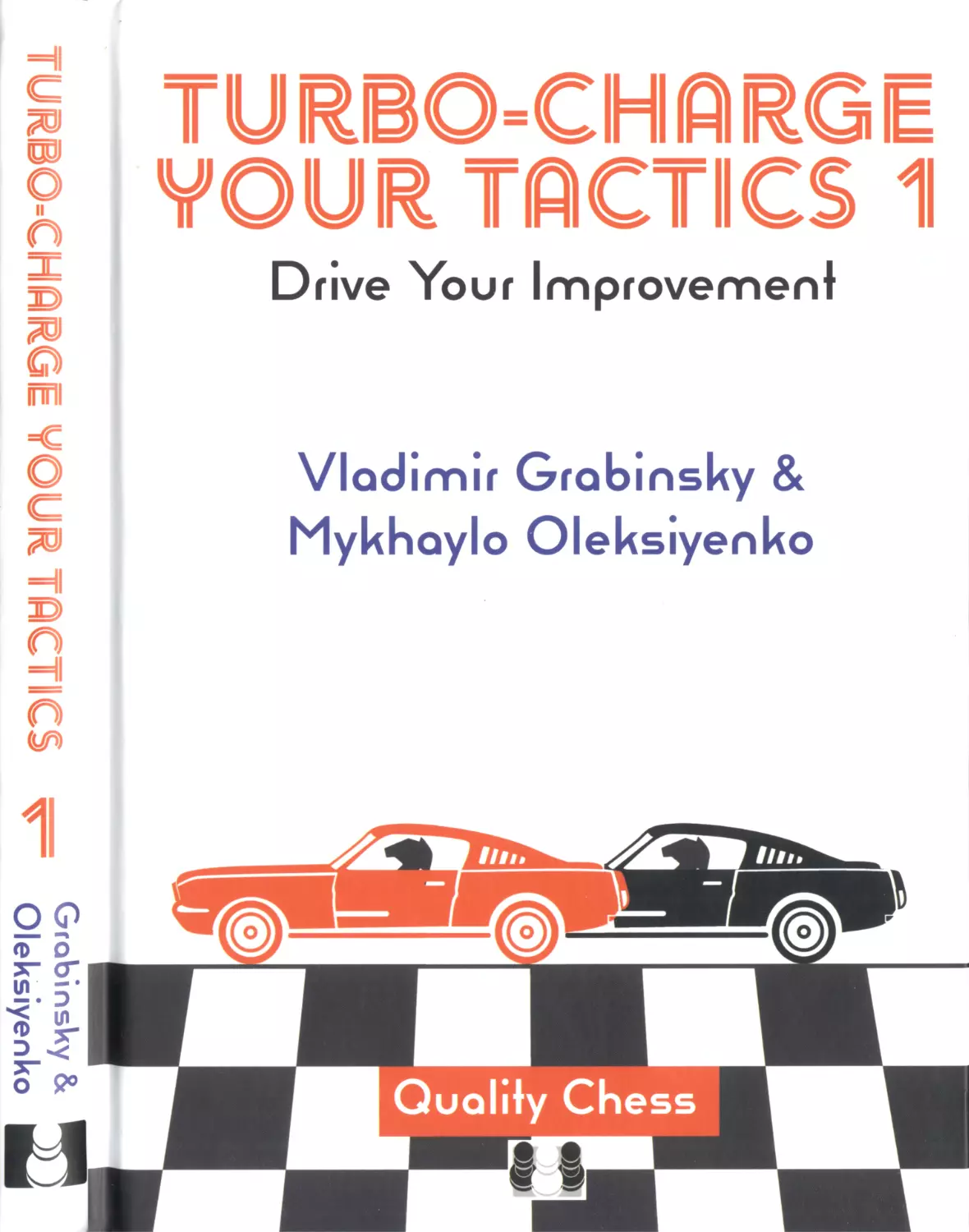
                    Turbo-Charge Your Tactics 1
Drive Your Improvement
By
Oleksiyenko & Grabinsky
Quality Chess www. qualitychess, co. uk


First edition 2024 by Quality Chess UK Ltd
Copyright © 2024 Mykhaylo Oleksiyenko & Vladimir Grabinsky
TURBO-CHARGE YOUR TACTICS 1 Drive Your Improvement
All rights reserved. No part of this publication may be reproduced, stored in a retrieval system or transmitted in any form or by any means, electronic, electrostatic, magnetic tape, photocopying, recording or otherwise, without prior permission of the publisher.
Paperback ISBN 978-1-78483-202-5 Hardcover ISBN 978-1-78483-203-2
All sales or enquiries should be directed to Quality Chess UK Ltd, Suite 247, Central Chambers, 11 Bothwell Street, Glasgow G2 6LY, United Kingdom Phone +44 141 204 2073 e-mail: info@qualitychess.co.uk website: www.qualitychess.co.uk
Distributed in North and South America by National Book Network
Distributed in Rest of the World by Quality Chess UK Ltd through Sunrise Handicrafts, ul. Szarugi 61, 21-002 Marysin, Poland
Typeset by Jacob Aagaard Proofreading by Paul Brencher & John Shaw Edited by Kostis Megalios Cover design by Kallia Kleisarchaki Photo on page 10 from the authors’ private collection Photo on page 68 by Harold Fietz
Printed in Estonia by Tallinna Raamatutriikikoja LLC


Contents
Key to Symbols used 4
Preface by Vladimir Grabinsky 5
Preface by Mykhaylo Oleksiyenko 7
Structure of the Book 9
Introduction 11
Part I Puzzles from Games by Mykhaylo Oleksiyenko 27
1 	Exercises 1-33 29
2 	Solutions 1-33 35
3 	Exercises 34-58 63
4 	Solutions 34-58 69
Part II From Beginners to World Class 97
5 Exercises 59-102 99
6 Solutions 59-102 107
7 Exercises 103-141 135
8 Solutions 103-141 142
9 Exercises 142-175 171
10 Solutions 142-175 177
11 Exercises 176-205 209
12 Solutions 176-205 215
13 Exercises 206-239 245
14 Solutions 206-239 251
15 Exercises 240-270 287
16 Solutions 240-270 293
Epilogue
Name Index
323
324


Key to symbols used
? a weak move
?? a blunder
! a good move
!! an excellent move
!? a move worth considering
?! a dubious move
t check
# mate


Preface by Vladimir Grabinsky
“Whatever you do when you are preparing for the game, you will still sit in front of your opponent, and you will have to calculate variations. There is no other advice — you should improve your calculation. Alexander Beliavsky
In my opinion, there are two main reasons why people buy chess books. Some simply like chess and get a kick out of their favourite hobby. However, maybe even more common is for people to have a desire for self-improvement - learning something, training their brain, broadening their understanding. Of course, many potential readers have a combination of both; the enjoyment of chess and the effort to expand our horizons go hand in hand.
Why is this book worth your attention? A good reason would be that we sifted the material under a prism of chess beauty. Many problems did not make it into the book simply because they lacked the “Wow!” factor. We tried our best to guarantee aesthetic pleasure.
For readers mostly seeking progress, it is important to understand that there is no golden standard in chess training. Each coach has their own vision and methods. For example, some suggest studying openings by delving into the typical middlegame plans and standard ideas found in the corresponding pawn structures. Many focus on analysing students’ games to eradicate their mistakes. Others prefer improvement through familiarization with classical games.
In my opinion, tactics and calculation are the key elements of modern chess. They are not just two of many equally important factors, but rather the crucial factors that determine your current level. Therefore, training your calculation and tactical vision is the shortest path to improvement. Do you want to improve your rating? Find time to solve these puzzles for a month and then go to a tournament. You might be surprised by the results! At least, that’s what I believe, based on my coaching experience of training thirteen young players to grandmaster level: improving tactical vision and calculation makes the biggest difference.
Furthermore, a highlight of these books is that my co-author solved many of the puzzles himself. Whenever you read “I...” in the comments to a puzzle, it is Mykhaylo speaking to you. He calculated over the board in the positions from his own games, and carried out further analysis afterwards; he also solved positions from my database, as well as many puzzles from the Lichess database. He experienced all the nuances of these puzzles first-hand, so his comments will almost always be relatable to what you felt when solving the exercises yourself.
My hope is that you’ll find the insights from Mykhaylo’s “grandmaster thinking” to be interesting and instructive. Readers could also get the pleasure of trying to compete with or even outmatch Mykhaylo.


6
Turbo-Charge Your Tactics 1 — Drive Your Improvement
As the last argument in favour of these books, I’d like to cite economic efficiency. The cost of one volume of our series is much cheaper than one hour of training with Mykhaylo or me. Writing these books has taken four years of hard work, countless meetings, Skype calls, and independent work of each of the co-authors. Some things were crossed out, some things were added, and analyses were polished. We tried to be attentive to all the details, checking everything with engines, reading the text several times, and choosing the chess content carefully. In my mind, buying the result of our four years of work (even if it’s only one of the two volumes) by paying the price of this book is a fantastic deal.
Vladimir Grabinsky
Lviv, November 2023


Preface by Mykhaylo Oleksiyenko
“A heuristic is a mental shortcut commonly used to simplify problems and avoid cognitive overload. ”
- Investopedia
The book you are holding in your hands is the first volume of a series that differs from other books on tactics. Instead of focusing on teaching the reader basic patterns or just training their “calculation muscle”, the main mission of these books is to remove certain mental barriers that limit our calculation process. Chess players often dismiss certain moves and ideas without proper consideration, and that’s the problem we’re trying to address.
Here are some of the default settings that we may have:
Do not leave a piece hanging
> 	Do not move a piece to a square where it can be captured
> 	Do not leave your king under possible discovered check
> 	Do not move pieces backwards
Always castle
Do not play “quiet” moves when the board is “on fire”
> 	Do not move pawns in front of a castled king
Do not ruin your structure
> 	Do not move a knight to the edge of the board
Do not give up your strong fianchettoed bishop
...And so on. You cannot do this, you should not do that, you can’t, you can’t, you can’t. Even when we do not necessarily verbalize these rules and prohibitions clearly, they still influence the moves we tend to consider and the ones we tend to disregard.
These strong recommendations work in most cases, yet they certainly do not work all the time. Chess is much deeper and more interesting than just a set of rules and recommendations that you need to follow.
Up until a certain level, these rules are extremely useful, and we should generally follow them. However, problems begin when we cannot solve a problem with our “default algorithm”. At that point, these recommendations might start to limit our possibilities and narrow our field of vision.
Let me make a comparison to mathematics, another area close to my heart. Most people, according to my subjective observation, do not like mathematics. That is why I want to assure you that you will not find any more of it throughout the book. (Okay, I lied, but maybe it’ll only be once.) Nevertheless, please bear with me as I briefly talk about numbers and the way we study them.


8
Turbo-Charge Your Tactics 1 - Drive Your Improvement
First, we are taught that numbers (1, 2, 3...) exist, and that you can add and multiply them. They are called natural numbers. Afterwards, we learn that there are odd numbers, and there are even numbers. You cannot divide an odd number by two. Then we learn that you can subtract a smaller number from a bigger one, yet you cannot do the opposite.
Is that really true? I do not think so! At later stages, it turns out that you can subtract and divide any numbers you want with each other (except of course, division by 0). Problems arise again when we learn about a square root, for example. It turns out that you cannot take a square root of five or a negative number. However, this problem is again solved by introducing irrational and complex numbers.
Each time we learn something new, we can keep all our previous knowledge and build on it, using the newfound stuff to help us solve problems that we couldn’t solve before. Why am I telling you all this? Because I think the readers of this series are ready to widen their chess understanding, leave aside all false preconceptions, and start solving a wider range of chess equations.
The puzzles in our two-volume tactical series will help you identify hidden taboos in your calculations. You will learn to consider the moves that break certain rules. Our hope is that these taboos can be transformed into: “Usually, such a move is not a good idea, but let us briefly check first. Maybe we have a beautiful exception on our hands!”
Mykhaylo Oleksiyenko
Lviv, November 2023


Structure of the Book
We decided against the common format of arranging puzzles according to different tactical themes such as pin, fork, back rank mate and so on. In a practical setting, no one is there to warn us about the presence of a tactical possibility. We’re already giving you that helping hand, so prompting you even further by giving a big hint about the solution felt like too much.
Instead, we opted to split the material according to who was playing the games. The first section in this book contains puzzles taken from Mykhaylo’s own games. The next section contains interesting examples from games that can range from beginners playing bullet on Lichess all the way to legendary players of the world elite. We would like to thank Lichess for granting us permission to use a small selection of their tactics puzzles which Mykhaylo and I consider to be of particular instructive value.
The second volume contains puzzles taken from games by the World Champions and their challengers. This made sense to us, as it would have felt too strange to see the names of World Champions appearing next to random Lichess handles.
After discussing things with Quality Chess, to keep some structure and make the material more digestible, we divided these broad sections into chapters, each of which ends with a summary of the most important tactical motifs to feature in that set of puzzles.


42 Chess Olympiad
o
GM Mykhaylo Oleksiyenko & IM Vladimir Grabinsky


Introduction
Lichess Puzzle
abcdefgh
The position in front of you was found by Stockfish while it was skimming through the millions of games played on Lichess. The puzzle was created automatically, as there is only one winning move. Before reading any further, try solving it for yourselfi
Usually, these kinds of puzzles are either easy, or have a weird, incomprehensible, “computerish” note to them, leaving behind a bittersweet flavour in the mouth of the successful solver. This one, on the other hand, is quite instructive and aesthetically pleasing at the same time. Its usefulness stems from the clarity with which it exposes the “bugs” in our own chess “engines”.
I gave this position to many players, including strong GMs rated over 2600, and the success rate for solving it was not much above zero! The beauty of it is that you need to see just one move. The difficulty lies in the move being in a “blind zone” for many players, regardless of their strength. In fact, I failed this one myself. However, my failure was instructive, as it revealed a certain bias in my calculation process.
So, let’s see what we have here: White is one pawn up, but his knight is pinned and might be lost on the next move. However, taking it will expose the black king on the a2-g8 diagonal and set up a dangerous discovered check.
Let’s start going through some of White’s options.


12
Turbo-Charge Your Tactics 1 - Drive Your Improvement
l.ld2?!
In my opinion, this is the most natural, protecting the rook and developing the bishop.
I...fxe6! 2.§xe6
abcdefgh
The position looks winning. The queen on e8 is under attack and, more importantly, White is about to deliver a lethal discovered check. Nevertheless, Black has a brilliant defence:
2...W’’
Voluntarily running straight into the pin!
2...§xf3? 3.Sxe8# is a cute checkmate.
3.Sxd6
The obvious choice.
I did not consider 3.®e2 in my calculations but still, it fails to get the job done: 3...®a5!
4.§f6 gxf6 5.^xf7t Sxf7 Black has a lot of material for the queen.
The idea behind ...®f7 on the previous move.
4.dxc4 §xf3 5.Sxg6 hxg6 6.gxf3
White is two pawns up, but the pawn structure is horrible so Black has a lot of compensation.
What else can we do? The next move that came to my mind was:
lJLf4?
White had two problems in the starting position. The rook on el was undefended, and the queen on f3 was under X-ray pressure from the f8-rook. The text move seemed to be solving both problems at once, and I calculated the obvious line:
l...fxe6! 2.§xe6 £$?h8! 3.Sxe8
abcdefgh
3...Saxe8??
In my mind, an automatic reaction. 3...jlxe8!! was completely out of my sight! Why on earth would I do that instead of developing the rook to the open file? In reality, the reason is quite simple: the bishop on f4 is lost in this version.
These kinds of moves are difficult to see since they are not good strategically. We were taught to connect our rooks and develop them to open files. This move does exactly the opposite of that, making it very hard even for very experienced players to be able to consider it. After 4.g3 g5! Black is better,


Introduction
13
since the rook and two minor pieces should be stronger than the queen and a couple of pawns.
4.g3
When deciding on the first move of the puzzle, I stopped my calculation here. I arrived at a correct conclusion - White has a lot of extra material. Still, the correct conclusion was based on a false assumption! Taking back with the rook on e8 wasn’t forced!
Let’s go back to the starting position of the puzzle:
abcdefgh
l.Wdl!!
All you need to see is this move. It fixes both problems White had at the same time. The rook is protected, and the queen is out of the f-file. I am not even sure which line to mention. It is just an easy win for White!
Why was it so hard for me and many others? This is a backward move, the queen goes to a “worse”, more “passive” square, it is reversing development and the rooks will not be connected. Those kinds of moves go against our “understanding” of chess, challenging our intuition and thus, making them much harder to spot. This book will try to cure your brain of these types of blind spots.
Here is a sad story for you. Well, it was sad for me anyway, as the captain of the Dutch women’s national team. But let me give you some background first:
The team was seeded #20 in the starting rank of the Women’s Chess Olympiad in Baku 2016. The tournament was going very well, and after seven rounds we were playing on the second board against Poland who ended up getting the silver medals. They beat us with the minimum score of 21/2-l1/2. Then we lost to India and won against Uzbekistan. In the last round, we were playing at Board #6 and our opponents were the national team from Vietnam (#18 in the starting list).
The match was not going very well so we would have been happy to get a 2-2 draw. After the time control, as far as I remember, we were losing 1-0 (Anna-Maja Kazarian had lost her game), and three games were in progress. The good news for us was that Zhaoqin Peng had a winning advantage on the first board, but Anne Haast had a losing position on the second board. She only had a few practical chances.
This meant that it was critical to get some points from the position in front of you:
Thi Mai Hung Nguyen - Tea Lanchava
Baku (Olympiad) 2016
abcdefgh


14
Turbo-Charge Your Tactics 1 - Drive Your Improvement
I looked at the position very carefully and could not see a reasonable scenario where Black could be winning. Tea Lanchava had a decent advantage during the last ten moves or so, but now it seemed to me that she had lost all of it. My concern was that she would keep pushing for a win in an equal position, at least that was my assessment of the position at the time. What often happens when a player relinquishes their advantage is they keep on playing for a win, and then in the end lose because of pushing too hard.
I wanted to secure a draw because a loss would mean that we lose the match for sure. However, I did not want to make a mistake. So, I had to check again whether I could find any way that Black can play for a win. I failed to find one, and after seeing some ghosts of a possible loss, I made my decision: I told Tea to offer a draw.
After some deliberation, she played 41 ...®e5t and the draw was agreed. We ended up losing the match 21/2— 1 ¥i. You can imagine my horror, when I discovered that the final position of the game was practically winning for Black!
41...We5t
V2-V2
The game ended here. If it had continued, we would probably reach the position below:
42.£hl
42...c5!!
An amazing move that for some reason completely slipped my mind. Once you consider it even for one second, it becomes clear that Black is winning! The pawn is, of course, immune to en passant.
43.dxc6?? Wxa5
So, why did I overlook this resource? I am not 100% certain. Maybe it was because it is a “quiet” move. Maybe it was because it is highly unusual for the subconscious part of my brain to understand that two pieces can disappear from one rank in just one move. Maybe it was because during the whole game that kind of move was bad. Eventually, I started to assume that it is not working. To be completely honest, I don’t know.
What I do know though, is that I had a blind spot there. So, that’s an opportunity for improvement. The best way to treat this problem is to show your brain lots of examples, where those kinds of moves are actually working. Maybe next time you encounter a similar situation, your brain will not let you down.
The next example is a memorable game for me. To better understand why it ended the way it did, I’d like to share a little story:
Different national team championships have different rules about when the board pairings become certain. In Israel, it is decided right before the game, meaning that the captain is announcing the order and names of the players just before the round starts. Each team has a list of players and, in most countries, it is not permitted to change the order of players. In Israel on the other hand, you could change the board order if the rating difference between the players was less than a given number of ELO points.
What did this all mean? It meant that it was very hard to guess whom you would be playing against. Our captain told me to prepare against
abcdefgh


Introduction
15
Ilya Smirin (2668) or Emil Sutovsky (2657). The rating difference between me and our second board, Gad Rechlis, was more than the required threshold for us to be able to switch. In other words, everyone knew that I would be playing on Board 1. Imagine my surprise when I saw Ilya Smirin walking into the playing hall and sitting on Board 4. Shortly after that, Emil Sutovsky walked in and sat on Board 2! I said to myself, “Oh my God, who on Earth am I playing against?”
I am not very good at hiding my emotions during the game, so Vugar Gashimov could easily tell that I did not expect to play against him. Just think about my situation: I am playing against a top-10 player in the world, he has prepared against me, and I did not prepare against him at all. He has the white pieces, and the opposing team has at least a 200 ELO advantage on every single board of the match. It’s most likely that they should beat us with a comfortable margin.
On the other hand, it is easier to play under those circumstances since everyone is expecting you to lose. In fact, I think this whole situation played a cruel trick on my super-GM opponent: he was pushing too hard for a win and did not take a chance to make a draw when the position demanded he did.
Vugar Gashimov - Mykhaylo Oleksiyenko
3O...Wd5t-
It turns out the rook is not hanging, and Black could win on the spot with: 3O...jlh6!! 31.®xh8? (It is also crucial to see that the king can escape the checks: 31 .®e7t £$?xc6! 32.§c2f £$?d5! 33.®b7t ^e6! Black can exchange queens and start pushing the passed pawn. He has a winning advantage.) 31 ...®d5t! 32.£$?gl jle3t!! The white rooks are overloaded, and checkmate follows next move after 33.Sxe3 ®g2# or 33.Sef2 ®g2#.
I could not find this solution with just a couple of minutes on my clock, which is why I decided to repeat the position, get an extra minute, and check out my opponent’s intentions.
31.&gl @d4t 32.Se£2?
abcdefgh
Israel 2010
This is a bad way to play for a win. White was already in big trouble, and making a draw would objectively be a great outcome. And yet, the rating difference between the players, the colour of the pieces, the time on the clock, and the fact that I did not expect this opponent were all pointing to how it is White who should win this game!
This is a complex but common psychological situation. During the game, I felt this move must be a big mistake but did not have enough time to see the win. That is why I quickly moved my “hanging” rook.
abcdefgh


16
Turbo-Charge Your Tactics 1 — Drive Your Improvement
32...Sg8 33.WB Sh8
I instantly moved the rook back to give the impression that I want a draw. Vugar Gashimov thought for some time and then reluctantly repeated.
34.WF6
The time my opponent spent on his last move was enough for me to see that my rook was not really hanging. It meant that I could finally develop my bishop on move 34!
34... 	M6!! 35.We7t
After 35.®xh8 ®f3t! 36.£$?hl ®xh8 Black wins.
35...&xc6
It is over. Black has both the material and the dynamic advantage.
36.Wh4
White resigned.
0-1
Our team ended up drawing the match 3-3 with no draws. We definitely gave them a good fight.
What made ... JLh6!! so hard to spot that it was missed both by me and a top-ten grandmaster twice (on moves 30 and 32), before I finally played it on move 34? We were just reluctant to accept that the threat to the h8-rook is immaterial. However, it wasn’t just that. Our thought process was seriously influenced by the tricky psychological situation mentioned above.
H. Konzen - Mykhaylo Oleksiyenko
Lublin 2014
l.d4 2.c4 e6 3.£ic3 <tb4 4.e3 0-0 5.<td3 d5 6.a3 Jlxc3t 7.bxc3 dxc4 8.jlxc4 c5 9.^6 Wa5 10.142 Wc7 ll.Jld3 b6 12.We2 I,b7
13.e4 Wc6 14.e5 ^e4 15.0-0 h6?I 16.Bfel ^ixd2 17.Wxd2 Sd8?
abcdefgh
It may be difficult to believe, but White has a winning advantage.
18.Be4!!
I completely overlooked this manoeuvre! I had seen the rook coming to the kingside using the third rank multiple times but, for some reason, the fourth rank was not an option in my mind. After this move White will already be attacking the black kingside with four pieces, while it is unclear if any of the black pieces are going to be able to defend their king.
18...Wc7
The most natural reaction.
To understand how strong White’s attack is, it is enough to say that the engine claims the best chance is to give up the queen with 18...®xe4. Obviously, Black is lost after that. It’s just that in Stockfish’s “eyes” this is “less losing” compared to facing the attack. That is not how humans play, as giving up the queen would diminish our counter-chances.
19.Sg4!
Trying to eliminate as many attackers as possible.


Introduction
17
I also considered stepping away from the g-file with my king but was quickly discouraged when I saw what was coming at me:
19...&F8
abcdefgh
20.®g5’!
With the lethal threat of^h7t- 2O...hxg5 21.®xg5 &e8
abcdefgh
There are several promising options for White. The best one is hard to find but makes sense once you consider it.
22.@h51!
The only clean solution.
The second-best 22.®xg7 can only be answered with 22...®e7, getting ready to run away with the king, After 23.Sf4! ®f8! White has a strong attack, but there is no forced win.
22...g6 23.jlxg6! fxg6? 24.§xg6!
Black must give up his queen to avoid checkmate.
24...&d7 25.Sg7t &c8 26.Sxc7t &xc7 27.®f7t
White will have too many pawns.
2O.gx£3 21.<±>hl!
Preparing to bring the al-rook into the attack.
21...^c6
abcdefgh
There is a win for White, but it is very hard to spot.
22.®e3?
Missing a big chance.
The most natural option would be 22.Hagi?!, but it fails to impress tactically: 22...g5! 23.®e3! cxd4! 24.cxd4 ®e7 25.f4! ®f5 26.jlxf5 exf5 27.S4g2 g4 The black king survives and the game continues with only a slight advantage for White.
The crushing blow was:
22.Sxg7I!
This move is not hard to consider. The problems appear later in our calculations.
22...&xg7 23.Sglt &f8 24.®xh6t &e8


18
Turbo-Charge Your Tactics 1 - Drive Your Improvement
abcdefgh
The key position.
25.Sg7!!
The only move that leads to a win. It is very hard for humans to see such “quiet” moves in advance. The thing is that’s not a quiet move at all! It creates a big threat of winning the queen, with ®h8t, followed by Bxf7t and ®h7t.
25...®e7
What else?
abcdefgh
26.d5!I
Another incredible move.
26...Sxd5 27.®h8t’ ®f8
27...&d7 is simply met by 28.®xa8.
28.Sg8!
This is not over yet but, with some more accurate moves, White can win. Material is “equal”, the black king and the light squares are weak, and the strong, passed h-pawn has to be accounted for.
22...cxd4?I 23.cxd4 ^e7
abcde fgh
24.Bagl
Missing another golden opportunity.
It was very important to kick the queen out of the open file first with 24.§cl! as, in some lines, the queen was coming to c3 with a tempo. That wasn’t obvious at all, but it was completely winning for White: 24...®b7 (If 24...®d7 25.Scgl ®d5 26.®d2 g5 27.h4!, the kingside is collapsing, and Black does not have the option of exchanging the queens with ...®c3.) 25 JLe4 ®d5 26.®d2 Black will not be able to hold the g-file, and White will be winning after Scl-gl on the next move.
24...^d5! 25.We4?!
White enters a forcing line that relinquishes his advantage.
His only chance to retain the advantage was 25.®d2!?, but the worst is over for Black anyway: 25...g5! 26.f4 ®c3!? That is why it was critical to kick away the queen first with 24.Bcl!. After 27.®xc3 ®xc3 28.fxg5 hxg5 29.Sxg5 £$2e7 the king is safe without the queens, and Black has decent compensation for the missing pawn.


Introduction
19
abcdefgh
25...B!
A concrete solution to Black’s problems. The queen can provide help along the seventh rank.
26.exffi^xffi 27.Sf4®f7
This is forced. Black needs the tempo he gets by hitting the white queen.
28.Wel
abcdefgh
This was the first moment in the game where I felt that my position was good. I did not see any threats, so I decided to finally finish my development on move 28.
28...Sac8??
A mistake that could have cost me a whole point.
I had two options that were not losing. One was 28...g5!, clearing the g7-square for the king. The game remains completely unclear.
The other option was 28...Sd6!?, when the next moves would be ...Sad8 and ...g7-g5. Once again, there are chances for both sides.
29.Wb4f!
abcdefgh
29...<&g8
The moment I moved my king “to safety” a horrible realization dawned on me... However, sometime after I finished my calculations, there came relief:
30.1g6?
3O.Sg6!!
“Oh, my goodness! I am completely losing after this move,” I screamed in my head. My opponent was still thinking, and I was desperately looking for ways to not resign immediately:
30...a5!
Soon, I discovered this desperate move.
SO.-.SfS? 31.Sfxf6 is game over. The queen on b4 is protected.
30...^h8? also loses after: 31.Sfxf6 gxf6 32.Sxh6t &g8 33.Sg6t &h8 34.®d2 (34.d5 with the idea of transferring the queen to the kingside is also winning.)


20
Turbo-Charge Your Tactics 1 — Drive Your Improvement
34...Sxd4 35.®h6t ®h7 36.Sg8t’ Up next is ®xh7, so it is time to resign for Black.
abcdefgh
31.®d2?
This was my main concern. It looks like I’m only pushing the queen closer to where she wants to go anyway, as she gets closer to the kingside and targets the h6-pawn.
I knew that 31.®xb6 should lead to a winning position for White, but at least I could play on with 31 ...&f8.
31...&f8
The only plausible try.
32.§fxf6 gxf6 33.®xh6t
I did not want to resign, so I continued calculating out of sheer desperation.
33...&e7 34.Sg7
abcdefgh
34...Self!!
What a relief.
35.&g2?
35.^fl!! A surprising option that keeps the balance: 35...Sxflf 36.^g2 Sg8 37.Sxg8 Sxf2f 38.&xf2 9xg8 The queen endgame is just equal.
35... 	Sg8!
The tables have turned and, suddenly, White is the one in trouble.
3O...Wfl8 31.Wel ®e7
I managed to neutralize the attack, and eventually I even went on to win.
...0-1
How come I overlooked a move like 3O.Sg6? First of all, I really wanted to “complete my development” and “put the rook to an open file”. I was supposed to have done that sooner according to the general principles. Secondly, I think stopping with the rook, or any piece for that matter, right before a capture is somehow counterintuitive. Furthermore, the knight on f6 seems well-protected, so it is not easy to imagine it will be the main target of White’s attack.
In any case, all of these are just excuses. We should train our brains to be able to spot these moves. All players have their own “blind zones” and, hopefully, we can help you improve by shrinking your own.
Before we move on, I’d like to tell you the story of how I became the champion of Ukraine in 2016 and how Stockfish played a surprising role in my success:
I was not supposed to play in that championship. There were twelve spots for the tournament, and according to the regulations, five people qualified by rating, another five from the semifinal, one spot went to the previous champion, and one spot was filled with a wildcard selected by the president of the federation. By the way, I had dreamed of participating in the finals for years, and I had already tried to qualify a few times but failed.


Introduction
21
That year, I had a tournament in the US scheduled at the time of the semifinals, so I bought my ticket and was ready to go. At that point, things started to go wrong for me, or at least I thought so at that time. Firstly, I discovered there was a 30% tax on the tournament prizes, and there was no way around that. Secondly, I was supposed to stay at a friend’s place which was within walking distance from the playing hall, and even though I could still stay at his place, he wouldn’t be there. He informed me that he had to travel to Africa for two weeks and he was leaving the day I was going to arrive! I was looking forward to catching up with him, as he was the best man at my wedding seven years prior to our story, and we barely saw each other or talked ever since.
To be honest, I was already reluctant to go to that tournament. Nevertheless, the ticket was not refundable, and the organizers counted on me. So, there I was, standing at my gate, looking at the Lufthansa plane that was supposed to take me to Munich, from where I would catch my next flight to Washington DC. I even took a picture of the plane and sent it to my wife and kids. A few minutes later, there was an announcement. The flight to Munich was cancelled due to technical reasons.
People started panicking since their plans were completely ruined. I, on the other hand, was elated! I was going to get my money back, and there was no way I was going to make it to the tournament. As a cherry on top, there would be no hard feelings with the organizers as I wasn’t to blame for my unexpected “misfortune”. By the way, all this was taking place on the day of my 30th birthday, so I was suddenly able to celebrate my birthday with my family and friends. I was in a very good mood!
Why am I telling you this? At some point during the celebrations, I realized that I could still make it to the semifinals as they were starting in two days, and there was a saying that the player who gets a last-minute invitation wins the tournament. That is exactly what happened to me! I was in a good mood the whole tournament and managed to play well and win it quite confidently. That qualified me to play the finals and two months later I played the game that changed my “history” as a chess player.
Psychology played a crucial role in the semifinals, as well as the finals. Since it was my first final, I was happy just being there! I was seeded number eight out of twelve players. The first match was against Alexander Moiseenko, and I had the white pieces. My rating at the time was 2615 and his was 2657. He chose an aggressive line in the Caro-Kann, and I was out of book by move six because I confused the move order I had previously analysed. He blitzed out a novelty on move seven (I got to learn it was a novelty only after the game), and I was in a very bad mood. It felt embarrassing to be out of the book by move six. Not only that, but I had also clearly gotten myself into his preparation. Somehow, I managed to focus and let all those thoughts go away.
Long story short, I found the correct line relatively quickly and won a good game. I came to my room very happy with my performance, but my self-esteem was about to be boosted even more! I checked the game, and it turned out that Stockfish could not see what I found over the board! How unlikely! What are the chances of getting into your opponent’s preparation as early as move seven? What are the chances that his preparation has a huge flaw that engines do not see? Finally, what are the chances of finding that flaw over the board?
My confidence skyrocketed! I was in a great mood all tournament and managed to win, finishing a full point ahead of second place. I learnt a valuable lesson from this experience:


22
Turbo-Charge Your Tactics 1 - Drive Your Improvement
One should not blindly trust even the most powerful engines. To properly communicate with them, it is important to ask “human” questions and try to suggest natural moves, even if these moves are not in the top three lines of the engine. This way we will understand the position much better and seldomly, but more often than you think, we will find ourselves in a situation where the engine was actually wrong. We will discuss much more about this topic in the second volume, where the final chapter is dedicated to chess engines.
Mykhaylo Oleksiyenko - Alexander Moiseenko
Rivne 2016
l.e4 c6 2.d4 d5 3.e5 c5 4.dxc5 ^c6 5.a3 ^xe5 6.jLb5t $Ld7 7.®xd5 ®c7
abcdefgh
I looked at the position in front of me and it took me somewhere around nine minutes to see the almost-winning continuation.
Firstly, I examined 8.jLf4 but in that case, my opponent would get two bishops as compensation for the sacrificed pawn. Moreover, he could also win back the pawn after ...Sc8 in the line mentioned below and I did not like that. I wanted to keep the extra pawn and not let him have the two bishops.
Hence, I focused my attention on 8.jbcd7t ^Jxd7. If Black wins back the pawn on c5 then I have nothing so, naturally, I considered 9.b4 and 9...^gf6 seemed like the obvious response. Black gets some time to develop and ...®e5t looks like a big threat. I assumed I have to move my queen to a weird square like g5, a2, or d4 to deal with the threat of ...®e5t. I did not like any of these squares as the queen is vulnerable to an attack on all of them.
Somehow, I was feeling quite arrogant and wanted to look for a big advantage. I was not ready to settle for a misplaced queen or give up the two bishops. If I had to choose a nice place for the queen I would certainly put her on b3. No one can attack her, and she protects the potentially vulnerable pawns on b4 (after ...a7-a5 and ...b7-b6) and c2 (after ...b7-b6). The problem was that I had to say goodbye to my rook.
And then, it hit me! It’s not unusual for the queen to get trapped when she wins a rook in the corner. I have seen this idea in various openings and tactical exercises. Thus, I forced myself to check more thoroughly. By the way, Stockfish 11 (which was the best engine at that time) only found the solution when reaching depth 35.
8.txd7t!
After 8.JLf4?! JLxb5 9.JLxe5 &>c6 10.jLxc7 JLxd5 Black gets the two bishops, the g2-pawn is hanging, and the rook is coming to c8. The position is just unclear.
8...^xd7 9.b4!


Introduction
23
abcdefgh
From this position, Stockfish 11 found the correct move at depth 29.
10.Wb3!
And the rest, as they say, is history...
10...g6
An admission of guilt.
Taking the rook would backfire spectacularly: 10...®e5t Il.^e2!®xal 12.^ec3!
Threatening JLb2.
12...a5’?
abcdefgh
An important defensive resource I should have examined in advance. To be honest with you, I underestimated this option, even though it was the only try to save the queen.
13.bxa5!
I hope I would have found this strategically horrible move if my opponent had put me to the test. There is no good defence against tb2.
If I remember correctly, I had some “bugs” in my calculation. I forgot that I was a whole rook down so I thought I could just win the queen with 13.JLb2??, but after 13...a4!! Black is completely winning. I, on the other hand, thought that after I take the queen on all would have two pawns for the exchange. I forgot that I was a full rook down!
13...^xc5 14.®b5t! ^fd7 15.^b2! Sxa5? 16.®xa5! ®xb2 17.®a8t! ^b8 18.®xb8f! &d7 19.0-0!
White is completely winning.
Of course, the game isn’t over but White is much better and, in the end, I got the full point.
ll.&B lg7 12.1b2 0-0 13.0-0 e5 14.^c3 e4 15.^b5 ®f4 16.^fd4 ^e5 17.^ e2 ®g5 18.®g3 ®xg3 19.^xg3 ^c4 2O.Jld4 Sfd8 21.Sadl e3 22.fee3 &d5 23.Sfel £idxe3 24.Jlxe3 Hxdl 25.Hxdl ^xe3 26.Hd7 ^xc2 27.Hxb7 a5 28.bxa5 ^d4 29.^ e4 ^ixb5 30.Sxb5 JU4t 31.^fl Sa6 32.<$e2 f5 33.^d2 &g7 34.&d3 le5 35.h3 &h6 36.^ c4 1x7 37.Hb6 Sa8 38x6 <&g5 39.Sb7 lf4 40x7 Hc8 41.^b6 Hxc7 42.a6
1-0
Here is one more memorable game of mine. It was the last round of the Ukrainian under-18 semifinals. I needed to win the game to qualify for the finals. “Luckily” my opponent was not so strong. He did not have a FIDE rating and his national rating was at least 200 points lower than mine. Imagine the horror of my coach Grabinsky when I started blundering out of the opening.


24
Turbo-Charge Your Tactics 1 - Drive Your Improvement
Mykhaylo Oleksiyenko - Denis Shmeliov
Lviv 2003
l.e4 c5 2.&B d6 3.d4 4.^c3 cxd4
5.^xd4 g6 6.Jle3 Jlg7 7.f3 0-0 8.Wd2 ^c6 9.0-0-0 d5 10.exd5 ^xd5 ll.^xc6 bxc6
12.1d4 e5 13.1x5 1x6 14.£e4 Se8
abcdefgh
15.h4
This was the line I was playing against the Dragon back in the day.
15...&f4 16.Wc3?
I remembered that 16.Se! was the move, but then I thought: “Why not put the queen to a much more active square?”
abcdefgh
16...1h6!
My heart started to sink. I cannot capture the queen on d8, nor can I cover the diagonal, without giving up material. I had been certain that Black must move his queen, or maybe put a piece on d5. Somehow, I completely overlooked the weakness of the cl-h6 diagonal. Hold on to that thought until move 24.
17.&g5?!
I decided to give up the pawn and get some “compensation” by removing the opponent’s dark-squared bishop. Who would expect that my dark squares would remain weak even after this?
If 17.Sxd8?? ^e2f 18.&bl, then 18...^xc3t comes with a devastating check.
17.1e3?? also loses: 17...^d5!I 18.1xh6 ^Jxc3 19.Sxd8 ^xa2f! Another terrible check. 20.^bl Sexd8 The knight will easily escape, and Black has a huge material advantage.
The best try according to Stockfish would be 17.^d2!. Black is much better after, for example 17...^d5!? 18.®a3 e4! 19.fxe4 lg4! 20.Sei ®f6!? but White can continue fighting.
17...1xg5 18.hxg5 ®xg5 19.®e3 a5 20.&bl ®f6 2La3 Sed8 22.Sxd8f Sxd8 23.&cl Wg5 24.Sgl??
abcdefgh


Introduction
25
The previous moves were also far from perfect, but my last move was a horrible blunder.
24...Sd5!!
A brilliant response that I totally overlooked. Black is threatening ...Sxc5 and my position is collapsing yet again. How could I overlook two similar tactics on the same diagonal, only a few moves apart? I think my opponent might have discovered my blind spot!
25.g3
What else?
25.JLb6? was the natural response, but it does not work. After 25...c5!! Black wins on the spot. Surprisingly, there is no defence against .. Ae2f on the next move.
25...Hxc5 26.gxf4 ®xf4 27.®xf4 exf4
Black is winning, and somewhere around here Vladimir could not watch the game anymore. All hope was completely lost.
I felt embarrassed and angry at the same time. I did not want to resign, so I decided to take my chances and try to get some counterplay. That is how this game ended up in Tragicomedy in the Endgame by Mark Dvoretsky. Let’s quickly go to the critical moment.
28.b4 axb4 29.axb4 He5 3O.Jla6 h5 31J&d2 h4 32.&c3 Se3t 33.&d4 gxf3 34.1b7 S£2 35.c3 ld5 36.b5 Sd2f 37.&c5 h3 38.1xc6 h2 39.Sbl hl=® 4O.Sxhl txhl 41.1xhl $£8 42.b6 <$e7 43.b7 Sb2 44.<$c6 <$d8 45.c4 g5 46.c5 g4 47.Jld5 £3 48.&d6
abcdefgh
This is the exact position included in the aforementioned Dvoretsky book.
48...£2??
The only move for Black was: 48...Sb5! 49.te4
White threatens c5-c6.
After 49.c6? Sxd5t!! 5O.^xd5 ^c7 the pawns aren’t going anywhere and Black wins.
abcdefgh
49...Sb2! 5O.JLd5!
Once again, White cannot afford to push his pawns: 50.c6?? Sd2f 51 JLd5 Sxd5t 52.<^?xd5 ^c7 Transposing to the previous note.
5O...Sb5!
With a repetition.


26
Turbo-Charge Your Tactics 1 - Drive Your Improvement
After the mistake in the game, White has a chance to win in spectacular fashion:
I remember walking out of the playing hall, and I think my game was the last one to finish. Nobody believed me when I said I had won, especially in such spectacular fashion. I am grateful to Denis for showing me my blind spot, and I really appreciate that this game is now included in two different books.
That’s what this book is all about: fixing our blind spots and training our brains to see the moves we many times fail to even consider.
abcdefgh
49.c6! Hb6 5O.Jlc4! g3
abcdefgh
51.b8=Wf! Sxb8 52.c7t &c8 53.1a6t
This is what my opponent overlooked.
53...Sb7 54.&c6 1-0


Parti
Puzzles from Games by Mykhaylo Oleksiyenko


Chapter 1
Exercises 1-33
We’ll start off with some easier examples taken from my own games. Don’t get complacent though; we have set a few traps for you here and there. Let’s not waste any more time... OfF we go!
Martinez - Oleksiyenko, Peniscola 2002
abcdefgh
Oleksiyenko - Volokitin, Kiev 1998
Oleksiyenko - Baryshpolets, Alushta 2005
abcdefgh
Oleksiyenko - Kozel, Lviv 2000
abcdefgh
abcdefgh


28
Turbo-Charge Your Tactics 1 - Drive Your Improvement
Just talking about invisible, peculiar, quirky, or engine-like moves, won’t produce the necessary changes in our brain’s wiring that would help us start noticing these options. Practice is required!
Don’t expect to start finding such solutions only because you were prompted to. The problem lies much deeper in our subconscious, and only relentless repetition can alter our preconceptions. Improvement in chess is quite often reliant on our perseverance to continue training even when it seems pointless or when finding a solution to a certain puzzle feels impossible. Don’t let it get you down. Everyone, even the greatest among us, has had to go through this process.


30
Turbo-Charge Your Tactics 1 - Drive Your Improvement
Oleksiyenko - Marechal, Bethune 2009
abcdefgh
Oleksiyenko - Kovalyk, Lviv 1999
Oleksiyenko - Oparin, Brest 2019
abcdefgh
Oleksiyenko - Bernadskiy, Lviv 2017
abcdefgh
abcdefgh
Mikhajlichenko — Oleksiyenko, Lviv 1999
“iakov98” - “Oleksiyenko”, Internet 2021
abcdefgh
10 I 8
7
6
5
4
3
2
1
abcdefgh


Chapter 1 — Exercises 5-16
31
Blomqvist - Oleksiyenko, Gjakova 2016
abcdefgh
Ipatov - Oleksiyenko, Lviv 2015
abcdefgh
Poghosyan - Oleksiyenko, Pori 2012
7
6
5
4
3
2
1
abcdefgh
Chowdhury - Oleksiyenko, Paleochora 2008
Oleksiyenko - Biriukov, Pardubice 2005
abcdefgh
Oleksiyenko - Burnoiu, Bucharest 2004
abcdefgh


32
Turbo-Charge Your Tactics 1 — Drive Your Improvement
Oleksiyenko - Eljanov, Kharkov 2004
abcdefgh
Oleksiyenko - Nitin, Dubai 2017
20 j 8
7
6
5
4
3
2
1
Oleksiyenko — Zajarnyj, Lviv 2001
abcdefgh
abcdefgh
Golizadeh - Oleksiyenko, Al Ain 2013
Oleksiyenko - Anatsko, Lviv 2000
abcdefgh
Oleksiyenko — Kryvoruchko, Bucharest
abcdefgh
7
6
5
4
3
2
1
abcdefgh


Chapter 1 — Exercises 17-28
33
Oleksiyenko - Kireev, Olomouc 2005
6
5
4
3
2
1
Oleksiyenko — Bocharov, Cappelle-la-Grande 2007
6
5
4
3
2
1
abcdefgh
Tabatabaei — Oleksiyenko, Warsaw 2016
abcdefgh


34
Turbo-Charge Your Tactics 1 — Drive Your Improvement
Oleksiyenko — Alexanian, Lviv 2004
abcdefgh
Nester - Oleksiyenko, Lviv 2002
abcdefgh
Oleksiyenko - Polivanov, Lviv 2002
abcdefgh


Chapter 2
Solutions 1-33
Well, we hope that was fun. What did you think? Did you solve most of these examples correctly? At first they were simple two- or three-move tricks, but towards the end we had some cute and hard-to-consider motifs. If you felt you had to use your imagination to solve some of these, then we can consider our selection a success. Expanding your imagination is the whole point!
1. 	Jorge Bermejo Martinez - Oleksiyenko
Peniscola 2002
abcdefgh
This seems like a typical Benoni position. It does not immediately feel like a combination is possible.
18...£xc3!
You are not supposed to do that in the Benoni. In most cases it just improves White’s central structure.
19.bxc3 Sxe4!
Bingo.


36
Turbo-Charge Your Tactics 1 — Drive Your Improvement
2O.jLxa6?
A natural reaction. White just lost a pawn, so he wanted to take one back.
20.®xe4? JLF5! reveals the point of the whole combination. The queen is trapped in the middle of the board.
Pinning the b6-knight with 2O.Sabl! was the only move to continue fighting, but Black retains a great advantage anyway.
abcdefgh
2O...Sxe3!
The cleanest.
2. 	Oleksiyenko - Andrei Volokitin
Kiev 1998
abcdefgh
27.&e4!
A weird way to unpin - we just put another piece on the e-file. The knight is trapped, and Black cannot play ...d7-d6 or ...f7-f6 due to the skewers.
The correct option completely escaped my attention, but don’t judge me on this one: the game was played in the Ukrainian UI2 championships! I played 27.Sxe2? and the game continued: 27...d6 28.jLd5 ®e7 29.Se4 dxe5
2O...Sa8!? was also winning.
21.Sxe3 ^xd5
The pawn on c3 falls next and the white position collapses.
abcdefgh
3O.Sxe5?? (3O.fxe5! was the right capture, when White would have decent compensation for the missing exchange.) 30...®c7 Black is winning. There are too many open files for the rooks to work their magic.


Chapter 2 - Solutions 1-4
37
27...d6 28.jbrh7t! ^h8 29.1,f5!
White is winning.
3. 	Oleksiyenko - Andrey Baryshpolets
Alushta 2005
abcdefgh
33.a6!
A simple quiet move that I did not manage to spot. The bishop is lost due to the pin.
I automatically took the bishop with 33.^xb5?, but after 33...a6! Black is fine.
Also mistaken is 33.Sxb5? due to 33...Sxc3! and it is White who is in trouble.
33...Sxc3
The best try, but it doesn’t help.
34.Sxc3 Sb6 35.Sa3! Sxa6 36.Sxa6 JLxa6
37.Sa4
With a technically winning endgame.
4. 	Oleksiyenko - Roman Kozel
Lviv 2000
abcdefgh
18...^xa5!
An unusual combination.
Instead, Black granted me a positional advantage with the mistaken 18...jbcg4?. After 19.®xg4 White is better due to the weak d5-square. In this case, it is not possible for Black to grab the a5-pawn: 19...^xa5??
abcdefgh
2O.^d5! ®e6 21.®h4! ^c6 22.Sf6! White’s attack is crushing.
19.Sxa5
19.JLxe6 just leads to a transposition after 19...fxe6 2O.Sxf8t Sxf8 21.Sxa5 ®c7.


38
Turbo-Charge Your Tactics 1 — Drive Your Improvement
19...®c7!
The point. Suddenly, the knight cannot be protected or move, as the a5-rook would be hanging.
2O.jLxe6 £xe6 21.Sx£Bf Sx£B
Black will take the knight on the next move and keep a healthy extra pawn.
5. 	Oleksiyenko - A. Marechal
Bethune 2009
abcdefgh
White is much better because of his big centre and there is a direct way to cash in the advantage: the knight on b4 is separated from the rest of the horde.
18.Sc5!!
Any other move gives Black time.
For example, after 18.^f2?’ f5! Black acquires some counterplay.
18...jLxc5 19.dxc5 ^d5 2O.exd5
Since the white position is stable, the two pieces are much better than the rook and pawn.
6. 	Oleksiyenko - Oleg Kovalyk
Lviv 1999
abcdefgh
28...c4!
An instructive pawn sacrifice.
In the game, Black decided to take it slow with 28.*.&g7? 29.Sabl!? and eventually even lost. White takes the b-file under control, and the game goes on.
29.JLxc4
The only positionally viable move, but it allows the b8-rook to access the b2-square.
After 29.dxc4 White is strategically lost, even if there isn’t a concrete, immediate win. The doubled pawns are weak, the bishop is dead, the king is weak, and exchanging queens loses the e4-pawn. Apparently, the prophylactic 29...<&g7!? is strongest, taking control of the f6-square and getting away from the a2-g8 diagonal. Black is going to follow up with ...a6-a5, ...Sf8-c8 and ...a5-a4. There is nothing White can do about it.
29...&xh3!
The point.
30.®xh3? Sb2f
The white queen falls, and checkmate will follow shortly. The game is over.


Chapter 2 - Solutions 4-8
39
7. 	“iakov98” - “Oleksiyenko”
Internet (bullet) 2021
abcdefgh
I had this position in a bullet (2+1) game on lichess. After I finished the game, I requested computer analysis. Then I clicked on the “Learn from your mistakes” button. By the way, this is much better than just checking the game with Stockfish. This way you get a chance to fix your mistakes yourself as Stockfish is merely pointing you to the moments where you could do better. I was surprised to learn that in the diagram position I was actually winning.
16...B!!
In the game, I offered a queen trade: 16...® d5 ? To my surprise, my opponent accepted the offer with 17.®xd5? and I ultimately managed to hold a draw without any trouble. (Keep the queens if your opponent’s king is weak! After 17.®e3! White has a strong attack.)
17.®xc6
This is the main line to consider.
After 17.®c4f? JLe6! Black wins a crucial tempo and ...f5-f4 next will win the bishop on g3.
17...Se6!
On the next move, ...f5-f4 will win the bishop. If White did not have the c2-pawn, then the queen could stay on the bl-h7 diagonal. After a hypothetical 17.®c2 f4? he could jump in with 18.®g6f wreaking havoc around the black king.
17...Sb6? does not work because of 18.®c5! f4?? 19.Sadi! ®e7 20.®xe7 Sxe7 21.Sd8t and White wins.
8. 	Oleksiyenko - Grigoriy Oparin
Brest 2019
abcdefgh
I was low on time, and I expected that one way or the other, the pawns on d5 and f2 would be exchanged. I was mentally preparing to fight for a draw for another 50 moves, but my opponent saved me the trouble:
36...SA!
This move slipped my mind. I thought it’s weird to threaten the f2-pawn from fl instead of the more “natural” b2. However, from fl the main threat is ...jLd6f not ...Sxf2, and there is nothing I can do to stop that.
36...jLc5?! 37.JLxd5!? didn’t bother me. I was happy to play any 3 vs 2 position.


40
Turbo-Charge Your Tactics 1 - Drive Your Improvement
What I expected was:
36...Sb2?! 37.^e5!
A weird solution offered by the engine.
37.&gl!? was my plan. After 37...JLc5 38.§d2 White is holding his position together.
Also possible is: 37.JLxd5!? JLd6f 38.&hl! gbit 39.®gl tc5 4O.tf3I? txf2 41.§dl! Black is better, but White should be able to hold.
57...&A6
37...Sxf2 38.®g4! is the trick prepared by the engine, and the pawn on d5 soon falls. The draw is near.
38.f4! Se2 39.ixd5! 40.fee5 £xe5
41.tf3
One pawn should not be enough for a win.
37.txd5
What else?
37...td6f! 38.g3 Sx£2f 39.&gl
abcdefgh
39...tc5!
There is no hope, so I resigned. In case I tried my only chance with 40.® d4, then after 4O...Sb2 Black would be threatening both ...Sb2-b4 and ...®xd5, so White loses a piece. 0-1
9. 	Oleksiyenko - Vitaly Bernadskiy
Lviv (rapid) 2017
abcdefgh
22.®d7!!
Severing the connection between the black queen and the d5-pawn.
The game continued with: 22.jLxg7? ^xg7 23.® g4 a6!? 24.jLfI?! (24.JLd3! would keep some advantage.) 24...®g5 25.®f4 JLxg4 26.hxg4 ®d7 Black has secured his king, and the position is equal. In the end, I even managed to lose.
22...txd7 23.®xd5!
It looks completely crushing, but Black has a great defensive try:
abcdefgh


Chapter 2 - Solutions 8-10
41
23...JU8!
A surprising retreat.
23..JLxh6 24.jLxd7 is game over for Black.
24.®xd8f £ixd8
abcdefgh
25.tc4f!
The only winning move.
Not 25.Se8f?? &f7 and White even loses.
After 25...®e6 White has a pleasant choice: 26.jLxg7! The simplest. (Even more winning according to Stockfish is 26.Sxe6!? JLxe6 27.JLxe6f &f8 28.jLf4 with a raging initiative.) 26...&xg7 27.JLxe6 White has a clear extra pawn.
10. 	Vladimir Mikhajlichenko - Oleksiyenko
Lviv 1999
abcdefgh
The rook is hanging, the bishop on d7 is pinned, the knight on c3 is under attack.
27...§£B!
A nice “quiet” move. The knight is still hanging and ...JLg5t is coming. White is doomed.
I do not remember this game, but the only way it makes sense would be that I was in time trouble when I played 27...bxa3??. Why not move the rook? Why not take the knight instead of a pawn? I do not have answers to those questions. After 28.®xa8 White wins, but the game eventually ended in a draw.
26.tcl!
The bishop is coming to a3 and there is nothing Black can do about it. White wins.
A nice try could be: 27...bxc3? 28.®xa8 ®b5
abcdefgh


42
Turbo-Charge Your Tactics 1 - Drive Your Improvement
The fl-rook is hanging, and ...a5-a4 is threatened at the same time. Nevertheless, White has a straightforward path out of trouble: 29.Sxf6! gxf6 3O.bxc3 With equality.
28.ta4
The only try. White attempts to exploit the pin on the d7-bishop.
abcdefgh
28...tg5t!
The point.
29.£bl
After 29.hxg5 Sxflf 3O.ftdl ®xg5t! the knight on dl falls and Black wins.
29...Sxflt 3O.£a2
Black is a full rook up at the moment, so there are plenty of winning options. For example:
11. 	Erik Blomqvist - Oleksiyenko
Gjakova 2016
abcdefgh
27...e5!l
A stunner.
I did not expect that there could be any combination, so I played some “normal” moves: 27...exf5? 28.gxf5 a5 Black is slightly better due to the pin, but the win is far away. In the end, I managed to get the full point.
At first, 27...^d5t? looks promising, but White can survive with accurate defence: 28.£c2! £f4 29.Sb3t! £a7 3O.ftf3! White is only slightly worse.
28.Sxe5 £id7!
A beautiful backward move. There is no defence against ...Sc8f followed by ...£k5.
3O...bxc3I? 31.®xd7t £16
The king easily escapes the checks.
29.Se7
29.Sei changes nothing. After 29...Sc8f!
3O.£d2 ftc5 Black wins the exchange.
29...Sc8f! 3O.£d2
3O.£b4 a5t is even worse.


Chapter 2 - Solutions 10-12
43
abcdefgh
3O...£)c5!
Attacking the d3-rook and stopping §b3t at the same time.
31.&e3
If 31.Sxf7? £ixd3 32,&xd3 Scd8!, Black ends up having an extra rook.
31...£)xd3 32.&xd3 Scd8
Black should convert the extra exchange without too much trouble.
12. Alexander Ipatov - Oleksiyenko
Lviv (rapid) 2015
abcdefgh
This position is from a rapid training match. White is in trouble, so a draw would be a good result.
24.®f4!
The game continued with 24.Sei? b5! and I got a huge advantage, which I was unfortunately unable to convert.
24.Sfal ?! does not help: 24...b5! 25.® c3 Sb8!?
26.®xa4 bxa4 27.®xa4 Se6!? The pawn on d4 would be lost eventually, so Black is much better.
Also mistaken is: 24.Sxa4? Sxa4! 25.®xa4 JLxe2! 26.Sei b5!? Black has a healthy extra pawn.
24...txfl 25.txfl
The position is unclear, and anything could happen.
abcdefgh
25...e3!?
An interesting try, opening the position to use the extra exchange, without caring for the hanging knight on a4.
Of course, 25...®d7? 26.jLb5! wins the knight and Black is in trouble.
26.Sxa4!
The position is very unclear, but the worst is certainly over for White.


44
Turbo-Charge Your Tactics 1 - Drive Your Improvement
13. Suren Poghosyan - Oleksiyenko
Pori 2012
abcdefgh
28. ..Sal!!
The el-rook is overloaded.
abcdefgh
26...^e3t!
Striking on this well-protected square ruins the coordination between the white forces.
The game saw 26...Sb3? and White was more than fine after: 27.JLxb6! Sb2f 28.Se2! Sxe2f?! 29.®xe2 With so many pieces getting off the board, the white king feels safer, and White even has the slightly better chances. The game was eventually drawn.
It’s also ineffective to try 26...JLxgl, as after 27.Shxgl Sb3 28.Sgfl!? Black has nothing more than equality.
27.txe3
Taking with the rook isn’t any better: 27.Sxe3 Jkxe3 28.®xe3 (After 28.jLxe3 ®f3t the white king will not survive.) 28...®fl#
27...®£3f! 28.&gl
If 28.&h3 Sf5!, White has to give up his queen to avoid checkmate.
29.Sxal £xe3t
This is forced mate in nine moves.
14. 	Saptarshi Roy Chowdhury - Oleksiyenko
Paleochora 2008
abcdefgh
34.®g6!!
Just one quiet move and the game is over immediately. There is no defence against ftg5 on the next move, so I resigned.
The “logical” 34.jLxb4? is not winning after accurate defence: 34...g6! Opening the seventh rank so that the e7-rook can provide defence to his king. 35.®xg6f Sg7! 36.®e8 JLxg2t!


Chapter 2 - Solutions 13-16
45
37.Sxg2 ®blf! 38.&h2 ®xb4 Black survives.
The worst option would be 34.ftg5?? when 34...g6! even wins for Black! After 35.®xg6f Hg7 the attack is over, and the d2-bishop falls next.
1-0
15. 	Oleksiyenko - Oleg Biriukov
Pardubice 2005
abcdefgh
The rook on bl looks suspicious.
16. 	Oleksiyenko - Nicolae Costel Bumoiu
Bucharest 2004
abcdefgh
23.Sd4!!
White is preparing Sh4 or Sh3, while stopping a possible ...®e4 defence. Black is helpless. White does have some back rank issues, but there is no way for Black to use that to his advantage. That’s what is hard for a human to accept.
21.1x16!!
A strategically horrible decision, but one that wins on the spot.
The immediate 21.c4? does not work: 21...bxc3! 22.1xbl Ixfl! White cannot win because the bishop on b2 is hanging. That’s why lxf6 had to be included.
21...1x16 22.c4!!
A surprising double attack! My opponent just resigned.
The game could have continued: 22...bxc3 (22...Sxb3 23.cxb5 gives White an extra piece.) 23.1xbl Ixfl 24.Bxfl The pawn on c3 is not going anywhere, so White will coordinate his pieces and convert the extra knight.
1-0
In the game, after just two “logical” moves I went from a winning to a worse position: 23.Sed3? h6 24.Sh3? (24.®g3 would keep a significant positional advantage for White because it forces Black to close the long diagonal with 24...d5.)
abcdefgh


46
Turbo-Charge Your Tactics 1 - Drive Your Improvement
24...&h7! The tables have turned completely. Black is suddenly slightly better since the attack is over, and his pieces are better prepared for play in an open board. The game was eventually drawn after a long struggle.
23.Sh3? allows Black to showcase the key defensive idea: 23...®e4! White is notwinning, as the black queen comes to the rescue on the kingside.
23.c3?! is the second-best option. White retains a good advantage, but the win is still far away: 23...Sd7!? 24.Sh3 g6! Black continues to hang on for dear life, and a forced win isn’t in sight.
23...h6 24.Sh4!
24.Sh3!? also wins.
24...&h7 25.Seh3
abcdefgh
White obviously threatens to take on h6. The only way for Black not to resign immediately is to give up a piece.
25...®xg2f 26.®xg2 JLxg2 27.&xg2 dxe5 28.Se4!?
The pawns can’t create any counterplay against the extra piece.
17. Oleksiyenko - Pavel EIjanov
Kharkov 2004
abcdefgh
42.®e4!
Suddenly, White is the one creating threats. A checkmate is threatened on a8, and the pawn on g6 is hanging.
After the natural 42.®d3? there follows 42...Sb2f! 43.&hl exf4! and Black wins.
Black was threatening both the f4-knight and ...Sbl-b2 winning the queen, so it makes sense to think that White is forced to play 42.ftd3?. However, this is nicely refuted: 42...Bglf 43.&h2
abcdefgh
43...Shlt!! With checkmate to follow.
44.&xhl ®h3t 45.®h2 ®flt 46.®gl ®xgl#


Chapter 2 — Solutions 16-19
47
42...Sb2f
White’s point is revealed after: 42...®xe4 43.Ce6f! A crucial intermediate check. 43...*&e8 44.fx.e4 White has at least a draw.
43.&hl Shit
43...®xe4 44.^e6t! again saves the day. After 44...&e8 45.fxe4 the endgame is equal.
44.&g2 Sb2f
Both sides have to accept the inevitable.
Vi-Vi
18. Oleksiyenko - Senthilvel Nitin
Dubai 2017
abcdefgh
36.f8=^t! Underpromotions are always aesthetically pleasing. 36...&xg8 37.®xe6 The knight is going to f3 and then the white king will join the game, with an easy win.
35.h4!
The rook simply comes to g5 with devastating effect. The game ended after a few more moves.
35.Sell? would be an alternative win.
There is also the “less winning” 35.Sg8!? ®xe6 36.f8=® t &xg8 37.®xe6 with a situation very similar to the one in the note to the previous move.
abcdefgh
34.tc6!
19. Asghar Golizadeh - Oleksiyenko
This quiet move is preparing Sg8 while making sure that the black queen can’t be activated.
In this case, the threat is stronger than the execution. After the immediate: 34.Sg8? ®e4f 35.&b2 ®xc4 White cannot promote his f-pawn without losing his rook, and Black is more than fine.
34...®f6?
The best try was: 34...h4 35.Sg8! (35.Scl?is too slow: 35...d5! 36.§c8 ®b4f 37.&c2 ®e4f Black will save himself by giving perpetual check.) 35...®xe6
Al Ain 2013
abcdefgh


48
Turbo-Charge Your Tactics 1 - Drive Your Improvement
Here I missed a pretty win, as I did not consider the second move of the combination at all.
28. ..tc5!
The game went 28...®xe5? 29.®d2’? and Black was only somewhat better.
29.Se2 ®xe3f!!
The point.
3O.Sxe3 f4!
Beautiful domination from the pair of bishops. Black is completely winning.
20. 	Oleksiyenko - Anatolyi Zajamyj
Lviv 2001
2O... 	exd5 21.Sxd5! JLf4f
21...h6 does not help: 22.fth3! Anticipating the check. 22...JLf4f?? 23.®xf4 White wins.
abcdefgh
22.1d2!!
The brilliancy we both overlooked.
22...Sxd5
After 22...jLxg5 23.Sxg5 the bishop will come back to c3 with a winning position for White.
23.1xf4
White is going to pick up the rook on b8, keeping a healthy extra pawn, as Black is unable to capture the bishop on f4 due to back-rank problems.
abcdefgh
We both thought that White cannot win material by capturing twice on d5 due to an “obvious” refutation.
2O.txd5!
Well, we were both mistaken.
The game went down a different path: 20.®h5? £T8?! (20...h6! would lead to a good position for Black. For example, 21.ftxe6 fxe6 22.jLxd5 exd5 23.®xg6 d4! and Black has full compensation for the missing pawn.) 21.®g4!? I got a better position and eventually won.


Chapter 2 - Solutions 19-22
49
21. 	Oleksiyenko - Evgeniy Anatsko
Lviv 2000
abcdefgh
3O...Sc7!
There is nothing special about this move. The hard part comes later in our calculations.
In the game my opponent just took the pawn, and he later managed to outplay me in an unclear position: 30...®xa2? 3I.Sd2!? White has decent compensation for the missing pawn.
31.Scl ta6
Another forcing move.
32.Sfel
The idea seems to be doubling the rooks, but that wasn’t the point!
32...1,c4!
Severing the connection between the white major pieces and the c5-knight. Suddenly, the combination is not about the pin but about the f2-pawn. It falls, and Black is completely winning.
The logical 32...Sfc8? fails to get the job done. For example: 33.®f6!? Sxc5? 34.Sxc5! ®xc5 (It is even worse to go for 34...Sxc5? 35.^xe6 and White wins.) 35.®xe6f ^g7 36.®xa6 White has a healthy extra pawn.
22. 	Oleksiyenko - Yuriy Kryvoruchko
Bucharest 2004
abcdefgh
It looks like Black has only two options since the bishop is hanging. However...
26...Sd8I!
This move did not cross my mind.
The game continued with 26...Sxelf?! 27.Sxel JLd5 and after 28.Se7!? White would have the slightly better chances due to his more active pieces.
The second “obvious option”, 26...Sb8? is even worse: 27.Sg4! The last white piece joins the game, and Black is in trouble.
abcdefgh


50
Turbo-Charge Your Tactics 1 - Drive Your Improvement
27.^xb7 Sd7!
The knight will fall in the next few moves. White was on top in all other lines, but in this case Black is much better thanks to his extra
pawn.
23. 	Oleksiyenko - Aleksei Kireev
Olomouc 2005
abcdefgh
38.^e4!
I chose a quiet move and my advantage evaporated: 38.b3? ®d6!? Just one of the possible moves. 39.^bl ®d4!? Black’s position is more than fine due to his amazing, centralized queen.
39.Wc5t! &d7 4O.Sdlf! &c8
abcdefgh
41.£d6t!
For some reason, this move did not cross my mind.
Of course, not 41.®xb6?? ®f4f! and Black wins.
41...§xd6 42.§xd6
The rook will save White’s king from checks.
42...®f4f 43.Sd2 144.Sdl ®f4f 45.&bl
The rest should be easy.
24. 	Oleksiyenko - Dmitry Bocharov
Cappelle-la-Grande 2007
The immediate 38.®c5t? only helps Black after 38...®d6.
38...®xf5
Being two pawns down did not look promising, but I had to continue my calculations further.
If Black were to choose 38...®c6, we could just stop calculating. White just manages to improve his knight for free. However, if you want to continue, then the line could be: 39.Bg5t! &d7 4O.Bg4! <&c8 41.f6f! &b7 42.fxg7 The g7-pawn should decide the game.
abcdefgh


Chapter 2 - Solutions 22-25
51
45...JLxe3!
An obvious capture but with far from obvious consequences.
After 45...Sxf2? 46.e7! the pawn promotes, and White survives.
46.e7 Se2!
A brilliant “quiet” move. Stopping right before the capture could be counterintuitive for some players.
Not 46...jtxf2t? 47.&fl! and the pawn promotes, or 46...Sxf2? 47.e8=® and White is once again out of trouble.
47 	.$ fl!
25. 	Mohammad Amin Tabatabaei - Oleksiyenko
Warsaw 2016
abcdefgh
31...b4!!
We should always consider forcing options.
I spent about 10 minutes and did not find anything, so the game continued in “normal” fashion with 31...^c5? 32.jLe2!?, and White kept a slight advantage.
32.Jkxa6?
This loses “more” than the alternative, but it is also the only challenging line regarding our calculations.
abcdefgh
47...&S!
Another move one could simply overlook.
After 47...Sxf2f? 48.<&el! the pawn promotes yet again.
48 	.(±xe2 l,xe7!
With a technically winning endgame which Black converted without too much trouble.
32.®e2 is objectively the best but should not be a problem when deciding on the previous move. After 32...jLxd3t 33.®xd3 bxa3 34.bxa3 Black has destroyed the shelter of the white king. The fastest way to win is 34...£k5!. Even though it is not as obvious to the human eye as it is to the engine that Black is completely winning, it’s enough to understand that White is in trouble.
32...Wc2f! 33.&a2


52
Turbo-Charge Your Tactics 1 — Drive Your Improvement
33...Sc3I!
There is nothing White can do about ...£klt followed by ...Sa3t and ...®b3#.
34.axb4
34.Bxc3 is the only way not to get mated immediately.
34...&clt!
34...^d2 also wins, but it is not checkmate!
35.JLxcl
35.&al Sa3t 36.bxa3 Ba2#
abcdefgh
35...Sa3t! 36.&xa3 Wb3#
Beautiful.
26. Oleksiyenko - Panneerseluam Iniyan
Dubai (var) 2017
abcdefgh
Black has a significant material advantage, but his pieces are not coordinated, and clouds are gathering around the black king.
25...&c2I!
Moves like that tend to be “invisible” to our brains. Two white pieces are controlling this square!
Firstly, one should consider the natural captures:
25...^xh5? 26.®xh5 JLxf5 27.^xf5
abcdefgh
The attack is overwhelming.


Chapter 2 - Solutions 25-26
53
27...^c2
27...®f6? 28.£}e4 wins on the spot.
28.Bg4 Bf6 29.th6 £e3
After 29...£>d4 3O.^e4! Black collapses.
3O.ixe3 Sae8 31.^e4 Bg6 32.BF3
Apparently, h2-h4-h5 should decide. A picture of pure domination!
Let’s check another logical try: 25..JLxf5? 26.^xf5 £}c2
26...^xh5 27.®xh5 transposes to the previous note.
3O.^e4!
The attack is decisive. Black cannot really make a move. For example:
3O...Ba5 31.
31 .^g5t also wins: 31...&g7 32.£T5t &f6
33.^e4#
31...&g7 32.£T5t &xf6 33.ie7#
Another natural move is: 25. ..&b3?
The knight is coming to d4, so White should act quickly.
abcdef gh
abcdef gh
27.tc5!
Instead of misplacing his queen, White creates another threat.
27...^xh5 28.^e7t! &h7
If 28...Bxe7 29.txe7 Sfe8 3O.d6, White wins one of the knights on the next move, and then the d-pawn will decide the game.
29.Bxh5t th6
abcdefgh
26.£ke4!
Bringing the last piece into the attack and trying to exchange a defender of the black king.
26.Sg5!? also leads to a strong attack.
26...^d4
26...£ixh5 27.Bxh5! ixf5 28.W5! f6
abcdefgh


54
Turbo-Charge Your Tactics 1 - Drive Your Improvement
29.^xg7! This type of move is always hard to spot from afar, as the mighty bastion from f5 captures a terrible bishop. 29...®d7 (After 29...&xg7 3O.ih6t &h7 31.ixf8t &g8 32.jLh6 the black king is doomed.) 3O.^f5! ®h7 31.JLh6! There is no good defence against ®g4f and White wins.
27.^xf6t Bxf6
White has much more than a perpetual. For example:
28.th7t!
28.i 	xd7!? is also interesting, with a powerful attack.
28...&h8 29.^e4! Bd8
abcdefgh
3O.d6!?
Black is tied up and unable to repel White’s attack. A good illustration of how bad Black’s position is can be seen in the following line:
30.. 	.f6? 31.ig6t! &g8 32.Sh8t! ixh8
33.Bh5!
Checkmate is inevitable.
The above lines nicely showcase the urgency of the situation around the black king that forces measures as extreme as 25...^c2!!.
abcdefgh
26.jkxc2
There is no other option.
26.®xc2? distracts the white queen from keeping in touch with the h5-rook. After 26...^xh5! 27.^xh5 ®h4!? the attack is over and Black wins.
Trying to put pressure on the f6-knight also backfires: 26.jLg5? ®b6f! The queen develops with tempo and will consequently be able to come to the rescue along the sixth rank. 27.&hl ^xh5 28.Bxh5 ixf5 29.W5 Sae8 Black is up too much material, and White’s attack is nothing special due to the excellent defensive work performed by the black queen.
In case of 26.JLc5 ^d4! the black knight magically travels from al to d4, and White can resign.
26...^xh5!
Taking the exchange on offer while, even more importantly, getting out of the path of the f-pawn.
26...ig4??
Actually loses to:
27.th7t!
27.®xg4 would only lead to a perpetual.
27...^xh7


Chapter 2 - Solutions 26-27
55
27...^h8 28.1f5t ^xh5 29.Bxg4 £f4
3O.^h5! is crushing.
28.Bxg4 £T6 29.®h3 ^xh5
abcdefgh
Now comes another shocking move: 3O.^f5!I
Creating another picture of complete domination.
After 3O.^xh5? ®d6 Black wins, while the same goes for 30.®xh5 f5!.
3O...^f4 31.1xf4 exf4 32.Bg4 Bf6 33.^e4 Black is forced to give up the queen for the f5-knight and prolong the fight, as moving away gets him mated:
33.. 	.Bxb2? 34.^e7t &h7 35.®f5t’ &h8
36.Bh3t lh6 37.®xh6#
27.Wxh5
27...B!!
The point. Black was in trouble in all other lines because of White’s control over the f5-square.
28.^xf5 1x6 29.1x6 Sx6! 30.®x6 ®£6!
31.Wg4Sffi!
White s attack is over, and Black is winning.
27. 	Oleksiyenko - Martin Petr
Lviv 2010
abcdefgh
24...Sb4I!
A brilliant move, overlooked by yours truly. There is nothing more to say here; Black is completely winning.
After 24...^g4? there are a lot of options. The best one is 25.^dl! and White will be much better after £T3 on the next move.
24... 	®h5t is also insufficient on account of 25.£T3!, while 24...®g4f can be met with 25.&fU.
25.Wxb4 f3f! 26.^x6 ®xb4
Game over. I resigned after a few more moves.
abcdefgh


56
Turbo-Charge Your Tactics 1 - Drive Your Improvement
28. 	Oleksiyenko - Sherif Medghoul
Cappelle-la-Grande 2006
abcdefgh
45.&d5!
Any other move does not create a big enough threat.
45...Sxg6f 46.&h2!
A triple fork on e7 is coming, and Black seems to be helpless against that threat.
46...Jkd7?
An unfortunate choice.
A much better try was: 46...<&h7!?
abcdef gh
47.Sf3! The point of the whole combination! I had to see this move from the start. (Not 47.^e7?? Sgf6!, and Black is almost winning.) 47...Sg4! 48.Sfxf5 White gets a huge advantage, although the win is still far away. For example: 48...Sxh4f 49.<&g3 Sg4t 50.<&f3 Sxf5t 51.Sxf5 Black keeps decent drawing chances, but there is no doubt regarding White s enormous advantage.
In the game, the solution was trivial:
47.£>e7t £h7 48.2)xg6
With an easy win.
29. 	Oleksiyenko - Nelly Alexanian
Lviv 2004
abcdefgh
A few moves ago my position was completely winning, and this is me going for a (mistaken) finishing combination.
28...d4!I
By opening the fifth rank, Black gives her queen access to the g5-square.
During the game, we both agreed that there is no defence against the obvious threat of £>f3-g5. Black played 28...Walt? 29.^h2 Wa4, trying to bring the queen to the defence via the fourth rank.


Chapter 2 - Solutions 28-30
57
3O.hxg5 <13!
The queen is stuck, and the black d-pawn creates a lot of counterplay. An approximate variation of what the game should look like would be:
Sa8! 32.&el! Saif 33.&d2 Sa2 34.&xd3 Sxb2 35.g4! §x£2 36.gxh5 Sh2! 37.hxg6! Sxh6 38.gxf7t d?xf7 39.gxh6
With a draw.
abcdefgh
30.B4!! The critical move I had to see in advance. 30...g5 31.^xg5 ®c2 32.^xe6 Game over.
29.$g5
It doesn’t help to go for 29.cxd4 as Black can reply with 29...Sd8!. After 30.^g5 ®xg5!! 31.hxg5 Sxd4! Black has a relatively simple fortress.
29.£}xd4 also doesn’t do the trick. 29...®c7!> threatening ...®f4, forces 3O.^xe6 leading to a perpetual: 3O...fxe6 31.®xg6t ^h8 32.®h6t With a draw.
abcdefgh
29... 	Wxg5I!
The point. White’s queen is almost trapped on h6.
30. 	Alberto David - Oleksiyenko
Kolkata (var) 2012
abcdefgh
This position didn’t happen in the game, but it could have. White has a win, but it’s hard to spot. The three questions often proposed by GM Jacob Aagaard fit this puzzle perfectly:
1) 	What are the weaknesses? The e6-pawn, and the king.
2) 	What is the worst piece? Without a doubt the rook on al.
3) 	What is my opponent intending? He’s intending ...e6-e5! These questions help you focus your attention on what is important.
The correct move “answers” all the questions!


58
Turbo-Charge Your Tactics 1 — Drive Your Improvement
2O.Se5I!
The next move is, of course, Sael, with a crushing attack.
Trying to double rooks the “conventional” way with 2O.Se4? can be met by 20...e5! and Black is fine.
The forcing 2O.jLe5? also doesn’t work: 2O...^xe5! 21.Sxe5 &d7! The rook will come to e8, and the black king will run away. Black is OK. (21 ...Se8!? also holds.)
After the text move, the king cannot escape through d7 like in the 2O.jLe5? line mentioned above.
2O...^xe5
What else?
21.Jkxe5!
White wins a rook, which means that this operation gives him back the sacrificed piece. Re-establishing material parity while keeping the strong attack means that the game is practically over.
31. 	Oleksiyenko - Anatoliy Polivanov
Lviv 2002
abcdefgh
22.WB!
Controlling the d5-square to threaten the black bishop and coming closer to the black king.
If 22.&xg2? Bd5t 23.&gl Bxb5 24.1xc7 Sc8, Black has excellent compensation for the missing pawn.
22.cxb7? is even worse. After 22...jLxb7! White can’t even win a pawn, as 23.JLxc7?? runs into 23...®d5! and Black is the one with the winning attack.
22...Jkxc6
Black is ready to exchange the bishops or play ...®d5 exchanging the queens. We can avoid both of those threats:
23.JLc4!
Threatening ®g6.
23...JLd5
The only logical response.
23...&g7 24.jLe5 leads to a deadly pin with complete domination.
abcdefgh
24.1,d3!
Denying the exchange once again creates the unstoppable threat of JLe5.


Chapter 2 - Solutions 30-32
59
24...B5
After 24...ic6 25.1.e5! Wd5 26.f3! White wins a piece and the game with it.
25.1e5 Sb6 26.>xf6 Bxf6 27.Se8f
Black resigned due to checkmate coming on the next move.
1-0
32. 	Igor Nester - Oleksiyenko
Lviv 2002
abcdefgh
31...Sc8!
An obvious move, but I failed to see the concrete follow-up.
In the game I went on to improve my bishop. The rook should have been my priority. After 31...jLb7?! 32.Sd2 I retained an advantage due to the weak white king, but the game was far from over.
32.®d2
It is not clear how to protect the d6-pawn.
abcdefgh
32... 	Ec3!I
An invisible move. Why would you close the diagonal? Well, it was vital to control the d3-square. There is no defence against ...^,d3t or ...Sd3 on the next move.
33.Sxd6
If 33.Sa5, then 33...Sd3 is one of the four winning lines: 34.Sxa6 h6 35.®c2 SdlfH 36.®xdl ®b2#
33...®xd6!
33..dLd3t also wins: 34.®xd3 Sxd3 35.Sxf6 gxf6 With a similar position to our main line.
34.®xd6 jLd3t! 35.®xd3
Of course, 35.&al runs into 35...Scl#.
35...Sxd3
We won’t need to grind this out. The activity of the black rook will decide the game quickly.
36.&c2


60
Turbo-Charge Your Tactics 1 — Drive Your Improvement
abcdefgh
36...Se3! 37.&d2 Sxb3!
Time to resign.
33. 	Farai Mandizha - Oleksiyenko
Philadelphia 2021
abcdefgh
The whole game I was under heavy fire and my opponent sacrificed material to finish the game in style. He did get to witness a brilliancy, but not the one he expected.
27...SB!!
Four pieces are controlling this square, but if any of them takes the sacrificed rook the coordination between the white forces gets ruined.
We can use the method of elimination to spot such a move: 27...^xe5? lets White execute his main threat: 28.®h7t <&xg5 29.Sf5t With mate on the next move.
After 27. .JLf3? 28.h4!! there is no good defence against ®h7. (28.axb3!? also wins.)
27...£if6? 28.exf6 just brings another white piece into the attack.
27...te4?
The most interesting among the tries that fail. It seems to distract White from the attack, yet he’s still actually winning and has a draw in many other variations:
28.®f4l!
Nope, not taking the bishop.
If 28.®xe4? f5!! 29.®f4 dxe5! 30. Wt &g7! 31.^xe5 5^xe5 32.axb3, the knight is lost, and chances are about equal.
28.^xe4? is also good enough only for a draw: 28...§b2 29.^g3!? e6 30.®xh5t &g7 31.®g5t &h8 32.®h6t &g8 33.^h5
abcdefgh
Black only gets away by the skin of his teeth: 33...Sxg2f!! 34.&xg2 ®c2f 35.^>h3 ®g6 and the game goes on.
28...&g6
What else?


Chapter 2 - Solutions 32-33
61
In this case, 28...Sf3 does not work, as after 29.Sxf3!? there is no time to recapture the rook: 29...JLxf3 3O.^e6t ^h7 31.^xc7 White wins.
29.®xe4f! <&xg5
abcdefgh
30.®h7’’
There is no defence against ®g7t or 5f5f.
Trying to figure out the complications taking place in the lines above is an integral part of the thought process that helps us land on 27...Sf3!!.
28 	.£ixB
After 28.®h7t &xg5 29.®g7t <±>F5!! the king quite easily escapes the checks, so Black wins.
The other option to examine would be:
28.gxf3
The f-file is closed, meaning that Black has some time to improve his pieces. Starting with the queen is a good idea.
28...®c4
28... 	®b6!? is also winning according to the engine, however, to the human eye, it looks much more active to go with the queen to c4.
28... 	dxe5I? is another good move.
abcdefgh
29 	.h4
29.f4 is easy to calculate: 29...®xd4f 3O.Sf2 ®dl t 31.Sfl ®g4t Black wins.
29... 	®xd4t! 3O.gf2
abcdef gh
30...®xh4!!
White can force the black king up the board, but he can’t catch him.
31 .®h7t &xg5 32.gg2f <±>f4
The e4-square is under control and the king runs away.


62
Turbo-Charge Your Tactics 1 - Drive Your Improvement
abcdefgh
A draw was offered here, but Black can decline.
28...1xf3! 29.Bf4f &g6
The king is safe, and Black is winning. I converted the game to a full point without much trouble.
Conclusion
What are the most important points we have learnt so far?
First off, “Remember to consider every possible capture” is a well-known piece of advice which will always remain invaluable. Whether that capture is intuitively attractive or not shouldn’t play a part in our decision to examine it. Giving it a few seconds of thought might instantly change our opinion. We saw applications of this principle in Exercises 1 (18...^xc3!), 15 (21.txf6!!) and 19 (29...®xe3t!!). The first two were “antipositional exchanges”, and the third was a queen sacrifice, but once you stop to consider them, they are easily winning.
Don’t trust your opponent, don’t be afraid of ghosts, and always calculate one move further than the point where stopping feels natural. We saw that principle in action in Exercises 16 (23.Sd4!!), 20 (22.W1!) and 24 (46...§e2!, 47..JLc5!). In Exercise 16 we could lift our rook from the first rank without worrying about back-rank checkmates, Black didn’t have any time to exploit that. In Exercises 20 and 24, calculating just one move further and not trusting the opponent proved decisive.
Striking on a well-protected square isn’t impossible. On the contrary, it can be a useful tool in destroying the coordination of your opponent’s pieces. That was aptly demonstrated in Exercises 9 (22.^d7!!), 13 (26...^e3f!)> 26 (25...&c2!!), and 33 (27...Sf3!!). Complexity varied among these examples, but the common denominator was there. Putting a piece en prise on a square where the opponent’s forces met, destroyed their communication.


Chapter 3
Exercises 34-58
Welcome to the next chapter, consisting of positions taken from my own games. Now that you are familiar with some of the main concepts, let’s continue our adventure by scaling the difficulty up a notch. Still, nothing too crazy - but it should be more of a challenge compared to the previous set.
Oleksiyenko - P. Karthikeyan, Chennai 2012
abcdefgh
Oleksiyenko - Koziak, Sautron 2012
abcdefgh


64
Turbo-Charge Your Tactics 1 — Drive Your Improvement
Papenin — Oleksiyenko, Dnepropetrovsk 2004
abcdefgh
Guidarelli - Oleksiyenko, Calvia 2005
abcdefgh
Oleksiyenko — Polivanov, Lviv 2007
Oleksiyenko - Alexikov, Alushta 2004
8
7
6
5
4
3
2
1
abcdefgh
6
5
4
3
2
1
abcdefgh


Chapter 3 — Exercises 38-49
65
Karpovich - Oleksiyenko, Lviv 2002
abcdef gh
Oleksiyenko - Kravtsiv, Lviv 2003
abcdefgh
Kaliuzhny - Oleksiyenko, Alushta 2002
Miton — Oleksiyenko, Reykjavik 2012
7
6
5
4
3
2
1
abcdefgh
8
7
6
5
4
3
2
1
abcdefgh
Oleksiyenko — Giri, Internet 2021
@ 8
7
6
5
4
3
2
1
Oleksiyenko — Lysak, Evpatoria 2002
abcdef gh
abcdefgh


66
Turbo-Charge Your Tactics 1 - Drive Your Improvement
Based on Oleksiyenko — Martirosyan, Yerevan 2020
abcdefgh
Oleksiyenko - Geller, Lviv 2008
abcdefgh
Asadli — Oleksiyenko, Al Ain 2014
(s?) 8
7
6
5
4
3
2
1
Oleksiyenko - Iniyan, Dubai 2017
abcdefgh
6
5
4
3
2
1
abcdefgh
Oleksiyenko - Nazarevich, Alushta 2003
8
7
6
5
4
3
2
1
abcdefgh
Bulmaga — Oleksiyenko, Cappelle-la-Grande 2015
abcdefgh


Chapter 3 — Exercises 50-58
67
Oleksiyenko — Muziciuk, Lviv 2003
abcdefgh
Boros — Oleksiyenko, Budapest 2009
Oleksiyenko - Kovchan, Zhitomir 2017
abcdefgh
abcdef gh


Chapter 4
Solutions 34-58
As you will see, many of the examples in this segment feature misses by me or my opponents. What can we say? Chess is difficult! The ticking clock and pressure of a competitive situation are elements which cannot truly be replicated at home. However, you certainly can train your imagination and calculation. Let’s move on to the solutions, and we’ll see if you found some of the ideas that my opponents and I missed!
34. 	Oleksiyenko - Pandian Karthikeyan
Chennai 2012
abcdefgh
28...^h3t!I
The game continued: 28..JLd7? 29.Sxf8f Bxf8 3O.^xf4!? gxf4 31.W3 Black is only slightly better, and a draw was agreed after a few moves.
29.gxh3 &f4!
Brilliant use of the rook on g7. The bishop cannot be captured, so the queen must run.
30.®c3
The queen tries to protect the loose rook on el.


70
Turbo-Charge Your Tactics 1 — Drive Your Improvement
30.®d3 would lose immediately to: 3O...Jbdi2f! 31.^hl ®xf2 The attack is overwhelming.
abcdefgh
3O..J,d2I!
The f2-pawn will fall with devastating effect.
31.®xd2®x£2t 32.&hl
33...Sxh7! 34.®xg5t Sg7 35.SxfBf £xffi 36,®f4f Wxf4 37. W4
Despite White’s noble efforts, there is no stopping Black’s attack.
35. 	Oleksiyenko - Vitali Koziak
Sautron 2012
abcdefgh
White has just captured a knight on g6. Black isn’t forced to recapture.
3O..J,d3I!
The move both players had overlooked. Mate in two is coming, and there is not much else to discuss.
abcdefgh
32...M5!
32...g4!? is also winning.
33.M7T
A tenacious defensive try.
If 30...®e5? 31.Sxf6! (31.®xf6!? is also good) 31...®xf6 32.Bxf6 gxf6, Black is definitely not winning. In fact, White is slightly for choice.
In the game, Black automatically replied with:
3O...fxg6? 31.JLxe6f
White has seized the initiative and even won the game in the end:
31...&f8 32.®)e4! ®e5 33.^xf6! ®xe6
If 33.Sxf8f &xf8, then ...JLf3t will decide the game on the next move.


Chapter 4 - Solutions 34-36
71
abcdefgh
34.^h7t! &e8?
34...&g8 was the only move, but after
35.^g5 White has a very strong attack.
Black has to scramble to find ways to survive.
35.®f8t &d7 36.Sdlt <&c7 37.Bc5t Bc6
38.Ba7t Bb7 39.Sxd8 Sxd8 40.1b6f
Black resigned after a few more moves.
abcdefgh
31.Wxft>
After 31.^c4 JLxg6! Black has too much extra material.
31.§xf6 also does not help: 31..JLxc2f
32.&b2 Bc3#
31...jixg6!
3T.JLxc2t!? also wins: 32.&al JLxg6 33.Sxc7 gxf6 34.Sxc8 Sxc8 The black pawns should decide.
32.®b2
After 32.®xg6 fxg6 33.JLxe6f &f8 the black king escapes.
abcdefgh
32...®g3!
The final detail. One of the bishops drops, and Black has a huge material advantage.
36. 	Oleksiyenko - Nils Grandelius
Reykjavik 2009
abcdefgh
White’s options are limited due to the checkmate threat on g2.
24.e6f!
In the event of 24.®f8f?? ^e6 25.®c8f
<&xe5!, there is no perpetual, and Black wins!


72
Turbo-Charge Your Tactics 1 - Drive Your Improvement
24...&xe7
After 24...Bxe6 25.®xe6f ^xe6 26.axb7 the pawn promotes.
25.®d7t!
abcdefgh
26>f7t!!
I guess my talented opponent forgot about the fact that I can exchange queens while being a rook down.
26...Wxf7 27.exf7 Sdlf 28.&E2 &rf7 29.axb7
Black resigned. 1-0
37. 	Sergey Sarichev - Oleksiyenko
Minsk 2005
The queen and the knight are hanging. White has only two options: take the bishop on e4 or give the check on e7. As tempting as it was to give the check, White should have chosen the less intuitive option at his disposal.
24.Bxe4!
The game continued:
24.^e7t?
Missing a chance to equalize. 24...&f8 25.Sxe4 ^xe4 26.Bxe4
abcdefgh
26...Be6!
The key move. White’s minor pieces are in trouble.
27.®xe6 fxe6 28.^c6 Sdl!
Black has huge winning chances. The rook is active, the pawn on c3 will be lost, the bishop on fl is pinned, the knight on c6 is out of play and the king on f8 is close to the centre. White is hanging by a thread, and in the game he lost in just a few moves.
24...®xc6
It looks like the rook has to move, and White will end up in a really bad endgame after ...®xf3 followed by ...c5-c4. However, there is a way out.
25.Sd4!I
The “invisible” move White must have missed.
abcdefgh


Chapter 4 - Solutions 36-38
73
After the more “normal” 25.Sel? ®xf3 26.gxf3 c4!? White ends up in a losing endgame.
25...Sd5I?
An interesting try to keep the material advantage, but it doesn’t work.
Of course, Black should refrain from 25...®xf3?? 26.Sxd8f! and White wins.
Moving the queen to any square that protects the rook is the same, for example, 25...®c8 26.§xd8f ®xd8 27.JLxb5 is just equal.
Blocking the diagonal with the knight instead of the rook also doesn’t impress: 25...^d5 26.JLxb5k With equality.
26.jixb5! ®xb5 27.Bxd5 ^xd5 28.®xd5
abcdefgh
28...jixc3
White has many ways to secure a draw. For example:
29.®d8f!?
29. JLd6I? is also good enough.
29...&g7 30j,d6I?
White will give a perpetual or win the c5-pawn.
38. 	Nikolai Papenin - Oleksiyenko
Dnepropetrovsk 2004
abcdefgh
36...®b5I!
A surprising prophylactic idea. Black stops ®)d2-f3 while activating the queen and preparing ...Sb2.
The game continued with the mistaken 36...§b2?, but my opponent quickly collapsed anyway: 37.Sc7? (He should have chosen 37.^ f3!, which led to complete equality, while 37.e5I? was also a viable alternative.) 37...®b5 38.§d 1 ®e2 White resigned.
37.Sc7
We can check a quiet move like 37.® f3, but it gets swiftly refuted: 37...SB2! 38.Sdl JLe5! The bishop takes away the c7-square from the rook, and Black is just dominating. The last piece would join the attack very soon with ...Sa8, and the poor rook on c6 is useless.
Another option was: 37.e5 JLc3! 38.®f6 JLxd2! 39.e6


74
Turbo-Charge Your Tactics 1 - Drive Your Improvement
abcdef gh
39...®xflt!! This queen sacrifice exploiting White’s back-rank problems was one of the main ideas behind Black’s first move. 4O.Bxfl fxe6 41.Bal Sbf4!? White can resign.
39. 	Oleksiyenko - A. Onkoud
Bethune (var) 2009
abcdefgh
37...Sb2! 38.Sxf7
abcdefgh
38...Wxflt!!
The point. White loses because he can’t solve his back-rank issues.
39.Wxfl Sxf7 4O.£B Sa2I?
White can resign.
It is not clear how White can break through. Black wants to play ...JLc8 or ...b5-b4, depending on what White decides to do next.
22j,g5I!
£h6f is a huge threat, forcing Black to take the f5-knight. Other moves just keep the attack but, concretely, they are nothing special.
For example, 22.®h4?! looks logical, but Black is exactly on time to survive with 22...JLc8!, bringing a new piece to the defence of his monarch. After 23.JLg5 JLxf5! 24.exf5 Sxel!? 25.Sxel Se8! Black manages to unpin, and the game continues.
If 22.§e3, then 22..JLc8! saves Black once again.
22...gxf5 23.M6I!
“Quietly” returning where it came from, the bishop vacates the g-file for the queen to threaten a deadly check.
23. 	..£h5
23... 	£e6 is a desperate attempt. 24.dxe6 fxe6 White has already destroyed the shelter


Chapter 4 - Solutions 38-41
75
of the opposing king and can do pretty much anything. The best according to the engine is 25-JLdl!, with the threat of Bg5t and JLh5t. There were other more “human” alternatives like 25.®h4 or 25. exf5 that were also winning.
24.®g5t ^g7 25.exf5
White is simply dominating.
40. Oleksiyenko - Anatoliy Polivanov
Lviv 2007
abcdefgh
3O...Sxh3f!!
Thunder from clear blue skies!
After 32.®d2 the white king has no place to hide: 32...®g4f 33.&h2 Bh4f 34.&gl Bg4f 35.^fl Sh3t With a draw.
32.Sxg7t ^xg7 does not change anything.
abcdefgh
32..>g4f!!
A most surprising strike, trading off Black’s last remaining piece.
33.®xg4 hxg4f 34.^g2 d2!
It is quite astonishing that none of the white pieces can stop the pawn. After promoting, the newborn queen will be as good as the rooks.
The game saw: 3O...Sf5? 31.Scc7 exd3 32,Sxg7t ^h8 33.®d2 Black resigned. After the game, I was sure that I did everything correctly...
After 30...®f5? 31.Bxe4! Sxf2f 32,<±>g3! h4f 33.®xh4f the king escapes and White wins.
31.^xh3 exd3!
This simple move would make me regret giving a check with Scl-c8f two moves ago. Surprisingly, Black doesn’t mind exchanges even with White having two extra rooks!
32.WB
41. Laurent Guidarelli - Oleksiyenko
abcdefgh


76
Turbo-Charge Your Tactics 1 - Drive Your Improvement
White is a pawn up, the a-pawn is running down the board, and ^xd4 is a big threat. Black is desperate for some counterplay.
28...g5!
Ruining the coordination between the white pieces.
After 28...^xg3? 29.JLxg3 ®xf3 there are no threats, and White has time to push his pawn to a7 with a winning advantage.
29.&xg5
If 29.®)xd4 Bf6!, Black wins a piece, and the position is dynamically balanced.
Of course, not 29.^xg5?? ®Jxg5 3O.JLxg5 ®)e5! when Black is winning on the long diagonal.
29...^xg3!
Only now is this sacrifice working, with the white bishop being unable to come to g3 and stabilize the position.
3O.fxg3 ®xf3 31.®fl
There was no other move.
31...®xg3t 32.®g2
abcdefgh
32...®xg2f!
This would have led to an equal endgame.
In the game, I blundered with 32...®d3??. I don’t know why I let White give the discovered check while I had a perfectly safe alternative. After 33.1f6t! &xf6 34.Sflf &e7 35.Self ^d8 36.Bg5t ^c7 37.Sxe8 White eventually converted his advantage to a full point.
33.&xg2
Black is not worse.
42. Dorian Rogozenco - Oleksiyenko
Bucharest 2004
abcdefgh
18.jia4!!
A brilliant strike that’s very hard to consider. Why would you put another piece under attack?
The game continued in “normal” fashion: 18.®)xb5 ®xd7 19.^c3 (19.JLa4 ®)c5! also gives Black enough compensation.) 19...^c5 With very good compensation for Black. The game was eventually drawn after a long struggle.
18...bxa4 19.®xa4 Be7 20.®xa6!
White has managed to take the a6-knight instead of letting it land on c5, as happened in the game. However, he still has to be precise if he wants to retain any advantage.


Chapter 4 - Solutions 41-43
77
43. Oleksiyenko - Alexander Alexikov
abcdefgh
2O...l,xc3!
The best chance for Black.
Alushta 2004
After 2O...Sxd7 White keeps the knight on c3, and the compensation is insufficient. White has many decent options. For example, 21.§acl!? and if Black wants to win back the pawn on d5 then the pawn on c4 is going to fall as well: 21...JLxc3 22.Sxc3 Sxd5 23.®xc4 White has a healthy extra pawn.
21.^£6t!
An important check.
If 21.bxc3?! Sxd7, the pawn structure is ruined, and Black gets good compensation.
21..J,xfi6 22.^x£6 Sd7 23.®xd8fl? Saxd8
24.Bfcl
Black will have to suffer for a long time even if he manages to hold this endgame in the end.
abcdefgh
35.^5!
A nice option, which ends the game by force.
I chose 35.f5?» maintaining a big positional advantage, but the win was still far away.
35...Sf7 36.Slh5!
With the idea of W5-h4-g6. I completely missed this regrouping of pieces. The knight is simply coming to g6, and the game is over. For example:
36..J.C8 37.&h4! Ig4 38.^g6! &xh5 39.^xh8! Sf8 4O.^g6I? jLxg6 41.Bxg6 Bh8
42.Sg7
The e7-pawn falls, and the f-pawn queens. Black can do nothing about it.


78
Turbo-Charge Your Tactics 1 - Drive Your Improvement
44. 	Andrey Karpovich - Oleksiyenko
26.®e3
Lviv 2002
abcdefgh
Black is an exchange up, but White has some compensation due to the powerful e5-bishop.
24...Sd6!!
Black prepares to triple his heavy pieces on the e-file and win the e5-bishop. This move is difficult to spot because it puts yet another piece en prise. White’s problem is that he is not in time to protect his bishop with f3-f4, due to the pin by the g4-bishop.
I chose 24...Se8?!, but after 25.Sei the game continues. I even managed to slowly get outplayed and eventually lose.
25.Sel
The main idea was that 25.fxg4 can be answered with 25...Se8! 26.§el §e6! and White can resign after his bishop falls on the next move.
25...Se6!
Inaccurate is 25...Se8? as the white queen can move without the e5-bishop dropping. For example: 26.®f2 Se6 (26...JLxf3?! also does not work in this case, due to 27.JLc3! JLe4 28.JLb4! and Black will only have an extra pawn.) 27.f4 White hangs on.
abcdefgh
26..J,xf3!
A final blow that destroys White’s hopes.
27.M3
After 27.JLxf3? Se8 Black wins.
27...Sh6!
Black has too much extra material.
45. 	Andrey Kaliuzhny - Oleksiyenko
Alushta 2002
abcdefgh
Black is winning on the queenside, but it is necessary to stop the attack on the kingside. White’s threat is ^xg7.


Chapter 4 - Solutions 44-46
79
27...h6!
Creating an extra square for the king while attacking the bishop at the same time.
The most natural move would be 27...Sc2?, threatening ...JLe2, but it doesn’t work: 28.^xg7! JLe2 29.f3! The rook on dl is poisoned due to JLf6.
28.1,114
The attack is almost over.
If 28.^xg7, then 28...hxg5! and Black wins.
After 28.1e3 Sc2!? the attack on the kingside is over. Black’s pieces simply march into the white camp.
28...Sc2!
Tactically illustrating the point of our previous move.
I played the quieter 28...&h7!? and the attack was completely over. Next, the rook infiltrated c2, and the game ended shortly afterwards.
29.^xg7 &e2I? 30.B Ixdll? 31.1f6 <$h7!
There is no attack when the king has the h7-square available. Black wins.
46. 	Oleksiyenko - Igor Lysak
Evpatoria 2002
21.^e5tH
I missed this one.
The game continued slowly with 21.a3? and I had a better position after 21...Sac8 22.Sc3 which, in the end, I managed to win.
21...fee5
Another crucial line was: 21...^xe5 22.dxe5 ®xe5
abcdefgh
23.1f4!
The most forcing.
23.1e3! is also winning. There is no good way to protect the knight. 23...^c8 (After 23...®d6 24.1c5 ®c7 25.®h6! there are too many threats for Black to handle.) 24.1f4 Bxh5 25.Sc7 White is dominating.
23...Bxh5
Pretty much any attacking move is winning.
For example:
24.Sc7!?
There is no way that Black can hold both the bishop on d7 and the knight on b6.
22.hxg6f! hxg6
abcdefgh


80
Turbo-Charge Your Tactics 1 - Drive Your Improvement
abcdefgh
23.1,xg6t!
The bishop sacrifices itself to eliminate the last pawn and drag the black king further into the abyss.
23...&xg6
23...^e? is obviously met with 24.®g5#.
If 23...&g8, then after 24.Sc3! the rook is coming to the kingside and Black is busted. (24.jLb 1!? also wins.)
24.®g5t!
That is why 21.&e5t was needed on the first move. There is no pawn on f6, so the queen can join the attack with check.
24...<$f7 25.®g7t &e8 26.®xh8f
This is a forced mate in eight moves.
47. Oleksiyenko - Martyn Kravtsiv
Lviv 2003
abcdefgh
29...f5!I
Allowing White to fork the king and rook. There is no way to hold the knight due to back-rank problems.
In the game, Black made the obvious capture and went on to lose the game after a long fight. After 29...Sxb5? 30.g4!? the position is double-edged but roughly balanced.
3O.^e6f
If 3O.Sf4 g5! or 3O.Sh4 g5!> the knight just drops.
30...&e7!!
The king bravely steps on the e-file, allowing a discovered check. However, its vastly more important that at the same time he keeps in touch with the e6-knight and approaches the queenside.
31.^xd8f
After 31.Sei? Sdl! White loses the knight yet again. (31 ...Se5! is an alternative win.)
31...£xe4 32.^c6t &d6


Chapter 4 - Solutions 46-48
81
three passed pawns. For example:
abcdefgh
33.&d4 &c5! 34.2)e6t
White can use some tactics to get a huge positional advantage.
22.Sxffi!
I had considered this move, of course. The problem was I had overlooked the follow-up!
22..J,xe2
A forced reply.
After 22...®xd4? 23.Sxd4 JLxe2 (23...gxf6 24.jLxg4 is hopeless for Black.) 24.Sb6 White is dominating. The b7-pawn will fall, and Black is left without a shred of counterplay.
abcdefgh
34...&xb5!
Seems like this king likes getting forked.
35.Sal
After 35.^xc7t &xa4 36.£}xd5 b5 37.&fl &b3 the a-pawn cannot be stopped.
35...Sd7!?
The passed pawns are too many.
abcdefgh


82
Turbo-Charge Your Tactics 1 - Drive Your Improvement
23.Se6I!
Out of the blue. The rook moves from one hanging square to another but, in doing so, disrupts the communication between the black queen and rook, forcing me to take on d4.
23...®xd4
After 23...Sxe6? 24.dxe6! ®xd4 25.Sxd4! JU15 26.e7I? White gains a decisive advantage. For example: 26...Se8 27.g4!? JLg6 28.Sd8 f6 29.5)d5 Black can barely move.
24.Sxe8f! Sxe8 25.Sxd4!
The evaluation is somewhere between “huge advantage for White” and “technically winning for White”. I suffered a lot but managed to hold a draw for my team in the end.
49. 	Oleksiyenko - Anish Giri
Internet (blitz) 2021
abcdefgh
This position happened in a “Banter Blitz” game: “My fighting plan is simple boys! I am going to go h4” said my formidable opponent during the live broadcast. I wish I heard these wise words. Maybe, armed with this insight, I would have found the winning idea. Instead, having one minute on my clock, I collapsed after just three moves!
27.h4!I
A surprising yet multifunctional move. There is no ...Sg5 or ...h5-h4 counterplay anymore, there are no back-rank problems, and, on top of that, White is ready to bring his rook to g3 with Sel-e3-g3.
The game continued with 27.Sd4?, which was a poor choice. After 27...Sb5 28.®xa6 Sxb2 the rook is powerful on the second rank. I immediately crumbled under the pressure: 29.Bxc4??
abcdefgh
29... 	e3! The game is over. My position collapses.
Compared to my choice, it was much better to at least play more straightforward and simple chess and capture the a6-pawn with 27.®xa6?!. After this greedy capture Black has several decent options. The best one seems to be: 27...Sg5!? (27...h4!?) 28.g3 h4! With exactly the type of counterplay Giri announced to the viewers a few moves ago.
27...&xg7
If 27...Sb5 28.®c8t!? &xg7 29.Se3!, White wins at least one pawn. He is currently threatening Sg3, as well as the a6- and the c4-pawns.


Chapter 4 - Solutions 48-50
83
abcdefgh
28.Se3!
The material is equal and yet, White is totally winning. There are just too many weaknesses in Blacks position. All his pawns are weak, and his king is in terrible danger.
50. 	Based on Oleksiyenko - Martirosyan
Yerevan 2020
abcdefgh
My game against Haik Martirosyan inspired me to come up with this position. I ran into some similar ideas in my analysis.
l.Wdll!
Only this fantastic move wins. Much like some previous examples, the process of elimination is the key to success.
The first move we have to consider is l.Sdl?, but it comes up short: 1 ...JLb7! 2.5k5 Bxd6 3.^xb7
abcdefgh
3...^b4!! This surprising move is the problem. Otherwise, White would be simply winning the knight. After 4.£}xd6 ®xc2 Black holds the balance.
The second move to consider would be 1 .®d2? but, once again, it fails to get the job done: 1 ...JLb7! 2.5k5 Bxd6 3.^xb7
abcdefgh
3...®b4!! The other piece comes to b4 this time, disrupting Whites plans. After 4.®xd5 ®xb2 the position is unclear since Black has enough material for the two minor pieces.
1...M7
In case of l...£ib6 2.®d4!? the threat of £T6f is too much for Black to handle.


84
Turbo-Charge Your Tactics 1 — Drive Your Improvement
After l...&g7 White again has only one winning move: 2.JLc5!I The bishop leaves the d6-square so that it doesn’t hang whenever the e4-knight moves. White is threatening both 5k4-g5 and 5te4-d6, while if the d5-knight moves, then JLd4f will decide. Black can resign.
2.^c5 ®xd6 3.^xb7
abcdefgh
This time Black lacks a way of harassing the white queen.
3...®e5 4.jkxd5
White dominates the centre. The next moves are ®d2, followed by Sdl. Furthermore, there is a big threat of £}b7-d6, with a double attack.
4...®xb2?
This pawn is poisoned.
5.^d6!
White has too many threats.
5.Sb 1!? is also winning according to Stockfish.
51. Oleksiyenko - Panneerseluam Iniyan
Dubai 2017
abcdefgh
Mate in two is threatened. In fact, Black had a miraculous chance to save half a point.
38...Sg4!I
Threatening a back-rank checkmate while vacating the g7-square so that the king can run. The hardest thing about this move is to consider it and believe it could work.
My opponent had about one hour on his clock and yet he played the obvious “only” move in about 15 seconds.
38...Bd3?
We were both under the impression that this was the only try for Black. However, there is a refutation:
39.&g5t’ Sh7 4O.Bxh7t! Wxh7 41.^feh7
abcdefgh


Chapter 4 - Solutions 50-51
85
White is winning.
41...Sb8
It was critical to spot from afar that the valuable pawn on d6 is indirectly protected. After 41...Sxd6 42.Wf! &xh7 43.&xd6 the endgame is winning for White.
42.d7!?
I promoted the pawn and managed to win the extra knight endgame.
abcdefgh
39.^f8f
Another try was: 39.£}g5t &g7 40.®f7t White is forced to give this check. (After 4O.£k6t? &xf6 41.£}xd4 Sxd4 only Black can win.) 40...&h6
abcdefgh
41.®h5t Accepting that there is nothing more. (41.h3?? looks tempting but backfires spectacularly: 41...®dlf! 42.&h2 Sxg2f! 43.&xg2 ®e2f! 44.&gl Sxd6! Black wins.)
41...&g7 White only has a perpetual.
39...&g7 40.®h7t &xfi6! 41.®e7t $5
42.®f7t
abcdefgh
42...<$g5!
Leading to a perpetual.
Of course, not 42...&e4 43.®f3#.
43.^e6f
The final try.
43.®e7t &f5 44.®f7t &g5 is only a draw yet again.
43...£h6 44.^xd4 Sxd4 45.®fi6t
abcdefgh


86
Turbo-Charge Your Tactics 1 — Drive Your Improvement
45...&h7!
Black survives because of White’s back-rank problem.
Of course, not 45...&h5? 46.®xe5t and the d4-rook drops.
52. 	Oleksiyenko - Vitaly Nazarevich
Alushta 2003
abcdefgh
Black has an extra bishop. However, White’s passed d- and f-pawns seem impossible to stop. In the game, Black missed his chance to secure a draw with a surprising idea.
38...Sclf!
Not a very logical move. Why would you force the king to a better square?
The game continued with 38...b5?, but this approach is too slow. Black is in huge trouble after any reasonable white move. I chose 39.d7!? Sd8 40.£7! ixf7 41 .Sfef7?! and I was much better, but the game eventually ended in a draw. (I also missed a chance, as 41.Sexf7! was even stronger, planning to play Sf2-d2 next. White is winning.)
After 38...Sc3?! White can again get a big advantage: 39.f7! Sxh3t 40.&gl JLxf7
41.Sxb7t &c5 42.Sbxf7 &xd6 43.S2f6t &e5
44.Sxa6 Black will have to suffer for a long time.
39.&112
abcdefgh
39...Sfl!!
The point of giving a check on the previous move.
4O.Sd2
If40.Sxfl Sxg2f 41.&hl Sg3t, Black gives a perpetual.
Even worse is: 40.f7? Sxf2 41.fxg8=® JLxg8 42.d7 Sd2 Black wins.
abcdefgh


Chapter 4 - Solutions 51-53
87
4O...Sdl!I
There is no escaping the black rook.
41.§xdl
41.Sde2? is too risky. After 41...jLc6! Black is suddenly better.
41...Sxg2f 42.&hl Sd2f! 43.&gl Sxdlf 44.&F2 lxa2!?
Black has managed to get the white passers under control. The most probable result is a draw after the incoming wave of exchanges.
53. 	Oleksiyenko -Jakov Geller
Lviv 2008
abcdefgh
Despite all the threats to his king, Black actually had a winning option. It starts with a surprising backward move:
29...^g5!l
The game went: 29...tf8?
After 29..Af2t? 30.<±>h2! tf8 31.5xh7t! &g8 32.jLxf8! White will make a draw by perpetual check.
3O.Sxh7t &g8
abcdefgh
31JLxf8!
The queen is under attack and White is ready to give a perpetual. A long, forced line followed:
31...^g5 32.Shg7t! &h8 33.hxg4! &xf7
34.Sxf7! &g8 35.Sc7!? Sxe5 36.jLxc5 Sxe2 37.^xd4
Reaching an equal endgame that was drawn after a few more moves.
3O.jkxg5
Black’s task is much easier if White plays 3O.hxg4?, as after 30...^xf7! 31.Sxf7 g51? the h6-bishop drops.
abcdefgh
30...®h5!
Using the momentary absence of the bishop from h6 to protect the h7-pawn.


88
Turbo-Charge Your Tactics 1 - Drive Your Improvement
31.^f4
After 31JLxe7 Black can kill the attack completely: 31...Sg8! (31...Sa7!? also wins.) 32.jLf6 Sxf6! Game over.
If 31.&g3, then 31...Bdlf! 32.&h2 lf8! is similar to the main line but easier for Black. The knight would be better placed on f4.
31 f! 32.<$h2
abcdefgh
32..J,fl8!
The white bishop had to be lured to g5 before Black could make use of this trick. This way there is no JLxf8 after Sxh7t.
abcdefgh
34...Sxffi!
The a6-rook proudly sacrifices itself so that Black can avoid the perpetual.
35.exfi6
Its not over yet. White threatens a checkmate starting with Sg7t.
35...®xc2!
A key move in our calculations - everything else loses! Black creates a passed pawn and defends the g6-square at the same time.
36.Shg7t <&xg7 37.Sxg7t
33.Sxh7t &g8
Surprisingly, there is no effective way for White to continue the attack. The rook on a6 is covering all the important squares.
34.^f6
The only plausible attacking option, threatening a perpetual.
abcdefgh


Chapter 4 — Solutions 53-54
89
It is not the same to go to the corner: 37...&h8?? 38.^xg6t 9xg6 39.Sxg6 d3 4O.f7 White even wins.
38.^xg6f ®xg6 39.Sxg6
abcdefgh
After all these long lines, the dust finally settles...
39...d3!
The d-pawn starts running; who is going to catch it?
39...Sd8!? is also winning.
4O.f7 Se4!
The final touch. The rook comes to d4, and the pawn promotes.
54. 	Vugar Asadli - Oleksiyenko
Al Ain (rapid) 2014
abcdefgh
Black does not have many forcing options.
4O...£k6!
A move we should definitely calculate.
The game continued in slow fashion with 40...b4? 41.Sc5!? leaving us in a double-edged position in which I eventually managed to outplay my young opponent.
After 4O...Sc6?? 41.?)b6! White is suddenly winning.
41.Wxb5
The only move.
After 41.jlxc6 9xc6 the knight is trapped.
41...Wxc8!
It might look promising to go for 41...?)b4?, yet White can survive the complications after 42.®c4!.


90
Turbo-Charge Your Tactics 1 - Drive Your Improvement
8
7
6
5
4
3
2
1
abcdef g h
42...®d8 An interesting “quiet” move, preparing ...Sc7. (After 42...^xc2 43.®xa6! White is fine.) 43.SF2!? (43.Sc5!? is also fine.) 43...Sc7 44.Sc5! Sxc5 45.®xc5! ^xd3 46.®b5! White is dancing on the edge of a cliff, but there is no win for Black.
42.Sc5
abcdefgh
42...^a7!
Black needs to unpin immediately.
After 42...Sc7? it may seem that Black keeps his extra piece. However, things are not that simple. After 43.®c4! the pin is basically permanent. White will slowly get back the material. For example: 43...Sb6 44.a3! Slowly preparing b3-b4 and Sc2-e2. White is OK.
43.®c4
It looks like Black is going to lose the rook on a6.
43...®ffi!I
The point of the whole combination. The queen keeps in touch with the c5-rook.
44.®xa6 ®xc5
Black keeps an extra piece.
55. 	Irina Bulmaga - Oleksiyenko
Cappelle-la-Grande 2015
abcdefgh
Positionally speaking, Black is basically winning. All his pieces are great, and the pawns in the centre are unstoppable in the long run. The white kingside is paralyzed...
33.g4I!
An unbelievable move. “You should never push the pawns away from your king like that!” - unless you should. Bad positions demand drastic measures! The hardest part about this move is that it is difficult to even consider it. In reality, White has just created the threat of Sxf5, and the g4-pawn cannot be captured.
The game saw 33.Se2? ®h4! 34.h3, and Black won easily after 34...®g3!?. (34...d4! was also winning.)


Chapter 4 - Solutions 54-56
91
33... 	^c6
As we already pointed out, it was impossible to capture the pawn on g4. After 33...^xg4 34.Se2! the pawn on e6 is lost and Black must be careful not to become worse.
If 33...Sg8 34.Sxf5t!? (Apparently, even 34.h3!? is good.) 34...&e7 35>c7t! ^d7 36.Sf4!, we land on an unclear, sharp position.
A tricky try is 33...Sh4, but White can once again save herself:
abcdefgh
34.9d8t!? (34.h3!? is once again also good enough.) 34...&f7 35.®c7t! With lots of counterplay if Black tries to avoid the perpetual.
abcdefgh
34.g5tl?
Not forced but good enough to keep the balance.
34...&xg5
After 34...<&g6 35.Se2! 9h4 36.Sxe6f &xg5 37.9c7! White isn’t worse.
35.Wxb7!
Threatening the c6-knight and 9g7f.
35...&16 36.Wxc6! Sg8f 37.Sg2!
Black has to give a perpetual.
56. 	Oleksiyenko - Natalie Muziciuk
Lviv 2003
abcdefgh
There is a surprising way for Black to coordinate all her pieces.
34...^f6!
This move is not hard to consider. The idea about to follow is the tough one.
The game went in another direction: 34...Sf2? 35.Sxc7 Jld5?? (It was not too late to get some compensation with 35...Sxc2! 36.Sxb7 £T6 when Black should be able to hold.) 36. JLb3! I went on to win.
35.Sxc7 &xe4t!
Giving up the monster bishop.
36.^xe4


92
Turbo-Charge Your Tactics 1 - Drive Your Improvement
abcdefgh
36...^d5!
From afar, White getting checkmated was totally unexpected. Nevertheless, the bishop comes to e5, the rook comes to fl, and the knight comes to e3. White can’t do anything to stop that apart from giving up his rook for the bishop.
37.Sxg7!
Any other move lets Black execute her idea. To illustrate: 37.Sd7? Sflf 38.&h2 te5t 39.&g2 ^e3# A very cute mating construction.
37...&xg7
Black is close to winning with the extra exchange.
57. 	Denes Boros - Oleksiyenko
Budapest 2009
abcdefgh
26...®c8I!
This move did not even cross my mind, but it should have. It creates the huge threat of ...®h3.
The game ended shortly after 26...jlxd5? 27.cxd5 ®xd5 28.®xe7 when a draw was agreed.
27.®e3
After 27.&xg2? ®g4f! 28.<±>fl (28.&hl JLd4! is also winning.) 28...jld4! Black wins the queen.
27...^e5!
Another invisible move. Black leaves the g2-bishop hanging but stops the white queen from accessing the g3-square.
28.&xg2
After 28.®h6 JLF31? the attack is decisive.
28...®g4f! 29.&fl


Chapter 4 — Solutions 56-58
93
abcdefgh
29...i.d4!
Again, the same idea. The bishop enters the attack with tempo.
3O.@d2 Bh3f! 31.&gl ®g3t! 32.<$hl ®h4f 33.^g2 Sxf2f
Black wins.
58. 	Oleksiyenko - Alexander Kovchan
Zhitomir 2017
abcdef gh
38.&e2!!
The king just walks himself out of trouble.
Exchanging the queens with 38.9xd5t? ®xd5 39.£>xd5 Jlxb2!? leads to an unclear but balanced position.
Trying to defend the b2-pawn with 38.^dl? does not help, as Black can anyway reply 38...jlxb2!, and the hunt for my king continues: 39.Jlxb2 Sxb2f 40.&el Sxf2 41.Be6t to 42.hxg7t &xg7 43.®e7t Sf7 44.Sh7t ^xh7 Only Black could be better.
I played:
38.9e6t?
This check is natural but does not help White s cause. I cannot explain my decision, apart from saying I had a minute or two on the clock. I had seen everything that eventually happened in the game, and yet I somehow hoped it could work out well for me.
38...Sf7
abcdefgh
39.h7t??
After this I’m completely lost.
My best chance was: 39.^xd5! Sxb2f! 40j,xb2 9xb2t 41. to ®b3t! 42. to! ^,b4f!? 43.^cl! With a surprising draw.
39...to 40.9xf7
abcdefgh


94
Turbo-Charge Your Tactics 1 - Drive Your Improvement
I do not even have a threat. Apparently, three© different moves are winning for Black.
4O...Sxb2t!
Forcing a checkmate in 10 moves.
4O...jlxb2!? and 4O...jlb4!? were also good enough.
41 J,xb2 9xb2t! 42.£el Bblt 43.&e2 ^b5t
44.&f3 Bxe4t 45.&g3 ^d6t 46.&h3 Wxhlf
47.&g4 Bh4f 48.£f3 Be4#
0-1
Instead of immediately concentrating on the attack, I should have safeguarded my king first.
abcdefgh
38...Sxb2f
In case of 38...dxe4, then 39-^fl!! decides. After the white king goes to g2 the attack becomes overwhelming. (39.^d5! also wins.)
It also does not help to start checking: 38.. J,b5t 39.&f3! dxe4f 40.<±>g2!? The king is safe, and his counterpart cannot say the same.
39.JLxb2 Wxb2f
abcdefgh
40.&fl!
Running towards g2.
40.&f3 is winning as well.
40...Welt
Black can try to exchange queens in a desperate attempt to save his king, but it will not work out: 40...WbIf 41.&g2 Bxe4t 42.®xe4 dxe4
abcdefgh
43.Sa2! Unexpectedly, the volatile nature of the bishops’ placement becomes the decider.
41.&g2 Wxe3


Chapter 4 - Solutions 58
95
abcdefgh
42.hxg7!
It is White’s turn to attack.
42.‘@’xd5t!? also wins.
42...Wxe4f
The only move.
43.Wxe4 dxe4 44.gxfB=Wf &xf<8 45.Sxft>
Game over.


96
Turbo-Charge Your Tactics 1 - Drive Your Improvement
Conclusion
We have reached the end of the section dedicated to my own games. Before moving on to the larger chunk of this book, lets recap a few more important takeaways from the exercises you’ve solved thus far.
We always need to carefully examine every possibility for massive simplifications. Such operations vastly transform the nature of the game while at the same time the final positions in our calculations shouldn’t be too hard to evaluate. See for example Exercises 36 (26.®f7t!!) and 40 (3O...Sxh3t!! and 32...9g4t!!). The forcing nature of the solutions meant they had to be examined, and in both cases they led to the desired result.
When we come under pressure, we should always look for our chance to lash out and grab any possible counterplay. Passive defence is rarely a good option, and our cohabitation with modern engines has taught us that the defender has often many more chances than we previously thought possible. We witnessed examples of this nature in Exercises 47 (29...f5!I), 51 (38...Sg4!!), 52 (38...Self! and 39...Sfl!!), and 55 (33.g4!!). In all cases slow play was inadequate, and defensive measures weren’t going to cut it. We needed to launch a counterattack, even if at first it looked impossible to fathom such a scenario.
“Comparison” is a very useful technique in our efforts to find the correct continuation. Considering every available in-between move can sometimes be the key to the solution. Examples where this technique was used include 41 (28...g5!), 45 (27...h6!), 46 (21.^e5t!!) and 50 (1.9dl!!). In the first three cases, interpolating one move made our previous efforts work out. 28...g5! prepared ...^xg3, 25...h6! prepared ...Sc2!, and 21.^e5t!I prepared hxg6f and jLxg6f. In the last one, comparing 9dl with Sdl and 9d2 is probably the only way to land on the solution. In all four, comparing different iterations of the same idea was vital. By the way, Exercise 41 also highlights our previous note, with Black going all out for counterplay while being under pressure.


Part II
From Beginners to World Class


98
Turbo-Charge Your Tactics 1 - Drive Your Improvement
This second, much longer, section is divided into six chapters. We did our best to order the exercises according to difficulty. However, with “difficulty” being an intangible, subjective concept, it’s impossible to do that perfectly. We divided the material into sections so that the material can be more easily digestible, and to take the chance to recap some of the things we learnt along the way.
Instructive examples don’t necessarily have to be taken from elite play. You can find interesting exercises within games played by beginners in online bullet games almost just as easily. That’s something we did not shy away from in this book, which contains some examples where the only thing we know about the players is their Lichess handle.
On the other hand, we chose to not have these examples right next to a game played by a World Champion. Somehow, it didn’t feel right. That’s why puzzles taken from games played by the World Champions and their Challengers are included in the second volume of this series. Some might argue that this division isn’t fair to legends like Ivanchuk, Aronian or Nakamura - and they’d be totally right. We just had to draw the line somewhere and, sadly, “legend” isn’t a title awarded by FIDE just yet.


Chapter 5
Exercises 59-102
We’ll start off on the easier side, but that won’t be the case for long, so don’t get too comfortable. The name of the book is “Turbo-Charge Your Tactics”, not “Drive Slowly”. Let’s dive right in.
Dubov - Nakamura, Internet 2020
P. Smirnov — Al. Smirnov, Samara 2014
8
7
6
5
4
3
2
1
abcdefgh
abcdefgh


100
Turbo-Charge Your Tactics 1 - Drive Your Improvement
“el_perro_orfeo” - “Mohamed_salem2020”, Internet
Dubov - Agdestein, Doha 2016
abcdefgh
abcdefgh
Csanadi - Pogats, Budapest 1963
Navara - Jobava, Warsaw 2013
abcdefgh
abcdefgh


Chapter 6 - Solutions 63-74
101
Mousavi - Firouzja, Teheran 2017
Seirawan - Nunn, Lugano 1987
Bukal - Kigel, Plovdiv 2012
Harikrishna - So, Guangzhou 2010
abcdefgh
abcdefgh


102
Turbo-Charge Your Tactics 1 — Drive Your Improvement
Fressinet - Brunner, Mulhouse 2011 Kryvoruchko — Grabinsky, Lviv 2015
abcdefgh abcdefgh
Novosadova — Farkas, Frydek-Mistek 2013
Lichess Puzzle
abcdefgh
8
7
6
5
4
3
2
1
abcdef gh
Langer - Yermolinsky, Stillwater 2009
7
6
5
4
3
2
1
Vehi Bach — Psakhis, Manresa 1996
abcdefgh
abcdefgh


Chapter 6 - Solutions 75-86
103
“BetLemonadeJoe” - “Pechkov_Igor”, Internet 2021
Lputian - Komarov, Reggio Emilia 1998
abcdefgh
Xu Jun - Harikrishna, Tripoli 2004
Nakamura - Arakhamia-Grant, Gibraltar 2007
abcdefgh
Vetoshko - Sivuk, Lviv 2009
abcdefgh
Gormally - Sutovsky, Gibraltar 2005
abcdefgh
abcdefgh


104
Turbo-Charge Your Tactics 1 — Drive Your Improvement
Gurevich — Dautov, Essen 2001
“ERSChess” - “Dajea”, Internet 2018
7
6
5
4
3
2
1
abcdefgh
A. K. Nguyen - Sadorra, Ho Chi Minh City 2015
abcdefgh


Chapter 6 - Solutions 87-98
105
Mikheev - Obodchuk, Hrabyne 2004
8
7
6
5
4
3
2
1
McShane - Agdestein, London 2014
abcdef gh
8
7
6
5
4
3
2
1
abcdefgh
“SchumiUCD” — “Sicilian53”, Internet 2021
Lichess Puzzle
abcdefgh
8
7
6
5
4
3
2
1
abcdef gh
Bu Xiangzhi - Pelletier, Khanty-Mansiysk 2009
Mikhalevski - H. Stefansson, Reykjavik 2008
abcdefgh abcdefgh


106
Turbo-Charge Your Tactics 1 — Drive Your Improvement
Radjabov - Cheparinov, Sochi 2008
abcdefgh
Eljanov - Leko, Saratov 2011
abcdefgh


Chapter 6
Solutions 59-102
Maybe, at first, this set of exercises gave the impression that we were taking a step back compared to the previous chapter - but towards the end some puzzles were either more complicated or included tougher candidate moves. We hope it was all good fun! Now let’s see the solutions.
59. 	Alexander Huzman - Vladimir Sergeev
Chernovtsy 1978
abcdefgh
31.g4!
Clearing the g3-square for the knight.
31...hxg4
The game continued 31...^xg4 32.fxg4 and White won without any trouble.
32.&g3!
Game over.


108
Turbo-Charge Your Tactics 1 — Drive Your Improvement
60. 	Pavel Smirnov - Alexey Smirnov
Samara 2014
abcdefgh
Black has just played ...jlc8-f5.
38.&£2!!
White didn’t catch his lucky break and played 38.®f3? when Black replied 38...a51? regaining a decisive advantage.
38...Sxe3 39.Sxe3
White wins.
61. 	Jolanta Zawadzka - Nadezhda Kosintseva
8
7
6
5
4
3
2
1
abcdefgh
Heraklion 2007
27.Bla6! ®xc3
The only way to save the knight.
28.Hxc7! Sxc7
abcdefgh 29.^xe4!
The correct move order.
In the game, White missed her chance: 29.Sa8f? A wrong move order that gives away half a point. 29..JLf8 3O.^xe4
abcdefgh
30...®c6!! What White most probably missed. There is no way to simultaneously defend the rook and the knight. 31.2=?xf8f ^xf8 Black is back in the game and the ensuing complications eventually petered out to a draw.
After the text move, the ...®c6 trick is unavailable.


Chapter 6 - Solutions 60-63
109
29...®xb3 3O.Sa8f! IfB
63.e6!!
White had to block his rook before pushing the pawn. After spotting this, there is close to nothing to calculate.
63...&xe6
Trying to run with the rook to catch the pawn doesn’t help: 63...Scl 64.e7 Sc8 65.^d3 The rest is easy.
64.±£2f ±f6 65.&xgl
The king usually goes from gl to the centre. In this case it took the opposite route.
abcdefgh
63. Daniil Dubov - Simen Agdestein
31.^f6f! gx<6 32j,h6!
Checkmate is unavoidable.
62. Daniil Dubov - Hikaru Nakamura
Internet (rapid) 2020
abcdefgh
62.±e3!
Threatening to take on g2 as the white king would be able to catch the g2-pawn.
The game ended in a draw after: 62.e6? Sxe2f 63.^xe2! <^?xe6 With an equal pawn ending.
Doha 2016
abcdefgh
21.Bxc6!
The game went 21.^g5? JLg8 and White was in deep strategical trouble due to the awful knight on b2. Objectively, Black was already winning.
21...§xc6 22.^xd4 cxd4 23.Wxc6
White has simply won a pawn and is firmly in the driver’s seat.
62...Sgl
There is no other option.


110
Turbo-Charge Your Tactics 1 - Drive Your Improvement
64. 	lulija Osmak - Tan Zhongyi
65. 	Lajos Csanadi - Jozsef Pogats
Internet (blitz) 2020
Budapest 1963
abcdefgh
abcdefgh
The former Women’s World Champion missed a brilliant combination. She saw the right idea, but it was quite surprising that it did not require any preparation.
21...ta6I!
The game went 21...a5? 22.<^?gl! and White was dominating on the dark squares. Black’s extra pawn feels completely irrelevant, and lulija went on to win.
22.Wxa6 ®xc3
Black’s double threat is impossible to parry. Who would have thought a move ago that White would lose the bishop on g3; it was so well-protected! Maybe that’s why both players overlooked this combination?
22...td6!
An obvious move, but it’s not that obvious how to refute the automatic reply.
23.Sdl
After 23.®e4 jbdi2f! 24.^hl h5! Black wins by transferring his rook to g6. It was critical to stop White from playing ®g4, exchanging queens.
23...Wxh2f!!
This is the beautiful “invisible” move that White had overlooked.
24.Wxh2 jLxh2t 25.&xh2 Sxdl
White resigned.
0-1
23.Sel
23.&e2 is the only move to save both the al-rook and the g3-bishop. However, the king gets in trouble: 23...®b2f! His Majesty must go forward. 24.<^?d3 Sac8! There is no defence against ...2c3f.
23...Wxg3!
Black is two pawns up with a strong attack. White’s main defender, the g3-bishop, is gone.


Chapter 6 — Solutions 64-68
111
66. “el_perro_orfeo” - “Mohamed_salem2020”
Internet (rapid) 2020
abcdefgh
8.tb3!
This quiet backward move wins on the spot. The next move is Sa2 and the queen is trapped. Black resigned after a few moves.
This is a position influenced by a Lichess tactic. That one had two solutions but the idea is beautiful, so here we are. How do we trap the rook on a5?
32...tc8!
Preparing ...b7-b6 or ...jtc3. This move could be a blind spot, as backward moves are often hard to spot.
32...b6? is too hasty: 33.Sa6! ^b7 34.cxd5! JLxd5 (34...cxd5 can be met with 35.JLd3! and the rook is doing just fine.) 35.JLd3! White is in time to protect the rook.
33.cxd5
33.Sc5 JLa3! wins the rook. It is important to note that there are no chances for complete liquidation, and Black is going to keep at least one last pawn. One is plenty good enough. With the help of the extra piece, it will eventually win White’s remaining bishop.
After 8.Sbl ?! ®a3 9.Sb3 ®e7 the queen runs away, and Black can continue fighting.
8.e5?! can be met with 8...®b4 and Black again hangs on for dear life.
33...b6! 34.dxc6 bxa5
Black wins.
68. David Navara - Baadur Jobava
67. “PapoKarla” - “mola”
Internet (rapid - modified) 2018
Warsaw 2013
abcdefgh
abcdefgh


112
Turbo-Charge Your Tactics 1 — Drive Your Improvement
31.M7t!
Once you consider the move even for just a second, it becomes clear it works. For many people, a move like that is in a “blind zone”. If the pawn was on h7 instead of h5, it would be much easier to spot it since it would be a capture.
31.®xh5? doesn’t actually lose a piece, but after 31...®xf5 32.®xf5 jbcf5 33.Sd5 White is scrambling for a draw instead of having an advantage.
In case of 31 JLxe4?! ^xe4 32.®xe4 JLb7 Black gets full compensation due to his monster bishop.
The worst option is probably 31.JLxd7?? which just blunders a piece to 31...exf3 32.jLxc8 fxe2.
31... 	±xh7 32.Wxh5t! ±g8 33.Wxc5!
White eventually managed to convert the extra pawn into a full point.
69. Seyed Khalil Mousavi - Alireza Firouzja
Teheran 2017
abcdefgh
2O...Sxb5!
The bishop was protected twice, but it wasn’t enough.
The young Iranian-French prodigy went 20...^c6? and eventually even lost. After 21.Sa6 White was OK.
21.Wxb5
In case of 21.Sxb5, it turns out that the rook does not have many available squares: 21...a6! 22.Sa5 (22.jLg5 ^f5! doesn’t make any difference.) 22...c4! Black wins a piece and the game.
21... 	Sb8! 22.Wa4
abcdefgh
22...Sxb3!
The queen is overloaded.
23.Sxa7
23.®xb3 ®xa5 wins for Black.
23... 	Sb7
Black’s structure is too stable for the rook to have any chance of outplaying the knights. Black is winning.
Black is winning. However, the win is quite unusual. It combines similar motifs but with different executions.


Chapter 6 - Solutions 68-71
113
70. Gabriel Sargissian - Alexey Sarana
Riga 2021
abcdefgh
Black’s position looks extremely flimsy.
2O.Sxc8! Wxc8 21.Wxd5t!
There is nothing sophisticated about this combination so far.
21...We6
After 21...Se6 22.Scl! Black collapses. He’s going to lose either the queen or the rook. (22.^g6? does not work: 22...hxg6! 23.Sxe6 Sd8! Black survives.)
If 21...&h8 then 22. Wt Sxf7 23.®xf7 If8 24.Se8 wins.
22.^c6!
The beautiful shot that Black had probably missed.
22.^g6!? is essentially the same trick.
22... 	Wxd5 23.&xe7t<&£7 24.&xd5
White’s two pieces dominate, and the game was over soon.
71. 	Pentala Harikrishna - Wesley So
Guangzhou 2010
abcdefgh
“The following beautiful tactic gave me such a feeling of ecstasy, that I cannot resist sharing it.” - Luke McShane
22.^d6I!
Three pieces are controlling this square.
22...Wxd6 23.Wb5!
The queen is attacking four pieces at once! Black will lose two knights or a rook. Harikrishna converted his advantage into a full point without too much trouble.
abcdefgh


114
Turbo-Charge Your Tactics 1 - Drive Your Improvement
72. 	Yasser Seirawan - John Nunn
Lugano 1987
abcdefgh
27.txa7!
White bravely grabs the pawn, accurately calculating that he can get away with it.
27...b6?
Fighting a lost cause. The bishop cannot be trapped.
Rushing to activate the rook was a much better option: 27..JLg6 28.jLe3 Bf3 With some compensation.
28.Sfl! ±g7
abcdefgh
Black is getting ready to free the rook with ...&g6 and trap the bishop with ...Sa8.
29.1b8!
The only winning move, and the point behind the ultra-greedy grab on a7.
The traditional method of extracting the bishop isn’t good enough: 29.a4? <^?f6 30.a5 bxa5 31.Sal Sg8! The rook is coming to g2, and Black gets enough counterplay.
29...&g6
29...Sxb8 3O.Sxf5 leaves us with a winning rook endgame. It’s not only about White having an extra pawn. He also has the more active king and His Majesty plans to go all the way to c6.
3O.txc7 Sc8 31.1xd6! Sxc4 32.±e3! Se4t 33.&f3! Sd4 34.tc7!
White has two extra pawns, at least for the moment, and eventually converted his material advantage.
73. 	Vladimir Grabinsky - Jan Krejci
Olomouc 2005
abcdefgh
25.Wf3!
The most natural move, threatening the f6-knight and forcing Black’s hand.
The game went 25.Sadi? e5!? and in the end Black even managed to win.


Chapter 6 — Solutions 72-75
115
25...e5 26.td7I!
The game is over.
But not 26.jLxf6?? when after 26...e4!I White is the one in trouble.
74. 	Vladimir Bukal - Dmytro Kigel
Plovdiv 2012
abcdefgh
Imagine where you want all your pieces to be and just try to go there. Sometimes, it is as simple as that!
22.&e4! fxe4 23.1,xe4t ±g7
8
7
6
5
4
3
2
1
abcdefgh
24.WBI
White’s pieces are going in for the kill.
The black pieces stranded on the queenside feel totally irrelevant.
24...jLc6
24...Sg8 would just delay the inevitable. White could do pretty much anything. For example: 25.®f6f &f8 26.®e7t ^g7 27.®xd7 The most human win. (The engines prefer 27 JLf3!?.)
25.Wfi6t ±g8 26.Sd4
The attack was unstoppable and White soon won. The engine already screams it’s checkmate in 9 moves.
75. 	Laurent Fressinet - Nicolas Brunner
8
7
6
5
4
3
2
1
Mulhouse 2011
abcdefgh
16j,g6I!
Once you spot this, it’s game over.
16...fxg6
The game continued with 16...0-0 17.JLxh7t and White won a few moves later.
After 16...Sf8 17-JLxf7T! (17.^xe6!? also wins) 17...Sxf7 18.^xe6 White wins the queen.
17.^xe6!
The queen is trapped.


116
Turbo-Charge Your Tactics 1 — Drive Your Improvement
76. Lichess Puzzle
abcdefgh
White has a back-rank problem, and the rook on h7 is protected only by its colleague on c7. That is all the information we need.
I...£)e7!!
Everything becomes clear the moment you stop to consider this move.
2.Scxe7?
2.h3 <^?xh7 wins an exchange.
2. 	..Sdlf 3.1xdl Sfl#
77. 	Mikhail Langer - Alex Yermolinsky
Stillwater 2009
15.1e6I!
There is almost nothing to analyse after this. The hard part is over when you manage to convince yourself to consider the move.
15...Wc6
If 15...®e7 then 16.^d5! is devastating.
Of course, 15...fxe6 allows a checkmate in one with 16.®f8#.
In case of 15...®xe6, then 16.^xc7t wins the queen.
Also crushing is: 15...®d8 16.jbd7t ^d7 17.^d5! The c7-pawn falls. Black cannot play 17...c6.
abcdefgh
His king gets stuck in the middle after 18.^xd6! <^?xd6 19.Sdl!, and the attack is way too strong.
16.^d4!
Black resigned.
16.jbd7t!? and 16.^d5!? were also winning.
1-0
abcdefgh


Chapter 6 - Solutions 76-79
117
78. 	Vita Kryvoruchko - Vladimir Grabinsky
Lviv 2015
abcdefgh
19.t£2!
This simple backward move wins the b6-pawn and the game with it. Of course, not 19.^xb6?? when 19...e5! picks up the knight on b6.
After 19...e5 20.®e3 the b6-pawn is still hanging.
2O.tfl!
No one can help the poor pawn on b6.
79. 	Kristyna Novosadova - Gabor Farkas
Frydek-Mistek 2013
Black is threatening ...Sh5. Hence, White does not have that many options.
39.Wxg7t!I
White played 39.Se4?? and Black returned the favour with 39...®xb2?. (39...Sh5! would be winning for Black.)
abcdef gh
4O.Se2? The last mistake. (40.2f4f! 2f5 41.Sfh4! Sh5 42.Sf4f! would force a draw by repetition.) 40...®f6 Black won the b2-pawn for free and was completely winning.
The immediate 39.g4? leads only to equality after 39...®xb2f! 40.<^?g3 ®d4!. (40...®al!? is also good enough.)
39.Sxg7f! transposes to the main line.
39...Wxg7 4O.Bxg7t &xg7
abcdefgh
abcdefgh


118
Turbo-Charge Your Tactics 1 — Drive Your Improvement
41.g4!
The point. White traps the rook. However, we should still be careful because Black may get a lot of pawns on the queenside after giving up the rook with ...Sd5.
41.JLxa4 42.&g3!
There is no rush. The rook is not going anywhere.
42.Sxe6?? would be a huge mistake, as
42..JLb5!! actually wins for Black.
The obvious 42.h4? should also be avoided: 42...Sd5 43.cxd5 exd5 Black’s pawn majority is very hard to stop.
42...Sd5 43.cxd5 exd5 44.&f4!
White’s king is close to the queenside, and he will be ready to start collecting pawns with &e5 next.
80. Victor Manuel Vehi Bach - Lev Psakhis
Manresa 1996
abcdefgh
Black has a strategically winning position anyway, but can he secure the point immediately?
2O...h5!
Deflecting the queen from the defence of the d4-pawn.
2O...^cxd4!? also wins, but you have to see the following line: 21.^xd4 h5! 22.®f4 g5! The queen cannot keep the d4-knight alive.
21.Wxh5 ^fxd4!
21...^cxd4! is equally good.
22.^xd4 ^xd4!
The knight is coming to f3, and Black’s attack is crushing.
81. “BetLemonadeJoe” - “Pechkovjgor”
Internet (blitz) 2021
abcdefgh
I (Mykhaylo) failed to solve this lichess puzzle. For obvious reasons, my full attention was focused on the kingside. I should have looked better at the whole board...
28.Wf3t!
In the game, the king ran away, and Black managed to eventually prevail:
28.Sf3t &e7 29.Self?
When solving the puzzle, the move I had in mind was 29.®g7?> but I missed Black’s beautiful only move.


Chapter 6 - Solutions 79-82
119
abcdefgh
29...®b4! The queen is indirectly protecting the rook on f8, and White is in trouble. After 3O.He3t? &d7 the king simply walks.
29.He3t is the correct move according to Stockfish, but it’s only good enough to maintain the balance.
29...&d8
The king ran away, and Black had a winning material advantage.
3O.Bxb6
White has a decisive material advantage.
82. 	Hikaru Nakamura - Ketevan Arakhamia-Grant
Gibraltar 2007
abcdefgh
28...&g7 29.Sb3!
White wins the b6-bishop.
abcdefgh
29...®c2
Black cannot counterattack our queen because we have a check on g4. After 29...^xd4 30.®g4f the black queen drops.
He can try being fancy and stop the check from g4 with 29...£k5 3O.dxe5 JLxf2f, but he gets nowhere after the simple 31 .^hl.
18.Bf5!I
This brilliant move severs the connection between the black queen and the e5-square.
The game went 18.h3? £k5 19.®xg5 hxg5 and, even though White keeps some positional advantage, Black can continue fighting. After some tough defence, she even managed to win.
After 18.h4? ®e5 the queen runs away. This line is the main stepping stone to lead us to the solution.
18...1xf5 19.114! ®h5
19...Bg6 2O.^e7t wins the black queen.
2O.^f4!
White captures the queen on the next move. Black’s bishop on f5 is in the way of the queen’s escape.


120
Turbo-Charge Your Tactics 1 - Drive Your Improvement
83. 	Volodymyr Vetoshko - Vitaly Sivuk
Lviv 2009
abcdefgh
The then 10-year-old talented kid did not find the win. Can you?
22.Se7I!
Destroying Black’s precarious set-up.
White chose 22.^xh7t? &g8 after which Black was fine and went on to win.
22...&xe7 23.^xh7t! &e8
23...&g8 24.fxe7 He8 25.£T6f is also crushing.
abcdefgh
24.Bel!
White will deliver a surprising checkmate on e7. The poor lad on c8 never saw the light of day...
84. 	Smbat Lputian - Dimitri Komarov
Reggio Emilia 1998
abcdefgh
28...&a6!
This backward move could be hard to spot for some people. To improve, the knight usually goes from the side to the centre but, here, it’s the other way round.
29.&c2
The best out of all losing options. Black can simply win a pawn or continue trying to get the exchange.
After 29.£T3 ®d6! 3O.Ha4 Hxe2 Black has a winning initiative.
The game continued with 29.Sa4?, allowing Black to demonstrate his point: 29...Hxe2! With the white queen unprotected, the d4-knight is pinned. Black went on to win without any trouble.
29.Hb7 blunders a piece to 29...Hxb7 30.®xb7 Bxd4.
29.. .<44!


Chapter 6 - Solutions 83-85
121
The best out of many good options. To choose this, some further calculation is required.
The simplest would be: 29...®g7!? 30.®xg7t ^xg7 31 .Hbbl JLxe2! With a good extra pawn. White can’t play 32.JLxd5? because 32...JLd3 wins an exchange at the very least.
29...®e71? is also good for Black
30.®xd4 ®xd4 31.^xd4 ^xb4! 32.axb4
White has almost coordinated all his pieces. Black needs to act fast.
abcdefgh
32...Sd8I!
The only winning move, forcing the e2-pawn to move so that d3 becomes available to the c4-bishop.
In contrast, 32...Hec8? 33.b5! JLa2 34.JLc6! is not clear at all.
33.e3 Bdc8! 34.b5 ld3!
That is why it was so important to provoke e2-e3. The c-file opens for the black rooks to be activated, and the bishop keeps a connection with the b5-pawn, so that White can’t block the c-file with JLc6 or ^c6.
The full line with 29...d4! is seriously difficult for a human. The main point of the puzzle was to see the first move and the idea behind it. The rest is not as important.
85. 	Xu Jun - Pentala Harikrishna
Tripoli 2004
abcdefgh
At first glance, it does not look like the white king is in any trouble. But wait...
23...1xd4!!
Probably the hardest part is to consider giving up the powerful bishop and improving White’s structure. You are not supposed to do that!
Black played 23...£T4?? only to get a second chance after 24.Bd7??. (After 24.Bd6! White could get a good advantage: 24...®xd6 25.Jlxd6 Hxc3 26.JLxf4 With a healthy extra pawn.)
abcdefgh


122
Turbo-Charge Your Tactics 1 - Drive Your Improvement
24...h6?? Another miss. (24...JLxd4! was winning again.) After 25.Jld6 White was completely winning and the game ended in his favour a few moves later. The trick with 25..Jlxd4 isn’t available anymore: 26.JLxf4 JLxc3 27.Hcl! The pin on the c-file will land White a decisive amount of material.
24.cxd4 £f4! 25.® d7
abcdefgh
25...®xflf!!
The point.
26.&xfl Hcl#
86. 	Daniel Gormally - Emil Sutovsky
Gibraltar 2005
This position is famous, and the solution is a real thing of beauty.
33...exf3!! 34.Bxf5 frg2f 35.&gl ld4f!
36.WE2
abcdefgh
36...£>f4l!
White resigned. One can rarely see such harmony between a few minor pieces. There is no defence against the incoming knight checks.
The only move to avoid checkmate would be 37.h4. (37.®xd4 is met with 37...^h3#.) However, Black is still completely winning: 37...^e2f 38.&h2 txf2 39.^d6 gl=®t 4O.Sxgl JLxglf Black has two extra pawns and much more active pieces in the resulting endgame.
0-1
abcdefgh


Chapter 6 - Solutions 85-88
123
87. 	Mikhail Gurevich - Rustem Dautov
Essen 2001
abcdefgh
15.Sxe7!I
A natural candidate move, but what’s the follow-up?
The game continued with 15.Hadi ?, and Black was not losing after 15...®b4!.
15...Sxe7 16.Hdl!
The queen must step on the a3-f8 diagonal.
16...®b4
16...®c5 17.JLd6! changes nothing.
17.1d6! Helf
18.<±>h2I!
The accurate way to win. Black will lose either the queen or a whole piece.
After 18.Hxel? Bxd6 19.^e4 Bd4 2O.^xf6t Bxf6 21.®xf6 gxf6 22.He7 ^d5 23.Hxb7 White is still winning with correct play, yet the game should have already been over.
88. “ERSChess” - “Dajea”
Internet (blitz) 2018
abcdefgh
Another puzzle from the Lichess database.
35.Sd7t!
I (Mykhaylo) chose 35.®xe7t? ^a6 36.b5t &a5 37.Hddl as I thought that Black cannot handle both threats of ®b4# and ®xg5.
abcdefgh
abcdefgh


124
Turbo-Charge Your Tactics 1 - Drive Your Improvement
37...®b3! Turns out he can. There is a fork on f3. (37...®c3!? is also good enough.) 38.Hd3!? Hg7!l It might only be by a thread, but Black is hanging on.
35...&a6
Now for the brilliant “invisible” move:
36.®c8t!I
Stopping before a capture.
36... 	Sxc8 37.b5t &a5 38.Sxa7#
This puzzle was just a mate in four, but yours truly still missed it.
89. 	Anh Khoi Nguyen - Julio Catalino Sadorra
Ho Chi Minh City 2015
abcdefgh
18...Be5I!
Black desperately needs to clear the way for his queen to reach the h-file.
18...®e6f 19.^h2 ®d6f is only a repetition.
19.dxe5
After 19.g4 ®e6! the magic rook on e5 prevents the natural defence with 20.®f5. White is busted: 20.dxe5 ®xg4f 21.&h2 ®h4t 22.&gl (22 J.h3 ^g4t 23.&gl ®xh3 is game over.) 22...^g4 With an inevitable checkmate.
19...®e6f!
A crucial intermediate check.
20.&h2
abcdefgh
2O...Sxe5t!
The queen enters the attack with check and the white king is toast.
21.&113
Nothing changes after 21.^gl ^g4 22.g3 ®h5 and checkmate on h2 cannot be prevented.
21...®h5t! 22.&g3 ®g4f! 23.&h2 ®h4f!
24.sl?gl £>g4
White resigned.
0-1


Chapter 6 - Solutions 88-91
125
90. 	“jehuet” - “Lobino”
Internet (rapid) 2020
abcdefgh
26.Wg5I!
Very pretty. White just puts his queen en prise to threaten 5)xh6.
The game continued with 26.5)xh6t?? gxh6 and Black was completely winning.
26...1x£2t!?
A nice try. Black gives up his bishop to create possibilities for a counterattack against the white king.
White’s main idea is obviously 26...hxg5 27.^e7#.
After 26...Sfe8 27.^xh6f &f8 28.^f5! there is no good defence against the incoming Hh8.
27.&g2!!
No, thank you.
The bishop is poisoned: 27.&xf2? ®b2f! (27...®d4f!? is also good enough.) 28.&gl
abcdefgh
28...®d4f! 29.£)xd4 hxg5 Black is fine.
Taking with the rook is also inadequate: 27.Hxf2? Self! 28.Hfl hxg5! The queen controls e7, avoiding checkmate. Black will again have a lot of pawns in exchange for the missing knight.
27...Sfe8 28.^xh6f £f8 29.&f5!
White’s attack has crashed through.
91. 	Piotr Dobrowolski - Daniel Fridman
Wroclaw 2010
abcdefgh
White has a winning attack, but there is only one way to end the game on the spot.
26.Sxg7t! &xg7 27.®h6t &g8


126
Turbo-Charge Your Tactics 1 - Drive Your Improvement
abcdefgh
28.&d2!!
White has already given up a rook and now the knight comes to d2 and closes both the bishop and the remaining rook. Does that make sense? Of course! The only thing that matters is the rook coming to the g-file.
28.Hei?? is too slow: 28...^d3! 29.He3
abcdefgh
92. 	Igor Glek - Carsten Lingnau
Dortmund 1992
abcdefgh
26.1e3! ®a5
There are several winning lines in this position according to Stockfish. No wonder, since the queen can barely move, the king is weak, the bishops are passive, and the rook on b8 is not participating at all. However, there is only one direct win for White. It leads to immediate material gains.
27.Hal!
Black resigned on the spot. There is no way to save the queen from b2-b4.
1-0
29...®xe5!! Black is winning due to White’s back-rank problems.
28...&e4 29.Hglt &g5 30.&B!
Black’s king is cornered in a dark alley. He resigned shortly afterwards.
White had a pleasant choice, as almost any move with the knight wins. For instance, 30.5k4!? and 30.5te4!? also get the job done.


Chapter 6 - Solutions 91-94
127
93. Luke McShane - Simen Agdestein
London (rapid) 2014
abcdefgh
Black has many ways to win. The most convincing would be:
abcdefgh
28...®d8I!
A brilliant “quiet” move. Black wins the d4-knight no matter what.
The game continued with 28...^e5? 29.®c2! and White went on to convert his extra pawn.
28...Bd7?? loses to 29.®f5!.
29.1xh6!?
White tries to get two pawns for the knight.
29.£)xc6? drops the queen after 29...JLxh2f!.
After 29.JLc3 Black can win the knight with 29...JLc5 or 29...te5.
29...gxh6!
White won’t get another pawn for the missing piece. In fact, he’ll lose one.
29...JLxh2f!? was also winning.
In the event of 29...£)xd4? 3O.JLxg7t &xg7 31.®xd4f White is doing well because of the three connected passers.
30.®e4
3O...lxh2t!
3O...JLf8!? is also good.
31.sl?xh2 ®d6f! 32.g3 ^xd4
White can resign.
94. 	Lichess Puzzle
abcdefgh
Another short and sweet Lichess puzzle.
I 	.g6! &xg6 2.st?h2!!
This “quiet” backward move with the king wins the game. There is no defence against Hg2f followed by ®xf7.


128
Turbo-Charge Your Tactics 1 - Drive Your Improvement
2 	.Hg2? would be a wrong move order: 2...Hc8! 3.®d7 (3.&h2f?? would even lose after 3...®xg2t 4.&xg2 Sxc7.) 3...Sd8! With a repetition.
95. 	Bu Xiangzhi - Yannick Pelletier
Khanty-Mansiysk 2009
abcdefgh
22...®e8!I
An incredible move, voluntarily placing the queen into the bishop’s path. Once you consider it, everything should become clear. However, finding this type of move consistently requires a great amount of practice and discipline.
Pelletier instead chose 22...Hef7?? and after 23.cxd5 Hxf2 24.dxe6! White was winning, but the game eventually ended in a draw.
23.cxd5
What else?
23.JLxe8 dxe4 would leave Black with two extra pieces.
abcdefgh
23...exd5!
White cannot move the queen and keep the bishop defended.
24.1xe8
After 24.Hxd5 Sxe4 25.Jlxe8 Hexe8 26.Hxg5 Hxe2 Black enters a winning endgame.
24...dxe4 25.Bd5 Bfxe8 26.Bxg5
Two pawns should not be enough compensation for the extra black knight.
96. 	Stanislav Mikheev - Andrei Obodchuk
Hrabyne 2004
abcdefgh
Black is a full piece down, but White’s position does not look solid.


Chapter 6 - Solutions 94-97
129
23...JLxc3! 24.^xc3 ®xbl!! 25.^xbl Sdl!
That is pretty much it. It is crucial to note that Black’s knight controls the e3-square, as otherwise Black would be in trouble after Se3. White has an extra queen for just an exchange, yet a few moves later Black will be the one up material. For example:
26.®xdl Exdlt 27.±g2 l,xe4t 28.±£2 Sxcl
Black has an extra piece.
97. 	“SchumiUCD” - “Sicilian53”
abcdefgh
Internet (bullet) 2021
abcdefgh
The first move is easy to guess.
21.Exg6t!
The game saw 21.®h2?? and after 21...jLg7! Black was completely winning.
21...fxg6 22.®xg6f JLg7
After 22...&f8 23.Sgl! White threatens checkmate on g8 and obtains a crushing attack. For example, 23...e5 24.®h7! JLe6 25.®xh8f ^e7 26.Sg7t and White wins.
When solving this puzzle, I (Mykhaylo) did not see the next move at all.
23.tb5!!
How on earth would we even consider such a move? Well, the idea is quite simple in terms of logic. We want to stop ...®e5 as it is the only way for Black to protect the g7-bishop.
The impulsive 23.Sgl?? ®e5! leaves Black with a winning position.
23...axb5
23...JLxb5 24.Sgl leads to checkmate.
A slightly more tenacious try is 23...®b6!?, getting the queen ready to capture our rook on gl. However, 24.JLxd7 with JLe6 or JLxe8 to follow ends the game on the spot. The bishop on d7 needed to be loose for this whole combination to work. Our last move was actually a double threat.
24.Bgl
The black king can’t avoid checkmate.


130
Turbo-Charge Your Tactics 1 — Drive Your Improvement
98. Victor Mikhalevski - Hannes Stefansson
99. Teimour Radjabov - Ivan Cheparinov
Reykjavik 2008
Sochi 2008
abcdefgh
abcdefgh
White should exchange queens since the
king on el is in danger.
24...^g5!!
The only move for Black. The white queen is trapped on h6.
20.®b4!
So what if there is a pawn on c5?
20...®xb4
2O...cxb4 21.cxb4f! wins back the queen and Black suddenly finds himself in some trouble.
21.cxb4
Mission accomplished! The position is unclear. Any other move besides 20.®b4! would have led to a winning attack for Black.
25.d5!
Both players find the best moves even though they are not at all obvious. White clears the d4-square for his knight.
If 25.hxg5?! Sh8! 26.®g7 Scg8!, Black wins the queen in a better version compared to what happened in the game.
25...Sg6!
Black immediately goes for White’s queen.
The pawn is poisoned. For example, 25...cxd5?? 26.hxg5 Sh8 27.^d4! ®e4 28.$k6f! wins for White.
25...Sh8?? is refuted by: 26.^d4! ®g4
27.^xc6t &a8


Chapter 6 - Solutions 98-100
131
abcdefgh
28.®xh8! Sxh8 29.d6! £d8 3O.^xd8 Sxd8 31.hxg5 Whites d6-pawn, in combination with the weakness of the black king, grants White a decisive advantage.
abcdefgh
26.®xg6!
White finds his best option once more.
26.®h5?? ^h3t! ends the game on the spot.
In this version, it is a mistake to play 26.^)d4?, as after 26...®g4 there is no 27.^)xc6t due to the simple 27...Sxc6. Without the ^xc6f option, moving the knight only helps Black by giving him a tempo to attack it.
26...®xg6 27.d6
White will win a minor piece, re-establishing a relative material parity. The position is complicated, and White eventually managed to outplay his opponent and get the full point. Nevertheless, the ...^g5 idea on the first move was the only correct path Black had at his disposal.
100. Pavel Eljanov - Peter Leko
Saratov 2011
abcdefgh
Another case where everything becomes clear once you consider the move even for a single second.
27.&e7!!
White chose 27.Sdl? ®c6? (27...Se8! was stronger.) 28.®xg8f ^xg8 29.?te7t &f8 3O.^)xc6 Sxc6 and Black managed to get half a point in the ensuing unpleasant but holdable endgame.
27...^xe7
Black is forced to play 27...®xe7 28.Sxe7 &xe7 but it only prolongs the inevitable.
28.®h8t ^g8 29 J,h7!
The end.


132
Turbo-Charge Your Tactics 1 - Drive Your Improvement
101. 	Arkadij Naiditsch - Nils Grandelius
Wijk aan Zee 2013
102. 	Emil Ungureanu - Robert Bellin
Moscow 1977
abcdefgh
abcdefgh
Black has just played ...h7-h6 seemingly stopping &g5.
23 	.^g5! e4
After 23...hxg5 24.®g6! Black can’t stop the incoming JLe4 and ®h7#.
The attempt to bring the queen to the defence through the seventh rank with 23...g6 is swiftly refuted by: 24.®xg6f ®g7 25.Sxf8f ^xf8 26.^)h7t ^g8 27.£T6f With checkmate to follow.
24 	.®xe4! hxg5 25.®g6!
There is simply no defence against JLe4.
Black resigned.
1-0
20.®xf5! ^xe5
After 2O...exf5?? 21.^xd5t &h8 22.Wt <&g8 23.^)xd8t White wins the house.
21.®xe5 ILe2
abcdefgh
Did you see this one coming? Black threatens to trap the queen with ...JLd6, and the dl-rook is hanging. White has only one move now but, luckily, it is a winning one.


Chapter 6 - Solutions 101-102
133
22.1113! ±h8
In case of 22...1xdl 23.1xe6f ^h8 24.Sxdl Black cannot use the pin and the d5-pawn will be captured next move. White will end up with a winning advantage.
23.1xe6! IB
Trying to put pressure on the pinned e6-bishop with 23...1g4 doesn’t help:
abcdef gh
24.1xg4! White can just take the rook and bishop for the queen. After 24...Sxe5 25.dxe5 the white pieces dominate, making the opposing queen look utterly useless.
abcdefgh
24.WB!
White escapes the pin and retains a winning advantage.
24.e4!? is better according to Stockfish. No comment.
Imagine if the pawn was on h3 instead of h2 in the starting position. Would you go for the combination anyway? If so, you would lose the game because there is no 22.1h3. Remember to always pay attention to your opponent’s resources!


134
Turbo-Charge Your Tactics 1 - Drive Your Improvement
Conclusion
The exercises in this section were pretty, but far from the most complicated you’ll see in this book. Let’s make some notes on the most important points we can take away.
Whenever a queen, or any piece for that matter, lacks mobility, we should try our best to trap it. In this section, we saw examples ranging from simple queen traps (Exercise 59), all the way to a sophisticated rook trap in Exercise 79. Somewhere in the middle were Exercises 82 (18.Sf5!!), 92 (27.Sal!) and 99 (24...^g5!!). What did all these examples have in common? At some point, a “quiet” move was needed to cut off the queen’s escape route before capturing it. It’s not always as simple as it was in Exercise 60, where immediately threatening the queen with 38.^f2!! would have got the job done. In most cases, some finesse is required and restricting the mobility of the piece you want to trap is the prelude to its eventual demise.
We should always appreciate the power of a pin. There are simple ways to exploit one, for example the one shown in Exercise 63 (22.^xd4), and much cuter ones, like 26.®g5!! in Exercise 90, where the black h-pawn was pinned due to the possibility of checkmate. Other examples on the same theme were Exercises 72 (28.Sfl!), 73 (26.JLd7!) and 75 (16.JLg6!!). However, the truly stunning idea of exploiting the pin appears in Exercise 93. 28...®d8!! would pin and win the d4-knight in a most fascinating way. Pinned pieces are excellent targets for an attack.
Finally, we should always be aware of possible double threats. Rumour has it that’s the most common tactic in the game, and it makes some sense once you think about it. Some instances of this principle in action were shown in Exercises 62 (64.&f2f), 64 (22...®xc3), 71 (23.®b5!)> and 81 (29.Sb3!). All those double threats were preceded by an excellent preparatory move, setting the stage for the final hit. Do you remember the astonishing 22.^)d6!! in Exercise 71? Nevertheless, the prize for “most impressive” in this category should probably go to Exercise 76 (l...^e7!!). That’s not your everyday double threat, but no one can deny it’s exactly that. Black threatens both ...Sdlf and ...&xh7 and White can’t parry both threats. Be mindful of this tool. It’s one of the most valuable in any chess player’s arsenal.


Chapter 7
Exercises 103-141
Let’s turn up the heat just a little more. This set should be a bigger challenge than the previous one, but that’s the point of gradually increasing difficulty. You’re ready for these!
Rogozenco - lordachescu, Bucharest 1998
Vorobiov - Korobov, Pardubice 2008
abcdefgh
abcdefgh


136
Turbo-Charge Your Tactics 1 - Drive Your Improvement
“Q_LA23” - “mataiga”, Internet 2017
abcdefgh
Korobov — Ionov, Sochi 2008
Yilmaz - Wojtaszek, Riga 2021
abcdefgh
Gupta - Korobov, Khanty-Mansiysk 2019
abcdefgh
Salem — Ringoir, Dubai 2014
abcdefgh
Dubov - Shirov, Moscow 2014
abcdefgh abcdefgh


Chapter 7 - Exercises 107-118
137
Shirov — Dubov, Moscow 2014
abcdefgh
Khismatullin - Dubov, Sochi 2017
abcdefgh
Dubov - Li Chao, China 2019
® 8
7
6
5
4
3
2
1
abcdefgh


138
Turbo-Charge Your Tactics 1 - Drive Your Improvement
Lobron - Firouzja, Karlsruhe 2019
abcdefgh
Zherebukh - Razin, Khmelnitsky 2008
Farley-Jose Queralto, Baku 2016
Grekh - Vovk, Cappelle-la-Grande 2009
abcdefgh
abcdefgh


Chapter 7 — Exercises 119-130
139
PlatineArchange” - “octavconst”, Internet 2022
abcdefgh
Olafsson — Akvist, Reykjavik (var) 1971
abcdefgh
Marholev - Rotstein, Livigno 2011
abcdefgh
Gashimov - Bacrot, Sestao 2010
Griinfeld-Wegemund, Frankfurt 1923
7
6
5
4
3
2
1
abcdefgh
abcdefgh
130) 8
7
6
5
4
3
2
1
Monev — Badik, Sunny Beach 2010
abcdefgh


140
Turbo-Charge Your Tactics 1 — Drive Your Improvement
Lahtinen - Palkovi, Magyarorszag 1990
Rodriguez Cespedes — Hernandez Onna, Bayamo 1981
132) 8
7
6
5
4
3
2
1
abcdefgh
abcdefgh
6
5
4
3
2
1
Ivanchuk - Bacrot, Moscow 2005
abcdefgh
Kravtsiv - Aronian, Warsaw 2021
abcdefgh


Chapter 7 — Exercises 131-141
141
Yudasin — Kiselev, Podolsk 1991
abcdefgh
Dubnevych — Karvatskyi, Omelnyk 2021
abcdefgh Gulko - Rechlis, Manila 1990
Cabrilo — Petronic, Subotica 1992
abcdefgh
8
7
6
5
4
3
2
1
abcdefgh
Mareco — Pichot, Montevideo 2019
abcdefgh


Chapter 8
Solutions 103-141
In this set of exercises, we asked more from you than just finding the right idea. Accurately calculating the complications was crucial in order to succeed in some cases. That’s real chess for you: learning to calculate clearly, quickly and efficiently is a big part of our road to success. It’s not everyone’s cup of tea and it can be a pain, but we all need to practise this skill to get better at it.
103. Lev Psakhis - Slavko Cicak
Lugano 1988
abcdefgh
15-WblI!
A brilliant backward move, threatening two black knights.
15.cxd5?! does not win enough material. To illustrate: 15...exd5! 16.axb4 ®xal 17.®c2 JLa4!?
18.b3 JLb5! The position is good but not winning.
After 15.0-0? Black can save both knights: 15...®e7! 16.® bl ®d3 White is not even better.


Chapter 8 - Solutions 103
143
15...^f4
If 15...^d3t, then White can start taking everything: 16.®xd3! £T4 17.®xd8f! &xd8 18.gxf4 With a big material advantage.
16.axb4!
White captures the b4-knight and threatens the black queen at the same time.
16...^xg2t 17.&e2!
Trying to take the g2-knight with the king would be a terrible idea: 17.&fl? ®b7! 18.&xg2?? Sxd2 Black wins.
17...®b7
abcdefgh
18.b5!
The c6-bishop is in trouble! Black has to act now, as otherwise the knight on g2 will not survive.
18...Sxd2t 19.^xd2 ^f4f 2O.gxf4 txhl 21.13!?
abcdefgh
The bishop will have a hard time getting out, and White will soon win the a7-pawn.
21...g5
Black lashes out, trying his best to create some counterplay.
A more normal continuation would be 21...JLg2 22.®e4! ®xe4f 23.^xe4 when the queenside collapses.
22.®e4! ®b8 23.®c6t &d8
abcdefgh
24.Sa3!
The rook joins the attack. Black resigned. 1-0


144
Turbo-Charge Your Tactics 1 - Drive Your Improvement
104. Dorian Rogozenco - Viorel lordachescu
Bucharest 1998
This backward move could be hard to spot. Once you do, everything becomes clear: White is threatening both the b7-bishop and the c3-knight.
10...txg2
The game went 10...^d5 ll.cxd5 and White won with his extra piece.
Il.@xg2
Nothing really changed. The a8-rook is hanging instead of the b7-bishop. Black loses a piece.
105. “happy345543” - “heisen8urger”
abcdefgh
9.®h5!
After 9.JLxb7?? ®xdl 10.Jbca8 c6!? Black will capture the bishop on a8 soon, and White is completely lost.
Another ill-advised option is: 9.®g4?? JLxg2 10>xg7 Sf8 ll.Sgl lb7!? 12.bxc3 d6! Material is equal, yet Black is winning due to his bishop pair and White’s eternally unsafe king.
9... 	g6
Internet (rapid) 2021
abcdefgh
10.WR3I!
abcdefgh
The only way for White to win is to double the rooks on the h-file. There are three ways to do that. The process of elimination again comes to the rescue.
24.Sh2!
You can reject the other two quite easily.
24.Sh4? looks promising at first glance since it comes with a tempo. However, Black can reply by winning some tempos of his own: 24...JLe7! 25.Sh2 JLg5! 26.Sahl JLh6 The attack is over, and Black is winning.


Chapter 8 — Solutions 104-105
145
After 24.Sh3? JLc8! Black gets the option to block the h-file with ...I,c8-g4-h5. The attack evaporates.
24...Sfd8
When solving the puzzle, I (Mykhaylo) did not see a follow-up at all. The black king plans to run to e7. We can’t do anything about that - or that’s what I thought...
abcdefgh
25.Sh8t!I
This did not cross my mind. Just a mere second ago, there was a rook standing on f8. However, after forcing the rook to move, new tactics emerge because of the weakened f7-pawn. It is extremely counterintuitive to move the same rook on the same file for two consecutive moves. Even more so when everything about this position screams “White is in a hurry to create counterplay”.
25...&xh8 26.1xf7
Checkmate is coming on the h-file. It seems like it’s all over, but Black has a desperate way to continue playing:
abcdefgh
28.F4I!
A very important detail. The bishop must be denied access to the h-file.
28...txf4 29.SW4 Sd2t
White has two winning options:
3O.^e2!
The strongest and most elegant solution.
30.<±>f3I? also wins after: 3O...Sh2 31.&g3!? Sh6 32.^xg6f &h7 33.^xe5 White should eventually convert.
3O... 	Sxe2f
To avoid checkmate, Black will have to go to the h-file with his rook or give a perpetual. White can avoid both possibilities.
31.&g3! Se3t 32.&g4! Se4f 33.&g5!
Black can resign.
26...jLe2! 27.^xe2 l,d2!
Did you spot this idea from afar?


146
Turbo-Charge Your Tactics 1 — Drive Your Improvement
106. Evgeny Vbrobiov - Anton Korobov
Pardubice 2008
abcdefgh
28...Sxe2I!
Black removes White’s main defender of the dark squares.
The game finished abruptly after 28..dLd4t? 29.®xd4 when a draw was agreed. It could continue with 29...®xd4f 30.®f2! and White can survive the attack.
29.Sxg7t
White has to take the monster on g7.
After 29.®xe2 JLd4f! White loses everything.
Starting to give checks does not lead anywhere: 29.Sc8f ^f7! (29...JLf8 is a “less winning” option.) 3O.Slc7t Se7! 31.Sxe7t &xe7 32.®e3t JLe5! No more checks. It’s time to stop the clock.
29...&xg7! 30.®xe2
3O.Sc7t ^h6! leads the black king to a surprisingly safe hiding spot. After 31.®xe2 ^f4! it’s game over.
30...®d4f! 31.®£2
abcdefgh
Now comes the beautiful and surprising part:
31...Sxg2t!! 32.&xg2 &f4f 33.&B ®x£2f!
34.&x£2 ^d3t! 35.&e3 &xcl!
A great winning combination.
107. 	“Q.LA23” - “mataiga”
Internet (rapid) 2017
abcdefgh
22.tx£7t!
White chose 22.JLg5?? after which Black was completely winning due to the extra material.
22.®h6f? is tempting but wrong: 22...gxh6 23.Bxf7t (After 23.1xf7t &g7 24.1xe8 Sxe8 Black wins.) 23...&h8 There are no more threats for White.


Chapter 8 - Solutions 106-108
147
22.®h5? &h8! 23.®xf7 Sg8 is also winning for Black.
108. 	Anton Korobov - Sergey Ionov
Sochi 2008
22...&x£7
In the event of 22...^hS 23.Jbce8! Sxe8 24.Sxb7 White regains material equality and Black will soon collapse. The white pieces are all participating in the attack.
23.®b3f!
A hard-to-see check. We tend to forget that the square from which a piece has just moved becomes available.
23...&g6
abcdefgh
24.h5t!
It may not immediately look like it, but it is a forced mate in four.
24...&xh5
Taking the knight allows a quicker checkmate: 24...&xf5 25.®h3f! One more hard-to-see check and the only winning move. 25...&f4 26.Bf3#
abcdefgh
There are lots of hanging and unprotected pieces for both sides.
15.d5!
This is a great move from a strategic point of view. We save the pawn, gain space, block the bishop on b7, and start the light-square domination. You only need to justify the fact that your bishop on c4 is hanging.
15.Sa4 does not win after 15...®d7I. The knight is coming to b6 or c5.
15...^d7
15.. 	.Bxc4? 16.Sa4! is, of course, the main point. The queen is suddenly trapped, and the game is over.
16.dxe6! fee6 17.jbre6!
Black’s king is in terrible danger, and Anton went on to win the game without any trouble.
25.®f7t! g6
If 25...^g4, then 26.®h6t gxh6 27.®f3# is one of the many possible checkmates.
26.®xh7t &g4 27.®h3t &f4 28.®f3#


148
Turbo-Charge Your Tactics 1 - Drive Your Improvement
109. 	Salem Saleh - Tanguy Ringoir
Dubai 2014
110. 	Mustafa Yilmaz - Radoslaw Wojtaszek
Riga 2021
abcdefgh
abcdefgh
3O.ta3!
A backward diagonal move wins this time. Those are usually very hard to spot. In our case, White keeps his advantage of two minor pieces for a rook, because he indirectly protects his knight.
The game continued with the “logical” 3O.JLd4?, but it’s a big mistake. After 30...®xc2! 31.®e5?! Sh7! the h7-rook takes care of all the weak squares around its king and White is in trouble. The game eventually ended in a draw.
30... 	®xc2? 31.Sell
White wins. That’s all you had to see.
34.ft>!
It’s always pleasant to threaten mate in one.
34...txl6 35.®d7!!
Once again, it was a simple question of considering this as a candidate move. Black must capture and lure himself into a typical fork.
35.®f5t? White spent about 90 seconds for this logical check. It is always a pleasure to give a check that helps our pieces creep in closer with tempo. It just looked too promising. The game continued: 35...^g7 36.®xf4
8
7
6
5
4
3
2
1
abcdefgh
36.,.jLh4? Returning the favour. (The only way to survive was: 36...®c6! 37.®h5t ^f8! The


Chapter 8 - Solutions 109-112
149
bishop on f6 survives because of the checkmate threat on g2.) White is easily winning: 37.Wt &f8 38.®c8t ®d8 39.®c5t &g8 40.®c3 Black resigned.
35... 	Wxd7 36.^xf6f &g7 37.^xd7
White gains a decisive material advantage.
111. 	Abhijeet Gupta - Anton Korobov
Khanty-Mansiysk (blitz) 2019
abcdefgh
This was the last game for Abhijeet Gupta in that World Cup. He needed the win to continue the tie-break. He would have had huge winning chances; had he found the solution.
64.&c5! e2
After 64...^,b7 65.^?b6 the bishop has no place to hide. “Do not put your pawns on the same colour as your bishop.” There is some merit to the game’s general principles after all.
65.&xc6 el=W 66.a8=W
abcdefgh
The engine claims that Black can hold this endgame with some precise play after:
66...Wc3t!
Nevertheless, it seems almost impossible to hold in a blitz game, since it is very hard to play against the knight and queen combo.
112. 	Daniil Dubov - Alexei Shirov
63.&b4!
His Majesty goes forward to take care of the c6-bishop that is stopping White from queening his a-pawn.
The game went 63.^xb5?? ^g3!? and Anton Korobov went on to win the game and the match. The h- and e-pawns simply promote.
63...e3
What else?
Moscow 2014
abcdefgh


150
Turbo-Charge Your Tactics 1 - Drive Your Improvement
32...&e6!!
The king bravely ventures to the middle of the board. It is impossible to stop him from travelling all the way to the queenside, where he can finally feel safe again.
The game continued logically with:
32...&g7 33.®c4!
An important only move for White. He’s threatening to infiltrate the black camp on the f7-square, and e5-e6f is always in the air. Black has equality at best.
33. ..tg5?
Shirov chooses a logical but losing continuation:
34.e6t’ tf6 35.Sxf6! ®xf6 36.txf6t! &xf6
37.®h4f! &xe6
37...g5 38.®h6f! wins.
38.®xd8
abcdefgh
White is only one pawn down and objectively winning. The black king is too exposed. In the end he somehow escaped, and the game ended in a draw.
33>c4f
33.®e2 can be met with 33...h5I. The king will walk to the queenside shortly afterwards. (33...£>g7!? is also very strong.)
33...&d7!
The king escapes the danger and reunites with his pieces. Black wins.
113. 	Alexei Shirov - Daniil Dubov
Moscow 2014
abcdefgh
Shirov had a nice little combination that was winning the game on the spot.
47.&g3t!
Instead, the game went: 47.^e3t?? <^?g5! 48,Sxg6t &xg6! 49.Wxb6t Wf6! White resigned two moves later.
47...&g5
abcdefgh
48.Bxd5f!!
The critical trick one had to foresee.
48...Sxd5 49.£>xe4f! &h4 5O.^x£2
The win isn’t far away.


Chapter 8 - Solutions 112-115
151
114. 	Denis Khismatullin - Daniil Dubov
Sochi (rapid) 2017
abcdefgh
3O.Wxc2!
Taking the free bishop.
White chose 3O.jlg3? and the game continued in a normal fashion with 3O...He2, after which White is only slightly better.
3O...Selt
30...®d6 is too slow, due to 31.Sal! covering the first rank.
31.<&h2 Wd6f
Oh, no! We blundered the rook...
abcdefgh
32JF4!!
Luckily, we have this “invisible” move. Usually, a move like Jlh4-g3 would be an automatic response.
32...Wxa3
After 32...®xf4f 33.JLg3 White will capture the el-rook on the next move.
33.JLxel
Black can resign.
115. 	Daniil Dubov - Li Chao
China 2019
abcdefgh
The winning line looks bad because we are not supposed to move our f-pawn in situations like this. It permanently weakens our king and closes the diagonal of the g2-bishop. Your intuition might be screaming: “Don’t do it!”, and yet...
25.13!
Gaining a tempo on the e4-knight.
In the game, White missed his moment with 25.exd4? when after 25...exd4 Black was OK.
25...&16 26.f4!
The point of White’s operation. It’s a double attack: the rook on b7 and the e5-pawn are in trouble.


152
Turbo-Charge Your Tactics 1 - Drive Your Improvement
26...Wb6
The only move to prevent heavy material losses. White might not win a piece in this case, but he can still grab a couple of pawns.
If 26...He7, then 27.Sc6! wins the knight.
26...e4 loses to 27.Sxd4.
27.®xb6 Sxb6 28.fxe5 ^g4 29.Sxd4!
White’s extra pawns might be a little bit weak, but he can also bank on the activity of his pieces. He is already objectively winning.
116. 	Anish Giri - Baadur Jobava
Wijk aan Zee 2015
abcdefgh
36.&B!
The king walks forward and takes care of his own problems. Both rooks are hanging. Black saw no point in continuing the game and resigned right here.
1-0
The first move one would consider is:
36.Sh8t? &f7!?
Good enough, albeit slightly more complicated than the alternative.
A simpler solution is: 36...^g7! 37.Sxb8
abcdef gh
37...®xe4f! (37...Hxg3f!? is also good, with the same ideas as the ones shown with the king on F7. However, with the king on g7 we can also give a simple perpetual.) 38.^h2 fxg3t! 39.fxg3 ®c2f! (39...®e2fl? is also good.) 40.®g2 ®h7t White can’t get away from the checks.
37.Sxb8
A tricky situation that could easily be a separate puzzle.
abcdefgh
37...Sxg3t’’
Black destroys the shelter around the white king before attempting to go for a perpetual. 37...®xe4f?? does not work with the king on f7: 38.^112 fxg3t 39.fxg3 ®c2f 40.&gl The white king can escape the perpetual because ®h3-f 1 will come with a check.
38.fxg3 ®xe4t 39.&h2 ®e2f


Chapter 8 - Solutions 115-117
153
abcdefgh
40.&gl
From afar, it might seem like 40.®g2? ensures the king’s escape. However, after 40...f3! Black wins. 41.®xe2 fxe2 The pawn promotes.
40...®e3t
With a perpetual.
The line Jobava most likely calculated before resigning can be seen below:
36...feg3
38...g2
If 38...gxf2, then 39.Shi catches the pawn. (39.Sg5tk also works.)
abcdefgh
39.Sg5t! &h7 4O.£h3!
The king is in time to capture the pawn, and the game is over.
40.<±>f3! is equivalent.
117. 	Laurent Fressinet - Daniil Dubov
abcdefgh
37.®xg4 Wxg4f
37...Sf8t 38.&xg3 is an easy win.
Dubai (rapid) 2014
abcdefgh
38.^xg4
It was essential to foresee that the pawn can be stopped in both cases:
White has a great position no matter what, but there is only one way to put the game away immediately.


154
Turbo-Charge Your Tactics 1 - Drive Your Improvement
35.&d7!
White tries to take the f6-bishop and win the knight on c3.
The game continuation 35.f4 Hd8 36.§xd8 JLxd8 is good for White but not winning.
The second-best option was: 35.^xf7?! Sxf7 36.jbd7 &xf7 37.Sd7t &f8! 38.Se6 ^d4 39.Sxg6 §xb3 Again, very far from a win.
35...Sd8
Maybe Fressinet rejected 35.^d7 because of this pin?
After 35...Sbb7 36.^xf6 *^?xf6 37.Sc2! White wins the knight.
Trying to rescue the knight by taking on a4 after 35...Sb4 doesn’t help either. White can play 36.^xf6 &xf6 37.Sc2 £)xa4 38.bxa4 and the bishop on c4 is protected.
118. 	Michael Adams - Abhijeet Gupta
Isle of Man 2018
abcdefgh
2O...h5!!
It seems both players missed this unusual move. Surprisingly, Black’s taking advantage of the “pinned” e3-bishop. The lines that follow are actually quite easy.
abcdefgh
36.&xf6! Sxd2 37.^e8f!
The key trick.
37...&18 38.^xc7
White ends up with a full extra piece.
The game continued with 20...£18? and after 21.jLd3I? White maintained his two-bishop advantage and went on to win.
21.jLxg5
The only way not to resign.
If 21.®xh5? ®xf5 22.^xg5 Sxe2! (22.. 16 also wins.) 23.Sxe2 §xe2 24.®xe2 ®xg5, Black wins a piece.
In the event of 21.®xg5? ®xg5 22.jlxg5 Hxe2 23.Sxe2 Sxe2 Black gets an extra exchange.
21...hxg4 22.jLxft>
22.§xe7? is a big mistake, because after 22...§xe7! the black rook gets to el instead of e2, and the dl-knight is hanging.


156
Turbo-Charge Your Tactics 1 - Drive Your Improvement
22.®d4! ®xd4 23.Sxd4 b4 24.§xb4 txfl 25.&xfl a3 26.bxa3 Sxa3 27.^b3! White should hold this endgame.
2O.Wd6
A slightly better try than the game continuation, but still not adequate.
The game went 20.®d4 ®xd4 21.§xd4 c5!
22.HF4 b4 and Black had a winning endgame.
2O...Wxd6 21.Sxd6
abcdefgh
21...b4! 22.axb4i,xfl
The pawns remaining on the queenside are the telling difference between this line and 19...b4. In that case, there were pawns only on one side of the board, much to the liking of White’s minor pieces.
23.&xfl Efb8!
23...Sfc8I? and 23...Sfd8!? are also fine.
120. Yaroslav Zherebukh - Vadim Razin
Khmelnitsky 2008
abcdefgh
White has an amazing position. All his pieces are great, and Black can barely move. Even a silly move like &f2 is about +2.00 in Stockfish’s “eyes”. And yet, there is only one human win that secures the full point right away.
3O.e4! dxe4
Of course, 3O...jlxe4 allows 31 .Hf8#.
31.2x6!
The point.
31...ex6 32.£c4t! &h8 33.^f7f! &g8
34.^xd8f!
White has obtained decisive material gains, and he put the game away shortly thereafter.
24.Sxc6 Sxb4
Black is winning.


Chapter 8 - Solutions 119-122
157
121. Artur Gabrielian - Vitaly Rodchenkov
Russia 2000
abcdefgh
37.1x2!
The game ended abrupdy in a draw after 37.®f2? ®c8 38.1d3.
37...1c6 38.1a5!
That’s pretty much it. This move is hard to spot for some players, probably owing to the fact that it was impossible a move earlier.
122. Terry Farley - Daniel Jose Queralto
Baku 2016
Do not trust your opponent’s calculation. “Errare humanum est!”
29.Wxb2!
White missed his surprising chance and lost the game after acquiescing to an ill-advised queen exchange: 29.®c5t? Se7 30.®c4 &e8 31.Sdl ®e6 32.1g8?? ®xc4 33.1xc4 lf6 Black is completely winning.
The wrong capture leads to a perpetual: 29.Sxb2? Self 30.&g2 ®g5t 31 .&h3 ®h5t 32.&g2 ®g5t With a draw.
29...Self
A typical trick, but who’s tricking who?
3O.Sxel! Wxb2
abcdefgh
31.1g6!
Surprise, surprise! There is no good way to defend against the checkmate threat. It is ironic that his own pawns prevent Black from surviving the threat and winning.
abcdefgh


158
Turbo-Charge Your Tactics 1 - Drive Your Improvement
123. Andrey Grekh - Yuri Vovk
Cappelle-la-Grande 2009
19.Se3!
It’s not easy to imagine from the starting position that the queen would be out of squares and having to go back.
19...Wd7
Black can try a cheap trick with 19...^c3, but after 20.§aell, taking the e2-square under control, Black loses material. (20.e6!? also wins.)
2O.Sxe4! JLxe4 21.Wxe4 Wd3 22.Wxd3 Sxd3 23.&c2!
The two knights will win the game for White.
abcdefgh
White could win some material by simply attacking Black’s loose pieces.
17.Wf4!
In the game he chose 17.^h2?? and eventually lost after 17...b6!?.
17...M7 18.c4! Wd3
abcdefgh
124. Yuriy Privalov - Vladimir Grabinsky
Lviv 2001
abcdefgh
Two minor pieces are hanging and, at first, it looks like there is no way to save both.
15...^g3!
15..JLxf3? doesn’t work: 16.®xf3! ®g5 17.Jlxc6! £id3t 18.^d2! bxc6 (18...^xcl 19.Jlxb7 would leave Black in big trouble after losing his knight on the next move.)


Chapter 8 - Solutions 123-125
159
abcdefgh
125. “PlatineArchange” - “octavconst”
19.&xd3!? ®b5t 20,&c2 ®xa4f 21.S±>bl White has a large advantage.
16.Wxh5??
Allowing Black to illustrate his main point.
Internet (blitz) 2022
abcdefgh
In the game, White found his only move and played 16.®xd8, but after 16...^e4f! 17.^e2 Saxd8 Black got a pleasant endgame and eventually won.
16dlxc6? doesn’t help: 16...bxc6! 17.®xh5 (17.®xd8 ^d3t! wins.) 17...g6! 18.®a5
18...®d31! 19.Sxf2 ®xe3t! 20.&dl ®xf2!
With a winning attack.
16...g6!!
The queen has no place to hide due to the discovered checks.
Black has a significant material advantage. White’s only chance was to attack the enemy king.
25.Sd8f! &e7 26.S£8!l
This brilliant “quiet” move leads to a quick checkmate. The threat is ®d8#.
The game saw 26.jlh4t? f6 27.exf6f and Black would be winning after the simple 27...gxf6!. The attack is over.
The second-best option does not lead to a win: 26.^d4? ®d7! 27.^h4t f6 28.Sxd7t txd7 Black has enough material to compensate for the missing queen.
abcdefgh


160
Turbo-Charge Your Tactics 1 — Drive Your Improvement
26...&x£8
Allowing White to execute his main idea. There was no adequate defence anyway.
Let’s check out three other options:
26...®c7 27.®b4f! &d7 28.Sxf7t!? &c6
29.®c5# A “vertical” checkmate.
26 	...JLd7 27.®b4f A “diagonal” checkmate.
26...®d5 27.®b4t <&d7 28.Sxf7t &e8
29.®f8# A “horizontal” checkmate.
27.®d8t ®e8 28.1c5t! &e7 29.1xe7t &g8
30.®xe8#
126. 	Dimitar Marholev - Arkadij Rotstein
Livigno 2011
abcdefgh
29.®hl!
Checkmate is coming. White’s threat Sxh6f.
is
29.®cl? doesn’t work. After 29...®h2! Black survives. (29...®h5!? holds as well.)
29...h5
After 29...®e3 3O.Sf3! the queen will have to abandon either the h6- or the e6-pawn.
30.®cl!
A beautiful dance by the queen. There is no defence against Sh6f. It was important to remove the ...®h2/...®h5 defensive options, and with 29.®hl White managed to kill two birds with one stone. Black resigned.
1-0
127. 	Vugar Gashimov - Etienne Bacrot
Sestao 2010
abcdefgh
22...b5!
A typical breakthrough if you’re used to playing the Berlin Defence against the Ruy Lopez. Otherwise, it might come as a big surprise.
23.cxb5
After 23.axb5 a4! 24.bxa4 Sxa4 Black wins back the material, and his light-squared bishop becomes a monster.
23.£T6!? was the better try, according to Stockfish. Nevertheless, after 23...Jlxf6! 24.exf6 bxa4 25.bxa4 ^c6!? the rook is coming to the b-file, and Black is better.
23...1xb3 24.Scl
In case of 24.Sal Sad8! Black’s pieces are too active for White to survive.


Chapter 8 - Solutions 125-129
161
abcdefgh
24...Sgd8!
Technically speaking, Black did not win any material. And yet, White has a losing position due to his exposed queenside and Black’s superbly active pieces.
24...JLxa4!? was also very strong.
After 23.®e3?! JLe4! the win is still far away.
23...gxf5 24.Sg7t! 25.1xe6!
White gives mate next move no matter Black’s reply.
129. Ernst Griinfeld - Otto Wegemund
Frankfurt 1923
128. Fridrik Olafsson - Hakan Akvist
abcdefgh
Reykjavik (var) 1971
abcdefgh
This position did not actually happen in the game, but what a beauty it would be if it did:
23.®f5!!
Why not attack two pawns at once? So what if the square is under attack?
What did White overlook when he went
Sxh5 on the last move?
2O...^xd4!
White’s point was: 2O...gxh5?? 21.£T6t jlxf6 22.®xh5 With checkmate to follow.
21.exd4 gxh5! 22.^e5
Black’s idea would be most clearly displayed after: 22.^f6f? Jixf6! 23.®xh5
abcdefgh


162
Turbo-Charge Your Tactics 1 - Drive Your Improvement
23..Jlxd4t! 24.<&hl f5! The point. The bl-h7 diagonal is blocked and Black wins. This is a typical way of handling an attack with the queen on h5. You can put your queen on e8 and then push the f-pawn.
22...B!
The attack is over. Black has some material advantage, and while he eventually lost, it had nothing to do with his current position.
22...JLxe5!? followed by ...f5 was also not bad at all.
131. Nidjat Mamedov - Anton Korobov
130. Alexander Monev - Yaryna Badik
Moscow 2011
Sunny Beach 2010
abcdefgh
15...^xe4!
The game continued with 15...h6? and White simply had an extra pawn.
16.^xe4 d5!
Black wins back the pawn using the X-ray on the d-file.
17.1xe7 dxe4f! 18.&e2 &xe7!
White cannot win the pawn any time soon, and Black has great drawing chances since “all rook endgames are drawn”.
abcdefgh
Even if it doesn’t feel like it, White is a pawn up. However, only one move enables White to keep the balance:
29.g6!
Suddenly, Black cannot deal with the c6-c7 push and with ®d7 at the same time. The a2-g8 diagonal might also become a problem.
In the game, White went for 29.Jlf4? and eventually lost after 29..Jlxf4 3O.gxf4 ®c7!.
29.^d7? wins the exchange but loses the game: 29...Sxd7! 3O.cxd7 ®xd7 White will not manage to stop Black’s pawn mass and keep his king safe.
29...Wxg6
If 29...®e7??, then 30.ic5! id6 31.^xd5 wins material.
29...®g7?? also loses to: 30.^xd5 Sxd5 31.®c4 The pin decides.
29...®e6 can be answered with 30.c7! and White is doing well.


Chapter 8 - Solutions 129-133
163
Brilliant. There are three (!) pieces controlling this square. The immediate threat is ...^d2f.
36.Sxd5
The game continued 36.a3t ^xa3 37.Sa6f ^b4 and White lost several moves later.
36.exd5 ^d2f! and 36.®xd5 ®cl# are also obviously winning for Black.
36...&a3!
Checkmate is unavoidable. There is no Sa6f.
abcdefgh
3O.^d7!
Removing the monster bishop on e5 or winning an exchange.
After 30.c7!? txc7 31.®xc7 d4 32.tf4! the position remains unclear, and it’s hard to pick a side. (32.3fdl!? is also interesting.)
3O 	...Sxd7 31.cxd7
White is back in the game, and the result is not clear at all. It’s a massive success considering the position we started from.
132. 	Markku Lahtinen - Jozsef Palkovi
Magyarorszag 1990
abcdefgh
35...^ld5!!
133. 	Vasyl Ivanchuk - Etienne Bacrot
Moscow 2005
abcdefgh
12.^xe5!!
An unusual way to break the pin. The bishop on h5 is protected, and there is no check with ® xe7 or ® xf6. That’s maybe why Bacrot missed this and played ...^a5 on the previous move.
The other move order does not work: 12.^xf6?! Jlxf6 13.^xe5?! Jlxe5! That is the difference. After 14.®xh5 ^xc4 15.dxc4 jlxb2 White doesn’t win any material.
12...®d8
After 12...dxe5 13.^xf6! jlxf6 14.®xh5 ^xc4 15.dxc4 ®c6 Black cannot win back


164
Turbo-Charge Your Tactics 1 — Drive Your Improvement
material, since the e4-pawn is indirectly protected. To illustrate, 16.b3! ®xe4? drops an exchange to 17.JLc5.
If 12...jlxdl 13.^xd7 £)xd7 14.Saxdl, White nets a healthy extra pawn.
abcdefgh
13.®d2!?
Counterattacking the knight. Black was in huge trouble but eventually managed to escape with a draw.
13.£T3! was a little bit stronger but required some calculation: 13...^xc4 14.dxc4 ^xe4
134. 	“Omeralomeraloer” - “PP25”
Internet (rapid - var) 2021
abcdefgh
A sideline from an online rapid game.
48.® dll!
A hard-to-consider candidate move. It is backward, and it looks passive. However, it stops ...®hl, puts some X-ray pressure on the a4-rook, and prepares to double on the d-file with the rook in front of the queen. There are no good moves for Black. His queen cannot move, and the rook can’t create any threats on its own.
abcdefgh
After 48.Sd2? ®hlf! 49.Sh2 ®c6! Black is holding on.
If 48.<&h2?, then 48...Sal! forces White to go completely passive with 49.Sg2. That’s never a good sign.
48... 	Sa5 49.Sd2! ®c6 5O.Sd7t
50...&e8 51 .®h5t! is checkmate.
15.£T4! This is what White needed to see in advance. 15...^xf3 (15..Jlg6 16.®d5 also leads to a decisive advantage.) 16.®xf3 White wins the b7-pawn and retains the more active pieces.
Thd easiest win would be:
51.e7t! &e8 52.®h5t <&xd7 53.e8=®t
White wins.


Chapter 8 - Solutions 133-136
165
135. 	Amador Rodriguez Cespedes - Roman Hernandez Onna
Bayamo 1984
abcdefgh
18...txd4!!
How can you give up such an important bishop?
19.®xd4 e5!
How can you weaken the d6- and d5-squares like that? Those are two strategically unsound decisions but, tactically, they win a decisive amount of material.
20.1xd8
What else?
2O.fxe6? ®xg5t wins the bishop with check. That is one of the reasons why they often go &cl-bl in the Dragon.
After 20.®d2? ^xd2! 21.jlxd8 it is once again a check that destroys White: 21...^xb3t! 22.axb3 Sxd8 Black has an extra piece.
There is no time for a desperado with 20.®xc5? as, once again, 20...®xg5t comes with check. We can see how having the king on bl would have saved White from a lot of trouble.
2O...exd4 21.1e7
abcdefgh
21...dxc3
Black has obtained a huge material advantage which he converted without any trouble.
The alternative 21...Se8?! 22.jlxd6! ^xd6 23.Sxd4 allows White some chances of survival.
136. 	Martyn Kravtsiv - Levon Aronian
Warsaw (blitz) 2021
abcdefgh
Why didn’t Martyn capture the free knight?
7.^xe4!
He should have.


166
Turbo-Charge Your Tactics 1 — Drive Your Improvement
The game continued to an equal endgame after 7.^>xc6 ^xc3 8.^xd8 ^xdl 9.^xf7 &xf7 lO.^xdl and it was eventually drawn. (The intermediate 10.jlc4t! would give White a slight edge.)
7...®e7
The move White most likely failed to refute, which is understandable in a blitz game.
7...®h4 is worse and loses in a few different ways. The nicest is probably 8.JLd3! since 8...^xd4 can be met with 9 Jlg5, winning the queen.
abcdefgh
What is the difference between the theoretical lines with the pawns on a2 and a7 instead of a4 and a6?
8.Sa3!
A brilliant, hard-to-spot rook manoeuvre. And yet, once you do spot it, the rest should be easy. In Martyn’s defence, he learnt from his mistakes and has since used this trick to get two easy points in “Titled Tuesday” tournaments.
8...d5
Giving a check does not save Black. 8...®b4f 9.c3 ®e7 leads us to a position in which White has a few different winning alternatives. The strongest would be to include the rook into the game again with 10.c4!, preventing ...d7-d5 and covering the d4-knight after a possible ...®b4f. White is going to keep his extra material. (10.®e2!? and 10.jld3!? are also good enough.)
Of course, the main point is to be able to meet 8...®xe4f? with 9.Se3, skewering the black king and queen.
9.tg5!
The best move from a human point of view.
After 9.^xc6!? bxc6 10.Se3 dxe4 11 Jld3 f5 12.0-0 the engine gives White a decisive advantage. The problem is that you’d maybe have to be Stockfish to continue finding all the correct moves. For example, 12...JLd7 has only one correct response, and that is 13.g4!!.
9...F6
Another cute line is: 9...®e5 10.^xc6! bxc6 ll.Se3 dxe4 12.®d8#
abcdefgh
lO.jbcfiG! gxftj ll.Wh5t! &d8
After 1 l...®f7 12.&xf6t &e7 13.3e3t &xf6 14.3f3t Black resigned in Kravtsiv - Atanasov, Internet (blitz) 2023.
12.®xd5t
White wins material and maintains the attack.


Chapter 8 - Solutions 136-138
167
12...td7 13.tc4!
It wasn’t the best, but White still won easily after choosing 13.Se3?! in Kravtsiv - Pajeken, Internet (blitz) 2023.
13...&c8 14.Se3!
Black is totally busted.
137. 	Leonid Yudasin - Sergey Kiselev
Podolsk 1991
abcdefgh
16...tc3!
A nice shot, exploiting the fact that the queen on d2 is hanging with check.
17.bxc3 bxc3! 18.Wxc3
The other small line one has to calculate would be: 18.Sxb6 cxd2f The important check. 19.<^)xd2 Sxb6 Black has an extra exchange.
18...®xblf
Can’t White just move his king and threaten both the black queen and the h8-rook?
19...®b2!
The queen defends the h8-rook through an X-ray on the long diagonal, and Black eventually converted his material advantage.
138. 	Goran Cabrilo - Jovan Petronic
Subotica 1992
abcdefgh
22.^e5! Sxg3 23.®xl7!!
The problem most people would have with this example is not considering any other move other than taking back the lost rook. Such exchanges tend to happen automatically in our brains. However, if we stop and look, sometimes, we shall find!
After 23.hxg3 ^g8 Black survives.
23...^c6
In case Black wants to take our queen with 23...3xf7, then 24.^xf7t ^g8 25.^>xd6 leads us to a position where White is a pawn up and the b7-pawn is also falling next move.
19.&d2
19.^e2 ®b2! changes nothing.


168
Turbo-Charge Your Tactics 1 - Drive Your Improvement
abcdefgh
24.®xd7!
Even 24.hxg3!? is winning: 24...^xe5 25-fxe5 Sxf7 26.Sxf7! Black loses his queen because of his weak back rank, leaving White in a winning endgame.
24...^xe5
After 24...®xd7 25.^>xd7 both black rooks are hanging and White wins.
25.Wxd6 cxd6 26.hxg3
White has a decisive advantage due to his better structure and extra pawn. He got the full point after a long endgame, but one in which the result was never in doubt.
139. 	Sandro Mareco - Alan Pichot
Montevideo 2019
32.Shl!!
This brilliant “passive” move indirectly defends the h4-pawn and creates a positional threat of exchanging the queens with ®g5.
32...ft>
Stopping ®g5.
32...Sxh4f? allows White to demonstrate his main point: 33.®xh4! ®xh4f 34.^gl! With a winning endgame.
33.b3!
With the idea to follow up with Sc8-c4. White will soon coordinate all his pieces and easily convert the extra exchange.
The game saw 33.®f2?! when Black should have played 33...e5! with some practical chances. (He returned the favour with 33...Sa4? and White won quickly after stabilizing his kingside with 34.g31.) 33.Sc6!? is also quite strong.
140. 	Maksym Dubnevych - Oleksii Karvatskyi
Omelnyk 2021
abcdefgh
The bishop on c6 cannot move.
abcdefgh


Chapter 8 - Solutions 138-141
169
19.JLxg7!
The most natural 19.b4? does not work. The bishop will escape: 19..JLxd4! 20.9xd4 9e5! (2O...9b6!? also works.) 21.9xe5 ?^xe5 Black is somewhat better due to his positional trumps.
19...<&xg7 2O.b4! 9b6
What else?
abcdefgh
21.c5!
An important intermediate move. Did you see it in advance?
21...dxc5
The game continued with 21...9c7 22.b5 when the c6-bishop falls.
22.b5!
White will have an extra piece.
141. 	Boris Gulko - Gad Rechlis
Manila 1990
abcdefgh
29..J,c5I!
This “quiet” move could have won the game on the spot. There is no good defence against ...Se2.
The game went a different way with 29...h5? 3O.JLd2!? and the players soon agreed to a draw.
3O.Efl
Of course, 30.9c4 d3t drops the house.
3O.JLd2 Se2! 31.9xe2 d3t shows why we put the bishop on c5.
30.^f2 may be the best practical try, but after 3O...Se7! the rook is coming to f3. It is also important to be able to cover our king with ...Sf7t, as otherwise White could trade queens with 9c4. (3O...Se6!? is another good option.) After 31.9c4? d3f 32.&fl Sf7t 33.&el the black queen is free to deliver checkmate.
3O...Ee2!
The main point behind putting our bishop on c5.


170
Turbo-Charge Your Tactics 1 - Drive Your Improvement
31.S£2 Self 32.§fl
abcdefgh
32...gxflt! 33.&xfl
33.®xfl d3t is crushing.
33...®hlt! 34.<&e2®xcl
The end.
Conclusion
That was somewhat harder than the previous section, but still quite gettable, right? Let’s sum up once more.
With the difficulty increasing, there was an increase in the number of times that listing candidate moves was almost necessary to get the correct answer. As we’ve already said, it is hard for humans to spot moves our brains fail to consider and, while one of the main goals of this book is to eradicate that need, the only way to fight that syndrome at its early stages is listing candidate moves. Everyone’s brain is wired differently, so you might have been able to spot almost instantly something another player couldn’t even consider. For anything you couldn’t even consider, there is probably someone somewhere around your level that spots it instantly. To list just a few, 113 (48.Bxd5t!!), 114 (32.f4!!), 125 (26.Sf8!!), 128 (23.®f5!!), and 136 (8.Sa3!) were all exercises where one could struggle. All of them had some hugely counterintuitive component. Maybe they gave up material, or maybe they were simply unusual. The practice you got from this batch should help you with discovering such options later in this book. And beware, you’re about to meet many more.
Winning backward moves was another theme that we met before, but it started increasing its appearance rate. In Exercises 103 (15.9b 1!!), 104 (10.®h3!!), 109 (30.ia3!) and 134 (48.9dl!!) we saw backward moves sealing the deal. Our brain, trained to believe an attack means always going forward, might reject these moves before giving them even a fraction of a second to consider them. That’s not something we want happening; every move deserves at least that much consideration. The astonishing 32.Shl!! in Exercise 139 might not be a “backward” move per se, but it still falls under the same category due to its passive, un-developing appearance. Granted, it doesn’t happen every day that we need to go backwards to win, but being unable to consider such moves and having a blind spot when they’re involved is a common illness that has to be cured.
Using the king as a tool or going on a small king excursion is also counterintuitive for some players. However, as proved by Exercises 111 (63.^4!), 112 (32„.&e6!!) and 116 (36.&f3!) it’s quite a useful and important tool.
Of course, we shouldn’t forget about what we learnt in the previous segments. We had lots of examples where you needed to consider every possible capture (e.g. 2O...?^xd4!! in Exercise 129), or examples where a preparatory, in-between move was essential (e.g. 29-..JLc5H» preparing 3O...Se2! in Exercise 141).


Chapter 9
Exercises 142-175
As you know, the difficulty level is gradually increasing. Don’t be afraid though — you’ve been prepared for this! Nothing is unsolvable.
Furman - Gipslis, Tallinn 1959
Grabinsky — Hrabinska, Lviv 2021
(Q 8
7
6
5
4
3
2
1
abcdefgh
abcdefgh


172
Turbo-Charge Your Tactics 1 - Drive Your Improvement
6
5
4
3
2
1
Ponkratov - Zvjaginsev, Riga 2021
abcdefgh
Kovalev — Jobava, Dhaka 2019
abcdefgh
Milos - Timman, Manila 1992
Riemersma-Janssen, Wijk aan Zee 1997
abcdefgh
Antipov - Jobava, Izmir 2016
150I 8
7
6
5
4
3
2
1
abcdefgh
Podolskyi — Karvatskyi, Kiev 2021
abcdefgh abcdefgh


Chapter 9 - Exercises 146-157
173
155
157
Kovchan - Korobov, Lviv 2014
abcdefgh
Dubov - Bartel, Moscow 2012
156
abcdefgh
Dubov - Pardo Simon, Gibraltar 2014
abcdefgh


174
Turbo-Charge Your Tactics 1 — Drive Your Improvement
Dubov - Sychev, Sochi 2015
abcdefgh
Dubov - Shirov, Moscow 2016
Fridman — Ernst, Germany 2014
abcdefgh
Heesters — Jayasundera, Maryland 2022
159J 8
7
6
5
4
3
2
1
abcdefgh
6
5
4
3
2
1
abcdefgh
Makarov — Dvoirys, USSR 1989
Kryvorudiko — Wang Yue, Tbilisi 2015
16CH 8
7
6
5
4
3
2
1
abcdefgh
abcdefgh


Chapter 9 - Exercises 158-169
175
Shofinan - Ilivitzki, Sverdlovsk 1945 Karvatskyi - Samunenkov, Kiev 2021
abcdefgh abcdefgh
Jobava - Mchedlishvili, Izmir 2016
Belev - Leipson, USSR 1972


176
Turbo-Charge Your Tactics 1 — Drive Your Improvement
“blackveill23” - “simira”, Internet 2018
abcdefgh
“Franc68” - “papidee03”, Internet 2021
abcdefgh
Dubov - Giri, Internet 2021
abcdefgh
J. Cori - Firouzja, Hoogeveen 2019
Kuzubov - Khmelniker, Plovdiv 2012
abcdefgh
Wang Yue - Bu Xiangzhi, Zaozhuang 2015
abcdefgh


Chapter 10
Solutions 142-175
We’re not sorry if you got stuck and frustrated at one puzzle or another. We’ve already talked about this: improvement comes when you step out of your comfort zone. Adversity is a good thing. Embrace it, and savour the happy moments of eventually finding the solution to a problem that challenged you for a while. Power through it until you get the win you deserve!
142. 	Sofio Gvetadze - Salome Melia
Tbilisi 2009
abcdefgh
16...M3T!
Leading to a quick and relatively easy win.
Salome Melia chose another logical move.
16...S 	ad8? 17.&gl!!
After this brilliant resource Black would have to find a sequence of only moves to retain a big advantage.
Instead, the game ended quickly: 17.Se5? Sxd5 18.®xd5 JLxd5 19.Sxe7 Jkxhl 20.c4 £ic6 White resigned.


178
Turbo-Charge Your Tactics 1 - Drive Your Improvement
abcdefgh
abcdefgh
17...Sfe8! 18.c4 ®b4! 19.®c3 ®xc3! 2O.bxc3 ih3!
Black is dominating due to the horrible rook on hl.
21.Scl
abcdefgh
This could be another puzzle.
21...g5!!
“What does White need in order to
untangle?” was the question. JLg2 was the
answer.
22.ig2
Stockfish is on a roll and suggests 22.g41, trying to stop Black from playing ...g5-g4 by beating her to the punch. However, after 22...h5! 23.gxh5 (23.ig2 hxg4 24.<±>fl Sd2 is similar) 23...g4! 24.JLg2 Sd2 Black is still in full control.
25.ixh3 gxh3 26.&fl See2 27.Sglt &h7 28.Sg3 Sxf2f 29.^gl Sg2f The rook endgame is lost for White.
22...g4!!
Black has a winning advantage. White is unable to develop the hl-rook.
Despite the lines above showing how 16...Sad8? didn’t relinquish Black’s advantage, when we are able to end the game on the spot, we shouldn’t miss our chance.
17.Ag2
abcdefgh
This was obviously considered by both the players and the solvers of this exercise. But what now?
17...®xelf!!
The point.


Chapter 10 - Solutions 142-144
179
18.£xel JLxg2!
An unpleasant choice. Should we lose a whole rook, or our queen? It is impossible to answer. White can resign.
143. 	Vladimir Grabinsky - Myroslava Hrabinska
Lviv 2021
abcdefgh
2O.c5!
The immediate 20.^xe5?! isn’t good enough in view of 20...fxe5 21.c5 ®f6.
abcdefgh
22.^e7t!
The whole line works only because of this check.
22...<&h8
Allowing a classic checkmate.
After 22...S$?f8 23.Se2 Black is fighting a hopeless cause. Her king is never going to be safe. White will double rooks on the e-file and crash through on the kingside.
23.®xh7t!! &xh7 24.Sh5#
20...®xc5 21.Sxe5!!
For some reason, I (Mykhaylo) did not see this move at all when solving this puzzle. I guess it was a blind spot.
21.^xe5? is also not good enough. Black can hang on with 21...®d6!?, and the game continues.
21...®d6
The game finished with a nice checkmate: 21...fxe5 22.®xd8t &f7 23.^h8t &e6 24.^h3#
144. Marta Habak - Artem Hromyak
Lviv 2018
abcdefgh


180
Turbo-Charge Your Tactics 1 - Drive Your Improvement
ll...Jlxd4!!
This capture is rarely good, but everything in chess has exceptions. Since it’s a forcing option, we should at least take a moment to consider it.
The game went H...^xd4? 12.jlxd4 JLg4?! and White was OK after: 13-JLxg7! ®xd2f (13...^xg7?? 14.®c3t wins for White.) 14.Sxd2 With an approximately equal endgame.
12.Hxd4 Jlg4!
White cannot save the exchange because there is no bishop to capture on g7. We should continue our calculations a bit further, as the knight will be pinned after taking the bishop.
13.Jle2 §Lxe2 14.®xe2 ^xd4 15.®e3 e5
16.c3
abcdefgh
145. Semyon Furman - Aivars Gipslis
Tallinn 1959
abcdefgh
2O...^d2!!
Trying to remove the f3-knight from the defence of the white king and open the long diagonal for the b7-bishop.
Black chose 20...^g4?, and White survived after 21.^g3!. (21.5T4!? was also playable.)
Another tempting option is 2O...Sxal? 21.Bxal! ^g4, when it looks like Black has a strong initiative. However, the game is actually one big mess after 22.$T4!!.
21.Bxa8
In case of 21.JLxf6, then 21...^xf3t 22.gxf3 ^xh2t 23.&g2 W3t! 24.&xf3 ®xb6 wins the queen and the game.
Black can get a winning position in multiple ways.
16...®c7
The simplest, keeping the extra piece.
21.^xd2 also loses the queen to 21...JLxh2t 22.&hl txg2f.
White’s best try is:
21.Bfcll?
Clearing the fl-square for the king to not lose his queen to the ...JLxf3t discovered attack. Black needs to be accurate if he wants to put away the game cleanly.


Chapter 10 - Solutions 144-146
181
21...Sxal! 22j,xal
abcdefgh
What now?
22...ia31!
The only move that wins on the spot. The rook does not have enough squares on the first rank.
Black can enjoy the extra pawn after 22...^xf3t?! 23.gxf3 ^xh2f 24.£fl W3 but the game is far from over.
23.Jlxf6
White tries to make the al-square available to his rook.
Moving the rook doesn’t help: 23.Sei? JLxf3! 24.®xb8 Sxb8 25.gxf3 £ixf3t Black wins the exchange.
23...gxf6!
23...Sd6’? also wins.
24.Sal
abcdefgh
24..JT2!
The rook has no place to go:
25.Sei txf3 26.®xb8 Sxb8 27.gxf3 &xf3t
28.<&fl ^xel
Black wins.
abcdefgh
We’ve seen this trick a few times already.
22.gxf3 &xh2t! 23.&g2 ^xBf!
Black wins the queen and the game.
146. Pavel Ponkratov - Vadim Zvjaginsev
Riga 2021
abcdefgh
29.^c6!
White fights for the f6-square. He wants to deliver a deadly check with his queen.


182
Turbo-Charge Your Tactics 1 - Drive Your Improvement
29...^d3t
29... 	Sxc6? is obviously impossible due to 30.®xf8f! with checkmate to follow.
29... 	®e3t? does not help. Black won’t be able to stop ®f6f after 3O.S$?bl!. (The engine claims that the quirky 30.^d 1!? is even better.)
30.&d2!
The only winning option.
30...®xb2
abcdefgh
abcdefgh
31.Sd4!
31.^d4!? is “more winning” according to Stockfish. Black will run out of checks soon. However, it’s more natural to block the diagonal with the rook, as the knight is already useful on c6, performing the task of blocking the c8-rook.
31...®c3t
The game continued: 31...Sg8 32.®f6f! (32.Sxf7!? also wins.) 32...S$?h7 33.®xf7t <&h8 34.®f6t &h7 35.®e7t &h8 36.h7! ®c3t 37.^e2 ®xc2f 38.S$?e3 Black resigned.
32.&e2! ®xc2f
If 32...^f4f 33.Sfxf41, the king will easily run away from the checks.
33.&e3!
No more checks. ®f6 or Sxf7 soon will decide.
147. Liafbem Riemersma - Ruud Janssen
Wijk aan Zee 1997
abcdefgh
White has the two bishops and a mobile pawn majority on the queenside. However, the game will continue for a long time if Black finds the time to castle. In that regard, White’s most important advantage is his lead in development. He should act fast.


Chapter 10 - Solutions 146-148
183
18 	.c5! bxc5
The game saw 18..T6 19.cxb6!®xb6 2O.JLe3! and Black soon collapsed.
After 18...0-0 19.te7! Se8 20j,d6! White will attack or even capture the f7-pawn on the next move. Black is busted.
19...0-0
If 19..T6 Black will never get to castle. The best way to continue the attack would be: 20.®h3! (20.JU3!? also leads to a crushing attack, since the black king cannot escape the centre.) Black cannot take the hanging bishop. 2O...fxg5? 21.®e6f! S$?d8 22.®xc6! Game over.
The inclusion of 18...h6 changes none of the relevant variations after White replies with 19.Jlh4. The only way for Black to stop what’s happening in the main line would be to go for something like 19...g5 2O.JLf2 b5, but then his position would be plagued by the permanent weaknesses on the kingside.
19 	.JLc4I?
This win is the easy one to spot.
19.®c4? is not good enough, because of 19...0—0! 2O.JLe7 ®xb2! when Black will have decent compensation for the missing exchange.
abcdefgh
There is a much faster win compared to the text move, but it requires accurate calculation: 19.Sxf7!! &xf7 20.®c4f! &g6 21.®e6f! &xg5
abcdefgh
22.h4f!! <&xh4 23.®f5!! There is no defence against g2-g3t followed by Sglt, with checkmate to follow.
20j,e7!
White wins the exchange and obtains a decisive advantage.
148. Mikhail Antipov - Baadur Jobava
Izmir 2016
abcdefgh


184
Turbo-Charge Your Tactics 1 - Drive Your Improvement
43...^xb5I!
This move is quite an easy candidate. The follow-up is trickier.
Black chose 43...gxh3?, which is a “logical” move, but misses the win: 44.jle2 h2 45.Jlf3 The bishop takes care of all the pawns, and the game ended in a draw.
44.jbd>5
After 44.<&xb5 ^e5!! the black king comes to e4, and the game is over.
44...<&d5!!
The king goes to e4, and the pawns are unstoppable.
It is crucial to use the d5-square. After the “more natural” 44...&e5? White has 45.JLc6I, and the bishop controls all the important squares. (45.hxg4!? is also a draw.)
If 44...g3?, then White has to find a series of only moves but can make a draw if he does: 45 JY1! &d5 46.^g2t! £c4
abcdefgh
47.e4! fxe4 48.jlxe4! S$?d4 49.Jlc6!? Black falls just one tempo short. 49...S$?e3 50.S$?b5!? &f2 51.&c4!? g2 52j,xg2! <&xg2 53.h4! <&g3 54.S$?d3 ^xh4 55.&e2 ^g3 56.&fl Exactly on time.
45.hxg4
abcdefgh
45...hxg4!
Next move is ...S$?e4, and the pawns promote on “auto-pilot”.
It’s not winning to take with the f-pawn: 45...fxg4? 46.JLe8!I The bishop is in time to fix the pawns. 46...h4
abcdef gh
47.^h5! (47.Jld7?? g3 48j,h3 &e4 doesn’t make the cut.) 47...g3 48.jlf3t! The black king didn’t get the chance to step on the e4-square. 48...&c4 49-JLg2! The bishop is just in time.


Chapter 10 - Solutions 148-149
185
149. 	Vladislav Kovalev - Baadur Jobava
Dhaka 2019
abcdefgh
White is a pawn down, meaning it is time to act now.
22.^g6!!
The obvious first move, but what about
White hesitated for just one move, played 22.<&gl? and the advantage was gone. Jobava managed to find a sequence of only moves and even won the game in the end: 22...b5! 23.axb5 cxb5 24.JLd5
24...S 	b6! Black is back in business. There is no ^g6.
22...®d6f 23.&gl ®xg6
abcdefgh
24.Se8f
White might be a piece and a pawn down, but Black is starting to feel some regrets about delaying the development of his queenside for so long.
25...&H7
Black cannot block the check: 24...^f8? 25.®b4! (25.®a3 is the same, but it’s bad practice to allow a check on bl.) 25...Jlh3 26.®xf8t S$?h7 27.®h8#
abcdef gh
25.Hxf7!
The attack is overwhelming.
25...WB
After 25...®f6 there are many winning moves for White. For example, 26.^g8f! ^g6 (26...&h8 27.^d5t &h7 28.1.e4t is curtains.) 27.Se6!? wins the queen and the game.


186
Turbo-Charge Your Tactics 1 — Drive Your Improvement
abcdef gh
26.ig8t!
26.jle6!? also wins.
26...&g6
White can do pretty much anything.
27.Jle6!
The cleanest. Next move it’s either the knight falling on d7, or a deadly check happening on the bl-h7 diagonal.
150. 	Gilberto Milos - Jan Timman
Manila (Olympiad) 1992
abcdefgh
37...h5!!
Simply stopping the check from g4. That is pretty much all you need to see.
The game ended: 37..JLd4? 38.®g4f S$?f8 39.®c8t S$?g7 40.®g4f With a perpetual.
Black’s second-best try is:
37...td6?!
A clever move, using the bishop to help the black king avoid the perpetual. However, it allows a different possibility.
38.e5!
Threatening both JLxh7t and exd6.
Black’s idea would be crowned with resounding success if White went for the perpetual: 38.®g4f &f8! 39.®c8f S$?e7 40.®b7t &d8 41.®a8t <±>d7! The bishop will block the next check and White would be forced to resign.
How can Black fight for the advantage? 38...jlxe5! 39.fxe5 ®xe5!
The position is not winning just yet, but Black has very good practical chances. There is no perpetual and the pawn on a3 is huge.
After the correct first move, there is very little to discuss:
38.fce5 a2! 39.®d8f
abcdefgh
39...&h7!
The pawn not only took away the g4-square, but it also liberated h7 for the king. White can resign.


Chapter 10 - Solutions 149-152
187
151. 	Mykhailo Podolskyi - Oleksii Karvatskyi
Kiev (rapid) 2021
abcdefgh
4O...Sf4!!
A beautiful strike. Black has multiple threats: the white queen is hanging, ...JLd4t is coming, and the d2-pawn is about to promote.
Black chose 4O...Sce8?, and White managed to find all the correct moves: 41.®xd5t! (41.®xd2!? was also good enough.) 41...S$?h7 42.®xd2 Se2 43.®f4! S8e4 44.®g3! The position is unclear.
4O...jld4t? does not work yet: 41.S$?hl Sei 42.®xg6f JLg7 43.®d3! White will survive. (43.®f7tl? is also OK.)
41.®xd5t
41.®xd2 jld4t! shows why the rook had to be on f4. The bishop is protected, and Black wins.
Of course, White cannot capture the g6-bishop with 41.®xg6 due to 41...Sxflf 42.£xfl dl=®t.
In case of 41.®e2, Black wins with: 41...JLd4*|*l 42.S$?hl Sxflf! 43.®xfl Almost anything sensible wins. The easiest is 43-..JLc21, and the pawn promotes.
41...Jlf7! 42.®xd2 £d4f!
White can resign.
152. 	Murtas Kazhgaleyev - Yaroslav Zherebukh
Cappelle-la-Grande 2010
abcdef gh
22.®e4!!
A surprising fork. The queen is immune to capture, and there is no decent way to handle both ®xb7 and ®xh7.
White chose 22.Sd3??, when Black seized the initiative and won: 22...JLxh4! 23.?)xh4
abcdefgh


188
Turbo-Charge Your Tactics 1 - Drive Your Improvement
23...Sxb5! 24.axb5 £k5! With a strong attack.
22.®c2? has the right idea, but Black can stay in the game with 22...JLxh4! 23.^xh4. The engine gives about +2.00, but the position is far from clear from a human point of view. (After 23.®xh7? Black is OK if he finds 23...JLxf2*|*! 24.&xf2 &f8!, leading to great complications.)
22...jlxe4
Letting White execute his main trick.
After 22...jlxh4 23.®xb7 White is dominating. The bishop on h4 is hanging, the rook on a5 is out of play, there is a deadly pin on the a4-e8 diagonal, and the cl-rook is about to enter the stage.
23.Sc8f td8 24.Sxd8#
153. 	Konstantin Sakaev - Vasily Yemelin
St. Petersburg 1996
abcdefgh
When the opponent’s king is stuck in the centre, and you have an advantage in development, it is only natural to look at pawn breaks.
18.c5!
Move orders are important. It is not effective to start with 18.®b3?l, when Black can survive after: 18...jlc8! 19.^a4 Sb8! (19...®c7I? gives up the pawn but the game continues.) 20.c5! ®c7 21.c6 White is, of course, much better, but Black hangs on.
18...bxc5
18...dxc5 19.^xe6 is obviously a disaster.
19.^xe6!
The point.
19...&xe6
The game continued with 19...®b8 and White had many winning options.
abcdef gh
He chose the most logical one in 2O.$T4!. Material is still equal, yet Black’s position is horrendous without the e6-pawn. The king on e7 is vulnerable and White has all his pieces in the game, while most black pieces are still on the eighth rank. Black pulled an inexplicable, Houdini-like escape, and the game was eventually drawn. (2O.JLc4I? and 20.®b31? were also completely winning for White.)
20.®b3f!
The bishop on b7 falls, and Black’s king will not survive.


Chapter 10 - Solutions 152-154
189
154. 	Varuzhan Akobian - Ruben Felgaer
Tromso 2014
abcdefgh
White’s king is weak, but Black is missing a piece. He has only one move to keep the balance:
22...Ee6!I
A fascinating double threat; ...Ef6 and ...Wxh2 are both on tap.
23.&g2
The rook is immune: 23.Jlxe6? fxe6 24.Wxf8t &xfl8 25.gxh5 Wxh2! Black will have a queen and four pawns against two rooks and a knight. With the white pieces in general disarray and the king so terribly weak, the pawns will be unstoppable.
Taking the knight with 23.gxh5? transposes to the note above after 23...Oxh2!? (23...Ef6! might be even stronger.) 24.jlxe6 fxe6 25.Bxf8t &xf8.
23.WhS Ef6f! transposes to the note below after 24.0113.
The only try was 24.Wh3! Ef2f 25.^hl f6!, but Black still has a strong initiative.
8
7
6
5
4
3
2
1
abcdef gh
For example: 26.Wg3 Wxg3! 27.hxg3 Ee8! 28.Efl Exfit 29.txfl Eel 30.&g2 JLe3 31dlxe3 Exal With a complicated but balanced endgame.
abcdefgh
24...B£2t! 25.Wx£2 Hx£2 26.gxh5 gxh5
Black has a queen and three pawns, against a rook, a bishop, and a knight. He is much better according to Stockfish and the game result verified it’s easier to play Black for humans as well. It’s hard for White to keep his position together and he ultimately collapsed.
23...Sft>! 24.®e2?
After this Black takes over.


190
Turbo-Charge Your Tactics 1 - Drive Your Improvement
155. Alexander Kovchan - Anton Korobov
Lviv 2014
abcdefgh
45...^xd5!
The simplest.
abcdefgh
43...^xg4!!
A winning strike. Black had to foresee the follow-up using the h-file to get to the white king.
The game saw 43...d4?, which looks scary but, in reality, Black just lost a tempo, so White was given the time he needed in order to survive: 44.Sd2! (Instead, the game ended after 44.g5?? d3! 45JBel £>g4! and White resigned.) Here, the natural 44...d3? is a big mistake: 45-^xd3!! exd3 46.Sxd3! White wins.
44.hxg4 g5!
The point.
44...g6!? is equally good.
44...2xflf!? 45.Jlxfl Hf3 also wins, but in a much less obvious way.
45.^xd5
If 45.Sxf7 2xf7, it’s easy to win with Black as White has just weakened his back rank.
45...Sh7t- is mate by force in 16 moves according to Stockfish. You need to calculate accurately though: 46.jlh2 Sxh2f! The only win. 47.S$?xh2
abcdefgh
47...We5tH Again, the only good move. 48.?T4 (48.S$?h3 is easy: 48...<Bh8f! 49.S$?g3 Bh4#) 48...§xf4 49.Sxf4 ®xf4f! 50.£hl
45.Jlxe7 Sh7t is checkmate.


Chapter 10 - Solutions 155-156
191
abcdefgh
50...?}f5!! Another only move. Nothing else wins! 51.gxf5 Bh4f! 52.ih3 Bxh3t! 53.Bh2 Bflf! 54.Bgl Bxgl# Finally.
46.Sxf7 Sxf7 47.Bxe4
Taking the knight allows checkmate: 47.cxd5 Sh7t! (47...Belt’? also wins.) 48.th2
48...Sxh2f! A familiar pattern from the previous note. 49.^xh2 Be5t White’s king is caught on the h-file.
abcdefgh
47...Sh7t!
47... 	5T6!? is also good enough.
48.Bxh7t &xh7 49.Jlxd5 Bxb3
Black has a winning advantage.
156. 	Daniil Dubov - Mateusz Bartel
Moscow 2012
abcdefgh
21.B! f4
Pretty obvious so far. What now?
22.Be2I!
Backward moves are difficult to spot, and our brain might be inclined to think that taking on e4 is “automatic”.


192
Turbo-Charge Your Tactics 1 - Drive Your Improvement
Dubov chose the “natural” 22.Wxe4? and the game eventually ended in a draw after 22...®xg5.
22...®xg5
After 22...Wxd4t 23.&hl there are just too many threats: 23..JLd5 24.®xe7t (24.Sadi!? also wins.) 24...^,17 25.?^e6t The end.
22...Ec2 doesn’t work, as after 23.Wxe4! the c2-rook is hanging.
23.®xc4
White wins an exchange and the rest should be easy.
157. 	Daniil Dubov - David Pardo Simon
Gibraltar 2014
abcdefgh
25.Exg3
What else? Black was threatening ...®f2f or ...®ff3t, and it’s not easy to stop both.
Giving a check does not change anything: 25.?^e7t S$?d7! White still has to take the draw. (25...^d8!? is also fine.) 25-JLel? is playing with fire: 25...^f3t!
26.Exf3 Bxelt 27.Efl Exfit 28.W1 c6!
abcdef gh
The white king is weak, his pieces do not coordinate, and the pawns on the queenside lack protection. White is in some trouble.
It is also not advisable to go 25.^hl?, as Black can seize the initiative with 25...5T3! 26.jlxf3 Exf3! when White is in trouble once again.
25...&e2f 26.&111 &xg3t 27.±gl ^e2f
A peculiar but effective perpetual.
The queen is hanging.
24...Sf8!I
A brilliant “quiet” move.
The game saw 24...®d6? and White had too much extra material. Dubov chose 25JU>4, which wasn’t the best option, but Black was in huge trouble anyway. (Best was 25.h4!, getting the h2-rook into the game, while 25. JLc3!? was also quite good.)


Chapter 10-Solutions 156-158
193
158. 	Daniil Dubov - Klementy Sychev
Sochi 2015
abcdefgh
Black must activate the d7-bishop if he wants his efforts to succeed.
36...e5I!
This move may be hard to consider with three(!) pieces controlling the e5-square.
The move played in the game does not work: 36...^xf4t?? 37.gxf4Sxf4
abcdefgh
The winning move was 38.®e5! when White has everything under control. (Dubov chose 38.®e2? and the game eventually ended in a draw after further complications.) 38...Sg4f 39.^f3! No big deal. White’s king is perfectly safe.
37.dxe5
37.fxe5 Sd2t leads to checkmate.
The easiest to refute is probably 37.®xe5 when the simple 37...Sae8! brings all the black pieces into the attack. White is totally busted.
abcdefgh
Now for the main course:
37...W4f!
With the d7-bishop participating, the sacrifice works.
38.gxf4 Sxf4!
Not only is the bishop participating in the attack, but Black also cut off the rook on the fifth rank. The queen is ready to come to g5.
39.®xh7t
What else?
39...®xh7 40.1,xh7 &xh7
It’s a terrible endgame for White. Black has great winning chances.


194
Turbo-Charge Your Tactics 1 - Drive Your Improvement
159. 	Daniil Dubov - Alexei Shirov
Moscow (rapid) 2016
26...'Bxf5! 27.?^xf5! Sxe2 The players found themselves in an equal endgame that quickly petered out to a draw.
Coming back to 25...^d7!!, the pawn on g3 is about to fall, so White needs to bring his queen to the defence. The only way is through the second rank.
26.®b2 fxg3 27.e4 ^xc5!
The attack continues for free. Black is going to have both an attack and an extra pawn! That’s way better than giving away an exchange.
160. 	Yuriy Kryvoruchko - Wang Yue
abcdefgh
25...^d7!!
A strong backward move, that’s hard for a lot of people to even consider. Somehow, the sacrifice looks more natural.
The move Shirov chose in the game, is the move most are itching to play: 25...Sae8?! However, why is it logical to give up an exchange and illogical to play a backward forcing move? 26.Wf5 White preferred to take the “safest” route. (After 26.?}xe8! Sxe8 White could have actually seized the advantage with a series of accurate defensive moves: 27.Wb2!! fxg3
Tbilisi 2015
abcdefgh
abcdef gh
28.e4!! Se5 29.Bg2! gxh2f 3O.£hl Wd7
31.f4 The attack is over, and White is better.)
4O.g5I!
That square seemed so well-protected. However, there is no way to defend against the incoming Wh5t« 40.Ba2? looks logical, but Black can survive with 4O...'Bdlt! 41.S$?g2 JLxe7!. (41...jLc5!? is also fine, but a madman’s choice. Take these pawns while you can!)
40...®d7
In case of 4O...'Be8, White would have several different options. The most logical


Chapter 10-Solutions 159-162
195
seems to be: 41.gxh6! (41.c5!? and 41.gxf6!? are also fine.) 41...Wxc8 42.e8=W*|*l Wxe8 43.®xe8f ^xe8 44.h7! The pawn promotes.
41.gxh6!
41 .c51? and 41 .gxf6!? are once again winning as well.
41...®e8
41...Wxc8 42.e8=®t! transposes to the note after 40...®e8.
42,®h5t
Black resigned. 1-0
161. 	Daniel Fridman - Sipke Ernst
Germany 2014
abcdefgh
21.Jlxg6! hxg6 22.b4I!
Giving up a good bishop and pushing the last pawn sheltering our king is not always good, to say the least. Maybe that is the reason why Black missed the refutation and took the poisoned a2-pawn?
22...Salf
22...Bc4 23.Sxa2! leaves White with a full extra rook.
After 22...Sxd2 23.bxc5 Black can resign.
23.&b2
23.&c2!? is essentially the same thing.
23...®xc3t 24.®xc3 Sxhl 25.e6I?
White was completely winning and converted his advantage without any trouble.
162. 	Pieter Stanley Heesters - Shane Jayasundera
Maryland 2022
abcdefgh
Black had a fantastic winning combination:
17...®xe4!
After 17..Axe4? 18.jlxe8 Sxe8 19.Sfel! f5 2O.g4!? Black ended up in a worse position.
18.®xfi6
It looks like Black is in trouble. The e8-rook is under attack, the pawn on h6 is hanging, the king is exposed, and the queenside pieces are not developed.
Of course, 18.jlxe8 ®xf3 would leave Black with two pieces for a rook.
18...M3I!
Black puts another piece en prise, but he also threatens mate in one and connects his rooks.


196
Turbo-Charge Your Tactics 1 - Drive Your Improvement
18...Se6? 19.Wd8t grants White a winning advantage due to the activity of his pieces.
19.g?di3
White cannot even turn to damage control. 19.®f3 is swiftly refuted by: 19...Wxf3! 2O.gxf3 JLxfl 21.jLxe8 JLe2!? 22.jld7 JLxf3 Black is up a pawn with a monster bishop on f3. He will continue with ...Sa8-d8-d2, with a winning position.
abcdefgh
19...Se6!!
The white queen is trapped. The bishop sacrifice not only covered the escape-square on d8, but also removed the g2-pawn, so that the queen cannot retreat to f3. Black wins.
163. 	Marat Makarov - Semen Dvoirys
USSR 1989
White has an obvious positional advantage. His pieces are active, Black has a passive rook on a8 and some back-rank problems. How can positional superiority be converted into a material advantage?
23.®g4!
The white queen eyes the d7-rook, so that tactics can work down the d-file. In fact, JLxa5, JLc3 and JLe3 are all huge threats.
23...Sd5
After 23...Jlb2 almost any move with the bishop is winning. For example: 24.JLc3! (24.jLf4!? and 24.jlxa5!? are also good.) 24...f5 25>xg7t! £xg7 26.£xd8t Sxd8 27.Jlxb2 With a winning rook endgame.
Taking on f2 also doesn’t work: 23...Jlxf2 24.jlxa5! The simplest. (24.jlh6!? is a good alternative.) 24...Sxdl 25JLxd8! Sxcl 26.®d7! White has too many threats.
If 23..JLe5, then 24.jlxa5! is a quick refutation: (24.jLe3!? is the other option.) 24...Sxdl 25Jlxd8 Sxcl 26.®d7 h6 27.a5 White is dominating.
24.txa5!
The a5-pawn drops.
24...®xa5
24...Sxa5 drops the queen to 25.Sc8.
The game saw 24...b6 25.Jlb4 f5 26.®f4 h6 27.JLe7! and White won without any trouble.
25.Sxd4Sxd4 26.®xd4
White has a healthy extra pawn with the more active pieces to boot.
abcdefgh


Chapter 10 - Solutions 162-165
197
164. 	Shofman - Georgi Ilivitzki
Sverdlovsk 1945
abcdefgh
According to Ilivitzki, when he gave this position to Spassky and Larsen it took them about six minutes to find a win. Famous tactician Rashid Nezhmetdinov needed 15(!) minutes. Many masters could not find the win even after one hour.
Why was it so difficult for many players? Ilivitzki claimed that people are thinking using trajectories. In this case, it would be the long diagonal and the d-file. The a-file is not one of the main trajectories, and that is what makes the solution so hard to spot.
28...txe4! 29.Sxe4
abcdefgh
29...Sa8!!
What a magnificent “quiet” move! The rook needed to access the first rank, and Black finds a way. The rest is easy.
3O.Se3
We should also calculate: 3O.jlxf6 Saif 31.Sei (31.?^el Sxelf! is curtains.) 31...Wxf3 32.Sxal gxf6 Black is completely winning as the white rook is tied to the defence of its king. (32...Bxg4!? is also winning but unnecessary.)
The game went 30.h4 Wxe4 31.Wxe4 ?}xe4 32.jle3 Sa2 33.g5 Sxb2 and White resigned.
30...®xB 31.SxB Saif
Black wins the g2-knight, and the g4-pawn is next.
165. 	Arthur Howard Williams - Charles Morris
Skopje 2015
abcdefgh
17.15!
This beautiful punch destroys Black’s fragile construction.
17.^e4? should be the first line to consider, but after 17...®xel 18.?^xf6t ^g7 Black is not even seriously worse.


198
Turbo-Charge Your Tactics 1 — Drive Your Improvement
17.^xd5?? blunders material to 17...2xd5!.
In case of 17.bxc4?, Black will have some compensation after any sensible move. For example, 17...^g7!? and the game goes on.
17...gxf5
17..JLxf5 is no different to the main line: 18.?^e4! (18.g4!? also wins a piece.) 18...®xel 19.^xf6t <&g7 20.Saxe 1 S$?xf6 21.g4 White wins a piece and the game.
abcdefgh
18.^e4!!
The game ended right here.
Black resigned in view of: 18...Wxel 19.?^xf6t &g7 2O.Wt! &g6 21.^f4t! The knight escapes captivity while giving a check on every move. White is winning.
166. 	Belev - Leipson
USSR 1972
abcdefgh
Even the engines have trouble solving this one. The solution is beautiful and requires some outside-of-the-box thinking.
23...®xf5t’d
23...®g2 is also winning, according to Stockfish. The idea is to deal with the f5-f6 threat. The problem with this “win” is it’s not clear to a human. For example: 24.®xh5 (The part we don’t need the engine to explain is that 24.f6? exf6 25.gxf6 ®g6t! wins because of exchanging the queens.)
abcdefgh
24...a4! The only winning move. If 25-JLd5, then 25...®g3! is again the only move that wins, and so on. If we compare this with the


Chapter 10-Solutions 165-167
199
correct solution we can easily tell the difference between their strength. The text move would win 100/100 times, while this one...
24.jLc2 Wg6I!
The point. Black agrees to part ways with his queen if her counterpart remains trapped on h6.
25.jbcg6 feg6!
The knight is coming for the queen from f7 or g4. It is a good time for White to resign. This position could happen from one of the lines in the Dragon variation of the Sicilian. If you want this puzzle to be “perfect” (no 23...®g2 solution), then feel free to put an extra pawn on b2. However, after doing so the position would not resemble a Dragon.
25...hxg6?! is not as accurate.
abcdefgh
26.Sd4! The queen will get out after Sh4 followed by Sxh5. Black is nevertheless winning with: 26...Sc8! 27.Sh4 (27.&b2? Sc4l! wins, as Black has time to exchange rooks and then come back with the knight to g4.) 27...Sxc3 28.&b2 Sg3 29.Sxh5 gxh5 30.®xh5 b5 Black’s advantage is objectively decisive, but White won’t resign any time soon.
167. 	Oleksii Karvatskyi - Ihor Samunenkov
Kiev (rapid) 2021
abcdefgh
23...g5I!
It is quite surprising that such a move can secure the black king. It usually does exactly the opposite!
In the game Black played 23...Self?, but this logical check does not win because of 24.Sd 1!. The game ended in a draw.
The “clever” 23...^g5? is also not working. After 24.S^?hl! Black can’t take the hanging knight due to 24...^xf3?? 25.Sd8f and White wins.
One of the first lines you calculate should be 23...Sxg4f??, trying to distract the queen from the defence of the f2-pawn. However, if we go a little further down the line with 24.®xg4 ®xf2t 25.^hl, there is no follow-up. The g2-square and the pawn on h2 are both under control. White wins.
24.£}xg5?
The white knight is distracted from the defence of the h2-square.


200
Turbo-Charge Your Tactics 1 - Drive Your Improvement
After 24.®g3 Black has many winning options. The cleanest is 24...?^f4!. The king on g8 is safe, and there is no defence against both ...5)xd5 and ...^e2f.
24...Bxg4f! 25.®xg4®x£2t 26.&hl ®xh2#
168. 	Alexander Riazantsev - Baadur Jobava
Dubai (rapid) 2014
abcdefgh
What is going on here? Black is an exchange down for a pawn, but if his rook wasn’t hanging, then ...JLxe5 or ...jLh2f would be winning.
21...Sd7!
The moment you consider this move it should become clear that it is the one. There are no checks, the rook on e5 is hanging and it can’t move due to ... jLh2f. That’s it! This puzzle is either quite easy (if you do not have a blind spot) or very hard (if a move like that just does not come to your mind). There are no good moves for White.
After 21...?)d3? 22.®xb6! axb6 23.Sxb5! White is winning.
If 21...h6?!, then White has a shocker.
abcdefgh
22.?)xb5!! Leading to more complications. (22.£>f3? is losing, but only because it allows a second chance for 22...Sd7!.) 22...®xb5 23.Sxc5! ®b6 24.®xc4! hxg5 25.Sb5! ®c6 26.®xc6! JLxc6 27.Sa.51 With unclear consequences.
In case of 21...<&g7?! White gets the time to play 22.&fl! and the rook is free to leave the e5-square.
22.®e3
22.Seel jLh2f! 23.^xh2 Sxd4 wins the queen.
22.Se6 is a nice try. However, 22...?)xe6! 23.®xf6 ?)xg5! gives Black an extra pawn and the two bishops. You do not need more than that to win the game.
22...^xe5
Black is simply a pawn up and Jobava converted his advantage into a full point.
21...jLc7? loses the knight to 22.®xc5.


Chapter 10-Solutions 167-169
201
169. Baadur Jobava - Mikheil Mchedlishvili
Izmir 2016
abcdefgh
58.Sc2 JLxd4! drops a knight.
After 58.b6 Self! 59.&a2 ®c4f! checkmate is just around the corner.
Black was winning, but it wasn’t obvious.
abcdefgh
57...®c7!!
Usually, you are supposed to move the queen closer to the opponent’s king but, in this case, the brilliant perpetual gives us a reason to move backwards.
After the text move, White starts collapsing under the pressure. There is a check on cl followed by ...®c4f or ...®a7t, there is a pin on the al-h8 diagonal, and there is no coordination between the white pieces. It is hard to suggest a move that does not lose on the spot.
The game continued with 57...®c3?, which was a logical and good-looking move. There is only one problem with it: 58.Sh2f!! JLxh2 59.®e7t White has a perpetual, and a draw was agreed.
58.®e3
Maybe the best practical try.
If 58.^b3, then 58...Sxb5! 59.^d4 §xb2f 60.<&xb2 ®c5 wins a piece. The king can always hide on h6.
58...Sd5!
This is the win from a human point of view.
I (Mykhaylo) guess 58..dlxd4!? is obvious for the engine, but it is not for a human. If I didn’t see how to checkmate or win the queen, I wouldn’t go for it. It’s not very logical to exchange the strong bishop for the pinned knight without a concrete explanation. The engine doesn’t have a problem calculating the long, forced line: 59.®xd4 Self 60.&a2 ®a5t 61.&b3 ®xb5t 62.&a2
abcdefgh
62...®a6t 63.&b3 ®b7t 64.&a2 ®a8f
65.^b3 ®xf3t Of course, the line continues,


202
Turbo-Charge Your Tactics 1 - Drive Your Improvement
but the engine is certain it’s winning in the end. Not that obvious for a human, don’t you think?
59.b6
Many moves get the job done.
59...®d7!
The easiest. We can understand this one. Black is going to get some extra material soon.
59...®c4!?, 59...®c5!? and even the “passive”
59...®b7!? are all winning.
6O.b7
A move that had to be calculated.
6O...Sxd4! 61.b8=® Sdlf 62.&c2
62.&a2 loses quickly to 62...®a4f 63.®a3
Salt
62...jLxb8 63.Sxb8
abcdefgh
63...SA!
White can resign. His king is out in the open and his rook is loose. He can’t prevent checkmate or heavy material losses.
170. “blackveill23” - “simira”
Internet (rapid) 2018
abcdefgh
The beautiful geometry of this puzzle might not be obvious to many people.
42...Sh4t!
First, the rook gives a check. The king must go to an unfortunate square.
43.&gl
43.&g2 allows 43...Sxd4! as the d5-rook is pinned.
43...Sxd4!
It is quite peculiar that White resigned after 43..JLxd4f??. Indeed, the recapture is not possible. However, White had 18 minutes on the clock (it was an online game) and missed a chance to even win the game. After 44.^g2! Se4 45.®d3! White keeps an extra pawn and has the more active pieces at the same time.
44.Sxd4®c5!
The d4-rook falls.


Chapter 10 - Solutions 169-171
203
abcdefgh
45.®g5t
Black has two different ways to secure his king.
45...f6!
He should avoid the natural 45...JLf6?? as after 46.®e3t! &f8 47.Se4 White survives.
On the other hand, 45...<&f8!? would be a viable alternative: 46.®h6t ^eS! No more checks. (46...jLg7!? is also good enough.)
46.®g7t &d8
The king hides on c7 and Black wins the rook.
It’s hard to find a good choice for White. The point of the puzzle is to fight the fear of discovered checks. In most cases, chess players automatically avoid them.
30.SE3I!
Allowing a discovered check looks terrifying. However, if you look closer - and you do not really have a choice - you would realize that moving the e5-knight creates the threat of checkmate on g7.
In the game White lost on time after 30.fxe5?? dxe5?!.
3O...^d3t
30...®e7 31.^xg71? gives White a crushing attack.
After 3O...^f3t 31-^dl! the king walks away and Black is faced with the devastating threats of ®g7# and Sxh4.
30...£}g4t 31-^dl! &xf2f transposes to the main line.
31.&dl! &x£2t
Of course, 31...®xh3? allows 32.®xg7#.
171. “Franc68” - “papidee03”
Internet (blitz) 2021
abcdefgh 32.sl?cl!
The king is already safe.
abcdefgh


204
Turbo-Charge Your Tactics 1 - Drive Your Improvement
32...&d3t 33.Sxd3!
The knight is immune to the capture because checkmate is threatened on g7 once more. Black can resign.
172. Daniil Dubov - Anish Giri
Internet (rapid) 2021
abcdefgh
27-..JLb8! The knight is not coming to f4 without getting captured. (Also good is 27..JLc7!?. It looks bad to a human, but Stockfish begs to differ.) 28.Sxf5t ^g7! White’s pieces are no longer coordinated. Black has a huge advantage.
The main line from a human perspective would be: 26.^e6f &e7! 27.Sxd4 &xe6! 28.id7t
abcdefgh
The bishop on d4 is hanging and the white pieces seem very active. Giri managed to find the right idea, but the game ended in a draw anyway.
25...h6!
This move might be hard to spot because it’s pushing the knight to where it wanted to go anyway.
abcdefgh
After 25..Jbcf2? 26.Sd7! White is dominating. ?)e6t is already a mate threat.
26.^B
26.Sxd4 hxg5 gives Black a winning endgame.
26.?)h3 sidelines the knight, and that will surely haunt White after: 26...jLe5! 27.Sd5
28...<&e5! The rook on d4 is hanging and Black comes out on top. You need to see this from the start, as without this resource White would be the one winning. It is the only important line to calculate, as if we establish that ?)e6t isn’t dangerous, then pushing the knight back must favour Black.
26.. J,x£2! 27.^e5 Sg8!
Black had a big advantage.


Chapter 10-Solutions 171-173
205
173. Jorge Cori - Alireza Firouzja
Hoogeveen 2019
A tricky try is 26...Sg4!?, but White comes out on top once again: 27.jLc4f! An important check. 27...^hS 28.fxg4! fxg4f 29.&e2! The rook on gl is protected and White’s king is relatively safe.
abcdefgh
25.^g5!!
Another “invisible” move.
abcdefgh
White was lost after: 25.®c4t?? &118! 26.W17 Sg8!! Black’s attack is unstoppable.
Also bad is: 25.^f6f? gxf6! 26.cxb6 Wg3f! 27.&e2 cxb6 White is in big trouble.
The second-best option was 25.cxb6?, but after 25...fxe4! 26.®xe4 Wg3t 27.&e2 cxb6 White needs to be extremely careful not to collapse immediately with his king being in such a precarious state.
25...Sxg5 26.® h4!
The point. The knight vacated the fourth rank so that the queen could come to the rescue. A rook and two bishops are hanging, and there is no check on g3. That is pretty much all you need to see.
26...jLxc5
After 26...Sg6 27.cxb6! the h3-bishop is next.
27.tc4t!
27. ®xg5 f4 will transpose if White finds the correct continuation.
27...&118 28.®xg5 f4
abcdefgh
29.&e2!!
The king simply runs away, and White wins.


206
Turbo-Charge Your Tactics 1 - Drive Your Improvement
174. 	Yuriy Kuzubov - Ilya Khmelniker
Plovdiv 2012
abcdefgh
The knight on a4 is hanging. What would you do?
15.a3!
The game continued with 15.®b3, which was the second-best decision. Black had two decent options, among which 15...e5! was the simplest. (15...®a6I? was also fine.) After 16.5k2 £}xd3 17.®xd3 ®xa4 Black had some compensation for the missing pawn, but White won anyway.
15...®xa4
16.Sa2I!
An “invisible” way to defend the rook. What a move!
16...£ie5 17.axb4!
White has active pieces and, at least temporarily, two extra pawns.
175. 	Wang Yue - Bu Xiangzhi
Zaozhuang 2015
abcdefgh
White had a surprising chance to obtain a decisive advantage.
21.jLxf5!
The game saw the “simpler” 21.^xe5?, but after 21...jLxc2 Black had equalized and even managed to win.
After 21Ae7t? &f8 all four bishops are hanging, but you can only take one at a time. The position is equal.
21..J,xb2
abcdefgh


Chapter 10 - Solutions 174-175
207
abcdefgh
22j,c8!!
This is the kind of “invisible” move even the best among us can overlook. Who would have thought White wouldn’t move his hanging knight but put another piece en prise instead? Checkmate is threatened, the b7-pawn is hanging, and the bishop is poisoned. There is nothing Black can do.
22...g6
22...Sxc8? is, of course, met with 23.^e7t .
23.jLxb7 Se8 24.jLxa6!
White has two extra connected passed pawns. Game over.


208
Turbo-Charge Your Tactics 1 - Drive Your Improvement
Conclusion
This was a much harder batch. Did you find these as spectacular as we did? What was new?
There were a few examples underlining the importance of removing a defender. Namely, Exercises 145 (20...^d2!!), 146 (29.^c6! and 31.Sd4l), 152 (22.®e4l!) and 167 (23...g5!!). In all cases, when the defender was distracted, swift action led to decisive results.
Furthermore, there were some exercises that featured nice examples of “falling into a trap”. In Exercises 149 (22.£}g6!!), 166 (23...®xf5t!!) and 172 (25...h6!) we fell headfirst into our opponent’s “trap”. It turns out, their assumptions were mistaken... We’ve already warned you: do not trust your opponent!
Finally, we’d like to direct your attention to cases when we refrained from an “automatic” recapture. Exercise 156 (22.®e2!!) is a prime example, while also relevant is the stunning 22.jLc8!! in Exercise 175.
Of course, not recapturing requires looking for different candidate moves, and the same advice as we gave you at the end of Chapter 8 is applicable here as well. If you could spot the invisible moves in this section quicker than before, then that’s spectacular. If you struggled, then you should have resorted to the old-fashioned candidate moves list. Because of the training you’ve received so far, some moves in this segment were even “more invisible” compared to what we had asked you to spot before.


Chapter 11
Exercises 176-205
The previous chapter was quite challenging. As we’ve said, if you’re struggling, do not despair! If you continue trying, you’ll slowly but surely start to feel your imagination expanding.
Yusupov - Pirrot, Germany 1995
abcdefgh
Dubov - Cheparinov, Abu Dhabi 2018
® 8
7
6
5
4
3
2
1
abcdefgh


210
Turbo-Charge Your Tactics 1 - Drive Your Improvement
Biuebaum - Vitiugov, Karlsruhe 2018
abcdefgh
Aronian - Vidit, Internet 2020
Zhang — Hoesly, Chicago 2020
abcdefgh
Can - Tarlabasi, Ankara 2018
abcdefgh
7
Pourkashiyan - Kosteniuk, Nalchik 2008
6
5
4
3
2
1
abcdefgh
Rapport - J. Horvath, Zalakaros 2017
182) 8
7
6
5
4
3
2
1
abcdefgh
abcdefgh


Chapter 11 — Exercises 180-191
211
Naiditsch - Granda Zuniga, Isle of Man 2015
W6J 8
7
6
5
4
3
2
1
abcdefgh
Lichess Puzzle
Bluebaum - Korobov, Karlsruhe 2020
6
5
4
3
2
1
abcdefgh
Bulai - Tsytulya, Lviv 2018
8
7
6
5
4
3
2
1
abcdef gh
Kamsky - Svidler, Khanty-Mansiysk 2011
6
5
4
3
2
1
abcdefgh
Amin — Rombaldoni, Crete 2004
abcdef gh
abcdef gh


212
Turbo-Charge Your Tactics 1 - Drive Your Improvement
Bodnaruk - Kashlinskaya, Chita 2015
Delchev - Polster, Bad Wiessee 2013
abcdefgh
Shtembuliak - Volokitin, Lutsk 2019
abcdefgh
Pilnik - Najdorf, Mar del Plata 1942
abcdefgh abcdefgh


Chapter 11 — Exercises 192-203
213
8
7
6
5
4
3
2
1
Tolnai - Bareev, Voronezh 1987
Fier- Salem, Gibraltar 2012
Steinberg - Jobava, Minsk 2017
(g) 8
7
6
5
4
3
2
1
Radjabov — Karjakin, Tashkent 2014
7
6
5
4
3
2
1
abcdef gh
abcdefgh


214
Turbo-Charge Your Tactics 1 — Drive Your Improvement


Chapter 12
Solutions 176-205
This batch of exercises probably felt tougher, but it’s nothing we can’t handle, right? We’re just slightly increasing the complexity of the puzzles and the peculiarity of the motifs with each chapter. We hope you’re having as much fun as we did when we first saw these examples. Some of them are testament to the fact that crazy things can happen on the chess board.
176. 	Artur Yusupov - Dieter Pirrot
Germany 1995
abcdefgh
20.1g3I!
This “quiet” move was winning on the spot. There is simply no defence against f2-f3 followed by JLel trapping the queen.
White prepared f2-f3 differently with 20.®cl? when 2O...Se8! was one of the ways to save the queen. (20...^f6!? and 20...^b8!? were also fine. Black did not see the threat coming and lost after 20...b6?? 21.f3! because he was lacking the tempo needed to prevent Jlg3-el.)
The immediate 20.f3? is bad, as after 2O...Sxe3! it is Black who stands better.


216
Turbo-Charge Your Tactics 1 - Drive Your Improvement
After 2O...Se8 21.f3! there is no defence against ^el. (21.f4!? is also good enough.)
If 2O...jLh6, then 21.f4! and the bishop comes to el.
abcdefgh
21.B! Sxe3 22.jLel!
White wins the queen and the game.
177. 	Daniil Dubov - Ivan Cheparinov
Abu Dhabi 2018
abcdef gh
43...&g8!!
This hard-to-consider, backward, quiet move with the king is the only one that wins.
The game continued: 43...®h5? 44.®f4! al=® 45.Sxh5 gxh5 46.Sxal Sxalf! 47 J,fl! White had the easier game and went on to win.
After 43...Sa8?? 44.Sfl! mate in two is coming and White is winning: 44...&f8 (After 44...^d6 45.®h7t! &f8 46.®h8f! Sxh8 47.Sxh8f &e7 48.Sxa8 it is time to resign.) 45.®h8f! Sxh8 46.Sxh8t &g7 47.Sxa8 White wins.
43...&f8? looks promising, but White has a great way to force a draw: 44.®d8f! Jle8
abcdefgh
45.Sh8t!! Sxh8 46.Sflf &g7 47.®e7t &h6
48.®h4f &g7 49.®e7t With a perpetual.
44.SA
If 44.®d8f JLe8!, the attack will be over soon.
44.®h7t also doesn’t make the cut: 44...&f8
45.Sfl
abcdef gh


Chapter 12 - Solutions 176-178
217
Black has three winning options. 45...^d6! keeps everything protected, and Black is winning because he’s going to queen his a-pawn on the next move. (45...®g7k and 45...Sa7!? are also fine.)
abcdefgh
44...^d6!
44...Sa7!? also wins.
45.Wh7t &f8
The king is safe, and the a-pawn will promote shortly.
178. Anton Korobov - Pavel Kotsur
Moscow 2011
It may look like White is dominating, but Black has a smart way to secure a draw:
36...c4!I 37.bxc4
37.Sxc4 runs straight into the fork after 37...^b6.
37.b6!? is an interesting try, but Black can save himself if he finds a few good moves: 37...^xb6! 38.Sb5 Sa7! 39.Sbxb6 £xb6 4O.Sxb6 cxb3 41.Exb3 Sxa4 42.Sb7t &f6 43.Sxh7 With a relatively easy draw.
abcdefgh
37...^b8I!
A surprising option. It turns out that the rook on c6 has no place to hide from the black knight.
Black missed his chance and should have lost after 37...^b6?? 38.Sd4!?, but he got away with a draw anyway.
38.Scc5 ^d7!
White has to give up the exchange if he wants to continue, and Black should be able to hold a draw in the long run. The extra piece might come in handy.
abcdefgh


218
Turbo-Charge Your Tactics 1 - Drive Your Improvement
179. 	Alexander Shabalov - Maurice Ashley
St. Martin 1993
abcdefgh
2O...^xg3!l
Destroying the shelter of the white king.
21.®£2
You can see the main point of the puzzle in the variation: 21.&xg3 ^xe5! 22.®xe5 (22.JLxb7 can be met with: 22.. Ad31! 23.&f3 ®f4f! 24.&g2 ®xd4! There are just too many threats.) 22...JLd6! Black wins the white queen.
abcdefgh
21...^xe5! 22.Sxe5
After 22.®xg3 JLd6! a crushing discovery is coming on the h2-b8 diagonal. (22...jLxc6!? is also good enough.)
22...Wxe5 23.®xg3 ®xd4
Black is already an exchange and two pawns up, and he soon converted his material advantage.
180. 	Matthias Bluebaum - Nikita Vitiugov
Karlsruhe 2018
abcdefgh
24...^e4t!I
A surprising check. Isn’t that square protected?
25.Jlxe4
The game saw: 25.<&gl
abcdefgh
25...Sa3I! The only winning move. There are not enough squares for the queen to stay on the gl-a7 diagonal. White resigned.


Chapter 12 - Solutions 179-181
219
abcdefgh
25...Sc7I!
A beautiful backward move. There is no good defence against ...®d4f and ...9f6t.
26.®a8
26.9b6 loses the queen to 26...Hc2f.
26...Hc8! 27.®xc8 ®xc8
White has some practical drawing chances, but the position is winning for Black with correct play.
181. Levon Aronian - Santosh Gujrathi Vidit
Internet (rapid) 2020
abcdefgh
47.b4U
A brilliant idea by Aronian. White forcefully creates a passed pawn on the queenside, trying to distract the black queen from her duties of defending the checkmate threat on g7.
47...axb3
After 47.. JLb3 48.b5! the pawn runs.
47...h5 48.g5! changes nothing.
abcdefgh
48.jkb2!
48.a4? is too hasty. Black can play 48...b2! with an easy draw.
48...h5 49.g5!
Keeping the mobility of the black queen to a minimum. The a-pawn is unstoppable.
49...h4
49..JLdl is a clever try, but White can remain on top: 50.^xdl! d2
abcdefgh


220
Turbo-Charge Your Tactics 1 - Drive Your Improvement
51 .Sxg71! A very important resource. Without it, Black would actually hold. 51...®xg7 52.JLxg7 ^xg7 53.^xd2 Game over.
abcdefgh
5O.a4!
The only winning move. None of the black pieces can move apart from the king, and White can only move his a-pawn. However, this one pawn is plenty good enough and Black resigned after a few more moves.
182. Atousa Pourkashiyan - Alexandra Kosteniuk
Nalchik 2008
abcdefgh
37...&f4!
The game saw 37...®d8? and White could survive with 38.®f8!. Black has only a slight advantage.
37...®c5 was second best. The line might continue 38.9f3 9c6 39.Sei and Black is much better, but material is still equal.
38j,xf4
After 38.®f8 Black is winning. For example: 38...Se8!? 39>f6 9xg4 40.1xf4 exf4 White’s position is hopeless.
38...Hf7!
Using the fact that the f-file is momentarily clogged by the white bishop.
39.®g5
abcdefgh
It is almost certain that Kosteniuk considered the line up to this point, but it looks like Black just gave up a pawn for nothing. What did she miss?
39...®c6I!
Instead of capturing the bishop, Black simply attacks the e-pawn. The bishop can wait; White is stuck, nothing can move, and the game is over.


Chapter 12-Solutions 181-184
221
183. 	Samuel Zhang - Aria Hoesly
184. 	Isik Can - Emirhan Tarlabasi
Chicago 2020
Ankara 2018
abcdefgh
abcdefgh
33.d5!
In the game, White played 33.Sd2? and Black could save the game with 33...9f4!. White has to be careful, as the d2-rook is hanging, and the white queen will get in trouble after Black plays ...Sc7 on the next move. (Black chose 33...Sb5? and eventually lost.)
33... 	exd5 34.Hxd5
It is, of course, useful to open files for our rooks. But what about the b2-pawn? It’s actually immune!
34...Sxb2??
The best try for Black would be 34...W4, and White has a big advantage after, for example, 35.Sd4L
35.Se4!I
The queen is trapped, and the check on bl changes nothing. Black can resign.
41.5g7t!
The game went 41.Sg2? Se3 and White wasn’t winning anymore. The players managed to find a draw hidden somewhere in the ensuing chaos.
The immediate 41.®d3!? works as well.
41...&c6
The king is about to escape...
abcdefgh 42.^d3I!
Clearing the first rank while hitting the queen.


222
Turbo-Charge Your Tactics 1 - Drive Your Improvement
After 42.Sh6f? <&b5 43.Sxb7t &xa5 Black is OK.
42...cxd3
42...9xd4 43.Sbl cxd3 44.£b6f 9xb6
45.axb6 transposes to the main line.
43.Sbl!
I (Mykhaylo) think this move is hard to spot. When attacking, we are usually looking to go forward rather than sideways or backwards.
43...®xd4
After 43...®d6f 44.exd6 the threat of Sb6# is still looming.
43...b5 can’t save Black either. White can simply take the pawn with 44.axb6! and there is no Sb6#. However, who’s going to stop the newborn threat of Sc7#?
abcdefgh
44.Eb6t!
Accepting the challenge. White will be able to stop the dangerous d3-pawn.
44...®xb6
Of course, 44...&c5 is met with 45.Sc7#.
abcdefgh
46.Sgl!
The rook stops the pawn from queening. However, Black can win the rook for the d-pawn, so we should continue calculating.
46...&c3 47.e6!
47.&f6!? and 47.^g6!? are winning as well.
47...dl-@ 48.Sxdl &xdl 49.&f6
The e-pawn promotes. The knight is too far away to stand a chance.
185. Richard Rapport -Jozsef Horvath
Zalakaros 2017
45.axb6 d2
45...dxc2 46.Sc7f! wins the crucial pawn.
abcdefgh


Chapter 12-Solutions 184-186
223
23...®c7I!
This move is quite logical, so we can hazard a guess that Black did not see something further down the line.
The knight is under attack so, “naturally”, the game continued: 23...Sc8? 24.b5! ®a5 25.®xb7 ®xb7 26.f4! White was completely dominating and eventually won.
24.&xc6 Sf4! 25.®g2
It feels like White has stabilized, but Black needed to continue calculating.
25.®e7t? makes things worse for White. After 25...^h8 there is no way to handle all the threats.
abcdefgh
25...h5!
It was also fine to go 25...f5!? 26.gxf5 h5! which is very similar to the solution presented below.
26.gxh5 £5!
This might have been the “invisible” move for Black. The threat is ...Sg4.
27.f3
The only plausible reply. However, this severs the connection between the white queen and the c6-knight.
27.&hl runs into the simple 27...Sxh4f
28.&gl Sg4 and Black wins.
abcdefgh
27...®xc6
The rook on f4 suddenly becomes a monster. Black has enough compensation for the missing pawn, which he will regain in due course. His chances are at least equal.
186. Arkadij Naiditsch - Julio Granda Zuniga
Isle of Man 2015
abcdefgh
How can you stop the a-pawn?


224
Turbo-Charge Your Tactics 1 - Drive Your Improvement
4O...Sc7I!
It turns out that you don’t need to stop it. You can let it promote.
The game continued with 4O...Sc6? 41.a7 Sa6 42.Sb8! Sxa7 43.Sxb4 and, even though White had a healthy extra pawn, Black managed to survive.
41.a7 £k6!! 42.Se8f &xe8 43.a8=Bf
abcdefgh
43...&db8I!
The point. Black will trap the newly created white queen with ...Ha7 on the next move.
187. Lichess Puzzle
This is from somewhere in the middle of a difficult puzzle on Lichess. I (Mykhaylo) made a mistake when solving it.
36...e4!
The bishop is coming to e5.
I remember exactly why I failed this puzzle. This is the line I thought was winning:
36...®flt?
An interesting false trail.
37.®xfl! Sxfl
abcdefgh
My next move would be ...e5-e4 with the threat of ...JLe5t or ...exf3. I vividly remember my thought that “White would have no checks after the promotion”.
38.Sa8!!
I completely missed this move. Now, after the promotion there is Wg8f. For some reason, I thought that the rook has to go “forwards” not “backwards”.
If the rook went to the other side of the pawn, the one I expected it to go, I had everything covered: 38.Sc8?? e4! 39.b8=® exf3! 4O.gxf3 9f2t 41 ,<±>hl ®xf3t 42.&h2 Se2f 43.&hl 9e4f! The bishop comes in with check, and Black wins.
My line would even lose now:
38...e4?? 39.b8=® exf3
abcdefgh


Chapter 12-Solutions 186-188
225
abcdefgh
188. Gata Kamsky - Peter Svidler
4O.9g8f &g6 41.®xe6t
White will deliver checkmate.
37.®xd2 l,e5t! 38.g3
Khanty-Mansiysk 2011
abcdefgh
38...^d4!
An important move. Mate in one is threatened, and the d-file is clogged, not allowing the bothersome ®d7f.
39.h4
39.®g2 exf3! is curtains.
39... 	exf3!
Black has managed to create multiple threats.
For example ...f3-f2 or ...g5-g4.
4O.SA8 g4!
There is no defence against ...®gl#.
abcdefgh
26...He2J!
A stunner.
At first, the most tempting line seems to be the following: 26...®g3? 27.® c6! Se2
abcdefgh
However, White has 28.®c3!, putting the kibosh on Black’s mating ideas. (28.JLf4!? is also not losing.) After 28...jLxf2f 29.&hl 9xc3 3O.bxc3 Jlxc6 the position is just unclear.
27.®xe2
Kamsky chose 27.Sc3 and Black has many winning options. The fastest one is 27...Sxf2! which is a forced checkmate in 8 moves. After 28.® c6 Hxflf White resigned.


226
Turbo-Charge Your Tactics 1 — Drive Your Improvement
27...®g3!
The point. Nothing can stop checkmate on g2-
Svidler only needed a draw to knock out Gata Kamsky. When he previously sacrificed the rook on b8, he did not see this winning line. He just “felt” that it was the right thing to do. Then he saw the most logical line (26...®g3 27.®c6), and then he calculated 27...Se2, but it was not working because of 28.®c3. And then, it hit him! It is possible to change the move order!
Very often, when you have the right idea, you can play with the move orders. If your idea consists of two moves, then you have two ways of bringing it to life. If your idea consists of three moves, then there are 3x2x1 =6 different ways to execute it. And, if the idea consists of four moves, then there are 4x3x2 x 1 = 24 different move orders that you can use. These numbers are correct when all the moves are independent of one another, meaning that you can play any move at any time.
If you have a good idea, make sure to check the different move orders. There could be a lot of those, and maybe, just maybe, only one of them is working!
189. Matthias Bluebaum - Anton Korobov
Karlsruhe 2020
abcdefgh
Black is threatening a perpetual. All the white pieces are far away and cannot help the white king. The king must help himself.
38.&h4!!
Not only is the king avoiding the perpetual, but it is also joining the attack by coming to h5. There is not much to calculate; Stockfish is already claiming checkmate in twelve moves.
White probably didn’t consider the extravagant solution to his problems and settled for a draw despite having a seemingly dominating position: 38.Sxg7t? &xg7 39.®e7t &h8 Imagine the king on h5. White would win with ®g6f. After 40.9f6f &h7 41.®e7t a draw was agreed.
38...®elf
After 38...<&h8 almost any move is winning. For example: 39.®e7! Sh7 40.<&h5! The king takes matters into his own hands, and ®g6f is next.
39.&115!
The game is over.


Chapter 12-Solutions 188-190
227
190. M
[ iriia Bulai - Yana Tsytulya
8
7
6
5
4
3
2
1
Lviv 2018
The whole1 set-up down the a-file looks suspicious. White missed a golden opportunity.
22.&b3!
The knight Black can do
is going to c5. There is nothing about that.
The game went: 22.9d6? Sfe8? (Black could win with 22.
,®c2!.)
abcdefgh
23.®b3! You
only need to see this move. The knight is good for the moment and can later
hop into c5 come to c2.
while the black queen cannot The rest is easy. White’s pieces
will march into Black’s position. (The game continued ddwn the wrong path with 23 JLe5? and Black wds more than fine after 23...®c2!.)
22...a5
The best try, trying to rescue the queen at all costs.
Of course, the main point is that 22...cxb3? 23.axb3! traps the queen.
After 22.. Jb2 23.£xb2! cxb3 24.gxb3! White has an extra pawn, she dominates on the dark squares, and the queen on a4 is stuck.
White is spoilt for choice.
23.&c5!
23.®xa51? leads to similar positions.
23...®c2 24.®d6!
Making room for the bishop to appear on e5.
24.®xe6!? Hf7 25.®d6 is also very good for White.
24.. J,b2 25.1x5!
White is dominating on the dark squares. For example:
25...1xal 26.Sxal ®xc3? 27.d5!I ®xb4
28.1d4! exd5 29.a3! ®d2 30.®e6f &h8
abcdefgh


228
Turbo-Charge Your Tactics 1 - Drive Your Improvement
31.®d7I!
This is just beautiful.
31..J 	,f7 32.&e6
White is an exchange and three pawns down. And yet, Black is the one hanging on for dear life!
191. Bassem Amin - Denis Rombaldoni As you have probably guessed by now... 5O.Sfl?? d3! (50...®e3 is also good.) 51.&c4 ®e3t Fork.
Finally, 5O.Sgl?? is another way to lose: 50...d3! (50...®el!? transposes) 51.&c4 d2! (51...®el!? is good again.) 52.<&xc3 ®el!! 53.^xd2 ® f3t A fork yet again! Knights really are tricky after all.
Crete 2004
abcdefgh
abcdefgh
5O.Hhl!!
That’s pretty much it. The king is going to simply walk to d3 and win the d4-pawn. The rook had to go that far to stay away from all the nasty forks. Bassem had to see everything in advance, as every other move was losing.
5O.Sd3?? can be met with: 50...®al! (50...&e6 also wins.) 51.^xd4 (51.Sxd4 ®b3t Fork.) 51...c2 52.Sc3 ®b3t The pawn promotes.
50...d3
After 50...®b4 51.&xd4 c2 52.£cl!? White is winning.
In the game, Black chose 50...^e6, but after 51.&c4 &f5 52.&d3 ®b4f 53.&xd4 he had no more tricks and eventually had to resign.
51.&c4 d2 52.<&xc3 &el 53.<&xd2
There are no forks!
5O.Sbl?? is also losing: 50...d3! 51.&c4 ®a3t Fork.
There is no fork in case of 50.Scl??, but Black is still winning after 50...d3! 51.&c4 d2! and the pawn promotes.


Chapter 12 — Solutions 190-193
229
192. 	Clarice Soares Leit Flores - Gilmar Severino Silvestre
Sao Paulo 2020
abcdefgh
13.^c6!
Only to take her back immediately afterwards. White will end up with a clear
abcdefgh
extra pawn.
Black wants to castle or go ...a7-a6 to break the pin. What can you do about that?
10.Wa4!
A strong, natural move.
10...a6
The problem. Have you foreseen the refutation?
H.jLxa6!
Walking straight into the pin.
White was so close! She tried 11.^c6?? axb5 12.^xd8 bxa4 13.^xb7 Sc6!?, but her knight could not escape and Black was winning.
ll...Sa8 12.jLxb7!!
The point. White breaks the pin and gives up her queen momentarily.
12...Bxa4
193. 	Anastasia Bodnaruk - Alina Kashlinskaya
Chita 2015
abcdefgh
21.^e4! dxe4 22.Bxe4!!
When I (Mykhaylo) was solving this puzzle, this move did not even cross my mind. Why would you block such a powerful “battery” on the long diagonal? In fact, it just brings an extra piece to the attack, as the idea is to push d4-d5 and then transfer the rook to b4.


230
Turbo-Charge Your Tactics 1 - Drive Your Improvement
After 22.®xe4? b7! 23.d5 She8! the position is unclear. White is certainly not winning.
22...&b7
22...^e7
This is the other option. The best line for White would be:
23. h4!
It is useful to kick the bishop to an inferior position. As we shall see, this might come off as a generic remark, but in the critical line Black loses only because the bishop isn’t on g5 to protect the d8-rook.
23...th6
If 23..Jld2, then 24.Se2! and the bishop is trapped, ®a8f is coming, and the pawn on f7 is loose.
Black’s best practical try overall might have been to give back the piece here with 23...?^d5 to stop d4-d5. However, after 24.hxg5 she would still be objectively lost due to the permanent weaknesses around her king and White’s pressure along the long diagonal.
8
7
6
5
4
3
2
1
abcdefgh 24.d5!
Clearing the fourth rank for the e4-rook to enter the attack.
24...^xd5
If Black doesn’t take then the pawns will run her over. However, taking walks into a terrible double pin on the d-file and the long diagonal.
25.Sdl!Bc6
abcdefgh
26.Sed4!
White is winning due to the pressure along the long diagonal and the d-file. If the black bishop was still on g5, the d8-rook wouldn’t be hanging, and Black would be able to move the knight from d5.
23.d5!
The rook enters the queenside through the fourth rank. White is dominating and she went on to win a great game.
194. Evgeny Shtembuliak - Andrei Volokitin
Lutsk 2019
abcdefgh
32.h4!!
Ruining Black’s precarious defensive construction.


Chapter 12-Solutions 193-195
231
After 32.^c7? a4! Black is OK.
32.Sg3? also looks good at first glance. However, Black can counter it: 32...®e5! 33.®bl
abcdefgh
33...?^e4! (After 33...Jlxd5? 34.®h7! the queen comes in and Black loses.) 34.Sxb3 d2! White has no other option than to go for checkmate with 35.®h7, but then Black has a perpetual: 35...®elt 36.^h2 £Tlt With a draw.
Crucial to discovering the correct move is calculating why 32.^xf6? is not working. Then, hopefully, you would realize that the queen on g5 is the problem: 32...gxf6
abcdefgh
33.^xfi6!
With the queen away from g5, White returns to his first idea.
33... 	gxft> 34.Bxfi6t &g8
34 	...&e7 35.®e5t is the difference. This checkmate is possible only because we started this whole variation with 32.h4 and the black queen no longer controls the e5-square.
35.Sg6f
Black resigned one move before checkmate. 1-0
195. 	Nazar Firman - Alexander Shabalov
33.Sxf6f? (33.h4! is again essential, but after 33...®g7! Black is fine.) 33...&e7! White’s attack fades away and Black wins.
8
7
6
5
4
3
2
1
abcdefgh
Stratton Mountain 2003
32...Wxh4


232
Turbo-Charge Your Tactics 1 - Drive Your Improvement
19...JLxd4!
Black missed his chance with 19...Sad8, and the game eventually ended in a draw.
2O.Wxd4
abcdefgh
2O...^h8!!
Brilliant. The g7-knight is trapped.
21.Be3 ®xg7 22.Bg3 ^g6!
The knight returns from the shadows, a glorious victor.
196. 	Aleksander Delchev - Wolfgang Polster
13.Bh8f! &d7 14.1,e6t!!
So far so good. This is brilliant, yet predictable. The black king is dragged out of his den and into the line of fire.
After 14.^dl? ®b4f! Black wins the c4-bishop.
14...^xe6
Now for the star of the show.
15.^dl!!
A stroke of genius. White just gave up his bishop and then instead of an obvious capture with a check, he moves the knight to an “awful” square on the first rank.
The obvious capture would lose almost all the advantage: 15.®xc8t? ?^d7! 16.£)dl! What else? 16...®b4f! 17.c3 ®xc3t’ 18.^xc3 Sxc8 Black has enough pawns for the missing knight.
15...Wxal
If Black chose any other move, then White would finally take the c8-bishop with check and win easily.
Bad Wiessee 2013
abcdefgh
White found a surprising and elegant winning combination.
abcdefgh
16.d5t!
White wins the queen, so Black resigned. 1-0


Chapter 12-Solutions 195-197
233
197. 	Herman Pilnik - Miguel Najdorf
Mar del Plata 1942
abcdefgh
The white queen needs to get to the king on f8.
22.b4!!
This surprising move ruins Black’s coordination.
24...ixh2t’I 25-<±>hl (25.&xh2 ®f4f is the point.) 25...®xdlf! 26.®xdl jlc7! 27.®h5 &e8 It might be by the skin of his teeth, but all that matters is Black survives.
22...^xb4
22...®xc4 loses the important h5-pawn: 23.®xh5! &e8 24.Sxd6! Welt 25.Sdl Black needs to give up his queen.
22...®f5 loses the bishop to 23.Sxd6!.
After 22.®xe4? jU5! Black is OK.
abcdefgh
22.jLd5? can be met by: 22...jLg4! (22...jle6!? also holds.) 23.®g5 £>e7! Again, the black king survives.
The most tempting seems to be 22.Sd5?, but Black can perform a miraculous escape: 22...®xc4! 23.Bxh5 Welt' 24.§dl
abcdef gh
White has many winning options.
23.Wg3I!
The best and most beautiful, using the fact that the black knight no longer controls the d8-square. White wins.
23.®f4? leads to a perpetual: 23...^d3! 24.ig7t! &xg7 25.®xf7t &h6 26.®f6t &h7 27.®f7t &h6 With a draw.
However, 23.jld4!? and 23.®xe4!? were winning as well.
23..J,g4
What else?
24.Bxd6!


234
Turbo-Charge Your Tactics 1 - Drive Your Improvement
abcdefgh
White is threatening ®f4.
24...^d3
If 24...®xc4 25.®f4! the black king cannot avoid checkmate. (25.®e3!? is the same thing.)
25 	.JLxd3! exd3
White won shortly after 25...®clf 26.jLfl.
26 	.Wf4!
The cl-square is under control, and the black king is doomed.
198. Tibor Tolnai - Evgeny Bareev
Voronezh 1987
abcdefgh
28.^d3!!
This backward knight move was winning on the spot. Black’s knight is distracted from the defence of the g6-pawn.
The game continued “naturally” with the second-best move: 28.jLg3? e5! 29.®h4? (After 29.®dl! White would have some material advantage, but the win is far away.) 29..JLxc5? (29...Sf8! would give Black decent compensation.) 3O.jlxf4 Black’s position is falling apart and White eventually won.
28...e5
The critical defensive try.
After 28...£)xd3 29.®xg6f &f8 30.®xd3 White is completely winning.
The f4-knight can’t be maintained: 28...g5
abcdefgh
29.^xf4! (29-JLxg5I? would also be completely winning.) 29...®xf4 30.®xf4! gxf4 31.Sxc6 With a winning endgame.
29.®xf4!
This capture might be “invisible” to some people from the starting position. The game is over.
29.®g3?! also gives a big advantage, but it’s not winning on the spot.
29... 	exf4 3O.Sxe8f &f7 31.Se7t!
Winning back the queen. The pawn on c6 is next, and Black can resign.


Chapter 12 - Solutions 197-199
235
199. Evgeny Tomashevsky - Semyon Lomasov
Moscow 2020
abcdefgh
This position appeared while White was in the process of executing what seemed to be a winning combination. He only has a pawn for the missing piece, yet his pieces are dominating. The threat is Sc7, hitting the b7-bishop and the f7-pawn. The first correct move of the defence is not hard to see, but the second one is magical.
28. ..Sd8!
Bringing the a8-rook into play and preparing to meet Sc7 with ...Sd7. At the same time Black is threatening ... Sxd6 due to the potential checkmate on el.
29.^xb7?
This move actually won White the game, but it could very well have been the losing mistake!
White should have taken it easy with 29.h3!, stopping ...Sxd6 and retaining enough compensation for the missing piece.
Weirdly enough, 29.g4!? is a good move too.
29...Sd7!!
An extraordinary resource, missed by both players. Surprisingly, the knight is trapped. The main point of the puzzle is to spot this idea. Black is winning in all lines, but they are not easy to accurately calculate.
Black chose the automatic 29...®xb7?? 3O.Sc7 and resigned immediately. His position collapses on the seventh rank.
3O.^d6?
Letting Black demonstrate his idea.
3O.Sg3 should be met with: 3O...Sc7! (3O...Sxb7?? 31.®c8 is checkmate.) 31.®f5 (If 31.®dl Sxb7 32.®g4 ®f8! Black handles all the threats and wins.)
abcdef gh
31...®h4!! Seizing the initiative once again. After 32.&fl £}h6 Black is winning.
White can try creating threats on the kingside to divert Black from capturing the knight with 3O.Sh3 but after 30...f6! it will not work out: (30...f5!? is also good.) 31.^d6 (31.Sg3 also fails after 31...Sc7! 32.®f5 ®b4! and it’s Black seizing the initiative: 33.h3 ®xd4f 34.^h2 ®xe5 With a winning endgame.)


236
Turbo-Charge Your Tactics 1 - Drive Your Improvement
abcdefgh
31 	...Sxd6! Black uses his favourite trick. 32.®xh7t ®xh7 33.Sxh7t &xh7 34.exd6 £}h6! The knight catches the d-pawn and Black is winning.
3O...2xd6!
That is the whole point. White can’t recapture on d6 as that would allow a sudden checkmate with ...®el#.
200. 	Teimour Radjabov - Sergey Karjakin
Tashkent 2014
abcdefgh
17.S±>£2!!
An unusual way of bringing the rook to the g-file. It turns out the white king is feeling perfectly safe on f2. You cannot say the same about his colleague on g8.
The game saw 17.Jke3? ®f6 18.jld4 ®g6t 19.®xg6 fxg6 2O.^xd6 cxd6 and Black was doing OK.
17..J,d7
The critical defensive try. Black wants to remove the monstrous f5-knight from the vicinity of his king.
If 17..Jlc5t 18.d4!, then White has a double threat of dxc5 and 2g 1.
After 17...®f6 18.2gl! &h8 19.ie3! Black can’t defend against White’s attack.
18.^xh6f!
Destroying the shelter of the black king.
18...gxh6 19.Wxh6! I,f5
abcdefgh
20.1,e3!
The best way. 2gIf and JLd4 are crushing threats.
20.2glf? is wrong: 2O...jlg6 21.jle3 ®f6! There is no JLd4 because the f4-pawn is hanging.
The funky 20.2b5!? is also winning.


Chapter 12 - Solutions 199-201
237
201. 	Alexandr Fier - Salem Saleh
Gibraltar 2012
abcdefgh
That is one peculiar position. Black is threatening mate in one and the c2-bishop is pinned. And yet, White’s strong passed pawns could decide the game in his favour.
4O.Se8t!!
White had to start with this check to force the black king to go to f7.
After 4O.Se3? Black can survive with:
4O...^f3t!41.Sxf3
abcdefgh
41...2fe2f! 42.&fl Sh2! The only way not to lose is to move the king, which leads to a repetition: 43.^el (43.&gl Sdg2f 44.&fl Sd2 also leads to a draw by repetition.) 43...She2f 44.&fl Sh2 That is one funny drawing mechanism.
Instead, the game went: 4O.idl?Sxa2!41.f6??
The last chance was: 41.2e8t! ^g7 42.f6f! &g6
abcdefgh
43.f7! (43.Sg8f!? also holds.) 43...&xf7
44.Jbdi5t! ^g7 45.Se7t With a perpetual.
abcdefgh
White’s last move was a losing mistake. His plan was to simply push the pawns and give checkmate on the eighth rank, but he overlooks Black’s only good response.
41...Sg2!
Threatening a checkmate in two with .. f3t and ...Sgl#.
42.^fl ^h3!
There is no way to stop ...Sgl#. White was gracious enough to allow it on the board.
43.ie2 Sgl#
The end.


238
Turbo-Charge Your Tactics 1 - Drive Your Improvement
40...&f7
One of the main differences to the game continuation can be witnessed in the line: 40...&g7 41.f6t! &f7
abcdefgh
42.jLg6f! The bishop doesn’t need to go to dl. It can decide the game on the spot with this discovered check. 42...(&xg6 43.Sxd2 White wins.
abcdefgh 41J,dl!!
An incredible move. White puts another rook en prise.
41...Sxdlt
The a2-rook is immune: 41...Sxa2 42.jlxh5f! &g7 43.f6t! &h7 44.g6t' &h6 45.Sh8#
The e8-rook is also immune! After 41...&xe8 42.jlxh5t! &f8 43.Sxd2 White has a million extra pawns.
42.&x£2!
42.<&xdl!? is slightly less winning.
42...&xe8 43.Sb2!?
White retains his passed pawns, and the knight cannot escape. The game is practically over.
202. 	Daniil Dubov - Sergey Karjakin
Internet (rapid) 2020
abcdefgh
Backward diagonal moves are often hard to see. Especially if there are pieces in the way.
46...d3!!
The game went 46...Sxb3? and White missed the chance to hold a draw by returning the favour with: 47.Sa5? (47.Sxb7! Sxb7 48.fxg4 was the simplest way to hold. The cold-blooded engine claims 47.Shl!?, 47.Sfal!?, 47.JLc4!? and 47.Sei!? were also holding.) After 47...f4 Black was winning again, and the game ended in his favour.
47.1xd3
After 47.tdl gxf3t 48 J,xf3 Sg6t 49.&h3 jlxf3! 5O.Sxf3 JLxa7 Black wins the poor rook on a7.
White can try 47.Sxb7, but then 47...dxe2! is an important intermezzo: 48.Sxb6 exfl=®t 49.&xfl Jlxb6 Game over.


Chapter 12 - Solutions 201-203
239
47...gxf3t! 48.&g3
White can also try 48.Sxf3 Sg6f 49.&h3 and after 49..JLxf3 5O.JLxf5 claim that Black doesn’t have any pawns to queen.
abcdefgh
However, after 5O...Sgl! Black won’t need any pawns. The white king is in a mating net and the a7-rook is still hanging. A logical end to the game would be: 51.Sa2 Stopping ...JLf2. 51..JLf4! Threatening ...Shi. 52.&h4 Sg5! Finally, ...Sh5# is unstoppable.
48...Sg6f!
The a7-rook falls.
203. 	Nitzan Steinberg - Baadur Jobava
Minsk 2017
abcdefgh
23...&xd4!I
Surely, Jobava considered the move but couldn’t make it stick.
The black queen is hanging. There weren’t too many options, so Black chose the “obvious” 23...®a7?, and White managed to equalize after 24.®c3. The game continued and Black eventually won anyway.
24.Sg4f
Getting the f4-rook out of trouble.
After 24.®xb6 ^xe2f Black will have more than enough material for the queen after capturing the rook on f4. On top of that, he has active pieces and a powerful passed pawn on a2. He should win without too much trouble.
24...&h8 25.®xb6 &xe2f 26.&hl
abcdefgh
It wasn’t easy to continue calculating past this point. Black only has a minor piece for the queen. However...
26...Saffi!
It may seem unbelievable, but White’s pieces are so uncoordinated that they cannot handle the threat of ...Sflf. The variations are quite interesting and it’s hard to see them in advance, but after spotting ...§af8! Black should be very interested in investigating this.


240
Turbo-Charge Your Tactics 1 — Drive Your Improvement
The easier move to consider from afar is 26...Sflt- since it is a forcing way to play. Nevertheless, after 27.Sxfl al=® 28.®f2! White defends his back rank and creates a checkmate threat of his own. Black can resign.
27.h3
The most logical defence.
If 27.g3, then after 27...h3!! both rook pawns play a great role in guaranteeing Black’s victory: 28.Sf4 M 29.gxf4 Sxf4 30.&gl
abcdefgh
3O...Sflt’ 31.Sxfl Sxflt 32.&xfl al=®t The black queen will come back to a8 to help her king escape a possible perpetual. Black has a decisive material advantage.
27...Sflt 28.Sxfl
abcdefgh
Here comes the brilliancy:
28...^g3t!I
Everything else is losing.
29.Sxg3 Sxflt 30.&h2 hxg3t 31.&xg3 al=®
The king will escape the perpetual with the help of the rook.
32.®d8t &g7 33.®e7t &g8! 34.®xe6t Sf7
35.®c8t SfB! 36.®g4t &h8
It is officially over.
204. Bu Xiangzhi - Salem Saleh
Doha 2014
abcdefgh
29.&g2!
The king takes care of his own business.
29...£3t 30.&hl!I
The king is almost safe. We only need a few more accurate moves.
Somewhat understandably, White settled for a draw in a winning position: 30.exf3? ®xf3t 31 .&gl ®f2t 32.&hl ®f3t 33.&gl ®f2f A draw was agreed.
30...£2
After 3O...fxe2 31.®d3! (31.®b3!? wins as well.) 31...Sf2 32.®e3! the attack is over, and White has an extra rook.


Chapter 12 - Solutions 203-204
241
31.SA
There is no mate on the long diagonal.
31...®xe2
abcdefgh
32.h3I!
Most probably the move that White missed. He simply clears the h2-square for his king.
32...®£3t 33.&h2!
The king looks safe, and White is up a rook for only a few pawns. One may just stop here, but if you want to continue then the best moves for both sides go like this:
33...^d4 34.®g6!
The “most winning” according to Stockfish.
For a human, it is enough to see: 34.®dl!? ®d5 35.Sc3! ^f3t 36.Sxf3! Sxf3 37.®e2! Black is in big trouble.
34...®d5 35.Sc3! &£3t 36.M! ®xf3
36...§xf3 can be met with 37.1xh6! Sf7 38.1e3! and White wins.
abcdefgh
37.®xd6!
White starts eliminating Black’s central pawns.
37...®e2 38.®d5t!
Driving the black king away from his rook.
38...£h7
38...&h8 is easier to crack: 39.&g2! e4 40.®c5! ®f3t 41.&h2 Black has no moves.
39.&g2! e4
abcdefgh
40.1x1!!
Black was threatening ...®f3t and ...®e2 forcing a repetition. The point of this move will become clear a few moves later.


242
Turbo-Charge Your Tactics 1 - Drive Your Improvement
If the king was on h8 then ®c5 would be winning, but now it’s not: 40.®c5? ®f3t 41.&h2 ®e2 42.®xf8 Not a check! 42...®xfl White is forced to give a perpetual.
40...®Bt41.$h2®e2
If 41...e3, then 42.®d3t wins.
abcdefgh
205. Vasyl Ivanchuk - Maxime Vachier-Lagrave
Istanbul (Olympiad) 2012
abcdefgh
26.g3I!
Black does not have any active counterplay, so White has time to open the g-file.
42.®b5!
The point of moving the bishop to cl is revealed. White breaks the repetition by defending the fl-rook without having to worry about the bishop hanging on d2.
You could choose 34.®dl!?, or you could calculate all the way here if you are a perfectionist. We strongly suggest you be realistic and do the former, but it’s up to you.
The win would still be far away after 26.£)xe7!?. However, you should play this if you do not see the brilliant solution. After 26...#)xe7! 27.Sxe7 Sd8! White is much better due to his active pieces, better pawn structure and safer king. Only problem is, the game isn’t over immediately.
26.b3 is a silly “winning” move by Stockfish. If Black responds with the natural 26...®c5, White will have to find the main win again with 27.g3!.
26...^d4
The best practical try.
After 26...hxg3 27.®xg3! a rook will come to gl or g2. The game is over.
In case of 26...Sd8 White has many winning options: The simplest is 27.gxh4!. A rook will enter the g-file with decisive effect. (27.Sxe7!? and 27.Sg2!? are also winning.)


Chapter 12 - Solutions 204-205
243
abcdefgh
27.&xe7! &xe2 28.®g8f! &xe7 29.Sxe2f &d6
3O.Sxe8!
The better capture. White continues harassing the black rook and his own rook is closer to the king on d6.
Albeit slightly illogical, 30.®xe8 also wins.
3O...hxg3 31.®fBt! &c6 32.Sc8f &d7 33.®e8t &d6 34.Sd8f &c5 35.®e3f! &c6 36.Sd6f!
Black resigned.
1-0
The whole variation was pretty straightforward, leading to a brilliant win by the legendary Vasyl Ivanchuk. If you want this example to have only one solution from Stockfish’s perspective then feel free to remove the pawn on b2 from the starting position.
abcdefgh


244
Turbo-Charge Your Tactics 1 - Drive Your Improvement
Conclusion
You might have already started feeling that the themes of the exercises are getting repetitive. Well, that was the whole point. Complexity and difficulty are gradually increasing, but most concepts you should already be familiar with. In any case, we can take away a few pointers from this segment, even if we repeat ourselves slightly. Repeating is never bad, on the contrary, it’s one of the most important elements in the improvement process.
Move orders are extremely important in executing your ideas correctly. As we explained in the annotations to Exercise 188, Peter Svidler wouldn’t have been able to find the stunning 26...Se2!! if he didn’t play around with the move orders. The same was true in Exercises 176 (2O.JLg3!!) and 201 (4O.Se8f!! and 41 .JLdl!! worked, while 4O.JLdl? and 41.Se8f was only good enough for a draw). One could claim it would be the way to go for Exercise 180 as well, but in that specific example one could also land on the correct solution via a different thought process (vacating the f6-square to create the possibility for ...®f6f).
Paying attention to your opponent’s resources is also greatly influential on the accuracy of your calculations. In Exercise 187, refuting the tempting 36...^ fit was a crucial part of the thinking process required to land on 36...e4l. The same goes for Exercises 191 (5O.Shl!!) and 197 (22.b4!!). In the latter, without refuting 22.Sd5?, it would almost be impossible to find the solution, as you wouldn’t be forced to check for anything outside the box.
The importance of always stopping one move further than the one you wanted to, was also greatly underlined in this batch. Many examples featured this theme, among them Exercises 192 (12.jbcb7!!), 198 (29.®xf4l), 199 (29...Sd7!!) and 203 (26...Saf8!). In each case, one could have very well stopped calculating at those points, not allowing oneself the seconds needed to realize these moves were promising, only because of assuming these lines were a dead end. You know better than that though, right?


Chapter 13
Exercises 206-239
On to the next challenge. Remember, the harder the solution, the greater the satisfaction of finding it!
Zueger - Landenbergue, Chiasso 1991
206) 	8
7
6
5
4
3
2
1
abcdef gh
“lingtalfi” - “Iterb70”, Internet (var) 2018
207) 	8
7
6
5
4
3
2
1
Bilych — Polivanov, Kremenchuk 2020
abcdefgh
Frayna - Hoang, Baku 2016
abcdefgh
abcdefgh


246
Turbo-Charge Your Tactics 1 - Drive Your Improvement
Steingrimsson - Stefansson, Selfoss 2022
Asrian - Chibukhchian, Yerevan 1999
abcdefgh
Biyiasas - Shah, Las Vegas 2021
abcdefgh


Chapter 13 — Exercises 210-221
247
Jobava — Guliyev, Khanty-Mansiysk 2011
216J 8 7 6 5 4 3 2 1
abcdefgh
Fedoseev — Dreev, Moscow 2016
abcdefgh
Van Wely — Dourerassou, St. Quentin 2014
Rublevsky - Salem, Khanty-Mansiysk 2013
abcdefgh
Areshchenko - Hulak, Warsaw 2005
7
6
5
4
3
2
1
abcdefgh
Krasenkow - Gozzoli, Ustron 2007
abcdefgh abcdefgh


248
Turbo-Charge Your Tactics 1 — Drive Your Improvement
Alekseev — Salem, Riyadh 2017
abcdefgh
Shabalov - Jobava, Helsingor 2017
abcdefgh
Liang — Salem, Internet 2018
abcdefgh


Chapter 13 - Exercises 222-233
249
Dubov - Zakhartsov, Sochi 2016
abcdefgh
Stupak - Dubov, Yerevan 2014
abcdefgh
o 8
7
6
5
4
3
2
1
Jobava-Wojtaszek, Warsaw 2005
abcdefgh


250
Turbo-Charge Your Tactics 1 — Drive Your Improvement
Aronian - Firouzja, Internet 2020
6
5
4
3
2
Zaichik - Psakhis, Riga 1980
6
5
4
3
2
1
Mekhitarian - Umetsubo, Joao Pessoa 2015
Tissir — Bernadskiy, Sharjah 2021
239J 8 7 6 5 4 3 2 1
abcdefgh
abcdefgh


Chapter 14
Solutions 206-239
With this being the penultimate batch of exercises, you were surely not surprised that some of these puzzles were as complex as they were. Were all trying to improve here, not just have fun. Appreciating the beauty of chess is a nice bonus and an important part of the process, but it shouldn’t prevent us from doing difficult things. Ultimately, there is no getting around the fact that chess is a difficult game.
206. 	Beat Zueger - Claude Landenbergue
Chiasso 1991
abcdefgh
Once you realize that mate in one is coming, you should consider resorting to drastic measures. After all, White has an extra knight and a few extra pawns.
36.Sg7tH
This game ended with a stunningly beautiful checkmate after: 36.®xg3?? ®hl#!
36...Hxg7


252
Turbo-Charge Your Tactics 1 - Drive Your Improvement
This move did not cross my mind. Why would I give up my queen to promote my passed pawn? Am I not just giving up my future queen?
40...&I7? does not work. The rook on b8 is not protected: 41.@e6f! &e8 42.@c6f!? &xe7 White has many ways to deliver a perpetual. 43.®e6f! is one of them. (43.®c7t!? is another.)
Another way to fail would be: 4O...J=?e8? 41.@e6t! &h8
abcdefgh
37.®xg7f!!
Starting to sweep off the remaining pieces.
37...&xg7 38j,xffit! &xffi 39.&xh3! &xh3 40.^6!
The queen is trapped, and it is White who’s winning this time.
207. 	“lingtalfi” - “Iterb70”
Internet (rapid - var) 2018
abcdefgh
White resigned prematurely in this game but, if he hadn’t, this position could have arisen. Black needs to find a way to win the game. I (Mykhaylo) failed to solve this puzzle.
40...®glf!!
abcdefgh
42.®c6! The queen attacks the rook and defends the pawn on c2. 42...Self What else? 43.&xel bl =®t 44.&f2 ®b8 45.d6 The pawns fully compensate for the missing rook. The game should objectively end in a draw, but I would be scared playing Black.
41.<&xgl bl=®t 42.<£g2
abcdefgh


Chapter 14 - Solutions 206-208
253
42...±f7!
Revealing the point behind Black’s first move. In this version the rook is protected.
43.®e6f
After 43.d6 ®b5! the pawns are not going anywhere. (43...®b4!? also wins.)
43...±e8 44.®g8f
If 44.®c6t &xe7! 45.®c7t &f8! the king just runs to the corner, and White can resign.
44...^xe7 45.®xg7t &d6! 46.®ft>t
abcdefgh
46...±c5!
The king will find a place to hide. It could potentially be the a-file, where the queen can help by blocking the checks, or it could also be the cl-square, using the presence of the c2-pawn.
208. 	Olexiy Bilych - Anatoliy Polivanov
Kremenchuk 2020
abcdefgh
25.Se6!
White chose 25.®e3? and Black was OK after 25..JLc5!I.
25...tc5tl?
The best try.
The main point of the combination is that 25...fxe6 26.®xe6t ®xe6 27.JLxe6f &h7 28.jbcc8 leaves White with two extra pawns. The final point would be 28...®e7 can be met with 29.® d6, and Black can’t get to a pure opposite-coloured-bishops endgame.
25...®xb2?? allows White to deliver some crushing blows on the kingside.
Taking the d5-pawn would be a typical mistake: 46...&xd5? 47.®f7t! (47.®f5tl? is also fine.) 47...&c5 (47...&c6 48.®e6f &b5 49.®d7t &a6 50.®a4t is another perpetual.) 48.®c7t! The king cannot run to the a-file. It’s a draw.
In queen endgames like this one where you are trying to evade a perpetual, the enemy pawns are a major helping factor. There is no need to take them if they’re not currently threatening.
abcdefgh


254
Turbo-Charge Your Tactics 1 - Drive Your Improvement
26.ftxh6f!! ^h7 (After 26...gxh6 27.Sxg6f the f7-pawn is next and White wins.) 27.®xf7! Self 28.JLfl! White has two extra pawns to boost his mating attack.
abcdefgh
26.&111! ®xe6 27.®xe6 fxe6 28.Hxe6t S$?£<8
29.&XC8 e7!? 30.&xe7 ±xe7
abcdefgh
Compared to the note on 25...fxe6, including 25..JLc5t!? allowed Black to exchange the knights. White should eventually convert his two extra pawns even in the pure opposite- coloured-bishops endgame, but it would at least require some technique.
209. 	Janelle Mae Frayna - Thanh Trang Hoang
Baku (Olympiad) 2016
abcdefgh
Sl.SclI!
It is counterintuitive to move the rook away from the open file. Nevertheless, its crucial to divert the black bishop from defending the knight.
The game continued with 31.Sal? ®g7!? 32.Scl Sg8! and Black was fine. She actually won the game only a few moves later: 33.®h3?! JLxb3! 34.jLxe4?? dxe4 35.Sgl?!
abcdefgh
35...®xglf!! 36.jLxgl e3! White resigned.
The second-best option was 31.®h6? when White is better but won’t be winning any time


Chapter 14 - Solutions 208-210
255
soon: 31...®f7!? 32.Hcl jbcb3 33.JLxe4 dxe4 34.®f6t ®xf6 35.exf6 e5! 36.^xe5 tf7 Black hangs on.
31...&xb3
After 31 ...®a2 almost everything is winning. The most straightforward would be: 32.Sal! ®xb3 33.Sa7! ®bl t 34.jLgl Black can resign.
abcdefgh
32.Jkxe4! dxe4 33.®fi6f!
33.Sal!? also wins.
35...e5 36.txe5! tf7 37.Sg7!
The extra tempo gained by already having the rook on gl proves to be immediately decisive.
37...SA8 38j,d6
Game over.
210. 	Hedinn Steingrimsson - Hannes Stefansson
Selfoss 2022
33...®g7
abcdefgh
Gudmundur Kjartansson showed me (Mykhaylo) this puzzle. I failed to solve it: I saw the move and had very similar ideas but missed the final touch. After a while, I just started inputting the moves and checking only the evaluation of the engine. I was surprised when informed of the correct first move. Then, it took me just a few seconds to imagine the final position.
abcdef gh
35...^xe3!
The game continued to an unclear position: 35...g4? 36.fxg4! ftxe3 37.&gl! White is back in the game.
34.Sgl!! ®xf6 35.exfi6
The difference between this line and 31.®h6? is the rook’s placement. It is on gl instead of cl!


256
Turbo-Charge Your Tactics 1 - Drive Your Improvement
36 	.§xe3 g4!!
Intuitively, given that Black just lost the knight and the e7-rook is hanging, it feels too slow. You would think that Black is threatening to capture the h3-pawn, but that’s not actually the main threat. Can you see it now?
37.Sxe7
Allowing Black to execute his main idea.
37 	.fxg4 Sxe3 wins prosaically.
Spotting Black’s point and trying to stop it with 37.hxg4 doesn’t help. Black is winning on the h-file: 37...h3! (37...Sxe3!? 38.§xe3 h3 39.gxh3 Sh8 is also winning.) 38.gxh3 Sh8
abcdef gh
After the only move 39.®fl Black would win the queen and the game with 39...Sxh3t«
37... 	®xelf!
The main point behind Black’s previous move is revealed.
38.Sxel Sxelf 39.£h2 g3#
A beautiful and surprising checkmate.
211. Karen Asrian - Artur Chibukhchian
Yerevan 1999
abcdef gh
32.1x6!
Avery natural candidate move. The brilliancy comes later.
32...exf5 33.®e8f!
33.b4!? also wins.
33... 	&fB
abcdefgh
34.84!!
The point of Whites whole combination. The queen is overworked.
After 34.®e7?? White loses to 34...5d5I.


Chapter 14 - Solutions 210-213
257
34...®xb4 35.®e7!
With the queen on b4 instead of c5 there are no unpinning shenanigans.
35...Sxdl 36.®xb4
White eventually converted his material advantage. Blacks problem is that one of his pawns is going to fall. Otherwise, he could try building a fortress.
212. 	Theodore Biyiasas - Kai Shah
Las Vegas 2021
abcdefgh
If you are struggling to find a single move that does not lose, then we can recommend the following system:
First, identify the threats. How exactly is my opponent winning if I skip a move? In our case, the winning moves for White are £ixf6t, ®xf6, and Sc7.
Once the threats are clarified, you should look at every legal move available, checking whether it can help in any way with parrying the threats. Sometimes, you are not able to consider the correct move with your natural algorithm for various reasons. This way, you will not skip a single move.
To clarify, this “exhaustive” algorithm is useful only if you do not see the move with your “natural” algorithm. It is extremely time-consuming, so following it is justified only in terrible situations.
34...®d8I!
Long story short, the only move here for Black is dealing with all three of White’s threats. The variations to support it are not that difficult. Black is ready to capture on d5.
In the game, White got a devastating attack after 34...e5?? 35.fxe5 and went on to win.
35.Sc7
Of course, 35.dxe6?? JLxe4 wins the knight and the game.
35...txd5!
Black survived and even won a pawn. White surely has decent compensation, but it’s no more than that.
Be careful! 35...®xd5? loses to 36.®xf6!!.
213. 	David Paravyan - Daniil Dubov
St. Petersburg 2017
abcdefgh


258
Turbo-Charge Your Tactics 1 - Drive Your Improvement
22...&xg4!
This move looks weird. Why would you give up your strong bishop?
Dubov played 22...f5? and went on to win. However, after 23.exf5 Sxf5 White could get a decent position. (23...JLxf5 can be met with: 24.c3! JLc5 25.d4! JLd6 26.fte5! It looks somewhat easier to be Black here, but it is nothing seriously dangerous for White.)
abcdefgh
24.fte3! This was the only way to survive, but it was plenty good enough. (In the game, Paravyan continued to drift with 24.Sdel?.)
23.®xg4
23.JLxg4 is easily refuted by: 23...JLe5!
24.®f3 f5! Black wins the bishop and the game.
23...Se5I!
A brilliant “invisible” move. The queens don’t get exchanged and the king on g2 is doomed. There is no way for White to prevent heavy material losses.
After 23...®xg4f? 24.jLxg4 Sxe4 25 JLf3 Black is better, but not winning. The pawn on b7 falls on the next move.
In case of 23...®f6?, White survives after: 24.^e2! ®c6 25.Sf4! f5 26.®g5! The black king has been severely weakened while his counterpart is not in grave danger just yet.
24.c3
24.Shi can be met with 24...®f6! and the attack is unstoppable. After 25.&fl Sfe8 White is doomed.
Taking the queens off is just not possible: 24.®xg5? Sxg5t 25.&h3 ^g7! The king on h3 is in huge trouble.
abcdefgh
24...®e7!
Threatening ...Sg5, winning the queen. There is nothing effective White can do about that.
abcdefgh


Chapter 14 - Solutions 213-214
259
214. 	Daniil Dubov - Karen Movsziszian
Isle of Man 2019
abcdefgh
21.Sxd8!
An obvious, forcing move. The hard part comes further down the line.
Dubov chose only the third-best option: 21.S6d3? Sxd3 22.Sxd3 White retained a significant positional advantage, but the win was still far away.
The second-best option was 21 .Wd3!?, which is winning after some more precise play: 21...gxd6 22.®xd6 ®xd6 23.§xd6
abcdefgh
23.. 	JLf8! A creative defensive try. Without it, Black loses in a simple manner. 24.Sxf6 $Le7 Suddenly, the rook and bishop are paralyzed, and Black is threatening ...S$?g7. 25.f4! The only winning move. 25...h6 26dlh4 Sd8! Black gets some counterplay with his rook.
abcdefgh
27.Sxg6t! fkg6 28 J,xe7 Sd2! 29.fice5 <&f7!
3O.JLd6! Sxc2 31.S$?fl! Preparing the next move. 31...Sxb2 32.$^e2! The sequence of only winning moves ends.
This wasn’t an obvious win, to say the least. We went so deep mostly to showcase the practical superiority of the accurate first move over 21.®d3’?.
21...Sxd8
abcdefgh
22.£id5!
A fork. Were still in simple territory. Could Daniil Dubov miss such a simple combination? The answer is a resounding no.


260
Turbo-Charge Your Tactics 1 - Drive Your Improvement
22.Sxd8t ®xd8 23.®c5 is not winning: 23...h6! 24.jle3 ®a8! Somehow, Black is still holding on.
22...®b8! 23.1xf6!
After 23.®xf6t? Ixf6 White is unable to win any material.
23...cxd5
It looks like White is the one losing material!
abcdefgh
24.1M!!
The point of the whole combination. A backward, quiet move and what Dubov must have missed. White is simply threatening Sxd5 and the only way to stop that is to take the queen on c4.
24.1e7? isn’t working due to 24...Sd7.
24.1g5? also fails after 24...h6.
24...dxc4 25.Sxd8f ®xd8 26.1xd8
White lands in a winning bishop endgame. Considering 24.1h4 from afar could be hard even for the best calculators among us.
215. 	“Xynoff” - “RonjaS”
Internet (blitz) 2016
abcdefgh
I (Mykhaylo) failed this Lichess puzzle. At least the failure revealed one of my blind spots.
20.1c5!!
In the game, White chose 20.1d4?? and Black replied with 20...0—0! after which White is busted. He resigned a few moves later.
2O.?^d4? is the move I thought was winning. I was sure there wasn’t enough space to accommodate the queen on the h3-c8 diagonal.
abcdefgh
20...®d7!! I completely missed this “simple” defence. Why? Well, there is a pawn on c6 that “controls” the d7-square. After 21.®xd7t ®xd7 the position is messy, even if objectively somewhat better for White.


Chapter 14 - Solutions 214-216
261
2O...Sb8
What else?
2O...jlxc5 21.2xe5t! wins the queen.
20...0-0 21 .JLxd6! wins the bishop.
After 20...®f4f the cleanest win would be 21.$^bd2! when the rook on c8 is also hanging in addition to the d6-bishop.
21.1xd6!
21.2xe5t! leads to a transposition: 21...®xe5 22.$^xe5 Sxb7 23.jlxd6 We are back to the main line.
21...Sxb7 22.Sxe5t! ®xe5 23.&xe5
abcdefgh
216. BaadurJobava - Namig Guliyev
Khanty-Mansiysk 2011
abcdefgh
The queen and the 17-pawn are hanging.
19...Se7!l
This is just hard to see and hard to accept. In most cases, we run away from pins, we don’t walk right into them. The weirdness aside, this is a typical positional exchange sacrifice. If the rook was on g8, considering the move ...Sxg5 would be quite natural for all experienced players.
Black collapsed in just one move: 19...®c7??
2O.Sxf7 It is over. White crashes through.
2O...gf8 21.Safi §xf7 22.gxf7 Sf8?!
White is two exchanges down and yet Black is the one losing. White wins the rook or promotes the pawn. There is no way out of it.
8
7
6
5
4
3
2
1
abcdef gh


262
Turbo-Charge Your Tactics 1 - Drive Your Improvement
23JLf6f! A nice finishing touch. 23..Jlxf6 24.®xf6 Black resigned before White could deliver checkmate on the next move.
19...f6? is logical but losing:
abcdef gh
2O.th6! f5 21.jlg7t! &g8 22.exf5! exf5
23.Sxf5! A sequence of only moves for White to win. There is no defence against the incoming discovered check.
The second-best try would be 19...f5?!, but White still retains a strong attack after 2O.exf5 txg2 21.®xg2I.
2O.Sx£7
It would be only natural for White to try captures. Against quiet moves, Black was ready to break the pin and activate his queen with ...®g8.
After 2O.jlxe7? ®xe7 White is already completely lost!
abcdefgh
Black plans to continue with ...Sg8, the c2-pawn is hanging, and the knight on h5 is useless. The rest should be easy.
If 2O.jlh6 ®g8!, Black has an extra pawn and the initiative. (20...f5!? also wins.)
abcdefgh
2O...Sx£7!
Simple and strong.
21.1xd8 Sxd8
All other lines were leading to horrible positions for Black, but here he has a big advantage due to the unopposed monsters on d4 and e5. If you want to continue the line, White’s only hope is to try exchanging whatever he can.
22.Efl Exfit 23.&xfl Effit 24.±gl
abcdefgh


(Chapter 14 - Solutions 216-218
263
24...Sg8!
White’s king is in trouble.
25.®h3
The only move. It is sad to look at the white pieces. Black is simply much better.
Trying to protect c2 with 25.®dl? would be met by the beautiful 2f ...£T5!!, with overwhelming threats against the white king.
217. Sergei Rublevsky - Salem Saleh
Khanty-Mansiysk (rapid^
2013
37.Sxg4I!
A near-impossible move to find in a rapid game. Why would you give u|3 the rook? The bishop would still be hanging afterwards, right?
White is an exchange up for a pawn. The bishop on d4 is hanging so h^ just moved it and eventually lost: 37 Jle5??
gxh3! White is in
trouble. (37...Sd3f!? was also <
trong.) 38.Shi
Sd3t Black’s pieces are too Active, and the pawn on h3 is a huge problem^ He won quite easily.
After 37JB6? Sd3t! 38.^c2 Sxh3! we arrive at a total mess. (38...g>ih3!? is another completely unclear position.)
37...txg4 38.M6I!
Thunder from a clear blue sky! There is no check on d3 (the bishop was diverted to g4), there is no passed pawn on the h-file, and there is nobody to stop White’s connected passed pawns.
38...Sc8 39.hxg4!
The pawns will decide the game. White wins.
218. Alexander Areshchenko - Krunoslav Hulak
Warsaw 2005
abcdefgh
White has a strong knight on d6; but can he win?
25J.dl!
Surprisingly, the win comes on the queenside. The bishop gets away from the second rank so that the e3-rook is free to move.
25...Scl
Black chose 25...Sd2, and White won in similar fashion to our main line: 26.Sc3! f4 27.®f3! (27.®el!? is also winning.) 27..Jld7 28.?^e4! Sd5 29.b4! The knight falls, and the game ended soon.
25..T4 could have been an interesting practical try. Only 26.Sef3! is winning.


264
Turbo-Charge Your Tactics 1 - Drive Your Improvement
26.Sc3! Sxc3 27.®xc3
It is impossible to keep all the pieces on the c-file alive.
27...a5!?
A decent try, but White is slowly winning because of the pin.
After 27...®b6 28.b4! White wins the knight or the bishop.
28.18!
Preparing Scl.
28...b4 29.axb4 axb4
abcdefgh
219. 	Vladimir Fedoseev - Alexey Dreev
Moscow 2016
abcdefgh
37.1b4!!
The only way for White to survive. Now it is Black who would have to be careful.
The game continued: 37.®a3? ®f5! 38.Sb2?
Sb3! With a winning position for Black.
37...c5??
The main line we have to calculate.
After 37...£T5? the same idea works as in the main line:
30.®c2!
The pin is more important than the pawn.
30...®a5
Black can’t unpin: 3O...?^a6 31.®xc7 ®xc7 32.Scl White wins either the bishop or the knight once again.
31.Scl
The c-file finally decides. One of the black minor pieces is lost.
8
7
6
5
4
3
2
1
abcdefgh
38.1c5!! Sxb2 39.1xa7! Sxd2 40.1c5! No one can stop the a-pawn. (40.1b6!? also wins.)


Chapter 14 - Solutions 218-220
265
Black’s best is: 37...®xa6!
abcdefgh
38.®d4! White unpins using a different trick. Black shouldn’t take the bait: 38...Sxb4?! (If 38...^f5, then 39.®f4! and White is OK.) 39.Sxd3! White is actually better already.
38.1,xc5! Sxb2 39.JLxa7! Sxd2 40.1,e3!!
The rook is hanging, and the a-pawn is about to promote. Black can resign.
220. 	Loek van Wely - Jonathan Dourerassou
Saint Quentin 2014
abcdefgh
Checks are the most forcing moves. However, there are no checks here, so a mate-in-one threat is the most forcing move we could try.
66.^d2!
White chose the “logical” 66.Sa5?, and Black found the way to survive: 66...?^e3! 67.®xg5 £fflf! 68.&gl ?^g3! The pawn on h3 falls, so it should be a draw with correct play. White won in the end, but that’s a story for a different kind of book.
66... g4
This looks like the antidote to White’s attempt.
66...?^d4 loses immediately to 67.Sa4! £ffe6 68.^f3#.
abcdefgh
67.SBI!
An “invisible” move, that wins the game on the spot.
In case of 67.Sa4?, Black survives with 67...<&g5I.
67...gxf3
67...g3t changes nothing: 68.Sxg3! (68.^hl!? also wins, but why not be cool when we get the chance?) 68...?^xg3 69.®f3#
67...&g5 68.^e4f wins a knight.
68.&xf3#


266
Turbo-Charge Your Tactics 1 - Drive Your Improvement
221. Michal Krasenkow - Yannick Gozzoli
Ustron 2007
abcdefgh
White has so many captures that it is easy to get lost. It is quite ironic that the correct move is not a capture. How is that possible when White is a full rook down?
25.®d2!I
A quiet move in the middle of a storm. White is threatening dxe5 as well as Sxfl.
It is dangerous to open the hl-a8 diagonal for the b7-bishop: 25.dxe5? Sxel! 26.Sxel d4f! Black has equalized.
Similarly, 25.®xe5? is playing to lose: 25...Jlxe5 26.Sxfl JLxd4 White is the one who should look for a draw.
After 25.lbcfl? ®xel! 26.Sxel jlxa3! 27.bxa3 Sxc3 Black is OK.
In the game, White chose 25.&xfl?! 2f8f!
26.S$?g2, and Black was again OK after:
abcdefgh
26...®xd4! 27.®e6t &h8 28.®xd6 ®f2f 29.S$?h3 Black had many ways to continue the attack. He chose: 29..JLc8f!? (29...d4! was slightly stronger, while 29...®f3!? was also interesting.) 3O.jld7 Sf6 31.®e7 A draw was agreed in view of the coming perpetual with ...gh6t and ...gg6t.
abcdefgh
25...®e6
Black had to save his queen.
25...®xd4? loses on the spot: 26.®xd4 Sxcl
27.®b6! One of the bishops is going to fall.
Black can try sacrificing the queen the other way, but it also fails: 25...Sxcl? 26.dxe5 d4f 27.&h3 The rook on cl and the bishop on d6 are hanging. After 27...dxc3 28.®xcl! White is winning.


Chapter 14 - Solutions 221-222
267
26.Sxfl!
White keeps an extra pawn, and his king remains safe. He has decent winning chances.
26.jlxfl!? is also good.
222. “Dimkabimka” - “ToniV”
Internet 2018
abcdefgh
Here is another Lichess puzzle I (Mykhaylo) failed because of my biases. I knew exactly where my queen needed to go - that would be the g3-square. I just did not see how I could get there in two moves without the queens getting exchanged on the gl-a7 diagonal.
22.®el!I
I did not see this move at all. Why? Because it was a “backward” move.
22.®e3?? ®d4! and 22.®f2?? ®d4 are the same. Black exchanges queens and wins.
22.<&h2? is too slow. After 22...Sb6! the rook comes into play and Black is already better.
After 22.®h5? Sb6! again the rook will help the black king. Black is winning.
22...®d4f
Black needs to protect the e5-pawn.
In case of 22...Sb6, White can win with: 23.®g3t &h8 24.®xe5! ®d6 25.®xe4! There is no good defence against ®h7#.
23.&hl!
23.&h2!? is equally good.
23...Sb6
If 23...e3, then 24.c3! forces the queen to leave her central outpost. White is winning.
24.®g3t! &h8
You did not necessarily have to calculate all the way here. The point of the puzzle was for you to consider the first move, as comparing it to the alternatives should give you enough information to make the correct decision anyway.
abcdefgh
There are two different winning lines:
25.tx£7!
The engine already claims mate in ten moves. White’s next move is ®g6.
25.®h4!? also wins: 25...®e3 26.?^d5! ®e2
27.Sei! The b6-rook falls on the next move.


268
Turbo-Charge Your Tactics 1 - Drive Your Improvement
223. Gabor Papp - Wei Yi
Internet (rapid) 2020
abcdefgh
28.^g6!!
This brilliant move could have saved the day.
White went on to lose after: 28.jlxe6? Sxe5! 29.Sxe5 ®xe5! 3O.jlc4 dxc3 Black was already winning, and the game only lasted a few more moves.
28...dxc3
28...jlxa2 is obviously refuted by 29.Se8t S$?h7 3O.£T8t &h8 31.®e6f and White picks up the queen.
28...Sxa2?! can be met with:
abcdefgh
29.®xa2!! Black shouldn’t take the queen: 29...txa2? 30.§e8t &h7 31.$W &h8 32.^e6f White has even more than a perpetual. 32...&h7 33.®xc7! dxc3 34.$^xa6! The pawn is not promoting because of Sc8. White wins.
28...®xc3 looks crushing. Black captures a pawn and threatens both white major pieces.
abcdefgh
29.Sxe6! Forcing a draw. (29.®xc3!? dxc3 3O.Sxe6 is also OK.) 29...fxe6 3O.jlxe6t White has a perpetual with £T8f and ^g6f.
29.Sxe6!!
A surprising strike, but one that you should be familiar with from the variations presented above.
29...cxb2
29...fxe6 3O.jlxe6t &h7 31.®f8t is a perpetual we are already well-acquainted with.
After 29...&h7 3O.$W &g8 31.®g6!? we simply have a more peculiar form of the same repetition.
3O.Se8f &h7 31.&ffit &g8 32.^g6f
With a draw. A perpetual bonanza!


Chapter 14 - Solutions 223-224
269
224. Anatoly Shmit - David Bronstein
USSR 1970
abcdefgh
White could have created some serious problems for Black.
27.d5!
In the game, White chose 27.Sdl?!. After 27...Sd5!? it was Black who had a small advantage, but a draw was agreed only a couple of moves later.
27...cxd5
The only possible reply.
27...Sxd5 drops the knight to 28.®xc4.
28.^Bt!
With the rook cut-off on the fifth rank, this type of play becomes available.
It isn’t the same to go for 28.®xh5t?. In fact, the absence of a pawn from f5 only helps Black: 28...gxh5 29.®g3t &h7 3O.Sb8 Se4! 31.®g8f <&h6
abcdefgh
There is no checkmate. The king leaves through f5! 32.®h8t £g6 33.Sg8f &f5 This square wouldn’t have been available if White had chosen 28.®f5t instead of 28.®xh5t. After 34.®xh5t ^e6 Black wins.
28...gxf5
Black was obliged to take the knight.
29.Wg3t &h7 3O.Sb8
abcdefgh
Bronstein would have had to find the only way to resist:
3O...We8!
30...Self? can be met with 31.^h2!!. It was critical to see this move in advance. Without it, White would be losing. (In case of 31.Sxel?? ®xelf 32.^h2 ®e5 Black wins.) 31...®e5 can be answered with 32.Sxel!, with a winning endgame.


270
Turbo-Charge Your Tactics 1 - Drive Your Improvement
31.Sxe8 Sxe8
Engines evaluate the position as almost equal. The proper human evaluation would be: White has a risk-free advantage and decent winning chances. Black is suffering.
225. 	Evgeny Alekseev - Salem Saleh
Riyadh (rapid) 2017
abcdefgh
38.JU4I!
A quiet move that wins the game on the spot: White simply protects the vital c5-pawn. The black pawn on e5 will fall soon, and Black would not get the chance to activate the pieces.
39...&£5 40.1,b8t!
There are other wins, but this is the most obvious.
40...&K
40...<&g6 41.Sxe6f Sxe6 42.jLxa7 leaves White with an extra bishop.
abcdefgh
41,Sflt!
It was not too late to make a mistake. After 41.Sxe6t?? ^xe6! the d5-rook is hanging.
41. „&g6 42.1,xa7
Game over.
The game saw 38.Sdxe5t? Sxe5 39.Sxe5t ^xf4! and a draw was agreed shortly.
After 38.jLxe5? Sxc5! Black is totally fine. 39.Sd7 can be met with 39...Sc2fl, and the black pieces start getting active.
38...&xf4?
Pretty much the only line we need to calculate before deciding on 38.jLd4!l.
39.1,xe5t!
This capture coming with check changes everything. Black doesn’t get the tempo he needed to play ...Hxc5 and get out of the lethal discovered check.
226. 	Alexander Shabalov - Baadur Jobava
Helsingor 2017
abcdefgh


Chapter 14 - Solutions 224-226
271
White is awfully underdeveloped, with an exposed king. For his troubles, he only has a pawn. What he needs is a miracle, and he can actually perform one!
18.hxg5!
It is only natural to consider this move.
The game saw:
18 	.^e2?
abcdefgh
abcdefgh
18... 	jLc4!!
A magnificent strike, even if its existence was somewhat predictable. There are no miracles left for White.
Laugh all you want, but 18...jLxa2!? is also winning.
19 	.hxg5
White tries to activate his pieces on the kingside instead of capturing the poisoned bishop.
19.JLxc4 ®c6! was clearly Jobava’s idea. The e4-pawn is falling and the white position collapses.
19...®d6!
Black conducts the attack masterfully. The threat is ...JLxe2.
2O.f6t ^b8 21.if4
The bishop is still untouchable: 21.jLxc4 Sxe4t! 22.®xe4 ®dl#
21...®b6!
The b2-pawn is the new target. Black has a crushing attack, and he went on to win.
18,.J,x£5!
It seems like the queens are about to get exchanged, when the black pieces would just crush the white king.
abcdefgh
19.te2!l
A spectacular move. You have to be quite desperate to consider such options, but what if your desperation pays off? White is prepared to exchange queens; he just wants to do it under more favourable circumstances. He needs to exchange the light-squared bishops first, so that his king can survive the incoming onslaught by hiding on f3.


272
Turbo-Charge Your Tactics 1 - Drive Your Improvement
19.JU13? with the same idea, doesn’t work: 19...Hd 1 f!! A magnificent refutation. 2O.^xdl (20.®xdl Sxe4f is checkmate in ten moves.) 20...®d6f! Black wins the queen and the game.
19...Jkxg4!
19...Sdltk 2O.JLxdl! is why you need to choose e2 over h3 for the bishop. White isn’t completely out of the woods just yet, but, weirdly enough, there is no win according to Stockfish after 20...®e5!. White plays 21.®f4! and, objectively, he should be able to survive.
2O.Jkxg4t We6 21.jkxe6*|*
21.Sh4!? is also good enough.
21...§xe6
White is back in the game.
abcdefgh
22,&e2!
The king is going to the f3-square, where he’s finally going to feel completely safe.
227. Awonder Liang - Salem Saleh
Internet (rapid) 2018
abcdefgh
White’s only chance is to attack down the g-file.
39.Sxg7t!
White played 39.®g6? and after 39...Wd4! the attack was over. Black wins.
39...&xg7 4O.Sal!!
This “quiet” backward move could be hard to spot and, even if you do spot it, it’s hard to believe it’s working. We’ll try to demonstrate that below.
4O...e2
4O...Bd4 doesn’t get Black anywhere: 41.gglf <&f6 42.Bxh6f! (42,Bg6t!> is also good enough.) 42...&e5 43.Be6f! &f4
abcdefgh


Chapter 14 - Solutions 226-227
273
44.®xd6f! White is forcing Black to find a draw instead of forcing it himself. (44.Sg4f!? fxg4 45.®xg4t &e5 46.®e6t is an immediate perpetual.) 44...&f3 45.®xf8 ®f4! 46.JLg2f Sxg2! 47.Sxg2 ®xh4t 48.&gl Welt 49.£h2 ®h4f Black delivers a perpetual of his own.
It’s also not helpful to try hiding with the king on f8: 4O...Sf6 41.®e81! This is not really a “quiet” move since it threatens checkmate. It is just hard to see in advance. 41...Sg6 A forced reply. White has at least a perpetual. 42.®e7t <&h8 43.®d8t Black must accept the draw.
Another option to examine would be: 40...®xc4 41 .Sglf! £f6 42.®xh6t!
42.®g6fl? is also fine.
42...&e5
abcdefgh
43.®g7t!
White has a strong enough attack against the black king to guarantee the draw.
43...Sf6
If 43...&e4, then 44.®xf8! is available as the king just took away an important square from the queen. Black will be forced to give a perpetual in the next few moves.
In case Black decides to grab the white pawn immediately with 43...^xd5, then after 44.®xf8! ®e4f now 45.Jlg2! comes with a skewer. Black is forced to take on g2: 45...Sxg2 46.Sxg2 ®xh4f It’s another draw.
44.®e7t! &xd5 45.Sdlf’
45.®xf6? doesn’t work: 45...®e4f 46.jLg2 Sxg2 47.Sxg2 e2 Black wins. In the lines with the white queen on f8 that wasn’t possible, as in this position White would have ®a8f and he would be the one winning.
45...&c6 46.®e8t
White has at least a perpetual.
abcdefgh
41,Sglt! &fi6 42,®xh6t &e7??
Trying to play for a win with Black would backfire spectacularly.
After 42...<&e5! 43.®xf8 the game will probably end with someone giving a perpetual.
abcdefgh
43.Sbl!!


TJ\
Turbo-Charge Your Tactics 1 — Drive Your Improvement
White is the one winning. You did not need to see all the lines. They are indeed difficult and contain a number of seemingly “quiet” moves. It was not as hard to grasp that, in any case, this sacrifice was a much better chance for White compared to what happened in the game.
228. Daniil Dubov - Vladimir Zakhartsov
Sochi (rapid) 2016
abcdefgh
25...&fl8!l
The king simply runs away from the danger zone, and the bishop on f6 is hanging.
In the game, Black tried to get control over the g4-square and ended up losing: 25..Jbdi3??
abcdef gh
26.JLxg7! White crashes through on the kingside. 26...^xg7 (26...Hg4 27dLf6! JLxg2 28.®h6! leads to a quick checkmate.) 27.®g5f! (27-JLxh3!? also gives White a winning attack.) 27...&f8 28.®h6t <&g8 29.®g5t! A twofold repetition never hurt anyone. 29. ..^f8 3O.jLxh3! The attack was unstoppable, and Dubov went on to win.
25...gxf6? should be the first move to consider: 26.exf6 Sc8 27.®h6! Sg4 28.hxg4 ®xg4 Black is OK, but not more than that.
25...Sc8? is not the solution either: 26.®g5 <&f8 27.®xg7t ^e8 The king is running away from checkmate, but White retains some of his positional trumps. The situation remains unclear.
After 25...®b4 26.®g5 ®f8 Black isn’t getting mated, but it is not clear how to free the queen from eternally defending g7.
It’s not easy to find a way that White can even have a chance of continuing his attack.
26.®g5
This is the most natural reply, but it doesn’t work out.
If 26.ixg7t &xg7 27.®g5t &f8 28.®h6f ^e7, then the king waves the attack “goodbye”. Black wins.
After 26.JLg5 there is no attack anymore, so Black is winning with almost any sensible move due to his extra material.
26...gxfi6!
Biting the bullet.
27.exfi6 Sc8! 28.®h6f &e8
Black has an extra rook.


Chapter 14 - Solutions 227-229
275
229. Kirill Stupak - Daniil Dubov
Yerevan 2014
abcdefgh
35.Wd2I!
Another “invisible” move. Why would you voluntarily run into the discovered attack?
White botched his winning position in just one move: 35.JLe5?? f3! Black wins back the bishop and keeps the attack. Dubov went on to win.
The most natural move only leads to a draw. Black needs to be very careful, but so does White: 35.e5? f3 36.®e4f!
abcdefgh
36...Sg6! Running into the pin is better than getting into the possible discovered check on the long diagonal. (After 36...<^?h8? 37.Sbl!!
White is winning because of the incoming e5-e6f.) 37.e61? fxg2f! 38.<&gl! (Taking the pawn is suicidal: 38.^xg2?? ®h3t 39.&gl g3 Black wins.)
abcdefgh
38...g3!! The tables turn. White is the one having to be careful: 39.JLe5! gxf2f 4O.^xf2 It is only obvious to Stockfish that this is 0.00. What should be obvious to a human is that White is not winning this any time soon.
35...B
abcdefgh
36.Wc3!
The point of the previous white move is revealed. The black queen cannot join the attack, and White is banking on his central passers to guarantee his victory.


276
Turbo-Charge Your Tactics 1 - Drive Your Improvement
36...Wxb5t
After 36...fxg2f 37.^xg2 the connected passed pawns should decide.
37.&gl feg2
If 37...Ig7 38.e5!, no one can stop these pawns.
abcdefgh
White has many good moves. The bottom line is that Black has no attack.
38,Sel!
The simplest, keeping the black queen away from the white king by controlling the e2-square. The central pawns are unstoppable.
38.Sex£5I!
It is not clear why White didn’t find this. Maybe it is counterintuitive to give up material, allow ...Self, and then “slowly” move the bishop to h3.
In the game, White chose 38.®dl? and lost all his advantage: 38...Sxe5! 39.1xe5! Ih6!? Black was OK, and he even managed to win.
38...gxf5
At first, you might be spooked about losing your queen. However, if you look a little closer: 38...Self 39.®xel txel 4O.Sf3
abcdefgh
White is completely dominating. Sf8 and lh3 are the threats and there is nothing Black can do about them.
230. Baadur Jobava - Radoslaw Wojtaszek
Warsaw 2005
39.1313!
The last piece joins the attack, and the black king is doomed.
39...Self 4O.Wxel Ixel 41.1xf5t &g7
There are a lot of wins.
42,Sg6t
The easiest.
&f7 43.Sxg8 &xg8 44.txd7
Game over.
abcdefgh


Chapter 14 - Solutions 229-231
277
231. Sergey Kayumov - Salem Saleh
Dubai (rapid) 2014
abcdefgh
White needs to capture the c3-pawn to win the game. The problem is we cannot do it immediately; we have to prepare it.
44.Se4!I
An invisible quiet move. The pawn on c3 is now hanging since the rook is protected by the knight.
How could you have found this move? Well, you need to capture the pawn on c3, and you need to stop ...JLa4, as that was the main threat. Once you consider the move, it should become clear that there is almost nothing left to calculate. Considering it was the hard part.
The game went: 44.e8=®t?
44...Sxe8! The worst is already over for Black. 45.Sxc3 (Capturing the rook leads to another draw: 45.®xe8 JLb5t! 46.Sd3! JLxd3t 47.^dl JLb5! 48.JLxc3 JLxe8 The opposite-coloured bishop endgame is a dead draw.) 45...Hxe5fl? 46.^xd2 One pawn proved to be not enough for a win.
After 44.Sxc3? Sxe5f! 45.^xd2 Sxe7 Black survives.
If 44. JLxc3?? Sxe3t, Black wins.
Trying to be too clever with 44.jLf4?? backfires spectacularly:
abcdefgh
44...Sxd6! 45.JLxd6 JLb5t! Black wins.
44...jkc6
What else?
44...Sxe7 45.JLxc3! is just an extra piece for White.
45.e8=Wf!
The final touch.
Of course, 45.e8=jLf!? and 45 .e8=S! ? also win, but there is no need to be a show-ofF.
45...JLxe8
After 45...Sxe8 46.®xe8 JLxe4 47.JLxc3 White has an extra piece.
abcdefgh


278
Turbo-Charge Your Tactics 1 - Drive Your Improvement
46.&xe8 Sxe8 47.&dl!
The last important move, as Black was threatening to win back the piece with ...Hc8. The pawns are not going anywhere, and White can push his own passer or unpin with Se3 and JLd4. Black can resign.
232. Daniil Dubov - Yu Yangyi
Liaocheng (rapid) 2018
abcdefgh
16...&x£2!
This is a typical square for a hit to take place because it’s often supported only by the king. In most cases, such sacrifices take place to hit the king on the gl-a7 diagonal. However, in this case, the telling factor is the loose nature of the b2-bishop. Maybe, that is why Yu Yangyi missed this great opportunity.
After 16...®xc3? 17.JLxc3! JLxc3 18.Sxc3! White had already equalized and the game eventually ended in a draw.
17.&x£2 d4!
The point. In addition to ...dxc3, Black has the threat of ...jLxf3.
18.ial
18.®a4 does not save the bishop. For example: 18...dxe3t! (18...jLxf3!? is essentially the same thing.) 19.Sxe3 Sxe3 2O.^xe3 Jlxb2 21.^xb2 JLxf3 22.jLxf3 Sxb2 Black has a winning advantage.
18.exd4 is met with: 18...jLxf3! (18...Sxel!? also wins.) 19.Sxe8f ®xe8 20.®xf3 Sxb2f Black is crashing through.
18.e4 is a decent practical try. Black has to find: 18. .JLc6! Activating the rook. (18...dxc3 is not as good.) 19.®c2 Sxb2! 20.®xb2 dxc3 Black is dominating on the dark squares. 21.Hxc3 ®e5! 22.®xe5 JLxe5 With a devastating attack.
18...dxc3 19.JLxc3 JLxc3 20.§xc3
8
7
6
5
4
3
2
1
abcdefgh
One can just stop here and declare the operation successful. There are a lot of weaknesses in White’s position.
20...WF6!
The best way for Black to increase the pressure. We’re going to follow up with ...®e5 or ...JLxf3, with a winning attack.


Chapter 14 - Solutions 231-234
279
233. “pablomacarronee” - “kuzeylice”
Internet (rapid - var) 2021
puzzle by just asking the question: “What does my opponent want?” Usually, you ask yourself this question when defending, but asking it when attacking once in a while wouldn’t hurt anyone.
So, what does White want? He wants to capture our rook or run away with his king to d2. You can stop both of these ideas with one move.
26...Sa2!!
What is majestic about this move is, apart from stopping both of White’s ideas, it also happens to contain a mate in one threat. What more could you ask? Black wins.
abcdefgh
It looks like the white king is in big trouble, but how can Black force his way to a win?
24.. .Salt!
After 24...®c3?? 25.^dl! the king runs.
25.&b2 Wa3t!
Not 25...®d4f? 26.c3! and White wins.
26.£c3
abcdefgh
When solving the puzzle, I (Mykhaylo) completely missed the next move for Black. It is instructive that, in theory, you can solve this
27.&d2 Wxb3!
I guess the only reason I did not even consider 26...Sa2 was that the rook was moving backwards...
234. Levon Aronian - Alireza Firouzja
Internet (rapid) 2020
abcdefgh
35.g4!!
Why would you do that? What if Black pins the knight?
In the game, Aronian played 35.^h2? and was in trouble after 35...^xg7. The white king is weak, the h2-knight is bad, and the h-file


280
Turbo-Charge Your Tactics 1 - Drive Your Improvement
belongs to Black. How White managed to win from here is a different story, mainly related to the time control.
35...Sh3
This is the main variation from a human point of view.
The best way to play for Black according to the engine would be 35..Jbcf3! 36.gxh5 ®e4! 37.®xe4 JLxe4.
abcdefgh
abcdefgh
Nevertheless, Black is in trouble after any sensible move. For example: 38.Sc3!? JLxbl 39.h6! With a very sad endgame for Black.
36.jLh6!! JLxf3 37.c6!! White seizes the initiative and wins. 37...JLxc6 38.Sbcl! Pressure is mounting on the c-file. 38..JLd7 39.^xc8t ixc8
40.®a7! Not necessary, but very strong. (After the simple 40.g51? White is also dominating.) 40...®b7 41.g5! f6 42.®c5! White wins the bishop and the game.
abcdefgh
What would you do about the pin?
36.&g2!!
Bravely walking into another pin. This move sits right on the thin border between crazy and genius.
36...Sx£3
There is nothing else. The rook was under threat on h3.
37.®h6!!
It turns out that there is no dangerous discovered check. That is, to put it mildly, utter nonsense. It’s unbelievable!


Chapter 14 - Solutions 234-235
281
On a calmer note, with Black unable to create any serious threats, it is White’s attack that seems to be decisive.
37... fib
What else?
After 37...Sb3t 38.f3! the engine already claims it’s mate in twelve. (38.S$?h2!? ®b8f 39.f4 also wins.)
38.£gl!
The “simplest”. Black has to give up the rook on h3 if he wants to avoid checkmate, as White is threatening g4-g5, or ®h8f followed by ®h7. It is amazing how White’s king managed to lure the black rook to f3 by playing &gl-g2, only to trap it two moves later by playing ^g2-gl!
38.®h8f!? leads to enormous complications but is also objectively winning. There is a long sequence of only winning moves. Without too many annotations, here it is: 38...&f7 39.®h7! Sb3t (After 39...e5 only 40.^fl! is winning.) 4O.f3! Ixf3t 41.&f2! Sxbl
abcdefgh
42.jLh6f! (42.g5 also wins.) 42...&e8 43.Wxg6f! &d7 44.Bf7f! &c6 45.Wxe6f! &b7 46.&xf3! &a7t 47x6 Bb8 48.1e3t &a8 49x7 ®b7t
abcdefgh
5O.Ec6! Sxc7 51>e8t! Bb8 52.Exa6f &b7
53.Sa7t Finally, something falls. White wins.
38...Sh3
The only move.
39.®xh3 &xg7 40.8 Sh8 41.®g3
White has a big material advantage.
235. Anton Korobov - Bassem Amin
Wijk aan Zee 2018
abcdefgh
34...Bxb2! 35dbrf7t
After 35-Sfl Black has many winning moves. The “most winning” option would be: 35...Bh8!! (35...Wd4f!?, 35...c4!?, 35...Wc3!? and 35...&g7!? would also be winning.) 36.1xf7t &xf7 37.Bxf5t


282
Turbo-Charge Your Tactics 1 - Drive Your Improvement
abcdef gh
37...^e7! The black king is going to run away all the way to the queenside, and then it will be White’s king who’ll start feeling the heat. 38.®e6t (In case of 38.Self &d8 39.Sxe8f ®xe8, White’s king is in a terrible situation. The black queen will enter on the e-file with decisive effect.) 38...^d8 39.®xd6f ^c8 40.®xc5t ^b8 Finally, it is Black’s turn to attack, and the white king is not long for this world.
abcdefgh
35...&g7!!
A surprising move. Black not only doesn’t capture the hanging bishop, but he also leaves his rook en prise. Nevertheless, by stepping on a dark square he removes the possibility for an immediate perpetual which, in turn, means that White has no way out of the terrible threats he’s currently facing.
The naive 35...&xf7? 36.®xf5t &e7 37.Self ^d8 38.Sxe8f ^xe8 39.®c8f leads to a simple perpetual.
36.jkxe8
36.Sfl doesn’t help White. Black can force his way to a win: 36...Sei! (36...c4!? is also good enough.) 37.®xg3 ®d4f! 38.®f2 ®xf2f!? 39.^xf2 Sxflf 4O.^xfl b3 The pawn promotes.
36...Wxalf! 37>fl ®d4f!
The passed pawns were unstoppable, and Black won after a few more moves.
236. 	Mohamed Tissir - Vitaliy Bemadskiy
Sharjah 2021
abcdefgh
14...&d7!
Running into all kinds of checks but managing to put extra pressure on the c6-knight.
The game continued:
14...W! 15.^c2! Bd7 16.^2b4!


Chapter 14 - Solutions 235-237
283
abcdefgh
Black can’t win the knight and he has to settle for: 16...®f7! (He eventually lost after erring a second time with 16...jLe7?. We should note that the obvious 16...a5? runs into 17.®xb5!> and White wins.) 17.®xf7t ^xf7 18.^a5! White’s annoying knights grant him a good position.
15.^xe5t?
The main move we had to calculate.
White’s best try was: 15.f4! JLxc6! 16.®xc6f! ^xc6 17.fxg5 Nevertheless, Black has a much better endgame after, for example, 17...JLe7!? when he has the better structure alongside the better king and minor piece.
15...&c8! 16.We6f &b8
abcdefgh
The checkmate threat on g2 forces White to continue giving checks.
17.^d7t
17.^>g4 JLc8! hangs the knight.
17...&a7
White self-trapped his knight on d7. He is in trouble in all the lines.
18.Wh3
After 18.®e3t ®xe3 19.fxe3 JLe7! the knight on d7 is stuck and Black will eventually manage to corral the poor beast.
In case of 18.f3 JLe7! White might not be losing immediately, but Black will continue with ...Sae8 and ..JLd8, and then he will have all the time in the world to hunt down the wayward knight.
18...1e7! 19.f4 Wh4! 20.WB lc6!
White is in huge trouble.
237. 	Gennadi Zaichik - Lev Psakhis
Riga 1980
abcdefgh
24...KI!
A fantastic only move. Black not only disregards White’s main threat to fork his


284
Turbo-Charge Your Tactics 1 - Drive Your Improvement
queen and rook with ^c6, but he also removes the defender of the e6-bishop, putting another piece en prise.
25.Sxe6
After 25.fxe5! 26.^xe7 Sxflf 27.<&h2 JLf4 Black wins.
Defending against the threat of ...fxe5 would allow Black to gain an even greater advantage compared to the main line: 25.if4?!
abcdefgh
25...ixh3!!
Some computer magic. Black is winning.
25-..Jkx£4!? 26.®xf4 Jkd7 is good enough for a human.
26.gxh3
After 26.JLxg5 fxg5 the fl-bishop is hanging.
In case of 26.^c6 ®xe4! 27.JLxg5 fxg5 the fl-bishop is hanging yet again.
26.Sxa6 jbcf4 27.®xf4 ®e5 also wins.
26...®xe4f
White collapses.
25...fee5!
The fl-bishop is loose.
26.Sxe7!
White was immediately lost after 26.jLe2? ®d8!. (26...®f7!? was also very strong.)
26...Sxflt 27.£h2
abcdefgh
27...1f4!
The point of the whole combination.
28.Sxe5
Black survives and even retains decent winning chances with his extra exchange.
238. 	Johann Hjartarson - Ivan Sokolov
Akureyri 1994
abcdefgh
22...&b6!!
A backward move to an attacked square. This one is certainly not easy to consider.
23.cxb6
After 23.®cl JLxc5! 24.jLxc5 Sxc5! the rook is poisoned, and Black is winning.


Chapter 14 - Solutions 237-239
285
23...1xa3t! 24.£c3
abcdefgh
24...axb6!
White is a piece up for just a pawn. And yet, Black is completely winning. ...c6-c5 and ...b6-b5 are coming, the white king is exposed, and the white pieces are in general disarray.
24...cxb6!? is less winning, and illogical. It is better to open the a-file for the rooks.
The game saw 24...c5? and White could have survived with: 25.bxc7! Creating counterplay. (After 25-JLe3? axb6! Black was again on top and eventually won.) 25...M>4t 26.^b2 JLa3t 27.&c3 cxd4f 28.®xd4!
abcdefgh
There is no win for Black. 28...®c6f (28...Sc8? would even lose to 29.^c4l.) 29.®c4! White holds on tight.
25.g4 c5!
25...JLc2!? also wins.
26.gxf5 cxd4f! 27.@xd4 @xgl!
Black wins some material, and the attack isn’t over.
239. Krikor Sevag Mekhitarian - Cesar Hidemitsu Umetsubo
Joao Pessoa 2015
abcdefgh
28.&e4!
Threatening ^g5#.
28...Wxd4f 29.£hl Sxe5
Black protects against £>g5#, but his rook just lost control over the f6-square. Why is that relevant you might ask...
Black can’t even resort to desperate measures:
29..T6
8
7
6
5
4
3
2
1
abcdefgh


286
Turbo-Charge Your Tactics 1 - Drive Your Improvement
3O.^g5t!! A killer blow. 3O...fxg5 31.®f8! ^f7 32.®g8f! (32.5=?xf7!? also wins.) 32...<&h6 33.®h8f! A nice final trick. 33...^xh8 34.Sxh8# Not a mate you see every day. It’s reminiscent of a back-rank checkmate, but it just happens to be on the h-file.
abcdefgh
3O.Wxh6t!!
This could be very hard to see in advance. Black resigned.
The game would end in checkmate: 3O...gxh6 (30...&xh6 31.Sh8#) 3L$W &g7 32.gg8# 1-0
Conclusion
As we go forward, we see more and more peculiar themes. You needed a firm grasp of everything we’ve learnt before, but a few new skills might have been honed in this section.
Let’s bring our attention to the examples where we had to keep the tension. For most players, that’s a tough, slightly unexplored field. Humans dislike uncertainty, and tension makes us uncomfortable. However, we shouldn’t let our instincts take over; especially when we are simply considering candidate moves!
In Exercises 213 (23...Se5!!), 214 (24.ih4!!), 221 (25.®d2!!), 226 (19.ie2!!) and 231 (44.§e4!!), we had to push ourselves to consider moves that didn’t capture anything, while the urge might have been quite strong. Keeping the tension and our threats for the next move was stronger than taking anything right away. Hopefully, these examples will help you to start considering this type of move.
Using the technique of elimination is also something that tends to creep up when the level of complexity increases. Eliminating all unsatisfactory options until we land on the correct one is directly related to situations where our intuition fails us, and that immediately suggests we might find the situation quite difficult to handle. In the solution to Exercise 212 we laid out an explanation on how to use this method. Other examples where you might have needed to resort to such measures were Exercises 216 (19...Se7!!), 219 (37.1b4!!) and 237 (24...f6!!). Don’t be ashamed or afraid to use this method when you feel lost. It might seem time-consuming at first but, in most cases, it will be faster than aimlessly fluttering in-between options without giving structure to your thought process.
Special mention goes to two of the most stunning examples we’ve seen so far: the whole operation with 35.g4!!, 36.^g2!! and 38.&gl! in Exercise 234, as well as the stone-cold 14...&d7! in Exercise 236. In both cases, we needed to have confidence in our calculations and not believe in any ghosts; and to calmly and slowly calculate and compare the options. It’s not common or easy to need to resort to such measures but, if you think you do, don’t disregard them only because of their looks. You might miss out on the opportunity to play the game of your life!


Chapter 15
Exercises 240-270
We’ve reached the final chapter! Are you ready for a final run? You’ve been working hard up to this point, and we’ve saved the best for last.
Smirin - Jobava, Yerevan 2014
Garakyan - Bangiev, Correspondence 1986
241^ 8 7
6
5
4
3
2
1
6
5
4
3
2
1
abcdefgh
abcdefgh


288
Turbo-Charge Your Tactics 1 — Drive Your Improvement
Adly — Amin, Lilongwe 2021
Zhao Xue - Zhukova, Turin 2006
245) 8
6
5
4
3
2
abcdefgh
Lichess Puzzle
abcdefgh
Najer — Landa, St. Petersburg 2004
246) 8
7
6
5
4
3
2
1
abcdefgh
abcdefgh


Chapter 15 - Exercises 244-255
289
Ramoutar - Perez Gormaz, Banja Vrujci 2021
Jobava - Morozevich, Dubai 2014
8
7
6
5
4
3
2
1
abcdefgh
abcdefgh
Pinter — Gurevich, France 2004
abcdefgh
Aloma Vidal — Cheparinov, Linares 2005
abcdefgh


290
Turbo-Charg e Your Tactics 1 — Drive Your Improvement
8
7
6
5
4
3
2
1
Danilov — Marin, Brasov 2011
Dubov - Pogonina, Sochi
2017
N. Kosintseva - Batsanin, Russia (var) 2000
abcdefgh
abcdefgh
260J 8
7
6
5
4
3
2
1
Hennigan - Berzinsh, London 2009
abcdefgh
Lu - Zhang, Internet 2020
abcdefgh
Murphy — Sadikhov, Manavgat 2018
abcdefgh


Chapter 15 — Exercises 256-267
291
Vitiugov - Yu Yangyi, Wijk aan Zee 2020
Kovalenko - Malaniuk, Kharkov 2007
abcdefgh
Asrian - Jobava, Abu Dhabi 2007
6
5
4
3
2
1
abcdef gh
Bogner — Kulaots, Gausdal 2005


292
Turbo-Charge Your Tactics 1 — Drive Your Improvement
Safarli & Ramoutar Exercise Sakaev - Volokitin, Ohrid (var) 2009
abcdefgh abcdefgh
6
5
4
3
2
1
Zubarev - Volokitin, Lviv (var) 2015
abcdefgh


Chapter 16
Solutions 240-270
Congratulations on completing the final batch of exercises in the book! You don’t need to thank us - you only need to thank yourself if you’ve made it this far. Your hard work will not go unnoticed by Caissa. Check out your solutions and we’ll catch up when we reach the conclusion.
240. Rustam Khusnutdinov - Aslan Aitbayev
Astana 2014
32...Sh5!!
This quiet-looking move wins the game on the spot. Somewhat surprisingly, White is unable to prevent ...g6-g5-g4# without suffering heavy material losses.
After 32...Hf2? White is walking on a tightrope, but he doesn’t fall: 33.^g3! ^xg2 34.^e4! ^xel 35.^xf2! Black only has one extra pawn.
In the game, Black messed up the move order:


294
Turbo-Charge Your Tactics 1 - Drive Your Improvement
32...g5?
White managed to find some correct moves and survive.
33.hxg5! Sxg5 34.g4! h5
34...Sg6 also fails to deliver: 35.^g3! ^xg4
36 	.^e4 tf4
abcdefgh
37 	.JLd2 White hangs on. The final detail one needs to check is if the knight can win an exchange by hopping to d3: 37...JLxd2 38.^xd2 ^f2t 39.&h2 ^d3 4O.Sxc6 ^xel Importantly, 41.Sc8f is a check, and White is still in the game.
The game move was a natural try, as the white king seems to be in trouble, but he manages to get out by the skin of his teeth:
abcdefgh
35.td2! hxg4t 36.&h4 te7! 37.txe3 Se5t 38.^xg4
A draw was agreed only a couple of moves later.
abcdefgh
33.&g3
Losing, but there was nothing better.
33.g4 can be met with 33...g5I! and mate is unstoppable. 34.gxh5 g4# Black can use this type of trick in every case.
Once again, after 33.g3 g5! there is almost nothing White can do about ...Hxh4f followed by ...g4#. The only move not to get mated on the spot would be 34.^h2, but Black is still completely winning after 34...gxh4 35.S$?gl hxg3. It might not be immediate checkmate, but one could very well resign here without any regrets.
33.JLd2 is in time to stop one checkmate but allows another: 33...g5! 34.jbce3 (As we said in the note above, 34.g3 can be met with 34...§xh4t.) 34...Sxh4#
33...g5!
The rook is not needed for this checkmate to take place.
34.&xh5 g4#
Another pretty version of the same mechanism.


Chapter 16 - Solutions 240-241
295
241. Ilya Smirin - Baadur Jobava
Yerevan 2014
abcdefgh
14 	.®d2!
This “quiet” backward move with the queen was winning on the spot. The black queen is about to get into trouble.
The game continued: 14.f4? ®xd4 15.JLxd4 ^h5 With only a small edge for White.
14...^xe4
14... 	^c5 just loses a piece: 15.f4 ^cxe4 16.fxe5 ^xd2 17.Jbcd2 JLxf5 18.exf6 White wins.
15 	.^xh6f!!
The killer blow. White gives up the f5-knight to destroy the shelter around the black king instead of letting it be captured with ...®xf5. It is critical to foresee this move when playing 14.®d2, as without it Black is doing OK.
The timid 15.^xe4? ®xf5! 16.^xd6 JLxd6 17.®xd6 is a classic two-bishop advantage but nothing more.
15... 	gxh6 16.^xe4
The knight is poisoned, White has all his pieces ready for the attack, the king on g8 is exposed, the queen on e5 is in trouble, and Black is not even close to completing his development.
16...d5
What else?
16...®xe4? loses immediately to 17dld4!.
(17.JLf4l? is also good enough.)
abcdefgh 17.td4!
The most accurate.
17.JU4!? and 17.^g3!? also lead to a huge advantage.
17...®h5 18.^g3! Sxelt 19.Sxel
Black is busted. White just has too many active pieces.


296
Turbo-Charge Your Tactics 1 - Drive Your Improvement
242. Conrad Holt - Dejan Bojkov
Los Angeles 2011
abcdefgh
It’s clear that something’s gotta give on the kingside. However, the winning move is hard to spot:
27.®dl!!
The queen steps back to clear the third rank for the rook on e3. There is no good defence against Sxg6.
The immediate sacrifice is tempting but hasty: 27.Sxg6? &xg6 28.®h3 (28.®g3t &h7 29.®f3 ^g6 leads to a repetition.)
abcdefgh
28...®bl! The f5-pawn is under control and White should already look for a draw.
abcdef gh
27...Sg8! Black overprotects g6 and survives. (He should not fall for the trick with 27...^xh6?? when White will deliver a swift checkmate: 28.®f4f! ^h7 29.Sxg6! ^xg6 3O.Sg3t! &h7 31.®xf5t! &h8 32.®xh5#!)
27...1xh4
What else? Black is desperately trying to control the g3-square.
Trying to protect the g6-pawn instead fails: 27...Sg8
abcdefgh
28.Sxg6! The sacrifice works anyway. 28...Sxg6 29.®xh5t! &g7 3O.ih6t! (30.W5I? also wins.) 3O...Sxh6 31.Sg3t Checkmate is just around the corner.
28.Sh3! tx£2
28..dlf6 29.Sxh5t is curtains.
27.JLh6? is a creative try but it misses the mark.


Chapter 16 - Solutions 242-243
297
abcdefgh
29.Sxh5t!
The job is done. White has multiple winning options after this.
29...&g8
29...gxh5 30.®xh5t! leads to checkmate on the h-file.
3O.Sh6!
3O.Sg5!? also wins.
30...&g7 31.Sxg6t!
White throws everything but the kitchen sink towards the black king.
31.1e5t- wins as well, and even 31.Se2!? is crushing.
31...&xg6 32.Sh3!
There was no defence against ®h5 and Black resigned shortly afterwards.
243. A. Garakyan - Alexander Bangiev
Correspondence 1986
abcdefgh
24.1fl!!
A magical backward move with a surprising double threat. White is threatening both b4-b5 andW6f.
The immediate 24.^f6f? doesn’t work due to back-rank problems: 24...gxf6 25-®g4f ^h8 26.Se8?? Waif! Calculating this line is an important step towards finding the solution.
Making luft with 24.h4? is too slow. After 24...Se2! Black survives.
24.^e7t? Ixe7 25.®d8f?? might seem clever at first glance, but Black is not obliged to capture. 25...1f8! ends the game on the spot.
24...Sx£2!!
This surprising capture was the only move. It is probably as hard to see as 24.1fl.
The main point behind White’s combination can be revealed in the line: 24...1xfl? 25.^f6f! gxf6 26.®g4f ^h8 27.Se8 The bishop on fl is covering the white king quite nicely. White will soon deliver checkmate.


298
Turbo-Charge Your Tactics 1 - Drive Your Improvement
In the game Black collapsed immediately. He played 24...®a4?? which gave White multiple winning options. He chose: 25.^e7f! Jbce7 26.Sxe7! Sc8 27>d5! Sf8 28.b5! Black resigned.
A clever try might have been 24...jle2? if not for White’s even smarter reply: 25.®e4!! The bishop has to move. 25...JLxfl 26.W6f! gxf6 27.®g4f Transposing to the note on 24... jlxfl.
25.&c3!?
An interesting try. White removes the knight from d5 while hitting the black queen, insists on b4-b5 and threatens to capture the rook on f2.
Another interesting try is: 25.JLxa6!? Sg2f! 26.<±>fl Sxh2! 27.te2 Hhlf! 28.&f2 Sh2t’ 29.&f3 White retains some winning chances.
After 25.®xf2?! ®xd5! Black survives.
25.^e7t? ixe7 26.®xf2 ®xf2f 27.&xf2
JLxb4 leads to a theoretically drawn endgame.
abcdefgh
One of the two plausible alternatives.
Also possible is: 25...Sd2!? 26.^xa2 Sxd4 27.b5 JLxb5 28.jlxb5 We reach an objectively drawn position, but White retains serious winning chances.
26.Sxfl ®c2
White is better, but Black has good chances to hold.
244. S.P. Sethuraman - Alireza Firouzja
Abu Dhabi 2017
abcdefgh
There is only one move that keeps White in the game. Sethuraman managed to find it.
25.f4!
White must have seen all the lines presented below before playing this move. If not, how could he dare to let go of a whole bishop like that?
25...®xg3?
Despite being the only important line for a human to calculate before playing 25.f4, this move is a big mistake.
The game continued with 25...exf4! 26.jlxf4 and the position remained unclear. Any other 25th move and White would be strategically lost.


Chapter 16 — Solutions 243-245
299
26.£ie7t! &h7
After 26...&h8 27.Sf3! the black queen cannot be saved due to the fork on g6.
27.BB! Wh4
It looks like the queen survives and Black keeps an extra piece.
27...£T2 28.Sxg3 ^xd3 29.Sxd3 gives White a winning endgame.
abcdefgh
28.^x£5!!
Not so fast! The king is in trouble on the bl-h7 diagonal.
28...Sxf5 29.Wxe4
The rook on f5 and the pawn on c7 are hanging.
29...Sa£8 3O.Sxc7!
30.g4? is too hasty: 3O...lxd5! 31.®xd5 Sxf4 Black is OK.
3O...la8 31.1d3!
Black’s position starts crumbling on the light squares.
245. Ahmed Adly - Bassem Amin
Lilongwe 2021
abcdefgh
26.. .1(6!
The only move to continue the fight.
27.1x16
The best try for White was 27.1cl!> but Black could meet that with a strong reply of his own: 27...1h4!! 28.®c2 ld8! Black’s position is full of life as his bishop has entered the fray.
After 27.1d2 lh4!! White has to be careful: 28.1el! Ixg3! 29.fkg3 ^e3! 30,<±>f2! ^g4f 31 .&gl With a repetition.
27...&e3!!
A great “invisible” move.
Mistakes often occur at exactly the moment we allow our brains to enter sleep mode. That happens whenever we assume something is absolutely forced. Aronian’s adopted mantra: “Assumption is the mother of all screw-ups” couldn’t be truer.
The game continued with the “automatic” (9 seconds) recapture 27...^xf6? and White had a huge advantage after 28.®c2!. There were other strong moves too.


300
Turbo-Charge Your Tactics 1 - Drive Your Improvement
The engine’s evaluation is more than +5.00. However, that is a misleading evaluation as the position is hard to win from a practical point of view. The game ended in a draw, but that did not stop Ahmed Adly from winning that year’s African Championship.
28.fxe3 ®xg3t 29.&fl Wxfif 30.^>el ®xe3f! 31.^dl
There were some alternatives, but this is more than adequate.
32.&C1 WxfiS!
Black is the one playing for a win since he has the perpetual in his pocket. He can start pushing the h-pawn.
246. 	Lichess Puzzle
abcdefgh
This Lichess puzzle started with a rook on g8 for Black and a pawn on h2 for White. After 3O...Sxg3 31.hxg3 we end up in the position in front of you. I (Mykhaylo) did not see any good discovered checks, so I stopped calculating ...Sxg3.
31...W 	c8!!
This quirky geometrical motif came as a huge surprise.
32.g4
32...Wh8!!
Back to where she came from. With the white pawn on g4 instead of g3 there is a threat of ...^g6/f5, ...®h2t and ...fth4#. That makes a huge difference, and White has no adequate defence.
33.Sx£3
This is the move we have to check in advance.
33.d4 JLxd4 changes nothing.
The best defence would be 33.g5 but Black has a crushing attack anyway: 33...^f5t! 34.&g2 ®h2f! 35.&xf3 ®h31! 36.&e2 ^g3f! 37.&d2 ^xe4f! (37...®h2f!? might be even stronger.) 38.dxe4 b5! The knight has no good place to go. Black wins.
33...^xBt! 34.&g2 Wh2f! 35.&xB ®£2#
247. 	Teimour Radjabov - Dmitri] Jakovenko
Tbilisi 2015
abcdefgh
There was a beautiful way for Black to make a draw on the spot.
28...c5!I
Black chose 28...cxb5 29.Sxc8f JLxc8
30.^xd5 and suffered for another 50 gruelling moves.


Chapter 16 - Solutions 245-248
301
29.Sxc5 3O.gxf3 Hxc5
30...®g6t transposes.
31.Wxc5
White has an extra pawn and an extra knight.
31...Wg6t! 32.tg2
Moving the king instead of the bishop changes nothing: 32.&hl ®bl 33.&g2 ®g6f 34.&h3 ®h51 With a draw.
32...Wblt! 33.JU1 Wg6t 34.<&hl Wbl
It is funny how the white queen and knight are completely unable to help their king escape the perpetual. The draw is inevitable.
248. Zhao Xue - Natalia Zhukova
Turin 2006
16.^xf7!
After a repetition with 16.^a4? ®c7?! (16...jLc7! was better) 17.^c3 ®c8 White decided to go for 18.e4 dxe4 19.^xe4 ^xe4 2O.JLxe4 JLf5! and Black was OK. The game was eventually drawn.
If White doesn’t spot the winning combination, then 16.^xd7?! ®xd7 17.f5! ^f8 18.ih4! leads to a good advantage because of the two bishops and kingside pressure.
16...&xf7 17.B
Two pieces are under attack and one of them is hanging with check.
17...^e5
17..JLxg3 18.fxg6f hxg6
abcdefgh
When solving the puzzle, I (Mykhaylo) was stuck in this position because I could not see the correct line. Imagine my disappointment when it turned out that there are two ways for White to achieve a winning advantage:
19.^xd5I!
This move did not cross my mind at all.
The other way to a big advantage would be: 19.®xg3!? tf5
abcdefgh


302
Turbo-Charge Your Tactics 1 - Drive Your Improvement
abcdef gh
2O.e4!! This strike is of critical importance.
Without it Black would be OK. 2O...dxe4 21.1c4f! White’s attack is decisive.
19...1h4
A forced reply. White was threatening ®xf6.
2O.^b6! ®c7 21.^xa8 Sxa8 22.e4!?
Black will lose after White pushes e4-e5.
Stockfish actually believes Black’s best chance is to immediately give back the piece with 17...^f4 18.1xf4 txf4 19.®xf4 ®b8. However, White has a dominant position with a clean extra pawn.
18.dxe5 lxe5
19 	.^xd5!
I completely missed the same important idea in both lines. Without this strike, Black would be OK.
19... 	&xd5 20.1x4!
White wins back a piece. Depending on Black’s reply, each one of his minor pieces could be the victim of the incoming lxd5t.
20 	.®h5t!? is “more winning” but probably more difficult to spot: 20...&g8 (20...&f8 21.f6! ruins Black’s position.) 21.f6! ®xf6 22.Sxf6! txf6 23.1xh7t! &f8 24.1d6f! Se7 25.1g6! Checkmate is coming on the next move.
249. 	Evgeniy Najer - Konstantin Landa
St. Petersburg 2004
abcdefgh
White could take the pawn on h7 and come back. That would be enough for a win, but one which would come many moves later. There was a better and faster way to put the game away on the spot.
abcdefgh
24.c3!
The game saw 24.1d5? allowing two decent defensive options:


Chapter 16 - Solutions 248-250
303
abcdefgh
24...jLe2! The best Black could do. (In the game, he chose 24...®xd5!? 25.®xd5 exd5 26.Sxd4 ®c6 27.Sxd5 Sxg2 and White eventually managed to win.) 25.®xe2 ®xd5 26.Sxd4 ®xd4 27.®b5t &e7 28.®xa5 Sxg2 Black has very decent chances to hold due to the activity of his pieces.
24...bxc3
abcdefgh
25.Wxc3I!
This move could be hard to consider. Nevertheless, it’s a double threat.
25...&xc3
What else?
26...tb7 27.1,xb7! ^xb7 28.Eb6!
Two pieces are hanging again. Game over.
250. 	Rauf Mamedov - Dmitry Lavrik
Internet (blitz) 2021
abcdefgh
This is another puzzle from Lichess, this time featuring a 2700 GM and a strong IM.
28.Sd8t!I
It took Rauf Mamedov three seconds to spot the winning move. In contrast, this move did not cross my (Mykhaylo’s) mind at all! That is the point of the puzzle: let your brain know that all moves are worth considering.
28.®xe4? may look beautiful and promising, and is the move I chose when solving this puzzle. However, the pragmatic 28.. .JLf6! saves Black. White has to be careful not to lose! (Of course, the idea was 28...®xe4? 29.Sd8#.) 29.®g4! The only move to stay in the game. The position is unclear.
28...Wxd8
Even 28...&xd8 isn’t completely obvious: 29JLxe7f! &xe7 30.®xe4f! &d8
26.^xd6
Two pieces are hanging.


304
Turbo-Charge Your Tactics 1 - Drive Your Improvement
abcdef gh
31 .Sdl f! White wins the g7-bishop next, no matter where the king goes. (31 .Wd5t!? also wins.)
29.Bxe4f! &d7
abcdefgh
3O.Wg4f!
The only winning move for White. There was no need to see the whole line after this. The main point of the puzzle was to open your brain to moves like Sd8f.
The game continued:
3O.Sdlf?
The human check, especially in a blitz time control. Finally, Mamedov stops playing like a machine!
3O...Sd6!!
A surprising chance to save the game.
White won after: 30...&c8? 31JLxd8 Sxd8 32.®g4f The g7-bishop falls next.
31.®g4f
After 31.Wxb7t? ®c7! Black is winning.
Also mistaken would be 31.Sxd6f?!, due to 31...<&xd6 32.®d3t &c7! 33.txd8f Sxd8 34.®g3t &c8!? and White does not have time to take the bishop because of his weak back rank.
31...^c6!
White’s back rank is a nuisance, and the game should end in a draw.
30...&e8
The best try.
abcdefgh
31.Self!
Continuing the sequence of ‘only’ winning moves.
31 .®e4f!? &d7 and 31.®e2f!? &d7 32.®g4f are only repetitions.
31...<&f7 32.jLxd8! Hxd8 33.Wb4!
The b7-bishop is hanging and ®e7t is coming.
33...Sd7 34.We4!
Again, the only move. ®e8f is unstoppable.


Chapter 16 — Solutions 250-251
305
34...Scd6 35.®e8f! 36.Sflf! &g5 37>e3t! &g6 38,®g3tl? &h6 39.®h4f!? <^’g6 40.®g4f
The queen slithered her way to g4 so that she can keep an eye on the dl-square.
40...&h6 41.h4!
White has a winning attack.
251. Alan-Safar Ramoutar - Matias Perez Gormaz
Banja Vrujci 2021
abcdefgh
White only has two pawns for the missing piece, but there is a possible discovery on the d-file. What is the best way to use it?
25.ta3!!
Backward diagonal moves are hard to consider. The queen is almost trapped!
In the game, White played 25.Se3?? and Black won after getting out of the discovery with 25...®c6!.
25 	.JLb4?? leaves a nice square on b5 for the queen.
After 25 JLg3? the e7-square becomes available.
The only discovery apart from the text move that doesn’t leave extra squares to the black queen would be 25.1Lf8?, but the bishop is hanging on f8, meaning that Black is more than fine after 25...®c6!.
25... 	Wc6?
Black’s only decent try would be 25...Sxe6!, but White can simply reply with 26.®xe6! (26.Sxe6!? is also very strong) 26...®xe6 27.Sxe6 when he has very active rooks on top of his slight material advantage.
Of course, 25...®£7?? blunders the queen to 26.^xg5t!.
8
7
6
5
4
3
2
1
abcdefgh
26 	.Hd6!
The point. Black’s queen has no good place to go.
26... 	Wc4
Black can try to exploit the pin on the e-file with 26...®c7, but then White has the very strong 27.®dl!, threatening the black queen and the knight on h5. (27.Se3!? is even “more winning” according to Stockfish.)
27 	.Wxc4 Hxc4 28.^xg5f! hxg5 29.Sxe8!
White has a winning endgame.


306
Turbo-Charge Your Tactics 1 - Drive Your Improvement
252. Jozsef Pinter - Mikhail Gurevich
France 2004
abcdefgh
White has a small material advantage, but it’s not immediately clear if that would be enough for a win all by itself If we could finish the game on the spot with a combination, that would be an excellent development.
32.jbtg6!
A natural sacrifice.
The game continued with 32.Sgf3? and Black was in trouble but not losing just yet. He even went on to win.
32...feg6 33.Wxg6f
Not 33.Sxg6t? &F7 34.Sg4 ®c5! 35.®g6t ^e6 when the win is still far away.
33...&h8
White has some back-rank problems that prevent him from bringing the fl-rook into the attack.
34.Wg5!!
This brilliant backward move creates a double threat of ®h4f (the d4-bishop is hanging) and Bh3f. There is no defence against both threats. White wins.
253. Miguel Santos Ruiz - Jaime Santos Latasa
Internet (blitz) 2020
abcdefgh
24.&e2I!
A crazy move. It is rarely the case that the king should stay in the centre rather than castle. What is more, on e2 the king is vulnerable to checks.
The game saw: 24.0-0-0?? ^d3t! 25.^c2 ®xg3! Two pieces have joined the defence, and White’s attack soon evaporates. Black was already winning after 26.Bflf £T4!? and White resigned when the spite checks ran out. (26...ftf2! was even cleaner.)
By going to e2 the white king doesn’t allow ...ftd3t, which is the crucial saving check allowed by castling long.
24...jLa6f 25.c4!!
The point. White wins a crucial tempo to prepare Bfl f. Every white piece participates in the attack (even the king!) and Black is busted.
25...cxd4 26.Bflt!
White is already spoilt for choice.


Chapter 16 - Solutions 252-254
307
27.&gxf3!
The incoming discovered check will have a devastating effect.
27.W, 27.^h3, 27.^dxf3 and 27.&xf7 all win as well.
27...d3t 28.&£2!
Protecting the g3-pawn. The threat is ®h5 and ®g5#.
28.^d 1!? also wins.
28...1,c5t
28... 	Sg8 doesn’t help. For example: 29.^d4f! &g4 30.®h3t! &g5 31.^2f3t! <&g6 32.®g4t! &f6 33.®h4t! &g7 34.®xe7 With a crushing attack. (34.^xe6f!? leads to a checkmate by force.)
abcdefgh
29.&d4t! &xd4f 30.&elt!
Checkmate follows on f4.
254. 	Baadur Jobava - Alexander Morozevich
Dubai (rapid) 2014
abcdefgh
22.jLd2!!
A brilliant, quiet and backward move. The knight on c6 is hanging and it cannot move because the black queen needs protection.
After 22.^xc6? Wxf4 Black just has an extra rook.
In the game, Jobava continued with the logical 22.JLh6f? and was quickly in trouble: 22...^h8! (22...^xh6?? 23.Sxc6f wins the house.) 23.^xc6 (23.JLxf8? also fails to 23...®xdlf 24.Sxdl ^xe5 and Black has an extra piece.) 23...®xdlt! 24.Sxdl Se8 Once the queens come off, Black gets the advantage. His extra exchange is very important in a position with so many open files. Morozevich eventually took home the full point.
22...Wxe5
What else?
After 22...^xe5? the queen is not defended: 23-JLh6T! ^xh6 24.®xd4 Black’s pieces are not coordinated and his king is weak. White wins.


308
Turbo-Charge Your Tactics 1 - Drive Your Improvement
Another important line is: 22...Sd8 23.^xc6! ®xd2 24.^xd8! ®xdlt 25.Sxdl The beautiful white knight on d8 prevents Black from developing his pieces. White is winning.
23.tc3!
The point of White’s whole operation.
23...Wxc3 24.Hxc3 Sd8 25.Sg3f!
It is not yet obvious that White is winning, but it should be clear that White has a strong attack. Black is having a hard time coordinating his pieces and keeping his king safe. The engine confirms our intuition and claims the attack should prove to be decisive.
255. 	Roberto Aloma Vidal - Ivan Cheparinov
Linares 2005
abcdefgh
White has a whole extra rook, but his set-up looks fragile. He’s hanging on g2, dl and d4, and the gl-a7 diagonal is under horrible pressure. In fact, White can manage to hold all his weaknesses, using his material advantage and Black’s back-rank problems.
2O.E£2!!
White chose 20.g3?? and after 20...h5!? Black was better and went on to win.
The second-best 20.®c2? is not good enough: 2O...Sxd4!? 21.Sxd4 JLxd4f 22.^hl g6 Black has great compensation.
2O...l,c6
This tricky move fails, but Black had nothing else. He needs to act fast.
For example, after 20...g6 21.JLe2! White has almost everything under control. The knight on d4 stays alive and he should eventually be able to convert. If all else fails, he could always give up some of his material advantage since it was so large to begin with.
2O...J 	Lxd4?? is also impossible, due to 21.Sxd4! and White wins.
Now what?
21.^8!!
A bolt out of the blue. This move is very hard to see in advance. White exploits Black’s back-rank problems to the maximum.
21...jLxa4
After 21...JLxf2f 22.^xf2 Black loses everything.
The utterly senseless 21...Sd2 would transpose to the text continuation after 22.Sdxd2 JLxa4 23.Sd8f. The same goes for other nonsensical moves like 21...Sd3. Who said that Stockfish doesn’t have a sense of humour?
22.Exd8f 1,® 23.^e5!
23.b3I? also wins: 23...g6 (23..JLc6 24.^e5! drops the bishop, while after 23...®xf4 24.^d4!! the queen, the bishop and the e6-pawn are all hanging. White wins.) 24.^e5! ®h4 25.Sc8! White picks up even more material.


Chapter 16 - Solutions 254-257
309
23...®h4 24.Sc8!
White is threatening b2-b3, and Black doesn’t really have a way to stop that. The other bishop is also in trouble, and the black queen can’t find a way to show her strength. Game over.
256. 	Vladimir Danilov - Mihail Marin
Brasov 2011
abcdefgh
15...^cxd5!
A surprising way for Black to win some material.
15...^ 	fxd5! will transpose.
The game continued in slow fashion with 15...a6?! 16.Sael!? and the position was unclear.
16.^xd5 ^xd5 17.®xd5 Jkxh4
It turns out that White cannot win the bishop.
18.Sxe8f?
The correct way to get compensation for the missing pawn would be: 18.Sael! JLF6 19.b3 White is fighting for a draw.
18...Sxe8 19.&xh4??
abcdefgh
19...®xa4!!
That is some beautiful geometry. Black wins.
257. 	Daniil Dubov - Natalija Pogonina
Sochi 2017
abcdefgh
23.1f4!
There is a back-rank problem for White, so it is not so obvious what the point really is.
In the game, Dubov chose the simple 23.h3 and the position was about equal after 23...JLf8!?. The game eventually ended in a draw.


310
Turbo-Charge Your Tactics 1 - Drive Your Improvement
23...Se4
The only move.
23...2e2? loses to 24.&fl; and White would meet any rook move along the fifth rank with 24.Sb8.
abcdefgh
24.1g3!
This innocuous retreat yields a decisive advantage for White. The hard part is to figure out how dangerous this position is for Black. There is a threat of f2-f3 followed by Sb8, but Black’s main problem is the reduced mobility of the e4-rook - it can barely move!
24...1ffi
24...Se2 can be met with 25.&fl! and Sb8 next is unstoppable. There were other winning moves for White as well.
25.h3!
Making luft. The rook can never escape, and all the white pieces will simply walk into Black’s position.
25.h4!? also wins but looks weird and unnecessary.
25...Se2
What else?
abcdefgh
26.Sb8!
26.®c4!? also wins.
26...WA6 27>c4! Self 28.&h2
Black is losing because of the misplaced rook. JLd6 and ®xc5 are the main white threats.
258. Maximillian Lu - Samuel Zhang
Internet 2020
abcdefgh
The knight on h4 is in trouble, but our bishop on b7 is also hanging. What can we do?
25...Sd5!I
An incredible move. The bishop is more important than the rook.


Chapter 16 - Solutions 257-259
311
Black missed his chance. Instead, after 25...JLd5? 26.jlxd5 Sxd5 27.^f3 the position was equal.
26.Jkxd5
After 26.g3 g5! the attack is unstoppable.
26...1xd5 27.&B
Again, 27.g3 g5! wins for Black.
27...1xf3 28.gxf3 Wxh3
abcdefgh
The rook will soon join the action through the sixth rank. White is in big trouble.
29.JLc5 Jbtc5 3O.bxc5
Any sensible move leads to a winning advantage.
30...h6!
The engine’s suggestion. Black is threatening ...Sxc5.
3O...Wxf3!? would also get the job done.
31.Wd4WxB32.Wf4
abcdefgh
32...Wxf4!
Even the endgame is good.
32...Wh5!? and 32...Wc6!? are also very strong.
33.exf4 Bxc5
Black has too many pawns for the exchange.
259. Nadezhda Kosintseva - Dmitry Batsanin
Russia (var) 2000
abcdefgh
How can you make something happen on the long diagonal?
l...Wc8!!
This beautiful backward move wins the game. White is not able to stop all the threats


312
Turbo-Charge Your Tactics 1 - Drive Your Improvement
of ...jLxf3, ...^xg2, and ...®g4. The hardest part about the move is considering it. Once you do, everything should become clear.
I...^xg2?? is a big mistake: 2.jLd5! ®c8 3.JLxb7! ?^xb7 4.jLxb6! (4.®d7!? is also good for White.) 4...^f4 (After 4...®g4 5.®g5! White wins.) 5.®d7 Black is in trouble. The attack is over, and White has three connected passed pawns.
The second-best option would be: l...Sae8? 2.®c7! ®f6! 3.®xb6! ®f5!
abcdefgh
This line may look promising, but it turns out that White can survive.
4.£el!
4.^h4!? would also be OK: 4...®g4 5.g3! g5
6.f3! It’s a complete mess.
4...jLxg2
4...®g4 5.g3! stops the attack in its tracks.
5 	.^xg2! Wg4
5... 	^h3t 6.£h 1 &xf2t 7.&gl ^h3t 8.£h 1 is nothing more than a draw.
6 	.tfl! £di3t 7.&hl ^xf2f 8.&gl
Black has to take the draw.
2.&el
After 2.^xe5 JLxe5 3.®xe5 ®g4! Black gets a winning attack.
2.®h4 can be met with: 2...jLxf3! (2...^e4l? may be even “more winning”.) 3.gxf3 ®b7! Black wins.
2.JLfl ®g4! 3.®h4 drops a piece to 3..dLxf3!.
abcdefgh
2...jLxg2!
Black crashes through.
2...®g4!? also wins.
3.^xg2 ®g4 4.JLF1 ^h3t
The simplest.
5.&hl &x£2t 6.£gl ^xdl!
Black is up material with a crushing attack.
260. Michael Hennigan - Roland Berzinsh
London 2009
abcdefgh
29...h5!!
Black is preparing a beautiful checkmate.


Chapter 16 - Solutions 259-261
313
After 29...c5? 30.®al! White prepares Sei and survives. (30.®a4!? also holds.)
30.®al
What else? White is trying to bring his queen back to the defence.
After the desperate 30.g4 almost everything is winning. For example, 3O...hxg4! and soon the g7-bishop will join the attack. (30...g5!? renewing the main threat is also winning.)
30...®x£2t!!
Crashing through.
31.£x£2 Se2f 32.&x£3
32.^gl is met with 32...fl#.
32...ig4t!
That is why 29...h5I! was needed.
33.&F4 lh6# 0-1
261. Conor Murphy - Ulvi Sadikhov
Manavgat 2018
abcdefgh
17...^xc4! 18.Jkxc4 Sb4!
It turns out that there is no good way to save the bishop.
19.&dl
After 19.JLd3 c4! the bishop is trapped. 2O.jlxc4 (In case of 2O.jle4 £)xe4! 21.®xe4 jLxc3f! 22.^xc3 Se8 Black wins.) 2O...Sxc4 Black’s operation is crowned a complete success. He exchanged his “passive” b6-knight for White’s light-squared bishop, activated his rook, and gained some pressure against the c3-knight.
If 19.JLb3 then Black has many winning alternatives. The best one is: 19...JLF5! (19...c4!? and 19...^e41? are also winning.) 20.®dl 4^e4! 21.^xe4 Sxe4! With a crushing attack.
abcdefgh
19..J.B!
This is both natural and winning.
19...^h5!? is “the most winning” according to Stockfish: 2O.Sbl ®h4f! 21.&fl Sxbl! 22.®xbl JLg4!! Black has a crushing attack. Nevertheless, the game continuation was much cleaner from a human perspective.
19...^e4!? 20.®xe4 JLf5 21.®f3 Sxc4 also wins.
20.JU3 £le4! 21.a3?
White’s best chance would have been to get the king out of the centre and play 21.0-0, but Black is still dominating after 21...jLxal 22.a3 Sd4!.


314
Turbo-Charge Your Tactics 1 — Drive Your Improvement
21...@h4f! 22.&1 Sd4!
Black’s attack is overwhelming. White resigned a few moves later.
262. Igor Kovalenko - Vladimir Malaniuk
Kharkov 2007
abcdefgh
32.&g2I!
This quiet move leads to a winning advantage for White.
When I (Mykhaylo) was solving the puzzle, it did not occur to me that the pawn on a4 is hanging! I thought I would always meet any capture (...®xa4 or ...®xb5) with Sc8f. If we imagine for a moment that Black is to move in the above diagram position, White’s problem is that after 32...®xa4 33.Sc8f &g7! 34. Sxa8 Black has a perpetual with 34...®d 1 f. 32.&g2 is the last needed preparatory move before all the white pieces are launched into the attack.
After 32.®f7? ®xa4! 33.^xd6 ®a3! 34.Sdl ®a4! Black is surviving.
32.h4? can be met with 32...&g7! and the next move would be ...®xa4.
It is also inadequate to play: 32.®e6?
Black can once again fight his way through the complications:
32...®xa4!
32...®d2!? is a simpler way to play.
33.^xd6 ^,b2! 34. Wt
If 34.Sc8t Sxc8 35.®xc8t &g7 Black is OK.
34...£g7 35.^g5
abcdefgh
It looks scary, but scary isn’t a proper evaluation in our game.
35...ixcl! 36.®f7t &h6 37.h4 Sh8 38.^e6 JLxe3! 39.®g7t &h5 4O.Bxh8 £g4!
abcdefgh
Suddenly, it is White who has to find the draw.
41.®c8!
Both kings are too exposed for the game to end in any way other than a perpetual.


Chapter 16 — Solutions 261 -263
315
32...&g7
32„>xa4?? 33.Sc8t! and 32...Bxb5?? 33.2c8f! are both working for White now that his king is on g2.
33.®d5!
A very important move. White threatens the e4-pawn and prepares Sc7 or Sc4, while at the same time keeping an eye on the d2-square so that the black queen can’t enter.
33.®e6 is not as good, due to 33...®d2, with some annoying counterplay.
33...®xa4 34.^xd6!
Another important strike. Black will be forced to enter a terrible endgame with three pawns against four on the kingside, at the very least.
34...®a2
After 34...exd6 35.Sc7t! &h6 36.®f7 there is no ...®d 11 and White wins.
abcdefgh
37.®d6!
The engine claims this is completely winning. The attack continues with ®f4f, ®xf6, or Sc7.
White made an inaccuracy with 37.®xe4?!, but he eventually won anyway.
263. Karen Asrian - Baadur Jobava
Abu Dhabi 2007
abcdefgh
abcdefgh
35.^e8f!
It was good enough to spot that White can capture the e4-pawn but, apparently, this is the best.
35...&h6 36.^xfib! exfib
58.Shl!!
Why would you play a move like that? Doesn’t it allow the check on the second rank? Isn’t the rook better placed on h2? No! The idea is that now ®c7t is a huge threat since the king cannot go to g6 due to Sglf-


316
Turbo-Charge Your Tactics 1 — Drive Your Improvement
In case of 58.®c7t? ^g6 59.®g3t ®g5 Black is OK.
The game continued logically with 58.®b8 ®c8! and White was pressing, but Black could hold with precise play. After 59.®d6 Black had two non-losing options, but he did not choose either of them and instead played 59...Se8??. (59...Sd8! and 59...e3!? were both holding.) White went on to win the game after 6O.®d5t-
58...®e6
Black doesn’t have any saving alternatives:
58...Sa8 59.®c7t &g6 6O.Sglf reveals the point behind White’s previous move. The mating threats against the black king will soon force Black to give up the queen.
58...®e5t runs head-first into a losing endgame: 59.®xe5! fxe5 6O.Sxh3! The a7-pawn remains alive and White wins.
After 58...®f2f 59.&a3! ®g2 White can perform a slightly different version of the same trick he employed in the note above: 60.®d7t! (6O.Sh2!? also wins.) 60...&g6 61.Sxh3! White wins.
If Black tries to push his second passer with 58...e3, then: 59.®c7f! &g6 6O.Sglt &h5 61.®f7f! (61.&a3 is somehow also winning.) 61 ...&h4 62.®g7! Catching the black king in a mating net.
59.®c7t ®e7
abcdefgh
60.®c6!
White gives up an important pawn, but everything is under control.
60...®xa7 61.®d5t! <$e7 62.Sgl!
The rook joins the attack with decisive effect.
Black is busted.
264. Mateusz Bartel - Richard Rapport
Deizisau 2019
abcdefgh 44...^e5!
This move looks much more active than the one played in the game. Surely, both players must have considered it.


Chapter 16 - Solutions 263-265
317
Black probably thought Se7t looks like a big threat, and he decided to go for 44...&d8?. The game ended in a logical draw five moves later, after White played 45.&f2!?. (45-JLf81? also leads to a decent position for White.)
45.Se7t &d7I!
A voluntary self-pin and what both players probably missed. It turns out that White will have greater problems unpinning the fl-bishop than any trouble created by the pin on the d7-knight.
46.Bxg7?!
The pawn is poisoned. Nevertheless, this should be the main line to consider.
Trying to unpin immediately with 46.&f2 would be met by 46...S8a2f! 47.JLe2 Sc2! and ...Sla2 on the next move will completely paralyze the white pieces. There were other wins for Black, but this one seems plenty good enough.
46...Sdl!
The next in a long sequence of only’ winning moves. Black prepares to double his rooks on the first rank. That is the only correct square because it stops JLd4, which would cover the al-square and threaten the f6-pawn.
47.&£2 Sa2f 48.1x2 Sxd5 49.1e3 SBf 5O.£el Salt 51.£d2 Sd5t 52.£c3 Sa3t 53.&c4 Se5
53...Sxe3!? 54.‘&xd5 Sxe2 also wins. This is the first time Black had any choice in this line.
54.1f4 Sa4t
A long variation that you did not have to see till the end from the start. It should be clear that White is in huge trouble much earlier.
265. Nikita Vitiugov - Yu Yangyi
Wijk aan Zee 2020
abcdefgh
20.JU3!
A counterintuitive retreat. Surprisingly, the queen has no good place to go.
The game ended in a draw soon: 20.®d3? ®xd3 21.jLxd3 ^f6 Black was OK.
If 2O.Sacl? Sxc3! 21.Sxc3 £T6! Black is again fine.
20...®a5
20...b5 is obviously met with 21.a4l and Black’s whole queenside collapses.
It might be confusing at first to understand what White has gained after 20...®b7. It looks like the bishop moved to a “worse” square while the queen went to a “better” one. However, after 21.Sacl! the white rooks threaten to enter on c7 with tempo. That is why the queen is poorly placed on b7. Black might still be confused: why can’t he get away with just exchanging the rooks on the c-file? 21...Sxc3 22.Sxc3 Sc8?? (In case of 22...Sd8 23.Sc7! the active white rook will soon decide.)


318
Turbo-Charge Your Tactics 1 - Drive Your Improvement
abcdefgh
23.1xh7t! The tactical justification of the whole concept. The bishop is poisoned due to ®c2f.
21.1xh7t!
The point.
21...&xh7
21 	...£h8 is a better choice, but Black is obviously busted anyway.
22.®c2f
White wins an exchange and the game.
266. 	Sebastian Bogner - Kaido Kulaots
Gausdal 2005
18.1h4!!
White just threatens the g7-pawn.
The game went 18.®f4? &f8!? when Black was better and went on to win.
18...g5
What else? Black is doing his best to prevent ®xg7 and bring his h8-rook into the game.
After 18...Sg8 19.1xf6! the bishop on e7 and the pawn on g7 are both pinned.
Trying to protect the g7-pawn with the king with 18...d?f8 is punished by: 19.Sxe7! &xe7 20.®xg7 The knight on f6 will not survive the encounter. White wins.
19.1xg5! Sg8 20.1x16!
White sacrifices the queen and crashes through with everything else.
2O...Bxg3
After 20...0-0-0 21.®h4! White has an extra pawn, the more active pieces, and a safe king. (21.®f4!? is essentially the same thing.)
21.§xe7t! 22.hxg3!
White is completely winning. The bishop on d7 is hanging and the dl-rook will join the attack soon.
abcdefgh
Backward moves are hard to spot, especially when you are the one attacking.


Chapter 16 - Solutions 265-268
319
267. 	Hristos Banikas - Jon Ludvig Hammer
Reykjavik (var) 2015
abcdefgh
18.Wc3I!
It is hard to consider this move. It isn’t very common to have a queen moving from one attacked square to another.
18.jlxe6t?! only works with the same idea: 18...^h8 19.®c3! However, it is better to keep the option open to capture on e6 with another piece. After 19...jlxc3 2O.Sxe7 Jlxb2! (20..JU5!? is also interesting) 21.Sxb7 &e5 Black has some compensation.
18...1,xc3
18... 	®xc7 19.jlxe6t drops the black queen.
19.Sxe7 l,xb2
The reason why it was better to delay JLxe6 is seen in the variation 19..JLe5? 2O.Sxe6!, when capturing with the rook gives White a completely winning position.
2O.Sxb7 &e5?
After 2O...fxe4 21.txe6t £h8 22.Sxb2 White reaches a winning endgame.
The best of all the bad options would be: 2O...ia3 21.ixe6t &h8 22.?k3 &c6 23.Sc7 JLe8 24.Sdl Nevertheless, White has an extra pawn, and all his pieces are active.
21.&c5!
The knight will capture the e6-pawn this time. White wins.
268. Safarli & Ramoutar Exercise
abcdefgh
We got this position from Alan-Safar Ramoutar, a strong IM from Trinidad and Tobago. He got it from GM Eltaj Safarli. Whatever the origin of the puzzle, you have to admire the beauty of its solution:
1.M7!!
A brilliant winning move. White is “simply” preventing Black from castling! The black king is forced to stay in the centre, where he faces extreme danger. White’s next move is most likely going to be Sal.
1.JLe4?! is the “normal” move that I (Mykhaylo) was considering when trying to solve this puzzle. The line is straightforward: 1...0—0! 2.jLxc6 £ixc6 3.®xc6 e4! 4.®xe4 ®xb2 5.JLxb4 &xb4 6.®xb4


320
Turbo-Charge Your Tactics 1 - Drive Your Improvement
abcdefgh
abcdefgh
White certainly has an advantage, and yet it is not clear whether it is enough for a win. Analysing this position deeper, it turns out that the black b-pawn will get exchanged for the f2-pawn. For example: 6...Sc8!? 7.^h2 ®e2 8.®b7 ®xfl 9.®xc8f £h7 10.®c3 ®xf2 11 .®xb3 White retains decent winning chances, but Black should objectively be able to hold.
Another “human” try would be l.Sal?, but Black can again hold his own: 1...0-0! 2.Sxa8! Sxa8 3.®xc6 Saif 4.<^?h2 The position remains complicated and any outcome is possible.
l...Sxh7
The obvious capture is the most important line to calculate in advance.
The best defence seems to be:
l...jld6
Opening a return route for the black queen. 2.Sal!®d8
2...&e7 is swiftly refuted by: 3.Sxa8! (3.JLe4l? is also winning.) 3...Sxa8 4.®b7t White will have an extra piece while keeping all the attack.
3.&e4!
With the queen back on d8 Black won’t have the chance for the ...e5-e4 and ...®xb2 counterplay, so winning the c6-knight should decide.
3...0-0 4.jLxc6! jlxc6 5.®xc6
White has a piece for three pawns, but all three of these pawns are useless.
abcdefgh
2.Sal!
The point. Black is unable to castle, and the queenside collapses.
2...M7 3.®xb7!
3.Sa7!? might be even stronger: 3...^f8 4.Sxb7! ?M8 5.Sxe7! ^xe7 (5...®xe7 6.jlxb4 wins the queen.) 6.jlxb4# A beautiful checkmate.


Chapter 16 - Solutions 268-270
321
3...&d8
Black is playing without a rook. Almost anything wins.
4.Sa8!
Black is completely paralyzed. The game is over.
269. 	Alexander Zubarev - Andrei Volokitin
Lviv (var) 2015
abcdefgh
This position is a sideline from the game in question. Black has a beautiful way out of all the pins and discovered attacks:
26...&g6! 27.Sxe7
A forced reply. The white rook and bishop were both hanging.
27...®g8I!
A devilish double threat. Black threatens both the rook on e7 and a discovered check picking up the queen on a2. It is ironic that White is the one having problems on the a2-g8 diagonal.
28.®a3?
White’s best chance would be to try 28.®xa6 and grovel for a draw down an exchange after 28...^xe7.
28...b4!
Black wins.
270. 	Konstantin Sakaev - Andrei Volokitin
Ohrid (var) 2009
abcdefgh
This could have happened in the game. Andrei saw it two moves in advance and evaluated the position to White’s advantage. That is why it never happened. What did he miss?
25...^>c6!! 26.1g2
abcdefgh
26...@c7!!
“Black wins! Fantastic! Unfortunately, I did not see this move.” - Volokitin


322
Turbo-Charge Your Tactics 1 - Drive Your Improvement
The queen stops e5-e6 and, astonishingly, there is no good discovered check. The king just walks to a7.
26...<^?b6?? fails to 27.e6 and White wins.
White’s situation is hopeless, but let’s give him a chance to try and muddy the waters.
27 	.®f4l?
The threat is ®a4f.
27... 	&b6!
Let’s be a little more human, as we already did very engine-like things once in this example.
The preferred “silicon” win would be: 27...jle6!? 28.Sd6f <^?b5 That is one brave king!
28 	.®d4f £c5
Black wins.
Conclusion
Let’s make some observations about this final set of exercises.
As you might have noticed, moving backwards doesn’t always mean going passive. Let’s note Exercises 242 (27.®dl!!), 252 (34.®g5!!), 254 (22.id2!!) and 266 (18.ih4!!). In all cases, a backward move was the key. Considering the correct move even for a fraction of a second could be enough to understand its power. Chess pieces can work in mysterious ways, and only thinking about going forward is always going to be flawed.
Calculating long lines is sometimes necessary, and making sure we have the correct solution is always a good idea. For example, even if you did spot the trick with 16.^xf7! and 17.f5 in Exercise 248, it wouldn’t be enough. Both versions of 19.^xd5!! had to be spotted as well. The same is true for Exercises 250 (30.®g4! was important) and 264, where the whole forced line had to be calculated beforehand, at least up until when you could be sure it works. When the result is still not 100% decided, and you can continue down a forcing path, there is no harm in doing so.
The last piece of advice we’d like to give you is a repeat, but it’s probably the most important. If you cannot find the solution with your “default settings”, then you should try calculating one move further than where you wanted to stop, as well as looking for additional, “invisible” candidate moves at every step during your calculations. You don’t know where a gem could be hidden!


Epilogue
The first volume of this series comes to an end. It was a bonanza of beautiful, peculiar, engine-like and invisible moves, found - or missed - by a plethora of players. They ranged from beginners to intermediate players, all the way up to some of the world’s best.
The point of these puzzles was to open your mind and vision to the opportunities you might be missing during your games. If you study well at home (that is what this book is for!) then your intuition will not let you down during the game.
Your intuition develops when you feed your brain with lots of examples of a successful course of events. Then, your brain will, sometimes even subconsciously, start connecting the dots and noticing common patterns that cannot always be put into words. You may not be able to consciously express what changed, however, you will know it happened when good moves start coming to you seemingly out of nowhere. That’s the price we pay for loving a game that’s so concrete. We cannot always verbalize improvement, but the chess community has been quite successful in mapping out how improvement is achieved.
Furthermore, it is important to fail some puzzles. It means that you have the potential to grow. In fact, that is how artificial intelligence learns. When it fails at a given task, it changes something in the algorithm and tries again. If AI does not fail, it does not improve. Well, at least that is our understanding of it. One of the points of the book was to feed your brain with enough data to widen your calculation abilities. Maybe some moves will no longer be “invisible” to you.
In Volume 2, we take another step in this direction. There, you’ll witness some similar patterns, but in games played at the highest level - only by World Champions and their challengers. You will literally learn from the best. In many cases, the players missed the correct moves. You may even get the chance to tell your friends that you played better than a World Champion!
Also, at the end of Volume 2, you will see where Stockfish (the ultimate World Champion!) can fail a puzzle when a human has a real chance of finding the solution. Imagine telling your chess friends that you solved a puzzle that Stockfish could not! That chapter will reveal the moves and ideas that are still somewhat “invisible” to the engine.
We hope that this volume and the subsequent one will fill in the gaps in your calculation process. Besides the educational value, we also wanted you to enjoy the experience. That is why many puzzles did not make it to the book - only the puzzles that both authors found interesting or beautiful made it.
See you in Volume 2!


Name Index
A
Blomqvist
31, 42
Aagaard
57 Bluebaum
210, 211, 218, 226
Adams
137, 154 Bocharov
33, 50
Adly
288, 299, 300 Bodnaruk
212,229
Agdestein
100, 105, 109, 127 Bogner
291,318
Aitbayev
287,293 Bojkov
287,296
Akobian
173, 189 Boros
67, 92
Akvist
139, 161 Bronstein
248,269
Alekseev
248, 270 Brunner
102,115
Alexanian
34, 56 Bukal
101, 115
Alexikov
64,77 Bulai
211, 227
Aloma Vidal
289,308 Bulmaga
66, 90
Amin 211, 228, 250, 281, 288, 299 Burnoiu
31,45
Anatsko
32, 49 Bu Xiangzhi
105, 128, 176,
Antipov Arakhamia-Grant Areshchenko Aronian
172,183
103, 119
247,263 C
98,140,165,210, Cabrilo
206,214,240
141, 167
Asadli
219, 250, 279, 299 Can
66,89 Cheparinov
210,221
106, 130, 209,
Ashley Asrian
209,218
246, 256, 291, 315 Chibukhchian
216, 289, 308
246,256
Atanasov
166 Chowdhury
31,44
B
Bacrot
Cicak Cori
139, 140, 160, 163 Csanadi
135,142
176, 205
100, 110
Badik
Bangiev Banikas
139,162
287,297 D
291 319 Danilov
290, 309
Bareev
213* 234 Dautov
104,123
Bartel
173,191,291,316 David
34, 57, 257, 269
Baryshpolets
29 37 Delchev
212,232
Batsanin
290 311 Dobrowolski
104,125
Belev
175 198 Dourerassou
247, 265
Beliavsky
5 Dreev
247, 264
Bellin
106 132 Dubnevych
141, 168
Bernadskiy
30, 40, 250, 282 Dubov
99, 100, 109, 136, 137, 149,
Berzinsh
290,312 150,151,
153, 173, 174, 176, 191, 192,
Bilych
245 253 193’ 194> 204> 209’ 213’ 216’ 238’ 246’ 249’
Biriukov
31 45 257,258,259,260,274,275,278,290,309
Biyiasas
246,257 Dvoir7s
174, 196
Dvoretsky 25


Name Index
325
E
H
Eljanov
32,46, 106, 131
Haast
13
Ernst
174, 195
Habak
171, 179
Hammer
291, 319
F
Harikrishna
101, 103, 113, 121
Farkas
102,117
Heesters
174, 195
Farley
138,157
Hennigan
290,312
Fedoseev
247,264
Hernandez Onna
140, 165
Felgaer
173,189
Hjartarson
250,284
Fier
213,237
Hoang
245, 254
Firman
212,231
Hoesly
210,221
Firouzja
101, 112, 138, 155, 176,
Holt
287,296
205, 250, 279, 288, 298
Horvath
210,222
Flores
212,229
Hrabinska
171, 179
Frayna
245,254
Hromyak
171, 179
Fressinet
102, 115, 137, 153, 154
Hulak
247,263
Fridman
104,125, 174, 195
Huzman
99,107
Furman
171,180
I
G
Ilivitzki
175,197
Gabrielian
138, 157
Iniyan
33, 52, 66, 84
Garakyan
287,297
Ionov
136,147
Gashimov
15, 16, 139, 160
lordachescu
135,144
Geller
66, 87
Ipatov
31,43
Gipslis
171, 180
Ivanchuk
98, 140, 163,
Giri
65, 82, 137, 152, 176, 204
214,242,243
Glek
104,126
Golizadeh
32, 47
J
Gormally
103,122
Jakovenko
288,300
Gozzoli
247,266
Janssen
172,182
Granda Zuniga
211,223
Jayasundera
174,195
Grandelius
63,71, 106, 132
Jobava 100,111,137,152,153,172,
Grekh
138, 158
175, 183, 185, 200, 201, 213, 239,
Griinfeld
139,161
247, 248, 249, 261, 270, 271, 276,
Guidarelli
64, 75
287, 289, 291,295, 307,315
Guliyev
247, 261
Jose Queralto
138,157
Gulko
141, 169
Gupta
136, 137, 149, 154
Gurevich
104,123,289, 306
Gvetadze
171, 177


326
Turbo-Charge Your Tactics 1 — Drive Your Improvement
K
L
Kaliuzhny
65,78
Lahtinen
140, 163
Kamsky
211,225,226
Lanchava
13, 14
Karjakin
213,236,238
Landa
288, 302
Karpovich
65,78
Landenbergue
245,251
Karthikeyan
63,69
Langer
102, 116
Karvatskyi
141, 168, 172,
Larsen
197
175,187, 199
Lavrik
289,303
Kashlinskaya
212,229
Leipson
175, 198
Kayumov
249,277
Leko
106, 131
Kazarian
13
Liang
248, 272
Kazhgaleyev
173, 187
Li Chao
137, 151
Khismatullin
137,151
Lingnau
104, 126
Khmelniker
176,206
Lobron
138,155
Khusnutdinov
287,293
Lomasov
213,235
Kigel
101,115
Lputian
103, 120
Kireev
33, 50
Lu
290,310
Kiselev
141,167
Lysak
65, 79
Kjartansson
255
Komarov
103,120
M
Konzen
16
Makarov
174, 196
Korobov
135, 136, 140, 146, 147,
Malaniuk
291, 314
149, 162, 173, 190, 209,
Mamedov, N
140, 162
211, 217, 226, 250, 281
Mamedov, R
289,303, 304
Kosintseva
99, 108, 290, 311
Mandizha
34, 60
Kosteniuk
210,220
Marechal
30, 38
Kotsur
209, 217
Mareco
141, 168
Kovalenko
291, 314
Marholev
139, 160
Kovalev
172,185
Marin
290, 309
Kovalyk
30, 38
Martinez
29, 35
Kovchan
67,93,173, 190
Martirosyan
66, 83
Kozel
29, 37
Mchedlishvili
175, 201
Koziak
63, 70
McShane
105, 113, 127
Krasenkow
247, 266
Medghoul
33, 56
Kravtsiv
65, 80, 140, 165, 166, 167
Mekhitarian
250,285
Krejci
101,114
Melia
171, 177
Kryvoruchko
32, 49, 102, 117, 174, 194
Mikhajlichenko
30,41
Kulaots
291,318
Mikhalevski
105, 130
Kuzubov
176, 206
Mikheev
105,128
Milos
172, 186
Miton
65, 81
Moiseenko
21, 22
Monev
139, 162
Morozevich
289, 307
Morris
175, 197


Name Index
327
Mousavi
Movsziszian
101, 112
246, 259
Poghosyan Pogonina
31,44
290,309
Murphy
290,313
Polivanov
34, 58, 64, 75, 245, 253
Muziciuk
67,91
Polster
212,232
Ponkratov
172,181
N
Pourkashiyan
210,220
Naiditsch
106, 132, 211, 223
Privalov
138,158
Najdorf
212,233
Psakhis
102, 118, 135, 142, 250, 283
Najer
288,302
Nakamura
98, 99, 103, 109, 119
R
Navara
100, 111
Radjab ov
106, 130, 213,
Nazarevich
66, 86
236,288, 300
Nester
34, 59
Ramoutar
289, 292, 305,319
Nezhmetdinov
197
Rapport
210, 222, 291,316
Nguyen
13, 104, 124
Razin
138,156
Nitin
32, 47
Rechlis
15, 141, 169
Novosadova
102,117
Riazantsev
175, 200
Nunn
101, 114
Riemersma
172, 182
Ringoir
136, 148
O
Rodchenkov
138, 157
Obodchuk
105,128
Rodriguez Cespedes 140,165
Olafsson
139,161
Rogozenco
64, 76, 135, 144
Onkoud
64,74
Rombaldoni
211,228
Oparin
30, 39
Rotstein
139, 160
Osmak
100, 110
Rublevsky
247, 263
P
S
Pajeken
167
Sadikhov
290,313
Palkovi
140, 163
Sadorra
104, 124
Papenin
64, 73
Safari i
292, 319
Papp
248, 268
Sakaev
173,188, 292, 321
Paravyan
246,257, 258
Salem
136, 148, 213, 214, 237, 240,
Pardo Simon
173, 192
247,248,249, 263, 270, 272, 277
Pelletier
105, 128
Samunenkov
175, 199
Peng
13
Santos Latasa
289,306
Perez Gormaz
289,305
Santos Ruiz
289,306
Petr
33, 55
Sarana
101, 113
Petronic
141,167
Sargissian
101,113
Pichot
141,168
Sarichev
63,72
Pilnik
212,233
Seirawan
101,114
Pinter
289, 306
Sergeev
99, 107
Pirrot
209,215
Sethuraman
288,298
Podolskyi
172, 187
Shabalov
209, 212, 218,
Pogats
100,110
231, 248, 270


328
Turbo-Charge Your Tactics 1 - Drive Your Improvement
Shah
246, 257
V
Shirov
136, 137, 149, 150, 174, 194
Vachier-Lagrave
214, 242
Shmeliov
24
Van Wely
247, 265
Shmit
248, 269
Vehi Bach
102,118
Shofman
175,197
Vetoshko
103, 120
Shtembuliak
212,230
Vidit
210,219
Silvestre
212,229
Vitiugov
210,218, 291,317
Sivuk
103,120
Volokitin
29, 36,212,230, 292,321
Smirin
15,287, 295
Vorobiov
135,146
Smirnov, Al
99,108
Vovk
138,158
Smirnov, P
99,108
So
101, 113
W
Sokolov
250,284
Wang Yue
174, 176, 194, 206
Spassky
197
Wegemund
139, 161
Stefansson
105,130, 246, 255
Wei Yi
248, 268
Steinberg
213,239
Williams
175,197
Steingrimsson
246,255
Wojtaszek
136, 148, 249, 276
Stupak
249, 275
Sutovsky
15,103, 122
X
Svidler
211, 225, 226, 244
Xu Jun
103, 121
Sychev
174, 193
Y
T
Yemelin
173, 188
Tabatabaei
33, 51
Yermolinsky
102,116
Tan Zhongyi
100, 110
Yilmaz
136,148
Tarlabasi
210,221
Yudasin
141, 167
Timman
172, 186
Yusupov
209,215
Tissir
250, 282
Yu Yangyi
249, 278, 291, 317
Tolnai
213,234
Tomashevsky
213,235
Z
Tsytulya
211,227
Zaichik
250,283
Zajarnyj
32,48
U
Zakhartsov
249,274
Umetsubo
250,285
Zawadzka
99,108
Ungureanu
106, 132
Zhang
210, 221,290,310
Zhao Xue
288,301
Zherebukh
138, 156, 173,187
Zhukova
288,301
Zubarev
292,321
Zueger
245,251
Zvjaginsev
172, 181