/








Теги: military affairs prisoners of war
Год: 1991



Текст
                    ТС 27-10-2
PRISONERS
OF
WAR
SEPTEMBER 1991
DISTRIBUTION RESTRICTION: Approved for public release, distribution is unlimited.
*ТС 27-10-2
Training Circular	HEADQUARTERS
27-10-2	DEPARTMENT OF THE ARMY
Washington, DC, 17 September 1991
PRISONERS OF WAR
TABLE OF CONTENTS
Page
PREFACE........................................................................ ii
CHAPTER 1.	LAWS THAT APPLY TO PRISONERS OF WAR.................................... 1
International Law............................................................... 1
US Laws and Guidelines...........................................................3
CHAPTER 2.	RIGHTS OF PRISONERS OF WAR..............................................5
Protection...................................................................... 6
Proper Transport.................................................................6
Separation.......................................................................6
Camp Inspection..................................................................7
Favorable Work Conditions........................................................7
Personal Effects.................................................................7
Mail............................................................................ 7
Military Pay.....................................................................7
Quarters ........................................................................7
Clothing.........................................................................8
Food.............................................................................8
Health and Medical Care..........................................................8
Religious, Recreational, and
Intellectual Activities..........................................................8
Fair Trial ....................................................................  8
Suitable Disciplinary Punishment.................................................9
Organization.....................................................................9
CHAPTER 3.	GUIDELINES FOR INTERROGATION, COMMUNICATION, AND RESISTANCE... 11
Interrogation...................................................................12
Communication...................................................................12
Resistance......................................................................13
REFERENCES ..........................................................References-14
DISTRIBUTION RESTRICTION: Approved for public release, distribution is unlimited.
*This publication supersedes TC 27-10-2,1 September 1980.
PREFACE
The purpose of this circular is to help you as officers and noncommissioned
officers to continuously train and educate yourselves and your soldiers in the
laws concerning prisoners of war (PWs). This publication covers the following
topics:
•	Laws governing treatment of PWs, including standards of conduct for
captured United States (US) PWs.
•	Interrogation, communication, and resistance tactics for PWs.
•	Rights and duties of PWs.
You should know about laws that apply to PWs for two practical reasons. First,
they govern US behavior toward captured enemy personnel. Soldiers in combat
must be ready to handle captured enemy troops before their removal to
permanent PW installations. Second, and more personal, they protect captured
members of US forces. If you become a PW, knowledge of the rights guaranteed
and duties expected could mean your survival.
Every captured US individual continues to be of special concern to the US. The
US government expresses this concern by—
•	Continuing your right to promotion, pay and allowances, and dependent
care while in captivity.
•	Employing every available means to establish contact with you and gain
your release.	.
•	Ensuring in every possible way that you receive the protection and rights
afforded you by the Geneva Conventions.
•	Providing your family members with all available information concerning
your whereabouts and condition and providing all the support and care
family members are entitled to under US law.
The proponent of this publication is The Judge Advocate General’s School, US
Army. Send comments and recommendations on DA Form 2028 directly to
Commandant, The Judge Advocate General’s School, ATTN: JAGS-ADI,
Charlottesville, VA 22903-1781.
NOTE: In this publication, the terms captor and detaining power are
synonymous.
Unless this publication states otherwise, masculine nouns and pronouns do not refer
exclusively to men.
II
As a soldier, you may rarely think about being cap-
tured. It is not a pleasant subject and assuming that it
can happen only to the other guy is easy. Though this
attitude is natural, you must seriously consider the
possibility of being captured and you must know the
laws that apply to you as a PW. Knowing these laws
will help you understand your rights and duties as a PW.
INTERNATIONAL LAW
THE GENEVA CONVENTION
What You Should Know About the Convention
On 12 August 1949 at Geneva, Switzerland,
representatives of 61 nations, including the US,
completed work on four international agreements
called The Geneva Convention for the Protection
of War Victims. For the purposes of the dis-
cussions in this book, they will be referred to as
the Geneva Convention or the Convention. The
Convention is part of US law as well as inter-
national law. They provide for more humane
treatment for military personnel and civilians
in time of war.
LAWS THAT APPLY TO PRISONERS OF WAR
1
ТС 27-10-2
CHAPTER 1

Three of the four Convention agreements
are revisions of earlier international agree-
ments dating back about 100 years. The first
deals with the protection of sick and wounded
soldiers on land. The second covers those at sea
or shipwrecked. The third and most familiar
covers the treatment of PWs. The fourth deals
with the protection of civilians.
The Convention applies not only to a
formally declared war but to all forms of armed
conflict. All four Convention agreements state
that “the present convention shall apply to all
cases of declared war or of any other armed
conflict which may arise between two or more
parties, even if the state of war is not recognized
by one of them.” US policy requires you adhere
to the Convention whenever you are engaged in
conflict.
The Geneva Convention set up an inspec-
tion system that works through protecting
powers. Any willing and able neutral country
or impartial organization, agreed upon by the
parties in a conflict, may act as a protecting
power.
Basically, the duty of a protecting power is
to safeguard interests of the parties in conflict.
Thus, a protecting power checks on proper
application of the Convention rules. It also
suggests corrective measures where necessary.
For instance, a protecting power must periodic-
ally inspect PW camps. The detaining power
must do nothing to discourage or hinder the
inspections. Prisoners must be permitted to
appeal to the inspectors for help in correcting
any violations of the Convention.
When no other arrangements exist, an
organization such as the International
Committee of the Red- Cross assumes the
humanitarian functions of a protecting
power.
Why You Should Adhere to the Convention
The US and its allies adhere to the Conven-
tion because they express humanitarian prin-
ciples in harmony with national beliefs and tra-
ditions. Our compliance will possibly influence
the willingness of all governments to do so.
In addition, you have a duty to defend the
Constitution and uphold the laws of the US.
Under the Constitution, treaties between the US
and other nations are US law. One of those
treaties is the Geneva Convention. You must be
familiar with the requirements of the Convention
and adhere to them. In your hands is the
reputation of the US as a law-abiding member of
the community of nations.
The Convention can be effective only if
governments and citizens abide by their pro-
visions. In the past, certain parties to a conflict
sometimes refused to acknowledge that the
Geneva Convention applied to the conflict.
Despite isolated incidents and atrocities that
have occurred, an awareness that prisoners’
treatment should be humane seems to be growing.
Who Is Covered by the Convention
The Geneva Convention establishes those
who qualify as PWs and are entitled to PW
treatment. Those entitled to PW status include—
•	Members of regular armed forces, includ-
ing militias and volunteer corps that are
part of the armed forces.
•	Members of other militia, volunteer corps,
and organized resistance movements,
provided they meet the following criteria:
- Have a commander responsible for sub-
ordinates.
-	Have a fixed, distinctive emblem
recognizable at a distance.
-	Carry arms openly.
-	Conduct operations according to the laws
laws and customs of war.
•	Members of regular armed forces of
governments not recognized by the de-
taining power (the party holding the
prisoner). Even if the country capturing
a person does not recognize the prison-
er’s government, the person still gets PW
treatment.
•	Certain civilians accompanying the
armed forces, including civilian members
of military aircraft crews, war corre-
spondents, supply contractors, and United
Service Organization personnel.
2
LAWS THAT APPLY,TO PRISONERS OF WAR
ТС 27-10-2
CHAPTER 1
•	Members of the merchant marines and
crews of civil aircraft.
•	Inhabitants of an unoccupied territory
who spontaneously resist invading forces
without time to form into regular armed
units. Persons belonging (or having be-
longed) to the armed forces of an occupied
country, if the occupying forces consider
it necessary to intern them.
•	Military personnel interned in neutral
countries.
In past wars, deciding who was a PW was
fairly easy, because most captives wore uni-
forms that plainly identified them. While this is
still generally true in conventional warfare, it
may not be true in guerrilla or counterinsur-
gency warfare. In Vietnam, for example, a cap-
tive might have been dressed as a local civilian
rather than in military uniform. Also, women
and children were not generally regarded as
PWs, but placing them in their proper category
proved to be a problem.
In combat, classifying captives as PWs is
difficult or impossible. Therefore, treat all cap-
tives as PWs until you verify their status.
CUSTOMARY LAWS OF WAR
Centuries of warfare have developed un-
written laws governing the conduct of war.
Known as the customary laws of war, they stem
from the lessons of history. They attempt to
limit human suffering and destruction of non-
military targets. They also provide for humane
treatment of all individuals under military
control.
The Geneva Convention adds to the custom-
ary laws of war but do not replace them. Where
the Convention is not specific, the customary
laws of war govern actions.
US LAWS AND GUIDELINES
THE UNIFORM CODE OF
MILITARY JUSTICE
The Uniform Code of Military Justice
(UCMJ), which sets minimum standards of
conduct for all US military personnel, continues
to apply to you if you are captured. The UCMJ
provides legal authority to enforce a captured
commander’s or senior-ranking person’s orders.
Article 105 of the UCMJ prohibits a PW
from improving his condition at the expense of
fellow prisoners. Examples include revealing
escape plans or disclosing secret caches of food,
equipment, or arms of other PWs. A PW who is
in a position of authority and mistreats other
PWs is also chargeable under Article 105. The
mistreatment can range from striking a PW to
depriving him of benefits without justifiable
cause.
Also, Article 104 of the UCMJ prohibits
aiding the enemy by giving him intelligence or
engaging in unauthorized communication. The
offense occurs the moment the service member
relays the communication, whether it reaches
its destination or not. The means of communi-
cation, whether direct or indirect, has no
bearing on the issue of guilt.
THE US CODE OF CONDUCT
The US Code of Conduct provides a form of
mental defense if you are captured during
conflict. It is a guide for you to use to resist
illegal PW practices. It supports the intent of
the Geneva Convention by preventing use
of PWs to further the enemy war effort.
The Code applies to all members of the
active forces or reserve components. It dates
back to the Revolutionary War; however, the
current, revised Code stems from the experi-
ences of American prisoners during the Korean
and Vietnam Wars. Two influences prompted
the revision: isolated incidents of improper
actions by US prisoners and the new aspect of
PW treatment—exploitation by the enemy.
The US Code of Conduct consists of six
articles and accompanying explanations. You
should be familiar with the Code and not take it
lightly. The Code holds that an American
fighting soldier should be ready to give his life
for his country. As a US PW, you must follow
these guidelines:
•	Never surrender of your own free will.
•	If captured, make every effort to escape.
LAWS THAT APPLY TO PRISONERS OF WAR
3
ТС 27-10-2
CHAPTER 1
•	Make no agreements to obtain parole or
accept special favors.
•	Keep faith with fellow prisoners.
•	If you are the senior-ranking prisoner
eligible for command, whether officer or
enlisted, assume command (secretly, if
necessary) within a PW camp or within a
group of PWs, regardless of service.
• Obey the lawful orders of your superiors,
regardless of service.
Following these guidelines requires that you
give only your name, rank, social security
number, and date of birth. You must resist,
avoid, or evade, to the best of your ability, all
enemy efforts to obtain statements or actions
which further the enemy’s cause.
4
LAWS THAT APPLY TO PRISONERS OF WAR
CHAPTER 2
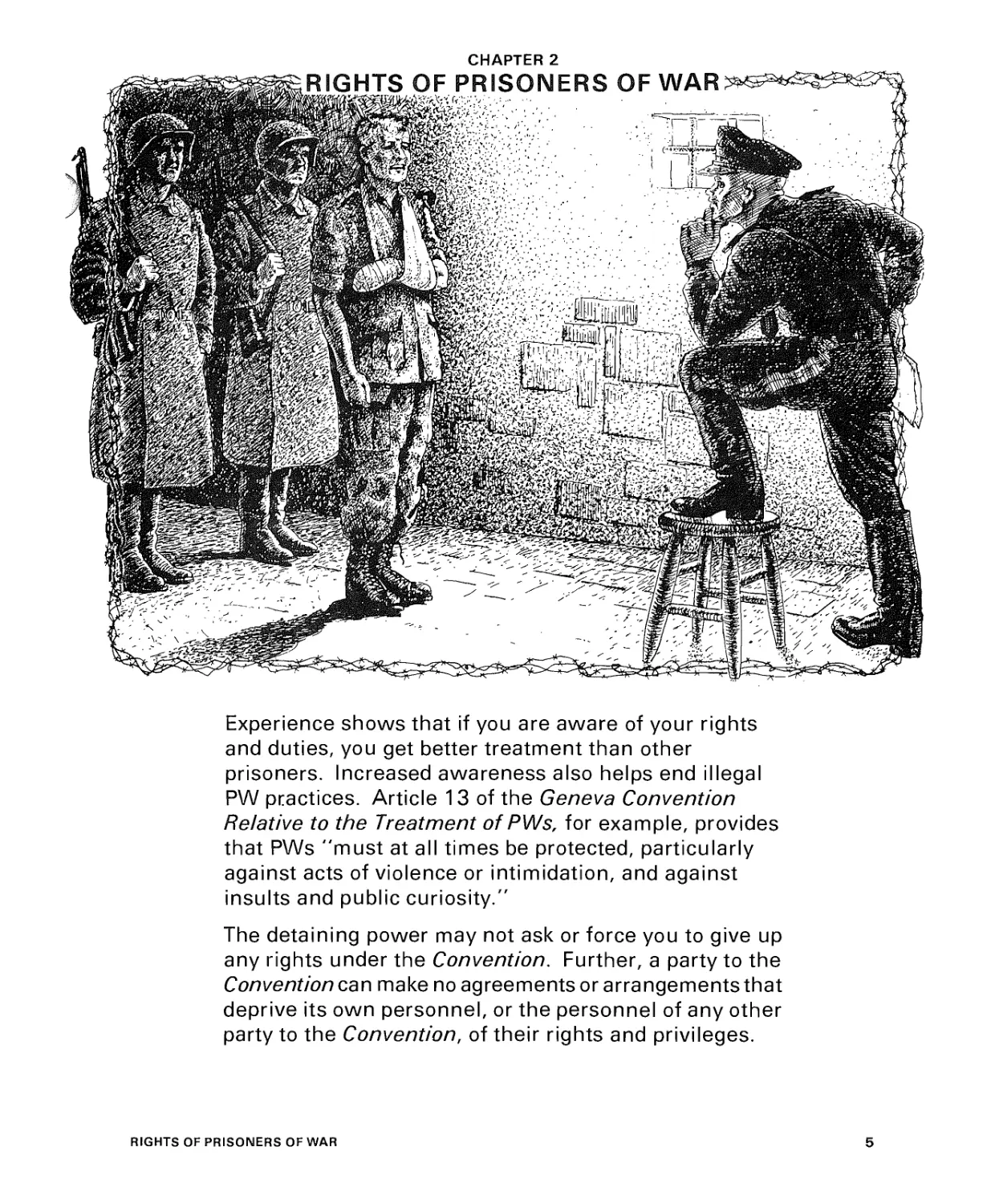
Experience shows that if you are aware of your rights
and duties, you get better treatment than other
prisoners. Increased awareness also helps end illegal
PW practices. Article 13 of the Geneva Convention
Relative to the Treatment of PWs, for example, provides
that PWs "must at all times be protected, particularly
against acts of violence or intimidation, and against
insults and public curiosity."
The detaining power may not ask or force you to give up
any rights under the Convention. Further, a party to the
Convention can make no agreements or arrangements that
deprive its own personnel, or the personnel of any other
party to the Convention, of their rights and privileges.
RIGHTS OF PRISONERS OF WAR
5
ТС 27-10-2
CHAPTER 2
PROTECTION
The Convention prohibits the detaining
power from holding you in areas exposed to fire
in the combat zone. The detaining power must
evacuate you from the battle area as swiftly,
safely, and humanely as possible. It may not
use your presence to protect areas from military
operations. For example, a detaining power
cannot keep you in a place as a means of
preventing the enemy from bombing it. It must
tell the enemy the location of PW camps. When
military considerations permit, the detaining
power must mark the camps with letters large
enough to be seen clearly from the air.
PROPER TRANSPORT
The detaining power must ensure that you
have food, safe drinking water, clothing, and
medical attention during a transfer. The transit
or screening camps through which you pass
must meet the same general requirements as
permanent camps.
Within a week after you reach a PW camp,
the detaining power must send a message on the
standard capture card (see below). The detain-
ing power should also forward a copy of this
card to the Central Prisoner of War Information
Agency. This is a clearing house operated by
the International Committee of the Red Cross in
Geneva. The detaining power must also notify
this agency whenever a prisoner transfers to
another camp or hospital.
SEPARATION
The detaining power must separate you
along with other PWs in camps or compounds
according to your nationality, language, and
customs. PWs from the same armed forces must
remain together unless they agree to the separa-
tion. Every camp must have copies of the
Conventions, in each PW’s language, posted in
places where prisoners can read them. All camp
notices, regulations, and orders must be in a
language the PWs understand.
CAPTURE CARD
PRISONER OF WAR MAIL	POSTAGE FREE
CAPTURE CARD FOR PRISONER OF WAR
Write legibly and in
block letters
1. Power on which the
prisoner depends —
2.
Name 3. First names (in full) 4. First name of father
5.
IMPORTANT
This card must be com-
pleted by each prisoner
immediately after being
taken prisoner and each
time his address is changed
(by reason of transfer to a
hospital or to another
camp).
This card is distinct from
the special card which each
prisoner is allowed to send
to his relatives.
CENTRAL PRISONERS
OF WAR AGENCY
INTERNATIONALCOMMITTEE
OF THE RED CROSS
GENEVA
SWITZERLAND
Date of birth
7.	Rank ________________
8.	Service number ______
9.	Address of next of kin
*10.
*11.
6. Place of birth
Taken prisoner on: (or)
Coming from (Camp No., hospital, etc.)
(a) Good health—(b) Not wounded—(c) Recovered—
(d) Convalescent—(e) Sick—(f) Slightly wounded—
(g) Seriously wounded.
12. My Present address is: Prisoner No.
Name of camp
13. Date
14. Signature
*Strike out what is not applicable—Do not add any remarks—
See explanations overleaf.
Front
6
RIGHTS OF PRISONERS OF WAR
_______________________________________________________________________________ ТС 27-10-2
CHAPTER 2
CAMP INSPECTION
According to the Geneva Convention Rela-
tive to the Treatment of PWs, a protecting power
must periodically inspect PW camps. The detain-
ing power must do nothing to discourage or
hinder the inspections. They must let you
appeal to the inspectors for help in correcting
violations of this Convention.
FAVORABLE WORK
CONDITIONS
The working conditions for you as an
employed PW must be at least as favorable as
those of the detaining power’s forces under
similar circumstances. The detaining power’s
laws for the safety and protection of workers
apply to you.
If you are an officer, you may request work;
camp officials may not force you to work. If you
are a noncommissioned officer (NCO), you shall
only be required to supervise, but you may
request other kinds of work.
As a working prisoner, you get paid for your
services. Your work cannot harm your health,
and it may not have any military character or
purpose. You may not perform any humiliating
or hazardous work such as removing mines or
booby traps. You may rest for one hour during a
full work day and may work no more than six
days per week. Camp officials should not force
you to work when ill or in poor physical
condition.
If you are an enlisted prisoner, you may be
compelled to perform certain kinds of work as
described in the Convention in areas such as—
•	Administration, maintenance, and con-
struction of the camp.
•	Agriculture.
•	Industries connected with raw materials
and manufacturing (but not metallur-
gical, chemical, or machinery industries).
•	Public works and construction that have
no military character or purpose.
•	Transport and handling of stores that are
not military in character or purpose.
•	Public utility services having no military
character or purpose.
•	Commercial business and arts and
crafts.
•	Domestic service.
PERSONAL EFFECTS
As a PW, you keep all your personal effects,
including your clothing and mess gear, insignia
of rank or nationality, decorations, identifi-
cation cards, and articles of sentimental value,
even during transit from one comap to another.
Medical personnel can retain aid bags. Only
officers may order you to give up your money or
valuables. In all such cases, captors must give
you receipts. You must keep your protective
masks, metal helmets, and other items issued
for personal protection. Of course, this does not
include arms, military equipment, or military
documents.
MAIL
Camp officials must allow you, as soon as
possible after your capture, to inform your
family of your whereabouts and health. You
have the right to send letters as frequently as
the captor’s censorship and postal facilities
allow. You may also receive letters and relief
packages forwarded through neutral agencies.
MILITARY PAY
You continue to accrue your military pay
during captivity. Norhially, the US govern-
ment holds it for you until your release. The
detaining power must provide you a monthly
advance of pay, a stated sum that varies
according to rank.
QUARTERS
The Geneva Conventions declare that
“prisoners of war shall be quartered under con-
ditions as favorable as those for the forces of the
detaining power who are billeted in the same
area.” These are the minimum standards of
treatment. Camp conditions may never en-
danger your health.
RIGHTS OF PRISONERS OF WAR
7
ТС 27-10-2______________________________________________________________;_________________
CHAPTER 2
CLOTHING
The detaining power must provide clothing,
underwear, footwear, and work clothing, and
must mend or replace these items regularly. If
possible, the detaining power should supply
clothing from stocks of uniforms captured from
your own forces.
FOOD
To the extent possible, every camp should
establish a canteen where you can buy food-
stuffs, soap, tobacco, and ordinary articles in
daily use. Prices can be no higher than those
charged civilians in the area. Any profits are
for the benefit of the prisoners.
The 1929 Prisoner of War Convention pro-
vided that prisoners get the same rations as
troops of the detaining power. During World
War II, however, this proved unrealistic. For
example, American and British prisoners in the
Far East could not easily digest the fish head
and rice part of the diet that their Japanese
captors provided.
In 1949 the Prisoner of War Convention was
revised to state that food must be “sufficient in
quantity, quality and variety” to keep the
prisoners in good health without loss of
weight. Further, the detaining power must con-
sider the dietary habits of all prisoners. It must
provde mess halls and kitchens where prison-
ers can assist in preparing their own food.
Restricting food as a form of mass punishment
is forbidden.
The captor must also furnish sufficient safe
drinking water and must allow prisoners to use
tobacco if they wish.
HEALTH AND MEDICAL CARE
The Geneva Convention include detailed
provisions for meeting your health and medical
needs. They ensure at least a minimum stand-
ard of health. For example, camps must include
adequate latrines, showers, and laundry facili-
ties. According to the Geneva Convention
Relative to the Treatment of PWs, the captor
“shall be bound to take all sanitary measures
necessary to ensure the cleanliness and health-
fulness of camps and to prevent epidemics.”
Every camp shall have an adequate infirm-
ary. In the infirmary, you should receive treat-
ment from medical personnel from your own
captured forces, if possible. Sick call must occur
regularly. Camp officials must conduct medical
inspections of PWs at least monthly. Such
inspections will include periodic X-ray exami-
nations for tuberculosis and tests for other
infections and contagious diseases.
Captors should let captured medical per-
sonnel visit prisoners inside and outside en-
closures. They fit into the special category of
retained persons and must perform only the
duties of their profession for the benefit of
prisoners.
RELIGIOUS, RECREATIONAL,
AND INTELLECTUAL
ACTIVITIES
Camp officials must allow you to attend
services of your faith and otherwise practice
your religion. They must allow chaplains, who
are considered retained persons, to perform only
the duties of their profession for the benefit of
prisoners. Chaplains should have maximum
freedom to minister to the religious needs of
prisoners.
Camp officials must also allow you the right
to exercise, including playing sports and games,
and to participate in intellectual and educa-
tional activities.
Article 80 of the Geneva Conventions
provides for the establishment of PW organiza-
tions for welfare and morale purposes. All PWs
should organize for activity such as studies,
sports, and other recreation.
FAIR TRIAL
You must be tried in the same court and
according to the same procedures as members of
the armed forces of the detaining power.
Regardless of the charge, you may not get a
sentence more severe than a member of the
detaining power’s forces could receive for the
same offense. If you are charged with an
offense requiring a trial, a military court hears
8
RIGHTS OF PRISONERS OF WAR
___________________________________________________________________________________ ТС 27-10-2
CHAPTER 2
the case. The only exception is if a member of
the detaining power’s forces commits an offense
and would be tried in civil court, you could also
be tried in civil court for a similar offense. You
have a right to appeal as provided under laws
that apply to the detaining power’s armed
forces. You may not be punished more than
once for the same act or on the same charges.
Additional safeguards include your right to
counsel, advance knowledge of the charges, the
services of a competent interpreter, and ample
time for preparation of the defense. The de-
taining power must provide advance notice of a
trial to a representative of your protecting power
as he is entitled to attend the proceedings.
SUITABLE DISCIPLINARY
PUNISHMENT
Whenever discipline is imposed, PWs should
know the rights afforded them by the
Convention.
FORMS OF PUNISHMENT
Under the Geneva Convention, whenever
possible, you should get the lightest punishment
authorized for a violation. The Geneva Con-
vention lists forms of disciplinary punishment
suitable for minor offenses. Disciplinary
punishment may include—
•	Fines up to one-half of your advance of
pay and working pay for not more than
30 days.
•	Withdrawal of any privileges granted
beyond those required by the Geneva
Convention (no required privilege may be
withdrawn).
•	Not more than two hours a day of fatigue
duty such as kitchen police, fire watch, or
other tasks performed outside normal duty
hours for the common welfare of the PWs
(officers may not be forced to work).
•	Simple confinement for not more than 30
days.
LIMITATIONS ON PUNISHMENT
Even when your captors find you guilty of
several minor offenses in the same proceedings,
the Geneva Convention limits the disciplinary
punishment to 30 days. If you receive consecu-
tive 30-day sentences, at least 3 days must
elapse between sentences. You must be informed
of the offense and have an opportunity to defend
yourself. You may also call witnesses to testify
on your behalf.
In addition, captors cannot give you undue
punishment if you escape and get recaptured.
The attempt to escape is not a criminal offense
and entails only disciplinary punishment. If,
when trying to escape, you commit a minor
crime to help you escape, such as forging
identification papers or stealing civilian clothes,
you may be appropriately disciplined. However,
the fact that you were trying to escape is not an
excuse to impose extra punishment. If you help
a fellow prisoner escape, you are subject only to
disciplinary punishment, unless your partici-
pation includes violence or acts not solely to aid
the escape.
Even during disciplinary punishment, you
must receive medical attention. The camp
commander must also allow you time to read
and write and at least two hours of open-air
' exercise each day.
DISTRIBUTION OF
PUNISHMENT
Only the camp commander or a designated
representative can impose disciplinary punish-
ment. He cannot delegate this power to a
prisoner, regardless of grade. The camp
commander records all punishments. He must
make these records available for the representa-
tive of the protecting power to inspect.
ORGANIZATION
PRISONERS’
REPRESENTATIVE
Organization in a PW camp is very im-
portant. Prisoners need a solid structure that
allows them to be responsible to someone or for
something. The Geneva Convention Relative to
the Treatment of PWs authorizes establishment
of PW organizations. The organizations
normally are responsible to the prisoners’
RIGHTS OF PRISONERS OF WAR
9
ТС 27-10-2
CHAPTER 2
representatives. For US PWs, the senior officer
among the PWs becomes the prisoners’
representative.
A detaining power may seek to damage
morale or weaken certain PW organizations by
trying to install a cooperative prisoner as the
prisoners’ representative. In camps with no
officers, camp authorities may refuse to accept
the senior representative. They may demand
more elections until nomination of a weak
person appropriate for the detaining power’s
purposes. They design these tactics to break
down the prisoners’ internal control. US policy,
however, is that the senior person is always in
charge.
Under provisions of the Geneva Convention,
the prisoners’ representative monitors the
physical, spiritual, and intellectual well-being
of the prisoners. He represents them before the
military authorities of the detaining power, the
protecting power, the International Committee
of the Red Cross, and any other outside
organization that may assist the prisoners.
Various committees should be established to
deal with the general problems of camp
administration.
SENIOR RANKING OFFICER
According to the US Code of Conduct and
for their own benefit, PWs should organize in a
military manner under the senior person
eligible for command, the senior ranking officer
(SRO). He can be either an officer or enlisted
soldier. The SRO should assume command
within the camp or within a group of prisoners
according to rank. He should do so regardless of
branch of military service.
The US Code of Conduct (Article IV) places
clear responsibility of command squarely on the
shoulders of the senior ranking person. Sub-
ordinates must obey the orders of the SRO. The
SRO should ensure proper behavior of those
under him. Enlisted prisoners must salute
officers of the detaining power and show them
the same respect required by their own forces.
Officer prisoners must salute higher-ranking
officers of the detaining power and the camp
commander, regardless of his rank. Prisoners
may wear their decorations and rank insignia.
If for any reason the senior person is unable
to act, the next senior person must assume
command. Chaplains and medical personnel
are normally ineligible for command because of
the nature of their duties and the special
protected status accorded them under the
Conventions.
Common sense and camp conditions de-
termine how the SRO and other prisoners
organize and carry out their responsibilities.
The SRO must inform the other prisoners that
he is taking command. He must designate the
chain of command and inform all prisoners of it
so they can identify the representatives who
deal with enemy authorities. He must ensure
that PWs in his organization understand their
duties and the chain of command.
The enemy probably knows about the US
Code of Conduct and the duties and respon-
sibilities it imposes on the SRO. Experience
shows that PWs most likely can have an SRO
and a command organization only secretly; that
is, the organization will be unknown to camp
authorities. The enemy may not allow an organ-
ization—based on the normal military command
structure—to form or function openly. In that
case, the organization may elect prisoner’s
representatives. However, even if such repre-
sentatives are elected, the SRO must continue to
secretly exercise military command authority
over all PW matters.
10
RIGHTS OF PRISONERS OF WAR
CHAPTER 3
GUIDELINES FOR INTERROGATION,
COMMUNICATION, AND RESISTANCE

You must resist, avoid, or evade, to the best of your
ability, all enemy efforts to secure statements or
actions which further the enemy's cause. The Geneva
Convention requires that you give only your name,
rank, social security number, and date of birth. If
you unwillingly or accidentally disclose
unauthorized information, you must regroup, renew
resistance, and use a fresh approach or an alternate
line of mental defense.
GUIDELINES FOR INTERROGATION COMMUNICATION AND RESISTANCE
11
ТС 27-10-2
CHAPTER 3
j
I
INTERROGATION
If you are captured, you must know certain
things about the interrogation process. Your
captors must question you in a language you
understand. They must not use physical or
mental torture or other coercion to obtain
information nor should they punish you if you
fail to respond. Most countries issue identifi-
cation cards to members of their armed
forces. Although PWs must show them to their
captors on demand, as a PW, you have the right
to keep your card.
Captors view PWs as valuable sources of
military information and propaganda and will
use every bit of information for their own
purposes. Therefore, during enemy interrogation,
indoctrination, and other exploitation attempts,
you should follow the guidelines below—
•	Give only your name, rank, service number,
and date of birth.
•	Be respectful but not give the impression
that you are willing to cooperate through
politeness. Such an impression might
prolong the interrogation.
•	Act ignorant of possessing information
useful to the enemy.
•	Be aware of informants such as prison
camp medical personnel who may be used
to collect information.
•	Do not reveal knowledge of the enemy’s
language; your concealed understanding
of their language may help you escape.
•	Do not believe that fellow prisoners have
talked. This is a common procedure to
catch prisoners off guard and encourage
them to talk.
•	Avoid looking the interrogator directly in
the eye. Your eyes can give information
even if you do not answer directly. Select
a spot between the interrogator’s eyes or
on his forehead and concentrate on it.
•	Be courteous but firm in refusing to give
information during interrogation.
•	Salute all senior officer interrogators.
•	Never give information about other prisoners.
If a fellow prisoner is mentioned during in-
terrogation, report the circumstances to your
superior. The other prisoner may be under
surveillance. Information from one PW
may be used against the other.
•	Do not try to impress interrogators by
boasting of exploits, either true or
invented.
•	Do not be tricked into filling out innocent-
looking questionnaires or writing state-
ments that require more than name,
rank, service number, and date of birth.
•	Do not attempt to deceive the enemy by
volunteering false information. A skilled
interrogator is able to extract needed inf or:
mation once you start talking on the
subject.
•	Stay confident of yourself, your family,
your unit, your country, and your religion.
Above all, keep the will to survive.
COMMUNICATION
As a PW you are not supposed to provide
information to your captor. However, to expect
you to remain confined for years without some
communication with the enemy is unrealistic.
Certain types of communications are acceptable.
You should know these exceptions and exercise
great caution when communicating with the
enemy.
You may, when appropriate, talk to captors
on matters of health and welfare. Medical
personnel may communicate with the detaining
power concerning medical requirements, sani-
tary conditions, and related matters. The SRO
has a duty to represent prisoners in matters of
camp administration, health, welfare, and
grievances.
You may also communicate with your
families through letters. However, you must
understand that the enemy will read them and
may distort and use the information to demoral-
ize you, your family at home, and your comrades
in the field. Thus, if you become a PW, you
should keep personal correspondence brief and
general.
12
GUIDELINES FOR INTERROGATION COMMUNICATION AND RESISTANCE
___________________________________________________________________________________ ТС 27-10-2
CHAPTER 3
RESISTANCE
Under the Geneva Convention, the detain-
ing power cannot subject a prisoner to physical
or mental torture, or any other force, to secure
information. However, do not rely on the enemy
to abide by the Geneva Convention. If you are
captured and tortured, you must resist, avoid, or
evade, to the best of your ability, all enemy
efforts to obtain statements or actions that will
help the enemy. Examples of statements or
actions to resist that are harmful to the US, its
allies, or other prisoners, include—
•	Oral or written confessions.
•	Questionnaires or personal history
statements.
•	Propaganda recordings and broadcasts.
•	Appeals to other PWs and appeals for
surrender or peace.
•	Engagement in self-criticism.
•	Oral or written statements or communi-
cations on behalf of the enemy.
The enemy might use any confession or
statement to convict you as a war criminal. It
prolongs your right to repatriation until you
serve a prison sentence.
If as a PW you unwillingly or accidentally
disclose unauthorized information, you must
regroup and renew resistance. You must use a
fresh approach or a different line of mental
defense. Experience shows that a prisoner with
the will to resist can withstand intense levels of
mistreatment even though enemy interrogation
sessions are harsh and cruel.
GUIDELINES FOR INTERROGATION COMMUNICATION AND RESISTANCE
13
REFERENCES
SOURCES USED
These are the sources quoted or paraphrased in this publication.
JOINT AND MULTISERVICE PUBLICATIONS
NWP 9/FMFM1-10. The Commander’s Handbook on the Law of Naval Opera-
tions. 1989.
ARMY PUBLICATIONS
FM 27-10. The Law of Land Warfare. 1956.
DA Pam 27-1. Treaties Governing Land Warfare. 1956.
FM 27-2. Your Conduct in Combat. November 1984.
NON-MILITARY PUBLICATIONS
Pictet, Jean S. Commentary to III Geneva Convention Relative to the Treatment
of Prisoners of War. 1960.
Levie, Howard S. Prisoners of War in International Armed Conflict; Interna-
tional Law Series, Vol. 59.
Levie, Howard S. Documents on Prisoners of War; International Law Series,
Vol. 60.
READINGS RECOMMENDED
These readings contain relevant supplemental information.
Shindler/Toman, ed. The Laws of Armed Conflict. 1988.
‘US. Government Printing Office: 1991 — 627-027/40009
14
ТС 27-10-2
17 SEPTEMBER 1991
By Order of the Secretary of the Army:
GORDON R. SULLIVAN
General, United States Army
Chief of Staff
Official:
PATRICIA P. HICKERSON
Brigadier General, United States Army
The Adjutant General
DISTRIBUTION: Active Army, USAR and ARNG: To be distributed in accordance with Da Form
12-HE, requirements for TC 27-10-2, Prisoners of War, (Qty rqr block no. 1373).