/































































































































































































































Текст
E.M.
MEIJERS
INSTITUUT
INSTITUUT VOOR
RECHTSWETENSCHAPPELIJK
ONDERZOEK
The Rationale of
Publicity in the Law
of Corporeal Movables
and Claims
Meeting the Requirement of Publicity
by Registration?
J. ZHANG
E.M.
MEIJERS
INSTITUUT
In modern society, movables have become an important part of one’s wealth.
The transactions concerning movables have noticeably become ever more
complicated, implying that the legal relationships of personal property are
considerably intricate. Under this pretext the question arises how to preclude
conflicts for different transactions to realize the target of ‘preventive justice’
under a strong publicity system.
This book focuses on the traditional aspects of publicity, possession and
notification with respect to corporeal movables and claims, and includes a
comparative study of English law, German law and Dutch law. The principle
of publicity on the basis of possession and notification is nowadays no longer
tenable. Instead it is more desirable to introduce registration, traditionally
a method of publicity for immovable property, in the law of corporeal
movables and claims. In three case studies, this book argues that a system
should incorporate secured transactions and trust, and an independent
central register should be established as is the case for other jurisdictions.
This is a volume in the series of the Meijers Research Institute and Graduate
School of the Leiden Law School of Leiden University. This study is part of the
Law School’s research programme ‘Coherent Private Law’.
INSTITUUT VOOR
RECHTSWETENSCHAPPELIJK
ONDERZOEK
The Rationale of Publicity in the Law of Corporeal Movables and Claims
Meeting the Requirement of Publicity by Registration?
The Rationale of Publicity in the Law
of Corporeal Movables and Claims
Meeting the Requirement of Publicity by Registration?
PROEFSCHRIFT
ter verkrijging van
de graad van doctor aan de Universiteit Leiden,
op gezag van rector magnificus prof.dr.ir. H. Bijl,
volgens besluit van het college voor promoties
te verdedigen op donderdag 24 juni 2021
klokke 11.15 uur
door
Jing Zhang
geboren te Anhui, China
in 1989
Promotoren:
prof. dr. H.J. Snijders
Copromotor:
dr. J.A. van der Weide
Promotiecommissie: prof. dr. J. Hijma
prof. L.J. Gullifer (Leiden University & University of
Cambridge, UK)
prof. dr. J.H.M. van Erp (Maastricht University)
dr. E.B. Rank-Berenschot (Hoge Raad der Nederlanden)
FUNDING STATEMENT
China Scholarship Council (CSC) provided financial supports for this research
in the period between 1 September 2014 and 31 August 2018. Hereby I express
my sincere appreciation to the CSC.
Publication of this dissertation is funded by Istituto Italo-Cinese of Zhongnan
University of Economics and Law.
Lay-out: AlphaZet prepress, Bodegraven
© 2021 Jing Zhang | Eleven International Publishing
This publication is protected by international copyright law.
All rights reserved. No part of this publication may be reproduced, stored in a retrieval system,
or transmitted in any form or by any means, electronic, mechanical, photocopying, recording or
otherwise, without the prior permission of the publisher.
For my wife Lily and daughter Duoduo
Acknowledgements
It has been a long journey for me to finish this dissertation. During this
journey, I came from being from a “young boy” to becoming a middle-aged
man and was accompanied by many friends. Firstly, I would like to express
my sincere gratitude to my promotor, prof. dr. H.J. Snijders and copromotor
dr. J.A. van der Weide for their continuous guidance and support for my
Ph.D. research at Leiden Law School. I will never forget the very intelligent
and knowledgeable prof. Snijders’ “slogan”: “Think about it”. I will always
remember dr. Van der Weide’s frequent encouragement: “Move forward,
and never stop”.
I would like to thank prof. W.H. van Boom, prof. A.G. Castermans, prof.
J. Hijma, prof. B. Wessels, prof. W.G. Huijgen, prof. M. Haentjens, and dr.
J. Nijland, who supported me a lot during my studies at Leiden Law School.
I also want to express my gratitude for all the support I got from the late
prof. H. Nieuwenhuis. Many thanks have to be conveyed to the kind secretaries of the Private Law Institute, Ms. Van Barneveld, Ms. Wessel, and Ms.
De Mooij. Stephen Machon and Bard Jansen deserve my special acknowledgement for the wonderful proofreading of the draft and the translation of
the summary into Dutch respectively.
I have to express my acknowledgement to those young and talented
Ph.D. friends: Ewout, Hetty, Gitta, Stijn, Lotte, Thijs, Chalermwut, Ruben,
Tobias, Ruth, Joris, Morshed, Jouke, Ross, Ilya, Dorine, Yizhong, Tu, Shuai,
Xiang, Yudan, Xuechan, Linlin, Weidong, Quiyin, Wanlu, Dejian, Fengan, and
Shaomei…. I not only had very pleasant academic discussions with you all,
but also wonderful bicycle trips with some of you.
I would like to thank all my friends who I met in Leiden: Qingju & Xiao,
Rui, Yingguang, Jia & Yu, Wenbo, Mengjie, Yongzhen, Xiaoting, Hanyu,
Feng & Ling, Ciqing & Hui, Zhen & Junfei, Zhuang & Jiaxin, Jialong &
Yiran, Liming, Dapeng, Puning, Siyou, Anran, and too many others to name.
Without them, my life in Leiden would have been boring and colorless.
It is my great pleasure to acknowledge prof. Xu Diyu and prof. Zhang
Jiayong, without whom I could not have worked and continued revising my
dissertation in a nice library at ZUEL. Many thanks have to be expressed
to dr. Liu Zhengfeng, without whose help I do not know how much more
time I would have spent on my way home. I also need to sincerely thank
prof. Huang Meiling, dr. Li Jun, prof. Li Hao, prof. Yuan Faqiang, prof. Hu
Donghai, dr. Xia Haohan, dr. Chen Xiaomin and many other friends here
and there.
I would like to express my deep and sincere acknowledgement to my
parents and family for their support and understanding. In the end, much
gratitude must be expressed to my wife Lily and daughter Duoduo, from
whom I get infinite support, encouragement, and happiness.
Abbreviations
AcP
Art.
BEA
BGB
BGH
BW
CC
CCC
CEAL
DCFR
FA
FATF
HGB
HPI
HR
LPA
No.
Nr.
NJ
NJW
NTBR
NTHR
P.
PEL
PMC
PMSI
PPSA
Rn.
S.
SGA
UCC
UN
UNCITRAL
UNIDROIT
VIN
WG
WPNR
WvK
Archiv für die civilistische Praxis
Article
Bills of Exchange Act
Bürgerliches Gesetzbuch (German Civil Code)
Bundesgerichtshof (German Supreme Court)
Burgerlijk Wetboek (Dutch Civil Code)
Code Civil (French Civil Code)
Chinese Civil Code
Center for the Economic Analysis of Law
Draft Common Frame of Reference
Factors Act
Financial Action Task Force
Handelsgesetzbuch (German Commercial Code)
Hire Purchase Inspection
Hoge Raad (Dutch Supreme Court)
Law of Property Act
Number
Nummer (Number)
Nederlandse Jurisprudentie
Neue Juristische Wochenschrift
Nederlands Tijdschrift voor Burgerlijk Recht
Nederlands Tijdschrift voor Handelsrecht
Page
Principles of European Law
Purchase Money Charge
Purchase Money Security Interest
Personal Property Security Act
Randnummer (Marginal Number)
Section
Sales of Goods Act
Uniform Commercial Code
United Nations
United Nations Commission on International Trade Law
International Institute for the Unification of Private Law
Vehicle Identification Number
Wechselgesetz (Law of Bills)
Weekblad voor Privaatrecht, Notariaat en Registratie
Wetboek van Koophandel (Dutch Commercial Code)
Brief Table of Contents
1
Introduction: Context, Question, Methodology and Outline
1.1 The Research Context and Questions
1.1.1 General Context: Property Rights, Third Parties,
Information and Publicity
1.1.2 Question I: Is the Principle of Publicity Tenable?
1.1.3 Question II: Is Registration Desirable?
1.1.4 Specific Cases: Secured Transactions, Trusts, and
Property Rights of Motor Vehicles
1.2 Research Methodology
1.3 Research Outline
1.3.1 Chapter 2: Property Rights, Third Parties, Information,
and Publicity
1.3.2 Chapter 3: Corporeal Movables and Possession
1.3.3 Chapter 4: Claims, Notification to Debtors, and
Documental Recordation
1.3.4 Chapter 5: The Rationale of Publicity in the Law of
Corporeal Movables and Claims
1.3.5 Chapter 6: Implications for Chinese Law
1.3.6 Chapter 7: Summary
1
1
1
4
6
7
11
14
14
15
16
17
18
18
2
Property Rights and Publicity
2.1 Definition of Property Rights
2.1.1 Initial Difficulties
2.1.2 The Essence of Property Rights
2.1.3 The Features of Property Rights
2.1.4 A Possible Definition
2.2 Property Rights, Proprietary Information and Publicity
2.2.1 Information and Proprietary Information
2.2.2 Parties and Proprietary Information
2.2.3 Publicity and Proprietary Information
2.2.4 Conclusion
19
20
20
23
31
41
41
42
48
56
61
3
Possession and Corporeal Movables
3.1 The Concept of Possession
3.1.1 An Introduction to the History of the Concept of
Possession
3.1.2 Preliminary Comparative Study
3.1.3 Further Comparative Study of Animus
3.1.4 Conclusion
3.2 Possession and Publicity
63
64
65
72
83
93
94
XII
Brief Table of Contents
3.2.1 Possession and the Proprietary Information Conveyed
3.2.2 Publicity Effect of Indirect Possession
3.2.3 Conclusion
Possession and Third-Party Effect: Strange Interferers
3.3.1 The Concept of Possessory Protection
3.3.2 Possession, Protection and Publicity
3.3.3 Protection in the Absence of Actual Possession
3.3.4 Conclusion
Possession and Third-Party Effect: Subsequent Acquirers
3.4.1 Possession and Subsequent Acquirers
3.4.2 Transfer of Ownership of Corporeal Movables
3.4.3 Bona Fide Acquisition of Corporeal Movables
3.4.4 Conclusion
Possession and Third-Party Effect: General Creditors
3.5.1 General Creditors and the Desired Information
3.5.2 Possession and the Information of Ownership of
Corporeal Movables
3.5.3 Possession and the Information of Proprietary
Encumbrance over Corporeal Movables
3.5.4 Conclusion
94
114
121
122
122
123
133
138
138
139
141
161
189
190
190
Notification, Documental Recordation, and Claims
4.1 Notification to Debtors
4.1.1 Notification and Personal Rights
4.1.2 Notification and Third-Party Effect: Strange
Interferers
4.1.3 Notification and Third-Party Effect: Subsequent
Acquirers in Outright Assignment
4.1.4 Notification and Third-Party Effect: Subsequent
Acquirers in Pledge and Security Assignment
4.1.5 Notification and Third-Party Effect: General Creditors
4.1.6 Conclusion
4.2 Documental Recordation
4.2.1 Introduction of Securities
4.2.2 Securities to Goods
4.2.3 Securities of Payment
211
211
212
3.3
3.4
3.5
4
5
Meeting the Requirement of Publicity by Registration
5.1 The Rationale of Publicity
5.1.1 Merits and Disadvantages of Publicity
5.1.2 Comparison of Different Methods of Publicity
5.1.3 Publicity and Third Parties
5.1.4 Publicity and the Model of Acquisition
5.2 Meeting the Requirement of Publicity by Registration
5.2.1 Ubiquitous Existence of Hidden Property Rights
5.2.2 Meeting the Requirement of Publicity by Registration
193
198
208
225
226
237
246
248
249
250
254
290
313
314
314
322
327
330
344
344
347
Brief Table of Contents
5.3
5.4
5.5
5.6
5.7
6
The Introduction of Registration: A General Discussion
5.3.1 The Construction of the System
5.3.2 The Scope of Registration
5.3.3 The Legal Effect of Registration
5.3.4 Conclusion
Registration as a Solution | Case Study I: Secured
Transactions
5.4.1 Setting the Scene
5.4.2 The Desirability of Registration
5.4.3 The Scope of Registration
5.4.4 Conclusion
Registration as a Solution | Case Study II: Trust
5.5.1 Setting the Scene
5.5.2 The Desirability of Registration
5.5.3 Publicity and the Proprietary Effect of Trust
5.5.4 Conclusion
Registration as a Solution | Case Study III: Motor Vehicles
5.6.1 Setting the Scene
5.6.2 The Rule of Possession
5.6.3 The Desirability of Registration
5.6.4 The Legal Effect of Registration
5.6.5 Conclusion
Conclusion
Implications for the Principle of Publicity under the 2020
Chinese Civil Code
6.1 Introduction of the 2020 Chinese Civil Code
6.2 Publicity of Corporeal Movables and Claims in the 2020
Chinese Civil Code
6.2.1 Publicity of Corporeal Movables under the Chinese
Civil Code
6.2.2 Publicity of Claims under the Chinese Civil Code
6.2.3 Publicity of Trust on Corporeal Movables and Claims
6.2.4 Construction of a Modern System of Registration for
Corporeal Movables and Claims
6.3 Conclusion
XIII
347
348
367
384
411
412
413
416
427
437
437
438
451
458
461
461
461
463
471
476
477
478
481
481
482
482
488
491
493
495
Summary
497
Samenvatting
507
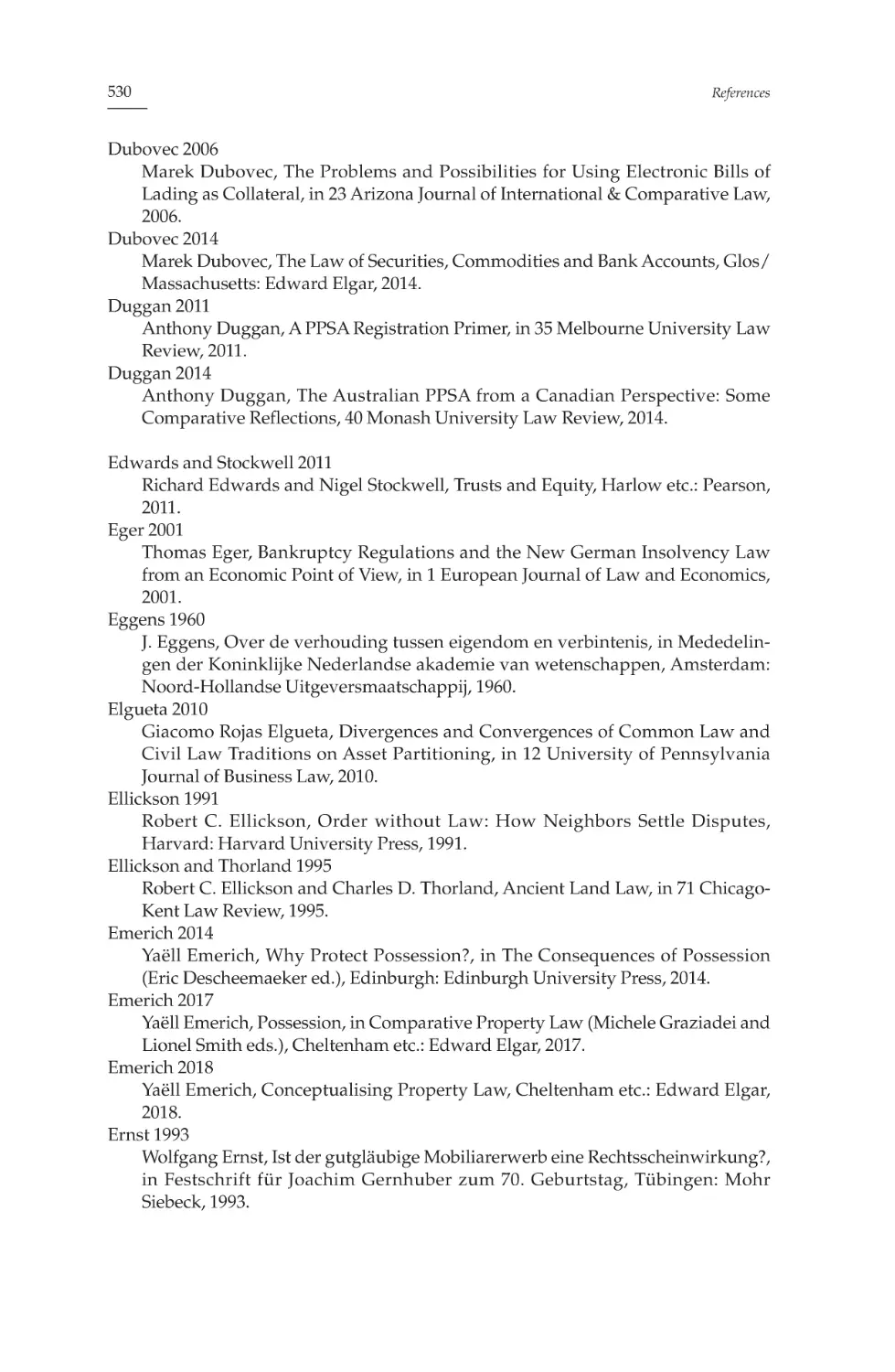
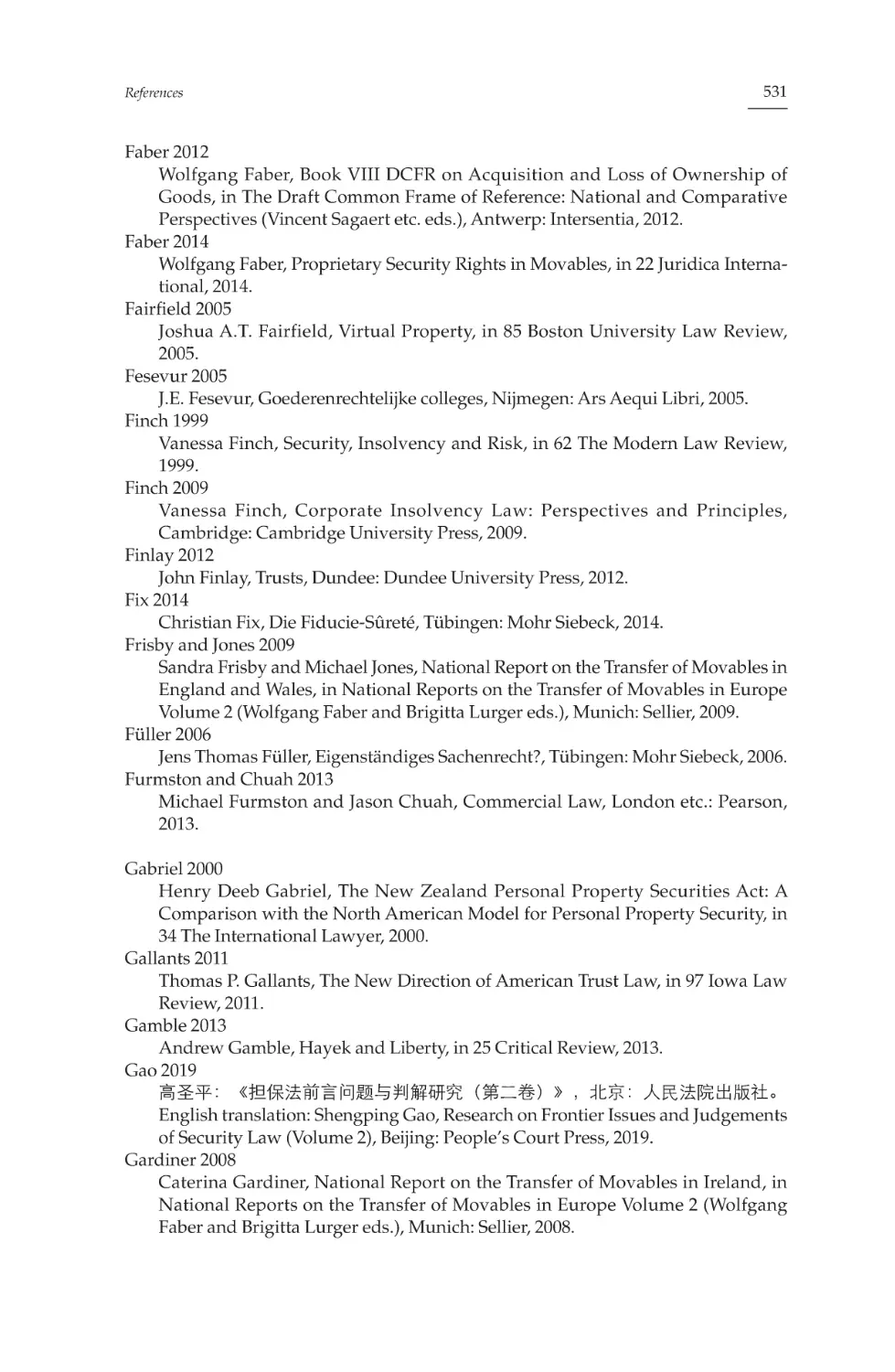
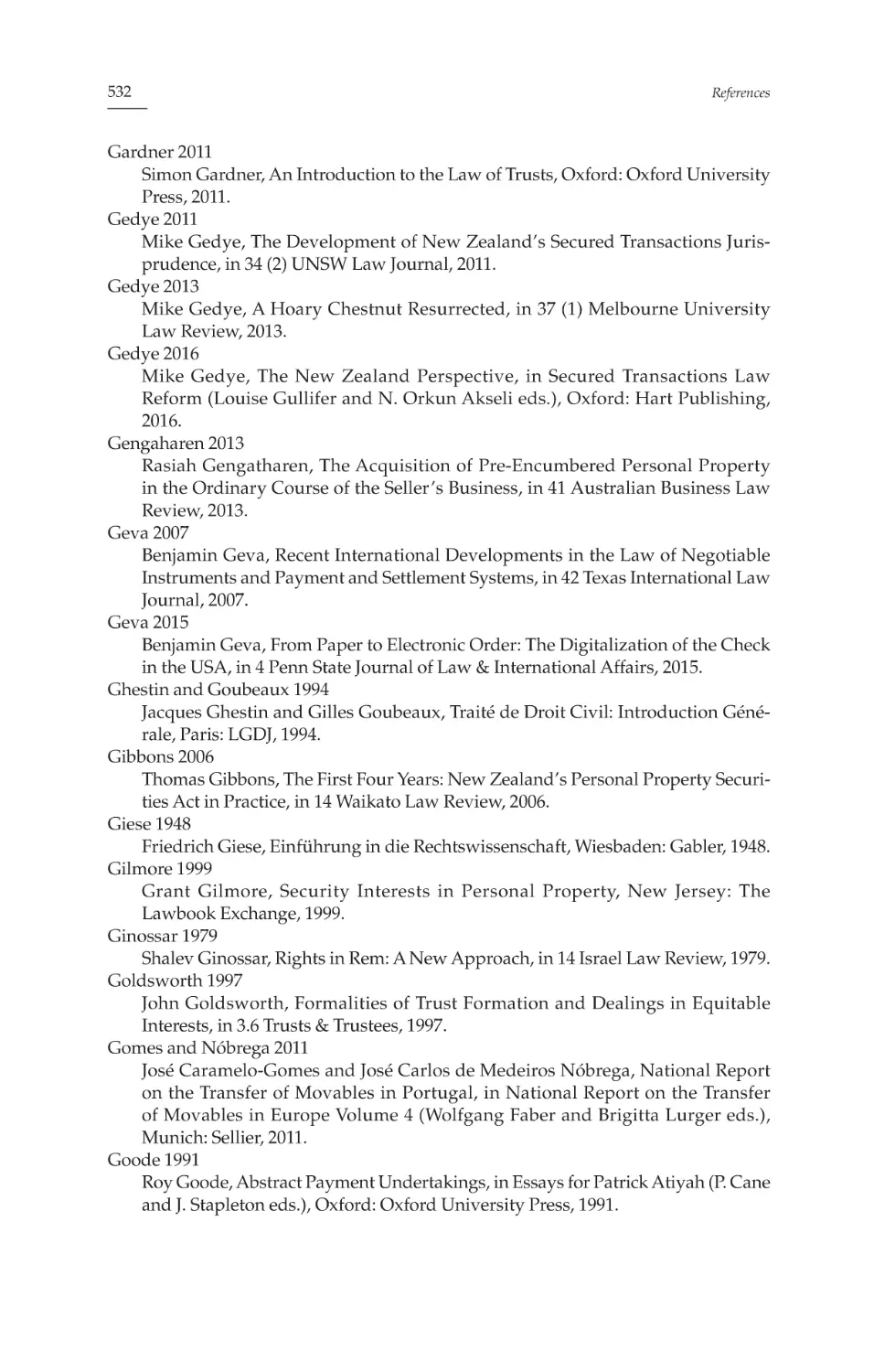
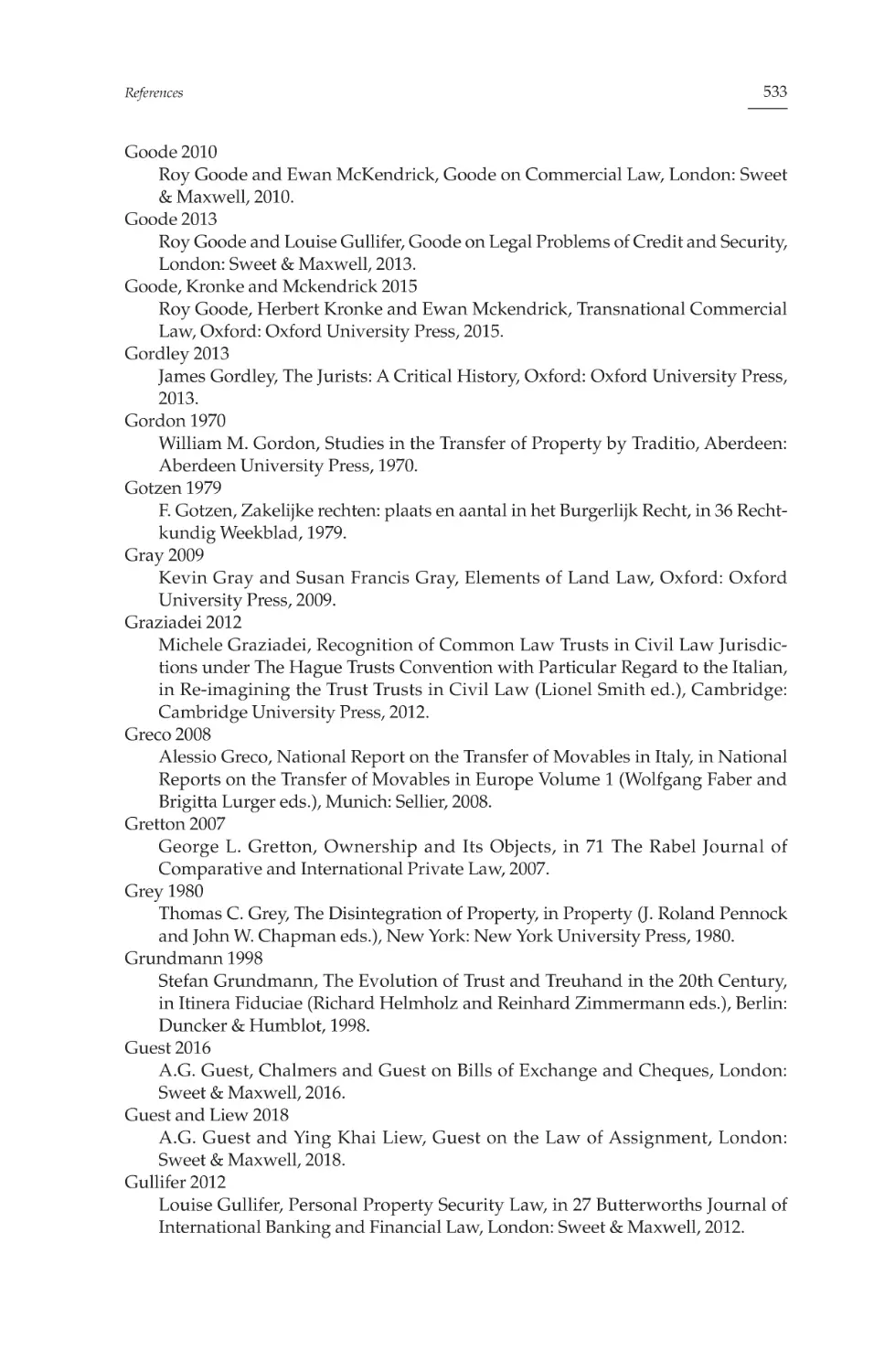
References
521
Index
559
Curriculum Vitae
567
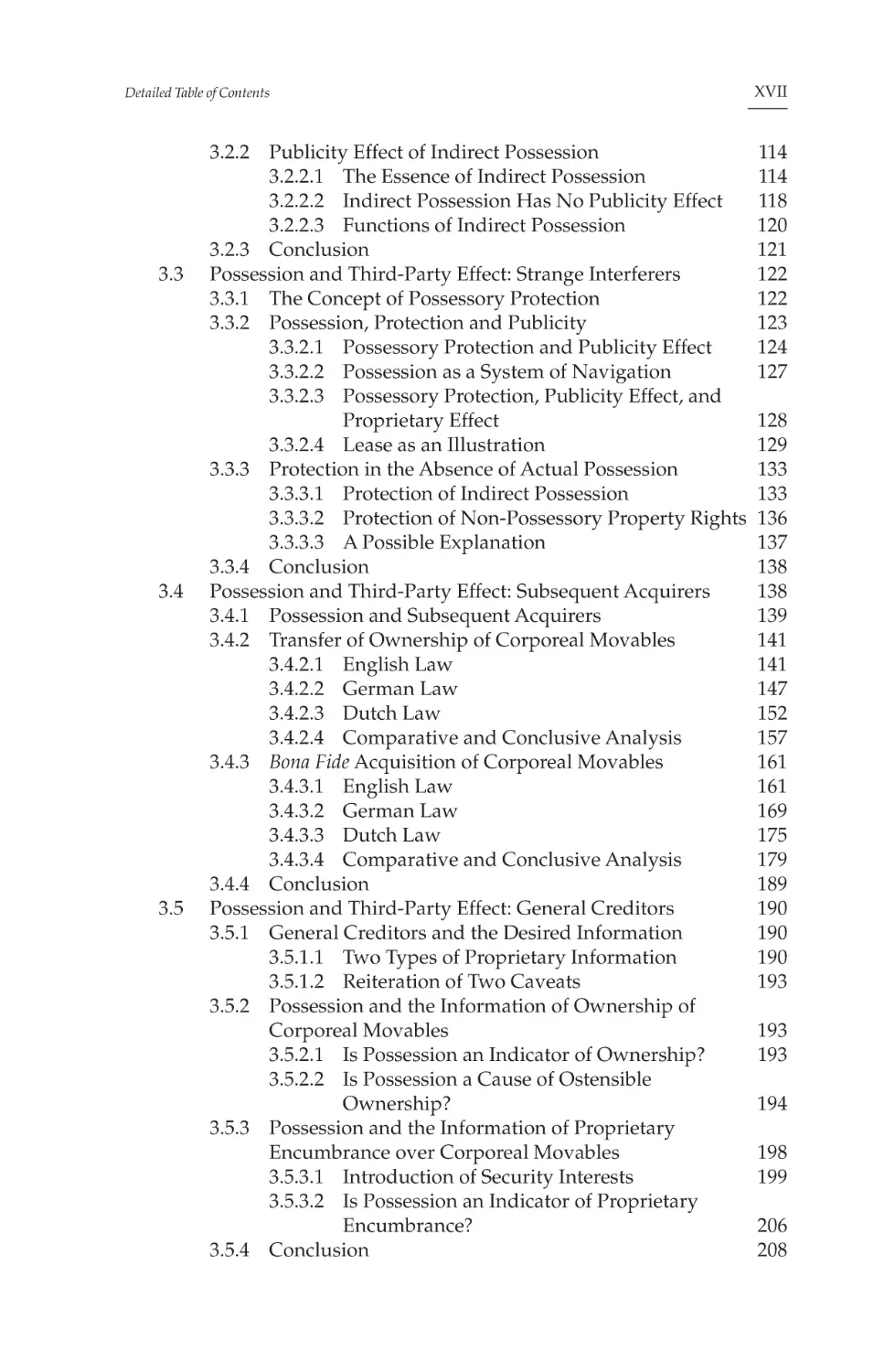
Detailed Table of Contents
Acknowledgements
Abbreviations
1
2
Introduction: Context, Question, Methodology and Outline
1.1 The Research Context and Questions
1.1.1 General Context: Property Rights, Third Parties,
Information and Publicity
1.1.2 Question I: Is the Principle of Publicity Tenable?
1.1.3 Question II: Is Registration Desirable?
1.1.4 Specific Cases: Secured Transactions, Trusts, and
Property Rights of Motor Vehicles
1.2 Research Methodology
1.3 Research Outline
1.3.1 Chapter 2: Property Rights, Third Parties, Information,
and Publicity
1.3.2 Chapter 3: Corporeal Movables and Possession
1.3.3 Chapter 4: Claims, Notification to Debtors, and
Documental Recordation
1.3.4 Chapter 5: The Rationale of Publicity in the Law of
Corporeal Movables and Claims
1.3.5 Chapter 6: Implications for Chinese Law
1.3.6 Chapter 7: Summary
Property Rights and Publicity
2.1 Definition of Property Rights
2.1.1 Initial Difficulties
2.1.1.1 The Closed System of Property Rights
2.1.1.2 The Dynamic Aspect of Property Rights
2.1.2 The Essence of Property Rights
2.1.2.1 The Subject-Object Approach
2.1.2.2 The Subject-Subject Approach
2.1.2.3 The Mixed Approach
2.1.2.4 Property Rights as an Interpersonal
Relationship
2.1.2.5 Two Irrelevant Issues
2.1.3 The Features of Property Rights
2.1.3.1 Thinghood
2.1.3.2 Absoluteness
2.1.4 A Possible Definition
VII
IX
1
1
1
4
6
7
11
14
14
15
16
17
18
18
19
20
20
20
21
23
23
24
26
27
30
31
31
34
41
XVI
Detailed Table of Contents
2.2
3
Property Rights, Proprietary Information and Publicity
2.2.1 Information and Proprietary Information
2.2.1.1 Information
2.2.1.2 Proprietary Information
2.2.2 Parties and Proprietary Information
2.2.2.1 Transacting Parties and Proprietary
Information
2.2.2.2 Third Parties and Proprietary Information
2.2.3 Publicity and Proprietary Information
2.2.3.1 Multiple Ways of Collecting Proprietary
Information
2.2.3.2 Publicity as a Special Source of Proprietary
Information
2.2.4 Conclusion
Possession and Corporeal Movables
3.1 The Concept of Possession
3.1.1 An Introduction to the History of the Concept of
Possession
3.1.1.1 Roman Law
3.1.1.2 Ancient Germanic Law
3.1.1.3 Ancient Common Law
3.1.1.4 A Clue from the History
3.1.2 Preliminary Comparative Study
3.1.2.1 The Chosen Terminologies for Comparison
3.1.2.2 English Law
3.1.2.3 German Law
3.1.2.4 Dutch Law
3.1.3 Further Comparative Study of Animus
3.1.3.1 Differences in Animus
3.1.3.2 Necessity of a Concept of Ownership
Possession
3.1.3.3 Necessity of a Concept of Limited-Right
Possession
3.1.3.4 Necessity of a Concept of Factual Control by
Agents
3.1.4 Conclusion
3.2 Possession and Publicity
3.2.1 Possession and the Proprietary Information Conveyed
3.2.1.1 The Field of Application of Possession
3.2.1.2 Possession as an Abstract Method of Publicity
3.2.1.3 The Ownership Approach: Does Possession
Indicate Ownership?
3.2.1.4 The Non-Publicity Approach: Possession
Indicates Nothing?
41
42
42
43
48
48
49
56
56
58
61
63
64
65
65
68
70
71
72
72
73
77
81
83
83
84
86
91
93
94
94
95
101
106
112
Detailed Table of Contents
3.3
3.4
3.5
3.2.2 Publicity Effect of Indirect Possession
3.2.2.1 The Essence of Indirect Possession
3.2.2.2 Indirect Possession Has No Publicity Effect
3.2.2.3 Functions of Indirect Possession
3.2.3 Conclusion
Possession and Third-Party Effect: Strange Interferers
3.3.1 The Concept of Possessory Protection
3.3.2 Possession, Protection and Publicity
3.3.2.1 Possessory Protection and Publicity Effect
3.3.2.2 Possession as a System of Navigation
3.3.2.3 Possessory Protection, Publicity Effect, and
Proprietary Effect
3.3.2.4 Lease as an Illustration
3.3.3 Protection in the Absence of Actual Possession
3.3.3.1 Protection of Indirect Possession
3.3.3.2 Protection of Non-Possessory Property Rights
3.3.3.3 A Possible Explanation
3.3.4 Conclusion
Possession and Third-Party Effect: Subsequent Acquirers
3.4.1 Possession and Subsequent Acquirers
3.4.2 Transfer of Ownership of Corporeal Movables
3.4.2.1 English Law
3.4.2.2 German Law
3.4.2.3 Dutch Law
3.4.2.4 Comparative and Conclusive Analysis
3.4.3 Bona Fide Acquisition of Corporeal Movables
3.4.3.1 English Law
3.4.3.2 German Law
3.4.3.3 Dutch Law
3.4.3.4 Comparative and Conclusive Analysis
3.4.4 Conclusion
Possession and Third-Party Effect: General Creditors
3.5.1 General Creditors and the Desired Information
3.5.1.1 Two Types of Proprietary Information
3.5.1.2 Reiteration of Two Caveats
3.5.2 Possession and the Information of Ownership of
Corporeal Movables
3.5.2.1 Is Possession an Indicator of Ownership?
3.5.2.2 Is Possession a Cause of Ostensible
Ownership?
3.5.3 Possession and the Information of Proprietary
Encumbrance over Corporeal Movables
3.5.3.1 Introduction of Security Interests
3.5.3.2 Is Possession an Indicator of Proprietary
Encumbrance?
3.5.4 Conclusion
XVII
114
114
118
120
121
122
122
123
124
127
128
129
133
133
136
137
138
138
139
141
141
147
152
157
161
161
169
175
179
189
190
190
190
193
193
193
194
198
199
206
208
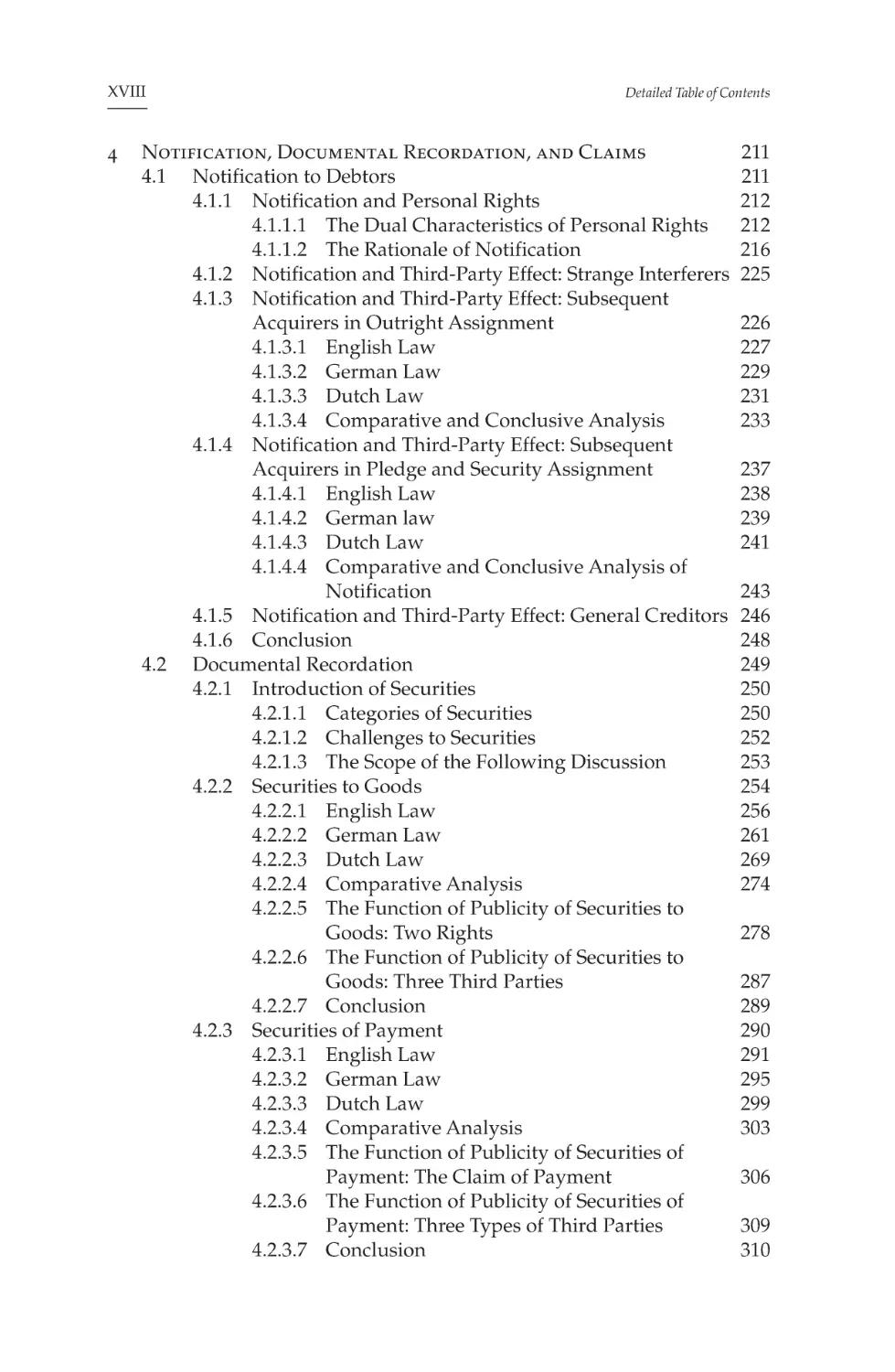
XVIII
4
Detailed Table of Contents
Notification, Documental Recordation, and Claims
4.1 Notification to Debtors
4.1.1 Notification and Personal Rights
4.1.1.1 The Dual Characteristics of Personal Rights
4.1.1.2 The Rationale of Notification
4.1.2 Notification and Third-Party Effect: Strange Interferers
4.1.3 Notification and Third-Party Effect: Subsequent
Acquirers in Outright Assignment
4.1.3.1 English Law
4.1.3.2 German Law
4.1.3.3 Dutch Law
4.1.3.4 Comparative and Conclusive Analysis
4.1.4 Notification and Third-Party Effect: Subsequent
Acquirers in Pledge and Security Assignment
4.1.4.1 English Law
4.1.4.2 German law
4.1.4.3 Dutch Law
4.1.4.4 Comparative and Conclusive Analysis of
Notification
4.1.5 Notification and Third-Party Effect: General Creditors
4.1.6 Conclusion
4.2 Documental Recordation
4.2.1 Introduction of Securities
4.2.1.1 Categories of Securities
4.2.1.2 Challenges to Securities
4.2.1.3 The Scope of the Following Discussion
4.2.2 Securities to Goods
4.2.2.1 English Law
4.2.2.2 German Law
4.2.2.3 Dutch Law
4.2.2.4 Comparative Analysis
4.2.2.5 The Function of Publicity of Securities to
Goods: Two Rights
4.2.2.6 The Function of Publicity of Securities to
Goods: Three Third Parties
4.2.2.7 Conclusion
4.2.3 Securities of Payment
4.2.3.1 English Law
4.2.3.2 German Law
4.2.3.3 Dutch Law
4.2.3.4 Comparative Analysis
4.2.3.5 The Function of Publicity of Securities of
Payment: The Claim of Payment
4.2.3.6 The Function of Publicity of Securities of
Payment: Three Types of Third Parties
4.2.3.7 Conclusion
211
211
212
212
216
225
226
227
229
231
233
237
238
239
241
243
246
248
249
250
250
252
253
254
256
261
269
274
278
287
289
290
291
295
299
303
306
309
310
Detailed Table of Contents
XIX
5
313
314
314
314
316
319
322
322
322
324
325
326
327
327
328
329
330
Meeting the Requirement of Publicity by Registration
5.1 The Rationale of Publicity
5.1.1 Merits and Disadvantages of Publicity
5.1.1.1 Publicity as a Formality
5.1.1.2 The Merits of Publicity
5.1.1.3 The Disadvantages of Publicity
5.1.1.4 Conclusion
5.1.2 Comparison of Different Methods of Publicity
5.1.2.1 Clarity
5.1.2.2 Comprehensiveness
5.1.2.3 Conclusiveness
5.1.2.4 Operational Costs
5.1.3 Publicity and Third Parties
5.1.3.1 Publicity and Strange Interferers
5.1.3.2 Publicity and General Creditors
5.1.3.3 Publicity and Subsequent Acquirers
5.1.4 Publicity and the Model of Acquisition
5.1.4.1 Publicity and the Consensual/Translative
System
5.1.4.2 Publicity and the Causation/Abstraction
Principle
5.1.4.3 The Phenomenon of Relativity of Property
Rights
5.2 Meeting the Requirement of Publicity by Registration
5.2.1 Ubiquitous Existence of Hidden Property Rights
5.2.2 Meeting the Requirement of Publicity by Registration
5.3 The Introduction of Registration: A General Discussion
5.3.1 The Construction of the System
5.3.1.1 A Subject-Based System
5.3.1.2 A Digital System
5.3.1.3 A Self-Service System
5.3.1.4 A Notice-Filing System
5.3.1.5 A Fully Open System
5.3.1.6 Summary
5.3.2 The Scope of Registration
5.3.2.1 The Aspect of Object
5.3.2.2 The Aspect of Subject
5.3.2.3 The Aspect of Transaction
5.3.3 The Legal Effect of Registration
5.3.3.1 Declaratory Effect or Constitutive Effect
5.3.3.2 The Scope of Third-Party Effect
5.3.3.3 The Issue of Constructive Notice
5.3.3.4 The Issue of Good Faith
5.3.3.5 The Issue of Public Reliability
5.3.3.6 Duration of the Validity of Registration
5.3.4 Conclusion
330
337
343
344
344
347
347
348
348
357
358
359
362
365
367
367
378
381
384
384
386
392
399
405
409
411
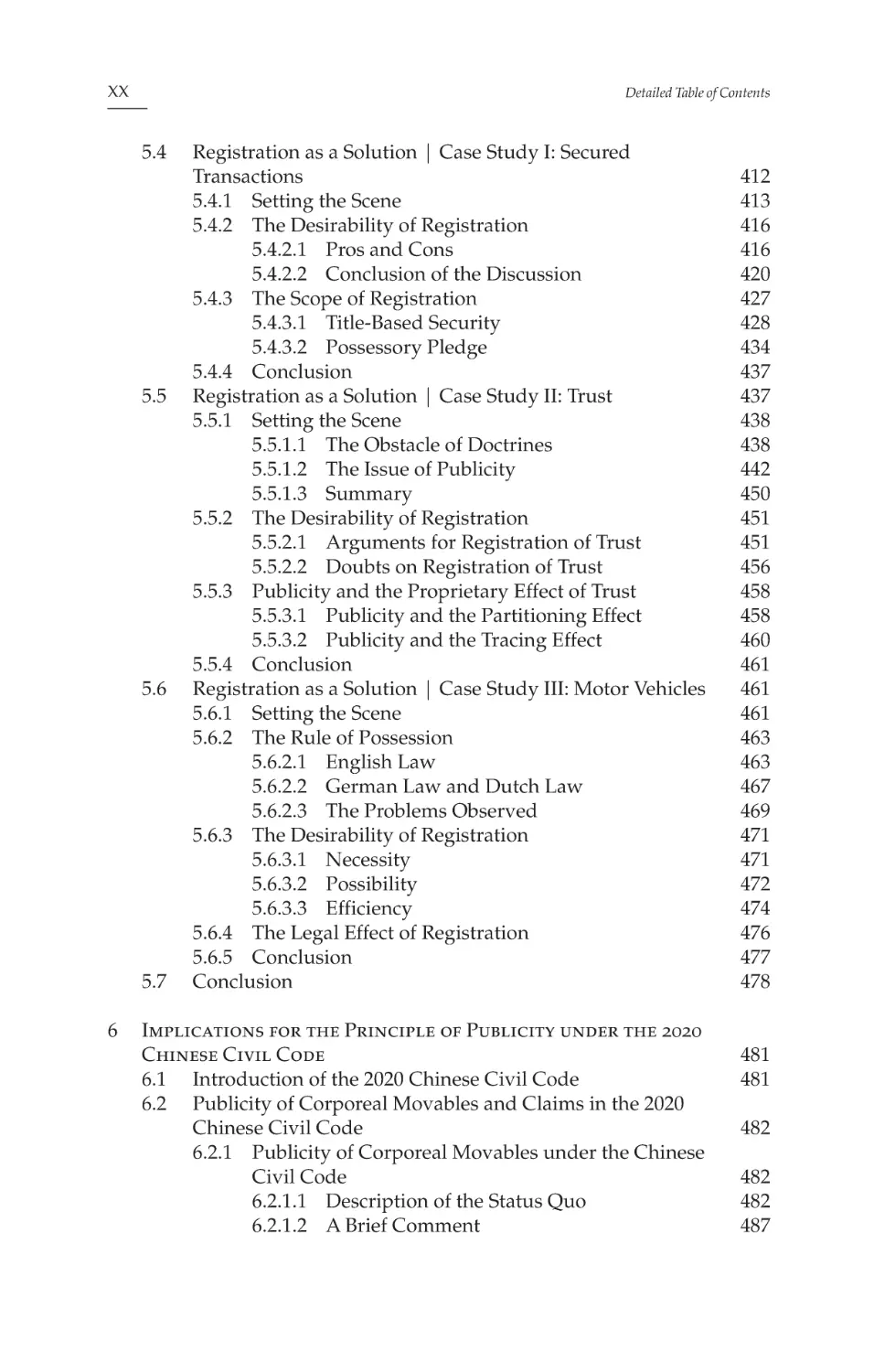
XX
Detailed Table of Contents
5.4
5.5
5.6
5.7
6
Registration as a Solution | Case Study I: Secured
Transactions
5.4.1 Setting the Scene
5.4.2 The Desirability of Registration
5.4.2.1 Pros and Cons
5.4.2.2 Conclusion of the Discussion
5.4.3 The Scope of Registration
5.4.3.1 Title-Based Security
5.4.3.2 Possessory Pledge
5.4.4 Conclusion
Registration as a Solution | Case Study II: Trust
5.5.1 Setting the Scene
5.5.1.1 The Obstacle of Doctrines
5.5.1.2 The Issue of Publicity
5.5.1.3 Summary
5.5.2 The Desirability of Registration
5.5.2.1 Arguments for Registration of Trust
5.5.2.2 Doubts on Registration of Trust
5.5.3 Publicity and the Proprietary Effect of Trust
5.5.3.1 Publicity and the Partitioning Effect
5.5.3.2 Publicity and the Tracing Effect
5.5.4 Conclusion
Registration as a Solution | Case Study III: Motor Vehicles
5.6.1 Setting the Scene
5.6.2 The Rule of Possession
5.6.2.1 English Law
5.6.2.2 German Law and Dutch Law
5.6.2.3 The Problems Observed
5.6.3 The Desirability of Registration
5.6.3.1 Necessity
5.6.3.2 Possibility
5.6.3.3 Efficiency
5.6.4 The Legal Effect of Registration
5.6.5 Conclusion
Conclusion
Implications for the Principle of Publicity under the 2020
Chinese Civil Code
6.1 Introduction of the 2020 Chinese Civil Code
6.2 Publicity of Corporeal Movables and Claims in the 2020
Chinese Civil Code
6.2.1 Publicity of Corporeal Movables under the Chinese
Civil Code
6.2.1.1 Description of the Status Quo
6.2.1.2 A Brief Comment
412
413
416
416
420
427
428
434
437
437
438
438
442
450
451
451
456
458
458
460
461
461
461
463
463
467
469
471
471
472
474
476
477
478
481
481
482
482
482
487
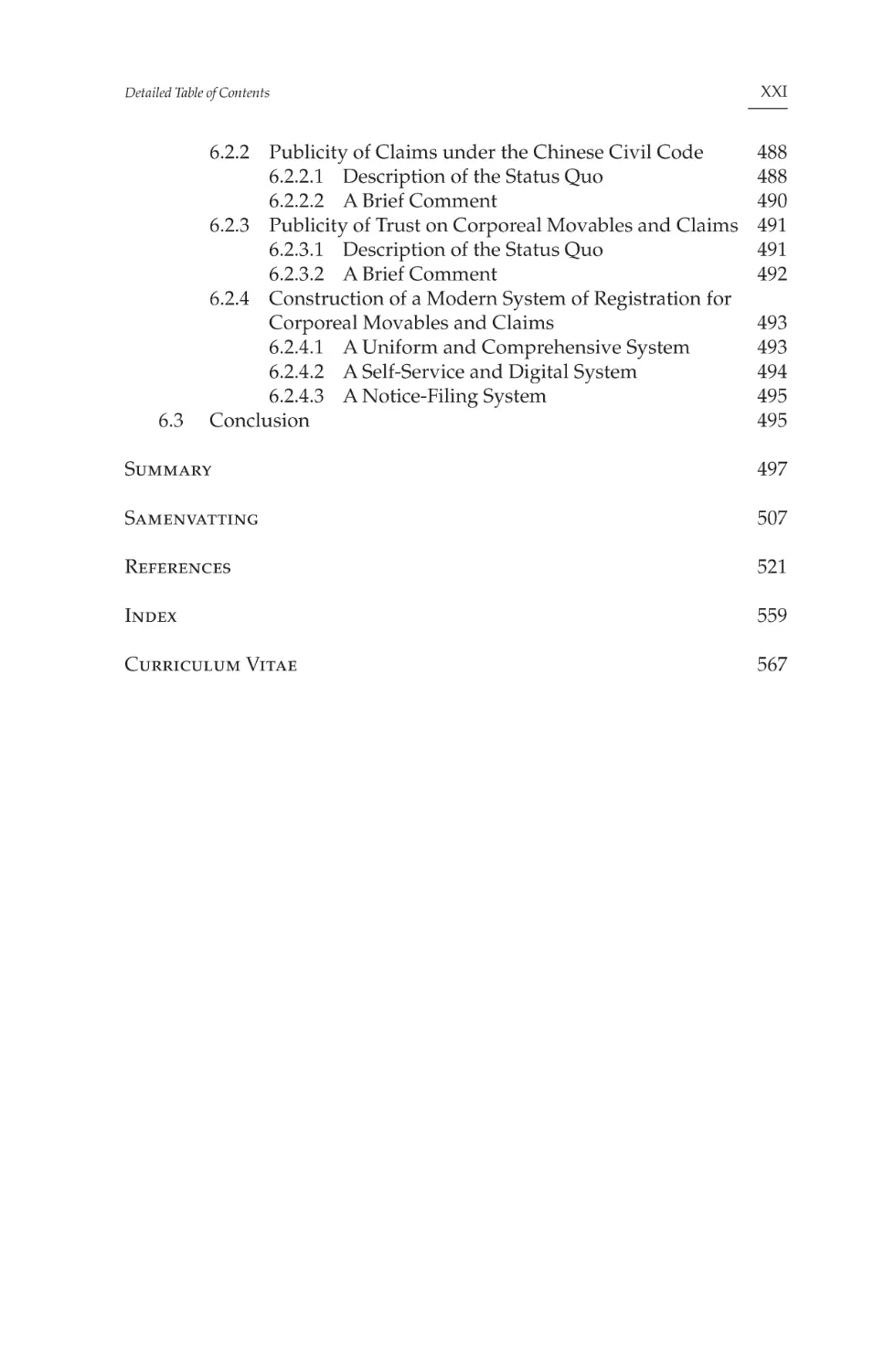
Detailed Table of Contents
6.3
6.2.2 Publicity of Claims under the Chinese Civil Code
6.2.2.1 Description of the Status Quo
6.2.2.2 A Brief Comment
6.2.3 Publicity of Trust on Corporeal Movables and Claims
6.2.3.1 Description of the Status Quo
6.2.3.2 A Brief Comment
6.2.4 Construction of a Modern System of Registration for
Corporeal Movables and Claims
6.2.4.1 A Uniform and Comprehensive System
6.2.4.2 A Self-Service and Digital System
6.2.4.3 A Notice-Filing System
Conclusion
XXI
488
488
490
491
491
492
493
493
494
495
495
Summary
497
Samenvatting
507
References
521
Index
559
Curriculum Vitae
567
1
Introduction: Context, Question,
Methodology and Outline
1.1
The Research Context and Questions
1.1.1
General Context: Property Rights, Third Parties, Information and
Publicity
The law of patrimony (in Dutch vermogensrecht, in German Vermögensrecht)
takes the distinction between property rights (rights in rem) and personal
rights (rights in personam) as its structural basis. The prominent difference
between these two types of rights lies in the breadth of enforceability:
property rights can bind third parties, while personal rights only have an
effect inter partes. This broad enforceability of property rights makes publicity become a principle in the law of property. As the starting point, every
property right should have a form of publicity so that third parties can
easily know of the existence and content of this right. From the perspective
of information economics, publicity is a way of addressing the problem of
information asymmetry, a problem that can be triggered by the broad effect
of property rights.1 Information asymmetry arises when one party has more
or better information than another party, especially under the circumstance
of the conveyance of property. In the aspect of knowing of the proprietary
relationships over a thing which is going to be transferred, the potential
transferee, compared with the transferor, is often in a disadvantageous situation. For the transferee, there is always a burden of investigating, inter alia,
whether the transferor has authority to transfer and whether there is any
proprietary encumbrance over the thing. In general, publicity allows the
transferee to obtain relevant information, alleviating this burden to a large
extent.2
In general, there are different types of third parties against whom
property rights are enforceable. One type of third party’s demand for
information may differ from another type of third party’s demand. For
example, general creditors may have no interest in knowing the proprietary
legal relationships with respect to a certain asset of the debtor, while a
potential acquirer often investigates the legal relationships regarding the
1
2
Arruñada 2011, p. 238-239.
For example, if A wants to buy a house from B, he needs to investigate whether B has
ownership of this house and whether the house has been mortgaged. In general, B owns
more information than A, and A is in a disadvantageous situation. However, by searching the land register, A can collect relevant information and avoid this situation to a large
extent.
2
Chapter 1
asset. Hence, the discussion of publicity in the law of property has to be
conducted on the basis of the categorization of third parties. The different
demands for information by different types of third parties may influence the scope of the legal effect of publicity. Failure to perform publicity
perhaps means that the property right has no effect over one type of third
party, but the right might still be able to be effective against another type of
third party. For example, where a bicycle is transferred under the declaratory system, ownership of this bicycle passes to the transferee upon the
effect of the agreement.3 In the absence of delivery, a method of publicity
for corporeal movables, the transferee is protected from the illegal act by
thieves, one type of third party, but the ownership acquired may be ineffective against a subsequent buyer acting in good faith, another type of third
party. Therefore, we need to pay attention to the specialty in the aspect of
the demand for information by different types of third parties.
Unlike property rights, personal rights (or claims) are not subject to the
principle of publicity. This is because the parties of a personal right already
know the details of this right. However, it should be noted that personal
rights have the same problem of publicity as property rights once they
are included in transactions (such as assignment and pledge) and taken
as an object of disposal. This problem is considered by some writers as an
example showing that personal rights have a “proprietary status (goederenrechtelijk statuut)” or a proprietary aspect.4 Like tangible things (such as
bicycles), personal rights, which are intangible per se, also have a problem
of “belonging (toebehoren or Zuordnung)” when they are seen not only as a
legal relationship between the debtor and the creditor, but also as a type
of asset that can be alienated and pledged. When a claim is assigned to
another person, the question arises of whether the assignor has full authority of disposal. This question concerning the authority further affects the
possibility of the assignee becoming the new creditor and obtaining the performance. For example, if a creditor assigns a claim to two different persons,
which person can require the debtor to perform the debt and preserve the
performance? In a nutshell, like the disposal of tangible things, the disposal
of personal rights is also linked to the principle of publicity.
Generally speaking, the form of publicity is determined by the nature of
the object of property rights. “Public registration” is used to publicize proprietary interests in immovable property as well as some special movable
3
4
Under the declaratory system, publicity is not a condition for the acquisition of property
rights and only “declares” property rights to third parties. In general, what matters is the
parties’ consent. Therefore, this system is also known as consensual system. However,
publicity might be necessary for a property right acquired to be effective against some
third parties with competing rights. See Sagaert 2008, p. 18. The declaratory system forms
a contrast to the translative system, which is shown below (see 1.3.4) and discussed in
detail in Chapter 5 (see 5.1.4.1).
Lebon 2010, p. 4; Lubbe 2006, p. 316.
Introduction: Context, Question, Methodology and Outline
3
things, such as vessels and aircraft. Here, public registration refers to
registration that is made available to the public, especially third parties in
the law of property. Not all registration is public. For example, the register
for the non-possessory pledge and undisclosed pledge in Dutch law is not
available to third parties (art. 3:237 and 3:329 BW).5 In this research, the
system of registration not made available to the public is called “private
registration”, as opposed to public registration. It is commonly accepted
that public registration is an eligible method of publicity. At present, the
main issue is how to define the legal effect of, and improve the efficiency
of, this method of publicity.6 Publicity of immovable property is beyond the
scope of our research. It will be referred to, only when necessary, as an illustration in discussing the publicity of movables, the theme of this research.
Here, the term “movables” (or movable things, movable property) is
used in a very broad sense. It not only covers tangible things that are not
immovable (such as bicycles), but also intangible things, such as claims,
shares (stocks), and intellectual property. This way of use is alien to German
and Dutch lawyers. In German law and Dutch law, movable things (bewegliche Sachen in German law and roerende zaken in Dutch law) are necessarily
corporeal.7 In English law, however, movable things are divided into two
categories: corporeal movables and incorporeal movables. Things, which
are neither immovable property nor corporeal movables, are covered by
the term incorporeal movables.8 As a result, incorporeal movables include a
large number of assets, such as claims, intellectual property, and shares. In
this research, the term “movables” is used as in English law: it covers both
tangible and intangible things that are not immovable property.
However, as the title of this dissertation shows, we do not include every
type of movable within this research. Only corporeal movables and claims
are included. In addition to claims, incorporeal movables also include intellectual property, shares, and emerging intangible property, such as carbon
emissions units9 and agricultural products quotas.10 These incorporeal
movables differ significantly in nature as well as the way of transactions.
Moreover, the other types of incorporeal movables (such as intellectual
property and shares) are regulated by special laws (such as intellectual
5
6
7
8
9
10
Heilbron 2011, p. 44.
Dekker 2003, p. 116.
Wieling 2007, p. 21; Snijders and Rank-Berenschot 2017, p. 20.
Bridge, Gullifer, McMeel and Worthington 2013, p. 10.
Cole 2016, p. 10. There is a system of registration for the transaction of carbon emissions
units. However, the register is not open to the public, and this type of property is not
“registerable property (registergoederen)” under Dutch law. See Snijders and Rank-Berenschot 2017, p. 44.
Quotas are a device used by the government to control production, importation, exportation and so on. For example, this device is used by the European Communities to control
the production of milk and livestock. The milk quotas and livestock quotas are tradable
and deemed by some scholars as a type of property. See Cardwell 2000, p. 168.
4
Chapter 1
property law, company law and the law of securities), and the problem of
publicity has been addressed to a large extent.11 For the sake of comprehensiveness, “documental rights” concerning corporeal movables (such as
warehouse receipts) and payment (such as bills of exchange) are included in
this research. This type of right is documental because the right is embodied
in a document or security. Securities to corporeal movables are often termed
securities to or document to “goods (Gütern in German)”.12 In this research,
goods are defined to be corporeal and movable. This term is used in the
discussion of securities to goods (see 4.2.2). In general, securities still play a
role in transactions involving corporeal movables and claims. For example,
the transfer of things stored in a warehouse is usually associated with the
transfer of the warehouse receipt, and the alienation of the claim embodied
within a bill of exchange is, in principle, dependent on the transfer of the
bill of exchange per se.
1.1.2
Question I: Is the Principle of Publicity Tenable?
At present, a main problem concerning the principle of publicity is whether
this principle remains tenable in the law of corporeal movables and claims.
Specifically speaking, whether the existing means of publicity can sufficiently support the saying that the principle of publicity is still tenable. Traditionally, possession is treated as a method of publicity for the transaction
of corporeal movables,13 and notification to debtors is treated as a method
of publicity for the disposal of claims in some jurisdictions.14 However, are
these two methods qualified as a means of publicity?
Possession is a complicated concept, a concept used with different
meanings in different jurisdictions. For example, there is a distinction
between “possession (bezit)” and “detention (houderschap)” in Dutch law:
possession is detention for oneself.15 German law, however, prescribes a
broader concept of “possession (besitz)” and differentiates “ownership possession (Eigenbesitz)”, “limited-right possession (Fremdbesitz)” and “control
11
12
13
14
15
Nowadays, registration has been used in transactions concerning uncertificated shares
and debentures (bonds). Moreover, these securities are registered in electronic accounts
and transferred through a central exchange system which operates electronically. This is
known as the phenomenon of “dematerialisation” of securities. See Haentjens 2007, p. 33.
A system of registration for intellectual property, especially patents and trademarks, has
already been constructed and operates well in the practice. See WIPO 2012, p. 22-23.
Bridge, Gullifer, McMeel and Worthington 2013, p. 841; Zöllner 1978, p. 4-5.
Clarke and Kohler 2005, p. 390; Wolf and Wellenhofer 2011, p. 76; Snijders and RankBerenschot 2017, p. 63.
DCFR 2009, p. 1076; Guest and Liew 2018, no. 6-06; Von Wilmowsky 1996, p. 392; Snijders
and Rank-Berenschot 2017, p. 302.
Rank-Berenschot 2012, p. 13-14.
Introduction: Context, Question, Methodology and Outline
5
by agents (Besitzdienerschaft)”.16 The distinction made by Dutch law cannot
be found in English law. Like German law, English law also has a broader
concept of possession which, on the other hand, does not include a distinction between ownership possession and limited-right possession.17 In this
research, the concept of possession is used in a wide sense, not only including possession by owners, but also possession by lessees, pledgees and the
like. The differences just mentioned are related to the possessory intention
(animus). This implies a question regarding publicity: whether possession
can independently show the intention, which is invisible, to third parties. In
other words, for example, can a third party distinguish ownership possession (or bezit in Dutch law) from limited-right possession (or houderschap in
Dutch law) only on the basis of possession per se?
In addition to viewing possession from the aspect of possessory intention, we can also analyze the concept according to the element of factual
control (corpus). Possession can be either visible through factual control by
the possessor himself or invisible as a result of factual control by another
person than the possessor himself. In the jargon of law, possession can be
direct (actual) or indirect (constructive). Indirect possession, often deemed
as “mental control (vergeistigte Sachherrschaft)”, means that the possessor
does not factually control the object in a direct way.18 Because of the absence
of direct control, indirect possession is invisible.19 This casts doubt on
the capability of indirect possession to show property rights to outsiders.
Direct possession is also open to criticisms, despite the fact that the direct
possessor himself often exercises factual control. In the viewpoint of some
scholars, even direct possession is too ambiguous to qualify as a means of
publicity.20 This criticism is raised against the background that corporeal
movables are transacted in a great variety of ways nowadays, such as
reservation of ownership, transfer of ownership for security reasons, and
lease. Typically, the qualification of possession as a method of publicity is
questioned because it triggers a problem of “ostensible ownership” or “false
wealth” in the secured transaction in corporeal movables: possession is no
longer a method of publicity, but a source of misleading information.21
16
17
18
19
20
21
Baur and Stürner 2009, p. 89. Here, “ownership possession” means factual control by the
owner, “limited-right possession” refers to factual control on the basis of a limited right,
while “control by agents” is used in the situation where an agent holds factual control on
behalf of and subject to the instructions of ownership possessors or limited-right possessors. A detailed discussion of the concept of possession is provided in 3.1.
Bridge, Gullifer, McMeel and Worthington 2013, p. 55.
Wolf and Wellenhofer 2011, p. 82.
Quantz 2005, p. 41-42.
Hamwijk 2012, p. 310-311; Füller 2006, p. 280.
Baird 1983, p. 54; Drobnig 2011, p. 1027.
6
Chapter 1
Notification to debtors is traditionally deemed as a method of publicity
for the disposal of claims, at least by some lawyers in some jurisdictions.22
It requires that a creditor who will dispose of or has disposed of the claim
must notify his debtor of the disposal. Afterwards, third parties can obtain
information concerning the disposal from the notified debtor. In some
sense, it can be said that notification represents, like possession, a kind of
factual control over the claim: when a debtor is notified of the assignment or
pledge, he has to pay to the designated assignee or pledgee.23 However, it
might be still problematic to say that the notification is a method of publicity for claims.24 Can third parties easily know about the disposal after the
debtor involved is notified? Can the act of notification be so objective and
reliable that the reliance of third parties is protected in the situation where
the creditor’s authority of disposal is defective? Does the debtor involved
have a legal duty to disclose the disposal to third parties who inquire with
him? Moreover, the formality of notification might bring a heavy burden for
the transaction, in particular when a large number of claims are involved.
This casts doubt on the appropriateness of notification as a form of publicity
for the transaction of claims.
1.1.3
Question II: Is Registration Desirable?
The questions raised above require us to turn to another question: whether
and to what extent the principle of publicity is properly implemented in the
law of corporeal movables and claims. To answer this question, we need
to conduct comprehensive research into the role played by possession and
notification in different types of transactions, examining whether and to
what extent the two methods can provide information concerning property
rights to third parties who, in turn, can make decisions with safety according to the information. The comprehensive research will be conducted in
Chapter 3 and Chapter 4. On the basis of a comparative law study, these two
Chapters examine possession and notification to the debtor respectively.
If the research leads to a negative answer, namely that the principle of
publicity only exists in a weak sense in the law of corporeal movables and
claims, then we need to further explore the desirability and possibility of
having a new method of publicity for corporeal movables and claims. This is
the central task of Chapter 5. In general, this new method of publicity is (public) registration: whether and how registration should be introduced into the
law of corporeal movables and claims to meet the requirement of publicity?
22
23
24
DCFR 2009, p. 1076; Proprietary Security in Movable Assets 2014, p. 447; Snijders and
Rank-Berenschot 2017, p. 63.
Lebon 2010, p. 173.
Rongen 2012, p. 498; Von Wilmowsky 1996, p. 392-393.
Introduction: Context, Question, Methodology and Outline
7
The formality of registration might have merits as well as disadvantages.
Thus, a trade-off seems inevitable in answering this question. In general,
scholars’ opinions are divided. Some writers approve a system of registration and raise certain criteria for introducing registration for the transaction of corporeal movables and claims.25 However, other writers take an
opposite view and believe that the formality of registration is harmful to
the smoothness of transactions; thus, registration should not be allowed to
intrude in the law of corporeal movables and claims.26
1.1.4
Specific Cases: Secured Transactions, Trusts, and Property Rights of
Motor Vehicles
In practice, the fierce debate on the desirability of registration mainly occurs
in relation to the secured transaction of movables. In making use of corporeal movables for a security purpose, there is a strong demand that the security provider can continue possessing and using the collateral. This gives
rise to a problem of publicity: under the precondition of allowing the debtor
to preserve possession, how can a proprietary right of security be shown to
third parties over whom it has binding force? In the situation where claims
are used as collateral, a problem of publicity also arises. Claims are incorporeal and thereby invisible. How to make proprietary rights of security over
claims (such as the right of pledge) transparent is an important matter in the
financial practice.
In general, the debate not only concerns whether registration should be
employed, but also how and to what extent it should be introduced. Nowadays, neither German law nor Dutch law has any general public system of
registration for movables, and the secured transaction of movables remains
hidden to third parties.27 English law has a registration system for the
25
26
27
Bridge, Macdonald, Simmonds and Walsh 1999, p. 567-664; Baird and Jackson 1984,
p. 299-320.
Van den Boezem and Goosmann 2010, p. 751-753; Lwowski 2008, p. 174-179.
Brinkmann 2016, p. 340; Heilbron 2011, p. 44. There is a system of registration for aircraft
and vessels in German law and Dutch law. In Dutch law, these two special types of corporeal movables fall under the concept of “registerable property (registergoederen)” (art. 3:10
BW), and disposal of them requires registration. See Snijders and Rank-Berenschot 2017,
p. 44. Slightly different from Dutch law, German law does not require registration for the
transfer of “seagoing vessels (Seeschiffe)”, and even delivery is unnecessary. However,
registration is a condition for the mortgage of seagoing vessels. Differently, registered
“riverboats (Binnenschiffe)” cannot be validly transferred and mortgaged until registration is completed under German law. Pursuant to German law, aircraft can be transferred
without registration, and it is general rules concerning the transfer of corporeal movables
that are applied to the transfer of aircraft. However, mortgage of aircraft is subject to registration. See Baur and Stürner 2009, p. 406-407; Rakob 2007, p. 89-90; Steppler and Brecke
2015, p. 55.
8
Chapter 1
charge and mortgage of movables.28 However, the system follows a formal
approach, which means that registration is not applied to those transactions
that only have a security function in the economic sense, such as reservation of ownership and sale and leaseback.29 Under the formal approach,
only the security interests enumerated by law and having a legal form
are registerable. Different from the English law, Article 9 of the Uniform
Commercial Code (UCC) takes a functional approach, as opposed to the
formal approach, and creates a more comprehensive regime of publicity: all
security interests are registerable, irrespective of their legal form.30 Under
Article 9, what matters is the economic function of transactions. As a result,
such security devices as reservation of ownership and sale and leaseback
are also registerable.
On the EU level, Book IX of the Draft Common Frame of Reference
(DCFR), an achievement of academic attempts on the harmonization of
security interests in movable assets, takes a middle path. Book IX requires
registration for those transactions that only have a function of security in
the economic sense (such as reservation of ownership), thereby following
a functional approach. However, a formal approach is adopted in some
other aspects, such as the enforcement of security interests. For example,
the creditor who reserves ownership is entitled to terminate the contract
and reclaim the property on the basis of ownership.31 In the Personal Property Security Act (PPSA) system, accepted by Canada, Australia, and New
Zealand, a further step has been taken. Registration is not only required for
secured transactions, whether in the economic or legal sense, but also for
certain outright transactions that do not serve any function of security.32
A typical example is that the long lease of movable things with a term of
more than one year is subject to the requirement of registration.33 This is not
surprising since the legal relationship of lease serving a security function
28
29
30
31
32
33
However, this system is different from the systems of registration for vessels and aircraft.
In the case of aircraft, registration is not a condition for transfer, but there is a special
register for the mortgage of aircraft. Entry into this special register allows the mortgage
to be effective against third parties. Remarkably, the mortgage of aircraft can also be
recorded in the register for movables, provided that the mortgagor is a company. As a
result, there are two registers for the mortgage of aircraft, and the priority between two
mortgages recorded in different registers is determined by the date of registration. See
Bridge 2007, p. 152; Bisset 2015, p. 44-45. In the case of vessels, transfer of ownership is
effected by “a bill of sale satisfying the prescribed requirements” and must be registered, and
mortgage takes registration as a condition for the legal effectiveness against third parties.
See Bridge 2007, p. 153; Beale, Bridge, Gullifer and Lomnicka 2018, no. 14.34-14.37.
Goode 2013, p. 4-5; Bridge, Gullifer, McMeel and Worthington 2013, p. 14.
Walsh 2016, p. 76-86.
DCFR 2009, p. 4458-4459; De Groot 2012, p. 139-140. The Principles of European Law
(PEL) Group takes a similar approach. See Proprietary Security in Movable Assets 2014,
p. 243-244.
Whittaker and Partner 2015, p. 56.
Whittaker and Partner 2015, p. 76.
Introduction: Context, Question, Methodology and Outline
9
(such as financial lease) has no substantial difference from the legal relationship of lease having no purpose of providing security (true lease or outright
lease). Both give rise to ownership being invisible.
The brief introduction above indicates that two central divergences exist
with respect to the issue of publicity of secured transactions of movables.
One concerns the desirability of registration, and the other the scope of registration. Though being the most important and controversial, the secured
transaction of movables is not the only example related to the matter of
publicity for corporeal movables and claims. Another one is the trust.
Trust is a common law concept. The reception of trust in civil law is
a traditional and controversial topic. A relevant difficulty is that the trust
runs counter to the principle of publicity. Weiser deems this principle as
the “public enemy” of the reception of trust.34 In a relationship of trust, the
trustee does not have, with respect to the entrusted assets, legal ownership
in the civil law sense: the trustee’s “ownership” is not full, but subject to
the beneficiary’s interest which has certain proprietary features. The beneficiary’s right can bind certain third parties, especially the trustee’s personal creditors (the effect of separation) and mala fide subsequent acquirers
of the entrusted asset (the effect of tracing). Due to these particular legal
consequences, a question of publicity arises: whether registration should be
employed, as a supportive regime for the reception, to show third parties
the relationship of trust and the proprietary limitations caused over the
right of ownership.
As to the issue of reception, the French fiducie introduced in 2007
provides an example.35 However, it seems that the 2007 legal reform gave
insufficient attention to the problem of publicity. The trust of immovable
property is required to be registered and thus is visible to third parties.36
However, the registration for the trust of movables is mainly for the purpose of administrative regulations and is not publicly available to third
parties, thereby failing to be a private registration. This is deemed as “a
weakness of the French legal framework”.37 The Convention on the Law Applicable to Trusts and on Their Recognition (1984) requires registration under
article 12.38 However, this requirement is thought of as “surprising” by some
common law experts.39 In their opinion, the fact that the trust is hidden
is a merit rather than a problem: thanks to this feature, transferees do not
34
35
36
37
38
39
Weiser 1936, p. 8.
Mallet-Bricout 2013, p. 143.
Fix 2014, p. 211.
Barrière 2013, p. 123.
Article 12 Convention on the Law Applicable to Trusts and on Their Recognition (1984):
“Where the trustee desires to register assets, movable or immovable, or documents of title to them,
he shall be entitled, in so far as this is not prohibited by or inconsistent with the law of the State
where registration is sought, to do so in his capacity as trustee or in such other way that the existence of the trust is disclosed.”
Lupoi 2000, p. 173.
10
Chapter 1
have to worry about whether the property involved is under a trust, which
smooths the progress of transactions.40
From this brief introduction, it can be seen that there is a deep divide
between common law and civil law in the aspect of publicity of the trust.
In this research, we pay particular attention to the issue of the publicity of
trust, but only to the extent that the entrusted asset is corporeal movables
and/or claims.
Registration of secured transactions and trusts are two examples
related to the content of transactions; another example, however, concerns
the object of transactions: registration of motor vehicles.41 Though motor
vehicles have become a common product in our daily life and an important
type of collateral in secured transactions, many jurisdictions lack a system
of public registration. As a result, property rights of motor vehicles still use
possession as a method of publicity. The question is, however, whether possession is sufficient for showing proprietary interests of motor vehicles to
third parties.
In the aspect of value, longevity and the possibility of identification,
motor vehicles bear significant similarities to vessels and aircraft. Nevertheless, they are treated differently. For example, motor vehicles under Dutch
law are not “registerable property (registergoederen)”, a kind of property
taking public registration as the method of publicity and includes immovable property, certain vessels, and aircraft.42 The proprietary interest of
motor vehicles also lacks registration under English law, German law, and
Dutch law, which causes a problem of information to third parties. As a
market response, two registers, the Hire Purchase Inspection (HPI) and the
AutoCheck, have been implemented by several large finance companies in
England.43 In Australia, secured transactions of motor vehicles have been
noted by legislators. In constructing a system of registration for movables,
40
41
42
43
Lupoi 2000, p. 173; Lau 2011, p. 154-155.
Roughly speaking, motor vehicle is self-propelled with an engine and commonly
wheeled. Unlike trains and trams, it does not operate on rails. It is used for the transportation of people or cargo. It includes cars, buses, motorcycles, off-road vehicles, and
trucks. The term motor vehicle is not a legal concept in private law, and motor vehicles
are regulated under the concept of corporeal movable. However, motor vehicle is a term
technically defined by traffic law. In general, traffic law stipulates the requirements concerning the number of wheels, the type of engine (internal combustion engine and/or
electronic engine), the speed, the cylinder capacity, the weight and so on. See s. 185 Road
Traffic Act (1988) of Great Britain, art. 1 Wegenverkeerswet (1994) of the Netherlands, and
§ 1 Straßenverkehrsgesetz (1909) of Germany. In this research, an accurate definition is not
provided for motor vehicles, which, nevertheless, does not prevent us from discussing
the publicity of motor vehicles. In general, if a motor vehicle has to be registered for the
purpose of public regulation according to traffic law, then this motor vehicle falls within
the scope of our discussion. This is because, as will be shown later, a system of public
registration should be introduced on the basis of the current administrative system of
registration (see 5.6).
Reehuis and Heisterkamp 2019, p. 7.
Beale, Bridge, Gullifer and Lomnicka 2018, no. 9.26-9.33.
Introduction: Context, Question, Methodology and Outline
11
the Australian PPSA describes motor vehicles as a typical category of
“serial-numbered property”, and the registration of security interests of motor
vehicles requires an indication of the serial number, namely the Vehicle
Identification Number (VIN).44 On account of the existing divergences, this
research will explore the question of whether public registration should be
introduced for motor vehicles.
In summary, this research focuses on two central questions:
(1) is the principle of publicity still tenable on the basis of existing means of
publicity (possession and notification to the debtor) in the law of corporeal movables and claims and to what extent?
(2) should registration be employed to meet the requirement of publicity
for property rights created on corporeal movables and claims?
Moreover, we also conduct three case studies in this research because of
their relevance to the issue of publicity: the secured transaction in corporeal
movables and claims, the trust of corporeal movables and claims, and registration of motor vehicles.
1.2
Research Methodology
The central methodology of this research is a comparative law study mainly
involving legislation, cases and scholarly commentaries. As a research
method, comparative law studies serve certain purposes, among which the
principal one is to facilitate the development of law on a national level and
the harmonization of law on a regional or international level.45 This purpose
is supposed to be a reason why this research is conducted.
In general, English law, German law and Dutch law are taken as the
main body of the comparative study here. The reason for choosing these
three jurisdictions involves several aspects. The first aspect concerns comprehensiveness. The aim of this research is to provide a general discussion
of the principle of publicity in the law of corporeal movables and claims.
This requires the jurisdictions selected to be diverse and typical. In the field
of private law, especially property law, common law and civil law differ
significantly. Among the three jurisdictions, English law represents common
law, and the other two jurisdictions belong to the family of civil law. For
example, the concept of possession in English law is apparently different
from the concept of “possession (Besitz)” in German law as well as from the
concept of “possession (bezit)” in Dutch law (see 3.1). Moreover, the legal
effect of notification to the debtor in English law is different from that in
German law and Dutch law (see 4.1).
44
45
Whittaker and Partner 2015, p. 178-179.
Wilson 2007, p. 87-88.
12
Chapter 1
There is a distinction within the family of civil law between the Germanic law group and the French law group, which are represented by the
German Civil Code (Bürgerliches Gesetzbuch, abbreviated as BGB) and the
French Civil Code (Code Civil, abbreviated as CC) respectively.46 This distinction is, more or less, a result of the fact that some jurisdictions are more
affected by the BGB, while others by the CC.47 Historically, Dutch private
law was heavily influenced by French law.48 For this reason, it belongs to the
French law group. Yet, the later recodification in the second half of 20th century has made the new Dutch Civil Code (Burgerlijk Wetboek, abbreviated as
BW) more similar to German law.49 However, in some aspects closely related
to this research, Dutch law still differs from German law. One example is
that the concept of bezit in Dutch law differs from the concept of Besitz in
German law: the two are different in the aspect of the possessory intention
(see 3.1). This has been mentioned above. Moreover, how the legal effect of
notification to debtors over the disposal of claims is prescribed by German
law and Dutch law differently (see 4.1). Notification has nothing to do with
the assignment of claims under German law, but it is a requirement for the
“disclosed assignment (openbare cessie)” under Dutch law.50 In the end, the
new BW is quite modern, which implies that recent developments of private
law can be reflected by it or, at least, discussed during the process of the
recodification. For example, E.M. Meijers, the spiritual father of the new BW,
proposed to construct a system of registration for the undisclosed pledge,
but his proposal met with fierce resistance and was not accepted in the end.51
In this research, the comparative study is not confined to the three
jurisdictions in some parts, especially the case study on publicity of secured
transactions in corporeal movables and claims. In that part, Article 9 UCC
and the PPSA systems in Canada, Australia and New Zealand are also
discussed. Article 9 UCC and the PPSA systems are quite different from
the current system operating in the three jurisdictions selected. As has been
indicated above, both German law and Dutch law do not have any system
of public registration for the secured transaction, and English law only has a
system under the formal approach, which means that the scope of registration does not include such security devices as reservation of ownership and
sale and leaseback. The UCC first introduced a comprehensive system of
registration, namely the notice-filing system, under the functional approach.
46
47
48
49
50
51
Zweigert and Kötz 1998, p. 132.
The two groups differ in, for example, how to define the concept of possession, whether
ownership can be transferred upon the conclusion of the contract, and whether a defect
of the underlying contract can affect the transfer of ownership. See Ritaine 2012, p. 52,
98-100; McGuire 2012, p. 42, 73-77.
Hondius 1982, p. 351.
Tallon 1993, p. 197. Drobnig pointed out, from an outsider’s perspective, that in terms of
the requirements for a valid transfer the new BW is “on the half of the way between Paris and
Berlin (auf halbem Wege zwischen Paris und Berlin)”. See Drobnig 1993, p. 181.
Kötz 2010, p. 1296; Snijders and Rank-Berenschot 2017, p. 302.
Hamwijk 2014, p. 62.
Introduction: Context, Question, Methodology and Outline
13
As a result, registration is applicable to every proprietary security interest,
regardless of the legal form it takes. Inspired by but somewhat different
from the UCC, the PPSA systems also construct a notice-filing system and
extend registration to some non-security transactions of movables, such as
the long lease of movable things.52 In another case study, registration of
trust, the recent development in French law and Belgian law is included.
The comparative law study also has another dimension: at the end of
this research, we examine the new Chinese Civil Code (2020) and provide
some proposals for the construction of a system of registration for corporeal
movables and claims. Here, the author should mention that despite his
expertise in Chinese law, he did not choose Chinese law as a subject matter of the comparative study. This is because most of its legal concepts and
rules can find their origin from other jurisdictions, in particular German
law and Japanese law.53 In addition, another reason is that the current rules
of Chinese law concerning the research topic are not sufficiently concise,
which would create some difficulties for the comparative study if Chinese
law had been selected. For example, the concept of possession is not defined
by Chinese law, despite the fact that most Chinese lawyers refer to German
law (namely the rules of Besitz) in understanding this concept.
Before comparing the jurisdictions selected, it is necessary to find and
then clarify relevant sources of law. The sources of law mainly include statutes and precedents. In general, case law is more important in English law
than in both German law and Dutch law. This, however, does not mean that
statutes are irrelevant for understanding English law. It will be found that
the Sales of Goods Act (1979), the Law of Property Act (1925), the Bills of
Exchange Act (1882) and the Companies Act (2006) are of great importance
for transactions involving corporeal movables and claims. In the course of
understanding English statutes, it should be borne in mind that case law,
especially precedents based on equity, might change the content of statutory
rules. As a result, the whole image of English law is co-shaped by statutes
and precedents. German law and Dutch law are quite different from English
law in this aspect. The former two jurisdictions have codified most rules of
private law into codes (such as the BGB and the BW). It is codes that serve
as the principal source of law in Germany and the Netherlands. However,
merely paying attention to the codes is insufficient. Case law is also relevant, at least, in two aspects: one is that the court might create a new rule
or regime, such as the security transfer of ownership in German law;54 the
other is that judicial cases might further develop statutory rules.
In understanding the sources of law mentioned above, a doctrinal
approach is adopted. The central function of the doctrinal approach is to
52
53
54
Whittaker and Partner 2015, p. 56.
For Chinese legislation in the field of private law, Japanese law always has significant
importance, perhaps due to geographic reasons. At present, a large number of Chinese
scholars are engaging in the comparative study between Chinese law and Japanese law.
Brinkmann 2016, p. 341.
14
Chapter 1
“identify, analyse and synthesise the content of the law”.55 Moreover, to clarify
how the present regime of publicity for corporeal movables and claims operates in each of the selected jurisdictions, we also focus on academic commentaries and sometimes legislative materials. For example, this research often
refers to the DCFR, an achievement of academic attempts for the harmonization of European private law, and related commentaries, in particular the
commentaries concerning Book VIII (“Acquisition and Loss of Ownership
of Goods”) and Book IX (“Proprietary Security Rights in Movable Assets”).
From the introduction above on research methodology, it is not difficult to see that this research as a whole has a doctrinal characteristic.56
Empirical research, a non-doctrinal approach which can be either quantitative or qualitative, plays a limited role in this dissertation. Briefly stated,
quantitative research “deals with numbers, statistics or hard data”.57 It is not
involved in this dissertation. The qualitative method is different from the
quantitative method in that the former is non-numerical and “mostly in the
form of words”.58 The qualitative empirical method also should be carefully
distinguished from the doctrinal research, because the former is used to
explore “social relations and reality as experience” rather than to reveal the content of applicable laws.59 Here, we make use of some non-numerical data
or facts related to the theme of this research, such as in the analysis of the
information demanded by different types of third parties. However, these
data or facts are mainly obtained through analysis of the literature.
1.3
Research Outline
In addition to this Introduction Chapter, the dissertation includes six other
Chapters, including the summary Chapter.
1.3.1
Chapter 2: Property Rights, Third Parties, Information, and Publicity
Chapter 2 seeks to lay a theoretical foundation and to construct a framework
for the whole research. It addresses two questions: (1) what is the essence
of property rights and what are their distinctive features compared to other
types of rights, especially the personal right (see 2.1); and (2) what is the
55
56
57
58
59
Hutchinson 2013, p. 9.
To avoid misunderstandings, saying that the whole research is doctrinal does not mean
that we only compare legal concepts or rules in doing comparative law studies. In the
contemporary study of comparative law, the fundamental method should be the functional approach, an approach that focuses on the effect and legal consequences of law, as
has been asserted by Zweigert and Kötz. See Zweigert and Kötz 1998, p. 34.
Chui 2007, p. 48.
Chui 2007, p. 48.
Dobinson and Johns 2007, p. 21.
Introduction: Context, Question, Methodology and Outline
15
connection between the third-party effect of property rights with “proprietary information”, a term raised by this research, and publicity (see 2.2).
In Chapter 2, we first discuss the traditional debate on whether property rights are a subject-object relationship or a subject-subject relationship.
There, property rights are argued as a legal relationship between persons.
After that, we explore the most important feature of property rights, namely
absoluteness. Property rights can bind third parties. In dealing with this
feature, we categorize third parties into three types: strange interferers,
subsequent acquirers, and general creditors. Strange interferers, such as the
illegal dispossessor, are third parties who bear a duty to not interfere. Violation of this duty will trigger certain legal consequences, such as the return
of the thing and pecuniary compensation. Subsequent acquirers are third
parties who enjoy a property right but bear a duty to respect the already
existing property rights on the same thing.60 General creditors are third parties who, in the event of the debtor’s insolvency, have an unsecured claim
and fall into a position inferior to secured creditors.
After that, we explain how the feature of absoluteness gives rise to a
problem of information asymmetry to third parties. The existence of this
problem makes it desirable to have a proper means of publicity to reliably
communicate proprietary information, i.e. information concerning property
rights. As is pointed out, the content of proprietary information demanded
varies from one type of third party to another. It is obvious that subsequent
acquirers demand much more intensive proprietary information than
strange interferers. For example, knowing the specific identity of the owner
of a bicycle is unnecessary for strange interferers, but essential for a person
who wants to purchase this bicycle.
1.3.2
Chapter 3: Corporeal Movables and Possession
Chapter 3 focuses on possession, which is traditionally deemed as a means
of publicity for corporeal movables. In that chapter, a conceptual analysis
of possession is provided first by comparing the three jurisdictions, namely
English law, German law, and Dutch law (see 3.1). In general, possession is
a “functional” concept: how to define it is mainly contingent on legislative
policies. This explains why significant differences exist in the way of defining the concept between the three jurisdictions. After the conceptual comparison, we then turn to the issue whether and to what extent possession
can serve as a means of publicity for corporeal movables (see 3.2). There,
we find that possession is a defective means of publicity because it cannot clearly show third parties proprietary interests of corporeal movables.
Possession can only indicate that the possessor has a right to the possessed
60
For example, where A wants to obtain ownership of a bicycle that has already been
pledged to B, then A is a subsequent acquirer, a third party, in relation to B. Here A has to
respect B’s right of pledge.
16
Chapter 1
object. It does not indicate the content and type of this right. In this sense,
possession is an ambiguous method of publicity.
After the general discussion, we examine the importance of possession
for different types of third parties, namely strange interferers (see 3.3), subsequent acquirers (see 3.4), and general creditors (see 3.5). It will be further
argued that the information conveyed by possession, namely that the possessor enjoys a right to the possessed thing, is sufficient for strange interferers. Possession can function as a system of navigation for human beings
to avoid conducting illegal interference. However, the information is insufficient for subsequent acquirers and general creditors. Where only possession is used as a means of publicity for corporeal movables, property rights
remain hidden to these two types of third parties. As a result, the problem
of information asymmetry is still existent in the transaction of corporeal
movables. In this sense, we can say that the principle of publicity based
on possession has significantly faded in the law of corporeal movables.
1.3.3
Chapter 4: Claims, Notification to Debtors, and Documental
Recordation
In Chapter 4 attention shifts to notification to debtors and documental
recordation, the means of publicity for claims and “documental rights”
respectively. Documental rights are documental because they are embodied
within documents or securities. In essence, documental rights are a kind
of claim (personal right). This Chapter includes two parts: one focuses on
notification to debtors (see 4.1), and the other deals with securities concerning goods and payments (see 4.2). As pointed out above, claims have a
proprietary aspect once they are included in the transaction: the disposal of
claims also involves a problem of information. For example, in the situation
of assignments of claims, the potential assignee needs to identify whether
the assignor has qualified authority to dispose. In this Chapter, we examine
whether and to what degree the two methods can communicate proprietary
information to the three types of third parties: strange interferers, subsequent acquirers, and general creditors.
The conclusion on the notification to debtors is negative: just notifying
the debtor involved cannot make the disposal of a claim visible to third
parties. After notifying the debtor, third parties can, at most, be provided
with a possibility to know of the disposal through inquiry with the debtor.
However, the debtor has no legal duty to provide information, nor will
the information provided be assumed to be correct for the benefit of the
inquirer. Moreover, where a large number of claims are involved, notifying
all the debtors will be very costly. This casts doubt on the appropriateness
of the notification as a means of publicity for claims. In the end, the requirement of notification creates an obstacle to the disposal of future claims,
claims that have not come into existence yet, because the identity of the
debtor of future claims cannot be ascertained.
Introduction: Context, Question, Methodology and Outline
17
In contrast, securities qualify for being a means of publicity for rights
embodied in the security: they are often treated as an outward appearance
of rights.61 From securities, third parties can know about disposals of the
embodied right because law requires the transacting parties to provide
a simple record on the face of the securities. For example, where a bill of
exchange to order is pledged, a mark of pledge might be made on the face
of the bill of exchange; as a result, third parties can know of the pledge
after glancing at the bill of exchange.62 To avoid misunderstandings, it
is necessary to mention here that securities to goods (such as warehouse
receipts) only embody a personal claim for recovery of the goods, rather
than ownership or any proprietary limited right to the goods. On account of
this, recordation on the securities to goods is discussed in the same Chapter
as the notification to the debtor, even though the transfer of securities to
goods is closely linked to the disposal of the goods involved.
1.3.4
Chapter 5: The Rationale of Publicity in the Law of Corporeal
Movables and Claims
Chapter 5 offers a conclusive analysis on the basis of the preceding two
Chapters. It seeks to reveal the rationale of publicity as a special formality
in transactions and to disclose its importance for different types of third
parties (see 5.1). After that, we explore the role publicity plays in the course
of the derivative acquisition of property rights. In general, the system of
derivative acquisitions can be divided according to two criteria: one leads
to the distinction between the declaratory system and the translative
system, and the other gives to the causation principle and the abstraction
principle.63 Here, the difference between the two systems lies in whether the
valid acquisition of property rights requires the formality of publicity as a
condition.64 The two principles differ in whether a defect in the underlying
contract can affect the acquisition per se. The connection of publicity with
the two systems and the two principles are discussed in 5.1.
After concluding, on the basis of Chapter 3 and Chapter 4, that the
principle of publicity has faded in the law of corporeal movables and claims
(see 5.2), we address another central question of this research: whether and
how registration should be employed to meet the requirement of publicity. The question is discussed in two stages. The first stage is to propose
the essential aspects that need to be considered for employing registration
for corporeal movables and claims (see 5.3). This stage involves a general
discussion. In the second stage, we analyze three specific cases, namely the
61
62
63
64
Hueck and Canaris 1986, p. 82; Schnauder 1991, p. 1648; Scheltema 1993, p. 96-99.
Zevenbergen 1951, p. 70.
Snijders and Rank-Berenschot 2017, p. 276-278.
Krimphove 2006, p. 59.
18
Chapter 1
secured transaction (see 5.4), the trust (see 5.5), and the transaction of motor
vehicles (see 5.6).
1.3.5
Chapter 6: Implications for Chinese Law
Chapter 6 examines the new Chinese Civil Code (2020) and provides some
observations for the construction of a system of registration for corporeal
movables and claims. The observations mainly concern how to improve the
current Chinese system of registration for corporeal movables and claims in
the context of the new civil code. In general, the old system under the Property Law (2007) is not comprehensive or efficient. The system only applies
to the mortgage (charge) of corporeal movables and pledge of receivables
(monetary claims). Thus, a number of property rights concerning these two
types of property remain hidden to third parties. For example, reservation of ownership and sale and leaseback are excluded from the system.
Moreover, the ways in which the present system operates are costly, which
hampers the smoothness of transactions. For example, the system is regionally fragmented and not fully automated, which creates inconvenience to
the legal practice.
The drafters of the new Chinese Civil Code (CCC) have been aware
of the problems presented above. Under the new civil code, reservation
of ownership, financial lease and factoring are subject to registration for
the legal effectiveness against third parties. However, the extension of the
scope of registration is insufficient, since sale and leaseback, true lease, and
non-factoring assignment remain outside the register. In addition, the CCC
leaves space for the State Coucil to construct a unified system of registration
in the future by not specifying the registry intentionally. The fragmented
systems will be unified as one comprehensive system. In this research, several proposals are raised for the construction of a future register in China.
1.3.6
Chapter 7: Summary
The last Chapter provides a summary of this research. In sum, this research
focuses on the rationale of publicity in the law of corporeal movables and
claims and includes a comparative study mainly involving English law,
German law, and Dutch law. After providing a general introduction to
property rights and publicity, we examine the qualification of possession,
notification to debtors and securities as a method of publicity. The result of
this examination is that the principle of publicity is only implemented in a
very weak sense by these methods. Therefore, a system of (public) registration should be introduced into the law of corporeal movables and claims,
making proprietary rights over these two types of property transparent. The
current Chinese system of registration for corporeal movables and claims
are defective in many aspects and needs to be improved.
2
Property Rights and Publicity
The theme of this research is publicity for property rights of corporeal
movables and claims. In light of the doctrinal viewpoint, property rights
are a kind of private right that has binding force over third parties. Thus,
these parties should be provided with a channel through which property
rights can be known easily and securely. This is the core of the principle of
publicity. To have a further understanding of this principle, it is necessary to
first outline what property rights are.
This Chapter consists of two sections. In the first section, we discuss
the essence and characteristics of property rights (see 2.1). In this section,
we have a general view on the similarities as well as differences between
property rights and another type of patrimonial interest, namely personal
rights. The borderline between the two types of rights has long been a topic
in the theory of private law. It will be argued that property rights and personal rights have the same essence: both are an inter-personal relationship.
However, they differ in the breadth of legal effect. Property rights have a
feature of absoluteness or exclusivity, which means that they are enforceable
against third parties. As will be presented, third parties include three main
categories: strange interferers, subsequent acquirers, and general creditors.
Personal rights, as a legal relationship inter partes, in principle bind the
creditor and the debtor only.
In the second section, we show that the feature of exclusivity makes
publicity of property rights important for third parties (see 2.2). This feature
gives rise to an asymmetry of “proprietary information” between the holder
of property rights (i.e. the proprietor) and third parties. This information
problem can be addressed to a large extent by different methods, such as
the disclosure of transacting counterparties, the inquiry with independent
intermediaries, and publicity. Among these methods, publicity seems to be
most important: it is supposed to not only make property rights transparent
to third parties, but also provide a basis for the protection of the reliance
of third parties. In other words, publicity is a secure source of proprietary
information. This section also outlines the specific proprietary information
demanded by different types of third parties.
20
Chapter 2
2.1
Definition of Property Rights
2.1.1
Initial Difficulties
Property law textbooks often begin with an introduction to the concept of
property rights. This concept is commonly used, but not easy to define.
The common usage of a concept usually implies difficulty in definition,
since many nuanced meanings will be given to this concept. In general,
the context in which a concept is used significantly affects its meaning.
For example, the concept of ownership in ancient Germanic law differs
from that in modern German law, as a result of socio-economic changes.1
Moreover, the concept of ownership may be used with some distinctions
in different subjects of law. For example, this concept in the German Fundamental Law is broader than that in the German private law.2 Therefore,
a universal definition of a concept is difficult as well as undesirable due to
the fact that the meaning of the concept changes over time and varies in
different contexts. This research confines itself to property rights in modern
property law. Yet, despite such limitation, defining the concept of property
rights is still not easy.
2.1.1.1 The Closed System of Property Rights
In most jurisdictions, property law usually provides a closed system of
property rights under the principle of numerus clausus. The principle
requires that both the type and content of property rights must be defined
by property law, and individual parties are not allowed to craft a new
property right as they like.3 The principle, therefore, serves a function of
drawing a boundary between property rights and other kinds of rights. On
account of this principle, defining the concept of property rights amounts to
describing the property rights that are already recognized by law. The work
of definition concerns exploring the common core of the property rights
recognized and distinguishing them from other rights. In this sense, we can
1
2
3
In ancient Germanic law, ownership of land had different layers. In relation to one parcel
of land, there could be two or more persons holding an interest in the form of ownership,
but with different rankings. Land ownership was fragmented and distributed to different
persons, which can be seen as a remarkable feature of the feudal land system. See Hübner
1918, p. 232. On the contrary, the right of ownership in the current civil law system is in
principle unitary, and fragmentation of ownership is not allowed. However, the unitary
feature is eroded in some sense, such as in the situation of trust and security transfer of
ownership.
In German law, the term “Eigentum” in art. 13 of the Fundamental Law (Grundgesetz) is
broader than that in § 903 BGB. “This has resulted in a property concept that is specifically formulated for purposes of the constitutional property guarantee, and that is wider than the privatelaw concept of corporeal things.” See Van der Walt 1999, p. 151.
Van Erp 2012, p. 67-69.
Property Rights and Publicity
21
say that the principle of numerus clausus makes the work of definition less
complex.
However, the principle also brings some difficulties with it. Firstly,
the principle does not eliminate the possibility that different jurisdictions
might recognize different types of property rights. A right might be treated
differently in different jurisdictions. For example, the right of land lease
is proprietary in some jurisdictions (such as English law), but it is shaped
as a personal right with some proprietary features in other jurisdictions
(such as German law and Dutch law).4 Ownership might be allowed to
be fragmented in one jurisdiction, but it is subject to the unitary principle
in another legal system.5 In addition, the principle of numerus clausus is
implemented to different degrees by different systems of law. For example,
compared with civil law, common law has a longer list of property rights;
thus, individual parties under common law enjoy more autonomy in creating a legal relationship of property rights.6 Some common law scholars even
hold that “the possibility of overreaching beneficial interests renders the concept of
the numerus clausus redundant”.7 In other words, the recognition of trust and
equity law allow individuals to circumvent the principle without difficulty,
which in essence makes the system open.8
Moreover, the principle should not be viewed as it appears: courts are
always preparing to add new property rights into the list to cater to the
demand in practice. The principle of numerus clausus can easily cause a
problem of rigidity: property law fails to respond to the social demand for
new forms of property rights immediately. The social-economic evolution
requires that the list should be updated correspondingly. Before the list is
updated by legislators, the judicial authority often recognizes some emerging property rights, which can be seen as an expedient. A famous illustration is what is known as the “right of expectation (Anwartschaftsrecht)” in
German law: this right is not a “mature” property right, but it has certain
proprietary effects and thus obscures the boundary between property rights
and personal rights.9 The possibility of the judicial recognition of new property rights means that only focusing on codes and statutes is not adequate,
and the system of property rights in practice is often more diverse.
2.1.1.2 The Dynamic Aspect of Property Rights
Property rights are a concept used not only in a static dimension (namely
the preservation against illegal interference) but also in a dynamic dimension (namely the transaction of rights). In reality, people seek to keep
4
5
6
7
8
9
See s. 1 LPA (1925), § 535 BGB, and art. 7:201 BW.
Matthews 2013, p. 319.
Swadling 2013, p. 181-182.
Sparkes 2012, p. 769.
Dalhuisen 2001, p. 289.
Baur and Stürner 2009, p. 30.
22
Chapter 2
property rights as well as to transact them for a certain purpose. In the
latter situation, it often concerns the question of how to distribute interests
between the transferor and the transferee: what is acquired and retained
by the transferee and the transferor respectively, and what do we mean by
saying that a property right shifts from the transferor to the transferee. Once
we take into consideration the dynamic dimension of property rights, the
work of definition becomes more complicated.
For example, under the declaratory system in which publicity does not
affect the acquisition of property rights, ownership is transferred upon the
effect of the underlying contract, provided that the other conditions are fulfilled. Here, publicity has nothing to do with the acquisition of ownership
per se. However, the transfer is not complete in the absence of publicity: the
ownership acquired might be unenforceable against third parties in good
faith with a competing interest.10 For example, in the case of double sales,
the ownership acquired by the first buyer might be subject to the second
sale where the subsequent buyer acts in good faith and first completes the
publicity. In this very situation, what do we mean when saying that the first
transferee has acquired ownership upon the conclusion of the contract? Is
a property right unenforceable against bona fide third parties still a (typical)
property right? This question is closely related to another issue: what legal
effects are essential for property rights and can make a right qualify as a
property right?
The translative system, in contrast to the declaratory system, requires
publicity as a condition for the derivative acquisition of property rights.
Under a translative system, corporeal movables cannot be transferred until
delivery occurs (the traditio rule), and transfer of immovable property only
takes effect when entry into the land register is completed.11 As property
rights are only acquired at the moment of the completion of publicity, the
rights acquired are effective against third parties, even if they are in bad
faith. Under this system, the concept of property rights is used in a simpler
and more consistent way. However, this does not mean that the questions
mentioned at the end of the last paragraph do not exist for a translative
system. For example, this system allows corporeal movables to be transferred in the absence of actual delivery, especially in the case of traditio per
constitutum possessorium. Where the thing is still in factual control by other
persons than the acquirer himself, the acquirer is always subject to the possibility of bona fide acquisition by third parties. As a result, the question also
arises of whether a property right that cannot bind third parties in good
faith can still be treated as proprietary. Notably, under Dutch law, ownership acquired in the way of traditio per constitutum possessorium cannot be
effective against the property right existing on the object earlier and thus
become “relativized (gerelativeerd)” (art. 3:90 (2) BW).12
10
11
12
Sagaert 2008, p. 18-19.
Sagaert 2008, p. 29; Krimphove 2006, p. 155.
Brahn 1992, p. 67.
Property Rights and Publicity
23
In general, the application of the rule of bona fide acquisition means that
the original property right loses its enforceability against third parties in
good faith. The application causes a phenomenon of the “relativization” of
property rights, as pointed out by some writers.13 This phenomenon is a
consequence of facilitating the “dynamic security”: to promote the certainty
of transactions and to protect the acquisition by third parties, the original
proprietor’s interest of preserving his proprietary right (the “static security”) is sacrificed to some extent.14 Truly, the bona fide protection only forms
an exceptional restriction. However, it does imply that the exclusivity of
property rights is limited under certain circumstances. Therefore, it can be
said that all property rights are exclusive, but in varying degrees.
2.1.2
The Essence of Property Rights
In defining the concept of property rights, two questions are relevant. One
concerns the essence, and the other concerns the characteristics of property
rights. The concept of essence is used to describe what “property rights”,
as an umbrella term for a number of rights, are. In general, there are three
approaches to the issue of essence: the subject-object approach, the subjectsubject approach, and the mixed approach. The question of characteristics
of property rights concerns how to differentiate property rights from
other categories of rights, especially personal rights. The first question is
addressed below, and the question of characteristics is discussed in another
section (see 2.1.3).
2.1.2.1 The Subject-Object Approach
In the subject-object viewpoint, property rights are rights exercised by
persons over things in the external world. Property rights imply a relationship of control between persons and things. The ownership of a house, for
example, means that its owner is free to possess, use, enjoy and dispose of
the house. According to this notion, the essence of property rights is a kind
of legal control or domination over things.15
Blackstone, a famous common law scholar, expressed his notion of
property rights in the following oft-cited excerpt.
“There is nothing which so generally strikes the imagination, and engages the affections
of mankind, as the right of property; or that sole and despotic dominion which one man
claims and exercises over the external things of the world, in total exclusion of the right
of any other individual in the universe.”16
13
14
15
16
Nieuwenhuis 2015, p. 9; Snijders and Rank-Berenschot 2017, p. 56-57; Wieling 2006, p. 670.
O’Connor 2005, p. 47-49.
Füller 2006, p. 38.
Blackstone 1893, p. 3.
24
Chapter 2
In his perception, property rights amount to absolute dominion over external things, and the starting point (or the essence) of property rights is the
relationship between proprietors and things. Though Blackstone points out,
at the end of the excerpt, that property rights are exclusive to the world,
the effect of exclusivity seems to be a feature or a further explanation of the
subject-object relationship only.
Like Blackstone, German scholar Dernburg also held that property
rights represented a kind of relationship between the subject and the
object.17
“Dinglich sind die Rechte, welche uns eine körperliche Sache unmittelbar unterwerfen [...]. Die Forderungsrechten oder Obligationen sind Rechte des Gläubigers auf eine
vermögenswertige Leistung durch den Schuldner. Auch bei Forderungsrechten handelt
es sich meistens um körperliche Sachen. Aber die Forderung gibt nur ein Rechte gegen
den Schuldner, sie heißt den Berechtigten nicht in eine unmittelbar Beziehung zu der
geschuldeten Sache. Die Leistung durch den Schuldner ist also der Durchgangspunkt,
um die Sache zu gewinnen.”18
From Dernburg’s notion, it is the direct domination by the proprietor over a
specific object that distinguishes property rights from personal rights. Different from proprietors, creditors cannot gain by virtue of personal rights
direct domination over the object. The power of domination over external
things implies that property rights are a relationship of persons with
respect to things. Wolf, another German scholar, also explicitly follows this
approach.19 Nowadays, property law scholars still hold the subject-object
approach in understanding property rights.20
2.1.2.2 The Subject-Subject Approach
Under this approach, property rights are not a right to a thing, but to other
persons. In other words, property rights give rise to a relationship between
proprietors and their obligors, rather than a relationship between proprietors and things. The law is to regulate the interaction of human beings with
respect to things. In this line of reasoning, things only serve as a “platform”
for interpersonal interactions. The law focuses on the interactions per se
rather than the “platform” on which they take place. Here a case in point
17
18
19
20
Gordley 2013, p. 225.
Dernburg 1894, p. 49-50. English translation: “The proprietary right is a right based on which
we can dominate tangible things […]. The personal right or obligation is a right of the creditor
with respect to a performance by the debtor. Most personal rights also concern tangible things.
However, the personal right only gives rise to a right against the debtor, and the creditor has no
direct relationship with the burdened thing. For acquiring the thing, performance by the debtor is
a point of connection.”
Wolf and Wellenhofer 2011, p. 2.
MacCormick 1990, p. 1100; Penner 1996, p. 711; Snijders and Rank-Berenschot 2017, p. 3;
Ritaine 2012, p. 13; Clarke and Kohler 2005, p. 17; Donahue 1980, p. 30.
Property Rights and Publicity
25
is Robinson’s isolated island. There is not any other person on the island
except for Robinson himself. This implies that the social origin (the possibility of conflicts between persons) of property law is absent. As a result,
it is nonsensical to say that Robinson has ownership of the island and of the
things on the island in law.
Kant considers property rights as a relationship between the free will
of different persons. The Kantian theory on the nature of rights is willoriented. In the opinion of Kant, only human beings, as rational agents,
have free will (freedom). Rights denote the province of free will of different
persons. This implies that property rights represent a relationship between
persons.
“A property right initially looks to be a strictly person-to-thing relation. On closer
inspection, however, it does have a relational dimension, one that Kant certainly did not
ignore […]. In Kant’s scheme, property is not merely relational; it involves a special kind
of relationship. If I own an apple, your duty with respect to my property rights to that
apple is negative in nature.”21
Von Savigny articulates his notion of property rights in constructing a
theory of the private law system. The system is based on the concept of
“legal relationship (Rechtsbeziehung)”. In his opinion, a legal relationship
“appears to us a relation between person and person, determined by a rule of law.”22
The categorization of legal relationships (the original self, the self-widened
into the family, and the outer world) determines the system of private law
as well as the system of private rights (family rights, property rights, and
obligational rights).23 Among the three categories of private rights, property
rights represent domination over things. His view regarding the distinction
between property rights and personal rights can be shown in the following
except.
“All now is dependent upon whether the thing in itself, independently of an act of others,
is the object-matter of our right or whether our right is immediately directed to an act of
others as the object-matter subjected to our mastery and without regard to whether this
act has for its end to invest us with the right to a thing or to the enjoyment of it […]. The
distinction between the two indeed for the most part, by no means however universally,
coincides with the difference between an opponent undetermined and determined.”24
This excerpt indicates that property rights and personal rights can be distinguished according to two factors: one is the nature of their object, and
the other is whether the obligor is definite. The theory of legal relationship
implies that property rights are no more than an instrument to demarcate
21
22
23
24
Alexander and Peñalver 2012, p. 75-76.
Von Savigny 1867, p. 271.
Von Savigny 1867, p. 280.
Von Savigny 1867, p. 302-304.
26
Chapter 2
the province of free will. Thus, property rights are necessarily a relationship
between persons. The view is followed by some later German lawyers, such
as Windschied.25
In the common law world, Hohfeld is a representative theorist who
articulates property rights as a relationship between persons.
“A right
in rem is not a right ‘against a thing’ […]. A man may indeed sustain close and
beneficial physical relations to a given physical thing: he may physically control and
use such thing, and he may physically exclude others from any similar control or enjoyment. But, obviously, such purely physical relations could as well exist quite apart from,
or occasionally in spite of, the law of organized society: physical relations are wholly
distinct from juridical relations.”26
The subject-subject approach is approved by some contemporary scholars.27
2.1.2.3 The Mixed Approach
The mixed approach is the result of an attempt to combine the preceding
two arguments. According to this approach, property rights are not only a
relationship between persons and things or a relationship between persons
and persons. Instead, property rights are a compound of both. For example,
ownership of a house is deemed to embody two relationships: the owner’s
relationship to the house and the owner’s relationship with other persons.
The former concerns a positive dimension of ownership: the owner has a
right to dominate the house. The latter implies a negative dimension: the
domination is protected from outside interferences.28 The mixed approach
is popular among contemporary scholars.29
An advantage of the mixed approach is that the approach, after combining the subject-object and subject-subject approach, can respond to criticism
of the two approaches. However, the combination leads to an internal paradox. Upon treating property rights as a relationship between proprietors
and things, how can we also deem that they are also a relationship with
other persons? Essence (esse in Latin) denotes “the basic or primary element in
the being of a thing; the thing’s nature, or that without which it could not be what
it is”.30 In this research, the essence of property rights refers to the “most
basic” element of property rights. Thus, it is single and pure.
Indeed, property rights have the feature of thinghood and must exist on
a tangible or intangible thing, as will be shown later (see 2.1.3.1). However,
as will also be shown below, the essence of property rights should not be confused with their features. In fact, the issue of essence is a preliminary matter
25
26
27
28
29
30
Lebon 2010, p. 37.
Hohfeld 1917, p. 721.
Wolf and Neuner, p. 240-245; Cohen 1954, p. 374.
Yin 2002, p. 281.
Xie 2011, p. 8.
Blackburn 2008, online.
Property Rights and Publicity
27
for comparison. Before starting to compare property rights and personal
rights, it is necessary to make sure that the two types of rights are homogeneous: they share the same essence. Moreover, the subsequent discussion
also criticizes the subject-object approach in different aspects. In general,
the mixed approach is open to the same criticism because it includes the
subject-object notion as an essential part.
2.1.2.4 Property Rights as an Interpersonal Relationship
A What Does Law Concern?
Law regulates persons’ conduct. In this aspect, law is similar to other
social norms, such as ethics and religions: they all regulate behaviors by
persons.31 On the other hand, law is different from other social norms. Law
only regulates persons’ external conduct, while ethics, for example, goes
further and also concentrates on internal conscience.32 In general, internal
ideas of human beings are beyond the regulation of law, except when the
idea is an origin of conduct that has occurred or might occur in the future.33
In the field of private law, contracts and torts are all a result of conduct.
When a valid contract is created, private law focus on performance by the
debtor, and whether the debtor has internal willingness to perform the debt
is irrelevant.34 However, ethics not only requires keeping the promise, but
also doing so voluntarily. Criminal law might impose punishment over
those who only have an internal intention to commit crimes, this is because
this intention is an origin of the imminent criminal act. If the criminal act
will not happen, then just having the internal intention does not violate law.
However, merely having the intention might breach an ethical duty.
“The conception of law, so as it relates to an obligation corresponding to it (that is, its
moral conception), concerns first the external and practical relation only of one person
towards another, so far as their actions as facts can influence on one another (either
immediately or mediately) […]. Law, then, is the aggregation of the conditions, on which
the arbitrement of one can be united with that of the other according to the universal law
of liberty.”35
“The latter take significance from the law; and, since the purpose of the law is to regulate
the conduct of human beings, all juridical relations must, in order to be clear and direct
in their meaning, be predicated of such human beings.”36
31
32
33
34
35
36
Giese 1948, p. 22; Schumann 1959, p. 31.
Giese 1948, p. 22; Schumann 1959, p. 31.
Radbruch 1929, p. 17.
Hedemann 1927, p. 43-44.
Kant 1799, p. 28-29.
Hohfeld 1917, p. 26.
28
Chapter 2
As a result, property law, as a part of the entire legal system, also regulates
interpersonal relationships only.37
B Objects or Things Lack Will
The fact that objects or things have no free will implies that the relationship
between persons and things merely exists in the physical sense. In Kant’s
view, for example, freedom is the only original or natural right belonging to
every person.38 The ability of human beings to decide and reason by rationality makes them different from other creatures and things. Only between
persons, can there be social interactions susceptible to regulation by law.
“Dem Berechtigten einer Sache steht damit die rechtliche Macht zu, mit einer Sache im
Verhältnis zu anderen Personen zu verfahren. Die Beziehung zwischen dem Berechtigten
und der Sache besteht in der Gebrauchsmöglichkeit.”39
The owner of a house may live in the house for a long period. However,
the house cannot interact with the owner because the house lacks free will.
Therefore, no conflict can occur between the person and the house. Property
law is created to solve conflicts between different persons with respect to
the enjoyment, use and ownership of property and to maintain the order of
property. The right of ownership is just a legal device used to regulate the
relationship between the owner and other persons. For example, if a person
has ownership of a bicycle, then this person is entitled to request others not
to damage this bicycle. Moreover, the person can also transfer ownership of
the bicycle, and, in principle, others cannot intervene in the process of transfer. In general, whether and how the owner makes use of the bicycle is not
regulated by law, provided that no other persons are adversely influenced.
Therefore, the problem of the subject-object theory is that it mistakenly confuses the physical (de facto) relationship with the legal (de jure) relationship.
In practice, different persons may have competing claims with respect to
things. The principal purpose of property law is to determine the priority or
relative strength between these claims.
C A Systematic Concern
Thirdly, the subject-subject approach is also required to maintain the
consistency of the entire private law system. In general, only objects of the
same kind can be coherently arrayed within one system. In other words, all
individual components in a given system should share the same essence.
Otherwise, the system will be prey to becoming contradictory. In the sphere
of private law, there is a fundamental dichotomy between patrimonial
37
38
39
Wolf and Neuner 2012, p. 205.
Alexander and Peñalver 2012, p. 71.
Füller 2006, p. 43. English translation: “Therefore, the legal authority owned by the holder of a
thing lies in dealing with the thing in relation to others. The relationship between the holder and
the thing lies in the possibility of use.”
Property Rights and Publicity
29
rights and personality rights. The reason why both can be incorporated into
the system of private law is that they share the same essence or the same
denominator: both are a relationship between persons. In this line of reasoning, if one recognizes that personal rights are a relationship between persons (the creditor and the debtor), then he or she has to also treat property
rights as an interpersonal relationship. It is impossible to categorize two
kinds of rights of different essence into one system without undermining
the systematic consistency.
“In the first place, it is striking that in the Pandecist approach to property law, emphasis
is placed on the relationship between the person and the thing. This is not a very transparent means of presentation: the law is always concerned with regulating the legal relationship between persons after all. It is true that sometimes also a relationship to a thing
can be construed, but that needlessly complicates the matter because different standards
are then used for the law of obligations and the law of property […]. Thus the law of
obligations and law of property are brought back to the same denominator: the question
of both legal areas is to determine to whom one is bound, independent of any relationship
to the thing.”40
As mentioned above, the fact that property rights and personal rights have
the same essence is a precondition for comparing them and revealing the
characteristics of property rights.
D Remedies for Property Rights
The legal maxim “no remedy, no right” also implies that property rights are
not a relationship between persons and things. Remedies and subjective
rights are closely intertwined in the sense that rights are valueless in the
absence of legal remedies. Rights are a legal basis for remedies, which will
ensue when rights are infringed. Remedies must involve two or more persons. The interpersonal nature of remedies implies that property rights are
a relationship between persons.41
“Although the relationship of a person to a thing may have meaning in philosophical discourse, it does not in legal discourse, because a thing cannot defend or bring a
lawsuit.”42
Therefore, treating property rights as an interpersonal relationship helps us
to understand how the law of property functions in the real world. The relational attribute of property rights becomes evident when disputes, which
necessarily involve different persons, occur.
40
41
42
Smits 2002, p. 252.
Füller 2006, p. 43.
Donahue 1980, p. 30.
30
Chapter 2
2.1.2.5 Two Irrelevant Issues
The subject-subject approach is often questioned from two angles. The first
criticism is that the approach is useless. According to this criticism, the
subject-subject approach fails to indicate how to distinguish property rights
from personal rights.43 If property rights are viewed as an interpersonal
relationship, then they are not distinguished from personal rights. This is
because personal rights are also a relationship between persons. The criticism is based on a concern about utility: the approach fails to provide anything useful for the differentiation. In contrast, the subject-object approach
creates such utility: in light of this approach, one can tell whether a given
right is personal or proprietary.
Indeed, the preceding criticism correctly points out the “weakness”
of the subject-subject approach. However, it fails to note the distinction
between the issue of essence and the issue of differentiation. The subjectsubject approach only concerns the essence of property rights. It does not
intend to tell us how to distinguish them from personal rights. To identify
a property right, one should pay attention to the “external features (externe
kenmerken)” of property rights, which will be explored later (see 2.1.3).44 As
has been reiterated, essence is a preliminary issue for the differentiation.
Only after demonstrating that property rights and personal rights share
the same essence or the same denominator, does comparing them become
possible.
The second criticism is that the subject-subject approach is rooted in,
besides law, public policies and other extra-legal factors, which opens the
door for public regulations and restrictions of private property rights. The
criticism is raised against the background that the essence of property rights
is discussed in relation to the movement of legal realism in the world of
common law.45 According to some scholars, the subject-subject approach
takes extra-legal factors into consideration, an approach that disintegrates
property rights and leads to the “death of property”.46 As a result, the subjectsubject approach weakens the value of property rights for protecting individuals’ freedom against public regulation.47
In general, the criticism from the political perspective is irrelevant to the
essence of property rights. The subject-subject perception is merely a result
of a conceptual analysis, irrespective of any political concerns and social
values. The interpersonal relationship advocated by this approach is malleable. In other words, the notion that property rights are an interpersonal
relationship can fit into each theory of property law, whether the social-
43
44
45
46
47
Smith 2012, p. 1697-1700; Penner 1996, p. 714.
Sagaert, Tilleman and Laurent 2013, p. 5-6.
William 1998, p. 296-297.
Krier 1990, p. 75.
Grey 1980, p. 69-70; William 1998, p. 298-299; Smith 2012, p. 1697.
Property Rights and Publicity
31
obligation theory,48 the personhood theory,49 the social-relation theory,50 or
the individual-liberty theory.51 The subject-subject approach should not be
deemed as an “accomplice” of the anti-liberalism idea. For example, Kant,
though as an advocate of individuals’ liberty, approves that property rights
are a subject-subject relationship, as has been pointed out above. In a nutshell, the subject-subject approach is value-neutral.
2.1.3
The Features of Property Rights
After describing the essence of property rights, we explore the distinctive
features that enable property rights to stand out from other rights, especially personal rights. In general, property rights have two important features: thinghood and absoluteness. The term thinghood is borrowed from
Penner’s article, The “Bundle of Rights” Picture of Property.52 In this research,
thinghood means that property rights should be created on a specific thing,
whether tangible or intangible. The other feature, absoluteness, amounts to
the third-party effect or the effect of exclusivity in this research. It is used to
describe the legal consequence that property rights can be enforced against
third parties in general.53 The feature forms a sharp contrast to the principle
of privity in contract law as well as the principle of paritas creditorum in the
law of obligations. These two features are elaborated on in the following
parts.
2.1.3.1 Thinghood
Property rights are rights on a specific thing, as required by the principle of
specificity in property law. It is impossible to create or transfer a property
right where things are not ascertained or where no things are involved.54
“It follows from the principle of general enforceability that, if my right in a thing is to be
a property right, it must be possible to identify the thing in question. Because a property
right in a thing is enforceable against everyone who comes into contact with the thing, it
must be possible to identify whether or not any particular thing has become burdened in
this way.”55
48
49
50
51
52
53
54
55
Alexander 2009, p. 745.
Radint 1982, p. 957.
Singer and Beermann 1993, p. 217.
William 1998, p. 277.
“The essential feature distinguishing property is that it consists of a right to a thing which is only
contingently connected to any particular person,” and it “[…] characterizes the objects of property which serves to mediate between an owner and his legal relation to all others who have that
duty.” See Penner 1996, p. 711.
Snijders and Rank-Berenschot 2017, p. 48.
Schwab and Prütting 2006, p. 9.
Clarke and Kohler 2005, p. 156.
32
Chapter 2
The feature of thinghood, including the requirement of specificity, helps
distinguish property rights from other types of rights in the following sense.
A What Does Thinghood Mean?
Firstly, thinghood implies an economic attribute of the object of property
rights, thereby drawing a line between patrimonial rights and non-patrimonial rights. Property law forms a part of the patrimonial law, and property
rights are of economic nature.
“The first feature of the composition of a patrimony is that it is limited to economic
values. As diverse as these values might be, all patrimonial components share the possibility of being converted into money.”56
Property rights emerge against the background that there is a motivation
to maximize the utility of limited resources and to prevent low efficiency
caused by externalities in managing resources.57 On the basis of the economic attribute implied by the thinghood, it is possible to separate property
rights from the other rights that have no economic value, such as the right
to names, the right to “bodily integrity (lichamelijke interiteit)”,58 and the
political right to vote.
Secondly, the feature of thinghood implies the existence of a thing,
whether tangible or intangible. This makes it possible to distinguish property rights from some personal rights that concern no things. For example,
in the situation of employment we cannot say that the employer has any
property right to the employee’s labor. Labor is not a thing in property
law. In contemporary law, requiring a debtor to do or not to do something
is possible, but any direct force over the debtor’s body for the purpose of
performance is in principle immoral and illegal.59
Thirdly, the requirement of specificity distinguishes those personal
rights merely concerning unspecific or generic things from property rights.
The requirement of specificity blocks a number of personal rights outside
the door of property rights. For example, a claim based on a contract of sale
with respect to a certain amount of generic goods (such as 10 bicycles of
certain make and type) is doomed to be personal, provided that individualization is not completed yet.60 This is why only specific corporeal movables
can be transferred even under the declaratory system, as opposed to the
translative system, despite the irrelevance of delivery to the acquisition of
ownership.
56
57
58
59
60
Christian Atias, Droit Civil: Les Biens (11th ed.), cited from Van Erp 2012, p. 38.
Demsetz 1967, p. 347-359. In economics, externalities refer to the costs or benefits that
affect a party who did not choose to incur those costs or benefits.
Meijers 1948, p. 266.
Nowadays, imprisonment for debts may be still possible as a measure of indirect execution. However, it is subject to strict restrictions and only permitted in rare situations. See
De Jong, Krans and Wissink 2018, p. 78.
Martinson 2006, p. 15.
Property Rights and Publicity
33
“As a result of the principle of specificity, ownership of generic goods can pass only when
certain goods are separated and appropriated for delivery to the acquirer. And, where
there is a contract for the transfer of future goods, ownership can pass only after the
goods have come into existence.”61
However, the requirement of specificity has been relaxed to some extent. An
example is what is known as bulk ownership in English law (see 3.4.2.1.B).
In this situation, a purchaser of generic goods which form a part of a specific bulk, but are not individualized, may still gain a proprietary interest,
namely ownership of a share of the bulk involved.62 Another example is
that in the secured transaction of movables, the requirement of specificity
is eased to the requirement of ascertainability in some jurisdictions.63 As a
result, parties do not have to specify each object involved in advance; only
a general description with adequate accuracy suffices. Thanks to this transformation, it is possible to dispose of future assets, namely assets that have
not come into existence yet.64
It is worthwhile mentioning that personal rights, such as the right of
lease, might also exist on a specific object. This implies that the feature of
thinghood is not exclusively owned by property rights.65 The difference lies
in that property rights must, while personal rights can, take a specific or an
ascertainable thing as the object.
B What Does Thinghood Not Mean?
The preceding discussion has shown that the feature of thinghood requires
that property rights are only available with respect to a specific, at least
ascertainable, thing. The feature does not mean that the object must be
tangible. In current society, property rights can also be created on intangible
things. For example, the BGB prescribes that “things (Sachen)” have to be
tangible (§ 90 BGB); nevertheless, property rights can also be created on
incorporeal things, such as the pledge of rights and the usufruct of rights.66
In the Netherlands, only corporeal things (zaken) can be the object of ownership (art. 5:1 and art. 3:2 BW), but incorporeal things, such as claims and
intellectual property rights, can be the object of pledge and usufruct.67
The continuing emergence of new forms of wealth, such as stocks,
bonds, intellectual property and Bitcoins, has made the dogma obsolete that
the object of property rights should be tangible.68 In fact, it is the specificity
(at least the ascertainability) rather than the tangibility that matters for the
creation, transfer and acquisition of property rights.
61
62
63
64
65
66
67
68
Van Vliet 2012, p. 892.
Clarke and Kohler 2005, p. 484-486.
Struycken 1999, p. 582; Bülow 2012, Rn. 1293.
Dalhuisen 2016, p. 323.
Sagaert 2005, p. 991.
Wilhelm 2010, p. 3.
Akkermans 2008, p. 289-293.
Krier 1990, p. 76.
34
Chapter 2
“Indeed, it is not the physicality of the asset but rather the reasonable description possibility that is the key in a modern rights-based system of proprietary rights no longer
constrained by physical notions.”69
The dichotomy between tangibility and intangibility only reflects the
physical attribute of objects, but property law should take the social effect
as the prominent criterion in defining the scope of the object of property
rights. Truly, the nature of the object of property rights sometimes affects
the types of rights that can be created. However, it should not be deemed to
be decisive for demarcating the scope of application of property law rules.70
The notion of equally treating tangible and intangible assets lays a foundation for the general part of the patrimonial law (Book 3) in the new BW.71
Tangible things can be specified and individualized, and property rights can
exist on them. By the same token, where intangible things are sufficiently
specific, they can also be an object of property rights.
“Virtual property shares three legally relevant characteristics with real world property:
rivalrousness, persistence, and interconnectivity. Based on these shared characteristics,
subsequent sections will show that virtual property should be treated like real world
property under the law.”72
Here, it should be noted that once personal rights are taken as the object of
disposals, such as assignment and pledge, they begin to have a proprietary
aspect.73 As is shown in this research, like the transfer of corporeal movables, the assignment of claims also faces a problem of multiple disposals
(see 4.1.1.1). This implies that the disposal of corporeal tangibles and that
of claims have the same problem concerning publicity: how to address the
problem of information asymmetry to potential acquirers. Nevertheless, the
proprietary aspect does not mean that claims per se are a property right. At
most, we can say that the disposal of claims is proprietary in the sense that
relevant rules of property law are applicable, but claims per se are in nature
not proprietary.
2.1.3.2 Absoluteness
In differentiating property rights from personal rights, another critical criterion is absoluteness. Property rights are an absolute right with erga omnes
effect, while personal rights are a relative right governed by the principle
of paritas creditorum. Thus, the effect of exclusivity is a distinctive feature
of property rights. If property rights are understood as a bundle of rights,
69
70
71
72
73
Dalhuisen 2016, p. 321.
Dalhuisen 2016, p. 330.
Meijers 1954, p. 159.
Fairfield 2005, p. 1047.
Sagaert 2005, p. 1000; Lebon 2010, p. 4.
Property Rights and Publicity
35
as often held in common law, then the right to exclude is deemed to be a
fundamental element.74 The effect of exclusivity allows property rights to
be a more secure and reliable device for the utilization of things.75 This is
not difficult to understand. For example, different from a proprietary right
to use, a contractual right to use is always under threats from competing
claims held by others.76 In the subsequent discussion, we elaborate on this
feature of property rights by disclosing their legal consequences or effects.
A The Duty to Refrain
Absoluteness is first shown by the fact that third parties have a general duty
to refrain from illegal interference with the property right. Property rights,
needless to say, should be respected by others. The duty to refrain from
interference also requires that the law should provide sufficient protection
to proprietors. The protection may take the form of recovering the object,
removing the imminent danger, suspending the existing interference, or
providing compensation for the loss caused. Interferers are treated as a type
of third party.
Typically, interferers are strangers who lack a legal reason to take any
action with respect to the thing in question. Unlike subsequent acquirers,
another type of third party, interferers have no intention to participate in a
consensual relationship with the proprietor. Moreover, interferers are also
different from general creditors: the latter are in a competing relationship
with the secured creditors with respect to the debtor’s assets. Thus, we
can say that interferers often do not have any specific legal interest in the
infringed thing. As interferences trigger obligations, how to avoid conducting illegal interventions becomes important. Following Merrill’s opinion,
this type of third party is called “strange interferers” in this research.
“By stranger, I mean any person who has no interest in particular objects of value other
than to avoid interfering with those claimed by others.”77
In reality, each of us tries to not interfere with others’ things and to avoid
becoming a strange interferer. Otherwise, the world would fall into chaos.
In respect of the duty to refrain from interference, property rights and
personal rights appear to bear some similarity. If we acknowledge that
rights mean a legal interest enjoyed by the holder of rights, then personal
rights should also be protected from illegal interference by third parties.
74
75
76
77
Merrill 1998, p. 730.
Kelly 2014, p. 860.
Hijma, Van Dam, Valk and Van Schendel 2016, p. 323.
Merrill 2015, p. 29.
36
Chapter 2
“De passieve verbintenis van eenieder om geen inbreuk te plegen op een zakelijk recht,
bestaat immers ook ten aanzien van persoonlijke rechten. Derden hebben de verplichting om zich te onthouden van inbreuken op persoonlijke rechten waarvan ze kennis
hebben.”78
Indeed, personal rights might be protected from illegal interference in
practice. For instance, a third party who intentionally induces the debtor
to breach a contract may be required to compensate the damage suffered
by the creditor.79 This tort law protection constitutes an exception to the
principle of privity as well as the relative effect of obligations, thereby blurring the line between property rights and personal rights.80
Nevertheless, the blurring effect should not be overstated. Personal
rights are a legal relationship only between the creditor and the debtor. This
determines that they can only in rare cases be interfered with by a third
party. In principle, where the creditor does not obtain performance, it is
the rules on default by debtors that will be applied.81 When the creditor
requires a third party to compensate for the damage of his personal right,
strict conditions have to be fulfilled. For example, the interferer has to be
malicious, and the act of interference is illegal or immoral.82 Therefore, even
though personal rights might be said to have a general effect against illegal
interference, we have to acknowledge that such interference only arises in
rare situations.
B The Right of Preference
Absoluteness is also reflected by the “right of preference” (or the preferential
effect). In this research, this term is used to describe two different situations:
one is the priority of secured creditors over unsecured creditors, and the
other is the priority of older property rights over younger property rights.
B1: Property Rights as an Exception to Paritas Creditorum
Preferential effect first occurs where the holder of property rights has a
prior position over unsecured creditors in the event of the debtor’s insolvency. The principle of equality between creditors is the starting point for
the distribution of the insolvent debtor’s assets. It can only be overridden
when statutory law prescribes otherwise.83 The device of proprietary security constitutes an important exception to this principle. In practice, limited
property rights of security, such as mortgage and pledge, can typically give
78
79
80
81
82
83
Sagaert, Tilleman and Laurent 2013, p. 5-6. English translation: “The passive obligation
borne by every person of causing no infringement on a property right also exists in relation to personal rights. Third parties have a duty to refrain themselves from interfering with personal rights
they know.”
Non-Contractual Liability Arising out of Damage Caused to Another, p. 546-555.
Hijma, Van Dam, Valk and Van Schendel 2016, p. 325.
Reehuis 2015, p. 358; Rank-Berenschot 1992, p. 133; Wolf and Neuner 2012, p. 227.
Non-Contractual Liability Arising out of Damage Caused to Another 2009, p. 546.
Sagaert 2005, p. 1029.
Property Rights and Publicity
37
rise to a preferential effect. However, the purpose of security can also be
realized in other ways, such as the reservation of ownership, a device which
realizes the purpose of security by allowing the owner to recover the object.
In general, the effect of preference is deemed by some scholars as the “most
important difference in practice between proprietary rights and non-proprietary
rights”84 or “the most significant practical application of the distinction between in
personam and in rem rights”.85
This preferential effect is related to another type of third party: unsecured creditors or general creditors.86 Different from strange interferers,
unsecured creditors have a stake in the existence of proprietary security
rights. In the event of the debtor’s insolvency, whether and to what extent
the debtor’s assets are encumbered will affect how much property is available for unsecured creditors. In this sense, we can consider unsecured creditors as a type of third party in relation to proprietary security rights.
What should be noted here is that the law may provide, for policy
reasons, a statutory privilege for some personal rights, such as the right of
employees to salaries. With such privilege, these personal rights can also be
enforced in priority to unsecured claims and even some property rights in
the event of insolvency. Nevertheless, the statutory privilege is by no means
a property right.87 One reason is that, unlike pledgees and mortgagees, a
creditor owning a statutory privilege cannot exercise his right outside the
insolvency procedure: he lacks an executory title.88 Moreover, the statutory
privilege might not exist with respect to specific things, forming the “general privilege (algemene voorrecht)”.89 Even the “specific privilege (bijzondere
voorrecht)”, a kind of privilege existing with respect to certain specific
assets, lacks the effect of tracing (droit de suite). The privileged creditor is
not allowed to enforce his right against a third party who has acquired
the asset from the debtor.90 In other words, the specific privilege does not
have an effect of preference over subsequent acquirers, a type of third party
discussed below.
B2: Property Rights Subject to the Rule of Prior Tempore
The right of preference can also exist where the rule of prior tempore is
applied. According to this rule, older property rights are in principle prior
84
85
86
87
88
89
90
Clarke and Kohler 2005, p. 163.
Bridge, Gullifer, McMeel and Worthington 2013, p. 4.
Here two points should be noted. The first is that the term “preference” is confined to
the situation of two competing property rights by some scholars, while the legal effect of
preference of proprietary security rights in relation to unsecured creditors is called the
effect of separation. The other is that the effect of separation involves not only the situation of insolvency, but also that of judicial attachment. See Snijders and Rank-Berenschot
2017, p. 49.
Reehuis and Heisterkamp 2019, p. 757.
Reehuis and Heisterkamp 2019, p. 757.
Reehuis and Heisterkamp 2019, p. 765.
Reehuis and Heisterkamp 2019, p. 758.
38
Chapter 2
to younger ones. It aims at dealing with the conflict between two or more
property rights existing on the same object, rather than the conflict between
personal rights and property rights.
“In case of a collision between two property rights the issue is decided by the principle of
priority; the oldest property right is stronger than the younger one (droit de preference;
prior tempore, potior iure).”91
The rule implies “the absolute nature of the pre-existing property right”.92 Different from property law, the law of obligations applies the principle of
equality to the conflict between different personal rights.
In light of this rule, we can say that the holder of younger property
rights is a third party in relation to the holder of older property rights. This
type of third party is termed “subsequent acquirers” in this research. Different from strange interferers, subsequent acquirers have a specific legal
interest with respect to a specific object. The term has significant similarity
with the concept of potential transactors in Merrill’s theory.
“The audience of potential transactors […] consists of persons interested in engaging
in exchange of rights to particular things having significant value and duration […].
I mean anyone who has an interest in purchasing, selling, leasing, or borrowing […].
Thus potential transactors are not just buyers and sellers, but include secured lenders,
insurers, judgement creditors, asset securitization bundlers, and any others […].”93
A subsequent acquirer is “subsequent” in the sense that he is a latecomer:
at the moment of his acquisition of a property right, there might already be
one or more property rights existing on the object. The existing property
rights precede and thereby have priority to the property right obtained by
the subsequent acquirer. For example, where a thing that has been encumbered with a pledge is transferred, the acquirer is a subsequent acquirer in
relation to the pledgee. The security right comes into existence prior to the
occurrence of the transfer of ownership. Thus, it can bind the new owner.
However, it should be borne in mind that the prior tempore rule may also
exist in some situations in the law of obligations, giving rise to an exception to the principle of paritas creditorum. For example, the BW provides
that where there are two competing personal claims for delivery of the
same object, the older claim can under certain conditions prevail over the
younger claim.94
91
92
93
94
Salomon 2008, p. 15.
“A property right can only be impaired by a new property right if the holder of the existing property right is a party to the creation of the new property right. If not, the absolute nature of the preexisting property right protects the holder of such a property right against later property rights.”
See Van Erp 2006 (1), p. 16.
Merrill 2015, p. 30.
Salomon 2008, p. 82.
Property Rights and Publicity
39
Art. 3:298 BW: “Vervolgen twee of meer schuldeisers ten aanzien van één goed met
elkaar botsende rechten op levering, dan gaat in hun onderlinge verhouding het oudste
recht op levering voor, tenzij uit de wet, uit de aard van hun rechten, of uit de eisen van
redelijkheid en billijkheid anders voortvloeit.”95
Indeed, this provision blurs the boundary between property rights and personal rights.96 However, this should not be overstated. The priority enjoyed
by the older creditor does not elevate the claim to be a proprietary right.
Art. 3:298 BW is only a specific rule which, under several conditions and
subject to exceptions, grants a priority to the older claim. The legal nature of
the older claim is not changed, remaining to be a personal right.97
C The Right to Follow
In understanding the feature of absoluteness, the right to follow (droit de
suite) needs to be mentioned. This right means that the proprietor is entitled
to exercise the property right wherever the thing exists. It mainly arises in
the situation where the thing is not factually controlled by the proprietor.
“Property rights are characterized by the notion of droit de suite: the titleholder is
allowed to follow and claim his property from whoever holds that property without any
title to it (e.g. a lease contract or a right of usufruct).”98
“Het volgrecht (droit de suite), naar oud recht meestal aangeduid als zaakgevolg, is ook
een consequentie van het absolute karakter van goederenrechtelijke rechten: de rechthebbende kan zijn recht uitoefenen ongeacht onder wie het object van zijn recht zich
bevindt.”99
Some scholars argue that the decisive difference between personal rights
and property rights lies in the right to follow.100 According to this viewpoint, property rights are in essence a “qualitative obligation (kwalitatieve
verbintenis)” between the owner and the holder of a property right granted
by the former. However, unlike personal rights, property rights can exist
independently from the circulation of the object: the latter can bind automatically the person who later acquires the object. Here, it should be noted
that this “qualitative obligation” approach may confine the concept of
property rights to limited property rights, and the concept of ownership is
95
96
97
98
99
100
English translation: Art. 3:298 BW: “Where two or more creditors have conflicting claims for
delivery of one thing, the oldest debt-claim has priority in their mutual relation, unless law, the
nature of the claims or the requirement of reasonableness and fairness requires otherwise.”
Nieuwenhuis 2015, p. 10.
Snijders and Rank-Berenschot 2017, p. 274-275.
Salomon 2008, p. 15.
Snijders and Rank-Berenschot 2017, p. 50. English translation: “The right to follow (droit de
suite), which was called thing-attaching in the old legal system, is also an outcome of the absolute
feature of property rights: the entitled can exercise his right irrespective of where the object of the
right situates.”
Ginossar 1979, p. 286; Sagaert 2005, p. 997.
40
Chapter 2
used in the general sense of belonging.101 The object of ownership includes
both tangible and intangible things, giving rise to a distinction between
tangible ownership and intangible ownership. Regardless of whether the
approach is convincing, it implies that the right to follow is not embodied
within personal rights.102
The right to follow can take place in various situations. For example,
an owner has a right to recover his property from the person who commits
illegal dispossession. The right of recovery involves the duty to refrain from
interference as discussed above, and the dispossessor is in fact a strange
interferer. In addition, a secured creditor can keep his right of preference
with respect to the collateral, despite the fact that the collateral has been
purchased and controlled by a third party. The purchaser of the collateral is,
in fact, a subsequent acquirer who has to respect the secured creditor. The
two examples indicate that where the right to follow exists, the third party
involved can be either a strange interferer or a subsequent acquirer. Therefore, the right to follow overlaps with the duty to refrain from interference
and the effect of preference. As just mentioned, the right to follow shows the
effect of exclusivity of property rights from a special angle: it highlights that
the location of the object has nothing to do with the enforcement of property
rights.
D Conclusion
In the preceding discussion, we have shown that property rights are absolute in relation to three types of third parties. The feature of absoluteness
includes three aspects (the duty to refrain from interference, the right of
preference, and the right to follow), and third parties can be categorized
into three groups (strange interferers, general creditors, and subsequent
acquirers). Some personal rights also have an absolute effect under some
circumstances. This, however, only means that these personal rights are
“propertized (verdinglicht in German or verzakelijkt in Dutch)” without
becoming a property right.103
The three groups of third parties all bear a negative duty or a duty of
respect to the proprietor, but they differ in terms of the situations where
they appear.104 In general, strange interferers appear in the case of illegal
interference, general creditors in the case of insolvency, and subsequent
acquirers in the situation of the acquisition of property rights. Moreover,
they have different interests: (1) strange interferers usually have a need to
avoid conducting illegal interventions in order to avert associated liabilities;
101
102
103
104
Gretton 2007, p. 810-811.
Ghestin and Goubeaux 1994, p. 185; Valsan 2013, p. 498-499.
Wolf and Neuner 2012, p. 228; Snijders and Rank-Berenschot 2017, p. 57-59.
In contemporary property law, positive duties can become part of the relationship of
property rights in an increasing number of situations. However, positive duties must
be supplementary and have a sufficiently close connection with the property right. See
Sagaert 2005, p. 998; McFarlane 2011, p. 311.
Property Rights and Publicity
41
(2) general creditors have a stake in whether and to what extent the debtor’s
assets have been encumbered; and (3) subsequent acquirers want to know
whether their counterparty has the power of disposal and whether there
are existing property rights on the object concerned. As will be shown later,
this difference means that the three types of third parties demand different
proprietary information (see 2.2.2.2).
2.1.4
A Possible Definition
The preceding two sections have shown the most important characteristics
that differentiate property rights from other types of rights: thinghood and
absoluteness. The feature of thinghood requires that the object of property
rights, whether tangible or intangible, should be specific and of economic
value. The feature of absoluteness or exclusivity means that property rights
can be enforced against general third parties. After discussing the essence
and the two characteristics of property rights, we can say that property
rights are a right that can be effective against third parties with respect to
specific things, whether tangible or intangible.
2.2
Property Rights, Proprietary Information and Publicity
As the preceding section shows, property rights must exist on specific or
ascertainable things and can be enforced against third parties (see 2.1). The
crucial criterion that distinguishes property rights from personal rights is
that the former can be enforced against third parties. In this section, our
attention shifts from property rights to publicity, the theme of this research.
Property rights are enforceable against third parties. Therefore, these parties
should be made aware of the existence of property rights. As will be shown
later, publicity serves as the principal method of communicating information concerning property rights, though not being the only method. In this
sense, property rights and publicity are closely linked.
“Der absolute Geltungsanspruch der dinglichen Rechte macht es nicht nur erforderlich,
die gesetzlich zugelassenen Sachenrechtstypen zu begrenzen, das Bestehen konkreter
dinglicher Rechte muss vielmehr auch erkennbar sein.”105
“Furthermore, again given the strength of any property right, third parties must be able
to obtain information about such a right: publicity is vital in property relations.”106
105
106
Wolf and Wellenhofer 2011, p. 16. English Translation: “The absolute effect of property rights
not only makes it necessary to limit the types of property rights recognized by law, but also to
ensure that the existence of a specific property right is transparent.”
Van Erp 2012, p. 76.
42
Chapter 2
This section seeks to provide a general discussion of the link between
property rights and publicity. Here we introduce an intermediary concept
that connects property rights and publicity. Based on this concept, a framework is provided for the subsequent discussion. The intermediary concept
is “proprietary information”. In this research, proprietary information
refers to information concerning property rights. It includes the information regarding the subject (the person who holds the property right), the
object (the thing on which the property right exists), and the content of the
property right (the entitlements enjoyed by the subject with respect to the
object).
After introducing the concept of proprietary information, this section
further discusses the question whether and in what sense proprietary
information is important for transacting parties and third parties. Here,
transacting parties of a property right refer to the parties who establish or
transfer this right, and third parties are the parties who are not transacting
parties and bear a duty to respect this property right. As has been shown
above, there are three types of third parties: strange interferers, subsequent
acquirers, and general creditors (see 2.1.3.2). In this section, we describe the
proprietary information demanded by every type of third party. At the end
of this section, we show that publicity serves as the most important, though
not the sole, means of providing proprietary information for third parties.
As a regime in property law, publicity has its special aspects.
2.2.1
Information and Proprietary Information
2.2.1.1 Information
Information implies knowing something. In the economics of information,
information refers to the “data available to individuals, firms, or governments
at the time economic decisions have to be taken. Information in this sense refers to
economic statistics and the collection, use, and interpretation of those statistics.”107
This definition is an outcome of the understanding of information by economists, thereby being not universally applicable. It indicates two aspects of
information: one is that information is essential for making decisions (the
value of information), and the other is that information involves some
activities that are not without costs (the cost of information). Therefore,
information can be seen as a “product” that gives rise to costs as well as
yields benefits.108 As a type of information, proprietary information also
involves these two aspects: collecting proprietary information is necessary
for the creation and transfer of property rights and requires the collector to
afford time, money and energy.
107
108
Black, Hashimzade and Myles 2013, online.
Stiglitz 2000, p. 1443.
Property Rights and Publicity
43
The value of information is not difficult to understand. For example,
knowing what the weather will be helps us to decide whether to take an
umbrella with us before walking out the door. In general, before making a
decision, people have to evaluate the possible consequences the decision
will bring. The evaluation requires information. More reliable information implies higher certainty of the evaluation. In the absence of sufficient
information, the evaluation will become uncertain.109 If we do not know
what the weather will be, then it becomes uncertain what the eventual
result will be after we decide to take an umbrella with us. In general, uncertainty is undesirable. It may discourage actions. In the absence of sufficient
information, people might be discouraged from taking actions, because
they fear that these actions fall to be fruitless or give rise to an undesirable
outcome.110 When the weather is unknown, some people, who will definitely take an umbrella if they know that it will rain, choose to not take an
umbrella. Therefore, we can say that the information a person obtains can
affect whether he/she will make a decision and which decision he/she will
make.
On the other hand, the definition also shows that information involves
such activities as collection, use and interpretation of information. These
activities, especially the collection of information, are not without costs. For
example, to know what the weather will be, we need to watch the weather
forecast. The costs of collecting information imply that one will not use all
possible means to obtain all possible information in reality. As a result, a
trade-off is usually inevitable: one has to balance the value of the information he or she is going to collect and the costs of the collection of the
information.111
2.2.1.2 Proprietary Information
A Introduction of Proprietary Information
The preceding introduction on information indicates that information is a
very broad concept. As this research focuses only on property rights, we
will only devote attention to “proprietary information”, namely the information about the legal relationship of property rights. For example, where
a buyer wants to purchase a bicycle, the information concerning the ownership of this bicycle is a piece of proprietary information.
As proprietary information is information concerning property rights,
the composition of the legal relationship of property rights determines
the content of proprietary information. In general, a legal relationship of
property right contains three elements: the subject, the object, and the content of this right. The subject refers to the person, whether natural or legal,
who holds the property right. The object means the thing, whether tangible
109
110
111
Mackaay 1982, p. 107.
Mackaay 1982, p. 108.
Stiglitz 2000, p. 1443.
44
Chapter 2
or intangible, with respect to which the property right exists. The content
represents the interests and entitlements the subject enjoys with respect to
the object. In a nutshell, property rights can be seen as the interests and
entitlements a particular person enjoys with respect to a specific thing.
“In einer Rechts- und Gesellschaftsordnung, welche die vorhandenen Sachen nicht allen
zum beliebigen Gemeingebrauch überlässt, sondern von der Institution des Privateigentums ausgeht (Art. 14 GG), muss geregelt werden, welche Sachen welcher Person zustehen und welche Befugnisse diese Person an der Sache hat.”112
Correspondingly, the proprietary information of a property right consists of
the information concerning the subject, the object, and the content. In principle, these three categories of information are important for a third party.
They determine the person with whom this third party has to negotiate, the
object with respect to which he will negotiate, and the existing legal relationships he needs to respect and consider. Here the information concerning
the object reminds us of the principle of specificity: property rights need to
exist with respect to specific, or at least ascertainable, things (see 2.1.3.1).
If the object of a property right is unascertainable, which implies that the
information concerning the object is insufficient, then the certainty of this
property right would be hampered.113
In understanding the concept of proprietary information, we need to
note the following aspects. Firstly, proprietary information does not include
physical or functional attributes of the object. Truly, mere proprietary information is not adequate for transactions in reality because purchasers are
also concerned about, for example, the quality and function of the thing
in question. However, these attributes have nothing to do with the proprietary condition of the thing. Thus, they are not covered by the concept of
proprietary information. For example, the right of ownership can not only
exist on a flawless bicycle, but also on a defective bicycle. Property law does
not prescribe different forms of ownership according to the physical or
functional features of bicycles.
Secondly, proprietary information does not involve personal rights or
claims. In principle, information concerning personal rights is not proprietary information. For example, as the starting point, contractual relationships cannot affect third parties under the principle of privity: they only
have binding force over the particular parties who create the relationship.
The existence of a contract has no effect on the legal position of third parties. However, exceptions exist. As has been shown above, some personal
rights also affect third parties under certain circumstances (see 2.1.3.2). For
112
113
Wolf and Wellenhofer 2011, p. 1. English Translation: “In a legal and social order, which does
not leave things for arbitrary use by the public and takes the regime of private ownership as its
starting point (art. 14 of the Fundamental Law), it is necessary to determine which things belong
to which person, and which entitlements are enjoyed by the person with respect to these things.”
Clarke and Kohler 2005, p. 156; Wolf and Wellenhofer 2011, p. 17.
Property Rights and Publicity
45
example, a lease contract has a proprietary feature in the civil law system:
the new owner of the leased thing may be subject to the already existing
lease due to the rule of “sale does not break lease” (such as art. 7:226 BW
and § 566 BGB). Due to this rule, potential purchasers need to pay attention
to whether the thing in question has been leased out, so that they will not be
surprised. Thus, the information concerning the legal relationship of lease
is important for subsequent acquirers.114 In this sense, we can say that the
information is proprietary or at least quasi-proprietary.
B Value of Proprietary Information
After introducing proprietary information above, we now will demonstrate
the value of proprietary information here. It will be contended that proprietary information is closely related to individuals’ liberty. In the area of
property law, the possibility of obtaining reliable proprietary information
inexpensively is a precondition of facilitating individuals’ liberty with
respect to property.
Briefly speaking, liberty means individuals can do as they deem appropriate in the absence of the intervention by the state. Individuals are usually
supposed to have a right to manage their own affairs and to assume the
associated consequences, whether beneficial or detrimental. An important
basis of liberty is personal rationality, the capacity to reason, evaluate and
determine in an independent way.115 Presumably, nobody is in a better
position than a person himself in understanding what he desires and how
to achieve it. Liberty lays a basis for and manifests itself in private law as
“party autonomy (Privatautonomie)”, a fundamental principle that makes
private law distinctive from public law.116 According to this principle, individuals are entitled to create a private law relationship with others freely
and independently.117 Under the principle of party autonomy, individuals’
liberty is respected and guaranteed in private law.
Liberty can find its ethical root from the notion of personality. In light of
Kantian ethics, moral personality is nothing “but the liberty of a rational being
under moral Laws”.118 As liberty is the moral essence of human beings who
should treat themselves as an end rather than a means, liberty can be seen
as an ultimate end.119 “Liberty is not a means to a higher political end. It is itself
the highest political end”, as Lord Acton asserted.120 Moreover, liberty might
also be deemed as a means of achieving certain purposes. From the view114
115
116
117
118
119
120
For this reason, some scholars argue that the lease of immovable property needs entry
into the land register, at least when the lease is supposed to exist for a long period of time.
After registration, the lease can be easily seen by subsequent acquirers, such as buyers
and mortgagee. However, opposite opinions exist. See Westrik 2001, p. 257-263.
Lucy 2007, p. 82.s
Meijers 1948, p. 22; Medicus 2010, p. 7; Bork 2016, Rn. 99.
Bork 2016, Rn. 99; Wolf and Wellenhofer 2011, p. 98.
Kant 1799, p. 16.
Kant 1799, p. 31.
Acton 1909, p. 23.
46
Chapter 2
point of some economists, such as Hayek, liberty is “a means to the end of the
satisfaction of overall interests”.121 Mill, a utilitarian and libertarian, deems
liberty as “pursuing our own good in our own way”, which seems to imply that
liberty is a means to realize the end of the maximization of happiness.122
It might be better to say that liberty is a means as well as an end. Liberty
is a means because it is necessary for realizing such purposes as the maximization of overall welfare or happiness. On the other hand, liberty is also
an end pursued by individuals because it is an ethical attribute of human
beings. If one accepts this general conclusion, then one cannot deny that
party autonomy has a double value in the law of property: efficient utilization of property and self-realization of individuals.123 The first value, often
a central topic in the economics of property law, is easy to understand. In
general, allowing individuals to freely dispose of property guarantees that
property can shift to the person who can make better use of it.124 The second
value means that property is an object with respect to which individuals’
liberty is exercised and realized. Liberty with respect to property is also an
end. This value is often overlooked but has been articulated by Hegel in the
following excerpt.
“To have something in my power, even though it be externally, is possession. The special
fact that I make something my own through natural want, impulse or caprice, is the
special interest of possession. But, when I as a free will am in possession of something, I get
a tangible existence, and in this way first became an actual will. This is the true and legal
nature of property, and constitutes its distinctive character.”125
On the basis of the double value of liberty, it can be further argued that the
value of proprietary information lies in two aspects: facilitating liberty with
respect to property and improving efficient utilization of property.
Proprietary information is useful for the interaction between different parties with respect to property. Every person has the liberty to act,
which creates a possibility of conflicts between two persons. If justice
means that one’s liberty is harmonious with another’s liberty, then how to
coordinate the two liberties becomes a central issue for the law. To avoid
illegal infringement of others’ liberty, a person should first know of the
boundaries between his and others’ liberty. The knowledge of boundaries is
121
122
123
124
125
Gamble 2013, p. 350.
Mill 1859, p. 24; Kateb 2003, p. 48.
Here we do not intend to discuss the tension between party autonomy and the principle
of numerus clausus. This principle requires that the type and content of property rights
should be determined by property law, and individuals cannot create a new property
right. Indeed, the principle forms a severe restriction over party autonomy. In this part,
however, we focus on the party autonomy in the following sense: individuals are entitled
to freely decide whether to transfer property rights and to create a property right that has
been recognized by property law. This autonomy is by no means restricted by the principle of numerus clausus.
Shavell 2004, p. 18.
Hegel 2005, p. 58.
Property Rights and Publicity
47
often essential for managing one’s personal affairs in harmony with others’
liberty. In this sense, proprietary information is important for the interaction
between different people with respect to property. The information about
a property right shows the boundaries of this right, i.e. the scope of the
proprietor’s liberty, thereby indicating the remaining area others can enter
without fear of interfering with this right. If the proprietary information
is insufficient, the boundaries are ambiguous, then a risk of conflicts will
ensue. Due to this risk, individuals might be discouraged from participating in the utilization of the property: they worry about the occurrence of a
conflict. This implies that the scope of individuals’ liberty is narrowed. In
a word, proprietary information has great importance for the realization of
liberty, and the impossibility of obtaining proprietary information amounts
to a restriction on liberty.
Secondly, proprietary information is necessary for efficient utilization
of property. In general, free transactions ensure that property can flow to
the hands of the person who can make the most of it. This is a precondition for the end of maximizing the utility of property. However, a heavy
burden of information will often hinder free transactions and cause a risk of
the occurrence of conflicts. If a person cannot obtain sufficient proprietary
information concerning a thing cost-effectively, then he may choose to take
no actions. This inhibits the circulation of this thing. Even if the person takes
actions, despite the insufficiency of information, the consequence is likely
to be a conflict with other rights that already exist on the thing. In fact, we
have indicated this in introducing the concept of information: information
can alleviate uncertainty, and potential decision-makers might be discouraged from taking actions when they do not have sufficient information.
“An advantage of registration systems is that they may ease sale and resale of things by
assuring buyers of the validity of sellers’ claims of ownership. In the absence of a registration system, uncertainty as to the validity of ownership might cause a wary buyer
not to purchase. Alternatively, this uncertainty might cause the buyer to spend greater
effort investigating the validity of ownership than would be necessary if there were a
registry.”126
In a word, proprietary information also has great importance for efficient
utilization of property by reducing uncertainty, a potential impediment to
free transactions.127
C Costs of Proprietary Information
Proprietary information gives rise to costs. The collection and interpretation
of proprietary information are activities that are not without costs. This is
not difficult to understand. Here we use the collection of proprietary information concerning immovable property as an example. If a potential buyer
126
127
Shavell 2004, p. 47.
Miceli 2005, p. 253.
48
Chapter 2
wants to know whether his or her counterparty, the seller, has ownership of
the house intended to be sold, this buyer or his or her agent usually needs
to search the land register. The search of the register and further analysis
of the information contained by the register book give rise to some costs.
Thanks to the development of information technology, land registers might
have been digitalized and become accessible online. This reduces the cost
of collecting the proprietary information concerning immovable property
significantly. Nevertheless, costs still exist.128
2.2.2
Parties and Proprietary Information
After introducing the concept of proprietary information, we explore the
demand for proprietary information by different types of third parties in
this part. Before doing this, a discussion concerning proprietary information
and transacting parties will be provided.
2.2.2.1 Transacting Parties and Proprietary Information
Transfer and creation of property rights take place between two or more
particular parties. These parties can, for example, be the owner and the
usufructuary in the case of creating a right of usufruct, the pledgor and the
pledgee in the case of granting a right of pledge, and the transferor and
the transferee in the case of transfer of ownership. In this research, where a
property right is created or transferred by two or more parties, these parties
are termed “transacting parties” of this right, as opposed to third parties. In
general, proprietary information concerning a property right is not a problem for the transacting parties of this right. This is easy to understand. The
transacting parties are creators of the property right. They have negotiated
the creation or transfer of the property right. There is no reason to say that
they do not know what they have created and transferred. Therefore, every
transacting party can be assumed to have obtained the proprietary information about the property right he or she transfers or creates. As will be seen
in Chapter 5, this conclusion is important for defining the legal effect of
publicity (see 5.1.3-5.1.4).
For example, to acquire a right of usufruct with respect to a parcel of
land, the usufructuary usually has to conclude a contract with the owner
of that parcel of land. This contract includes specific terms concerning the
location of the parcel of land, the identity of the parties, the manner of use
128
For example, proprietary information concerning immovable property can be collected
easily and cheaply from the land registry (Kadaster) in the Netherlands. The information can be downloaded from the website of the registry by paying a small amount of
fee, such as 2.60 Euros for the information of land ownership. There is no doubt that the
convenient and cheap system facilitates the smooth transaction of immovable property in
the Netherlands.
Property Rights and Publicity
49
and enjoyment, and the period of the right. The owner of the parcel of land
and the usufructuary are assumed to have an understanding of these terms.
In principle, it is unimaginable that these parties would not know the right
of usufruct they created. Thus, the property right of usufruct does not cause
any concern about lack of information to the transacting parties.
To avoid misunderstandings, we note that a transacting party of a
property right may be a third party in relation to another property right.
This is because multiple property rights might exist on the same object. In
the example above, the usufructuary is assumed to have full knowledge of
the right of usufruct. At the same time, he might be a third party in relation
to another property right that already exists on the parcel of land, such as a
right of mortgage. In relation to this mortgage, the usufructuary is a third
party (a subsequent acquirer): he must respect that right, and yet it cannot
be assumed that he knows of the existence of that right.
2.2.2.2 Third Parties and Proprietary Information
It has been shown that third parties bear a negative duty to respect property
rights (see 2.1.3.2). This duty gives rise to a problem of information asymmetry to third parties: they need to know about the existence of property
rights.129 Obviously, third parties are different from transacting parties in
this respect. Unlike transacting parties, third parties do not participate in
the transfer or creation of property rights. Thus, it cannot be assumed that
third parties know about the transfer or creation. In this part, we outline the
proprietary information required by the three types of third parties: strange
interferers, subsequent acquirers, and general creditors. It will be found that
the information required varies from one type of third party to another.
A Strange Interferers
As already shown above (see 2.1.3.2.A), the term “strange interferer”
refers to persons who have no particular interests in a specific object other
than avoiding conducting illegal interference.130 The principal purpose of
strange interferers is to avert interfering in others’ property rights. This
type of third party has a very “low” demand for proprietary information. In
general, for a person who intends to avert interfering with a property right,
he only needs to know that he cannot act in a certain manner with respect to
this right. The details of the property right are irrelevant. For example, if a
person has already known that he has no right to step onto a parcel of land,
then the other information about the proprietary interests of the parcel is
useless for this person. This means that the person, upon trespassing on the
parcel, cannot be exempted from corresponding liabilities by, for example,
claiming that he does not know the identity of the landowner.
129
130
McFarlane 2011, p. 318.
Merrill 2015, p. 29.
50
Chapter 2
“But most of the time virtually no one knows the identity of the owners of all the thousands of other cars they see on the streets and in parking lots. In order to maintain a
semblance of stability in this system, not only must each owner recognize and exercise
dominion over his own car, but virtually all members of society—owners and nonowners
alike—must recognize and respect the unique claims of owners to their own particular
auto. In other words, virtually everyone must recognize and consider themselves bound
by general duties not to interfere with autos that they know are owned by some anonymous other.”131
“Thus, if a person is to avoid trespassing on land, it is sufficient for that person to know
that he owns no rights in the land. It is a matter of some irrelevance whether or not
rights in the land are all held by a single individual or, alternatively, have been carved up
among various persons to include a fee tail, a joint tenancy, an easement, a lease, and/or
a mortgage.”132
To understand the low demand for proprietary information by strange
interferers, we need to note the following two aspects. Firstly, interference
with others’ property only causes detriment and is contrary to morality in
most situations; thus, it should be deterred to the largest extent.133 If a person knows or should know that his behavior exceeds the boundaries drawn
by law for him, then there is sufficient reason for him to cease and, if not,
compensate for the damage caused. Secondly, property should be protected
equally, irrespective of who the owner or proprietor is. This idea of equal
protection requires that the specific identity of the proprietor is irrelevant
in judging whether an illegal interferer needs to bear a duty of respect. That
the interferer knows no details about the legal relationships of the property
damaged is never a sufficient ground for impunity.134
Human beings live in a world crowded with things belonging to one
or another. This means that a person might easily interfere with or damage another person’s property when this person fails to be careful with his
behavior. If interference or damage happens, then corresponding liabilities
will often be triggered. Therefore, every person needs to know the boundaries of his or her free behavior with respect to property. However, a question
is how to obtain such information. It will be shown later that people rely on
possession to know the boundary of their behaviors (see 3.3). In general, possession can provide sufficient proprietary information for strange interferers,
helping them to know whether their behavior constitutes illegal interference.
B Subsequent Acquirers
It has been shown that subsequent acquirers are another type of third
party (see 2.1.3.2.B). They can be an acquirer of ownership or limited property rights. For this type of third party, proprietary information has great
131
132
133
134
Smith and Merrill 2007, p. 1853-1854.
Hansmann and Kraakman 2002, p. 411.
Smith and Merrill 2007, p. 1854.
Hansmann and Kraakman 2002, p. 411; Smith and Merrill 2007, p. 1853-1854.
Property Rights and Publicity
51
importance. This is because, unlike strange interferers, subsequent acquirers
intend to have a proprietary interest with respect to a specific object. In order
to realize this purpose without falling into conflict with others, potential
acquirers need to investigate in advance the already existing property rights
on the object.
For example, where a potential purchaser wants to acquire a parcel of
land, he usually has to pay attention to the following aspects: (1) whether
the seller is the legal owner and has the authority of disposal; (2) whether
there are any proprietary encumbrances on the parcel of land; and (3)
whether the parcel has been attached by the seller’s creditors.135 If, for
example, the land has already been encumbered with a right of mortgage,
then the purchaser has to respect the mortgage. Therefore, the information
about the mortgage is important for the purchaser. In the absence of this
proprietary information, the purchaser has no chance to properly react to
the encumbrance by, for example, lowering the purchase price, canceling
the purchase, or reaching an additional agreement with the mortgagee.
In general, the difference in the need for proprietary information
between strange interferers and subsequent acquirers implies that these
two types of third parties take advantage of different means of publicity. As
mentioned above, the former relies on possession to guide their behaviors,
whereas the latter often conducts a detailed investigation by, if possible,
searching the register for the property in question.136 In general, possession cannot satisfy the demand for proprietary information by subsequent
acquirers and general creditors, which is discussed in Chapter 3 (see 3.4 and
3.5). In the situation where claims are assigned or pledged, notification to
the debtor cannot qualify as a method of publicity for subsequent acquirers
(see 4.1.1).
C
General Creditors
C1: The Concept of General Creditors
General creditors are another type of third party, which has been discussed
above (see 2.1.3.2.B). As a starting point, general creditors can only use the
debtor’s property to realize their claims. In other words, one’s property
cannot be used to perform another’s obligations, provided there is neither
a legal prescription or agreement by the parties to the contrary.137 Moreover, unlike secured creditors, general creditors have no priority interest
with respect to specific collateral and fall in a position inferior to secured
creditors. In the situation of the debtor’s insolvency, general creditors only
have a right to distribute the residual assets, i.e. assets remaining after the
discharge of secured debts, in proportion to the sum of their claims. This
often means that general creditors cannot fully realize their unsecured
135
136
137
Shavell 2004, p. 30.
Hansmann and Kraakman 2002, p. 416.
Van Buchem-Spapens and Pouw 2008, p. 21.
52
Chapter 2
claims. As a result, general creditors are not only concerned about the assets
owned by the debtor, but also the proprietary encumbrances on the debtor’s
assets. Roughly speaking, only unencumbered assets of the debtor (i.e.
assets owned by the debtor and not encumbered with proprietary security
interests) are available for general creditors.
For the sake of protecting certain types of general creditors, such as
employees and tax authorities, a privilege is granted. As has been demonstrated in 2.1.3.2.B, there is a differentiation between general privilege
and specific privilege. The former exists with respect to all the assets of the
debtor, while the latter exists on specific assets. In general, the preferential
position enjoyed by the privileged general creditor is an outcome of the
operation of law. Moreover, different jurisdictions differ in the aspect of the
number and type of privileged claims.138 It should be noted that granting a
statutory privilege only means that the creditor benefited will obtain payment in priority to other general creditors. If the asset involved has been
transferred to others or encumbered with a limited property right before
the beginning of bankruptcy, the transfer and limited property right will
not be affected by the statutory privilege, provided that there is no contrary
stipulation (art. 3:279 BW).139
As a result, privileged creditors are unsecured creditors, despite their
having a preferential position over the unsecured creditors. In general, the
statutory privilege remains to be a legal issue concerning the distribution of
the unencumbered assets of the debtor to general creditors. Having a statutory privilege does not mean that the creditor has a property right.140
C2: The Demand of Information by General Creditors
Seemingly, the preceding introduction implies that general creditors have
an interest in obtaining information about the debtor ’s unencumbered
assets. This information involves two aspects: the belonging of assets to the
debtor (information of belonging) and the proprietary encumbrance over
the assets (information of proprietary encumbrance).141 As both aspects are
related to property rights or proprietary issues, the information is generally termed as “proprietary information of unencumbered property” in this
research. For the following reasons, the information is only of very limited
importance for general creditors.
In general, unsecured creditors rely on the overall financial health of the
debtor, in particular “the debtor’s general earning power for repayment”, and
138
139
140
141
Keay, Boraine and Burdette 2001, p. 168.
Art. 3:279 BW: “Pand en hypotheek gaan boven voorrecht, tenzij de wet anders bepaalt.” English
translation: Art. 3:279 BW: “Pledge and mortgage are superior than the right of privilege, unless
the law stipulates otherwise.”
Snijders and Rank-Berenschot 2017, p. 596.
Here the term “belonging” is used as an equivalent to “toebehoren” in Dutch law and
“Inhaberschaft” or “Zuordnung”in German law. “Belonging” amounts to the concept of
ownership, provided that this concept is not confined to corporeal things. See Snijders
and Rank-Berenschot 2017, p. 26-27.
Property Rights and Publicity
53
usually do not have any direct stake with respect to a specific asset owned
by the debtor.142 Financial health is a term used to describe the state of a
person’s financial situation. Specifically, the debtor’s overall financial health
mainly refers to the ability of payment for creditors. This is easy to understand: what creditors principally concern about is whether the debtor is able
to perform the obligations on the due date.
In this aspect, general creditors’ demand for information differs from
secured creditors’. Secured creditors usually have a particular concern
about the existing proprietary relationships over the specific collateral,
despite the fact that they may also pay attention to the debtor’s overall
financial health. This is because proprietary security rights are affected by,
for example, whether the debtor has lawful ownership of the collateral,
and whether the collateral has already been mortgaged or pledged to
another person. In contrast, detailed information about specific assets is
often beyond the concern of general creditors. Merely knowing the legal
relationships of specific assets is neither sufficient nor necessary for general
creditors. That a debtor has ownership of certain assets does not mean that
this debtor will be able to perform unsecured obligations on the due date.
Moreover, pledging or mortgaging certain assets to some creditors does not
mean that the debtor will lack the ability to perform unsecured obligations
in the future. In general, the realization of an unsecured claim is largely
dependent on the debtor’s overall financial health.
“An unsecured creditor relies on his debtor’s overall financial health, which may be difficult to diagnose month to month or day to day. A secured creditor relies on specific property. As long as he knows that the debtor owns that property, his loan is safe, even if the
debtor engages in a risky enterprise.”143
Even if all the debtor’s assets have been mortgaged or pledged, some creditors are still willing to provide credits without requiring any security when
they have confidence in the debtor’s ability to pay.144 However, measuring
the financial health of a debtor is not always easy. If a potential creditor
finds it difficult to measure the overall financial health of the debtor, then
he might require a property right of security, especially when the credit is
granted by the creditor for a long period.145
That general creditors mainly concern about the debtor ’s overall
financial health does not mean that a risky enterprise cannot obtain any
credit without providing proprietary security. In reality, even if the overall
financial state of a debtor is not sufficiently healthy, it is still possible for
this debtor to transact with suppliers and acquire loans from banks in the
absence of providing any proprietary security. This is because supplies and
142
143
144
145
Schwartz 1989, p. 221.
Baird 1983, p. 57.
LoPucki 1994, p. 1938; Hamwijk 2011, p. 620.
Finch 1999, p. 639.
54
Chapter 2
banks can capture the risk of underpayment by, for example, adjusting the
purchase price and the rate of interest respectively.146 With these measures,
the risk of underpayment can also be countered to some extent.
The proprietary information concerning unencumbered assets does not
have great importance for general creditors also for another two reasons.
The first reason is that the information obtained will soon become outdated.
Even though a general creditor, after exerting much effort, learns about how
many assets are owned by the debtor and how many proprietary encumbrances have been created over these assets, this information he obtains
will become imprecise afterwards. This is easy to understand. The debtor
is always disposing of or preparing to dispose of the assets.147 For example,
suppliers as a debtor need to transfer ownership of their products to the
purchaser and are often required to mortgage or pledge their property to
banks granting a loan. This can decrease the amount of unencumbered
property. On the other hand, suppliers also need to acquire ownership
of materials, and existing proprietary encumbrances over the suppliers’
property might cease to exist due to the performance of the secured debt.
This will increase the amount of unencumbered property. Therefore, the
amount of unencumbered property is always in fluctuation. The proprietary
information obtained today might become incorrect tomorrow. It cannot be
expected that general creditors will investigate the amount of unencumbered property every day.
The second reason is that the proprietary information is useless for a
special type of general creditors: involuntary creditors. Roughly speaking,
involuntary creditors are those who acquire a claim from the debtor on a
non-contractual basis. Tort victims are a typical type of involuntary creditor: they are “forced” to become a general creditor without expressing any
consent to the debtor, namely the tortfeasor.148 Involuntary creditors have
no chance to decide whether and under what conditions they will have a
relationship of obligation with the debtor. The legal relationship is often a
result of the operation of law. Therefore, involuntary creditors cannot react
to the existence of security rights on property by, for example, adjusting the
price or the rate of interest, and thus are a “non-adjusting creditor”.149 Moreover, involuntary creditors often do not know about the amount of assets
owned by the debtor at the moment when the obligation arises. In sum,
due to the special way this type of unsecured claim comes into existence,
there is no reason to say that the proprietary information of unencumbered
property is useful for involuntary creditors.
The preceding observations require us to properly assess the value
of proprietary information concerning unencumbered property for general creditors. In general, even if this information is relevant, we have to
146
147
148
149
Bouckaert 2006, p. 180.
Hamwijk 2011, p. 619.
LoPucki 1994, p. 1893.
Bebchuk and Fried 1996, p. 882-891.
Property Rights and Publicity
55
acknowledge that its importance is very limited. The amount of unencumbered property can be seen as an indicator of the overall financial state of
the debtor, but it is neither the only nor the most important indicator.
“Dieser hebt hervor, dass die Vermögensverhältnisse über eine Kreditvergabe jedenfalls
nicht an erster Stelle entscheiden. Für die Kreditwürdigkeit einer Person sind andere
Kriterien, wie die Einschätzung der Entwicklung der Leistungs- und Ertragskraft, von
größerer Bedeutung.”150
This is easy to understand. After all, more proprietary encumbrance means
that unsecured creditors gain less in the event of the debtor’s insolvency.
Therefore, the view that unsecured creditors neglect the debtor’s unencumbered property is not completely correct.151 Truly, unsecured creditors
only suffer underpayment when the debtor becomes insolvent, and the
debtor’s overall financial health, in particular the ability of payment, is
more important for them. However, as the preceding excerpt points out, the
amount of unencumbered property owned by the debtor is an indicator of
the debtor’s creditability. Moreover, the clause of “negative pledge” used
in practice also implies that the proprietary information of unencumbered
property might be of some importance. Negative pledge clause is often used
in unsecured transactions, especially unsecured loan agreements. Under
this clause, the debtor is required by the unsecured creditor to refrain from
granting security interests over certain property to other creditors in the
future.152 The creation of this clause indicates that the unsecured creditor
has a concern about the proprietary encumbrance created by the debtor.153
The unsecured creditor wants to avert the situation that no assets are left
after the enforcement of security interests by secured creditors. As to the
legal effect of negative pledge clauses, especially whether these clauses have
binding force on third parties when being breached by the debtor, different
opinions exist.154
In another aspect, the proprietary information of unencumbered property might be important for general creditors when the debtor becomes
insolvent. This aspect concerns the date when ownership of property is
validly transferred by the debtor and when proprietary encumbrances are
validly granted to other creditors. In general, the debtor loses the authority
to dispose upon the declaration of insolvency.155 However, the transferee
and secured creditors might conspire with the insolvent creditor to antedate
the transfer and the creation of proprietary encumbrances. As a result, gen150
151
152
153
154
155
Von Wilmowsky 1996, p. 162. English translation: “This highlights that the proprietary relationship is never decisive in the first place for the grant of credits. The creditworthiness of a person
is of greater importance, such as the assessment of the ability of performance and profitability.”
Hamwijk 2011, p. 626.
Schwartz 1989, p. 210.
Bebchuk and Fried 1996, p. 922.
De Bie 1991, p. 332; Bjerre 1999, p. 305.
Wessels 2012, p. 155; Van Buchem-Spapens and Pouw 2008, p. 31.
56
Chapter 2
eral creditors have less unencumbered property to distribute than would be
available if there were no such fraudulent act. If the date, when the transfer
and the creation of limited property rights take place, can be ascertained
reliably, the fraudulent antedating could be avoided. In this respect, the
proprietary information of unencumbered property is useful for general
creditors.
In sum, general creditors mainly rely on the debtor’s overall financial
health, in particular the ability of payment. Thus, they pay major attention
to such factors as the cash-flow, earning capacity and development prospects of the debtor. The amount of unencumbered property is an indicator
of the overall financial health, which, however, has limited importance
for general creditors. For general creditors, the proprietary information of
unencumbered property is doomed to become outdated after being collected, because the debtor is always disposing of or preparing to dispose of
property. For involuntary unsecured creditors, this proprietary information
is no use at all, because the legal relationship involved comes into existence
against the will of this type of unsecured creditor. However, the possibility
of collecting the proprietary information reliably allows general creditors
to avert the risk of fraudulent antedating. The limited importance of the
proprietary information gives rise to another question concerning the effect
of publicity of property rights on general creditors. If, for example, a property right of security is created in the absence of publicity, should this right
be effective against general creditors when the debtor falls insolvent? This
question is discussed in Chapter 5 (see 5.3.3.2).
2.2.3
Publicity and Proprietary Information
The preceding part has shown that proprietary information is important
in different senses for different types of third party. In this part, we discuss
how proprietary information is collected. In reality, there are multiple ways
in which proprietary information can be collected. Publicity is only one
amongst these ways but has certain special aspects.
2.2.3.1 Multiple Ways of Collecting Proprietary Information
In the transfer and creation of property rights, disclosure by counterparties
(such as the transferor of ownership and the grantor of limited property
rights) and publicity seem to be the two most important ways of collecting
proprietary information. In most situations, proprietary information is first
provided by counterparties, who can be the seller in the case of sales, the
owner in the case of creating a right of usufruct, or the debtor in the case
of providing proprietary security. This is not difficult to understand. For
example, the seller may guarantee that he or she has full ownership of the
thing involved, promising that the purchaser is able to acquire ownership.
Moreover, the seller might also provide evidentiary documents to prove
Property Rights and Publicity
57
that he or she is the owner, such as the contract by virtue of which the thing
was acquired or a certificate on which the seller is recorded as the owner.156
If the thing is in possession by a lessee, the seller will usually demonstrate
the legal relationship of lease to show that he or she, though not in possession of the thing, is the real owner.
In general, the proprietary information provided by counterparties may
suffer from lack of objectivity. Counterparties usually have a direct stake in
disclosing the legal relationships with respect to the object, which implies
that they have a strong incentive to cheat.157 As a result, counterparties may
provide incorrect information or remain silent on some relevant matters.
For example, in order to persuade the buyer to purchase the commodity
in question, the seller might intentionally conceal that the commodity has
been pledged to others. Therefore, the information asymmetry faced by
third parties might be aggravated rather than alleviated by the disclosure
of counterparties.
The disclosure of proprietary information by counterparties is generally
regulated by contract law. In the pre-contractual phase, there is a duty of
providing information, including proprietary information, prescribed by
contract law for negotiators. Failure to fulfill this duty by one party will
trigger certain consequences under the law of obligations, such as rescinding the contract by another party on the basis of deception.158 Apart from
this contract law solution, property law also prescribes a solution: publicity.
Publicity is based on the idea that the feature of absoluteness of property rights requires these rights to be made transparent to third parties. In
other words, there should be a reliable channel through which third parties
can obtain proprietary information.
“A legal system that wants to encourage a market in property interests must therefore
adopt mechanisms and rules that make it safe for purchasers to assume that apparent
owners are absolute owners, or at the very least lessen the risks of a successful challenge
to a purchaser’s title.”159
156
157
158
159
Clarke and Kohler 2005, p. 390.
Baird and Jackson 1983, p. 179; Pottage 1995, p. 399.
For example, A plans to transfer a parcel of land to B, and they have made a contract.
After applying for registration of the transfer, B realizes that this parcel of land has been
mortgaged to another person. A does not disclose this mortgage to B when they sign
the contract of purchase. If B knows this mortgage, he would not agree to buy the land.
In this case, B can rescind the contract on the basis of deception by A. In addition, contract law also imposes over the seller a general duty of transferring ownership to the
buyer free from any encumbrance (art. 7:15 BW and § 435 BGB). In this hypothetical case,
B can choose to require A to remove the mortgage or terminate the contract for monetary
compensation on the basis of A’s defective performance. See Staudinger/Beckmann 2014,
p. 390. The duty of disclosing the existence of proprietary encumbrances to the buyer
is implied by the seller’s duty of transferring unburdened ownership to the buyer. See
Huijgen 2017, p. 43.
Clarke and Kohler 2005, p. 388.
58
Chapter 2
“Publicity therefore facilitates the search for which property rights are alive, making it
possible to reach consent ex ante, purging titles, and reducing information asymmetries
between the parties.”160
As mentioned above (see 2.1.1.2), there is a difference in the legal effect of
publicity between the translative system and the declaratory system (or
the consensual system). In the former system, property rights cannot be
created or alienated until the requirement of publicity is met. In contrast,
the latter system means that the acquisition of property rights is based on
parties’ consent, and publicity is only a requirement for effect against third
parties. Therefore, it can be said that the translative system forces, while
the declaratory system encourages, transacting parties to show the property
right to third parties.161 About this difference, a further discussion is offered
in Chapter 5 (see 5.1.4.1). In the next part, we focus on special aspects of
publicity as a means of conveying proprietary information to third parties.
2.2.3.2 Publicity as a Special Source of Proprietary Information
First of all, publicity is statutory. In principle, publicity cannot be contracted
out by individuals. The regime of publicity is stipulated by property law
which mainly includes statutory rules.162 The statutory feature of publicity involves two aspects: the possible forms of publicity and the legal
effect of publicity. In principle, property law prescribes a specific form of
publicity for every property right according to the nature of the object.163
Roughly speaking, possession is a form of publicity for corporeal movables,
registration is a form of publicity for immovable property and certain
intangible things (such as patents and trademarks), and notification to the
debtor might be treated as a form of publicity for claims. Individuals are
neither allowed to create a new form of publicity nor to replace one form
recognized by law with another form. Moreover, the legal effect produced
by publicity is also defined by property law without leaving any space for
party autonomy. To realize certain proprietary legal consequences, parties
have to complete publicity in accordance with property law. For example,
delivery of a parcel of land cannot trigger the shift of ownership of this
land, when registration is prescribed by property law as the only form of
publicity for immovable property and as a condition for the transfer of land
ownership.
160
161
162
163
Arruñada 2003, p. 411.
Here the term “force” is used to mean that transacting parties must fulfill the requirement
of publicity if they want to create or transfer the property right under the translative
system. The declaratory system only “encourages” transacting parties to publicize their
property right, because the lack of publicity does not affect the acquisition per se. Under
the declaratory system, publicity strengthens the legal position of the acquirer in relation
to third parties.
Snijders and Rank-Berenschot 2017, p. 60.
Snijders and Rank-Berenschot 2017, p. 62-63.
Property Rights and Publicity
59
Secondly, publicity is in principle singular. The feature of singularity
means that, in principle, one object has only one form of publicity. For
example, where registration is prescribed as a method of publicity for
immovable property, possession should be excluded. Moreover, this feature
also means that both the right of ownership and limited property rights
on the same object should share the same method of publicity.164 In other
words, all proprietary information with respect to an object should be stored
and communicated through the same method of publicity. The singularity
can reduce the costs of publicity. This feature avoids the situation that the
proprietary information concerning an object can only be fully gained by
investigating two or more methods of publicity. However, law might refuse
to implement the notion of singularity. In English law, for example, pledge
of corporeal movables takes possession as the method of publicity, while the
mortgage of corporeal movables granted by companies requires registration
as a condition for effect against third parties.165 Likewise, Article 9 UCC
recognizes both possession and registration as an eligible means of publicity
for the creation of security interests in corporeal movables.166 Undoubtedly,
the coexistence of multiple methods of publicity for one kind of property
not only hampers the reliability of these methods, but also increases the
costs of investigation by third parties.167
“Apart from inflating the cost of credit, treating possession as an alternative to registration has the following other disadvantages. It undermines the reliability of the register
as a comprehensive source of information about the potential existence of security rights
in the debtor’s assets. The subsequent creditors cannot rely on the register to conclude
whether the debtor had already created a security in the asset or not.”168
For similar reasons, the costs of investigation will also rise when there are
different methods of publicity for different kinds of property right created
on the same object. For example, if the right of usufruct of land needs to
be registered in one register, but the mortgage of land has another register,
then third parties have to search these two registers to know whether there
are any limited property rights on the land. Undoubtedly, this leads to a
heavier burden of investigation that would be unnecessary if the two property rights share the same register.
164
165
166
167
168
This is easy to understand. In E.M. Meijers’ viewpoint, creating a limited right amounts
to transferring a part of entitlements embodied within the primary right. This is the
reason why the rules on the transfer of property are applicable to the creation of limited rights on the same property (art. 3:98 BW). See Snijders and Rank-Berenschot 2017,
p. 395-396.
Beale, Bridge, Gullifer and Lomnicka 2018, no. 9.06.
White and Summers 2012, p. 1207, 1215.
Phillips 1979 (2), p. 227.
Secured Transactions Law Reform Project 2013, p. 5.
60
Chapter 2
In fact, the statutory feature of publicity is also to save on the costs of
publicity. This is easy to understand. If parties are entitled to freely choose
a form of publicity for the property right they create, then the purpose of
cost-efficiently providing proprietary information would be frustrated. Free
choice implies that third parties must be aware of all the possible forms of
publicity that might be selected. In this sense, publicity is also subject to a
principle of numerus clausus.169
Thirdly, publicity is objective. As pointed out above, disclosure by
counterparties may suffer from a lack of objectivity because counterparties always have an incentive to cheat (see 2.2.3.1). In contrast, publicity
can provide proprietary information more reliably because publicity is
nearly independent from the influence of interested parties. For example,
possession conveys proprietary information through the visible physical
proximity between the possessor and the thing possessed, and third parties
obtain the information without having to rely on the possessor’s disclosure
(see 3.2.1.2). In general, whether a person has possession is a question that
can be answered with certainty. At least, the answer is, to a large degree,
independent from the possessor’s internal intention. Registration is also
objective. Once property rights are registered or relevant documents are
recorded in a register, these rights or documents will become visible to
third parties. The interested parties can no longer make any change in the
absence of a legal reason. Moreover, they cannot manipulate the registration
or the recordation at will.
As an important outcome of the feature of objectivity, publicity is
often treated as the “appearance of rights (Rechtsschein in German or schijn
van recht in Dutch)”.170 In general, property rights are an invisible legal
relationship, while publicity is an observable fact.171 The two should be
distinguished. For example, the fact that a person is shown to be an owner
by a method of publicity does not necessarily mean that this person has
ownership. On the other hand, the two are also interconnected in several
aspects. Among these aspects, one aspect is that publicity is a means of
showing property rights to third parties, and another is the notion of publicity as an outward appearance of rights. This notion lays a foundation for
the conclusion of invisible property rights from the observable fact of pub-
169
170
171
Reehuis 2004, p. 4. Conventionally, the principle of numerus clausus in property law refers
to that property rights have “statutory types (Typenzwang)” and “fixed content (Typenfixierung)”. However, it might also be understood in a broader way by including other
aspects. For example, “the way in which these rights can be created, transferred or destroyed”
is also determined by property law. See Van Sjef 2012, p. 65. Publicity can be seen as a
part of the way of creating, transferring and destroying property rights, because publicity is necessarily involved. Furthermore, some scholars even interpret the principle of
numerus clausus mainly from the perspective of publicity: the principle of numerus clausus
is a “regulation of the types and degree of notice required to establish different types of property
rights”. See Hansmann and Kraakman 2002, p. 374.
Füller 2006, p. 247; Nieskens-Isphording and Van der Putt-Lauwers 2002, p. 3-6.
Quantz 2005, p. 25.
Property Rights and Publicity
61
licity.172 Concretely speaking, where the proprietary information conveyed
by a means of publicity fails to reflect the real legal condition, property law
might assume that the information is “correct” for third parties, and their
reliance on the information might be protected. By doing so, property law
makes publicity become a reliable method of proprietary information for
third parties. However, this is only a rough description of the reliability of
publicity. In reality, different means of publicity have different degrees of
reliability, and whether the reliance of third parties can eventually be protected also depends on other factors.
2.2.4
Conclusion
Proprietary information is information concerning property rights. The
third-party effect of property rights makes proprietary information important for third parties. In general, obtaining reliable proprietary information
easily is a precondition for efficient utilization of things and the realization
of individuals’ liberty. Different types of third party have a demand for different proprietary information. Strange interferers only need to know that
they cannot act in a certain manner with respect to others’ property rights.
Subsequent acquirers need to know the details of the property rights created on a specific thing. The proprietary information about unencumbered
property owned by the debtor has only limited importance for general
creditors. In general, proprietary information can be collected in different
ways. Among these ways, publicity, a regime prescribed by property law,
has special aspects. It is statutory, singular, objective and reliable. In order
to have an efficient regime of publicity, the form and legal effect of publicity
should be defined by property law. Moreover, publicity has the merit of
objectivity, which allows it to serve as a basis for the protection of the reliance of third parties.
172
Füller 2006, p. 247.
3
Possession and Corporeal Movables
It has been indicated above that possession is often considered to be a
method of publicity for corporeal movables. Before the advent of registers,
possession was the most important tool of publicity for corporeal things,
whether movable or immovable. Nowadays, the effect of publicity of
possession is generally confined to the field of corporeal movables. For
publicity of immovable property, it is registration that plays the principal
role. This chapter examines the rationale of possession as a form of publicity
in the field of corporeal movables. The discussion includes a comparative
study that involves English law, German law, and Dutch law. For an easier
understanding of the study, we also refer to Roman law and the DCFR.
This chapter consists of five sections. The first section presents and
clarifies the differences between the selected jurisdictions in the way each
jurisdiction defines the concept of possession (see 3.1). It will be found that
possession is a concept intended to serve multiple purposes, one of which
is publicity. This implies that we cannot fully construe this concept by only
focusing on the aspect of publicity. In fact, as we will see, publicity is not a
significant concern for legislators in determining how to define the concept
of possession. The second section discusses the publicity effect of possession
in a general way (see 3.2). In this section, direct possession is argued to be
an “abstract” method of publicity, and indirect possession has no publicity effect. By the term “abstract”, we mean that direct possession can only
indicate that the possessor has a right to the possessed object. To know the
detailed content of this right, third parties need to resort to other means.
The reason why direct possession is an abstract means of publicity is that it
can be associated with a great variety of rights, such as ownership, the right
of usufruct, pledge, and lease.
On the basis of this conclusion, the last three sections provide a further
discussion about the publicity effect of possession in three different cases:
illegal interference (see 3.3), subsequent acquisition (see 3.4), and insolvency (see 3.5). In these sections, we explore the importance of possession
for the three types of third parties, namely strange interferers, subsequent
acquirers, and unsecured creditors. There, we can find that possession is an
important means of publicity for strange interferers, while it fails to convey
sufficient proprietary information to subsequent acquirers and to general
creditors. Therefore, it can be said that the principle of publicity is no longer
tenable by virtue of possession. In general, property rights of corporeal
movables are hidden, and the asymmetry of proprietary information is
ubiquitous in the field of corporeal movables.
64
3.1
Chapter 3
The Concept of Possession
Possession is a complicated concept.1 It is used by laymen as well as by
lawyers. The two groups of individuals often have different understandings
of the concept. Laymen often use the concept to describe factual control by
a person over a tangible thing. In their view, possession means a kind of factual control. However, the concept has its special meaning in law, especially
in property law. For example, a driver employed by a company might be
deemed by laymen as the “possessor” of this company’s motor vehicle, but
the driver is merely a “possession servant (Besitzdiener in German law or
houder in Dutch law)” in property law.
The above discrepancy can be explained once we realize that law regulates social life in a technical way by virtue of legal concepts. In brief, legal
concepts have a function of connecting legislative purposes with social life.
When legislators intend certain purposes to be realized, they usually define
and use legal concepts in a technical way and attach certain legal consequences to these concepts. In this sense, every legal concept is associated
with certain purposes and has its own scope of application: it covers a range
of similar facts and links these facts to certain legal consequences.
„Damit wird der Zweck und der große Nutzen einer derartigen Begriffsbildung deutlich. Das Gesetz hat diese Aufgabe, eine sehr große Vielzahl mannigfach unterschiedener, in sich höchst komplexer Lebensvorgänge in übersehbarer Weise aufzugliedern, sie
durch leicht erkennbare Merkmale zu kennzeichnen und so zu ordnen, dass, soweit sie im
Hinblick auf das, was ihre rechtliche Bedeutung ausmacht, ‚gleich‘ sind, gleiche Rechtsfolgen an sie anknüpft werden können. Um diese Aufgabe zu bewältigen, scheint es der
nächstliegende Weg zu sein, Tatbestände aus abstrakten Begriffen zu bilden, unter die
alle Lebensvorgange, die Merkmale des Begriffs aufweisen, mühelos subsumiert werden
können.“2
As will be seen below, the concept of possession is used in different situations and defined to serve multiple purposes. Moreover, different legislators do not always have the same attitude towards these purposes, which
further leads them to define the concept in different ways.
In this section, we first provide a brief introduction to the definition of
possession in history, under Roman law, Germanic law, and Common law.
This helps us to understand how the concept of possession is defined under
modern law. As we will see later, the way in which possession is defined is
1
2
Salmond 1947, p. 287.
Larenz 1991, p. 441. English translation: “Therefore, the purpose and great value of such formation of concepts are clear. Law has the task to categorize a large number of completely different
and highly complicated social facts, identifying them with easily recognizable features, so that
identical legal consequences are linked to the facts that have an ‘identical’ meaning in law. In order
to accomplish this task, the most convenient way seems to be using the abstract concept to describe
elements and subsuming social facts under the concept, provided that these facts contain the elements of the concept.”
Possession and Corporeal Movables
65
significantly affected by its history (see 3.1.1.4). The following introduction
focuses on possessio in Roman law, Gewere in Germanic law, and seisin in the
history of common law.
As we will see, the concept of possession differs significantly between
English law, German law and Dutch law. For easier understanding of the
analysis of this concept, we introduce the relevant DCFR terminologies as a
baseline. The DCFR is an achievement of a comparative study of more than
20 European jurisdictions, including the three jurisdictions selected in this
research. It forms a blueprint of the European civil code. The DCFR terms
concerning possession are an outcome of the coordination and integration
of different concepts used by different jurisdictions. These terms include
owner possessor, limited-right possessor, and possession agent. These DCFR
terms will be selected as a reference for the conceptual discussion below.
After introducing the history of the concept of possession and the
DCFR terms, a comparison of the three jurisdictions selected (English law,
German law, and Dutch law) is offered. It will be concluded that different
jurisdictions define the concept in different ways because they have different legislative purposes.
3.1.1
An Introduction to the History of the Concept of Possession
3.1.1.1 Roman Law
In Roman law, possessio was used to represent the factual situation where
a person was in control of an object, forming a distinction from ownership (dominium).3 The distinction is a remarkable feature of Roman law.
Possession was regarded as factual control over things, while ownership
the “ultimate entitlement” to things.4 The distinction allowed a thief to have
possession of the thing stolen “no less than its owner in actual control”, despite
the lack of a lawful basis.5 It is noteworthy here that there were multiple
connections between possession and ownership in Roman law.6
In the beginning, possession was only applicable to corporeal things (res
corporales), and possession of rights was impossible.7 Due to this requirement, property rights could not be an object of possession. The possessory
interdict – the standard remedy of possession under Roman law – was
not available for the holder of property rights of use. This type of holder
3
4
5
6
7
Du Plessis 2015, p. 176; Prichard 1961, p. 164.
Du Plessis 2015, p. 176.
Thomas 1976, p. 138.
In sum, there are three connections: (1) usucapio, where the possessor could acquire ownership after a sufficiently long period of possession; (2) occupatio and traditio, where ownership was acquired by occupation and delivery respectively; and (3) vindicatio, where
the burden of proof was on the side of the person who had no possession in the case of a
dispute of ownership. See Thomas 1976, p. 138.
Prichard 1961, p. 164; Du Plessis 2015, p. 177.
66
Chapter 3
was not recognized as a possessor by Roman law. In the late Roman law, a
special possessory interdict (quem usum fructum) was granted to some users
(such as emphyteuta and superficiarius), and they were treated as having
quasi-possession (quasi-possessio).8 It is quasi-possession rather than possession because the object involved is property rights of use.
In addition to the object of possession, another issue concerns the
composition of possession. According to Roman lawyer Paul, acquisition
of possession required both factual control (corpus) and mental intention
(animus).9 In brief, the element of corpus referred to factual control of the
object. In answering whether there was factual control, the nature of the
object, the circumstance and common sense should be taken into account.10
About the element of corpus, a more precise guideline is either impossible or
useless because of various exceptions.11 The possessor did not have to exercise factual control in person under Roman law, and the possessor could
allow another person to control the object on the former’s behalf.12
As to the content of the animus, fierce debates exist in theory. Some
scholars, such as Von Savigny, held that animus referred to the intention of
holding the thing as one’s own (animus domini), while others, such as Von
Jhering, contested this perception and argued that animus merely meant the
consciousness of controlling an object (animus possidendi).13 Here we seek to
outline the image of animus under Roman law, not focusing on the theoretical debate.
According to the criterion of protection, there are different situations
where possession is related: (1) persons who were in control as an owner
or as if they were an owner, such as in the situation of rightful ownership,
theft, and usucapio; these persons had animus domini and enjoyed possessory
protection; (2) persons who were termed as derivative possessors, such as
the pledgee in the case of pignus and the depositary (sequester) in the case
of deposition (depositum); these persons had no animus domini but enjoyed
possessory protection; and (3) persons who merely had detention (detentio)
or natural possession (possessio naturalis), such as the borrower, hirer, and
lessee; these persons had no animus domini and enjoyed no possessory
protection.14 Fourthly, the holder of proprietary rights of use had quasipossession and was entitled to a special possessory interdict.15
In relation to the four situations above, six legal terms are used: possession (possessio), possession with the possessory interdict (possessio ad
interdicta), civil possession (possessio civilis), possession with the prescriptive
acquisition (possessio ad usucapionem), quasi-possession (quasi-possessio), and
8
9
10
11
12
13
14
15
Thomas 1976, p. 147; Prichard 1961, p. 169.
Digesta 41.2.3.1, cited from Du Plessis 2015, p. 177.
Du Plessis 2015, p. 177; Prichard 1961, p. 165; Buckland 1950, p. 199.
Du Plessis 2015, p. 178; Prichard 1961, p. 165.
Du Plessis 2015, p. 178; Prichard 1961, p. 172.
Du Plessis 2015, p. 178; Prichard 1961, p. 171-172.
Du Plessis 2015, p. 179.
Thomas 1976, p. 147; Du Plessis 2015, p. 180; Prichard 1961, p. 169.
Possession and Corporeal Movables
67
detention or natural possession (detentio or possessio naturalis).16 The relationship between these six terms is of great importance for understanding
the concept of possession in Roman law. The following discussion clarifies
this relationship.
Firstly, possessio ad interdicta refers to possession to which possessory
interdict is granted for protecting the possessor and is often deemed as an
equivalent term of possessio.17 Roman law experts often choose possessory
interdict as the criterion in ascertaining whether a person is a possessor
under Roman law. In general, the following people were entitled to possessory interdict in Roman law: legal owners, thieves, pledgees, depositum
sequester, and persons in usucapio.
Secondly, possessio civilis represents a form of possession that can give
rise to acquisition of ownership through usucapio. Thus, it is also often
called possessio ad usucapionem, at least in the post-classical period.18 However, it should be noted that sometimes possessio civilis is used by some
scholars as an equivalent term of possessio.19 In Roman law, it embodied two
basic elements: a justified cause for possession (iusta causa possessionis) and
animus domini.20 The cause could be sales, donation and the like.21 It often
existed where res mancipi were transferred under traditio.22 In this way, the
possessor could acquire ownership after the passage of a sufficiently long
period. Possessio civilis was a type of possessio because possessory interdict
was available.23 However, not every possessio had the “ownership-elevating
effect”. Though some possessors enjoyed possessory protection, they lacked
a justified cause or animus domini. For example, both pledgees and depositors had no animus domini, and they could not claim usucaptio;24 thieves did
not have a justified cause, thus they could not acquire ownership through
usscaptio.25 In a word, possessio (possessio ad interdicta) was a broader concept
than possessio civilis (possessio ad usucapionem).26
Thirdly, possessio naturalis or detentio was a contrast to possessio civilis,
which implied that the former could not lead to the consequence of acquiring ownership.27 Moreover, possessio naturalis was not possessio (possessio
16
17
18
19
20
21
22
23
24
25
26
27
Van Zyl 1983, p. 173-174; Mousourakis 2012, p. 158-159; Thomas 1976, p. 147.
Mousourakis 2012, p. 158; Buckland 1950, p. 197.
Mousourakis 2012, p. 158; Buckland 1950, p. 197; Prichard 1961, p. 168.
Lee 1956, p. 179; Buckland 1950, p. 197.
Mousourakis 2012, p. 158; Van Zyl 1983, p. 173; Prichard 1961, p. 201-206.
It is noteworthy that thieves did not have possessio civilis in Roman law. This is because
they had no justified cause for factual control and could not acquire ownership on the
basis of usucapio. However, thieves had possession as the possessory interdict was available for them. See Mousourakis 2012, p. 135.
Mousourakis 2012, p. 158.
Mousourakis 2012, p. 158.
Prichard 1961, p. 201.
Mousourakis 2012, p. 135.
It is worthwhile reiterating that scholars occasionally use possessio civilis in a broader way
and equate this concept with possessio. See Lee 1956, p. 179; Buckland 1950, p. 197.
Prichard 1961, p. 201.
68
Chapter 3
ad interdicta), because the possessory interdict was not granted.28 Fourthly,
quasi possessio was not possessio because the object involved was incorporeal.
As just pointed out, possession could not exist on an intangible object in
Roman law. Property rights were an intangible right for which possession
was impossible. However, a special possessory interdict was granted to
some users, giving rise to quasi-possessio.29 In general, the relationship can
be presented using the diagram below:
Figure 1
3.1.1.2 Ancient Germanic Law
In ancient Germanic law, possession was called Gewere, literally referring to
“clothing (Einkleidung)”. This concept is considered as the core of medieval
property law. It indicated “the endeavor to give a tangible embodiment to legal
relations that actually exist in the human mind”.30 Thus, it can be said that
the idea of publicity was already entrenched in medieval property law. In
relation to this concept, we should note that ancient Germanic law, unlike
Roman law, did not distinguish between possession and ownership.31
The concept of Gewere was used with differences between movable
property and immovable property. For example, possession of movable
property required actual control, while possession of land could be direct
(physical) and indirect (ideal).32 In this aspect, Germanic law was different from Roman law, but resembled ancient common law. Roman law had
a unitary concept of possession which could be applied to both movable
and immovable property. Like Germanic law, ancient common law also
recognized a distinction between direct possession and indirect possession of land, but denied the possibility of indirect possession of movable
property.33 Since this research does not concern immovable property, the
subsequent discussion will focus on possession of movable property only.
As just mentioned, possession of movable property was only possible
when there was actual control under Germanic law.34 Unlike land, movable
property could not be possessed in an indirect way. For example, an owner
of a movable thing would lose his possessory position after granting a right
28
29
30
31
32
33
34
Mousourakis 2012, p. 159; Van Zyl 1983, p. 174.
Thomas 1976, p. 147.
Hübner 1918, p. 184.
Emerich 2017, 173.
Hübner 1918, p. 404.
Pollock and Maitland 1968, p. 38, 152.
Hübner 1918, p. 404.
Possession and Corporeal Movables
69
of lease, and it was the lessee who had possession of the movable thing
only. Even in the situation where a lawful possessor lost actual control of
the movable thing against his will, he no longer had possession.35 In the
Germanic law of movable property, possession was necessarily “bound up
with the corporeal element”.36 Multiple layers of possession could not be created on movable property because only one person was able to have actual
control.
The notion of publicity and the way of defining Gewere were in line
with two rules of Germanic law. The first rule is that transfer of movable
property required the shift of actual control.37 Property rights had to be
manifested in the form of possession, and transfer of property rights had
to be shown to outsiders via delivery. The second rule is known as “hand
protects hand (Hand wahre Hand)”, also a fundamental rule regulating the
transfer of movable property in Germanic law.38 According to this rule,
where a conflict took place between the former possessor and the present
possessor as a third party, the former possessor was not entitled to restore
the thing in question from the latter.
“But whoever abandoned possession of a movable renounced the right which found visible expression in his seisin, without which its ‘publicital’ quality was ineffective; and
therefore, also, the power to enforce his right against third persons.”39
Under Germanic law, if an original possessor lost possession, whether voluntarily or not, he would only enjoy a claim against the person with whom
he had a direct legal relationship. In other words, the original owner’s claim
did not bind third parties, thereby being personal in nature. For example,
A leased a thing to B, and the latter sold it to C, or D stole it from B; in this
situation, A could only proceed against B, because the relationship of lease
only existed between them; A enjoyed no right against C or D.40 Over time,
this harsh rule was restricted in some situations, and legal protection for
former possessors had some third-party effect.41
In the end, it is worthwhile mentioning that Germanic law recognized,
in a general way, the possibility of “possession of rights (Rechtsgewere)”,
including claims and rights on immovable and movable property.42 In the
medieval period, there was a tendency to assimilate legal rights to things.
For example, property rights to land was also a thing, an incorporeal thing,
35
36
37
38
39
40
41
42
Planitz 1936, p. 124.
Hübner 1918, p. 405.
Hübner 1918, p. 405.
It is often held that the modern rule of bona fide acquisition of corporeal movable things
finds its historical root from this Germanic law rule. See Wieling 2006, p. 367.
Hübner 1918, p. 409.
Hübner 1918, p. 408-409.
Hübner 1918, p. 416-417.
Hübner 1918, p. 209.
70
Chapter 3
under medieval law.43 As a result, possession of rights was generally recognized, which formed a contrast to Roman law: the latter only permitted
quasi-possession of rights in exceptional situations.44
3.1.1.3 Ancient Common Law
In understanding the concept of possession in ancient common law, it is
inevitable to take into account seisin. This term was once used in the situation of land and that of movable property, but it was only used in the law
of land later.45 Literally, seisin means “to seize” and “to sit”, implying the
existence of factual control.46 As has been mentioned, like Germanic law,
ancient common law also recognized a distinction between possession of
land and possession of movable property. For simplicity, attention will only
be given to the ancient English law of movable property here.
Different from possession (seisin) of land, possession of movable property could not be hierarchic under ancient English law.47 In the medieval
age, indirect possession was not known in the law of movable property.
Only the person who had actual control of movable property enjoyed possession of that property. Where a movable thing was illegally dispossessed,
the former possessor would lose possession because he no longer had any
actual control. If a movable thing was bailed by the bailor to the bailee on a
legal basis such as lease and pledge, the former would lose possession.
“In the case of goods we can hardly have any similar phenomenon, and if, as we may be
apt to do, we attribute possession to the bailee, we shall have to refuse it to the bailor.”48
As only the bailee had possession in the relationship of bailment, the bailor
enjoyed no possessory protection in the history of common law.49 If the movable thing bailed was unlawfully dispossessed from or sold by the bailee,
the bailor was not entitled to sue the third party on the basis of larceny or
trespass. The problem of such absence of legal protection for the bailor was
partially addressed by the absolute liability borne by the bailee to the bailor.50 In this sense, the bailor’s legal position could be seen as personal.
“That the bailor has no action against any person other than his bailee, no action against
one who takes the thing from his bailee, no action against one to whom the bailee has sold
or bailed the thing.”51
43
44
45
46
47
48
49
50
51
Hübner 1918, p. 161.
Hübner 1918, p. 209.
Pollock and Maitland 1968, p. 34.
Pollock and Maitland 1968, p. 34.
Pollock and Maitland 1968, p. 38, 152.
Pollock and Maitland 1968, p. 152.
Pollock and Maitland 1968, p. 156; Holdsworth 1935, p. 337.
Pollock and Maitland 1968, p. 170; Holdsworth 1935, p. 337.
Pollock and Maitland 1968, p. 172.
Possession and Corporeal Movables
71
This limitation over the bailor’s legal position reminds us of the Germanic
law rule of “hand protects hand”. According to this rule, the former possessor cannot proceed against third parties, regardless of the way they
obtain possession. This has been shown above.
In medieval English law, giving up possession was necessary for the
transfer of movable things.52 In the 13th century, constructive delivery
was not recognized, which means that the transferor had to give up actual
control of the object involved.53 This conclusion is in line with the fact that
possession of movable property could not be indirect at that time.
In general, it is difficult to conceive of the possession of incorporeal
things in ancient English law, due to the impossibility of actual control of
them.54 However, the conception of possession was extended to some incorporeal things in several situations for certain purposes, such as protecting or
transferring incorporeal things.55
3.1.1.4 A Clue from the History
A clue can be found from the introduction of the history above. This clue
is that the concept of possession mainly involves two questions: how
to protect the possessor and how to dispose of corporeal movables. For
example, Roman law took two functions into account to construct a concept
of possession: the protection of possessors through the interdicta and the
acquisition of ownership through usucaptio.
Firstly, possession is closely associated with protection issues: the
possessory interdict was generally taken as the sole criterion of possessio.
However, it is not difficult to find that Roman law was not fully consistent
in this aspect. Some persons who had a limited right were recognized as a
possessor, while others who had a right of the same nature did not have
possession. For example, the lessee was not recognized as a possessor and
enjoyed no possessory protection, the usufructuary was entitled to a special
possessory interdict and recognized as a quasi-possessor, but the pledgee
was a normal possessor who enjoyed possessory protection.
Secondly, it should be noted that ownership was involved in defining the concept of possessio in Roman law, in the sense that a particular
term, namely possessio civilis, was created as a necessary condition for the
acquisition of ownership through usucaptio. With possessio civilis, a special
type of possession, the possessor could acquire ownership after the passage
of a certain period of time. On the other hand, some persons, such as the
pledgee, did not have possessio civilis, which implied that they could not
obtain ownership through usucaptio.56
52
53
54
55
56
Pollock and Maitland 1968, p. 181; Holdsworth 1935, p. 354.
Pollock and Maitland 1968, p. 181.
Holdsworth 1935, p. 96.
Pollock and Maitland 1968, p. 124-148.
Prichard 1961, p. 201
72
Chapter 3
Though both ancient Germanic law and ancient English law were different from Roman law in the way the concept of possession was defined, they
also focused on the issue of protection and that of transfer. For example,
lessees (and pledgees) were a possessor of the object involved because they
had actual control, which further implied that they enjoyed possessory
protection against third parties; lessors (and pledgors) only had a personal
claim against third parties. Another example is that transfer of movable
things required a shift of the actual control under both Germanic law and
English law in the medieval period.
3.1.2
Preliminary Comparative Study
3.1.2.1 The Chosen Terminologies for Comparison
For easier understanding of the conceptual and comparative analysis of the
concept of possession in the three jurisdictions selected, we introduce three
DCFR terms concerning possession here. These three terms are owner possessor, limited-right possessor, and possession agent, which are described in
the following three model provisions respectively.
Art. VIII.-1:206 DCFR: “An ‘owner-possessor’ is a person who exercises direct or indirect physical control over the goods with the intention of doing so as, or as if, an owner.”
Art. VIII.-1:207 (1) DCFR: “A ‘limited-right-possessor’ is a person who exercises physical control over the goods either: (a) with the intention of doing so in that person’s own
interest, and under a specific legal relationship with the owner-possessor which gives the
limited-right-possessor the right to possess the goods; or (b) with the intention of doing
so to the order of the owner-possessor, and under a specific contractual relationship with
the owner-possessor which gives the limited-right-possessor a right to retain the goods
until any charges or costs have been paid by the owner-possessor.”
Art. VIII.-1:208 (1) DCFR: “A ‘possession-agent’ is a person: (a) who exercises direct
physical control over the goods on behalf of an owner-possessor or limited-right-possessor
without the intention and specific legal relationship required under Article VIII.-1:207
(Possession by limited-right-possessor) paragraph (1); and (b) to whom the ownerpossessor or limited-right-possessor may give binding instructions as to the use of the
goods in the interest of the owner-possessor or limited-right-possessor.”
From these three model provisions, we can make three conclusions. Firstly,
possession is factual control (corpus) plus an intention (animus) and in some
situations plus a particular legal relationship.57 Secondly, factual control
does not necessarily give rise to possession, because agents who lack
57
Ownership possession includes the intention of “doing so as, or as if, an owner”, and limited-right possession requires an intention as well as an underlying relationship.
Possession and Corporeal Movables
73
the intention required and the particular relationship are not possessors.
Thirdly, possessors include owner possessors and limited-right possessors. These two types differ in the possessory intention and the specific
relationship.58
In the following discussion, possession by the owner possessor in
person or by a possession agent who is acting on behalf of the former is
called ownership possession, and possession by the limited-right possessor
himself or by a possession agent who is acting on behalf of the former is
called limited-right possession. Here it is worthwhile mentioning that “limited
rights (beperkte rechten)” are proprietary under Dutch law.59 In this research,
however, the concept of limited right is not confined to proprietary rights.
Personal rights are also a type of limited right. Therefore, lessees who have
factual control over the object leased are limited-right possessors. As factual
control by agents does not constitute possession in the DCFR, it is just called
control by agents. The subsequent sections compare the three jurisdictions
within the conceptual framework provided by the DCFR.
3.1.2.2 English Law
In English property law, possession is a central concept, but subject to much
dispute. The concept is used in diverse ways in different contexts, which
makes an accurate definition impossible.60 For simplicity, the subsequent
introduction only seeks to highlight the relevant part of the whole picture.
Before doing this, it is necessary to bear the following two points in mind.
Firstly, there are several similar terms often used in English law writings, but their precise content is not fixed. These terms include possession,
exclusive possession, factual (physical) control, occupation, exclusive
occupation, service occupation, custody, actual possession, constructive
possession, de facto possession, and de jure possession. These concepts differ
as well as overlap, one may be used with different meanings in different
contexts.61 To know what a concept means, “careful attention must in every
case be paid to the context”.62 The complexity can be partly ascribed to the
lack of legislative definition as a baseline. This creates a chance for English
lawyers to use them in a non-unanimous way. Some writings seek to offer
a general theory on the concept of possession, but they are proved to be not
that successful.63
58
59
60
61
62
63
In fact, the DCFR adopts a mixed approach which combines the subjective approach
(argued by Von Savigny) and the objective approach (argued by Von Jhering). The former
takes the possessory intention as the criterion, while the latter focuses on the cause of
possession.
Snijders and Rank-Berenschot 2017, p. 41-42.
Bridge, Gullifer, McMeel and Worthington 2013, p. 55.
Hill 2001, p. 24.
Pollock and Wright 1888, p. 3.
Bridge, Gullifer, McMeel and Worthington 2013, p. 58-59.
74
Chapter 3
Secondly, English property law is based on the dichotomy of land law
and the law of movables, and these two branches often do not share the
same legal concepts. In this respect, modern English law is not different
from the medieval English law. Here, possession is a good example. In the
field of corporeal movables, a bailee (e.g., a keeper or pledgee) can have
possession, irrespective of the nature of the right he has.64 However, possession of land is linked to the nature of a right with respect to land: possession
can be acquired by a lessee who has a proprietary right, but a licensee who
only has a personal right in principle cannot acquire possession.65 As the
theme of this research does not concern immovable property, we do not
discuss possession of immovable property.
A General Introduction
In English law, possession is defined as intentional exclusive control of
a thing.66 It is comprised of two elements: factual control (corpus) and an
intention to possess (animus possidendi).
“The legal concept of possession has two limbs: there must be factual control exercised
over the chattel, coupled with an intention to exclude all others from such control (the
animus possidendi).”67
Two points should be mentioned about this definition. One is that possession has an attribute of exclusivity in English law, which implies that
possession means a kind of exclusive control.68 As a result, where a person
is exercising control in a way that is subject to others’ factual control, there
is no possession. The other point is that only an intention to possess suffices, and the possessor does not have to exercise factual control as or as if
an owner.69 This is illustrated by the fact that the bailee has possession in
English law.
In the end, possession applies only to tangible things, and incorporeal
things (such as claims) cannot be possessed under English law.70
B Control by Agents: Custody
In English law, possessors do not have to exercise factual control in person.
For example, an employer might require an employee to factually control
his or her car. In this situation, it is the employer (rather than the employee)
who is treated as the possessor, enjoying possessory interests and bearing
liabilities associated with possession.
64
65
66
67
68
69
70
Bridge, Gullifer, McMeel and Worthington 2013, p. 76.
Clarke and Kohler 2005, p. 271.
Clarke and Kohler 2005, p. 259.
Frisby and Jones 2009, p. 21.
Clarke and Kohler 2005, p. 271; Bridge 2015, p. 37.
Gray 2009, p. 161.
Bridge 2015, p. 15.
Possession and Corporeal Movables
75
In general, possession can be maintained through a custodian who
acts on behalf of possessors, which leads to a relationship of custody.71 The
custodian is not a possessor and enjoys no proprietary interests out of possession. If the custodian’s intention changes to be dishonest against the legal
possessor, offense of larceny will be committed.72 Larceny requires dispossession from the owner. If the custodian were deemed as a possessor before
he has dishonest intent, it would be difficult to explain the occurrence of
larceny.73 Therefore, the demand for the protection of possession explains
why custodians do not have possession in law. Despite being denied recognition as a possessor, custodians are said to have “factual (physical) control”
or “custody” of the movable thing in question.74
C Ownership Possession: Insignificance
In English law, possession is an important entitlement embodied within the
right of ownership.75 Therefore, it is not rare that owners have possession.
There is no doubt that English law allows owners, precisely the persons
having the supreme title, to have possession.76 However, there is not an
individual concept to describe the owners’ possession, which is different
from German law (Eigenbesitz) and Dutch law (bezit), as will be seen later.
English law does not highlight the importance of having a separate term
to describe the situation where the possessor has an intention to exercise
factual control for himself (animus domini).
In English law, possession by owners may be constructive, which
forms a contrast to actual possession. As an outcome of the possibility of
constructive possession, a person, despite having no actual control, may
still be a possessor.77 For example, in a relationship of bailment where the
bailor gives up possession of corporeal movables to the bailee, the former
still enjoys constructive possession.78 In addition to bailment, the holder of
documents to goods (such as a bill of lading) also has constructive possession of the goods involved.79 In addition, buyers are said to have constructive possession of the goods which are still in the hands of the seller.80
71
72
73
74
75
76
77
78
79
80
Clarke and Kohler 2005, p. 265; Bridge, Gullifer, McMeel and Worthington 2013, p. 64.
Bridge, Gullifer, McMeel and Worthington 2013, p. 64.
Here it should be noted that larceny has been defunct in English law.
Frisby and Jones 2009, p. 22; Bridge, Gullifer, McMeel and Worthington 2013, p. 64.
Honoré 1987, p. 371.
Rostill 2016, p. 286-287.
“The correct use of the term would seem to be coextensive with and limited to those cases where a
person entitled to possess is (or was) allowed the same remedies as if he had really been in possession.” See Pollock and Wright 1888, p. 14.
Bridge, Gullifer, McMeel and Worthington 2013, p. 59; Acquisition and Loss of Ownership of Goods 2011, p. 387.
Bridge, Gullifer, McMeel and Worthington 2013, p. 59, 65; Acquisition and Loss of Ownership of Goods 2011, p. 388.
Pearson 2003, p. 159.
76
Chapter 3
D Limited-Right Possession: Bailment
As mentioned above, a possessor does not necessarily have an intention of
ownership; only an intention to possess (animus possidendi) plus factual control is adequate.81 As a result, hirers, pledgees and depositories also have
possession of the object involved.82 In general, possession held by other
persons than the owner is a central element of bailment in English law.83
“It is fundamental that there is a delivery or transfer of possession interest from one
party to another for bailment to arise.”84
Bailment is a concept used to describe legal relationships where possession
of corporeal movables is given up to another person for a limited period.85
For example, where an owner gives up possession of his or her bicycle
for the purpose of pledge or lease, there is a legal relationship of bailment
between this owner and the pledgee or the lessee.
In the relationship of bailment, the bailee acquires possession on a
“limited or temporary” basis.86 By virtue of the possession acquired, a proprietary interest is conferred on the bailee, in the sense that the bailee has
a claim against illegal interference.87 The relationship of custody discussed
above does not give rise to a bailment because the custodian does not have
possession.
According to the DCFR terms, the bailee is a limited-right possessor.
Under the DCFR, the limited-right possessor neither has a right of ownership nor acts as if he were an owner, and there is a proprietary, contractual
or statutory relationship between the limited-right possessor and the owner
possessor.88 In general, these two requirements are satisfied in the case of
bailment. Therefore, it can be said that the possession held by a bailee is
limited-right possession. However, the term limited-right possession does
not exist in English law. This reminds us that ownership possession, as
opposed to limited-right possession, is not recognized by English law either.
In addition, the bailor retains constructive possession after giving up actual
possession to the bailee.
In general, the relationship between the concept of possession in the
English law of movable property and in the DCFR can be shown in the following table.
81
82
83
84
85
86
87
88
Clarke and Kohler 2005, p. 266.
Acquisition and Loss of Ownership of Goods 2011, p. 388.
Bridge, Gullifer, McMeel and Worthington 2013, p. 70-71.
Bridge, Gullifer, McMeel and Worthington 2013, p. 76.
Palmer 2009, no. 1-001.
Bridge, Gullifer, McMeel and Worthington 2013, p. 77.
Bridge, Gullifer, McMeel and Worthington 2013, p. 91.
Acquisition and Loss of Ownership of Goods 2011, p. 388.
77
Possession and Corporeal Movables
DCFR
Ownership Possession
English Law
Limited-Right Possession
Possession under English Law
Control by Agents
Custody
Figure 2
3.1.2.3 German Law
Unlike English law, German law has a single system of property law. The
distinction between the law of movables and land law is alien to German
lawyers. As a result, the concept of “possession (Besitz)” is applied to both
immovable property and movable property without any significant differences. Moreover, German property law is codified as an independent book
in the BGB, and this concept has been clearly defined by law. Thus, it is
relatively easy to understand this concept.
A General Introduction
According to § 854 BGB, possession refers to “factual control (tatsächlich
Gewalt)” over “things (Sachen)”.89 By understanding this term literally,
it is not difficult to find that: (1) possession requires an element of corpus
and only exists where there is factual control; and (2) possession is available only for tangible things, because the concept of Sachen in the BGB is
expressly confined to be tangible.90 To further understand the concept, the
following aspects should also be noted.
Firstly, § 854 BGB does not explicitly require any element of intention
(animus), but the prevailing opinion is that this requirement is indispensable.91 Based on a systematic interpretation, it can be found that possessory
intention is not necessarily animus domini, namely an intention to exercise
factual control for oneself. However, this does not mean that animus domini
is entirely irrelevant. § 872 BGB prescribes a distinction between “ownership-possession (Eigenbesitz)” and “limited-right possession (Fremdbesitz)”
according to the possessor’s intention.92 Pursuant to this provision, lessees
have limited-right possession because they do not possess the object leased
for themselves, while thieves have ownership possession because they possess the object stolen for themselves. These two forms of possession give
rise to different legal consequences. Further discussion about this will be
provided below.
89
90
91
92
§ 854 (1) BGB: „Der Besitz einer Sache wird durch die Erlangung der tatsächlichen Gewalt über
die Sache erworben.“ English translation: § 854 (1) BGB: “Possession of a thing is acquired by
obtaining factual control of this thing.”
§ 90 BGB: „Sachen im Sinne des Gesetzes sind nur körperliche Gegenstände.“ English translation: § 90 BGB: “Only corporeal objects are things as defined by law.”
Wolf and Wellenhofer 2011, p. 39; McGuire 2008, p. 42.
§ 872 BGB: „Wer eine Sache als ihm gehörend besitzt, ist Eigenbesitzer.“ English translation:
§ 872 BGB: “A person who possesses a thing as belonging to him is an owner possessor.”
78
Chapter 3
Secondly, possession can exist independently from rights. Possession
denotes factual control, and the acquisition of possession does not require
any legal right, whether proprietary or personal, as a legal basis. For
example, a thief is a possessor, though he has no rightful ownership to the
stolen thing.93
Thirdly, there is in the BGB an exception to the requirement of tangibility of the object. According to § 1029 BGB, the right of “easement (Dienstbarkeit)” can be subject to possession, which is known as “possession of right
(Rechtsbesitz)”.94 It is noteworthy that this is the only exception in German
law.95 Possession of easement is recognized for the purpose of protection:
by allowing the easement to be possessed, the protection for possessors can
be extended to the holder of easement. Due to this exception, the conclusion
that only tangible things can be possessed is not entirely correct.96
B Control by Agents: Besitzdienerschaft
In German law, factual control is not necessarily exercised by the possessor
in person. According to § 855, a “possession agent (Besitzdiener)” may control the object for the possessor under the instruction from the later, giving
rise to an “agency of possession (Besitzdienerschaft)”.97 In German law, an
employee who acts for his employer is a possession agent.98 The employee
has no possession because he is considered as only a “long arm” of the
employer: he is subordinate to the possessor’ instructions, as a consequence
of the underlying relationship of employment.99 Moreover, the employee
neither has any possessory intention nor enjoys possessory interests. Thus,
he does not have to bear liabilities caused by the thing involved. In general,
it is the employer who enjoys possessory interests and bears corresponding
liabilities. This is in line with the notion that interests and liabilities should
93
94
95
96
97
98
99
Wieling 2006, p. 41; McGuire 2008, p. 43.
§ 1029 BGB: „Wird der Besitzer eines Grundstücks in der Ausübung einer für den Eigentümer
im Grundbuch eingetragenen Grunddienstbarkeit gestört, so finden die für den Besitzschutz geltenden Vorschriften entsprechende Anwendung, soweit die Dienstbarkeit innerhalb eines Jahres
vor der Störung, sei es auch nur einmal, ausgeübt worden ist.“ English translation: § 1029 BGB:
“Where the possessor of a plot of land is disturbed in the use of an easement registered in the land
register for the owner, the provisions applying to the protection of possession are applied with the
necessary modifications if the easement was used within one year before the interference, even if
only once.”
Wieling 2006, p. 81.
Baur and Stürner 2009, p. 69.
§ 855 BGB: „Übt jemand die tatsächliche Gewalt über eine Sache für einen anderen in dessen
Haushalt oder Erwerbsgeschäft oder in einem ähnlichen Verhältnis aus, vermöge dessen er den
sich auf die Sache beziehenden Weisungen des anderen Folge zu leisten hat, so ist nur der andere
Besitzer.“ English translation: § 855 BGB: “If a person exercises factual control over a thing for
another in the other’s household or in the other’s trade or business or in a similar relationship, by
virtue of which he has to follow instructions from the other that relate to the thing, only the other
shall be the possessor.”
Baur and Stürner 2009, p. 82.
McGuire 2008, p. 49.
Possession and Corporeal Movables
79
be allocated to the same person. In general, Besitzdiener in German law corresponds to possession agent in the DCFR. Both German law and the DCFR
refuse to grant a possessory position to the person who merely exercises
factual control on behalf of another person and is subordinate to the latter’s
instructions.
C Ownership Possession: Eigenbesitz
The owner possessor is called Eigenbesitzer by the BGB. According to § 872
BGB, it is used to describe a person who possesses a thing with the intention of belonging. In other words, animus domini is an essential component
of “ownership possession (Eigenbesitz)”. It should be borne in mind that
whether the owner possessor has lawful ownership is of no relevance. Here
what matters is whether the possessor behaves as an owner.100 Therefore, a
thief is an owner possessor in German law, despite his lack of lawful ownership. The most important legal consequence of ownership possession is that
only owner possessors can obtain ownership through prescriptive acquisition.101 Therefore, it can be found that Eigenbesitz in German law amounts to
ownership possession in the DCFR. Both require that this kind of possessor
must act as, or as if, an owner.
D Limited-Right Possession: Fremdbesitz
As just indicated, animus domini is not necessary for obtaining possession in
German law. Even though a person does not have any intention to control
the object for himself, he might still have possession, namely Fremdbesitz.102
Fremdbesitz can arise in the situation where the possessor has no intention
to control the object as an owner but has a proprietary limited right, an obligational right or other rights.103 In general, Fremdbesitz amounts to limitedright possession in the DCFR. The main difference between ownership
possession and limited-right possession lies in the content of the possessory
intention: the limited-right possessor has to acknowledge the legal position
of the owner possessor. Briefly speaking, what matters for ascertaining the
possessory intention is the factual circumstances. For example, where a person obtains factual control on the basis of a proprietary limited right or an
obligational right, this person is only a limited-right possessor.104 Moreover,
where a limited-right possessor changes to hold the object for himself, this
100
101
102
103
104
Wolf and Wellenhofer 2011, p. 47; McGuire 2008, p. 50.
Baur and Stürner 2009, p. 88.
Wieling 2006, p. 50; McGuire 2008, p. 50.
Baur and Stürner 2009, p. 89.
Baur and Stürner 2009, p. 89. In light of the objective theory, the type of the right to possession plays a decisive role in distinguishing ownership possession and limited-right
possession. The objective theory is held by a minority of scholars. The prevailing view is
the subjective theory according to which the possessor’s intention is decisive. Staudinger/Gutzeit 2012, p. 250; MüKoBGB/Joost 2017, § 872, Rn. 3.
80
Chapter 3
possessor does not obtain ownership possession. The change of the intention must be visible to outsiders.105
„Eigenbesitzer ist […] wer, eine Sache als ihm gehörend besitzt. Fremdbesitzer ist
demnach, wer die Sache nicht mit der Willensrichtung des Eigentümers, sondern mit
der des Inhabers eines beschränkten dinglichen, obligatorischen oder sonstigen Rechts
besitzt.“106
Limited-right possession should be carefully distinguished from factual
control by agents. Unlike possession agents who are subordinate to the
principal’s instructions, limited-right possessors have an independent intention to possess in law. In other words, a limited-right possessor does not
have to conform to the instructions of the person from whom he acquires
possession. He only needs to control the object according to the underlying
relationship, which might be a right of pledge, lease, or deposition. In a
word, limited-right possessors can independently enjoy possession within
the boundaries stipulated by the underlying relationship, while a possession agent has no possession.
It is necessary to point out that the person from whom a limited-right
possessor acquires possession, remains in possession under German law.
The possession retained is known as “indirect possession (mittelbare Besitz)”,
as opposed to “direct possession (unmittelbare Besitz)”.107 Therefore, where
there is a relationship of lease, both the lessor and the lessee have a possessory position: the former has indirect ownership possession, and the
latter has direct limited-right possession, provided that the object is not
subleased.108
In general, the relationship between the German Besitz and the DCFR
possession can be shown by the following table. It can be found that there is
a high level of consistency between the DCFR and the BGB.
105
106
107
108
MüKoBGB/Joost 2017, § 872, Rn. 11; Staudinger/Gutzeit 2012, p. 253. For example,
where a borrower wants to retain the book borrowed, he or she does not become an
ownership possessor of the book. However, if he writes down his name on the book, he
obtains ownership possession. See Westermann 2011, p. 107.
Baur and Stürner 2009, p. 89. English translation: “The owner possessor possesses the thing as
it belongs to him. In contrast, the limited-right possessor, who has no intention of ownership, possesses the thing with an intention of being the holder of a proprietary limited right, an obligational
right, or another right.”
§ 868 BGB: „Besitzt jemand eine Sache als Nießbraucher, Pfandgläubiger, Pächter, Mieter, Verwahrer oder in einem ähnlichen Verhältnis, vermöge dessen er einem anderen gegenüber auf Zeit
zum Besitz berechtigt oder verpflichtet ist, so ist auch der andere Besitzer (mittelbarer Besitz).“
English translation: § 868 BGB: “If a person possesses a thing as a usufructuary, a pledgee, a
farmer lessee, a lessee, a depositary or in a similar relationship by virtue of which he is, in relation
to another, entitled to possession or obliged to have possession for a period of time, the other person
shall also be a possessor (indirect possession).”
Wolf and Wellenhofer 2011, p. 47.
81
Possession and Corporeal Movables
DCFR
Ownership Possession
Limited-Right Possession
Control by Agents
German Law
Eigenbesitz
Fremdbesitz
Besitzdienerschaft
Figure 3
3.1.2.4 Dutch Law
Like German law, Dutch property law is also codified and unifies the law of
movables and the law of immovable property in one system. As a result, the
concept of possession under Dutch law is also less complicated than under
English law.
A General Introduction
In Dutch private law, “possession (bezit)” is “detention (houderschap)” exercised for oneself.109 This implies that possession includes two ingredients:
detention and an intention of “for oneself”.110 The first element is the corpus
of possession, and the second element is the animus of possession.
Detention is not expressly defined by law. However, in light of the prevailing opinion, it means “factual control (feitelijke macht)” over things.111
In determining whether detention exists, direct factual control is not
necessary, and what matters is the common opinion and external facts.112
The second element is an intention to control the object for oneself (animus
domini). It implies that only the person who holds the object as an owner
has possession. The element is a decisive factor in differentiating possession
from detention. Pursuant to art. 3:108 BW, whether a person is exercising
factual control for himself is determined by the application of relevant rules
and the assessment of external facts according to the common opinion.113
The common opinion plays a decisive role in ascertaining whether animus
domini exists. As a result, the requirement of animus does not refer to a
purely subjective intention, but an objectified intention in Dutch law.114
In addition, it is noteworthy that detention is presumed to be possession
unless there is contrary evidence.115
109
110
111
112
113
114
115
Art. 3:107 (1) BW: “Bezit is het houden van een goed voor zichzelf.” English translation: Art.
3:107 (1) BW: “Possession is the detention of property for oneself.”
Rank-Berenschot 2012, p. 13-14. It is noteworthy that the verb houden is not merely used
in the situation of detention, while houder and houderschap are only used in the situation
of detention. See Snijders and Rank-Berenschot 2017, p. 97.
Salomons 2008 (2), p. 31.
Rank-Berenschot 2012, p. 13.
Art. 3:108 BW: “Of iemand een goed houdt en of hij dit voor zichzelf of voor een ander doet, wordt
naar verkeersopvatting beoordeeld, met inachtneming van de navolgende regels en overigens op
grond van uiterlijke feiten.” English translation: Art. 3:108 BW: “Whether somebody holds
property and whether he does so for himself or for another, is determined according to common
opinion, taking into account the following rules and, otherwise, the facts as they appear.”
Snijders and Rank-Berenschot 2017, p. 99.
Art. 3:109 BW: “Wie een goed houdt, wordt vermoed dit voor zichzelf te houden.” English translation: Art. 3:109 BW: “A person is presumed to hold property for him- or herself.”
82
Chapter 3
In general, both tangible things and patrimonial rights can be the object
of possession. Art. 3:107 (1) BW prescribes that “goed” can be possessed, and
“goed” is further defined as an upper concept covering tangible things and
patrimonial rights by art. 3:1 BW.116 This duality of the object of possession
leads to an important outcome: a person may have dual positions.
“De huurder van een huis of van een auto is houder van die zaak en tegelijkertijd bezitter
van (en ook rechthebbende op) het huurrecht. De vruchtgebruiker van een huis of van een
auto is houder van die zaak en tegelijkertijd bezitter van (en ook rechthebbende op) het
goederenrechtelijke recht van vruchtgebruik.”117
In Dutch property law, there is a distinction between possession and property rights.118 As a result, thieves have possession of the thing stolen.119
B Ownership Possession: Bezit
As discussed in the preceding section, possession (bezit) in Dutch law is
confined to factual control for oneself, and the possessor must have animus
domini. Therefore, the concept of bezit in Dutch law amounts to ownership
possession in the DCFR, at least in terms of the content of the animus.
“It does not require an inner animus donimi (inner pretension of belonging). In general,
however, the requirement may be set of an external pretension that appears to be animus
domini (the outwardly apparent pretension of belonging).”120
C Limited-Right Possession and Control by Agents: Houderschap
In Dutch law, both possession agents and persons only having a limited
right lack animus domini. As a result, they only have detention of the thing
involved. For example, both lessees and employees are a detentor, because
they do not exercise factual control for themselves, but for the lessor and the
employer respectively. However, as just mentioned, lessees have possession
of the right of lease, since every patrimonial right can be possessed.
In general, the relationship between the bezit-houderschap distinction in
Dutch law and the concept of possession in the DCFR can be shown in the
following table.
116
117
118
119
120
Art. 3:1 BW: “Goederen zijn alle zaken en alle vermogensrechten.” English translation: Art. 3:1
BW: “Property is comprised of all things and of all proprietary rights and interests.”
Snijders and Rank-Berenschot 2017, p. 97-98. English translation: “The lessee of a house or
a car is a detentor of the thing and at the same time a possessor of (and also the proprietor) of the
right of lease. The usufructuary of a house or a car is a detentor of the thing and at the same time a
possessor of (and also the proprietor) of the property right of usufruct.”
De Jong 2012, p. 187.
Snijders 2014, p. 26.
Snijders 2014, p. 26.
83
Possession and Corporeal Movables
DCFR
Ownership Possession
Dutch Law
Bezit
Limited-Right Possession
Control by Agents
Houderschap
Figure 4
3.1.3
Further Comparative Study of Animus
From the above introduction, it can be found that there are similarities as
well as differences in the concept of possession between the three jurisdictions. A major similarity is that possession takes factual control as a constitutive element. The main difference lies in the content of animus.121 This part
seeks to provide a further comparative study of the content of animus and to
find possible reasons for this difference.
3.1.3.1 Differences in Animus
In general, possession includes two elements: corpus and animus. The
element of corpus denotes factual control over things, and the element of
animus refers to the intention of possession.122 Compared with corpus, the
content of animus is more diverse and complicated in the three jurisdictions.
As the chart below shows, each of the three jurisdictions has its specialties
in defining the element of animus.
DCFR
Possession
Control by Agents
Ownership Possession
English Law
Custody
Besitz
Besitzdienerschaft
German Law
Eigenbesitz
Dutch Law
Limited-Right Possession
Possession under English Law
Fremdbesitz
Bezit
Houderschap
Figure 5
Taking the DCFR as a baseline, we find that Besitz in German law is significantly similar to possession in the DCFR: Eigenbesitz corresponds to
ownership possession, and Fremdbesitz corresponds to limited-right possession. Moreover, Besitzdienerschaft is not covered by the concept of Besitz.
Between Dutch law and the DCFR, it can be found that bezit in Dutch law
amounts to ownership possession in the DCFR, and houderschap covers
limited-right possession and control by agents in the DCFR. In the English
121
122
Of course, the difference in the object of possession is also obvious. For example, only
tangible things can be possessed in English law, tangibles and the right of easement can
be possessed in German law, while Dutch law generally recognizes possession of both
tangibles things and intangible rights.
Acquisition and Loss of Ownership of Goods 2011, p. 319.
84
Chapter 3
law of movables, custody amounts to control by agents in the DCFR, and
possession resembles the DCFR possession in the sense that animus domini
is not required. However, English law does not have an individual concept
of ownership possession which is different from the DCFR (ownership possession), German law (Eigenbesitz), and Dutch law (bezit).
In sum, there are three basic divergences between the three jurisdictions:
(1) whether ownership possession is separately prescribed; (2) whether
there is an individual concept of limited-right possession; and (3) whether
control by agents has an independent position. The subsequent three sections discuss these divergences in sequence.
3.1.3.2 Necessity of a Concept of Ownership Possession
A English Law
English law does not have an individual concept of ownership possession.
In general, this can be ascribed to the principle of the relativity of title.
Under this principle, ownership is not an important concept for judgements, and what matters is the relative strength of two conflicting claims.
“These rival titles will each be recognized by law, but they will be of different relative
strengths […]. In order to win, one of them only has to show that he has a better title than
the other party to the dispute, not that he has an absolute title.”123
The principle is deeply rooted in the common law tradition. Common law
is a system mainly based on judicial precedents. It is cases that serve as
the fundamental source of law. Common law concentrates more on how to
solve specific disputes fairly, rather than how to construct a coherent system
of concepts, rules and principles. It enshrines empirical knowledge rather
than abstract rationality. Usually, what judges are concerned about is which
side (the claimant or the defendant) has superiority and should prevail,
rather than who the owner is. The principle of relativity of title fits well
with the culture of legal empiricism.
Due to the principle of relativity of title, English property law does
not take ownership as a fundamental concept. Instead, possession is more
important than ownership and plays a central role in the law of movables as
well as land law.124 Most disputes about a certain thing, whether movable
or immovable, are resolved according to the rules of possession. Under the
principle of relativity of title, ownership is at most deemed as the best right
to possession.125
123
124
125
Clarke and Kohler 2005, p. 383.
Bridge, Gullifer, McMeel and Worthington 2013, p. 55.
Frisby and Jones 2009, p. 21; Bridge, Gullifer, McMeel and Worthington 2013, p. 53.
Possession and Corporeal Movables
85
“Although the right to possession is merely one of the rights that make up the concept of
‘ownership’, and so in this sense is subordinate to it, in everyday practice possession is
far more important than ‘ownership’.”126
As ownership has limited significance, and possession is the basis of the
whole system of property law, there are no sufficient reasons to have an
independent concept of ownership possession. As will be shown below, the
right of ownership plays a central role in German law and Dutch law, which
makes a concept of ownership possession necessary.
B German Law and Dutch Law
In this aspect, German law and Dutch law are different from English law:
both have a concept of ownership possession. The two jurisdictions are significantly influenced by Roman law. Roman law took ownership (dominium)
as a central concept, and ownership was unitary, perpetual, independent
and comprehensive. In this ownership-dominating context, possession was
construed as a concept subordinate to ownership. For example, Roman
law created the concept of possessio civilis that could be elevated to ownership through usucaptio; 127 Von Savigny claimed that the Roman law
possessio embodied the element of animus domini, namely an intention of
belonging;128 Von Jhering contended that the purpose of protecting possession was to protect ownership.129
“English law gives a possessory remedy to any possessor who is not merely a servant
[…]. The Roman law […] protects the possession of the owner, of the bona fide and mala
fide possessor, but not one who holds under a contract as depositary, borrower, mandatory, hirer and so forth.”130
This Roman law tradition profoundly affects the modern civil law system.
Nowadays, ownership still plays a central role in the civil law system.
Despite being eroded to some extent, the unitary feature, perpetuity, principality and comprehensiveness of ownership are generally accepted. In addition, the general doctrines of property law are often clarified by analyzing
the right of ownership, the best example of property rights.
„Wichtigstes Recht an Sachen ist das Eigentum. Am Beispiel des Eigentums lassen sich
am besten für dies Rechte an Sachen charakteristisches Merkmal aufzeigen.“131
126
127
128
129
130
131
Frisby and Jones 2009, p. 21.
Mousourakis 2012, p. 158.
Bond 1890, p. 271.
Bond 1890, p. 261.
Lee 1956, p. 179.
Wolf and Wellenhofer 2011, p. 2. English translation: “The most important right with respect
to things is ownership. The example of ownership shows in the best way the characteristics of property rights.”
86
Chapter 3
The centrality of ownership partially explains why both German law and
Dutch law create an individual term (Eigenbesitz and bezit respectively) for
factual control held by those as or as if an owner.132 As ownership stands at
the center of property law, other institutions (in particular the institution of
possession) are inevitably affected by this property right. In general, acquisition (especially prescriptive acquisition), transfer and extinguishment of
ownership have a close link with possession, protection of ownership also
partly relies on protecting possession, and the right to possess is treated as
an important entitlement embodied within ownership. In these situations,
ownership possession is an essential concept. If the concept of ownership
possession were abolished, the entire system of ownership would malfunction. Moreover, the animus domini embodied within ownership possession
is necessary for explaining the acquisition, transfer, and protection of
ownership.133
C Summary
All in all, the reason why English law does not have a concept of ownership possession is that possession per se is a more important concept than
ownership. Possession is deemed as a root of ownership, and ownership is,
at most, treated as the best right to possession. In practice, most disputes are
resolved according to the rules of possession, which can be boiled down to
the principle of relativity of title. This principle means that the party who
has a better right to possession prevails. In contrast, both German law and
Dutch law have a Roman law tradition, and ownership is the most important right in property law. Just as English lawyers Buckland and McNair
say, “our Courts deal with rights to possess where the Roman Courts dealt with
ownership”.134 The centrality of ownership makes possession become a
concept subordinate to ownership, rather than the opposite. For the system
of ownership, an individual concept of ownership possession is essential.
3.1.3.3 Necessity of a Concept of Limited-Right Possession
The chart above (Figure 5) also shows that the three jurisdictions differ
in limited-right possession. In German law, Fremdbesitz corresponds to
limited-right possession, while Dutch law classifies limited-right possession, together with control by agents, under the concept of houderschap. In
English law, factual control held by a bailee (such as the pledgee) is possession, but an equivalent term to limited-right possession is not used. These
differences between the three jurisdictions can be partially accounted for by
the legislative policy adopted: what is the fundamental function served by
the concept of possession?
132
133
134
Van Schaick 2014, p. 5.
Emerich 2017, p. 177.
Buckland and McNair 1952, p. 68.
Possession and Corporeal Movables
87
A Dutch Law and German Law
In Dutch law, prescriptive acquisition is the fundamental concern in determining how to define the concept of possession. As a result, bezit is directly
confined to ownership possession, which has been pointed out in the parliamentary explanation of the BW.
“In de regeling van het ontwerp daarentegen staat, ten dele in aansluiting met het
geldende recht, als gevolg van het bezit de verkrijging voor verjaring en de bescherming
van hem, die op weg is door verjaring het goed te verkrijgen, voorop. Mitsdien wordt
degene, die een goed voor een ander houdt, niet als bezitter aangemerkt […].”135
“Bij de regeling van het bezit in titel 3.5 hebben de ontwerpers primair de verkrijgende
verjaring en, in het verlengde daarvan, de bescherming van hem die bezig is door verjaring te verkrijgen, voor ogen gehad.”136
As prescriptive acquisition requires the possessor to have a pretention of
belonging (animus domini), it is necessary to distinguish possession from
detention. Otherwise, it would become difficult to explain how a person
having no pretention of belonging can acquire ownership in the way of
acquisitive prescription. To put it differently, a detentor cannot claim prescriptive acquisition.137 A similar policy reason can be found in French law
in which possession is also distinguished from detention.138
“The distinction between possession and detention plays an important role for acquisition of property rights, as the detentor cannot acquire ownership of the object by way of
acquisitive prescription.”139
From the perspective of legal history, the distinction between possession
and detention is partly because of the influence of Roman law.140 As has
been pointed out above, possessio civilis was distinguished from possessio
naturalis (detentio) in Roman law (see 3.1.1.1). The biggest difference between
them is that the former could give rise to the prescriptive acquisition of
ownership, while the latter could not.
135
136
137
138
139
140
Parlementaire Geschiedenis (3) 1981, p. 424-425. English translation: “However, the rule in
the draft is partially in accordance with the applicable law: prescriptive acquisition and protection
of the person who intends to acquire the object through prescription, as a consequence of possession, stand in the fore. Therefore, the one who holds a thing for another person is not treated as a
possessor [...].”
Rank-Berenschot 2012, p. 12. English translation: “With regard to possession in Chapter 3.5,
the drafters paid primary attention to prescriptive acquisition and secondly to the protection of the
person who aims for acquisition through prescription.”
Vantomme 2018, p. 23-24.
Stoljar 1984, p. 1027; Staudinger/Gutzeit 2012, p. 75.
Hinteregger 2012, p. 100.
Parlementaire Geschiedenis (3) 1981, p. 423.
88
Chapter 3
However, this narrow definition of possession implies that possessory
protection is not available for detentors. For example, the protection under
art. 3:125 (1) and (2) BW can only be claimed by possessors.141 As a result,
a problem arises: how to protect the legal position of detentors. To address
this problem, art. 3:125 (3) BW expressly prescribes that detention is under
the protection of the law of torts.142 This tort law protection can be seen as a
complementary scheme.
In contrast to bezit in Dutch law, possession (Besitz) in German law is
defined with a major concern about the issue of protection. As a result, the
distinction between possession and detention is not recognized by German
law.143 For German legislators, persons like the lessee should also be provided with possessory protection, even though they exercise factual control
in the absence of an intention to be an owner.144
“In het Duitse en in het Zwitserse Wetboek staat als gevolg van het bezit op de voorgrond: de bescherming tegen eigenrichting. Mitsdien wordt daar zowel aan hem die een
goed voor een ander houdt, als aan degene voor wie deze houdt, het bezit toegekend.”145
„Als problematisch sah man es insbesondere an, dass diese Konzeption nur begrenzt
mit der vorgesehenen Ausweitung des Anwendungsbereichs des possessorischen Besitzschutzes harmonierte, der nun auch solche Formen der tatsächlichen Sachherrschaft
umfassen sollte, die nach diesem Konzept als bloße Detention einzustufen gewesen
waren.“146
According to these two excerpts, the main reason why a broader possessory
intention (animus possidendi) is recognized is to extend possessory protection
to the holder of limited rights. This approach enlarges the scope of application of possessory protection, which allows hirers, lessees, pledgees and the
141
142
143
144
145
146
Snijders and Rank-Berenschot 2017, p. 121.
Art. 3:125 (3) BW: “Het in dit artikel bepaalde laat voor de bezitter, ook nadat het in het eerste lid
bedoelde jaar is verstreken, en voor de houder onverlet de mogelijkheid een vordering op grond van
onrechtmatige daad in te stellen, indien daartoe gronden zijn.” English translation: Art. 3:125
(3) BW: “Nothing in this article shall deprive the possessor, even after expiry of the year referred to
in paragraph 1, or the detentor, of the possibility, should there be grounds, to institute an action on
the basis of the law of torts.”
Stoljar 1984, p. 1027; Hinteregger 2012, p. 104.
It is worthwhile noting that the first draft of the BGB provided a distinction between
possessio and detentio. However, this was replaced by the distinction between ownership
possession and limited-right possession in the second draft. See Wilhelm 2010, p. 212.
Parlementaire Geschiedenis (3) 1981, p. 424. English translation: “In the German Civil Code
and the Swish Civil Code, the consequence of possession, namely the protection against interference, has a prominent position. Therefore, those who hold things for another person as well as for
themselves are granted with possession.”
Müller 2010, p. 39-40. English translation: “It was seen as particularly problematic that the
narrow concept can fit into the policy of expanding the scope of application of possessory protection. The protection should also apply to those kinds of factual control that are, according to this
concept, merely categorized as detention.”
Possession and Corporeal Movables
89
like to claim possessory protection. If the concept of Besitz were confined
to be factual control with an animus domini, then the scope of possessory
protection would be restricted.
It is noteworthy that the broad concept of Besitz also has a historical
reason. In defining this concept, both Roman law and ancient Germanic
law were taken into account by the drafters of the BGB.147 As introduced
above, possession (possessio) in Roman law roughly amounts to ownership
possession, and lessees were not a possessor, enjoying no possessory protection (see 3.1.1.1). On the contrary, Germanic law allows lessees to have possession (Gewere).148 To reconcile this divergence between Roman law and
Germanic law, the BGB confers indirect ownership possession on lessors,
and direct limited-right possession on lessees.149
However, the German approach gives rise to a problem: how to coordinate the relationship between possession and ownership? As pointed
out above, ownership plays a central role in German property law, and
there is demand for a form of possession that is specifically correlated with
ownership. In order to solve this problem, the distinction between ownership possession (Eigenbesitz) and limited-right possession (Fremdbesitz) is
recognized. The former must embody animus domini, namely an intention
of belonging. It is considered an important factor for acquiring, transferring
and abandoning ownership.
“This distinction plays an important role with regard to provisions, such as the presumption of ownership (Art. 1006) or the preconditions of acquisitive prescription (Art. 937)
which now only applies to Eigenbesitz.”150
From the preceding discussion, we find that Dutch law and German law
define the concept of possession in different ways. However, both focus on
the issue of acquisition of ownership and the issue of protection. In the end,
no significant differences exist in the legal consequences between the two
jurisdictions.
B English Law
In general, animus domini is not necessary for acquiring possession in
English law, and the distinction between possession and detention is alien
to English lawyers. In this respect, English law is akin to German law, but
different from Dutch law. However, unlike German law, English law does
not have any term equivalent to limited-right possession (Fremdbesitz). The
following discussion clarifies why English law is special as such.
147
148
149
150
Wilhelm 2010, p. 211.
Wilhelm 2010, p. 211-212.
Füller 2006, p. 274.
Hinteregger 2012, p. 104.
90
Chapter 3
Firstly, English law does not follow Roman law doctrines. Rather, it is
rooted in the history of common law. Unlike German law and Dutch law,
English law is not heavily influenced by Roman law. As has been shown
above (see 3.1.1.1), Roman law differentiates between possessio, possessio
civilis and detentio (possession naturalis). Scholars of civil law had conducted
significant research with respect to these terms in history. The achievement
obtained deeply affected later legislation, especially the codification that
took place in the 19th century. Neither similar historical studies nor legislative debates take place meaningfully in English law.
Secondly, the principle of relativity of title also explains why limitedright possession does not have an independent position in English law. As
pointed out above, English law does not enshrine the concept of ownership,
which is at most considered as the best right to possession. Under this principle, what matters is the relativity of the strength of competing claims with
respect to possession. The legal doctrine not only makes ownership possession dispensable, but also renders limited-right possession unnecessary. The
concept of ownership possession and that of limited-right possession exist
correlatively, and the lack of the former leads the latter to be redundant.
For example, prescriptive acquisition in civil law is generally equivalent
to adverse possession in English law. For the claim of adverse possession,
whether adverse possessors have animus domini is of no relevance. An
adverse possessor can acquire a title to the land involved after the passage
of a certain period of time. In light of the principle of relativity of title, the
reason why this adverse possessor is protected against the former proprietor
is that he has a better title.151 English law shows no strong interest in the
question whether the adverse possessor acquires a title called ownership.
C Summary
In sum, the three jurisdictions have their own characteristics in defining
the concept of possession. The English law of possession has its own legal
history (ancient English law) and is subject to a special legal principle (relativity of title). Thus, the concept is defined in a distinctive way. In general,
Dutch law and German law share the same legal history (Roman law) and
focus on two issues (acquisition of ownership and protection of possessors)
in defining the concept of possession.152 However, differences exist between
the two jurisdictions.
Dutch law takes prescriptive acquisition as the fundamental function
of possession, and animus domini is required as an essential element of possession (bezit), but this narrow definition restricts the scope of application
of possessory protection. To address this problem, Dutch law confers on
detentors tort law protection. In contrast, German law treats protection of
151
152
Vantomme 2018, p. 28-29.
In addition, ancient Germanic law (the concept of Gewere) also has an influence on the
definition of Besitz in drafting the BGB, which has been pointed out above.
Possession and Corporeal Movables
91
possessors as the central function of possession, and a large number of persons having no animus domini are also treated as a possessor under German
law. However, this broad definition gives rise to difficulty in explaining the
acquisition of ownership. To address this problem, German law prescribes
a distinction between ownership possession and limited-right possession.
“At this point, one can conclude that between the two options presented by Caterina,
that is, to rely upon a narrow category of possessors and give to all of them the benefits
of possession (opening some possessory remedies to non-possessors), or, conversely, to
define a wider category of possessors but restricting particular benefits to particular
kinds of possession.”153
The two jurisdictions choose two different ways to define the concept of
possession, but the ultimate legal consequences do not differ substantially.
3.1.3.4 Necessity of a Concept of Factual Control by Agents
In many situations, factual control is not exercised by possessors in person.
Instead, it may be a possession agent (such as an employee) who holds
the object for the benefit of the possessor (such as an employer). Under
the social context of the division of labor, many things are factually controlled by possession agents, which causes a divergence between the right
of ownership and factual control. The preceding introduction has shown
that possession agents are not recognized as possessor in the three jurisdictions. English law uses the concept of custody, German law uses the term
Besitzdienerschaft, and Dutch law includes factual control by agents within
the concept of houderschap. However, a difference also exists between the
three jurisdictions. This difference is that Dutch law does not draw a line
between possession agents and those who have a limited right (such as the
lessee). The following discussion seeks to clarify the similarity as well as the
difference.
A Why Are Possession Agents Not a Possessor?
Firstly, possession agents are said to have no possessory intention. In
general, possession through an agent requires two elements: a relationship
of subordination and the obedience to the possessor’s instructions.154 The
first element means that there must be an underlying relationship between
the possessor and the possession agent, which requires the latter to hold
the thing involved for the former. The underlying relationship can be
contractual or statutory.155 A typical example is employment. The second
element means that the possession agent should obey instructions from the
153
154
155
Rodriguez 2013, p. 38.
Baur and Stürner 2009, p. 81-82; Wilhelm 2010, p. 223.
Baur and Stürner 2009, p. 82.
92
Chapter 3
possessor. For example, employers have a right to instruct their employees in managing their property. This power to instruct acts as a decisive
criterion in judging who has possession.156 In this sense, we can say that
possession agents are only a “long arm” of the possessor.
Secondly, possession agents do not enjoy benefits or bear liabilities
out of possession because they are subordinate to the possessor for whose
benefits factual control is exercised. For example, possession agents are not
entitled to acquire ownership by factually controlling an ownerless thing
(res nullius), to gain ownership after the passage of the prescriptive period,
or to give up ownership by abandoning possession.157 Moreover, possession
agents cannot be sued as a defendant, when the principal obtains possession in the way of illegal dispossession.158 These legal consequences are
reasonable: they are in line with the principle that benefits and liabilities
should be allocated to the same person. In addition, according to the content
of the underlying relationship, possession agents usually have no intention
to obtain benefits or bear liabilities associated with possession. All in all, for
the purpose of properly determining legal consequences out of possession,
possession agents should not be recognized as a possessor in law.159
B Why Are Possession Agents Not Distinguished?
As pointed out, both limited-right possessors and possession agents are
covered by the concept of “detentor (houder)” in Dutch law. In this aspect,
Dutch law is different from English law and German law. In the latter two
jurisdictions, a line is carefully drawn between factual control by agents
and that by the holder of limited right. In general, the Dutch law approach
seems to be a result of the following two reasons.
The first reason is that Dutch law focuses on prescriptive acquisition in
determining how to define the concept of “possession (bezit)”.160 As a result,
any factual control that cannot generate this legal consequence is strictly
excluded from the concept of possession and thus fall under detention. The
second reason is that non-possessory factual control has a great variety of
variants, and categorizing them is neither easy nor worthwhile. Instead, a
practical approach is to regulate this kind of factual control by reference to
the underlying relationship between the parties involved.161 In other words,
factual control by the holder of a limited right (such as the lessee) does not
seem substantially different from factual control by an agent (such as an
employee). The legal consequences of both forms of factual control have to
be determined by referring to the underlying relationship.
156
157
158
159
160
161
Baur and Stürner 2009, p. 81.
Baur and Stürner 2009, p. 83.
Wilhelm 2010, p. 223.
Füller 2006, p. 281.
Rank-Berenschot 2012, p. 12.
Van Schaick 2014, p. 47.
Possession and Corporeal Movables
3.1.4
93
Conclusion
The preceding three parts have shown the complexities and divergences
surrounding the concept of possession. In general, three factors should be
considered to explain these complexities and divergences: historical influence, legal culture, and legislative policy.
Firstly, possession is a concept used to deal with different types of
questions, which, in turn, makes this concept difficult to define. It has a
connection with, inter alia, prescriptive acquisition of ownership, transfer
of property rights, protection of possessors, and distribution of liabilities
and interests between relevant parties. In general, prescriptive acquisition
of ownership requires a narrower definition of possession, while a broader
definition is needed for the purpose of protecting owners, pledgees, lessees
and the like. For proper allocation of liabilities and interests to relevant
parties, factual control by agents for the benefit of another person should
be denied as possession. The legislative policy adopted by legislators with
respect to these issues largely determines how possession is defined.
As pointed out at the beginning of this chapter, legal concepts are
functional and technical, and the meaning of a legal concept is largely determined by legislative purposes.
„Die Auswahl der bei der Bildung eines abstrakten Begriffs in seine Definition aufzunehmenden Merkmale wird wesentlich durch den Zweck mitbestimmt, den die betreffende Wissenschaft mit ihrer Begriffsbildung verfolgt. Daher kommt es, dass sich der
juristische Begriff, der eine bestimme Klasse von Gegenständen bezeichnet, nicht immer
mit dem entsprechenden Begriff einer anderen Wissenschaft oder gar mit dem, was der
Sprachgebrauch des Lebens darunter versteht, in vollem Umfange deckt.“162
The concept of possession performs multiple functions and is used in a
wide range of situations. Therefore, it cannot be fully understood unless we
know the functions it is supposed to perform.
“Hetgeen in een wet met ‘bezit’ wordt bedoeld, wordt geheel bepaald door de gevolgen,
welke die wet aan het bezit verbindt en de nadere vereisten, welke die wet voor het intreden van die gevolgen stelt.”163
Dutch law takes prescriptive acquisition as the primary function. Thus, the
possessory intention is confined to animus domini, and the possessor needs
to act as, or pretend to be, an owner. German law takes protection as the
162
163
Larenz 1991, p. 440. English translation: “In defining an abstract concept, the selection of elements is significantly determined by the objective pursued by the academy in defining this concept.
Therefore, a legal concept, which can describe a certain category of facts, is not always construed
in the same way as the concept correspondingly used in another discipline or daily conversation.”
Meijers 1954, p. 230. English translation: “What ‘possession’ means in law is totally determined by the consequences attached by law to possession as well as the extra requirements pinned
down by law for the occurrence of these consequences.”
94
Chapter 3
primary function. Thus, animus domini is not necessary, but it is essential for
ownership possession which can lead to prescriptive acquisition. To properly distribute liabilities and interests between relevant parties, both German law and English law refuse to grant possession to possession agents
who exercise factual control for the benefit of another person.
Secondly, historical influence is also important. Both German law and
Dutch law are, to a lesser or greater degree, influenced by Roman law. As
indicated above, the function of acquiring ownership and the function
of protection are important for understanding the concept of possessio in
Roman law (see 3.1.1.1). However, this Roman law concept is not entirely
coherent, which triggers fierce debates in theory as well as in legislation,
especially the debate concerning the question whether the distinction
between possession and detention should be accepted. Compared with
German law and Dutch law, English law is less influenced by Roman law;
English law has its own history. This partially accounts for why the concept
of possession in English law has its own specialties.
Finally, differences in legal culture are also relevant. In general, German
law and Dutch law belong to the civil law system. In this system, ownership
is a fundamental concept for property law. Thus, there is the need for a concept of ownership possession (Eigenbesitz in the BGB and bezit in the BW),
on account of the tight connection between possession and ownership. In
contrast, English law enshrines the principle of relativity of title, a principle
that can be seen as a result of legal empiricism. Under this principle, ownership is at most considered as the best title to possession. This explains why a
concept of ownership possession does not exist in English law.
3.2
Possession and Publicity
Possession is often treated as a method of publicity for corporeal movables.
In this section, we examine how and in what sense possession can convey
proprietary information to third parties. We argue that possession is able
to convey proprietary information, but only in the sense that it can inform
third parties that the possessor has a right to the object possessed. The
details of the right can only be known through other means. In addition,
this section also pays particular attention to indirect possession: can indirect
possession be qualified as a method of publicity for corporeal movables?
The answer is no.
3.2.1
Possession and the Proprietary Information Conveyed
In this part, we discuss the question whether and in what sense possession
can convey proprietary information to third parties. It will be argued that:
(1) possession can serve as an outward mark for different kinds of rights;
and (2) for this reason, possession merely provides proprietary informa-
Possession and Corporeal Movables
95
tion in an abstract and thus ambiguous way. With respect to the publicity
effect of possession, there are two extreme approaches in theory. One is the
ownership approach which holds that possession is an outward appearance
of ownership. The other is the non-publicity approach which claims that
possession does not have any effect of publicity. These two approaches are
examined below.
3.2.1.1 The Field of Application of Possession
A
Objects of Possession
A1: Corporeal Movables
In general, possession is of great importance in the law of corporeal
movables. At present, there is not any general system of registration for
corporeal movables, and possession is treated as the main method of publicity.164 For corporeal movables, possession is a more suitable method than
registration because: (1) corporeal movables usually have low value, while
the costs of constructing and maintaining a system of registration are high;
(2) corporeal movables are often in frequent circulation, and a requirement
of registration would impact on the fluidity of the transaction of corporeal
movables; and (3) corporeal movables are often fungible and difficult to
be uniquely identified, which makes a registration system nearly impossible.165 Compared with registration, possession is a much cheaper method
of publicity (see 3.2.1.2.A). As a result, possession is considered a “natural”
means of publicity for corporeal movables.
In the law of corporeal movables, the fate of property rights is closely
related to possession. In general, acquisition, transfer and destruction of
property rights are affected, to different degrees, by obtaining, transferring
and abandoning possession respectively.166 This is often explained from the
perspective of the publicity effect of possession (see 3.4.1). Moreover, protection of property rights is also related to possession. In many situations,
protecting possession implies that the holder of property rights is protected.
Moreover, the protection of possession might be explained from the angle of
publicity: possession should be respected and protected because possessors
have shown their right to third parties via possession (see 3.3.2).167
Here it should be noted that securities concerning goods or payment
(such as the bill of lading or the bill of exchange) are also a kind of corporeal
movable. They can be factually controlled and possessed by the person
entitled to the goods or payment.168 On the other hand, securities are more
164
165
166
167
168
Snijders and Rank-Berenschot 2017, p. 63; Wolf and Wellenhofer 2011, p. 76.
Clarke and Kohler 2005, p. 388.
Snijders and Rank-Berenschot 2017, p. 105-106.
Baur and Stürner 2009, p. 64.
Not all securities have a tangible form. Uncertificated securities are paperless and electronic (see 4.2.1). For this type of securities, possession is not possible.
96
Chapter 3
than a corporeal thing. Securities embody a right, and the disposal of this
right is often based on the disposal of securities. Moreover, third parties can
obtain proprietary information concerning the right embodied from securities. Due to these two reasons, securities have a function of publicity, which
is discussed in Chapter 4 (see 4.2).
A2: Immovable Property
Historically, possession was also a means of publicity for immovable
property, but was gradually replaced with registration. The process of
this replacement started in the 12th century.169 At present, most countries
have constructed a system of registration for immovable property. More
remarkably, even some special movables, such as aircraft and vessels, are
publicized by a register.170 Thanks to registration, proprietary information
concerning these things can be recorded and conveyed in a clear, detailed
and reliable way.171 However, since this research concerns only the publicity
of corporeal movables and claims, the registration of immovable property
and those special movables is outside the scope of this research.
A3: Rights
In some jurisdictions, the object of possession includes not only tangible
things, but also rights which are intangible. For example, “possession of
easements (Rechtsbesitz an Dienstbarkeiten)” is recognized by German law,
but only as an exception to the rule that the object of possession is tangible
(see 3.1.2.3);172 Dutch law recognizes possession of patrimonial rights in a
general way, which has been pointed out above (see 3.1.2.4).173
In this research, we hold that possession of rights has nothing to do
with publicity. Rights are intangible. Possession of a right cannot make
this right visible to outsiders.174 In Dutch law, possession of rights just
means the enjoyment and exercise of rights. Thus, possession of rights does
not have a unitary definition: it depends on the content of the right possessed.175 Possession of a right of easement is different from possession of
a claim of payment, because these rights significantly differ in terms of the
content. Therefore, though possession of rights is generally recognized by
the BW, Dutch lawyers acknowledge that this kind of possession fails to
create a visible outward appearance for the specific right possessed.176 This
is particularly true in the situation of claims.
169
170
171
172
173
174
175
176
Xie 2011, p. 48.
Baird and Jackson 1984, p. 309-310.
Hinteregger and Van Vliet 2012, p. 844-902.
Wieling 2006, p. 81.
Snijders and Rank-Berenschot 2017, p. 97.
Emerich 2017, p. 180.
Biemans 2007, p. 88; Van Schaick 2014, p. 8.
De Jong, Krans and Wissink 2018, p. 289-290.
Possession and Corporeal Movables
97
“Vooral het feitelijke element van de machtsuitoefening waarmee bezit gepaard gaat, lijkt
moeilijk te verenigen met het ontastbare karakter van vorderingsrechten.”177
Possession of rights is recognized for other legislative purposes than publicity. As has been shown above, Roman law recognized possession of rights
by providing special protection to certain property rights of use, which gave
rise to quasi-possession (see 3.1.1.1).178 Possession of easements is recognized by modern German law for a similar reason: extending possessory
protection to the right of easement.179 Different from Roman law and German law, Dutch law recognizes possession of rights due to a concern about
prescriptive acquisition. Possession of a right is a condition for prescriptive acquisition of this right. Thus, every right susceptible to prescriptive
acquisition should be able to be possessed.180 For example, prescriptive
acquisition of claims is generally possible under Dutch law, and this type of
acquisition is based on possession; thus, claims can be possessed.181 Therefore, taking prescriptive acquisition as the principal function (Hauptfunktion)
determines that the object of bezit is not confined to corporeal things.182
B Underlying Rights of Possession
In general, possession of corporeal movables can be acquired on different
grounds. In most situations, the possessor has a right that underlies the
acquisition of possession. This right might be ownership or a right out of
pledge, lease, storage, or borrowing. Moreover, the possessor may also
obtain possession illegally, such as theft. In this very situation, no underlying right is associated with possession. Here we provide a general view of
the underlying right of possession.
B1: Ownership
It is needless to stress that possession can be associated with the right of
ownership. As the most comprehensive property right, ownership embodies the entitlement to possess. In general, where an owner loses possession,
he is entitled to recover the object unless the present possessor has a legal
ground to keep factual control.
“The right to possess, viz, to have exclusive physical control of a thing, or to have such
control as the nature of the thing admits, is the foundation on which the superstructure
of ownership rests.”183
177
178
179
180
181
182
183
Wibier 2007, p. 261. English translation: “In particular, it seems difficult to reconcile the element of exercising of control associated with possession, on the one hand, and the invisible feature
of claims, on the other hand.”
Thomas 1976, p. 147.
Westermann 2011, p. 175; Rüfner 2014, p. 173.
Parlementaire Geschiedenis (3) 1981, p. 425.
Biemans 2007, p. 88.
Drobnig 1993, p. 181.
Honoré 1987, p. 371.
98
Chapter 3
More importantly, property law is inclined to promote the convergence
of possession and ownership, attempting to have ownership and possession held by the same person.184 To some degree, this inclination can be
shown by the following examples: the rule of first possession, the traditio
rule which requires delivery as a requirement of the transfer of corporeal
movables, the rule of bona fide acquisition of corporeal movables, the rule of
prescriptive acquisition, and the rule of giving up ownership through abandoning possession. The inclination provides a basis for the viewpoint that
possession is a method of publicity for ownership of corporeal movables.
This viewpoint will be examined later (see 3.2.1.3).
B2: Pledge
Possession can be associated with possessory pledge. In general, the law
allows individuals to create a right of pledge through delivery of the collateral to the pledgee to a third party. Possessory pledge is known as pledge
in English law,185 Pfandrecht in German law (§ 1205 (1) BGB), and openbaar
pandrecht or vuistpand in Dutch law (art. 3:236 (1) BW). In general, there are
two different ways to explain the relevance of delivery with the creation
of pledge: the positive approach and the negative approach.186 The former
holds that delivery is a method to publicize the right of pledge to third
parties. The latter holds that delivery helps address the problem of false
appearance of wealth (or ostensible ownership) by preventing pledgors
from appearing to have an unencumbered right of ownership.
“Deze eis vloeit voort uit het beginsel van publiciteit. Uit de wijziging van de machtsuitoefening blijkt van het bestaan van het pandrecht tegenover derden.”187
“The debtor’s dispossession fulfills two major functions: it makes it more difficult for
the debtor to dispose of the pledged goods to a third person; and the debtor can no longer
create the misleading impression in the minds of his other creditors of owning the pledged
goods which might be available for the satisfaction of their claims.”188
It should be noted here that there is a difference between these two
approaches. Under the positive approach, possession is treated as a method
of publicity for pledge, and delivery is expected to make the pledge transparent to third parties. However, the negative approach implies that possession can indicate the existence of ownership, and retaining possession by
pledgors may lead other parties to believe that the collateral is not encumbered with any security interest. Therefore, this approach does not differ
184
185
186
187
188
Asser/Bartels & Van Mierlo 2013, nr. 114.
Goode 2013, p. 32.
Füller 2006, p. 296-298.
Asser/Van Mierlo 2016, nr. 146. English translation: “This requirement results from the principle of publicity. Pledge can be shown to third parties through the change of the power of control.”
Drobnig 2011, p. 1027.
Possession and Corporeal Movables
99
from the view that possession is an outward appearance of (unencumbered)
ownership. This view will be discussed later (see 3.2.1.3).
B3: Intermediary Rights
Apart from ownership and pledge, possession can also be held by a person
who has an intermediary right which straddles property law and the law of
obligations. A typical case is sales under a clause of reservation of ownership. In this case, possession of the movable in question is given up to the
purchaser, but the seller retains the right of ownership usually for a security
purpose. In brief, the purchaser acquires a right which can elevate into full
ownership upon the fulfillment of the condition agreed, usually the payment of the purchase price.
In German law, this right is known as the “right of expectation
(Anwartschaftsrecht)”, which is partially proprietary.189 In Dutch law, the
buyer obtains a right called “conditional ownership (voorwaardelijk eigendomsrecht)”.190 As to the nature of conditional ownership, different opinions
exist.191 It is generally held that the right has a proprietary feature, and the
buyer under the clause of reservation of ownership has a proprietary legal
position.192 In English law, what a buyer under the clause of reservation can
obtain is more than a personal right, partially because of the acquisition of
possession.193
Reservation of ownership is a transfer under a suspensive condition.
Ownership can also be transferred under a resolutive condition, such as
in the situation of transfer of ownership for security purposes. Upon fulfillment of the condition, ownership will be restored to the hands of the
transferor. Before the condition is satisfied, the transferor no longer has
ownership, but retains possession of the thing involved. In general, as in the
case of reservation of ownership, the possession retained by the transferor
is also associated with an intermediary right.194
B4: Personal Rights
In addition to property rights and intermediary rights, personal rights are
also able to serve as a legal basis for the acquisition of possession. A typical
example is the right of lease (hire in English law, Miete in German law, and
huur in Dutch law). By virtue of this right, the lessee is entitled to acquire
possession of the object. The lessee cannot use the object without obtaining
possession. It is worthwhile noting that upon obtaining possession by the
lessee, the right of lease is no longer a purely personal right under German
189
190
191
192
193
194
Baur and Stürner 2009, p. 30; Mincke 1997, p. 209.
Rabobank/Reuser, HR 3 juni 2016, NJ 2016/290.
Nieuwesteeg 2015, p. 168.
Schuijling 2017, p. 18.
Bridge 2014, p. 123; Pennington 1978, p. 286.
Sagaert and Gruyaert 2017, p. 434; Wieling 2007, p. 256.
100
Chapter 3
law and Dutch law.195 Instead, it begins to have a proprietary feature. In
English law, hire of corporeal movables is a kind of bailment, which straddles property law and contract law.196 As a possessor of the object, the bailee
has an intermediary right.
In addition to the right of lease, other personal rights can also serve as
a basis on which possession is acquired and maintained. For example, a
person may acquire possession on the basis of the relationship of depositum
(storage in English law, Verwahrung in German law, and bewaarneming in
Dutch law) and commodatum (borrowing in English law, Sachdarlehen in
German law, and bruikleening in Dutch law). In these two situations, the
depositary and the borrower obtain possession of the thing involved on a
contractual basis.
B5: Statutory Legal Relationships
The underlying right of possession is not necessarily a consequence of
agreement. Possession can also be obtained as a result of the operation
of law. In other words, the underlying right might be statutory. Here one
example is lien (Zurückbehaltung in German law and retentie in Dutch
law).197 A repairman can retain the bicycle he repairs to secure his right to
payment of fees. Another example is the finding of lost things. In this situation, the finder acquires possession of the lost thing and bears a duty of
care to the owner. Generally speaking, the finder’s possession is based on a
legal relationship concerning the management, preservation and return of
the lost thing.198
Moreover, where a contract giving rise to the acquisition of possession
is invalid or terminated, the creditor’s right to possess out of this contract
will come to an end. The creditor has an obligation to return the thing
involved to the debtor. Before doing this, however, the creditor remains in
possession and has a duty to take care of the thing. This duty is part of the
post-contractual relationship, a legal relationship that is often statutory.
B6: Illegal Possession
The way in which possession is obtained appears more diverse, when illegal possession (such as in the situation of robbery and theft) is taken into
consideration. Compared with immovable property, corporeal movables
are easier to be illegally dispossessed from their owner. In reality, posses195
196
197
198
Wolf and Wellenhofer 2011, p. 78; Snijders and Rank-Berenschot 2017, p. 58-59.
Bridge, Gullifer, McMeel and Worthington 2013, p. 72.
Three things should be noted here. The first is that lien is a complicated term under English law. Lien can be either statutory or contractual. It is impossible to find a legal term
equivalent to the English concept of lien in German law and Dutch law. The second is
that Zurückbehaltung is generally regulated by § 273 BGB, and the possessor’s right to
Zurückbehaltung is specifically regulated by § 1000 BGB. The third is that retentie can be
either statutory or contractual in Dutch law. However, art. 3:290-295 BW is not applicable
to contractual retentie.
Baur and Stürner 2009, p. 735.
Possession and Corporeal Movables
101
sion of corporeal movables might be obtained through an illegal means.
For example, a thief who has factual control of a bicycle stolen is also a
possessor, despite his bad faith and lack of a lawful right.199 The existence
of illegal possession is related to the correctness of possession as a method
of publicity. Like registration, possession does not always convey correct
proprietary information. Nevertheless, this does not disqualify possession
from being a method of publicity (see 3.2.1.2.C).
In sum, the preceding discussion shows that possession is connected
with a great diversity of underlying legal relationships: (1) it can be
acquired in lawful ways as well as in illegal ways; (2) it is not necessarily
associated with the right of ownership; (3) it may take both property rights
and personal rights as its legal basis; and (4) the underlying relationship of
possession can be consensual as well as statutory.
3.2.1.2 Possession as an Abstract Method of Publicity
As possession can be obtained on the basis of different rights and even in
an illegal way, two questions arise: (1) what proprietary information can be
conveyed by possession to third parties; and (2) whether possession is an
eligible method of publicity for corporeal movables. These two questions
are discussed in this part.
A
Possession and the Information Conveyed
A1: Abstractness
The diversity of underlying rights determines that possession is an abstract
method of publicity for corporeal movables. By the term “abstract”, we
mean that the proprietary information conveyed by possession is merely
that the possessor has a right to the thing possessed. To know the specific
content of this right, we have to rely on other means, such as inquiring with
the possessor or inspecting relevant certificates. Therefore, as a means of
publicity, possession has a weakness: it cannot disclose the details of the
underlying right enjoyed by the possessor.200 From possession per se, one
cannot identify the legal basis on which the possessor obtains possession. In
this sense, the information conveyed by possession is ambiguous.201 However, this does not mean that possession is a useless method of publicity. It
does provide outsiders an indication that the possessor has a right to the
thing possessed.
199
200
201
Wieling 2006, p. 41; Snijders 2014, p. 26.
Miceli 1997, p. 127-128.
In the viewpoint of some scholars, such as Carol Rose, Raymond Saleilles, and Frédéric
Danos, possession has a function of communication. Possession manifests a right to third
parties or is an outward appearance of this right. However, they often do not specify
what the right manifested by possession is. See Emerich 2018, p. 60-61.
102
Chapter 3
“Possession, just like a deed of title recorded in a public registry, is, provided it is ‘open
and notorious’, as the cases on adverse possession say, a way of notifying the world of the
existence of a claim.”202
“Yes, one person can hand over possession to another. But it is very difficult to know
from a third-party perspective whether all the rights are being handed over, whether
possession is given temporarily, or whether the possessor is giving mere permission to
enter (a license). The problems here are so great that possession cannot serve to identify
multiple unqualified in rem rights in the same thing.”203
As has been shown, possession is not necessarily associated with a property
right. In practice, the holder of some personal rights is also able to obtain
possession. Thus, the information conveyed by possession is not necessarily
proprietary information. However, this should not be seen as a reason to
refuse to treat possession as a method of publicity in property law. Indeed,
the underlying right of possession might be personal, but the right becomes
partially proprietary due to possession. For example, the possessory protection granted to the creditor makes this right more than personal (see 3.3.2.4).
It can be said that possession lies on the borderline between property law
and the law of obligations. In each case, possession with an underlying
personal right will make this right partially proprietary.204 This has been
demonstrated by the concept of bailment in English law.205
Obviously, the information conveyed by possession is neither as specific nor as clear as that conveyed by registration. By inspecting registers,
especially the register for immovable property, searchers can have detailed
knowledge concerning the legal relationships of the thing involved. The
register usually records the identity of the owner, the existence of property
rights of security, the existence of property rights of use, and so forth. This
information is much clearer because it is stored and communicated in the
form of words. If registration is taken as the bottom standard of publicity,
then there will be no doubt that possession does not qualify as a method of
publicity. In fact, this is the main argument of the non-publicity approach,
which is examined later (see 3.2.1.4). Here it is necessary to mention in
advance that this bottom standard is arbitrary.
A2: Cheapness
The feature of abstractness is a downside of possession. On the other hand,
it is also an advantage. Possession conveys only simple information to
third parties. This allows it to be a much cheaper means of publicity than
registration. As pointed out by Smith, the low intensity of information communicated by possession implies that the process of this communication is
202
203
204
205
Posner 2000, p. 561.
Smith 2015, p. 86.
Snijders and Rank-Berenschot 2017, p. 59; Wolf and Wellenhofer 2011, p. 78; Füller 2006,
p. 37-41.
Bridge, Gullifer, McMeel and Worthington 2013, p. 72.
Possession and Corporeal Movables
103
cheap.206 In general, this advantage is reflected in, among other things, three
aspects: (1) outsiders can process the information provided by possession
rapidly; (2) as a method of publicity, possession is more than a formality;
and (3) the shift of possession, namely delivery, can be completed easily.
Firstly, the abstract indication communicated by possession can be rapidly obtained and processed. In general, an outsider can react to possession
automatically and immediately, which is rooted in a living custom. This
custom is that people take it for granted that the possessor has a right to the
thing possessed, and this right should be respected.207 For example, after
seeing a person riding a bicycle, our immediate reaction is that the rider is
an owner, at least a person who is entitled. According to recent studies in
psychology, this reaction to possession has a biological origin.208 Instinctively, people presume that the person in factual control of a thing enjoys
a right to this thing. This immediate instinctual reaction to possession is
described as “possession heuristic”.209
“Since the law of property is essentially the law of belongings, its first task is to determine to whom things belong. There are all sorts of complicated inquiries that could be
undertaken to figure out and justify an incredible range of answers to this question.
Alternatively, there is a simple inquiry that provides a simple answer: a thing belongs to
its possessor.”210
As the information conveyed by possession can be acquired and processed automatically and instinctively, only a few costs will be incurred.
In contrast, when one wants to gain information from a register, he has to
search this register which often stores a large amount of data. Moreover, the
searcher has to spend time processing the data.
Secondly, possession is more than a means of publicity, a formality.
It often merges with use: the user of a thing is usually a possessor of this
thing. In legal history, it is often held that enjoyment or use implies possession.211 This is easy to understand. Use of a thing requires factual control of
this thing. Therefore, possession is not purely a burden. Instead, it is often a
precondition for making use of a thing. In many situations (such as lease),
parties do not deem shifting of possession as a burdensome formality,
because acquisition of factual control is necessary for enjoyment or use. In
this aspect, possession forms a contrast to registration. The latter is a pure
formality, creating inconvenience to transacting parties. Of course, this does
not mean that the formality of registration does not bring any benefit to the
parties.
206
207
208
209
210
211
Smith 2003, p. 1117.
Merrill 2015, p. 16.
Stake 2004, p. 1763.
Krier and Serkin 2015, p. 149.
Krier and Serkin 2015, p. 150.
Hübner 1918, p. 186; Pollock and Maitland 1968, p. 34.
104
Chapter 3
Thirdly, transfer of possession, namely delivery, requires only handing
over the thing involved, which can be completed easily and cheaply. This
allows possession to be a means of publicity suitable for corporeal movables, a kind of property which is often in frequent circulation. If delivery
were expensive, the circulation of corporeal movables would not be smooth.
In this aspect, registration is different: it is expensive to construct a system
of registration, and updating this system is also burdensome. 212 This
explains why registration is mainly a method of publicity for immovable
property and some special movables having high value and a low frequency
of transactions.213
B Possession and the Possessor’s Disclosure
It should be pointed out that the information conveyed by possession
should be carefully distinguished from the information provided by the
possessor. For example, in the sale of a bicycle, the seller may promise to
the purchaser that he has full ownership. This promise embodies a piece
of proprietary information. However, it comes from the seller himself
rather than from possession. As pointed out above, an important difference
between these two sources of information is in the degree of objectivity (see
2.2.3). The seller has an incentive to cheat, and the information provided
by the seller is subjective. The fact might be that the bicycle was stolen by
the seller. In contrast, the information out of possession is more objective.
The purchaser obtains the information from possession on the basis of
the observation of the seller’s factual control, which is independent of the
seller’s subjective will. However, we have to acknowledge that possession
does not show that the seller has legal ownership, because it is an abstract
and ambiguous means of publicity.
The distinction above also exists in the situation where registration is
involved. For example, in the course of purchasing a house, the potential
buyer will not only make an inquiry with the seller about the legal condition of this house, but also search the corresponding register to check the
authenticity of the seller’s disclosure and to ensure that the seller has not
omitted anything important. The information from the register and that
from the seller himself should be distinguished. In general, the principal
purpose of registration is to address the problem that the seller might cheat
the buyer and disguise or omit relevant information.
C The Issue of Illegal Possession
This part focuses on the situation of illegal possession, namely possession
with no lawful underlying right. The existence of illegal possession triggers
a question concerning the qualification of possession as a means of publicity. If the possessor may obtain possession in an illegal way, can possession
qualify as a method of publicity for corporeal movables?
212
213
Rose 1985, p. 84.
Clarke and Kohler 2005, p. 388.
Possession and Corporeal Movables
105
Before discussing this question, it is necessary to first distinguish the
right based on possession from the right indicated by possession.214 This
distinction is important because publicity is supposed to show rights to
outsiders. Publicity itself does not create rights. For example, in creating
a right of hypothec, the entry of this right in the register is only to provide
an access to third parties, allowing them to know about the existence of
this property right. Indeed, registration might be constitutive for creating
the right of hypothec in some jurisdictions. However, this neither means
that the property right is a result of registration alone, nor that registration
has any other ultimate purposes than showing the right to third parties in
private law. In fact, the purpose of treating registration as a constitutive
requirement is just to ensure that the property right is visible to third parties
upon the creation of that right.
Different from registration, possession has a dual relationship with
rights. Firstly, possession can give rise to rights and duties in law, irrespective of whether the way of acquisition is lawful. For example, thieves are
entitled to enforce and protect their possession of the thing against other
persons, except for those who have a better right (such as the legal owner).
This is a legal consequence of possession. In this sense, possession itself creates rights. Secondly, possession is also a method of publicity. It can show
the underlying right to outsiders, though in an abstract way. This determines
that possession, like registration, is also a tool of communicating information. In the situation of theft, thieves have no legal right that needs to be
publicized to third parties because possession is obtained in the absence
of any right. Truly, the thief-possessor enjoys some rights on the basis of
possession. However, these rights are not what possession, as a method of
publicity, is expected to show to third parties. The thief-possessor only has
an outward appearance, which makes him or her appear to be the holder of
a right. In this situation, possession fails to publicize the true legal state and
conveys an incorrect indication. It indicates that the illegal possessor has
a right, which the possessor in fact does not have, to the thing possessed.
Nevertheless, this does not mean that possession does not qualify as
a method of publicity. In fact, not only possession but also registration
might be proven to be mistaken. It happens that information from a register
proves to be false. However, this never forms a sufficient reason for denying
registration as a method of publicity. Errors in the register can be rectified
by those who are entitled to do so. Likewise, law allows lawful proprietors
to recover the thing involved from illegal possessors, which can also be seen
as a scheme of rectification.215 This scheme ensures that possession can be
214
215
In the viewpoint of Bell, there is a differentiation between “de jure rights” and “de facto
possessory rights” in the situation of unlawful possession. A thief-possessor enjoys de
facto possessory rights on the basis of his possession, but the real owner has de jure rights.
See Bell 2015, p. 328. In this research, de facto possessory rights are rights based on possession and de jure rights are rights that are expected to be made visible by possession.
Van Schaick 2014, p. 43.
106
Chapter 3
held by legal possessors. Moreover, illegal possession does not exist ubiquitously in reality. Most corporeal movables are factually controlled by those
who do have a legal right, such as the owner, lessee, pledgee, and borrower.
This general association of possession with a legal right guarantees that
possession is an eligible method of publicity for corporeal movables.
qʌҍƥȪճŠǰΙƥʭ̗ʙ˩ԗصăͼʈ뻟ףĜƥƍޕęࢃҫƧˤ뺯ભĈၑĄܨ
ϙԪćƥʌҍ뻟ભĈԪćĴ뻟ʙ˩ߴĈǰΙͱŬǰƥܨϙħໆ뺯r216
In a nutshell, just like other methods of publicity, possession also provides
incorrect information in some situations.
3.2.1.3 The Ownership Approach: Does Possession Indicate Ownership?
Traditionally, possession is treated as an outward appearance of ownership
in the law of corporeal movables. This ownership approach finds its basis in
several legal rules, among which bona fide acquisition and the presumption
of ownership are the most important. In this part, we argue that the ownership approach is not as plausible as it appears.
A Main Problems of the Ownership Approach
In general, the ownership approach is no longer commonly accepted at
present. It fails to take into account the simple fact that possession can be
associated with different underlying rights (see 3.2.1.1). The diversity of the
underlying rights determines that possession is not necessarily an outward
mark of ownership.217 Instead, it is merely an abstract and thus ambiguous
method of publicity. It might be true that ownership and possession were
usually held by the same person in the past when transactions were neither
frequent nor complex. In modern society, however, possession diverges
from ownership in many situations, such as lease, pledge, reservation of
ownership, security transfer of ownership, financial lease, and sale and
leaseback.218 Under this context, it is no longer plausible to say that possession is an outward mark of ownership.
B Bona Fide Acquisition
Bona fide acquisition of corporeal movables is often used to demonstrate the
ownership approach.219 According to this approach, a transferee in good
faith is entitled to acquire ownership from the unauthorized transferor,
216
217
218
219
Xie 2011, p. 1174. English translation: “Generally speaking, it is a social fact that the outward
appearance is often consistent with the internal substance. Possession provides an indication of the
existence of a right. Where there is possession, there is a real or substantive right as its legal basis.”
Staudinger/Gutzeit 2012, p. 74.
Xie 2011, p. 273.
Bona fide acquisition of corporeal movables will be further discussed later on the basis of
a comparative study (see 3.4.3). Therefore, the discussion here is brief.
Possession and Corporeal Movables
107
because the latter’s possession indicates the existence of ownership. Possession is an outward appearance of ownership. The transferee’s reliance on
this appearance deserves protection.220
“For decades, law students have been taught that the acquirer of a movable deserves
protection because he should be able to rely upon the actual possession of the transferor:
this actual possession legitimizes the transferor as the owner […] or possession of the
transferor ‘creates an image of ownership’.”221
“Het bezit legitimeert den bezitter als eigenaar; wie door zijn bezit eigenaar schijnt te
zijn, wordt voor eigenaar gehouden, en ieder die daarop voortbouwt is veilig.”222
Moreover, proponents of this approach often compare possession of corporeal movables with registration of immovable property. In their viewpoint,
bona fide acquisition of corporeal movables and that of immovable property
share the same ground, namely the reliability of publicity.223 Some proponents add that there is a difference in the degree of reliability between these
two methods of publicity.
„Die Legitimation des Veräußerers liegt hier im Besitz; deshalb sind ja alle Übertragungsformen, mit Ausnahme der in § 931 geregelten, an den Besitz des Veräußerers
gebunden. Aber eine sichere Garantie für das Eigentum gibt der Besitz nicht, und
deshalb können hier eher als beim Grundeigentum, bei dem das Grundbuch eine weitgehende Sicherheit für seiner Richtigkeit gewährt, praktische Falle vorkommen, in denen
ein Erwerb vom Nichteigentümer stattfinden.“224
On a closer look, however, the ownership approach is not plausible. Generally speaking, this approach does not correctly interpret the importance of
possession in justifying bona fide acquisition of corporeal movables, overstating the accuracy and clarity of possession. Moreover, it fails to consider
other relevant rationales behind bona fide acquisition.
220
221
222
223
224
Mattei 2000, p. 108.
Salomons 2008 (1), p. 11.
Asser/Scholten, Zakenrecht, 1905, p. 65, cited from Salomons 2000, p. 905. English translation: “Possession legitimizes the possessor as an owner; the person who appears to be an owner
due to his possession is assumed as the owner, and everyone who relies on that is secure.”
Wilhelm 2010, p. 19.
Schwab and Prütting 2020, Rn. 423. English translation: “The legitimation of transferors lies
in possession; therefore, all forms of transfer are, subject to the exception under § 931, related to
the transferor’s possession. However, possession cannot provide a safe guarantee for ownership.
Thus, the acquisition from the unauthorized here is more difficult than that in the situation of land
ownership, where the land register provides extensive security for its correctness.”
108
Chapter 3
Firstly, possession is merely an abstract method of publicity, as has
been argued above. It does not inform third parties that the possessor is
an owner. This is the main reason why the ownership approach is seen as
“unrealistic”.225
„Anders ist die Lage im Mobiliarsachenrecht; hier ist es eine Erfahrungstatsache, dass
Eigentum und unmittelbare Besitz häufig auseinanderfallen.“226
Secondly, the ownership approach fails to consider that indirect possession
has no publicity effect, which will be argued later (see 3.2.2). The unauthorized transferor is not necessarily in direct possession of the object. Rather,
the transferor might be an indirect possessor only. As indirect possession
has no publicity effect, bona fide acquisition cannot be explained from the
angle of publicity, let alone under the ownership approach.227
Thirdly, bona fide acquisition is not based on possession alone. It also
involves other requirements that cannot be explained from the perspective
of publicity. In brief, bona fide acquisition also concerns, among other things,
whether the acquirer is in good faith, whether the transfer is gratuitous, and
whether the object involved is a stolen or lost thing. These aspects are closely
related to legal policy: (1) bona fide acquisition is not applicable to gratuitous
transfer because this acquisition is to promote the fluidity of transactions;
(2) the original owner loses ownership to the third party in good faith
because the former contributes to the disparity between ownership and
possession, which may require that lost or stolen things are not susceptible
to bona fide acquisition; and (3) a transferee who already knows the defect
of the transferor’s power of disposal cannot acquire ownership because
bona fide acquisition is to protect the reliance of third parties in good faith.
“It is argued quite often that there is a practical or economic need of protecting commerce,
as it would be too burdensome, costly and insecure if each acquirer was forced to undertake detailed investigations as to the asset’s origin. Not having a good faith acquisition
rule would create considerable legal uncertainty, even in numerous cases where the
transferor was, in fact, entitled to transfer ownership. Thus, good faith acquisition would
also serve the aim of promoting legal certainty.”228
In a nutshell, two conclusions can be made here. The first one is that possession is only a necessary but insufficient condition for bona fide acquisition,
and this acquisition cannot be explained from the angle of the publicity of
possession alone. The second one is that ownership cannot be inferred from
possession because possession is only an abstract means of publicity.
225
226
227
228
Acquisition and Loss of Ownership 2011, p. 898.
Baur and Stürner 2009, p. 662. English translation: “In the property law of movables, the
situation is different; here it is an empirical fact that ownership and direct possession often diverge
from each other.”
Füller 2006, p. 324.
DCFR 2009, p. 4827.
Possession and Corporeal Movables
109
C Presumption of Ownership
Another example which appears consistent with the ownership approach
is the rule of the presumption of ownership: possessors are presumed to
be the owner of the object possessed. This rule is generally accepted in the
civil law system, such as art. 3:119 (1) BW and § 1006 (1) BGB. In light of the
ownership approach, if a possessor is presumed to be an owner, then possession should be treated as an outward mark of ownership.
„Eine zweite Folge der Publizitätsfunktion des Besitzes ergibt sich aus § 1006. Aus dem
Umstand, dass der Besitz üblicherweise das Bestehen von Rechten an der Sache dokumentiert, sieht das Gesetz die Konsequenz, indem es zugunsten des Besitzers die Vermutung ausstellt, dass er Eigentümer der Sache sei.“229
“Op zijn beurt wordt de bezitter krachtens art. 3:119 vermoed de eigenaar te zijn […].
Bij dit vermoeden sluit art. 3:86 lid 1 als het waar aan. De derde die te goede trouw
afgaat op de legitimatie van eigenaar die is verbonden aan het in de macht hebben van de
zaak door de vervreemder, krijgt bescherming indienen blijkt dat de laatstgenoemd niet
beschikkingsbevoegd was.”230
Moreover, proponents of the ownership approach often compare possession
with registration in this respect. This presumption for corporeal movables
is akin to the presumption of correctness of registration for immovable
property.
„Die Eintragung im Grundbuch hat für die Begründung, Übertragung und Aufhebung
von Grundstücks-rechten eine ähnliche Wirkung wie die Besitzübertragung bei entsprechenden bewegliche Sachen betreffenden Rechtsvorgängen. Daraus erklärt sich die dem
§ l006 verwandte Vermutung des § 891.”231
The largest problem of the ownership approach is that it fails to distinguish
the presumption from publicity. The rule of presumption (such as § 1006 (1)
BGB and art. 3:119 (1) BW) concerns how to distribute a burden of proof.
According to this rule, the person who holds possession enjoys an advantage in proceedings: the party who has no possession needs to prove that
229
230
231
Wolf and Wellenhofer 2011, p. 41. English translation: “The second consequence of the publicity function of possession results from § 1006. Under this circumstance, possession often shows
the existence of a right to the object; thus, law prescribes, for the benefit of the possessor, a presumption that the possessor is the owner of the object.”
Reehuis 2015, p. 82. English translation: “In turn, the owner is, according to art. 119, presumed to be an owner […]. This presumption is related to paragraph 1 art. 3:86, as if it is true.
A third party, who is in good faith with respect to the owner’s legitimation which is related to the
transferor’s factual control of the thing, receives protection when the latter has no authority to
dispose.”
Baur and Stürner 2009, p. 107. English translation: “For creation, transfer and extinguishment of land rights, the entry into land registers has a similar effect as the transfer of possession
for the transfer of rights on movables. This explains the presumption under § 891, which is akin to
§ l006.”
110
Chapter 3
the possessor is not the real owner. The rule does not apply until the facts
concerning a dispute are unascertainable.232 Therefore, the main function
of this presumption is procedural and has nothing to do with the publicity
effect of possession.
“In my view, such rules serve solely the procedural purpose of evidence for the protection
of the entitled party. Since in practice the asset will remain most of the time in the physical possession of the entitled party, that party deserves the benefit of procedural advantage should anyone contest its right.”233
„So gesteht die herrschende Meinung einmütig zu, dass eine Rechtszustandsvermutung aus § 1006 das Beweisbelasten überfordere: Dieser musste in diesem Fall generell
den fehlenden Eigentumserwerb des Besitzers nachweisen […]. Hinter der These von
der Erwerbsvermutung vergibt sich daher eine grundsätzliche Skepsis an Einigung des
Besitzes als Publizitätsträger.“234
Moreover, if there is sufficient evidence contrary to the presumption,
then the presumption will be overturned. In practice, most limited-right
possessors and illegal possessors can be proven as having no ownership.
This means that the presumption is incorrect in most situations. Therefore,
if possession is taken as a method of publicity for ownership of corporeal
movables, then it will be doomed to being incorrect in most situations.235
In other words, once being treated as an outward mark of ownership, possession will be generally unreliable. Thirdly, even if we acknowledge that
the presumption is based on the publicity effect of possession, the ownership approach is still problematic. This is because this presumption can be
applied by analogy in other situations. A possessor might be presumed to
be the holder of another right than ownership.
„Nach § 1006 Abs. 1 S. 1 wird zugunsten des Besitzers einer beweglichen Sache vermutet, dass er seit Beginn seines Besitzes Eigentümer der Sache sei. In § 1065 wird dir
Vermutung auf den Nießbrauch, in § 1227 auf das Pfandrecht ausgedehnt […]. Daraus
folgt: die Vermutung streitet nur für denjenigen, der die Sache als Eigenbesitzer oder als
Nießbrauchs- bzw. als Pfandbesitzer besitzt.“236
232
233
234
235
236
Rosenberg, Schwab and Gottwald 2010, p. 644.
Hamwijk 2012, p. 309.
Füller 2006, p. 291. English translation: “The predominating view is that the presumption of
the state of rights reverses the burden of proof: he has to prove that the acquisition of ownership by
the possessor is flaw [...]. Under the thesis of the presumption of acquisition, a fundamental doubt
exists to the equation of possession as a means of publicity.”
Füller 2006, p. 324.
Baur and Stürner 2009, p. 105. English translation: “Pursuant to the first sentence of paragraph 1 § 1006, the possessor of a movable thing is beneficially presumed to be the owner of the
thing since the beginning of possession. The presumption is extended to the usufruct in § 1065
and pledge in § 1227 […]. Therefore, the presumption only benefits those who possess a thing as
an ownership possessor or as a usufruct- or pledge-possessor.”
Possession and Corporeal Movables
111
“Ook bezitters van vorderingen op naam, waardepapieren, quoteringsrechten, intellectuele-eigendomsrechten en ander vermogensrechten, worden tot op het tegenbewijs
vermoed rechthebbende van dat recht te zijn.”237
The Taiwanese Civil Code includes a rule of presumption, which only stipulates that possessors are presumed to have a right that embodies possession
as a component.238 Therefore, possessors are not necessarily presumed to be
an owner.
qૼƧ뻟ભĈĉǘભĈˀĘDŽ̹ǨĈܨĴ뻟̣ȖǭȺĈǨĈܨ뻟ǘભĈˀ֜Кಶᦛ
ܨĴ뻟̣ȖǭȺĈಶᦛܨ뺯ᐔăŘભĈħʭ̗ƥܨϙ뻟קăǞȖǭƥࣨʭ뺯r239
Fourthly, the presumption of ownership is applied only to ownership possession, namely Eigenbesitz in German law and bezit in Dutch law.240 As a
result, the application of this presumption involves a subjective requirement: the possessor must have an intention of belonging (animus domini).
This requirement also requires us to distinguish the presumption of ownership from publicity. The former involves a subjective element, which is at
odds with the feature of objectivity of publicity (see 2.2.3.2).
„Der Eigenbesitz entwertet gleichwohl die Publizitätswirkung des Besitzes, da nicht
mehr rein sei es auch noch so verschwommen erkennbares Faktum die Vermutungsbasis
darstellt, sondern ein unsichtbarer Wille des Besitzers.“241
In a nutshell, the presumption of ownership concerns how to allocate the
burden of proof. It should not be confused with the publicity of possession. Moreover, the application of this presumption involves a subjective
requirement. Even if the presumption is seen as related to the publicity of
possession, we need to note that this presumption is applied by analogy to
other rights than ownership.
237
238
239
240
241
Van Schaick 2014, p. 84. English translation: “The possessor of claims to a named debtor,
securities, quotation rights, intellectual property rights and other patrimonial rights will also be
deemed to be the holder of these rights, unless there is contrary evidence.”
뺶хੂΧʒ۬뺷lj943ʳ뻭“ભĈĉǘભĈˀĘDŽ̹ƥܨϙ뻟ȖǭȺҒʒĈˤܨϙ”뺯English translation: Art. 943 Taiwanese Civil Code: “Where a right exercised by the possessor in
relation to the possessed thing, it is presumed that the possessor has this right.”
Xie 2011, p. 1075. English translation: “For example, when the possessor exercises ownership in
relation to the possessed object, he is presumed to be an owner; when the possessor exercises a right
of lease, he is presumed to be a lessee. The possessor should not be presumed to have a right which
does not have possession as a component.”
Baur and Stürner 2009, p. 105; Sdu Commentaar/Jacobs & Ter Horst 2019, art. 119.
Füller 2006, p. 291. English translation: “Ownership possession also depreciates the publicity
effect of possession, because the basis of presumption is no longer neither a pure nor a clear visible
fact, but the possessor’s invisible will.”
112
Chapter 3
3.2.1.4 The Non-Publicity Approach: Possession Indicates Nothing?
Contrary to the ownership approach, the non-publicity approach is pessimistic to the publicity of possession for corporeal movables. According
to the non-publicity approach, possession is too ambiguous to provide any
useful information to third parties.
“Since physical possession can signify many legal relationships with respect to an asset,
it in fact tells the viewer nothing […]. It does not render possession a viable means to
provide information in respect of the question i) who holds an interest, ii) what kind of
interest, iii) in what asset and iv) in what capacity.”242
From this excerpt, we can find that the main reason why this approach
denies possession as a method of publicity lies in the diversity of underlying rights of possession. As possession can be obtained and kept on the
basis of a great diversity of rights, it tells third parties nothing.
Usually, proponents of the non-publicity approach compare possession
with registration. Possession is not as clear as registration. Thus, it should
not be treated as a method of publicity. Implicitly, this approach considers
registration as the bottom criterion of publicity.
„Nach dem Grunddenken des Publizitätsprinzips kann der Besitz nur als Publizitätsträger deinen, wenn er dazu geeignet ist, unsichtbar Rechtsverhältnisse wahrnehmbar zu gestalten. Der Vergleich mit dem Grundbuch zeigt, dass der Besitz, verstanden
als tatsächliches Faktum, keine derart eindeutigen Rückschlüsse auf die Rechtslage
ermöglicht.“243
In general, the problem of the non-publicity approach can be summarized
as follows: (1) it arbitrarily takes registration as the bottom criterion for the
method of publicity; (2) it neglects the fact that there are different types of
registration conveying information of different degrees of clarity; and (3) it
fails to note that possession does provide some information.
Firstly, there are no adequate reasons to treat registration as the bottom
criterion of publicity. Indeed, possession does not convey information as
clearly as registration (especially the land register). From possession, one
cannot know the details of the right enjoyed by possessors. As an abstract
means of publicity, it only indicates that the possessor has a right to the
thing possessed. In contrast, registers allow searchers to know details of the
proprietary relationship with respect to the thing registered. More impor-
242
243
Hamwijk 2012, p. 310-311.
Füller 2006, p. 247-248. English translation: “According to the rationale of publicity, possession can only function as a means of publicity when it can make invisible legal relationships transparent. The comparison between possession and registration indicates that the former, which is
understood as a fact, does not lead to any clear conclusion on the condition of rights.”
Possession and Corporeal Movables
113
tantly, all information from registers is communicated in the form of words,
which means that registration usually causes no misunderstandings.
However, this difference between possession and registration is not a
sufficient reason to deny possession as a method of publicity. The opinion
that all methods of publicity in property law must be as clear as registration is arbitrary. With respect to the difference, we can take another view:
there are different methods of publicity in property law, and these methods
convey information with different degrees of clarity. Possession qualifies as
a method of publicity for corporeal movables, despite the fact that it is not
clear as registration. There is a continuum of methods of publicity in the law
of property: one side of this continuum is registration, and the other side
can be possession.
Secondly, there are different types of registration, and the information
conveyed by them varies in the degree of clarity. In general, the information
provided by the land register seems to be the clearest. However, other registers are less clear than the register for land. For example, Article 9 UCC and
the Cape Town Convention on International Interests in Mobile Equipment
creates a system of registration, and this system provides only a simple
notice (or warning) about the existence of property rights to third parties.244
Compared with the registration of land, this notice embodies only a small
amount of information.
“The Article 9 filing system should be distinguished from registries familiar to virtually all legal systems such as those covering real property. Those are, in many cases, the
source of real rights […]. In those registries, original substantive documents […] are
placed in full on the record.”245
The system of registration is supposed to provide the “minimalist” information or “a minimum amount of information”, so that the fluidity of transactions
will not be hampered.246 Inevitably, it is ambiguous to some extent. Here,
we will take the register of Article 9 UCC, a system for security interests in
movables, as an example. In this system, a financing statement needs to be
filed. However, this statement cannot make security interests fully clear to
third parties. To know about the security interest, searchers have to make
further inquiries with relevant parties, such as the security provider.247
At least, the statement is ambiguous in two aspects: (1) it suffices that the
movable collateral involved is ascertainable by a description with sufficient
244
245
246
247
Article 9 UCC creates a system of registration for security interests of movables. The
function of this system, briefly speaking, is to warn that the secured creditor may have a
security interest with respect to certain collaterals owned by the debtor. The Cape Town
Convention on International Interests in Mobile Equipment constructs a similar system.
This system records “the international interest” established on certain “mobile equipment”.
Sigman 2004, p. 78.
Van Erp 2004, p. 97; Sigman 2004, p. 76.
Uniform Commercial Code Committee 2008, p. 518.
114
Chapter 3
accuracy, which implies that the searcher cannot ascertain which specific
assets are involved by only inspecting the system;248 and (2) the amount of
the secured obligation is not required to be fixed by the statement, which
means that the searcher cannot know how many encumbrances will be
finalized in the end.249
Thirdly, the non-publicity approach straightforwardly asserts that possession communicates nothing because possession is ambiguous.250 This
amounts to equating “ambiguity” with “nothing”, which seems inappropriate. Possession can be associated with different rights, but this does not mean
that it conveys nothing useful for third parties. At least, third parties can
from possession know that the possessor has a right to the object possessed.
3.2.2
Publicity Effect of Indirect Possession
After arguing possession as an abstract means of publicity, we now turn to
a special form of possession: indirect possession (constructive possession in
English law, mittelbare Besitz in German law, and middellijk bezit in Dutch
law). In this part, we discuss the question of whether indirect possession
is qualified as a method of publicity for corporeal movables. In general,
the crucial difference between direct possession and indirect possession is
whether the possessor has actual or physical control over the thing. In this
part, we argue that indirect possession is invisible due to the absence of
physical control by the indirect possessor, which makes it unable to be a
means of publicity. In general, the concept of indirect possession is recognized for other reasons than publicity.
3.2.2.1 The Essence of Indirect Possession
A The Composition of Indirect Possession
Indirect possession exists where a person (such as the lessor) gives up his
actual control to another person (such as the lessee). In this situation, the
former remains in possession through the latter who acts as an intermediary. According to the German legal theory, the relationship of indirect
possession includes three components: an intermediary who has actual
control, an intermediary relationship, and a right of recovery by the indirect
possessor.251
Firstly, indirect possession takes the existence of direct possession as a
condition. As its name indicates, “indirect” possession is held in an indirect way. There must be an intermediary person, the direct possessor, who
exercises actual control on behalf of the indirect possessor. For example, a
248
249
250
251
Hamwijk 2014, p. 198.
Von Wilmowsky 1996, p. 160-161.
Hamwijk 2012, p. 310.
Baur and Stürner 2009, p. 75-76.
Possession and Corporeal Movables
115
lessor retains his possessory legal position after giving up actual control
to the lessee. Therefore, indirect possession is possession without physical
domination over the thing.252
Secondly, indirect possessors should have an underlying relationship
with direct possessors. This relationship is known as the intermediary
relationship of possession (Besitzmittlungsverhältnis in German law).253 It
can take various forms. On the basis of the intermediary relationship, direct
possessors acquire and preserve actual control of the object, and indirect
possessors give up actual control.254 For example, lease can be seen as an
intermediary relationship on the basis of which the lessee and the lessor
have direct possession and indirect possession respectively. The intermediary relationship serves as a channel between indirect possessors and direct
possessors. Thus, it is considered as the most important component of
indirect possession.255
Thirdly, indirect possessors should have a right to recover the object
from direct possessors when the intermediary relationship comes to an
end.256 This right of recovery implies that indirect possession exists only
for a limited period, and the direct possessor cannot keep actual control
forever.257 The right of recovery is often considered as the central element of
the intermediary relationship.258 However, the right can exist without being
affected by the invalidity of this relationship.259
From the introduction above, we can find that indirect possession is no
more than a relationship between the indirect possessor and the direct possessor.260 This relationship concerns actual control: the indirect possessor
gives up actual control to the direct possessor and will reobtain it after a certain period. However, the relationship itself is not actual control. The core
of indirect possession is that the indirect possessor has a right of recovery, a
right to reobtain actual control from the direct possessor.
„Das Besitzmittlungsverhältnis ist ein Rechtsverhältnis, so dass im Ergebnis dies drauf
hinausläuft, aus einem rechtlichen Verhältnis auf die Sachherrschaft und damit auf eine
Tatsache zu schließen. Den Kern des Publizitätsprinzips stellt ein solches Vorgehen geradezu auf den Kopf. Ebenso wenig überzeugt auch der oft gegebene Hinweise, dass der
mittelbare Besitzer ja nur eine zeitlich begrenzte Sachherrschaft habe: Sie äußere sich
deswegen, da der mittelbare Besitzer eine Herausgabeanspruch gegenüber dem Besitz-
252
253
254
255
256
257
258
259
260
Westermann 2011, p. 128.
Brehm and Berger 2014, p. 47.
Baur and Stürner 2009, p. 75; Van Schaick 2014, p. 10.
Brehm and Berger 2014, p. 47.
Where possession is differentiated from detention, the right of recovery is treated as the
crucial criterion for this differentiation. See Vantomme 2018, p. 19-20.
Baur and Stürner 2009, p. 76.
Brehm and Berger 2014, p. 47.
Brehm and Berger 2014, p. 47.
MüKoBGB/Joost 2017, § 868, Rn. 5.
116
Chapter 3
mittler habe. Jedoch widerlegt sich dieses Argument selbst. Wenn der mittelbare Besitzer
eine tatsächliche Sachherrschaft haben soll, stellt sich die Frage, warum er dann noch
eines Herausgabeanspruches bedarf.“261
In English law, indirect possession (constructive possession) is often treated
as a right to possess. This implies that the essence of indirect possession is
no more than a right or a legal relationship.
“Right to possess, when separated from possession, is often called ‘constructive possession’. The correct use of the term would seem to be coextensive with and limited to those
cases where a person entitled to possess is (or was) allowed the same remedies as if he had
really been in possession.”262
“Falling short of actual possession, a person may have constructive possession of property if he has the right to take actual possession.”263
The preceding argument is also illustrated by the bailor’s legal position
in English law. Bailors are often said to have constructive possession.
However, as we will show later, they are not allowed to sue on the basis of
trespass, a kind of illegal interference with possession per se (see 3.3.3.1). In
English law, bailors have a right known as reversionary interest, namely an
interest of obtaining actual possession when the bailee’s actual possession
comes to an end.264 The reversionary interest is a future interest. If this interest is infringed, bailors are be entitled to claim protection under tort law.265
This also implies that indirect possession amounts to a right of recovery.
B The Change of Indirect Possession
In general, acquisition, transfer, and destruction of indirect possession are
largely dependent on the intermediary relationship between the direct
possessor and the indirect possessor. Firstly, the existence of an intermediary relationship is necessary for acquiring indirect possession.266 As just
pointed out, this relationship forms the most important element of indirect
possession. One cannot become an indirect possessor when there is no
intermediary relationship with the holder of actual control.
261
262
263
264
265
266
Füller 2006, p. 284. English translation: “The intermediary relationship of possession is a legal
relationship; thus, it amounts to a legal relationship with respect to factual control, namely with
respect to a fact. The core of the principle of publicity makes this approach chaotic. Likewise, the
often-cited view that the indirect possessor has temporal and limited factual control is not convincing: this view says so because the indirect possessor enjoys a claim of recovery against the
intermediary of possession. It stultifies itself. If the indirect possessor has factual control, then the
question will arise of why the indirect possessor still needs a right of recovery.”
Pollock and Wright 1888, p. 28.
Gardiner 2008, p. 181.
Clarke and Kohler 2005, p. 298.
Palmer 2009, no. 2-004,4-066.
Brehm and Berger 2014, p. 47-48.
Possession and Corporeal Movables
117
Secondly, the transfer of indirect possession is based on the assignment
of the right of recovery or a change of the intermediary relationship.267
The transfer of indirect possession is known as non-factual delivery. It is
non-factual because it does not involve any shift of actual control, and what
matters fundamentally is the parties’ consent.268 As pointed out by RankBerenschot in the following excerpt, traditio per constitutum possessorium is
contractualized because mere agreement suffices for this way of transferring indirect possession.
“De erkenning van de mogelijkheid tot bezitsoverdracht door enkele tweezijdige verklaring brengt mee dat het corporele element steeds minder betekenis krijgt. Men kan in dit
verband spreken van ‘contractualisering’ van de bezitsverschaffing.”269
Thirdly, indirect possessors lose indirect possession when the intermediary
relationship comes to an end.270 In general, this relationship can extinguish
in two situations. One situation is that the direct possessor loses direct possession, whether voluntarily or involuntarily.271 For example, the lessee,
as a direct possessor of the thing leased, disposes of and gives up factual
control of the thing to a third party. The second situation is that the right of
recovery ceases to exist.272 For example, the lessor transfers ownership of
the thing involved to the lessee.
267
268
269
270
271
272
In general, the way how indirect possession is transferred is different between German
law, Dutch law and English law. Here, we take the situation where the direct possessor is
a third party as an example. Under German law, just assignment of the claim of recovery
against the direct possessor suffices for the transfer of indirect possession. Neither notifying the direct possessor nor obtaining approval of the direct possessor is necessary. The
direct possessor does not have to be involved. There is no doubt that this simplifies the
course of delivery (traditio longa manu). See Brehm and Berger 2014, p. 51-52; MüKoBGB/
Oechsler 2017, § 931, Rn. 1. According to Dutch law, indirect possession is transferred via
“mutual declaration (tweezijdige verklaring)” by the transferor and the transferee. However, just a mutual declaration is insufficient. The direct possessor, i.e. the “detentor (houder)” in Dutch law, has to be informed of the transfer or acknowledge that the object will
be held for the transferee. In the viewpoint of some Dutch scholars, where the direct possessor is not aware of the transfer, it is difficult to say that the transferee obtains any factual control of the object. Due to this extra requirement, the course of delivery might be burdensome, especially when the transfer involves a large number of corporeal movables that
are under the factual control by different third parties. See Rank-Berenschot 2012, p. 67.
However, upon transfer of indirect possession, the claim of recovery is assigned, and the
intermediary relationship is changed. Under English law, indirect possession is obtained
through attornment. For the acquisition of indirect possession, it is necessary that the
direct possessor expressly attorns to the transferee. Neither assigning the claim of recovery nor providing a notification to the direct possessor suffices. See Bridge 2015, p. 75-76.
Reehuis 2004, p. 49; Westermann 2011, p. 140.
Rank-Berenschot 2012, p. 61. English translation: “The recognition of the possibility of transferring possession only through a two-sided declaration means that the corporeal element has less
significance. In this situation, we can say ‘contractualization’ of the provision of possession.”
Brehm and Berger 2014, p. 49.
Baur and Stürner 2009, p. 80.
Baur and Stürner 2009, p. 80.
118
Chapter 3
3.2.2.2 Indirect Possession Has No Publicity Effect
After discussing the essence of indirect possession, we will demonstrate
that indirect possession cannot convey any information to third parties due
to the lack of actual control.
A Indirect Possession: A Hidden Relationship
Indirect possession is a legal relationship with respect to actual control.
Actual control is visible, but this relationship per se is hidden to third parties.
The purpose of publicity is to make invisible property rights transparent to
third parties. Registration realizes this purpose by conveying information in
the form of words. Possession realizes this purpose through actual control,
which can give rise to physical proximity between the possessor and the
thing possessed. This physical proximity can be observed by third parties.
Indirect possession does not let third parties observe its existence. Different from direct possession, indirect possession lacks actual control and
thus is hidden to third parties.273 As a result, no information is provided
by indirect possession. This is the reason why indirect possession is often
called “mental possession”.274
„Diese abgeschwächte Beziehung zur Sache hat man dadurch zu charakterisieren
versucht, dass man den mittelbaren Besitz als ‚vergeistigte‘ Sachherrschaft im Gegensatz
zur tatsächlichen Sachherrschaft des unmittelbaren Besitzes gekennzeichnet hat.“275
In fact, indirect possession is hidden, and whether it really exists is always
a problem for third parties. In order to know whether one has indirect
possession, we have to conduct an investigation. To a large extent, this
investigation is no more than an inquiry concerning the underlying right
enjoyed by the indirect possessor. Is the indirect possessor, for example, a
lessor or pledgor who has ownership? Therefore, indirect possession is an
object of publicity, rather than a means of publicity. If the main purpose of
publicity is to make invisible legal relationships transparent, then indirect
possession is one of these legal relationships. Indirect possession per se is a
legal relationship that needs to be publicized to third parties.
B An Illustration: Traditio per Constitutum Possessorium
Typically, the disqualification of indirect possession as a method of publicity
can be illustrated by traditio per constitutum possessorium, a form of fictional
delivery (traditio ficta). This delivery occurs where the transferor remains
273
274
275
Quantz 2005, p. 41-42; Chang 2015, p. 120.
Westermann 2011, p. 128.
Wolf and Wellenhofer 2011, p. 82. English translation: “The weakened relationship with the
thing leads us to characterize indirect possession as ‘mental’ control, which forms a contrast to the
actual control of direct possession.”
Possession and Corporeal Movables
119
in actual control of the thing involved but agrees to hold this thing for the
transferee. As a result of this delivery, the transferee becomes an indirect
possessor, and the transferor retains direct possession.
In German law, traditio per constitutum possessorium is known as Besitzkonstitut. It gives rise to an intermediary relationship, and the indirect
possessor obtains a right of recovery. As pointed out by some German
lawyers, Besitzkonstitut is a change of the possessory intention only: the
“ownership possessor (Eigenbesitzer)” becomes a “limited-right possessor (Fremdbesitzer)”.276 In Dutch law which distinguishes possession
and detention, traditio per constitutum possessorium is also no more than
a change of the parties’ intention: the “possessor (bezitter)” becomes a
“detentor (houder)”.277 This change is termed the “statement of detention
(houderschapsverklaring)”.278 In English law, traditio per constitutum possessorium is known as attornment by transferors to transferees.279 It only allows
the latter to obtain constructive possession. The attornment consists of any
overt or positive acknowledgment by the direct possessor and can arise in
the absence of any change of actual control.280 It has no effect of publicity.
For example, where a pledge is created by attornment by the pledgor, this
pledge is hidden and has no “outward sign”.281
As traditio per constitutum possessorium is merely a change of the possessory intention, the entire process is hidden to third parties. For example,
where a bicycle is sold and leased back, the seller does not lose the actual
control, nor does the purchaser acquire actual control. In this situation,
what changes is only the legal identity of both parties: the original owner
becomes a lessee, and the purchaser becomes an owner. For third parties,
the process of this sale and leaseback is in secrecy. Therefore, traditio per
constitutum possessorium fails to perform any function of publicity.
“Aangezien een levering constituto possessorio zich slechts tussen partijen afspeelt,
blijft de vervreemder in staat tegenover anderen te doen alsof niets is veranderd. Aldus
is het voor derden niet kenbaar dat en controleerbaar of het bezit is overgegaan. Was
de vervreemder bezitter, dan kan hij zich tegenover anderen nog steeds als bezitter
gedragen.”282
276
277
278
279
280
281
282
Füller 2006, p. 319; Schwab and Prütting 2020, Rn. 379.
Rank-Berenschot 2012, p. 62.
Reehuis 2004, p. 48.
Bridge 2015, p. 76.
Palm 1991, p. 1368.
Beale, Bridge, Gullifer and Lomnicka 2018, no. 5.27-5.28.
Reehuis 2004, p. 48. English translation: “On account of the fact that traditio per constitutum
possessorium only exists between the parties, the transferor remains in the state against others, as
if nothing occurs. Therefore, whether possession shifts is invisible to third parties. If the transferor
is a possessor, he can still behave as a possessor in relation to others.”
120
Chapter 3
3.2.2.3 Functions of Indirect Possession
Indirect possession has no publicity effect, but this does not mean that this
legal concept is useless or should be abandoned. This is because indirect
possession has other functions.
Firstly, indirect possession provides a conceptual basis for conferring
possessory protection on a particular group of persons, namely indirect
possessors. This function can be explained in the following way: (1) the
law protects possessors from illegal interference; and (2) to provide such
protection for lessors, pledgors, depositors and the like, it is necessary to
recognize them as an indirect possessor. By virtue of indirect possession,
indirect possessors are entitled to act, like a direct possessor, against illegal
interference. This consideration of protection is an important reason why
indirect possession is recognized by German law.
„Wie die historische Analyse zeigt, diente der Begriff des mittelbaren Besitzes dazu, dem
Vermieter und vergleichbaren Personen einen Besitzschutz einzuräumen und somit die
Vorschrift des § 869 zu rechtfertigen. Als einfachster Weg erschien dem Gesetzgeber,
die als schutzbedürftig erkannten Personen auch als Besitzer zu bezeichnen. Der mittelbare Besitzer dient als rechtliches Versatzstück dazu, einem Besitzer ohne Sachherrschaft
Besitzschutzrechte einzuräumen.“283
The function of protection becomes more important where the indirect possessor has no legal ownership and can only claim protection on the basis
of indirect possession.284 For example, a thief leases the stolen things to
another person and becomes an illegal indirect possessor.
Secondly, indirect possession is an important concept for prescriptive
acquisition. Briefly speaking, prescriptive acquisition means that a possessor who continuously controls a thing for himself for a sufficiently long
period is entitled to acquire ownership of this thing. When the possessor
gives up actual control to another person, the question arises whether such
prescriptive acquisition is still possible. In general, the law provides a positive answer on the basis of the concept of indirect possession.
For example, when a thief leases a bicycle he had stolen to another person, the thief can still claim prescriptive acquisition of this bicycle. Despite
the loss of actual control, his possession is considered to be continuous, with
a change from direct possession to indirect possession only. In this sense,
indirect possession is conceptually useful for explaining this continuity of
possession. In the absence of this concept, it becomes difficult to explain
283
284
Füller 2006, p. 285. English translation: “As the historical analysis shows, the concept of indirect possession is to protect lessees and the like, which justifies art. 869. It seems that the simplest
way for the legislator is categorizing those who deserve protection as a possessor. The term indirect
possessor acts as a legal means to provide possessory protection to those who have no actual control.”
Van Schaick 2014, p. 76.
Possession and Corporeal Movables
121
why the thief still enjoys the right to acquire ownership after he gives up
actual control to the lessee.
The preceding consideration is salient in Dutch law. As has been indicated above, Dutch law defines the concept of “possession (bezit)” by first
focusing on prescriptive acquisition (see 3.1.3.3). According to art. 3:107 (2)
BW, when the possessor allows another person to control the object without
giving up the pretention of belonging, the former might simply become an
indirect possessor.285 As a result, the possessor’s right to prescriptive acquisition is not affected.286
Thirdly, the concept of indirect possession helps to explain fictional
delivery in theory.287 In general, delivery requires a transfer of possession.
Typically, it involves the handover of actual control, forming the actual
delivery. However, delivery does not involve this handover in many situations, which leads to fictional delivery, including traditio brevi manu, traditio
longa manu, and traditio per constitutum possessorium. In general, these three
forms of fictional delivery involve transfer or provision of indirect possession.288 Without the concept of indirect possession, the question will arise
how to explain that non-factual or fictional delivery is also delivery.
3.2.3
Conclusion
In modern society, possession still qualifies as a method of publicity for corporeal movables. As possession can be obtained and preserved on the basis
of a great variety of rights, it is an abstract and thus ambiguous method
of publicity. Possession only indicates that the possessor has a right to the
thing possessed. The details of this right cannot be shown by possession.
To know the details, we need to make use of other means, such as making
inquiries with the possessor. As an abstract means of publicity, possession is
not an outward mark of ownership.
That the possessor has actual control is necessary for the function of
publicity. Actual control can give rise to physical proximity between the
possessor and the thing possessed, which is visible to third parties. This
implies that indirect possession, as a hidden legal relationship between the
direct possessor and the indirect possessor, cannot provide any indication to
third parties. Moreover, whether indirect possession really exists is always
285
286
287
288
Snijders and Rank-Berenschot 2017, p. 98.
However, it seems that the concept of indirect possession is dispensable where the distinction between possession and detention (detentio) is recognized. For example, in the
case of leasing a bicycle stolen, the lessor is the possessor, and the lessee has detention.
On the basis of this distinction, acquisitive prescription by the lessor can be explained
without any conceptual difficulty. French law distinguishes possession from detention,
but the differentiation between direct possession and indirect possession is not recognized. See Stoljar 1984, p. 1027.
Brehm and Berger 2014, p. 51-52.
Staudinger/Gutzeit 2012, p. 222.
122
Chapter 3
a question for third parties. The concept of indirect possession is recognized
due to considerations of possessory protection, prescriptive acquisition, and
fictional delivery. In creating this concept, publicity is not taken into account
by legislators.
3.3
Possession and Third-Party Effect: Strange Interferers
Now we will examine the importance possession, as a means of publicity,
has for third parties. As has been pointed out in Chapter 2, third parties
bear a liability to respect property rights. In general, third parties are of
three types: strange interferers, subsequent acquirers, and general creditors.
The following three sections discuss the relevance of possession to the effect
against these three types of third party. The main aim of this discussion is
to reveal whether and in what sense possession lays a foundation for the
effect of property right against third parties. In this section, we focus on
possession and strange interferers. Possession and the other two types of
third party are discussed later.
In this section, we first provide an introduction to the legal protection of
possession. After that, an explanation of this protection is provided from the
perspective of publicity. It will be argued that possessors deserve protection
because they have shown their right to third parties though actual control
over the thing possessed. At the end of this section, we also explain why
legal protection is also available for those whose rights are infringed but do
not have direct possession as an outward appearance.
3.3.1
The Concept of Possessory Protection
In this research, possessory protection means legal protection enjoyed by
possessors. It is distinguished from the protection of underlying rights. The
purpose of possessory protection is to maintain the state of possession per
se: it is not relevant whether the possessor has a legal underlying right, or
whether the right is personal or proprietary in nature. For example, thieves
are entitled to possessory protection despite their lack of legal ownership of
the thing stolen; lessees can also claim possessory protection despite the fact
that their right to use is originally personal.
In general, the term possessory protection covers four different remedies enjoyed by possessors. The first is the right to use self-help. With
this right, the possessor is entitled to a quick self-remedy when judicial
measures cannot be reasonably expected. The self-help measure taken by
the possessor should be immediate and proportionate.289 The second is the
right to recover, which means that the possessor can repossess the object
289
DCFR 2009, p. 4340.
Possession and Corporeal Movables
123
when it has been illegally dispossessed by another person. It only happens
in the situation where the possessor entirely loses possession.290 The third
remedy is to address other kinds of interference than illegal dispossession.
It allows the possessor to require the interferer to remove imminent interference or suspend existing interference.291 The final remedy is the right to
claim damages or pecuniary compensation. This remedy is only possible
when the possessor suffers loss due to illegal interference.
In terms of the way of protecting possession, there are two different
systems: one is the civil law system, and the other is the common law system. The former has a dualist regime of protection, while the latter a single
regime. Under the civil law system, possession is protected by property law
as well as by the law of obligations (mainly on the basis of torts and unjust
enrichment). This gives rise to a distinction between real protection and personal protection: the first means protection under property law, and the second refers to protection under the law of obligations.292 In general, personal
protection is subject to more restrictions than real protection, especially in
the aspect of the burden of proof.293 This distinction is alien to common law
lawyers. In common law, possession is unitarily protected by tort law.294 In
this research, the term possessory protection covers all legal remedies that
can be claimed to protect possession. The nature (personal or real) and the
legal basis (property law or the law of obligations) of these remedies are
deemed as irrelevant to our discussion. Therefore, details concerning the
possessory protection itself are not provided here.
To avoid misunderstandings, it is necessary to mention in the end that
possessory protection also includes the legal protection granted to those
who only have a limited right, such as the lessee. As has been shown above,
there is a distinction between “possession (bezit)” and “detention (houderschap)” in Dutch law (see 3.1.2.4). The following discussion includes the
legal protection available for the detentor, as we will see later (see 3.3.2.4).
3.3.2
Possession, Protection and Publicity
After introducing the concept of possessory protection, we now turn to the
relationship between this protection and the publicity of possession. In this
part, we attempt to justify possessory protection from the angle of publicity.
290
291
292
293
294
DCFR 2009, p. 4346.
DCFR 2009, p. 4347.
Westermann 2011, p. 151; Reehuis and Heisterkamp 2019, p. 383.
Van Schaick 2014, p. 72. For example, personal protection is, in principle, available when
the illegal interferer has fault, while real protection is not subject to this requirement.
Therefore, if the possessor cannot prove that the interferer has fault, the possessor cannot
claim remedies on the basis of the law of obligations.
Hinteregger 2012, p. 161.
124
Chapter 3
Before starting our discussion, it is necessary to mention that scholars also
justify possessory possession from other perspectives.295
3.3.2.1 Possessory Protection and Publicity Effect
A Normal Case: Protection of Underlying Rights
Possession has a function of publicity and a function of protection. These
two functions are often considered as separate issues. 296 In fact, they
are closely related: the function of publicity justifies the function of protection.297 Every right should be respected, and possession indicates to
outsiders that the possessor has a right to the thing possessed (see 3.2.1.2).
Therefore, possession should be respected by outsiders. Possession indicates the existence of a right, thus every person is expected to not interfere
with this right.298 Protecting possession is an outcome of the necessity of
protecting the right that is made visible by possession.
„Bei näherer Betrachtung entspringen diese Funktionen freilich einer einheitlichen
Wurzel. Diese ist die Erkenntnis, dass der Besitz in aller Regel Ausdruck bestimmter
Rechte oder Interessen ist; daher werden mit ihm die‚ hinter ihm liegenden Interessen
geschützt.“299
In fact, the connection between publicity of possession and protection of
possession can be traced to the notion of Gewere in ancient Germanic law.
As has been shown above, Gewere literally refers to the “clothing” of rights
(see 3.1.1.2).300 According to this notion, a person could show his or her
295
296
297
298
299
300
As summarized by German scholar Müller, there are different approaches: (1) protecting possession is to protect the personality of the possessor (Besitzschutz als Persönlichkeitsschutz); (2) protecting possession is to protect the continuity of the relationship of
economic life (Kontinuitätstheorie); (3) protecting possession is to protect the public peace
(Besitzschutz als Friedensschutz); (4) protecting possession is to protect the right of ownership (Besitzschutz als Eigentumsschutz); (5) protecting possession allows the owner to
enjoy protection without having to prove his or her right of ownership (Beweislastverteilung); and (6) protecting possession has the function of protecting personal rights associated with possession, thereby making these rights partially proprietary (Verdinglichung).
In addition to these six approaches, protection of possession is also analyzed from an
economic perspective. For example, some scholars argue that protecting possession is
to protect the right to use (wertbasierter Ansatz), and others contend that it is a result of
the fact that possession is a means of publicity (informationsbasierte Ansatz). See Müller
2010, p. 225-244. Among these approaches, the last one, namely the information-based
approach, is a justification from the perspective of publicity.
Wolf and Wellenhofer 2011, p. 76; Salomons 2008 (2), p. 36-40.
Emerich 2014, p. 30.
Müller 2010, p. 240-241.
Baur and Stürner 2009, p. 64. English translation: “On closer inspection, however, these functions share the same root. Possession is recognized as an expression of a certain right or interest in
ordinary situations; therefore, the interest behind possession is also protected.”
Hübner 1918, p. 186.
Possession and Corporeal Movables
125
right through factual control and economic use of the thing involved, and
the right should be respected because it has been shown by Gewere to the
public.
“The actual circumstances of possession were regarded as ‘prima facie’ evidence of a legal
right. It was therefore forbidden to disturb such possession by force, i.e. otherwise than by
way of judicial action.”301
Through actual control, possessors can show to outsiders that they have a
right to the thing possessed. Those who receive this signal should respect
possession. Truly, the details of this right are not shown by possession, an
abstract means of publicity. However, these details are not relevant. For
outsiders, just knowing that the possessor has a certain right to the thing
possessed suffices (see 2.2.2.2.A). Any illegal interferer cannot be exempted
from liabilities by claiming that he or she does not know which right is
enjoyed by the possessor.302
Law might not only distinguish possession from rights, but also provide
a distinction between the protection of possession and the protection of the
underlying right. For example, the right of ownership has its own rules of
protection.303 However, this never means that the former protection has
nothing to do with the latter protection. Instead, this distinction facilitates
the protection of underlying rights. To claim possessory protection, the
possessor does not have to prove that he or she has any legal right to keep
possession, which alleviates the possessor’s burden of proof.304 In general,
what the possessor needs to demonstrate is that he or she has possession
previously, and possession is interfered with in the absence of his or her
approval. In the situation where the right of ownership is interfered with,
the owner may choose to claim possessory protection to avoid the burden of
proving his or her right of ownership.305
B Exceptional Case: Protection of Convergence
The preceding argument from the perspective of publicity appears problematic in the situation of illegal possession. For example, why is a thiefpossessor also protected from illegal interference by others? According to
the publicity argument, the thief has no legal right to acquire and maintain
factual control of the thing stolen, thus he or she should not be protected.
301
302
303
304
305
Hübner 1918, p. 193.
Hansmann and Kraakman 2002, p. 411; Smith and Merrill 2007, p. 1853-1854.
This is quite clear in Dutch law and German law. In particular, the owner is entitled to rei
vindicatio, a remedy that allows the owner to repossess the object (art. 5:2 BW and § 985
BGB). See Reehuis and Heisterkamp 2019, p. 428-429; Brehm and Berger 2014, p. 120.
Müller 2010, p. 235-236; Emerich 2018, p. 77.
Müller 2010, p. 235-236; Van Oven 1905, p. 10.
126
Chapter 3
However, this conclusion contradicts the fact that possessory protection
is generally available. In law, a general rule is that possession is protected
irrespective of whether the possessor has a lawful underlying right.306 Interference with possession is actionable per se.
In fact, the protection granted to illegal possessors can also be justified
from the perspective of publicity. Every possessor is presumed to have a
right to maintain his or her possession. This presumption is generally in
line with the reality: the possessor has a legal right to the thing possessed in
most situations. Inevitably, illegal possessors benefit from the presumption.
Just as German lawyer Von Jhering pointed out, granting possessory protection to thieves was a price of the presumption.307 If a person obtains actual
control, an outward appearance of rights, then he or she will be protected
by law, irrespective of whether this acquisition is illegal. To third parties, the
illegal possessor has conveyed an indication that he has a right to the thing
possessed.
Though this indication is incorrect, not every person is entitled to sue
the illegal possessor. Law only allows those who have a justifiable basis
(such as the owner) to recover possession from the illegal possessor. In general, these persons know about the divergence of possession from underlying rights. Vesting a right of recovery in them can eliminate this divergence.
As has been pointed out above, possession is a method of publicity that
might be incorrect, and the legal protection of possession can be seen as a
regime of rectification (see 3.2.1.2.C). This protection guarantees that possession will be held by those who really have a legal right to the thing involved.
In the situation of theft, even if the possessor’s identity has been known
by a third party, this third party cannot dispossess the thief, unless he or she
has a legal right to do so. For example, a robber cannot defend his criminal
act by claiming that the person he robbed is a thief. In principle, possession
can only shift when there is a lawful basis, such as the transfer of ownership
or the creation of a right of pledge. Possession remains unaffected in the
absence of a lawful contrary cause. This is of great importance for maintaining the general convergence of underlying rights and possession, an outward mark. As has been shown, this general convergence is a precondition
for the qualification of possession as a means of publicity (see 3.2.1.2). If
people, in the absence of any lawful basis, were allowed to dispossess illegal
possessors, then illegal dispossession would be encouraged. In the long run,
the order of possession would be threatened, and the general convergence
of possession and underlying rights would be hampered.308
306
307
308
Hinteregger 2012, p. 99; Clerk and Lindsell 2014, p. 1251.
Von Jhering, Über den Grund des Besitzschutzes, p. 55, cited from Müller 2010, p. 234.
In justifying the protection of possession, an important approach is that possession,
including possession held by a person who has no lawful right to the thing possessed,
is protected to maintain the public peace or the social order of possession. See Van Oven
1905, p. 37; Emerich 2018, p. 77. In general, the order of possession provides a social basis
for the convergence between possession and underlying rights.
Possession and Corporeal Movables
127
3.3.2.2 Possession as a System of Navigation
The preceding discussion concerns how the publicity effect of possession
justifies possessory protection in a normal case and in an exceptional case.
In this part, we view possession as a method of publicity under a broader
context. Humans live in a world full of things owned, used and enjoyed by
others. Everyone has a statutory duty to respect others’ rights. In relation
to this duty, a problem arises of how a person can avert infringing others’
rights. To put it differently, how can a person know the boundary between
his and others’ sphere of free activities?
In general, possession can address this problem. Possession can give
rise to physical proximity between the possessor and the thing possessed.
From this physical proximity, outsiders can know that the possessor has
a right to the thing and then adjust their acts. In this sense, the indication
provided by possession helps outsiders avoid becoming illegal interferers.
“The concept of possession is a vital tool that allows people to navigate through the everyday world without interfering in the interest of others. Each person continually observes
the things around him and can tell at a glance based on physical cues whether they are
possessed or not.”309
The information-communicating process is mutual: when a person informs
others of his right to a thing through his actual control of this thing, this
person also acquires similar indications from the actual control by others.
Through this mutual process, every person is able to live in harmony with
others. In reality, possession takes various specific forms, such as fencing a
plot of land, storing commodities in a warehouse, locking a bicycle, or holding a book. The common feature of these forms is that they can be easily
observed by outsiders.
As has been pointed out, possession is an abstract method of publicity
(see 3.2.1.2). The information conveyed by possession is inadequate for subsequent acquirers (see 3.2.1.3) and general creditors (see 3.2.1.4). However,
possession is a sufficient method of publicity for strange interferers, and the
abstract indication provided by possession “happens” to be adequate for
this type of third party to avoid interfering with others’ property. Once a
person knows that someone is in possession of a thing, he or she is required
to respect the latter ’s possession of this thing, unless there is a lawful
contrary reason. In general, the specific legal identity of the possessor is
unimportant for strange interferers, because they do not enjoy or plan to
obtain a specific proprietary interest in the thing.
309
Merrill 2015, p. 32.
128
Chapter 3
3.3.2.3 Possessory Protection, Publicity Effect, and Proprietary Effect
The preceding two parts have explained possessory protection from the
perspective of publicity and shown that possession can act as a system of
navigation for humans. In this part, we argue that in the aspect of protection, the boundary between property rights and personal rights is made
obscure by possession.
Property rights and personal rights are different in the aspect of the
effect on third parties. This difference is shown by the way of protection. In
general, property rights can be enforced against strange interferers, while
personal rights cannot.310 For creditors, the principal remedy is requiring
the defaulting debtor to bear certain liabilities. Tort law protection is, in
general, unavailable to personal rights (see 2.1.3.2).311 This is in line with the
fact that personal rights are a legal relationship inter partes.
It has been shown that possession is not necessarily associated with
property rights (see 3.2.1.1). Various personal rights and intermediary rights
can also be a legal basis of acquiring and maintaining possession. Where
a person acquires possession on the basis of a personal right, this person
is entitled to claim possessory protection against illegal interference with
his or her possession. That is to say the personal right is enforced against
strange interferers. In this sense, possession bestows a proprietary effect on
the personal right, making the right partially proprietary.312 Therefore, possession can make the boundary between property rights and personal rights
obscure in terms of legal protection.
In general, this consequence can also be explained from the perspective of the publicity of possession. As has just been shown, possession can
give outsiders an indication that the possessor has a right; thus, possession
should be respected by outsiders. If a personal right embodies an element
of possession, then this personal right will be made visible to outsiders.
From the perspective of publicity, there is no reason to disallow the creditor claiming possessory protection against when his or her possession is
illegally interfered with. After all, the personal right is made transparent by
possession, and outsiders can easily know the existence of this right.
In civil law, possession is not treated as an important factor in pinning down the boundary between property rights and personal rights. In
general, whether a right is associated with possession seems to be of little
relevance to the nature of this right. This can be partially ascribed to the
principle of numerus clausus and the distinction between possession and
property rights.313 The type of property rights is determined by property
310
311
312
313
Canaris 1978, p. 373.
Reehuis 2015, p. 358; Rank-Berenschot 1992, p. 133; Wolf and Neuner 2012, p. 227.
Müller 2010, p. 237.
The distinction between possession and property rights can be traced to Roman law:
property rights have nothing in common with possession (nihil commune habet proprietas
cum possession). See Wieling 2006, p. 126.
Possession and Corporeal Movables
129
law by providing a closed list. Moreover, whether a right is proprietary is
independent of possession, and property rights, especially the right of ownership, and possession represent legal domination and factual domination
respectively.314 In the closed list, some property rights embody the element
of possession (e.g., superficie), while some property rights do not (e.g., easement). In addition, not all rights embodying possession are included in the
closed list. As a result, a number of personal rights can also give rise to
acquisition of possession. Lease is a typical example. In constructing the
system of property rights, the failure to pay sufficient attention to possession gives rise to two results: one is that non-possessory property rights
do not involve factual domination over things, and the other is that the
existence of possessory personal rights obscures the boundary between
property rights and personal rights, at least in terms of protection.315
In contrast, the distinction between property rights and possession
does not play a fundamental role in common law.316 Possession is not
completely distinguished from property rights. Instead, possession is a
source of proprietary effect.317 For example, bailment, a legal relationship
which takes possession as an essential element, straddles contract law and
property law.318 Another example is that lease of immovable property is,
due to the lessee’s possession, a typical property right in common law.319
It is said that common law, like civil law, also has a closed list of property
rights.320 However, possession has great importance in creating the closed
list by common law, while civil law treats property rights and possession as
two separate issues.321 As indicated by the common law maxim “possession
is nine tenths of the law”, possession plays a fundamental role in the common
law of property.
3.3.2.4 Lease as an Illustration
Now we use lease as an example to show how personal rights are made
partially proprietary by possession. To avoid misunderstandings, some conceptual divergences between the three jurisdictions (English law, Dutch law,
and German law) are presented first. In English law, there is a dichotomy
between the law of movables and land law. Lease can be used in both movable property and immovable property, and lease of movable property is
314
315
316
317
318
319
320
321
Wolf and Wellenhofer 2011, p. 39; Brehm and Berger 2014, p. 35. However, possession is
never only a fact. It can give rise to certain legal consequences. As a result, possession
is also considered as a right. See Snijders and Rank-Berenschot 2017, p. 110-111; Asser/
Bartels & Van Mierlo 2013, nr. 104.
Füller 2006, p. 37-41.
Tay 1964, p. 480-481.
Bridge, Gullifer, McMeel and Worthington 2013, p. 60.
Bridge, Gullifer, McMeel and Worthington 2013, p. 72.
Cheshire and Burn 2011, p. 185.
Swadling 2013, p. 181-182; Merrill and Smith 2000, p. 3.
Müller 2010, p. 237.
130
Chapter 3
also known as “hire” in English law.322 Both German law and Dutch law use
the same term (Miete and huur respectively) to describe the lease of movable
property and the lease of immovable property. Moreover, both jurisdictions
treat lease as a personal right and regulate it under the law of obligations.323
As this chapter concerns only the publicity of corporeal movables, the following discussion will confine itself to the lease of corporeal movables.
A English Law
In English law, hire of corporeal movables is a type of bailment for which
possession is essential. The bailor has to give up possession to the hirer
(bailee). As a type of bailment, hire straddles property law and contract
law and has a proprietary as well as a contractual dimension.324 There is no
doubt that the hirer enjoys possessory protection under tort law. Moreover,
in principle, law only allows the hirer to sue interferers who illegally intervene in the peaceful enjoyment of possession, and the bailor is only entitled
to do so when the interest of reversion is damaged.325
Due to the hirer being permitted to claim tort law protection, it is generally held that the relationship of hire is proprietary.
“Whilst some doubt has been expressed about the proprietary character of a lease or hire
of goods, the better view is that all bailees with a right of possession have a right of a
proprietary character, which carries with it the right to sue third parties who wrongfully
interfere with the goods.”326
English lawyers have doubts with respect to the proprietary qualification
of the hirer’s right, but these doubts mainly exist in the situation where the
corporeal movable hired is disposed of to third parties or the bailor falls
into insolvency.327 In other words, the doubts concern whether and to what
extent the hirer’s legal position has binding force over subsequent acquirers
and general creditors. It is never problematic that the hirer enjoys possessory protection against strange interferers.
B German Law
In German law, possession can take property rights and personal rights as
its legal basis.328 As a result, possession is not necessarily associated with
the property right, and the holder of a personal right may also have pos-
322
323
324
325
326
327
328
Clarke and Kohler 2005, p. 609.
Miete is in Section 2 of Chapter 8 in the second book in the BGB, and huur is regulated in
Chapter 4 and 5 in the seventh book in the BW.
Bridge, Gullifer, McMeel and Worthington 2013, p. 116-124.
Bridge, Gullifer, McMeel and Worthington 2013, p. 120.
Bridge, Gullifer, McMeel and Worthington 2013, p. 91.
Bridge, Gullifer, McMeel and Worthington 2013, p. 117.
Baur and Stürner 2009, p. 89; Akkermans 2008, p. 239.
Possession and Corporeal Movables
131
session. The association of personal rights with possession is thoroughly
discussed by German lawyers. According to the prevailing view, a personal
right will be reinforced by possession to become partially proprietary.329
„In der Tat genießt das durch Besitzüberlassung verstärkte obligatorische Recht zum
Besitz in vielem einen quasidinglichen Schutz.“330
This view is based on the fact that the creditor, who is in possession of the
thing involved, is entitled to claim possessory protection against illegal
interference. In other words, the creditor has an independent legal position
to sue illegal interferers. Here the contractual privity is eroded: the creditor
does not have to rely on his counterparty.331 German lawyers call the effect
of possessory protection “function of preservation (Erhaltungsfunktion)”.332
Among the personal rights associated with possession, a typical one is the
right of lease.
Lease is a specific contract prescribed in the book of obligations in the
BGB (§ 535 BGB). It is commonly held that the right of lease, though owning some proprietary attributes, is a personal right, namely a contractual
relationship between the lessee and the lessor. The content of lease is largely
decided by the agreement made by the two parties (§ 535 (1) BGB). However, after acquiring possession, lessees are entitled to claim possessory
protection when the thing leased is interfered with by an outsider.
„Der Mieter […] kann nach Besitzeinräumung die Beachtung seines Besitzes gemäß §§
861, 862 von jedermann, auch vom Vermieter, verlangen.“333
In general, all remedies of possession are available to lessees. Therefore, the
lessee can according to § 861 BGB recover the thing leased from those who
conduct illegal dispossession, and § 862 BGB allows the lessee to suspend
existing interference and to remove imminent interference. In addition, the
lessee, when as a direct and limited-right possessor, is also entitled to use
self-help according to § 859 BGB. The remedies provided by these three
provisions are real protection, which should be distinguished from personal
protection on the basis of the law of obligations. As a possessor, the lessee is
also allowed to protect his right to use under tort law and the law of unjust
enrichment.334
329
330
331
332
333
334
Wolf and Wellenhofer 2011, p. 78.
Baur and Stürner 2009, p. 66. English translation: “In fact, the obligational right to possession
is reinforced due to the transfer of possession and enjoys quasi-proprietary protection.”
Müller 2010, p. 237.
Baur and Stürner 2009, p. 65; Wolf and Wellenhofer 2011, p. 76.
Wolf and Wellenhofer 2011, p. 78. English translation: “The lessee [...] can according to § 861
and § 862 request recovery of possession from everyone, including the lessor.”
Baur and Stürner 2009, p. 100-103.
132
Chapter 3
C Dutch Law
Lease (huur) is a relationship of personal right regulated in Book 7 of the
BW. The right of lease is configured as a result of the contract of lease, a
contract that is subject to the principle of privity.335 As to the content of the
relationship, what counts is the contract. Before exploring whether and in
what way possessory protection is available for the lessee, two points need
to be mentioned first.
One point is that Dutch law distinguishes “possession (bezit)”, which is
equivalent to ownership possession, from “detention (houderschap)”. As a
result, the lessee is only a detentor of the thing leased: the lessee is subject
to the contract of lease and controls the thing for the lessor.336 On the other
hand, the lessee is also a possessor of the right of lease per se, because both
patrimonial rights and tangible things can be the object of possession in
Dutch law.337 The other point is that Dutch law, like many other civil law
jurisdictions, has a dualist system of protection. Protection of possession can
be real as well as personal: the possessor is entitled to take actions on the
basis of both property law and the law of obligations.338
Due to the lack of “possession (bezit)”, lessees cannot invoke art. 3:125
(1) and (2) BW.339 These two paragraphs provide legal protection only to
possessors, while lessees are merely a detentor of the thing leased.340 However, it does not mean that the lessee enjoys no legal protection in Dutch
law. Art. 3:125 (3) BW expressly provides that the detentor is entitled to
claim protection under tort law. Permitting this tort law protection makes
the right of lease partially proprietary, in the sense that the right also has
some strength of exclusivity.
335
336
337
338
339
340
Akkermans 2008, p. 300.
Salomons 2008 (2), p. 32.
Snijders and Rank-Berenschot 2017, p. 97-98.
Art. 3:125 (3) BW: “Het in dit artikel bepaalde laat voor de bezitter, ook nadat het in het eerste lid
bedoelde jaar is verstreken, en voor de houder onverlet de mogelijkheid een vordering op grond van
onrechtmatige daad in te stellen, indien daartoe gronden zijn.” English translation: Art. 3:125
(3) BW: “Nothing in this article shall deprive the possessor, even after expiry of the year referred to
in paragraph 1, or the detentor, of the possibility, should there be grounds, to institute an action on
the basis of the law of torts.”
Snijders and Rank-Berenschot 2017, p. 121.
This restrictive approach is criticized. See Van Schaick 2014, p. 81. Here, it should be noted that the lessee has two legal positions in Dutch law: the detentor of the thing leased
and the possessor of the right of lease. The dual positions are a result of the possibility
of possession of rights. It is unclear whether the lessee can, in the name of a possessor of
the right of lease, invoke art. 3:125 (1) and (2) BW. It seems that particular attention is not
paid to this question by Dutch lawyers. It is worthwhile mentioning here that “possession of an incorporeal right can only be protected by the possessory remedies where it is coupled
with physical control over a corporeal thing” in Austrian law. See Rüfner 2014, p. 173. Under
South African law, possessory protection is available to the lessee’s possession of the
right to use. See Kleyn 2014, p. 195.
Possession and Corporeal Movables
133
“Een zekere exclusiviteit kan men niet aan het huur- en pachtrecht ontzeggen en wel in
die zin dat huurder en pachter kunnen ageren tegen derden die hen zodanig storen dat zij
uit dien hoofde aansprakelijk zijn uit onrechtmatige daad.”341
Therefore, the lessee enjoys legal protection against third parties under
Dutch law. However, unlike German law, Dutch law does not entitle the
lessee to claim real protection, and only remedies on the basis of tort law
are possible.
D Conclusion
In a word, the possibility of possessory protection for the personal right of
lease makes this right partially proprietary in the three jurisdictions, giving
rise to a phenomenon of “propertization (Verdinglichung in German law or
verzakelijking in Dutch law)”.342 In general, this phenomenon is not without
ground. It can be justified by the publicity effect of possession. Once the
lessee obtains possession, the personal right to use will be made visible to
outsiders, beginning to have an outward appearance.
3.3.3
Protection in the Absence of Actual Possession
It has been argued in the preceding discussion that one ground of possessory possession is that (direct) possession can convey an indication to
third parties. As a result, a right associated with possession should not be
interfered with, regardless of whether this right is initially proprietary or
personal. However, this argument does not mean that protection will be
denied where direct possession is absent. In law, property rights are also
protected, even though they are not associated with direct possession. For
example, an owner has a right of recovery against illegal dispossessors by
virtue of his or her ownership, and an indirect possessor enjoys possessory
protection despite the fact that indirect possession has no effect of publicity
(see 3.2.2). These two examples appear to be at odds with our preceding
argument. However, this is not true when we note that the perception that
direct possession should, due to its publicity effect, be respected does not
mean that a right dissociated from direct possession deserves no protection.
3.3.3.1 Protection of Indirect Possession
The concept of indirect possession is recognized by English law (constructive possession), German law (mittelbare Besitz), and Dutch law (middellijk
bezit). In general, these three jurisdictions differ in the aspect of protecting
341
342
Snijders and Rank-Berenschot 2017, p. 59. English translation: “It cannot be denied that certain exclusivity is enjoyed by the tenant and the farming tenant, in the sense that the tenant and
the farming tenant may act against third parties who are liable for their illegal acts.”
Gray 2009, p. 163; Baur and Stürner 2009, p. 66; Snijders and Rank-Berenschot 2017, p. 59.
134
Chapter 3
indirect possession, especially between English law and the other two civil
law jurisdictions.
In German law, protective measures which can be taken by direct
possessors are also available for indirect possessors. Thus, the indirect possessor has a right of recovery, a right to suspend and remove disturbance,
and even a right to use self-help.343 Dutch law protects indirect possessors
and direct possessors in the same way: art. 3:125 (1) BW is identically
applied to direct possession and indirect possession. As a result, the possessor, whether direct or indirect, is entitled to restore possession and to
remove and suspend disturbance.344
Different from both German law and Dutch law, English law restricts
constructive possessors taking actions in the situation of illegal interference
with possession. For example, in the case of bailment only the bailee, who
holds actual possession, has a right to sue on the basis of trespass.345 In
English law, the bailor’s constructive possession is not a form of possession
that is intended to be protected from trespass. However, exceptions exist:
bailors can sue when they have an immediate right to possession out of
the revocable bailment or when their reversionary interest is harmed.346
For constructive possessors (bailors), possessory protection is in principle
not available.347 In general, what the bailor enjoys is no more than a reversionary interest, a right to reobtain actual possession in the future. This
interest is protected by tort law as far as it is damaged, such as when the
thing involved is destroyed by or sold to others.348 The restrictive approach
adopted by English law implies that constructive possession is, in essence, a
right of recovery, which has been shown above (see 3.2.2.1).
Indirect possession cannot perform the function of publicity or give
any indication to third parties (see 3.2.2). Due to the lack of publicity effect,
it appears that indirect possessors should not be entitled to possessory
protection, unless their right of recovery is damaged or threatened. This
conclusion is in line with English law. As just shown, English law generally
disallows indirect possessors to claim possessory protection. However, the
conclusion contradicts both German law and Dutch law. In these two jurisdictions, possessory protection is generally available to indirect possessors.
The following discussion presents that the main reason for this difference
lies in legislative policy.
343
344
345
346
347
348
Wolf and Wellenhofer 2011, p. 51. However, as to whether indirect possessors have a right
to use force against illegal interferers, different opinions exist. See Wilhelm 2010, p. 241242.
Here, it is worthwhile noting that Dutch law prohibits possessors from using force to
defend possession against illegal interference. Possessors are supposed to initiate a judicial proceeding. See Van Schaick 2014, p. 71.
Bridge, Gullifer, McMeel and Worthington 2013, p. 120.
Winfield and Jolowicz 2010, p. 823; Palmer 2009, no. 4-065-4-075.
Bridge 2015, p. 84-86.
Palmer 2009, no. 4-068.
Possession and Corporeal Movables
135
In general, indirect possession can be explained from the perspective of
possessory protection in German law. As has been shown above, possession
is defined broadly for the purpose of providing possessory protection to
such persons as the lessee (see 3.1.3.3).349 Due to this concern, German legislators draw a distinction between direct possessors (such as the lessee) and
indirect possessors (such as the lessor).350 In Roman law, there was a tradition that owners had possessio and enjoyed possessory protection, regardless
of whether they exercise actual control in person. German law follows this
tradition. Truly, the owner can sue the interferer by virtue of the right of
ownership. However, this does not make possessory protection on the basis
of the owner’s legal position as an indirect possessor useless. Possessory
protection is advantageous to the owner in terms of the burden of proof,
which has been pointed out above (see 3.3.2.1). In addition, it is worthwhile
noting that not every indirect possessor has a legal right. For example, a
thief leases the stolen bicycle, thus becoming an indirect possessor. In this
very situation, legal protection on the basis of an underlying right is impossible for the thief, and only possessory protection is available.351
In English law, one reason why indirect possessors cannot claim possessory protection is doctrinal: in essence, indirect possessors have no
possession.352 In terms of protection, indirect possession is no more than
a reversionary interest. Another more important reason is that English
law has a deep concern about double liability which is prejudicial to
defendants.353 The denial of possessory protection to indirect possessors
can avoid the following situation: the same interferer is sued twice by
the direct possessor and the indirect possessor. The concern about double
liability helps us to understand s. 8 (1) Torts (Interference with Goods) Act
1977.354 According to this paragraph, the defendant is entitled to refute the
plaintiff’s claim by proving that a third party has a better right than the
plaintiff.355 However, the denial of possessory protection does not trigger a
large problem to indirect possessors for two reasons. Firstly, the direct possessor (bailee) bears a strict liability to the indirect possessor (bailor), which
can encourage the former to take positive measures against illegal interference from third parties.356 Secondly, the reversionary interest enjoyed by the
349
350
351
352
353
354
355
356
Füller 2006, p. 285.
Staudinger/Gutzeit 2012, p. 217-218.
Van Schaick 2014, p. 76.
Palmer 2009, no. 4-008; Clerk and Lindsell 2014, p. 1349.
Bridge 2015, p. 103-104.
S. 8 (1) Torts (Interference with Goods) Act: “The defendant in an action for wrongful interference shall be entitled to show, in accordance with rules of court, that a third party has a better
right than the plaintiff as respects all or any part of the interest claimed by the plaintiff, or in right
of which he sues, and any rule of law (sometimes called jus tertii) to the contrary is abolished.”
Bridge, Gullifer, McMeel and Worthington 2013, p. 140.
Bridge 2015, p. 103.
136
Chapter 3
indirect possessor is protected under tort law.357 Thus, the legal position of
indirect possessors has been well protected, despite the lack of possessory
protection.
Therefore, the difference of English law from German law and Dutch
law is principally a consequence of legislative policy. Both German law
and Dutch law are concerned more about the protection of possessors
against illegal interference. Both direct possessors and indirect possessors
are entitled to take protective measures. As a result, the indirect possessor
does not have to rely on the direct possessor: the former has an independent
legal position to sue for unlawful interference. In contrast, English law is
concerned more about the problem of double liability which is unjust to
unlawful interferers. To address this problem, only direct possessors are
allowed to claim protection. The indirect possessor cannot sue unless the
reversionary interest is damaged.
3.3.3.2 Protection of Non-Possessory Property Rights
In reality, some property rights are not associated with direct possession or
indirect possession, thus becoming non-possessory. Nevertheless, this does
not mean that these non-possessory property rights are not protected by
law. In other words, even though possession is absent, property rights per se
are still protected.
For example, an easement usually does not vest possession in the owner
of the dominant land, but law entitles this owner to sue when this property
right is interfered with; the creditor who has a right of mortgage (hypothec)
is not in possession of the collateral, but legal protection is available for this
proprietor. Property law not only protects possession and possessory rights,
but also non-possessory rights. In fact, with respect to one specific thing,
there are often multiple legal relationships, among which only one can be
made visible to third parties by possession. For example, A is an owner of
a bicycle, he leases this bicycle to B and pledges it to his creditor C. In this
situation, only B has direct possession, and his right of lease is made visible.
Both A and C have no actual control, which means that the right of ownership and the right of pledge are not made visible to third parties.
Non-possessory property rights should be respected. In general, every
property right constitutes a part of the proprietor’s patrimony and represents an interest enjoyed by the proprietor. Therefore, every property right
should be protected, irrespective of whether it embodies the element of possession. Possession deserves protection because it indicates the existence of
a right. However, this does not mean that a property right in the absence of
possession should be disrespected. In fact, possession should be respected
because it usually has a certain underlying right, and it is the necessity of
protecting this right that justifies the protection of possession (see 3.3.2.1).
357
Bridge 2015, p. 103; Clerk and Lindsell 2014, p. 1349.
Possession and Corporeal Movables
137
If we acknowledge this, then the absence of possession should never be
deemed as a sufficient reason for denying protecting property rights.
3.3.3.3 A Possible Explanation
The preceding discussion has shown that: (1) possession should be
respected, because it makes the underlying right visible, and the necessity
of protecting this right provides a basis for the protection of possession;
and (2) indirect possession and non-possessory property rights are also
protected from illegal interference, despite the fact that they are invisible
to third parties. Therefore, possession should be protected because of the
effect of publicity, but this does not mean that only property rights made
visible by possession can be enforced against illegal interferers. These two
conclusions appear contradictory. In this part, we provide an explanation by
viewing the effect of publicity of (direct) possession under a more general
context.
Indeed, indirect possession and non-possessory property rights are
not visible to strange interferers. However, this does not mean that strange
interferers face a problem of information asymmetry. This is because where
indirect possession and a non-possessory right are involved, correlative
direct possession has communicated an indication to strange interferers.
In other words, if there is an actual possessor who physically controls the
thing involved, then strange interferers are able to know from this physical
control that a certain right exists and to gain sufficient information to adjust
their acts. If they fail to adjust their acts, then it seems unproblematic to
allow the indirect possessor or the holder of the non-possessory right to sue.
Therefore, the grant of protection to indirect possessors and the holder of
non-possessory property rights does not make strange interferers fall into a
worse situation.358
In the preceding case concerning the bicycle, owner A gives up actual
possession to lessee B, and both ownership and pledge are invisible.
However, the hidden ownership and pledge do not cause any problem of
information to strange interferers, because strange interferers have obtained
an indication from the actual control by lessee B. The bicycle has already
been possessed by B, and strange interferers are able to navigate their acts
according to the B’s actual control. As has been argued above, possession
can convey an abstract indication, and the possessor’s specific legal identity
is not important for strange interferers (see 3.3.2.1). Therefore, it suffices for
strange interferers that the lessee exercises actual control over the bicycle.
358
Here it should be noted that this does not involve the problem of double liability, which
concerns English lawyers deeply. It only means that the protection does not create an
extra burden in terms of the collection of proprietary information by strange interferers.
138
3.3.4
Chapter 3
Conclusion
From the preceding discussion, it can be seen that possession has a function
of protection and a function of publicity. These two functions are closely
related. Specifically speaking, possession should be protected because it
is an outward symbol of underlying rights that need to be respected. The
underlying right justifies the protection of possession. Three points merit
special emphasis about this conclusion.
Firstly, possession indicates that the possessor has a certain right to the
thing possessed, and thus third parties should respect possession. This indication is communicated through the physical proximity between the thing
and the possessor. Instinctively, third parties can immediately react to this
physical proximity and adjust their behaviors to avoid conducting illegal
interference. Otherwise, they will incur liabilities. In everyday life, people
rely on possession to navigate their behaviors. In this sense, possession can
be seen as a system of navigation that can provide information to third parties cheaply and efficiently.
Secondly, possession does not always have an underlying right. For
example, thieves have possession of the thing stolen. From the perspective
of publicity, the possessory protection granted to illegal possessors can
facilitate the general convergence of underlying rights and the outward
mark (possession). Excluding illegal possessors from possessory protection
in a general way is tantamount to encouraging unlawful interference, which
will, in the long run, threaten the order of possession and hamper the general convergence of underlying rights and possession. Of course, those who
have a lawful ground are entitled to recover the thing involved from illegal
possessors. Illegal possession causes a divergence between possession and
the underlying right. The claim of recovery can rectify such divergence.
Thirdly, the two preceding points only concern why (direct) possession
should be protected. They do not touch upon the issue of the protection of
indirect possession and non-possessory property rights. In reality, not all
property rights are made visible through direct possession. Some property
rights are only associated with indirect possession, and some do not include
any possession. Though these rights are hidden to third parties, they still
should be protected from illegal interference. In general, there is an “indirect” connection between this protection and publicity of possession: these
invisible property rights (such as the lessor’s right of ownership) are often
associated with actual possession held by another person (such as the lessee’s actual possession), and third parties are always able to navigate their
behaviors according to this actual possession.
3.4
Possession and Third-Party Effect: Subsequent Acquirers
After demonstrating the importance of possession for strange interferers,
we now turn to the relationship between possession and another type of
Possession and Corporeal Movables
139
third party, namely subsequent acquirers. As argued above, possession is
an abstract method of publicity (see 3.2.1.2). This determines that possession is not an adequate method of publicity for subsequent acquirers who
demand detailed proprietary information. In this section, we first present
that possession cannot satisfy the demand for proprietary information by
subsequent acquirers (see 3.4.1). After that, we discuss the role played by
possession, as a means of publicity, in two specific situations: transfer of
ownership (see 3.4.2) and bona fide acquisition (see 3.4.3). This discussion
includes a comparative study of the three jurisdictions: English law, German law, and Dutch law.
3.4.1
Possession and Subsequent Acquirers
Unlike the strange interferer, subsequent acquirers have or intend to have a
property right with respect to a specific thing. Subsequent acquirers include
the transferee who intends to acquire ownership, the usufructuary who
aims to have a proprietary right of use, and the secured creditor who seeks
to have a prior right of enforcement. Subsequent acquirers are “subsequent”
in the sense that they are a latecomer: before the acquisition, other parties
already have a property right with respect to the thing involved. As a result
of the rule of prior tempore, subsequent acquirers have a legal position inferior to those who have an “older” property right.
Because of this inferior legal position, subsequent acquirers require
proprietary information concerning the existing property rights. Compared
with strange interferers for whom an abstract indication suffices, subsequent
acquirers need more detailed proprietary information. Before obtaining a
property right with respect to a certain thing, subsequent acquirers will usually investigate the property rights that already exist on this thing. By this
investigation, they want to avoid running into a conflict with other proprietors. In general, the investigation involves, among other things, the date of
the creation of these property rights, the content of these rights, and whether
and how these rights will affect the property right they intend to acquire.
In many sources, possession is considered as a means of publicity that
can satisfy the demand for proprietary information by subsequent acquirers.359 In fact, however, possession is almost of no use to subsequent acquirers. As emphasized many times, possession is only an abstract method of
publicity. It can only give third parties an indication that the possessor has
a right to the thing possessed. The details of this right cannot be shown
by possession. In this sense, possession is ambiguous. This ambiguity
implies that possession is far from being a method of publicity sufficient for
subsequent acquirers. Subsequent acquirers need to know the details of the
existing property rights with respect to the thing involved. The problem of
359
Clarke and Kohler 2005, p. 389-390; Wolf and Wellenhofer 2011, p. 76; Snijders and RankBerenschot 2017, p. 63.
140
Chapter 3
information asymmetry for subsequent acquirers cannot be addressed by
possession.
In general, the failure of possession to address the problem of information asymmetry is related to two facts: (1) the publicity effect of possession
has been made dispensable to a large extent in the law of corporeal movables, and property rights can be acquired without involving (direct) possession in many situations; and (2) the publicity effect of possession is never
decisive for the acquisition of property rights, and many other factors have
to be taken into consideration. In other words, publicity is neither always
necessary nor sufficient for acquiring property rights of corporeal movables.
Here we briefly explain these two facts.
The first fact is that (direct) possession is not necessarily involved in the
creation and transfer of property rights in many situations. In other words,
property rights might be acquired invisibly. For example, the time when
ownership of goods passes to the transferee is decided by transacting parties under the consensual system. Transfer or provision of possession is not
necessary. Under the translative system, delivery is essential for the transfer
of ownership. However, this delivery does not necessarily require the shift
of direct possession. It can take other forms, such as traditio brevi manu, traditio per constitutum possessorium, and traditio longa manu. These three forms
of delivery allow the thing involved to remain physically where it is. As a
result, the transfer occurs invisibly, and for this reason, they are termed as
“invisible delivery” in this research.360 Correspondingly, delivery involving
the change of physical control of the object is called “visible delivery” in this
research.361
Moreover, transacting parties are also entitled to decide the date on
which ownership passes under the translative system. The relationship
between possession and the transfer of ownership is further discussed
below (see 3.4.2). In the situation where corporeal movables are used
as collateral, possession is not necessarily involved. For example, a nonpossessory security device, such as mortgage and non-possessory pledge,
might be created on corporeal movables (see 3.5.3.1). On the basis of this
non-possessory security device, the security provider can continue having
actual control of the collateral. As a result, possession fails to make the
security device visible.
In general, the law allows the actual control of corporeal movables to
remain unaffected by the disposal of corporeal movables. The reason is that
transacting parties have an individual right to decide the person who will
enjoy direct possession. Truly, (direct) possession is a method of publicity,
360
361
Generally speaking, the term invisible delivery is equivalent to the concept of constructive delivery, as opposed to actual delivery, in English law, as will be seen in 3.4.2.1.C.
Moreover, invisible delivery is also called “fictional delivery (traditio ficta)” in some writings (see 3.4.2.4.A).
In general, visible delivery is known as actual delivery in English law (see 3.4.2.1.C) and
“true delivery (traditio vera)” in some writings.
Possession and Corporeal Movables
141
and visible delivery can show the disposal of corporeal movables in an
abstract way. However, possession is also essential for making use of things
in many situations. It embodies the interest of use. Sometimes, possession is
defined by referring to using an object or excluding others from the enjoyment or use of this object.362 Usually, possessing a thing is necessary for
making use of or enjoying this thing. Transacting parties should be entitled
to decide the person who can use the thing involved by obtaining and preserving actual control of the thing. For example, a seller can transfer ownership of a bicycle he has and retain possession of this bicycle by leasing it
back. In this situation, the transfer is completely invisible to third parties.
The second fact is that (direct) possession alone does not suffice for the
creation and transfer of property rights of corporeal movables. Possession is
an abstract and thus ambiguous method of publicity. In the situation where
possession is expected to give rise to certain proprietary consequences,
such as bona fide acquisition, law always requires the fulfillment of other
conditions. For example, possession cannot indicate the existence of ownership, thus third parties are required to be prudent when transacting with
the possessor. Third parties should not believe that the possessor has legal
ownership just because the latter is in actual control of the thing involved.
Instead, they should be sufficiently attentive to ascertaining the possessor’s
true legal identity and conduct some investigations. If they fail to do so,
their purpose of acquisition might be frustrated. Whether third parties are
sufficiently prudent is often a question in the situation of bona fide acquisition. About the relationship between possession and bona fide acquisition,
further discussion will be provided below (see 3.4.3).
3.4.2
Transfer of Ownership of Corporeal Movables
This part focuses on the role of possession and its publicity effect under the
context of the transfer of corporeal movables. We will first introduce the role
of possession under English law, German law and Dutch law and then provide a comparative and conclusive analysis. In this part, it will be concluded
that: (1) for each jurisdiction, the starting point is that parties are entitled
to decide the time when ownership passes as well as the person who will
hold direct possession; and (2) invisible delivery has no effect of publicity, and visible delivery has the publicity effect only in an abstract sense.
3.4.2.1 English Law
In this part, we provide an introduction to the role possession plays in the
transfer of corporeal movables in English law. This introduction concerns
362
Emerich 2018, p. 51. In ancient Germanic law and common law, the concept of possession was often defined on the basis of use or enjoyment. A possessor was a person who
enjoyed or made use of the thing. See Gray 2009, p. 151; Hübner 1918, p. 186.
142
Chapter 3
two requirements for a valid transfer: one is that the parties have a valid
consent of the transfer, and the other is that the thing involved has to be
specified. For the sake of simplicity, the following discussion concentrates
only on the transfer of corporeal movables in the situation of the sales.
A A Consensual System
According to s. 17 (1) Sale of Goods Act (SGA), ownership of corporeal
movables passes at the time decided by parties, provided that the thing
involved is specific.363 If individuals do not decide any specific moment,
then the default rule is that ownership passes to the transferee when the
contract takes effect. This default rule is set forth in s. 18 (1) SGA.
S. 18 (1) SGA: “Where there is an unconditional contract for the sale of specific goods
in a deliverable state the property in the goods passes to the buyer when the contract is
made, and it is immaterial whether the time of payment or the time of delivery, or both,
is postponed.”
In this sense, the SGA creates a consensual system, and delivery is not a
prerequisite for the transfer of ownership.364
Where ownership passes to the transferee in the absence of delivery,
there is a divergence between ownership and possession. This divergence
will undermine the strength of the ownership acquired by the purchaser.
Pursuant to s. 24 SGA, a third party in good faith is entitled to acquire
ownership from “the seller in possession”, provided that all relevant requirements are met. In this sense, we can say that the ownership acquired by the
purchaser is relative in the absence of delivery. S. 24 SGA is a rule of bona
fide acquisition that is further discussed below (see 3.4.3).
In understanding the SGA, it is necessary to note that the term “agreement to sell” is distinguished from “sale”. S. 2 (4) SGA provides that “Where
under a contract of sale the property in the goods is transferred from the seller to the
buyer the contract is called a sale”. S. 2 (5) SGA stipulates that “Where under a
contract of sale the transfer of the property in the goods is to take place at a future
time or subject to some condition later to be fulfilled the contract is called an agreement to sell”. According to these two paragraphs, a difference between the
two terms lies in whether ownership is acquired by the buyer.365 This difference further implies that the “agreement to sell” and the “sale” are treated differently in the following aspects: the protection against illegal interference,
the power of further disposal to third parties, the right of separation in the
situation of insolvency, and the allocation of fruits and risks.366 Therefore, it
363
364
365
366
S. 17 (1) SGA: “Where there is a contract for the sale of specific or ascertained goods the property
in them is transferred to the buyer at such time as the parties to the contract intend it to be transferred.”
Van Vliet 2000, p. 91.
Bridge, Gullifer, McMeel and Worthington 2013, p. 42.
Bridge, Gullifer, McMeel and Worthington 2013, p. 43-44.
Possession and Corporeal Movables
143
can be said that the SGA draws a distinction between, in the jargon of German legal theory, the proprietary contract and the obligational contract.367
B The Requirement of Specificity
As just mentioned, a condition for the transfer of ownership in the absence
of delivery is that the subject matter should be specific and ascertained.368
According to s. 61 SGA, a good is specific when it can be “identified and
agreed on at the time a contract of sale is made”. The requirement of specificity is defined by s. 16 SGA. According to this provision, ownership of
unspecific goods cannot pass until the goods have been ascertained.369 This
requirement is easy to understand. Ownership is a property right and can
be enforced against general third parties. Thus, this right must exist on a
specific object. Otherwise, third parties would be exposed to an excessive
risk of uncertainty.370
However, English law recognizes an exception to the requirement of
specificity: the “sale of goods forming part of a bulk” or “quasi-specific goods”.371
Typically, this exception arises in the following situation and the like: five
tons of oil are sold out of ten tons of oil stored in a specific tank, but the
oil sold is not yet appropriated. This situation was once regulated by s. 16
SGA. As a result, the buyer cannot acquire ownership of five tons of oil
because the subject matter is not specified. If the buyer has paid the price
in advance, then the buyer will fall into a disadvantageous position if the
seller becomes insolvent. To address this problem, the Law Commission
and the Scottish Law Commission conducted a reform and introduced the
rule of bulk ownership: Sale of Goods Forming Part of a Bulk. This rule is
embodied in s. 20A and 20B of the SGA.372 The central consequence of this
rule is that the buyer can temporarily acquire a share of the whole bulk
367
368
369
370
371
372
In German legal theory, proprietary contract refers to the contract that can give rise to
proprietary legal consequences, while obligational contract can only give rise to a legal
relationship of personal rights. These two contracts are distinguished from each other.
For acquisition of property rights, a proprietary contract is essential. The obligational
contract only provides an obligational basis for the proprietary contract. See Wolf and
Wellenhofer 2011, p. 68-71.
S. 16 SGA: “Where there is a contract for the sale of unascertained goods no property in the goods
is transferred to the buyer unless and until the goods are ascertained.”
Where there is a contract for the sale of unascertained goods, no ownership is transferred
to the buyer until the goods are ascertained.
Clarke and Kohler 2005, p. 156.
Bridge, Gullifer, McMeel and Worthington 2013, p. 273; Van Vliet 2000, p. 93.
S. 20A SGA: “(1) This section applies to a contract for the sale of a specified quantity of unascertained goods if the following conditions are met—(a) the goods or some of them form part of a bulk
which is identified either in the contract or by subsequent agreement between the parties; and (b)
the buyer has paid the price for some or all of the goods which are the subject of the contract and
which form part of the bulk. (2) Where this section applies, then (unless the parties agree otherwise), as soon as the conditions specified in paragraphs (a) and (b) of subsection (1) above are met
or at such later time as the parties may agree—(a) property in an undivided share in the bulk is
transferred to the buyer, and (b) the buyer becomes an owner in common of the bulk.”
144
Chapter 3
in proportion to the price paid. In other words, the buyer becomes a joint
owner of the specific bulk.373
The rule of bulk ownership tempers the harshness of the requirement of
specificity. In practice, this rule is very meaningful if the seller goes bankrupt, or if the bulk involved is distrained by a creditor of the seller. With
joint ownership, the buyer can release the share from the bankruptcy or the
seizure.374 As indicated by the final report issued by the Law Commission
and the Scottish Law Commission, the principal purpose of the reform is to
protect the buyer, who has paid the purchase price in advance, from the risk
of the seller’s insolvency.375
To acquire a specified share of the entire bulk, two requirements must
be met: a specific quantity and a specific bulk. The bulk should be sufficiently specific. Otherwise, the share cannot be determined even though
the quantity agreed is specific.376 By the same token, the specifically-agreed
quantity will become nonsense if the whole bulk cannot be ascertained.377
In a nutshell, the rule requires that both the quantity sold and the bulk
involved should be specific. Due to these two requirements, we can say that
the rule of bulk ownership does not completely dispense with the principle
of specificity.
The rule of bulk ownership gives rise to joint ownership. However,
this joint ownership is interim and different from ordinary co-ownership.
Upon the delivery or the appropriation of the corporeal movables sold
out of the bulk, the joint ownership will come to an end, and ownership of
the thing delivered passes to the buyer.378 About this appropriation, s. 20B
SGA prescribes the “deemed consent” of all joint owners. This means that, in
the absence of consent of joint owners, the seller has the right of delivery
and a right to perform the contractual duty of transferring ownership.379
When the seller delivers a thing out of the bulk to a buyer, the latter will
acquire ownership of this thing. In the situation of overselling where multiple buyers are a co-owner, the seller’s delivery to one buyer may cause a
373
374
375
376
377
378
379
Bridge, Gullifer, McMeel and Worthington 2013, p. 302.
Clarke and Kohler 2005, p. 485.
The Law Commission 1993, p. 2.
S. 61 (1) F1 SGA: “‘bulk’ means a mass or collection of goods of the same kind which—(a) is
contained in a defined space or area; and (b) is such that any goods in the bulk are interchangeable
with any other goods therein of the same number or quantity.”
According to s. 20A (2) SGA, another requirement is that “the buyer has paid the price for
some or all of the goods which are the subject of the contract and which form part of the bulk.” This
requirement is a result of the balance between conflicting interests, thus it is irrelevant to
the definition per se.
See s. 20A (4) SGA; Bridge, Gullifer, McMeel and Worthington 2013, p. 302.
S. 20B (1) SGA: “A person who has become an owner in common of a bulk by virtue of section 20A
above shall be deemed to have consented to—(a) any delivery of goods out of the bulk to any other
owner in common of the bulk, being goods which are due to him under his contract; (b) any dealing
with or removal, delivery or disposal of goods in the bulk by any other person who is an owner in
common of the bulk in so far as the goods fall within that co-owner’s undivided share in the bulk at
the time of the dealing, removal, delivery or disposal.”
Possession and Corporeal Movables
145
shrinkage of the other buyers’ share.380 Nevertheless, these other buyers are
not entitled to complain about the shrinkage.381 Therefore, the buyer who
gains possession earlier will have a superior position, and the buyer does
not have to bear any liability to the other buyers whose shares shrink. This
“first delivery first ownership” rule is also applicable in the situation of the
seller’s insolvency.382
C Actual Delivery and Constructive Delivery
Under the English consensual system, corporeal movables can be transferred independently from delivery. However, this does not mean that
delivery is not important. As will be seen later, the formality of delivery
largely determines whether the ownership acquired is effective against
third parties in good faith (see 3.4.3.1). For this reason, we now introduce
the concept of delivery in English law.
The SGA defines delivery as “voluntary transfer of possession from one
person to another” in s. 61 (1). In general, delivery can be actual as well as
constructive, depending on whether actual control is handed over. 383
Roughly speaking, actual delivery is equivalent to visible delivery, and
constructive delivery to invisible delivery. By actual delivery, the acquirer
can obtain actual possession, while constructive delivery does not involve
any change of actual control and the subject matter remains where it is.384
Actual delivery involves handing over actual control. This is a bilateral process between the transferor who surrenders actual control and the transferee
who receives actual control.385 It is worthwhile noting that handing over
the key to the premise where the corporeal movables involved are stored is
actual delivery in English law.386 However, different opinions exist.387
Constructive delivery can occur in different situations, and a common aspect of these situations is that the transferee does not obtain actual
control. In general, constructive delivery includes attornment, delivery to
a third party, and symbolic delivery. Attornment can take place in three
situations: (1) the transferor attorns to the transferee and retains actual
control (traditio per constitutum possessorium); (2) a third party holding actual
control of the object attorns to the transferee (traditio longa manu); and (3)
the transferee who has obtained possession begins to hold the object for his
380
381
382
383
384
385
386
387
Overselling means that the seller disposes of more goods than the total amount of the
bulk. In this situation, the last buyer can also acquire joint ownership according to s. 24
(the seller in possession). As a result, the other buyers’ share will shrink proportionally.
Bridge, Gullifer, McMeel and Worthington 2013, p. 306.
The Law Commission 1993, p. 33-36.
Benjamin 2014, p. 424.
Frisby and Jones 2009, p. 26.
Frisby and Jones 2009, p. 26.
Frisby and Jones 2009, p. 26-27; Bridge 2015, p. 75.
In the viewpoint of some scholars, handing over the key is a kind of “symbolic or constructive delivery”, just like the delivery of bills of lading. See Benjamin 2014, p. 427.
146
Chapter 3
or her own account (traditio brevi manu).388 In the first case, the transferor is
said to remain in possession “in the capacity of bailee”.389 In fact, possession
does not shift, and only a relationship of bailment comes into existence. As
pointed out by some scholars, “possession and delivery go their separate ways”
in this case.390
Under the second attornment, a third party who attorns to the transferor before the transfer changes to attorn to the transferee after the transfer.
This third party is known as bailee in English law. The second attornment
can take place in the situation where delivery orders, warrants, wharfingers’ certificates, warehousemen’s certificates or the like are involved.391 To
accomplish this attornment, it is necessary to obtain an acknowledgment
from the third party. This means that, for example, if a warehouseman
refuses to hold the object for the transferee, then attornment will not be
completed. In the absence of communicating the fact of transfer to and
having an acknowledgment from the warehouseman, modification of the
warehouse certificate alone does not suffice.392 Even if the warehouseman
has promised, in advance, to attorn to the person who holds the certificate,
constructive delivery does not complete either. 393 A bill of lading is a
special document that can directly give rise to constructive delivery upon
negotiation of the bill of lading, even when the carrier does not express
any acknowledgment. It forms a contrast to delivery warrants: the latter
requires warehousemen’s specific attornment, regardless of whether they
contain the warehousemen’s undertaking in advance.394 Because of this
difference between the bill of lading and the other documents concerning
goods, the former is a document of title to goods in common law and sometimes treated as a document which can trigger symbolic delivery.395
Constructive delivery may also take place when the object is delivered
to a third party who holds it for the benefit of the transferee.396 For example,
where a seller directly delivers a bicycle to the buyer’s borrower, constructive delivery arises. The borrower possesses this bicycle for the buyer. However, if the third party is an employee or a servant of the transferee, then
actual delivery will take place. Possession cannot be acquired by employees
or servants under English law.397
On the basis of the introduction above, the concept of delivery in English law can be shown in the following diagram (Figure 6).
388
389
390
391
392
393
394
395
396
397
Bridge, Gullifer, McMeel and Worthington 2013, p.122.
Bridge 2015, p. 75; Benjamin 2014, p. 427.
Bridge 2015, p. 75.
Benjamin 2014, p. 429.
Bridge, Gullifer, McMeel and Worthington 2013, p. 133.
Bridge 2015, p. 77.
Bridge 2015, p. 77-78; Benjamin 2014, p. 429.
Benjamin 2014, p. 427. The bill of lading is the only document of title to goods in the common law sense, as we will show later (see 4.2.2.1).
Bridge 2015, p. 75-76.
Bridge 2015, p. 76.
147
Possession and Corporeal Movables
Figure 6
3.4.2.2 German Law
A A Traditio System
German law constructs a traditio system for the transfer of ownership of
corporeal movables. Under this system, “delivery (Übergabe)” is a condition
for valid transfer of ownership and thus has constitutive effect. Pursuant to
§ 929 BGB, a complete transfer includes two elements: consent and delivery.398 It should be noted that the consent refers to “proprietary agreement
(dingliche Einigung)”, as opposed to “obligational agreement (schuldrechtliche
Einigung)”.399 Under the principle of separation, transfer of ownership of
corporeal movables is an outcome of the proprietary agreement, and an
obligational agreement only allows the creditor to require the debtor to
transfer the object. Consent is a basis for the transfer, and delivery performs
the function of showing the consent to third parties.400 Therefore, delivery
has a function to make the proprietary agreement visible.401
Originally, delivery refers to the shift of actual control.402 One purpose
of the requirement of delivery is to guarantee “the conformity of possession
and ownership” and to deter unauthorized dispositions.403
398
399
400
401
402
403
§ 929 BGB: „Zur Übertragung des Eigentums an einer beweglichen Sache ist erforderlich, dass
der Eigentümer die Sache dem Erwerber übergibt und beide darüber einig sind, dass das Eigentum
übergehen soll […].“ English translation: § 929 BGB: “For the transfer of ownership of a movable thing, it is necessary that the owner delivers this thing to the acquirer, and both agree on the
transfer of ownership […].”
Brehm and Berger 2014, p. 11-12.
Wolf and Wellenhofer 2011, p. 76.
Wieling 2006, p. 41.
Wolf and Wellenhofer 2011, p. 79; McGuire 2008, p. 96.
McGuire 2008, p. 97.
148
Chapter 3
„Die Funktion dieser Übergabe sah der Gesetzgeber darin, Besitz und Recht deckungsgleich zu halten: ‚Wie im Immobiliarrecht das Eintragungsprinzip der Richtigerhaltung
des Grundbuchs dient, so dient im Mobiliarrecht das Traditionsprinzip ähnlichen Zweck,
indem es ein Auseinanderfallen von Besitz und Recht verhütet […]‘.“404
It is noteworthy that the element of consent under § 929 BGB has a special
meaning. German law insists on the “principle of distinction (Trennungsprinzip)”, which differentiates between the obligational legal act (including
obligational contracts) and the proprietary legal act (including proprietary
contracts).405 The consent in this provision refers to a proprietary agreement.406 In most situations, this proprietary agreement is implicit.407 Where
there is not any express proprietary agreement, an interpretation on the
basis of the circumstances involved is necessary.408 In general, when the
obligational contract has taken effect, delivery usually implies that there
is a proprietary agreement concerning the transfer of ownership.409 The
proprietary agreement must be made with respect to a specific object, which
is required by the principle of specificity.
„Die Bestimmtheit muss im Zeitpunkt der Einigung gegeben sein […] und so beschaffen
sein, dass jeder mit den Vereinbarungen vertraute Dritte als objektiver Betrachter dies
übereignete Sache ohne Schwierigkeiten von anderen unterscheiden kann [...].“410
The requirement of specificity finds its root in the nature of ownership. As
a kind of property right, ownership can only exist on a specific thing. It is
impossible to transfer the ownership of unidentified things. However, this
requirement is never an obstacle to the valid creation of obligational contracts.
B Special Cases
The requirement of delivery is tempered by three special forms of invisible
delivery in German law: traditio brevi manu (sentence 2 of § 929 BGB), traditio per constitutum possessorium (§ 930 BGB), and traditio longa manu (§ 931
BGB).411 These three forms of invisible delivery constitute an exception to
404
405
406
407
408
409
410
411
Füller 2006, p. 299. English translation: “Legislators think that delivery has a function to guarantee that rights and possession are obtained concurrently: ‘In the law of immovable property, the
principle of registration guarantees the correctness of the land register, and the traditio principle
in the law of movable property serves for a similar purpose by preventing the divergence between
possession and rights […]’.”
Wolf and Wellenhofer 2011, p. 19.
Wolf and Wellenhofer 2011, p. 77.
Van Vliet 2000, p. 31.
Wolf and Wellenhofer 2011, p. 77; Van Vliet 2000, p. 31.
Baur and Stürner 2009, p. 639.
Wolf and Wellenhofer 2011, p. 78. English translation: “The specificity must be realized at the
time of the agreement [...] and should be such that every third party knowing the agreement can, as
an objective observer, distinguish without difficulty the object from other objects […].”
Baur and Stürner 2009, p. 651.
Possession and Corporeal Movables
149
the requirement of delivery, once this requirement is interpreted strictly.412
For comprehensiveness, this part also discusses another special case:
“Geheißerwerb (acquisition at the behest)”.
B1: Traditio Brevi Manu
Traditio brevi manu occurs where the transferee has already acquired possession of the object.413 In this situation, ownership passes to the possessor
(buyer) when the contract of transfer comes into effect.414 Due to this delivery, the transferee turns from a “limited-right possessor (Fremdbesitzer)” to
be an “ownership possessor (Eigenbesitzer)”.415 In this sense, this delivery
is, in essence, a change of the possessory intention: from the limited-right
purpose to the ownership purpose. At the same time, the transferor loses
indirect possession, because the transferee no longer has an intention to
control the object for the transferor.416 However, it should be noted that
traditio brevi manu does not necessarily involve a shift of indirect possession. The transferor may completely lose possession. For instance, an owner
transfers his bicycle stolen by a thief to this thief. In this very situation, the
owner does not have any possession to alienate.
In general, traditio brevi manu is often treated as an exception to the
requirement of delivery in the German literature.417 Law recognizes this
delivery for the purpose of simplification: since the process of publicity
precedes the alienation of ownership, there is neither need nor possibility
to carry out visible delivery.418 In essence, traditio brevi manu is a method to
transfer ownership merely on the ground of the parties’ consent, thereby
falling under the consensual system.419 It does not produce any effect of
publicity, and third parties are not made aware of the transfer.
„Die verbreitete Gegenansicht deutet den Eigentumswechsel nach § 929 Satz 2 als
reinen Konsensualakt, der für dritte nicht erkennbar sei.“420
412
413
414
415
416
417
418
419
420
Baur and Stürner 2009, p. 637.
McGuire 2008, p. 100.
§ 929 BGB: „[…] Ist der Erwerber im Besitz der Sache, so genügt die Einigung über den Übergang des Eigentums.“ English translation: § 929 BGB:“ […] If the acquirer is in possession of
the thing, agreement on the transfer of the ownership suffices.”
Baur and Stürner 2009, p. 644; Füller 2006, p. 317.
Baur and Stürner 2009, p. 80.
Brehm and Berger 2014, p. 434.
Baur and Stürner 2009, p. 644.
Füller 2006, p. 302; McGuire 2008, p. 100.
Füller 2006, p. 317. English translation: “The widespread opposite view holds that the transfer
of ownership according to sentence 2 of § 929 is a purely consensual deed, which is not observable
to third parties.”
150
Chapter 3
To add a word, this delivery rectifies, to some extent, the existing divergence
between possession and ownership. This is because it is often associated
with the outcome that the direct possessor acquires ownership. However,
traditio brevi manu cannot indicate when ownership is transferred.421
B2: Traditio per Constitutum Possessorium
Traditio per constitutum possessorium takes place in the situation where the
transferor remains in possession of the subject matter but agrees to hold
it for the transferee. 422 This delivery is provided for in § 930 BGB. 423
It is the converse to traditio brevi manu. In practice, traditio per constitutum possessorium often occurs in the “security transfer (Sicherungsübereignung)”.424
It usually allows the seller to retain direct possession by only transferring
indirect possession to the buyer.425 Therefore, the concept of indirect possession is deemed as necessary for traditio per constitutum possessorium.426 However, this delivery can also arise in the situation where the transferor only
has indirect possession: it suffices that the transferor has indirect possession
and agrees to hold the object for the transferee.427 In this very situation,
direct possession is held by a third party, the transferee acquires an upper
indirect possession, and the transferor retains a lower indirect possession.
This leads to multilayer indirect possession.428
However, indirect possession is in essence a legal relationship between
the direct possessor and the indirect possessor. The shift of indirect possession does not make the transfer of ownership visible. Like traditio brevi
manu, this delivery is also a change of the possessory intention: the transferor turns from an “ownership possessor (Eigenbesitzer)” to be a “limitedright possessor (Fremdbesitzer)”. 429 Therefore, traditio per constitutum
possessorium falls short of the principle of publicity and has no difference
from the consensual system in the aspect of publicity.430 Moreover, different
from traditio brevi manu, this form of delivery usually causes a divergence of
ownership from direct possession.
421
422
423
424
425
426
427
428
429
430
Quantz 2005, p. 54.
McGuire 2008, p. 101.
§ 930 BGB: „Ist der Eigentümer im Besitz der Sache, so kann die Übergabe dadurch ersetzt werden, dass zwischen ihm und dem Erwerber ein Rechtsverhältnis vereinbart wird, vermöge dessen
der Erwerber den mittelbaren Besitz erlangt.“ English translation: § 930 BGB: “If the owner
is in possession of the thing, the delivery may be replaced by a legal relationship being agreed
between the owner and the acquirer by which the acquirer obtains indirect possession.”
Brehm and Berger 2014, p. 436.
McGuire 2008, p. 101.
Baur and Stürner 2009, p. 74.
Brehm and Berger 2014, p. 435.
Brehm and Berger 2014, p. 50.
Füller 2006, p. 319.
McGuire 2008, p. 104; Füller 2006, p. 319; Quantz 2005, p. 56.
Possession and Corporeal Movables
151
B3: Traditio Longa Manu
In the case of traditio longa manu, visible delivery is substituted by an assignment of the transferor’s claim of recovery.431 This form of invisible delivery
is recognized by § 931 BGB.432 This often occurs in the situation where a
third party is in actual possession of the object for the transferor, and the
transferor only has indirect possession. To transfer ownership, indirect possession has to be given up to the buyer by assigning the claim of recovery.433
If the transferor entirely loses possession, such as in the case of a stolen or
lost bicycle, just assignment of the claim of recovery suffices.434
Like the two forms of invisible delivery discussed above, traditio longa
manu also fails to make the process of transfer visible to third parties.
„Nicht nur in diesem eher exotischen Fall, sondern auch im Regelfall, bei dem ein
Anspruch aus dem Besitzmittlungsverhältnis abgetreten wird, ist der Eigentumswechsel
nicht erkennbar.“435
This delivery involves a change of the direct possessor’s possessory intention: from holding the object for the transferor to holding the object for the
transferee. The transferor does not have direct possession as an outward
mark. In essence, traditio longa manu amounts to the assignment of a right,
namely the claim of recovery against the direct possessor. The assignment
cannot make the transfer of corporeal movables visible.436 In the process of
transfer, it is the direct possessor who holds actual possession. In this sense,
traditio longa manu has nothing different from the consensual system in the
aspect of publicity.437
B4: Geheißerwerb
In brief, Geheißerwerb refers to “acquisition at the behest”.438 This usually
occurs in the situation where the transferor does not have possession yet.
For example, A lost his bicycle which is found by B, and A transfers this
bicycle to C and requests B to deliver it to C, and B does so. In this situation, A has neither direct possession nor indirect possession, and C acquires
431
432
433
434
435
436
437
438
McGuire 2008, p. 104.
§ 931 BGB: „Ist ein Dritter im Besitz der Sache, so kann die Übergabe dadurch ersetzt werden,
dass der Eigentümer dem Erwerber den Anspruch auf Herausgabe der Sache abtritt.“ English
translation: § 931 BGB: “If a third party is in possession of the thing, delivery may be replaced by
the owner assigning to the acquirer the claim to delivery of the thing.”
Wolf and Wellenhofer 2011, p. 91.
McGuire 2008, p. 104.
Füller 2006, p. 322. English translation: “Not only in rare cases, but also in ordinary cases, the
change of ownership cannot be made visible by an assignment of the claim out of the intermediary
relationship of possession.”
Quantz 2005, p. 54.
Füller 2006, p. 321.
McGuire 2008, p. 111.
152
Chapter 3
ownership and possession from A and B respectively.439 Geheißerwerb can
also arise in the situation known as the “chain transfer”. For example, A
sells a bicycle to B, and B immediately sells this bicycle to C and asks A to
deliver it to C. In this situation, B never acquires possession, and C obtains
ownership and possession from B and A respectively.440
In general, it is held that Geheißerwerb is regulated under § 929 BGB
because it leads to the outcome that the transferee obtains actual possession, though not from the transferor.441 However, Geheißerwerb has a
feature: possession and ownership are not acquired from the same person.
The transferee acquires ownership from the transferor, while possession is
obtained from a third party. Geheißerwerb should not be confused with traditio longa manu. In the former situation, the transferor has no intermediary
relationship with the possessor, a third party who abides by the transferor’s
instruction and gives up possession to the transferee designated.442 With
respect to Geheißerwerb, a question arises as to whether this acquisition
satisfies the requirement of delivery. It is not, because there is no intermediary relationship between the transferor and the direct possessor (the
possessory intermediary).443 However, opponents claim that Geheißerwerb
is able to show the intention of transferring ownership, thereby fulfilling
the requirement of delivery.444 This theoretical debate does not have much
practical significance, however. The BGH has recognized Geheißerwerb as
an adequate cause for the transfer of ownership for the sake of commercial
convenience.445
3.4.2.3 Dutch Law
A A Traditio System
In Dutch law, “delivery (levering)” is necessary for the transfer of property.446 According to the prevailing opinion, delivery is a legal act comprised
of two elements: the “proprietary agreement (goederenrechtlijke overeenkomst)” and the “act of delivery (leveringshandeling)”.447 The latter manifests
439
440
441
442
443
444
445
446
447
Baur and Stürner 2009, p. 642.
Baur and Stürner 2009, p. 642-643; Brehm and Berger 2014, p. 429.
Brehm and Berger 2014, p. 428.
Brehm and Berger 2014, p. 428. In the case of the transfer of a lost bicycle, if the owner
only transfers the claim of recovery to the transferee, then traditio longa manu takes place.
However, if the owner asks the finder to give up the bicycle to the transferee, and the
finder does so, then Geheißerwerb occurs.
Baur and Stürner 2009, p. 643.
Brehm and Berger 2014, p. 432.
Wolf and Wellenhofer 2011, p. 96-97.
Art. 3:84 (1) BW: “Voor overdracht van een goed wordt vereist een levering krachtens geldige
titel, verricht door hem die bevoegd is over het goed te beschikken.” English translation: Art. 3:84
(1) BW: “Transfer of property requires delivery pursuant to a valid title by the person who has the
right to dispose of the property.”
Snijders and Rank-Berenschot 2017, p. 288; Salomons 2008 (2), p. 60.
Possession and Corporeal Movables
153
the proprietary agreement.448 Like German law, Dutch law recognizes a
distinction between obligational contracts and proprietary contracts.449 In
general, the form of delivery varies from one kind of property to another
kind of property.
“In de tweede plaats moet deze wilsovereenstemming blijken uit een leveringshandeling
waarvoor de wet verschillende vormen voorschrijft al naar gelang de aard van het over te
dragen goed (de leveringsformaliteit).”450
For the transfer of corporeal movables, Dutch law has a requirement of
delivery. In principle, ownership of a corporeal movable does not pass to
the acquirer until delivery occurs. As pointed out by Dutch lawyers, there is
an inclination of having possession (bezit) and ownership held in the hands
of the same person in Dutch law.451 Art. 3:90 BW stipulates that delivery
of movable things requires “provision of possession (bezitsverschaffing)”.452
Here, it is worthwhile noting that “transfer of possession (overdracht van
bezit)” should be distinguished from the provision of possession: the former
only arises in the situation where the transferor has possession, while the
latter can even take place when the transferor is only a “detentor (houder)”
having no possession.453 This distinction is an outcome of the differentiation
between possession and detention in Dutch law.
Moreover, Dutch law accepts the principle of specificity, which means
that ownership of unidentified corporeal movables cannot be transferred.454
This requirement is satisfied through delivery. Thus, delivery has a function
of individualization.455 Because of the principle of specificity, the rule of
bulk ownership, which has been accepted by English law (see 3.4.2.1.B), is
difficult to reconcile with Dutch law.456
In most situations, provision of possession requires a shift of “actual
control (feitelijke macht)” from the transferor to the transferee. This delivery is treated as traditio in the strict sense (traditio vera),457 which has been
448
449
450
451
452
453
454
455
456
457
Suijling 1940, p. 278; Reehuis 2004, p. 1.
Van Vliet 2000, p. 141.
Asser/Bartels & Van Mierlo 2013, nr. 219. English translation: “In the second place, the consensus of will should be shown by the act of delivery, and law prescribes different types of delivery
according to the nature of the property (the formality of delivery).”
Asser/Bartels & Van Mierlo 2013, nr. 114.
Art. 90 (1) BW: “De levering vereist voor de overdracht van roerende zaken, niet-registergoederen, die in de macht van de vervreemder zijn, geschiedt door aan de verkrijger het bezit der zaak te
verschaffen.” English translation: Art. 90 (1) BW: “Delivery required for the transfer of movable
things which are non-registerable property and which are under the control of the alienator is
made by giving possession of the thing to the acquirer.”
Snijders and Rank-Berenschot 2017, p. 114.
Van Vliet 2000, p. 139.
Snijders and Rank-Berenschot 2017, p. 120.
Van Vliet 2010, p. 272.
Van Vliet 2010, p. 141.
154
Chapter 3
prescribed by art. 3:114 BW.458 It should be noted that this provision covers
handing over the key to the house where the subject matter is stored.459 In
addition to the provision of actual control, there are three forms of invisible
delivery: traditio per constitutum possessorium, traditio brevi manu, and traditio longa manu.460 Pursuant to art. 3:115 BW, these three forms of invisible
delivery are in essence a “mutual declaration (tweezijdige verklaring)” which
does not involve any change of control.461 As a result, what is decisive for
delivery is not provision of actual control, but “provision of a right to actual
control (verschaffen van recht op heerschappij)”.462
B Special Cases
Before further introducing these forms of invisible delivery, it is necessary
to mention that the distinction between “possession (bezit)” and “detention
(houderschap)” is important for understanding delivery in Dutch law. In
general, this distinction implies two things: (1) shift of actual control does
not necessarily trigger the transfer of possession, and this shift might lead to
acquisition of detention only; and (2) with respect to the question whether
possession is acquired, the decisive factor is whether the transacting parties
have an intention to transfer or provide possession.463
B1: Traditio per Constitutum Possessorium
Traditio per constitutum possessorium occurs where the transferor agrees to
hold the subject matter for the transferee.464 Under this delivery, actual
control is still in the hands of the transferor, and what changes is merely
the transferor’s intention: changing from a possessor to be a detentor.465
This is the reason why traditio per constitutum possessorium is often called the
“declaration of detention (houderschapsverklaring)”.466
Since the change of the transferor’s intention is invisible to third parties,
traditio per constitutum possessorium is unable to show the process of transfer
to third parties.
458
459
460
461
462
463
464
465
466
Art. 3:114 BW: “Een bezitter draagt zijn bezit over door de verkrijger in staat te stellen die macht
uit te oefenen, die hij zelf over het goed kon uitoefenen.” English translation: Art. 3:114 BW:
“A possessor transfers his possession by enabling the acquirer to exercise such control over the
property as he himself was able to exercise over it.”
Snijders and Rank-Berenschot 2017, p. 115.
Reehuis 2004, p. 47-53.
Art. 3:115 BW: “Voor de overdracht van het bezit is een tweezijdige verklaring zonder feitelijke
handeling voldoende […].” English translation: Art. 3:115 BW: “A bilateral declaration without
further action is sufficient for the transfer of possession […].”
Mijnssen and Schut 1991, p. 88.
Rank-Berenschot 2012, p. 55; Nieuwenhuis 1980, p. 30-32.
Art. 3:115 (a) BW: “[…] wanneer de vervreemder de zaak bezit en hij haar krachtens een bij de
levering gemaakt beding voortaan voor de verkrijger houdt […].” English translation: Art. 3:115
(a) BW: “[…] where the alienator possesses the thing and henceforth holds it for the acquirer by
virtue of a stipulation made at the time of delivery […].”
Rank-Berenschot 2012, p. 62.
Reehuis 2004, p. 48.
Possession and Corporeal Movables
155
“Aangezien een levering constituto possessorio zich slechts tussen partijen afspeelt,
blijft de vervreemder in staat tegenover anderen te doen alsof niets is veranderd. Aldus
is het voor derden niet kenbaar dat en controleerbaar of het bezit is overgegaan. Was
de vervreemder bezitter, dan kan hij zich tegenover anderen nog steeds als bezitter
gedragen.”467
As a result, transfer of ownership in the way of traditio per constitutum
possessorium has no difference from the consensual system in the aspect of
publicity.468 This transfer might mislead creditors of the transferor.469
B2: Traditio Brevi Manu
Traditio brevi manu occurs where the transferee already controls the object.470
As the transferee is in actual control of the object, there is neither need nor
possibility of visible delivery. In essence, traditio brevi manu is a bilateral
declaration between the transferor and the transferee. It causes a change of
the former’s intention: changing from a detentor to be a possessor.471
“Deze wijze van overdracht vormt het spiegelbeeld van de overdracht per constitutum
possessorium. Wordt in dat geval de bezitter tot houder, bij traditio brevi manu geldt kort
samengevat het omgekeerde: de houder wordt bezitter.”472
Therefore, this delivery cannot make the process of transfer visible to third
parties. Nevertheless, some Dutch scholars say that traditio brevi manu has
a stronger publicity effect than traditio per constitutum possessorium.473 This
is because the consequence of traditio brevi manu is usually that ownership
and possession are in the hands of the same person (namely the transferee),
and ownership begins to have an outward mark.474 However, the transferee
does not necessarily acquire direct possession. The transferee may be an
indirect detentor before the completion of traditio brevi manu, and it is a third
party who is in actual control of the object.475 In this very case, it is still
467
468
469
470
471
472
473
474
475
Reehuis 2004, p. 48. English translation: “On account of the fact that constitutum possessorium only occurs between the parties, there seem to be no changes to the state of transferor in
relation to others. Therefore, whether possession shifts is invisible to third parties. If the transferor
is a possessor, then he can still behave as a possessor in relation to others.”
Pitlo and Bolweg 1972, p. 79.
Pitlo and Bolweg 1972, p. 79; Snijders and Rank-Berenschot 2017, p. 294.
Art. 3:115 (b) BW: “[…] wanneer de verkrijger houder van de zaak voor de vervreemder was
[…].” English translation: Art. 3:115 (b) BW: “[…] where the acquirer was detentor of the thing
for the alienator […].”
Snijders and Rank-Berenschot 2017, p. 116; Mijnssen and Schut 1991, p. 96.
Rank-Berenschot 2012, p. 64. English translation: “This method of transferring possession
forms a reflection to constitutum possessorium. In the latter situation, the possessor becomes a
detentor, while traditio brevi manu gives rise to an opposite consequence: the detentor becomes a
possessor.”
Reehuis 2004, p. 52.
Pitlo and Bolweg 1972, p. 78.
Rank-Berenschot 2012, p. 65.
156
Chapter 3
difficult to say that traditio brevi manu has a stronger effect of publicity than
traditio per constitutum possessorium.
B3: Traditio Longa Manu
Traditio longa manu is a form of delivery used when the object is in the actual
control of a third party.476 As the object is controlled by a third party, this
invisible delivery is also no more than a mutual declaration. However,
different from the other two forms of invisible delivery, traditio longa manu
does not complete until the third party acknowledges the transfer or obtains
a notification from the transacting parties, as prescribed by art. 3:115 (c) BW.
In the absence of any notification or acknowledgment, it is difficult to say
that the transferee obtains factual control of the thing involved.477
However, this does not change the fact that traditio longa manu only
means the third party, who initially holds the object for the transferor,
changes to hold the object for the transferee.478 In this sense, this delivery is
also only a change of the intention.
“Kort samengevat: de houder voor A (vervreemder) wordt houder voor B (verkrijger).
Men denke aan een veem dat goederen voor de vervreemder en, na de overdracht, voor de
verkrijger in bewaring heeft.”479
In general, as an invisible change of the third party’s intention, traditio longa
manu cannot make the transfer visible. However, some scholars claim that
this delivery has a stronger publicity effect than traditio per constitutum possessorium.480 Different from visible delivery, the simplest and the most robust
way to show the intention of transferring ownership, traditio longa manu
realizes the effect of publicity through the actual control by a third party.
“Die legitimatie is uiteraard het eenvoudigste en het sterkst bij direct bezit, wanneer de
rechthebbende de zaak feitelijk onder zich heft […]. In die gevallen is de verkrijger voor
zijn legitimatie afhankelijk van de medewerking van […] de derde-houder.”481
476
477
478
479
480
481
Art. 3:115 (c) BW: “[…] wanneer een derde voor de vervreemder de zaak hield, en haar na de overdracht voor de ontvanger houdt. In dit geval gaat het bezit niet over voordat de derde de overdracht
heeft erkend, dan wel de vervreemder of de verkrijger de overdracht aan hem heeft medegedeeld.”
English translation: Art. 3:115 (c) BW: “[…] where a third party held the thing for the alienator
and holds it for the recipient after the transfer. In this event possession does not pass until the third
party has acknowledged the transfer or has been notified of it by the alienator or acquirer.”
Rank-Berenschot 2012, p. 67.
Pitlo and Bolweg 1972, p. 80-81; Mijnssen and Schut 1991, p. 102.
Rank-Berenschot 2012, p. 66. English translation: “Briefly speaking, the detentor for A (transferor) becomes a detentor for B (acquirer). For example, a warehouseman who keeps the goods for
the transferor begins to keep the goods for the acquirer after the transfer.”
Reehuis 2004, p. 53.
Rank-Berenschot 2012, p. 57. English translation: “The legitimation is for sure the simplest
and strongest in the case of direct possession, where the entitled controls factually the thing [...].
In these cases, the acquirer’s legitimation is dependent on the co-operation of [...] the detentor as a
third party.”
Possession and Corporeal Movables
157
B4: Levering bij Akte
In addition to the three forms of invisible delivery, we also need to be cognizant of art. 3:95 BW.482 This provision applies where the transferor has
neither direct possession nor indirect possession. For example, the corporeal
movable transferred by the owner is a lost thing or a thing stolen by others. As the owner has legal ownership, there is no reason to prohibit this
person from disposing of the thing. According to art. 3:95 BW, the owner
can deliver the thing through a “deed (akte)” which is known as “delivery
by deed (levering bij akte)”.483 Because of the principle of specificity, the deed
has to specify the object which is intended to be transferred.484
In essence, as an exception to the requirement of delivery, delivery by
deed is either an agreement bilaterally made by the transacting parties or
a declaration unilaterally made by the transferor.485 In Dutch law, it is an
independent method of transfer, being distinguished from traditio longa
manu. 486 In this aspect, Dutch law and German law differ. In German
law, traditio longa manu (§ 931 BGB) can apply to the situation where the
transferor does not have any possession and only alienates the claim of
recovery to the transferee.
3.4.2.4 Comparative and Conclusive Analysis
Based on the preceding introduction, it is easy to find that there is a general
distinction between the consensual system (English law) and the translative
system (German law and Dutch law). Under the consensual system, delivery is not necessary for the transfer of ownership. In contrast, the translative
system includes a requirement of delivery, which means that ownership
will not be alienated until delivery takes place. However, this distinction
should not be overstated on account of the recognition of various forms
of invisible delivery. In this part, we also discuss the question whether the
principle of publicity is, on the basis of delivery, tenable for the transfer of
corporeal movables.
A Significant Similarities
In general, both systems allow parties to transfer ownership without affecting actual possession. In English law, the fundamental rule is that parties
can decide the moment when ownership of corporeal movables passes.487
482
483
484
485
486
487
Art. 3:95 BW: “Buiten de in de artikelen 89-94 geregelde gevallen en behoudens het in de artikelen
96 en 98 bepaalde, worden goederen geleverd door een daartoe bestemde akte.” English translation: Art. 3:95 BW: “In cases other than those provided for in Articles 89-94 and without prejudice to Articles 96 and 98, property is delivered by an appropriate deed.”
Asser/Bartels & Van Mierlo 2013, nr. 227; Brahn 1992, p. 26.
Reehuis 2004, p. 105.
Van Vliet 2000, p. 144; Reehuis 2004, p. 105.
Van Vliet 2000, p. 142-143.
S. 17 (1) SGA: “Where there is a contract for the sale of specific or ascertained goods the property in
them is transferred to the buyer at such time as the parties to the contract intend it to be transferred.”
158
Chapter 3
In German law and Dutch law, a similar consequence can be realized by
invisible delivery, especially traditio per constitutum possessorium and traditio
brevi manu. Under traditio brevi manu, visible delivery precedes the transfer
of ownership. This delivery often occurs in the situation of reservation of
ownership, where the transferee acquires actual possession in advance
and gains ownership when the condition agreed is satisfied. By traditio per
constitutum possessorium, the transfer of ownership can precede the shift
of actual control. This form of invisible delivery often occurs in the situation of the security transfer of ownership. Because of these two forms of
delivery, direct possession can be obtained by the transferee before or after
the transfer of ownership. In sum, just as under the consensual system, it
is also possible to determine the fate of possession and that of ownership
separately under the traditio system.
As has been argued, indirect possession is merely a legal relationship
between the indirect possessor and the direct possessor (see 3.2.2). Invisible
delivery is no more than a bilateral declaration involving a change of the
possessory intention (see 3.4.2.2.B and 3.4.2.3.B) and does not affect direct
possession. In this aspect, invisible delivery and the consensual system do
not differ substantially.488 In fact, recognition of invisible delivery is only to
maintain the traditio system in a formal sense, which has been shown above
(see 3.2.2.3). Invisible delivery is also known as “fictional delivery (traditio
ficta)” by some scholars.
“In the case of traditio ficta the transfer of ownership is brought about by mere agreement
without any physical act being needed, a striking similarity between the consensual and
tradition system.”489
In the line of this viewpoint, invisible delivery is a fiction (ficta).490 Regardless of whether the viewpoint is correct, the recognition of invisible delivery
is of great importance for commercial transactions under a traditio system.491
488
489
490
491
In the preceding introduction, we have shown that Dutch law prescribes “delivery by
deed (levering bij akte)” as an independent way of the transfer of ownership. This special
delivery is not covered by traditio longa manu in Dutch law, because the transferor has neither direct possession nor indirect possession. In contrast, German law includes levering
bij akte in traditio longa manu and regulates both forms of delivery in the same provision
(§ 931 BGB). As a result, traditio longa manu perhaps involves no transfer of indirect possession in German law. This unitary treatment implies that the transfer of indirect possession is no more than the consent concerning the transfer of a claim of recovery.
Van Vliet 2010, p. 201.
In the viewpoint of some scholars, fictional delivery is a “substitute (surrogaat)” for delivery. It is not delivery but can substitute delivery. See Pitlo and Bolweg 1972, p. 78; Brehm
and Berger 2014, p. 435.
Nieuwenhuis 1980, p. 31.
Possession and Corporeal Movables
159
“The general opinion remains as before—that normal or proper traditio involves physical
act but that, by a fiction, other acts can have the same effect, or the same effect can be realized without the intervention of any physical act at all.”492
Even under German law and Dutch law which construct a traditio system,
it is the parties’ autonomy that constitutes the starting point. The requirement of delivery never precludes parties from determining the date on
which ownership passes to the transferee. Therefore, the real difference
between the traditio system and the consensual system lies in the default
rule: whether delivery is necessary when parties are silent on the date of
transfer of ownership. Delivery is not necessary under English law, while it
is essential under both German law and Dutch law.493
B Publicity Effect of Delivery
In general, the principle of publicity is marginalized in the transfer of corporeal movables.494 The transfer is not clearly shown to third parties. This
fact can be explained from two aspects: one is that invisible delivery has no
publicity effect, and the other is that visible delivery only has an abstract
effect of publicity.
Invisible delivery cannot make the transfer of ownership visible for
third parties. Usually, invisible delivery involves a shift of indirect possession, and direct possession remains in the hands of the transferor or a
third party. Indirect possession is a hidden relationship between the direct
possessor and the indirect possessor. This determines that invisible delivery has no effect of publicity.495 Invisible delivery is treated as a “bilateral
declaration (tweezijdige verklaring)” in Dutch law (art. 3:115 BW). In Roman
law, both traditio brevi manu and traditio per constitutum possessorium imply
that “bare will (nuda voluntas)” suffices for transferring ownership.496 It
only involves a change of the possessory intention, which is invisible to
third parties. Publicity is to provide proprietary information to third parties, addressing the problem of information asymmetry. However, invisible
delivery is a hidden process. Thus, it cannot convey any proprietary information to third parties. This is one reason why invisible delivery, in essence,
has nothing different from the consensual system in the aspect of publicity.
492
493
494
495
496
Gordon 1970, p. 179.
On the other hand, some scholars choose to understand the significant similarities from
an opposite angle: construing the consensual system as a “hidden” traditio system. In
their opinions, an agreement concerning transfer of ownership implies that possession is
given up to the transferee. In other words, traditio per constitutum possessorium occurs on
the basis of the implied consent of the two parties. See Sagaert 2014, p. 715.
Spath 2010, p. 334.
Van Vliet 2000, p. 201.
Mousourakis 2012, p. 133.
160
Chapter 3
Different from invisible delivery, visible delivery has an effect of publicity. Direct possession can give rise to physical proximity between the possessor and the thing possessed. Visible delivery is able to alter this physical
proximity. For example, if A sells a bicycle to B and directly hands over this
bicycle to B, then B becomes the person who has physical proximity with
the bicycle. Commonly, delivery is usually completed within a very short
period of time and cannot be observed by outsiders. However, the outcome
of delivery, namely B’s actual control of the bicycle, is visible for outsiders.
In this sense, we can say that visible delivery shows the transfer of ownership to third parties. In general, visible delivery ensures that ownership
passes together with its outward mark.
However, the publicity effect of visible delivery is abstract and thus
ambiguous. This is because direct possession is an abstract and thus ambiguous method of publicity: it only indicates that the possessor has a right to
the object possessed (see 3.2.1). Possession is not necessarily associated with
the right of ownership.497 Visible delivery can take place in various situations, and transfer of ownership is merely one amongst these situations.
For example, visible delivery might be made to create a right of pledge or
to establish a relationship of lease. Therefore, we can only say that visible
delivery indicates that the new actual possessor acquires a certain right to
the object delivered. To know the details of this right, we have to investigate
the underlying relationship, namely the reason why visible delivery occurs.
The recognition of invisible delivery implies that the rationale behind
the requirement of delivery is not the effect of publicity.498 If we hold that
the purpose of delivery is to publicize the transfer of corporeal movables,
how can we justify invisible delivery?499 In theory, there is another approach
justifying the requirement of delivery. According to this approach, the act of
delivery implies that the transferor and transferee have a serious intention
to transfer the object.500 Delivery is a “manifestation of the will of transfer
(Ausdruck des Übereignungswillens)”.501 With respect to this approach, two
points should be noted. One point is that the manifestation only concerns
whether the transacting parties do have a will of transfer, while publicity of
this will to third parties is another issue.502 The existence of a will of transfer
does not mean that this will is made visible to third parties by possession.
The other point is that whether invisible delivery, especially traditio per
constitutum possessorium, is able to manifest the will of transfer is always a
problem. As argued above, invisible delivery is no more than an agreement
of transfer and falls short of the principle of publicity.
497
498
499
500
501
502
Staudinger/Gutzeit 2012, p. 74.
Staudinger/Wiegand 2017, p. 184.
Staudinger/Wiegand 2017, p. 184; MüKoBGB/Oechsler 2017, § 929, Rn. 3.
Staudinger/Wiegand 2017, p. 184; McFarlane 2008, p. 172.
MüKoBGB/Oechsler 2017, § 929, Rn. 3.
Füller 2006, p. 303.
Possession and Corporeal Movables
3.4.3
161
Bona Fide Acquisition of Corporeal Movables
Traditionally, bona fide acquisition is treated as an example that is strongly
connected with the publicity effect of possession. Compared with the
transfer of ownership discussed above, bona fide acquisition more markedly
illustrates this effect: the former concerns the acquisition of ownership from
the transferor who has the authority to dispose, while the latter means that
a third party acquires ownership from the transferor who has no authority
of disposal. Bona fide acquisition implies that the third party’s reliance on
possession prevails over the legal position of the original owner. Before
starting our discussion, it should be mentioned that bona fide acquisition is
not confined to the acquisition of ownership of corporeal movables. Other
property rights, such as the right of pledge, can also be acquired in this
way. However, for the sake of simplicity, the following discussion concerns
only bona fide acquisition of ownership. The subsequent three parts will
introduce English law, German law, and Dutch law respectively. After that,
there will be a comparative and concluding analysis. This analysis focuses
on the role possession plays in bona fide acquisition of ownership.
3.4.3.1 English Law
In English law, the starting point of the system of transfer is the nemo dat
rule: nobody can transfer more than he or she has.503 However, there is a list
of exceptions in English law. Unlike civil law which usually has a unified
system of bona fide acquisition, English law has a patchy system consisting
of different exceptions to the nemo dat rule.504 These exceptions can be found
in both statutory law and case law. Each has a special field of application.
With respect to this patchy system, some scholars think that a “recodification
in a statute” is desirable.505
In general, there are five exceptions to the nemo dat rule. In this part,
we introduce these exceptions. It will be found that bona fide acquisition
and apparent agency are occasionally mixed in English law. Apparent
agency arises in the situation where the principal gives his or her agent an
appearance of agency relationship and fails to deny the agent’s appearance
of authority.506 Like bona fide acquisition, it is also a regime that can provide
protection to third parties in good faith. In German law and Dutch law,
apparent agency is known as Anscheinsvollmacht and schijnvolmacht respec-
503
504
505
506
Bridge, Gullifer, McMeel and Worthington 2013, p. 333.
Salomons 2011 (2), p. 1066.
Bridge, Gullifer, McMeel and Worthington 2013, p. 333.
Munday 2010, p. 88-89.
162
Chapter 3
tively.507 However, English lawyers distinguish apparent agency from bona
fide acquisition in theory.508
A Apparent Authority
Apparent authority is derived from the case law and forms an exception to
the nemo dat rule. It is used to describe the following situation: “an owner
has by some act indicated to a third party that another is acting with authority
on his behalf, or has allowed another to appear as the true owner while dealing
with a third party then he will be estopped from denying the title of the third party
transferee”.509 The rule of apparent authority has been absorbed in s. 21 (1)
SGA.
S. 21 (1) SGA: “Subject to this Act, where goods are sold by a person who is not their
owner, and who does not sell them under the authority or with the consent of the owner,
the buyer acquires no better title to the goods than the seller had, unless the owner of the
goods is by his conduct precluded from denying the seller’s authority to sell.”
In general, s. 21 (1) SGA can apply to two different situations: the apparent
authority to be an agent and the apparent authority to be an owner.510 In
the first situation, the seller disposes of the object in the name of and on
behalf of the principal, thereby acting as an agent. Therefore, this situation,
in fact, concerns apparent agency.511 In contrast, the seller in the second
situation transfers the object in his or her own name, thereby acting as a
transferor or an owner. Therefore, the second situation concerns apparent
ownership and bona fide acquisition. 512 In this research, bona fide acquisition
is a term confined to the situation of unauthorized disposals: the person
who intends to conduct a disposal lacks the authority to dispose. In general,
unauthorized disposal and unauthorized agency differ in two aspects. One
concerns the name in which the object is disposed of, and the other concerns
the person for whose benefit the object is disposed of. For example, where
a transferor alienates the object in his own name and for his own benefit,
but lacks the authority to transfer, there is an unauthorized disposal; if
this transferor alienates the object in another person’s name and for the
latter’s benefit, but lacks the authority to represent the latter, then there is
an unauthorized agency. The SGA regulates these two different issues in
one provision. Since this part only concerns bona fide acquisition, we will
507
508
509
510
511
512
Wolf and Neuner 2012, p. 628; Tai 2003, p. 290.
Apparent agency is a form of “apparent authority” to be an agent, and bona fide acquisition is known as “apparent ownership”. In the latter situation, an owner allows another
party to appear to have ownership to his property. See Munday 2010, p. 273-274.
Eastern Distributors Ltd v. Goldring [1957] 2 QB 600, cited from Frisby and Jones 2009,
p. 120.
Bridge, Gullifer, McMeel and Worthington 2013, p. 354; Bridge 2014, p. 205; Goode 2010,
p. 457.
Bridge 2014, p. 205.
Benjamin 2014, p. 361; Goode 2010, p. 457.
Possession and Corporeal Movables
163
focus on the issue of unauthorized disposal, and unauthorized agency falls
outside our discussion.
In the situation of unauthorized disposal, s. 21 (1) SGA is applied
restrictively: only giving up possession to the buyer does not give rise to a
valid apparent authority.513 The legal owner must give the buyer an indication on the basis of which the seller can be reasonably treated as having
ownership.514 The form of this indication (such as words or conduct) is
immaterial, but the indication must be clear and unequivocal.515 In practice,
apparent authority by an indication of conduct rarely takes place. The legal
owner’s disconnection with possession alone does not suffice.516 In other
words, the legal owner has to do something more than giving up possession, which can mislead the buyer into the belief that the seller has ownership of the object. The reason why just giving up possession to the seller is
not sufficient is that “possession is consistent with a range of transactions from
bailment to outright sale”.517
Moreover, giving up possession to the seller is not necessary in some
situations. Even though the seller does not have possession in the transaction, the buyer might also be able to acquire ownership of the object. This
has been upheld by a landmark judgement. In this case, the buyer successfully acquired ownership due to his reliance on the legal owner’s express
statement that the seller had ownership.518 In sum, the seller’s possession
is neither sufficient nor necessary for the application of the rule of apparent
authority.519
B Voidable Title
Voidable title refers to the property right acquired on the basis of a voidable
contract, a contract that can be rescinded by the transferor.520 In English
law, voidable title remains valid before rescission of the contract. Therefore,
title does not return to the transferor in the meantime, and the transferee
is entitled to transfer it. 521 When the second transfer takes place prior to
the annulment of the first contract, the sub-transferee (as a third party) can
acquire the title, provided that he or she acts in good faith with respect to
the flaw in the first contract.522 Transfer of a voidable title often happens in
513
514
515
516
517
518
519
520
521
522
Frisby and Jones 2009, p. 120.
Bridge, Gullifer, McMeel and Worthington 2013, p. 356.
Bridge, Gullifer, McMeel and Worthington 2013, p. 356-357.
Benjamin 2014, p. 362.
Bridge 2014, p. 207.
Eastern Distributors Ltd v. Goldring [1957] 2 QB 600.
Benjamin 2014, p. 361.
Title is a term having different meanings in property law. It can refer to the legal ground,
such as contracts, on which property rights are acquired. On the other hand, this term is
also used to mean the property right per se, such as voidable title and relativity of title. See
Van Erp 2012, p. 47.
Bridge, Gullifer, McMeel and Worthington 2013, p. 351.
Frisby and Jones 2009, p. 121.
164
Chapter 3
the case of chain contracts. The rule of voidable title has been recognized
by the SGA to preclude avoidance of the first contract from affecting subsequent disposals.
S. 23 SGA: “When the seller of goods has a voidable title to them, but his title has not
been avoided at the time of the sale, the buyer acquires a good title to the goods, provided
he buys them in good faith and without notice of the seller’s defect of title.”
Strictly speaking, the voidable title rule falls outside the sphere of bona fide
acquisition. This is because the transferor in the second transfer has already
acquired a legal title from the original owner, though subject to the latter’s
equitable right of recovery under equity law. The second transfer does not
constitute typical unauthorized disposal: firstly, the transferor has a legal
title; and secondly, the third party can obtain a voidable title, regardless of
whether this party acts in good faith.523
For acquiring a fully valid title from the transferor who only has a
voidable title, neither possession nor delivery is necessary. The transferor
perhaps has no possession of the object in the second transaction. This is
because the transferor might acquire a voidable title without obtaining any
possession in the first voidable transaction under the consensual system. In
principle, parties are entitled to determine the time when ownership passes
in English law (see 3.4.2.1). For the same reason, the sub-transferee (as a
third party) can acquire a fully valid title despite obtaining no possession.524
However, the third party must be in good faith. Therefore, this acquisition
is a result of the doctrine that equitable title, namely the title owned by the
original seller, cannot bind bona fide third parties. It has nothing to do with
the protection of the third parties’ reliance on possession.
“It should be noted that s. 23 has no requirement of transfer of possession in relation to
either transaction […]. This is because it is merely an example of the rule that a bona fide
purchaser for value takes free of equitable interests, for which there is no requirement of
entrustment or transfer of possession.”525
C Mercantile Agency
Mercantile agent is a term used in the Factors Act (1889) (FA). It refers to
the person who in the customary course of business has authority “to sell
goods, to consign goods for the purpose of sale, to buy goods or to raise money
on the security of goods”.526 The mercantile agent conducts activities for the
523
524
525
526
Bridge, Gullifer, McMeel and Worthington 2013, p. 353.
Bridge 2014, p. 198.
Bridge, Gullifer, McMeel and Worthington 2013, p. 354.
S. 1 (1) FA: “The expression ‘mercantile agent’ shall mean a mercantile agent having in the customary course of his business as such agent authority either to sell goods, or to consign goods for
the purpose of sale, or to buy goods, or to raise money on the security of goods.” It is noteworthy
that this definition excludes “servants and employees, carriers, repairers and warehousemen”.
See Bridge 2014, p. 217.
Possession and Corporeal Movables
165
benefit of the principal and is subject to the instruction from the principal.
In practice, the agent may violate the principal’s instructions or exceed the
authority. S. 2 (1) FA was enacted to protect the reliance of third parties in
this situation.
S. 2 (1) FA: “Where a mercantile agent is, with the consent of the owner, in possession
of goods or of the documents of title to goods, any sale pledge, or other disposition of the
goods, made by him when acting in the ordinary course of business of a mercantile agent,
shall, subject to the provisions of this Act, be as valid as if he were expressly authorised
by the owner of the goods to make the same; provided that the person taking under the
disposition acts in good faith, and has not at the same time of the disposition notice that
the person making the disposition has no authority to make the same.”
This provision may not be invoked unless the following conditions are
satisfied. The first condition is that the agent must be in possession of the
corporeal movables or the documents of title. Secondly, the agent acquires
possession with the consent of the principal, which suggests that stolen
things are excluded.527 Usually, this consent is presumed in the absence
of contrary evidence.528 Thirdly, the transaction happens in the ordinary
course of business of a mercantile agent. This means that the disposal
must be made “within business hours, at a proper place of business, and in other
respects in the ordinary way in which a mercantile agent would act.”529 Lastly, the
transferee must act in good faith.
Mercantile agents may transact in their own name or in the name of
their principal. Thus, it is irrelevant whether or not their counterparty (the
transferee) realizes that they are an owner or an agent.530 Like the rule of
apparent authority, the rule of mercantile agency also includes two different
situations: the unauthorized disposal (in the name of the transferor himself) and the unauthorized agency (in the name of the principal). In both
situations, it is necessary that the agent is in possession of the object with
the principal’s consent. S. 2 (1) FA does not mention any requirement of
delivery. Thus, it is irrelevant whether the transferee acquires possession of
the object.531 However, the absence of delivery might “color” the conditions
mentioned above, in particular the “ordinary course of business” and “good
faith”.532 In other words, delivery of the object is not necessary but is import.
From the preceding introduction, it can be deduced that the rationale
behind the rule of mercantile agency is not just about the publicity of possession. Rather, it is an outcome of a comprehensive consideration of various factors.
527
528
529
530
531
532
Bridge, Gullifer, McMeel and Worthington 2013, p. 361.
Benjamin 2014, p. 378.
Oppenheimer v. Attenborough [1908] 1 KB 221, cited from Bridge, Gullifer, McMeel and
Worthington 2013, p. 362.
Benjamin 2014, p. 382.
Bridge 2014, p. 225.
Bridge 2014, p. 225.
166
Chapter 3
“The goods must be entrusted to the mercantile agent in that capacity because the law
does not penalise the owner merely because of appearances […]. Thus, the exception
emanated from and extended the existing position of a mercantile agent acting with
apparent authority: once the principal entrusted goods to a mercantile agent the law
deemed him to have authority to sell or pledge goods in the ordinary course of business
and attributed the dispositive act of the agent to the owner of the goods.”533
D Seller in Possession
As shown above, English law allows ownership to be transferred in the
absence of delivery. Therefore, ownership and possession might be held by
the transferee and the transferor respectively, which gives rise to a situation
known as the seller in possession. Possession retained creates a chance for
the seller to dispose of the same corporeal movable to a third party. This
might cause a clash between the lawful owner (the transferee) and this third
party. This conflict is regulated by s. 24 SGA, a provision prescribing an
exception to the nemo dat rule.
S. 24 SGA: “Where a person having sold goods continues or is in possession of the goods,
or of the documents of title to the goods, the delivery or transfer by that person, or by a
mercantile agent acting for him, of the goods or documents of title under any sale, pledge,
or other disposition thereof, to any person receiving the same in good faith and without
notice of the previous sale, has the same effect as if the person making the delivery or
transfer were expressly authorised by the owner of the goods to make the same.”
According to this provision, the third party in good faith can only acquire
ownership when the following requirements are fulfilled. Firstly, s. 24
SGA applies only to the situation where the seller transfers ownership but
retains possession. Possession retained by the seller can be actual as well
as constructive.534 The seller does not have to possess the object in person.
It suffices that a bailee controls the object for the benefit of the seller. This
has been upheld in case law and is generally approved in theory.535 In practice, a large number of corporeal movables are managed by bailees, which
makes it unrealistic to require the seller to possess the object in person.536
Moreover, s. 1 (2) FA expressly stipulates that constructive possession is also
possession.537 However, some scholars hold that including constructive
possession within s. 24 SGA is not totally consistent with the understanding
of this provision by the Privy Council: The Privy Council asserts that the
533
534
535
536
537
Merrett 2008, p. 380.
Benjamin 2014, p. 389; Bridge 2014, p. 235.
City Fur Manufacturing Co Ltd v. Fureenbond (Brokers) London Ltd [1937] 1 All E. R. 937,
cited from Benjamin 2014, p. 389.
Bridge 2014, p. 235.
S. 1 (2) FA: “Where a mercantile agent has, with the consent of the owner, been in possession of
goods or of the documents of title to goods, any sale, pledge, or other disposition, which would have
been valid if the consent had continued, shall be valid notwithstanding the determination of the
consent: provided that the person taking under the disposition has not at the time thereof notice
that the consent has been determined.”
Possession and Corporeal Movables
167
purpose of this provision is to protect the “innocent purchaser who is deceived
by the vendor’s physical possession of goods or documents and who is inevitably
unaware of legal rights which fetter the apparent power to dispose.”538
Secondly, the object has been delivered to the transferee. In relation to
this requirement, the traditional opinion is that there must be a change of
direct possession, and constructive delivery is not sufficient.539 In other
words, there should be either “actual delivery” of the object or “actual delivery” of the documents of title.540 The latter delivery can make the object
deliverable to the transferee. However, this traditional opinion is challenged
in a recent case involving double sale and leaseback.541 In this case, the
seller sold and leased back a machine from the purchaser, and the seller
remained in possession of this machine, which was not disputable.542 Afterwards, the seller disposed of the machine to a third party in the same way,
namely selling it and then leasing it back. The court held that constructive
delivery (i.e. attornment by the transferor to the transferee) was sufficient,
and the second buyer could acquire ownership of the machine. According
to this judgement, constructive delivery has the same legal effect as actual
delivery.543 This judgement has invoked a fierce debate among English
lawyers.544
In a word, possession is closely related to the application of s. 24 SGA in
two aspects: (1) the seller must be in (actual or constructive) possession of
the object; and (2) the object has to be delivered (in an actual or constructive
way). However, this does not mean that the rationale behind s. 24 SGA is
just protecting the reliance of third parties on possession, nor does it mean
that possession is an appearance of ownership. As introduced directly
above, both the seller’s possession and the way of delivery can be constructive, while constructive possession (indirect possession) and constructive
delivery (invisible delivery) have no effect of publicity.
“Although section 24 is not based on agency or holding out and thus may not require
entrusting of the goods to the seller in the same way, it is clear that the exceptions are
based on the conduct of the first buyer rather than simply the expectations of the third
party. The conduct of the first buyer on which section 24 is based, is his failure to take
delivery of the goods. Because he has not completed his sale he is at risk if the seller makes
a completed sale to a second buyer.”545
538
539
540
541
542
543
544
545
Pacific Motor Auctions Ltd v. Motor Credits Ltd [1965] A. C. 867, cited from Bridge 2014,
p. 235.
Benjamin 2014, p. 392.
Benjamin 2014, p. 391.
Michael Gerson (Leasing) Ltd v. Wilkinson and State Securities Ltd, 31 July 2000 [2001] Q. B.
514.
McKay 2000, p. 283.
McKay 2000, p. 283.
McKay 2000, p. 282; Benjamin 2014, p. 392; Bridge 2014, p. 240-241.
Merrett 2008, p. 387.
168
Chapter 3
E Buyer in Possession
In English law, individuals have extensive autonomy in deciding the fate
of ownership and possession. Thus, a seller may give up possession of the
object but reserve the right of ownership. In this situation, there is a divergence between possession and ownership, which might trigger a conflict
between the seller (the owner) and third parties. This conflict is regulated
by s. 25 SGA (buyer in possession). If the buyer disposes of the object to a
third party, then s. 25 (1) SGA can under certain conditions be applied in
favor of this third party.
S. 25 (1) SGA: “Where a person having bought or agreed to buy good obtains, with the
consent of the seller, possession of the goods or the documents of title to the goods, the
delivery or transfer by that person, or by a mercantile agent acting for him, of the goods
or documents of title, under any sale, pledge, or other disposition thereof, to any person
receiving the same in good faith and without notice of any lien or other right of the original seller in respect of the goods, has the same effect as if the person making the delivery
or transfer were a mercantile agent in possession of the goods or documents of title with
the consent of the owner.”
This provision has the same legislative purpose as s. 24 SGA (seller in possession): protecting the reliance of third parties in good faith and promoting
the certainty of transactions. It can be easily observed that the two provisions regulate two similar divergences between possession and ownership:
s. 24 SGA applies where ownership is transferred in the absence of delivery,
while s. 25 SGA applies where possession is transferred in the absence of
alienation of ownership. As these two provisions apply to similar situations,
they have similar requirements.
First of all, the transferor, who is a buyer in the previous sale, must
be in possession of the object. The transferor’s possession is often actual
but can be constructive. It suffices that a bailee controls the object for the
transferor, and the transferee only acquires constructive possession through
attornment.546 The second requirement is delivery of the object. In relation
to this requirement, a question is whether delivery can be constructive. The
traditional opinion is that the delivery under s. 25 SGA must be actual.547
However, recent judgements, including the judgement mentioned above
concerning double sale and leaseback, have shown that constructive
delivery is also adequate.548 With respect to this judicial attitude towards
constructive delivery, some scholars provide an explanation based on the
546
547
548
Four Point Garage Ltd v. Carter [1985] 3 All E. R. 12, cited from Benjamin 2014, p. 398.
Gamer’s Motor Centre (Newcastle) Pty Ltd v. Natwest Wholesale Australia Pty Ltd [1987] 163
C.L.R. 236, cited from Benjamin 2014, p. 401-402; Bridge, Gullifer, McMeel and Worthington 2013, p. 365.
Michael Gerson (Leasing) Ltd v. Wilkinson and State Securities Ltd, 31 July 2000 [2001] Q. B.
514; Forsythe International (UK) Ltd v. Silver Shipping Co Ltd [1993] 2 Lloyd’s Rep. 268, cited
from Benjamin 2014, p. 402.
Possession and Corporeal Movables
169
theory of risk: the owner who entrusts possession to another person should
bear the risk of losing ownership to a third party acting in good faith.549
F Summary: A Mixed and Patchy System
In sum, there is not any general rule of bona fide acquisition in English law.
English law has only a mixed and patchy system of exceptions to the nemo
dat rule. It is mixed because more than one type of issues is regulated under
the same provision, such as the rule of apparent authority and the rule of
mercantile agency. Not only can these two rules apply to the situation of
unauthorized disposal, but also to that of unauthorized agency. This mixture cannot be found in the other exceptional rules. For example, neither
the seller in possession nor the buyer in possession is an agent because they
dispose of the object in their own name. As to the rule of voidable title, it
should be noted that transfer of a voidable title is not a typical unauthorized
disposal. In some sense, it is an authorized disposal because the transferor
has legal title (ownership), at least in statutory law. As has been mentioned,
voidable title only means that the title is subject to an equitable right in
equity law (see 3.4.3.1.B).
This system is also patchy because the five exceptional rules can be
divided into three categories: apparent agency, bona fide acquisition, and
authorized disposal. These five rules are applied in different situations and
under different conditions. For example, mercantile agency only exists in
the situation of commercial agency in the ordinary course of business, seller
in possession and buyer in possession only exist where there is a previous
transaction, and voidable title requires the existence of a voidable contract.
In addition, these five rules also differ in whether and how possession is
related. Possession and delivery are neither sufficient nor necessary for the
rule of apparent authority and of voidable title. These two elements are
partially relevant to the rule of mercantile agency: the agent has to be in
possession with the consent of the principal. Possession and delivery have
significant importance for the rule of the buyer in possession and that of the
seller in possession: the transferor must have possession and then transfer
it to the transferee.
3.4.3.2 German Law
Unlike English law, German law has a general system of bona fide acquisition of corporeal movables. This system is considered as an outcome of the
tradeoff between “the certainty of transactions (Verkehrssicherheit)” and the
preservation of ownership.550 For bona fide acquisition of corporeal movables, “possession (Besitz)” is an important concept. It is usually held that
bona fide acquisition is rooted in the rationale of possession as an outward
549
550
Benjamin 2014, p. 401.
Baur and Stürner 2009, p. 665; Wieling 2007, p. 117.
170
Chapter 3
appearance of ownership.551 The discussion below first introduces the
conditions under which third parties can acquire ownership from the unauthorized transferor. A further examination of the relevance of possession to
this acquisition then follows.
A General Requirements of Bona Fide Acquisition
Firstly, bona fide acquisition cannot be claimed by a third party to obtain
stolen or missing things, as expressly stipulated by § 935 (1) BGB.552 This
restriction can be explained from the following perspective: only when the
owner voluntarily entrusts possession to another person, can the former be
expected to assess the latter’s trustworthiness and to bear the associated
risk out of bona fide acquisition.553 In the situation of missing and stolen
things, the owner loses possession in a way contrary to his or her will. The
owner does not contribute to the unauthorized transferor’s acquisition of
ownership, the appearance of ownership.554 Thus, the owner’s interest in
preserving these things needs to be protected in priority.555 However, it is
worthwhile noting that, pursuant to § 935 (2), this restriction does not apply
when the missing or stolen thing is money or bearer securities, or when
the third party acquires this thing through public auction.556 The “interest
of society and fluency of legal transactions” should prevail in these special
situations.557
Secondly, there must be a legal ground for acquisition. The transferor
and the third party must reach a valid agreement but for the lack of the
authority to dispose.558 This agreement has to be a trade transaction because
the rules of bona fide acquisition are used to facilitate the fluency and security of transactions.559 Where the third party lacks a legal ground, there is no
need to protect the reliance of this person. Therefore, gratuitous acquisition
551
552
553
554
555
556
557
558
559
Weber 2012, p. 127; Wolf and Wellenhofer 2011, p. 97; Westermann 2011, p. 406.
§ 935 (1) BGB: „Der Erwerb des Eigentums auf Grund der §§ 932 bis 934 tritt nicht ein, wenn
die Sache dem Eigentümer gestohlen worden, verloren gegangen oder sonst abhandengekommen
war. Das Gleiche gilt, falls der Eigentümer nur mittelbarer Besitzer war, dann, wenn die Sache
dem Besitzer abhandengekommen war.“ English translation: § 935 (1) BGB: “The acquisition of
ownership based on §§ 932 to 934 does not take place, if the thing has been stolen from the owner,
became missing or otherwise lost. The same applies, where the owner was only indirect possessor,
if the thing was lost by the possessor.”
McGuire 2008, p. 133.
Weber 2012, p. 144; Westermann 2011, p. 411.
Baur and Stürner 2009, p. 679.
§ 935 (2) BGB: „Diese Vorschriften finden keine Anwendung auf Geld oder Inhaberpapiere sowie
auf Sachen, die im Wege öffentlicher Versteigerung oder in einer Versteigerung nach § 979 Absatz
1a veräußert werden.“ English translation: § 935 (2) BGB: “These provisions do not apply to
money or bearer instruments or to things that are alienated by way of public auction or in an auction pursuant to section 979 (1a).”
McGuire 2008, p. 139.
McGuire 2008, p. 141; Baur and Stürner 2009, p. 677.
McGuire 2008, p. 140; Baur and Stürner 2009, p. 663.
Possession and Corporeal Movables
171
is excluded: a donee is not entitled to acquire ownership from an unauthorized donor. This requirement is a result of the rules of unjust enrichment
(§ 816 BGB).560
Thirdly, the transferor is in possession of the object. Bona fide acquisition
is partially based on possession as an “appearance of rights (Rechtsschein)”:
this appearance misleads the third party to believe that the transferor has
lawful ownership.561 If there is not any outward appearance, then third parties will lose the possibility of acquisition. The transferor’s possession can
be direct as well as indirect. This is why German lawyers often think that,
just like direct possession, indirect possession is also an eligible outward
appearance.562
Fourthly, the object must be delivered to the third party. It is not disputable that delivery can take the form of visible delivery and traditio brevi
manu.563 In the situation of traditio brevi manu, the third party must obtain
possession from the transferor himself in advance. This extra requirement is
to guarantee that the transferor has possession as an outward appearance,
and the third party has legitimate reliance on possession.564 According to
§ 933 BGB, traditio per constitutum possessorium is not a qualified form of
delivery here.565 In other words, only reliance on the transferor’s possession does not suffice, and the third party has to acquire complete possession
from the transferor.566 It is possible to acquire ownership from unauthor-
560
561
562
563
564
565
566
McGuire 2008, p. 137. § 816 (1) BGB: „Trifft ein Nichtberechtigter über einen Gegenstand eine
Verfügung, die dem Berechtigten gegenüber wirksam ist, so ist er dem Berechtigten zur Herausgabe des durch die Verfügung Erlangten verpflichtet. Erfolgt die Verfügung unentgeltlich, so trifft
die gleiche Verpflichtung denjenigen, welcher auf Grund der Verfügung unmittelbar einen rechtlichen Vorteil erlangt.“ English translation: § 816 (1) BGB: “If an unauthorized person disposes
of an object and the decision is effective against the authorized person, then he is obliged to make
restitution to the authorized person of what he gains by the disposal. If the disposition is gratuitous, then the same duty applies to a person who as a result of the disposition directly gains a legal
advantage.”
Baur and Stürner 2009, p. 662; Weber 2012, p. 127.
Baur and Stürner 2009, p. 670; Westermann 2011, p. 438.
§ 932 (1) BGB: „Durch eine nach § 929 erfolgte Veräußerung wird der Erwerber auch dann
Eigentümer, wenn die Sache nicht dem Veräußerer gehört, es sei denn, dass er zu der Zeit, zu
der er nach diesen Vorschriften das Eigentum erwerben würde, nicht in gutem Glauben ist. In
dem Falle des § 929 Satz 2 gilt dies jedoch nur dann, wenn der Erwerber den Besitz von dem
Veräußerer erlangt hatte.“ English translation: § 932 (1) BGB: “As a result of a disposal carried
out under section 929, the acquirer becomes the owner even if the thing does not belong to the
alienator, unless the acquirer is not in good faith at the time when under these provisions he would
acquire ownership. In the case of section 929 sentence 2, however, this applies only if the acquirer
had obtained possession from the alienator.”
McGuire 2008, p. 144.
§ 933 BGB: „Gehört eine nach § 930 veräußerte Sache nicht dem Veräußerer, so wird der Erwerber Eigentümer, wenn ihm die Sache von dem Veräußerer übergeben wird, es sei denn, dass er zu
dieser Zeit nicht in gutem Glauben ist.“ English translation: § 933 BGB: “Where a thing alienated under section 930 does not belong to the alienator, the acquirer becomes the owner if the thing
is delivered to him by the alienator, unless he is not in good faith at this time.”
Baur and Stürner 2009, p. 668.
172
Chapter 3
ized transferors through traditio longa manu, provided that the transferor has
indirect possession (sentence 1 of § 934 BGB).567 Therefore, where the transferor completely loses possession and lacks the outward appearance, only
an assignment of the claim of recovery is not adequate. In this situation, the
third party cannot acquire ownership until he or she obtains possession of
the object (sentence 2 of § 934 BGB).568 In the opinion of some scholars, § 934
BGB implies that indirect possession is a qualified outward appearance of
rights and can justify bona fide acquisition.569
Lastly, the third party must be in good faith: this person does not know
that the transferor has no authority to dispose. The state of acting in good
faith has to continue throughout the whole process of the transaction.570
Pursuant to § 932 (2) BGB, if third parties do not know about the defect concerning the authority of disposal because of gross negligence, then they are
not acting in good faith.571 The requirement is an outcome of the purpose
of bona fide acquisition: protecting the reliance of third parties. This reliance
does not exist when third parties know or should have known about the
lack of the authority to dispose.
B Possession and Bona Fide Acquisition
In general, the importance of possession for bona fide acquisition lies in two
aspects under German law. The first is that the transferor must have possession as an outward appearance. The other is that the transferee acquires
possession from the transferor, and the latter cannot retain any possession.
We further clarify these two aspects below.
B1: Possession of the Transferor
The transferor must have possession at the time of delivery. The main justification of this requirement is that the transferor’s possession is an outward
appearance of ownership, which has been pointed out by the BGH.
567
568
569
570
571
§ 934 BGB: „Gehört eine nach § 931 veräußerte Sache nicht dem Veräußerer, so wird der Erwerber, wenn der Veräußerer mittelbarer Besitzer der Sache ist, mit der Abtretung des Anspruchs
[…].“ English translation: § 934 BGB: “Where a thing alienated under section 931 does not
belong to the alienator, the acquirer becomes owner, if the alienator is the indirect possessor of the
thing, on the assignment of the claim […].”
§ 934 BGB: „[…] anderenfalls dann Eigentümer, wenn er den Besitz der Sache von dem Dritten erlangt, es sei denn, dass er zur Zeit der Abtretung oder des Besitzerwerbs nicht in gutem
Glauben ist.“ English translation: § 934 BGB: “[…] or otherwise when the acquirer obtains the
possession of the thing from the third party, unless at the time of the assignment or the acquisition
of possession he is not in good faith.”
Baur and Stürner 2009, p. 670; Weber 2012, p. 132.
McGuire 2008, p. 149.
§ 932 (2) BGB: „Der Erwerber ist nicht in gutem Glauben, wenn ihm bekannt oder infolge grober
Fahrlässigkeit unbekannt ist, dass die Sache nicht dem Veräußerer gehört.“ English translation:
§ 932 (2) BGB: “The acquirer is not in good faith if he is aware, or as a result of gross negligence he
is not aware, that the thing does not belong to the alienator.”
Possession and Corporeal Movables
173
“Voraussetzung für den gutgläubigen Erwerb des Eigentums an einer beweglichen
Sache ist neben dem guten Gläubigen der auf dem Besitz beruhende Rechtsschein.“572
The reliance of third parties will become groundless if the unauthorized
transferor has no possession. This is said to be a reason why sentence 2 of
§ 934 BGB stipulates that when the transferor has no possession and only
assigns a claim of recovery, the third party cannot acquire ownership until
he or she obtains possession.573
“As the transferor lacks any kind of legitimizing appearance, neither transfer by means
of assignment of the (non-existent) claim for recovery nor by mere agreement will suffice
to protect the transferee.”574
The transferor’s possession can be indirect since traditio longa manu is an eligible form of delivery. Pursuant to sentence 1 of § 934 BGB, bona fide acquisition is possible when the unauthorized transferor provides the transferee
with indirect possession by assigning a claim of recovery. As a result, when
the object is directly held by a third party (a limited-right possessor), the
transferor’s indirect possession can also be treated as an eligible outward
appearance.575
B2: Delivery to the Transferee
Delivery must be conducted: the transferor has to provide possession of
the corporeal movable to the transferee in good faith. According to German
lawyers, bona fide acquisition is not only rooted in possession as an outward
appearance of ownership, but also in the transferor’s “ability to provide
possession (Besitzverschaffungsmacht)”.576
However, nor every form of delivery is eligible.577 As shown above,
delivery can be actual and fictional (traditio brevi manu and traditio longa
manu), but traditio per constitutum possessorium is excluded (§ 933 BGB). In
relation to this exclusion, one explanation is that the law does not permit
the transferor to retain any possession.578 With the former three forms of
delivery, the transferor completely gives up possession to the transferee. In
contrast, traditio per constitutum possessorium allows the transferor to retain
possession, usually direct possession of the object. Another explanation is
572
573
574
575
576
577
578
BGHZ 10, 81, cited from Baur and Stürner 2009, p. 662. English translation: “In addition
to good faith, another requirement of bona fide acquisition of ownership of a movable thing is the
outward appearance of rights on the basis of possession.”
MüKoBGB/Oechsler 2017, § 932, Rn. 6.
McGuire 2008, p. 148.
Baur and Stürner 2009, p. 670; Weber 2012, p. 132.
Staudinger/Wiegand 2017, p. 393.
Staudinger/Wiegand 2017, p. 393.
Staudinger/Wiegand 2017, p. 394; Baur and Stürner 2009, p. 668.
174
Chapter 3
that traditio per constitutum possessorium is not different from the consensual
system in the aspect of publicity, and § 933 BGB emphasizes the requirement of delivery in strict sense (§ 929 BGB) by excluding this form of delivery.579 In the absence of visible delivery, the transferee should be suspect
of the seriousness of the transferor’s intention to dispose of the object.580
In the 19th century, the transfer of ownership in the absence of abandoning
direct possession was treated as a fraudulent transaction, which deserved
special attention from the transferee.581 Moreover, the exclusion of traditio
per constitutum possessorium also implies that bona fide acquisition has to be
visible.582
The exclusion gives rise to an inconsistency between § 933 BGB (the
prohibition of bona fide acquisition by traditio per constitutum possessorium)
and § 934 BGB (the possibility of bona fide acquisition by traditio longa manu).
These two provisions grant different legal consequences to indirect possession, thereby causing a “contradiction of value (Wertungswiderspruch)”.583
According to § 933 BGB, a third party in good faith cannot acquire ownership when he obtains indirect possession but allows the transferor to retain
direct possession. However, § 934 BGB permits third parties to acquire
ownership, though they merely obtain indirect possession and allow a
fourth person to hold direct possession.584 The third parties obtain indirect
possession in these two situations. The only difference lies in the person
who directly holds the object: the transferor in the first situation (§ 933
BGB), while a fourth person in the second situation (§ 934 BGB).
This inconsistency creates a possibility for parties to elude the exclusion under § 933 BGB.585 For example, the unauthorized transferor can first
deposit the object in the place of a fourth party and then transfer this object
to the third party. In a landmark judgement, the BGH held that the inconsistency should be accepted due to the express legislative intent.586 In that
case, the plaintiff sold a machine to H. KG under a clause of reservation of
ownership, and then H. KG transferred this machine for a security purpose
to C who sold it to the defendant. Even though C did not acquire ownership
due to the statutory exclusion of traditio per constitutum possessorium (§ 933
BGB), the defendant could acquire ownership through traditio longa manu
(§ 934 BGB).
579
580
581
582
583
584
585
586
MüKoBGB/Oechsler 2017, § 933, Rn. 2; Füller 2006, p. 335.
MüKoBGB/Oechsler 2017, § 933, Rn. 2.
Brehm and Berger 2014, p. 442.
Quantz 2005, p. 202.
Füller 2006, p. 336.
Baur and Stürner 2009, p. 671.
Füller 2006, p. 336.
Füller 2006, p. 336-337.
Possession and Corporeal Movables
175
3.4.3.3 Dutch Law
Like German law, Dutch law also has a general system of bona fide acquisition of corporeal movables, which is governed by art. 3:86 BW.587 The
purpose of this provision is to promote business and trade and to balance
interests between the acquirer and the original owner.588 In this part, we
first introduce the conditions of bona fide acquisition and then examine the
relevance of “possession (bezit)” to this acquisition.
A General Requirements of Bona Fide Acquisition
Firstly, only corporeal movables (i.e. corporeal and unregistered things) are
regulated by art. 3:86 BW. This is because possession can only be treated
as an outward appearance of the authority to dispose of corporeal movables.589 In general, stolen things are not susceptible to bona fide acquisition, but they can be acquired under certain restrictive conditions (art. 3:86
(3) BW).590 However, bona fide acquisition can apply to stolen money and
securities made payable to bearer or order. Lost things are regulated differently from stolen things: the rule of bona fide acquisition can apply to lost
things.591 The rationale behind the application of this rule to lost things is
that owners are usually to blame, to some degree, for the loss of the thing.592
587
588
589
590
591
592
Art. 3:86 (1) BW: “Ondanks onbevoegdheid van de vervreemder is een overdracht overeenkomstig artikel 90, 91 of 93 van een roerende zaak, niet-registergoed, of een recht aan toonder of order
geldig, indien de overdracht anders dan om niet geschiedt en de verkrijger te goeder trouw is.”
English translation: Art. 3:86 (1) BW: “Although an alienator lacks the right to dispose of the
property, a transfer pursuant to Article 90, 91 or 93 of a movable object, unregistered property, or
a right to bearer or order is valid, if the transfer is not by gratuitous title and the acquirer acts in
good faith.”
Salomons 2008 (2), p. 108.
Snijders and Rank-Berenschot 2017, p. 315.
Art. 3:86 (3) BW: “Niettemin kan de eigenaar van een roerende zaak, die het bezit daarvan door
diefstal heeft verloren, deze gedurende drie jaren, te rekenen van de dag van de diefstal af, als
zijn eigendom opeisen, tenzij: (a) de zaak door een natuurlijke persoon die niet in de uitoefening
van een beroep of bedrijf handelde, is verkregen van een vervreemder die van het verhandelen aan
het publiek van soortgelijke zaken anders dan als veilinghouder zijn bedrijf maakt in een daartoe
bestemde bedrijfsruimte, zijnde een gebouwde onroerende zaak of een gedeelte daarvan met de bij
het een en ander behorende grond, en in de normale uitoefening van dat bedrijf handelde; of (b) het
geld dan wel toonder- of orderpapier betreft.” English translation: Art. 3:86 (3) BW: “Nevertheless, the owner of a movable object, who has lost its possession through theft, may recover it
during a period of three years from the day of theft, unless: (a) the object was acquired by a natural
person, not acting in the conduct of a profession or business, from an alienator whose business it is
to deal with the public in similar objects, otherwise than as an auctioneer in business premises for
such purpose, being an immovable structure or part thereof with the land belonging thereto, and
provided that the alienator acted in the ordinary course of his business; or (b) in the case of money
or paper payable to bearer or order.”
Brahn 1992, p. 61-62.
Salomons 2008 (2), p. 110.
176
Chapter 3
Secondly, only acquisition for value is permitted.593 In other words, a
donee is not allowed to obtain the corporeal movable donated to him in the
way of bona fide acquisition. This requirement is a result of the following
legislative purposes: (1) donees should be less protected than those who
bear a liability to provide counter-performance; and (2) the purpose of art.
3:86 BW is to facilitate the security of commercial transactions.594
Thirdly, possession must be given up to the transferee in good faith.
This requirement of delivery is not directly mentioned in art. 3:86 BW. It
is a result of a reference to three other provisions, namely art. 3:90, 3:91
and 3:93 BW.595 Pursuant to these three provisions, visible delivery, traditio
brevi manu and traditio longa manu are eligible forms of delivery for bona fide
acquisition. Both traditio per constitutum possessorium and “delivery by deed
(levering bij akte)” are excluded.596 The possible reasons for this exclusion are
be presented below.
Lastly, the third party must act in good faith. Pursuant to art. 3:11 BW,
the third party will not be in good faith if he or she knows or should have
known about the fact of unauthorized disposal.597 This implies that the law
imposes a duty on the third party to inquire into the transferor’s authority
to dispose.598 If the third party has a reason to doubt the transferor’s authority of disposal, he or she will not act in good faith, regardless of whether an
inquiry is possible.599 The requirement of good faith is easy to understand:
the purpose of art. 3:86 BW is to protect the reliance of third parties acting
in good faith.
B
Possession and Bona Fide Acquisition
B1: Possession of the Transferor
In theory, there are two approaches to justify the Dutch rule of bona fide
acquisition: the “doctrine of legitimation (legitimatieleer)” and the “doctrine
of ownership (eigendomsleer)”.600 Under the former approach, possession
has an effect of legitimizing the transferor as an owner, and possession is
a crucial element for bona fide acquisition.601 Possession is treated as an
outward appearance of ownership, which establishes a basis for the reliance
of third parties in good faith.602
593
594
595
596
597
598
599
600
601
602
Snijders and Rank-Berenschot 2017, p. 317-318.
Salomons 2008 (2), p. 108.
Snijders and Rank-Berenschot 2017, p. 316-317.
Brahn 1992, p. 66-71.
Snijders and Rank-Berenschot 2017, p. 318.
Salomons 2008 (2), p. 112.
Snijders and Rank-Berenschot 2017, p. 318; Salomons 2008 (2), p. 112.
Snijders and Rank-Berenschot 2017, p. 313.
Salomons 2008 (2), p. 109.
Salomons 2000, p. 904.
Possession and Corporeal Movables
177
“De ratio van beide bepalingen is dezelfde: bescherming van de derde te goeder trouw die
verkregen heeft van een persoon met feitelijke macht, feitelijke macht die de schijn wekt
van beschikkingsbevoegdheid en de vervreemder als zodanig legitimeert.”603
According to the doctrine of ownership, possession acquired by a third
party in good faith should be directly treated as ownership.604 Bona fide possession amounts to ownership.605 Between these two doctrines, there are
some differences. For example, according to the doctrine of legitimation, the
third party in good faith must have a valid legal basis, usually a valid contract, for acquisition, while the doctrine of ownership does not have such
restriction.606 In general, the doctrine of legitimation underlies art. 3:86 BW,
which means that only obtaining possession in good faith does not suffice
for bona fide acquisition of ownership.607
As to the question whether the transferor must have direct possession,
an answer in the negative is provided by Dutch law.608 Indirect possession
can also be a basis for the reliance of third parties.609 For example, traditio
longa manu is an eligible form of delivery for bona fide acquisition, albeit
that this form of invisible delivery only leads to the provision of indirect
possession. Moreover, it is difficult for acquirers to ascertain whether the
transferor has actual control under the context of electronic commerce.610
Though direct possession is not necessary, the transferor must have indirect
possession. This can be inferred from the fact that “delivery by deed” is
excluded.611 If the transferor does not have any possession, and the outward
appearance does not exist, then there is no ground to entitle third parties to
bona fide acquisition.612
603
604
605
606
607
608
609
610
611
612
Snijders and Rank-Berenschot 2017, p. 313. English translation: “The ratio of both provisions
is identical: the protection of third parties in good faith who obtained from a person actual control,
which serves as an outward appearance of the authority to dispose and legitimizes the alienator as
such.”
Snijders and Rank-Berenschot 2017, p. 313.
Pitlo and Bolweg 1972, p. 113.
Snijders and Rank-Berenschot 2017, p. 313; Pitlo and Bolweg 1972, p. 114.
In fact, the doctrine of legitimation has been accepted by the Hoge Raad by applying art.
2014 of the old Dutch Civil Code in the landmark case “Damhof/Staat” in 1951. In this
case, the Hoge Raad clearly stated that the rule of bona fide acquisition is an exception of
the requirement of eligible authority of disposal, and other requirements for successful
transfer, such as a valid underlying contract, have to be satisfied. See Schut 1976, p. 42-44.
Salomons 2008 (2), p. 109-110.
Brahn 1985, p. 341; Reehuis and Heisterkamp 2019, p. 150.
Salomons 2000, p. 905.
Asser/Bartels & Van Mierlo 2013, nr. 364.
Brahn 1992, p. 70.
178
Chapter 3
B2: Delivery to the Transferee
As just pointed out, delivery, i.e. provision of possession, is necessary for
bona fide acquisition. This requirement of delivery implies that the rationale
behind art. 3:86 BW is the doctrine of legitimation.613 As indicated above,
however, not every form of delivery is eligible.
Visible delivery or provision of direct possession is certainly eligible.
In addition, traditio brevi manu and traditio longa manu are also an eligible
form of delivery for bona fide acquisition. Under these two forms of invisible
delivery, indirect possession passes to the transferee in good faith.614 As a
result of art. 3:111 and art. 3:90 (2) BW, traditio per constitutum possessorium is
not qualified.615
According to the former provision, the “detentor (houder)” cannot
change his or her intention of holding the object for the “possessor (bezitter)”, unless the possessor allows or requires the detentor to do so, or the
detentor has a good reason to do so.616 In the situation of unauthorized disposal, traditio per constitutum possessorium triggers a change of the detentor’s
intention: from holding the object for the possessor to holding the object for
the third party. Therefore, this invisible delivery cannot be validly made
under art. 3:111 BW.617
“Een beschikkingsonbevoegde houder kan door middel van constitutum possessorium
het bezit niet verschaffen. Op grond van artikel 3:111 BW kan een houder zich niet van
houder voor de een buiten de wil van de ene om, tot houder van de ander maken (het
interversieverbod).”618
In addition, art. 3:90 (2) BW also creates a legal obstacle to bona fide acquisition. Pursuant to this provision, an acquirer under traditio per constitutum
possessorium cannot enforce what he gains against an “older” property
right. The relative effect is ascribed to the failure to make the transfer of
ownership visible by traditio per constitutum possessorium.619 In the situation
of unauthorized disposal, the original ownership is such an older property
right, and this right cannot be defeated by the third party in good faith.620
However, this does not mean that the third party obtains nothing. Instead,
the third party in good faith can acquire “relative ownership” in this situation.
613
614
615
616
617
618
619
620
Snijders and Rank-Berenschot 2017, p. 316; Reehuis and Heisterkamp 2019, p. 150.
Brahn 1992, p. 86.
Snijders and Rank-Berenschot 2017, p. 316.
Snijders and Rank-Berenschot 2017, p. 103.
Brahn 1992, p. 67.
Sdu Commentaar/Van Peski 2019, art. 90, nr. C.3. English translation: “The unauthorized detentor cannot provide possession through constitutum possessorium. On the ground of art.
3:111 BW, a detentor for one person cannot hold the object for another person, in the absence of the
former’s approval (the prohibition of intervention).”
Parlementaire Geschiedenis (3) 1981, p. 384-385; Reehuis and Heisterkamp 2019, p. 218.
Salomons 2008 (2), p. 110.
Possession and Corporeal Movables
179
“De eigendom echter, die de verkrijger aldus verwerft, is naar luidt van artikel 3:90 lid 2
een slechts relatief werkende, een eigendom die geldt jegens derden, niet echter jegens de
ouder, de oorspronkelijke, gerechtigde die een ouder recht op het goed heeft dan dat hetwelk de derde uit handen van de beschikkingsonbevoegde bezitter heeft verkregen.”621
In other words, ownership obtained by the third party is, in general, effective against third parties, but restricted by “older” property rights. For
example, if the original owner transfers ownership to another person after
traditio per constitutum possessorium takes place between the unauthorized
transferor and the third party, then what this another person acquires is
younger than what the third party acquires; as a result, the third party can
acquire ownership securely.622
Apart from traditio per constitutum possessorium, “delivery by deed (levering bij akte)” is also excluded by Dutch law for bona fide acquisition of corporeal movables.623 As has been shown above, this delivery is introduced
to allow for the possibility of transfer of ownership where the transferor
has neither direct possession nor indirect possession (see 3.4.2.3.B).624 If the
transferor has neither ownership nor possession, then there is no justification
for the third party to acquire ownership at the sacrifice of the original owner’s interest.625 For example, where a finder loses the bicycle found by him,
a third party cannot acquire ownership of this bicycle from the finder via
“delivery by deed”, regardless of whether this third party is in good faith.
3.4.3.4 Comparative and Conclusive Analysis
Traditionally, bona fide acquisition is justified under the approach of
publicity. Possession is an outward appearance of ownership. Therefore,
third parties in good faith can safely rely on this appearance and should
be protected.626 However, this possession-oriented theory is “unrealistic”
nowadays,627 and most scholars are not in favor of this theory.628 Sometimes, the focus is laid on delivery. Under this delivery-oriented theory, the
ability to provide possession can justify the reliance of third parties and bona
fide acquisition of corporeal movables.629 The two theories are introduced
and examined below.
621
622
623
624
625
626
627
628
629
Brahn 1992, p. 67. English translation: “However, according to paragraph 2 art. 3:90, ownership obtained by the acquirer is a right of ownership that can be enforced against third parties,
except the older, the original, owner who has an older right with respect to the object than what is
obtained by the third party from the unauthorized possessor.”
Snijders and Rank-Berenschot 2017, p. 317.
Brahn 1992, p. 70.
Brahn 1992, p. 70.
Brahn 1992, p. 71; Reehuis and Heisterkamp 2019, p. 150.
Karner 2006, p. 160.
Acquisition and Loss of Ownership 2011, p. 889.
Karner 2006, p. 173.
Karner 2006, p. 179-180.
180
Chapter 3
A The Possession-Oriented Theory
According to the possession-oriented theory, possession is an outward mark
of ownership and has the effect of legitimizing unauthorized transferors as
an owner.630 Therefore, third parties in good faith can rely on the transferor’s possession, and such reliance is protected. This theory originates from
the notion of Gewere in ancient Germanic law.631 As has been shown above,
possession was in Germanic law known as Gewere, which literally referred
to the “clothing” of rights (see 3.1.1.2).
“If […] a legal system pursued to the same degree a policy of facilitating transactions
[…], it would maintain that a transferee acting in good faith could trust in the appearance of ownership created by possession of goods in the hands of the transferor.”632
“Het bezit legitimeert den bezitter als eigenaar; wie door zijn bezit eigenaar schijnt te
zijn, wordt voor eigenaar gehouden, en ieder die daarop voortbouwt is veilig.”633
In general, this theory can explain the following fact: the unauthorized
transferor must have possession of the object. If the unauthorized transferor
has no possession, bona fide acquisition is impossible for the transferee. As
has been shown above, “delivery by deed” is not an eligible form of delivery for bona fide acquisition under Dutch law, and assigning the claim of
recovery by the transferor who has no indirect possession cannot give rise
to bona fide acquisition in German law. In both situations, the unauthorized
transferor lacks possession as an outward appearance. Therefore, according
to the possession-oriented theory, the ground of the third party’s reliance is
absent.
However, the possession-oriented theory is problematic in explaining
bona fide acquisition. As has been argued above, possession is an abstract
and thus ambiguous means of publicity for corporeal movables (see 3.2.1),
and indirect possession does not have any publicity effect (see 3.2.2). This
means that the possession-oriented theory is problematic in explaining bona
fide acquisition by viewing possession as an outward appearance of ownership. This is why this theory is no longer held by most scholars.634
In general, direct possession means that the possessor has actual control,
which gives rise to visible physical proximity between the possessor and the
object. This physical proximity informs third parties that the possessor has
a right to the object. However, the details of this right cannot be shown by
possession. Therefore, possession is an abstract and thus ambiguous means
630
631
632
633
634
Pollock and Wright 1888, p. 4; Baur and Stürner 2009, p. 662; Salomons 2008 (2), p. 109.
Karner 2006, p. 167-168; Von Gierke 1928, p. 59.
Bridge 2014, p. 196.
Asser/Scholten, Zakenrecht, 1905, p. 65, cited from Salomons 2000, p. 905. English translation: “Possession legitimizes the possessor as an owner; the person who appears to be an owner
due to his possession is assumed as the owner, and everyone who relies on that is secure.”
Karner 2006, p. 173.
Possession and Corporeal Movables
181
of publicity. Due to the ambiguity of possession, it is not convincing to treat
possession as an outward mark of ownership (see 3.2.1.3).635 Moreover, law
either provides a consensual system or recognizes invisible delivery under a
traditio system. As a result, direct possession and ownership often fall apart
in modern transactions (see 3.4.2.4). This ubiquitous divergence between
direct possession and ownership further makes the view of possession as an
outward appearance of ownership groundless.636 Moreover, even the possessor does have ownership, he or she might lose the authority to dispose
because of judicial seizure or insolvency.637
In reality, individuals might have an inclination to deem that possessors
are an owner, but this reaction to possession is emotional and unreliable.638
Truly, the instinctive reaction can guide one person to avert illegally interfering with another’s property (see 3.3.2.2). However, it does not provide a
sufficient basis for bona fide acquisition of ownership from an unauthorized
transferor. Before entering into a transaction with the potential transferor,
the potential transferee needs to identify whether the former really has
ownership. The fact that the transferor has possession only means that this
person might be an owner. The transferee has to carry out investigations
to identify whether the transferor is really the owner. If the transferee fails
to do so, then the requirement of acting in good faith will not be fulfilled,
which further implies that bona fide acquisition is impossible.
As has been shown above, indirect possession is also recognized as
an outward appearance of ownership to justify bona fide acquisition of
corporeal movables under the possession-oriented theory. In English law,
bona fide acquisition is possible where the unauthorized transferor’s possession is indirect. In German law and Dutch law, traditio longa manu is an
eligible form of delivery, which implies that it suffices that the unauthorized
transferor has indirect possession. Moreover, the publicity effect of indirect
possession is also indicated by the following fact: bona fide acquisition is
impossible where the unauthorized transferor is not an indirect possessor
and only has a claim of recovery. Proponents of the possession-oriented
theory often hold that indirect possession has publicity effect, though this
effect is weaker than the publicity effect of direct possession.639
Here, we contend that it seems problematic to say that indirect possession can generate any effect of publicity. As has been argued, indirect
possession is, in essence, a legal relationship that is invisible to third parties
(see 3.2.2). It cannot be said that indirect possession can serve as an outward
appearance of rights, let alone the right of ownership.640 A successful claim
635
636
637
638
639
640
Baur and Stürner 2009, p. 665; Ernst 1993, p. 101.
Baur and Stürner 2009, p. 662; Kindl 1999, p. 315; Hager 1990, p. 240.
Hager 1990, p. 240.
Füller 2006, p. 323.
Van Vliet 2010, p. 284.
Ernst 1993, p. 104.
182
Chapter 3
of bona fide acquisition is dependent on the enjoyment of indirect possession by the unauthorized transferor.641 However, whether the transferor
really has indirect possession is an unclear question to the transferee.642
The transferee has to investigate this question. This investigation amounts
to investigating the legal relationship between the direct possessor and the
indirect possessor. Therefore, we can say that the relationship of indirect
possession is an object of publicity, rather than a means of publicity.
Nevertheless, the present law recognizes that the holding of indirect
possession by unauthorized transferors suffices. In our opinion, this recognition has nothing to do with the publicity effect that indirect possession lacks. Perhaps it is a result of the following practical consideration: if
indirect possession were denied, then bona fide acquisition would become
impossible for corporeal movables for which a document of title (such as
the bill of lading) is created.643
“Goederen plegen immers veelvuldig te worden verhandeld terwijl zij in pakhuizen of
elders zijn opgeslagen en te verwachten valt dat zij daar gedurende langere tijd opgeslagen zullen blijven. Het is in het belang van het handelsverkeer dat dergelijke goederen
kunnen worden overgedragen op een wijze waarbij de bescherming van de verkrijger
tegen een mogelijke beschikkingsonbevoegdheid tot haar recht kan komen zonder dat de
zaken behoeven te worden verplaatst.”644
In the end, the possession-oriented theory cannot explain why traditio per
constitutum possessorium is excluded in bona fide acquisition by German law
and Dutch law. If possession is an appearance of ownership and can be
relied on by the transferee, then the transferee’s reliance should also be protected in the situation where the transferor retains possession. As has been
shown, direct possession can be transferred independently from ownership
under present law due to the recognition of invisible delivery (see 3.4.2.4).
In modern transactions, the transferor often retains direct possession when
alienating ownership to the transferee. For example, sale and leaseback is an
ordinary transaction in modern society. Where an unauthorized transferor
sells a machine and then leases this machine back, there is no reason to
say that the transferee’s reliance, if he or she has it, disappears or weakens
because of the retention of direct possession by the transferor. This kind
of transaction is so commonplace that the transferee in good faith should
641
642
643
644
Wieling 2006, p. 390.
Füller 2006, p. 324; Hager 1990, p. 241.
Bridge 2014, p. 235.
Rank-Berenschot 2012, p. 84. English translation: “After all, things tend to be transferred frequently, but they are stored in warehouses or elsewhere and are expected to remain there for a long
period of time. For the benefit of commerce, these things can be transferred in such a way that the
purpose of protecting the transferee against the lack of authority to dispose can be realized without
having to relocate the things.”
Possession and Corporeal Movables
183
not be expected to be suspicious of the retention of direct possession.645
Therefore, the prejudice against traditio per constitutum possessorium in the
situation of bona fide acquisition is groundless, at least from the perspective
of the transferee’s reliance on possession.646
B The Delivery-Oriented Theory
As bona fide acquisition cannot be successfully explained by focusing on
possession, some scholars turn to focusing on delivery or the provision of
possession. According to this delivery-oriented theory, possession cannot
be a basis of reliance, and what matters is that possession is provided to the
transferee in good faith.647 This ability implies that the transferor has the
authority to dispose.
„Der Grund für das Vertrauen des Erwerbers in das Eigentum des Veräußerers liegt
also darin, dass der Veräußerer den Besitz an der Sache an den Erwerber oder eine von
diesem eingeschaltete Geheißperson transferieren kann. Aus der Besitzverschaffungsmacht des Veräußerers resultiert daher auch der den gutgläubigen Erwerb rechtfertigende Rechtsschein.“648
This theory avoids the following difficulty: indirect possession is invisible
and cannot be a basis of reliance, and bona fide acquisition is only possible
when the transferee does obtain indirect possession.649
The delivery-orientated theory is based on the following fact: the unauthorized transferor has to provide possession to the transferee. As has been
shown, delivery is necessary for bona fide acquisition in the three jurisdictions. In general, visible delivery, traditio brevi manu and traditio longa manu
are eligible forms of delivery. If actual control of the object is acquired by the
transferee, then the requirement of delivery can be satisfied. This occurs in
the situation of visible delivery and that of traditio brevi manu. It also suffices
that the transferor provides indirect possession to the transferee when the
object is controlled by a third party (traditio longa manu). Under German
law, if the transferor has no possession and only assigns a claim of recovery,
645
646
647
648
649
In the 19th century, where the transferor retained direct possession, the transfer would be
treated as a fictitious transaction, and legislators and judges would take a discriminatory
attitude towards this transfer. See Brehm and Berger 2014, p. 442. However, this discrimination has become groundless at present. Retention of direct possession by the transferor
is not only possible in law, but also really occurs in many situations.
This is a reason why the English judgement concerning double sale and leaseback holds
that the third party in good faith could acquire ownership through traditio per constitutum
possessorium. See McKay 2000, p. 283.
Karner 2006, p. 179-180.
MüKoBGB/Oechsler 2017, § 932, Rn. 6. English translation: “The ground of the acquirer’s
reliance on the transferor’s ownership is that the transferor can transfer possession of the thing to
the transferee or a person designated by the transferee. The appearance of rights justifying bona
fide acquisition also results from the transferor’s ability to provide possession.”
Karner 2006, p. 183.
184
Chapter 3
bona fide acquisition is only possible when the transferee obtains possession
(§ 934 BGB). This also illustrates that provision of possession, instead of
possession, lays the basis of bona fide acquisition.650
However, the delivery-oriented theory fails to successfully explain bona
fide acquisition for three reasons. The first reason is that the ability to provide possession cannot be seen as a basis of reliance of third parties in good
faith, and bona fide acquisition cannot be justified by focusing on delivery.
Providing possession by the transferor does not mean that he or she has
ownership of the object.651 There are various reasons why the transferor
obtains and enjoys factual control of the object. For example, the transferor
might be a lessee who obtains factual control of the object on the basis of a
contract of lease. The transferee should not believe that the transferor is the
owner just because possession is provided. Therefore, the delivery-oriented
theory has the same problem as the possession-oriented theory in explaining bona fide acquisition.
The second reason is that property law does not stipulate a different
meaning for delivery in bona fide acquisition from that in the acquisition
from the authorized.652 For the former acquisition, the requirement of
delivery is prescribed by referring to the provisions regarding the latter
acquisition. In German law, § 932 and § 934 BGB refer to § 929 and § 931
BGB respectively. In Dutch law, art. 3:86 BW refers to art. 3:90, art. 3:91 and
art. 3:93 BW. The reference indicates that delivery does not play different
roles in the situation of bona fide acquisition and that of the acquisition from
the authorized. If the transferee does have any reliance, such reliance comes
into existence before the provision of possession.653 Otherwise, the transferee would not agree to make a contract of transfer with the transferor.
Therefore, the delivery-oriented theory cannot explain how the reliance
comes into existence before providing possession by the transferor.654
Delivery is a result of the performance of this contract by the transferor.655
The provision of possession just implies that the transferor fulfills his or her
promise to deliver and transfer the object.656 Therefore, viewing the provision of possession as a basis of reliance is not correct.
The third reason is that the delivery-oriented theory cannot explain
the exclusion of traditio per constitutum possessorium by German law (§ 933
BGB) and Dutch law (art. 3:111 and art. 3:90 (2) BW). According to German
lawyers, the unauthorized transferor has to provide complete possession to
the transferee without retaining any possession.657 However, why is retain-
650
651
652
653
654
655
656
657
Staudinger/Wiegand 2017, p. 394.
Hager 1990, p. 247.
Füller 2006, p. 326; Hager 1990, p. 246.
Hager 1990, p. 248; Ernst 1993, p. 112.
Rusch 2010, p. 220.
Füller 2006, p. 325.
Füller 2006, p. 324.
Baur and Stürner 2009, p. 668.
Possession and Corporeal Movables
185
ing no possession necessary for bona fide acquisition? The delivery-oriented
theory cannot provide a convincing answer to this question. In the situation of traditio longa manu, indirect possession is obtained by the transferee,
and thus bona fide acquisition is possible. Indirect possession can also be
provided to the transferee through traditio per constitutum possessorium, but
bona fide acquisition is not available to the transferee. Like the possessionoriented theory, the delivery-oriented theory cannot explain this difference
in the treatment of traditio longa manu and traditio per constitutum possessorium
either.
C
The Role of Legal Policy
C1: Legal Policy, Possession and Delivery
From the preceding introduction, it can be seen that possession and delivery
are highly relevant to bona fide acquisition of corporeal movables. In English
law, the mercantile agent, the seller in possession, and the buyer in possession must have possession (whether direct or indirect), and delivery
(whether actual or fictional) is required in the latter two situations. In German law and Dutch law, the unauthorized transferor must have possession
(whether direct or indirect). Moreover, this possession must be given up to
the transferee through visible or invisible delivery, but traditio per constitutum possessorium is excluded. Because of this high relevance, there are two
theories justifying bona fide acquisition from the perspective of publicity: the
possession-oriented theory and the delivery-oriented theory. As has been
shown, both theories are problematic. Here we examine the role played by
legal policy in bona fide acquisition.
Bona fide acquisition is just an outcome of legal policy. This policy is
that where a third party obtains possession in a certain way, this party is
able to acquire ownership, even though the transferor has no ownership.
Correspondingly, the original owner loses the right of ownership.
„Der gutgläubige Erwerb und der mit ihm verbundene Rechtsverlust des Eigentümers
sind, wenn man so will, durch die rechtspolitische Entscheidung legitimiert, dass, wer
bona fide eine Sache gegen Entgelt erwirbt, dieselbe auch dann soll behalten dürfen,
wenn der Veräußerer nicht der Eigentümer war.“658
Possession and delivery are two factors taken into consideration in answering the following question: are there sufficient grounds for the acquisition
by the third party and for the loss of ownership of the original owner.659
658
659
Ernst 1993, p. 114. English translation: “The bona fide acquisition and the associated loss of
the right of the owner are, if you will, justified by the legal-political decision that the person who
acquires a thing for consideration in good faith can preserve this thing, even though the transferor
was not the owner.”
Ernst 1993, p. 114.
186
Chapter 3
The main function of possession and delivery is to resolve the conflict
between the interests of the original owner and the third party fairly. Therefore, possession and delivery are two factors that lay a basis for balancing
the interests of the original owner and the third party. To illustrate this, we
will discuss the exclusion of traditio per constitutum possessorium below.
As has been shown above, traditio per constitutum possessorium is
excluded in bona fide acquisition in Dutch law and German law. From this
exclusion, we can find that where the original owner and a third party
situate in the “same” position, namely that neither has direct possession,
legislators tend to favor the original owner. In other words, if the third
party’s position is no better than the actual owner’s, the former’s position
will not be favored by sacrificing the latter’s ownership. This preference of
protecting the original owner has nothing to do with publicity of possession
or reliance on possession. It is mainly an outcome of legal policy.660
Here, we take double sale and leaseback as an example: if a person sells
and leases back a machine to two different buyers, which buyer should
be protected? According to a recent judgement in English law, the second
buyer can acquire ownership, albeit that the seller retains direct possession.661 However, this judgement has encountered fierce criticism, which
includes why the second buyer can enjoy more protection than the first
buyer who in fact has the same position as the former.662 The conduct of
these two buyers is exactly the same.
In German law, the first buyer will prevail under § 933 BGB. In theory,
this provision is explained by the view that neither the transferor nor the
original owner can have any “residual (Rest)” of possession.663 In the double sale and leaseback case, the first buyer, i.e. the true owner, has a claim
of recovery against the transferor, at least on the basis of the agreement of
lease.664 Though the true owner is no longer an indirect possessor because
of the lessee’s change of the possessory intention, the true owner still has
“little residual of factual control (geringer Rest von tatsächlicher Gewalt)”.665
It is this “residual of factual control” that makes the true owner able to prevail the third party (namely the second buyer in this case), despite the fact
that the latter has obtained indirect possession.666 However, why can the
residual of factual control be a sufficient reason to exclude the third party’s
acquisition? This question is not answered. In our opinion, the legal policy
of protecting the true owner in priority underlies § 933 BGB.
660
661
662
663
664
665
666
Ernst 1993, p. 119-120.
Michael Gerson (Leasing) Ltd v. Wilkinson and State Securities Ltd, 31 July 2000 [2001] Q. B.
514.
Merrett 2008, p. 392.
Staudinger/Wiegand 2017, p. 462-463; Baur and Stürner 2009, p. 668.
Hager 1990, p. 342-344.
Ernst 1993, p. 119.
Hager 1990, p. 344.
Possession and Corporeal Movables
187
In Dutch law, the legal policy is implemented by art. 3:111 BW, a provision concerning the “prohibition of intervention (interversieverbod)”.667
Pursuant to this provision, a detentor is prohibited from holding the object
for himself or a third party in the absence of the possessor’s permission or
a legal ground. In the situation of unauthorized disposal, traditio per constitutum possessorium involves a change of the intention of the detentor (the
unauthorized transferor), which is prohibited by art. 3:111 BW. Therefore,
the third party in good faith cannot validly acquire possession under this
provision, which further makes bona fide acquisition impossible.668 Therefore, Dutch law and German law use different rules to implement the same
legal policy presented above.669
C2: Legal Policy and Other Requirements
The preceding introduction has shown that, in addition to these two
requirements, some other conditions also have to be fulfilled. These conditions concern whether the transferee is in good faith, whether the transfer
is gratuitous, whether the object is a stolen or lost thing, and other circumstances under which the transfer takes place. In general, these conditions
cannot be explained from the perspective of publicity of possession. Instead,
they are outcomes of legal policy.
Firstly, the rule of bona fide acquisition is recognized to promote the
security of commercial transactions concerning corporeal movables.670 Promoting the security of transactions is a legal policy that is in tension with
the legal policy of protecting ownership.671 Thus, this rule is not applied
to gratuitous transfer, even though the donee has reliance on the donor’s
possession of the object.672 In addition, exclusion of bona fide acquisition for
a donee in good faith usually does not make him or her suffer any significant disadvantages.673 Therefore, the original owner should be protected in
priority. This implies that the legal policy of balancing the interests of the
original owner and the third party in good faith also matters.
667
668
669
670
671
672
673
Art. 3:111 BW: “Wanneer men heeft aangevangen krachtens een rechtsverhouding voor een ander
te houden, gaat men daarmede onder dezelfde titel voort, zolang niet blijkt dat hierin verandering
is gebracht, hetzij ten gevolge van een handeling van hem voor wie men houdt, hetzij ten gevolge
van een tegenspraak van diens recht.” English translation: Art. 3:111 BW: “A person who commences detention for another pursuant to a juridical relationship shall continue to do so under the
same title, so long as no change is apparent in his title, resulting either from an act by the person
for whom he holds or from the latter’s right having been contested.”
Brahn 1992, p. 67.
Here is should be noted that the first draft of the BGB accepted the distinction between
possession and detention. On the basis of this distinction, the detentor cannot provide
possession to a third party in the way of traditio per constitutum possessorium. However,
the second draft gave up the distinction. As a result, § 933 BGB was made. See MüKoBGB/Oechsler 2017, § 933, Rn. 1; Staudinger/Wiegand 2017, p. 462.
Staudinger/Wiegand 2017, p. 391; Acquisition and Loss of Ownership 2011, p. 890.
Karner 2006, p. 122.
Acquisition and Loss of Ownership 2011, p. 892.
Acquisition and Loss of Ownership 2011, p. 892.
188
Chapter 3
Secondly, the original owner loses ownership because this person intentionally contributes to the disparity between ownership and possession.674
The original owner often obtains benefits by giving up possession and thus
needs to bear the associated risk arising out of bona fide acquisition by a
third party acting in good faith. This is known as the “principle of ascription
(Veranlassungsprinzip in German law and toedoenbeginsel in Dutch law)”.675
The principle explains why stolen things and lost things are not susceptible
to bona fide acquisition in German law (see 3.4.3.2). However, with respect to
lost things, there is an opposite legal policy: where the owner loses possession accidentally, the rule of bona fide acquisition is also applicable because
the owner’s negligence contributes to the loss of possession.676 This consideration is accepted by Dutch law (see 3.4.3.3). To guarantee the safe circulation of money and securities, the rule of bona fide acquisition is applicable
to these two types of corporeal movable. This implies that the legal policy
of promoting the security of transactions prevails. Moreover, art. 3:86 (3) (a)
BW provides special protection to consumers by entitling this type of third
parties to bona fide acquisition of stolen things. In general, this is a result of
the legal policy of “consumer protection (consumentenbescherming)”.677
Thirdly, bona fide acquisition requires that the third party to be in good
faith: this person neither knows nor should have known about the defect of
the authority to dispose. Because of this requirement, the third party should
be prudent and bears a duty to investigate in the transaction.678 The requirement of good faith implies that the third party needs to respect the original
owner when he knows or should have known about the defect. Undoubtedly, the requirement is not only important for balancing the interests of the
original owner and that of the third party, but also for the smooth operation
of transactions.679 If courts take a strict attitude towards the satisfaction of
this requirement, then the original owner will enjoy more protection, and
the possibility of acquisition by the third party will become lower. Moreover, this further means that the third party needs to take more measures to
investigate the transferor’s authority of disposal and bear more costs.
In sum, the importance of legal policy implies that possession and
delivery are not sufficient for bona fide acquisition, and the traditional
approach of publicity cannot fully explain why third parties in good faith
can prevail over the original owner. In general, bona fide acquisition is a rule
based on a tradeoff between the protection of ownership and the security of
transactions.680 More requirements (restrictions) of this acquisition imply
stronger protection for the original owner. If possession and delivery could
674
675
676
677
678
679
680
Karner 2006, p. 250; Snijders and Rank-Berenschot 2017, p. 320.
Snijders and Rank-Berenschot 2017, p. 320.
Salomons 2008 (2), p. 110.
Snijders and Rank-Berenschot 2017, p. 321.
Wolf and Wellenhofer 2011, p. 107; Snijders and Rank-Berenschot 2017, p. 318.
Karner 2006, p. 387-388; Acquisition and Loss of Ownership 2011, p. 895.
Bridge 2014, p. 196.
Possession and Corporeal Movables
189
sufficiently give rise to bona fide acquisition, then the protection of original
owners would become deficient.681 Obviously, ownership also deserves
protection: like the interest of third parties in acquiring property, the interest
of original owners in preserving their property is also important. From the
perspective of law and economics, if possession and delivery are sufficient,
then owners would be discouraged from giving up possession to others,
which would eventually inhibit the utilization of property to the largest
extent.682 Moreover, third parties would be discouraged from investigating
whether the transferor really has lawful authority to dispose.683
3.4.4
Conclusion
In the preceding discussion, we have examined whether possession can be
a sufficient means of publicity for subsequent acquirers in two situations:
transfer of ownership of corporeal movables and bona fide acquisition of
ownership of corporeal movables. In conclusion, possession cannot provide
sufficient proprietary information to subsequent acquirers because direct
possession is an abstract method of publicity, and indirect possession has no
effect of publicity.
In the situation of transfer of ownership, the publicity effect of delivery
cannot be overstated. Firstly, visible delivery only shows to third parties
that the transferee acquires a certain right. From visible delivery, a third
party cannot necessarily know that a right of ownership is transferred to
the acquirer. We can only say that ownership is transferred in an abstractly
visible way. Secondly, invisible delivery is invisible, thereby conveying no
information to third parties. As a result, where invisible delivery is made,
the transfer of ownership is completely invisible to third parties. In general,
under the consensual system or the traditio system, individual parties are
allowed to decide the time when ownership passes as well as the person
who holds direct possession of the object. Law allows ownership to be
transferred independently from direct possession, and there is a ubiquitous
disparity between ownership and possession in reality.
In the situation of bona fide acquisition of ownership, the publicity effect
of possession cannot be overstated either. Firstly, possession is never an
outward appearance of ownership. This is because direct possession of the
unauthorized transferor only indicates that this person has a right, which
is not necessarily ownership. Another reason is that indirect possession has
no effect of publicity. Indirect possession is invisible, and whether the unau-
681
682
683
In history, there were two extremes concerning this tradeoff: one is Roman law that,
in principle, only protected original owners (nemo dat quod non habet), and the other
is ancient Germanic law that provided very extensive protection to third parties (Hand
wahre Hand). See Salomons 2008 (1), p. 143-144; Von Gierke 1928, p. 59.
Salomons 2011 (2), p. 1077-1078.
Salomons 2011 (2), p. 1077-1078.
190
Chapter 3
thorized transferor really has indirect possession is unclear to third parties.
Secondly, provision of possession cannot lay a sufficient basis for the third
party’s reliance either. In general, giving up possession of the object to the
third party is an outcome of performing the obligation of delivery. Moreover, if the third party in good faith has any reliance, this reliance will come
into existence before the provision of possession. Thirdly, various types
of legal policy play an important role in justifying bona fide acquisition of
corporeal movables. For example, the exclusion of traditio per constitutum
possessorium is an outcome of the following legal policy: where the original
owner and the transferee in good faith have the same position, the former
prevails. In addition to possession and delivery, some other requirements
also need to be fulfilled. For example, the third party has to act in good
faith, the acquisition by the third party is not gratuitous, and the original
owner does not contribute to the disparity between possession and ownership. In general, these requirements are a result of legal policy.
3.5
Possession and Third-Party Effect: General Creditors
In the preceding two sections, the publicity effect of possession for strange
interferers and that for subsequent acquirers have been discussed. In this
section, we turn to another type of third party, namely general creditors.
The focus of our discussion is whether possession can provide any useful
information to general creditors. In 3.5.1, we introduced general creditors
and the proprietary information demanded by them. In the situation of
the debtor’s insolvency, general creditors can only distribute assets owned
by the insolvent debtor but not encumbered with any security interests.
Therefore, general creditors have an interest in knowing the answers to two
questions: (1) which assets are owned by the insolvent debtor, and (2) which
assets have been mortgaged or pledged.
Since the entire Chapter 3 addresses only the publicity effect of possession for corporeal movables, the following discussion is confined to
possession of corporeal movables, a kind of assets owned by the debtor.
Correspondingly, we adapt the questions which are discussed below: (1) can
possession indicate how many corporeal movables are owned by the debtor;
and (2) can possession indicate how much proprietary encumbrance has
been created over the debtor’s corporeal movables? These two questions are
discussed in 3.5.2 and 3.5.3 respectively. In the end, a conclusion is provided.
3.5.1
General Creditors and the Desired Information
3.5.1.1 Two Types of Proprietary Information
In Chapter 2, we introduced the legal status of general creditors and the
information they demand (see 2.2.2.2.C). Here, some of the most salient
Possession and Corporeal Movables
191
points are reiterated. General creditors have unsecured personal rights. In
general, these personal rights are guaranteed by the total unencumbered
assets owned by the debtor. Unlike general creditors, secured creditors have
a preferential right with respect to specific collateral. In practice, there are
many reasons why a creditor might be willing to be an unsecured creditor.
For example, this creditor believes that the debtor has the ability to pay, the
costs of creating a proprietary security right might be too high, the creditor’s bargaining power is not equal as the debtor’s, and the creditor might
choose other measures to counter the risk of underpayment.684
In Chapter 2, we have also shown that the overall financial health of the
debtor is the most important for general creditors, and the unencumbered
assets the debtor has are of very limited importance (see 2.2.2.2.C). In practice, general creditors are mainly concerned about the debtor’s cashflow,
earning ability, and development prospects.685 The information concerning
these factors is not proprietary information since these factors are unrelated
to property rights. Therefore, they fall outside the scope of this research.
In this section, we focus only on whether possession can provide information concerning the unencumbered assets owned by the debtor, despite this
proprietary information having very limited value for general creditors.
As has been shown in Chapter 2, the proprietary information concerning
unencumbered assets involves two aspects: how many assets belong to the
debtor (the information of ownership), and how much proprietary encumbrance is created over the debtor’s assets (the information of proprietary
encumbrance).
A The Information of Ownership
The total asset owned by a debtor usually consists of corporeal movables,
immovable property and incorporeal property. Immovable property takes
registration as the method of publicity. In general, a creditor is able to know
the immovable property owned by the creditor from the land register. Here,
a question is whether a creditor can know the corporeal movables owned
by the debtor on the basis of possession. This question can be described in
another way: does possession of more corporeal movables mean that the
possessor owns more corporeal movables and is wealthier?
In many articles and discussions, an answer in the affirmative is argued.
Possession is treated as an indication of ownership, and the divergence of
possession from ownership causes a problem of “ostensible ownership” or
“false appearance of wealth”.686 If a debtor who lacks ownership holds possession, then he will look like an owner and thus appear wealthier than he
really is. To tackle this problem, a system of registration should be introduced to demonstrate the divergence.687 Usually, this opinion can be found
684
685
686
687
Finch 1999, p. 638; Mann 1997, p. 658-663.
Von Wilmowsky 1996, p. 162.
Baird and Jackson 1983, p. 175; Gullifer 2016, p. 3.
Baird and Jackson 1983, p. 200.
192
Chapter 3
in the discussion concerning the publicity of non-possessory security interests of movables (see 5.4). Moreover, some scholars recommend having a
general system of registration for all property rights of corporeal movables,
rather than security interests alone.
“We think that, as a general rule, the party wishing to take or retain a nonpossessory
property interest should bear the burden of curing the ostensible ownership problem,
regardless of the type of relationship that party has with the party in possession of the
collateral.”688
In general, we think that general creditors do not rely on possession to
ascertain the assets owned by the debtor because possession is an abstract
method of publicity. The divergence between possession and ownership
does not trigger the problem of ostensible ownership. About these two
arguments, a detailed discussion is provided below (see 3.5.2).
B The Information of Proprietary Encumbrance
Even if a general creditor has ascertained the assets owned by the debtor,
this creditor still does not know how much performance he can expect if the
debtor becomes bankrupt. This is because his unsecured claim is subordinate to property rights of security. The amount of proprietary encumbrance
also affects the extent to which the unsecured obligation will be performed
in the event of the debtor’s bankruptcy. Therefore, the general creditor also
has an interest in knowing how much proprietary encumbrance exists over
the assets owned by the debtor. One question here is whether possession
can convey the information concerning proprietary encumbrance to general
creditors.
There are two relevant approaches to this question: the positive
approach and the negative approach.689 According to the positive approach,
possession can show the existence of proprietary encumbrance over corporeal movables (such as possessory pledge): the creation of this encumbrance
has been indicated through delivery of the corporeal movable collateral.690
The negative approach justifies delivery of the collateral from a different
angle: delivery can preclude the debtor from appearing falsely wealthy.691
According to the negative approach, where a property right of security is
created in the absence of delivery of the collateral, there will be the problem
of ostensible ownership, and general creditors will be misled to believe that
the collateral belongs to insolvency assets.
As argued later, these two approaches are not convincing. Again, the
main reason is that possession is an abstract and thus ambiguous method of
publicity. Delivery cannot indicate the existence of any proprietary encum-
688
689
690
691
Baird and Jackson 1983, p. 189.
Füller 2006, p. 296-298; Hamwijk 2012, p. 315.
Hamwijk 2012, p. 308.
Drobnig 2011, p. 1027.
Possession and Corporeal Movables
193
brance, and possession does not make the possessor falsely wealthy. For
example, delivery cannot inform general creditors that a possessory pledge
has been created on the thing delivered. The positive approach ignores the
simple fact that delivery can be made due to various legal grounds. Later
we provide a detailed discussion of the positive approach (see 3.5.3). In
light of the negative approach, delivery can avoid the problem of ostensible ownership. In essence, this approach treats possession as an outward
appearance of unencumbered ownership. Thus, it is discussed in a separate
part (see 3.5.2).
3.5.1.2 Reiteration of Two Caveats
For the sake of clarity, two caveats need to be reiterated before starting our
further discussion. Firstly, the discussion focuses only on whether possession can provide proprietary information concerning unencumbered assets
to general creditors. As has been emphasized above, this information has
very limited importance for general creditors (see 2.2.2.2.C). In practice,
what unsecured creditors are mainly concerned about is the debtor’s overall
financial health of the debtor.
Secondly, the following discussion is confined to corporeal movables.
Therefore, the question discussed is whether possession can indicate the
corporeal movables owned by the debtor and the proprietary encumbrance
created over the debtor’s corporeal movables. The debtor usually owns
different types of assets, among which corporeal movables are only one
type. Therefore, for a general creditor who wants to ascertain the total unencumbered assets owned by the debtor, giving attention to only corporeal
movables is obviously insufficient.
3.5.2
Possession and the Information of Ownership of Corporeal Movables
3.5.2.1 Is Possession an Indicator of Ownership?
In this part, the central question discussed is whether possession can indicate how many corporeal movables are owned by the debtor. In general, the
answer is in the negative for two reasons: (1) direct possession is an abstract
and thus ambiguous method of publicity for corporeal movables (see 3.2.1);
and (2) indirect possession has no effect of publicity (see 3.2.2). The second
reason is easy to understand. Indirect possession held by the debtor is hidden
to general creditors. Thus, indirect possession cannot convey any information to general creditors. The following discussion concerns the first reason.
As an abstract method of publicity, direct possession is not necessarily
associated with the right of ownership. In modern society, direct possession
and ownership diverge from each other extensively in the field of corporeal
movables (see 3.4.2.4). A corporeal movable directly possessed by a debtor
does not necessarily belong to this debtor. For example, the debtor might be
194
Chapter 3
just a lessee. Indeed, possession of a thing indicates that the possessor has a
certain right to this thing. However, this abstract and ambiguous indication
is not sufficient for general creditors because what they are concerned about
is whether the thing can be distributed if the debtor becomes bankrupt. In
principle, for the thing to be able to be distributed among general creditors,
a condition is that the bankrupt debtor is the owner. Therefore, direct possession conveys no useful information to general creditors, and general creditors
cannot rely on direct possession to ascertain the assets owned by the debtor.
The failure of possession to be an indicator of the debtor’s ownership
can also be ascribed to another fact: a debtor might have ownership of a corporeal movable thing, despite this thing not being directly possessed by the
debtor. As just mentioned, ownership and direct possession are often held
by different persons in reality. It is common that an insolvent debtor (such
as the lessor) enjoys ownership of a corporeal movable, while this movable is directly possessed by another person (such as the lessee). If direct
possession is treated as an outward mark of ownership, then two incorrect
results ensue: the amount of the bankrupt debtor’s assets is underestimated,
and the amount of the possessor’s assets is overestimated. Therefore, the
question whether a corporeal movable is susceptible to distribution among
general creditors is never determined by direct possession.
3.5.2.2 Is Possession a Cause of Ostensible Ownership?
The preceding part presented the main reason why possession cannot
show how many assets are owned by the debtor. In this part, we turn to the
problem of ostensible ownership, a problem often seen as an outcome of
the divergence between possession and ownership. However, we are of the
opinion that this problem does not exist for general creditors. Here, more
grounds will be provided to demonstrate that general creditors neither treat
possession as an indicator of ownership nor are misled by possession.
A Introduction of the Problem
As mentioned above, it is often held that the separation between ownership
and possession causes the problem of ostensible ownership: possession
makes the possessor appear wealthier than he or she really is. In general,
the problem of ostensible ownership can arise in two different situations.
One situation is that the possessor, such as a lessor, does not have ownership. The other situation is that the possessor, such as a mortgagor, is an
owner but has granted a limited property right to another person. In other
words, the possessor only has encumbered ownership.
In the first situation, the possessor who has no ownership appears to be
the owner of the thing possessed. To avoid this situation, possession must
be held by the owner. This opinion can be found in an ancient English case,
the Twyne’s Case.692 In that case, a farmer sold his sheep to another person
692
Baird 1983, p. 53.
Possession and Corporeal Movables
195
but retained possession. Due to the retention of possession, this transaction was ruled as fraudulent and thus void. The transaction was carried
out in the way of traditio per constitutum possessorium. In history, this form
of invisible delivery was treated as a fraudulent activity.693 In general, this
discrimination against traditio per constitutum possessorium can be ascribed to
the concern about the problem of ostensible ownership.
“Separation of ownership and possession has been viewed as a source of mischief toward
third parties and, for that reason, as fraudulent.”694
“One reason for a better right for the seller’s creditors could be that they should be entitled to believe that everything in the possession of the seller belongs to him.”695
In the English case above, the seller remained in possession of the sheep and
continued appearing to be the owner, which was inconsistent with the fact
that ownership had been alienated to the purchaser. For the seller’s creditors, the seller appeared wealthier than he really is. With respect to traditio
per constitutum possessorium, the concern about the problem of ostensible
ownership can still be found in current law and theory.696
“Dit houdt verband met de publiciteitseis voor goederenrechtelijke rechten: de vervreemder c. p. wekt na de overdracht toch nog de indruk rechthebbende te zijn en wekt daarmee
de valse schijn van kredietwaardigheid.”697
The problem also exists in situations other than transfer of ownership.
According to some scholars, every bailment, which is based on the separation of ownership and possession, can cause the problem of ostensible
ownership.698 For example, where a relationship of lease is created, the
lessee acquires possession by virtue of a right of use, but possession makes
the lessee appear to have ownership. To tackle this problem, a system of
registration should be constructed to allow third parties to know whether
the possessor really has ownership.699
693
694
695
696
697
698
699
Brehm and Berger 2014, p. 442.
Baird and Jackson 1983, p. 180.
Hästad 2006, p. 40.
In Swedish law, where transfer is made in the way of traditio per constitutum possessorium,
the transferee does not have a right to separate the object from the transferor’s insolvency
assets. If the transferor remains in possession, the transferee will have a position equal
to other general creditors, except that the transferee is a customer or has registered the
transfer. The rationale behind this rule is that traditio per constitutum possessorium triggers
the problem of “false wealthy” and forms a sham transaction. See Lilja 2011, p. 59-62.
Snijders and Rank-Berenschot 2017, p. 116. English translation: “It has a connection with the
requirement of publicity of property rights: the transferor remains as a proprietor in the situation
of constitutum possessorium, which gives rise to a false appearance of creditability.”
Baird and Jackson 1983, p. 186.
Baird and Jackson 1983, p. 200.
196
Chapter 3
In the second situation, the possessor, who has granted a limited property right, appears to enjoy unencumbered ownership. To avert this situation, possession needs to be given up by the owner. This opinion is often
met in the course of justifying the requirement of delivery for possessory
pledge and the construction of a registration system for non-possessory
pledge: (1) delivery of the movable collateral by the pledgor avoids this
person being falsely wealthy; and (2) where the pledgor retains possession
of the movable collateral, registration of this non-possessory pledge can
avoid general creditors being misled. In general, the rationale behind these
concerns is that possession retained by the pledgor induces general creditors to overestimate the pledgor’s creditability.700
“The debtor’s dispossession fulfills two major functions: it makes it more difficult for the
debtor to dispose of the pledged goods to a third person; the debtor can no longer create
the misleading impression in the minds of his other creditors of owning the pledged goods
which might be available for the satisfaction of their claims.”701
This rationale once underlay art. 38 of the English Bankruptcy Act (1914), a
provision which defines the scope of insolvency assets according to possession.702 This provision was abolished in 1985.703 At present, the problem of
ostensible ownership still exists, but this problem should be addressed by
registration, rather than delivery of the collateral. Putting aside the question
of whether a system of registration is desirable, we discuss only the question of whether the problem really exists for general creditors.
B Non-Existence of the Problem
The problem of ostensible ownership does not exist in practice. The separation of ownership and possession does not make the possessor falsely
wealthy to general creditors. As has been argued, the first and foremost
reason is that possession does not indicate that the possessor has ownership
(see 3.5.2.1).704 Obviously, general creditors cannot evaluate the debtor’s
creditability according to the amount of the corporeal movables possessed
by the debtor. Possession only indicates that the debtor has a certain right,
which is not necessarily ownership.
Secondly, the amount of corporeal movables possessed by a debtor
is largely contingent on the business content of this debtor. For example,
700
701
702
703
704
Hamwijk 2012, p. 302.
Drobnig 2011, p. 1027.
Pursuant to art. 38 (c) of the Bankruptcy Act (1914), the insolvency asset includes “All
goods being, at the commencement of the bankruptcy, in the possession, order or disposition of the
bankrupt, in his trade or business, by the consent and permission of the true owner, under such
circumstances that he is the reputed owner thereof; provided that things in action other than debts
due or growing due to the bankrupt in the course of his trade or business shall not be deemed goods
within the meaning of this section”.
Beale, Bridge, Gullifer and Lomnicka 2018, no. 9.05.
Corral 2013, p. 414.
Possession and Corporeal Movables
197
a warehousing enterprise is often in possession of a large amount of corporeal movables, which, however, neither means that this enterprise has
ownership of these things, nor implies that it has good creditability. The
reason is simple: the central business content of the enterprise is “possessing” and managing corporeal movables for others. At most, the amount of
corporeal movables possessed indicates that the enterprise is running well.
In contrast, an IT company might have good creditability, even though only
a small amount of corporeal movables is possessed by this company. The
reason is also simple: the major wealth of this company is incorporeal.
Thirdly, general creditors do not investigate the debtor’s possession
of corporeal movables because the cost of investigations is usually high.
It is high for several reasons. Possession can take different forms and is
exercised in different places. Possession can be indirect and hidden. Thus,
general creditors cannot easily find out how many corporeal movables are
in the debtor’s indirect possession. The debtor often has more than one
premises, which may be located in different cities, even foreign countries.
Obviously, it is costly to go to each of the premises and ascertain the amount
of corporeal movables. Another reason is that corporeal movables possessed
by the debtor are always changing, which also makes the investigation difficult and expensive. For example, a manufacturing enterprise is always
obtaining possession of materials and giving up possession of finished
products. Moreover, the fluctuations in the object of possession also imply
that the information collected is only useful for a short period.
Fourthly, delivery cannot avert the problem of ostensible ownership.
Instead, it might be a cause of this problem. For example, once the pledgor
delivers the movable collateral to the pledgee, the pledgee will appear
to have ownership, which in fact he does not.705 General creditors of the
pledgee will be misled to believe that the pledgee enjoys ownership of the
movable collateral.
“Strictly speaking, pledges of chattels, which were recognized at common law, created
ostensible ownership problems as well, because the creditor holding pledged property
would appear to own property that in fact belonged to another.”706
As delivery cannot solve the problem of ostensible ownership, there is no
reason to expect that general creditors will rely on possession.
Lastly, general creditors commonly know that a thing possessed by the
debtor does not necessarily belong to the debtor. Even if this thing does
belong to the debtor, general creditors know that the thing is very likely to
be mortgaged or pledged. Possession and ownership often diverge from
each other in many situations, such as the security transfer, reservation of
ownership, and sale and leaseback. In practice, professional businesspeople
know that, for example, goods are often sold under a clause of reservation
705
706
Hamwijk 2012, p. 313.
Baird 1983, p. 54.
198
Chapter 3
of ownership, and equipment is often mortgaged to the bank or rented from
a financial lessor.707 Businesspeople’s common knowledge also implies that
possession will not make the possessor falsely wealthy.
“With the increasing use of ownership-based, non-possessory security interests (retention of title with various extensions, security transfer of ownership) the question arises
of whether purchasers today can still believe that movables which they find in the possession of the seller are in fact owned by the latter. In 1980, the BGH decided that in those
business sectors where practically all goods are sold under retention of title, purchasers
can no longer trust that the goods which the seller possesses are in fact his property.”708
For the reasons discussed above, possession cannot be considered as an
indicator of ownership, and separation of possession from ownership does
not cause the problem of ostensible ownership.
3.5.3
Possession and the Information of Proprietary Encumbrance over
Corporeal Movables
As mentioned above, general creditors are not only affected by how many
assets the debtor has in the event of the debtor’s insolvency, but also by
the amount of proprietary encumbrance over the assets. In this part, we
turn to the latter aspect: whether possession can provide information about
proprietary encumbrance over corporeal movables to general creditors.
It has been pointed out that there are two approaches in justifying the
importance of delivery for general creditors: the positive approach and the
negative approach (see 3.5.1.1). According to the positive approach, delivery
can show possessory security interests to third parties. Under the negative
approach, delivery is seen as a method to preclude the debtor from being
falsely wealth and to avoid misleading third parties into the belief that the
debtor has unencumbered ownership. The negative approach has just been
discussed. In this part, we address only the positive approach.
This part begins with an introduction of both possessory security interests and non-possessory security interests in the three jurisdictions: English
law, German law, and Dutch law. It can be found that these jurisdictions
have a similar rule concerning possessory pledge, but differ in the nonpossessory security interest. After that, a conclusive analysis is provided.
There, we point out that the most commonly used security device in practice is non-possessory. Even if the possessory security interest is created
with delivery, delivery cannot show this interest to third parties. As a result,
possession cannot indicate the existence of proprietary encumbrance over
corporeal movables to general creditors.
707
708
Snijders and Rank-Berenschot 2017, p. 427.
Kieninger 2007, p. 653.
Possession and Corporeal Movables
199
3.5.3.1 Introduction of Security Interests
A English Law
In English law, apart from liens which are usually statutory, there are three
types of consensual security right on movable things: pledge, mortgage,
and charge.709 The following discussion focuses on the relationship between
these security rights and possession.
A1: Pledge
Pledge is a traditional security right in English law. Pledge is a possessory
security right. To establish a right of pledge on a movable thing, the pledgor
has to deliver this thing to the pledgee.710 Mere agreement of creation is not
adequate.711 The prominent case is that the pledgor gives up actual possession to the pledgee, which is known as visible delivery. Visible delivery
also takes place in the situation where the means of control, such as the key
to the house in which the collateral is stored, is given up to the pledgee.712
Delivery can be constructive in English law.
If the pledgee is already in possession of the collateral, “a change in the
nature of possession” suffices.713 This constitutes traditio brevi manu. If the
movable collateral is possessed by a third party, the pledge also comes into
existence when the third party attorns to the pledgee.714 This attornment
is equivalent to traditio longa manu. It should be specially mentioned that
pledge can also be created via attornment by the pledgor to the pledgee,
namely traditio per constitutum possessorium.715 In other words, the pledgor
can retain actual possession by only acknowledging holding the movable
collateral for the pledgee. However, it is held by some writers that pledge
created in this way is hidden and should be recharacterized as a charge.716
The prevailing opinion about the possibility of equitable pledge, a
contract of pledge in the absence of any actual or constructive delivery is
that equitable pledge is conceptually impossible.717 Pledge is necessarily
possessory. Equity law does not recognize “equitable possession”, which
implies that equitable pledge is not possible.718 Moreover, where a pledge is
allegedly created by parties in the absence of delivery, it is highly likely that
this pledge will be re-characterized as a charge.719
709
710
711
712
713
714
715
716
717
718
719
Goode 2013, p. 32-35.
Goode 2013, p. 32.
Beale, Bridge, Gullifer and Lomnicka 2018, no. 5.23.
Beale, Bridge, Gullifer and Lomnicka 2018, no. 5.24.
Beale, Bridge, Gullifer and Lomnicka 2018, no. 5.88.
Beale, Bridge, Gullifer and Lomnicka 2018, no. 5.26.
Dubin City Distillery v. Doherty, [1914] A.C. 828, p. 852.
Beale, Bridge, Gullifer and Lomnicka 2018, no. 5.28.
Beale, Bridge, Gullifer and Lomnicka 2018, no. 5.60.
Bridge, Gullifer, McMeel and Worthington 2013, p. 157.
Beale, Bridge, Gullifer and Lomnicka 2018, no. 5.60.
200
Chapter 3
A2: Mortgage
In English law, mortgage is an instrument of security on the basis of transfer
of ownership, or precisely speaking, transfer of title.
“A mortgage is a non-possessory security whereby the mortgagor transfers ownership
to the mortgagee subject to an obligation to retransfer ownership on satisfaction of the
underlying obligation.”720
Mortgage requires a transfer of ownership. The corporeal movable mortgaged is not required to be delivered to the mortgagee, whether in an
invisible or visible way.721 In this aspect, mortgage and pledge differ. If the
mortgagor defaults, the mortgagee has a right, either expressly-agreed or
readily-implied, to possess and sell the collateral.722 After performing the
secured obligation, any surplus of the proceeds out of the sale will be held
by the mortgagee for the mortgagor, forming a constructive trust.723 In this
sense, mortgage has a function of security, but this function is not reflected
in the legal form of this transaction.724 Besides the remedy of sale, the
mortgagee is also entitled to request an order of foreclosure from the court.
If the request is approved, then the collateral will be absolutely vested
in the mortgagee, and the mortgagor will lose the collateral. Moreover, a
successful foreclosure means that the mortgagee has no duty to return the
surplus.725 Foreclosure is rarely requested and approved nowadays.726
The mortgagor has the right to redeem, a right to recover ownership of
the collateral. This right can be legal (when there is an express agreement) as
well as equitable (when there is no express agreement).727 If the mortgagor
fulfills the secured obligation, then the legal ground on which ownership is
transferred, will come to an end. As a result, ownership of the collateral will
return to the mortgagor immediately.
For the creation of a mortgage, it suffices that the mortgagee acquires
ownership of the movable collateral. Under the consensual system of English law, delivery is not necessary (see 3.4.2.1). However, since mortgage
brings a risk to third parties, including general creditors, registration is
required to make this security interest transparent.728 If the mortgage is provided by a company, it should be registered under the Companies Act.729
720
721
722
723
724
725
726
727
728
729
Beale, Bridge, Gullifer and Lomnicka 2018, no. 6.01.
Goode 2013, p. 35.
Beale, Bridge, Gullifer and Lomnicka 2018, no. 6.06.
Bridge, Gullifer, McMeel and Worthington 2013, p. 174.
Beale, Bridge, Gullifer and Lomnicka 2018, no. 6.01.
Bridge, Gullifer, McMeel and Worthington 2013, p. 174.
Beale, Bridge, Gullifer and Lomnicka 2018, no. 18.19.
Beale, Bridge, Gullifer and Lomnicka 2018, no. 6.02.
Sealy and Hooley 2009, p. 1139.
Sealy and Hooley 2009, p. 1139.
Possession and Corporeal Movables
201
If the mortgage is given by an individual in written form, it should be
registered as a bill of sale under the Bills of Sale Acts.730 However, it should
be noted that the registration as a bill of sale is not open to the public, which
means that the mortgage is still hidden.731 In general, registration is only
a requirement for “perfecting” mortgage. The lack of registration does not
affect the creation. Moreover, mortgage can take effect in equity law: where
there is a valid contract of creation, there is an equitable mortgage.732
A3: Charge
Charge is another security right in English law. Charge is introduced by
equity, thus it is in principle equitable.733 It neither requires the chargor to
give up possession, nor requires the chargor to transfer ownership to the
chargee. Charge is a limited encumbrance over the collateral.734 Therefore,
charge is different from pledge as well as mortgages.
“A charge is a non-possessory security whereby the charged property is appropriated to
the discharge of an obligation without the transfer of ownership.”735
In terms of the execution, charge and mortgage also have some differences.
For example, where there is a specific agreement, the chargee can claim
certain judicial remedies, such as the order of sale and the appointment of
a receiver. The mortgage is different: the mortgagee has a right of possession and can apply for foreclosure.736 On the other hand, charge has a close
relationship with mortgage. In many situations, these two terms are used
interchangeably.737
B German Law
German law also recognizes possessory as well as non-possessory security
interests. The subsequent discussion focuses on two types of security interest: one is the “pledge (Pfandrecht)” which is possessory, and the other is the
“security transfer (Sicherungsübereignung)” which is non-possessory.
730
731
732
733
734
735
736
737
Sealy and Hooley 2009, p. 1139.
Beale 2016, p. 5.
Beale, Bridge, Gullifer and Lomnicka 2018, no. 6.07.
Clarke and Kohler 2005, p. 664.
Goode 2013, p. 36.
Beale, Bridge, Gullifer and Lomnicka 2018, no. 6.17.
Bridge, Gullifer, McMeel and Worthington 2013, p. 187.
Beale, Bridge, Gullifer and Lomnicka 2018, no. 6.54.
202
Chapter 3
B1: Pledge
Pledge is a traditional security right, which has been prescribed by the BGB
(§ 1204).738 It requires dispossession and thus applies mainly to corporeal
movables.739 Pledge can also exist on certain incorporeal property, such
as shares in limited liability companies, intellectual property and bank
accounts.740 In addition, “securities (Wertpapieren)” can also be an object
of pledge since they can be possessed like a corporeal movable.741 Upon
default of the debtor, the pledgee has a right to sell the collateral and use the
proceeds out of the sale to discharge the secured debt.742 Moreover, pledge
can be enforced against unsecured creditors in the situation of the pledgor’s
bankruptcy.743
For establishing the pledge, delivery is necessary as a means of publicity. Visible delivery suffices because it requires the pledgor to give up direct
possession to the pledgee. As to invisible delivery, German legislators take
a stricter attitude to the creation of pledge than to the transfer of ownership.
Firstly, traditio per constitutum possessorium is prohibited, and the pledgor
cannot retain direct possession of the movable collateral.744 Secondly, traditio longa manu is not validly completed until notification is given to the third
party who is in direct possession of the collateral.745 It is worthwhile noting
that such notification is not necessary for transferring ownership.
§ 1205 BGB: „(1) Zur Bestellung des Pfandrechts ist erforderlich, dass der Eigentümer die
Sache dem Gläubiger übergibt und beide darüber einig sind, dass dem Gläubiger das Pfandrecht zustehen soll. Ist der Gläubiger im Besitz der Sache, so genügt die Einigung über die
Entstehung des Pfandrechts. (2) Die Übergabe einer im mittelbaren Besitz des Eigentümers
befindlichen Sache kann dadurch ersetzt werden, dass der Eigentümer den mittelbaren
Besitz auf den Pfandgläubiger überträgt und die Verpfändung dem Besitzer anzeigt.“746
The requirement of delivery gives rise to significant inconvenience in practice, which partially accounts for the security transfer of ownership being
commonly used.747
738
739
740
741
742
743
744
745
746
747
In German law, pledge can be consensual as well as statutory. The statutory pledge is an
outcome of the operation of law, while the consensual pledge is a result of the parties’
agreement. This part concerns only the consensual pledge.
Akkermans 2008, p. 225.
Rakob 2007, p. 68.
See § 1292 and § 1293 BGB; Baur and Stürner 2009, p. 754.
Baur and Stürner 2009, p. 747.
Baur and Stürner 2009, p. 747.
Baur and Stürner 2009, p. 750.
Baur and Stürner 2009, p. 750.
English translation: § 1205 BGB: “(1) To create a pledge, it is necessary for the owner to deliver
the thing to the creditor and for both to agree that the creditor is to be entitled to the pledge. If the
creditor is in possession of the thing, agreement on the creation of the pledge suffices. (2) The delivery
of possession of a thing in the indirect possession of the owner may be replaced by the owner transferring indirect possession to the pledgee and notifying the possessor of the pledging.”
Baur and Stürner 2009, p. 750.
Possession and Corporeal Movables
203
B2: Security Transfer of Ownership
Because of the stringent requirement of delivery in creating the pledge,
individual parties turn to an ownership-based security device: the security
transfer of ownership.748 This device is not expressly provided by law. It is
a result of commercial necessity and judicial creation.749 Under this device,
the purpose of security is realized by transferring ownership of corporeal
movables to the creditor in the way of traditio per constitutum possessorium.750
As a result, the creditor acquires ownership to secure the claim, and the
debtor can continue using the collateral by retaining direct possession.
The security transfer of ownership tempers the requirement of delivery,
thus averting the inconvenience caused by this requirement. In terms of
enforcement, the creditor can, by analogy with the rules of pledge, sell the
collateral if the debtor defaults.751 However, the creditor bears a liability of
liquidation to return the surplus to the debtor.
For the security transfer, an “intermediate relationship of possession
(Besitzmittlungsverhältnis)” is necessary.752 Under this relationship, the
debtor agrees to possess the movable collateral for the creditor, namely the
security owner. Any other requirement of publicity is not necessary. Therefore, the security transfer of ownership is a hidden security device.753
C Dutch Law
In Dutch law, “pledge (pand)” is a security device that can be established
on corporeal movables. Pledge can be “possessory (vuistpand)” and “nonpossessory (vuistloos pand)”.754 Security transfer of ownership has been
prohibited since the new BW, and the non-possessory pledge is recognized
as an equivalent.755 The following discussion focuses on these two types of
pledge.
C1: Possessory Pledge
To create a possessory pledge, the pledgee has to obtain factual control.
However, the pledgee does not have to directly control the collateral in
person, and it also suffices that the pledgee indirectly controls the collateral
through a third party.756 In the latter situation, the third party has to hold
748
749
750
751
752
753
754
755
756
In German law, this security device is applicable to both corporeal movables and incorporeal things, such as claims. The discussion here concerns only the former, and the security
assignment of claims is discussed in 4.1.4.2. Immovable property cannot be transferred
for the purpose of security.
Rakob 2007, p. 69.
Baur and Stürner 2009, p. 785.
Akkermans 2008, p. 190.
Baur and Stürner 2009, p. 789.
Brinkmann 2016, p. 340.
See art. 3:236 BW and art. 3:237 BW.
Veder 2007, p. 193.
Steneker 2012, p. 91.
204
Chapter 3
the collateral for the pledgee rather than the pledgor.757 Moreover, a notification should be given to the third party, so that this party will hold the
collateral for the pledgee.758 Pursuant to art. 3:236 BW, the pledgor cannot
retain any factual control. If the pledgor does not give up factual control to
the pledgee, the possessory pledge does not come into existence. Therefore,
the pledge cannot be created in the way of traditio per constitutum possessorium.759 If the pledgor regains factual control of the collateral, then the pledge
will cease to exist.760 It is noteworthy that “possession (bezit)” is always held
by the pledgor due to the distinction between possession and “detention
(houderschap)”. As to the formality of the contract of creation, there is not
any special requirement.761
Possessory pledge requires the pledgee to obtain factual control of the
collateral, and traditio per constitutum possessorium is not recognized. This
prevents the pledgor from continuing making use of the collateral. As a
result, this security device is seldom used in practice.762 The purpose of
security is often realized through the non-possessory pledge.
C2: Non-Possessory Pledge
In contrast to the possessory pledge, non-possessory pledge does not
require placing the collateral under the factual control by the pledgee or
a third party. For this reason, the latter is also known as “silent pledge”.763
Non-possessory pledge is treated as an alternative to the security transfer
of ownership, which has been prohibited by the new BW (art. 3:84 (3)). In
general, non-possessory pledge can be established in two ways. One is
notarizing the deed of creation, and the other is registering the deed in the
tax authorities. However, this registration is not open to the public, and
outsiders cannot search the system.764 The main purpose of the registration
is to prevent antedating, and this purpose can be realized by notarization as
well.765 In a word, the non-possessory pledge requires neither delivery nor
public registration, thus this security device is completely hidden.
If the debtor fails to perform the secured debt or there is a good reason for the creditor to believe that the debtor will not perform the debt,
757
758
759
760
761
762
763
764
765
Steneker 2012, p. 91.
Snijders and Rank-Berenschot 2017, p. 462; Reehuis and Heisterkamp 2019, p. 628.
Snijders and Rank-Berenschot 2017, p. 462; Reehuis and Heisterkamp 2019, p. 628.
Veder 2007, p. 195.
Veder 2007, p. 193.
Steneker 2012, p. 92.
Akkermans 2008, p. 290.
Veder 2007, p. 196.
Van Erp 2003, p. 6.
Possession and Corporeal Movables
205
the pledgee is entitled to take control of the movable collateral.766 Consequently, the non-possessory pledge becomes a possessory pledge. As
a form of proprietary right of security, the non-possessory pledgee has a
superior legal position over general creditors in the situation of the debtor’s
bankruptcy.767
D Comparative Analysis
From the introduction above, it is evident that there are two lines to compare security interests in corporeal movables. One is whether the security
interest is possessory, and the other is whether the non-possessory interest
is ownership-based. In the three jurisdictions, the pledge in English law,
the “pledge (Pfandrecht)” in German law and the “possessory pledge (vuistpand)” in Dutch law are a possessory security interest. The non-possessory
security interest includes the mortgage and charge in English law, the “security transfer (Sicherungseigenung)” in German law, and the “non-possessory
pledge (vuistloos pand)” in Dutch law. Among these non-possessory interests, the mortgage under English law and the security transfer of ownership under German law are ownership-based, while the charge and the
non-possessory pledge are a limited proprietary encumbrance.
The security transfer of ownership and the English-law mortgage take
the transfer of ownership as their legal form.768 However, they perform
an economic function of security. In English law, mortgage and charge are
often used interchangeably in theory, judicial practice and legislation.769 In
German law, the security transfer of ownership is treated as a pledge-like
device.770 In the economic essence, what the acquirer (the creditor) gains is
a proprietary interest of preference.
766
767
768
769
770
Art. 3:237 (3) BW: “Wanneer de pandgever of de schuldenaar in zijn verplichtingen jegens de
pandhouder tekortschiet of hem goede grond geeft te vrezen dat in die verplichtingen zal worden
tekortgeschoten, is deze bevoegd te vorderen dat de zaak of het toonderpapier in zijn macht of in die
van een derde wordt gebracht. Rusten op het goed meer pandrechten, dan kan iedere pandhouder
jegens wie de pandgever of de schuldenaar tekortschiet, deze bevoegdheid uitoefenen, met dien verstande dat een andere dan de hoogst gerangschikte slechts afgifte kan vorderen aan een tussen de
gezamenlijke pandhouders overeengekomen of door de rechter aan te wijzen pandhouder of derde.”
English translation: Art. 3:237 (3) BW: “Where the pledgor or the obligor fails to perform his
obligations as regards the pledgee, or gives him good cause for concern that there will be such a
failure, the pledgee is entitled to demand that the thing or the paper to bearer be brought under his
control or that of a third person. Where there are several rights of pledge over the property, each
pledgee as regards whom the pledgor or the obligor fails to perform his obligations, can exercise
this right, in which case no pledgee, other than the most senior in rank, may demand surrender to
a pledgee or to a third person, if so agreed by the pledgees jointly, or to a pledgee or third person to
be appointed by the court.”
Hamwijk 2014, p. 83.
Beale, Bridge, Gullifer and Lomnicka 2018, no. 6.01.
Beale, Bridge, Gullifer and Lomnicka 2018, no. 6.54.
Akkermans 2008, p. 190.
206
Chapter 3
„Wirtschaftlich betrachtet ist aber der Sicherungsnehmer nur Pfandgläubiger, der
Schuldner (=Sicherungsgeber) ist ,Eigentümer‘ geblieben; Dies kommt auch rechtlich darin zum Ausdruck, dass die zur Sicherheit übereignete Sache nach Tilgung der
gescherten Forderung an den Schuldner zurückfallen soll.“771
Security transfer of ownership was once recognized in judicial practice in
the Netherlands. However, the new BW expressly prohibits this transfer
under art. 3:84 (3) BW. The principal reason is that the purpose of the security transfer can be equivalently realized by the non-possessory pledge, and
what the creditor should obtain is no more than a right of pledge.772 This
also illustrates that the security transfer of ownership is akin to the nonpossessory pledge.
Different from the non-possessory security device, the possessory
security device takes the same legal form: (possessory) pledge. In the three
jurisdictions, the pledge is a limited property right, which does not involve
any transfer of ownership. However, a difference exists between these
jurisdictions. In both German law and Dutch law, traditio per constitutum
possessorium cannot be used to create the possessory pledge: the pledgor is
not allowed to retain actual control. In contrast, the possessory pledge can
be created by traditio per constitutum possessorium in English law, albeit that
the existence of mortgage and charge makes this unnecessary. As has been
demonstrated above, pledge can also be created through attornment by
the pledgor to the pledgee under English law (see 3.5.3.1.A).773 In this way,
the pledgor is able to retain factual control of the collateral, just like in the
situation of creating a charge or mortgage. It is noteworthy that the possessory pledgee does not necessarily obtain direct possession of the movable
collateral in the three jurisdictions. It might be a third party who is in actual
control of the collateral. In this situation, the possessory pledge is created in
the way of traditio longa manu. Moreover, the third party should be notified
of the pledge.
3.5.3.2 Is Possession an Indicator of Proprietary Encumbrance?
On the basis of the discussion above, we find that possession cannot provide any information of proprietary encumbrance to general creditors for
two reasons: (1) the ubiquitous existence of non-possessory security interests, and (2) possession is an abstract method of publicity.
771
772
773
Baur and Stürner 2009, p. 787. English translation: “However, in the economic sense, the
security acquirer is only a pledgee, and the debtor (namely the security provider) remains as the
‘owner’. This is also correct on account of the fact that the object transferred for security will
return to the debtor upon performance of the secured obligation.”
Akkermans 2008, p. 267.
Dubin City Distillery v. Doherty, [1914] A.C. 828, p. 852.
Possession and Corporeal Movables
207
A The Ubiquitous Existence of Non-Possessory Security Interests
Even if we assume that possession can indicate the existence of proprietary
encumbrance, the popularity of non-possessory security interests implies
that general creditors cannot obtain information of proprietary encumbrance from possession. As most encumbered corporeal movables are still
under the actual control by the debtors, how can a third party know about
the proprietary encumbrance via possession?
It is worthwhile noting here that though the movable collateral is still
possessed by the debtor when a non-possessory security right is created, the
problem of ostensible ownership does not arise (see 3.5.2.2). Possession is
not an outward mark of ownership, let alone that of unencumbered ownership. Moreover, prudent businesspeople know that there is a ubiquitous
divergence between ownership and possession, and they will not be misled
by the retention of possession by the debtor.
B The Abstract Publicity Effect of Possession
Traditionally, it is generally held that the possessory pledge should be made
visible by delivery of the movable collateral to the pledgee. Moreover, traditio per constitutum possessorium cannot be used to create the pledge, because
this invisible delivery does not have any effect of publicity.
“This is usually rationalized on the basis that possession is sufficient notice of the interest and so registration is not necessary.”774
“Het object van het pandrecht moet in de macht van de pandhouder of die derde worden
gebracht om te bewerkstelligen dat de pandgever niet over het object van het pandrecht
kan beschikken. Deze eis vloeit voort uit het beginsel van publiciteit. Uit de wijziging
van de machtsuitoefening blijkt van het bestaan van het pandrecht tegenover derden.”775
„Eine Pfandrechtsbestellung durch Besitzkonstitut scheidet aus, weil die Pfandrechtsbestellung durch eine Änderung der Besitzverhältnisse für andere Gläubiger äußerlich
erkennbar sein soll, woran es § 930 in fehlt.“776
In general, the opinion above is in line with the conventional view that
possession is a means of publicity for corporeal movables. However, this
opinion is not convincing. It is problematic to say that possession is able to
make general creditors aware of the existence of a pledge on the movable
collateral under the pledgee’s control.
774
775
776
Goode 2013, p. 82.
Asser/Van Mierlo 2016, nr. 146. English translation: “The object of the pledge must be under
the control by the pledgee or a third party to make sure that the pledgor is not able to dispose of
the object of the pledge. This requirement results from the principle of publicity. The pledge can be
shown to third parties through the change of the power of control.”
Wolf and Wellenhofer 2011, p. 219. English translation: “The creation of pledge though constitutum possessorium is excluded, because the creation of pledge must be made visible to other
creditors by changing the relationship of possession, which does not take place under art. 930.”
208
Chapter 3
Firstly, direct possession is only an abstract means of publicity for
corporeal movables. Due to the great diversity of the legal basis on which
direct possession can be obtained, possession cannot clearly indicate the
specific right enjoyed by the possessor.777
“After all, possession by the pledge-holder cannot alone indicate that a lien over the item
exists. The pledge-holder could also be the owner, lessee or custodian of the item.”778
For general creditors, it is completely impossible to infer the existence of
pledge from the pledgee’s direct possession. Direct possession only indicates that the possessor has a right to the thing possessed.
Secondly, indirect possession has no effect of publicity. As has been
shown above, the possessory pledge can be created by allowing a third
party to hold the collateral for the pledgee in the three jurisdictions. In this
situation, the pledgee has indirect possession. As indirect possession is hidden to general creditors, it cannot provide any information.
“Where possession is transferred to the creditor by attornment rather than by an actual
transfer of possession, it is hard to see that the creditor’s possession constitutes very effective public notice.”779
In sum, there is no reason to believe that possession is an eligible means
of publicity for the possessory pledge of corporeal movables. Therefore,
general creditors cannot know from possession the existence of possessory
pledge.
3.5.4
Conclusion
This section focuses on the importance of possession for general creditors.
The central question discussed is whether possession can indicate how
many corporeal movables are owned by the debtor (the information of
ownership) and how much proprietary encumbrance is created over the
corporeal movables owned by the debtor (the information of proprietary
encumbrance).
In the second part of this section (3.5.2), we argue that possession cannot provide the information of ownership of corporeal movables to general
creditors. The reason is simple: direct possession is an abstract and thus
ambiguous method of publicity, and indirect possession has no effect of
publicity. Moreover, it is difficult, costly and inappropriate to ascertain the
corporeal movables owned by the debtor through possession. In practice,
777
778
779
Hamwijk 2012, p. 307.
Lukas 2004, p. 99.
Goode 2013, p. 82.
Possession and Corporeal Movables
209
creditors know that a corporeal movable possessed by the debtor might
belong to another person, while a corporeal movable not possessed by
the debtor might belong to the debtor. Therefore, the divergence between
ownership and possession does not give rise to the problem of ostensible
ownership.
In the second part of this section (3.5.3), we argue that possession cannot
provide the information of proprietary encumbrance over corporeal movables to general creditors. The main reason is that most proprietary security
interests are non-possessory in practice. Possession is completely useless
for ascertaining the existence of non-possessory security interests. Even if
a possessory security right is created, this proprietary encumbrance cannot
be made transparent by possession obtained by the creditor. The reason is
simple: direct possession is only an abstract and thus ambiguous method of
publicity, and indirect possession has no effect of publicity.
4
Notification, Documental Recordation,
and Claims
Traditionally, notification and documental recordation are the two methods
of publicity for claims. For example, if a seller assigns a claim for the payment of purchase price against a buyer to a third party, this seller usually
notifies the buyer who will then pay the purchase price to the assignee. The
notification is often said to perform a function of publicity.1 If the purchase
price has been paid by the buyer using a negotiable document (such as a
check), then the seller can assign the claim embodied within this document
by delivering and endorsing the document. The document is often treated
as the method of publicity for the claim embodied, and transfer of the
document can make disposal of the claim embodied effective against third
parties.2 In this chapter, we will discuss these two methods of publicity. In
addition to these two traditional methods of publicity, the following discussion also devotes attention to “private registration”, a formality of assignment and pledge of claims in Dutch law (art. 3:94 (3) and 3:239 (1) BW).
Chapter 4 is divided into three sections. The first two sections focus on
notification to debtors (see 4.1) and documental recordation (see 4.2) respectively. In each section, English law, German law and Dutch law are selected
for a comparative study. Moreover, Chapter 4 follows the framework of the
discussion in Chapter 3: section 4.1 and 4.2 examine the importance of the
two methods of publicity for the three types of third parties, namely strange
interferers, subsequent acquirers, and general creditors. In these two sections, the focus of our discussion is whether the two methods of publicity
convey sufficient information to subsequent acquirers.
4.1
Notification to Debtors
Nowadays, claims (or personal rights), especially monetary claims (receivables), form an important asset. Like corporeal movables, claims can also
be transferred by the creditor, pledged for the purpose of security, and
even taken as an object of proprietary usufruct. In these situations, a notification concerning the disposal is often given to the debtor. However, the
legal effect of this notification varies from one jurisdiction to another. The
notification might be a prerequisite of the disposal, a method which can
make the disposal effective against third parties, or a factor which is only
1
2
DCFR 2009, p. 1076; Proprietary Security in Movable Assets 2014, p. 447.
DCFR 2009, p. 4553; Proprietary Security in Movable Assets 2014, p. 418.
212
Chapter 4
relevant to the issue of the debtor’s performance. In section 4.1, we examine
the rationale of notification to debtors.
4.1.1
Notification and Personal Rights
4.1.1.1 The Dual Characteristics of Personal Rights
In general, personal rights have two aspects in law: personal rights as a
means to acquire property and personal rights as a type of wealth.3 The
first aspect means that personal rights are a legal basis for the acquisition of
things, which usually occurs between two particular parties. On the other
hand, personal rights also constitute a type of property, which means that
they can be disposed of like a thing.
“De Schuldvordering heeft een dubbel karakter, een persoonlijk en een zakelijk; enerzijds
is zij ene persoonlijke betrekking tussen den schuldeiser en den schuldenaar, anderzijds is
zij ene onlichamelijke zaak, een vermogensobject.”4
A Publicity and Personal Rights as a Means of Acquisition
Personal rights are personal (in personam) in nature because they only
denote that the creditor is entitled to a certain performance by the debtor. In
essence, a personal right is a legal relationship between the creditor and the
debtor. As shown in Chapter 2, personal rights and property rights mainly
differ in the breadth of enforceability (see 2.1.3). In general, personal rights
cannot bind third parties and are subject to the principle of paritas creditorum
and the principle of privity. The former principle means that personal rights
are treated equally in the event of the debtor’s insolvency, and the latter
principle means that personal rights only bind particular parties under
contract law. As a result, this type of right does not cause any problem of
information asymmetry to third parties. Third parties can transact with
a creditor or a debtor without having to fear being bound by the latter’s
relationship of personal rights.5
3
4
5
Radbruch 1929, p. 78.
Wiarda 1937, p. 84. English translation: “The personal claim has a dual character, one personal
and one proprietary; on the one hand it is a personal relationship between the creditor and the
debtor, and on the other hand it is an incorporeal thing, a patrimonial object.”
For example, where A sells a bicycle to B, but ownership of this bicycle does not shift to B
due to a certain reason, such as the lack of delivery, then C, as a third party, can transact
with A with respect to the bicycle. In principle, the relationship of the sale between A
and B cannot affect C’s acquisition of ownership. Moreover, because B’s personal claim
against A is only an internal relationship between the two parties, this claim is difficult to
be interfered with. Only when C intentionally induces A to breach the first contract with a
purpose of damaging B, is he liable for the tort to B. In this hypothetical case, the personal
right arising out of the contract is a means to acquire ownership of the bicycle. The difficulty in damaging the personal right in law is closely related to the legal policy of free
competition. If B’s personal right could generally bind C, then the free circulation of the
bicycle would be hampered. See Honoré 1960, p. 468.
Notification, Documental Recordation, and Claims
213
As a means of acquisition, personal rights are, in principle, a legal
relationship inter partes, yielding no effect on third parties. The principle of
publicity is alien to personal rights. In the law of obligations, the starting
point is that individuals can create an obligation free from any formality,
let alone publicity.6 In principle, the relationship of obligations concerns
personal affairs of the creditor and the debtor involved. Thus, there is no
reason to require this relationship to be shown to third parties.
In some special situations, for the purpose of secure acquisition, personal rights might be allowed to be registered, so that they are effective
against certain parties. For example, the right to acquire immovable property may enter the land register, which is known as preemptive registration
(Vormerkung).7 After being registered, the transferee is able to acquire the
immovable property without being affected by subsequent disposal by the
transferor. In the situation of preemptive registration, the claim of acquisition is strengthened to be partially proprietary, and the claim serves an
acquisition purpose.
B Publicity and Personal Rights as a Part of Wealth
Though personal rights are not proprietary in legal nature, they occupy a
large proportion of our wealth in modern society.8 Personal rights are not
only a means of acquisition, but also an important part of wealth.
„Macht- und Zinsgenuss von Forderungsrecht ist jetzt das Ziel alles Wirtschaftens, das
Forderungsrecht nicht mehr Mittel, zum Sachenrecht und zum Sachgenuss zu gelangen,
sondern selber Ziel des Rechtslebens.“9
Here bank accounts serve as a good example: individuals usually deposit
their incomes in a bank account and use a bank card to pay for daily consumption. The depositing of fund can give rise to a personal right against
the depositing bank. The payment involves debiting the payor’s account
and crediting the payee’s account.10 In general, the payment involves a
combination of multiple acts made by the parties involved, such as the
payor, the payee, and the bank(s) entrusted with these acts by the payor and
the payee.11
“Aldus werd het mogelijk om de schuldvordering, die voor de schuldeiser een recht
op een prestatie van zijn schuldenaar inhoudt, over te dragen aan een derde en ook te
beschouwen als een op geld waardeerbaar, actief bestanddeel van het vermogen van de
6
7
8
9
10
11
Hijma, Van Dam, Valk and Van Schendel 2016, p. 14.
See art. 7:3 BW and § 1094 BGB.
Pound 1999, p. 225.
Radbruch 1929, p. 79. English translation: “The enjoyment of power and interests out of claims
is nowadays the purpose of all economic activities, and claims are no longer a means to acquire
property rights or enjoyment of property, but the purpose of the economic life.”
Mijnssen 2017, p. 53.
Mijnssen 2017, p. 54.
214
Chapter 4
schuldeiser. Het is in en door haar hoedanigheid van vermogensrecht en dus van vermogensbestanddeel, dat de schuldvordering tot voorwerp van het eigendomsrecht of een
daarvan afgeleid goederenrechtelijk recht kan worden gemaakt.”12
In legal history, the aspect of personal rights as a part of wealth was
overlooked. The personal right was considered as a means of acquisition
which could lead to a legal bond (iuris vinculum) between the creditor and
the debtor in Roman law.13 Assignment would make the personal right
lose its identity and thus was prohibited.14 However, some scholars, such
as Windscheid and Delbrück, argued that the fact that personal rights
were a relationship between particular persons should not be an obstacle
to their qualification as a transferable asset.15 French scholars and Dutch
scholars thought that personal rights contained both a personal aspect
and a proprietary aspect: the former means that personal rights are a legal
relationship between two parties, and the latter means that personal rights
are an incorporeal asset that can be transferred.16 At present, personal rights
are, in principle, transferable. The disposal of personal rights, especially
receivables, has constituted an important part of commercial transactions,
as indicated by securitization, factoring, and the pledge of receivables.17
According to some scholars, this leads to a phenomenon of “objectification
(objectivering)” and “propetization (verzakelijking)” of personal rights.
“In de geschetste voorbeelden en in het dagelijkse handelsverkeer in het algemeen worden
schuldvorderingen niet louter geconcipieerd als een rechtsband die bestaat tussen
minstens een schuldeiser en een schuldenaar, maar bovendien geobjectiveerd of gedepersonaliseerd als een object dat een op geld waardeerbaar bestanddeel van het vermogen
van de schuldeiser uitmaakt. Schuldvorderingen worden als het ware ‘verzakelijkt’.”18
In a nutshell, personal rights are not only a means of acquisition, a legal
relationship between the creditor and the debtor, but also a type of wealth
susceptible to disposals. 19 This is a reason why the Dutch legislature
includes personal rights within the concept of “property (goed)” and pro-
12
13
14
15
16
17
18
19
Lebon 2010, p. 157. English translation: “Therefore, it becomes possible to transfer to third
parties a personal claim which includes the creditor’s right with respect to the performance by the
debtor, and to treat this right as a monetary asset of the creditor’s patrimony. Due to its capacity as
a patrimonial right and a patrimonial component, the claim can be an object of both ownership and
a property right derived therefrom.”
Wiarda 1937, p. 75.
Wiarda 1937, p. 75-76.
Wiarda 1937, p. 79-80.
Wiarda 1937, p. 82-83.
Verhagen 2002, p. 241.
Lebon 2010, p. 2. English translation: “In general, in the examples outlined and the ordinary
business transaction, personal rights are not only conceived as a legal relationship between the
creditor and the debtor, but are objectified or depersonalized as an object that constitutes a valuable
part of the creditor’s patrimony. In this sense, personal rights are ‘propertized’.”
Eggens 1960, p. 198-199.
Notification, Documental Recordation, and Claims
215
vides in patrimonial law for a general part which treats tangible property
and intangible property equally in the BW.20 Truly, there are different views
on the status of personal rights in the law of property, but the debate is
mainly theoretical.21
As a type of property, personal rights can be an object of different forms
of disposal, such as transfer, pledge and creation of a property right of use.
This means that there might be a conflict between two or more forms of
disposal of the same personal right. For example, a creditor might transfer
his personal right to two different persons, which causes a problem of
double assignments; the creditor may pledge the right twice, which leads
to a conflict between two pledgees; it is also likely that the creditor creates
two rights of usufruct on the personal right. In general, every conflict that
can arise in the disposal of corporeal movables might also take place in the
disposal of personal rights. Therefore, once personal rights are included in
transactions, a problem of information asymmetry arises to third parties. As
mentioned above, notification to debtors is often seen as a method of publicity for the disposal of personal rights. However, this viewpoint is subject
to heavy criticism.22 In the following discussion, we focus on the question
whether notification to debtors can qualify as a method of publicity.
C The Scope of the Following Discussion
As just shown above, a personal right is a legal relationship between a
debtor and the creditor. Therefore, the consequence of the assignment
of personal rights is that the assignee, i.e. the new creditor, is entitled to
request the debtor to perform the debt. However, this does not mean that
the debtor is necessarily obliged to provide performance, nor that the creditor can obtain performance. In principle, the debtor can claim the defenses
he or she has against the original creditor also against the new creditor (art.
6:145 BW23 and § 404 BGB24). The debtor of a claim should never be disadvantaged due to the disposal of this claim by the creditor.
For example, if a person acquires a personal right out of a contract
against the debtor and then assigns this right, the debtor is, in principle,
able to refuse to offer performance to the assignee by claiming, for example,
that the contract is created on the basis of fraud or that the original creditor
failed to provide counter performance appropriately.25 As a result, the claim
20
21
22
23
24
25
Meijers 1954, p. 159-160.
Lebon 2012, p. 367-375.
Rongen 2012, p. 497-499; Von Wilmowsky 1996, p. 392-393.
Art. 6:145 BW: “Overgang van een vordering laat de verweermiddelen van de schuldenaar onverlet.” English translation: Art. 6:145 BW: “Assignment of a claim does not affect the obligor’s
defences.”
§ 404 BGB: „Der Schuldner kann dem neuen Gläubiger die Einwendungen entgegensetzen, die
zur Zeit der Abtretung der Forderung gegen den bisherigen Gläubiger begründet waren.“ English translation: § 404 BGB: “The debtor may raise against the new creditor the objections that he
was entitled to raise against the previous creditor at the time of assignment.”
Nörr, Scheyhing and Pöggeler 1999, p. 41; Rongen 2002, p. 288-289.
216
Chapter 4
acquired by the assignee might turn out to be “valueless”. In general, this
also applies, mutatis mutandis, to a pledge of a personal right.26
The question whether the debtor can claim defenses against the assignee
or the pledgee is beyond the scope of the following discussion. In general,
we focus only on the disposal of the claim per se and thus the proprietary
aspect of the claim. The possibility of claiming defenses by the debtor is a
problem of performance regulated by the law of obligations, thereby concerning the obligational aspect.27
4.1.1.2 The Rationale of Notification
A Notification and Two Functions
Notification to debtors refers to notifying the debtor involved of the disposal.28 A valid notification has to fulfill several requirements which involve,
for example, the person who provides the notification, the way in which
the notification should be made, and the content the notification needs to
indicate. These requirements might be regulated by different laws in different ways.29 In the following discussion, we focus only on the function of
notification.
In general, notification to debtors serves two functions. One function
is that notification helps debtors to know the person to whom they need to
perform the obligation.30 The other function is that notification to debtors
can make the assignment of claims transparent to third parties.31 If the
debtor is not notified of the assignment, then two consequences might arise:
(1) the debtor is entitled to be discharged from performing the obligation to
the assignor (the original creditor), as if the assignment never occurred; and
(2) the assignee might end up in a disadvantageous position, if the same
claim is assigned to a third party who notifies the debtor earlier. These two
functions, known as the function of performance and the function of publicity in this research, were disputed in legal history.
26
27
28
29
30
31
Verdaas 2008, p. 313.
Van Empel and Huizink 1991, p. 50-52.
In German legal theory, notification is a “quasi-legal act (geschäftsähnliche Handlung)”,
which means that it is neither a “legal act (Rechtsgeschäft)” nor a “factual act (Realakt)”.
See Medicus 2010, p. 89.
In the situation of assignment, notification to the debtor might be given by the assignor
or assignee, which is often decided by the parties to the assignment. As to the formality
of notification, law may require a written form, but oral notification or even constructive
notification through acts might also be recognized. The notification is important for the
debtor to ascertain the person to whom the debtor has to perform the debt. Thus, law usually requires the notification to be sufficiently precise and clear. In general, it needs to indicate the assignee, the claim assigned, the amount assigned, and the date of assignment.
See Snijders and Rank-Berenschot 2017, p. 303; Medicus and Lorenz 2015, p. 375-376.
Parlementaire Geschiedenis (3) 1981, p. 392; Schlechtriem 2003, p. 304-305.
Parlementaire Geschiedenis (3) 1981, p. 392.
Notification, Documental Recordation, and Claims
217
“Al in het klassieke en na-klassieke Romeinse recht was de precieze functie van de mededeling onduidelijk. Dient de mededeling slechts om aan de debiteur aan te geven aan wie
hij moet betalen, of is zij een constitutief vereiste voor de overdracht van de vordering.”32
As we will see later, the controversy still exists in present private law. The
function of publicity is denied in some jurisdictions, such as German law,
while it is a reason for the legal effect against third parties in French law.33
In the viewpoint of Dutch scholar Rongen, both functions concern publicity: the function of performance is “direct publicity with respect to the
debtor (directe publiciteit ten opzichte van de schuldenaar)”, and the function of
publicity is “indirect publicity with respect to third parties (indirecte publiciteit ten opzichte van derden)”.34 The term “indirect” means that third parties
can only obtain information indirectly, namely making inquiries with the
debtor about the claim involved.
The first function only concerns how to identify the person to whom
performance has to be carried out by the debtor. The debtor is entitled
to perform the obligation to the assignor (the original creditor) when the
debtor does not obtain any notification concerning the assignment. Therefore, the first function is a result of the demand for protecting the debtor in
good faith. It has nothing to do with the assignment per se. The fact that the
debtor in good faith is discharged from performing the obligation to the
assignor does not mean that the assignment fails: the assignee, the actual
creditor, can require the assignor to disgorge the performance on the ground
of, for example, unjust enrichment.35 For this reason, the first function is
not included within the concept of publicity in this research. Even Rongen
acknowledges that the “direct publicity with respect to the debtor” only has
“obligational significance (verbintenisrechtelijke betekenis)”.36
The second function implies the legal effect of notification on third parties. For determining the priority between competing interests with respect
to the same claim, notification might play an important role. Therefore, the
second function falls under the concept of publicity in this research and will
be examined in this Chapter. According to Rongen’s viewpoint, “indirect
publicity with respect to third parties” has the following effects: determining whether and when the assignment arises; addressing the problem of
“false appearance of wealth”; avoiding the risk of multiple assignments;
protecting the subsequent acquisition against earlier disposal; setting up a
32
33
34
35
36
Verhagen 1997, p. 165. English translation: “In the classic and post-classic Roman law, the
precise function of notification was not clear: it served to inform the debtor of the person to whom
he has to perform or was a constitutive requirement for the assignment of the claim.”
Lebon 2012, p. 388-392.
Rongen 2012, p. 484-489.
Schlechtriem 2003, p. 304; Reehuis and Heisterkamp 2019, p. 254-255.
Rongen 2012, p. 484.
218
Chapter 4
barrier against the assignment of future claims.37 In general, these aspects
can be divided into two categories: the function of determining the date of
assignment and the function of providing information.
B Notification and the Function of Publicity: Introduction
Firstly, it is often held that notification to the debtor is helpful for determining the priority of competing disposals of the same claim. The notification
has a function of countering fraudulent assignments: once notification is
stipulated as a prerequisite of assignment, then the problem of antedating
can be addressed to some extent.
“To some extent and at least in some respects, notification can be understood as being
functionally similar to publicity by registration, since a notification requirement can to
some degree achieve common objectives such as the prevention of antedating.”38
The function of preventing antedating can be illustrated by a hypothetical
case concerning double assignment (Figure 7): A is a creditor of B, and A
first assigns his claim to C and then assigns the same claim to D.
Figure 7
If notification is not a condition for valid assignment, and both assignments
are unknown to B, then C will have a preferential position over D. This is
because the assignment to C occurs earlier (the nemo dat rule). However, D
might attempt to avert this disadvantage by conspiring with A and fraudulently antedating the second assignment. This activity can be prevented or
inhibited by notification. If the law requires notification as a condition for
valid assignment, which forces C and D to notify the debtor (B), then B, as a
witness, can prove before the court the actual date of the two assignments.
In addition to the situation of double assignment, the function of determining the date of assignment is also useful for the assignor’s creditors
in the event of the assignor’s bankruptcy.39 This function was taken into
consideration by Dutch legislators (art. 3:94 (1) BW).
37
38
39
Rongen 2012, p. 489.
Proprietary Security in Movable Assets 2014, p. 447.
Parlementaire Geschiedenis (3) 1981, p. 396.
Notification, Documental Recordation, and Claims
219
“Bij zijn beslissing om dit stelsel in het gewijzigd ontwerp te handhaven heeft voor de
ondergetekende de doorslag gegeven de grotere rechtszekerheid die het biedt ten aanzien
van de vraag of een vordering al dan niet overgedragen is […]. Nagenoeg gelijke
rechtszekerheid is op andere wijze niet te verkrijgen.”40
Secondly, it is often said that notification to debtors also has a function of
providing information to third parties. As has been shown above, the main
purpose of publicity is to provide information to third parties, so that they
do not have to only rely on their counterparties who have a motive to cheat
(see 2.2.3). Notification is often treated as a way to realize this purpose.41
For example, in order to know whether the assignor has disposed of the
claim involved, potential assignees can ask the debtor about the claim.
“The second is that an intending assignee, before giving value, can ask the debtor whether
the debtor has received any prior notice of assignment. If the first assignee has failed to
give such a notice the second assignee should be entitled to assume that there is no earlier
assignment, unless the second assignee has acquired knowledge of the earlier assignment
in some other way or ought to have known of the earlier assignment, e.g. because it had
been registered in a public register.”42
„Dritte konnten von der Abtretung Kenntnis erlangen, indem sie sich an den Schuldner der abgetretenen Forderung wenden; es erscheine naheliegend dass sie sich an ihn
wenden, um Auskünfte einzuholen.“43
The two excerpts above show that assignees are expected to inquire with
the debtor about the claim. If an assignee fails to do so, then he has to bear
the risk of being subordinated to an earlier assignment. On the ground of
this concern, some jurisdictions adopt a first-to-notify rule, which is also
accepted by the DCFR.44 Moreover, the DCFR drafters also think that notification is “the closest equivalent to the acquiring of possession in good faith, which
is a recognized method of obtaining priority in the case of corporeal movables”.45
In sum, notification to debtors is often treated as a method of publicity
for the disposal of claims. Thus, there is always the notion that an advantageous position should be granted to assignees or pledgees who notify the
debtor involved earlier.46 In the following discussion, we argue that notification does not qualify as a method of publicity for claims.
40
41
42
43
44
45
46
Parlementaire Geschiedenis (3) 1981, p. 396. English translation: “By determining to maintain
this system in the modified draft, greater legal certainty, as to whether or not a claim has been transferred, can be provided to the undersigned. Similar legal certainty cannot be given in other ways.”
Snijders and Rank-Berenschot 2017, p. 302.
DCFR 2009, p. 1076.
Von Wilmowsky 1996, p. 392. English translation: “Third parties can gain knowledge of the
assignment by making an inquiry with the debtor of the claim assigned; it seems obvious that they
should turn to the debtor for information.”
DCFR 2009, p. 1075.
DCFR 2009, p. 1076.
Dearle v. Hall (1828) 3 Russ 1; Parlementaire Geschiedenis (3) 1981, p. 396.
220
C
Chapter 4
Notification and the Function of Publicity: Questioning
C1: Notification and the Prevention of Antedating
As just demonstrated, notification can alleviate or prevent the problem of
fraudulent antedating. It can be used to determine the actual date of competing disposals.47 However, this function is not the central aim of publicity,
nor does it allow notification to be an eligible method of publicity.
The main reason why (public) registration qualifies as a method of publicity is that the register is open to the public. Registration provides information to third parties who can then predict their legal position, especially
the possibility of acquiring the right and the ranking of the right acquired.
Publicity is rooted in the notion of preventive justice: preventing the occurrence of conflicts ex ante, instead of solving conflicts ex post.
“Preventive justice is an essential element of the European legal systems. As part of it,
government authorities support citizens in carrying out important legal acts. Especially in the area of title transaction German law provides a high standard of transaction
security through the concept of preventive justice. This concept focuses on the means by
which the state provides preventive protective mechanisms designed to avoid the need to
resolve disputes ex post facto. The idea is to avoid the inefficiency and social cost of court
proceedings to the greatest extent possible by means of measures to clarify and to rationalize high value transactions. In particular, public registers such as the Land Register
and the Commercial Register are designed to provide a high level of certainty in real
estate title and corporate capacity matters.”48
The distinctive feature of every method of publicity is that this method is
open to third parties. Otherwise, conflicts cannot be prevented in advance.
Certainly, once a property right is registered, the date of creation of this
right will become fixed. In this sense, the prevention of antedating is merely
a subordinate outcome of publicity.
Truly, notification is helpful for addressing the problem of antedating
and facilitating the legal certainty of transactions. However, notification
cannot make the assignment visible to third parties. As will be discussed
later, though a creditor transfers his claim, and the debtor is informed of
the transfer, third parties cannot easily know about the transfer. This means
that the problem of information asymmetry to third parties still exits, and
the purpose of preventing the occurrence of conflicts is not realized. In fact,
the prevention of antedating by notification falls, to a large extent, within
the ex-post approach: when two competing assignments have taken place,
notification is helpful in ascertaining the actual date of each assignment.
Secondly, the effect of preventing antedating can also be achieved in
other ways than notification. For example, notarization and private registration can determine the date of assignment, which lays a basis for the intro-
47
48
Rongen 2012, p. 486.
Limmer 2013, p. 329-330.
Notification, Documental Recordation, and Claims
221
duction of the undisclosed or silent assignment in 2004 in the Netherlands
(art. 3:94 (3) BW).49 The problem of antedating can be addressed through
these two ways: once the contract of assignment is made before a notary
or deposited in the tax authorities, the date of assignment can be safely
fixed.50 Nevertheless, these two ways should not be treated as a method of
publicity. The assignment, though notarized or privately registered, remains
hidden to third parties.51 The register administrated by the tax authorities is
not accessible for third parties, and the problem of information asymmetry
cannot be addressed by the registration. The purpose of preventing conflicts
is not realized. According to some Dutch lawyers, notarization and private
registration perform a “function of evidence (bewijsfunctie)” only: these two
formalities demonstrate the time of assignment, thereby addressing the
problem of antedating.52
Finally, whether notification is able to prevent antedating is still open
to doubts. As mentioned above, notification addresses the problem of antedating indirectly: inquiring with the debtor involved. If antedating arises,
then the debtor is expected to point out the fraudulent act. However, this
way meets multiple challenges in practice. For example, the debtor may
also participate in the fraudulent activity.53 In most situations, it may be the
subsequent assignees who induce the debtor to antedate their notification
of the assignment. However, the debtor might also be an interested party in
the disposal of claims, which means that the debtor perhaps cheats for his
or her own benefit.54 Therefore, notification cannot address the problem of
antedating better than notarization or private registration does. Moreover, if
the notification is made orally, then the debtor will have a chance to knowingly lie about the date of notification.
C2: Notification and the Provision of Information
In addition to the prevention of antedating, another argument for notification as a method of publicity is that third parties can obtain some information about the claim in question by inquiring with the debtor.55 This
function of publicity is considered by Dutch law and German law, which
will be shown in the subsequent comparative study.56 However, notification
does not make claims, which are intangible per se, visible to third parties.
49
50
51
52
53
54
55
56
Rongen 2012, p. 481-482.
Rongen 2012, p. 486.
Struycken 2009, p. 140.
Struycken 2009, p. 140.
Rank 1992, p. 14.
For example, if assignment has a legal effect of interrupting the period of extinctive prescription, the debtor might claim that the assignment occurs later than the date asserted
by the assignee.
Rongen 2012, p. 487.
Von Wilmowsky 1996, p. 392; Parlementaire Geschiedenis (3) 1981, p. 396.
222
Chapter 4
“Publicity by notice to a contract obligator is of little efficacy as being transparent and
obvious because other creditors cannot see the intangible, let alone see whether the notice
has been given to the debtor of the issuer.”57
At most, we can say that notification creates a possibility for third parties to
obtain information from the debtor notified. No information is conveyed by
the notification itself. In other words, information is communicated indirectly.
Unlike notification, possession and registration directly convey information
to third parties. The specialty of how information is communicated determines that notification to debtors does not qualify as a method of publicity.
Firstly, the law does not prescribe any obligation of disclosure to
debtors.58 In general, assignees and pledgees can have some benefits from
notification, which encourages them to inform the debtor of the assignment
or pledge. However, this does not mean that the debtor notified will honestly disclose the disposal that has already occurred to third parties, because
the debtor is not required to do so by law. The absence of a legal duty of
disclosure is understandable. The disclosure is not without costs, especially
when the debtor has a large number of creditors, and the claim involved has
been disposed of many times. If the debtor does not plan to cooperate and
refuses to provide any information, it is unclear whether the inquirer can sue
the debtor.
Secondly, even if the debtor is willing to cooperate, the information provided might be incomplete or incorrect.59 The debtor might tell the inquirer
what he or she knows, but some information may be missed. The claim
might be assigned and pledged many times, and the debtor perhaps does
not keep a full record of all the disposals. The debtor might only disclose
some of the transactions to third parties, negligently omitting the other
transactions. After all, the debtor has no duty of disclosure under law. A
worse situation is that the debtor conspires with the creditor or other parties
and intentionally misleads the inquirer by providing incorrect information.
“Zijn administratie kan onbetrouwbaar zijn, zodat hij niet meer op de hoogte is van de
eerdere cessie. Hij kan zelfs op frauduleuze wijze samenspannen met de cedent. Dit laatste
geldt ook bij mogelijke ‘schijncessies’, bedoeld om de crediteren van de cedent te benadelen.”60
In these situations, the inquirer is unable to obtain complete or correct proprietary information concerning the claim.
57
58
59
60
Wood 2019, no. 9-014.
Von Wilmowsky 1996, p. 392; Rongen 2012, p. 488; Beale, Bridge, Gullifer and Lomnicka
2018, no. 14.10.
Von Wilmowsky 1996, p. 392-393; Rank 1992, p. 14; Beale, Bridge, Gullifer and Lomnicka
2018, no. 14.10.
Verhagen 1997, p. 175. English translation: “His administration can be unreliable so that he
fails to be aware of the previous assignment. He can even fraudulently conspire with the assignor.
He might also declare ‘fake assignment’, with an intention to compromise the creditability of the
assignor.”
223
Notification, Documental Recordation, and Claims
Thirdly, due to the unreliability of the information provided by the
debtor, bona fide acquisition is not generally recognized. In principle, property law does not provide legal protection to the inquirer’s reliance on the
debtor’s disclosure.61 In the above hypothetical case, A alienates a claim
to C, and the debtor B is notified of the assignment; after that A assigns
the same claim to D who inquires about this claim with B, but B does not
disclose the first assignment, either negligently or intentionally.
Figure 8
In this case, it is highly possible that D will rely on B’s disclosure. Nevertheless, D is not entitled to acquire the claim. In principle, bona fide acquisition
of claims is not recognized by law, and it is the nemo dat rule that regulates
the disposal of claims. Notification is not an outward appearance which can
trigger the legal protection of reliance of third parties.
„Anders als das Sachenrecht [...] kennt also das Zessionsrecht grundsätzlich keinen
gutgläubigen Erwerb einer nichtexistenten oder gläubigerfremden Forderung [...]. Das
erklärt sich daraus, dass es anders als bei Sachen, wo Grundbucheintrag bzw. Besitz der
Sache einen Rechtsschein der Inhaberschaft eines nichtberechtigt Verfügenden erzeugen
können, ein solcher Rechtsscheinträger bei Forderung nicht existiert.“62
“Vanwege de gebrekkige publiciteit die de mededeling ten opzichte van derden aan de
overdracht toekent, kan er mee worden ingestemd dat naar huidig recht de mededeling
geen absoluut constitutief vereiste is voor de geldige levering van een vordering op naam.
Ook verdient het geen aanbeveling de mededeling een functie te laten vervullen in het
kader van een nieuw ontwerpen derden beschermingsbepaling voor het geval van een
meervoudige beschikking over een vordering op naam.”63
61
62
63
Von Wilmowsky 1996, p. 392.
Medicus and Lorenz 2015, p. 365. English translation: “Different from property law, the law
of assignments does not generally recognize bona fide acquisition of non-existent claims or claims
belonging to others […]. This is explained by the fact that, contrary to the situation where an
entry in the land register or possession of the property can create a legitimate appearance of ownership of unauthorized disponers, a similar legitimate appearance does not exist in the situation of
claims.”
Rongen 2012, p. 498. English translation: “Due to the fact that notification only provides defective publicity to third parties, it is commonly held that notification should not be an absolute
constitutive requirement for the valid delivery of a named claim under the current law. It is also
advisable that notification should not fulfill the function under the context of introducing a new
provision for protecting third parties in the situation of multiple disposals of a named claim.”
224
Chapter 4
In addition to the above-mentioned defects of notification as a method of
communicating information, notification also has some practical drawbacks.
If the assignment or pledge involves many claims, then the assignee
or the pledgee needs to inquire about each claim with the debtor, which is
costly and hampers the fluidity of transactions.64 Moreover, where future
claims are involved, the debtor’s identity might not be ascertained.65 In this
situation, transacting parties are unable to notify the debtor, nor third parties are able to make inquiries with the debtor.66 Inevitably, the disposal of
future claims has to be restricted, as Dutch law did before 2004.67 In reality,
creditors often do not want their debtors to know that the claim against the
debtor has been assigned or pledged to another person.68 This resistance
also casts doubt on the desirability of adopting notification as a method of
publicity for claims.
The above-mentioned practical difficulties imply that notification is not
an appropriate method of publicity. If the law imposes a duty of disclosure
on the debtor and grants protection to the inquirer’s reliance on the debtor’s
disclosure, then the smooth operation of transactions would be significantly
affected. In general, a method of publicity should not cause significant
inconvenience to concluding transactions. Otherwise, it should be replaced
by another method or abolished.69
In a nutshell, notification to debtors does not qualify as a method of
publicity for claims. Truly, notification can address the problem of antedating and creates an opportunity for third parties to acquire some information by inquiring with the debtor notified. However, it fails to make the
assignment of or the proprietary encumbrance over claims visible to third
parties. The aim of preventing the occurrence of conflicts cannot be realized. Moreover, the likelihood that the information provided by the debtor
is incomplete or incorrect is high. As a result, bona fide acquisition by third
parties is not generally recognized by law. Lastly, notification is not an
appropriate method of publicity because it causes many inconveniences to
transactions.
64
65
66
67
68
69
Von Wilmowsky 1996, p. 393; Akseli 2013, p. 212.
Beale, Bridge, Gullifer and Lomnicka 2018, no. 14.10.
Von Wilmowsky 1996, p. 393; Akseli 2013, p. 212.
Rongen 2012, p. 497.
Verhagen 1997, p. 164.
Here, the recognition of the undisclosed assignment by Dutch law in 2004 is an example.
By doing so, individuals can avert the burden of notification by turning to notarization
or private registration. See Rongen 2012, p. 481-482. Another example is possession. As
has been shown above, the requirement of actual delivery under the traditio rule hampers the smooth operation of transactions. However, this problem can be addressed by
recognizing indirect possession and fictional delivery (traditio ficta), which amounts to
abandoning the requirement of publicity. Unlike possession, however, notification cannot
be carried out in a fictional way, and the term “indirect notification” is never used.
Notification, Documental Recordation, and Claims
4.1.2
225
Notification and Third-Party Effect: Strange Interferers
After arguing that notification is not an eligible method of publicity for
claims, we move on to discuss the question of whether notification is useful
for different types of third party: strange interferers, subsequent acquirers,
and general creditors. As has been shown above, these three types of third
party demand different proprietary information (see 2.2.2.2).
In this part, we argue that notification is, in principle, of no importance
for strange interferers. Moreover, notification provides no proprietary
information for general creditors (see 4.1.5). In some of the literature, the
function of publicity of notification for subsequent acquirers is discussed
under the context of the assignment and pledge of claims, instead of the
protection of claims. For this reason, a detailed and comparative discussion
concerning the importance of notification for subsequent acquirers will be
provided later in 4.1.3 and 4.1.4. To the issue of protection of claims, the
formality of notification is not relevant.
In principle, personal rights are difficult to be unlawfully interfered
with (see 2.1.3.2). Personal rights are a legal relationship between two or
more particular parties. The core of this relationship is that the creditor is
entitled to request the debtor to do or not to do something. In other words,
the object of personal rights is the performance by the debtor, rather than
the thing or service the creditor intends to obtain.70 Therefore, despite the
proprietary aspect of claims as a type of wealth, the legal nature of claims
determines that they are not generally susceptible to unlawful interference.
As a legal relationship inter partes, personal rights are mainly protected by
imposing a liability on the particular debtor. Creditors rarely enjoy protection under tort law. One exception here is where third parties cause damage
to the creditor by intentionally inducing the debtor to breach the contract.71
The way of protecting personal rights corresponds to the failure of notification to convey any indication to strange interferers. In general, notification is only related to the assignment and pledge of personal rights: when
a personal right is transferred or pledged by the creditor to another person,
it is better for the transferee or the pledgee to notify the debtor. However,
the personal right does not become visible to third parties because of the
notification. In this aspect, direct possession differs from notification. Direct
possession can convey an abstract indication by the physical proximity
between the possessor and the thing possessed. In the viewpoint of some
scholars, possession of personal rights is possible in the case of assignment.
Possession of a personal right refers to the factual enjoyment of this right
70
71
For example, A plans to buy a bicycle from B, and they have created a contract; before
ownership of this bicycle passes to A, he merely has a right to request transfer, a right
which is personal in nature. If the bicycle is destroyed by a third party, A has no right to
sue this third party. The reason is simple: A’s personal right, as a legal relationship with
respect to performance between A and B, is not interfered with.
Non-Contractual Liability Arising out of Damage Caused to Another, p. 546-555.
226
Chapter 4
and the exercise of the entitlements of this right.72 However, according to
this viewpoint, possession of personal rights does not give rise to any physical proximity, and this kind of possession is only mental.
“Wat de onlichamelijke schuldvorderingen betreft, kan er geen fysieke band met de bezitter bestaan; een onmiddellijke machtsverhouding van de schuldeiser ten aanzien van zijn
schuldvordering is enkel intellectueel te vatten.”73
In sum, notification to debtors is useless for strange interferers for two
reasons. One reason is that personal rights are difficult to be interfered with
because they are a legal relationship inter partes. Even in exceptional situations where personal rights are damaged, notification has nothing to do
with the protection of personal rights. The other reason is that notification
is only relevant to the disposal of personal rights. Even if the debtor is notified of the disposal, the personal right involved does not become visible to
strange interferers.
4.1.3
Notification and Third-Party Effect: Subsequent Acquirers in
Outright Assignment
In general, the disposal of claims is a quasi-proprietary problem, which has
been pointed out above (see 4.1.1.1). For the disposal of claims, there is an
issue of how to determine the priority between competing interests with
respect to the same claim. Usually, this conflict occurs between subsequent
acquirers. To examine the importance or non-importance of notification for
subsequent acquirers, we will select two types of disposal for the following
comparative discussion. These two types are outright assignment of claims
and pledge of claims. Here, outright assignment means that the assignment
does not have any purpose of providing security, forming a contrast to the
security assignment. The comparative discussion includes English law, German law, and Dutch law. For simplicity, the discussion focuses on receivables.74 Receivables are a personal right (claim) for monetary payment: the
object of performance is a certain amount of money.
72
73
74
Lebon 2010, p. 173.
Lebon 2010, p. 171. English translation: “Where an intangible personal right is involved, no
physical proximity exists with the possessor; the creditor’s direct relationship of domination with
respect to the claim is only mental.”
In practice, other claims might also be able to be assigned or pledged. For example, where
a buyer obtains a claim for transferring ownership of a bicycle against the seller, this
buyer can assign or pledge this claim. However, the assignment of this claim often occurs
in the situation where the bicycle, a future thing for the buyer, is intended to be transferred. Therefore, the assignment needs to be discussed under the context of the disposal
of future things, which is a complicated issue. The pledge of the claim is closely related to
the pledge of the bicycle. According to the rule of substitution, the bicycle will be pledged
when the buyer obtains ownership of the bicycle. Therefore, the assignment and pledge
of the claim are often a temporary pre-stage for transferring and pledging the bicycle. See
Schuijling 2016, p. 355.
Notification, Documental Recordation, and Claims
227
In this part, we discuss the outright assignment of receivables. It first
provides an introduction to English law, German law, and Dutch law. After
that, there is a comparative and conclusive analysis concerning the role
notification plays in the assignment. As to pledge of receivables, a comparative and conclusive discussion will be offered in another part (see 4.1.4). In
that part, we also devote attention to the security assignment of receivables,
a kind of assignment for the purpose of providing security.
4.1.3.1 English Law
The rule of assignment of receivables is in English law complicated, mainly
due to the dichotomy between common law and equity law, the distinction
between outright assignments and security assignments (mortgages), and
the difference in the treatment of companies and individuals. In practice, it
is not always easy to distinguish an outright assignment of receivables from
a security assignment.75 However, these two types differ in some aspects,
especially the possibility of registration: the security assignment is registerable, while the outright assignment, such as a factoring agreement, is not
registerable.76 Here, we only deal with the outright assignment, and the
security assignment and pledge of receivables are discussed later (see 4.1.4).
S. 136 of the Law of Property Act (LPA) is a general provision for
“absolute assignment”, including both outright and security assignments.77
According to this provision, a valid assignment has to fulfill two requirements, regardless of whether the assignor is a company or an individual: (1)
the contract of assignment should be in writing and signed by the assignor;
and (2) a written notification should be given to the debtor involved. If one
of these two conditions is not satisfied, the assignment will not take effect
between the assignor and the assignee.
However, this strict provision is somewhat relaxed by equity law, which
makes a distinction between legal (or statutory) assignment and equitable
assignment. The latter can be made by “purely informal means”: neither the
requirement of a written contract nor the requirement of a written notification is necessary in equity law.78 In other words, an equitable assignment
can take effect on the basis of an oral agreement. Equitable assignment
can yield some proprietary effects and give rise to a fiduciary relationship between the assignor and the assignee.79 For example, the debtor
75
76
77
78
79
Goode 2013, p. 98.
Bridge 2009, p. 166.
S. 136 (1) LPA (1925): “Any absolute assignment by writing under the hand of the assignor (not
purporting to be by way of charge only) of any debt or other legal thing in action, of which express
notice in writing has been given to the debtor, trustee or other person from whom the assignor
would have been entitled to claim such debt or thing in action, is effectual in law (subject to equities having priority over the right of the assignee) to pass and transfer from the date of such notice
[…].”
Bridge 2009, p. 136.
Tolhurst 2016, p. 67.
228
Chapter 4
can discharge himself by performing the obligation to the assignor when
the debtor is not notified, but the money paid is “treated as the assignee’s
and (provided it remains traceable) it may be claimed by the assignee even if the
assignor is insolvent”.80 More importantly, an equitable assignment prevails
over the subsequent disposal of the same claim, provided that the subsequent acquirer does not act in good faith. This consequence is in line with
the conventional doctrine of notice in equity law: only the bona fide acquirers
are free from the binding force of equitable interests.81
However, the law of equity does not mean that notification to debtors
is not of no relevance. In general, notification plays a fundamental role in
determining the priority between competing assignments.82 Before clarifying this role, it should be first mentioned that under equity law notification
can be made free from any formality, which means that it does not have to
be in writing.83
If a claim is assigned by the creditor two times, then the assignee who
notifies the debtor earlier will usually have a superior position. In this situation, notification averts the risk that equitable assignees might be defeated
by a competing assignee who obtains legal title to the claim in good faith.
“A notice compliant with the requirements of equitable assignment ought to suffice for
the purpose of establishing the order of priority between competing assignments, since,
whether the assignment is an equitable or a statutory one, the rule of priority is the
same.”84
This effect of priority of notification can be traced to the landmark case
Dearle v. Hall (1828). This case pinned down an exception to the nemo dat
rule, a rule which regulates competing equitable interests according to the
date of creation.85 In light of this case, where there are two equitable assignments with respect to the same claim, the assignee who notifies the debtor
earlier will earn a superior position.86
“The equitable interest of the assignee is also liable to be defeated by a subsequent
assignee who acquires the legal interest in the receivables for value and without notice of
the prior equitable interest.”87
In justifying the notification-first rule, there are four approaches: (1) the first
assignor who fails to notify the debtor is guilty of “gross negligence” and
thus should be responsible for this foreseeable consequence; (2) the first
80
81
82
83
84
85
86
87
Kötz 2010, p. 1299.
Gray 2009, p. 1093.
Tolhurst 2016, p. 77.
Guest and Liew 2018, no. 3-63.
Bridge 2009, p. 170.
Smith and Leslie 2018, no. 27.44.
Smith and Leslie 2018, no. 27.49.
Parsons 2008, p. 149.
Notification, Documental Recordation, and Claims
229
assignment is not complete until a notification is made; (3) notification can
convert the legal creditor, namely the assignor, to be a trustee for the second
assignee; and (4) notification can preclude fraudulence by creating a chance
to inquire with the debtor.88 It is held that, among these approaches, only
the last seems convincing.89 The function of preventing fraudulence is also
articulated by Chadwick in the case of United Bank of Kuwait v. Sahib.90
“The rule is based upon the inequity of allowing an assignee, who has taken no step (by
giving notice to trustees to whom inquiry might be made) to protect subsequent assignees against the possibility of fraud on the part of the assignor, from setting up his prior
assignment against those who have been deceived.”91
In a nutshell, notification to debtors leads to effectiveness against bona
fide third parties in the situation of outright assignment in English law. If
there are two competing assignments with respect to the same claim, then
the assignee who notifies the debtor earlier will usually prevail. If it is the
second assignee who notifies the debtor earlier, then this assignee can be
protected from the first assignment when that assignee is in good faith. In
this sense, we can say that bona fide acquisition of receivables is recognized
by English law.
4.1.3.2 German Law
In German law, receivables can be validly transferred without having
to satisfy any formalities (§ 398 BGB). The transfer takes effect upon the
creation of a contract of transfer, and this contract does not have to be in
writing. Notification is not a prerequisite of assignment. It is only related
to the problem of performance. If the debtor of the claim assigned is not
notified, then the obligation can be performed to the assignor, namely the
original creditor. If there are two competing assignments, then the failure to
notify the debtor of the first assignment will not place the first assignee in
an inferior position.92
„Es möge G seine Forderung gegen S zunächst (wirksam) an A abgetreten haben und
sie später noch einmal an B abtreten. Dann ist diese zweite Abtretung – weil von einem
nichtgläubiger vorgenommen – unwirksam; Gläubiger des S ist also A.“93
88
89
90
91
92
93
Guest and Liew 2018, no. 6-03-6-06.
Guest and Liew 2018, no. 6-06.
Guest and Liew 2018, no. 6-06.
United Bank of Kuwait v. Sahib [1997] Ch 107 at 119 (ChD), cited from Smith and Leslie
2018, no. 27.61.
Kötz 2010, p. 1296.
Medicus 2004, p. 365. English translation: “G first assigns his claim against S (validly) to A
and then assigns this claim to B. The second assignment is ineffective, because it is done by a noncreditor. As a result, the creditor of S is A.”
230
Chapter 4
In this sense, we can say that German law applies the nemo dat rule to
resolve the conflict between conflicting assignments. In general, this rule
has no exceptions: bona fide acquisition of receivables is impossible under
German law.94 Moreover, notification to debtors is irrelevant in determining the priority. According to § 408 BGB, if a claim is assigned twice and
the debtor is only informed of the second assignment, then the debtor can
perform the obligation to the second assignee, despite the fact that the second assignee is not a legal creditor.95 This provision is only to protect the
debtor’s reliance in respect of performance. It has nothing to do with the
assignment per se. In this situation, the second assignee obtains performance
in the absence of any legal basis. Thus, the first assignee (the actual creditor)
is entitled to require the second assignee to disgorge the performance on the
basis of unjust enrichment (§ 816 BGB).96
In a nutshell, German law takes a formality-free approach to the assignment of receivables. Notification is related only to the issue of performance
by the debtor. In the situation of conflicting assignments, what matters is
the date of assignment, rather than the time of notifying the debtor. As a
result of this approach, the process of the assignment is totally invisible to
third parties, and there is a problem of fraudulent antedating in practice.
„Aufgrund der Formlosigkeit der Zession und dem gleichzeitigen gesetzgeberischen
Verzicht auf ihre Anzeige (Denunziation) besteht die Gefahr eines betrügerischen
Zurückdatierens von Abtretungsvertragen. Und in der Tat kommt sie vor.”97
German law has its own special way of constructing the legal structure
of assignments. In Chapter 3, we have shown that German property law
has the “principle of separation (Trennungsprinzip)” and the “principle of
abstraction (Abstraktionsprinzip)” (see 3.4.2.2). These two principles are also
applicable to the assignment of claims.98
„Der Abtretungsvertrag bedeutet eine Verfügung über die Forderung. Er muss daher
unterschieden werden von dem Kausalgeschäft […]. Nach dem Abstraktionsprinzip
ist die Wirksamkeit der Abtretung grundsätzlich unabhängig von der Wirksamkeit des
Kausalgeschäfts. So kann die Abtretung wirksam sein, wenn der zugrundeliegende Kauf
unwirksam ist […].“99
94
95
96
97
98
99
Bülow 2012, Rn. 636.
Rakob 2009, p. 115.
Schlechtriem 2003, p. 304.
Nörr, Scheyhing and Pöggeler 1999, p. 150. English translation: “Due to the informality of
assignments and the legislative renunciation of notification (denunciation), there is a risk of fraudulent antedating of assignments. In practice, it happens.”
Medicus 2004, p. 365.
Medicus and Lorenz 2015, p. 365. English translation: “The agreement of assignment refers
to a disposal of the claim. Here, it must be distinguished from the causal legal act […]. According
to the principle of abstraction, the validity of the assignment is independent of the validity of the
causal legal act. Therefore, the assignment can still be effective when the underlying contract of
sale is invalid […].”
Notification, Documental Recordation, and Claims
231
The principle of abstraction leads to an important legal consequence to
third parties in the situation of successive transactions. For example, A sells
due to a deception a claim to B, and B further assigns the claim to C. The
legal relationships between the parties in this case can be summarized as
follows: (1) the underlying relationship between A and B is voidable; (2) the
assignment from A to B is in general not affected by the defect of the underlying relationship due to the principle of abstraction, which implies that B
acquires the claim;100 (3) the assignment between B and C is valid, and there
is not any defect in B’s authority of disposal; and (4) C can obtain the claim,
irrespective of whether C is in good faith. This hypothetical case indicates
that the principle of abstraction has a function of protecting third parties
and facilitating the certainty of subsequent transactions.
In German law, an assignment might be made for the purpose of acquisition or the purpose of security, which gives rise to a distinction between
outright assignment and security assignment. The absence of a requirement
of notification provides significant convenience for creditors who want to
use receivables as collateral.101 As shown later, a security assignment is a
popular alternative to the pledge of receivables which requires notification
in German law (see 4.1.4.2).
4.1.3.3 Dutch Law
Under Dutch law, the assignment of receivables is, in principle, only possible in the outright sense: the security assignment is expressly prohibited
(art. 3:84 (3) BW).102 Dutch legislators use “undisclosed pledge (stil pand)”
as an alternative. This pledge is discussed later (see 4.1.4.3).
In general, receivables can be assigned under Dutch law in two ways:
“disclosed assignment (openbare cessie)” and “undisclosed assignment (stille
cessie)”.103 The difference between these two ways is whether a notification
is given to the debtor. Disclosed assignments are regulated by art. 3:94 (1)
BW.104 According to this paragraph, valid transfer of receivables does not
take place until two requirements are fulfilled: a private deed is reached,
and notification is made by the assignor or the assignee to the debtor
involved. A private deed does not have to be authenticated, which causes a
100
101
102
103
104
Schlechtriem 2003, p. 291.
Rakob 2009, p. 92.
Timmermann and Veder 2009, p. 185.
Snijders and Rank-Berenschot 2017, p. 302.
Art. 3:94 (1) BW: “Buiten de in het vorige artikel geregelde gevallen worden tegen een of meer
bepaalde personen uit te oefenen rechten geleverd door een daartoe bestemde akte, en mededeling
daarvan aan die personen door de vervreemder of verkrijger.” English translation: Art. 3:94 (1)
BW: “In cases other than those provided for in the preceding article, rights to be exercised against
one or more specific persons are delivered by means of an appropriate instrument and notice thereof given by the alienator or acquirer to those persons.”
232
Chapter 4
risk of antedating. To avert this risk, this paragraph stipulates notification
be made.105
The undisclosed assignment, as its name indicates, does not require
notifying the debtor (art. 3:94 (3) BW). In the discussion above, we have
mentioned that this form of assignment was recognized in 2004 to avoid the
practical inconvenience caused by the requirement of notification. There are
two methods to carry out an undisclosed assignment: one is authenticating
the deed of assignment, and the other is registering the private deed at an
office of the tax authorities.106 An authentic deed is usually made before a
notary. It should be noted that the register is not open to the public because
the principal purpose of registration is to prevent “backdating”.107 This is
the reason why registration does not produce any legal effect different
from notarization: where the deed of assignment is notarized, the risk of
fraudulent antedating can also be averted. Notarization and registration are
often said to perform a function of publicity similar to notification, at least
in preventing antedating.
“Voor de stille cessie eist de wet echter een authentieke of geregistreerde onderhandse
akte, dit ter compensatie van het gebrek aan publiciteit van deze leveringsvorm bij gebrek
van een eis van mededeling aan de debitor cessus.”108
In the situation of double assignment, the nemo dat rule will be applied.
The assignment completed first will prevail because the assignor loses the
authority of disposal afterwards. Depending on the type of the two assignments (disclosed or undisclosed) chosen, different requirements have to be
satisfied. Notification is not always a source of priority: (1) if the two assignments are carried out as disclosed assignments, then the earlier notification
implies a superior legal position; (2) if there are two undisclosed assignments, then notification is totally irrelevant; (3) if a conflict exists between a
disclosed assignment and an undisclosed assignment, then notification can
lead to priority only when it occurs before the completion of authentication or registration.109 In other words, if a claim has been validly alienated
in an undisclosed way, then any later disclosed assignment of this claim
will not succeed, even though the debtor receives notification of the later
assignment.
105
106
107
108
109
Snijders and Rank-Berenschot 2017, p. 302.
Timmermann and Veder 2009, p. 183.
Timmermann and Veder 2009, p. 210.
Snijders and Rank-Berenschot 2017, p. 302. English translation: “However, law requires an
authentic or privately-registered deed for the undisclosed assignment, which can compensate the
lack of publicity of this form of assignment due to the absence of any notification to the debtor
involved.”
Snijders and Rank-Berenschot 2017, p. 303.
Notification, Documental Recordation, and Claims
233
In principle, protection against unauthorized disposals is not possible,
except for art. 3:88 BW.110 Art. 3:86 BW, a provision concerning the bona fide
acquisition of corporeal movables, does not include claims, because claims
do not have any outward appearance that can legitimize the assignor’s
authority of disposal.111
The provision of art. 3:88 BW can be applied to the case of successive
disposals: A assigns a claim to B who later assigns this claim to C. If the
A-B assignment proves to be invalid not due to A’s lack of the authority of
disposal, then C is still able to acquire the claim when he is in good faith at
the moment of notifying the debtor involved, despite the fact that B has no
authority to dispose.112 The main function of this provision is to facilitate
security of transactions by preventing the principle of causation from affecting subsequent acquirers: “een rem op al te rigoureuze consequenties van het
causale stelsel voor derden”.113 To apply art. 3:88 BW, one requirement is that
the assignee acts in good faith when the debtor involved is notified in the
situation of undisclosed assignments (art. 3:94 (3) BW). The requirement of
good faith up to the moment of notification implies a difference between
a disclosed assignment and undisclosed assignment. The assignee of disclosed assignments can claim legal protection under art. 3:88 BW, while the
assignee of undisclosed assignments is only able to do so after notifying the
debtor.114 In the aspect of this bona fide acquisition, undisclosed assignments
are “discriminated against”: the two formalities associated with the undisclosed assignment, notarization and private registration, cannot give rise to
bona fide acquisition of claims. Notification is necessary for the application
of art. 3:88 BW in the assignment of claims.
4.1.3.4 Comparative and Conclusive Analysis
A Differences and Similarities
From the introduction above, we find that notification has different legal
effects in the three jurisdictions. In general, notification is involved in two
situations: (1) one is double assignment, where the creditor assigns the same
110
111
112
113
114
Art. 3:88 (1) BW: “Ondanks onbevoegdheid van de vervreemder is een overdracht van een registergoed, van een recht op naam, of van een ander goed waarop artikel 86 niet van toepassing is,
geldig, indien de verkrijger te goeder trouw is en de onbevoegdheid voortvloeit uit de ongeldigheid van een vroegere overdracht, die niet het gevolg was van onbevoegdheid van de toenmalige
vervreemder.” English translation: Art. 3:88 (1) BW: “Although an alienator lacks the right to
dispose of property, the transfer of registered property, a personal right or other property to which
Article 86 does not apply, is valid if the acquirer is in good faith and if the lack of the right to dispose
results from the invalidity of a previous transfer, which itself did not result from the alienator’s
lack of the right to dispose at that time.”
Snijders and Rank-Berenschot 2017, p. 315.
Reehuis and Heisterkamp 2019, p. 266.
Snijders and Rank-Berenschot 2017, p. 329. English translation: “[…] a brake against the
extensive consequences of the principle of causation to third parties.”
Asser/Bartels & Van Mierlo 2013, nr. 461.
234
Chapter 4
receivable twice to different persons; and (2) the other is successive assignments, where a creditor (the first hand) assigns a receivable on the basis of
an invalid or voidable contract to another person (the second hand) who
later alienates the claim to a third party (the third hand). As to whether the
second assignee can obtain the claim in these two situations, notification
plays different roles in the three jurisdictions.
In English law, notification has an effect of bona fide acquisition in the
situation of double assignment: the second assignee in good faith might
prevail over the first assignee by notifying the debtor earlier. A rationale
behind this notification-first rule is publicity and self-responsibility: “As
the first assignee has enabled a fraud to be committed on the second assignee, it is
only fair that he should be postponed”.115 A similar consideration can be found
in the rule of “seller in possession” (s. 24 SGA): where a purchaser allows
the seller to remain in possession of the corporeal movable, this purchaser
might be defeated by a third party in good faith because he fails to complete
the purchase and exposes himself to the risk.116 The comparison of these
two rules indicates that the role notification plays in the assignment of
claims resembles the role played by delivery in the transfer of corporeal
movables.
However, the notification-first rule is only applied to double assignment (“A-B and A-C” transactions), and successive assignments (“A-B-C”
transactions) fall outside the scope of application. In the latter situation, if
the A-B assignment is void, then this assignment will be treated as having
never happened: it does not “create any rights or obligations at all” ab initio.117
Furthermore, the third party (C) cannot obtain the claim from B. This is
a result of the nemo dat rule. If the assignment is voidable, then a different consequence will occur.118 In general, a voidable transaction does not
affect the acquisition, because the transaction is valid under statutory law
before being rescinded. However, the acquisition is subject to an equitable
interest. Therefore, before the rescission, the assignee can give a good title
to “a sub-purchaser who buys without notice of the buyer’s defective title and in
good faith”.119 If B (as the second hand) acquires the claim on the basis of a
voidable contract, then there is the possibility that C (as the third hand) can
obtain the claim.120
In Dutch law, the starting point is that notification is not necessarily
relevant because of the recognition of the undisclosed assignment, and it is
the nemo dat rule that regulates the conflict of double assignment (“A-B and
A-C” transactions). Where a claim is assigned twice to different persons,
115
116
117
118
119
120
Smith and Leslie 2018, no. 27.61.
Merrett 2008, p. 387.
Cartwright 2016, p. 161.
In Chapter 3, we have introduced that voidable title is an exception to the nemo dat rule in
the English law of corporeal movables (see 3.4.3.1).
Bridge, Gullifer, McMeel and Worthington 2013, p. 231.
Bridge, Gullifer, McMeel and Worthington 2013, p. 101.
Notification, Documental Recordation, and Claims
235
the assignment completed earlier will prevail. Therefore, notification is not
necessarily decisive: a later disclosed assignment does not prevail over an
earlier undisclosed assignment.121 Notification is different from possession:
the former does not lead to any factual control which can legitimize the
assignor’s authority to dispose.122 The later disclosed assignment cannot
succeed, regardless of whether the assignee is in good faith.
However, notification has an effect of bona fide acquisition in the
context of art. 3:88 BW. In successive assignments (“A-B-C” transactions),
the second assignee might be protected from defects (except the defect in
the authority to dispose) of the previous assignment, provided that this
assignee is in good faith at the moment of notifying the debtor. It should
be noted that the purpose of art. 3:88 BW is to preclude the adverse effect
of the principle of causation over the security of transactions, rather than
the publicity effect of notification.123 This is easy to understand. The previous assignment (between A and B) might be carried out as an undisclosed
assignment. Therefore, we cannot say that the third party (C) in the later
assignment (between B and C) has any reliance over notification. Notification may never occur in the previous assignment. Moreover, art. 3:88 BW
does not require third parties to continue being in good faith after notifying
the debtor, and it suffices that they are in good faith at the moment of notification.124 In other words, if the debtor tells third parties that the previous
assignment is defective, they can still obtain the claim.
Therefore, Dutch law differs from English law in the aspect of protecting third parties. Notification is necessary for legal protection in the case of
successive assignments (“A-B-C” transaction) in Dutch law, while it only
triggers an effect of priority in the case of double assignment (“A-B and
A-C” transaction) in English law. In this aspect, German law resembles
Dutch law, but these two jurisdictions take different approaches.
In principle, bona fide acquisition of claims is not recognized by German law as well as Dutch law in the situation of double assignment. This
is because claims differ from property rights: the former lack an outward
appearance to legitimize the assignor’s authority to dispose.125 However,
these two jurisdictions differ in the legal effect of notification. Where a claim
is assigned twice, the assignment which takes effect earlier will prevail
in German law. In German law, notification has nothing to do with the
assignment per se, and it is only related to the issue of performance by the
debtor. Unlike German law, Dutch law takes notification as a prerequisite
for disclosed assignment.
121
122
123
124
125
Reehuis and Heisterkamp 2019, p. 236-237.
Snijders and Rank-Berenschot 2017, p. 315.
Snijders and Rank-Berenschot 2017, p. 329.
Asser/Bartels & Van Mierlo 2013, nr. 461.
Medicus and Lorenz 2015, p. 365; Snijders and Rank-Berenschot 2017, p. 315.
236
Chapter 4
In the situation of successive assignments, German law differs partially
from English law, but resembles Dutch law significantly. Due to the principle of abstraction, a defect of the underlying relationship usually does not
affect the transfer of the claim. This principle facilitates the security of transactions and averts the undesirable chain of influence over later transactions.
Dutch law does not recognize the principle of abstraction. However, the aim
of transactional security is honored under art. 3:88 in the BW. As a scheme
to break the chain, this provision is made to inhibit the chain effect over
third parties. Therefore, German law and Dutch law have different rules but
reach a similar outcome in terms of the protection of third parties.126
In general, the preceding observation can be shown in the following
table (Figure 9).
Double Assignment (A-B & A-C)
Successive Assignment (A-B-C)
English Law
The Dearle v. Hall rule: C enjoys
bona fide acquisition by earlier
notification.
The nemo dat rule: C enjoys no bona
fide acquisition except in the situation
of voidable title.
German Law
The nemo dat rule: C enjoys no bona
fide acquisition regardless of earlier
notification.
The principle of abstraction: C enjoys
protection regardless of good faith.
Dutch Law
The nemo dat rule: C enjoys no bona
fide acquisition.
The rule of art. 3:88 BW: C enjoys
bona fide acquisition after notification.
Figure 9
B Notification, Publicity, and Assignment
As has been shown above, there is a consideration of preventing fraudulence behind the English judgement in Dearle v. Hall (see 4.1.3.1). This
consideration can also be found from the distinction between a disclosed
assignment and an undisclosed assignment in Dutch law (see 4.1.3.3). In
general, the consideration is not groundless. Notification is helpful for
addressing the problem of antedating and provides a chance for potential
assignees to obtain some information from the debtor. If a claim has been
assigned or pledged, and the debtor has been notified, then the debtor
might disclose the assignment or pledge to potential assignees. According
to some scholars, a prudent assignee is expected to inquire with the debtor
about the claim assigned.127
However, notification cannot completely prevent fraudulent antedating,
as has been pointed out above (see 4.1.1.2.C). More remarkably, the possibility of inquiry and disclosure cannot make notification qualify as a method
126
127
Here, an important difference should be noted. To claim the legal protection under art.
3:88 BW, the third party has to be innocent before notifying the debtor involved. However, this requirement of good faith does not exist in German law. Under the principle of
abstraction, the third party is entitled to acquisition, regardless of whether this party is in
good faith.
Smith and Leslie 2018, no. 27.83.
Notification, Documental Recordation, and Claims
237
of publicity, which has also been argued above (see 4.1.1.2.C). Among the
reasons given above, the most important two are: (1) the debtor bears no
legal duty to provide complete and correct information to third parties;
and (2) the reliance of third parties on the information obtained from the
debtor is not generally protected.128 As notification is not an eligible outward appearance for claims, it fails to provide a firm basis for allowing the
assignee in good faith to prevail over the actual creditor. As pointed out by
some English lawyers, the notification-first rule produces “at least as much
injustice as it has prevented”.129
As also has been shown, German law and Dutch law provide legal
protection to third parties in the situation of successive assignments.
However, this protection cannot be explained on the basis of publicity that
notification does not have. Art. 3:88 BW is mainly a result of legal policy:
facilitating the transactional security by restricting the application of the
principle of causation. This provision does not indicate that notification
leads third parties to have any reliance. The reason is simple: third parties
do not have to continue being in good faith after notifying the debtor, and
it suffices that they are in good faith at the moment of notification.130 In
German law, notification is entirely irrelevant. The second assignee as a
third party is entitled to acquire the claim by virtue of a valid contract of
assignment only. Moreover, under the principle of abstraction, the second
assignment does not have any defect in the assignor’s authority to dispose.
This implies that the third party does not even have to be in good faith.
This further implies that protection has nothing to do with publicity and
the third party’s reliance.
4.1.4
Notification and Third-Party Effect: Subsequent Acquirers in Pledge
and Security Assignment
Receivables are an important form of collateral. In general, receivables can
be used to secure the performance of obligations in two ways: security
assignment and pledge. The former involves an assignment for the purpose
of security. The latter creates a limited property right of pledge over receivables. In this part, we first introduce English law, German law, and Dutch
law. After that, a comparative and conclusive analysis is provided. It can
be found that the notification to debtors plays different roles and produces
different legal effects in these three different jurisdictions.
128
129
130
Guest and Liew 2018, no. 6-06; Verhagen 2002, p. 249.
Guest and Liew 2018, no. 6-07.
Asser/Bartels & Van Mierlo 2013, nr. 461.
238
Chapter 4
4.1.4.1 English Law
In English law, receivables can be used as collateral in two ways: security
assignment (mortgage) and charge.131 It is noteworthy that a pledge can
only exist on corporeal movables because this security device is necessarily
associated with possession.132 Mortgage refers to a security assignment,
which can take two forms: statutory assignment and equitable assignment.
This distinction concerns whether the requirements under s. 136 of the Law
of Property Act (LPA) are fulfilled.133 According to this statutory rule, statutory assignment requires a written contract and a written notification. In
contrast, assignment can occur under equity law due to a valid agreement,
which is known as equitable assignment. For this form of assignment, notification is irrelevant.
Charge, a limited proprietary interest, neither exists in common law nor
in the LPA (1925). It is an equitable security interest. Charge can be either
fixed or floating, depending on whether the collateral has been fixed at the
moment of creation.134 Charge and mortgage differ obviously in terms of the
legal form: the former is a limited property right, while the latter involves
an assignment. However, the difference between charge and mortgage is
not as obvious as it appears. These two terms are often used interchangeably in legal theory, judicial practice and legislation.135 For example, s. 859A
Companies Act (2006) expressly stipulates that charge includes mortgages.
For creating a charge or mortgage, two steps are involved: attachment
and perfection. Roughly speaking, attachment implies that the security
interest comes into existence, and perfection means that the security interest can be effective against third parties.136 In general, registration is the
method of perfection.137 Registration can grant some substantial benefits to
the secured creditor: it makes the charge or mortgage enforceable against
131
132
133
134
135
136
137
Bridge 2009, p. 150.
Bridge 2009, p. 150.
Bridge, Gullifer, McMeel and Worthington 2013, p. 417.
Illingworth v. Houldsworth, [1904] A. C. 355 at 358.
Beale, Bridge, Gullifer and Lomnicka 2018, no. 6.54.
About the meaning of the two terms, we can see the following two excerpts. “Attachment
is a term to describe the process whereby the chargee acquires a particular kind of proprietary interest in a specific asset. The effects of attachment are that first, the charge can be enforced on that
property without any further act on the part of the chargee, second, the chargor cannot dispose of
that property or any interest therein free of the charge without the consent of the charge, and third,
that the chargee has priority over any other interests arising after the date of the agreement for the
charge under the nemo dat (first in time) rule, unless an exception applies.” See Beale, Bridge,
Gullifer and Lomnicka 2018, no. 6.72. “The expression ‘perfection’ is a useful way to describe
any steps that a secured creditor has to take in order to be able to make the security effective against
other secured creditors, trustees in bankruptcy and company liquidators or administrators.” See
Beale, Bridge, Gullifer and Lomnicka 2018, no. 9.01.
In present English law, companies and individuals do not share the same register. Moreover, the register for the mortgage created by individuals is not open to the public. See
Beale 2016, p. 5.
Notification, Documental Recordation, and Claims
239
other secured creditors and bankruptcy administrators. In many situations,
registration of a charge or mortgage leads to constructive knowledge of the
existence of this charge or mortgage.138 For example, a fixed charge which is
registered can defeat a later assignment, albeit that the assignee first notifies
the debtor. This is because registration leads to “constructive notice”, and the
assignee can no longer claim that he or she is in good faith.139 Therefore,
registration restricts the application of the notification-first rule: where a
mortgage or charge has been registered, subsequent assignees are assumed
to know this encumbrance exists.140
However, perfection by registration does not completely dispense
with the importance of notification.141 An important reason is that there is
a 21-day gap between attachment and perfection. Upon valid attachment,
the charge or mortgage can be perfected by registration within 21 days. If
the receivables are assigned during this blind period, then there will be a
conflict between this assignment and the registered mortgage or charge.
This conflict needs to be resolved according to the nemo dat rule and the
notification-first rule.142 Another reason is that an outright assignment does
not have to be registered. If a receivable is assigned but not for the purpose
of security, and later the assignor mortgages or charges this claim, there
will be a conflict between the two disposals. Here, this conflict needs to be
resolved under the notification-first rule. If the assignee fails to notify the
debtor, while the mortgagee or chargee sends a notification, then the mortgagee or chargee will prevail, provided that he or she is in good faith.143
In sum, English law uses registration as a means of publicity for the
mortgage and charge of receivables. This narrows the scope where notification matters for determining the priority between competing proprietary
interests. However, notification is not completely irrelevant. It is important
in the situation where registration plays no role, such as the 21-day blind
period and un-registerable outright assignment.
4.1.4.2 German law
In German law, receivables can be used as collateral in two ways: pledge
and security assignment. These two ways differ in terms of notification.
According to § 1280 BGB, notification to debtors is necessary for a valid
pledge over receivables.144 As a result, if a creditor pledges his claim twice
138
139
140
141
142
143
144
Guest and Liew 2018, no. 6-48.
Guest and Liew 2018, no. 6-59.
Goode 2013, p. 179; Beale, Bridge, Gullifer and Lomnicka 2018, no. 14.10.
Goode 2013, p. 109-110.
Bridge 2009, p. 166-167.
Beale, Bridge, Gullifer and Lomnicka 2018, no. 14.14.
§ 1280 BGB: „Die Verpfändung einer Forderung, zu deren Übertragung der Abtretungsvertrag
genügt, ist nur wirksam, wenn der Gläubiger sie dem Schuldner anzeigt.“ English translation:
§ 1280 BGB: “The pledging of a claim, for which a contract of assignment suffices, is effective only
if the creditor gives notice thereof to the debtor.”
240
Chapter 4
to different persons, then the pledge communicated to the debtor first will
prevail, regardless of whether the pledgee knows about the other pledge.
Pledge of receivables is governed by the first-to-notification rule: notification is decisive for determining the priority between competing pledges.145
It is often held that the requirement of notification is based on the consideration of publicity.146 Notification plays a delivery-like role.147 In addition to
the effect of priority, notification is also related to the debtor’s performance.
In the absence of an agreement to the contrary, the debtor of the claim
pledged has to offer payment to the pledgor and the pledgee jointly, when
the claim becomes due.148
In addition to pledge, “security assignment (Sicherungsabtretung)” is
also a method to provide security. The security assignment is a pledge-like
device: both pledgees and security assignees enjoy a preferential position
and are entitled to release the receivable involved from the insolvency
assets. However, the security assignment is different from pledge in the
aspect of notification. Like the outright assignment, security assignment
does not require notifying the debtor. The decisive factor for determining
the priority between two competing security assignments is the date of
occurrence, rather than the time of notification.
“If there is more than one assignment of security of the same receivable, the first assignment takes precedence (so-called ‘priority principle’ (Prioritätsprinzip)). Unlike in the
case of a pledge, the second assignment does not create a lower ranking security right.”149
About the security assignment of receivables, particular attention needs to
be paid to “global assignment (Globalzession)”. It arises where the debtor
assigns all present and future receivables to the secured creditor, and the
future receivables are automatically acquired by the secured creditor as
soon as they come into existence.150 The global assignment has a problem
concerning the specificity of the collateral. Under the principle of specificity,
individuals are required to identify the receivables assigned with sufficient
accuracy. In German law, “all trade receivables” is a description which can
meet this requirement, and individuals do not have to describe the receivables involved by indicating any specific information.151 Under a global
assignment, the assignee can become the new creditor without having to
145
146
147
148
149
150
151
Haag and Peglow 2008, p. 214.
Herrmann 2003, p. 154; Mincke 1997, p. 204.
Augustin and Kregel 1996, § 1280, p. 132; MüKoBGB/Damrau 2017, § 1280, Rn. 1.
§ 1285 (1) BGB: „Hat die Leistung an den Pfandgläubiger und den Gläubiger gemeinschaftlich
zu erfolgen, so sind beide einander verpflichtet, zur Einziehung mitzuwirken, wenn die Forderung
fällig ist.“ English translation: § 1285 (1) BGB: “Where performance is to be made to the pledgee
and the creditor jointly, they are reciprocally obliged to cooperate in the collection if the claim is
due.”
Haag and Peglow 2008, p. 214.
Haag and Peglow 2008, p. 214.
Rakob 2009, p. 98.
Notification, Documental Recordation, and Claims
241
do any extra act when future receivables come into existence. The assignee
often needs, only for practical purposes, more information about the
receivables, such as the debtors’ name and the amount of these claims.152
Moreover, the insolvency administrator cannot avoid the global assignment
by claiming the hardening period, a period of three months within which
the insolvent debtor is not able to dispose of its assets.153
German law treats pledge and security assignment differently in terms
of notification, despite both devices performing the same function. Due to
the irrelevance of notification to the security assignment, this device is much
more popular than pledge.154 It seems difficult to say whether this different
treatment causes any systematic incoherence. After all, both assignment and
pledge are a disposal of receivables. If notification is required for pledge
due to the consideration of publicity, then there is no reason to dispense
with this requirement for assignment.155
As demonstrated above, German law does not recognize bona fide acquisition of claims (see 4.1.3.2). In general, bona fide acquisition is not possible
in the situation of pledge or security assignment either. If the pledgor does
not have the authority to dispose, then a pledge cannot be created validly,
irrespective of whether the debtor has been notified, or whether the pledgee
is in good faith. The reason is simple: claims lack an outward appearance
to legitimize the pledgor’s authority of disposal.156 However, the principle
of abstraction can offer some protection to third parties, whether in good
faith or not, in the situation of successive transactions. Due to this principle,
where the pledgor obtains a claim on the basis of a defective contract, this
pledgor might still have the authority to dispose of this claim. As a result,
the pledge can be validly created, regardless of whether the pledgee is in
good faith.
4.1.4.3 Dutch Law
As has been pointed out above, security assignment is prohibited by Dutch
law (art. 3:84 (3) BW), and pledge is the only device of security. Like outright
assignment, pledge also includes “disclosed pledge (openbaar pand)” and
“undisclosed pledge (stil pand)”, depending on how the pledge is created.
According to art. 3:236 (2) BW and art. 94 (1) BW, a disclosed pledge has
to fulfill two conditions: one is making a valid deed of pledge, and the other
is sending a notification to the debtor.157 As we have shown above, notification may cause significant inconveniences (see 4.1.1.2.C). For this reason,
Dutch law introduced the undisclosed pledge in 2004. Like the undisclosed
152
153
154
155
156
157
Rakob 2009, p. 98.
Rakob 2009, p. 96-102.
Haag and Peglow 2008, p. 213.
Meijers 1954, p. 222.
Bülow 2012, Rn. 636.
Rank 2008, p. 25.09.
242
Chapter 4
assignment, undisclosed pledge can also be created in two ways: authentication and private registration. Individuals may create a pledge by making a deed of pledge before a notary, and the pledge takes effect upon the
completion of the deed being notarized. If the transacting parties do not
want to involve a notary, they are allowed to conclude a private deed and
then register this deed with an office of the tax authorities. The register is
not open to the public. As mentioned above, the main purpose of notarization and registration is to address the problem of fraudulent antedating.158
In general, the priority between competing pledges of the same receivable is determined by applying the nemo dat rule. According to art. 3:246 (3)
BW, the pledge which is successfully created earlier will prevail.159
“The order of priority among various rights of pledges over the same collateral is, in principle, determined by the moment at which the pledges were created, the general rule being
that the earlier pledge prevails (‘first in time, first in right’).”160
Since whether a pledge is validly created depends on how the pledge is
created, notification is not the sole factor that should be taken into consideration. Therefore, a later disclosed pledge has a lower rank than an earlier
undisclosed pledge, regardless of whether the disclosed pledgee is in good
faith.161 Notification given by a pledgee who has a lower rank cannot
increase its ranking.162
“Zou men een pandhouder die zijn recht nog niet heeft medegedeeld een zwakkere positie
geven dan degene die het wel (reeds) heeft gedaan, dan zou dit licht tot ongerechtvaardigde rangwisselingen kunnen leiden en bij het ontstaan van twijfel aan de soliditeit van
de pandgever zouden pandhouders zich haasten tot mededeling over te gaan, daardoor
wellicht een onnodige deconfiture uitlokkende.”163
In general, notification only leads to priority in two situations: (1) where
there are two competing disclosed pledges, the pledge of which the debtor
is notified earlier will prevail; (2) where there is a conflict between a disclosed pledge and an undisclosed pledge, the former only prevails when the
158
159
160
161
162
163
Timmermann and Veder 2009, p. 210.
Art. 3:246 (3) BW: “Rust op de vordering meer dan één pandrecht, dan komen de in de vorige
leden aan de pandhouder toegekende bevoegdheden alleen aan de hoogst gerangschikte pandhouder
toe.” English translation: Art. 3:246 (3) BW: “Where more than one right of pledge encumbers a
claim, the powers granted to the pledgee in the preceding paragraphs can only be exercised by the
most senior ranking pledgee.”
Rank 2008, p. 25, 28.
Rank 2008, p. 25, 28.
Asser/Bartels & Van Mierlo 2013, nr. 226.
Parlementaire Geschiedenis (3) 1981, p. 764. English translation: “If a pledgee, who has not
yet notified the debtor of his right, has a legal position inferior to those who have done that, then
there would be an unjustified interchange of rankings; pledgors would hurry for notification when
the pledgor’s solvency is doubted, which might cause an unnecessary collapse.”
Notification, Documental Recordation, and Claims
243
notification is given to the debtor before the completion of the authentication or private registration of the latter. In these two situations, the pledge
created earlier has a higher ranking.
Bona fide acquisition of pledge is not recognized by Dutch law. The
pledgor must have the authority to dispose. Otherwise, the right of pledge
cannot be validly created, irrespective of whether the pledgee is in good
faith, or whether the debtor has been notified.164 The reason is simple:
claims do not have any outward appearance to legitimize the pledgor’s
authority to dispose.165 However, according to art. 3:239 (4) BW, art. 3:88
BW should be applied in favor of third parties acting in good faith in the
situation of successive transactions.166 Under art. 3:88 BW, where a pledgor
acquires the claim pledged on the basis a defective contract, the pledgee
may still be able to obtain a right of pledge. As a result, art. 3:88 BW restricts
the influence of previous transactions over later transactions. It should be
noted that, according to art. 3:239 (4) BW, this provision is only applied if
the pledgee acted in good faith at the moment of notification. As a result,
art. 3:88 BW does not apply to the pledge made in the undisclosed way
through an authentic deed or private registration. Notification is necessary
for bona fide acquisition of pledge of claims.
4.1.4.4 Comparative and Conclusive Analysis of Notification
A Differences and Similarities
From the introduction above, we find that similarities and differences exist
between the three jurisdictions in the use of receivables as collateral. For
example, security assignment is prohibited by Dutch law, but German law
and English law recognize this type of security device. In the following
discussion, we concentrate on the role played by notification to debtors.
Firstly, notification is necessary for creating a right of pledge in German
law and disclosed pledge in Dutch law, but it is often irrelevant to mortgage
and charge in English law. In general, it is registration that serves as the
method of perfection in English law. Mortgage and charge of receivables
can be made enforceable against third parties by registration. The scope of
application of the notification-first rule has been significantly narrowed by
registration. However, notification still has some importance in the situation
where registration plays no role, such as an outright assignment and the
21-day blind period.
164
165
166
Asser/Bartels & Van Mierlo 2013, nr. 225.
Snijders and Rank-Berenschot 2017, p. 315.
Art. 3:239 (4) BW: “Artikel 88 geldt slechts voor de pandhouder wiens recht overeenkomstig lid
1 is gevestigd, indien hij te goeder trouw is op het tijdstip van de in lid 3 bedoelde mededeling.”
English translation: Art. 3:239 (4) BW: “Article 3:88 only applies to the pledgee whose right has
been established according to paragraph 1, if he acted in good faith at the moment of notification as
meant in paragraph 3.”
244
Chapter 4
Secondly, each of the three jurisdictions recognizes a device of security
which can be created without involving notification, because notification
causes much inconvenience. In German law, this device is the security
assignment. It is the undisclosed pledge in Dutch law. An important difference exists between undisclosed pledge and security assignment: the former
requires notarization or private registration, while the latter is not subject to
any formality. In English law, mortgage and charge take registration as the
method of perfection. Therefore, notification does not create a significant
issue for legal practice. Here, we note that registration under English law
differs from registration under Dutch law: the former is open to the public
when the pledgor is a company, while the latter cannot be inspected by
third parties.167
Thirdly, where notification is made, third parties in good faith cannot be protected on the basis of this notification against the defect of the
security provider’s authority to dispose. As shown above, German law and
Dutch law do not recognize bona fide acquisition of the right of pledge over
claims. Even though legislators of both jurisdictions hold that notification
has some publicity effect,168 they refuse to treat notification as an outward
appearance. The security provider’s authority to dispose is not legitimized.
In English law, registration has significantly narrowed the scope of application of notification. Nevertheless, notification can still give rise to bona fide
acquisition in some situations. For example, where a receivable is assigned
and then mortgaged, the person who notifies the debtor earlier will win.169
Here, we can find an interesting difference: notification is initially treated as
a method of publicity in German law and Dutch law, but the effect of bona
fide acquisition is denied; notification has an effect of bona fide protection in
some situations under English law, though it has been generally replaced by
registration in the field of secured transactions.
Lastly, the outright assignment and the secured transaction (including
pledge and the security assignment) might be treated differently in the
aspect of notification, despite the fact that both form a disposal. In principle,
property rights on an object should share the same method of publicity:
the method of publicity for ownership should not be different from that
for limited property rights (see 2.2.3.2). However, the disposal of claims
has a patchy system of publicity. English law has introduced registration to
the mortgage and charge of claims, but outright assignment is not registerable. German law requires notification as a condition for pledge of claims,
but assignment (whether outright or security) does not need notification.
Dutch law has a different problem here. Truly, Dutch law treats assignment
and pledge of claims equally: both can be either disclosed or undisclosed.
167
168
169
In English law, the register for the mortgage (and charge) provided by individuals is not
open to the public either.
Meijers 1954, p. 222; Snijders and Rank-Berenschot 2017, p. 302; Herrmann 2003, p. 154;
Mincke 1997, p. 204; Augustin and Kregel 1996, § 1280, p. 132.
Beale, Bridge, Gullifer and Lomnicka 2018, no. 14.14.
245
Notification, Documental Recordation, and Claims
However, there are three ways of “publicity”: notification, notarization,
and private registration. If a claim is first disposed of in one way and then
disposed of in another way, then discrepancy will arise. For example,
where a claim is first pledged on the basis of a notarized deed and then
pledged by notifying the debtor involved, this debtor cannot be expected
to disclose that the claim was already pledged. In principle, one kind of
property should only have one method of publicity, which has been pointed
out above (see 2.2.3.2).
In general, the preceding discussion and comparison can be shown in
the following table (Figure 10).
Irrelevance of Notification
Relevance of Notification
English Law
Mortgage and Charge: Registration
Mortgage and Charge: Notification
in the Blind Period
German Law
Security Assignment: No Publicity
Pledge: Notification
Dutch Law
Undisclosed Pledge: Notarization
and Private Registration
Disclosed Pledge: Notification
Figure 10
B Notification, Publicity, and Pledge
As we have argued above, notification does not qualify as a method of publicity for the outright assignment of claims (see 4.1.3.4.B). Therefore, there is
no reason to say that notification can be a method of publicity for a security
assignment. In this part, we focus on notification and pledge of claims from
the perspective of publicity.
There is a strong inclination to treat notification as a method of publicity for the pledge of claims. For example, German law allows claims to be
assigned in the absence of any notification, but requires notification as a
condition for the valid pledge of claims. In general, there are three explanations for the requirement of notification for the pledge of claims. The
first explanation is that notification creates a possibility for third parties to
know about the existence of this proprietary encumbrance.170 The second
is that notification prevents the pledgor from disposing of the claim, thus
avoiding the problem of “false appearance of wealth”.171 The third explanation
is that notification precludes fraudulent antedating by fixing the date of
creation.172
In general, the former two explanations are not convincing, and the
third explanation does not mean that notification qualifies as a method of
publicity for claims. As has been argued, notification only creates a possibility for third parties to know about the disposal of claims, but it is too
defective to be a method of publicity (see 4.1.1.2.C). The debtor involved
170
171
172
MüKoBGB/Damrau 2017, § 1280, Rn. 1.
Beale, Bridge, Gullifer and Lomnicka 2018, no. 14.10.
Timmermann and Veder 2009, p. 210.
246
Chapter 4
bears no duty to provide information, and the reliance of third parties on
the information provided by the debtor is not protected by law. Therefore,
pledge of claims is not necessarily made transparent to third parties. Moreover, notification causes much inconvenience, which makes it inappropriate
to be a method of publicity. This is why claims can be used as collateral in
the absence of notification in the three jurisdictions.
Due to similar reasons, there is a problem of “false appearance of wealth”,
and this problem cannot be addressed by notification. Even after notifying
the debtor involved, reliable information cannot be necessarily obtained
by third parties (see 4.1.1.2.C). In fact, this problem does not exist in reality, because pledge and security assignment of claims often occur without
involving any notification. The debtor is not notified of the secured transaction. As a result, third parties will not inquire with the debtor. For third parties, there is no reason to believe that no secured transaction exists simply
because the debtor declares that no relevant notification needs to be given.
As to the third explanation, we have argued that the function of
preventing antedating does not make notification qualify as a method of
publicity (see 4.1.1.2.C). After all, preventing antedating is not preventing
the occurrence of conflicts.
4.1.5
Notification and Third-Party Effect: General Creditors
In principle, general creditors can only get paid on the basis of the debtor’s
unencumbered assets in the event of the debtor’s insolvency. Therefore,
general creditors have an interest in knowing which assets belong to the
debtor and how much encumbrance exists over these assets (see 2.2.2.2.C).
The insolvent debtor’s personal rights form a part of these assets, provided
that they are not pledged or assigned. For this reason, publicity of pledge
and assignment of personal rights is often said as important for general
creditors. Moreover, notification is often treated as a method of publicity
for claims. If a personal right is assigned or pledged in the absence of a
notification of the debtor, the problem of “false appearance of wealth” will
arise.173 This consideration is held by E.M. Meijers during the recodification
of the BW.174 A similar consideration also exists in German law. As has been
shown, pledge of claims requires notifying the debtor under German law
(see 4.1.4.2). Just like the delivery of corporeal movables, this requirement is
also stipulated to serve a purpose of publicity.175
However, we hold that, like possession of corporeal movables, notification is not useful for general creditors. Firstly, notification cannot perform
the function of publicity in the situation of assignment and pledge, which
173
174
175
Rongen 2012, p. 474.
Meijers 1954, p. 222.
Augustin and Kregel 1996, § 1280, p. 132.
Notification, Documental Recordation, and Claims
247
has been argued above (see 4.1.1.2). Notification cannot make the assignment or pledge of claims transparent to subsequent acquirers, let alone general creditors. Truly, notification provides an opportunity for third parties
to obtain some information from the debtor. However, it is too defective to
qualify as a method of publicity.
Secondly, a creditor might have many debtors, and it is difficult and
costly to inquire all debtors to know whether these claims have been
pledged. For this reason, the general creditor rarely inquires all the debtors
of his or her debtor in reality. Even if general creditors carry out a costly
investigation, the information obtained will become outdated after a short
period. This is because the claims owned by the debtor are always in
fluctuation, and the debtor is entitled to pledge his or her claims after the
investigation. Moreover, it is imaginable that the debtor is often unwilling
to disclose his or her debtors to the general creditor, because this information is an important commercial secret.
Thirdly, valid disposal of claims can take place independently from
notification. In principle, general creditors can only distribute the claims
owned by the insolvent debtor and encumbered with no proprietary security. However, whether a personal right belongs to the insolvent debtor is a
question affected by multiple factors. Notification is never a decisive factor
nor a reliable indicator. As has been shown, law generally recognizes that
assignment or pledge of claims can successfully occur in the absence of
notification, for the purpose of the smooth operation of transactions (see
4.1.3 and 4.1.4). In practice, the disposal of claims in the absence of notification is ordinary, such as securitization, factoring, and the pledge of bulk
receivables. Therefore, general creditors cannot obtain reliable information
by inquiring the debtor notified.
Fourthly, general creditors will not pay particular attention to the
claims owned by the debtor. As has been argued above, general creditors
are mainly concerned about the overall financial health of the debtor (see
2.2.2.2.C). Even if we assume that the proprietary information concerning
claims can be obtained reliably through inquiring the debtor, this information is not important to potential creditors. The reason is simple: the information cannot indicate the overall financial health of the debtor. In contrast,
financial reports include more comprehensive information and thus more
useful for general creditors.176 Moreover, notification is of no value for
involuntary creditors, such as tort victims. This kind of general creditor has
no chance to decide whether to have a claim of compensation.177
On the basis of the preceding reasons, we can conclude that notification
fails to allow general creditors to obtain any useful information. However,
this does not mean that notification has no value to general creditors. Notification helps to determine the date of assignment and pledge, addressing the
176
177
Van den Boezem and Goosmann 2010, p. 61.
LoPucki 1994, p. 1893.
248
Chapter 4
problem of fraudulent antedating to some extent. However, we have argued
above that the function of preventing antedating should not be exaggerated (see 4.1.1.2.C). Notification has some defects in tackling the problem of
antedating, and there are better solutions, such as notarization and private
registration. Moreover, this function only concerns how to resolve conflicts,
rather than how to prevent the occurrence of conflicts.
4.1.6
Conclusion
Personal rights (claims) are a legal relationship inter partes and not subject
to the principle of publicity. However, as a type of wealth, personal rights
can be assigned, pledged and distributed by creditors in the situation of the
debtor’s insolvency. In this sense, personal rights have a proprietary aspect.
Due to this reason, personal rights may also involve a problem of publicity.
Notification is often treated as a method of publicity for this type of wealth.
In the preceding discussion, we have examined the question whether notification can convey any useful information to third parties.
In general, notification conveys no useful information to strange interferers. The protection of creditors is mainly based on the rule concerning
default by debtors, which has nothing to do with notification. Notification
is not useful for general creditors. This is because notification can neither
indicate how many claims the insolvent debtor has, nor show whether
these claims have been pledged or assigned for the purpose of security.
More importantly, general creditors are mainly concerned about the general
financial health of the debtor, rather than how many unencumbered claims
are owned by the debtor.
In terms of the role played by notification in the situation of disposal of
claims (assignment and pledge), it has been shown that many divergences
exist between the three jurisdictions. It is a controversial issue whether notification should be treated as relevant in determining the priority between
competing disposals. This issue is closely related to the question whether
notification has any effect of publicity. About this question, a negative
answer has been argued by this research on the ground of two important
reasons.
The first reason is that notification only creates a possibility to inquire
the debtor involved. It does not guarantee that subsequent acquirers can
obtain reliable information. The debtor has no duty to provide information,
and the information provided might be incomplete or incorrect. As a result,
notification cannot be used to realize the purpose of preventing conflicts.
The second reason is that notification cannot be an appropriate method of
publicity. Notifying and inquiring the debtor is costly, especially when a
large number of claims are involved. Moreover, the requirement of notification implies that the disposal of future claims might become impossible.
Due to these reasons, notification cannot be seen as a method of publicity
for claims. In the preceding discussion, we have shown that English law
Notification, Documental Recordation, and Claims
249
introduces registration for charge and mortgage of claims. However, the
outright assignment remains hidden in English law.178
Due to the absence of a method of publicity, individuals cannot obtain
reliable information in the field of the transaction of claims. Property rights
existing on claims remain in a hidden state ubiquitously. This implies a high
possibility of conflicts between different transactions. In general, the conflict
is regulated by the nemo dat rule: the person who obtains a property right
with respect to the in-question claim earlier has a better position. Undoubtedly, this rule is disadvantageous to subsequent acquirers: they have to be
cautious about earlier but hidden property rights. Potential acquirers have
to bear a heavy burden of investigation, which further affects the liquidity
of personal claims. In the viewpoint of some scholars, protection against
unauthorized disposal should be granted to subsequent acquirers in good
faith to make claims as transferable as corporeal things.179
Obviously, claims have played an important part in current transactions
and should have as high negotiability as corporeal things. However, claims
neither have an abstract outward appearance (namely possession of corporeal movables), nor a clear and reliable means of publicity (registration
of immovable property). There is not any proper fulcrum to introduce a
general rule of bona fide acquisition of claims. Therefore, the insufficient protection of subsequent acquirers in good faith is not a result of legal policy,
but a result of the lack of a reliable method of publicity. In English law, the
notification-first rule grants protection to subsequent acquirers in good
faith. However, as notification does not qualify as a means of publicity, this
rule produces “at least as much injustice as it has prevented”.180
4.2
Documental Recordation
In the preceding section, we have discussed claims and notification to debtors. In practice, some claims are embodied within a document (security),
such as the bill of exchange and the warehouse receipt. This document
record details of the claim embodied, which allows outsiders to know this
claim. Moreover, the disposal of the claim usually does not require any
notification to debtors, but cannot validly take place without involving the
document.181 For example, the assignment of the claim often requires the
document to be delivered to the assignee. Claims of this kind are known as
“documentary intangibles” in English writings.182 In this research, they are
termed “documental rights” or “documental claims”.
178
179
180
181
182
Akseli 2013, p. 211.
Verhagen 2002, p. 256.
Guest and Liew 2018, no. 6-07.
Goode 2010, p. 52.
Goode 2010, p. 52.
250
Chapter 4
In this section, particular attention is paid to documental rights and
documental recordation. At first, there is a general introduction of securities (documents). After that, we discuss two types of securities: securities
to goods (see 4.2.2) and securities of payment (see 4.2.3). The discussion
focuses on how these two types of securities function as a method of publicity for documental claims. Just like the last section, this section also includes
a comparative study of English law, German law and Dutch law.
4.2.1
Introduction of Securities
4.2.1.1 Categories of Securities
In this research, the concept of securities is used to describe documents
which embody a personal right, such as the right of payment or the right of
recovery of goods. This concept is an academic term in German law (Wertpapier) and in Dutch law (waardepapier).183 It is equivalent to “document
of title”, the document containing a title to payment or goods, in English
law.184 In addition to “document of title”, English law also has another
relevant term: negotiable instrument. Negotiable instrument mainly refers
to securities to payment.185
According to the content of the right embodied and the field of application, securities can be roughly categorized into three groups.186 The first
group is securities of payment, which include bills of exchange, cheques and
promissory notes.187 As these securities involve the payment of a certain
amount of money, they are also called monetary documents. The second
group is securities to goods, including warehouse receipts and bills of
lading.188 The last group is capital securities or investment securities, which
183
184
185
186
187
188
Zöllner 1978, p. 1; Reehuis and Heisterkamp 2019, p. 233.
Bridge, Gullifer, McMeel and Worthington 2013, p. 637.
Bridge, Gullifer, McMeel and Worthington 2013, p. 640; James 1991, p. 17-23.
Bridge, Gullifer, McMeel and Worthington 2013, p. 12.
This type of securities is known as “negotiable instrument” in English law, “Wertpapiere
des Zahlungs- und Kreditverkehrs” in German law, and mutanis mutandis “schuldvorderingspapieren” in Dutch law. See Zöllner 1978, p. 3-4; Reehuis and Heisterkamp 2019, p. 233.
This type of securities is known as “document of title to goods” in English law, “Wertpapiere des Güterumlaufs” in German law, and mutanis mutandis “zakenrechtelijk papier” in
Dutch law. See Zöllner 1978, p. 4-5; Reehuis and Heisterkamp 2019, p. 233. However, it
should be noted that the Dutch term “zakenrechtelijk papier” is in German legal theory
a kind of “forderungsrechtliches Wertpapier”, as opposed to “sachenrechtliches Wertpapier”
which only includes Hypotheken-, Grundschuld- and Rentenschuldbrief. This is because
securities to goods do not embody the right of ownership of the goods involved, but only
a personal claim of delivery of the goods. See Zöllner 1978, p. 8-9. Just as Dutch scholar
Mulder points out, the “zakenrechtlijk papier” embodies a personal right. See Mulder 1948,
p. 11.
Notification, Documental Recordation, and Claims
251
mainly refer to shares (stocks) and bonds (debenture).189 The categorization
indicates that securities play an important role in different sections of the
market economy, such as the transaction of goods, payment, and the capital
market. In general, securities not only evidence but also embody a right.190
Disposal of the right embodied is largely realized by disposing of the securities, a kind of corporeal movable. As a result, the right embodied can be
disposed of like a tangible and movable thing. For this reason, the right is
often said to be “objectified (verkörpert)”,191 thereby having a “somewhat
hybrid nature”.192
According to the way in which securities are issued and transferred,
there is a distinction between bearer securities, order securities, and named
securities. Bearer securities are a document which does not specify the name
of the entitled.193 This type of document is alienated just like a corporeal
movable: delivery of the document is necessary.194 In general, the holder
of the document is assumed to be the person who enjoys the right embodied.195 In contrast, order securities need to specify the name of the entitled
by including a clause like “to X or order”.196 Disposal of this type of document not only requires delivery of the document, but also usually involves
endorsement.197 In general, the last endorsee is the person who enjoys the
right embodied. Like order securities, named securities also specify the name
of the entitled.198 However, named securities do not “embody” a right. The
entitled cannot dispose of the right by disposing of the named document,
and the right can, in principle, be validly disposed of without involving the
document.199 As a result, the entitled is not necessarily the person whose
name is indicated by the document. In the viewpoint of some scholars, the
main purpose of the named document is to prove the existence of the right
involved.200 In the following discussion, named securities are excluded.
189
190
191
192
193
194
195
196
197
198
199
200
This type of security is known as “Wertpapier des Kapitalmarkts” in German legal theory.
See Zöllner 1978, p. 2. It is broader than the concept of “lidmaatschapspapier” in Dutch legal
theory, because bonds (debentures) are not a kind of “lidmaatschapspapier”. See Reehuis
and Heisterkamp 2019, p. 233. German legal theory has a particular term, namely “Mitgliedschaftspapier”, equivalent to the Dutch term “lidmaatschapspapier”. This particular
term mainly refers to shares. See Zöllner 1978, p. 8.
Bridge, Gullifer, McMeel and Worthington 2013, p. 638.
Hueck and Canaris 1986, p. 2; Brox and Henssler 2009, p. 259.
Zöllner 1978, p. 17; Bridge, Gullifer, McMeel and Worthington 2013, p. 11.
This type of document is called “Inhaberpapiere” in German law and “toonderpapier” in
Dutch law. See Zöllner 1978, p. 9-11; Zevenbergen 1951, p. 329.
Zevenbergen 1951, p. 336; Hueck and Canaris 1986, p. 24.
Zevenbergen 1951, p. 329; Hueck and Canaris 1986, p. 24.
This type of document is known as “Orderpapier” in German law and “orderpapier” in
Dutch law. See Zöllner 1978, p. 12-14; Scheltema 1993, p. 84; Zevenbergen 1951, p. 63.
Zöllner 1978, p. 13.
This type of document is known as “Rektapapier” or “Namenspapier” in German legal
theory and “rektapapier” in Dutch legal theory. See Zöllner 1978, p. 11-12; Scheltema 1993,
p. 86; Zevenbergen 1951, p. 52.
Zöllner 1978, p. 11; Hueck and Canaris 1986, p. 22.
Scheltema 1993, p. 86. However, different opinions exist. See Zevenbergen 1951, p. 52-57.
252
Chapter 4
4.2.1.2 Challenges to Securities
In the last several decades, securities experienced a significant challenge.
This challenge is that the traditional paper-based securities, especially capital securities, have been dematerialized to a large extent due to the development of technology.201 Capital securities have experienced a significant
dematerialization: most certificated securities have become uncertificated.
Many countries have built an electronic central system for the transfer and
settlement of capital securities. Investors are provided with an electronic
account of securities linked to this system. Most capital securities are stored
in an electronic account and transferred through the electronic central
system, and only a few capital securities still have a tangible form.202 As a
result, possession and delivery of certificates are not involved in the transaction of most capital securities. Due to this reason, capital securities are not
included in the following discussion.
Dematerialization also occurs in the field of securities to goods and
securities of payment under the context of electronic commerce.203 The
transaction of securities of payment has become partially paperless, such
as the emergence of electronic cheques.204 However, electronic monetary
securities are not common yet due to the concern about safety, especially
the integrity and reliability of the electronic information.205 In fact, the biggest challenge against the traditional monetary securities comes from new
means of payment, especially the payment card.206 Nevertheless, paperbased securities of payment are still used in practice.207 As to securities
to goods, some of them, such as warehouse receipts, might have taken an
electronic form and are used in commercial practice.208 However, strong
resistance exists in the progress of the digitalization.209 For example, businessmen still show reluctance to electronic bills of lading due to the concern
about the safety of electronic information.210 For bills of lading, widespread
digitalization does not occur yet.211
201
202
203
204
205
206
207
208
209
210
211
Haentjens 2007, p. 33.
Rogers 2012, p. 50.
UNCITRAL Yearbook 2003, p. 283.
Geva 2007, p. 689; Geva 2015, p. 96.
Botchway 2004, p. 525; Zwitser 2006, p. 2; Guest 2016, no. 5-004.
Rogers 2012, p. 4-5. Payment cards are issued by financial institutions, such as the bank,
to a customer. With a payment card, the cardholder can access the funds in the customer’s designated bank accounts and make payments by the transfer of electronic funds.
For example, around “70 billion checks are written and processed each year in the United States.
All of these checks are written on paper, and some of them are transported in physical form for long
distances within the U.S. banking system—a process that requires airplane and truck fuel.” See
Clarkson, Miller and Cross 2017, p. 480.
UNCITRAL Yearbook 2003, p. 287-288; Winn and Wright 2019, p. 9.36-9.37.
Salomons 2008 (2), p. 76.
Van Maanen and Claringbould 2017, p. 9; Aikens, Lord and Bools 2016, no. 2.123.
Goode, Kronke and Mckendrick 2015, p. 291; Aikens, Lord and Bools 2016, no. 2.124.
Notification, Documental Recordation, and Claims
253
“Shippers, consignees, carriers, and intermediaries all incur expenses due to the delays
caused by the handling and transmittal of paper documents. Paper documents are also, in
some ways, less secure than electronic transmissions. However, many participants in the
process harbor concern about security and about how the controlling functions of the bill
of lading can be retained in the electronic version.”212
In a nutshell, traditional paper-based securities have been dematerialized
to a large extent, but they still play a role in commercial transactions. Therefore, the following discussion concerning traditional securities is not totally
useless.
4.2.1.3 The Scope of the Following Discussion
This research focuses on the principle of publicity in the law of movables. In
revealing the publicity effect of securities for the personal right embodied,
we only pay attention to securities to goods and securities of payment.
These two types of securities will be discussed in separation because they
differ in legal consequences as well as the field of application. The transfer
of securities of payment means the transfer of the monetary claim embodied
(see 4.2.3). This type of document is mainly used in the field of payment.
The transfer of securities to goods means that the claim of recovery of the
goods, rather than the right of ownership of the goods, is alienated.213 The
transfer is also closely related to the disposal of the goods. As will be seen
later, transfer of securities to goods has an effect of delivery of the goods
(see 4.2.2). Securities to goods are mainly used in the commercial transaction of goods. Capital securities are not included in the following discussion. This is because they have been dematerialized to a very large extent, as
just mentioned. Moreover, the typical kind of capital securities, i.e. shares,
embodies a right of membership,214 while Chapter 4 mainly focuses on
claims.
In the following discussion, we do not pay attention to the issue
of the debtor’s defense: can the debtor refuse to perform the debt to the
new creditor by claiming that he or she has a defense against the original
creditor? In the preceding discussion of notification to debtors, this issue
is also excluded (see 4.1.1.1.C). As has been pointed out there, the debtor’s
defense against the assignee concerns the performance of obligations and
thus the obligational aspect of the claim.215 The issue of the debtor’s defense
should be carefully distinguished from the acquisition of claims: acquiring
a claim does not necessarily mean that the acquirer can require the debtor
to provide the performance.216 In general, the issue of acquisition concerns
212
213
214
215
216
Beecher 2006, p. 627.
Goode 2010, p. 52.
Reehuis and Heisterkamp 2019, p. 233.
Van Empel and Huizink 1991, p. 50-52.
Stranz and Stranz 1952, p. 108; Tiedtke 1985, p. 241.
254
Chapter 4
who the owner of the document is and who the creditor is. Only after ascertaining the creditor can we answer whether and to what extent the creditor
can request the debtor to perform the obligation. In this sense, the issue of
acquisition is a “preliminary question (Vorfrage)” to the issue of the debtor’s
defense.217 In the following discussion, we only focus on this preliminary
question. As to whether the debtor can refuse performance on the ground of
a defense against the original creditor, providing a brief answer here seems
sufficient.
It has been pointed out that the debtor can, in principle, claim his or her
defenses without being affected by the disposal of the claim (see 4.1.1.1.C).
However, securities to goods and securities of payment are differently
treated in this aspect in favor of the new creditor. Roughly speaking, the
debtor of a document is not allowed to refuse to provide performance to
the new creditor by claiming that he or she has a defense out of the legal
relationship with the original creditor.218 This is known as the exclusion of
“personal defenses (persönliche Einwendungen in German law and persoonlijke verweermiddelen in Dutch law)”.219 Here we take the bill of exchange as
an example. The holder of a bill of exchange has this bill accepted by a bank
by fraud and then transfers the bill to a third party who is in good faith with
respect to this defective acceptance. In this case, the third party is able to
require the acceptor (the bank) to pay, and the latter cannot refuse on the
ground of the original holder’s fraud.
4.2.2
Securities to Goods
In the literature concerning securities to goods, this type of document is
often treated as an “appearance of rights (Rechtsschein)”220 or an “appearance of the authority of disposal (schijn van beschikkingsbevoegdheid)”.221 In
particular, this appearance lays a basis for bona fide acquisition of the goods
involved by third parties in good faith.222
“Die den Erwerber legitimierende Übertragung des Traditionspapiers schafft den dafür
erforderlichen und ausreichenden Publizitätsakt, ohne daß es überhaupt auf den Besitzmittlungswillen des Papierschuldners ankommt. Wie der besitzende Veräußerer durch
217
218
219
220
221
222
Stranz and Stranz 1952, p. 109.
The exclusion of personal defenses is pinned down by art. 6:146 BW, for bills of exchange
by art. 116 WvK, and for bills of lading by art. 8:414 and art.8:441 (2) BW in Dutch law. In
German law, the corresponding provision is art. 17 WG for bills of exchange and § 364 (2)
HGB for securities to goods. In English law, s. 29 BEA excludes personal defenses for bills
of exchange.
Goode 2010, p. 533; Zöllner 1978, p. 130; Hueck and Canaris 1986, p. 102; Hammerstein
1998, p. 43; Scheltema 1993, p. 128.
Hueck and Canaris 1986, p. 203; Schnauder 1991, p. 1648.
Scheltema 1993, p. 96-99; Vriesendorp 1994, p. 242.
Zevenbergen 1951, p. 68.
Notification, Documental Recordation, and Claims
255
den unsichtbaren Rechtsschein des mittelbaren Besitzes, so wird der nicht-besitzende
Veräußerer durch den Rechtsschein des Papiers legitimiert. Das muß als Grundlage für
den gutgläubigen Erwerb genügen.”223
To reveal the function of publicity of securities to goods, we need to focus
on two aspects: (1) the effect of publicity for the claim of recovery embodied
within this type of document; and (2) the effect of publicity for the goods
involved. As we will see, securities to goods embody a personal right of
recovery against the direct possessor of the goods, usually the issuer of
the document. Usually, this personal right is disposed of by disposing of
the document. On the other hand, securities to goods are closely related to
the disposal of the goods involved. For example, transfer of the document
can yield an effect of delivery, which means that the goods involved are
delivered to the acquirer of the document. This effect is important for the
disposal of the goods, especially when the disposal occurs under the traditio
system that requires delivery for the disposal of corporeal movables.
In disclosing the function of publicity of securities to goods, we discuss
two issues: (1) the legal effect of this type of securities in the disposal of the
goods; and (2) the blocking effect of this type of securities in the disposal
of goods.224 The first issue concerns the legal effect yielded by securities
to goods. For example, what legal consequences can be given rise to by
transferring securities to goods? The second issue mainly concerns whether
the goods under a document can be disposed of without involving this
document. For example, can the goods under a document be transferred in
the way of traditio longa manu but independently from this document? As
we will see later, this issue is directly related to the reliability of securities to
goods as a method of publicity for goods.
Here, English law, German law and Dutch law are selected for the
comparative study of the two issues. An introduction to securities to goods
in these three jurisdictions is first provided (see 4.2.2.1-4.2.2.3). After this
223
224
Schnauder 1991, p. 1648. English translation: “The legitimized transfer of the traditio document provides the acquirer with necessary and sufficient publicity, which is nearly independent
from the possessory intention of the document debtor. Like the possessing vendor who is legitimized by the invisible appearance of rights of indirect possession, the non-possessing vendor is
legitimized by the appearance of rights of the document. This suffices for being a basis for the bona
fide acquisition.”
In fact, the function of publicity of securities to goods is also indicated by the following
aspect: the reliance of third parties on the document is protected against the debtor’s
defense on the ground of the personal legal relationship with the original creditor. In general, the debtor of the document is not entitled to refuse performance to the new creditor
in good faith by claiming that there is a defect in his or her personal legal relationship
with the original creditor. The restriction over the debtor’s means of defense is often
explained by the “theory of appearance of rights (Rechtsscheintheorie)”: third parties can
safely assume that they can enforce the right obtained just as the document shows. See
Staub/Canaris 2004, § 364, Rn. 26; Brox and Henssler 2009, p. 263-264; Zwitser 2012, p. 39;
Van Empel and Huizink 1991, p. 85. In general, the protection of third parties against personal defenses is an issue in the law of obligations. Therefore, it is not discussed here. See
Van Empel and Huizink 1991, p. 50-52.
256
Chapter 4
introduction, there is a comparative discussion (see 4.2.2.4). On the basis of
this comparative discussion, we reveal the rationale of publicity of securities to goods (see 2.2.2.5-4.2.2.6).
4.2.2.1 English Law
A The Legal Effect of Securities to Goods
As mentioned above, securities to goods are known as the “document of
title to goods” in English law. This term is used in two senses: the common
law sense and the statutory law sense.225 The crucial difference between
these two senses lies in whether transfer of the document can lead to a
shift of possession of the goods concerned.226 In the common law sense,
documents of title to goods represent indirect possession (constructive possession) of the goods, thus the transfer of these documents can allow the
acquirer to become an indirect possessor.227 In this process, any attornment
by the direct possessor of the goods is not necessary.
In English law, bills of lading are the only document of title to goods in
the common law sense: the transfer of bills of lading has an effect of delivery. Transfer of the other documents concerning goods (such as delivery
orders, warrants and warehouse certificates) have no effect of delivery.228
The principal function of these other documents is to provide “proof of the
possession or control of goods”.229 However, these other documents are called
by English lawyers as “a document of title in the statutory sense”.230 This is
because s. 1 (4) of the Factors Act (1898) expressly includes these documents, together with the bill of lading, under the concept of “document of
title”.231 Moreover, this paragraph also applies for the purpose of the SGA
(1979).232 As a result, transfer of these other documents can yield an effect
of delivery under some statutory rules, such as s. 24 and s. 25 SGA (see
3.4.3.1). The distinction between the document of title to goods in common
law and that in statutory law reminds us that possession is a vague concept
in English law. In understanding this concept, the context under which it is
used is important: “a person might have possession (control) for the purposes of
one legal rule but not for another”.233
225
226
227
228
229
230
231
232
233
Benjamin 2014, p. 1168.
Benjamin 2014, p. 1168, 1394.
Benjamin 2014, p. 1168-1169.
Bridge 2014, p. 429.
Benjamin 2014, p. 1171.
Benjamin 2014, p. 1398.
S. 1 (4) FA (1898): “The expression ‘document of title’ shall include any bill of lading, dock warrant, warehouse-keeper’s certificate, and warrant or order for the delivery of goods, and any other
document used in the ordinary course of business as proof of the possession or control of goods, or
authorising or purporting to authorise, either by endorsement or by delivery, the possessor of the
document to transfer or receive goods thereby represented […].”
S. 61 (1) SGA (1979): “‘document of title to goods’ has the same meaning as it has in the Factors
Acts […].”
Rostill 2016, p. 21.
Notification, Documental Recordation, and Claims
257
In common law, other documents than the bill of lading might not
lead to the acquisition of indirect possession. Indirect possession has to
be obtained via ordinary methods, namely attornment. In other words,
individuals can obtain indirect possession only when the direct possessor
acknowledges that the goods are held on their behalf.234 In general, attornment is a separate act, which cannot be inferred from the transfer of these
documents. To understand this, we take two different types of document
as an example: delivery orders and delivery warrants. Delivery orders are
issued by sellers to require the direct possessor (such as a warehouseman) to
deliver the goods to buyers. Delivery orders do not have any effect of delivery in common law. The direct possessor who fails to respond to the delivery order held by a buyer only owes an obligation to the seller.235 Delivery
warrants are made by the direct possessor (such as a warehouseman) who
undertakes to deliver the goods. Despite this acknowledgment in advance,
indirect possession of the goods does not pass to the acquirer of delivery
warrants until the direct possessor attorns to the acquirer separately.236
In terms of the effect of delivery of securities to goods, English law
seems to stick to a principle of numerus clausus: whether a document has
the effect of delivery cannot be decided by individual parties, but by commercial custom.
“At common law, a document can become a ‘negotiable’ (i.e. transferable) document of
title only by virtue of a mercantile custom to this effect; and it follows from the reasoning
on which this submission is based that a document cannot acquire the characteristic of
this kind of transferability merely by virtue of the intention of the parties to it, or of one,
as expressed in its terms.”237
On the other hand, the list is also open, because commercial custom determines whether a document is qualified as a document of title and has the
effect of delivery.238 It is imaginable that once a document is commonly
deemed as a document of title in commercial transactions, there is no reason
to refuse to add this document into the closed list.239
Here, it is worthwhile noting that the lack of the effect of delivery of
most documents (except the bill of lading) does not impede the transaction
of goods. This is because English law insists on the consensual principle:
ownership can be transferred independently from delivery (see 3.4.2.1).
Just as pointed out by English lawyers, the transfer of ownership and the
transfer of possession (delivery) are two separate matters: the requirement
of attornment by the actual possessor never affects the transfer of owner-
234
235
236
237
238
239
Benjamin 2014, p. 1394.
Bridge 2015, p. 77.
Bridge 2015, p. 77.
Benjamin 2014, p. 1395.
Bridge, Gullifer, McMeel and Worthington 2013, p. 659.
Goode 2010, p. 53; Zwitser 2006, p. 10.
258
Chapter 4
ship.240 Moreover, transfer of bills of lading has an effect of delivery, but
this does not necessarily give rise to the “passing of property in the goods to
the buyer”, because what matters is the parties’ intention.241 However,
it should be noted that where a document other than the bill of lading is
issued for certain goods, these goods cannot be pledged through pledging
this document.242
It is not completely correct to say that other securities to goods than
the bill of lading do not have any effect of delivery. These securities can
be a document of title to goods in statutory law. For example, transfer of
these documents is stipulated as an equivalent to delivery of the goods in
the situation of bona fide acquisition.243 Under s. 24 SGA (seller in possession after sale) and s. 25 SGA (buyer in possession after sale), the transfer
of documents of title to goods, which includes warehouse receipts and
delivery orders, can satisfy the requirement of delivery.244 In this situation,
the attornment by the actual possessor is unnecessary.245
If possession is treated as an outward appearance of ownership of the
goods involved, and delivery is necessary for bona fide acquisition, then a
document of title (in the statutory law sense) can also be seen as an outward
appearance, and the transfer of this document has the effect of delivery. In
the situation of bona fide acquisition, the unauthorized transferor’s control
of the document represents possession of the goods,246 and the transfer
of the document to the transferee in good faith amounts to delivery of
the goods.247 Therefore, though a document to goods might fail to lead to
delivery in the situation of authorized disposals, this document can make
delivery of the goods involved dispensable in the situation of bona fide
acquisition (s. 24 and s. 25 SGA).
B The Blocking Effect of Securities to Goods
As just shown, English law draws a distinction between the document of
title in the common law sense and that in the statutory law sense. Under
common law, only the bill of lading is a document of title and has the effect
of delivery. In practice, however, the buyer might not obtain the bill of lading after having acquired ownership of the goods involved. For example,
240
241
242
243
244
245
246
247
Benjamin 2014, p. 1397.
Bridge 2014, p. 300; Peel 2002, p. 141-142.
Beale, Bridge, Gullifer and Lomnicka 2018, no. 5.41.
Benjamin 2014, p. 1399.
S. 24 SGA (1979): “Where a person having sold goods continues or is in possession of the goods,
or of the documents of title to the goods, the delivery or transfer by that person, or by a mercantile
agent acting for him, of the goods or documents of title under any sale, pledge, or other disposition
thereof, to any person receiving the same in good faith and without notice of the previous sale, has
the same effect as if the person making the delivery or transfer were expressly authorised by the
owner of the goods to make the same.”
Benjamin 2014, p. 1399.
Bridge 2014, p. 235.
Bridge 2014, p. 241.
Notification, Documental Recordation, and Claims
259
the ship arrives before the bill of lading, and the buyer cannot present the
bill of lading to the carrier.248 In this very situation, the carrier bears no
obligation to deliver the goods to the buyer, according to the predominant
opinion.249 In principle, the carrier is obliged to deliver the goods to the
person who holds the bill of lading. Otherwise, the carrier will expose himor herself to the risk of misdelivery.
Here it is noteworthy that transfer of ownership of the goods under a
bill of lading is not dependent on this bill in English law. The main reason
is that English law sees the transfer of ownership and delivery of the goods
as two separate issues: whether and when ownership is transferred is
contingent on the individuals’ intention (see 3.4.2.1). In the case of pledge,
the goods can be pledged without involving the bill of lading under equity
law.250 However, before delivering, and when necessary endorsing, the bill
of lading to the pledgee, the pledge created cannot be enforced against third
parties in good faith, such as another pledgee who obtains possession of
the bill.251 Therefore, the pledge is not perfected until the bill of lading is
properly involved.252
As has been shown above, the transfer of other documents than the
bill of lading cannot give rise to an effect of delivery in common law, and
the transferee cannot obtain indirect possession until the direct possessor
attorns to him or her. This implies that these other documents might be
held by another person than the indirect possessor of the goods involved.
For example, a warehouseman acknowledges holding the goods stored
on behalf of the transferee when the transferor remains in control of the
warehouse receipt. As also has been shown above, what matters for the
transfer of goods is the parties’ intention in English law. This implies that
these other documents might be held by another person than the owner of
the goods. For example, the owner transfers ownership of the goods under
a warehouse receipt to the transferee but retains this warehouse receipt. In
sum, other documents than the bill of lading are not necessarily held by the
owner of the goods.
The above-shown divergence between securities to goods and ownership triggers a risk. This risk is that the owner first transfers ownership
of the goods to one person by retaining the document, and then uses this
document to mislead another person. In this very situation, the latter person
is able to claim bona fide acquisition under some conditions. Among these
conditions, one is that this person obtains the document from the previous
248
249
250
251
252
Goode 2010, p. 1158.
Aikens, Lord and Bools 2016, no. 5.3-5.10. However, the carrier might also agree to deliver the goods to the buyer who does not receive the bill yet. Usually, the buyer needs to
offer a letter of indemnity to dispel the carrier’s fear about the risk of misdelivery. See
Aikens, Lord and Bools 2016, no. 5.66-5.68.
Zwitser 2005 (1), p. 170.
Zwitser 2005 (1), p. 170.
Curwen 2007, p. 162; Beale, Bridge, Gullifer and Lomnicka 2018, no. 5.37.
260
Chapter 4
owner (see s. 24 and s. 25 SGA).253 Here there are still two questions: (1) if
the former person obtains the document, can the latter person successfully
claim bona fide acquisition; and (2) if the former person does not obtain the
document but has acquired indirect possession of the goods in the way of
attornment, can the latter person successfully claim bona fide acquisition
after obtaining the document? In the following discussion, we analyze
these two particular questions in a hypothetical case involving a warehouse
receipt.
In this hypothetical case, A stores his goods in the place of B (the warehouseman) and transfers the goods together with the warehouse receipt to
C. After this transfer, A pledges the goods to D who obtains indirect possession of the goods from B: B acknowledges holding the collateral for D. Is D
able to acquire a property right of pledge?
Figure 11
According to a landmark precedent (“City Fur v. Fureenbond”), D can acquire
the right on the ground of s. 24 SGA (seller in possession after sale), a provision of bona fide acquisition.254 As warehouse receipts are not a document
of title under common law (see 4.2.2.1.A), the transfer of the warehouse
receipt neither deprives A of his indirect possession, nor allows C to obtain
indirect possession of the goods. A is still in possession of the goods after
the transfer, despite the fact that he is neither in actual control of the goods
nor the warehouse receipt.255 However, if A or C has notified B of the transfer, and B immediately agrees to hold the goods on behalf of the new owner
C, then D will lose the chance to obtain the right of pledge. B’s attornment
to C means that A loses his possession completely on the one hand, and C
obtains indirect possession of the goods on the other hand. After the attornment, the possibility of bona fide acquisition by D will be excluded.
The analysis above indicates that the transferee who merely obtains
the document of title involved is not absolutely safe. The risk of bona fide
acquisition by third parties still exists before the direct possessor attorns to
the transferee. About the hypothetical case, one doubt is whether D should
be expected to be aware of the abnormality of the secured transaction. As
the collateral is warehoused goods, should D pay particular attention to A’s
failure to present the warehouse receipt? If the answer is positive, then it
253
254
255
Bridge, Gullifer, McMeel and Worthington 2013, p. 363-366.
City Fur Manufacturing Co Ltd v. Fureenbond (Brokers) London Ltd [1937] 1 All E. R. 937, see
Bridge 2014, p. 235-236.
Bridge 2014, p. 236.
261
Notification, Documental Recordation, and Claims
seems difficult to say that D is in good faith with respect to A’s authority to
dispose.256
Now let us reverse the way of transferring the right of ownership and
the way of creating the right of pledge. A transfers ownership of the goods
to C, and C obtains B’s attornment and thus becomes an indirect possessor.
After this transfer, A pledges the goods to D by giving up the warehouse
receipt. Is D able to obtain a property right of pledge?
Figure 12
On the basis of a literal understanding of s. 24 SGA, D seems able to acquire
a right of pledge: A is in direct possession of the document and delivers it
to D.257 For the application of this provision, what matters is the seller’s
possession of the document and the delivery of this document to third parties in good faith. It is irrelevant whether the seller remains in possession of
the goods involved. Therefore, the buyer who allows the seller to retain the
document to goods involved will run a risk out of s. 24 SGA: a third party in
good faith might prevail after obtaining this document.
In sum, the transfer of securities to goods is neither a condition for
acquisition of ownership of the goods, nor a condition for acquisition of
possession of the goods. However, securities to goods are treated as a cause
for the reliance of third parties in good faith. As a result, to entirely preclude
the risk of bona fide acquisition by third parties, the transferee not only needs
to obtain attornment by the direct possessor, but also acquire the document
from the transferor.
4.2.2.2 German Law
Securities to goods are known as Güterpapiere in German law.258 The concept
of Wertpapiere (literally the document of value) is broad and includes other
securities than securities to goods, such as shares, bonds, cheques and bills
256
257
258
“Depending on the circumstances, a potential transferee may expect from the third party’s type of
business that this person will usually issue documents. If so, and goods are offered without related
documents being presented, the buyer may have reason to be suspicious and may wish to check
with the third party before proceeding further.” See Acquisition and Loss of Ownership of
Goods 2011, p. 611.
This way of understanding is in line with the rule that the unpaid seller cannot enforce
his or her right of lien or right of stoppage against bona fide third parties who obtain the
document of title to the goods. See Bridge, Gullifer, McMeel and Worthington 2013,
p. 380.
Staub/Canaris 2004, § 363, Rn. 52.
262
Chapter 4
of exchange. Generally speaking, German law has a closed list of securities.259 Individuals are not entitled to create a new type of document to
goods as they wish. In general, there are four types of document to goods:
the “bill of lading (Konnossement)”, the “shipping note (Ladeschein)”, the
“warehouse receipt (Lagerschein)”, and the “delivery order (Lieferschein)”.260
The former two types are a freight document. The biggest difference
between the delivery order and the warehouse receipt is that the former is
made by depositors, while the latter is issued by warehousemen.261 In this
part, we focus on two issues: one is the legal effect of securities to goods,
and the other is the blocking effect of securities to goods.
A The Legal Effect of Securities to Goods
In general, securities to goods are a document embodying a personal right,
thereby being treated as a kind of “obligational document”.262 This personal
right is a claim of recovery against the direct possessor of the goods, usually the issuer of the document.263 It is often held that securities to goods
“objectify” the claim of recovery, so that the claim can be disposed of just
like a corporeal movable.264 Disposal of the document implies that the claim
embodied is disposed of. For example, transfer of a document to goods
allows the transferee to obtain the claim of recovery embodied within this
document,265 and pledge of the claim can be realized by pledging the document (§ 1292 BGB).266 In addition, objectification of the claim of recovery by
the document lays a basis for bona fide acquisition of the claim: third parties
in good faith can acquire the claim by bona fide acquisition of the document,
even when the document is stolen by the transferor (§ 935 BGB).267
259
260
261
262
263
264
265
266
267
Hueck and Canaris 1986, p. 196; Zöllner 1978, p. 25.
Hueck and Canaris 1986, p. 194-196.
Staub/Canaris 2004, § 363, Rn. 37.
Zöllner 1978, p. 8-9.
Hueck and Canaris 1986, p. 193; MüKoHGB/Langenbucher 2018, § 363, Rn. 45.
Hueck and Canaris 1986, p. 199; Staub/Canaris 2004, § 363, Rn. 55.
Zöllner 1978, p. 153; MüKoHGB/Langenbucher 2018, § 364, Rn. 7.
Here the pledge of the claim of recovery by pledging the document should be carefully
distinguished from the pledge of the goods per se. The object of the former pledge is the
claim of recovery, while the object of the latter pledge is the goods under the document.
On the other hand, these two pledges are closely related in two aspects. The first aspect is
that if it is uncertain whether the claim of recovery or the goods per se are pledged when
the document is delivered for the purpose of pledge, it will be assumed that the goods
per se are pledged, provided that the document involves ascertainable goods. See MüKoBGB/Damrau 2017, § 1292, Rn. 3. The second aspect is that when the claim of recovery
pledged is realized, the pledge of the claim “continues” existing on the goods delivered
by the debtor of the document due to the rule of “real substitution (dingliche surrogation)”
(§ 1287 BGB). In fact, the outcome of this rule is that a new pledge comes into existence
on the goods, which is known as “pledge on substitutes (Surrogationspfrandrecht)”. See
Staub/Canaris 2004, § 364, Rn. 13; Heymann/Horn 2005, § 364, Rn. 5.
Heymann/Horn 2005, § 363, Rn. 27. However, bona fide acquisition of the claim does not
mean that bona fide acquisition of the lost goods is possible, as will be seen later.
Notification, Documental Recordation, and Claims
263
In terms of the way of disposing of the document, there is a distinction of bearer securities and order securities. If the document is made out
to bearer, then the document needs to be delivered to the transferee in the
case of transfer or the pledgee in the case of pledge.268 If the document
is made out to a particular person or his or her order, both delivery and
endorsement are required (§ 364 HGB).269 In the situation of transfer, the
transferor records the transferee’s name on the back of the document. Delivery is not confined to be actual, and traditio per constitutum possessorium also
suffices.270 In the situation of pledge, the endorsement usually includes a
mark of pledge, such as “zur Verpfändung (for pledge)” or “zur Sicherheit
(for security)”. However, the endorsement for pledge may not include such
mark, which is known as “concealed endorsement for pledge (verdeckte
Pfandindossament)”.271 The absence of a mark of pledge does not affect that
a pledge is validly created between the pledgor and the pledgee.272 It is
noteworthy that the pledgor needs to deliver the document in the way
prescribed by § 1205 and 1206 BGB.273 Therefore, traditio per constitutum
possessorium is excluded when the document is under direct possession of
the pledgor.274 If the document is under indirect possession of the pledgor,
then the pledgor needs to provide indirect possession and notify the direct
possessor.275
As a personal right, the claim of recovery embodied within order securities to goods can also be disposed of according to civil law rules (the BGB)
without involving endorsement. This concerns the blocking effect of the
document and will be discussed later.
Securities to goods are not only related to the disposal of the claim of
recovery, but also to the disposal of the goods per se.276 In general, “transfer
(Übertragung)” of securities to goods recognized by law has an “effect of
delivery (Traditionswirkung)” of the goods.277 For this reason, securities to
goods are termed “traditio document (Traditionspapiere)”.278 As has been
shown above, German law has a traditio system for the disposal of corporeal movables (see 3.4.2.2). The effect of delivery implies that the transfer
of a document to goods allows the goods under this document to remain
where they are. Upon the transfer of the document, the transferee obtains
268
269
270
271
272
273
274
275
276
277
278
Tiedtke 1985, p. 286.
Staub/Canaris 2004, § 364, Rn. 1; Heymann/Horn 2005, § 364, Rn. 1.
Staub/Canaris 2004, § 364, Rn. 1; Heymann/Horn 2005, § 364, Rn. 1.
MüKoHGB/Langenbucher 2018, § 364, Rn. 18.
MüKoHGB/Langenbucher 2018, § 364, Rn. 18.
MüKoBGB/Damrau 2017, § 1292, Rn. 3; Westermann 2011, p. 1206-1207.
Brehm and Berger 2014, p. 528.
Brehm and Berger 2014, p. 528.
MüKoHGB/Langenbucher 2018, § 363, Rn. 59.
Hueck and Canaris 1986, p. 199. Here, it should be noted that just delivering the document is not sufficient, the ownership of the document must be transferred. The new law
deliberately requires transfer of the document, rather than mere delivery of the document. See MüKoHGB/Herber 2018, § 524, Rn. 14.
Wieling 2006, p. 351.
264
Chapter 4
(indirect) possession of the goods involved, and the requirement of delivery
is fulfilled.279 The effect of delivery is confirmed by § 448,280 § 475g,281 and
§ 524 HGB.282 The effect also implies that mere transfer of the document
does not suffice for transferring or pledging the goods.283 Other requirements, especially the power of disposal and valid agreement of the transfer
or pledge, also have to be satisfied.284
As to the way of understanding the effect of delivery, there are controversies. The “absolute theory (absolute Theorie)” treats § 448, § 475g and
§ 524 HGB as three provisions independent from the BGB.285 In contrast,
the effect of delivery should be understood under the BGB according to
the “relative theory (relative Theorie)”. The document to goods embodies
a claim of recovery. Transfer of the document implies the transfer of the
claim, which suffices for traditio longa manu under § 931 BGB.286 According to this provision, indirect possession of the goods can be provided by
assigning the claim of recovery.287 The predominant viewpoint is a third
theory: the “representation theory (Repräsentationstheorie)”. According to
this theory, the document represents indirect possession of the goods, and
transfer of the document can represent delivery of the goods.288 The effect
279
280
281
282
283
284
285
286
287
288
McGuire 2008, p. 107.
§ 448 HGB: “Die Begebung des Ladescheins an den darin benannten Empfänger hat, sofern der
Frachtführer das Gut im Besitz hat, für den Erwerb von Rechten an dem Gut dieselben Wirkungen wie die Übergabe des Gutes. Gleiches gilt für die Übertragung des Ladescheins an Dritte.”
English translation: § 448 HGB: “The issuance of the shipping note to the consignee named
therein has the same effect as the delivery of the goods for the acquisition of rights to the goods, provided that the carrier is in possession of the goods. The same applies to the transfer of the shipping
note to third parties.”
§ 475g HGB: “Die Begebung des Lagerscheins an denjenigen, der darin als der zum Empfang des
Gutes Berechtigte benannt ist, hat, sofern der Lagerhalter das Gut im Besitz hat, für den Erwerb
von Rechten an dem Gut dieselben Wirkungen wie die Übergabe des Gutes. Gleiches gilt für die
Übertragung des Lagerscheins an Dritte.” English translation: § 475g HGB: “The issuance of
the warehouse receipt to the person, who is named therein and entitled to receive the goods, has
the same effect as the delivery of the goods for the acquisition of rights to the goods, provided that
the warehouseman is in possession of the goods. The same applies to the transfer of the warehouse
receipt to third parties.”
§ 524 HGB: “Die Begebung des Konnossements an den darin benannten Empfänger hat, sofern
der Verfrachter das Gut im Besitz hat, für den Erwerb von Rechten an dem Gut dieselben Wirkungen wie die Übergabe des Gutes. Gleiches gilt für die Übertragung des Konnossements an Dritte.”
English translation: § 524 HGB: “The issuance of the bill of lading to the person, who is named
therein and entitled to receive the goods, has the same effect as the delivery of the goods for the
acquisition of rights to the goods, provided that the shipper is in possession of the goods. The same
applies to the transfer of the bill of lading to third parties.”
Hueck and Canaris 1986, p. 200.
Zöllner 1978, p. 150.
Hueck and Canaris 1986, p. 200; Wieling 2006, p. 353.
Hueck and Canaris 1986, p. 199; Wieling 2006, p. 353.
§ 931 BGB: “Ist ein Dritter im Besitz der Sache, so kann die Übergabe dadurch ersetzt werden,
dass der Eigentümer dem Erwerber den Anspruch auf Herausgabe der Sache abtritt.” English
translation: § 931 BGB: “If a third party is in possession of the thing, then delivery may be
replaced by assigning the claim of recovery of the thing to the acquirer by the owner.”
Hueck and Canaris 1986, p. 200; Wieling 2006, p. 353.
Notification, Documental Recordation, and Claims
265
of delivery falls under § 929 BGB, a provision concerning actual delivery,
instead of § 931 BGB.289 The three theories do not differ substantially in
legal consequences.290
Furthermore, transfer of the document can also make delivery of the
goods per se unnecessary for bona fide acquisition of the goods. According to
the representation theory, the bona fide acquisition occurs under § 932 BGB,
a provision concerning bona fide acquisition in the way of actual delivery
and traditio brevi manu.291 In contrast, the relative theory explains bona fide
acquisition under § 934 BGB, a provision concerning bona fide acquisition in
the way of traditio longa manu.292 In general, it is immaterial which provision is applied.293 In addition to delivery, the other requirements of bona fide
acquisition also have to be fulfilled. For example, the third party must be
in good faith with respect to the transferor’s defective authority of disposal
and pay a reasonable price.
As to bona fide acquisition in the situation involving a document to
goods, particular attention should be paid to § 935 BGB. According to this
provision, bona fide acquisition is not applicable to lost, missing or stolen
things, except currency and bearer securities. Therefore, ownership of lost
or stolen bearer securities to goods might be acquired by a third party from
an unauthorized transferor. Here two points should be noted. The first point
is that bona fide acquisition of a bearer document to goods does not necessarily mean that the goods under this document are acquired. If the goods
per se are lost or stolen contrary to the owner’s will, bona fide acquisition of
the goods remains impossible.294 In other words, bona fide acquisition of lost
or stolen documents cannot make bona fide of lost or stolen corporeal movables possible. The second point is that bona fide acquisition of the bearer
document to goods implies that the claim of recovery embodied is acquired.
This forms an exception to the rule that bona fide acquisition of personal
rights is generally impossible in German law (see 4.1.3.2). § 935 BGB is a
rule applicable to the bona fide acquisition of bearer securities to goods.
289
290
291
292
293
294
Hueck and Canaris 1986, p. 200; Wieling 2006, p. 353.
The three theories differ in the following issue: whether the document debtor needs to
have possession of the goods. For example, in light of the absolute theory, the holder of
a warehouse receipt can deliver the goods by transferring this receipt, even though the
warehouseman does not have possession of the goods. However, according to the relative theory, the goods cannot be successfully delivered by transferring the receipt when
the warehouseman is not possession of the goods. Under the representation theory, a
precondition for the effect of delivery is that the debtor of the document has possession
of the goods. In other respects, the representation theory does not have substantial differences from the relative theory either. This is why some German scholars think that it does
not matter which approach is adopted. See Staub/Canaris 2004, § 363, Rn. 102; Hueck
and Canaris 1986, p. 200; Zöllner 1978, p. 153-154; Brox and Henssler 2009, p. 334.
Zöllner 1978, p. 154.
Hueck and Canaris 1986, p. 201-202.
Zöllner 1978, p. 154.
Zöllner 1978, p. 155; Tiedtke 1985, p. 281.
266
Chapter 4
To the acquisition of order securities to goods from an unauthorized transferor, another rule is applicable.295
B The Blocking Effect of Securities to Goods
In German law, the existence of securities to goods does not mean that civil
law rules (the BGB) are inapplicable. In general, where a document to goods
is made out for certain goods, both the claim of recovery embodied and
these goods can be disposed of under the BGB.
For example, the claim of recovery can be transferred in the way
of “assignment (Zession)” according to § 398 BGB. 296 Endorsement is
unnecessary for the assignment, and § 364 HGB is not relevant. However,
as an extra requirement, the assignor has to deliver the document to the
assignee.297 Here traditio per constitutum possessorium suffices for satisfying
this requirement.298 This implies that the new creditor does not necessarily
obtain actual control of the document. If the claim is transferred in the way
of assignment, bona fide acquisition is impossible.299 Moreover, the claim
of recovery can be pledged under § 1274 BGB, a provision concerning the
pledge of rights. Just like in the situation of assignment, there is an extra
requirement: the document needs to be delivered to the pledgee.300 Due to
this extra requirement, notifying the debtor, usually the direct possessor
who bears the duty to deliver the goods, is unnecessary.301 Pursuant to
§ 1280 BGB, pledge of an ordinary claim requires notifying the debtor of
this claim (see 4.1.4.2).
In addition to the claim of recovery, the goods under a document can
also be transferred according to the civil law (the BGB), especially the rules
concerning the acquisition of corporeal movables in the way of traditio longa
manu (§ 931 BGB).302 Securities to goods are usually issued by the direct
possessor of the goods, such as a warehouseman or carrier, who acknowledges holding possession for and owes a right of recovery to the holder
of the document. The holder has indirect possession as well as a claim of
recovery against the direct possessor. For this reason, German law allows
the holder to dispose of the goods in the way of traditio longa manu by
directly assigning the right of recovery to the transferee.
295
296
297
298
299
300
301
302
According to § 365 (1) HGB, art. 16 (2) WG, a paragraph concerning the bona fide acquisition of bills of exchange, is also applicable to securities to goods. About this paragraph, a
detailed discussion will be provided later (see 4.2.3.2.B).
MüKoHGB/Langenbucher 2018, § 364, Rn. 9; Staub/Canaris 2004, § 364, Rn. 18.
MüKoHGB/Langenbucher 2018, § 364, Rn. 9; Staub/Canaris 2004, § 364, Rn. 18.
MüKoHGB/Langenbucher 2018, § 364, Rn. 9; Staub/Canaris 2004, § 364, Rn. 18.
MüKoHGB/Langenbucher 2018, § 364, Rn. 10; Staub/Canaris 2004, § 364, Rn. 24.
MüKoBGB/Damrau 2017, § 1292, Rn. 17; Staub/Canaris 2004, § 364, Rn. 23.
MüKoBGB/Damrau 2017, § 1292, Rn. 17; Staub/Canaris 2004, § 364, Rn. 23.
MüKoHGB/Langenbucher 2018, § 363, Rn. 73.
Notification, Documental Recordation, and Claims
267
However, transfer of the goods in the way of traditio longa manu only
takes effect when, as an extra requirement, the document is delivered to
the transferee. This requirement is an outcome of judicial precedents.303 For
fulfilling the requirement, delivery of the document suffices. The document
does not have to be transferred. This means that endorsement is unnecessary when the document is made out to order.304 The rationale behind the
extra requirement is that the document should be in the hands of the real
owner, so that the transferor is precluded from using the document to mislead others.305
“Da der Anspruch auf Herausgabe der Ware im Papier verkörpert ist, bleibt er untrennbar mit der Urkunde verbunden und kann deshalb auch nicht gesondert von ihr geltend
gemacht werden. Infolgedessen können Güter, über die ein Traditionspapier ausgestellt
ist, durch Einigung und Abtretung des Herausgabeanspruchs nur übereignet werden,
wenn gleichzeitig auch das Papier übergeben wird. Das verbriefte Recht auf Herausgabe
soll nicht vom Besitz am Papier getrennt werden.”306
Before the document is given up to the transferee, the right of recovery
cannot be validly assigned. Not only does this imply that delivery of the
goods is not completed, but also that ownership of the goods does not pass
to the transferee.307 To add a word, even though the transferee is not aware
of the existence of the document, the goods cannot be acquired until the
document is handed over.308 Thus, a risk of acquiring no ownership due
to the fraudulent retention of the document by the transferor exists for the
transferee.309 This concerns the problem of the invisibility of securities to
goods, which will be discussed later (see 4.2.2.5.C).
The extra requirement averts the divergence between possession of the
document and ownership of the goods to a large extent. Nevertheless, the
divergence might still occur. This is because both traditio per constitutum
possessorium and traditio longa manu are an eligible method to deliver the
document to the transferee.310 In these two situations, the transferee does
not obtain actual control of the document. In general, where the document
303
304
305
306
307
308
309
310
Hueck and Canaris 1986, p. 205.
Staub/Canaris 2004, § 363, Rn. 142.
Staub/Canaris 2004, § 363, Rn. 142; Hueck and Canaris 1986, p. 205; Tiedtke 1985, p. 285286.
NJW 1968, p. 591, cited from Schnauder 1991, p. 1648. English translation: “Since the claim
to recover the goods is embodied within the document, the claim remains inseparably related to the
document and thus cannot be enforced independently from the document. As a result, the goods,
for which a traditio document is issued, can only be transferred by agreement and assignment of
the claim to recover when this document is handed over at the same time. The documentalized
right to recover should not be separated from possession of the document.”
Staub/Canaris 2004, § 363, Rn. 143.
Hueck and Canaris 1986, p. 205.
MüKoHGB/Frantzioch 2018, § 475g, Rn. 73.
Staub/Canaris 2004, § 363, Rn. 142; MüKoHGB/Langenbucher 2018, § 363, Rn. 73.
268
Chapter 4
is still controlled by the transferor, there is a possibility that the document is
used by the transferor to mislead third parties. Furthermore, there is a need
to protect third parties in good faith.311
A question regarding the blocking effect can arise in the following hypothetical case: A transfers his goods stored at the place of a warehouseman
to B via transferring the warehouse receipt, then A pledges the same goods
to innocent C through assigning the claim of recovery and notifying the
warehouseman. In this situation, B can safeguard his ownership against
C, because C cannot claim bona fide acquisition due to the defect in delivery. After transferring ownership of the goods and the document to B, A
loses ownership of the goods as well as the claim of recovery against the
warehouseman. As bona fide acquisition of claims is generally impossible
in German law, C is not able to acquire the claim of recovery from C. As
a result, delivery through assigning the claim is impossible. According to
the German legal theory, what § 934 BGB can cure is the “defect of ownership (Mangel des Eigentums)”, rather than the defect of delivery.312 Even if
C obtains actual control of the goods later, he cannot acquire a pledge due
to the absence of valid delivery, regardless of whether he is in good faith.
In general, German law is different from English law (s. 24 SGA and “City
Fur Manufacturing Co Ltd v. Fureenbond (Brokers) London Ltd”) here: under
English law, C is able to obtain indirect possession and acquires the pledge.
The existence of a document to goods does not prevent the goods from
being able to be pledged according to § 1205 (2) BGB, a paragraph concerning the pledge of corporeal movables.313 For this way of pledge, endorsement is not necessary when the document is made out to order. However,
an extra requirement is that the document needs to be delivered to the
pledgee. Pursuant to § 1205 (2) BGB, when the corporeal movable collateral
is under factual control by a third person, notifying this person is necessary.
The extra requirement of delivery of the document to the pledgee makes
such notification dispensable.314 It is unclear whether this extra requirement can be fulfilled by traditio per constitutum possessorium. It seems that
the answer is negative. As has been shown above, in the situation of pledge
of the document per se, traditio per constitutum possessorium is excluded when
the document is under direct possession of the pledgor.315
311
312
313
314
315
In fact, the extra requirement of delivery of the document has been doubted by some
scholars. Where this requirement is completely abolished, it suffices that third parties in
good faith can be protected by entitling them to bona fide acquisition when the original
owner uses the document retained to mislead them. See Staub/Canaris 2004, § 363, Rn.
144.
Staub/Canaris 2004, § 363, Rn. 143-144.
Schnauder 1991, p. 1648.
Schnauder 1991, p. 1648.
MüKoBGB/Damrau 2017, § 1292, Rn. 3; Westermann 2011, p. 1206-1207; Brehm and Berger 2014, p. 528.
Notification, Documental Recordation, and Claims
269
4.2.2.3 Dutch Law
In Dutch law, securities to goods are known as “proprietary securities
(goederenrechtelijk waardepapier)”. However, this term is misleading: securities to goods do not represent ownership or any limited property right of
the goods, but only a personal claim of recovery.316 The right embodied
within a bearer and order document is termed “right to bearer and order
(recht aan toonder en order)” respectively in the BW (art. 3:93 BW). In general,
Dutch law has an open system of bearer and order securities.317 This open
system is confirmed in the landmark case “Zürich/Lebosch”.318 There are
three typical securities to goods: the “warehouse receipt (ceel)”, the “bill of
lading (cognossement)”, and the so-called “CT-document” (the combined
transport document).319
A The Legal Effect of Securities to Goods
As just mentioned, the right embodied within securities to goods is a claim
of recovery of the goods. Due to the existence of the document, this claim
can be disposed of like a corporeal movable.320 For example, the claim can
be transferred and pledged by transferring and pledging the document
respectively.321 If the document is made out to bearer, then delivery of the
document is necessary for the transfer and pledge of the document (art. 3:93
and 3:236 (1) BW). If the document is made out to order, then both delivery
and endorsement are required (art. 3:93 and 3:236 (1) BW). In the situation
of pledging an order document, the endorsement usually includes a mark of
pledge, such as “ter verpanding (for pledge)”.322 As to the question whether
the endorsement for pledge can be made in a “concealed (geheime)” manner,
316
317
318
319
320
321
322
Mulder 1948, p.11; Van Maanen and Claringbould 2017, p. 2.
Van der Lely 1996, p. 71.
Zwitser 2006, p. 9.
Van der Lely 1996, p. 70-71; Reehuis 2004, p. 54.
Reehuis and Heisterkamp 2019, p. 233.
Here, it should be noted that where a document to goods is pledged, the object of the
pledge is, in essence, the right of recovery of the goods, rather than the goods themselves.
In general, whether the goods are pledged is a question depending on the bilateral agreement between the pledgor and the pledgee. See Van Maanen and Claringbould 2017, p. 4.
However, the pledgee of the document, namely pledge of the claim of recovery, is often
also a pledgee of the goods involved. Where the document is given up for the purpose of
pledge, parties have an intention to pledge the goods involved in normal situations. As
a result, pledge of the document is pledge of the goods. See Logmans, p. 262. However,
it is not always so. For example, if ownership of the goods is not acquired by the pledgor
when the document is pledged, then only the claim of recovery can be pledged. See Zwitser 2006, p. 227. However, on the basis of the rule of “substitution (zaakvervanging)”, the
pledge of the claim can “continue” existing on the goods delivered by the debtor of the
document. See Steneker 2012, p. 131.
Zwitser 2012, p. 223.
270
Chapter 4
the predominant opinion is in favor of a positive answer.323 Therefore, the
lack of a mark of pledge does not affect the valid creation of pledge.
As the claim of recovery is embodied within a document, bona fide
acquisition of the claim is possible for third parties by acquiring this document in good faith.324 In Dutch law, bona fide acquisition of rights to bearer
and order and that of corporeal movables are regulated in the same provision, namely art. 3:86 BW.
Securities to goods are closely related to the disposal of the goods. As
has been shown above, Dutch law has a traditio system for the disposal of
corporeal movables (see 3.4.2.3). Where a document is issued for certain
goods, “transfer (levering)” of this document can yield an effect of delivery
of the goods.325 This legal effect is affirmed by art. 6:607 (1) BW, a paragraph
concerning the warehouse receipt,326 as well as art. 8:417 and 8:924 BW, two
provisions concerning the bill of lading.327 Due to the effect of delivery,
securities to goods are called “traditio documents (Traditionspapieren)”.328 In
understanding the effect, two points should be noted.
The first point concerns the way to understand the effect of delivery.
The predominant opinion seems to be that the effect occurs in the sense
of traditio longa manu.329 As shown above, a claim of recovery is embodied
within the document to goods. According to Van der Lely, transfer of the
document leads to the assignment of the claim of recovery, which suffices
for providing possession of the goods.330 However, delivery through assigning the claim of recovery is not explicitly recognized by the BW. Pursuant
to art. 3:115 (c) BW, traditio longa manu requires either acknowledgment by
or notification to the person who is in factual control of the goods.331 In
323
324
325
326
327
328
329
330
331
Zwitser 2006, p. 223-224; Asser/Van Mierlo 2016, nr. 149; Van Maanen and Claringbould
2017, p. 4.
Reehuis and Heisterkamp 2019, p. 235.
Asser/Van Mierlo 2016, nr. 159.
Art. 7:607 (1) BW: “Indien ter zake van een bewaarneming een ceel of een ander stuk aan toonder
of order is afgegeven, geldt levering daarvan vóór de aflevering van de daarin aangeduide zaken
als levering van die zaken.” English translation: Art. 7:607 (1) BW: “If a warehouse receipt or
another document to order or to bearer has been made for the sake of custody, then delivery of this
receipt or document, before delivery of the goods, is treated as delivery of the goods.”
Art. 8:417 BW: “Levering van het cognossement vóór de aflevering van de daarin vermelde zaken
door de vervoerder geldt als levering van die zaken.” English translation: Art. 8:417 BW: “Before
delivering the goods mentioned in the bill of lading by the shipper, delivery of the bill of lading is
treated as delivery of the goods.”
Zevenbergen 1951, p. 59.
Snijders and Rank-Berenschot 2017, p. 117; Zwitser 2005 (1), p. 169; Van der Lely 1993,
p. 115-118; Mijnssen and Schut 1991, p. 108-109; Scheltema 1993, p. 33.
Van der Lely 1996, p. 96-97.
In this aspect, art. 3:115 (c) BW is different from § 931 BGB. The latter only requires
assignment of the claim of recovery for traditio longa manu. However, the former requires
that the third party who is in factual control of the goods has to acknowledge holding
the goods for the transferee or, at least, the third party is notified of the transfer. In the
viewpoint of Dutch legislators, this extra requirement is necessary for the transferee’s
acquisition of factual control of the goods. See Rank-Berenschot 2012, p. 67.
Notification, Documental Recordation, and Claims
271
contrast, the satisfaction of this requirement is unnecessary for securities
to goods to yield an effect of delivery. For this reason, some Dutch scholars
see the transfer of the document as a special or independent form of delivery, though they recognize that this form of delivery is closely connected
to traditio longa manu.332 However, it is possible to argue that the issuer of
the document, i.e. the person who is in factual control of the goods, has
expressed an acknowledgment in advance when making out the document.333 According to this argument, the legal effect of delivery falls under
traditio longa manu.
The second point is that only transfer of the document does not suffice
for acquiring ownership of the goods. Except the requirement of delivery,
the other requirements for the valid transfer of the goods also have to be
fulfilled. Therefore, the transferor needs to have authority to dispose, and
there must be a valid legal ground (usually a contract) for the transfer.
The effect of delivery might also occur in the situation of bona fide acquisition of the goods (art. 3:86 BW). In practice, the transferor may neither
have legal ownership of the goods nor be a legal holder of the document.334
For example, the unauthorized transferor is a thief of the document. In this
very situation, the transferee is still able to acquire ownership of the goods
when certain conditions are satisfied. Among these conditions, one is that
possession of the goods is provided to the transferee. According to Van der
Lely, possession of the goods is provided in the following way: the innocent
transferee obtains ownership of the document from the illegal holder (art.
3:86 (3) BW), which further allows the transferee to acquire the claim of
recovery (art. 3:86 (1) BW) and indirect possession of the goods.335 In sum,
three bona fide acquisitions occur: one is bona fide acquisition of the document, another is bona fide acquisition of the right of recovery, and the third is
bona fide acquisition of ownership of the goods.336
B The Blocking Effect of Securities to Goods
Now let us turn to the issue of the blocking effect of securities to goods in
Dutch law. Here one question is whether the claim embodied in a document to goods can be transferred in a different way from that prescribed
by art. 3:93 BW. In general, this question is answered in the negative. For
the sake of legal certainty, the way of transferring property is pinned down
332
333
334
335
336
Reehuis 2015, p. 101; Zevenbergen 1951, p. 323.
Zwitser 2005 (1), p. 169; Van Maanen and Claringbould 2017, p. 8.
Van der Lely 1996, p. 127.
Van der Lely 1996, p. 125.
Here it should be mentioned that traditio per constitutum possessorium of a document is
in principle not an eligible method for bona fide acquisition ownership of the document,
which further means that the right of recovery cannot be obtained in good faith (art. 3:90
(2) and 3:111 BW). As a result, possession of the goods cannot be provided when the
unauthorized transferor retains factual control of the document, and bona fide acquisition
of the goods is impossible. See Van der Lely 1996, p. 126.
272
Chapter 4
by law, and individuals cannot choose a way not recognized by the BW.337
As a result, the right to bearer or order has to be transferred according to
art. 3:93 BW, a provision which requires delivery of and, when necessary,
endorsement of the document.338 Individuals are not allowed to transfer
the claim embodied according to art. 3:94 BW, a provision regulating the
assignment of “claims to the named (vorderingen op naam)”. Moreover, the
claim of recovery has to be pledged according to art. 3:236 (1) and 3:237
(1) BW, instead of art. 3:236 (2) in combination with art. 3:94 (1) and art.
3:239 (1) BW. In other words, the claim cannot be pledged independently
from the document by notifying the debtor, and non-possessory pledge
(vuistloos pand) cannot be created on the claim embodied within an order
document.339
In the viewpoint of Dutch legislators, the blocking effect is recognized
to avoid the divergence between the document and the claim embodied.340
If the claim is assigned without involving the document, and the document
remains in factual control of the assignor, then the assignee would not
obtain the claim. However, an exception exists. The claim embodied within
a document can be assigned under art. 3:94 BW, if the transferor loses factual control of this document.341 This exception is implied by the “under
the control of the transferor (in de macht van de vervreemder)” in art. 3:93 BW.
Another question is whether the goods under a document can be
disposed of without involving this document. In particular, can the goods
be delivered according to art. 3:115 (c) BW, a paragraph concerning traditio
longa manu? With respect to this question, the Hoge Raad provided a negative answer in the landmark case “Bosman/Condorcamp”.342 In this case, the
Hoge Raad held that the possessory pledge (vuistpand) over the shipped
goods could not be created independently from the order bill of lading at
the expense of the holder of the bill, despite the fact that the creditor had
obtained factual control of the goods.343 According to some Dutch scholars,
337
338
339
340
341
342
343
Reehuis 2004, p. 4.
Zwitser 2012, p. 34. Art. 3:93 BW: “De levering, vereist voor de overdracht van een recht aan
toonder waarvan het toonderpapier in de macht van de vervreemder is, geschiedt door de levering
van dit papier op de wijze en met de gevolgen als aangegeven in de artikelen 90, 91 en 92. Voor
overdracht van een recht aan order, waarvan het orderpapier in de macht van de vervreemder is,
geldt hetzelfde, met dien verstande dat voor de levering tevens endossement vereist is.” English
translation: Art. 3:93 BW: “Delivery required for the transfer of rights to bearer, the bearer paper
of which is under the control of the alienator, is made by delivery of the paper in the manner and
with the consequences specified in articles 90, 91 and 92. The same applies to the transfer of rights
to order, the order paper of which is under the control of the alienator, provided endorsement is
required for delivery.”
Vriesendorp 1994, 247; Scheltema 1993, p. 107.
Parlementaire Geschiedenis (3) 1981, p. 391.
Reehuis 2004, p. 75.
Bosman/Condorcamp, HR, 26-11-1993, NJ 1995, 446.
Van der Lely 1996, p. 132-133.
Notification, Documental Recordation, and Claims
273
the judgement implies that the goods under a document cannot be pledged
in the way of traditio longa manu by circumventing this document.344
“Geformuleerd volgens de hier gebruikte begrippen: door het in het leven roepen van een
zakenrechtelijke waardepapier wordt de bevoegdheid de zaak ‘longa manu’ te verpanden
opgeschort. Een recht van vuistpand op de zaak dient voortaan door middel van verpanding van het recht op afgifte aan toonder of order te worden gevestigd. Dit pandrecht
komt tot stand door het waardepapier uit de macht van de pandgever te brengen.”345
In the viewpoint of Vriesendorp, delivery of the goods independently from
the document is impossible, because the direct possessor (detentor in Dutch
law) of the goods is only liable to deliver the goods to the legal holder of the
document.346 The only exception is that the owner loses factual control of
the document.347 In this very situation, the goods can be delivered according to art. 3:115 BW, especially in the way of traditio longa manu. However,
opposite opinions exist.348
In another landmark case (“EWL/Fortis”),349 the Hoge Raad held that
non-possessory pledge created over the goods under an order bill of lading
was not enforceable against the shipper and the holder of the bill of lading.350 The bill of lading plays a decisive role in the transaction of the goods
shipped, and the principle of publicity requires that the property right of
the goods must be mentioned by the bill of lading.351 For the goods under
a bill of lading, non-possessory pledge cannot be created according to art.
3:237 BW at the expense of the holder of this document. This judgement is
criticized by some scholars.352
However, the necessary involvement of the document does not mean
that the document will be necessarily given up by the owner. For example,
in the situation of transfer of the goods, the requirement of transferring the
document might be satisfied in the way of traditio per constitutum possessorium (art. 3:90 and 3:115 (b) BW).353 Here the transferor acknowledges hold-
344
345
346
347
348
349
350
351
352
353
Vriesendorp 1994, 246; Zwitser 2005 (2), p. 189-190.
Van der Lely 1996, p. 133. English translation: “According to the terminologies used here:
where a proprietary document is created, the authority to pledge the goods in the way of ‘longa
manu’ will be excluded. A possessory pledge over the goods needs to be created by pledging the
claim of recovery to order or bearer. The latter pledge comes into existence by depriving the pledgor
of the control of the document.”
Vriesendorp 1994, 246.
Van der Lely 1996, p. 105.
Van Maanen and Claringbould 2017, p. 8. According to Zwitser, the viewpoint of the
Hoge Raad amounts to restricting the owner’s authority to dispose. It neither conforms
to the general principles of Dutch property law nor be in line with English law and German law. See Zwitser 2005 (2), p. 189-190.
EWL/Fortis, HR, 17-10-2003, NJ 2004, 52.
Zwitser 2005 (1), p. 168.
Zwitser 2005 (1), p. 168.
Zwitser 2005 (1), p. 169-170.
Van der Lely 1996, p. 104; Reehuis 2004, p. 74.
274
Chapter 4
ing the document on behalf of the transferee, thereby becoming a detentor
of the document.354 However, the transferor remains in factual control of
the document, and there is a divergence between the document and the
ownership of the goods.355 The transferor may use the document retained
to mislead others.356 Correspondingly, the transferee is exposed to the risk
of bona fide acquisition by a third party. According to art. 3:86 BW, where the
document is still held by the transferor, third parties are entitled to acquire
ownership of the goods when obtaining the document in other ways than
traditio per constitutum possessorium, provided that the other requirements
are also fulfilled.357
In the situation of pledge of the goods under an order document, the
basic rule is that this document cannot be circumvented. According to the
viewpoints of the Hoge Raad in “Bosman/Condorcamp” and “EWL/Fortis”,
two conclusions can be made: (1) possessory pledge by directly controlling
the goods is only enforceable against the holder of the document when the
pledge is indicated by the document;358 and (2) non-possessory pledge
created directly on the goods is unenforceable against the holder of the
document.359 Therefore, the order document to goods has a strong blocking effect in terms of pledging the goods: to enforce the pledge against the
holder of the document, the document has to be involved in such a way that
the holder is able to be aware of the existence of the pledge.
4.2.2.4 Comparative Analysis
A The Legal Effect of Securities to Goods
From the preceding introduction of English law, German law and Dutch
law, it can be found that similarities and differences exist between these
jurisdictions. Securities to goods are a traditio document in Dutch law and
German law, because transfer of this type of document has an effect of delivery of the goods. This effect might be construed as a special way of delivery
or a form of traditio longa manu. Moreover, securities to goods embody a
claim of recovery of the goods in German law and Dutch law. Disposal
of this claim can be realized by disposing of the document. In contrast,
354
355
356
357
358
359
Here it should be noted that art. 3:90 (2) BW stipulates a relative legal effect for traditio per
constitutum possessorium. According to this paragraph, the transferee cannot enforce the
right embodied in the document against an older right, which further implies that the
transferee cannot enforce ownership of the goods against an older right with respect to
the same goods. See Van der Lely 1996, p. 104.
Here, there is also a divergence between the claim of recovery and possession of the
document: when the document is transferred in the way of traditio per constitutum possessorium, the claim is also transferred to the acquirer. As a result, the original creditor
continues holding the document.
Snijders and Rank-Berenschot 2017, p. 298.
Van der Lely 1996, p. 104-105.
Zwitser 2005 (2), p. 189.
Zwitser 2005 (1), p. 168.
Notification, Documental Recordation, and Claims
275
English law has a dual system: only bills of lading are a traditio document
under common law, and the other types of securities to goods only produce
the traditio effect under statutory law, especially in the situation of bona fide
acquisition of corporeal movables (s. 24 and s. 25 SGA). As a result, where
a document to goods, except the bill of lading, is transferred, the direct
possessor bears no liability to deliver the goods to the transferee of the
document.
This difference of German law and Dutch law from English law cannot
be fully understood until we note the difference between these jurisdictions
in the transfer of ownership of corporeal movables. As has been stressed
above, English law has a consensual system: the transfer of ownership has
nothing to do with possession, and what matters is the parties’ intention.
Under this consensual system, there is no need to see the transfer of warehouse receipts and the like as a way of delivery, at least in the situation
of authorized disposals. On the contrary, both Dutch law and German
law accepts the traditio rule, which implies that ownership of corporeal
movables cannot pass in the absence of delivery. To coordinate securities to
goods and the traditio rule, it is necessary to treat the transfer of securities to
goods as a means of delivery. Otherwise, the goods could not be disposed of
smoothly on the basis of the document.
The restrictive approach adopted by the English common law with
respect to other securities to goods than the bill of lading has been tempered
by statutory law, especially in the situation of bona fide acquisition of goods.
For example, according to s. 24 and s. 25 SGA, the transfer of securities to
goods amounts to delivery of the goods. With respect to these two provisions, some English scholars hold that the transfer of the document is, in
essence, a form of fictional delivery.360 Therefore, there is a divide in the
system of English law. From a systematic perspective, there is no reason to
grant no effect of delivery to the transfer of securities to goods in the situation of authorized disposals, but equate the transfer with fictional delivery
in the situation of bona fide acquisition. English lawyers often explain this
differential treatment on the basis of commercial custom. In commercial
practice, participants commonly deem that the transfer of a bill of lading
entitles indirect possession to the transferee, while the transfer of other
securities to goods does not have such effect.361
B The Blocking Effect of Securities to Goods
In general, the blocking effect might occur in two situations: disposal of the
claim of recovery embodied and disposal of the goods involved. Here, the
first question is whether the claim of recovery can be disposed of without
involving the document. In German law, the claim of recovery can, just like
an ordinary claim, be disposed of according to civil law. For example, the
claim can be transferred in the way of “assignment (Zession)” (§ 398 BGB).
360
361
Bridge 2014, p. 241.
Benjamin 2014, p. 1395.
276
Chapter 4
This means that endorsement is not necessary when the claim is embodied
within an order document. However, an extra requirement is that the document has to be delivered to the assignee. For fulfilling this requirement,
traditio per constitutum possessorium suffices. In Dutch law, the claim cannot
be disposed of without involving the document, except when the creditor
loses factual control of the document. For example, “assignment (cessie)”
(art. 3:94 BW) is in principle not applicable to the claim embodied within a
bearer document or an order document. To transfer the claim, the creditor
has to transfer the document, including in the way of traditio per constitutum
possessorium. To pledge the claim, the document has to be controlled by
the pledgee (art. 3: 236 (1) BW), except when the document is made out to
bearer and pledged in the non-possessory way (art. 3:236 (1) BW).
The second question is whether the goods under a document can be
disposed of independently from this document. In general, where a document of title is issued for certain goods, there might be a conflict between
the holder of this document and the possessor of these goods. For example,
ten bicycles are stored at the place of a warehouseman, and the owner disposes of these bicycles to two persons: one person obtains the warehouse
receipt, while the other obtains possession of the bicycles per se. In general,
this kind of conflict occurs due to one of the following two reasons: (1) the
goods are allowed to be disposed of without involving the document; and
(2) the document has to be transferred or delivered, but parties are entitled
to transfer and deliver the document in the way of traditio per constitutum
possessorium. Due to these two reasons, the previous owner has a chance
to use the document retained to mislead third parties. On account of this,
should law prevent the divergence between the document and the goods,
and how to prevent? In this aspect, the three jurisdictions differ.
English law takes the most lenient approach. In general, ownership of
the goods is transferred at the moment decided by the transacting parties.
Neither transfer of the document nor delivery of the goods is necessary.362
In principle, delivery is a separate issue from the transfer of ownership,
and transfer of a document to goods cannot yield an effect of delivery in
common law, except when this document is a bill of lading. For the transferee, the main benefit of acquiring the document is that the risk of bona
fide acquisition by a third party can be averted. As has been shown above,
third parties in good faith might prevail over the transferee by obtaining the
document (see 4.2.2.1.B). Therefore, we can say that English law encourages
but never requires parties to obtain the document to goods. Undoubtedly,
this lenient approach implies that the legal owner of the goods may not be
the person who holds the document.
362
English judges tend to treat the transfer of the bill of ladings as an indication of the bilateral consent on the transfer of ownership of the goods involved. See Aikens, Lord and
Bools 2016, no. 6.30; Zwitser 2005 (2), p. 191.
Notification, Documental Recordation, and Claims
277
German law is more restrictive than English law in this aspect. Due to
the traditio rule, parties usually transfer the document to goods to satisfy
the statutory requirement of delivery. However, German law allows parties
to dispose of the goods in the absence of transferring the document. For
example, the goods can be validly transferred in the way of traditio longa
manu, which requires the transferor to assigns the claim of recovery against
the direct possessor to the transferee. In this very situation, however, an
extra requirement is that the document has to be delivered (either actually
or fictionally) to the transferee. The purpose of this requirement is to guarantee that the new owner of the goods controls the document, so that the
original owner cannot use the document to mislead third parties. In general,
the goods can also be pledged in a similar way under the extra condition
that the document is delivered to the pledgee.
Different from German law, Dutch law does not allow individuals to
circumvent the document by directly resorting to traditio longa manu, at least
when the document is under the transferor’s control. Due to this restriction,
the divergence between ownership of the goods and factual control of the
document is alleviated to a large extent. However, the difference between
German law and Dutch law is not as significant as it appears. Firstly, the
additional requirement of delivering the document in German law can lead
to a similar outcome: the transferee obtains factual control of the document.
Secondly, both Dutch law and German law allow the document to be delivered in a fictional way. For example, traditio per constitutum possessorium
suffices for delivering the document to the transferee, which means that the
document might remain in factual control by the transferor.
In principle, pledge of the goods under an order document relies on
this document in Dutch law: (1) possessory pledge cannot be created by
directly controlling the goods by the pledgee, unless the pledge is indicated
by the document (“Bosman/Condorcamp”); and (2) non-possessory pledge of
the goods themselves is unenforceable against the holder of the document
(“EWL/Fortis”). In this aspect, German law has differences and similarities.
In German law, the goods can be pledged in the way of traditio longa manu
under the extra condition that the document is delivered to the pledgee.
The extra condition guarantees that the pledgee possesses the document. To
use the goods as a collateral, the owner can also transfer ownership of the
goods for the purpose of security.363 Therefore, it is possible that the owner
transfers the ownership in the way of traditio longa manu and satisfies the
extra requirement of delivery though traditio per constitutum possessorium.
In this situation, the original owner might use the document retained to
mislead others, and there is a need to protect those who are in good faith
and obtain the document from the original owner.
363
In general, the security transfer of ownership in German law resembles the non-possessory pledge in Dutch law: both are a non-possessory device of security (see 3.5.3.1).
278
Chapter 4
4.2.2.5 The Function of Publicity of Securities to Goods: Two Rights
To reveal the function of publicity of securities to goods, we need to pay
attention to two aspects: the personal right embodied within this type
of document and the property right of goods for which the document is
issued. Securities to goods not only embody a claim of recovery, but are
also closely related to the disposal of the goods. For example, transfer of
securities to goods has an effect of delivery. Due to this effect, securities to
goods can be used to simplify the delivery of the goods.364 To reveal the
function of publicity of securities to goods, we also need to consider the
distinction between order securities and bearer securities. This distinction
has been introduced above (see 4.2.1.1). As will be shown later, these two
types of document differ in terms of publicity.
A
The Function of Publicity and the Right Embodied
A1: General Introduction
In general, the right embodied by a document to goods is neither ownership
nor any other property right with respect to the goods, but a personal claim
of recovery of the goods. This is why securities to goods are an obligational
document.365 Under Dutch law, possession of the document to goods means
possession of the right of recovery embodied.366 According to German lawyers, securities to goods is a tool with which the legal holder enjoys a right
of recovery against, for example, the warehouseman, the shipper or the
carrier.367 Moreover, securities to goods are an outward appearance of the
claim of recovery: holding this type of document generally implies enjoying
a right to require the debtor to deliver the goods. This lays a basis for bona
fide acquisition of the right of recovery.368 As has been pointed out above,
personal rights lack an outward mark, and bona fide acquisition of personal
rights is not generally recognized (see 4.1.3). The right of recovery embodied
within a bearer or order document to goods is special: the right is “objectified (verkörpert)” by this document and has an outward appearance.369
By holding the document, the holder informs third parties that he or she
enjoys the claim of recovery. In exceptional situations, such as stolen, lost or
forged documents, the holder does not enjoy the claim of recovery in law.
In general, the embodied right of recovery can, just like a corporeal
movable, be acquired by third parties in good faith. It is often held that
bona fide acquisition of the embodied right shares the same rationale with
364
365
366
367
368
369
Hueck and Canaris 1986, p. 200-201; Zöllner 1978, p. 153.
Zöllner 1978, p. 9; Mulder 1948, p. 11.
Van der Lely 1996, p. 82.
Zöllner 1978, p. 5. In English law, only the bill of lading is a document of title to goods
in the common law sense. The acquirer of a bill of lading obtains the claim of recovery
against the carrier, thereby becoming an indirect possessor of the goods shipped.
Brox and Henssler 2009, p. 263-264.
Hueck and Canaris 1986, p. 2.
Notification, Documental Recordation, and Claims
279
that of corporeal movables: both bona fide acquisitions are based on the
possessor’s factual control.370 In the situation of bona fide acquisition of the
right of recovery embodied within a document to goods, the third party is
misled by the document to believe that the holder is the true creditor. In the
situation of bona fide acquisition of a corporeal movable, the third party is
said to believe that the possessor is the true owner.371 For this reason, Dutch
law regulates bona fide acquisition of corporeal movables and that of the
right embodied within bearer documents or order documents by the same
provision, namely art. 3:86 BW.
A2: Bearer Securities to Goods
As has been pointed out above, securities to goods can be made out to order
or bearer (see 4.2.1.1). Bearer securities to goods do not specify the name of
the creditor, i.e. the person who is entitled to request the debtor to deliver
the goods involved. This type of document is alienated just as a corporeal
movable: delivery of the document is necessary.372 In general, the holder of
the document is assumed to be the person who enjoys the claim of recovery.373 Where a bearer document is issued for certain goods, the holder of
this document is assumed to be entitled to require the direct possessor of
the goods, usually the issuer of the document, to deliver these goods. On
the basis of this assumption, bona fide acquisition of the claim of recovery
is granted to third parties in good faith. In understanding the function of
publicity of bearer securities, three aspects need to be noted.
Firstly, bearer securities to goods do not specify the creditor’s name,
let alone the holder’s legal position, thus this type of document can neither
indicate whether the holder is a legal holder having ownership of the document, nor whether the holder really enjoys the claim of recovery embodied.
For example, the holder might obtain the document in an illegal way, such
as theft. In this very situation, the illegal holder neither has ownership of
the document, nor enjoys the claim embodied.374 Incorrect information is
communicated: the illegal holder appears to have ownership of the document and enjoy the claim embodied.
Secondly, the holder might only have indirect possession of the document. The communication of information by bearer securities is based on the
factual control exercised by the holder over the document. The factual control must be visible to third parties. In the situation where the holder is only
in indirect possession of the document, third parties cannot be made aware
of the holder’s legal position by such indirect possession. This is because,
as has been argued above, indirect possession per se is invisible (see 3.2.2.1).
370
371
372
373
374
Snijders and Rank-Berenschot 2017, p. 315; Reehuis and Heisterkamp 2019, p. 235.
However, bona fide acquisition of corporeal movables cannot be fully explained on the
basis of the unauthorized transferor’s possession. This has been stated above (see 3.4.3.4).
Zevenbergen 1951, p. 336; Hueck and Canaris 1986, p. 24.
Zevenbergen 1951, p. 329; Hueck and Canaris 1986, p. 24.
Hueck and Canaris 1986, p. 24.
280
Chapter 4
Thirdly, bearer securities to goods are disposed of under the requirement of delivery, and the specific legal ground on which the document is
delivered cannot be shown to third parties. In general, there are various
legal reasons for which the document can be delivered. For example, the
document might be delivered to transfer the claim, pledge the claim, or
create a right of usufruct over the claim.375 The specific legal ground is not
made visible through delivery of the document. In this sense, we can say
that bearer securities to goods are an ambiguous method of publicity for the
claim of recovery. Moreover, the document might be delivered in the way of
traditio per constitutum possessorium, which means that the transferor retains
factual control of the document. In essence, this way of delivery is invisible,
and no indication can be conveyed to third parties (see 3.2.2.2.B).
In sum, bearer securities to goods are a defective means of publicity for
the claim of recovery embodied. The holder shows his or her legal position
with respect to the claim through possession of the document. Therefore,
our observations concerning possession (a method of publicity for corporeal
movables) in Chapter 3 are, in general, also applicable to bearer securities (a
method of publicity for the claim of recovery embodied).
A3: Order Securities to Goods
Apart from bearer securities, law also recognizes a better means of publicity for the claim of recovery: order securities to goods. Order securities to
goods specify the name of the creditor who is entitled to further transfer
the document. Moreover, the order document is transferred in a different
way from the bearer document: the former not only needs delivery, but also
endorsement.376 In general, endorsement makes the order document more
informative and reliable than the bearer document: the legal position of the
endorsee might be shown by the endorsement.
“Tegenover derden wordt de positie van den geëndosseerde beheerst door den inhoud van
het endossement, door hetgeen het endossement aan hen kenbaar maakt.”377
For example, when an order document to goods is pledged, endorsement of
this document often contains a mark of “for pledge”, “for security” or the
like.378 From the perspective of publicity, this mark is important for third
parties: it shows the legal position of the endorsee. The mark makes the
right of pledge visible and allows third parties to know whether there is any
375
376
377
378
Zevenbergen 1951, p. 27-28.
Zevenbergen 1951, p. 69; Hueck and Canaris 1986, p. 23.
Zevenbergen 1951, p. 70. English translation: “The position of the endorsee against third parties is determined by the content of the endorsement, which has been made visible to them by the
endorsement.”
Zevenbergen 1951, p. 320; Heymann/Horn 2005, § 364, Rn. 5. In addition to the endorsement for pledge, the document might also be endorsed for the purpose of collection,
which can indicate that the endorsee is merely an agent of the endorser. See Zevenbergen
1951, p. 320; Staub/Canaris 2004, § 364, Rn. 10.
Notification, Documental Recordation, and Claims
281
proprietary encumbrance existing on the claim.379 However, endorsement
might fail to guarantee that the relationship of pledge is made visible for
two reasons.
Firstly, the pledge of an order document to goods requires endorsement
of this document in German law and Dutch law, but failure to include a
mark of pledge does not affect the valid creation of the pledge.380 In other
words, the endorsement for pledge can be made in a “concealed” way.
“Wordt een vordering aan order verpand zonder dat dit uit het endossement blijkt, dan
is de verpanding overigens geldig. De houder is dan jegens derden als volledig rechthebbende gelegitimeerd. In zijn verhouding tot de pandgever zal hij zijn recht echter slechts
als pandhouder mogen uitoefenen.”381
In general, where an order document is endorsed to the pledgee in the
absence a mark of pledge, the pledgee will, in relation to third parties, be
legitimized as the person who fully enjoys the claim of recovery.382 As a
result, the endorser exposes him- or herself to the risk out of bona fide acquisition by third parties in good faith. If the pledgee transfers the document to
a third party, this party might be able to acquire the document and the claim
embodied at the expense of the pledgor. In general, however, this outcome
is not unfair to the pledgor. The pledgor could easily avoid the risk of bona
fide acquisition by showing the true legal position of the pledgee by endorsing the document with a mark of pledge.
Secondly, the requirement of endorsement might be circumvented
by disposing of the claim of recovery embodied as an ordinary claim. As
has been shown above, German law allows the claim to be assigned and
pledged according to the BGB (see 4.2.2.2.B). For this way of disposal,
endorsement is unnecessary. As an extra requirement, the document has
to be delivered to the assignee or pledgee, but this requirement cannot
make the disposal visible to third parties. The reason is simple: there are
various reasons for which the document might be delivered.383 Moreover,
the extra requirement might fail to avert the possibility that the assignor
uses the document to mislead third parties, because traditio per constitutum
possessorium is not excluded. If this occurs, there is a need to protect third
parties in good faith. In general, this protection is not unfair to the new
379
380
381
382
383
Zevenbergen 1951, p. 71.
Zwitser 2006, p. 84; MüKoHGB/Langenbucher 2018, § 364, Rn. 18. An opposite opinion
exists. According to this opinion, the requirement of publicity and the nature of the document to order require that the endorsement must indicate the existence of the pledge. See
Scheltema 1993, p. 107.
Asser/Van Mierlo 2016, nr. 149. English translation: “If the pledge of a claim to order is not
shown by the endorsement, then the pledge is still valid. The holder is legitimized as fully entitled
against third parties. In his relationship with the pledgor, he can only enforce his right as a pledgee.”
Zevenbergen 1951, p. 70.
In the case of pledge, the pledgee cannot use the order document delivered to him or her
to mislead third parties. This is because the pledgee is not an endorsee of the document.
282
Chapter 4
creditor: the new creditor could avoid this situation by obtaining factual
control of the document or recording him- or herself as the last endorsee on
the document.
B
The Function of Publicity and the Goods Involved
B1: General Introduction
Though as a document only embodying a claim of recovery, securities to
goods also play an important role in the disposal of the goods involved. In
general, disposal of the goods is usually associated with the disposal of the
document. The legal position of the holder with respect to the document
is often decisive for the holder’s legal position with respect to the goods
involved.384 For example, pledge of a document to goods not only means
that the claim of recovery embodied is pledged, but also that the goods are
pledged in most situations.385 From the pledge of the document, it can be
inferred that the parties also have an intention to pledge the goods involved.
Transfer of a document to goods often means transfer of ownership of the
goods. However, exceptions exist.386 For example, the seller might reserve
ownership of the goods but unconditionally transfer the document to the
buyer; the document might also be transferred to an agent for the purpose
of collecting the goods.387 In these two situations, the buyer and the agent
do not obtain ownership of the goods but are made to look like the owner
of the goods. For this reason, we need to discuss the function of publicity of
securities to goods for the goods involved.
In general, securities to goods imply that the goods are now under the
factual control of the issuer (debtor) of the document and will be delivered
to the holder (creditor) of the document. The document does not represent
ownership of the goods, and transfer of the document does not necessarily
mean that ownership of the goods passes to the transferee.388 The reason is
simple: there are different grounds on which a document to goods is under
the holder’s control.
“Es gibt daher nach geltendem Recht keinen strikten Parallelismus zwischen dem
Eigentum am Traditionspapier und dem Eigentum an den Gütern. Vielmehr können
mit Hilfe eines Traditionspapiers keine weitergehenden Rechtsfolgen erzielt werden als
durch die Übergabe der Güter. Daraus folgt ohne weiteres, dass es zur Übereignung der
Güter außer der Übertragung des Traditionspapiers zusätzlich einer Einigung bezüglich der Güter bedarf. Diese ist im Übrigen auch aus praktischen Gründen unterläßlich;
384
385
386
387
388
Zevenbergen 1951, p. 321.
Zevenbergen 1951, p. 321; MüKoBGB/Damrau 2017, § 1292, Rn. 3; Van Maanen and Claringbould 2017, p. 4; Zwitser 2006, p. 227. In English law, s. 3 FA (1889) expressly provides
that “pledge of the document of title to goods shall be deemed to be a pledge of the goods”.
Claringbould 1998, p. 24.
Claringbould 1998, p. 24-25.
Zevenbergen 1951, p. 321-322; Tiedtke 1985, p. 281.
Notification, Documental Recordation, and Claims
283
insbesondere läßt sich erst aus ihr und nicht schon aus der Einigung bezüglich der
Papierübertragung entnehmen, ob die Güter übereignet, verpfändet oder mit einem
Nießbrauch belastet werden sollen.”389
Holding a document to goods only implies that the holder has indirect possession of and is entitled to acquire direct possession of the goods by virtue
of this document. In general, the document represents indirect possession
of the goods or functions as a means to possess the goods.390 The agreement
on the disposal of the document should be separated from the agreement on
the disposal of the goods themselves.391
However, this does not mean that, in terms of publicity, securities to
goods have no difference from indirect possession, an invisible legal
relationship which does not qualify as a method of publicity (see 3.2.2). In
general, third parties are able to collect some proprietary information concerning the goods from this type of document. To understand this, we need
to consider the distinction between bearer securities to goods and order
securities to goods.
B2: Bearer Securities to Goods
It has been shown that bearer securities to goods are an ambiguous and
defective means of publicity for the claim of recovery embodied (see
4.2.2.5.A). In general, a similar conclusion can be made for bearer securities to goods as a means of publicity for the goods involved. This becomes
obvious when we realize that the core of indirect possession is the claim of
recovery (see 3.2.2.1).
Firstly, bearer securities to goods can, at most, indicate the existence of
indirect possession of the goods. This type of document does not specify the
creditor’s name, let alone the holder’s specific legal position with respect
to the goods. It is impossible to know from the bearer document whether
the holder has any property right with respect to the goods. In general,
factual control of a bearer document to goods only indicates that the holder
has indirect possession of the goods.392 Indirect possession is an invisible
legal relationship between the indirect possessor and the direct possessor
(see 3.2.2.1). The bearer document to goods can make this legal relation389
390
391
392
Hueck and Canaris 1986, p. 20. English translation: “Therefore, there is no strict parallel
between ownership of the traditio document and ownership of the goods under the current law.
Rather, with the help of a traditio document no more legal consequences can be caused than delivery of the goods. As a result, the transfer of goods also requires an agreement concerning the
goods, apart from the transfer of the traditio document. Moreover, this is also a necessary result
of practical reasons; in particular, only from this agreement rather than the agreement regarding
the transfer of the document, it is possible to know whether the goods are transferred, pledged or
encumbered with a usufruct.”
Tiedtke 1985, p. 284; Zevenbergen 1951, p. 323.
Zevenbergen 1951, p. 321-322; Staub/Canaris 2004, § 363, Rn. 105.
In English law, other documents to goods than the bill of lading do not allow the holder to enjoy indirect possession or a claim of recovery against the direct possessor (see
4.2.2.1.A).
284
Chapter 4
ship visible to third parties, indicating that the holder of the document, as
an indirect possessor of the goods, has a certain right with respect to the
goods. However, the bearer document cannot show the content of this right
to third parties. In this sense, we can say that bearer securities to goods are
an abstract and thus ambiguous method of publicity for the goods involved.
Secondly, bearer documents to goods are transferred under the requirement of delivery, but the legal ground on which the document is delivered
is not made visible to third parties. The document might be delivered for
the purpose of transferring ownership of the goods, pledging the goods, or
creating a right of usufruct on the goods. In general, the specific agreement
concerning the disposal of the goods cannot be shown by the delivery of the
document.
Thirdly, the holder may only have indirect possession of the bearer document, and delivery of the document does not necessarily allow the receiver
to obtain actual control of the document. Indirect possession is invisible
(see 3.2.2). As a result, where the holder is only in indirect possession of the
document, his or her legal position with respect to the goods is completely
hidden to third parties. In addition, the bearer document can be delivered in
the way of traditio per constitutum possessorium, which allows the transferor
to retain factual control of the document. As a result, the transferor appears
to have indirect possession of the goods involved, and the transferee’s legal
position with respect to the goods is completely invisible.
B3: Order Securities to Goods
Apart from bearer securities, individuals can also choose a better information-communicating method: order securities to goods. Order securities
need to specify the creditor, and transfer of this type of document not only
requires delivery, but also endorsement. This makes the order document
more informative and reliable than the bearer document: the legal position
of the endorsee with respect to the goods might be shown by the order
document.
For example, when the goods under an order document are pledged,
this document might be endorsed to the pledgee by recording a mark of
“for pledge”, “for security” or the like.393 From the perspective of publicity, this mark is important: it indicates that an encumbrance of pledge
exists on the goods involved. Not only does the mark allow third parties
(in particular the potential acquirer of the goods) to know the existence of
the encumbrance, but also prevent the pledgee from using the document
to mislead this parties.394 Moreover, the mark also brings benefits to the
pledgor: his or her legal position is shown by the document to third parties.
However, the endorsement for pledge might fail to indicate the existence of
the pledge in several situations.
393
394
Zevenbergen 1951, p. 320; Heymann/Horn 2005, § 364, Rn. 5.
Zevenbergen 1951, p. 71.
Notification, Documental Recordation, and Claims
285
The first situation is that the endorsement for pledge is made in a “concealed” way. As has been shown above, pledge of an order document to
goods requires endorsement in Dutch law and German law, but failure to
include a mark of pledge does not affect the valid creation of the pledge.395
In the absence of such a mark, the right of pledge is invisible to third parties.
The “concealed” endorsement for pledge legitimizes, in the relationship to
third parties, the pledgee as the legal owner of the goods involved.396 As a
result, if the pledgee transfers the goods to a third party, this party is able to
acquire ownership of the goods on the basis of the rule of bona fide acquisition. In general, this outcome is not unfair to the pledgor, the true owner of
the goods. The pledgor could endorse the document by including a mark of
pledge to show that the endorsee is only a pledgee.397
The second situation is that the goods are pledged in the absence of
endorsement. As has been shown above, German law allows the goods to
be disposed of in the way of traditio longa manu by assigning the claim of
recovery (see 4.2.2.2.B). For pledging the goods in this way, an extra requirement is that the document must be delivered to the pledgee. Despite this
extra requirement, the property right of pledge remains invisible to third
parties. The reason is simple: there are various legal grounds on which
the document might be delivered. In general, the pledgee cannot use the
order document delivered to him or her to mislead third parties. This is
because the last endorsee of the document is still the pledgor, rather
than the pledgee. However, a risk here is that the pledgee might forge an
endorsement to make him or her appear to be the owner. This concerns the
defect of securities to goods as a means of publicity, which will be discussed
immediately.
C Two Defects of Securities to Goods as a Method of Publicity
As a means of publicity, securities to goods have two defects. The first one
is that they have a risk of unsafety. As has been mentioned above, securities
to goods might be held by an illegal possessor, such as a thief who obtains
possession of the document in an unlawful way. Moreover, it is possible
that securities to goods are forged by the holder. In these situations, the
holder, who is neither the true creditor nor the owner of the goods involved,
appears to enjoy the claim of recovery and even ownership of the goods.
The requirement of specifying the creditor makes the order securities to
goods more secure than the bearer document.398 For the illegal possessor of
395
396
397
398
MüKoHGB/Langenbucher 2018, § 364, Rn. 18; Asser/Van Mierlo 2016, nr. 149.
MüKoHGB/Langenbucher 2018, § 364, Rn. 18; Asser/Van Mierlo 2016, nr. 149.
Therefore, as a means of publicity for corporeal movables, securities to goods are different
from possession. As has been shown, delivery of the movable collateral for the purpose
of pledge might make the pledgee look like the owner of the collateral, which means that
the pledgor is exposed to the risk of bona fide acquisition by third parties when the pledgee illegally disposes of the collateral (see 3.5.2.2.B). With a document to goods, not only
is the pledgor able to pledge the goods, but also to avoid the risk of bona fide acquisition.
Goode 2010, p. 528.
286
Chapter 4
the order document, it is more difficult to use the document to mislead others: the illegal possessor has to forge document to make him or her appear
to be a legal holder of the document.
“Seine Funktion liegt vor allem darin, dass im Gegensatz zum Inhaberpapier dem
Berechtigten einen gewissen Schutz vor den Gefahren des gutgläubigen Erwerbs bietet;
den na der Berechtigte namentlich im Papier benannt ist, bedarf es bei dessen Übertragung durch einen Nichtberechtigen einer Unterschriftenfälschung, und darin liegt eine
nicht zu unterschätzende praktische und psychologisches Barriere.”399
In general, when a bearer document is made out or obtained, it can be
assumed that the parties are aware of and thus willing to accept the higher
risk of safety.
The risk of safety does not mean that bearer securities to goods are not
qualified as a means of publicity. There are two reasons to say so. These two
reasons have been shown in discussing possession as a means of publicity for corporeal movables (see 3.2.1.2.C). One reason is that the holder of
securities to goods is usually the legal creditor and has a right with respect
to the goods involved in reality. The other reason is that law grants certain
remedies to the legal creditor when the document is controlled by a person
who incorrectly appears to enjoy the claim of recovery. For example, the
legal creditor can recover, on the basis of the right of ownership, the document from illegal possessors. Where there is a forgery of the document, this
forgery can be rectified.
The second defect is that securities to goods per se have a problem of
invisibility: the existence of securities to goods is not necessarily known.400
For example, in the transfer of the goods for which a document is made
out, the transferee might be unaware of the existence of this document,
especially when the transferor conceals the document on purpose. This
might cause two undesirable outcomes: (1) the transferor retains and uses
the document to mislead third parties after the transaction; and (2) the
possible proprietary encumbrance over the goods cannot be shown by the
document to the transferee. However, the problem of invisibility should not
be overstated.401
In most situations, the acquirer of the goods under a document is aware
of the existence of the document, because the transferor shows and delivers the document. It seems rare that the transferor attempts to retain the
document by fraudulently keeping silent on or denying the existence of the
399
400
401
Hueck and Canaris 1986, p. 23. English translation: “Unlike bearer documents, the primary
function of the order document is to provide the entitled with certain protection against the risk
of bona fide acquisition. In particular, when the entitled is named in a document, transfer of this
document by an unauthorized person requires forgery of the signature, which is a practical and
psychological barrier that should not be underestimated.”
Quantz 2005, p. 56.
Acquisition and Loss of Ownership of Goods 2011, p. 611.
Notification, Documental Recordation, and Claims
287
document. Where the goods are in direct possession by a warehouseman,
shipper or carrier, it is abnormal that transferor does not show the document to the transferee. It can be expected that the transferee, usually as a
professional businessman, will be suspicious about the absence of the document and further check with the direct possessor.402 Nevertheless, whether
the transferee really knows the existence of the document in a specific situation is a question depending on the circumstances involved. If the transferee
is unaware of and fails to obtain the document, and the transferor uses the
document to mislead third parties, then bona fide acquisition by third parties
might occur at the expense of the transferee.403
4.2.2.6 The Function of Publicity of Securities to Goods: Three Third Parties
In the preceding discussion, we have shown the legal position of third parties with respect to securities to goods. In general, there are three types of
third party: strange interferers, subsequent acquirers, and general creditors
(see 2.2.2.2). Third parties in the preceding discussion of securities to goods
only refer to subsequent acquirers. Securities to goods are a method of
publicity mainly important for subsequent acquirers and convey no useful
information to the other two types of third party. This is implied by the fact
that securities to goods are used for the transaction of the goods involved.
A Securities to Goods and Strange Interferers
The claim of recovery embodied within securities to goods is a personal
right which is, in principle, difficult to be interfered with (see 2.1.3.2). Obviously, securities to goods, as a kind of corporeal movable, are susceptible to
illegal interference. The owner and possessor of the document are entitled
to certain remedies against the illegal interferer on the basis of ownership
and possession of the document respectively. However, illegal interference
with the document is another issue that should be distinguished from the
interference with the claim of recovery embodied.
The goods for which a document is made out might be illegally interfered with. However, this document is irrelevant to the illegal interference
with the goods: it provides no useful information to strange interferers.
Instead, it is often direct possession of the goods per se (namely factual
control exercised by the debtor of the document) that conveys a useful
indication to strange interferers, who in return can adjust their behaviors
(see 3.3.2.2). To avoid misunderstandings, it should be noted that this does
not mean that the holder of the document, as an indirect possessor of the
goods, enjoys no legal protection against illegal interference with the goods
(see 3.3.3).
402
403
Acquisition and Loss of Ownership of Goods 2011, p. 611.
MüKoHGB/Frantzioch 2018, § 475g, Rn. 73.
288
Chapter 4
B Securities to Goods and General Creditors
In general, securities to goods are useless for general creditors. The principal reason is that general creditors are mainly concerned about the overall
financial health of the debtor, and knowing about the proprietary relationships concerning one or more specific assets is useless for them because the
information will become outdated after a certain period (see 2.2.2.2.C).
Bearer securities to goods are an ambiguous method of publicity which
is of no importance for general creditors. This type of document can, at
most, show that the holder has indirect possession of the goods involved.
However, as has been argued above, possession conveys no useful information to general creditors (see 3.5). Truly, order securities to goods are
able to convey clear information, such as the existence of pledge on the
goods. However, the pledgor and the pledgee are entitled to pledge the
goods without recording any mark of pledge on the document. Moreover,
the goods might be pledged in the absence of any endorsement in some
jurisdictions. In these situations, the pledge is validly created with binding
force over general creditors.404 For this reason, order securities to goods are
not reliable for general creditors.
It is worthwhile noting that securities to goods cannot address the
problem of fraudulent antedating (see 2.2.2.2.C). Bearer securities to goods
are disposed of under the formality of delivery. Delivery, especially traditio
per constitutum possessorium, is not an appropriate method to fix the date
of the disposal. Even in the situation which involves an order document,
the problem cannot be addressed properly for two reasons. One reason is
that the goods under this document might be disposed of in the absence
of endorsement. The other reason is that recording the date of the disposal
on the document is not necessary for valid endorsement.405 As a result, the
date of disposal cannot be ascertained on the basis of the document per se.
C Securities to Goods and Subsequent Acquirers
Securities to goods are an important means of publicity for subsequent
acquirers, such as the transferee and pledgee of the goods. In the preceding
comparative and conclusive discussions, we have shown the importance
of securities to goods for and the legal protection granted to subsequent
acquirers. Here, a brief reiteration suffices.
In general, this type of document is treated as an outward appearance
of the claim embodied and the goods involved. For a person who intends
to obtain a property right with respect to the goods under a document, this
404
405
The lack of this binding force might be beneficial for general creditors. For example,
where the document is pledged with a concealed endorsement, the pledgee can only
claim that he or she has a property right of pledge, rather than ownership of the goods.
This means that the surplus after enforcement of the pledge can be distributed to general
creditors. For subsequent acquirers who obtains the document from the pledgee, bona fide
acquisition is available.
Zevenbergen 1951, p. 144; Schnauder and Müller-Christmann 1991, p. 72-73.
Notification, Documental Recordation, and Claims
289
person can safely assume that the holder of the document enjoys the claim
of recovery and ownership of the goods, unless the document contains
a contrary indication. For example, if the document includes a mark of
pledge, indicating that the holder is a pledgee, then there is no reason to
entitle the person to bona fide acquisition of the goods from the holder.
4.2.2.7 Conclusion
Securities to goods are a method of publicity with two defects for the claim
of recovery embodied and the goods involved. In principle, disposal of the
claim and the goods involves the document. Moreover, the document acts
as an outward appearance and lays a basis for bona fide acquisition of the
claim and the goods by third parties.
Order securities to goods can be used to provide clear proprietary
information concerning the claim embodied and the goods involved. For
example, when the claim or the goods are pledged, a mark of pledge can
be recorded on the document. Truly, the endorsement for pledge might be
made in a “concealed” way, and the pledgee has a chance to use the document to mislead third parties; the pledgor and the pledgee might choose
to pledge the goods without any endorsement, and the pledgee perhaps
uses the document to mislead third parties. However, this does not give
rise to an unjust outcome. On the one hand, third parties in good faith are
protected at the expense of the pledgor on the basis of the rule of bona fide
acquisition; on the other hand, the pledgor can avert such bona fide acquisition by recording a mark of pledge on the document. If the pledgor fails to
do so, then it can be assumed that he or she is willing to accept the risk of
bona fide acquisition by third parties.
Bearer securities to goods are an ambiguous method of publicity,
because this type of document conveys information via factual control of
the document. Unlike order securities, bearer securities do not record any
mark that can indicate the existence of, for example, the property right of
pledge. As a result, it is impossible for third parties to know from a bearer
document the specific legal position of the holder of this document. To
address this problem, the law grants legal protection to third parties in good
faith by the rule of bona fide acquisition, when the holder of the bearer document is not the true creditor (or owner). In general, the bona fide acquisition
is not unfair to the original creditor (or owner). The creditor (or owner)
could request an order document and then record his or her legal position
on this document. If the creditor (or owner) fails to do so and agrees to just
have a bearer document, then it can be assumed that he or she is aware of
and willing to bear the risk out of bona fide acquisition by third parties.
Both order securities to goods and bearer securities to goods run a risk
of unsafety and have a problem of visibility. The risk of safety does not
make these two type of document unqualified as a means of publicity for
two reasons: (1) the document is controlled by the true creditor (or owner)
in most situations; and (2) where the holder of a document does not have
290
Chapter 4
any legal ground to keep this document, there is a scheme of rectification.
The problem of invisibility exists but should not be overstated. In practice,
the document is usually shown and delivered by the owner in the disposal
of the goods. Even if the owner may attempt to conceal the document, the
counterparty will be usually suspicious about the absence of a document
and will further check with the direct possessor.
As a means of publicity, securities to goods are useful and important for
subsequent acquirers. In general, they convey no useful information to general creditors and strange interferers. The problem of fraudulent antedating
cannot be addressed by securities to goods (see 4.2.2.6.B.).
4.2.3
Securities of Payment
In this part, we focus on another type of document: securities of payment
or monetary securities. This type of document known as “Wertpapieren des
Zahlungs” in German law and “betalingspapieren” in Dutch law. Roughly
speaking, securities of payment correspond to negotiable instruments in
English law.406 Securities of payment mainly include the bill of exchange
(“gezogene Wechsel” in German law and “wissel” in Dutch law), the promissory note (“eigen Wechsel” in German law and “promesse” in Dutch law),
and the cheque (“Scheck” in German law and “cheque” in Dutch law). Bills
of exchange are different from promissory notes in the person who bears
the liability to pay: the debt of bills of exchange is mainly performed by a
third party (the drawee or acceptor), while the promissory note requires
the maker to pay the sum. Cheque is a special bill of exchange. Like bills
of exchange, cheque also requires a third party (i.e. the bank of which
the maker is a customer) to provide payment. However, unlike bills of
exchange, cheque is not or not intended to be accepted by the maker’s bank
because the maker has sufficient funds in the bank.407
The three types of instrument of payment are monetary securities which
differ from securities to goods discussed above. Monetary securities concern the payment of a certain amount of money, while the latter involves
the delivery of certain goods. However, the nature of the right embodied by
the two types of securities has no difference: both embody a personal right.
As a means of publicity, monetary securities and securities to goods are also
different in the subject matter of publicity. The former are only related to the
claim of payment embodied, while the latter not only concern the claim of
delivery embodied, but also the goods involved (see 4.2.2.5).
The rationale of publicity of monetary securities only concerns how
to show the embodied right of payment to third parties. For the sake of
simplicity, the following discussion mainly focuses on bills of exchange to
406
407
However, the concept of negotiable instrument might be used more broadly by including
the bill of lading by some English lawyers. See Sealy and Hooley 2009, p. 525.
Guest 2016, no. 13-003.
Notification, Documental Recordation, and Claims
291
reveal this rationale of publicity. The bill of exchange “epitomizes” the use
of monetary securities in transactions, and the observations about the bill
of exchange are generally applicable to the other types of instrument of
payment.408 The following discussion involves two issues: (1) the transfer
of pledge of bills of exchange; and (2) the protection of third parties in good
faith.409 Transfer and pledge are two representative forms of disposal of the
claim embodied within bills of exchange. For this reason, we first show how
the bill of exchange is involved as a method of publicity in the situation
of transfer and pledge. The second issue concerns whether and how third
parties are protected due to their reliance on the bill of exchange. To reveal
the function of publicity of the bill of exchange, discussing the second issue
is inevitable.
In this part, an introduction of English law, German law and Dutch law
is provided first (see 4.2.3.1-4.2.3.3). Following this introduction, there is a
comparative discussion (see 4.2.3.4). In the end, we attempt to reveal the
function of publicity of securities of payment (see 2.2.3.5-4.2.3.6).
4.2.3.1 English Law
A The Transfer and Pledge of Bills of Exchange
English law recognizes a number of negotiable instruments of payment,
among which the most important one is the bill of exchange. It is regulated
by the Bills of Exchange Act (1882) (hereafter abbreviated as BEA). This act
is also applicable to, with necessary modifications, cheques and promissory
notes.410 In brief, the bill of exchange is a negotiable document drawn by
one person (the drawer) to request another person (the drawee or acceptor)
to pay a certain amount of money to a third person (the payee) at a certain
moment. It embodies a personal claim, and the creditor enjoys a right to
require the debtor to pay. However, the claim is special in two aspects: the
408
409
410
Goode 2010, p. 521.
In fact, the function of publicity of securities of payment is also shown by the legal exclusion of “personal defenses (persönliche Einwendungen in German and persoonlijke verweermiddelen in Dutch)”. Where a claim embodied is transferred, the debtor cannot refuse
payment to the new creditor by claiming that there is a defect in his or her personal legal
relationship with the original creditor (art. 17 WG, art. 6:146 (1) BW, and art. 116 WvK).
The legal exclusion of personal defenses is often explained by the notion of “appearance
of rights (Rechtsschein)”: the new creditor can safely rely on the content of the document.
See Goode 2010, p. 533; Hueck and Canaris 1986, p. 104; Zöllner 1978, p. 133-134; Hammerstein 1998, p. 43-44; Zevenbergen 1951, p. 34. In general, the legal protection of third
parties against personal defenses is an issue falling under the law of obligations. Therefore, it is not discussed here. See Van Empel and Huizink 1991, p. 50-52.
S. 73 BEA: “A cheque is a bill of exchange drawn on a banker payable on demand. Except as
otherwise provided in this Part, the provisions of this Act applicable to a bill of exchange payable
on demand apply to a cheque.” S. 89 (1) BEA: “Subject to the provisions in this part, and except
as by this section provided, the provisions of this Act relating to bills of exchange apply, with the
necessary modifications, to promissory notes.”
292
Chapter 4
way of disposal and the protection of third parties under the rule of “the
holder in due course”. The second aspect will be dealt with later.
Roughly speaking, the method of transferring and pledging a bill of
exchange is dependent on the type of this bill. If the bill of exchange is made
payable to bearer, then the debtor has to perform the obligation of payment
to the person who holds the bill of exchange. Both pledge and transfer of the
bill require delivery, namely the shift of possession of the bill.411 If the bill
of exchange is made payable to order, then the debtor has to pay to the last
endorsee who is often also the possessor of the bill of exchange. Order bills
of exchange need to be disposed of through endorsement plus delivery.412
Therefore, for the disposal of both bearer and order bills of exchange, delivery is necessary. According to s. 2 BEA, the concept of delivery includes
both actual delivery and constructive delivery.413 For example, the transferor’s acknowledgment of controlling the bill for the transferee suffices for
fulfilling the requirement of delivery.414 In theory, the bill of exchange can
also be pledged by the pledgor attorning to the pledgee, which means that
factual control of the document is retained by the pledgor.415 As a result,
the requirement of delivery cannot guarantee that the document is always
controlled by the transferee or the pledgee.
In the situation of pledging order bills of exchange, it is unclear whether
a mark of pledge has to be recorded on the document.416 The BEA includes
no specific provision with respect to the endorsement for pledge. It seems
that the rules concerning the endorsement of collection, a kind of “restrictive endorsement”, as opposed to “full endorsement”, will apply to the
pledge of bills of exchange.417 Therefore, the endorsee/pledgee is entitled
to receive the payment, but cannot transfer the bill of exchange.418 It can
be imagined that if the existence of the pledge is not indicated by the bill
of exchange, which implies that the endorsee/pledgee appears to be a full
creditor, then third parties in good faith will be protected.419
As has been indicated above, the bill of exchange embodies a personal
right of payment. Therefore, it is also possible that the creditor transfers this
personal right in the way of assignment.420 To assign the right, the conditions required for the assignment of ordinary claims have to be fulfilled.
However, the assignee’s legal position may be overridden by the legal posi-
411
412
413
414
415
416
417
418
419
420
S. 31 (2) BEA: “A bill payable to bearer is negotiated by delivery.”
S. 31 (3) BEA: “A bill payable to order is negotiated by the indorsement of the holder completed by
delivery.”
S. 2 BEA: “‘Delivery’ means transfer of possession, actual or constructive, from one person to
another.”
Hedley and Hedley 2001, p. 46.
Beale, Bridge, Gullifer and Lomnicka 2018, no. 5.27.
UNCITRAL Yearbook 1971, p. 124.
UNCITRAL Yearbook 1971, p. 124; Chalmers 1919, p. 166; Guest 2016, no. 5-032.
Guest 2016, no. 5-034; Goode 2010, p. 565-566.
Ashcroft and Ashcroft 2013, p. 273.
Guest 2016, no. 5-067; Chalmers 1919, p. 150.
Notification, Documental Recordation, and Claims
293
tion of a subsequent party who acquires the same claim from the creditor in
the way of endorsement.421 Moreover, bona fide acquisition is not available
to the assignee: the assignee cannot obtain a better title than the assignor.422
In sum, the bill of exchange does not have blocking effect in English law.
The existence of the bill of exchange does not mean that the creditor cannot
assign the claim embodied without involving the document.
B The Holder in Due Course
Bills of exchange have the feature of negotiability. In general, this feature
includes two aspects: (1) the right embodied within bills of exchange can be
disposed of like a corporeal movable; and (2) bona fide transferees for value
are able to acquire a better title than the transferor.423 The first aspect has
been discussed above. Now we turn to the second aspect.
The second aspect is based on the rule of “the holder in due course” (s. 29
BEA).424 According to this rule, a holder in due course can acquire the bill
of exchange free from any defects of the earlier parties’ title, including the
personal defenses an earlier party has against another earlier party.425 In
general, the rule of “the holder in due course” can give rise to two important
outcomes: (1) bona fide acquisition of the claim embodied; and (2) legal
protection against personal defenses raised by the debtor. As has been mentioned above, the second outcome will not be discussed (see 4.2.1.3).
“The bolder in due course is in a powerful position. He can acquire a good title from or
through a thief. He is not affected by the fact that any predecessor obtained the bill by
fraud or pursuant to a fraudulent or otherwise illegal purpose, or that the consideration
given for the bill by a predecessor has wholly failed, as where the original holder took the
bill as payment for goods which he failed to deliver or which were lawfully rejected. […]
The only limitation on the right of the holder in due course is that, where a signature on
the bill has been forged or is otherwise of no legal effect, he has no rights against those
who were parties to the bill prior to the ineffective signature, for vis-a-vis those parties he
is not a holder at all.”426
421
422
423
424
425
426
Guest 2016, no. 5-067; Chalmers 1919, p. 151.
Guest 2016, no. 5-007.
Sealy and Hooley 2009, p. 526; Furmston and Chuah 2013, p. 343.
S. 29 BEA: “(1) A holder in due course is a holder who has taken a bill, complete and regular on
the face of it, under the following conditions; namely, (a) That he became the holder of it before it
was overdue, and without notice that it had been previously dishonoured, if such was the fact: (b)
That he took the bill in good faith and for value, and that at the time the bill was negotiated to him
he had no notice of any defect in the title of the person who negotiated it. (2) In particular the title
of a person who negotiates a bill is defective within the meaning of this Act when he obtained the
bill, or the acceptance thereof, by fraud, duress, or force and fear, or other unlawful means, or an
illegal consideration, or when he negotiates it in breach of faith, or under such circumstances as
amount to a fraud.”
Furmston and Chuah 2013, p. 353.
Goode 2010, p. 533.
294
Chapter 4
As an exception to the nemo dat rule, bona fide acquisition of bills of exchange
(precisely speaking, bona fide acquisition of the right embodied) can arise
in two types of situations: (1) the transferor is not the creditor and has no
title to the bill of exchange; and (2) the transferor is the creditor and has
defective title to the bill of exchange.427
For example, where a bill of exchange is stolen by a thief who then
transfers this bill to a third party, this third party is able to acquire the bill
and the claim embodied under certain conditions.428 In this situation, the
thief has no title to the bill of exchange. Nevertheless, the legal creditor
from whom the bill of exchange is stolen might lose the right to recover the
bill from the third party. The possibility of bona fide acquisition by the third
party only exists when the bill of exchange is payable to bearer.429 If the
stolen bill is payable to order, which means that endorsement is necessary,
then the thief has to forge the signature of the legal creditor. Pursuant to a
provision concerning forged and unauthorized signatures (s. 24 BEA),430 the
third party, whether in good faith or not, cannot acquire the bill of exchange
against the previous parties including the legal creditor.431 The third party
has “no rights against those who were parties to the bill prior to the ineffective
signature” and is only entitled to request the thief/forger to pay.432 This
amounts to excluding the possibility of bona fide acquisition by the third
party.433
The rule of “the holder in due course” is also applicable to the situation
where the transferor only has a defective title. For example, the transferor
obtained the bill of exchange from the original creditor by fraud. In this
very situation, the transferor might only have a voidable title to the bill of
exchange: the original creditor is entitled to make this title void, which is “a
matter of the general law”.434 It seems that the original creditor has an equitable title to the bill of exchange in equity law.435 Nevertheless, the transferee,
as a third party, is able to acquire from the transferor the bill of exchange
427
428
429
430
431
432
433
434
435
Guest 2016, no. 4-062.
Guest 2016, no. 4-066.
Guest 2016, no. 4-062.
S. 24 BEA: “Subject to the provisions of this Act, where a signature on a bill is forged or placed
thereon without the authority of the person whose signature it purports to be, the forged or unauthorised signature is wholly inoperative, and no right to retain the bill or to give a discharge therefor or to enforce payment thereof against any party thereto can be acquired through or under that
signature, unless the party against whom it is sought to retain or enforce payment of the bill is
precluded from setting up the forgery or want of authority.”
Guest 2016, no. 3-006; Byles 2002, p. 218.
Goode 2010, p. 533.
In the case of forgery, however, an exception is estoppel. Briefly speaking, where the legal
creditor has admitted the signature or would have avoided the forgery of his or her signature, the rule of estoppel may require the legal creditor to pay the third party. See Guest
2016, no. 3-079; Byles 2002, p. 278.
Byles 2002, p. 230.
The term “defects of title” refers to matters which were known as “equities attaching to the
bill” before the enactment of the BEA. See Guest 2016, no. 4-062.
Notification, Documental Recordation, and Claims
295
free from the binding force of the equitable title of the original creditor.436
In this case, the original creditor’s signature is not forged by the transferor,
thus the provision concerning forged and unauthorized signatures (s. 24
BEA) is not applicable.
According to s. 29 BEA, certain conditions have to be satisfied for
obtaining the legal position of “the holder in due course”. One condition is
that the holder must be in good faith and has no notice of the defect in the
title of the person who negotiates the bill of exchange.437 Another condition is that “the holder should himself furnish value, so that he could not rely
on value provided by the predecessors”.438 This condition precludes a donee
from acquiring a better title than the title the donor has. A third condition
is that the bill of exchange must be “complete and regular on its face”.439 If
the bill has conveyed a warning to the transferee, then the transferee can
no longer obtain a better title than the title of the transferor. For example,
where the endorsement is irregular, the third party will not be a holder in
due course.440 In the end, to be a holder in due course, the third party has
to qualify as a “holder” of the bill of exchange.441 For being a holder, it is
necessary that the third party must have possession of the bill, whether
direct or indirect.442 As indirect possession suffices, it seems that bona fide
acquisition is not excluded where the bill of exchange is delivered in the
way of traditio per constitutum possessorium.443
4.2.3.2 German Law
In German law, there are two kinds of monetary securities: (1) one is the
Wechsel, including eigener Wechsel and gezogener Wechsel; and (2) the other
is the “cheque (Scheck)”. In general, eigener Wechsel is promissory note: the
drawer him- or herself bears a duty to pay a certain amount of money.444
Gezogener Wechsel is equivalent to the English term “bill of exchange”:
a third party, instead of the drawer, is required to pay a certain amount
of money. 445 For the purpose of convenience, we use the term “bill of
exchange” to represent Gezogener Wechsel, and our following discussion
only focuses on this type of monetary document. Bills of exchange are regulated by the Wechselgesetz (1933) (abbreviated as WG).
436
437
438
439
440
441
442
443
444
445
Guest 2016, no. 4-0623. The relationship between bona fide acquisition and voidable title
has also been discussed in the situation of corporeal movables (see 3.4.3.1.B).
Byles 2002, p. 220.
Goode 2010, p. 535.
Guest 2016, no. 4-052.
Byles 2002, p. 219.
Byles 2002, p. 219; Guest 2016, no. 4-051.
Byles 2002, p. 93; Guest 2016, no. 1-021.
As to bona fide acquisition and traditio per constitutum possessorium in the situation of ordinary corporeal movables, a detailed discussion has been provided (see 3.4.3.1.D).
Zöllner 1978, p. 51; Moshenskiĭ 2008, p. 7.
Zöllner 1978, p. 51.
296
Chapter 4
A The Transfer and Pledge of Bills of Exchange
Different from English law, German law does not allow a bill of exchange
to be drawn to bearer. The bill of exchange must indicate the payee’s name.
Otherwise, the issuance will be incomplete.446 In principle, once a bill of
exchange is validly made out, this bill can be disposed of in the way of
endorsement. This way of disposal is laid down by art. 11 (1) WG.447 For a
valid endorsement, the endorser has to declare the transfer by indicating the
name of the transferee on the back of the bill of exchange.448 In addition, the
bill of exchange also needs to be delivered to the endorsee, including in the
way of traditio per constitutum possessorium.449
The claim embodied can also be pledged in the way of endorsement
(§ 1292 BGB).450 According to art. 19 (1) WG, valid endorsement for pledge
requires a mark of pledge, such as “value for security (Wert zur Sicherheit)”
or “value for pledge (Wert zum Pfand)”. There is no doubt that the mark has
a function of publicity: third parties can be informed that an encumbrance
of pledge exists on the claim embodied.451 If the pledgor does not record
such mark, however, a right of pledge still exists between the pledgor
and the pledgee.452 This is known as “concealed endorsement for pledge
(verdeckte Pfandindossament)”.453 In this case, the pledgee appears to be the
full creditor for third parties, which creates a possibility of bona fide acquisition when the pledgee disposes of the bill of exchange.454 To pledge bills of
exchange, the pledgor also needs to deliver the document to the pledgee
in the way prescribed by § 1205 and 1206 BGB.455 As a result, traditio per
constitutum possessorium is excluded when the document is under actual
possession by the pledgor. If the bill of exchange is indirectly possessed by
the pledgor, then the pledgor not only has to transfer indirect possession to
the pledgee, but also notify the direct possessor.
The claim embodied in a bill of exchange can also be disposed of in
another way than the way of endorsement. As a personal right, the claim
can be transferred in the way of “assignment (Zession)” under the BGB.456
446
447
448
449
450
451
452
453
454
455
456
Zöllner 1978, p. 70; Hueck and Canaris 1986, p. 64-65.
Art. 11 (1) WG: “Jeder Wechsel kann durch Indossament übertragen werden, auch wenn er nicht
ausdrücklich an Order lautet.” English translation: Art. 11 (1) WG: “Each bill of exchange can
be transferred by endorsement, even when it is not expressly declared as payable to order.”
Zöllner 1978, p. 13.
Schnauder and Müller-Christmann 1991, p. 72.
§ 1292 BGB: “Zur Verpfändung eines Wechsels oder eines anderen Papiers, das durch Indossament übertragen werden kann, genügt die Einigung des Gläubigers und des Pfandgläubigers und
die Übergabe des indossierten Papiers.” English translation: § 1292 BGB: “For pledging a bill of
exchange or any other instrument that may be transferred by endorsement, agreement between the
creditor and the pledgee and the delivery of the instrument endorsed suffice.”
Zöllner 1978, p. 105.
Schnauder and Müller-Christmann 1991, p. 86.
Zöllner 1978, p. 105.
Schnauder and Müller-Christmann 1991, p. 86; Tiedtke 1985, p. 265.
MüKoBGB/Damrau 2017, § 1292, Rn. 3; Westermann 2011, p. 1206-1207.
Hueck and Canaris 1986, p. 81; Schnauder and Müller-Christmann 1991, p. 69.
Notification, Documental Recordation, and Claims
297
This reminds us that the claim embodied within securities to goods can be
disposed of in both the way of endorsement and that of assignment in German law (see 4.2.2.2.B). According to § 398 BGB, a claim can be assigned on
the basis of an agreement, and notifying the debtor involved is not necessary.457 As an extra requirement, the assigner has to deliver the document
to the assignee to make the “state of the right (Rechtszuständigkeit)” and the
“appearance of the right (Rechtsschein)” consistent with each other.458 To
fulfill this extra requirement, the assignor does not have to give up actual
control of the document to the assignee. For example, traditio per constitutum
possessorium also suffices.459 This can, more or less, be explained by the following viewpoint: there is no reason to treat bills of exchange differently
from other corporeal movables.460 If the claim embodied is transferred in the
way of assignment, then the possibility of bona fide acquisition of the claim
will be excluded due to the lack of endorsement.461
The claim embodied within bills of exchange can be pledged in another
way than endorsement. As a personal right, the claim can be pledged
according to the general rules of civil law (§ 1274 BGB).462 For this way of
pledge, delivery of the document to the pledgee is necessary.463 However,
due to this extra requirement, notifying the debtor is unnecessary.464 According to § 1280 BGB, providing notification to the debtor is essential for creating a property right of pledge on ordinary claims (see 4.1.4.2). If the claim
is pledged in the civil-law way under the extra condition of delivery of the
document, then bona fide acquisition will not be available to the pledgee.465
B The Function of Negotiation
In general, endorsement of bills of exchange has a “function of negotiation
(Transportfunktion)” in German law.466 This function involves three aspects:
(1) the claim embodied can be transferred by transferring the bill of ex457
458
459
460
461
462
463
464
465
466
§ 398 BGB: “Eine Forderung kann von dem Gläubiger durch Vertrag mit einem anderen auf
diesen übertragen werden (Abtretung). Mit dem Abschluss des Vertrags tritt der neue Gläubiger an die Stelle des bisherigen Gläubigers.” English translation: § 398 BGB: “A claim may be
transferred by the creditor to another person by agreement with that person (assignment). When
the agreement takes effect, the new creditor steps into the shoes of the previous creditor.”
Hueck and Canaris 1986, p. 82; Schnauder and Müller-Christmann 1991, p. 69-70.
Hueck and Canaris 1986, p. 81; Schnauder and Müller-Christmann 1991, p. 70.
Hueck and Canaris 1986, p. 82-83. As we have pointed out above, ownership of corporeal
movables can be transferred in the way of traditio per constitutum possessorium in German
law (see 3.4.2.2.B).
Hueck and Canaris 1986, p. 83.
MüKoBGB/Damrau 2017, § 1292, Rn. 17.
MüKoBGB/Damrau 2017, § 1292, Rn. 17.
MüKoBGB/Damrau 2017, § 1292, Rn. 17.
Schnauder and Müller-Christmann 1991, p. 86.
Hueck and Canaris 1986, p. 88; Zöllner 1978, p. 92. In addition to this function, endorsement also has a “function of legitimization (Legitimationsfunktion)” and a “function of
guarantee (Garantiefunktion)”. The former function implies that the endorsee is legitimized as the entitled, and the latter function means that every endorser is responsible for
the payment. See Zöllner 1978, p. 91-93; Hueck and Canaris 1986, p. 87-93.
298
Chapter 4
change; (2) the claim can be acquired from an unauthorized transferor by
third parties in good faith on the basis of bona fide acquisition of the bill of
exchange; and (3) personal defenses of previous debtors are restricted for
the benefit of the endorsee.467 The first aspect has been just discussed, and
the third aspect will not be discussed here (see 4.2.1.3).
In general, bona fide acquisition of the claim embodied within a bill
of exchange is possible by bona fide acquisition of ownership of this bill
of exchange.468 This possibility is recognized by art. 16 (2) WG.469 This
paragraph is not only applicable to the situation where the original creditor
loses factual control of the bill of exchange contrary to his or her will, but
also to the situation where the original creditor voluntarily gives up factual
control of the bill.470 In the former situation, the bill of exchange might be
stolen from the original creditor and then transferred by the thief to a third
party.471 In the latter situation, the bill of exchange might be deposited by
the original creditor and then transferred by the custodian to a third party.472 The rule of bona fide acquisition is also applicable when the transferor
obtains the factual control of the bill of exchange on the basis of a defective
consent made by the original creditor.473
In the situation where the transferor obtains factual control of the bill of
exchange contrary to the original creditor’s will, forgery of signatures might
arise. For example, A draws a bill of exchange to B who later endorses this
bill to C, D steals the bill from C and then transfers it to E who is in good
faith. The endorsement appears consistent because the thief D forges an
endorsement by C to D. In this case, E is able to acquire the bill of exchange
and the claim embodied on the basis of art. 16 (2) WG, provided that all
467
468
469
470
471
472
473
Hueck and Canaris 1986, p. 88-91.
Hueck and Canaris 1986, p. 89; Tiedtke 1985, p. 240.
Art. 16 (2) WG: “Ist der Wechsel einem früheren Inhaber irgendwie abhanden gekommen, so ist
der neue Inhaber, der sein Recht nach den Vorschriften des vorstehenden Absatzes nachweist, zur
Herausgabe des Wechsels nur verpflichtet, wenn er ihn in bösem Glauben erworben hat oder ihm
beim Erwerb eine grobe Fahrlässigkeit zur Last fällt.” English translation: Art. 16 (2) WG: “If
the bill of exchange has somehow been lost to the original holder, the new holder, who proves his or
her right according to the rule of the preceding paragraph, is only obliged to give up the bill if he or
she acquired it in bad faith or was grossly negligent in acquiring the bill.”
Bülow 2004, p. 100.
Bülow 2004, p. 100.
Zöllner 1978, p. 95; Schnauder and Müller-Christmann 1991, p. 77.
Bülow 2004, p. 100; Stranz and Stranz 1952, p. 109; Schnauder and Müller-Christmann
1991, p. 77. Here, it is necessary to mention the relationship between the principle of
abstraction and the validity of the bill of exchange. The German law of bills of exchange
accepts the principle of abstraction. Under this principle, the underlying legal relationship of obligations does not affect the bill of exchange itself. However, the principle
cannot guarantee that the bill of exchange is necessarily valid, because the validity of
bills of exchange is determined by some factors, such as the legal capacity of the parties
involved, the authority of the agent, and the validity of the “declaration of intent (Willenserklärung)”. See Zöllner 1978, p. 36. For example, where a bill of exchange is endorsed
and delivered because of fraud, the endorsement per se is voidable, and the endorsee
lacks a valid basis to keep the bill of exchange. If the fraudulent endorsee further transfers the bill to a third party, then bona fide acquisition is possible to this third party.
Notification, Documental Recordation, and Claims
299
relevant conditions are satisfied. As a result, E can require A (the drawer) or
B (a previous endorser) to provide the payment.474 In principle, C bears no
duty of payment to E.475
According to art. 16 (2) WG, the third party must be in good faith or,
precisely speaking, with no gross negligence.476 Moreover, the endorsement
must be consistent without any break, which implies that the transferor
must be the last endorsee or a regular holder.477 The third party in good
faith is not expressly required by art. 16 (2) WG to offer consideration, but
§ 816 BGB imposes an obligation of return over the third party who acquires
the bill gratuitously.478
Here, a question is whether the bill of exchange has to be delivered to
the third party in good faith. Though the WG does not directly provide an
answer, the “return of bills of exchange (Herausgabe des Wechsels)” implies
the requirement of delivery: the third party has to obtain possession of the
bill of exchange.479 As to whether traditio per constitutum possessorium suffices for satisfying this requirement, the prevailing opinion is in favor of
a positive answer.480 Therefore, bona fide acquisition of bills of exchange is
different from bona fide acquisition of ordinary corporeal movables in the
requirement of delivery.481 In the case of bills of exchange, the reliance of
third parties on the endorsement matters, and whether direct possession of
the document is given up to third parties is irrelevant.482
4.2.3.3 Dutch Law
In Dutch law, the most important three types of securities of payment are
“bills of exchange (wissel)”, “promissory note (promesse or orderbriefje)” and
“cheques (cheque)”.483 These securities of payment are regulated by the BW
474
475
476
477
478
479
480
481
482
483
Schnauder and Müller-Christmann 1991, p. 80; Zöllner 1978, p. 98.
The principle of abstraction is not applicable to the question whether C bears a duty of
payment to E. The principle only insulates the bill of exchange from the underlying legal
relationship. However, the validity of the bill itself is affected by some factors. In this
case, C does not express any valid consent to the endorsement forged by D, thus the
endorsement is invalid. In general, the question needs to be answered by applying the
rationale of “appearance of rights”. See Zöllner 1978, p. 98-99; Hueck and Canaris 1986,
p. 112-113; Bülow 2004, p. 282. According to this rationale, the person, whose signature is
forged, is only liable for the payment when the forgery is attributable to his or her act or
omission. Usually, forgery of the signature of a person cannot be attributed to this person,
which means that he or she does not bear any duty of payment to the third party (E in
this case). See Bülow 2004, p. 282.
Zöllner 1978, p. 94.
Bülow 2004, p. 99; Tiedtke 1985, p. 242.
Baumbach, Hefermehl and Casper 2008, p. 193.
Hueck and Canaris 1986, p. 89; Bülow 2004, p. 99.
Hueck and Canaris 1986, p. 89; Zöllner 1974, p. 238.
As we have shown above, traditio per constitutum possessorium is not an eligible form of
delivery for bona fide acquisition of ordinary corporeal movables (see 3.4.3.4.B).
Hueck and Canaris 1986, p. 89.
Hammerstein 1998, p. 6-7; Mees 1980, p. 5.
300
Chapter 4
and the Wetboek van Koophandel (1838) (abbreviated as WvK). As will be seen
later, the BW, which took effect since 1992, includes some modifications to
the WvK.484 In this part, we focus on the bill of exchange.
A The Transfer and Pledge of Bills of Exchange
In general, the way of transferring the right embodied within securities,
including the bill of exchange, is determined by art. 3:93 BW. According
to this provision, the right embodied within a bearer document is transferred by delivering this document, and a right embodied within an order
document is transferred by delivery plus endorsement of this document.485
According to art. 100 WvK, the bill of exchange can only be made payable
to order.486 Therefore, endorsement is necessary for transferring bills of
exchange.487 As has been shown above, the way of transfer is statutory in
Dutch law and cannot be contracted out for the sake of legal certainty (see
4.2.2.3.B).488 The creditor of the bill of exchange is not allowed to transfer
the claim in the way of “assignment (cessie)” under art. 3:94 BW.489 This
would lead to a divergence between the document and the claim, as pointed
out by Dutch legislators.
“Het zou niet raadzaam zijn daarnaast de mogelijkheid van cessie toe te laten. Deze zou
er gemakkelijk toe kunnen leiden dat wel het recht overgaat, maar het toonder- of orderpapier niet in handen van de verkrijger komt.”490
484
485
486
487
488
489
490
Scheltema 1993, p. 100-102.
Art. 3:93 BW: “De levering, vereist voor de overdracht van een recht aan toonder waarvan het
toonderpapier in de macht van de vervreemder is, geschiedt door de levering van dit papier op de
wijze en met de gevolgen als aangegeven in de artikelen 90, 91 en 92. Voor overdracht van een
recht aan order, waarvan het orderpapier in de macht van de vervreemder is, geldt hetzelfde, met
dien verstande dat voor de levering tevens endossement vereist is.” English translation: Art.
3:93 BW: “Delivery required for the transfer of rights to bearer, the bearer document of which is
under the control of the alienator, is made by the delivery of the document in the manner and with
the consequences specified in articles 90, 91, and 92. The same applies to the transfer of rights to
order, the order document of which is under the control of the alienator, under the condition that
endorsement is required for delivery.”
Hammerstein 1998, p. 16. However, bill of exchange does not have to include an order
clause. According to art. 110 WvK, the bill which is not clearly indicated to be payable
to order can also be transferred in the way of endorsement. If a bill of exchange lacks an
order clause, this bill will also be assumed to be an order bill of exchange. See Zevenbergen 1951, p. 103; Mees 1980, p. 39.
Art. 110 (1) WvK: “Elke wisselbrief, ook die welke niet uitdrukkelijk aan order luidt, kan door
middel van endossement worden overgedragen.” English translation: Art. 110 (1) WvK: “Each
bill of exchange, including those which are not expressely declared as payable to order, can be
transferred through endorsement.”
Reehuis 2004, p. 4.
This has been confirmed by the Hoge Raad (see 4.2.2.3.B). However, some scholars hold
the opposite opinion. See Van Empel 2002, p. 57.
Parlementaire Geschiedenis (3) 1981, p. 391. English translation: “Moreover, it is not advisable to recognize the possibility of assignment. This could easily lead to the situation that the right
passes while the order or bearer document remains in the hands of the transferor.”
Notification, Documental Recordation, and Claims
301
However, if the creditor loses factual control of the bill of exchange, and
endorsement is impossible, then assignment is permitted.491 In this very
situation, there is no reason to deny the creditor’s right to dispose.
To transfer the claim embodied in the way of endorsement, the
transferor needs to deliver the bill of exchange to the transferee.492 This
requirement of delivery does not mean that the transferor has to give up
actual control of the bill of exchange to the transferee, because traditio per
constitutum possessorium is permitted.493 When the transferor agrees to hold
the document for the acquirer, the claim embodied can also pass to the latter, provided that the other conditions are fulfilled. However, there is a risk
associated with traditio per constitutum possessorium. This form of delivery
only yields relative effect: the acquisition is subject to the property right
existing on the claim earlier (art. 3:90 (2) BW).494
The claim embodied within bills of exchange can be pledged in the
way of endorsement. According to art. 3:236 (1) BW, pledge of the claim not
only requires endorsement of the bill of exchange, but also factual control
of the document by the pledgee.495 Pursuant to art. 118 WvK, the endorsement must contain a mark of pledge, such as “value for security (waarde
tot zekerheid)” or “value for pledge (waarde tot pand)”, to show the existence
of the pledge. Undoubtedly, from the perspective of publicity, this mark is
important for third parties. Here, there are two questions that have direct
connection with the function of publicity of the endorsement for pledge.
The first question is whether “concealed endorsement for pledge (geheim
pandendosement)” is permitted.496 In general, most lawyers are in favor of a
positive answer.497 In their view, the absence of a mark of pledge does not
affect the valid creation of the pledge between the pledgor and the pledgee,
and the pledgee is, in relation to third parties, legitimized as the creditor
of the bill of exchange.498 The second question is whether it is possible to
create a silent pledge over bills of exchange payable to order. The prevailing
491
492
493
494
495
496
497
498
Parlementaire Geschiedenis (3) 1981, p. 391; Snijders and Rank-Berenschot 2017, p. 298.
Scheltema 1993, p. 92; Zevenbergen 1951, p. 139.
Reehuis 2004, p. 74; Snijders and Rank-Berenschot 2017, p. 298.
Reehuis 2004, p. 74.
Art. 3:236 (1) BW: “Pandrecht op een roerende zaak, op een recht aan toonder of order, of op het
vruchtgebruik van een zodanige zaak of recht, wordt gevestigd door de zaak of het toonder- of
orderpapier te brengen in de macht van de pandhouder of van een derde omtrent wie partijen
zijn overeengekomen. De vestiging van een pandrecht op een recht aan order of op het vruchtgebruik daarvan vereist tevens endossement.” English translation: Art. 3:236 (1) BW: “The right
of pledge on a corporeal movable, on a right payable to bearer or order, or on the usufruct of such
a thing or right, is established by bringing the thing or the document to bearer or order under the
control of the pledgee or of a third person agreed upon by the parties. Furthermore, endorsement
is required for the establishment of a right of pledge on a right payable to order or on the usufruct
thereof.”
Hammerstein 1998, p. 37.
Zwitser 2006, p. 83-84; Zevenbergen 1951, p. 154; Asser/Van Mierlo 2016, nr. 149. However, opposite opinions exist. See Scheltema 1993, p. 106.
Zevenbergen 1951, p. 155; Asser/Van Mierlo 2016, nr. 149.
302
Chapter 4
view is that, according to art. 3:237 BW, it is impossible to create a silent
pledge on an order bill of exchange.499 As a result, both endorsement and
delivery of the document are necessary for pledging bills of exchange.
B Protection of Reliance
In general, bills of exchange are a “reliable document (betrouwbaar waardepapier)” for third parties.500 In general, the protection of the reliance of
third parties includes two aspects: one is bona fide acquisition of the bill of
exchange and the claim embodied, and the other is the limitation of personal defenses of the debtor.501 The second aspect is not discussed here (see
4.2.1.3).
As has been shown above, bona fide acquisition of ordinary claims is
not generally recognized by Dutch law (see 4.1.3.3). However, according to
art. 3:86 (1) BW, the right embodied within bearer or order securities can be
acquired, just like a corporeal movable, from the unauthorized transferor.502
If the document is stolen by the transferor, then art. 3:86 (3) BW is applicable.503 According to this paragraph, the transferee is able to acquire the
document and the right embodied without having to wait for three years.
The legal protection granted to third parties in good faith is also recognized
by art. 115 (2) WvK.504 In general, the rationale behind the legal protection
is that the document creates an “appearance of rights (schijn van recht)” for
third parties.505
If the order bill of exchange was obtained by the unauthorized transferor from the original creditor through an illegal means, such as theft, then
499
500
501
502
503
504
505
Scheltema 1993, p. 107; Steneker 2012, p. 94; Snijders and Rank-Berenschot 2017, p. 466.
However, opposite opinions exist. See Zwitser 2006, p. 83-84.
Mees 1980, p. 26; Van Empel and Huizink 1991, p. 48.
Mees 1980, p. 26.
Art. 3:86 (1) BW: “Ondanks onbevoegdheid van de vervreemder is een overdracht overeenkomstig artikel 90, 91 of 93 van een roerende zaak, niet-registergoed, of een recht aan toonder of order
geldig, indien de overdracht anders dan om niet geschiedt en de verkrijger te goeder trouw is.”
English translation: Art. 3:86 (1) BW: “Although the transferor lacks the right to dispose, the
transfer pursuant to articles 90, 91 or 93 of a movable object, unregistered property, or a right to
bearer or order is valid, if the transfer does not have a gratuitous basis and the acquirer acts in
good faith.”
Art. 3:86 (3) BW: “Niettemin kan de eigenaar van een roerende zaak, die het bezit daarvan door
diefstal heeft verloren, deze gedurende drie jaren, te rekenen van de dag van de diefstal af, als zijn
eigendom opeisen, tenzij […] het geld dan wel toonder- of orderpapier betreft.” English translation: Art. 3:86 (3) BW: “Nevertheless, the owner of a corporeal movable, who has lost its possession due to theft, may recover it during a period of three years from the day of theft, except for […]
in the case of money or paper payable to bearer or order.”
Art. 115 (2) WvK: “Indien iemand, op welke wijze dan ook, het bezit van den wisselbrief heeft verloren, is de houder, die van zijn recht doet blijken op de wijze, bij het voorgaande lid aangegeven,
niet verplicht den wisselbrief af te geven, indien hij deze te goeder trouw heeft verkregen.” English
translation: Art. 115 (2) WvK: “If someone lost possession of the bill of exchange in any way
whatsoever, then the holder is not obliged to return the bill of exchange when he or she proves the
right according to the preceding paragraph and obtains the right in good faith.”
Zevenbergen 1951, p. 28; Mees 1980, p. 26.
Notification, Documental Recordation, and Claims
303
bona fide acquisition usually involves a forgery of the original creditor’s
signature. To make the endorsement appear consistent, the unauthorized
transferor needs to forge the endorsement by the original creditor. For
example, A draws a bill of exchange to B, C steals this bill from B and then
transfers it to D; C forges the endorsement by B to C; D is in good faith. In
this situation, D is able to acquire ownership of the bill of exchange and
the claim embodied, provided that relevant conditions are fulfilled.506 After
bona fide acquisition, D can require A to pay. The issuance of the bill by A is
valid and independent from C’s forgery (art. 106 WvK).507 Moreover, B is, in
principle, not liable for the payment.508
For bona fide acquisition of the bill of exchange, certain requirements
have to be satisfied. The first requirement is that the unauthorized transferor appears to be the legal creditor, which means that he or she must be
formally legitimized as a regular holder of the document.509 For example,
the endorsement of the bill of exchange has to be consistent without any
break. The second requirement is that the third party must be in good faith
with respect to the defect in the transferor’s authority to dispose.510 The
third requirement is that the third party offers consideration to the transferor.511 In addition, possession of the bill of exchange is provided to the third
party in good faith in a way other than traditio per constitutum possessorium.512 In the aspect of delivery, bona fide acquisition of bills of exchange and
that of ordinary corporeal movables do not differ.
4.2.3.4 Comparative Analysis
From the preceding introduction, we can find that the bill of exchange plays
an important role in the disposal of the claim embodied in English law, German law and Dutch law: (1) the claim can be deposed of by disposing of the
bill of exchange; and (2) the reliance of third parties in good faith on the bill
of exchange is extensively protected. However, the three jurisdictions differ
in whether the claim embodied within bills of exchange can be disposed of
without involving the document. Moreover, they also have some differences
in bona fide acquisition of the bill of exchange and the claim embodied.
506
507
508
509
510
511
512
Zevenbergen 1951, p. 155-156; Hammerstein 1998, p. 39.
Zevenbergen 1951, p. 93-94; Van Empel and Huizink 1991, p. 67.
The question whether B bears a duty of payment to D needs to be answered according
to art. 6:147 BW. Pursuant to this provision, B might bear the obligation of payment to D
when the forgery is attributable to B’s act or omission. In general, the possibility of such
attribution is low in the situation of forgery of signatures. See Van Empel and Huizink
1991, p. 68.
Hammerstein 1998, p. 39; Scheltema 1993, p. 100.
According to the old rule of art. 115 (2) WvK, having no gross negligence suffices. However, art. 3:86 BW modifies this rule. See Hammerstein 1998, p. 39.
The old rule of art. 115 (2) WvK does not includes such requirement. However, art.
3:86 BW requires the third party in good faith to provide counter performance, thereby
excluding the possibility of bona fide acquisition by a donee. See Scheltema 1993, p. 102.
Snijders and Rank-Berenschot 2017, p. 317; Scheltema 1993, p. 98.
304
Chapter 4
A The Blocking Effect of Bills of Exchange
Briefly speaking, blocking effect means that the existence of a bill of
exchange excludes the possibility of disposing of the claim embodied without involving this bill. Typically, the effect concerns the question whether
the claim embodied can be transferred, just as an ordinary personal right, in
the way of assignment. With respect to this question, English law, German
law and Dutch law have different rules.
In English law, the bill of exchange does not have blocking effect. As a
personal right, the claim embodied within bills of exchange can be transferred in the way of assignment. For the assignment, neither endorsement
nor delivery of the bill is necessary. However, the assignee, namely the new
creditor, cannot benefit from the rule of “the holder in due course”. In other
words, the assignee is not allowed to claim bona fide acquisition and cannot
obtain a better title than the assignor’s title. Moreover, the assignee’s legal
position might be prevailed over by the legal position of a third party in
good faith to whom the original creditor transfers the same claim in the way
of endorsement.
Like English law, German law also permits the claim embodied within
bills of exchange to be transferred in the way of assignment according to the
BGB. However, an extra requirement is that the document has to be delivered to the assignee. This requirement is to avoid the divergence between
the claim embodied and the outward appearance (i.e. the bill of exchange).
However, the divergence cannot be completely averted because traditio per
constitutum possessorium suffices for satisfying the requirement of delivery.
In German law, when the claim embodied is transferred in the way of
assignment, the assignee cannot claim bona fide acquisition. Moreover, if the
assignor retains factual control of the bill of exchange and further disposes
of the bill to a third party, then this third party might be entitled to bona
fide acquisition at the expense of the assignee’s interests. Therefore, English
law and German law have no substantial differences in terms of the legal
consequences of the assignment.
Unlike English law and German law, Dutch law recognizes the blocking
effect of bills of exchange. In Dutch law, the creditor of a bill of exchange has
to dispose of the claim embodied in the way of endorsement, at least when
the creditor has factual control of the document. In the viewpoint of Dutch
legislators, the recognition of the blocking effect is to guarantee that the
claim and the document can be transferred simultaneously from one person
to another.513 As mentioned above, however, this legislative target cannot
be completely realized due to the possibility of traditio per constitutum possessorium: the transferor can alienate the bill of exchange but retains factual
control of the document.514 In the case of bearer bills of exchange, the transferor has a chance to use the document retained to mislead third parties. In
the case of bills of exchange payable to order, the transferor usually does
513
514
Parlementaire Geschiedenis (3) 1981, p. 391.
Snijders and Rank-Berenschot 2017, p. 298.
Notification, Documental Recordation, and Claims
305
not have such chance. Though the bill is retained by the transferor, the last
endorsee of the document is the transferee, the new creditor. As a result, the
transferor cannot use the bill retained to mislead third parties, unless he or
she erases the endorsement or forges an endorsement to him- or herself.
In general, there seem to be no sufficient reasons to prohibit the assignment of the claim embodied within bills of exchange, even when endorsement is possible.515 For the transacting parties, the way how the claim is
transferred belong to their own affairs. For third parties, what matters is
that their reliance will be protected.516 In principle, when the transferee
acquires the claim embodied in a way that allows the transferor to retain the
bill and appear to be the true creditor, bona fide acquisition by a third party
in good faith is not unfair to the transferee. This way of transfer is chosen,
at least approved, by the transferee. It can be assumed that the transferee is
aware of and thus is willing to accept the risk out of bona fide acquisition by
the third party.517
B Bona Fide Acquisition of Bills of Exchange
From the preceding introduction, it can be found that bona fide acquisition of
bills of exchange and the claim embodied is recognized in the three jurisdictions. In general, bona fide acquisition is not only possible when the original
creditor loses factual control of the document contrary to his or her will, but
also when the original creditor voluntarily gives up factual control of the
document. However, an important difference exists in the situation where
bona fide acquisition is associated with forgery of signatures by the unauthorized transferor. Here, we use a hypothetical case to show this difference
between the three jurisdictions. In this case, A draws a bill of exchange to B,
C steals this bill from B and transfers it to D; C forges the endorsement by B
to him- or herself; D is in good faith and obtains the bill of exchange.
In principle, both A and B do not have to pay D under English law.
This is because B’s signature is forged by C and thus ineffective, and D
has “no rights against those who were parties to the bill prior to the ineffective
signature”.518 As a result, D can only require C to pay. However, according to
German law and Dutch law, A bears a duty to pay, and B, in principle, does
not have to pay D. The endorsement by B to C is an outcome of forgery, thus
B bears no duty to D. Under the “principle of the independence of the declaration of bills of exchange”, the validity of A’s signature and undertaking
of payment is not affected by the forgery.519 In general, it can be said that
515
516
517
518
519
Zwitser 2006, p. 83-84; Van Empel and Huizink 1991, p. 56-57.
Staub/Canaris 2004, § 363, Rn. 144.
In essence, the blocking effect of bills of exchange concerns the legal effect of publicity.
About the legal effect of publicity, a general discussion is provided in Chapter 5 (see
5.1.4).
Goode 2010, p. 533.
This principle is known as the “Prinzip der Selbständigkeit der Wechselerklärungen” in German law (art. 7 WG) and the “beginsel van zelfstandigheid der wisselverklaringen” in Dutch
law respectively. See Hueck and Canaris 1986, p. 60; Zevenbergen 1951, p. 93-94.
306
Chapter 4
German law and Dutch law are in favor of third parties in good faith, while
English law is in favor of the party whose signature is forged.
The requirements of bona fide acquisition of bills of exchange are only
slightly different between the three jurisdictions. For example, the third
party has to be in good faith and furnish value, and the unauthorized transferor has to appear to be a regular holder. Here a difference which deserves
our attention concerns the possibility of bona fide acquisition in the situation
of traditio per constitutum possessorium. If the bill of exchange is delivered
to the third party in the way which allows the transferor to retain factual
control of the document, can the third party claim bona fide acquisition? It
seems that a positive answer can be found from German law and English
law, while Dutch law clearly provides a negative answer.520
4.2.3.5 The Function of Publicity of Securities of Payment: The Claim of Payment
After the comparative discussion of bills of exchange, a representative type
of securities of payment, we now turn to the function of publicity of securities of payment. In general, the function of publicity of this type of document is rooted in the notion of “objectification (Verkörperung)”: the claim
of payment is embodied within and thus made visible by the corporeal
document.521 The notion has been mentioned in discussing the function
of publicity of securities to goods (see 4.2.2.5). Unlike securities to goods
which are not only related to the claim of recovery embodied but also to
the goods involved, securities of payment only concern the claim of payment embodied. Here, we focus on the publicity of the claim of payment
by securities of payment. As will be seen later, bearer documents and order
documents differ in this aspect.
In general, securities of payment can provide proprietary information
concerning the claim embodied to third parties. For a person who intends to
acquire a claim, it is always necessary to ascertain, for example, the “owner”
of and the proprietary encumbrance over this claim. Securities of payment
are useful in this aspect. In principle, it can be assumed that the holder of
securities of payment is the creditor when the document includes no contrary indication or warning. Even if the assumption is overturned in the
end, the third party can still, under certain conditions, acquire document
and the claim embodied on the basis of the rule of bona fide acquisition.522
520
521
522
Here it should be noted that the exclusion of the possibility might find its legal basis
from different rules in Dutch law. For example, if it a pledgee who transfers the bill of
exchange to a third party in the way of traditio per constitutum possessorium, both art. 3:111
and art. 90 (2) BW will exclude bona fide acquisition. If it is a thief who transfers the bill of
exchange to a third party in the way of traditio per constitutum possessorium, then only art.
90 (2) BW can be applied to exclude bona fide acquisition. The two provisions, traditio per
constitutum possessorium and bona fide acquisition of ordinary corporeal movables have
been discussed above (see 3.4.3.4.B).
Zöllner 1978, p. 15; Van Lier 1937, p. 13.
Tiedtke 1985, p. 242.
Notification, Documental Recordation, and Claims
307
Therefore, securities of payment provide the claim of payment an “external
state (äußerer tatbestand)” on which third parties can rely.523
According to whether the creditor’s name is specified by the document
and how the document is transferred, there is a distinction between bearer
securities and order securities (see 4.2.1.1). In the above, we have discussed
the function of publicity of securities to goods on the basis of this distinction (see 4.2.2.5). Here we discuss the function of publicity of securities of
payment also on the basis of this distinction. In general, order securities of
payment are different from bearer securities of payment in publicity: the
former can convey clearer and more detailed information than the latter.
Moreover, it will be shown that, just like securities to goods, securities of
payment also have a risk of unsafety and a problem of invisibility.
A Bearer Securities of Payment
Bearer securities of payment do not specify the creditor’s name. Therefore,
the creditor cannot be ascertained on the basis of the recordation of the
document. The claim embodied within a bearer document of payment has
a close link with the factual control of this document. The holder of the
document shows his or her legal position with respect to the document and
thus the claim by factual control of the document. To understand this, two
aspects should be noted.
The first aspect is that only the person who directly possesses the document can show his or her legal position to third parties. Indirect possessors
of the document cannot make their legal position visible to third parties.
This is because indirect possession is invisible to third parties (see 3.2.2). As
a result, where a bearer document is transferred in the way of traditio per
constitutum possessorium, third parties cannot be made aware of the transfer.
The second aspect is that the direct possessor of the document is neither
necessarily the owner of the document, nor the true creditor. There are various grounds on which direct possession of the document can be obtained.
The direct possessor might be the owner of the document and thus the true
creditor. However, the direct possessor might also be an agent holding the
document for the creditor, a pledgee having a property right of pledge on
the claim, a finder, or even a thief who has no legal interest with respect to
the claim. In general, direct possession of the document cannot show the
specific legal ground on which the document is under factual control by the
possessor. This reminds us that direct possession is merely an abstract and
thus ambiguous method of publicity for corporeal movables (see 3.2.1.2).
B Order Securities of Payment
Compared with bearer securities of payment, securities payable to order
can convey clear and more detailed information concerning the claim
embodied. This is not only because order securities of payment specify the
523
Hueck and Canaris 1986, p. 23.
308
Chapter 4
creditor’s name, but also because they are usually transferred in the way of
endorsement. To make out an order document, the drawer has to indicate
the creditor’s name clearly. In doing so, the true creditor can be ascertained
not only on the basis of possession of the document, but also on the basis
of the recordation by the document. If the creditor intends to transfer the
document and the claim embodied, the new creditor’s name is usually
recorded on the document: the new creditor replaces the original creditor
and becomes the last endorsee.524 If the order document is endorsed for the
purpose of pledge or agency, the document often records a mark of pledge
or agency. From the perspective of publicity, this mark is important for third
parties: not only is the specific legal position of the endorsee with respect to
the claim made visible, but also is the true creditor shown to third parties.
However, order securities of payment might fail to perform a function of
publicity in the following two situations.
The first situation concerns the blocking effect of securities of payment.
The claim might be disposed of in a way involving no endorsement. As
has been shown above, English law allows, under no extra condition, the
creditor to assign the claim embodied just as an ordinary claim; German law
allows, under the extra condition of delivering the document to the assignee
or pledgee, the claim to be assigned and pledged according to the BGB. The
unconditional or conditional denial of blocking effect implies two outcomes:
(1) the document cannot show the transfer or pledge of the claim; and (2) the
assignor or pledgor might retain the order document and use it to mislead
third parties. As has been argued above, where the claim embodied can be
disposed of independently from the document, there is a need to protect
bona fide third parties who rely on the document (see 4.2.3.4.B). In essence,
the issue of blocking effect concerns whether delivery and endorsement of
securities of payment, a means of publicity, are a necessary requirement
for the disposal of the claim embodied. Is this means of publicity a condition for acquisition of the claim or merely a condition for the legal effect
of enforceability against third parties in good faith? The issue of blocking
effect has nothing to do with whether order securities of payment can be
qualified as a means of publicity.
The second situation is that the endorsement for pledge and agency
might be made in a “concealed” way: the document does not record a mark
of pledge or agency. As a result, the legal relationship of pledge or agency
is not visible to third parties, and the endorsee appears to be the owner of
the document as well as the true creditor. If the pledgee or agent disposes of
the document to a third party in good faith, then this third party will often
be protected at the expense of the true creditor’s interests. In general, this
524
Here it is necessary to mention that the new creditor’s name is not recorded on the document in the situation of blank endorsement: the endorser only puts his or her name on
the document without naming the endorsee. In general, blank endorsement is not prohibited and can make the order document become a bearer document. See Goode 2010,
p. 528; Hueck and Canaris 1986, p. 97; Mees 1980, p. 20.
Notification, Documental Recordation, and Claims
309
protection of the third party is not unfair to the true creditor. This is because
the true creditor allows the pledgee or agent to appear as the person who
enjoys the claim embodied. It can be assumed that the true creditor is aware
of and is willing to accept the risk out of bona fide acquisition by the third
party. In essence, the issue of “concealed” endorsement only concerns
whether parties are allowed to decide not to show their legal relationship
to third parties clearly. The recognition of “concealed” endorsement does
not mean that securities of payment cannot qualify as a means of publicity.
C Two Defects of Securities of Payment as a Means of Publicity
In general, securities of payment have two defects as a means of publicity
for the claim of payment embodied. The two defects, which also exist for
securities to goods, have been discussed above (see 4.2.2.5.C). One defect
is that securities of payment have a risk of unsafety: the holder might
obtain the document through an illegal means or forge the content of the
document. The other defect is that securities of payment have a problem of
invisibility: the existence of the document is not necessarily known by third
parties.
As we have argued when discussing securities to goods, the risk of
safety is not a sufficient reason to completely deny that securities of payment, especially order securities, are a means of publicity (see 4.2.2.5.C).
This is because the document is usually controlled by a legal holder, and
there is a scheme of rectification.525 The problem of invisibility should not
be exaggerated. If the holder of a bill of exchange wants to pay the purchase
price to the seller by this bill, then delivering the bill to the seller is necessary for making him or her accept this means of payment. If the holder of
the bill of exchange attempts to conceal the bill by transferring the claim
embodied in the way of assignment, the assignee can often know about the
existence of the bill by consulting the debtor.
4.2.3.6 The Function of Publicity of Securities of Payment: Three Types of
Third Parties
In the above, we have discussed the function of publicity of securities to
goods for the three types of third parties: strange interferers, subsequent
acquirers, and general creditors (see 4.2.2.6). It has been argued there that
securities to goods are, as a means of publicity, only important for subsequent acquirers and of no use for strange interferers or general creditors.
In general, this conclusion is also applicable to securities of payment.
525
For example, the legal holder can recover the document from the hands of illegal possessors. See Bülow 2004, p. 320; Byles 2002, p. 445. In German law, the legal creditor who
loses the document can initiate a proceeding of annulment (i.e. Aufgebotsverfahren) to nullify the document. See Bülow 2004, p. 320. If the document includes a forgery, then this
forgery can be rectified. See Byles 2002, p. 277.
310
Chapter 4
Firstly, the claim of recovery embodied within securities of payment
is a personal right which is, in principle, difficult to be illegally interfered
with (see 2.1.3.2). Therefore, there is no reason to say that this method of
publicity is useful for strange interferers in avoiding conducting illegal
interferences. To avoid misunderstandings, it is necessary to note that illegal
interference with securities of payment per se is another issue and should
be distinguished from the illegal interference with the claim of payment
embodied. As a corporeal movable, securities of payment per se might be
damaged.
Secondly, securities of payment are, in general, useless for general creditors. The principal reason is that general creditors are mainly concerned
about the overall financial health of the debtor, and knowing about the
proprietary relationships of one or more specific assets is meaningless for
general creditors (see 2.2.2.2.C). Moreover, securities of payment cannot
address the problem of fraudulent antedating (see 4.2.2.6.B). Even in the
situation of the order document which usually involves endorsement, the
date of the disposal of the claim embodied does not have to be recorded on
the document when the document is transferred or pledged.526 As a result,
the date when the claim is disposed of cannot be ascertained on the basis of
the document per se.
Thirdly, securities of payment are an important means of publicity for
subsequent acquirers, such as the acquirer and pledgee of the claim. In
general, this type of document is treated as an outward appearance of the
claim embodied. For a person who intends to obtain a property right with
respect to the claim embodied within securities of payment, this person can
safely assume that the holder enjoys the claim just as the document shows.
Moreover, bona fide acquisition is, in principle, possible for the person when
the holder’s authority to dispose proves to be defective, unless he or she
knows or should know the defect. For example, if the document includes
a mark of pledge, indicating that the holder is only a pledgee who cannot
dispose of the claim, then there is no reason to entitle the person to bona fide
acquisition of the claim.
4.2.3.7 Conclusion
Securities of payment are a method of publicity with two defects for the
claim of payment embodied. In principle, the disposal of the claim involves
the document. Moreover, the document acts as an outward appearance
of the claim and lays a basis for bona fide acquisition of the claim by third
parties in good faith. The two defects are that securities of payment have
a risk of unsafety and a problem of visibility. The risk of safety does not
make these two types of document unqualified as a means of publicity. The
problem of invisibility exists but should not be overstated.
526
Zevenbergen 1951, p. 144; Schnauder and Müller-Christmann 1991, p. 72-73.
Notification, Documental Recordation, and Claims
311
Order securities of payment can be used to provide clear proprietary
information concerning the claim embodied. For example, when the claim
is pledged, a mark of pledge can be recorded on the document. Truly, the
endorsement for pledge might be made in a “concealed” way, and the
pledgor and pledgee might choose to pledge the claim in the absence of any
endorsement. In both situations, the pledgee perhaps uses the document to
mislead third parties. However, this does not give rise to an unfair outcome
to the parties involved. On the one hand, third parties in good faith are
protected at the expense of the pledgor under the rule of bona fide acquisition; on the other hand, the pledgor can avert such bona fide acquisition by
recording a mark of pledge on the document. If the pledgor fails to do so,
then it can be assumed that he or she is willing to accept the risk of bona fide
acquisition by third parties.
Bearer securities of payment are an ambiguous method of publicity,
because this type of document conveys information via factual control of
the document. Bearer securities do not record any mark that can indicate
the existence of, for example, the right of pledge. As a result, it is impossible
for third parties to know from a bearer document the specific legal position of the holder. Fortunately, legal protection is granted to third parties
in good faith by the rule of bona fide acquisition, when the holder who disposes of the document is, for example, just a pledgee. In general, such bona
fide acquisition is not unfair to the true creditor, i.e. the pledgor. The true
creditor could request an order document and then record his or her legal
position on this document. If the true creditor does not do so and agrees to
just have a bearer document, then it can be assumed that he or she is aware
of and willing to bear the risk out of bona fide acquisition by third parties.
As a means of publicity, securities of payment are useful and important
for subsequent acquirers. In general, they convey no useful information to
general creditors and strange interferers. Securities of payment is not an
appropriate way to address the problem of fraudulent antedating. This is
because the date when the claim is disposed of does not have to be recorded
on the document.
5
Meeting the Requirement of Publicity by
Registration
The previous two chapters have dealt with three forms of publicity in the
law of property: possession (Chapter 3), notification to debtors (Chapter 4),
and documental recordation (Chapter 4). Possession is an abstract and thus
ambiguous means of publicity for corporeal movables. It cannot completely
solve the problem of information asymmetry in a transaction concerning
corporeal movables. In some special fields, such as goods warehoused,
possession is substituted by securities to goods, a type of document having the legal effect of delivery. In general, securities to goods can provide
more reliable and clear proprietary information concerning the goods than
possession. Moreover, the reliance of third parties on securities to goods is
generally protected by law.
In the transaction of claims, especially receivables, a method of publicity
is notification to the debtor. As has been shown in Chapter 4, it is often
held that this method creates a chance for third parties to obtain proprietary
information concerning the claim. This is why notification is in some jurisdictions treated as a basis of priority in favor of third parties, including subsequent acquirers and general creditors.1 However, this research contends
that notification does not qualify as a means of publicity for claims because
it rarely conveys any useful information to third parties. The priority on the
basis of the formality of notification lacks a sufficient ground. Moreover,
notification is not an outward appearance of claims. General protection
is not provided to third parties who act in good faith and might rely on
the notification. Unlike notification to debtors, securities can function as a
means of publicity for the claim embodied. In Chapter 4, we demonstrated
that monetary securities can “tangiblize” the claim of payment, and securities to goods can “tangiblize” the claim of recovery. As a result, these two
types of claim obtain an outward appearance, and third parties can safely
rely on the information conveyed by securities.
It can be concluded from Chapter 3 and Chapter 4 that property rights
of corporeal movables and claims are often in a hidden or semi-hidden
state. This status quo is distant from the notion that property rights should
be transparent to third parties. In the viewpoint of many lawyers, it is desirable to make these (semi-)hidden property rights visible to third parties
1
Dutch law provides an example here, see 4.1.2.3 and 4.1.3.3. In the case of double assignment, the assignee who notifies the debtor earlier has a stronger position under English
law, which is discussed in 4.1.3.1.
314
Chapter 5
through registration.2 Registration, traditionally a method of publicity for
immovable property, should be introduced in the law of corporeal movables
and claims. It is time to deny possession and notification as a qualified
means of publicity. However, there is fierce resistance to this move because
registration has various side effects.3 Moreover, the system of registration
constructed for corporeal movables will be different from that for immovable property in many aspects.4 Nowadays, the debate mainly arises in the
field of secured transactions of movables.5
On the basis of the preceding discussions, Chapter 5 provides a further
and conclusive analysis of the rationale of publicity in the law of corporeal movables and claims. In this Chapter, we first discuss the rationale of
publicity from a general perspective (see 5.1). After that, we point out that
hidden property rights exist ubiquitously in the law of corporeal movables
and claims and argue it is desirable to have a system of registration (see 5.2).
Section 5.3 focuses on the question of how to construct a system of registration for corporeal movables and claims. After dealing with this question, we
discuss three specific topics: publicity of secured transactions of corporeal
movables and claims (see 5.4), publicity of the trust of corporeal movables
and claims (see 5.5), and publicity of motor vehicles (see 5.6).
5.1
The Rationale of Publicity
5.1.1
Merits and Disadvantages of Publicity
5.1.1.1 Publicity as a Formality
Patricia Critchley in her article on legal formalities begins with the distinction between “substance” and “form”. Formalities are defined as “a requirement that matters of substance must be put into a particular form (in order to
have a specified effect)”.6 In her opinion, the relationship of a property right
is treated as the substance, and publicity can be seen as a formality of this
right. If the property right fails to satisfy the formality of publicity, then it
will either fail to be validly created in law or will be recognized as partially
enforceable. This is illustrated by the distinction between the translative
system and the consensual system (see 5.1.4.1). Under the former system
2
3
4
5
6
Baird and Jackson 1983, p. 200; Bridge, Macdonald, Simmonds and Walsh 1999, p. 567.
Baird and Jackson 1984, p. 299; Bridge, Macdonald, Simmonds and Walsh 1999, p. 567.
Sigman 2008, p. 156; Von Wilmowsky 1996, p. 160-162. For some special corporeal movables, such as aircraft and vessels, it is possible to construct a land-register-like system.
About the arguments for a system of registration, see Struycken 2009, p. 115; Hausmann
1996, p. 427. As to the objections against a system of registration, see Van den Boezem and
Goosmann 2010, p. 43; Lwowski 2008, p. 174; Stürner 2008, p. 166.
Critchley 1998, p. 508.
Meeting the Requirement of Publicity by Registration
315
contrary to the latter, the formality of publicity is required as a constitutive
requirement for the creation and transfer of property rights.7
After defining formality, Critchley concludes that formalities have
importance for four groups of persons and entities: parties to the transaction, third parties, courts, and states. A formality creates a chance for transacting parties to “stop and think”, protects them “against outside pressures,
such as influence or duress”, provide them with “a beneficial protective effect”
where legal professionals have to present, helps them to “clarify the terms of
the transaction”, “educates the parties as to the precise effects of their transaction”,
and serves as a source of “evidence it secures”.8 Some types of formalities
have a function of publicity for third parties, letting them know about
the existence and the terms of a transaction and offering some protection
“when publicity is not forthcoming”.9 The importance of formalities for courts
mainly lies in “evidence”: judges can use formalities to determine the facts of
a transaction in dispute before making a judgement.10 In the end, Critchley
also points out that formalities are useful for the state which, for example,
can collect data from the land register for the purpose of taxation.11 These
observations on the advantages and disadvantages of formalities are also
demonstrated by Ben McFarlane in his book The Structure of Property Law.12
The concept of formality is broader than the theme of this research,
namely publicity. This concept includes all external requirements concerning how transactions have to be carried out by individuals.13 The concept
also contains, in addition to publicity, the written form of contracts, the
attendance of notaries, and so forth. There is no doubt that the statutory
requirement of written form is a formality in making contracts, but it is by
no means a method of publicity for third parties. The central feature of all
methods of publicity is that a transaction must be verifiable or transparent for third parties, so that these parties have a chance to know about the
occurrence and the content of transactions (see 2.2.3.2). The written form of
contracts cannot make contractual relationships visible to third parties. In
this research, we do not address those formalities that are not a means of
publicity.
Moreover, the beneficiaries of the formalities mentioned above are
broader than what this research focuses on. As just shown, formalities are
not only useful for third parties and transacting parties, but also for courts
and the state. Undoubtedly, this extensive inspection inspires us to view the
principle of publicity in a broader context and guides our attention not only
to civil law, but also to civil procedural law and even public administration.
7
8
9
10
11
12
13
Snijders and Rank-Berenschot 2017, p. 276-278; Sagaert 2008, p. 18.
Critchley 1998, p. 513-516.
Critchley 1998, p. 516-517.
Critchley 1998, p. 517.
Critchley 1998, p. 518.
McFarlane 2008, p. 101-109.
McFarlane 2008, p. 101.
316
Chapter 5
The extensive inspection also reminds us of the fact that the French land
register was introduced by Napoleon for the purpose of taxation.14 However, since this research focuses only on publicity in the area of property
law, we do not examine the latter two beneficiaries (courts and states) and
discuss only the importance of publicity for transacting parties and third
parties.
5.1.1.2 The Merits of Publicity
A The Function of Evidence for Transacting Parties
In general, every method of publicity has an evidentiary function for transacting parties. It can be used to prove whether and in which way a transaction is carried out between the particular transacting parties. However, one
method of publicity differs from another in this respect. As has been argued
above, notification to debtors does not qualify as a means of publicity (see
4.1.1.2). For this reason, this formality is not included in the following discussion, despite the fact that it is a source of evidence.
Possession can be seen as a clue for the occurrence of a transaction or
the enjoyment of a right by the possessor. This is reflected by the rule of presumption: the possessor is presumed to be the owner of the object possessed
(§ 1006 (1) BGB and art. 3:119 (1) BW). In essence, the rule of presumption
concerns the allocation of the burden of proof, as has been indicated above
(see 3.2.1.3.C).15 It applies when the facts of a dispute are unclear.16 For
example, when the owner of a bicycle is sued by another person who claims
that this bicycle belongs to him or her, the owner can take possession as a
means of defense. In this case, if the facts concerning ownership of the bicycle are unclear, namely that the opponent fails to provide sufficient contrary
evidence, then the judge will presume that the possessor has ownership. In
this sense, possession is prima facie evidence of ownership, which may be
refuted by contrary evidence. All in all, possessors have an advantageous
position in disputes concerning ownership of the object possessed.
The function of supplying evidence has diminished in modern times.
This is because proprietary legal relationships are often indicated by written
documents, such as written contracts, certificates, receipts and the like.17
In earlier times, it was expedient to prove property rights, and the person
who had possession enjoyed a great advantage in judicial proceedings.
Nowadays, refuting the legal presumption by the real owner has become
much easier by presenting contrary documents.
The function of evidence of securities is obvious. Securities embody
rights that are assumed to be validly existent. This is the reason why they
are a type of document of evidence (Beweisurkunde in German law and
14
15
16
17
Dekker 2005, p. 237.
Füller 2006, p. 291; Brehm and Berger 2014, p. 135; Van Schaick 2014, p. 83.
Rosenberg, Schwab and Gottwald 2010, p. 644.
Bond 1890, p. 278.
Meeting the Requirement of Publicity by Registration
317
schriftelijk bewijsstuk in Dutch law).18 In general, the holder of securities
enjoys a substantial advantage in proving his or her legal position with
respect to the embodied right.19 For example, a holder of a bill of exchange
is prima facie deemed to be a holder in due course, and it is the person aiming to refute the presumption who has to bear the burden of proof.20
Registration is a means of publicity for immovable property. This
method of publicity also has a function of preserving evidence. To understand this function, we need to note two aspects. The first aspect is that the
contract concerning transactions is preserved by a registry. This excludes
the risk that the contract might be forged or destroyed later. From the history of land registers, it can be found that the register is initially constructed
for the purpose of preserving written contracts.21 The second aspect is that
registration might be presumed to be correct, which implies that it has a
function to distribute the burden of proof (§ 891 BGB).22 As a result, the
opponent has to provide sufficient evidence contrary to the facts registered.
Before turning to the function of publicity for third parties, it should be
mentioned that the function of evidence only relates to the issue of allocating the burden of proof in civil proceedings.23 If there is no dispute, then
the effect of presumption will not be invoked. The problem of proof in civil
proceedings only arises between two particular parties (i.e. the plaintiff
and the defendant), thereby having nothing to do with the collection of
proprietary information by third parties. Preservation of evidence is at most
a subordinate function of publicity. As McFarlane argues, “if evidence […]
is the key concern, signed writing may be enough; although if there is a pressing
need for strong evidence, it may also be sensible to require a witness or two”.24
Therefore, publicity is not the only method of preserving evidence; there
are a number of other methods, such as written deeds, the statements of
witnesses, and the presence of legal professionals. These formalities do not
have the effect of publicity, but they are important sources of evidence.
B The Function of Publicity for Third Parties
In general, publicity can convey proprietary information to third parties,
and their reliance on the information obtained from publicity is often
protected. In this way, publicity can address the problem of information
18
19
20
21
22
23
24
Bridge, Gullifer, McMeel and Worthington 2013, p. 638; Zevenbergen 1951, p. 10; MeyerCording 1990, p. 2.
Mulder 1948, p. 16.
Guest 2016, no. 4-081.
Simpson 1986, p. 121; Ellickson and Thorland 1995, p. 386.
§ 891 BGB: “(1) Ist im Grundbuch für jemand ein Recht eingetragen, so wird vermutet, dass ihm
das Recht zustehe. (2) Ist im Grundbuch ein eingetragenes Recht gelöscht, so wird vermutet, dass
das Recht nicht bestehe.” English translation: § 891 BGB: “(1) If a right has been entered in the
Land Register for a person, it is presumed that the person is entitled to this right. (2) If a right
entered in the Land Register is deleted, it is presumed that the right does not exist.”
Brehm and Berger 2014, p. 135.
McFarlane 2008, p. 106.
318
Chapter 5
asymmetry and facilitate the security of transactions.25 If a property right
enforceable against third parties is invisible because of the lack of a reliable
means of publicity, two undesirable outcomes will ensue.
The first outcome is that third parties have to make use of “informal”
methods to collect the proprietary information. Informal methods might be
more costly than publicity. Publicity is a “formal” channel through which
information concerning property rights is communicated. It is formal
because it is provided for by property law (see 2.2.3.2). In principle, to know
about the property rights existing on a certain thing, third parties only need
to search the method of publicity provided for by property law for this
thing. In principle, attention does not have to be given to other resources
of information. On the contrary, there are various kinds of informal methods, and proprietary information is often conveyed by informal methods
in a dispersed manner. For example, the third party can inquire with
relevant parties, especially his or her counterparty, and independent and
professional intermediaries may also be able to provide some proprietary
information. Inquiry with these parties or intermediaries and collecting
information via other information methods are not without costs, though.
In many situations, the costs associated with informal methods are higher
than those associated with the formal method, publicity.
The second outcome is that the information collected by third parties
via costly informal methods might prove to be incorrect or incomplete.
Publicity is an objective method of communicating proprietary information.
Moreover, this method is presumed to be singular: all proprietary information concerning an object is conveyed through the same method (see
2.2.3.2). As a result, publicity can convey reliable and complete proprietary
information. In contrast, informal methods are not as objective as publicity and often unable to provide complete information. This implies a high
possibility of conflicts between the actual proprietor and the third party.
Conflicts are undesirable. While a conflict implies that one of the competing
interests or rights has to be subordinated to the other, and resolving the
conflict triggers costs.26
Because of these two undesirable outcomes, the smooth circulation of
property will be influenced (see 2.2.1.2.C). This is not difficult to understand. Where there is not sufficient proprietary information or where it is
too costly to collect sufficient reliable proprietary information, third parties
might choose to take no action because of the fear of conflicts. For example,
if a person is interested in a bicycle but finds it difficult to ascertain whether
the possessor is the actual owner, this person may, for the sake of security,
decide not to purchase it. This simple example illustrates how important
the possibility of obtaining reliable information cheaply is for the transac25
26
Arruñada 2014, p. 59.
In general, the costs triggered by resolving conflicts not only include the resources spent
by the litigants (“private costs”), such as the fee paid to the lawyer, but also the judicial
resources borne by the court (“public costs”). See Bayles 1987, p. 22.
Meeting the Requirement of Publicity by Registration
319
tion of property. Smooth circulation is necessary for letting the asset flow
to the person who can make the most of it, so that the asset can be utilized
to the maximum. Thus, the lack of a reliable means of publicity influences
the smooth circulation of property, which will further affect the maximum
utilization of property.27
In general, an eligible system of publicity can avert two undesirable
outcomes by making property rights visible (the principle of publication)
and protecting the reliance of third parties (the principle of “public reliance
(öffentliche Glaube)”).28 Firstly, publicity takes “preventive justice” as its
fundamental notion: preventing the occurrence of conflicts by providing
sufficient proprietary information.29 Secondly, publicity also serves as a
basis of bona fide acquisition. The purpose of publicity is not only to make
property rights visible but also to protect third parties acting in good faith,
so that they can rely on publicity without having to worry that the information conveyed is incorrect or incomplete.30 In general, a system of publicity
which cannot provide bona fide protection to third parties is doomed to fail
because third parties will not generally use this unreliable system.
However, as we will see later, different methods of publicity differ significantly in their function as publicity (see 5.1.2). For example, possession
is an abstract and thus ambiguous means of publicity, and possession is
never a sufficient basis for bona fide acquisition of corporeal movables, while
registration is much more reliable and associated with extensive protection.
5.1.1.3 The Disadvantages of Publicity
Apart from the merits presented above, publicity also has some disadvantages. According to Patricia Critchley, formalities have four downsides: the
costs of compliance, the failure of informal transactions, the unfairness or
injustice caused, and the detriment to other legal policy aims.31 Publicity
also has these downsides. In the following discussion, we focus on three
main disadvantages of publicity: the increase of the cost of transactions,
27
28
29
30
31
The rule of bona fide acquisition may allow the buyer to obtain the bicycle when the seller
is proved to be not the actual owner of the bicycle. In this sense, the rule facilitates the
security of transactions. However, the protection granted to the buyer does not necessarily guarantee that the bicycle will be utilized more efficiently. This is because the bicycle
might be more valuable for the actual owner than for the buyer. For example, the bicycle
may be worth € 1,000 for the actual owner and only € 900 for the buyer. The price agreed
by the seller and the buyer is € 800. This price is appealing to the buyer, and this is why
the buyer agrees to purchase the bicycle. However, the price is not acceptable for the
actual owner. As a result, bona fide acquisition by the buyer cannot lead to an economically efficient outcome.
The principle of public reliance is also known as the “effect of good faith (Guteglaubenswirkung)”. See Baur and Stürner 2009, p. 39. This principle requires that the means of
publicity should be reliable, so that third parties acting in good faith can safely rely on it.
Lurger 2006, p. 50.
Füller 2006, p. 247.
Critchley 1998, p. 520-527.
320
Chapter 5
the failure to balance the interests of relevant parties, and the restriction on
the parties’ autonomy. The fourth disadvantage, i.e. the detriment to other
legal policy aims, will be passed over since it falls outside the scope of this
research.
A Increase in Transaction Costs
Publicity requires certain positive acts, such as handing over the object
involved in the situation of corporeal movables, applying for registration
in the registry in the situation of immovable property, or delivering and/
or endorsing the document in the situation of securities. These acts are not
without costs. Therefore, where publicity is involved, it increases the total
costs of the transaction.
In general, different methods of publicity are costly to different degrees,
as we demonstrate later (see 5.1.2). For example, possession and delivery
are a cheap method of publicity for corporeal movables, especially on
account of the possibility of fictional delivery (traditio ficta), while registration is a more costly means of publicity.
B Failure in Fairness
The requirement of publicity might cause unfairness in some situations. In
essence, publicity is a legal formality, forming a contrast to the substance
of parties’ will. McFarlane expressly asserts that rules concerning formality
are “obstacles – annoying hurdles […] before the parties’ intentions”.32 This is not
difficult to understand. Publicity gives rise to technical complexities. It is
not easy for all transacting parties to understand the legal consequences of
publicity fully and correctly. As a result, the requirement of publicity may
frustrate the parties’ expectations and even cause some moral difficulties.
For example, a buyer of a bicycle mistakenly believes that mere agreement is sufficient for the acquisition of this bicycle and then pays the
purchase price in advance, but the seller becomes bankrupt after the payment. Under the traditio rule, the lack of delivery prevents the buyer from
acquiring ownership and obtaining a safe legal position against the seller’s
bankruptcy. The buyer’s claim, which is personal in nature, is subject to
the principle of equality of creditors (paritas creditorum). On the other hand,
the money paid by the buyer become a bankruptcy asset under the rule of
mingling (confusio) and cannot be recovered by the buyer.33 To address this
unfair outcome, some scholars propose a solution: “vindication of monetary
value (Geldwertvindikation)”.34
In another situation, a conflict might also arise with our sense of fairness. For example, a buyer reaches an agreement with the seller and pays
the purchase price, but the required publicity is not completed. After that,
the seller disposes of the same object to another buyer who knows about the
32
33
34
McFarlane 2008, p. 100.
Zwalve 1996, p. 85.
Van Vliet 2000, p. 26-27; Zwalve 1996, p. 91.
Meeting the Requirement of Publicity by Registration
321
first sale, and the requirement of publicity is fulfilled in the second sale. If
publicity is necessary for the transfer of the object, the second buyer might
prevail, despite the fact that he or she does not act in good faith. To address
this unfair outcome, a solution on the basis of tort law might be applied
to prevent the second buyer acting in bad faith from acquiring the bicycle.
However, we note that the requirements of this tort-law solution are comparatively strict.35
The preceding two examples require us to deal with the following
question: in order to achieve a fair outcome between the relevant parties,
should and how the failure to satisfy the requirement of publicity affect the
acquirer’s legal position? This question concerns the model of the acquisition of property rights and will be discussed in detail later (see 5.1.4).
C Restriction on Parties’ Autonomy
As just mentioned above, publicity, as a kind of formality, forms a regulation of or an obstacle to parties’ autonomy. In brief, parties’ autonomy
means that individuals are entitled to manage their own affairs as they
think fit. One aspect of this principle is the “freedom from formalities (vormvrijheid)”: in principle, parties should be allowed to determine the formality
of transactions they carry out.36 In some situations, the law may require a
formality to be satisfied for some reason. As a result, the parties’ purpose
cannot be realized until this formality is fulfilled. In this sense, the formality
forms a restriction on the parties’ autonomy.
“Formality is something which is added to the basic requirements of the law in relation to a particular transaction. It therefore creates a separate obstacle which must be
surmounted if we are to enter the transaction.”37
It is always a question of whether publicity forms a justifiable restriction
over the principle of autonomy in private law. For example, registration, as
the prominent means of publicity for immovable property, might be treated
as a “public intervention on private contracts”.38 This reminds us of the reason
why French law constructs a consensual system in the field of land transactions: the freedom of parties would be improperly restricted if registration
is necessary for the transfer of land ownership.
“Any system which subordinated the efficacy of such an agreement to the formality of
registration was seen as contrary to the freedom of parties […]. The system of publicity
[of land transactions] prevents families from keeping secret their affairs […] this secret
has always been regarded as one of the principal aspects of individual freedom.”39
35
36
37
38
39
Faber 2012, p. 336.
Hijma, Van Dam, Valk and Van Schendel 2013, p. 14.
Critchley 1998, p. 520.
Arruñada 2014, p. 58.
Bell, Boynton and Whittaker 2008, p. 281.
322
Chapter 5
In addition to registration, the traditio rule is also deemed by some writers
as “unduly restrictive and inconsistent with contractual autonomy”.40 According
to this rule, delivery is necessary for acquiring property rights of corporeal movables. However, modern property law either straightforwardly
dispenses with this rule or tempers this rule by recognizing various forms
of fictional delivery. Consequently, parties are able to conduct proprietary
transactions without affecting the state of actual control of the subject matter. In essence, as we have pointed out above, it is parties’ autonomy that is
treated as the starting point for the transfer of corporeal movables, whether
under the translative system or the consensual system (see 3.4.2.4).
5.1.1.4 Conclusion
As a type of formality, publicity has its merits and downsides. It has a function of evidence for the transacting parties and a function of publicity for
third parties. An eligible means of publicity not only allows third parties to
obtain proprietary information, but also lays a basis of bona fide protection.
On the other hand, publicity has several disadvantages. It gives rise to extra
costs, might cause an unfair outcome between relevant parties, and forms a
restriction on parties’ autonomy. For this reason, it is necessary to determine
the legal consequences of publicity carefully.
5.1.2
Comparison of Different Methods of Publicity
After examining the merits and downsides of publicity from a general perspective, we further compare different methods of publicity here. The main
purpose of the comparison is to show the advantages and disadvantages of
each method of publicity in the communication of proprietary information.
The methods compared include possession, documental recordation, and
registration. In general, the comparison is conducted on the basis of four
aspects: clarity, comprehensiveness, conclusiveness, and operational costs.
5.1.2.1 Clarity
The aspect of clarity concerns whether and to what extent a method of
publicity can show the content of proprietary relationships and convey
proprietary information to third parties clearly. In general, registration is
able to show the content of property rights registered clearly, and searchers
can understand the information entered in the register easily. This method
of publicity carries proprietary information in the form of words. In general,
as a tool to communicate information, words are clear. Although words are
40
Parish 2009, p. 11.
Meeting the Requirement of Publicity by Registration
323
necessarily vague,41 there will usually be a need to interpret the information from the register.42 However, the vagueness is limited and should not
be exaggerated. In many situations, information can be communicated via
words clearly, especially when the context in which the words are used is
fixed. In this aspect, registration differs from possession.
Possession is merely an abstract and thus ambiguous method of publicity: possession cannot show the legal identity of the possessor accurately
(see 3.2.1.2).43 Possession can be acquired on the basis of different legal
relationships, such as ownership, pledge, lease, and borrowing. However, it
only makes these underlying relationships visible through physical proximity between the possessor and the object possessed. As a result, the details
of the legal relationship cannot be presented by possession clearly. This is
why possession is a weaker “indicator” than registration.44
It should be noted here that one type of registration might differ from
another type in respect of clarity. For example, the notice-filing system
constructed for secured transactions of movables simply conveys a “warning” of the existence of security interests, and third parties have to conduct
further inquiries to know about the details (see 3.2.1.4). The system provides only “minimum information”.45 In contrast, the land register provides
much more detailed proprietary information concerning immovable property.46 Usually, the information collected from the land register is adequate
for a person to make a decision with respect to the land.
Documental recordation, especially in the situation of order securities,
resembles registration in the aspect of clarity. As a method of publicity,
securities can also convey proprietary information concerning the right
embodied in the form of words. The relationship of the right embodied is
defined by the document visibly. The holder’s identity, the sum payable or
the goods involved, the due date, and even the encumbrance of a pledge
can be known after glancing at the document, provided that the document
is made to order. Compared with order securities, bearer securities convey
information less clearly. Bearer securities are closely connected to possession of the document. The ambiguity of possession, as a means of publicity,
determines that bearer securities are also ambiguous to some extent. For
example, the holder’s identity cannot be indicated by bearer securities, and
the proprietary encumbrance over the right embodied cannot be known by
glancing at the document.
41
42
43
44
45
46
Keefe 2000, p. 6.
Veenstra 2009, p. 47.
Lipson 2005, p. 433.
Lurger 2006, p. 47.
Van Erp 2004, p. 97.
Sigman 2010, p. 508.
324
Chapter 5
5.1.2.2 Comprehensiveness
Comprehensiveness refers to the sphere to which a method of publicity can
be applied. Registration is comprehensive. In principle, all details of every
right can be presented in the form of words and recorded by the register.
However, whether and how a right will be registered is contingent on legal
policy in practice, being a question of “registerability”. In general, for the
purpose of simplicity and smooth operation of the register, law restricts
the information that can be stored in the system. Otherwise, the register
would be disorderly, which would cause a problem of overload and impose
a heavy burden of searching on third parties.47 In this sense, it is argued
that the principle of numerus clausus of property rights facilitates the smooth
operation of the system of registration.48 The principle restricts the type
and content of property rights and thus excludes personal rights from the
register. However, it should be noted that, as an exception, some personal
rights might be allowed to be entered in the system.49
Possession is also a comprehensive method of publicity. It can exist in
different situations: (1) property rights and personal rights; and (2) consensual relationships and statutory relationships. In principle, where factual
control of the object is involved, there might be possession. However, we
note that only direct possession has the effect of publicity, and indirect
possession does not qualify as a means of publicity (see 3.2.2). As a result,
possession can only show a single legal relationship. If actual control is
given up by the lessor to the lessee, making the lessee’s right to use visible,
then the lessor’s right of ownership is doomed to be invisible. Registration
is different in this respect: this means of publicity is able to publicize two or
more property rights concurrently.50 For example, where a parcel of land is
encumbered with a property right of usufruct, both the usufructuary and
the owner can be seen from the register.
In terms of publicity, securities are primarily used to show the ownership of the goods concerned or the claim embodied. Usually, the person
who holds the document enjoys the right embodied or the goods concerned.
However, there are exceptions. For example, where a bearer document is
pledged, the pledgee holds the document but enjoys a right of pledge only.
Different from bearer securities, order securities can indicate the existence
of the encumbrance by recording a mark of pledge on the surface of the
document. As a result, both the pledgor and the pledgee can be shown by
the order document. In theory, it can be said that securities can record as
much information as the parties desire. However, there is a problem of
“recordability”: the information which can be recorded by securities, even
47
48
49
50
Smith 2003, p. 1167-1173.
Smith 2003, p. 1172.
Brehm and Berger 2014, p. 224; Snijders and Rank-Berenschot 2017, p. 84-85.
Arruñada 2014, p. 215.
Meeting the Requirement of Publicity by Registration
325
securities made to order, is limited by law. For example, the clause of reservation of ownership cannot be recorded on warehouse receipts, a form of
security to goods.
Moreover, securities are only used in special situations, usually commercial transactions, and there is a principle of numerus clausus of securities
in some jurisdictions.51 For example, securities to goods are mainly used in
the situation of the goods warehoused or transported. It seems impossible
to have a document for all types of corporeal movables.
5.1.2.3 Conclusiveness
The term conclusiveness involves whether and to what degree a method
of publicity is reliable. It amounts to reliability. A conclusive system of
publicity implies that third parties do not have to pay attention to the other
resources of information.52 If third parties can rely on the information conveyed by a method of publicity, it can be said that this method is reliable or
has public reliance.53 Conclusiveness is an important attribute of publicity.
It assures third parties that the information conveyed is reliable and their
reliance on publicity will be protected.
In general, registers can be a conclusive source of proprietary information, and transactions made on the basis of the information entered in the
register will be protected. If the registration is proven to be incorrect or
incomplete later, the protection usually means that the actual proprietor’s
legal position will be subordinated. The degree of conclusiveness of a register is, in essence, a matter concerning legal policy and affected by multiple
factors. The reliability of a system of publicity might vary from one jurisdiction to another. For example, there is a continuum from the positive system
to the negative system of registration in land law, and the reliance of third
parties is protected to different degrees in different jurisdictions.54
Possession is not a conclusive source of proprietary information in the
situation of corporeal movables. A third party acting in good faith cannot
be protected merely because of his reliance on possession. In principle, the
third party has to pay reasonable attention to and use reasonable efforts to
investigate the authority of disposal. As a result, gross negligence is often
an obstacle to bona fide acquisition of corporeal movables. Moreover, where
possession is commonly separated from the right of ownership, the claim
of bona fide acquisition of corporeal movables will usually be rejected by
51
52
53
54
Benjamin 2014, p. 1395; Hueck and Canaris 1986, p. 25; Zwitser 2006, p. 83-84. Under
Dutch law, securities are not subject to the principle of numerus clausus. See Zwitser 2006,
p. 9-10.
The Law Commission 2001, p. 18.
Raff 1999, p. 427.
Here an example is that the German Grundbuch is a positive system, the French publicité
foncière is negative, while the Dutch Openbare Registers are somewhere in between, being
semi-positive. See Snijders and Rank-Berenschot 2017, p. 82-83.
326
Chapter 5
courts.55 In this situation, the third party is expected to be suspicious of the
possessor’s authority of disposal. In other words, the third party cannot just
rely on the possessor’s factual control. Instead, a third party needs to use
other means to investigate the possessor’s authority to dispose. In general,
the unreliability or limited reliability of possession can be accounted for by
the fact that possession is an ambiguous means of publicity for corporeal
movables.
In principle, securities, especially securities of payment, is a conclusive
and reliable source of information. The reliance of third parties on the
documental recordation will be protected. The legal relationship indicated
by securities cannot be denied or modified against third parties because of
facts outside of the document. However, the strength of protection varies
slightly between different jurisdictions (see 4.2.3.4.B). Generally speaking,
extensive protection of third parties is necessary because smooth negotiations are the main function of securities.
5.1.2.4 Operational Costs
Operational costs refer to the resources that must be invested or consumed
during the operation of a system of publicity. In general, possession is a
very cheap method of publicity (see 3.2.1.2.A). The physical proximity
between the possessor and the object possessed can be processed by third
parties quickly. The function of publicity of possession is rooted in human
nature and our daily customs. The abstract indication from possession can
be immediately obtained by third parties once they observe the physical
proximity. Moreover, delivery is cheap, especially because of the possibility
of fictional delivery. For example, delivery can be realized through consent
(such as traditio per constitutum possessorium and traditio brevi manu), assignment of the claim of recovery (such as traditio longa manu under § 931 BGB),
notification to or acknowledgment by a third party (such as traditio longa
manu under art. 3:115 (c) BW), and delivery of the document representing
the goods (such as bills of lading). Unlike ancient Germanic law which confined delivery to be actual in the field of corporeal movables, modern private law recognizes various forms of fictional delivery. As we have pointed
out above, modern private law has removed the obstacle of delivery to the
transaction of corporeal movables (see 3.4.2.4).56
Compared with possession, registration is a more expensive method
of publicity (see 3.2.1.2.A). The expense of registration results from several
aspects, such as constructing and maintaining the system, recording new
transactions in the system, and updating and when necessary rectifying
the system. The high costs determine that, from the perspective of efficiency, registration should not be treated as a master key to the problem
55
56
Kieninger 2007, p. 653; Snijders and Rank-Berenschot 2017, p. 416-417.
Parish 2009, p. 12.
Meeting the Requirement of Publicity by Registration
327
of information asymmetry in every situation. Before introducing a system
of registration, it is necessary to weigh carefully the benefits this system
will create and the costs it will bring. This is the theme of the subsequent
discussion (see 5.3).
Compared with registration, documental recordation is also a cheaper
method of publicity. For example, valid issuance only requires making a
document and delivering this document to the creditor, and transfer of
the document simply requires delivery of the document and, if necessary,
endorsement. For transacting parties, the main burden is that the document
must be issued and transferred in the way strictly stipulated by law. If one
of the statutory requirements is not satisfied, the disposal might be unsuccessful. Moreover, securities have a risk of safety, and preserving the document is not without costs (see 4.2.2.5.C). Nevertheless, it can be generally
said that securities are a relatively cheap means of publicity.
5.1.3
Publicity and Third Parties
Property rights should be made visible to third parties. This is known as
the principle of publicity. However, this description of the principle is quite
vague. It neither indicates which method of publicity is important for third
parties and in what sense, nor does it clarify what information is desired by
each type of third parties. In this part, we examine the importance of different methods of publicity for different categories of third parties: strange
interferers, subsequent acquirers, and general creditors. To understand this,
it is necessary to bear in mind the demand for proprietary information by
the three types of third parties, as has been described above (see 2.2.2.2).
5.1.3.1 Publicity and Strange Interferers
As has been shown (see 2.1.3.2.A), strange interferers are a special type of
third parties: they only need to know the boundaries between their free
activities and the domain of others’ property rights. Before knowing about
the boundaries, a person cannot navigate his behavior without interfering
with others’ property. However, to avoid conducting illegal interference,
it is unnecessary for strange interferers to know about the details of the
proprietary legal relationships.
In general, possession is a navigating system for strange interferers and
can satisfy their demand for knowing about the boundaries (see 3.3.2.2).
Though an abstract and thus ambiguous method of publicity, possession
can indicate the boundaries of corporeal things. In daily life, people can
easily adjust their behaviors according to the abstract indication conveyed
by possession. This, in turn, explains why the possessor’s right should not
be interfered with illegally. In this world crowded with tangible things,
people are able to live in harmony with each other by relying on possession,
forming the order of possession.
328
Chapter 5
In principle, the problem of boundaries does not arise with respect to
claims. The main reason is that claims are relative, and it is difficult for third
parties to interfere with claims. The nature of relativity also explains why
personal claims are allowed to be invisible. It also explains why the failure
of notification to perform a publicity function does not cause a problem to
strange interferers (see 4.1.2). Some scholars hold that every patrimonial
right is “absolute” and claims are also enforceable against every person.57
Truly, tort law protection is available to claims, and in this sense we can
say that claims are also “absolute”. However, this does not alter the fact
that illegal infringement of claims only arises in rare cases, and the starting point is that claims are not generally protected under tort law.58 This
general denial of tort law protection can find its doctrinal justification from
the notion that personal rights are a legal relationship between particular
parties, i.e. the creditor and the debtor.
5.1.3.2 Publicity and General Creditors
In general, publicity is of limited value for general creditors who are mainly
concerned about the debtor’s overall financial health (see 2.2.2.2.C). This
type of third party knows that the unsecured claim will not be realized in
full if the debtor is declared bankrupt. Nevertheless, general creditors do
not request the debtor to provide proprietary security, mainly because they
believe that the debtor is able to pay and can offset the risk of underpayment through other means, such as increasing the loan rate or the selling
price.59 In addition, involuntary creditors, such as tort victims, are unable
to require the debtor to provide proprietary security before the occurrence
of the obligation.60
Even though there is a system of publicity for property rights, general
creditors cannot know from the system whether the debtor will become
bankrupt or to what extent their unsecured claim will be realized for at
least two reasons. One reason is that the debtor’s unencumbered assets are
always in fluctuation, and the information general creditors obtain from the
system of publicity will become outdated after a short period of time. The
other reason is that the total amount of debts borne by the debtor cannot
be shown by the system of publicity. In practice, general creditors usually
evaluate the risk of underpayment on the basis of other factors, especially
the debtor’s reputation and (semi-)annual financial reports.61
Possession is not able to show which corporeal movables can be distributed among general creditors in the event of the debtor’s bankruptcy. This
is because some corporeal movables possessed by the bankrupt debtor do
57
58
59
60
61
Rank-Berenschot 1992, p. 328-329; Honoré 1960, p. 459.
Reehuis 2015, p. 358; Wolf and Neuner 2012, p. 227.
LoPucki 1994, p. 1941.
Bebchuk and Fried 1996, p. 882-891.
Sigman 2008, p. 151.
Meeting the Requirement of Publicity by Registration
329
not belong to him or her, while corporeal movables not possessed by the
debtor might belong to him or her (see 3.5.2).62 Notification to debtors can
neither indicate how many claims the debtor enjoys, nor does this formality
indicates the total amount of encumbrances over the debtor’s claims. The
reason is simple: notification does not qualify as a means of publicity (see
4.1.1.2) and has very limited value to general creditors (see 4.1.5). For the
same reasons, securities to goods and securities of payment do not provide
useful information concerning the claim embodied to general creditors (see
4.2.2.6.B and 4.2.3.6).
5.1.3.3 Publicity and Subsequent Acquirers
It has been shown that possession, a means of publicity for corporeal
movables, is important for strange interferers, and publicity is of little value
for general creditors. However, this does not lead to the disappointing
conclusion that publicity is dispensable in property law, because publicity
is significantly important for subsequent acquirers, such as transferees,
proprietary users, and secured creditors. These subsequent acquirers take
publicity as an important source of proprietary information (see 2.2.2.2.B).
In practice, most disputes about the third-party effect of property rights
concern whether subsequent acquirers should be bound by a proprietary
legal relationship that came into existence earlier.
Possession is highly relevant to subsequent acquisitions, such as the
transfer and pledge of corporeal movables. Firstly, delivery is necessary
for disposing of corporeal movables under the traditio rule. Secondly, possession is indispensable for bona fide acquisition by subsequent acquirers.
However, this does not mean that possession qualifies as an outward
appearance of ownership. This is because possession is an abstract and thus
ambiguous means of publicity. This means of publicity cannot indicate the
specific right the possessor has. Moreover, possession is not sufficient for
bona fide acquisition, and even the indispensability of possession for bona
fide acquisition of corporeal movables is mainly an outcome of legal policy
(see 3.4.3.4.C). Therefore, publicity is important for subsequent acquirers of
corporeal movables, but possession cannot satisfy the demand for proprietary information by this type of third party.
As has been argued above, notification to debtors does not qualify as
a method of publicity for claims, and this is why bona fide acquisition of
claims is in general impossible. Some scholars hold that notification implies
a kind of factual control over the claim in question.63 However, this formality can never make claims or the disposal of claims visible to subsequent
acquirers. Moreover, it is not an appropriate method of publicity, especially
in the situation of assigning or pledging a large number of claims (see
62
63
Lipson 2005, p. 431-432.
Fesevur 2005, p. 109.
330
Chapter 5
4.1.1.2). Therefore, publicity is important for subsequent acquirers of claims,
but notification cannot satisfy the demand for proprietary information by
this type of third party.
Securities are different from notification to debtors. The former, especially securities made payable to order, is a means of publicity that can
indicate the claim embodied, allowing subsequent acquirers to know about
the proprietary legal relationships existing on the claim. In general, securities are important for subsequent acquirers in the following aspect: bona fide
acquisition of the claim embodied. For subsequent acquirers, securities are
a generally reliable means of publicity (see 4.2.2.5 and 4.2.3.5).
5.1.4
Publicity and the Model of Acquisition
The model of acquisition is linked with publicity in two aspects: (1) whether
publicity is a condition for valid acquisition of property rights; and (2)
whether publicity should be treated as an argument for the abstraction principle. According to this principle, any defect in the underlying contract does
not affect the acquisition of property rights. In this section, we discuss the
relationship between publicity and the model of acquiring property rights.
5.1.4.1 Publicity and the Consensual/Translative System
In this section, we examine the question of whether publicity should be a
necessary condition for the acquisition of property rights. There is a distinction made here between the consensual system and the translative system.
In some jurisdictions, such as German law and Dutch law, alteration of
property rights must take publicity as a condition (the translative system).64
In contrast, publicity has legal effect against third parties acting in good
faith under English law (the consensual system).65
For the purpose of convenience, we use a hypothetical case involving
four different parties (Figure 13). A seller intends to transfer ownership of
an object to the buyer, but the requirement of publicity is not fulfilled yet.
Before the fulfillment, a strange interferer illegally damages the object, and
the seller becomes bankrupt. There is a general creditor. Moreover, the seller
transfers the same object to another person, a subsequent acquirer. Here we
examine, from the angle of publicity, the relationship between the first
buyer with these three third parties: the acquirer (the second buyer), the
strange interferer, and the general creditor. Before this, we first examine the
legal relationship between the seller and the first buyer.
64
65
Wieling 2006, p. 40-41; Snijders and Rank-Berenschot 2017, p. 62.
Sagaert 2009, p. 10.
Meeting the Requirement of Publicity by Registration
331
Figure 13
A The Transacting Parties
In the preceding case, the seller has validly reached an agreement of transfer
with the first buyer. If the parties have an intention to transfer ownership,
then there seems to be no reason to deny the first buyer’s acquisition of the
object, despite the lack of publicity. In general, the consensual principle is
better in line with the rationale of publicity. In other words, publicity should
not affect the acquisition of ownership inter partes. Of course, if the parties
have no intention to transfer ownership, there is no reason that acquisition
can take place.
In general, the principal value of publicity is making property rights visible to third parties, in particular subsequent acquirers. The two transacting
parties (the seller and the first buyer) in the hypothetical case have known
about the transfer of ownership, which means that there is no information
asymmetry concerning ownership (see 2.2.2.1). For this reason, publicity is
not relevant to the transfer between the two parties.
Private law enshrines the principle of parties’ autonomy. Individual
parties should be left to arrange their own affairs. Of course, a precondition of parties’ autonomy is that no adverse effect is imposed on others,
including third parties. Just as Mill argued in On Liberty, “the only purpose for
which power can be rightfully exercised over any member of a civilized community,
against his will, is to prevent harm to others”.66 For the legal relationship of
transfer inter partes, there is no sufficient reason to set up a barrier of publicity. This is why individual parties are allowed to decide the time of the
transfer of ownership of corporeal movables (see 3.4.2.4).
In 5.1.1, we have demonstrated that publicity is a formality that has
merits and downsides. In balancing these two aspects, the principle of
proportionality should be observed: the imposition of a requirement of a
formality is only justifiable when this formality is really necessary, suitable
66
Mill 1859, p. 26.
332
Chapter 5
and reasonable.67 For the acquisition inter partes, the requirement of publicity seems unnecessary and violates the principle of proportionality.
In examining publicity under the principle of proportionality, it is
necessary to note that publicity is not of no value. Firstly, publicity has a
function of preserving evidence for the transacting parties and making
them more prudent with respect to the transaction. Nevertheless, these two
functions are insufficient for treating publicity as a condition of acquisition. Other types of formality, such as the written contract, also have these
two functions.68 Moreover, possession, as a method of publicity, is not as
effective as written contracts in preserving evidence. Possession is abstract
and ambiguous, and delivery can occur for different reasons. Therefore, the
two functions of publicity are not sufficient for treating it as a condition of
acquisition inter partes without violating the principle of proportionality.
Secondly, publicity is, to varying degrees and in different senses, important for third parties. For this reason, publicity is often treated as constitutive for the acquisition of property rights. Implicitly, in the view of third
parties, the value of publicity for third parties allows it to not violate the
principle of proportionality. In the following discussion, we examine the
value of publicity for third parties.
B The Strange Interferer
In general, allowing the buyer to acquire ownership independently from
publicity does not give rise to any injustice to the strange interferer. For the
tortfeasor who illegally interferes with the object, it is irrelevant whether
the object is owned by the seller or the first buyer. The interferer is always
able to navigate its acts on the basis of possession. For the interferer, it suffices that it knows that the object should not be interfered with because it is
owned by others and not a res nullius. The failure to publicize the transfer
should not be treated as a reason to restrict the first buyer’s right to sue the
interferer.
Therefore, the legal position of strange interferers does not have to be
taken into consideration in answering the question of whether publicity
should be treated as a prerequisite of acquisition of ownership. Even though
the new owner is unknown to the interferer, the new owner should still be
67
68
The “principle of proportionality (Verhältnismäßigkeitsprinzip)” existed in public law
only, serving as a scheme to restrict the power of administrative authorities. It includes
three sub-principles, namely the principle of “necessity (Erfordlichkeit)”, the principle of
“suitability (Geeignetheit)”, and the principle of balance (Angemessenheit)”. The third subprinciple is also known as the principle of proportionality in strict sense. Nowadays, the
principle has crept into the area of private law in the context of constitutionalization of
private law. It has taken on a constitutional law feature. According to the principle, both
the legislature and court have to abide by the three sub-principles in the event of restricting the right and freedom of individuals. The principle now forms a fence against the
legislative and judicial power. See Medicus 1992, p. 35-70.
McFarlane 2008, p. 106.
Meeting the Requirement of Publicity by Registration
333
entitled to protect its ownership from any illegal interference. In English
law, a buyer, after acquiring ownership of the goods in the absence of delivery, begins to have “an immediate right to possession” on the basis of which
this buyer is entitled to sue interferers.69
C The General Creditor
The requirement of publicity can also not be explained by the legal position
of general creditors. As has been argued above, general creditors do not rely
on publicity to decide whether they will enter into a transaction without
requiring any proprietary security (see 2.2.2.2.C). Truly, publicity might be
able to address the problem of fraudulent antedating, which is beneficial to
general creditors in the event of the debtor’s bankruptcy.70 However, this
does not mean that general creditors have any reliance on publicity: general
creditors rarely pay attention to publicity because the proprietary information obtained will become outdated within a period of time (see 2.2.2.2.C).71
In the hypothetical case introduced above (Figure 13), the general creditor will benefit from the treatment of publicity as a condition of the transfer
of ownership: the object can be distributed to this general creditor. This is at
odds with the fact that he has no reliance on publicity. Moreover, the benefit
he obtains is at the sacrifice of the first buyer’s interests. In contrast, under
the consensual principle, the first buyer can acquire the object in the absence
of publicity. This outcome causes no injustice to the general creditor. The
general creditor does not suffer any unfair loss because the first buyer has
to pay the purchase price to the insolvency administrator.72 In other words,
the first buyer’s failure to acquire the object because of publicity implies
that the general creditor will obtain double benefits (i.e. the sum paid by the
first buyer and the object), which is obviously unfair.73
D The Subsequent Acquirer
Now let us turn to the value of publicity for subsequent acquirers. In the
preceding hypothetical case, there is a conflict between the two buyers. This
conflict can be regulated in two different ways: (1) the translative system;
and (2) the consensual system plus the rule of bona fide acquisition. In the
following discussion, we argue that the latter is more in line with the rationale of publicity.
69
70
71
72
73
Bridge, Gullifer, McMeel and Worthington 2013, p. 266; Winfield and Jolowicz 2010,
p. 823.
Possession, an abstract means of publicity, notification to debtors (see 4.1.1.2.C) and securities (see 4.2.2.6.B and 4.2.3.6) cannot address this problem.
Von Wilmowsky 1996, p. 162; Hamwijk 2011, p. 619.
Even if the purchase price has not been paid, the general creditor will not suffer any
loss unfairly. This because the insolvency administrator is entitled to cancel the contract
and refuse delivery of the object. Therefore, different parties cannot be treated fairly only
according to publicity in the event of the debtor’s bankruptcy.
Wood 2019, no. 9-008.
334
Chapter 5
Under the first approach, publicity is a prerequisite of acquisition, and
the first buyer cannot acquire the object until the condition of publicity is
fulfilled. This leads to two important consequences for the second buyer.
The first consequence is that the seller still has the authority of disposal,
which implies that the second buyer can acquire the object. The second
consequence is that the time when the two buyers fulfill the requirement
of publicity is decisive. As a result, if the second buyer completes publicity earlier, he can acquire the object, even though he does not act in good
faith.74
Under the second approach, the second buyer has an opportunity to
acquire the object at the cost of the first buyer’s ownership only when he
acts in good faith. In general, the rule of bona fide acquisition is justifiable in
determining which of the two buyers will prevail. This is because publicity
is important for subsequent acquirers. If the first buyer does not complete
publicity, making his ownership visible to third parties, then he has to bear
the risk of losing the right of ownership to a subsequent acquirer. Under
the consensual system plus the rule of bona fide acquisition, the parties’
autonomy is well balanced with the protection of subsequent acquirers
acting in good faith. The function of publicity, namely providing reliable
information to third parties, is implemented by the rule.
From the introduction above, we find that there is a crucial difference
between the two approaches. Under the translative system, the second
buyer bears no duty of investigation, and good faith is not relevant. In
contrast, under the rule of bona fide acquisition, the second buyer has to
investigate the transferor’s authority of disposal, and good faith is an indispensable condition. Therefore, the translative system grants stronger protection to the second buyer than the rule of bona fide acquisition. However, this
stronger protection is open to doubt.
Firstly, why can the second buyer enjoy this protection even when he
does not act in good faith? If the second buyer has known that the seller
no longer has ownership, and the first buyer is the true owner, then he is
expected to give up the transaction. In this situation, the problem of information asymmetry, that publicity seeks to address, does not exist. The second
buyer knows about the first transaction. It cannot be said that the second
buyer has any reliance on publicity that deserves preferential protection.
74
If both buyers fail to accomplish publicity, each of them enjoys a personal claim against
the seller. The two claims are equal, as a result of the principle of equality of personal
rights. However, exception might be recognized by law. For example, according to art.
3:298 BW, the first buyer is entitled to acquisition in priority to the second buyer under
certain conditions. Art. 3:298 BW: “Vervolgen twee of meer schuldeisers ten aanzien van één
goed met elkaar botsende rechten op levering, dan gaat in hun onderlinge verhouding het oudste
recht op levering voor, tenzij uit de wet, uit de aard van hun rechten, of uit de eisen van redelijkheid en billijkheid anders voortvloeit.” English translation: Art. 3:298 BW: “Where two or more
creditors enjoy conflicting claims for the delivery of the same thing, the oldest claim has priority in
their mutual relation, unless the law, the nature of their claims, or the requirement of reasonableness and fairness requires otherwise.”
Meeting the Requirement of Publicity by Registration
335
There is no sufficient reason to sacrifice the first buyer’s ownership. If the
object is fungible, the second buyer can choose another thing of the same
kind. If the object is not fungible, the second buyer can negotiate with the
first buyer, trying to obtain the object from the true owner.75
Secondly, the target of easing the burden of investigation of the second
buyer can also be realized by adjusting the criterion of good faith. In general, the requirement of good faith implies a burden of investigation to the
second buyer. This might affect the smooth operation of transactions. However, if it is really desirable to reduce the burden of investigation, then we
can lower the standard of good faith, for example, by recognizing that the
second buyer acts in good faith unless he has acted with gross negligence.76
In sum, the translative system goes too far in protecting subsequent
acquirers.77 The drafters of the DCFR realize this.78 As a result, even though
the DCFR accepts the traditio rule as the default rule in the transfer of corporeal movables,79 it rejects the acquisition by subsequent acquirers not acting
in good faith in the situation of multiple transfers.
Art. VIII.-2:301 DCFR: “(1) Where there are several purported transfers of the same
goods by the transferor, ownership is acquired by the transferee who first fulfils all the
requirements of Section 1 and, in the case of a later transferee, who neither knew nor
could reasonably be expected to know of the earlier entitlement of the other transferee.
(2) A later transferee who first fulfils all the requirements of Section 1 but is not in good
faith in the sense of paragraph (1) must restore the goods to the transferor. The transferor’s entitlement to recovery of the goods from that transferee may also be exercised by
the first transferee.”
According to this provision, if the later transferee obtains possession earlier
but acts in bad faith, he or she cannot acquire ownership in priority to the
earlier transferee.80 Therefore, this model rule diverges from the translative
system (the traditio rule), the starting point of the transfer of corporeal movables in the DCFR, by treating the element of good faith as relevant to the
regulation of double transfers.81
75
76
77
78
79
80
81
Carlson 1986, p. 223.
Füller 2006, p. 128.
It is possible that the second buyer acting in bad faith bears an obligation of compensation to the first buyer under tort law or the law of unjust enrichment. However, this
obligation law solution is a “detour” in relation to the property law solution, namely
disallowing the second buyer to obtain ownership by including the requirement of good
faith. See DCFR 2009, p. 4117; Acquisition and Loss of Ownership of Goods 2011, p. 793.
DCFR 2009, p. 4117.
Art. VIII.-2:101 (1) DCFR: “The transfer of ownership of goods under this Chapter requires that:
[…] (e) there is an agreement as to the time ownership is to pass and the conditions of this agreement are met, or, in the absence of such agreement, delivery or an equivalent to delivery.”
The PEL follows the same approach. See Acquisition and Loss of Ownership of Goods
2011, p. 793.
DCFR 2009, p. 4115; Acquisition and Loss of Ownership of Goods 2011, p. 793.
336
Chapter 5
E Conclusion: Publicity, Declaratory Effect, and Public Reliance
The preceding discussion indicates that to reconcile parties’ autonomy and
the protection of third parties, the formality of publicity should only yield
declaratory effect, the legal effect against third parties acting in good faith.
In general, the reasons can be summarized as follows.
Firstly, the declaratory effect is more in line with the rationale of publicity. Publicity is to address the problem of information asymmetry. However,
this problem does not exist between the transacting parties, thus publicity
should not be treated as relevant to the acquisition inter partes. Publicity is
only important for third parties. In the absence of publicity, the alteration
of property rights between the transacting parties cannot bind third parties (specifically speaking, subsequent acquirers only). If a third party has
known the alteration, acting in bad faith, this party deserves no preferential
protection. This is because the problem of information asymmetry does not
exist to the third party acting in bad faith.
Secondly, the declaratory effect is required by the principle of proportionality. For strange interferers, who has ownership is not important. Publicity is of little importance for general creditors who are mainly concerned
about the debtor’s overall financial health. Therefore, failing to complete
publicity should not be treated as a sufficient reason to restrict the acquirer’s
right against these two types of third party. If acquisition of property rights
is denied because of the absence of publicity under the translative system,
the acquirer cannot sue the interferer, nor can he or she reclaim the object
from the transferor’s bankruptcy assets. The basic function of publicity is
to guarantee that property rights are visible to third parties. However, the
transacting parties are not third parties, third parties acting in bad faith have
known about the property right, and both strange interferers and general
creditors do not have interest in the publicity of property rights. Therefore,
the consequence of publicity should be confined to the legal effect against
third parties acting in good faith. Under this restrictive approach, it can be
said that publicity is proportional to the purpose it serves.
Thirdly, the constitutive effect of publicity or the translative system
causes a problem of unfairness, which has to be addressed by other measures. For example, some jurisdictions provide for an obligation law solution: the first buyer is entitled to recover the object or obtain compensation
from the second buyer acting in bad faith, provided that certain conditions
are fulfilled.82 To some extent, this obligation law solution addresses the
problem of unfairness. Nevertheless, the first buyer still suffers the risk that
the second buyer becomes bankrupt.83 Moreover, “solving the conflicts within
82
83
Lurger 2012, p. 54; Faber 2012, p. 336.
DCFR 2009, p. 4119; Acquisition and Loss of Ownership of Goods 2011, p. 793.
Meeting the Requirement of Publicity by Registration
337
property law itself may, as such, be considered advantageous as compared to making
a ‘detour’ to the rules on noncontractual liability for damage”, as pointed out by
the DCFR.84
In sum, publicity has its merits as well as detriments. Law should
carefully make a balance and confine the legal effect of publicity when
necessary. If an acquirer fails to complete publicity, then he should bear
the corresponding risk, namely the possibility of bona fide acquisition by a
subsequent acquirer acting in good faith. In general, this is in line with the
“principle of ascription (toedoenbeginsel or Veranlassungsprinzip)”: where an
acquirer tolerates the divergence between the actual state of property rights
and the outward appearance, he has to bear the associated risk.85 However,
failure to complete publicity does not prevent the property right acquired
from being effective against other types of third parties. By defining the
legal effect of publicity in this way we can say that the restriction on parties’
autonomy is necessary and reasonable.
5.1.4.2 Publicity and the Causation/Abstraction Principle
Publicity is also relevant in the situation where the underlying contract of
a proprietary transaction is defective. For this situation, there is a distinction between the causation principle and the abstraction principle. Under
the causation principle, a defect in the underlying legal relationship will
affect the acquisition of property rights. In contrast, the abstraction principle means that the acquisition of property rights is independent of the
underlying relationship, thus any defect of the relationship does not affect
the acquisition per se. In the literature, it is often held that the abstraction
principle makes the system of publicity, such as the land register, more reliable than the causation principle.
“Der Unterschied zwischen dem Kausal- und dem Abstraktionsprinzip beschränkt sich
auf die in Betracht kommende Rechtsgrundlage. Zweifelsohne wird unter der Geltung
des Abstraktionsprinzips das Grundbuch in mehr Fallen formal richtig sein, als bei
einem Kausalprinzip.”86
The excerpt above concerns the law of immovable property, and similar
viewpoints can also be found in the law of corporeal movables: the abstraction principle allows property rights of corporeal movables to be held by the
possessor even in the situation where the underlying contract is defective.
84
85
86
DCFR 2009, p. 4117; Acquisition and Loss of Ownership of Goods 2011, p. 793.
Nieskens-Isphording and Van der Putt-Lauwers 2002, p. 3-4; Wieling 2006, p. 368.
Füller 2006, p. 240. English translation: “The distinction between the causation principle and
the abstraction principle is limited to the legal rationale. Undoubtedly, the abstraction principle
can make the land register correct in more situations, compared with the causation principle.”
338
Chapter 5
“Since, under an abstraction principle, avoidance of a contract only creates an obligation
to re-transfer but the transferee for the time being (usually until delivery) remains the
owner, this approach obviously fits better to the idea of publicity than a causal approach,
under which ownership retroactively reverts to the transferor. This may speak in favour
of the abstract transfer approach.”87
In this part, we argue that the causation principle plus the rule of bona fide
acquisition is more justifiable, and the abstraction principle is not a necessary condition for granting protection to third parties having reliance on
publicity.
The following discussion starts with a hypothetical case (Figure 14). In
this case, a seller sells and transfers an object to another party, the buyer, but
the sale contract is made due to the buyer’s duress. After the completion
of the transaction, an interferer illegally damages the object, and the buyer
becomes bankrupt. There is a general creditor. Moreover, the buyer further
transfers the object to a third party, a successive buyer.
Figure 14
In this case, should the seller be entitled to sue the interferer and to separate
the object from the buyer’s insolvency assets? The following discussion
will not touch upon the doctrinal debate on whether there is a distinction
between the obligational act and the proprietary act or whether the latter
should be independent of the former. Instead, what we are mainly concerned with is how the correlative relationship between these parties should
be arranged from the perspective of publicity.
A The Transacting Parties
Even though the buyer has completed publicity, obtaining the outward
mark of the right of ownership, there is no reason to deny an automatic
recovery of ownership to the seller. This is because, according to the rationale of publicity, the problem of information asymmetry often does not exist
for the transacting parties. It can be imagined that the buyer is, from the
outset, aware of the duress and that the seller does not truly have the will
87
Acquisition and Loss of Ownership of Goods 2011, p. 454.
Meeting the Requirement of Publicity by Registration
339
to transfer.88 Even if the buyer does not know about the duress at the beginning, he will be made aware of the defect when the seller requests to rescind
the transaction. In general, whether the buyer knows about the defect has
nothing to do with publicity. The completion of publicity is an outcome of
performing the defective underlying contract. Publicity per se cannot inform
the buyer that the underlying contract is voidable on the basis of the duress.
Between the transacting parties, publicity is not relevant to determining
the legal consequences of a defect in the underlying legal relationship.89 In
the situation where there is a defect in the underlying contract, the main
task is how to rectify the defect and determine the legal consequences
between the transacting parties. Truly, in the hypothetical case, the buyer
has completed publicity and obtained the outward mark of ownership.
However, this should not be taken into consideration in determining the
legal consequences inter partes. Publicity cannot be a reason to deny automatic recovery of the object to the seller.
In some jurisdictions, such as German law, an abstraction principle is
implemented, but under various exceptions.90 According to this principle,
only a personal claim of recovery is granted to the seller on the basis of the
rule of unjust enrichment. The hypothetical case of duress falls under the
“identity of defect (Fehleridentität)”, a cause of exception to the abstraction
principle.91 Therefore, the object is also automatically restored to the seller
under German law. Sometimes, it is held that the abstraction principle “fits
better to the idea of publicity than a causal approach”.92 This view is problematic.
Indeed, the buyer has completed publicity and obtained the outward mark
of ownership. As has just been argued, however, the buyer knows or will
know about the defect, and the main task is how to determine the legal
consequences between the seller and the buyer properly. Thus, publicity is
completely irrelevant.
88
89
90
91
92
Even if it is a third party who compels the transferor to transfer the object, it is conceivable that the buyer might also know about the coercion. If the buyer neither knows nor
should know about the coercion by this third party, the seller’s right of revocation might
be restricted. This is accepted by the DCFR. Art. II.-7:208 DCFR: “(1) Where a third person
for whose acts a party is responsible or who with a party’s assent is involved in the making of a
contract: (a) causes a mistake, or knows of or could reasonably be expected to know of a mistake;
or (b) is guilty of fraud, coercion, threats or unfair exploitation, remedies under this Section are
available as if the behaviour or knowledge had been that of the party. (2) Where a third person for
whose acts a party is not responsible and who does not have the party’s assent to be involved in
the making of a contract is guilty of fraud, coercion, threats or unfair exploitation, remedies under
this Section are available if the party knew or could reasonably be expected to have known of the
relevant facts, or at the time of avoidance has not acted in reliance on the contract.”
Acquisition and Loss of Ownership of Goods 2011, p. 454.
Baur and Stürner 2009, p. 59-61.
Füller 2006, p. 134.
Acquisition and Loss of Ownership of Goods 2011, p. 454.
340
Chapter 5
B The Strange Interferer
We have argued that automatic recovery of ownership should be available
to the seller where the contract of sale is declared invalid. Following this,
one question is whether automatic recovery can be effective against the
interferer. Our answer to this question is in the positive.
The reason is simple. The imposition of liabilities on the interferer is
not relevant to the following question: who (the seller or the buyer) is the
owner in law and can sue the interferer by virtue of ownership? The specific
identity of the owner is an immaterial question to strange interferers, as has
been argued above (see 2.2.2.2.A). This type of third parties only desires to
know the boundaries of their free acts, and an abstract indication conveyed
by (actual) possession suffices for them. It makes no difference which party
will claim remedies on the basis of ownership. Moreover, the fact that the
owner is not in actual possession of the object does not affect his or her
right to sue the interferer, which has been demonstrated above (see 3.3.3).
Therefore, automatic recovery of ownership and the associated remedies
against the strange interferer should not be denied to the seller just for the
reason that the seller has no possession.
C The General Creditor
General creditors are a type of third party who is not concerned about
publicity, which has been shown above (see 2.2.2.2.C and 5.1.4.2.C). General
creditors have no reliance on publicity. In the hypothetical case, though
the buyer has obtained the outward appearance of ownership, the general
creditor will not be misled by it. Therefore, the buyer’s general creditor
should not be entitled to include the object in the bankruptcy assets just for
the reason that the buyer preserves the outward appearance of ownership.
Otherwise, the seller’s interest would be threatened, especially when the
purchase price is not paid by the buyer. Under the abstraction principle, the
seller only has a general claim for the purchase price, which is subject to the
principle of equality of obligations (paritas creditorum) and might give rise
to an unfair outcome. This outcome is that both the sum to be paid by the
buyer and the object are available to the general creditor.93
“Since avoidance cases are rooted in special defects affecting the validity of the contract,
the appropriate policy is considered to be that the transferee’s creditors should step into
their debtor’s shoes. This policy is considered to be a causal approach.”94
In sum, publicity is not a decisive factor in determining whether a thing
belongs to the bankruptcy assets. As has been mentioned above, although
possession once acted as a criterion to determine the scope of the bank-
93
94
McGuire 2008, p. 114.
Acquisition and Loss of Ownership of Goods 2011, p. 454.
Meeting the Requirement of Publicity by Registration
341
ruptcy asset by the English Bankruptcy Act, this approach has been given
up (see 3.5.2.2).95
D The Subsequent Acquirer
If the buyer disposes of the object to another third party, a subsequent
acquirer, then the question of who holds the outward mark of ownership
becomes relevant. In the hypothetical case, the successive (subsequent)
acquirer is a third party who not only has a specific interest in the buyer’s
authority of disposal, but also reliance on the publicity. If the successive
acquirer acts in good faith with respect to the defect of the earlier sale, then
there is a reason to protect him from the defect.
Under the causation principle, the buyer does not obtain ownership
from the outset. Therefore, the buyer lacks authority to dispose in the
successive transfer. However, based on the rule of bona fide acquisition,
the successive acquirer is able to acquire the object, and the security of the
successive transaction can be guaranteed.96 To successfully apply the rule,
certain requirements, such as the acquirer’s acting in good faith, must be
satisfied. In this way, the divergence between the actual state of and the
outward appearance of ownership, which the causation principle gives rise
to, does not cause any unfair disadvantage to the successive acquirer acting
in good faith.
In contrast to the causation principle, the abstraction principle allows
the buyer to obtain ownership without being affected by the duress. As a
result, the successive acquirer is able to obtain the object from the buyer
independently of the defect. In this way, the security of the successive
transaction is safeguarded. However, a problem caused by the abstraction
principle is that the successive acquirer can obtain the object even when he
acts in bad faith. In general, this outcome collides with our sense of fairness.
As a way of facilitating the security of transactions, the abstraction principle
goes too far.97 Moreover, the problem of information asymmetry, which
publicity is intended to address, does not exist since the successive acquirer
knows about the defect in the previous sale. Therefore, it can be said that
the abstraction principle, under which protection is available to mala fide
successive acquirers, is not in line with the rationale of publicity.
Obviously, there is a slight difference between the rule of bona fide acquisition and the abstraction principle in terms of the duty of investigation. In
general, the principle imposes no duty of investigation on the successive
acquirer and thus facilitates the security of transactions to a larger degree.
The factor of good faith is not relevant in applying this principle. In contrast, the rule of bona fide acquisition includes a requirement of good faith,
which implies that the successive acquirer bears a duty of investigation.
95
96
97
Beale, Bridge, Gullifer and Lomnicka 2018, no. 9.05.
Faber 2012, p. 328.
Van Vliet 2000, p. 34; Faber 2012, p. 328.
342
Chapter 5
However, this difference in protecting the security of transactions can be
moderated by adjusting the standard of good faith. For example, the law
can lower the standard of good faith by denying bona fide acquisition only
when the successive acquirer acts with gross negligence. In this way, the
burden of investigation can be alleviated, and the transaction can operate
more smoothly.98
E Conclusion: Publicity, the Causation Principle and Public Reliance
From the preceding analysis of the hypothetical case introduced above
(Figure 14), it can be concluded that the causation principle plus the rule
of bona fide acquisition is more in line with the rationale of publicity. From
the perspective of publicity, at least, it is not justifiable to deny the automatic recovery of ownership in the situation of a defective transaction.
In general, publicity is completely irrelevant in answering the following
question: should the original owner be protected against strange interferers
and general creditors by recognizing the automatic recovery of ownership?
These two types of third party have no reliance on publicity. Thus, there is
no sufficient reason to deny protection of the original owner before he or
she re-obtains the outward appearance. Otherwise, the principle of proportionality would be breached.99
Along this line of reasoning, a subsequent acquirer who knows about
the defect in the underlying legal relationship should not be entitled to
acquire ownership either. Where the subsequent acquirer has been aware of
the defect, the problem of information asymmetry does not arise for him or
her. Individuals bear a general duty to respect others’ property right. Protecting a person who acts in bad faith in priority is at odds with our sense of
fairness. If the object is fungible, this person can choose another thing of the
same kind. If the object is not fungible, and the person does need the object,
he can negotiate with the actual owner.
Truly, unlike the causation principle, the abstraction principle allows
publicity to remain consistent with the state of property rights by excluding
the influence of defects in the underlying contract on the proprietary acquisition. Under the causation principle, a defect in the underlying contract
may reverse the acquisition automatically, which will cause a temporary
discrepancy between the actual state of property rights and publicity, provided that the publicity has been completed.100 As a result, the subsequent
acquirer might be misled. However, this should never be treated as an
adequate reason to deny the causation principle. In general, the subsequent
acquirer can be protected via the rule of bona fide acquisition.101 In terms
of facilitating the security of transactions, the abstraction principle does
98
99
100
101
Füller 2006, p. 128.
About this principle, see 5.2.2.
Dubarry 2016, p. 625.
Füller 2006, p. 241.
Meeting the Requirement of Publicity by Registration
343
not differ significantly from the causation principle plus a rule bona fide
acquisition.102
It could be said that publicity under the causation principle is not as
reliable as that under the abstraction principle. According to the causation
principle, a defect in the underlying legal relationship will affect the correctness of publicity. It is expected that the subsequent acquirer is aware of this,
and bona fide acquisition should be denied. However, this view is problematic. In general, the abstraction principle is not a premise of the protection of
the subsequent acquirer from the defect in the previous transaction. In the
hypothetical case, who should be protected in priority between the seller
and the successive acquirer? This question is, in essence, an issue concerning legal policy.103 Both the seller and the third party are blameless.104
5.1.4.3 The Phenomenon of Relativity of Property Rights
The consensual principle implies that ownership acquired in the absence of
publicity is, in essence, relative. In light of the discussion above, the ownership acquired should be effective against the strange interferer, the general
creditor, and the subsequent acquirer acting in bad faith, despite the lack of
publicity. However, the ownership is unenforceable against the subsequent
acquirer acting in good faith. In this sense, we can say that the ownership
acquired in the absence of publicity is not fully absolute: it is restricted by
the rule of bona fide acquisition.
A similar observation can also be found from the discussion of the
causation principle. Where the underlying legal relationship is defective,
ownership should be restored to the transferor automatically. In general,
the ownership recovered should be enforceable against every type of third
party, except the subsequent acquirer acting in good faith.
Therefore, there is a phenomenon of the relativity of property rights
under both the consensual principle and the causation principle. This phenomenon is a result of protecting the reliance of third parties on publicity.
In reality, the phenomenon is common because there is a great variety of
reasons why publicity fails to show the relationship of property rights correctly. As Ulph says, we are in a world where ownership is “relative rather
102
103
104
Intangible things, such as claims, may lack a means of publicity. As has been argued
above, notification to debtors cannot serve as a method of publicity for claims. Consequently, bona fide acquisition of claims lacks a proper basis. For this type of intangible
property, the abstraction principle can block the influence of the defective previous transaction on subsequent transactions. See Hästad 2006, p. 43.
In fact, the abstraction principle is also often explained by legal policy, namely facilitating
the security of transactions. See Acquisition and Loss of Ownership of Goods 2011, p. 453.
In this aspect, the seller in this case and the first buyer in the situation of double sale are
different. Where the same object is transferred twice, and the first buyer fails to complete
the publicity, allowing ownership and publicity to diverge from each other, he or she is
“blameable” in the sense that the divergence can be ascribed to him or her.
344
Chapter 5
than absolute”.105 For example, where the owner is not in actual possession
of the object, his or her ownership will become relative in the sense that
there is a possibility of bona fide acquisition by a third party. This implies
that the phenomenon of relativity of property rights may also exist under
a translative system. If a party obtains ownership of a bicycle in the way
of traditio per constitutum possessorium, this person runs the risk of bona fide
acquisition when the transferor disposes of the bicycle to a third party.
“Eigendom van een roerende zaak is echter in zoverre ‘relatief’ dat het onder omstandigheden ‘gevolg’ mist […]. Wie een roerende zaak kwijtraakt, kan zijn eigendomsrecht soms
niet vervolgen onder een derde die de zaak te goeder trouw verkreeg (zie art. 3:86).”106
In German law, this is known as the “relative proprietary right (Relative
dingliche Rechte)”, a term used to describe those property rights that can be
enforced against everyone except the party who enjoys a better position.107
In Dutch legal theory, the rule of bona fide acquisition is also deemed to be a
cause of the “relativization of property rights (relativering van goederenrechtelijke rechten)”.108
This phenomenon is not difficult to explain. The starting point of property rights is that they are exclusive against everyone. However, the effect
of exclusivity might be restricted for other purposes, especially protecting
subsequent acquirers acting in good faith. Notably, the phenomenon does
not mean that a property right without an outward appearance will deteriorate to be purely personal. To know the precise extent to which this property
right will be restricted for the protection of third parties, it is necessary
to know the function of publicity. As we have argued above, publicity is
mainly important for subsequent acquirers, allowing this type of third party
to obtain proprietary information safely and easily. In principle, general
creditors and strange interferers do not rely on publicity. For this reason,
the effect of an invisible property right should not be restricted in relation to
these two types of third party.
5.2
Meeting the Requirement of Publicity by Registration
5.2.1
Ubiquitous Existence of Hidden Property Rights
From Chapter 3 and Chapter 4, we can conclude, somewhat disappointingly, that hidden property rights are common in the law of corporeal movables and claims. Possession is, at most, an abstract means of publicity for
105
106
107
108
Ulph 1998, p. 405.
Nieuwenhuis 2015, p. 9. English translation: “The ownership of movables is ‘relative’ in the
sense that it might miss the effect of ‘following’ […]. The person who acquires a movable thing cannot
follow the object to the place of a third party who succeeds in good faith acquisition (see art. 3:86).”
Wieling 2006, p. 670.
Snijders and Rank-Berenschot 2017, p. 55.
Meeting the Requirement of Publicity by Registration
345
corporeal movables and can only communicate an ambiguous indication.
The direct possessor’s right is made visible to third parties through actual
control ambiguously (see 3.2.1). The right enjoyed by indirect possessors is
entirely invisible to third parties, and indirect possession does not qualify
as a means of publicity (see 3.2.2). As a result, possession cannot be treated
as an eligible means of publicity for corporeal movables. In evaluating the
importance of delivery for the transfer of ownership of corporeal movables,
the drafters of the DCFR acknowledge that “the value of this aspect of publicity
is heavily eroded”.109
Securities to goods can, more or less, address the problem of publicity
(see 4.2.2.5). Securities to goods have the effect of traditio, implying that
they can publicize the relationship of (indirect) possession. The holder of a
document to goods can show his or her indirect possession to third parties.
In this sense, it can be said that the document “tangiblizes” indirect possession. Moreover, securities to goods are able to show the legal identity of the
holder, who might be an owner, a pledgee or an agent, provided that they
are made to order. In showing the holder’s legal identity, bearer securities to
goods convey less information than order securities.
Notification to debtors does not qualify as a method of publicity for
claims. “Ownership” of and the possible encumbrance over a claim cannot
be made visible to third parties through notifying the debtor involved (see
4.1.1.2). This implies a higher possibility of multiple assignments and the
conflict between different security interests. Similar to corporeal movables,
the answer to the question of how to avoid conflicts and facilitate the transactional certainty is also a problem for claims, an important type of asset
in modern transactions.110 At present, bona fide acquisition is not generally
applicable to claims, because of the lack of an appropriate means of publicity. As a result, it is the nemo dat rule that will apply when conflicts arise.
This implies that third parties often run a risk of uncertainty, even though
they act in good faith (see 4.1.3 and 4.1.4).
In general, no problem of publicity will arise for claims embodied
within a document. The right embodied mainly includes two types: one is
the claim of recovery embodied within securities to goods (see 4.2.2.5), and
the other is the claim of payment embodied within securities to payment
(see 4.2.3.5). From the document, third parties can obtain certain proprietary
information concerning the claim embodied, especially when the document
is made payable to order. Moreover, protection is granted to third parties
acting in good faith at the sacrifice of the actual creditor. As a result, securities are a reliable means of publicity for third parties. Because of the general
protection of third parties, claims embodied within securities have higher
negotiability than ordinary claims.
109
110
Acquisition and Loss of Ownership of Goods 2011, p. 432.
The Scottish Law Commission 2011, p. 93.
346
Chapter 5
In modern society, the importance of immovable property has somewhat declined, while movable assets have become increasingly important.111 Nevertheless, nearly every jurisdiction has a strong principle of
publicity for immovable property, while a different attitude is taken with
respect to the publicity of corporeal movables and claims.112 The ubiquitous
existence of hidden property rights has given rise to a severe hindrance to
transactions concerning movable assets, especially in financial practice.
Property rights have binding force against third parties. Hidden property rights bring about a heavy burden of information to third parties.
“Property rights thus face a trade-off with positive and negative effects […]. Their
survival after conveyance of the asset or any other transformation of rights requires
costly institutions and resources in order to organize the process of searching, bargaining and contracting for consent. In particular, the possibility of hidden property rights
increases the information asymmetry between the conveying parties: the seller knows
better than the acquirer about hidden property rights.”113
Due to the lack of a reliable means of publicity for corporeal movables and
claims, it is difficult for third parties, especially subsequent acquirers, to
obtain reliable proprietary information. This gives rise to two undesirable
outcomes, which has been pointed out above (see 5.2.1). The first outcome
is that third parties have to make use of “informal” methods to collect proprietary information, which might be more costly. The second outcome is
that the information collected by third parties via costly informal methods
might be proven to be incorrect or incomplete, which gives rise to conflicts
between different parties, especially the actual proprietor and third parties.
Because of these two undesirable outcomes, the smooth circulation of property will be influenced.
At present, there is a sophisticated system of rules developed to address
the conflicts that have arisen in the law of corporeal movables and claims.
Among these rules, a typical one is the bona fide acquisition of corporeal
movables. However, this rule is, in essence, an ex-post approach. The rule
inevitably faces the following dilemma: a choice has to be made between
the actual owner and the third party acting in good faith.114 If the actual
owner is entitled to preferential protection, then the third party acting in
good faith cannot acquire the corporeal movable. If the third party is protected in priority, the actual owner will lose his or her right of ownership.
As we have argued above, the rule of bona fide acquisition of corporeal movables cannot be justified by the publicity effect of possession (see 3.4.3.4).
Possession is an ambiguous means of publicity, and the reliance of the third
party on possession lacks a sufficient ground. The frequent occurrence of
111
112
113
114
Gilmore 1999, p. 25; Huijgen 1995, p. 5.
Mincke 1997, p. 205; The Scottish Law Commission 2011, p. 94.
Arruñada 2011, p. 237.
Karner 2006, p. 57.
Meeting the Requirement of Publicity by Registration
347
bona fide acquisition implies that possession cannot avert conflicts concerning corporeal movables. The rule is to resolve, rather than to prevent, the
conflict between the actual owner and the third party acting in good faith.
5.2.2
Meeting the Requirement of Publicity by Registration
To facilitate smooth transactions concerning corporeal movables and claims,
it is desirable to adopt an ex-ante approach by having a reliable method of
publicity. With a reliable method of publicity, individuals can obtain the
proprietary information they want easily. They do not have to resort to
informal resources of information. More importantly, a reliable method of
publicity enables third parties to make decisions with security on the basis
of the information obtained. For the actual proprietor, it is possible to show
his or her property rights through publicity, without having to worry about
the loss of the right to any third party.
In general, (public) registration is an appropriate method of publicity
that can be used to prevent conflicts in the law of corporeal movables and
claims. This method has been demonstrated to be effective in the field of
immovable property. Nowadays, registration has been extended to patents, trademarks, and some special corporeal movables, such as ships and
aircraft. In many jurisdictions, it is also introduced in the field of secured
transactions concerning corporeal movables and claims (see 5.4). Moreover,
registration, as a means of publicity, plays an important role in the transactions concerning some new types of property, such as emission rights and
agricultural products quota.115 Apart from registration, there seems to be
no other proper means of publicity that can be used to address the problem
of publicity in the law of corporeal movables and claims: possession is
ambiguous, notification to debtors has no effect of publicity, and securities
have a very limited field of application. Thus, we will shift our attention to
how to build a system of registration for corporeal movables and claims.
5.3
The Introduction of Registration: A General Discussion
From the preceding discussion, it can be concluded that registration
has merits and drawbacks, not only as a formality (see 5.1.1) but also as
a special method of publicity (see 5.1.2). The question which then follows
this conclusion is whether and to what extent registration should also be
employed to address the problem of information asymmetry in transactions
concerning corporeal movables and claims. This question is discussed in
5.3. The subsequent discussion seeks to provide some general guidelines
115
Cole 2016, p. 10; Snijders and Rank-Berenschot 2017, p. 44; Cardwell 2000, p. 168.
348
Chapter 5
concerning the way of constructing a system of registration, the scope of
application of this system, and the legal effect of registration.
The subsequent discussion takes the system of registration for secured
transactions concerning movable property as an important model. In general, there are two reasons to do so. One reason is that registration has been
introduced in the field of secured transactions in many jurisdictions and
proposed at the international level, such as the UNCITRAL Model Law on
Secured Transactions. The other reason, also the most important reason,
is that a register for corporeal movables and claims is mainly needed in
the practice of secured transactions. Only a few transactions, such as the
outright assignment of claims, actual lease, and the trust for management
(fiducia cum amico), fall outside the secured transaction. Thus, the system
of registration for the secured transaction qualifies as representative. The
system can be taken as a basis on which a “general” register for corporeal
movables and claims will be constructed. Here the term “general” means
that the register proposed in this research is not only applicable to secured
transactions, but also to those transactions having no function of security.
To make this research more concrete and useful for practice, we
provide some proposals after the discussion of each aspect of the system
of registration. Compared with the recommendations provided by the
UNCITRAL Legislative Guide on Secured Transactions, the proposals made
in this research are less comprehensive. Some issues, which are necessarily
involved in constructing a system of registration, are not included in this
research. For example, rules concerning the modification and cancellation
of registration are indispensable for a register to operate well. However, this
issue falls outside the scope of this research.
5.3.1
The Construction of the System
5.3.1.1 A Subject-Based System
To construct a system of registration, it is necessary to find an index according to which the system can be established. Compared with immovable
property, it is more difficult to find a proper index for corporeal movables
and claims. Because of the cadastral survey, land has been partitioned
off with a unique identifier, leading to the “invisible line”, which lays a
foundation for the present system of land registration.116 In contrast, most
corporeal movables are either infungible (such as new refrigerators of a
certain brand and crude oil of a certain quality) or difficult to distinguish
by referring to a unique feature (such as a particular used refrigerator).
Nevertheless, it is still possible to construct a system of registration. Before
understanding this possibility, it is necessary to have a general view of the
format of registers.
116
Dekker 2003, p. 177.
Meeting the Requirement of Publicity by Registration
349
In general, there are two types of registers according to the criterion of
format: the object-based system (Realfolium) and the subject-based system
(Personalfolium).117 The former is constructed on the basis of the identity of
the object of property rights, and the latter is built according to the identity
of the parties involved. For example, the German land register (Grundbuch)
is an object-based system, and a particular folio is attributed to every specific parcel of land.118 Traditionally, the French land register was established
according to the name of the landowner. In 1955, a land-based system of
registration was introduced.119 The format of a system is important for
searchers to find the right folio. Every system of registration must have a
unique criterion according to which searchers can distinguish the targeted
folio from the other folios. As it is usually either impossible or difficult to
find a unique identifier for corporeal movables, an object-based register is,
practically speaking, not possible.
“Another problem is that, in the case of tangible things, registration cannot work unless
each individual thing is easily distinguishable from every other like thing. This means
that registration is ruled out for all types of tangible property except those where each
individual item is unique (such as pieces of land, or works of art, or racehorses) or can
be made so by fixing on an identification mark or name plate (so, for example, it would
be feasible to set up a system for registration of car ownership, although we have not yet
done so in this country).”120
Claims, a type of movable property, are often unique: they arise between
specific creditors and debtors and have different content, and the date of
creation is often different. Nevertheless, it is not easy to identify claims and
have an object-based system. If an individual folio is attributed to a claim,
then this claim has to be described with sufficient accuracy by indicating
the parties, the date of creation and even the content. The description is
burdensome. More importantly, the folio of the claim can only be found
by entering the information recorded, which is costly and might lead to
mistakes. Moreover, the relationship of the claim might change for various
reasons, which means that the description has to be updated to maintain its
accuracy. As a consequence, it is unrealistic to have a system of registration
organized by reference to claims.
In general, it is only possible to have a subject-based system for corporeal movables and claims. The system would have to be constructed
according to the index of the identity of the parties. Correspondingly, third
parties can search the system by entering the information concerning the
party’s identity. How can the party be identified, and what is the party’s
identifier? In general, the party’s name is an identifier. However, only the
117
118
119
120
Schmid, Hertel and Wicke 2005, p. 32.
Hinteregger and Van Vliet 2012, p. 857.
Hinteregger and Van Vliet 2012, p. 892.
Clarke and Kohler 2005, p. 388.
350
Chapter 5
name is sometimes insufficient since different parties perhaps have the
same name, especially when the party is a natural person. For this reason,
additional information about the party, such as the date of birth, is needed.
After finding the right folio according to the party’s identifier, how can third
parties know about the content of the transaction and the object involved?
It is necessary to describe the type of the transaction and the object involved
in the transaction and to have the description recorded in the system. About
these three aspects, namely the party’s identifier, the type of the transaction,
and the object involved, further discussion is offered later.
In the end, it should be noted that not all corporeal movables cannot be
uniquely identified. For example, a motor vehicle has a unique identifier,
the VIN (vehicle identification number).121 This creates a possibility of having a central and object-based register. It is interesting that Canadian law
and Australian law incorporate this register in the system of registration
constructed for secured transactions by enabling “finance statements relating
to security interests in motor vehicles to be registered and searched by reference to
the vehicle identification number”.122 The entire system of registration is constructed generally according to the party’s identity, but the secured transaction concerning motor vehicles can be searched with reference to the VIN.
In doing so, the system also has an object-based dimension. In this research,
we probe into the possibility of constructing a specialized and object-based
system of registration for motor vehicles (see 5.6). This system is presumed
to be comprehensive: it not only serves for secured transactions, but also for
transfer of ownership of and creation of proprietary rights of use on motor
vehicles.
A The Party’s Identifier
As mentioned above, the index of a subject-based system is the party’s
identity. Undoubtedly, the party’s name is the most important identifier. If
the party is a legal person, the registered name appearing in relevant official
documents, such as the operating license, is the identifier.123 However, the
name entered by the legal person might be misspelled, inaccurate or later
modified. In order to avoid errors and guarantee that searchers can find
the right folio, it is advised that the legal person be required to provide
additional information, such as the enterprise code (i.e. business number)
and the address.124
121
122
123
124
In addition to motor vehicles, aircraft, vessels and intellectual property also have a
unique identifier. In general, these three types of property have already owned a specialized system of registration. Therefore, there is no need to include them in the system of
registration for corporeal movables and claims.
Walsh 2016, p. 77; Whittaker and Partner 2015, p. 183.
UNCITRAL Guide on the Implementation of a Security Rights Registry, p. 72; White and
Summers 2012, p. 1225; Whittaker and Partner 2015, p. 193.
Whittaker and Partner 2015, p. 193.
Meeting the Requirement of Publicity by Registration
351
If the party is a natural person, his or her full name appearing on official
documents is the identifier. Here official documents include the identity
certificate, driver’s license, and birth certificate. As different natural persons
might have the same name, adding extra personal information would be
needed. In general, the date of birth should be required to be entered in the
system.125 The natural person’s address might also be relevant but should
not be considered as very reliable, because the address may change later. As
there are multiple sources from which the information concerning the natural person can be collected, the law can, for the sake of certainty, determine
the order of these sources.126
Partnerships, whether including partners bearing limited liabilities or
not, are not a legal person. Nevertheless, they are often viewed as an entity,
having a (registered) name and being provided with an enterprise code.
Therefore, it is also possible to have a unique identifier for partnerships in
most situations. However, some partnerships do not have a (registered)
name or a business number. For these partnerships, one solution is requiring them to provide relevant details of the partners, such as the name, the
business number in the situation of a legal person partner, and the date of
birth in the situation of a natural person partner.127
Proposal 1:
The register should be constructed as a subject-based system according to
the party’s identifier. The identifiers of legal persons include the name, the
enterprise code, the address of the legal person and so on. For organizations
without legal capacity, the information provided includes the name, the
enterprise code (if possible), and the organization’s address. The identifiers
of natural persons should be the name, date of birth, address and other relevant information included in the identity certificate, driver’s license, and
birth certificate.
B The Description of the Object
Finding the right folio according to the party’s identifier is the first step for
third parties to collect proprietary information. As stated above, proprietary
information concerns three aspects: the parties of the property right, the
object of the property right, and the content of the property right. Usually,
the information concerning the parties, at least one of them, was obtained
by the searcher. Otherwise, the searcher would not be able to conduct any
125
126
127
UNCITRAL Guide on the Implementation of a Security Rights Registry, p. 67; Whittaker
and Partner 2015, p. 189.
For example, the UCC relies on the driver’s license primarily, the Canadian and New
Zealand PPSAs take the person’s birth certificate in priority, while the Australian PPSAs
first rely on the data collected as a result of the operation of the Anti-Money Laundering
and Counter-Terrorist Financing Act (2006).
Whittaker and Partner 2015, p. 201.
352
Chapter 5
inspection of the register. Therefore, the other two aspects are what the
searcher is mainly concerned about. The following discussion centers on
how to describe the object of and the content of property rights.
Property rights are subject to the principle of specificity (see 2.1.3.1).
Under this principle, only specific things may be validly disposed of. In
the field of immovable property, the principle does not trigger any difficulty in constructing the land register because this system is object-based.
Because of land survey and delimitation, every individual parcel of land is
earmarked and can be identified easily.128 Differently, the principle, when
being understood strictly, might form a hindrance to the construction of
a system of registration for corporeal movables and claims. Firstly, most
corporeal movables and claims do not have any unique identifier, and this
is the main reason why an object-based system is impossible. Secondly, a
transaction perhaps involves a bulk of movable assets, such as all the inventories stored at a certain place, and it is often too costly to describe them one
by one in detail. Thirdly, it is possible that parties include in the transaction
future movables, namely movables that are not acquired or produced yet,
and this also makes it difficult to describe the object involved.
However, this difficulty is not insurmountable. The practice in secured
transactions of movables, regardless of whether registration has played
a role, has offered an inspiration. It suffices that the objects involved are
described with adequate accuracy first in the security agreement and then
in the register. It is not necessary to describe each of the objects involved
individually, nor to provide all details of every object in the register. For
example, § 9-504 UCC requires, by reference to § 9-108, that the description of collateral in the financing statement “reasonably identifies what is
described”. A specific listing of each collateral involved is never necessary.129
This approach is followed by the PPSAs in Canada and the new pledge
register (pandregister) in Belgium.130 The UNCITRAL also recommends
that “a description of the encumbered assets should be considered sufficient, for
the purposes of both an effective security agreement and an effective registration, if
it reasonably allows identification of the encumbered assets”.131 Under the German law concerning the security transfer of corporeal movables and claims,
where registration plays no rule, it suffices that the collateral is able to be
clearly distinguished from other property of the security provider by virtue
of the agreement.132 Therefore, if a system of registration is introduced
in Germany one day, it seems desirable to require the parties to have the
128
129
130
131
132
Dekker 2003, p. 171.
White and Summers 2012, p. 1228.
MacDougall 2014, p. 253-254; Bontinck 2017, p. 211-212.
UNCITRAL Guide on the Implementation of a Security Rights Registry, p. 77.
Bülow 2012, Rn. 1283, 1381.
Meeting the Requirement of Publicity by Registration
353
description in the agreement of security transfer recorded in this system.
This also, more or less, applies to Dutch law.133
It should be recognized that a general but sufficiently accurate description can satisfy the requirement of specificity. As a result, the system of
registration may fail to inform third parties of each of the specific objects
involved. However, with this description, third parties are able to ascertain
what objects are involved. The possibility of a general but sufficiently accurate description creates three practical benefits. Firstly, parties do not have
to make a specific list by describing each object involved, which guarantees
that the system can operate smoothly and cheaply. For some assets, such as
inventory, specific description of each item may be impractical. Secondly, a
general description caters to the demand for disposing of future corporeal
movables and claims. If a specific list has to be provided, then the disposal
of future property would become impossible because parties may be unable
to describe a thing they do not own. Thirdly, a general description also
makes it possible to further dispose of the object without having to alter
the registration. If there is a specific list, and one of the objects in this list is
transferred later free from the existing property right, then this list needs
to be updated to maintain its accuracy. Undoubtedly, this will affect the
smooth operation of the system as well as the transaction. In a nutshell, the
general description is flexible and can thus accommodate dynamic transactions of corporeal movables and claims.
What description can be deemed as sufficiently accurate? What level of
generality of the description can be accepted? For example, is “all corporeal
movables owned by X” or “all corporeal movables stored at the place of Steenschuur
25 Leiden” sufficiently accurate? How about “all receivables against the debtors
whose name starts with X” and “50% of all receivables”? Will “all present and
future assets” be recognized by law? In general, these are not only a question
concerning interpretation, but also an issue depending on legal policy. The
“all present and future assets” clause is sufficiently accurate itself. However,
it is recognized in some jurisdictions but not allowed in other jurisdictions
for policy reasons.134 The “50% of all receivables” clause is not sufficiently
accurate because it is impossible to identify which specific receivables are
involved on the basis of this clause.135
133
134
135
Under Dutch law, it is generally possible to pledge a bulk of corporeal movables and
claims, whether future or not, by describing the collateral pledged with sufficient accuracy in the deed of pledge. See Snijders and Rank-Berenschot 2017, p. 470, 483. At present,
there is not any public register for general corporeal movables and claims in the Netherlands. It is conceivable that such description would be made visible to third parties if
Dutch legislators were to introduce a system of public registration for general corporeal
movables and claims one day.
This difference is a result of two policy concerns about the disposal of future property: one
is the protection of the person who intends to dispose of future property, and the other
is protection of unsecured creditors’ interest in obtaining satisfaction of their claims. See
UNCITRAL Legislative Guide on Secured Transactions, p. 78; Schuijling 2016, p. 53-62.
Rakob 2009, p. 98.
354
Chapter 5
It is possible that the law stipulates the classes of movable property
and requires parties to indicate the class to which the object involved
belongs.136 Within the framework of this research, corporeal movables and
claims are two classes of property, and they might be further classified. For
example, the class of corporeal movables might be divided into livestock,
crops, inventory, equipment, and others. In addition to indicating the class
of property to which the object belongs, the parties also need to describe
the object to guarantee that the object can be reasonably identified.137 The
requirement of specifying the class of property serves two purposes: one
is to facilitate the accuracy of the description of the object, and the other
is to reduce the number of registrations a searcher needs to examine.138
For example, if a third party wants to know about whether the inventory
is encumbered with any security interest, this party does not have to pay
attention to registrations concerning, for example, receivables.
Proposal 2:
The description of the object should be sufficiently accurate and third parties should be able to identify the object. The register should provide a classification of corporeal movables and claims, which includes, for example,
inventory, equipment, livestock, crops, and receivables. There should also
be a free text area so that the object can be further described in a general
clause by indicating the name, type, location and other relevant features.
C The Description of the Transaction
In general, the legal relationship of property rights includes three elements:
the subject (parties) of the right, the object of the right, and the content of
the right. To make the legal relationship visible to third parties, it is necessary that the content of the right be shown by the subject-based register.
Otherwise, the purpose of publicity will not be realized to a large extent.
For some registers for secured transactions of movables, description
of the transaction or the content of the property right created is unnecessary. This is because the register is, under the functional approach, only
136
137
138
According to s. 2.3 (1) of Schedule 1 of Australian Personal Property Securities Regulations (2010), movable collateral has nine classes: “(a) agriculture; (b) aircraft; (c) all present
and after-acquired property; (d) all present and after-acquired property, except: (e) financial property; (f) intangible property; (g) motor vehicles; (h) other goods; and (i) watercraft.” It should be
noted that the classification is made for the purpose of registration of secured transactions concerning movables. In New Zealand, s. 8 (1) of Schedule 1 of Personal Property
Securities Regulations (2001) divides movables into 13 types: “(a) goods: motor vehicles;
(b) goods: aircraft; (c) goods: livestock; (d) goods: crops; (e) goods: other; (f) documents of title;
(g) chattel paper; (h) investment securities; (i) negotiable instruments; (j) money; (k) intangibles;
(l) all present and after-acquired property; (m) all present and after-acquired property, except.”
Under Australian law and New Zealand law, a further description of the collateral may
have to be provided in the “free text field” to guarantee that the collateral can be ascertained. See Whittaker and Partner 2015, p. 168.
Whittaker and Partner 2015, p. 172.
Meeting the Requirement of Publicity by Registration
355
established to show one interest: the security interest.139 Security interest
is defined broadly, including both limited property rights of security and
title-based security device, such as reservation of ownership. In the aspect
of publicity, Canadian law goes even further by treating long-term leases
and outright assignment of claims as security interests, despite the fact that
these two transactions do not perform any function of security.140 Under
Australian law, these two transactions are known as “deemed security interests” and can be entered in the register.141 As the register is established only
to publicize security interests, it is supposed that every registration concerns
a transaction giving rise to a security interest. The registration does not
show the details of the transaction, nor does it indicate whether the transaction will lead to a “deemed” security interest. The register only indicates
that there is a certain proprietary right created on certain movables. The
secured creditor might be a pledgee, a transferor who reserves ownership, a
transferee who acquires ownership for security purposes, or even an owner
who gives up possession to the lessee. Thus, unlike land registers, it does
not indicate the content of the property right in detail. Searchers have to
conduct further inquiries to know about the details.142 In this sense, it can
be said that the register is, like possession, an “abstract” means of publicity
(see 3.2.1.2).143
In this research, we advocate that a brief description of the transaction
be provided by the register so that searchers are able to have general knowledge about the transaction. This description can be brief to the degree that
it is only described by several words. For example, if it is a transfer under
a clause that the seller does not lose ownership until the price is paid off,
then a simple indication of “reservation of ownership” suffices; in the situation
where the transferor alienates and leases back the object, a mark of “sale and
leaseback” is adequate. As has been shown above, it is possible that the law
classifies the assets and requires the parties to indicate the class to which
the object belongs. Likewise, the law can provide a list of transaction types
and require parties to indicate the type of the transaction. For example, the
list may include the following types of transactions: non-possessory pledge,
reservation of ownership, transfer under other suspensive conditions,
security transfer of ownership, lease (including financial lease, sale and
139
140
141
142
143
Whittaker and Partner 2015, p. 42-43; White and Summers 2012, p. 1153.
Walsh 2016, p. 81-84.
Brown 2016, p. 153-155.
See § 9-210 UCC, s. 275 Australian PPSA (2009), and s. 177 New Zealand PPSA (1999).
The UCC financing statement allows the filer to replace the “creditor/debtor” with one of
the following alternative designations: “Lessee/Lessor”, “Consignee/Consignor”, “Seller/Buyer”, “Bailee/Bailor” and “Licensee/Licensor” (see UCC Financing Statement 1).
In this way, the parties are entitled to show the type of their transaction in the situation of
lease, consigment, sale, bailment and license.
356
Chapter 5
leaseback, and operating lease), trust, assignment, and other transactions.144
With a simple mark, third parties would be able to have a rough understanding of the content of the transaction.145
The preceding list is just an example. In reality, legislators have to determine the transaction types according to property law. In general, property
law implements the principle of numerus clausus, a principle giving rise to
a closed list of property rights (see 2.1.1.1). As a result, the list of transaction types would need to be determined without violating the principle of
numerus clausus. For example, security transfer of ownership is prohibited
by Dutch law (art. 3:84 (3) BW), thus any future register introduced in
the Netherlands will not include this type of transaction; non-possessory
pledge cannot be found in German law, thus it is conceivable that this form
of pledge would not be included if German legislators decide to introduce
a register one day.146
In general, the requirement of indicating the transaction type briefly
guarantees that searchers are able to have a general understanding of the
transaction from the register. The indication lowers the possibility that the
parties of the transaction provide incorrect information to the searcher.
Moreover, the indication also helps the searcher determine whether to
further inquire with the parties about the transaction. The indication makes
the system of registration more than an “abstract” and ambiguous means
of publicity. On the other hand, the requirement will increase the costs of
operation of the system. In general, the costs additionally involved would
not be high, because the requirement only involves a simple indication
instead of a detailed description of the transaction. The benefits for third
parties can outweigh the costs incurred.
Proposal 3:
The register should include a brief description of the transaction type, so
that searchers are able to have a preliminary rough understanding of the
transaction. A list of the transaction types should be provided under the
principle of numerus clausus of the national law, such as by embodying
reservation of title, financial lease, security transfer, sale and leaseback,
non-possessory pledge, and operational lease. There should be a free text
area in which further information concerning the transaction type can be
provided.
144
145
146
Undoubtedly, where a transaction falls in the category of “other transactions”, the parties
have to describe this transaction briefly.
This reminds us of the pledge of order securities, such as bills of exchange payable to
order. Where an order document is pledged, a mark of pledge can be recorded on the
surface of the document so that subsequent acquirers can be aware of this encumbrance
(see 4.2.3.5.B).
Moreover, for parties who create a “property right” in violation of the principle of numerus clausus and have this right registered, the right cannot bind third parties. The system
of registration has to be subject to the principle.
Meeting the Requirement of Publicity by Registration
357
5.3.1.2 A Digital System
After showing that it is possible to establish a subject-based system of registration for corporeal movables and claims, we now turn to the issue of
how to construct this system. In general, the system is expected to be cheap,
efficient, and user-friendly. To realize these purposes, the system should be
digital (see 5.3.1.2), self-service (see 5.3.1.3), notice-based (see 5.3.1.4), and
fully open (see 5.3.1.5).
The system should be digital rather than paper-based. Undoubtedly,
digital systems are cheaper and more efficient than paper-based systems.
For example, the storage of information in a digital database requires less
space, and digital information is easier to search.147 Moreover, the registry
with a digital register can maintain a backup storage of the data so that the
system can be reconstructed in the event of malfunction or physical destruction of the system. In general, reconstruction of a paper-based system seems
much more difficult in the situation where the physical documents are
damaged or destroyed.148 Because of the achievements made in the area of
information technology, it is easy and cheap to construct a digital register
nowadays. In general, it can be said that digitalization has become an intrinsic feature of modern registers.
For example, Article 9 UCC and various PPSAs build a digital register
for secured transactions of movable assets. The UNCITRAL recommends
that member states take advantage of modern technology to construct an
electronic register for the secured transaction of movables.149 In the harmonization of the European law concerning secured transactions of movable
assets, an electronic register is proposed. 150 In the field of immovable
property, where registration is traditionally treated as a means of publicity,
original paper-based land registers have been or are intended to be replaced
by a digital system.151 This indicates that making use of new information
technology is commonly accepted in the construction of registers in property law.
Proposal 4:
The system should be digital and computerized by taking advantage of new
information technologies.
147
148
149
150
151
UNCITRAL Legislative Guide on Secured Transactions, p. 158; Proprietary Security in
Movable Assets 2014, p. 436.
UNCITRAL Legislative Guide on Secured Transactions, p. 163.
UNCITRAL Guide on the Implementation of a Security Rights Registry, p. 31-32.
See art. IX.-3:302 DCFR; Proprietary Security in Movable Assets 2014, p. 436.
The Law Commission 2001, p. 4; Wilhelm 2010, p. 250.
358
Chapter 5
5.3.1.3 A Self-Service System
A digital system also allows individuals to register the transaction themselves, without having to rely on a registrar. In this research, we propose
that the digital register for corporeal movables and claims should be selfservice or direct-entry: parties can accomplish registration directly online,
and there is no need to involve any registrar. In the viewpoint of Belgian
legislators, this is an essential aspect of a modern register for secured transactions of movable property.152
Traditionally, entries in a register, such as the land register, are made by
registrars. Parties who intend to have their transaction registered have to
submit an application to the registrar. The registrar will verify whether the
application satisfies the statutory requirements. The scope of verification
varies, and the registrar’s authority differs in different jurisdictions. For
example, the registrar might play a quasi-judicial role, checking the validity of the transaction.153 On the other hand, the registrar may only play a
passive role and verify whether the document submitted satisfies formal
requirements. The validity of the transaction falls outside of the scope of the
verification.154 In general, the registrar’s check is not without costs. Even
verifying the satisfaction of formal requirements takes time. Moreover, the
registrar’s verification also leads to a time gap between the application and
the actual entry in the system. This time gap often means that a property
right created cannot be shown by the system immediately and further
affects the reliability of the system. In addition, the verification causes a risk
of errors for which the registry needs to bear corresponding liabilities. A
self-service system averts these problems because registration can be completed without the involvement of any registrar. Only a small number of
technical workers are required to maintain the regular operation of the digital system. In sum, the self-service register is cheaper and more efficient and
averts the problem of the time gap and the registrar making mistakes.155
A self-service system not only allows direct registration but also direct
search. The latter means that third parties can inspect the system themselves, without having to involve any registrar. After becoming a client of
the system, third parties can collect the information they want from the
system independently. Therefore, the self-service system can reduce the
costs of search.
In establishing a register for the secured transaction of movables, the
self-service model is recommended by the UNCITRAL,156 incorporated in
152
153
154
155
156
Bontinck 2017, p. 205.
Dekker 2003, p. 151-152.
Dekker 2003, p. 152-153.
UNCITRAL Legislative Guide on Secured Transactions, p. 158; Proprietary Security in
Movable Assets 2014, p. 435.
UNCITRAL Legislative Guide on Secured Transactions, p. 151.
Meeting the Requirement of Publicity by Registration
359
the DCFR,157 and accepted by Belgian law.158 The English Law Commission
also proposes to restrict the involvement of registrars: “the Registrar should
no longer check the accuracy of the particulars or issue a conclusive certificate of
registration”.159 However, the registrar has to check the application under
other systems of registration for secured transactions of movables, such
as the Australian personal property security register. According to s. 150
(3) Australian PPSA, the registrar can reject the financing statement that
is “frivolous, vexatious or offensive, or contrary to the public interest”. In this
research, we hold that such verification and rejection are not necessary. It
suffices that the statement be treated as invalid. Moreover, it is always difficult for the registrar to judge whether a statement is “frivolous, vexatious or
offensive, or contrary to the public interest”. Thus, conflicts might arise between
the applicant and the registry.
Proposal 5:
The register should be a self-service system, allowing users to complete
registration and conduct investigations without involving any registrar. It
suffices that the entire system is maintained by a group of technicians.
5.3.1.4 A Notice-Filing System
In the area of movable property, there are three types of registration. The
first is the land-register-like system for some special movable assets, such as
aircraft and vessels. These corporeal movables have remarkable similarities
with land: they can be easily identified according to a unique index and
have high value. Due to these similarities, a comprehensive system of
registration is created. In the BW, an individual concept, i.e. “registerable
property (registergoederen)”, is raised to cover certain vessels, aircraft and
immovable property. These assets all take registration as the means of publicity and are subject to the same rules of derivative acquisition.160
The other two types of registration are the notice-filing system and the
transaction-filing system. These two systems mainly exist in the practice
of secured transactions concerning movables. They differ in whether the
details of the secured transaction have to be recorded in the system.161
Different from the transaction-filing system which contains detailed
information concerning the transaction, the notice-filing system provides
third parties with only a simple notice, a warning that a security interest
157
158
159
160
161
Art. IX.-3:305 (1) DCFR: “Entries in the register can be made directly by the secured creditor.”
Bontinck 2017, p. 205-206.
The Law Commission 2005, p. 50.
Art. 3:10 BW: “Registergoederen zijn goederen voor welke overdracht of vestiging inschrijving
in daartoe bestemde openbare registers noodzakelijk is.” English Translation: Art. 3:10 BW:
“Registerable property is things for which registration in an open register book is necessary for
transfer thereof or creation of limited rights thereon.”
Van den Heuvel 2004, p. 91.
360
Chapter 5
might exist on the assets involved.162 The contract on the basis of which
the security interest is created does not have to be registered. At present,
English law still has a transaction-filing system, while many other common
law jurisdictions have established a notice-filing system, such as Article 9
UCC and the PPSAs.163 The DCFR also proposes to construct a notice-filing
system for security interests in movable assets.164 The notice-filing model
is also accepted by the Cape Town Convention on International Interests in
Mobile Equipment which aims to create an object-based register.165
The fact that the notice-filing system only provides a simple notice or
warning does not mean that third parties are unable to know about the
details of the property right involved. The system is necessarily associated
with a duty of disclosure.166 The parties of the property right need to provide information concerning the right when inquired with by searchers.167
The duty of disclosure guarantees that third parties are able to obtain
further detailed information after inspecting the notice-filing system.168
As the disclosure is central to the functioning of the system, legislators
should regulate the time, the way, the language, and the legal effect of the
disclosure, instead of leaving these matters to parties. Here it is worthwhile
mentioning that the inquirer’s reliance on the information disclosed needs
to be protected. For example, if the inquirer is told that the object is not
encumbered with any property right, but the reality proves to be the
opposite, then the inquirer should not be bound by the existing rights; if
the inquirer is misled that the object has been encumbered with a property
right and thus gives up the transaction, damages should be available to the
inquirer (see 5.3.3.5.B).169
In general, it is held in this research that a notice-filing system is better
than the transaction-filing system. Firstly, the entry of a brief notice guarantees that the notice-filing system can operate smoothly.170 This alleviates
the fear that the burden of registration will unduly affect rapid transactions.
This advantage of the notice-filing system has been demonstrated by the
problem the present English transaction-filing system is confronted with.
Under current English law, “the weight of documentation” causes a heavy
162
163
164
165
166
167
168
169
170
McCormack 2004, p. 130-131.
LoPucki, Abraham and Delahaye 2012, p. 21-24.
DCFR 2009, p. 4560; Proprietary Security in Movable Assets 2014, p. 435.
Van Erp 2004, p. 97.
See § 9-210 UCC, s. 275 Australian PPSA (2009), and s. 177 New Zealand PPSA (1999).
UNCITRAL Legislative Guide on Secured Transactions, p. 153; Proprietary Security in
Movable Assets 2014, p. 512.
In this aspect, the notice-filing system is different from notification, a formality involved
in the transaction of claims. In the latter situation, even the debtor is notified and knows
about the disposal made by the creditor, the debtor bears no duty to disclose the disposal
to inquirers (third parties). This is a reason why notification is not qualified as a means of
publicity (see 4.1.1.2.C).
Proprietary Security in Movable Assets 2014, p. 524.
Van Erp 2004, p. 98.
Meeting the Requirement of Publicity by Registration
361
burden to secured transactions.171 For this reason, the English Law Commission intends to reform the present system by introducing a notice-filing
system.172 Moreover, the filing of simple notices allows the system to operate smoothly and averts the problem of overload of information. As a result,
the system is easy to search for third parties.
However, the transaction-filing system also has its merits. In particular, it can provide more detailed information to third parties by allowing
them to access the contract of creation.173 As to this advantage, it should be
mentioned that the notice-filing system also allows third parties to obtain
detailed information by inquiring with relevant parties, such as the secured
creditor. Under the system, the secured creditor has a duty to provide correct information concerning the security interest, as just presented. Moreover, even under a transaction-filing system, inquiries are often inevitable:
“no matter how perfect the information on the register it would be unrealistic
to expect any register to render obsolete inquiries being made of the debtor or of
the third party”.174 Even where the contract creating the security interest
is recorded, searchers cannot know exactly what assets are subject to the
interest.175
Secondly, the notice-filing system alleviates the worry that the information registered might be misused, and the parties’ privacy might be
interfered with. In the practice of secured transactions of movables, there is
always the concern that information collected from the open register might
be used for illegal purposes, and debtors often do not want their secured
debts to be known by others, especially their competitors.176 In general, the
worry seems justifiable under a transaction-filing system, because this system provides detailed information, for example, by recording the contract
based on which the property is created.177 However, the worry has no firm
ground under a notice-filing system. As has been shown above, the noticefiling system only provides a simple notice, and searchers cannot know
about details of the transaction from the system. It is unnecessary to fear
that the simple notice will be misused. For searchers, the notice provided
is just a clue for collecting detailed proprietary information further: the
secured creditor bears a duty of disclosing detailed information.
Only at the stage of inquiry and disclosure, is there cause to worry about
the misuse of information. This is because the information disclosed will
concern details of the property right. For example, the contract creating the
property right might be shown to the inquirer. To prevent unlawful use of
the detailed information, one solution is to grant a right of approval to the
171
172
173
174
175
176
177
Bridge 2008, p. 188.
The Law Commission 2005, p. 4.
McCormack 2004, p. 140.
McCormack 2004, p. 140.
Whittaker and Partner 2015, p. 231.
Lwowski 2008, p. 178.
Whittaker and Partner 2015, p. 231.
362
Chapter 5
debtor. For example, the DCFR provides that further information will only
be provided to the inquirer when the debtor agrees.178 The main purpose
of this restriction is “to avoid the secured creditor being approached for information concerning its proprietary security by persons who do not have any legitimate
interest in this information”.179 A similar mechanism is implemented under
the Australian PPSA.180 In general, the restriction will not affect the right
of searchers to collect detailed information. If the debtor refuses to give its
approval, then prospective counterparties can simply refrain from entering
transactions with the debtor.181
Proposal 6:
The register should be a notice-filing system without requiring individuals
to record the contract or another “title” on the basis of which the property
right is transferred or created. Advance registration, registration in the
absence of any underlying contract created, should be recognized. However, the requirement of describing the transaction type must be fulfilled.
Proposal 7:
Upon the request of searchers, the parties of the transaction need to provide
further information concerning the transaction in the prescribed manner.
The disclosure of further information by one party might be restricted by
granting the other party a right of approval.
5.3.1.5 A Fully Open System
As to the degree to which the system should be fully open to third parties,
different rules exist. Some registers are open to third parties who have a
legitimate reason to search the register, while other registers might be open
to the public with no requirement of the searcher’s qualification.182 In the
law of immovable property, this difference also exists. For example, under
the German Land Register Ordiance (Grundbuchordnung), only those who
have a legitimate interest can access the land register.183 However, the
Dutch land register (Kadaster) is, in general, fully open to the public with no
restrictions.184 In the common law, most registers for secured transactions
178
179
180
181
182
183
184
Art. IX.-3:319 (1) DCFR: “Any registered secured creditor has a duty to answer requests for
information by inquirers concerning the security right covered by the entry and the encumbered
assets if these requests are made with the security provider’s approval.”
Proprietary Security in Movable Assets 2014, p. 513.
According to s. 275 (6)(a) PPSA, the secured creditor can refuse to provide additional
information by claiming that a confidentiality agreement exists between the creditor and
the debtor. Therefore, the debtor can prevent the disclosure of details through a confidentiality agreement with the secured creditor. For sure, the creditor needs to provide further
information when the debtor authorizes him or her to do so. See Duggan 2011, p. 887.
Proprietary Security in Movable Assets 2014, p. 513.
UNCITRAL Legislative Guide on Secured Transactions, p. 155.
Berlee 2018, p. 297.
Berlee 2018, p. 213.
Meeting the Requirement of Publicity by Registration
363
concerning movables are open to the public without limitations: the noticefiling system under Article 9 UCC, the notice-filing system proposed by
Book IX DCFR,185 the PPSAs in Australia and New Zealand.186 The register
under the Belgian Law of Pledge (Pandwet) is also fully open to third parties
(art. 34).187 The English Law Commission recommends the construction of a
notice-filing system which is fully open to “any person”.188 Thus, in the field
of secured transactions concerning movables, a common feature of modern
registers is that they are open to everyone.189
In this research, it is proposed that everyone should be entitled to
access the system. This can be seen as an implication of the self-service or
direct-entry notion (see 5.3.1.3): third parties should be allowed to search
the system on their own. This notion means that no registrar is involved to
check whether the searcher has a legitimate reason to inspect the system.
The proposal of a fully open system may meet resistance regarding privacy,
especially in the field of secured transactions concerning movable assets.
In the following discussion, we take the register for the secured transaction
concerning movable assets as an example, arguing that a fully open system
does not form a threat to privacy.
It is often argued that a completely open system of registration might
be undesirable for the business debtor who provides proprietary security:
the debtor is often unwilling to let its competitors or clients know about
the proprietary security from the register.190 The information about the
proprietary security is commercial information that might form a part of the
debtor’s business privacy. Moreover, the publicity of proprietary security
may give rise to a problem of “false poverty”: “everyone is told to assume that
the assets in the debtor’s possession are not held free of encumbrances”.191 As a
result, potential creditors would become more conservative in granting
credits.192 In the situation of natural-person debtors, a potential problem
of registration is that their personal information is exposed to the public,
which cause a concern about the protection of personal privacy.
In general, the privacy concern has no sufficient ground and should
not be overstated under a notice-filing system. The protection of personal
privacy of natural persons is not a sufficient reason to restrict the access
to the register by third parties. This is demonstrated below in detail (see
5.3.2.2). Here we give further attention only to the situation where the secu-
185
186
187
188
189
190
191
192
Art. IX.-3:317 DCFR: “Access to the register for searching purposes is open to anyone, subject
to the payment of fees; it does not depend upon a consent by the security provider or the secured
creditor.”
See s. 169 Australian PPSA and s. 171 New Zealand PPSA.
Baeck and Heytens 2019, p. 22.
The Law Commission 2005, p. 54.
See art. IX.-3:317 DCFR, Recommendation 54 (g) UNCITRAL Legislative Guide on
Secured Transactions, and s. 170 Australian PPSA (2009).
Lwowski 2008, p. 178; Snijders 1970, p. 29.
Sigman 2008, p. 158-159.
Vriesendorp and Barendrecht 1993, p. 29.
364
Chapter 5
rity provider is a company or business entity. For the following reasons,
our conclusion is that the concern about business privacy is not a sufficient
reason to restrict the accessibility of the system.
Firstly, subsequent acquirers, whether existing or potential, have a
justified ground to know about the information concerning the secured
transaction.193 As a principle, subsequent acquirers will be bound by the
proprietary security interest. By granting proprietary security, the debtor
gives rise to an information asymmetry to its existing and potential creditors because of the third-party effect of the property right of security. Thus,
proprietary security should be made transparent to the public. Otherwise,
third parties would be misled. In fact, the statutory requirement of publishing financial reports also indicates that every enterprise should run in
financial transparency: the enterprise should disclose its financial condition
to the public. Like the financial report, a fully open system helps existing
and potential general creditors to know about the overall financial health of
the debtor. Unlike the financial report, a fully open system also allows subsequent acquirers to know about the proprietary condition of specific assets.
Secondly, the system of registration proposed is notice-based, which
means that the document filed is merely a summary of the secured transaction. There seems to be no need to fear that the disclosure of such summary
will be misused to the extent that the debtor’s business is influenced. In this
aspect, a notice-filing system is different from the transaction-filing system
(see 5.3.1.4).
“Permitting full public access does not compromise the confidentiality of the relationship between a grantor and a secured creditor. Confidentiality is protected because only
limited information about the parties’ affairs appears in the registered notice.”194
Truly, the notice-filing system is associated with the duty of disclosure, and
the information disclosed by the creditor is more detailed than the summary
filed in the register. There might be a concern that the detailed information
disclosed might be misused illegally. However, it is possible to dispel this
worry by allowing the debtor to decide whether details can be offered by
the secured creditor (see 5.3.1.4). As has been pointed out in 5.3.1.4, the
DCFR grants a right of approval to the debtor who is entitled to request the
creditor not to disclose the details of the proprietary security to third parties
(art. IX.-3:319 (1)). Therefore, if the debtor thinks that detailed information
might be misused by a third party, he or she can require the creditor not to
provide any detailed information to this third party. In a word, the fear of
the misuse of information should not be treated as an adequate reason to
refuse a fully open system of registration.
Thirdly, the concern of false poverty mentioned above is not a convincing counter-argument against a fully open system. The reason is simple. By
193
194
Vriesendorp and Barendrecht 1993, p. 29.
UNCITRAL Legislative Guide on Secured Transactions, p. 155.
Meeting the Requirement of Publicity by Registration
365
virtue of commercial knowledge and experience, prudent businesspeople
are often aware that there is a high possibility that the asset possessed by
the debtor is encumbered with a security interest (see 3.5.2.2.B). Therefore, if
there is the problem of false poverty, it already existed before introducing the
system of registration.195 Moreover, the rule of the “ordinary course of business” allows the collateral to be disposed of without being affected by the
security interest registered, provided that the disposal arises in the ordinary
course of the debtor’s business (see 5.3.3.3.B).196 The rule can address the
problem of false poverty in relation to third parties to some extent. For third
parties to a transaction arising in the ordinary course of the debtor’s business, registration does not constitute a constructive notice. Under the rule,
third parties are entitled to acquisition free from the proprietary security.
This means that they can carry out the transaction without having to search
the register. The debtor’s ordinary business will not be influenced, though
the register is fully open and allows every third party to know about the
proprietary security provided by the debtor. In other words, the problem of
false poverty does not arise in the ordinary course of the debtor’s business.
Proposal 8:
The register should be fully open to the public.
5.3.1.6 Summary
On the basis of the preceding discussion, we can conclude that the system
constructed for corporeal movables and claims is a subject-based register,
a register indexed according to the party’s identifier. The system only provides a simple notice to third parties who can further inquire with relevant
parties to collect more detailed information. The system is digital, fully
open, and able to be accessed by users directly without involving any registrar. By constructing the register in this way, the costs of operation would
not be high. This has been proven by contemporary systems of registration
for the secured transaction of movables.
“Experience in the United States […], Canada and New Zealand has demonstrated
repeatedly that the costs of creation and installation of an electronic notice filing system
are low and quickly recouped, that costs of current operation of such a system are low and
are covered by minimal filing fees, and that the business world adapts to the system easily
and without great cost or dislocation.”197
On the basis of the preceding discussion, we provide a basic sample of the
registration below (Figure 15). This sample is just an example and is open to
modifications when necessary.
195
196
197
Secured Transactions Law Reform Project 2013, p. 4.
UNCITRAL Legislative Guide on Secured Transactions, p. 202-204.
Sigman 2008, p. 158.
366
Chapter 5
198
199
200
201
202
198 199 200 201 202
198
199
200
201
202
Figure 15
The date of registration is not determined by the filer him- or herself. The filer does not
need to fill in the date. Instead, the date on which registration is completed is fixed by the
system automatically.
About the duration of the validity of registration, see 5.3.3.6.
There are various classifications of the object, and this sample only provides an example
here. For instance, it is also useful to consider the criterion of whether the object is future
property.
The description by ticking the box is often not sufficiently precise or incorrect. Therefore,
it might be necessary for parties to insert an additional description here.
There are various ways to classify transactions, and this sample only provides a simple
example here. As we have argued above, the classification of transactions is subject to the
principle of numerus clausus (see 5.3.1.1.C).
Meeting the Requirement of Publicity by Registration
5.3.2
367
The Scope of Registration
After introducing how to establish a notice-filing system for corporeal movables and claims, we turn to the issue concerning the scope of registration.
It should be noted first that not all transactions concerning corporeal movables or claims should be required to be entered in the system. In general,
there are multiple reasons to exempt a transaction from the formality of
registration, and we discuss these reasons here.
5.3.2.1 The Aspect of Object
Registration is used to address the problem of information asymmetry by
providing proprietary information to third parties (see 2.2.3.2). Therefore,
registration becomes superfluous when the problem does not exist or has
been addressed in other ways.
A Impersonal Transactions
Arruñada demonstrates that asymmetry of information mainly arises in the
situation of “impersonal transactions”, a kind of dealing which does not
rely on local knowledge in relation to parties’ reputation and characters.203
“Personal transactions”, as opposed to impersonal transactions, usually take
place in a close-knit community where members know each other quite well
and are encouraged to be honest and cooperative.204 In a tight community,
transactions between members are often not asymmetric in information.
“When parties know each other well, they suffer less information asymmetry about the
value of each other’s promises; thus, conflicts are less likely. Moreover, they also know
which safeguards will be activated if a conflict eventually arises. This knowledge facilitates economic exchange […].”205
Possession, as a source of “cruder signals”, suffices in a close-knit community
but is inadequate in a complex society.206 This is partly because “close-knit
groups have a variety of advantages including low-cost communication, homogeneity of knowledge, opportunity to monitor, and so on”.207 It seems that history
supports this observation: ancient people lived in an acquaintance society
and did not have a formal system of registration. It is possession that acted
as a basic role in transactions in ancient society.208 At that time, people were
satisfied with possession, though it was an ambiguous means of publicity.
203
204
205
206
207
208
Arruñada 2012, p. 15-16.
Ellickson 1991, p. 167.
Arruñada 2012, p. 15-16.
Lipson 2005, p. 507.
Smith 2003, p. 1122.
In general, the importance of possession is indicated by traditio under Roman law, Gewere
in Germanic law, and livery of seisin in the history of English law.
368
Chapter 5
Contemporary society is obviously different: transactions take place
between strangers frequently. Under the influence of electronic business, the
transactions between strangers become more common. Where two strangers
plan to enter into a transaction, there is usually a problem of information
asymmetry. This is because they do not know each other’s personality or
characteristics well. In Arruñada’s words, the transaction is “impersonal”. To
address the problem of information, it might be desirable to have a formal
system of publicity.
However, not all contemporary transactions are carried out on an
impersonal basis. For example, Bernstein conducted research into the diamond industry and found that participants of this industry often make use
of local information in the course of business.
“Smaller dealers, brokers, and foreigners do most of their trading in the club. For them,
club membership provides a secure trading place at a modest cost with additional informational benefits.”209
Therefore, the possibility exists that individuals in a certain industry still
rely on informal methods to address the problem of information. Under this
circumstance, there is no need to introduce any formal method of publicity.
“Community can be a proxy for more formal methods of gathering and disseminating
information, such as notice filing systems. Notice filing may not matter to diamond
merchants inter se because they know-or believe they know-all that is important to know
about one another in order to trade internally.”210
The preceding discussion explains why the desire for a system of registration is not strong in the diamond industry, despite the high value of the
object. It can also, more or less, apply to expensive works of art, jewelry
and precious animals. Usually, the transaction of these special movables
is under the assistance of professionals and involves certain authoritative
documents, such as the certificate of title. This largely diminishes the information asymmetry between transacting parties.
The preceding observation is important for constructing a system of
registration for corporeal movables and claims. Since whether information
asymmetry exists in a type of transaction is not always clear for legislators,
registration should not be mandatory. For those who do not face any information asymmetry in a certain community or industry, mandatory registration is not only unnecessary but also unfair. It prevents them from acquiring
property rights without involving registration. For this reason, registration
should not be treated as a constitutive condition (see 5.3.3.1), and good faith
209
210
Bernstein 1992, p. 120.
Lipson 2005, p. 506.
Meeting the Requirement of Publicity by Registration
369
should be a condition for the acquisition free from an existing property right
(see 5.3.3.4). In general, this allows parties in a certain industry to conduct
“personal transactions” with security, even though registration is not completed. Third parties in the same industry can be assumed to know about
the transaction and thus cannot declare the transaction ineffective against
them.
B Securities
As a matter of course, where there is a method that has addressed the problem of information asymmetry, registration will be of little use.211 Registration is not the only means of publicity of property rights. If there already
is an appropriate method of publicity, it will be superfluous to replace this
method with registration.
A typical example is monetary securities, such as bills of exchange. As
has been shown above, this type of document embodies a claim of payment and can serve as a conclusive source of information (see 4.2.3.5.A
and 4.2.3.5.B). Third parties are able to be aware of the legal relationship
by glancing at the document, and thus there is no need to introduce registration for the claim embodied.212 In addition, it is undesirable to include
monetary securities per se in the system of registration, despite the fact that
they have a defect of invisibility (see 4.2.3.5.C). Monetary securities position
negotiability as a primary goal, and a formality of registration would make
this function impossible.
“Negotiability necessitates that subsequent acquirers be able to rely fully on a person’s
possession as indicative of ownership without having to conduct further inquiries.
Requiring them to search and file would be inconsistent with that goal.”213
The preceding discussion also applies to another type of document,
securities to goods (see 4.2.2.5). Truly, securities to goods are a document
embodying a claim of recovery of the goods involved (namely the relationship of indirect possession). However, this type of document can also show
some proprietary relationships of the goods, such as the right of pledge.
Therefore, the asymmetry of information can be alleviated to a large extent.
Moreover, the principal function of securities to goods is, like monetary
securities, to streamline transactions. This function will be completely
ruined if the law introduces registration into this field. In the process of
harmonizing European private law, the DCFR also takes a humble attitude
by excluding registration from “negotiable documents of title” including securities to goods.214
211
212
213
214
Baird and Jackson 1983, p. 190.
Walsh 2016, p. 87; Gullifer 2012, p. 467.
Walsh 2016, p. 87.
See art. IX.-3:202 DCFR and IX.-3:203 DCFR.
370
Chapter 5
However, we have to acknowledge that securities cannot provide all
necessary information to third parties, which has been shown above (see
4.2). Under contemporary laws, only the property right of pledge is recordable on the document, which seems to be inadequate. It seems desirable
that the law allows and requires individuals to show more types of property
rights and transactions (such as reservation of ownership) by recording a
corresponding mark, at least when the document involved is created to
order. Once the document is able to record more property rights and convey
more information, the demand for information by third parties can be satisfied to a larger extent.
Proposal 9:
Money, securities to goods and securities of payment should be excluded
from the system of registration.
C Corporeal Movables
Nowadays, ownership of corporeal movables is often transferred under a
resolutive or suspensive condition, such as security transfer of ownership
and retention of ownership. Conditional transfer often implies that ownership and possession are held by different parties. For example, reservation
of ownership, a type of transfer under a suspensive condition, leads the
transferor to retain ownership, while the transferee obtains possession.
More importantly, conditional transfer might give rise to a distribution
of interests between the transferor and the transferee in the proprietary
sense.215 The distribution gives rise to relativity of ownership in the sense
that the owner is subject to certain proprietary limitations.216 In the case
of reservation of ownership, both the transferor and the transferee enjoy
certain proprietary interests. Undoubtedly, this makes the legal relationship
of ownership complicated, and third parties cannot be expected to know
about the relationship. As a result, conditional transfer of corporeal movables needs to be filed in the system of registration. The same also applies to
temporary transfer or transfer subject to a suspensive or resolutive term.217
215
216
217
Under Dutch law, both parties obtain “conditional ownership (voorwaardelijke eigendomsrecht)”. According to German law, conditional transfer may allow one of the parties to
obtain a proprietary “right of expectation (Anwartschaftsrecht)”. See Sagaert and Gruyaert
2017, p. 423-426.
Rank-Berenschot 1992, p. 225-230.
According to art. 3:85 BW, the obligation aiming at transferring ownership under a term
is automatically converted to an obligation of creating a right of usufruct. The fundamental rationale behind this statutory conversion is that ownership is perpetual and “temporary ownership”, which in essence amounts to a right of usufruct, is unknown in Dutch
law. See Snijders and Rank-Berenschot 2017, p. 151. In German law, the rules applicable
to conditional transfer can also apply to temporary transfer. As a result, a right of expectation can follow from a transfer of ownership subject to a term. See Wolf and Neuner
2012, p. 654; Bork 2016, Rn. 1286.
Meeting the Requirement of Publicity by Registration
371
In general, conditional transfer forms a contrast to the outright transfer.
The latter is usually accompanied by actual delivery: both ownership and
actual control pass from the transferor to the transferee concurrently. Outright transfer may occur in commercial transactions and non-commercial
situations, such as our daily shopping in supermarkets. More importantly,
no distribution of proprietary interests occurs between the transferor and
the transferee, and no new property rights are created. The transferee
obtains the right of ownership completely. For third parties, the outright
transfer is complete: the transferee obtains both ownership and the abstract
appearance, i.e. actual possession. Ownership and actual possession are
held by the same person. Before the transfer, the transferor is able to dispose
of the object. The transferee obtains no property right that can bind third
parties and does not have any chance to mislead third parties. After the
transfer, the transferee is able to dispose of the object. The transferor no longer has any right that can bind third parties and does not have any chance
to mislead third parties.
Truly, outright transfer is not made completely visible by actual delivery. However, the transfer per se does not cause any additional information
asymmetry to third parties. Registration will only create useless burden to
the transacting parties. In this aspect, outright transfer is different from the
security transfer of ownership and reservation of ownership. In the latter
two situations, ownership shifts under a condition, which implies a distribution of proprietary interests between the transferor and the transferee.
More importantly, the proprietary distribution is invisible and thus causes
an additional burden of information on third parties. In general, it is desirable to show the distribution through registration. In sum, where ownership
is transferred in a way that both the transferor and the transferee enjoy a
proprietary position, there is a need for registration.
In line with the preceding discussion, the creation of a limited property
right on corporeal movables (such as pledge and usufruct) should also be
registered. In essence, creating limited property rights means distribution
of proprietary interests between the owner and the acquirer of the right.
Limited property rights constitute, in the words of Hugo Grotius, “sliced
ownership (gebreckelicke eigendom)”.218 Here we take pledge as an example.
Pledge implies a proprietary distribution between the pledgor and the
pledgee. The pledgor’s right of ownership is encumbered with the pledgee’s
right of pledge. The creation of pledge will cause additional information
asymmetry that cannot be eliminated without employing a new means of
publicity. Here we cannot rely on possession. Once the pledgor gives up
possession of the collateral to the pledgee, the former’s right of ownership
becomes hidden. If the law allows the pledgor to keep possession and the
pledgor does this, then the right of pledge will inevitably become invisible.
218
Smits 1996, p. 59.
372
Chapter 5
To overcome this difficulty, registration seems necessary. About the issue of
publicity of possessory pledge, a detailed discussion is provided later (see
5.4.3.2).
From the discussion above, we can summarize that where ownership
of corporeal movables is associated with indirect possession, there is in
principle a need for registration. In general, that the owner only has indirect
possession is a result of granting certain proprietary interests to others. In
the situation of reservation of ownership, the transferor retains ownership
but only holds indirect possession, and the transferee obtains direct possession with a proprietary interest. In the situation of possessory pledge,
the pledgor enjoys ownership but only has indirect possession, and the
pledgee holds direct possession with a proprietary interest, namely the right
of pledge. As has been shown above, both reservation of ownership and
possessory pledge should be registered. Here it is worthwhile reiterating
that indirect possession is hidden and cannot show ownership to third parties. In the two examples (reservation of ownership and possessory pledge),
registration not only makes ownership visible, but also shows the owner’s
indirect possession to third parties.
If both unencumbered ownership and direct possession are held by the
same person, there is no need of registration, despite the fact that direct
possession is only an abstract means of publicity. This is not difficult to
understand. Registration should be conducted in the situation where possession and unencumbered ownership are separated. If third parties find
no registration concerning the object after searching the register with reference to the actual possessor’s registration, they can safely presume that the
actual possessor enjoys ownership free from any proprietary encumbrance.
For this reason, we argue that the transfer of ownership with actual delivery
does not need registration.
On the basis of the preceding discussion, we can further conclude
that registration precludes bona fide acquisition of corporeal movables.
Typically, bona fide acquisition occurs where the disponer has possession but
lacks authority of disposal (e.g. transfer by a lessee) or lacks authority of
disposal free from existing encumbrance (e.g. transfer by the owner of a
bicycle pledged). In essence, the rule of bona fide acquisition is an ex-post
regime, serving to resolve conflicts that have occurred. As a result, one
of the conflicting parties will lose. A system of registration can diminish
bona fide acquisition of corporeal movables significantly. Third parties can
easily know from this system whether the possessor has actual ownership
and whether the object is encumbered with any proprietary interest. For
example, registration of possessory pledge makes it difficult for the pledgee
to dispose of the collateral by misleading third parties, and the conflict
between third parties and the pledgor is prevented. Therefore, the introduction of a system of registration will narrow the scope of application of the
rule of bona fide acquisition, a rule centered on possession.
In sum, where full ownership and actual possession of corporeal movables shift concurrently, there is no need for registration. The transferor
Meeting the Requirement of Publicity by Registration
373
gives up all proprietary interests to the transferee, and no misleading or
problem of information is triggered to third parties.219 On the contrary, if
the ownership is transferred under a condition or term or encumbered with
a limited property right, registration is desirable to make the conditional or
temporary transfer or the limited right visible to third parties.
Proposal 10:
As a starting point, the register should be allowed to include all transactions
that give rise to a divergence between ownership and actual possession of
corporeal movables. Transfer of corporeal movables under a condition or
term able to give rise to proprietary effect and creation of a limited property
right on corporeal movables should be registerable.
D Claims
In general, claims do not have an outward appearance, and notification to
the debtor involved does not qualify as a means of publicity (see 4.1.1.2).
“Turning to receivables, the relevance of the publicity principle is less strong. Whereas
corporeal movables are at least visible to third parties, receivables are not. Their very
creation is the result of a private act. They can be varied or extinguished by private
act.”220
Nowadays, the transaction of claims remains in a hidden state in many
jurisdictions. Indeed, there are some rules granting protection to third parties, such as the notification-first rule (see 4.1.3.1) and the abstraction principle (see 4.1.3.2). However, these rules are an ex-post scheme that inevitably
sacrifice one’s interest for the protection of another’s. Because of the serious
information asymmetry, individuals cannot determine their priority at the
commencement of the transaction.221
For this reason, the starting point is that registration should be introduced to the disposal of claims, regardless of whether the disposal is an
outright assignment, a security assignment, or the creation of a limited
property right. Registration is an appropriate solution for the problem of
219
220
221
Transfer of ownership in the way of actual delivery might have a problem of information
in an important situation: the underlying contract of transfer is defective. Under the causation principle, where the disposal is not independent from the underlying agreement,
the transferee obtains no ownership because of the defect. As a result, possession and
ownership fall apart: the possessor (transferee) acquires no ownership and bears a duty
to return possession of the object. If the transferee disposes of the object to a third party, a
conflict will arise between the transferor and this third party. This conflict cannot be prevented by registration. The defect cannot be made visible by the register. As to which side
will prevail, this is an issue concerning legal policy: should the third party’s interest of
reliance be protected in priority to the transferor’s interest of preservation of ownership
(see 5.1.4.2.E).
The Scottish Law Commission 2011, p. 94.
Schwarcz 1999, p. 461.
374
Chapter 5
information concerning the transaction of claims.222 The importance of
registration, especially in the situation of cross-border transactions, has
been confirmed by empirical studies by the CEAL (Center for the Economic
Analysis of Law).223 By virtue of registration, the legal status of claims can
be clearly shown to third parties.
There are various types of claims, and the transactions of claims are
diverse. Not every disposal of every claim needs to be registered. It has
been demonstrated that registration is unnecessary for the claim embodied
with securities to goods and securities of payment (see 5.3.2.1.B). In this
part, we further show that registration is useless in other situations where
claims are acquired.
D1: Acquisition Through Novation
The first situation examined is novation of the legal relationship of obligations. In fact, novation is not a disposal of claims. Novation arises in two
different situations: (1) an old obligation is replaced with a new obligation
between the same parties (objective novation); and (2) a new party replaces
one of the original parties (subjective novation).224 In the latter situation, an
outsider may step into the shoes of the original creditor, obtaining a claim
against the original debtor. The result of this novation resembles assignment but is based on a tripartite agreement: the debtor has to be involved in
the agreement.225 In this very situation, the chance that the retreating party
(the original creditor) will deceive third parties by disposing of the original
claim is very low.226 Therefore, there is no need to register the novation.
D2: Acquisition Through Merger, Division or Inheritance
The second situation is that the assignment of claims is a result of the
merger or division of businesses.227 In this situation, the original creditor
(the enterprise merged or divided) comes to an end, which implies that
there is no need to worry about deceptive disposal by the original creditor. For example, company A is merged by company B, and A’s claims are
obtained by B automatically; A loses its legal capacity after this merger, and
thus the possibility of assigning the claims by A does not exist. By the same
token, registration is of no use for the acquisition of claims on the basis of
inheritance.
222
223
224
225
226
227
Just as in the situation of corporeal movables, registration cannot fully prevent conflicting
disposal of claims either. For example, in consecutive assignments, should the original
creditor (the first-hand) deceived by the second-hand be protected in priority to a third
party (the third-hand) acting in good faith? This is an issue of legal policy. In general,
registration cannot prevent illegal deception and the like.
Schwarcz 1999, p. 466.
Black’s Law Dictionary, p. 1064.
Zimmermann 1990, p. 60; The Scottish Law Commission 2011, p. 29.
Cuming, Walsh, and Wood 2012, p. 172.
Beale 2016, p. 10.
Meeting the Requirement of Publicity by Registration
375
D3: Giro Transfer and Bank Accounts
The third situation concerns bank accounts. Nowadays, it is common that
debtors discharge their duty of payment through a bank account. In the
jargon of law, the holder of bank accounts is a creditor of the service bank,
enjoying a claim against the bank within the scope of the surplus of the
account.228 With an account, the holder can instruct the service bank to
“transfer” a certain amount of money to another person designated. The
recipient also has a bank account issued either by the same bank or by
another bank. The result of the “transfer” is that the payor’s account and the
payee’s account are debited and credited respectively by the same amount.
In general, the entire process of payment not only involves the payor-payee
relationship, but also a relationship between the payer and its service bank
as well as a relationship between the payee and its service bank.229 Payment
through a bank account is also known as giro payment or giro transfer. This
form of payment is not assignment of claim: the result is not that the payee
obtains the claim enjoyed by the payor against the service bank.230 Instead,
the payee acquires a new claim against its own service bank. In general, the
consequence of giro payment, i.e. debiting the payer’s account and crediting the payee’s account, can be immediately shown by the balance of the
account. There is no chance for the payor (the original creditor) to dispose of
the same sum by misleading third parties. Therefore, giro payment should
not be subject to the formality of registration. Moreover, the formality will
ruin this swift method of payment.
Bank accounts are not only used for the purpose of payment. Holding
deposit accounts implies enjoying a pecuniary claim against the depositary
bank. Therefore, the holder, as a creditor, is able to dispose of this claim to
a third party.231 For example, the holder can assign the claim in whole or in
part. Naturally, similar consequences can be reached through giro transfer.
However, this does not mean that the holder cannot assign the claim as an
ordinary personal right. To assign the claim successfully, all requirements
for assignment of ordinary claims have to be fulfilled. The claim might be
used as collateral by the account holder. For example, it can be pledged
by the creditor. Because of the giro payment, pledge of this collateral has
a feature: “the deposit account is indeed a floating security interest, which ebbs
and flows; one day, the secured creditor might have no security (the account is
overdrawn) and the next day it might be oversecured”.232 To pledge the claim,
228
229
230
231
232
Bierens 2009, p. 28; Dubovec 2014, p. 121.
Van Empel and Huizink 1991, p. 7-13; Rank 1994, p. 173-174.
Mijnssen 2017, p. 54; Rank 1994, p. 176; Van der Lely 2008, p. 170.
In reality, the holder and the depositary bank may in an agreement restrict the former’s
right to assign the claim or to create a property right on the claim. In relation to this contractual restriction, different rules are applied: the restriction has proprietary effect in
some jurisdictions but cannot bind third parties in other jurisdictions. See UNCITRAL
Legislative Guide on Secured Transactions, p. 96.
Dubovec 2014, p. 144.
376
Chapter 5
all requirements for pledge of ordinary claims need to be satisfied.233 It has
been demonstrated that, as a starting point, the disposal of claims should
be made visible to third parties by a system of registration. In this research,
we hold that registration is a useful means of publicity for assignment and
pledge of receivables out of a bank account. There is no reason to treat the
disposal of this type of claim differently from ordinary claims in the aspect
of publicity.
All in all, claims have become a popular type of asset involved in
various transactions, such as factoring and securitization. It is said that “in
developed countries the bulk of corporate wealth is locked up in receivables”.234
Therefore, it is necessary to include claims in the system of registration to
facilitate certainty of the transaction of claims.
Proposal 11:
Assignment of claims and the creation of proprietary rights on claims
should be included in the register. Acquisition of claims through novation,
merge and division of entities, inheritance, and giro transfer should be
excluded from the register.
E Value of the Object
In determining the scope of registration from the perspective of the object,
a relevant factor is the value of the object. An important reason why the
majority of movables do not have a general system of registration is that
233
234
Rakob 2009, p. 93; Van der Lely 2008, p. 171. However, there is a tendency to treat the
claim as a special collateral and govern security interests on this collateral by special
rules. In Europe, the Financial Collateral Directive (Directive 2002/47/EC) stipulates in
art. 3 that “Member States shall not require that the creation, validity, perfection, enforceability
or admissibility in evidence of a financial collateral arrangement or the provision of financial collateral under a financial collateral arrangement be dependent on the performance of any formal act.”
However, this formality-free rule was amended for bank accounts in 2009. According to
art. 2 (6) (a) Directive 2009/44/EC, “Member States shall not require that the creation, validity,
perfection, priority, enforceability or admissibility in evidence of such financial collateral be dependent on the performance of any formal act such as the registration or the notification of the debtor
of the credit claim provided as collateral. However, Member States may require the performance of
a formal act, such as registration or notification, for purposes of perfection, priority, enforceability
or admissibility in evidence against the debtor or third parties.” In the US, Article 9 UCC also
provides special rules for creating security interests on bank accounts. Notably, Article 9
UCC stipulates, in addition to registration, a new method of perfection: control. In general, control can arise in three situations: (1) control is automatic if the secured creditor
is the depositary bank; (2) the secured creditor substitutes for the debtor as the holder of
the bank account involved; and (3) an agreement of control is created between the debtor,
the creditor and the depositary bank. See White and Summers 2012, p. 1211. It is often
deemed that control of accounts resembles possession of corporeal things. Nevertheless,
“control is not, like registration in a general security rights registry, a transparent method of
achieving third-party effectiveness”. See UNCITRAL Legislative Guide on Secured Transactions, p. 139. In this research, we do not probe into the issue of whether control is an
appropriate means of publicity for the claim out of depositary accounts.
Schwarcz 1999, p. 455.
Meeting the Requirement of Publicity by Registration
377
their value is too low to outweigh the costs of registration.235 On the other
hand, some special movable things (such as motor vehicles, vessels, and
aircraft) have high value and are thus registerable just like immovable property.236 In the following discussion, we focus on whether the value of the
object should be treated as relevant.
Before starting the discussion, it is worthwhile mentioning that in practice one transaction often involves a number of movable assets, rather than
only one asset. Moreover, the assets involved are not confined to be existing,
and parties may dispose of future property. The “value of the object” does
not refer to the value of each single asset, but the aggregate amount of all
the assets involved in one transaction. The question is, precisely speaking,
whether “small transactions”,237 also known as “low-value transactions”,238
deserve registration from the perspective of efficiency.
With respect to this issue, different opinions exist. Some argue for recognition of a minimum threshold on the basis of two reasons: one is that
excluding small transactions can avoid cluttering up the system,239 and the
other is that such exclusion will assist small businesses that often carry out
small transactions.240 Opponents contend that there is no need to establish
any condition regarding the transactional amount under the context of the
voluntary registration, since individuals themselves “would not bother to file
in respect of one-off transactions where only a small amount was concerned”.241
Another reason is that exclusion of small transactions would “open up opportunities for secured parties to game the system” by splitting their transaction
into several ones so that each is under the threshold.242
In this research, we recommend that the law should set up a minimum
threshold for the value of the object. The principal reason is that registration
of a low-value transaction cannot produce benefits that can outweigh the
administrative costs and the adverse effect of registration on the smooth
operation of transactions. Indeed, excluding low-value transactions will
give rise to an invisible risk to third parties. However, the low value of
the object implies that this risk will not cause significant damage to third
parties.
In reality, the parties to a low-value transaction would not bother to
register this transaction. For this practical reason, the law should positively
affirm that these parties will not face any disadvantages because of the
absence of registration. If the law requires and allows registration of lowvalue transactions, treating them and high-value transactions in the same
way, individuals would face the following dilemma: registering the low235
236
237
238
239
240
241
242
Clarke and Kohler 2005, p. 388.
Mattei 2000, p. 68; Lurger 2006, p. 51.
The Law Commission 2002, p. 204.
Whittaker and Partner 2015, p. 111.
The Law Commission 2002, p. 204.
Whittaker and Partner 2015, p. 111.
The Law Commission 2002, p. 204.
Whittaker and Partner 2015, p. 111.
378
Chapter 5
value transaction is not without costs, but giving up registration triggers
the risk of being defeated by third parties who complete the registration
on an earlier date. In other words, the inclusion of low-value transactions
within the system of registration amounts to forcing parties to fulfill the
requirement of registration they usually resist.
Opponents of the minimum threshold might argue that parties to “big”
transactions can split the transaction into a number of “small” transactions
to evade registration.243 In general, this problem should not be exaggerated.
Firstly, splitting a “big” transaction into a series of “small” transactions is
costly. Secondly, the minimum threshold should be fixed at an appropriate
level, so that most transactions can be included in the system. Thirdly, it
should be noted that “small” transactions are still governed by the rule of
possession and the rule of bona fide acquisition. The risk of being subordinate to subsequent acquirers acting in good faith will encourage the parties
to a high-value transaction to register this transaction, instead of evading
registration by splitting the transaction into low-value ones.
Proposal 12:
A minimum amount of the object should be determined as a threshold of
entry in the register. A transaction concerning the assets the total value of
which is below the minimum amount does not need to be registered.
5.3.2.2 The Aspect of Subject
As to the scope of registration, another relevant factor that should be considered is the identity of parties. In general, there are three types of persons:
legal persons having an independent legal position (in particular companies), natural persons running a business (whether a partnership or a single
tradesman), and natural persons acting as a consumer.244 The first two types
of persons should be entitled to enter the system to register their transactions and search the system. In fact, the principal value of the system is to
cater to the demand for information in commercial transactions. However,
should a register folio be available to natural persons acting as a consumer,
so that the consumer dealing can be made visible to third parties? For example, if a bicycle is transferred to a natural person under a clause of retention
of ownership, should registration be a prerequisite for the effectiveness of
this clause against third parties? In 5.3.1.1.A, we have dealt with how to
determine natural parties’ identifier. The following discussion focuses on
whether property rights arising from consumer transactions should be
included in the system of registration.245
243
244
245
Whittaker and Partner 2015, p. 111.
Gullifer 2017, p. 10.
A preliminary issue is ascertaining whether a natural person can be treated as a consumer. However, how to identify consumers is a difficult and controversial task and falls
outside the scope of this research.
Meeting the Requirement of Publicity by Registration
379
For the purpose of simplicity, we take secured transactions of consumer
goods as an example. In this situation, the consumer purchases the goods
on credit, and the seller retains ownership or creates a property right of
security on the goods. In practice, the most popular form of transaction
seems to be hire purchase under reservation of ownership and financial
lease. In general, different laws take different approaches to the secured
transaction of consumer goods in the aspect of publicity.
Under Article 9 UCC and Book IX DCFR, where an individual person
obtains the object for personal, family or household use, thus a consumer,
the formality of registration will be irrelevant.246 In the words of US lawyers, the security interest created on the consumer goods is automatically
perfected upon attachment, and publicity is completely irrelevant.247 It
should be noted that the security interest perfected automatically must be
created for the very purpose of securing payment of the purchase price.
Usually, the transaction takes the form of hire purchase or financial lease,
allowing the seller to retain ownership of the goods.248 In general, the
formality of registration is not required for two reasons: one is to keep the
register from being overloaded, and the other is that consumer goods often
have low value and depreciate quickly.249
“In the typical case of a purchase money security interest in consumer goods, the value of
the collateral would be low, second security interests in such property would be uncommon, and both the cost of filing and the cost of searching the files would be high relative to
the value of the property.”250
However, PPSAs in Canada, Australia and New Zealand take a different
approach.251 According to the Australian PPSA, a security right granted on
“consumer property” is registerable but subject to two restrictions for privacy
concerns: (1) the maximum period of registration is seven years; and (2)
the consumer’s identity may not be shown on the register if the consumer
property is serial-numbered (such as motor vehicles).252 The two reasons
for refusing registration shown above are not considered to be important
246
247
248
249
250
251
252
Art. IX.-3:107 (4) DCFR: “Where a credit for assets supplied to a consumer is secured by an acquisition finance device, this proprietary security is effective without registration. This exception
does not apply to security rights in proceeds and other assets different from the supplied asset.”
§ 9-309 (1) UCC: “A purchase-money security interest in consumer goods, except as otherwise
provided in Section 9-311(b) with respect to consumer goods that are subject to a statute or treaty
described in Section 9-311 (a).”
White and Summers 2012, p. 1195.
Proprietary Security in Movable Assets 2014, p. 411-412; White and Summers 2012,
p. 1197-1198.
White and Summers 2012, p. 1196-1197.
Baird and Jackson 1983, p. 192.
Walsh 2016, p. 78-79; Duggan 2011, p. 884; Gabriel 2000, p. 1127.
Whittaker and Partner 2015, p. 159.
380
Chapter 5
by Australian legislators. Even the hire purchase of a wide-screen television
is registerable.253 The Canadian PPSAs also allow registration of security
interests on consumer goods. However, the two Australian restrictions, as
a result of privacy concerns, are not found in Canadian law.254 The New
Zealand PPSA takes the Canadian approach.255 Therefore, under Canadian
and New Zealand PPSAs, the use to which the collateral is going to be put
is irrelevant to the period of registration and the disclosure of personal
information.
From the preceding introduction on the practice of secured transactions of consumer goods, it can be found that two factors are relevant here:
efficiency and privacy. In the following discussion, we examine these two
factors in sequence.
Every natural person is a potential consumer, generally speaking.
Excluding the secured transaction of consumer goods from the system
of registration helps to keep the system from being cluttered up. In addition to this reason, the consumer goods involved might be of low value,
which implies that the costs of registration cannot be outweighed by the
benefits produced. In general, these two reasons concerning the factor of
efficiency are not convincing. The first reason should be re-examined under
the context that the technology of registration has gone through significant
development. Filing and search can be carried out online directly, without
having to go to the registry or involving any registrar. This is why recent
PPSAs include the secured transaction of consumer goods in the register.256
The second reason is not convincing either, because not all consumer goods
have low value. The price or value of consumer goods varies.257 If the value
of consumer goods does matter, a minimum threshold suffices.258 For example, the UNCITRAL Model Law on Secured Transactions takes the acquisition price into account in determining whether registration is necessary for
consumer goods.259 Setting up a threshold is in line with our argument that
the system of registration ought not to be clogged by “low-value transactions”
(see 5.3.2.1.E). In the end, it should be noted that the efficiency aim might
be frustrated by the difficulty in differentiating between consumer property
and non-consumer property, where the transaction of consumer property
needs to be excluded from the system of registration.260
253
254
255
256
257
258
259
260
Duggan 2011, p. 894.
Duggan 2014, p. 71.
Whittaker and Partner 2015, p. 160.
Walsh 2016, p. 78.
UNCITRAL Legislative Guide on Secured Transactions, p. 319.
Walsh 2016, p. 79.
Art. 24 UNCITRAL Model Law on Secured Transactions: “An acquisition security right in
consumer goods with an acquisition price below [an amount to be specified by the enacting State]
is effective against third parties upon its creation without any further act.”
Whittaker and Partner 2015, p. 160.
Meeting the Requirement of Publicity by Registration
381
The factor of privacy relates to an issue of legal policy, namely a balance between the consumer’s right of privacy and the searcher’s right of
information.261 In general, privacy was never thought as relevant when
making the New Zealand and Canadian PPSAs. The granting of automatic
perfection to the secured transaction of consumer goods by Article 9 UCC is
a result of the efficiency consideration and has nothing to do with privacy.
Though Australian legislators hold that protection of privacy is relevant,
the solution adopted is imposing two restrictions, rather than excluding
consumer property from the system. Moreover, even if the protection
of consumers’ privacy is important, there is no reason to treat individual
consumers and individual businessmen differently.262 The latter’s interest
in privacy does not become less protective merely because the object is not
intended to be put to personal, family or household use.
In sum, the identity of the transacting parties should not be considered
when determining the scope of registration. The purpose of the transaction,
i.e. whether the object is intended to be put to personal, family or household
use, is in principle of no relevance. This is a feature of the contemporary
system of registration.263
Proposal 13:
A folio should be available to natural persons so that consumer transactions
can also be included in the register. The identifier of natural persons should
be determined according to Proposal 1.
5.3.2.3 The Aspect of Transaction
After discussing the scope of registration from the angle of the object and
the subject, we turn to another aspect, namely the feature of the transaction. Some transactions should be excluded from the system of registration
because of a certain feature of the transaction. In the subsequent discussion,
we focus on two features: transactional frequency and duration of the hidden state.
A Transactional Frequency
In general, where a kind of property is transacted with a very high frequency, registration cannot be a suitable method of publicity.
“However, registration also has a dark side: It certainly hampers the velocity of transfers and is therefore difficult to apply when transfers use to occur very frequently […].
Recordable property should be relatively valuable and should not be transferred often.”264
261
262
263
264
Duggan 2014, p. 72.
Whittaker and Partner 2015, p. 161.
Gullifer 2017, p. 10.
Lurger 2006, p. 50.
382
Chapter 5
The formality of registration leads to, at least, two additional requirements:
(1) the parties to the transaction have to complete registration, and (2) the
register has to be updated to show the transaction. Higher transactional
frequency not only implies more costs caused by the operation of the system, but also lower transaction fluency. Therefore, registration does not suit
property that takes negotiability as its central function, such as money and
securities (see 5.3.2.1.B).
“In some situations a filing requirement would be inconsistent with the notion of negotiability that is the essential virtue of certain kinds of property, such as money or bearer
instruments.”265
Money is paper currency and coins used as circulating medium of exchange
and the legal means of payment. The fundamental function of money is
negotiability. As a means of payment, money is always in fast circulation
from one hand to another, which makes possession a proper means of publicity for money.266 If registration is required for paper currency and coins,
the problem would arise that “they change hands faster than the registry can
record changes in title”.267 Nowadays, money has been replaced, to a large
extent, with the claim enjoyed by the holder of deposit accounts against the
service bank. Though the claim is neither currency nor the legal means of
payment, the debtor often discharges its monetary duty through giro transfer. This is why the claim is known as “transferable money (giraal geld)”.268
For the sake of swift payment, giro transfer should not be bothered with the
formality of registration either.269 About giro transfer and registration, we
have provided a discussion above (see 5.3.2.1.D).
Moreover, a very low transactional frequency also means no need for
registration. The system of registration is created to facilitate the certainty
of transactions and prevent the occurrence of conflicts. If a type of asset is
rarely put into transactions, conflicts with respect to this asset will occur
rarely. Thus, the value of a system of registration would be very low. For
example, jewelry, such as wedding rings, is often kept by the buyer for
personal use and bequeathed to heirs. In general, most movable property
does not have a very low transactional frequency, and excluding registration because of low transactional frequency seems unusual.
B Duration of the Hidden State
The duration of the hidden state of proprietary rights should be considered.
For a property right which is hidden for a short period, there is no need
265
266
267
268
269
Baird and Jackson 1983, p. 192.
Baird and Jackson 1984, p. 306.
Clarke and Kohler 2005, p. 388.
De Jong, Krans and Wissink 2014, p. 80.
Another reason why the transfer of credits through the bank account needs no registration is that information asymmetry does not arise here (see 5.3.2.1.D).
Meeting the Requirement of Publicity by Registration
383
to register this right.270 This is not difficult to understand. Short duration
of the property right means that registration has to be canceled within a
short time after entry in the register. The relevance of the duration of hidden
property rights to the problem of registerability has been illustrated by land
lease. There is often a distinction between long-term lease and short-term
lease. In principle, only the former is registerable. For example, only the
land lease with a term of more than seven years can be registered in an
independent folio under English law, and the minimum period of registerable lease is 12 years in French law.271 The rationale behind the distinction
is that the register should not be cluttered by transient, though hidden,
property rights.
“[…] there are some transient interests, too trivial or fleeting or too numerous, that
should not be put on the register, either because it would be a waste of resources or
because it would impose too heavy an administrative burden on the Land Registry.”272
In the field of corporeal movables, where many transactions are expected
to be completed within a short period, the duration of the hidden state
should also be considered. For example, in the situation of reservation of
ownership, the seller who retains ownership often agrees with the buyer
that the purchase price will be paid in a short period, such as 20 days.273
Upon the buyer’s discharging the price debt within this period, ownership
will pass to the buyer, and the transaction will be completed. Under this
circumstance, registration of the clause of retention of ownership seems
undesirable.
Here Article 9 UCC provides an example: § 9-317(e) grants a 20-days
grace period to the “purchase-money security interest”.274 According to this
paragraph, a seller retaining ownership is entitled to keep his or her super
priority within the 20 days after delivery of the object. The DCFR takes a
similar approach to reservation of ownership by stipulating a grace period
of 35 days.275 In general, the grace period for reservation of ownership can
be accounted for by the fact that the purchase price is usually paid within
this period.
270
271
272
273
274
275
Baird and Jackson 1983, p. 191.
See s. 27(2)(b) Land Registration Act (2002) and art. 28 (1)(b) Decree no. 55-22 respectively.
Clarke and Kohler 2005, p. 555.
Veneziano 2008, p. 92; Faber 2014, p. 35.
§ 9-317 (e): “Except as otherwise provided in Sections 9-320 and 9-321, if a person files a financing statement with respect to a purchase-money security interest before or within 20 days after
the debtor receives delivery of the collateral, the security interest takes priority over the rights of
a buyer, lessee, or lien creditor which arise between the time the security interest attaches and the
time of filing.”
Art. IX.-3:107 DCFR: “(1) An acquisition finance device is effective only if registered. (2) If registration is effected within 35 days after delivery of the supplied asset, the acquisition finance device
is effective from the date of creation.”
384
Chapter 5
“Why has the grace period been fixed at 35 days? This is not an arbitrary decision but
takes into account a wide-spread commercial practice. Buyers are very often given a
period of 30 days to effect payment […].”276
In other words, reservation of ownership usually remains hidden only
for a short period: the buyer is expected to obtain the right of ownership
in this period by paying the purchase price. In general, a shorter hidden
state means a lower possibility of conflicts. In the situation of reservation of
ownership, it can be expected that the buyer (possessor) will not dispose of
the object during the short grace period by breaching the reservation clause.
Secondly, since the grace period is short, third parties are able to take protective measures when the hidden interest is registered upon expiry of the
period and made visible to third parties.277 Thirdly, where the hidden proprietary interest has a short term, registering this interest implies that the
registration has to be canceled upon the expiry of this term. Undoubtedly,
most parties do not bother to conduct registration. For these three reasons, a
grace period should be granted to reservation of ownership.
In the situation of the lease of corporeal movables, the length of the
leasing term is relevant. Lease with a short term also does not deserve registration for the three reasons stated above. As to the dividing line between
short lease and long lease, a specific term has to be fixed. According to
the Canadian PPSAs, only the lease with a term of more than one year is
registerable.278 Austrian PPSA and New Zealand PPSA also follow this
approach, because the benefits of registration of short-term lease cannot
outweigh the administrative costs triggered.279
Proposal 14:
The duration of the hidden state should be taken into consideration in
defining the scope of registration. Short-term transactions should not be
required to be entered in the register. A grace period should be granted to
reservation of ownership. The specific length of this grace period should be
determined according to the period within which the purchase price will
usually be paid. Short-term lease should not be entered in the register. It is
up to the legislature to determine what term of lease is short.
5.3.3
The Legal Effect of Registration
5.3.3.1 Declaratory Effect or Constitutive Effect
In general, registration can yield two different legal effects to the acquisition of property rights: the constitutive effect and declaratory effect. In the
276
277
278
279
Proprietary Security in Movable Assets 2014, p. 410.
UNCITRAL Legislative Guide on Insolvency Law (2005), p. 133.
Walsh 2016, p. 83.
Whittaker and Partner 2015, p. 81; Gedye 2016, p. 126.
Meeting the Requirement of Publicity by Registration
385
former, registration is a prerequisite for acquiring the property right, and
the lack of registration means that only a legal relationship comes into
existence inter partes. In the latter, registration has nothing to do with
the acquisition of the property right, but registration may affect the legal
effectiveness against third parties. The two effects have been discussed in
Section 5.1.4.1. In that Section, we have argued that publicity should have
declaratory effect, so that it will only restrict parties’ autonomy within the
necessary scope.
Under the system of declaratory effect, individuals are entitled to decide
whether to have their proprietary right shown to third parties. In general,
individuals should have an option to balance the benefits of registration
and the risks arising from the lack of registration. Under certain circumstances, registration might not be worthwhile in the view of the transacting
parties. The option guarantees that the side effects of registration, especially
the costs triggered, are not imposed on the transacting parties directly.
Moreover, the declaratory effect is also a consequence of the requirement
that legislators should be lenient towards private transactions. It is impossible for the legislature to be omniscient and able to regulate every aspect
of our private life. As we have mentioned above, the problem of information asymmetry does not exist or has been addressed in some fields (see
5.3.2.1.A), a property right might be expected to exist only for a short period
(see 5.3.2.3.B), and the value of a transaction may be, though exceeding
the minimum threshold, too low to deserve registration in the view of the
transacting parties (see 5.3.2.1.E). In these situations, declaratory registration allows individuals to do what they think suitable: they can acquire the
property right even without registering the right. The irrelevance of registration to the acquisition allows the property right to be obtained simply
and efficiently.280
Under the system of declaratory effect, registration is not useless. It
benefits the acquirer. For example, the property right obtained can be effective towards third parties acting in good faith (see 5.1.4.1.D). This benefit
encourages individuals to register their property right. In general, declaratory effect of registration is commonly accepted in the field of secured transactions concerning movables: security interests come into existence upon
the effect of the security agreement, and registration is only a requirement
for the benefit of priority over third parties.281 In general, the benefit of
priority is usually adequate to motivate individuals to register the security
interest created.282 Therefore, the register will include most property rights
even when registration only yields declaratory effect.
280
281
282
Bazinas 2013, p. 142.
Wood 2019, no. 7-001-7-002; Jansen 2017, p. 70; Gedye 2016, p. 130; Brown 2016, p. 156.
Gedye 2016, p. 131; White 1993, p. 826.
386
Chapter 5
Proposal 15:
Registration has declaratory effect and should not be treated as a prerequisite of valid transfer or creation of property rights in the law of corporeal
movables and claims.
5.3.3.2 The Scope of Third-Party Effect
It has been argued that registration should be irrelevant to the acquisition
per se, but this means of publicity is a prerequisite of the legal effect against
third parties. The question discussed next is what specific third-party effects
can be yielded by registration. The following discussion is based on the categorization of third parties in this research: strange interferers, subsequent
acquirers, and general creditors.
On the basis of the preceding discussion (see 5.1.3), we can draw a
secure conclusion first: registration has nothing to do with strange interferers but is extremely important for subsequent acquirers. The lack of
registration is not a sufficient reason to deprive proprietors of the right to
remedies against third parties committing illegal interference. In contrast,
registration is very important for subsequent acquirers.283 Failure to register
will cause the following risk: the unregistered right may be unable to bind
a subsequent acquirer who obtains a property right on the same object and
completes registration earlier. As a result of this priority rule, the acquirer
would need to register the right obtained as early as possible.
A controversial issue here is whether an unregistered property right can
be effective against general creditors in the event of the debtor’s insolvency.
As has been pointed out above (see 5.1.3.2), general creditors usually have
no interest in knowing about the status of the debtor’s assets and encumbrances over these assets. Thus, registration is, in general, useless for this
type of third parties. In line with this reasoning, unregistered property
rights can be enforced against the insolvency administrator. This is accepted
by the New Zealand PPSA on the ground that “unsecured creditors could not
claim to be detrimentally affected by non-registration”.284 However, different
from New Zealand PPSA, both Australian and Canadian PPSAs provide
that registration is a way to make the security interest become effective
against the insolvency administrator and to exclude the collateral involved
from the distribution among general creditors.285 The latter approach is also
adopted by Article 9 UCC, English law, and the DCFR.286 Thus, we can say
that connecting registration with the legal effect against general creditors
(or the insolvency administrator) is common practice.
283
284
285
286
For example, under the Canadian PPSAs, registration can yield a legal effect against not
only secured creditors with a competing security interest, but also buyers and lessees of
the collateral involved. See Walsh 2016, p. 59.
Gedye 2015, p. 131.
Brown 2016, p. 174-175.
Sigman 2008, p. 147; Beale, Bridge, Gullifer and Lomnicka 2018, no. 1.17; Proprietary
Security in Movable Assets 2014, p. 399.
Meeting the Requirement of Publicity by Registration
387
The rationale behind this common practice is that registration is useful
to the insolvency administrator and unsecured creditors for the following
reasons. The first is that the insolvency administrator can “benefit from having
a list of all interests in the debtor’s assets that is accurate and which enables priorities to be ascertained easily”.287 Registration can be used to make a “prima facie
determination” of the assets encumbered.288 The second reason is that unsecured creditors have an interest in knowing the extent to which the assets are
encumbered with security interests.289 The third reason is that registration
prevents fabrication and antedating of transactions, thereby functioning as
a protective regime for unsecured creditors.290 For this reason, Dutch law
requires notarization or private registration for the undisclosed pledge.291
In addition to these three reasons, another two reasons are raised to
explain why unregistered property rights cannot be enforced against general creditors. The fourth reason relates to the right of disposal, as pointed
out by the DCFR.
“Once an insolvency administrator is appointed, the security provider loses the power to
dispose of the assets and security rights are effective against the insolvency administrator
only if they fulfil the requirements of this Chapter.”292
The fifth reason concerns the connection between the law of secured
transactions and the law of bankruptcy in the field of secured transactions
concerning movables. Before the occurrence of bankruptcy, an unregistered
security interest is subordinate to general creditors who apply for execution
and become an execution creditor. The law of bankruptcy deprives general
creditors of their right to claim judicial execution by merging this right in
the bankruptcy proceedings.293 Therefore, making unregistered security
interests ineffective against general creditors is to compensate execution
creditors for the loss of their priority.294 As the Canadian judgement in the
landmark case Re Giffen contends, the purpose is “to permit the unsecured
creditors to maintain, through the person of the trustee, the same status vis-à-vis
secured creditors which they enjoyed prior to the bankruptcy of the debtor”.295 In
other words, if a general creditor can get free from the unregistered security
interest by applying for judicial execution before bankruptcy, this creditor
should be allowed to be free from the interest after bankruptcy.
287
288
289
290
291
292
293
294
295
Gullifer 2017, p. 3.
Walsh 2016, p. 60.
Gullifer 2017, p. 16.
Gullifer 2017, p. 4.
Heilbron 2011, p. 44. It should be noted that the two kinds of formality cannot provide
any useful information to subsequent acquirers, since notarization fails to make the contract visible, and private registration is not open to the public. Moreover, the formality of
notarization and that of private registration are, as a formality, also costly.
DCFR 2009, p. 4536; Proprietary Security in Movable Assets 2014, p. 399.
Duggan 2008, p. 114-115.
Duggan 2008, p. 115.
See Re Giffen, [1998] 1 SCR 91.
388
Chapter 5
In general, the five reasons mentioned above are not fully convincing. In
this research, we argue that the absence of registration should not be treated
as a sufficient ground to deny the legal effect against unsecured creditors or
the bankruptcy administrator in the event of bankruptcy.
Firstly, the insolvency administrator is an agent of the insolvent company. There is no reason why this person can qualify as a third party who
can undo the transaction made by the insolvent company with another
person, namely the acquirer of the unregistered property right. This viewpoint can be found in judicial practice and theoretical discussion in New
Zealand, where registration is irrelevant to insolvency issues.296 Truly, it
may not be fully convincing to say that the administrator is merely an agent
of the debtor, because the administrator also has to consider the interest
of all creditors.297 Perhaps, it is more proper to deem the administrator as
a “neutral person” who has to take all interests concerned into account.298
Nevertheless, from the system of insolvency law, a proprietor should not
be divested of its unregistered property right for the benefit of general
creditors.
A property right is by its nature proprietary, regardless of whether this
right is obtained with registration. Under the declaratory effect, a property
right obtained in the absence of registration is still a property right. This
allows the right to form an exception to the principle of equality of creditors
(paritas creditorum). If the right is not effective against unsecured creditors,
let alone subsequent acquirers with a competing interest, how can we say
that it is a property right?
“The undisputed starting point is that security rights created in accordance with the
provisions of substantive law are respected in insolvency. If one follows the insolvencybased approach as to the explanations of priority, this notion is a matter of course: If a
right is not respected in insolvency it does not qualify as a security right.”299
Even though we concede that an unregistered right is personal, the insolvency administrator has to step into the shoes of the insolvent debtor in
the following sense: pursuant to the criterion of maximizing the insolvent
property, the administrator is entitled to either perform the contract to
obtain the counter performance or breach the contract with bearing a liability of compensation.300 Regardless of the option made by the administrator,
the consequence is by no means that the proprietor loses its unregistered
property right straightforwardly and gains nothing.
296
297
298
299
300
See Re King Robb Ltd, Sleepyhead Manufacturing Co Ltd v. Dunphy 50 ((2006) 9 NZCLC
264,000); Gibbons 2006, p. 42-43; Gedye 2011, p. 718.
Vriesendorp 2013, p. 180-182.
MacBryde and Flessner 2003, p. 31.
Brinkmann 2008, p. 262.
UNCITRAL Legislative Guide on Insolvency Law (2005), p. 120.
Meeting the Requirement of Publicity by Registration
389
Under the distinction between property rights and personal rights, it is
difficult to say that a right, which is created validly but cannot bind general
creditors, is a proprietary right. The effect of preference over unsecured
creditors in the event of bankruptcy is a basic element of property rights.301
Inevitably, a right lacking the effect is usually doomed to be personal, being
subject to the paritas creditorum principle. As indicated by the UNCITRAL
Legislative Guide on Secured Transactions, proprietary rights only exist
inter partes and are conceptually problematic.302
Secondly, unsecured creditors do not have an interest in the register or
concern about whether there are secured creditors.303 The reason, as has
been argued before (see 5.1.3.2), is simple: unsecured creditors are only
concerned about the overall financial health of the debtor and can counterbalance the risk of underpayment by other measures, such as adjusting the
interest rate or the selling price. The register does not indicate the overall
financial health precisely. Moreover, it cannot show how many assets are
encumbered with a limited property right or how many assets are owned by
the debtor. In reality, unsecured creditors seldom make use of the register.304
Since unsecured creditors do not rely on the register, protection should not
be granted to them to the detriment unregistered property rights.305 The
Canadian PPSAs accept registration as a condition of the effectiveness
against the bankruptcy administrator.306 However, this is contested because
“unsecured creditors do not rely on the public registry in making lending decisions
since nothing prevents the debtor from granting a security interest after the credit
has been advanced”.307 Since general creditors do not rely on the register,
failure to register does not cause any disadvantage to them.
“Thus invalidation of unperfected security interests by the bankruptcy trustee takes from
innocent secured parties to give to unsecured creditors who are not prejudiced by the
failure to perfect.”308
Under the PPSAs, certain non-security transactions are included in the
register, which is created initially for secured transactions of movables, for
the purpose of publicity.309 For example, outright assignment of claims and
operational lease can be entered in the system. However, failure to register
these non-security transactions has nothing to do with the issue of the legal
effectiveness against general creditors. In other words, though security
301
302
303
304
305
306
307
308
309
Clarke and Kohler 2005, p. 163.
UNCITRAL Legislative Guide on Secured Transactions, p. 105; Bazinas 2013, p. 145.
Wood 2019, no. 9-007.
McCoid 1985, p. 190; Cuming 1994 (1), p. 27.
Beale 2016, p. 11.
McCoid 1985, p. 190.
Walsh 2016, p. 59.
McCoid 1985, p. 190.
Whittaker and Partner 2015, p. 55; Bridge, Macdonald, Simmonds and Walsh 1999, p. 599.
390
Chapter 5
interests and non-security transactions are governed by the same rules of
publicity and priority, they are treated differently in the aspect of enforcement in the event of insolvency.310
“Not all security interests will vest in the grantor in this way. Broadly, it was decided
that this consequence would be too draconian for ‘deemed’ security interests such as
non-finance leases and consignments, or non-security account transfers. Nevertheless,
if they do not perfect, these types of secured parties may lose priority to other security
interests.”311
There is no reason to treat secured transactions and non-security transactions differently in this aspect. If an unregistered non-security right can
survive in the event of insolvency, why is an unregistered security right
unable to be enforced against general creditors? The two rights do not differ
in terms of publicity.
Thirdly, the problem of antedating should not be exaggerated, and
recognizing the link between registration and the effect against general
creditors cannot fully address this problem. As has been mentioned above
(see 5.3.3.1), the benefit of priority over subsequent acquirers out of registration can motivate individuals to register their transactions as early as
they can. The date of registration is, in principle, decisive in solving the
conflict between two subsequent acquirers. As a result, parties often have
a sufficiently strong incentive to accomplish the registration.312 The legal
practice in New Zealand has proven this conclusion.313
More importantly, registration cannot completely eliminate the risk of
antedating because of the fact that “under a notice registration regime there is
no necessary connection between the date of registration and the existence or date
of a particular security interest agreement”.314 In New Zealand law, where registration is not a prerequisite of the effectiveness against general creditors,
the dispute concerning the antedating of transactions does arise. However,
the real issue relates to “whether the security agreement had been executed prior
to the appointment of a liquidator”.315 In practice, the secured creditor usually
has completed registration in advance.
Fourthly, the argumentation from the aspect of the authority of disposal
is not sufficiently convincing. Truly, the power to manage and dispose of the
insolvency property shifts to the administrator upon declaration of insolvency.316 However, the requirements of valid disposal, including the quali-
310
311
312
313
314
315
316
Bridge 2008, p. 191.
Brown 2016, p. 175.
McCoid 1985, p. 189.
Gedye 2016, p. 131.
Gedye 2016, p. 132.
The Healy Holmberg Trading Partnership v. Grant and Khov [2012] NZCA 451; cited from
Gedye 2016, p. 132.
Brinkmann 2008, p. 250.
Meeting the Requirement of Publicity by Registration
391
fied authority of disposal, have been fulfilled at the moment of creating the
property right. From the doctrine of property law, it is impossible that a
property right can be created validly when the grantor lacks valid authority
of disposal. Where a property right has been created validly, the grantor
must have the authority to dispose of the object. Therefore, in answering
whether unregistered property rights can be enforced against general creditors, the authority of disposal should not be considered as a relevant factor.
Now let us examine the last reason presented above. According to
this reason, making unregistered property rights subordinate to general
creditors is to compensate general creditors who lose the right to apply for
judicial execution after the commencement of the bankruptcy. Before bankruptcy, general creditors can realize their claim free from the unregistered
property right in the way of judicial execution. This status in relation to
unregistered property rights should be preserved in the proceedings of
bankruptcy. The way of preservation is conferring general creditors a superior position over unregistered property rights directly.
In general, the preceding reasoning is not persuasive. If the purpose
is to preserve the status of general creditors vis-à-vis unregistered secured
creditors, the logical outcome is that the latter prevails. This is because, as
we have shown above, the secured creditor enjoys a property right, despite
the absence of registration of this right.317 Indeed, general creditors can
apply for judicial execution and then obtains a superior interest over the
unregistered property right. However, the proprietor is able to counter this
risk by registering the property right earlier. Therefore, making unregistered
property rights subordinate to general creditors is not to preserve the status
prior to the bankruptcy, but to reverse the priority in bankruptcy between
unregistered property rights and unsecured claims.318
It is often held that the commencement of bankruptcy creates a “common pledge (gage commun)” or leads to a “‘collective’ seizure” for the benefit of general creditors.319 Upon declaration of bankruptcy, “the position
of each creditor in relation to all others in the collective proceedings is ‘fixed’”,
and any attempt to “strengthen the position of a particular creditor” cannot
bind the other creditors.320 In other words, if there is any race between
unregistered secured creditors and general creditors before the occurrence
of bankruptcy, bankruptcy stops the race.321 In principle, the commencement of bankruptcy should not affect the legal positions owned by the
proprietor involved before the bankruptcy.322 Therefore, the real question
here is whether an unregistered proprietary security right can prevail over
317
318
319
320
321
322
White 1993, p. 827.
White 1993, p. 827; McCoid 1985, p. 192.
Dirix 2006, p. 71-72.
Dirix 2006, p. 72.
McCoid 1985, p. 191.
Jackson 1982, p. 860.
392
Chapter 5
unsecured claims before the beginning of bankruptcy. The priority between
different interests needs to be determined according to the legal facts which
arose before bankruptcy. As we have argued above, the logical outcome is
that the secured creditor should prevail over general creditors, because the
former has obtained a proprietary right, while the latter enjoys no right with
respect to any specific property.323
In sum, registration is a condition of the legal effect against subsequent
acquirers but has nothing to do with the legal effect against strange interferers, and the absence of registration is not a sufficient reason to deny the
legal effect against general creditors.
Proposal 16:
Registration can make the property right acquired effective against subsequent acquirers. The absence of registration does not affect the acquisition
against illegal interference and the bankruptcy of the debtor from whom the
property right is acquired.
5.3.3.3 The Issue of Constructive Notice
In general, third parties, mainly referring to subsequent acquirers, are
assumed to be aware of the property right registered, regardless of whether
they actually inspect the register. This is the rule of constructive notice.324
The rule of constructive notice is only relevant in a priority regime that permits a third party without actual knowledge of a property right to take the
object free of that right.325 Under this regime, registration of a property right
can preclude the third party from acquisition free of this right.326 Where
actual knowledge or good faith is irrelevant in determining the priority,
there is no need to have a rule of constructive notice. In this case, bona fide
acquisition is not recognized, and the date of registration plays a decisive
role: the person who completes registration first will prevail.327 Nevertheless, we argue that the doctrine of constructive notice is useful for justifying
the “first registration, first right” regime.328 A basis of this regime is that the
person who finishes registration later is assumed to be aware of the property right registered earlier. Therefore, it is necessary to discuss the issue
of constructive notice. Moreover, as we will demonstrate later, good faith
should be relevant in determining the priority between competing property
rights (see 5.3.3.4). This also requires us to devote attention to this issue.
323
324
325
326
327
328
White and Summers 2012, p. 1279.
Gullifer 2015, p. 437; Proprietary Security in Movable Assets 2014, p. 510.
UNCITRAL Legislative Guide on Secured Transactions, p. 150.
Proprietary Security in Movable Assets 2014, p. 434.
Sigman 2010, p. 514.
Whittaker and Partner 2015, p. 243.
Meeting the Requirement of Publicity by Registration
393
Registration is deemed to have an effect of constructive notice in this
research. As in the situation of land registration, third parties are also
assumed to know about the property right registered in the situation of corporeal movables.329 However, is it fair and reasonable to assume that every
third party has knowledge about the registered right in the latter situation?
Can the registration give rise to constructive notice to third parties?330 For
example, should a consumer buyer be expected to search the register to
ascertain whether the seller has qualified authority to dispose and whether
the object is encumbered with any limited property right? If so, will the
smooth transaction of corporeal movables be hampered? In general, all of
these questions relate to the extent of constructive notice by registration.
In the field of corporeal movables, different jurisdictions take different
approaches.331
A The Distinction Between Professionals and Non-Professionals
With respect to the extent of constructive notice, Belgian law distinguishes
between professional transactors and non-professional transactors in art. 25
“Pandwet (Law of Pledge)”,332 while such distinction cannot be found in
the French law of non-possessory pledge (art. 2337 CC).333 Under Belgian
law, only professional transactors are assumed to know about the property
right registered. For a transactor acting as a non-professional, registration
does not constitute constructive notice.334 According to the Belgian legislature, non-professional third parties cannot be expected to consult the
register.335 However, this does not mean mala fide third parties are entitled
to acquisition: good faith is also a requirement for applying the rule of bona
fide acquisition of corporeal movables under Belgian law.336 Thus, art. 25
Pandwet only means that registration per se does not amount to the negation
of good faith.
329
330
331
332
333
334
335
336
Proprietary Security in Movable Assets 2014, p. 434; Snijders and Rank-Berenschot 2017,
p. 86-87.
Beale, Bridge, Gullifer and Lomnicka 2018, no. 12.04.
Proprietary Security in Movable Assets 2014, p. 459.
Art. 25 Pandwet: “De registratie in het pandregister sluit de toepassing van artikel 2279 uit ten
aanzien van rechtverkrijgers onder bijzondere titel van de pandgever die handelen in het raam van
hun bedrijf of beroep.” English translation: Art. 25 Law of Pledge: “The entry in the register of
pledge excludes the application of article 2279 with respect to acquirers who have a particular title
with the pledgor but act in the field of their business or profession.”
Art. 2337 CC: “Lorsque le gage a été régulièrement publié, les ayants cause à titre particulier
du constituant ne peuvent se prévaloir de l’article 2276.” English translation: Art. 2337 CC:
“Where the pledge has been properly registered, the particular successors of the pledgor may not
apply article 2276.”
Jansen 2017, p. 83.
Jansen 2017, p. 83; Baeck and Heytens 2019, p. 21-20.
Jansen 2017, p. 83; Dirix and Sagaert 2014, p. 250.
394
Chapter 5
It is worthwhile noting here that the Belgian legislature created a rule
of the “ordinary course of business” in art. 21 Pandwet, which will be discussed in detail later.337 According to this provision, the pledgor is free to
dispose of the collateral in the ordinary course of its business, unless there
is an express contrary agreement with the pledgee. The rule is to answer
the question of whether the pledgor has valid authority of disposal, instead
of whether the third party can acquire the collateral free of the pledge
registered. If the pledgor disposes of the collateral to a professional third
party in violation of an agreement to the contrary with the pledgee, and
this agreement is registered, then this professional party will not be able to
acquire the collateral free of the pledge because of art. 25 Pandwet.338
In French law, the general rule is that registration excludes the possibility of acquiring the object by a third party free of a registered nonpossessory pledge.339 In other words, all third parties, whether or not
acting as a professional, are expected to consult the register under French
law. Registration forms a constructive notice of a non-possessory pledge.
According to French law, after a non-possessory pledge is created, the
pledgor who retains possession is no longer able to dispose of the collateral
free of the encumbrance, unless the security agreement stipulates otherwise.340 Unlike Belgian law, an “ordinary course of business” rule cannot be
found in French law.
B
The “Ordinary Course of Business” Rule
B1: Introduction of the Rule
In most jurisdictions, the law concerning the secured transaction of movable
property includes a rule of the “ordinary course of business”, as we will
see below. Under this rule, a third party is entitled to acquisition free of the
security interest registered when the transaction takes place in the ordinary
course of the security provider. The rule primarily applies to inventory
collateral.341 In general, the rule confers priority on the third party in the
ordinary course of the security provider, facilitating the ordinary transaction with the security provider.342 The rule implies that the registration
337
338
339
340
341
342
Art. 21 Pandwet: “Behoudens anders overeengekomen, kan de pandgever vrij over de bezwaarde
goederen beschikken binnen een normale bedrijfsvoering.” English translation: Art. 21 Law of
Pledge: “Unless agreed otherwise, the pledgor is entitled to dispose of the encumbered property in
the ordinary course of business.”
The Belgian register is a “transaction-filing” system: “all the basic elements of the pledge
agreement need to be reported in the register, the consequence is that the instrument creating the
security interest itself has to be presented to the register along with the filed particulars”. Therefore, more information is communicated by the Belgian system than the notice-filing system. See Dirix and Sagaert 2014, p. 247; Baeck and Heytens 2019, p. 10. As a result, the
contrary agreement can be filed in the register.
Riffard 2016, p. 377-378.
Riffard 2016, p. 378.
Gedye 2013, p. 2.
Proprietary Security in Movable Assets 2014, p. 689.
Meeting the Requirement of Publicity by Registration
395
does not constitute any constructive notice, in particular to the buyer of the
inventory collateral.343
It should be noted here that the secured creditor will not challenge
the vast majority of the ordinary transactions because the proceeds out of
the transactions can be used to discharge the debt.344 Usually, the secured
creditor is not willing to hamper the ordinary operation of the debtor. The
debtor often has implied authority of disposal, and no conflict will arise
between the secured creditor and the third party. For example, where there
is no express agreement prohibiting the debtor from selling the inventory
collateral or requiring the debtor to obtain the creditor’s approval, it can
be assumed that the debtor is entitled to sell the inventory.345 Therefore,
attention only needs to be given to the situation where the secured creditor
does not approve the ordinary transaction of the collateral.
In the English law of secured transactions concerning corporeal movables, the question of to whom the registration of charge forms constructive
notice is not answered directly by statutory law.346 Instead, this question
is left to the courts, and conflicting opinions exist.347 In theory, there are
two views with respect to the question: one is that registration is constructive notice to the entire world, and the other is that registration only forms
constructive notice to those who would be reasonably expected to search
the register.348 Regardless of these controversies, it is clear that a buyer in
the ordinary course of the seller’s business is able to obtain the object free of
floating charge. A similar rule can also be found in the UNCITRAL Model
Law on Secured Transactions (art. 34),349 the UCC (§ 9-320),350 the DCFR
343
344
345
346
347
348
349
350
It is necessary to note that the rule of the “ordinary course of business” discussed here is
different from the Belgian rule of the “ordinary course of business” in several aspects. In
general, the former rule allows acquisition free of the proprietary encumbrance, while the
Belgian rule only concerns the authority of disposal. As to the question of whether a third
party is able to acquire the collateral under Belgian law, art. 25 Pandwet which includes
a provision that makes a distinction between the professional and non-professional, is
also relevant. This has been just discussed. Under the rule discussed here, such distinction is irrelevant. Thus, the role applies to consumer buyers and trade buyers without
any differences. See Gengaharen 2013, p. 368. Therefore, unlike the Belgian rule, the rule
discussed here imposes no duty of inspecting the register on the third party, regardless of
whether the party is professional or not.
Phillips 1979 (1), p. 9; Gedye 2013, p. 10.
Beale, Bridge, Gullifer and Lomnicka 2018, no. 12.05; Gengaharen 2013, p. 369.
Gullifer 2015, p. 437-438; Beale, Bridge, Gullifer and Lomnicka 2018, no. 12.04.
Beale, Bridge, Gullifer and Lomnicka 2018, no. 12.06-12.12; McCormack 2004, p. 106-107.
Beale, Bridge, Gullifer and Lomnicka 2018, no. 12.05.
Art. 34 (4) UNCITRAL Model Law on Secured Transactions: “A buyer of a tangible encumbered asset sold in the ordinary course of the seller’s business acquires its rights free of the security
right, provided that, at the time of the conclusion of the sale agreement, the buyer does not have
knowledge that the sale violates the rights of the secured creditor under the security agreement.”
§ 9-320 (a) UCC: “Except as otherwise provided in subsection (e), a buyer in ordinary course of
business, other than a person buying farm products from a person engaged in farming operations,
takes free of a security interest created by the buyer’s seller, even if the security interest is perfected
and the buyer knows of its existence.”
396
Chapter 5
(IX.-6:102),351 and the Australian PPSA (s. 46).352 The Canadian PPSAs and
New Zealand PPSA also establish an “ordinary course of business” rule.353
In brief, this rule allows the encumbered assets, in particular inventory,
to be sold in the ordinary course of the seller’s business without being
affected by the proprietary encumbrance.354 For example, the sale of equipment by an equipment dealer is a transaction in the ordinary course of the
dealer’s business. However, the sale of equipment by a manufacturer, for
whom the equipment is not inventory, cannot constitute a transaction in the
ordinary course of this manufacturer.355 In addition to sale, lease of corporeal movables is also, mutatis mutandis, governed by the rule.356 In general,
whether a sale or lease is qualified as a transaction in the ordinary course
of business is a question that should be answered in two stages: (1) what is
the ordinary course of the business?; and (2) is this sale (lease) carried out
in the ordinary course of business?357 To answer this question, all of the
circumstances of the transaction have to be taken in consideration, such as
the place where the contract is made, the identity of the buyer (lessee), the
quantity of the assets sold (leased), and the price (rent).358 Thus, uncertainty
exists in the application of the rule.
In general, the rule of the “ordinary course of business” constitutes an
exception to the nemo dat rule or the prior tempore rule.359 This is because,
briefly speaking, it makes the proprietary security right registered inferior
to the subsequent acquisition in the ordinary course of business. Thus, there
must be strong reasons to recognize the exception. Before turning to the
possible reasons, it should be noted that the rule requires that the purchaser
(lessee) must have no knowledge that the sale (lease) is in violation of the
proprietary security right.360 As has been mentioned above, the security
agreement might include a clause that restricts further disposal of the collateral even in the ordinary course of business. In this situation, a requirement
351
352
353
354
355
356
357
358
359
360
Art. IX.-6:102 (2) DCFR: “For the purposes of VIII.- 3:102 (Good faith acquisition of ownership
free of limited proprietary rights) paragraph (1)(d) sentence 1, a transferee is regarded as knowing
that the transferor has no right or authority to transfer ownership free from the security right if
this right is registered under Chapter 3, Section 3 unless: (a) the transferor acts in the ordinary
course of its business; or (b) the entry is filed against a security provider different from the transferor.”
S. 46 (1) Australian PPSA: “A buyer or lessee of personal property takes the personal property
free of a security interest given by the seller or lessor, or that arises under section 32 (proceedsattachment), if the personal property was sold or leased in the ordinary course of the seller’s or
lessor’s business of selling or leasing personal property of that kind.”
Whittaker and Partner 2015, p. 289.
UNCITRAL Legislative Guide on Secured Transactions, p. 202.
UNCITRAL Legislative Guide on Secured Transactions, p. 202-203.
UNCITRAL Legislative Guide on Secured Transactions, p. 204; Gedye 2013, p. 6.
Gedye 2013, p. 20.
Gedye 2013, p. 24; Gengaharen 2013, p. 372.
Gedye 2013, p. 3; Gengaharen 2013, p. 367.
UNCITRAL Legislative Guide on Secured Transactions, p. 202; White and Summers 2012,
p. 1307-1308.
Meeting the Requirement of Publicity by Registration
397
of applying the rule is that the purchaser (lessee) does not know that the
seller (lessor) lacks valid authority to dispose. About this requirement of
good faith, a further discussion is provided later (see 5.3.3.4).
B2: Rationale of the Rule
In general, the rule of the “ordinary course of business” can be justified
from three perspectives, even when the rule is applied where the authority
of disposal is defective. The first is that the rule can facilitate transactions
by guaranteeing that the transaction in the ordinary course of business will
not be affected by the property right registered.361 It amounts to stipulating that the third party has no duty to search the register in the ordinary
course of business, eliminating the impact of the formality of registration on
the smooth operation of the transaction. In the absence of the rule, buyers
would have to check the seller’s authority of disposal by inspecting the register before entering into the transaction.362 Moreover, the rule is consistent
with the commercial expectation that the security provider will sell the
inventory collateral without being affected by the existing encumbrance.363
As we have demonstrated above, the security provider is usually entitled to
sell the inventory collateral in the ordinary course of its business and discharge the secured debt with the proceeds obtained. Otherwise, the debtor’s
earning ability would be hampered.
The second perspective concerns the assumption of risks. In general, it
is expected that the security provider will sell the inventory collateral and
then use the proceeds out of the sale to repay the secured debt. In practice,
most debts, whether secured or not, are discharged on the basis of the debtor’s cash-flow in the ordinary course of the debtor’s business. However,
there is always a risk that the debtor fails to discharge the secured debt with
the proceeds obtained. In this particular situation, who must bear the risk:
the secured creditor or the buyer as a third party? In general, it is held that
the former “is in a much better position than the buyer to weigh the risks”.364 For
example, the secured creditor can avert the risk “by taking insurance against
credit risks, and by raising the costs of borrowing”.365 It is unfair to expect the
buyer to assume the risk of the seller’s default.366 Thus, the secured creditor
loses the right to follow (droit de suite), and the property right can no longer
exist on the collateral.
The third perspective relates to the rationale of publicity. As the drafter
of the DCFR points out, “the third person […] cannot be expected to care about
any possible entries in the register for proprietary security” when the transac-
361
362
363
364
365
366
UNCITRAL Legislative Guide on Secured Transactions, p. 204; Gengaharen 2013, p. 369.
UNCITRAL Legislative Guide on Secured Transactions, p. 202; Gedye 2013, p. 9.
UNCITRAL Legislative Guide on Secured Transactions, p. 202.
Fairline Boats Ltd v. Leger (1980) 1 PPSAC 218 at 220-221.
Gengaharen 2013, p. 369.
Gengaharen 2013, p. 369.
398
Chapter 5
tion is in the ordinary course of the debtor’s business.367 In other words,
registration does not give rise to constructive notice to third parties in the
ordinary course of the debtor’s business, because they cannot be reasonably
expected to search the register.368 Thus, the third party is able to acquire the
collateral free of the proprietary security registered, even though the acquisition is in violation of the proprietary security. For such acquisition, it is
necessary that the third party acts in good faith with respect to the violation.
C Conclusion
From the preceding introduction, it can be concluded that there are three
approaches with respect to the extent of constructive notice of registration in the field of corporeal movables. The first approach is adopted by
French law: all third parties are treated as knowing about the property right
registered, regardless of whether the third party is professional or not, and
whether the transaction with the third party is in the ordinary course of
business. The second approach is followed by Belgian law, which makes
a distinction between professional third parties and non-professional third
parties. Under Belgian law, registration of pledge only forms constructive
notice to the professional third parties. The third approach is associated
with the rule of the “ordinary course of business”. Under this rule, registration does not form constructive notice for third parties in the transaction
arising in the ordinary course of business of the security provider.
The preceding introduction also demonstrates the rationale behind
the restriction of constructive notice. In general, three reasons are relevant.
The first reason concerns fairness. Under the Belgian law, it seems unfair
to require a non-professional to search the register. Under the rule of the
“ordinary course of business”, requiring the third party, instead of the
secured creditor, to assume the risk of the debtor’s default is unfair. The
second reason lies in the concern about smooth commerce. The restriction
not only implies a limitation of the duty of searching the register, but also
means that certain third parties are entitled to acquisition without being
bound by the property right registered. In this way, the smooth operation of
transactions, in particular those carried out in the ordinary course of business, is facilitated. The third reason relates to reasonableness. In general, it
is unreasonable to expect non-professional third parties or third parties in
the ordinary course of their counterparty’s business to search the register.
In this research, we hold that the effect of constructive notice of registration should be restricted for the purpose of the smooth operation of
transactions in the ordinary course of business. In the field of corporeal
movables, it is desirable that the system of registration be associated with
a rule of the “ordinary course of business”. As we have shown above, most
367
368
Beale, Bridge, Gullifer and Lomnicka 2018, no. 12.05; Proprietary Security in Movable
Assets 2014, p. 511.
Beale, Bridge, Gullifer and Lomnicka 2018, no. 12.16.
Meeting the Requirement of Publicity by Registration
399
jurisdictions have established this rule in the law of secured transactions of
movable property. At the European and international level, the rule is also
commonly accepted.369
Apart from the three reasons presented above, the restriction of constructive notice under the rule of the “ordinary course of business” also
has its practical basis. This basis is that most transactions in the ordinary
course of business are carried out with valid authority. The seller (lessor) is
usually entitled to dispose of the object free of the property right registered
in the ordinary course of its business. Thus, there is no need to require third
parties to search the register in most situations. Truly, the seller (lessor) is
not allowed to dispose of the object free of the property right registered in
exceptional situations. However, it does not seem worthwhile to impose a
general duty on the third party because of such exceptional situations.
It has been shown that Belgian law stipulates that registration is not
constructive notice to non-professional third parties. This rule overlaps with
the rule of the “ordinary course of business”. In general, the transaction
with non-professional third parties, in particular consumers, falls within the
ordinary course of business. Therefore, the principal difference between the
Belgian rule and the rule of the “ordinary course of business” is whether
registration forms a constructive notice to trade buyers (in the jargon of
Belgian law professional buyers). In this research, we argue that a general
duty of inspecting the register should not be imposed on trade buyers for
the reasons presented above.
Proposal 17:
Registration should not affect transactions in the ordinary course of the
debtor’s business. Third parties in the ordinary course of the debtor’s business cannot be reasonably expected to search the register and thus cannot be
assumed to be aware of the property right registered.
5.3.3.4 The Issue of Good Faith
It has been demonstrated that registration is a condition of the legal effect
against subsequent acquirers. With respect to this conclusion, an important
issue is whether good faith is necessary for subsequent acquisition free of
an existing but unregistered property right. In other words, should a third
party who has actual knowledge of an unregistered property right be bound
by this right? Should the date of registration be a decisive factor? Is knowledge also relevant in determining the priority between different competing
property rights?
369
See art. IX.-5:204 DCFR and IX.-6:102 DCFR, and Recommendation 81 UNCITRAL Legislative Guide on Secured Transactions.
400
Chapter 5
A Notice and Race
With respect to this issue, there are three different approaches: one is the
“notice” system, another is the “race notice” system, and the third is the “pure
race” system.370 Under the first system, the subsequent acquirer who has
neither actual knowledge nor constructive knowledge will prevail, regardless of whether the acquirer has completed registration. Therefore, if a
property right is not registered, which implies that the effect of constructive
knowledge is not triggered, then this right is subordinate to subsequent
acquisition by a third party acting in good faith. This system has a dilemma:
since the subsequent acquirer acting in good faith and the unregistered
proprietor do not differ in the aspect of registration, there is no reason to
protect the former in priority.371
Under the second system, the subsequent acquirer obtains priority
only when completing registration earlier in good faith. Registration has
the effect of constructive knowledge, implying that subsequent acquisitions
cannot arise free of registered property rights. The race notice system grants
a secure position to registered proprietors. For subsequent acquisition
free of unregistered property rights, it is necessary that the subsequent
acquirer acts in good faith at the moment of registration. This implies that
the information outside of the register is also relevant. Thus, registration is
not decisive in solving the conflict between “older” unregistered property
rights and “younger” registered property rights.
Different from the two systems above, the pure race system focuses only
on the date of registration: the person who completes registration earlier
obtains a higher ranking. In general, it is irrelevant whether the person is
aware of other property rights created earlier. For example, A purchases a
bulk of bicycles from B who inserts a clause of reservation of ownership;
soon A mortgages these bicycles to C, and C knows about B’s reservation
of ownership. Under a pure race system, C will win when he registers the
mortgage earlier, provided that both transactions are registerable. In this
case, C’s knowledge obtained outside of the register is of no relevance.
The pure race system is commonplace nowadays, at least in the field
of secured transactions of movables. The system can be found in Article
9 UCC, 372 the Canadian PPSAs, 373 the New Zealand PPSA, 374 and the
Australian PPSA.375 The principal reason for choosing to construct a pure
race system of registration is that this system facilitates the “certainty” of
370
371
372
373
374
375
Baird and Jackson 1984, p. 313.
This reminds us of the dilemma in the English landmark case of double sale and leaseback (Michael Gerson (Leasing) Ltd v. Wilkinson and State Securities Ltd, 31 July 2000 [2001]
Q. B. 514.). If both of the two competing buyers (here acquirers) do not have possession
(here registration), falling in the same situation, then why can the second buyer win (see
3.4.3.1.D).
See § 9-322 (a) (1) UCC; LoPucki, Abraham and Delahaye 2012, p. 1795.
See s. 30 (1) Ontario PPSA; Bennett 1999, p. 57.
See s. 66 (b) New Zealand PPSA; Gedye 2011, p. 705.
See s. 55 (4) and (5) Australian PPSA; Whittaker and Partner 2015, p. 308.
Meeting the Requirement of Publicity by Registration
401
transactions.376 Under this system, there is no need to investigate the question of whether the subsequent acquirer acted in good faith at the moment
of registration.377
Unlike the legislation mentioned above, Book IX DCFR constructs a
notice system of registration by combining the nemo dat rule and the rule of
bona fide acquisition.378 According to art. IX.-2:105 DCFR, a requirement of
granting security rights is that the grantor has qualified authority to do so.
As an exception to this requirement, the DCFR provides the possibility of
acquisition from an unauthorized grantor (art. IX.-2:108) and the acquisition
free of earlier limited property rights (art. IX.-2:109).379 In accordance with
these two provisions of bona fide acquisition, the subsequent acquirer has
to act in good faith,380 and the completion of registration by the acquirer
is irrelevant.381 Thus, the system proposed is not a race notice system:
whether the subsequent acquirer registers the property right earlier is irrelevant. In the viewpoint of the drafters, “the mere fact that a secured creditor
has filed an entry in the register of security rights does not entitle this secured
creditor to have confidence in the security provider’s entitlement to dispose of the
assets concerned”.382 However, as has been pointed out at the beginning
of this part, a problem of this system is that it is difficult to explain that
the subsequent acquirer acting in good faith is protected in priority to the
unregistered proprietor. Both parties are in the same position in the aspect
of publicity.
B Efficiency and Morality
The controversial issue of good faith relates to two aspects: one is clarity
and certainty of property rights, and the other is morality associated with
property rights. These two aspects have been pointed out by English scholars in discussing whether the conventional doctrine of notice should be
abolished in reforming the system of land registration.
“Moreover, the displacement of the traditional equitable doctrine of notice achieves a
certain kind of efficiency, albeit at the expense of some moral exactitude. Unlike the ‘bona
fide purchaser’ principle, the registration rule obviates any general inquiry into the state
of mind or moral standing of the individual disponee in each transaction.”383
376
377
378
379
380
381
382
383
White and Summers 2012, p. 1281.
Baird and Jackson 1984, p. 314.
See art. IX.-2:105 DCFR and art. IX.-2:108-109 DCFR.
Pursuant to art. IX.-401 (5) DCFR, where a security right is obtained in the way of bona
fide acquisition (art. IX.-2:108 and IX.-2:109), this security right has priority to the earlier
security right or the device of reservation of ownership.
DCFR 2009, p. 4488 and 4493.
DCFR 2009, p. 4489 and 4492.
DCFR 2009, p. 4487. In fact, this reasoning is also found in explaining why delivery is not
a requirement of bona fide acquisition of security rights on corporeal movables. See DCFR
2009, p. 4487.
Gray 2009, p. 1093.
402
Chapter 5
Indeed, good faith concerns the state of third parties’ minds, which are
difficult to probe. Where good faith is stipulated as a requirement for subsequent acquisition by third parties, the real proprietor might make use of
this requirement as a means of defense. As a result, whether the third party
is innocent will often become a dispute that courts have to adjudicate. This
brings two negative consequences: one is that the activity of adjudication
per se is costly, and the other is that whether third parties can acquire property rights will become uncertain.
Carol M. Rose observes a distinction of “mud” and “crystals” in the rules
of property law.384 The feature of the crystal rules (or hard-hedged rules)
is that “they signal to all of us, in a clear and distinct language, precisely what
our obligations are and how we may take care of our interests”, while mud rules
are so “fuzzy and ambiguous” that individuals “don’t know quite what their
rights and obligations really are”.385 Property law should include ambiguous
terms (such as fairness and reasonableness) as few as possible, because the
legal relationship of property rights should be clear and certain for third
parties.386 This view is also in line with the economic rationale that clear
delimitation of property rights is a precondition for efficient utilization.387
In essence, the requirement of good faith forms a mud rule. It is a difficult
question whether the subsequent acquirer knows or should be regarded as
knowing the existence of an earlier but unregistered right.388
Nevertheless, we argue in the following discussion that certainty of
property rights is not a sufficient reason to dispense with the requirement
of good faith.
Firstly, a pure race system, under which actual knowledge is completely
irrelevant, is not in line with the purpose of registration.
“After all, the purpose of notice filing is to make the prior right known. If this prior right
happens to be already known to the second-in-time lender, then to continue to make filing
the sole determining factor defeats the purpose that such filing intended to serve in the
first place.”389
As we have stated above, the purpose of registration is to address the
problem of information asymmetry by providing a reliable channel through
which outsiders can obtain proprietary information (see 2.2.3 and 5.1.1.2).
Once a third party has been aware of the actual legal state, this party is
expected to act according to what he knows. Otherwise, the registration
system would become a tool taken advantage of by third parties to override
the nemo dat rule, a cornerstone of the entire legal system of property.390
384
385
386
387
388
389
390
Rose 1988, p. 577.
Rose 1988, p. 577-579.
Snijders and Rank-Berenschot 2017, p. 69.
Lueck and Miceli 2007, p. 189.
Rose 1988, p. 588.
Hamwijk 2014, p. 357.
Rusch 1995, p. 567.
Meeting the Requirement of Publicity by Registration
403
Secondly, the pure race system causes a moral difficulty. Human beings
live in communities and are expected to behave in a way that takes others in consideration. There is not a general rule requiring people to benefit
others positively. But the negative duty of not harming others exists on the
shoulder of every person. In general, bona fide acquisition by a third party
is recognized at the cost of earlier property rights, and law must attempt
to strike a balance carefully. Allowing subsequent acquisition by mala fide
persons amounts to encouraging immoral or unfair competition.391 Indeed,
market competition is important. However, this does not mean that a person can overlook others’ legal position in the course of pursuing his or her
own interests. The pure race system runs counter to “fairness feelings”.392
In the system of private law, good faith is always a condition of conferring priority benefits on a third party, when it is inevitable that the interest
of another party will be sacrificed (in particular the original owner in the
situation of bona fide acquisition and the principal in the situation of apparent agency).393 In the absence of good faith, the protection of third parties’
reliance becomes groundless. In fact, even under Article 9 UCC which aims
for a pure notice system, good faith is treated as relevant in judicial practice.
For example, the case In re Davidoff states that “it was not good faith to impose
a security interest on assets which a debtor had already said were secured to two
named banks”.394 Moreover, in situations where “something more than knowledge of the subsequent acquirer is involved” the registration-based priority rules
have also been modified by judges.395 Perhaps, one reason for the “judicial
subversion” is that the “race priority itself was probably an accident”, and “the
drafters had no clear intent in this regard”.396
Thirdly, the requirement of good faith has both downsides and merits.
In the viewpoint of Joseph William Singer, good faith is a “standard” (as
opposed to a “rule”).397 Compared with rules, standards are less predictable
because judges have to apply them by considering all relevant factors and
circumstances. On the other hand, this comprehensive consideration allows
judges to avert unfairness and inefficiency which might be caused by clear
and rigid rules.398
“Rules grant the luxury of indifference. They invite self-interested persons to act like
Holmes’s ‘bad man’ and go forward with harmful but lawful conduct. In contrast, standards promote attentiveness to the effects of one’s actions on others and may thereby
promote an other-regarding altruist ethical stance […]. For this reason, Seanna Shif-
391
392
393
394
395
396
397
398
Carlson 1986, p. 243.
Carlson 1986, p. 227-229.
Nieskens-Isphording and Van der Putt-Lauwers 2002, p. 17-19.
In Re Davidoff, 351 F. Supp. 440 (S.D.N.Y. 1972).
White and Summers 2012, p. 1321-1322.
Carlson 1986, p. 235, 250.
Singer 2013, p. 1370.
Singer 2013, p. 1376.
404
Chapter 5
frin and Jeremy Waldron argue that standards promote moral introspection and
justification.”399
Truly, the requirement of good faith may cause vagueness and be a drain
on judicial resources. However, these two downsides can be largely counterweighed by the preservation of moral justice, a value perhaps having
a higher ranking than economic efficiency. In strangers community, commerce is not only a cool and hard activity, but also a means to facilitate morally social interactions.400 Good faith is a core ingredient of social commerce
because it requires practitioners to be “attentive to the needs of others”.401
It is noteworthy that the standard of good faith is not always vague.
In fact, it is or can be predictable in two senses. The requirement is informally predictable. Individuals commonly expect that a third party acting in
bad faith should not be entitled to subsequent acquisition free of existing
property rights. In general, this is a result of our commonly-shared value
and social experience, which is also known as “informal sources of justified
expectations”.402 Just as Carlson argues, “for the public, certainty is desirable for
good faith Bs, but certainty for bad faith Bs is probably undesirable”.403 In light of
this view, the pure race registration seems unpredictable: the irrelevance of
good faith under this system does not match with our moral sense and thus
may surprise us. Moreover, with the accumulation of judicial experience, the
question whether a third party acts in good faith can be answered with predictability and certainty. Granting judicial discretion to judges does not mean
that they will make judgements arbitrarily. On the contrary, they are, perhaps
informally, bound by precedents and popular understandings of lawyers.
Fourthly, a system of pure race registration may fail to realize the
purpose of saving costs. The earlier proprietor can resort to other rules to
preserve his or her unregistered property right. For example, the earlier
proprietor may claim that the third party acted in bad faith, and the third
party and its counterparty jointly harmed the unregistered property right
intentionally. In general, this is in defiance of good morality, which provides
sufficient ground to invalidate the agreement between the third party and
its counterparty.404 In addition, the earlier proprietor might also resort
to tort law, claiming that the third party had an intention to damage the
earlier property right through creating a new property right. As we have
mentioned above, good faith has been used as a ground to deny subsequent
acquisition by mala fide third parties in the legal practice of Article 9 UCC.
Therefore, the effect of facilitating certainty and clarity of property rights by
dispensing with the requirement of good faith is not apparent as it appears.
399
400
401
402
403
404
Singer 2013, p. 1377.
Rose 1988, p. 608.
Rose 1988, p. 607.
Singer 2013, p. 1380.
Carlson 1986, p. 241.
About this rule, see § 138 (1) BGB and art. 3:40 (1) BW.
Meeting the Requirement of Publicity by Registration
405
In a nutshell, the requirement of good faith matches the purpose of registration and our moral sense. Though it might be a source of uncertainty,
this problem should not be overstated due to the fact that judicial discretion
on the issue of good faith is only unpredictable to a limited extent. On the
other hand, whether abandoning the doctrine of good faith can save costs
and facilitate legal certainty is still unclear.
Proposal 18:
For acquisition by a third party free of the property right which is created
but not registered, it is necessary that this third party acts in good faith.
5.3.3.5 The Issue of Public Reliability
A Doubts about Public Reliability of the Register
In theory, a register can be a conclusive or reliable means of publicity with
the legal effect of public reliance (see 5.1.2.3). A third party who relies on
the register should be protected, even though the register fails to show the
actual status of property rights or the relevant registration is incorrect. In
reality, however, whether and to what extent a register book is conclusive is
a question the answer to which depends on multiple factors. For example,
the land register varies in the aspect of reliability (see 5.1.2.3).
In the field of corporeal movables and claims, it is often held that the
register for secured transactions has no effect of public reliance.405 There are
several reasons for this. Firstly, the permission of creating a property right
in the absence of registration will undermine the reliability of the register
(declaratory effect). The integrity of the register will be hampered due to
the existence of property rights created but not registered.406 Secondly,
the register is doomed to be “negative” because it operates “in a purely electronic manner without active intervention of the system or the registrar”.407 The
involvement of registrars, especially those who are responsible for checking
the validity of the contract, will reduce errors and defective property rights,
facilitating the reliability of the register. Thirdly, the registration might cover
future movable property, and the registration can be completed before the
property right is created (advance registration).408 Advance registration
hampers reliability of the register.409 Fourthly, the register is notice-based,
which means that only “minimal information” is conveyed to third parties
(see 5.3.1.4). It seems difficult to say that such minimal information can
provide an adequate basis for the register to be reliable.410 In the following
discussion, we examine these four reasons in sequence.
405
406
407
408
409
410
Sigman 2010, p. 508.
Dubarry 2016, p. 631.
Dirix and Sagaert 2014, p. 246.
Sigman 2010, p. 508.
Baeck and Heytens 2019, p. 14.
Sigman 2010, p. 509.
406
Chapter 5
B The Possibility of Public Reliance of the Register
In 5.3.3.1 and 5.3.3.2, it has been argued that the register proposed in this
research for corporeal movables and claims has an effect against subsequent
acquirers. This effect can be explained by the doctrine of constructive notice:
in principle, subsequent acquirers are assumed to be aware of the property
right registered (see 5.3.3.3). As a result, subsequent acquirers should not
be bound by a property right which cannot be found from the register, provided that they act in good faith (see 5.3.3.4). Therefore, it can be concluded
that bona fide subsequent acquirers are protected against the incompleteness
of the register. For third parties acting in good faith, property rights not
registered should be assumed to be non-existent. The protection against the
incompleteness of the register is an important aspect of the public reliance
of the register. Typically, this protection arises in the situation of double
disposals (“A-B and A-C” transaction): A disposes of the object to B and
then to C. Undoubtedly, the person who registers his or her right earlier
will obtain a preferential position, and the searcher should not be bound
by the property right falling outside the register. Otherwise, the system of
registration would be useless: individuals would not bother to register or
search the register.
Now let us turn to the second reason, an argument against public reliability from the perspective of the involvement of registrars. In general,
this argument relates to consecutive transactions (“A-B-C” transaction): A
disposes of an object to B who further disposes of the object to C. If the A-B
transaction proves to be defective, will the transaction between B and C be
affected?411 According to the argumentation, since no registrar is involved
in the operation of the self-service system, mistakes and errors cannot be
eliminated through formal or substantive check by registrars. Inevitably, the
register cannot be treated as reliable, and the reliance of third parties such as
C should not be protected.
In general, the argumentation shown above is not fully convincing. This
is because whether C deserves preferential protection is a matter of legal
policy, having no necessary connection to the involvement of the registrar.
In the hypothetical case above, the legislature has to make a choice between
static security (A’s preservation of his right) and dynamic security (C’s
reliance on the register), provided that B’s acquisition has been filed in the
system.412
411
412
About this question, it should be first noted that the principle of abstraction is not the
only way to provide protection to successive acquirers (C in this case). The principle is
not necessary for a means of publicity to be reliable for third parties. As we will see here,
the protection of C is a matter of legal policy. Moreover, the principle of abstraction goes
too far in safeguarding C and is not fully compatible with the rationale of publicity. It
grants protection to C, regardless of whether C acted in good faith. As shown above, the
principle of causation plus the rule of bona fide acquisition suffices for the protection of
third parties (see 5.2.3).
About the distinction between dynamic security and static security, see O’Connor 2005,
p. 47-49.
Meeting the Requirement of Publicity by Registration
407
As has been argued above, whether a system of registration can serve as
a basis of bona fide acquisition for third parties is an issue of legal policy (see
5.1.4.2). The role played by registrars is not necessarily relevant. Nowadays,
there is not any general register for corporeal movables in many jurisdictions, which implies that no registrar is involved in the transaction of
corporeal movables. However, this does not prevent third parties from bona
fide acquisition on the basis of possession, a defective means of publicity.
As we have argued above, bona fide acquisition of corporeal movables is
in essence a result of legal policy and cannot be justified on the basis of
the publicity effect of possession (see 3.4.3.4). The self-service system of
registration proposed in this research might include defective filings. As in
the situation of possession of corporeal movables, however, it is possible to
provide bona fide protection on the basis of this system, provided that the
legislature determines that dynamic security should prevail.
For example, where a bicycle is transferred under a clause of reservation
of ownership, and this reservation has been registered; later the transferee
(the second-hand) sells this bicycle to a third party (the third-hand). In
this case, the latter disposal is subject to the same condition of payment
under the nemo dat rule.413 As a result, the third party is entitled to obtain
full ownership upon the fulfillment of the suspensive condition. If the first
hand (the original owner) is allowed to revoke the transaction against both
the second hand and the third-hand by claiming that the first transfer was
made under coercion, then the reliance of the third hand on the registration
will fall short of protection. For the third hand, what can be seen from the
register is that the bicycle was transferred under the suspensive condition of
payment. The defect of coercion is invisible. In this case, both the first hand
and the third hand are innocent and deserve protection. However, which
one should prevail? This is a question of legal policy. If the legal policy is
in favor of the third hand, then its reliance should be protected in priority.
In the end, we turn to the third and fourth reasons. These two reasons
are co-related. The register proposed by this research is a notice-filing system (see 5.3.1.4), which allows advance registration. An important feature
of this system is that it only indicates that the registered property right
“may” exist. The registration might be completed before the conclusion of
an underlying contract. Moreover, the system only provides minimal information and may fail to indicate, for example, the specific object involved.
Therefore, the information stored in the system is not only imprecise but
also perhaps incorrect. It is difficult to say that the system is, like the land
register, able to serve as a reliable source of information.
Nevertheless, we contend that bona fide acquisition is also possible
because of a supplementary scheme. This scheme is that third parties are
entitled to further inquire with relevant parties to obtain the details of the
property right registered (see 5.3.1.4). If the relevant party fails to answer
413
Snijders and Rank-Berenschot 2017, p. 423.
408
Chapter 5
the inquirer’s request, the inquirer can act as if “the secured creditor had given
the information that the assets concerned are not encumbered”, as provided for
by art. IX.-3:323 DCFR. More importantly, third parties can rely on the
information provided, so that they are able to make decisions with security according to the information. This protection has been pinned down
by the DCFR in art. IX.-3:321, a provision concerning disclosure of correct
information, and art. IX.-3:322, a provision concerning disclosure of incorrect information. Remarkably, art. IX.-3:322 (1) stipulates that where the
incorrect information is that assets are not encumbered, “the inquirer may
within three months acquire a proprietary right in these assets free of any encumbrance in favour of the secured creditor on the basis of a good faith acquisition
in spite of the entry in the register covering the secured creditor’s rights”. In the
situation where the incorrect information is that assets are encumbered, art.
IX.-3:322 (2) provides two rules: (1) if the inquirer, typically, refrains from
taking the transaction, then he or she is entitled to damages; and (2) if the
inquirer, nevertheless, obtains a property right, the secured creditor who
provides the incorrect information cannot gain any benefit from the incorrect disclosure.414
The supplementary regime of disclosure also implies that a third party
is not entitled to acquisition in violation of what he or she knows from the
disclosure of the relevant party. For example, when a third party knows
from the disclosure that his or her counterparty’s previous acquisition has
a defective legal basis (such as an invalid or avoidable contract), bona fide
acquisition will become impossible. This is because the third party knew
about the actual state of the ownership of the object. In general, this is in
line with our preceding argument that the element of good faith should not
be dispensed with in introducing a system of registration (see 5.3.3.4). The
DCFR confirms the relevance of good faith in art. IX.-3:321 and IX.-3:322.415
In a nutshell, the causation principle plus the rule of bona fide acquisition should be adopted in the system of registration proposed for corporeal
movables and claims. Because of the general possibility of bona fide acquisition, the system of registration can be treated as having public reliance:
third parties are allowed to transact on the basis of the information obtained
from the register and the disclosure. It should be noted that the protection is
in essence an outcome of legal policy of facilitating the certainty of transactions. If a contrary legal policy is adopted by conferring preferential protection over the actual owner, then the protection of reliance on the register
would be negated.
Proposal 19:
The register might be a reliable means of publicity for third parties acting in
good faith, so that bona fide acquisition is possible on the basis of the register. Inquirers, as a third party, should be allowed to rely on the information
414
415
Proprietary Security in Movable Assets 2014, p. 524-525.
Proprietary Security in Movable Assets 2014, p. 521-524.
Meeting the Requirement of Publicity by Registration
409
provided by the relevant parties. If the information provided proves to be
incorrect or incomplete, bona fide acquisition or damages should be available
to the inquirer.
5.3.3.6 Duration of the Validity of Registration
In general, the duration of property rights varies significantly. For example,
ownership reserved by the seller may pass to the buyer upon the payment
of the purchase price, the property right of security enjoyed by the creditor
is dependent on the performance of the secured obligation under the feature
of “accessoriness (afhankelijkheid or Akzessorietät)” of security rights, and the
property right of use comes to an end when the term of use expires. From
these examples, it can be seen first that some property rights have a definite
period of duration, while other property rights will change or end within
an uncertain period. It is possible that the parties specify a definite period
when creating the property right. For example, the secured creditor and the
security provider may agree that the property right of security will exist for
two years, regardless of whether the secured obligation is not performed
within this period of time.
The variety of the period of duration of property rights gives rise to
a problem concerning registration: how long should registration be valid?
This problem involves two aspects: (1) can registration be valid for an
uncertain period which depends on the duration of the registered property
right; and (2) can registration be valid for a period specified by the parties
without being limited by a maximum term? The first aspect concerns certainty of registration. If the validity of registration is subject to an uncertain
period, searchers will not be able to ascertain from the register whether the
property right registered remains existent. The second aspect concerns the
smooth operation of the register. If a registration can be valid for a long
period as the parties desire, the register would be cluttered with too many
registrations.416 To avert the problems presented above, it is desirable to
require the parties to specify a definite period of duration of the property
right registered without excessing a maximum term.
Under some PPSAs, Article 9 UCC, and Book IX DCFR, a longest
period is recognized for the registration of secured transactions concerning
movables, provided that no specific term is determined by the parties.417
416
417
Whittaker and Partner 2015, p. 208.
Under the Australian PPSA, the longest term is 7 years for the consumer property and
the property described by a serial number and 25 years for the other types of property
(s. 153 (1)). The New Zealand PPSA prescribes a longest term of 5 years (s. 153). Article 9
UCC and Book IX DCFR also include a longest term of 5 years (§ 9-515 (a) UCC and art.
IX.-3:325 (1) DCFR). However, the Canadian PPSAs do not prescribe a longest term in
general, and a security interest can be registered for infinity. See MacDougall 2014, p. 257258.
410
Chapter 5
The UNCITRAL also recommends a maximum period of registration.418
Therefore, where parties fail to specify a definite period of registration, the
registration will expire upon the passage of the maximum period. Truly, the
property right might end before the expiry of the maximum period, and the
register cannot always show the true condition of the property right. However, prescribing a maximum period improves the reliability of the register
to some extent: if a registered property right ends before the expiry of the
maximum period, and the parties fail to undo the registration, the registration will become invalid automatically upon the expiry of the maximum
period.
Is the term specified by the parties also subject to the maximum period?
In other words, is the maximum period only a default rule? With respect to
this question, different answers are provided by different laws. According
to the Australian PPSA and Book IX DCFR, parties are able to determine
a period longer than the maximum period.419 However, the New Zealand
PPSA and Article 9 UCC impose a five-year limitation on the period of registration, regardless of whether the period is determined by the parties.420
In this research, it is proposed that the maximum term is also applicable
to the period determined jointly by the parties. Otherwise, the purpose to
avert the clutter of registrations will be easily frustrated by parties specifying an extremely long period or even an infinite period.
Of course, where a maximum period of registration is pinned down,
parties should be allowed to terminate the registration before the expiry
and renew the registration after the expiry. This is commonly accepted by
the law concerning the registration of secured transactions of movables.421
In general, the termination and the renewal form an amendment of the
register to which the parties are entitled.
Proposal 20:
To guarantee the smooth operation of the register, a maximum period of
the validity of registration should be prescribed. This maximum period
applies not only when no definite period is determined by the parties, but
also when the parties specify a definite period. Parties are entitled to undo
the registration before the expiry of the maximum period and renew the
registration after the expiry of the maximum period.
418
419
420
421
UNCITRAL Legislative Guide on Secured Transactions, p. 182; UNCITRAL Guide on the
Implementation of a Security Rights Registry, p. 80.
See s. 153 (1) Australian PPSA and art. IX.-3:325 (1) DCFR.
See s. 153 New Zealand PPSA and § 9-515 (a) UCC.
See art. IX.-3:326 DCFR; s. 154 New Zealand PPSA; § 9-515 (d) UCC; UNCITRAL Legislative Guide on Secured Transactions, p. 182.
Meeting the Requirement of Publicity by Registration
5.3.4
411
Conclusion
In the preceding discussion, we propose a general system of registration
for corporeal movables and claims. The register is a subject-based system
constructed according to the identifier of parties. Third parties are able to
search the register with reference to the identifier. A register folio should be
attributed not only to legal persons, but also to natural persons, regardless
of whether they act as a consumer. The system is digital and makes use
of new information technology. The system is based on the notion of selfservice, which means that the transacting parties can complete registration
and third parties can search the register without involving registrars. The
register is a notice-filing system that provides basic information concerning
the property right, and searchers are entitled to further inquire with the
relevant parties to obtain details of the property right.
In general, the register should not apply in situations where the
problem of information asymmetry does not exist or has been addressed
through other means. For example, ships and aircraft usually have a specialist register, and there is no need to include these two corporeal movables
in the system of registration proposed by this research. In general, claims
lack a means of publicity, and it is desirable to include the disposal (such
as assignment and pledge) of claims in the register. Due to concerns about
efficiency, a threshold of the value of the object should be set up so that the
register will not be cluttered by small transactions. For the object which has
a high frequency of circulation, such as securities and money, the formality
of registration is undesirable; for the object which has a low frequency of
circulation, such as jewelry, registration is also undesirable. Moreover, the
duration of the hidden state of transactions is relevant to defining the scope
of registration. For the transaction which will usually be accomplished
within a short term, a grace period should be recognized.
For the acquisition of property rights, the formality of registration
has declaratory effect, which means that registration is not a requirement
of the acquisition. In general, registration can give rise the legal effectiveness against subsequent acquirers. A property right validly obtained can
be enforced against strange interferers and general creditors, despite the
absence of registration. For subsequent acquirers, registration constitutes
constructive notice. However, the extent of this effect is restricted for the
purpose of facilitating the fluidity of commercial transactions. The effect of
registration is subject to the rule of the “ordinary course of business”. For
third parties to obtain a property right from the unauthorized, it is necessary that they act in good faith. The requirement of good faith guarantees
that a fair balance can be reached between the third party and the actual
owner (or the holder of earlier property rights).
The system of registration operates without involving registrars, and
the information conveyed by the notice-filing register is not fully detailed.
However, it is possible that third parties can rely on the system, and their
reliance on the system is protected. This is because the protection of bona fide
412
Chapter 5
third parties is a matter concerning legal policy with respect to the means
of publicity. If the legislature puts certainty of transactions in a primary
position, the register can also act as a basis for bona fide acquisition. In addition, it should be noted that the system is associated with a supplementary
scheme: the duty to provide information. Third parties are entitled to rely
on the information provided by the relevant parties, which constitutes
another aspect of the reliability of the system.
5.4
Registration as a Solution | Case Study I:
Secured Transactions
In 5.3, we discussed the adoption of a system of registration from three
general aspects: the way of constructing the system, the scope of the system,
and the legal effect of the system. The general discussion takes the register
for secured transactions concerning movables as an important sample but is
also applicable to non-security transactions, such as the outright assignment
of claims and the true lease of corporeal movables.
From this part, our attention shifts to three specific case studies. The
first case study is secured transactions of corporeal movables and claims
(see 5.4), a much debated topic in contemporary academic research and the
reform of property law.422 This case study is part of the preceding general
discussion. Nevertheless, it is still necessary to devote further attention
to this type of transaction from two aspects: the desirability of registration and the scope of registration. The reason for doing so is that there are
controversies about these two aspects, as we will see later. In the following
discussion, we mainly examine whether the system of registration proposed
in 5.3 can alleviate and even eliminate the concerns about the adverse effect
of registration on secured transactions.
The second case study is trust of corporeal movables. Trust is a regime
of common law. Publicity of trusts is a traditional issue in the introduction
of this regime into the civil law system. The regime has no means of publicity under common law, which runs counter to the principle of publicity in
the civil property law. The recognition of trusts (fiducie) by French law (in
2007) and the recent plan to translate trust into Belgian law attract our attention to this traditional issue from the angle of publicity. In 5.5, we examine
the possibility of including trust of corporeal movables and claims in the
general system of registration proposed in this research.
The third case study concerns transactions concerning motor vehicles
(see 5.6). A transaction concerning motor vehicles is governed by the traditional rules of possession in many jurisdictions. Different from aircraft and
vessels, this type of corporeal movable does not occupy a place in the world
of private law registration, despite the fact that an administrative system of
422
Gullifer 2016, p. 1-3.
Meeting the Requirement of Publicity by Registration
413
registration has operated for a long time. The publicity of motor vehicles
attracts attention in the course of reforming the law of secured transactions
concerning movable property. For example, the PPSAs in Canada, Australia
and New Zealand treat motor vehicles as a type of “serial-numbered property”
which can be found with reference to the VIN.423 As a result, the subjectbased register has an object-based dimension. This induces us to devote
particular attention to this special type of corporeal movable.
5.4.1
Setting the Scene
In contemporary financing practice, movable property, including corporeal
movables and claims, is becoming increasingly important as collateral.
The traditional security device, pledge, cannot satisfy the demand because
of its intrinsic drawbacks. For example, the traditional pledge requires
giving up possession or notifying the debtor in the situation of corporeal
movables and claims respectively, which causes significant inconvenience
to practitioners. As a result, the most popular security devices are those that
do not require delivery or notification: non-possessory security device and
undisclosed security device respectively. Both can be title-based (such as
reservation of ownership and security transfer of ownership) or take the
form of a limited property right (such as non-possessory pledge of corporeal movables and undisclosed pledge of claims). Moreover, security may
be provided under the name of lease (such as financial lease and sale and
leaseback).
These security devices, including the traditional possessory pledge,
may differ in legal structure, but they all face the same problem of publicity. Whether and how these security devices should be made transparent
is an issue under fierce debate, as we demonstrate below. Moreover, the
debate on publicity is also related to other issues, in particular the question
of whether a functional approach (or unitary approach) should be taken and
whether non-security transactions should also be included in the same system of registration. Under the functional approach, the legal form a security
device takes is treated as irrelevant to the existence of a security interest.
For example, reservation of ownership can give rise to a security interest
owned by the transferor under the functional approach. Non-security
transactions are those that have no function to provide security, even in the
economic sense. Outright assignment of claims and true lease are two typical examples of non-security transactions.
Many common law jurisdictions have initiated a legal reform of
secured transactions concerning movable property, and most of them have
constructed a system of registration. One inspirational approach is the
notice-filing system under Article 9 UCC. According to Article 9, filing a
423
Whittaker and Partner 2015, p. 178-179.
414
Chapter 5
financial statement in the system, in addition to possession and control, is
a method of perfection that can make the security interest effective against
certain third parties, including subsequent secured creditors, lien creditors,
and general creditors in the event of bankruptcy.424 Influenced by Article
9 UCC, both Canada and New Zealand have established a similar register, known as PPSA systems.425 In 2012, the new Australian PPSA system
came into operation and replaced the old system, a register based on the
English system of registration. In these jurisdictions, a functional approach
is adopted by having a general concept of “security interest”.426 Under the
functional approach, different types of security device are characterized
under the unitary concept of “security interest”, irrespective of the legal form
taken or whether they are title-based.
“After all, pursuant to a functionalist model, the essence of a security interest is not
determined by the formal legal framework out of which it arises, but in what it seeks to
accomplish. So, a transaction cast in some other form-sale, trust, lease, consignment,
etc.-may nonetheless constitute a security interest if it functions to secure payment or
performance of an obligation?” 427
In the world of common law, another example of registration for secured
transactions of movable property is the companies register in English law.
According to English law, registration is a way of perfection that “can make
the security effective against other secured creditors, trustees in bankruptcy and
company liquidators or administrators”.428 Different from the Article 9 system and the PPSA system, the English system is not governed under the
functional approach: English law does not unify different types of security
device under one concept according to their economic function, thereby
following a formal approach.429 Under this approach, there is a group of
quasi-security interests, such as retention of title the hallmark of which is
that it is not subject to the requirement of registration.430 By rejecting the
formality of registration, “the associated administrative burdens and unwelcome
publicity are avoided” in the situation of quasi-security interests.431
The trend of having a system of registration has met with some resistance in some jurisdictions with a civil law tradition. Some countries, such
as France, Belgium and Italy, have introduced a register for secured interests
of movable property, especially the non-possessory pledge.432 But they differ in some aspects. For example, reservation of ownership should be regis424
425
426
427
428
429
430
431
432
Hamwijk 2014, p. 189-190.
Ali 2002, p. 156.
Whittaker and Partner 2015, p. 39.
Bridge, Macdonald, Simmonds and Walsh 1999, p. 577-578.
Beale, Bridge, Gullifer and Lomnicka 2018, no. 9.01.
Goode 2013, p. 4-5.
Bridge, Gullifer, McMeel and Worthington 2013, p. 14.
Beale, Bridge, Gullifer and Lomnicka 2018, no. 7.06.
Castellano 2016, p. 542; Dirix and Sagaert 2014, p. 231; Renaudin 2013, p. 385.
Meeting the Requirement of Publicity by Registration
415
tered in Italian law, but not in Belgian law or French law.433 Other countries,
such as Germany and the Netherlands, remain hesitant to introduce a
general system of registration.434 The security transfer, a security device
without involving any registration, plays a dominant role in the German
financing market. In the course of re-codification of the old BW, Dutch law
replaced the security transfer with non-possessory pledge of corporeal movables and undisclosed pledge of claims. E.M. Meijers, the spiritual father of
the new BW, proposed the construction of a system of public registration,
but this proposal confronted fierce resistance and was not accepted in the
end.435 Nowadays, the non-possessory pledge and undisclosed pledge
remain invisible to third parties in the Netherlands.436 Different opinions
exist with respect to the issue of whether a system of registration should be
introduced.437 In German law and Dutch law, reservation of ownership, as a
common device of security, is subject to no formality of registration.
To harmonize the laws of secured transactions of movable assets at the
EU level, the DCFR takes a quasi-functional approach and requires registration as a condition for “effectiveness as against third persons”, including
holders of proprietary rights in the encumbered assets, execution creditors,
and insolvency administrators.438 It is quasi-functional because the broad
concept of “security rights” encompasses possessory pledge, non-possessory
pledge, security transfer of ownership and reservation of ownership, but
the reservation of ownership has a special position in enforcement.439 In
terms of publicity, it is unitary: registration is a method of perfection for
both reservation of ownership and the other types of security rights.440 In
general, Book IX DCFR has much resemblance to Article 9 UCC, which is
understandable when we realize that the functional approach is useful in
harmonizing the current chaotic system of security interests in movables
within the EU.441
433
434
435
436
437
438
439
440
441
Castellano 2016, p. 543; Dirix and Sagaert 2014, p. 238; Renaudin 2013, p. 389.
Mincke 1997, p. 204.
Hamwijk 2014, p. 62.
Heilbron 2011, p. 44.
Struycken 2009, p. 115; Kaptein 2012, p. 139; Van den Boezem and Goosmann 2010, p. 43.
Art. IX.-3:101 (1) DCFR: “A security right created according to Chapter 2 has no effects against
the following classes of third persons: (a) holders of proprietary rights, including effective security
rights, in the encumbered asset; (b) a creditor who has started to bring execution against those
assets and who, under the applicable law, has obtained a position providing protection against a
subsequent execution; and (c) the insolvency administrator of the security provider, unless, subject to exceptions, the requirements of this Chapter are met.”
Proprietary Security in Movable Assets 2014, p. 243.
In contrast to the DCFR, the recent Belgian reform takes a just different quasi-functional
approach: reservation of ownership is characterized as a security interest in the situation
of the buyer’s bankruptcy, but registration is unnecessary for this security device. See
Sagaert 2017, p. 33.
Van der Weide 2011, p. 367; De Groot 2012, p. 138.
416
Chapter 5
At the global level, it is registration plus a functional approach that is
commonly adopted. For example, the UNCITRAL Legislative Guide on
Secured Transactions advises a “functional, integrated and comprehensive
approach” and proposes “to enhance certainty and transparency by providing
for registration of a notice in a general security rights registry”.442 However, the
Guide recognizes that reservation of ownership, which needs to be included
in the register, might be prescribed as more than a security interest. In 1994,
a preliminary report on the desirability and feasibility of the preparation
by UNIDROIT of a model law in the general field of secured transactions,
drafted by R.C.C. Cuming, proposed a system of registration and a unitary
concept of charge covering various forms of secured transactions.443 In
general, the Cape Town Convention on International Interests in Mobile
Equipment, an achievement made by the UNIDROIT, adopts a functional
approach by unifying different proprietary interests under the concept of
“international interests” (art. 2 (2)) and advocates a notice-filing system (art.
16-28).444 However, it should be noted that, like the DCFR, the Convention
treats the chargee and the conditional seller or lessor differently in the
aspect of the available remedies in the event of the debtor’s default.445
The preceding brief description of the status quo shows that, at least,
two controversial issues exist with respect to the secured transaction of
movable property. One issue is whether registration should be introduced
to address the problem of publicity. The other issue relates to the scope of
registration, especially whether title-based security interests should be registered. Accordingly, the following discussion focuses on these two issues
in sequence.
5.4.2
The Desirability of Registration
5.4.2.1 Pros and Cons
A Arguments for the Registration System
In general, the justification of registration lies in the effect of the security
device against third parties. It is often held that a system of registration is
useful for two types of third party: (1) the potential subsequent acquirer
(including secured creditors) who has an intention to have a property right
over the collateral; and (2) the general creditor who has an inferior position
before proprietary security interests in the event of the debtor’s insolvency.446 Registration can solve the problem of information asymmetry and
442
443
444
445
446
UNCITRAL Legislative Guide on Secured Transactions, p. 21, 23.
Cuming 1994 (2), p. 3, 5.
Sagaert 2004, p. 81-83.
Sagaert 2004, p. 83-85.
Struycken 2009, p. 175; Van den Heuvel 2004, p. 87-88.
Meeting the Requirement of Publicity by Registration
417
perform a function of communication, thereby making the security interest
transparent for these third parties.447
“Een ander, hier wel mee samenhangend, argument was dat de publiciteit van zekerheidsrechten tot waarborg voor schuldeisers dient dat de paritas creditorum niet stiekem
wordt doorbroken. Het beginsel van de gelijkheid van schuldeisers zou tot gevolg hebben
dat iedere voorrangspositie op de een of ander wijze naar buiten moet blijken.”448
The Belgian legislature believes that an effective system of security rights
of personal property is a prerequisite for optimal lending, and this system
necessitates a register for the sake of predictability: “conflicts of ranking
should be solved in a predictable manner”.449 It is worthwhile noting that, as
a part of the information-disseminating function, the register can also preclude fraudulence, in particular antedating of secured transactions.450
In addition to supplying information for third parties, registration can
also provide safety for the secured creditor.451 In the absence of a register,
where a non-possessory security right is created without dispossession,
actual control of the collateral is held by the debtor or a third party. As a
result, the debtor or the third party has a chance to dispose of the collateral,
which will trigger a risk to the non-possessory secured creditor because of
the possibility of bona fide acquisition by a third party.452 If there is a system
of registration from which the secured creditor’s interest can be seen, then
the absence of dispossession will, generally speaking, no longer be a source
of risk for the secured creditor.
“Ten eerste is er de zekerheidsgerechtigde […]: hij heeft er belang bij om zijn zekerheidsrecht zo veel mogelijk veilig te stellen ten opzichte van eventuele latere verkrijgers van
rechten op het onderpand. Indien de wet een vorm van inschrijving in openbare registers
mogelijk maakt, wordt de kenbaarheid van zijn recht vergoot. Hiermee wordt zijn recht
[…] ‘versterkt’ en krijgt meer ‘zakelijke werking’.”453
447
448
449
450
451
452
453
Hausmann 1996, p. 432.
Van den Heuvel 2004, p. 88. English translation: “Briefly speaking, another argument is that
the disclosure of security rights to creditors ensures that paritas creditorum is not secretly broken.
The principle of equality of creditors requires that any prior position should be revealed in a certain
way.”
Dirix and Sagaert 2014, p. 238.
Hamwijk 2014, p. 314.
Struycken 2009, p. 175.
Heilbron 2011, p. 46.
Struycken 2009, p. 175. English translation: “Firstly, there is the security holder [...]: he has
an interest in securing his right of security as much as possible in relation to potential subsequent
acquirers of the collateral. Only when the law allows a form of entry in open registers, transparency of the right can be realized. With this, his right can be [...] ‘strengthened’ and obtain stronger
‘proprietary effect’.”
418
Chapter 5
As has been demonstrated above, registration constitutes, though under
some limitations, constructive notice to third parties and excludes the application of bona fide acquisition to a large extent (see 5.3.3.3).
B Doubts about the System of Registration
However, the system of registration engenders doubts from different
aspects. Even in those jurisdictions that have already constructed a system
of registration for secured transactions, there is the opinion that this system
should be abolished.454
In the viewpoint of some scholars, a system of registration is useless for
general creditors (see 5.3.3.2). One reason is that “the quantity of unencumbered assets that prospective creditors can see at the time of supplying credit says
nothing about whether they will still be unencumbered in the future, when they
have become a creditor”.455 Moreover, general creditors cannot tell whether
a debtor is or will face financial difficulties from the system because it only
records the existence of proprietary encumbrances.456 In practice, general
creditors often choose to obtain information regarding the debtor’s overall
financial health from the latter’s financial reports, which are more comprehensive than the system of registration.457 In addition, involuntary general
creditors, such as tort victims, are unable to consult the system before the
legal relationship of obligation comes into existence.458 For these reasons,
the system of registration is treated as useful principally for subsequent
secured creditors who intend to acquire a security interest.
“In fact, benefits to secured creditors may be the primary justification for the present
notice-filing system, while the direct benefits to general creditors may be small. Secured
creditors benefit from a central file that indicates the existence of a claim in a particular asset belonging to the debtor, and whether that or any subsequent claim would have
priority over their claim.”459
In addition to its slight importance for general creditors, another doubt is
that the function of publicity of the system might be overstated for subsequent acquirers. Firstly, the system might fail to show third parties the
specific collateral involved because of the permission of describing the collateral “in various levels of generality”,460 as well as the amount or even the
nature of the obligation for which the security is provided.461 To know the
details of a security interest, the searcher has to conduct further inquiries.462
454
455
456
457
458
459
460
461
462
Alces 1995, p. 679.
Hamwijk 2011, p. 619.
Baird 1983, p. 60.
Van den Boezem and Goosmann 2010, p. 46.
Lipson 2005, p. 487.
Baird 1983, p. 60.
Sigman 2008, p. 153.
Sigman 2008, p. 154.
Von Wilmowsky 1996, p. 160-161.
Meeting the Requirement of Publicity by Registration
419
Secondly, the information obtained from both the system and the further
inquiry might become outdated after a short period. This is because the
debtor is entitled to continue disposing of the unencumbered property and
terminate the existing security interest by discharging the secured debt.463
Thirdly, the register for movable property is different from the land register
in the aspect of public reliability. The possibility for a registered creditor to
enforce his or her security interest is contingent on whether the debtor has
ownership of the collateral, and completion of registration is not a sufficient
basis for bona fide acquisition.464 As a requirement of creating a security
interest, the provider needs to have qualified authority of disposal.465
However, the question of whether the debtor has qualified authority cannot
be answered according to the register.466 Fourthly, there is a doubt about
the practical use of this system: some subsequent acquirers, in particular
normal buyers, would not search the system before entering into a transaction with the debtor.467
Moreover, a completely open system of registration might be undesirable for debtors: debtors are often unwilling to allow their competitors or
clients to know about the commercial information from the register.468 The
publication of the proprietary encumbrances may give rise to a problem of
“false poverty”, and potential creditors would become more conservative in
granting credits.469 In the situation of natural-person debtors, a potential
problem of registration is that their personal information is exposed to
the public. In addition to the concern about personal or business privacy,
another argument against a system of registration is about the smooth
operation of commercial transactions. In the view of some opponents, the
formality of registration constitutes a “superfluous regulative intervention
(overbodige overheidsinmenging)” in the secured transaction concerning movable property.470
In the end, the actual importance of a register for the market of financing
is questionable. For example, the healthy operation of the German banking
and business industry proves that a system of registration is dispensable.471
As has been mentioned above, one striking feature of the German law of
secured transactions of movables is that a publicity system is completely
absent (see 5.4.1).472
463
464
465
466
467
468
469
470
471
472
Von Wilmowsky 1996, p. 162.
Sigman 2008, p. 156; Proprietary Security in Movable Assets 2014, p. 459.
Hamwijk 2014, p. 169-170.
Von Wilmowsky 1996, p. 161.
Snijders 1970, p. 34; Van den Boezem and Goosmann 2010, p. 53.
Lwowski 2008, p. 178; Snijders 1970, p. 29.
Sigman 2008, p. 158-159; Vriesendorp and Barendrecht 1993, p. 29.
Snijders 1970, p. 33; Vriesendorp and Barendrecht 1993, p. 27-28.
Lwowski 2008, p. 179.
Brinkmaan 2016, p. 343.
420
Chapter 5
“German creditors and German economy survived without perfection and publicity.
Creditors know that security interests mostly of banks are already charging the movables
or receivables of their clients when giving credit. The lesson to be learnt is that the significance of publicity and perfection should not be overestimated.”473
In a nutshell, the desirability of a system of registration for secured transactions of movable property is doubted from different aspects, including the
actual usefulness of the system and the potential adverse effect on secured
transactions.
5.4.2.2 Conclusion of the Discussion
In the following discussion, we examine the question concerning the desirability of including secured transactions in the system of registration proposed above (see 5.3). The question is answered in the affirmative, which
in fact has been implied in the preceding discussion in 5.3. The following
discussion seeks to dispel or alleviate the aforementioned doubts about a
system of registration for secured transactions.
A
The Importance for Subsequent Acquirers
A1: The Function of Preventing Conflicts
In general, where there is no system of registration, there is the possibility
of a conflict between secured creditors and subsequent acquirers, such as
the transferee of the collateral. If the collateral is a corporeal movable, the
conflict needs to be resolved under an ex-post approach by applying the
nemo dat rule together with the rule of bona fide acquisition. This approach
faces a dilemma: one of the two conflicting parties has to lose. Behind the
ex-post approach exists the conflict-resolving notion: instead of attempting
to preventing the occurrence of conflicts, the approach focuses on how to
resolve disputes.
Compared with the ex-post approach, an ex-ante approach based on the
notion of preventive justice is more desirable. In general, “prevention of such
conflicts is better than having to resolve them”.474 Resolving a conflict after
its occurrence entails costs.475 Moreover, the possibility of conflicts gives
rise to a problem of uncertainty in transactions. This implies two possible
consequences for individuals. One is that individuals are discouraged from
participating in the transaction. The other consequence is that individuals
have to collect information through other means to avert conflicts. Even if
some information is obtained, it remains uncertain whether the information
is correct and complete. In other words, what are the circumstances under
473
474
475
Stürner 2008, p. 168.
Hamwijk 2011, p. 626.
In general, the cost results from multiple aspects, including the costs borne by the litigants as well as the resources spent by the court.
Meeting the Requirement of Publicity by Registration
421
which the information obtained can be treated as reliable, so that a party’s
reliance will be protected?
If the secured transaction concerning movable property is included in a
system of registration, the undesirable consequences presented above can
be averted to a large extent. Not only does the system provide information,
but the information provided can also be reliable (see 5.3.3.5). Potential
transactors can rely on the register. Thus, the scope of collecting information
is delimited: third parties do not have to be attentive to other sources of
information.
“Die Registerpublizität erlaubt potentiellen Kreditgebern zu erfahren, ob der Schuldner das betreffende Objekt bereits mit einem Sicherungsrecht belastet hat, so dass sie
aufgrund des Wissens über Zeitpunkt, Art und Menge bereits bestellter Sicherungsrechte rational über einen Sicherungsvertrag mit dem Kreditnehmer entscheiden können;
und diesen versetzt die Registerpublizität in die Lage, dem Gläubiger eine verlässliche
Sicherheit anzubieten.”476
A2: The Deficiencies of Informal Means
It is true that potential subsequent acquirers are able to obtain some proprietary information in informal ways, such as the debtor’s personal disclosure, the debtor’s annual or semi-annual financial reports, and even the
local knowledge in a specific industry.477 However, these ways have their
own defects. The defect of the debtor’s self-disclosure is obvious: the debtor
might cheat or mislead its counterparties.478 Under a notice-filing system
proposed in this research, the secured creditor may cheat when being
required to provide detailed information. However, the remedies available
for the inquirer will discourage the creditor from doing so to a large extent
(see 5.3.3.5.B).
The debtor’s financial reports play an important role in the dissemination of information but are far from being adequate. Misrepresentations
might be included in the report. Moreover, the report often fails to show
what specific assets are encumbered with what security interests. Law,
such as art. 2:375 BW, might require the debtor to disclose the assets that
are encumbered with a security right in the annual report. However, two
problems still exist: one is the access to the report, and the other concerns
the timeliness of the report.
476
477
478
Von Wilmowsky 1996, p. 163. English translation: “The publicity of the register allows potential lenders to find out whether the debtor has encumbered the collateral with a right of security, so
that they can rationally reach a security agreement with the borrower on the basis of the knowledge
of the date, type and quantity of the already-created security rights; this enables the publicity of the
register to provide reliable security to the creditor.”
Schwartz 1989, p. 219-210.
Vriesendorp and Barendrecht 1993, p. 4.
422
Chapter 5
“Unfortunately not every party is in the position to ask and to order the contracting
party to let him see the annual report. Besides, the annual report represents the situation
as on 31st December of last year. As most annual reports are published in the second
quarter of the next year, the situation and which assets are encumbered in the annual
report do not reflect the current situation.”479
An annual report is made once a year and provides some rough information. Thus, it neither shows the instant state of proprietary encumbrances
nor supplies the details of security interests, in particular the date of creation. Moreover, failure to record a security interest in the report does not
bring any disadvantage to the secured creditor, and no good faith protection
is granted to third parties who believe that this security interest does not
exist. Therefore, the debtor’s financial report cannot completely address
the problem of information asymmetry and should not be treated as an
adequate alternative to registration.
The asymmetry of information might be alleviated to some extent on
the basis of the subsequent acquirer’s local knowledge and business experience. For example, in Germany and the Netherlands, neither of which has a
general system of registration for corporeal movables and claims, protection
will not be granted to a person who deems that the possessor has full ownership if the transaction occurs in a particular industry where retention of
ownership is common.480 Moreover, diligent businessmen and professional
banks are expected to know that the debtor’s assets are usually encumbered
with a security interest.
Nonetheless, the problem of information asymmetry still exists. In
general, what third parties can get by virtue of their commercial knowledge
and experience is that a proprietary encumbrance might exist. The commercial knowledge and experience can by no means be sufficient for clearly
knowing whether and to what extent the encumbrance exists with respect
to what specific collateral. Precise information is needed.481 Moreover, the
judgement on the basis of commercial knowledge and experience is unfair
to those debtors whose movable property is mostly not encumbered with
any security interest. The debtor has to try to convince its potential counterparties that the movable property involved is not encumbered.482
479
480
481
482
Zeldenrust 2011, p. 25.
In a German case in 1980, “the BGH decided that in those business sectors where practically
all goods are sold under retention of title, purchasers can no longer trust that the goods which the
seller possesses are in fact his property.” See Kieninger 2007, p. 653. According to a Dutch
case adjudicated by the court of appeal of Hertogenbosch in 1985, “[…] goede trouw is
niet aanwezig indien het eigendomsvoorbehoud in de branche gebruikelijk is en de derde met de
mogelijkheid rekening had moeten houden dat de koper zijn verplichtingen jegens leveranciers niet
op normale wijze had afgewikkeld.” See Hof’s-Hertogenbosch 27 maart 1985, NJ 1986, 431.
English translation: “[…] good faith is not present if the reservation of ownership is common in
the industry, and the third party should have taken into account the possibility that the buyer does
not dicharge its debt to suppliers in a normal way.”
Vriesendorp and Barendrecht 1993, p. 30.
Zeldenrust 2011, p. 13.
Meeting the Requirement of Publicity by Registration
423
A3: The Information Provided
As has been presented above, there is some doubt about the usefulness
of the register: the information provided is general, and the register is not
as reliable as the land register. This doubt is not completely groundless.
It is true that the notice-filing system perhaps fails to inform third parties
of the details of secured transactions. On the other hand, the register is
supplemented by a scheme of disclosure by the secured creditor. Under this
scheme, the secured creditor bears a duty to provide detailed information
upon the request of third parties (see 5.3.1.4). More importantly, the reliance
of third parties on the information provided by the secured creditor will be
protected, such as in the way of allowing them to acquire a security interest
or claim damages (see 5.3.3.5).
A4: The Search of the Register
Another doubt as mentioned above is based on the fact that some subsequent acquirers, in particular buyers, do not inspect the register before
entering into transactions. In fact, this doubt is, to a large extent, in line
with our viewpoint that a rule of the “ordinary course of business” should
be recognized (see 5.3.3.3). Under this rule, third parties are not expected
to search the register because the debtor usually has qualified authority of
disposal in the ordinary course of its business. Registration does not constitute constructive notice to third parties in the ordinary course of business.
In general, this can be treated as a limitation of the system. However, this
limitation is necessary and desirable since it guarantees that the formality
of registration will not hamper the smooth operation of transactions and
commerce.
In sum, there is information asymmetry affecting subsequent acquirers,
including buyers and secured creditors, in the field of secured transactions
concerning corporeal movables and claims. This makes it desirable to have
a register, under the supplement of a scheme of disclosure, as a reliable
source of information. Despite the fact that the German financing market
currently operates well, as indicated in 5.4.2.1.B, it is desirable to introduce
a system of registration in the future.483 The traditional system is facing new
challenges, such as the growth in cross-border transactions.484
B The Importance for General Creditors
In arguing for a system of registration for corporeal movables and claims,
some writers also attempt to find justifications from the usefulness for general creditors, as has been shown above. Unsecured creditors have a legal
position inferior to secured creditors. Thus, there is a need to allow them to
know about the existence of security rights. As an exception to the paritas
creditorum, the preferential effect of security rights requires a basis of pub-
483
484
Von Wilmowsky 1996, p. 163.
Brinkmann 2016, p. 351.
424
Chapter 5
licity.485 The register for secured transactions concerning movable property
can provide such basis. However, this view is exposed to several doubts
mentioned above. In general, we hold that these doubts are tenable, and the
register is nearly of no use for general creditors (see 5.1.3.2 and 5.3.3.2).
Firstly, general creditors often rely on the debtor’s overall financial
health (see 2.2.2.2.C).486 General creditors do not require the debtor to supply proprietary security because, in many situations, they believe that the
debt will be paid off on the basis of the debtor’s cashflow.487 For example,
“small creditors” often believe that the “big debtor” will pay and thus rarely,
even if possible, search the system.488 Compared with a register, the debtor’s financial reports are more comprehensive and seems more important
for general creditors.489 Financial reports include information that is of great
use for evaluating the overall financial health of the debtor. This is a reason
why some writers question that a notice-filing system can sufficiently justify
the preferential status of secured creditors over unsecured creditors.490
Secondly, even if an unsecured creditor searches the register, the
information obtained will become out-of-date in a short period of time.
The debtor continues to create new encumbrances and remove the alreadycreated encumbrance by discharging the secured debt.491 Thus, the state of
the debtor’s assets and that of the encumbrance over the assets are always
in fluctuation, and unsecured creditors cannot be expected to search the
system every day. Provided that there is a general creditor searching the
system every day and finds out that an asset is disposed of, nothing can be
done by this creditor since the disposal has been completed validly.
Thirdly, the system is useless for involuntary creditors and those who
have already acquired a personal claim before the creation of the registered
security right.492 Persons, such as a tort victim, might be “forced” to become
a general creditor.493 In this situation, the creditor is unable to decide
whether to have an obligational relationship with the debtor since the legal
relationship is a result of the operation of law. In this situation, the system
of registration provides no help to the creditor.494 In addition, if a right of
pledge is created after granting credit in the absence of any security, registration of this right is of no use for the general creditor. Truly, the unsecured
creditor can be expected to know that the debtor might dispose of his or
her assets after granting an unsecured credit, thus requiring the unsecured
485
486
487
488
489
490
491
492
493
494
Vriesendorp and Barendrecht 1993, p. 4-5; Finch 2009, p. 634.
Van den Heuvel 2004, p. 93.
LoPucki 1994, p. 1941.
Snijders 1970, p. 34.
Van den Heuvel 2004, p. 93.
LoPucki 1994, p. 1948; Finch 2009, 640.
Hamwijk 2011, p. 619.
Snijders 1970, p. 33.
Hamwijk 2011, p. 623.
Finch 1999, p. 662.
Meeting the Requirement of Publicity by Registration
425
creditor to bear the risk of underpayment does no injustice to him or her.495
However, this argument just proves that the information out of the system
of registration is of little importance: every searcher is expected to be aware
that the debtor might conduct further disposals.
However, it is not completely correct to say that registration is of no use
for unsecured creditors. As observed by E.M. Meijers, the lack of an objective scheme to determine the date of creation offers a chance for transacting
parties to fraudulently antedate their security right at the sacrifice of the
general creditor’s interest.496 If there is a system of registration, and entry in
such system is prescribed as a prerequisite of the effectiveness against unsecured creditors, the problem of antedating can be avoided.497 However, as
pointed out above, the New Zealand practice has proven that most secured
creditors choose to register their legal positions for the sake of priority over
subsequent acquirers, which means that the date of creation can be indicated by the registration system in most situations (see 5.3.3.2). Moreover,
the notice-based system cannot fully preclude the problem of antedating.
This is because the security interest might be registered in advance, which
could cause a dispute arises with respect to the question when the security
agreement was created.498 Therefore, to what extent the register book can
satisfy the general creditor’s demand for certainty concerning the date of
the creation of security interests is still open to doubt.
In a nutshell, the information asymmetry between the debtor and its
general creditors either does not exist or has been generally addressed
by alternative methods, in particular the debtor’s financial reports. The
purpose of protecting unsecured creditors cannot be realized by virtue of
a system of registration. Instead, it seems better to protect general creditors in other ways, such as establishing a “prescribed part” rule or granting
a privilege to involuntary creditors (e.g., tort victims).499 It is also proposed
by some scholars that companies ought to be compelled to buy liability
insurance against tort claims to ensure that tort victims are able to obtain
full compensation in the event of the debtor’s insolvency.500
C The Concern about Fluidity of Transactions
It has been mentioned that opponents contend that the formality of registration forms a regulative interference in transactions and hampers
commercial fluidity. Truly, movables have a higher circulation frequency
than immovable assets, and registration affects, to a certain degree, the
smooth operation of transactions. Nevertheless, we argue that this concern
might be overstated. The system of registration proposed in this research
495
496
497
498
499
500
LoPucki 1994, p. 1949; Finch 1999, p. 645.
Meijers 1954, p. 276.
Bridge 2008, p. 186.
Gedye 2016, p. 132.
Eger 2001, p. 40; Finch 2009, p. 635-636; Leebron 1991, p. 1643-1649.
Finch 1999, p. 653-654.
426
Chapter 5
will not exert much influence on the smooth operation of transactions and
commerce.
Firstly, the system of registration is proposed to be digital, self-service,
and notice-based (see 5.3.1.2-5.3.1.4). By making use of new information
technology under the notion of self-service, the system is easy to use and
access: both registration and investigation can be done online without
involving any registrar. This guarantees that the system will not create
much inconvenience to the transacting parties as well as searchers. Moreover, the register is a notice-based system, instead of a transaction-filing system. In doing so, the burden of documentation can be reduced significantly,
so that the influence of registration over rapid commercial transactions will
be limited to an acceptable degree.
Secondly, the scope of application of the system proposed is limited on
the basis of several factors, which also restricts the undesirable influence
on smooth commence. For example, the factor of transactional frequency
is taken into consideration (see 5.3.2.3.A). The system will not include
corporeal movables and claims that have a high frequency of circulation.
Moreover, the duration of the hidden state of the secured transaction
is also relevant (see 5.3.2.3.B). For those transient and short-term hidden
proprietary interests, the requirement of registration will simply hinder
the smooth operation of the register and the secured transaction. For shortterm secured transactions, granting a grace period offers a chance for the
transacting parties to complete the transaction without being exposed to the
risk arising from the lack of registration. Here a typical example is reservation of ownership by the supplier.501 In the end, a threshold is set up for
the amount of the collateral value, so that the register will not be cluttered
by “small transactions” (see 5.3.2.1.E). This threshold also guarantees that
small transactions are not affected by the formality of registration.
Thirdly, the rule of voluntary registration further reduces the effect of
registration over transactional fluidity. As argued above, registration is not
a prerequisite for the creation of a security interest (see 5.3.3.1). Instead,
it is only relevant to the legal effectiveness against subsequent acquirers.
This means that if transacting parties think registration is not worthwhile,
they can opt not to register the security right by bearing a risk of bona fide
acquisition by a third party.
“In this sense, registration is not compulsory as ultimately it is a? matter of commercial
judgement and risk for the creditor to determine whether or not the costs attendant with
registration are outweighed by the risk of losing priority or even the extinguishment of
security interest.”502
If there is not any system of registration, the secured creditor will always
face the problem of being defeated by a third party acting in good faith,
501
502
Veneziano 2008, p. 92; Faber 2014, p. 35.
Davies 2004, p. 309.
Meeting the Requirement of Publicity by Registration
427
which will further lead to a burden of monitoring the debtor’s activities
with respect to the collateral, provided that the secured creditor really
desires to preserve its preferential position.503 If there is a system of registration, the security right can be made effective against third parties after
registration. This will save on monitoring costs.504 In this sense, we could
say that registration provides a chance, rather than a burden, for secured
creditors to eliminate the risk of bona fide acquisition.
Fourthly, the system proposed includes a rule of the “ordinary course
of business” (see 5.3.3.3.B). Under this rule, transactions carried out in the
ordinary course of the secured debtor’s business will not be affected by registration. Particularly, buyers in the ordinary course do not have to search
the register before deciding to purchase the collateral inventory. Moreover,
the collateral can be acquired free of the proprietary encumbrance registered. Thus, the rule restricts the undesirable influence of registration over
the smooth operation of transactions in the ordinary course of business.
D The Concern About Privacy
Another form of resistance against a system of registration comes from the
fear that the information out of this system might be misused or would violate business or personal privacy. Company debtors often do not want their
secured transactions to be known about by others, especially their competitors.505 For natural persons, the disclosure of the personal information
required for creating a folio forms a threat to their privacy. In general, the
fear has no firm ground and should not be overstated under a notice-filing
system, as has been argued above (see 5.3.1.4 and 5.3.1.5). The personal privacy of natural persons is not a sufficient reason to deny registration either,
which also has been demonstrated above (see 5.3.2.2).
5.4.3
The Scope of Registration
As pointed out above, most systems of registration for secured transactions
are constructed under the functional approach, an approach focusing on
the economic substance and unifying different types of secured transactions
under one concept, such as security interest or charge (see 5.4.1). In other
jurisdictions where a functional approach is not taken, some secured transactions, despite their economic function of security, are exempted from the
formality of registration. A typical example is reservation of ownership.506
503
504
505
506
Finch 1999, p. 641.
Jackson and Kronman 1979, p. 1152-1153.
Lwowski 2008, p. 178.
In French law, for example, a system of registration was introduced for non-possessory
pledge (gage) over corporeal movables and charge (mantissement) over claims in 2007.
However, retention of title still falls outside this system. See Renaudin 2013, p. 386-390.
Under English law, reservation of ownership is not subject to registration either. See
Bridge, Gullifer, McMeel and Worthington 2013, p. 14.
428
Chapter 5
In the following discussion, we demonstrate that the problem of the
scope of registration is not necessarily connected to the issue of whether
a functional approach is adopted. In general, whether a security device
should be included in the system is contingent on whether this device
triggers a problem of information asymmetry. As a result, both reservation
of ownership and security transfer of ownership require registration (see
5.4.3.1). In discussing the scope of registration, possessory pledge of corporeal movables is often neglected. Registration is treated as unnecessary
for this classic type of security right, because delivery of the collateral has
fulfilled the requirement of publicity. However, we contend that registration
is also desirable for possessory pledge (see 5.4.3.2).
5.4.3.1 Title-Based Security
In general, title (including ownership of corporeal movables and “ownership” of claims) might serve a function of security in the following
transactions:507 (1) security transfer of title in the narrow sense; (2) sale and
leaseback; (3) retention of title in the narrow sense; (4) hire purchase; (5)
financial lease; and (6) consignment.508 These six secured transactions can
be divided into two groups: ownership transferred for security (type (1) – (2))
and ownership retained for security (type (3) – (6)).
In the situation of corporeal movables, all of these transactions share the
feature that ownership is held by the creditor to secure its claim, and the
debtor possesses the collateral. In these secured transactions, there is a divergence between ownership and possession. Like non-possessory pledge, they
are also a type of non-possessory security device, having a function of security associated with an ownership-possession divergence. In general, transfer of ownership for security amounts to granting a right of non-possessory
pledge to the transferee, and retention of ownership for security amounts
to reserving a right of non-possessory pledge by the transferor. Therefore, if
non-possessory pledge is required to be registered, there is no reason to treat
title-based security interests differently (see 5.3.2.1.C). For those jurisdictions where non-possessory pledge is included in a register which excludes
title-based security device, it is difficult to explain this different treatment.
In the situation of claims, individuals might provide security in the way
of security assignment or reservation of title, instead of creating a disclosed
pledge or an undisclosed pledge. Claims are invisible, and notification to
the debtor does not qualify as an eligible means of publicity (see 4.1.1.2).
Thus, the two types of title-based security device and the two types of
pledge should also be made through registration (see 5.3.2.1.D). This is
not difficult to understand. In the following discussion, attention is mainly
afforded to title-based security in relation to corporeal movables.
507
508
It should be noted here that title is used in the sense of ownership or “belonging”, instead
of the legal basis on which the property right is acquired.
Proprietary Security in Movable Assets 2014, p. 229-260.
Meeting the Requirement of Publicity by Registration
429
A Security Transfer of Ownership
Security transfer of ownership performs a pledge-like function in the
situation of corporeal movables. This explains why this security device
was replaced with the non-possessory pledge during the re-codification
of the BW.509 In terms of enforcement, the security owner is treated like a
pledgee: different from an ordinary owner, the security owner has no right
to vindicate the collateral and, in principle, only enjoys a priority in claiming the proceeds out of the sale of the collateral.510 Thus, what the individuals intend to create is no more than a right of pledge that does not require
dispossession of the collateral from the security provider. In German law,
“security transfer (Sicherungsübereignung)” is covered under the concept of
“non-possessory security over movables (Besitzlose Mobiliarsicherheit)”.511
Usually, where non-possessory pledge is not recognized, individuals
will turn to security transfer of ownership in the way of traditio per constitutum possessorium in order to avert the inconvenience out of the requirement
of dispossession for possessory pledge.512 However, traditio per constitutum
possessorium is merely a change of possessory intention which cannot
provide any indication to third parties (see 3.4.2.2.B and 3.4.2.3.B). Consequently, the security transfer is in essence hidden to third parties. Although
the debtor-transferor might dispose of the collateral to others since the
collateral remains in his or her factual control,513 the creditor-transferee
might also dispose of the collateral in violation of its fiduciary duties after
acquiring ownership.514 It seems unusual that German law objects to the
secrecy of trusts, as we will see below, but does not require publicity for the
security transfer.515
In general, registration of security transfer of ownership can preclude
potential conflicts from arising to a large extent. Firstly, registration is able
to indicate the underlying basis of the debtor-transferor’s possession, which
helps to avoid third parties being misled by the debtor’s possession of the
collateral. Secondly, when the creditor-transferee disposes of the collateral,
registration provides a chance for the counterparty to know that the ownership held by the secured creditor is subject to fiduciary duties. In both
situations, registration avoids or lowers the possibility of conflicts between
one of the transacting parties and a third party.
Thirdly, security transfer of ownership sets up a barrier against making
the most use of the collateral. Once the debtor-transferor alienates ownership of the collateral to the creditor-transferee, the former loses the author-
509
510
511
512
513
514
515
Vriesendorp and Barendrecht 1993, p. 9-10.
Drobnig 2011, p. 1037-1038.
Bülow 2012, Rn. 1277.
Vriesendorp and Barendrecht 1993, p. 6; Hausmann 1996, p. 455.
Bülow 2012, Rn. 1277.
Bülow 2012, Rn. 1278; Hausmann 1996, p. 459.
Wood 2019, no. 9-009.
430
Chapter 5
ity to use the collateral again to secure other obligations.516 This is why
security transfer of ownership is treated as granting more to the secured
creditor than he or she should have.517 As a result, there is an associated
problem of “excessive security (Übersicherung)” in German law. To address
this problem, German courts positively intervene in the legal relationship of
security: the security transfer will be invalidated if the value of the collateral
substantially exceeds the amount of the secured obligation.518 For example,
where it unduly restricts the debtor’s operation and fails to consider the
interest of other creditors, the security transfer might be declared as void
on the basis of violation of “good morality (guten Sitten)”.519 This positive
judicial intervention can be partly ascribed to the lack of publicity.520 It is
conceivable that the intervention becomes less necessary when there is a
system of registration from which third parties are able to know about the
security transfer: in principle, a decision made on the basis of sufficient
information must be respected.
After discussing security transfer of ownership in the strict sense, we
turn to two particular transactions that are related to the concept of security
transfer: one is sale and repurchase, and the other is sale and leaseback.
Repurchase, also known as “repo” or “pactum de retroemendo”, is a form
of transaction mainly arising in the field of investment securities, such as
bonds and shares. It is an important way to obtain finance by using investment securities as a collateral.521 However, sale and repurchase can also
take place in the field of corporeal movables.522 In a repo transaction of
corporeal movables, the seller transfers the object to the buyer for obtaining “credit” in the form of the purchase price. The “debt” is discharged by
repurchasing the object or another object of the same species by the original
seller, who will pay the agreed price to the original buyer. What legal position is held by the original seller before the repurchase? With respect to
this question, there are, in general, two approaches. Under one approach,
the original seller has no more than a personal or a contractual right to
repurchase.523 Under the other approach, the seller retains a proprietary
interest with respect to the object, such as being able to reclaim the object
by paying the agreed price in the situation of the buyer’ bankruptcy or to
exercise its right of purchase against the third party to whom is disposed of
by the buyer.524 The difference between these two approaches relates to the
principle of numerus clausus. The second approach is more flexible than the
516
517
518
519
520
521
522
523
524
Wilhelm 2010, p. 797-798.
Parlementaire Geschiedenis (3) 1981, p. 388.
Schwab and Prütting 2020, Rn. 420.
Schwab and Prütting 2020, Rn. 420b.
Vriesendorp and Barendrecht 1993, p. 16.
Keijser 2006, p. 101; Rank 2010, p. 304.
Sagaert and Cauffman 2011, p. 218-221; Greco 2008, p. 448-451.
Dalhuisen 2016, p. 512.
Sagaert and Cauffman 2011, p. 218; Greco 2008, p. 449; Dalhuisen 2016, p. 512.
Meeting the Requirement of Publicity by Registration
431
first in the sense that the former approach allows, in essence, the creation
of a proprietary security interest on the basis of the legal relationship of
ownership.525
In general, where the original seller’s right of repurchasing corporeal
movables is a personal claim, there is no need to include the transaction in
the system of registration. This is because both ownership and possession
are transferred to the buyer, and the seller retains no proprietary interest
with respect to the object (see 5.3.2.1.C). In this situation, no information
asymmetry is caused to third parties. However, it is possible that the original transfer is carried out without involving dispossession, such as in the
way of traditio per constitutum possessorium, and the seller retains actual possession of the object. In this situation, registration should be used to address
the problem out of the divergence of possession and ownership. The transaction amounts to a security transfer of ownership in the strict sense. Under
English law, the transaction constitutes a sham repo and should be treated
as a charge, a proprietary security interest which is subject to registration.526
If the right of repurchase is prescribed as effective against third parties,
especially subsequent acquirers, under the second approach, there will be a
need to register the transaction.
Sale and leaseback might be treated as a form of security transfer of
ownership when the security transfer is understood broadly. The main difference of this transaction from the ordinary security transfer is that a legal
relationship of lease is created between the seller and the buyer. In many
situations, sale and leaseback has a purpose of providing security to the
seller (lessee). However, it is possible that the buyer does obtain ownership
of the object and then grants a possessory interest to the seller.527 Undoubtedly, the boundary between security lease and true lease is not completely
clear. Nevertheless, this has nothing to do with the issue of registration. In
general, sale and leaseback needs to be included in the register, regardless
of whether the parties intend to create a security interest. For registration, what matters is that ownership and possession diverge and are held
by buyer (lessor) and seller (lessee) respectively. The divergence causes a
problem of information to third parties who should be made aware through
a system of registration (see 5.3.2.1.C).
525
526
527
The new BW excludes the repurchase transaction in the proprietary sense because the
right of repurchase is in violation of “het gesloten systeem van de zekerheidsrechten (the
closed system of security rights)”. However, individuals are entitled to insert a resolutive
condition under the new BW (art. 3:84 (3)). In general, this resolutive condition can perform a similar function as the right of repurchase. See Asser/Bartels & Van Mierlo 2013,
nr. 240.
Re Curtain Dream plc [1990] BCLC 925.
Beale, Bridge, Gullifer and Lomnicka 2018, no. 4.28.
432
Chapter 5
B Retention of Ownership
Retention of ownership is an important security device in the situation of
corporeal movables.528 However, the functional approach and the formal
approach treat this security device in different ways. Under the functional
approach, retention of ownership is no more than a security interest with
super priority. In other aspects, it does not give the creditor more benefits
than what the other security devices, such as pledge, can provide. Under
the latter approach, however, retention of ownership confers on the secured
creditor (the seller of the collateral), in addition to an interest of preference,
some other advantages. For example, the seller-owner is on the basis of its
ownership entitled to reclamation in the event of the debtor’s bankruptcy
and the execution of the object.529 It is held that these advantages do no
injustice to the buyer or other creditors of the buyer, because the collateral
retained comes from the seller and is a new asset that is helpful for the
debtor’s business.530 There are controversies, however, as to whether the
formal approach should be replaced by a functional approach.531
In some jurisdictions, this issue is connected to the problem of publicity. For example, although a charge of corporeal movables needs to be
registered under English law, retention of title is usually treated as an
outright sale that needs no registration because English law takes a formal
approach.532 However, those retention-of-title transactions with a “proceeds
of sale” or “aggregation” clause might be characterized as a charge, which
will be void in the absence of registration.533 This different treatment in the
aspect of publicity is not convincing.
“If a codified system of remedies is not seen as a necessary part of a secured transactions
reform in Europe, it should be possible […] to disregard functionality and bring titlebased schemes and traditional security under the same roof of a scheme that lays down
common rules for priority and publicity.”534
For example, the DCFR requires retention of ownership to be registered
but treat it differently in the aspect of enforcement, and the UNCITRAL
Legislative Guide on Secured Transactions also recommends registration
528
529
530
531
532
533
534
Dirix and Sagaert 2014, p. 252.
Drobnig 2011, p. 1035.
McCormack 2004, p. 172-173.
For proponents of the formal approach, treating reservation of ownership just as a security interest under the functional approach is not appropriate. In essence, this treatment
constitutes an intervention in parties’ autonomy: after all, the seller does not have an
intention to give up ownership before the purchase price is paid. Under the functional approach, the location of ownership is problematic: between the seller or the buyer,
which party is the owner before the fulfillment of the suspensive condition? See De Groot
2012, p. 145; Bridge 2017, p. 7.
Bridge, Gullifer, McMeel and Worthington 2013, p. 200.
Bridge, Gullifer, McMeel and Worthington 2013, p. 315-316.
Bridge 2008, p. 214.
Meeting the Requirement of Publicity by Registration
433
for retention of ownership, irrespective of whether this security device is
governed under a functional approach.535
It is without doubt that retention of ownership has a problem of information asymmetry because of the divergence between ownership and
possession.
“The reservation of ownership lacks publicity. Since the buyer obtains possession of the
goods, he becomes the ostensible holder of unencumbered ownership. Due to the lack of
any requirement of public notice, the seller’s reservation of ownership and the security
interest in the goods may remain a secret in trade.”536
The debtor-buyer might dispose of the object in breach of the agreement
with the seller-owner.537 In this situation, the seller-owner’s right might be
sacrificed for protecting third parties acting in good faith under the rule
of bona fide acquisition.538 On the other hand, the seller-owner might also
dispose of the same collateral object to a third party by keeping silent on
the clause of retention.539 In this situation, the first buyer faces a risk when
the second buyer acts in good faith.540 In both of these situations, there is a
conflict.541 To prevent the occurrence of conflicts, it is desirable to include
the transaction in a system of registration.542
Truly, the formality of registration will affect the smooth operation of
the reservation-of-ownership transaction, and this is a reason why some
jurisdictions refuse to introduce registration.543 However, this side effect is
limited under the system of registration proposed in 5.3. Firstly, registration
is a requirement of effectiveness only against third parties, and ownership
can be retained validly in the absence of registration (see 5.3.3.1). Individuals have a right of option. Secondly, the way how the system operates guarantees that the formality will not create a heavy burden on individuals.544
Registration involves filing only a simple summary in the digital system
without involving any registrar (see 5.3.1.2-5.3.1.4). Thirdly, the grace period
allows the secured creditor, especially suppliers of goods, to preserve its
safe position even in the absence of registration (see 5.3.2.3.B). As a result,
the creditor cannot register when the obligation is expected to be paid
within the grace period.545 Fourthly, the permission of in-advance registra-
535
536
537
538
539
540
541
542
543
544
545
Keininger 2008, p. 219.
Hausmann 1996, p. 456.
Bülow 2012, Rn. 766.
Sagaert 2017, p. 40.
Bülow 2012, Rn. 801.
Sagaert 2017, p. 54.
Bridge, Macdonald, Simmonds and Walsh 1999, p. 592.
Struycken 2009, p. 178.
Dirix and Sagaert 2014, p. 252.
Bridge, Gullifer, McMeel and Worthington 2013, p. 316.
Veneziano 2008, p. 92; Faber 2014, p. 35.
434
Chapter 5
tion also helps to streamline the transaction since “a single registration can,
in effect, cover all future deliveries within a long-term business relationship”.546
In general, the preceding discussion is also applicable to other transactions that embody an element of reservation of ownership, such as financial
lease, hire purchase, and consignment. Thus, these transactions need to
be included in the system of registration proposed in this research. With
respect to financial lease and hire purchase, it should be noted that the
term of lease and the installment period are usually long. Therefore, the
rule of grace period should not be applied to these two types of secured
transaction.
5.4.3.2 Possessory Pledge
From the preceding discussion, we can easily make a conclusion that
possessory pledge never resolves the problem of information asymmetry
through dispossession of the corporeal and movable collateral. Instead, it
gives rise to a new problem. Like many other security devices, possessory
pledge also causes a divergence between ownership and possession. For the
following reasons, the requirement of dispossession is of no help in making
the proprietary encumbrance visible.
Firstly, the factual control of the collateral by the pledgee can only make
the property right of pledge visible in an abstract way (see 3.2.1). If the
collateral is under control by a third party, which means that the pledgee,
at most, has indirect possession, the right of pledge is completely invisible
since indirect possession has no function of publicity (see 3.2.2). Moreover,
the pledgor’s right of ownership becomes completely hidden because possession is given up to the pledgee or a third party. Because of the divergence
between ownership and possession, possessory pledge not only creates a
chance for the pledgee or the third party to dispose of the collateral in the
name of the owner, but also a chance for the pledgor to dispose of the collateral without mentioning the existence of the proprietary encumbrance.
“Strictly speaking, pledges of chattels, which were recognized at common law, created
ostensible ownership problems as well, because the creditor holding pledged property
would appear to own property that in fact belonged to another.”547
Possessory pledge not only means that the pledgor grants an interest of
security to the pledgee, but also that the pledgor is exposed to the risk out of
bona fide acquisition if the pledgee disposes of the collateral to a third party.
Secondly, possessory pledge also causes a difficulty to third parties who
want to ascertain which collateral is under the encumbrance of pledge.
546
547
Faber 2014, p. 35.
Baird 1983, p. 54.
Meeting the Requirement of Publicity by Registration
435
“In our view, perfection of security by possession creates unnecessary costs and problems. Where a financier takes security by possession, the cost of discovery of such security is unduly high to creditors looking to take further security in the same asset. There is
also an increased risk of fraud on such creditors.”548
The means of publicity of pledge (dispossession) is advantageous for the
secured creditor, who is able to gain factual control of the collateral. However, this means of publicity brings a disadvantage to other creditors of the
pledgor: it fails to make possessory pledge easy to discover.549
Thirdly, the recognition of possessory pledge by treating possession as
a means of publicity might give rise to “systemic costs”.550 For jurisdictions
that have a system of registration for secured transactions, the recognition
of possessory pledge implies that there are two different means of publicity
for corporeal movables.551 One is registration, and the other is possession.
If a conflict between a possessory pledge and a registered security interest
arises with respect to the same object, the creditor who completes either
of the two means of publicity earlier will win.552 The permission of dual
means of publicity is in violation of the principle that one type of property should have one method of publicity (see 2.3.3.2). This principle is a
requirement of efficiency. If both possession and registration are allowed
for creating a security right on corporeal movables, then third parties not
only have to search the register, but also investigate the possessory state of
the collateral involved. Undoubtedly, this will compromise the reliability
of the register.553 Moreover, the investigation is expensive for third parties,
especially on account of the fact that it is difficult to discover the possessory
pledge.
Fourthly, pledge and lease are treated differently in some jurisdictions.
For example, possession is a means of publicity for corporeal movable collateral under the Australian PPSA, and it is possible to create a possessory
security interest that is effective against third parties.554 However, lease of
corporeal movables is subject to a requirement of registration, and possession obtained by the lessee cannot make the right of lease effective against
third parties.555 In the situation of lease, possession by the lessee gives rise
to a “‘publicity’ problem”, instead of being a means of publicity.556 There is no
reason to view possessory pledge and the right of lease, also a possessory
548
549
550
551
552
553
554
555
556
Secured Transactions Law Reform Project 2013, p. 1.
Secured Transactions Law Reform Project 2013, p. 4.
Phillips 1979 (1), p. 43.
For example, Article 9 UCC recognizes both dispossession and registration as a means of
perfection or a way to make the security interest effective against third parties. See Sigman 2008, p. 148-149.
For example, this is accepted by Article 9 UCC. See Sigman 2008, p. 162.
Phillips 1979 (2), p. 227.
Whittaker and Partner 2015, p. 127-128.
Whittaker and Partner 2015, p. 74-76.
Whittaker and Partner 2015, p. 76.
436
Chapter 5
interest, differently in the aspect of publicity. The “prejudice” against lease
indicates that possession is a problematic means of publicity, and possessory pledge falls short of the principle of publicity. An appropriate solution
to eliminate this systematic incoherence is requiring both possessory pledge
and lease to be registered.
For the reasons presented above, we argue that possessory pledge
should also be included in the system of registration proposed in this
research. This argument is supported by the recent reform in some African
jurisdictions. For example, in Ghana,557 Kenya,558 Nigeria,559 and Sierra
Leone,560 delivery is excluded as a means of perfection for the security interest of corporeal movables. The inclusion of possessory pledge in the system
does not mean that the secured creditor cannot obtain possession of the
collateral. If the pledgor agrees to give up possession to the pledgee, there
is no reason for a prohibition. In other aspects than publicity, obtaining possession is beneficial to the secured creditor. For example, the pledgee might
be able to use the collateral, and there is no need to fear that the value of the
collateral might be reduced because of the debtor’s damage or overuse.
The formality of registration will not give rise to a heavy burden to the
pledgor and the pledgee. The reasons for positing this have been demonstrated above (see 5.4.2.2). For example, the system is digital, self-service,
and notice-based; the absence of registration does not affect the valid
creation of possessory pledge because registration only yields declaratory
effect; pledge of a corporeal movable having low value does not need to be
registered. It is worthwhile mentioning that delivery should be retained as
a qualified means of publicity for securities to goods. The reason is simple.
Securities to goods take negotiability as the central function, and the formality registration will destroy this function (see 5.3.2.1.B).561
In general, two benefits can be achieved by introducing registration
to possessory pledge. The first benefit is that the pledgor does not have to
worry that the pledgee will dispose of the collateral without any approval.
Thus, the risk of bona fide acquisition by a third party can be alleviated to a
large extent. The second benefit is that subsequent secured creditors of the
pledgor do not have to investigate whether the collateral is in the possession of the pledgor and, if not, why the collateral is controlled by others.
Simply searching the system of registration suffices. There is no doubt that
this will reduce the costs out of collecting information.
557
558
559
560
561
S. 14 (1) Ghana Borrowers and Lenders Bill (2020): “A security interest is effective against
third parties when the security interest has been created and registered under this Act.”
S. 15 Kenya Movable Property Security Rights Act (2017): “A security right in any movable
asset is effective against third parties if a notice with respect to the security right is registered with
the Registrar.”
See s. 8 (2) Nigerian Secured Transactions in Movable Assets Act (2017); Igbinosun 2020,
p. 364.
See s. 12 Sierra Leone Borrowers and Lenders Act (2014); Kanu 2018, p. 145-146.
Secured Transactions Law Reform Project 2013, p. 5.
Meeting the Requirement of Publicity by Registration
5.4.4
437
Conclusion
In sum, it is desirable to apply the system of registration proposed in 5.3
to the secured transactions of corporeal movables and claims. Indeed, the
system is not important for general creditors but can address the problem
of information asymmetry to subsequent acquirers. The registration will not
impose an unacceptable impact on the smooth operation of secured transactions. Instead, it is able to reduce the costs of the collection of proprietary
information and facilitate the certainty of secured transactions. In general,
the worry about the threat to privacy should not be overstated, because the
information provided by the system is limited.
The legal form a secured transaction takes is irrelevant to the scope of
application of the system. What matters is whether the security interest created is hidden to third parties. Thus, both limited property rights of security
and ownership-based security device, such as reservation of ownership,
should be included in the register. Moreover, possession does not qualify
as a means of publicity in secured transactions concerning corporeal movables. Thus, possessory pledge is a hidden property right and should also
be included in the system.
5.5
Registration as a Solution | Case Study II: Trust
Trust is another topic that has a connection with the principle of publicity. As pointed out by some scholars, one obstacle to the introduction of
this common law device in a civil law system is related to the principle of
publicity.562 This principle, associated with the idea of preventive justice,
is deeply entrenched in civil property law. A proprietary interest should
be made transparent to third parties. Otherwise, its broad effectiveness
will easily cause a conflict between the proprietor and a third party. Trust
is a form of transfer of ownership which can give rise to proprietary consequences, in particular the effect on subsequent acquirers. These consequences need, at least at first sight, to be justified by publicity.
The relationship of trust can be created for either a purpose of security
(fiducia cum creditore) or a purpose of management (fiducia cum amico). The
prominent example of the former is security transfer of ownership, which
is popular in German law but prohibited to a large extent by Dutch law (see
5.4.1). Security trust is often dealt with under the topic of secured transactions, which has been discussed in 5.4. In that section, our conclusion is
that registration should be introduced to secured transactions, including the
device of security transfer (see 5.4.3.1). The following discussion focuses on
the other type of trust, i.e. the trust for management purposes. In the following discussion, the term trust refers to trust for management purposes
562
Banakas 2006, p. 6-7; Aertsen 2004, p. 162; Matthews 2013, p. 330; Kötz 1963, p. 167.
438
Chapter 5
if there is no contrary indication. The discussion concerns only the trust of
corporeal movables and claims since this research confines itself to these
two types of movable property. Trust of immovable property will be mentioned as a reference or an illustration when necessary.
5.5.1
Setting the Scene
5.5.1.1 The Obstacle of Doctrines
In general, trust is a legal institution of common law and rejected by the
civil law system. It is incompatible with a number of doctrines of Continental property law. This incompatibility creates several difficulties for civil
law jurisdictions to accept trust. Even though some countries have a law of
trust, they dilute it.563 In this part, we introduce three doctrinal difficulties
and then point out that these difficulties can be overcome to a large extent.
A The Unitary Nature of Ownership
The first hindrance to the introduction of trust is the unitary nature of
ownership. Since the enactment of the French Civil Code (1804), ownership
is treated as the most comprehensive and thus unitary property right. The
unitary nature is partly a result of the fear of the revival of the feudal legal
system.564 Ownership cannot be divided or fragmented, and the distinction between legal ownership and economic ownership is not recognized
by Continental property law. However, such division and distinction are
seen as natural and useful in common law.565 According to the prevailing
opinion, trust is a legal device which can cause a division of ownership: the
trustee is the legal owner in common law, and the beneficiary the economic
or equitable owner in equity. It is hard to explain the consequence of the
division under the framework of Continental property law under the principle of unitary ownership.
“In klassieke analyse van de Engelse trust kenmerkt deze rechtsfiguur zich door dual
ownership: zowel degene die belast is met beheer over een goed, als degene in wiens
belang het goed wordt beheerd, hebben op dat goed een aanspraak, die in het Engelse
recht wordt gekwalificeerd als ownership […]. Van een absoluut eigendomsbegrip, dat
de continentale rechtstraditie kenmerkt, is in het Engelse recht nooit sprake geweest.”566
563
564
565
566
Alexander 2013, p. 305.
Sagaert 2012, p. 40.
Matthews 2013, p. 319.
Struycken 2007, p. 513-514. English translation: “In the classical analysis of the English trust,
this figure is characterized by dual ownership: both the person who is in charge of managing a
thing and the person in whose interests the thing is managed are entitled as having ownership
under English law [...]. An absolute concept of ownership, which is the feature of the continental
legal tradition, has never been recognized in English law.”
Meeting the Requirement of Publicity by Registration
439
Truly, ownership has a unitary attribute. However, this doctrine has eroded
in legal practice to some extent, on account of the possibility of retention
of ownership in almost every jurisdiction and that of security transfer of
ownership in some jurisdictions.567 In these two cases, we can say that
ownership is, in essence, divided between the two transacting parties in the
sense that one’s interest forms a proprietary restriction on the other’s right.
In fact, if we do want to maintain the unitary attribute of ownership, the
problem of fragmentation can be avoided by shaping the beneficial interest
as a limited property right.568 In fact, this is what Dutch law has already
done: (1) using the silent pledge to replace security transfer of ownership,
which has been achieved by the new code; and (2) using the bewind as an
alternative to the management trust, which is in suspension now. In the case
of management trust, there is no need to follow the common law approach,
having a distinction of economic ownership or equitable ownership. The
interest enjoyed by the beneficiary can be treated as a limited right, as a
proprietary limitation over ownership.
“De ‘dual ownership’-gedachte zou in de continentale systematiek kunnen worden
uitgewerkt met behulp van de in de continentale systematiek overbekende figuur van
een ‘moederrecht’ waaruit ‘beperkte rechten’ zijn afgesplitst. Ten overvloede zij in dit
verband daarbij nog opgemerkt dat het ‘zakelijk karakter’ van het recht van de beneficiary
voortvloeit uit het feit dat er sprake is van obligatoire aanspraken, die mede ten opzichte
van verscheidene categorieën van derden kunnen worden gehandhaafd.”569
In fact, some English lawyers have already pointed out that the distinction
between legal ownership and economic ownership is misleading, and what
is at the heart of the seeming distinction is the right-duty relationship.570 For
example, Maitland noted that the notion of legal ownership and equitable
ownership was “not merely nonsensical but mischievous” because it might lead
to the possibility of conflict between common law and equity, and he also
opined that an equitable right was “essentially jura in personam”.571
B The Unitary Feature of Patrimony
The second hindrance results from the singleness of patrimony. Under
Continental patrimonial law, one person can only have one patrimony, consisting of future and existing assets and debts. A person is responsible for its
debts on the basis of its all assets including those acquired in the future. The
567
568
569
570
571
Sagaert, Tilleman and Laurent 2013, p. 56-57; Loof 2012, p. 108.
Kötz 1963, p. 169.
Venema 1985, p. 115. English translation: “The ‘dual ownership’ theory could be reconfigured
in the continental system with the help of the idea that a ‘limited right’ is subtracted from the
‘mother right’. As a consequence, it has been observed that the ‘proprietary character’ of the beneficiary’s right derives from the fact that the obligational claim can be maintained against several
types of third parties.”
Matthews 2002, p. 206, 218-219.
Maitland 1936, p. 106-107.
440
Chapter 5
creation of a trust requires separating the trustee’s own patrimony from the
trust property, which enables one person (the trustee) to have two or more
patrimonies and undermines the “unity and indivisibility of the patrimony”.572
“By definition, therefore, every living person must have a patrimony, and originally he
could only have one patrimony. Accordingly, although a person can alienate assets so
that they become part of another’s patrimony, he should not be able to segregate assets
into a second patrimony of his own […]. To a civilian it might seem that the trustee […]
has two patrimonies, a private patrimony and a trust patrimony.”573
The singleness of patrimony can be traced to the 18th century when “a metaphysical concept of patrimony prevailed in the civil law countries”.574 According
to this concept, patrimony is the external and economic manifestation of
the subject, and the patrimony must be single and indivisible because one
subject has only one indivisible personality.575
In general, the singleness of patrimony is not a large problem either.
There is no convincing reason why one person cannot have two or more
separate patrimonies at the same time. For example, English law deems it as
“in any event unnecessary”.576 In the early 20th century, the idea of singleness
of patrimony was criticized and rejected by more and more scholars.577
“This is reflected by the very simple objection to the singleness of patrimony doctrine:
what is single and indivisible is not the patrimony itself, but rather the right to have a
patrimony, which belongs to any individual as an external expression of his personality.
As a consequence of this new viewpoint, an individual was no longer identified with his
patrimony, nor was the latter considered a unique attribute of the human personality.”578
In fact, civil private law has recognized some exceptions to this conventional
notion, such as the one-shareholder company,579 the “separate property
(Sondervermögen)” in German law,580 and the “qualitative account (kwailiteitsrekening)” held by notaries in Dutch law.581 Moreover, some civil law
jurisdictions have recognized a trust-like device (such as the French fiducie),
which has an effect of separation and permits one person to have two or
more patrimonies. The DCFR also provides that the singleness of patrimony can be restricted in order to introduce a regime of trust (Book X).582
572
573
574
575
576
577
578
579
580
581
582
Sagaert 2012, p. 32.
Matthews 2002, p. 214-216.
Elgueta 2010, p. 527.
Elgueta 2010, p. 527.
Matthews 2002, p. 215.
Elgueta 2010, p. 529.
Elgueta 2010, p. 529.
Sagaert 2012, p. 39.
Rehahn and Grimm 2012, p. 94-95.
Art. 22 Wet op het Notarisambt (Law of Notary Service); Milo 2012, p. 77.
Sagaert 2012, p. 36.
Meeting the Requirement of Publicity by Registration
441
C The Principle of Numerus Clausus
Another doctrinal obstacle is the principle of numerus clausus. It is commonly held that individuals are not allowed to create a property right as
they like. Instead, they have to choose from the list of property rights recognized by property law. The principle is closely related to the unitary feature
of ownership: ownership cannot be fragmented, but trust can lead to a division of ownership, which amounts to creating a new form of ownership.583
Trust is difficult to reconcile with the principle of numerus clausus in another
sense. The content of trust is flexible and largely determined by individuals
themselves, which implies that the principle of numerus clausus might be
easily circumvented by the device of trust.584 It is difficult to explain the
permission of such broad party autonomy under the principle: after all, the
principle of numerus clausus takes restrictions as its starting point.
“Any new or additional real right (here in the form of the beneficial or equitable ownership of the trust beneficiary) falls outside the closed system (numerus clausus). Acceptance of the numerus clausus principle in the sphere of real rights thus forms an almost
insurmountable obstacle to the reception of the English law of trusts into civil law
jurisdictions.”585
In general, the principle of numerus clausus is not a large problem either.
The fact that the principle of numerus clausus is also accepted by common
law indicates that this principle will not be an insurmountable obstacle, if
the legislature intends to recognize trust.586 Moreover, the principle prevents the recognition of a new proprietary right by legislators and, when
necessary, by courts.587 Once trust is recognized in statutory law, as what
occurred in France in 2007, we can say that this legal device is included
in the closed system of property rights. In fact, there are a number of
intermediary rights straddling typical property rights and typical personal
rights.588 In most situations, the reason why an intermediary right can be
effective against third parties is that law recognizes it.589 Therefore, the critical question here is not whether trust can be compatible with the principle
of numerus clausus, but whether and under what conditions the relationship
of trust can bind third parties.
583
584
585
586
587
588
589
Van Erp 2006 (2), p. 1056.
Dalhuisen 2010, p. 282.
De Waal 2000, p. 442.
Ryan 1959, p. 79; Nolan 2006, p. 261-262.
Kötz 1963, p. 168.
Meijers 1948, p. 276; Van Erp 2013, p. 15.
According to Smits, the principle of numerus clausus should be interpreted in a new way:
it refers to the notion that the situations in which individuals can create a legal relationship that have third-party effect are limited by law. See Smits 1996, p. 54.
442
Chapter 5
5.5.1.2 The Issue of Publicity
In addition to the three obstacles mentioned above which, in fact, do not
exist or can be overcome, there is a fourth barrier concerning the principle
of publicity. Under this principle, property rights should be made transparent for third parties because of the third-party effect. In general, trust has
proprietary effect in two aspects: one is the effect against subsequent acquirers of the trust asset, and the other is the effect against personal creditors of
the trustee.
“In het voorgaande is gebleken dat de trust op zijn minst twee rechtgevolgen heeft die aan
derden tegengeworpen kunnen worden, te weten het feit dat de beschikkingsbevoegdheid
van de trustee door het trustverband wordt ingeperkt en het feit dat de trustgoederen een
afgescheiden vermogen vormen.”590
The first proprietary effect arises in the situation where the trustee manages or disposes of the trust asset in a way that violates the fiduciary duty
under law or the trust agreement. In this situation, the beneficiary is entitled
to trace the trust asset to the place of the transferee and recover the asset,
except when bona fide acquisition by the transferee takes place. This is
known as the tracing effect of trust.591 The second third-party effect means
that the trust property owns an independent position from the trustee’s
own assets, thus the trustee’s personal creditors cannot distribute the trust
asset. This is called the function of separation (partition or shielding) of
trust.592 In the reform of the law of property, the Belgian legislature also
emphasizes these two proprietary consequences in constructing a regime of
“trust (fiducie)”.593
Concerning the issue of publicity in the context of these proprietary
consequences, different jurisdictions take different approaches. In the following, we give a brief introduction to English law, French law, Belgian
law, German law and Dutch law to show the complexity of this issue. Trust
is an essential regime in English law, a representative of the common law
system. The other four jurisdictions belong to the civil law system. French
law has introduced a general trust (fiducie), and there is a move to introduce
a general trust (fiducie) in Belgium, while both German law and Dutch law
do not have a general system of trust. However, there is also discussion
concerning the publicity of trust in German and Dutch legal theory, as we
will see further below.
590
591
592
593
Aertsen 2004, p. 163. English translation: “In the foregoing, it has been shown that the trust
imposes at least two legal consequences that might be against third parties: one is that the trustee’s
power of disposal is restricted by the trust, and the other is that the trust assets constitute a separate patrimony.”
Ramjohn 2004, p. 602.
Hansmann and Mattei 1998, p. 438.
Wetsontwerp Houdende Invoeging van Boek 3 “Goederen” in het Nieuw Burgerlijk Wetboek (2018-10-31), p. 93.
Meeting the Requirement of Publicity by Registration
443
A English Law
In English law, the proprietary benefits enjoyed by the beneficiary are not
supported by any publicity. As a principle, creating a trust does not require
any formality, let alone publicity, due to the consideration of respecting the
settlor’s intention.594 This fits into the doctrine that “equity looks at the intent
rather than the form”.595 It is also pointed out by some English lawyers that
the absence of publicity serves the policy of “the free circulation of assets”.596
Only in two exceptional cases, i.e. the trust of land and testamentary trust,
there is a requirement of certain formalities, such as making the trust
agreement in written form.597 It should be noted that the purpose of these
formalities is to preserve evidence, rather than to provide publicity to third
parties. Therefore, a trust is generally hidden under English law. Moreover,
trust can be a result of the operation of law, which is known as constructive
trust. This type of trust is also hidden to third parties.
There is no doubt that the formality-free approach is in conflict with the
principle of publicity, and Weiser deems this principle as the “public enemy”
of accepting trust by civil law jurisdictions.598 The English law approach
affects the certainty of the relationship of trust and creates a source of conflicts. In the viewpoint of Finch, trust, as an undisclosed legal device, is a
source of “deception” and informational disparities, which is unfair to actual
and potential creditors of the trustee.599
“The law imposes few formalities on the formation of trusts. A transfer of assets to a
person who accepts that the property will be held on trust or a declaration by a person
who already holds property that the property is held on trust is normally sufficient. Not
surprisingly, such informality may encourage abuse by a dishonest trustee who may
claim the transfer to him, or that the property is held by him, as the beneficial owner.
There is no doubt that the trustee holds the legal title: the problem is that he may deny the
existence of his obligations towards the beneficiaries or that there may be genuine doubt
as to the nature of the arrangement.”600
Nevertheless, the rejection of publicity is deeply entrenched in common law
which takes an ex-post approach to trust. In other words, the English law of
trust does not prevent the occurrence of conflicts concerning the trust asset,
but seeks to resolve conflicts after they take place.
594
595
596
597
598
599
600
“In fact, the basic rule is along the latter lines: that no formality is required to make trust. Ultimately, therefore, the desire not to frustrate settlors in the making of informal trusts is given precedence over the advantages of a converse rule.” See Gardner 2011, p. 89.
Ramjohn 2004, p. 40.
Lupoi 2000, p. 173.
Gardner 2011, p. 86; Aertsen 2004, p. 262.
Weiser 1936, p. 8.
Finch 2009, p. 663-665.
Goldsworth 1997, p. 15.
444
B
Chapter 5
French Law and Belgian Law
B1: The French Fiducie
Trust is also recognized, subject to some modifications, in some civil law
jurisdictions, such as French law. One achievement of the 2007 law reform is
translating trust (fiducie) into French law. Fiducie is a general concept which
can be used for both security purposes (fiducie-sûreté) and management purposes (fiducie-gestion).601 In terms of publicity, French law treats immovable
property and movable property differently.
If the trust object is an immovable asset, registration is treated as the
method of publicity and yields declaratory effect, and the register (publicité
foncière) is open to third parties.602 In other words, creating a trust on land is
subject to the same rule of publicity as transfer or mortgage of the land. In
the case of trust of movable property, registration is a prerequisite for valid
creation, but such registration is mainly for an administrative purpose,
instead of for the purpose of publicity.603 The only private-law function is
to avoid the risk of backdating.604 Third parties cannot search the system of
registration for the trust of movable property, and the problem of secrecy
of fiducie still exists. This is considered as “a weakness of the French legal
framework”.605
“However, when the fiducie bears upon movables that are not subject to publicity by
registration and the settlor remains in possession thereof, the beneficiary of the fiducie
faces the risk of competition between her rights and those of the legal successors of the
settlor […]. As has already been mentioned, in a case where the property is made available to the settlor and there is no publication of the beneficiary’s rights, there is a risk that
a third party will seize or acquire the property and then set up her possession in good
faith against any subsequent claims.”606
Moreover, delivery of the corporeal movable is not necessary for establishing a trust over the asset, which means that the transferor or settlor is entitled to continue using the asset entrusted.607 This fits with the consensual
system in French law: ownership passes upon the effect of the agreement.
Because of the lack of an appropriate regime of publicity, the existence
of fiducie of corporeal movables leads to a risk to personal creditors of the
trustee as well as third parties who contract with the trustee.608 In the view
601
602
603
604
605
606
607
608
Mallet-Bricout 2013, p. 143.
Fix 2014, p. 211.
Likewise, Cyprus also introduced a system of registration for trust in 2013, and this system is not accessible to third parties either. See Aristotelous and Christodoulou 2014,
p. 498.
Barrière 2012, p. 229.
Barrière 2013, p. 123.
Barrière 2013, p. 123.
Braun and Swadling 2012, p. 573-574.
Barrière 2012, p. 233.
Meeting the Requirement of Publicity by Registration
445
of some French scholars, for the purpose of certainty and fluidity of transactions, third parties acting in good faith should be protected from the legal
relationship of trust.609 This amounts to saying that the beneficiary’s interest
should be respected by the third party who is aware of the trustee’s breach
of the fiduciary duty. However, French law has no provisions with respect
to the scope and conditions of the protection of third parties.610
B2: The Belgian Fiducie
Inspired by French law, the Belgian legislature intends to introduce a
general concept of trust (fiducie) into the Belgian civil code. In the draft of
Book 3 concerning “property (goederen)”, thirteen provisions (art. 3.38-3.50)
are proposed for a general system of trust.611 On account of the third-party
effect of the trust, the legislature plans to include a rule of publicity in art.
3.46.
Art. 3.46: “De fiducie moet met het oog op de tegenwerpelijkheid aan derden, worden
geregistreerd in het nationaal pandregister indien het betrekking heeft op goederen waarvan de verpanding in dat register moet worden ingeschreven, of worden overgeschreven
in de registers van de hypotheekbewaarder indien het op onroerende goederen betrekking
heeft. Voor roerende goederen kan de tegenwerpelijkheid ook door een buitenbezitstelling
plaatsvinden.”612
According to this provision, trust of immovable property takes registration as a means of publicity. Moreover, the register involved is the general
register for the transaction of land, namely the “register of hypothec
(hypotheekregister)”. This register is open to general third parties.613 Thus,
the legal relationship of trust is able to be made visible. Trust of corporeal
movables has two means of publicity: registration and delivery.614 To publicize the trust through the former means, the parties need to file basic information in the register constructed for non-possessory pledge, which is also
609
610
611
612
613
614
“Hence these third parties will not bear the consequences where the trustee acts wrongly by
exceeding his powers: the excess of power cannot be invoked against them, unless they are aware of
it.” See Barrière 2012, p. 233. About similar opinions, see Matthews 2007, p. 22.
Braun and Swadling 2012, p. 589.
The name of the draft is “Wetsontwerp houdende invoeging van Boek 3 ‘Goederen’ in het nieuw
Burgerlijk Wetboek” (2018-10-31), which can be translated in English as “Legal draft of
incorporating Book 3 ‘property’ in the new Civil Code”.
English translation: Art. 3.46: “For enforceability against third parties, the fiducie must be registered in the national register for pledge when the trust involves property for which the pledge
needs to be registered; the fiducie must be registered in the register managed by the hypothec
manager when the trust involves immovable property. For corporeal movables, delivery can also
give rise to such enforceability.”
Sagaert 2014, p. 724.
I doubt that delivery can qualify as a means of publicity here. The reason is simple: (1) direct
possession is an ambiguous means of publicity (see 3.2.1), and indirect possession has no
effect of publicity (see 3.2.2); and (2) visible delivery is ambiguous, and invisible delivery
cannot make the trust transparent to third parties (see 3.4.2.4.B).
446
Chapter 5
known as the “pledge register (pandregister)”. This register is open to third
parties, and the trust registered can thus be made visible.615 It can be seen
that the Belgian draft and the French law differ in the aspect of publicity of
trust of movable property: the former plans to make the trust visible to third
parties by including it in the pledge register, while the French register is not
open to third parties.
C
German Law and Dutch Law
C1: The German Treuhand
For those jurisdictions that are still hesitant to introduce a general concept
of trust, publicity is an important consideration. For example, the Treuhand
is a trust-like device in Germany and straddles property law and the law
of obligations. In general, there are three types of Treuhand under German
law: fiduciary Treuhand (fiduziarische Treuhand), Treuhand by authorization
(Ermächtigungstreuhand), and Treuhand by agency (Vollmachtstreuhand).616
The main difference between the first type and the other two types is that
fiduciary Treuhand involves transfer of full ownership.617 This is why fiduciary Treuhand is also known as “full-right Treuhand (Vollrechtstreuhand)”.
Fiduciary Treuhand can be created for the purpose of security and of management, which are known as Sicherungstreuhand and Verwaltungstreuhand
respectively. Security transfer of ownership (Sicherungsübereignung) will
lead to a legal relationship of Sicherungstreuhand.618 Under Treuhand by
authorization and Treuhand by agency, ownership is not alienated.619 In the
following introduction, we focus only on fiduciary Treuhand for the purpose
of management.
Under fiduciary Treuhand, the settlor (Treugeber) enjoys a personal right
with some proprietary effects.620 This right is associated with a partitioning
effect and in exceptional cases a tracing effect.621 For example, where a personal creditor of the trustee attempts to seize or attach the trust asset (Treugut), the beneficiary is entitled to release the asset from the attachment in
the name of a third party.622 If the trustee becomes insolvent, the beneficiary
615
616
617
618
619
620
621
622
Bontinck 2017, p. 216.
Braun and Swadling 2012, p. 561-562.
Braun and Swadling 2012, p. 561-562.
Rehahn and Grimm 2012, p. 101.
Rehahn and Grimm 2012, p. 100-101. Between Treuhand by authorization (Ermächtigungstreuhand) and treuhand by agency (Vollmachtstreuhand), there is a difference in the legal
basis. The former is based on § 185 BGB, while the latter is based on § 167 BGB. Thus,
Treuhand by authorization arises where the “trustee (Treuhänder)” is authorized ex post to
dispose of the object, and Treuhand by agency comes to the fore in the situation where the
trustee receives the authority of disposal in advance. See Jacoby 2007, p. 35.
Canaris 1978, p. 410.
Grundmann 1998, p. 471-477; Kötz 1999 (1), p. 56-57.
Kötz 1999 (2), p. 56.
Meeting the Requirement of Publicity by Registration
447
can also prevent the trustee’s personal creditors from distributing the trust
assets.623 If the trustee disposes of the trust asset in violation of the fiduciary
duty arising from the Treuhand contract, third parties can acquire the asset,
irrespective of whether they act in good faith. This is because third parties
“acquire the property from the legitimate owner”.624 However, it is another thing
that a mala fide third party conspires with the trustee to harm the settlor’s
personal right.625 In this situation, the settlor is entitled to protection under
tort law (§ 823 BGB).626 The protection against mala fide third parties is an
exception and is subject to strict conditions.
Under German law, there is not any specific requirement of formality
on the creation of Treuhand. However, as a matter of course, transfer of the
entrusted asset requires certain formalities according to the nature of the
assets.627 If the trust property is a parcel of land, registration is a prerequisite of the transfer of ownership, but no indication of Treuhand is allowed
to be recorded in the land register. The reason is that Treuhand forms only
an obligational or personal limitation over the owner’s right of disposal.628
With respect to the status quo, some writers believe that it is desirable to
show the settlor’s legal position that is partly proprietary.
“Daraus folgt für das Liegenschaftsrecht, dass die Drittwiderspruchsklage und das
Aussonderungsrecht nur gegeben sind, sofern die Rechtsstellung des Treugebers aus
dem Grundbuch ersichtlich ist […]. Außerhalb des Liegenschaftsrechts kann die Offenkundigkeit grundsätzlich nicht nur durch Besitz, sondern durch jede beliebige Tatsache,
insbesondere durch Gewerbe oder Beruf des Treuhänders gewährleistet werden […].”629
“Voor de Treugeber of een derde-begunstigde kan publicatie van het Treuhänderschap
daarentegen wel relevant zijn, met name voor het geval de Treuhänder in strijd met de
bepalingen uit de Treuhandovereenkomst over het Treugut heeft beschikt […]. Voorts kan
het ook voor de derden belangrijk zijn om te weten dat hun wederpartij handelt in haar
hoedanigheid van Treuhänder.”630
623
624
625
626
627
628
629
630
Kötz 1999 (2), p. 57; Jacoby 2007, p. 35.
Kötz 1999 (2), p. 60-61.
Kötz 1999 (2), p. 61.
Jacoby 2007, p. 36.
Braun and Swadling 2012, p. 568.
Coing 1973, p. 120.
Canaris 1978, p. 427. English translation: “As a result, in the property law of land the third
party’s claim and the right of segregation are only given if the legal position of the grantor is visible from the land register. Outside of the land law, the disclosure can in principle be guaranteed
not only by possession, but also by any other fact, in particular by the trade or business of the
trustee [...].”
Van Dongen 1996, p. 162. English translation: “However, publicity of the relationship of trust
might be important for the grantor or a third beneficiary, especially when the trustee disposes of
the entrusted asset in breach of the provisions of the trust agreement […]. Moreover, it may also be
important for third parties to know that their counterparty acts in the capacity as a trustee.”
448
Chapter 5
If the trust property is a corporeal movable, then delivery is necessary for
transfer of this asset. According to the first excerpt above, possession (Besitz)
is treated as being able to made the Treuhand visible to third parties. This
reminds us that the Belgian draft also includes delivery as a means of publicity for publicity of corporeal movables (see 5.5.1.2.B).
C2: The Dutch Bewind
In Dutch law, trust is generally prohibited by art. 3:84 BW under the recodification of the BW. The then drafters proposed an alternative device: bewind,
a type of agency (vertegenwoordiging).631 The bewind, which was initially
intended to be incorporated in Chapter 6 of Book 3 BW, was not recognized
as a part of the BW in 1992. It is unclear whether this chapter will enter into
force in the future.632 In recent years, some Dutch scholars have proposed
introducing a general system of trust in the Netherlands, but with necessary
modifications.633 In the following discussion, we provide an outline of the
Dutch view with respect to the problem of publicity of trust and the alternative device of bewind.
In Meijers’ viewpoint, the common law trust, a device granting ownership to the trustee for the purpose of management, has a problem of
excessive bestowment.634 This is in line with his opinion on the security
transfer of ownership: this security device gives more to the creditor than he
or she deserves. On the basis of this opinion, security transfer of ownership
has been replaced by silent pledge in Dutch law (art. 3:237 BW). Likewise,
Meijers proposed using bewind as a replacement for the management trust.
In his draft for a new civil code, bewind is constructed as a legal relationship
of agency existing on property.635 In the relationship of bewind, the manager
(bewindvoerder) has a proprietary right of management including the authority of disposal.636 Ownership of the object is not alienated to the manager.
In this aspect, the Dutch bewind and the German Treuhand by agency (Vollmachtstreuhand) do not differ.
In general, bewind can give rise to some proprietary consequences.
For example, where the owner transfers the object to a third party, the
relationship of bewind will not be affected and will continue to exist on the
object.637 This is why bewind is also considered as a “proprietary burden
(zakelijke belasting)”.638 Because of the proprietary effect of bewind, publicity
is involved, at least when the object is registerable property.
631
632
633
634
635
636
637
638
Struycken 2007, p. 524-526.
Snijders and Rank-Berenschot 2017, p. 123.
Aertsen 2004, p. 299-300.
Struycken 2007, p. 523.
Meijers 1954, p. 241.
Struycken 2007, p. 525.
Meijers 1954, p. 241-242.
De Boer 1982, p. 39.
Meeting the Requirement of Publicity by Registration
449
“Het doen inschrijven van het bewind over registergoederen, hetwelk door het tweede lid
wordt verordend, is van groot belang met het oog op de werking van het bewind tegenover derden. Het kan nochtans zijn dat hij die een bewind instelt, wenst dat die geheim
zal worden gehouden. Alsdan zal de bewindvoerder niet mogen inschrijven. Dit brengt
het gevaar met zich, dat derden dit bewind kunnen verwaarlozen; de insteller heeft echter
dit gevaar boven het bekend worden van het bewind verkozen.”639
According to Meijers, where registration is absent in the case of bewind of
registerable property, third parties acting in good faith will not be bound
by this burden.640 In Meijers’ draft, there is no particular provision on the
publicity of bewind of corporeal movables. In article 3.6.11 of the draft,
protection of third parties acting in good faith is recognized: those who
neither know nor should know about the existence of bewind should not be
prejudiced.641
Unlike Meijers who proposed a regime of bewind, Aertsen argues in his
dissertation that a system of common law trust should be introduced in the
Netherlands. Under this system, ownership is alienated to the trustee.642
The beneficiary’s right should be treated as a personal right, according to
Dutch legal terminology.643 On the other hand, Aertsen proposes that the
Dutch legislature should make a balance between the beneficiary and third
parties in the event of a breach of the fiduciary duty by applying a rule
of bona fide acquisition.644 In this respect, Aertsen’s opinion does not differ
from Meijers’ proposal. Moreover, both scholars acknowledge a separation
of the trust property from the trustee’s personal property.645 In sum, Aertsen
holds that the beneficiary’s interest is personal in nature but has certain
proprietary effects.
Because of the proprietary effects of the beneficiary right, Aertsen
advises the Dutch legislature to construct a regime of publicity when introducing trust. Publicity is related to “delineation of trust property (afbakening
van het trustvermogen)”: how to clearly separate the trust property from
the trustee’s personal property.646 Moreover, publicity is also relevant to
the “protection of third parties (derdenbescherming)”.647 For trust of regis-
639
640
641
642
643
644
645
646
647
Meijers 1954, p. 244. English translation: “Enrollment of the administration of registerable
property, which is prescribed by the second paragraph, is of great importance from the perspective
of operation of administration against third parties. However, the case may be that the person who
creates administration wants to keep it as a secret. Then the administrator cannot register it. This
brings the risk that third parties may neglect the administration, but the creator has chosen this
risk that they do not know about the administration.”
Meijers 1954, p. 245.
Meijers 1954, p. 245.
Aertsen 2004, p. 203-204.
Aertsen 2004, p. 279.
Aertsen 2004, p. 525.
Struycken 2007, p. 527.
Aertsen 2004, p. 222-231.
Aertsen 2004, p. 248-249.
450
Chapter 5
terable property, registration is not only a means of delimitation,648 but
also a crucial factor for the protection of third parties.649 With respect to
non-registerable property, Aertsen draws a distinction between claims and
corporeal movables. The separation of claims can be realized by notifying
the debtor involved.650 In the situation of corporeal movables, they should
be separated from the trustee’s own corporeal movables “in physical sense
(in fysieke zin)” when they are “generic property (soortzaken)”.651 In terms
of the protection of third parties acting in good faith, Aertsen argues that
art. 3:86 and 3:88 BW should be applied. In the situation where the trustee’s
disposal breaches the fiduciary duty, the corporeal movable can be acquired
by bona fide third parties (art. 3:86 BW), and bona fide acquisition of claims is
possible when the requirements in art. 3:88 BW are satisfied.652
5.5.1.3 Summary
From the preceding introduction, it can be seen that the reception of trust as
a notion in the civil law system has some doctrinal difficulties. In general,
these difficulties are not insurmountable. With respect to publicity of trust,
there are several different approaches in contemporary law and theory. The
first approach is that trust is, in principle, subject to no formalities, let alone
publicity. English law follows this approach. The second approach is including trust in the existing system of publicity according to the nature of the
trust asset involved. If the trust asset is immovable property or registerable
property, the trust needs to be registered in the register. This is commonly
accepted, as the preceding introduction shows. In the situation of trust corporeal movables, controversies exist in the aspect of publicity. French law
only requires registration that is not open to third parties. Unlike French
law, the Belgian draft legislation allows trust of corporeal movables to be
filed in the “pledge register (pandregister)” and, at the same time, recognizes
delivery as an eligible means of publicity. In some German and Dutch writings, delivery is also treated as a means of publicity for trust of corporeal
movables. In general, the preceding introduction mainly concerns immovable property and corporeal movables, and the issue of publicity is often
overlooked in the situation of trust of claims.653
648
649
650
651
652
653
Aertsen 2004, p. 222.
Aertsen 2004, p. 249.
Aertsen 2004, p. 227.
Aertsen 2004, p. 230.
Aertsen 2004, p. 248.
For example, the Belgian draft only mentions immovable property and corporeal movables in explaining art. 3.46, a provision on publicity of trust. See Wetsontwerp houdende
invoeging van Boek 3 “Goederen” in het nieuw Burgerlijk Wetboek, p. 93.
Meeting the Requirement of Publicity by Registration
5.5.2
451
The Desirability of Registration
After providing a general introduction to publicity of trust, particular attention will be paid to publicity of trust of corporeal movables and claims. In
general, the problem of publicity can be addressed easily when the object
is immovable property or certain movable but registerable property (such
as aircraft and vessels). This is because there is an existing system of registration in which trust can be included. Publicity is often a problem in the
situation of trust of corporeal movables and claims. In general, we hold that
this problem can be addressed by including trust in the register proposed in
this research (see 5.3).
In section 5.3, we contend that a subject-based, notice-filing, self-service,
and digital system of registration should be introduced to corporeal movables and claims. In section 5.4, we further argued that secured transactions of corporeal movables and claims should be included in the register
proposed. In this section, we examine the desirability of including trust
of corporeal movables and claims in the register. In general, it is desirable
to publicize the trust for the reasons presented in 5.5.2.1. With respect to
registration of the trust, a fear is that this formality will hamper the smooth
transaction of the trust asset. In 5.5.2.2, particular attention is devoted to
this fear.
5.5.2.1 Arguments for Registration of Trust
A Trust and Information Asymmetry
It is often held that the principle of publicity is not an obstacle to the reception of trust, because this principle has been abandoned in some situations,
such as non-possessory pledge and security transfer of ownership in some
jurisdictions.654 The principle is less tenable as it appears in the contemporary law of movable property. Thus, it should not be treated as a barrier
against trust being received.655 Just as the French fiducie indicates, trust of
corporeal movables is hidden to third parties, albeit that the trust of immovable property is made visible by virtue of the land register (see 5.5.1.2.B). It
is acceptable that the law of immovable property has a stronger principle of
publicity than the law of movable property.
In general, the preceding view is somewhat evasive. It is not convincing
to say that trust can be introduced in the absence of any publicity because
some other proprietary rights also lack a method of publicity.656 On the
contrary, as has been argued above, hidden proprietary security interests
can cause a problem of information asymmetry and thus should be made
transparent through registration, save for some exceptional secured transactions (see 5.4). In the viewpoint of Canaris, abandonment of the principle
654
655
656
Nolan 2006, p. 263; Kötz 1963, p. 169.
Milo 2012, p. 74.
Canaris 1978, p. 412.
452
Chapter 5
of publicity can only be tolerated where there is sufficient justification.657 In
general, such sufficient justification does not exist in the situation of trust
of corporeal movables and claims. The relationship of trust stands on the
borderline between typical property rights and typical personal rights.658
Ownership is acquired by the trustee, but this acquisition is limited in a
proprietary sense for the beneficiary. The beneficiary’s interest is not purely
personal: the positive claim of access to the benefit out of the trust assets is
reinforced to be partly proprietary on the basis of the associated legal effect
of separation and tracing. In a word, though the interest might fail to be
qualified as a typical property right, its proprietary features, in particular
the tracing effect, should be justified by a means of publicity.
Truly, it is possible to choose another solution: denying the proprietary
effect of the beneficiary’s interest, instead of including the trust in a register. In fact, this is what has been followed by German law and French
law, but an important difference exists between these two jurisdictions. In
German law of Treuhand, the proprietary effect of the beneficiary’s interest
is restricted: in brief, the interest has an effect of separation but lacks the
tracing effect (see 5.5.1.2.C). In the situation of disposal of the trust asset to a
third party, the starting point is that it is irrelevant whether or not this third
party is aware of the trustee’s breach of fiduciary duties. The French fiducie
grants a stronger position to beneficiaries: they enjoy a right of separation
and a right of tracing under the restriction of bona fide acquisition by third
parties (see 5.5.1.2.B).
In general, both rules are under an ex-post approach and differ only in
the degree to which the beneficiary is protected. Under this approach, German law and French law choose to resolve conflicts, instead of attempting
to prevent the occurrence of conflicts. This is unfair to beneficiaries and subsequent acquirers, as a type of third party.659 In practice, beneficiaries desire
proprietary protection in the event the trustee breaches its fiduciary duties.
Here, proprietary protection means that the beneficiary is able to recover
the object that was disposed of in violation of fiduciary duties. In general,
German law and French law allow a remedy under the law of obligations,
namely obtaining compensation from the trustee.660 The demand for proprietary protection is extensive, and the legislature should not turn a blind eye
to this demand. Moreover, the absence of a system of publicity might also
cause a disadvantage to third parties. Even when bona fide acquisition free
of the trust is possible, the subsequent transferee who intends to acquire the
trust asset has to be prudent with respect to the trustee’s authority of dis-
657
658
659
660
Canaris 1978, p. 412.
Merrill and Smith 2001, p. 843; Nolan 2006, p. 233.
Coing 1973, p. 123.
Truly, the proceeds out of the disposal contrary to the fiduciary duty belong to the trust
assets, as a result of proprietary substitution. However, two risks still exist: (1) the proceeds might be mixed with the trustee’s own assets; and (2) the transferee who obtains
the trust asset from the trustee falls insolvent and is unable to pay the purchase price.
Meeting the Requirement of Publicity by Registration
453
posal. Otherwise, the transferee might be treated as mala fide. In general, this
often implies a burden of investigation for the transferee.661 In the absence
of an appropriate means of publicity, the investigation is often costly.
Therefore, the best way is to recognize the proprietary effect of the
beneficiary’s interest and allow the interest to be made transparent to third
parties. This ex-ante approach can be seen as a consequence of balancing the
interests of the parties to the trust and that of third parties: the parties to the
trust cause information asymmetry to third parties by creating a proprietary
relationship, thus they should be required to show this relationship to third
parties.
“Perhaps more important than the default rule remedies, moreover, is the way in which
trust law facilitates signaling to third parties the existence of the trust-like relationship,
and hence helps put them on notice that the Manager lacks the authority to make the
transfer.”662
In the viewpoint of Coing, the prohibition on entering a “mark of Treuhand
(Treuhandvermerk)” in the land register is not desirable.663 At the international level, the Convention on the Law Applicable to Trusts and on Their
Recognition (1984) recognizes a formality of registration in article 12.664 This
formality is a result of the third-party effect of trusts.
“The obligation of the trustee to the beneficiaries in respect of the trust property must,
indeed, be a specially preferred obligation conferring on the beneficiaries a preference over
the trustee’s private creditors, spouse and heirs. Giving effect to such preference in a civil
law country will, however, require the existence of a trust affecting property to be discoverable in public registers where ownership of such property has to be registered.”665
In a nutshell, the broad effect of trusts and the associated problem of information asymmetry make it desirable to include trust of corporeal movables
and claims in the system of registration proposed by this research.
B Trust and Systematic Coherence
From the perspective of systematic coherence, there is no reason to treat the
trust for security (fiducia cum creditore) and the trust for management (fiducia
cum amico) differently in the aspect of registration. In some jurisdictions,
security can be provided in the manner of transfer: the debtor alienates the
collateral to the creditor or a third party for the purpose of securing the
661
662
663
664
665
Snijders and Rank-Berenschot 2017, p. 67.
Hansmann and Mattei 1998, p. 455.
Coing 1973, p. 123.
Article 12: “Where the trustee desires to register assets, movable or immovable, or documents of
title to them, he shall be entitled, in so far as this is not prohibited by or inconsistent with the law
of the State where registration is sought, to do so in his capacity as trustee or in such other way
that the existence of the trust is disclosed.”
Hayton 2016, p. 3.
454
Chapter 5
creditor’s claim. Truly, the “trust for security (fiducie-sûreté)” is not made
visible to third parties under French law. However, registration open to
the public is necessary in many other jurisdictions. For example, the PPSA
systems in New Zealand, Canada and Australia,666 Article 9 UCC,667 and
Book IX DCFR668 all recognize that trust for security (fiducia cum creditore)
is a device of security that is subject to the same requirement of publicity
as other types of security device. Thus, registration is a prerequisite of the
effectiveness against third parties.
In the situation of corporeal movables and claims, the trust for management should also be required to be entered a system of registration. The
principal difference between trust for management and trust for security
lies in the aspect of economic purposes, rather than their legal structure. In
general, both types of trust involve transfer of ownership under proprietary
restrictions. Thus, both cause a problem of information asymmetry to third
parties. It is interesting that English law requires registration as the means
of publicity for mortgage (in essence, trust for security) but exempts trust
from the requirement of publicity. In fact, both mortgage and trust give rise
to a kind of division of ownership under English law.669 There seems to be
no reason to treat these two types of trust differently in regard to publicity.
It is often said that the special treatment of trust for security is consistent with the fact that reservation of ownership is not subject to registration
either in some jurisdictions, such as French law.670 Security transfer of
ownership is a reflection of reservation of ownership, thus the two devices
should be treated alike in regard to the aspect of publicity.671 In general,
this line of reasoning is not persuasive. It only compares reservation of
ownership with security transfer of ownership and ignores their significant
666
667
668
669
670
671
Whittaker and Partner 2015, p. 47.
Gilmore 1999, p. 86.
“Occasionally, a trust is used for the purpose of creating a security, e.g. by the debtor or other
security provider transferring the assets to be encumbered to the secured creditor or a third person
as trustee for security purposes. Another example may be the trust receipt which aims to achieve
a similar purpose. The rules of Book X on trusts explicitly provide that in their application to a
trust serving security purposes those rules are subject to the provisions of this Book on proprietary
security (X.-1:202), so that any conflict is avoided.” See DCFR 2009, p. 4447.
In common law, the transferor-debtor enjoys an equitable interest known as the equity of
redemption, rather than equitable ownership held by the beneficiary in the trust. Nevertheless, mortgage might be deemed to create “a similar distinction between legal and equitable ownership but without concepts of trusteeship”. See Hudson 2003, p. 954. Of course, there
is an obvious distinction between mortgage and trusts. Mortgagees hold ownership for
their own benefit, namely using the collateral to guarantee the payment, while trustees
hold ownership for beneficiaries. Nevertheless, there is a tendency of deeming the mortgagee as “trustee of the property pending exercise of the mortgagor’s contractual or equitable
right to redeem” in English law. See Devonshire 1997, p. 266.
Riffard 2016, p. 385.
“The conflict is of the same kind and resolves itself in an equivalent fashion. For both institutions
this is thus only a relative disadvantage; since the success of reservation of title is not undermined
by this disadvantage, there is no reason to think that it would have any more effect on the success
of the security fiducie.” See Barrière 2013, p. 120.
Meeting the Requirement of Publicity by Registration
455
similarity with the non-possessory pledge. In other words, the question
should be: if non-possessory pledge requires public registration, do the two
types of ownership-based security also need to be registered? In our opinion, the answer should be in the affirmative, as has been argued above (see
5.4.3.1). The reason is simple: all of the three types of security device cause
a problem of information asymmetry. French law has introduced a register
for non-possessory pledge for the purpose of transparency, but this purpose
can be frustrated easily by turning to the hidden fiducie-sûreté. As a result, it
is still difficult for third parties to ascertain whether a specific movable asset
is used as collateral.
In sum, if trust for security (fiducia cum creditore) is subject to a requirement of registration, there is no reason to dispense with this requirement
in the case of trust for management (fiducia cum amico). For systematic
coherence, it is desirable to include trust of corporeal movables and claims,
irrespective of the economic purpose served, in the register proposed by this
research. Moreover, it is worthwhile noting that if the law requires registration only of trust for security and allows trust for management to remain
hidden, then it will raise the question of how to draw the boundary between
these two types of trust in relation to the requirement of registration.672
C Trust and Public Policy
Introducing a system of registration for trusts is not only desirable in
private law, but also in public policy, especially the policy to combat
money-laundering and tax evasion. Trust is a legal arrangement of managing wealth. However, it is also a means often used to conceal property for
certain purposes, such as tax avoidance: “one of the most popular reasons for
the creation of a trust is to avoid or mitigate the settlor’s liability to tax”.673 This
concern about tax is an important reason why many civil law jurisdictions
are reluctant to introduce trust as a legal concept. In general, a system of
registration is useful for addressing this problem.674
As pointed out above, French law requires the trust of corporeal
movables to be registered for tax and money-laundering reasons (see
5.5.1.2.B).675 It is worthwhile reiterating that the register is not accessible to
third parties. The FATF (Financial Action Task Force) clearly emphasizes in a
report the necessity of transparency of trust (FATF Recommendation 25).676
672
673
674
675
676
Bridge, Gullifer, McMeel and Worthington 2013, p. 203.
Ramjohn 2004, p. 14.
Sagaert 2012, p. 46.
Barrière 2012, p. 231.
FAFT Recommendation 25: “Countries should take measures to prevent the misuse of legal
arrangements for money laundering or terrorist financing. In particular, countries should ensure
that there is adequate, accurate and timely information on express trusts, including information
on the settlor, trustee and beneficiaries, that can be obtained or accessed in a timely fashion by competent authorities. Countries should consider measures to facilitate access to beneficial ownership
and control information by financial institutions and DNFBPs undertaking the requirements set
out in Recommendations 10 and 22.”
456
Chapter 5
In addition, registration of trusts is also related to other public policy. For
example, according to the World Bank, trusts form “a hurdle to investigation,
prosecution (or civil judgement), and asset recovery that they are seldom prioritized
in corruption investigations”.677
In sum, a system of registration can satisfy the demand for transparency
of trust for administrative purposes.678 In addition to providing information
to individual third parties, this system also assists the government in the
combat against tax evasion, money-laundering, corruption and so forth. As
a result, the system will resemble the land register which performs both
administrative functions and private law functions.679
5.5.2.2 Doubts on Registration of Trust
As mentioned above (see 5.5.2.1.A), the Convention on the Law Applicable
to Trusts and on Their Recognition (1984) requires a formality of registration
for trusts. However, this requirement is deemed as “surprising” and cannot
be understood by the Law Society of England and Wales.
“We find the existence of this article surprising and do not understand its purpose. It is
a fundamental principle of English law that trusts are ‘veiled’. The existence of a trust
and the fact that the trustee is not the true owner of the assets are irrelevant to the world
at large and are not disclosed by registration or documents of title. A trust only concerns
trustee and beneficiary (and the tax authorities). In fact, it is regarded as desirable or
even necessary for protection of persons dealing with the trustee that they should not be
concerned whether it is a trustee or the true owner of assets.”680
In light of this viewpoint, invisibility is a merit, rather than a disadvantage.
The invisibility of trust facilitates the smooth operation of transactions concerning the trust asset: since trust is invisible, the transferee does not have
to be concerned about whether the transferor is a trustee or the real owner.
The above viewpoint is not without problems. Firstly, only knowing
that the transferor is a trustee does not harm the transactional liquidity,
since the law never denies the disposal by the trustee, provided that the
fiduciary duty is not violated. Precisely speaking, what the potential buyer
is concerned about is not whether the seller’s ownership is subject to a
relationship of trust, but whether and to what extent the seller has valid
authority of disposal. Secondly, if the disposal breaches the fiduciary duty,
facilitation of the transactional smoothness by protecting the transferee
means that the beneficiary’s interest will be sacrificed. It is conceivable that
stronger protection of the transferee implies that the settlor and the benefi-
677
678
679
680
The World Bank 2011, p. 45-46.
Reich 2013, p. 351.
Dekker 2003, p. 132.
Lupoi 2000, p. 173.
Meeting the Requirement of Publicity by Registration
457
ciary will spend more on monitoring the trustee.681 Thirdly, if law does not
grant protection to the transferee acting in bad faith, the transferee has to
be prudent and investigate, when necessary, the trustee’s authority of disposal. English law has a rule of bona fide acquisition: in the situation where
the fiduciary duty is violated, acquisition of the trust asset is only possible
when the transferee acts in good faith.682 Therefore, third parties can never
transact with a trustee as with a true owner: the buyer, as a third party,
should be concerned about whether the seller is “a trustee or the true owner
of assets”.683 Just unveiling the trustee’s qualification cannot fully guarantee
the smooth operation of the transaction concerning the trust asset.
The concern about transactional fluidity has been met in examining
the inclusion of the secured transaction of corporeal movables and claims
in a register in 5.4.2.2.C. There, we argue that the system of registration
proposed in 5.3 can guarantee that smooth transactions will not be affected
by the formality of registration to an unacceptable extent. Likewise, the
formality of registration will not affect heavily the smooth operation of
transactions concerning the corporeal movables and claims entrusted. In
general, the concern just presented should not be overstated for the following reasons.
Firstly, the operation of the system of registration proposed by this
research guarantees that the formality of registration can be completed easily. Under the system, registration requires individuals to file only a simple
notice, namely a summary of the legal relationship of trust. In this summary, detailed information about the subject should be included, the object
should be described through a general clause with sufficient accuracy, and
a mark of trust needs to be included (see 5.3.1.1.C). In general, this is in line
with the requirement of the three certainties of trust: certainty of subject,
certainty of object, and certainty of intention.684 Individuals can register the
trust without disclosing the other details of the relationship, which restricts
the burden of registration (see 5.3.1.4). Moreover, the system will operate
in a digital and self-service manner, without involving any registrar (see
5.3.1.2-5.3.1.3). This further reduces the costs of registration and search.
Secondly, the scope of the application of the system proposed is limited
for the sake of efficiency (see 5.3.2). In particular, an object of low value
should be excluded from the system, so that “small trusts” will not be
681
682
683
684
Hansmann and Mattei 1998, p. 464.
Edwards and Stockwell 2011, p. 13.
Lupoi 2000, p. 173.
Hudson 2014, p. 91-92. Certainty of subject is known as “certainty of object” in English
writings. In this research, this certainty requires that the parties of the trust, in particular
the beneficiary, should be ascertainable. See Hudson 2014, p. 145; Pettit 2012, p. 54. Certainty of object is known as “certainty of subject” or “certainty of subject matter” in English
writings. In this research, certainty of object means that the trust property must be identifiable. See Hudson 2014, p. 116; Pettit 2012, p. 51. Certainty of intention is also known as
“certainty of words”, which means that the settlor has a clear intention to create a trust. See
Hudson 2014, p. 92; Pettit 2012, p. 48.
458
Chapter 5
registered (see 5.3.2.1.E). In addition, where the trust asset is money and
securities that have a high frequency of transaction, registration is unnecessary (see 5.3.2.3.A). Trust often lasts for a long period of time. Thus, there
seems to be no need to prescribe a grace period (see 5.3.2.3.B).
Thirdly, registration is not a requirement of creating a valid trust and
only yields declaratory effect (see 5.3.3.1). Valid creation of a legal relationship of trust has nothing to do with registration, and individuals are
allowed to decide whether to make the trust created visible to third parties.
Registration only affects the breadth of effectiveness against third parties:
in the absence of registration, the trust has no binding effect on third parties acting in good faith (see 5.3.3.2). In general, settlors and beneficiaries
who believe in the abilities of the trustee should be allowed to set aside the
formality of registration. In relation to the possible disposal contrary to the
trustee’s fiduciary duty, if settlors and beneficiaries choose an obligational
remedy in advance, there is no reason to deny this choice. However, if the
settlor and the beneficiary deem registration as necessary, they can file a
summary of the trust in the register. In this sense, registration implies freedom of choice, instead of a burden, for individuals.
Fourthly, it should be noted that searching the register does not constitute an extra burden to third parties. This is because trust is included in
the register which also serves as a means of publicity for other transactions,
especially secured transactions. In other words, both trusts and secured
transactions share the same register proposed for corporeal movables
and claims. Needless to say, the centralization of proprietary information
makes searching the register much more convenient for the searcher.685 The
prospective buyer who searches the register because of a concern about possible secured transactions can also find the trust registered without much
difficulty.
5.5.3
Publicity and the Proprietary Effect of Trust
5.5.3.1 Publicity and the Partitioning Effect
In general, the trust property can be separated visibly from the trustee’s
personal assets through registration, specifically speaking, the description
of the trust property. Thus, registration has a function of visible separation.
Here we note that identification of the trust property should be carefully
distinguished from visible separation. By proper measures taken by the
trustee, it is possible to identify the trust property from personal assets
owned by the trustee. However, this does not necessarily mean that third
parties will be aware of the scope of the trust property. This identification is
called “invisible separation” in this research. For example, a trustee stores
685
Hansmann and Kraakman 2002, p. 401.
Meeting the Requirement of Publicity by Registration
459
the bicycles entrusted to him at one place and puts his own bicycles at
another place, and both groups of bicycles are under his factual control. In
this situation, the bicycles entrusted are separated from his own bicycles
in a physical sense, but this physical separation is of no help to an outsider
who wants to ascertain whether the bicycle involved is under a relationship
of trust. Therefore, separating the trust property is one thing, and making
the separation of the trust property is another thing. Registration has a function of making the separation of trust property visible to third parties.
For subsequent acquirers, making the separation of trust assets visible
by registration is of great importance. As mentioned above, the summary
filed should include a description of the trust assets with sufficient accuracy
(see 5.3.1.1.B). In the preceding case about bicycles, a potential buyer can
easily ascertain whether the bicycle to be sold is under a relationship of
trust by searching the register. If it is, this buyer should be alert with respect
to the scope of the seller’s authority to dispose. For example, the buyer can
request the trustee to present the trust agreement or inquire with the settlor
or the beneficiary. It is possible that a third party is able to be aware that the
disposal made by the trustee violates the fiduciary duty after searching the
register. For example, the trustee donates the trust property or pledges the
trust property for his or her own debts. In these two situations, it is hard to
say that the trustee acts for the benefit of the beneficiary.686
Trusts have an effect of separating the trust property from the enforcement by the trustee’s personal creditors. In this sense, personal creditors
of the trustee can be seen as a type of third party in relation to the legal
relationship of trust, precisely speaking, the beneficiary’s right. In general,
registration of trusts has limited value to the trustee’s unsecured personal
creditors. The main reason for saying this is that general creditors are
mainly concerned about the overall financial health of the debtor (see
2.2.2.2). In general, however, publicity is to make the proprietary legal
relationships on specific assets visible to third parties. For general creditors,
whether a specific asset will belong to the bankruptcy assets, if the debtor
becomes bankrupt, is of no importance. This conclusion has been demonstrated in 5.1.3.2 and 5.3.3.2. It is necessary to reiterate here that the debtor’s
assets are always in fluctuation.
In reality, the debtor may be a professional trustee whose principal
business is managing assets for the benefit of others. In this situation, the
nature of the trustee’s business usually already conveys an indication to
general creditors.687 It can be expected that potential and existing creditors
are aware that most of the assets held by the trustee will not be distributed
686
687
It is possible that the trust is created for the purpose of charity, which gives rise to a charitable trust. In this special case, donation is not in violation of the purpose of the trust, and
thus the fiduciary duty is not breached.
In the practice of pawn lending, the pawnbroker’s identity provides an implicit signal
that they are not possessing the goods for their own benefits. See Baird and Jackson 1984,
p. 307.
460
Chapter 5
to them in the event of the trustee’s bankruptcy. In addition to the nature
of the trustee’s business, accounting measures can also convey some useful
information to general creditors. As a fiduciary duty, the trustee has to make
a separate account for the trust assets in order to avoid confusion with the
trustee’s own property.688 Making separate accounting books can guarantee
that unsecured creditors will not be misled by trusts in the evaluation of the
trustee’s overall financial health.
“In contrast, with the rules of trust law in effect, simple accounting measures can easily
signal to the Manager’s potential creditors which of the properties in the Manager’s
possession is held in trust and therefore is unavailable to satisfy the creditors in case of
the Manager’s insolvency.”689
As registration is of no importance for general creditors, failing to register
the trust will not affect its effectiveness against the personal bankruptcy
administrator (or the personal unsecured creditor) of the trustee. Thus,
where a trust is not registered, the trust property remains separated from
the bankruptcy assets of the trustee.
5.5.3.2 Publicity and the Tracing Effect
Registration is useful for protecting the beneficiary in the situation where the
trustee disposes of the trust asset in violation of its fiduciary duty. In general,
English law confers the most extensive right of tracing on beneficiaries.690
Nevertheless, beneficiaries can only in a few cases recover the trust asset
from third parties because the law also grants general protection to subsequent acquirers who act in good faith and obtain the trust asset for value.691
It is conceivable that it is often difficult for the beneficiary to prove that
third parties are aware of the violation in the situation where there is no
possibility to register the trust. As a result, tracing the asset held by a third
party by the beneficiary will be easily interrupted. In this sense, the rule of
bona fide acquisition can be treated as an advantage to subsequent acquirers
of the trust property. On the other hand, settlors and/or beneficiaries might
be motivated to invest more time and energy in monitoring the trustee’s
management.
In general, registration is a solution to address the preceding problem.
After making the trust visible, the trustee will be discouraged from violating
its fiduciary duty when disposing of a trust asset to third parties. Moreover,
where a trust is registered, it is difficult for third parties to claim bona fide
acquisition of a trust asset. Correspondingly, the beneficiary has a more
secure legal position by registering the trust: registration lowers the possi-
688
689
690
691
Finlay 2012, p. 63-64.
Hansmann and Mattei 1998, p. 455.
Ho 2013, p. 11.
Edwards and Stockwell 2011, p. 13.
Meeting the Requirement of Publicity by Registration
461
bility that the beneficiary’s right to trace is excluded by bona fide acquisition.
In general, this does no injustice to subsequent acquirers: they are provided
with a channel, namely registration, through which the relationship of trust
can be known.
“Under a system of registration the owner of the equitable interest is able to protect
himself by registering the interest. Purchasers could never be absolutely certain that they
had undertaken a thorough enough investigation in order to take free of any interest
which had not been revealed by their searches. The system of registration means that the
purchaser simply has to inspect the register to know what interests will bind him.”692
In sum, registration provides a basis on which a balance can be struck
between the beneficiary and the subsequent acquirer. The beneficiary has a
chance to preclude bona fide acquisition by the subsequent acquirer by registration. In turn, the subsequent acquirer is able to obtain the information
concerning the trust from the register.
5.5.4
Conclusion
There are several difficulties concerning trusts being received in civil law
systems, one of which is about publicity of trusts. In common law, trusts
do not have any requirement of publicity. In contrast, this legal device is
subject to, to a larger or lesser extent, a principle of publicity because of
the proprietary consequences triggered. This research argues that, in the
situation of corporeal movables and claims, trusts should be included in
the general register proposed in 5.3. In general, the problem of information asymmetry can be addressed by the register, and the interests of the
relevant parties can be well balanced on the basis of registration. Moreover,
the formality of registration will not give rise to unacceptable influence on
the smooth transaction of the trust asset.
5.6
Registration as a Solution | Case Study III: Motor Vehicles
5.6.1
Setting the Scene
Motor vehicles are the last specific case study this research plans to
examine: whether a system of registration should be introduced to the
transaction of vehicles. In some jurisdictions, such as Portugal, Spain, and
Denmark, a system of registration is constructed for vehicles, which is, like
the land register, able to show ownership, the property right of use, and the
692
Edwards and Stockwell 2011, p. 13.
462
Chapter 5
property right of security to third parties.693 The system is comprehensive
in terms of the scope of the registerable property right. A different approach
is adopted by the PPSA systems in Canada, Australia and New Zealand. In
these jurisdictions, the secured transaction of motor vehicles is incorporated
within the system of registration for secured transactions of movables.694
For example, the Australian PPSA treats motor vehicles as a typical category
of “serial-numbered property”, and valid registration requires an indication
of the serial number of the motor vehicle, namely the VIN.695 As a result,
searchers are able to find the folio of the motor vehicle by entering the VIN.
In this sense, we can say that the PPSA systems are not only subject-based
but also have an object-based dimension.
In France and Italy, a narrow register is introduced for the pledge of
motor vehicles for the purpose of publicity.696 As the pledge does not involve
dispossession, it is known as “movables hypothec (ipoteche mobiliari)” in
Italian law and “pledge without dispossession (gage sans dépossession)”
in French law.697 Under Italian law, registration is a constitutive element
for creating a property right of pledge, and the register has “public reliance
(öffentliche Glaube)” for third parties.698 According to art. 2351 of the French
Civil Code, registration is a requirement to make the pledge opposable
against third parties.699 In both jurisdictions, ownership of motor vehicles
can be transferred independently from the formality of registration.700 The
register is only constructed for the pledge of motor vehicles. In the end, it
should be noted that the two registers are an object-based system.701
In contrast, many other countries use conventional rules of possession
to regulate disputes concerning vehicle transactions. In these countries,
there is an administrative system of registration. But this system, in principle, has nothing to do with the transaction of motor vehicles per se and only
serves a function of public administration. In the aspect of publicity, motor
vehicles are treated differently from aircraft and vessels: the latter two corporeal movables have, like immovable property, a comprehensive register.
In the next part, English law, German law and Dutch law are selected as
three examples to show the deficiency of the rule of possession (see 5.6.2).
693
694
695
696
697
698
699
700
701
About the Portuguese law concerning the registration of motor vehicles, see Gomes and
Nóbrega 2011, p. 651-653; Nóbrega 2014, p. 94-95. About the Spanish law concerning the
registration of motor vehicles, see Pacanowska and Soto 2011, p. 516, 522. About Danish
law on this aspect, see Pedersen 1993, p. 159-160; Kieninger 2003, p. 337.
Walsh 2016, p. 76-77.
Whittaker and Partner 2015, p. 178-179.
The registration of pledge of motor vehicles is articulated in art. 2810 of the Italian Civil
Code and art. 2351 of the French Civil Code.
Lipsky 2010, p. 118-120; Winter 2014, p. 191.
Lipsky 2010, p. 119.
Leavy 2007, p. 109-110.
Winter 2014, p. 187.
Leavy 2007, p. 118; Veneziano 2007, p. 169.
Meeting the Requirement of Publicity by Registration
463
These three jurisdictions do not have a register for property rights of motor
vehicles. For example, motor vehicles are subject to the rule of bona fide
acquisition of corporeal movables, a rule centering on possession.
After the comparative discussion, the construction of a comprehensive
and central system of registration is argued for property rights of motor
vehicles (see 5.6.3). In other words, the notice-filing system of registration
proposed in 5.3 should not apply to motor vehicles. This is mainly because,
unlike ordinary corporeal movables and like vessels and aircraft, motor
vehicles have a unique feature (the VIN) according to which an object-based
registered can be established. The system proposed in 5.3 is only applicable
to ordinary corporeal movables and claims. In 5.6.4, we provide a brief
discussion of the legal effect of registration of motor vehicles. A conclusion
is offered in 5.6.5.
5.6.2
The Rule of Possession
5.6.2.1 English Law
A General Introduction
In general, the English rule concerning the transaction of motor vehicles is
embodied in cases and statutes, especially the Hire-Purchase Act (1964). The
starting point is the consensual principle and the nemo dat rule. Under this
principle, ownership of motor vehicles can be transferred upon the effect of
the underlying contract, provided that the transacting parties do not agree
otherwise. Delivery of the subject matter is never a prerequisite of the transfer. Next to the consensual principle is the nemo dat rule, a rule which was
applied in the landmark case Helby v. Matthews. In this case, the court held
that the hirer who only had an option to purchase could not transfer ownership of the motor vehicle to the third party.702 The consensual principle and
the nemo dat rule are disadvantageous to buyers, especially those who buy a
used motor vehicle, because “there was no adequate notification mechanism for
discovering the interest of the financier as owner of the vehicle”.703
For the purpose of fluidity and security of transactions, English law
introduces four rules as an exception to the nemo dat rule: (1) s. 27 of the
Hire-Purchase Act (1964); (2) s. 24 (seller in possession) of the SGA (1979);
(3) s. 25 (buyer in possession) of the SGA (1979); and (4) s. 2 of the FA (1889).
Roughly speaking, these four provisions find their justification in the
notion that possession serves as an outward mark of ownership.704 S. 27
Hire-Purchase Act (1964) expressly grants a special protection to “private
purchasers” of a vehicle which is subject to the “hire-purchase” or “a condi-
702
703
704
Helby v. Matthews [1895] AC 471.
Davies 1994 (2), p. 474.
Davies 1994 (2), p. 475.
464
Chapter 5
tional sale agreement”.705 The main requirement of this protection is that the
private purchaser acts in good faith without having a notice of the hirepurchase agreement or the conditional sale agreement, and the term “private
purchaser” implies that the buyer has to acquire the vehicle for value.706
The two provisions of the SGA (1979) might apply where the vehicle in
question is controlled by a seller who retains possession but has transferred
ownership (s. 24 SGA) or a buyer who obtains possession but no ownership
(s. 25 SGA). The principal requirement of the two provisions is that the third
party has to act in good faith, and the subject matter must be delivered to
this party. In addition, gift is not an eligible cause for acquisition by third
parties acting in good faith. S. 2 FA (1889) provides another exception to the
nemo dat rule. Pursuant to this provision, successful bona fide acquisition by
a third party requires that this party acts in good faith, and the transaction
occurs in the ordinary course of business of the seller.
In England, there is an administrative system of registration for motor
vehicles, and a certificate of registration is issued to the owner of the motor
vehicle. In reality, the certificate is also relevant to transactions concerning motor vehicles. Before turning to the relevance of the certificate to the
transaction, it is useful to mention that there are now two private registers
for the transaction of motor vehicles in England. One is the HPI (Hire Purchase Inspection), and the other is the AutoCheck.707 These two systems do
not have a statutory law basis and are maintained by several large finance
companies. In general, the two systems can be seen as “a market response to
the lack of a statutory registration requirement”.708 The two systems provide
comprehensive information regarding motor vehicles, and most dealers are
members who are entitled to search the systems. Nevertheless, the systems
have no legal effect of public reliance, as indicated in the case Moorgate Mercantile Co Ltd v. Twitchings.709 This means that the owner’s failure to register
his or her right of ownership does not prevent him or her from recovering
the motor vehicle from third parties acting in good faith.
B The Role of Registration Certificates
In applying the four exceptional rules stated above, a common and central
issue is how to determine that the requirement of “good faith” and that of
the “ordinary course of business” are satisfied.710 In the context of transactions
concerning cars, this issue has a close connection with the registration certificate of motor vehicles. In English law, the registration document is issued
by the Driver Vehicle Licensing Agency (DVLA) for the purpose of public
705
706
707
708
709
710
The Act draws a distinction between the “private purchasers” (i.e. consumers) and the
“trade or finance purchasers”, and only the former is under the statutory protection. See
Macleod 2002, p. 690.
Benjamin 2014, p. 410-411.
Beale, Bridge, Gullifer and Lomnicka 2018, no. 9.26-9.33.
Beale, Bridge, Gullifer and Lomnicka 2018, no. 9.26-9.33.
Moorgate Mercantile Co Ltd v. Twitchings, [1977] AC 890.
Davies 2001, p. 499.
Meeting the Requirement of Publicity by Registration
465
regulation.711 The registration certificate is not a condition of the transfer
of vehicles, despite the fact that there is a duty of altering registration after
completion of the transfer.712 The registration certificate is not, in the wording of English law, a document of title to the motor vehicle: “the owner of
the vehicle does not hold out another as having authority to sell the car merely by
giving up possession of the car and its registration book.”713 However, it is often
treated as akin to the document of title because it can produce some private
law consequences.714 For example, the registration certificate is often taken
into consideration in determining whether the third party acts in good faith
and whether the transaction occurs in the “ordinary course of business”.715
The requirement of the ordinary course of business is embodied in
s. 2 (1) FA (1889). The starting point is that a transaction without involving delivery of the registration certificate is suspicious and should not be
treated as taking place in the ordinary course of business of the seller.716
New vehicles should be treated differently from used vehicles in this aspect.
The transferor of new vehicles has no registration certificate, and there is no
possibility of delivery of the document.
“There is all the difference in the world between a case where an owner of a second-hand
car retains the log book while handing over physical possession of the car to a dealer so
as to ensure that no-one will suppose that the dealer has authority to sell the car, and the
case where a dealer effects a sale of a new car while the registration book is with the registration authority for registration or tax purposes. I find it difficult to see why a sale of the
latter type should not be in the ordinary course of business of a motor dealer who holds a
car on sale or return terms.”717
711
712
713
714
715
716
717
“Following on from this, a major purpose of registration is fiscally related--that is, mechanically
propelled vehicles used or kept on public roads in Great Britain must have an excise license which
attracts payment by way of a duty […]. It is for this reason that the particulars contained in the
register are made available for use by a local authority for any purpose connected with the investigation of an offence and also the police or, on the payment of a fee, any person who can show to
the satisfaction of the Secretary of State that he has reasonable cause, notably theft, for wanting the
particulars to be made available to him.” See Davies 2001, p. 476.
“I do not see how a registration document, which on its face states that it records the name of the
registered keeper and that the registered keeper is not necessarily the legal owner can possibly be
said to be a document used in the ordinary course of business on proof of the possession or control
of goods or authorising or purporting to authorise, either by endorsement or by delivery, the possessor of the document to transfer or receive goods thereby represented […].” See Beverley Acceptances Ltd v. Oakley [1982] R.T.R. p. 432.
Davies 2001, p. 499.
Davies 1995 (2), p. 479.
Davies 2001, p. 500.
“A sale to a finance corporation does require in the ordinary course of business that delivery of the
car can be given to the proposed hirer. To make that delivery effective, it must be given in such a
way that the hirer can license and use the car, and this involves that the registration book must be
delivered with the car. A sale involving delivery to the hirer of the car without its registration book
would not, in my judgement be in the ordinary course of business.” See Stadium Finance Ltd v.
Robbins [1962] 2 Q.B. 665, p. 675.
Astley Industrial Trust v. Miller [1968] 2 All E.R. 36, p. 42-43.
466
Chapter 5
Here, it should be noted that the requirement of the “ordinary course of
business” and the requirement of good faith overlap to a large extent: the
absence of delivery of the registration certificate often means that the purchaser does not act in good faith.718 In a nutshell, delivery of the registration
document is, at least in the situation of the transaction of used cars, has a
close connection with the ordinary course of business and good faith.
In general, the registration certificate plays a similar role in applying
s. 27 of the Hire-Purchase Act (1964) and in determining whether the third
party acts in good faith.719 In particular, the registration certificate is irrelevant in the situation of new vehicles, while it is important for answering
the question of good faith when the object is a used vehicle.
With respect to the two provisions of the SGA (1979), delivery of the
registration certificate is relevant in determining whether the purchaser acts
in good faith, at least when the transaction involves a used car.720 However,
it should be noted that where the buyer steals the registration certificate
retained by the seller and delivers the document to a third party, this third
party is not entitled to bona fide acquisition.721 In other words, the registration certificate must be acquired by the transferor with the consent of the
original owner.722
C Mortgage, Charge, and Pledge of Vehicles
Mortgage and charge of vehicles are subject to registration according to the
Companies Act (2006), provided that the security provider is a company.723
Through this means of publicity, the security interest can be made visible
to and consequently effective against third parties. However, it should be
noted that the registration only has limited effect against third parties, and
buyers in the ordinary course of business should not be treated as having
constructive notice of the security interest.724 For the mortgage and charge
of motor vehicles, the registration certificate does not play any role since
delivery of the collateral is not required.
To create a right of pledge, giving up factual control of the vehicle to the
pledgee is a prerequisite since delivery is necessary for pledging corporeal
movables under English law (see 3.5.3.1.A).725 There is no need to give up
the registration certificate to the pledgee since the certificate is not a document of title. The pledgee does not have to worry that the pledgor will further dispose of the collateral, as the former has obtained possession of the
motor vehicle pledged. Needless to say, the delivery causes severe inconvenience to the pledgor who usually wants to continue using the vehicle.
718
719
720
721
722
723
724
725
Ulph2000, p. 256-257.
Bridge 2014, p. 261.
Ulph 2000, p. 256-257.
Benjamin 2014, p. 400.
Ulph 1998, p. 410.
Davies 1994 (1), p. 15.
Beale, Bridge, Gullifer and Lomnicka 2018, no. 12.05.
Goode 2013, p. 32; Bridge 2007, p. 142.
Meeting the Requirement of Publicity by Registration
467
In a nutshell, it can be concluded that the rule of transactions of motor
vehicles is complex and patchy in England. English law takes a piecemeal
approach in regulating the transaction of vehicles: it involves common law,
equity law, the Sale of Goods Act (1979), the Factors Act (1889), the HirePurchase Act (1964), and the Companies Act (2006). In general, the transaction is conducted in the absence of a reliable source of information for third
parties, and the applicable law is based on the idea of resolving conflicts,
rather than the notion of preventing conflicts. The registration certificate
and possession play an important role in resolving a conflict between the
original owner and third parties. Truly, mortgage and charge provided by
companies can be made visible to third parties through registration, but
neither the other property rights nor security interests granted by a natural
person are able to be shown to third parties.
5.6.2.2 German Law and Dutch Law
Compared with English law, both German law and Dutch law take a
unitary approach to the transaction of motor vehicles: the traditio system
plus a rule of bona fide acquisition. Under the traditio system, the transfer of
ownership of a motor vehicle requires delivery of this motor vehicle to the
transferee. For transfer of motor vehicles, traditio per constitutum possessorium is an eligible form of delivery, which means that the transferor does not
have to give up physical control. Handing over the registration certificate
is neither a prerequisite of valid transfer nor has any effect of delivery.726
This is because the registration certificate (Kraftfahrzeugebrief in German law
and kentekenbewijs in Dutch law) is merely a tool of administrative regulation. The nature of motor vehicles as a corporeal movable is not altered by
the issuance of a certificate. In the terminology of Dutch law (art. 3:10 BW),
motor vehicles are not a kind of “registerable property (registergoederen)”
that takes public registration as the method of publicity.727
In the aspect of the legal nature of registration certificates, both German
law and Dutch law are not different from English law. The starting point is
that the registration certificate is not a document of title or title-conferring
certificate. Thus, the transaction of motor vehicles can take place independently from the certificate. Changing the document is merely a requirement
by administrative law and has nothing to do with the private law transaction. However, this does not mean that the registration certificate is totally
irrelevant to the transaction. In general, it has a close connection with bona
fide acquisition of motor vehicles in both jurisdictions, despite the fact that
statutory law is silent about this connection. It is an important factor that
should be considered in determining the issue of good faith: whether and
to what extent a third party has to conduct an investigation of the counterparty’s authority of disposal.
726
727
Salomons 2008 (2), p. 78; McGuire 2008, p. 107.
Reehuis and Heisterkamp 2019, p. 7.
468
Chapter 5
Under both German law728 and Dutch law729, the basic rule is that
a third party will be treated as not acting in good faith or as acting with
gross negligence, if this party fails to conduct further inquiry where the
transferor does not present the registration certificate. In German law, if the
transferor is not registered on the certificate, or there is any doubt regarding
the certificate, the purchaser bears an obligation of further inquiries.730 As
confirmed by a Dutch case, the mere fact that the transferor’s name is not
on the document does not necessarily mean that the buyer acts in bad faith,
provided that there is a “reasonable explanation (aannemelijke verklaring)”
with respect to this fact.731 Therefore, presenting the registration document,
paying diligent attention to the information on the document and, when
necessary, conducting further inquiry are essential in determining the question of good faith.
However, two important exceptions to the preceding rule are accepted
by both German law and Dutch law. The first exception is that failure to
present the registration document does not imply bad faith when the
motor vehicle involved is new and the seller is a commercial dealer.732 This
reminds us of the practice of English law: the transaction of new vehicles
is treated differently in applying s. 2 (1) FA (1889). The second exception is
that a purchaser will not be treated as acting in good faith, if this purchaser
is by virtue of his or her professional experience able to know that the motor
vehicle is under a clause of reservation of ownership.733
The preceding introduction concerns only the transfer of ownership. In
reality, leasing and pledging of motor vehicles are also popular. Under both
German law and Dutch law, motor vehicles can be leased. In this situation,
factual control should be surrendered by the lessor to the lessee. During
the lease, any further disposal by the owner cannot affect the legal relationship of lease in Dutch law, as a result of the rule of “sale does not break lease”
(art. 7:226 BW). However, the rule is not accepted by German law in the
case of lease of motor vehicles: § 566 BGB, a corresponding provision to art.
7:226 BW, confines itself to the lease of immovable property. Therefore, it is
easy to conclude that Dutch law, compared with German law, grants more
protection to the lessee of motor vehicles. On the other hand, German law is
more advantageous to purchasers of the motor vehicle leased.
728
729
730
731
732
733
BGH NJW 1975, p. 735; BGH NJW 1996, p. 2226; Wolf and Wellenhofer 2011, p. 107; Westermann 2011, p. 421.
Apon/Bisterbosch (HR 4 april 1986, NJ 1986, 710); Coppes/Van de Kolk (HR 7 oktober 2005,
NJ 2006, 351); Nieuwenhuis 1986, p. 790; Kortmann 2006, p. 288; Van Vliet 2006, p. 191.
BGH NJW 1994, p. 2022; Baur and Stürner 2009, p. 674; Wilhelm 2010, p. 401; Wolf and
Wellenhofer 2011, p. 107.
Bull’s Eye/Chrysler (HR 11 oktober 2002, NJ 2003, 399); Van Vliet 2006, p. 191; Salomons
2006, p. 121.
OLG Düsseldorf NJW-RR 1992, p. 381; Wolf and Wellenhofer 2011, p. 107; Westermann
2011, p. 420; Salomons 2006, p. 121.
BGH NJW 2005, p. 1365; Westermann 2011, p. 420; DFM/Mobiel Lease (HR 21 oktober 2011,
NJ 2011, 494); Salomons 2011 (1); Van Swaaij 2012, p. 125.
Meeting the Requirement of Publicity by Registration
469
For pledging a motor vehicle, giving up factual control by the pledgor is
necessary in German law (§ 1205 BGB), while it is not essential in Dutch law
because of the recognition of the silent pledge (art. 3:237 BW). In general,
German law recognizes, as an alternative to the non-possessory pledge, the
security transfer of ownership, a form of transfer in the manner of traditio
per constitutum possessorium. The security transfer is also a non-possessory
security device (see 3.5.3.1.D). Unlike English law, both jurisdictions do not
have a system of public registration for the non-possessory security device.
As a result, the proprietary encumbrance over motor vehicles is in general
hidden to third parties under German law and Dutch law.
5.6.2.3 The Problems Observed
From the preceding comparative introduction, it can be found that all the
three jurisdictions lack a comprehensive system of registration for the transaction of motor vehicles. English law allows registration of only mortgage
and charge of motor vehicles in the situation where the security provider
is a company. There is an administrative system of registration in the three
countries, but its purpose and function determine that the transaction of
motor vehicles is independent of this system. As an exception, the only private law effect of the system is that the registration certificate, issued by the
public registry, is related to bona fide acquisition of motor vehicles. Where
the motor vehicle involved is used, the certificate is a factor that should be
taken into consideration in answering the question whether the third party
acts in good faith or is grossly negligent. In general, the proprietary relationship on motor vehicles remains invisible to third parties, and it is still the
conventional rule concerning possession that is applied to resolve conflicts
after they arise. There is no doubt that the transaction is exposed to a severe
risk of uncertainty because of the lack of a reliable source of information for
third parties. On account of the high value of motor vehicles, it seems that
the conflict is more common in the situation of motor vehicles than in the
situation of ordinary corporeal movables.734
In the situation of new vehicles, there is no registration certificate that
can help a potential buyer to know whether the motor vehicle belongs to the
seller. In this situation, the nemo dat rule is the starting point, and the rule of
bona fide acquisition only applies exceptionally. Because of the preferential
application of the nemo dat rule, potential acquirers have to be very prudential with respect to the legal state of the motor vehicle involved. As German
law and Dutch law indicate, a professional trader is often not allowed to
claim bona fide acquisition because of his or her having commercial experience. Indeed, we can say that commercial experience implies that prudential
traders will not assume naively that the possessor of the motor vehicle has
full ownership. However, the problem of information asymmetry is not
734
Davies 2001, p. 489.
470
Chapter 5
completely addressed by commercial experience. As has been argued above
(see 5.4.2.2.A), commercial experience only allows professional parties to
not be misled by possession, but it can never indicate clearly whether the
seller has unencumbered ownership. Moreover, the assumption on the basis
of commercial experience is unfair to those possessors who have unencumbered ownership of the motor vehicles possessed: those possessors have to
persuade their counterparties to believe that they have unencumbered ownership, which is not without costs. In addition, it has to be borne in mind that
there are a large number of consumer purchasers who have no professional
knowledge or commercial experience.735 Therefore, it can be concluded that
the transaction of new vehicles faces a problem of information asymmetry, as
indicated by Roskill L.J. in the case Stevenson v. Beverely Bentinck Ltd.
“Ever since hire-purchase was invented, round about the turn of the century, there have
been hire-purchase frauds, and the books are full of examples of such frauds, which have
caused loss to innocent parties. Again and again—and the present case is yet another
example—courts have to decide where, as between two wholly innocent parties, that loss
should fall. This is particularly so in the case of motor cars, because persons who hire
motor cars under hire-purchase agreements persist in selling them or purporting to sell
them, to innocent purchasers when as persons in possession they have no right whatsoever to sell.”736
For used vehicles, the problem of information asymmetry also exists and
cannot be fully addressed by registration certificates or by possession
of motor vehicles. In fact, the registration certificate might be a source of
misleading information and fraud, since it does not seem difficult to forge
a registration certificate.737 The main defect of the registration certificate is
that it only shows the relationship of “keepership” rather than the ownership
of the motor vehicle.738 For example, one cannot know whether there is any
proprietary encumbrance over the vehicle from the registration certificate.
Moreover, the relationship of ownership cannot always be reflected by the
registration certificate, on account of the fact that transfer of ownership is
not contingent on delivery of the certificate. Truly, inspection of and delivery of the registration certificate are common steps in ordinary transactions.
However, this does not mean that bona fide acquisition by a third party will
be completely excluded when the transferor is not registered on the document, or that the mere fact that the transferor is recorded on the document
can supply absolute safety to the transferee. Precisely speaking, registration
certificates are at most a factor that should be considered in determining
whether the third party acts in good faith. The information derived from
registration certificates is never decisive: the document has no legal effect
of reliance.
735
736
737
738
Lurger 2006, p. 48.
Stevenson v. Beverely Bentinck Ltd, [1976] 1 W.L.R. 483, p. 486-487.
Davies 1995 (1), p. 42; Baur and Stürner 2009, p. 674; Benjamin 2014, p. 400.
Davies 2001, p. 499; Tiedemann 1994, p. 159; Salomons 2006, p. 118.
Meeting the Requirement of Publicity by Registration
471
It should be noted that the information asymmetry presented above is
not only a problem for third parties, but also a source of risk for the owner
of vehicles (usually the financier of the seller). As has been discussed above,
a third party acting in good faith is entitled to defeat the original owner by
applying the rule of bona fide acquisition. Thus, it is conceivable that the
owner, who gives up possession of the vehicle, will invest more resources in
monitoring the direct possessor, so that the direct possessor will not dispose
of the vehicle in violation of the agreement with the owner.739 This accounts
for the private action taken by English finance companies to establish a system of registration (see 5.6.2.1.A). The failure to provide an efficient means
of communication of information by the government motivates individuals
to construct a system themselves.740
5.6.3
The Desirability of Registration
5.6.3.1 Necessity
The comparative introduction above has shown that where there is not
any private law register, the transaction of motor vehicles will be regulated
by conventional rules concerning ownership and possession of corporeal
movables. Possession, registration certificate, and commercial experience
cannot successfully address the problem of information asymmetry existing in the field of the transaction of motor vehicles. In general, regulation
is an ex-post approach. Instead of preventing the occurrence of conflicts by
creating a reliable source of information for individuals, it offers a bundle
of sophisticated rules to resolve conflicts after they arise. The approach is
undesirable and should be given up for three principal reasons.
The first reason is that motor vehicles are of high value and have
become an ordinary commodity in our daily life, and the lack of a preventive regime leads to ubiquitous conflicts and even theft and fraud.741 This is
the main reason why the Danish legislature decided to introduce a register
for the transaction of motor vehicles.742
The second reason is that the ex-post approach always faces “the dilemma
of identifying which two innocent parties must bear the loss”.743 Here the “two
innocent parties” refer to the original owner who gives up possession and the
third party who acts in good faith. The dilemma has been stated above (see
739
740
741
742
743
Davies 1995 (2), p. 469.
Beale, Bridge, Gullifer and Lomnicka 2018, no. 9.26.
“Ever since hire-purchase was invented, round about the turn of the century, there have been
hire-purchase frauds, and the books are full of examples of such frauds, which have caused loss to
innocent parties.” See Stevenson v. Beverely Bentinck Ltd, [1976] 1 W.L.R. 483, p. 486-487.
“The Danish media have regularly criticised the fact that bona fide purchasers especially of secondhand cars run the risk that the car is burdened with latent debt and, consequently, they may risk
either losing the car or having to pay for it twice.” See Pedersen 1993, p. 159.
Davies 1995 (1), p. 54.
472
Chapter 5
5.2.1). It should be noted that the rule of bona fide acquisition confers preferential protection to the third party at the sacrifice of the original owner’s
interest.
“The traditional common law nemo dat doctrine and the civilian ‘possession vaut titre’
approach cannot provide a satisfactory ex post solution to the ostensible ownership problem that emerges in asset financing and more specifically motor vehicle financing.”744
The third reason is that the possibility of bona fide acquisition will make
the owner conservative in determining whether to give up possession of
the motor vehicle. This implies an indirect restriction on the circulation of
motor vehicles in the situation where ownership and possession have to
be apart. Moreover, to preclude bona fide acquisition, the owner who gives
up factual control needs to monitor the direct possessor’s activities with
respect to the motor vehicle. This means that the owner has to incur some
monitoring costs.
For these three reasons, introducing a system of registration for the
transaction of motor vehicles is needed. This system can address the problem of information asymmetry to a large extent, and the certainty of the
transaction of motor vehicles can thus be facilitated. This has been illustrated by the Danish system of registration: the Bilbogen.745 Moreover, the
system can eliminate or alleviate the owner’s fear of bona fide acquisition by
a third party.
5.6.3.2 Possibility
A Format: An Object-Based System
In general, it is possible to construct a system of registration for the transaction of vehicles. Motor vehicles can easily be identified uniquely, especially
with reference to the plate number or the vehicle identification number
(VIN). For the purpose of security, it is preferable to use the latter as the
index of the register. One reason is that the vehicle plate can be easily
counterfeited, and another reason is that the VIN can uniquely identify the
make, model, color and exact specification of the vehicle.746
“Although there are usually some components, large and small, that is part of the vehicle
that has separate serial numbers of their own, the VIN is the unique identifying number
that represents the vehicle as a whole. In most cases, the original VIN affixed to a vehicle
consistently follows it during an entire service lifetime through periodic license plate
updates, transfers of ownership, changes in title and registration from state to state,
and eventually even possible replacement of some of the vehicle’s original major compo-
744
745
746
Davies 1995, p. 479.
Pedersen 1993, p. 159-160.
Davies 1995 (2), p. 478.
Meeting the Requirement of Publicity by Registration
473
nents due to extensive wear, damage, or even theft. The VIN is the principal identifying
number used by virtually all government vehicle titling and registration authorities for
issuing ownership and related documents for modern motor vehicles.”747
Because of the VIN, each individual motor vehicle can be identified easily
and efficiently. Thus, it is possible to construct an object-based register. In
this aspect, motor vehicles are different from ordinary movables which can
only have a subject-based system, such as the notice-filing system proposed
for ordinary corporeal movables and claims in 5.3.
In fact, the present system of registration for administrative regulation
of motor vehicles has provided a perfect basis on which a private-law register can be built. In general, two principal changes need to be made. The first
change is that the present system needs to be more inclusive: ownership
and limited property rights should be allowed to be entered in this system.
The second change is that the system should be made accessible to third
parties, so that third parties are able to collect relevant proprietary information from the system. After these two changes, the system will not only have
a public-law function, but also a private law function.748
B Scope: An Independent and Comprehensive System
As indicated at the beginning of this section, there are in principle two patterns of registration of vehicles. One is the central and independent system
adopted by China and Denmark, and the other pattern is the PPSA system
which incorporates registration of motor vehicles within the notice-filing
system for secured transactions of movable property. The PPSA system not
only includes motor vehicles, but also other “serial-numbered” assets, such
as aircraft and vessels.749 Between these two patterns, this research prefers
the former, namely the central and independent system of registration for
motor vehicles.
Some of the reasons for this preference have been mentioned above.
Firstly, it is possible to build an independent system of registration and allocate a separate folio to each motor vehicle according to the VIN. Secondly,
there is already a central and independent system of registration for the
purpose of administrative regulation of motor vehicles. This system can be
reformed to serve private law transactions at the same time. Thirdly, motor
vehicles have become an ordinary commodity in our daily life, and there are
a large number of motor vehicles in use and transactions. This means that
the costs involved in the operation of the system can be easily overweighed
by the benefits of scale the system yields.
In addition, the main deficiency of the PPSA pattern is that the scope
of registerable property rights is limited, which can be seen as the fourth
reason. The aim of the PPSA system is to publicize the secured transaction
747
748
749
Smylie 2006, p. 127.
Winter 2014, p. 187.
Whittaker and Partner 2015, p. 178-179; Walsh 2016, p. 77.
474
Chapter 5
of movable property to third parties. A transaction which has nothing to
do with providing proprietary security cannot be entered in the system.
Though the PPSA system might include a category of “deemed security
interests” that have no function of security, such as long-term lease, many
transactions remain outside of the system. For example, the outright transfer of ownership of motor vehicles in the absence of a clause of retention of
ownership cannot be included in the system, because this transaction does
not give rise to a security interest. Another example is that the property
right of usufruct, a right with respect to the use of and collection of proceeds
of motor vehicles, cannot be entered in the system either.
Aircraft and vessels are entered in an independent register in most jurisdictions and are treated as quasi-immovable property. For example, Dutch
law classifies these two special corporeal movables as “registerable property
(registergoederen)” which are regulated by the rules applicable to immovable
property.750 In Germany, there is also an individual system of registration
of aircraft and vessels for the purpose of transactions.751 In general, there is
no reason to treat motor vehicles differently from aircraft and vessels. All of
these three types of corporeal movables are a means of transportation that is
of high value and durable. This can be seen as the fifth reason to construct
an independent and comprehensive register for motor vehicles.
5.6.3.3 Efficiency
Efficiency seems to be the most controversial issue for the introduction of
a register for the transaction of motor vehicles. There is always the fear
that the formality of registration will hamper transactional fluidity. As has
been shown above, an inevitable side effect of publicity is that additional
costs will be caused (see 5.1.1.3). However, the formality of registration also
yields benefits (see 5.1.1.2): it enhances the certainty of transactions and
reduces the costs of investigation and monitoring. Therefore, the issue of
whether registration should be introduced is dependent on the result of the
cost-benefit test.
“It is a highly political decision to introduce or abolish a registration system for the
ownership of certain types of movables, because such decisions have an important impact
on the trade with such goods. The introduction of a registration system is costly and
burdensome, for the parties as well as the state or other institutions involved, and it will
be justified only for very few categories of goods—which are valuable, long-lasting, and
important for the economy, and trade without registration would be too insecure for the
market participants.”752
750
751
752
Reehuis and Heisterkamp 2019, p. 7.
Baur and Stürner 2009, p. 406-407; Rakob 2007, p. 89-90; Steppler and Brecke 2015, p. 55.
DCFR 2009, p. 3987.
Meeting the Requirement of Publicity by Registration
475
In general, this research argues that a comprehensive system of registration
of motor vehicles is desirable and can pass the cost-benefit test for the following reasons.
Firstly, motor vehicles are valuable. Like aircraft and vessels, motor
vehicles have higher value than ordinary corporeal movables.753 In general,
the high value of vehicles makes registration desirable in two aspects: (1)
the high value can overweigh the costs triggered by the formality of registration; and (2) the high value often implies a strong incentive to commit
fraud and theft, which further means that it is desirable to use registration
as a counter device.
Secondly, motor vehicles are durable. In general, the longevity of the
object is another important factor that should be taken into consideration.
For things of a short lifespan, it is undesirable to have an object-based register for them. Otherwise, the system would have to be updated after the
extinction of the things. Motor vehicles usually have a long lifespan, which
can justify registration in two aspects. One is that the folio will exist for a
long term after being allocated to a motor vehicle, which implies that the
folio can be made use of for a long period of time. The other aspect is that
long lifespan often implies that a large number of legal relationships might
be created on the vehicle, which further means a high possibility of conflict.
As a result, the need for having a system of registration to prevent conflicts
is strong.
Thirdly, motor vehicles have a moderate transactional frequency. In general, after buying a new car, the buyer will use it for a long period of time
before selling it as a used car to another person. Unlike securities, motor
vehicles do not take circulation as their fundamental function. This also
makes motor vehicles suitable for registration. As we have demonstrated
in 5.3.2.3, movable things which have a very high transactional frequency
(such as currency and negotiable securities) or a very low transactional
frequency (such as jewelry) are not suitable for registration.
Fourthly, a notice-filing system constructed by taking advantage of
the new information technology can alleviate the fear that the formality of
registration will hamper the smooth operation of the transaction of motor
vehicles (see 5.3.1).754 For example, the system can operate online, so that
registration and searching the system can be conducted without having
to go to the registry office. Therefore, like the register for the “international
interest” under Cape Town Convention on International Interests in Mobile
Equipment, the register proposed for motor vehicles here is also an objectbased notice-filing system.755
753
754
755
Lurger 2006, p. 51.
Davies 1994 (2), p. 479.
Van Erp 2004, p. 96-98.
476
Chapter 5
Fifthly, the existing register for administrative regulation can provide a
perfect basis for registering property rights of motor vehicles (ownership,
the right of use, and the right of security). Nearly every jurisdiction has
built a system of registration for administrative purposes. In this system,
the vehicle is registered on a separate folio. The system can be modified to
be capable of performing a private law function, namely making the proprietary relationship of motor vehicles transparent to third parties. The project
of modification is not expensive, at least it is less costly than constructing a
new register. After the modification, the system will resemble the land register: both the administrative purpose and the publicity purpose can be realized. For example, when a motor vehicle is stolen, the system can supply a
warning of theft, which has an anti-criminal effect and a publicity effect to
third parties.756 The system should be in principle open to public officials
and individuals because of its dual function. If there is any sufficient reason,
such as confidentiality of public authorities’ activities, to restrict inquiry by
third parties, a threshold or certain restrictions can be set up.
5.6.4
The Legal Effect of Registration
In general, the register for motor vehicles should yield similar legal effects
as the system of registration proposed in 5.3 for ordinary corporeal movables and claims. In other words, registration is not a constitutive requirement of acquiring property rights of motor vehicles (see 5.3.3.1). Instead, it
has declaratory effect and can make the acquisition effective against third
parties. Thus, individuals are allowed to decide whether to have their transaction registered in the system. There is no doubt that the declaratory effect
can ease the impact of the formality of registration on the smooth operation
of transactions concerning motor vehicles (see 5.4.2.2.C).
As to the scope of the third-party effect, it is argued by this research that
registration is a condition for the acquisition to be effective against subsequent acquirers acting in good faith (see 5.3.3.2). In other words, the absence
of registration does not preclude the property right acquired from being
effective against strange interferers and general creditors. Moreover, subsequent acquirers acting in bad faith should not be allowed to take advantage
of the absence of registration (see 5.3.3.4). The reason why a property right
registered is effective against subsequent acquirers is that they are expected
to be aware of this property right by searching the register. In the situation
of motor vehicles, every subsequent acquirer, including the transferee, the
pledgee, and the lessee, should be expected to search the register. Therefore,
the legal effect of constructive notice is not limited, which is different from
the register for ordinary corporeal movables and claims (see 5.3.3.3).
756
Davies 1995 (2), p. 485.
Meeting the Requirement of Publicity by Registration
477
In the end, the system can be reliable and have the effect of public reliance, provided that the legislature the dynamic security or transactional
certainty in a primary position (see 5.3.3.5). For example, A transfers a
motor vehicle to B on an invalid basis, and B further alienates this vehicle
to C who relies on the registration of B as the owner and acts in good faith.
In this situation of consecutive transactions, whether C is entitled to obtain
ownership of the motor vehicle is, in essence, an issue of legal policy. If
preferential protection is allocated to C, and the system is recognized to be
reliable, C will be able to acquire ownership without being affected by A’s
claim. However, if an opposite legal policy is followed, A can recover the
motor vehicle from C despite C’s having reliance on the register. This means
that the system of registration does not have public reliance.
5.6.5
Conclusion
The existing system rules applicable to the transaction of motor vehicles
centers on possession and falls under an ex-post approach. Possession and
the registration certificate cannot make all transactions of motor vehicles
visible to third parties. As a result, information asymmetry exists in the field
of motor vehicles ubiquitously. To address this problem, it is desirable to
introduce a central and comprehensive system of registration by modifying
the present system constructed for administrative regulation. Therefore,
the system of registration for motor vehicles is different from the system
proposed in 5.3 for ordinary corporeal movables and claims. The modification will make the system perform both a public law function and a private
law function, i.e. the publicity function. The formality of registration will
not affect the smooth operation of the transaction to an unacceptable extent.
This is mainly because the register is a digital, self-service and notice-filing
system. Moreover, motor vehicles have a moderate frequency of transaction
and are durable and of high value, which enables the formality of registration to pass the cost-benefit test.
In general, registration does not affect the acquisition of property rights
of the motor vehicle. It is only relevant to the legal effectiveness against
certain third parties, namely subsequent acquirers acting in good faith.
Registration of a property right implies a constructive notice of this right
for third parties. The absence of registration does not preclude the acquisition from being effective against strange interferers, general creditors, and
subsequent acquirers acting in bad faith. This restriction of the scope of the
third-party effect is an outcome of the purpose of publicity and the special
demand of proprietary information by strange interferers and general creditors. Generally speaking, the restriction of the scope of third-party effect is
helpful for easing the impact of the registration on the smooth transactions
of motor vehicles.
478
5.7
Chapter 5
Conclusion
After the general discussion (5.1-5.3) and the three case studies (5.4-5.6), a
concluding remark is provided here. In general, publicity is a formality that
has merits and downsides. Therefore, it should only be treated as relevant
when necessary and appropriate. Generally speaking, strange interferers
take possession as a system of navigation to guide their conduct, unsecured creditors are mainly concerned about the debtor’s overall financial
health, and subsequent acquirers have a demand for specific and detailed
proprietary information. The strange interferers and unsecured creditors
do not need to know about the details of the proprietary right. Because of
this difference in the demand for proprietary information by these different
types of third parties, the consensual principle and the causation principle
are more in line with the rationale of publicity. Under these two principles,
transactional certainty can be safeguarded generally by the rule of bona fide
acquisition on the basis of registration. The rule is underlaid by the rationale
of publicity and matches with our sense of morality.
The merits and downsides of publicity also determine that a trade-off
should be carefully made in introducing registration in the law of corporeal
movables and claims. In general, property rights existing on corporeal movables and claims remain hidden to a large extent, which makes it necessary
to introduce a system of registration to have a strong principle of publicity
in the law of corporeal movables and claims. In Chapter 5, two different
registers are proposed: one is the register for ordinary corporeal movables
and claims (see 5.3-5.5), and the other is the register for motor vehicles (see
5.6).
In general, the register for ordinary corporeal movables and claims
should be a notice-filing, self-service, subject-based and digital system. The
scope of application of the system is limited on the basis of some factors,
such as the frequency of transactions, the duration of the hidden period,
and the value of the object involved. The registration has declaratory effect,
and the acquisition of property rights is a result of mutual agreement. The
registration can yield legal effect against subsequent acquirers acting in
good faith, save in the situation where the transaction arises in the ordinary
course of business. The system can be recognized as reliable for third parties
acting in good faith, provided that the legislature puts dynamic security in a
primary position. In general, the system should be applied to both secured
transactions, regardless of whether they are title-based, and trusts of corporeal movables and claims.
Unlike the register for ordinary corporeal movables and claims, the
register for motor vehicles is an object-based notice-filing system. The index
is the VIN of the motor vehicle. The system should be introduced by modifying the existing register constructed for the administrative regulation of
motor vehicles. By doing so, the system will perform both a public law
function and a private law function. The system is central and comprehensive: it applies not only to the transfer of ownership, but also to the creation
Meeting the Requirement of Publicity by Registration
479
of limited property rights. In general, the registration yields similar legal
effects as the registration for ordinary corporeal movables and claims: it can
make the acquisition effective against subsequent acquirers.
In a nutshell, we can say that this research argues for an expansion of
registration to the field of corporeal movables, including motor vehicles,
and claims. The expansion is backed by the idea of preventive justice and
can significantly alleviate the perennial tension observed by Denning LJ.
“In the development of our law, two principles have striven for mastery. The first is for
the protection of property: no one can give a better title than he himself possesses. The
second is for the protection of commercial transactions: the person who takes in good faith
and for value without notice should get good title.”757
By extending the scope of application of registration, the principle of publicity can be strengthened in the law of corporeal movables and claims.
757
Bishopsgate Motor Finance Corporation v. Transport Brakes, [1949] 1KB 322.
6
Implications for the Principle of Publicity
under the 2020 Chinese Civil Code
In this chapter, the author, being a Chinese legal scholar, examines the
system of publicity in Chinese law. This appears more desirable on account
of the enactment of a new Chinese Civil Code in 2020. The examination
focuses on four general aspects: publicity of corporeal movables, publicity
of claims, publicity of trusts, and the construction of a system of registration
for corporeal movables and claims. Before doing this, a brief introduction
about the new Chinese Civil Code is given.
6.1
Introduction of the 2020 Chinese Civil Code
The Civil Code of the People’s Republic of China was enacted on 27 May
2020. This is China’s first civil code and will enter into force on 1 January
2021. Before this code, China had several individual acts to regulate private
law disputes. Among these individual acts, the most important are the Law
of Marriage (1980), the Law of Succession (1985), the General Principles of
Civil Law (1986), the Contract Law (1999), the Property Law (2007), and
the Law of Tort Liabilities (2010). These individual acts form the core of the
system of civil law.
Historically, the Chinese legislature had initiated creating a civil code
for the People’s Republic of China four times, in 1954, 1962, 1979, and 2001.
However, these four attempts all failed in the end. After the third attempt
and failure in 1979, the legislature decided to give up pursuing a “wholesale” strategy and decided instead to pursue a “retail” strategy: adopting
individual acts rather than a civil code. This change is a result of the lack
of sufficient experience and knowledge about a market economy. In 1978,
China initiated the “Reform and Opening” policy and attempted to replace
its planned economy by a market economy. The timing, however, was not
opportune for making a civil code appropriate for a market economy since
China was unfamiliar with the concept of a market economy. After 1979, the
legislature began to focus on establishing individual acts. Though another
attempt to enact a civil code was made in 2001 after the Contract Law of
1999 was adopted, this attempt also failed because there were too many
controversies and China was not fully prepared yet.
In 2015, the legislature decided to unify the individual acts into one civil
code. The codification would occur in two steps: the first step would be
drafting the general part of the code, and the second step would be drafting the specific parts. In 2017, the General Part of Chinese Civil Law was
completed and came into force on 1 October of the same year. During the
482
Chapter 6
next three years, six specific parts were proposed, discussed, and revised.
In December 2019, the General Part and the six specific parts were incorporated together in one draft, which was to be submitted to the National
People’s Congress that was scheduled to be held in March 2020. However,
the Congress was postponed to May 2020 because of the outbreak of the
coronavirus (COVID-19) epidemic. On 27 May 2020, the code was approved
by the Congress.
The Chinese Civil Code (CCC) includes seven books with 1,260 provisions: General Part, Property, Contracts, Rights of Personality, Marriage
and Family, Succession, and Tort Liabilities. The CCC is mainly based on
the previous individual acts with some modifications and new rules. The
General Part implies that the CCC follows a Pandectism approach and is
influenced by the BGB. Book 2, Property, regulates ownership, property
rights of use, property rights of security, and possession. Book 3, Contracts,
is very important for the entire system of obligations. Section 1 of Book
3, General Rules of Contracts, applies to both contractual obligations and
non-contractual obligations, thereby providing general rules of obligations.
Section 3 of Book 3, Quasi-Contracts, regulates two types of non-contractual
obligations: unjust enrichment and negotiorum gestio. Book 4, Rights of Personality, is completely new and is seen as a prominent feature of the CCC.
It provides detailed and systematic rules on the protection of rights of personality in this era of the “explosion” of information and technology. Book 5
and Book 6 concern Marriage and Family and Succession respectively. Book
7 is Tort Liabilities. The main reason for providing for rules on tort in the last
book of the CCC is that tort law performs a function of protecting property
rights, personal rights, rights of personality, rights of status in families,
and the right of succession. Tort is not only a cause of obligations, but also
of liabilities. The entire CCC is designed on the basis of a “right-dutyliability” logic. Rights imply duties, and violating duties triggers liabilities.
As to Book 2, Property, the main modifications arise in two areas: one
is the recognition of a new property right, the right of habitation, and the
other refines the system of publicity for corporeal movables and claims. In
the following discussion, I examine this system of publicity in the new Civil
Code from the angle of our preceding research into the rationale of publicity
in the law of corporeal movables and claims.
6.2
Publicity of Corporeal Movables and Claims in the 2020
Chinese Civil Code
6.2.1
Publicity of Corporeal Movables under the Chinese Civil Code
6.2.1.1 Description of the Status Quo
According to art. 11 CCC, the concept of things includes corporeal movables
and corporeal immovables, but the object of property rights can be a right
Implications for the Principle of Publicity under the 2020 Chinese Civil Code
483
if the law prescribes so.1 As we will see below, claims, as a type of right, can
be an object of pledge. The Chinese law of things insists on the principle of
publicity. For corporeal immovables, a comprehensive system of registration is introduced: the Immovables Register. In principle, registration is a
requirement of acquisition of property rights on immovables (art. 209 (1)
CCC).2 Moreover, the Immovables Register is reliable, and the reliance of
third parties on the register is protected by the CCC under a rule of bona fide
acquisition (art. 311 CCC).3 The following discussion focuses on publicity of
corporeal movables.
Corporeal movables are divided into two types: special corporeal movables and ordinary corporeal movables. The former type includes vessels,
aircraft, and motor vehicles. They are special because the disposal of them
cannot be effective against third parties acting in good faith if registration is
not completed (art. 225 CCC).4 The register for these three kinds of special
corporeal movables is managed by different public authorities: the Ministry
of Transportation is responsible for the registration of vessels, the Ministry
of Public Security for that of motor vehicles, and the General Administration of Civil Aviation for that of aircraft. The three registers perform not
only an administrative function but also a private law function. Through
these central and comprehensive registers, the property rights created on
these special corporeal movables are made visible to third parties. In general, this is in line with our discussion in 5.3.2.1.E and 5.6.
1
2
3
뺶Χʒ۬뺷lj115ʳ뻭“ˀ̞ಗăƛмŠƛм뺯ʒझܪǭܨϙǟħˀܨϢɆĀ뻟֙̆Ⱥܪǭ뺯”
English translation: Art. 115 CCC: “Things include immovables and movables. If rights are an
object of any property right in accordance with any laws, such laws shall apply.”
뺶Χʒ۬뺷lj209ʳlj1Ѓ뻭“ăƛмˀܨĀѳӐ뺮ȻƑ뺮ʽźŠϥஒ뻟ǁ֙ʒӽʥ뻟şŀв
ƺ뻮λǁӽʥ뻟ăşŀвƺ뻟ȚĄʒझԨĈܪǭĀפʌ뺯” English translation: Art. 209 (1)
CCC: “The creation, modification, transfer, or extinction of a property right on an immovable
shall become valid after it is registered in accordance with the law; it does not take effect if registration is not completed, except as otherwise provided for by any law.”
뺶Χʒ۬뺷lj311ʳlj1Ѓ뻭“Ƅ̎œܨĉȝăƛмͱ͠ƛмʽźƈɩźĉĀ뻟ǨĈܨĉĈڦܨ
ƫ뻮פʒझԨĈܪǭʌ뻟ʸĪԉŰ֜Ā뻟ɩźĉȿī˽ăƛмͱ͠ƛмĀǨĈܨ뻭뻛Ă뻜ɩ
źĉɩź˽ăƛмͱ͠ƛмĴĄړNj뻮뻛ȕ뻜ŘʸȗĀ͍Ϝʽź뻮뻛Ɓ뻜ʽźĀăƛмͱ͠ƛ
м֙̆ʒझܪǭˆȆӽʥĀǢǁӽʥ뻟ằđӽʥĀǢǁιޚƈɩźĉ뺯” English transla-
4
tion: Art. 311 (1) CCC: “Where a person transfers an immovable or movable thing of which this
person has no right to dispose, the owner has the right to recover this immovable or movable thing;
except as otherwise provided for by any law, the transferee can obtain ownership of the immovable
or movable thing when the following requirements are satisfied: (1) the transferee acts in good faith
when acquiring the immovable or movable thing; (2) the transfer is made at a reasonable price; (3)
the immovable or movable thing has been registered as stipulated by laws, or has been delivered to
the transferee if registration is not required.”
뺶Χʒ۬뺷lj225ʳ뻭“ᬟ뺮ࣚ˭،ŠƯƛǫDžĀˀܨĀѳӐ뺮ȻƑ뺮ʽźŠϥஒ뻟λǁӽ
ʥ뻟ăīŢ߂ړNjljƁĉ뺯” English translation: Art. 225 CCC: “The creation, change, transfer, or elimination of property rights on vessels, aircraft, motor vehicles and so forth may not challenge any bona fide third party, if it is not registered.”
484
Chapter 6
For ordinary corporeal movables, possession and delivery act as a
means of publicity. According to art. 224 CCC, delivery is a prerequisite of
the disposal of ordinary corporeal movables.5 In art. 226-228 CCC, three
forms of fictional delivery (traditio ficta) are recognized: traditio brevi manu,
traditio longa manu, and traditio per constitutum possessorium. There is no
doubt that these three forms of fictional delivery temper the formality of
delivery and provide more space for the autonomy of parties. In art. 429, the
CCC re-confirms the requirement of delivery for the disposal of corporeal
movables: pledge of corporeal movables does not become effective until
delivery.6 The CCC is silent as to whether traditio per constitutum possessorium is an eligible form of delivery in the situation of pledge. The prevailing
view provides a negative answer, and the Supreme Court holds that return
of the collateral to the pledgor will make the right of pledge ineffective
against third parties.7
In addition to this, possession and delivery are also involved in the
situation of bona fide acquisition of ordinary corporeal movables (art. 311
CCC). Despite being doubted and debated, bona fide acquisition of corporeal
movables is usually explained by resorting to the notion that possession is
an external appearance of ownership of corporeal movables. For bona fide
acquisition of corporeal movables, two amongst the requirements relate to
possession: one is the transferor has possession of the object, and the other
is that the object needs to be delivered to the third party. In the view of most
lawyers, traditio per constitutum possessorium is a form of delivery that can
satisfy the requirement of delivery in art. 311 CCC. This is also supported by
the court in judicial practice.8
In order to avoid the inconvenience caused by the requirement of
delivery in secured transactions concerning corporeal movables, the CCC
recognizes a form of non-possessory security interest: hypothec (or charge)
of corporeal movables. The collateral includes both existing and future
equipment, raw materials, semi-manufactured products and products,
and the security provider is limited to enterprises, individual businesses,
5
뺶Χʒ۬뺷lj224ʳ뻭“ƛмˀܨĀѳӐŠʽź뻟ĢιޚĴşŀвƺ뻟ȚĄʒझԨĈܪǭĀפ
ʌ뺯” English translation: Art. 224 CCC: “The creation or transfer of property rights in a mova-
6
뺶Χʒ۬뺷lj429ʳ뻭“ΙܨĢŜΙĉιޚΙᒿмĴѳӐ뺯” English translation: Art. 429
7
뺶ŖƬĉΧʒԻȱǘҒů뺴ġϾĉΧդŠŚ̝ࠬʒ뺵ܼѝɝʚĀ̛ࣹ뺷lj87ʳlj1Ѓ뻭“ŜΙ
ĉͳΙܨĉભĈΙˀĀ뻟Ιᒿʸǜăŀв뻮ΙܨĉȝΙˀಥńǘŜΙĉŶ뻟ŘȺΙܨŢ߂ljƁ
ĉĀ뻟ĉΧʒԻăୟж̰뺯” English translation: Art. 87 (1) Judicial Interpretation by the
ble thing shall become valid upon delivery, except as otherwise provided for by any law.”
CCC: “Pledge is created upon delivery of the collateral by the pledgor.”
8
Supreme People’s Court on Some Issues Regarding the Application of Security Law of
the People’s Republic of China: “Pledge will not be valid if the pledgor possesses the collateral
pledged on behalf of the pledgee; the court will not support the pledgee against a third party if the
pledgee returns the collateral pledged to the pledgor.”
See art. 18 Judicial Interpretation by the Supreme People’s Court on the Application of
Property Law of the People’s Republic of China (I).
Implications for the Principle of Publicity under the 2020 Chinese Civil Code
485
and agricultural producers (art. 396 CCC).9 As both existing and future
corporeal movables can be charged, the distinction between fixed charge
and floating charge, which was accepted by the Property Law (2007), is not
included in the CCC. Both types of charge are regulated by the same rules in
the CCC. For a person falling outside the three types of parties, the right of
charge also needs to be registered to be effective against third parties.10 As
will be seen in 6.2.4, however, the register is different from the register for
the charge created according to art. 396 CCC.
The right of hypothec comes into existence upon the contract taking
effect. For the purpose of publicity, the hypothec of corporeal movables
needs to be registered to be effective against third parties acting in good
faith (art. 403 CCC). Therefore, the registration has declaratory effect.
뺶Χʒ۬뺷lj403ʳ뻭qŘƛмࢃᒿĀ뻟ࢃᒿܨĢࢃᒿʸǜŀвĴѳӐ뻮λǁӽ
ʥ뻟ăīŢ߂ړNjljƁĉ뺯”11
If a corporeal movable is charged to more than one creditor, the priority
of the charges is determined according to the date of registration (art. 414
(1) CCC).12 In art. 414 (1) CCC, a “pure race” rule is established, and good
faith is not relevant. This rule is not compatible with art. 403 CCC, a provision that stipulates that registration is to make the right of charge effective
against “bona fide third parties”. Thus, how to reconcile these two provisions
through interpretation is problematic. An acceptable solution is that art. 414
9
10
11
12
뺶Χʒ۬뺷lj396ʳ뻭“ࢨˡ뺮ċɆʕԅе뺮ࣔˡŀмǁ͠ؽĻŘȝƍĈĀŘӍȝĈĀŀмѳ
҄뺮ʅࠒն뺮ͤŪȞ뺮мȞࢃᒿ뻟ӪĉăᑞDŽėʿӪͱ͠şŀȆƂĉיǭĀǰƍࢃᒿܨĀ
Ű֜뻟ܨĉĈܨďࢃᒿмکǭĴĀƛмџϵɩခ뺯” English translation: Art. 396 CCC:
“Enterprises, individual businesses, and agricultural producers may charge its existing and anticipated production equipment, raw materials, semi-finished products, and products, and if the
debtor fails to pay the due debt or falls under any circumstance where charge shall be exercised
as agreed upon by the parties, the creditor shall have the priority of compensation made with the
movable determined as the charged property.”
뺶ġϾĉΧդŠŚ̝ࠬʒ뺷lj43ʳlj2Ѓ뻭“ȆƂĉλѩȗࢃᒿˀӽʥĀ뻟ăīŢ߂ljƁĉ뺯
ȆƂĉѩȗࢃᒿˀӽʥĀ뻟ӽʥˌɠħࢃᒿĉǨćŞĀȔըˌɠ뺯” English translation: Art.
43 (2) Security Law of the People’s Republic of China: “The parties who fail to complete
registration cannot enforce the right against third parties. Where the parties intend to conduct
registration, the registry is the notary organ located in the place of the security provider.”
English translation: Art. 403 CCC: “Where a corporeal movable is charged, the charge is established at the time when the contract of charge becomes valid; if the charge is not registered, it shall
not be effective against a bona fide third party.”
뺶Χʒ۬뺷lj414ʳlj1Ѓ뻭“ǜĂмˋƪċŘĘܨĉࢃᒿĀ뻟ѸՑ뺮ȻՑࢃᒿмǨī
Ā͍Ѓ֙̆Īԉܪǭʓခ뻭뻛Ă뻜ࢃᒿܨǢǁӽʥĀ뻟̆܍ӽʥĀĴǎϵŶکǭʓခ؋ۖ뻮
뻛ȕ뻜ࢃᒿܨǢǁӽʥĀϵǘλӽʥĀɩခ뻮뻛Ɓ뻜ࢃᒿܨλӽʥĀ뻟̆܍ܨȤૼʓခ뺯”
English translation: Art. 414 (1) CCC: “Where the same property is charged to two or more
creditors, the proceeds from the auction or sale of the charged property shall be used for payment
according to the following provisions: (1) if all the charges are registered, the priority of payment
is determined by the date of registration; (2) the registered charge prevails over the unregistered
charge; (3) if all the charges are not registered, the payment is made in proportion to the amount of
the secured claims.”
486
Chapter 6
(1) CCC is a special rule (lex specialis) of art. 403 CCC: the latter provision
only applies where a conflict arises between the chargee and parties who
are not a chargee.
For the usual operation of the debtor’s business, an important restriction is imposed on the legal effect of registration: the registered charge
cannot bind the buyer who has paid a reasonable price and acquired the
collateral in the ordinary course of business (art. 404 CCC).13 Notably, the
rule of the “ordinary course of business” applies to both floating charge and
fixed charge. As mentioned above, floating charge and fixed charge are no
longer treated differently in the CCC.
In general, the rules introduced above come from the Property Law
(2007), and the legislature just incorporates them in the CCC. In addition
to these rules, the CCC also establishes some new provisions concerning
the purchase money charge, reservation of ownership, financial lease, and
factoring. These new provisions extend the scope of registration.
Inspired by the purchase money security interest (PMSI) in Article 9
UCC, the CCC introduces in art. 416 CCC a charge with super-priority: the
purchase money charge (PMC).14 The PMC is created on the goods supplied to secure the payment of the purchase price by the debtor. This form
of charge is recognized to guarantee that subsequent suppliers of goods will
not be affected by floating charge created earlier on both existing and future
assets. Art. 416 CCC prescribes a grace period of ten days for the supplier
to register the charge and allows the charge registered duly to have superpriority in relation to other security interests. The PMC performs a function
similar to another form of security device: reservation of ownership. Both
security devices can be used to secure the payment of the purchase price
by the supplier. However, they are treated with a difference in terms of
registration, which will be shown in the following paragraph.
In addition to charge, reservation of ownership is also subject to registration. According to art. 641 CCC, reservation of ownership needs to be
registered for legal effectiveness against third parties acting in good faith.15
In the viewpoint of the drafters, reservation of ownership is a security
device that should be governed by the same rules of publicity and priori13
14
15
뺶Χʒ۬뺷lj404ʳ뻭“ŘƛмࢃᒿĀ뻟ăīŢ߂Ȣ˩ǁؽƜƛġǢǁжޚʸȗ͍Ѓ˄ȿīࢃᒿ
мĀɮɩĉ뺯” English translation: Art. 404 CCC: “Where a corporeal movable is charged, it
shall not be effective against the buyer who has paid a reasonable price and obtained the property
charged in the ordinary course of business.”
뺶Χʒ۬뺷lj416ʳ뻭“ƛмࢃᒿ̝ࠬĀǂܨĄࢃᒿˀĀ͍Ѓ뻟ԶĀˀιޚŶʈūʭѩȗࢃᒿ
ӽʥĀ뻟˽ࢃᒿܨĉџϵǘࢃᒿˀɮɩĉĀȺŴ̝ࠬˀܨĉɩခ뻟ȚĄңٝܨĉפʌ뺯” English translation: Art. 416 CCC: “Where corporeal movables are charged to secure the payment
of the price of these collaterals, the charge holder can obtain performance in priority than other
secured creditors, except the lien holder, provided that the charge is registered within ten days after
delivery of the corporeal movables.”
뺶Χʒ۬뺷lj641ʳlj2Ѓ뻭“ŜՑĉŢԶĀˀ̝ңĀǨĈܨ뻟λǁӽʥ뻟ăīŢ߂ړNjljƁ
ĉ뺯” English translation: Art. 641(2) CCC: “Where the seller reserves ownership of the object,
the ownership reserved is not effective against bona fide third parties in the absence of registration.”
Implications for the Principle of Publicity under the 2020 Chinese Civil Code
487
ties as the charge of corporeal movables. This is why art. 388 CCC provides
that the contract of security includes charge contracts, pledge contracts, and
“other contracts having a function of security”. Moreover, the rules concerning priorities of charge are also applicable to determining the priorities of
“other registerable proprietary interests of security” (art. 414 (2) CCC). In
doing so, reservation of ownership and charge do not differ in the aspect of
publicity: both require registration. However, different from the purchase
money charge, no grace period of registration is permitted for the supplier
who reserves ownership of the subject matter.
The requirement of registration of reservation of ownership indicates
that the legislature intends to address the problem of invisible security
interests in the field of corporeal movables. This intention is also manifested
by art. 745 CCC, a provision applicable to financial lease. According to this
provision, ownership enjoyed by the financial lessor cannot be effective
against third parties acting in good faith if it is not registered.16 Moreover,
the contract of financial lease is one of the “other contracts having a function of security” in art. 388 CCC and one of the “other registerable proprietary interests of security” in art. 414 (2) CCC. Thus, it is subject to the rules
concerning priorities of the right of charge.
6.2.1.2 A Brief Comment
In general, the CCC takes a big step forward on the way to eliminating
invisible security interests. The scope of registration is extended from
hypothec (charge) to the purchase money charge, reservation of ownership,
and financial lease. There is no doubt that this extension will alleviate the
problem of information asymmetry significantly in a secured transaction
concerning corporeal movables.
However, the CCC overlooks another two types of transactions: true
lease (or operational lease) and possessory pledge. As has been argued
above (see 5.3.2.3.B and 5.4.3.1), true lease and financial lease do not differ in terms of legal structure, and both give rise to a divergence between
ownership and possession. Therefore, there is no reason to treat financial
lease and true lease differently in the aspect of publicity. In fact, lease
may perform a function of security in the form of sale and lease-back, but
registration of this form of security lease is neglected by the CCC. It is not
persuasive to require registration of financial lease but allow other types
of lease to remain invisible. It is conceivable that differentiating between
financial lease and other types of lease will be particularly problematic in
the application of art. 745 CCC.
16
뺶Χʒ۬뺷lj745ʳ뻭“ŜಶĉŢಶᦛˀǃĈĀǨĈܨ뻟λǁӽʥ뻟ăīŢ߂ړNjljƁĉ뺯”
English translation: Art. 745 CCC: “In the absence of registration, the lessor’s ownership with
respect to the object cannot be enforced against third parties acting in good faith.”
488
Chapter 6
In 5.4.3.2, it is argued that possessory pledge is not visible to third
parties and should be included in the register for corporeal movables
and claims. Possession acquired by the pledgee does not make the right
of pledge visible. The recognition of possessory pledge causes “systemic
costs”.17 The CCC follows the traditional path and continues accepting possessory pledge. Because of the possibility of a conflict between possessory
pledge and registerable charge, art. 415 CCC stipulates that the ranking is
determined by the date of delivery and that of registration.18 A consequence
of this provision is that potential third parties have to investigate both
the possessory state of the corporeal movable and the register. It violates
the principle that one property should have one method of publicity (see
2.2.3.2).
In the end, the CCC recognizes the purchase money charge (PMC), a
security interest able to prevail over other property rights of security when
registered within ten days after the time of delivery. This form of charge
performs a function similar to reservation of ownership, but they differ as to
the grace period. The PMC has a grace period of ten days, while reservation
of ownership has no grace period. This different treatment is not correct. In
comparative law, it is a common practice to grant a grace period of registration to reservation of title (see 5.3.2.3.B). The PMC is recognized to avoid
the supplier’s goods to be captured by floating charge created earlier for the
benefit of the supplier-creditor or the loan-creditor who provides credit or
finance for the purchase. According to art. 414 (1) CCC, the date of registration determines the priority of the right of charge. The recognition of the
super-priority for the PMC allows the supplier-creditor or the loan-creditor
to be not affected by the floating charge registered earlier.
6.2.2
Publicity of Claims under the Chinese Civil Code
6.2.2.1 Description of the Status Quo
Under the CCC, claims can be assigned without notifying the debtor
involved. In this aspect, the CCC and the old law do not differ. According
to art. 546 CCC, the formality of notification is only related to the issue of
performance: the assignment cannot be invoked against the debtor who is
not notified.19 Thus, notification is irrelevant to the assignment per se.
17
18
19
Phillips 1979 (1), p. 43.
뺶Χʒ۬뺷lj415ʳ뻭“ǜĂмޥѳӐࢃᒿܨƣѳӐΙܨĀ뻟ѸՑ뺮ȻՑ˽мǨīĀ͍Ѓ
̆܍ӽʥ뺮ιޚĀĴǎϵŶکǭʓခ؋ۖ뺯” English translation: Art. 415 CCC: “Where the
same property is subject to pledge and charge, the proceeds out of auction or sale of the property
shall be distributed according to the ranking determined by the time of registration and delivery.”
뺶Χʒ۬뺷lj546ʳ뻭“ܨĉʽźܨ뻟λʙƢӪĉĀ뻟˽ʽźŢӪĉăşŀвƺ뺯”
English translation: Art. 546 CCC: “If the creditor who assigns the claim does not notify the
debtor, the assignment has no binding force on the debtor.”
Implications for the Principle of Publicity under the 2020 Chinese Civil Code
489
However, the CCC follows the Property Law (2007) by providing a different rule for the pledge of receivables, i.e. the pledge of monetary claims.
In art. 445 (1) CCC, pledge of receivables cannot take effect until the pledge
is registered and visible to third parties.20 Two things should be noted.
One is that notification to debtors is irrelevant to the pledge of receivables.
The other is that registration is constitutive for the pledge of receivables,
and only an agreement of pledge does not suffice. Thus, the legal effect of
registration here is different from the legal effect of registration of charge,
financial lease, and reservation of ownership of corporeal movables. In the
latter situations, registration only has declaratory effect.
In addition, registration plays an important role in a type of transaction
concerning receivables: factoring. In the CCC, factoring is regulated as a
specific contract in Chapter 16 of Section 2 (Specific Contracts) of Book 3
(Contracts). Factoring arises in the situation where the creditor assigns existing and/or future receivables to the factor, who in turn supplies services
including provision of finance, management and collection of receivables,
or provision of security for the payment by the debtor (art. 761 CCC). Factoring is necessarily connected with the assignment of claims, regardless
of whether the factor has a right of recourse against the assignor (art. 766
and art. 767 CCC). The CCC establishes a completely new provision for
competing factorings. If a receivable is under multiple factorings, the priority between competing factors is determined first according to registration,
and, in the absence of registration, notification to the debtor involved (art.
768 CCC).
뺶Χʒ۬뺷lj768ʳ뻭qˆʵோЃܨĉďǜĂˆʵோЃુӐĠċ̝ȗʸǜ뻟َ
̹Ġċ̝ȗĉǂ˚ܨϙĀ뻟ǢǁӽʥĀϵǘλӽʥĀȿīˆʵோЃ뻮ߴǢǁӽʥ
Ā뻟̆܍ӽʥĴǎĀϵŶ؋ۖȿīˆʵோЃ뻮ߴλӽʥĀ뻟ύŖϵėУˆʵோЃ
ӪĉĀʽźʙƢġɛdžĀ̝ȗĉȿīˆʵோЃ뻮ޥλӽʥģλʙƢĀ뻟̝̆܍
ȗાѺЃͱ͠˖ӪζᆺĀȤૼȿīˆʵோЃ뺯”21
As a result, neither registration nor notification is relevant to the assignment
of claims per se, but both formalities are relevant to the ranking of conflicting factorings. Art. 768 CCC is a rule to only regulate a conflict between
factorings. In the situation where there is a conflict between a factoring
assignment and an ordinary assignment of the same receivable, art. 768 is
20
21
뺶Χʒ۬뺷lj 445 ʳlj 1 Ѓ뻭 “ ŘˆʵோЃŜΙĀ뻟ΙܨĢѩȗŜΙӽʥĴѳӐ뺯 ” English
translation: Art. 445 (1) CCC: “Where receivables are pledged, the pledge takes effect upon the
registration.”
English translation: Art. 768 CCC: “Where more than one factoring contract is made with respect to a receivable, and the factors all claim their right, the factor who completes registration
obtains the receivable in priority to the factor who does no registration; if all the factorings are
registered, the factor who completes registration earlier obtains the receivable; if all the factorings
are not registered, the factor who is mentioned in the earlier notification given to the debtor of the
receivable obtains the receivable; all factorings neither have registration nor notification, the factors obtain the receivable in proportion to the finance provided or the reward for the service.”
490
Chapter 6
not applicable. As a result, which assignment prevails depends on which
one arises earlier.
For claims embodied within securities, registration does not apply. For
example, where bills of exchange, promissory notes, checks, debentures,
certificates of deposit, warehouse receipts, or bills of lading are pledged,
the right of pledge comes into existence on the date of delivery of the document (art. 441 CCC). As to the pledge of bills of exchange, promissory notes,
and checks, a conflict exists between art. 441 CCC and art. 35 Negotiable
Instruments Law of the People’s Republic of China. According to the latter
provision, pledge of bills of exchange needs endorsement with a mark of
“pledge” on the document. The conflict has existed since the Property Law
(2007) entered into force, and the CCC does not resolve this conflict. From
the perspective of publicity, it is apparent that a mark of “pledge” conveys
more precise information than simple delivery of the document (see 4.2.3.5).
In addition to the pledge of securities, the claim embodied can also be
transferred on the basis of the document according to relevant laws. For
example, bills of exchange, which have to be made to order under Chinese
law, are transferred in the way of endorsement.22 Moreover, the way of
endorsement is also applicable to the transfer of promissory notes and
checks.23 The right of recovery embodied within warehouse receipts can
be transferred through endorsement plus the warehouseman’s signature or
seal (art. 910 CCC).24 Bills of lading are able to be transferred in the way of
endorsement or delivery of the bill, depending on whether the bill is made
to order or bearer (art. 79 Maritime Law of the People’s Republic of China).
6.2.2.2 A Brief Comment
The preceding introduction shows that notification is not treated as a
means of publicity for the disposal of claims under the CCC. Registration
is applied to the pledge of receivables and the assignment of receivables
in the situation of factoring. In general, this is in line with our argument
that notification to the debtor does not qualify as a means of publicity (see
4.1.1.2). However, the current system of publicity for claims still needs to be
refined.
In practice, receivables may be assigned in many other situations than
factoring. For example, securitization often involves the assignment of a
bulk of receivables. As has been argued above (see 5.3.2.1.D), it is desirable
to include both pledge and the assignment of receivables in the register,
except for in such special situations as novation, merger or division, and
22
23
24
See art. 27 Negotiable Instruments Law of the People’s Republic of China.
See art. 80 and art. 93 Negotiable Instruments Law of the People’s Republic of China.
In general, there is no reason to require the warehouseman’s signature or seal. Transfer of the receipt and the claim embodied has nothing to do with the warehouseman. In
practice, the warehouseman only bears a liability to return the goods to the holder of the
receipt.
Implications for the Principle of Publicity under the 2020 Chinese Civil Code
491
bank accounts. Only requiring factoring of receivables to be registered does
not suffice: the factor (assignee) cannot ascertain easily whether the receivable involved belongs to the assignor. It is possible that the receivable might
be assigned in a way other than factoring. Art. 768 CCC is a rule applicable
only to conflicting factorings. Moreover, art. 768 CCC recognizes the formality of notification as relevant in determining the ranking of competing
factorings in the situation where none of them is registered. This is groundless from the perspective of publicity, since notification does not qualify as a
means of publicity. It can be seen from art. 768 CCC that the legislature does
not deny the publicity effect of notification completely.
The legal effect of registration for pledge receivables should be
modified. Under the CCC, registration yields a constitutive effect, and the
absence of registration makes the pledge of receivables invalid. This is not
compatible with the rule that registration only has declaratory effect in the
situation of secured transactions concerning corporeal movables. Moreover,
the constitutive effect is not in line with the fact that registration does not
affect the factoring assignment per se and is only relevant in resolving the
conflict between competing factorings. As argued above (see 5.3.3.1), registration should be granted with declaratory effect.
6.2.3
Publicity of Trust on Corporeal Movables and Claims
6.2.3.1 Description of the Status Quo
Trust as a legal concept was introduced in China by the Trust Law of the
People’s Republic of China (Chinese Trust Law) in 2001. According to art.
10 Chinese Trust Law, registration is a condition for creating a trust on “registerable property”, namely property that needs to be registered according
to laws and administrative ordinances.25 Lack of registration will render the
trust invalid. However, no trust of registerable property has been registered
after the Chinese Trust Law entered into force. This is because there is not
any law or administrative ordinance indicating how to register a trust, and
it is unclear which public organ is responsible for registration.26 Consequently, art. 10 Chinese Trust Law is useless and has never been applied in
practice to date. Moreover, coordinating the registration of trust under trust
law and the registration of property rights under property law is always
problematic.
25
26
뺶Ʊʒ뺷lj10ʳ뻭“ѳӐƱ뻟ŢǘƱм뻟Ĉȱʒझ뺮DŽ؈ʒܪܪǭˆȆѩȗӽʥƋφ
Ā뻟ˆȆ֙ʒѩȗƱӽʥ뺯λ֙̆ǡЃܪǭѩȗƱӽʥĀ뻟ˆȆۙѩӽʥƋφ뻮ăۙѩ
Ā뻟˽Ʊăмŀвƺ뺯” English translation: Art. 10 Chinese Trust Law: “Where trust prop-
erty shall be registered according to laws or administrative ordinances for the establishment of a
trust, such property shall be registered. If the trust fails to be registered as required in the previous
paragraph, it shall be made later; the trust shall be invalid if no trust registration is made.”
Ji 2019, p. 110.
492
Chapter 6
It is often held that a trust of immovable property should be registered
in the Immovables Register.27 However, the Regulation on the Registration of Immovable Property (2014) is silent about registration of trust of
immovable property. Likewise, trust of special corporeal movables (vessels,
aircraft, and motor vehicles) cannot be entered in the corresponding register
because registrars cannot find any provision requiring them to record trusts.
Corporeal movables and claims are not treated as “registerable property”
under art. 10 Chinese Trust Law. As a result, a trust of corporeal movables
and claims does not need to be registered.
The first step has been taken in the field of registration of investment
trusts. An investment trust arises in the following situation: individual
investors (settlor and beneficiary) entrust their money to the trust company
(trustee) which will then invest the money entrusted in the projects designated in advance, and the benefits out of the investment will be distributed
to the investors. An investment trust is often called a “trust product”
because it resembles a “product” for investors to buy. In 2016, the China
Trust Registration Co. Ltd was established for managing the registration
of investment trusts. It should be noted that this registration only covers
the “trust product” and the beneficiary’s rights.28 It is a register of “trust
products”, instead of a property register. From the “trust products” register,
it is impossible to know whether a thing is under trust.29 Therefore, the
problem of information associated with trust is not addressed by the “trust
products” register.
The CCC does not address the issue of how to publicize the legal
relationship of trusts to third parties. The Chinese Trust Law (2001) simply
requires registration as a condition of creating a trust of registerable property in art. 10. However, this provision is never applied in practice, and it
remains problematic as to how to coordinate the registration of trusts and
publicity of property rights.
6.2.3.2 A Brief Comment
On the basis of our research in 5.5, it is proposed that trust of corporeal
movables and claims should be included in the register for corporeal movables and claims. Where immovable property is subject to a trust, this trust
should be recorded in the Immovables Register. Correspondingly, trust of
intellectual property should be registered in the register of patents, trade-
27
28
29
Ji 2019, p. 112; Meng 2012, p. 123-125.
뺶ӽʥϯȗѩʒ뺷ljʳ뻭qƱӽʥƱʜ̞ಗƱмȞǩ؆뺮Ʊȍ뺮ƱϝĀ뺮Ʊʿ
Մ뺮ƱȆƂĉ뺮Ʊм뺮ƱϙॼœԜDžƱмȞӍȺɩॼܨƱʜŠȻƛŰߧ뺯r Eng-
lish translation: Art. 9 Regulation on Registration: “The information registered include the
name of the trust product, the type of the trust, the purpose of the trust, the term of the trust, the
parties of the trust, the property entrusted, the distribution of benefits, the information concerning
the beneficiary’s right and the change thereof.”
Ji 2019, p. 111.
Implications for the Principle of Publicity under the 2020 Chinese Civil Code
493
marks, and so on. It is time for the government to implement art. 10 Chinese
Trust law and to coordinate the registration of trusts and the registration of
property rights.
In accordance with art. 10 Chinese Trust Law, registration is a constitutive element for creating a trust. The absence of registration will preclude
the trust from coming into existence. However, according to our discussion
in 5.3.3.1, declaratory effect is more in line with the rationale of publicity,
and registration should only be relevant to the legal effect against bona
fide third parties. Thus, it is desirable to modify art. 10 by recognizing that
registration only makes the legal relationship of trusts effective against third
parties acting in good faith.
6.2.4
Construction of a Modern System of Registration for Corporeal
Movables and Claims
The CCC not only aims to extend the scope of registration in the field of
corporeal movables and claims, but also attempts to reform the old system
of registration for secured transactions. On the basis of our discussion in
5.3, several proposals are raised for the future Chinese register for corporeal
movables and claims.
6.2.4.1 A Uniform and Comprehensive System
Under the Property Law (2007), three registers are created for the publicity
of charge of corporeal movables and the publicity of pledge of receivables.
The first register is managed by the State Administration for Market Regulation, which is a part of the State Council. This register is applicable to the
charge of corporeal movables provided by “enterprises, individual businesses,
and agricultural producers”. The second register is managed by notary organs
for the charge of corporeal movables provided by the other types of parties.
For example, if a consumer intends to charge his or her household appliances or jewels to a creditor, the right of charge can be registered at a notary
office located where the consumer resides. The third register is administered
by the Credit Reference Center, an organ established by the People’s Bank of
China. In reality, however, the register administered by the Credit Reference
Center covers not only the pledge of receivables, but also financial lease,
reservation of ownership, the assignment of receivables, trust of corporeal
movables, and hire-purchase of corporeal movables. Among these types of
transactions, only the registration of the pledge of receivables has a legal
basis under the Property Law (2007).
Apparently, the current triple systems cause inconvenience for individuals trying to conduct registration and to obtain the proprietary information
they need. For example, if an enterprise intends to pledge receivables and
charge inventories, then two registrations have to be conducted: one relates
to the register managed by the State Administration for Market Regulation,
494
Chapter 6
and the other relates to the system administered by the Credit Reference
Center. If a third party wants to know about the security right on the corporeal movables and receivables, that party needs to search the two registers.
In 5.3.2.1, a comprehensive system of registration is proposed for corporeal
movables and claims. For the sake of efficiency, the three registers should be
unified as one system.
Drafters of the CCC are aware of the problem triggered by the triple
systems and are determined to construct one comprehensive system. Unlike
the Property Law (2007), the CCC intentionally does not stipulate the registry of corporeal movables and that of receivables. This leaves room for
the State Council to construct a unified and comprehensive register in the
future. It is more likely that the comprehensive system will be managed by
the Credit Reference Center, because the current register administered by
the Credit Reference Center is already available to various types of secured
transactions concerning corporeal movables and receivables.
6.2.4.2 A Self-Service and Digital System
At present, the registration of the charge of corporeal movables provided by
enterprises is governed by the Ordinance of Registration of Charge on Corporeal Movables, when the security is provided by “enterprises, individual
businesses, and agricultural producers”. This ordinance was promulgated in
2007 and revised in 2016 by the State Administration for Market Regulation. Despite the latest modification, the system is still paper-based in some
places, which is different from the digital register for the pledge of receivables administered by the Credit Reference Center.30 Moreover, the system
for the charge of corporeal movables is not nation-wide. Individuals have
to submit the documents required to the local Administration for Market
Regulation located in the county where the security provider resides.31
Where the security provider is another party than the “enterprises, individual
businesses, and agricultural producers”, the right of charge needs to be entered
in the register managed by notary organs. In general, this register is paperbased and decentralized.
Undoubtedly, it is desirable to replace the current paper-based and
dispersive registers by a digital and nationally central system (see 5.3.1.2).
Moreover, this digital and nation-wide system should also be a self-service
system (see 5.3.1.3). It would allow parties to file the documents required
and update the registration without having to go to the registry. Individuals
would be entitled to search the system themselves without involving any
registrar. In general, a self-service, fully-open, central and digital system can
guarantee that the operation of the system will be fast and efficient, so that
the smoothness of secured transactions will not be hampered.
30
31
Gao 2019, p. 204.
See art. 2 Ordinance of Registration of Charge on Corporeal Movables.
Implications for the Principle of Publicity under the 2020 Chinese Civil Code
495
6.2.4.3 A Notice-Filing System
For the sake of efficiency and to avert the problem of information overload,
it is necessary to restrict the information that should be filed. Under art. 5
Ordinance of Registration of Charge on Corporeal Movables, the current
register for the charge of corporeal movables is, in essence, a transactionfiling system.32 The statement required to be filed has to show details of the
legal relationship of charge, which affects smooth registration. For example,
the statement needs to indicate the quality, location, and even ownership
and the right of use of the collateral. This information is useless since the
ownership of the collateral might pass to another person, the location of the
collateral might change after the charge is granted, and the quality of the
collateral has nothing to do with the secured transaction.33
In this research, it is proposed that a notice-filing system should be
constructed for corporeal movables and claims (see 5.3.1.4). The current
register for the charge of corporeal movables should be transformed to be a
notice-filing system to alleviate the impeding effect over the smooth operation of secured transactions. The notice filed only conveys a “warning” and
“minimum information” to third parties. If searchers want to know more
about the secured transaction, they can further inquire with the relevant
parties who have a duty to disclose. A notice-filing system is necessarily
associated with a duty of disclosure. Under this duty, searchers are able to
obtain the detailed information they need.
6.3
Conclusion
Under the Property Law (2007), only the charge of corporeal movables and
the pledge of receivables are included in a register. Other types of secured
transactions are not visible. The CCC attempts to eliminate invisible secured
transactions. It extends the scope of registration to the purchase money
32
33
뺶ƛмࢃᒿӽʥѩʒ뺷ljʳ뻭q뺶ƛмࢃᒿӽʥΒ뺷ˆȆɛdžĪԉʭ̗뻭 Ă ࢃᒿĉ뺮ࢃᒿܨ
ĉǩ؆ ౄǩ 뺮ʐǨŞDž뻮 ȕ ࢃᒿмĀǩ؆뺮̾ʔ뺮Ιʔ뺮ߧޕ뺮ǨćŞ뺮ǨĈͱ͒࠱ܨ
̹͠ů͒࠱ܨ뻮 Ɓ ƻ̝ࠬܨĀƞŠ̾뻮 ˗ ࢃᒿ̝ࠬĀࣨ뻮 ͅ ӪĉᑞDŽӪĀʿ
Մ뻮 ԣ ࢃᒿʸǜˊƶϱǭͳȪͱ͠դǜࢽͳȗĉĀౄǩ뺮ԓͷƶКDž뻮 ւ ࢃᒿĉ뺮ࢃᒿܨ
ĉڑϹͱࣧ͠ˇ뻮 ԗ ࢃᒿĉ뺮ࢃᒿܨĉΞħȺŴˆȆӽʥĀࢃᒿܨƱʜ뺯rEnglish transla-
tion: Art. 5 Ordinance of Registration of Charge on Corporeal Movables: “The Statement
of Registration of Charge on Corporeal Movables shall record the following information: (1) the
names and domiciles of the chargor and the chargee; (2) the name, quantity, quality, status, location, ownership, and the right of use of the property charged; (3) the type and amount of the
secured claim; (4) the scope of the charge; (5) the term of performance by the debtor; (6) the name
and the way of contact of the representative designated or the agent entrusted jointly by both
parties to the contract of charge; (7) the signatures or seals of the chargor and the chargee; and
(8) other information concerning the right of charge deemed by the chargor and the chargee as
necessary to be registered.”
Gao 2019, p. 216-217.
496
Chapter 6
charge, financial lease, reservation of ownership, and factoring. Nevertheless, some secured transactions and non-security rights remain outside the
register, such as true lease, sale and lease-back, the assignment of receivables in other situations than factoring, and possessory pledge. Moreover,
the CCC fails to afford attention to the problem of publicity of trusts of
corporeal movables and claims, though trusts may perform a function of
security in some situations.
In addition to extending the scope of registration, the CCC also aims to
unify the current systems of registration for corporeal movables and claims.
Under the Property Law (2007), three separate registers are involved in
secured transactions, and some of the registers are a paper-based, decentralized, and transaction-filing system. Unification is desirable, but far from
being sufficient. The future unified system should also be a self-service,
digital, fully-open, and notice-filing system. Under this system, registration and search can be conducted without having to involve any registrar,
minimal information is provided directly, and detailed information can be
obtained by through further inquiries.
Summary
In general, this research focuses on the principle of publicity in the law of
corporeal movables and claims. It deals with two central issues. One issue
is whether and to what extent the principle of publicity is still tenable in
the field of corporeal movables and claims. The other issue is whether and
how registration should be introduced in the law of corporeal movables
and claims to strengthen the principle of publicity. Possession is treated
commonly as a means of publicity for corporeal movables, and notification
acts as a means of publicity for claims in some jurisdictions. In some special
fields, such as goods warehoused and transported, securities perform a
function of publicity. Chapter Three and Chapter Four address the following question: whether and in what sense these methods of publicity just
mentioned can make property rights visible to third parties. Chapter Five
focuses on the issue of whether and how registration should be introduced
for corporeal movables and claims. Chapter Six reveals some implications of
the preceding studies for Chinese law.
This research begins with an introduction to the concept of property
rights. In Chapter 2, property rights are argued as a legal relationship
between persons instead of a relationship between persons and things. After
a comparison with the other types of rights, especially personal rights, we
conclude that property rights have two basic distinctive features: “thinghood” and absoluteness. The first feature denotes that property rights have
to exist with respect to a specific thing, whether tangible or intangible. The
second feature means that property rights can be enforced against general
third parties. Property rights impose a duty of abstention over others than
the proprietor and have the effect of preference and the effect of following (droit de suite). However, the boundary between property rights and
personal rights is not completely crystal. As a result, there are a number
of intermediary rights that exist in between property rights and personal
rights.
Third parties are a general and ambiguous concept in the law of property. In general, this concept includes three types of third parties: strange
interferers, subsequent acquirers, and general creditors. A property right is
effective against these three types of third parties. However, it should be
noted that some personal rights also have binding force on one or two of
these types of third parties. In general, the three types have different interests and demands for information in relation to property rights. Strange
interferers only want to know the boundaries between the scope their
freedom to act and the property right of others. The details of a property
498
Summary
right are often useless for this type of third party. Different from strange
interferers, subsequent acquirers have a desire to know about the details
of property rights existing on the object because of the prior tempore rule.
According to this rule, property rights coming into existence earlier will
have a higher ranking. General creditors are those parties who are subject
to the paritas creditorum rule in the event of the debtor’s bankruptcy. They
have no proprietary rights of security and cannot realize their claim with
respect to specific collateral in priority. In general, unsecured creditors are
concerned about the overall financial health of the debtor. The main reason
why an unsecured creditor does not request proprietary security is that he
or she believes that the debtor is able to perform the obligation.
Since property rights are effective against third parties, a problem arises
for third parties about how to know about the property right. This problem
is known as information asymmetry. To address the problem of information asymmetry, there should be a channel through which third parties are
able to collect proprietary information, the information concerning the legal
relationship of property rights. In property law, publicity is a way in which
proprietary information is communicated. The existence of property rights
will give rise to information asymmetry to third parties, thus they should be
subject to the requirement of publicity. In practice, there are also other ways
in which proprietary information can be obtained by third parties. Compared with these other ways, publicity has special qualities: it is objective,
singular and statutory.
Chapter 3 discusses the publicity of possession. In that Chapter, we
observe that possession is a legal concept designed by the legislature to
serve certain purposes. Publicity is not a purpose taken into consideration
in the process of defining this concept. In general, it is acquisitive prescription and the protection of factual control that determine the question of how
to define the concept of possession in contemporary law. In fact, these two
are also important for understanding the concept of possessio in Roman law.
Without noting the two aspects, it is difficult to comprehend the following
fact: one is that a person who has physical control might have no possession,
while a person who has no physical control might be treated as a possessor
in law.
In general, possession performs a function of publicity through the
physical proximity between the possessor and the object possessed. In
understanding this function, two aspects should be noted. One aspect is that
possession is in practice associated with a great diversity of rights. Thus,
possession is an abstract and ambiguous means of publicity. It neither is an
outward appearance of ownership, nor does it have any effect of publicity.
The other aspect is that indirect possession is invisible and cannot act as a
method of publicity to convey proprietary information to third parties. The
concept of indirect possession is accepted for other purposes, in particular
broadening the scope of possessory protection. Therefore, only direct possession is an ambiguous means of publicity capable of informing third parties that the possessor has a certain right with respect to the thing possessed.
Summary
499
As an abstract and ambiguous method of publicity, possession is a navigating system for strange interferers. Thanks to possession, individuals can
easily live with others without interfering with others’ property rights in
this world crowded with things. In daily life, people can respond to possession quickly and instinctively, which lays a foundation for the order of possession. People should respect the state of possession because the possessor
has shown his or her right through possession to the outside world. In this
sense, possession has a function to visibly draw the boundaries around the
sphere of the freedom to act. Therefore, the abstract indication conveyed by
possession can satisfy the demand for information by strange interferers to
avoid conducting illegal interference.
However, (direct) possession is not a sufficient method of publicity for
subsequent acquirers. As a type of third parties, the subsequent acquirer
has a demand for detailed information regarding the property rights of
a specific object. For example, a potential buyer has to ascertain whether
the seller has ownership and whether the object is encumbered with any
limited property rights. Possession cannot satisfy this demand. Under contemporary law, corporeal movables can be disposed of independently from
direct possession even under a traditio system because of the recognition of
invisible delivery, such as traditio per constitutum possessorium. An outcome
of recognizing invisible delivery is that the right of ownership and of direct
possession operate in separate ways. On the other hand, possession remains
to be a trigger for bona fide acquisition of corporeal movables under contemporary law. However, this should not be treated as a sufficient basis to say
that possession is an outward appearance of ownership. In general, the rule
of bona fide acquisition is mainly a result of legal policy, especially the policy
of facilitating the security of transactions. The rule cannot be explained
fully from the perspective of the publicity effect of possession. Possession
is ambiguous and thus cannot be a reliable outward appearance. In sum,
property rights of corporeal movables are generally hidden to third parties,
and conflicts are ubiquitous in practice. The rule of bona fide acquisition is at
most an ex-post approach to resolve conflicts after they have arisen.
In general, possession as a means of publicity is not adequate for general
creditors either. General creditors are concerned mainly about the overall
financial health of the debtor. The quantity of unencumbered assets is only
a minor factor for evaluating the debtor’s overall financial health. Even in
this aspect, possession is incapable of conveying any useful indication about
the quantity of unencumbered assets to unsecured creditors. This is because
a corporeal movable possessed by the bankrupt debtor might belong to
another person, while corporeal movables not possessed by the debtor
might fall within the insolvency assets. In practice, potential creditors will
not pay attention to the state of possession of corporeal movables by the
debtor. Possession is not a reliable indicator of either the bankruptcy assets
or of overall financial health. Thus, there is no sufficient reason to say that a
divergence between ownership and possession will cause a problem of false
wealth or ostensible ownership to unsecured creditors.
500
Summary
In Chapter 4, attention shifts to the problem of publicity of claims.
This chapter starts with pointing out the double characteristic of claims.
First of all, claims are an internal relationship between the creditor and the
debtor under the principle of relativity, and the existence of a claim does
not cause a problem of information asymmetry to third parties. As a result,
the principle of publicity does not exist in the law of obligations. On the
other hand, claims have a proprietary characteristic if they are treated as a
type of wealth and included in transactions. Like the disposal of corporeal
movables, the disposal of claims also has a problem of information asymmetry. For example, a claim might be assigned twice, which will give rise
to a conflict of double assignments: which of the two assignees should win
in this conflict? Therefore, there is also a demand of publicity in the area of
transactions concerning claims.
For ordinary claims, claims not embodied within a document, notification to the debtor is often treated as a method of publicity. By notifying
the debtor of the claim involved, third parties are able to know about the
disposal of the claim by inquiring with the debtor. However, this research
argues that notification is too defective to be a means of publicity for claims.
The first reason is that notification does not make the disposal of claims visible to third parties. Even if the debtor receives a notification of the disposal,
there is no sufficient reason to believe that he or she will provide correct and
full information to third parties. The debtor has no obligation of disclosure
in law. Moreover, the debtor might conspire with the assignor or the pledgor
to mislead third parties. Even if the debtor is willing to cooperate, he or she
might forget the notification or fail to disclose the disposal to third parties
correctly. More importantly, as a principle, bona fide acquisition of claims is
not recognized when the third party has reliance on the debtor’s disclosure.
Also for some practical reasons, notification is not a suitable method of publicity for claims. For example, notification is too costly in the situation of the
assignment of a bulk of claims, on account of the difficulty in notifying each
debtor involved. In addition, the formality of notification excludes the possibility of disposing of future claims, which forms an obstacle to the modern
transaction of receivables. In fact, notification only relates to the issue of
performance: the debtor is entitled to perform to the original creditor before
being informed of the disposal.
The lack of a publicity function of notification is in line with current
legal practice in most jurisdictions. In principle, notification is either irrelevant or treated as a formality that can be averted by another formality in
the situation of the disposal of claims. For example, German law does not
require notification for valid assignment of claims. Though notification
is necessary for pledging claims, it can be easily averted by choosing the
device of security assignment. In Dutch law, the disposal of claims can be
realized in the way of, in addition to notification, notarization or private
registration. Moreover, where a conflict arises between two disposals of
the same claim, it is the nemo dat rule that will be applied. In sum, claims
remain generally invisible as a type of property, and the transaction of
Summary
501
claims has a problem of information asymmetry that cannot be addressed
by notification.
In the aspect of publicity, documental claims, a kind of claim embodied
within securities, are different from ordinary claims. In practice, documental
claims exist in the area of goods in storage and transportation (securities to
goods) as well as in the field of payment (securities to payment). In general,
these two types of securities can make the right embodied visible to third
parties, and the problem of information asymmetry can be resolved to a
large extent. Moreover, the reliance of third parties acting in good faith on
the documental recordation is generally protected. This forms an important
exception to the rule that claims are not an object of bona fide acquisition. In
addition to the possibility of bona fide acquisition, the debtor is not allowed
to refuse performance on the ground that there is a defect in the legal
relationship between the debtor and the original creditor. These two forms
of protection guarantee that documental claims can be disposed of like a
corporeal movable.
On the basis of the preceding discussion, Chapter 5 seeks to provide
a conclusive analysis of the rationale of publicity in the law of corporeal
movables and claims. Firstly, publicity is a formality, as a contrast to the
substance of parties’ will. It has both merits and downsides. For the parties
to a transaction, publicity has a function of evidence. For third parties, it
has a function of communicating proprietary information. Publicity can
facilitate the certainty of property rights. However, it also causes some problems, such as increasing the costs of transactions, causing unfair outcomes,
and restricting parties’ autonomy. The merits and downsides imply that a
careful trade-off is necessary before the introduction of a means of publicity.
Under the principle of proportionality, publicity is only justifiable when it is
really necessary and appropriate.
In this research, it is argued that the consensual principle (system) and
the causation principle are more in line with the rationale of publicity, compared with the formalist principle (system) and the abstraction principle.
As a starting point, valid mutual consent is sufficient for the acquisition of
property rights between the transacting parties, and publicity should not be
treated as an additional condition. In the absence of publicity, the acquisition
should not be treated as ineffective against strange interferers, general creditors, or subsequent acquirers acting in bad faith. This is because publicity
is of no use for these three types of third parties. By the same token, where
transfer is made on the basis of a defective legal ground, the original owner
should not be restricted in enforcing his or her right against strange interferers, general creditors or subsequent acquirers acting in bad faith. Inevitably,
the consensual principle (system) and the causation principle give rise to
a phenomenon of the relativity of property rights: the exclusivity of property rights is restricted for the benefit of third parties acting in good faith.
On the basis of the preceding discussion on possession, notification, and
documental recordation, it can be found that many property rights exist in
a hidden state in the law of corporeal movables and claims. Among these
502
Summary
three formalities, only documental recordation can convey adequate proprietary information to subsequent acquirers for whom bona fide protection
is available. Possession is an abstract and ambiguous method of publicity
that is sufficient only for strange interferers. Notification is too defective
to be a method of publicity for claims, and the transaction of claims often
has a severe problem of information asymmetry. As a result, it is difficult
to say that the principle of publicity is tenable in the law of corporeal movables and claims. The status quo induces us to raise the following question:
whether and to what extent registration should be introduced to strengthen
the principle of publicity. Should registration be used to meet the requirement of publicity in the law of corporeal movables and claims?
In comparison with other types of publicity, registration has advantages
and disadvantages. It is clear, comprehensive and reliable. Different from
possession, registration is able to clearly communicate comprehensive proprietary information in the form of words. Moreover, the law can provide
that the proprietary information derived from the register is reliable and
enables third parties to securely make transactions according to the register.
However, registration is costly. Constructing and maintaining a system of
registration is not cheap. Moreover, entry of creation and acquisition of
property rights in the system is not without costs and forms a restriction
on parties’ autonomy. Because of the advantages and disadvantages of
registration, a trade-off has to be made before determining to introduce this
formality into the law of corporeal movables and claims.
In Chapter 5, twenty proposals are provided to construct a subjectbased system of registration for corporeal movables and claims. These proposals concern three general aspects: the way of construction and operation
of the system, the scope of application of the system, and the legal effect of
registration.
Proposal 1: The register should be constructed as a subject-based
system according to the party’s identifier. The identifiers of legal persons
include the name, the enterprise code, the address of the legal person and
so on. For organizations without legal capacity, the information provided
includes the name, the enterprise code (if possible), and the address of the
organization. The identifiers of natural persons should be the name, the date
of birth, the address and other relevant information included in the identity
certificate, driver’s license, and birth certificate.
Proposal 2: The description of the object should be sufficiently accurate so that third parties are able to identify the object. The register should
provide a classification of corporeal movables and claims, which includes,
for example, inventory, equipment, livestock, crops, and receivables. There
should also be a free text area so that the object can be further described in
a general clause by indicating the name, type, location and other relevant
features.
Proposal 3: The register should include a brief description of the
transaction type, so that searchers are able to have a preliminary rough
understanding of the transaction. A list of the transaction types should be
Summary
503
provided under the principle of numerus clausus of the national law, such as
by including reservation of title, financial lease, security transfer, sale and
leaseback, non-possessory pledge, operational lease. There should be a free
text area in which further information concerning the transaction type can
be provided.
Proposal 4: The system should be digital and computerized by taking
advantage of new information technologies.
Proposal 5: The register should be a self-service system, allowing users
to finish registration and conduct searches without involving any registrar.
It suffices that the entire system is maintained by a group of technicians.
Proposal 6: The register should be a notice-filing system without
requiring individuals to record the contract on the basis of which the property right is transferred or created. Advance registration, registration in the
absence of any underlying contract created, should be recognized. However,
the requirement of describing the transaction type must be fulfilled.
Proposal 7: At the request of searchers, the parties to the transaction
would need to provide further information concerning the transaction in
the prescribed manner. The disclosure of further information by one party
might be restricted by granting the other party a right of approval.
Proposal 8: The register should be fully open to the public.
Proposal 9: Money, securities to goods and securities of payment
should be excluded from the system of registration.
Proposal 10: As a starting point, the register should be allowed to
include all transactions that give rise to a divergence between ownership
and actual possession of corporeal movables. Transfer of corporeal movables under a condition or term able to give rise to proprietary effect and
creation of a limited property right on corporeal movables should be able to
be registered.
Proposal 11: Assignment of claims and creation of proprietary rights
on claims should be included in the register. Acquisition of claims through
novation, merge and division of companies, and giro transfer should be
excluded from the register.
Proposal 12: A minimum amount of the object should be determined
as a threshold of entry in the register. A transaction concerning the assets
the total value of which is below the minimum amount does not need to be
registered.
Proposal 13: A folio should be available to natural persons so that
consumer transactions can also be included in the register. The identifier of
natural persons should be determined according to Proposal 1.
Proposal 14: The duration of the hidden state should be taken into
consideration in defining the scope of registration. Short-term transactions
should not be required to be entered in the register. A grace period should
be granted to reservation of title. The specific length of this grace period
should be determined according to the period within which the purchase
price will usually be paid. Short-term lease should not be entered in the
register. It is up to the legislature to determine which term of lease is short.
504
Summary
Proposal 15: Registration has declaratory effect and should not be
treated as a prerequisite of valid transfer or creation of property rights in the
law of corporeal movables and claims.
Proposal 16: Registration can make property rights effective against
subsequent acquirers. The absence of registration does not affect the proprietor’s legal position against illegal interference and the debtor’s bankruptcy.
Proposal 17: Registration should not affect transactions in the ordinary
course of the debtor’s business. Third parties in the ordinary course of the
debtor’s business cannot be reasonably expected to search the register and
thus cannot be assumed to be aware of the property right registered.
Proposal 18: For acquisition by a third party free of the property right
which is created but not registered, it is necessary that this third party acts
in good faith.
Proposal 19: The register might be a reliable means of publicity for
third parties acting in good faith, so that bona fide acquisition is possible
on the basis of the register. Inquirers, as a third party, should be allowed
to rely on the information provided by the relevant parties. If the information provided proves to be incorrect or incomplete, bona fide acquisition and
damages should be available to the inquirer.
Proposal 20: To guarantee the smooth operation of the register, a
maximum period of the validity of registration should be prescribed. This
maximum period applies not only when no definite period is determined
by the parties, but also when the parties specify a definite period. Parties are
entitled to cancel the registration before the expiry of the maximum period
and renew the registration after the expiry of the maximum period.
After getting the twenty proposals, three specific examples are discussed in detail: the secured transaction of corporeal movables and claims,
the trust of corporeal movables and claims, and the transaction of motor
vehicles. In sum, both the secured transaction and the trust should be
included in the system proposed, but a separate system should be created
for the transaction of motor vehicles.
In the modern finance market, corporeal movables and claims are gaining increasing importance as a type of collateral. To cater at the same time
to the debtor’s demand for possession of the corporeal collateral and the
creditor’s need of priority in payment, various non-possessory devices of
security have been used. Some of them take the form of a limited right of
security, and others are ownership-based or title-based. A common problem
of these security devices is that they are invisible to third parties. In the
situation where claims are used as collateral, the problem also exists because
claims lack a means of publicity. The ubiquitous existence of hidden security
interests raises the question of whether registration should be introduced
to make these interests transparent to third parties. Different jurisdictions
might differ with respect to this question.
In this research, it is argued that the secured transaction of corporeal
movables and claims should be included in the system of registration
proposed in 5.3, regardless of the legal form the transaction takes. In other
Summary
505
words, the system is to publicize not only limited property rights of security,
but also reservation of ownership (including financial lease) and security
transfer of ownership (including sale and lease-back). Under the twenty
proposals, the formality of registration will not exert an unacceptable impact
on the smoothness of secured transactions. Moreover, this research also
contends that possessory pledge also falls short of the principle of publicity,
because the requirement of dispossession of the collateral fails to make the
right of pledge visible to third parties. Possession should not be treated as a
means of publicity for secured transactions of corporeal movables. Thus, it
is also desirable to include possessory pledge in the system of registration.
The trust of corporeal movables and claims is another specific case
discussed in this research. In general, there are four obstacles to the introduction of the trust in the civil law system: the uniformity of ownership, the
singularity of patrimony, the principle of numerus clausus, and the principle
of publicity. Among these four obstacles, only the last seems to be actual.
The beneficiary’s right is partially proprietary. Thus, there is a need to
inform third parties, in particular subsequent acquirers, of the trust. Publicity of trust includes two principal issues: one is the visible separation of the
trust assets from the trustee’s personal assets, and the other is how to show
the content of the trust to third parties.
In this research, it is argued that the system of registration proposed in
5.3 should include trusts of corporeal movables and claims. A sufficiently
precise description of the trust property should be provided in the register,
so that third parties are able to know which assets are under the trust. In
addition to the description of the object, a mark of trust and a short description of the trust should be recorded in the system. There is no need to record
the complete agreement of trust. In general, this will guarantee that the
formality of registration will not constitute an unacceptable influence on the
smooth transaction of the trust property.
The last example concerns the transaction of motor vehicles. Unlike vessels and aircraft, motor vehicles are mainly regulated by the nemo dat rule
and the rule of bona fide acquisition, a rule centering on possession, in some
jurisdictions. In general, these two rules fall under an ex-post approach:
instead of preventing the occurrence of conflicts, they focus on how to
resolve conflicts. In practice, possession and the registration certificate of
motor vehicles play an important role in determining the priority of conflicting interests. However, possession is ambiguous, and the registration certificate does not qualify as a means of publicity. As a result, the problem of
information asymmetry is not resolved in the transaction of motor vehicles.
In this research, it is argued that a comprehensive and central system of
registration should be introduced for motor vehicles. It is better to exclude
motor vehicles from the subject-based and notice-filing system proposed in
5.3. In most jurisdictions, there is a register for administrative regulation of
motor vehicles, and it is possible to modify this system so that it also performs a private law function. In brief, creation and acquisition of property
rights are allowed to be entered in the system, and third parties are entitled
506
Summary
to search the system. Like the land register and the register for aircraft and
vessels, the system for motor vehicles is also object-based with reference
to the VIN. There seems to be no reason to treat motor vehicles differently
from vessels and aircraft. In the central register for motor vehicles, both
ownership and limited property rights are registerable. As a result, the system will perform not only a public law function, such as cracking down on
crimes, but also a private law function, namely publicity of property rights
of motor vehicles.
Chapter 6 provides a short introduction of the CCC (2020) and a
brief review of the system of publicity for corporeal movables and claims
under the CCC. In general, the CCC extends the scope of registration and
aims to construct a unified system of registration for corporeal movables
and claims. Under the Property Law (2007), only the charge of corporeal
movables and the pledge of receivables are registerable. The CCC includes
reservation of ownership, financial lease, and factoring in a system of registration. However, the extension is insufficient, and some types of invisible
property rights remain outside the register. Possessory pledge, true lease,
sale and lease-back, non-factoring assignment of receivables, and trust are
still not registerable. Moreover, registration has different legal effects under
the Chinese Civil Code: registration makes the security interest effective
against third parties where corporeal movables are involved, while it has
constitutive effect in the situation of pledge of receivables. This different
treatment is groundless, and the constitutive effect of registration is not in
line with the rationale of publicity. In the end, recognizing a grace period for
the registration of the purchase money charge but denying a grace period
for the registration of reservation of ownership is not reasonable.
The Property Law (2007) establishes a decentralized system of registration: three registers are involved in the secured transaction concerning ordinary corporeal movables and receivables. Moreover, some of the registers
are paper-based. The triple systems give rise to inconvenience to practitioners and increase the costs of obtaining proprietary information. The CCC
attempts to unify the three registers. In this research, it is proposed that the
unified system should be self-service, fully open, digital, notice-based and
supplementary with a duty of disclosure. This is desirable and will reduce
the influence of registration on the smoothness of secured transactions.
Under Property Law (2007), a separate register is constructed for motor
vehicles. This register, administered by the Ministry of Transportation,
includes every property right that can be created on motor vehicles. For
example, the acquisition of motor vehicles is ineffective against third parties
acting in good faith until registration is completed. In general, the register
performs a private law function and a function of public regulation. In the
future, the register should be allowed to operate independently without
being absorbed in the unified system of registration for ordinary corporeal
movables and claims.
Samenvatting
De ratio van het publiciteitsbeginsel met betrekking tot roerende zaken en
vorderingsrechten. Registratie als invulling van het publiciteitsbeginsel?
Dit onderzoek richt zich in algemene zin op het publiciteitsbeginsel met
betrekking tot roerende zaken en vorderingsrechten. Twee vragen staan
hierbij centraal. De eerste vraag is of en in hoeverre het publiciteitsbeginsel
ten aanzien van roerende zaken en vorderingsrechten nog steeds houdbaar
is. De tweede vraag is of, en zo ja, op welke wijze er een vorm van registratie moet worden geïntroduceerd met betrekking tot roerende zaken en vorderingsrechten teneinde het publiciteitsbeginsel te versterken. Bezit wordt
algemeen gezien als vorm van publiciteit ten aanzien van roerende zaken,
terwijl bij vorderingsrechten, in verschillende rechtsstelsels, de mededeling
als een vorm van publiciteit wordt beschouwd. In specifieke gevallen, zoals
bij opgeslagen goederen en goederen op transport het geval is, wordt aan
het publiciteitsbeginsel uitdrukking gegeven door middel van waardepapieren. In hoofdstuk 3 en hoofdstuk 4 van dit proefschrift wordt nader
ingegaan op de vraag of, en zo ja, op welke wijze de zojuist genoemde
vormen van publiciteit goederenrechtelijke rechten kenbaar kunnen maken
jegens derden. Hoofdstuk 5 richt zich vervolgens op de vraag of, en zo ja,
op welke wijze vormen van registratie moeten worden geïntroduceerd voor
roerende zaken en vorderingsrechten. In hoofdstuk 6 worden vervolgens de
implicaties besproken die de onderzoeksresultaten hebben voor het Chinese
recht.
Dit onderzoek vangt aan met een inleiding op het concept ‘goederenrechtelijke rechten’. In hoofdstuk 2 wordt vervolgens betoogd dat
goederenrechtelijke rechten zien op de rechtsverhouding tussen personen
onderling in plaats van tussen personen en zaken. Na een vergelijking
te hebben gemaakt met andere soorten rechten, in het bijzonder de persoonlijke rechten, wordt geconcludeerd dat goederenrechtelijke rechten
worden gekarakteriseerd door twee fundamentele kenmerken: zij hebben
betrekking op objecten en hebben bovendien absolute werking. Het eerstgenoemde kenmerk houdt in dat goederenrechtelijke rechten uitsluitend
kunnen bestaan ten aanzien van roerende of onroerende zaken of (andere)
vermogensrechten. Het tweede kenmerk houdt in dat goederenrechtelijke
rechten derdenwerking hebben. Op goederenrechtelijke rechten mag door
derden geen inbreuk worden gemaakt, zij hebben prioriteit en zaaksgevolg
(droit de suite). De grens tussen goederenrechtelijke rechten en persoonlijke
rechten is echter niet glashelder. Met andere woorden, er zijn rechten die
zowel goederenrechtelijke als verbintenisrechtelijke kenmerken hebben.
508
Samenvatting
‘Derden’ vormen een algemeen en ambigu concept in het goederenrecht.
In de regel kunnen drie typen ‘derden’ worden onderscheiden: (potentiële) inbreukmakers (al dan niet te goeder trouw), opvolgende verkrijgers,
en concurrente schuldeisers. Een goederenrechtelijk recht heeft werking
jegens elk van deze drie typen ‘derden’, met dien verstande dat jegens
een of twee van deze typen ‘derden’ ook bepaalde persoonlijke rechten
bindend zijn. De belangen en behoefte aan informatie ten aanzien van
goederenrechtelijke rechten van deze drie typen ‘derden’ zijn niet dezelfde.
(Potentiële) inbreukmakers willen uitsluitend weten waar de grens ligt tussen hun vrijheid van handelen en het goederenrechtelijk recht van anderen.
Dit type ‘derde’ hecht gewoonlijk geen waarde aan de eigenschappen van
een goederenrechtelijk recht. In tegenstelling tot (potentiële) inbreukmakers, willen opvolgende verkrijgers juist meer te weten komen over de op
een zaak rustende goederenrechtelijke rechten, zulks in het licht van de
prioriteitsregel; het oudere goederenrechtelijke recht gaat voor het jongere
goederenrechtelijke recht. Concurrente schuldeisers zijn degenen op wie, in
geval van faillissement van een schuldenaar, het principe van gelijkheid der
schuldeisers van toepassing is. Zij beschikken niet over goederenrechtelijke
zekerheidsrechten en hebben ten aanzien van een specifiek zekerheidsobject
geen voorrang bij de voldoening van hun vordering. Concurrente schuldeisers hebben er gewoonlijk belang bij dat de debiteur financieel gezond
is. De voornaamste reden waarom een concurrente schuldeiser niet om
goederenrechtelijke zekerheid verzoekt, is dat hij of zij ervan uitgaat dat de
debiteur zijn verplichting kan nakomen.
Aangezien goederenrechtelijke rechten derdenwerking hebben, dringt
zich de vraag op hoe derden kennis kunnen nemen van het goederenrechtelijk recht. Derden hebben te maken met een zogeheten informatie-asymmetrie. Om deze informatie-asymmetrie weg te nemen, zouden derden moeten
beschikken over een middel waarmee zij goederenrechtelijke informatie,
dat wil zeggen informatie met betrekking tot de rechtsverhouding van
goederenrechtelijke rechten, kunnen verkrijgen. In het goederenrecht kan
deze goederenrechtelijke informatie bijvoorbeeld worden verkregen via
publiciteit. Aangezien het bestaan van goederenrechtelijke rechten informatie-asymmetrie creëert voor derden, zouden deze rechten onderworpen
moeten zijn aan het vereiste van publiciteit. In de praktijk zijn er inderdaad
ook al verschillende andere manieren waarop derden goederenrechtelijke
informatie kunnen verkrijgen. Vergeleken met deze manieren beschikt
publiciteit over bijzondere eigenschappen: het is objectief, eenduidig en
wettelijk verankerd.
In hoofdstuk 3 wordt nader ingegaan op bezit als middel van publiciteit. In dit hoofdstuk wordt toegelicht dat bezit een door de wetgever
bedacht juridisch concept is, bedoeld om bepaalde doeleinden te dienen.
Publiciteit is geen doeleinde dat bij het definiëren van dit concept in overweging is genomen. Gewoonlijk wordt de vraag hoe het concept ‘bezit’ in
het hedendaagse recht gedefinieerd moet worden beantwoord door middel
van het concept van de verkrijgende verjaring en de bescherming van feite-
Samenvatting
509
lijke zeggenschap. Deze twee aspecten zijn in feite ook van belang voor een
begrip van het concept possessio in het Romeinse recht. Zonder deze twee
aspecten is het moeilijk te begrijpen dat een persoon die de fysieke macht
heeft niet per se het bezit hoeft te hebben, terwijl er omstandigheden zijn
waarin een persoon die niet de fysieke macht heeft in rechte kan worden
beschouwd als de bezitter.
Bezit wordt gewoonlijk als middel van publiciteit beschouwd vanwege
de fysieke verbondenheid tussen de bezitter en het bezeten object. Voor een
beter begrip van deze functie dienen twee aspecten te worden onderscheiden. Allereerst wordt bezit in de praktijk geassocieerd met een groot aantal
uiteenlopende rechten. Bezit is derhalve een abstracte en ambigue vorm van
publiciteit. Het geeft geen uiterlijke blijk van eigendom, noch kan het dienen als enige vorm van publiciteit. Het tweede aspect is dat indirect bezit
onzichtbaar is en derhalve niet kan dienen als vorm van publiciteit voor het
overbrengen van goederenrechtelijke informatie aan derden. Het concept
van het indirecte bezit wordt toegepast voor andere doeleinden, met name
ter uitbreiding van het toepassingsbereik van bezitsbescherming. Daarom is
uitsluitend direct bezit een ambigue vorm van publiciteit waarmee derden
geïnformeerd kunnen worden dat de bezitter beschikt over een bepaald
recht ten aanzien van de zaak die hij bezit.
Als abstracte en ambigue vorm van publiciteit fungeert bezit als een
‘navigatiesysteem’ voor (potentiële) inbreukmakers. Bezit stelt personen in
staat samen te leven met anderen in een wereld vol met voorwerpen zonder
de goederenrechtelijke rechten van die ander aan te tasten. Mensen zijn in
het dagelijks leven in staat snel en instinctief te reageren op bezit, hetgeen
een fundamentele voorwaarde is voor ordentelijk bezit. Omdat de bezitter
zijn of haar bezit door middel van feitelijke machtsuitoefening aan de buitenwereld heeft getoond, dienen mensen de status van bezit te respecteren.
In dit opzicht fungeert bezit als zichtbare grens waarmee de vrijheid van
handelen wordt afgebakend. De abstracte indicatie die het bezit afgeeft,
kan derhalve de behoefte van (potentiële) inbreukmakers aan informatie
bevredigen en zo onrechtmatige tussenkomst voorkomen.
Voor opvolgende verkrijgers vormt (direct) bezit echter geen afdoende
vorm van publiciteit. De opvolgende verkrijger heeft, in zijn hoedanigheid als derde, behoefte aan gedetailleerde informatie ten aanzien van de
goederenrechtelijke rechten die rusten op een specifiek object. Zo dient een
potentiële koper vast te stellen of de verkoper de eigenaar is van het object
en of er op het object beperkte goederenrechtelijke rechten rusten. Bezit is
op zichzelf genomen niet voldoende om aan deze behoefte te voldoen. In
het hedendaagse recht kunnen roerende zaken zelfs in een traditio systeem
worden vervreemd, ongeacht het rechtstreekse (directe) bezit ervan, gelet
op de erkenning van de mogelijkheid van onzichtbare leveringen, zoals de
levering traditio per constitutum possessorum. Het gevolg van de erkenning
van de onzichtbare levering is dat het recht van eigendom en van direct
bezit afzonderlijk van elkaar werken. Aan de andere kant kan bezit volgens
het hedendaagse recht leiden tot verkrijging van roerende zaken te goeder
510
Samenvatting
trouw. Dit vormt echter geen afdoende basis voor de stelling dat bezit een
zichtbare vorm van eigendom is. Het beginsel van de verkrijging te goeder
trouw is hoofdzakelijk een rechtspolitieke keuze, in het bijzonder om de
rechtsgeldigheid van transacties veilig te stellen. Het beginsel kan niet volledig worden verklaard vanuit het oogpunt van de legitimatie functie van
bezit. Bezit is ambigu en vormt derhalve geen betrouwbaar baken. Kortom,
op roerende zaken betrekking hebbende goederenrechtelijke rechten zijn
gewoonlijk aan het zicht van derden onttrokken, wat in de praktijk vaak
tot conflicten leidt. Het principe van de verkrijging te goeder trouw is op
zijn best een ex-postconcept, waarmee conflicten kunnen worden opgelost
nadat deze zijn ontstaan.
Voor concurrente schuldeisers volstaat bezit als vorm van publiciteit
evenmin. Concurrente schuldeisers zijn voornamelijk geïnteresseerd in de
algehele financiële toestand van de debiteur. Bij de beoordeling daarvan is
de hoeveelheid onbezwaarde vermogensbestanddelen van ondergeschikt
belang. En zelfs in dat opzicht is het voor concurrente schuldeisers niet
mogelijk om op basis van bezit een bruikbare indicatie te krijgen van de
hoeveelheid onbezwaarde vermogensbestanddelen. Immers, het is heel
goed mogelijk dat een roerende zaak die in het bezit is van de failliet, feitelijk toebehoort aan een ander, terwijl roerende zaken die niet in het bezit
zijn van de debiteur heel goed tot de faillissementsboedel kunnen behoren.
Potentiële schuldeisers zullen in de praktijk niet zijn geïnteresseerd in de
bezitsstaat van roerende zaken van de debiteur. Bezit is geen betrouwbare
indicator voor de faillissementsboedel, noch voor de algehele financiële
toestand. Er zijn dan ook geen legitieme redenen om aan te nemen dat een
scheiding tussen eigendom en bezit ertoe leidt dat concurrente schuldeisers
een verkeerd beeld krijgen van de debiteur.
In Hoofdstuk 4 staat het vraagstuk van de publiciteit van vorderingsrechten centraal. In dit hoofdstuk wordt allereerst gewezen op de meervoudige eigenschappen van vorderingsrechten. Vorderingsrechten geven in de
eerste plaats de interne verhouding weer tussen schuldeiser en debiteur,
gebaseerd op het relativiteitsbeginsel; het bestaan van een vordering creëert
geen informatie-asymmetrie voor derden. Het beginsel van publiciteit
komt dan ook niet voor in het verbintenissenrecht. Tegelijkertijd hebben
vorderingsrechten ook goederenrechtelijke kenmerken, voor zover zij
worden beschouwd als een vermogensbestanddeel en verhandelbaar zijn.
Net zoals de vervreemding van roerende zaken, leidt de vervreemding van
vorderingsrechten tot informatie-asymmetrie. Zo kan een vordering dubbel worden gecedeerd, wat kan leiden tot het probleem van meervoudige
cessie: welke van de twee verkrijgers gaat daarbij voor? Derhalve is ook ten
aanzien van overdrachten van vorderingsrechten behoefte aan publiciteit.
Ten aanzien van gewone, ‘niet gedocumenteerde vorderingsrechten’
(vorderingsrechten op naam) wordt een mededeling aan de debiteur vaak
gezien als een vorm van publiciteit. Doordat de debiteur van de vordering
in kennis wordt gesteld, kunnen derden kennis nemen van de vervreemding van de vordering door daarnaar te informeren bij de debiteur. In dit
Samenvatting
511
onderzoek wordt echter betoogd dat kennisgeving (enkele mededeling)
ontoereikend is als vorm van publiciteit van vorderingsrechten. Dit komt in
de eerste plaats omdat een kennisgeving de vervreemding van de vordering
niet inzichtelijk maakt voor derden. Zelfs als de debiteur een kennisgeving
van de cessie ontvangt, is er onvoldoende reden om aan te nemen dat hij of
zij derden hierover juiste en volledige informatie zal verstrekken. Er rust
op een debiteur geen wettelijke verplichting tot bekendmaking. Bovendien
bestaat de kans dat de debiteur samenspant met de cedent of de pandgever
om derden te misleiden. En zelfs al zou de debiteur tot samenwerking
bereid zijn, dan nog is het heel goed mogelijk dat hij of zij simpelweg vergeet derden van de vervreemding in kennis te stellen. Van nog groter belang
is echter dat wanneer de derde vertrouwt op de kennisgeving van de debiteur een verkrijging te goeder trouw van vorderingsrechten in beginsel niet
wordt erkend. Ook om bepaalde praktische redenen is een kennisgeving
geen geschikte vorm van publiciteit ten aanzien van vorderingsrechten. Zo
zijn aan kennisgevingen van de cessie van een groot aantal vorderingsrechten (zgn. bulkcessies) hoge kosten verbonden, aangezien elke betrokken
debiteur afzonderlijk in kennis moet worden gesteld. Bovendien sluit de
formele handeling van het doen van een kennisgeving de mogelijkheid van
vervreemding van toekomstige vorderingsrechten uit, hetgeen een obstakel
vormt voor overdrachten van dergelijke vorderingsrechten. De kennisgeving heeft in feite louter betekenis voor het vraagstuk van de nakoming: de
debiteur is gerechtigd tot nakoming jegens de oorspronkelijke schuldeiser
voordat hij van de vervreemding in kennis wordt gesteld.
Dat een kennisgeving geen publiciteitsfunctie heeft, is in lijn met de
meeste rechtsstelsels. In principe is een kennisgeving irrelevant of wordt
deze beschouwd als een formele handeling die in het geval van vervreemding van vorderingsrechten zou kunnen worden vervangen door een
andere handeling. Zo vereist het Duitse recht voor een rechtsgeldige cessie
geen kennisgeving aan de debiteur. Hoewel kennisgevingen noodzakelijk
zijn in geval van verpanding van vorderingsrechten, kan dit voorschrift
eenvoudig worden ondervangen door te opteren voor de cessie tot zekerheid. Naar Nederlands recht kan een geldige cessie niet alleen tot stand
worden gebracht door middel van een akte en kennisgeving van de cessie aan de debitor cessus (openbare cessie), maar ook door middel van een
daartoe bestemde authentieke of geregistreerde onderhandse akte, zonder
mededeling aan de debitor cessus (stille cessie). Bovendien wordt ingeval
van een dubbele cessie de nemo dat regel toegepast. Kort samengevat:
vorderingsrechten op naam blijven gewoonlijk onzichtbaar als goederenrechtelijke entiteit, en goederenrechtelijke handelingen met betrekking tot
vorderingsrechten op naam, zoals overdrachten, kampen met een informatie-asymmetrie, een probleem dat niet door middel van een kennisgeving
kan worden opgelost.
Vorderingsrechten die zijn belichaamd in een waardepapier verschillen
op het punt van het publiciteitsbeginsel juist van vorderingsrechten op
naam. Vorderingsrechten die zijn belichaamd in een waardepapier komen
512
Samenvatting
in de praktijk voor met betrekking tot opgeslagen goederen of goederen
op transport en in het betalingsverkeer. Deze twee typen vorderingsrechten die zijn belichaamd in een waardepapier maken het vorderingsrecht
door middel van het waardepapier zichtbaar voor derden, waarmee het
probleem van informatie-asymmetrie in belangrijke mate wordt ondervangen. Derden te goeder trouw worden in dat geval beschermd. Dit vormt
een belangrijke uitzondering op de regel dat verkrijging te goeder trouw
niet opgaat voor vorderingsrechten. Naast de mogelijkheid van verkrijging
te goeder trouw is het de debiteur niet toegestaan nakoming te weigeren
op grond van een gebrek in de rechtsverhouding tussen de debiteur en de
oorspronkelijke schuldeiser. Deze twee vormen van bescherming zorgen
ervoor dat vorderingsrechten die zijn belichaamd in een waardepapier op
dezelfde wijze kunnen worden vervreemd als roerende zaken.
Voortbordurend op de voorafgaande discussie wordt in Hoofdstuk 5
getracht een sluitende analyse te geven van de ratio van publiciteit met
betrekking tot roerende zaken en vorderingsrechten. In de eerste plaats
betreft publiciteit een formele handeling; het is geen uitdrukking van de
wilsovereenstemming tussen partijen. Dit heeft voor- en nadelen. Voor partijen die bij een transactie zijn betrokken heeft publiciteit een bewijsfunctie.
Voor derden heeft publiciteit de functie van verstrekking van goederenrechtelijke informatie. Door middel van publiciteit wordt het bestaan en de hoedanigheid van goederenrechtelijke rechten vastgesteld. Dit gaat echter ook
weer gepaard met een aantal problemen, zoals verhoogde transactiekosten,
onbillijke resultaten en beperking van de autonomie van de partijen. De
voor- en nadelen maken duidelijk dat er een zorgvuldige afweging gemaakt
moet worden voordat een vorm van publiciteit wordt geïntroduceerd. Op
grond van het proportionaliteitsbeginsel is publiciteit uitsluitend gerechtvaardigd wanneer het daadwerkelijk noodzakelijk en gepast is.
In dit onderzoek wordt betoogd dat vergeleken met het formalistische
beginsel en het abstractiebeginsel, het consensusbeginsel en het causabeginsel meer aansluiten bij de ratio van publiciteit. Als uitgangspunt heeft te gelden dat een geldige wilsovereenstemming tussen de contracterende partijen
afdoende zou moeten zijn voor het verkrijgen van goederenrechtelijke rechten, en dat publiciteit niet gezien mag worden als een aanvullende voorwaarde. Ingeval van afwezigheid van publiciteit zou een verkrijging van
een goederenrechtelijk recht niet als rechtsongeldig mogen worden aangemerkt jegens niet te goeder trouw handelende (potentiële) inbreukmakers,
concurrente schuldeisers of opvolgende verkrijgers. Immers, publiciteit is
ten aanzien van deze drie typen derden nutteloos. Evenzo dient, voor zover
de overdracht plaatsvindt op basis van een ontoereikende rechtsgrond, de
oorspronkelijke eigenaar niet beperkt te worden in de uitoefening van zijn
rechten jegens niet te goeder trouw handelende (potentiële) inbreukmakers,
concurrente schuldeisers of opvolgende verkrijgers. Het consensusbeginsel
en het causabeginsel leiden onvermijdelijk tot het fenomeen van relativiteit
van goederenrechtelijke rechten: de exclusiviteit van goederenrechtelijke
rechten is voorbehouden aan te goeder trouw handelende derden.
Samenvatting
513
Op grond van de voorgaande discussie ten aanzien van bezit, kennisgeving, en waardepapieren kan worden geconcludeerd dat een aanzienlijk
aantal goederenrechtelijke rechten met betrekking tot roerende zaken
en vorderingsrechten in een verborgen staat verkeren. Van deze drie
formaliteiten kan uitsluitend via waardepapieren adequate goederenrechtelijke informatie worden overgebracht jegens opvolgende verkrijgers die
bescherming te goeder trouw genieten. Bezit is een abstracte en ambigue
vorm van publiciteit en is uitsluitend toereikend ten aanzien van (potentiële) inbreukmakers. Kennisgevingen zijn niet toereikend als vorm van
publiciteit voor vorderingsrechten, en vervreemdingen en bezwaringen
van vorderingsrechten gaan vaak gebukt onder een ernstige vorm van
informatie-asymmetrie. Hierdoor kan moeilijk worden volgehouden dat
het publiciteitsbeginsel houdbaar is ten aanzien van roerende zaken en
vorderingsrechten. Deze status quo werpt de volgende vraag op: moet er
een registratieplicht worden ingevoerd ter versterking van het publiciteitsbeginsel en zo ja, in hoeverre? Moet registratie worden gezien als invulling van het publiciteitsbeginsel met betrekking tot roerende zaken en
vorderingsrechten?
Registratie heeft zekere voor- en nadelen ten opzichte van andere vormen van publiciteit. Het is transparant, volledig en betrouwbaar. In tegenstelling tot bezit geeft registratie heldere, volledige en schriftelijke goederenrechtelijke informatie. Bovendien kan bij wet worden bepaald dat de aan
de registratie ontleende goederenrechtelijke informatie betrouwbaar moet
zijn en derden in staat moet stellen op de registratie gebaseerde transacties
uit te voeren. Het nadeel is alleen dat er aan registratie hoge kosten zijn
verbonden. Het opzetten en in stand houden van een registratiesysteem
vergt investeringen. Ook aan het inschrijven van gevestigde en verkregen
goederenrechtelijke rechten in het systeem zijn kosten verbonden, en het
beperkt de autonomie der betrokken partijen. Gezien de voor- en nadelen
van registratie dient er een zorgvuldige afweging te worden gemaakt alvorens te besluiten tot invoering van deze formele handeling met betrekking
tot roerende zaken en vorderingsrechten..
In Hoofdstuk 5 wordt een twintigtal voorstellen gedaan voor een
persoonsgebonden registratiesysteem voor roerende zaken en vorderingsrechten. Deze voorstellen hebben betrekking op drie algemene aspecten: de
wijze waarop het systeem wordt opgezet en beheerd, het toepassingsbereik
van het systeem, en de rechtsgevolgen van registratie.
Voorstel 1: Het register dient te worden opgezet als een persoonsgebonden (subject-based) systeem al naar gelang de gegevens van de rechthebbende partij. De gegevens van rechtspersonen omvatten bijvoorbeeld de
bedrijfsnaam, het KvK-nummer, het adres, etc. Voor organisaties zonder
rechtspersoonlijkheid omvatten de gegevens de naam van de organisatie,
het KvK-nummer (indien van toepassing) en het adres. De gegevens met
betrekking tot natuurlijke personen zijn de naam, de geboortedatum, het
adres en overige relevante gegevens zoals vermeld op het identiteitsbewijs,
het rijbewijs of het geboortecertificaat.
514
Samenvatting
Voorstel 2: De omschrijving van het object dient voldoende accuraat
te zijn om derden in staat te stellen het object te identificeren. Het register
dient een onderverdeling van roerende zaken en vorderingsrechten te
bevatten, zoals bijvoorbeeld naar inventaris, gereedschap en apparatuur,
vee, gewassen en uitstaande vorderingen. Daarnaast dient er ruimte in het
register te worden gereserveerd voor het geven van een nadere omschrijving van het object, zoals bijvoorbeeld opgave van de benaming, type,
locatie en overige relevante kenmerken.
Voorstel 3: Het register dient een korte omschrijving te geven van het
type transactie, zodat gebruikers in staat zijn een eerste algemene indruk
van de transactie te krijgen. Er dient een uitputtend overzicht van de
soorten transacties te worden gegeven, overeenkomstig het numerus clausus
beginsel, zoals eigendomsvoorbehoud, financial lease, fiduciaire overdracht,
sale and leaseback, stil pandrecht, operational lease. Daarnaast dient er ruimte
in het register te worden gereserveerd voor het geven van aanvullende
informatie over het soort transactie.
Voorstel 4: Het systeem dient te worden opgezet in digitale en geautomatiseerde vorm met gebruikmaking van geavanceerde technologieën.
Voorstel 5: Het register dient zo te zijn ingericht dat gebruikers zelf de
registratie kunnen voltooien (self-service system) en daarin kunnen zoeken
zonder tussenkomst van een bewaarder. Slechts een kleine groep technici is
nodig om het systeem te onderhouden.
Voorstel 6: Het register dient een systeem te zijn waarbij de gebruiker
slechts enkele gegevens hoeft in te vullen (notice-filing system), zonder dat
van de gebruikers wordt geëist dat zij de onderliggende documentatie
registreren waarop de overdracht of de totstandkoming van het goederenrechtelijk recht is gebaseerd. Registratie vooraf en registratie bij afwezigheid
van de onderliggende documentatie moet mogelijk zijn, met dien verstande
dat wel een omschrijving moet worden gegeven van het type transactie.
Voorstel 7: De bij een ingeschreven transactie betrokken partijen
dienen op verzoek van gebruikers, op de voorgeschreven wijze, aanvullende informatie te verstrekken over de transactie. Bekendmaking van
aanvullende informatie door een partij kan worden beperkt door hieraan de
voorafgaande goedkeuring van de andere partij te verbinden.
Voorstel 8: Het register dient volledig openbaar te zijn.
Voorstel 9: In het registratiesysteem zijn gegevens met betrekking
tot contante middelen (geld), waardepapieren in het kader van goederen
en waardepapieren in het kader van het betalingsverkeer uitgesloten van
registratie.
Voorstel 10: Als uitgangspunt heeft te gelden dat in het register alle
transacties met betrekking tot roerende zaken opgenomen worden die
leiden tot een scheiding van eigendom en feitelijk bezit. Het moet verder
mogelijk zijn overdrachten van roerende zaken te registreren onder een
voorwaarde die goederenrechtelijk effect bewerkstelligt, alsmede vestiging
van een beperkt goederenrechtelijk recht op roerende zaken.
Voorstel 11: In het register dienen voorts overdrachten en bezwarin-
Samenvatting
515
gen van vorderingsrechten op naam te worden opgenomen. Verkrijging van
vorderingsrechten door middel van schuldvernieuwing (novatie), fusies en
splitsingen van vennootschappen en girale overdrachten dienen echter niet
in het register te worden opgenomen.
Voorstel 12: Er dient een drempelwaarde te worden vastgesteld voor
de objecten die in het register opgenomen kunnen worden. Transacties
waarmee activa zijn gemoeid waarvan de totale waarde minder bedraagt
dan deze drempelwaarde hoeven niet te worden geregistreerd.
Voorstel 13: Er dient te worden voorzien in een aparte voorziening
voor natuurlijke personen zodat ook consumententransacties in het register
kunnen worden opgenomen. De gegevens van natuurlijke personen dienen
te worden vastgesteld overeenkomstig Voorstel 1.
Voorstel 14: Bij het vaststellen van het toepassingsbereik van de
registratie dient rekening te worden gehouden met de kenbaarheid van de
gegevens. Zolang zij niet zijn geregistreerd, zijn goederenrechtelijke rechten
niet zichtbaar en kenbaar voor derden. Kortlopende transacties worden niet
geregistreerd. Voor eigendomsvoorbehouden geldt een maximale registratietermijn. Deze maximale registratietermijn omvat de periode waarin
de koopprijs normaal gesproken dient te worden voldaan. Kortlopende
leaseovereenkomsten worden niet geregistreerd. Het is aan de wetgever om
te bepalen wat een kortlopende leaseovereenkomst is.
Voorstel 15: Registratie heeft een declaratoir effect en mag niet worden beschouwd als voorwaarde voor de rechtsgeldige overdracht of voor
de vestiging van goederenrechtelijke rechten met betrekking tot roerende
zaken en vorderingsrechten.
Voorstel 16: Door registratie kunnen goederenrechtelijke rechten
worden tegengeworpen aan opvolgende verkrijgers. De afwezigheid van
registratie heeft geen gevolgen voor de juridische positie van de rechthebbende in geval van onwettige inbreuken of het faillissement.
Voorstel 17: Registratie heeft geen rechtsgevolgen voor transacties
die plaatsvinden in het kader van de normale bedrijfsuitoefening van de
debiteur. Ingeval van normale bedrijfsuitoefening kan van derden in redelijkheid niet worden verwacht dat zij het register raadplegen en dus kan
niet van hen worden verlangd dat zij kennis dragen van de geregistreerde
goederenrechtelijke rechten.
Voorstel 18: Voor de bescherming van de derde-verkrijger van een
goed dat is bezwaard met een ongeregistreerd goederenrechtelijk recht
is vereist dat deze derde-verkrijger ten tijde van de verkrijging te goeder
trouw was.
Voorstel 19: Het register kan een betrouwbare vorm van publiciteit zijn
voor te goeder trouw handelende derden, zodat op basis van het register
verkrijging te goeder trouw mogelijk is. Verzoekers om inlichtingen moeten,
als derden, in staat zijn te vertrouwen op de door de bij de transactie betrokken partijen verstrekte informatie. Indien de verstrekte informatie onjuist of
onvolledig blijkt te zijn, dient de verzoeker daartegen te worden beschermd
en schadevergoeding te ontvangen.
516
Samenvatting
Voorstel 20: Teneinde een ongestoorde werking van het register te
waarborgen, dient een maximumtermijn van de registratie te worden
gehanteerd. Deze maximumtermijn is niet alleen van toepassing wanneer
de partijen zelf geen bepaalde termijn hebben vastgesteld, maar ook indien
zij dat wel hebben gedaan. De partijen hebben het recht de registratie voor
afloop van de maximumtermijn door te halen en de registratie na afloop
van de maximumtermijn te hervatten.
Naar aanleiding van deze twintig voorstellen worden drie voorbeelden
nader besproken: de gesecureerde transactie van roerende zaken en vorderingsrechten, de trust-achtige instrumenten met betrekking tot roerende
zaken en vorderingsrechten, en overdrachten van voertuigen. Kort gezegd
dienen in het voorgestelde registratiesysteem zowel gesecureerde overdrachten als de trust te worden geregistreerd, maar zou voor motorvoertuigen een afzonderlijk systeem opgezet moeten worden.
Het belang van roerende zaken en vorderingsrechten als zekerheidsobject neemt in de huidige praktijk steeds grotere vormen aan. Om tegelijkertijd tegemoet te komen aan de behoefte van de debiteur controle uit te
kunnen oefenen over het zekerheidsobject en de behoefte van de schuldeiser om bij voldoening van zijn vorderingsrechten voorrang te krijgen,
wordt gebruik gemaakt van verschillende stille zekerheidsinstrumenten.
Sommige daarvan hebben de vorm van een beperkt zekerheidsrecht, terwijl
andere zijn ontleend aan het eigendomsrecht. Deze zekerheidsinstrumenten
hebben het probleem gemeen dat zij niet inzichtelijk zijn voor derden. In
de situatie waarin vorderingsrechten worden gebruikt als zekerheidsobject bestaat dit probleem tevens, omdat vorderingsrechten op naam geen
vorm van publiciteit kennen (niet zichtbaar zijn). De alomtegenwoordige
aanwezigheid van verborgen zekerheidsrechten werpt de vraag op of
een registratieplicht moet worden ingevoerd om deze rechten inzichtelijk
te maken voor derden. Deze vraag wordt in diverse rechtsstelsels op een
verschillende wijze beantwoord.
In dit proefschrift wordt betoogd dat in het in paragraaf 5.3 voorgestelde registratiesysteem ook gesecureerde overdrachten ten aanzien van
roerende zaken en vorderingsrechten opgenomen zouden moeten worden,
ongeacht de vorm van de transactie. Met andere woorden, het registratiesysteem dient niet alleen beperkte goederenrechtelijke zekerheidsrechten te
bevatten, maar ook het eigendomsvoorbehoud (inclusief de financial lease)
en de fiduciaire overdracht (inclusief verkoop en terugverhuur ‘sale and
lease-back’). In het kader van de twintig voorstellen zal de formele registratie
geen onaanvaardbare gevolgen hebben voor de wijze waarop gesecureerde
overdrachten plaatsvinden. In dit onderzoek wordt verder gesteld dat ook
een vuistpandrecht niet voldoet aan het beginsel van publiciteit, aangezien
omzetting van het vuistpandrecht in een stil pandrecht het pandrecht niet
zichtbaar maakt voor derden. Bezit dient niet te worden beschouwd als een
vorm van publiciteit bij fiduciaire roerende zaken. Het is derhalve gewenst
om ook vuistpand in het registratiesysteem op te nemen.
Samenvatting
517
Een ander specifiek geval dat in deze studie wordt besproken, is de trust
van roerende zaken en vorderingsrechten. Er zijn in het algemeen vier
obstakels te onderscheiden die de invoering van de trust in het civielrechtelijk systeem in de weg staan: de eenheid van het eigendomsbegrip, het
unieke karakter van het eigendomsrecht, het numerus clausus beginsel en het
publiciteitsbeginsel. Van deze vier obstakels lijkt alleen de laatste actueel.
Het recht van de begunstigde van een trust kwalificeert zich als een gedeeltelijk goederenrechtelijk recht. Dit betekent dat er een noodzaak bestaat
om derden, met name opvolgende verkrijgers, over de trust te informeren.
Openbaarheid van de trust behelst twee belangrijke aspecten: allereerst de
zichtbare scheiding tussen de trustgoederen en de vermogensbestanddelen
van de trustee; ten tweede hoe de inhoud van de trust inzichtelijk moet
worden gemaakt voor derden.
In dit onderzoek wordt betoogd dat het in paragraaf 5.3 voorgestelde
registratiesysteem ook trusts van roerende zaken en vorderingsrechten
zou moeten omvatten. Het register dient een voldoende nauwkeurige
omschrijving te bevatten van het trustvermogen, zodat derden kunnen zien
welke vermogensbestanddelen de trust ten titel van beheer heeft. Naast
de omschrijving van het object, dient het registratiesysteem een trustaanduiding (mark of trust) en een korte omschrijving van de trust te bevatten.
Het is niet noodzakelijk om de volledige trustovereenkomst te registreren.
Hierdoor wordt gewoonlijk gegarandeerd dat het formele vereiste van
registratie geen allesoverheersende invloed heeft op de vlotte afwikkeling
van transacties met betrekking tot het trustvermogen.
Het laatste voorbeeld betreft transacties met betrekking tot motorvoertuigen. Anders dan schepen en vliegtuigen worden motorvoertuigen
hoofdzakelijk gereguleerd door het nemo dat principe en het principe van
de bescherming van de verkrijging te goeder trouw, een principe waarbij in
sommige rechtsstelsels de nadruk ligt op bezit. Of aan deze principes is voldaan, wordt gewoonlijk achteraf getoetst: in plaats van conflicten te voorkomen worden conflicten opgelost nadat ze zijn ontstaan. In de praktijk spelen
het bezit en het registratiebewijs van motorvoertuigen een belangrijke rol
bij het bepalen van voorrang in geval van strijdige belangen. Bezit is echter ambigu en het registratiebewijs wordt niet beschouwd als vorm van
publiciteit. Hierdoor wordt het probleem van informatie-asymmetrie met
betrekking tot transacties met betrekking tot motorvoertuigen niet opgelost.
In dit onderzoek wordt gepleit voor de invoering van een allesomvattend en centraal registratiesysteem voor motorvoertuigen. Het verdient
de voorkeur motorvoertuigen uit te sluiten van het in art. 5.3 voorgestelde
persoonsgebonden (subject-based) registratiesysteem waarbij de gebruiker
slechts enkele gegevens hoeft in te vullen (notice-filing system). De meeste
jurisdicties kennen al een administratief register waarin motorvoertuigen
worden geregistreerd. Het zou niet moeilijk moeten zijn om deze registers
zodanig aan te passen dat zij tevens een privaatrechtelijke functie krijgen,
waarbij – kort gesteld – ook de vestiging en verkrijging van goederenrechtelijke rechten wordt geregistreerd en waarbij derden het recht krijgen om
518
Samenvatting
in het register te zoeken. Evenals het kadaster en het scheeps- en het luchtvaartuigregister, is het motorvoertuigenregistratiesysteem, door verwijzing
naar de VIN (Vehicle Identification Number), een op het object gebaseerd
registratiesysteem (object-based system). Er lijkt geen reden te zijn waarom
motorvoertuigen anders behandeld zouden moeten worden dan schepen en
luchtvaartuigen. Zowel het eigendomsrecht als beperkte rechten kunnen in
het centrale motorvoertuigenregistratiesysteem worden geregistreerd. Het
systeem heeft dan niet alleen een publiekrechtelijke functie, zoals het voorkomen van misdrijven, maar ook een privaatrechtelijke functie, namelijk het
inzichtelijk maken van op motorvoertuigen gevestigde goederenrechtelijke
rechten.
Hoofdstuk 6 bevat een beknopte inleiding op het Chinese Burgerlijk
Wetboek (CBW) (2020) en een korte beoordeling van het systeem van publiciteit met betrekking tot roerende zaken en vorderingsrechten op grond
van het CBW. In algemene zin wordt in het CBW het toepassingsbereik van
de registratie uitgebreid en gestreefd naar het opzetten van een uniform
registratiesysteem voor roerende zaken en vorderingsrechten. Krachtens de
Chinese Wet op het Goederenrecht (2007) kunnen uitsluitend verpandingen
van roerende zaken en vorderingsrechten worden geregistreerd. Op grond
van het CBW worden ook eigendomsvoorbehoud, financial lease en factoring
in een registratiesysteem opgenomen. Deze uitbreiding is echter onvoldoende en bepaalde typen niet-kenbare goederenrechtelijke rechten zijn
van registratie uitgesloten. Vuistpandrechten, true lease, sale and lease-back,
non-factoring cessie van vorderingsrechten en trusts kunnen nog altijd niet
worden geregistreerd. Registratie heeft bovendien andere rechtsgevolgen
onder het Chinese Burgerlijk Wetboek: registratie maakt het zekerheidsrecht
waarbij roerende zaken zijn betrokken afdwingbaar jegens derden, terwijl
het constitutieve kracht heeft in geval van een verpanding van vorderingsrechten. Er is geen grond voor deze afwijkende behandeling en het
constitutieve gevolg van registratie is niet in lijn met de ratio van publiciteit.
Tot slot is het aanvaarden van een maximumtermijn voor de registratie van
een purchase money charge, maar het afwijzen van een maximumtermijn voor
de registratie van een eigendomsvoorbehoud onredelijk.
Het met de Chinese Wet op het Goederenrecht (2007) ingevoerde
Chinese registratiesysteem is gedecentraliseerd: er zijn drie registers voor
gesecureerde transacties met betrekking tot roerende zaken en vorderingsrechten. Bovendien zijn nog niet alle registers gedigitaliseerd. Het drievoudige systeem is onpraktisch voor gebruikers en leidt tot hogere kosten voor
het verkrijgen van goederenrechtelijke informatie. In het CBW wordt ernaar
gestreefd om deze drie registers samen te voegen. In dit onderzoek wordt
voorgesteld dat het uniforme systeem zo wordt ingericht dat gebruikers zelf
de registratie voltooien (self-service system), het registratiesysteem volledig
openbaar en digitaal is, en waarbij de gebruiker slechts enkele gegevens
hoeft in te vullen (notice-based). Bovendien dient het verstrekken van informatie verplicht te zijn. Dit is gewenst en leidt ertoe dat de registratie de
probleemloze uitvoering van gesecureerde transacties niet in de weg staat.
Samenvatting
519
Krachtens de Chinese Wet op het Goederenrecht (2007) is een afzonderlijk register voor motorvoertuigen opgezet. Dit register, dat wordt beheerd
door het Ministerie van Transport, bevat alle goederenrechtelijke rechten
die op een motorvoertuig gevestigd kunnen worden. Zo heeft de aanschaf
van een motorvoertuig geen werking jegens derden te goeder trouw zolang
de registratie niet is voltooid. Het register heeft in algemene zin een privaatrechtelijke en een publiekrechtelijke functie. Het register zal in de toekomst
onafhankelijk moeten opereren zonder deel uit te maken van het uniforme
registratiesysteem voor roerende zaken en vorderingsrechten.
References
Acquisition and Loss of Ownership of Goods 2011
Acquisition and Loss of Ownership of Goods, edited by Wolfgang Faber and
Brigitta Lurger, Munich: Sellier, 2011.
Acton 1909
Baron Acton, The History of Freedom and Other Essays, Toronto: Macmillan,
1909.
Aertsen 2004
Rik Aertsen, De trust: beschouwingen over invoering van de trust in het Nederlandse recht, Deventer: Kluwer, 2004.
Aikens, Lord and Bools 2016
Richard Aikens, Richard Lord and Michael Bools, Bills of Lading, New York:
Routledge, 2016.
Akkermans 2008
Bram Akkermans, The Principle of Numerus Clausus in the European Property
Law, Antwerp: Intersentia, 2008.
Akkermans and Swadling 2012
Bram Akkermans and William Swadling, Types of Property Rights, in Cases,
Materials and Text on Property Law (Sjef van Erp and Bram Akkermans eds.),
Oxford etc.: Hart Publishing, 2012.
Akseli 2011
N. Orkun Akseli, International Secured Transactions Law, London: Routledge,
2011.
Akseli 2013
N. Orkun Akseli, The Utility and Efficacy of the UN Convention on the Assignment of Receivables and the Facilitation of Credit, in Availability of Credit and
Secured Transactions in a Time of Crisis (N. Orkun Akseli eds.), Cambridge:
Cambridge University Press, 2013.
Alces 1995
Peter A. Alces, Abolish the Article 9 Filing System, in 79 Minnesota Law Review,
1995.
Alexander 2009
Gregory S. Alexander, The Social-Obligation Norm in American Property Law,
in 94 Cornell Law Review, 2009.
Alexander 2013
Gregory S. Alexander, The Dilution of the Trust, in The Worlds of the Trust
(Lionel Smith ed.), Cambridge: Cambridge University Press, 2013.
Alexander and Peñalver 2012
Gregory S. Alexander and Eduardo M. Peñalver, An Introduction to Property
Theory, Cambridge: Cambridge University Press, 2012.
Ali 2002
P.A.U. Ali, The Law of Secured Finance, Oxford: Oxford University Press, 2002.
522
References
Aristotelous and Christodoulou 2014
P. Aristotelous and E. Christodoulou, Establishment of Trust Registers for
Cyprus International Trusts, in 20 Trusts and Trustees, 2014.
Arruñada 2003
Benito Arruñada, Property Enforcement as Organized Consent, in 19 (2) Journal
of Law, Economics & Organization, 2003.
Arruñada 2011
Benito Arruñada, Property Titling and Conveyancing, in Research Handbook
on the Economics of Property Law (Kenneth Ayotte and Henry E. Smith eds.),
Edward Elgar, 2011.
Arruñada 2012
Benito Arruñada, Institutional Foundations of Impersonal Exchange, Chicago:
University of Chicago Press, 2012.
Arruñada 2014
Benito Arruñada, The Law of Impersonal Transactions, in The Manufacturing of Markets (Eric Brousseau and Jean-Michel Glachant eds.), Cambridge:
Cambridge University Press, 2014.
Arruñada 2015
Benito Arruñada, The Titling Role of Possession, in Law and Economics of
Possession (Yun-Chien Chang ed.), Cambridge: Cambridge University Press,
2015.
Ashcroft and Ashcroft 2013
John D. Ashcroft and Janet E. Ashcroft, Law for Business, Australia etc.: Cengage
Learning, 2013.
Asser/Bartels & Van Mierlo 2013
S.E. Bartels & A.I.M. van Mierlo, Mr. C. Assers Handleiding tot de beoefening
van het Nederlands Burgerlijk Recht 3-IV. Vermogensrecht algemeen, Deventer:
Kluwer, 2013.
Asser/Van Mierlo 2016
A.I.M. van Mierlo, Mr. C. Assers Handleiding tot de beoefening van het Nederlands Burgerlijk Recht 3-VI. Zekerheidsrechten, Deventer: Kluwer, 2016.
Augustin and Kregel 1996
Georg Augustin and Wilhelm Kregel, Kommentar zum Bürgerlichen Gesetzbuch, München: C.H. Beck, 1996.
Baeck and Heytens 2019
Joke Rachel Baeck and Lize Heytens, Setting a New Standard for the Harmonization of Secured Transactions Law: The New Belgian Pledge Registry, in Uniform
Law Review, 2019.
Baird 1983
Douglas Baird, Notice Filing and the Problem of Ostensible Ownership, in 12
Journal of Legal Studies, 1983.
Baird and Jackson 1983
Douglas Baird and Thomas H. Jackson, Possession and Ownership: An Examination of the Scope of Article 9, in 35 Stanford Law Review, 1983.
Baird and Jackson 1984
Douglas Baird and Thomas H. Jackson, Information, Uncertainty, and the Transfer of Property, in 13 Journal of Legal Study, 1984.
References
523
Bamberger and Roth 2003
Heinz Georg Bamberger and Herbert Roth, Kommentar zum Bürgerlichen
Gesetzbuch, München: C.H. Beck, 2003.
Banakas 2006
Stathis Banakas, Understanding Trusts: A Comparative View of Property Rights
in Europe, in 323 InDret, 2006.
Barrière 2012
Françoise Barrière, The French Fiducie, or the Chaotic Awakening of a Sleeping Beauty, in Re-Imagining the Trust Trusts in Civil Law (Lionel Smith ed.),
Cambridge: Cambridge University Press, 2012.
Barrière 2013
François Barrière, The Security Fiducie in French Law, in The Worlds of the Trust
(Lionel Smith ed.), Cambridge: Cambridge University Press, 2013.
Baur and Stürner 2009
Fritz Baur, Jürgen F. Baur and Rolf Stürner, Sachenrecht, München: C.H. Beck,
2009.
Baumbach, Hefermehl and Casper 2008
Adolf Baumbach, Wolfgang Hefermehl and Matthias Casper, Wechselgesetz,
Scheckgesetz, Recht der kartengestützten Zahlungen, München: C.H. Beck, 2008.
Bayles 1987
Michael D. Bayles, Principles of Law: A Normative Analysis, Dordrecht:
D. Reidel Publishing, 1987.
Bazinas 2013
Spyridon V. Bazinas, The Utility and Efficacy of the UNCITRAL Legislative
Guide on Secured Transactions, in Availability of Credit and Secured Transactions in a Time of Crisis (N. Orkun Akseli ed.), Cambridge: Cambridge University Press, 2013.
Beale 2016
Hugh Beale, Outline of a Typical PPSA System, in Secured Transactions Law
Reform (Louise Gullifer and N. Orkun Akseli eds.), Oxford: Hart Publishing,
2016.
Beale, Bridge, Gullifer and Lomnicka 2018
Hugh Beale, M.G. Bridge, Louise Gullifer and Eva Lomnicka, The Law of Security and Title-Based Financing, Oxford: Oxford University Press, 2018.
Bebchuk and Fried 1996
Lucian A. Bebchuk and Jesse M. Fried, The Uneasy Case for the Priority of
Secured Claims in Bankruptcy, in 105 Yale Law Journal, 1996.
Beecher 2006
Susan Beecher, Can the Electronic Bill of Lading Go Paperless?, in 40 The International Lawyer, 2006.
Bell 2015
Abraham Bell, Title in the Shadow of Possession, Law and Economics of Possession (Yun-Chien Chang ed.), Cambridge: Cambridge University Press, 2015.
Bell, Boynton and Whittaker 2008
John Bell, Sophie Boynton and Simon Whittaker, Principles of French Law,
Oxford: Oxford University Press, 2008.
Benjamin 2000
Joanna Benjamin, Interests in Securities, Oxford: Oxford University Press, 2000.
524
References
Benjamin 2014
Judah Philip Benjamin and M.G. Bridge, Benjamin’s Sale of Goods, London:
Sweet & Maxwell, 2014.
Bennett 1999
Frank Bennett, Bennett on PPSA (Ontario), North York: CCH, 1999.
Berlee 2018
Anna Berlee, Access to Personal Data in Public Land Registers, The Hague:
Eleven International Publishing, 2018.
Bernstein 1992
Lisa Bernstein, Opting out of the Legal System, in 21 Journal of Legal Study, 1992.
Biemans 2007
J.W.A. Biemans, Zeven vragen over de verkrijgende verjaring van vorderingen,
in 10 NTBR, 2007.
Bierens 2009
B. Bierens, Revindicatoire aanspraken op giraal geld, Deventer: Kluwer, 2009.
Bisset 2015
Mark Bisset, England & Wales, in Aviation Finance & Leasing 2015 (Mark Bisset
ed.), London: Law Business Research, 2015.
Bjerre 1999
Carl S. Bjerre, Secured Transactions Inside Out: Negative Pledge Covenants,
Property and Perfection, in 84 Cornell Law Review, 1999.
Black, Hashimzade and Myles 2013
John Black, Nigar Hashimzade and Gareth Myles, A Dictionary of Economics,
Oxford: Oxford University Press, 2013 Online Version.
Black’s Law Dictionary
Black’s Law Dictionary, St. Paul & Minnesota West Publishing, 1990.
Blackburn 2008
Simon Blackburn, The Oxford Dictionary of Philosophy, Oxford University
Press, Online, 2008.
Blackstone 1893
William Blackstone, Commentaries on the Laws of England in Four Books
(George Sharswood ed.), Philadelphia: J.B. Lippincott, 1893.
Bond 1890
Henry Bond, Possession in the Roman Law, in 6 Law Quarterly Review, 1890.
Bontinck 2017
L. Bontinck, Het pandregister, in Roerende zekerheden na de Pandwet (M.E.
Storme ed.), Antwerpen: Intersentia, 2017.
Bork 2016
Reinhard Bork, Allgemeiner Teil des Bürgerlichen Gesetzbuchs, Tübingen: Mohr
Siebeck, 2016.
Botchway 2004
Francis Botchway, Paperless Trade: Opportunities, Challenges and Solutions, in
52 International & Comparative Law Quarterly, 2004.
Bouckaert 2006
Boudewijn Bouckaert, Divergences of the Law on Securities, in Divergence of
Property Law: An Obstacle to the Internal Market? (Ulrich Drobig etc. eds.),
Munich: Sellier, 2006.
Brahn 1985
O.K. Brahn, Ons allernnieuwste 2014, in 5739 WPNR, 1985.
References
525
Brahn 1992
O.K. Brahn, Levering en beschikkingsonbevoegdheid, Deventer: Kluwer, 1992.
Braun 2011
Alexandra Braun, Trusts in the Draft Common Frame of Reference, in 70
Cambridge Law Journal, 2011.
Braun and Swadling 2012
Alexandra Braun and William Swadling, Management: Trust, Treuhand and
Fiducie, in Cases, Materials and Text on Property Law (Sjef van Erp and Bram
Akkermans eds.), Oxford etc.: Hart Publishing, 2012.
Brehm and Berger 2014
Wolfgang Brehm and Christian Berger, Sachenrecht, Tübingen: Mohr Siebeck,
2014.
Bridge 2008
M.G. Bridge, The Scope and Limits of Security Interests, in The Future of Secured
Credit in Europe (Horst Eidenmüller and Eva-Maria Kieninger eds.), Berlin/
New York: De Gruyter, 2008.
Bridge 2009
M.G. Bridge, England and Wales, in Cross-Border Security over Receivables
(Harry C. Sigman and Eva-Maria Kieninger eds.), Munich: Sellier, 2009.
Bridge 2013
Stuart Bridge, Street v. Mountford (1985), in Landmark Cases in Land Law (Nigel
P. Gravells ed.), Oxford: Oxford University Press, 2013.
Bridge 2014
M.G. Bridge, The Sale of Goods, Oxford: Oxford University Press, 2014.
Bridge 2015
M.G. Bridge, Personal Property Law, Oxford: Oxford University Press, 2015.
Bridge 2017
M.G. Bridge, Secured Credit Legislation, in International and Comparative
Secured Transactions Law: Essays in Honour of Roderick A. Macdonald (Spyridon V. Bazinas and N. Orkun Akseli eds.), London: Hart Publishing, 2017.
Bridge, Gullifer, McMeel and Worthington 2013
M.G. Bridge, Louise Gullifer, Gerard McMeel and Sarah Worthington, The Law
of Personal Property, London: Sweet & Maxwell, 2013.
Bridge, Macdonald, Simmonds and Walsh 1999
M.G. Bridge, Roderick A. Macdonald, Ralph L. Simmonds and Catherine Walsh,
Formalism, Functionalism, and Understanding the Law of Secured Transactions,
in 44 McGill Law Journal, 1999.
Bright 2007
Susan Bright, Landlord and Tenant Law in Context, Oxford: Oxford University
Press, 2007.
Brinkmann 2008
Moritz Brinkmann, The Position of Secured Creditors in Insolvency, in The
Future of Secured Credit in Europe (Horst Eidenmüller and Eva-Maria Kieninger
eds.), Berlijn/New York: De Gruyter, 2008.
Brinkmann 2016
Moritz Brinkmann, The Peculiar Approach of German Law in the Field of
Secured Transactions and Why It Has Worked (So Far), in Secured Transactions
Law Reform (Louise Gullifer and N. Orkun Akseli eds.), Oxford: Hart Publishing, 2016.
526
References
Brown 2016
David Brown, Australian Secured Transactions Law Reform, in Secured Transactions Law Reform (Louise Gullifer and N. Orkun Akseli eds.), Oxford: Hart
Publishing, 2016.
Brox and Henssler 2009
Hans Brox and Martin Henssler, Handelsrecht, München: C.H. Beck, 2009.
Buckland 1950
W.W. Buckland, A Text-Book on Roman Law, Cambridge: Cambridge University
Press, 1950.
Buckland and McNair 1952
W.W. Buckland and A.D. McNair, Roman Law and Common Law, Cambridge:
Cambridge University Press, 1952.
Bülow 2004
Peter Bülow, Heidelberger Kommentar zum Wechselgesetz, Heidelberg: C.F.
Müller, 2004.
Bülow 2012
Peter Bülow, Recht der Kreditsicherheiten: Sachen und Rechte, Personen, Heidelberg: C.F. Müller, 2012.
Byles 2002
John Barnard Byles, Maurice Henry Megrah and Frank Raymond Ryder, Byles
on Bills of Exchange, London: Sweet & Maxwell, 2002.
Canaris 1978
Claus-Wilhelm Canaris, Die Verdinglichung obligatorischer Rechte, in Festschrift für Werner Flume zum 70. Geburtstag, Köln: Dr. Otto Schmidt, 1978.
Cardwell 2000
Michael Cardwell, Milk and Livestock Quotas as Property, in 168 Edinburgh
Law Review, 2000.
Carlson 1986
David Gray Carlson, Rationality, Accident, and Priority under Article 9 of the
Uniform Commercial Code, in 71 Minnesota Law Review, 1986.
Cartwright 2016
John Cartwright, Contract Law: An Introduction to the English Law of Contract
for the Civil Lawyer, Oxford: Oxford University Press, 2016.
Castellano 2016
G.G. Castellano, The New Italian Law for Non-Possessory Pledges, in 4 Butterworths Journal of International Banking and Financial Law, 2016.
Caterina 2004
Raffaele Caterina, Concepts and Remedies in the Law of Possession, in 8 Edinburgh Law Review, 2004.
Chalmers 1919
Mackenzie Chalmers and Kenneth Chalmers, A Digest of the Law of Bills of
Exchange, Promissory Notes, Cheques, and Negotiable Securities, London:
Stevens and Sons, 1919.
Chang 2015
Yun-Chien Chang, The Economy in Concept and Possession, in Law and
Economics of Possession (Yun-Chien Chang ed.), Cambridge: Cambridge
University Press, 2015.
References
527
Cherry 1966
C. Cherry, On Human Communication, Cambridge: Cambridge University
Press, 1966.
Cheshire and Burn 2011
Geoffrey Cheshire, Edward Burn and John Cartwright, Cheshire and Burn’s
Modern Law of Real Property, Oxford: Oxford University Press, 2011.
Chui 2007
Wing Hong Chui, Quantitative Legal Research, in Research Methods for Law
(Mike McConville and Wing Hong Chui eds.), Edinburgh: Edinburgh University
Press, 2007.
Claringbould 1998
M.H. Claringbould, Het cognossement in het goederenrecht, in Van beheering,
Deventer: Gouda Quint, 1998.
Clarke and Kohler 2005
Alison Clarke and Paul Kohler, Property Law, Commentary and Materials,
Cambridge: Cambridge University Press, 2005.
Clarkson, Miller and Cross 2017
Kenneth W. Clarkson, Roger LeRoy Miller and Frank B. Cross, Business Law:
Text and Cases, Stamford: Cengage, 2017.
Clerk and Lindsell 2014
J.F. Clerk, W.H.B. Lindsell, Michael A. Jones and A.M. Dugdale, Clerk and Lindsell on Torts, London: Sweet & Maxwell, 2014.
Coarse 1937
R.H. Coarse, The Nature of the Firm, in 4 Economica, 1937.
Coarse 1960
R.H. Coarse, The Problem of Social Cost, in 3 Journal of Law and Economics,
1960.
Cohen 1954
Felix S. Cohen, Dialogue on Private Property, in 9 Rutgers Law Review, 1954.
Coing 1973
Helmut Coing, Die Treuhand kraft privaten Rechtsgeschäfts, München: C.H.
Beck, 1973.
Cole 2016
Daniel H. Cole, Origins of Emissions Trading in Theory and Early Practice, in
Research Handbook on Emissions Trading (Stefan E. Weishaar ed.), Edward
Elgar, 2016.
Corral 2013
Julie del Corral, De leveringsplicht bij de overdracht van roerende lichamelijke
goederen, Antwerpen: Intersentia, 2013.
Corral 2014
Julie del Corral, Transfer of Generic Goods in So-Called Consensual Transfer
Systems, in 3 European Property Law Journal, 2014.
Critchley 1998
P. Critchley, Taking Formalities Seriously, in Land Law: Themes and Perspectives
(S. Bright and J. Dewar eds.), Oxford: Oxford University Press, 1998.
Cuming 1994 (1)
R.C.C. Cuming, Canadian Bankruptcy Law: A Secured Creditor’s Heaven, in 24
Canadian Business Law Journal, 1994.
528
References
Cuming 1994 (2)
R.C.C. Cuming, Outline of a Modern Legal Regime for the Regulation of Secured
Financing Transactions, Rome, 1994.
Cuming, Walsh and Wood 2012
R.C.C. Cuming, C. Walsh, and R. Wood, Personal Property Security Law,
Toronto: Irwin, 2012.
Curwen 2007
Nick Curwen, The Bill of Lading as a Document of Title at Common Law, in
Mountbatten Yearbook of Legal Studies (P. Park and B. Andoh eds), Southampton: Southampton Solent University, 2007.
Dalhuisen 2010
J.H. Dalhuisen, European Private Law: Moving from a Closed to an Open System
of Proprietary Rights, in 5 Edinburgh Law Review, 2010.
Dalhuisen 2016
J.H. Dalhuisen, Dalhuisen on Transnational Comparative, Commercial, Financial and Trade Law (Volume 2), Oxford etc.: Hart Publishing, 2016.
Davies 1994 (1)
Iwan R. Davies, Title Problems and Motor Vehicle Financing: A Call for Reform:
Part 1, in 13 International Banking and Financial Law, 1994.
Davies 1994 (2)
Iwan R. Davies, Ostensible Ownership and Motor Vehicle Financing in England:
Antipodean Insights, in 9 Journal of International Banking Law, 1994.
Davies 1995 (1)
Iwan R. Davies, Wrongful Dispositions of Motor Vehicles: A Legal Quagmire, in
Journal of Business Law, 1995, January.
Davies 1995 (2)
Iwan R. Davies, Wrongful Dispositions of Motor Vehicles in England, in 23
Anglo American Law Review, 1995.
Davies 2001
Iwan R. Davies, Registration Documents and Certification of Title of Motor Vehicles, in 9 Journal of Business Law, 2001.
Davies 2004
Iwan R. Davies, The Reform of English Personal Property Security Law: Functionalism and Article 9 of the Uniform Commercial Code, in 24 Legal Studies,
2004.
DCFR 2009
Principles, Definitions and Model Rules of European Private Law, edited by
Christian von Bar etc., Munich: Sellier, 2009.
De Boer 1982
B. de Boer, Het bewind, Zwolle: W.E.J. Tjeenk Willink, 1982.
De Bie 1991
Eric de Bie, Juridische aspecten van de negatieve zekerheidsclausule, in 27 Jura
Falconis, 1991.
De Groot 2012
Selma de Groot, Three Questions in Relation to the Scope of Book IX DCFR, in
The Future of European Property Law (Sjef van Erp etc. eds.), Munich: Sellier,
2012.
De Jong 2012
Th.F. de Jong, De structuur van het goederenrecht, Deventer: Kluwer, 2012.
References
529
De Jong, Krans and Wissink 2018
G.T. de Jong, H.B. Krans and M.H. Wissink, Verbintenissenrecht algemeen,
Deventer: Kluwer, 2014.
De Waal 2000
M.J. De Waal, The Uniformity of Ownership, Numerus Clausus and the Reception of the Trust into South African Law, in 3 European Review of Private Law,
2000.
Demsetz 1967
Harold Demsetz, Towards a Theory of Property Rights, in 57 The American
Economic Review, 1967.
Dekker 2003
H.A.L. Dekker, The Invisible Line: Land Reform, Land Tenure Security and Land
Registration, London etc.: Routledge, 2003.
Dernburg 1894
Heinrich Dernburg, Pandekten: Band 1, Berlin: H.W. Müller, 1894.
Devonshire 1997
Peter Devonshire, The Mortgagee as Fiduciary: Comparative Perspectives on an
Emerging Doctrine, in The Reform of Property Law (Paul Jackson and David C.
Wilde eds.), Ashgate, 1997.
Dirix 2006
Eric Dirix, Effect of Security Rights vis-a-vis Third Parties, in Divergence of Property Law: An Obstacle to the Internal Market? (Ulrich Drobig etc. eds.), Munich:
Sellier, 2006.
Dirix and Sagaert 2014
Eric Dirix and Vincent Sagaert, The New Belgian Act on Security Rights in
Movable Property, in 3 European Property Law Journal, 2014.
Dobbs 1999
Andrew Dobbs, Possession and Occupation, in 10 King’s College Law Journal,
1999.
Dobinson and Johns 2007
Ian Dobinson and Francis Johns, Qualitative Legal Research, in Research Methods for Law (Mike McConville and Wing Hong Chui eds.), Edinburgh: Edinburgh University Press, 2007.
Donahue 1980
Charles Donahue, The Future of the Concept of Property Predicted from Its Past,
in Property (J. Roland Pennock and John W. Chapman eds.), New York: New
York University Press, 1980.
Drobnig 1993
Ulrich Drobnig, Das neue niederländische bürgerliche Gesetzbuch aus vergleichender und deutscher Sicht, in 1 European Review of Private Law, 1993.
Drobnig 2011
Ulrich Drobnig, Security Rights in Movables, in Towards a European Civil Code
(A. Hartkamp and others eds.), Nijmegen: Ars Aequi Libri, 2011.
Du Plessis 2015
Paul Du Plessis, Borkowski’s Textbook on Roman Law, Oxford: Oxford University Press, 2015.
Dubarry 2016
Julien Dubarry, Zum Verhältnis zwischen Grundbuchfunktionen und Leitprinzipien des Sachenrechts, in Das Grundbuch im Europa des 21. Jahrhunderts
(Arkadiusz Wudarski ed.), Berlin: Duncker & Humblot, 2016.
530
References
Dubovec 2006
Marek Dubovec, The Problems and Possibilities for Using Electronic Bills of
Lading as Collateral, in 23 Arizona Journal of International & Comparative Law,
2006.
Dubovec 2014
Marek Dubovec, The Law of Securities, Commodities and Bank Accounts, Glos/
Massachusetts: Edward Elgar, 2014.
Duggan 2011
Anthony Duggan, A PPSA Registration Primer, in 35 Melbourne University Law
Review, 2011.
Duggan 2014
Anthony Duggan, The Australian PPSA from a Canadian Perspective: Some
Comparative Reflections, 40 Monash University Law Review, 2014.
Edwards and Stockwell 2011
Richard Edwards and Nigel Stockwell, Trusts and Equity, Harlow etc.: Pearson,
2011.
Eger 2001
Thomas Eger, Bankruptcy Regulations and the New German Insolvency Law
from an Economic Point of View, in 1 European Journal of Law and Economics,
2001.
Eggens 1960
J. Eggens, Over de verhouding tussen eigendom en verbintenis, in Mededelingen der Koninklijke Nederlandse akademie van wetenschappen, Amsterdam:
Noord-Hollandse Uitgeversmaatschappij, 1960.
Elgueta 2010
Giacomo Rojas Elgueta, Divergences and Convergences of Common Law and
Civil Law Traditions on Asset Partitioning, in 12 University of Pennsylvania
Journal of Business Law, 2010.
Ellickson 1991
Robert C. Ellickson, Order without Law: How Neighbors Settle Disputes,
Harvard: Harvard University Press, 1991.
Ellickson and Thorland 1995
Robert C. Ellickson and Charles D. Thorland, Ancient Land Law, in 71 ChicagoKent Law Review, 1995.
Emerich 2014
Yaëll Emerich, Why Protect Possession?, in The Consequences of Possession
(Eric Descheemaeker ed.), Edinburgh: Edinburgh University Press, 2014.
Emerich 2017
Yaëll Emerich, Possession, in Comparative Property Law (Michele Graziadei and
Lionel Smith eds.), Cheltenham etc.: Edward Elgar, 2017.
Emerich 2018
Yaëll Emerich, Conceptualising Property Law, Cheltenham etc.: Edward Elgar,
2018.
Ernst 1993
Wolfgang Ernst, Ist der gutgläubige Mobiliarerwerb eine Rechtsscheinwirkung?,
in Festschrift für Joachim Gernhuber zum 70. Geburtstag, Tübingen: Mohr
Siebeck, 1993.
References
531
Faber 2012
Wolfgang Faber, Book VIII DCFR on Acquisition and Loss of Ownership of
Goods, in The Draft Common Frame of Reference: National and Comparative
Perspectives (Vincent Sagaert etc. eds.), Antwerp: Intersentia, 2012.
Faber 2014
Wolfgang Faber, Proprietary Security Rights in Movables, in 22 Juridica International, 2014.
Fairfield 2005
Joshua A.T. Fairfield, Virtual Property, in 85 Boston University Law Review,
2005.
Fesevur 2005
J.E. Fesevur, Goederenrechtelijke colleges, Nijmegen: Ars Aequi Libri, 2005.
Finch 1999
Vanessa Finch, Security, Insolvency and Risk, in 62 The Modern Law Review,
1999.
Finch 2009
Vanessa Finch, Corporate Insolvency Law: Perspectives and Principles,
Cambridge: Cambridge University Press, 2009.
Finlay 2012
John Finlay, Trusts, Dundee: Dundee University Press, 2012.
Fix 2014
Christian Fix, Die Fiducie-Sûreté, Tübingen: Mohr Siebeck, 2014.
Frisby and Jones 2009
Sandra Frisby and Michael Jones, National Report on the Transfer of Movables in
England and Wales, in National Reports on the Transfer of Movables in Europe
Volume 2 (Wolfgang Faber and Brigitta Lurger eds.), Munich: Sellier, 2009.
Füller 2006
Jens Thomas Füller, Eigenständiges Sachenrecht?, Tübingen: Mohr Siebeck, 2006.
Furmston and Chuah 2013
Michael Furmston and Jason Chuah, Commercial Law, London etc.: Pearson,
2013.
Gabriel 2000
Henry Deeb Gabriel, The New Zealand Personal Property Securities Act: A
Comparison with the North American Model for Personal Property Security, in
34 The International Lawyer, 2000.
Gallants 2011
Thomas P. Gallants, The New Direction of American Trust Law, in 97 Iowa Law
Review, 2011.
Gamble 2013
Andrew Gamble, Hayek and Liberty, in 25 Critical Review, 2013.
Gao 2019
Ƭː뻭뺶̝ࠬʒǡҶɝʚȉಊ̛ࠕތ뻛ljȕਲ뻜뺷뻟Ѐҷ뻭ĉΧʒԻŜ̈ף뺯
English translation: Shengping Gao, Research on Frontier Issues and Judgements
of Security Law (Volume 2), Beijing: People’s Court Press, 2019.
Gardiner 2008
Caterina Gardiner, National Report on the Transfer of Movables in Ireland, in
National Reports on the Transfer of Movables in Europe Volume 2 (Wolfgang
Faber and Brigitta Lurger eds.), Munich: Sellier, 2008.
532
References
Gardner 2011
Simon Gardner, An Introduction to the Law of Trusts, Oxford: Oxford University
Press, 2011.
Gedye 2011
Mike Gedye, The Development of New Zealand’s Secured Transactions Jurisprudence, in 34 (2) UNSW Law Journal, 2011.
Gedye 2013
Mike Gedye, A Hoary Chestnut Resurrected, in 37 (1) Melbourne University
Law Review, 2013.
Gedye 2016
Mike Gedye, The New Zealand Perspective, in Secured Transactions Law
Reform (Louise Gullifer and N. Orkun Akseli eds.), Oxford: Hart Publishing,
2016.
Gengaharen 2013
Rasiah Gengatharen, The Acquisition of Pre-Encumbered Personal Property
in the Ordinary Course of the Seller’s Business, in 41 Australian Business Law
Review, 2013.
Geva 2007
Benjamin Geva, Recent International Developments in the Law of Negotiable
Instruments and Payment and Settlement Systems, in 42 Texas International Law
Journal, 2007.
Geva 2015
Benjamin Geva, From Paper to Electronic Order: The Digitalization of the Check
in the USA, in 4 Penn State Journal of Law & International Affairs, 2015.
Ghestin and Goubeaux 1994
Jacques Ghestin and Gilles Goubeaux, Traité de Droit Civil: Introduction Générale, Paris: LGDJ, 1994.
Gibbons 2006
Thomas Gibbons, The First Four Years: New Zealand’s Personal Property Securities Act in Practice, in 14 Waikato Law Review, 2006.
Giese 1948
Friedrich Giese, Einführung in die Rechtswissenschaft, Wiesbaden: Gabler, 1948.
Gilmore 1999
Grant Gilmore, Security Interests in Personal Property, New Jersey: The
Lawbook Exchange, 1999.
Ginossar 1979
Shalev Ginossar, Rights in Rem: A New Approach, in 14 Israel Law Review, 1979.
Goldsworth 1997
John Goldsworth, Formalities of Trust Formation and Dealings in Equitable
Interests, in 3.6 Trusts & Trustees, 1997.
Gomes and Nóbrega 2011
José Caramelo-Gomes and José Carlos de Medeiros Nóbrega, National Report
on the Transfer of Movables in Portugal, in National Report on the Transfer
of Movables in Europe Volume 4 (Wolfgang Faber and Brigitta Lurger eds.),
Munich: Sellier, 2011.
Goode 1991
Roy Goode, Abstract Payment Undertakings, in Essays for Patrick Atiyah (P. Cane
and J. Stapleton eds.), Oxford: Oxford University Press, 1991.
References
533
Goode 2010
Roy Goode and Ewan McKendrick, Goode on Commercial Law, London: Sweet
& Maxwell, 2010.
Goode 2013
Roy Goode and Louise Gullifer, Goode on Legal Problems of Credit and Security,
London: Sweet & Maxwell, 2013.
Goode, Kronke and Mckendrick 2015
Roy Goode, Herbert Kronke and Ewan Mckendrick, Transnational Commercial
Law, Oxford: Oxford University Press, 2015.
Gordley 2013
James Gordley, The Jurists: A Critical History, Oxford: Oxford University Press,
2013.
Gordon 1970
William M. Gordon, Studies in the Transfer of Property by Traditio, Aberdeen:
Aberdeen University Press, 1970.
Gotzen 1979
F. Gotzen, Zakelijke rechten: plaats en aantal in het Burgerlijk Recht, in 36 Rechtkundig Weekblad, 1979.
Gray 2009
Kevin Gray and Susan Francis Gray, Elements of Land Law, Oxford: Oxford
University Press, 2009.
Graziadei 2012
Michele Graziadei, Recognition of Common Law Trusts in Civil Law Jurisdictions under The Hague Trusts Convention with Particular Regard to the Italian,
in Re-imagining the Trust Trusts in Civil Law (Lionel Smith ed.), Cambridge:
Cambridge University Press, 2012.
Greco 2008
Alessio Greco, National Report on the Transfer of Movables in Italy, in National
Reports on the Transfer of Movables in Europe Volume 1 (Wolfgang Faber and
Brigitta Lurger eds.), Munich: Sellier, 2008.
Gretton 2007
George L. Gretton, Ownership and Its Objects, in 71 The Rabel Journal of
Comparative and International Private Law, 2007.
Grey 1980
Thomas C. Grey, The Disintegration of Property, in Property (J. Roland Pennock
and John W. Chapman eds.), New York: New York University Press, 1980.
Grundmann 1998
Stefan Grundmann, The Evolution of Trust and Treuhand in the 20th Century,
in Itinera Fiduciae (Richard Helmholz and Reinhard Zimmermann eds.), Berlin:
Duncker & Humblot, 1998.
Guest 2016
A.G. Guest, Chalmers and Guest on Bills of Exchange and Cheques, London:
Sweet & Maxwell, 2016.
Guest and Liew 2018
A.G. Guest and Ying Khai Liew, Guest on the Law of Assignment, London:
Sweet & Maxwell, 2018.
Gullifer 2012
Louise Gullifer, Personal Property Security Law, in 27 Butterworths Journal of
International Banking and Financial Law, London: Sweet & Maxwell, 2012.
534
References
Gullifer 2015
Louise Gullifer, Piecemeal Reform, in Research Handbook on Secured Financing
in Commercial Transactions (Frederique Dahan ed.), Edward Elgar, 2015.
Gullifer 2016
Louise Gullifer, Discussion Paper Series: Registration, 2016.
Haag and Peglow 2008
Hendrik Haag and Oliver Peglow, Germany, in Security over Receivables: An
International Handbook (William Johnston ed.), Oxford: Oxford University
Press, 2008.
Haentjens 2007
Matthias Haentjens, Harmonisation of Securities Law: Custody and Transfer of
Securities in European Private Law, Deventer: Kluwer, 2007.
Hager 1990
Johannes Hager, Verkehrsschutz durch redlichen Erwerb, München: C.H. Beck,
1990.
Hammerstein 1998
A. Hammerstein, Betalingsverkeer (Wissel, Orderbriefje en Cheque), Deventer:
Kluwer, 1998.
Hamwijk 2011
D.J.Y. Hamwijk, Public Filing with Regard to Non-Possessory Security Rights in
Tangible Assets as Contemplated by the DCFR, in 5 European Review of Private
Law, 2011.
Hamwijk 2012
D.J.Y. Hamwijk, The Puzzling Concepts of Publicity and Possession: To the Heart
of Property Law, in 1 European Property Law Journal, 2012.
Hamwijk 2014
D.J.Y. Hamwijk, Publicity in Secured Transactions Law, Doctoral Thesis, Amsterdam University, 2014.
Hansmann and Mattei 1998
Henry Hansmann and Ugo Mattei, Functions of Trust Law: A Comparative Legal
and Economic Analysis, in 73 New York University Law Review, 1998.
Hansmann and Kraakman 2000
Henry Hansmannt and Reinier Kraakman, The Essential Role of Organizational
Law, in 110 Yale Law Journal, 2000.
Hansmann and Kraakman 2002
Henry Hansmann and Reinier Kraakman, Property, Contract, and Verification:
the Numerus Clausus Problem and the Divisibility of Rights, in 31 Journal of
Legal Studies, 2002.
Hästad 2006
Torgny Hästad, General Aspects of Transfer and Creation of Property Rights,
including Security Rights, in Divergence of Property Law: An Obstacle to the
Internal Market? (Ulrich Drobig etc. eds.), Munich: Sellier, 2006.
Hausmann 1996
Jens Hausmann, The Value of Public-Notice Filing under Uniform Commercial
Code Article 9, in 25 Georgia Journal of International and Comparative Law,
1996.
Hayton 2016
David Hayton, Reflections on the Hague Trusts Convention after 30 Years, 12
Journal of Private International Law, 2016.
References
535
Hedemann 1927
Justus Wilhelm Hedemann, Einführung in die Rechtswissenschaft, Berlin/Leipzig: De Gruyter, 1927.
Hedley and Hedley 2001
William Hedley and Richard Hedley, Bills of Exchange and Bankers’ Documentary Credits, London: Sweet & Maxwell, 2001.
Hegel 2005
G.W.F. Hegel, Philosophy of Right, translated by S.W. Dyde, Kitchener: Batoche,
2005.
Heilbron 2011
M.A. Heilbron, Bezitloze zekerheidsrechten op roerende zaken naar Nederlands,
Duits en Amerikaans recht, in 2 Vermogensrechtelijke Analyses, 2011.
Herrmann 2003
Anne Herrmann, Sicherungsabtretung und Verpfändung der Ansprüche aus
dem Lebensversicherungsvertrag durch den Versicherungsnehmer, Berlin:
TENEA Verlag, 2003.
Heymann/Horn 2005
Norbert Horn, Heymann Handelsgesetzbuch (ohne Seerecht) Kommentar: Band
4, Berlin: De Gruyter, 2005.
Hijma, Van Dam, Valk and Van Schendel 2016
Jac. Hijma, C.C. van Dam, W.L. Valk and W.A.M. van Schendel, Rechtshandeling
en overeenkomst, Deventer: Kluwer, 2016.
Hill 2001
Jonathan Hill, The Proprietary Character of Possession, in Modern Studies in
Property Law (Elizabeth Cooke ed.), Oxford: Oxford University Press, 2001.
Hinteregger 2012
Monika Hinteregger, The Protection of Property Rights, in Cases, Materials and
Text on Property Law, (Sjef van Erp and Bram Akkermans eds.), Oxford etc.:
Hart Publishing, 2012.
Hinteregger and Van Vliet 2012
Monika Hinteregger and Lars van Vliet, Transfer, in Cases, Materials and Text
on Property Law (Sjef van Erp and Bram Akkermans eds.), Oxford etc.: Hart
Publishing, 2012.
Ho 2013
Lusina Ho, Trusts: The Essentials, in The Worlds of the Trust (Lionel Smith ed.),
Cambridge: Cambridge University Press, 2013.
Hohfeld 1917
Wesley N. Hohfeld, Fundamental Legal Conceptions as Applied in Judicial
Reasoning, in 26 Yale Law Journal, 1917.
Holdsworth 1935
William Searle Holdsworth, A History of English Law (Volume III), London:
Methuen & Co. Ltd, 1935.
Hondius 1982
Ewout Hondius, Recodification of the Law in the Netherlands: The New Civil
Code Experience, in 29 Netherlands International Law Review, 1982.
Honoré 1960
A.M. Honoré, Rights of Exclusion and Immunities against Divesting, in 34
Tulane Law Review, 1960.
536
References
Honoré 1987
A.M. Honoré, Ownership, in Making Laws Bind, Oxford: Oxford University
Press, 1987.
Hudson 2003
Alastair Hudson, Equity and Trusts, London/New York: Routledge, 2003.
Hudson 2014
Alastair Hudson, Equity and Trusts, London/New York: Routledge, 2014.
Hueck and Canaris 1986
Alfred Hueck and Claus-Wilhelm Canaris, Recht der Wertpapiere, München:
C.H. Beck, 1986.
Huijgen 1995
W.G. Huijgen, Economische eigendom, Zwolle: W.E.J. Tjeenk Willink, 1995.
Huijgen 2017
W.G. Huijgen, Koop en verkoop van onroerende zaken, Deventer: Kluwer, 2017.
Hutchinson 2013
Terry Hutchinson, Doctrinal Research: Researching the Jury, in Research Methods in Law (Dawn Watkins and Mandy Burton eds.), New York: Routledge, 2013.
Hübner 1918
Rudolf Hübner, A History of Germanic Private Law, translated by Francis S.
Philbrick, Boston: The Lawbook Exchange, 1918.
Igbinosun 2020
Betha Igbinosun, Security Interests in Personal Property and the Nigerian
Secured Transactions in Movable Assets Act 2017: An Appraisal, in 64 (3) Journal
of African Law, 2020.
Jackson 1982
Thomas H. Jackson, Bankruptcy, Non-Bankruptcy, Entitlements, and the Creditors’ Bargain, in 91 Yale Law Journal, 1982.
Jackson and Kronman 1979
Thomas H. Jackson and Anthony T. Kronman, Secured Financing and Priorities
among Creditors, in 88 Yale Law Journal, 1979.
Jacoby 2007
Florian Jacoby, Das private Amt, Tübingen: Mohr Siebeck, 2007.
James 1991
Jennifer James, Richardson’s Guide to Negotiable Instruments, London: Sweet
& Maxwell, 1991.
Jansen 2007
C.G.H. Jansen, Fiduciaire verhoudingen in historisch perspectief, in Fiduciaire
verhoudingen (S.C.J.J. Kortmann etc. eds.), Deventer: Kluwer, 2007.
Jansen 2017
Ruud Jansen, Algemene beginselen bij de verpanding van roerende goederen, in
Roerende zekerheden na de Pandwet (M.E. Storm ed.), Antwerpen: Intersentia,
2017.
Ji 2019
Յᴃdž뻭뺶ġŚКƱӽʥĀؗܒȉŜɢ뺷뻟ɛ뺶؈ܭȉʒझ뺷ŭljʿ뺯
English translation: Kuiming Ji, On the Plight of Chinese-Styled Trust Registration and Its Solutions, in 5 Politics and Law, 2019.
References
537
Kant 1799
Immanuel Kant, The Metaphysics of Morals, translated by Kant’s Essays and
Treatises, London: William Richardson, 1799.
Kanu 2018
Michael Imran Kanu, Access to Credit and Personal Property Security Law
Reform in Africa: Examining the Legal Framework in Sierra Leone with Comparative Perspectives from England and United States, Doctoral Thesis of Central
European University, 2018.
Kaptein 2012
F.J.L. Kaptein, Naar een elektronische registratie van onderhandse pandakten?
in 5 Maandblad voor Vermogensrecht, 2012.
Kaptein 2016
F.J.L. Kaptein, Pandrecht, Doctoral Thesis: Rijksuniversiteit Groningen, 2016.
Karner 2006
Ernst Karner, Gutgläubiger Mobiliarerwerb, New York/Wien: Springer, 2006.
Kateb 2003
George Kateb, A Reading of On Liberty, in On Liberty John Stuart Mill, New
Haven/London: Yale University Press, 2003.
Katz 2008
Larissa Katz, Exclusion and Exclusivity in Property Law, in 58 University of
Toronto Law Journal, 2008.
Keay, Boraine and Burdette 2001
Andrew Keay, Andre Boraine and David Burdette, Preferential Debts in Corporate Insolvency: A Comparative Study, in 10 International Insolvency Review,
2001.
Keijser 2006
Thomas Keijser, Financial Collateral Arrangements, Deventer: Kluwer, 2006.
Kelly 2014
Daniel B. Kelly, The Right to Include, in 63 Emory Law Journal, 2014.
Kieninger 2003
Eva-Maria Kieninger etc., Security Rights in Movable Property in European
Private Law (Eva-Maria Kieninger ed.), Cambridge: Cambridge University
Press, 2003.
Kieninger 2006
Eva-Maria Kieninger, European Regulation of Security Rights, in Divergences
of Property Law: An Obstacle to the Internal Market? (Ulrich Drobnig etc. eds.),
Munich: Sellier, 2006.
Kieninger 2007
E.-M. Kieninger, Evaluation: A Common Core?, in Cross-Border Security over
Tangibles (Harry C. Sigman and E.-M. Kieninger eds.), Munich: Sellier, 2007.
Kieninger 2008
E.-M. Keininger, The Scope and Limits of Security Interests, in The Future of
Secured Credit in Europe (Horst Eidenmüller and E.-M. Kieninger eds.), Berlin/
New York: De Gruyter, 2008.
Kindl 1999
Johann Kindl, Rechtsscheintatbestande und ihre rückwirkende Beseitigung,
Berlin/Heidelberg: Springer, 1999.
538
References
Kleyn 2014
Duard Kleyn, The Protection of Quasi-Possession in South African Law, The
Consequences of Possession (Eric Descheemaeker ed.), Edinburgh: Edinburgh
University Press, 2014.
Kortmann 2006
S.C.J.J. Kortmann, De tweedehands Volvo, in 55 AAe, 2006.
Kötz 1963
Hein Kötz, Trust und Treuhand, Göttingen: Vandenhoeck & Ruprechtht, 1963.
Kötz 1999 (1)
H. Kötz, National Report for Germany, in Principles of European Trust Law (D.J.
Hayton, S.C.J.J. Kortmann and H.L.E. Verhagen eds.), Deventer: Kluwer, 1999.
Kötz 1999 (2)
H. Kötz, The Modern Development of Trust Law in Germany, in Modern International Developments in Trust Law (D. Hayton ed.), Deventer: Kluwer, 1999.
Kötz 2010
H. Kötz, Third Party Consequences, in Cases, Materials and Text on Contract law
(Hugh Beale etc. eds.), Oxford: Oxford University Press, 2010.
Krier 1990
James E. Krier, The (Unlikely) Death of Property, in 13 Harvard Journal of Law &
Public Policy, 1990.
Krier and Serkin 2015
James E. Krier and Christopher Serkin, The Possession Heuristic, in Law and
Economics of Possession (Yun-Chien Chang ed.), Cambridge: Cambridge
University Press, 2015.
Krimphove 2006
Dieter Krimphove, Das europäische Sachenrecht, Lohmar/Köln: Josef Eul, 2006.
Larenz 1982
Karl Larenz, Lehrbuch des Schuldrechts: Allgemeiner Teil, München: C.H. Beck,
1982.
Larenz 1991
Karl Larenz, Methodenlehre der Rechtswissenschaft, Berlin: Springer, 1991.
Lau 2011
M.W. Lau, The Economic Structure of Trusts: Towards a Property-Based
Approach, Oxford: Oxford University Press, 2011.
Law and Martin 2014
Jonathan Law and Elizabeth A. Martin, A Dictionary of Law, Oxford: Oxford
University Press, 2014.
Leavy 2007
James Leavy, France, in Cross-Border Security over Tangibles (Harry C. Sigman
and Eva-Maria Kieninger eds.), Munich: Sellier, 2007.
Lebon 2010
Caroline Lebon, Het goederenrechtelijk statuut van schuldvorderingen, Antwerpen: Intersentia, 2010.
Lebon 2012
Caroline Lebon, Property Rights in Respect of Claims, in Cases, Materials and
Text on Property Law (Sjef van Erp and Bram Akkermans eds.), Oxford etc.: Hart
Publishing, 2012.
Lee 1956
R.W. Lee, The Elements of Roman Law, London: Sweet & Maxwell, 1956.
References
539
Leebron 1991
David W. Leebron, Limited Liability, Tort Victims, and Creditors, in 91 Columbia
Law Review, 1991.
Lilja 2011
Martin Lilja, National Report on the Transfer of Movables in Sweden, in National
Reports on the Transfer of Movables in Europe Volume 5 (Wolfgang Faber and
Brigitta Lurger eds.), 2011.
Lilja 2014
Martin Lilja, The Relevance of Concepts for the Transfer of Movables under the
Uniform Commercial Code, in 3 European Property Law Journal, 2014.
Limmer 2013
Peter Limmer, Property Transactions and Certainty of Title Transfer, in 9 European Property Law Journal, 2013.
Lipsky 2010
Max Lipsky, Statutenwechsel im italienischen Sachenrecht, Frankfurt: Peter
Lang, 2010.
Lipson 2005
Jonathan C. Lipson, Secrets and Liens: The End of Notice in Commercial Finance
Law, in 21 Emory Bankruptcy Developments Journal, 2005.
Logmans 2011
Huibert Logmans, Zekerheid op lading, Zutphen: Paris, 2011.
Loof 2012
Willem Loof, Contractualisation of Ownership: Creating Beneficial Interests in
Civil Law Jurisdictions, in Property Law Perspectives (Bram Akkermans and
Eveline Ramaekers eds.), Antwerp: Intersentia, 2012.
Loof 2016
W. Loof, De systematiek van voorwaardelijke eigendom, in 7123 WPNR, 2016.
LoPucki 1994
Lynn M. LoPucki, The Unsecured Creditor’s Bargain, in 80 Virginia Law Review,
1994.
LoPucki, Abraham and Delahaye 2012
Lynn M. LoPucki, Arvin I. Abraham and Bernd P. Delahaye, Optimizing English
and American Security Interests, in 88 Notre Dame Law Review, 2012.
Lubbe 2006
Gerhard Lubbe, Assignment, in European Contract Law: Scots and South African Perspectives (Hector L. MacQueen and Reinhard Zimmermann eds.), Edinburgh: Edinburgh University Press, 2006.
Lucy 2007
Illiam Lucy, Philosophy of Private Law, Oxford: Oxford University Press, 2007.
Lueck and Miceli 2007
D. Lueck and T.J. Miceli, Property Law, in Handbook of Law and Economics
(A. Mitchell Polinsky and Steven Shavell eds.), Amsterdam etc.: North-Holland,
2007.
Lukas 2004
M. Lukas, Effect of Security Rights vis-à-vis Third Person, in Divergence of Property Law, An Obstacle to the Internal Market? (U. Drobnig etc. eds.), Munich:
Sellier, 2004.
Lupoi 2000
Maurizio Lupoi, Trusts: A Comparative Study, Cambridge: Cambridge University Press, 2000.
540
References
Lurger 2006
Brigitta Lurger, Political Issues in Property Law and European Unification
Projects, in The Politics of a European Civil Code (Martijn W. Hesselink ed.),
Deventer: Kluwer, 2006.
Lurger 2012
Brigitta Lurger, Transfer of Ownership of Movables in Book VIII of DCFR 2009,
in The Future of European Property Law (Sjef van Erp etc. eds.), Munich: Sellier,
2012.
Lwowski 2008
Hans-Jürgen Lwowski, “Quiet” Creation of Security Interests or Filing, in The
Future of Secured Credit in Europe (H. Eidenmüller and E.-M Kieninger eds.),
Berlijn/New York: De Gruyter, 2008.
MacBryde and Flessner 2003
W.W. MacBryde and Axel Flessner, Principles of European Insolvency Law,
Deventer: Kluwer, 2003.
MacCormick 1990
Neil MacCormick, General Legal Concepts, in 11 The Laws of Scotland: Stair
Memorial Encyclopedia, 1990.
MacDougall 2014
Bruce MacDougall, Canadian Personal Property Security Law, Ontario: LexisNexis, 2014.
Macleod 2002
John Macleod, Consumer Sales Law, London: Sweet & Maxwell, 2002.
Mackaay 1982
Ejan Mackaay, Economics of Information and Law, Springer, 1982.
Maitland 1936
F.W. Maitland, Equity: A Course of Lectures, Cambridge: Cambridge University
Press, 1936.
Mallet-Bricout 2013
Blandine Mallet-Bricout, The Trustee, in The Worlds of the Trust (Lionel Smith
ed.), Cambridge: Cambridge University Press, 2013.
Mann 1997
Ronald J. Mann, Explaining the Pattern of Secured Credit, in 110 Harvard Law
Review, 1997.
Martinson 2006
Claes Martinson, Transfer of Title Concerning Movables Part III, Frankfurt etc.:
Peter Lang GmbH, 2006.
Mattei 2000
Ugo Mattei, Basic Principles of Property Law: A Comparative Legal and
Economic Introduction, London: Sweet & Maxwell, 2000.
Matthews 2002
P. Matthews, From Obligation to Property, and Back Again? The Future of the
Non-Charitable Purpose Trust, in Extending the Boundaries of Trust and Similar
Ring-Fenced Funds (David J. Hayton ed.), Deventer: Kluwer, 2002.
Matthews 2007
Paul Matthews, The French Fiducie, in 21 Trust Law International, 2007.
References
541
Matthews 2013
Paul Matthews, The Compatibility of the Trust with the Civil Law Notion of
Property, in The Worlds of the Trust (Lionel Smith ed.), Cambridge: Cambridge
University Press, 2013.
Matz 2012
Henry Matz, Reforming Personal Property Security Law, in 1 European Property
Law Journal, 2012.
McCoid 1985
John C. McCoid, Bankruptcy, the Avoiding Powers, and Unperfected Security
Interests, in 59 American Bankruptcy Law Journal, 1985.
McCormack 2004
Gerard McCormack, Secured Credit under English and American Law,
Cambridge: Cambridge University Press, 2004.
McFarlane 2008
Ben McFarlane, The Structure of Property Law, Oxford: Oxford University Press,
2008.
McFarlane 2011
Ben McFarlane, The Numerus Clausus Principle and Covenants Relating to
Land, in Modern Studies in Property Law: Volume 6 (Susan Bright ed.), Oxford:
Hart Publishing, 2011.
McGuire 2008
Mary-Rose McGuire, National Report on the Transfer of Movables in Germany,
in National Reports on the Transfer of Movables in Europe Volume 3: Germany,
Greece, Lithuania, Hungary (Wolfgang Faber and Brigitta Lurger eds.), Munich:
Sellier, 2008.
McKay 2000
Nikki McKay, Seller in Possession: Constructive Delivery of Goods on Site, in
Business Law Review December 2000.
Medicus 1984
Dieter Medicus, Gedanken zum Nebenbesitz, in Festschrift für Heinz Hübner
zum 70. Geburtstag, Berlin/New York: De Gruyter, 1984.
Medicus 1992
Dieter Medicus, Der Grundsatz der Verhältnismäßigkeit im Privatrecht, AcP 192,
1992.
Medicus 2004
Dieter Medicus, Schuldrecht I: Allgemeiner Teil, München: C.H. Beck, 2004.
Medicus 2010
Dieter Medicus, Allgemeiner Teil des BGB, Heidelberg: C.F. Müller, 2010.
Medicus and Lorenz 2015
Dieter Medicus and Stephan Lorenz, Schuldrecht I: Allgemeiner Teil, München:
C.H. Beck, 2015.
Mees 1980
T.J. Dorhout Mees, Nederlands handels- en faillissementsrecht III, Arnhem:
Gouda Quint, 1980.
Meijers 1948
E.M. Meijers, De algemene begrippen van het Burgerlijk Recht, Leiden: Universitaire Pers Leiden, 1948.
Meijers 1954
E.M. Meijers, Ontwerp voor een nieuw Burgerlijk Wetboek toelichting: Eerste
gedeelte (Boek 1-4), ’s-Gravenhage: Staatsdrukkerij- en Uitgeverijbedrijf, 1954.
542
References
Meijer 2002
Gerrit Meijer, Influence of the Code Civil in the Netherlands, in 14 European
Journal of Law and Economics, 2002.
Meng 2012
ྗ˓뻭뺶Ʊӽʥ̑ʇࠕތ뺷뻟Ѐҷ뻭ġŚĉΧęƓŜ̈ףŭ̈뺯
English translation: Qiang Meng, Research on the Registration of Trust, Press of
Renmin University of China, 2012.
Merrett 2008
Louise Merrett, The Importance of Delivery and Possession in the Passing of
Title, in 67 The Cambridge Law Journal, 2008.
Merrill 1998
Thomas W. Merrill, Property and the Right to Exclude, in 77 Nebraska Law
Review, 1998.
Merrill 2015
Thomas W. Merrill, Ownership and Possession, in Law and Economics of Possession (Yun-Chien Chang ed.), Cambridge: Cambridge University Press, 2015.
Merrill and Smith 2000
Thomas W. Merrill and Henry E. Smith, Optimal Standardization in the Law of
Property: The Numerus Clausus Principle, in 110 The Yale Law Journal, 2000.
Merrill and Smith 2001
Thomas W. Merrill and Henry E. Smith, The Property/Contract Interface, in 101
Columbia Law Review, 2001.
Meyer-Cording 1990
Ulrich Meyer-Cording, Wertpapierrecht, Frankfurt: Metzner, 1990.
Miceli 1997
Thomas J. Miceli, Economics of the Law, New York/Oxford: Oxford University
Press, 1997.
Miceli 2005
Thomas J. Miceli, Property, in The Elgar Companion to Law and Economics
(Jürgen G. Backhaus ed.), Cheltenham etc.: Edward Elgar, 2005.
Mijnssen 2017
Hein Mijnssen, Verbintenissen tot betaling van een geldsom, Deventer: Kluwer,
2017.
Mijnssen and Schut 1991
F.H.J. Mijnssen and G.H.A. Schut, Bezit, levering en overdracht volgens BW en
NBW, Zwolle: W.E.J. Tjeenk Willink, 1991.
Mill 1859
John Stuart Mill, On Liberty, Andrews, 1859.
Milo 2004
J.M. Milo, Contents of Real Rights: Personal or Proprietary, in Contents of Real
Rights (Steven Bartels and Michael Milo eds.), Nijmegen: Wolf Legal Publisher,
2004.
Milo 2012
J.M. Milo, Country Report: Netherlands, in 18 The Columbia Journal of European Law Online, 2012.
Mincke 1997
Wolfgang Mincke, General Principles of Property Law: A Traditional Continental
View, in The Reform of Property Law (Paul Jackson and David C. Wilde eds.),
Ashgate, 1997.
References
543
Mollema 2013
Anne Mollema, Het beperkte recht, Deventer: Kluwer, 2013.
Mooney 1988
Charles W. Mooney, The Mystery and Myth of Article 9 Filing, in 39 Alabama
Law Review, 1988.
Moshenskiĭ 2008
Sergeĭ Zakharovich Moshenskiĭ, History of the Weksel: Bill of Exchange and
Promissory Note, Bloomington: Xlibris, 2008.
Mousourakis 2012
George Mousourakis, Fundamentals of Roman Private Law, Berlin/New York:
Springer, 2012.
Mulder 1948
S.J.A. Mulder, Hoofdzaken waardepapieren en tussenpersonen, Deventer:
Kluwer, 1948.
Munday 2010
Roderick Munday, Agency: Law and Principles, Oxford: Oxford University
Press, 2010.
Müller 2010
Therese Müller, Besitzschutz in Europa, Tübingen: Mohr Siebeck, 2010.
MüKoBGB/Damrau 2017
Jürgen Damrau, Münchener Kommentar zum Bürgerlichen Gesetzbuch: Band 7,
München: C.H. Beck, 2017.
MüKoBGB/Joost 2017
Detlev Joost, Münchener Kommentar zum Bürgerlichen Gesetzbuch: Band 7,
München: C.H. Beck, 2017.
MüKoBGB/Oechsler 2017
Jürgen Oechsler, Münchener Kommentar zum Bürgerlichen Gesetzbuch: Band 7,
München: C.H. Beck, 2017.
MüKoHGB/Langenbucher 2018
Katja Langenbucher, Münchener Kommentar zum Handelsgesetzbuch: Band 7,
München: C.H. Beck, 2018.
MüKoHGB/Frantzioch 2018
Fritz Frantzioch, Münchener Kommentar zum Handelsgesetzbuch: Band 7,
München: C.H. Beck, 2018.
MüKoHGB/Herber 2018
Rolf Herber, Münchener Kommentar zum Handelsgesetzbuch: Band 7,
München: C.H. Beck, 2018.
Nieskens-Isphording and Van der Putt-Lauwers 2002
B.W.M. Nieskens-Isphording and A.E.M. van der Putt-Lauwers, Derdenbescherming, Deventer: Kluwer, 2002.
Nieuwenhuis 1980
J.H. Nieuwenhuis, Uit de ban van hier en nu, Deventer: Kluwer, 1980.
Nieuwenhuis 1986
J.H. Nieuwenhuis, Kopie deel drie: Goede trouw bij de aankoop van een tweedehands auto, in 35 Ars Aequi Libri, 1986.
Nieuwenhuis 2019
J.H. Nieuwenhuis, Hoofdstukken vermogensrecht, Deventer: Kluwer, 2019.
Nieuwesteeg 2015
W.H.B.K. Nieuwesteeg, Voorwaardelijke eigendom, in 4 NTHR, 2015.
544
References
Nolan 2006
R.C. Nolan, Equitable Property, in 122 Law Quarterly Review, 2006.
Non-Contractual Liability Arising out of Damage Caused to Another 2009
Non-Contractual Liability Arising out of Damage Caused to Another, prepared
by Christian von Bar, Munich: Sellier, 2009.
Nörr, Scheyhing and Pöggeler 1999
Knut Wolfgang Nörr, Robert Scheyhing and Wolfgang Pöggeler, Sukzessionen:
Forderungszession, Vertrags-übernahme, Schuldübernahme, Tübingen: Mohr
Siebeck, 1999.
Nóbrega 2014
José Carlos de Medeiros Nóbrega, Die Entwicklung des portugiesischen Sachenrechts, Göttingen: Vandenhoeck & Ruprecht, 2014.
O’Connor 2005
Pamela O’Connor, Registration of Invalid Dispositions, in Modern Studies in
Property Law – Volume 3 (Elizabeth Cooke ed.), Oxford: Hart Publishing, 2005.
Pacanowska and Soto 2011
Isabel V. González Pacanowska and Carlos Manuel Díez Soto, National Report
on the Transfer of Movables in Spain, in National Reports on the Transfer of
Movables in Europe Volume 5 (Wolfgang Faber and Brigitta Lurger eds.),
Munich: Sellier, 2011.
Palmer 2009
N.E. Palmer, Bailment, London: Sweet & Maxwell, 2009.
Parish 2009
Matthew Parish, The Economic Logic of Formality in Property Law, in European
Law & Economics Association Annual Conference, 2009.
Parlementaire Geschiedenis (3) 1981
Parlementaire geschiedenis van het nieuwe burgerlijk wetboek Boek 3. Vermogensrecht in het algemeen, Deventer: Kluwer, 1981.
Parsons 2008
Timothy Parsons, England, in Security over Receivables (William Johnston ed.),
Oxford: Oxford University Press, 2008.
Pearson 2003
Gail Pearson, Constructive Possession and Constructive Delivery in Transfer of
Title to Goods, in 26 University of New South Wales Law Journal, 2003.
Pedersen 1993
Bjarne Lau Pedersen, Denmark-Chattel Mortgage: Registration, in 8 (8) Journal
of International Banking Law, 1993.
Peel 2002
Samantha Peel, The Development of the Bill of Lading, Dissertation, University
of Plymouth, 2002.
Penner 1996
J.E. Penner, The “Bundle of Rights” Picture of Property, in 43 UCLA Law Review,
1996.
Pennington 1978
Robert R. Pennington, Retention of Title to the Sale of Goods under European
Law, in 27 International and Comparative Law Quarterly, 1978.
References
545
Pettit 2012
Philip H. Pettit, Equity and the Law of Trusts, Oxford: Oxford University Press,
2012.
Phillips 1979 (1)
David Morris Phillips, Flawed Perfection: From Possession to Filing under Article 9 – Part I, in 59 Boston University Law Review, 1979.
Phillips 1979 (2)
David Morris Phillips, Flawed Perfection: From Possession to Filing under Article 9 – Part II, in 59 Boston University Law Review, 1979.
Pitlo and Bolweg 1972
A. Pitlo and M.F.H.J. Bolweg, Het zakenrecht naar het Nederlands Burgelijk
Wetboek, Groningen: H.D. Tjeenk Willink, 1972.
Planitz 1936
Hans Planitz, Das Deutsche Grundpfandrecht, Wien: H. Böhlaus Nachf., 1936.
Plank 2007
Thomas E. Plank, Assignment of Receivables Under Article 9, in 68 Ohio State
Law Journal, 2007.
Pollock and Maitland 1968
Frederick Pollock and F.W. Maitland, The History of English Law before the
Time of Edward I, London: Sweet & Maxwell, 1968.
Pollock and Wright 1888
Frederick Pollock and Robert Samuel Wright, An Essay on Possession in the
Common Law, Oxford: Oxford University Press, 1888.
Posner 2000
Richard A. Posner, Savigny, Holmes, and the Law and Economics of Possession,
in 86 Virginia Law Review, 2000.
Pottage 1995
Alain Pottage, The Originality of Registration, in 3 Oxford Journal of Legal Studies, 1995.
Pound 1999
Roscoe Pound, An Introduction to the Philosophy of Law, New Brunswick:
Transaction Publishers, 1999.
Prichard 1961
A.M. Prichard, Leage’s Roman Private Law, London: Sweet & Maxwell, 1961.
Principles of European Trust Law 1999
Principles of European Trust Law, edited by D.J. Hayton etc., Deventer: Kluwer,
1999.
Proprietary Security in Movable Assets 2014
Proprietary Security in Movable Assets, prepared by Ulrich Drobnig and Ole
Böger, Munich: Sellier, 2014.
Quantz 2005
T. Quantz, Besitz und Publizität im Recht der beweglichen Sachen, Berlin:
Duncker & Humblot, 2005.
Radbruch 1929
Gustav Radbruch, Einführung in die Rechtswissenschaft, Leipzig: Quelle und
Meyer, 1929.
546
References
Radint 1982
Margaret Jane Radint, Property and Personhood, in 34 Stanford Law Review,
1982.
Raff 1999
M.J. Raff, German Real Property Law and the Conclusive Land Title Register,
Dissertation, University of Melbourne, 1999.
Rahmatian 2011
Andreas Rahmatian, Intellectual Property and the Concept of Dematerialised
Property, in 6 Modern Studies in Property Law (S. Bright ed.), Oxford: Oxford
University Press, 2011.
Rahmatian 2018
Andreas Rahmatian, Money as a Legally Enforceable Debt, in 2 European Business Law Review, 2018.
Rakob 2007
Julia Rakob, Germany, in Cross-Border Security over Tangibles (Harry C. Sigman
and Eva-Maria Kieninger eds.), Munich: Sellier, 2007.
Rakob 2009
Julia Klauer Rakob, Germany, in Cross-Border Security over Receivables (Harry
C. Sigman and Eva-Maria Kieninger, eds.), Munich: De Gruyter, 2009.
Ramjohn 2004
Mohamed Ramjohn, Cases & Materials on Trusts, Cavendish: Routledge, 2004.
Rank 1992
W.A.K. Rank, Het mededelingsvereiste bij cessie nader beschouwd, in BW-krant
jaarboek, Deventer: Kluwer, 1992.
Rank 1994
W.A.K. Rank, Geld en geldschulden, Deventer: Kluwer, 1994.
Rank 2008
W.A.K. Rank, Netherlands, in Security over Receivables (William Johnston ed.),
Oxford: Oxford University Press, 2008.
Rank 2010
W.A.K. Rank, Repos and Securities Lending, in Financial Law in the Netherlands
(Marcel C.A. Nieuwenhuijzen ed.), Alphen aan den Rijn: Kluwer Law International, 2010.
Rank-Berenschot 1992
E.B. Rank-Berenschot, Over de scheidslijn tussen goederen- en verbintenissenrecht, Deventer: Kluwer, 1992.
Rank-Berenschot 1998
E.B. Rank-Berenschot, Overdracht en toebehoren onder tijdbepaling, in Van
beheering, Deventer: Gouda Quint, 1998.
Rank-Berenschot 2012
E.B. Rank-Berenschot, Bezit, Deventer: Kluwer, 2012.
Reehuis 2004
W.H.M. Reehuis, Levering, Deventer: Kluwer, 2004.
Reehuis 2013
W.H.M. Reehuis, Eigendomsvoorbehoud, Deventer: Kluwer, 2013.
Reehuis 2015
W.H.M. Reehuis, Zwaartepunten van het vermogensrecht, Deventer: Kluwer,
2015.
References
547
Reehuis and Heisterkamp 2019
W.H.M. Reehuis and A.H.T. Heisterkamp, Goederenrecht, Deventer: Kluwer,
2019.
Rehahn and Grimm 2012
Johannes Rehahn and Alexander Grimm, Country Report: Germany, in 18 The
Columbia Journal of European Law Online, 2012.
Reich 2013
John Reich, Are Transparency and the Registration of Trusts Necessary?, in 19
Trusts and Trustees, 2013.
Renaudin 2013
Muriel Renaudin, The Modernisation of French Secured Credit Law, in 24 International Company and Commercial Law Review, 2013.
Ritaine 2012
Eleanor Cashin Ritaine, Common Frame of Reference and Property Law, in The
Future of European Property Law (Sjef van Erp, Arthur Salomons and Bram
Akkermans eds.), Munich: Sellier, 2012.
Rodriguez 2013
Marfa Paz Gatica Rodriguez, Possession and Transfer of Goods in the Draft
Common Frame of Reference, in 2 Edinburgh Student Law Review 31, 2013-2015.
Rogers 2012
James Steven Rogers, The End of Negotiable Instruments, Oxford: Oxford
University Press, 2012.
Rongen 2002
M.H.E. Rongen, Vorderingen als verhandelbare goederen: Wijzigingen van de
onderliggende overeenkomst na cessie of verpanding, in Onderneming en 10
jaar nieuw Burgerlijk Recht (S.C.J.J. Kortmann etc. eds.), Deventer: W.E.J. Tjeenk
Willink, 2002.
Rongen 2012
M.H.E. Rongen, Cessie, Deventer: Kluwer, 2012.
Rose 1985
Carol M. Rose, Possession as the Origin of Property, in 52 The University of
Chicago Law Review, 1985.
Rose 1988
Carol M. Rose, Crystals and Mud in Property Law, in 40 Stanford Law Review,
1988.
Rosenberg, Schwab and Gottwald 2010
Peter Gottwald, Karl Heinz Schwab and Leo Rosenberg, Zivilprozessrecht,
München: C.H. Beck, 2010.
Rostill 2016
Luke Rostill, Fundamentals of Property Law: Possession, Title and Relativity,
Doctoral Thesis, University of Oxford, 2016.
Rusch 1995
Linda J. Rusch, The Article 9 Filing System, in 79 Minnesota Law Review 1995.
Rusch 2010
Arnold F. Rusch, Rechtsscheinlehre in der Schweiz, Zürich: Dike, 2010.
Rüfner 2014
Thomas Rüfner, Possession of Incorporeals, in The Consequences of Possession
(Eric Descheemaeker ed.), Edinburgh: Edinburgh University Press, 2014.
548
References
Ryan 1959
Kevin William Ryan, The Reception of the Trust in the Civil Law, Cambridge:
Cambridge University Press, 1959.
Sagaert 2004
Vincent Sagaert, The UNIDROIT Convention on International Interests in Mobile
Equipment: A Belgian Perspective, in 1 European Review of Private Law, 2004.
Sagaert 2005
Vincent Sagaert, Het goederenrecht als open systeem van verbintenissen?, in
Tijdschrift voor Privaatrecht, 2005.
Sagaert 2008
Vincent Sagaert, Consensual versus Delivery Systems in European Private Law,
in Rules for the Transfer of Movables (W. Faber and B. Lurger eds.), Munich:
Sellier, 2008.
Sagaert 2012
Vincent Sagaert, The Trust Book in the DCFR: A Civil Lawyer’s Perspective, in
The Future of European Property Law (Sjef van Erp etc. eds.), Munich: Sellier,
2012.
Sagaert 2014
Vincent Sagaert, Goederenrecht, Mechelen: Kluwer, 2014.
Sagaert 2017
Vincent Sagaert, Het Eigendomsvoorbehoud (en retentierecht) onder de Pandwet, in Roerende zekerheden na de Pandwet (M.E. Storm ed.), Antwerpen:
Intersentia, 2017.
Sagaert and Cauffman 2011
Vincent Sagaert and Caroline Cauffman, National Report on the Transfer of
Movables in Belgium, in National Reports on the Transfer of Movables in Europe
Volume 4 (Wolfgang Faber and Brigitta Lurger eds.), Munich: Sellier, 2011.
Sagaert and Gruyaert 2017
Vincent Sagaert and Dorothy Gruyaert, Retention of Title or the Transfer of
Ownership in a Slideway, in 2 European Review of Private Law, 2017.
Sagaert and Jansen 2012
Vincent Sagaert and Ruud Jansen, Goederenrecht: De gestage groei naar een
conventioneel vermogensrecht, in 1 Rechtkundig Weekblad, 2012.
Sagaert, Tilleman and Laurent 2013
Vincent Sagaert, Bernard Tilleman and Alain Laurent, Verbeke vermogensrecht
in kort bestek, Antwerpen: Intersentia, 2013.
Salmond 1947
John William Salmond, Jurisprudence, London: Sweet & Maxwell, 1947.
Salomons 2000
Arthur F. Salomons, Inpassen of aanpassen, in 6427 WPNR, 2000.
Salomons 2006
Arthur F. Salomons, De Onderzoeksplicht van de verkrijger van een tweedehands auto, in 3 Vermogensrechtelijke Analyses, 2006.
Salomons 2008 (1)
Arthur F. Salomons, How to Draft New Rules on the Bona Fide Acquisition
of Movables for Europe, in Rules for the Transfer of Movables (W. Faber and
B. Lurger eds.), Munich: Sellier, 2008.
References
549
Salomons 2008 (2)
Arthur F. Salomons, National Report on the Transfer of Ownership of Movables
in The Netherlands, in National Reports on the Transfer of Movables in Europe
Volume 6 (Wolfgang Faber and Brigitta Lurger eds.), Munich: Sellier, 2008.
Salomons 2011 (1)
Arthur F. Salomons, Beschikkingsonbevoegdheid bij de verkoop van een
tweedehands auto, in 6907 WPNR, 2011.
Salomons 2011 (2)
Arthur F. Salomons, Good Faith Acquisition of Movables, in Towards a European Civil Code (A.S. Hartkamp and Christian von Bar eds.), Nijmegen: Ars
Aequi Libri, 2011.
Scheltema 1993
F.G. Scheltema, Wissel- en chequerecht: Algemeen deel (W.R. Meijer and
J. Wiarda eds.), Alphen aan den Rijn: W.E.J. Tjeenk Willink, 1993.
Scheltema 2003
A.H. Scheltema, De Goederenrechtelijke werking van de ontbindende voorwaarde, Alphen aan den Rijn: Kluwer, 2003.
Schlechtriem 2003
Peter Schlechtriem, Schuldrecht: Allgemeiner Teil, Tübingen: Mohr Siebeck,
2003.
Schmid, Hertel and Wicke 2005
Christoph U. Schmid, Christian Hertel and Hartmut Wicke, Real Property Law
and Procedure in the European Union, 2005.
Schnauder 1991
Franz Schnauder, Sachenrechtliche und wertpapierrechtliche Wirkungen der
kaufmännischen Traditionspapiere, in 1642 NJW, 1991.
Schnauder and Müller-Christmann 1991
Franz Schnauder and Bernd Müller-Christmann, Wertpapierrecht, Berlin etc.:
Springer, 1992.
Schuijling 2017
B.A. Schuijling, Pandrecht op voorwaardelijke eigendom, in 1 Rechtsgeleerd
Magazijn, 2017.
Schumann 1959
Hans Schumann, Einführung in die Rechtswissenschaft, Wiesbaden: Springer,
1959.
Schut 1976
G.H.A. Schut, Bezit geldt als volkomen titel, Zwolle: W.E.J. Tjeenk Willink, 1976.
Schwab and Prütting 2020
Karl Heinz Schwab and Hanns Prütting, Sachenrecht: Ein Studienbuch,
München: C.H. Beck, 2020.
Schwarcz 1999
Steven L. Schwarcz, Towards a Centralized Perfection System for Cross-Border
Receivables Financing, in 20 University of Pennsylvania Journal of International
Economic Law, 1999.
Schwartz 1989
Alan Schwartz, A Theory of Loan Priorities, in 18 Journal of Legal Studies, 1989.
Sdu Commentaar/Jacobs & Ter Horst 2019
B. Jacobs & M.K. ter Horst, Sdu commentaar vermogensrecht, Den Hagg: Sdu
Uitgevers, 2019.
550
References
Sdu Commentaar/Van Peski 2019
F.M. van Peski, Sdu commentaar vermogensrecht, Den Hagg: Sdu Uitgevers,
2019.
Sealy and Hooley 2009
L.S. Sealy and R.J.A. Hooley, Commercial Law: Text, Cases and Materials,
Oxford: Oxford University Press, 2009.
Secured Transactions Law Reform Project 2013
Secured Transactions Law Reform Project-Working Group A, Case for Reform
Paper Series: Methods of Perfection, 2013.
Shartel 1932
Burke Shartel, Meanings of Possession, in Minnesota Law Review, 1932.
Shavell 2004
Steven Shavell, Foundations of Economic Analysis of Law, Cambridge:
Cambridge University Press, 2004.
Sigman 2004
Harry C. Sigman, Security in Movables in the United States, in Security Rights
in Movable Property in European Private Law ( Eva-Maria Kieninger ed.),
Cambridge: Cambridge University Press, 2004.
Sigman 2008
H.C. Sigman, Perfection and Priority of Security Rights, in The Future of Secured
Credit in Europe, European Company and Financial Law Review (Vol. 2)
(H. Eidenmüller and E.-M. Kieninger eds.) Berlijn/New York: De Gruyter, 2008.
Sigman 2010
H.C. Sigman, Some Thoughts about Registration with Respect to Security Rights
in Movables, in Uniform Law Review, 2010.
Simpson 1986
A.W.B. Simpson, A History of the Land Law, Oxford: Oxford University Press,
1986.
Singer 2013
Joseph W. Singer, The Rule of Reason in Property Law, in 46 UC Davis Law
Review, 2013.
Singer and Beermann 1993
Joseph W. Singer and Jack M. Beermann, The Social Origins of Property, in 6
Canadian Journal of Law and Jurisprudence, 1993.
Smith 2002
Henry E. Smith, Exclusion versus Governance: Two Strategies for Delineating
Property Rights, in 31 The Journal of Legal Studies, 2002.
Smith 2003
Henry E. Smith, The Language of Property: Form, Context, and Audience, in 55
Stanford Law Review, 2003.
Smith and Leslie 2018
Marcus Smith and Nico Leslie, The Law of Assignment: The Creation and Transfer of Choses in Action, Oxford: Oxford University Press, 2018.
Smith 2012
Henry E. Smith, Property as Law of Things, in 125 Harvard Law Review, 2012.
Smith 2015
Henry E. Smith, The Elements of Possession, in Law and Economics of Possession (Yun-Chien Chang ed.), Cambridge: Cambridge University Press, 2015.
References
551
Smith and Merrill 2007
Henry E. Smith and Thomas W. Merrill, The Morality of Property, in 48 William
& Mary Law Review, 2007.
Smits 1996
Jan Smits, Van partijen en derden, in 13 Groninger Opmerkingen en Mededelingen, 1996.
Smits 2002
Jan Smits, The Making of European Private Law, Antwerp: Intersentia, 2002.
Smylie 2006
William T. Smylie, Vehicle Identification, in Forensic Investigation of StolenRecovered and other Crime-Related Vehicles (Eric Stauffer and Monica S.
Bonfanti eds), Elsevier, 2006.
Snijders 1970
W. Snijders, Bezitloze zekerheid op roerende zaken, in Honderd jaar rechtsleven:
De Nederlandse juristenvereniging 1870-1970, Zwolle: W.E.J. Tjeenk Willink,
1970.
Snijders 2014
H.J. Snijders, Modern Property Law: The Dutch Example, unpublished, 2014.
Snijders and Rank-Berenschot 2017
H.J. Snijders and E.B. Rank-Berenschot, Goederenrecht, Deventer: Kluwer, 2017.
Soderstrom 2010
Rachelle Soderstrom, An Imperfect System of Perfection, unpublished, 2010.
Sparkes 2012
Peter Sparkes, Certainty of Property, in 3 European Review of Private Law, 2012.
Spath 2010
J.B. Spath, Zaaksvervanging, Deventer: Kluwer, 2010.
Stake 2004
Jeffrey E. Stake, The Property “Instinct”, in 359 Philosophical Transactions of the
Royal Society: Biological Sciences, 2004.
Staub/Canaris 2004
Claus-Wilhelm Canaris, Staub Handelsgesetzbuch Großkommentar, München:
De Gruyter, 2004.
Staudinger/Beckmann 2014
Roland Michael Beckmann, J. von Staudingers Kommentar zum Bürgerlichen
Gesetzbuch Buch 2: Recht der Schuldverhaltnisse §§ 433-480 (Kaufrecht), Berlin:
De Gruyter, 2014.
Staudinger/Gutzeit 2012
Martin Gutzeit, J. von Staudingers Kommentar zum Bürgerlichen Gesetzbuch
Buch 3: Sachenrecht §§ 854-882 (Algemeines Liegenschaftsrecht 1), Berlin: De
Gruyter, 2012.
Staudinger/Wiegand 2017
Wolfgang Wiegand, J. von Staudingers Kommentar zum Bürgerlichen Gesetzbuch Buch 3: Allgemeiner Teil §§ 925-984 (Eigentum 2), Berlin: De Gruyter, 2017.
Steneker 2012
Sander Steneker, Pandrecht, Deventer: Kluwer, 2012.
Steppler and Brecke 2015
Ulrich Steppler and Katja Helen Brecke, Germany, in Aviation Finance & Leasing
2015 (Mark Bisset ed.), London: Law Business Research, 2015.
552
References
Stiglitz 1999
Joseph E. Stiglitz, Knowledge as a Global Public Good, in Global Public Goods:
International Cooperation in the 21st Century (Inge Kaul etc. eds.), Oxford:
Oxford University Press, 1999.
Stiglitz 2000
Joseph E. Stiglitz, The Contributions of the Economics of Information to Twentieth Century Economics, in 115 Quarterly Journal of Economics, 2000.l
Stoljar 1984
Samuel Stoljar, Possession in the Civil Codes, in 33 International and Comparative Law, 1984.
Stranz and Stranz 1952
J. Stranz and M. Stranz, Wechselgesetz Kommentar, Berlin: De Gruyter, 1952.
Struycken 1999
T.H.D. Struycken, De eliminatie van het bepaaldheidsvereiste, in 6366 WPNR,
1999.
Struycken 2007
T.H.D. Struycken, De numerus clausus in het goederenrecht, Deventer: Kluwer,
2007.
Struycken 2009
T.H.D. Struycken, Zekerheidsrechten en registratie, in Zekerhedenrecht in
ontwikkeling, Den Haag: Sdu Uitgevers, 2009.
Stürner 2008
Rolf Stürner, Perfection and Priority of Security Rights: Commentary, in The
Future of Secured Credit in Europe, European Company and Financial Law
Review (Vol. 2) (H. Eidenmüller and E.-M Kieninger eds.), Berlijn/New York: De
Gruyter, 2008.
Suijling 1940
J.Ph. Suijling, Inleiding tot het Burgerlijk Recht: Zakenrecht, Haarlem: De Erven
F. Bohn, 1940.
Swadling 2005
William Swadling, Rescission, Property, and the Common Law, in 121 Law
Quarterly Review, 2005.
Swadling 2013
William Swadling, Property: General Principles, in English Private Law (Andrew
Burrows ed.), Oxford: Oxford University Press, 2013.
Tai 2003
E. Tjong Tjin Tai, Schijnvolmacht en vertrouwensbeginsel, in 6 NTBR, 2003.
Tallon 1993
Denis Tallon, The New Dutch Civil Code in a Comparative Perspective, in 1 European Review of Private Law, 1993.
Tay 1964
A.E.S. Tay, The Concept of Possession in the Common Law, in 4 Melbourne
University Law Review, 1964.
Tiedemann 1994
Andrea Tiedemann, Germany: Contract: Sale of Goods, in 5 (8) International
Company and Commercial Law Review, 1994.
References
553
Tiedtke 1985
Klaus Tiedtke, Gutgläubiger Erwerb im bürgerlichen Recht, im Handels- und
Wertpapierrecht sowie in der Zwangsvollstreckung, Berlin etc.: De Gruyter,
1985.
Timmermann and Veder 2009
Sander Timmermann and Michael Veder, Netherlands, in Cross-Border Security
over Receivables (Harry C. Sigman and Eva-Maria Kieninger, eds.), Munich:
Sellier, 2009.
The Law Commission 1993
The Law Commission and The Scottish Law Commission, Sale of Goods Forming Part of a Bulk, London, 1993.
The Law Commission 2001
The Law Commission, Land Registration for the Twenty-First Century, London,
2001.
The Law Commission 2002
The Law Commission, Registration of Security Interests: Company Charges and
Property Other Than Land: A Consultation Paper, London, 2002.
The Law Commission 2004
The Law Commission, Company Security Interests: A Consultative Report,
London, 2004.
The Law Commission 2005
The Law Commission, Company Security Interests, London, 2005.
The Scottish Law Commission 2011
The Scottish Law Commission, Discussion Paper on Moveable Transactions,
Edinburgh, 2011.
The World Bank 2011
The World Bank, The Puppet Masters, 2011.
Thiele 2003
Angélique Thiele, Collective Security Arrangements, Deventer: Kluwer, 2003.
Thomas 1976
Joseph Anthony Charles Thomas, Textbook of Roman Law, Amsterdam: NorthHolland Publishing Company, 1976.
Tolhurst 2016
Greg Tolhurst, The Assignment of Contractual Rights, Oxford: Oxford University Press, 2016.
Ulph 1998
Janet Ulph, Good Faith and Due Diligence, in Interests in Goods (Norman
Palmerand and Ewan McKendrick eds.), London: Informa, 1998.
Ulph 2000
Janet Ulph, Conflicts of Title and the Obligations of the Seller, in Sale of Goods
(Ewan McKendrick ed.), London: Routledge, 2000.
Ulph 2001
Janet Ulph, Sale and Lease-Back Agreements in a World of Title Relativity, in 64
The Modern Law Review, 2001.
UNCITRAL Yearbook 1971
United Nations Commission on International Trade Law, Yearbook (Volume 2),
New York, 1971.
554
References
UNCITRAL Yearbook 2003
United Nations Commission on International Trade Law, Yearbook (Volume 32),
New York, 2003.
Uniform Commercial Code Committee 2008
Uniform Commercial Code Committee, Practice under Article 9 of the Uniform
Commercial Code (Stephen L. Sepinuck ed.), USA: American Bar Association,
2008.
Valsan 2013
Remus Valsan, Rights against Rights and Real Obligations, in The Worlds of the
Trust (Lionel Smith ed.), Cambridge: Cambridge University Press, 2013.
Van Buchem-Spapens and Pouw 2008
A.M.J. van Buchem-Spapens and Th.A. Pouw, Faillissement, surseance van
betaling en schuldsanering, Deventer: Kluwer, 2008.
Van Dam 2013
Cees van Dam, European Tort Law, Oxford: Oxford University Press, 2013.
Van den Boezem and Goosmann 2010
F.E.J. Beekhoven van den Boezem and C.E. Goosmann, Centraal pandregister
voor roerende zaken schiet zijn doel voorbij!, in Bancaire zekerheid (N.E.D.
Faber ed.), Deventer: Kluwer, 2010.
Van den Heuvel 2004
N.W.M. van den Heuvel, Zekerheid en voorrang, Den Haag: Sdu, 2004.
Van der Lely 1993
Arend Jacob van der Lely, Levering door middel van een ceel, in X Groninger
Opmerkingen en Mededelingen, 1993.
Van der Lely 1996
Arend Jacob van der Lely, Levering van roerende zaken door middel van een
zakenrechtelijk waardepapier, Deventer: Kluwer, 1996.
Van der Lely 2008
Arend Jacob van der Lely, Cash Collateral, in The Past and Future of Money (W.J.
Zwalve and E. Koops eds.), The Hague: Boom, 2008.
Van der Walt 1999
A.J. van der Walt, Constitutional Property Clauses: A Comparative Analysis,
Deventer: Kluwer, 1999.
Van der Weide 2011
J.A. van der Weide, (On)zekerheden in het DCFR: Proprietary Security in
Movable Assets, in 7 NTBR, 2011.
Van Dongen 1996
R.C. van Dongen, De Duitse Treuhand in de spiegel van het Haagse Trustverdrag, in Vertrouwd met de trust (W.E.J.T. Willink ed.), Deventer: Kluwer, 1996.
Van Empel and Huizink 1991
G. van Empel and J.B. Huizink, Betaling, waardepapier en documentair krediet,
Deventer: Kluwer, 1991.
Van Erp 2003
Sjef van Erp, Globalisation or Isolation in New Dutch Property Law?, in 7.5 Electronic Journal of Comparative Law, 2003.
Van Erp 2004
Sjef van Erp, The Cape Town Convention: A Model for a European System of
Security Interests Registration?, in 1 European Review of Private Law, 2004.
References
555
Van Erp 2006 (1)
Sjef van Erp, European and National Property Law, Munich: Sellier, 2006.
Van Erp 2006 (2)
Sjef van Erp, Comparative Property Law, in The Oxford Handbook of Comparative Law (Mathias Reimann and Reinhard Zimmermann eds.), Oxford: Oxford
University Press, 2006.
Van Erp 2012
Sjef van Erp, General Issues: Setting the Scene, in Cases, Materials and Text
on Property Law (Sjef van Erp and Bram Akkermans eds.), Oxford etc.: Hart
Publishing, 2012.
Van Erp 2013
Sjef van Erp, Contract and Property Law: Distinct, But Not Separate, in 9 European Review of Contract Law, 2013.
Van Lier 1937
R.F. van Lier, Wissels en chèques, Haarlem: W.E.J. Tjeenk Willink, 1937.
Van Maanen and Claringbould 2017
M.A.W. van Maanen and M.H. Claringbould, Aspecten van pandrecht op
cognossementen, in 1 NTHR, 2017.
Van Oven 1905
J.C. van Oven, De bezitsbescherming en hare functies, Amsterdam: De Bussy,
1905.
Van Swaaij 2012
J.H.M. van Swaaij, HR 21 Oktober 2011, NJ 2011, 494, in 5 Maandblad voor
Vermogensrecht, 2012.
Van Schaick 2014
A.C. van Schaick, Rechtsgevolgen en functies van bezit en houderschap,
Deventer: Kluwer, 2014.
Van Vliet 2000
L.P.W. van Vliet, Transfer of Movables in German, French, English and Dutch
Law, Nijmegen: Ars Aequi Libri, 2000.
Van Vliet 2006
L.P.W. van Vliet, Goede trouw bij de koop van tweedehands auto’s in rechtsvergelijkend perspectief, in 5 NTBR, 2006.
Van Vliet 2010
Lars van Vliet, Acquisition and Loss of Ownership of Goods, in Factual Assessment of the Draft Common Frame of Reference (Luisa Anatoniolli and Francesca
Fiorentini eds.), Berlin/New York: Sellier, 2010.
Van Vliet 2012
Lars van Vliet, Transfer of Movable Property, in Elgar Encyclopedia of Comparative Law (Jan Smits ed.), Edward Elgar, 2012.
Van Zyl 1983
Deon Hurter van Zyl, History and Principles of Roman Private Law, Durban etc.:
Butterworths, 1983.
Vantomme 2018
Anaïs Vantomme, Bezit en houderschap bij titelomzetting, Antwerpen: Intersentia, 2018.
Veder 2007
Micheal Veder, Netherlands, in Cross-Border Security over Tangibles (Harry C.
Sigman and Eva-Maria Kieninger eds.), Munich: Sellier, 2007.
556
References
Veenstra 2009
H.M. Veenstra, Uitleg op de grens van het goederen- en verbintenissenrecht, in
Uitleg in het goederenrecht (Michael Milo and Steven Bartels eds.), Den Haag:
Boom, 2009.
Venema 1985
Uniken Venema, Anglo-Amerikaanse trusts en het Nederlandse recht, in 5727
WPNR, 1985.
Veneziano 2008
Anna Veneziano, A Secured Transactions’ Regime for Europe, in 14 Juridica
International, 2008.
Verdaas 2008
A.J. Verdaas, Stil pandrecht op vorderingen op naam, Deventer: Kluwer, 2008.
Verhagen 1997
H.L.E. Verhagen, Het mededelingsvereiste bij cessie, in Onderneming en 5 jaar
nieuw Burgerlijk Recht (S.C.J.J. Kortmann etc. eds.), Deventer: W.E.J. Tjeenk
Willink, 1997.
Verhagen 2002
H.L.E. Verhagen, Vorderingen als verhandelbare goederen, in Onderneming
en 10 jaar nieuw Burgerlijk Recht (S.C.J.J. Kortmann etc. eds.), Deventer: W.E.J.
Tjeenk Willink, 2002.
Von Gierke 1928
Julius von Gierke, Sachenrecht, Berlin/Heidelberg: Springer, 1928.
Von Savigny 1867
Friedrich Carl von Savigny, System of Modern Roman Law, translated by
William Holloway, Madras: J. Higginbotham, 1867.
Von Wilmowsky 1996
Peter von Wilmowsky, Europäisches Kreditsicherungsrecht, Tübingen: Mohr
Siebeck, 1996.
Vriesendorp 1994
R.D. Vriesendorp, Bosman/Condorcamp, in 4 Ars Aequi Libri, 1994.
Vriesendorp 2013
R.D. Vriesendorp, Insolventierecht, Deventer: Kluwer, 2013.
Vriesendorp and Barendrecht 1993
R.D. Vriesendorp and J.M. Barendrecht, Zekerheid door wetenschap, Deventer:
Kluwer, 1993.
Walsh 2016
Catherine Walsh, Transplanting Article 9: The Canadian PPSA Experience, in
Secured Transactions Law Reform (Louise Gullifer and N. Orkun Akseli eds.),
Oxford: Hart Publishing, 2016.
Weber 2012
Ralph Weber, Sachenrecht I: bewegliche Sachen, Baden: Nomos, 2012.
Weiser 1936
Felix Weiser, Trusts on the Continent of Europe, London: Sweet & Maxwell, 1936.
Wessels 2012
Bob Wessels, Gevolgen van faillietverklaring (I), Deventer: Kluwer, 2012.
Westermann 2011
Harry Westermann, Harm Peter Westermann, Dieter Eickmann and Karl-Heinz
Gursky, Sachenrecht, Heidelberg: C.F. Müller, 2011.
References
557
Westrik 2001
R. Westrik, ‘Koop breekt geen huur’ en het huurbeding, Den Haag: Koninklijke
Vermande, 2001.
Whittaker and Partner 2015
Bruce Whittaker and Ashurst Partner, Review of the Personal Property Securities
Act 2009: Final Report, 2015.
White 1993
James J. White, Revising Article 9 to Reduce Wasteful Litigation, in 26 Loyola of
Los Angeles Law Review, 1993.
White and Summers 2012
James J. White and Robert S. Summers, Uniform Commercial Code, West Saint
Paul: West Group, 2012.
Wiarda 1937
J. Wiarda, Cessie of overdracht van schuldvorderingen op naam naar Nederlandsch Burgerlijk Recht, Zwolle: W.E.J. Tjeenk Willink, 1937.
Wibier 2007
R.M. Wibier, Eén vraag over de verkrijgende verjaring van vorderingen, in 7
NTBR, 2007.
Wibier 2013
R.M. Wibier, Eigendomsvoorbehoud en de overdraagbaarheid en verpandbaarheid van “voorwaardelijke eigendom”, in 5 Maandblad voor Vermogensrecht,
2013.
Wieling 2006
Hans Josef Wieling, Sachenrecht Band 1: Sachen, Besitz und Rechte an beweglichen Sachen, Berlin etc.: Springer, 2006.
Wieling 2007
Hans Josef Wieling, Sachenrecht, Berlin etc.: Springer, 2007.
Wilhelm 2010
Jan Wilhelm, Sachenrecht, Berlin etc.: Springer, 2010.
William 1998
Joan William, The Rhetoric of Property, in 83 Iowa Law Review, 1998.
Wilson 2007
Geoffrey Wilson, Comparative Legal Scholarship, Research Methods for Law
(Mike McConville and Wing Hong Chui eds.), Edinburgh: Edinburgh University
Press, 2007.
Winfield and Jolowicz 2010
P.H. Winfield, J.A. Jolowicz and W.V.H. Rogers, Winfield and Jolowicz on Tort,
London: Sweet & Maxwell, 2010.
Winn and Wright 2019
Jane K. Winn and Benjamin Wright, The Law of Electronic Commerce, New
York: Kluwer, 2019.
Winter 2014
Matthias Winter, Das Lösungsrecht nach gutgläubigem Erwerb, Tübingen: Mohr
Siebeck, 2014.
WIPO 2012
WIPO, The Enforcement of Intellectual Property Rights: A Case Book, 2012.
Wolf and Neuner 2012
Manfred Wolf and Jörg Neuner, Allgemeiner Teil des Bürgerlichen Rechts,
München: C.H. Beck, 2012.
558
References
Wolf and Wellenhofer 2011
Wolf and Wellenhofer, Sachentecht, München: C.H. Beck, 2011.
Wood 2019
Phillip R. Wood, Comparative Law of Security Interests and Title Finance,
London: Sweet & Maxwell, 2019.
Wood 2011
Roderick J. Wood, The Structure of Secured Priorities in Insolvency Law, in 27
Banking & Finance Law Review, 2011.
Xie 2011
̳ćƽ뻭뺶ΧʒˀܨΡ뺷뻟Ѐҷ뻭ġŚ؈ʒęƓŜ̈ף뻟ŭ뺯
English translation: Zaiquan Xie, On Property Rights in Civil Law, Beijing: Press
of China University of Political Science and Law, 2011.
Yin 2002
᧶ॵ뻭뺶ˀܨĀǭػȉǕΙ뺷뻟ɛ뺶ġʌʒƓ뺷ŭljʿ뺯
English translation: Tian Yin, On Definition and Essence of Property Rights, in
3 Peking University Law Journal, 2002.
Zeldenrust 2011
R.A. Zeldenrust, Right of Pledge and the Transparency of Debtors’ Assets,
Master Thesis, Utrecht University, 2011.
Zevenbergen 1951
Christiaan Zevenbergen, Leerboek van het Nederlandse recht der order- en
toonderpapieren, Zwolle: W.E.J. Tjeenk Willink, 1951.
Zimmermann 1990
Reinhard Zimmermann, The Law of Obligations: Roman Foundations of the
Civilian Tradition, Cape Town: Juta & Co, 1990.
Zöllner 1974
Wolfgang Zöllner, Die Zurückdrängung des Verkörperungselements bei den
Wertpapieren, in Festschrift für Ludwig Raiser zum 70. Geburtstag, Tübingen:
Mohr Siebeck, 1974.
Zöllner 1978
Wolfgang Zöllner, Wertpapierrecht, München: C.H. Beck, 1978.
Zwalve 1996
W.J. Zwalve, Revindicatie en condictie van geld, in XIII Groninger Opmerkingen
en Mededelingen, 1996.
Zweigert and Kötz 1998
Konrad Zweigert and Hein Kötz, Introduction to Comparative Law, Oxford etc.:
Clarendon, 1998.
Zwitser 2005 (1)
R. Zwitser, Pandrecht en orderpapier (I), in 6612 WPNR, 2005.
Zwitser 2005 (2)
R. Zwitser, Pandrecht en orderpapier (II), in 6612 WPNR, 2005.
Zwitser 2006
R. Zwitser, Order- en toonderpapieren, Deventer: Kluwer, 2006.
Zwitser 2012
R. Zwitser, De rol van het cognossement als waardepapier in het handelsverkeer,
Zutphen: Paris, 2012.
Index
Reference is made to paragraphs.
A
Absoluteness | 2.1.3.2, 2.1.4, 2.2.3.1
Abstraction Principle | 4.1.3.2, 4.1.3.4, 4.1.4.2, 5.1.4.2, 5.3.3.5.B
Abstractness | 3.2.1.2.A.A1
Actual Delivery | 3.4.2.1.C, 3.4.3.1.D, 4.2.2.2.A, 4.2.3.1.A, 5.3.2.1.C
Actual Possession | 3.1.2.2.B, 3.2.1.3.B, 3.3.3, 3.4.2.1.C, 3.4.2.2.B.B3, 3.4.2.4.A, 3.5.3.1.A.A1,
5.3.2.1.C
Adverse Possession | 3.1.3.3.B
Ambiguity (Ambiguous) | 3.2.1.2.A.A1, 3.2.1.3.A, 3.2.1.4, 3.4.1, 3.4.2.4.B, 3.4.3.4.A, 3.5.2.1,
3.5.4, 4.2.2.5.A.A2, 4.2.2.6.B, 4.2.3.5.A, 5.1.2.1, 5.1.4.3, 5.2.1, 5.3.2.1
Animus | 3.1.1.1, 3.1.2.1, 3.1.2.2.A, 3.1.2.3.A, 3.1.2.4.A, 3.1.3
Animus Domini | 3.1.1.1, 3.1.2.2.C, 3.1.2.3.C, 3.1.2.4A, 3.1.3.2.B, 3.1.3.3, 3.1.4, 3.2.1.3.C
Animus Possidendi | 3.1.1.1, 3.1.2.2.A, 3.1.3.3
Antedating | 2.2.2.2.C.C2, 3.5.3.1.C.C2, 4.1.1.2.B, 4.1.1.2.C.C1, 4.1.3.2, 4.1.3.3, 4.1.3.4.B, 4.1.4.3,
4.1.4.4.B, 4.2.2.6.B, 4.2.3.6, 5.1.4.1.C, 5.3.3.2, 5.4.2.2.B, 5.5.1.2.B.B1
Apparent Authority | 3.4.3.1.A
Appearance of Rights | 2.2.3.2, 3.2.1.1.A.A3, 3.2.1.3, 3.4.3.1, 3.4.3.2.B, 3.4.3.3.B, 3.4.3.4,
4.1.1.2.C.C2, 4.2.2, 4.2.2.5.A.A1, 4.2.2.5.C, 4.2.3.3.B, 5.1.4.2, 5.1.4.3
Ascertainability | 2.1.3.1
Attachment | 4.1.4.1
Attornment | 3.4.2.1.C, 3.4.3.1.D-E, 3.5.3.1A.A1, 4.2.2.1.A-B
Authority to Dispose (Authority of Disposal) | 3.4.3, 3.4.3.1.A, 3.4.3.2.B, 3.4.3.3.A, 3.4.3.4.B,
4.1.3.3, 4.1.4.2, 4.1.4.3, 5.5.3.1
AutoCheck | 5.6.2.1.A
Automatic Perfection | 5.3.2.2
B
Backdating see Antedating
Bailment | 3.1.1.3, 3.1.2.2.D, 3.2.1.1.B.B4, 3.3.2.4.A, 3.3.3.1, 3.4.2.1.C
Bankruptcy Administrator | 5.1.4.1.C, 5.3.3.2, 5.5.3.1
Bearer Securities | 3.4.3.2.A, 4.2.1.1, 5.1.2.1, 5.1.2.2
Bearer Securities to Goods | 4.2.2.2.A, 4.2.2.5.A.A2, 4.2.2.5.B.B2, 4.2.2.5.C, 4.2.2.6.B, 4.2.2.7
Bearer Securities of Payment | 4.2.3.5.A, 4.2.3.7
Besitz | 1.1.2, 3.1.2.3, 3.1.3.1, 3.2.1.3.B-C, 3.2.1.4, 3.2.2.1.A, 3.2.2.2, 3.3.2.4.B, 3.4.2.2, 3.4.3.2,
3.5.3.1.B.B1, 4.2.2.2
Besitzdienerschaft | 3.1.2.3.B, 3.1.3.4
Besitzmittlungsverhältnis | 3.2.2.1.A, 3.4.2.2.B.B3, 3.5.3.1.B.B2
Bewind | 5.5.1.2.C.C2
Beschikkingsbevoegdheid | 3.4.3.3.B.B1, 5.5.1.2
Bezit | 3.1.2.4, 3.1.3.1, 3.1.3.3.A, 3.1.3.4.B, 3.2.1.1.A.A3, 3.2.2.2.B, 3.3.2.4.C, 3.4.2.3, 3.4.3.3
Bilbogen | 5.6.3.1
Bill of Lading | 3.4.2.1.C, 4.2.1.1, 4.2.1.2, 4.2.2.1, 4.2.2.3, 4.2.2.4, 5.1.2.4, 6.2.2.1
Bill of Exchange | 1.3.3, 4.2.3, 5.1.1.2.A, 5.3.2.1.B, 6.2.2.1
Blocking Effect of Securities | 4.2.2.1.B, 4.2.2.2.B, 4.2.2.3.B, 4.2.2.4.B, 4.2.3.1.A, 4.2.3.4.A,
4.2.3.5.B
560
Index
Bona Fide Acquisition | 2.1.1.2, 3.2.1.3.B, 3.4.3, 4.1.1.2.C.C2, 4.1.3, 4.1.4, 4.2.2.1-4,
4.2.2.5.A.A1-A3, 4.2.2.7, 4.2.3.1.B, 4.2.3.2.B, 4.2.3.3.B, 4.2.3.4, 4.2.3.6-7, 5.1.4.3, 5.1.4.1.D,
5.1.4.2.D-E, 5.1.4.3, 5.2.1, 5.3.2.1.C, 5.3.3.4.A, 5.3.3.5.B, 5.4.2.2.C, 5.4.3.2, 5.5.3.2, 5.6.2.1.A-B,
5.6.2.2, 5.6.2.3, 5.6.3.1, 6.2.1.1
Bulk Ownership | 3.4.2.1.B, 3.4.2.3
Burden of Proof | 3.2.1.3.C, 3.3.2.1.A, 5.1.1.2.A
Buyer in Possession | 3.4.3.1.E-F, 4.2.2.1.A, 5.6.2.1.A
C
Cape Town Convention | 3.2.1.4, 5.3.1.4, 5.6.3.3
Causation Principle | 4.1.3.3, 5.1.4.2, 5.1.4.3, 5.3.3.5
Charge | 3.5.3.1.A.A3, 3.5.3.1.D, 4.1.4.1, 4.1.4.4.A, 5.3.3.3.B, 5.4.1, 5.6.2.1.C, 6.2.1.1, 6.2.4.1,
6.2.4.2, 6.2.4.3
Cheapness | 3.2.1.1.A.A1, 3.2.1.2.A.A2, 5.1.1.3.A, 5.1.2.4, 5.3.1.2, 5.3.1.3
Chinese Civil Code | 1.3.5, 6.1, 6.2
Claims | 1.3.3, 2.1.3.1.B, 2.1.3.2, 3.2.1.1.A.A3, 4.1, 4.2.2, 4.2.3, 5.1.3.1, 5.1.4.3, 5.2.1, 5.3, 5.4, 6.2.2,
6.2.3, 6.2.4
Clarity | 3.2.1.4, 5.1.2.1
Comprehensiveness | 5.1.2.2
Concealed Endorsement | 4.2.2.2.A, 4.2.2.3.A, 4.2.2.5.A.A3, 4.2.2.5.B.B3, 4.2.3.2.A, 4.2.3.5.B
Conclusiveness | 5.1.2.3
Conditional Ownership | 3.2.1.1.B.B3
Contractualization | 3.2.2.1.B
Consensual System | 3.4.2.1.A, 3.4.2.2.B.B1-B3, 3.4.2.3.B.B1, 3.4.2.4, 3.5.3.1A.A2, 4.2.2.1.A,
4.2.2.4.A, 5.1.1.3.C, 5.1.4.1, 5.1.4.3, 5.5.1.2.B.B1, 5.6.2.1.A
Constitutive Effect | 3.4.2.2.A, 5.1.4.1, 5.3.3.1, 6.2.2.2
Constitutum Possessorium | 2.1.1.2, 3.2.2.1.B, 3.2.2.2.B, 3.4.2.1.C, 3.4.2.2.B.B2, 3.4.2.3.B.B1-B3,
3.4.2.4.A-B, 3.4.3.2.B.B2, 3.4.3.3.B.B2, 3.4.3.4.A-C, 3.5.2.2.A, 3.5.3.1.A.A1, 3.5.3.1.B.B1-B2,
3.5.3.1.C.C1, 3.5.3.2.B, 4.2.2.2.A-B, 4.2.2.3.B, 4.2.2.4.B, 4.2.2.5.A.A2-A3, 4.2.2.5.B.B2,
4.2.3.2.A-B, 4.2.3.3.A-B, 4.2.3.4, 5.1.4.3, 5.4.3.1.A, 5.6.2.2, 6.2.1.1
Constructive Delivery | 3.1.1.3, 3.4.2.1.C, 3.4.3.1.D-E, 4.2.3.1.A
Constructive Notice | 4.1.4.1, 5.3.1.5, 5.3.3.3.A-C, 5.3.3.5.B, 5.4.2.2.A.A4, 5.6.2.1.C
Consumer | 3.4.3.4.C.C2, 5.3.2.2, 5.3.3.3, 5.3.3.3.C, 6.2.4.1
Consumer Property | 5.3.2.2, 5.3.3.6
Corporeal Movables | 1.3.2, 3.2.1.1.A.A1, 3.4, 3.5, 5.2, 5.3, 5.4, 5.5, 6.2.1, 6.2.3, 6.2.4
Corpus | 3.1.1.1, 3.1.2.1, 3.1.2.2.A, 3.1.2.3.A, 3.1.2.4.A
Custody | 3.1.2.2.B, 3.1.3.1, 3.1.3.4
D
Declaratory Effect | 5.1.4.1.E, 5.3.3.1, 5.3.3.5.A, 5.5.1.2.B.B1, 5.6.4, 6.2.1.1, 6.2.2.1
Delivery | 3.1.1.2, 3.1.2.2.D, 3.2.1.1.B, 3.2.1.2.A.A2, 3.2.2.1.B, 3.2.2.2.B, 3.4.1, 3.4.2.1.C, 3.4.2.2,
3.4.2.3, 3.4.3.1.D-E, 3.4.3.2.B.B2, 3.4.3.3.B.B2, 3.4.3.4.B, 3.5.1.1.B, 3.5.2.2, 3.5.3, 4.2.2, 4.2.3,
5.1.1.3, 5.1.2.4, 5.3.2.1.C, 5.4.3.2, 5.5.1.2.B-C, 5.6.2, 6.2.1.1, 6.2.2.1
Delivery Order | 3.4.2.1.C, 4.2.2.1.A, 4.2.2.2
Delivery Warrant | 3.4.2.1.C, 4.2.2.1.A
Dematerialization | 4.2.1.2
Deemed Security Interest | 5.3.1.1.C, 5.6.3.2.B
Description of the Object | 5.3.1.1.B
Description of the Transaction | 5.3.1.1.C
Detentor | 3.1.2.4.C, 3.1.3.3.A, 3.1.3.4.B, 3.2.2.2.B, 3.3.2.4.C, 3.4.2.3, 3.4.3.3.B.B2, 4.2.2.3.B
Detentio | 3.1.1.1, 3.1.2.4, 3.1.3.3.A, 3.1.3.4.B, 3.2.2.2.B, 3.3.2.4.C, 3.4.2.3, 3.5.3.1.C.C1
Detention see Detentio
Digital System | 5.3.1.2, 5.3.1.3, 6.2.4.2
Direct Possession | 3.1.1.2, 3.1.2.3.D, 3.3.3, 3.4.2.4, 3.4.4, 3.5.2.1, 3.5.3.1.B.B1-B2
Disclosed Assignment | 4.1.3.3, 4.1.3.4
Disclosed Pledge | 4.1.4.3, 4.1.4.4
Index
561
Document of Title to Goods | 4.2.1.1, 4.2.2.1.A
Documental Recordation | 4.2, 5.1.2
Double Assignment | 4.1.1.1.B, 4.1.1.2.B, 4.1.3.3, 4.1.3.4
Double Sale | 2.1.1.2, 3.4.3.1.D-E
Droit de Suite | 2.1.3.2.C, 5.3.3.3.B.B2
Duty of Disclosure | 4.1.1.2.C.C2, 5.3.1.4, 6.2.4.3
Duty of Investigation | 5.1.4.1.D, 5.1.4.2.D
Duty to Refrain | 2.1.3.2.A, 2.1.3.2.C
Duty to Respect | 2.1.3.2, 2.2, 3.3.2.2, 5.1.4.2.E
Dynamic Security | 2.1.1.2, 5.3.3.5.A, 5.6.4
E
Eigenbesitz | 3.1.2.2.C, 3.1.2.3.C, 3.1.3.1, 3.1.3.2.B, 3.1.3.3.B, 3.2.1.3.C
Effect of Delivery | 4.2.2, 5.6.2.2
Emission Unit | 1.1.1, 5.2.2
Endorsement | 4.2.1.1, 4.2.2.2, 4.2.2.3, 4.2.2.5.A.A3, 4.2.2.6.B, 4.2.3.1, 4.2.3.2, 4.2.3.3, 4.2.3.4.A-B,
4.2.3.5.B, 5.1.2.4, 6.2.2.1
Equality of Creditors | 2.1.3.2.B, 5.1.1.3.B, 5.1.4.2.C, 5.3.3.2
Equity | 2.1.1.1, 3.4.3.1.B, 3.5.3.1.A.A1-A3, 4.1.3.1, 4.1.4.1, 5.5.1.1.A, 5.5.1.2.A
Equitable Title | 3.4.3.1.B, 4.2.3.1.B
Evidence Function of Publicity | 4.1.1.2.C.C1, 5.1.1.1, 5.1.1.2.A, 5.1.4.1.C
F
Factoring | 4.1.1.1.B, 4.1.3.1, 4.1.5, 6.2.1.1, 6.2.2.1, 6.2.2.2
Factual Control by Agents | 3.1.2.1, 3.1.2.2.B, 3.1.2.3.B, 3.1.2.4.C, 3.1.3.1, 3.1.3.4
Fairness | 5.1.1.3.B, 5.1.4.1.E, 5.3.3.4.B
False Appearance of Wealth see False Wealth
False Poverty | 5.3.1.5, 5.4.2.1.B
False Wealth | 1.1.2, 3.2.1.1.B.B2, 3.5.1.1.A, 4.1.1.2.A, 4.1.4.4.B, 4.1.5
Fictional Delivery | 3.2.2.2.B, 3.2.2.3, 3.4.2.4.A, 4.2.2.4.A, 5.1.1.3.A, 5.1.1.3.C, 5.1.2.4, 6.2.1.1
Fiduciary Duty | 5.5.1.2, 5.5.2.2, 5.5.3.1, 5.5.3.2
Fiducia | 5.5, 5.5.2.1.B
Fiducie | 5.5.1.1.B, 5.5.1.2, 5.5.1.2.B, 5.5.2.1.A-B
Financial Lease | 3.2.1.3.A, 5.3.1.1.C, 5.3.2.2, 5.4.3.1, 6.2.1.1, 6.2.1.2, 6.2.4.1
Financing Statement | 3.2.1.4, 5.3.1.1.B, 5.3.1.3
Fixed Charge | 4.1.4.1, 6.2.1.1
Floating Charge | 5.3.3.3.B.B1, 6.2.1.1
Fluidity of Transactions | 3.2.1.2.A.A2, 3.2.1.3.B, 3.2.1.4, 3.4.3.4.C.C2, 4.1.1.2.C.C2, 5.1.1.2.B,
5.1.2.3, 5.3.2.1.E, 5.3.3.3.B.B2, 5.4.2.2.C, 5.5.1.2.B, 5.5.2.2, 5.6.2.1.A, 5.6.3.3, 6.2.4.2
Foreclosure | 3.5.3.1.A.A2-A3
Forgery of Securities | 4.2.2.5.C, 4.2.3.2.B, 4.2.3.3.B, 4.2.3.4.B
Formality | 3.2.1.2.A.A2, 4.1.3.1, 4.1.3.2, 5.1.1.1, 5.1.1.3, 5.1.4.1.A5.1.4.1.E
Formal Approach | 1.1.4, 5.4.1, 5.4.3.1.B
Fremdbesitz | 3.1.2.3.A, 3.1.2.3.D, 3.1.3.3
Fully Open System | 5.3.1.5
Future Property | 5.3.1.1.B, 5.3.1.1.E, 2.1.3.1.A
G
Geheißerwerb | 3.4.2.2.B.B4
General Creditors | 2.1.3.2.B.B1, 2.2.2.2.C, 3.5, 4.1.5, 4.2.2.6.B, 4.2.3.6, 5.1.3.2, 5.1.4.1.C,
5.1.4.2.C, 5.3.3.2, 5.4.2.1.B, 5.4.2.2.B, 5.5.3.1, 5.6.4
Gewere | 3.1.1.2, 3.1.3.3, 3.3.2.1.A, 3.4.3.4.A
Giro Transfer | 5.3.2.1.D.D3, 5.3.2.3.A
Global Assignment | 4.1.4.2
Good Faith | 2.1.1.2, 3.2.1.3.B, 3.4.3, 4.1.3.1, 4.1.3.3, 4.2.3.1.B, 4.2.3.2.B, 4.2.3.3.B, 4.2.3.4.B,
5.1.1.3.B, 5.1.4.1.D, 5.1.4.2.D, 5.1.4.3, 5.3.3.4
562
Index
Grace Period | 5.3.2.3.B, 5.4.2.2.C, 5.4.3.1.B, 6.2.1.1
Gross Negligence | 3.4.3.2.A, 4.1.3.1, 4.2.3.2.B, 5.1.2.3, 5.1.4.1.D, 5.1.4.2.D, 5.6.2.2
H
Hand wahre Hand | 3.1.1.2
Hidden State Duration | 5.3.2.3.B
Hire | 3.1.2.2.D, 3.3.2.4.A
Hire-Purchase | 5.3.2.2, 5.4.3.1, 5.6.2.1
Hire Purchase Inspection | 1.1.4, 5.6.2.1.A
Holder in Due Course | 4.2.3.1.B, 4.2.3.4.A
Houder see Detentor
Houderschap | 1.1.2, 3.1.2.4, 3.1.3.3, 3.1.3.4, 3.3.2.4.C, 3.4.2.3.B
Huur | 3.3.2.4.C
I
Illegal Possession | 3.2.1.1.B.B6, 3.3.2.1.B
Immovable Property | 1.1.1, 2.1.1.2, 2.2.1.2.C, 2.2.3.2, 3.1.1.2, 3.2.1.1.A.A2, 3.2.1.2.A.A2,
3.2.1.3.B, 3.2.1.3.C, 3.3.2.4, 3.5.1.1.A, 4.1.1.1.A, 5.1.1.2.A, 5.1.1.3, 5.2.1, 5.3.1.4, 5.3.1.5,
5.3.2.1.E, 5.5.1.2.B, 6.2.3.1
Impersonal Transactions | 5.3.2.1.A
Advance Registration | 5.3.1.4, 5.3.3.5.A
Indirect Possession | 1.1.2, 3.1.1.2, 3.1.2.3.D, 3.2.2, 3.3.3.1, 3.4.2.2.B, 3.4.2.4.B, 3.4.3.2.B, 3.4.3.3.B,
3.4.3.4.A, 3.5.2.1, 3.5.3.2.B, 4.2.2.1, 4.2.2.2, 4.2.2.3, 4.2.2.5.B, 5.2.1, 5.3.2.1.C, 5.4.3.2
Information | 1.1.1, 1.3.1, 2.2.1
Information Asymmetry | 1.1.1, 1.3.1, 2.2.2.2, 3.3.3.3, 4.1.1.1.B, 5.1.4.1.E, 5.1.4.2.E, 5.3.1.5,
5.3.2.1.A, 5.3.2.1.C, 5.4.2.2.A.A2, 5.4.3.1, 5.4.3.2, 5.5.2.1.A, 5.6.2.3, 6.2.1.2
Insolvency Administrator see Bankruptcy Administrator
Intellectual Property | 1.1.1, 2.1.3.1.B, 6.2.3.2
Intermediary Rights | 3.2.1.1.B.B3, 5.5.1.1.C
Interversieverbod | 3.4.3.3.B.B2, 3.4.3.4.C.C2
Invisible Delivery | 3.4.1, 3.4.2.1.C, 3.4.2.2.B, 3.4.2.3.B, 3.4.3.1.D-E, 3.4.3.2.B, 3.4.3.3.B, 3.4.4,
3.5.3.2.B
Involuntary Creditors | 2.2.2.2.C.C2, 5.1.3.2, 5.4.2.2.B
L
Lease | 2.1.1.1, 2.2.1.2.A, 3.1.1.2, 3.1.2.2.D, 3.1.2.4.C, 3.2.1.1.B.B4, 3.2.2.3, 3.3.2.3, 3.3.2.4,
5.3.1.1.C, 5.3.2.3.B, 5.3.3.2, 5.3.3.3.B.B2, 5.4.1, 5.4.3.2, 5.6.2.2, 5.6.3.2.B, 6.2.1.2
Land Register | 2.1.1.2, 2.2.1.2.C, 3.2.1.4, 4.1.1.1.A, 5.1.1.1, 5.1.1.2.A, 5.3.1.1, 5.3.1.5, 5.5.1.2.C,
5.5.2.1
Lien | 3.2.1.1.B.B5, 3.5.3.1.A
Limited-Right Possession | 1.1.2, 3.1.2.1, 3.1.2.2.D, 3.1.2.3.D, 3.1.2.4.C, 3.1.3.3
Long-Term Lease | 5.3.1.1.C, 5.3.2.3.B, 5.6.3.2.B
Low-Value Transactions | 5.3.2.1.E, 5.3.2.2, 5.4.2.2.C
M
Mercantile Agency | 3.4.3.1.C, 3.4.3.1.F
Miete | 3.2.1.1.B.B4, 3.3.2.4.B
Mittelbare Besitz | 3.1.2.3.D, 3.2.2.1.A, 3.3.3.1
Mixed Approach | 2.1.2.3
Morality | 5.3.3.4.B
Mortgage | 2.2.2.1, 2.2.2.2.B, 2.2.2.2.C.C2, 3.5.3.1.A.A2, 3.5.3.1.D, 4.1.4.1, 4.1.4.4.A, 5.3.3.4,
5.5.2.1.A, 5.6.2.1.C,
Motor Vehicles | 1.1.4, 5.3.2.1.E, 5.6, 6.2.1.1
Index
563
N
Named Securities | 4.2.1.1
Natural Persons | 5.3.1.1.A, 5.3.1.5, 5.3.2.2, 5.4.2.2.D
Negative System | 5.1.2.3
Negotiation | 4.2.3.2.B
Nemo Dat Rule | 3.4.3.1, 4.1.1.2.B, 4.1.1.2.C.C2, 4.1.3.2, 4.1.3.3, 4.1.3.4.A, 4.1.4.1, 4.1.4.3,
4.2.3.1.B, 5.2.1, 5.3.3.3.B.B1, 5.3.3.4, 5.4.2.2.A, 5.6.2.1.A, 5.6.2.3
Numerus Clausus | 2.1.1.1, 2.2.3.2, 3.3.2.3, 4.2.2.1.A, 5.1.2.2, 5.3.1.1.C, 5.5.1.1.C
Non-Possessory Pledge | 3.5.2.2.A, 3.5.3.1.C-D, 4.2.2.3.B, 5.3.1.1.C, 5.3.3.3.A, 5.4.1, 5.4.3.1,
5.5.2.1.B,
Non-Possessory Security Device | 3.5.3.1, 3.5.3.2.A, 5.4.1, 5.4.2.1.A, 5.4.3.1
Non-Professionals | 5.3.3.3.A
Non-Publicity Approach | 3.2.1.4
Non-Security Transactions | 5.3.3.2, 5.4.1
Notarization | 3.5.3.1.C.C2, 4.1.1.2.C, 4.1.3.3, 4.1.4.3
Notice | 5.3.3.3, 5.3.3.4
Notice-Filing System | 1.2, 3.2.1.4, 5.3.1.4, 5.3.1.5, 5.4.1, 5.4.2, 6.2.4.3
Notification | 1.1.2, 1.2, 1.3.3, 3.4.2.3.B.B3, 3.5.3.1.B.B1, 3.5.3.1.C.C1, 4.1, 5.1.2.4, 5.1.3.2,
5.3.2.1.D, 6.2.2.1, 6.2.2.2
Notification-First Rule | 4.1.3.1, 4.1.3.4.A, 4.1.4.1, 5.3.2.1.D,
Novation | 5.3.2.1.D.D1
O
Object-Based System | 5.3.1.1, 5.3.1.4, 5.6.3.2.A
Openbaar Pand see Disclosed Pledge
Openbare Cessie see Disclosed Assignment
Operational Costs | 5.1.2.4
Order Securities | 4.2.1.1, 4.2.2.2.A, 4.2.2.5.A.A3, 4.2.2.5.B.B3, 4.2.2.6.B, 4.2.2.7, 4.2.3.5.B-C,
4.2.3.7, 5.1.2.1, 5.1.2.2
Ordinary Course of Business | 3.4.3.1.C, 5.3.3.3, 5.4.2.2.A.A4, 5.6.2.1, 6.2.1.1
Ostensible Ownership | 1.1.2, 3.2.1.1.B.B2, 3.5.1.1.A-B, 3.5.2.2, 5.4.3.2, 5.6.3.1
Outright Assignment | 4.1.3, 4.1.4.4, 5.3.2.1.D
Overall Financial Health | 2.2.2.2.C.C2, 3.5.1.2, 4.1.5, 4.2.2.6.B, 4.2.3.6, 5.1.3.2, 5.1.4.1.E, 5.3.1.5,
5.3.3.2, 5.4.2.2.B, 5.5.3.1, 5.7
Ownership Approach | 3.2.1.3
Ownership Possession | 1.1.2, 3.1.2.1, 3.1.2.2.C, 3.1.2.3.C, 3.1.2.4.B, 3.1.3.2, 3.1.3.3, 3.1.4,
3.2.1.3.C
Ownership Presumption | 3.2.1.3.C
P
Pand | 3.5.3.1.C, 4.1.4.3
Pandregister | 5.3.1.1.B, 5.5.1.2.B.B2
Paritas Creditorum see Equality of Creditors
Partitioning Effect | 5.5.1.2, 5.5.3.1
Party Autonomy | 2.2.1.2.B, 5.5.1.1.C
Party’s Identifier | 5.3.1.1.A
Patrimony | 2.1.3.1.A, 5.5.1.1.B
Perfection | 4.1.4.1, 4.1.4.4.A, 5.4.1, 5.4.3.2
Personal Defense | 4.2.1.3, 4.2.3.1.B, 4.2.3.2.B, 4.2.3.3.B
Personal Protection | 3.3.1, 3.3.2.4.B
Personal Rights see Claims
Personal Transactions | 5.3.2.1.A
Pfandrecht | 3.2.1.1.B.B2, 3.5.3.1.B
Physical Proximity | 3.2.2.2.A, 3.3.2.2, 3.3.4, 3.4.2.4.B, 3.4.3.4.A, 4.1.2, 5.1.2.1, 5.1.2.4
Pledge of Claims | 4.1.4
Pledge of Corporeal Movables | 3.5.3.1
564
Index
Positive System | 5.1.2.3
Possessio | 3.1.1.1, 3.1.1.4
Possessio ad Interdicta | 3.1.1.1, 3.1.1.4
Possessio ad Usucapionem | 3.1.1.1, 3.1.1.4
Possessio Civilis | 3.1.1.1, 3.1.1.4
Possessio Naturalis | 3.1.1.1
Possession | 1.3.2, 3, 4.2.2, 5.1.1.2, 5.1.1.3, 5.1.2, 5.2.1, 5.3.2.1.A, 5.3.2.1.C, 5.4.3.2, 5.6.2, 6.2.1.1
Possession Agents | 3.1.2.3.D, 3.1.2.4.C, 3.1.3.4, 3.1.4
Possession of Easements | 3.2.1.1.A.A3
Possession of Rights | 3.1.1.1, 3.1.1.2, 3.2.1.1.A.A3
Possessor’s Disclosure | 2.2.3.2, 3.2.1.2.B
Possessory Intention | 1.1.2, 3.1.2.3.A-B, 3.1.2.3.D, 3.1.3.3, 3.1.3.4, 3.2.2.2.B, 3.4.2.2.B, 3.4.2.3.B,
3.4.2.4, 5.4.3.1.A
Possessory Pledge | 3.2.1.1.B.B2, 3.5.1.1.B, 3.5.3.1.A.A1, 3.5.3.1.B.B1, 3.5.3.1.C.C1, 3.5.3.2,
5.4.3.2, 6.2.1.2
Possessory Protection | 3.1.1.1, 3.1.1.3, 3.1.1.4, 3.1.3.3, 3.2.1.1.A.A3, 3.3.1, 3.3.2.1, 3.3.2.3, 3.3.2.4,
3.3.3
Principle of Ascription | 3.4.3.4.C.C2
Principle of Distinction | 3.4.2.2.A, 4.1.3.2
Prior Tempore | 2.1.3.2.B.B2, 3.4.1
Privacy | 5.3.1.4, 5.3.1.5, 5.3.2.2, 5.4.2.1.B, 5.4.2.2.D
Private Registration | 1.1.1, 1.1.4, 4.1.1.2.C.C1, 4.1.3.3, 4.1.4.3, 4.1.4.4
Privilege | 2.1.3.2.B.B1, 2.2.2.2.C, 5.4.2.2.B
Prescribed Part | 5.4.2.2.B
Prescriptive Acquisition | 3.1.1.1, 3.1.2.3.C, 3.1.3.2.B, 3.1.3.3.A, 3.1.4, 3.2.1.1.A.A3, 3.2.1.1.B.B1,
3.2.2.3
Preventive Justice | 4.1.1.2.C.C1, 5.1.1.2.B, 5.4.2.2.A.A1, 5.7
Professionals | 5.3.3.3.A
Propertization of Personal Rights | 2.1.3.2.D, 3.3.2.4.D
Property Rights | 1.1.1, 1.3.1, 2.1, 2.2
Proprietary Agreement | 3.4.2.2.A, 3.4.2.3.A
Proprietary Encumbrance | 2.2.2.2.C, 3.5.1.1.B, 3.5.3.2, 4.1.4.4.B, 4.2.2.5.A.A2, 5.3.3.3.B,
5.4.2.1.B, 5.4.3.2
Proprietary Information | 1.3.1, 2.2.1.2, 2.2.2, 2.2.3, 3.2.1.2, 3.4.1, 3.5.1.1, 4.1.2, 5.1.1.2.B, 5.1.2,
5.1.4.3, 5.2.1
Provision of Possession | 3.4.2.3.A, 3.4.3.3.B.B2, 3.4.3.4.B
Public Policy | 5.5.2.1.C
Public Reliability | 5.3.3.5
Purchase-Money Security Interest | 5.3.2.3.B, 6.2.1.1
Purchase Money Charge | 6.2.1.1
Pure Race | 5.3.3.4, 6.2.1.1
Q
Qualitative Account | 5.5.1.1.B
Quasi-Possession | 3.1.1.1, 3.2.1.1.A.A3,
Quota | 1.1.1, 5.2.2
R
Race Notice | 5.3.3.4.A
Real Protection | 3.3.1, 3.3.2.4.B
Receivables | 4.1.1.1.B, 4.1.3, 5.3.1.1.B, 5.3.2.1.D.D3, 6.2.2
Rechtsbesitz | 3.1.2.3.A, 3.2.1.1.A.A3
Recordability | 5.1.2.2
Registerable Property | 1.1.4, 5.3.1.4, 5.5.1.2.C.C2, 5.6.1, 5.6.2.2, 5.6.3.2.B
Registergoederen see Registerable Property
Registerability | 5.1.2.2, 5.3.2.3.B
Index
565
Registration | 1.1.3, 3.5.3.1.A, 5, 6.2
Registration Certificate | 5.6.2.1.B-C, 5.6.2.2, 5.6.2.3, 5.6.5
Registration Duration | 5.3.3.6
Relativity of Property Rights | 2.1.1.2, 5.1.4.3
Relativity of Title | 3.1.3.2.A, 3.1.3.3.B
Reliance | 2.2.3.2, 3.2.1.3.B, 3.4.3, 4.1.1.2.C.C2, 4.1.3.4, 4.2.3.3.B, 5.1.1.2.B, 5.1.2.3, 5.1.4.1.C,
5.1.4.1.E, 5.1.4.2.E, 5.3.3.5, 5.6.4
Repurchase | 5.4.3.1.A
Reservation of Ownership (Title) | 1.1.4, 1.3.5, 3.2.1.1.B.B3, 5.3.1.1.C, 5.3.2.1.B, 5.3.2.1.C,
5.3.2.3.B, 5.4.1, 5.4.3.1.B, 5.5.2.1.C, 6.2.1.1, 6.2.1.2, 6.2.4.1
Retention of Ownership (Title) see Reservation of Ownership (Title)
Reversionary Interest | 3.2.2.1.A, 3.3.3.1
Right of Expectation | 2.1.1.1, 3.2.1.1.B.B3
Right of Preference | 2.1.3.2.B
Right of Recovery | 2.1.3.2.C, 3.2.2.1.A-B, 3.2.2.2.B, 3.3.3.1, 4.2.2
Right to Follow | 2.1.3.2.C
Right to Redeem | 3.5.3.1.A.A2
S
Secured Transactions | 1.1.4, 5.3, 5.4
Securities | 1.1.1, 1.3.3, 3.2.1.1.A.A1, 3.4.3.2.A, 3.4.3.3.A, 3.4.3.4.C.C2, 4.2, 5.1.2, 5.1.3, 5.2.1,
5.3.2.1.B, 6.2.2.1
Securities to Goods | 1.3.3, 4.2.1, 4.2.2, 5.3.2.1.B
Securities of Payment | 1.3.3, 4.2.1, 4.2.3, 5.3.2.1.B
Securitization | 4.1.1.1.B, 4.1.5, 5.3.2.1.D, 6.2.2.2
Security Assignment | 4.1.3.1, 4.1.3.3, 4.1.4.1, 4.1.4.2, 4.1.4.4, 5.3.2.1.D
Security Interest | 1.1.4, 3.5.3, 4.1.4.1, 5.3.1.1.C, 5.4, 5.6.2.1.C
Security Transfer | 3.4.2.2.B.B2, 3.5.3.1.B.B2, 3.5.3.1.C.C2, 3.5.3.1.D, 5.3.1.1.C, 5.4.1, 5.4.3.1.A,
5.5.1.1.A, 5.5.1.2.C.C1, 5.5.2.1.B, 5.6.2.2
Seisin | 3.1.1.3
Self-Service System | 5.3.1.3, 5.3.3.5.B, 6.2.4.2
Seller in Possession | 3.4.3.1.D, 3.4.3.1.F, 5.6.2.1.A
Separate Property | 5.5.1.1.B
Serial-Numbered Property | 1.1.4, 5.6.1
Sicherungsübereignung see Security Transfer
Sicherungsabtretung see Security Assignment
Small Transactions see Low-Value Transactions
Smoothness of Transactions see Fluidity of Transactions
Specificity | 2.1.3.1, 2.2.1.2.A, 3.4.2.1.B, 3.4.2.2.A, 3.4.2.3.A, 4.1.4.2, 5.3.1.1.B, 5.6.3.2.A
Static Security | 2.1.1.2, 5.3.3.5.A
Stil Pand | 4.1.4.3, 4.1.4.4
Stille Cessie | 4.1.3.3, 4.1.3.4
Strange Interferers | 1.3.1, 1.3.2, 2.1.3.2.A, 2.1.3.2.C, 2.2.2.2.A, 3.3, 4.1.2, 4.2.2.6.A, 4.2.3.6, 5.1.3,
5.1.4.1.B, 5.1.4.2.B, 5.3.3.2, 5.6.4
Subject-Based System | 5.3.1.1
Subject-Object Approach | 2.1.2.1
Subject-Subject Approach | 2.1.2.2
Subsequent Acquirers | 1.3.1, 1.3.2, 2.1.3.2.B-C, 2.2.2.2.B, 3.4, 4.1.3, 4.1.4, 4.2.2.6.C, 4.2.3.6,
5.1.4.3, 5.1.4.1.D, 5.1.4.2.D, 5.3.3.2, 5.3.3.4, 5.3.3.5, 5.4.2.2.A, 5.5.3.2, 5.6.4
T
Thinghood | 2.1.2.3, 2.1.3.1
Third Parties | 1.1.1, 1.3.1, 2.1.3.2, 2.2.2.2, 3.3, 3.4, 3.5, 4.1.2, 4.1.3, 4.1.4, 4.1.5, 4.2.2.6, 4.2.3.7,
5.1.3, 5.1.4, 5.3.3.2, 5.5.3, 5.6.4, 6.2.1, 6.2.2, 6.2.3
Title-Based Security | 5.3.1.1.C, 5.4.3.1
Tort Law Protection | 2.1.3.2.A, 3.1.3.3.A, 3.3.2.3, 3.3.2.4
566
Index
Tracing Effect | 5.5.1.2, 5.5.2.1.A, 5.5.3.2
Traditio | 2.1.1.2, 3.1.1.1, 3.4.1, 3.4.2.2.A, 3.4.2.3.A, 3.4.2.4.A, 3.4.3.2.B, 3.4.3.3.A, 3.4.3.4.A, 4.2.2,
4.2.2.4.A, 5.1.1.3.B, 5.1.1.3.C, 5.1.2.4, 5.1.4.1.D, 5.6.2.2, 6.2.1.1
Traditio Ficta see Fictional Delivery
Traditio Vera | 3.4.1, 3.4.2.3.A
Traditio Brevi Manu | 3.4.1, 3.4.2.1.C, 3.4.2.2.B.B1, 3.4.2.3.B.B1, 3.4.3.2.A, 3.4.3.2.B.B2, 3.4.3.3.A,
3.4.3.3.B.B2, 3.4.3.4.B, 3.5.3.1.A.A1, 4.2.2.2, 5.1.2.4, 6.2.1.1
Traditio Document | 4.2.2.2.A, 4.2.2.3.A, 4.2.2.4.A
Traditio Longa Manu | 3.4.1, 3.4.2.1.C, 3.4.2.2.B.B3, 3.4.2.3.B.B3, 3.4.3.2.A, 3.4.3.2.B.B2,
3.4.3.3.A, 3.4.3.3.B.B2, 3.4.3.4.B, 3.5.3.1.A.A1, 3.5.3.1.B.B1, 4.2.2.2, 4.2.2.3, 5.1.2.4, 6.2.1.1
Transacting Parties | 2.2, 2.2.2.1, 3.4.1, 5.1.1.1, 5.1.1.2.A, 5.1.4.1.A, 5.1.4.2.A, 5.3.3.1, 5.4.2.2.C
Transaction Costs | 5.1.1.3.A
Transaction-Filing System | 5.3.1.4
Transactional Frequency | 5.3.2.3.A, 5.6.3.3
Translative System | 1.3.4, 2.1.1.2, 2.2.3.1, 3.4.1, 3.4.2.4, 5.1.4.1
Treuhand | 5.5.1.2.C.C1, 5.5.2.1.A
True Lease | 1.1.4, 5.4.1, 6.2.1.2
Trust | 1.1.4, 2.1.1.1, 3.5.3.1.A.A2, 5.5, 6.2.3
Trust for Management | 5.5
U
Unauthorized Agency | 3.4.3.1.A, 3.4.3.1.C
Underlying Rights of Possession | 3.2.1.1.B
Undisclosed Assignment see Stille Cessie
Undisclosed Pledge see Stil Pand
Unitary Ownership | 5.5.1.1.A
Unjust Enrichment | 3.3.1, 3.3.2.4.B, 3.4.3.2.A, 4.1.1.2.A, 4.1.3.2, 5.1.4.2.A
Unmittelbare Besitz | 3.1.2.3.D
Unsecured Creditors see General Creditors
V
Vehicle Identification Number (VIN) | 1.1.4, 5.3.1.1, 5.6.3.2.A
Virtual Property | 2.1.3.1.B
Visible Separation | 5.5.3.1
Voidable Title | 3.4.3.1.B, 3.4.3.1.F, 4.1.3.4.A, 4.2.3.1.B
Vuistpand | 3.5.3.1.C.C1, 3.5.3.1.D, 4.2.2.3.B
Vuistloos Pand | 3.5.3.1.C.C2, 3.5.3.1.D, 4.2.2.3.B
W
Warehouse Receipt | 1.1.1, 4.2.1.1, 4.2.2.1, 4.2.2.2, 4.2.2.3, 5.1.2.2, 6.2.2.1
Z
Zession | 4.1.4.2, 4.2.2.2.B, 4.2.2.4.B 4.2.3.2
Curriculum Vitae
Jing Zhang obtained his bachelor’s degree in law from Anhui University,
China in 2011. He was accepted at the China University of Law and Politics
where he received his master’s degree in civil and commercial law in 2014.
He was a Ph.D candidate at the Institute of Private Law of Leiden Law
School of Leiden University in the field of property law from 2014 to 2019,
focusing on the rationale of publicity in the law of corporeal movables and
claims. After returning to China in 2019, he is now a librarian at Zhongnan
University of Economics and Law (ZUEL). His research focuses on comparative private law and he is a member of the “European Studies: Comparative
and European Law” project jointly initiated by Sapienza University and
ZUEL.
In the range of books published by the Meijers Research Institute and Graduate School of Leiden
Law School, Leiden University, the following titles were published in 2020 and 2021:
MI-335 M.R. Bruning e.a., Kind in proces: van communicatie naar effectieve participatie, Nijmegen: Wolf
Legal Publishers 2020
MI-336 J. van Kralingen, De ondeelbaarheid van het pand- en hypotheekrecht; deconstructie van een
leerstuk. Een historisch-comparatieve studie, (diss. Leiden), Den Haag: Boom juridisch 2020, ISBN
978 94 6290 782 9
MI-337 J.C.A. van Dam, Guidance documents of the European Commission in the Dutch legal order, (diss.
Leiden), Amsterdam: Ipskamp Printing 2020
MI-338 F. Jiang, Greening’ the WTO Ban on China’s Export Duties. Should WTO law allow China to use
export duties to protect the environment and, if so, in what manner?, (diss. Leiden), Amsterdam:
Ipskamp Printing 2020
MI-339 M.J.R. Broekema, Cognitive Bias in the Judgment of Business Valuations and Valuators.
How Systematic Patterns of Irrationality Affect Entrepreneurs, Legal Professionals and Business
Valuators, (diss. Leiden), Amsterdam: Ipskamp Printing 2020
MI-340 H. Horii, Child Marriage as a Choice. Rethinking agency in international human rights, (diss.
Leiden), Amsterdam: Ipskamp Printing 2020
MI-341 R. de Graaff, Concurrence in European Private Law, (diss. Leiden), The Hague: Eleven International Publishing 2020, ISBN 978 94 6236 134 8
MI-342 J.M.M. van der Vliet, The International Legal Protection of Environmental Refugees. A human
rights-based, security and State responsibility approach, (diss. Leiden), Den Haag: Boom juridisch
2020, ISBN 978 94 6236 139 3
MI-343 M. Samadi, Normering en Toezicht in de Opsporing. Een onderzoek naar de normering van het
strafvorderlijk optreden van opsporingsambtenaren in het voorbereidend onderzoek en het toezicht op
de naleving van deze normen, (diss. Leiden), Den Haag: Boom juridisch 2020, ISBN 978 94 6290
816 1
MI-344 D.J. Verheij, Credit rating agency liability in Europe. Rating the combination of EU and national
law in rights of redress, (diss. Leiden), The Hague: Eleven International Publishing 2020,
ISBN 978 94 6236 144 7
MI-345 P. Rustenburg, Een algemene normtheorie toegepast op open normen in het belastingrecht, (diss.
Leiden), Amsterdam: Ipskamp Printing 2020
MI-346 J.V.O.R. Doekhie e.a., Invoering jeugdstrafrecht in Caribisch Nederland. Een verkenning naar een
jeugdstrafrechtmonitor, Den Haag: Boom criminologie 2020, ISBN 978 94 6236 151 5
MI-347 A. Varga, Establishing State Responsibility in the Absence of Effective Government, (diss. Leiden),
Amsterdam: Ipskamp Printing 2020
MI-348 M. Darouei, Managing a Sustainable Career in the Contemporary World of Work: Personal Choices
and Contextual Challenges, (diss. Leiden), Amsterdam: Ipskamp Printing 2020
MI-349 N. Strohmaier, Making Sense of Business Failure. A social psychological perspective on financial and
legal judgments in the context of insolvency, (diss. Leiden), Amsterdam: Ipskamp Printing 2020
MI-350 S. Kouwagam, How Lawyers Win Land Conflicts for Corporations. Legal Strategy and its Influence
on the Rule of Law in Indonesia, (diss. Leiden), Amsterdam: Ipskamp Printing 2020
MI-351 A.D. Sarmiento Lamus, The proliferation of dissenting opinions in international law. A comparative
analysis of the exercise of the right to dissent at the ICJ and the IACtHR, (diss. Leiden), Amsterdam:
Ipskamp Printing 2020
MI-352 B. Ribeiro de Almeida, Building land tenure systems. The political, legal, and institutional struggles of Timor-Leste, (diss. Leiden), Amsterdam: Ipskamp Printing 2020
MI-353 K.A.M. van der Zon, Pleegrechten voor kinderen. Een onderzoek naar het realiseren van de rechten
van kinderen die in het kader van de ondertoezichtstelling in een pleeggezin zijn geplaatst, (diss.
Leiden), Den Haag: Boom juridisch 2020, ISBN 978 94 6290 842 0
MI-354 E.G. van ’t Zand e.a., Bestuurlijke boetes en de Verklaring Omtrent het Gedrag. Een onderzoek naar
de realiseerbaarheid en wenselijkheid van het betrekken van bestuurlijke boetes bij de VOG-screening
aan de hand van een casestudy naar handhaving en integriteit in de financiële sector, Den Haag:
Boom juridisch 2020, ISBN 978 94 6290 843 7
MI-355 J. Boakye, Understanding Illegal Logging in Ghana. A Socio-Legal Study on (non)Compliance with
Logging Regulations, (diss. Leiden), Amsterdam: Ipskamp Printing 2020
MI-356 N.N.A. Sánchez Castillo-Winckels, International law and the sustainable governance of shared
natural resources. A principled approach, (diss. Leiden), Amsterdam: Ipskamp Printing 2020,
ISBN 978 94 0282 145 1
MI-357 S.S. Arendse, De uiterlijke verschijningsvorm in het strafrecht. Een analyse van de jurisprudentie
van de Hoge Raad, (diss. Leiden), Den Haag: Boom juridisch 2020, ISBN 978 94 6290 844 4
MI-358 J. Reef, M. Jeltes & Y.N. van den Brink, De PIJ-maatregel doorgelicht. Juridische grondslagen,
populatiekenmerken, gedragsverandering en recidive, Nijmegen: Wolf Legal Publishers 2020,
ISBN 978 94 6240 608 7
MI-359 S. Guo, Recognition of Foreign Bank Resolution Actions, (diss. Leiden), Amsterdam: Ipskamp
Printing 2020
MI-360 B. Muscat, Insolvency Close-out Netting: A comparative study of English, French and US laws in a
global perspective, (diss. Leiden), Amsterdam: IpskampPrinting 2020
MI-361 J.M. ten Voorde, S.V. Hellemons & P.M. Schuyt, Discriminatie als strafbeïnvloedende
omstandigheid bij strafbare feiten, Een rechtsvergelijkende studie, (diss. Leiden), Den Haag:
Boom juridisch 2020, ISBN 978 94 6290 871 0
MI-362 F. Afandi, Maintaining Order: Public Prosecutors in Post-Authoritarian Countries, the case of
Indonesia, (diss. Leiden), Amsterdam: Ipskamp Printing 2020
MI-363 R.M. Koenraadt, M.M. Boone, S.E. Rap & S. Kappert, Financieel toezicht binnen het (jeugd)
strafrecht. Een onderzoek naar het verloop, de resultaten en mogelijke uitbreiding van verplicht
financieel toezicht binnen het (jeugd)strafrecht, Den Haag: Boom juridisch 2020, ISBN 978 94
6290 933 5
MI-364 J.J. Asscher, Y.N. van den Brink, H.E. Creemers, E. Huls, E.K. van Logchem, N. Lynch & S.E.
Rap, De strafmaat voor jeugdige daders van ernstige gewelds- en zedenmisdrijven in internationaal
perspectief, Den Haag: Boom juridisch 2020, ISBN 978 94 6290 943 4
MI-365 M.P.A. Spanjers, Belastingbudget. Onderzoek betekenis budgettaire impact belastingen bij parlementaire vaststelling belastingwetgeving, (diss. Leiden), Den Haag: Flosvier, ISBN/EAN 978
90 8216 072 7