/












































Текст
                    INTERIOR BALLISTICS
A TEXT BOOK
FOR THE USE OF STUDENT OFFICERS AT THE
U. S. ARTILLERY SCHOOL.
BY
CAPTAIN JAS. M. INGALLS,
First Artillery, U. S. Army,
INSTRUCTOR.
ARTILLERY SCHOOL PRESS.
FORT MONROE, VIRGINIA.
1894.
COPYRIGHT.
Captain Jas. M. Ingalls, First Artillery, U. S. Army.
1894.
PREFACE TO THE SECOND EDITION.
When in the summer of 1889 it was decided by the Staff of the
Artillery School to add to the curriculum a course of interior
ballistics, the instructor of ballistics knowing of no text-book on
the subject in the English language entirely suited to the needs
of the school, employed the time at his disposal before the ar-
rival of the next class of student officers in studying up and
arranging a course of instruction upon this subject, so important
to the Artillery officer. The text-book then planned was partially
completed and printed on the Artillery-School press, and has
been tested by two classes of student officers.
In the summer of 1893 the author again had leisure to work on
the unfinished text-book, but in the meantime he had found so
much of it which admitted of improvement, that with the en-
couragement of Lieutenant-Colonel Frank, 2d Artillery, the
Commandant of the School, it was decided to re-write nearly
the entire work as well as to complete it according to the original
plan by the addition of the last two Chapters.
With the exception of portions of Chapters IV and V the
author claims no originality. He has simply culled from various
sources what seemed to him desirable in an elementary text-book,
arranged it all systematically, from the same point of view, and
with a uniform notation.
Artillery School,
February 15th, 1894.
WORKS CONSULTED.
Hutton. Rumford.	Mathematical Tracts. London, 1S12. Experiments to determine the force of fired gunpowder. London, 1797.
Rodman.	Experiments on metal and cannon and qualities of cannon powder. Boston, 1861.
Xoble and Abel. Xoble.	Researches on explosives. London, 1874, 1879. On the energy absorbed by friction in the bores of rifled guns. [Ordnance Construction Note, No. 60.]
Sarratt.	Recherches sur les effets de la poudre dans les armes, ’rt^Formules practiques des vitesses et des pressions dans les armes. A translation of these memoirs into English by Meigs and Ingersoll is given in Vol. X of the Proceedings U. S. Naval Institute.
Sarran.	Recherches thcoriques sur le chargement de*» bouches a feu. Translation by Lieutenant Howard into Eng- lish in Ordnance Construction Note, No. 42.
Souich. Rail Is. Longridge. Meigs and Ingersoll. Pashkievitsih.	Poudres de Guerre. Balistique interieure. Paris, 1882. Traite de balistique rationnelle. Paris, 1883. Internal ballistics. London, 1889. Interior Ballistics, Annapolis, 1887. Interior ballistics. Translated from the Russian by Captain Tasker H. Bliss, A. D. C. Washington, 1892.
Glennon. Crozier.	Velocities and pressures in guns. Annapolis, 1889. On the rifling of guns. [Ordnance Construction Note, No. 49.]
А. 1Г.	Des armes de guerre modernes et de leurs munitions. Revue Militaire Beige. Vol. II, 1888. A portion of Chapter I is translated from this admirable paper.
McCulloch. Peabody. R< ntgen.	Mechanical theory of heat. New York, 1876. Thermodynamics of the steam engine. New York, 1889. The principles of thermodynamics. Translated from the German by Professor A. fay Du Boise. New York, 1889.
CONTENTS
CHAPTER I.
Definition and object. Early history of ballistics of gunpowder. Robins’
experiments and deductions. Hutton’s experiments. D’Arcy’s method.
Rumford’s experiments with fired gunpowder. Rodman’s inventions and ex-
periments. Compositions of gunpowder, actual and theoretical. Influence of
composition upon the ballistic effect of gunpowder. Products of combustion
of gunpowder. Density of gunpowder. Inflammation and combustion of a
grain of gunpowder. Inflammation and combustion of a charge of gunpow-
der. Reduced length of the powder-chamber of a gun. Gravimetric density.
Density of loading. Reduced length of the initial air-space. Examples.
x	Pages i to 21.
CHAPTER II.
Properties of perfect gases. Mariotte’s law. Specific weight. Specific
volume. Law of Gay-Lussac. Characteristic equation of the gaseous state.
Thermal units. Mechanical equivalent of heat. Specific heat. Specific heat
of gases under constant pressure. Specific heat under constant volume.
Numerical values of 7?. Law of Dulong and Petit. Determination of specific
heats. Ratio of specific heats. Laws governing mixtues of gases. Relations
between heat and work in the expansion of gases. Isothermal expansion.
Adiabatic expansion. Law of temperatures. Law of pressures and volumes.
Theoretical work of fired gunpowder. Examples.......Pages	22 to 42.
CHAPTER III.
Noble and Abel’s researches on fired gunpowder. Description of apparatus
employed. Difficulties encountered. Summary of results. Pressure in close
vessels deduced from theoretical considerations. Value of the ratio of the
non-gaseous products to the volume of the charge. Determination of the force
of the powder. Interpretation of f. Theoretical determination of the
temperature of fired gunpowder. Mean specific heat of the products of com-
bustion. Pressure in the bores of guns derived from theoretical considera-
tions. .Table of pressures. Temperatures of products of combustion in bores
of guns. Theoretical work effected by gunpowder. Factor of effect.
Observed pressures fn the bores of guns. Noble’s chronoscope. Examples.
Pages 43 to 67.
CHAPTER IV.
Formulas for velocity and pressure in the bore of a gun. Differential equa-
tion of motion. Muzzle velocity for quick powders. Expression for the velo-
city for slow powder. Combustion of a grain of powder in free air. Spherical
vi
CONTENTS.
grains. Parallelepiped. Cylinder. Pierced cylinder. Values of the con-
stants л, Л and /г for different service powders. Combustion under a variable
pressure. Velocity of combustion under variable pressure. Expression for
the square of the velocity of a projectile in the bore of a gun. Expression for
the pressure on the base of the projectile. Expressions for the quantities
Xo, Xn X2, X3 and X4. Practical applications. Examples. Formula for
maximum pressure on base of projectile. Examples. Expression for the
first power of the velocity. Sarrau’s monomial formula for muzzle velocity.
Sarrau’s formula for the maximum pressure on the base of the projectile.
Pages 68 to 106.
CHAPTER V.
Characteristics of powder. Velocity of emission. Velocity of emission for
a spherical grain—parallelopipedon—pierced cylinder. Disc powders. Form-
ula for the velocity of emission in the bore of a gun. Determination of the
least dimension of a grain of powder. Spherical and allied grains. Irregular
grains. Grains in the form of a parallopipedon. Time of burning of a grain
in the air. Value of the factor f. Weight of powder burned in the gun.
Examples. Determination of the characteristics of a powder by means of the
maximum pressure. Examples. Influence of the characteristics of a powder
upon the muzzle velocity and maximum pressure. Influence of the force of
the powder. Influence of the form and dimensions of the grains.
Pages 107 to 124.
CHAPTER VI.
Non-useful energy. Efficiency of a gun considered as a machine. Princi-
pal causes which reduce the useful effect of a charge of powder. The loss of
heat through the walls of a gun. Experiments made by the Count de Saint-
Robert with muskets. Noble and Abel’s experiments with a 12-pounder B. L.
gun. Influence of the rifling. Energy expended in giving rotation to the
projectile. Energy expended in giving motion to the gun and carriage.
Energy expended in giving motion to the products of combustion. Summary
of non-useful work performed by the powder-gas. Force of the powder.
Pages 125 to 139.
CHAPTER VII.
Pressure on the lands of different systems of rifling. Advantages of rifling.
The developed groove. Uniform twist. Expression for pressure on the
lands--increasing twist—uniform twist. Application to our sea-coast guns.
Numerical application to the 10-inch B. L. R. —two forms of increasing twist -
uniform twist. Pressure and velocity in the bore due to a service charge fired
in the 10-inch B. L. R. Table of pressures on lands required to produce rota-
tion of shot in the 10-inch B. L. R. for different systems of rifling. Time of
burning of a grain suitable for a charge for the 10-inch B. L. R. Least di-
mension of grain. Force of the powder. Mean value of the pressure acting
on the base ring necessary to produce any muzzle energy of rotation. Mean
value of the pressure actiug on the base of the projectile necessary to produce
any muzzle energy of translation..................Pages 140 to 153.
ERRATA.
Page 40. In Equation (22) the quantity within the braces
should be under the radical sign.
Page 64. Upper line. For “less” read more.
Page 85. Middle of page. Supply the variable to the expres-
sion under the sign of integration.
Page 85. Bottom of page. For “page 52” read page 74.
Page 115. Equation (7). For r= read r = A ..

INTERIOR BALLISTICS.
CHAPTER I.
Physical and Mechanical Properties of Gunpowder.
Definition and object—Interior ballistics treats of the forma-
tion, temperature and expansion of the highly elastic gases into
which the powder-charge in the chamber of a gun is converted by
combustion, and the work performed by these gases upon the gun,
carriage and projectile. Its object is the deduction and discus-
sion of rules and formulas for calculating the velocity—both of
translation and of rotation—which the combustion of a given
weight of powder of known constituents and quality is able to im-
part to a projectile, and the reaction of the charge upon the walls
of the gun, and upon the carriage.
The discussion of the formulas which will be deduced, will
bring out many important questions, such as the proper relation
of weight of charge to weight of projectile and length of bore—
the best size and shape of powder grains for different guns, and
their effect upon the maximum pressure—the velocity of recoil,
etc. The most approved formulas for calculating the pressures
upon the surface of the bore will be given; but the methods
which have been devised for building up the gun so as best to re-
sist these pressures will not be entered upon here as their con-
sideration belongs to another department of the subject.
Early History of the Ballistics of Gunpowder.—For more than
five hundred years gunpowder has been used almost exclusively as
the propelling agent in fire arms; and though it is apparently
about to be superseded (for military purposes at least) by the so
called smokeless powders, it has many admirable qualities which
the new powders must copy in order to be successful. Gunpow-
der ignites easily without deflagration, burns quickly, leaves but
little residuum and liberates a large quantity of gas at a high
temperature. Its effects are regular and sure. Its manufacture
is economical, rapid and comparatively safe. Finally, it keeps
2
INTERIOR BALLISTICS.
well in transportation, and indefinitely in properly ventilated
magazines. It is on record that experiments made with gun-
powder manufactured more than two centuries before, showed
that it had lost none of its ballistic qualities.
It is only within the last half of the present century however
that the complicated phenomena which take place in the bore of
a gun have been clearly apprehended, and we have still much to
learn before the subject shall have reached that degree of per-
fection demanded by modern gunnery.
Robins’ Experiments and Deductions.—The celebrated Benja-
min Robins seems to have been the first investigator who had a
tolerably correct idea of the circumstances relating to the action
and force of fired gunpowder. In a paper which was read before
the Royal Society in 1743 entitled, “New principles of gunnery,”
Robins described among other things some experiments he had
made for determining the velocities of musket balls when fired
with given charges of powder. These velocities were measured
by means of the ballistic pendulum invented by Robins, “the
idea of which is simply that the ball is discharged into a very
large but movable block of wood, whose small velocity, in conse-
quence of that blow, can be easily observed and accurately
measured. Then, from this small velocity thus obtained, the
large one of the ball is immediately derived from this simple pro-
portion, viz, as the weight of the ball is to the sum of the weights
of the ball and the block, so is the observed velocity of the last
to a fourth proportional, which is the velocity of the ball sought. ’ ’1
The deductions which Robins makes from these experiments, so
far as they relate to interior ballistics, may be summarized as
follows:
(1)	Gunpowder fired either in a vacuum or in air produces by
its combustion a "permanent elastic fluid or air.
(2)	The pressure exerted by this fluid is, c ceteris paribus, direct-
ly as its density.
(3)	The elasticity of the fluid is increased by the heat it has at
the time of explosion.
(4)	The temperature of the fluid at the moment of combustion
is at least equal to that of red-hot iron.
-	- - -Ж
1 Huttun’s Mathematical Tracts, Vol. 3, p. 210 (Tract 37), London, 1812.
INTERIOR BALLISTICS.
3
(5)	The maximum pressure exerted by the fluid is equal to
about 1,000 atmospheres.
(6)	The weigth of the permanent elastic fluid disengaged by
the combustion is about three-tenths that of the powder, and its
volume at ordinary atmospheric temperature and pressure is
about 240 times that occupied by the charge.
These deductions, considering the extremely erroneous and
often absurd opinions that were entertained by those who thought
upon the subject at all in Robins' time—and even down to the
close of the century—show that Robins is well entitled to be
called the “father of modern gunnery.”
Hutton’s Experiments. — Dr. Charles Hutton, • professor of
mathematics in the Royal Military Academy, Woolwich, continu-
ed Robins' experiments at intervals from 1773 to 1791. He im-
proved and greatly enlarged the ballistic pendulum so that it could
receive the impact of 1-pound balls, whereas that used by Robin's
was adapted for musket balls only. Hutton's experiments are
given in detail in his thirty-fourth, thirty-fifth, thirty-sixth, and
thirty-seventh tracts. They verify most of Robins' deductions,
but with regard to Robins' estimate of the temperature of com-
bustion and the maximum pressure Hutton says: “This was
merely guessing at the degree of heat in the inflamed fluid, and,
consequently, of its first strength, both which in fact are found
to be much greater.”1 His own estimate of the temperature is
double that of Robins', and he places the maximum pressure of
fired gunpowder at 2,000 atmospheres. Hutton gives a formula
for the velocity of a spherical projectile at any point of the bore,
upon the assumption that the combustion of the charge is instan-
taneous and that the expansion of the gas follows Mariotte's law
—no account being taken of the loss of heat due to work perform-
ed—a principle which at that time was unknown.
D’Arcy’s Method.—In 1760 the chevalier D' Arcy sought to de-
termine the law of pressure of the gas in the bore of a musket by
measuring the velocity of the projectile at different points of the
bore. This he accomplished by successively shortening the length
of the barrel and measuring for each length the velocity of the
1 Tracts, vol. 3, p. 211.
4
INTERIOR BALLISTICS.
bullet by means of a ballistic pendulum. Having obtained from
these experiments the velocities of the bullets for several differ-
ent lengths of travel, the corresponding accelerations could be
calculated, and then the pressures, by multiplying the accelra-
tions by the mass. This was the first attempt to determine the
law of pressures dynamically.
Rumford’s Experiments with fired Gunpowder.—The first at-
tempt to measure directly the pressure of fired gunpowder was
made in 1792 by our countryman, the celebrated Count Rumford.
A most interesting account of his experiments is given in his
memoir entitled “Experiments to determine the force of fired
gunpowder,”1 which must be regarded as the most important
contribution to interior ballistics which had been made up to that
time. The apparatus used by Rumford consisted of a small and
very strong wrought-iron mortar (or eprouvette), which rested
with its axis vertical upon a solid stone foundation. This mortar
(or barrel, as Rumfora calls it) was 2.78 inches long and 2.82
inches in diameter at its lower extremity and tapered slightly to-
ward the muzzle. The bore (or chamber) was cylindrical, one-
fourth of an inch in diameter and 2.13 inches deep. At the cen-
ter of. the bottom of the barrel there was a projection 0.45 inch
in diameter and 1.3 inches long, having an axial bore 0.07 inch
in diameter connecting with the chamber above, but closed below,
forming a sort of vent, but having no opening outside.
By this arrangement the charge could be fired without any loss
of gas through the vent by the application of a red-hot ball pro-
vided with a hole, into which the projecting vent-tube could be
inserted, which latter would thus become in a short time suffici-
ently heated to ignite the powder. The upper part of the bore
or muzzle was closed by a stopper made of compact, well-greased
sole leather, which was forced into the bore until its upper sur-
face was flush with the face of the mortar, and upon this was
placed the plane surface of a solid hemisphere of hardened steel,
whose diameter was 1.16 inches. “Upon this hemisphere the
weight made use of for confining the elastic fluid generated from
the powder in its combustion reposed. This weight in all the
1 Philosophical Transactions, London, 1797, p. 222; also The Complete Works of Count
Rumford, Boston, 1870, vol. 1, p. 98.
INTERIOR BALLISTICS.
5
experiments, except those which were made with very small
charges of powder, was a piece of ordnance of greater or less di-
mensions or greater or less weight, according to the force of the
charge, placed vertically upon its cascabel upon the steel hemis-
phere which closed the end of the barrel; and the same piece of
ordnance, by having its bore filled by a greater or smaller number
of bullets, as the occasion required, was made to serve for several
experiments.’'’1
As one of the objects of Rumford"s experiments was to deter-
mine the relation between the pressure of the powder gases and
their density, he varied the charge, beginning with i grain, and
for each charge placed a weight, which he judged was about
equivalent to the resulting pressure, upon the hemisphere. If,
on firing, the weight was lifted sufficiently to allow the gases to
escape, it was increased for another equal charge; and this was
repeated until a weight was found just sufficient to retain the
gaseous products—that is, so that the leathern stopper would not
be thrown out of the bore, but only slightly lifted. The density,
of the powder gases could easily be determined by comparing
the weight of the charge with the weight of powder required to
completely fill the chamber and vent, which latter was about 25^
grains troy. Rumford increased the charges a grain at a time
from 1 grain to 18 grains, and from a mean of all the observed
pressures he deduced the empirical formula,
/=i.84ixi+-coo*x,
in which p is the pressure in atmospheres and x the density of
.loading to a scale of 1000—that is, for a full chamber xz=z 1000;
for one-half full ^=500, and so on. This formula gives 29,178
atmospheres for the maximum pressure—that is, when the pow-
der entirely fills the space in which it is fired. In this case the
value of x is 1000, and Rumford"s pressure formula becomes
/—1.841 x 1000	—29178
Nearly a century later Noble and Abel (see Chapter III) found
by their experiments, which are entirely similar in character to
those of Rumford, that the maximum pressure of fired gunpow-
1 Rumford’s Works, vol. i, p. 121.
6	INTERIOR BALLISTICS.
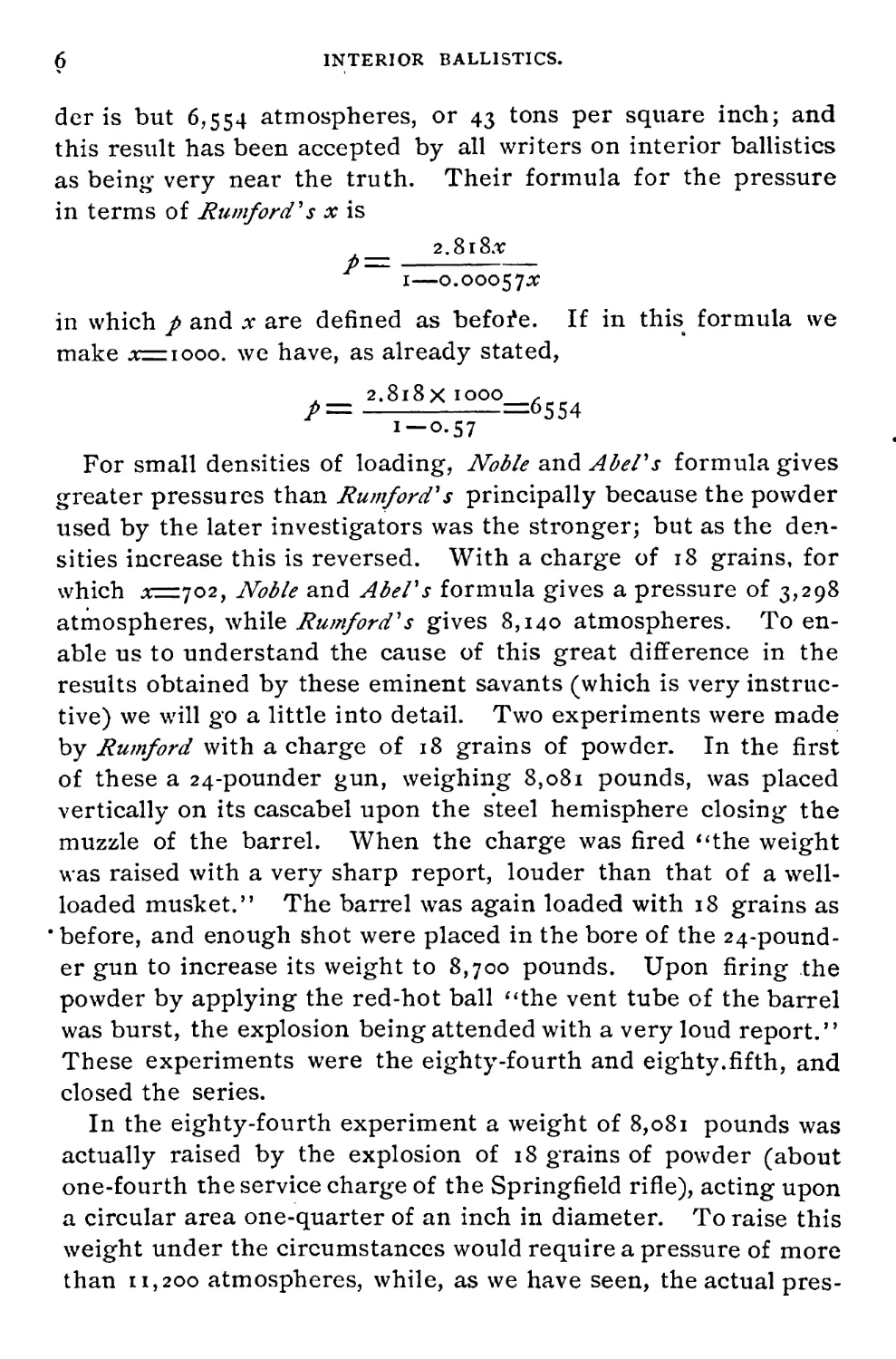
dor is but 6,554 atmospheres, or 43 tons per square inch; and
this result has been accepted by all writers on interior ballistics
as being very near the truth. Their formula for the pressure
in terms of Rumford's x is
2.818.x
/=--------------
1—0.00057л?
in which p and x are defined as befofe. If in this formula we
make л=юоо. we have, as already stated,
.	2.818x1000 z
For small densities of loading, Noble and Abel's formula gives
greater pressures than Rumford's principally because the powder
used by the later investigators was the stronger; but as the den-
sities increase this is reversed. With a charge of 18 grains, for
which x=7O2, Noble and Abel's formula gives a pressure of 3,298
atmospheres, while Rumford's gives 8,140 atmospheres. To en-
able us to understand the cause of this great difference in the
results obtained by these eminent savants (which is very instruc-
tive) we will go a little into detail. Two experiments were made
by Rumford with a charge of 18 grains of powder. In the first
of these a 24-pounder gun, weighing 8,081 pounds, was placed
vertically on its cascabel upon the steel hemisphere closing the
muzzle of the barrel. When the charge was fired “the weight
was raised with a very sharp report, louder than that of a well-
loaded musket.” The barrel was again loaded with 18 grains as
• before, and enough shot were placed in the bore of the 24-pound-
er gun to increase its weight to 8,700 pounds. Upon firing the
powder by applying the red-hot ball “the vent tube of the barrel
was burst, the explosion being attended with a very loud report.”
These experiments were the eighty-fourth and eighty.fifth, and
closed the series.
In the eighty-fourth experiment a weight of 8,081 pounds was
actually raised by the explosion of 18 grains of powder (about
one-fourth the service charge of the Springfield rifle), acting upon
a circular area one-quarter of an inch in diameter. To raise this
weight under the circumstances would require a pressure of more
than 11,200 atmospheres, while, as we have seen, the actual pres-
INTERIOR BALLISTICS.
7
sure due to this density of loading, according to Noble and Abel's
formula, is but 3,298 atmospheres. Evidently then the weight
in this experiment was not raised by mere pressure; but we must
attribute a great part of the observed effect (in consequence of
the position of the charge at the bottom of the bore), to the en-
ergy with which the products of combustion impinged against
the leathern stopper, which had only to be raised 0.13 inch (the
thickness of the leather) to allow the gases to escape. In Noble
and Abel's experiments there was no such blow from the products
of combustion because the apparatus for determining the pres-
sure (crusher gauge) was placed within the charge. Had the
leathern stopper in Rumford's experiments been an inch or two
longer, it is probable that his conclusions would have been en-
tirely different.
Rodman’s inventions and experiments.—We have space only
to mention the names of Gay-Lussac, Chevreul, Graham, Piobert,
Cavalli, Mayevski, Otto, Neumann, and others, who did original
work, of more or less value, for the science of interior ballistics
prior to the year i860. We will, however, dwell a few moments
on the important work done by Captain (afterwards General)
T. J, Rodman, of our own Ordnance Department, between the
years 1857 and 1861.1 The objects of Rodman's experiments
were: First, to ascertain the pressure exerted upon different
points of the bore of a 42-pounder gun in firing under various
circumstances. Second, to determine the pressures in the 7-inch,
9-inch, and 11-inch guns when the charges of powder and the
weight of projectiles were so proportioned that there should be
the same weight of powder behind, and the same weight of metal
in front of each square inch of area of cross-section of the bore.
Third, to determine the differences in pressure and muzzle velo-
city due to the variations in the size of the powder grains; and,
fourth, to determine the pressures exerted by gunpowder burned
in a close vessel for different densities of loading.
For the purpose of carrying out these experiments Rodman,
instead of using the system of varying weights employed by Rum-
1 Experiments on metal and cannon and qualities of cannon powder, by Captain T. J.
Rodman, Boston, 1861.
8
INTERIOR BALLISTICS.
ford, invented what he called the “indenting apparatus,” which
has since been extensively used, not only in this country but in
all foreign countries, under the name of Rodman's pressure (or
cutter) gauge; and which is too well known to require a descrip-
tion.
The maximum pressure of gunpowder when exploded in its
own space, as determined by Rodman by the bursting of shells
filled with powder, ranged from 4900 to 12600 atmospheres; the
mean of all the experiments giving 8070 atmospheres, or 53 tons
per square inch. These results though much nearer the truth
than those deduced by Rumford, are still about 25 per cent
greater than Noble, and АЬеГs deductions; and this is undoubt-
edly due to the position of the pressure gauge, which was placed
near the exterior surface of the shell, so that when the products
of combustion had reached the gauge they had acquired a consi-
derable energy which probably exaggerated the real pressure.
The same causes it will be remembered vitiated Rumford's ex-
periments. In both cases it was as if a charge of small shot had
been fired with great velocity against the leathern stopper in the
one case, or the end of the piston of the indenting tool in they
other.
General Rodman was the first person to suggest the proper
shape for powder grains, in order to diminish the initial velocity
of emission of gas and to more nearly equalize the pressure in
the bore of the gun. For this purpose he employed what he
termed a “perforated cake cartridge” composed of discs of com-
pressed powder from 1 to 2 inches thick and of a diameter to fit
the bore. Rodman demonstrated that such a form of cartridge
would relieve the initial strain by exposing a minimum surface
at the beginning of combustion, while a greater volume of gas
would be evolved from the increasing surfaces of the cylindrical
perforations as the space behind the projectile became greater;
and this would tend to distribute the pressure more uniformly
along the bore. Rodman's experiments with this powder in the
15-inch cast-iron gun which he had recently constructed for the
Government—and which is without doubt the most effective and
the best smooth-bore gun ever made—fully confirmed his theory;
but for many reasons he found it more convenient and equally
INTERIOR BALLISTICS.
9
satisfactory to build up the charge by layers of pierced hexagon-
al prisms about an inch in diameter fitting closely to one another,
instead of having them of the diameter of the bore
The war of the rebellion which was inaugurated while General
Rodman was in the midst of his discoveries and inventions, put
an end forever to his investigations, but his ideas were speedily
adopted in Europe, and his “prismatic powder” but slightly mod-
ified, is now used by all civilized nations.
Composition of Gunpowder.—Gunpowder is an intimate me-
chanical mixture of nitre, sulphur and carbon (in the form of
charcoal), in certain proportions depending upon the use for
which it is intended, and which is called composition, (French dosage).
In order to determine the proper composition to secure the best
results it is necessary to understand the role which each of the
ingredients performs by its reactions, when fired.
In thermo-chemistry—a science which has been created within
the last twenty-five years—chemical compounds are divided, ac-
cording to the thermal phenomena attending their formation,
into two classes, namely: Exothermous bodies, whose formation
evolves heat; and endothermous bodies whose formation is attended
with the absorption of heat and consequently whose decomposi-
tion disengages more or less heat. Prominent among this latter
class of unstable compounds is nitre	which is readily
decomposed by a moderate heat, setting at liberty the hetero-
geneous atoms of which it is composed. The potassium and
oxygen unite respectively with the sulphur and carbon of the
gunpowder forming exothermous compounds, while the nitrogen
having but feeble affinities, does not enter into new combinations.
In other words the decomposition of the nitre of the gunpowder
and the reactions of the various elements form a large volume of
gas at a high temperature, and consequently when confined it
produces the phenomena of explosion.
Among the binary compounds of nitre and sulphur, or nitre
and carbon, which by their reactions produce physical results
most nearly analogous to those of fired gunpowder, are the two
following:
Interior Ballistics. 2.
IO
INTERIOR BALLISTICS.
2NO3 K+±S = K2 5+з5 02 + 2N
and
2NOzK+$C=(K2O> CO2y±CO2+CO-\-2N
Of these two compounds the second is the more powerful since
there is more heat evolved. But if the powder contained only
nitre and carbon, one part of this last element and one part of
oxygen would not be fully utilized; for the radical K2 О is not de-
composable by the heat produced. It follows therefore that a
more energetic explosion would result if to the binary nitro-car-
bon compound there should be added a sufficient amount of sul-
phur to take the place of the oxygen of the radical K2 O. This
would produce the following reaction:
2N0zK+$C-\-S = K2S+$CO2+2N.
The addition of the sulphur produces other advantages also;
for as it ignites at a lower temperature than carbon, it increases
the inflammability of the compound; and, in addition, favors the
preservation of the powder on account of its less affinity for water
than the other components, and, also, by giving hardness to the
mixture and consequently more body to the grains.
The last equation given above is a theoretical formula for the
combustion of gunpowder. By introducing the atomic weights
of the elements we easily deduce its composition. We find in this
way that in 100 parts the theoretical powder would contain by
weight
74.815 parts of nitre.
11.852 11	“	sulphur.
13.333 “	“	carbon.
This theoretical composition is that which secures the best utili-
zation of the elements. It produces the greatest quantity of gas
and heat, and the least fouling matter. From the point of view
of the preservation of the powder, this composition also merits
the preference; for, the carbon which has the greatest affinity for
water of the three ingredients, is only employed in quantity nec-
essary for uniting with the oxygen of the nitre to form carbon
dioxide; while the proportion of sulphur just suffices to unite
with the potassium of the nitre and to give consistency to the
grains.
INTERIOR BALLISTICS.
11
Influence of Composition upon the Ballistic Effects of Gun-
powder.—The theoretical composition is based upon the hypothe-
sis of an absolute purity of the component parts. It is possible,
indeed, by refining to eliminate all, or nearly all, of the impuri-
ties found in the saltpetre and sulphur of commerce; but the
charcoal which, in practice, always supplies the element carbon,
contains besides this element, very appreciable quantities of hy-
drogen, oxygen and salts depending upon the kind of wood em-
ployed and the manner of preparing the charcoal.
For any given composition the carbon is the element which has
the greatest influence upon the quality of the powder. The
brown charcoal which is more porous and richer in gaseous matter
than the black charcoal, renders the powder more hygrometric,
but also more inflammable. On the other hand, black charcoal
assures to the powder a greater density, and the density of the
powder is, of all its physical characteristics, that which most
modifies its effects in fire arms.
The following table gives the principal compositions actually
adopted by different countries:
COUNTRY.	Nitre.	Sulphur.	Carbon.
Г Cannon powder, small grain	75	12.5	12.5
Cannon powder, large grain	75	10	15
France	-j	Musket powder	77	8	i5
Sporting powder	78	IO	12
[ Mining powder	62	20	IS
f War powder	74	10	16
Germany	J	Sporting powder	78.5	IO	11.5
( Mining powder	66	12.5	21.5
£ War powder	74	IO	16
Austria	<	Sporting powder	75-8	9.7	14.5
( Mining powder	62.2	18.4	19.4
Italy.	. Cannon powder	75	IO	15
Russia.	4 4	44	75	IO	r5
Switzerland.	44	44	76	IO	14
Spain.	4 4	44	75	12.5	12.5
Portugal.	44	44	75.7	10.7	13.6
United States.	44	4 4	75	IO	15
England.	4 4	44	75	IO	15
Products of Combustion of Gunpowder.—The reactions which
take place in the combustion of gunpowder, are much more com-
plicated than is indicated by the theoretical formula. The reason
12
INTERIOR BALLISTICS.
is that this formula does not take account either of the hetero-
geneous composition of the charcoal, or of the role of the atmos-
pheric air. In reality the phenomena accompanying combustion,
whether under small or great pressure, give rise to products
much more varied than those deduced by theory. These prod-
ucts are partly gaseous and partly solid; and their relative pro-
portions, as well as their compositions have been made the subject
of a great many researches. According to the experiments of
Bunsen and Schischkoff (1857), and of Noble and Abel (1874), these
products are, (besides potassium sulphite, carbon dioxide and
nitrogen, which are given by the theoretical formula), potassium
carbonate, potassium monosulphide, oxygen, carbonic oxide, hy-
drogen, vapor of water, etc., etc. (See Noble and Abel's Re-
searches, etc.)
The products of combustion vary also with the pressure as has
been demonstrated by many experiments. An increase of pres-
sure during combustion produces a more complete decomposition
of the powder, from which results a much greater disengagement
of heat and less fouling matter.	x
When a charge of powder is exploded in a cannon, only a small
part of the solids and liquids formed remains in the bore; these
substances are for the most part volatilized by the intense heat
of the explosion and are carried out by the gaseous currents; but
it is easy to see that, other things being equal, the amount of
fouling matter deposited on the sides of the bore will depend up-
on the quantity of solid residuum produced by the explosion.
The physical characteristics of gunpowder which have the
greatest influence upon its dynamic effects when exploded in a
gun, are the following;—the density, size, form and hardness of
the grains and their affinity for moisture.
Density of Gunpowder.—By density of gunpowder is meantits
specific gravity, or the ratio of the weight of a given quantity to
the weight of an equal volume of water at the standard tempera-
ture. It is also called mercurial density, since it is determined by
an apparatus which utilizes the property of mercury of filling the
interstices between the grains, without penetrating into the pores.
The density varies in different powders according to the pres-
INTERIOR BALLISTICS.
4
sure to which the grains were subjected during manufacture; and
ranges from about 1.5 to 1.9.
Size of Grains.—In order to take account of the influence of
the size of the grains upon the mode of action of gunpowder, it
is indispensable to analyze the phenomena of inflammation and of
combustion.
Inflammation and Combustion of a grain of Gunpowder.—In-
flammation is the spreading of the flame over the free surface of
the grain from the point of ignition. Combustion is the propa-
gation of the fire into the interior of the grain.
Ignition is produced by the sudden elevation of the tempera-
ture of a small portion of the grain to 300° C., either by contact
with an ignited body, by mechanical shock or friction, or by de-
tonation of a fulminate. The velocity of inflammation depends
upon the nature of the source of the heat which produces it, also
upon the state of the surface of the grain, and upon its density
and dryness. A large, dense, round and smooth grain ignites
with comparative difficulty. The composition of the powder and
time of trituration appear to have but little influence. Brown
charcoal makes the powder more inflammable than black charcoal.
The combustion of a grain takes place in successive, conceritric
layers, and in free air, equal thicknesses are burned in equal
times. As the mass of gas disengaged in any given time is pro-
portional to the quantity of powder burned during the same time,
and, therefore, proportional to the surface of inflamation, it fol-
lows that if the grain is spherical, or nearly so, the emission of
gas rapidly decreases from the moment of inflammation of the
grain up to the end of its burning.
The velocity of combustion is independent of the section of
the grain, and is inversely proportional to its absolute density.
If the grain is angular, the salient parts burn more quickly
than the plane or rounded parts, and thus an angular grain soon
takes a spheroidal or ovoidal form similar to a water-worn pebble,
which it retains, until consumed. It may thus be assumed with-
out appreciable error, that an angular grain is consumed in the
same time as its inscribed sphere. Thus all the grains of a charge
may be considered as equal grains provided they have the same
14
INTERIOR BALLISTICS.
minimum dimensions; that is to say, if they were made from
press-cake of the same uniform thickness.
The velocity of combustion varies with the composition of the
powder and with the process of munufacture. It is greater with
black charcoal than with brown; also greater the more perfect the
trituration, or, in other words, the more homogeneous is the
mixture; and finally the velocity of combustion increases with the
dryness of the powder.
The velocity of combustion also depends upon the pressure of
the medium in which the phenonmena take place. Thus if a
grain of powder of perfectly homogeneous constitution be mould-
ed into a cylinder by means of a screw-plug having an orifice for
the escape of the gas, it will be found that the smaller the orifice
the more quickly will the grain be consumed. If the velocity of
combustion did not increase with the pressure only a small por-
tion of the charges of cannon would be consumed during the very
short time the projectile is in the bore. Thus, M, Castan
has demonstrated that, under the variable pressure developed in
the larger French naval guns, the powder burns with a mean
velocity of 0.32 m. s., while the velocity of combustion in free air
is only 0.01 m. s. If this velocity were preserved in the gun
there would be for the 24 c. m., gun, for example, but 5 or 6 kgs.
of powder consumed during the time indicated, which is but X of
the normal charge (28 kgs.). It is certain that the enormous
pressure developed in modern rifled guns gives velocity of com-
bustion of the grain of from 1.5 m. s., to 2 m. s.
Inflammation and Combustion of a Charge of Gunpowder.—
The inflammation of a charge of powder, involves the transmis-
sion of the flame from one grain to another. Its velocity depends
not only upon the inflammability of the grain, but also, upon the
facility with which the gases first generated are able to penetrate
the charge; and is therefore, small in pulverized powder.
The velocity of inflammation of a charge of powder depends
also upon the pressure to which it is subjected, Thus while it is
2.4 m. s., in a train of powder laid in free air upon a table, it is
8.5 m. s., when the powder is confined in a canvas hose placed in
a trough and covered with boards. It is believed that in fire-
arms the velocity of inflammation of the charge is as great as 25
INTERIOR BALLISTICS.
*5
and even 30 metres per second, which is equivalent to saying
that, practically, it is instantaneous.
The combustion of a charge composed of grains of the same
minimum dimensions should, therefore, from what has been said,
practically terminate at the same time as each of the grains of
which it is composed. The time of combustion of a charge,
therefore, increases with the size of the grains and is, in all cases,
much longer than the time of inflammation.
If a charge of gunpowder be confined in a close vessel its com-
bustion takes place without noise, and permanent gases and solid
matter are produced which can be collected for analysis by open-
ing the vessel, as in the experiments of Noble and Abel. In this
case no work is performed by the gases, and the accompanying
phenomena are comparatively simple. But if the combustion
take place in a chamber of which one of the walls is capable of
moving under the expansion of the gases, which condition is re-
alized in cannon, the resulting phenomena are much more com-
plicated.
Imagine a charge of gunpowder in the chamber of a gun, be-
hind a projectile, to be ignited. All of the grains, supposed to
be composed of the same material and of spherical form, will be
inflamed practically simultaneously. The first gaseous products
will expand into the air-spaces of the chamber, and soon acquire
a tension sufficient £0 overcome the inertia and forcing of the
projectile. This latter once in motion, will encounter no resis-
tances in the bore comparable with those which opposed its start,
and its velocity will rapidly increase under the continued action
of the pressure of the gases.
This pressure will also increase at first; for, though the dis-
placement of the projectile gives a greater space for the expan-
sion of the gases, this will be more than compensated by a more
abundant disengagement of gas. But the pressure will soon
reach its maximum; for, if, on the one hand, the combustion of
the charge is accelerated by the increase of pressure, on the other
hand the surfaces of inflammation rapidly diminish, and the in-
creasing velocity of the projectile offers more and more space for
the gases to expand in. This velocity itself will soon attain a
maximum; for, in addition to the friction which retards the
i6
INTERIOR BALLISTICS.
motion of the projectile, the impulsive force decreases by the
expansion and cooling of the gases. Therefore the retarding
forces rapidly predominate, and if the gun were of sufficient
length, the projectile would not leave the bore. Its velocity,
starting from zero, passes through a maximum, and if the gun
terminated at this point, the projectile would leave the bore with
the greatest velocity that the charge of powder was capable of
communicating to it, and with a very loud report.
So far charges in general have been considered, only. Take,
now, a charge composed of small grains of slight density. The
initial surface of inflammation will be very great and the emis-
sion of gas correspondingly abundant. The pressure will increase
rapidly, and, in consequence, the velocity of combustion. It re-
sults from this that the grains which are very small, will be con-
sumed nearly as soon as inflamed, and this before the projectile
has had time to be displaced by a sensible amount. Hence all
the gases of the charge, disengaged almost instantaneously, will
be confined an instant within the chamber; their tension will be
very great, and they will exert upon the walls of the gun a sudden
and violent force which may rupture the metal, and which in all
cases will produce upon the gun and carriage shocks which are
destructive to the system and prejudicial to accuracy of fire. On
the other hand the projectile will be thrown quickly forward, as
by a blow from a hammer, and will attain its maximum velocity
almost at the start.
If, on the contrary,- the charge is made up of large grains of
great density, the total weight of gas emitted will be the same as
before; but the mode of emission will be different. The initial
surface of inflammation will be less, and the initial tension of the
gas not so great. The combustion will take place more slowly,
and will be only partially completed when the projectile shall
have begun to move. The pressure of the gases will attain a max-
imum less than in the preceding case, but the pressuse will de-
crease more slowly. Under the continued action of this pressure,
the velocity of the projectile will be rapidly accelerated and at
the muzzle will differ but little from that obtained by the fine
powder, without producing upon the gun and carriage the des-
tructive effects mentioned above.
INTERIOR BALLISTICS.
17
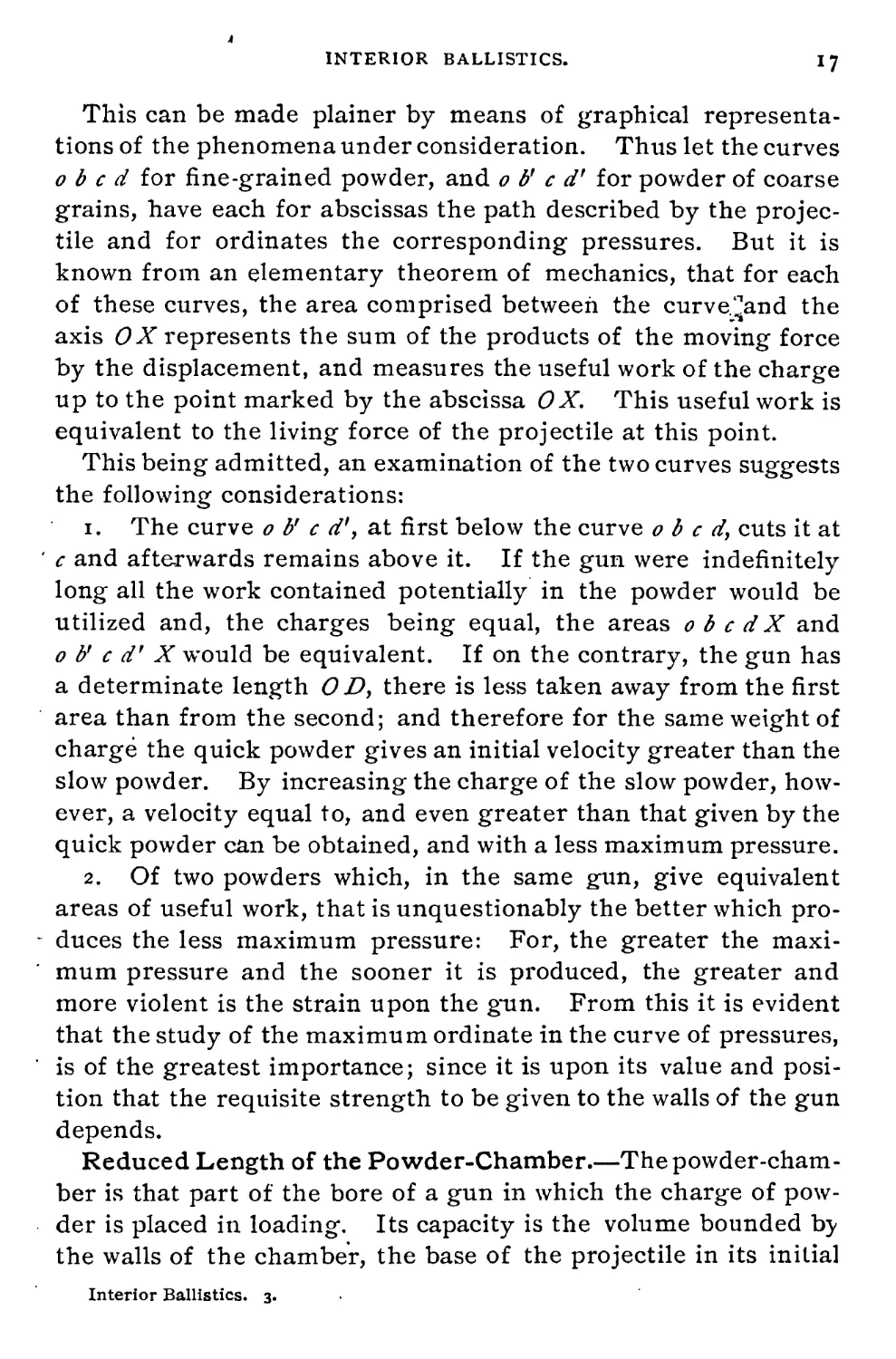
This can be made plainer by means of graphical representa-
tions of the phenomena under consideration. Thus let the curves
о b c d for fine-grained powder, and ob' cd’ for powder of coarse
grains, have each for abscissas the path described by the projec-
tile and for ordinates the corresponding pressures. But it is
known from an elementary theorem of mechanics, that for each
of these curves, the area comprised between the curve.‘^and the
axis OX represents the sum of the products of the moving force
by the displacement, and measures the useful work of the charge
up to the point marked by the abscissa OX. This useful work is
equivalent to the living force of the projectile at this point.
This being admitted, an examination of the two curves suggests
the following considerations:
1. The curve ob' c d', at first below the curve о b c d, cuts it at
' c and afterwards remains above it. If the gun were indefinitely
long all the work contained potentially in the powder would be
utilized and, the charges being equal, the areas obcdX and
ob' c d' X would be equivalent. If on the contrary, the gun has
a determinate length OD, there is less taken away from the first
area than from the second; and therefore for the same weight of
charge the quick powder gives an initial velocity greater than the
slow powder. By increasing the charge of the slow powder, how-
ever, a velocity equal to, and even greater than that given by the
quick powder can be obtained, and with a less maximum pressure.
2. Of two powders which, in the same gun, give equivalent
areas of useful work, that is unquestionably the better which pro-
- duces the less maximum pressure: For, the greater the maxi-
mum pressure and the sooner it is produced, the greater and
more violent is the strain upon the gun. From this it is evident
that the study of the maximum ordinate in the curve of pressures,
is of the greatest importance; since it is upon its value and posi-
tion that the requisite strength to be given to the walls of the gun
depends.
Reduced Length of the Powder-Chamber.—The powder-cham-
ber is that part of the bore of a gun in which the charge of pow-
der is placed in loading. Its capacity is the volume bounded by
the walls of the chamber, the base of the projectile in its initial
Interior Ballistics. 3.
INTERIOR BALLISTICS.
18
position for firing, and the face of the breech-block or bottom of
the bore. Injnodern rifled-guns the bore is slightly enlarged to
form the chamber; and it will be found convenient to introduce
what is called the reduced length of the chamber, which is defined
as the length of a cylinder whose diameter is the same as the bore
and whose volume is the same as the cham ber.
Let
z/0 be the reduced length of the chamber, in feet,
id the area of cross-section of the bore, in square inches,
C the volume of the chamber in cubic inches,
d the diameter of the bore (calibre) in inches.
Then
C= 12Uq(D =2 ^d2UQ.
c	c
u0 = —=o.io6io3	.	(I)
37td2	d2
Gravimetric Density.—The weight of a given volume of gun-
powder, not pressed together except by its own weight, evidently
varies with the density of the individual grains and with the
volume of the interstices between them; and this latter varies
with the general form of the grains, or, in other words, with their
ability to pack closely, or the reverse. If the weight of unit
volume of a standard powder be determined then the ratio of the
weight of the same volume of any other powder to this standard
weight is called its gravimetric density. In France, where the term
gravimetric density originated (densite gravimetrique), one litre
of the standard powder adopted was found to weigh one kilo-
gramme, and therefore the weight of a litre of any other powder
in kilogrammes is its gravimetric density. Reducing to English
units we may say that the gravimetric density of a powder is the
weight in pounds of a volume of 27.68 cubic inches of the powder
not pressed together except by its own weight.
Density of Loading.—The density of loading is defined to be
the ratio of the weight of the charge to the weight of a volume of
water just sufficient to fill the chamber. In France this is called
density de chargement; and in the metric system of units, is the ratio
of the weight of a charge in kilogrammes to the volume of the
chamber in litres, since a kilogramme is the weight of a litre (or
INTERIOR BALLISTICS.
19
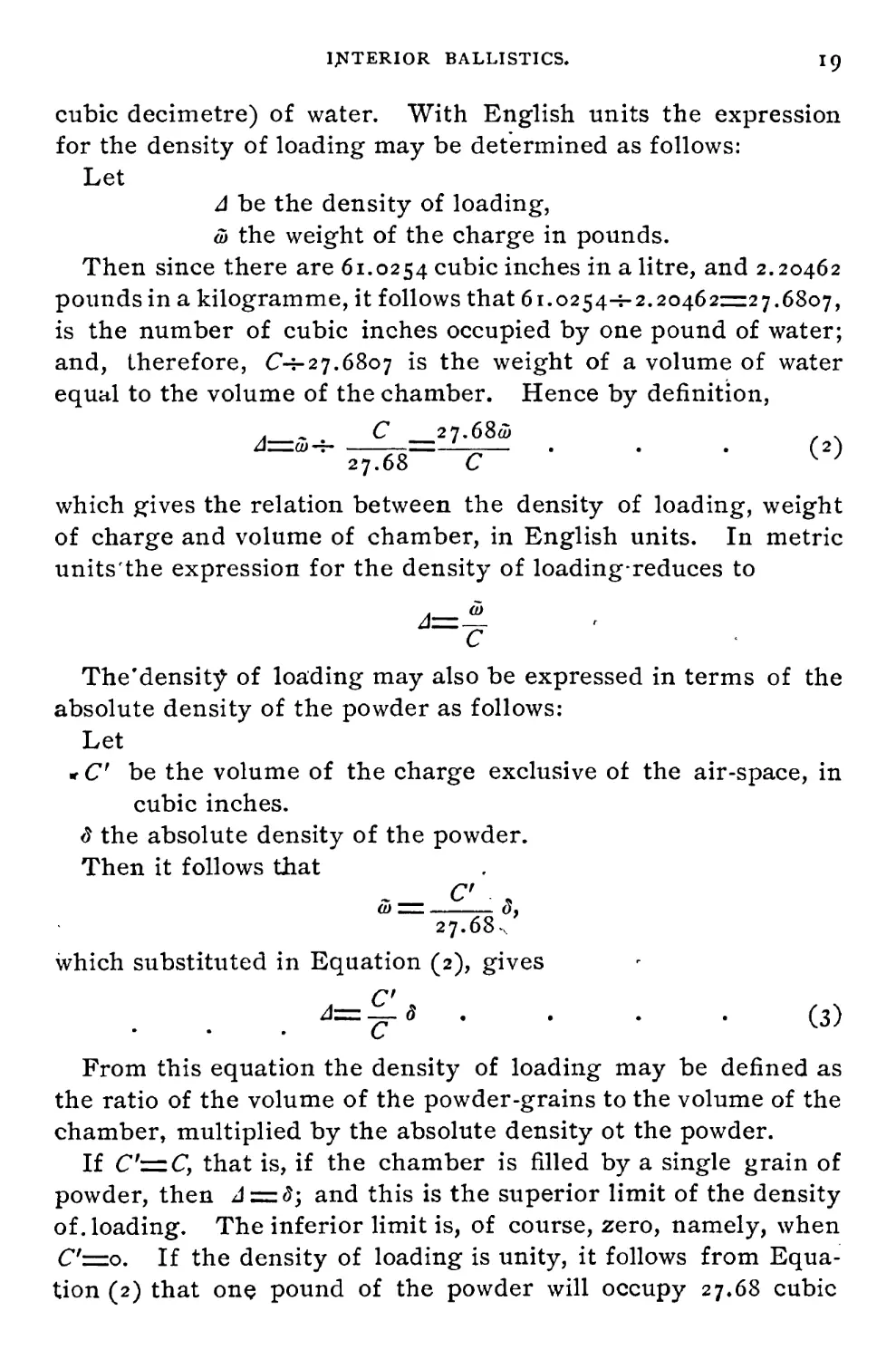
cubic decimetre) of water. With English units the expression
for the density of loading may be determined as follows:
Let
A be the density of loading,
й the weight of the charge in pounds.
Then since there are 61.0254 cubic inches in a litre, and 2.20462
pounds in a kilogramme, it follows that 61.0254-7-2.20462=27.6807,
is the number of cubic inches occupied by one pound of water;
and, therefore, Сч-27.6807 is the weight of a volume of water
equal to the volume of the chamber. Hence by definition,
.	C 27.680)	z ч
-----= —------ .	.	.	(2)
27.68 c	1 }
which gives the relation between the density of loading, weight
of charge and volume of chamber, in English units. In metric
units'the expression for the density of loading reduces to
(1)
C
The'density of loading may also be expressed in terms of the
absolute density of the powder as follows:
Let
< C' be the volume of the charge exclusive of the air-space, in
cubic inches.
d the absolute density of the powder.
Then it follows that
which substituted in Equation (2), gives
(3)
From this equation the density of loading may be defined as
the ratio of the volume of the powder-grains to the volume of the
chamber, multiplied by the absolute density ot the powder.
If C'=C, that is, if the chamber is filled by a single grain of
powder, then d = £; and this is the superior limit of the density
of. loading. The inferior limit is, of course, zero, namely, when
C'=o. If the density of loading is unity, it follows from Equa-
tion (2) that one pound of the powder will occupy 27.68 cubic
20
INTERIOR BALLISTICS.
inches, provided the chamber is filled with the powder grains
without forcing, in other words if the gravimetric density is also
unity.
Reduced Length of the Initial Air-Space.—The initial air-space
is that portion of the volume of the chamber not occupied by the
grains of the powder-charge; and the reduced length of the air-
space is the length of a cylinder whose diameter is the same as
the bore and whose volume is equal to the air-space. Denote
this by z0. Then, since Cis the volume of the chamber and C'
the volume of the powder grains,
_ c. r
lit Ш \	8 J
(by Equation (3));
which becomes, by substituting for C its value from Equation (2),
27.68di (’ll)	, X
*0= J-— J	- t	. (4)
<d ( Д о )
or, in the terms of d,
G) f I I )	z x
Zo=35.244I	•	•	•	(5)
In Equation (5) z0 will be in inches since d has been taken in
inches. Dividing the second member by 12 to reduce z0 to feet,
and placing this member in a form better suited for logarithmic
computation, the equation becomes
z0=[°.4679i]^-^J^-__	.	.	(6)
in which the number in square brackets is the logarithm of the
numerical factor. This equation may also take the form, some-
times useful:
•	•	• (7)
EXAMPLES.
Example 1.	—The volume of the chamber of the 3.2-inch steel
rifle is 104.24 cubic inches. It the charge is 3^ pounds of pow-
der what is the density of loading?	Answer. /1=0.9294.
Example 2.	—If the gravimetric density of the powder of Ex. 1
be unity, how many pounds will the chamber hold?
Answer. 3.766 pounds.
INTERIOR BALLISTICS.	21
Example 3.	—If the absolute density of the powder of Ex. 1 be
1.75, required the volume of the charge exclusive of interstices.
Answer. C'=55.36 cubic inches.
Example 4.	—What is the reduced length of the chamber of the
gun of Ex. 1?	Answer. w0=i.o8oi feet.
Example 5.	—Compute z0 with the following data: w=io lbs.,
<7=3824 cubic inches, <7=8 inches, <5=i.8i8.
Answer. £0=3.564 feet.
Example 6.	—The capacity of the chamber of the 6-inch Navy
B. L. R., Mark III, is 1426 cubic inches. What is the initial air-
space when the gun is loaded with 54 pounds of powder of density
1.818?	Answer. 603.8 cubic inch.
CHAPTER II.
PROPERTIES OF PERFECT GASES.
Mariotte’s Law.—The law of the compression, or expansion, of
gases was discovered by Boyle in 1662, and afterwards, independ-
ently by Mariotte in 1679. In’ England it is generally called
“Boyle's Law,” and on the continent “Mariotte's Law.” It is
enunciated as follows:
The temperature remaining the same, the pressure sustained by a given
mass of gds is inversely as the volume it occupies.
As the tension, or elastic force of the gas, is constantly in equi-
librium with the pressure it sustains, Mariotte's law may also be
stated as follows:
T he elastic force exerted by a mass of gas of constant temperature, is
inversely as the volume it occupies. Or, as the density of a gas is in-
versely as its volume, we may say, For the same temperature, the
tension of a gas is propertional to its density. This law has been veri-
fied experimentally by Dulong and Arago with atmospheric air,
for pressures up to 27 atmospheres.
Mariotte's law stated symbolically is as follows: Let v be the
volume of a given mass of gas (say one pound); and p its tension,
or elastic force, measured in pounds per square foot. Then
Mariotte's law asserts, that if the gas be allowed to expand, v and
p will vary in such a way that
v p = constant,
provided the temperature be kept invariable during such expan-
sion. The value of the constant can be determined experiment-
ally. Let vt andpt be the measured volume and pressure, res-
pectively, at a temperature f. Then
For many purposes it is convenient to take the volume of unit
weight of a gas at o° C., under the normal atmospheric pressure.
Calling the volume and pressure under these conditions z/0 and
INTERIOR BALLISTICS.
23
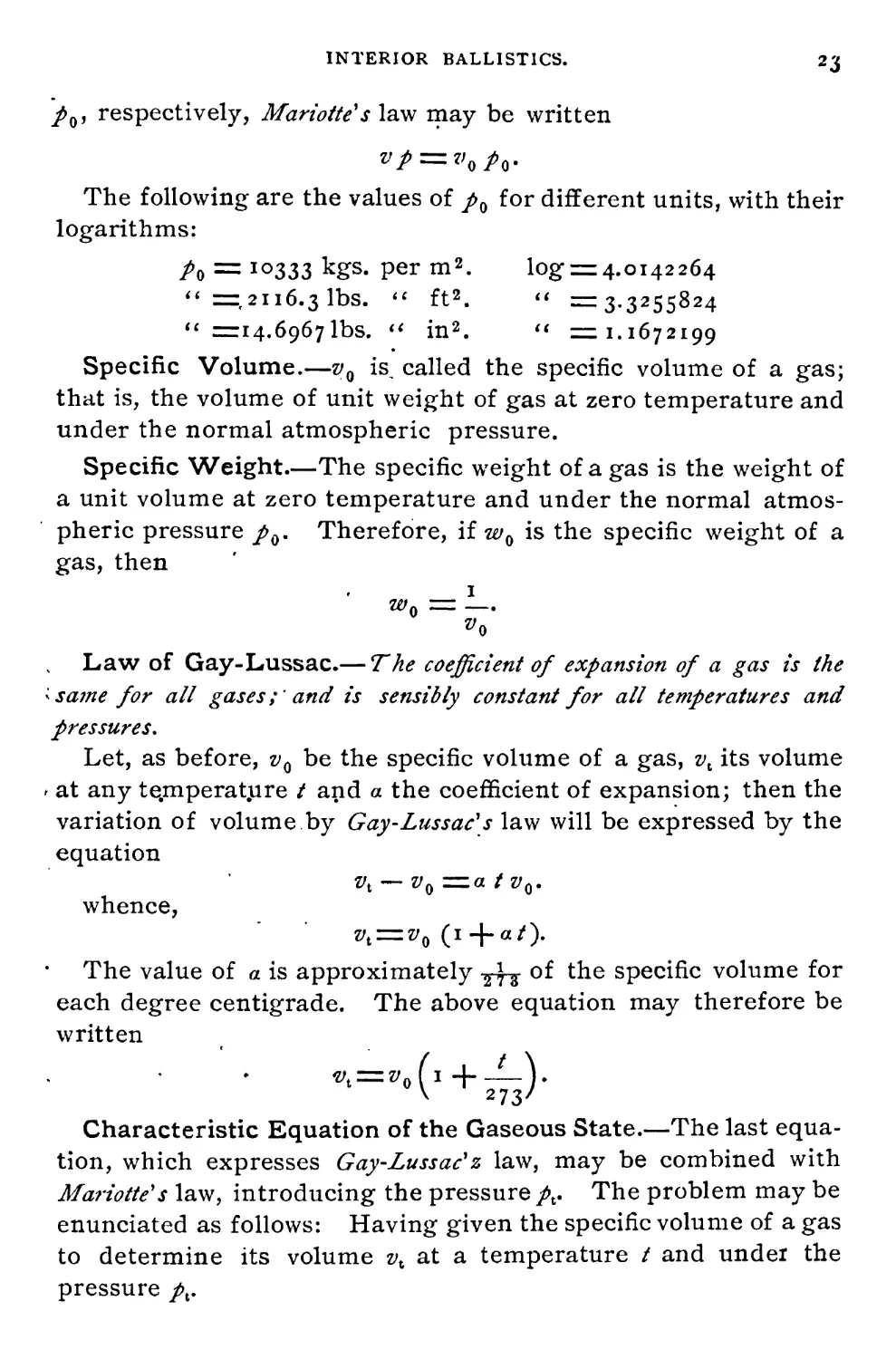
/0, respectively, Mariotte's law may be written
=	/о-
The following are the values of /0 for different units, with their
logarithms:
A = 10333 kgs- Per m2.	[0^ = 4.0142264
“ =2116.3 lbs. “ ft2.	“ =3.3255824
<£ =14.6967^5. in2.	£< =1.1672199
Specific Volume.—z/0 is called the specific volume of a gas;
that is, the volume of unit weight of gas at zero temperature and
under the normal atmospheric pressure.
Specific Weight.—The specific weight of a gas is the weight of
a unit volume at zero temperature and under the normal atmos-
pheric pressure /0. Therefore, if z£/0 is the specific weight of a
gas, then
,	1
= —
A
Law of Gay-Lussac.— The coefficient of expansion of a gas is the
'Same for all gases; and is sensibly constant for all temperatures and
pressures.
Let, as before, z>0 be the specific volume of a gas, its volume
r at any temperature t and a the coefficient of expansion; then the
variation of volume by Gay-Lussac's law will be expressed by the
equation
— A =a *V(i-
whence,
The value of a is approximately of the specific volume for
each degree centigrade. The above equation may therefore be
written
\	273/
Characteristic Equation of the Gaseous State.—The last equa-
tion, which expresses Gay-Lussac' z law, may be combined with
Mariotte's law, introducing the pressure /t. The problem may be
enunciated as follows: Having given the specific volume of a gas
to determine its volume at a temperature t and under the
pressure /t.
24
INTERIOR BALLISTICS.
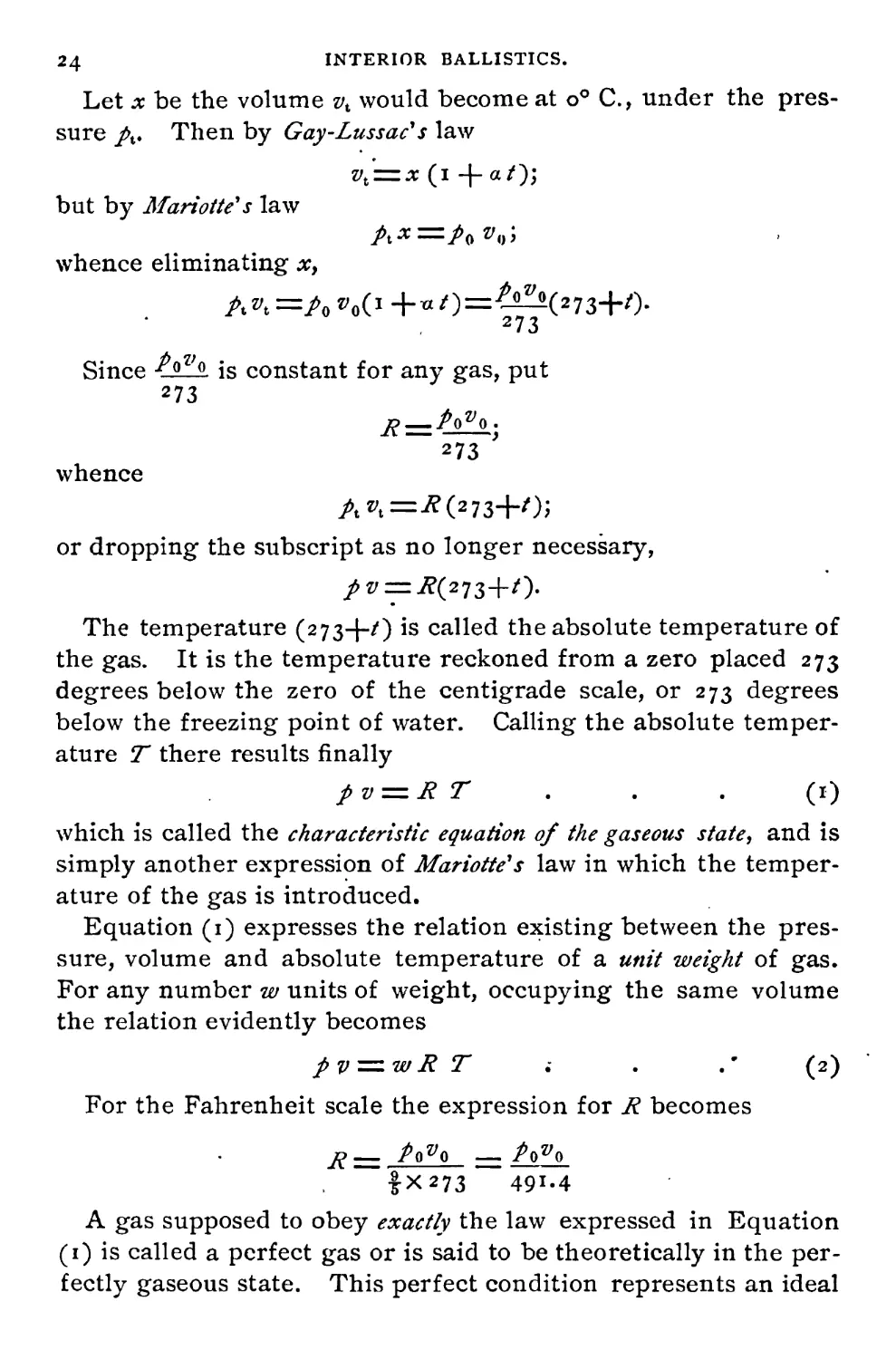
Let x be the volume would become at o° C., under the pres-
sure /t. Then by Gay-Lussac's law
(i +
but by Mariotte's law
Pix >
whence eliminating x,
A»t=AA(I +«О='^(273+'')-
273
Since is constant for any gas, put
273
Я-/А.
273
whence
A2't=^(273+/);
or dropping the subscript as no longer necessary,
/»==J?(273+/).
The temperature (273-PO is called the absolute temperature of
the gas. It is the temperature reckoned from a zero placed 273
degrees below the zero of the centigrade scale, or 273 degrees
below the freezing point of water. Calling the absolute temper-
ature T there results finally
p v = R T .	.	.	(1)
which is called the characteristic equation of the gaseous state, and is
simply another expression of Mariotte's law in which the temper-
ature of the gas is introduced.
Equation (1) expresses the relation existing between the pres-
sure, volume and absolute temperature of a unit weight of gas.
For any number w units of weight, occupying the same volume
the relation evidently becomes
T i .	.'	(2)
For the Fahrenheit scale the expression for R becomes
R — ^0^0 — /0^0
7X273	491.4
A gas supposed to obey exactly the law expressed in Equation
(1) is called a perfect gas or is said to be theoretically in the per-
fectly gaseous state. This perfect condition represents an ideal
INTERIOR BALLISTICS.
25
state toward which gases approach more nearly as their state of
rarefaction increases. Of all gases, hydrogen approximates most
closely to such an hypothetical substance, though at ordinary
temperatures the simple gases nitrogen, oxygen and atmospheric
air may for practical purposes be considered perfect gases.
Thermal Unit.—The heat required to raise the temperature of
unit weight of water at the freezing point, one degree of the
thermometer is called a thermal unit. There are two thermal units
in general use, namely: the British thermal unit (В. T. U.) which
is the heat required to raise one pound of water from 320 F. to
330 F.; and the French thermal unit (called a calorie') which is the
heat required to raise one kilogramme of water from o° C. to i° C.
There is still another thermal unit of frequent use, namely: The
heat required to raise one pound of water from o° C. to i°C.,
and which may be designated as the pound-centigrade {P. C.)
unit.
Mechanical Equivalent of Heat.—The mechanical equivalent
of heat is the work equivalent of a thermal unit, and will be des-
ignated by E. According to the recent exhaustive experiments
of Row land the value of A1 is 778 foot-pounds for а В. T. U.
Since a division on the Centigrade scale is | of a division on the
Fahrenheit scale, we have for a P. C. thermal unit, A:=|X 778 =
1400.4 foot-pounds. Also, since there are 3.280869 feet in a
metre, the value of E for a calorie is
.Л00-— 426.84 kilogrammetres.
3.280869	>
Specific Heat.—The quantity of heat, expressed in thermal
units, which must be imparted to a unit weight of a given sub-
stance in order to augment its temperature one degree of the
thermometer, or the quantity of heat given up by the substance
while its temperature is lowered one degree, is called its specific
heat.
The specific heats of different bodies vary greatly. Thus, if a
pound of mercury and a pound of water receive the same quan-
tities of heat the temperature of the mercury will be found to be
considerably greater than that of the water. Indeed, it requires
about 32 times as much heat to raise the temperature of water i°
Interior Ballistics. 4-
26
INTERIOR BALLISTICS.
as it does to raise the temperature of mercury by the same
amount.
The heat imparted to a body is expended in three 'different
ways:—ist. Augmenting the temperature, which may be called
vibration work. 2nd. In doing internal or disgregation work.
3rd. In doing external work or work of expansion. If we could
eliminate the two latter, we should get the true specific heat, or
the heat necessary to increase the temperature. It is, however,
impossible at present to separate the different modes of action of
the heat; and, therefore, the specific heats which have been de-
termined differ more or less from the true specific heats. For a
perfect gas however, the disgregation work is zero, and in all
cases the disgregation work is very small in comparison with the
vibration work.
The specific heat of a gas may be determined in two different
ways giving results which are of fundamental importance in ther-
modynamics, namely: specific heat under constant pressure; and
specific heat under constant volume.
Specific Heat of Gases under constant pressure.—To fix the
ideas suppose a unit weight of gas, confined in a spherical envel-
ope capable of expanding without the expenditure of work, and
which allows no heat the gas may have to escape, to be in equil-
ibrium with the constant pressure of the atmosphere. Under
these conditions suppose a certain quantity of heat to be applied
to the gas, just sufficient to raise its temperature one degree of
the thermometer, after it has expanded until equilibrium is again
restored. This quantity of heat (designated by o' thermal units)
is called the specific heat of the gas under constant pressure.
Specific Heat under constant Volume.—Next repeat the ex-
periment just described, but replacing the elastic envelope,
which by hypothesis permitted the gas to expand freely, by a
rigid envelope, thus keeping the volume of the gas constant while
heat is applied. It will be found now that there will be less heat
required than before to raise the temperature of the gas one de-
gree. The amount of heat required in this case is called the
specific heat under constant volume; and, in terms of the thermal unit
employed, is designated by c.
INTERIOR BALLISTICS.
27
Now, the number of molecules of gas is the same in both ex-
periments; and since the temperatures are equal it follows that
the quantity of heat absorbed by the gas, or, what is the same
thing, the total vis viva of the molecules, is the same in both ex-
periments. But in the experiment made under constant volume,
the heat absorbed is necessarily equal to the total heat supplied,
namely, c thermal units,—since the envelope is considered im-
permeable to heat. Consequently in the first experiment there is
a loss of heat equal to c'—c thermal units. This lost heat must,
therefore, have been expended in pushing aside the atmosphere
in expanding; and the work done will be found by multiplying
(? — o') by the mechanical equivalent of heat. That is, for an in-
crease of temperature of one degree of the thermometer,
Work of expansion = (/-—/) £.
The work of overcoming a constant resistance is equal to the
product of the resistance and the length of the path described.
In the case of the expanding gas which has just been considered
the constant resistance is the atmospheric pressure /0; and the
path described is measured by the increase of volume of the gas.
To determine this latter Gay-Lussac's law gives for the centigrade
scale
/ Vr.
 - vQ=.....°-,
273
and therefore for an increase of temperature of one degree there
is an increase of volume equal to _®_. The mechanical work of
273
expansion for one degree is therefore
/0 X ^»- = М» = 7?.
273	273
The quantity R is, then, the external work of expansion per-
formed under atmospheric pressure by unit weight of gas when
its temperature is raised one degree of the thermometer. But
this work of expansion has already been found to be equal to
(/'—г) E. Therefore there results the important equations
(c’—c) E = J?	or
273	491.4
(3)
28
INTERIOR BALLISTICS.
according as the Centigrade or Fahrenheit scale of temperature
is employed.
Numerical Value of R.—The value of 7? for any particular
gas depends upon the units of length and weight taken, the at-
mospheric pressure, the specific volume of the gas and the scale
of temperature adopted. Throughout this work the pound and
foot will be taken for the units of weight and length, respectively;
and generally the centigrade scale of temperature will be employ-
ed. The adopted value of the atmospheric pressure has already
been given.
As an example find the numerical value of J? for atmospheric
air. The specific weight of this gas according to the best au-
thorities is 0.080704 pounds. The specific volume is therefore
?'o=----r---= I2-39°9 ft8;
0.080704
and therefore for atmospheric air
J? = 2II6.3XI2.39O9_9б os6.
273
that is, for one pound of this gas,
p v 96.056 T:
and for w pounds
p v = 96.056 w T.
Law of Dulong and Petit.—The product of the specific heat of a
gas under constant volume by its density is a constant number for all gases.
By the density of a gas is meant its specific weight expressed
in terms of the specific weight of atmospheric air, which is taken
as unity. If ra is the specific heat at constant volume of atmos-
pheric air, and сг and dx the specific heat at constant volume, and
the density, respectively, of any other gas, then in accordance
with the law of Dulong and Petit,
^1 ^1
Determination of Specific Heats.—The specific volume and
the specific heat at constant pressure of a gas can both be accu-
rately determined by experiment; but the specific heat under
constant volume is almost impossible to measure directly. It
can, however, be computed for the simple gases by Equation (3),
which gives
INTERIOR BALLISTICS.
29
(4)
c = ? — ^0^0
273 E
By means of this equation and the direct determination of speci-
fic heats under constant pressure, Regnault has deduced the fol-
lowing law for the simple gases:
The specific heats under constant pressure and constant volume are in-
dependent of the pressure and the volume»
The following table gives the specific volumes, weights, and
' heats of those gases which approach most nearly to the theoreti-
cally perfect gas. In the last column are given the values of R
computed by Equation (1) for the centigrade scale. The values
of c were computed by Equation (4).
GAS.	Specific Volume. 	^0		Specific Weight.	cr	c	R
Atmospheric Air ....	12.3909	0.080704	0.23751	0.16892	96.056
Nitrogen		12.7561	0.078394	0.24380	0.1^319	98.887
Oxygen		11.2070	0.089230	0.21751	0.15547	86.878
Hydrogen		178.8^10	0.005590	3.40900	2.41873	1386.8
The units in this table are the pound and foot. The tempera-
ture is supposed to be o° C., and the barometer to stand at 760
mm = 29.922 inches.
Ratio of Specific Heats.—In the study of interior ballistics the
particular values of d and c for the different gases which are
formed by the explosion of gunpowder and other explosives, is
of little importance. It suffices .generally to know their ratio
which is constant for perfect gases, and approximately so for all
gases at the high temperature of combustion of gunpowder.
That this ratio is constant for perfect gases may be shown as
follows:—Since
— PqVq — /0	—	/0 t
273	273^o	273 dwj
in which is the specific weight of atmospheric air, we should
have for two gases, distinguished by the subscripts 1 and 2, the
relation
30
INTERIOR BALLISTICS.
Ry — d<i .
T?2 ai
that is, the values of 7? for two perfect gases are inversely propor-
tional to their densities. But by the law of Dulong and Petit we
have
(as shown above);
^2	^2
and therefore
^.1= ^2. = constant;
e2
consequently for any perfect gas the ratio — is constant. And
therefore from Equation (3)
J	D
— = i -|-----— constant = n (say).
с	с E	•
Computing n by means of atmospheric air we have
n = 1 -f------9б;°5б-----— х.^об.
o. 16892 x 1400.4
Laws Governing Mixtures of Gases.—1. The specific volume
of a mixture of two or more gases is the sum of the products of
the weights of the gases mixed by their specific volumes. Thus
if at, a2, a3, etc., are the weights of the various gases makingup
the unit mixture, and zq, z/2, zq, etc., the corresponding specific
volumes, then the specific volume of the mixture is
»0 =«lZ'l+«22'2+°3Z'3+etC-
2. The specific heat (either under constant pressure or constant
volume) is the sum of the products of the weights of the gases
mixed by their specific heats. Or, as expressed above,
-- al^l ~l~a2^2~l~aS^S “FetC.
As an example of these laws take atmospheric air which is a
mixture of oxygen and nitrogen in the ratio by weight of 23 to
77. By the first of these laws its specific volume should be
z/0= .23 x 11.207Ч-.77 X 12.7651 — 12.4067
and by the second law its specific heat under constant pressure
should be
?=. 23x0.217514-. 77x0.2438 = 0.23775
7
INTERIOR BALLISTICS.
31
and under constant volume,
c=.23 x 0.155474-.77 x 0.173*9 = o-l6911
these results agree practically with experiment.	A. it
Relations between Heat and Work in the Expansion of Gases.
The relations which exist between the variations of the volume
and pressure of a given weight of gas, and the heat necessary to
produce them, may now be determined from Equation (1), as
follows: This equation is
pv~R
and contains three variables, viz: /, v and T If we suppose an
element of heat, d q, to be applied to the gas, the temperature
will generally be augmented by an elementary amount d T; and
this in three different ways:—1st. We may suppose the volume
to increase by the element d v while the pressure remains the
same. 2nd. The pressure may increase by dp while the volume
remains constant. 3rd. The volume and pressure may both vary
at the same time. We will consider each of these cases separately.
1.	If, the pressure / remaining the same, the volume v vary by
the quantity d v, we must determine the corresponding variation
of T by differentiating Equation (1). This gives
d
R
and, therefore, the quantity of heat communicated to the gas
will be, in thermal units,
, z г c' pdv.
dq~cd T= —R--------;
R
d being the specific heat under constant pressure.
2.	If, the volume v remaining constant, the pressure vary by
dp, we shall have, proceeding as before,
, c v dp,
dq—cdT—
c being the specific heat under constant volume.
3.	If the volume and pressure vary together, the coresponding
element of heat will be the sum of the partial variations given
above. That is
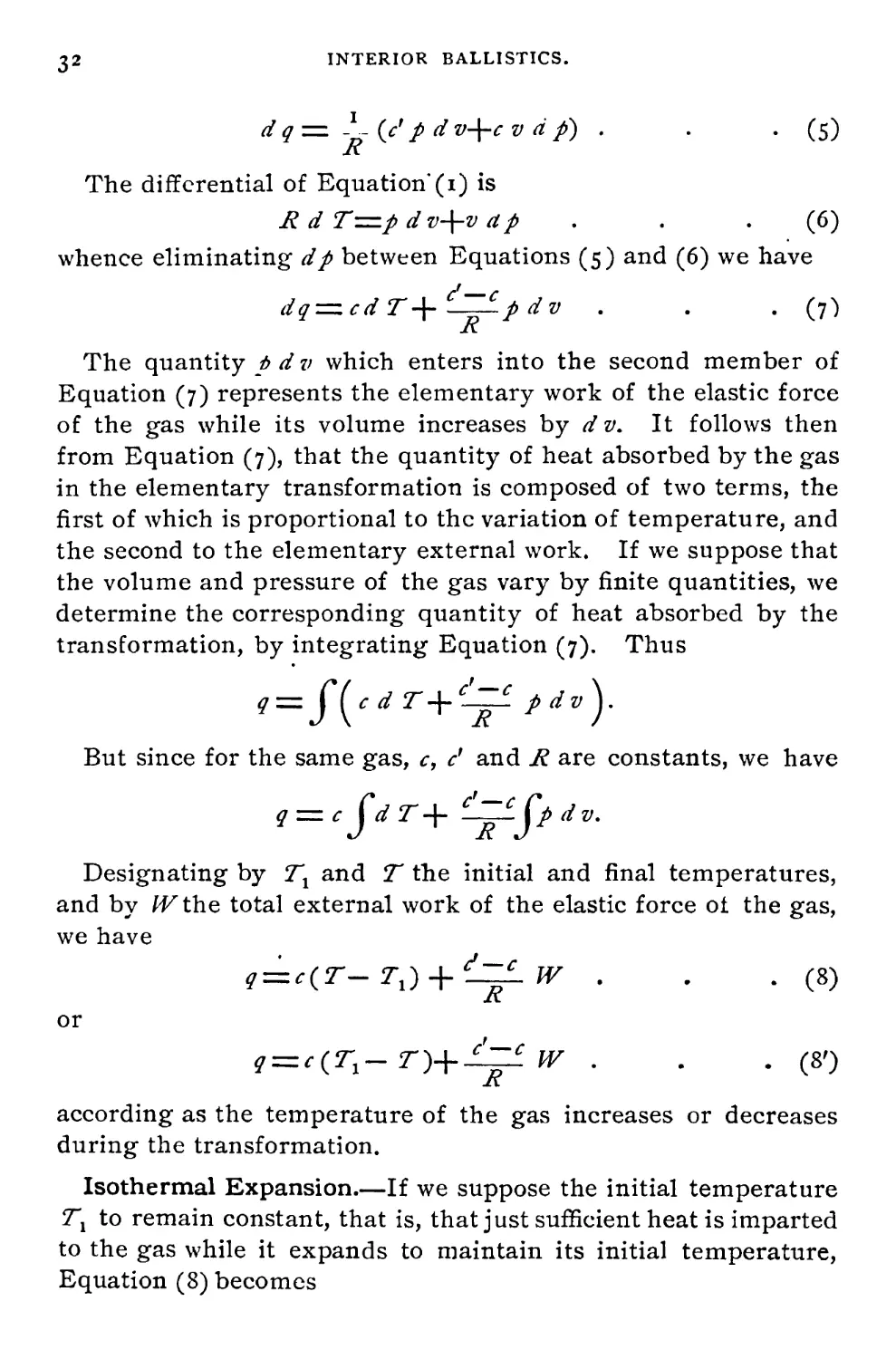
З2
INTERIOR BALLISTICS.
d q —
• (5)
The differential of Equation'(i) is
R d T^p d v-\-v a p .	.	(6)
whence eliminating dp between Equations (5) and (6) we have
dq=. cd Z'C—~-p d v .	.	. (7}
R
The quantity p d v which enters into the second member of
Equation (7) represents the elementary work of the elastic force
of the gas while its volume increases by d v. It follows then
from Equation (7), that the quantity of heat absorbed by the gas
in the elementary transformation is composed of two terms, the
first of which is proportional to the variation of temperature, and
the second to the elementary external work. If we suppose that
the volume and pressure of the gas vary by finite quantities, we
determine the corresponding quantity of heat absorbed by the
transformation, by integrating Equation (7). Thus
q = f^d!T+^ pdv}.
But since for the same gas, c, d and R are constants, we have
q = c Cd7'+ ‘LliCpdv.
kJ	KJ
Designating by T\ and T the initial and final temperatures,
and by W the total external work of the elastic force of the gas,
we have
+ W .	.	. (8)
К
or
. (8')
according as the temperature of the gas increases or decreases
during the transformation.
Isothermal Expansion.—If we suppose the initial temperature
to remain constant, that is, that just sufficient heat is imparted
to the gas while it expands to maintain its initial temperature,
Equation (8) becomes
.INTERIOR BALLISTICS.
33
_ C ““ C ITr
q=------IV.
'	4 R
We see in this case that the quantity of heat absorbed by the
gas is proportional to the external work done. The quantity
----is, therefore, the ratio of the effective work of a unit weight
c— c
of gas to the quantity of heat absorbed, or the mechanical equi-
valent of heat. Therefore,
E — # — 1	;
c'— c 273 ?—c
a result already established by another method. See Equation (3),
The work performed, therefore, by the isothermal expansion of
unit-weight of gas is expressed by the equation
IV— Eq — 1400.4 q foot-pounds,
where q is expressed in P. C. thermal units.
The work of an isothermal expansion may also be expressed
in terms of the initial and final volumes or pressures. Thus,
substituting in the general expression for the work of expansion,
W= §pdv,
the value of p from Equation (1), and integrating between the
limits zq and v we have
W=R Tt log. — log. L.;
zq	Vx
or, in common logarithms,
W2.3026pxvx log —	.	.	(9)
where v is the greater volume and vx the less.
Since from Equation (1)
^1	/
we also have
W= 2.3026 pvvv log ^1,	.	.	.	(9')
P
in which pr is the greater tension and p the less.
Interior Ballistics. 5.
34
INTERIOR BALLISTICS.
Equations (9) and (9') by inverting the fractions, evidently
hold good when the initial volume vr and initial tension px are
changed by compression under constant temperature into the
less volume v and greater tension /.
If we denote by A the reciprocal of E, or the heat equivalent of
work,—that is, the amount of heat which is equivalent to one
unit of work, we have for the heat imparted during ah isother-
expansion
q = A IV ~ 2.3026 A log _ I
zq I
, . л , p. ?	•	•	• (IO)
z= 2.3026 A pyVv log<Al
/ I
Adiabatic Expansion. Law of Temperatures.—If a gas ex-
pands and performs work in an envelope impermeable to heat so
that it neither receives nor gives out heat (by radiation or induc-
tion) the transformation is said to be adiabatic. In this case the
temperature and tension of the gas both diminish and the* work
performed for the same expansion must be less than for an iso-
thermal expansion. For an adiabatic expansion Equation (8)
becomes, since q = 0, by hypothesis,
W=dV (Zj — Г)
? — c
= cE{T1-T} .	.	. (11)
which expresses the important fact that in an adiabatic expansion
the external work done is proportional to the fall of temperature.
Next consider Equation (7). We shall have in this case, when
d q~o,	4
J	I e’—C L J
o — cd T -4-----p d v\
' R
R *7“
which becomes, after replacing/by its value, -, derived from
v
the fundamental Equation (1),
d T , z ч d v
INTERIOR BALLISTICS.
35
whence by integration
T = constant,
an equation which may be written, by taking limits,
Law of Pressures.—When d q = o, Equation (5) becomes
o = d p d v cv dp,
which may be written
du , dp
n — + -Г = °’
v . p
whence, integrating,
z(“ p — constant = v\ px
where vx and px are the initial volume and pressure, respective-
ly. This last equation may be written
(-)”=r	•	•	•	• («3)
\z> / px
Combining Equations (12) and (13) gives the important relations
By means of these last equations, the work of expansion (Equa-
tion (11) ) may be expressed in terms either of the initial and
terminal volumes, or of the initial and terminal pressures. Thus
since
Equation (11) may be written
Since с E Tx = Equation (15) may be written
n— 1
зб
INTERIOR BALLISTICS.
(16)
If we assume the ratio of the specific heats for perfect gases to
be 1.4, the last equation may be written
W= 2.5 /jZ/j f 1 —	I
f /M’l •	‘	•	<16')
= 2-5 А»! ] I - (<-)7 J
(.	'A7 ’
Theoretical Work of Fired Gunpowder.—A simple and in-
structive application of the preceding formulas is found in the
theoretical calculation of the work of expansion of the powder
gases in the bore of a gun. In this application the combustion
of the charge will be considered completed before the projectile
has sensibly moved. The vastly more important case of a pro-
gressive combustion whereby gases are produced while the pro-
jectile is moving along the bore, will be considered later. It will
be assumed in this discussion that the gases, on account of their
high temperatures, are practically perfect gases ; and also, in ac-
cordance with the hypothesis of Bunsen and Schischkoff, that work
is produced by the expansion of the permanent gases only, with
their proper heat; and that the non-gaseous products, in a liquid
state, radiate their heat toward the walls of the gun without sen-
sibly modifying the thermal state of the gases, on account of the
feeble absorbing power of these latter. The expansion in this
case will be adiabatic.
Let
be the absolute temperature of combustion of the powder.
e the mean specific heat of the gases under constant volume.
a> the weight of the charge.
s the weight of gas evolved by the combustion of one pound
of powder.
the weight of the projectile.
We have by Equation (15), for $ a) unit weights of gas formed,
!/ 7» \ n—1	)
1 - (~) ?
\v /	1
INTERIOR BALLISTICS.
37
It remains now to express the ratio in terms of the displace-
v
ment of the projectile. Make a longitudinal section along the
axis of the gun. Let A be the initial position of the base of the
projectile, and В its position at the end of the time t. The entire
weight of gas e ш (supposed to be formed before the projectile
has moved), occupies an initial volume vlf which, if we admit
with Noble and Abel, that the solids of combustion occupy sensi-
bly the same volume aS'the grains of powder from which they
were produced, is measured by the reduced length of the initial
air space, z0. The volume v occupied by the gases at the end of
the time t, is measured by С В == zQ и, и being the displace-
ment of the projectile. We therefore have
ri — go
and the expression for the work becomes
W= Ec rAi—	—Г-1 J
(.	\z0 —|— u) J
For smokeless powders which are entirely converted into gas
by combustion it is evident that z0 must be replaced by the re-
duced length of the chamber «0.
It will be seen from this last equation that if и increase indefi-
nitely, the limiting value of the work is
W 2= s ш E c 7^.
With regard to the factor E c Tx it may be remarked that the
specific heat of the gases under constant volume c differs but
slightly from the mean specific heat of the entire products of
combustion. E c T\ is, then, the work due to the indefinite ex-
pansion of the gases produced by the combustion of unit of weight
of the explosive. This ideal maximum work Sarratt calls the
potential of the explosive substance. The factor cl\ is called the
heat of combustion from absolute zero temperature.
Designating the potential of the powder by h, and the heat of
combustion by Q, we have
h = E Q;
and the expression for the work becomes
38
INTERIOR BALLISTICS.
W=he& f i - (—V ' | .	(17)
’	4 + u) )
In order to obtain at once, a first approximation to the velocity
of the projectile in terms of the path described in the bore, we
will neglect all that relates to the rotation of the projectile, the
recoil of the piece, and, also, the proper motion of the products
of combustion, all of which absorb a certain part of the work of
expansion. We shall then have, simply,
IV — ^viv2 4	.	.	(18)
v being the velocity of the projectile and m its mass. We thus
have
from which we get
\ m /	(	\z0 u) )
This theoretical formula makes the velocity proportional to the
square root of the weight of the charge and inversely proportion-
al to the square root of the weight of the projectile; it makes the
velocity increase indefinitely with the space passed over by the
projectile, and to decrease as z0 increases, that is to say as the
density of loading decreases.
When и is equal to the total length of bore described by the
base of the projectile, the value of v becomes the muzzle velocity,
V.
We may determine a second approximation to the velocity
impressed upon the projectile by the expanding gases, by taking
account of the work performed by these gases upon the gun and
charge, as well as upon the projectile.
Let
M be the mass of the gun,
U its velocity at the time considered.
The expression for the work will now be
W= I m v2 U2 + К
in which К is one-half the vis viva of the products of combustion;
—neglecting for the present, work of rotation both of the projec-
tile and gun.
INTERIOR BALLISTICS.
39
We do not know the value of Л7, but is is evident that one-half
the vis viva of the products of combustion is less than l/zz'2,
(designating by /z the mass of the charge); for the mean velocity
of translation of these products is evidently less than that of the
projectile. We have then
7Г=|(^Л) v2
in which 0 is a fraction less than unity. The expression for the
work may, therefore, be written
PF = |(w + ^Zz>2+| M U* .	.	. (i9)
We can deduce a second equation between v and U by equating
the momenta of the system, projected upon the axis of the gun.
In this way we obtain the following equation:—
(in 4- 0f pi) i> — M U .	.	.	(20)
0r being, like 0, a fraction less than unity.
Eliminating U from Equations (19) and (20), we get for the
velocity of the projectile,
. /1	. (m 4- 0 /z)2
m + 0 /z 4- S---- У •
M
In this equation
(w + ^'/z)2
M
is but a small fraction of in + ^'/z, and can be neglected by the
side of in -f- 0 д. This gives
This is the same expression as that deduced from Equation (19)
by neglecting the term 1 M U2, that is, by neglecting the energy
of recoil of the piece; and differs from Equation (18) by the in-
troduction of 0 ц which takes account of the motion of the products
of combustion.
Substituting in Equation (21) the value of W from Equation
(17) gives by taking weights instead of masses
_ 2gheS, f t _ f y-1 »
40
INTERIOR BALLISTICS.
The product 2g he is a constant depending upon the nature of
the powder employed, and may be designated by IP. Therefore
extracting the square-root of the last equation, and making
r — zo
и
it becomes
v — H (-----i —------------1----I .	.	. /22)
There is considerable uncertainty as to the value of 0; and it
undoubtedly varies with the energy imparted to the unburned
grains in the chamber and bore of the gun, as well as to the pro-
ducts of combustion. If the charge is made up as in the Quick
disc powders for example, upon which very little energy is ex-
pended while burning, we may make approximately # =
If we know the velocity v of the projectile we can obtain the
corresponding velocity of recoil of the gun by solving Equation
(20), which gives
JJ—.
M
or, designating the weight of the gun and carriage by and
making 0' = which is its approximate value, we have finally
Z7= g(«> + |a)	.	.	.
w1
EXAMPLES.
Example i.—Determine the volume of 5 pounds of oxygen at a
pressure of 50 pounds per square inch by the gauge, and at a
temperature of 6o° C.	Answer. #=15.527 cu. ft.
Example 2.—One pound of atmospheric air confined in a volume
of one cubic foot, has a tension of 50,000 pounds per square foot.
What is its temperature by the Fahrenheit scale?
Answer. /=477°.56 F.
Example 3.—A gas receiver having the volume of 3 cubic feet
contains half a pound of oxygen at 70° F. What is the pressure
by the gauge?	Answer. 14.876 lbs. per sq. in.
Example 4.—Let be the weight of a cubic foot of air when
the barometer stands at 30 inches and the detached thermometer
INTERIOR BALLISTICS.
41
at 620 F. Also let be the weight of a cubic foot of air when the
barometer is at b inches and thermometer at t degrees F. From
this data deduce the working expression
_ 26.434-0.0575 t
Я	b
Example 5.—If the weight of a cubic metre of dry air is 1.2932
kilos when the barometer stands at 760 m m and thermometer at
o° C., what would the same volume of air weigh with the baro-
meter at 795.6 m ni and thermometer at i8°.5 C.
Answer, w = 1.2679 kg.
Example 6.—“A spherical balloon 20 feet in diameter is to be
inflated with hydrogen at 6o° F. when the barometer stands at
30.2 inches, so that gas may not be lost on account of expansion
when the balloon has risen till the barometer stands at 19.6 inches,
and the temperature falls to 40° F. How many pounds and how
many cubic feet of gas are to be run in?”
Answers. v= 2827.5 cu. ft.
w — 15.09 lbs.
Example 7.—Two pounds of air expand adiabatically from an
initial temperature of 6o° F. and a pressure by^'^gawge of 65.3
pounds per square inch to a pressure of 50 pounds per square
inch. Determine the initial and terminal volumes, the terminal
temperature and the external work done. Compute the work by
Equation (1^).
Answers. vx = 5.8953 cubic feet.
v =7.1338	“	11
r=2i°.7 F.
IF = 10208 ft-lbs.
Example 8.—Compute the external work of 2 pounds of air at
a temperature of ioo° C., which expands adiabatically until it
doubles its volume. Employ the first of Equations (15).
Answer.	42731 foot-pounds.
Example 9.—Determine the temperature after expansion in
Interior Ballistics. 6.
42
INTERIOR BALLISTICS.
Example 8, and the ratio of the initial and terminal pressures.
Answers. /=Ф9°.68С.
/ = 0.3789/1.
Example 10.—Three cubic feet of air expand adiabatically
from an initial temperature of 70° F. and pressure of 85 pounds
per square inch	until external work equal to 8000
foot-pounds has been done. Determine the terminal volume,
pressure and temperature, and the weight of air. (Equation(i^') ).
Answers. v = 3-768 cu. ft.
/=61.78 lbs. per sq. in.
/ = 23°.86 F.
1.3 lbs.
Note: The work computed by Equation (16') differs slightly
from that computed by Equation (11). This is because n is taken
at 1.4 instead of 1.406 -}-♦ See page 30.
Example 11.—In Equation (16) the work of an infinite expan-
sion is finite so long as n is greater than unity; but becomes in-
finite when «= 1. Interpret these results.
CHAPTER III.
NOBLE AND ABEL’S RESEARCHES ON FIRED GUN-
POWDER.
Noble and АЬеГs experiments on the explosion of gunpowder
in close vessels were given to the world in two memoirs which
were read before the Royal Society in 1874 and 1879, respective-
ly. These experiments have an important bearing upon the sub-
ject of interior ballistics, since they furnish the most reliable
values we possess of the temperature of combustion of fired gun-
powder, the mean specific heat of the products of combustion
(solid as well as gaseous), the ratio of solid to gaseous products,
and, lastly, what is known as the force of the powder,—all of which
are important factors in computing the work done by the gases
of a charge of gunpowder exploded in the chamber of a gun.
The vessels in which the explosions were produced were of two
sizes, the smaller one for moderate charges and for experiments
connected with the measurement or analysis of the gases, while
in the larger one Captain Noble states that he had succeeded in
absolutely retaining the products of combustion of a charge of
23 pounds of gunpowder.1 These vessels consisted of a steel
barrel open at both ends, the two open ends being closed by care-
fully fitted screw plugs (firing plug and crusher plug) furnished
with gas checks to prevent any escape of gas past the screw. In
the firing plug was a conical hole closed from within by a steel
cone which was ground into its place with great exactness, and
which when the cylinder was prepared for firing was covered with
very fine tissue paper to give it electrical insulation from the rest
of the apparatus. The two wires from a Leclanchd battery were
attached, the one to the insulated cone and the other to the firing
plug, and were connected within the powder chamber by a fine
platinum wire passing through a glass tube filled with mealed
1 Lecture on Internal Ballistics, by Captain Noble, London, 1892, p. 12.
44
INTERIOR BALLISTICS.
powder. This platinum wire became red-hot when the electric
current passed through it, and the charge was thus fired. At the
opposite end of the cylinder from the firing plug was the crusher
plug fitted with a crusher gauge for determining the pressure of
the gases at the moment of explosion. The vessel was also pro-
vided with an arrangement for collecting the gases after an ex-
plosion, either for analysis, measurement of quantity, or for
other purposes.
The difficulties which the experimenters met with in using this
apparatus were very great.
“In the first place, the dangerous nature of the experiments
rendered the greatest caution necessary, while, as regards the
retention of the products, the application of contrivances of well-
known efficacy for closing the joints, such as papier-maM wads
between disks of metal (a method which has been successfully
employed with guns), are inadmissable, because the destruction
of the closing or cementing material used, by the heat, would
obviously affect the composition of the gas. Every operation con-
nected with the preparation of the apparatus for an experiment
has to be conducted with the most scrupulous care. Should any
of the screws not be perfectly home, so that no appreciable
amount of gas can escape, the gases, instantly upon their gener-
ation, will either cut a way out for themselves, escaping with the
violence of an explosion, or will blow out the part improperly se-
cured, in either case destroying the apparatus.
The effects produced upon the apparatus, when the gas has
escaped by cutting a passage for itself, are very curious. If, for
example, one of the plugs has not been sufficiently screwed home,
so that the products of combustion escape between the male and
female threads, the whole of these threads at the point of escape
present the appearance of being washed away, the metal having
been evidently in a state of fusion, and carried over the surface
of the plug by the rush of the highly heated products”1
Summary of Results.—The following are the principal conclu-
sions arrived at by Noble and Abel as the results of their long
continued and laborious experiments:
1 Noble and Abel, Researches. Page 15. Artillery School edition.
INTERIOR BALLISTICS.
45
(я) When gunpowder is fired in a space entirely confined.
(i)	For service powders about 57 per cent by weight of the
products of explosion are non-gaseous, and at the moment of ex-
plosion are in a liquid state. The principal constituents of this
non-gaseous residue are potassium carbonate, potassium sulphate,
and potassium sulphide—the first named greatly preponderating.
(2)	With the same powders about 43 per cent of the products
of explosion are in the form of permanent gases; and these gases,
at a temperature of o° C. and at a barometric pressure of 760
millimeters, occupy about 280 times the volume of the unexplo-
ded powder.
(3)	A kilogram of dry ordinary service powder, by its explo-
sion, generates about 720 calories of heat.
(4)	At the moment of explosion the temperature of the product
is about 2200° C.1
(5)	The mean specific heat of the products of explosion is
about 0.31.
(6)	The tension varies with the mean density of the products
of combustion according to the law given in Equation (2) of this
Chapter.
(£) When gunpowder is fired in the bore of a gun.
(1)	The products of explosion, at all events, as far as regards
the proportions of the solid and gaseous products, are the same
as in the case of powder fired in a close vessel.
(2)	The work on the projectile is effected by the elastic force
due to the permanent gases.
(3)	The reduction of temperature due to the expansion of the
permanent gases, is in a great measure compensated by the heat
stored up in the liquid residue.
(4)	The law connecting the tension of the products of explosion
with the volume they occupy is stated in Equation (11).
(5)	The work that gunpowder is capable of performing in ex-
panding in a vessel impervious to heat, is given by Equation (14);
and the temperature during expansion is given by Equation (12).
1 According to Noble and Abel's latest data the temperature of combustion would seem to
be 24750 C. See further on.
4б
INTERIOR BALLISTICS.
(6)	The total theoretic work of gunpowder when indefinitely
expanded is about 576 foot-tons per pound of powder.1
Pressure in Close Vessels, Deduced from Theoretical consid-
erations.—The expression for the pressure of the gases developed
by the combustion of gunpowder in a close vessel is deduced up-
on the following suppositions:
1st. That a portion of the products of combustion is in a liquid
state.
2d. That the pressure due to the permanent gases can only be
calculated by deducting the volume of the liquid products from
the volume of the vessel.
Upon these hypotheses the expression for the pressure may be
deduced as follows:
Let А В C D be a section of a close В	C
vessel of volume v in which a given
charge of powder is exploded.
Let A E FD represent the space
(zq) occupied by the charge, and A
GHDlhe space (zq) occupied by
the non-gaseous products. Let
be the so-called density of the pro-
ducts of combustion,—that is,
J ; and a the ratio of the non- n	__
v	H
gaseous products to the volume of
the charge, or a =	= __2_. The
A	D
gases after explosion will occupy the space v —	— ad1v =
v (i —a J j). Let /j be the pressure that would be developed if the
volume of the vessel were A EFD (or v^. In this case the den-
sity of the products of combustion (JJ (the charge remaining
the same), would be unity; and the space occupied by the gases
would be zq — v2 =. vx (1 — «) = J1z/(i—a). Now if p is the pres-
sure when the volume of the vessel is v, we have by Mariotte's
law (assuming that the temperature is the same for all densities
of the products of combustion),
1 Noble and Abel, Researches. Pages no and 169.
INTERIOR BALLISTICS.
47
or, making
we have
/= (T—
(0
The factor f is called the force of the powder.
Value of the Ratio a.—Let /2 and /3 be the pressures in the
same vessel produced by two different charges, and J2 and d3 the
corresponding densities of the products of combustion. Then
from Equation (i) (assuming f to be the same for all values of

and
whence by division,
1 a ^3 —— А^з
Therefore
— • 1 f /3^2 A A I f
^2^3 Ръ Ръ
by means of which the mean value of a can be determined when
a sufficient number of pressures, corresponding to different values
of have been found by experiment. The value of a finally
adopted by Noble and Abel is 0.57.
Determination of the Force of the Powder.—To determine /
we have from Equation (1),

from which f may be found by means of a single measured pres-
sure corresponding to a given density of the products of com-
bustion. When A = 1, that is, when the vessel is completely
filled by the charge, p was found to be 43 tons per square inch,
and therefore,/= 43 (1—.57) = 18.49 tons or 4I4I7-6 pounds
per square inch. Therefore Noble and Abel's formula for the
48
INTERIOR BALLISTICS.
pressure in a close vessel is, for different densities of the products
of combustion,
p — 18.49 ---—---- tons Per SQ- I
i — .57 J,	I
J	?	•	•	<2)
= 41417.6------1---lbs. per sq. in. I
i—57^i	J
To transform this equation so that it shall express the pres-
sure in kilos per dm2 we may employ a simple rule which as it is
of frequent use, is here inserted for convenience:
Rule:—To reduce a pressure expressed in tons per square inch
to the same pressure expressed in kilos per dm2, add to the log-
arithm of the former the constant logarithm 4.1972544 and the
sum is the logarithm of the pressure required.
If the pressure to be reduced is in pounds per in2 then the
constant logarithm to be added is 0.8470064.
Applying this rule the expression for the pressure of the pro-
ducts of combustion of a charge of gunpowder fired in a close
vessel is found to be
p = 291200-----1---.
Г	1-.57Л
.*. /*= 291200 kilos per dm2
It will be seen from the definition given to that it is the
density of loading as defined in Chapter I, when the gravimetric
density of the powder is unity,—that is when a kilo of the powder
fills a volume of a dm3; or, what is the same thing, when a pound
occupies a volume of 27,68 cubic inches; and in this case, when
J! is unity the charge just fills the receptacle. Noble and Abel
were careful to keep the gravimetric density of the powder they
experimented with as near unity as possible.
Interpretation of f.—It will be seen from Equation (1) that the
quantity designated by / is the pressure of the gases when
_________ = I,
z^(i—ad3)
that is, when the space occupied by the gases is equal to the
volume of the charge, which requires that the vessel should have
1 -|—a units of volume. Thus if the kilogramme and litre are the
INTERIOR BALLISTICS.
49
units of weight and volume, respectively, the volume of the ves-
sel must be 1.57 litres in order that the gases may occupy a
volume.of one litre, and have a tension equal to /. From this f
may be defined to be the pressure of the gases of unit weight of
powder occupying unit volume at the temperature of combustion
1 If e is the weight of gas furnished by the combustion of unit
weight of powder we have from Equation (2), Chapter II,
/1z'i zzz £ 7? 7\ ;
and if z/j is the unit of volume, there results
pl=f=tRTl .	.	.	(3)
If the pound is the unit of weight the unit of volume is 27.68
cubic inches. In this case the definition of f requires that the
volume of the vessel should be 1.57 x 27.68 = 43.459 cubic inches.
The value of s according to Noble and Abel is 0.43; and there-
fore the pressure of unit weight of the gases of fired gunpowder
at temperature is
/
0.43’
From this it follows that the pressure of one pound of the gases
of fired gunpowder at temperature of combustion, confined in a
volume of 27.68 cubic inches, is
41417^6
0.43
= 96320 lbs. per square inch.
Also, the pressure of one pound of the gases of the paragraph
immediately preceding, confined in a volume of one cubic foot,
is, in pounds per square foot,
96320 x 27.68 o
.y.A____—f----= 222180 lbs.
12
If the gravimetric density of the powder be unity, an I d> and 7/
be taken in pounds and cubic inches, respectively, then Equation
(1) becomes
?=/ 27-68%	... сю
V—2^68aci)
Interior Ballistics. 7.
5°
INTERIOR BALLISTICS.
Solving* with reference to ш and to v gives
й =_____________	.	.	(5)
27.68(5/+/)	W
and
v _ 27-68й(а^+/)	,6ч
These equations are useful in questions involving the bursting
of shells, etc.
Theoretical Determination of the Temperature of Explosion
of Gunpowder.—Having determined the value of /, the force of
the powder, from the experiments, we can deduce the tempera-
ture of explosion by means of the formula
Л =	/
According to Noble and АЬеГ s experiments, if the gravimetric
density of the powder is such that a kilogramme occupies one
litre, the gases furnished by its combustion will fill a volume of
280 litres at o°C. under the normal atmospheric pressure of
103.33 kgs. Per square decimetre. We therefore have
280
?;o=----
e
and
A=IO3-33
whence
273X291200 = 2748oC.
103.33x280
This is the absolute temperature of combustion of gunpowder
according to Noble and АЬеГ s latest deductions from their experi-
ments. Subtracting 2730 from this temperature we have tem-
perature of explosion = 2475°C. (4487F.).
With regard to the theoretical temperature of explosion the
authors remark as follows:
“We have made several experiments with the view of obtaining
the temperature of explosion, by ascertaining the effects of the
heat developed on platinum. For example, in experiment 78 we
introduced into the charge' of ‘Rifled Large Grain’ (R. L. G.), a
coil of very fine platinum wire, and also a piece of thin sheet
INTERIOR BALLISTICS.
51
platinum. After the explosion, the sheet platinum was found
much heated, but unmelted; but on examination with a micro-
scope there were evident signs of a commencement of fusion on
the surface, and a portion of the fine platinum wire was found
welded on the sheet. The coil of wire was hot to be found, but
portions of it were observed welded to the sides of the cylinder.
•Now we know that platinum is readily volatilized, when ex-
posed to the hydrogen-blowpipe, at a temperature of about 3200°
C.; and therefore, if the temperature of explosion had approach-
ed this point, we should have expected the very fine wire to be
volatilized; remembering the low specific heat of platinum, we
should furthermore have been warranted in expecting more de-
cided signs of fusion in the sheet metal.
Again, in experiments 84, 85 and 86, pieces of platinum wire
.03 inch (0.75 millim.) in diameter and 4 inches (100 millims.)
long were placed in the cylinder with considerable charges of
R. L. G. and F. G. In none of these experiments did the
platinum melt, although, as in the case of the sheet platinum,
there were signs of fusion on the surface of the wires. In exper-
iment 79 however, in which platinum wire was placed with a cor-
responding charge of the Spanish powder, the wire was fused,
with the exception of a small portion. With this powder, indeed,
which is of a very different composition from the English pow-
ders, and decidedly more rapidly explosive in its nature, it is
quite possible that a somewhat higher heat may have been at-
tained. But, as in one case the platinum wire was nearly fused,
and in the others it only showed signs of fusion, the conclusion
we draw from the whole of these experiments on the fusion of
the platinum, is that the temperature of explosion is higher than
the melting-point of that metal, but not greatly so. Now, ac-
cording to Deville, the melting-point of platinum is nearly 2000°
C.; and hence we have a strong corroboration of the approximate
accuracy of the theoretical temperature of explosion.”1
Mean Specific Heat of the Products of Combustion.—From
Equation (8) Chapter II,we have when W~o, that is, when no
external work is performed,
1 Noble and Abel, Researches, etc., Page 70.
52
INTERIOR BALLISTICS.
Q=e(Ty — 273)
in which Q is the heat of combustion; that is, the quantity of
heat that unit of weight of the explosive substance evolves, under
constant volume, when the final temperature of the products of
combustion is o°C. From this equation we find
т;-27з
The heat of combustion was determined by Noble and Abel in
the following manner:
“A charge of powder was weighed and placed in one of the
smaller cylinders, which was kept for some hours in a room of
very uniform temperature. When the apparatus was through-
out of the same temperature, the thermometer was read, the
cylinder closed, and the charge exploded.
Immediately after explosion the cylinder was placed in a cal-
orimeter containing a given weight of water at a measured tem-
perature, the vessel being carefully protected from radiation, and
its calorific value in water having been previously determined.
The uniform transmission of heat through the entire volume
of water was maintained by agitation of the liquid, and the ther-
mometer was read every five minutes until the maximum was
reached. The observations were then continued for an equal
time to determine the loss of heat in the calorimeter due to radi-
ation, etc.; the amount so determined was added to the maximum
temperature.”
In this way the heat of combustion of R. L. G. and F. G. pow-
ders was found to be 705 heat-units; that is, the combustion of a-
unit weight of the powder liberated sufficient heat to raise the
temperature of 705 unit-weights of water i°C. We therefore
have
7°5	c
c =	° — 0.316
2231
This result is accepted by Noble and Abel, and also by Sarrau,
as a very close approximation to the mean specific heat of the
entire products of combustion. If we assume that the mean
specific heat of gunpowder of different compositions is constant,
INTERIOR BALLISTICS.
53
we can compute the temperatures of combustion when the heat
of combustion has been determined by the calorimeter, by the
formula
T— Q f,	c
°-316	1 к .к-
in which Z'is given by the centigrade scale.
Pressure in the Bores of Guns Derived from Theoretical
Considerations.—“At an early stage in our researches, when we
found, contrary to our expectation, that the elastic pressure de-
duced from experiments in close vessels did not differ greatly
(where the powder might be considered entirely consumed, or
nearly so) from those deduced from experiments in the bores of
guns themselves, we came to the conclusion that this departure
from our expectation was probably due to the heat stored up in
the liquid residue. In fact, instead of the expansion of the per-
manent gases taking place without addition of heat, the residue,
in the finely divided state in which it must be on the ignition of
the charg’e, may be considered a source of heat of the most per-
fect character, and available for compensating the cooling effect
due to the expansion of the gases on production of work.
The question, then, that we now have to consider is—What
will be the conditions of expansion of the permanent gases when
dilating in the bore of a gun and drawing heat, during their ex-
pansion, from the non-gaseous portions in a very finely divided
state?”1
Let ct be the specific heat of the non-gaseous portion of the
charge, which we can assume without material error, to be con-
stant. We shall then have ^✓ZT'for the elementary quantity of
heat yielded to the gases per unit of weight of liquid residue.
If there are units of weight of liquid residue it will yieldjio
the gases wYc{dT units of heat; and if there are w2 units of
weight of gas we shall have in heat-units,
dq = -
o',
in which
^2
1 Noble and Abel, Researches, etc., Page 98.
54
INTERIOR BALLISTICS.
that is, Д is the ratio between the weights of the non-gaseous
and gaseous portions of the charge. The negative sign is given
to the second member because T decreases while q increases.
Substituting the above value of dq in Equation (7), Chapter II,
it becomes
-('JrfQdT^tdv .	.	.	(7)
and this combined with Equation (6), Chapter II, gives, by a
slight reduction,
+	=	.	(8)
V	P
. Since с', Су ct and Д are, by hypothesis, constant during the ex-
pansion, the integration of Equation (8) between the limits v2
and z>3—the former being the initial volume occupied by the per-
manent gases and the latter their volume after the projectile has
been displaced by a distance gives
/=A	•	•	(9)
in which
r =	+
Equation (9) it will be seen, becomes identical with Equation
(13), Chapter II, when = that is, when there is no liquid
residue.
To introduce vx and v. that is the volumes occupied by the
charge and the entire volume in rear of the projectile, into Equa-
tion (8) in place of and z/3, proceed as follows: Let A С E G
INTERIOR BALLISTICS.
55
represent the chamber of the gun, which we will suppose filled
with powder without compression, and further that one pound of
the powder fills a space of 27.68 cubic inches. The gravimetric
density and density of loading are each unity; and if vx is the
volume of the chamber, it follows that
vx •=. 27.68 Й.
Suppose the powder to be entirely consumed before the projec-
tile moves any perceptible distance; and that the non-gaseous
products fill the space A В EF, whose volume is a vx. The gases,
therefore, which by their expansion give motion to the projectile
will occupy the space В C F G before perceptible motion begins.
The volume of the space В C F G is evidently v2=vx—avx =
zq(i — a). Let D H be the base of the projectile after it has
moved a distance tr, and, designating the volume A D E H by v,
we evidently have p3 — avx. Substituting these values of v2
and z>3 in Equation (9) gives
In this equation px is the pressure produced by the combustion
of a charge of powder in a close vessel when the density of load-
ing is unity. The values of the constants are given by Noble and
Abel as follows:1
px — 43 tons per square inch
« =0.57
£ =1-2957
c' = 0.2324
c = 0.1762
G =o-45
7q = 27.68 a)
from which we find r = 1.074. Substituting these values in the
expression forp it becomes
which gives the pressure in tons per square inch.
1 Researches, etc. Page 167.
56
INTERIOR BALLISTICS.
If, as in a close vessel, we let
V
then
'I i -o 7 4
-----H- f
1	♦ 57 Ji J
( J 1 1-074
* =‘7’375 }	• • • (II)
Compare this with Equation (2).
Remarks:—The value of /? = 1.2957, adopted by Noble and Abel
gives for unit weight, z£/1=o.5644 and w2 =0.4356, while the
values of these quantities adopted in our equations are 0.57 and
0.43, respectively. These last named values „ would make
£=1.3256.
Noble and АЬеГs values of the specific heats of the permanent
gases of combustion, namely, ^' = 0.2324 and ^ = 0.1762, make
/2=1.32; while for perfect gases as was shown in Chapter II,
n = 1.4 very nearly. ♦
Table of Pressures.—In the following table of pressures the
third column gives the pressures in the bore of a gun correspond-
ing to the values of in the first column. They were computed
by Equation (11) upon the assumption that the permanent gases
in expanding and thereby doing work, borrow heat from the non-
gaseous residue; and also that the combustion is complete before
the projectile has moved perceptibly; and finally that there is no
conduction of heat to the walls of the gun. The tensions in the
fifth column were computed by Equation (2) and agree with
Noble and АЬеГs experiments.
INTERIOR BALLISTICS.
57
Mean density of pro- ducts of combustion.	Corresponding expansions. 1 	2;		Tensions calculated by Equation (11).		Tensions in close cylin- ders, or where gases ex- pand without doing work.
		Tons per square inch.	Differences.	Tons per square inch.	Differences.
1.00	I.000	43-00	5.01	43.00	4.69
•95	1.053	37.99	4.40	38.31	4.14
.90	i.in	33.59	3.88	34.17	3.68
• 85	1.176	29.72	3.44	30.49	З.30
.80	1.250	26.28	3.06	27.19	2-97
• 75	1-333	23.22	2.76	24.22	2.68
• 7o	1.429	20.46	2.48	21.54	2.45
.65	1.539	17.98	2.25	19.09	2.23
.60	1.667	15.73	2.04 '	16.86	2.05
•55	1.818	13.69	1.86	14.81	1.88
.50	2.000	11.83	1.70	12.93	1.74
• 45	2.222	10.13	1.56	11.19	1.61
.40	2.500	8.57	1.43	9.58	1.50
• 35	2.857	7Л4	1.31	8.08	1.39
•30	3.333	5.83	1.21	6.69	1.30
•25	4.000	4.62	1.и	5.39	1.22
.20	5.000	3.51	1.02	4.17	1.14
• 15	6.667	2.49	•93	‘	З.03	1.07
.10	10.000	1.56	.84	1.96	I.OI
•05	20.000	.72		•95
Temperatures of Products of Combustion in Bores of Guns.—
The temperature in the bore of a gun during the expansion of
the products of combustion, may be determined from Equation
(7), which replacing 7? by its value from Equation (1) Chapter II,
becomes
d T___ d — c dv,
~T “ /4 + ^ v ’
• whence integrating between the same limits as before, and ob-
serving that
we have
Interior Ballistics. 8.
58
INTERIOR BALLISTICS.
Replacing z/2 by (i—a), and v3 by v—avx, for reasons already
given, we have for the absolute temperature of the gases during
expansion, the equation
7~—	(r	r 1.
1 \ V — a?q /
Introducing the density of the products of combustion (Jx),
and the numerical values of a and r into this last equation, it
becomes
( A ) 074
Г=(.4з)074 X Л	-
l 1--57Л J
id) -°74
= 0.93946 Г, {— 1	[	.	.	. (12)
1 x —-57 Ji >
The value of T for any given density of the products of com-
bustion (represented by z^) will depend upon their initial tem-
perature, (or absolute- temperature of combustion), 7\. Its
theoretical value, based upon Noble and Abel's latest deductions
from their experiments, as published in their second memoir,
has already been found to be 2748°C. But there are very great
difficulties in the way of verifying by experiment the theoretical
value of T\, and Captain Noble in his Greenock lecture (February
12th, 1892) takes the absolute temperature of combustion at
25°5°C, as deduced in their first memoir. Therefore making
= 25O5°C.,
the expression for Tbecomes
г j ) 074
Z= 2353.3 |—k—]•	•	•	•	<?3)
The temperatures in degrees Centigrade and Fahrenheit, cal-
culated from Equation (13) are given in the following table. “It
is hardly necessary to point out that the values given in this table
are only strictly accurate when the charge is ignited before the
projectile is sensibly moved; but in practice the correction due
to this cause will not be great.”1
Noble and Abel. Page 103.
INTERIOR BALLISTICS.
59
Mean density of products of combustion.	Number of volumes of ex- pansion. 1 	2;		Temperatures.
		Centigrade.	Fahrenheit.
1.00	1.0000	2231	4048
•95	1.0526	2210	4010
.90	I.IHI	2189	3972
.85	1.1765	2168	3934
.80	1.2500	2147	3897
.75	1.3333	2126	3859
♦ 70	1.4286	2106	3823
• 65	1.5385	2085	3785
.^0	1.6667	2063	3745
.55	1.8182	2041	37o6
.50’	2.0000	2018	3664
•45	2.2222	1994	3621
.40	2.5000	1968	3574
•35	2.8571	1940	3524
•30	3-3333	1909	3468
♦ 25	4.0000	1874	3405
.20	5.0000	1834	3333
.15	6.6667	1785	3245
.10	10.0000	1719	3126
.05	20.0000	1615	2939
.00	co	0	0
Theoretical Work Effected by Gunpowder.—The theoretical
work which a charge of gunpowder is capable of effecting during
the expansion of its volume from vx to any volume v is expressed
by the definitne integral
V
IV = J* pdv\
or, substituting for p its value from Equation (io)
whence, integrating, we have
w—a)r f______________*_______	1
r—i	I [^iC1—a)]^1	C2'—e^i)r-1
6о
INTERIOR BALLISTICS.
Multiplying and dividing the second member by [^(i— a)]r”1,
we have
(r— l) 1	\ V— aV{ /	)
If. in this last equation, px be expressed in kilogrammes per
square decimetre, and vx be made unity (one litre), the work will
be expressed in decimetre-kilogrammes per kilogramme of pow-
der burned. To express the work in foot-tons per pound of
powder burned, we must make = 27.68 cubic inches; and then,
sincepx is given in tons per square inch, divide the result by 12,
the number of inches in a foot. Making these substitutions and
replacing a and r by their values already given, we have, in foot-
tons,
w= 576.36911 — ( -43	)	I
(	'z'— .57ZV
or, in terms of
(	/ J \ • 0 7 4 1
^=576.369^1—0.939461--------1——)	J .	. (14)
(	\i-.57J,/	)
Substituting in Equation (14) from Equation (12) v.e have
576.369 (7,-Г)
or, since, according to Noble and Abel,
7; =2505°
we have
IV= o. 23008 (^-Г)	.	.	.	(15)
which gives the work in terms of the loss of temperature of the
products of combustion.
Table 1 gives the work of expansion of the gases of one pound
of gunpowder of the normal type and free from moisture, com-
puted by Equation (14). By means of the work given in this table,
and by the use of a proper factor of effect determined by experi-
ment, Noble and Abel consider that the actual work of a given
charge of powder upon a projectile may be computed with con-
siderable accuracy. Their method of using this table will be
clearly seen by the following extract:	4
INTERIOR BALLISTICS.	6l
“If we wish to know the maximum work of a given charge,
fired in a gun with such capacity of bore that the charge suffered
five expansions (Jt —0.2) during the motion of the projectile in
the gun, the density of loading being unity, the table shows us
that for every pound in the charge, an energy of 91.4 foot-tons
will as a maximum be generated.
If the factor of effect for the powder and gun be known, the
above values multiplied by that factor, will give the energy per
pound that may be expected to be realized in the projectile.
But it rarely happens, especially with the very large charges
used in the most recent guns, that densities of loading so high as
unity are employed; and in such cases, from the total energy
realizable, must be deducted the energy which the powder would
have generated, had it expanded from a density of unity to that
actually occupied by the charge. Thus in the example above
given, if we suppose the charge instead of a density of loading
of unity to have a density of 0.8, we see from Table 1, that from
the 91.4 foot-tons above given, there must be subtracted 19.23
foot-tons; leaving 72.17 foot-tons as the maximum energy realiz-
able under the given conditions, per pound of the charge.”1
To apply these principles practically for muzzle velocitiesy let,
as before,
vx be the volume occupied by the charge, in cubic inches.
v the total volume of bore and chamber, in cubic inches.
Cx the volume of the bore.
C the volume of the chamber, in cubic inches.
Then
V = i
and, if the gravimetric density of the powder be unity,
= 27.68 w,
where a) is the weight of the charge in pounds. Therefore the
number of volumes of expansion of the products of combustion
will be, at the muzzle,
v ___ 1 ___ Cr _j_ J" •
V1	27.68a)
1 Noble and Abel. Researches. Page 176.
62
INTERIOR BALLISTICS.
which may be written, if the gravimetric density of the powder
be unity,
= 0.0361263 l
J,	й A
in which J is the density of loading as defined in Chapter I.
If the gravimetric density of the powder be not unity, let v2
be the volume in cubic inches of one pound of powder not pres-
sed together except by its own weight; and let
27.68
—---=
then we have in all cases,
I—zzzwl O.O361263 -^1	—
Jj (	(b J
in which 1— is the number of volumes of expansion of the pro-
ducts of combustion.
Let IV2 be the work taken from Noble and Abel's table (Table
1 of this book), of the gases of one pound of powder for a given
value of -2_, and W\ the work due to the expansion Also, let
Fbe the factor of effect. Then if we assume that the work of
expansion is all expressed in the energy of translation of the pro-
jectile, we shall have approximately,.
----= F W a) .	,	. fi6)
44807
in which w is the weight of the projectile and
W= - W\
From Equation (16) the muzzle velocity F may be computed
when the factor of effect is known; or, we may determine the
factor of effect when the muzzle velocity has been measured
by a chronograph. These two equations reduced to practical
forms are the following:
r= 379-57^^ ±	.	(17)
and
V2w
A= 0.000006941---.	.	.	(18)
W <b
INTERIOR BALLISTICS.
63
As an illustrative application of these formulas to interior bal-
listics take the following data from Noble and АЬеГ s second me-
moir, relative to the English 8-inch gun: It was found by firing
a charge of 70 pounds of a certain brand of pebble powder with a
projectile weighing 180 pounds, that a muzzle velocity of 1694
foot-seconds was obtained. What was the factor of effect (A1)
pertaining to this gun and brand of powder? For this particular
gun and charge we have ^ = 70 pounds, 7*7—180 pounds, =
0.1634, dzzzo.605 andwzzi. In Noble and АЬеГs table of work
(Table 1 of this treatise), the first column gives values of L_, in-
creasing by a common difference, while the second column con-
tains the corresponding values of ' By a simple interpolation
we find for the values of J* and J given above, W2 =. 99.4 and
±=37.6; whence J/7—61.8 foot-tons. Substituting these values
•in Equation (18) we have
2^—0.000006941	(1694) o
70 x 61.8
That is, the actual work realized, as expressed and measured
by the projectile’s energy of translation, as it emerges from the
bore, is nearly 83 per cent of the theoretical maximum work
which the powder gases are capable of performing, leaving but
17 per cent for the other work done by the gases, namely, the
work expended upon the charge, the gun, and carriage, and in
giving rotation to the projectile; the work expended in overcom-
ing passive resistances, such as forcing the rotating band into
the groove, the subsequent friction as the projectile moves along
the bore, and the resistance of the air in front of the projectile;
and lastly, the heat communicated to the walls of the gun. It is
very difficult to evaluate these non-useful energies, but it is prob-
able that they do not consume more than 17 per cent of the
maximum work of the gases. Longridge finds by an elaborate
calculation that this lost work in a 10-inch B. L. Woolwich gun
amounts to 30 per cent of the maximum work;1 but it is believed
that he has greatly overestimated the work required to give motion
to the products of combustion. Colonel Pashkieiitsch makes the
1 Internal Ballistics. By Atkinson Longridge. London, 1889. Chapter V.
64	INTERIOR BALLISTICS.
lost work rather less than 17 per cent of that expressed in the
energy of translation of the projectile.1
To test the correctness of Equation (17) for determining muz-
zle velocities we will apply it to the same gun by means of which
the factor of effect was determined, increasing the charge from
70 to 90 pounds, and again to 100 pounds, and compare the com-
puted velocities with those measured with a chronograph. For a
charge of 90 pounds of powder we have Jj = 0.210 and J = 0.780;
whence ^ = 89.3,	=20.86, and Wz= 68.44.
. jz— 47Q q7 /.8287x90x68.44
* ’	—379-57 a/------------------= 2021 foot-sec.
V 180
The measured velocity with this charge was 2027 foot-seconds.
In a similar way we find by the formula that for a charge of 100
pounds Гг= 2174 foot-seconds, while the measured velocity was
2182 foot-seconds. The differences between the computed and
observed velocities in these examples are about one-third of one
per cent, and are well within the limits of possible error in
measuring them.
The factor of effect increases with the caliber of the gun, as is
shown by experiment. Thus with the English 10-inch gun fired
with charges of 130 and 140 pounds of the pebble powder we
have been considering, the factor of effect is 0.855; while with
the 11-inch gun, and charge of 235 pounds, the factor of effect is
0.89. With regard to the variation of the factor of effect Noble
and Abel make the following suggestive remarks:
Not only may the factors of effect differ very much with the powders em-
ployed, being in this respect dependent upon circumstances, such as the den-
sity of the powder, its size of grain, amount of moisture, chemical composition,
nature of charcoal used, etc'., but they may also vary considerably even with
the same powder, if the charges be not fired under precisely the same circum-
stances. For example: Especially with slow-burning powders the weight of
the shot fired exerts a very material influence upon the factor of effect, and
the reason is obvious. The slower the shot moves at first, the earlier in its
passage along the bore is the charge entirely consumed, and the higher is the
energy realized. The same effect, unless modified by other circumstances, is
produced when the«charge is increased with the same weight of projectile.
1 Interior Ballistics. By Colonel Pashkievitsch. Translated from the Russian by Captain
Tasker H. Bliss, U. S. Army. Washington, 1892.	*
INTERIOR BALLISTICS.
65
In this case the projectile has to traverse a greater length of bore before the
same relief due to expansion is obtained. The higher pressures which conse-
quently rule, react upon the rate of combustion of the powder, and again a
somewhat higher energy is obtained.1
Observed pressures in the Bores of Guns.—There are two
methods for determining experimentally the tension of the gas
at various points in the bore of a gun, both of which have been
tried more or less successfully. The first method measures the
tensions by means of suitable gauges inserted at different points
in the walls of the bore. This method was first employed by
Rodman as stated in Chapter I.
By the second method the velocity of the projectile is measur-
ed at different points of the bore, and from these measured vel-
ocities the accelerations are calculated, and then the pressures,
by multiplying the accelerations by the mass of the projectile.
Two methods of determining these velocities have been devised:
First, that employed in 1760 by Chevalier D'Arcy, an account of
which is given in Chapter I. Second, Noblds method, which con-
sists in measuring the time at which the projectile passes certain
fixed points in the bore, and thence deducing the corresponding
velocities.
Noble’s Chronoscope.—The almost infinitesimal intervals of
time required for the second method are determined by means
of a chronoscope invented by. Captain Noble which is thus de-
scribed:2 “In its most recent form it consists of a series of thin
discs each 36 inches in circumference, keyed to a shaft which is
made to rotate at a very high and uniform velocity, through a
train of wheels propelled by a heavy descending weight. The
speed with which the circumference of the discs travels is usually
about 1200 inches per second; an inch, therefore, represents
the 1200th part of a second; and as by means of a vernier we are
able to divide the inch into 1000 parts, the instrument is capable
of recording less than the one millionth part of a second. The
precise rate of the discs is ascertained through an intermediate
shaft which by means of a relay, registers its revolutions on a
1 Researches, etc., Page 178.
3 Noble and Abel. Researches. Page 73. Also Captain Noble's Greenock lecture. Page 93.
Interior Ballistics. 9.
66
INTERIOR BALLISTICS.
subsidiary chronoscope (each revolution of the shaft correspond-
ing to 200 revolutions of the discs), upon which subsidiary chro-
noscope a chronometer, also by means of a relay, registers sec-
onds.”
“The recording arrangement is as follows:—Each disc is fur-
nished with an induction coil, the primary wire from which is
conveyed to any point in the gun where we may wish to record
the instant at which the shot passes. There is at each such point
a special contrivance by which the shot in passing severs the
primary wire, thereby causing a discharge from the secondary,
which is connected with the discharger. The spark records itself
on the disc by means of paper specially prepared to receive it.
When the instrument is in good working order the probable in-
strumental error of a single observation does not exceed from
two to three millionths of a second.”
The data employed by Noble and Abel in their discussion of the
phenomena attending the combustion of gunpowder in cannon
were chiefly derived from the experiments carried on by the
“Committee of Explosives” whose president was Colonel Young-
husband, F. R. S., using the Noble chronoscope above described.
Two series of experiments were made by the committee with the
ю-inch 18-ton gun the results of which will be discussed in
Chapter IV.
EXAMPLES
Example i.—Trace the locus of Equation (i), p and being
the variables. Show that it has an asymptote and give the phy-
sical interpretation.
Example 2.—A close spherical shell contains one pound of
gunpowder of unit gravimetric density, and nothing else. If
immediately after the explosion of the powder, the outward pres-
sure of the gases is just equal to the atmospheric pressure, what
is the radius of the shell, and what the density of loading?
Answers. R = 26.5 inches.
J = 0.0003548
Example 3.—If it require a pressure of 60,000 lbs. per square
inch to rupture the walls of a 6-inch B. L. R. steel shell, how
many pounds of standard powder would it require, the volume
INTERIOR BALLISTICS.
67
of the cavity being 50 cubic inches? What is the density of
loading?	Answers. w = 1.433 lbs.
□ = 0.79346
Example 4.—If the density of loading of the spherical cavity
of a shell be 0.9, what will be the pressure when exploded? If
the diameter of the cavity is 8 inches what is the weight of charge ?
Answers. /=76542 lbs. per sq. in.
a> = 8.7163 lbs.
Example 5.—With a certain brand of pebble powder the factor
of effect for the 10-inch English 18-ton gun was found to be 0.85.
Compute the muzzle velocities of two similar shots weighing 400
pounds each, fired from this gun, one with a charge of 130 pounds
(□!=о.2зз, J = o.792); and the other with a charge of 140 lbs.
=0.247, J = 0.840).
Answers. 1610 f. s. and 1698 f. s.
The measured velocities in this case were 1605 f. s. and 1706
f. s. respectively.
Example 6.—For the 8-inch B. L. rifle, model of 1888, we have
the following data:	= 14125 c. i., C= 3597 c. i., <0 = 125 lbs.,
ге/=зоо lbs., w = i, and ^= 1950 f. s. From this, compute the
factor of effect and then the muzzle velocity for a charge of 100
lbs.	Answers. /'=0.71522.
Г= 1648 f.s.
CHAPTER IV.
FORMULAS FOR VELOCITY AND PRESSURE IN THE
BORE OF A GUN.
Within the last few years M. Emile Sarrau, engineer-in-chief of
the French powder factories, has published a series of most im-
portant memoirs upon the effects of fired gunpowder in the bore
of a gun, in which he has deduced practical formulas by means
of which we are able to calculate the muzzle velocity of a projec-
tile and the maximum pressure in the gun with a considerable
degree of approximation. In these investigations M. Sarrau has
for the first time taken into account the progressive 'combustion of
the charge under the influence of the variable pressure to which it
is subjected in the gun, and has thus been able to introduce ex-
plicitly into his formulas the characteristic elements of each
powder employed, that is, the form and size of grain, and the
velocity of combustion in free air. Some of the most important
applications of Sarrau"s methods are those which regard the pow-
der as the principal variable; and by so regarding it he has suc-
ceeded in deducing formulas for determining in advance the
proper weight of charge, the kind of powder, and the best form
and size of grain to bring about desired results.
In his investigations Sarrau assumes that the time required to
ignite the charge is so short that it can be neglected in compari-
son with that required for its combustion, an assumption which
is undoubtedly correct for the large and dense grains of modern
powders. He also assumes that the permanent gases of the pro-
ducts of combustion neither receive heat from the non-gaseous
products, nor give off heat to the walls of the gun, but expand
adiabatically. This last assumption, which has been proven in-
correct by Noble and Abel, is only adopted provisionally and as a
convenient working hypothesis; and in his practical formulas
the constants are so determined by experiment as to correct in
great measure whatever error there may be in this hypothesis—
INTERIOR BALLISTICS.
69
in fact, to render these formulas independent of any hypothesis
as to the gases receiving or giving off heat, and also as to whether
all the powder is consumed before the projectile leaves the bore.
Differential Equation of Motion of a Projectile in the Bore of
a Gun.—Let
у be the weight of powder burned in the gun in the time /,
counting from the instant the charge is inflamed.
e the weight of gas formed by the combustion of unit
weight of powder; and, therefore,
ey the weight of gas in the bore of the gun at the time t.
the absolute temperature of combustion, or the absolute
temperature of the mass of gas ey if formed in a close
vessel, without performing work.
T the actual absolute temperature of the mass of gas ey
at the end of the time/, and when the projectile has been
moved by the expansion of the gas a distance u.
E the mechanical equivalent of heat.
c the mean specific heat of the gases under constant
volume.
Then, since in an adiabatic expansion the external work done
is proportional to the fall in temperature, we have, for a mass of
gas ey falling from temperature Tr to temperature T, the relation
	•	• (О
Equation (1) is true whether we consider the combustion of the
powder as instantaneous or gradual, provided the initial and final
temperatures are the same in both cases. In the one case we
have a mass of gas ey instantly formed at a temperature T19 ex-
panding and thereby performing work, until its temperature is
reduced to T In the other case we have a progressive formation
of gas at temperature Tt, from zero to mass ey, expanding as
formed, and doing work until, as before, the temperature of the
mass becomes T. Equation (1) can be transformed by introduc-
ing in place of the temperature of the gas, the volume and pres-
sure, upon which its temperature directly depends. We have by
Mariotte's law for a weight of gas ey occupying a space v at the
absolute temperature T, the relation
p v -=.eу R T .	.	.	(2)
7°
INTERIOR BALLISTICS.
where p is the pressure exerted by the gas upon unit of surface.
Substituting for Tin Equation (i) its value from Equation (2)
it becomes
W=4cE\ 7\—VL I .	.	. (3)
t e у Л J
Making f=e J? where f is the force of the powder, and writing
for its value ——, Equation (3) becomes
R	n—i
W=fy—pv .	.	(4)
To express the space occupied by the gas at any instant as a
function of the distance travelled by the projectile, let
co be the area of a right section of the bore.
и the distance travelled by the projectile from its seat, or
initial position.
s0 the reduced length of the initial air-space.
Then since, according to Noble and Abel's experiments, the volume
of solid residue leWafter explosion is equal to the volume of the
powder, we evide^fcj^iave
V — (J) (20 “+W
and this substituted for?/ in Equation (4) gives
(я-i) ;r=/y-tu/(z0+«)	.	.	(5)
an equation which expresses at each instant of the expansion the
relation which exists between the weight of powder burned, the
tension of the gas, the distance travelled by the projectile, and
the external work performed.
If we assume that the work done by the expansion of the pow-
der gas is measured by the energy of translation imparted to the
projectile, we may put
rzz	9 w (dux’1
IV z= — z/2 =____(----)
2g \dt /
in which w is the weight of the projectile.
Also, p being the pressure per unit of area, шр is the entire
pressure on the base of the projectile; and therefore^p is the
w
expression for the acceleration. Therefore
INTERIOR BALLISTICS.
71
x w d2 и
ю	. ____
g dt2
(6)
Substituting these values of IV and up in Equation (5), we
have finally,
z 4 d2u . n— 1 (du \ 2 г у	z <
4zo+^	+	{	) =fSL. .	.	. (7)
(it1 2 \dt /	w
which is Sarrau's differential equation of the motion of a projec-
tile in the bore of a gun.
In deducing Equation (7) there were neglected the following
energies:
1 st. The heat communicated by the gases to the walls of the
gun; and also the heat received by the gases (if any) from the
solid products.
2d. The work expended on the charge, the gun and carriage,
and in giving rotation to the projectile.
3d. The work expended in overcoming passive resistances,
such as forcing, friction along the grooves, the resistance of the
air, etc.
It will be seen, however, from the form of Equation (7), that
all of these neglected energies may be allowed for by giving to f
a suitable value; and this without changing the form of the differ-
ential equation of motion. The “force of the powder” then, can
only be considered as a coefficient in Equation (7) whose value
must be determined by experiment.
If v is the velocity of the projectile in the bore of the gun at
any instant we have
du
-------------------------------
dt
and
d2u _ <Z(z/2).
dt2	2 du ’
substituting these in Equation (7) it becomes
Oo+“) ^7^ +	1>2	•	•	• (8)
a и	w
There is great uncertainty as to the proper value to be given
to n for the gases of fired gunpowder. As we have seen in Chap-
ter II, the value of this ratio for perfect gases is nearly 1.4; and
72
INTERIOR BALLISTICS.
it has been assumed that at the high temperatures maintained by
the powder gases in the bore of a gun they may be regarded as
possessing all the properties of perfect gases; and therefore many
of the earlier writers on interior ballistics assumed that n zzz 1.4.
But recent investigations have shown that this value is too great,
but they have not fixed its true value. The value of n derived
from Noble and АЬеГs experiments is nearly for the gases of
fired gunpowder at or near the temperature of combustion; and
this is the value which, for want of a better, will be adopted in
what follows. Introducing this value of n into Equation (8) it
becomes
3(zo+“)	=6-^y	.	.	. (9)
du	w
Equation (9) expresses the relation which must exist at any
instant between the distance travelled by the projectile and the
velocity it has acquired, when a weight of powder у has been
burned; and its solution will give the velocity when у is known
and f has been determined by experiment. In order to deter-
mine the velocity at any point within the bore it will be necessary
to know the value of у at that point; and this involves a knowl-
edge of the law of combustion of the grains of which the charge
is composed, as a function of the distance travelled by the pro-
jectile, which will be considered further on.
If x is the ratio of и to z0, we have
U-=.XZ^	.	.	.	.	(10)
and this value of и substituted in Equation (9) gives
3(i 4-x) d(y ) 4-?'2 = ‘TJLy .	.	(и)
ax	гь
Since у is a function of the time it is also a function of и and of
x, and may be written
У = v(.x);
and substituting this in Equation (11) it becomes
3(1 +x) ‘iSyH + I)'--	. (12)
dx	zu
It appears impossible at present either to determine the actual
form of or to integrate Equation (12) in finite terms even
INTERIOR BALLISTICS.
73
when we give to <p(x) the simplest approximate form which the
nature of the problem admits of. If we regard у as constant
Equation (n) can be solved as follows: Separating the variables
we have
d(vV .	dx
--------—I—-------- — о ;
v*- bfgy. 3(1+*)
w
from which we get by integration
vi_6fsy I (l+x)l=c
W J
Determining the value of G from the condition that when
= v = o, and solving for z/2, we have
vt _ bfgy
I
(>+*F
(13)
which is the same in form as Equation (22), page 40, otherwise
deduced. It follows, therefore, that making у constant in Equa-
tion (11) is equivalent, to supposing that the combustion of the
charge (or that part of it which is burned in the gun) is instan-
taneous, whereas we know it to be progressive. If all the charge
were burned before the projectile left the bore the work of ex-
pansion would be the same by either hypothesis provided the
final temperature, (that is, the temperature when the projectile
is about to leave the muzzle) were the same in both cases. But
it is well known that the muzzle tension (and therefore the tem-
perature) of the gases of a slow burning powder is greater caeteris
paribus than obtains with a quick burning powder, though we may
assume that the temperature of combustion is practically the
same for both powders. It follows that the work of expansion of
a charge of slow burning powder in the bore of a gun is less than
that of a quick burning powder of the same weight other things
being equal. The hypothesis of an instantaneous combustion of
the powder charge gives therefore, by means of Equation (13),
too great a muzzle velocity.
It may be however that the form of Equation (13) may be em-
ployed both for the purpose of calculating muzzle velocities for
Interior Ballistics, io.
74
INTERIOR BALLISTICS.
different guns with different conditions of loading, and also for
determining the velocity of the projectile at any point within
the bore of the gun. For the first object it would be necessary
to determine the value of the coefficient f by means of a measured
muzzle velocity, using a typical gun with standard conditions of
loading, and employing a charge all of which is burned in the
gun. For the second object we shoul 1 assume that the coefficient
f determined as in the first case would give in Equation (13) the
velocity of the projectile at any point within the bore, provided
the weight of powder burned up to that point, were substituted
for We know that this would give the correct velocity at two
points, namely, at the origin of motion and at the muzzle; but
whether this, method gives correct velocities at intermediate
points must be determined by experiment, which is the final test
of nearly all physical formulas,
If we make, for convenience,
Equation (13) may be written
2,2—	,	(13')
w
a monomial form which will be found of use in the sequel.
Muzzle Velocity for Quick Powders.—If we suppose the pow-
der to be all consumed before the projectile leaves the bore, a
supposition which is true only for the small grained powders
used in small-arms, у will be equal to & in Equation (13), and if
we designate muzzle velocity by V and the muzzle value of x by
x1} we deduce from Equation (13)
With a proper mean value of f determined by experiment
Equation (14) should give the muzzle velocity of a projectile
with a considerable dbgree of accuracy when it is certain that all
the powder is burned in the gun.
INTERIOR BALLISTICS.
75
Expression for the Velocity for Slow Powder.—In deducing
Equation (14) it was assumed that the charge was composed of
quick powder all of which was converted into gas before the pro-
jectile had left the gun. With slow powder this assumption can-
not be made, and it becomes necessary to take into account the
progressive combustion of the charge under the variable pressure
to which it is subjected in the bore; in other words to determine
a suitable expression for у which shall represent the weight of
powder burned in the time /, or when the projectile has travelled
the distance u.
If we suppose the entire charge to be ignited at the same in-
stant, an assumption that is nearly realized in the use of the large
grained powder employed with heavy guns, the combustion of
the charge will be expressed by the same function that expresses
the combustion of a single grain. Therefore if $ (7) is the frac-
tion of a grain burned in the time /, the total weight burned in
the same time will be
>' = “V'(Z)	•	•	•	("5)
w being the weight of the charge.
Combustion of a Grain of Powder in Free Air.—The form of
the function ^(/), when the combustion takes place in free air,
and therefore under a constant pressure, can be expressed as
follows for all the various forms of grain used in practice:
w=-6-*-+a4) •	•	• (,6>
T X	T	TZ J
in which r is the time of combustion of the entire grain, and de-
pends upon the nature of the powder, on the size of the grain,
upon its density and, generally, upon all the characteristics which
have an influence upon the velocity of combustion; while ay z, and
depend only upon the form of the grain, and are purely numerical,
retaining the same values as long as the grain in burning remains
similar to its original form. It only remains to determine the
values of these coefficients for the various forms of grain used in
practice. It will be assumed that the grains are homogeneous
throughout and of the same density; also that the combustion
takes place in successive layers and with uniform velocity.
76
INTERIOR BALLISTICS.
Spherical Grains.—First take the most simple case, that of a
charge made up of equal spherical grains, or grains of a polye-
dral form. Let
r be the radius of one of the grains,
v the velocity of combustion,
т the total time of combustion of a grain.
The initial volume of a grain is and at the end of the
time t it is reduced to |7r(r—ztf )3. Therefore the volume burned
at the end of the time t is
or
But we evidently have
r
T= —;
v
whence the expression for the volume burned becomes
Therefore the fraction of a grain burned in the time /, or^(/),
is
, z.x	(	* t2 t3
=3_-3_+ —
.	(i7)
T I T T* )
Comparing this with Equation (16), it will be seen that for
spherical grains
« = 3, A=i,/2 = |	.	.	.	(18)
Parallelepiped.—Let a, /?, у be the three dimensions of the
grain. Its primitive volume is then but at the end of the
time t each of its dimensions is diminished by 2 v t'} and the re-
maining volume reduces to
(a—2z7)(£— 2vt )(r— 2^/);
and the volume burned is
—(«— 2V^	— 2Vi Xf“" 2Vt )’
or, by factoring,
INTERIOR BALLISTICS.
77
If a is taken as the least of the three dimensions, we shall evi
dently have for the whole time of combustion
or
Also let
Making these substitutions in the expression for the volume
burned, we have
«'>=-(-4) (-4) (-4);
which by developing may be put into the form
«<)=C+«+7)i{--i±?±2.^+-2Jr 4} • (-9)
T t I-|-X-|-y T I-j-X-f-yr2 J
whence for grains of the form of a parallelopipedon, we have
« = 1+х+Л 1=Х+У+Ху, * = Xy
1+«+> 1+*+_>'
(20)
If the grains are cubical we shall evidently have x=y= i, and,
therefore,
az=3, zzzi, л = Ь
the same as for spherical grains.
Generally the grains of this form have two opposite square
faces, in which case x and у are equal and less than unity; and
we have for this form of grain (flat grain)
a — I-J-2X, Я
2X-}-X2
L-j-2X
X2
I—|—2Л?
(21)
Cylinder.—Let r be the radius and h the length of the cylinder.
Then the primitive volume is
7Г r2hj
and at the end of the time t,
78
INTERIOR BALLISTICS.
7r(r—Vty*(Jl— 2Z>/).
The volume burned at the end of the time t is, therefore,
-r27z—z^)2(/z —2?V);
and the fraction of the grain burned is
2/2 Vi — 2Z'4
T2" / \ Т/
Since in this form of grain h is generally much greater than r,
we have for the whole time of combustion
\ r
r
т —— — >
v
and if we make
X = - -
h
and substitute in the expression for the fraction of a grain burn-
ed, we shall have
<=2(l4-x)2--(l+4x)2-4-2X
T	.
(22)
= 2(l+^)— |
T (
i -J-4X t . x i2 |
2(1-pr) г ' г2 )
Therefore for cylindrical grains we have
a — 2(14-*),
=2±^.д= *	.
2(14-x)	14-x
(23)
Pierced Cylinder.—This form of grain is that of a cylinder
pierced by a concentric canal. Let r and И be the radii of the
external and internal cylinders, respectively, and h the length of
the cylinder. Then the primitive volume is
and at the end of the time /,
7r[(r—z^/)2—(г'4-г'/‘)2](Л—2ztf)
INTERIOR BALLISTICS.
79
From this we readily find by developing,
ед=,-(.-^П (.-«).
\	r— r / \ h /
If we suppose r— / to be less than 7г, we shall have
and if, furthermore, we make
and, therefore,
2V _ X
h т
we shall have for the function
= (i+*)_L(l - £±?.L);	.	.	.	(24)
therefore for a pierced cylinder we have X *
0=i-|-x, 7=	!i = o	.	. ft (25)
Values of the Constants a, 7 and /2 for different Service
Powders.—For all irregular shaped grains, and for sphero-hexa-
gonal, hexagonal, mammoth, cubical and cannon powders the
law of burning is approximately that of a sphere; and for these
we have a = $, 7 = 1 and д = |.
The pierced prismatic powders, such as the Germamcocoa and
Dupont's brown powders, assimilate to the pierced cylinder. For
these powders x=%; and, therefore, from Equation (25),
a = %, 7 = and /2 = 0.
For the square prismatic powder used in our army # = 0.72;
and, therefore, for this powder, Equation (21) gives
0 = 2.44, 7 = 0.8, /2 = 0.21.
Smokeless powders are frequently made into long thread-like
grains or cylinders; and since for these forms x is a very small
fraction, we have approximately, from Equation (23),
0=2, 7 = ^- and /2 = 0.
8о
INTERIOR BALLISTICS.
It will be seen in all the preceding expressions for 0(Z) that
when 2 and /1 are zero, the grains give off equal quantities of gas
in equal times. Therefore the smaller these factors the more
uniform is the generation of gas and the more equable the pres-
sure in the bore of the gun. The best form of grain would make
fi zero and 2 a small fraction.
Combustion under a Variable Pressure.—The value of у when
the combustion takes place in free air, and therefore under con-
stant pressure, may, in accordance with the preceding discussion,
take the form
.	(26)
for all geometrical forms. But when the combustion takes place
in a gun this formula is not applicable in its present form; and it
becomes necessary to take into account the law of variation of
combustion due to the variable pressure developed in the bore.
For this purpose it is better to introduce into the expression for
y, the length of grain burned in place of the time of burning.
Let Zo be one-half of the mean least dimension of the grains of
which the charge is composed, and Z the length of grain burned
in the time t under a variable pressure /. Then it may be shown,
as before, that, when Z is burned, the weight of powder consumed
is expressed by the.equation
whatever’may be the law of combustion.
Velocity of Combustion under Variable Pressure.1—The velo-
city .of combustion under the constant atmospheric pressure
is constant and equal to , while under a variable pressure /,
the velocity is Therefore, if we assume with Sarrau that
the velocity of combustion under variable pressure is proportion-
al to the square root of the pressure, we shall have
1 See paper entitled “ Velocities and Pressures in Guns ” by Ensign у. H. Gleiinan, U. S.
Navy, in Proceedings Naval Institute, vol. XIV, pp. 395-418.
INTERIOR BALLISTICS.
8l
’ • ( }
To express Z in terms of u, the distance traveled by the pro-
jectile, we have from Equation (6),
. w d2u
/ =—
gu> dt2
which by Equation (io) becomes
__wz^ d2x.
gcu dt2'
and this substituted in Equation (28) gives
dl _ f wzQ
dt т \gw/Q/ \dt2/
• (29)
an expression for the velocity of combustion at any instant when
we may suppose a weight of powder у to have been burned.
We may replace dt by dx as follows :—We have
d2 x___ d2u ____d{y2>)____ d(v2)
d t2	z^dt2	2z^du	2z2dx
...	w
dt г \2gw/QzQJ \ dx /
We also have
dI dI , dx.
dx	dt dt
but
dx  du   v
dt z^dt zQ
... dl—l<>(wzo	1	.	.	. (3o)
dx т \ zgujpQ / \ dx / v
Differentiating Equation (13) with reference to x, regarding у
as momentarily constant, and reducing,
d(v22 1  ________— — 1
dx / v 31/т-}-х}/	r
L_ F(x)f say:—
an equation independent of y.
Interior Ballistics, n.
82
INTERIOR BALLISTICS.
Substituting this last in Equation (30) and reducing, gives
dl=kL^\±F(x}dx-, .	.	. (31)
whence integrating between the limits 0 and xt we have
T \bgpbioJ J
о
Making the following substitutions:
cu zzz-,
4
X—_1 ( wzo — 2 ( mzo U
т \б^/0» ) -rd \fi-gpj
and
^F(x)dx = X^,
О
Equation (32) becomes
zo
and this substituted in Equation (27) gives
у = йаХХ^ i-iXX'+^XJ j .	. (33)
which gives the weight of powder burned as a function of the
distance traveled by the projectile.
Expression for the Velocity.—Substituting the value of у from
Equation (33) in Equation (13), and making
it becomes
v^=6gfa^KXx { 1-lKX^KX^ I	.	(34)
w (	J
Restoring the value of К and making
and
INTERIOR BALLISTICS.
83
} (35).
whence
M=6gN,
Equation (34) reduces to
{I -gL гО0)АГ*
та \W / t	rd	Tza1
which is the general expression for the velocity of a projectile in
the bore of a gun in terms of the distance traveled and the weight
of powder burned.
Expression for the Pressure on the Base of the Projectile.—
To deduce an expression for the pressure per unit of surface, on
the base of the projectile, we have
p m d2u  w d(v2)  2w d(v2\
ш dt2	2g& du	~d2gzQ dx ’
whence, differentiating Equation (35), and reducing,
_ _2w MfaA( I x— _/yj_fr,zo)2	}
тгг/2^0	dx ( т d	t2 d2
__ 2W	(2°	X f	^9. 2N2— X 1	\6i
~^2£Z0	'	1 I r d dx t2 d2	dx \
Equations (35) and (36) are the complete expressions for the
velocity and pressure upon the base of the projectile, respective-
ly, in terms of the distance traveled by the projectile. The
factors Jfand N are constants independent of the elements of
fire; the quantities _ and — are constants for the same
T T	T2
powder; while й, w, d and z0 are constants for the some gun and
charge. The only general variables in the second members are,
therefore, XQ and Хг together with their first derivatives with
reference to x. These equations may be simplified by making
= which is its value for pierced grains and for most service
powders. We thus have, after reducing,
v^=m^ “(^Га; $ i-nL (w*.q)Ix0 1 .	(37)
т d\u> /	/ т d \
and
84
INTERIOR BALLISTICS.
fa &_ /w_
ds\Z9J 2	T d
(38)
in which JZand TV are the same as before, while
M' = 2M, X.= -X>- and Xs =| X. —Ъ>Л-Х„ I 4-
-g dx	1 dx	dx ) dx
For the same powder and type of gun ffL and - are constants
T	T
and may be incorporated with M, Wand JZ', respectively. Making
then
Mx Z=M^—,NX =N— and M2 = M'
т	T	T
Equations (37) and (38) may be written
^=м^-(глуxAi-^^ZxA .	. (39)
a \w /	/	a	\
and
x\'-^-x>\
in which, in the last equation,
м„ = £ m. .
*g
In all the above equations the units are the pound and foot.
Therefore, the velocity will be in foot-seconds and the pressure
upon the base of the projectile in pounds per square foot. As
this latter is usually required in pounds per square inch, we must
divide the second member of Equation (40) by 144; or what is
the same thing compute JZ2 by the formula
T2-g
Making^ = 32.16, which is its mean value for the United States,
we have
log M2 =log JZj — 3.86180.
We also have for the factors JZ and W, which are independent
of all the elements of fire,
log Л/=9-5323975
log N — 7.2469302.
INTERIOR BALLISTICS.
85
The quantities Xo, Xlt X2 and X3 which enter into the expres-
sions for the velocity and pressure, are all functions of x alone,
and may be tabulated with x for the argument. We have,
l + 310g. I	J |
This expression for X^ may be simplified by means of circular
functions. Thus, if we make
i
sec <p =
and therefore,
Equation (41) reduces to
This last definite integral is a well known function of <p and
has been extensively used in exterior ballistics, first by Euler and
afterwards by Otto, Didion and others.1 Symbolizing this func-
tion by (^) we have
and
(^) = | tan <p sec <p 4-1 loge (tan <p + sec ?).
The other functions readily reduce to the following:—
~	= cot <p cos3^
dx
Xv = XQ sin2^>
X2 =sin <p cos4^ 4- I %0
X± = sin <p (See page 52)
1 See Olio's Tables. Paris, 1845. Didion's Traite de Balistiaue. Paris, i860. Ingalls' Hand-
book of Problems in Direct Fire. New York, 1890, p. 301 and Table IV.
86
INTERIOR BALLISTICS.
The values of these functions are given in Table II. In the
first edition of this work it was assumed that the gases produced
by the combustion of a charge of powder might be considered,
on account of their high temperature, as perfect gases; and the
value of n was therefore taken at 1.4. The table of the functions
JV0, etc., computed upon this hypothesis is also here given as
Table 1Г.
Practical Applications.—All the quantities which enter into
the second members of Equations (39) and (40) are known or
may be easily computed by means of formulas already established.
It will readily be seen however that the velocities thus determined
must be too great on account of the resistances which were omit-
ted in establishing the differential equation of motion, Equation
(7); and which are of such a nature that their evaluation seems
to be beyond the power of analysis. This difficulty may be
avoided, practically by supposing the force of the powder f to be
so diminished that the acceleration produced upon the projectile,
free to move, shall be equal to the real acceleration. The value
of f will also be still further diminished if we suppose that any
part of the heat of the gases is lost by conduction to the walls of
the bore. It will be necessary then to determine the force of the
powder, or, what amounts to the same thing, the factors and
in Equation (39), by experiment. Two equations will be
needed for this purpose, and these may be obtained by firing the
same kind of powder with varying charges and weights of projec-
tiles, in two similarly constructed guns of different calibres and
conditions of loading, and measuring the respective muzzle velo-
cities with a chronograph.
Determination of	and N\—Let, at the muzzle of the gun,
“(z±Yui = T.
d \w /	A
and
d 0
then Equation (39) becomes, for one of the guns,
r‘2=^ }
INTERIOR BALLISTICS.
87
and for the other
*7 = ^1! i~Ahvi!;
A <	1)
whence
and
M -ddhYLzbNLL
1	^2~A
l/ihi
# -Ц~У.8
1	В2Л/1
It will readily be seen that the value of Mx deduced from the
above formula will be the more accurate as the divisor B2—Bx is
the larger; and therefore in selecting the guns and charges care
should be taken to have as large a variation of the quantity
as possible.
d
The values of and Nx can also be determined with the same
gun and a single charge by measuring the velocities of the projec-
tile with a Noble chronoscope at two points in the chase. The
data in this case will be, in addition to the elements of loading,
the two measured velocities vr and z>2, and the corresponding
distances traveled by the projectile uy and u2.
Example 1.—As a first example of the applications of Equa-
tions (39) and (40) we will compute the velocities of a 300-pound
projectile at different points in the bore of the English 10-inch
(18-ton) gun, propelled by a charge of 70 pounds of pebble pow-
der, and compare the results with the actual velocities measured
by means of Noble's chronoscope, which are mentioned in Chap-
ter HI. The data for the calculations are as follows:
w
tb
ui
u2
d
From these data we find by employing the proper formulas,
already given, as follows:—
Short Travel.
z0 =0.9137 feet
x =2.4734
= 1027 f. s.
v2 = 1464.19 f. s.
d = 1.8 (assumed)
J = 1
= 300 pounds
= 70
= 2.26 feet
= 8.26 “
-- 5. a
6
Long Travel.
z0 =0.9137 feet
x =9.0398
88
INTERIOR BALLISTICS.
log XQ = 0.6672832
log ^ = 0.1983650
log Л, =9.1355059
-Bi =92-3497
tog A’,, =0.8774895
log Xr zzo.6070231
log A2 = 8.7268478
A = I49-8449
From these numbers we find
log = 5.28319
log Nv = 7-43I33 —
log J/2 = 1.42139;
and these substituted in Equations (39) and (40) reduce them to
the following:
»2 = [5-94932]^! i- [8.72948—10] Xo !• .	.(42)
and
/ = [4.76218] x2 -! i—[8.72948—10] x3
 (43)
in which the numerical coefficients are replaced by their loga-
rithms (in brackets) for convenience of computation. These
formulas give the velocities in foot-seconds and thee pressures
upon the base of the projectile in pounds per square inch.
They are extremely simple in comparison with any other form-
ulas that have been suggested; and with the help of Table II the
velocity of the projectile at any point within the bore and the
corresponding pressure upon its base can be easily computed.
It remains now to determine the degree of confidence that can be
placed in the velocities and pressures computed by these formu-
las. For this purpose the following table has been prepared show-
ing the agreement between the theoretical velocities and those
deduced by Noble and Abel from the time measurements made by
means of the Noble chronoscope. The first and second columns
are the arguments of the table and need no further explanations.
The third and sixth columns are interpolated from Noble and
Abel's Table X;1 and they give the velocities and pressures, re-
spectively, corresponding to the distances traveled by the pro-
jectile, recorded in the second column. The fourth and seventh
columns give the velocities and pressures computed by Equations
(42) and (43). The fifth column shows at a glance the differences
Researches, page 79.
INTERIOR BALLISTICS.
89
between the velocities furnished by Equation (42) and those de-
duced by Noble and Abel from the experiments with the Noble
chronoscope. These differences are practically nil except during
the first six inches of the projectile’s travel; and for this short’dis-
tance the data given by the experiments are hardly sufficient to de-
termine positively which set of velocities is the more accurate. The
curve of velocity, (Equation (42)), is concave throughout toward
the axis of x, differing in this respect from the curve of velocity
deduced by Noble and Abel, which for a distance of two or three
inches from the origin, is convex to the axis of abscissae; but for
nineteen-twentieths of the entire distance traveled by the projec-
tile in the bore the two curves of velocity practically coincide.
The curve of pressure (Equation (43)) begins by being concave
toward the axis of x, has a maximum ordinate when x = 0.5
(nearly) and changes curvature, becoming convex to the axis of
abscissae when x =1.0 (nearly). These correspond very closely
with Noble and АЬеГs deductions.
Inlet lot* Ballistics. 12.
90
INTERIOR BALLISTICS,
Table of velocities and pressures in the bore of an English 10-
inch, 18-ton gun. Charge 70 pounds of pebble powder of density
1.8. Weight of projectile 300 pounds.
и	 zo	Distance trav-'velocity IN FOOT-SECONDS. ACCORD-				PRESSURE IN POUNDS PER SQUARE INCH, ACCORD- ING TO—
	eled by pro- jectile in feet. («)	ING TO—
		Noble & Abel.	Equation (42).	Diff.	Noble & Abel.	Equation (43).
0.001	0.0009	•	a	5.768	a.	a	• •	. Л 3136
.004	.0037	• .	16.002	• '		6204
.007 0.01	.0064 0.0091	• •	24-273 31.633			813$1ЛС? 964+ ’ \
.1	.09	109	169	4-60	20320	25811
.2	.18	224	270	+46	31170	3I4S5
0.3	0.27	317	352	+35	36336	$821
•4	•37	405	420	+ i5	39215	34656 0
•5	.46	474	479	+ 5	40224	34703
0.6	0.55	534	532	— 2	39988	34308
.7	.64	569 .	579	+ 10	38277	33661	__
.8	•73	614	622	+ 8	35883	32872
0.9	0.82	657	661	+ 4	33781	32005
1.0	.91	695	696	+ i	31837	31104
1.1	1.01	732	729	— 3	30027	30193
1.2	1.10	763	760	— 3	28878	29291
1-3	.19	791	789	— 2	27935	28406
1.4	.28	818	816	— 2	27115	27545
1.5	1.37	843	841	— 2	26237	26713
1.6	.46	866	865	— 1	25381	25911
1.7	• 55	888	887	— 1	24553	25140
1.8	1.65	911	908	— 3	23764	24400
1.9	• 74	930	928	— 2	23072	.23689
2.0	.83	949	948	— I	22355	23009
2.47	2.26	1027	1027	О	19501	19302
3	2.74	1097	1098	+ I	16981	17580
4	З.65	1173	1203	+30	13819	13917
5	4.57	1258	1281	+ 23	11601	11322
6	5.48	1323	1342	+ l9	9943	9390
7	6.40	1378	1390	+ I2	8640	7903
8	7.31	1424	1430	+ 6	7638	6724
9	8.22	1459	1463	+ 4	6857	5769
9.04	8.26	1464	1464	0	• •	4980
10	9.14	• •	1491	. .	• •	л	•
11.081	10.125	1527	1516	—11	• •	•	a
X	U	V
INTERIOR BALLISTICS.
91
Example 2.—Compute the constants Mx, and M2 for Ger-
man cocoa powder (C82), with the following data derived from
firings with the South Boston Navy gun and the 8-inch B. L. R.
South Boston Gun.
<2> —29.125 pounds
U— 10 feet
C— 920 c. inches
d — foot
Г= 1685 f. s.
= 1.867
8-inch B. L. R.
w —122 pounds
W = 250	“
U= 16.41 feet
C= 3824 c. inches
d = ^ foot
1999 f. s.
J = 1.867
The principal results of the computations are as follows:—
J = 0.8763
z0= 1.4388 feet
x = 6.9500 (muzzle)
log Xr =0.53496 “
log =0.83690 “
log X2 =9.50737 “
log X3 = 1.02760 i(
log Ax =8.47483
log Вj = 2.07072
J = 0.8831
го= 3-34Ю feet
# = 4.9116 (muzzle)
log Xj =0.43207 “
log JV0 =0.78181 t(
log X2 = 9.59458	“
log X3 = 0.96368 “
log Л2 =8.24250
log B2 = 2.41882
From these values of Alf Blf A2, B2, and the measured muz-
zle velocities we find
ЛА =96733-
7^=0.0010597,
^2 = i3-298;
whence the expression for the velocity and pressure on the base
of the projectile, for any similarly constructed gun using the
powder of this example are,—
z,2 = 96733^ (fl i 1—0.00105975^-^0 -
,	d \w J /	B d	j
and
/=13.298 " X2 У 1—0.0010597 ^-p..X3 \
dz\z,J I	d \
92
INTERIOR BALLISTICS.
For the 8-inch B. L. R. these equations reduce to the following”
for a charge of. 122 pounds, weight of projectile 250 pounds:—
z/2 = [6.31100]XY I 1—[8.66218—io]Jf0 j-
and
/ = [4.67544]X2 1—[8.66218—ю]Х3 I
and for the South Boston Gun, with a charge of 29.125 pounds,
weight of projectile 51 pounds:—
г/2 = [5.97609] Xx | 1 —[8.25900—io]JT0 j-
and
/=[4.2б591]%2 | 1 — [8.25900— io]Xj I
The following tables were computed by means of the last two
sets of formulas:—
Table of velocities and pressures in the bore of the Navy 8-
inch B. L. R. Charge 122 pounds of German cocoa powder
(C82), density 1.867. Weight of projectile 250 pounds.
и 	(5)		и (feet).	Velocity of projectile. (f. s.)	Pressure on base of projectile. (tbs. per in3.)
0.	0.	0.	0.
. O.I	0.334	256.7	21395
0.2	0.668	412.7	26242
0-3	1.002	537-4	28314
O.4	1.ЗЗ6	642.8	29127
0.5	1.670	734-5	29269
0.6	2.005	815.8	29032
0.7	2-339	888.9	28573
0.8	2.673	955.2	27985
0.9	З.007	1015.8	27324
1.0	3.341	1071.6	26627
2.0	6.682	1467.3	20183
3-0	Ю.023	1709.7	15762
4.0	13.364	1880.2	12744
4.9II6	16.410	1999.0	10754
	U	V
INTERIOR BALLISTICS.
93
Table of velocities and pressures in the bore of the Navy
“ South Boston gun ”. Calibre б-inches. Charge 29.125 pounds
German cocoa powder of density 1.867. Weight of projectile
51 pounds.
и (Ж)	и (feet).	Velocity of projectile. (f. s.)	Pressure on base of projectile. (lbs. per in8.)
0	• О	0	О
O.I	O.I44	177.3	8694
0.2	0.288	287.0	IO863
0.3	0.432	375.6	11894
0.4	0.576	451.1	12391
0.5	0.719	517.4	12592
0.6	O.863	576.6	12620
0.7	I.007	630.1	12540
0.8	1.151	679.0	12394
0.9	1.294	724.0	12207
1.0	1.438	765.6	11994
2.0	2.878	1068.9	9744
3-0	4.316	1263.6	8057
4-0	5-755	1406.3	6857
5.0	7.190	1518.4	5973
6.0	8.633	16JO.6	5296
6.95	10.000	1685.0	4785
	U	V
The argument of these tables is x or u/zQ, and the correspond-
ing values of u, that is the distances traveled by the projectile,
are given in the second columns; while the third and fourth
columns contain the velocities and pressures. It will be seen that
the maximun pressures upon the bases of the projectiles, given
by these tables are about 29269 and 1.2620 pounds per square inch,
respectively. The recorded maximum pressure in the chamber
of the 8-inch gun was 34048 pounds.
Example 3.—Determine the equation of the velocity curve of
a 100-pound projectile in the bore of the Navy 6-inch B. L. R.,
fired with a charge of 50 pounds of the powder described in Ex-
ample 2. Also compute the muzzle velocity.
For this example we have the following data: «> = 50 pounds,
747= 100 pounds, U= 11.62 feet, C~ 1400 cubic inches and
0.5 foot. The principal calculations are: J = 0.9886, log zQ =
0.28809, x (muzzle) = 5.9856; and for this value of x, log A'o
= 0.81341 and log Xr =0.49182.
94
INTERIOR BALLISTICS.
Taking the values of and as found in Example 2, we
have
г>2 z= [6.12962] Xx 1 —[8.47026—10]	| ;
and the muzzle velocity ^==1838 f. s. The measured muzzle
velocity was 1836 f. s.
Example 4.	—Deduce expressions for velocity and pressure in
the bore of a gun, using Dupont's black sphero-hexagonal powder
of density 1.78, from the following data:—
South Boston Navy Gun.	6o-Pdr. Navy B. L. R.
a) — 32 pounds
^=75-4 “
Uz=: 13.08 feet
J = 0.9627
/Zzzz foot
z= 2001 f. s.
w = 10 pounds
wzz:46.5 “
Uzzz'j.f)'] feet
J zzzo.8987
^Zzzzo.44
Fj zzz 1427 f. s.
Answers.
20 = 1.24516 feet
x = 10.505 (muzzle)
log Xo= 0.90029	“
log X1 = 0.64617	“
log Л2= 8.43872 —10
log B^— 2.18762
50 =0.58040
x =13.215	(muzzle)
log 0-93463	“
lag X] = 0.70341	“
log Ar= 8.89191 — 10
log Вг= 2.00676
Л/i = 253262
M2 = 34.815
a; z= 0.0036735
These values of MXi M2 and substituted in Equations (39)
and (40) will give the expressions for velocity and pressure re-
quired for any gun whose elements of loading are known.
For the Sonth Boston gun, for a charge of 32 pounds, and
projectile weighing 75.4 pounds, they reduce to the following:
^=[6.31868] ^ f 1 —[8.85241 —10] Ao
/=[4.84108]^ I i—[8.85241 —10] A3 J ;
and for the 64-pounder, charge 10 pounds and projectile weigh-
ing 46.5 pounds,
INTERIOR BALLISTICS.
95
= [5-8o825] A { i —[8.63722 —io] Xo I
/ = [4-56327]^2 I i —[8.63722 —10] X3 I
Example 5.	—Deduce expressions for the velocity and pressure
within the bore of the South Boston gun when loaded with the
powder defined in Example 4. Weight of charge- 23 pounds;
weight of projectile 67 pounds; and density of loading 0.692
Answers
v2 = [6.26301] Xj I I —[8.88886 —io] X„ ]
pz= [4.6o99i]X2 I 1—[8.88886—10] X3 |
At the muzzle log Xo = 0.85663 and logA^ — 0.57038. Whence
we find V= 1739 s- A single measured velocity was 1748 f. s.
Example 6.	—Deduce expressions for velocity and pressure in
the bore of a gun using the standard Wetteren powder /^(13-16),
of density 1.765, from the following data given by Sarrau-.—
19-см. Gun.
<5 = 15 kgs. = 33.069 pounds
«'=75 kgs. = 165.347 “
(7=:$.29 m. = 10.794 feet
/7= 19.4 cm. = 0.6365 “
^2=448 m. s. = 1469.7 f. s.
J = 0.870
io-см. Gun.
£ = 3.1 kgs. = 6.834 pounds
w=i2 kgs. =26.455	“
£7=2.26 m.= 7.415 feet
r/zzio cm. =0.3281 “
^=485 m. s. = i59i.2 f. s.
d =0.957
Answers.
zo —	°-97°35 feet	z0 = 0.61938
X =	11.124	(muzzle)	jc =11.972	(muzzle)
logX0 =	0.90891	“	log Xo= 0.91992
log^=	0.66703	“	log ^1=0.67914
log Аг=	;8-73938“10	log A j= 8.81747— to
log ^2=	2.20778	log^j= 2.01115
2^=249744
^2 = 34-331
= 0.0032561
The expressions for the velocity and pressure in the bores of
the two guns giving the above results are:—
INTERIOR BALLISTICS.
96
For the 19-cm. gun,
z»2 = [5.99738] Xj I i —[8.81156 —10] хй £
p = [4-75945] A { i—[8.81156—10] x31.
For the 10-cm. gun,
v2 = [5-9oo89] X1 I I —[8.60393—10] Xo }
p =[4-63762] x2{ i—[8.60393—10]x31
Formula for Maximum Pressure on Base of "Projectile.—It
will be seen from the tables of pressures computed for the 8-inch
B. L. R. and South Boston gun, that the maximum pressure is
produced in the former when x = 0.5, that is when the projectile
has moved about 1.7 feet; and in the latter when x = 0.5 4-, or
when the projectile has moved about 0.8 foot. It is evident from
general considerations that the point of maximum pressure in a
gun is not a fixed point, but that its position varies with the re-
sistance encountered. We may say as a rule that the less the
resistance to be overcome by the expanding gases the sooner
will they exert their maximum pressure, and also the less will
this maximum pressure be. The factor X2 which enters into
the expression for the pressure (Equation (40)), attains its max-
imum when x = o.6} nearly; but on account of the subtractive
term containing X3 the maximum pressure occurs in all cases
when л: is somewhat less than 0.6. Making ^2=0.5, which is prob-
ably a fair average value, we have, to determine the travel of the
projectile when the pressure is a maximum,
in which u0 is the reduced length of the powder-chamber. There-
fore we have for the displacement corresponding to the maximum
pressure,
If, in Equation (40), we make
= 0.725
INTERIOR BALLISTICS.
97
and
=3-211,
we shall obtain an expression for the maximum pressure upon
the base of the projectile which is probably as accurate as the
methods employed for measuring it. Calling this maximum
pressure and substituting for X2 and X3 their values given
above, Equation (40) becomes
Л=о.725ЛгД.(«'.)Ч1_3.21иУ1 Wj .	. (44)
(I X Zq / f	(1	\
in which M2 and can be computed from measured velocities as
already explained.
To eliminate z0 from this equation we have (see Chapter I),
, __ 35-244^ fi	i I
0-----T* 17	s I
_ 35-244^ 1 j _
’ (Z2j2 (	8 i а '
If we take the mean density of powder at x.8, and the mean
density of loading at 0.9, both of which values are nearly correct,
- will be X, and we shall have
Й	2
fx-J.)Z = 1 .
It is easily seen that the maximum value of this function is
and as a function at or near its maximum changes its value very
slowly, it is apparent that a small variation in the assumed value
of — will have but a slight effect upon the value of the function
’ («- J-V ;
\	3/8
and we therefore have, very nearly,
__35.24401(5   8.8iioh5
^d*A*	~d^A^ ’
Substituting this value of 20 in Equation (44) and making
(since z0 and d are both to be expressed in feet),
* Interior Ballistics. 13.
98
INTERIOR BALLISTICS.
К — °-725 f 1728 U
0	72^X8.811^/
and
it becomes
A,=K9 J (^2! f I-KXNX	1 .	.	(45)
01 d* \	11 d(Z2 C	k
in which /m will be given in pounds per square inch.
If we suppose the mean density of gunpowder to be 1.8 we
have the following values of the numerical constants Ko and :
log Wo = 7.01716—10
log = 9.48802—10
It is sometimes convenient to have an expression for /m which
is independent of the density of loading; and by means of which
the variation of .due to a variation of ш can be readily com-
puted. We have
.	27.680»
л — *
and this substituted in Equation (45) gives
.	(46)
Г Cd2 ( d- \ a> J }	V
in which
log JT2 =8.45934—10
and
log Kz =8.04584—10.
Making
4 GZ2
and
К ~ ---2--1----,
5	d4
Equation (46) becomes
pm=K^ ( sh-к^ .	.	.	(47)
From this equation we readily find the variation J/m due to A
variation Jw to be
INTERIOR BALLISTICS.
99
^5 )	’	>	•	(48)
In these last two equations K- cannot be neglected in compari-
son with p/й.
Example 7.	—Compute the maximum pressure per square inch
upon the base, and corresponding travel of the projectile, for
each of the guns of Example 2.
S. B. gun! A = 12815 lbs.
ь ( и = 0.72 ft.
Answers.
8-inch gun $ A = 29855 Jbs.
S \ U =I.6y ft.
Note—The recorded maximum pressure upon the breech of
the 8-inch gun of Example 7 was 34048 pounds per square inch.
Example 8.	—Compute the maximum pressure and correspond-
ing travel of projectile with the data of Example 3.
25514 lbS.
Answers.
и = 0-14 ft.
Example 9.	—Compute the maximum pressure and correspond-
ing travel of projectile for each of the guns of Example 4.
с в „,,n f A = 38342 lbs.
b. b. gun I u _o 62 £t
Answers.
60-pdr. ! A = 23439 lbs.
1	( и = o. 29 ft.
Example 10.	—Compute the maximum pressure and correspond-
ing travel of projectile for each of the guns of Example 6.
( A = 32^87 lbs.
19-cm, gun| 7 = ^85'ft
Answers.
(	= 26996 lbs.
10-cm. guns r	it.
b ( и =20.31 tt.
Example 11.	—Compute the maximum pressure per square
inch upon the base of a service projectile in the bore of the 8-
inch steel B. L. R., fired with a charge of 125 pounds of the
German cocoa powder of Example 2.
We have given: 7^ = 300 lbs.; «>=1125 lbs.; ^=3 ft.; C=
3597 c- b; ^=96733 and N\ = 0.0010597. Substituting these
numbers in Equation (46) we find= 35948 lbs.
IOO
INTERIOR BALLISTICS.
Example 12.	—Compute the muzzle velocity of the projectile of
Example 11. Data: 6Z= 17-g- ft. and J = 0.9619.
We find: log £0=0.46105; a1 =5.9188; log XQ = 0.81163; log
=0.48851; and 1954 f. s.
The velocity of this projectile, fired with a charge of 125 lbs.
of 6/7? brown prismatic powder, as announced by the Ordnance
Department, is 1950 f. s.; and the maximum pressure is about
the same as computed above. The German cocoa is therefore
well adapted for this gun.
Example 13.—The charge for the 10-inch steel B. L. R. is 250
lbs. Supposing the powder to be the German cocoa described
in Example 2, what would be the maximum pressure on the base
of the projectile, and the muzzle velocity?
Data: £ = 250 lbs.; 7^7=575 lbs.; ^=z| ft.; (/=7064 c. i.; U
= 22.925 ft.; and J = 0.9796. From these numbers we find:
log20 =0.55176; xx = 6.435; log Xo = 0.82483; log Xx =0.51293;
/IU = 44044 lbs.; and ^=2140 f. s.
The value of is too great for safety; and either a slower
powder should be adopted, or the charge should be diminished,
or the capacity of the chamber increased.
Example 14.—Determine the charge of German cocoa powder
which would makepm = 35000 lbs. in the 10-inch steel B. L. R.,
and the corresponding muzzle velocity.
Substituting given numbers in Equation (47) it becomes
(1 \
co2 — 2.87251=2570.5,
which by a few trials gives <£ = 216.86 lbs., weight of charge
required.
For the muzzle velocity we find J =0.8496; log z0 = 0.63813;
-*! = 5-2745;log A’o = °-79327;log' X, =0.45397; and V= 1940 f.s.
The actual muzzle velocity obtained with this gun, using a
charge of 250 pounds of V Ubrown prismatic powder, is 1975 f.s.
The German cocoa powder is therefore too quick for this gun
with its present capacity of chamber.
Example 15.—What capacity ot chamber in the 10 inch steel
B. L. R. would make= 35000 lbs., with a charge of 250 lbs. of
German cocoa powder; and what would be the muzzle velocity?
INTERIOR BALLISTICS.
IOI
Making
з i
К ___гиР
*  Z2
and
к = V,
’	г/2 \ a> / ’
Equation (46) may be written
whence
C=______tie___
known numbers in Equation (49) we find C=
(49)
Substituting
8491 c. i.
For the muzzle velocity we have J — 0.8151; log z0 — 0.70547;
—4.5169; log Xo = 0.76825; log ^—0.40580; and V— 2036
f. s.
It may be inferred from these examples that the same kind of
powder can be safely used in all our heavy sea-coast guns pro-
vided the volumes of the chambers are suitably proportioned.
Expression for the First Power of the Velocity.—When /2=^,
as is the case with spherical, sphero-hexagonal and cubical
grains, the second member of Equation (35) is very nearly a com-
plete square. Extracting the square root, retaining but two
terms in the second member, we have
in which Mand Nare independent of the elements of fire. The
values of these constants are given on page 84
If we make
and
T
Equation (50) becomes
102
INTERIOR BALLISTICS.
in which Fx and Gr are to be determined by experimental firing
as already explained for and 3^.
If we make
( w	goЛтx^= —
\ d ) \w /	1 Л
and
^1хй = в
d 0
we shall have for the determination of Fx and Gx the equations
p --^1^2 ^1	^2^1 ^2
1
and
1 ЛЛ ’
The values of Fx and Gx and the numbers employed in their
calculation are smaller and more easily handled when we use F
than when F2 is employed; otherwise there is very little differ-
ence in the labor involved in the use of Equations (39) and (51).
This latter formula is slightly more accurate than the former
for charges made up of spherical and kindred grains for which p
does not vanish. But the difference in this respect is of no prac-
tical importance in computing v and p.
Sarrau’s Binomial Formula for Muzzle Velocity.—Substitut-
ing in Equation (50) for zQ its approximate value in feet, already
given, and combining the constants into two new constants F and
G, we have
1	1	1
----------Л..
Jd2 (
(52)
If we require an equation for muzzle velocity only, we can
substitute for XQ and Xr in Equation (52) certain functions of
U/z^ (upon which their values directly depend), U being the dis-
tance traveled by the projectile from its initial position up to the
INTERIOR BALLISTICS.
muzzle. Sarrau as the result of his investigations, makes1 at the
muzzle,
We also have
о
and since for modern guns the term within the braces varies (at
(TJ \ i
—J4, we may write
in which <?2’ <2з and Q± are numerical constants indepen-
dent of the elements of fire.
Substituting these values of and in Equation (52), and
designating by A the product of all the constants outside the
brackets, including £8, and by В the product of all the constants
within the brackets, the equation becomes, for muzzle velocity,
V=Alf^X(S>U-f(—V\.	(53)
\ т /	Хша/ 1	т a \
which is Sarrau's binomial formula for muzzle velocity.
For the same kind of powder we shonld have by making

and .
(54)
1 Proceedings of the Naval Institute. Vol. X. Page 137.
104
INTERIOR BALLISTICS.
The constants A1 and Bx in Equation (54) are usually deter-
mined by firing the same kind of powder in two similarly con-
structed guns of different calibres and conditions of loading, and
measuring the respective muzzle velocities with a chronoscope.
Then if we distinguish the guns by subscripts, and make
and
_ у
d
we shall have
^А^Х2Г2
All the variables composing the second member of Equation
(54) are independent with the exception of Co and J which are
functions of each other. We have in fact
._27.68Л
J -------,
C 1
which substituted in Equation (54) gives
. (S5)
1 \wdCJ (	1 d J
Equation (55) shows that the muzzle velocity is proportional
to the f power of the charge, and inversely proportional to the |
power of the capacity of the powder-chamber, both of which re-
lations were established by He lie from the experiments made by
the commission of Gavre with Navy guns and powders; and these
1
results justify the values given by Sarrau to Ao and A^.
For the same gun and powder-charge Equation (54) has some-
times been written
•v= A' u51 — B' ,
in which
A'=A\ AV,
1 \wdJ
INTERIOR BALLISTICS.	105
and
a
and in this form has been used to compute the velocity, and (by
differentiation) the pressure upon the base of the projectile at
different points within the bore, и being considered an indepen-
dent variable, while in fact, it is a constant. It is unnecessary to
say that the results arrived at are at the best but rough approxi-
mations, except in the neighborhood of the muzzle.
Sarrau’s Monomial Formula for Muzzle Velocity.—To trans-
form Equation (50) into an equivalent monomial expression for
muzzle velocity we must express the function
i i— X-N	X
1 )	2 ~t-----~d-- 0 $
in terms of properly chosen powers of the variables. It’is easily
seen that this function imcreases with u/zQ (upon which the values
A i
of Xo and Xj depend); and decreases as -^^2-increases. We
may therefore regard it as proportional to a positive power f of the
first of these variables and to a negative power / of the second.1
According to the exhaustive experiments made at Gavre it was
found that for a very quick powder r = | and / = and for a
very slow powder r = and / = Taking a mean of these
(which Sarrau considers an approximation applicable to the nor-
mal conditions of practice), we have f = T3g and / = We there-
fore have
in which В is a numerical factor independent of the elements of
loading.. Substituting this in Equation (50), replacing zQ by its
approximate value in feet, viz:
1 Sarrau. Proceedings U. S. Naval Institute. \*ol. X. Page 121.
Interior Ballistics. No 14.
I об
INTERIOR BALLISTICS.
8.8 I IwJ
Zn —-------,
°	I728</2J2
and combining constants ^including , we have
3	1	3	1 ,
v=h.4L..J	.	(S6)
22,1 6
in which
JZ=2?(A)*(_L)> .... (S7)
For very quick powder for which r = | and f = the expres-
sion for V becomes
3	1	1	±
zT.K jT/yK z/4
.	(58)
in which
H=b{^(L^ .	.	.	(59)
We may also employ Equation (14) for a very quick powder
which may obviously be written
^=^(4)4 ..... (60)
Sarrau’s Formula for the Maximum Pressure on the Base of
the Projectile.—Sarrau assumes that, as the maximum pressure
occurs when the projectile has moved but a short distance, the
second term within the braces of Equation (45) may be omitted.
Therefore replacing by its value M fa. and writing К for
T
K^Mwe have
—К fa Л\/йчи .	.	.	(6Q
7 d*
which is Sarrau's formula for the maximum pressure on the base
ot the projectile.
CHAPTER V.
CHARACTERISTICS OF POWDER.
Before proceeding to discuss the influence of what Sctrrau calls
the “characteristics of a powder” upon the maximum pressure
and the muzzle velocity, we will consider what effect the shape of
the grains of which the charge is composed has upon the velocity
of emission of gas during the different stages of burning. This
is necessary to enable us to decide upon the best form of grain,—
that is upon the form of grain which, without diminishing the
muzzle velocity, will give the least maximum pressure upon the
walls of the gun.
Velocity of Emission.—The velocity of emission is the rate of
combustion of a grain of powder, or of a charge composed of
similar grains, at any instant; or, it may be defined as the ratio
of the weight of the fraction of a grain consumed in any element
of time to this element.
Let
5 be the surface of the ignited grain at any instant,
v the velocity of combustion,
the absolute density of the grain,
the velocity of emission.
The volume burned in the element of time d f, will be 5 v d t.
and the corresponding weight (in metric units), Sv dd t. There-
fore the rate of combustion, or velocity of emission will be
5 v о d t c	z x
r!=-—=Svi	.	.	•	(?)
d t
The velocity of emission (and therefore the disengagement of
gas) varies then as the surface of the grain, the velocity of com-
bustion and the absolute density. In free air, that is, under
constant pressure, it was found experimentally by Piobert that
the velocity of combustion varies inversely as the density, and
therefore in this case, the product vti is constant. We therefore
have in free air
ю8
INTERIOR BALLISTICS.
~ m3,
in which m is constant. That is, the velocity of emission in free
air is proportional to the burning surface; but this surface varies
at a rate depending upon the form of the grain.
We may deduce another and more convenient expression for
the velocity of emission of a grain of powder, or of a charge of
powder composed of similar grains, in free air, by differentiating
Equation (15) Chapter IV. This gives
-dL. — r a)	:	(2)
dt 1 dt
Velocity of Emission for a Spherical Grain.—By differentia-
ting Equation (17), Chapter IV, we obtain
__3" t \ 2
When / — <2 we have
„ ____3й .
’/о — —>
and when /“r,
7]T = o;
the velocity of emission for a spherical grain therefore, continu-
ally decreases to its inferior value which is zero.
Velocity of Emission for a Grain in the Form of a Parallelo-
pipedon.—We have in this case from Equations (19) and (20),
Chapter IV,
<•»(')= —
t
/2
-2
in which
and
х+у+хУ г,— хУ .
I +x+y’ I+*+./
a	a
X “----, y= — ,
a being the least dimension of the grain and Д у the other two
dimensions. Therefore differentiating with respect to the vari-
able i we have
aa> f . t I /2 )
--- ? I — 22	+3/^-2 ? •
Making /=6?, we have
INTERIOR BALLISTICS.
and when /=т
, = f£(i -2л+3M)=& L*
r T	T
Generally the grains of this form have two opposite square
faces, in which case x and у are equal and less than unity; and
we have for this form of grain (flat grain)
- I 4-2Л:	,	(l—x)2
— ш ; and rlr =oj S-----'—
T	T
For a cubical grain we have x=y=i; and therefore for a
cubical grain
v)Q= and j)
T	T
It will'readily be seen from what precedes that the velocity of
emission at the beginning of combustion is less, and at the end
greater, for a flat grain than for a cubical or spherical grain, from
which it appears that the former is more progressive than the
latter,
Velocity of Emission for a Pierced Cylinder.—For a pierced
cylinder we have from Equations (24) and (25), Chapter IV,.
V’(?)= — (x—Л—),
г X г /
and
whence as before,
and
,0=A(i+*), ,T=A(i-x).
T	T
It follows from these results that for the same value of x, the
pierced cylindrical grain is much more progressive than the flat
grain. In all these forms of grain however uniformity of emis-
sion, which is the great desideratum^ is far from being attained.
I IO
INTERIOR BALLISTICS.
For the army prismatic powder (flat grain) for example. x —
0.72; and therefore rZo zz:	and r/rzzz—07That is, for
T	T
this grain, the velocity of emission at the beginning of combus-
tion is more than thirty times what it is at the end. For the
German cocoa powder (pierced prismatic, assimilating to the
pierced cylinder)	and for this we have r;ozzz and
2T
rj	which gives
Г 2T
Z'o z= ?
Tir
This form is therefore a great advance on both the flat and
cubical grains.
Disc Powders.—“A still greater uniformity of emission can
be obtained by4 the use of the so-called disc powders, that is to
say by powders pressed into thin discs of uniform thickness, and
of the same diameter as the gun chamber, so assembled together
as to permit the simultaneous ignition between adjacent discs.
In this case the surface being nearly constant, the velocities of
emission m free air would be nearly uniform and the time of
total combustion dependent on the thickness of the discs.”1
Mr. Quick of the English Navy has recently patented a pow-
der of this description which bids fair to supersede all other
forms for heavy artillery, and which he calls the “Quick cake
powder.” The following description of this form of powder is
taken from a very instructive paper on this subject, by Mr.
Quick, and published in the proceedings of the U. S. Naval
Institute, Vol. XV, page 414.
“Alternate quadrants of the cake are in relief, so that when
two cakes are placed together, the raised quadrants of the one
fit into the sunk ones of the other, and the two cakes are in a
manner locked. Moreover, the quadrants are dished, or some-
what hollowed out towards the center to permit the flame readily
reaching the whole surface of the cakes. A cartridge is formed
from a number of these cakes placed together, which may be
1 Longridge's Internal Ballistics. Page 77.
INTERIOR BALLISTICS.
1 I I
united by means of a waterproof cement, which is highly combus-
tible, and which leaves only a very small amount of residuum,
namely, about a quarter of one per cent.”
Some of the advantages realized by using this kind of powder
are thus stated by Mr. Quick: “The disposition of the air spac-
ing here adopted permits the ready flow of the gases to the base
of the projectile, which is not the case when powder of the ordi-
nary form is employed. With the latter, when long cartridges
are ignited from their rear ends, the gas pressure then generated
ruptures the powder in front, crushing it probably into very
small fragments—whereby the velocity of combustion is increas-
ed—thus causing excessive local or so-called ‘wave’ pressures,
which may injure the gun.
Large air spacing is an expedient adopted for the purpose of
mitigating the evils arising from powder improperly ignited and
improperly consumed. This large air spacing has always largely
diminished the efficiency of the powder, fewer tons of energy
being obtained per pound of powder than when the air spacing is
small. But as this large air spacing enabled heavier charges to
be used without dangerously high pressures being generated, it
had a certain amount of utility, although it necessarily added to
the weight of the gun and to the size and weight of the breech
mechanism.
Now with this form of perforated cake powder we can use a
much higher gravimetric density of charge, get a larger amount
of energy per pound of powder, and obtain a higher velocity with
lower pressure, whilst at the same time we can reduce the diame-
ter of the breech of the gun and reduce the size and weight of
the breech mechanism.
With the Quick cake powder the cartridges will be truly cylin-
drical, so that there can be no cutting or straining of the cartridge
cases. The cakes being locked together by the clutch-like sur-
face, there can be no attrition of the surfaces to generate dust,
even if the cakes be not cemented together. At a very trifling
expense, however, the whole of the cakes forming a charge or
section of a charge may be cemented into one rigid mass, and the
whole rendered waterproof and airtight. The front end of the
cartridge may be protected by a shield or wad of non-inflammable
I T2
INTERIOR BALLISTICS.
material, so that any small amount of burning residuum would
be swept forward by it out of the way of the powder, and thus
premature explosion, even if fire remained in the gun, would be
prevented. It is needless to say that the cylindrical form of the
cartridge would greatly faciliate storage, handling and loading.”
Formula for the Velocity of Emission in the Bore of a Gun.—
The weight of powder consumed in the bore of a gun in terms of
the length of grain burned, is given by Equation (27) Chapter
IV, namely:
. al f , I - Z2 )
у — о»  < I—A -4- /z
J I (	/ Z 2
in which Zo is one-half of the least dimension of the grain and I
the length of grain burned in the time t under a variable pres-
sure p, Taking the derivative with respect to the time we have
dy ай (	. Z , Z2 ) dl
dt ' Zo * Zo Z02J dt
But we have, Equation (28), Chapter IV,
jZZ	U-
dt r \ pa/
whence
(з)
rJ =
2T ---------
/	’ ° / 2
From Equation (3) we find when and ZzzzZ0, that is, at
the beginning and ending of combustion,
and
equations which are the same as those deduced for constant at-
mospheric pressure, multiplied by the square-root of the pres-
sure in atmospheres.
By dividing the first of these last two equations by the second
we have
^0=. 2_
i — 2Z4-3/Z
(4)
INTERIOR BALLISTICS.	i 13
From this equation it follows that the velocity of emission is
uniform for any grain whose form is such that A —/>.— o; or for
which
and the smaller A and /л are, the more uniform is the emission of
gas. There is no known form of grain which will make r/T = r/0;
but a thin disc burning on both sides affords a good approxima-
tion.
It may be shown as in Chapter IV that for a grain of this form
we have
in which
and
~ —-------------------------------,
Г
h being the thickness of the disc and r the radius.
From these equations we find .
Ъ —	2(t+x)
2(1—
If we suppose the thickness of the disc to be one-eighth its
radius, we shall have
— 1.27.
Determination of the Least Dimension of a Grain of Powder.—
To determine the value of r (or the time of burning of a grain of
powder in free air) experimentally, requires that the least di-
mension of the grain should be known. For the pierced pris-
matic, and some cubical grains, which are carefully moulded of
uniform size this is simply a matter of direct measurement of a
single grain. But for pebble, sphero-hexagonal, mammoth,
square prismatic (or flat) grains, which depend for their least
dimensions upon the thickness of the press cake of which they
are made, and which varies more or less, the mean thickness (or
Interior Ballistics. No 15.
114
INTERIOR BALLISTICS.
least dimension) can be most easily calculated from the density
and the number of grains in a pound of the powder.
Spherical and Allied Grains.—Let N be the number of spher-
ical grains supposed to be of the same size, in a pound of powder,
r their radius; and J their density.
Then since 27.68 is the number of cubic inches in a pound of
water, we evidently have the relation
I -r3 ^/^=27.68
whence
r___ 1.8766.
or, by logarithms,
log r = o.27336—I log	.	(5)
Irregular Grains.—When the grains are not exactly spherical
or of uniform size, as is the case with the irregular shaped grains
of cannon powder, and also with pebble, mammoth, sphero-hex-
agonal, etc., powders, the above formula will give the radius of a
spherical grain whose weight is the mean weight of the irregular
grains in question.
Grains in the Form of a Parallelopipedon.—Let a, у be the
three dimensions of the grain, of which a is the least; and put
a j a
x = — and у = —.
?	r
g
The volume of the grain is therefore a/?^ =: a . Therefore
a3 d JV
------= 27.68;
xy
whence
a— /27.68
\ SN J
For a flat grain with a square base we have x~y, and in this
case the expression for a becomes
/27.68 x2\\
« —	'....—	I ;
or, by logarithms,
log a = 0.48072log log (<W)	.	.	(6)
Time of Burning of a Grain in Free Air.—From the definition
of Wj (page 84) we have
INTERIOR BALLISTICS.
”5
N )
T=<A
in which N is independent of the elements of fire (page 82),
z depends upon the form of the grains, and Nx is determined by
experimental firing as fully explained and illustrated in Chapter
IV.
Value of the Factor /.—From the definition of Mx (page 84)
and the value of r given by Equation (7) we find
-* _[ _ ] £ 8.
J м «	1 ' 0,5 J « Aq	1 ’
Weight of Powder Burned in the Gun.—We have from the de-
finitions of К and 2V (page 82),
r— N —	. (9)
r d z (rf
by means of which, when Nx has been determined by two firings,
К can be computed for the kind of powder employed, and then
substituting in Equation (33), page 82, we find the value of у for
•any travel of the projectile, XQ being taken from Table II for
the given value of x, or u/zQ.
Example 1.	—Compute r and f for the German cocoa powder
of Example 2, Chapter IV; and determine the equation for у for
each of the guns.
For this powder #zzz|, 2 — ^-//—<2,	2^=96733 and zzz
0.0010597. From these data we find, by means of the equations
given above, 7 = 0.555 seconds,'/= 105120;—and for the South
Boston gun,
у = [8.91220— то] Xo I* 1—[8.25900—10] Xo I (о;
and for the 8-inch B. L. R.,
^ = [9.31539— io]X0 I i —[8.66218—io]X0
From these last formulas we find that at the muzzle 90 per cent,
of the charge of the 8-inch gun, and 49 per cent, of the charge of
the 6-inch gun, had been burned. From these calculations it is
evident that this powder is well adapted for the larger gun; but
that the 6-inch gun with its light projectile requires a quicker
powder.
I i6
INTERIOR BALLISTICS.
Example 2.	—Compute т and f for the pebble powder of Exam-
ple 1, Chapter IV; and determine the equation for y.
For this powder a =. 3, A = 1 and /?. = The values of and
jVj given on page 88 were determined by neglecting the term
containing /л in Equation (35), page 83, and therefore have not
the accuracy which the method and formulas admit of. This is
of no practical consequence in computing the values of v and p in
the bore of the gun, since by the manner of determining the
constants Mx and N13 -when these are used together, the error of each
corrects in great measure that of the other. But since the value
of г depends upon that of Nx alone, it is better to deduce this
factor from Equation (51) which takes account of /2. Employing
the formulas given on page 101 we find
log = 5.29922
log Nx = 7.51000—10
from which are deduced as in Example 1, т = o".506 and / =
106320. The equation for у becomes
?=[9-28527]^o I i — [8.808 r s]A'o —[7.13918]^V0 2 | <5
At the muzzle log Ao =0.90833, and the corresponding value of
у is
у = о. 89 «5;
that is, 89 per cent, of the charge was burned in the gun.
Example 3.	—Compute r and f for the sphero-hexagonal pow-
der of Example 4, Chapter IV; and determine the equation for
r for each gun.
The formulas found on page 101 give
log =5.44509
log N\ =7.68378—10,
from which follow т = о".з66 and /=99706. For the South
Boston gun,
J’ = [9-44823]%o I i — [8.9711	+ [7.46510] X02 I a>;
whence at the muzzle, у = 0.9832 ш.
For the 64-pounder,
У=[9-233°4]Х0 I i—[8.75592]У04-[7.оз472] A'o2 |<5;
INTERIOR BALLISTICS.
II;
whence at the muzzle, у = 0.8677
Example 4.—How much of the charge was burned in the gun
of Example 3, Chapter IV?
Answer 70 per cent.
Example 5.—Compute r and f for the Wetteren powder of
Example 6, Chapter IV; and determine the equation for у for
each gun.
For* this powder, which is square prismatic, ^=0.786; and
therefore by Equation (21), a = 2.572, 2 = 0.851 and // = 0.24.
Therefore employing the formulas on page 101 we have
log =5.42991
log N\ = 7.62000—10
from which we get т = о".з6о and /=110690. For the 19-cm
gun,
9' = [9-3992o]X0 { i-[8.9i886]X0 + [7.35807]	| й;
whence at the muzzle, у = 0.9703 w.
For the 10-cm gun,
>=[9.i9i57]X0 I i — [8.7ii23]X0 + [6.9428i] Xo2 |й;
whence at the muzzle, у = 0.8182 й>.
From these examples, and many others not here given, it is
shown conclusively that the value of f increases caeteris paribus^
with the calibre of the gun. That is, a greater per centage of
the force of the powder is expressed in the energy of the projec-
tile for large calibres than for small. This agrees with the de-
ductions of Noble and Abel with regard to the factor of effect.
See page 64.
Determination of the Characteristics of a Powder by means
of the Maximum Pressure.—It frequently happens that but one
gun is available for the determination of the characteristics of a
powder. In this case if the maximum pressure upon the base of
the projectile is measured by means of a pressure gauge placed
in the chamber of the gun, and also the muzzle velocity of the
projectile by a chronograph, Mx and can be computed as
follows: From Equation (44), Chapter IV, we have
118
INTERIOR BALLISTICS.
/Z8 \ z0 /
in which
08о)У
a )
• (>o)
and
log ax =5.99854—10.
Also, from Equation (39), Chapter IV,
a}wV"
= axMx
d 0
• (!)
Dividing Equation (11) by Equation (10), making
a.wV2
m =----*----
d2 Anz 0
and solving with reference to A^ we have
N =	(»-«X л
1	(^0—3-2Ч '«X^o)2
Having found by Equation (12), can be most easily
computed by Equation (39), Chapter IV, which for muzzle velo-
cities is
№=ja	I .	.	(i3)
a \ w j (	d \
Example 6.—Determine the values of / and r for a brown
prismatic powder of density 1.867 the 12-inch B. L. R., (1891)
so that with a charge of 520 pounds and a projectile weighing
1000 pounds, a muzzle velocity of 2100 f. s. may be obtained
with a maximum pressure on the base of the projectile of 33300
pounds per square inch.
Data: й = 520 lbs., w = 1000lbs., U — 30.41 ft., d=z 1 ft., C =
13582 cubic inches, V=2\qq f. s., and /m = 33300 lbs. From
these numbers we find: J= 1.0598, log 20=0.63617, xx =
7.0282, log Xo = 0.83864, log —0.53816, w = 0.89351> l°g
= 4.66796, and log = 6.63970—10. Since for prismatic pow-
der a — 1.5, 2 = J and /1 = 0, we find/ = 122910 and r=
The German cocoa powder of Example 2, Chapter IV, would
INTERIOR BALLISTICS.
119
then answer for this gun provided the grains were made 1.349 ч-
0.555 = 2-4 times as large in all their dimensions.
Example 7.—Determine the values of / and r with the data
and conditions of Example 6, except that (л) ш is diminished to
500 lbs.; and (Л) й = 400 lbs.
We find: (a') d =1.019, l°g zo = °-^5759,	= 6.69006, log
XQ = 0.83100, log Xj =0.52418, log = 4.70233 and log =
6.68938—10, /=118650 and r= 1.203.
J = o.81522, logz0= 0.75112, Xl = 5.3939, logX„ =0.79685,
log XT =0.46076, log Mx = 4.87640, log =6.83872— 10, / =
125610 and 7 = 0.8533.
Influence of the Characteristics of a Powder upon the Muzzle
Velocity and Maximum Pressure.—The characterics of a powder
are the quantities / r, a, A and /2 and were so called by Sarrau
because they characterize the physical qualities of the powder.
Of these factors / depends principally upon the composition of
the powder; and in the same gun is practically constant for all
powders. It increases with the calibre of the gun; and for this
reason its value determined for one calibre cannot be depended
upon for any other calibre. The factor r, the time of combustion
of a grain of powder in free air, depends upon the minimum di-
mension of the grain and upon its density. The factors a, X and
//. depend exclusively upon the form of the grain, and for the
carefully prepared powders employed with our sea-coast guns
their values can be determined with great precision. Sarrau
considers that д may be regarded as zero in all cases.
In discussing the influence of the characteristics of a powder
upon the muzzle velocity and maximum pressure it will be conve-
nient as well as sufficient in most cases, to employ Sarrau's bino-
mial formula for muzzle velocity which is
1^2!I . (14)
' r / \wds J та\
and in connection with it his empirical monomial formula for
the maximum pressure upon the breech, namely
s 1
.	• (15)
т a*
I 20
INTERIOR BALLISTICS.
both of which formulas as experience has shown, give excellent
results. The coefficients A, В and in these formulas are
constants and are independent of all the elements of fire; but,
unlike the corresponding coefficients in Equations (37), (38) and
(45), Chapter IV, cannot be computed directly but must be de-
termined by experimental firing. As the factors f and r also
require to be determined in the same way there are five unknown
quantities to be established. The method followed by Sarrau
was to adopt a standard powder of well defined form of grain for
which a and I are known, and for this powder assume both f and
r to be unity, and let their real values whatever they may be, go
into the coefficients A and B, to be determined by experimental
firing. Sarrau adopted as the standard the Wetteren powder
[13—16], having a flat grain with a square base, for which (see
Example 5), a— 2.572 and A = 0.851. With these values of the
characteristics and the firing data with the 19-cm and 10-cm
French guns (see Example 6, page 95), we readily find, employ-
ing the formulas on page 104,
Л = 502.63	A = 0.0058891
log A 2.70125	log A = 7.77005 —10
These values of A and В are considered invariable for all guns
and powders. The formula for muzzle velocity becomes then
for all guns and powders:
Г=[2.70125]	JI —[7.77005]	I (16)
One firing, employing a pressure gauge in the face of the
breech block, determines Wo, at least approximately. Sarrau
found for the standard powders log Wo = 4.25092. We therefore
have universally
3	1
n r -	1 fa <	4
A. =[4.25092] / J —.	.	(17)
r d 2
It will be seen that the velocity formula consists of two terms
the first of which represents the ideal case in which the form of
grain is such that the velocity of emission of gas in free air is
uniform (see page 113). The second term which is subtractive,
depends for its value, so far as the form of grain is concerned,
INTERIOR BALLISTICS.
I 2 I
upon the value of A; and it is evident that the smaller this term,
that is, the more uniform the emission of gas, the greater will be
the muzzle velocity.
If we consider two powders, fired in the same gun or in two
guns of the same calibre, whose characteristics are^ respectively,
/*, г, я, A andr', a', X, it will be seen from Equation (17) that
the maximum pressure will be the same for the two powders if
T r' .
The first term of the velocity formula will also remain con-
stant for these two powders, but not the second term unless, in
addition,
A A'
~ — г
If -A. < — for example, then the quantity within the braces
of Equation (14) will be greater for the powder whose character-
istics are A' and < than for the other; and consequently the
muzzle velocity will be greater for the former with the same
maximum pressure.
Influence of the Force of the Powder.—Suppose the form of
the grain to be the same for two powders, so that a'=2 a, A' = A;
and suppose the force of the powders to be proportional to the
values of /. Then if the maximum pressures are to be the same
we must have by Equation (17),
or
two resulting velocity formulas
or т
The subtractive terms in the
will be equal if
1	1
~~
If r' > r, which necessitates that /' > f in order to maintain
the equality of pressures, the muzzle velocity will be increased.
That is, if the time of burning of the grains be lengthened either
by increasing their size or density, the muzzle velocity can be
increased by employing a stronger powder without adding to the
maximum pressure.
Interior Ballistics. No 16.
I 22
INTERIOR BALLISTICS.
On this point Sarrau remarks: “It seems impossible to vary
the ‘force of the powder’ of the nitrate of potassium class of pow-
ders by varying the proportions. When they are varied, the
heat of combustion and the volume of gas vary considerably; but
experiment shows that the product of these two quantities, which
is an approximate measure of the force, varies very little. We
obtain much more force by using the picrates; which, with equal
weights, evolve more heat and more gas than ordinary powder.
This essential condition was probably not realized in certain cir-
cumstances in which picric powder was observed to exert a dan-
gerous energy. The foregoing considerations indicate that they
may be less destructive than ordinary powder, since, as they can
give a greater velocity with the same pressure, they can probably
give a lower pressure with the same velocity.”1
Influence of the Form and Dimensions of the Grain.—Sup-
pose we use in the same gun, or in two guns of the same calibre,
two powders of the same composition and therefore equally
strong, but differing in the form and dimensions of their grains.
Putting /=/', the conditions of equality of pressure gives
a ___ d
The muzzle velocities will be the same if
; _ z;
— — г ?
г r
or, what is the same thing, taking into account the equality of
pressures, if
A Z a'a
— — . • or — = i.
a d Id
If
Z <
d a
or, what is the same thing, if
ad
— <
dl
the muzzle velocity will be increased while the maximum pres-
sure will remain unaltered.
1 Proceedings U. S. Naval Institute. Vol. X. Page 117.
INTERIOR BALLISTICS.
,23
For the spherical and cubical grains we have (pages 76 and 77),
« = 3, X = 1;
and for the pierced cylindrical grain (page 79),
Therefore
d =. i-4-х, z' = ——
1 -j-x
aX'   %x
dX	(T4*x)2
The second member of this last equation is less than unity for
all values of x, and has a maximum value of | when x= 1. Con-
sequently by using a pierced cylindrical grain whose height (Л)
is equal to its thickness (r—/), the subtractive term correspond-
ing to spherical or cubical grains may be diminished by one-
fourth of its value and the muzzle velocity thereby increased
without adding to the maximum pressure. The gain in velocity
increases as x diminishes. If, for example, we make x = ±, that
is, make the cylindrical perforated grain so that —2(r—/),
or, what is the same thing, double the diameter of the perfora-
tion, then the ratio above given becomes two-thirds: and thus
the subtractive term in the velocity formula is diminished by
one-third of itself.
For grains of the form of a parallelopipedon we have (page 77)
d — 1z —
i-bx-h/
If the base of the grain is square and the minimum dimension
is perpendicular to its base then x—j, and
d
so that we have for this grain as compared with a spherical grain
1	aX' __$x(2-[-x)
dX (1 4-2.x)2
This ratio diminishes by a variation of x from 1 to o, but quite
slowly. When the side of the base is twice the thickness of the
grain, then x = and the above ratio becomes fifteen-sixteenths,
so that by the use of such grains the subtractive term in the
velocity formula is diminished by one-sixteenth of itself; but
I2«	INTERIOR BALLISTICS.
whether the muzzle velocity of the projectile would thereby be
increased is by no means evident, since we do not know what
effect the neglected term containing il has upon the muzzle velo-
city. It will not do to push these empirical formulas too far.
CHAPTER VI.
NON-USEFUL ENERGY.
Efficiency of a Gun considered as a Machine.—It is evident
from all that precedes that a gun is simply a thermodynamic
machine intended to perform certain external work which mani-
fests itself in the energy of translation and of rotation of the pro-
jectile. Its efficiency is measured, like that of any other machine,
by the ratio of the useful to the total work performed; that is,
by the ratio of the energy impressed upon the projectile as it
emerges from the bore to the entire work done by the heat dis-
engaged by the combustion of the charge. If in Equation (14),
page 60, we make z^z^o, which implies an infinite expansion,
we have
576.369 foot-tons,
which is the maximum theoretical work stored up in one pound
of gunpowder, according to Noble and Abel's hypothesis of a con-
stant equilibrium between the temperatures of the gases and
solid products of decomposition, in a gun of infinite length.
The total energy expressed in the projectile5s,
+ • • • (’)
4480£ I \nr / )
in which 7v is the weight of the projectile, V its muzzle velocity,
n the length of twist of the gun measured in calibres, r the radius
of the body of the projectile in feet, and k its radius of gyration.1
Therefore the coefficient of useful effect of a gun fired with a
charge of pounds of gunpowder is
4480 x 576.369^ I \nr J j
By means of Equation (2) and the given conditions of loading
we can easily compute the coefficient of useful effect for any gun;
and it will be found in all cases that this coefficient is very small.
1 See Ingalls' Handbook of Problems in Direct Fire. Problem XX.
126
INTERIOR BALLISTICS.
For example, for the 8-inch B. L. R. (steel), for which w = 300
lbs., tb = 125 lbs., and 1950 f. s., we find (omitting the second
term within the brace, which is very small in comparison with
unity), <- = 0.1099; while for the Springfield rifle <- = 0.1398.
The following are the principal causes which reduce the useful
work of a charge of powder: In the first place it hardly ever
happens that all of the charge is burned in the gun. In fact,
in the majority of cases, particularly with heavy guns, the charge
is designedly greater than can be consumed before the projectile
leaves the bore. Besides this the work of expansion of the gases
actually formed in the gun is far from ceasing when the projec-
tile leaves the bore. As is well known the pressure of the gas on
the base of the projectile at the muzzle is often as great as 10,000
pounds per square inch; and all of this high-grade energy is
wasted upon the atmosphere. This energy, which is necessarily
sacrificed by the limitations imposed upon the length of the gun.
is the principal cause of its small degree of efficiency regarded
as a machine. On page 63 it is shown that if we regard the theo-
retical work done by the expansion of the gas within the bore as
the total work, then the coefficient of useful effect for the 10-inch
gun is as high as 0.8287; and still greater for guns of larger cali-
bre.
In the second place, although but a small fraction of a second
elapses between the ignition of the charge and the rush of the
projectile from the muzzle, still on account of the enormous dif-
ference between the temperature of the gas and that of the walls
of the gun a large amount of heat is lost by conduction to the
latter; and particularly so in the case of small-arms which have
relatively a very great cooling surface.
Finally a considerable amount of work actually performed by
the gas is non-useful work—such as the deformation of the band,
which results from forcing; friction along the grooves; the work
expended in moving the gun and carriage and the unburned
charge; the resistance of the air, etc. All this non-useful work
was ignored in deducing the expressions for velocity and pres-
sure in Chapter IV; but as was there stated, this only resulted
in changing the “force of the powder” into a simple coefficient
whose value for any kind of powder and type of gun must be
INTERIOR BALLISTICS.	127
determined by experiment. It is interesting and instructive
however, to determine as far as possibie the amount of non-use-
ful work due to each one of the above mentioned causes separ-
ately and then combine then into a whole.
The Loss of Heat through the Walls of the Gun.—As is well
known a breech-loading small-arm may be fired so rapidly that
the barrel cannot be touched by the naked hand without being
burned; and even the temperature of a field gun becomes con-
siderably increased after a few rounds.
Experiments made by the Count de Saint-Robert.1—The first
attempt to determine by experiment the amount of heat actually
communicated by the gases of a charge of powder to the gun in
which it was fired, was made by Saint-Robert at Turin, in the year
1865. He employed rifled muskets loaded with 41 grams of
musket powder. In the first of the series of experiments the
muskets were loaded in the usual manner; in the second the
bullet was placed neai' the muzzle; in the third series the muskets
were loaded with powder only. The muskets were wrapped with
several layers of white woolen material, and every precaution
was taken to prevent the loss of heat by radiation and conduc-
tion. Having determined the temperature of the barrels, a series
of shots was fired, as far as possible under identical conditions;
then each of the barrels was filled with mercury of a determined
temperature and the muzzle was closed by a gutta-percha cork.
The maximum temperature reached by the mercury was carefully
noted, and knowing the weight of mercury in the barrel, the
specific heats, respectively, of the barrel and of mercury, the
quantity of heat absorbed by the barrel could be determined by
calculation. This quantity of heat per kilogram of powder, was
shown to be as follows:
1	For the barrel	loaded in the usual manner	220 calories.
2	For thekbarrel	with the bullet near the muzzle	244 il
3	For the barrel	loaded with a blank charge	222	“
Noble and Abel found (see page ’52) that the heat of combustion
Q is 705 calories; and it is therefore seen from these figures that in
firing a musket ball in the ordinary manner a little less than one-
1 Traite de Thermodynamique. Turin, 1865.
128
INTERIOR BALLISTICS.
third of the full quantity of heat which is given off by the powder
charge is absorbed by the walls of the barrel. In firing with
blank charges there occurs a slightly greater heating of the
barrel than in firing with the ordinary charge; and there is a
very perceptibly greater heating when the bullet is placed near
the muzzle. The cause of the greater heating of the barrel in
firing with a blank charge than with the service charge is that in
the first case no heat is expended in communicating motion to
the projectile and therefore a greater quantity is available for
heating the barrel. The difference between the quantities of
heat transferred to the barrel in these two cases would be much
more marked were it not for the fact that the gases remain in
contact with the barrel much longer with a service charge than
with a blank charge.
When the bullet is placed near the muzzle the powder gases
impinge against the bullet, in which case their motion is trans-
formed into heat, and consequently under such conditions there
is observed a greater heating of the barrel.
In England Noble and Abel experimented with a 12-pounder
B. L. gun. In the first experiment nine rounds were fired with
a charge of pounds and a projectile weighing nearly 12 pounds.
Prior to the rounds being fired, arrangements had been made
for placing the gun, whenever the series should be concluded, in
a vessel containing a given weight of water; and before the ex-
periment was commenced the gun and water were brought to the
same temperature, and that temperature carefully determined.
After the firing the gun was placed in the water, and the rise of
temperature due to the nine rounds determined.
The second experiment was made with five rounds of it- lbs. of
the same powder with the same weight of projectile. The au-
thors consider that the heat communicated to this gun as deter-
mined by their experiments is.not far from 100 calories per unit
weight of powder burned, or about I of the entire amount of
heat given off. They also consider that the loss of heat suffered
by the gases in the 10-inch gun is about 25 calories, or of the
entire amount of heat, or about з| per cent.
INTERIOR BALLISTICS.
129
Influence of the Rifling.1—As a result of the rifling of a gun a
part of the work of expansion of the powder gases is absorbed in
overcoming the resistance of the grooves to the motion of trans-
lation of the projectile, and also in communicating rotation to it.
The resistance of the grooves to the motion of translation
arises: (1) From the fact that the guiding parts (base rings, etc.)
are forced into the grooves, and (2) from the components of the
pressure of the grooves and of friction acting in a direction con-
trary to the motion of translation of the projectile.
We will now consider the influence of the pressure of the
grooves on the motion of translation of the projectile. Take a
cross-section of the bore and suppose for simplicity that there
are only two grooves, opposite to each other, and let the prolon-
gation of the bearing surface pass through the axis of the bore,
as is practically realized in the latest systems. Let M represent
the point of application of the pressure of the bearing surface of
the upper groove. We will take three coordinate axes: one axis
x is coincident with the axis of the bore, while the others (y and
2) are in the plane of the cross-section of the bore and perpendic-
ular to each other. Let the axis у be directed along О Af, and z
in a direction perpendicular to О M. The pressure at M what-
ever its direction may be, can be replaced by the following three
mutually perpendicular components: The first, perpendicular to
the axis of the bore, and consequently, acting along the radius
prolonged to the second, lying in the plane tangent to the
surface of the bore (normal to the radius О M') and acting along
the normal to the groove; the third lying in this same plane and
tangent to the groove.
The first of these components will be destroyed by the similar
component on the opposite groove and does not enter into the
equation of motion of the projectile. The second component,
which is the pressure against the bearing surface of the groove,
we will designate by R. The third component being in the tan-
gent to the groove, represents the friction on the guiding side of
the groove, and consequently may be designated by f R in which
1 Interior Ballistics by Colonel Pashkievitsch. Translated from the Russian by Captain
Tasker H. Bliss. This work has, by permission, been freely used in preparing this chapter.
Interior Ballistics. No 17.
a
I JO	INTERIOR BALLISTICS.
f is the coefficient of friction. The. forces R and fR give the
following components along the axes x and z:
axis of x	axis of z
Force R .... — 7? sin fl . . . . 7? cos 0
Force f R . . . . —f R cos 0 . . . /j?sintf.
The positive direction of the axis x is toward the muzzle;
that of z in the direction of the force 7?; and 0 is the angle which
the groove makes with the axis x. The full component .for the
upper groove is
On axis a; .... — 7?(sin 0 -{-/cos O')
On axis z . . . . 7?(cos 0 — /sin 0).
For the lower groove the component along the axis x has the
same value and sign as the upper one; while the component
along the axis z has the same value but the opposite sign.
Besides these forces the projectile is also subjected to the
. pressure of the powder gases on its base, acting along the axis of
x in the positive direction, which force call P. If we replace the
grooves by the forces enumerated above we may consider the
projectile a free solid body and apply to it Euler's equations.
These equations are six in number; but as is readily seen they
reduce to two in the case under consideration, namely: an equa-
tion of motion of translation along the axis of x\ and of rotation
about the same axis, or what is the same thing, the axis of the
projectile. The first equation is
Jf^± = P-2y?(sin^+/coS) .	.	(3)
and the second
— 2rT?(cos 0 — /sin 0)	.	.	.	(4)
in which r is the radius of the projectile, w the angular velocity
of the projectile about its axis, and k the radius of gyration of
the projectile.
If we designate by h the length of twist of the groove at the
section of the bore under consideration, in feet, and by v the cor-
responding velocity of the projectile, we shall have1
Ingalls’ Handbook. Page 190.
INTERIOR BALLISTICS.
Ч1
27TZ>
~ :
h
whence, differentiating with reference to /,
dm	Г i	dv	r v	dh
---	27t----------— ______ _
dt	L h	dt h2	du	'
du “|
~di~ Л
и being the path described by the projectile; consequently
d<i> 27: ( dv   v2	dh ]
dt	h ( dt	h	du )	’	’	(5)
For a uniform twist we evidently have
dh
— — O',
du
and, therefore,
dm __________________________27z dv
dt ~ h dt~ ’	’	*	( }
For a groove with an increasing twist the quantity dh/du de-
pends for its value upon the changes in the twist, and is a deter-
minate function of u. Since for such a groove h decreases as и
increases, dh/du is negative and the second term of Equation (5)
is positive. Therefore making
Equation (5) becomes
dm  2- dv
dt	h dt
- + v ’(«)	•	•	• (7)
Substituting the value of dw/dt from Equation (7) in Equation
(4) it becomes
MkA— — 4-г»2	\=2гл( cos <7— /sintf)
X h dt	/	\	/
whence
r—	K h dt
2r cos 0 —/sin 0
Substituting this expression for 7? in Equation (3) we have
132
INTERIOR BALLISTICS.
__p_Mk2 sin 0-f-/cOS 0 J 2"
dt2	r cos 0 — f sin 0 ( h di
or, since
d2x ___dv
dt2 dt ’

dv f M-\- sin ° /cos °
dt ( r ' cos 0— /sin и
Ъ =P- Mk*
2rA
h i
sin 0 4-/cos 0 о ,
-----L£-----z?2 - (u)
cos 0 — /sm 0
(8)
Since fora uniform twist ?(z/)=zzt2, this last equation, in this case,
reduces to
dV f J/_L Mk<1 Sin ° +/COS 0 2- | __ p	.
dt I	r	cos 0 — / sin 0	hi
If the bore were smooth the equation of motion of the projec-
tile would be
Afdv=P-,
dt
from which it appears that the influence of the grooves upon the
motion of the projectile for a constant twist is equivalent to in-
creasing the mass of the projectile by the quantity
Mk2 sin 0-{-/cos 0 2r
r ’ cos 0 — /sin 0 h
The value of this supplemental term can be easily calculated for
any given projectile and gun when the coefficient of friction / is
known. Captain Noble,1 as the result of very careful experiments
made by him with 12-cm quick-firing guns, makes /=:o.2; and
this value will be adopted in what follows. For cored shot we
have very nearly2
k2 =0.5 r2.
Further, if wc suppose the twist to be one turn in 25 calibres,
we have
1 “ On the energy absorbed by friction in the bores of rifled guns ”. See Ordnance Con-
struction Note. No. 60.
2 Ingalls' Handbook. Page 189.
INTERIOR BALLISTICS.
>33
h 25
whence 0= 70 9' 45". Making these substitutions, the supplemen-
tal term reduces to 0.021 M. Then the retarding effect upon
the motion of the projectile of a groove of constant twist of 25
calibres is equivalent to an increase of the mass of the projectile
by its th part approximately.
To determine the influence, approximately, of such an increase
in the mass of the projectile on the values, respectively, of the
muzzle velocity, the maximum pressure on the base of the pro-
jectile and the maximum pressure on the breech-block, we will
make use of Equations (53) and (61) of Chapter IV, and (15) of
Chapter V. It will be observed that in the formula for the muz-
zle velocity the weight w Qi the projectile occurs both outside and
inside the brackets. For simplicity we will reject the term con-
taining. w within the brackets, and since this term is negative its
rejection slightly exaggerates the influence of the rifling on the
loss of velocity of the projectile. Reduced to their simplest
forms for оцг present purpose these formulas become, respec-
tively,
A,
v=~i
pm=A2
Pm = 43w*
whence we easily find by taking logarithms and differentiating,
^An —
A?m = T X f
As an illustration, suppose that for a smooth-bore gun we had
V-=z 1500 f. s., pm =z 2000 atmos., Pm = 2200 atmos.,
then if we rifle the gun with a constant twist of 25 calibres length
we shall produce:
A diminution in Koi f. s.
An increase in /m of 20 atmos,
An increase in Pm of 11 atmos.
134	INTERIOR BALLISTICS.
This illustration shows that the friction of the rifling exercises
but a small influence upon the initial velocity of the projectile
and of the pressure of the gases within the bore.
Energy Expended in giving Rotation to the Projectile____If Еш
is the energy of rotation and EQ the energy of translation of a pro-
jectile at the muzzle of the gun then it has been shown in another
part of the course1 that
/ - \ 2
=	] E
\ n /
in which
and n is the length of twist in calibres. Making ,u = | and n =:
25, we have
Еш = 0.0079 Eq.
From this it is evident that in communicating motion of rota-
tion to the projectile there is used only a very insignificant part
of the work of the gases which gives motion of translation to the
projectile, and this part of the work of the powder gases may be
safely neglected.
Energy Expended in giving Motion to Gun and Carriage.—
Equation (23), page 40 gives the velocity of recoil of the gun and
carriage. The energy of recoil is, therefore,
K'i (7 2 _v2(w -f- w)2 __
2£	1
while the projectile’s energy of translation is
MV2 r
= ^0
2g
We therefore have
Ex __w fi-J- V
E^	\	2747/
Usually
747 j ZZIOO TV]
Consequently
=o.oi3E0
1 Ingalls' Handbook. Page 20т.
INTERIOR BALLISTICS.
f35
Whence we see that in communicating motion to the gun and
carriage there is employed but a very small part of the energy
communicated by the powder gases to the projectile.
Energy Expended in giving Motion to the Products of Com-
bustion.—In this investigation it will be assumed that the gun is
motionless; that is, that the velocity of recoil may be neglected
in comparison either with the velocity of the projectile or with
the mean velocity of the products of combustion. It will also be
assumed that the whole charge is burned before the projectile
has moved from its seat, and that the particles of the products of
combustion have only a motion of translation parallel to the axis
of the bore. As a consequence of the motion of translation of
the projectile it is evident that the density of the powder gas in
those strata which lie near the projectile is less than in the strata
which lie nearer the bottom of the bore. In this respect the
column of gas in the act of expanding acts like a compressed
spiral spring fixed at one end and doing work by moving a weight
at the free end. The density of any elementary stratum of gas,
normal to the axis of the bore, is some decreasing function of
its distance from the breech-block, where the density is greatest.
But in view of the fact that the law of density is unknown it will
be further assumed that at any given instant the density of the
gas is uniform over the whole extent of space from the breech-
block to the projectile; and consequently that its variations are
dependent only on the time.
As a consequence of these assumptions it will now be shown
that the velocities of the elementary strata of gas normal to the
axis of the bore, at any given instant of time are proportional to
their distances from the bottom of the bore. Designate by о
the density of the products of combustion at a certain time t
when the projectile is at the distance и from the bottom of the
bore and when it has, as has also the stratum of gas which lies
adjacent to it, a velocity wr; let uQ be the initial distance of the
projectile (when /==<?), and the corresponding density of the
products of combustion.
Imagine within the column of gas in the bore of the gun at the
time / a certain stratum normal to the axis and at a distance ; from
the bottom of the bore, and having a thickness let the initial
13б
INTERIOR BALLISTICS.
distance of this stratum be £0. Since by the hypotheses that
have been made, the mass of gas which was at first included be-
tween the bottom of the bore and the cross-section at a distance
£0, is the same as that which after the time t had expanded to a
distance £, we shall have, designating by 5 the area of a cross-
section of the bore
or
^0 ^0 “ *
In a similar manner we have
From these two expressions we get, eliminating <50 and J,
£o « = «o £	•	• (IO)
Designating the velocity of the stratum d$ by v'\ it is evident
that
„ d$
dt
and in a similar manner
The differential of Equation (io) with reference to t is
«. du
iF ~
d~ .
dt 3
and therefore
or, by Equation (io),
d и
(")
and therefore under the assumptions that have been made the
velocities of the elementary strata are directly proportional to
their distances from the bottom of the bore.
The volume of the elementary stratum d% is
Sd$
its mass
INTERIOR BALLISTICS.
1 37
*	S'W,
and its energy
£2
| 5<5 v"2	— У2 2_ d£, by Equation (ii).
и
The energy E2 of the whole charge' is found by integrating this
expression between the limits ~ = o and * = u. In this manner
we find
E2 = ^Sduv'2;
and since Sou is the mass of the charge, we have at the muzzle
e2 = _lr2.
The energy of translation of the projectile as it emerges from
the gun is
F -
^0 -- }
and, therefore,
^2 — i
£o S ™
Usually ш/w does not exceed and consequently,
^2 = it J
that is, in communicating motion to the products of combustion
there is employed approximately not more than io per cent, of
the energy communicated to. the projectile.
Summary of Non-useful Work performed by the Powder Gas.
From the foregoing discussions it will be seen that of the various
non-useful energies considered the two most important are, the
cooling of the gas by conduction to the walls of the gun, and the
communication of motion of translation to the products of com-
bustion. They all amount to about 18 per cent, of the energy
impressed upon the projectile of the ю-inch English gun, which
agrees very fairly with the “factor of effect” for this gun deduced
by Noble and АЬеГs method. See page 63. For smaller guns
the wasted energies would be more than this, principally on ac-
count of the greater quantity of heat lost to the walls of the gun;
and for larger guns the loss of energy would be less than 18 per
cent, for the opposite reason.
Interior Ballistics. No 18.
I38	INTERIOR BALLISTICS.
Force of the Powder.—If the “force of the powder” could be
determined by direct experiment, then comparing it with the
value of the factor f determined by experimental firing, as al-
ready explained, would give at once the amount of work of the
powder gas not expended upon the projectile. With regard to
the force of the powder M. Sarrau remarks. “The lorce of the
powder is the element whose determination offers the greatest
difficulties; there is no experiment which gives its value with
certainty. In the want of more precise data, we present the
theoretical values which we derived with M. Roux from the ex-
perimental determinations made at the Depot Centrale des
Poudres et Salpetres. These values were deduced by the equa-
tion
у— /о7'0
273
from the temperatures of combustion and the volume of the
permanent gas.
Kind of Powder.	Proportions.			Temp, of comb.	Vol of gas.	Force of the powder.
	Nitre 1	Sulphur	Charcoal		^0	/
Fine sport’g powder	78	IO	12	4654	234	412000
Cannon powder	75	12.5	12.5	43бо	261	431000
Small-arm powder	74	10.5	15.5	4231	280	44S000
Commercial powder	72	13	♦ 15	4052	281	430000
Blasting powder	> 62	20	18	3372	307	392000
The units taken are the kilogram and decimetre. Consequent-
ly, according to the* definition of the force of a powder, the
figures in the last column of the table express in kilograms the
pressure per square decimetre of the permanent gases of a kilo-
gram of powder, occupying, at the temperature of combustion,
the volume of one litre.
The figures of this table confirm what has already been said
concerning the equality of the force of powders which have been
differently made.”1
In applying the above formula for /, /0 is the mean atmos-
pheric pressure, and is equal to 103 33 kilograms per square
1 Proceedings of the U. S. Naval Institute. Vol. X. Page 119.
INTERIOR BALLISTICS.	139
decimetre; vQ is the volume occupied by the gases of one kilo-
grame of powder at о ° C., and T\ the absolute temperature of
combustion. Therefore for cannon powder we have
.	103.33 X 261 x 4360	.
f — —-------------z?— — 431 000 kgs.
273
as in the table. To reduce this to our units (foot and pound) we
have only to multiply by the number of feet in one decimetre.
Thus
f-=. 0.32809 x 431000 — 141400 lbs.
If this be taken as the true value of /, then about 25 per cent,
of the force of the powder was consumed in doing work other
than that of imparting velocity to the 300-pound projectile fired
from the 10-inch English gun. See page 116.
CHAPTER VII.'
PRESSURE ON THE LANDS FOR DIFFERENT SYSTEMS
OF RIFLING.
Advantages of Rifling.—The superiority of an oblong over a
spherical projectile is two-fold. In the first place the oblong
projectile has an ogival or pointed head which meets with less
resistance from the air; and in the second place owing to the
length of the projectile it has a greater mass than a spherical
projectile of the same calibre, with which to overcome the resis-
tance of the air. For example it may be shown that a solid
spherical cast-iron shot having the same power to overcome the
resistance of the air as an 8-inch oblong projectile weighing 180
pounds, both moving with the same velocity, must have a diam-
eter of 29.65 inches and weigh 3567 pounds. The most obvious
advantages flowing from the greater ballistic efficiency of oblong
over spherical projectiles are: 1st, a higher striking velocity which
in conjunction with their pointed heads and great sectional den-
sity gives them a vast superiority in penetrating power; and, 2d,
a much flatter trajectory which increases1 the probability of their
hitting the target. Experimental firing has demonstrated that
the mean error of a rifled gun at ordinary ranges is about one-
third that of a smooth-bore.
These are very substantial advantages; but to secure them it
is essential that the oblong projectile should keep point foremost
in its flight through the air; for otherwise it would have neither
range, accuracy nor penetration. The only way to secure steadi-
ness of flight and keep the axis of an oblong projectile constant-
ly in the tangent of the trajectory it is describing is to give it a
high rotary velocity about this axis, which is accomplished by
rifling, as it is called; that is, by cutting spiral grooves in the
surface of the bore into which the copper band near the base of
the projectile is forced by the expansion of the powder gases as
soon as motion of translation begins.
INTERIOR BALLISTICS.
I4I
The Developed Groove. Uniform Twist.—When the twist ot
a rifled gun is such that the grooves make a constant angle at
all points with the axis of- the bore the twist is said to be uniform.
The developed groove in this case is a right line A C making with
the longitudinal element of the surface of the bore AB the con-
stant angle BA C, which call /9. The tangent of this angle is the
ratio of BC to AB. If we suppose AB to be the longitudinal
element passing through the beginning of the groove A near the
bottom of the bore, and that the projectile travels n calibres
while making one revolution about its axis, and if we make AB
— nd, then BCz=Litd (the circumference of the projectile); and
•therefore,
that is, in a uniform twist, the angle made by a groove at any
point with the axis of the bore', is
/9=tan-1 (— )
\ n /
The twist of rifling in this case is said to be one turn in n calibres.
With a uniform twist the maximum pressure on the lands in
giving rotation to the projectile (as will presently be shown)
occurs at the point of maximum acceleration or maximum pres-
sure of the powder gas on the base of the projectile, which, as
we know, is near the bottom of the bore; and from there-the
pressure continually and rapidly decreases to the4muzzle where
it is not more than one-fourth of its maximum value. In order
to make the pressure upon the lands more uniform recourse is
had to an increasing twist,—that is, the angle which the groove
makes with the axis of the bore instead of being constant as in a
uniform twist is a variable angle. At the beginning of the ri-
fling at the breech end of the gun this angle is either zero, or
very small, and increases in value until at or near the muzzle it
becomes equal to /9, its value for a uniform twist. It will thus be
seen that at the point of maximum acceleration the twist is quite
small and goes on increasing as the acceleration diminishes up
to the muzzle. It is clear that the developed groove in this case
is a curve,—generally one of the family of curves called para-
142
INTERIOR BALLISTICS.
bolas,—though this class of curves is not necessarily the best for
this purpose.
Expression for Pressure on the Lands.—Before attempting to
decide upon the best system of rifling it will be necessary
to deduce an expression for the pressure on the lands. For
this purpose we will make use of Equations (3) and (4) of Chap,
ter VI. The expression for a variable angular velocity is
d<p
<» ZZZ
dt
where <p is the angle turned through by the projectile; and there-
fore
dio   d^tp
dt	dt2
If x and у are the rectangular coordinates of the developed
groove with the origin at the beginning of the groove and the axis
of x parallel to the axis of the bore, x will be the distance travel-
ed by the shot and у will be equal to r<p. Therefore
d<o   1 d2y
dt	r dt2
Equations (3) and (4), Chapter VI, become, therefore,
d x
=P-2^sin o+f COSO) .	.	. (2)
and
r2, dt2
or, making for simplicity,
2T?(cos 0 — /sin 0) ;
£2
о =i^
,r
M p. —/
dt2
Before these equations
eliminate dt-, and this we
developed groove. Let
= 22?(COS 0—/sin 0)
(3)
can be used for determining 7? we must
can do by means of the equation of the
y=f(x)
be this equation. Therefore, employing the usual notation,
INTERIOR BALLISTICS.
'43
lyL=ff(x) = ^n 0
dx
and
(4)
d2y
dx2
Also since
we have
dy ___ dy
dt
dx __ „ ( v dx
dx dt X dt 9
= z>2/" (x) 4- tan 0 JL
Substituting this value of and the value of 'C* from Equa-
tion (2), in Equation (3) and solving for we have by making a
few slight reductions,
,	p. sec 0 I T’tan	(x) I
zr=.---------•-------------:—. (5)
1—tan 0 <	tan 0) L
In using this equation ffr (x) and tan 0 are obtained from the
equation of the developed groove, /2 and M from the projectile,
v and P from the velocity and pressure equations deduced as in
Chapter IV, while f is determined by experiment. The result-
ing value of 2R will be the sum of the rotation pressures on all
. the lands.
For uniform twist f" (x) is zero and V becomes constant and
equal to /9. Its value is given by Equation (1). Making these
substitutions the expression for 2R becomes for uniform twist,
_________P tan ft sec ft_______p	.	(6)
1 — f tan ,9	/'• tan ft (f 4- tan ft)
In the second member of Equation (6) the factor P, that is,
the pressure on the base of the projectile, is the only variable;
and therefore R is directly proportional to this pressure, and is
a maximum when A* is a maximum. In Equation (5) there are
four variables in the second member, namely, P, v, 0 and /"(л*);
144
INTERIOR BALLISTICS.
and it is not obvious on simple inspection where the point of
maximum rotation pressure is located. It will be shown however
by examples that for increasing twist this point is much nearer
the muzzle than when the twist is uniform.
Application to our Sea-coast Guns.—In all our sea-coast guns
the twist begins with one turn in 50 calibres and increases to one
turn in 25 calibres at 20 inches from the muzzle where it becomes
uniform. The developed curve is a semi-cubical parabola whose
general equation is
у + ь=р(х + а')г ...	.	(7)
The axis of x is parallel to the axis of the bore and the origin is
at the beginning of the groove. The coordinates of the vertex
of the parabola are — a and — b. Differentiating Equation (7)
we have
dy	= tan 0	...	(8)
(lx
When x~o, that is, at the origin, suppose the rifling starts with
a twist of one turn in m calibres; and that near the muzzle the
twist becomes uniform with one turn in n calibres (?л>я). There-
fore at the origin we have from Equations (1) and (8)
3/1/ a T1 jt
2 m ’
and near the muzzle where х = иг (say),
3/(«i+a)~ —
2	П
From these two equations we easily find
and
.	27Г	27Г	z 4
/= —.	(10)
3'iV^+a
As the curve passes through the origin we have у = о when х = оу
which gives
INTERIOR BALLISTICS.
>45
b=pa%=^	.	.	. (lI)
3w
We also have by differentiating Equation (8)
/"(*) =	3/ ,	.	;	.	(12)
4(^+0^
Application to the 10-inch B. L. R.—The 10-inch B. L. steel
rifle, model of 1888, has 60 grooves which beginningat 20.1 inches
from the the bottom of the bore with a twist of 1 in 50, increase
to 1 in 25 at 20 inches from the muzzle, and from thence continue
uniform. We therefore have /// = 50, n = 25; and, since the
length of the bore is 22.925 feet, we also have —19.583 feet.
We next find the values of the constants a, b and p of the
developed grooves^ by means of Equations (9), (11) and (10) as
follows:
a ~	- 6.528 feet,
3
»	6.528-	. ,	'
b —	-----zz: o. 27344 feet,
75
2“
* —	,----- log/> = 8.21471 —10.
ЗХ501/6.528	Г
The equation of the developed groove (changing x to и to indi-
cate travel of projectile) is, therefore,
3
У
>+°-27344 = [8.21471 — io] «4-6.528 j? .	.	(13)
in which j is given in feet. We also^have from Equation (8)
tan 0= [8.39080—10] u-j-6.528)^;
Making u — o in this last equation we find
0=3° 35'42"
which is the inclination with which the groove starts. At 20
inches from the muzzle where the twist becomes uniform (and
which is therefore a point of discontinuity on the developed
groove) we have u = 19.583; and at this point
0=7° 9'45",
Interior Ballistics. No 19.
I46	INTERIOR BALLISTICS.
and retains this value to the muzzle.
From Equation (12) we find
f’>(x) —	3/	_ [8.08977—10]
4(u-j-a)^	(u 4- 6.528)2
This function decreases from the origin to the point of disconT
tinuity; and beyond this point we have
If we put
/z sec 0
i —tan 0	/z(/4- tan 0} J
Equation (5) becomes
2P = K I P tan 0 4-Mv2f” (x) I .	. (14)
For given values of and/, the factor К increases slowly as 0 in-
creases. If wfe make, as in Chapter VI, /2 = 0.5 and /=0.2, we
have for the ю-inch B. L. R. at the beginning of motion, K~
0.5032; and at 20 inches from the muzzle where the twist becomes
uniform, K~ 0.5064. We might, therefore, take for К the
arithmetical mean of these two values and write Equation (14)
27? = 0.5048 I P tan (7-)” Mv1, fn (x) I
which is correct enough for most practical purposes for all our
sea-coast guns.
Another Form of Increasing Twist.—If we make a and b zero
in Equation (7), it becomes
y-=p3	.	.	.	(15)
which is the equation of the developed groove when the vertex
of the semi-cubical parabola is at the origin. In this case the
twist increases from zero at the origin to one turn in n calibres
at or near the muzzle. If we suppose the 10-inch B. L. R. to be
rifled with this kind of groove, we shall find by employing the
methods already given
INTERIOR BALLISTICS.	I47
. _ 2 7t
P~ 75V .9.583	••• log/ = [8.277>8-o]
tan </ = [8.45327 — io]j/„
f" (x) = [8-«5г24-1о]
1	'и
In these formulas, as before, the inclination of the grooves is 70
9' 45" at 20 inches from the muzzle, where the twist becomes uni-
form; and between this point and the muzzle
Uniform Twist.—If we suppose the 10-inch B. L. R. to be
rifled throughout with a uniform twist of one turn in 25 calibres
we have /9=7° 9' 45"; and employing the values of /z and f al-
ready given, Equation (6) reduces to the simple form
22? = [8.80362 — i о]7> .	.	. (16)
Pressure and^Velocity in the Bore due to a Service Charge
firedin the 10-inch B. L. R.—The next step is the deduction of
formulas for the pressure on the base of the projectile at any
travel in the bore, and its corresponding velocity. We can then
form a table which will give a tolerably correct idea of the
pressure upon the lands as the projectile moves toward the muz-
zle, for each of the three systems of rifling which have been con-
sidered. For the 10-inch B. L. R. we have the following data:
<b ~ 250 lbs., яе/= 575 lbs., d = ft., C~ 7064 c. i.. U= 22.925 ft.,
and ^=1975 f. s. We will assume that the density of the pow-
der is 1.82, and that the grains are of the pierced prismatic
form, so that a = ^,	— and/z = z?. We will further assume
that the maximum pressure in the powder-chamber is 37000 lbs.
per square inch; and that reducing this 10 per cent, gives the
maximum pressure on the base of the projectile. Therefore /ni
= 33300 lbs. per square inch. We now have all the data neces-
sary for computing and Mx by means of Equations (12) and
(13), Page II8-
The principal results of the calculations are the following:
J = 0.97964, log z0 =0.53918, xl=z. 6.6242; and for this value of
xlt log %0 = 0.82938, log X, =0.52127, log X2 =9.51986—10,
log = 1.01886; and //2=0.84102. From these numbers we find
log ^=6.86521 — 10 and log ^=4.83668; and then the ex-
148
INTERIOR BALLISTICS.
pressions for the velocity of the projectile at any point within
the bore and the corresponding pressure on its base, namely:
р2 = [6.2о35б]Л'11 I-[8.5938i-io]X0 I .	. (17)
/ = [4.720605X51 i— [8.59381 — io]%3 j .	. (18)
The quantities	X19 X2, X3 it will be remembered, are func-
tions of x (or	and are to be taken from Table II for the
different assumed values of the argument x.
It will be convenient to change Equation (18) so. that it will
give the entire pressure on the base of the projectile P; and to
avoid large numbers, we will adopt the ton as the unit of weight.
We therefore have
2240
and Equation (18) becomes
7’=[3.26544]^{ 1-[8-5938!-1°Из}	•	• (l8')
Finally the mass of the projectile expressed in tons is
M——52±L_	.*. log м — 7.90210—10.
224O£
We have now all the formulas and data necessary for comput-
ing the pressures on the lands of the ю-inch B. L. R. fired with
the service charge, for the three principal systems of rifling.
These calculations are given in the table following:
INTERIOR BALLISTICS.
149
Pressures on lands required to produce rotation of shot in the
10-inch B. L. R. for different systems of rifling. Charge 250 lbs.
Projectile 575 lbs. Muzzle velocity 1975 s- Maximum pres-
sure on base of projectile 33300 lbs. per square inch.
		0		Pressure on Lands.		Tons.
	Travel of		va J
X	shot. Feet.	•q О и О rG • О >	Pressw base of — Ton	Uniform twist.	Increasing twist Eq. (15)	Increasing twist. Eq. (13).
0.0	0.	0.0	0.0	0.0	0.0	0.0
.1	0.3461	♦ 227.7	841.1	53-5	12.0	27.0
.2	0.6922	366.7	1036.4	65.9	21.5	36.9
0.3	1.0382	478.1	1122.4	71.4	29.O	42.3
•4	1.3843	572.4	1158.3	73-7	35.3	46.1
♦5	1.7304	654.7	1167.4	74.3	40.9	4S.9
0.6	2 0765	727.8	1161.1	73.9	44.8	51.1
.7	2.4226	793-6	1145.6	72.9	48.5	52.9
.8	2.7686	853.4	1124.7	71.6	51.6	54.3
0.9	З.1147	908.2	1100.7	70.0	54-3	55.5
1.0	3.4608	958.7	1075.0	68.4	56.7	56.5
1.1	3.8069	1005.6	1048.5	66.7	58.7	57.3
1.2	4.1530	1049.З	1021.9	65.0	6O.5	58.1
1.3	4.4991	1090.2	995-5	63.З	62.1	58.7
1.4	4.8452	1128.6	969.7	61.7	63.5	59.2
1.5	5-1912	1164.7	944.5	60.1	64.7 *	59.7
1.6	5.5372	1198.9	920.1	58.5	65.8	60.1
1.7	5.8833	1231.4	896.4	57.0	66.7	60.5
1.8	6.2294	1262.1	873.6	55.6	67.5	60.8
i-9 •	6-5755	1291.4	851.7	54.2	68.2	61.1
2.0	6.9216	I3I9.4	830.5	52.8	69.0	61.3
3.0	10.3824	1543.4	659.4	42.0	72.7	62.4
4.0	13.8432	1702.8	541.4	34.4	73.5	62.3
5.0	17.3040	1824.9	456.4	29.0	73.2	61.6
5.6586	19*5833	1891.6	412.4	26.2	72.6	61.0
6.0000	20.7648	1922.8	392.4	25.0	25.0	25.0
6.6242	22.9250	1975.0	359-9	22.9	22.9	22.9
	U	Г
The last three columns of this table show that the maximum
pressure on the lands is greater for uniform twist than for either
form of increasing twist; but the difference between these maxi-
ma is not very great. Moreover the maximum pressure for uni-
form twist occurs at the trunnions where its torsional effect upon
the gun,—so far as deranging the aim is concerned—is a minimum;
while the position of the maximum pressure upon the lands for
INTERIOR BALLISTICS.
J5O
either form of increasing twist is well down the chase. It is dif-
ficult to see any superiority of an increasing twist over a uniform
twist, especially in view of the fact demonstrated by Captain
Noble's experiments, that the energy expended in giving rotation
to the projectile with rifling having an increasing twist is nearly
twice as great as with a uniform twist.
Time of Burning of a Grain in Free Air. Least Dimension
of Grain.—Before leaving this part of the subject we will attempt
to determine the least dimension of the grain of gunpowder suit-
able for the ю-inch B. L. R. By Equation (7), page 115,
together with the value of NY already deduced, we find the time
of burning of a grain for this gun, in free air, to be 0.8 seconds.
If we knew the thickness of grain burned in a second in the at-
mosphere, that is, under atmospheric pressure increased by the
pressure of the gases as they are constantly being formed on the
surfaces of the burning grains, we could determine the least di-
mension of the pierced prismatic grains of which we have
assumed the charge to be made up. But this has never been
determined satisfactorily by experiment. If Hs the least dimen-
sion of the grain and v' the velocity of combustion in inches per
second, we shall have for grains of the same density
__ e
27/
Judging from several computed values of т the velocity of com-
bustion of a grain of powder is in the neighborhood of one-half
inch per second; and it therefore follows that the least dimen-
sion of a grain of gunpowder in inches, is equal to the time of
burning of the grain in free air expressed in seconds. If this
be admitted then the least dimension of a pierced prismatic grain
of.gunpowder suitable for the 10-inch B. L. R. is eight-tenths of
an inch.
Force of the Powder.—The factor f computed by Equation
(8), page 115, and the values of and Nx already determined,
is 107840. This differs but slightly from the value of f computed
for pebble powder and the 10-inch English gun. We may there-
fore assume that the composition of a powder suitable for the
10-inch B. L. R. is that of the ordinary service gunpowder.
INTERIOR BALLISTICS.
’51
The forces which produce rotation are by Equation (3),
2Л cos 0 (1—/tan 0), acting at the end of an arm r, and through
distances equal to r<p or y. We might therefore draw curves
whose ordinates would represent the force 22? cos 0 (1—/tan 0}
and the abscissas the corresponding values of у computed by
means of Equations (13) and (15) for the increasing twists con-
sidered. For a uniform twist the force producing rotation is equal
to 22? cos (1 — /tan /5); while the value of у is determined
by the equation
. Q ~U
у — и tan ~ —
n
The areas under these curves represent the work of rotation; and
since the same final angular velocity is given in each case they
are equal.
Mean Value of the Pressure acting on the base-ring necessary
to produce any Muzzle Energy of Rotation.—Let Px be a con-
stant pressure which acting at the end of the arm r through the
distance r<p (or y) will produce a rotational energy
Еа = — {кшу
2
We therefore have
M
Pxy=—(k^
2
2y
At the muzzle we have
Ш ZU
nr
and
f 1. r
у = и tan	—-
n
and therefore
MV1
P. = !> -j- tan £
2U
For the 10-inch B. L. R., д — *, M= 0.0079818, V— 1975, /Z =:
19.583 and $ = 70 9' 45". We therefore have
Px = 49.83 tons.
!52
INTERIOR BALLISTICS.
Mean Value of the Pressure acting on the Base of the Projec-
tile necessary to produce any Muzzle Energy of Translation.—
Let P2 be a constant pressure which acting upon the base of the
projectile during its passage through the bore will give to the
projectile the muzzle energy
„ _JHn
2	~*
We therefore have
2
... Л = '
2 iU
For the ю-inch B. L. R., U= 22.925 ft. Whence P2 — 6jg.03
tons — 19367 lbs. per square inch.
Conclusion. Application to Smokeless Powders.—In deduc-
ing the formulas for velocity and pressure for given charges of
gunpowder from the differential Equation (4), page 71, it was
assumed that z0 was constant for the same charge and gun. In
other words we availed ourselves of the fact, first established by
Noble and АЬеЦ that the solid or non-gaseous products developed
by the explosion of a charge of gunpowder in the bore of a gun,
occupy practically the same volume as the charge of powder
itself; from which it follows that the volume occupied by the gas
at any instant when the projectile has traveled a distance и is
vol. = ш (zQ
in which io is the area of a right cross-section of the bore and z0
the reduced length of the initial air-space and, in accordance with
what has been said, a constant. This principle, in connection
with the assumption made by Sarrau, that the velocity of com-
bustion of a grain of powder under a variable pressure is pro-
portional to the square root of the pressure, led directly to form-
ulas (35) and (36), page 83, which give, respectively, the velocity
and pressure at any point within the bore of a gun, when the
constants Mx and Nx have been determined by two measured
velocities. These formulas give typical velocity and pressure
curves, and in all cases give concordant results. For instructive
INTERIOR BALLISTICS.
153
examples see the tables on pages 90, 92. 93 and 148, which will
well repay careful attention.
For smokeless powders, which are said to be entirely convert-
ed into gas by combustion, z0 will not remain constant, but will
increase from its initial value; and if the powder is all consumed
in the gun, will finally become equal to the reduced length of the
powder-chamber r/0.* It is believed however that for these pow-
ders Equations (39) and (40), page 81, and especially Equations
(12) and (13), page 118, will give good results. There is not
however sufficient data available to test the correctness of this
belief.
Interior Ballistics. No so.
From Noble and Abel's Researches on Fired Gunpowder.
ОамюммммюююмкЧкчкчкЧкчкЧкчкчмкчОООООООООО О Ю	OsGn 4»- GJ tj кч О 'О OO^J Os~. 4»- Gj ю »ч ОЮ OO^J OV^i -U	to м О	Number of volumes of expansion.
vi vj	vi vi	00	CO 00	00	00 00	00 00 00	00 00 00 00 00*0	'ОЧО'О’чО'О'О'О'О’ОЮ	о Os^J	00 оочо	0	О t-t	ю	tJ U	Д cn	Qs^J vi ООО О	0 k-1 h) Co 4- СП C4 00 40	О 40 Gn	k4 -^r 4»	о	O4GJ	о	CsGJ	о м СП	to о м Cn Cz) k-	KO Qs Gn GJ tj tj кч О О	О	iCorrespondi’g density of products of com- '	bustion.
ЮЮЮЮкЧкЧкИкЧМкЧкЧкЧкЧкЧкЧкЧкЧкЧкЧ	• tJ	н	н	о	40 40 OO^J	С4 ОСп	4i	ф. СО to	н	н	о О	03 00*vj	OsGn	4>	Со Ю	н кч Gn 0 4» 00 to О\4О Gj	О А м О Gj Os 00 кч 4х Os 00 О w Gj Gn Qs^J 0040 40 ’ Со	о	to	to ГО кч 40	Gn	н 04 О	to	Go Go to	40	04	О Go	Gn Gn Go	40 -Р»	*<r	OO^J	Go	oo	. Go	to	кч	о	00 Os 4» to	40	04Go о	Gn	00 OOGn	40	О	Os^J	to н	о	A	to О	04	О	Total work per lb. burned in foot-tons.
• СП Ln !л СЛ	04	04	04 04 04 04 04 04 Os M	*4	M	VI	M	00 00 00 00 00 0040	40	40 40 Os-vj ooso	О	t-ч	to Go 4x Gn Os'’ 00 0	~	to Oo	Gn Os ОС	— кч Gj Gn *<t so н	Ln 00 кч кч м to	to	tj	to Gj Gj Go Gj Gn vi о	Go	Os \Q	‘4». so Gn	О м Ln to Go to to	4^	Os О	Difference.
кЧкИкЧн»1кЧкЧкЧкЧкЧкЧкЧ кЧкЧкЧ1-чкЧ-МкЧкЧкЧкЧкЧкЧкЧкЧкЧкч'кЧкЧкЧкЧ 40 40 oo 00 00 00 OO^J	Os Os os Os OsGn GnGnGnGn4»4^4».4^4».GJGJGJGJ to О 00 Os 4» to О 00 0442» top 00 Os 4^ to О OO Os 4^ to О 00 Os 4» to О 00 Os 4» м	Number of volumes of expansion.
Ln Ln СП	Ln	Ln	Ln	Ln	Ln Ln Ln	Ln Ln Ln	OS	Os OS Os Os OS OS OS Os Os OS Os-vj	VI	VI	V)	о м to to Gj	Go	42»	4»-	Gn	Os Os vi	00 OOSO	О	м m to Go 4» 4» Gn Os^J 00so О	to	Gj	4» Gn кч os to	vj	GJ	so	Ln	to OOGn	кч OOGn	to	О vi Ln G) k4 so OO "vJ OsGn 4- Д	4^	Ln	Ln	Os 00	Correspondi’g density of products of com- bustion.
4».4».4».4».4».4».4».4»«4».4».4».GjGjGjGjGjGjGjGjGjGjGjGjGj to to to to to to to Os	CsLn	Gn	4x	GJ	GJ	to	кч	кч	О	so	SO 00Os	OsGn	4»	GJ	to	кч t-<	О 40	CO vj	OsGn	4»	GJ to	Os О	GJ	vj	кч	00 i-<	4»	-<t	OGJ	OS 00	о GJ	Ln	Os	00 40 »ч	to ’ to	GJ GJ	Go GJ	Gj	to 40	О	ьч	О	SO	OS GJ	00	to	Gn	vi	0-4	О Ln	COO	О	00	4».	000	H so	-4 CCOOv!	tj	4» Gn	SO	4»-	SO	4»	so	GJ	OS-vj	04 4».	СОЮ Os	OOGn	Os кч	О	t-ч	Gj	Os SO	-чкч00 0	4Окч4»С4	Total work per lb. burned in foot-tons.
кЧ1 кч M k4 Gn Gn OsOsOsOsOsOsOsOs Os-vj vi -j ><i ><i	oo 00 OO 00 00 OOSO SO SO so О О О *-> OOSO О кч м CJ 4» Ln vi OOSO О tJ GJ Gn Os 00 О кч GJ Gn	so w 4- Os so н 4 >j н OsGn Gn Gn Gn Osvj so кч to Os SO GJ OOGJ Ю Ln н Ю 00 "M	00 О Gj OO	00	00 GJ	Difference.
Table I—Giving for value of v up to v — 50, the total work
that dry gunpowder of the W. A. standard is capable of perform-
ing in the bore of a gun, in foot-tons per lb. of powder burned.1

Сл) Сл) U Сл) Ц^»СЛ C/OOoGO^OWtOtOtOWtOtOWtOtOtOtOtOtsJtOtOtJWtOtOHHhHHH
ф>. 4х Сл сл Nt	h) нн	нм о	ООО 00 Обмг *л о Очсл Ln Д Д Са> Gs> to	ю нм	ни О	О О О О
Сл о Ln о СП	о Ln	о Си	O'-л о Сп О О1 О Ln О Ln О Ln О Ln О Ln	О Ln	О Li	о 00 Оч 4*
w to to 1ОСлСлСлСлСлСлСлСлСлСлСлСлСлСлСлСл4»-4»-4^4^4^4»--и-4^-£н4»-СпСлспСл
ОСО О О О О нн ни to to Сл Сл 4^ Сп Си Очмг *л ООО О О — to Оо Ln Очмг ОС О О ” н
Оч О -£> ОЭСл ОО to *м to ООСл О Ln нн сл О "М 4^- to О ОО'М Сл Си 4^ 4^ Сп Оч 00 О Сп О Сл
Number of volumes
- of expansion.
:Correspondi’g density
I of products of com-
| bustion.
i
								Оч	Оч	Оч Оч	Оч	Оч	Оч	оч Оч	О\	ОчСл	СП СП	СП СП	СИ	СП	СП СП		4^		[К
ОЧСЛ	сп	4^ Сл	04			р	О	чр	00	-л Оч	ОЧСЛ			СЛ to	ни	0 40	00^4	ОчСл		to	нн О	40	ОС		*^д
			А	•	•		•		•	• •	•		•	• •	•	• •	• •	• •		•	• «		•		•
Сл Оч	О	Сл Оч	О	СЛ	СП	со		СЛ	СП	МГ 40		to	СЛ	Ф* сп	Оч	Оч Оч	ОчСл	4^ Сл		40	ОчСл	0		40	СЛ
	to	04 40	о	о	00 СП		о	4*	Оч	СП		Оч	оо	00 оч		4- Сл	О Сл	Сл о	СЛ	to	*л ОССп		40	4-н
СП *л	•н4	СП О	to	нн		4^	40		00	нн СП	40	to	СП	ОчСл	Оч	Ю 4Q	СП 40	40	to	tj	СЛ Сл	о	40	О	to
Total work per lb.
burned in foot-tons.
оч Оч О оч	04 •'Л	j«-j	00000000 0040	о	О	О	О	О	ни	ни	ни	to to	to	Сл	Си	Сп	Ln Сл
(Л СП Оч *Л	00 О	н 04	ОЧ *Л 40	Н О) СП О 10	4^	О	04	04	О	04	М	Н 4.	о	С4	СП	СП	Оч мг
ООО to Сл	00 I-	Оч Н	Си	to 40 *л	Оч СЧ’-О -*л 40 Сл	-»л	4-*	Сл	44-	Оч	О	Сл	to	ОС	О	Сл	н	ко	00
Difference.
Оч оч оч оч ОчСл Ln Ln Ln Сл Ln Ln Ln Ln Сп -4 4- .и.4^4»-4»--£-4»-фн4^СлСлСлСлСл€лСлСлСЛ
4х Сл to НН О 40 00^4 СчСл 4^ Сл to нн о 40 OO^J очСл 4^ Сл to НН О 40 40 00 CO^J ~л Оч ОчСл
ОООООООООООООООООООООООООСлОСпОСпОСпОСп
Number of volujnes
of expansion.
нннннининннинннининннннинимм
Сл Сл Оч Оч Оч	*4 00 00 0040 40 О
04 40 ни -к 0440 to Сл oo to Сл 00 to Оч о
tototototototototototototototototototo
О о НН ни to to Сл Сл 4^ Сп Сл Сл Оч Оч Оч ~л м vt оо
4^ 00 Сл м to to 00 -к О Сл Оч О Сл Оч О 4-» 00 to
О Очоч040чОчфчочоч©
нн 04040 OOM М СЧСЛ СП
-и Сл 40 W Оччо Сл 04 40 to
-и<Лнн00СЛСОннЮЫнн
Сп ОчСл to 00 — О Сл Сл О
40 40 40 40 40 40 00 00 00 00
4^ Сл to to нн О 40 00*^4
4^ 'Л 40 НН Сл СП ^4 0040 О
Сл Оч оо 00 оч to Оч мг ОЧ
40 to 00 ОчСл Сп 4^ н Си 4^.
00	00 00 00	00 00	00 00^4	-л	~Л	^4	-J	мг
ОчСл 4^	Сл	to ни	ин	о 40	40	00	00	*л	оч
ни	нн ни	нн	- СП	О Д чо	CzJ	Л	НН	СЛ	40
to	0^4	сп	ОМ	to	Оч О	Сл	4^-	сп	сп	4^
00 Оч Оч *л -л О А 40 Сл to 4Q ОчСл О
Correspondi’g density
of products of com-
bustion.
Total work per lb.
burned in foot-tons.
INTERIOR BALLISTICS.
...............................................Г	Г....................
Оч оч Оч Оч Оч Оч 04^4	~-4 со 00 ОО ОС 00 40 40 40 40 О О Сл Сп Сп Сп Сл Сп Сл Счочоч
о юСл4^Сп*л ООО — Сл 4^. Оч 00 О to 4^. Оч ОО ни СЛ Оч 40 и- сп Сл 4- Сп Оч ^4 ОС 40 О нн to
Difference.
40 ни Сл 4* м — Сп Осп ни «hj 4- ю ни о — Сл Оч нн оч to О О Ом ОчСл 4х Сл Сл См Сл Сл Сп
СП
СП
O'C’OsOSOOOSOSO 000000000000000000 OO—J	Cs Os OS Os Os OO^J OsGn -b 04 t4 « О О OO-U OsGn 44 04 to >-> О О OO^J OsGn (Jj w « 0 '0 OO^J OsGn 0000000000000000000 0-00000000000000	| Number of volumes of expansion.
О О О О О О О — |-1 |-1	>-	tO to NJ W W WO4O4Cz4O4O4Cz4 44 44 44 44 44GnGn to Go	Gn Qs 00 40 о	tO 44 Си OS*<t 40 о tO 04 Gn Os 00 О	GO Gn	40 — 04 Gn <1 40 •“< 44	Correspondi’g density of products of com- bustion.
„-----------------0000000000000000 -U OS	OsGn	Gn	Gn	44	44	04	04	04	to	to	>* —	о	О	О	40	40	00 00-4 —4	os	CSU1	Gn	44	44	04	10	tO	— О Os	to 40	Gn	—	*o	Oo	40	Gn	—	Os	to	03 A	SO	Gn	о	OS	—	OS»-'	OS —	Os	— OS —	Gn	о	44 40	04	—J toGn	ООО	to	04	04	44	04	to	H	о	<1	A О	OS	—	Os	о	04	Gn «о	00 40	00-J Gn	to	OOOo	00 —	04	4^ so 40 44 Gn	—	Oo	so	-<	-J	00	44	Gn	о	ОД	to	Д	О	О	04	so	00 to	00	OsGn	Gn	Os	Oo	О	to	Go	44	। Total work per lb. ' burned in foot-tons. 1
0^0)04^0)0)0^4-ДДА4-ДА4--^4--^-^4-Д4-А01СпСп01СпСпСпСпСлСпСп —j —j	—j	00 OOsO so OO	to 04 04 44 44 Gn	Os Qs^J 00 0040 О	- to Oo Go 44 Gn Os^J OOSO О Gn	so	44- 00 Ф- ООД О	Д О (i О Os to 0044.	О "О Д to SO Os 44	to — Oso 00 OO 00 so so so	Difference.
Gn 44 44 GO GO tO tO tO	tO	tO	tO —	— —	— — — —	— —	— О Gn OGn О Gn 44. 04	to	—	Oso	00-4	OsGn 4^ Go	to —	О	so so .	О	' Number of volumes of expansion.
oboooooobooooooooooo-- 14 tO tO tO 04 44. 44.	44. Gn Gn Gn Gn OS OS —4 -4 OOSO О О О to Gn 0004 О to 04 Gn	0 to Gn so to OS — —J Go — 0 l-t	Correspondi’g density of products of com- bustion.
—о os CSGn Gn-p>.44 44. 44. 44 44 O4O0O0O4O4 to to to to — — О Oo so 44. 00 ^4 Os 44 Oo H SO 00 Os 44 н О	A - Os 44	00 Os	00 so	Os to	to Os so	«	to	—sO	OsO to	— -u	Oo •0 Gn	to Os	0 Gn	to 44	00Gn 44 44.	GO	—	Os^J	0 Oo Go	OsGn	so M Os	00*^	О 04	so to	oo 00^4 4л.	00	00	00 О	to Os so	Gn	Gn	Total work per lb. burned in foot-tons.
04	04	4^	44 Gn	—	—	—	—	—	—	— —	to	to	to	to to	Oo	Oo to	Os	—	00 OOOo	Oo	44	Gn	Os'-Т	OOSO	О	н	oo	czi м	О	44 Go	Oo —	to	Os	Os 44	to	00 Gn	Oo	—	О	О to	Gn	SO	Os	Os so	--J	О	OsOs Gn	00	—	-u —4	44	—4	44.	0	Oo	OsO	О	OOOO	Os^j	44	00	to	Os	Difference.
INTERIOR BALLISTIC^.
INTERIOR BALLISTICS.
'57
TABLE II.
X.	log^o-	logX,.	logX2.	log X,.	log Xt.
Q.OQl	9-03899	5.56162	8.73764	9.16405	8.26132
O.OIO	9-53911	7.05911	9.23296	9.66437	8.76000
0.1	0.03494	8.53009	9.68493	0.16295	9.24757
0.2	0.18111	8.95170	9.78653	0.31194	9.38529
0.3	0.26509	9.18802	.82962	.39851	.46147
0.4	0.32372	9.34942	.85051	.45956	.51285
0.5	0.36855	9-47036	9.86028	0.50663	9.55091
0.6	.40469	9.56610	.86371	.54488	.5S070
o.7	.43489	9.64471	.86325	.57705	.60491
o.8	0.46075	9.71100	9.86027	0.60479	9.62512
o.g	.48334	9.76802 .	.85562	.62913	.64234
i	.50334	9.81784	.84984	.65081	.65725
1.1	0.52128	9.86193	9.84329	0.67034	9.67032
1.2	.53752	.90136	.83623	.68809	.68192
1-3	.55234	.93693	.82882	.70436	.69229
1.4	0.56597	9.96926	9.82119	0.71936	9.70165
i.5	.57856	.99884	.81343	.73328	.71014
• i.6	.59026	0.02605	.80561	.74625	.71789
i.7	0.60119	0.05122	9.79777	0.75840	9.72501
i.8	.61143	-07459	.78996	.76981	.73158
1.9	.62106	.09638	.78219	.78057	.73766
2	0.63015	G.11678	9.77449	0.79075	9.74331
3	.70032	0.26858	.70304	.87009	.78412
4	.74836	0.36662	.64225	.92527	.80913
5	0.78469	0.43759	9-59029	0.96700	9.82645
6	•81379	.49253	.54521	1.00074	.83937
7	.83801	.53698	.50549	1.02890	.S494S
8	0.85873	:	0.57411	9.47004	1.05304	• 9.85769
9	.87682	.60585	.43809	1.07413	.S6452
IO	.89284	.63349	.40901	i. 092 S3	.S7032
ii	0.90723	0.65790	9-38233	1.10963	9.87534
12	.92027	.67972	.35770	1.12485	.87972
13	.93219	.69941	.33484	I.I3S77	.88361
14	0.94317	0.71734	9.31350	1.15159	9.88708
15	.95334	.73377	.29351	1.16346	.89021
158
INTERIOR BALLISTICS.
TABLE II'
X	logX0	log x,	log Xt	log X3	log
O.I	9-99512	8.56Й06	9.72185	0.12329	9.28647
0.2	0.14107	8.98823	9.82102	.27218	9.42358
0.3	.224S4	9.22322	9.86189	.35870	9.49919
0.4	.28328	9.38339	9.88073	.41968	9.55006
0.5	.32792	9.50319	9.88861	.46670	9.58764
0.6	.36389	9.59787	9.89028	.50488	9.61699
0.7	-39391	9.67549	9.88817	.53699	9.64079
0.8	.41962	9.740S5	9.88364	.56467	9.66061
0.9	.44205	9.79699	9.87754	.58896	9.67747
1.0	.46190	9.84597	9.87038	.61058	9.69203
1.1	.47970	9.88928	9.86254	.63006	9.70479
1.2	.49580	9.92795	9.85424	.64776	9.71608
1.3	.51049	9.96281	9.84566	.66398	9.72616
1.4	.52398	9.9O445	9.83689	.67892	9.73524
1.5	.53645	0.02338	9.82807	.69280	9.74347
1.6	•54803	0.04997	9.81923	.70572	9.75097
1.7	.55884	.07454	9.81036	.71781	9.75785
1.8	.56896	.09733	9.80164	.72919	9.76419
i-9	.57848	.11857	! 9.79297	.73990	9-77004
2 0	.58746	.13843	9.78439	.75004	9.77548
i 3.0	.65665	.28570 •	9.70563	.82894	9.81453
4.0	.70388	.38030	9.63932	.88354	9.83S20
5.0	•	.73952	.44849	9.58296	I .92510	9.8544S
6.0	.76803	.50110	9.53422	.95850	9.86653
7.0	.79170	.54354	9.49138	.98633 ,	9.87592
8.0	.81193	.57891	I 9.45324	1.01018	9.8S349
9.0	.82955	.60906	9.41886	1.03096	9.88976
ic .0	.84515	.63527	9.38762	1.04947	9.89506
11.0	.85914	.65840	; 9.35904	 1.06591	9.89963
12.0	.87182	.67906	p 9.33264	1.08088	9.90302
13.0	.88340	.69767	i 9.30818	1.09456	9.90714
14.0	..89405	.71457	1 9.28535	1.10713	9.91026
15.0	.90392	.73008	!	9.26397	1.11878	j 9-91308 ।
I