/
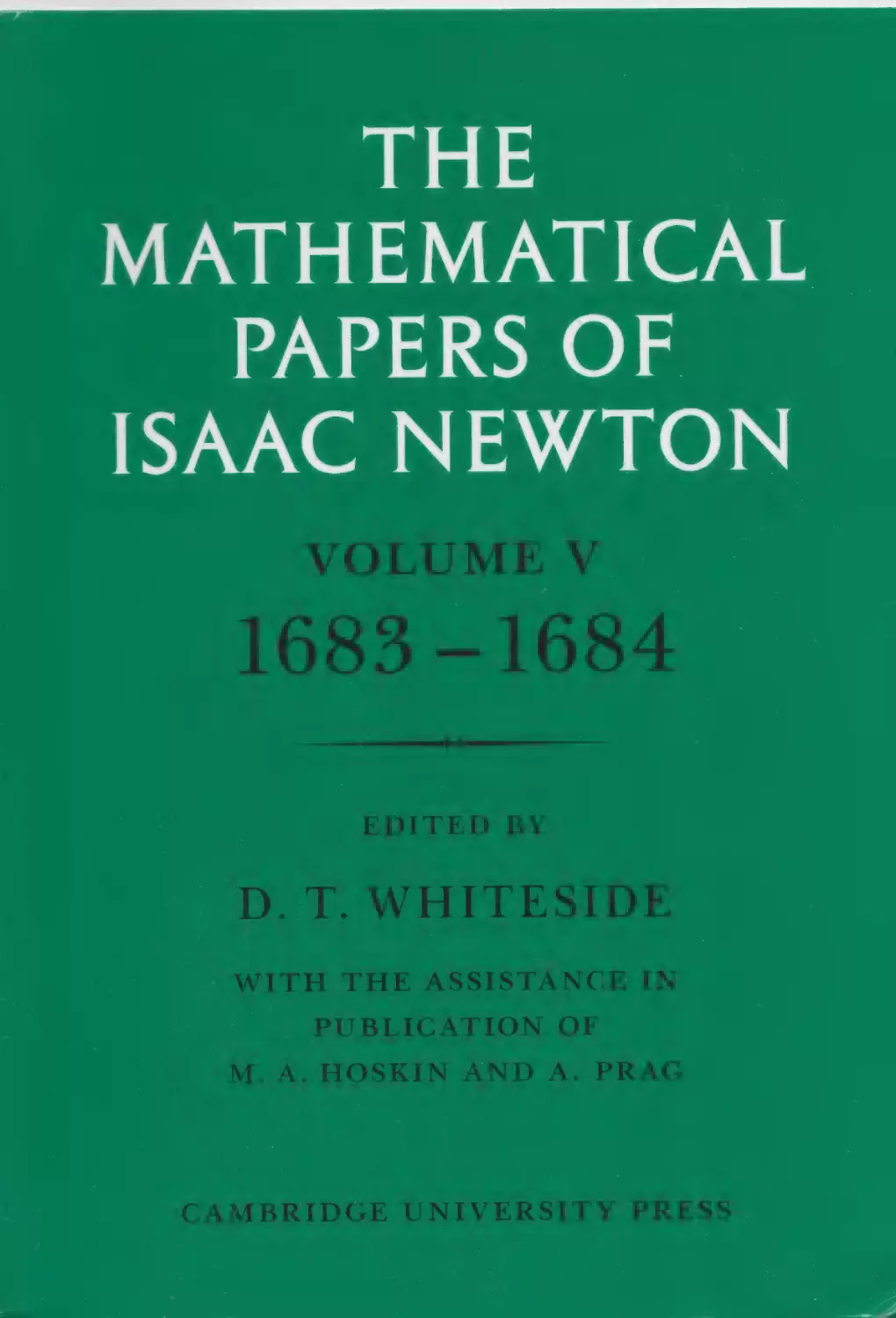


Автор: Whiteside D.T.
Теги: математический анализ история науки ньютон история математики
ISBN: 978-0-521-08262-4
Год: 1972


Текст
THE
D
MATHEMATICAL
PAPERS OF .
ISAAC NEWTON
THE
|
MATHEMATICAL PAPERS OF
ISAAC NEWTON
VOLUME V
1683-1684
o;
m
j#
^
e
Fo
CN
RI: x2 : à Eu
ut*ud f
*x3:
: ^
|, |
a
å at
: »> j
ORE
Daki
ISO
USO.
wea
VE
ORNA
EFESE
SURE
REANAE
XO
teAEE
A
aena
E
ae
DUE
R
Els
IVO,
UE
T
balan,
e A:34« fh
A mode
The ‘Arithmeticæ Universalis Liber primus’ (2, [1]).
THE
MATHEMATICAL
PAPERS
ISAAC NEWTON
VOLUME V
1683-1684
EDITED BY
D. T. WHITESIDE
WITH
THE ASSISTANCE IN PUBLICATION
M. A. HOSKIN AND A. PRAG
|
AT
CAMBRIDGE
THE
UNIVERSITY
1972
PRESS
OF
OF
CAMBRIDGE
UNIVERSITY PRESS
University Printing House, Cambridge cB2 8Bs, United Kingdom
Cambridge University Press is part of the University of Cambridge.
It furthers the University's mission by disseminating knowledge in the pursuit of
education, learning and research at the highest international levels of excellence.
www.cambridge.org
Information on this title: www.cambridge.org/9780521045841
Notes, commentary and transcriptions
© Cambridge University Press 1972
This publication is in copyright. Subject to statutory exception
and to the provisions of relevant collective licensing agreements,
no reproduction of any part may take place without the written
permission of Cambridge University Press.
First published 1972
First paperback edition 2008
A catalogue record for this publication is available from the British Library
ISBN 978-0-521-08262-4 Hardback
ISBN 978-0-521-04584-1 Paperback
ISBN
978-0-521-72054-0
Paperback Set (8 volumes)
Cambridge University Press has no responsibility for the persistence or accuracy
of URLs for external or third-party internet websites referred to in this publication,
and does not guarantee that any content on such websites is, or will remain,
accurate or appropriate.
TO ADOLPH
WHO
PAVLOVICH
FIRST INTRODUCED
THIS
YUSHKEVICH
TO RUSSIAN
EYES
PREFACE
This fifth volume of Newton's mathematical papers is largely devoted to reproducing the unfinished algebraic treatise which its author, soon after its
composition in the winter of 1683-4, deposited in Cambridge University
Library as the polished script of professorial lectures given out during the
previous decade, and which is traditionally (since William Whiston gave it this
title in 1707) known as his ‘Arithmetica Universalis’. Its autograph is now
presented for the first time in public in its original sequence, freed from a
number of accretions and transpositions incautiously introduced by Whiston
into his princeps edition, preceded by certain preliminary fragments, backed by
several unprinted ancillary documents elucidating and exploring points of
textual detail, and supplemented by an incomplete (and unpublished) ' Arithmetice Universalis Liber primus’ in which Newton began its radical revision.
When set against the wide variety of his contemporary interests as evinced in
the fourth volume, the narrowness of its theme is clearly but relative. In the
grand scheme of Newton's mathematical pursuits during his middle years at
Cambridge his algebraic studies play no dominating róle, and it is merely the
contingent dictate of a format unable to tolerate a single book of some 1300
large pages which now prevents their joint edition with his remaining papers
of the period 1674-84.
For allowing reproduction of the manuscripts here reproduced I am once |
more heavily indebted to the Librarian and Syndics of the University Library,
Cambridge, and also—in the case of three small items—to their equals in the
Bodleian and Christ Church, Oxford, and in the Royal Greenwich Observatory, Herstmonceux. Let me again, also, express my appreciation ofthe courtesy
and efficiency of the staff of the Anderson Room during the period in which the
content of this volume has been assembled. The very necessary financial support for its production continues to be generously provided by the Sloan
Foundation, the Leverhulme Trust, and the Master and Fellows of Trinity
College, Cambridge. Subsidy of a less tangible sort has come from Churchill
College, Cambridge, which has recently admitted me to its fellowship. To
Sir Harold Hartley, now at last retired from vigorous activity, my most grateful
thanks for all that he has done on my behalf over the years: I need not add that
the warmth of his encouragement remains undimmed.
My colleagues in this edition have again helped unstintingly in a variety of
ways to perfect the fine structure and technical detail of this work. Without all
their effort it would have been much the poorer. As before, Imay add, Dr M. A.
Hoskin has concerned himself more particularly with ensuring the accuracy of
the figures reproduced, while the index has been compiled by Mr A. Prag.
viii
Preface
To the Syndics of Cambridge University Press, finally, and to the University
Printer my continuing gratitude on behalf of the many who, editorially and in
design, printing and production, have joined their various talents and skills to
create yet one more book of consummate beauty.
D.T.W.
24 September 1971
EDITORIAL
NOTE
This volume narrowly follows the style of its predecessors, and for a more
elaborate discussion of the main conventions used we may refer the reader to
pages x-xiv of the first. It remains, as ever, our ideal tó be as completely faithful
to the lay-out of the manuscripts reproduced as the limits of page-size and
typographical format permit; in the present instance the prevailing good
quality of the autographs reset has, with one or two somewhat messy exceptions,
made that task a particularly simple one and we have taken minimal liberties
with the words and symbols written down by Newton. The text-figures reproduced have been slightly stylized and, in trivial cases, silently corrected, but
significant irregularities and misdrawings are nowhere eliminated in this way
without an accompanying explanation (in footnote) of the pertinent defect in
the original. As usual, all editorial insertion in the source text is made within
square brackets and introduced merely to smooth out trivial illogicalities and
slips of Newton's pen which it would be out of balance to stress. We have, within
the confines of modern fluency and idiom, kept the English translations (mostly
on right-hand pages facing their Latin originals, but sometimes accompanying
the latter in footnote) deliberately literal, conceiving our primary purpose to be
the clarification and illumination of the Latin text rather than the contriving
and polishing of an elegant paraphrase. For both backwards and forwards
reference within the present volume we use the formulas ‘1, 2, §1’ (by which
understand ' [Part] 1, [Section] 2, [Subsection] 1°) and ‘2, [2]’ (understand
* [Part] 2, [Division] 2"). Citations of earlier volumes are throughout made by
the code ‘rv: 274-82’, meaning ‘[ Volume] tv: [pages] 274-82’. In both Latin
and English texts two thick vertical bars in the left margin denote that the
lines alongside are cancelled in the original: this symbol must not be confused
with the two thin strokes ‘||’ (invariably accompanied in the margin alongside
by a twin sign, followed by the new page number in square brackets) here used
in our reproduction of the main text of the ‘Arithmetica’ (1, 2, $1) to mark a
division in the manuscript's paging at the point so marked. It should be clear
throughout that the frequent citations of ‘Newton’s pages’ are keyed to those
of the manuscript ‘Arithmetica’ thus distinguished, and in no case to the pagination of the present volume. A few non-standard mathematical symbols used
by Newton are explained in appropriate footnotes.
GENERAL
INTRODUCTION
In this fifth volume we reproduce, in complement to the miscellany of researches
comprehended in the fourth, the extant record of Newton's algebraic studies
during the ten years from 1673, culminating in the winter and spring of 1683-4
(or so we believe) in the much reworked but unfinished compilation which he
afterwards deposited in the Cambridge archives as his principal Lucasian
lectiones of the preceding decade. The text of these ninety-seven self-styled
‘lectures’—the accuracy of this description and, still more, of the chronology
which Newton sought to impose upon them in the margin of their manuscript
is very much open to query ?—fills the main bulk of the present tome. To it,
apart from a number of preliminary fragments, we have adjoined several short
related papers which amplify and illustrate certain passages and problems
within it, and have also set in sequel an incomplete ' Arithmeticz Universalis
Liber primus’ in which Newton began extensively to remodel it. As ever, into
the bare text of these pieces we have larded a considerable quantity of footnotes
which we hope will adequately explain pertinent points of technical and historical detail, and have also added on facing pages a line-by-line rendering of
Newton's Latin into modern English. To these two species of running commentary we optimistically refer requests for particular enlightenment. The
little we have been able to find out regarding the general background to these
papers—and in the case of the parent Arithmetica its subsequent printing history
and contemporary impact—is presented in preceding introductions, padded
out with certain conjectures we have dared tentatively to formulate in lieu of
any pertinent documentary evidence on matters at issue. The reader will make
his own mind up about the cogency and relevance of the latter.
Regretfully, the historical circumstance which led Newton to compile the
gist of his professorial lectures on ‘universal arithmetic’ is to us as shadowy as
the impulse which caused him peremptorily to leave off their revision a few
months later with so much still to do. In regard to the first we may reasonably
conjecture that pressure was in some manner put upon him in late 1683 to
fulfil, however tardily, his statutory obligation annually to deposit a fair copy
of ten of his lecture scripts,” and be all but sure that the arrival in Cambridge
the next spring of his young amanuensis Humphrey Newton, able to take over
from Isaac the dreary, time-consuming chore of rewriting his much cancelled
and corrected worksheets in legible and coherent form, gave him new heart to
(1) This point is discussed on pages 4-6 below.
(2) See m: xviii.
xil
General Introduction
codify and expand his previous mathematical investigations.® But these surmises remain as unproved (and essentially undemonstrable?) as the plausible
suggestion that it was Edmond Halley's famous first visit to Cambridge in the
late summer of 1684 to talk about the unsolved problem of elliptical planetary
motion? which provoked him abruptly to relinquish his restructuring of the
Arithmetica. We may guess still more tenuously that the appearance in mid-1685
of John Wallis’ voluminous Treatise of Algebra, Both Historical and Practical?
would have long deterred Newton from making any efforts to have his own
rival studies made publicly available. In later years, certainly, he grew increasingly soured with the often cumbersome computations and techniques of
Cartesian algebra—at one point, indeed (if we may believe David Gregory),
he qualified it as ‘the Analysis of the Bunglers in Mathematicks’®—and we
may be certain that his reluctance during 1705—6 to have Whiston edit the
deposited text of his algebraic lectures was not merely the manifestation of a
growing personal antagonism to his successor in the Lucasian chair.“ While,
however, there are already distinct traces in his Arithmetica of Newton's incipient preference for the elegance and logical deftness of the demonstrative
techniques of classical geometrical synthesis? this could surely have played no
major róle in his decision in 1684 to abandon his intended introduction to
algebra ‘for the use of academic youth '.9
(3) Compare 2, [1]: note (1) below. We have already observed (1v: 169, note (2)) that
Humphrey Newton was set to work almost straightaway on transcribing portions of Newton's
intended edition of St John Hare's “Trigonometria’, no doubt so that Newton himself might
press on with the revision of his Lucasian lectiones as well as be able to devote more time to the
chemical experiments he was then busy making in his Trinity elaboratory (on which see
note (12)).
(4) See 1v: xx and 657, note (4).
(5) Itseems unlikely that Newton had any detailed knowledge of the content of Wallis’ book
before its publication (compare rv: 416, note (30)), though he would probably already have
been sent a copy of the Proposal about Printing a Treatise of Algebra which Wallis circulated in
1683 (see 1v: 413, note (20)).
(6) A stray note in Gregory's diary, dated *May 1708' (Christ Church College, Oxford.
MS 346: 96, first published by W. G. Hiscock in his David Gregory, Isaac Newton and their Circle.
Extracts from David Gregory's Memoranda 1697—1708 (Oxford, 1937) :42).
(7) Whiston's róle in preparing the editio princeps of Newton's lectures for publication during
1705—6 (as the anonymously authored Arithmetica Universalis; sive De Compositione et Resolutione
Arithmetica Liber) is discussed on pages 8-12 below.
(8) See 1, 2, $1: Newton's pages 130—4 and (more forcefully) 214-15, 242.
(9) ‘In Usum Juventutis Academice’ (Whiston's subtitle to his 1707 princeps edition of
Newton's Arithmetica).
(10) See rv: xi-xiii, xvii-xix.
(11) John Conduitt in the ‘Memoirs of Sir Isaac Newton’ which he drafted for Fontenelle
in late 1727 (King's College, Cambridge. Keynes MS 129 (A): 15-16, first published by
Edmund Turnor in his Collections for the History of the Town and Soke of Grantham (London, 1806) :
163; on Conduitt's ‘Memoirs’ see 1: 3, note (2)). In a partially cancelled preliminary passage
(ibid. MS 129 (B): 11-12) Conduitt earlier wrote that ‘He used to write down any thoughts
General Introduction
xiii
We see no good reason to modify the pen-picture which we have already
sketched of Newton's character and interests at this period of his life, one
approaching near enough the traditional view that
At the University he spent the greatest part of his time in his closet & when he was
tired with his severer studies of Philosophy his only releif & amusement was going to
some other study as History Chronology Divinity & Chymistry;; all w he examined &
searched thoroughly as appears by the many papers he has left on those subjects,.. . &
he was hardly ever alone without a pen in his hand & a book before him,"
though we should never stress his stern bookishness and personal isolation to
the total exclusion of good humour and social amicability, rarely manifested
in him though they might have been. Whether or not Conduitt's present
reference to the intensity of Newton's studies at this time in biblical chronology
and divinity are wholly valid, the numerous dated entries in his contemporary
papers and notebooks!? indelibly underline the profusion and depth of his
chemical (and alchemical) researches in the early 1680's. On the variegated
quality and abundance of his companion explorations of mathematical topics
we need not here insist, though in hindsight we may, with regard to the unexciting and far from novel nature of so many of Newton's professorial lectures
on algebra, agree with Rigaud that, whereas
Newton lecturing on his discoveries in Physics and Optics?!? only conveys to us the
idea of the instructor of mankind opening the paths of knowledge to those, who were
most immediately connected with him;...there is something melancholy in the thought
of such a man's time being taken up in teaching the elements of Mathematics.
w*^ occurred upon the books he was reading, & made large abstracts of them, & has left
behind him many rheams of loose papers being foul draughts of his Mathematical treatises &
Chronology & abstracts of the history. The volumes of foul papers he has left behind besides
many he burnt. . . not long before he died [compare 1: x], some of w*^ are the same thing writt
over five or six times,...shew his patience & perseverance in the several studies he was
pursuing"
(12) Notably ULC. Add. 3973 and 3975. These are discussed at some length by A. R. and
M. B. Hall in * Newton's Chemical Experiments’, Archives Internationales d?Histoire des Sciences,
11, 1958: 113-52.
(13) Rigaud refers obliquely to the manuscripts deposited by Newton in Cambridge University Library as the polished record of his optical and dynamical lectures during 1670-3 and
1684-5 (now ULC. Dd. 9. 67 and Dd. 9. 46 respectively). Mathematical extracts from the
former (published posthumously in 1728 as his Lectiones Optice, Annis MDCLXIX, MDCLXX
& MDCLXXI In Scholis publicis habite) have been printed in 111: 474—512 and 544-9, while much
of the latter (comprehending portions of two preliminary states of what was later to appear as
Liber I of Newton's Philosophie Naturalis Principia Mathematica in 1687) will be reproduced in
the sixth volume.
(14) Stephen Peter Rigaud, Historical Essay on the First Publication of Sir Isaac Newton’s
Principia (Oxford, 1838) : 97, note e. He went on: ‘The beginning of the Arithmetica Universalis
is of this kind; but so much of the work is taken up with higher speculations, that we are
reconciled to what seems only introductory to them... . Flamsteed ([Baily] p. 166) could taunt
xlv
General Introduction
But, of course, we must remember that such introductory instruction—and not
the creative research for which Newton was so supremely fitted—was the prime
purpose for which the Lucasian chair had been founded? and that he had a
legal and moral duty to undertake it from time to time. If only he had been a
good teacher with a realistic understanding of the near-total mathematical
incapacity of the few undergraduates who even bothered to attend his lectures,
this abiding impression that he here all but wasted the valuable hours it took
him to pen them would not have been so strong. It is one of the ironies of his
posthumous appreciation that the printed version of his Arithmetica was to
become his most often read and republished mathematical work, while his
more advanced papers on calculus and analytical geometry were relatively
little studied or even ignored by the world at large till the present day. Such is
fame.
The even tenor and obscurity of these uneventful middle Cambridge years
were very soon to change. We have already suggested?9 that the ‘Matheseos
Universalis Specimina Mathematica’ and its sequel ‘De Computo Serierum’
on which Newton was working during July and early August of 1684 were
summarily abandoned after Halley paid his celebrated visit to Newton, seeking
—successfully—to divert his attention to the dynamics of planetary motion.
Significantly, his chemical researches at this period were equally suddenly
broken off for almost two years." With those few crowded intervening months,
during which he composed the various preliminary states of his mighty Principia,
we shall, in a mathematical way, be extensively concerned in the next volume.
Let us now, meanwhile, pass without further ado to the reproduced record of
his algebraic studies during the previous decade.
him with reading * mathematics for a salary at Cambridge"; as if any thing but a deep sense
of public duty could have induced him to undergo such unworthy drudgery.' (Compare Francis
Baily, An Account of the Rev’. John Flamsteed (London, 1835): 166, where quotation is made of
Newton’s curt remark to Flamsteed on 6 January 1698/9 [ = Correspondence of Sir Isaac Newton, 4,
1967 :296—7] that ‘I do not love to be printed upon every occasion much less to be dunned &
teezed by forreigners about Mathematical things or thought by our own people to be trifling
away my time about them when I should be about y* Kings business’, and of Flamsteed’s note
upon the letter at this point: ‘Was M" Newton a trifler when he read Mathematicks for a sallery
at Cambridge[?]'.)
(15) The pertinent phrase in the professorial statutes (reproduced on I: xx-xxv) is
*,..promovendis...studijs mathematicis. [in dicta Academia]’ (ibid.: xxi), an ‘officium’
further defined (ibid.: xxii) as that ‘horum studiorum quà publice, quà privatim excolendorum °,
(16) See iv: xx, 418-19.
(17) The last entry in his chemical notebook till 26 April 1686 is a short one, terminating a
crowded series of jottings over the previous winter and spring: ‘Friday May 23 [1684]. Jovem
super aquilà volare feci....' (ULC. Add. 3975: 149-50). Understand, in conventional
alchemical parlance of the period, that Newton added ‘Jupiter’ [—stannum or tin] to ‘eagle’
[=sal armoniacum, in the present instance perhaps a sublimate of mercury] to produce an
appropriately volatile compound.
ANALYTICAL TABLE
OF CONTENTS
page vii
PREFACE
EDITORIAL
GENERAL
LIST
ix
NOTE
xi
INTRODUCTION
xxlii
OF PLATES
PART
THE
1
DEPOSITED LUCASIAN
ON ALGEBRA
LECTURES
(Winter 1683-1684)
INTRODUCTION
3
Newton's previous researches into algebra: his concept of a ‘universal arithmetick’ mirroring
the structure of common (particularized) arithmetic and geometry, 4. The marginal chronology imposed by him on the deposited autograph ‘copy’ of his professorial lectiones, though
broadly acceptable, is suspect in detail, 5. No contemporary reaction to the lectures as given
is recorded, but must have been minimal, 6. Renewed interest in the manuscript from 1700:
Cotes’ undergraduate transcription,
7. During 1705-6 Whiston edits the deposited text for
publication, 9. Newton is much concerned that an unfinished, perhaps already obsolescent
work of his should appear in public without his being allowed to revise it, 11. The 1707 editio
princeps under (Newton’s?) title of Arithmetica Universalis; sive De Compositione et Resolutione
Arithmetica Liber: a last-minute ‘Lectori S.’ points to certain deficiencies in its typography,
evidently at Newton’s instruction, 12. The revisions and excisions to be made in its re-edition,
as listed by Newton in his library copy, 13. The edition has little initial impact in Britain, 15.
On the continent Leibniz is much intrigued and, finding difficulty with the section on
factorization, seeks help from Johann Bernoulli and Jakob Hermann in his recension of the
book, 16. Raphson’s English translation of the Arithmetica (1720) and Newton’s (unattributed)
second Latin edition (1722) create a wave of interest in Newtonian algebra, 17. Posthumous
editions of the Arithmetica, 18. Extant fragments pertaining to Newton’s lectures on algebra:
the ‘paper’ given by him to Flamsteed in ‘Midsummer 1674’ and other minor drafts, 19. ‘The
‘synthetic resolution of problems in my lectures’: later extensions of particular problems (to
the general theory of the loaded string and the computation of cometary orbits in Wren’s
rectilinear hypothesis), 20.
APPENDIX l. ‘W[histon]’s’ preface to the 1707 editio princeps. Certain exaggerations (stemming
from Newton?) are identified, 21.
APPENDIX 2. Leibniz’ review of the Arithmetica (in Acta Eruditorum, November 1708). Prior
emphasis is placed on Newton's rules for factorizing given equations, 24. On his modified
Cartesian technique for determining roots of surd binomials, 26. On his algorithm for delimiting the number of complex roots possessed by an equation, 28. And on his technique for
Xvi
Analytical Table of Contents
resolving a quartic algebraic polynomial into ‘surd’ quadratic factors, 29. His concluding
remarks support Newton’s criterion of geometrical (in contrast to algebraic) ‘simplicity’ in
constructing the real roots of cubics by intersecting conics or equivalent conchoidal neusis, 30.
l. PRELIMINARY
NOTES
AND
DRAFTS
FOR
THE
‘ARITHMETIGA’
32
$1 (Royal Greenwich Observatory. Flamsteed MS 42 [front insert]). Newton’s ‘paper’ of
notes for a lecture in ‘Midsummer 1674’ (later allotted in the deposited copy to ‘October’
and there split between two consecutive lectiones). The text on ‘refining’ simple algebraic
equations into standard form then given to Flamsteed, 32.
$2 (ULC. Add. 3964. 2: 5'-6"). Delimitation of the roots of equations and their factorization. Representing the real roots of an equation *on a chart' as the meet(s) of a base line
with the Cartesian curve defined by it: ‘impossible roots are usually expressed by folds in
the curve’, 34. All (rational) roots of an equation are divisors of its lowest term: testing for
integral roots on this basis, 36. Numbers which, when substituted in an equation, yield
partial sums which are all positive or all negative are limits to its roots, 38. The familiar
(equivalent) Newtonian ‘derivative’ test, 40. Finding linear factors of a given ‘equation’
with numerical coefficients by substituting numbers in algebraic progression and then
seeking to determine divisors of the resulting values which have a constant difference, 42.
Simple cubic, quartic and quintic examples, 44. Extension of the technique to locating
quadratic factors by a similar finite-difference algorithm: instanced in a quartic and a
quintic, 46.
$3 (ULC. Add. 3959. 3: 237). Newton's derivation of the ‘Heronian’ formula for a triangle’s
area in terms of its sides. The geometrical construction demonstrated, 50.
2. THE
COPY
DEPOSITED
IN
THE
CAMBRIDGE
ARCHIVES
54
§1 (ULC, Dd. 9. 68: 1-251). The main text. Algebra is arithmetic universalized by the
introduction of ‘specious’ (free) variables in place of constants: in the solution of problems
it excels in the analysis which precedes their (synthetic) composition, 54. Newton defines
the notations he will employ: comma, point and ‘angle’ decimal separatrixes, 56. Algebraic
positives and negatives: the signs +, — and + (F), 58. Multiplicative combination by a
comma or the symbols x or ‘in’, 60. The fraction-bar and bracket used to denote division:
radical signs, and those for equality and proportion, 62. The operation of algebraic addition
(modelled on its arithmetical equivalent), 64. More complicated examples, 68. Algebraic
subtraction (likewise styled on the arithmetical) : examples, 70. Arithmetical multiplication
of decimals, 72. The analogous algebraic operation exemplified, 74. Arithmetical division
of decimals, 76. Simple algebraic equivalents, 80. The procedure exemplified in more
complicated instances, 82. ‘There are other methods, but this is easiest’, 86. Extraction of
a (non-terminating) arithmetical square root, 88. And of cube and fifth roots, 94. The
equivalent algebraic technique exemplified, 96. The reduction of algebraic fractions to
least terms, 100. And to a common denominator, 104. The reduction of algebraic radicals
to their least terms, 106. And to a common denomination, 108.
The algebraic equation: listing its canonical forms, 110. Seven rules for ‘refining’ single
equations to standard form (with all terms on one side equal to zero on the other): first, by
elimination of fractions, 112. Next, by squaring (or cubing) to eliminate radicals, 114. And
by removal of a common factor, or (rarely) by extracting roots: the general solution of a
quadratic equation, 116. Elimination of unknowns between two or more equations given
simultaneously, 118. Simple cases (reduced by equation or direct substitution) where one
unknown is of first power only, 120. A (complicated) general technique of elimination, 122.
Typical short cuts sometimes possible, 124. Four formulas for eliminating an unknown
Analytical Table of Contents
xvii
between given quadratic, cubic and quartic equations, two by two, 126. Elimination of
surd quantities from equations (by appropriate reordering and then squaring or cubing),
128.
‘How any question is to be reduced to an equation.’ As many (independent) equations
are to be deduced from the conditions of the problem as there are unknowns: two arithmetical examples, 130. In such arithmetical cases translation into algebraic ‘language’ is
straightforward, 132. Seventeen worked arithmetical ‘questions’ (partly taken from
Kinckhuysen and Schooten): Problems 1-3 relate to quantities satisfying simple numerical
conditions, 134. Problems 4 and 5 invoke simple money-distribution and time-of-journey
conditions, 136. The latter generalized, 138. Problems 6 and 7: work done jointly by
‘agents’, 140. Problem 8: compounding substances to derive a mix in given proportion,
142. Problems 9 and 10: the mix to have a given cost or specific gravity (Hiero’s crown),
144, Problem 11: pasturing cattle on grass which grows at a given rate till eaten, 146.
Problem 12: motions of colliding spheres after impact, 148. Problem 13 (cancelled):
Kinckhuysen’s horse-sale puzzle, 150. Problems 14 and 15: two numerical questions (from
Kinckhuysen), 152. Problem 16: the general problem of four continued proportionals whose
sum and square sum are given, 154. Problem 17: the purchase price of a 5-year annuity
(solution of the resulting quintic is referred to subsequent regule not in the extant manuscript), 156.
‘How given problems are to be reduced to an equation.’ The ‘translation’ of geometrical relationships into algebraic equivalents, 158. The same derived algebraic equation
can be used to achieve solutions to a variety of related problems, 160. The prime necessity is
to find an algebraic rendering which isomorphically models the structure of a problem, not
to worry about deducing one particular quantity from another: Schooten’s problem of a
quadrilateral inscribed in a semicircle is introduced to serve as a running illustration, 162.
Euclidean propositions useful to this end, 164. T'heir application to Schooten's problem,
168. No distinction to be made between known and unknown quantities in the algebraic
translation, 170. Reducing the algebraic equivalent to a single equation, 172. Different
avenues of approach lead to the same resolvent equation, 174. Algebraic reduction will be
much simplified if the problem itself is neatly defined, 178. The use of Cartesian techniques
of analytical geometry: illustrated by finding the intersection of a straight line with a kappa
curve, 180. And with an ellipse, 182.
In further illustration Newton works through sixty-one geometrical ‘questions’ (reordered
into sequence of difficulty in his 1722 Latin revise), 184. Problems 1-6: algebraic determination of altitudes, base-segments, sides and areas in given triangles, 186. Problems 7-8:
similar computation of the diagonal of a parallelogram (given its sides and the second
diagonal), and of the sides of a quadrilateral (given its angles, perimeter and area), 192.
Problem 9: Schooten's fish-pond promenade, 194. Problem 10: to cut off a given area in
an angle by a transversal through a given point, 196. Problem 11: intersections of a bipolar
locus (Apollonius! circle, hyperbola,...) with a line, 198. Problem 12: a determinate
variant on Descartes' construction of the Greek 4-line locus, 200. Problem 13: the Apollonian 'inclination' of a line-segment through the corner of a square and to lie in the angle
of its opposite sides, 202. Pertinent remarks on choosing as algebraic variable line-lengths
which are 'similarly' related to pairs of points or lines in the geometrical problem:
Lagrange's criticism that this implies foreknowledge of the form of the solution, 204.
Problem 14: to set off a parabolic chord of given length through a given point, 206.
Problem 15: the Newtonian geometrical model for angle-section, and the algebraic
equations deriving therefrom, 208. Problem 16: from three observations, to fix the position
of a comet moving uniformly along a straight line of given inclination, 210. Problem 17:
to find the principal focus of rays issuing from a point and refracted at a spherical interface,
212. Problem 18: the Cartesian defining equation of a plane section of a right circular cone,
214. Problem 19: the equation of a plane section of a hyperboloid of revolution (Newton
b
WMC
xviii
Analytical Table of Contents
anticipates Sluse and Towneley),216. Problem 20: the equation of the locus (a cissoid) of the
mid-point of one ‘leg’ of a ‘sector’ moving along a line, where the other leg is through a
given pole, 218. Problem 21: the locus (an ellipse) of a point fixed in a line-segment moving
in a given angle, 220. Problem 22: the locus (also an ellipse) ofa point fixed in the segment's
(moving) plane, 222. Problem 23: the ‘Heronian’ rule relating a triangle's area to its sides,
and derived trigonometrical formulas, 224. Problem 24: the Cartesian equation of a conic
derived from its generalized focus-directrix definition, 226. Problem 25: that of the
(hyperbolic) locus which divides an angle's general transversal, inclined through a given
point, in a given ratio, 228. Problem 26: that of an Apollonius' circle, 230. Problems 27/8:
fixing a point whose distances from three lines/points are in given ratio, 230-2. Problems 29/
30: determining a triangle whose sides and altitude are in arithmetical/geometrical progression, 234—6. Problem 31: determining a triangle, given its altitude and that its base is
the arithmetic mean of its (inclined) sides, 238. Problem 32: to construct a transversal to
three given lines, given that its intercepts shall be of given length, 240. Problem 33: to
incline a line-segment in an angle so as to touch a given circle, 240. Problem 34: determination in a plane interface of the point at which a light-ray passing between given points
is refracted, 242. Problem 35: the (hyperbolic) locus of the vertex of a triangle whose base
angles have a given difference, 244. * The same more shortly' (by choosing a better baseline in retrospect), 248. Problem 36: the (cubic) locus of the vertex of a triangle, one of
whose base angles differs from twice the other by a given amount, 250. The degenerate
Pappus locus (a hyperbola) when the difference is nil, 252. Problems 37-41: cases of
Apollonius’ problem of circle tangencies. To draw a circle through two points to touch a
given line, 252... through a point to touch two lines, 254.. . . through two points to touch
a second circle, 256... through a point to touch a line and a second circle, 258. And hence
(Viéte's reduction) to touch a line and two given circles, 260... through a point to touch
two other circles (Newton's solution is wholly geometrical), 262. And hence (Viéte) to
touch three other circles, 264. Problem 42: the Descartes-Schooten problem of determining the latitude and solar declination for which three ‘staves’ of given height shall
(in a polar region) cast an (elliptical) shadow of given proportion, 266. The ‘first part of
the analysis’ (despite minor differences, structurally the same as Descartes’), 270. The
“second part’: Descartes’ solution is obtained in improved form, 274. Problem 43: weights
in (oblique) equilibrium round a (frictionless) pin, 278. Problem 44: a weighted string
obliquely balances two weights, each round a pin, 282. The shape assumed by a (weightless) string rigidly attached at its end-points and supporting weights at two points: Newton
will later (see Appendix 2) derive from this the differential equation of the generally loaded
string, 284. Problem 45: to compute the depth of a well by determining the time between
a stone's release and the returning sound of its striking the bottom, 286. Problems 46-9:
determininga triangle given various combinations ofits sides and altitude, 286-92. Problem
50: construction of a rectilinear configuration determined by the equality of two of its
angles, 294. Problem 51 (an early version of Problem 23): to ascertain the angles and area
of a triangle, given its sides, 296. Problem 52: given four timed angular observations of it
(from the orbiting earth), to fix a comet's (solar) orbit in Wren's hypothesis that it moves
uniformly in a straight line, 298. The possibility (raised independently by Huygens and
Boscovich) that it is effectively indeterminate, 302. Problem 53: the Cartesian equation of
the (conic) locus described ‘organically’ from a rectilinear describend, 304. Problem 54:
construction of a parabola through four points by determining its Cartesian equation, 306.
Problems 55-7 : the geometrical construction ofa conic through five points, 308.. . . through
four points, touching a given line at one of them, 310.. . through three points, touching
given lines at two of them, 312. Their construction by Cartesian algebraical techniques (in
the latter two problems the condition of tangency is rendered by determining the ‘last’
ratios of vanishing quantities ab initio), 314-20. Problem 58: determining the motion of a
spherical globe, bounding back from a wall after colliding with a second globe so as to hit
Analytical Table of Contents
xix
this again, 322. Problem 59: where two globes, simultaneously released, fall under simple
gravity in the same vertical, to find the point at which one, after colliding with the base,
meets the second in its rebound, 324. Problem 60: computing the distance apart of these
two globes when they are released
at differing times, 328. Problem 61: computation of the
distance of collision of one of these globes perpetually rebounding from the base to strike
the other (as it descends) and recoiling back again to the base, 332.
‘How equations [reduced to numerical form] are to be resolved.’ The roots of an equation: possibility of multiple (real) roots, 338. ‘An equation can have as many roots as it has
dimensions, and no more’, 340. Positive, negative and ‘impossible’ roots, 342. Real roots
of the derived algebraic equation do not necessarily (because of some limitation) yield a
corresponding solution to a problem, 344. Bounding the number of positive/negative roots
by the Cartesian rule of signs, 346. Newton's (incomplete) rule for bounding the number of
complex roots, 348. Hiscomplete rule (distinguishing ‘ positive’ from ‘negative’ impossibles),
350. Transmuting an equation by changing the sign of its roots, and by increasing or
diminishing them by a given quantity, 352. Eliminating first or second terms from an
equation by this means, 354. Multiplying and dividing the roots: removing radical roots
in this way, 356. The ‘generation’ of equations by multiplying linear factors together: their
coefficients as homogeneous functions of the roots, 360. Delimiting the bounds of the roots:
the generalized root-squaring method and a related Newtonian technique, 362. Further
ingenious (but highly impractical) corollaries, 364. The Newtonian ‘derivative’ test, 366.
Determining rational roots of a numerical equation by finding its factors, 368. Isolating
linear factors by substituting a sequence of numbers in arithmetical progression and (by
inspection) discerning a related sequence of divisors of the resulting quantities whose (first)
differences are constant: instanced in a cubic, 370. Quartic and quintic examples, 372.
Extension of this finite-difference technique to determining quadratic factors, 374.
Exemplified in equations of fourth, fifth and seventh degree, 376. The technique can be
further extended to finding higher-order factors (but this is not for the novice), 378. The
technique applied to literal equations, 380. Examples, 382. The (occasionally) simpler
technique of determining highest common factors of components of an equation, 384.
Exemplified, 386. Newton’s procedure for deriving ‘surd’ factors (when they exist) of
equations of even dimension: the quartic case, 388. An example is worked, 390. ‘Literal
equations also are reduced by the same method’: an instance, 392. The technique is valid
in determining rational factors also: a quartic example is worked, 394. The analogous
procedure for determining ‘surd’ cubic factors of a sextic: an instance, 396. The extension
to equations of eight, ten and twelve dimensions is outlined, 400. And the case of the octic
elaborated, 402. An example, 404. Analogous procedures for ‘cubic-surd’ factorization of
polynomials is here neglected as being rarely of use, 408. ‘Well-known’ special resolutions:
the Cardan solution of the reduced cubic, 408. The ‘impossible’ case (all three roots real),
involving cube roots of complex binomials, is intractable by algebraic methods not admitting these, 410. The Cartesian solution of the reduced quartic, splitting it into a pair of
quadratics by means of an auxiliary cubic, 412. A worked example, 414. The (Euclidean)
extraction of the square root of a surd binomial: a shorter way which may sometimes be
used, 416. Newton's refinement (still not universally valid, as Euler later showed) of the
Descartes- Waessenaer rule for extracting its cube root (when possible) : examples, 418-20.
‘The linear construction of equations’: since, once it is known roughly, exact numerical
computation of an equation's root is easy, geometrical constructions for effecting its
approximate determination are appended, 420—90. Types of curve (straight line, circle and
the conics) admitted by the ancients into (‘plane’ and ‘solid’) geometry, 422. The recent
acceptance of all (algebraic) curves which can be defined by a Cartesian equation, and
their classification by the latter's dimension: this is, however, no true index of their geometrical ‘simplicity’ (where ease of construction, not definability, is paramount), 424.
Hence the (transcendental) cycloid ought to be employed in angle-section in preference to
b-2
XX
Analytical Table of Contents
complicated algebraic curves, 426. On this basis Newton urges the superiority of the
Archimedean trisection by a conchoidal neusis: ‘equations belong to arithmetical computation and have no place in geometry,’ 428. A rectilinear conchoidal neusis is constructable
by the meets ofa circle and hyperbola, 430. But the neusis is itself easier (approximately) to
effect: whence Newton prefers to construct cubic and quartic problems by its aid, rather
than by intersecting conics, 432. The equation x?-- gx+r = 0 constructed by such a neusis,
434. Analogous construction of x? + px?+r = 0, 436. A conchoidal neusis used to construct
the full cubic, 438. Proof of the method, 440. An equivalent circular neusis used to construct
x84+qx+r = 0, 442. Its demonstration, 444-6. Analogous construction of x*+px2+r = 0,
448. A variant circular neusis constructs the full cubic, 450. Its proof, 452-4. All these
neusis constructions are effectable by explicitly drawing a conchoid, 454. The rectilinear
neusis applied to insert two mean proportionals (essentially mirrors Nicomedes’ neusis),
456. Equivalent employment of a circular neusis (unconsciously(?) following Viéte), 458.
The circular neusis used to trisect an angle, 458-60. The equivalent rectilinear neusis
(Pappus’), 460. The minimally variant Archimedean trisection by a circular neusis, 462.
A variant circular neusis used to insert two mean proportionals, 464. The cissoid (traced
in Newtonian style by the mid-point of one ‘leg’ of a ‘sector’ moving on a line, while the
other leg is perpetually inclined through a pole) used to the same purpose, 464—6. Construction (bungled) of the cubic x? + px? — qx +r = 0 by the general cissoidal locus of an arbitrary
point in the sector's leg, 466. The importance of ‘mechanical ease’ in geometrical construction, 468-70. The admission into geometry of curves classified according to the
dimension of their Cartesian equation is arbitrary: the contrary (Greek) distinction of
‘plane’ loci (straight lines/circles) from ‘solid’ ones (conics) is geometrically more realistic
than, by reason of the identity of their algebraic degree, to list circles and conics together,
470-2. Constructions employing conics are not intrinsically superior to ones using (algebraically) higher curves, 474. The parabola is geometrically less simple than the ellipse,
and still less so than the circle, even though its Cartesian equation is simplest, 476. The full
cubic equation solved by determining the meets of a circle and ellipse (constructed by a
trammel), 476-8. Demonstration of this, 478-82. The ellipse may be replaced by a hyperbola or parabola, 484. An equivalent construction by a circle and fixed ellipse (by
homothety), 486-8. Again, the ellipse may be replaced by a hyperbola or parabola, 488.
The method applied to insert two mean proportionals, 490.
$2 (ULC. Dd. 9. 68: 253-68). Newton's ‘corrections’ to the main text. [1] An augmented
section ‘on notation’, 492-500. A geometrical model of multiplication (by similarity of
triangles), 494. The analogous model for division, 496. Construction of the geometrical
mean (by a semicircle), 498. [2] The ‘finding of divisors’ (a little variant preliminary
draft): ‘equations’ are here named ‘quantities’, 500—4. [3] ‘The reduction of radicals by
the extraction of roots’ (again a preliminary draft) : Newton’s refined Euclidean/Cartesian
methods for extracting the square/cube roots of a surd binomial, 506-8.
$3 (ULC. Add. 3963. 17/1"). The synthetic resolution of certain (geometrical) problems ‘in
my lectures’. Those of Problems 1, 3 and 4 are immediate: that of Problem 6 is (by oversight) circular, 508-10. That of Problem 9 is a straightforward geometrical recasting of the
previous algebraic solution, 510-12. The resolution of Problem 10 has a lacuna (and to fill
it requires a circuitous argument): that of Problem 13 is taken over from Newton’s Waste
Book, 512. Problem 32 is given an elegant Euclidean solution: Problem [52?] is merely
enunciated, 514. A neat (but, in context, irrelevant) equant model of planetary motion in
an ellipse round a solar focus, 514-16.
APPENDIX l (Bodleian. MS New College 361. 3: 2”). Two draft outlines of Newton's
technique for eliminating an unknown between two given cubic equations, 518/519.
Analytical Table of Contents
xxi
APPENDIX 2 (ULC. Add. 3965. 13: 375"). The theory of the generally loaded string
hanging under simple gravity (derived c. 1720 from the addendum to Problem 44).
[1] The form of a (weightless) string loaded at one or more of its points, 520-1. Extension
(independently of Huygens) to the continuous case: the suspension bridge (Huygens)/
catenary (the Bernoullis, Leibniz) as particular instances of uniform (horizontal/longitudinal) loading, 521. [2] A slightly augmented revise.
APPENDIX 3. Attempted computations of a cometary path in Wren’s hypothesis
(Problem 52) that this is a uniformly traversed straight line. [1] (ULC. Add. 3965. 14:
5897). A first essay at fixing the orbit of the 1680/1 comet: the four sightings (taken too far
apart) yield an impossible site, 524-7. [2] (ULC. Add. 3965. 14: 5877). Revised computation of the 1680/1 comet: narrower sightings yield a more realistic path, 528-9. [3] (ULC.
Add. 3965. 11: 155"). Outline of an algebraic solution of the general problem, 530-1.
APPENDIX 4 (ULC. Add. 3970. 3: 570’). Draft computations for an unidentified geometrical problem: a related figure is (uniquely?) restored, 532.
PART
THE
‘ARITHMETIC&Z
2
UNIVERSALIS
LIBER
PRIMUS’
(1684)
INTRODUCTION
535
The extent of Humphrey Newton’s secretarial help in preparing the manuscript: identification
of the principal passages in the parent Arithmetica subsumed into it, 535. Conjectures regarding
Newton’s intentions in the unwritten portion of the planned text, 536. The much amplified
Newtonian ‘Rule of brothers’, 537.
THE
‘FIRST
BOOK
OF
UNIVERSAL
ARITHMETIC’
538
[1] (ULC. Add. 3993: 1-93). The main text. The lightly revised opening, 538. ‘On
notation’ (all but identical with its parent), 540-6. Following sections on addition, subtraction, multiplication and division (only trivially changed) are here omitted: the few
variants are given in footnotes, 546. ‘The finding of divisors’ (largely unaltered, but a few
changes are made in its central portion), 546-54. ‘Extraction of roots’ (again mostly here
omitted as trivially variant), 554. ‘The reduction of fractions and radicals’ (condenses and
lightly revises equivalent passages in the parent Arithmetica), 554—60. ‘An equation and its
roots’ (much reworked from its preceding ‘De forma Aiquationis’), 560-2. ‘The finding
of equations’: its opening refashions a corresponding passage in the parent text on reducing
arithmetical ‘ questions’ to algebraic equations, 564. In illustration Newton works at length
seven arithmetical problems (all borrowed from the earlier Arithmetica), 566-72. Useful
points to remember in ‘translating’ a geometrical configuration into algebraic equations,
572-4. Five lengthy illustrative problems (all but one taken unchanged from the parent
text), 574-84. Problem 11: the classical 3-line locus makes its (disguised) Newtonian bow,
578. Problem 12: seven algebraic ‘modes’ of rendering Schooten's problem of a quadrilateral inscribed in a semicircle into equations, 580-4. ‘The reduction of equations’:
thirteen regule (four new) for effecting this by standard operations, 584-94. Refinements in
elimination between simultaneous equations, 590-2. Particular techniques of reduction
sometimes useful, 594. The regule applied to reducing the algebraic ‘translations’ of the
preceding problems to a single equation (the cubic which results in Problem 12 is not
solved), 596-602. The answers are listed, 602-4. Developing a ‘method’ of reducing to
algebraic equivalent which is skilful, elegant and concise, 604. An example (the merchant’s
xxii
Analytical Table of Contents
doubled profit once more) in illustration, 606. Twenty-one further (more sketchily worked)
examples: Problems 1-20, transcribed by Humphrey Newton from the parent text without
addition by Isaac, are here omitted, 608. Problem 21, the square case of Apollonius’
verging problem, is somewhat recast, but again illustrates Newton's rule of ‘ twins’, 608-10.
[2] (ULC. Add. 3963. 5: 407-417). The much amplified ‘Rule of brothers’. The refinement
which ensues in algebraic reduction from choosing as base variable one related ‘in the
same way’ to ‘twin’ magnitudes in a problem, 612. A simple instance in a class of triangle
problems, 612-14. A second example: the Apollonian verging problem yet again, 614.
A third: the (reduced) Apollonian circle-tangency problem, 616-18. Variant ways of
constructing its solution, 620.
APPENDIX (ULC. Add. 3964. 3: 227/22"). The grading of problems by the degree of the
algebraic equations into which they 'translate' (in conflict with Newton's remarks in his
Arithmetica), 622. Simple instances, 623. The grading equation must be in its simplest
possible form, 624.
INDEX
OF
NAMES
625
LIST
OF
PLAIES
The ‘Arithmeticæ Universalis Liber primus’ (2, [1])
|
I Plane sections of the right circular cone and one-sheet
hyperboloid of revolution (1, 2, $1)
II
III
IV
frontispiece
facing p. 218
A rectilinear cometary orbit constructed from four angular
observations (1, 2, $1)
298
Faulty construction of the cissoid of Diocles by a moving
angle (1, 2, $1)
466
Opening page of the ‘Regula Fratrum’ (2, [2])
612
PART
1
THE DEPOSITED
LUCASIAN LECTURES
ALGEBRA
(Winter 1683-1684)
ON
INTRODUCTION
At some undetermined time following(? the autumn of 1683 (when their final
‘Octob.’ series was delivered) Isaac Newton deposited in the University
archives, as the enduring record of his professorial teaching at Cambridge, the
corrected copy of ninety-seven purported ‘lectures’ on the foundations of
algebra and its application to the resolution of problems in arithmetic and
geometry by solving the equations which are their equivalent algebraic restatement. This deposited text we now reproduce? liberated from a number of
errors and accretions introduced by Whiston in his subsequent editio princeps,
lightly underpinning it with the few preliminary fragments known® and
annexing certain later amplifications.“
For a detailed listing, section by section, of the content of this central manuscript and its present appendages we may refer the reader to the analytical index
which precedes, while for our explanation of particular difficulties we direct him
to pertinent footnotes at appropriate points in sequel. In broad outline it
derives partly (in its discussion of the elemental algebraic operations and of the
reduction and exact solution of equations) from Newton’s earlier, unpublished
on the introduction to Cartesian algebra presented by Gerard
‘Observations’
Kinckhuysen in his 1661 Stelkonst, partly (in its techniques for delimiting the
number and nature, real or complex, of the roots of equations and for reducing
these by factorization) from his own independent researches as a young postgraduate student into the theory of equations, and partly (in its approximate
geometrical construction of cubics) from his previously elaborated ‘Problems
for construing equations’. Apart from novelties in detail and the fabrication
of new illustrative ‘questions’, what is most notable is Newton’s developing
awareness—still far from completely expressed®—of the fundamental structural
equivalence which exists between the elements (constants and free variables,
and their functional relationships) of algebra and those (given lines and undetermined line-lengths, and their coordinate interconnections) of geometry,
A
E
A
S
E
O
ERSE
REI ERR LEE RUMP
ONCOL
(1) Probably not long after, though not straightaway since
used as parent text, about the spring or early summer of 1684,
the ‘Arithmetic Universalis Liber primus’ (reproduced as 2,
(2) ULC. Dd. 9.68, reproduced as 2, $$1/2.
(3) See 1, 881-3 and Appendix 1 following.
(4) 2, 83 and Appendixes 2/3.
(5) See 1: 364—444. Nicolaus Mercator's Latin translation
reproduced on r1: 295-362 preceding.
(6) See 1: 489—539.
(7) Reproduced on 11: 450-516.
(8) Compare 2, §1: note (206).
LLCO
CLA
AL
AA CCIE
the deposited manuscript was
to father an unfinished revise,
[1]).
of the Algebra ofte Stelkonst is
4
The deposited lectures on algebra
and his deepening grasp of the still more general isomorphism which permits a
two-way ‘translation’ between mathematical ‘speech’ and the ‘language’ of
exact science in all its manifestations. His guiding doctrine that algebra is
‘universal arithmetick’ embroiders a theme stated briefly in an opening
phrase®® of his 1671 treatise on infinite series and fluxions, and expounded (in
a geometrical context) earlier still in preface to James Gregory’s study of
universal mathematical principles.4? Now also, however, he reaches tentatively
forward to Barrow’s notion that algebra is in its essence the abstract logic of
relationships between quantities in divorce from their particular setting, and
hence to be developed as an independent, metamathematical system.” But we
should beware of any anachronistic interpretation in assessing these vague
insights on Newton’s part into the nature of mathematics: for him the only
viable concepts and admissible operations in algebra remain uniquely the
universalized images of those in common arithmetic, while such concepts as
the non-commutativity ofa relationship or a non-standard model of an algebraic
structure are wholly foreign to his viewpoint. Nor, given the cautious, imprecise manner in which he expounds them, is it perhaps profitable to attempt
too fine an analysis of the thoughts Newton here expresses.
On the historical background to the manuscript and its composition we may
be somewhat more expansive, though at certain points reasoned conjecture
must inevitably fill the place of documented knowledge. Just as we earlier
doubted the extant record of Newton's preceding lectures on optics,
!? it will be
clear that the textual sequence of their deposited algebraic continuation and the
(9) See 2, $1: Newton's pages 39-41, and note (128). The analogy is further elaborated in
the revised ‘Arithmetice Universalis Liber primus’; compare 2, [1]: note (59).
(10) ‘Cùm in numeris et speciebus operationes computandi persimiles sint, neq differre
videantur nisi in characteribus quibus quantitates in istis definite, in his indefinité designantur:
...operationes Additio, Subtractio, Multiplicatio, Divisio et extractio Radicum exinde addisci
possunt modo lector. . .et Arithmetice et Algebre vulgaris peritus fuerit et noverit correspondentiam...* (m1: 32-4).
(11) Geometrie Pars Universalis, Inserviens Quantitatum Curvarum transmutationi & mensure (Padua,
1668) : Prooemium: [12'] * Observatum est à nostri seculi geometris mathematicam ab antiquis
malè fuisse divisam in geometriam, arithmeticam, &c, sed potius in universalem & particularem: Matheseos pars universalis tractat de proportione in communi abstrahendo ab omni
quantitatis specie [sc. particulari], cui affinis est recentiorum analytica: matheseos pars
particularis dividitur; in geometriam proprié sic dictam, quz nihil aliud est nisi matheseos pars
universalis figure restricta; in arithmeticam, qua eadem est mathesis universalis numero,. . .
&c. (Newton's library copy of Gregory's Geometria is now at Trinity College, Cambridge.
NQ.9.48?.)
(12) Most clearly, Newton asserted in his revised ‘Arithmetice Universalis Liber primus’
(see note (9)) that ‘Est. . . Algebra nihil aliud quàm sermo mathematicus designandis quantitatum relationibus accommodatus'. At the end of the second lecture (given in spring 1664 in
the Cambridge schools, no doubt with Newton in the audience) of his inaugural series of
Introduction
MÀ
À—À——M
M
5
€À—— ' e
chronology imposed in its margins are to be regarded with no small suspicion.
Statute required of the Cambridge Lucasian professor only that the ‘lectures’
so registered in the archives of the University be polished versions of the (ten)
best of those annually delivered, and Newton interpreted the provision no less
tolerantly than his predecessor.1? Our examination of the present autograph
record leads us firmly to conclude that it was compiled over a period of but a few
months (during the winter of 1683-4?) and hence is not a strictly contemporary
report of the lectures delivered by him—and repeated at intervals with various
improvements and restylings ?—during the period 1673-83. Independent support can be given to the related inference that Newton's marginal datings of the
manuscript ‘lectures’, and indeed their very division as such paragraph by
paragraph, do not correspond exactly to the original times of delivery and the
texts then read out: Thus when, during a visit paid to Cambridge in June and
early July of 1674, the astronomer John Flamsteed renewed an earlier brief
contact with Newton, he was given a ‘ paper’@5 containing notes for a lecture in
‘Midsummer’ of that year, whose content, except for an omitted paragraph, is
reproduced without essential change in the section ‘De concinnanda Aiquatione
solitaria of the deposited version®® but is there split between Lectiones 6 and 7
of a series of ten which, according to the marginal dating, he began to deliver
only in ‘Octob. 1674’. Five years later he there claimed to have begun his six
recorded lectures for 1679 in ‘Octob[er]’,¢” whereas the list of his exits and
redits at Trinity College reveals that he was away from Cambridge between
28 July and 27 November (in Lincolnshire in fact, busy settling the estate of his
Lucasian Lectiones Mathematice XXIII; In quibus Principia Matheseós generalia exponuntur (London,
11683: 55), Isaac Barrow had earlier affirmed that ‘Algebra, quam vocant, vel. . . Analysis
(eatenus intellecta, quatenus a Geometrie vel Arithmetice pronunciatis et regulis distincti
quid innuit) non magis ad Mathematicam, quam ad Physicam. . .aut aliam quamvis scientiam
videtur spectare. Est enim duntaxat pars quaedam aut species Logica, seu modus quidam
utendi ratione circa questionum solutionem, inventionemque vel probationem conclusionum,
qualis in aliis omnibus scientiis exercetur haud raró. Quare non est pars, aut species, sed
instrumentum potius Mathematica subministrans’.
(13) Compare ur: 435-7.
(14) Seem: xviii,
xxii. The pertinent statutory clause decreed 'ut Professor semel quotannis. . .
non pauciorum quàm decem ex illis, quos precedente anno publicé habuerit, lectionum
exemplaria nitidé descripta Procancellario exhibeat, in publicis Academie archivis asservanda '.
The first Lucasian professor Isaac Barrow had, in the case of his initial sequence of lectures
(subsequently published as Lectiones Mathematice XXIII. . . Habite Cantabrigie Annis 1664, 1665,
1666 (see note (12)) but delivered, it would seem, in three batches between March 1664 and
early summer of 1665), already introduced the tolerance of making only periodic public
deposit of ‘lectures’ drastically reordered in sequence, extensively rewritten, and subdivided
into a frequency of delivery of some 7-8 per annum only.
(15) Reproduced as 1, $1.
(16) See 2, $1: Newton's pages 32-3.
(17) See 2, $81: Newton's page 111.
6
The deposited lectures on algebra
recently deceased mother).19 We have likewise good reason to suspect that
Newton's exposition of the Wrennian construction of a comet’s path,@® purportedly introduced to his Cambridge audience in ‘ Lect. 2’ in ‘Oct. 1680’,was
provoked by the appearance ofthe brilliant comet of 1680—1 in the heavens over
England in the following month. The only reasonable inference from these and
other?9 inconsistencies in the content and chronology of the deposited copy is
that Newton there summarized the substance of lectures on algebra given out
by him over more than a decade and imposed on this compendium a time-scale
which is markedly inaccurate in detail. Whether the manuscript was even
nominally addressed to a public academic audience is unclear,?" and it may
well be that in composing it Newton had an eye to its future circulation in
printed form. But, in default of any documented information on Newton's
intentions in preparing his text, we must continue to assume that its content
agrees in main outline with the elements of algebra and their application to
solving problems which he had earlier inculcated from his professorial rostrum.
No contemporary reaction to the lectures as delivered has seemingly been
preserved, and we may assume that they engendered little excitement among
Cambridge students of the day, undergraduate or senior. (On the ‘paper’ of
notes which Flamsteed took away from Cambridge in July 1674 Flamsteed
could only bleakly record that it was ‘given at one of [M* Newton's] lectures’
without commenting on the size or quality of the assembled audience or their
(18) See J. Edleston, Correspondence of Sir Isaac Newton and Professor Cotes (London, 1850):
Ixxxv. On the day following his return to Cambridge Newton wrote to Robert Hooke that ‘I
have been this last half year in Lincolnshire cumbred w concerns amongst my relations till
yesterday when I returned hither; so y* I have had no time to entertein Philosophical meditations, or so much as to study or mind any thing els but Countrey affairs’ (Correspondence of Isaac
Newton, 2, 1960: 300).
(19) See 2, 81: Newton's pages 121-4, and compare Appendix 3: note (1) following.
(20) For instance, Newton had some doubt where exactly in the deposited copy the
division ‘Lect 8’ of the final ‘Octob 1683’ series should go; see 2, $1: note (698).
(21) In an unguarded moment on page 203 of the deposited text Newton addresses himself
to a single ‘Lector’; compare 2, $1: note (580). The pretence of speaking to an assembled
audience is wholly abandoned in the revised ‘Arithmetice Universalis Liber primus’; see
2, [1]: note (120).
(22) ‘I have lately tryed to looke into Cartes 34 booke [of the Geometrie] . ., thinking to
understand what goes before by y* helpe of his rules delivered there: & I begin to hope I may
by my owne strength, & I judge it is better to find one conclusion out than have 20 shewed me,
w*^ made me deferr moving questions to you so long, & partly because I cannot move my
many doubts in proper termes. But I know you are to good & wise to deride me' (Correspondence
of Isaac Newton, 2: 86). Since Horne was writing from ' Hadly Suffolk. Aug. 224’, he was evidently using a summer vacation away from Cambridge to try and master Descartes’ Geometrie
on his own and we should not necessarily presume that a prior attendance at Newton's lectures
had stimulated him to do so. As for the level of Horne's understanding of algebra, this is
sufficiently revealed by his ‘factorisation’ of x? = 6 as the product of x = 2 and x = 3, and by
his inability to ‘find out y* order’ of Descartes’ division by a quadratic of the sextic in y
Introduction
7
understanding of what was communicated.) With the possible exception of a
young King’s don, Thomas Horne, who in the middle 1670’s addressed to
Newton a plea for help in understanding ‘Cartes 34 booke of y* nature of
equations',?? Cambridge seemed to wish to remain indifferent to its Lucasian
professor’s efforts to arouse interest in the fundaments of algebra, and Newton
might just as well have kept his silence. Away in London the indefatigable John
Collins heard (through Isaac Barrow?) only the vaguest rumour of Newton’s
‘having read Lectures [of y* doctrine of infinite Series] and of Algebra, and put
them into the public Library at Cambridge',?9 while in Oxford the Savilian
professor John Wallis—then busy preparing his own treatise of algebra for
publication (and ever watchful for material to incorporate in it)—appears to
have remained wholly ignorant ofthe highly pertinent lectures of his Cambridge
equivalent.?? Likewise, it would seem, Newton's public deposit of his algebraic
lectures in the middle 1680's went unremarked by the English mathematical
world (Collins died in November 1683 just as the last series was coming to its
close in the Cambridge schools) and ignorance of their availability for study and
inspection was complete for the next decade and a half. Not till the winter of
1701/2, when Roger Cotes, then still an undergraduate at Trinity, completed
for his private purposes a still extant transcript?? ofthe deposited copy, have we
subsequently repeated by Newton on page 18 of his deposited ‘lectures’ (see 2, $1: note (52)).
From the draft of Newton’s reply (Correspondence, 2: 187) a later letter perhaps also from Horne—
or was it Collins?—similarly appears to have sought information regarding Descartes' presentation of the Cardan solution of the reduced cubic.
(23) Collins to Oldenburg for Leibniz, 14 June 1676 (Correspondence of Isaac Newton, 2: 51).
He was soon disabused on the former by Newton himself, who wrote on 5 September following
that ‘though about 5 years agoe I wrote a discourse in w® I explained y* doctrine of infinite
equations, yet I have not hitherto read it but keep it by me’ (ibid.: 95; compare II: xix,
note (36)). The next year Collins was to suggest to Wallis that ‘ M" Newton. . .intends a full
treatise of Algebra’ (ibid.: 242), but from the listing of its content according to Collins’ best
‘app[rehension]s’ it is clear that he knew only of Newton's earlier researches up to 1672; see
I: Xiv-xv.
(24) Though Wallis was quick to include Newton's researches in infinite series in his book
(see 1v: 672, note (54)), neither the English original (London, 1685) of his Treatise of Algebra,
Both Historical and Practical nor its augmented Latin revise (in his Opera Mathematica, 2 (Oxford,
1693): 1—482) contain any reference to Newton's current algebraical investigations. Collins
for the most part kept Wallis in the dark about the activities of his Cambridge equal ‘in regard
you lye under a censure from diverse for printing discourses that come to you in private
Letters without permission or consent as is said of the parties concerned' (Correspondence of
Isaac Newton, 2: 242).
(25) Trinity College, Cambridge. MS R.16.39 [first tract]. At its end Cotes has noted:
‘Descripsi ex Autographo anno 1701/2. R.C.’ The volume also contains his transcripts of
Newton’s other deposited Lucasian ‘lectures’: namely, as he detailed them for William Jones
on 30 September 1711 (Edleston, Correspondence (note (18) above): 209), ‘the first draught of
his Principia [ULC. Dd. 4.18] as he read it in his Lectures. ..& his Optick Lectures [ULC.
Dd.9.67; see 11: 435-42], the substance of which is for y* most part contained in his printed
[Opticks], but with further Improvements'.
8
The deposited lectures on algebra
——'
any evidence that it was ever consulted by anyone. Whatever ameliorations
Cotes may then have wished to introduce into its text are unrecorded, but his
continuing interest in its improvement is evidenced in an incidental remark of
his to Newton, several years after Whiston's editio princeps was published, that ‘I
intended to have importun’d you, to review your Algebra for a better Edition of
it*©
Of the back-cloth to that first printed edition much more is known. When
Newton resigned his Lucasian professorship to his deputy William Whiston in
December 1701, it was natural that the latter should wish to familiarize himself
with the deposited lectures of his predecessor.?? We have indeed seen®® that
Whiston did not hesitate to introduce portions of Newton’s earlier optical
lectures concerning the mathematical theory of the rainbow into his own
Lucasian prelectiones physico-mathematice in the spring of 1706, and about that
time also he turned his attention to the succeeding ones on algebra and began to
consider their publication. In the meantime—whether or not these were started
solely to counter Whiston's intention is not known—rumours began to spread
in both Oxford and London that * M* Newton's friends solicit him to publish a
(26) Cotes to Newton, 26 April 1712 (ULC. Add. 3963.28). Cotes' little variant draft (now
in Trinity College. MS R.16.38) is reproduced by Edleston in his Correspondence (note (18)
above): [100-2 +]119.
(27) Newton's signed and sealed autograph letter of resignation (Cambridge University
Archives. Register Book 39.8.4) reads: ‘I Isaac Newton Fellow of Trinity College in the
University of Cambridge being in possession of the place of Mathematick Lecturer founded by
Henry Lucas Esq in the said University: do hereby resigne quit & make voyd the said place
of Mathematick Lecturer together with all my right & title to the same & to all Lands Houses
Tenements rents profits & perquisites thereunto belonging. And by this Resignation I do enable
the R* Worshippful the Vicechancellour & other Electors of the said University as fully as if
I were dead to elect ordein & constitute a new Mathematick Lecturer in my room. In witness
whereof I have hereunto set my hand & seale this tenth day of December. . .1701'. Flamsteed
wrote maliciously to Abraham Sharp the following 31 March that ‘He [Newton] has lost his
professorship at Cambridge & put M" Whiston into it, tis sayd by some. . .that Augustus left
a Tiberius to succeed him purposely to render his own fame the more illustrious’ (compare
The Correspondence of Isaac Newton, 4, 1967: 472, note (8)), but this is decidedly unfair. As
Newton's deputy in receipt of ‘the full profits of the place’ (see Edleston's Correspondence
(note (18) above): xxxvi) Whiston had by then delivered almost a year of his own professorial
lectures and proved his academic competence. (These lectures, subsequently published as his
Praelectiones Astronomice Cantabrigie in Scholis Publicis Habite (Cambridge, 1707): 8-111, are
introduced by an ' Anteloquium" (ibid.: 1-8) which opens with a revealing comment on his
predecessor's esoteric lectures on the topic: f... dum inter nubila, inter sydera Professores
vestri secundo numine tranarunt, plebem Mathematicam immane quantum supervolarunt.
Dum illi non usitata nec tenui ferebantur penna, juventutem Academicam ab aliis artibus,
utpote inferioribus, occupandum reliquerunt. Testor ego vosmet ipsos, Auditores, hosce
parietes alias testaturus, Quoties Dignissimi Professores vestri vacua spatiati sunt in Aula,
& hasce scholas obambularunt solitarii? Quam rari enim ex turba togata qui tam alta
audiendi, aut adeo sublimia Mathesews capita sibi intelligenda proposuerunt? Quam exigui
numero qui scientias hasce, nisi in transcursu, sibi salutandas duxerunt?)
Introduction
9
a
—À——
Treatise of Algebra which he wrote long since’. If such ill-founded whispers
penetrated to Cambridge, Whiston ignored them and went quietly ahead,
arranging with the London stationer to underwrite the expense of printing the
deposited manuscript and then subsequently, between September 1705 and the
following June, correcting both specimen and proof sheets®® as they emerged
from the compositor's bench at the University Press..In February 1706 David
Gregory accurately noted in his memoranda that ‘Its talked that there is now
printing at Cambridge, Elements or Principles of Algebra, written long since by
St Isaac Newton’,® but withdrew his added remark that it was ‘lately revised
by him? when he saw Newton in London in July and was given a first-hand
account of the history of the ‘Algebra, that is a printing and near printed at
Cambridge’. Though, as Whiston was later to announce publicly,9? Newton
had given his reluctant approval for the edition,
He was forced seemingly to allow of it, about 14 months agoe, when he stood for
Parliament-man at that [Cambridge] University.?? He has not seen a sheet of it, nor
(28) See ur: 476, note (2).
(29) According to David Gregory, who was told it in these words *at Oxon the 14 March
1703/4 by M" Smalbrook’ (Christ Church, Oxford. MS 346:123, reproduced by W. G.
Hiscock in David Gregory, Isaac Newton and their Circle. Extracts from David Gregory's Memoranda
1677-1708 (Oxford, 1937) : 16). Ten days later at London Gregory noted correspondingly that
‘Mr [Nicolas] Fatio [de Duillier] told me he believed that M" Newton. . would publish his
Algebra’ (ibid.: 124). At this period Newton's attention was directed to revising his Principia
for publication (compare ibid.: 124, 173 [=Hiscock, Gregory: 16, 36—7]) and to seeing the
first English (1704) and Latin (1706) editions of his Opticks through the press. It will be clear
from the sequel that in 1706 he retained only vague memories of the content of the copy of his
algebraic lectures which he had deposited twenty years before.
(30) Those (namely A-V) at least which were composed by 29 June 1706. D. F. McKenzie
has given a careful analysis of the existing printing records of the editio princeps in his account of
The Cambridge University Press 1696—1712, 1 (Cambridge, 1966) : 278-9; compare also 2: 270-83.
(31) Christ Church, Oxford. MS 346: 80 [= Hiscock, Gregory (note (29)) :32].
(32) Memoirs of the Life and Writings of Mr. William Whiston. . . Written by himself in the 79th,
80th, 81st and 82nd Years of his Age (London, ,1749): 135: ‘In the... Year 1707, I published,
by the Author's Permission, Sir Isaac Newton's Arithmetica Universalis, or Algebra, from that
Copy which was laid up in the Archives of the University, as all Mr. Lucas's Professor's
Lectures are obliged to be...: Which Algebra had been nine [sic] Years Lectures of Sir Isaac
Newton’s...’. An unpublished earlier note by John Conduitt, doubtless reporting Newton's
own version of the incident, insists that ‘ His Arithmetick was first printed by Whiston agt S I.
inclination? (King's College, Cambridge. Keynes MS 130.5), adding that ' [it] being full of
errors, he afterwards [in 1722] printed it himself [&] corrected the faults’.
(33) In May 1705, that is. Having been knighted by Queen Anne in a lavish ceremony at
Trinity only a month before, Newton evidently thought he stood an especially good chance of
election. In the poll on 17 May, however, he came a very poor fourth after three other undistinguished (but ‘locally’ more active) candidates; see Edleston’s Correspondence (note (18)
above): Ixxiv, note (153). The sourness of political defeat no doubt to some extent hardened
his heart against Whiston's edition of a manuscript, his approval of which had been extracted
to so little effect on his aspiration to take up his old member's seat in the Commons once more.
IO
T'he deposited lectures on algebra
knows he what volume it is in, nor how many sheets it will make, nor does he well
remember the contents of it. He intends to go down to Cambridge this summer and see
it, & if it doe not please him, to buy up the Coppyes. It was read by way of Lectures
many years agoe, and put up in the publick Library according to the Statute.99
Gregory's following précis?9 of “What he remembers of the Contents of it’
would seem to indicate that, in all but its main outlines at least, Newton's
impression of the lectures he had deposited twenty years before was very
blurred, if indeed it was not conflated in his mind with the unfinished ' Arith-
metice Universalis Liber primus’®® which he soon afterwards began to draft
in its revise and whose incomplete text he still kept by him:
There is a Chapter concerning every one of the operations, Addition, Subtraction,
Multiplication, Division, & Extraction of Roots. In each he teaches that operation in
all sorts of quantitys, integers, fractions, &c. In the Chapter of the Extraction of Roots,
after the Extraction of the Square root, he has one universal Rule of extracting all
roots.3? The next Chapter is concerning the Divisors of a quantity, which he does by
an universal new methode. The next is about the Invention of Equations,“ or the
reducing of a Problem to one or more Equations. Which he shews to be nothing more
than writing down the Problem plainly in the Algebraical Language. This notion he
exemplifys in 20[!] problemes. The next is about reduction of more Equations to one
fewer by turning out one unknown quantity. This also he elucidates by the forsaid
Examples, rehandled.99 These Problems are some Arithmetical, some Geometrical, but
all remarkably usefull, as well as fitt Examples to these purposes. One of them is that
in Additamento ad Appendicem [ad Cartesii Geometriam] de Cubicarum Equationum Resolutione of
Francis Schooten, concerning the Shadows of three perpendicular stakes, but much
more simply solved.
(34) Christ Church MS 346: 175-6 [= Hiscock, Gregory (note (29) above): 36].
(35) Christ Church MS 346: 176-7.
(36) See 2, Introduction below. The text of this manuscript (now ULC. Add. 3993) is
reproduced in [1] following.
(37) Namely, the Cartesian regula elaborated on 2, $1: Newton's pages 207—10.
(38) Gregory's following description agrees hardly at all with the relevant section ‘De
forma /Equationis' in the deposited copy (2, $1: Newton's pages 30 ff) but accords loosely with
the revised ‘Inventio /Equationum' in the ‘Arithmetice Universalis Liber primus’ (compare
2, [1]: note (55)).
(39) This accords well with the section on ‘Reductio /Equationum' in the revised Arithmetica (compare 2, [1]: note (88)): there is no equivalent in the deposited text (2, $1).
(40) Namely, Problem 42 in the deposited copy (2, $1: Newton's pages 106-11). The
example does not occur in the text of the (unfinished) revised Arithmetica (2, [1]).
(41) Corresponding to pages 211-51 of the deposited copy (2, $1). Newton's following
summary, however, departs widely from its content and (with Gregory's present distortions
eliminated) seems to be based on his earlier ‘Problems for construing equations’ (see 1: 450516), then still in his possession.
(42) This ‘next. ..easy Postulatum’ is manifestly the product of Gregory's misunderstanding
of what Newton told him. If, in the ‘simplest’ case, a straight line is to be drawn between three
given straight lines—defined, say, by y = 0, y = ax+b and y = cx+d in some standard
Introduction
II
Next he comes to the Construction of Equations.» Here he shews the Description of
a right Line and a Circle, or Euclids Postulata, not to have been received because of the
Simplicity of the Lines, but for the mechanical Easiness of them: so that toward the
Construction of Problemes above the reach of Euclids Postulata, the Problem next most
mechanically easy must be received as a Postulatum. This he shews to be the following.
Ducere rectam date longitudinis inter duas datas lineas interceptam, que (producta saltem) per
datum transeat punctum. If the date linee be right lines, (which is the simplest case) by this
Postulatum he constructs Cubick Equations. The next mechanically easy Problem, or
Postulatum, he takes to be this. Rectam ducere, cujus linee segmenta, inter tres datas lineas
intercepta, sint date longitudinis. This when simplest, (that is when the date linee are
recie, constructs Biquadratick[!] Equations.” But this he does not shew. Here he
breaks off, there being further only a Title of a Chapter, De Seriebus Infinitis.
Despite its minor inconsistencies and confusions Gregory's report vividly
conveys Newton's concern that an unfinished text composed so long before
should now be presented to the world as though it represented his latest
researches into the structure and applications of algebra. Whether or not he
paid his intended visit to the Cambridge Press is not known, but he contrived to
hold up the setting of Whiston's edition for several months while he determined
what to do. On 1 September Gregory was shown the existing proofs of the new
‘Algebra’ and remarked:
There are just 20 sheets“) or 320 pages in 8"? printed. The title is Arithmetice Universalis
sive Algebre Elementa. The running title is, Algebra Elementa. He is not pleased with the
Titles, as not agreeing with the Introduction. The whole will not be above 2 or 3 sheets
more.49) He intends a Preface himself, in which he is to tell all that he would have
changed (which chiefly consists in putting out) and that against the next edition. I hope
we shall have it published shortly ;49
subsequently he added that ‘The title is at least agreed to be this. Arithmetica
Universalis, sive Tractatus de Resolutione et Compositione Arithmetica. . . .'There is to
(perpendicular) Cartesian system of coordinates—such that its intercepted segments are of
lengths a and £, then a pair of quadratic equations in x (or X) results on eliminating X (or x),
y and Y between y = ax--b, Y = cX+d, y[Y
=+a/P and ax f = J[(x—X)*Newton himself would scarcely have made such a clumsy mistake as to think that
quartic equation could thereby be constructed.
(43) The main deposited text has no such appended title, but the preliminary
‘Ad pag 29 1. 37’ (reproduced in 2, $2) incorporates the unimplemented title of
(y—Y)?].
a general
addition
a further
section ‘De Reductione fractionum et Radicalium ad series convergentes’ ; see 2, $1: note (614)
and $2: note (36).
(44) Signatures A-V, that is. Compare note (30).
(45) The published ‘Algebra’ contains in fact only six further pages (321—6) of Newtonian
text, but to this Whiston appended (pages 327—43) a reprint of Edmond Halley's * Methodus
Nova Accurata & facilis inveniendi Radices /Equationum...' (see note (50)), requiring
altogether not quite two octavo sheets (X and signatures 17-4" of Y) more.
(46) Christ Church MS 346: 178 [=Hiscock, Gregory: 37].
I2
A
M
The deposited lectures on algebra
E
e
t
n
a
a
t
t
B
i
P
i,
i
i t
d
a
a
P t
D
be subjoyned to the end... the Construction of Solid Problemes by an Ellipsis
& a Circle: but no other alterations.4?
In the event the completed editio princeps finally appeared in the bookshops in
May 170749 with Whiston's running head changed only on the first sheet?
and an appended article by Edmond Halley on ‘A new, accurate and easy
method for finding the roots of any equations generally, without prior reduction’ but lacking any preface signed by its author. In lieu of the last a not
uninformative Ad Lectorem?? (initialled by Whiston but bearing traces of
Newton's guiding hand) briefly sets the background to the definitively titled
Arithmetica Universalis; sive De Compositione et Resolutione Arithmetica Liber 9?
stressing that it reproduces the unaltered manuscript record oflectures delivered
(47) Christ Church MS 346: 176, 184 [ = Hiscock, Gregory: 36, 40]. It is natural to suppose
that the * Construction...by an Ellipsis & a Circle’ is that, by trammel and homothety, still
outstanding on pages 247—51 of the deposited text (2, $1) and subsequently added on pages 321—6
of the printed Arithmetica (see note (45)), though Newton may have had it in mind to insert
allied constructions of the general quartic equation from the parent ' Problems for construing
equations’ (see 11: 490-8). Whiston's (last-minute?) decision to append a reprint of Halley's
* Methodus Nova...’ evidently conflicts with Newton's present determination in autumn 1706
to include ‘no other alterations’ from the text of the deposited manuscript. In his own 1722
revised edition of the Arithmetica he was to omit the alien appendix.
(48) Compare McKenzie's Cambridge Press (note (30) above), 1: 278, where references in the
contemporary Term Catalogues and the London Gazette, No. 4335 [for 26-9 May 1707] are
quoted. The final sheets X and Y, the prelims (sheet a) and the revised sheet A were printed
off by late March. The run was a thousand copies, each retailing at 4s. 6d. A collation, ‘lectio’
by ‘lectio’, of the deposited manuscript—used as the press copy (see 2, $1: note (2))—with the
corresponding pages of the editio princeps is given in Edleston's Correspondence (note (18) above):
Xcli-xcv.
(49) To read (over the appropriate pages) * Notatio', Additio' and ‘Subductio’: this leads
to an illogical transition from the new head ‘Subductio’ (replacing ‘Algebrz’) on page 16 to
the old head ‘Elementa’ retained on page 17 opposite. In the preliminary pages ([a 4"]) an
editorial ‘ Lectori S[cholium]" (reproduced fully in Appendix 1: note (1)) informs the reader—
surely at Newton's pressing insistence?—that more accurate ‘tituli perpetui’, summarizing the
argument on each page, need to be inserted in future editions ‘prout in prioribus aliquot
paginis alia de causa recusis jamjam fecimus'.
(50) *Methodus Nova Accurata & facilis inveniendi Radices /Equationum quarumcunque
generaliter, sine previa Reductione. Per Edm. Halley’, first published in Philosophical Transactions 18 (1694), No. 210 [for May 1694]: $1v: 136-48. (In his 1707 reprint Whiston delicately
added Halley's newly acquired title of * Geom. Prof. Savil'.) In generalization of the variant
on Newton's method for solving the algebraic equation f(z) = 0 published by Joseph Raphson
in his Analysis Æquationum Universalis in 1690 (see 1v: 665, note (24)), Halley, making use of a
Speculum Analyticum Generale in which the binomial expansions of (a +e)", k = 1,2, 3, ..., 7, are
listed, presupposes the expansion f(a--e) = b+es+e*t+e%v+e4w ... (without explicitly identifying b = f(a), 5 = f'(a),
t=4f"(a),
v= $f" (a), w = f(a), ...) and then refines the
approximation z % abyiterating the ‘errors’ e x (—6/(s+et) ~) —bs/(s?— bt) and, equivalently
to O(), e x (—3s-- (35? — bt)) Jt[m — b/s —b7t/s> ...]. (In illustration he approaches the root
z = ķ(a +b) z a, k = 3, 5 and then a general positive integer, by iterating the successive
errors e = z—a X (—ka*-! -- J (K*a?-D + 2bk(k — 1) a*-?)) |K(k —1) a*-?, further applying the
methods to several particular cubic and quartic equations f(z) — 0.) Whiston, as he affirmed
Introduction
rr
a
enna
tetas
13
TNT
NNN
CROLL
LC
OCLC
TO
t
tee
t
A
A in
‘almost thirty years before’, composed ‘with a hasty pen’ and never intended
for the printer, and pointing to its consequent incompleteness, particularly in
regard to its promised construction of quartics and higher equations.9? A not
inconsiderable number of small misprints spatter the following text, but
Newton's only real complaint regarding Whiston's editorial capacity could have
been that he too faithfully and impercipiently followed the parent manuscript,
incorporating in his princeps edition its several inconsistencies and lapses into
error» without, in the main, even bringing them to the reader's notice. As its
author knew better than anyone, the Arithmetica’s larger faults of poorly conin his preface Ad Lectorem (see Appendix 1: note (9)), seized on Halley’s article to fill an evident
lacuna in Newton’s discussion of the solution of equations in numeris (compare 2, §1: note (170)).
We should not assume that Newton hesitated to concur solely because he resented an alien
intrusion in the printed Arithmetica, one which seemed—none too justly—to point to his own
deficiency. It may well be that he saw Halley’s method as affording no effective computational
improvement over his own simpler procedure by iterating the error
e(= z—a)
&—b/s[=-f@if'(@)]:
if so, he would have full support in the modern world of the fast electronic computer. (Thus,
two iterations of e = b[ka*-! yield the error b[k(a + b|ka*-1)*-1 œ b[kak-1 — (k — 1) b*[K2a95—1 ...,
— 1(k — 1) b?/k?a®*-1 ..., deriving from a single application of
scarcely more than that, b/ka*-1
Halley's much more cumbrous formula above.) We suggest (compare 2, $1: note (746)) that
Newton himself originally intended to conclude his deposited ‘lectures’ with an outline of the
technique for obtaining the root of an equation in proximis numeris which he had expounded
earlier in his De Analysi (11: 218-20) and, in improved form, in his 1671 tract (m: 42-6), and
which had been published by John Wallis in his Treatise of Algebra (London, 1685): 338-40.
Of the last Halley remarked somewhat dismissively in his article that ‘Qualia...in hoc
negotio prestiterit sagacissima ingenii Newtoniani vis, ex contractiore Specimine à Clarissimo
Wallisio, Cap. xciv Algebre suz, edito, potius conjectura assequi quam pro certo comperiri
licet. Ac dum obstinata Authoris modestia amicorum precibus devicta cedat, inventaque hzc
sua pulcherrima in lucem promere dignetur, expectare cogimur’ (Philosophical Transactions, 18:
136-7 = Arithmetica Universalis, 41707: 328).
(51) Reproduced in Appendix 1 following.
(52) The subtitle continues: Cui accessit Halleiana Aiquationum Radices Arithmetice inveniendi
methodus. In Usum Juventutis Academica. Newton’s name appears neither in the title nor the body
of the work; even in Whiston's Ad Lectorem he is referred to by the circumlocution ‘nostr[z]
Academi[z] Professor Mathematicus tunc temporis [sc. triginta fere abhinc annis] Celeberrimus’ and yet more evasively as ‘Cl. Author’. As we have seen, however, the Arithmetica's
authorship was an open secret, even before publication. If the omission of Newton's name was
contrived on purpose, Leibniz surely guessed the reason when he wrote on 15 March 1708
(N.S.) to Johann Bernoulli that * Newtoni nomen nuspiam [in libro] memoratur. Credo quod
ipse ex sua dignitate non putavit profiteri se Authorem libri ante triginta annos conscripti,
cum Prelectiones publicas Cantabrigie haberet, ex quibus est concinnatus; quanquam imperfectum ipse Editor profiteatur’ (Got. Gul. Leibnitii et Johan. Bernoullii Commercium Philosophicum et Mathematicum, 2 (Lausanne/Geneva, 1745): 182 [-C. I. Gerhardt, Leibnizens
Mathematische Schriften, 3 (Halle, 1855) : 822]).
(53) In the ‘regule post docendz’ referred to on page 52 of the deposited text, but never
subsequently incorporated; see 2, $1: notes (170) and (726).
(54) On the most important of these see 2, $1: notes (71)/(517), (85)/(96)/(596) and
(681)/(686).
I4
The deposited lectures on algebra
ceived presentation and muddled notions of what a novice would find both
comprehensible and useful69 were irreparably built into its fabric. In his private
library copy of the edition®® Newton corrected many minor misprints, inserted
more appropriate running heads (‘Multiplicatio', ‘Divisio’, ‘Extractio Radicum’, ‘De Forma /Equationis', ‘Reductio ZEquationum', ‘Resolutio Questionum Arithmeticarum (Geometricarum)’ and the like) and on the Arithmetica's
page 279 deleted an unwarranted half-title '/Equationum Constructio
linearis’ ;9? more radically, he mapped out a large-scale reordering of the sixtyone geometrical problems comprising its central portion,99 seeking to grade
them into a more logical sequence and in increasing levels of difficulty, while in
the concluding section on the ‘curvilinear’ construction of equations he pared
away all not directly needed flesh, reducing it to two skeletal conchoidal neuses,
now denuded of their proof.©® That last savage act of butchery apart, all these
improvements were incorporated in the Latin revise—future parent (and rightfully so) of all subsequent editions—which he himself brought to publication in
1722, careful as ever not to let knowledge of his energetic participation circulate
beyond a small privy group.©
For a book that afterwards came to be Newton’s most often republished
mathematical work, the Arithmetica had initially an exceedingly small impact.
(55) The beginning student is required, for instance, to be able to comprehend the ad hoc
derivation of simple ‘ultimate’ ratios (see 2, $1: Newton's pages 133-5) and to manipulate
Newton's complicated algorithm for delimiting the number of complex roots possessed by an
equation (ibid.: pages 155-9) without being afforded any insight into its possible justification;
subsequently, following an excessively long digression (ibid.: pages 187—203) on the splitting
of polynomials of even degree into surd factors, he is warned off from practising such a technique ‘cum tantarum reductionum perexiguus sit usus et rei possibilitatem potius quam praxin
commodissimam voluerim exponere’ (ibid.: page 203).
(56) See 2, 81: note (1). This copy was sold at the Thame Park auction of Newton's library
in the 1920's (see R. de Villamil, Newton the Man (London, 1931): 6) and passed later into the
possession of W. J. Greenstreet. It is accurately entered in the Musgrave list as ‘Newtoni
Arithmetica Universalis, 8vo. 1707’ (ibid.: 88).
(57) Compare 2, $1: note (615).
(B8) Pages 67—146 of the deposited copy (2, 81). A check-list of the renumberings is given
in 2, $1: note (216).
(59) See 2, $1: note (615) for details of Newton's excisions.
(60) Arithmetica Universalis; sive De Compositione et Resolutione Arithmetica Liber. Editio Secunda.
In qua multa immutantur © emendantur, nonnulla adduntur (London, 1722). Neither Whiston’s
previous Ad Lectorem nor Halley's appended ' Methodus Nova...’ (see notes (47) and (50)
above) are included in this standard text of the Arithmetica, published (much as before)
‘Impensis Benj. & Sam. Tooke’. It appeared to Newton's first editor that ‘that acute Mathematician Mr. [John] Machin, Professor of Astronomy at Gresham College...and one of the
Secretaries of the Royal Society, . . . published this Work again, by the Author's later Desire or
Permission; I lay no claim to it’ (Whiston, Memoirs (note (32) above): 135); John Conduitt's
memorandum (King's College, Cambridge. Keynes MS 130.5) again adds the clarification
that ‘Machin overlooked the press; for w [S7 I.] intended to have given him 100 Guineas
Introduction
15
NIRE
In England, where the cult of Newton's scientific persona was still just beginning,
it made no mark at all and was not even graced by a review in the Philosophical
Transactions (then admittedly at a low ebb and desperately short of contributors
of quality). At Cambridge, as far as we can gather, Whiston made no attempt
to introduce any algebraic topics into his Lucasian lectures for the ‘mathematical plebs" but kept rigidly to physical and theoretical astronomy as his
theme, while Roger Cotes (since January 1706 first occupant of the newly
created Plumian Professorship of Astronomy) was likewise for the moment
absorbed in problems of contemporary astronomy and physical science and
soon, from mid-1709, to be equally heavily engaged in editing the second
edition of Newton's Principia for publication. In Oxford their companion
Savilian professors, Edmond Halley and (till 1708) David Gregory were engrossed in preparing the equally magnificent Princeps edition of Apollonius'
Conics finally brought out under the former's name in 1710. In London the
widely capable Huguenot mathematician Abraham de Moivre was, in between
heavy bouts of migraine, hard put to it to earn a living as an itinerant teacher,$0
and his fellow algebraist John Harris was similarly occupied in cramming
elementary * Mathematick & Mechanick Exercises’ into anyone who would pay
but he made him wait 3 years for a preface & then did not write one. . .'. (Elsewhere (Keynes
MS 130.6 (2)) Conduitt noted that ‘S' I. told me that Machin understood his Principia better
than anybody; that Halley was the best Astronomer [but] Machin the best Geometer’.)
Newton's active stage-managing of the 1722 revise can be documented in several ways: most
notably, a stray autograph sentence on an otherwise clean folio page (now ULC. Add. 3960.7:
95) differs by only a single, trivial adverb from an inserted footnote clarifying the reference to
the unimplemented ‘Regule post docende’ on page 52 of the deposited copy; see 2, 81:
note (170). The ubiquitous presence of its author's editorial hand was not missed by W. J.
's Gravesande when he came to reissue the Arithmetica ten years later: ‘Secunda vice [liber] in
lucem prodiit Londini 1722; sed in statu perfectiore, ut quis facile percipiat non omnino
foetum abdicasse virum Celeberrimum; ordo propositionum non tantum mutatus est, sed in
ipsis solutionibus & demonstrationibus correctiones multe reperiuntur, non nisi ipsi Auctori
tribuendz’ (Arithmetica Universalis; . . . Auctore Is. Newton, Eq. Aur. (Leyden, 1732): L[ectori]
S[alutem]: x27). The less perceptive review of the revised edition which appeared in the Acta
Eruditorum (February 1723): 75 is quoted in Appendix 2: note (29) following.
(61) On 2 December 1707 he wrote to Johann Bernoulli that ‘Un mal de téte qui m'a tenu
pendant 6 mois m'a empeché de répondre à [votre] derniere lettre... : J'attribuois mon mal
de téte à l'application que j'avois apportée à quelques calculs assez longs; j'ai donc cessé de
calculer pendant quelque temps, excepté que j'étois obligé de la faire légerement pour l'usage
de mes écoliers; mais cela ne remédioit à rien. . .. Je suis obligé de travailler presque du matin
au soir, c'est à dire d'enseigner mes écoliers et de marcher; mais comme la ville est fort grande,
une partie considérable de mon temps estemployée uniquement à marcher; c'est ce qui. . . m'óte
le loisir d'étudier? (K. Wollenschlager, ‘Der mathematische Briefwechsel zwischen Johann I
Bernoulli und Abraham de Moivre’ [Verhandlungen der Naturforschenden Gesellschaft in Basel, 43,
1933: 151-317]: 239-40). No mention of the Arithmetica occurs in de Moivre's correspondence
with Bernoulli: the latter probably heard of its publication from Halley (who had sent him a
presentation copy of his edition of Apollonius' De Sectione Rationis (Oxford, 1706) the previous
spring, so beginning a brief interchange of letters).
16
The deposited lectures on algebra
MÀ
M
———M A
M ——M
M
M
M
M M AM
a
HÀ
ÍQá——
him: in any case, a work ‘In usum juventutis Academice’ was too theoretical
a beginning text for the young trade apprentices who would form its London
audience, and the thirteen years’ delay before it appeared in Raphson's more
widely acceptable vernacular version(8? is further indication that the Arithmetica
achieved little immediate popularity in England or indeed Scotland.
On the Continent a more interested, if not wholly favourable, reception
awaited it. Already in November 1707 Johann Bernoulli could write to Leibniz
that he looked forward ‘avidly’ to reading a book which, or so an English
informant had told him, was ‘small in bulk’ but ‘immensely superior’ to French
works of greater volume.®® In turn, when Leibniz a few weeks later received a
review copy ofthe Arithmetica from the editors of the Acta Eruditorum, he lost little
time in conveying his own first impressions of the book both to Bernoulli and to
Jakob Hermann, including an excerpt from its section ‘On finding [rational]
divisors’ accompanied by a request that each should try to extend Newton's
rule to higher dimensions.$? Bernoulli in a typical volte-face chose abruptly to
dismiss the technique as ‘immediately’ comprehensible, returning a ‘script’ by
his young nephew Niklaus to show how readily it could be generalized ;$9 but
Hermann reacted in a more modest and helpful manner, smoothing out for
Leibniz between April and August 1708 hisseveral difficultiesin comprehending
Newton's involved finite-difference algorithm and his following technique, yet
(62) Universal Arithmetick: or, a Treatise of Arithmetical Composition and Resolution. To which is
added, Dr. Halley's Method offinding the Roots of "Equations Arithmetically. Translated from the Latin
by the late Mr. Raphson, and revised and corrected by Mr. Cunn (London, 1720). An extract from
Cunn's preface is reproduced in Appendix 1: note (10) following.
(63) ‘Ex Anglia [probably from Edmond Halley; see note (61)] interim intellexi, Newtonum
recentissime in lucem dedisse Algebram aliquam sub titulo Arithmetice Universalis; libellum esse
parvi voluminis, sed tanto majoris momenti, ut in illo a Gallis quidem superetur, in hoc vero
eosdem immane quantum superet. Ejus libri copiam mihi promissam ut nanciscar, avide
expecto' (C. I. Gerhardt, Leibnizens Mathematische Schriften, 3 (Halle, 1855): 821).
(64) Leibniz to Bernoulli, 15 March 1708 (N.S.): ‘Liber Newtonianus sub titulo Arithmetice Universalis Cantabrigiz hoc ipso anno editus, ex Anglia ad me missus est.. . . Percurri
festina lectione, & quedam deprehendi non spernenda, presertim in Exemplis. Unum placuit,
quod pro Te exscribi jussi, ut si vacat, consideres & examines: etsi enim non magnopere ad
praxin facere videatur, videtur tamen speculationis causa dignum consideratu, presertim si
processus in infinitum haberetur, pro divisore gradus cujuscunque’ (Gerhardt, Mathematische
Schriften, 3 (1855) :822) ;and to Hermann, 16 December 1707/29 February 1708: * Pervenit ad
me ex Anglia nova Algebra ex veteribus Newtoni praelectionibus concinnata; sunt in ea non
tantum utilia exempla, sed et precepta quaedam peringeniosa ad investigandos divisores, etsi
enim praxi nonnihil sunt perplexa, ingenium tamen indicant.’ / ‘ Mitto excerptum. ..de modo
investigandi divisores unius aut duarum dimensionum. Optem res produci ad plures dimensiones’ (Mathematische Schriften, 4 (1858): 322/325).
(65) The relevant passages from Bernoulli's response on 16 May 1708 (Gerhardt, Mathematische Schriften, 3: 824-5) are quoted in Appendix 2: note (5) following; see also 2, $1:
note (530).
(66) See Appendix 2: notes (5) and (16) below.
Introduction
17
more intricate, for deriving the ‘surd’ divisors of polynomials of even degree.69
The substance of these explanatory remarks was subsequently incorporated by
Leibniz in a long, painstaking recension of the Arithmetica which appeared, as
usual without attribution of author, in the Acta Eruditorum the following
November,” effectively establishing its excellence in foreign eyes. Let us accord
due recognition to this disproof of the tradition that Leibniz showed an unrelenting antipathy to all things Newtonian in his old age.
We have already spoken of the Latin revise which Newton himself prepared
for publication in 1722. It is difficult to assess whether this was published to
meet a genuine demand or, as would seem more likely, merely to print a cor-
rected text to oust Whiston's editio princeps. Newton’s death five years later in
March 1727 led more obviously to a new wave of interest in his mathematical
works, published and unpublished, and not least in his algebraic lectures, now
halfa century old. A widely popular revision of Raphson's 1720 English translation, incorporating the improvements made by Newton in the Latin revise, was
published at London in the summer of 1728.69 In October of that year, in a
further change of front, Johann Bernoulli began at his University of Basel a
lengthy series of lectures on ‘ Elements of Algebra 69 which were based narrowly
(67) Acta Eruditorum (November 1708): 519-26. Because of its exceptional interest we
reproduce the text in Appendix 2.
(68) Universal Arithmetick: or, A Treatise of Arithmetical Composition and Resolution. To which is
added Dr. Halley’s Method offinding the Roots of Equations Arithmetically.. . . The Second Edition, very
much Corrected (London, 1728) ; reprinted in photo-facsimile in The Mathematical Works of Isaac
Newton, 2 (New York, 1967): 3-134. As Samuel Cunn observes in his ‘Advertisement’ on
page [iv], ‘This New Edition, in English, of Sir Isaac Newton's Algebra, has been very carefully
compared with the correct Edition of the Original, that was published in 1722; and suitable
Emendations have been every where made accordingly. What was there wanting, is a general
Method of finding, in Numbers, the Roots of Equations; and...is supplied by Dr. Halley's
Method, which is here annexed....’ An inferior ‘third’ edition of Raphson's translation—
essentially a typographically faulty repeat of the second, accompanied somewhat irrelevantly
by A Treatise upon the Measures of Ratios by a certain James Maguire, A.M., and very inade-
quately by a commentary wherein The whole [is] illustrated and explained, in a Series of Notes by
the equally obscure Rev. Theaker Wilder, ‘Senior Fellow of Trinity College, Dublin', but now
once more omitting Halley's *New, Exact and Easy Method, of finding the Roots of any
Equations Generally...'—appeared at London in 1769, primarily intended as a university
teaching text.
(69) These lectures are preserved in a transcript (now in the Biblioteca Nazionale Braidense
at Milan) made at the time by his student Albrecht von Haller; see H. M. Nobis, ‘ Über einige
Haller-Handschriften, welche verlorene Vorlesungen des Johann (I) Bernoulli betreffen’,
Gesnerus 26, 1969: 53—62, especially 56, 59-61 and 65-9. (Nobis fails to notice, however, that
the main portion of the third manuscript volume is in large part an exact copy—made by
Haller in lieu of purchasing the printed original?—of the text of Newton's Arithmetica and
erroneously attributes its content to Bernoulli.) The ‘In Isaaci Newton Arthmeticam universalem
Prelecta’ were delivered by Bernoulli from 1 December following: their expository rather than
critical character may be seen in the facsimile of their opening page reproduced by Nobis
(ibid.:61).
2
WMP
18
The deposited lectures on algebra
on the book to which Whiston had once given that short title. Four years later,
building on a short ‘Specimen of a commentary’ which he had circulated in
1727,° W. J. "^s Gravesande published the standard Continental edition of the
Arithmetica, again appending Halley’s ‘New Method’ for deriving the roots of
an equation and further adding ‘all writings in the Transactions which seem usefully to illustrate Newton’s book’: namely, seven further articles on the algebraic
theory and geometrical construction of equations by Halley, John Colson, de
Moivre, Colin Maclaurin and George Campbell.) With an excess of overblown pedestrian commentary its text was republished by G. A. Lecchiat Milan
in 1752 and nine years later by G. Castiglione at Amsterdam? and G. A.
Décoré at Leyden,“® and further reprinted by Samuel Horsley in the first
volume of his Newtoni Opera Omnia in 1779.79 From the middle of the eighteenth
century onwards, however, the creative impact of the Arithmetica is more to be
traced in the standard texts on algebra by Maclaurin,“® Leonhard Euler? and
Edward Waring,"9 which both absorbed its insights, adding their own polishes,
and repaired its several deficiencies of content and presentation. Already by the
(70) Specimen Commentarii in Arithmeticam Universalem Newtoni (appended to his Matheseos
Universalis Elementa (Leyden, 1727): an English translation appeared the next year and was
reprinted in 1752).
(71) Arithmetica Universalis; sive de Compositione et Resolutione Arithmetica Liber. Auctore Is.
Newton, Eq. Aur. (Leyden, 1732). In his ‘L[ectori] S[alutem]’ 's Gravesande observed ([:«2"])
that ‘Cum Newtoni Arithmetica primum in lucem prodiret, adjecerat Editor, propter convenientiam materie, Hallei Methodum extrahendi radices /Equationum, desumtam ex
Transactionibus Philosophicis Societatis Regie Londinensis; Nos hoc exemplum secuti, non tantum
hoc[c]e Hallei scriptum, sed omnia adjecimus, qua in dictis 7ransactionibus reperiuntur, &
quz nobis ad Newtoni librum illustrandum utilia visa sunt. Que Anglico sermone conscripta
erant latiné reddidit vir Rev. Joh. Petr. Bernard. . .". In sequel to the text of the Arithmetica
there follow thereafter (on pages 245—344) reprints of Halley's ‘Methodus Nova Accurata &
facilis inveniendi Radices /Equationum...' (see note (50)) [245-57], Colson's ‘ ZEquationum
Cubicarum & Biquadraticarum, tum Analytica, tum Geometrica & Mechanica, Resolutio
Universalis’ (Philosophical Transactions 25 (1706-7), No. 309 [for January-March 1707]:
2253-68) [258-69], de Moivre's ‘ /Equationum quarundam Potestatis tertiz, quinte, septimae,
nonz, & superiorum, ad infinitum usque pergendo, in terminis finitis, ad instar Regularum pro
Cubicis que vocantur Cardani, Resolutio Analytica’ (ibid.: 2368-71) [270-73], and Halley's
Cartesian ‘De Constructione Problematum Solidorum, sive /Equationum tertie vel quartz
Potestatis, unica data Parabola ac Circulo efficienda; dissertatiuncula' (Philosophical Transactions 16 (1686-92), No. 188 [for July/August 1687]: 335-43) [274-81] and his related
tract ‘De Numero Radicum in Aiquationibus Solidis ac Biquadraticis, sive tertie ac quarta
potestatis, earumg limitibus, tractatulus’ (ibid., No. 190 [November 1687]: 387-402) [282—
97]; followed by Bernard's Latin renderings of Maclaurin's ‘Letter...to Martin Folkes...
concerning /Equations with impossible Roots’ (Philosophical Transactions 34 (1726-7), No. 394
[for May-July 1726]: 104-12) [298-305] and ‘A second Letter...concerning the Roots of
Equations, with the Demonstration of other Rules in Algebra' (ibid. 36 (1729—30), No. 408
[for March/April 1729]: 59-96) [305-32], and of Campbell's ‘A Method for determining the
Number of impossible Roots in adfected /Equations' (ibid.: 35 (1727-8), No. 404 [October
1728]: 515-31; compare 1: 525, note (40)) [333-44].
Introduction
19
time Beaudeux’ first French translation appeared in 18029 the Arithmetica was
acquiring the veneration accorded to an increasingly outmoded euvre maitresse,
and when Delambre came to analyse it in his Histoire de l'astronomie a quarter of
a century afterwards®® its working life had effectively come to an end. The
recent commented Russian translation by A. P. Yuschkevich8? serves (like the
present volume) a purely historical purpose.
With regard to the remaining papers now reproduced we may be brief since,
with one exception, the circumstances of their composition are undocumented
and little illumination is to be derived from the internal evidence of their texts.
What we may further conjecture is rapidly summarized.
In the first section is printed the little which now exists of the various, loosely
connected notes and drafts which Newton subsumed into the polished version
subsequently deposited. We have already discussed the opening autograph
'6? given by Newton to Flamsteed ‘at one of his lectures in Midsummer
' paper
1674' and since preserved in the latter's papers: itis, as we observed, invaluable
as the only independent document now known which casts light on the content
of Newton's Lucasian lectures as they were originally delivered. The two
(72) Arithmetica Universalis. Perpetuis Commentariis illustrata et aucta a J. A. Lecchi (3 volumes).
(73) Arithmetica Universalis. .. . Cum Commentario Johannis Castillionei (2 volumes: 1761).
(74) Arithmetica Universalis summi Newtoni, contracta, illustrata, et locupletata: Preeunte Logica
Analitica, a Godef. Ant. Décoré (Leyden, 1761).
(75) Isaaci Newtoni Opera que exstant Omnia, 1 (London, 1779) : 1-229. On pages viii-xi of the
preceding Praefatio Horsley lists the heads of nineteen chapters of an ‘Appendix in Arithmeticam
Universalem" which he had prepared in commentary but which—fortunately for his reader
overtired with Newtonian excrescences— proved too bulky to annex. In the first * Traditur
Methodus inveniendi numeros primos per cribrum Eratosthenis', in the last ‘Queritur causa,
unde Cardani Regulz unquam deficiant’, and the intervening chapters are scarcely less conservative in their summarised themes.
(76) A Treatise of Algebra in Three Parts (London, ,1748). Whole chapters of this posthumous
compilation by Patrick Murdoch are virtually word-for-word repeats of portions of Newton's
earlier text, others narrow commentaries upon it. Four more editions appeared during the
next forty years.
(77) Vollständige Anleitung zur Algebra (St Petersburg, ,1770) : the Russian original appeared
two years earlier. It was quickly translated into Dutch (1773), French (1774, with additions
by Lagrange), Latin (1790) and English (1797).
(78) Meditationes Algebraice (Cambridge, 1770). Waring summarizes Newton's algebraical
innovations in his historical Praefatio (ibid.: i-viii, especially iv).
(79) N. Beaudeux, Arithmétique de Newton, traduite avec des notes (2 volumes: Paris, An X).
(80) J.-B. Delambre, Histoire de l'astronomie au dix-huitième siècle (Paris, 1827): 34-42.
Delambre was essentially interested only in those of the central geometrical worked examples,
notably Problems 16, 42 and 52 in the 1707 editio princeps [= 30, 55 and 56 in the 1722
renumbering; compare 2, $1: note (216)], which had an astronomical setting.
(81) Isaak N'juton: Vseobstaja arifmetica ili kniga ob arifmetiteskikh sinteze i analize. Perevod,
stat'ja i kommentarii A. P. Juskevita (Moscow/Leningrad, 1948).
(82) See page 5. The text itself is reproduced in 1, $1 below.
20
The deposited lectures on algebra
following drafts,®® roughly datable by their handwriting to the late 1670’s, are
more finished pieces—respectively expounding techniques for delimiting the
roots of an equation and deriving them accurately by factorization, and geometrically deducing the classical ‘Heronian’ formula which expresses the area
of a plane triangle in terms of its sides—which yet differ significantly in important details from their revises in the deposited manuscript, and were no doubt
retained by Newton for that reason.
Next, in sequel to the main text of the Arithmetica and its preliminary ‘corrections’, we reproduce a fragmentary ‘synthetic resolution’ by Newton ‘of
problems in my lectures’.6® Here there are no new insights—indeed its demonstrations are at times both circular and incomplete®)—but it is pleasantly
concise and businesslike in its approach and includes at its end a problem, not
foreshadowed in the main text of the Lucasian lectiones, comprehending an
exceedingly elegant equant hypothesis regulating the ‘mean’ motion of a solar
planet as it is carried round in a Keplerian elliptical orbit.®®
The first of four short concluding appendixes is an unfinished exposition by
Newton of his method for eliminating a givenvariable between two simultaneous
equations, sketched out, it would appear, at about the time (1721-2) he was
preparing his revision of Whiston's editio princeps for publication. Its schematic
clarity is its only virtue. The second, dating from the same period, represents an
extension of Problem 44 in the deposited text of the Arithmetica to comprehend,
in Huygenian style,®” the theory of a generally loaded string hanging loose
under simple gravity. There is, however, nothing to indicate that Newton foresaw this application till some time after 1690-1 when Jakob and Johann
Bernoulli, Leibniz and Huygens had each achieved their independent constructions of the catenary:®® it may well be that David Gregory's unwise attempt
during 1697-9 to support, in the face of Leibniz’ hostile but accurate criticism,
an irremediably defective deduction of its basic differential equation®® was the
stimulus which led Newton to augment his earlier deduction of the slope of a
link in a hanging chain. The third appendix reproduces worksheets from the
middle 1680's, in which Newton sought to apply the Wrennian construction of
cometary orbits (supposed to be straight lines traversed at a uniform rate) to
(83) 1, §§2/3.
(84) 2, $3.
(85) Compare 2, $3: notes (10) and (17).
(86) See 2, $3: note (29).
(87) But wholly independently: Huygens' equivalent approach was not published in
Newton's lifetime nor indeed till the present century (see Appendix 2: note (3) following).
(88) Published (without proofs) in the Acta Eruditorum (June 1691): 274-82; compare
Appendix 2: notes (1) and (7).
(89) In his *Catenaria' (Philosophical Transactions, 19, No. 231 [August 1697]: 637-52):
637-8; compare Appendix 2: note (7).
[Appendix 1]
Whiston's preface (1707)
21
suitable quadruplets of observations of the comet of 1680/1 both made by
himself at Cambridge and also passed on to him later by Flamsteed. Such trials
quickly convinced him ofthe method's inherent inability to compute accurately
the location even of small sections of orbit, and he thereafter employed the
more viable simplified hypothesis that a comet travels in a parabola round the
sun set at its focus. In the present context it remains nevertheless interesting to
see that a problem obscurely incorporated in his algebraic lectiones held, in fact,
much more than a passing theoretical importance for him. The final appendix
repeats Newton's rough computations for an unidentified geometrical problem
in the late 1670's, one perhaps intended to be set as an example in his Lucasian
lectures of the period.
APPENDIX 1. WHISTON’S PREFACE TO HIS 'EDITIO
PRINCEPS’ OF NEWTON'S ‘ARITHMETICA’™
[29 April 1707]
Ap
LECTOREM.
Cum post haud paucos Doctorum Virorum? in Arte Analytica tradenda
labores Liber aliquis materia plenus, mole parvus, in regulis necessariis brevis,
in exemplis certo consilio electis longus, & primis Tyronum conatibus accom(90) See Appendix 3: notes (1) and (3). The many subtleties and ambiguities which
complicate our modern understanding of Newton's changing views on comets during 1680—6
are discussed at length by J. A. Ruffner, taking account of much unpublished manuscript
evidence, in ‘The Background and Early Development of Newton's Theory of Comets’
(unprinted Ph.D. thesis, University of Indiana, 1966).
(1) Arithmetica Universalis; sive De Compositione et Resolutione Arithmetica Liber. Cui accessit
Halleiana Æquationum Radices Arithmetice inveniendi methodus. In Usum Juventutis Academice
(Cambridge, 1707): the following editorial ‘Ad Lectorem’ is found on signatures a3"~a4". We
have argued in the preceding introduction that Newton intervened in the printing of the
Arithmetica when, in the summer of 1706, all but the last two sheets had been composed (and
printed off?), delaying further work on it for several months before finally authorizing its
publication with a few minor changes. A codicil to the reader regarding the inadequate
running heads in the main text ([a4"]: * Lectori S[cholium?]. Notes velim Titulum Perpetuum
paginz cuique, pro Typographorum consuetudine, hic appositum, in Distinctos, cujusque
pagine argumentum indicaturos sequentibus editionibus esse mutandum: prout in prioribus
aliquot paginis alia de causa recusis jamjam fecimus') was, as we have remarked above
(Introduction: note (49)) almost certainly inserted at his insistence. Here, likewise, several of
the sentences under which Whiston has signed his initials have a distinctly Newtonian ring to
them, and their detail has a sharpness which originates in the memory of the ‘Cl. Autor’ of
the text they introduce rather than in vague editorial conjecture and interpretation. We
should accordingly treat them as having the stamp of Newton's approval.
(2) In particular John Kersey and John Wallis, who published their several thick volumes
on algebra at London in 1673 and 1685 respectively.
22
Whiston’s preface (1707)
[Appendix 1]
modatus etiamnum desiderari videretur ;interque Kenya nostra Academica
hujusmodi Tractatus M.S. publicas Professoris Mathematici tunc temporis
Celeberrimi(? Praelectiones, triginta fere abhinc annis in Scholis habitas continens, mihi statim occurreret; Dedi Operam ut Libellus iste, imperfectus licet,
& currente calamo pro officii urgentis? ratione compositus, nec prelo ullatenus
destinatus,9tamen in usum studiosa juventutis nunc in publicum prodiret. In
quo quidem Questiones haud pauce è variis Scientiis adducte multiplicem
Arithmetice Usum satis ostendunt. Animadvertendum tamen Constructiones
illas sive Geometricas sive Mechanicas prope finem adpositas inveniendis solum
duabus tribusve Radicum figuris prioribus, uti suo loco™ dicitur, inservire:
Opus enim Cl. Autor ad umbilicum nunquam perduxit; Cubicarum /Equationum Constructionem hic loci tradidisse contentus; dum interea in animo
habuerit Biquadraticarum aliarumque superiorum potestatum Constructionem methodo generali exponendam adjicere, & qua ratione relique Radicum
Figure essent extrahende sigillatim docere.9 Cum autem summo Viro hisce
minutiis postmodo vacare minime placuerit, defectum hunc aliunde supplere
volui; atque eum in finem generalem planeque egregiam Cl. Hallei /Equa(3) ‘treasures’, perhaps ‘heirlooms’.
(4) A manifest exaggeration: till his Principia appeared in 1687 Newton was a relatively
obscure Cambridge don, widely known only for the papers on optics published by him in the
Philosophical Transactions during 1672-6 and respected as a mathematician only by a tight
circle of London cognoscenti (notably Collins and Oldenburg) in the 1670’s.
(5) Again a decided exaggeration, if one which Newton himself would wish to promote
thirty years afterwards: in practice (compare ri: xviii-xix) the Cambridge Luc&sian professor
was only very lightly encumbered with formal duties of his office. Perhaps Whiston was
thinking of Newton's remark on page 146 of the deposited manuscript (2, $1) that, in his set
of worked geometrical ' Problemata, . . .et aliqua que inter scribendum occurrebant immiscui
sine Algebra soluta. . .*.
(6) Even this may not be wholly true, however much Newton would have wished in retrospect to urge it in excuse; see note (21) of the preceding introduction.
(7) Page 211 of the deposited manuscript [= page 279 of the printed editio princeps].
(8) Compare 2, $1: notes (170), (614) and (726).
(9) Philosophical Transactions, 18, No. 210 [for May 1694]: 136—48. Even if Newton in 1707
accepted Whiston's stop-gap, he subsequently changed his mind and eliminated Halley's
‘Methodus Nova Accurata & facilis..." (reproduced on pages 327-43 of the editio princeps) in
his own revise of the Arithmetica in 1722. See note (47) of the preceding introduction.
(10) That is, *G[ulielmus] W[histon]’. In Samuel Cunn’s corresponding preface ‘To the
Reader' which introduces Raphson's English translation of the Arithmetica (published as
Universal Arithmetick: Or, A Treatise of Arithmetical Composition and Resolution. To which is added,
Dr. Halley' sMethod offinding the Roots of /Equations Arithmetically at London in 1720, and reissued
in 1728...very much Corrected) Whiston’s ‘Ad Lectorem" appears in slightly paraphrased form:
"The Book was originally writ for the private Use of the Gentlemen of Cambridge, and was
deliver'd in Lectures, at the publick Schools, by the Author, then Lucasian Professor in that
University. Thus, not being immediately intended for the Press, the Author had not prosecuted
his Subject so far as might otherwise have been expected ; nor indeed did he ever find Leisure to
bring his Work to a Conclusion: So that it must be observ'd, that all the Constructions, both
[Appendix 2]
Leibniz? review (1708)
29
tionum Radices extrahendi methodum ex Actis nostris Philosophicis,9 exorata
prius utrobique venia, huc transferendam judicavi. Vale Lector, & conatibus
nostris fave.
Dabam Cantabrigiae
III. Kal. Mai. A.D. mpccvu.
APPENDIX
THE
G. W.ao
2. LEIBNIZ REVIEW
'ARITHMETICA'.9
OF
[c. October 1708]
Extracted from the Acta Eruditorum for November 17080?
Arithmetica Universalis, sive De Compositione d Resolutione Arithmetice|!] Liber.
Cantabrigie & Londini, impensis Benj. Tooke, 1707, in 8. Constat Alph. 1.
Hec Algebre Elementa in gratiam Prelectionum publicarum triginta fere
abhinc annis conscripsit celeberrimus Geometra, Isaacus Newtonus, cum adhuc
Geometrical and Mechanical, which occur towards the End of the Book, do only serve for
finding the first two or three Figures of Roots; the Author having here only given us the
Construction of Cubick Equations, though he had a Design to have added, a general Method
of constructing Biquadratick, and other higher Powers, and to have particularly shewn in what
Manner the other Figures of Roots were to be extracted. In this unfinish'd State it continued
till the Year 1707, when Mr. Whiston, the Author's Successor in the Lucasian Chair, considering
that it was but small in Bulk, and yet ample in Matter, not too much crowded with Rules and
Precepts, and yet well furnished with choice Examples, (serving not only as Praxes on the
Rules, but as Instances of the great Usefulness of the Art it self; and, in short, every Way
qualified to conduct the young Student from his first setting out on this Study) thought it Pity
so noble and useful a Work should be doom'd to a College-Confinement, and obtain'd Leave
to make it Publick. And in order to supply what the Author had left undone, subjoyn'd the
General and truly Noble Method of extracting the Roots of /Equations, publish'd by Dr. Halley in
the Philosophical Transactions, having first procur'd both those Gentlemen's Leave for hisso doing.’
(1) Like other reviews in the Acta Eruditorum, the present recension of Whiston's editio
princeps of the deposited text of Newton's algebraic lectures at Cambridge is unsigned, but its
authorship—as following footnotes emphasize—is amply confirmed both by the style of its
writing and by the repetition of the main emphases of its content in Leibniz' letters of the
period to Johann I Bernoulli and Jakob Hermann. Not only is this the only serious public
assessment of the Arithmetica to appear in Newton's lifetime, but it will serve to reveal how
highly Leibniz estimated Newton's mathematical expertise in the classical fields of algebra and
synthetic geometry, however much he was soon to decry it in infinitesimal calculus. The date
of its composition is effectively bounded by that (29 August 1708) of Hermann's letter to him
explaining Newton's ‘surd’ factorization of a quartic (see note (16)) and that of its publication
in the Acta for the following November (which very probably appeared in that same month or
perhaps early in December).
(2) Acta Eruditorum Anno MDCCVIII publicata. . . Lipsie (Mensis Novembris) :519-26. Except
for correcting a few misprints and dividing the original, continuously written text into paragraphs, we have kept narrowly to its orthography and typographical conventions.
(3) * Alph[abeto] l[atino].’
24
Leibniz? review (1708)
[Appendix 2]
D
Professione Mathematica in Academia Cantabrigiensi fungeretur. Utut autem
libellum, pro officii urgentis ratione conscriptum, prelo nullatenus destinaverit
Autor; cum tamen in Arte Analytica adhuc desiderari animadverteret Cl.
Whistonus libellum materia plenum, mole parvum, in regulis necessariis brevem,
in exemplis certo consilio electis longum & primis tyronum conatibus accommodatum, illum cum publico communicari e re duxit. Nec immerito: reperies
enim in hoc libello quedam singularia, que in vastis de Analysi voluminibus
frustra quesiveris. Non jam commemorabimus exempla selecta, quibus ex
Arithmetica, Geometria, Statica & Astronomia transumtis ipsiusque ingenio
dignis Analyticam Artem illustrat, ad sublimiora tendentibus apprime profutura; sed quadam saltem proferre libet praecepta, quibus Analysin
locupletavit.
Referimus huc regulam de inventione divisorum rationalium equationum.
Sit e. gr. x? — x?4- 10x+6=0.© Substitui jubet sigillatim pro x terminos hujus
progressionis Arithmetice 1. 0. —1. Numeros hinc ortos —4. 6. —14 cum
omnibus ipsorum divisoribus e regione terminorum progressionis ita collocat.
l
0
—1
4| 1.2. 4
+4
6 | 1.2.3.6 | +3
EM
11.256141
r3
Jam quoniam terminus primus x? nonnisi per unitatem divisibilis, ex divisoribus
excerpit progressionem terminorum unitate differentium 4. 3. 2, eosque collocat
e regione terminorum progressionis primum assumte. Quo facto, terminum ex
ista progressione respondentem termino 0 in progressione prima pro valore
ipsius x assumit, tentansque divisionem per x--3 reperit x?— 4x 4-2. Quodsi
(4) Pages 41-52/67—146 in Newton's manuscript (reproduced as 2, $1 below) = Arithmetica,
11707 :80—96/116—-234.
(5) Leibniz’ contemporary correspondence reveals that he had some difficulty in comprehending this Newtonian rule. Both to Johann Bernoulli on 15 March 1708 (Got. Gul. Leibnitii
et Johan. Bernoulli Commercium Philosophicum et Mathematicum, 2 (Lausanne/Geneva, 1745):
182 [= ed. C. I. Gerhardt, Leibnizens Mathematische Schriften, 3 (Halle, 1855): 822]) and to
Jakob Hermann on the previous 29 February (Gerhardt, Leibnizens Mathematische Schriften, 4
(Halle, 1858) : 325) he sent an excerpt—perhaps little different from his summary in the present
review—' de modo investigandi divisores unius aut duarum dimensionum', accompanied by a
request that each should try to extend it ‘ad plures dimensiones’ and ‘pro divisore gradus
cujuscumque’. In a typical piece of attempted one-up-manship, Bernoulli responded on 16 May
that ‘non tantüm statim fundamentum detexi inventi Newtoniani pro dividendis equationibus
per alias simpliciores; sed etiam regulam quam habet pro inveniendà equatione duarum
dimensionum, que propositam dividat, reddidi simpliciorem, intelligibiliorem, & ad praxim
magis accommodatam’, adding with regard to its generalization that ‘facile vidi posse haberi
processum in infinitum pro divisore gradus cujuscumque, si quis vellet inceptum attenté
persequi. Nec mea me fefellit opinio; Agnatus enim meus [Niklaus I], juvenis vix 20 annorum,
cui id cure commiseram, mox omnia felicissime executus est...; Imo non tantum processus
ostenditur in infinitum, sed ipsa traditur Regula generalis pro invenienda zquatione dividente
[Appendix 2]
Leibniz’ review (1708)
25
equatio istiusmodi divisorem simplicem non habeat, sitque plurium quam
trium dimensionum, e. gr. xX*—3?—
5x? 4- 12x —6— 0,(? hanc regulam pro inveniendo
divisore
duarum
dimensionum,
si talem
habeat,
commendat.
Substituit in zequatione proposita ut ante pro x quatuor vel plures terminos
progressionis Arithmetica 3. 2. 1. 0. —1. —2. —3, & resultantes numeros
39. 6. 1. —6. —21. —26 cum eorum divisoribus e'regione disponit, hisque
quadrata terminorum progressionis subjungit.
3 | 39 | 1. 3. 13. 39 | 9 | —30.
2
B
LI.2.9, 0
$ | —2.
1
IÍIJ.
]
0.
0
2125
0| —6.
—1
121 | 1. 3. 7. 21
1 | —20.
—2 | 26 | 1.2.13. 26 | 4 | —22.
—4.
1. 2.
2.
—3.
—6.
—9.
6. 8. 10. 12. 22. 48 | —4.
3. 5. 6. 7. 10
cue
|
—2. —1. 1.2. 3. 6
2.
—2. 0. 2. 4. 8. 22
4,
2. 3. 5. 6. 17. 30
6.
6.
E F
4
—3.
= 6,
—9.
Ab his quadratis primum subducit, postea iisdem addit singulos divisores, &
tam differentias, quam aggregata e regione ipsorum collocat. Quodsi terminus
primus fuerit divisibilis per aliquem numerum, e.gr. per 3, si habeatur 3x*, pro
quadratis assumi jubet facta ex quadratis in divisorem numeralem termini
primi 3. Ex summis atque differentiis inventis excerpit progressiones Arithmeticas, quotquot excerpere licet, atque e regione terminorum progressionis
assumtz terminos ejus singulos disponit. Si his factis fiat terminus primus?
istiusmodi progressionis + C, differentia, que habetur per subtractionem ipsius
FC ex termino proxime superiori, qui stat e regione termini 1 progressionis
prima, FB, termini primi equationis divisor numeralis A, & / litera incognitam quantitatem in eadem designans, divisorem tentandum fore ait
cujuscunque gradus. Forte non indignum judicabis hoc Schediasma, quod Actis vestris
Beroliniensibus inseratur. . ." (Commercium, 2: 185—6 [ = Mathematische Schriften, 3: 824]). (Leibniz
evidently did not share this high opinion of a fairly straightforward extension of Newton's
procedure, and Niklaus’ Regula Generalis—of which two widely variant versions are known
(see 2, $1: note (530))—appeared in neither the Acta Eruditorum nor the Miscellanea Berolinensia
of the period.) Hermann was more appreciative, replying first on 19 April that ‘Newtoni
Regulam...nondum quantum satis est examinare vacavit, interim tamen licet prolixa
nonnihil sit elegans admodum mihi videtur, adeo ut omnino opera pretium mihi videatur in
ejusdem demonstrationem inquirendi’ (Mathematische Schriften, 4: 327) and then, after Leibniz’
repeated insistence on 11 May that he should examine it, communicating a detailed exposition
of Newton’s method of divisors on 12 July following (see tbid. : 329-32) ; in generalization of the
technique, he then added, ‘ex hisce principiis jam liquere arbitror, quo pacto divisores
altiorum graduum indagari debeant, atque inquisitionis laborem longum admodum futurum
esse... . Cl. Abbas Fardelli...mihi innotuit, Dn. Nicolaum Bernoullium Newtonianas regulas
pro inventione divisorum etiam demonstrasse. Cum igitur ejus ratiocinia nondum viderim,
gratum mihi esset sciendi num similibus cum meis fundamentis superstructa sit ejus disquisitio.
(6) (2, $1: Newton's page 174 —) Arithmetica: 44.
(7) (2, $1: Newton’s pages 177-8 =) Arithmetica: 45-6.
(8) Understand that in line with 0 in the first column.
26
Leibniz? review (1708)
[Appendix 2]
All + Bl-- C. E.gr. cum in proposito exemplo termini progressionum secundarum termino 0 in progressione prima respondentes sint 2 & —3, erit +C=2
& —C-— —3, reperietur porro — B — —2 & --B—2. Cumque sit A=1 & [—x,
divisores tentandi habentur xx+2x—2=0 & xx—3x+3=0, ambo quesito
satisfacientes. He regule non sunt spernendz, & licet praxis ob multitudinem
combinationum tentandarum sit sepe difficilis, presertim in altioribus, utile
tamen foret, similes regulas pro altioribus divisoribus dari, vel potius unam
pro omnibus, quod etiam prestari posse videtur.
Tradit quoque Autor regulam extrahendi radices quantitatum, ex integris
ac surdis compositarum, quanquam de ea re etiam regula apud Schotenium in
additis ad Geometriam Cartesii extet. Sit nempe A pars quantitatis major, B
minor; fore ait! 14--L/(44—BB) quadratum majoris partis radicis &
4A—4,/(AA—BB) quadratum partis minoris. Ita reperietur /(3 4- /8) —1 4- /2.
Addit®» regulam aliam altiores radices ex quantitatibus numeralibus duarum
potentia commensurabilium partium extrahendi, sequentis tenoris: Sit quantitas A+B. Ejus pars major A. Index radicis extrahende c. Quare minimum
numerum JN, cujus potestas N* dividitur per AA — BB sine residuo, & quotus sit
Q. Computa ¢/(A+B, JQ) in numeris integris proximis. Sit illud r. Divide
AJQ per maximum divisorem rationalem. Sit quotus s, sitque (r+ N:r):2s—t
in numeris integris proximus. Et erit (£s-- /(ttss— N)):*X/Q radix quaesita, si
modo radix extrahi potest. E.gr. sit radix cubica extrahenda ex ,/968 + 25, erit
(9) See 2, $1: note (602). Newton's rule in the Arithmetica is, of course, a refinement of the
Cartesian one expounded by Schooten in his Additamentum to Descartes’ Latin Geometria
(11649: 329-36 = ,1659: 394—400).
(10) (2, $1: Newton's page 207 =) Arithmetica: 58. On this classical Euclidean rule (Elements,
x, 90-6) see 1: 313, note (37).
(11) (2, $1: Newton's page 209 =) Arithmetica: 59—60.
(12) (2, $1: Newton's pages 147-9 =) Arithmetica: 235-7.
(13) The Cartesian rule of signs stated by Newton on pages 149-50 of his deposited manuscript (2, $1) [= Arithmetica: 237]. Leibniz’ misattribution of it to Harriot derives seemingly
from his misreading of John Wallis’ extended description of Harriot’s researches in algebra
(as edited by Warner and Aylesbury in the posthumously assembled Artis Analytice Praxis,
London, 1631) in his Treatise of Algebra, Both Historical and Practical (London, 1685) :Chapters
xxx-LIv: 125-207. Wallis, correctly, does not assert that the Cartesian rule is to be found
stated in Harriot's Praxis, but does not scruple to add his impression—of very dubious validity—
that *.. . (upon a survey of the several forms [of equations for delimiting roots expounded in the
Praxis],) it will be found, that... .as many times as in the order of Signs + —, you pass from +
to —,and contrariwise; so many are the Affirmative Roots: But as many times as + follows +,
or — follows — ; so many are the Negative Roots:...’ (Algebra: 158). In his review of Wallis’
book (Acta Eruditorum (June 1686): 283-9) Leibniz converted this to a firm statement that
Harriot himself had enunciated the rule of signs, observing its truth 'ex inductione, ut
videtur' (ibid.: 285)—a belief in which Baillet’s following strictures (in his La Vie de Monsieur
Des-Cartes,. Horthemels,
1691) only served to confirm him;
in his subsequent review of the
augmented Latin edition of Wallis’ Algebra [= Opera Mathematica, 2 (Oxford, 1693): 1—482]
he reiterated his support of the Robervallian charge (Wallis, Algebra, ,1685: 198 = ,1693:
[Appendix 2]
Leibniz’ review (1706)
27
AA— BB—343, N=7, Q=1, A+B, JQ =./968+25, r=4, A,/Q=,/968=22,/2,
s=/2, (r+N:r):2s=5:2,/2=2 in numeris integris proximis, t=2, 15—2,/2,
J(ttss—N)—1 & *%/Q=1. Tentetur itaque per multiplicationem, num ipsius
2/2+1 cubus sit ,/968--- 25, remg ita se habere deprehendes.
Cum de numero radicum quas quelibet equatio admittit, disserit?
eleganter post alios rationem reddidit, cur una equatio plures radices habere
queat, quia scilicet plures ejusdem problematis dantur solutiones, quas omnes
eadem zquatio eque repraesentat. Monet vero aquationum radices sepius
impossibiles esse debere, ne casus problematum, qui impossibiles sunt, tanquam
possibiles exhibeant. Regule Hariotti!? de numero radicum verarum &
falsarum in qualibet equatione a nemine hactenus demonstrate (& cujus
demonstrationem ut nobis dedisset Autor, inprimisoptandum fuisset) annectit?
aliam licet paulo restrictiorem, sed demonstratione itidem destitutam, pro
cognoscendo numero radicum impossibilium. Constitue, inquit, seriem frac-
tionum, quarum denominatores sunt numeri in hac progressione 1. 2. 3. 4. 5 &c.
pergendo ad numerum usque, qui est dimensionum equationis; numeratores
vero eadem series numerorum in ordine contrario. Divide unamquamque
204-5 [+205-20]) that in his Geometrie Descartes had heavily plagiarized Harriot (see Acta
Eruditorum (June 1696): 256-9, especially 256—7). Just a few months before the appearance
of Whiston's editio princeps of the Arithmetica he wrote in the same vein to Jakob Hermann on
18 January 1707: *Nescio an Tibi aliquando significaverim, quantopere optarem ab aliquo
demonstrari Regulam ab Harrioto olim inventam (unde videtur descripsisse Cartesius), quod
signorum mutationes in equationibus non nisi radices reales habentibus sint tot, quot radices
vere, et signorum consecutiones tot, quot radices false. Harriotus eam inductione veram
comperit. Cartesius rationem ejus nullam assignavit, nec quisquam post ipsum. Is non mediocris
est analytic scientiz defectus. Si hæc demonstrari posset propositio: equatione multiplicata per
veram (falsam) radicem, unitate augeri numerum mutationum (consecutionum) in signis qui prius erat,
etiam propositum theorema demonstratum foret! (C. I. Gerhardt, Leibmzens Mathematische
Schriften, 4: 308). Hermann answered two months later on 19 March, tardily but with some
hope: ‘Quantum ad theorema Harrioti circa radices veras ex mutatione signorum in equationibus dignoscendas, quodque Cartesius in sua Geometria quoque usurparat nulla addita
demonstratione, miror utique a nullo adhuc demonstratum esse. Verumque est theorema
demonstratum fore si probari potest, quod multiplicata equatione per veram aut falsam radicem,
unitate augeatur numerus mutationum aut consecutionum signorum qui prius erat, si nulle adsint radices
imaginaria. . .. Cogitavi nonnihil de hoc theoremate et aliquid observavi, quo ut spero probari
posset veritas propositionis, sed tempus mihi nondum fuit' (ibid.: 310). Writing again on
24 June, however, he could only weakly affirm that ' Prestabit...aliquam ejus demonstrationem haberi, quam nullam, qua non sine magno Scientia defectu hactenus caremus'
(ibid.: 317). In hindsight, we will readily see that Hermann’s attempted simplification of
Leibniz’ rider by restricting it to equations without complex roots is all but irrelevant, but it
is surprising to find that Leibniz himself could not obtain its entirely straightforward proof.
(The inductive proof which results therefrom had already been suggested by Jean Prestet in
his Elemens de Mathematiques (Paris, ,1675): 368 and was subsequently improved by De Gua
and Kastner in the 1740's; see G. Enestróm's notes in Bibliotheca Mathematica (3) 7, 1906-7 :
300, 307.)
(14) (2, $1: Newton's pages 155-6 =) Arithmetica: 242.
28
Leibniz? review (1708)
[Appendix 2]
fractionem posteriorem per priorem. Fractiones prodeuntes colloca super
terminis mediis equationis. Et sub quolibet mediorum terminorum, si quadratum ejus ductum in fractionem capiti imminentem sit majus quam rectangulum terminorum
utring consistentium, colloca signum
+; sin minus,
signum —. Sub primo vero & ultimo termino colloca signum +. Et tot erunt
radices impossibiles, quot suntin subscriptorum signorum serie mutationes de +
in — & — in +. E.gr. si fuerit x? 4-pxx4-35px
— q— 0, habebitur ex prescripto
regula
1
3
1
3
—
-+
x3 + pxx--3bpx
— q— 0.
+
-+
Quare cum signorum subscriptorum + — + + duæ deprehendantur mutationes, altera de + in —, altera de — in +, concludendum erit, duas esse
radices impossibiles. Sed fatetur Autor,!9 non omnes radices impossibiles hac
methodo dignosci. Itaque optandum fuisset, ut limites, ad quas porrigitur haec
methodus, nobis assignasset: quod ipsi difficile non fuisset.
Caeterum ubi methodum communem reducendi equationes per divisores
rationales tradidit; ipsi annectit!9 aliam easdem (si fieri potest) per surdos
reducendi. Sit equatio biquadratica x*J-px?-J-qxx--rx--5—0. Fiat ex ipsius
mente q — {pp =a, r — ła =b, s— łaa =c. Ponatur n communis aliquis terminorum
b & 2c divisor integer, non quadratus, isque impar, & qui per 4 divisus unitatem
relinquit, si terminorum 4 & r alteruter impar fuerit. Ponatur porro pro R
divisor aliquis quantitatis b:n, si p sit par; vel imparis divisoris dimidium, si f
sit impar; vel nihil, si dividuum / sit nihil. Auferatur quotus de $k, & reliqui
dimidium dicatur l. Fiat Q = (a--n£?):2, & tentetur, num n dividat Q?—5, &
quoti radix sit rationalis atque equalis /. Quod ubi contigerit, ad utramque
equationis partem addi debere nkkxx + 9nklx 4- nll, extractam utrobique radicem
fore xx-- $9x4- Q—n'(kx--1). Hanc methodum etiam ad zquationes literales
(15) See (2, $1: Newton's page 159 =) Arithmetica: 245: * Possunt plures [radices impossibiles] esse [quam per regulam allatam deteguntur], licet id perraró eveniat) In sequel
(compare 2, $1: note (483)) Newton gives the counter-instance x? — 3a?x
— 3a? = 0.
(16) (2, $1: Newton's pages 187-203 =) Arithmetica: 257-72. Leibniz was greatly troubled
by this following rule of Newton's for finding surd divisors and once more (compare note (13))
had recourse to Jakob Hermann for enlightenment, sending him, about mid-July 1708, a (now
lost?) *Schediasma Newtoniane methodi divisores irrationales inveniendi’ for perusal and
comment. With an apology for ‘aliquot jam elapse septimane ex quo... Tuz littere cum
adjuncto Schediasmate. . mihi reddite sunt’, Hermann replied on 29 August, enclosing a
careful explanation of Newton's ‘methodus. . .satis egregia’ for determining surd factors of
given quartic and sextic equations (when this is possible) and adding the observation that
‘Simili modo procedendum est in equationibus altiorum graduum sed parium, ubi tamen
conditionum numerus crescente in immensum calculo augetur, ut fere hujusmodi artificia in
praxi vix adhiberi possint’ (Gerhardt, Leibnizens Mathematische Schriften, 4: 332-4, especially
333-4).
[Appendix 2]
Leibniz’ review (1708)
29
extendi, exemplo ostendit: nec minus alio monstrat, quod, si pro 7 sumatur 1,
eadem ad extractionem quoque radicum rationalium applicari valeat. Similiter
si equatio fuerit sex dimensionum, x9 + px? + qx* 4- rx? 4-sx? 4- tx -- v — 0, fieri jubet
q—lpp-a,r—ipa-b,s—ipb-c,c— 1aa—d, t—4ab —e, v — 10b =f, fd — 1ee— g.
Hinc sumi debere pro n communem aliquem terminorum 2d, e & 2f divisorem
integrum, non quadratum, nec per numerum quadratum divisibilem, qui per
4 divisus unitatem relinquat, si modo terminorum f, r, t aliquid sit impar; pro k
vero divisorem integrum quantitatis g:2nn,%” si p sit par; vel divisoris imparis
dimidium, si p sit impar; vel nihil si g = 051? pro Q quantitatem 3a-- inkk;
pro l divisorem aliquem quantitatis (Qr—QQp—t):n, si Q sit integer, vel
divisoris imparis dimidium, si Q sit fractus denominatorem habens numerum 2;
vel nihil, si dividuum istud (Qr—QQp—t):n=0; & denique pro R quantitatem
4r—4Qp+4nkl. Hinc tentandum esse, num A?—v dividi possit per n, & quoti
radix extrahi, & preterea, num radix ista equalis fuerit tam quantitati
(QR— 30) :nl, quam quantitati (QQ -- pR — nll — 5) : 2nk. His enim positis, si radix
illa dicatur m, pro equatione proposita scribi posse hanc
x3-- lpxx - Oxtr=+,/(n, kxx 4-/ Ix 4A-m). 09
Simili ratione procedit in equationibus octo, decem, duodecim &c. dimensionum. Et licet non exponat regulam generalem aut processum in infinitum,
fortasse tamen ex dictis erui posset. Addit alia ad hoc argumentum spectantia.
19
Quoniam tamen ipse p. 27209? fatetur, tantarum reductionum perexiguum esse
usum, & se impossibilitatem|[!] potius quam praxin commodissimam exponere
voluisse; pluribus quoque specialius enarrandis supersedemus. Cur vero
demonstrationes plerumque omiserit, rationem hanc reddit,“ quod vel satis
faciles ipsi fuerint vise, vel nonnunquam absque nimiis ambagibus tradi non
potuissent.
(17) The printed text reads in error ‘9: 2nn' and ‘9=0’ at these respective places. (Leibniz
handwritten ‘g’ is virtually indistinguishable from his ‘9’.)
(18) Read ‘x?+ 1pxx-- Qx - R —
yn, (kxx
- lx --m)' ! The manuscript (Newton’s page 195)
—copied blindly by Whiston in his 1707 editio princeps (Arithmetica: 265)—has, by a slip of its
author's pen, ‘x°+4pxx+Qx+r=+./nxkxx+lx+m’ at the corresponding point; compare
2, $1: note (555).
(19) (2, $1: Newton's page 203 —) Arithmetica: 272: ‘Adjungere jam liceret reductiones
zquationum per extractionem surdz radicis cubice, sed...has, ut que perraro utiles sint,
brevitatis gratia praetereo." In his preceding letter of explanation to Leibniz on 29 August 1708
(see note (16)) Jakob Hermann had hazarded the unconsidered opinion that ‘Similiter [cum
reductione per surdas quadraticas] tentari posset reductio equationum per extractiones
Radicis Cubicz, sed hos casus nondum examinare vacavit? (C. I. Gerhardt, Lezbnizens
Mathematische Schriften, 4: 334) ;see, however, 2, $1: note (578).
(20) (2, $1: Newton's page 208—) Arithmetica: 272, lines 8-10.
(21) (2, $1: Newton's page 211=) Arithmetica: 279.
30
Leibniz? review (1708)
[Appendix 2]
Ubi ad equationum constructionem linearem progreditur,?? Curvarum in
genera juxta dimensiones zquationum in lineis contemplandis & earum
proprietatibus eruendis laudat; sed carpit legem Cartesii & eorum, qui eum
sequuntur,?? qua sanxerunt, non licere problema per lineam superioris gradus
construere, quod construi potest per lineam inferioris. Neque enim equationem,
sed descriptionem esse, que Curvam aptam efficiat, nec equationis simplicitatem, sed descriptionis facilitatem esse, ob quam in constructione problematum
Curva una alteri preferatur. /Equationes esse expressiones computi Arithmetici, nec in Geometria locum proprie habere. Multiplicationes, divisiones &
ejusmodi computationes in Geometriam recens introductas esse, idque inconsulto, & contra primum institutum hujus scientie. Geometriam enim
excogitatam esse, ut expedito linearum ductu computandi tedium effugeremus.
Laudat veterum in Arithmetica & Geometria distinguenda industriam: taxat
recentiorum in utraque confundenda inadvertentiam, hosque amisisse ait
simplicitatem, in qua Geometrie elegantia omnis consistat. Atque haec causa est,
quod ipse cum Archimede aliisque veteribus problematum solidorum constructionem non per sectiones Conicas, sed per Conchoidem edoceat,?? subjungens
tamen nonnulla®® de constructione problematum solidorum per Ellipsin, cum
ea ob facilitatem descriptionis eodem jure, quo circulus Parabole praeferri
debeat, utut simpliciorem equationem amanti. Monet?9 hac occasione,
compositionis leges non dandas esse ex Analysi, que quidem ad compositionem
conducat, a qua tamen omnis compositio liberanda sit, antequam vera evadat,
utpote a mixtura speculationum Analyticarum abhorrens. Lezbnitianam a
(22) (2, $1: Newton's pages 211—15
—) Arithmetica: 279-83. Some such word as 'distinctionem’ needs to be understood immediately in sequel.
(23) Newton himself speaks only of ‘Recentiores’, though it is, of course, obvious whom he
has principally in mind; compare 2, $1: note (620).
(24) (2, $1: Newton's pages 215-38—) Arithmetica: 283-311. In a wholly unprecedented
burst of enthusiasm Newton there refers to ‘magnus ille Archimedes’, dubbing him ' princ[eps]
Mathematicorum': none of his own contemporaries singly ever rated more than an occasional
‘acutissimus’, though at one point in his Philosophie Naturalis Principia Mathematica (London,
11687: 20: Axiomata sive Leges Motus, Scholium) he did link Christopher Wren, John Wallis and
Christiaan Huygens as ‘hujus etatis Geometrarum facile Principes’.
(25) (2, $1: Newton's pages 238-51 —) Arithmetica: 311-26.
(26) (2, $1: Newton's page 242—) Arithmetica: 315.
(27) In his previously published papers in the Acta Eruditorum (conveniently listed by Émile
Ravier in his Bibliographie des GZuvres de Leibniz (Paris, 1937): ‘Les articles dans les journaux
savants, 1675-1716’: 47—87, especially 49-80) Leibniz made only passing reference to the
merits of classical geometrical analysis as against those of its more modern algebraic equivalent,
but he had already clearly stated his viewpoint—one, as he now says, closely akin to that of
Newton in the Arithmetica—in a letter early in 1676 to Antonio Magliabecci ‘de usu analyseos
Veterum linearis et imperfectione analyseos per algebram hodierne’ (C. I. Gerhardt,
Leibnizens Mathematische Schriften, 7 (Halle, 1863): 301-16, especially 312): ‘Velim autem in
his problematibus. . animadverti usum analyseos linearis Veterum, qui sane tantus est, ut si
quis ea neglecta sine discrimine solam recentiorum algebram adhibeat, in calculos ingentes se
[Appendix 2]
Leibniz’ review (1708)
31
Newtoniana hac in re non discrepantem sententiam aliquoties attigimus,?? que
methodum veterum conservandam judicat, & primaria theoremata problemataque a recentioribus per novas artes inventa secundum eam a viris doctis
Archimedeo exemplo demonstrari vellet, etsi ipsi pariter ac Newtono hoc agere non
vacaverit. In constructionibus etiam elegantiam & simplicitatem inprimis
spectandam censet, quoniam in ea re magis exercitium ingenii & promotio artis
inveniendi, quam praxis queritur. Nam fatetur, cum ad praxin perveniendum
est, Geometriaque non in charta, sed campo majoribusque operibus exercenda,
ad computum utilius deveniri, & quesitum innumeris vero proximis, exhiberi
debere: quod novis artibus plerumque jam prestari potest; ut adeo Geometria
practica hodie parum a perfectione absit, etsi scientia ipsa (ipsius judicio)
infinitis adhuc modis locupletari queat. Quod etsi fortasse non adeo sit necessarium ad Mathesin practicam, mirifice tamen proderit Geometriz ad Physicam
magis magisque applicande, quod ipsum aliter in praxes vite humane utiles
refundi censet: eaque in re campus immensus industrie & felicitati posterorum
patet.
Sub finem tandem subjungitur ex Transactionibus Anglicanis methodus
Hallejana generalis radices equationum per approximationem sine ulla previa
reductione inveniendi,?9 cui specimen Cl. Lagny, Mathematici Parisini, ab
ipso Dn. Hallejo laudatam, occasionem dederat.®”
induere possit...; plerumque etiam in constructiones contortas et minime naturales, quas
evitabit si cum Veteribus subinde usum Datorum adhibebit et cum analysi recentiorum
opportune miscebit. Sciendum enim est...duplicem esse analysin, unam qua problema
unumquodque resolvitur per se, et incognitz habitudo ad cognitas investigatur, alteram qua
problema propositum reducitur ad aliud problema facilius, quod fit usu Datorum, quando
ostenditur uno dato haberi et aliud. Et prior quidem Methodus Algebraica est, quam a Vieta
et Cartesio maxime celebratam, recentiores hodie solam analysin esse putant, cum tamen altera
methodus et Veteribus usitata fuerit. ..et suas quoque certas et constantes regulas habeat, et
difficultatem magis dividat in partes, atque ideo soleat feliciores exhibere solutiones magisque
naturales, et intellectum non per symbola sed ipsas rerum ideas ducat. Unde zstimandum. . .
quam longe adhuc absit analysis, que hodie passim in usu est, a perfectione vulgo jactata.’
(28) Arithmetica: 327-43: * Methodus Nova Accurata & facilis inveniendi Radices Æquationum quarumcunque generaliter, sine previa Reductione. Per Edm. Halley, Geom. Prof.
Savil. (Edita in Actis Philosoph. Nè- 210. A.D. 1694.).’ See note (50) of the preceding intro|
duction.
the Acta carried the briefest
1722
in
Arithmetica
the
of
edition
revised
own
(29) Of Newton's
[priore] conferentes non
cum
[editionem]
'Posteriorem
that
only
of notices, commenting
problematum fuerit in
ordo
quod
nisi
deprehendimus,
esse
factam
aliam immutationem
diverso charactere
regule
&
reserventur
loco
ultimo
difficiliora
ut
tyronum gratiam immutatus,
Hallejana, que
algebraicis
zquationibus
ex
radicem
extrahendi
vero
exprimantur. Methodus
(Acta
omittuntur
Whistonus,
premiserat
quam
praefatio,
&
subjungebatur,
priori editioni
cancel
a
being
315/16
pages
of
made
there
is
mention
No
75).
1723):
(February
Eruditorum
(see 2, 81: note (686))—doubtless through an editorial oversight, though it is just possible that
the review copy sent to the Acta had only the original, faulty leaf bound into it.
l
LECTURE NOTES AND
PRELIMINARY DRAFTS FOR
THE
'ARITHMETICA'
[Mid/late
1670's]
$1. NOTES FOR A LECTURE ON ALGEBRA GIVEN
BY NEWTON IN ‘MIDSUMMER 1674’.®
From the autograph® in the Royal Greenwich Observatory, Herstmonceux Castle
B (à) —— Fb-x per reductionem fit ax 4- ab — bx —ax — xx seu xx —bx— ab.
a—x
3—
n uu
(E);2cy
— cC
)
Aes
fit al
£-a= x fiMESE
=[2lyy— 3a +c
ow
XX
cxx atb—x
eee
S.
seu ETE + Bey ey.
ft 2 3 bb -+ aab iiem aabbx
4
C
(1) As attested by John Flamsteed, who, having no doubt personally attended Newton's
lecture in the Schools at Cambridge, acquired the slip of paper bearing these notes and
subsequently recorded at its bottom that it was ‘ M"! Newtons paper given at one of his lectures
Midsummer 1674’. Flamsteed had earlier ‘visited D" Barrow and M* Newton’ at Cambridge
in December 1670 during a short stay, en route from London to Derby, whose main purpose
was to be enrolled as a pensioner at Jesus College (see Francis Baily, An Account of the Rev? John
Flamsteed (London, 1835): 29); this was clearly only a formal social call. Four years later he
was resident there for six weeks, between 29 May and 13 July 1674, and on 5 June received
the degree of M.A. conferred upon him by royal mandate (Joseph Edleston, Correspondence of
Sir Isaac Newton and Professor Cotes (London, 1850): 253, note +). Unfortunately, his private
diaries and autobiographical memoranda (compare Baily, Flamsteed: 35-6) have nothing to
say of his interests, contacts and activities during this second visit. We may assume that
Flamsteed’s second meeting with Newton was as uneventful as the first, for no (known)
correspondence between the two immediately ensued.
The content of the present lecture on ‘refining’ given algebraic equations into standard
form is, it will be evident, in large part repeated in the section ‘DE CONCINNANDA /EQUATIONE
SOLITARIA' of the revised, polished copy of Newton's contemporary Lucasian lectures which
he deposited ten years afterwards in Cambridge University Library, but the correspondence is
far from perfect. The present paragraphs I, III and IV (except for (y)) furnish the examples
which illustrate the transformations employed by Newton in Rules 3, 4 and 5 on pages 32-3
of the deposited copy (ULC. Dd.9.68; reproduced as 2, $1), while paragraph II is there wholly
discarded. More confusingly, to fit the pre-ordained chronology of the deposited copy (whose
marginal datings break its content cleanly, but manifestly none too accurately, into eleven sets
of lectiones purportedly delivered in ‘Octob.’ of each of the years 1673-83) its delivery is there
[1; 1, $1]
Preliminary drafts
33
ee
(Ot
@—
fit y iui
pt
oh
Oleh
ae
a=([—]s fitxx—
:yt 2aa
Kab
MT LG
OF
lE. Là
te
prr
Jaa
A Art
III. (2) /aa
—xx--a—x fit aa—xx-—xx—2ax-r-aa seu x—a.
(E) /3: aax +2axx — 6— a--x0
fit aax + 2axx — x? =a? — 3aax+ 3axx
— X? seu xx — 4ax
— aa.
Het regem e
primo fit y=/ay—yy d[e]in 2y =a.
bx
IV. @2y=a fit y=ha. OPa
m
Sat
—t¢
F
+a
+aac
XX
— 2u%
-+aacc
aa
ac
fit werg (9) ax — cx — ac fit gu,
+ a? 4- aac
x—a®cc=0, fit x8 —————
2ac — cc
xx—
arc
20 —C
postponed in time to ‘October 1674’ and straddles ‘Lect. 6’ and ‘Lect. 7° of that series.
Flamsteed's dating of ‘Midsummer’, entirely consistent with known historical event and
unfettered by any need to satisfy a chronology imposed by the format of the. deposited copy,
would seem to be unchallengeable.
(2) Flamsteed MSS, Volume 42 (insert pasted on the front flyleaf).
(3) By a momentary slip of his pen (the mistake is not continued into the sequel) MENN
wrote ‘=yy° simply.
(4) Since, of course, a(a + 4/[a?— b?]) (a — 4 [a° —b?]) = ab?. This paragraph is omitted in ihn
deposited copy (see note (1)).
94
Preliminary drafts
[1, 1, $2]
$2. DELIMITATION OF THE ROOTS OF EQUATIONS
AND THEIR FACTORIZATION.9
[Late 1670’s?]
From the original® in the University Library, Cambridge
QuomopDo
RADICES
ZEQUATIONIS
EXHIBERI
IN
CHARTA
POSSINT.
Sed zquationis alicujus constitutio optimé dignoscetur exponendo radices in
charta aliqua hoc modo.® Pro radice ejus substitue in ea successive numeros
quosvis? ut 0, 1, 2, 5, 10, 20 et his intermedios. Numeros istos expone per lineas
AP, AQ, AR &c in recta aliqua ab eodem puncto A ductos et numeros qui
horum substitutione resultant, divisos per datü aliquem numerü ne charte
magnitudine excedant expone per perpendicula AO, PS, QT, RV &c ad priorum
terminos erecta, ducendo affirmativa ut PS, [Q] T' ad unam plagam, negativa
ut AO, [R]V ad alteram. Dein per terminos perpendiculorum O, S, T, V manu
duc lineam equabilem OSTV & linee AB, AC, AD, AE &c qua ad intersectiones
hujus cum recta AP terminantur erunt radices equationis. Similiter substituendo
pro radice seriem numerorum negativorum possis lineam ad alteram partem
puncti A producere et ejus intersectionibus cum eadem recta AP radices
negativas ut AF, AG exprimere.? Radices impossibiles exprimi solent® per
flexuras concavo-convexas quibus curva appropinquat rectam sed recedit iterü
antequam attingit, quales sunt ee ad K et H.
(1) These observations on the ‘constitution’ of the roots of an algebraic equation, their
delimitation and—in the case of rational roots—their identification were manifestly part of a
preliminary version, now otherwise lost, of the central, algebraic section of the deposited
revise (2, $1) of Newton's contemporary Lucasian lectures. To be sure, the first section of the
present manuscript and the opening paragraphs of the second were later discarded in the
revise—and Newton may well have preserved the present isolated sheet because its content
was not then wholly absorbed—but the latter half of its second section ‘De limitibus equationum’ and its final part ‘De inventione divisorum' reappear with little modification in the
text of the deposited copy (on Newton's pages 170-2 and 172-80 respectively), whose imposed
marginal chronology asserts that their content was given out to his Cambridge audience in the
second half of ‘Lect. 10’ of the ‘Oct. 1681’ series of Newton's professorial lectures and in
‘Lect. 1’ and ‘Lect. 2’ of that of ‘Octob. 1682’. However, in assigning the time of composition
[1, 1, $2]
Preliminary drafts
35
Translation
How
THE
ROOTS
OF
DISPLAYED
AN
ON
EQUATION
A
MIGHT
BE
CHART
But the character of some equation will best be distinguished by representing
its roots on a chart in this manner. In it in place of its root substitute in succession any numbers you will? say 0, 1, 2, 5, 10, 20 and intermediate ones.
Represent those numbers by the lines AP, AQ, AR and so on drawn in some
straight line from the same point A, and the numbers resulting from their
substitution (divided by some given number so as not to exceed the size of the
paper) represent by the perpendiculars AO, PS, QT, RV and so on raised at the
end-points of the preceding lines, drawing positive lengths such as PS and QT
in one direction, negative ones such as AO and ARV in the other. Then through
the end-points O, S, T, V of the perpendiculars draw free-hand the smooth
curve OSTV, and the lines AB, AC, AD, AE, ... terminating at its intersections
with the straight line AP will be the equation's roots. Similarly, by substituting
a series of negative numbers for the root you might extend the curve on the
other side ofthe point A and by its meets with the same straight line AP express
the negative roots such as AF and AG. ‘Impossible’ roots are usually expressed
by concavo-convex folds at which the curve approaches the base-line but
retreats again before reaching it: here, in instance, those at K and H.”
of this paper (which, together with its lost companion sheets, may well have been the very text
on which he initially lectured) we have been swayed by our assessment of Newton's autograph
hand slightly to antedate the provably inexact chronology of the deposited revise.
(2) Add. 3964.2: 5'—6", a folded folio sheet crowded on all its four sides with the autograph
text now reproduced. Its initial state is carefully written out, but Newton later—doubtless at
the time (early 1684?) he incorporated the bulk of its content in his deposited version (see
note (1))—Trevised it in a much rougher fashion, with multiple cancellations and interlineations
not easy to read.
(3) Namely, the (real) roots of f(x) — 0 are represented, in the model of the plane curve
defined in Cartesian coordinates by the equation f(x) — y, by its intersections with the baseline y = 0.
(4) Newton first wrote ‘scribe successive quantitates quasvis’ (write in succession any
quantities you will).
(5) *cog[noscere]' (determine) is cancelled. Newton first began the next sentence ‘Et
flexure multiplices! (And multiple folds. . .).
(6) Not by any means always, as the counter-instance of the general parabola y = x"+a
illustrates.
(7) Compare 1: 522, note (32).
36
Preliminary drafts
[DE LIMITIBUS
[1, 1, $2]
ZQUATIONIS,]®
Diximus® radices omnes qui integri sunt numeri divisores esse infimi termini
equationis. Unde si in equatione substituas sigillatim divisores des istius
infimi termini, et nullus eorum efficiat ejus terminos evanescere, concludas
nullam ejus radicem esse numerum integrum. Omnes autem ultimi termini
inveniuntur dividendo eum per minimum ejus divisorem et quotum perpetim
per minimum divisorem ejus donec quotus nullum amplius admittat divisorem
pret’ seipsum; deinde multiplicando in se invicem singulos binos ternos
quaternos & quinos divisores!? &c. Ut si infimus terminus fuerit 60. divide hunc
per 2 et quotum 30 per 2 & quotum 15 per 3 & restabit Quotus 5 per seipsum
solummodo divisibilis,,; Ergo divisores des? primi sunt 1, 2, 3, 5,4” ex binis
compositi, 4, 6, 10, 15, ex ternis 12, 20, 30, ex quaternis 60. Atq ita si infimus
terminus fuerit 212a— 63ab. Divide eum per 3, & Quotum 7aa— 21ab per 7, &
Quotum aa— 3ab per a et restabit a— 3b Quotus per se solum divisibilis, Ergo
divisores primi erunt 1, 3, 7, a, a— 3b, ex binis compositi 21, 3a, 7a, 3a— 95,
— 21ab, ex quaternis
— 9ab, "aa
7a
— 215, aa— 3ab, ex ternis 21a, 21a— 63b, 3aa
21aa — 63ab.
Numerus autem pro radice hoc modo commode substitui potest. Sit
equatio x4— 343?—28xx+ 132x —144 — 0 et 419 numerus pro x substituendus. et
erit x*-x x x3—4x9, & 4:9 —93 ==
X xx 44x, &
4xx — 28xx = — 24xx = — 96x
& —96x--132x— 36x— 144. & 144—144 — 0. Cum igitur nihil restet concludo 4
esse radicem zquationis. Eodem modo si 709 substituendum esset dicerem
x4 = 7x3, 133—3x39 = 4x3 = 98xx. 28xx —28xx— 0. 0-- 132x— 132x— 924.
924—144 —780.
Cùm igitur 780 restet concludo 7 non esse radicem.09 Si negativus numerus
substituendus est, mutentur signa terminorum imparium dimensionum et
substituatur affirm[ativus]. Ut si — 6 substituendus esset substituo +6 in hanc
x*-- 333 — 28xx —132x — 144 — 0.
(8) This heading is inserted by us in line with that prefacing the corresponding section in
Newton's revise (see page 362 below).
(9) Evidently in the lost preceding sheets of the present manuscript (see note (1)): at the
equivalent place in his revise (2, $1: Newton's page 165) he was to write that *omnes
equationis cujuscung; terminos nec fractos nec surdos habentis, radices non surdas.. .esse
aliquos ex divisoribus integris ultimi termini’.
(10) Read 'omnes'.
(11) Newton understands ‘preter unum’ (except 1).
(12) This should be ‘1, 2, 2, 3, 5’ strictly.
(13) Compare 1: 490 and m: 222.
[1, 1, $2]
Preliminary drafts
[THE LIMITS
OF AN
37
EQUATION
|?
We have said? that all roots which are integers are divisors of the lowest term
of an equation. Hence if you separately substitute in an equation all the divisors
ofits lowest term, but none of them makes its terms vanish, you are to conclude
that it possesses no root which is an integer. All those, however, of the lowest
term are found by dividing it by its least divisor, and the quotient repeatedly by
its least divisor, till a quotient allows no divisor beyond itself; and then multiplying these divisors*” one into another singly and two, three, four, five at a
time, and so on. For instance, if the lowest term were 60, divide this by 2, and
the quotient 30 by 2, and the quotient 15 by 3, and there will remain the
quotient 5 divisible only by itself; consequently, the prime divisors are in total
1, 2, 3, 5,1? those compounded two at a time are 4, 6, 10, 15, those three at a
time 12, 20, 30, that of all four 60. And thus if the lowest term were 21a?— 63ab,
divide it by 3, and the quotient 7a?— 21ab by 7, and the quotient a?— 3ab by a,
and there will remain the quotient a — 35 divisible by itself alone; in consequence,
the prime divisors will be 1, 3, 7, a, a — 3b, those compounded two ata time 21,
3a, 7a, 3a— 9b, 1a — 21b, à? — 3ab, those three at a time 21a, 21a— 635, 3a?—9ab,
1a? —21ab, that of all four 21a*— 63ab.
A numerical value can, however, conveniently be substituted for a root in
this manner.19 Let the equation be x*— 333 — 283?-- 132x —144 = 0 and 409
the number to be substituted for x. Then will there be x* — x x x? — 4x?, and
4x3— 3x3 = x3 = x x x? = 4x2, and 4x? —28x? = — 24x? = —96x, and
— 96x+ 132x = 36x = 144,
and 144—144 = 0. Since therefore nothing is left, I conclude that 4 is a root of
the equation. In the same way if 719 had had to be substituted, I would say:
x4 = 7x3,
7x3 —3x8 = 4x49 = 98x?,
0+132x = 132x = 924,
28x4?— 28x? = 0,
924—144 = 780.
Since therefore 780 remains, I conclude that 7 is not a root.!9 If a negative
number has to be substituted, let the signs of terms of odd dimension be changed
and then substitute its positive [equal]. So if —6 needed to be substituted, I
substitute +6 in this equation x*+ 33? —28x?— 132x — 144 = 0.
(14) Newton
first substituted x = 6 in the equation, computing
'a*-xxa?—639,
6x3 — 3x3 — 3x x xx —18xx, & 18xx—28xx— —10xx= — 60x & —60x+132x=72x’,
doned the calculation when he saw that 72x —144 = 288 + 0.
&
but aban-
(15) ‘5’ was first written, producing ‘xt = 5x3. 5x3 — 3x3 = 2x? = 2x x xx.
210—144- 66".
—90x--132x242x—210.
lOxx—28xx- —18xx-— —90x.
(16) In fact, x*—3x3— 28x24 132x—144 = (x—2) (x —3) (x —4) (x+6) and so the roots of
the equation are 2, 3, 4 and — 6.
38
Preliminary drafts
[1, 1, $2]
Interim dum numerus aliquis substituitur notandum"? est quod si quant[it]atum quz per additioné et subductionem generantur nulla sit diversi signi ab
altissimo? termino zquationis, numerus iste si affirmativus est major erit
maxima equationis radice affirmativa; si negativus, negativa.2 Ut in ultimo
exemplo quantitatum 4x?, 0, 132x & 780 nulla erat diversi signi a termino x4,
proinde maxima radix?® zquationis minor est quam 7. Atg ita substituendo?D
— 6 patebit nullam radicem negativam hunc numerum transcendere. Quare
omnes radices inter hos duos limites 7 et —6 consistunt dempta una que est
ipsa limes — 6. Quamvis igitur infimi termini 144 multi sint divisores, sufficiet??
tamen eos paucos tentare qui inter hos limites consistunt.
Possunt autem limites strictius definiri per hanc regulam. Si ultimus numerus
qui substituendo numerum aliquem resultat non sit diversi signi ab altissimo
termino zquationis,?? duc unumquemq equationis terminum in numerum
dimensionum ejus ut et in alium numerum qui sit isto minor unitate.?9 Dein
eundem numerum praedictum ut prius substitue & si omnes jam resultant cum
signo altissimi termini, numerus iste limes erit.?9 Ut in exemplo superiori®® ubi
altissimus terminus erat +x* quoniam substituendo numerum 4 pro x, in
ultimo loco resultabat 0, duco terminos equationis in numeros dimensionum
ing alios numeros unitate minor et prodit 4, 3x*—3, 2, 333 —2, 1, 28xx-- 1, 0,
132x —0, — 1 x 144 sive dividendo omnia per 2xx, 6xx —9x — 28. Substituo jam 4
pro x dicendo 6xx— 6x x x —24x. 24x —9x —15x— 60. 60— 28 —32. Cum igitur
termini omnes per subductionem resultantes nempe 15x & 32 sint ejusdem
signi cum altissimo termino equationis, concludo nullam radicem esse majorem
quam 4. Rursus si equatio esset x? — 5x* — 2x3 — xx + 50x + 30— 0. Quoniam substituendo 5 pro x prodit ultimo loco +5 numerus ejusdem signi cum altissimo
termino xï, multiplico terminos equationis ut supra et fit 20x?— 60xx —12x — 2.
(17) Newton first wrote ‘cognoscere’.
(18) This replaces ‘primo’ (first).
(19) A subtle observation. In proof, if the given equation is
X
(a,x"-') = 0 and the
<
Sign
r
partial sums are therefore
f^ (3), of f(»), is
0<i<cn—p
>)"T (a,;x"-') = f(x); say,j = 0,1, 2, ..., n, then the p-th derivative,
eet
((n—:),a,x"717^)
-
T
0sixn-p
(n—1),x-* (f(x); —f(*) ;-1)
= ag, ttl —p— 0-i- Dy] Fl)
= pinzi- Dae? X fle).
0<i<n-p
Hence if x > 0 and all f(x); 2 0, i = 0, 1,2, ..., n, then a fortiori each of the derivatives
f'"(x,20,5-1,2,3,...,.n, and Newton's observation reduces to the derivative test
expounded below. Similarly, if x < 0 and all f(x); < 0, then all f(x); < 0.
(20) Understand ‘affirmativa’ (positive): the largest negative root is, of course, — 6.
[1, 1, $2]
Preliminary drafts
39
You should notice? during the process of substituting some number that, if
none of the quantities generated by addition and subtraction be opposite in
sign to the highest? term in the equation, then that number will, ifit is positive,
be greater than the greatest positive root of the equation; but, if negative,
greater than the greatest negative.!9 Thus in the last example none of the
quantities 4x3, 0, 132x and 780 was opposite in sign tox, and accordingly the
greatest® root of the equation is less than 7. And likewise by substituting?P — 6,
it will appear that no negative root surpasses this number. Consequently all
roots are situated between these two limits 7 and — 6, except for one which is
this very limit — 6. Therefore, although the lowest term 144 has many divisors,
it will yet suffice?? to test those few which lie between these limits.
But the limits can be more narrowly defined by this rule. If the last number
which results on substituting some number be not opposite in sign to the
highest term of the equation,?? multiply each term of the equation into the
number of its dimensions and also into a second number which is one unit less.?9?
Then substitute the same above-mentioned number as before and if all now
prove to have the sign of the highest term, that number will be a limit. As
in the above example,®® where the highest term was +44, since 0 resulted in the
final place on substituting the number 4 in place of x, I multiply the terms of the
equation into the numbers of their dimensions and then into other numbers
which are a unit less, and there arises
4x93x*—3x9x333—9x1x28x?--1x
0x 132
—0x —1x 144,
that is, on dividing through by 2x?, 6x?—9x—28. I now substitute 4 in place of
x, saying 0x? = 6x xx— 24x, 24x—9x = 15x = 60, and 60—28 = 32. Since
therefore all the terms, namely 15x and 32, resulting from the subtraction are of
the same sign as the highest term of the equation, I conclude there is no root
greater than 4. Again, had the equation been x°— 5x4— 2a?—x*-- 50x + 30 = 0,
since on substituting 5 in place of x there results +5 in the final place, a number
with the same sign as the highest term x5, I multiply the terms ofthe equation as
(21) ‘—7 vel etiam’ (—7 or even) is deleted.
(22) In finding integral roots, that is.
(23) A following cancelled phrase reads *et tamen numerus unus vel plures ante ultimum
istum cum signo diverso resultant! (and yet one or more numbers before that last one come
out with a differing sign).
(24) This, of course, yields the second derivative of the equation, multiplied by aa.
(25) The rule is not exact, as Newton saw almost at once (for he immediately cancelled the
present paragraph in favour of the one which follows). For instance, substitution of x = 34in
his present example yields, for the part-sums of (half) its second derivative 63? —9x = 42 >0
and 6x2—9x—28 = 14 > 0, even though 34 is not greater than the greatest root (4) of the
equation.
(26) Namely, x4 — 333 — 28x? + 132x — 144 = 0.
40
Ubi
Preliminary drafts
substituo
x—5
hoc
200x —12x=188x=940.
modo
20x3—100xx.
940—2—938.
[1, 1, $2]
100xx— 60xx— 40xx— 200x.
Et cum termini omnes 40xx, 188x &
938 prodeunt cum signis 4- concludo 5 esse majorem quavis radice affirmativa.
Rursus substituendo —1 in eandem zquat" vel quod perinde est +1 in hanc
— x9 — bx*--2x3
— xx —50x 4-30 prodeunt omnes numeri negativi. Quare? erit
— l limes quem nulla radix negativa transcendit. Idem evenit substituendo — 2.
Quare cum altissimus terminus — x? sit negativus erit — 1 vel strictius — 2 limes
alter; adeo ut radices omnes inter 5 et — % consistant.?9
Possunt autem limites arctius?9? definiri hoc modo. Si numerus aliquis
substitutus producit ultimo loco numerum ejusdem signi cum altissimo
equationis termino, sed non in omnibus locis intermedijs;,, multiplica terminos
equationis per numerum dimensionum ac divide per radicem ejus. Dein
substitue in hac nova equatione prefatum numerum & si rursus ultimó prodit
numerus ejusdem signi cum altissimo termino, multiplica terminos hujus per
numerü dimensionum ac divide per duplum radicis & eundem numerum in hac
substitue, et si iterum prodit numerus ejusdem signi cum altissimo signo, rursus
multiplica terminos® per numerum dimensionü divideg per triplum radicis &
eundem numerum denuó substitue. Et si hoc opus iterando semper prodeat
numerus ejusdem signi cum altissimo termino zquationis, numerus iste limes
erit radicum.) Ut in exemplo allato,9? ubi altissimus terminus est + x4,
substituendo 4 prodit ultimo loco 0, cui signum + eque ac signum — prefigi
potest. Multiplico igitur terminos equationis per numerum dimensionum
cujusq; divido per x et prodit 4x? — 9xx—56x-- 132 et substituendo 4 pro x
oritur +20. Rursus igitur multiplico terminos per numerü dimensionum
divido per 2x et prodit 6xx— 9x— 56 et scribendo 4 pro x oritur +4. Et multó
magis si termini iterum multiplicentur per dimensionü suarum numerum,
orietur numerus affirmativus eo quod 6xx majorem obtinebit rationem ad
(27) Newton has cancelled ‘cum altissimus terminus — x5 sit negativus' (since the highest
term — x? is negative).
(28) In fact, the three real roots of the quintic lie in the intervals [ — $, 1], [2, 3] and [4, 5].
(29) *exactiüs' (more exactly) was first written. Neither adverb is accurate since (see
note (19)) the present derivative test is equivalent to the preceding rule.
(30) 'zquationem' (the equation) is justly cancelled.
(31) In modern terms, if each of the p-th derivatives f(x) =
SY
((n—i) QR mee
of f(x) = fx)
=
Y,
M
0<i<n—p
(axi) are positive, p = 0, 1, 2, ..., n, for some x = X, then
0<i<n
fX) = f(X) + Af X)+ sAf) +... + Pay
ispositive for all h > 0 and so X --/ cannot be a root of f(x) = 0. Although, as we shall see in
the next volume, the general ‘Taylor’ expansion of a function first appears in Newton’s papers
in Proposition XII (ULC. Add. 3960.10: 173-7) of the unpublished first version, written
during the winter of 1691-2, of his * Tractatus de Quadratura Curvarum', we would insist that
[1, 1, $2]
Preliminary drafts
41
i
M
above directed and there comes 20x? — 60x? — 12x —2. In it I substitute x = 5 in
this manner:
20x3 — 100x?, 100x?— 60x? — 40x? — 200x, 200x — 12x — 188x — 940,
and 940 —2 — 938. Then, since all the terms 40x?, 188x and 938 turn out to have
their signs +, I conclude that 5 is greater than any positive root. Further, on
substituting
—1 in the same
equation, or, what is equivalent,
+1 in this
— 5x4 + 2x3 — x? — 50x 4- 30, all the resulting numbers prove to be negative.
Consequently?? — 1 will be a limit which no negative root transcends. The same
happens on gorge. — 2. Hence, since the highest term — x? is negative, — 1
or more strictly — 2 will be a second limit, with the result that all roots are
situated between 5 and— $.99
But the limits can be Pies tightly®® defined in this way. If some number,
when substituted, produces in the final place a number having the same sign as
the highest term in the equation, but not so in all intermediate places, multiply
the equation’s terms by the number of their dimensions and divide by its root.
Then substitute the previous number in this fresh equation, and if again there
finally ensues a number of the same sign as the highest term’s, multiply this
one’s terms by the number of their dimensions and divide through by twice the
root, and in it substitute the self-same number; if once more there ensues a
number of the same sign as the highest term’s, again multiply its terms? by the
number of their dimensions and divide by three times the root, and substitute
the same number afresh. And if on repeating this procedure there should always
result a number identical in sign with the highest term of the equation, that
number will be a limit to the roots.» So in the example instanced,?? where the
highest term is + x4, on substituting 4 there results 0 in the final place: to this the
sign 4- or thesign — may equally be attached. I therefore multiply the terms of
the equation by the number of their dimensions and divide each by x; there
results 4x? — 9x?—
56x 4-132, yielding +20 on substituting 4 for x. I therefore
again multiply the terms by the number of their dimensions and divide by 2x;
there results 6x?— 9x — 56, yielding + 4 on substituting 4 for x. And much more
so, if the terms be once again multiplied by the number of their dimensions, will
a positive number ensue since 6x? will acquire a yet greater ratio to the negative
here (as indeed in Book 2, Proposition 10 of his Principia) only the knowledge of the finite
algebraic expansion
x
0<isn
(aj(x+h)) =
B
O<icn
(auxe-h
B
0<i<n—1
4d.
‘
((n-9a23)
S
0<i<n—2
((n—i)(n—i—L) a,x"-'-2) +... $a,
is presumed by Newton.
(32) x4—3x3
— 28x? + 132x—144 = 0 (with roots 2, 3, 4 and — 6).
42
Preliminary drafts
[5; 1, $2]
negativos terminos —9x— 56. Cum igitur numeri semper prodeant affirmativi
concludo [nullam] radicem majorem esse quam 4, adeo radices omnes inter
limites 4 et —6 consistere preter limites ipsos qui in hoc casu sunt radices.
Rursus si equatio esset x?— [2]x* — 10x?4-30xx + 6[5]x — [120] — 099 et scire
vellem an radix aliqua sit major quam 2
In x9— 2x4 — 10x? + 30x? - 65x — 120 substituendo 2 oritur 4- 50.
In 5x* — 83? — 30xx+ 60x -- 65 substituendo 2 oritur +81.
In 103? — 12xx— 30x 4- 30 sub[s]ti[tu]endo 2 oritur 4-2.
In 10x?— 8x — 10 substituendo 2 oritur +14.
Concludo itaq; 2 majorem esse quavis radice affirmativà. Similiter si limitem
negativarum scire vellem
De —x°— 2x*+ 1033 -- 30xx — 65x — 120 subst[it]uendo 2 oritur —114.
At de —5x*—8x?--30xx-4-60x— 65 substituendo 2 oritur +31 numerus
diversi signi ab alt[issimo] term[ino] — 5x*.
Unde limes paulo major quam 2 statuendus est. Et quidem substi[tu]endo 3
prodibunt semper numeri negativi.99 Adeoq; radices omnes int? limites 2 et
— 899 consistunt, nec opus fuerit aliquos ultimi termini 120 divisores pro radice
tentare preter eos paucos qui limites hosce non transcendunt.
[DE INVENTIONE
DIVISORUM.
|®®
At ubi limites hosce non animus est investigare vel limitum tanta est distantia
ut multi divisores possint intercedere, vel altissimus terminus per numerum
aliquem multiplicatur it[a] ut radix possit esse numerus fractus: pro radice
substitue tres [vel] plures terminos hujus progressionis Arithmetica 3. 2. 1. 0.
—]. —2 ac terminos resultantes una cum omnibus eorum divisorib* statue e
regione respondentium terminorum progressionis, positis divisorum signis tam
affirmativis quam negativis. Dein e regione etiam statue progressiones arithmeticas qua per omnium numerorum divisores percurrunt, pergentes a
majoribus terminis ad minores eodem ordine quo termini progressionis 3, 2, 1, 0,
—1 &c® pergunt, et quarum termini differunt vel unitate vel numero aliquo
qui dividit coefficientem altissimi termini equationis. Siqua occurrit ejusmodi
progressio iste terminus ejus qui stat e regione termini 0 progressionis prime,
(33) The manuscript has the uncorrected original choice of equation
* x5 — 3x* — 10x? + 30xx + 60x —7 — 0^,
replaced in the sequel by the variant reproduced; correspondingly, Newton first went on to
substitute. x = 2 in his original equation and its first and (halved) second derivatives,
* 5x4 — 12x? —30xx 4-60x--60' and '10x?—18xx—30x--30', correctly deriving the values
* -- 1377, ‘+44’ and ‘—22’.
[1, 1, $2]
nent
nen tet
ai
Preliminary drafts
er
gna
rs
tenn
erent
ee
43
eR
LR
A
TE
AR
RI
terms — 9x— 56. Since therefore the numbers turn out always to be positive, I
conclude that no root is greater than 4 and accordingly all roots (apart from the
limits themselves which in this case are roots) are situated between the limits
4 and — 6. Again, had the equation been
x5 — 9x* —10x3-- 30x?-- 65x— 120 = 099
and I wished to know whether some root is greater than 2:
on substituting 2 in x?— 2x* —10x?-- 30x?4-65x —120 there ensues + 50;
>
to
r
-
"o
=
»
=
2
o
e
»
9
w
2»
«
5 Dat -—- By? —00x1--00x 4-88
Oe
E
e- 20
=-
1089 oe
=»
==
==
=
=
+81;
+2;
=
=
+14,
I conclude consequently that 2 is greater than any positive root. Similarly,
should I have wished to know a limit to the negative ones:
from — x5 — 2x4+ 10x?-- 30x? — 65x — 120 on substituting 2 there ensues — 114;
but from — 5x4— 8x?+ 30x?+ 60x—65
-
-
-
-
-
-
=-
-
-
- +81,
a number opposite in sign to the highest term — 5x’.
Hence the limit has to be set a little greater than 2. In fact, on substituting 3
negative numbers result in all cases.99 Consequently all the roots are situated
between the limits 2 and — 3,99 and there will be no need to test any divisors of
the final term 120 as a root except those few which do not surpass these limits.
[THE FINDING OF DIVISORS]G9
But when you have no mind to investigate these limits, or the interval between
the limits is so large that numerous divisors can lie between them, or the highest
term is multiplied by some number and the root may accordingly be a [rational]
fraction, then in place of the root substitute three or more terms of this arithmetical progression [...] 3, 2, 1, 0, —1, — 2, [...] and put the resulting terms
together with all their divisors in line with corresponding terms of the progression, setting both positive and negative signs on the divisors. Next, also in line,
place arithmetical progressions which run through the divisors of all the numbers, proceeding from the greater terms to the smaller ones in the same sequence
as the terms of the progression 3, 2, 1, 0, — 1, ...9? go, and whose terms differ by
unity or some number dividing the coefficient of the highest term of the equation. If any progression of this kind does occur, that term in it which is stationed
in line with the term 0 ofthe first progression will, when divided by the difference
(34) In the adjusted derivatives 3f? (x), 4 £'93(x) and sif™(x) respectively.
(35)
(36)
(see 2,
(37)
In fact, the equation has only one (non-rational) real root x % 13.
The heading is here introduced in line with that on page 259 of the deposited revise
$2: note (17)).
The superfluous phrase ‘e regione positi’ (set in line) is cancelled.
44
Preliminary drafts
[1, 1, $2]
divisus per differentiam terminorum, et cum signo suo annexus litere per quam
radix designatur, componet divisorem per quem reductio equationis tentanda
est. Et si p nullum hac methodo inventum divisorem res succedit concludere
potes equationem reduci non posse per divisorem unius dimensionis. Ut si
equatio fuerit x? —xx— 10[x] --6— 0, pro x substituendo sigillatim terminos
progressionis 2. 1. 0. — 1, orientur numeri 10, — 4, 6, — 1499 quos cum omnibus
eorum divisoribus colloco e regione terminorum progressionis 2. 1. 0. —1 hoc
modo.
21101 1, 2,5,10|
L| 4]?E 94
6|[12329
dit beb1;:2;1:14
5
4
"3
12
Deinde quoniam coefficiens altissimi termini equationis est unitas, quero in
divisoribus progressionem cujus termini differunt unitate, et a superioribus ad
inferiora pergendo decrescunt perinde ac termini progressionis lateralis 2, 1, 0,
—1. Et hujusmodi progressionem unicam tantum invenio nempe 5, 4, 3, 2.
Cujus itag terminum 4-3 seligo® qui stat e regione termini 0 progressionis
prime 2, 1, 0, —1, tento divisionem per x+3. Et res succedit prodeunte
Xx — 4x -2— O0.
Rursus si equatio fuerit 6y4 — y? — 2lyy + 3y +20 =0. Pro y substituo sigillatim
2, 1, 0, — 1 & numeros resultantes 30, 7, 20, 149 cum omnibus eorum divisoribus
e regione colloco ut sequitur.
2130. . |-4, 2, 3, 5, 6, 10, 15, 30.1 10
LIST
117
7
20 | 1, 2, 4, 5, 10, 20
4
vli
pp 1
1
Et in divisoribus hanc solam animadverto progressionem arithm. 10, 7, 4, 1.
Hujus terminorum differentia 3 dividit altissimi equationis termini coefficientem 6. Quare sumendo terminum ejus 4 qui stat e regione termini 0, divisum
per differentià terminorum 3 adjungens cum signo suo 4- speciei y per quam
radix significatur, tento divisionem per [y] +$ vel quod perinde est per 3[y] + 4
et res succedit prodeunte 25?—3yy
— 3y + 5.
(38)
(39)
which
(40)
A trivial slip for the correct ‘+14’.
Newton first wrote ‘annecto litere x qua radix denotatur' (I attach to the letter x by
the root is denoted).
Read ‘3’! The extra factor 3 in the bottom line permits a second final column ‘3. 1.
— 1]. —3' which has to be examined: in fact, the substitution of y = —2 yields the value 34,
which has no factor — 5, and so the latter column can safely be discarded. The oversight was
[t, 1, $2]
Preliminary drafts
45
of the terms and attached with its sign to the letter by which the root is denoted,
make up the divisor by which reduction of the equation is to be attempted. And
if no test by a divisor found by this method succeeds, you may conclude that the
equation cannot be reduced by a divisor of one dimension. If the equation were,
for instance, x?—
x? — 10x4-6 = 0, on separately substituting for x the terms of
the progression 2, 1, 0, —1 the numbers 10, — 4, 6, [+] 14 will ensue; these
together with all their divisors I locate in line with the terms of the progression
2, 1, 0, —1 in this way:
t|
—1.1
10 | 1, 2,5,10|
4; 1,3,4
611,938
44 S714
5
4
|s
1S
Next, because the coefficient of the highest term in the equation is unity, I look
among the divisors for a progression whose terms differ by unity and decrease in
their sequence from upper to lower levels in the same manner as the terms of the
side-progression 2, 1, 0, —1. Of this sort I find but a single sequence, namely
5, 4, 3, 2. Accordingly I select®® its term + 3 standing in line with the term 0 of
the first progression 2, 1, 0, —1 and attempt division by «+3. The process
succeeds, yielding x?—
4x 4- 2= 0.
Again, if the equation were 6y*— y? — 21y?+ 3y+20 = 0, in y’s place I separately substitute 2, 1, 0, — 1 and the resulting numbers 30, 7, 20, 189 along with
all their divisors I station in line, as follows:
2|30 | 1, 2,3, 5, 6, 10, 15, 30 | 10
i
1.7
7
0|20 | 1, 2, 4, 5, 10, 20
4
—id
239511
É
Among the divisors I notice this arithmetical progression alone: 10, 7, 4, 1. The
difference 3 of its terms divides the coefficient 6 of the highest term in the
equation. Hence, taking the term 4 in it which stands in line with the term 0,
dividing by the difference 3 ofthe terms and adjoining to the quotient the sign +
of the variable y by which the root is denoted, I attempt division by y 4-$ or,
what is exactly the same, by 3y 4- 4 and the process succeeds, yielding
2y*—3y?
— 3y + 5.
—
continued into page 175 of the deposited revise (see 2, $1: note (523)), and thence by Whiston
into print in Newton's Arithmetica Universalis; sive De Compositione et Resolutione Arithmetica Liber
(Cambridge, ,1707): 44, but was at length caught by Newton himself and entered as a
correction in his library copy of the book, subsequently incorporated in the second (1722)
edition of the Arithmetica.
46
Preliminary drafts
[1, 1, $2]
Atq; ita si zquatio esset 24x°—50x4+
4933 — 140xx + 64x 4- 30 — 0, Opus se
haberet ut sequitur.4?
2:542: 2,2, $56; 7; 14; 91/421 vi
Gong
7
11:93-25:99.
poui
1
0. iaoiai eco: 8/:0;10:30;89) 1-341-7045
«58
11997
|-2) 3) OF H,95,.99]99*
Lug 429! M
Tres occurrunt hic progressiones quorum termini —1, —5, —5 divisi per
differentias terminorum 2, 4, 6, dant tres divisores tentandos x— 4, x —$ & x—$
[seu 2x —1, 4x— 5 & 6x—5],@® quorum ultimus equationem dividit prodeunte
4x* — 5x3 + Axx — 20x — 6 — 0.
Si nullus occurrit hac methodo divisor vel nullus qui dividit equationé,,,
concludendum est e&quationem non posse reduci per divisorem unius dimens[ionis]. Potest tamen forte, si plurium sit quam trium dimensionum, reduci per
divisorem duarum, & si ita, divisor investigabitur hac methodo. Pro radice
substitutis ut ante quatuor vel pluribus terminis hujus progressionis 3, 2, 1, 0,
— 1, —2. divisores omnes numerorum resultantium adde et subduc quadratis
terminorü progressionis istius ductis in divisorem aliquem coefficientis altissimi
equat? termini et e regione colloca. Dein terminos omnes nota qui sunt in
progressionibus Arithmeticis. Sit C terminus istiusmodi progressionis qui stat e
regione termini 0, B differentia que oritur subducendo C de termino? proxime
inferiori qui stat e regione —1, & A predictus coefficientis termini altissimi
divisor et z litera radicem significans et erit Azz. Bz. C.49 divisor tentandus, ubi
C signum habebit diversum ab eo quod habuit in progressione et B signum
differentie quam significat. Utsizquatio reducendasit x* — x? — 5xx + 12x — 6 — 0
pro x scribo successive 3, 2, 1, 0, —1, —2 & prodeuntium terminorum 39, 6, 1,
— 6, —21, — 26, divisores e regione dispono addog et subduco terminis ijsdem
quadratis viz 9, 4, 1, 0, 1, 4, et progressiones que in ijsdem obveniunt e latere
etiam scribo ad hunc modum.
$.4 30.1 1,:2,.12,.29-1.
2.4. .8:1.8..9..3:18. :
Li.
il
Ql. Sd deified Beast
Seo
at 281...4
2 | 96 | ¥, 9. 18. 26.)
9 1.30.46 8.53013 9..98; 4&
Ho ded o2
2 Sede 2.19.
TH
D T telloeeiia- eil. sb ksi Ot.
A mt -58. $2.8. 4 4.08 28.
4 | —22. ~6, $3 8. 6. 17. 36.
(41) Strictly, the second column should read ‘—42. —23. +30.
1-4
HE
ci
—_—
d oed
bn it
6. =$,
— 297°, but Newton is here
interested only in their absolute values. Note also that he has omitted the possible factor 27 (of
297) in the bottom line, but this does not affect the completeness of his final columns. This
trivial oversight was carried over into page 176 of the deposited revise (see 2, §1: note (524))
and into print in 1707, being repaired by Newton in a late correction in his library copy of the
Arithmetica (note (40) above) :44, which was duly incorporated into the 1722 edition.
(42) We insert these integral multiples for convenience's sake.
[1, 1, $2]
Preliminary drafts
47
And thus, had the equation been 24x5
— 50x4+- 49x? —140x?+ 64x+30 = 0,
the operation would have gone as follows :@
pPpDuesrpgs; 6-744 eae | ~ 903577
1| 23 | 1, 23
yo-eqostvi
0| 3011,2,3, 5,6, 10, 15, 90] —1 —Bibedj
—1 1 297:| 1,3, 9; 11, 33, 99; 297} —35—9 —11
Here three progressions occur, and their terms —1, —5, —5 divided by the
differences 2, 4, 6 of the terms give three divisors to be tested: x—3, x—$ and
«—48[, that is, 9x — 1, 4x — 5 and 6x —5].4? Of these the last divides the equation,
producing 4x* — 5x? -+ 4x? — 20x — 6 = 0.
If no divisor—or at least none which divides the equation—is suggested by
this method, the conclusion must be that the equation cannot be reduced by a
divisor of one dimension. But it can perhaps, if it is of more than three dimensions, be reduced by a divisor of two, and, if so, the divisor will be discovered by
this method. Having, as before, substituted in place of the root four or more
terms of this progression [...] 3, 2, 1, 0, —1, —2 [...], add and subtract all
divisors of the resulting numbers to and from the squares of the terms of that
progression multiplied by some divisor ofthe coefficient ofthe highest term of the
equation, and set the results out in line. Then note all terms which are in arithmetical progression. Let C be the term in a progression ofthat type which stands
in line with the term 0, B the difference which arises on subtracting C from the
next lower term(4? standing in line with — 1, and A the above-mentioned divisor
of the coefficient of the highest term, and then (with the letter z denoting the
root) the divisor to be attempted will be Az? + Bz+C,™ in which C will have its
sign opposite to that which it had in the progression, B the sign of the difference
which it denotes. So if the equation to be reduced is x1—
3? —5x?4-12x —6 = 0,
in x's place I write successively 3, 2, 1, 0, — 1, —2 and the divisors of resulting
terms 39, 6, 1, — 6, —21, — 26 I arrange in line, then add them to and subtract
them from the squares, namely 9, 4, 1, 0, 1, 4, of those same terms, and progres-
sions which turn up in these I write also on the side in this manner:
3]3911,3,19,399| 9| —30, —4, 6, 8, 10, 12, 22,48 | —4
6
ee
eet Oe pee ee
Se ee
TIU
=
oe
SEE
I|
oo
0 0
6
811,284
l10l—85 5, 5-—L 125,94
2 —8
skin
Lara
i1| b S —$ 5 3, 4, 5, 22
4 —6
—9]20| 1,2, 19, 96 |4 | —22, —-9, 2, 3, 5, 6, 17, 30
6 —9 |.
(43) Namely, —B +C (the value when z = —1 of Bz+C).
(44) Cartesian notation for ‘Azz + Bz +C’ where the coefficients A, B, C are allowed to take
on all positive and negative values; compare Iv: 652, note (35). In practice it will be convenient to divide through the given equation by the coefficient of its highest term and then set
A = 1, of course.
48
Preliminary drafts
[1, 1, $2]
Dein progressionum inventarum terminos 2 et —3 qui stant e regione termini 0,
signis mutatis usurpo pro C, eosq; subducens de terminis inferioribus, 4, & — 6
qui stant e regione termini — 1 residua 2 & — 3 usurpo pro B et unitatem pro A.
Et sic habeo divisores duos tentandos xx --2x —2 & xx—3x--3, per quorum
utrumqg res succedit.
Rursus si equatio reducenda sit 3j? — 6* + y? — 8yy — 14y 4- 14 — 0. Opus erit
ut sequitur.
3 | 170
2
]
0
-—
38
10
14
I0
—2 | 190
27
| 1.
| 1.
| 1.
1 1.
2.
2.
2.
Z,
09.
5.
7.
5.
388 | 12 | —26. —7. 10.
10
3 | —7. —2. 1. 2.
14
0| —14. —7. —2.
10
à | —7. —2. 1. 2.
11. 13. 14. 31.50
4. 5. 8. 13
—1. 1. 2. 7. 14
4. 5. 8. 13
12
od,
RG
| —7.
ids
=J.
—4.
11
5
—1
—{
ot
eetT°.
Primo rem tento addendo et subducendo divisores quadratis terminorum
progressionis 4. 1. 0. 1.*9 usurpato 1 pro [A] sed res non succedit. Quare pro [A]
usurpo 3 alterum nempe coefficientis9 divisorem & progressiones in terminis
resultantibus hasce duas invenio —7, —7, —7, —7 & 11. 5. —1. —7. Expeditionis causa neglexeram divisores extimorum numerorum 170 et 190. Quare
continuatis progressionibus sumo proximos earum hinc inde terminos vizt — 7
& 17 superius & —7. — 13 inferius ac tento si differentiae horum & numerorum
27 ac 12 qui stant e regione in quarta columna, dividunt istos extimos numeros
170 & 190 qui stant e regione in columna secunda. Et quidem differentia inter
27 & —7 id est 34 dividit 170 et differentia inter —7 & 12 id est 19 dividit 190
sed differentia inter 17 & 27 id est 44 non dividit 170.4? Posteriorem progressionem itaq; rejicio. Juxta priorem C est +7 & B nihil, terminis progressionis
nullam habentibus differentiam. Quare Divisor tentandus erit 3yy--7. Et
divisio succedit prodeunte 7?— 2yy — 2y 4- 2.
(45) A final ‘4.’ is cancelled.
(46) Understand ‘altissimi termini’ (of the highest term).
[1, 1, $2]
Preliminary drafts
49
Then in the progressions found I use in place of C, with signs changed, the terms
2 and —3 standing in line with the term 0; and, taking them from the lower
terms 4 and — 6 standing in line with the term — 1, I use the residues 2 and —3
for B; and put unity in place of A. I thus have two divisors, x?-2x — 2 and
x?— 3x 4-3, to be attempted and the reduction succeeds through either of them.
Again, if the equation to be reduced be 3y°— 6y*4- y? —8y*— 14y-- 14 = 0,
the procedure will be as follows:
3 | 170
27
Fi. 37
2| 3831-352:19;38.|-19:|
0:287 —7;:16; 1113/14, 31,50: |:i29 14
E
0.
6.6.30 5.
——LZL4654515
BT
3
EL d 147.4 | 855.4 —— — —LLA&LHM|-T7T -I
Ri
3$ 15445156
BAK 8, 1. 2 453515
F j
—2 | 190
12
[7H
I first attempt a reduction by adding and subtracting the divisors to and from the
squares of the terms of the progression 4, 1, 0, 1,49 employing 1 in A's place, but
to no avail. Consequently, in A’s place I employ 3 (namely the second divisor
of the coefficient)¢® and I find two progressions present in the resulting terms:
—7, —7, —7, —7 and 11, 5, —1, —7. To expedite matters I had hitherto
neglected the divisors of the outermost numbers 170 and 190. Consequently,
continuing the progressions, I take their next terms in either direction (viz: —7
and 17 above, —7 and — 13 below) and test if the differences between these and
the numbers 27 and 12 standing in line in the fourth column divide the outermost numbers 170 and 190 standing in line in the second column. And, to be
sure, the difference between 27 and —7 (that is, 34) divides 170 and the
difference between —7 and 12 (that is, 19) divides 190, but the difference
between 17 and 27 (that is, 44) does not divide 170.4? I accordingly reject the
latter progression. By the first one C is +7 and B zero, the terms of the progression having no difference. Hence the divisor to be attempted will be 3y?+ 7. And
the division succeeds, yielding y? — 2y? — 2y +2.
(47) Read *. . .et differentia inter 17 & 27 id est 10 dividit 170’ (and the difference between
17 and 27, that is, 10, divides 170)! The correct counter-instance is 'sed differentia inter 12
et —13 id est 25 non dividit 190’, and this was duly inserted on page 179 of the revise (2, $1)
below.
50
Preliminary drafts
$3. DERIVATION
FOR THE
[1, 1, $3]
OF THE ‘HERONIAN’ FORMULA
AREA OF A TRIANGLE
[c. 16772]
From the original? in the University Library, Cambridge
PROPOSITIO.,
Si de dimidio collectorum laterum dati trianguli latera sigillatim subducantur, latus continué facti e dimidio et reliquis erit area trianguli.
CONSTRUCTIO.
Trianguli cujuscung propositi ABC bisecetur latus quodvis AB in J, et in eo
utring producto capiantur tum AE et AF equales AC, tum BG et BH equales
BC. Jungantur CE et CF, et in latus illud AB ab angulo opposito C demittatur®
perpendiculum CD. Dico jam quod si de dimidio collectorum laterum 1GF
latera BC, AC, AB sigillatim subducantur, latus continué facti e dimidio 1GF
et reliquis FH, 4GE, 1EH erit area trianguli 14B x DC.
DEMONSTRATIO.
Sunt enim (per Prop 12 vel 13 lib. 1 Elem.) 24B x AD & AB«-- AC« — BC«
equalia. Hzc aufer de equalibus 24B x AE & 2AB x AC et restabunt equalia
2ABx DE & BC! — AB: --2BAC— AC« = BC? — BE
= BC+BE in BC—BE=GEH.
(1) This Newtonian proof of a theorem probably first discovered by Archimedes but long
identified in European eyes with the name of the Alexandrian mathematician Heron, in whose
Diopira and Metrica it is to be found (compare J. Tropfke, Geschichte der Elementar- Mathematik
in systematischer Darstellung, 5 (Berlin/Leipzig, ,1923): 86-8) is manifestly the original version
of the much amplified (but structurally identical) ‘Prob. 23’ which Newton set down—
almost at the last moment—about spring 1684 on page 257 of the ‘polished’ revise of his
contemporary Lucasian lectures on algebra (see 2, §1: note (272)). We should, in consequence,
not place too firm a trust in the dating of its composition implied by Newton’s setting that
revise between ‘Lect. 2’ and ‘Lect. 3’ of the ‘Octob. 1677’ series of his deposited lectures;
[1, 1, $3]
Preliminary drafts
51
Translation
PROPOSITION
If from half the collected sum of the sides of a given triangle the sides are
individually subtracted, the square root of the continued product of that half
and the remainders will be the area of the triangle.
CONSTRUCTION
Of an arbitrary triangle ABC proposed let any side AB be bisected at Z, and
in its extension either way take AE and AF equal to AC and also BG and BH
equal to BC. Join CE and CF, and onto the side AB from the opposite corner C
let fall® the perpendicular CD. I now assert that, if from the half-sum of the
sides GF there be separately taken the sides BC, AC, AB, then the square root
of the continued product of that half }GF and the remainders 3FH, $GE, 4EH
will be the triangle’s area $AB x DC.
DEMONSTRATION
For (by Elements, u, 12/13) 24B x AD and AB?+AC? — BC? are equal. Take
these from the equals 2AB x AE and 2AB x AC, and there will remain the equals
2AB x DE and
BC?
— AB?+2AB x AC— AC? = BC?
— BE? = (BC+ BE) (BC
— BE)
= GE
x EH.
nevertheless, it is reasonable to suppose that the present text is close in style and content to the
theorem given out—if indeed it ever was—to Newton's Cambridge audience in the late 1670's.
We may equally readily conjecture that Newton's knowledge of the theorem was derived in
the first instance from reading in his last undergraduate year (compare 1: 6, 16) Oughtred's
modified presentation of its Heronian proof, making use of the triangle's in-centre, which was
inserted as Theorema 20 in Caput xvii of the third edition of his Clavis Mathematice denuo
Limata (Oxford, ,1652: 71-2). In Problema v of the following Caput xix, equally new in the
third edition (Clavis: 76-8), Oughtred also proved a variant form of this ‘theorema de area
trianguli plani’ (to be found in still unprinted papers of Thomas Harriot penned about 1600,
but first published by Woldegk Weland in Problema rz of his Strena Mathematica (Leyden,
1640): 8-9) which an ‘amicus quidam, vir doctus’ had brought to his attention many years
previously, but this idem aliter is not pursued by Newton.
(2) Add. 3959.3: 23", a stray autograph half-sheet whose original location in the corpus of
Newton's papers can no longer, since its nineteenth-century cataloguer set it without annotation in a folder of miscellaneous mathematical items, be determined with accuracy.
(3) Newton first wrote less definitely '. . .et demittatur a vertice trianguli in basem’ (let fall
from the triangle's vertex onto its base).
4-2
52
Preliminary drafts
Restantia aufer de aequalibus 24B x FE & 4BAC,
2ABx DF &
[1, 1, $3]
et restabunt equalia
ABI-- 29BAC-- AC? — BC! = BFY— BC! = BF + BC x BF—
BC —GFH.
Unde contentum sub GEH et GFH est 4AB* x DE x DF seu 4AB? x DC*. Nam
DC medium est proportionale inter DE ac DF. Est igitur s x X E x za
æquale 14B x DC? et ejus latus quadratum æquale 44B x DC. Q.E.D.
(4) Since AE = AF = AC and so EF is the diameter of the semi-circle through E, C and F.
[1, 1, $3]
Preliminary drafts
53
Take the remainders from the equals 2AB x FE and 44B x AC, and there will
be left the equals 2AB x DF and
AB?--2AB x AC-AC? —BC? = BF?— BC? = (BF+ BC) (BF— BC)
= GF x FH.
Hence the ‘solid’ product of GE x EH and GF x FH is 4AB? x DE x DF, that is,
4AB? x DC?. For DC is the mean proportional between DE and DF. Therefore
1GFx 4FHx4GExtEH is equal to 14B?x DC?, and its square root to
1AB x DC As was to be demonstrated.
(5) That is, ‘area trianguli ABC’ (the area of the triangle ABC).
2
NEWTON’S LECTURES ON
ALGEBRA DURING 1673-1683:
THE COPY LATER DEPOSITED
IN
THE CAMBRIDGE
ARCHIVES"
[Winter 1683-4?]
From the autograph® in the University Library, Cambridge
$1. THE
MAIN
[ARITHMETICA
IO]
TEXT.
UNIVERSALIS.|®
||Computatio vel fit per numeros ut in vulgari Arithmetica vel per species ut
)ctob.ossi Analystis mos est. Utrag ijsdem innititur fundamentis et ad eandem metam
ee"
collimat, Arithmetica quidem definité et particulariter, Algebraica® autem
(1) Though this revise, polished and partly augmented, of Newton's professorial lectures on
algebra during the decade from 1673 came, in the version edited by his successor William
Whiston at Cambridge in 1707 and subsequently reissued at London in 1722 in corrected
form by Newton himself, ultimately to be the most widely read and influential of his writings,
it had no immediate impact upon his contemporaries. With the possible, transient exception
of John Flamsteed (see 1, $1: note (1)), we know the name of no student who attended the
original lectures; nor do we know the circumstances in which, after a ten-year gap, Newton
felt called upon suddenly to obey the lapsed provision in the Lucasian statutes (see ri: xviii)
which ordained that he make deposit in the University Library of ‘polished copies’ of (no
fewer than) ten such professorial lectures per annum. No reference to these lectures on algebra
occurs anywhere in his extant correspondence of the period, nor is the deposited copy, here
reproduced for the first time in its original state, recorded by any contemporary till Roger
Cotes made a full transcript ofits text as a Trinity undergraduate in the winter of 1701/2. (At
the end of his copy, now in Trinity College, Cambridge. R.16.39, Cotes added the note:
‘Descripsi ex Autographo anno 1701/2. R.C.’) Even the date of its deposit is unrecorded, and
the few preliminary drafts of its content which have survived (see 1, §§1~3 preceding) throw
no light on the external reasons for its composition. In default of exact documentation, we
have to trust the internal evidence of the text that it represents the uneventful codification of
the essence of what he had delivered on algebra and analytical geometry in his professorial
lectures over the decade 1673-83. It will be evident that whole sections of it are in fact taken
over virtually word for word from earlier researches, notably from his ‘Observationes’
[1, 2, $1]
Lectures on algebra, 1673—1683
55
Translation
[UNIVERSAL
ARITHMETIC]
Computation is conducted either by means of numbers, as in common
arithmetic, or through general variables, as is the habit of analytical mathematicians. Both types rest on the same foundations and are directed to the same
goal, the arithmetical proceeding indeed by an approach which is definite and
particular, but the algebraic? advancing in an indefinite, universal way so that
(11: 364-444) on Gerard Kinckhuysen's Algebra and the following ‘Problems for construing
equations’ (11: 450-516) and also (in Latin rephrase) from his earliest studies (1: 489-539) of
the theory of equations and the delimitation of their roots. Detailed reference to these earlier
passages, and also to variants introduced into the two primary published editions (of 1707 and
1722) and in Newton’s annotated library copy of the former (now in Leicester) will be made
at appropriate places in following footnotes. His strong criticism of the deficiencies of Whiston’s
unauthorized 1707 edition, partially implemented in his 1722 revise, is discussed at length in
the preceding introduction.
(2) Dd. 9.68: pages 1-251 (of the main text here given) are so numbered in Newton’s hand;
pages 253-68 (of the ‘Correctiones’ reproduced in $2 following) are left unmarked by him.
The manuscript was evidently used without intermediary transcript as printer’s copy for the
1707 editio princeps, for paginating marks (corresponding to the pagine prime [pages 145, 177
and 305 of the published version] of sheets K, M and V) are inserted at the appropriate
divisions on Newton’s pages 82, 103 and 233 respectively: this will explain certain untutored
misreadings of Newton’s hand which appear in the printed version, such as * &' (=‘et’) for
‘ut’ (note (5)) and ‘cum’ for ‘eum’ (note (57)). (Compare D. F. McKenzie, The Cambridge
University Press, 1696-1712, 1 (Cambridge, 1966) :278-9.) Our assessment of Newton's handwriting suggests that the text was penned by him, with care apart from some lapses, over a
narrow span of time in the early 1680's. Narrower bounds to its date of composition are
yielded by external evidence: since Newton's immediate revise of its text, the unfinished
‘Arithmetice Universalis Liber Primus’ (ULC. Add. 3993, reproduced in 2, 1 below), is in
the hand of his amanuensis Humphrey Newton, we may be reasonably sure that the present
manuscript was written shortly before the latter's arrival in Cambridge in early 1684 (see 1v:
169 note (2)). From its margins we faithfully reproduce Newton's imposed division of its text
into eleven annual ‘Octob.’ series between 1673 and 1683, and their further breakdown into
(7 4-104-10 4-10 4- 10 4-6 4-6 4-8 - 10 - 10-10. =) 97 ‘lectiones’, but we would again caution
the reader that—as with his other deposited sets of Lucasian lectures—this preferred chronology
is not narrowly to be trusted, being merely a framework created to satisfy a statutory
requirement.
(3) As distinct from ‘Arithmetica particularis! (numerical arithmetic) in which particular,
invariant numbers are combined by the same fundamental operations of addition, subtraction,
multiplication, division and root-extraction. There is no heading in the manuscript itself, but
in introducing this familiar short form of Whiston's 1707 appellation, Arithmetica Universalis;
seu De Compositione et Resolutione Arithmetica Liber (which, if not then sanctioned by Newton, was
certainly retained by him in his 1722 revised edition of the work) we both anticipate the title
of Newton's unfinished redraft (2, [1]: note (3)) and adhere to a tradition now more than two
centuries old.
(4) Understand ‘computatio’ (computation) once more; the equivalent ‘Algebra’ is
cancelled.
56
Lectures on algebra, 1673—1683
[1, 2, $1]
indefinite et universaliter ita ut? enuntiata feré omnia que in hac computatione? habentur, et presertim conclusiones, Theoremata dici possint. Verüm
Algebra maximé precellit quod cùm in Arithmetica Questiones tantüm
resolvantur progrediendo a datis ad quesitas quantitates, hac a quesitis
tanquam datis ad datas tanquam quesitas quantitates plerum regreditur ut
ad conclusionem aliquam, seu equationem, quocung; demum modo perveniatur, ex quà quantitatem quaesitam elicere liceat. Eog pacto conficiuntur?
difficillima Problemata quorum resolutiones ex Arithmetica sola frustra
peterentur. Arithmetica tamen Algebra in omnibus ejus operationibus ita
subservit, ut non nisi unicam perfectam computandi scientiam constituere
videantur; et utram propterea conjunctim explicabo.
Quisquis hanc scientiam aggreditur, imprimis notas intelligat, et fundamentales addiscat operationes, Additionem nempe, Subductionem, Multiplicationem, Divisionem, Extractionem Radicum, Reductiones fractionum et
radicalium quantitatum, et modos ordinandi terminos /Equationum ac incognitas quantitates (ubi plures sunt) exterminandi. Deinde has operationes
reducendo Problemata ad equationes exerceat, et ultimo naturam et resolutionem zequationum contempletur.
il[2]
IDE NoTATIONE.®
Integrorum numerorum notas (0, 1, 2, 3, 4 &c) et notarum, ubi plures inter
se nectuntur, valores nemo non intelligit. Quemadmodum veró numeri in
primo loco ante unitatem, sive ad sinistram, scripti denotant denas unitates, in
secundo centenas, in tertio millenas &c: sic numeri in primo loco post unitatem
scripti denotant decimas partes unitatis, in secundo centesimas, in tertio
millesimas, &c. Priores dici solent integri numeri, posteriores vero fracti
decimales. Et ad distinguendum integros a decimalibus® interjici solet comma
vel punctum vel etiam lineola. Sic numerus 732'569 denotat septingentas
triginta duas unitates, una cum quinq; decimis, sex centesimis, et novem
millesimis partibus unitatis. Qui et sic 732,569, vel sic 732569? vel etiam sic
732|569 nonnunquam scribitur. Atq ita numerus 57104'2083 denotat quin(5) The 1707 editio princeps here (page 1) has * &'; Whiston's printer evidently misread
Newton's ‘ut’ as ‘et’ (compare note (2)).
(6) The equivalent ‘in hoc computo' was first written.
(7) Newton has cancelled *transiguntur' (are transacted).
(8) When Newton subsequently determined to replace the following section by one ‘De
vocum quarundam et notarum significatione' (see next note), he changed this correspondingly
to read ‘vocum et notarum significationes! (the meanings of appellations and symbols).
(9) In later correction (see $2: note (2) following) Newton was to replace this passage by a
lengthier-equivalent section bearing the title ‘Dz VOCUM QUARUNDAM ET NOTARUM SIGNIFICATIONE’ (THE MEANING OF CERTAIN APPELLATIONS AND SYMBOLS).
(10) *a numeris post unitatem' (from the numbers after the unit) was first written.
(1, 2, $1]
Lectures on algebra, 1673—1683
57
almost all pronouncements which are made in this style of computation—and
especially its conclusions—may be called theorems. However, algebra most
excels, in contrast with arithmetic where questions are solved merely by progressing from given quantities to those sought, in that for the most part it
regresses from the sought quantities, treated as given, to those given, as though
these were the ones sought, so as ultimately and in any manner to attain some
conclusion—that is, an equation—from which it is permissible to derive the
quantity sought. By this technique the most difficult problems are accomplished, ones whose solution it would be useless to seek of arithmetic alone. Yet
arithmetic is so instrumental to algebra in all its operations that they seem
jointly to constitute but a single, complete computing science, and for that
reason I shall explain both together.
Whoever enters upon this science should in the first place understand the
symbols? and also learn the fundamental operations: namely, addition, subtraction, multiplication, division, the extraction of roots, the reductions of
fractions and radical quantities, and the ways of ordering the terms of equations
and of eliminating unknown quantities in them (when they have several). Then
let him practise these operations by reducing problems to equations, and,
finally, consider the nature and solution of equations.
NoTATION®)
The symbols (0, 1, 2, 3, 4, ...) for integers, and the values of those symbols
when several are joined together, everyone understands. To be sure, numbers
written, for instance, in the first place immediately before a unit (on its left,
that is) denote tens of units, those in the second place hundreds, in the third
thousands, and so on; likewise, numbers written in the first place after a unit
denote tenths of a unit, those in the second place hundredths, in the third
thousandths, and so forth. The former are usually called integers, but the latter,
however, decimal fractions. And to distinguish integers from decimals?!9 a
comma, a point or even a short line is usually interposed. Thus the number
732569 denotes seven hundred and thirty-two units, together with five tenths,
six hundredths and nine thousandths of a unit. This is also sometimes written
732,569 or thus 732°5699) or even in this way 732|569. And similarly the
(11) ‘732: 569" is cancelled. The comma on the line is Francois Viéte’s in the tabulations
in his Canon Mathematicus, Seu Ad Triangula cum Adpendicibus (Paris, 1579) and is, following his
lead, common in seventeenth-century trigonometrical tables. The point or (more usually)
comma above the line—replacing an original prime?—is found in several contemporary
arithmetics; Newton’s cancelled variant of the colon as decimal divider occurs in Richard
Balam’s Algebra (London, 1653) and Richard Rawlyns’ Practical Arithmetick (London, 1656).
The ‘angle’ separatrix which follows (Newton’s favoured form as an undergraduate—see
1: 489 note (3)—and in many of his worksheet computations) was introduced by Oughtred
58
Lectures on algebra, 1673—1683
[1, 2, §1]
quaginta septem mille, centum et quatuor unitates una cum duabus decimis,
octo millesimis, et tribus decimis millesimis partibus unitatis. Et numerus 0'064
denotat sex centesimas et quatuor millesimas partes.
Cum rei alicujus quantitas ignota est vel indeterminaté spectatur, ita ut per
numeros non liceat exprimere, solemus per speciem aliquam seu literam designare. Et siquando cognitas quantitates tanquam indeterminatas spectemus,
discriminis causa designamus initialibus Alphabete literis a, b, c, d, et incognitas
finalibus z, y,x, &c. Aliqui?? pro cognitis substituunt consonantes vel majusculas literas, et vocales vel minusculas pro incognitis.
Numerus speciei alicui immediaté prefixus denotat speciem illam toties
sumendam esse. Sic 2a denotat duo a, 3b tria b, 15x quindecim x.
Quantitates vel affirmative sunt seu majores nihilo, vel negative seu nihilo
minores. Sic in rebus humanis possessiones dici possunt bona affirmativa, debita
vero bona negativa.!? Inq motu locali? progressus dici potest motus affirma[3] tivus, et regressus motus negativus, quia prior auget et posterior diminuit ||iter
confectum. Et ad eundem modum in Geometria, si linea versus plagam quamvis ducta pro affirmativa habeatur, negativa erit que versus plagam oppositam
ducitur. Veluti si AB dextrorsum ducatur et BC sinistrorsum ac AB statuatur affirmativa tunc BC pro ‘
$
s
negativa habebitur, eò quòd inter ducendum diminuit
AB redigitæ vel ad breviorem AC, vel ad nullam si forte C inciderit in ipsum A,
vel ad minorem nulla si BC longior fuerit quam AB de qua aufertur. Negative
quantitati designande nota —,,, affirmative nota + prefigi solet. Et ubi neutra
notarum prefigitur nota + subintelligenda est. Adhoc F signum incertum est,
& + signum etiam incertum sed priori contrarium.?9
In aggregato quantitatum nota + significat quantitatem suffixam esse
ceteris addendam, & nota — esse subducendam. Et has notas vocabulis plus et
minus exprimere solemus. Sic 2+3, sive 2 plus 3, valet summam numerorum 2
et 3, hoc est 5. Et 5— 3, sive 5 minus 3, valet differentiam que oritur subducendo
3 a 5, hoc est 2. Et — 5+ 3 valet differentiam que oritur subducendo 5 a 3, hoc
est —2. Et 6—1--3 valet 8. Item 2a--3a valet 5a. Et 35 —2a—b--3a valet
in his Clavis Mathematice (London, ,1631). In Whiston's 1707 editio princeps (page 2) the variants
with a comma (on and above the line) as separatrix were garbled into the forms 732, |569
and 732'|569 with short intruding vertical rules, while the ‘angle’ notation was printed
732\_569, the separatrix now appearing as a distinct symbol; these bastards were accepted
by Newton in 1722 and repeated—with further distortions and the widespread omission of the
comma where it is set as a division above the line!—in all subsequent editions. See F. Cajori,
A History of Mathematical Notations, 1 (La Salle, Illinois, 1928): 314—27, 329. In our English
version we will hereafter use the conventional Napierian point as decimal separatrix.
(12) Notably Albert Girard and Oughtred, following the lead set in 1591 by Viéte; see
Cajori's History of Mathematical Notations, (note (11) above), 1: 181-3, 380. The preceding
notation is, of course, that introduced by Descartes in 1637 in his Geometrie.
(I, 2, $1]
Lectures on algebra, 1673—1683
59
number 57104'2083 denotes fifty-seven thousand, one hundred and four units,
together with two tenths, eight thousandths and three ten-thousandths of a unit.
And the number 0'064 denotes six hundredths and four thousandths.
When the quantity of some object is unknown or indeterminately regarded
(so that it is impermissible to express it by means of numbers), we usually
designate it by some species or letter. And should we ever regard known
quantities as indeterminate, for distinction's sake we designate these by initial
letters of the alphabet a, 5, c, d, [...] and the (true) unknowns by terminal ones
Z, y, X, .... Some in place of known quantities substitute consonants or capital
letters, using vowels or small letters for unknowns.
A number set immediately in front of some variable denotes that the variable
is to be taken an equivalent number of times. Thus 2a denotes two a, 35 three b,
15x fifteen x.
Quantities are either positive, that is, greater than zero, or negative, that is,
less than zero. So in human affairs possessions can be called positive goods, but
debts negative ones.!19 And in local motion? an advance can be called a
positive motion and a retreat a negative one, since the former increases the
course completed and the latter diminishes it. And in much the same manner
in geometry, if a line drawn in some direction be considered as positive, then its
negative is one drawn in the opposite direction. For instance, if AB be drawn
rightwards and BC leftwards, and AB is decreed to be positive, then BC will be
considered as negative because, as it is being drawn, it diminishes AB, reducing
it to the shorter length AC, or to nothing should C by chance coincide with 4,
or to less than nothing were BC longer than the length AB from which it is taken.
To denote a negative quantity the symbol — is usually prefixed, to a positive
one the symbol +. And when neither symbol is prefixed, the sign + must be
understood. In addition, the sign + is uncertain, and also the sign + but converse to the first.@°
Ina collection of quantities the symbol + signifies that the quantity appended
to it must be added to the rest, the symbol — that it must be taken away from
them. And these symbols we usually express in words as ‘plus’ and ‘minus’. So
2+3, that is, 2 plus 3, has for its value the sum of the numbers 2 and 3, namely 5.
And 5—3, that is, 5 minus 3, is in value the difference which arises on taking 3
from 5, namely 2. And — 5+ 3 is in value the difference which arises on taking
5 from 3, namely — 2, while the value of 6— 1 4-31s 8. That of 2a + 3a, likewise, is
5a. And the value of 35 —2a—b+ 3a is 2b +a; for that of 3b — b is 26 and that of
(13) The same phrasing occurs in Newton’s contemporary ‘Geometria Curvilinea’ in the
scholium to Definition 4 of its ‘Lib. 1’ (see 1v: 424).
(14) Compare i: 70, note (80).
(15) This last sentence is a late insertion in the manuscript.
60
Lectures on algebra, 1673—1683
[1, 2, $1]
2b +a; nam 35 — b valet 2b et — 2a + 3a valet a, quorum aggregatum?Q? est 25 +a.
Et sic in alijs. He autem note + et — dicuntur signa. Et ubi neutrum initiali
quantitati prefigitur signum + subintelligi debet.
Duz vel plures species immediaté connexe designant factum, seu quantitatem que fit per multiplicationem omnium in se invicem. Sic ab denotat
quantitatem que fit multiplicando a per b. Et abx denotat quantitatem que fit
multiplicando a per b, et factum illud per x. Puta si a sit 2, et b sit 3, et x sit 5,
tum ab erit 6 et abx 30.
Inter multiplicantes quantitates comma vel nota x vel vocabulum :z, ad
factum designandum nonnunquam interscribitur. Sic 3, 5 3x 5 vel 3 in 5
denotat 15. Sed usus harum notarum precipuus est, ubi composite quantitates
sese multiplicant. Veluti si y — 2b multiplicet y +b, terminos utriusq multiplicatoris lineolà superimposita connectimus et scribimus y — 2b in y
+b, vel y — 2b,
y 4-b.»
II[4]
|49 Si quantitas seipsam multiplicet, numerus factorum, compendij gratia,
suffigi solet. Sic pro aaa scribimus aè, pro aaaa scribimus a*, pro aaaaa scribimus
a?, et pro aaabb scribimus a?bb vel a?5?.39 Puta si a sit 5 et b sit 2, tum à? erit
5x5x5 sive 125, et a* erit 5x 6x B x D sive 625, atq; a9D? erit XEXE x2x2
sive 500. Ubi nota quod numerus inter duas species immediaté scriptus, ad
priorem semper pertinet. Sic 3 in quantitate abb non denotat bb ter capiendum
esse sed a in se bis?? ducendum. Nota etiam quod hæ quantitates tot dimensionum vel potestatum vel dignitatum esse dicuntur quot factoribus seu
quantitatibus se multiplicantibus constant, et numerus suffixus vocatur index
potestatum vel dimensionum. Sic aa est duarum dimensionum vel potestatum,
& à? trium, ut indicat suffixus numerus 3. Dicitur etiam aa quadratum, à? cubus,
at quadrato-quadratum, a? quadrato-cubus, a cubo-cubus, a’ quadratoquadrato-cubus, et sic porro. Et quantitas a ex cujus in se multiplicatione he
potestates generantur dicitur earum radix, nempe radix quadratica quadrati aa,
cubica cubi a’, &c.
Quantitas infra quantitatem cum lineola interjecta?? denotat quotum,??
seu quantitatem quz oritur ex divisione superioris quantitatis per inferiorem.
Sic $ denotat quantitatem quz oritur dividendo 6 per 2, hoc est 3. et
quanti(16) This replaces ‘summia’ (sum). .
(17) In sequel, in our English version we will employ modern brackets to render Newton's
superscript braces and multiplying comma (on which see Cajori's History, 1: 267).
(18) This and the three paragraphs next following are interchanged in Newton's revise
(see $2: note (14) following).
(19) We will use the latter form with ‘b?’ (rather than the equivalent ! 55") in the English
version, in line with modern practice. While only rarely preferring ‘bbb’ to *5*'—and ‘bbbb’
to *5*' almost never—, like many of his contemporaries Newton writes ‘bb’ interchangeably
with ‘b?’ in his manuscript papers.
[r, 2, $1]
Lectures on algebra, 1673—1683
61
—2a+3a is a, and their aggregate9 is 2b+a. And so in other cases. These
symbols + and —, however, are called ‘signs’. And when neither is prefixed to
an initial quantity, the sign + should be understood.
Two or more variables immediately connected denote their product, or the
quantity which results by multiplying all together in turn. Thus ab denotes the
quantity which comes from multiplying a by b. And abx the quantity which
comes from multiplying a by b, and then that product by x. If, say, a be 2, b be 3
and x 5, then ab will be 6 and abx 30.
Between multiplying quantities a comma or the symbol ‘x’ or the word
‘into’ is not infrequently written to designate the product. Thus ‘3,5’ or ‘3 x 5'
or ‘3 into 5’ denotes 15. But the most important use of these symbols is when
compound quantities multiply one another. If, for instance, y —25 should
multiply y+, we connect the terms in each multiplier by a short, overhead line
and write *y — 2b into yb’ or *y — 2b, y+b?.2?
G9If a quantity should multiply itself, for shortness the number of factors is
usually appended. Thus in place of aaa we write aè, in place of aaaa we write a’,
in place of aaaaa we write až, and in place of aaabb we write a?bb or a?b?.0® If, say,
5 and 5 2, then a? will be 5 x 5 x 5 or 125, at will be 5 x 5 x 5 x b or 625, and
abe
5x5x5x2x2 or 500. Here note that a number written immediately
d?
between two variables relates always to the preceding one. Thus '3' in the
quantity ab? does not signify that b? is to be taken three times, but denotes that
a has twice®® to be multiplied into itself. Note also that these quantities are said
to be of as many dimensions, powers or ‘dignities’ as they comprise factors or
quantities multiplying one another, and that the number appended is called
the index of their power or dimension. Thus a? is of two dimensions or powers,
while à?, as its appended number ‘3’ indicates, is of three. Also, a” is said to be
the square, a? the cube, a* the square-square (fourth power), aë the square-cube
(fifth power), a® the cube-cube (sixth power), a’ the square-square-cube
(seventh power), and so forth. And the quantity a from whose self-multiplication
these powers are generated is said to be their root—precisely, the square root of
the square a?, the cube one of the cube a’, and so on.
A quantity set below a quantity with a short intervening rule?P denotes their
quotient, that is, the quantity which arises from the division of the upper
quantity by the lower one. Thus $ denotes the quantity which arises on dividing
6 by 2, namely 3; and 5 the quantity which arises on dividing 5 by 8, that is, an
(20)
(21)
denote
(22)
Since à? — (axa) xa.
When it is appropriate, the oblique solidus / will be used in the English version to
a simple division.
This replaces the equivalent *quotientem'.
62
Lectures on algebra, 1673—1683
[1, 2, $1]
tatem que oritur dividendo 5 per 8, hoc est octavam partem numeri 5, et
:
b
denotat quantitatem que oritur dividendo a per b: puta si a sit 15 et 6 3, tum
- denotat 5. Et sic ab —bi denotat quantitatem que oritur dividendo ab — bb per
GFK
a--x.Atg ita in alijs. Hujusmodi autem quantitates fractiones dicuntur, parsq;
superior Numerator, ac inferior Denominator.??
Aliquando Divisor quantitati divise, interjecto arcu, prefigitur. Sic ad
designandam quantitatem qua oritur ex divisione cvm per a — b, scribi potest
a)
a--x
Etsi multiplicatio per immediatam quantitatum conjunctionem denotari
I5] solet, |tamen numerus
integer ante numerum
fractum
denotat summam
utriusq. Sic 34 denotat tria cum semisse.
@4Ad designandam radicem alicujus quantitatis præfigi solet nota ,/ si radix
sit quadratica, et ,/3: vel /® si sit cubica, et /4: vel /@ si quadrato-quadratica,
&c:25 Sic /aa denotat radicem quadraticam ex aa, hoc est a. Et Jab
—xx
denotat radicem quadraticam ex ab—xx. Et /3:abb —x? denotat radicem
4| 6
radicem quadrato-quadraticam
cubicam ex abb—:x3?. Et /4: d
ex
bbc*+ y’
nc:
|
Nonnulli®® pro designanda quadratica potestate usurpant q, pro cubica c,
pro quadrato-quadratica gg, pro quadrato-cubica qc, &c. Et ad hunc modum
pro quadrato, cubo, et quadrato-quadrato ipsius A, scribitur A’, A’, 492, &c.
Et pro radice cubica ex abb — x? scribitur Jc: abb
— x’. Alij alias notas adhibent
sed que jam feré exoleverunt.
Nota = designat quantitates hinc inde equales esse. Sic x— b designat x
aequalem esse b.
Nota :: significat quantitates hinc inde proportionales esse. Sic a. b::c. d,?9
significat esse a ad b ut c ad d. Et a.b.e::c.d.
f?9 esse a, b et e inter se ut
(23) This last sentence is a late addition in the manuscript.
(24) In his revise ($2 below) Newton has inserted an additional paragraph at this point.
(25) The ‘ring’ notation for higher radicals was introduced by Stevin in his Arithmetique
(Leyden, 1585) and afterwards popularized by Schooten in his ‘Additamentum’ on extracting
binomial roots to the Latin editions of Descartes’ Geometrie in 1649 and 1659; the notation using
a colon as separatrix, a variant on Oughtred's */c:' and ‘,/gq:’ (see the next paragraph) is
seemingly Newton's present innovation. See Cajori's History of Mathematical Notations (note
(11) above), 1: 158, 192, 371-2.
(26) Following Oughtred (see Cajori's History of Mathematical Notations, 1: 191); the equivalent upper-case notation of Q, C, QQ, ..., together with N (‘numerus’) for the unit had
[1, 2, $1]
Lectures on algebra, 1673—1683
63
eighth of the number 5; while E7denotes that which arises on dividing a by b—
b
ab — b?
denotes the
if, say, a be 15 and b be 3, then it denotes 5. And similarly
a+x
quantity which arises on dividing ab — b? by a+ x. And likewise in other instances.
Quantities of this sort, however, are called fractions, the upper part the
numerator and the lower one the denominator.®®
Sometimes the divisor is prefixed to the quantity divided, with an arc
inserted between. Thus, to designate the quantity which arises from the
2
HON: axx
division of ZU by a—b, there can be written a-i)
a+x
Even though multiplication is usually denoted by an immediate joining of
quantities, an integer before a fraction none the less denotes the sum of each.
So 34 denotes three together with a half.
To designate the root of some quantity the symbol ,/ is usually prefixed if
the root be square, ,/3: or /@) if it be a cube, ,/4: or /@ if it be a fourth one,
and so on.?9 Thus /aa denotes the square root of a?, that is, a, and Jab
— xx
that of ab—x®; while /3:abb—x? denotes the cube root of ab?—3?, and
41 4/6
2-41
16
J4: we the fourth root of at
Some people®® use q to designate a quadratic (square) power, c for a cube,
qq for a square-square (fourth) power, and so on. And in the same way for the
square, cube and square-square of A is written A’, A’, A%, and so forth. And for
the cube root of ab?—3? is written Jc: abb —3?. Others employ still other
symbols, but these are now practically obsolete.
The symbol =P denotes that the quantities on its either side are equal.
Thus x=b denotes that x is equal to b.
The symbol :: signifies that the quantities on its either side are proportional.
Thus a.b5::c.d€9 signifies that a is to b as c to d; and a.b.e::c.
d. f 9 that
appeared earlier in Alexander Anderson’s edition of Viéte’s De Emendatione /Equationum (Paris,
1615) (see Cajori's History, 1: 186). Both Viéte and Oughtred invariably wrote their notations
for powers on the line immediately following the variable, and were copied in this by such
English mathematicians as Isaac Barrow in his Latin Euclid (Cambridge, 1655) and Lectiones
Geometrice (London, 1670); the happy inspiration of raising them to be superscript in ‘ Cartesian’ style was Newton's (compare n: 470 ff., m1: 458 ff.) and is widely used by him in his
geometrical papers. In our English version we will henceforth employ the modern convention
^| for the n-th root.
(27) Robert Recorde's symbol for equality, than which ‘noe 2 thynges can be moare
equalle’ (The Whetstone of Witte (London, 1557); see Cajori’s History, 1: 164—5), popularized
in England by Walter Warner (in his posthumous edition of Harriot's Praxis), Oughtred and
Richard Norwood (ibid., 1: 298).
(28) Newton's adaptation of Oughtred’s notation (see Cajori’s History of Mathematical
Notations, 1: 196, 285—7), used by him universally in his mathematical papers from the time
64
Lectures on algebra, 1673-1683
[1, 2, §1]
sunt c, d et f inter se respective, vel esse a ad c, b ad d et e ad f in eadem
ratione.
[1673]
Lect 2
DE
ADDITIONE.
Numerorum, ubi non sunt admodum compositi, Additio per se manifesta est.
Sic quod 7 et 9 seu 7+ 9 faciunt 16, et quod 11 + 15 faciunt 26 prima fronte patet.
At in magis compositis opus peragitur scribendo numeros in serie descendente
et summas columnarum sigillatim colligendo. Quemadmodum si numeri 1357
et 172 addendi sunt, scribe alterutrum 172 infra alterum 1357 ita ut
hujus unitates 2 alterius unitatibus 7 subjiciantur, ceteriq;) numeri
1357
numeris correspondentibus, nempe deni 7 denisbetcentenuslcentenis3.
172
Tum incipiendo ad dextram, dic 2 et 7 faciunt 9 quem scribe infra. Item
1529
I|[6] 7 et 5 faciunt 12, cujus posterio||rem numerum 2 scribe infra, priorem
vero l asserva proximis numeris 1 et 3 adjiciendum. Dic itag preterea 1 et 1
faciunt 2, cui 3 adjectus facit 5, et scribe 5 infra et manebit tantüm 1 prima figura
superioris numeri, quz etiam infra scribenda est, et sic habebitur summa 1529.
Sic numeros 87899 + 23403 + 885 + 1920, quo in unam summam redigantur,
scribe in serie descendente ita ut unitates unam columnam, deni
numeri aliam, centeni tertiam, milleni quartam constituant, et sic
87899
preterea. Deinde dic 5+ 3 valent 8, et 8+9 valent 17, scribe 7 infra — 23405
et 1 adjice proximis numeris dicendo 1+ 8 valent 9, 9+2 valent 11,ac
1920
114-9 valent 20: Subscriptog 0, dic iterum ut ante 2+8 valent 10,
885
104-9 valent 19, 19+ 4 valent 23, et 23+ 8 valent 31, adeog asservato
3 subscribe 1 ut ante, et iterum dic 34-1 valent 4, 4+3 valent 7, et
114107
7 4-7 valent 14. Quare subscribe 4, denuog dic 1+ 2 valent 3, et 3+8 valent 11,
quem ultimó subscribe et omnium summam habebis 114107.
Ad eundem modum numeri decimales adduntur ut in annexo —6307953
paradigmate videre est.
510807
G9In terminis Algebraicis Additio fit connectendo quantitates 305°27
addendas cum signis proprijs, et insuper uniendo qua possunt
uniri. Sic a et b faciunt a+ b; a et — b faciunta—b; —a et —b faciunt
987°3037
—a-—b; "a et 9a faciunt 7a+9a; —a/ac et b/ac faciunt —a/ac+b/ac vel
bJac—aac, nam perinde est quo ordine scribantur.
Quantitates affirmative que ex parte specierum conveniunt, uniuntur®®
(late 1660’s) when he abandoned his youthful notation making use of the colon in place of the
stop. In our rng version we will henceforth use the modern equivalents a:b=c:d and
a:b:e-c:d:f.
(29) The following paragraph is a late insertion in the margin, replacing an equivalent
passage cancelled on Newton's next page: ‘Que nequeunt his modis uniri sufficit connectere
signo +: Sic ad designandam summam quantitatum a & b scribimus tantum a + b’ (Magnitudes
impossible to unite by these means it is sufficient to connect with the sign +. Thus to designate
the sum of the quantities a and b we write merely a+b).
:
[1, 2, $1]
-
-
men
Lectures on algebra, 1673-1683
e Aar
E
E
a
65
aii
EL ALL
nn
AAA
ALON
ALAA NT a
a, b and e are to one another respectively as c, d and fare to each other, or that
a to c, b to d and e to f are in the same ratio.
ADDITION
In the case of numbers which are not unduly complicated addition is selfevident. Thus it is clear at first glance that 7 and 9, that is,
7+9, make 16 and
that 11 4- 15 make 26. But in more complicated cases the operation is achieved
by writing the numbers in a descending sequence and gathering the sums of the
columns separately. For instance, if the numbers 1357 and 172 are to be added.
Write the one, 172, below the other, 1357, so that the units, 2, of the latter lie
beneath the units, 7, of the other and its remaining numbers beneath corresponding ones, namely the tens 7 below tens 5 and hundreds 1 below the
hundreds 3; then, beginning on the right, say: 2 and 7 make 9, and write it
underneath; likewise, 7 and 5make 12, and writeits latter number, 2, underneath,
but keep the first, 1, for the next numbers 1 and 3 to be summed. Accordingly,
say further: 1 and 1 make 2, and when to it 3 is added it makes 5; write 5 underneath and there will remain only 1, the first figure in the upper number, which
must also be written beneath. And so the sum 1529 will be had.
Similarly, to reduce the numbers 87899 + 23403 + 885 + 1920 to a single sum,
write them in a descending sequence so that units form one column, tens a
second, hundreds a third, thousands a fourth, and so on. Then say: the value of
5+3 is 8 and of 8-- 9 is 17, write 7 underneath and add 1 to the next numbers,
saying: the value of 1+8 is 9, of 9+2 is 11 and of 11 +9 is 20. Again, having
entered 0 below, say as before: the value of 2+ 8 is 10, of 104-9 is 19, of 19 + 4 is
23 and of 23 + 8 is 31 ; so, retaining 3, write 1 below as before, and once more say:
the value of 3+1 is 4, of 4+3 is 7 and of 7+7 is 14. Consequently, write 4
beneath, and yet again say: the value of 1 -- 2is 3 and of 3+ 8 is 11. Lastly, write
this number below and you will have the total sum 114107.
In much the same way decimal numbers are added, as may be |6307953
seen in the pattern of the example attached.
51:0807
@9In algebraic expressions addition is performed by connecting 305°27
quantities to be added with their appropriate signs and, besides,
987-3037.
uniting what can be united. Thus a and b make a+b; a and — 5
make a—b; —a and —b make —a—b; 7a and 9a make 7a+9a; —a/ac and
bJac make —a/ac+b,/ac, or b,/ac—a,/ac (for the order in which they are to be
written is of no consequence).
Positive quantities which concur in regard to their variables are united®® by
(30) This replaces ‘in unam summam colliguntur’ (are collected into one sum). In seventeenth-century terminology such quantities are called ‘communicant? (compare n: 309,
note (29)).
5
WMP
66
Lectures on algebra, 1673-1683
[r, 2, $1]
addendo numeros prefixos quibus species multiplicantur. Sic 7a+ 9a faciunt
16a, et 115c-- 15bc faciunt 26bc. Item 3 =+5 -faciunt 8 =, et 2,/ac+ 7,/ac faciunt
9Jac, et 6/ab—xx+7Jab—xx faciunt 13/ab—xx. Et ad eundem modum
6/3--7/3 faciunt 13/3.99 Quinetiam a/ac+b/ac faciunt a+b/ac, additis
nempe a et b tanquam si essent numeri multiplicantes „ac. Et sic
————
/3axx—x°
3axx— x?
v—r—
axxx’
zata
[a
et
4-3a
—
faciunt
safa
[tmm
eo
quod
2a+ 3c et 3a faciunt 5a 4- 3c.
| Fractiones affirmative quarum idem est denominator, uniuntur?? addendo
IE]
numeratores.
"
.
Zax , 3ax
.
5ax
8a /cx
1
Baca
Sic i-i
faciunt 3. et ene
$ + Gies.
$ faciunt X——e. et asians
9
Je
faciunt ae
etca
m faciunt d
———
Negative quantitates e
faciunt —5; et E
l 7a cx
MIS
eai
9
Je
modo ee
et -57 faciunt
ac affirmative. Sic —2 et —3
TE
—a [Jac et —b,/ac faciunt
—a—b/Jac. Ubi veró negativa quantitas affirmative adjicienda est, oportet
affirmativam negativa diminuere. Sic 3 et —2 faciunt 1;ME et E
Tax
T3
;
ge
;
,
—a/jac et b/ac faciunt b—a/ac. Et nota quod ubi negativa quantitas
excedit?? affirmativam, Pggrega tum erit negativum. Sic 2 et —3
llax , 4ax
2
;
faciunt
faciunt —1;
ax
& e faciunt — TM, ac 2/ac & —7/ac faciunt —5,/ac.
In additione aut plurium aut magis compositarum quantitatum convenit
observare formam operationis supra in additione numerorum expositam.
Quemadmodum si 17ax—14a+3, et 4a--2—8ax et 7a—9ax addenda sunt,
dispono eas®*) in serie descendente ita scilicet® ut termini
maxime affines stent in ijsdem columnis. Nempe numeri 3et2 — 17ax—14a-F3
in una columna, species — 14a et 4a et 7a in alia columna,
—8ax +4a+2
atc species 17ax et —8ax et —9ax in tertia. Dein terminos —9ax +7a
cujusq; columne sigillatim addo dicendo 2 et 3 faciunt 5 quod
ita.
d
E
subscribo, dein 7a et 4a faciunt 11a et insuper — 14a facit —3a
quod iterum subscribo, denig; —9ax et —8ax faciunt —17ax et insuper 17ax
facit 0. Adeog prodit summa — 3a
4- 5.
Eadem methodo res in sequentibus exemplis absolvitur.
(31) Treating 43 as the ‘communicant’ species, that is.
(32) Understand in absolute magnitude.
(33) ‘terminos eos’ (the terms) was first written.
[55 2,45]
Lectures on algebra, 1673—1683
67
adding the prefixed numbers by which the variables are multiplied. Thus
7a+9a make 16a, and 115c4- 15bc make 26bc. Likewise 3a/¢+ 5a/c make 8a/c,
and 2/ac+7 Jac make 9/ac, and 6,/[ab—x?]+7,/[ab —x?] make 13,/[ab—x?].
And in much the same way 6,/3 -- 7/3 make 13,/3.9? Indeed, a,/ac+b /ac make
(a+b) Jac, when, to be sure, a and b are added just as songs they were numbers
multiplying /ac. And similarly
(2a4-3c)/[(3ax?—2x3)/(a--x)]
and
+3a/[(3ax?—x*)/(a+x)]
make (5a--3c)/[(3ax?— x3)/(a-- x)] for the reason that 2a4-3c and 3a make
5a 4- 3c.
Positive fractions whose denominator is the same are united®® by adding the
numerators. Thus 1-- 2make 2; and 2ax/b+ 3ax/b make 5ax/d,
8a /cx| (2a 4- Jcx) 4-Ya ex|(2a-- cx)
make
25a/cx/(2a+./cx)
and a?/c4- bx|c make (a* 4-bx) /c.
Negative quantities are added in the same way as positive ones. Thus — 2 and
—3 make —5; and —4ax/b and —1lax/b make —15ax|b, —a/ac and — b./ac
make (—a—h),/ac. When, indeed, a negative quantity is to be added to a
positive one, the positive must be diminished by the negative one. Thus 3 and
—2 make 1; 11ax/b and —4ax/b make 7ax/b, —a/ac and b,/ac make (b — a)ac.
And note that when the negative quantity exceeds? the positive one, the total
will be negative. Thus 2 and —3 make —1; —11ax/b and 4ax/b make — "7ax[b,
while 2,/ac and —7,/ac make — 5,/ac.
In the addition either of several quantities or of more compound ones it is
convenient to keep to the working style displayed above in the addition of
numbers. For instance, if 17ax— 14a +3, and 4a+2—8ax and 7a — 9ax are to be
added, I set them? out in descending sequence precisely in such a way? that
terms most akin shall stand in the same columns. That is to say, the numbers 3
and 2in one column, the variables — 14a, 4a and 7a in a second
one, and the variables 17ax and —8axina third. Then Ladd — 17ax—14a--3
the terms in each column separately, saying: 2 and 3 make 5,
—8ax +4a+2
—9aX +a
which I write beneath; then 7a and 4a make 11aand —14a0n
top makes — 3a, which I again write beneath; finally — 9ax
On'a—Sa+-5
and —8ax make —17ax and 17ax on top makes 0. Whence
the resulting sum is —3a+5.
By the same method the matter is discharged in the following examples.
(34) Newton first continued: ‘ut termini ejusdem ordinis (i.e. qui addendo uniri possunt
vel saltem ex parte speciei alicujus conveniunt) stent in proprijs columnis (that terms of the
same order—that is, those which can be united by addition or at least concur in regard to
some variable—shall stand in their own proper columns).
5-2
68
:
Lectures on algebra, 1673-1683
19x +7a
7x +9a
llbóc—'1 Jac
15b¢+2,/ac
19x-+16a
26bc —5,/ac
4ax
b +OY3+$
C
b
PAESE
Tax
3
at
—
||aay
aay ++ 2a?
; —2y
[8]
— ayy ae
—4aay +a
3
Bee s 2ayy
y^
[1673]
Lect 3
—
—6xx +2x
bx? +3x
5x3 — 6xx +x
ws
5x4
+ 2ax3
—3xt—?2ax?
— 9x4 -+5bx3
jaay
[1, 2, $1]
— Ab?
Fictumxx
+ 84a3,/aa+
— 20a°/ aa
—xx
‘einai
3 71a3 aa xx
PINNAS
REUSDEM Misc
ee
*
bx3 + a3 aa + xx — 90a9 aa — xx
DE
SUBDUCTIONE.
Numerorum non nimis compositorum inventio etiam Differentiz per se patet.
Quemadmodum quod 9 de 17 relinquunt 8. At in magis compositis Subductio
fieri solet subscribendo numerum ablativum et sigillatim auferendo figuras
inferiores de superioribus. Sic ad auferendum 63543 de 782579,
subscripto 63543, dic 3 de 9 relinquit 6, quod scribe infra: Dein 4 de 7 782579
relinquit 3 quod pariter scribe infra: Tum 5 de 5 relinquit 0 quod — 63543
itidem subscribe: Postea 3 de 2 auferendum est, sed cum 3 sit majus,
719036
figura 1 a proxima figura 8 mutuó sumi debet, qua una cum 2 faciat
12, a quo auferri potest 3, et restat 9, quod insuper subscribe: Adhec cum
prater 6 etiam 1 de 8 auferendum sit, adde 1 ad 6, et summa "7 de 8 relinquet 1
quod etiam subscribe. Denig cùm in inferiori numero nihil restet auferendum
de superiori 7, subscribe etiam 7, et sic tandem habes differentiam 719036.
Cacterüm omninó cavendum est ut figure numeri ablativi subscribantur in
locis homogeneis; nempe unitates infra alterius numeri unitates, deni numeri
infra denos, decima partes infra decimas, &c: sicut in Additione dictum est.
Sic ad auferendum decimalem 0'63 ab integro 547, non dispone numeros hoc
[9] | modo d sed sic iai63 ita nempe ut circulus?? qui locum unitatum in
decimali occupat, subjiciatur unitatibus alterius numeri. Tum, circulis in locis
vacuis superioris numeri subintellectis, dic 3 de 0 auferendum esse, sed cüm
nequeat, debet 1 de loco anteriori mutuo sumi ut 0 evadat 10 a quo 3
auferri potest et restabit 7, quod infra scribe. Dein illud 1 quod mutuó e
sumitur, adjectum 6 facit 7 et hoc de superiore 0 auferendum est, sed
cum nequeat, debet iterum 1 de loco anteriore sumi ut 0 evadet 10, et 7
(35) Literally, a ‘circle’ or ‘round’ (O), and hence a cipher.
0 63
546737
ERSAT]
Lectures on algebra, 1673—1683
19x --7a
"x +9a
fac
llbc—T
15be+2/ac
19x--16a.
26bc—5,/ac.
—4ax/b+6/3+4
+1lax/b—7/34+2
Tax/b —J/3+%.
69
— 6x2 +xbx? +23%
5x3—6x?+ 2x.
a*y + 2a? — a*[23
—2ay? —4a?y +a?
y5--2ay? — ay
5x4 4- 2ax?
— 3x* — 2ax3
— 2x1 + 5bx?
+ 8123 [a° + x°]
— 2083,/[a? — x°]
—3ha2y-+3a3—at/2y.
— 4bx?
— Tia3J [a? + x°]
y
0
0
+6x3+a3/[a?+ 3?] — 20a? /[a* — x?].
SUBTRACTION
In the case of numbers not overly complicated, finding the difference, too, is
self-evident: for instance, that 9 from 17 leaves 8. But in more complicated
numbers subtraction is usually carried out by writing the subtrahend below
and separately taking the lower figures from the upper ones. Thus to take 63 543
from 782579, having written 63543 below, say: 3 from 9 leaves 6, and write it
beneath; next, 4 from 7 leaves 3, and this likewise write beneath; then 5 from
5 leaves 0, and similarly write it below; in sequel, 3 has to be taken from 2, but
since 3 is the greater, a figure 1 should be borrowed from the next figure 8,
which together with 2 shall make 12 and from this 3 can be taken with a
remainder 9, which too write below; further, since, apart from 6, also 1 has to
be taken from 8, add 1 to 6 and the sum 7 [taken] from 8 will leave 1, and this
also write below; finally, since nothing remains in the lower number to be taken
away from the upper one, 7, write 7 below also. And so at length you have the
difference 719 036.
For the rest, every care is to be taken that the figures of the subtrahend be
written below in places similar in sequence; namely, its units below the units of
the other number, its tens below the number's tens, tenths below tenths, and so
forth, as was prescribed in addition. Thus to take away the decimal 0-63 from
the whole number 547, set the numbers out not in this manner e
but in
this ee "t namely, so that the nought®® which takes the place of units in the
decimal shall lie below the units of the other number. Then, with noughts
understood in the vacant places of the upper number, say: 3 has to be taken
from 0, but, since it cannot, 1 should be borrowed from the preceding place so
that 0 comes to be 10, and from this 3 can be taken with a remainder
7, which write beneath; next, the 1 which is borrowed, when added
to 6, makes 7 and this has to be taken from the upper digit 0, but,
since it cannot, 1 should again be borrowed from the preceding
547
0:63
546-37.
70
Lectures on algebra, 1673—1683
[1, 2, $1]
de 10 relinquet 3, quod similiter infra scribendum est. Tum illud 1 adjectum
0 facit 1, et hoc 1 de 7 relinquit 6, quod itidem subscribe. Deni figuras
etiam 54, siquidem de illis nihil ampliüs auferendum
restat, subscribe, et
habebis residuum 546'37.
Exercitationis gratia plura tum in integris tum in decimalibus numeris
exempla subjecimus.
1673989
1541
167309
1580
458074
9205
35'72
14°32
46,5003°9
3,078
308,7
25,74
132
93
448869
21'4
43,4223
282,96
Siquando major numerus? de minori auferendus est, oportet minorem de
majore auferre et residuo prefigere negativum signum. Veluti si auferendum
sit 1673 de 1541, e contra aufero 1541 de 1673 et residuo 132 prefigo signum®® —.,
In terminis Algebraicis Subductio fit connectendo quantitates cum signis
omnibus quantitatis subducende mutatis, et insuper uniendo que possunt
uniri perinde ut in Additione factum est. Sic 4-7a de + 9a relinquit + 9a—7a
sive 2a; —7a de +9a relinquit --9a--7a sive 16a; +7a de —9a relinquit
—9a—Ta sive — 164; et — 7a de — 9a relinquit —9a+7a sive — 2a. Sic 3 de 5-
relinquit 2 S;7 Jac de 2 /ac relinquit — 5,/ac; £ de $ relinquit 3; —4 de $ relinquit
oL
2ax , Rent.
3ax
P5 QR cule
Bax.
SaJcx
E DLE
1
V
punia Freres disi
—25a/cx aa , bx
—17a,/cx
ar A
EAT
aiu. n relinquit 9a 4-Jex des
:
|[10] relinquit AE a— b de 2a +b relinquit 2a 4- b — a 4- b sive ||a-- 2b; 3az
— zz - ac
de 3az relinquit 3az —3az 4-zz— ac sive zz — ac;
2aa — ab da eere
relinquit
aa+ab—2aa+ab.
—
ia iunc|—aa-4-2ab
T P ;eta— xax dea-x/axrelinquit a 4- x —a-x /ax
sive 2x ax. Et sic in alijs.
Cæterùm ubi quantitates pluribus terminis constant, operatio perinde ac in
numeris institui potest. Id quod in sequentibus exemplis videre est.
12x -- 7a
7x4-9a
5x — 2a
15bc 4- 2,/ac
—l1llbc+7/ac
5x3 +. 2x
6xx — 3x
26bc— 5Jac — bx3— Oxx-- 8x
llan oai
b
= -e/8-]
"ax
“Ei ASE
(36) Newton’s unconscious choice of the number of the (Christian) year in which the
example was concocted?
[1, 2, $1]
Lectures on algebra, 1673-1683
71
place so that 0 comes to be 10, and 7 from 10 will leave 3, which likewise
is to be written beneath; then that 1 added to 0 makes 1, and this 1 [taken]
from 7 leaves 6, which similarly write below; finally, seeing that nothing further
remains to be taken from them, write the figures 54 below also. You will then
have as the residue 546:37.
For practice's sake we append further examples both in whole numbers and
in decimals:
167369
1541
167309
1580
458074
9205
35:72
14:32
46:5003
3:078
3087
25°74
93.
448869.
2L:4 .
43:4223.
282-906.
———
132.
Should ever the greater number®® require to be taken from the less, the lesser
one must be taken from the greater and a negativesign prefixed to the remainder.
If, in instance, 1673 is to be taken away from 1541, I conversely take 1541 from
1673 and prefix the® sign — to the residue 132.
In algebraic terms subtraction is done by connecting quantities with all signs
changed in the subtrahend and, moreover, uniting what can be united, exactly
as happened in addition. Thus +7a from +9a leaves --9a— 7a, that is, 2a;
—71 from +9a leaves +9a+7a, or 16a; +7a from —9a leaves —9a— Ta, or
— 16a; while — 7a from — 9a leaves —9a--7a, that is, — 2a. So 3a/c from 5a/c
leaves 2a/c; 7,/ac from 2,/ac leaves — 5/ac; $ from $ leaves $; —7 from $ leaves
+ ex)
7; —9ax|b from 3ax/b leaves 5ax/b; Sa./cx|(2a-4- cx) from — Ya cx| (2a
leaves —25a/cx|(2a-- Jex); a?]c from bx[c leaves (bx—a?)/c; a—b from 2a+b
leaves 2a+b—a+b, that is, a 4- 2b ; 3az — z? J- ac from 3az leaves
3az—3az--z?—ac,
or
Zz*—ac;
2ab) [c;
ab — 2a? 4- ab)[c, that is, (—a?-(2a? —ab)|c from (a?+-ab)/c leaves (a*-x) Jax from (a 4-x)/ax leaves (a+x—a+<),/ax, or 2x./ax. And likewise
and (a—
in other instances.
However, where quantities consist of several terms, the operation can be
carried through exactly as in numbers. This may be seen in the following
examples:
12x -- 7a.
15bc 4- 2,Jac
Tx+9a — —llbc-F "Lac
5x— 2a.
20bc— 5Jac.
5x3
6x2?
+x
—3x
llax|b—'74/3-4-$
= 4ax|b—6/3—1
5x3—0x?--$x.
Tax/b —/3+2.
(37) Observe here that the separatrix comma (see note (11)) now drops onto the line, never
again to rise to superscript position in the sequel.
(38) ‘quantitas’ (quantity) is cancelled.
(39) The superfluous adjective ‘negativum’ (negative) is deleted.
72
[1673]
Lect 4
Lectures on algebra, 1673—1683
DE
[1, 2, $1]
MULTIPLICATIONE.
Numeri qui ex multiplicatione duorum quorumvis numerorum non majorum
quàm 9 oriuntur, memoriter addiscendi sunt. Veluti quod 5 in 7 facit 35,
quódq 8 in 9 facit 72, &c. Deinde majorum numerorum multiplicatio ad horum
exemplorum normam instituetur.
Si 795 per 4 multiplicare oportet subscribe 4, ut vides. Dein dic, 4 in 5 facit
20, cujus posteriorem figuram 0 scribe infra 4, priorem vero 2 reserva in
proximam operationem. Dic itaq; preterea 4 in 9 facit 36, cui adde præ795
fatum 2 et fit 38, cujus posteriorem figuram 8 ut ante subscribe, et
4
priorem 3 reserva. Denig dic 4 in 7 facit 28 cui adde predictum 3 et fit 3180
31. Eoq pariter subscripto habebitur 3180 numerus qui prodit multiplicando totum 795 per 4.
9043
Porró si 9043 multiplicandus est per 2305, scribe alterutrum 2305
2305
infra alterum 9043 ut ante, et multiplica superiorem 9043 per 5 pro
more ostenso, et emerget 45215, dein per 0 et emerget 0000,49
45215
tertió per 3 et emerget 27129, deni per 2 emerget 18086. Hos sic
IEI emergentes numeros, in serie descendente ita scribe ut ||cujusq@
inferioris ultima figura sit uno loco propior sinistre quàm ultima
superioris. Tandem hos omnes adde et orietur 20844115, numerus
00000
27129
18086
20844115
qui fit multiplicando totum 9043 per totum 2305.
Decimales numeri per integros vel per alios decimales perinde multiplicantur,
ut vides in his exemplis.
72,4
29
651 6
1448
2099,6
50,18
2,75
2 5090
35 126
100 36
3,9025
0,0132
78050
117075
39025
137,9950
0,05151300
Sed nota quod in prodeunte numero tot semper figure ad dextram pro decimalibus abscindi debent quot sunt figure decimales in utrog; numero multiplicante.
Et si forté non sint tot figure in prodeunte numero, deficientes loci circulis
adimplendi sunt, ut hic fit in exemplo tertio.
simplices termini Algebraici multiplicantur ducendo numeros in numeros et
species in species, ac statuendo factum affirmativum si ambo factores sint
afhrmativi aut ambo negativi, et negativum si secus.4? Sic 2a in 3b vel — 2a in
(40) Correctly replacing each digit in the multiplicand by 0. An extra nought (omitted in
all the printed editions) has crept into the corresponding line of the accompanying scheme.
[1, 2, $1]
Lectures on algebra, 1673—1683
79
MULTIPLICATION
Numbers which arise from the multiplication of any two numbers not greater
than 9 are to be committed to memory: for instance, that 5 times 7 makes 35,
and that 8 times 9 makes 72, and so on. Then the multiplication of greater
numbers will be carried out on the pattern of these examples.
If 795 must be multiplied by 4, write 4 below, as you see. Then say: 4 times 5
makes 20, write its latter digit 0 beneath the 4, but retain the first, 2, till the next
operation. Further, as a result say: 4 times 9 makes 36, to which add the
previously mentioned 2 and it becomes 38; as before, write its latter figure 8
below, and keep the first digit 3. Say finally: 4 times 7 makes 28; to it add the
previous 3 and it makes 31. And when this likewise is written below, there will
be had the number 3180 which results from multiplying the total 795 by 4.
Furthermore, if 9043 is to be multiplied by 2305, write either one, 2305, below
the other, 9043, as before, and in the fashion shown multiply the upper, 9043,
by 5, when there emerges 45215; then by 0, when there emerges 0000;49
thirdly by 3, when there emerges 27 129; and finally by 2, when there emerges
18086. These numbers, as they emerge in this way, write in descending sequence
so that the final figure of each lower one be one place nearer the left than the last
digit of the one above it. Lastly, add these all up and there will appear the
number, 20844115, which results on multiplying the total one, 9043, by the
total other, 2305.
Decimal numbers are multiplied by integers or other decimals as you see in
these examples:
79.4
651 6
1448
20996,-
50-18
2 5090
35 126
-100 36
137:9950.
3:9025
7 8050
117 075
209 e
0-0515 1300.
But note that in the resulting number so many figures ought always to be cut off
on the right for decimals as there are decimal figures in both multiplying
numbers. And ifby chance there are not as many figures in the resulting number,
the deficient places are to be filled in with noughts, as happens here in the third
example.
Simple algebraic terms are multiplied by ‘drawing’ numbers into numbers
and variables into variables, and then setting the product positive if both factors
be positive or both negative, and negative otherwise.“ Thus 2a times 35 and
(41) Namely, when the two factors are opposite in sign. It is surprising that Newton makes
no attempt to justify this far from obvious fundamental rule.
74
Lectures on algebra, 1673-1683
[1, 2, $1]
—
— 6 facit 6ab, vel 65a: nihil enim refert quo ordine ponantur. Sic etiam 2a
in — 35 vel —2a in 35 facit — 6ab: et sic 2ac in 8bcc facit 16abccc sive 16abc?; et
7axx in —12aaxx facit —84a?x*; et —16cy in 31ay? facit —496acy*; et —4z in
— 3,/az facit 12z,/az. Atq ita 3 in —4 facit —12 et —3 in — 4 facit 12.
Fractiones multiplicantur ducendo numeratores in numeratores ac denomiSiti,
natores in denominatores. Sic # in 2 facit4; et in^-7 facit zi
7—^;et 27j in 35 facit
b
6xEX5 seu 67; etto i
in m
facit EE
et =# in em
facit
separ et I in att facit jp. Item 3 in $ facit2 ut pateat si 3 reducatur ad
formam fractionis $ adhibendo unitatem pro Denominatore. Et sic 19002 ^ 2a
facit 3065 . Unde obiter nota quod a et -7 b idem valent; ut et re "y & -Tbx,
| [12] nec nonSER pe
*Vide Cap:
"Notatione49
||& sic in alijs. 4?
Quantitates radicales ejusdem denominationis (hoc est, si sint ambe radices
quadratice, aut amba cubice, aut amba quadrato-quadratice &c) multiplicantur ducendo terminos in se invicem sub eodem signo radicali. Sic /3 in /5
-= J15, & Jab in Jed facit /abed. Et /@ 5ayy in /@ Tayz facit /@ 35aay?z. Et
Ea
rindia
sad"v
ae
hoc est 22^." Et 2a/az in 3b/az facit 6ab/aaz hoc est
goats. Et 2 in Mee
no
i A. a 337,
cdm
facit
i^
ac
7
ac
JJaacc
ac
7a
10ee
12ddx,/5abcx
TM — —
Quantitates pluribus partibus constantes multiplicantur ducendo singulas
unius partes in singulas alterius, perinde ut in multiplicatione numerorum
ostensum est. Sic c —x in a facit ac
— ax, et aa42ac — bc in a— b facit
a? + 2aac — aab — 3bac + bbc.
Nam aa+2ac—be in —b facit —aab — 2acb -- bbc, et in a facit a?4- 2aac — abc,
quorum summa est a? + 2aac — aab — 3abc + bbc. Hujus multiplicationis specimen
unà cum alijs consimilibus exemplis subjectum habes.
aa 4- 2ac — bc
a—b
— aab — 2abc + bbc
a3 + 2aac — abc
à? -- 2aac —aab —3abc-bbc
a+b
a+b
aa
ab 4- bb
--ab
aa+2ab+bb
a+b
a—b
— ab — bb
aa 4- ab
aa
«
—bb
75
Lectures on algebra, 1673—1683
[1, 2, $1]
also — 2a times — 3b makes 6ab, or 65a (for the order in which they are put makes
no difference). So also 2a times — 35, or —2a times 3b, makes — 6ab. And thus
2ac times 8bc? makes
'16abecc, that is, 16abc?; Tax? times
—12a?x? makes
—84a°x4; —16cy times 31ay? makes — 496acy*; and — 4z times —3/az makes
12z,/az. So also 3 times — 4 makes — 12, and —3 times — 4 makes 12.
Fractions are multiplied by ‘drawing’ numerators into numerators and
denominators into denominators. Thus 2 times 2 makes $; a/b times c/d makes
ac|bd; 2a/b times 3c/d makes 6(a/b) x (c/d), that is, 6ac/bd; 3acy|2b? times
—Tcy?/4b3 makes —2lac?y?/8b5; —4z/c times —3,/(az)/c makes 12z,/(az)/c*;
and (a/b) x times (c/d) x? makes (ac/bd) xè. Likewise 3 times £ makes $, as may
appear if 3 be reduced to its fractional form # by employing unity for the denominator. And thus 15a?z/c? times 2a makes 30az/c?. Hence note, by the way,
that ab/c and (a/c) b are equivalent; so also abx/c, (abc) x and (a/c) bx, and
equally (a-- 5), (cx)/[a and ((a+6)/a),/(cx), and the like in other instances.
Radical quantities of the same denomination (if, that is, they be both square
roots, or both cube ones, or both square-square [fourth] ones, and so on) are
multiplied by drawing terms beneath the same radical sign into one another.
Thus ,/3 times /5 makes /15, and J/(ab) times ,/(cd) makes ,/(abed). And
4/ (bay?) times 4/ (7ayz) makes 4/ (35a?y?z). And ,/(a3/c) times J/(ab*/c) makes
/(a*b?/c?), that is, a?b/c.* And 2a,/(az) times 3b/ (az) makes 6ab,/(a?z?), that is, *See the
6a2bz. And 3x?|/(ac) times —2x/(ac) makes — 6x?/./(a*c?), that is, — 6x?/ac. —
=
And —4x,/(ab)/7a times —3d2,/(5ex)/10e2 makes 12d?x,/(5abcx) /70ae?.
Quantities consisting ofseveral parts are multiplied by drawing the individual
parts of one into the individual portions of the other, exactly as was shown in the
multiplication of numbers. Thus c—x times a makes ac— ax, and a?-2ac — bc
times a—b makes a? 4- 2a?c — a?b — 3abc -- b?c: for a?--2ac
— bc times —b makes
— a?b —2abc-b?c, and times a it makes a?--2a?c
— abe, the sum of which is
a3 +. 2a?c — a®b — 3abc
+ b?c. Set out below you have a model for this multiplication, along with other closely similar examples:
a? + 9ac — be
a—b
— q*b — 2abc+ be
a? + 2a*c — abc
a? +- 2a?c — a*b — 3abc +- b?c.
a+b
a+b
a+b
a—b
ab + P?
a? +ab
— ab — p?
a? + ab
a? -+ 2ab + b?.
a
0
—b*,
(42) This replaces the equivalent ‘alia similia’.
(43) Uncritically following Whiston’s 1707 editio princeps (page 20)—which replaces the
preceding section ‘De Notatione' by its ‘corrected’ version entitled ‘De vocum quarundam &
notarum significatione?’ (see note (9) above)—all printed editions illogically retain this
marginal note unchanged.
—
76
Lectures on algebra, 1673-1683
[1, 2, $1]
——
yy + 2ay — zaa
2ax — Ja
yy — 2ay 4- aa
€
aayy + 2a*y — ha
e
te: Bg a |
*
C
3a-+ |
—2ay? —4aayy + ay
y^
Woo mss
—3iaayy 4- 3a5y — 3a*
4
EE
6aax —
C
3
baar
g
[E2
C
JE.
a?
C
é
sf
|
[DE DIVISIONE.
| [13]
[1673]
Lect 5
ie
Divisio in numeris instituitur quærendo quot vicibus divisor in Dividendo
continetur, toties auferendo, et scribendo totidem unitates in Quoto. Idœ
iteratò, si opus est, quamdiu divisor auferri potest. Sic ad dividendum 63 per 7,
quare quoties 7 continetur in 63 et emerget 9 pro Quoto præcisè. Adeog; $2
valet 9. Insuper ad dividendum 371 per 7, prefige divisorem 7, et imprimis opus
instituens in initialibus figuris Dividendi proximé majoribus
Divisore, nempe in 37, dic quoties 7 continetur in 37? Resp: 5. Tum —7)371(53
scripto 5 in Quoto, aufer 5 x 7 seu 35 de 37, et restabit 2, cui adnecte
ultimam figuram Dividendi nempe
35
1, et fit 21 reliqua pars Divi-
21
dendi in qua proximum opus instituendum est. Dic ita ut ante
quoties 7 continetur in 21? Resp: 3. Quare scripto 3 in Quoto,
21
aufer 3 x 7, seu 21 de 21 et restabit 0. Unde constat
53 esse numerum
precise qui oritur ex divisione
371 per 7.
Atq ita ad dividendum 4798 per 23, opus primo
instituens in initialibus figuris 47 dic quoties 23
continetur in 47? Resp 2. Scribe ergo 2 in Quoto,
et de 47 subduc 2 x 23 seu 46, restat 1, cui subjunge proximum numerum Dividendi, nempe 9,
et fit 19 in subsequens opus. Dic ita quoties 23
continetur in 19? Resp 0. Quare scribe 0 in Quoto
et de 19 subduc 0 x 23 seu 0 et restat 19, cui sub-
junge ultimum numerum 8, et fit198 in proximum
opus. Quamobrem dic ultimó quoties 23 continetur in 198, (id quod ex initialibus numeris 2 et
19 conjici potest, animadvertendo quoties 2 con-
0
23)4798(208,6086 &c(44)
46
“19
00
198
[r, 2, $1]
Lectures on algebra, 1673-1683
77
y? + 2ay— 1a?
2ax|c
— J (a*]c)
y?— 2ay +a?
3a4- J (ab?
[c)
a*y?+-2a*y— 4a4
—2ay® —4a*y? + ay
y*+2ay? —4eYy
y 0 -—3ia"?--3aà3y — &a*.
2 (ax[c)J(ab?]c).— a*b[c
6a2x/¢ — 3aJ (a/c)
6a?x|c — 3a,/ (a3]c) + 2(ax/c),/(ab*/c) —a*b/c.
DIVISION
Division is instituted in numbers by inquiring how many times the divisor is
contained in the dividend, taking it away that number of times and entering an
equal number of units in the quotient—and repeating this, if necessary, as long
as the divisor can still be taken away. Thus, to divide 63 by 7, inquire how many
times 7 is contained in 63 and there emerges 9, precisely, as the quotient, and
accordingly the value of 63/7 is 9. Again, to divide 371 by 7, prefix the divisor 7
and, beginning work in the first instance with the initial figures of the dividend
which are immediately greater than the divisor, namely with 37, say: how many
times is 7 contained in 37? Reply: 5. Then, having written 5 in the quotient,
take away 5 x 7, that is, 35, from 37 and there will remain 2: to this adjoin the
last figure in the dividend, namely 1, and it becomes 21, the remaining part of
the dividend, on which the next operation must be performed. As before,
accordingly, say: how many times is 7 contained in 21? Reply: 3. Hence,
having written 3 in the quotient, take away 3 x 7, that is, 21, from 21 and there
will remain 0. It is therefore established that 53 is precisely the number which
arises on dividing 371 by 7.
And so, to divide 4798 by 23, starting work first 23)4798(208-6086 ...49
with the opening figures 47, say: how many times is
46
“19
in
2
enter
Therefore
2.
23 contained in 47? Reply:
the quotient and from 47 subtract 2 x 23, that is, 46,
00
leaving 1: to this append the next number in the dividend, namely 9, and there comes 19 for the nextfollowing stage. Accordingly, say: how many times is
23 contained in 19? Answer: 0. Consequently, write 0
in the quotient and from 19 subtract 0 x 23, that 1s, 0
and there remains 19: to this append the final number
8, and it becomes 198 at the next stage. In conse-
198
184
nae
oe
20
00
quence of which, say lastly: how many times is 23
contained in 198 (which can be guessed from the
200
184
initial numbers 2 and 19, on noticing how many
160
(44) Since 7 x23 = 161 the ‘6 &c' is very nearly ‘7’; the quotient is more accurately
208-6086956....
78
Lectures on algebra, 1673—1683
[1, 2, $1]
tinetur in 19.) ?49 Resp 8. Quare scribe 8 in Quoto et de 198 subduc 8 x 23 seu
| [14] 184, restabitg ||14 adhuc dividendus per 23. Adeoq Quotus erit 20844. Quod
si hujusmodi fractio minüs placeat, possis Divisionem in Fractionibus decimalibus ultra ad libitum prosequi, semper adnectendo circulum numero
residuo. Sic residuo 14 adnecte 0, fit 140. Tum dic quoties 23 sit in 140?
Resp 6. Scribe ergo 6 in Quoto et de 140 subduc 6 x 23 seu 138, et restabit 2,
cui adnecte 0 ut ante. Et sic opere ad arbitrium continuato emerget tandem
Quotus 208,6086 &c.
Ad eundem modum fractio decimalis 3,5218 per
fractionem decimalem 46,1 dividitur et prodit 0,07639
46,1)3,5218(0,07639
3
227
&c. Ubi nota“® quod in Quoto tot figure pro decimalibus abscindende sunt quot sunt in ultimo dividuo plures
quam in divisore: ut in hoc exemplo quin quia sex
2948
2766
1820
sunt in ultimo dividuo 0,004370
46,1.
& una in Divisore
1383
4370
Exempla plura lucis gratia subjunximus.
9043)20844115(2305.
18086
27581
72,4)2099,6(29,,0.
1448
651 6
27129
6516
45215
45215
0
0
50,18)137,995(2,75.
100 36
37 635
0,0132)0,051513(3,9025.
396
1191
35 126
1188
2 5090
2 5090
0
330
264
660
660
0
(45) Since [19/2] = 9, the first ‘responsum’ will be 9, but this is evidently too great and
hence gives rise to Newton's modified ‘Resp[onsum] 8’ which follows.
(46) Newton first continued *quod prima figura Quoti debet esse ejusdem ordinis cum
figura numeri dividendi qua supereminet locum unitatum Divisoris ubi Divisor infra figuras
initiales se proxime majores collocatur. Sic scripto 46,1 infra 3,5218 ad hunc modum 3,5218
|
46,1
locus unitatum cadet infra 2 numerum centesimalem, et proinde 7, primus numerus quoti,
constitui debet in loco centesimali' (that the first figure in the quotient ought to be of the same
[5,:2, $ 1]
Lectures on algebra, 1673—1683
79
times 2 is contained in 19) ?49 Answer: 8. Hence write 8 in the quotient and
from 198 subtract 8 x 23, that is, 184, and there will remain 14 still to be divided
by 23. As a result, the quotient will be 20834. But if a fraction of this sort is
less to your liking, you might pursue the division in decimals as much further as
you please, continually attaching a nought to the residual number. Thus to
the residue 14 attach 0 and it becomes 140. Then say: how many 23's in 140?
Answer: 6. So write 6 in the quotient and from 140 subtract 6 x 23, that is,
138, and 2 will remain: to this attach 0 as before. And, after the procedure has
been carried on in this way at will, there will at length emerge as quotient
208°6086....
In much the same way the decimal fraction 3-5218 —46:1)3:5218(0-07639 ...
is divided by the decimal 46-1, yielding 0-07639 ....
3
227
Here note*49 that in the quotient as many figures are
2948
to be cut off for decimals as there are more in the last
divided number than in the divisor: in this example,
for instance, five because there are six figures in the
last dividend 0:004070 and one in the divisor 46:1.
2766
1890
1383
"4310
In elucidation we append several more examples:
9043)20844115(2305.
18086
27581
27129
45215
45215
0
50:18)137-995(2-75.
100 36
37 635
35 126
2 5090
2 5090
0
72-4)2099-6(29-0.
1448
651 6
6516
0
0-0132)0-051513(3-9025.
396
1191
1188
330
264
660
660
0
rank as the figure in the number to be divided which surmounts the units' place in the divisor
when the divisor is placed beneath the initial figures next greater than it. Thus, when 46-1 has
been written below 3:5218 in this manner. . ., its units’ place 6 will fall beneath the hundredths’
number 2, and consequently 7, the first number in the quotient, ought to be set in the
hundredths’ place).
80
Lectures on algebra, 1673-1683
M
M MÀ ]À
—
M MM MM
M
M
M
€
aa
YÀP
M
[1, 2, $1]
AQ À— RÀ
In terminis Algebraicis Divisio fit resolvendo*? quicquid per multiplica||[15] tionem conflatur. Sic ab divis: per a dat b ||pro Quoto. 6ab div: per 2a dat 35,
et div: per —2a dat — 3b. —6ab div: per 2a dat — 3b; et div: per — 2a dat 3b.
16abc? div: j 2ac dat 8bcc. — 84a°x* div: per — — dat 7axx. Item =& divis:
per£ dat 3. -f div: per;z dat ^.Ce
die
: per 277 daat EM
a 8 div: per 3
dat 2; et vicissim £ div: per 2 dat 2 seu 3. 3005
sir
T j dv: per 2a pee
; et vicissim
div: per 19262 aat Qa, Item ,/15 div: per /3 dat /5. /abcd div: " Jed -—
Jac per = dat aa seu a. ,/Q) 35aay?z div: per /@) 5ayy dat
P er E/—
dat
abb
J
—_—
a+
div: per
12ddx./5abex ,.
LC
div:
70ace
Perper
/® Tayz. |=
—— div:
— 3dd./5cx
— 4x Jab
—————— dat ———-.
10e
Ta
At
gu
a+b dat /ax, et vicissim "pe per /ax dat a +b. Et
Ll
M ax div:
per -= dat a/ax; vel div: per a dat —;
—7 Jax sive =
2)
>
ax
d 7 dat a. Cæterùm in hujusmodi en
et vicissim div: per
omninó cavendum est ut
quantitates sint ejusdem ordinis qua ad invicem applicantur. Nempe ut
numeri applicentur ad numeros, species ad species, radicales ad radicales,
numeratores Fractionum ad Numeratores ac Denominatores ad Denominatores, nec non in
[1673]
Lect 6
Numeratoribus, Denominatoribus, et Radicalibus quantitates
cujusq generis ad quantitates homogeneas.
Quod si quantitas dividenda nequeat sic per Divisorem resolvi, sufficit (ubi
ambe quantitates sint integra) subscribere Divisorem cum lineola interjecta.
Sic ad dividendum a? per c scribitur 5:; et ad dividendum a + b /cx per a scribitur
TEANS
>
vedi——
- Jex. Et sic
/ax— xx divis: per /cx dat
we
va
— * sive /T
. Et
aa 4- abl aa — 2xx divis: per a— baa
— xx dat aie oe Et 12,/5 div: per
4/7 dat 3/2.
Ubi veró fractae sunt ille quantitates, duc Numeratorem Dividende quanti-
||[16] tatis in49 Denomi|natorem Divisoris ac Denominatorem in“) Numeratorem,
et factus prior erit Numerator, ac posterior Denominator Quoti. Sic ad
dividendum ;per 5scribitur “
, multiplicato scilicet a per d et b per c. Parig;
ratione 2 div: perper 4$ dat42
EC —
2c
res
Jax divis: p eT E.
; da t ——
Jax; divis: autem
(47) Into its component parts, that is. Newton signifies that division is to be treated as
inverse multiplication, and, to be sure, his following examples are the straightforward converses of those illustrating the preceding section ‘De Multiplicatione’.
[1, 2, $1]
Lectures on algebra, 1673-1683
81
In algebraic quantities division is achieved by resolving” anything compounded by means of multiplication. Thus ab divided by a gives b for the
quotient; 6ab divided by 2a gives 35, and divided by — 2a it gives — 3b; —6ab
divided by 2a gives — 3b, and divided by — 2a it gives 35; 16abc? divided by 2ac
gives 8bc?; and — 84a°x* divided by — 12a?x? gives 7ax?. Likewise +$ divided by
2 gives 2; ac/bd divided by a/b gives c/d; —2lac*y?/8b° divided by 3acy/25? yields
— 7cy?|4b3; $ divided by 3 gives #, and inversely $ divided by # yields 3; 30a%z/2b?
divided by 2a yields 15a?z/c?, and inversely when divided by 15a?z/c? it gives 2a.
Simiarly /15 divided by /3 gives ,/5; J/(abcd) divided by ,/(cd) gives ,/(ab);
/(a’c) divided by ,/(ac) yields /(a?), that is, a; ¥/(35ay8z) divided by 4 (bay?)
yields 4 ("ayz) ;./(a*b?/c?) divided by J (a/c) gives ,/(ab?/c); and
12d?x./(5abex)/70ae®
divided by
—3d?/(5cex)/10e?
yields —4x,/(ab)/7a. And in this way (a-b) /(ax) divided by a+b gives ,/(ax),
and inversely when divided by ,/(ax) it yields a+b. And (aj (a-- b)) /(ax) divided
by 1/(a--b) gives aJ (ax) ; or when divided by a it gives (1/(a+)),/(ax), that is,
J(ax)[(a4-b), and inversely when divided by J/(ax)/(a-4-5) it gives a. But in
resolutions of this sort every precaution must be taken to see that quantities
which divide one another are of the same order: namely, that numbers are
divided into numbers, variables into variables, radicals into radicals, numerators
of fractions into numerators and their denominators into denominators, and,
generally, in numerators, denominators and radicals that quantities of any kind
are divided into quantities of the same type.
If, however, the quantity to be divided cannot be resolved by means of a
divisor in this fashion, it is sufficient (when both quantities are integral) to write
the divisor below, with a short line intervening. Thus to divide ab by c, ab/c is
written; while to divide (a--5)J/(cx) by a there is written
(a+b) (en)
Lu
sis
xn J (cx). And so /(ax— x?) divided by ,/(cx) gives RS raa , that is, /— b
J (ex)
2. Oy?
And (a$--ab)J(a?—2x?) divided by (a—5)/(a?—x?) gives ^ us ue
While 12/5 divided by 4/7 yields 3/3.
When, indeed, those quantities are fractional, multiply the numerator of the
quantity to be divided into“® the denominator of the divisor, and its denominator into9 the numerator: the former product will then be the numerator of
the quotient, the latter one its denominator. Thus to divide a/b by c/d, there is
written ad/bc, where, of course, a is multiplied by d and b by c. Equally, 3 divided
by $ gives 12. And 3a/(ax)/4c divided by 2c/5a yields 15a? (ax)/8c?; but when
(48) Newton originally wrote ‘per’ (by).
82
Lectures on algebra, 1673—1683
dà — xx
3
per 2
a em
[r, 2, $1]
. Et ad eundem modum n divis: perc (siveper 3
dat =hut £ E i)
divis: per = dat A Et 2 div: per 5 dat 35 Et 3 div:
per3 dat 42. oS
(ALS div: per a dat tt
ac tbc
Jcx. Et 2 Je
— div: per 3,/cd dat 2
ee Et a+b/cx div: per7 dat
P
;
Div: autem per 3 E— dat
Y25. Et Wk div: per 4/3 dat 2/48. Et sic in alijs.
Quantitas ex pluribus terminis composita dividitur applicando singulos ejus
terminos ad Divisorem. Sic aa + 3ax —xx divisum per a dat a
3x——— . At ubi
Divisor etiam pluribus terminis constat, divisio perinde ac in Numeris institui
debet. Sic ad dividendum a? + 2aac
— aab — 3abc+ bbc per a—b, Dic quoties a
continetur in a3, nempe primus terminus Divisoris in primo Dividendi®® ?
Resp: aa. Quare scribe aa in Quoto, et ablato a— b in aa sive à?— aab de Dividendo, restabit 2aac
— 3abc 4-bbc adhuc dividendum. Dic itaq; rursus quoties a
continetur in 2aac? Resp: 2ac. Quare scribe etiam 2ac in Quoto, et ablato a— b
in 2ac sive 2aac— 2abc de prefato Residuo, restabit etiamnum — abc4-bbc.
Quamobrem dic iterum quoties a continetur in —abc? Resp: — bc. Et proinde
scribe — bcin Quoto, et ablato denuó +a— b in — bc sive — abc+ bbc de novissimo
Residuo, restabit nihil. Quod indicat Divisionem peractam esse, prodeunte
Quoto aa 4- 2ac — bc.
Cæterùm ut hujusmodi operationes ad formam qua in Divisione numerorum
usi sumus debité reducantur, termini tum dividende quantitatis tum Divisoris
juxta dimensiones litere? alicujus que ad hanc rem maximé idonea judicabitur
[17] in ordine disponendi sunt, ita nempe ut illi primum locum occupent ||in quibus
litera ista est plurimarum dimensionum, ijg secundum in quibus dimensiones
ejus ad maximas proxime sunt; et sic deinceps usq; ad terminos qui per literam
istam non omninó multiplicantur, adeo ultimum locum occupabunt. Sic in
allato exemplo si termini ordinentur juxta dimensiones liter a, formam operis
exhibebit adjunctum Diagramma:
a— J a? T
— aab
3abc + bbc c + 2ac — bc.
a? —aab
0 --2aac — 3abc
2aac— 2abc
0
—abc-4-bbc
— abc+ bbc
0
0
(49) The converse of Newton's first ‘subjectum exemplum" on his page 13 above.
[1, 2, $1]
Lectures on algebra, 1673-1683
03
— x*). In much the same
divided by 2c (a?— x?) /5a (ax) it gives 15a3x/8c?,/(a?
way ad/b divided by c (that is, by c/1) gives ad/bc; while c (or c/1) divided by
ad|b yields bc/ad. And 3 divided by 5 gives $; 3 divided by $ gives 7. Again,
(a+b)J(cx) |c divided by a gives (a+),/(cx)/ac; while (a+6),/(cx) divided by
alc gives (ac-- bc) (cx) |a. And 2,/(ax*|c) divided by 3,/(cd) yields $./(ax?]c*d) ;
but when divided by 3,/(cd/x) it gives 3,/(ax?/c2d). And 1/7, divided by 4/3
gives 2/29. And the like in other examples.
A quantity composed of several terms is divided by ‘applying’ the divisor to
—3?divided by a gives a-- 3x — x?/a. But when
its separate terms. Thus a? 4-3ax
the divisor too consists of several terms, division ought to be performed exactly
as in numbers. So, to divide a? + 2a?c — a?b — 3abc + b?c by a — b, 9?say: how many
times is a contained in a3, namely, the first term of the divisor in the first of the
dividend? Answer: a?. Therefore enter a? in the quotient, and when a— b times
a®, that is, à? — a?b, is taken from the dividend there will remain 2a*c— 3abc+ b*c
still to be divided. Accordingly, say again: how many times is a contained in
2a°c? Reply: 2ac. Therefore enter also 2ac in the quotient, and when a—5
— 2abc, is taken from the above-mentioned residue there will
times 2ac, or 2a?c
yet remain —abc+c. In consequence, once more say: how many times is a
contained in — abc? Answer: — bc. Hence write — bc in the quotient, and when
again a—b times
— be, or — abc-- D?c, is taken from the most recent residue,
nothing will remain. This indicates that the division is finished, producing the
quotient a? + 2ac — bc.
But to reduce operations of this sort appropriately to the pattern which we
used in the division of numbers, the terms both of the quantity to be divided
and of the divisor are to be set out in order according to the powers of some
letter®) which will be judged most fit for this purpose: namely, so that the
primary position is held by those in which that letter is of most dimensions, the
second by those whose dimensions are next greatest, and so on in sequence as far
as the terms which are not multiplied at all by that letter and so will occupy the
final place. Thus in the example adduced, if the terms be ordered according to
the dimensions of the letter a, the layout of the work will be displayed by the
appended scheme:
a— b)a + (2a?c — a?b) — 3abc + bc G + 2ac — be.
a3
—a*b
0 +2a%c 0 | —3abc
2a?*c
— 9abc
0
— abc + b?c
— abc + bc
0
0
(50) ‘Dividend quantitatis’ is replaced.
(51) More exactly, the algebraic quantity which it denotes.
84
Lectures on algebra, 1673—1683
[1, 2, TI
Ubi videre est quod terminus a? sive a trium dimensionum occupat primum
dH
IB,
E
locum dividende quantitatis, termini
2aac .
nab
i
à
quibus a est duarum dimen-
sionum secundum occupat, et sic praeterea. Potuit etiam dividenda quantitas sic
M
2€
1
B.
i
scribi a? zój 14 — 3bca 4- bbc. Ubi termini secundum locum occupantes, uniuntur
aggregando factores litere juxta quam fit ordinatio. Et hoc modo si termini
juxta dimensiones litere b disponerentur, opus sicut in proximo Diagrammate
institui deberet, cujus explicationem adnectere visum est.
—3ac,
+a?
+ 2ac
—b+a)cbb baec
cbb —ac b
0—2ac,
—4a
oar
+a
+2aac
—2ac,
+a
—da
--2aac
0
0
Dic quoties —b continetur in cbb? Resp: —cb. Quare scripto —cb in Quoto,
.
.
.
aufer —b--a in —cb seu bbc— abc et restabit in secundo loco
huic adnecte, si placet, quantitates in ultimo loco, nempe
,
;
«07 26,
quoties —b continetur in
.
+2ac
4
2aqc
a?
"E
nv
E
2ac
d
et
.
b. Residuo
dic i
icdic iteru
iterum
"IUE
_ x b? Resp: x we Quare his in Quoto scriptis,
— 2ac , +2aac
aufer -— —b--ain aa u iri b
caf e t restabit nihil. Unde constat divisionem
peractam esse, prodeunte Quoto — cb + 2ac4-aa ut ante.
Atg ita si dividere oportet aay* — aac* + yyc* + y$ — 21*cc — a9 — 2a*cc — a*yy per
yy — aa — cc: 99 quantitates juxta literam y ad hunc modum ordino,
ket g +aa_,—a
JJ —(66
— 2c AII
—
ogg
— aac*
Dein Divisionem ut in subjecto Diagrammate instituo. Adjiciuntur et alia
(|[18] exempla, de quibus insuper observandum est quód ubi ||dimensiones litere ad
quam ordinatio fit, non in eadem ubi progressione Arithmetica sed per saltum
alicubi procedunt, locis vacuis substituitur nota x.
(52) This Cartesian example is probably borrowed from page 16 of Gerard Kinckhuysen's
Algebra ofte Stelkonst, whose Latin translation was at this time (1673) in Newton's hands;
compare 11: 302 and Descartes’ Geometrie (Leyden, 1637): 382.
[m 2, $1]
Lectures on algebra, 1673—1683
85
Here it should be seen that the term a? (the third power of a, that is) occupies the
first place in the dividend, the terms 2a?c —a?b in which a is of two dimensions
occupy the second, and so forth. The dividend could also have been written this
4-6c, where the terms occupying the second place
— b) a? — 3bca
way: a?-- (2c
are united by bringing together factors of the letter according to which the
ordering is made. And were the terms in this mannerto be set out according to
the dimensions of the letter b, the work ought to be performed as it is in the next
array, an explanation of which we have thought fit to adjoin:
—b-+a) cb?-- (— 3ac — a?) b+ 2a?c
--a? (—cb-+2ac-+ 2.
cb?
— acb
— (2ac +a?) b+ 2a?*c +a?
— (2ac +a?) b+ 2a?c
--a?
0
0
Say: how many times is — b contained in cb?. Reply: —cb. Therefore, when — cb
is entered in the quotient, take away —b+a times — cb, that is, cb?—acb, and
there will be left in the second place — (2ac +a?) b. Adjoin to this residue, please,
+ à?—and again say: how many
the quantities in the final place—namely, 2a*c
a?)b. Answer: 2ac-4-a?. Therefore, having
times is —b contained in — (2ac-written these in the quotient, take away —b +a times 2ac +a’, that is,
— (2ac +a?) b+ 2a?c 4- a’,
and nothing will remain. It is hence established that the division is at an end,
the resulting quotient being — cb + 2ac +a? as before.
And likewise, if it is necessary to divide
ahy? by y?—a®—c?,6
ayt — a3 + y2c + 8 — 9A — aë — 9g
I order the quantities according to the letter y in this manner:
y2— (a? 2) yê+ (a2—92) y^ — (at
—c!) y? — (a9 + 9a*c*
+ a*c*).
Then I commence the division, as in the scheme below. Other examples, too,
are added: regarding these it is further to be observed that, when the dimen-
sions of the letter in line with which the ordering is made do not everywhere
proceed in the same arithmetical progression but sometimes advance by a
leap, substitution is made in the vacant places of the symbol ‘0’.
96
Lectures on algebra, 1673—1683
— 60.4 Haa
WY al
4
—9c?
a
vd at 2aa
pelate”
[1, 2, 81]
hat
+ aace’
eM
—aac*
g 7908 |
—q
o ^20 ,
z
a+b*)aa
—bb(a—b.
(C
aa 4- ab
2aa , —2a*
ec
—aact4
0 —ab
— ab — bb
Té
Ci
Ta
9
--aac?4
— qe
at
+ aacc EBD
— aac*
0
0
yy—2ay--aa)y*
* —3łaayy + 3a?y — l1a*(yy + 2ay — łaa.
y*—2ay? +aayy
0 + 2ay? — 4laayy
+2ay® —4aayy + 2a*y
0
—iaayy
+a°y
—$aayy +a°y— at
0
aa+ab/2+bb)a*
x
*
a*--a*b,/2 + aabb
0
0
* — --b*(aa—ab,/2
-- bb. 69
—ab,/2 —aabb
— ab, [2 — 2aabb — ab? /2
+ aabb
4- ab?,/2
+ aabb + ab?,/2
-- b^
0
0
0
Aliqui Divisionem incipiunt ab ultimis terminis, sed eodem recidit si inverso
terminorum ordine incipiatur a prioribus. Sunt et alie methodi dividendi9
sed facillimam et commodissimam nosse sufficit.
(53) Compare this implied factorization of a*--5b* (a late marginal addition in Newton's
manuscript) with his contemporary attempts to factorize the general binomial 1 + x", n integral
(iv: 205-8, especially 207). See also note (538).
[1, 2, $1]
y2—(a2+ e)
y®+
Lectures on algebra, 1673-1683
(a2 — 262) y4
— (qà — c!) y2 —
87
6 — 29^c2 — ac^ (^+ (242—62) y2-+a4+ a%2,
y —(a+c*) g“
0 + (222
— c9) y4
(242 — c2) y4 — (2a + ac — (5) y?
0
4- (a* +a?)
y?
(a* + a3c3) y? — (aê + 2a*c3 + ac)
0
0
a4-b)a?
-- 0[a] — 2? (a — b.
a^ +ba
— ba
— ba— b?
OS
y? — 2ay + a*)y* + O[y?] — 33a*y? + 3a*y — bat (y^ + 2ay — za’.
y—2a
+a?y?
0--2ay? —4ia^y?
2ay? — 4a?y? + 2a%y
0
PPR ta?y?
4- a*y
—lah?
-La3y— lai
0
c9
ai--abJ2--b?)a$ +0
+0
a*--a9b,/2 + ab
+0
+bt(a?—ab
J24 52.59
— a>b,/2 —a*b?
—a?b [2 — 2a*b? — ab3./9
+ a*b? -- ab? /2
a*b? + ab3,/2 + b4
0
0
0
Some people start division from the final terms, but there results the same if
it be begun from the first ones with the order of the terms inverted. There are
also other methods of dividing? but it is sufficient to be familiar with the easiest
and most convenient.
(54) For instance, the variant on the galley method proposed by Kinckhuysen in. his
Algebra (see 1: 301) ; compare D. E. Smith, History of Mathematics,
2 (Boston/New York, 1925):
136-44. The present ‘most commodious’ method is, of course, that exemplified by Descartes
in Book 3 of his Geometrie (see note (52) above).
88
Lectures on algebra, 1673-1683
DE
[1673]
EXTRACTIONE
[1, 2, $1]
Rapicum.)
Lect 7
Cüm numeri alicujus radix quadratica extrahi debet, is in locis alternis
incipiendo ab unitate, punctis notandus est; Dein figura in Quoto seu Radice
scribenda cujus quadratum figura vel figuris ante primum punctum aut
equale sit aut proxime minus. Et ablato illo quadrato, cetere radicis figure
sigillatim invenientur dividendo residuum per duplum radicis eatinus extracta,
et singulis vicibus auferendo®® e residuo illo factum a figura novissimé prodeunte
& decuplo predicti Divisoris figura illa aucti.
||[19]
| Sic ad extrahendam radicem ex 99856, imprimis nota eum? punctis ad
hunc modum 9'9856. Dein quaere numerum cujus quadratum
aequatur prime figure 9, nempe 3; scribeg in Quoto. Et de 9
998 56(316
ablato quadrato 3 x 3 seu 9, restabit 0; cui adnecte figuras ante
proximum punctum, nempe 98 pro sequente opere. lum
9
098
neglecta ultima figura 8, dic quoties duplum 3 seu 6 continetur
in priori 9? Resp: 1. Quare scripto 1 in Quoto, aufer factum
— 61
37 56
1 x 61 seu 61 de 98 et restabit 37, cui adnecte ultimas figuras 56,
37 56
et fiet 3756 numerus in quo opus denuó institui debet. Quare et ^^ 9
hujus ultima figura 6 neglecta, dic quoties duplum 31 seu 62
continetur in 375 (id quod ex initialibus figuris 6 et 37 conjici potest animadvertendo quoties 6 continetur in 37)? Resp 6.
Rm
Et scripto 6 in Quoto aufer factum 6 x 626 seu de 1787 91(4709,43637 &c
3756, et restabit nihil. Unde constat opus peractum esse prodeunte Radice 316.
:`
Atq; ita si radicem
ex 22178791
extrahere
mx
oportet, imprimis facta punctatione quare nu-
a 46 81
merum cujus quadratum,
"aT
(siquidem id nequeat
10.00
equari) sit proximé minus figuris?? 22 ante-
27 67 36
cedentibus primum punctum, et invenies esse 4.
^8 49 6400
Nam 5 x 5sive 25 major est quam 22, et 4 x 4sive
16 minor. Quare 4 erit prima figura radicis. Et
hacitag in Quoto scripta, de 22 aufer quadratum
9 89 5649
~
075100
60
56 513196
4 x 4 seu 16, residuoq; 6 adjunge desuper proxi-
3 56190400
mas figuras 17, et habebitur 617, cujus divisione
2 89566169
per duplum
4 elicienda
est secunda
figura
(55) Newton’s first heading to this section was the more
RADICIS QUADRATIC’ (THE EXTRACTION OF A SQUARE ROOT).
73624231
restrictive ‘DE EXTRACTIONE
(56) Newton first continued ‘tum quadratum figure novissimé prodeuntis tum factum ejus
in duplum et predictum Divisorem figura illa auctum’ (both the square of the figure most
recently ensuing and its product by two and the aforesaid divisor increased by that figure), forgetting that he had already divided the residue by twice the root ‘thus far extracted’.
[1, 2, $1]
Lectures on algebra, 1673—1683
THE
EXTRACTION
89
OF ROOTS®®)
When the square root of some number ought to be extracted, it must be
marked with points at every other place starting with the units; then in the
quotient or root must be written the figure whose square is either equal to the
figure or figures preceding the first point, or is the next less square. And after
that square is taken away, the remaining figures in the root will be found one
by one separately on dividing the residue at each stage by twice the root thus
far extracted and taking away®® from that residue the product of the figure
which most recently results and ten times the aforesaid divisor increased by that
figure.
So, to extract the root of 99 856, in the first instance mark it with points in this
manner: 9'98'56. Then look for the number whose square is equal to the first
figure 9—namely 3—and enter it in the quotient. Then, when its square
(3 x 3 or 9) is taken away, there will remain 0: to this adjoin the figures, namely
98, preceding the next point in preparation for the work in sequel. Thereafter,
neglecting the last figure 8, say: how many times is twice 3, that 1s, 6, contained
in the former one, 9? Answer: 1. Therefore, having written 1 in the quotient,
take away the product 1 x 61, that is, 61, from 98 and there will remain 37; to
this adjoin the final figures 56, and it will become the number 3756 on which
the operation has to be carried out afresh. Therefore, neglecting the last figure 6
of this also, say: how many times is twice 31, or 62, contained in 375? (This can
be guessed from the initial figures 6 and 37 by noticing how many times 6 is
contained in 37.) Reply: 6. Then, after 6 is written in the quotient, take away
the product 6 x 626, that is, 3756, and nothing will be left. It is hence established
that the task 1s finished, yielding the root 316.
And thus, ifit proves necessary to extract the root of 22 178 791, first punctuate
it and then (seeing that equality is impossible)
seek the number whose square shall be next less
than the figures®® 22 preceding the first point,and
221787 91(4709-43637 ....
16
you will find it to be 4. For 5 x 5, or 25, is larger
than 22, and 4 x 4, that is, 16, is less. Therefore 4
617
will be the first figure in the root. Accordingly,
when this is entered in the quotient, from 22 take away its square 4 x 4, or 16,
and to the residue 6 adjoin from on top the next figures 17, and 617 will be
obtained; by division of this by twice 4 the second figure in the root is to be
(57) Misprinted ‘cum’ in Whiston’s 1707 editio princeps (page 31)—a slip carried through
into all subsequent printings. Compare note (2) above.
(58) ‘quam numero’ (than the number) was first written.
go
Lectures on algebra, 1673-1683
[1, 2, $1]
radicis. Nempe, neglecta ultima figura 7, dic quoties 8 continetur in 61? Resp:
7. Quare scribe 7 in Quoto, et de 617 aufer factum 7 in 87 seu 609 et restabit 8,
cui adjunge proximas duas figuras 87, et habebitur 887, cujus divisione per
duplum 47 seu 94 elicienda est tertia figura. Utpote dic quoties 94 continetur
in 88? Resp: 0. Quare scribe 0 in quoto, adjungeq ultimas duas figuras 91, &
habebitur 88791 cujus divisione per duplum 470 seu 940 elicienda est ultima
figura. Nempe dic quoties 940 continetur in 8879? Resp: 9. Quare scribe 9 in
Quoto, et radicem habebis 4709.
||[20]
||Caeterüm cùm factus 9 x 9409 seu 84681 ablatus de 88791 relinquat 4110,
id indicio est numerum 4709 non esse radicem numeri 22178791 precisé sed ea
paulo minorem existere. Et in hoc casu alijsq similibus si veram radicem magis
appropinquare placeat, prosequenda est operatio in decimalibus numeris
adnectendo ad residuum circulos duos in singulis operationibus. Sic residuo
4110 adnexis circulis, evadit 411000; cujus divisione per duplum 4709 seu 9418
elicietur figura prima decimalis, nimirum 4. Dein scripto 4 in Quoto, aufer
4x 94184 seu 376736 de 411000 et restabit 34264. Atq ita adnexis iterum
duobus circulis, opus pro lubitu continuari potest, prodeunte tandem radice
4709, 43637 &c.
Ubi vero radix ad medietatem aut ultra extracta est.© ceterae figure per
divisionem solam obtineri possunt. Ut in hoc exemplo, si radicem ad usq
novem figuras extrahere animus esset, postquam quing priores 4709,4 extracta
sunt, quatuor posteriores 3637 elici possent dividendo residuum 342,,,64 per
duplum 4709,4.(80
Et ad hunc modum si radix ex 32976 ad usq; quing figuras extrahi debet:
postquam figure punctis notantur, scribe 1 in Quoto,
utpote cujus quadratum 1 x 1 seul maximum est quodin 3,
9 29 76(181,59
figura primum punctum antecedente, continetur. Ac de 3
l
ablato quadrato illo 1, restabit 2, dein huic 2 annexis
2 29
proximis figuris 29, Quare quoties duplum 1 seu 2 conti224
netur in 22, et invenies quidem plusquam 10, sed nunquam
5 76
licet divisorem vel decies sumere, imó neq novies in hoc
3 61
casu, quia factus 9 x 29 sive 261 major est quam 229 unde — 362)2 15(59
deberet auferri. Quare pone tantum 8. Et perinde scripto 8
in Quoto, et ablato 8 x 28 sive 224 restabit 5. Huic insuper annexis figuris 76,
(59) This replaces ‘plusquam ad medietatem extrahitur! (...is extracted more than
halfway).
(60) In general, the error in approximating J[A4? +e] by A4 --€/24 is of order 1e?/4?, which
is negligible in Newton's present terms.
[52,5 8]
Lectures on algebra, 1673—1683
91
elicited —namely, neglecting the final figure 7, say: how many times is 8 contained in 61? Answer: 7. Therefore write 7 in the quotient and from 617 take
away the product of 7 times 87, that 1s, 609, when 8 will remain; to this adjoin
the next two figures 87 and there will be had 887, and by division of this by
twice 47, or 94, the third figure is to be determined. In consequence of which,
say: how many times is 94 contained in 88? Reply: 0. Therefore write 0 in the
quotient, attach the last pair of figures 91 and there will be had 88791; by
division of this by twice 470, that is, 940, the final figure is to be elicited—
namely, say: how many times is 940 contained in 8879? Answer: 9. Therefore
write 9 in the quotient, and you will obtain the root 4709.
But, since the product 9 x 9409, that 1s, 84681, when taken from 88791 still
leaves 4110, this is confirmation that the number 4709 is not precisely the root
of the number 22178791, being in fact a little less. And should you, in this and
other similar cases, be inclined to approximate the exact root more closely, the
operation must be pursued in decimals by adjoining two noughts to the residue
at each repetition. Thus, on annexing noughts to the residue 4110, it becomes
411000; and through division of this by twice 4709, or 9418, there will be
derived the first decimal figure—that is to say, 4. Then, having entered
the quotient, take away 4 x 94184, or 376736, from 411000 and there
remain 34264. And in this way, by further annexing pairs of noughts,
procedure can be continued as far as you please, producing at length the
4 in
will
the
root
4709:43637 ....
When, indeed, the root has been extracted halfway or more,9? the remaining
figures can be obtained by division alone. As in this example, if it were your
intention to extract the root as far as nine (significant) figures, after the first five
4709-4 have been extracted the latter four 3637 could be derived by dividing
the residue 342-64 by twice 4709-4.(60
And in this manner, if the root of 32976 ought to be extracted to five (significant) figures, once the figures are marked with points, write 1 in the quotient,
inasmuch as its square 1 x 1, that is, 1, is the greatest contained in 3, the figure
preceding the first point. And when that square 1 is taken
qae
from 3 there will remain 2. Then, having appended to — 3 29 76(181-59 ...
this 2 the next figures 29, ask how many times twice 1, or
1
2, is contained in 22 and to be sure you will find it tobe
229
more than 10, but it is never allowable to take a divisor
even ten times, and in this case indeed not even nine
times will do, because the product 9 x 29, that is, 261, is
224
516
3 61
greater than 229 from which it is due to be taken away.
362)2 15(59 ...
Consequently, set it merely as 8 and then, having likewise entered 8 in the quotient and taken away 8 x 28, or 224, there will remain 5.
Having in addition annexed to this the figures 76, ask how many times twice 18,
92
Lectures on algebra, 1673-1683
[1, 2, $1]
quare quoties duplum 18 seu 36 continetur in 57, et invenies 1, adeo scribe 1
in Quoto ac de 576 ablato 1 x 361 seu 361 restabit 215. Deni ad ceteras
figuras eliciendas divide hunc 215 per duplum 181 seu 362 et exibunt figure 59,
quibus etiam scriptis in Quoto, habebitur Radix 181,59.
Eadem methodo radices etiam e decimalibus numeris extrahuntur. Sic ex
329,76 radix est 18,159. et ex 3,2976 radix est 1,8159. Et ex 0,032976 radix est
0,18159. Et sic praterea. Sed ex 3297,6 radix est 57,4247. Et ex 32,976 radix est
5,74247. Atq; ita ex 9,9856 radix est 3,16. Sed ex 0,99856 radix est 0,999279 &c.
Quemadmodum e subjectis Diagrammis constare potest.)
||[21]
Octob. 1674.
Lect 1
|32797;6 (57,4247 &c.
25
797
749
48 60
45 76
1148) 2 84(247
0;99°85°6(0,999279 &c.
81
18 85
17 01
18460
17901
1998) 5 59(279
Extractionem radicis cubice et aliarum omnium regula generali comprehendam, praxi potiüs intellectu facili quàm expedite consulens, ne moram in
eo quod raró usu veniet, discentibus inferam. Nimirum tertia queqg figura
incipiendo ab unitate, primó punctis notanda est si radix sit cubica, aut
unaqueq quinta si sit quadrato-cubica, &c. Dein figura in Quoto scribenda
est cujus maxima potestas (hoc est cubica si radix sit cubica, aut quadratocubica si radix sit quadrato-cubica &c) aut equatur figure vel figuris ante
primum punctum, aut proximé minor sit. Et ablata illa potestate, figura
proxima elicietur dividendo residuum proxima numeri resolvendi figura auctum
per potestatem Quoti pene-maximam ductam in? indicem maxim potestatis,
hoc est, per triplum Quadratum Quoti si radix sit cubica, aut per quintuplum
quadrato-quadratum si radix sit quadrato-cubica &c. Rursusq a numero
resolvendo ablata maxima Quoti potestate, figura tertia invenietur dividendo
residuum illud proxima numeri resolvendi figura auctum per potestatem
Quoti pene-maximam ductam in$? indicem maximz potestatis. Et sic [in]
infinitum.)
(61) ‘videre est’ (may be seen) was first written.
(62) The equivalent ‘multiplicatam per’ is replaced.
(63) In general, Newton’s procedure—in simplification of the cumbersome Viéte method
he had annotated as an undergraduate (see 1: 64—5)—will be to approximate the f-th root
A+ FE of the given number N (that is, the real root x of the equation x^— N = 0) successively
by choosing A such that A? X Nand then determining E z (N — A^) |pA?-1. The approach is
analogous to the simplification of Viéte's cumbrous general procedure for solving numerical
equations which Newton introduced in his ‘De Analysi’ in 1669 (see 1: 218-20, especially 218,
[1, 2, $1]
Lectures on algebra, 1673—1683
93
that is, 36, is contained in 57 and you will find it 1 ; so write 1 in the quotient, and
when from 576 there is taken away 1 x 361, that is, 361, there will remain 215.
To determine the remaining figures, finally, divide this residue 215 by twice 181,
or 362, and there will ensue the figures [0-]59; when these, too, are entered in
the quotient, the root 181:59 ... will be obtained.
By the same method roots are extracted from decimal numbers also. Thus of
329-76 the root is 18:159 ..., and of 3:2976 it is 1:8159...; while the root of
0-032976 is 0-18159 ..., and so forth. But of 3297-6 the root is 57:4247 ..., and
of 32-976 it is 5:74247 .... And similarly of 9-9856 the root is 3:16, but of 0-99856
it is 0-999279 .... The details can be ascertained from the appended arrays:
32'97:6(51-4247 ....
25
7 97
749
48-60
45-16
114-8) 2-84([0-0]247 ...
0:99°85'6(0-999279 ....
81
18 85
17 01
1 84 60
1 79 01
1:998) 5 59([0-000]279 ...
The extraction of the cube root and of all others I shall comprehend in a
general rule, concentrating on a technique easy to understand, rather than on
one expeditious in performance, so as not to cause the student delay in what
will come to be but rarely of use. Specifically, every third figure beginning from
unity must first be marked with points if the root be cubic, or every fifth one if
it be square-cube, and so on. Then in the quotient must be entered the figure
whose greatest power (cubic, that is, if the root be cubic, or fifth if the root be
square-cube, and so on) shall either be equal to the figure or figures in front of
the first point or be the one next less. And, when that power is taken away, the
next figure will be derived by dividing the residue, increased by the next
figure in the number to be resolved, by the greatest-but-one power of the
quotient multiplied into the index of the greatest power; that is, by triple the
square of the quotient if the root be cube, or by five times its fourth power if the
root be square-cube, and so on. On again taking away from the number to be
resolved the greatest power of the quotient, the third figure will be found by
dividing that residue, increased by the next figure in the number to be resolved,
by the greatest-but-one power of the quotient multiplied into the index of the
greatest power. And so indefinitely.(6?
note (45) ; and compare 1: 66—70). In the present instance Viéte's method of root-approximation would successively determine E ~ (N— A^)/((A-4- 1)? — A^? — 1), slightly more accurately
but with considerably more labour. Newton's simplification represents, of course, the standard
*Newton-Raphson' iterative solution of the corresponding equation x^— N — 0; compare
1v: 665 note (24).
94.
Lectures on algebra, 1673-1683
[1, 2, §1]
Sic ad extrahendam radicem cubicam ex 13312053, numerus ille primo
punctis ad hunc modum 13°312°053 notandus est. Deinde in Quoto scribenda
est illa figura 2 cujus cubus 8, siquidem equari nequeat, proxime minor sit
figuris 13 antecedentibus primum punctum. Et
13°312°053(237
ablato illo cubo restabit 5, quod proxima
numeri resolvendi figura 3 auctum, et per
triplum quadratum quoti 2 divisum, quaerendo
aufer cub
8
12)restat — 5 3(4.
nempe quoties 3x4 seu 12 continetur in 53,
dat 4 pro secunda figura Quoti. Sed cùm
aufer c.
1587)restat
aut 3.
12167
— l'145'0(7.
Quoti 24 prodiret cubus 13824 major quam qui
afer. 13312 053
auferri posset de figuris 13312 antecedentibus
in
secundum punctum, scribi debet tantum 3 in
Quoto. Tum Quotus 23 in charta aliqua seorsim per 23 multiplicatus dat
quadratum
529, quod iterum per 23 multiplicatum dat ||cubum 12167, et hic
||[22]
de 13312 ablatus relinquit 1145; quod proxima resolvendi numeri figura 0
auctum, et per triplum quadratum Quoti 23 divisum, quaerendo nempe quoties
3 x 529 seu 1587 continetur in 11450, dat 7 pro tertia figura Quoti. Tum Quotus
237 per 237 multiplicatus dat quadratum 56169, quod iterum per 237 multiplicatum dat cubum 13312053, et hic de resolvendo numero ablatus relinquit
nihil. Unde patet radicem quaesitam esse 237.
Atq ita ad extrahendam radicem quadrato-cubicam ex 36430820, punctum
ponitur ad quintam figuram,69 et figura 3, cujus
364°30820(32,5
quadrato-cubus 243 proximé minor est figuris 364
antecedentibus punctum istud, scribitur in Quoto.
243
Dein quadrato-cubo 243 de 364 ablato, restat 121
405)121 3(2
quod proxima resolvendi numeri figura 3 auctum et
335 54432
per quinquies quadrato-quadratum Quoti divisum, 5242880)28 76388,0(5
quarendo nempe quoties 5 x 81 seu 405 continetur in
1213, dat 2 pro secunda figura. Quotus ille 32 in se ter ductus efficit quadratoquadratum 1048576, et hoc iterum in 32 ductum efficit quadrato-cubum
33554432; qui a numero resolvendo ablatus relinquit 2876388. Itag 32 est
integra pars radicis, sed non justa radix, et proinde si opus in decimalibus
numeris prosequi animus est, residuum circulo auctum dividi debet per quinquies predictum quadrato-quadratum Quoti, quaerendo quoties 5 x 1048576
seu 5242880 continetur in 2876388,0, et prodibit tertia figura sive prima
decimalis 5. Atq; ita auferendo quadrato-cubum Quoti 32,5 de numero resol(64) Understand 'a dextra' (from the right).
[1, 2, 81]
Lectures on algebra, 1673-1683
95
Thus, to extract the cube root of 13312053, that number must first be marked
with points in this manner: 13312053. Next,
in the quotient must be entered the figure 2
whose cube 8, seeing that it cannot be equal,
shall be next less than the figures 13 preceding the first point. Then, after that cube
has been taken away, there will remain 5:
this, increased by the next figure 3 in the
number to be resolved, and divided by triple
the square of the quotient 2—namely, by
SFAT
se DET Sog
8 leaving
subtract cube
12) 53(4, or 3.
subtract cube 12 167 leaving
1587)1°145°0(7.
subtract cube
13 312 053
leaving
0
asking how many times 3 x 4, that is, 12, is contained in 53—, yields 4 for the
second figure in the quotient. But since 24 in the quotient would produce a cube,
13824, greater than might be taken away from the figures 13 312 preceding the
second point, there should be entered only 3 in the quotient. Then the quotient
23 multiplied (on some separate piece of paper) by 23 yields 529 as its square,
and this, when again multiplied by 23, yields the cube 12167, which, taken
from 13312, leaves 1145; this, increased by the next figure 0 in the number to
be resolved, and divided by three times the square of the quotient 23—namely,
by asking how many times 3 x 529, or 1587, is contained in 11 450—gives 7 for
the third figure in the quotient. Then the quotient 237 multiplied by 237 yields
56169 as its square, and, again multiplied by 237, it gives 13312053 as its cube:
this, when taken from the number to be resolved, leaves nothing. It is hence
evident that the required root is 237.
And likewise, to extract the square-cube (fifth) root of 36430820, a point is
set at the fifth figure®® and the figure 3, whose
fifth power 243 1s next less than the figures 364
364 30820(32:5 ....
preceding that point, is entered in the quotient.
a43
Then, after the fifth power 243 is taken from 364,
405)121 3(2
there remains 121; this, increased by the next
335 54432
figure 3 in the resolvend and divided by five 55 49880) 28 76388-0( 5
times the fourth power ofthe quotient—namely,
by asking how many times 5 x 81, or 405, is contained in 1213—gives 2 for the
second figure. The quotient 32, multiplied three times into itself, produces the
fourth power 1048576, and this, again multiplied into 32, produces the fifth
power 33554432; the latter, when taken from the resolvend, leaves 2876388.
Accordingly, 32 is the integral part of the root, but not the exact root; in
consequence, if you intend to pursue the work in decimals, the residue, increased
by a nought, should be divided by five times the above-mentioned fourth power
ofthe root (by inquiring how many times 5 x 1048576, or 5242880, is contained
in 2876388-0) and the third figure, that is, first decimal, 5 will result. And in
this way, on taking the fifth power of the quotient 32-5 from the resolvend and
96
Lectures on algebra, 1673—1683
[1, 2, $1]
vendo ac dividendo residuum per quinquies quadrato-quadratum ejus, erui
potest quarta figura. Et sic in infinitum.
Cüm radix quadrato-quadratica extrahenda est, oportet bis extrahere
radicem quadraticam, eò quód ,/@ valeat ,/
69 Et cum radix cubo-cubica
extrahenda est, oportet extrahere radicem cubicam et ejus radicis radicem
quadraticam, eo quod ,/6: valeat ,/2 x 3:6? Unde aliqui®® radices hasce non
cubo-cubicas sed quadrato-cubicas dixére. Et idem in alijs radicibus quarum
indices non sunt numeri primi observandum est.
| [23]
E simplicibus quantitatibus Algebraicis extractio radicum ||ex ipsa Notatione
[1674] patet. Quemadmodum quod ,/aa sit a, et pcs Jaacc sit ac, eta Se J9aacc ziret
Lect 2
at
et des JA9a'xx sit 7aax. cw ita quod J— seu
i , et co I=
—— sit
Jee
aab
Qaazz .
4 sit2.67
re
2bb
, et quod su sit =e
2 , et quod ,/§ sit£.6? Et quod /@ =
A sit 32
— . Et
sa /@aabb sit Jab. fo ge
pe 1
b,/aacc seu b in ,/aace valeat b in ac sive
=
Baez
a4-3x
/4bbx4
abc. Et quod 3c |jj valeat Sey coe
m sive —;-.
7
Et quod = ;
|e valeat
a4-3x
Se
2bxx
X "e
.
2abxx+ 6bx3
sive Th
gee
.
Hzc inquam patent siquidem propositas quantitates e radicibus in se ductis
produci (ut aa ex a in a, aacc ex ac in ac, 9aacc ex 3ac in 3ac &c) prima fronte
constare potest. Ubi veró quantitates pluribus terminis constant, opus perinde
ac in numeris absolvitur. Sic ad extrahendam radicem quadraticam ex
aa -- 2ab J- bb, imprimis radicem primi termini aa nempe a
scribe in Quoto. Et ablato ejus quadrato axa restabit
%@+2ab+bb(a+b
2ab--bb pro elicienda reliqua parte radicis. Dic itag; ^4
quoties duplum quoti seu 2a continetur in primo residui
0
termino 2ab? Resp: b. Adeoq scribe b in Quoto, et ablato
2ab
+ bb
facto b in 2a-- b seu 2ab
-- bb restabit nihil. Quod indicat
TE
opus peractum esse, prodeunte radice a+ 5.(69
Et sic ad extrahendam radicem ex a* 4-6a?b
+ 5aabb — 12ab? +464, imprimis
pone in Quoto radicem primi termini a*t nempe aa, et ablato ejus quadrato
aa x aa seu at restabit 6a3b + 5aabb — 12ab? --464 pro reliqua radice elicienda.
(65) That is, 2/(2/) and 3/(8/) respectively.
(66) Whom exactly Newton had in mind is not clear, though doubtless the distinction
between ?*3/ and ?*$/ was still not adequately grasped by the more plodding mathematicians
of the period. In a letter (to John Kersey?) in the late 1660's claiming priority for Camillus
Gloriosus ‘in his first decade of exercises’ (Exercitationum Mathematicarum Decas Prima, Naples,
1627) over Oughtred in the published use of the lower-case contractions q, c, 99> qo, . . for
powers (compare note (26) above), John Collins went on to stress the superiority of the
equivalent superscript Cartesian notation with the comment: ‘Is not 45 sooner wrote than
[1, 2, $1]
Lectures on algebra, 1673-1683
97
mee
dividing the remainder by five times its fourth power, the fourth figure can be
determined. And so on indefinitely.
When a square-square (fourth) root is to be extracted, you must twice extract
a square root, inasmuch as 4/ is equivalent to ?*2/.69 And when a cube-cube
(sixth) root is to be extracted, you must extract the cube root and then the
square root of the root, seeing that 4 is equal in value to ?*3/,69 For this reason
certain people®® have called these roots not cube-cube butsquare(d)-cube. And
observe that the like holds in other roots whose indices are not primes.
In the case of simple algebraic quantities the extraction of roots is manifest
from the very notation. For instance, ,/(a?) is a, J (a?c?) is ac, /(9a?c?) is 3ac, and
J (49a1x?) is 7a?x. Similarly, J(a*[c?), that is, /a*//c?, is a?]c, /(a*b?/c?) 1s a®b/c,
J(9a222/955?) is 3az[5b, and (4/9) is 2/3. €?Also 4/(859/27a9) is 2b?/3a; and
4/ (ab?) is /(ab). Indeed b (a?c?), that is, b times J/(a?c?), is equivalent to b times
ac, or abc; 3c (9a?z?/95D?) to 3c x 3az/5b, or 9acz/5b; and
((a--3x)/c) J(4b?x*|81a?)
to
((a4-3x)/c) x 2bx?/9a,
that is, (2abx?+ 60x?) /9ac.
These reductions are, I say, obvious inasmuch as it can be accepted at first
glance that the quantities proposed are the products of the roots multiplied into
themselves (a?, for example, that of a times a, a?c? that of ac times ac, 9a*c? that of
3ac times 3ac, and so on). But when the quantities consist of several terms, the
task is accomplished exactly as in numbers. So, to extract
the square root of a? 4- 2ab -- b?, first enter the root of the a^ + 2ab + b* (a - b.
first term a?, namely a, in the quotient; and, when its a
square a x a is taken away, there will remain 2ab +b? for 0
determining the remaining portion of the root. Accord2ab
+ b?
ingly, say: how many times is twice the quotient, that is,
e l
2a, contained in the first term 2ab of the residue ? Answer: b.
Therefore write b in the quotient and, when the product of b times 2a +b, that
is, 2ab + b?, is taken away, nothing will remain. This confirms that the work is
finished, resulting in the root a+ 5.69
And thus, to extract the root of a*+ 643b + ba?b? — 19ab? + 45*, in the first
instance set in the quotient the root of the first term at, namely a”, and when its
square à? x a?, or a*, is taken away there will remain 6435
+ 5a?b? — 12ab3
+ 454
Aqc? Let A be 2. The cube of 2 is 8, which squared is 64: one of the questions between Maghet,,)
Grisio and Camillus [in their textbooks Collins has just received from Italy] is whether
64[= (49)?] = Acc or Aqc. The Cartesian method tells you it is A5, and decides the doubt’
(S. P. Rigaud, Correspondence of Scientific Men of the Seventeenth Century, 2 (Oxford, 1841) : 477-82,
especially 480).
(67) The next two examples are a late addition in the margin.
(68) The paradigm case of square-root extraction.
7
WMP
98
Lectures on algebra, 1673-1683
Dic itag quoties 2aa continetur
in 6235? Resp: 3ab. Quare scribe
3ab in Quoto et ablato facto 3ab
in 2aa+3ab seu 6a°b+9aabb
restabit etiamnum
"
—4aabb
s
—12ab3--4b*
[1, 2, $1]
a*-4- 6a?b + baabb — 12ab? + Ab^(aa + 3ab — 9bb.
at
‘9
6a3b + 9aabb
:
0 —4aabb
— 4aabb — 12ab? + 4p
pro opere persequendo. Adeog
diciterum quotiesduplum Quoti
I o
s
nempe 2aa + bab continetur in — 4aabb — 12ab°, sive quod perinde est dic quoties
(|[24] duplum primi termini Quoti seu 2aa continetur in || primo residui termino
— 4aabb ? Resp: — 2bb. Et proinde scripto — 264 in Quoto, et ablato facto — 2bb
in 2aa4-6ab—92bb
seu
-—4aabb—12ab?--4b*,
restabit
nihil
Unde
constat
radicem esse aa + 3ab — 2bb.
Atq ita quantitatis xx — ax 4-łaa radix est x — 1a, et quantitatis
y*--4y?—8y--4 radix yy+2y—2,
et quantitatis 162* — 24aaxx + 9x* -- 12bbxx — 16aabb + Ab* radix 3xx — 4aa + 2bb ut
e subjectis diagrammis constare potest.
xx
— ax 4- iaa(x
xx
—
fy"
ła.
— 94aa
4-16a*
— 4aad
34^ cpp
es12200 Comers
0
+454
— ax + iaa
0.
9x4
B
0
—24aa S
+ 1644
+12bb°°
—16aabb
+454
0
y*--Ay?
*
0
—8y+4(yy+2y—2.
y0
Ay?
+ Ayy
— 4yy
— 4yy —8y + 4
Ü
8
9
Si radicem cubicam ex a? 4- 3aab + 3abb +b? oportet extrahere, operatio est
hujusmodi. Extrahe radicem cubicam primi
:
"
termini à? nempe a, et pone in Quoto. Tum
E Meine 9n ere:
ablato ejus cubo a? dic quoties triplum quad-
ratum ejus seu 3aa continetur in proximo
residui termino 3aab? et prodit b. Quare scribe
32a) 0 + 3aab(b
a? + 3aab + 3abb + b?
Ü
p
0
0
[1, 2, $1]
Lectures on algebra, 1673—1683
99
for deriving the remaining root.
Accordingly, say: how many
a*-+ 6a°b + 5a?b? + 12a0? + 4b4(a? -- 3ab — 2?.
at
times is 2a? contained
0
in 6a°b?
Answer: 3ab. Therefore write 3ab
623b + 9a?5?
in the quotient and when the
product 3ab (2a? -- 3ab), or
0 —4ab?
— 4a?)? — 12ab3 + 454
6a3b + 9a?b?,
:
:
y
is taken away there will yet remain — 4a2b?— 12ab? + 454 for pursuing the work.
So say again: how many times is twice the quotient, namely 2a?+ 6ab, contained
in — 4a25?— 12ab? or, what is the same, say: how many times is twice the first
term in the quotient, that is, 2a?, contained in the first term — 4a*/? of the
residue? Answer: — 262, When in consequence — 2d? is entered in the quotient
and the product — 262(2a?+ 63b —25?), that is, — 4a?5?—12ab3+ 45%, is taken
away, nothing will remain. It is hence established that the root is a? + 3ab —26?.
ax + 1a? the root is x — 3a, of the quantity
And, likewise, of the quantity x?—
y* + Ay? — 8y 4-4 the root is 7?4- 2y —2, and of
1685 — 24a?x? + 9x* + 195?x? — 16a?D? + Apa
the root is 3x2 — 4a2-- 9D?: as can be ascertained from the schemes appended.
x?— ax + a(x — la. 9x*-- (— 24a? + 12b2) x* + 16a4— 16a?b? + 454 (sse— 4a? + 25%.
s
9x
0
0
— ax4-ia?
0
— (24a3 — 12b?) x* -- 16a*— 16a?p? + 454
0
0
0
y^+ 4j? + 0[y*] — 8y --4 (y? + 2y — 2.
y
0
4y? -+ 4y?
— 4y?
— 4y? —8y+4
0
B
9
If the cube root of a? + 3a?b + 3ab?--b? must be extracted, the procedure is of
this sort. Extract the cube root of the first term
a 4- 3a?b + 3ab? 4- b? (a +b.
aè, namely a, and set it in the quotient. Then,
after its cube a? is taken away, say: how many
times is triple its square, that is, 3a?, contained
in the next term 3a?b of the residue? The result
is b. Therefore enter b also in the quotient, and
a"
3a”) 0 4-3a*b(5
a? +.3a?b + 3ab? +b?
230
Ü
0o
100
Lectures on algebra, 1673—1683
[1, 2, §1]
etiam 5 in Quoto, et cubo Quoti a+b ablato restabit nihil. Radix ita est
a+b.
Eodem modo radix cubica, si extrahatur ex zê + 6zë— 402?+ 96z — 64, prodit
zz+2z—4. Atq ita in altioribus radicibus.
I| [25]
[1674]
Lect 3
|De REDUCTIONE
FRACTIONUM
ET RADICALIUM.
Precedentibus operationibus inservit reductio fractarum et radicalium
quantitatum, idq vel ad minimos terminos vel ad eandem denominationem.
De
REDUCTIONE
Fractiones
ad
FRACTIONUM
minimos
AD
terminos
MINIMOS
reducuntur
TERMINOS.
dividendo
numeratores
ac
denominatores per maximam communem divisorem. Sic fractio T reducitur
*
.
.
.
*
.
aac
.
ine
"T ETR
ad simpliciorem — dividendo utrumq aac et bc per c; et 26359 reducitur ad
b
203aac
simpliciorem
3% dividendo utrumq; 203 et 667 per 29; et TY £ reducitur ad 33;
/
6a? — 9acc
,
204-906
dividendo per 29c. At ita dadas evadit aan
,. .
dividendo per 3a. Et
a? — aab + abb — b? a
vadit Ee dividendo per a — P.
aa—ab
Et hac Methodo termini post Multiplicationem vel Divisionem plerumg
3
abbreviari possunt. Quemadmodum si multiplicare oportet =
3;
22^.
zg Pe M vel id
=
bdd
., -, 18aab?cc
6aabb
dividere per sra prodibit ———.Sheds > et Per reductionem EP
—z—
o . Sed in hujusmodi
casibus prestat ante operationem concinnare terminos, dividendo per maximum
communem divisorem quos postea dividere oporteret. Sic in allato exemplo si
dividam 2a? et bdd per communem divisorem /, et xe ac 9acc per communem
divisorem 3cc; emerget fractio e
d
prodeunte tandem =
multiplicanda per 24
7 vel dividenda per z,
dd
—
c
s
b
aa 4,05 —axx. — cx
divis: per - evadit aa div: per b, seu —. Et ———— in
C
aa
Et —
C
E
€
evadit —— in — seu
um
ut supra. Atq; ita 7m3 evadit ^
= in 7 seu
b
XX
aa -- ax
ac
= —c. Et 28 div: per $ evadit 4 div: per 1, seu 12.
X
aa
g
1
(69) Newton's first example at this point was the fraction 15$ (= 43), whose numerator and
denominator share the more obvious common factor 18 = 2x3 x3.
(70) Implicitly invoking the prior simplification of (a — x)[x to ax — 1.
[1, 2, 81]
Lectures on algebra, 1673—1683
IOI
when the cube of the quotient a+b is taken away nothing will remain. The
root is accordingly a+b.
In the same way, if the cube root of 26 + 625 — 402? + 96z — 64 be extracted, it
proves to be z?4-2z —4. And similarly in the case of higher roots.
Tue
REDUCTION
OF
FRACTIONS
AND
RADICALS
Of service in the preceding operations is the reduction of fractions and
radicals, and that either to their least terms or to the same denomination.
THE
REDUCTION
OF
FRACTIONS
TO
LEAST
TERMS
Fractions are reduced to least terms by dividing numerators and denominators by their greatest common divisor. Thus the fraction a*c/bc is reduced to
the simpler form a?/b on dividing each of &*c and bc by c; $62 ©” is reduced to the
simpler one # on dividing each of 203 and 667 by 29; while 203a°c/667dc is
4-3ac)
— 9ac?)/(6a?
reduced to 7a2/23c on dividing by 29c. And likewise (6a?
comes to be (2a?— 3c?)/(2a 4-c) on dividing by 3a. And
(a3 — a?b + ab? — b?) |(a? — ab)
comes to be (a?+ b?) /a on dividing by a—5.
By this method terms can for the most part be shortened after multiplication
and division. If, for instance, it is necessary to multiply 2a5?/3c?d by 9ac?/bd*—
or to divide it by 5d?/9ac?—, there will result 18a7b°c?/3bc?d3 and so, by reduction,
6a?b2/d3, But in cases of this sort it is preferable to refine the terms before the
operation, dividing through by the greatest common divisor which would
subsequently need to be divided out. Thus, in the example quoted, if I should
divide 2ab and bd? by the common divisor b, and 3c?d and 9ac? by their common
divisor 3c?, there will emerge the fraction 2ab?/d requiring to be multiplied by
3a/d2—or divided by d?/3a—, with the eventual result 6a?b?/d?, as above.
Similarly, (a2/c) x (c/b) proves to be (a?/1) x (1/6), that is, a?/b. And (a?/c) + (b/e)
—ax?) [x?) x (cx[(a?4-ax)) comes to be
to be a2—b, or a2/b. While ((a
((a—x)|x) x (c1), or ac[x—c."9
And 28~% to be 4~4, that is, 12.
(71) At this place in his 1707 editio princeps (pages 42-51) Whiston uncritically introduced
from the appended loose sheets of ‘Correctiones’ (ULC. Dd. 9.68: 259-65, reproduced in
contracted form in $2 following) a draft section ‘De inventione Divisorum’, the revised,
amplified version of which was inserted in the present text on his pages 173-87 below (as soidisant lectiones? 1—5 of the ‘Octob. 1682" series!). Though this sequence was retained by
Newton in his 1722 revised edition, we keep to the page-order of the deposited copy, both as
representing his maturer preference at the time of its composition and as necessitating no
furtive change on Newton's following page 33, where the ‘inventio divisorum’ is referred to in
the future tense, *...alibi satiüs docebitur’ (illogically retained by Whiston in 1707, but
changed by Newton in 1722 to ‘eam priùs docuimus"). See also note (517).
102
Lectures on algebra, 1673—1683
[1,22,:8 rr]
Cæterùm maximus duorum numerorum communis divisor si prima fronte
non innotescit, invenitur perpetua ablatione minoris de majore et reliqui de
| [26] ablato. Nam quaesitus erit || divisor qui tandem nihil relinquit.?? Sic ad inveniendum maximum communem divisorem numerorum 203 et 667, aufer ter
203 de 667, et reliquum 58 ter de 203, et reliquum 29 bis de 58 restabitq nihil:
Quod indicat 29 esse divisorem quesitum.
Haud secus in speciebus communis divisor, ubi compositus est, invenitur
subducendo alterutram quantitatem, aut multiplicem ejus de altera: si modó
et quantitates illae et residuum juxta literz alicujus dimensiones ut in Divisione
ostensum est, ordinentur et qualibet vice concinnentur dividendo ipsas? per
suos omnes divisores qui aut simplices sunt, aut singulos terminos instar
simplicium dividunt. Sic ad inveniendum communem divisorem Numeratoris
x4 — 3ax? — 8aaxx + 18a3x — 8a*
ac Denominatoris fractionis hujus
, multiplica
x? — axx — 8aax + 6a?
Denominatorem per x ut primus ejus terminus evadat idem cum primo termino
numeratoris. Dein aufer, et restabit — 2ax?+ 1243x
—8a‘, quod concinnatum
dividendo per —2a evadit x?— 6aax--4a4?. Hoc aufer de Denominatore et
restabit —axx—2aax+2a°. quod itidem per —a divisum fit xx--2ax— 2aa.
Hoc autem per x multiplica ut ejus primus terminus evadat idem cum primo
termino novissimi ablati x?— 6aax-4-4a?, de quo auferendum est, et restabit
— 2axx— 4aax+ 4à?, quod per — 2a divisum fit etiam xx+ 2aa— 2aa. Et hoc cùm
idem sit ac superius residuum, proinde ablatum relinquat nihil, quesitus erit
divisor per quem fractio proposita, facta Numeratoris ac Denominatoris
divisione, reduci potest ad simpliciorem, nempe ad
Xx — bax + 4aa
x— 3a
6a? + 15a*b — 4a3cc — 10aabcc
termini ejusimprimis
9a*b — 27aabe — 6abcc + 185c3?
abbreviandi sunt dividendo numeratorem per aa ac Denominatorem per 3b.
Atq ita si habeatur fractio
Dein
ablato bis 3a?— 9aac— 2acc-- 6c? de 643-- 15aab — 4acc — 10bcc, restabit
156 x 10dce
+18¢
—12¢8
. Quod concinnatum dividendo terminum utrum per 5) +- 6c
perinde ac si 55 + 6c simplex esset quantitas evadit 3aa — 2cc. Hoc multiplicatum
per a aufer de 3a?— 9aac— 2acc+ 6c? et secunda vice restabit — 9aac+ 6c. quod
itidem concinnatum per applicationem ad — 3c, evadit etiam 3aa— 2cc ut ante.
||[27] Quare 3aa—2cc quaesitus est || divisor. Quo invento, divide per eum partes
2a? + 5aab
fractionis proposite et obtinebitur
3ab — 9bc `
(72) Euclid's algorithm for determining the highest common factor of two numbers; see
IV: 91 note (58).
(73) Newton originally wrote ‘et reliquum qualibet vice concinnetur dividendo ipsum’
[r, 2, $1]
Lectures on algebra, 1673-1683
103
If, however, the greatest common divisor of two numbers is not discernible
at first glance, it is found by continually taking away the lesser one from the
greater and the remainder from what was taken away; for the divisor sought
will be the one which eventually leaves nothing.” Thus, to find the greatest
common divisor of the numbers 203 and 667, take three times 203 from 667, and
three times the remainder 58 from 203, and then twice the remainder 29 from
58, and nothing will be left: this reveals that 29 is the required divisor.
With algebraic quantities it is no different. The common divisor, when it is
compound, is ascertained by subtracting either quantity (or some multiple of it)
from the other, provided that those quantities and the residue are, as was shown
in ‘Drvision’, ordered according to the dimensions of some letter and, at each
and any stage, refined by dividing them”® through by all their divisors which
either are simple or, in the fashion of simple ones, divide their individual terms.
Thus, to find the common divisor of numerator and denominator in the case of
this fraction (x*— 3ax3 — 8a?x? + 18a9x — 845) |(x3 — ax? — 8a?x + 64?) , multiply the
denominator by x so that its first term comes to be the same as the first term of
the numerator; then take it away and there will remain — 2ax?+ 12a?x— 8a*,
which, when refined by dividing through by — 2a, comes to be x?— 6a?x+ 4a?.
Take this from the denominator and there will remain — ax? — 2a?x + 2a, which,
after a like division by —a, becomes x? 4- 2ax —2a?. Now multiply this by x so
that its first term comes to be identical with that of the quantity most recently
subtracted, x3 — 6a?x + 4a?;from this it is to be taken, leaving — 2ax? — 4a?x + 4a’,
which, after division by — 2a, also becomes x? 4- 2ax — 2a?. Since this is the same
as the preceding residue and hence, when taken away, will leave nothing, it will
be the required divisor by which the proposed fraction, when division of its
numerator and denominator is made, can be reduced to a simpler one: namely,
sien
=
^
:
(x3 — Bax + 4a?) |(x — 3a).
q*-h4
— 4a*c* —
;
ai
10a*be
And similarly, if the fraction SES5 s
UISE n
uhi
ai be had, its terms are
ie =qubd
first to be abbreviated by dividing the numerator by a? and the denominator by
3b. Then, after twice 3a? — 9a?c — 2ac? + 6c? is taken from 6a? + 15a?b — 4ac? — 10bc?,
there will remain (155 4- 18c) à? — (10bc? + 19:9). When this is refined by dividing
each term by 55 + 6c, just as though 55 +- 6c were a simple quantity, it comes to be
3a2—2c?. Having multiplied this by a, take it from 3a? — 9a?c — 2ac?-- 6c? and
there will remain —942c--6c? at the second stage. That, likewise refined
through a division by — 3c, comes also to be 3a?—2c?, as before. Consequently
3a?—2c? is the divisor sought. Once it is found, divide the parts of the proposed
fraction by it and there will be obtained (2a?+ 5a?b) /(3ab — 9bc).
(and the residue, at each and any stage, refined by dividing it). The revision necessitated
slight changes in the sequel also.
104.
Lectures on algebra, 1673-1683
m
[1674]
Lect 4
[1, 2, §1]
atr ur der
Quod si divisor communis hoc pacto non inveniatur, certum est nullum
omninó existere nisi forsan e terminis prodeat per quos Numerator ac Denomiaadd — ccdd — aacc + c*
nator fractionis abbreviantur.“ Ut si habeatur fractio
4aad — 4acd — 2acc + 2c”
ac termini ejus juxta dimensiones litere d disponantur ita ut Numerator evadat
a5 qd 7" 2c Denominator
44d. 29 Hos imprimis oportet abbreviare
— 6€
Tc
—4c
+2?
dividendo utrumq; Numeratoris terminum per aa — cc et utrum Denominatoris
per 2a — 2c, perinde ac si aa —cc & 2a
— 2c essent simplices quantitates. At ita
vice Numeratoris emerget dd — cc, et vice Denominatoris 2ad
— cc, ex quibus sic
praeparatis nullus communis divisor obtineri potest. Sed e terminis aa— cc et
2a
— 2c per quos Numerator ac Denominator abbreviati sunt, prodit ejusmodi
add 4- cdd — acc 4- c?
divisor, nempe a —c, cujus ope fractio ad hanc
reduci potest.
4ad — 2cc
Quod si neq termini aa — cc & 2a — 2c communem divisorem habuissent, fractio
proposita fuisset irreducibilis.
("9
Et hzc generalis est methodus inveniendi communes divisores, sed plerumq
expeditius inveniuntur quarendo omnes alterutrius quantitatis divisores
primos, hoc est, qui per alios dividi nequeunt, ac dein tentando siqui alteram
a? — aab 4- aab — b?
divident abs residuo. Sic ad reducendum
ad minimos
aa
— ab
terminos, inveniendi sunt divisores quantitatis aa— ab, nempe a et a—b. Dein
tentandum est an alteruter a vel a— 5 dividet etiam a?— aab -- abb — b? abs
residuo.C79
Omnes autem cujusvis quantitatis primi divisores inveniuntur dividendo
quantitatem illam per simplicissimam divisorem et Quotum perpetuó per simplicissimam divisorem ejus. Sic divisores quantitatis 9a°b — 27aabc — babce + 185c?
inveniuntur dividendo ipsam imprimis per 3, et Quotum
3a3b — 9aabc — 2abcc + 65c?
per b, et istud Quotum 3a? — 9aac —2acc 4- 66? per a—3c, prodeunte tandem
Quoto 3aa
— 2cc quod amplius dividi nequit. Adeog divisores primi sunt 3, b,
à — 3c, et 3aa
— 2ce.
De
||[28]
REDUCTIONE
| Fractiones
FRACTIONUM
AD
COMMUNEM
DENOMINATOREM.
ad communem
Denominatorem reducuntur multiplicando
;
£3.
;
terminos utriusq; per denominatorem alterius. Sic habitis Peg duc terminos
(74) A first, unfinished equivalent caution, cancelled at this point, reads
>
‘...nisi forté
aliquis reperiatur, qui singulos [? terminos Numeratoris et Denominatoris dividat]’ (unless
perchance some one be found [which shall divide] the individual [terms in the numerator and
denominator]).
(75) This last sentence is a late addition in the manuscript.
[1, 2, $1]
Lectures on algebra, 1673—1683
105
But ifa common divisor is not to be found by this means, it is certain that none
at all exists, unless perhaps it ensues from the terms by which the numerator and
denominator of the fraction are shortened.“ Thus, if there be had the fraction
a*d? —¢?d?— a*c? + ct
and its terms be arranged according to the powers of
4a*d — 4acd — 2ac? + 2c?"
the letter d, so that the numerator comes to be (a? —c?) d? — (a’c?—c*) and the
denominator (4a? — 4c?) d — (2ac? — 2c?), it is first required to abbreviate these by
dividing each term in the numerator by a? —c?, and each in the denominator by
2a— 2c, just as though a?—c? and 2a— 2c were simple quantities. In this way in
the numerator's stead there will emerge d? —c? and in the denominator's place
2ad —c?; from these, however, when thus prepared, no common divisor can be
obtained. But from the terms a?—c? and 2a
— 2c, by which the numerator and
denominator have been shortened, there does result a divisor of this type,
namely a—c; with its aid the fraction can be reduced to this:
(ad? + cd? — ac? + c?) (4ad— 2c?).
If, however, the terms a?—c? and 2a—2c had had no common
divisor, the
fraction proposed would have been irreducible.“
This method for finding common divisors is general; but they are for the most
part located more speedily by searching out the prime divisors of one of the two
quantities (those, that is, which cannot be divided by others) and then testing if
any shall divide the other quantity without remainder.
Thus, to reduce
(a3— a2b --ab? —b?) (a? —ab) to its least terms, we have to find the divisors
(namely, a and a— b) of the quantity a? — ab, and then test whether one or other
of a or a — b shall also divide a? — a?b + ab? — 5? without remainder.C9
All prime divisors, however, of any quantity are found by dividing that
quantity by its simplest divisor, and the quotient continually by its simplest
divisor. Thus the divisors of the quantity 943b — 277a?bc— 6abc?+ 18hc? are found
by dividing it first by 3, then the quotient 3a°b— 9a?bc
— 2abc? + 6bc? by b, and
then that quotient 3a?— 9a?c
— 2ac? + 6c3 by a— 3c, producing at length a quotient, 3a2—2c?, which cannot further be divided. As a result the prime divisors
are 3, b, a — 3c and 3a?
— 2c?.
THE
REDUCTION
OF
FRACTIONS
TO
A COMMON
DENOMINATOR
Fractions are reduced to a common denominator by multiplying the terms
of each by the denominator of the other. Thus, when a/b and c/d are had,
(76) Of course, a—6 is a divisor of the latter expression. Obeying Newton’s dictate (in the
draft ‘correction’ he had earlier inserted in preference to its revise; see note (71)) that he
should proceed with his introduced text ‘ut in pag 26 & 27 mutatis mutandis usq; ad verba:
[absq residuo] ', Whiston in his 1707 editio princeps silently—and without any logical justification
—omitted the final, following paragraph of this present section. It was not restored by Newton
in 1722 and so has remained unpublished in any edition.
106
Lectures on algebra, 1673-1683
[1, 2, $1]
unius ;in d, et vicissim terminos alterius5 in b, et evadent s et Jquarum
d
ab .
ab
ab
communis est denominator bd. At ita a et— sive =i— et == evadunt?— = et^—. Ubi
vero Denominatores communem habent PETS sufficitdz
died
3
per Quotientes. Sic fractiones x et -7 ad hasce = & = reducuntur, multiplicando alterné per Quotientes c ac d ortos divisione denominatorum per
communem divisorem b.
Hec autem Reductio precipué usui est in Additione et Subductione fractionum, que si diversos habent —
ad eundem reducendz sunt
antequam uniri possunt. Sic td7 per reductionem evadit Fo, sive sg
ab
Et a+— evadit
evadit
A
— —z
ate
a?
;, Gd
— doc s dee
——— ‘ee A-ha
a
Atg ita +2
tte
vel Fed
—— 4 Et -i
evadit 44+44 sive a
hoc est22. Et 11—2
saat#2 — 45 sive {i Et 2—45 evadit
d
4$ i5 sive $5 hoc est 4. Et 3$ sive2--$
evadit 2Lys sive 22, Et 254 evadit5j
F Ey: ubi E sunt au uniri debent. Sic habito
aa
—
ovy
—
x
izel
(1
—
20.
i
ax
—
—
Amex
2xx
TET a? — 3aax +- 9x3
em
,unde
ab = aufer a et restabit ————., huic adde = et prodibit
ihag
; 3a*— 6a?x + 2ax? — 2x4
roe
aufer denig; mae i restabit
. Atg ita si habeatur 3$ — $,
3aax — 3axx
imprimis aggregatum 34 inveniendum est nempe 4° dein ab hoc auferendum $
et restabit $+
[1674]
DE
Lect 5
Radicalis, ubi totius radix extrahi nequit, plerum concinnatur extrahendo
radicem divisoris alicujus."? Sic ,/aabe extrahendo radicem divisoris aa fit a/be.
Et /48 extrahendo radicem divisoris 16 fit 4/3. Et /48aabc extrahendo radicem
REDUCTIONE
RADICALIUM
AD
MINIMOS
TERMINOS.
a3b — Aaabb + 4ab?
divisoris 16aa fit 4a,/3bc. Et x
extrahendo radicem divisoris
cc
aa — 4ab + Abb
a— a
foment 4aam3®)
||[29] | Tisi A
fit
Jab. Et
prm + Po
extrahendo radicem
divisoris 2
* aa
” fit IET
o0-- Amp. Et 6/3 extrahendo radicem divisoris 33 fit
(77) Which understand to be a perfect square.
[1, 2, $1]
Lectures on algebra, 1673-1683
107
multiply the terms of one, a/b, into d and in sequel the terms of the other, c/d,
into b; these will come to be ad/bd and bc/bd, having the common denominator
bd. Likewise, a and ab/c, that is, a/1 and ab/c, come to be ac/c and ab/c. When, in
fact, the denominators have a common divisor, it is enough to multiply alternately by the quotients. Thus the fractions a?/bc and a3/bd are reduced to these,
a*d|bcd and a*c[bcd, by multiplying alternately by the ‘quotients c and d which
arise on division of the denominators by the common divisor 5.
This reduction is, however, of especial use in the addition and subtraction
of fractions; for, should they have differing denominators, they must be
reduced to the same one before they can be united. Thus a/b-+¢/d comes by
reduction to be ad/bd+bce/bd, that is, (ad-- bc)|bd. And a+ab/e comes to be
(ac+-ab)/c. While a3/bc—a3|bd comes to be (a3d—a*c)|bed or ((d—c)/bed) a’.
And (c44 x*)/ (c? — x) — (+x?) comes to be 2x*/ (c? — x?). Similarly $--2comes
to be 1$-4-ii or
144-15
21
iq
29
11
22
9 or #5.
13
35
comes to be 12—
And 44—#?
22.
, that is,
And $—4& comes to be 4$ — 4& or 7, that is, 1. While 3$, that is, +3, comes
to be 24--$ or 25. And 251 comes to be 4}.
Where there are several fractions, they ought to be united in steps. Thus,
having a?/x—a-+2x?/3a—ax/(a—x), from a?|x take away a and there will
remain (a?— ax)/|x; to this add 2x?/3a and there will result
(343 — 3a?x + 2x3) [3ax;
from which, finally, take away ax/(a— x) and there will result
(3a*— 6a3x + 2ax? — 2x*) /(3a?x — 3ax?).
Likewise, if there be had 3$— 2, you must first find the total of 3 and 4, namely
25, and then from this take away 3, when there will remain $1.
THE
REDUCTION
OF
RADICALS
TO
LEAST
TERMS
A radical, when its root cannot wholly be extracted, is commonly refined by
extracting the root of some divisor"? of it. Thus, by extracting the root of its
divisor a2, J[a?bc] becomes aJ [bc]. And ,/48, on extracting the root of the divisor
16, becomes 4/3. And J/[48a?bc], on extracting the root of the divisor 162?,
becomes 4a,/[3bc]. While /[(a3b — 4a?b? + 425?) [c?], on extracting the root of the
divisor (a?— 4ab + 4b?) /c?, becomes ((a—2b)/c) /[ab]. And
on extracting the root of the divisor a?m?/p?z?, becomes (am]pz).J [o* + 4mp].
Also 6/28, on extracting the root of the divisor 25, becomes 22/3, that is,
(78) An example borrowed from a text familiar to Newton, Descartes' analytical reduction
of the Greek 3/4-line locus to a second-degree Cartesian curve in the second book of his
Geometrie (Leyden, 1637): 330 [= Geometria, ,1659: 31].
108
Lectures on algebra, 1673-1683
[1, 2, §1]
39 /$, sive 39./9. radicem denominatoris?9 adhuc extrahendo, fit 15/6. Et sic
b.
ab
a
a /7 sive a Ea extrahendo radicem denominatoris™ fit /ab. Et /@) 8a°b + 16a4
extrahendo radicem cubicam divisoris 8a? fit 2a,/8): b+ 2a. Haud secus /@ aà?x
extrahendo radicem [quadrato-|quadraticam®” divisoris aa fit /a in /@ ax vel
extrahendo radicem quadrato-quadraticam divisoris a* fit aJ. Atq ita
PET
i
via
(6 : a*x9 convertitur in aJ/(6) : ax?, vel in ax /(6) : : vel in Jaxx /3:aax.
Caeterüm hzc reductio non tantüm concinnandis radicalibus inservit, sed et
earum Additioni et Subductioni, si modo ex parte radicali conveniant®» ubi
ad formam simplicissimam reducuntur. Tunc enim uniri possunt, quod aliter
non fit. Sic /48+./75 per reductionem evadit 4,/3+5,/3 hoc est 9/3. Et
J/48— 1$ per reductionem evadit 4/3 —$/3 hoc est 42,/3. Et sic
[+
|= — 4aabb + 4ab3
CC
extrahendo quicquid est rationale, evadit a Jab 4-5 d
Et /3:8a°b+16a*—,/3:
64+ 2ab? evadit
2a — b J3: b 4-2a.(89
Dre REDUCTIONE
RADICALIUM
AD
hoc est =Jab.
2a/3:b+2a—b/3:b+2a
EANDEM
hoc
est
DENOMINATIONEM.
Cùm in radicalibus diverse denominations®® instituenda est multiplicatio
vel divisio, oportet omnes ad eandem denominationem reducere, idg; prefigendo
signum radicale cujus index est minimus numerus quem earum indices dividunt
absq residuo, et suffixas quantitates toties dempta59 una vice in se ducendo
quoties index ille jam major evaserit. Sic enim Jax in ,/3: aax evadit /6: aa? in
J 6: a*xx hoc est /6: a*x5. Et Ja in /4:ax evadit /4:aa in ,/4: ax hoc est /4: ax.
Et /6 in /4:$ evadit /4:36 in /4:%, hoc est /4:30. Eadem ratione abc
evadit ,/aain J/bc hoc est ,/aabe. Et AiShc evadit /16aa in ,/3bc hoc est /48aabc.
Et 2a,/3: b+2a evadit ,/3: 88? in /3: 5+2a hoc est /3: 8a3b--16a*. At ita Jat
b
d a sive
ub
=a
fit J9590P
71 Et J18aB3
"^ 18253
sive J/2ab. Et sic in alijs. 99
J
(79) This replaces ‘facti divisoris’ (of the divisor [so] made).
(80) By a slip Newton wrote ‘quadraticam’ simply.
(81) Compare note (30).
(82) Newton has cancelled an abortive final sentence: ‘Quod si post talem reductionem non
conveniant ex parte radicali, non possunt uniri sed cu...’ (But if after such reduction they
should still not concur in their radical part, they cannot be united but. . .).
[1, 2, §1]
Lectures on algebra, 1673—1683
109
30 /$, and by further extracting the root of the denominator'? it comes to be
15 /6. And thus aJ [b/a], that is, a/[ab/a”], on extracting the root of the denominator) becomes [ab]. And 4V [8a35 + 16a*] on extracting the cube root of the
divisor 8a? becomes 2a«/[b--2a]. No differently, 4/[a?x] on extracting the
square-square (fourth) root of the divisor a? becomes /a x 4/|ax], or alternatively on extracting the square-square root of the divisor a* it becomes
a4/[xla]. And so 4[a*x5] is converted to aqX/[ax?], or to ax¥/[a/x], or to
Jax x «y [a?x].
For the rest, this reduction serves not merely to refine radicals but also to
effect their addition and subtraction, provided they agree in their radical part
when they are reduced to simplest form: for then (and not otherwise) can they
be united. Thus by reduction //48 +.,/75 turns out to be 4/3 4- 5,/3, that is, 9/3.
And ,/48—,/4% by reduction comes to be 4/3— 4/3, that is, 32/3. And thus
J [4ab3/c?] +./[ (a8b — 4aabb + 4a?) |c?] on extracting whatever is rational proves
to be (25/c) [ab] + ((a—25)c) /[ab], that is, (a/c) /[ab]. And
4/ [8a3b + 16a*] — 4 [bt + 2a53]
proves to be 2a4/[5-- 2a] — b4/[5-- 2a], that is, (2— 5) 4/[b -- 2a]. 89
THE
REDUCTION
OF
RADICALS
TO
THE
SAME
DENOMINATION
When multiplication or division must be instituted in radicals of differing
denomination,®® it is necessary to reduce all to the same denomination—
this,
by prefixing a radical sign whose index is the least number which their indices
divide without remainder, and then multiplying the quantities suffixed as many
times but? one into themselves as the index has now become larger. For thus
J [ax] x ¥/[a?x] comes to be 4 [a3x3] x 4 [a*x?], that is, $ [a*x9]. And Ja x 4/ [ax]
comes to be 4V[a?] x ~/[ax], that is, W/[a’x]. And J/6x4/$ comes to be
4/36 x 4/5, that is, 4/30. For the same reason aJ [bc] proves to be /[a?] x [5c],
that is, /[a?bc]. And 4a/[35c] comes to be ,/[16a?] x ,/[3dc], that is, ,/[48a*bc].
And 2a4/[b-4-2a] comes to be 4[8a?] x ¥/[b+-2a], that is, 4 [8a35 + 16a*].
Similarly /[ac]/b becomes ,/[ac]/,/[b7], or /[ac/b?]. And 6ab?/,/[18ab*] becomes
J[36a25^]// [18a5?], or /[2ab]. And so in other instances.»
(83) In their radical index (4, 3/, 4/, and so on).
(84) ‘mints’ (less) is cancelled. Understand that the radical quantities are to be raised to
the power whose number is that by which the radical index has been multiplied (so yielding
an unchanged total quantity).
(85) Failing to realize that it is but a draft of the revised section incorporated into the
present text on Newton’s pages 207-10 following (as ‘Lect. 9’ of the ‘Octob. 1682" series),
Whiston in sequel in his 1707 editio princeps (pages 58-61) introduced from the concluding
‘correctiones’ ($2 below) an additional section ‘De Reductione Radicaliü ad simpliciores
radicales per extractionem radicum’, not questioning that Newton’s instruction there that it
be added ‘In calce capitis de Reductione radicalium’ held true. Though Newton in his own 1722
110
Lectures on algebra, 1673-1683
||[30]
[1674]
Lect 6
[IDE FORMA
[1, 2, §1]
AL QUATIONIS,©®
AZquationes,®” que sunt quantitatum aut sibi mutuó equalium aut simul
nihilo zquipollentium congeries, duobus precipué modis considerande
veniunt: vel ut ultimz conclusiones ad quas in Problematis solvendis deventum
est, vel ut media quorum ope finales equationes acquirende sunt. Prioris
generis aequatio ex unica tantum incognita quantitate cognitis involuta conflatur, modo Problema sit definitum®® et aliquid certi querendum innuat. Sed
ez posterioris generis involvunt plures quantitates incognitas, qua ideo debent
inter se comparari et ita connecti ut ex omnibus una tandem emergat equatio
nova cui inest unica$9 quam quaerimus incognita quantitas admista cognitis.
Que quantitas ut exinde facilius eliciatur, equatio ista varijs plerumqg modis
transformanda est donec evadat ea simplicissima que potest, atg etiam similis
alicui ex sequentibus gradibus, in quibus x designat quantitatem quesitam ad
cujus dimensiones termini, ut vides, ordinantur, et f, q, 7, $ alias quascun
quantitates ex quibus determinatis et cognitis etiam x determinatur, et per
methodos post explicandos investigari potest.
Xp.
Xx = px 4- q.
Vel
x—p=0.
Xx —px —q-0.
x9 — pxx-4- qx 4-r.
x3 — bxx — qx —r- 0.
x* — px3 + qxx - rx 4 5.
x* — px — qxx — rx —$—0.
«6.
&c.
Ad horum normam itag; termini equationum secundum dimensiones incognite quantitatis in ordinem semper redigendi sunt ita ut primum locum
occupent in quibus incognita quantitas est plurimarum dimensionum instar x,
xx, x8, x4, & secundum locum in quibus ea est una dimensione minor instar f,
fx, pxx, px?, & sic preterea. Et quod signa terminorum attinet, possunt omnibus
modis se habere: imo et unus vel plures ex intermedijs terminis aliquando deesse.
Sic x9? — bbx + 53 —0 vel x3 — bbx — D?, est equatio terti] gradus, et
ZA THE rco
equatio quarti. Nam gradus equationum estimantur ex maxima dimensione
quantitatis incognite nullo respectu ad quantitates cognitas habito, nec ad
revised edition made no effort to restore the passage to its alternative location at the end of the
Arithmetica (immediately before the terminal appendix on the geometrical construction of
equations), we are here—as in the preceding instance (see note (71)) of a revised section
illogically suppressed by Whiston in favour of its preliminary draft—unwilling to tamper with
the existing page-sequence of the manuscript we reproduce, one confirmed by Newton's own
imposed marginal chronology, and we therefore ignore Whiston's insertion. Compare note (596).
(86) A somewhat revised version of the corresponding introductory passage ‘De Æquationibus’ in Newton's additions to Kinckhuysen's Algebra (see 11: 396-8).
[1, 2, §1]
Lectures on algebra, 1673-1683
THE
FORM
III
OF AN EQUATION)
Equations—the collections together of quantities?? which are equal to one
another or together effectively equal to nothing—come into consideration in
two particular ways: either as the ultimate conclusions arrived at in solving
problems, or as intermediaries with whose aid the final equations are obtained.
An equation of the first kind is a conflation of but a single unknown quantity
involved with known ones, provided that the problem is precise®® and suggests
that there is something definite to be ascertained. But those of the latter kind
involve several unknown quantities, and these ought accordingly to be compared one with another and so connected as eventually to distil out of them all
a single new equation containing the®® unique unknown quantity we seek,
intermingled with known ones. To determine this quantity more easily therefrom, that equation must be transformed—in differing ways, usually—tll it
comes to be the simplest possible, and so, also, similar to some one in the
following grades, in which x denotes the quantity sought (according to whose
dimensions the terms, as you see, are ordered) and p, q, r, 5, ... any other
quantities in terms of which, when they are fixed and known, x also is determined
and can, by methods to be elaborated later, be discovered:
x= Pp.
x? = px+q.
x9 = px*--gx-rr.
KA = px$-E- qx*-- rx 4-s.
x—p
= 0.
Or
x*—px—q
= 0.
x3 — px? — qx —r = 0.
x4 — px? — qx? —rx — s = 0.
On the pattern of these, in consequence, the terms of equations must always
be reduced to order, following the dimensions of the unknown quantity, in such
a way that first place is taken by ones in which the unknown is of most dimensions (as here x, x?, x3, x4, ...), the second place by ones in which it is of one
dimension less (as p, px, px?, px3, ...), and so forth. And, with respect to the signs
of the terms, these can present themselves in all manner of ways; indeed, one
or more of the intermediate terms may on occasion be missing. Thus
x$--0[x?] — P2x-- = 0, or x? = bxd,
is an equation of third degree, and z*+ (a—b) z?4- 0[z?] + 0[z] +a?—bt = 0
one of the fourth: for the degree of an equation is reckoned from the greatest
dimension of the unknown quantity in it, without paying regard to the known
(87) Newton first continued ‘que ex quantitatibus aut sibi mutuó aut simul nihilo æqualibus
constare possunt’ (which can consist of quantities equal either mutually to one another or
collectively to nothing).
(88) In modern terminology, ‘well-formed’.
(89) ‘illa’ (that) is cancelled.
112
Lectures on algebra, 1673-1683
[1,2,:8 1]
————————M———
intermedios terminos. Attamen ex defectu intermediorum terminorum aequatio
I [31] plerumq;?? fit multó simplicior et nonnun|quam ad gradum inferiorem
quodammodo deprimitur. Sic enim x*'—qxx--s equatio secundi gradus
censenda est, siquidem ea in duas secundi gradus equationes resolvi potest.
Nam supposito xx=y, et y pro xx in equatione illa perinde scripto, ejus vice
prodibit yy — qy +s, equatio secundi gradus: cujus ope cum y inventa fuerit,
equatio xx— y secundi etiam gradus, dabit x.
Atq; he sunt conclusiones ad quas Problemata deduci debent. Sed antequam
eorum resolutionem?" aggrediar, opus erit ut modos transformandi et in
ordinem redigendi equationes et ex medijs eliciendi finales equationes abstracté
doceam. /Équationis autem solitarie reductionem in sequentibus regulis
complectar.
DE
CONCINNANDA
/EQUATIONE
SOLITARIA.®)
REG: 1. Sique sunt quantitates que se mutuo destruere vel per additionem aut subductionem coalescere possunt, termini perinde minuendi sunt. Veluti si habeatur
5b —3a+2x=5a-+ 3x, aufer utring 2x et adde 3a prodit 5b —8a-4-x. Atq ita
m "- b —a-4- b, delendo equipollentes - — b =b, evadit :=f,
Ad hanc Regulam referri debet etiam ordinatio terminorum æquationis quæ
fieri solet per translationem ad contrarias partes cum signo contrario. Ut si
habita æquatione 55 = 8a +x desideretur® x; aufer utring 8a, vel, quod eodem
recidit, transfer 8a ad contrarias partes cum signo mutato, & prodibit 55 — 8a — x.
Eodem modo si habeatur aa— 3ay — ab — bb 4- by ac desideretur?? y, transpone
—3ay & ab
— bb eo ut ex una parte consistant termini multiplicati per y et ex
altera reliqui termini, & prodibit aa — ab + bb —3ay 4- by, unde y elicietur per
Reg 5 sequentem, dividendo scilicet utram partem® per 3a--5, prodibit
aa — ab 4- bb
enim
—€—
debitam
; 7b
Atq; ita aequatio
as
transpositionem
abx-+a?—aax=aab—2abx—x*
spet
et ordinationem
Qo
evadit
st
P
E
x°=
- Sab" apo
per
Vt
i
HP S
* +3ab*—abb
(90) In the case of a single missing term this is, of course, untrue since any listed term in an
equation may be 'destroyed' by an appropriate linear transformation of the roots. The naive
belief that, by appropriate reduction, all the middle terms of a given equation might be
removed was still paraded by Francois Du Laurens in his Specimina Mathematica (Paris, 1667) ;
as we have seen (11: 420, note (101); mr: 571, note (24)) Newton in summer 1670 gave John
Collins pressing reasons why this was a false hope even in the cubic case.
(91) Understand 'particularem' (particular).
(92) A much amplified version of the corresponding chapter ‘De transformatione equationum, non mutatis radicibus’ in Kinckhuysen’s Algebra (11: 318-19), one which in 1670
[1, 2, $1]
Lectures on algebra, 1673-1683
113
quantities or to the intermediate terms. Nevertheless, through lacking intermediate terms an equation commonly®) becomes much simpler and may not
infrequently by some manner be depressed to a lower degree. So, for instance,
x4 = qx?--s is to be thought of as an equation of second degree, seeing that it
can be resolved into two second-degree equations: for, on supposing x? = y and
likewise writing y in place of x? in that equation, in`its stead there will result
y? = qy +s, an equation of second degree; and, once y has been discovered with
its help, the equation x? — y (also of second degree) will determine x.
These are the conclusions to which problems ought to be brought. But before
I enter upon their® solution, it will be necessary for me to explain, in abstract
fashion, ways of transforming equations and subduing them into order, and of
deriving final equations from intermediate ones. The reduction of a lone
equation, however, I shall embrace in the following rules.
THE
REFINING
OF A LONE
EQUATION?
Rule 1. If there are any quantities which can mutually destroy one another or combine
by addition or subtraction, the terms are correspondingly to be diminished. If, for example,
there be had 55 —3a-- 2x = 5a-- 3x, take 2x away from either side and add 3a,
when there results 5b = 8a+.x. Similarly (2ab+bx)/a—b = a+b comes, on
deleting the equivalents 2ab/a—b = b, to be bx/a = a.
To this rule ought also to be related the ordering of terms in an equation
which usually is accomplished by a translation to the opposite side with a change
of sign. For instance, if, when the equation 55 = 8a-- xis had,99 x were desired,
take away 8a from either side or (what comes to the same) transpose 8a to the
opposite side with its sign altered, and there will result 55 — 8a = x. In the same
way, if a?—3ay = ab —D?-- by and 99y be desired, transfer —3ay and ab — b? with
the aim that one side shall consist of terms multiplied by y and the other of the
remaining terms, and there will result a? — ab + b? = 3ay + by: from this y will be
derived by means of Rule 5 following—specifically, on dividing either side by
3a 4- b, for there will then result (a?—ab + 5?)/(3a-4-5b)= y. And thus the equation abx -- a? — a?x = a?b —2abx
—x? through appropriate transposition and rearrangement comes to be x? = (a?— 3ab) x — a3 --a?b, or
x9— (a?
— 3ab) x -- à? — a?*b = 0.
Newton saw ‘noe reason to change’ (nu: 400). The present ‘Reg: 1° corresponds to Kinckhuysen's section ‘Quomodo superflua equationis eliminari possint, forma ejus mutari,
addendo vel subtrahendo’; ‘Reg: 3’ and ‘Reg: 4’ relate to Kinckhuysen's ‘Quomodo
fractiones alicujus equationis mutentur in integra, et radicales in rationales, multiplicando’;
while ‘Reg: 2’, ‘Reg: 5’, ‘Reg: 6’ and ‘Reg: 7’ are loosely contained in his final section
‘Quomodo equatio diminuatur, dividendo, et extrahendo radices’.
(93) ‘valor’ (the value of) is deleted.
(94) The equivalent ‘utrobi’ was first written.
8
WMP
II4
Lectures on algebra, 1673-1683
[1, 2, $1]
REG 2. Siqua compareat quantitas per quam omnes equationis termini multiplicantur,
debent omnes per illam quantitatem dividi ; vel si per eandem quantitatem omnes dividantur
debent omnes per illam multiplicari. Sic habito 155b — 24ab -- 3bx, divide terminos
omnesO? per b & fit 155 —24a--3x, deinde per 3 et fit 55—8a--x. Vel habito
D? bba xx
ui
i DFS c dbi
— ——— —— multiplica omnes per c et prodit — ———
= xx.
datira
és
ioa
Roc: 3. Siqua sit fractio irreducibilis in cujus denominatore reperiatur litera illa ad
||[32] cujus dimensiones æquatio ordinanda est, || omnes equationis termini per istum denomii
F
i
is xisiciss
|
D wap
natorem, aut per aliquem divisorem ejus multiplicandi sunt. Ut si equatio xum ei.ud
secundum x ordinanda sit, multiplicentur omnes ejus termini per a — x denominatorem fractionis d
*
*
ax
siquidem x inibi reperiatur, & prodit
LÀ
LJ
LJ
ax--ab—bx-ax—xx,
*
LJ
Li
seu
€
ab—bx- —xx,
et facta utriusq partis translatione xx—bx—ab. Atq ita si habeatur
a? — abb
=y—c terminig juxta y ordinandi sint, multiplicentur per denomina2cy — cc
torem 2cy — cc vel saltem per divisorem 2y — c quo y tollatur e denominatore, et
Ki.
exurget aai.
C
c i 2yy — 3cy 4- ccetordinando at
S.
cc + 3cy = 2yy. Ad eundem
aa
modum ——a=x
X
E
aabb
xXx
multiplicando per x evadit aa—ax=xx, et —— — ——,—
cxx
a+b—x
a3bb + aab? —aabbx _ an
multiplicando primo per xx dein per a4-5 — x evadit
C
[1674]
Lect 7
e
Rec: 4. Sicui surde quantitati irreducibili litera illa involvatur ad cujus dimensiones
æquatio ordinanda est, ceteri omnes termini ad contrarias partes cum signis mutatis
transferendi sunt & utrag pars equationis in se semel multiplicanda si radix quadratica
sit, vel bis si sit cubica dc. Sic ad ordinandam juxta x equationem V aa — ax 4- a — x,
transferatur a ad alteras partes fitgs vaa—ax=x—a, et quadratis partibus,
aa — ax — xx —2ax 4- aa seu 0 — xx —ax hoc est x—a.99 Sic etiam
J3: aax4- 2axx — x? —a-- x — 0,
transponendo —a4-x evadit /3:aax+2axx—x®=a—x, & partibus cubicé
multiplicatis. aax--2axx —x3-—a?—3aax--3axx—x? seu xx-4ax—aa. Et sic
y=Nay+yy—a/ay—yy quadratis partibus evadit yy—ay--yy—avay—yy et
terminis debité transpositis ay =aVay—yy seu y —4 ay —yy, et partibus iterum
quadratis yy =ay — yy, et transponendo denuo, 2yy —ay sive 2y — a.
(95) This phrase replaces ‘ubi’ (throughout).
[1, 2, $1]
Lectures on algebra, 1673-1683
115
Rule 2. If any quantity should appear as a multiplier of all terms in an equation, they
ought all to be divided by that quantity ; or should they all be divided by the same quantity,
then they ought all to be multiplied by it. Thus, having 156? = 24ab-+ 36x, divide all
the terms) by b and there comes 155 = 24a+ 3x, and then by 3, when there
comes 5b = 84+x. Alternatively, having 53/ac—b?x/cc = x?/c, multiply throughout by c and there will prove to be bJa
— D?x]c = x?. `
Rule 3. If there be any irreducible fraction in whose denominator shall be found the
letter according to whose dimensions the equation is to be ordered, all terms in the equation
must be multiplied by that denominator or some divisor of it. For instance, if the
equation ax/(a—x) +b = x is to be ordered in sequence of x, let all its terms be
multiplied by the denominator a — x of the fraction ax/(a—x) seeing that x is
found therein, and there results ax -- ab — bx = ax— x?, that is ab —bx = — x’,
and, when transposition of the two sides is made, it is x? = bx
— ab. And thus, if
there be had (a*—ab?)/(2cy—c?) =y—c and the terms have to be ordered
according to y, let them be multiplied by the denominator 2cy —c?, or at least
by 2y
—c, so as to remove y from the denominator, and there will arise
(a3 — ab?) /¢ = 2y? — 3cy 4- c?,
and on ordering it (à? — ab?) [c — c? + 3cy = 2y. In much the same way a?/x —a — x
comes, on multiplying by x, to be à?— ax = x?, and a?b?/cx? = x*/(a-- b — x), on
multiplying first by x? and then by a-4b—x, comes to be
(ab?-+ a? 53 — a*b?x) |c = x*.
Rule 4. If the letter according to whose dimensions the equation is to be ordered be
involved in any irreducible surd quantity, all the remaining terms are to be transferred with
signs changed to the opposite side and then either side of the equation multiplied into itself
once ifthe root be square, twice ifit be cube, and so on. Thus to order according to x the
equation J/[a?—ax] --a = x, transfer a to the opposite side and there comes
J [dà —ax] = x—a; then, when the sides are squared, a?— ax = x?— 2ax +a? or
0 = x* — ax, that is, x = 2.99 So also 4 [a?x-2ax?
— 3?]—a-- x= 0 comes, on
transposing —a4-x, to be 4 [a?x4- 2ax? —3?] = a—x and, when the sides are
cubed, a?x-4-2ax?—x3 = a?— 3a?x+ 3ax?
—x3, that is, x? = 4ax —a?. And thus
y = J [ay 4- y? — aJ (ay —y?)], when its sides are squared, comes to be
y? = ay 4-y? — aJ (ay — y?)
and, with its terms appropriately transposed, ay = aJ (a?—9*) or y = /(a*—y?);
then, with its sides again squared, to be y? = ay—y? and, by a fresh transposition, 2y? = ay or 2y = a.
(96) Or, of course, x = 0.
116
Lectures on algebra, 1673-1683
[1, 2, §1]
Rec: 5. Terminis secundum dimensiones litere alicujus ope precedentium regularum
dispositis, si maxima ejusdem litere dimensio per cognitam quamlibet quantitatem multiplicetur, debet tota equatio per eandem dividi. Sic 2y =a dividendo per 2 evadit y= 1a,
bx
a
4
b
a
A
aa
b
et — =a dividendo per - evadit
Oüat . + at
—(6t€
-+aac
á
x=--. Et
+a?
—9a9c
dae
-——9a*
-4-aacc
x— a*cc — 0
Andee”
i t
dividendo per 2ac — cc evadit x? —————————
— ———— = 0, sive
2ac — cc
gt a? -- aac
2ac —c
|
xx—aax—
ac
Pa—c
=
REG: 6. Aliquando reductio institut potest dividendo equationem per compositam
||[33] aliquam quantitatem. Sic enim y?= ny yy + 3bcy ||— bbc, ad hanc yy= —2cy+bc
reducitur
transferendo
terminos
omnes
ad
easdem
partes
hoc
modo
3 + 2€
aF yy —3bcy
-- bbc —0 et dividendo?? per y—b ut in capite de divisione
ostensum est: prodibit enim yy 4- 2cy — bc — 0. Ast hujusmodi divisorum inventio
difficilis est et alibi satius docebitur.©®
Rc: 7. Aliquando etiam reductio per extractionem radicis ex utrag equationis parte
instituitur. Quemadmodum si habeatur xx— 1aa— bb, extracta utrobig; radice
prodit x—4/1aa—b5.99 Quod si habeatur xx+aa=2ax+bb, transfer 2ax et
exurget xx — 2ax-4-aa—
bb, extractisg partium radicibus x—a- -4- vel —b, seu
x=a+b. Sic etiam habito xx=ax—bb, adde utring —ax+łaa et prodit
xx—ax--laa—ilaa—
bb, et extracta utrobig radice x—1a— --/1aa—bb seu
x—4a3-/
122 bb.
Et sic universaliter si sit xx=.px.q, erit x—.1p--/ 1pp.q.29 Ubi 4p et q
ijdem signis ac p et q in equatione priori afficienda sunt sed 15p semper
affirmativé ponendum. Estg hoc exemplum regula ad cujus similitudinem
equationes omnes quadratice ad formam simplicium reduci possunt. E.g.
i
Proposita
i
equatione
2xx
yy=—
+ xx,
ad
extrahendam
radicem
y confer
(97) ‘hanc equationé’ (this equation) is cancelled.
(98) See Newton’s pages 173-87 below. As we have earlier observed (note (71)), Whiston
in his 1707 editio princeps of Newton's Arithmetica determined that a considerably shorter draft
version of this section *De inventione Divisorum' should be inserted on Newton's preceding
page 25, but inconsistently retained the future tense of the present verb. The illogicality was
none too happily ironed out by Newton himself in his 1722 revise, where the whole phrase is
emended to read *...& eam prius docuimus’ (and we have previously explained it).
(99) Strictly, ‘x= +V}aa—bb’. In the next example, comparably, Newton first deduced
from ‘xx —2ax-r-aa
— bb' that
x —a-b, seu x=a +b’.
[1, 2, $1]
Lectures on algebra, 1673—1683
117
Rule 5. If, after the terms have, with the help of the preceding rules, been arranged
according to the dimensions of some letter, the greatest dimension of this same letter should
prove to be multiplied by any known quantity, the whole equation ought to be divided by 1t.
Thus 2y = a comes, on dividing by 2, to be y = $a, and bx/a = a on dividing by
bja comes to be x = a*/b. While
(2ac — c?) x + (a3 + a?c) x? — (2a3c — ac?) x—a& = 0
on dividing by 2ac— c? comes to be
x3 + ((a3 4- ac) x3 — (2a3c — a*c*) x — a*c?) /(2ac — c?) = 0,
that is, x3 4-((a3-a?c)/ (2ac — c?)) x? — a?x — a*c[ (2a —c) = 0.
Rule 6. On occasion reduction can be effected by dividing the equation by some compound
quantity. So, for instance, y? = (b — 2c) y? 4-3bcy
— 6c is reduced to this,
y? = —2cy + bc,
by transferring all terms to the same side in this manner,
y3 — (b — 2c) y? — 3bcy+b%c = 0,
and dividing? by y — b as was shown in the chapter on ' Division’: for there will
then result y? 4-2cy — bc = 0. But finding divisors of this sort is difficult and will
more adequately be explained elsewhere.99
Rule 7. On occasion, too, reduction is achieved by extracting the root of either side of
an equation. For example, if there be had x? = 1a*— b?, when the root is extracted
there results x = /[1a?— 5?].99 And if there be had x?--a? = 2ax+b?, transfer
2ax and there will arise x? — 2ax +a? = b?; and, when the roots of the sides are
extracted, it is x—a = + or —b, that is, x = a+). So also, when x? = ax
— b? is
had, add —ax-+ ła? to each side and there results x? — ax --$a? = 1a*— 5?; then,
when the root is extracted on either side, x — ła = + /[1a?— b?] or
x = 4a+,/[4a?—
b°].
And so universally: if x? = px+q, then x = 45 -- /[1£?4- 4].399 In the latter
1p and q are to be invested with the same signs as p and g in the former equation,
but 4? must always be set positive. This example is a rule, and on its analogy
all quadratic equations can be reduced to the form of simple (linear) ones. For
example, where the equation y? = (2x?/a) y -- x* is propounded, to extract its
(100) The points replace uncertain signs ‘+’. Newton evidently prefers this
Cartesian notation (compare 1v: 652, note (35)) to the more cumbrous equivalent
complementary ‘}’) introduced on his page 3 above. In our English version we
modern style, absorbed the uncertainty in sign into the variables p and q, supposing
may take on all values, both negative and positive.
modified
‘+’ (and
have, in
that they
118
Lectures on algebra, 1673-1683
[r, 2, §1]
4
rr cum p et xx cum 4, hoc est scribe = pro 1f et xt
orietur
xx
ya
[E eas
vel
yu
pro 1pp.q, ate
à
E px.
Eodem modo equatio yy —ay — 2cy 4- aa — cc conferendo a — 2c cum f et aa— cc
cum 4 dabit y — ła — c 4- 19» / 28a — ac. Quinetiam equatio quadrato-quadratica
x*— —aaxx--ab? cujus termini impares? desunt, ope hujus regule evadit
xx — laa -4-09D ./1a*-rab3, et extracta iterum radice x—4 — 1aa--/1a*4-ab9. Et
sic in alijs.
Suntq he regule pro concinnanda equatione solitaria, quarum usum cum
Analysta satis perspexerit, ita ut equationem quamcung propositam secundum
quamlibet literarum in ea complexarum disponere noverit, et ejusdem litere
si ea unius sit dimensionis, aut maxime potestatis ejus si plurium, valorem
elicere: haud difficilem sentiet comparationem plurium equationum inter se
quam pergo jam docere.199
DE DUABUS PLURIBUSVE ZQUATIONIBUS IN UNAM
TRANSFORMANDIS UT INCOGNITA QUANTITATES EXTERMINENTUR.(105
IES4]
Cum in alicujus problematis solutionem plures habentur equationes ||statum
quaestionis comprehendentes, quarum unicuig plures etiam incognite quantitates involvuntur: equationes iste (due per vices si modo sint plures duabus)
sunt ita connectende ut una ex incognitis quantitatibus per singulas operationes
tollatur et emergat aequatio nova. Sic habitis equationibus 2x=y-+5, et
x—y 4-2, demendo equalia ex aequalibus prodibit x —3. Et sciendum est quod
per quamlibet equationem una quantitas incognita potest tolli, atq; adeo cum
tot sunt equationes quot quantitates incognite, omnes possunt ad unam denig
reduci in qua unica manebit quantitas incognita. Sin quantitates incognite sint
una plures quàm equationes habentur tum in equatione ultimo resultante due
manebunt quantitates incognite, et si sint duabus plures quàm equationes
habentur tum in equatione ultimo resultante manebunt tres, & sic preterea.
Possunt etiam duz vel plures quantitates incognite per duas tantum aequationes fortasse tolli. Ut si sit ax —by —ab —az, et bx+ by —bb-az: tum equalibus199 ad zqualia additis prodibit.ax-+ bx— ab 4- bb, exterminatis utrisg y et Z.
Sed ejusmodi casus vel arguunt vitium aliquod in statu questionis latere, vel
[1674]
Lect 8
(101) Strictly, this should be ‘+’.
(102) That is, ‘termini imparium dimensionum’ (terms of odd dimension).
(103) ‘ostendere’ (...to reveal) was first written.
(104) This section is taken over without essential change by Newton from his 1670 ‘Observationes’ on Kinckhuysen's Algebra (see 11: 400-2).
[1, 2, $1]
Lectures on algebra, 1673-1683
119
root y compare 2x?/a with p and x? with q, that is, write x?/a in place of $p and
x*[a? +x in place of 15?
4- 4,and there will then emerge y = x?/a
+ /[x*/a?
+ x?]
or y = x?la— J[x*[a?-- x?]. In the same way, on comparing a— 2c with p and
a?— c? with q the equation y? = ay —2cy
J- à? —c? will yield
y = tac
[faac].
To be sure, the quartic equation x* = — a?x? +ab?, in which odd terms are
lacking, comes with the help of this rule to be
x = — $e [x ]V[ga*+ ab*]
and then, after the root is again extracted, x = [4-]/(— ia?[4-] /[1a*
+ a£?]).
And so in other instances.
These are the rules for refining a lone equation. When the algebraist has
familiarized himself with their use enough to know how to arrange any equation
proposed according to any of the letters embraced in it and to derive the value
of that letter, if it be of one dimension, or of its greatest power if it be of several,
then he will feel no difficulty with the comparison of several equations one with
another: a topic I now proceed to develop.199»
TRANSFORMING TWO OR MORE EQUATIONS INTO ONE,
SO THAT UNKNOWN QUANTITIES ARE ELIMINATED(0)
When, to solve some problem, several equations encompassing the circumstances of the question are obtained, each also involving several unknown
quantities, those equations are to be connected (two by two should there be
more than two) in such a way that at each separate operation one of the
unknowns is removed and a fresh equation emerges. Thus, when the equations
2x = y 4- 5 and x = y 4- 2 are had, by taking equals from equals there will result
x — 3. And you should realize that by means of any equation one unknown
quantity can be removed, and consequently that, when there are as many
equations as unknowns, they can all ultimately be reduced to one in which a
single unknown will remain. But, should the unknowns be one more than the
number of equations obtained, then in the equation finally ensuing two
unknown quantities will remain; and if they be two more than that number
obtained, then in the equation finally ensuing three will remain; and so on.
It may also be, perhaps, that two or more unknowns can be removed by
means of only two equations. As, if there be
ax—by — ab—az and bx+by = b?+az,
then, when equals are added to equals there will result ax --bx = ab + 0?, each
of y and z being eliminated. But cases of this sort argue that some deficiency is
(105) Newton first continued with ‘simul’ (as on 1: 402).
120
Lectures on algebra, 1673-1683
[1,248]
—
calculum erroneum esse aut non satis artificiosum. Modus autem quo una
quantitas incognita per singulas equationes®® tollatur ex sequentibus patebit.
EXTERMINATIO QUANTITATIS INCOGNIT&
JEQUALITATEM VALORUM Ejus,@?)
PER
Cùm quantitas tollenda unius est tantum dimensionis in utra equatione,
valor ejus in utra per regulas jam ante traditas quarendus est, et alter valor
statuendus equalis alteri.
Sic positis a--x—b-4-y et 2x--y —3b, ut exterminetur®?™® y zquatio prima
dabit a 4-x —b — y, et secunda dabit 35 — 2x — y. Est ergo a--x —5 — 3b —2x, sive
ordinando des A:
||[35]
Atg ita 2x=y, et 5+x=y dant 2x —5-- x seu x— 5.
ax
— ab
Et ax—2by=ab et xy=bb dant
(=y) = ; sive
2b
itia
a
|/ordinando
ak:
Item He,
ab 4- xy et bx +8 — 2aa tollendo x dant
aby + aab gem .. 2aac
— ayy ,
biu
et reducendo®™ 43 — áWi
uso
Svaz
istoc
Er y 4- bbc — 0.
Denig x4-y —z—0 et ay —xz tollendo z dant x -- y(=z) =% sive xx + xy — ay.
Hoc idem quoq; perficitur subducendo alterutrum valorem quantitatis
incognite ab altero et ponendo residuum equale nihilo. Sic in exemplorum
4b —a
primo tolle 35 —2x ab a4-x —» et manebit a+ 3x —4b — 0, sive x= YR.
EXTERMINATIO
QUANTITATIS INCOGNITJE SUBSTITUENDO
PRO EA VALOREM SUUM.(10
Cum in altera saltem equatione, tollenda quantitas unius tantum dimensionis
existit, valor ejus in ea querendus est et pro se in equationem alteram substituendus. Sic propositis xyy =b? et xx-- yy —by —ax; ut exterminetur x, prima
(106)
1t: 402),
(107)
(11: 402)
*operationes' (operations), evidently a momentary slip of Newton's pen (compare
is cancelled.
This repeats the corresponding section in Newton's Kinckhuysen ‘Observationes’
all but word for word.
[1, 2, $1]
Lectures on algebra, 1673—1683
I2I
concealed in the statement of the question, or that the computationis either
incorrect or insufficiently skilful. The way, however, in which one unknown
quantity is to be removed by each of the equations? separately will be evident
from the sequel.
ELIMINATION
OF AN
UNKNOWN QUANTITY
OF ITS VALUESQ9?
BY EQUATION
Where the quantity to be removed is of but one dimension in each equation,
its value in each is to be sought by the rules just now delivered above and the
one value set equal to the other.
Thus, on setting a4- x = b+y and 2x+y = 3b, in order to exterminatede y
the first equation will give a 4-x — » = y and the second, 35 — 2x = y. Therefore
a4x — b = 3b
— 2x, that is, after ordering, x = 1(45 — a).
And thus 2x = y and 5--x = y yield 2x = 54-x, or x = 5.
Also, ax — 2by = ab and xy = b? yield (ax—ab)/2b [= y] = b?/x, and so, after
ordering, x?— bx—263/a =
Likewise, on removing x, (b2x—aby)/a = ab--xy and bx+ay?|c = 2a? give
(aby +-a*b) |(D? — ay) [= x] = (2a?c— ay?) |bc and, upon reduction,“
y? — (b?/a) y? — (2ac+ b?c[a) y 4- b?c = 0.
Finally, on removing z, x--y—z = 0 and ay = xz give x+y[=z] = ay/x,
that is, x?--xy = ay.
The same is also accomplished by subtracting the one value of the unknown
quantity from the other and setting the remainder equal to nothing. Thus in
the first of the examples take off 35
— 2x from a+x—b and there will remain
a43x — 4b = 0, or x = 1(4b
— a).
ELIMINATION
OF AN UNKNOWN QUANTITY BY SUBSTITUTING
ITS VALUE IN ITS PLACE(!9
Where, in one or other of the equations at least, the quantity to be removed
turns out to be of but one dimension, its value is to be ascertained and sub-
stituted in its place in the second equation. Thus, when
xy? — b?
and
x?+y? = by —ax
(108) This replaces ‘eliminetur’ (eliminate), the reading on 1: 402. A corresponding change
is made by Newton several times in the sequel.
(109) As on n: 402, Newton first began to write ‘redigend[o in ordinem]’ (on reducing to
order).
(110) An unchanged repeat of the equivalent section in the Kinckhuysen ‘Observationes’
(11: 402-4).
122
Lectures on algebra, 1673—1683
[1, 2, $1]
3
3
6
dabit -= x: quare in secundam substituo » pro x et prodit ^ yy = by ——,
ac reducendo yê— by® + ab*yy 4- 56 — 0.
Propositis autem ayy 4-aay =z? et yz —ay —az, ut y tollatur, secunda dabit
az
;
a.
F
pecore Quare pro y substituo z 4n primam, proditg
azz
az
————
+|-——
zz—2az+aa
z—a
=
5
Z$.
Et reducendo, z*— 2az? + aazz—2a°z+a*=0.
Pari modo propositis “=z et cy -- zx — cc, ad z tollendum pro eo substituo =
:
.
:
XX
in equationem secundam, et prodit gy — (t.
Caeterüm qui in hujus computationibus exercitatus fuerit sepenumero contractiores modos percipiet quibus incognita quantitas exterminari possit. Sic
d
bbx— b?
SZ. j
:
epre
i
i
habitis ax =
etree equalia multiplicentur equalibus, prodibunt
equalia axx
— abb sive x —b. Sed casus ejusmodi particulares studiosis proprio
Marte cum res tulerit investigandos linquo.
EXTERMINATIO QUANTITATIS INCOGNITZ QUZE PLURIUM IN
UTRAQUE ZQUATIONE DIMENSIONUM EXISTIT.(11)
Cum in neutra equatione tollenda quantitas unius tantum di|[mensionis
A36]
existit valor maxime potestatis ejus in utra querendus est; deinde si potestates
iste non sint eedem, equatio potestatis minoris multiplicanda est per tollendam
quantitatem aut per ejus quadratum aut cubum &c ut ea evadat ejusdem
potestatis cum equatione altera. Tum valores illarum potestatum ponendz sunt
equales et equatio nova prodibit ubi maxima potestas sive dimensio tollenda
quantitatis diminuitur. Et hanc operationem iterando quantitas illa tandem
auferetur.
Quemadmodum si sit xx+ 5x —3yy et 2xy —3xx —4; ut x tollatur prima dabit
|
2xy —4
2xy — 4
xx == — 5x+ 3yy et secunda xx=
. Pono ita 3yy — 5x =
,etsic x ad
[1674]
Lect 9
3
unicam tantum dimensionem reducitur, adeo tolli potest per ea que paulo
ante ostendi. Scilicet equationem novissimam debite reducendo™ prodit
9yy —15x-—2xy
—4, sive x=
equationibus
9yy + 4
Hunc ita valorem pro x in aliquam ex
2y--15.
primo propositis (velut in xx+5x=3yy) substituo et oritur
[1, 2, §1]
Lectures on algebra, 1673-1683
123
are proposed, in order to eliminate x the first will give b?/y? = x: I consequently
substitute 53/y? for x in the second and there results /9/y*-- y? = by —ab?[y?, and
so, after reduction, y$ — by? + aby? 4- b6 = 0.
Where, however, ay?-- aà?y = z? and yz —ay = az are proposed, to remove y
the second will give y = az/(z—a). I consequently substitute az/(z—a) for y
in the first and there results a?z?/(z?—
2az +a?) -- a?z/(z —a) = z?, and upon
reduction z*— 2az?
+ a?z? — 9a?z
--a* = 0.
Equally, when xy/c = z and cy+zx = c* are proposed, to remove z in its
stead I substitute xy/c in the second equation, and there results cy 4-x?y/c = e.
For the rest, he who is practised in this sort of computation will frequently
perceive more contracted ways in which the unknown quantity might be
eliminated. Thus, when ax = (b?x—53)/[z and x = az[(x—b) are presented, if
equals be multiplied by equals there will ensue the equals ax? = ab?, that is,
x — b. But particular cases of this sort I leave to be explored by the student on
his own initiative as circumstance requires.
ELIMINATION OF AN UNKNOWN QUANTITY WHICH IS OF
SEVERAL DIMENSIONS IN EACH EQUATION#!)
Where in neither equation is the quantity to be removed of but one dimension,
the value of its greatest power in each is to be ascertained; next, if those powers
should not be the same, the equation with the lesser power is to be multiplied
by the quantity to be removed—or by its square or cube, and so on—so that it
comes to be of the same power as the other equation. Then the values of those
powers are to be set equal, and a fresh equation will result in which the greatest
power, or dimension, of the quantity to be removed is diminished. And by
repeating this operation that quantity will at length be completely taken away.
For instance, if there be x? 4- 5x = 3y and 2xy — 3x? = 4, so as to remove x the
first will give x? = —5x-- 3y? and the second x? = 4(2xy—4). I accordingly set
3y?
— 5x = 4(2xy—4), and in this way x is reduced to but a single dimension,
and so can be removed by what I showed a little earlier. Specifically, by
appropriately reducing?!? the most recent equation there ensues
9y*
— 15x = 2xy —4,
that is, x = (9j? 4- 4)/(2y 4- 15). This value, accordingly, I substitute in place of x
in one or other of the equations first proposed—say, in x? 4- 5x = 3y?—and there
(111) An amplified revise of the corresponding section (11: 404—10) in Newton's Kinckhuysen
‘Observationes’. His present ‘Reg: 3' and ‘Reg: 4’ are additions in the style of the first two
rules.
(112) Newton's earlier reading ‘ordinando’ (by ordering) is here cancelled.
| 124
Lectures on algebra, 1673-1683
81y*--72yy 4-16 | 45yy
- 20
[1, 2, $1]
—3yy. Quam ut in ordinem redigatur multiplico
4yy + 60y +225
2y+15
per 4yy+ 60y +225, & prodit
81y*-- 72yy + 16+ 909? + 40y + 675yy +300 = 12y4+ 1809?+ 675yy,
sive 69y* — 905? + 72yy + 40y -- 316 — 0.
Praeterea si sit y?—xyy--3x, et yy—xx—xy —3: ut y tollatur multiplico
posteriorem equationem per y et fit y? —xxy —xyy —3y totidem dimensionum
quot prior. Jam ponendo valores ipsius y? sibimet equales habeo
xyy + 3x.— xxy — xyy — 3y,
ubi y deprimitur ad duas dimensiones. Per hanc ita et simpliciorem ex
equationibus primo propositis yy —xx—xy—3 quantitas y prorsus tolli potest
insistendo vestigijs prioris exempli.
Sunt et alij modi quibus hzc eadem absolvi possunt id sepenumero con4
tractius. Quemadmodum ex yy = ay + xx & yy = 2Qxy + = ut y deleatur, extrahe
in utra radicem y sicut in Reg 70!? ostensum est, et prodibunt
"E.
y-
x*
E
i
[E+ wx, eT
J£
y=x+
ma
38& 7
4
Jam hos ipsius y valores ponendo equales habebitur = + J-Xxx —x-4- d=-+x,
E
i
:
cs ea
[37] et rejiciendo equalia /= +xx, restabit a
vel xx = ax ||et x — a. 019
4
Porro ut ex equationibus x+y HE — 20, et xx - yy +2 = 140 tollatur x, aufer
y de partibus equationis prime et restat x — 20 — y, et partibus quadratis fit
4
4
xx -+ 2yy +4 = 400 — 40y + yy, tollendo utring yy restat xx + yy + L = 400 — 40y.
Quare cum 400 — 40y & 1401jsdem quantitatibus æquentur, erit 400 — 40y = 140,
sive y = 61.019 Et sic opus in plerisqj19 alijs equationibus contrahere liceat.
Cazterüm cùm quantitas exterminanda multarum dimensionum existit, ad
eam ex equationibus tollendam calculus maxime laboriosus nonnunquam
requiritur: sed labor tunc plurimüm minuetur per exempla sequentia tanquam
regulas adhibita.
(113) Ofthe preceding section ‘De concinnanda /Equatione solitaria’, on Newton's page 33
above.
(114) There is a trivial extra solution x = y = 0; compare n: 407, (note 77).
[r, 2, $1]
Lectures on algebra, 1673—1683
81y*--72y?--16
arises 4y?4-60y--225
45y2+20
125
= 3y?. To reduce this to order I multiply it
2y+15
by 4y? 4- 60y + 225, and there results
8154
--725? --16 + 905? --40y + 675? --300 = 12y*--180)?--675?,
that is, 69y*— 90y?+ 729? + 40y +316 = 0.
|
Furthermore, ifit be y? = xy?+ 3x and y? = x? — xy —3, to remove y I multiply
the latter equation by y and it becomes y? = x?y
— xy? — 3y, of as many dimensions as the former. By now setting the values of y? equal to one another I have
xy?--3x = x*y
— xy? —3y, in which y is lowered to two dimensions. By means of
xy —3, of the equations first prothis, accordingly, and the simpler, y? = x?—
posed the quantity y can forthwith be removed by following in the steps of the
first example.
There are also other ways in which this self-same reduction can be achieved,
and then frequently in a more contracted manner. For instance, to delete y
from y? = 2x?y[a +x? and y? = 2xy
+ x*[a?, extract the root y in each (exactly as
x?| and
was shown in Rule 7)!!9 and there will ensue y = x?/a4- /[x*/a*-y = x+ [xta g-x?]. Now by setting these values of y equal there will be
4-x?] and, after rejecting the equals
4-x2] = x+ /[x*[a?
obtained x?/a+/[x*[a?
--x2], there will remain x?/a = x, or x? = ax and x = a. 019
J [x*/a?
Moreover, to remove x from the equations
xt+y+y2/x=20
and
ax?--y?--y'*[|x? = 140,
take y away from the sides of the first equation and there remains
x+y?/x = 20—y;
with its sides squared it becomes x?+ 2y?+y4/x? = 400 —40y--y*, and on
—40y. Conremoving y? from each side there remains x?J4-y?4- y*|x*? = 400
sequently, since 400— 40y and 140 are equal to the same quantities, there will
be 400— 40y = 140 or y = 61.019
And it may be permitted to contract the work in this manner in most™®
other equations.
When, however, the quantity to be eliminated proves to be of many dimensions, to remove it from the equations not infrequently requires an exceedingly
laborious calculation. But the effort will then be very much diminished by
applying the following examples as rules.
(115) This solution follows more neatly by evaluating
xy tyes = Get
etie (ety tis) = 7
and subtracting the quotient from the first equation.
(116) Does Newton just mean loosely ‘a good many’?
126
Lectures on algebra, 1673-1683
[1, 2, $1]
Ree: 1.
d fux+gx+h=0, exterminato x prodit
Ex axx+bx+c=0,
ah—bg —2cf x ah: +bh—cg x bf: --agg
-- cff x c— 0.
Ex ax? + bxx-+cex+d=0,
ACHT
REG: 2.
de fxx-- gx-- h— 0 exterminato x prodit
UTC
d ETE XR
+ dagh+
bgg+dffxdf— 0.
[1674]
"-
Rec; 301?
Dig -Fbx3 --exx- dx 4-e— 0, & fxx-- gx-- h— 0 exterminato x prodit
ah —bg —2cf x ah: + bh—cg—2df xbfhh:
+agg
+effxchh—dgh-i- egg—2efh+ agh +bgg+dffx dfh:
+ Zahh 4-3bgh —dfg--effx eff: — bg— Zah x efgg—0.
Ex ax'+bxxtext+d=0
dh ie
Rec: 4,019
d fx?-- gxx-- hx--k— 0 exterminato x prodit
3X
5E
ML
|
— ak X-bh4-2eg 4-3df x aakk: + cdh — ddg — cck --2bdk x agg
+ cff:
xig
ha id te de uq
Ts
+ bk — 2dg x bbfk: — bbk — 3adh — cdf x agk— 0.
|[38]
Verbi gratia, ut ex equationibus xx-4-5x—3gyy-0, et || 3xx—2xy+4=0
pro
a, b,
AN o
g&h
exterminetur x: in regulam primam si
substituo 1, 5, —3yy; 3, —2y, & 4
respectivé. Et signis + et — probe observatis oritur
44- 10y--18yy x 4: 4-20— 69? x 15: +4yy
— 21yy x —3yy
— 0.
sive 16 4- 40y + 72yy + 300 — 905? + 69y4 = 0.019
(117) Much as in rr: 408, note (78) and 409, note (79) we may encapsulate these two new
Newtonian regule in modern determinant form as respectively
q 5c
4
&
f kk
d «4 9
tc d «
4. 95 931.
0f,.-9
y ^r
06.0 f s
0 0-09
M 9
sg À
£g»
c 4 909
Kod
kb
Dae h&c 4 91].
Fy
ate 0
0 0 vethedtiadd
0-0:f
2: bk
[1, 2, $1]
Lectures on algebra, 1673-1683
127
Rule 1
When x is eliminated from ax?
+ bx+-¢ = 0 and fx? +-gx+h = 0, there results
(ah — bg —2cf) ah 4-(bh
— cg) bf + (ag?
--cf?) c = 0.
Rule 2
When x is eliminated from ax?+ bx? --cx - d = 0 and fx?--gx+h = 0, there results
(ah — bg —2cf) ah?+ (bh
— cg— 2df) bfh+ (ch
— dg) (ag?
4-cf?)
+ (3agh
--bg? + df*) df = 0.
Rule 401?
When x is eliminated from ax*-r- bx3
4-cx? -- dx --e = 0 and fx?--gx-- h= 0, there
results
(ah— bg — 2cf) ah + (bh
— cg —2df)bfh?+ (ag? +-cf*) (ch? — dgh 4-eg? — 2efh)
+ (3agh4-bg?
--df?) dfh+ (2ah?+ Bbgh — df + ef?) ef?— (bg+ 2ah) efg? = 0.
Rule 401?
When x is eliminated from ax34- bx* --cx - d = 0 and fx? + gx*+hx-+k = 0, there
results
(ah — bg — 2cf) (adh? — achk) + (ak + bh — cg —2df) bdfh
+ (— ak --bh -- 2cg4-3df) a®k?+ (cdh — d?g — c?k + 2bdk) (ag?
+ cf?)
+ (3agh + bg? -- df? — 3afk) d?f+ ( — 8ak — bh — cg ^-df)befk
+ (bk — 2dg) b?fk — (D?k + 3adh --cdf )agk = 0.
For example, to eliminate x from the equations x?+5x—3y?=0
gx 9xy--4 = 0, if in the first rule
and
in place of a, b,
"PR A
g, and h
I substitute 1, 5, —3y?; 3, —2y, and A
respectively, then when the signs + and — are properly observed there arises
(4 4-10y--18y?) x 4+ (20
— 6y?) x 15+ (4y?
—27y?) x — 3y? = 0, that is,
16+ 40y+ 72y? 4- 300 — 9053+ 69j* = 0.019
Newton's technique of reduction, illustrated in the instance of two cubics (Regula 4), is
sketched in a somewhat later worksheet reproduced below as Appendix 1.
(118) Newton again (compare 11: 408, note (80)) here fails to collect the constant terms as
*816'.
128
Lectures on algebra, 1673-1683
[1, 2, §1]
Simili ratione ut y deleatur ex equationibus y? — xyy — 3x — 0 et
yy + xy —xx4-3—0
Ph
Q4
b.c
d;
h
x
3e
in regulam secundam
P :
:
ea
PE
:
respective,
5
substituo 1, —x, 0, —3x; 1, x, —xx--3, & y
prodita
9 — xx --xx x 9— 6xx--x*: —3x+x3+4+ 6x x —3x--x?: + 3xx x xx:
+ 9x — 333 — x3 — 3x x —3x—0.
Tum delendo superflua & multiplicando, fit 27 — 18xx+ 3x4, —9xx+ x6, +324,
— 18x? -- 12x* — 0, et ordinando x*+ 18x* — 45xx -- 277 — 0.019)
Hactenus de unica incognita quantitate e duabus equationibus tollenda.
Quod si plures e pluribus tollende sunt, opus per gradus peragetur: ex equationibus ax=yz, x4-y —z
et 5x=y+3z, si quantitas y elicienda sit, imprimis
tolle alterum quantitatum x aut z, puta x substituendo pro eo valorem ejus ^"
(per equationem primam inventum) in equationem secundam ac tertiam.
Quo pacto obtinebuntur Z 4y=z & E =y+3z: E quibus deinde tolle z(120
ut supra.
DE MODO
TOLLENDI
SURDAS
EX
QUANTITATES
QUOTCUNQUE
EZQUATIONIBUS,@2)
Huc referre licet quantitatum surdarum exterminationem fingendo eas
literis quibuslibet equales. Quemadmodum si sit /ay—aa—ay — 2a + /3: ayy,
scribendo ¢ pro Jay, v pro Jaa—ay, & x pro /3:ayy habebuntur zquationes
t—v=2a+x, tt=ay, vv —aa— ay, & x? —ayy, ex quibus tollendo gradatim t v et x
resultabit tandem zquatio libera ab omni asymmetria.
||[39]
Octob.
1675
Lect: 1.
|QUOMODO QuasTIO ALIQUA AD ZQUATIONEM REDIGATUR.?2
Postquam Tyro in equationibus pro arbitrio transformandis & concinnandis
aliquamdiu exercitatus fuerit, ordo exigit ut ingenij vires in questionibus ad
(119) Observe that Newton has accurately corrected his earlier text (see 11: 409, note (81)).
A remark on the fact that the given cubic and quadratic equations yield a sextic (in x or y) as
their eliminant would here be in order; to be sure, by attending to the general pattern of his
scheme of reduction it would have been well within Newton's power to have produced at this
point a proof of his earlier generalization (compare n: 177, note (15)) that equations of m-th
and n-th degrees yield as their eliminant an equation of mn-th degree—or equivalently, in his
geometrical analogy, that the Cartesian curves defined by the given equations shall have ‘soe
many cut points as the rectangle of the curves dimensions'.
(120) Much as in his earlier 1670 text (11: 410) Newton here first concluded in more explicit
fashion with ‘per equalitatem valorum ejus: nam earum prior per reductionem dat Saas
c
cu
& posterior z= a
. Hanc
porro dividendo
per ay prodit
[1, 2, §1]
Lectures on algebra, 1673—1683
120
For a like reason, to delete y from the equations
y)—xy?—3x
—0 and y*?+xy—x?+3
in the second rule
inplaceof a,
b,c,
d;f,g
h, and x)
tively,
I substitute 1, — x, 0, — 3x; 1, x, — x?-- 3, and y] respec
and there results
|
(3 — x* +x?) (9 — 6x? + x*) + ( —3x +x + 6x) ( —3x +x) - 3x? x x?
+ (9x — 3x3 — 33—3x) x — 3x = 0.
Then, on deleting superfluities and multiplying, there comes to be
277— 18x?
+ 3x*| — 9x?
+ x8| + 3x4] — 18x?
+ 12x4 = 0
and, by ordering it, xê + 18x* — 45x?
4- 27 = 0,019
So much for removing a single unknown quantity from two equations.
Should, however, several have to be removed from several, the work will be
performed by stages. So, if the quantity y has to be elicited from the equations
ax = yz, x+y = z and 5x = y+ 3z, first remove one of the two quantities x or
z—x, say—
by substituting in its place in the second and third equation its value
yz/a (found by means of the first equation). In this way there will be obtained
yz/a+y = z and 5yz[a = y + 3z: from these then remove z (1*9 as above.
A WAY
OF REMOVING ANY NUMBER OF SURD QUANTITIES
FROM EQUATIONS?D
It is permissible to relate to this topic the elimination of surd quantities by
conceiving them to be equal to arbitrary letters. If, for instance, there should be
J (ay) — J (a3 —ay) = 2a+ 4 (ay?), by writing t in place of ,/(ay), v in place of
J/(a@—ay) and x in place of ¥/(ay?) the equations t—v = 2a+x, t? = ay,
v? = q* —ay and x? = ay? will be obtained; on removing f, v and x from these by
stages there will at length result an equation free from all irrationality.
How ANY QUESTION IS TO BE REDUCED TO AN EQUATION(?2
After the novice has exercised himself for some time in transforming and
refining equations at will, the sequence demands that he test the strength of his
ingenuity in reducing questions to an equation. Now when some question is
z "ES et per reductionem y == ' (by equating its values: for, by reduction the first of
these yields z = ay/(a — y) and the latter z= ay/(5y — 3a). Consequently
Further, division of this by ay produces 1/(a—y) = 1/(5y—3a) and
(121) An abridged version of the corresponding section in
‘Observationes’ (see 11: 410).
(122) A slightly shortened repeat of Newton’s revised opening
Tertia’ (reproduced on u: 422-8).
9
ay/(a—y) = ay/(5y—3a).
by reduction y = $2).
Newton’s Kinckhuysen
to Kinckhuysen’s ‘Pars
WMP
130
Lectures on algebra, 1673—1683
[1, 2, $1]
—
equationem redigendis tentet. Proposita autem aliqua Questione, Artificis
ingenium in eo presertim requiritur ut omnes ejus conditiones totidem æquationibus designet. Ad quod faciendum perpendet imprimis an propositiones
sive sententie quibus enunciatur sint omnes apte que terminis algebraicis
designari possint haud secus quàm conceptus nostri characteribus grecis vel
latinis.0?9 Et si ita, (ut solet in questionibus qua circa numeros vel abstractas
quantitates versantur) tunc nomina quantitatibus ignotis at etiam notis si
opus fuerit imponat et sensum questionis sermone, ut ita loquar, analytico
designet. Et conditiones ejus4?? ad algebraicos terminos sic translate tot dabunt
equationes, quot ei solvenda sufficiunt.
Quemadmodum si querantur tres numeri continué proportionales quorum summa sit
20 & quadratorum summa 140: positis x y et z nominibus numerorum trium
quasitorum, Questio e latinis literis in algebraicas vertetur ut sequitur.
/I. 17. Eucl.
Questio latine enunciata.
Queruntur tres numeri his conditionibus
Ut sint continué proportionales,
Ut omnium summa sit 20,
Et ut quadratorum summa sit 140.
Eadem algebraicé.
NUR.
x.91:9 2.099 give xz-- y.
x+y+z=20.
xx + yy +zz=140.
Atg ita questio deducitur ad equationes xz=yy,
x+-y+z=20 &
XX + yy 3- zz — 140,
quarum ope x y et z per regulas supradictas investigandi sunt.
Ceterum notandum est solutiones questionum eo magis expeditas et artificiosas utplurimum evadere quo pauciores incognite quantitates sub initio
ponuntur. Sic in hac quzstione posito x pro primo numero et y pro secundo,
erit? tertius continue proportionalis; quem proinde ponens pro tertio numero,
X
{|[40] quastionem || ad equationes sic reduco.
Questio latine enunciata.
Eadem algebraicé.
Queruntur tres numeri continue proportionales,
x. y.
Quorum summa sit 20,
Et quadratorum summa 140.
x4-y +% = 20.
4
xx 4- yy + L =140.
(123) Understand ‘in general verbal form’; in the sequel, correspondingly, we render
Newton’s ‘latine’ as ‘verbally’.
[1, 2, $1]
Lectures on algebra, 1673-1683
131
propounded, the analyst’s skill is especially required in endeavouring to denote
all its conditions by an equal number of equations. To do this, let him first
weigh carefully whether the statements or phrases by which it is enunciated are
all suitable to be designated in algebraic terms in a way analogous to that in
which we denote our concepts in Greek or Roman??? characters. And if (as is
usual with questions relating to numbers or abstract quantities) they are, then
let him set names on the unknown quantities—and on the known ones, too, if
need be—, symbolizing the meaning of the question in a language which is (so
I might say) analytical. And, when its conditions??? have been translated into
algebraic terms in this way, they will give as many equations as suffice to solve it.
For instance, let there be sought three numbers in continued proportion whose sum shall
be 20 and the sum of their squares 140: when x, y and z are set as the names of the
three numbers sought, the question will be transliterated from verbal into
algebraic form as follows:
The question verbally enunciated
The same algebraically
Three numbers are sought, subject to these | x? y? z?
conditions:
that they be in continued proportion;
zy = y:z,999 that is, xz = y*;
that their total sum shall be 20;
x+y+z = 20;
and that the sum of their squares be 140. | x?-- y?--z? = 140.
And thus the question is brought to the equations xz = y?, x+-y+z = 20 and
x? -- y?+z? = 140, by whose help x, y and z are to be found out following the
rules cited above.
It should, however, be noted that solutions to questions turn out for the most
part to be the more prompt and adroit, the fewer the unknown quantities which
are supposed at the start. So in the present question, on putting x for the first
number and y for the second, y?/x will be the third continued proportional;
consequently, setting this in place ofthe third number, I reduce the question to
equations in this manner:
The question verbally enunciated
The same algebraically
Three numbers in continued proportion are wanted: | x? y? y?/x?
their sum is to be 20;
x4-y-- y*|x = 20,
and the sum of their squares 140.
x? 4-y? 4-y*|x? = 140.
(124) Newton has cancelled his earlier equivalent phrase ‘ejus status’ (...its circumstances); compare rmn: 424. Below, correspondingly, 'translatus' has been emended to
‘translate’.
(125) The marginal reference alongside justifies this algebraic ‘translation’ of the verbal
concept of ‘in continued proportion’.
9-2
Euclid, vi, 17
132
Lectures on algebra, 1673—1683
PPM
4
Habentur ita equationes x+y +% = 20 et xx+yy +o = 140 quarum reductione x et y determinandi sunt.(129
Aliud exemplum accipe. Mercator quidam nummos ejus triente quotannis adauget
demptis 100% quas annuatim impendit in familiam, & post tres annos fit duplo ditior.
Queruntur nummi.
latine.
Mercator habet nummos quosdam | x.
Ex quibus anno primo expendit
x — 100.
100
Et reliquum adauget triente.
x— 100 HE 00 sive a.
i
;
Annog secundo expendit 100'*
;
à
‘
reliquo
trientem
similiter
reliq
j
imili
lucratus est
:
is
1
AER
Questio itaq ad aquationem
i
—
aa” sive eee.
—%
a
-
— 100 sive IM.
16 -Pag SO
.
16x X -—
— 3700 Bé
64x X-— —14800
9
Fitæ duplo ditior quam sub initio
oe
100 sive aoe
4x —
a
Et sic anno tertio expendit 100^
i}[41] |Et t
4x—4
—_
4x —
Et reliquum adauget triente
.
algebraicé.
4x — 14800
T
64x — 14800
=2x
27
27
27
== Dar,
redigitur cujus reductione
eruendus est x. Nempe duc eam in 27 & fit 64x —14800
— 54x. subduc 54x et
restat 10x— 14800
— 0, seu 10x —14800. Quare 1480'^ sunt nummi sub initio,
ut et lucrum.
Vides itaq; quod ad solutiones quzstionum que circa numeros vel abstractas
quantitatum relationes solummodo versantur, nihil aliud fere requiritur quàm
ut e sermone Latino vel alio quovis in quo Problema proponitur, translatio fiat
in sermonem (si ita loquar) Algebraicum, hoc est in characteres qui apti sunt
ut nostros de quantitatum relationibus conceptus designent. Nonnunquam veró
potest accidere quód sermo quocum status questionis exprimitur ineptus
videatur qui in Algebraicum possit verti; sed parvis mutationibus adhibitis &
ad sensum potius quam verborum sonos??? attendendo versio reddetur facilis.
(126) In sequel Newton has cancelled the detailed solution of this pair of simultaneous
equations, evidently deciding at the last moment to delay it till later: indeed, the text of his
following (arithmetical) Problema 14 (on Newton's pages 49—50) repeats this cancelled
passage word for word except for its opening sentence: * Utpote si y primo desideretur, ordi-
[1, 2, $1]
133
Lectures on algebra, 1673-1683
Accordingly, the equations x+y+y?/x = 20 and x?+y?+y4/x? =140 are
??9
obtained, and by their reduction x and y are to be determined.
Take another example. A certain merchant each year increases his capital by a third,
less £100 which he spends annually on his household, and after three years becomes twice
as rich. What is his capital ?
verbally
A merchant has a certain capital:
of this the first year he spends £100,
and increases the rest by a third;
and the second year he spends £100,
and increases the rest by a third;
algebraically
x.
x— 100.
x— 100 --1(x— 100),
or 4(4x— 400).
— 400) — 100,
4(4x
or 4(4x—700).
4(4x— 700) 4-i(4x— 700),
or 4(16x— 2800).
and likewise the third year he spends £100, | $(16x— 2800) — 100,
or 4(16x— 3700).
making a similar profit of one-third on the | $(16x— 3700) + 27(16x — 3700),
or 37 (64x— 14800).
rest;
and comes to be twice as rich as at the start. | 4L(64x—14800) = 2x.
The question is accordingly reduced to the equation 4;(64x—14800) = 2x, and
by its reduction x is to be determined. Namely, multiply it by 27 and it becomes
64x —14800 = 54x; then subtract 54x and there remains 10x —14800 = 0, that
is, 10x = 14800. Therefore the initial capital, and also the profit, is £1480.
You see, accordingly, that for the solution of questions whose preoccupation
is merely with numbers, or the abstract relationships of quantities, almost
nothing else is required than that a translation be made from the particular
verbal language in which the problem is propounded into one (if I may call
itso) which is algebraic; that is, into characters which are fit to symbolise our
concepts regarding the relationships of quantities. Sometimes, indeed, it can
happen that the language with which the circumstances of a question are
expressed may appear unsuitable to be transmuted into an algebraic one; but,
by introducing a few changes and paying heed to the meaning of words rather
than to their phonetic form,1?? the change-over will be rendered an easy one.
nentur zquationes ille secundum x ad hunc modum xx A x+yy=0. & x4 ud+ xx 4- y* — 0.
Deinde in Reg: 3, pro a, b, c, d, e; f, g, & h substitue respective. . .’ (Specifically, were y
desired in the first instance, order those equations according to x in this manner:
)y* = 0.
x?--(y—20)x--y? — 0, and »x*4(y?—140
3? E
Then, in Rule 3, in place of a, b, c, d, e; f, g and h substitute respectively. . x).
(127) Or, of course, their visual pattern.
134
Lectures on algebra, 1673-1683
[1, 2, $1]
Sic enim qualibet apud Gentes loquendi forme propria habent Idiomata: que
[1675]
Lect 2
ubi obvenerint, translatio ex unis in alias non verbo tenus instituenda est sed
ex sensu determinanda.(?9 Caeterum ut hujusmodi Problemata hac methodo
ad equationes redigendi familiaritatem convincam & illustram, & cùm Artes
exemplis facilius quam preceptis addiscantur, placuit sequentium problematum?» solutiones adjungere:
Prob: 1. Data duorum numerorum summa a et differentia quadratorum b, invenire
numeros?
2ax 4- xx:
Sit eorum minor x et erit alter a—x, corum quadrata xx et aa—
quorum differentia aa— 2ax supponitur b. Est itag aa—2ax —b, inde per
reductionem aa— b —2ax seu —— : (=44— z)mix.
2a
2a
Exempli gr. Si summa numerorum seu a sit 8, & quadratorum differentia seu
b 16: erit 12—5- (=4—1)=3=« et a—x=5. Quare numeri sunt 3 et 5.
*
b
©
Prob. 2. Invenire tres quantitates x y et z quarum paris cujusg summa datur.
Si summa paris x et y sit a; paris x et z, b; ac paris y et z, c: pro determinandis
tribus quesitis x y et z tres habebuntur equationes x+y —a, x 3-z —b, & y --z —c.
Jam ut incognitarum due puta y et z exterminentur, aufer x utring in prima et
||[42] secunda || equatione et emergent y —a—x & z—b—x quos valores pro y et z
a+b—c
5
substitue in tertia et orietur a—x+b—x=c et per reductionem x=
Invento x equationes superiores y —a— x et z=b—x dabunt y et z.0
Exempl. Si summa paris x et y sit 9, paris x et z 10, et paris y et z 13: tum in
valoribus x y et z scribe 9 pro a 10 pro b et 13 proc et evadet a+b—c=6, adeog
bos
X (==) = $3, y(=a—x)=6 & z(—b—x)-'.
Prob: 3. Quantitatem datam in partes quotcung dividere ut majores partes superent
minimam per datas differentias.
Sit a quantitas“8» in quatuor ejusmodi partes dividenda, ejus prima atqj
(128) A rare, fleeting public glimpse of Newton's deep interest in the structure of language
and its capacity to convey meaning. In his youth Newton had been much interested in
phonetics and *y* severall moodes of Speech, whereby wee expresse in what manner a proposition is to bee understood, and in the possibility of creating ‘an Universall Language’
deduced ‘from y? natures of things themselves’ and freed from the ‘divers & arbitrary Dialects’
of each existing human language. (The text of Newton's 21-page draft ‘Of An Universall
Language’, composed about 1660 and now in private possession in the United States, is
reproduced by R. W. V. Elliott in his ‘Isaac Newton’s “Of An Universall Language”’, The
Modern Language Review, 52, 1957: 1-18, especially 7-18; see also Elliott’s “Isaac Newton as
Phonetician’, ibid., 49, 1954: 5-12.) We have already reproduced the present paragraph on
u: 426-8 to help make up the content of a lost sheet of Newton’s ‘Observationes’ on
Kinckhuysen's Algebra.
[1, 2, $1]
Lectures on algebra, 1673—1683
135
As a parallel, to be sure, the various national forms of speech have their own
peculiar idioms and, when these are met with, translation from one to another
is not to be undertaken by a mere verbal transliteration, but must be determined
from the sense.1?9 However, so that Imay develop an intimacy with this method
of reducing problems of this sort to an equation and make it clear, —and since
skills are more easily learnt by example than by precept—I have thought it
right to append the solutions of the following problems:
Problem 1. Given the sum a of two numbers and the difference b of their squares, to find
the numbers ?
Let the lesser of the two be x, and the other will be a— x, and their squares x?
and a?— 2ax 4- x?: of the last the difference a? — 2ax is taken to be b. Accordingly,
a? —92ax = b and from this by reduction
a—b = 2ax,
or
(a?—b)|2a(— ia— b[2a) = x.
For example: if the sum of the numbers (that is, à) be 8 and the difference of
their squares (that is, b) be 16, then 4a—6/2a(= 4—1) = 3 = x and a—x = 5.
Hence the numbers are 3 and 5.
Problem 2. To find three quantities x, y and z, the sum of each pair of which is given.
If the sum of the pair x and y be a, that of the pair x and z be 5, while that of
the pair y and z is c, for determining the three magnitudes x, y and z sought three
equations x+y = a, x--z = b and y 4-z = c will be obtained. Now to eliminate
two of the unknowns, say y and z, take x away on each side in the first and second
equations and there will emerge y = a—x and z = b — x. Substitute these values
in place of y and z in the third and there will arise a—x+b—x = c, and by
reduction x = 1(a-4-b —c). Once x is found, the above equations y = a— x and
z = b—x will yield y and z.139
Example. If the sum of the pair x and y be 9, of the pair x and z 10, and of the
pair y and z 13, then in the values of x, y and z write 9 in place of a, 10 in place
of b, and 13 in place of c and there will come to be a-b —c = 6, and consequently «(= 1(a--b—c)) = 3, y(— a—x) = 6 and z(= b—x) — 7.
Problem 3. To divide a given quantity into any number ofparts so that the larger ones
exceed the least by given differences.
Let a be a quantity? to be divided into four such parts, and let its first and
(129) The sixteen arithmetical problems which ensue are based in tone on the thirteen
*quastiones, qua equationes quadraticas non excedunt’ with which Kinckhuysen closed his
1661 Algebra (see 1: 354-62). Indeed, Newton's cancelled ‘Prob 13’ is exactly Kinckhuysen's
first ‘questio’ and his solution is here repeated from the one set down by him in the margin of
Nicolaus Mercator's Latin translation of the Algebra; see 1: 354, note (113).
(130) It would have been neater to find the semi-sum s = x+y+z = }(a+6+c) of the
three given equations and then compute at once x = s—c, y = s—b and z = s—a.
(131) Understood in the sequel to be a geometrical line.
136
Lectures on algebra, 1673—1683
[1, 2, §1]
minima pars x, et super hanc excessus secunda partis b, tertie partis c et quarte
partis d: et erit x 4- b secunda pars, x+c tertia pars et x+ d quarta pars, quarum
omnium aggregatum 4x--b--c--d equatur toti linee a. Aufer jam utring
a—b—c—d
b+c+d et restat 4x —a—b —c—d sive x= yovv
Exempl. Proponatur linea 20 pedum sic in 4 partes distribuenda ut super
primam partem excessus secunde sit 2Pedum tertia 3Ped & quartz 7P*d, Et quatuor
partes
[1675]
Lect 3
erunt
x (-*-
m
sive —
=2, x+b=4,
x4-c—5
et
x+d=9.
Eodem modo quantitas in plures partes ijsdem conditionibus dividitur.
Prob: 4. Viro cuidam nummos inter mendicantes distribuere volenti, desunt octo denary
quo minus det singulis tres denarios. Dat itag singulis duos denarios et tres denary
supersunt. Queritur numerus mendicantium.
Esto numerus mendicantium x et deerunt 8 denarij quo minus det omnibus
3x denarios; habet ita 3x —8 denarios: Ex his autem dat 2x denarios et reliqui
denarij x —8 sunt tres. Hoc est x —8—3 seu x— 11.
Prob. 5. Si Tabellarijà39 duo A et B 59 milliaribus distantes tempore matutino obviam
eant, quorum A conficit 7 milliaria in 2 horis et B 8 milliaria in 3 horis, ac B una hora
serius iter instituit quam A: Queritur longitudo itineris quod A conficiet. antequam
conveniet B.
Dic longitudinem illam x et erit 59— x longitudo itineris B. Et cum A perhad
A
2
-2x
'
i
,
||[43] transeat 7™!! in 2^or, pertransibit spatium ||x in 7 horis, eo quod sit 77i! , ghor::
€
i-e Atg ita cum [B]®9 pertranseat 87!!! in 35*r, pertransibit spatium
suum 59—x in DLE horis. Jam cum horum temporum differentia sit 15°;
ut evadent equalia adde differentiam illam breviori tempore nempe tempori
SLM
et emerget
1 LU
=e. Et per reductionem
16x
multiplicando per 8 fit 185—3x=-—.
7
35—x.
Nam
Dein multiplicando etiam per 7 fit
1995 —21x= 16x, seu 1295 —37x. Et dividendo deni per 37, exoritur 35
— x.
Sunt ita 35™i!! iter quod A conficiet antequam conveniet B.
Idem generalis.
Datis duorum mobilium A et B eodem cursu pergentium celeritatibus, una cum intervallo
locorum ac temporum a quibus incipiunt moveri: determinare metam in qua conveniunt.
(132) In seventeenth-century parlance, ‘post-boys’, the carriers of express news and letters.
[1, 2, §1]
Lectures on algebra, 1673-1683
137
smallest one be x, the excess over this of the second part b, that of the third c, and
that of the fourth d; then will x+ be the second part, x+c the third one and
x-+d the fourth, while the total sum 4x-b--c-- d is equal to the whole line a.
Now take away 6+c-+d from either side and there remains 4x = a—b—c—d,
that is, x = 1(a—5—c—
d).
Example. Let it be proposed to apportion a 20-foot line into four parts in such
a way that over the first the excess of the second shall be 4 feet, that of the third
3 feet and that ofthe fourth 7 feet: the four parts will then be x( = 1(a—5 —c— d),
that is, 1(20—2—3—7)) = 2, x+b = 4, x--c = 5 and x+d = 9.
In the same manner a quantity is divided into several parts under the same
conditions.
Problem 4. A man wanting to share a sum of money among a group of beggars is 8d.
short of being able to give each of them 3d. So he gives each one 2d., and 3d. is left over.
What is the number of beggars?
Let the number of beggars be x and he will be 8d. short of doling out altogether
3x pence, and he accordingly has 3x— 8 pence. Of this sum, however, he gives
away 2x pence and the remaining x — 8 pence are threepence. That is, x — 8 = 3
Or x — 11.
Problem 5. If two couriers139 A and B, 59 miles apart, set out one morning to meet
each other, and of these A completes 7 miles in 2 hours and B 8 miles in 3 hours, while
B starts his journey 1 hour later than A: how far a distance has A still to travel before he
meets B?
Call that distance x and then 59— x will be B’s travelling distance. And since
A covers 7 miles in 2 hours, he will cover the mileage x in 2x hours, because
7 miles: 2 hours = x miles: 2x hours. Similarly, since B439 covers 8 miles in
3 hours, he will cover his mileage 59— x in 1(177 —3x) hours. Now since these
times have a difference of 1 hour, to make them equal add that difference to the
shorter time, namely 4(177 — 3x), and there emerges 1 --(177 —3x) = 3x, and
by reduction x = 35. For on multiplying by 8 there comes 185 — 3x = 4,%x, and
then, multiplying further by 7, 1295 —21x — 16x, or 37x — 1295; and finally,
on dividing by 37, there results x — 35. Accordingly, A has still to travel
35 miles before he meets B.
The same more generally
Given the speeds of two moving bodies A and B proceeding along the same path, together
with the distance of the places and times from and at which they begin to move, to determine
the point at which they meet.
(133) By a slip of Newton's pen the manuscript reads ‘b’, a reading allowed to pass into
print by Whiston in 1707, but duly corrected by Newton in 1722.
138
Lectures on algebra, 1673—1683
[r, 2, §1]
Pone mobilis A eam esse celeritatem qua spatium c pertransire possit in
tempore f, et mobilis B eam esse qua spatium d pertransire possit in tempore g;
et locorum intervallum esse e, ac Å temporum in quibus moveri incipiunt.
Cas: 1. Deinde si ambo ad easdem plagas tendant et A sit mobile quod sub
initio motus longius distat a meta: pone distantiam illam esse x, indeq aufer
intervallum e et restabit x —e pro distantia B a meta. Et cùm A pertranseat
jx
spatium c in tempore f, tempus in quo pertransibit spatium x erit "E quod sit
i
;
X
S
spatium c ad tempus f ut spatium x ad tempus, Atq; ita cùm B pertranseat
— 8€ . Jam cum
spatium d in g, tempus in quo pertransibit spatium x —e erit gx
d
horum temporum differentia supponatur A, ut ea evadant aqualia adde A
Ix
breviori tempori nempe tempori P si modo B prius incipiat moveri, et evadet
TSE
C
ucl Et per reductionem
d
cge 4- cdh l ge+dh
ve
=x, Sin A prius moveri
cg — df
d
gir
incipiat adde A tempori a=
i
— cd i99 n
—
et evadet Pchong
a i, et per reductionem
p» 2. Quod si mobilia obviam eant, et x ut ante ponatur initialis!?9 distantia
mobilis A a meta, tum e—x erit initialis!?9 distantia ipsius B ab eadem meta;
e P tempus in quo A conficiet?9 distantiam x, atq i Jg tempus in quo
B conficiet
distantiam suam e—x. Quorum temporum minori ut supra
I [44] adde ||differentiam A, nempe tempori t si B prius incipiat moveri, et sic
habebitur
+h= -— , et per reductionem et
rie
moveri, adde / edpei et evadet—
t
cge+edh_
Sin A prius incipiat
EE
se, et per reductionem
pdf
Exempl. 1.99? S; Tabellarij duo A et B 59 milliaribus distantes tempore matutino
obviam eant, quorum A conficit 7 milliaria in 2 horis et B 8 milliaria in 3 horis; & B una
hora serius iler instituit quam A: queritur iter quod A conficiet antequam conveniat. B.
Resp. 35™!!, Nam cùm obviam eant et A primo instituat iter, erit id
t
ite
quesitum. Et hoc, si scribatur 7 pro c, 2 pro f, 8 pro d, 3 pro g, 59 pro e et 1 pro
h, evadet
71,8,59 4- 7,8,1
1295
7.3.82
; hoc est 37 Sive 35.
[1, 2, $1]
Lectures on algebra, 1673—1683
139
Suppose the speed of the moving body A to be that with which it might cover
a distancecin time f, and the speed of B that with which it might cover a distance
din time g; and take the distance of their starting places to be e, the difference
in the times at which they begin to move A.
Case 1. If, then, both go the same way andA is the body which at the start of
motion is further distant from the finishing point, suppose that distance to be x,
from this take away the interval e and there will remain x—e for B’s distance
from the finishing point. Again, since A covers the space cin time f, the time in
which it will cover the space x will be (f/c) x, because space c to time f is as
space x to time (fc) x. Likewise, since B covers space d in g, the time in which it
covers the space x— e will be (g/d) (x— e). Now since the difference of these times
is supposed to be h, to make them equal add + to the shorter time, namely to
(flc) x provided B begins to move first, and there will come to be
(fe) x+h = (gld) (x2),
and by reduction ¢(ge+dh)/(cg—df) or (ge+dh)/(g—(d/c) f) = x. But should A
be the first to begin to move, add 7 to the time (g/d) (x—e) and there will come
(flc) x = h+(g/d) (x —e), and by reduction x = c(ge— dh) |(cg — df) 299
Case 2. But should the moving bodies go to meet each other, and x (as before)
be supposed the initial?39 distance of the mobile A from the finishing point,
then e— x will be B’s initial@*» distance from the same point; and so (f/c) x the
time in which A will complete?39 the distance x, and (g/d) (e—x) the time in
which B will complete(39 its distance e— x. To the lesser of these times add, as
above, the difference h—namely, to (f/c) x should B begin to move first, and in
this way there will be obtained (//c) x4-h = (g/d) (e—x), and by reduction
c(ge— dh)|(cg4-df) = x. But should A be the first to begin to move, add A to the
time (g/d) (e—x) and there will prove to be (f/c)x= h+ (gjd) (e—x), and by
reduction x = c(ge-dh)| (cg 4-df).
Example 1.83? If two couriers A and B, 59 miles apart, set out one morning to meet each
other, and of these A completes 7 miles in 2 hours and B 8 miles in 3 hours, while B starts
his journey 1 hour later than A: how far a distance has A still to travel before he meets B ?
Answer: 35 miles. For since they go to meet each other and A begins his journey
first, c(ge+dh)/(cg+df) will then be the distance required. And this, if 7 be
written for c, 2 for f, 8 for d, 3 for g, 59 for e and 1 for h, will prove to be
7(3x59--8 x 1)/(7 x 3--8 x 2), that is, 1295/37 or 35.
(134) This replaces the more clumsy equivalent fraction
ge — dh'
d
*
p
(135)
(136)
(137)
his 1707
‘originalis’ (original) was first written.
‘transiget’ (travel over) is cancelled.
For some indeterminate reason Whiston inverted these two examples in sequence in
editio princeps and all subsequent editions retain the transposition.
140
Lectures on algebra, 1673—1683
[1, 2, $1]
Exempl: 2.03 St quotidié Sol unum gradum conficit et Luna tridecim,199 et ad tempus
aliquod, Sol sit in principio Cancri atg post tres dies Luna in principio Arietis: queritur
locus conjunctionis proxime future. Resp: in 1028" Cancri. Nam cum ambo ad
easdem plagas eant, et serior sit Epocha motüs lune que longius distat a meta:
Cu
D
pO
UR
eg — df
longitudo itineris lunaris, que, si scribatur 13 pro
c; 1 prof,d ac g; 90039 pro e; & 3 pro h; evadet
13,1,90 -13,1,3.
ILI
1209
2969 49
sive 1002. Hos itag gradus adjice principio Arietis et prodibit 1038" Cancri.
Prob: 6. Data agentis alicujus potestate invenire quot ejusmodi agentes datum effectum
(a) in dato tempore (b) producent.
Sit ea agentis potestas qua effectum c producere potest in tempore d, et erit
ut tempus d ad tempus J, ita effectus c quem agens iste producere potest in
tempore d, ad effectum quem potest producere in tempore 5, qui proinde erit
:
:
:
bc
:
:
:
bc
Deinde ut unius agentis effectus ~ ad omnium effectum a, ita agens iste
dg
d
. ad
unicus ad omnes agentes: adeo agentium numerus erit t
Exempl. Si Scriba*9 in 8 diebus 15 folia describere potest, quot ejusmodi scribe
requiruntur ad describendum 405 folia in 9 diebus? Resp 24. Nam si substituantur 8
pro d, 15 proc, 405 proa et 9 pro b, numerusE
— evadet $5
1 =hoc est se sive 24.
| [45]
Prob 7. Datis plurium agentium viribus, tempus x determi||nare in quo datum effectum
Lect 4
Agentium A, B, C, vires ponantur qua in temporibus e, f, g producant
ax bx cx
effectus a, b, c respectivé; et he in tempore x producent effectus Pep hg
[1675] (d) conjunctim producent.
ax bx
d
Quare est-ta
— F ao:“=d, et per reductionem IE antea
& fog
Exempl. Tres?*® mercenarij opus aliquod certis temporibus perficere possunt viz: A
semel in tribus septimanis B ter in octo septimanis, et C quinquies in duodecim septimanis.
Queritur quanto tempore simul absolvent? Sunt ita agentium A B C vires que
temporibus 3, 8, 12 producant effectus 1, 3, 5 respectivè: et quæritur tempus quo
absolvent —
1. Quare pro a, b, c, d, e, f, g scribe 1, 3, 5, 1, 3, 8, 12, et
proveniet x—4————;7z sive $**P*, hoc est 6 dies 54 hore tempus quo simul
iri IY
absolvent.
(138) -As rounded off to the nearest whole number of degrees in the ecliptic, of course.
(139) Aries and Cancer are separated by Taurus and Gemini in the zodiac and hence are
3 x 30 degrees apart.
[z, 2, S1]
Lectures on algebra, 1673—1683
141I
Example 2.39? If every day the sun completes one degree and the moon thirteen,
99 and
at a certain time the sun is at the first point of Cancer, while 3 days later the moon is at the
first point of Aries: at what position will their next conjunction occur? Answer: at 102^
into Cancer. For since both move in the same direction, and this epoch in the
moon's motion is the later the farther distant it is from the point of conjunction,
then A will be the moon, B the sun and c(ge 4- dh)| (cg — df) the length of the lunar
journey; if 13 be written for c, 1 for f, d and g, 90039 for e and 3 for A, this will
come to be 13(1 x 90+1 x 3)/(13 x 1 — 1 x 1), thatis, 1209/12 or 1002. Add these
degrees, accordingly, on to the first point of Aries and there will result 102^ into
Cancer.
Problem 6. Given the power of some agent, to find how many agents of the same type will
produce a given effect a in a given time b.
Let the agent's power be able to produce the effect c in the given time d, and
then time d will be to time b as the effect c which that agent can produce in time
d to the effect it can produce in time b—which, in consequence, will be bc/d.
Next, as the effect bc/d of one agent to their total effect a, so that single agent to
all the agents. As a result the number of agents will be ad/bc.
Example. If a scribe can copy out 15 sheets in 8 days, how many scribes of the same
output are needed to copy 405 sheets in 9 days? Answer: 24. For if substitution is made
of 8 for d, 15 for c, 405 for a and 9 for b, the number ad/bc will come to be
405 x 8/9 x 15, that is, 3240/135 or 24.
Problem 7. Given the forces of several agents, to ascertain the time x in which they shall
1ointly produce an effect d.
Let the forces of the agents A, B, C be supposed capable of producing the
respective effects a, b, c in times e, f, g: then in the time x they will produce
effects (ale) x, (b/f) x, (c/g) x. Consequently, (aje) x+ (b/f) «+ (c[g) x = d and by
reduction x = d/(a]e-b[f 4-c[g).
Example. Three™*» workmen can finish some job in certain times: namely, A once in
three weeks, B three times in eight weeks, and C five times in twelve weeks. How great a time
is required for them to complete it together? ‘The forces of the agents A, B, C are
accordingly able to produce respective effects 1, 3, 5 in times 3, 8, 12, and the
time is required in which they will achieve the effect 1. Consequently, in place
of a, b, c, d, e, f, g write 1, 3, 5, 1, 3, 8, 12 and there will ensue x = 1/($-$ 4-35),
that is, $weeks or 6 days 54 hours is the time in which they will together complete
it.
(140) That is, a professional longhand copier of documents of all kinds—a very necessary
adjunct to commerce and scholarship in the days before the advent of rapid photocopying. An
output of less than two sheets a day suggests either poor productivity or the necessity for
complex penmanship!
(141) ‘Quatuor’ (Four) was first written: evidently Newton came rapidly to the conclusion
that the extra ‘agent’ was a needless complication.
142
Lectures on algebra, 1673-1683
[1, 2, §1]
- Prob 8. Dissimiles duarum pluriúmve rerum misturas ita componere ut res ille commiste datam inter se rationem acquirant.
Sit unius misture data quantitas dA--eB--fC, alterius eadem quantitas
£À 4- hB -- KC et eadem tertie /A+mB-+nC ubi A, B et C denotent res mistas, et
d, e, f, g, h, &c proportiones earundem in misturis :14? et sit pA + GB -- rC mistura
quam ex his tribus oportet componere; fingeq x y et z numeros esse per quos si
tres date misture respectivé multiplicentur, earum summa evadet pA -- qB + rC.
dxA+exB +fxC
Est itag +gyA+hyB --kyC t—pA--qB--rC, Adeo collatis terminis149
J-IzA -- mzB -- nzC
dx--gy--lz—p, ext+hytmz=q, et fx--ky--nz-r. et? per reductionem
| p—gy—lz q—hy—mz r—ky—nz
. Et rursus equationes
e
J
b—gy—lz q—hy— mz o — be mz
r—ky—nz
e
per reductionem
dant TO
A
EL (=y) domom
Que, si
abbrevietur scribendo « pro ep — dq, f pro dm —el, y pro eg— dh, ò pro fq— er,
6 pro en—fm & 0 pro fh—ek, evadet cm.
s Tog.
Ga—yo _
34m
et per reductionem
at
pz >: p—pgy—z
Invento z pone =
Se.
Exempl. St tres sint metallorum colliquefactorum misture, quarum prime pondo*9
continet argenti % 12, eris $ 1, & stanni 3 3, secunde pondo continet argenti. 3 1, eris
5 12, de stanni $ 3, d tertie pondo continet eris 3 14, stanni $ 2 & argenti nihil;
||[46] sinte ||he misture ita componenda ut pondo compositionis contineat argenti $ 4, eris 3 9
d stanm $ 3: pro d, e, f; g, h, k; l, m, n; p, q, r scribe 12, 1, 3; 1, 12, 13;
0, 14, 2; 4, 9, 3 respectivé, et erit a(—ep—dq—1,4—12,9) — —104, &
B(—dm-—e[—12,14—1,0) 2168, & sic y= —143, 0—24, Ç= —40, & 0—33.
(-(x — yà tan
v
«(a
Iz
yC—fÓ
5720—5544
——
———————
TT
——
——
MÀ
M
—
4—4
E
-
e
ia: ;
(tus
ah
=
erage
y
poke
ae
LIp4g po" T
Quare si misceantur 4j partes pondo misture
(142) Newton first wrote ‘...cujuslibet quantitatem in data totius cujusq; misture quantitate" (the quantity of any in the given quantity of each total mixture).
(143) Understand the coefficients of A, B and C on each side.
(144) Newton proceeds to elaborate a rather cumbrous solution of the preceding trio of
simultaneous equations which does not bring out the essential symmetry of the resulting
values of x, y and z.
[1, 2, §1]
Lectures on algebra, 1673—1683
143
Problem 8. To compound dissimilar mixtures of two or more substances in such a way
that the substances intermixed come to have a given proportion to one another.
Let a given quantity of one mixture be dA+eB+/C, the same quantity of a
second gA+hB+kC and the same of a third /A -- mB 4-nC, in which A, B and C
shall signify the substances mixed, and d, e, f, g, h, ... the proportions of these in
the mixtures ;142 also let pA + qB 4- rC be the mixture itis necessary to compound
from these three, and imagine that x, y and z are numbers such that, if the three
given mixtures are respectively multiplied by them, their sum will come to be
pA -- 4B -- 1C. Accordingly,
AB--kC) y--(LA--mB--nC) z = pA-4- qB4-1C
(dA-+eB+fC) x-- (gA--
and, when terms@4) are compared,
fx-ky 4-nz =r. 'Then9*? by reduction
dx+gy+iz =p,
ex--hy-- mz =q
and
x = (p—gy —lz)|d = (q— hy —mz)]e = (r—ky —nz)|f.
hy —mz)/e and
Again, the equations (5 —gy —lz)|d = (q—
(q—
hy —mz) |e= (r—ky—nz)|f
yield by reduction
ep—dq--dmz—elz,
|. fq—er+enz—fmz
"hee
qp (=y)
= oS
T
ort If this be
shortened by writing « in place of ep — dq, f for dm — el, y for eg —dh, à for fq— er,
fh — ek, it will come to be (x--fz)/y = (ò+ ¢z)/@ and by
( for en — fm and 0 for
reduction z = (0x— y23)/(y£—50). Once z is found, put (x--fz)|y =y and
(p—gy—Iz)/d = x.
Example. Should there be three mixtures of metals molten together, the first of which
contains per pound 45) 120z. of silver, 1 oz. of copper and 3 oz. of tin, the second per pound
1 oz. of silver, 12 oz. of copper and 3 oz. of tin, and the third per pound 14 oz. of copper,
2 oz. of tin and none of silver, and if these mixtures are to be so compounded that the
amalgam contains per pound 4 oz. of silver, 9 oz. of copper and 3 oz. of tin: in place of
d, e, f; g, h, k; l, m,n;
p, q, r write 12, 1, 3; 1, 12, 13; 0, 14, 2; 4, 9, 3 respectively,
and there will be a(= ep —dq = 1x 4—12x 9) = —104 and
B(= dm—el = 12 x 14—1 x 0) = 168,
and thus y = — 143, à = 24, 6 = —40 and 0 = 33. Consequently
(-fa,—yà
eon.
z| = ——2a— en
5720— 5544
y6—50
and
rz
(=2
di iz
7
i
(a4-ffz
=
-—
GL
y
za
8
———j-—CY
11
3
ATY
Hence if 4& parts per pound of the second mixture be mixed with j3; parts per
(145) Avoirdupois, presumably, though the symbol ‘3’ is now usually reserved for ‘ounce’
in troy (apothecaries’) weight, whose pound divides into 12 ounces only (and not the 16 Newton
here requires).
144
Lectures on algebra, 1673—1683
[1/25 $1]
secunde, 44 partes pondo tertie et nihil prime aggregatum erit pondo continens
quatuor uncias argenti, novem aris, et tres stanni.
Prob 9. Datis plurium ex ysdem rebus misturarum pretijs & proportionibus mistorum
inter se, pretium cujusvis e mistis determinare.
Cujusvis rerum A, B, C, misture dA+gB+I/C pretium esto f, misture
eA 4- hB 4- mC pretium q, & misture fA+kB+nC pretium r; & rerum illarum
A, B, C querantur pretia x, y & z. Utpote pro rebus A, B, & C substitue earum
pretia x, y & z, & exurgent equationes dx+gy+lz=p, ext+hy+mz=q &
Jx4ky -- nz ^r, ex quibus pergendo ut in precedente Problemate, elicientur
Ga—yo _ tf
g 4-4 lz
lz
itidem
145
ye
ey ue
=X.
Exempl.2*9 Emit quidam 40 modios tritici 24 modios hordei et 20 modios avene simul
Iólvris 12solidis: Deinde consimilis grani emit 26 modios tritici, 30 modios hordei et 50
modios avene simul 16 libris: Ac terti consimilis etiam grani emit 24 modios tritici 120
modios hordei et 100 modios avene simul 445^, Queritur quanti estimandus sit modius
cujusg grani? Resp: Modius tritici 5 solidis, hordei 3 solidis et avene 2 solidis.
Nam pro d, g, l; e, h, m; f, k, n; p, q, &r scribendo respective 40, 24, 20; 26, 30,
50; 24, 120, 100; 152, 16, & 34; prodit a( =ep —dq— 26,152 — 40,16) = — 2342;
& £(=dm—el=40,50— 26,20)—1480. Atcg ita y= —576, d= — 500, 6—1400,
"——
—
0a,— yò
562560— 28800
(-E- 2241) L 3
Ny
el
1
Gar
(—flÜ —806400+355200 2745600) 10°
—576
20°
&
(-2-8—5- 153—18— 2)a
ux
40
4
E47] Consistit ita modius tritici 1 seu 5 solidis, modius hordei ||35” seu 3 solidis
& modius avenz 4.5" seu 2 solidis.
[1675]
Prob 10. Datis et misture et mistorum gravitatibus specifics invenire proportionem
Lect: 5. mistorum inter se.
Sit e gravitas specifica misture A+B cujus A gravitas specifica est a, et B
gravitas b: & cum gravitas absoluta seu pondus componatur ex mole corporis
et gravitate specifica, erit aA pondus ipsius A, bB pondus ipsius B et eA+eB
pondus aggregati A+B, adeo aA+bB=ceA-+ eB, indeq; aA — eA —eB — bB seu
e—b.a—e:: A.B.
(146) In structure this example is identical with the eleventh 'quastio' of Kinckhuysen's
Algebra (11: 360) ;compare also the eleventh ‘arithmetica propositio’ in Frans van Schooten’s
Exercitationum Mathematicarum Liber Primus. Continens Propositionum Arithmeticarum et Geometricarum Centuriam (Leyden, 1657): 7. The various ‘measures’ of grain are presumably bushels.
[1,2, 81]
Lectures on algebra, 1673—1683
145
pound of the third mixture and none of the first, the joint compound will have
a content per pound of four ounces of silver, nine of copper and three of tin.
Problem 9. Given the prices ofseveral mixtures of the same substances and the proportions
of the things mixed together, to determine the price of any of the separate substances mixed.
Ofany objects A, B, C let the price of the mixture dA 4- gB +1C be p, that of the
mixture eA -- AB 4- mC be q, and that of the mixture
fA J- KB -- nC be r; and let
the prices x, y and z of the things A, B and C be sought. Correspondingly, in
place of A, B and C substitute their prices x, y and z and there will arise the
equations
dx--gy--lz =p,
ex+hy+mz=q
and
fx+hky+nz=7;
by proceeding from these as in the preceding problem there will in like manner
be derived z = (0a—y8)/(y£—50), y = («--fz)|y and x = (p—gy—lIz)/d.
Example.049 A person buys 40 measures of wheat, 24 measures of barley and 20
measures of oats for altogether £15. 12s.; then, of exactly similar grain, he buys 26
measures of wheat, 30 measures of barley and 50 measures of oats for altogether £16;
and a third time, again of exactly similar grain, he buys 24 measures of wheat, 120
measures of barley and 100 measures of oats for altogether £34. Query: how much is a
measure of each grain worth? Answer: a measure of wheat is 5s., one of barley 3s.
and one of oats 2s. For, in place of d, g, l; e, h, m; f, k, n; p, q and r, on entering
respectively 40, 24, 20; 26, 30, 50; 24, 120, 100; 152, 16 and 34 there results
æ (= ep—dq = 26 x 15$—40x 16) = —234£ and
B (— dm—el = 40x 50—26
x 20) = 1480,
and thus y = — 576, à = —500, 6 = 1400 and 0 = — 2400; so that
(-5-5562560—28800
~ y(—f8 | —806400--355200
EHE,
y(=
y
SORA
Es
— 576
A)
3
~
90
d)
2745600/
zd
10"
(-:-8—5.
and
«|=
d
Se
Pee
1
40
Accordingly, a measure of wheat costs £4, that is, 5s., a measure of barley £3;
or 3s. and a measure of oats £45 or 2s.
Problem 10. Given the specific gravities both of a mixture and of the things intermixed,
to find the relative proportions of the objects mixed.
Let e be the specific gravity of the mixture A+B, where a is the specific
gravity of A and b that of B: then, since the absolute gravity, that is, weight, is
compounded of the mass of a body and its specific gravity, aA will be the
weight of A, bB the weight of B and e(A-- B) the weight of the aggregate A+ B;
so that aA--5B = e(A--B) and thence (a—e) A = (e—5) B or
(e—b):(a—e) = A:B.
IO
WMP
146
Lectures on algebra, 1673—1683
[1, 2, $1]
Exempl.94? Sit auri gravitas49 ut 19, argenti ut 104, & Coronz Hieronis ut
17; eritg 10.3(::e—b.a—e::A.B)::moles auri in corona ad molem argenti,
vel 190.31(::19 x 10.103x 3::ax e—b. b x a—e):: pondus auri in corona ad
pondus argenti, et 221.31::pondus corone ad pondus argenti.
Prob 11. Si boves a depascant pratum b in tempore c & boves d depascant pratum eque
bonum e in lempore f, & gramen uniformiter crescat: queritur quot boves depascent pratum
simile g in tempore h.
;
ei
Si boves a in tempore c depascant pratum 5, tum per analogiam boves jin
ea.
COTES
eodem tempore c, vel boves 7m in tempore f, vel boves jj^ in tempore h
depascent pratum e: puta si gramen post tempus c non cresceret. Sed cüm
propter graminis incrementum boves d in tempore f depascant solummodo
pratum e, ideó graminis in prato e incrementum illud per tempus f—c tantum
í
eca
erit quantum per se sufficit pascendis bobus d — $F Per tempus f, hoc est quantum
;
df eca
sufficit pascendis bobus 4 Pj Per tempus h. etin tempore 4— c per analogiam
"T
i
h—c.
tantum erit incrementum quantum per se sufficit pascendis bobus icd in
df eca . — bdfh—ecah — bdcf + aecc
i
a
aec
4 Fy sive CA
Es Hoc incrementum adjice bobus jj €t prodibit
bdfh— ecah — bdcf + ecfa
bfh
—bch
numerus boum quibus pascendis sufficit pratum e
per tempus /. Adeoq per analogiam pratum g bobus
bdfgh
— ecagh — bdeg f4- ecfga
a
= cen
per idem tempus Å pascendis sufficiet. 149
Exempl. Si 12 boves depascant 3; jugera prati in 4 septimanis et 21 boves depascant
10 jugera consimilis prati in 9 septimanis ;queritur quot boves depascant 36 jugera in 18
septimanis? Resp: 36. Iste enim numerus invenietur substituendo in
bdfgh — ecagh — bdcg f+ ecfga
befh— bceh
(147) The celebrated Archimedean problem of testing a gold object for purity, first
narrated by Vitruvius (De Architectura, 1X, 3) as set by King Hiero of Syracuse to Archimedes
when he suspected that the ‘gold’ in a crown of his had been admixed with silver. Newton's
assumption of the context of the problem as well known to his reader (or hearer) presupposes
a familiarity with some work in which its background is more fully expounded-—say, the fortyseventh ‘arithmetica propositio' of Schooten's Exercitationes Mathematice (note (146) above):
30-2: ‘Quo pacto ARCHIMEDES portionem argenti, coronz aurez permixtam deprehenderit.'
(148) Understand 'specifica' (specific), as before.
(149) It is assumed that the cows do not return to nibble at the new growth of grass in a
meadow earlier eaten bare! With this restriction, if each single cow uniformly eats weekly a
[1, 2, $1]
Lectures on algebra, 1673-1683
147
Example.2^? Let the?*9 gravity of gold be as 19, that of silver as 103 and that
of Hiero's crown be as 17; then
mass ofgold in the crown: mass ofits silver (= A:B = e—b:a—e) = 10:3,
Or
weight of gold in the crown: weight of its silver
(= a(e—b):b(a—e) = 19x 10:103x3) = 190:31,
and
weight of crown: weight of silver = 221:31.
Problem 11. If cattle a should eat up a meadow b in time c, and cattle d an equally fine
meadow e in time f, and if the grass grows at a uniform rate, how many cattle will eat up
a similar meadow g in time h?
|
If a cattle in time c eat up the meadow 5, then in proportion (e/b) a cattle in
the same time c, or (ec/bf) a cattle in the time f, or (ec/bh) a cattle in the time A,
will eat up the meadow e—if, that is, the grass were not to grow after time c.
But since, because of the growth of the grass, d cattle in time f eat up only the
meadow e, that growth of grass in the meadow e during time f— c will consequently be sufficient enough to pasture d— (ec/bf) a cattle during time f; that is,
adequate to pasture (d—eca/bf) (f/h) cattle during time A. And in time h—c,
proportionately, the growth will be sufficient enough to pasture
(df]h—eca]bh) (h—c)/(f—c),
thatis,
(bdfh—ecah— bdcf4-aec?) |[bh(
f —c)
cattle. Adjoin this increment to the aec[bh cattle and there will result
(bdfh — ecah — bdef+ ecfa) [bh(
f —c)
as the number of cattle which the meadow e suffices to pasture during time A.
Proportionately, therefore, the meadow g will suffice to pasture
g(bdfh — ecah — bdcf+ ecfa)
|beh(f —c)
cattle during the same time 4.049
Example. If 12 cattle eat up 3; acres of meadow in 4 weeks and 21 cattle eat up 10 acres
of exactly similar meadow in 9 weeks, how many cattle shall eat up 36 acres in 18 weeks?
Answer: 36. To be sure that number will be found by substituting in
g(bdfh
— ecah — bdef+ ecfa) |beh( f — c)
quantity æ of grass which in one week grows by 2/ of itself, then, given that a cows eat up a
meadow b in c weeks, there follows aca = b(1--fic) or a = 6(1+/c)/cx; similarly, given that d
cows eat up a meadow e in fweeks, then d = e(1-- Bf )[fa: hence to find the number x of cows
which will, on these terms, eat up a meadow g in h weeks, we need only eliminate a and f
from x = g(1-- fih) [hx by means of the two previous equations. In comparison with this simple
argument Newton's elaborate use of proportions seems heavy and contrived. We have traced
no forerunners of this elegant variant on a traditional schoolboys’ problem and are disposed to
attribute it to Newton himself.
10-2
148
Lectures on algebra, 1673-1683
[1, 2, $1]
||[48] numeros 12, 3[4], 4, || 21, 10, 9, 36, & 18 pro literis a, b, c, d, e,f, g & h
respectivé. Sed solutio forte haud minus expedita erit si e primis principijs ad
formam solutionis praecedentis literalis eruatur. Utpote si 12 boves in 4 septimanis depascant 3[4]° jugera tum per analogiam 36 boves in 4 septimanis vel
16 boves in 9 septimanis vel 8 boves in 18 septimanis depascent 10 jugera: puta
si gramen non cresceret. Sed cüm propter graminis incrementum 21 boves in
9 septimanis depascant solummodo 10 jugera, illud graminis in 10 jugeris per
posteriores 5 septimanas incrementum tantum erit quantum per se sufficit
excessui boum 21 supra 16, hoc est 5 bobus per 9 septimanas, vel quod perinde
est 3 bobus per 18 septimanas pascendis. Et in 14 septimanis (excessu 18 super
4 primas) incrementum illud graminis per analogiam tantum erit quantum
sufficiat 7 bobus per 18 septimanas pascendis; est enim
sept , 14seP* :: 3 boves. 7 boves.
[1675]
Lect 6.
Quare 8 bobus quos 10 jugera sine incremento graminis pascere po[ssunt] per
18 septimanas adde hosce 7 boves quibus pascendis solum incrementum
graminis sufficit, et summa erit 15 boves. Ac deni si 10 jugera 15 bobus per
18 septimanas pascendis sufficiant, tum per analogiam [36] jugera per idem
tempus sufficient [54] bobus.
Prob 12. Datis sphericorum corporum in eadem recta moventium,099 sibig occurrentium
magnitudinibus et motibus, determinare motus eorundem post reflexionem.
499
Hujus resolutio ex his dependet conditionibus, ut corpus utrum tantum
reactione patiatur quantum agit in alterum,
0*9 et ut eadem celeritate post
reflexionem recedant ab invicem qua ante accedebant. His positis sint corporum
A et B celeritates a et b respective; & motus(*9 (siquidem componantur ex mole
(150) The manuscript here has ‘3}’, a slip of Newton's pen which Whiston allowed to pass
into print in his editio princeps in 1707, subsequently to be caught by Newton himself in 1722.
(151) Corrected by Newton to ‘motorum’ in his 1722 revise.
(152) The classical problem of perfectly elastic impact between bodies moving uniformly
in the same straight line. It is well known that Descartes, the first to attempt a systematic
solution of the problem in the late 1630's (see R. Dugas, La mécanique au XVII* siécle (Paris,
1954): 159-62), came in the Pars secunda (8xr) of his Principia Philosophie (Paris, 1644) to
formulate an inadequate Lex tertia of motion under impact, which in turn gave birth to a
number of inexact rules for elastic ‘shock’ (compare Dugas’ Mécanique: 183-4). Twelve years
later Christiaan Huygens corrected Descartes’ rules in a small tract (Œuvres complètes, 16,
1929: 137-49) unpublished in his lifetime, making the crucial necessary allowance for conservation of ‘motion’ (momentum) in such impact; in subsequent years he made guarded
disclosure of his findings to Sluse and, at London in 1661, accurately predicted for Wallis and
Wren the results of an experiment on the collision of pendulums (Dugas, Mécanique: 286-7). In
England, provoked in the middle 1660’s by the new-found interest of fellow members of the
Royal Society (particularly Wallis and Hooke) in both inelastic and elastic impact, Christopher
Wren in December 1668 produced a ‘hypothesis’ regarding the latter, which he claimed to
have formulated several years earlier; the following month he published a short paper ‘Lex
Nature de Collisione Corporum’ in the Philosophical Transactions (4, No. 43 [for 11 January
[1, 2, 5i]
Lectures on algebra, 1673—1683
149
the numbers 12, 31,059 4, 21, 10, 9, 36 and 18 for the letters a, b, c, d, e, f,g and A
respectively. But the solution will perhaps be no less speedy if it be derived from
first principles on the pattern of the preceding algebraic solution. Precisely, if
12 cattle in 4 weeks eat up 31999 acres, then, proportionately, 36 cattle in
4 weeks, or 16 cattle in 9 weeks, or 8 cattle in 18 weeks should eat up 10 acres—
if, that is, the grass were not to grow. But since, because of the growth of the
grass, 21 cattle in 9 weeks eat up only 10 acres, that growth of grass in 10 acres
during the latter 5 weeks will in itself be enough to pasture the excess of 21 over
16, that is, 5 cattle during 9 weeks, or, what is exactly the same, $ cattle during
18 weeks. And in 14 weeks (the excess of 18 over the first 4) the growth in the
grass will proportionately be enough to pasture 7 cattle during 18 weeks; for
5 weeks:14 weeks = $ cattle:7 cattle. Consequently, to the 8 cattle which
10 acres can pasture without any growth of its grass add these 7 cattle which the
growth of the grass by itself is sufficient to feed, and the total will be 15 cattle.
Finally, if 10 acres suffice to pasture 15 cattle during 18 weeks, then, proportionately, 36 acres are sufficient during the same period for 54 cattle.
Problem 12. Given the sizes and motions of two spherical bodies moving in the same
straight line and colliding with each other, to determine their motions after recoi.399
The solution of this depends on framing these stipulations: that each body
shall suffer as much in reaction as it impresses in its action upon the other ;@°*)
and that after recoil they shall depart from each other with the same speed as
before they approached. With these suppositions, let the speeds of the bodies A
and B be a and b respectively; and their motions 139 (the compounds, namely,
1668/9]: 867-8; compare A. R. Hall, ‘Mechanics and the Royal Society, 1668-70’ [British
Journal for the History of Science, 3, 1966: 24-38], 30—3) with an essentially accurate ‘calculus’
for the impact of ‘equal’ and ‘unequal’ bodies. In readily admitting Wren’s complete independence while claiming priority for his own investigations, Huygens rapidly smoothed over a
potentially nasty international squabble (see Hall’s ‘ Mechanics’: 33-4; and Dugas’ Mécanique:
289-93). How far Newton's own researches into collision were governed by either Huygens or
his London contemporaries seems difficult to pinpoint, but the essential independence of his
viewpoint is clear. His private Waste Book notes on the free and constrained motion of bodies
(ULC. Add. 4004: 10'-157/38"/38', reproduced—with some omissions—in J. W. Herivel’s
The Background to Newton's Principia (Oxford, 1966): 133-82) reveal that already in (or soon
after) January 1665 he had attained an exact insight into the problems of both elastic and
inelastic collision between bodies moving not only in the same straight line but in different ones.
(153) Newton's third law of motion in his Philosophie Naturalis Principia Mathematica
(London, 1687): 13: ‘Actioni contrariam semper & equalem esse reactionem.’ Equivalently,
in January 1665 Newton wrote in his Waste Book (ULC. Add. 4004: 10/11" [= Herivel’s
Background: 142-3]) that, if two bodies moving uniformly in the same straight line ‘reflect’,
then ‘none of theire motion [momentum] shall bee lost.... For at their occursion [in the
hypothesis of perfect elasticity] they presse equally uppon one another and [upon impact] they
shall bee reflected, soe as to move as swiftly frome one another after y? reflection as they did to
one another before it.’
(154) That is, ‘momentum’ in modern terminology.
150
Lectures on algebra, 1673-1683
M
mae
a a MÀ —
€ ÓM M
NG
ea aa
e€ MMHÀÀ MÀ MÀ— eae
Re
Fh ÀÀ— MÀ
ÀÓ—
———MÀÀ—
M
[1, 2, §1]
NN
cr Na
Á—
ÀÁ——— 9
et celeritate corporum) erunt 4A & bB. Etsi corpora ad easdem plagas tendant,
& A celeriüs movens insequatur B, pone x decrementum motus aA & incrementum motus 5B percussione exortum et post reflexionem motus erunt aA — x
et bB--x
et celeritates
aA—x
ac note quarum
differentia equatur
A
||[49] differentie celeritatum ante reflexionem. Habetur ita ||equatio
a—b
bB+x—aA+x _
piacere ease
et inde per reductionem fit x= TA
bB+x
B
i
aA —aB +2bB
, quo pro x in celeritatibus = ra*&
re
2aA—bA+bB
substituto, prodeunt eines o qn celeritas ipsius A, & P
celeritas ipsius B post reflexionem.
Quod si corpora obviam eant, tum signo ipsius 6 ubi mutato, celeritates
post reflexionem erunt C
naP cR & Bath - Md : quarum alterutra si
A+B
A+B
forte negativa obvenerit, id arguit motum illum post reflexionem ad plagam
dirigi ei contrariam ad quam A tendebat ante reflexionem. Id quod etiam de
motu ipsius A in casu priori intelligendum est.
Exempl. Si corpora homogenea A trium librarum cum celeritatis gradibus 8,
& B novem librarum cum celeritatis gradibus 2 ad easdem plagas tendant:
tunc pro A, a, B et b scribe 3, 8, 9 & 2; et d
(As
ALB
evadet —1, ac
s)5. Recedet itag A cum uno gradu celeritatis post reflexionem,
& B cum quing gradibus progredietur.
Prob 13. Vendit quis equum 144 florenis et pro quovis centenario florenorum quibus
vendidit totidem lucratur quot ipsi florenis equus constitit. Quaeritur de lucro. 99
Pone equum illi constitisse x florenis & lucrum erit 144
— x.Quare cum pro
quovis centenario lucretur x florenos, hoc est, cüm pretium quo constitit equus
sit ad lucrum ut 100 ad x, sive cum sit x. 144 —x::100. x: erit (ponendo equalitatem inter factos extremorum et mediorum) xx= 14400— 100x,059 et (radice
per Reg 7 extracta) x —80. Quare 64( —144
— x) est lucrum quesitum.
Prob. 14. Invenire tres numeros continué proportionales quorum summa sit 20 &
quadratorum summa 140.29
(155) The first concluding ‘questio’ of Kinckhuysen's Algebra (u: 354). Newton's following
solution is (compare note (129)) repeated word for word from his marginal insert in Mercator's
Latin translation of Kinckhuysen. There seems no obvious reason for his subsequent cancellation of the whole problem in the present manuscript: his comparable simplification of
Kinckhuysen's fourth ‘questio’ in ‘Prob 15’ below has been left intact.
[1, 2, $1]
Lectures on algebra, 1673-1683
I51
of the mass and speed of the bodies) will be aA and bB. And if the bodies are
directed the same way, with A—the swifter in motion— pursuing B, set x as the
decrement in the ‘motion’ aA and (equal) increment in the ‘motion’ bB
resulting from the impact, and after recoil their ‘motions’ will be 44 —x and
bB--x, with their speeds (44—x)/A and (5B4-x)/B: the difference between
these equals the difference, a— b, of the speeds before recoil, and so the equation
(bB-4-x)|B— (aA —x)|A — a—b is had. From this there comes by reduction
x = 2(a—b) AB/(A+B), and when this is substituted for x in the speeds
4- x)|B there result
(aA —x)|A and (bB
(a(A— B) --25B)/(A--B)and (2a4—b(A— B))/(A-- B)
as the respective speeds of A and B after recoil.
But if the bodies go to meet each other, then with the sign of 6 everywhere
changed the speeds after recoil will be
and (2aA4-b(A— B))|(A-- B).
(a(A—B)—2bB)/(A+B)
If perchance one or other of these should happen to be negative, that shows
that the motion after recoil is directed in the opposite sense to that in which 4
tended before impact. This should also be understood regarding A's motion in
the former case.
Example. If the homogeneous bodies A (of three pounds weight and having
8 degrees of speed) and B (of nine pounds with 2 degrees of speed) tend in the
same direction, then in place of A, a, B and b write 3, 8, 9 and 2, and then
(A 4- B) will come to be —1, (2aA—b(A—B))/(A+B) to be 5.
— B) 4-2bB)|
(a(A
Accordingly, A will recede after recoil with one degree of speed, while B will
proceed on its way with five degrees.
Problem 13. A man sells a horse for 144 florins and on the money for which he sold it his
percentage profit is the same as the number offlorins the horse cost him. What profit did he
make 9059)
Suppose the horse cost him x florins and the profit will then be 144— x.
Accordingly, since the percentage profit is x florins—in other words, since the
cost-price of the horse to the profit is as 100 to x, or, equivalently,
x:144—x = 100: x
—then (on setting equality between the products of extremes and middles)
x? = 14400 —1005,159 and (when the root is extracted by means of Rule 7)
x — 80. Therefore 64(— 144—x) is the required profit.
Problem 14. To find three numbers in continued proportion, whose sum shall be 20 and
the sum of their squares 140.05?
(156) That is, x* -- 100x —14400 = (x— 80) (x --180) = 0. For obvious reasons the negative
root x — — 180 is neglected in the sequel.
(157) Kinckhuysen's third ‘questio’ (11: 355).
152
Pone
Lectures on algebra, 1673—1683
numerum
primum
yy—20 & xx
x+y +=
p
x et secundum
fx, 2, $1]
y erit
tertius YY
X
adeog
gs 140. et per reductionem
:
+y t tyy=0
g &
yy +=
Koy
xx+yt=0. Jam ut exterminetur x, pro a, b, c, d, e, f, g & hin Reg: 3
substitue respective 1, 0, yy — 140, 0, y*, 1, y—20, & yy; et emerget
||[50]
xy*:
* +3y*
—40y":
—40y x260y
— yy +280 x y®: +2yy
|| — 2yy x y8— 4095 + 400y*: — 0.
Et per multiplicationem 160058 — 1040055 — 0, seu y = 63. Id quod etiam breviüs
pag 37 alia methodo sed minus obvia supra(199 inventum est. Porró ut inveniatur x
substitue 64 pro y in equatione xx F x 4- yy —0
et exurget xx —131x 4-421 —0
seu xx= 131x — 421. Et extracta radice(99 x= 62 + vel —/3333. Nempe 62 + /3455
est maximus quesitorum trium numerorum et 62—.,/345 minimus. Nam x
alterutrum extremorum numerorum ambigué designat, inde gemini prodeunt valores quorum alteruter potest esse x existente altero a
Idem aliter.399 Positis numeris x, y, & YY ut ante, erit x+y 4 = 20, seu
x
XX = xx— yy et extracta radice
x
x= 10 — $y +~ 100 — 10y — $yy primus numerus.
Hunc et y aufer de 20 et restat a = 10—4y—J/100—10y— yy tertius numerus
estg; summa quadratorum a tribus hisce numeris!$D 400—40y, adeog
400
— 40y — 140, sive y= 63. Invento medio numero 62, substitue eum pro y in
primo ac tertio numero supra invento et evadet primus 6}+,/3y% ac tertius
62— /345 ut ante.
Prob 15. Invenire quatuor numeros continué proportionales quorum duo medij simul
constituant 12 et duo extremi 20.182
Sit x secundus numerus et erit 12— x tertius, j
Xx
quartus: adeog SERE
— 24
bsT ET
xx
i
primus
4—2
et eae
2—x
:
20. Et per reductionem
xx= 12x — 304
seu x= 6 --,/ 51.169 Quo invento caeteri numeri e superioribus dantur.
Prob 16. Sunt numeri quidam in Arithmetica progressione quorum omnium preter
primum summa ducta in primum facit 76, & summa omnium excepto secundo ducta in
(158) On Newton's page 37, as the marginal note affirms.
(159) Understand ‘per Reg 7’ (by Rule 7).
[r, 2, $1]
Lectures on algebra, 1673-1683
153
Suppose the first number to be x and the second one y, and the third will be
y*|x: in consequence, x-+y+y?/x = 20 and x?+y?+y4/x? = 140, and by
reduction x?+ (y — 20) x+y? = 0 and x*-- (y?—140) x?-- y* = 0. Now, to eliminate x, in place of a, b, c, d, e, f, g and hin Rule 3 substitute respectively 1, 0,
y?— 140, 0, y^, 1, y—20 and y?, and there will emerge
(—y2-+280) x y+ (2 —40y) (2604
—405) + 3 x y
— 2y? x (yê— 4059+ 400y*) = 0,
and so, by multiplication, 160095— 104004? = 0 or y = 64. This has also been
found above(59 in shorter manner by another but less obvious method. Furthermore, to find x substitute 64 in place of y in the equation x? 4- (y—20) x+y? = 0
and there will ensue x?— 131x-421 = 0, that is, x? = 131x
— 421, and, when
the root is extracted,
199 x = 62 + or —,/335; namely, 62 --/345; is the greatest
ofthe three numbers sought, and 62 — /345 the least. For x ambiguously denotes
either one of the extreme numbers, and from this twin values result, either one
of which can be x with the other y?/x.
The same another way.2®) With the numbers taken to be x, y and y?/x as before,
there will be x+-y+y2/x = 20, that is, x? = (20— y) x —3? and, when the root is
extracted, the first number is x = 10— 1y 4- /[100 — 10y
— $y?]. Take this and y
away from 20 and there remains the third number
y?/x = 10—$y—
/[100 — 10y — ły°].
Now the sum of the squares of these three numbers®® is 400
—40y, so that
400— 40y = 140, or y = 64. Once the middle number 64 has been found,
substitute it in place of y in the first and third number found above and the first
will come to be 62 +./3;%5, the third 62 — /333, as before.
Problem 15. To find four numbers in continued proportion, the two middle ones of which
shall together make up 12 and the extremes 20.16?
Let x be the second number, and then 12— x will be the third, x?/(12
— x) the
first and (144
— 24x + x?)/x the fourth; so that
x?/(19
— x) + (144 — 24x 4- x?) /x = 20,
and by reduction x? = 12x —302, that is, x = 6 4- /51.099 When this is found, the
remaining numbers are yielded from what precedes.
Problem 16. Certain numbers are in arithmetical progression, and the sum of them all
except the first when multiplied by the first makes 76, the sum of all apart from the second
(160) This variant is Kinckhuysen’s solution on n: 355.
(161) Namely, (10—4y+ /[100—10y
— $y?])? - j?+ (10— 1y — /[100— 10y
— 25?])?.
(162) Kinckhuysen's fourth concluding ‘questio’ (11: 356).
(163) Or, in Kinckhuysen's preferred form, 6 4-6/7.
page 37
154.
Lectures on algebra, 1673—1683
secundum facit 175 summag omnium excepto tertio ducta
quot sunt termini progressionis et qua 9199
Sit primus terminus x et differentia terminorum
x+2y, &c cujus terminorum summa || existente
ZX—
Xx —'16, Zx+ zy —xx— 2xy — yy =175, et zx - 2zy
duc primam a secunda ac tertia et restabunt
[1, 2, $1]
in tertium facit 256: queritur
y eritq progressio x, x+y,
z, habebuntur equationes
— xx —4xy — 4yy = 256. Sub-
zy —2xy
—yy —99 & 2zy —4xy —4yy — 180.
[1675]
Lect 7
Ab harum prime duplo subduc secundam et restabit 2yy —18 seu y=3. In
equatione zy — 2xy — yy —99 substitue 3 pro y et proveniet 3z — 6x — 9 — 99, seu
Z— 2x 4- 36. Hoc pro z substitue in equatione zx — xx = 76 et orietur xx + 36x — 76
seu x= 2, inde z( — 2x 4-36) —40. Quare progressio est 2, 5, 8, 11, 14; tot enim
termini valent 40.169
Prob 16. Invenire quatuor numeros continué proportionales quorum datur summa a et
summa quadratorum b.09
Etsi desideratas quantitates utplurimüm immediaté quaerere solemus,
siquando tamen due obvenerint ambigue, hoc est que conditionibus omninó
similibus predite sunt, (ut hic duo medij et duo extremi1*? numerorum quatuor
proportionalium) prestat alias quantitates non ambiguas quaerere per quas he
determinantur, quemadmodum harum summam vel differentiam vel rectangulum.4069 Ponamus ergo summam duorü mediorum numerorum esse s et
rectangulum y, et erit summa extremorum a — s, et rectangulum etiam r propter
proportionalitatem. Jam ut ex his eruantur quatuor illi numeri, pone x primum
et y secundum erit s—y tertius et a —5— x quartus, & rectangulum sub medijs
sy — yy =r, indegmedijy = 15-- / 155 —r & s—y — 1s — / 155 — r: Item rectangulum
;
sub extremis
ax—sx—xx=r,
:
inde%
extremi
i
a—s
x= ib ek
ss—2as+-aa
TE
&
a—s
$$ — 2as + aa
;
—
—— —r. Summa quadratorum ex hisce quatuor
2
4
numeris est 255—2as--aa—4r que est =b. Ergo r—1ss—
$as-- 1aa— 15, quo
ü—$—Xx-———-—
substituto pro r prodeunt quatuor numeri ut sequitur(169
(164) This is essentially Kinckhuysen's sixth ‘questio’ (1: 356-8), slightly generalized and
with new, simpler arithmetical quantities inserted. Again, there seems no valid reason for
Newton to cancel this problem, other than personal dictate.
(165) A second solution —2, —5, —8, —11, —14 results on taking y = —3 and choosing
the root x = — 2 of the resulting equation x?—36x— 76 = 0. In sequel Newton began to pen
a new paragraph ‘Ceterum numerus terminorum’ (However, the number of terms...) but
at once cancelled it.
(166) Evidently Newton's generalization of Kinckhuysen's third concluding ‘questio’ on
I: 355.
(167) Newton first continued with ‘termini numeri quesiti’ (numerical terms required).
[1, 2, $1]
Lectures on algebra, 1673-1683
155
when multiplied by the second makes 175, and the sum of all except the third when multiplied
by the third makes 276: how many terms are there in the progression and what are they 2899)
Let the first term be x and the difference between the terms y, and the
progression will be x, x+y, x+2y, ...; then, if the sum of the terms is z, the
equations zx— x? = 76, z(x--
y) — (x? --2xy - y?) = 175 and
z(x--2y) — (x? 4- Axy + 4y?) = 256
will be obtained. Subtract the first from the second and third and there will
remain zy —2xy —3? = 99 and 2zy —4xy —4y? = 180. From twice the first of
these subtract the second and there will remain 2y? = 18, that is, y = 3. In the
equation zy —2xy —3? = 99 substitute 3 in place of y and there will ensue
3z—6x—9 = 99,0rz = 2x+ 36. Substitute this for z in the equation zx— x? = 76
and there will arise x?4- 36x = 76 or x = 2, and thence z(= 2x--36) = 40. In
consequence, the progression is 2, 5, 8, 11, 14; for, of course, the (total) value
of this many terms is 40.069
Problem 16. To find four numbers in continued proportion, the sum a of which is given,
together with the sum b of their squares.99
Although we are apt most times to make a direct search for quantities
desired, yet whenever two happen to be ambiguous, that is, circumscribed by
exactly similar conditions,—as, here, the two middle and two extreme" of the
four numbers in proportion—it is better to look for other, unambiguous
quantities through which these are determined: their sum, for instance, or
difference or product.1$9 Let us suppose, therefore, that the sum of the two
middle numbers is s and their product 7, and the sum of the extremes will then
be a—s and their product (because of the proportionality) also r. Now to derive
those four numbers from these latter ones, suppose x to be the first and y the
second, and then s— y will be the third and a —5— x the fourth, with the product
of the middles sy —y? = r, and in consequence the middles are
y-i-/s-r]
and s—y = fs- [i-r].
Likewise, the product of the extremes is ax —5x — x? = r, and in consequence the
extremes are x = 1(a— s) J- /[1(s?— 2as +a?) —r] and
a—s—x = 4(a—s) — [1 (s? — 2as +a?) —r].
The sum of the squares of these four numbers is 25?— 2as-a? — 4r, which is
hence equal to b. Therefore r = 15?— 3as-- 1a?— 15, and when this is substituted
for r the four numbers prove to be as follows:169
(168) A first introduction of Newton's ‘rule of mates’, soon to be elaborated in a scholium
to his (geometrical) ‘Prob 13’ below.
(169) In sequence, the second, third, first and fourth respectively.
156
Lectures on algebra, 1673—1683
Duo medij
[35-- /15 — 155 2- 3as — 1aa.
l4s—/Jo— 1ss4- las — laa.
à—$,
Duo extremi
| [52]
[1, 2, $1]
HY—-—
m
e
de J/1b — iss.
s
aum 1b — iss.
Restat tamen etiamnum inquirendus valor ipsius s. Quare ||ad abbreviandos
terminos pro numeris hisce substitue
is.
&
1s—
2
p p.
— e
——
5 — q.
et pone rectangulum sub secundo et quarto æquale quadrato tertij siquidem
hzc problematis conditio nondum impleatur, eritcg
a5 —35
4
d etiam ruo
SOSggPLE
voa
pa
E
— $95 +5 — — pq = 455 — ps + pp.
gers sub primo et tertio equale qua[dr]ato secundi, et erit
—pq=tss+ps+pp.
Harum equationum priorem aufer e
et aiii qs — pa+ ps —- 2ps, seu qs — pa-- ps. Restitue jam
J/1b — iss--ias— laa
in locum f, et /15 — 15s in locum q, et habebitur
s/ 1b — 1ss—a 4-5 /3b — 15s -- 3as — 1aa.
b
b 3 bb
o EE 4b, seu s AURIS
Et quadrando ss=ie 75Ray
+244
Sat N deat 24
1b, quo invento
dantur quatuor numeri quzsiti e superioribus.
Prob 17. Si pensio librarum a per quing annos proxime sequentes solvenda, ematur parata
pecunia c, queritur quanti aestimanda sit usura usure centum librarum per annum.
Pone 1 —x usuram usurae pecuniae x in anno, hoc est quod pecunia 1 post
annum solvenda valeat x parate pecunie et per analogiam pecunia a post
annum solvenda valebit ax parate pecunie, post duos annos axx, post tres
ax?, post quatuor axt & post quin ax*. Adde jam hos quing terminos et
C
erit ax?--ax*--ax?--axx--ax-ce, seu x9J-x*--x?-Exx--x-— z €quatio quing
dimensionum,
cujus ope cum
x per regulas post""? docendas
inventum
(170) -No such rules for determining the roots of quintics or other higher general equations
were in fact set down by Newton in his manuscript; doubtless they were intended to be introduced at the end of the present main text. The phrase passed without comment into Whiston's
[1, 2, $1]
Lectures on algebra, 1673-1683
the two middles
157
:-yo = A -"S> wi
|
er
the two extremes |
pea ae gt
$(a—5) —/[30 —
is]
It yet remains, however, to seek out the value of s. So, to shorten terms, in
place of these numbers substitute
bcp
Hepp d
HY 1f
6).
and put the product of the second and the fourth equal to the square of the
third, seeing that this condition of the problem is still not implemented: there
will then be 1 (as —5?) —49s+4(pa—ps) — pq = 1:?— ps -- f?. Put also the product
of the first and third equal to the square of the second, and there will be
l(as—5?)4-3qs— l(pa—ps) —pq = 15?--ps--f?. Take the former of these equations away from the latter and there will be left gs —pa-+ ps = 2ps, or qs = pa + ps.
Now restore ,/[15 — 152-- las—1a?] in p’s place and /[15 — 15?] in place of q, and
there will be had s/[15 — 15?] = (a-4-s)/ [15 — 15?-- 4as—}a?] and, on squaring,
52 = — (bJa) s-- 3a?—35, that is, s = — $5[a + /[35?/a?
+ $a? —35]. And when this
is found, the four numbers sought are given from what precedes.
Problem 17. If an annuity of a pounds is to be paid during the five years immediately
following, let its purchase price for ready money be c: what is the rate of compound interest
on a hundred pounds per year?
Suppose 1 —x to be the compound interest on money x in a year, in other
words, that money 1 paid back after a year shall be worth x in ready money,
then, proportionately, the value in ready money of money a paid back after a
year will be ax, after two years it will be ax?, after three ax?, after four ax*, and
after five ax?. Now add these five terms, and there will be
ax9--ax*--ax3--ax?--ax =c
or
w+ +x
= c/a;
then, when x has, with the help of this quintic equation, been found by means
1707 editio princeps, but in his 1722 revise Newton softened its baldness with the brief footnote:
'Nempe inveniendo figuras primas radicis per constructionem quamvis mechanicam et
reliquas per methodum Viete’ (Namely, by finding the first figures of the root by means of any
mechanical construction and then the remaining ones by Viéte's method). (The autograph
draft of this footnote, differing only in the trivial change of ‘Scilicet’ for ‘Nempe’, exists on
ULC. Add. 3960.7: 95.) There can be little doubt that the ‘mechanical’ constructions to
which Newton refers are of the type of the ‘linear’ constructions of equations appended by him
to the present manuscript (on Newton's pages 211—51 following) ;indeed, in his library copy
of the 1707 printed edition he has cancelled the latter's heading ' /Equationum constructio
linearis’, replacing it by the title ‘Inventio primarum figurarum Radicis’ (The finding of the
first figures of a root), and drastically abridging the following text to suit it; see note (615)
below. By * Viéte's method’ of resolving numerical equations he very possibly meant his own
158
Lectures on algebra, 1673-1683
[1, 2, $1]
fuerit!"9 pone x.1::100.y. et erit y—100 usura usure centum librarum per
annum.@72)
Atq; has in questionibus ubi sole quantitatum proportiones abs positionibus
linearum considerande veniunt, instantias dedisse sufficiat: pergamus jam ad
Problematum Geometricorum solutiones.
[1675]
Lect 8
QUOMODO
QuzsTIONES
EZQUATIONEM
GEOMETRICJE
AD
REDIGANTUR.(79
Questiones Geometrice eadem facilitate ijsdemq legibus ad equationes
nonnunquam
redigi possunt ac que de abstra||ctis
||[53]
E
quantitatibus proponuntur. Ut si recta AB in
extrema et media proportione secanda sit in C,
hoc est ita ut BE quadratum maxime partis sit D
eequale rectangulo BD sub tota et minore parte
contento: posito 4B —a, & BC=x erit AC—a—x,
et xx—a in a—x; equatio que per reductionem
dat x= — ła + /2aa.079
Sed in rebus Geometricis que frequentiüs occurrunt, a varijs linearum
positionibus & relationibus complexis ita dependere solent ut egeant ulteriori
inventione & artificio quo ad algebraicos terminos deduci possint. Et licet in
hujusmodi casibus difficile sit aliquid prescribere, et cujus ingenium sibi
debeat esse operandi norma: conabor tamen discentibus viam presternere.
Sciendum est itag; quod questiones circa easdem lineas definito quolibet modo
sibi invicem relatas possint varié proponi, ponendo alias atq; alias querendas
esse ex alijs atq; alijs datis. Sed de quibuscung tamen datis vel quaesitis instituitur
quzstio, solutio ejus eadem plane methodo ex Analyseos serie perficietur, nulla
omninó circumstantia variata praeter fictas linearum species sive nomina
quibus datas a quaesitis solemus distinguere.?*? Quemadmodum si questio sit
de Isoscele CBD in circulum inscripto, cujus latera BC, BD et basis CD cum
diametro circuli AB conferenda sunt: ea vel proponi potest de investigatione
improvement of the technique introduced into his De Analysi in 1669 (see 11: 218-20) and first
published by Wallis in his 1685-A/gebra from the version sent by Newton to Leibniz in June 1676
(see 1v: 667, note (35) and John Wallis, A Treatise of Algebra, Both Historical and Practical
(London, 1685): chapter xciv. ‘A new Method of Extracting Roots in Simple and Affected
Equations': 338—40), rather than the cumbrous method pioneered by Viéte and refined by
Harriot and Oughtred (compare 1: 63-70).
(171) An inkblot partially obscures this word and the reading may just possibly be ‘fuit’.
(172) Compare Newton's general solution, reproduced on Iv: 203, of this problem of
determining the value of an annuity whose purchase price and subsequent surrender value
accumulates compound interest yearly. The present solution is obtained at once from the
[r, 2, $1]
Lectures on algebra, 1673—1683
|
159
of rules to be subsequently??? taught, put x:1 = 100:y and y— 100 will be the
compound interest on a hundred pounds per year.@7
Let these instances presented suffice in the case of questions where the proportions alone of quantities, in divorce from the positions of lines, come into
consideration: and now let us proceed to the solution of geometrical problems.
How
GEOMETRICAL QUESTIONS ARE TO BE REDUCED
TO AN EQUATION(U79
Geometrical questions may not infrequently be reduced to equations with the
same ease and by the same procedures as those propounded in regard to abstract
quantities. If, for instance, AB has to be cut in extreme and mean proportion
at C, that is, so that the square BE of the larger part shall be equal to the
rectangle BD contained beneath the whole and the lesser part: on putting
AB =a and BC = x, there will be AC = a—x and x? = a(a— x), an equation
which by reduction yields x = — ła + /($a?).0*9
But in geometrical situations which more often occur they tend so to be
dependent on a variety of positions of lines and their complex inter-relationships
as to need further skilful manipulation to be reducible to algebraic terms. Even
though in cases of this sort it is difficult to advance any firm principle and each
individual's practised ingenuity ought to be the working criterion, I shall none
the less attempt to smooth the way for the beginning student. It must accordingly
be realized that questions regarding the same set of lines related to one another
in any defined way can be variously proposed, by setting one or another group
ofthem to be determined from this or that given one. Yet, whatever distribution
between given and required magnitudes is affected in the question, its solution
will be achieved manifestly by an approach born of the same sequence of
analysis, with no variation in circumstance at all except in the variables which
portray the lines, that is, in the names by which given lines are customarily
distinguished from those sought.**9 For instance, should the question concern
the isosceles triangle BCD inscribed in a circle, the sides BC, BD and base CD
of which are to be compared with the circle's diameter AB, it can be proposed
preceding one (see 1v :202, note (2)) by setting n = 5 and making the substitutions c > x/(1— x)
and a/b — c/a, so yielding x(1—35)/(1—x) = cfa.
(173) This somewhat overlong section is essentially new, having no antecedents in Kinckhuysen's Algebra or Newton's 1670 *Observationes' thereon. The position adopted here by
Newton has, of course, a deep if tenuously definable link with Descartes' attempt in the
opening pages of his Geometrie to lay a firm basis for his development of ‘analytical’ geometry.
(174) This is Euclid, Elements, 11, 11; compare 11: 407, note (16). Since C is assumed to lie
within AB, the negative root x = — 1(1--45)a is rightly discarded.
(175) Doubtless Newton alludes to his practice in the sequel of allocating in Cartesian
style ‘names’ a, b, c, ... for knowns and x, y, Z, ... for unknowns.
160
Lectures on algebra, 1673-1683
diametri ex datis lateribus et basi, vel de inves-
tigatione basis ex datis lateribus et diametro,
vel deni de investigatione laterum ex datis
basi et diametro: sed utcunq proponitur,
redigetur ad equationem per eandem seriem
Analyseos. Nempe si queratur diameter pono
AB=x, CD=a, & BC vel BD—b. Tum (ducta
AC) propter similia triangula ABC & CBE est
AB.BC::BC.BE, sive x.b::b.
BE. Quare
[1, 2, §1]
C
4
BE="", Est et CE=4CD sive 4a: et propter
.
:
— BC, ||hoc est laa - 5 —bb.Que aequatio
I|[94] angulum CEB rectum, CE* 4-BE!
per reductionem dabit quesitum x.
Sin queratur Basis, pono AB =c, CD =x & BC vel BD =b. Tum (ducta AC)
propter sim. tri. ABC et CBE est AB. BC:: BC.
BE, sive c. b::b.
BE. Quare
BE ="
Est et CE=4CD
sive lx, et propter angulum
CE«-- BE« — BC? hoc est boc
CEB
re[c]tum,
0b; equatio que per reductionem dabit
quesitum x.
Atg ita si latus BC vel BD queratur pono AB —c, CD =a & BC vel BD=x.
Et (AC ut ante ducta) propter similia triangula ABC et CBE est
AB. BC?
BC
DE:
uvt
c.v
x. BE.
Quare BE==. Est et CE=4CD sive 1a, et propter angulum CEB rectum est
CEs-BE« — BC, hoc est —
equatio que per reductionem dabit
quesitum x.
Vides itag; quod in unoquog casu calculus quo pervenitur ad equationem,
per omnia similis sit, et eandem equationem pariat, excepto tantum quod
lineas alijs atq; alijs literis designavi prout date vel quesite ponuntur.**9 Ex
diversis quidem datis et quaesitis oritur diversitas in reductione equationis in2bb
eem
bt
;
;
vente: nam equationis łaa + m bb alia est reductio ut obtineatur x —
aaa
4
E
valor de AB, & equationis 1xx + -= bb alia reductio ut obtineatur x = E J bb — cc
ae
x
;
[!] valor de CD, & equationis 400+ — = xx reductio longe alia ut obtineatur
TSETERE
4
x —A 400 4- 3e cc — aa valor de BC vel BD,?? (perinde ut hec łaa + — bb, ad
eliciendum c a vel b diversis modis reduci debet:) sed in harum equationum
inventione nulla fuit diversitas. Et hinc est quod jubent ut nullum inter datas
[1/2; $1]
Lectures on algebra, 1673-1683
161
in the form either of the determination of the diameter from the sides and base
given, or of the determination of the base from the sides and diameter given,
or finally of the determination of the sides from the base and diameter given:
but, however it is proposed, it will be brought to an equation by the same
sequence of analysis. Specifically, if the diameter be required, I put AB — x,
CD— a and BC (or BD) — b; then, when AC is drawn, because of the similar
pee. ABC and CBE there is AB: BC = BC: BE or x:b = b: BE, and therefore
= b?/x; also CE = 4CD, that is, 1a, and, because of the right angle CEB,
ates = BC? or 1a?-- b4/x? = b?: this equation by reduction will yield the
x sought.
But if the base be required, I put AB = c, CD = x and BC (or BD) = b; and
then, when AC is drawn, because of the similar triangles ABC and CBE there
is AB: BC = BC: BE or c:b = b: BE, and therefore BE= P?[c; also CE = 1CD,
that is, 1x, and, because of the right angle CEB, CE?-- BE? = BC? or
1x?-Fb*[c? = b?:
the equation which by reduction will yield the x sought.
And likewise, if the side BC or BD be sought, I put AB =c, CD = a and
BC (or BD) — x; and then, when AC is drawn as before, because of the similar
triangles ABC snd CBE there is AB: BC = BC: BE or c:x = x: BE, and therefore
BE= x*[c; also CE = 1CD, that is, 3a, and, because of the right angle CEB,
CE?+ BE? = BC? or Jat-+xtc? =— x*: the equation which by reduction will
yield the x sought.
You see, as a result, that in each and every case the computation by which the
equation is attained is alike in every detail and gives birth to the same equation,
except only that I have represented the lines by different letters according as
they are supposed to be given or sought.*"9 From the variety, indeed, of ones
given and sought there does ensue a diversity in the reduction of the equation
once it is found: for the equation 1a?-- b*/x? = b? requires one type of reduction
to obtain x = 25?/./[452 —a*?] as the value of AB, the equation 1x?-- 5*/c? = b?
a second sort to obtain x = (26/c) J[c? — b?] as the value of CD, and the equation
1q2+ x4/c? = x? a vastly different one to obtain x = ,/($c?
+ $c/[c?
— a?]) as the
value of BC or B.D97? (exactly as this, 1a?-- 54/c? = b?, has to be reduced in a
variety of ways in order to ascertain c, a or b). No such diversity existed, however,
in the discovery of these equations. Hence the injunction that no discrimination
(176) In the preceding, of course, the unknown x in turn replaces AB = c, CD = a and
BC = BD = b in the basic equation 14?
-- b*|c? = b?.
(177) Given AB = cand CD = a there are evidently two positions of CD (perpendicular to
AB) symmetrically placed round the circle's centre.
*1
WMP
162
Lectures on algebra, 1673-1683
[1, 2, §1]
et quesitas quantitates habeatur discrimen. Nam cum eadem computatio cuig
casui datorum et quesitorum competat, convenit ut sine discrimine concipiantur
{|[55] & conferantur quo rectiüs judicetur de modis computandi: vel potiüs ||convenit
ut fingas questionem de ejusmodi datis et quasitis propositam esse per quas
arbitreris te posse ad equationem facillimé pervenire.
Proposito igitur aliquo Problemate quantitates quas involvit confer, et nullo
inter datas et quesitas habito discrimine perpende quomodo alie ex alijs
dependeant ut cognoscas quanam si assumantur,®’® syntheticé gradiendo,
dabunt ceteras. Ad quod faciendum non opus est ut prima fronte de modo
cogites quo alie ex alijs per calculum Algebraicum deduci possint, sed sufficit
animadversio generalis quod possint directo nexu quomodocung deduci. Verbi
gratia, si questio sit de circuli diametro AD
4
tribusg; lineis AB, BC, et CD in semicirculo
LAE
inscriptis et ex reliquis datis queratur BC ;079
primo intuitu manifestum est diametrum AD
determinare semicirculum, dein lineas AB et
CD per inscriptionem determinare puncta
B et C atq; adeó quasitum BC, idg nexu
maximé directo; et quo pacto tamen BC
ex his datis per Analysin eruatur non ita
manifestum est. Hoc idem quo de AB vel CD si ex reliquis datis quererentur, intelligendum est. Quod si AD ex datis AB, BC et CD quaereretur eque
patet id non fieri posse syntheticé siquidem punctorum A ac D distantia
dependet ex angulis B et C, et illi anguli ex circulo cui date lineae sunt inscribende, et ille circulus non datur ignota AD diametro. Rei igitur natura postulat
ut AD non synthetice sed ex ejus assumptione queratur ut ad data fiat regressus.
Cùm varios ordines quibus termini quaestionis sic evolvi possint perspexeris, e
syntheticis quoslibet adhibe, assumendo lineas tanquam datas a quibus ad alias
facillimus videtur progressus et ad ipsas vicissim difficillimus. Nam computatio
utut per varia media possit incedere tamen ab istis lineis initium sumet; ac
(178) Newton first wrote ‘ad arbitrium assumpte’ (assumed at will).
(179) This example—which will reappear several times in slightly variant form in following
pages—is with little doubt based on the equivalent opening ‘Problema. In semicirculo supra
diametrum AD descripto quadrilatero ABCD. cognita sunt tria ejus latera AB, BC, & CD:
oporteatque invenire diametrum seu quartum latus AD’ set by Frans van Schooten in his
Appendix, De Cubicarum /Equationum Resolutione, originally published in sequel to his De Organica
Conicarum Sectionum in Plano Descriptione, Tractatus (Leyden, 1646) but more readily available
to Newton in the reprint inserted by Schooten in his second Latin edition of Descartes'
Geometrie (Geometria, 1 (Amsterdam, 1659): 345-68, especially 354, 362-5); compare J. E.
Hofmann,
-Frans van Schooten der Jüngere [= Boethius,
2 (Wiesbaden,
1962)]:
14-16.
The
construction lines BD, CE and BE in Newton's present figure are explained on his page 59
below. On setting AB = a, BC = b, CD = c and AD = x Schooten determines the relation-
[1, 2, S1]
Lectures on algebra, 1673—1683
163
be made between quantities given and those sought. For, since the same
computation fits each case of magnitudes given and sought, it is appropriate
that they be conceived and compared without distinction so as to allow a more
accurate decision regarding the methods of computation—or rather 1s it convenient that you should imagine the question to be propounded regarding
magnitudes given and sought in this way, by which you think you are able most
easily to arrive at an equation.
When, therefore, some problem is proposed, compare the quantities which
it involves and, without placing any distinction between the given and the
sought, ponder how one depends upon another so that you may find out those
which, if they are assumed,
179 will by a sequence of synthetic steps yield the rest.
To do this, there is no need for you, at first encounter, to reflect on the detailed
manner in which one quantity can be deduced from another by algebraic
computation—a general perception that such a deduction by direct interconnection can somehow be made is enough. For example, should the question
concern the circle diameter AD and three lines AB, BC and CD inscribed in its
semicircle, and if, given the rest, BC should be sought in terms of them:@” at
first inspection it is patent that the diameter AD determines the semicircle, and
then that the lines AB and CD by their inscription in it determine the points B
and C and hence the magnitude BC required—and this by an eminently direct
chain of argument. The way, however, in which BC shall be derived from these
given magnitudes by analysis is not so obvious. The same is also to be understood regarding AB or CD were they to be sought in terms of the rest when
given. But if AD were to be sought in terms of given AB, BC and CD, it is equally
evident that this cannot synthetically be done, inasmuch as the distance of the
points A and D depends on the angles at B and C, and those angles on the
(semi) circle in which the given lines are to be inscribed, while that circle is not
given when the diameter AD is not known. The structure of the configuration
therefore demands that AD be sought, not synthetically, but in pursuance to
assuming it so that regress may be made to given magnitudes.
When you have glanced through the various sequences in which the terms of
the question may in this way be unfolded, employ any of the synthetic approaches you like, assuming those lines as given from which advance to the
others seems easiest and the return to them most difficult. For, although the
computation can proceed by various means, it will take those lines as its starting
ship between these by dropping the perpendicular DE from D onto BC; it follows, because the
triangles ECD, BAD are similar, that CE = ac/x, while (by Euclid, Elements, 1t, 13)
BD? = BC?+CD?+2BCxCE
whence x? = (a+ b? +?)
«+ 2abc.
or
x?—a? = b?+ c --2abe|x:
164
—MÀÀ—
Lectures on algebra, 1673-1683
—
MÀ
[1, 2, $1]
À—Ó—ÀHÓ
promptiüs perficietur fingendo quaestionem ejusmodi esse ac si de istis datis et
||[56] quesito aliquo ab istis facillimé prodituro institueretur quàm de || questione
prout revera proponitur cogitando. Sic in exemplo jam allato si ex reliquis datis
queritur AD: cùm id@®® syntheticé fieri non posse percipiam, sed ab ipso tamen
si modo daretur discursum ad alia directo nexu incedere, assumo AD tanquam
datum et abinde computationem non secus incipio quam si revera daretur, et
aliqua ex datis AB BC & CD quzreretur. Atq; hac methodo computationem ab
assumptis ad ceteras quantitates eo more promovendo quo linearum relationes
dirigunt, equatio tandem inter duos ejusdem alicujus quantitatis valores
semper obtinebitur, sive ex valoribus unus sit litera sub initio operis quantitati
pro nomine imposita, & alter per computationem inventus, sive uter per
computationem diversimodé institutam inveniatur.
Cæterùm ubi terminos quzstionis sic in genere comparaveris plus artis et
inventionis in eo requiritur ut advertas particulares istos nexus sive linearum
relationes que computationi accommodantur. Nam que laxiüs perpendenti
videantur immediaté & relatione proxima connecti, cüm illam relationem
algebraicé designare volumus circuitum plerumq quoad constructiones
schematum de novo moliendas et computationem per gradus promovendam
exigunt: quemadmodum de BC ex AD AB et CD colligendo constare potest.
Per ejusmodi enim propositiones vel enunciationes solummodo gradiendum est
quz apte sunt ut terminis algebraicis designentur, quales presertim ab Axiom.
19, Prop. 4. lib 6, & Prop 47 lib 1 Elem. scaturiunt.
05D
Imprimis itag promovetur calculus per additionem vel subductionem
linearum eo ut ex valoribus partium obtineatur valor totius, vel ex valoribus
totius et unius partis obtineatur valor alterius.
Secundo promovetur ex linearum proportionalitate: ponimus enim (ut
supra) factum a medijs terminis divisum per alterutrum extremorum esse
[|[57] valorem alterius. Vel quód || perinde est, si valores omnium quatuor proportionalium priùs habeantur ponimus equalitatem inter factos extremorum et
factos mediorum. Linearum veró proportionalitas ex triangulorum similitudine
maximé se prodit, que cüm ex equalitate angulorum dignoscatur, in ijs
comparandis Analysta82 debet esse perspicax, atg adeo non ignorabit Prop.5,
13, 15, 29 & 32 lib 1. Prop 4, 5, 6,7 & 8lib 6. et Prop 20, 21, 22, 27 ac 31 lib 3
(180) The repeated phrase ‘ex reliquis datis’ (from the rest given) is here cancelled.
(181) Newton is accordingly well aware of the primacy of these two latter, essentially
equivalent theorems (determining respectively that the corresponding sides of similar triangles
are proportional, and that the square on the hypotenuse of a right triangle is equal to the sum
of the squares of its two other sides) in establishing the Euclidean metric and thereby permitting
the introduction of Cartesian ‘analytical’ measures of the basic line-lengths in the configuration
under discussion.
(182) The practitioner of ‘analysis speciosa’, that is; compare the opening paragraph on
Newton's page 1 above.
[1,.2,:5 £]
Lectures on algebra, 1673—1683
165
point, and will more readily be accomplished by imagining the question to be
framed as if it related to these as given and some required magnitude most
easily ready to result from them, rather than by pondering over the question
as it 1s in fact proposed. Thus in the example just now introduced, if the rest
are given and AD is sought in terms of them, since I perceive that this180
cannot synthetically be done, but that from it, however, if only it were given,
development to the others proceeds in a direct chain, I assume AD as given and
begin the computation therefrom exactly as though it were given and one or
other ofthe given lines AB, BC, CD were sought. By developing the computation
on these lines from the quantities to the rest in the manner directed by the
inter-relationships of the lines, an equation will at length always be obtained
between two values of one and the same quantity, whether one of these values
be the letter set as name on the quantity at the start of the work and the other
that established by means of the computation, or whether each value be found
by a computation instituted in a different way.
For the rest, when you have thus in general brought the terms of the question
to uniformity, more skill and expertise is required in order that you may take
proper notice of the particular interconnections or relationships of lines suited
to the computation. For things which, on a rather loose consideration, seem to
be joined in a direct and proximate relationship prove, when we want to
denote that relationship in algebraic form, commonly to necessitate a devious
argument in so far as constructions of figures have to be newly fabricated and
the computation advanced by stages: the problem of gathering BC from AD,
AB and CD can be cited as an instance in point. Naturally, you must progress
only by means of propositions or enunciations of a kind suitable to be designated
in algebraic terms—and in particular of the type which derive from Axiom 19,
Proposition 4 of Book vı and Proposition 47 of Book 1 of the Elements. 19D
Thus, in the first place, the computation may be advanced through adding
or subtracting lines, so as either to obtain from the values of the parts the value
of the whole, or from the values of the whole and one part to obtain the value
of the other.
Secondly, it may be advanced by means of the proportionality of lines: of
course (as above) we suppose the product of the middle terms divided by either
extreme to be the value of the other; or, equivalently, if the values of all four
proportional magnitudes are previously had, we suppose there to be equality
between the products of the extremes and the products of the middles. The
proportionality of lines most readily, in fact, reveals itself as a consequence of
similarity in triangles; and, since this is ascertained from the equality of angles,
the algebraist@® ought to be discerning in their comparison and hence familiar
with Book 1, Propositions 5, 13, 15, 29 and 32, Book v1, Propositions 4, 5, 6, 7
and 8, and Book ri, Propositions 20, 21, 22, 27 and 31 of the Elements. To these
166
Lectures on algebra, 1673—1683
[1, 2, §1]
Elementorum. Quibus etiam referri potest Prop 3 lib 6 ubi ex proportionalitate
linearum colligitur angulorum equalitas et contra. At idem aliquando
prestant Prop 35 & 36 lib 3.
Tertió promovetur per additionem vel subductionem quadratorum. In
triangulis nempe rectangulis addimus quadrata minorum laterum ut obtineatur
quadratum maximi, vel a quadrato maximi lateris subducimus quadratum
unius e minoribus ut obtineatur quadratum alterius.
Atq; his paucis fundamentis (si adnumeretur Prop 1 lib 6 Elem. cum de
superficiebus agitur, ut et aliqua Propositiones ex lib 11 & 12 desumpte cum
agitur de solidis,) tota Ars Analytica quoad Geometriam rectilineam innititur.459 Quinetiam ad solas linearum ex partibus compositiones et similitudines
triangulorum possunt omnes Problematum difficultates reduci; adeo ut non
opus sit alia Theoremata adhibere: quippe qua omnia in hec duo resolvi
possunt, et proinde solutiones etiam que ex istis depromuntur. Inq hujus rei
instantiam subjunxi Problema de perpendiculo in basem obliquanguli trianguli
demittendo sine adjumento Prop 47 lib 1 solutum. Etsi veró juvet simplicissima
principia a quibus problematum solutiones dependent non ignorasse, et istis
solis adhibitis posse quelibet solvere; expeditionis tamen gratia convenit ut non
solüm Prop 47 lib 1 Elem. cujus usus est frequentissimus ;199 sed et alia etiam
Theoremata nonnunquam adhibeantur.
Quemadmodum si perpendiculo in basem obliquanguli trianguli demisso, de
segmentis basis ad calculum promovendum agatur; ex usu erit scire quod,
Differentia quadratorum a lateribus equetur duplo rectangulo sub basi et
||[98] ||distantia perpendiculi a medio basis. (199
Si trianguli alicujus verticalis angulus bisecetur, computationi non solum
inserviet quod basis secetur(139 in ratione laterum sed etiam quod differentia
factorum a lateribus et a segmentis basis equetur quadrato linee bisecantis
angulum.“8?
Si de figuris in circulo inscriptis res est, Theorema“®® non raró subveniet quód
Inscripti cujuslibet quadrilateri factus a diagonijs equetur summe factorum a
lateribus oppositis.
(183) Compare Newton’s contemporary definition of ‘simplex Geometria’ in Proposition 8
of his ‘Solutio Problematis Veterum de Loco solido’ (rv: 302-4).
(184) In a similar vein Isaac Barrow spoke of ‘Hoc nobilissimum, & utilissimum theorema
. . . Pythagoricum' (Euclidis Elementorum Libri XV. breviter demonstrati (Cambridge, 1655) :35).
(185) The familiar ‘extensions of Pythagoras’ theorem’ (Elements, 1, 12/13); compare
rn: 406.
(186) Understand by the bisector; this familiar theorem is Elements, vi, 3.
(187) A less familiar complement introduced by Pieter van Schooten in his Tractatus de
concinnandis Demonstrationibus geometricis ex Calculo Algebraico | = Descartes’ Geometria, 2 (Amsterdam, 1661): 341—420]: 370; see 1: 544, note (5). The theorem in its simple form was little
known in the seventeenth century, but is cited by Leibniz, for instance, in 1689 in the equi-
[1, 2, S1
Lectures on algebra, 1673—1683
MEINEM
EE LL LAE OA ALLA LANA ALAA
167
AON
may also be related Book v1, Proposition 3, in which the equality of the angles is
gathered from the proportionality of the lines, and conversely so. And Book m,
Propositions 35 and 36, will on occasion achieve the same end.
Thirdly, it may be advanced by adding or subtracting squares. In rightangled triangles, namely, we add the squares of the smaller sides to obtain the
square of the largest one, or from the square of the largest side subtract the
square of one of the smaller ones to obtain the square of the other.
And on these few foundations (ifwe count in Elements, Book vr, Proposition 1,
when the question relates to surface, and also one or two propositions taken
from Books xı and xm when it concerns solids) the whole art of (algebraic)
analysis in so far as it regards the geometry of straight lines is supported.*?
Indeed, all difficulties in problems can be reduced to the compounding of lines
from their parts and to the similarities of triangles alone—so much so that there
is no need to employ any other theorems, seeing that they can all be resolved
into the present two, and consequently the solutions which are drawn from
them also. In instance of this assertion I have appended the problem of letting
fall a perpendicular onto the base of an oblique triangle, solved without the
assistance of Book 1, Proposition 47. But though, in truth, it is well to be aware
of the simplest principles on which the solutions of problems depend and to be
able to solve any at will solely by applying these, it is nevertheless, for quickness’
sake, convenient to employ from time to time not only Elements, Book 1, Proposition 47—which is of service exceedingly often5$9—but also other theorems
as well.
If, for example, when a perpendicular has been let fall onto the base of an
oblique triangle, our concern should, to advance the calculation, be with the
segments of the base, it will be of use to know that the difference of the squares
of the sides is equal to twice the rectangle contained by the base and the distance
of the perpendicular from the mid-point of the base. 9»
If the vertex angle of some triangle be bisected, it will be of service to the
computation not only that the base is cut*®® in the ratio of the sides, but also
that the difference of the products of the sides and of the base segments is equal
to the square of the line bisecting the angle.18?
If the matter relates to figures inscribed in a circle, assistance will not infrequently come from the theorem“®® that in any quadrilateral inscribed the
product of the diagonals is equal to the sum of the products of opposite sides.
valent form ‘in omni triangulo, si angulus ad verticem sit bisectus,
rectam qua potest differentiam inter potestates summze laterum
proportionalis inter latera est ad laterum summam?" (in $18 of the
de Motuum Ccelestium Causis’, first published by C. I. Gerhardt
rectam bisecantem esse ad
trianguli baseos, ut media
revise (?) of his ‘Tentamen
in Leibnizens Mathematische
Schriften, 6 (Halle, 1860) :161-87, especially 174).
(188) Ptolemy's in the Almagest (Syntaxis, 1, 10); see 1v: 165, note (67).
168
Lectures on algebra, 1673—1683
m
i
i
i
i
i
qu
n i
B
[1, 2, $1
IB
t
t
t
a sP
i
t m
it
ae
Et hujusmodi plura inter exercendum observet Analysta, et in penum89)
forté reservet; sed parciüs utatur si pari99 facilitate aut non multó difficiliüs
possit solutionem e simplicioribus computandi principijs extruere. Quamobrem
ad tria primó proposita tanquam notiora, simpliciora, magis generalia, pauca,
etomnibus tamen sufficientia animum presertim advertat, & omnes difficultates
[1675]
Lect 9
ad ea pre ceteris reducere conetur.
Sed ut hujusmodi Theoremata ad solvenda Problemata accommodari
possint, schemata plerumg sunt ultra construenda, id sepissimé producendo
aliquas ex lineis donec secent alias aut sint assignate longitudinis, vel ab
insigniori quolibet puncto??P ducendo lineas alijs parallelas aut perpendiculares, vel insigniora puncta conjungendo,® ut et aliter nonnunquam
construendo, prout exigunt status Problematis et Theoremata que ad ejus
solutionem adhibentur. Quemadmodum si due non concurrentes linez datos
angulos cum tertia quadam efficiant, producimus forté ut concurrentes
constituant triangulum cujus anguli et proinde laterum rationes dantur. Vel si
quilibet angulus detur aut sit alicui equalis in triangulum sepe complemus
specie datum aut alicui simile, idq vel producendo aliquas ex lineis in schemate
vel subtensam aliter ducendo. Si triangulum sit obliquangulum, in duo rectangula sepe resolvimus demittendo perpendiculum. Si de figuris multilateris
| [59] agatur ||resolvimus in triangula ducendo lineas diagonales: Et sic in ceteris;
ad hanc metam semper collimando ut schema in triangula vel data, vel similia,
vel rectangula resolvatur.
Sic in exemplo
proposito?99 duco diagonium BD ut Tra-
:
LAE
pezium ABCD in duo triangula, ABD rectangulum et BDC obliquangulum resolvatur.
Deinde resolvo triangulum obliquangulum
in duo rectangula demittendo perpendiculum
a quolibet ejus angulo B, C, vel D in latus
oppositum: quemadmodum a B in CD
productam ad £ ut huic perpendiculo BE
occurrat. Interea veró cum anguli BAD et BCD duos rectos (per 22.3 Elem)
perinde ac BCE et BCD constituant; percipio angulos BAD et BCE «quales
esse, adeog; triangula BCE ac DAB similia. Atq; ita video computationem
(assumendo AD AB et BC tanquam si CD quereretur) ad hunc modum institui
posse. viz: AD et AB (propter tri. ABD rect.) dant BD. AD, AB, BD et BC
(propter sim. tri. ABD et CEB) dant BE et CE. BD et BE (propter triang. BED
rect) dant ED; et ED — EC dat CD. Unde obtinebitur equatio inter valorem de
(189) In the manner of the ‘penus analytica’ of Greek higher geometry which Pappus
summarized in the seventh book of his Mathematical Collection; compare tv: 224, note (22).
(190) The equivalent ‘zquali’ is cancelled.
(191) ‘ab invicem" (from one or another) was first written.
[1:2;. 61]
Lectures on algebra, 1673-1683
169
The algebraist may observe several others of this kind and perhaps store them
away in his larder,0*9? but let him use them rather sparingly if he can build up
a solution on the basis of simpler computing principles with equal ease or
without much more difficulty. And in consequence let him particularly direct
his attention to the three first proposed as better known, simpler, more general,
few in number and yet universally adequate, and'to these in preference to
others attempt to reduce all difficulties.
But, to be able to adapt theorems of this sort to solving problems, the figures
must commonly be further built up—this most often by extending some of the
lines till they intersect others or are of an assigned length, or from any more
prominent point®?®) drawing lines parallel or perpendicular to others, or
joining??? the more prominent points, and on occasion introducing still other
constructions according as the circumstances of the problem and the theorems
employed in its solution demand them. For instance, should two non-intersecting lines make given angles with a third, we may perhaps produce them so
that by intersecting they form a triangle whose angles and hence sides are in
given proportion. Or if any angle be given or equal to some other, we may
often complete it into a triangle given in species or similar to some other: that
either by extending some of the lines in the figure or otherwise drawing a line
subtending it. If the triangle be scalene, we may often resolve it into two rightangled ones by letting fall a perpendicular. If it be a question of many-sided
figures, we may resolve them into triangles by drawing their diagonal lines.
And the like in other situations, always keeping in sight the goal of resolving
figures into triangles which are either given or similar or right-angled. Thus in
the example proposed??? I draw the diagonal BD so as to resolve the quadrilateral ABCD into two triangles, the right-angled one ABD and the obtuse one
BDC; and then I resolve the obtuse triangle into two right-angled ones by
letting fall a perpendicular from any of its corners B, C or D onto the opposite
side—say from B onto CD extended to E to meet thiss perpendicular BE. Meanwhile indeed, since (by Elements, m1, 22) the angles BAD and BCD, like BCE and
BCD, make up two right angles, I perceive that the angles BAD and BCE are
equal, and consequently that the triangles BCE and DAB are similar. And so
I see that the computation can (on assuming AD, AB and BC with CD, as it
were, to be sought) be instituted in this manner, namely: AD and AB (because
of the right triangle ABD) give BD; AD, AB, BD and BC (because of the similar
triangles ABD and CEB) give BE and CE; BD and BE (because of the right
triangle BED) give ED; and ED—EC gives CD. Hence an equation will be
(192) Originally ‘connectendo’ (connecting).
(193) On Newton’s page 55 above; see note (179). For convenience we repeat the earlier
figure.
170
Lectures on algebra, 1673-1683
[1, 2, $1]
lu——————————————————————————————
P/» PPP
CD sic inventum et litteram pro ea suffectam. Possumus etiam (& maximam
partem satius est quàm opus in serie continuata nimis prosequi,) a diversis
principij computationem incipere, aut saltem diversis modis ad eandem
quamlibet conclusionem promovere, ut duo tandem obtineantur ejusdem
cujusvis quantitatis valores qui equales ponantur. Sic AD AB et BC dant BD
BE et CE ut priùs, deinde CD + CE dat ED, ac denig BD et ED (propter triang.
rect. BED) dant BE. Potest etiam computatio hac lege optimé institui ut
valores quantitatum investigentur quibus alia quepiam relatio cognita intercedit, et illa deinde relatio equationem dabit. Sic cüm relatio inter lineas BD,
DC, BC et CE ex Prop 12 Lib 2 Elem. constet; nempe quód sit
BD:
— BC’—CD1=2CD x CE:
||[60] quero BD? ex assumptis AD et AB; ac CE ex assumptis AD AB et || BC. Et
assumendo denig CD facio B.D« — BC« — CDs —9CD x CE. Ad hos modos et
hujusmodi consilijs ductus, de serie Analyseos, deg; schemate propter eam
construendo semper debes unà prospicere.
Ex his credo manifestum est quid sibi velint Geometrz cüm jubent putes
factum esse quod queris. Nullo enim inter cognitas et incognitas quantitates
habito discrimine, quaslibet ad ineundum calculum assumere potes quasi
omnes ex previa solutione fuissent note et non ampliüs de solutione Problematis
sed de probatione solutionis ageretur. Sic in primo ex tribus jam descriptis
computandi modis, etsi forté AD revera queratur, fingo tamen CD quaerendum
esse quasi vellem probare an valor ejus ab AD derivatus quadret cum ejus
quantitate priüs cognita. Sic etiam in duobus posterioribus modis pro meta non
propono quantitatem aliquam querendam esse sed equationem e relationibus
linearum utcung eruendam: Et in ejus rei gratiam assumo omnes AD, AB, BC,
& CD tanquam notas, perinde ac si (questione priùs soluta) de tentamine jam
ageretur an conditionibus ejus he probe satisfaciant, quadrando cum quibuslibet equationibus quas linearum relationes prodent. Opus quidem hâc ratione
& consilijs prima fronte agressus sum sed cum ad equationem deventum est
sententiam muto et quantitatem desideratam per istius equationis reductionem
et solutionem quaro. Sic deni plures quantitates tanquam cognitas sepenumero assumimus quam in statu questionis exprimuntur. Hujusq rei insignem
in ultimo? sequentium problematum instantiam videre est ubi a b et c in
equatione aa 4- bx 4- cxx — yy pro determinatione Sectionis Conice assumpsi, ut
(194) Understand ‘Prob 42’ on Newton's pages 106-9 below. Evidently he planned at this
point in time to include only a portion of the geometrical problems which he came subsequently to incorporate in his text. Whiston in his 1707 editio princeps correctly replaced ‘ultimo’
by ‘42°’ (42nd), which in turn—to take account of his renumbering of the problems in revise—
Newton in 1722 further changed to ‘55°’.
[r, 2, $1]
Lectures on algebra, 1673—1683
171
obtained between the value of CD found in this way and the letter substituted
for it. We can also (and for the most part it is more satisfying to do so than to
pursue the work too far in a continuous sequence) begin the computation
from different principles, or at least advance it in different ways to the same
conclusion, no matter what, so that at length two values ofthe self-same quantity
are obtained, which may then be set equal. Thus
4D, AB and BC give BD, BE
and CE as before; then CD -- CE gives ED; and finally BD and ED (because of
the right triangle BED) give BE. The computation can also very well be
instituted on this basis: that the values of quantities between which any other
known relationship holds are to be ascertained, and that relationship will then
yield an equation. Thus, since the relationship between the lines BD, DC, BCand
CE is determined by Elements, 11, 12, namely that BD? — BC? —CD? = 2CD x CE,
I seek BD? from the assumed lengths AD and AB, and CE from the assumed ones
AD, AB and BC; then finally, on assuming CD, I make
BD?
— BC?
—CD? = 2CD x CE.
Guided in these ways and by advice of this sort, you ought always to keep a
watchful eye simultaneously on the sequence of the analysis and on the constructions in the figure necessary to it.
From these observations it is, I believe, clear what geometers mean when they
order you to conceive done what is sought. For, when no distinction is made
between known and unknown quantities, you can assume any of these you
please to begin the calculation from, as though all were known from a previous
solution and it were a question no longer of solving the problem but checking
that solution. Thus in the first of the three modes of computation just now
described, even if it chances in fact that AD is the one sought, I nonetheless
imagine that CD is to be sought as though I wished to test whether its value
derived from AD should square with its quantity as previously ascertained. So
also in the two latter modes I propose as the aim not that some quantity be
sought, but that an equation should somehow or other be elicited from the
relationships of the lines. And in acknowledgement of this goal I assume all of
AD, AB, BC and CD as known, just as if (with the question previously solved) it
were now a matter of testing whether they properly satisfy its conditions by
squaring with any equations produced from the relationships of the lines. This
is, to be sure, the reason and intention with which I approached the task on
first confronting it, but once an equation has been reached I change my tactics
and seek the quantity desired by reducing and solving that equation. So,
finally, we frequently assume more quantities as known than are expressed in
the circumstances of the question. Ofthis point an outstanding instance may be
seen in the last?99 of the following problems, where I have assumed a, b and c
in the equation a? 4- bx J-cx? = y? for determining a conic section and also still
172
Lectures on algebra, 1673-1683
[1,2, §1]
et alias etiam lineas r, s, £, v de quibus Problema prout proponitur nihil innuit.
Nam quaslibet quantitates assumere licet quarum ope possibile sit ad equationes pervenire: hoc solum cavendo ut ex illis tot equationes obtineri possint
||[61] |quot assumptz sunt quantitates revera incognite.
Postquam de computandi methodo constat et ornatur schema, quantitatibus
qua computationem ingredientur (hoc est ex quibus assumptis aliarum valores
derivandi sunt donec tandem ad equationem perveniatur) nomina impone,
delegendo qua problematis omnes conditiones involvunt & operi pra ceteris
accommodate videntur & conclusionem (quantum possis conjicere[)] simpliciorem reddent, sed non plures tamen quàm proposito sufficiunt. Ita pro
quantitatibus que ex aliarum vocabulis facilé deduci possint, propria vocabula
vix tribuas. Sic ex tota linea et ejus partibus, ex tribus lateribus trianguli
rectanguli, & ex tribus vel quatuor proportionalibus unum aliquod minimüm
sine nomine permittere solemus, eo quód valor ejus e reliquorum nominibus
facilé derivari possit. Quemadmodum in
exemplo jam allato si dicam AD=x et
AB —a ipsum BD nulla litera designo quód
sit tertium latus trianguli rectanguli ABD
et proinde valeat /xx—aa. Dein si dicam
BC=6, cùm triangula DAB et BCE sint
similia et inde linee AD.AB::BC.BE proportionales, quarum tribus AD, AB, et BC
imposita sunt nomina; eapropter quartam CE
i
:
.
TI
ab
:
;
sine nomine permitto & ejus vice valorem PEZ: hac proportionalitate detectum
usurpo. Atg ita si DC vocetur c, ipsi DE nomen non assigno quod ex partibus
;
ab
ab
ejus DC et CE sive c et T1. valor hs prodeat.
Cæterùm dum de his moneo, Problema ad equationem pené redactum est.
Nam postquam litere pro speciebus principalium linearum prescripte sunt,
nihil aliud agendum restat quàm ut ex istis speciebus valores aliarum linearum
juxta methodum preconceptam eruantur, donec modo quovis proviso in
equationem coeant. Et in hoc casu nihil restare video nisi ut per triangula
rectangula BCE et BDE dupliciter eliciam BE. Nempe est BC«—CE«
(sive b-t) BE‘, ut et BD
— DE! (sive Xx — aa— cc — 70-2
= Bs.,
||[62] Et hinc (utrobig deleto em equationem habebo 55 —xx—aa—E
ee
que reducta fit x?g__= taa
nal x 4-2abc. (195)
+ ec
[1, 2, $1]
Lectures on algebra, 1673-1683
173
other lines r, s, t, v regarding which the problem as it is proposed intimates
nothing. For it is permissible to assume any quantities at all with whose aid it
may be possible to attain an equation, with the sole proviso that it shall be
possible to obtain from them the same number of equations as in fact there are
assumed unknown quantities.
|
After the method of computing is established and' the figure decked out, on
the quantities which will enter into the computation (those, that is, from which,
when assumed, the values of the others are to be derived till at length an
equation is attained) set names, choosing those which involve all the conditions
of the problem and seem, more than the others, suited to the work, rendering
the conclusion—as far as an advance guess is possible—simpler, but which are
yet no more in number than is sufficient for the purpose. Accordingly, you
should refrain from assigning separate appellations to quantities which may
easily be deduced in terms of the designations set on others. Thus, in the case of
a whole line and its parts, the three sides of a right-angled triangle and three or
four quantities in proportion, we usually allow one at least—no matter which—
to go nameless so as to be able easily to derive its value in terms of the others'
names. In the example just now adduced, for instance, if I call AD — x and
AB — a, I do not designate BD with a letter because it is the third side of the
right-angled triangle ABD and consequently its value is /[x?— a?]. If I then
call BC = b, since the triangles DAB and BCE are similar and as a result the
lines AD, AB, BC, BE are in proportion AD: AB = BC: BE, and since names
have been put on three of these, AD, AB and BC, in consequence I allow the
fourth to go without a name and in its place employ the value ab/x disclosed by
this proportion. Likewise, if DC be called c I assign no name to DE because
from its parts DC and CE, that is, c and ab/x, there results c+ab/x as its value.
But, even as I stress these points, the problem is all but brought to an equation.
For, once letters have been set on the algebraic magnitudes of the principal
lines, nothing else remains to be done except to determine from those magnitudes, following a preconceived method, the values of the other lines involved
till at length in any way planned they combine in an equation. And in the
present case I see that nothing remains but to elicit BE, by means of the rightangled triangles BCE and BDE, in two ways. Specifically,
BC? —CE? (or b? — a*b?/x?) = BE?,
and also BD?
— DE? (or x? —a* —c* — 2abe/x —a?b?|x?) = BE*; and hence (after
[ — ]a?b?/x? is deleted on each side) I shall have the equation
b? = x? —q*—¢?—2abe/x,
which when reduced becomes x? = (a 4- 52 4-c?) x+ 2abc. 199
(195) This is effectively Schooten's deduction of the cubic in his tract De Cubicarum
ZEquationum Resolutione; see note (179).
174
Lectures on algebra, 1673—1683
[1, 2, $1]
Cùm vero de solutione Problematis hujus plures modos etsi non multüm
dissimiles in precedentibus recensuerim quorum iste de Prop. 12. Lib. 2, Elem.
desumptus sit ceteris quodammodo concinnior; eundem placet etiam subjungere. Sit itag
AD —x, AB=a, BC=b,
& CD=c,
eritg BD? —xx—aa,
et
b
:
i
;
:
:
CE == ut priüs. Hisce dein speciebus in Theorema
BD! — BC —CD« —2CD x CE
ose
uat
2abc
aa
substitutis orietur xx — aa — bb — cc = zd et facta reductione x? — Lb x 4- 2abc.
+ 6
ut ante.
Sed ut pateat quanta sit in solutionum inventione varietas, et proinde quod
in eas incidere prudenti Geometre non sit admodum difficile: visum fuit plures
adhuc modos hoc idem perficiendi docere. At equidem ducto Diagonio si vice
perpendiculi BE a puncto B in latus DC supra demissi demittatur perpendiculum a puncto D in latus BC vel a puncto C in latus BD, quo obliquangulum
triangulum BCD in duo rectangula utcung resolvatur, ijsdem fermé quas jam
descripsi methodis ad zequationem pervenire licet: sunt [e]t alij modi ab istis
satis differentes;
Quemadmodum si diagonij duo AC et BD ducantur, dabitur BD ex assumptis
AD et AB, ut et AC ex assumptis AD et CD;
deinde per notum Theorema de figuris
5
quadrilateris in circulo inscriptis,1?9 nempe
Nerea gg
quód sit AD x BC+ AB x CD— AC x BD obtinebitur equatio. Stantibus ita linearum
AD, AB, BC, CD vocabulis x, a, b, c; erit
BD —xx—aa & AC —4 xx —cc per 47.1 Elem. A
D
Et his linearum speciebus in Theorema jam
recensitum substitutis, exibit xb-J-ac—4xx—ecxX4xx—aa. Cujus equationis
aa
p artibus deni Bq uadratis et reductis!?? obtinebitur iterum x?= + bb x 4- 2abc.
+¢¢
[1675]
| Caterüm ut pateat etiam quo pacto solutiones ex isto Theoremate petite
Lect 10 possint inde ad solas triangulorum similitudines redigi: erigatur BH ipsi BC
perpendicularis et occurrens AC in H, et fient triangula BCH, BDA similia
|[63] propter an||gulos ad B rectos et ad C ac D (per 21.3999 Elem) equales; ut et
triangula BCD BHA similia propter equales angulos tum ad B (ut pateat
demendo communem angulum DBH a duobus rectis,) tum ad D ac A (per
(196) Ptolemy’s; see note (188).
[r, 2, 81]
Lectures on algebra, 1673—1683
175
However, since in the preceding pages I have reviewed several ways—
admittedly not greatly dissimilar— pertinent to the solution of this problem, and
of these that taken from Elements, n, 12, is somewhat neater than the rest, it is
agreeable to append this one also. Accordingly, let AD = x, AB =a, BC = b
and CD = c, and then BD? = x?—a? and CE = ab/x, as previously. Next, when
these magnitudes are substituted in the theorem
BD*
— BC? —CD? = 2CDx CE
there will arise x? — a? — b? — c? = 2abc[x; and, when reduction is made,
x9 = (a+b? +c?) x -- 2abc,
as before.
But to make clear how great a variety there is in finding solutions and in
consequence that it is not overly difficult for the practised geometer to light
upon them, I have thought it appropriate to explain still further ways of
accomplishing this same result. And to be sure, if, when the diagonal is drawn,
instead of dropping the above perpendicular BE from the point B onto the side
DC a perpendicular be let fall from the point D onto the side BC or from the
point C onto the side BD in order that the obtuse triangle BCD may somehow
be resolved into two right-angled ones, the equation is attainable by almost the
same methods as I have already described. There are also other methods
appreciably different from these.
For example, if the two diagonals AC and BD be drawn, BD will be given in
consequence of AD and AB assumed, and likewise AC from AD and CD
assumed; then, by the known theorem on quadrilateral figures inscribed in a
circle,199 namely, that AD x BC+ ABx CD = AC x BD, an equation will be
obtained. Accordingly, with the designations x, a, b, c of the lines AD, AB, BC,
CD standing, there will be BD = /[x?—a*] and AC = ,/[x*—c?] by Elements, 1,
47. And when these algebraic quantities of the lines are substituted in the
theorem just now cited there will result xb + ac = /[x?—c?] x /[x? — a?]. Finally,
on squaring the sides of this equation and reducing,??? there will once more be
obtained x? = (a?+ D? --c?) x --2abc.
However, to make clear also how solutions derived from that theorem can
therefrom be reduced to similarities between triangles alone, raise BH perpendicular to BC, meeting AC in H, and the triangles BCH, BDA will come to
be similar because of their angles at B being right and those at C and D (by
Elements, 11, 21)099 equal; and likewise the triangles BCD, BHA will be similar
since they have equal angles both at B (as may be patent on taking away the
common angle DBH from the two right angles) and also at D and A (by
(197) Namely, by removing an unwanted factor x and reordering.
(198) Asserting that angles subtended by a chord in the same circle-arc are equal.
176
Lectures on algebra, 1673-1683
[1, 2, $1]
21.3 Elem.) Videre est itag quod ex proportionalitate BD.AD::BC.HC
detur HC, ut et AH ex proportionalitate BD.CD::AB.AH. Unde cüm sit
AH 4- HC — AC, habebitur equatio.2™ Stantibus ergo prefatis linearum vocabulis x, a, b, c, nec non ipsarum AC et BD valoribus V xx— ec & 4 xx —aa: prima
proportionalitas dabit HC =/xx
— aa
et secunda dabit AH —
. Unde
J|xx
— aa
propter AH 4- HC — AC erit LE —Axx—cc; equatio que (multiplicando
xx
— aa
per /xx—aa et quadrando) reducetur ad formam in precedentibus saepius
descriptam.
Adhec ut magis pateat quanta sit solvendi copia, producantur BC et AD
donec conveniant in F; et fient
triangula ABF et CDF similia,
quippe quorum angulus ad F
communis est et anguli ABF et
CDF (dum complent ang CDA ad
duos rectos per 13. 1 & 22. 3
Elem.) equales. Quamobrem si
praeter quatuor terminos de quibus instituitur questio, daretur
4
G
D
F
AF, proportio AB. AF::CD.CF
daret CF. Item AF— AD daret DF, et proportio CD.DF::AB.BF daret BF:
unde (cum sit BF— CF-— BC) emergeret aequatio. Sed cum due quantitates
incognite AD ac DF tanquam date assumantur, restat alia equatio invenienda.
Demitte ergo BG in AF ad rectos angulos, et proportio AD. AB:: AB . AG.
dabit AG: quo habito, Theorema e 13. 2 Elem. petitum, nempe quod sit
BF: +2FAG = AB? -+AF4, dabit equationem alteram. Stantibus ergo a, b, c, x ut
priùs, et dicto AF =y: erit (insistendo vestigijs Theorie jam excogitata) f= CF.
y—x-— DETL-——
T
BF.
eo es AG, adeog x
Indég
$—77^— 1- b, equatio prima. Erit etiam
[^
7
2aa
Ld
.
.
,
2d — aa -- yy, equatio secunda. Que due
Aeon
cd Mic
en ae
||[64] we reductionem dabunt ||zquationem iiaii Nempe valor ipsius y per
. abc
+ aax
equationem priorem inventus est y erp , qui in secundam, (si si placet
aa—cc
ordinatam ache
ios
^,aa—bb
ela Das.
_unii
2ac | 2bc
00)
zd Ju
substitutus dabit equationem
ex qua recté disposita fiet x? = ETbx-- 2abc ut ante.
-- cc
Do2: 51]
Lectures on algebra, 1673—1683
177
Elements, uy, 21). It may accordingly be seen that from the proportion
BD:AD = BC: HC there will be given HC, and likewise AH is yielded by the
proportion BD:CD = AB:AH. Whence, since AH 4- HC = AC, an equation
will be had.4?9 With the above-stated designations x, a, b, c of the lines contin-
uing to stand, therefore, and the values /[x?—:?] and /[x*—a?] of AC and
BD still holding, the first proportion will give HC = ac/,/[x*—a®] and the
second, AH = bx/,/[x?—a?]. Hence, because AH+HC = AC, there will be
(bx +-ac) /,/[x?--a?] = /[x?—c?]: an equation which (on multiplying through
by /[x?—a?] and squaring) will be reduced to the form somewhat frequently
written out in the preceding pages.
Furthermore, to make yet clearer how richly profuse the possible solutions
are, let BC and AD be extended till they meet in F; and the triangles ABF,
CDF willcome to Fbe similar, seeing that the angle at F is common, while the
angles ABF and CDF (in so far as, by Elements, 1, 13, and m, 22, they supplement
the angle CDA) are equal. Consequently, if—apart from the four terms regarding which the question is framed—AF were given, the proportion
AB:AF
— CD:CF
would yield CF. Similarly, AF— AD would give DF, and the proportion
CD:DF = AB: BF would yield BF; and from these (since BF— CF = BC) an
equation would emerge. But since two unknown quantities AD and DF are
assumed as given, another equation remains to be found. Let fall, therefore,
BG at right angles to AF, and the proportion AD: AB = AB:AG will give AG;
and, once this is had, a theorem derived from Elements, 11, 13—namely, that
BF?+2AF x AG = AB?-- AF?—will give this other equation. With a, b, c, x
standing as before and on calling AF — y, there will therefore (on retracing the
steps of the procedure just now devised) be CF = (c/a) y, DF = y —x,
BF = (ale) (y—x)
and thence (a/c) (y—x)—(c/a) y= b, the first equation. Also there will be
AG = a*|x, and in consequence (a?/c?) (y? — 2xy +x?) + 2a?y/x = a?--y?, the
second equation. These two will, by reduction, give the equation desired.
Namely, the value of y found by the former equation is (abc
+ ax) /(a? — c*), and
this, when substituted in the second (ordered, if you think fit, in this manner:
((a$— c9) /c?) y+ (a?
—b?) /y = 2a?|x --2bcja[1]),999 will yield an equation from
which, after suitable rearrangement, will come x? = (a? 4- b? - c?) x 4-2abe, as
before.
(199)
initio in
(200)
omitted
edition.
12
Effectively, in lieu of accepting the truth of Ptolemy's theorem, Newton proves it ab
Ptolemaic style!
This erroneous parenthesis, which occupies a line by itself in the manuscript, was
by Whiston from his 1707 editio princeps and is accordingly to be found in no subsequent
On correctly reducing these results (à?—6?) y —-a(x?
— c?)(2a]x
—aly).
WMP
178
maeaea m a aaae
Aarataina onaana
Lectures on algebra, 1673—1683
a
aan aa
[1, 2, $1]
e e a e-
Atg ita si AB ac DC producantur donec sibi mutuó occurrant, solutio haud
aliter se habebit, nisi forte futura sit paulo facilior. Quare aliud hujus rei
specimen e fonte multüm dissimili petitum potiüs subjungam, querendo nempe
aream quadrilateri propositi, idq dupliciter. Duco igitur diagonium BD ut in
duo triangula quadrilaterum resolvatur. Dein usurpatis linearum vocabulis x,
a, b, c ut ante, invenio BD —4xx—aa indeq 4a/xx—aa(=4AB x BD) aream
trianguli ABD. Porro demisso BE perpendiculariter in CD, erit (propter
similia triangula ABD, BCE) AD.BD::BC.BE,
et proinde BE —
aa.
Quare etiam 5. /xx—aa(—
CD xBE) erit area trianguli BCD. Hasce jam
areas addendo
orietur
ax 4- bc
2x
J/xx—aa area totius quadrilateri. Non secus
ducendo diagonium AC et quarendo areas triangulorum ACD et ACB, eas
i
à;
. cx+ba -——
addendo, rursus obtinebitur??? area quadrilateri ay xx—cc. Quare
ponendo hasce areas equales et utras multiplicando per 2x, habebitur
ax--bo/ xx —aa- cx-- ba xx—cc, equatio que quadrando ac dividendo per
aa
aax
— ccx redigetur ad formam sepius inventam x?—
x 4-2abc.
bb
+c
Ex his constare potest quanta sit solvendi copia et obiter quòd alij modi sint
alijs multò concinniores. Quapropter si in primas de solutione Problematis
alicujus cogitationes modus computationi male accommodatus inciderit,
relationes linearum iterum evolvendæ sunt donec modum quàm poteris
idoneum et elegantem machinatus fueris. Nam quæ leviori curæ se offerunt
laborem satis molestum plerum parient si
adopusadhibeantur. Sicin Problemate dequo
cin A / 1L... 22223
||[65] agitur, nil ||difficilius foret??? in sequentem
modum quàm in aliquem e praecedentibus
incidere. Demissis nempe BR et CS ad AD
normalibus ut et CT' ad BR, figura resolvetur
in triangula rectangula. Et videre est quod
A
D
AD et AB dant AR, AD et CD dant SD,
awa
eee
a
—
AD — AR —SD dant RS vel TC. Item AB et AR dant BR, CD et SD dant CS
vel TR, & BR— TR dant BT. Denig BT ac TC dant BC, unde obtinebitur
aequatio. Siquis autem hoc modo computationem aggressus fuerit is in terminos
Algebraicos profusiores quàm ulli precedentium incidet et ad finalem
zquationem zgriüs reducibiles.@°)
(201) Simply by interchanging AB = a and CD = c.
[1, 2, $1]
Lectures on algebra, 1673—1683
179
And likewise, if AB and DC be produced till they meet each other, there will
be obtained a solution differing in no way except, perhaps, that it may prove to
bea little easier. In consequence, I shall in preference append a further specimen
solution of the problem derived from a greatly different source, seeking the
area, namely, of the quadrilateral proposed, and that in two forms. I therefore
draw the diagonal BD so as to resolve the quadrilateral into two triangles, and
I then find, employing the designations x, a, b, c for the lines as before, that
BD = J/[x?—
a?] and thence that the area (44B x BD) of the triangle ABD is
laJ/[x?
— a?]. Moreover, on letting fall BE perpendicularly onto CD, there will
(because the triangles DAB, BCE are similar) be AD:BD = BC: BE and
consequently BE = b,/[x*—a?]/x. Hence also 35c/[x?—a?]/x (—$CD x BE)
will be the area of the triangle BCD. By now adding these areas there will
result 4(ax-+ bc) /[x?— a?]|x as the area of the whole quadrilateral. In like
manner, on drawing the diagonal AC and ascertaining the areas ofthe triangles
ACD and ACB, and then adding them, the area of the quadrilateral will again
be obtained?9D as 4(cx+ ba) /[x? —c?]/x. Whence, on setting these areas equal
and multiplying both by 2x, there will be had
(ax+ bc) J [x? — a?] = (ex
+ ba) J[x?
—c°],
an equation which, after squaring and dividing through by (a?—c?) x will be
reduced to the form all too often now found, x? = (a? 4- D? --c?) x J-2abc.
On this basis we may be convinced of the rich profusion of solutions possible,
and agree, incidentally, that some ways are much neater than others. Because
of this, if in your first thoughts on the solution of some problem you should
chance upon an approach ill-suited to computation, the relationships of the
lines should further be evolved till you have devised as effective and elegant a
way as you can. For what suggests itself upon a shallow consideration will
generally give birth to an offspring troublesome enough if it be applied to the
task in hand. Thus, in the context of the problem which is of present concern it
would bed no more difficult to chance upon the following way than on any of
the preceding ones. Namely, on letting fall the normals BR and CS to AD and
likewise CT to BR, the figure will be resolved into right triangles. It may be seen
that AD and AB give AR, AD and CD give SD, AD — AR — SD give RS (or TC).
Similarly, AB and AR give BR, CD and SD give CS (or TR), and BR— TR give
BT. Finally, BT and TC give BC, and from this an equation will be obtained.
Should anyone, however, attack the computation by this approach, he will fall
in with algebraic terms more profuse than any in the preceding and not so
easily reducible to the final equation.(?99
(202) Newton first wrote ‘est’ (is) in an all but identical, cancelled phrase.
(203) It is evident that Newton has not attempted the solution by this approach, for he
rather overstates its complexity. On taking (as before) AB = a, BC = b, CD = cand AD = x,
12-2
180
Lectures on algebra, 1673-1683
[1, 2, $1]
Et hzc de solutione problematum in rectilinea Geometria: nisi forte opera
pretium fuerit annotasse preterea quód cüm anguli sive positiones linearum
per angulos expresseC??D statum quaestionis ingrediuntur, angulorum vice
debent adhiberi linez aut linearum proportiones, tales nempe que ab angulis
datis possunt per calculum Trigonometricum derivari;,, a quibus inventis?9»
anguli quesiti per eundem calculum prodeunt; hoc est qua se mutuo determinant: cujus rei plures instantias videre est in sequentibus.
Octob. 1676
Lect: 1
206)Quod ad Geometriam circa lineas curvas attinet, ille designari solent vel
describendo eas per motum localem??? rectarum, vel adhibendo zquationes
indefinite exprimentes relationem rectarum certa aliqua lege dispositarum &
ad curvas desinentium.??9 Idem fecerunt Veteres per sectiones??? Solidorum,
sed minus commodé. Computationes veró qua curvas primo modo descriptas
respiciunt haud secus quàm in precedentibus peraguntur. Quemadmodum si
AKC sit curva linea‘!
descripta per « verticale
punctum norma
Axó,
cujus unum crus Áx per
punctum A positione datum liberé dilabitur, dum
alterum xø date longitudinis
super rectam ||AD
||[66]
positione datam promovetur, et quaeratur punctum C in quo recta quavis CD positione data hanc
curvam secabit: duco rectas ACF que normam in positione quesita referant, et
relatione linearum (sine aliquo dati et quesiti discrimine aut respectu ad curvam)
considerata, percipio dependentiam ceterarum a CF et qualibet harum quatuor
BC, BF, AF et AC syntheticam®™ esse; quarum duas ita ut CF—a et CB=x
assumo, et inde computum ordiendo statim lucratus sum BF—/aa—xx &
^
AB
propter ang: rectum CBF, lineasg BF.BC::BC.AB continuó
aa
— xx
at once AR = a*|x, SD = |x, BR = (ajx) J[x* —a?] and CS = (c[x) ./[x?—c?], whence the
AR — SD)? + (BR —CS)? yields on reduction
equation BC? = (AD—
x4 — (a? +b? 4- c?) x2 + 2a%¢% — 2ac
J[(x3— a?) (x3 —2)] = 0
or (J[(x?—a*) (x*—c®)]—ac)® = bx? and so J[(x*—
a?) (x*—c®)] = act bx; accordingly, on
squaring and reordering, x(x?— (a? --b? +c?)xF Zabc) = 0. (The dubious sign of the last term
corresponds to choice of B and C on the same or opposite sides of the diameter AD.)
(204) ‘determinate’ (determined) was first written.
(205) Newton has deleted ‘vicissim’ (in turn).
(206) Before proceeding to the detailed solution of his set of geometrical problems Newton
inserts a short précis of Cartesian analytical geometry, making no attempt to designate the
[1, 2, $1]
Lectures on algebra, 1673—1683
181
This will do for the solution of problems in the geometry of straight lines,
unless perhaps it should be worth-while to contribute the further remark that,
when angles or positions of lines expressed??? by means of angles enter the
context of the question, in place of the angles there ought to be introduced lines
or ratios of lines, specifically of a type which can be derived from given angles
by trigonometrical
calculation,
and from which, when
found, the angles
required??? result by the same calculation—that is, which mutually determine
each other. Several instances of this kind may be observed in the sequel.
206)With regard to the subject of geometrical curves, these are usually represented either by describing them through the local motion??? of straight lines
or by employing equations indefinitely expressing the relationship of straight
lines arranged in some fixed order and terminating at the curves.?99 The
Ancients attained the same end by means of® sections of solids, but less
conveniently so. Computations, indeed, which relate to curves described in the
first manner are effected no differently than in the preceding. For instance, if
AKC be the curve?! described by the vertex point x of a right-angled rule Ax,
one leg Ax glides freely through the point A given in position, while the second
one xà of given length advances along the straight line AD given in position, and
if there should be required the point C in which any straight line CD given in
position cuts this curve: I draw straight lines AC/CF which mark the rule in its
required position, and, having considered the inter-relationship of the lines
(without any distinction between given and sought or any regard to the curve
itself), I perceive that the dependence of the rest from CF and any one of these
four, BC, BF, AF and AC, is synthetic.?!9 Accordingly, I assume two of these—
CF = a and CB= x, say—and, beginning the calculation therefrom, I immediately gain BF = J/[a?—x?] and AB = x?/ /[a?
— x?] because the angle CBF is
right and the lines BF, BC, AB are in the continued proportion
BF:
BC = BC: AB.
basic coordinate systems in terms of which a given equation defines a corresponding curve. (As
we have seen (11: 120-46), in his 1671 tract he distinguished nine such ‘modes’ of coordinates.)
It is difficult to conceive that his contemporary reader would have been much enlightened by
so sketchy a discussion of this complex and fundamental topic. Or does Newton assume a
familiarity with Descartes’ Geometrie and the several available commentaries upon it?
(207) See m: 70, note (80) and compare note (14).
(208) Disposed in some fixed coordinate-system in terms of which the curves are defined by
the equations, that is.
(209) In context, understand ‘planas’ (plane). No doubt Newton has primarily in mind the
Apollonian definition of a conic as the general plane section of a cone.
(210) The (first quadrant of the) kappa curve (Gutschoven quartic) whose area Newton had
earlier evaluated in his 1671 tract; see m1: 268, note (602).
(211) Representable, that is, in a synthetic (deductive) sequence.
182
Lectures on algebra, 1673—1683
[1, 2, $1]
proportionales. Porro ex data positione CD datur AD quam itaq dico b, datur
ex
etiam ratio BC ad BD quam pono d ad e & fit BD = Fi et
CX
guts
d
XX
ode
ex
gh
. Est ergo
, equatio que (quadrando partes et multiplicando per aa— xx
N QU — XX
9bdex* |. Ond xx — 2aabdex + aabbdd
+ aaee
&c) reducetur ad hanc formam x*—
; unde
dd 4- ee
demum e datis a, b, d, et e erui debet x per regulas post?!? tradendas, & intervallo
isto x sive BC acta ipsi AD parallela recta secabit CD in quaesito puncto C.?19
Quod si non descriptiones Geometrice sed equationes pro curvis designandis
adhibeantur, computationes eo pacto faciliores & breviores evadentin quantum
ejusmodi equationes ipsis lucro cedunt. Quemadmodum si date Ellipseos
ACE intersectio C cum recta CD positione
data queratur: pro Ellipsi designanda sumo
notam aliquam aquationem ei propriam ut
r
AY
[Matri yy ubi x indefinite ponitur pro
qualibet axis parte Ad vel AB, et y pro perpendiculo bc vel BC ad curvam terminato;
r vero et q*19 dantur ex data specie Ellipsis.
Cùm itag CD positione detur dabitur et AD quam dic a et erit BD=a—x,
| [67] dabitur etiam an||gulus ADC et inde ratio BD ad BC quam dic 1 ad e, et erit
BC(y) —ea—ex, cujus quadratum eeaa — 2eeax 4- eexx equabitur rx— :xx. Indeg
per reductionem orietur xx =
aet prte jar
2aeex + rx — aaee
hene
C
y
c
e 4- —
q
c cc ccce
3
:
Seu x=
eT-
4ee
— 2t
q
.
q
Quinetiam etsi Curva per Descriptionem Geometricam vel per sectionem
solidi designetur, potest tamen inde aequatio obtineri que naturam Curve
definiet, adeog; huc omnes Problematum que circa eam proponuntur difficultates reduci.
Sic in exemplo priori si 4B dicatur x et BC y, tertia proportionalis BF erit P :
cujus quadratum una cum quadrato BC equatur CF*, hoc est r+ yy =aa; sive
y^ 4-xxyy =aaxx, Est haec equatio qua Curve A«C unumquodg punctum C
(212) Newton here probably refers to the general algebraic determination of the roots of a
quartic equation outlined on his pages 205—7 below, rather than to any approximate geometrical construction or numerical approximation; but see note (170).
[1, 2, $1]
Lectures on algebra, 1673—1683
183
Moreover, from CD given in position there is given AD, which I accordingly
call b; the ratio of BC to BD is also given, and this I set as d to e. There then
comes BD = (e[d) x and AB = b — (e[d) x, and therefore
— (e/d) x = x° |J [a — x],
an equation which will (on squaring its sides, multiplying by a? — x? and so on)
be reduced to this form x* = (bdex? + (a?e? — b?d?) x? — 2a?bdex + a*b?d*) |(d? + e°).
From this, lastly, x has to be elicited in terms of the given a, b, d, e by means of
rules to be delivered subsequently,?!? and then a straight line drawn parallel
to AD at that distance x (that is, BC) will intersect CD in the required point C.919
But if equations—and not geometrical descriptions—should be employed for
representing curves, the computations involved will prove easier and shorter
in as much as equations of the sort are a positive gain to them. For instance, if
the intersection C of the given ellipse ACE with the straight line CD given in
position be required, in order to represent the ellipse I take some known
equation appropriate to the purpose, such as rx— (r/q) x? = y?,2919 in which x is
indefinitely put for any portion Ab or AB of the axis and y for the perpendicular
bc or BC terminated at the curve, while r and 4,?!9 to be sure, are given from
the given species of the ellipse. Accordingly, since CD is given in position, there
will be given AD also: call this a, and then BD = a— x. The angle ADC is
given also, and thereby the ratio of BD to BC: this I call 1 to e, and then
BC (or y) = ea— ex, the square of which e?a?— 22?ax
+ ?*x? will equal rx— (r/q) x?.
And thence by reduction there will arise
ü
ss
(2ae? +r) x — a?e?
&--ríq
:
tbatis,
*=
ae + 3r eJ[arr $r^[e —ara]
e --ríq
Even though, indeed, a curve be designated by means of a geometrical
description or by a solid's section, an equation can yet be obtained therefrom
which shall define the nature of the curve, and in consequence all difficulties
in problems propounded concerning it reduced to that equation.
Thus, in the former example, if AB be called x and BC y, the third proportional BF will be y?/x, the square of which together with that of BC is equal to
CF?; that is, y*/x?-- y? = a, or y*-- x*y? = a*x*. This is the equation by which
any arbitrary point C of the curve AkC corresponding to any length AB of the
(213) To be precise, there will be two or four such intersections. In effect, where AB = y,
Newton constructs the meets of the kappa curve y = a?/J[a? —x?] and the straight line
y = b-— (e[d)x.
(214) Descartes' canonical equation in Book 2 of his Geometrie; here, of course, r denotes the
ellipse's latus rectum and q its main axis (latus transversum). As we have seen, Newton made much
use of this equation in his early mathematical researches into tangent and curvature problems:
see, for instance, 1: 252, 417.
(215) See the previous note.
184
—————
Lectures on algebra, 1673—1683
—
MM
€
[1, 2, $1]
Ma
a
aa
unicuig basis longitudini AB congruens (adeoq ipsa Curva) definitur, et e qua
proinde solutiones Problematum que de hac curva proponuntur petere liceat.
Ad eundem fere modum cum curva non datur specie sed determinanda
proponitur, possis pro arbitrio equationem fingere que naturam ejus generaliter
contineat, & hanc pro ea designanda tanquam si daretur assumere ut ex ejus
assumptione quomodocung perveniatur ad equationes ex quibus assumpta
tandem determinentur: Cujus rei exempla habes in ultimis sequentium
problematum qua in pleniorem illustrationem hujus doctrine & exercitium
discentium congessi, queq jam pergo tradere.?19
[1676]
Lect: 2.
Prob; 1,815
Data recta terminata BC a cujus extremitatibus due recte BA, CA ducuntur in datis
angulis ABC ACB: invenire AD altitudinem concursus A
supra datam BC.
A
Sit BC—a, & AD=y; & cum angulus ABD detur,
dabitur (ex tabula sinuum vel tangentium) ratio inter
lineas AD et BD quam pone ut d ad e. Est ergo
d.e:: AD(y) . BD. Quare BD-5. Similiter propter
3
D
C
datum angulum ACD dabitur ratio inter AD ac DC quam pone ut d ad f et
||[68] erit De}. At BD+DC=BC,
hoc est 9 Hg
Que || reducta multipli-
cando utram partem equationis per d ac dividendo per e+/ evadit yi5.
Prob. 2.0919
Cujuslibet Triangult ABC datis lateribus AB AC & Basi BC quam perpendiculum
AD ab angulo verticali secat in D: invenire segmenta BD ac DC.
(216) We have already observed (note (194)) that at a fairly late stage in penning the
preceding text Newton refers to Problem 42 as his ‘last’ geometrical example and we may
hence infer that the remaining nineteen problems were added in afterthought. Moreover,
Problem 23 is a still later addition (on Newton's page 257) to the text some time after the
initial state of the present manuscript was completed. Eight of the opening fifteen problems
repeat corresponding 'geometrick ones’ (see 11: 428-44)—though not in the same order—
which Newton had earlier, in his 1670 ‘Observationes’ on Kinckhuysen's Algebra, suggested
to Collins might be subjoined in republication ‘After the Authors Algebraick problems’
(11: 428). It is difficult not to conclude that the remainder, drawn in large part (and with some
revision) from contemporary printed sources rather than his own fertile imagination, were
added piecemeal at whim, without system or regard to any grading by relative difficulty. The
present sequence of the following sixty-one problems was retained unchanged by Whiston in
his 1707 editio princeps, but Newton himself soon after—in an evident attempt at a more logical
[roa hE]
Lectures on algebra, 1673-1683
185
base—and hence the curve itself—is defined, and from which it is consequently
permissible to derive the solutions of problems proposed about this curve.
In much the same way, almost, when a curve is not given in species but it is
proposed to determine it, you might imagine an equation at will which is to
contain its nature generally, and then assume this to represent it as though it
were given in order that from its assumption equations might be somehow or
other attained, from which in turn the quantities assumed may at length be
determined. You have examples of this technique in the final problems of the
following set, which I have collected together to afford a fuller illustration of the
present doctrine and an exercise for students. These I now proceed to
elaborate.?19
Problem 191?
Given the determinate straight line BC from whose extremities two straight lines BA,
CA are drawn at given angles ABC, ACB, to find the height AD of their meeting point A
=
above the given line BC.
Let BC = aand AD = y; and then, since the angle ABD is given, there will be
given (from a table of sines or tangents) the ratio between the lines AD and BD.
Take this to be d to e, and hence d:e = AD (or y): BD, so that BD = (e/d) y.
Similarly, because the angle ACD is given, there will be given the ratio between
AD and DC. Take this to be d to f, and there will be DC = (f/d)y. But
BD+DC = BC, that is, (e/d) y -- (fld) y = a: which, when reduced on multiplying both sides of the equation by d and dividing through by e+f, comes to
be y = ad](e 4-f).
Problem 2919
In any triangle ABC given the sides AB, AC and the base BC, which the perpendicular
AD from the vertex angle shall intersect in D, to find the segments BD and DC.
regrouping—introduced into his library copy of that edition a marginal renumbering which
was carried through without deviation in his 1722 revise, and is accordingly that of all subsequent editions. The following table conveys the essence of the reordering (1707 numbers on
the left, their 1722 renumberings on the right):
1-3
1-3
4—6
8-10
7-11 | 17-21
129/13 | 23/24
14-22 | 28-36
23
12
24-6
37-9
27/28
26/27
29-31 | 14-16
32
22
33
25
34-41 | 40-7
42
55
43-5 | 48-50
46-9
4-7
50
13
51
11
52-7 | 56-61
58-61 | 51-4.
The reader will make up his own mind regarding the success and effectiveness of this recasting.
(217) Repeated, with trivial amplification, from Newton’s Kinckhuysen ‘Observationes’?
(1: 432).
(218) A repeat of Newton’s second Kinckhuysen problem (see 1: 430).
196
Sit
Lectures on algebra, 1673—1683
AB=a,
DC=c—x.
AC-—b,
Jam
cùm
BC=c,
&
BD=x,
AB«— BD*(aa—xx)
[1r, 2, $1]
erite
- ADs;
A
&
AC« — DC? (bb — cc + 2cx —xx) = AD?: erit
E
aa — xx — bb — cc -- 2ex — xx
que per reductionem fit echt =X.
. Caeterum ut pateat omnes
omnium
B
Problematum
D
c
difficultates per solam
linearum proportionalitatem sine adminiculo Prop: 47 primi Elementorum,
licet non abs circuitu, enodari posse: placuit sequentem hujus solutionem
ex abundanti subjungere. A puncto D in latus AB demitte DE normalem,
et stantibus jam positis linearum nominibus, erit
ARPRERRBE
a.
ds:
as
P BA— BE (a) — rA.
Wei
a
nec non EA. AD:: AD. AB, adeo EA x AB(aa— xx) = AD‘. Et sic ratiocinando
circa triangulum ACD invenietur iterum AD — bb —cc-- 2cx — xx.
obtinebitur ut ante x—
Unde
aa — bb + cc
=
Prob. 3,2?)
Trianguli rectanguli ABC perimetro & area datis invenire
hypotenusam BC.
Esto perimeter a, area
bb, BC=x,
et AC=y,
eritq;
AB=Jxx—yy. Unde rursus perimeter (BC 4- CA-- AB)
est x--y--Xxx—yy, & area (44Cx AB) est ly/xx—yy.
Adeog x--y -/xx—yy
—a, & Ay xx—yy
— bb.
Harum
C
B
A
equationum posterior dat Vebeq ees, quare scribo an pro
Jxx—yy in equatione priori ut asymmetria tollatur & prodit x+y -+ = — q, sive
multiplicando per y et ordinando yy = ay — xy — 2bb. Porro ex partibus equationis
prioris aufero x+y & restat /xx—yy=a—x—y, cujus partes quadrando ut
asymmetria rursus tollatur, prodit xx — yy —aa — 2ax —2ay -- xx + 9xy -- yy, quae
in ordinem redacta et per 2 divisa fit yy —ay —xy J- ax — iaa. Denig ponendo
(219) Newton here has first copied and then cancelled the phrase
‘Quare aa — xx = bb — cc + 2ex — xx?
(Therefore a?—x? = 5?—/(?--2cx
— x?) from his Kinckhuysen notes (compare 1: 430).
rt
t
a
a
e
tt
a
i
t ts
t
s
n
t
ti
i
t
a
t
Let AB = a, AC = b, BC = cand BD = x, and there will be DC = c—x.Now,
since AB? — BD? (or a2—x?) = AD? and AC? — DC? (or b?—c? + 2ex — x?) = AD?,
there will be a2—x? = b?—c?+2cx—.x?, which by reduction becomes
x = $(a?—b?+c*)/c.
However, to make it clear that every difficulty in every problem can be unravelled through the proportionality of lines alone without the assistance of
Proposition 47 of the first book of the Elements, though not without some
circuitousness, I have thought fit to adjoin the following solution of the present
problem as an extra. From the point D onto the side AB let fall the normal DE
and then, with the designations already set on the lines still standing, there will
be AB(a): BD(x) = BD(x): BE, or BE = x?[a and so
EA (or BA— BE) = a—x*/a;
and also EA: AD = AD:AB, so that AD? = (EA x AB or) a?—x*. And by
reasoning in this way about the triangle ACD there will again be found
AD? = b?—¢2+ 2cx—x?.@1 There will hence be obtained, as before,
x = (a — b? + 0°)fc.
Problem 5220
Given the perimeter and area of the right-angled triangle ABC, to find its hypotenuse BC.
Let the perimeter be a, the area b?, BC = x and AC = y, and there will be
AB = J [x3 —y?]; from this, again, the perimeter (BC -- CA --AB) is
xy
py]
and the area (14C x AB) is iy /[x?—y?], so that x4-y-- /[x*—3?] =a
and
iyJD? —y?] = b.
The latter of these equations gives /[x?—y?] = 25?/y, and accordingly I write
2b?/y in place of /[x? — y?] in the former equation to free it from irrationality and
there results x+y+2b?/y =a, and so, on multiplying by y and ordering,
y? = ay — xy — 2b". Further, from the sides of the first equation I take away x+y
and there remains ,/[x?—y?] = a—x— y, from which, on squaring its sides so
that irrationality may again be removed, there results
x? — y? = q?— 2ax —2ay 4- x* - 2xy 4-y? ;
and, when this is reduced to order and divided by 2, there comes
y? = ay — xy 4- ax — 1a*.
(220) Newton's opening problem in his Kinckhuysen ‘Observationes’ (11: 428-30), here
reproduced without change.
188
Lectures on algebra, 1673-1683
[1, 2, $1]
zqualitatem inter duos valores ipsius yy, habeo ay — xy — 2bb = ay — xy + ax — haa,
ae
|[69] ||qua reducta fit jo
Idem aliter.
Esto 4 perimeter
—a, area
— bb, & BC —x, eritg AC+
sit xx (BC?) = AC« --ABe, & 4bb=2AC x AB, erit
xx+ 4bb = AC! + AB!
AB —2a—x. Jam cùm
--2AC x AB —quadrato ex AC
4- AB
==quadrato ex 2a
—x= 4aa — 4ax + xx.
Hoc est xx -+ 45b — 4aa — 4ax -- xx; que reducta fit a -— =H,
[1676]
Prob; 4.922
mes
Trianguli cujuscung ABC, datis area perimetro dz uno angulorum A, cetera determinare.
Esto perimeter=a & area=bb, & ab ignotorum
angulorum alterutro C ad latus oppositum AB
demitte perpendiculum CD et propter angulum A
datum erit AC ad CD in data ratione, puta d ad e.
Dic ergo AC=x & erit cD=5, per quam divide
duplam
aream
et
prodibit
20" = AB. Adde
AD (nempe JACI—CD%, sive = Jdd— 2 et emerget BD — E
d
aM dd — ee:
cujus quadrato adde CD" et orietur =
rita vt 2 lideee= BC. Adhec a
perimetro aufer AC & AB, et restabit a— „ziha= BC, cujus quadratum
aa — 2ax + xx —
4abbd , 4bbd ,A^dd
ex
e
eexx
pone aequale quadrato prius invento &
neglectis equipollentibus erit SANT — ee — aa — 2ax nares je. Et hec,
assumendo 4af pro datis terminis —
xxm d
4bbd
4bb
Jdd—ee, et reducendo, evadit
2bbd
sive xax
axes.
Eadem zquatio.prodijsset etiam quarendo crus AB, nam crura AB et AC
similiter se habent ad omnes conditiones problematis. Quare si AC ponatur
f- /yi
qe
erit AB=f+ ME
esed
& vicissim:
at
subducta doperimetro relinquit tertium latus BC — a — 2f.
horum summa
2f
[1, 2, $1]
Lectures on algebra, 1673—1683
189
Finally, on setting equality between the two values of y, I have
ay — xy — 2b? = ay —xy 4- ax — 4a’,
which after reduction becomes x = 4a—2b?/a.
The same another way
Let the semi-perimeter = a, the area = b? and BC = x, and then
AC+ AB = 2a—x.
Now, since x? (or BC?) = AC?+
AB? and 4b? = 2AC x AB, there will be
Aax + x*;
x AB = (AC+ AB)? = (2a—x)? = 4a*—
x?-- 45? = AC? + AB? --24C
that is, x?-+ 45? = 4a?— 4ax
+ x?,which after reduction becomes x = a—6?/a.
Problem 422)
In any triangle ABC given the area, perimeter and one of the angles A, to determine its
other elements.
Let the perimeter = a and area = b?, and from either one of the unknown
angles C let fall the perpendicular CD onto the opposite side AB; then, because
angle A is given, AC will be to CD in a given ratio, say d to e. Call, therefore,
AC = x and there will be CD = (e/d) x; by this divide twice the area and there
will result AB = 26?d/ex. Add AD (namely, /[AC?
— CD?] or x,/[d?—e?]/d, and
there will emerge BD = 2b?d|ex+x/[d?
— &?]|d: add CD? to its square and there
will ensue 4b4d?/e2x?+
x? --462 /[d?
—e?]/e = BC?. Furthermore, from the perimeter take away AC and AB and there will remain BC = a—x—2b?d/ex, whose
square a?— 2ax-x? — 4ab?d]ex4-Ab?d/e--Ab*d?|e?x? put equal to the square
previously found and, with equivalents neglected, there will be
4b? /[d? — e] e = a?— 2ax — 4ab?d]ex + 4bd/e.
On taking 4af in place of the given terms a?+4b*d/e—4b?/[d?—e?]/e and
reducing, this comes to be x? = 2fx—2b"d/e, that is, x = f+ /[ f? — 20?dJe].
The same equation would have resulted also from seeking the ‘leg’ AB, for
the crura AB and AC are similarly involved in all the defining circumstances of
the problem. Hence, if AC be put (equal to) f—./[f?—26d/e], then
AB = f-- JLf? —267d/e],
and conversely so; while their sum 2f subtracted from the perimeter leaves the
third side BC = a— 2f.
(221) We have already reproduced the text of this problem in the second volume as our
conjectural restoration of Newton's (lost) third Kinckhuysen problem; see 11: 430—2, especially
431, note (123).
190
Lectures on algebra, 1673—1683
[1, 2, $1]
Prob: 5.922
Datis altitudine basi et summa laterum invenire triangulum.
Sit altitudo CD=a, basis AB dimidium —5, laterum semisumma=c &
semidifferentia
—z: eritg majus latus puta BC=c+z, & minus AC=c—z.
Subduc CD« de BC? & AC! et exibit hinc BD=J/cc+2cz+zz—aa & inde
AD — ec —2ez
4-zz —aa. Subduc etiam AB de BD et exibit iterum
AD
— 4 cc 4-9cz 4- zz — aa — 2b.
![70] Qua||dratis jam valoribus AD et ordinatis terminis, orietur
bb -- ez — bd cc-4- 9cz 4+ zz — aa.
Rursusq; quadrando et redigendo in ordinem obtinebitur
cczz — bbzz —bbec —bbaa — b^.
Et
z=b,/1 PER E
cc
— bb
Unde dantur latera.
Prob. 6.
Datis basi AB, summa laterum AC+ BC, & angulo verticals C, determinare latera.
Sit basis —a, semisumma laterum =b, & semidifferen-
tia —x eritg; majus latus BC—b--x & minus AC —5—x.
Ab alterutro ignotorum angulorum A ad latus oppositum BC demitte perpendiculum AD & propter angulum
C datum dabitur ratio AC ad CD puta d ad e, &
proinde erit pute Est etiam per 11. 2. Elem.
+ BC? lox aga 2bb -- 9xx = at: yj aeos
— ABI
AC? e:
2BC
2b -- 2x
C
7
B
habetur equatio inter valores CD. Et haec reducta fit x= /M
eS
m
Unde dantur latera.
Si anguli ad basin quererentur conclusio foret concinnior[:] utpote ducatur
EC datum angulum bisecans et basi occurrens in £; et erit
AB.AC--BC(::
AE. AC)::sin:ang:
ACE.sin: ang: AEC.
Et ab angulo AEC ejus complemento BEC si subducatur dimidium anguli C
relinquentur anguli ABC & BAC.
(222) This and the following problem are of a type discussed by William Oughtred in his
Clavis Mathematice denuo limata, Sive potius fabricata (Oxford, 4,1652) : Cap. xix, Probl. xv: 90-1.
If this was Newton's source, his present algebraic solutions are his own.
[1, 2, $1]
Lectures on algebra, 1673—1683
IQI
Problem 59?»
Given the altitude, base and sum of the sides, to find the triangle.
Let the altitude CD = a, half the base AB = b, the half-sum of the (inclined)
sides = c and their half-difference = z: the greater side will then be, say,
BC = c4-z and the lesser one AC = c— z. Subtract CD? from BC? and AC? and
from the former will result BD = ,/[c?+ 2cz J- z2 — a?], from the latter
AD = Jc? —2cz 4- z? =a?) :
Subtract also AB from BD and there will result a second time
AD = J[c* --2cz
- z2 — a*] — 2b.
When the values of AD are now squared and the terms ordered, there will arise
P?--cz = b [c?--2ez 4- z? — a?]. And, on again squaring and reducing to order,
there will be obtained (c?— b?) z? = b?(c?—a?—6?), and so
z = bJ[1—a?][
(c? — 5?)|.
From this the sides are given.
Problem 6
Given the base AB, the sum of the sides AC+-BC and the vertex angle C, to determine
the sides.
Let the base = a, the half-sum of the sides = b and their semi-difference = x,
and then the greater side will be BC = b 4-x, the lesser one AC = b —x. From
either one, A, of the unknown angles let fall the perpendicular AD onto the
opposite side BC, and because the angle C is given there will be given the ratio
of AC to CD, say d to e; whence CD = e(b—x)/d. Also, by Elements, m, 11
CD = (AC?—
AB?+ BC?)/2BC, that is, (2b?+ 2x?—a?)/2(b+.x); and in consequence there is had an equation between the values of CD. This, when
reduced, becomes x = /[(a?d 4- 20?e
— 267d) /2(d+e)]; and from this the sides
are given.
Were the angles at the base required, the deduction would be neater.
Specifically, let EC be drawn bisecting the given angle and meeting the base
in E; there will then be AB: AC-- BC( = AE: AC) = sin ACE: sin AEC, and if
from the angle AEC and its supplement BEC there be taken the angle C there
will remain the angles ABC and BAC.
192
[1676]
Lect 4
Lectures on algebra, 1673-1683
[1, 2, $1]
Prob 7.
Datis Parallelogrammi cujuscung lateribus AB, BD, DC & AC, & una linea
diagonalt BC, invenire alteram diagonalem AD.
Sit E concursus diagonalium & ad diagonC
D
uH
eas
2.
13.
alem BC demitte normalem AF, et per
Elem. erit Een
Aer
en OR, atg etiam
me Quarecümsit EC — BC,
& AE=}AD, erit
i AN
ACt—
ABO -BC —. AC — 14D 4-3BC«
2BC
——
—
TT
E
:
et facta reductione AD =/ 2AC?+ 2A4B« — BC7,@28)
Unde obiter in quolibet parallelogrammo, summa quadratorum laterum
zquatur summe quadratorum diagonalium.@4)
Prob 8.
Datis Trapezij ABCD angulis perimetro et area, determinare latera.
Latera duo quzlibet AB ac DC produc donec
concurrant in E, sit AB =x & BC — y & propter
^
angulos omnes datos dantur rationes BC ad
C
CE et BE quas pone d ad e & f et erit CE =
7 adeog AE jax
IE] & BE= Ly
2.
/ Dantur etiam
rationes AE ad AD ac DE
&
Ep= Sty, adeo
4
Ban onu
quas pone g & h ad d, et erit Ap=
(pes
h
x+ ya J T"
DI -5; quæ, cùm
Mw
Ara:
did
s A &
d
summa
omnium
gg
fiks
Hs
laterum
detur, esto a, & abbrevientur
termini scribendo : E dato pr "t & , pro dato er Iu
E
etiam
& habe
bitur equatio P L8 =
(223) Whence AD*+ BC? = (2AB?+2AC? or) AB?-- BD? + DC*+AC*, Newton's immediately following corollary.
(224) The modern reader, familiar with the theorem relating the length of a median of a
triangle to that of its sides, may wonder why Newton insists on so apparently trivial a corollary.
However, the median theorem was not at all well known in the seventeenth century, and in
193
Lectures on algebra, 1673—1683
[1,/2, $F]
Problem 7
In any parallelogram, given the sides AB, BD, DC and AC along with one diagonal
BC, to find the other diagonal AD.
Let E be the meeting point of the diagonals, and onto the diagonal BC let fall
the normal AF; then by Elements, 11, 13 there will be
CF = (AC? —AB?--
BC?)|2BC
and also
CF = (AC*— AE?-- EC?) /2EC.
Consequently, since EC = 4BC and AE = 3AD, there will be
(AC? — AB? + BC?) /2BC = (AC?— 44D? + 4BC?)/BC
and so, when reduction is made, AD = ,/[2AC?+2AB?— BC?].@2°)
Hence note, incidentally, that in any parallelogram the sum of the squares of
the sides is equal to the sum of the squares of the diagonals.?29
Problem 6
Given the angles, perimeter and area of the quadrilateral ABCD, to determine its sides.
Extend any two sides AB and DC till they meet in E, and let AB = x and
BC — y; and, because all the angles are given, the ratios of BC to CE and BE are
given: put these as d to e and f, and there will be CE = (e/d) y and BE = (f/d) y,
so that AE = x+ fy|d. The ratios of AE to AD and DE are also given: put these
to be g and Å to d, and then AD = (dx-4-fy)|g and ED = (dx-+-fy)/h, so that
CD = (dx+fy)/h—ey/d, and the total sum of the sides is
x--y (dx4-fy)[g
4- (dx 4-fy)
|h — ey|d.
Since this is given, let it be a; and its terms may also be shortened by writing p/r
in place of the given quantity 1+d/g+d/h and q[r in place of the given
1 4-f]g --f]h — e[d.
There will then be had the equation (px+qy)/r = a.
particular is not listed in the compendia of elementary geometry (notably Barrow's 1655
Euclid and Oughtred's Clavis Mathematica; see 1: 12, 22-3) with which Newton was acquainted
—indeed, its early history is more than a little obscure. (It is first known in an extant text
when cited by Pappus (from Euclid?) in his Mathematical Collection, vu, 122, as his first lemma
for the third locus of Book 2 of Euclid's lost treatise on Plane Loci. Tropfke, in his Geschichte der
Elementar- Mathematik, 4 (Berlin/Leipzig, ,1923) : 151, records that Christopher Clavius included
it, with a citation of Pappus, in his edition of Euclid (Rome, 1574) as a gloss on Elements, 11,
12/13, but can give no seventeenth-century reference other than its repeat in Clavius' Ofera, 1
(Mainz, 1612): 101.) A geometrical proof of the present result, essentially a transliteration of
the above algebraic one, is given—without back reference by Newton—in Problem 44 below;
see note (370).
13
WMP
194
Lectures on algebra, 1673-1683
P5228)
Adhec propter datos omnes angulos datur ratio BC? ad triangulum BCEC?9
quam pone m ad n et erit triang. BCE == yy. Datur etiam ratio AZ’ ad triangulü
ADE?) quam pone m ad d, et erit triang. ADE S dine tait fi. Quare
cùm area AC, que est horum triangulorum differentia, detur, esto bb, & erit
eee tdg Epi
OMY bp, At ita habentur due equationes ex quarum
à;
;
i
ra —
reductione omnia determinantur. Nempe superior æquatio dat
j x,
scribendo
&
ra— qy
pro x in inferiori, provenit
p
drraa — 2dqray 4- dqqyy + 2afry —2fqry +ffyy — dnyy uia
ppm
~
pm
dm
Et abbreviatis terminis scribendo s pro dato e
bb
E
[1676]
Lect 5
3
b
s
VU n, & st pro dato
£,ac stv pro dato bbm — T , oritur yy = 2ty + tv seu y —t4- tX fy 29
Prob: 9,229
Piscinam ABCD perambulatorio ABCDEFGH date aree d ejusdem ubig latitudinis
circundare.
Esto perambulatorij latitudo x et
ejus area aa. Et a punctis A, B, C, D
ad lineas EF, FG, GH & HE
demissis
perpendicularibus
AK,
BL, BM, CN, CO, DP, DQ, AI,
perambulatorium
dividetur
in
quatuor
trapezia
IK,
LM,
NO,
PQ & in quatuor parallelogramma
AL, BN, CP, DI, latitudinis x, &
ejusdem longitudinis cum lateribus
dati trapezij. Sit ergo summa laterum (AB-- BC-- CD -- DA) =b & erit
summa parallelogrammorum = bx.
Porro ductis AE, BF, CG, DH; cum sit Al= AK
ang AFJ=ang.AEK=43/EK
erit
sive
4DAB.
Datur ergo ang. AEI et proinde ratio ipsius AJ ad JE quam pone d ad e et
erit JE =<. Hanc duc in 4A/ sive 1x et fiet area trianguli AEI =>. Sed
[1, 2, $1]
Lectures on algebra, 1673—1683
195
Further, because all angles are given, there is given the ratio of BC? to the
triangle BCE:9?9 take this to be m to n, and then triangle BCE = (n/m) y*.
There is also given the ratio of AE? to the triangle ADE:? take this to be m
to d, and then triangle ADE = (d?x?+ 2dfxy --f*y?) /dm. Consequently, since the
area A[B]C[D]—the difference of these triangles—is given, let it be b?, and
there will be (d?x?+ 2dfxy --f?y?
— dny?) |dm = b?. And in this way two equations
are obtained, and from their reduction everything is determined. Namely, the
former equation yields (ra— qy)/p = x and on replacing x by (ra— qy)/p in the
latter there ensues
d (a*r?—2arqy + q*?) [p*m + 9fr (a— q) y[bm -- (.£* — dn) y?|dm = 6°.
And, when the terms are shortened by writing s in place of the given quantity
4-afr[b and stv in place
dq?|p?—2fq/p -- f*|d— n, st in place of the given —adqr[p?
+ tv, that is, y = t+ /[t*--tv].29
of the given b?m— a®dr®/p?, there arises y? = 2ty
Problem 9229
To surround the fish-pond ABCD with the promenade ABCDEFGH of given area and
everywhere of the same width.
Let the width of the walk be x and its area a?. And from the points A, B, C, D
to the lines EF, FG, GH and HE let fall the perpendiculars AK, BL, BM, CN,
CO, DP, DQ, AI, so dividing the walk into the four quadrilaterals IK, LM, NO,
PQ and the four rectangles AL, BN, CP, DI of width x and of the same length
as the sides of the given quadrilateral [ABCD]. Let, therefore, the sum of its
sides (AB
-- BC-- CD-- DA) = b and then the sum of the rectangles = bx.
Moreover, when AE, BF, CG, DH are drawn, since AI = AK there will be
ABL AEK = LIEK, that is, 1DAB. Angle EI is therefore given and so also,
in consequence, the ratio of AI to JE: put this to be d to e, and then JE = (e/d) x.
Multiply this by 147 (or ix) and the area of the triangle will come to be
(225) That is, 2BC:CEsin C and 2AE: DEsin Ê respectively.
(226) Since BC cannot be negative, Newton has tacitly discarded the second root of the
preceding quadratic in y.
(227) This reworking of Schooten’s ‘fish-pond’ problem is adapted from the equivalent
generalization earlier introduced by Newton into his Kinckhuysen ‘Observationes’ (see
I1: 432-4).
13-2
196
Lectures on algebra, 1673—1683
[1, 2, S1]
propter equales angulos & latera, triangula AET et AEK sunt equalia, adeoq;
[72] trapezium 7K(—2 triang. AED) ==. Simili modo ponendo ||BL. LF::d.f,&
CN.NG::d.g,
(nam ille etiam rationes dantur ex datis
pQ-5*
angulis B, C, ac D) habebitur trapezium LM = fux NOISE e
Y?
Er
Quamobrem
& DP.DH::d.h
TTm.s Enn
t sive 2v scribendo p pro e+f+g-+A, erit
aequale trapezijs quatuor ZK 4-LM 4-
NO --PQ & proinde ens -- bx equabitur
d
toti perambulatorio??9 aa. Que equatio dividendo omnes
& extrahendo radicem ejus evadet x—
terminos per £
— db 4-J bbdd + 4aapd 29
2p
Latitudine
Perambulatorij sic inventa facile est ipsum describere.
Prob: 10.
A dato puncto C rectam lineam CF ducere que cum alijs duabus positione datis rectis
AE et AF triangulum date magnitudinis AEF
comprehendet.
Age CD parallelam AE, et CB ac EG
perpendiculares AF sitg AD =a, CB =b,
AF=x & trianguli AEF area cc, & propter proportionales
sals.
-2
DF.AF(::DC.AE)::CB.EG,
hoc est a-Ex xii b.
e
EG. Hanc duc
bxx
in 4AF & emerget 5
quantitas aree AEF que proinde equatur cc. Atg;
2a+ 2x
adeo zquatione ordinata est xx =
2ccx + 2cca
cc 4- J c* 4- 2ccab. (930)
Nihil secus recta per datum punctum ducitur que triangulum vel trapezium
quodvis in data ratione secabit.??b
[1676]
:
Prob. 11.
Lect6 — pynctum C in data recta linea DF determinare a quo ad alia duo positione data puncta A Vide
et B ducte recte AC & BC datam habeant differentiam.
(228) ‘zonz’ (belt) was first written, as in Newton’s earlier text at this point (11: 434).
(229) The suppressed negative root x = 4( — bd — J[b?d?
+ 4a?p4]) [p is, of course, the width
of a ‘promenade’ within[!] the perimeter of the fish-pond.
Pro[b] 3
[1, 2, $1]
Lectures on algebra, 1673—1683
197
= 4(e/d) x. But because their angles and sides are equal the triangles AEJ and
AEK are equal, so that quadrilateral IX(= 2x triangle AEI) = ex?/d. In a
LF = d:f, CN: NG = d:g and DP:DH = d:h
similar manner, by putting BL:
(for these ratios also are given from the given angles B, C and D) there will be
had quadrilateral LM = fx?/d, quadrilateral NO = gx?/d and quadrilateral
PQ = hx?|d. As a result (e+f+g+h) «2/d—or px?|d'on writing p in place of
e+f-+g-+h—will be equal to the four quadrilaterals /K+LM-+NO+PQ, and
consequently (p[d)x?4-bx will be equal to the total promenade®® a’. On
dividing all its terms by p/d and then extracting its root, this equation will prove
to be x = 4( — bd + /[P3d?4-4a?pd])[p.9?9 Once the width of the walk is found in
this way, it is easy to mark it out.
Problem 10
From the given point C to draw a
lines AE and AF given in position,
Draw CD parallel to AE, and
CB — b, AF — x and the area
straight line CF which shall, with two other straight
embrace a triangle AEF of given size.
CB, EG perpendicular to AF, and let AD = a,
of the triangle AEF be c°. Then, because
of the proportionals DF:AF(— DC:AE) — CB:EG or (a+x):x = b:EG,
EG = bx|(a--x). Multiply this by AF and there will emerge 35x?/(a +x) as the
magnitude of the area AEF. This is consequently equal to c?, and accordingly,
4-c?a) /band so
when the equation is ordered, it is x? = 2(c?x
x = (+ / [c* 4- 2abc? ])[0.0939
In exactly the same way a straight line is drawn through a given point which
shall cut any triangle or quadrilateral in a given ratio.@8»
Problem 11
To determine the point C in the given straight line DF, such that two straight lines AC See
and BC drawn from it to two other points A and B given in position shall have a given c—
difference.
(230) Read pai ES
, so correctly
yielding the two values of AF (and hence positions of the transversal CEF) possible. Compare
the figure alongside.
(231) Namely, where EAF is an appropriate
corner of the triangle or quadrilateral, we need
to cut off a triangle EAF whose area is in the
desired ratio to that of the total figure.
(232) On Newton's pages 101-2. The inference
is that the solution of the present problem can be
made to yield the construction of a circle passing
E,
F
198
ce
Lectures on algebra, 1673-1683
NOI
e ea
rn
RN PN
AAS A
LAL
AP
[1, 2, §1]
RRND ea
A datis punctis ad datam rectam demitte
perpendiculares AD et BF, et dic AD=a,
BF=b, DF=c & DC=x, & erit AC=Jaa+ xx,
B
|
|
|
|
FC =x—c, & BC-— bb 4-xx —2cx 4-cc. Sit jam
|
|
data harum differentia d, existente AC majori
C
=)era
F
quam BC erit Vaa+
xx — d — bb -- xx —2ex
4-cc.
et quadratis partibus aa + xx + dd — 2d /aa 4- xx — bb + xx — 2cx -- cc. factacg reductione et abbreviandi causa pro datis aa+dd—bb—cc scripto 2ee, emerget
e£ 4- cx — du aa 4- xx. Iterum quadratis partibus e*+ 2ceex + ccxx — ddaa + ddxx. et
2eecx + e — aadd
eec +-/ e*dd —aad* + aaddcc 999
equatione reducta xx=
dd — cc
p
dd — cc
Haud secus problema resolvitur si linearum AC et BC summa vel quadratorum
summa aut differentia, vel proportio vel ||rectangulum vel angulus ab
||[73]
ipsis comprehensus detur: Vel etiam si vice rectae DC, circumferentia circuli,
aut alia quevis curva linea adhibeatur, modo calculus (in hoc ultimo presertim
casu) referatur ad lineam conjungentem puncta A et B.@34
Prob. 12.0939)
Punctum Z determinare a quo ad quatuor positione datas rectas lineas FA, EB, FC, GD,
si alie quatuor linee ZA, ZB, ZC, & ZD in datis angulis ducantur, duarum e ductis ZA
et ZB summa?99 & aliarum duarum ZC & ZD rectangulum?® detur.
through two given points to touch a second
given circle: in fact, if A, A’ are the two
given points, we need only locate the centre
C of the first circle in the perpendicular
bisector DF of AA’ such that |CA
— CB| is
equal to the radius of the given circle of
centre B. (There will of course be two such
points C, corresponding to C, A — C, B = EB
and C,B—C,A = EB.) Conversely, by
constructing the mirror-image A’ of A in
DF, the present problem reduces to Problem 39, with A, A’ the two given points
through which the circle of centre C to be
constructed must pass, and |CA — CB| the
radius of the given circle of centre B.
(233) Correctly, the.sign of the radical
should be ‘ +’, so yielding the two solutions
possible; compare the diagram of the previous note.
(234) Compare Iv: 246—54. In general the given relationship between the bipolars AC, BC
will define a particular locus (C) and the meet of this locus with the given line or curve DC
[1, 2, $1]
Lectures on algebra, 1673-1683
199
From the given points to the given straight line let fall the perpendiculars
AD and BF, and call AD — a, BF — b, DF — c and DC — x; then
AC = J[2 +x],
FC-—x—c
and
BC -— J[P?-Fx*—2cx-4-c*].
Let now the given difference of these lines be d, and then—where AC is greater
than BC—there will be /[a2? -- x*] — d = J[b? -- x* — 2cx4- c*], and, with the sides
squared, a? 4- x? -- d? — 2d [a? -- x*] = 5? -- x* — 2ex 4- c?. When reduction is made
and 22? written, for brevity's sake, in place of the given quantities
a? -- d? — b? —¢?,
there will emerge &?--cx = d/[a?--x?| and so, with the sides again squared,
et + 2cex
+ c2x2 = d?a?
-- d*x? ;that is, when the equation is reduced,
x? = (2ce®x + e* — a?d?) | (d? — c?)
or x = (ce? 4-/[d?e*
— a?d* + a?c?4?]) | (d* — c?) 39
The problem is resolved in much the same way if of the lines AC and BC the
sum, or sum or difference of the squares, or ratio or product or included angle
be given; or, indeed, if instead of the straight line DC a circle's circumference
or any other curved line be employed, provided that the calculation (in this
last case especially) be related to the line joining the points A and 5.999
Problem 120939
To determine a point Z such that, iffrom it to four straight lines FA, EB, FC, GD
given in position there be drawn four other lines ZA, ZB, ZC and ZD at given angles, the
[product] of two of those drawn, ZA and ZB, and the [sum] of the two others, ZC and ZD,
are given.
will yield corresponding points C which solve the problem; choice of a rectangular Cartesian
system of coordinates in which AB is an axis and its mid-point the origin will evidently much
simplify the analytical determination of the locus (C)—which will be a hyperbola when (as in
the present problem) AC — BC is given, an ellipse for AC 4- BC given, a Fermatian circle for
AC? + BC? given but a straight line when AC? — BC? is given, an Apollonian circle when AC/BC
is given, a Cassini oval for the product AC x BC given, and a Euclidean circle for ACB given
(see Iv: 248, note (62)).
(235) A determinate variant on Descartes’ version of the classical locus ad quatuor lineas (see
iv: 219-20) in which the locus condition ZA x ZB/ZC x ZD = constant is replaced by the
particular conditions ZA x ZB = g? and ZC -- ZD = f, so yielding but two points Z (the meets
of the corresponding hyperbola and straight line which these revised Newtonian conditions
now define). It is interesting to notice that in the worked ‘Prob. 11’ of his revised ‘ Arithmetice
Universalis Liber Primus' (see 2, [1]: note (82)) Newton will return to an instance of the
classical curve, there seeking the meets of a 3-line locus with a straight line.
(236) In his editio princeps in 1707 Whiston has correctly interchanged these two words to
accord with Newton's following text.
000
Lectures on algebra, 1673—1683
[1, 2, $1]
E lineis elige aliquam positione datam
FA ut et positione non datam ZA, qua ad
illam ducitur, ex quarum longitudinibus
punctum Z determinetur,??? & ceteras
positione datas lineas produc donec his, si
opus est etiam productis, occurrant, ut
vides. Dictisg EA—x & AZ=y propter
angulos trianguli AEH datos dabitur ratio
AE ad AH quam pone f ad q et erit AH -=
Adde AZ, fitg; ZH-y
5. Et inde cum
propter datos angulos trianguli HZB detur ratio HZ ad BZ si ea ponatur n
ad p habebitur zp
Preterea si data EF dicatur a erit AF =a—x, indeg, si propter datos angulos
trianguli AFI statuatur AF ad AJ in ratione f ad r evadet AI xe
aufer ab AZ et restabit IZ=y —
Ta —TX
TX
Hanc
. Et propter datos angulos trianguli JCZ
si ponatur IZ ad ZC in ratione m ad p evadet ZC WISE
Ad eundem modum si ponatur EG —b. AG.AK::p.s,
obtinebitur ZD — tt.
& ZK.ZD::l. p.239
:
LS |Sb—sx—
Jam ex statu questionis si duarum ZC et ZD summa BILra--rx
ice
py
ponatur zqualis dato alicui f & aliarum duarum rectangulum PIE equale
£g habebuntur due equationes pro determinandis x et y. Per posteriorem fit
||[74] EN aki & hunc ipsius x valorem scribendo pro || eo in priori equatione,
ra
A
evadet u
—————
mgg—tpyy
inb
,5b—py.
_¢— f. »Et reducendo
|
dM
u sngg—spyy
ur
a|']gry—bmqsy+f LI] may + ggmns — gU ]nr.
[lbg— L]pr
—mpg --mps
Et abbreviandi causa scripto 2h pro all] gr—bmgs +f LL]mq
93=
Mealpr- mpg mps? 9 ** pro
(237) That is, by the pair of“Cartesian coordinates EA and AZ, departing from origin E
and including the fixed angle EAZ.
[1, 2, $1]
Lectures on algebra, 1673—1683
201
From the lines select one, FA, given in position and that, ZA, not given in
position, which is drawn to it, in order to determine the point Z from their
lengths,?3? and extend the remaining lines given in position till they meet
these—also produced, if need be—as you see. Then, on calling EA = x and
AZ = y, because the angles of the triangle AEH are given, there will be given
the ratio of AE to AH. Put this to be f to q, and there will be AH = (q/p) x; then
add AZ and there comes ZH = y -- qx[p. Since now (because the angles in the
triangle HZB are given) the ratio of HZ to ZB is given, if this be set as n to f,
there will thence be obtained ZB = (fy -- qx)[n.
Further, if the given line EF be called a, there will be AF — a— x and therefrom, if (because the angles of the triangle AFI are given) AF be settled to be to
AI in the ratio f to r, there will come AJ = r(a—x)/p. Take this away from AZ
and there will remain JZ = y — (ra — rx) [p. And because the angles in the triangle
ICZ are given, if IZ be set to be to ZC in the ratio m to f, there will prove to
rx) [m.
be ZC = (fy —ra-4In much the same way, if there be put EG = b, AG: AK = p:s and
ZK:ZD = 1:9,
there will be obtained ZD = (sb—sx—py)/l.
Now if, in agreement with the terms of the question, the sum
(py —ra+sx)/m+ (sbh—sx—py)/l
of the two lines ZC and ZD be set equal to some given quantity f, and the product
(py?-+ qxy) [n of the two others equal to g?, there will be had two equations for
determining x and y. By the latter there comes x = (ng?— py”) /qy, and on writing
this value of x in its place in the former equation there will result
(py
—ra) [m 4-r (ng? — py?) [mqy + (sb — py) |l—s(ng? — py”) [lay =f,
and after reduction
y? = ((alr— bms 4-flm) qy + (ms— lr) g?n) |[p(lg — lr — mq 4- ms).
And when, to shorten this, 2/ is written for
(alr—bms + flm) q[p(lq — lr —mq 4- ms)
(238) Unnecessarily ‘corrected’ by Whiston in 1707 to read ' AG. AK ::1.5, & ZK .ZD::p.U,
an interchange of / and p which further required changing the following equation to
¢
TNA. binl Oe
p
The alteration was retained by Newton in his 1722 revise, but in our edited text we have
preferred to make the few changes of ‘p’ into ‘/’ which retention of the manuscript reading
necessitates in the sequel.
202
Lectures on algebra, 1673—1683
[1, 2, §1]
ggmns
— gel |nr
fiet yy — 2hy 4- kk, sive y — ha | hh T kk. Cujus equationis
[ibg — U]pr—mpg + mps
ope cum 7j innotescit, equatio yy +
- [2|
(239)
dabit x. Quod sufficit ad
determinandum punctum Z.
Ad eundem fere modum punctum determinatur a quo ad plures vel pauciores
positione datas rectas totidem alic rectae ducantur ea lege ut aliquarum summa
vel differentia vel contentum detur aut equetur ceterarum summm vel
differentiz vel contento vel ut alias quaslibet habeant assignatas conditiones.@4
[1676]
Lect 7
Prob: 15.040
Angulum rectum EAF data recta EF subtendere que transibit per datum punctum C a
lineis rectum angulum comprehendentibus equidistans.
Quadratum ABCD compleatur et linea
EF bisecetur in G. Tum dic CB vel CD
esse a, EG
erit
vel FG
CE=x—b
esse b, & CG
& CF=x+b.
esse x;
Dein
cum
CF: — BC? — BF*, erit BF— |xx - 2bx
4-bb — aa.
Denig propter similia triangula CDE, FBC,
est CE. CD::CF.BF, sive
x—b.a:ix- b. xx-- 9bx4bb —aa.
Unde ax + ab =x — bd xx+ 2bx + bb —aa. Cujus
zquationis utra parte quadrata, & prodeuntibus terminis in ordinem redactis,
2aa — --2aabb
prodit x*—
Et extracta radice sicut fit in equationibus quad-
i
*
raticis, prodit xx—aa + bb 4- /a*-- 4aabb. Adeow x— aa 4- bb 4- / a* -- 4aabb. (949)
CG sic inventa dat CE vel CF, que determinando punctum £ vel F
problemati satisfacit.
Idem aliter.
Sit CE=x, CD =a, et EF—b, erit CF=x+b et BF—4xx--2bx-bb —aa. Et
bb —aa, erit
[T5] proinde cum sit CE.CD::||CF.BF, sive x.a::x--b.4xx4-2bx-(239) The manuscript illogically reads ‘x’. Whiston has cancelled Newton's whole equation
and inserted in the margin alongside
rane
, a correction which passed into his 1707
editio princeps and was subsequently sanctioned by Newton in 1722.
(240) Since each of ZA, ZB, ZC and ZD are linear functions of x and y, the degree
(a -- B 4-'y 4-9) of a given algebraic defining relatio 9(ZA, ZB, ZC, ZD) = 0 will be that of the
highest term(s) k.ZA*.ZB*.ZCY.ZD® contained in it. Thus the classical 4-line locus defined
(see note (235)) by ZA x ZB = A.ZC x ZD will be of second degree, and hence a conic.
[1, 2, $1]
Lectures on algebra, 1673-1683
209
and k? for (ms— Ir) g?n[p(lq
— lr —mq-- ms), there will come y? = 2hy
4-k?, that is,
y = h-EJ[I--K*]. When, with the aid of this equation y is ascertained, the
equation y?+ (q/p) xy = g?n/p®® will yield x. This suffices to determine the
point Z.
In almost the same manner a point is determined from which to more or
fewer straight lines given in position an equal number of other straight lines
may be drawn under the restriction that the sum, difference or product of some
ofthem be given, or be equal to the sum, difference or product of the remainder,
or fulfil any other assigned conditions.
949
Problem 13045
To subtend the right angle EAF by the given straight line EF which shall pass through
the given point C equidistant from the lines comprising the right angle.
Let the square ABCD be completed and the line EF bisected in G. Then call
CB or CD a, EG or FG b, and CG x; then will there be CE = x—band CF = x+ b.
Next, since CF?— BC? = BF?, there will be BF = ,/[x?+ 2bx 4- 5? — a?]. Finally,
because of the similar triangles CDE, FBC, there is CE:CD = CF: BF or
2bx-+ b? —a*]. Hence
(x—b):a = (x+b): /[x?+
ax--ab = (x—b),/[x?+ 2bx+b?—a?].
When each side of this equation is squared and the resulting terms reduced to
order, there results x4 = 2(a? + b?) x? + 2825? — b4. And when the root is extracted
just as it is done in quadratic equations, there ensues
x? = q+ b+, /[a*+ 40757].
Consequently x = ,/(a?+ b?+,/[a*+ 4425?]) 94» When CG has been thus found
it gives CE or CF, and these, by determining the point E or F, satisfy the
problem.
The same another way
Let CE = x, CD =a and EF = b, and there will be CF = x+b and
BF = ,/[x?+
2bx 4- 5? — a?].
Consequently,
since CE:CD = CF: BF
or x:a = (xb):
/[x*- 2bx + b? — a*],
(241) Repeated without essential alteration from Newton’s 1670 ‘Observationes’ on
Kinckhuysen's Algebra (see 11: 434-8). Observe, however, that the lines CA and GK perpendicular to it are now explicitly shown in the present figure.
(242) More accurately Xm + aa 4-bb + Jai 4 daabb , yielding four or two real solutions
according as (a?
4-5?)? 7 at+4ab?, that is, as b? = 2a?; compare 11: 436, note (129).
204
Lectures on algebra, 1673—1683
[1, 2, $1]
———MÁ5à
ax 4- ab — xv xx 4- 2bx -- bb —aa. Hujus equationis partibus quadratis & terminis
;
;
i
EH
bb
De
in ordinem redactis, prodibit x*4- 25x? dn xx — 2aabx — aabb — 0, equatio biquadratica cujus radicis investigatio difficilior est quam in priori casu. Sic
+ bb
autem investigari potest. Pone x*4-2bx?
xx — 2aabx + a* —aabb --a*, et
— 2aa
extracta utrobig; radice erit xx-- bx—aa= -- ayaa + bb. 949
Ex his occasionem nactus sum tradendi regulam de electione terminorum ad
ineundum calculum. Scilicet cum duorum terminorum talis obvenit affinitas
sive similitudo relationis ad caeteros terminos questionis, ut oporteret æquationes per omnia similes ex utrovis adhibito produci, aut ambos si simul
adhiberentur easdem in equatione finali dimensiones & eandem omnino
formam (signis forte + & — exceptis) habituros esse; (id quod facilé prospicitur:) tunc neutrum adhibere convenit sed eorum vice tertium quemvis eligere
qui similem utri relationem gerit, puta semisummam vel semidifferentiam,
vel medium proportionale forsan, aut quamvis aliam quantitatem utrig
indifferenter & sine compare relatam. Sic in precedente problemate cüm
viderem lineam EF pariter ad utram AB et AD referri (quod patebit si ducas
itidem EF in angulo BAH,) atq; adeó nulla ratione suaderi possem cur ED
potius quàm BF vel CE potius quàm CF pro querenda quantitate adhiberetur:
vice punctorü [£]@ et Funde hzc ambiguitas proficiscitur sumpsi (in solutione
priori) intermedium G quod parem relationem ad utramg linearum AB et AD
observat. Deinde ab hoc G non demisi perpendiculum ad AF pro quaerenda
quantitate quia potui eadem ratione demisisse ad AD. Et eapropter in neutrum
CB vel CD demisi, sed institui CG quarendum esse quod nullum admittit
compar: & sic equationem biquadraticam obtinui sine terminis imparibus.@*)
(243) These two last sentences (replacing a lengthier equivalent on 1: 436) are a late
addition to the text.
(244) The manuscript (and Whiston’s 1707 editio princeps) reads * C^, a slip of the pen caught
by Newton in his 1722 revise.
(245) Newton elaborates, as earlier in his 1670 Kinckhuysen ‘Observationes’ (11; 436-8),
the ‘rule of mates’ he has already adumbrated in his present text (see note (168)) in working
his sixteenth arithmetical problem. A century later Lagrange (in his * [Suite des] Réflexions
sur la Résolution algébrique des Equations’ (Nouveaux Mémoires de l’Académie Royale des Sciences
et Belles Lettres [de Berlin]. Année MDCCLXXI (Berlin, 1773: 138-253) : $115: 250-3, especially
253) could see in this Newtonian simplification little more than a Deus ex machina dependent
on a prior knowledge of the result: ‘De là on voit qu'on seroit parvenu d'abord à une équation
du quatrième degré sans puissances impaires de l'inconnue, si on eût pris pour inconnue la
ligne [CG]. ...mais on doit avouer, ce me semble, qu'un tel choix de l'inconnue est assés peu
naturel, & que ce n'est, pour ainsi dire, qu'aprés coup qu'on peut le faire; du moins il me
paroit que le principe d’où Newton le fait dépendre n'a pas toute l'évidence que l'on est en
droit d'exiger dans ces sortes de matières.’ Lagrange, intent on establishing general methods
of solution of problems to which the answer is not previously known, is right in his criticism:
[1, 2, 81]
Lectures on algebra, 1673—1683
205
there will be ax -- ab = x,/[x?+-2bx-+ b? — a?]. When the sides of this equation are
squared and its terms reduced to order, there will result
x* +4 9bx3 + (b? — 2a?) x? — 2a?bx — a*b? = 0,
a quartic equation the determination of whose root is more difficult than in the
preceding case. It can, however, be determined in this way. Set
x* -- 2bx3 + (b? — 2a?) x? — 2a?bx + at = a?b? -- a*
and, when the root is extracted on either side there will be
x? -- bx — a? = E a [a+ 5?].(949
Let me take this occasion to hand on a rule dealing with the selection of the
terms to begin the calculation with. Specifically, when two terms chance to
have such an affinity or similarity of relationship to the remaining terms of the
question that, were either employed, the equations resulting therefrom would
of necessity be similar in every respect or, if both were simultaneously employed,
they would necessarily have the same dimensions in the final equation and a
wholly identical form—as is easy to anticipate—, then it is convenient to employ
neither but rather to choose in their place some third term which bears a
similar relationship to each: their half-sum, say, or half-difference, or maybe
their mean proportional or any other quantity related in no different manner
to each and without a fellow. Thus, in the preceding problem, since I saw that
the line EF was related equally to each of AB and AD (as will be evident if you
draw EF correspondingly in the angle BAH) and consequently that no reason
could possibly be urged why I should employ ED rather than BF or CE rather
than CF for ascertaining the quantity, instead of the points E*?*9 and F which
give rise to this ambiguity I took (in the first solution) their mid-point G, which
maintains an equal relationship to each of the lines AB and AD. Next, I did not
drop a perpendicular from this point G to AF in order to seek the quantity
because I could with equal reason have let it fall to AD. For the same reason I
let it fall neither to CB nor to CD, but fixed on CG as the quantity to be determined because it admits of no fellow; and in this way I obtained a quartic
equation lacking its odd terms.?49»
the successful application of Newton’s simplifying technique does demand a narrow preknowledge of the number and type of solutions possible, and this can come only after considerable previous (geometrical or analytical) familiarity with a given problem. On the other
hand, at the relatively sophisticated stage of ‘composing’ the solution for elegant, public
presentation (an approach already seen as old-fashioned and without essential point by the
school of algebraic analysis which Lagrange typified) the awareness that coupled solutions
exist can, by appropriately revised choice of variable in one or other of Newton’s suggested
ways, considerably simplify and shorten the deduction of the solutions possible. Newton will
further elaborate and exemplify his concept of a general ‘rule of mates’ in a contemporary
manuscript sheet which, we judge, was meant to form part of his revised ‘Arithmetice
Universalis Liber Primus’ (and is accordingly reproduced as 2, [2] below).
206
Lectures on algebra, 1673-1683
[1, 2, $1]
Potui etiam (animadverso quod punctum G jaceat in peripheria circuli
centro A, radio EG descripti) demisisse GK perpendiculum in diagonalem AC &
quesivisse AK vel CK, (quippe que similem etiam utri AB et AD relationem
||[76] gerunt:) atq; ita in equationem quadraticam yy — }ey + 1b ||incidissem posito
AK — y,049 AC —e & EG =b. Et AK sic invento erigendum fuisset perpendiculum
KG praefato circulo occurrens in G, per quod CF transiret.
Ad hanc regulam animum advertens, in Prob: 5 & 6 ubi trianguli latera
germana BC et AC determinande erant, quesivi potius semidifferentiam quam
alterutrum eorum. Sed regule hujus utilitas e sequenti Problemate magis
elucescet.
[1676]
Lect 8
Prob: 14.040
Rectam DC date longitudinis in datam Conicam sectionem DAC sic inscribere ut ea per
punctum G positione datum transeat.
Q
Sit AF axis Curve ?!9 & a punctis D G
et C ad hunc demitte normales DH, GE,
et CB. Jam ad determinandam positionem
rectae DC puncti D aut C inventio proponi
potest: sed cùm hec sint germana & adeo
paria ut ad alterutrum determinandum
operatiosimilisevasuraesset,sivequarerem ^ 4
CG, CB, aut AB, sive comparia DG DH
aut AH: eapropter de tertio aliquo puncto
prospicio quod utrumg; D et C similiter
respectet, & una determinet. Et hujusmodi
video esse punctum F.
ye a
iue espe
ame
cete
Mmm
OOE
S
s
Jam sit AE—a, EG=b, DC=c, EF=z,
& praterea cüm relatio inter AB et BC
habeatur in equatione quam suppono pro | p ——— — —— — — — — — — — — €
Conica sectione determinanda datam esse,
sitAB=x & BC=y & erit FB=x—a+z.
& propter
GE. EF::CB.FB
erit
iterum FB=%. Ergo x—a+z=%.
His ita preparatis tolle x per equationem que curvam designat. Quemadmodum si Curva sit Parabola per equationem rx — yy designata, scribe z pro x
eur
cm
| [77] & orietur
puo
Lie
ice, yy=ES
i.[PEE
ar
App TTZ
extracta radice,
| Unde
(246) Presupposing that the positive sense of y is from A in the direction of C.
[1, 2, §1]
Lectures on algebra, 1673-1683
207
I could also (observing that the point G lies in the circumference of the circle
described on centre A and with radius EG) have let fall the perpendicular GK
to the diagonal AC and sought AK or CK (seeing that they too bear a similar
relationship to each of AB and AD); and so have fallen upon the quadratic
equation y? = łey+ 4b? on putting AK = y,™® AC =e and EG = b. Once AK
has been found in this way, the perpendicular KG would have to be erected,
meeting the above-mentioned circle in G, through which CF was to pass.
Paying heed to this rule, in Problems 5 and 6 where the closely related sides
BC and AC of the triangle were to be determined, I sought their half-difference
rather than either individually. But the usefulness of this rule will be more
transparent from the following problem.
Problem 1494?
To inscribe the straight line DC ofgiven length in the given conic DAC such that it shall
pass through the point G given in position.
Let AF be the axis of the curve*®) and from the points D, G and C let fall to
this the normals DH, GE and CB. Now, to determine the position of the straight
line DC, finding the points D or C may be proposed; but since these are mates
and so closely fellow that to determine either one a similar sequence of operation would ensue, whether I were to seek CG, CB or AB or their fellows DG, DH
or AH, I accordingly look out for some third point which shall regard each of
D and C similarly and determine them jointly. And I see that F is a point of this
sort.
Now let AE = a, EG = b, DC — c, EF = z; further, since the relationship
between AB and BC is had in an equation which I suppose given for determining
the conic section, let AB = x and BC = y, and there will be FB = x—a-z.
Again, because
GR: EF = CB: FB, it will be FB = yz/b. Therefore
x—a+z = yz/b.
With this preparation so made, remove x by means of the equation which
designates the curve. For instance, if the curve be a parabola denoted by the
equation rx = y?, write y?/r in place of x and there will arise y?r—a--z = yz/b
and, when the root is extracted, y = 4rz/b+,/[41°z?/b?+
ar —rz]. It is conse(247) A repeat of the first half (11: 438-40) of Newton’s seventh geometrical example in his
Kinckhuysen ‘Observationes’, omitting the sketch solution of the equivalent problem in the
case of an ellipse or hyperbola, and also the concluding paragraphs (iu: 442) ‘De electione
terminorum ad ineundum calculum’ and regarding the construction of a tangent to the
parabola which results ‘DC evanescente’.
(248) As earlier (see n: 438) Newton first began: ‘Sit AF recta quevis ad quam Curva
simplicissimé refertur’ (Let AF be the straight line to which the curve is most simply referred).
He now assumes as evident that the simplest such line is the parabola’s main diameter.
208
Lectures on algebra, 1673-1683
[1, 2, $1]
MÀ
ae
À—
patet
757
Ej +4ar—4az
esse differentiam gemini valoris y, id est linearum
--BC & —DH, adeoq; (demisso CK in CB normali) valere CK. Est autem
FG .GE::
DC. CK, hoc est Jbb+zz.b::¢.
rata
bi
extremorum
— 4abbr
4 bbrz 3
et
—bbn
== t 4ar—4az. ducendo quadpp
mediorum in invicem
— 4ab4r
et
facta
ordinando
orietur
t 4h4
brž DC
, equatio quatuor tantü dimensionum, que
rr
ad octo dimensiones ascendisset si quesivissem CG vel CB aut AB.@
Prob. 15.990
Datum angulum per datum numerum multiplicare vel dividere.
Inangulo quovis FAG
inscribe lineas AB, BC,
ZEMNSUN
CD, DE, &c ejusdem
cujusvis longitudinis, ct 4
erunt
triangula
—I Rer iT
ABC,
BCD, CDE, DEF, &c isoscelia: adeog; per 32. 1 Elem. erit
ang: CBD —ang: A+ ACB —2ang: A, &
ang:
DCE=ang: A-- ADC
—3ang: A. &
ang: EDF — ang: A J- AED — 4ang: A,
& ang: FEG=5ang:A,
& sic deinceps. Positis jam AB, BC, CD &c radijs
equalium circulorum, perpendicula BK, CL, DM &c demissa in AC, BD, CE
&c erunt sinus istorum angulorum, & AK, BL, CM, DN &c sinus complemen-
torum ad rectum. Vel posita AB diametro ille AK, BL, CM &c erunt chorda.
Sit ergo AB —2r & AK — x, dein sic operare.
AB.AK::AC.AL. E AL
— AB
toux
— BL, Duplicatio
2r .
Š
=.
v ind
Sp
;
AB.AK::AD(2AL—AB). AM. Et AM— AC
:
^
oa
EE
ir
n
Reb
pee
de
cC ERR:
r
rr
rr
AB.AK::AE(2AM—AC).
AN . Et AN—AD
3
4
4 A
dee.
gpiccip sU
ay ad
x xx
d
4xx gr = DN, Quadruplicatio.
rr
pag
r
AB.AK::AF(2AN—AD).
AO.
Et 40— AE
7
.
9x5
xx
x
3x3
x5
5x8
EO, Q:Quintuplicatio.
P
E a
ees gere Iu
Fup
Zion
[1, 2, $1]
Lectures on algebra, 1673-1683
209
quently evident that /[r?z?/5?+ A(ar
— rz)] is the difference of the twin value of
y, that is, of the lines 4- BC and — DH, and therefore (on letting fall the normal
CK onto CB) that it is the value of CK. However, FG:GE = DC:CK, that is,
J [P9
--z2] b = c: [r?z?]b?
+ 4ar—4az], and on multiplying the squares of the
extremes and middles into each other and ordering the products there will come
to be z* = (4D?rz3 — (4ab?r+ br?) z?-- Ab*rz — 4ab*r+ b*c?) /r?, an equation of only
four dimensions, which would have risen to eight dimensions had I sought CG,
CB or AB.?49
Problem 15099
To multiply or divide a given angle by a given number.
In any angle FAG inscribe the lines AB, BC, CD, DE, ... of the same arbitrary
length, and the triangles ABC, BCD, CDE, DEF, . . willthen be isosceles;
consequently, by Elements, 1, 32, there will be CBD = _44ACB = 24,
DCE 24+
ADC = 34,
EDF = A+AED = 4A,
FEG = 5A,
and so on. With AB, BC, CD, ... now supposed to be the radii of equal circles,
the perpendiculars BK, CL, DM, ... let fall to AC, BD, CE, ... will be the sines
of those angles and AK, BL, CM, DN, ... their complementary sines (cosines).
Or, if AB be supposed the diameter, those lines AK, BL, CM, ... will be their
chords. Let therefore AB — 2r and AK — x, and then work this way:
AB: AK = AC: AL
Or: x = 2x:ixir an
AL—AB
xtlr— 9r |— BL, duplication.
AB:AK — AD(2AL—AB):
9r:
Sor
4 --
AM
In -—k am
AM—MC\
_
ORE
2:34] ei CMS. phein
AB:AK = AE(24M —AC):
AN
AN—AD
|=e
TET
tion.
quadruplica
DN,
—
2r
r+
Ax?
—
x*[r?
anid
r—9ur
x
Qeg—4x
—
=
Ur: x
ewe
|= Eo
AO—AE
ed
AO
AB:AK — AF(2AN— AD) :
Op:
X
= 2x^|[r3 — 6x*|r --2r: x5 [rt — 3x3 [r3 +x
x*[r* — 5x3 [r? --Bxl
,d
upicaton.
(249) In sequel Newton has cancelled an unfinished added remark: ‘Simplicius[!] autem
evasisset ponendo CK = z et hanc querendo. Prodijsset enim’ (It would, however, have
proved to be simpler on setting CK = z and seeking this. For there would have ensued. . .).
In fact, change of variable from EF to CK = DK x EG/EF is equivalent to the transformation
z > b,/[c?—z®]/z which yields the new equation z*—r(4a—r) z?+4brz,/[c?
— z?]—c*r? = 0,
effectively of eighth degree and so no simpler at all; this may much more fussily be derived ab
initio by eliminating y between
(y*[r —a)|(y?|r
—(y —z)*|r) = (y—b)/z
and
((y?—(y—z)?)/r)?
+29 = ec,
the equations which now determine the problem.
(250) An essentially unaltered repeat of the final problem in Newton's earlier Kinckhuysen
‘Observationes’ (11: 444; compare 1: 484).
14
WMP
210
Lectures on algebra, 1673-1683
[1, 2, §1]
Et sic deinceps. Quod si velis angulum in aliquot partes dividere, pone g pro
—grr ad
||[78] BL, CM, DN, &c, et habebis xx— 2rr— qr || ad bisectionem, x?— 3rrx
trisectionem, x1— 4rrxx + 2r! — qr? ad quadrisectionem, x5— 5rrx?+ 5r1x
— qr^ ad
quinquisectionem &c.
[1676]
Lect 9
Prob: 16.
Cometa in linea recta BD uniformiter progredientis positionem cursüs ex tribus observationibus determinare.
79D
Sit A oculus spectatoris, B locus Cometae
in prima observatione, Cin secunda ac D in
tertia: & quaerenda erit inclinatio linee BD
ad lineam AB. Ex observationibus itag;
dantur anguli BAC BAD adeog si BH
ducatur ad AB normalis & occurrens AC
et AD in E & F, ex assumpto utcung
AB dabuntur BE et BF tangentes nempe
prefatorum angulorum respectu radij AB.
Sit ergo AB =a; BE =b, & BF =c. Porro ex
datis observationum intervallis dabitur ratio BC ad BD que si ponatur b
ad e et agatur DG parallela AC, cum sit BE ad BG in eadem ratione et
BE dicta fuerit b erit BG=e, adeog GF=e—c. Adhec si demittatur DH
normalis ad BG propter triangula ABF et DHF similia et similiter secta
lineis AE ac DG, erit FE. AB::FG.
HD, hoc est c—5.a::e—c.
77 —HD.
Erit etiam FE. FB::FG.FH, hoc est c—b.c::e—c.
"= FH: cui adde BF
sive c et Bt BH — TR. Quare est ane ad <=
ce — cb
a—f
(sive ce—cb ad ae— ac, vel
ad a) ut BH ad HD, hoc est ut tangens anguli HDB sive ABK ad radium.
Quare cum a supponatur esse radius erit
ce —
e —
:" tangens anguli ABK, adeog
(251) Without broaching the vast literature on comets in the early and middle seventeenth
century, we may note that it was Kepler in his De Cometis (Augsburg, 1619) who first publicly
announced the hypothesis that comets travel in straight-line paths, though not everywhere with
uniform speed, and that the apparent curvature of their paths is but an optical illusion. (See
especially his opening Assumpta (p. 8): ‘II. Cometam non secus ac Trajectionem aliquam ferri
per spacia mundi in linea recta, in directum continué’ and ‘III. Trajectionem Comete initio
equabili celeritate procedere, inde paulatim increscere...lege...ordinata’; and his later
statement (p. 97) that * Olim existimavi [quod Cometz incipiunt curvare itinera sua] esse reale
quippiam, itaque de causis Physicis philosophabar: sed est mera visus deceptio’.) The
narrower hypothesis that a comet moves rectilinearly ‘through equal spaces in equal times'—
over an appreciable portion of its path at least—was taken up by Christopher Wren (then
[1, 2, 81]
Lectures on algebra, 1673—1683
211
And so forth. But should you wish to divide an angle into some number of parts,
put q in place of BL, CM, DN, ... and you will have x?— 27?= gr in the case of
bisection, x3— 37?x = qr? in that of trisection, x*—4r?x?+
2r* = qr? in that of
quadrisection, x5— 5r?x3+ 5r4x = qr* in that of quinquisection, and so on.
Problem 16
To determine the position of a comet proceeding uniformly in the straight line BD from
three observations of its course.)
Let A be the viewer's eye, B the location of the comet at the first observation,
C that of the second and D that of the third; and there will need to be found out the slope ofthe line BD to the line AB. Now from the observations the angles
BAC, BAD are given, and hence if BH be drawn normal to AB, meeting AC and
AD in E and F, from arbitrarily assuming AB there will be given BE and BF:
namely, the tangents (with respect to radius AB) of the above-cited angles. Let
then AB =a, BE =b and BF =c. From the given intervals between the
observations, moreover, there will be given the ratio of BC to BD; if this be set
as b to e, and DG be drawn parallel to AC, since BE is to BG in the same ratio
while BE has just been called 5, there will be BG = e and accordingly GF = e— c.
If, further, DH be let fall at right angles to BG, because the triangles ABF and
DHF are similar and similarly divided by the lines AE and DG, therefore
FE:AB = FG:HD, that is, (c—b):a = (e—c): HD or HD = a(e—c)|(c—
b).
Also there will be FE: FB = FG: FH, that is, (c—b):¢ = (e—c): FH or
FH= c(e—c)|(c—
b).
To this add BF, that is, c, and there comes BH = c(e— b)|(c— b). Hence
c(e— b)](c— b) :a(e—c)][(c
— b)
(that is, c(e— b) :a(e—c) or c(e— 5)/
[(e—c): a) |is the ratio of BH to HD—in other
words, as the tangent of angle HDB (or ABK) to its radius. Hence, when a be
taken to be the radius, c(e—b)/(e—c) will be the tangent of the angle ABK, SO
Savilian Professor of Astronomy at Oxford) ‘circiter 1661 aut 1662’ because of its mathematical
convenience and subsequently (during 1678-81) adopted by Hooke, Wallis and Huygens; see
Hooke's Cometa, or, Remarks about Comets [ = Lectures and Collections made by Robert Hooke (London,
1678): 1-80]: 40-2; John Wallis, ‘De Cometarum Distantiis Investigandis’ (Bodleian. MS
Don. d. 45: 283*—280'; printed as the first of his three Exercitationes appended to the second
edition of Jeremiah Horrocks’ Opera Posthuma (London, 1678): 1-9 [= Wallis’ Opera Mathematica, 2 (Oxford, 1693) : 455-62]) ;and Christiaan Huygens’ Œuvres complètes, 19 (The Hague,
1937) : 283-304. Newton’s present further specialization of the hypothesis is wildly implausible
in that it requires the observer (presumably placed on the moving earth) to remain at rest at
A as the comet uniformly traverses the straight line BCD. In his ‘Prob: 52’ following (on his
pages 121-4) Newton’s presents Wren’s more realistic determination of a comet’s path (from
four sightings) when the observer is himself allowed to move, with the Earth, round the Sun.
14-2
212
Lectures on algebra, 1673—1683
[1, 2, $1]
facta resolutione erit ut e—c ad e— b (sive GF ad GE) ita c (sive tangens anguli
BAF) ad tangentem anguli ABK.
Dic ita ut tempus inter primam et secundam observationem ad tempus inter
primam ac tertiam, ita tangens anguli BAE ad quartam proportionalem. Dein
[79] ||ut differentia inter illam quartam proportionalem et tangentem anguli BAF
ad differentiam inter eandem quartam proportionalem et tangentem anguli
BAE, ita tangens anguli BAF ad tangentem anguli ABK,@°»)
Prob. 17.
Radijs a puncto lucido ad sphericam superficiem refringentem divergentibus, invenire
concursus singulorum refractorum cum axe sphere per
functum illud lucidum transeunte.
Sit A punctum illud
lucidum, & BV sphaera,
cujus axis AD, centrum
C, et vertex V, sitq AB radius incidens & BD jedini ejus, ac demissis ad
radios istos perpendicularibus CE & CF, ut et BG perpendiculari ad AD, acta
BC, dic AC —a, VC vel BC—r, CG=x, et CD =z, eritg AG—a—x, BG=Nrr—
xx,
AB=J/aa—2ax-+rr,
Item
GD=z+x,
_
Z4 fF-—XX
et propter sim. tri. ABG
BD=Jzz+2zx+rr,
XJZz 4- 9zx J-rr
. Preterea
cüm
aN rr — XX
et ACE, CE=
VJaa—2ax+ rr
tri. DBG ac DCP,
&
propter
sim.
ratio
sinuum
incidentie
&
refractionis
adeo CE ad CF detur pone illam rationem esse a ad f, et erit
falrr—xx — — az|rr—xx
Jaa—Qax-+rr Jzz--9zx--rr
ac multiplicando in crucem dividendog per arr — xx, erit
fzz-- 9zx 4-rr— z4 aa — 2ax 4-rr,
d ac redigendo terminos in ordinem zz LM
et quadrando
d SP
"
x
E
.
pro dato £ scribe f, & q pro dato
Lec ps
pc
(253)
.
2ffxz +ffrr
a4 ——p, et erit arc
Denig
*
ERAT7 ac
Inventum est ita z hoc est longitudo CD
adeo punctum quesitum D quo refractus BD concurrit cum axe. Q .E.F.
[1, 2, $1]
Lectures on algebra, 1673—1683
219
that, when resolution iss made, it will be as e—c to e— b (or GF:GE),
G
soisc (or the
tangent of the angle BAF ) to the tangent of the angle ABK.
Accordingly, say: as the time between the first and second observations to
the time between the first and the third, so let the tangent of the angle BAE be
the difference between that fourth proportional
to a fourth proportional; then,as tk
and the tangent of the angle BAF to the difference between the same fourth
proportional and the tangent of the angle BAE, so is the tangent of the angle
BAF to the tangent of the angle ABK. 52
Problem 17
Where rays diverge from a luminous point onto a refracting spherical interface, to find
the meets of individual refracted rays with the axis of the sphere passing through that
luminous point.
Let A be that luminous point and BY the sphere, having axis AD, centre C
and vertex V; also let AB be an incident ray and BD its refraction. Then, having
let fall the perpendiculars CE and CF to those rays, and likewise BG perpendicular to AD, and drawing BC, call AC = a, VC or BC = r, CG = x and CD = z,
and there will be AG = a—x, BG = J/[r?—x?], AB = /[a?—2ax--1?]|;
because of the similar triangles ABG and ACE,
also,
CE = aJ [? —x?]/J [a? — 2ax 4-7?].
Likewise GD = z+x, BD = /[z?+2zx+r?] and, because of the similar triangles
DBG and DCF, CF = zJ/[r* —x?]] J [z? -- 9zx - 1?]. Furthermore, since the ratio
of the sines of incidence and refraction is given, and therefore that of CE to CF,
set that ratio to be a to f and there will be
faJ [ — x*][
[a2 — 2ax+r?] = az [r?— x?]/
/[z? 4- 2zx 4- 7*] ;
then, on multiplying cross-wise and dividing through by a/[r*— x?], there
will come f/[z? 4- 2zx --1?] = z/[a?—2ax4-1*] and, by squaring and reducing
the terms to order, z? = (2f?xz - f?r?)|
(a? -- r?—f?— 2ax). Finally, in place of
f?/a given write p, and then q in place of a--7?/a —p given, and there will be
z? = (2pxz--pr?)|(q—2x) and so z= (px-F /[phx?
—2pr'x pgr* ])/(g—2x). 99
Accordingly, z is found—that is, the length of CD and hence the required point
D in which the refracted ray BD encounters the axis. As was to be done.
(252) Newton's synthetic composition of the preceding algebraic analysis. Observe that
even in the present simplified hypothesis of cometary motion three observations serve to
determine only the inclination of the comet's rectilinear path, not its absolute position.
(253) A light revise of Newton's equivalent earlier solution (reproduced on ui: 534) of this
problem of elementary geometrical optics: for simplicity he here effectively makes the
substitutions e?/d? — p/a and 1--r?[a? —e?|d? = qla.
214
Lectures on algebra, 1673-1683
[1, 2, §1]
Posui hic incidentes radios divergentes esse et in Medium densius incidere.
sed mutatis mutandis Problema perinde resolvitur ubi convergunt vel incidunt
e densiori Medio in rarius.?99
|Prob: 18.255)
||[80]
[1676]
Lect 10
Si conus plano quolibet secetur, invenire figuram sectionis.
Sit ABC conus circulari basi BC insistens; JEM ejus
sectio quaesita; KILM alia quelibet sectio parallela
basi, et occurrens
priori sectioni
in HJ;
& ABC
tertia sectio perpendiculariter bisecans priores duas
in EH & KL & conum in triangulo ABC. Et producto
EH donec occurrat ipsi AK in D, actisg EF ac DG
parallelis KL et occurrentibus AB et AC in F ac G dic
EF=a, DG=b, ED=c, EH=x, et HI=y: et propter
sim. tri. EHL;
EDG;
ent ED.DG::EH. HL-P.
Dein propter sim. tri. DEF, DHK, erit DE. EF:: DH
(c —x in Fig. 1, et c-- xin Fig. 2). HK =
ac
+ ax
white Denig
cùm sectio KIL sit parallela basi adeo circularis,
erit HK x HL = HKE, hoc est t $e xx=yy, equatio
que exprimit relationem inter EH(x) & Hl(y) hoc
est inter axem et ordinatim applicatam sectionis
EIDM, que equatio cüm sit ad Ellipsin in Fig. 1, &
ad Hyperbolam in Fig. 2099 patet sectionem illam
perinde Ellipticam vel Hyperbolicam esse.
Quod si ED nullibi occurrat AK, ipsi parallela exist-
ens, tunc erit HK —EF (a), & inde ©«(HK x HL) — yy,
equatio ad Parabolam.?59
Prob: 19.
Si recta XY circa axem AB, ad distantia CD in data inclinatione ad planum DCB
convolvatur, & solidum? PQRVTS ista convolutione generatum secetur plano quolibet
INQLK: invenire figuram Sectionis.
(254) See m: 514-16 for Newton’s previous discussion of these other cases.
(255) Compare 1: 40, 42, 44 for this Schootenian variant on Apollonius’ classical derivation
of the defining ‘symptom’ of the conic from its definition as the general plane section of a
circular cone.
(256) Newton, in asserting the identity of the second-degree Cartesian locus defined by the
equatio rx F (r[q) x* = y? with the classical Apollonian conic, ought really to have distinguished
the latus rectum r and latus transversum (main axis) q in terms of which the latter’s defining
[1, 2, $1]
Lectures on algebra, 1673-1683
215
Here I have supposed that the rays are divergent and incident into a denser
medium, but with appropriate changes the problem is correspondingly resolved
when they converge or are incident from a denser medium into a rarer one.(259
Problem 180999
If a cone be cut by any plane, to find the figure of the section.
Let ABC be a cone standing on the circular base
BC, IEM the section of it sought, KILM any other
section parallel to the base and meeting the former
section in HI, and ABC a third section perpendicularly bisecting the two previous ones in EH and
KL and the cone in the triangle ABC. And, having
extended EH till it meets AK in D and also drawn
EF and DG parallel to KL and meeting AB and AC
in
and G, call EF= a, DG= b, ED —«, EH= <x
and HI = y. Then, because of the similar triangles
EHL, EDG, there will be ED: DG = EH:HL and
so HL = bx/c. Again, because of the similar
triangles DEF, DHK, there will be DE: DF — DH
(c—x in Figure 1, c+ x in Figure 2): HK, and so
HK = a(c#x)/c. Finally, since the section KIL is
parallel to the base and hence circular, there will
be HK x HL = HP, that is, (ab/c)
xF (ab/c?) x? = y?, an equation expressing
the relationship between EH(x) and Hl(y)—that is, between the axis and
(general) ordinate of the section EJDM. Since this equation belongs to an
ellipse in Figure 1 and to a Hyperbola in Figure 2,9959 it is clear that the
section is likewise elliptical or hyperbolical.
But should ED nowhere meet AK, proving to be parallel to it, then will there
be HK = EF (or a) and thence (ab/c) x (or HK x HL) = y?, an equation to a
parabola.(259
Problem 19
If the straight line XY should revolve round the axis AB at the distance CD, maintaining
a given slope to the plane DCB, and the solid” PQRVTS generated by that revolution
be cut by any plane INQLK, to find the figure of the section.
*sympton' is stated. Alternatively, if he implicitly accepts (in modern style) that the ellipse,
parabola and hyperbola are the three (non-degenerate) species of the general second-degree
Cartesian locus, a reference to Descartes’ not altogether rigorous reduction (in Book 2 of his
Geometrie; compare Iv: 219, note (9)) of the general second-degree defining equation to its
three canonical forms could well here have been made by Newton.
(257) A hyperboloid of revolution of one sheet, a shape not unfamiliar in round wicker
baskets of the period—indeed, John Wallis told Sluse on 10 September 1669 that it was
216
Lectures on algebra, 1673—1683
Esto BHQ vel GHO
[1, 2, $1]
inclinatio
axis AB ad planum sectionis &
L quilibet concursus recte XY
||[81] |cum plano illo. Age DF parallelam AB, et ad AB, DF & HO
demitte perpendiculares LG, LF,
LM, ac junge FG & MG.
Dictisg CH—b, HM=x,
&
ML —y; et propter datum angulum GHO posito MH .HG::d.e:
erit 7— HG, & 6+5=CC vel
FD. Adhec propter angulum
datum LDF (nempe inclinationem recte XY ad planum
GCDF)
posito FD.FL::g.h,
erit Tg
ae
PL
cujus quadrato
$5
E
adde
FG?
(DC*
seu
aa) &
hhbb . 2hhbex , hheexx
..
aa
ee Hinc aufer MG(HM — HG? seu ex
emerget
ee
5 xx)
observing this which had inspired Christopher Wren to analyse the surface mathematically:
*quum viderit aliquando in officina, inter alia, venalem corbem quendam vimineum rotundum,
ex viminibus tantum rectis contextum, situ obliquo positis (credo, et decussatis) cujus superficies lateralis, Cylindrum extrinsecus excavatum, exhiberet (ea forma, qua salina solent apud
nostrates confieri, vel trochlearum orbiculi;) animadvertit, uno ex viminibus illis circa
Cylindri axem circumducto, manente situ illo ad axem obliquo, descriptum iri superficiem
illam concavo-convexam, adeoque Torno posse confici cylindroides ejusmodi, per aciem
Dolabre rectam, obliquo ad Cylindri axem situ positam, cujus sectio per axem, foret ea linea
curva’ (Royal Society MS W. 1.95, quoted in The Correspondence ofHenry Oldenburg, 6 (Madison,
1969): 238). With some slight help from Wallis (ibid.: 237-8) Wren was then able to give
elementary geometrical proof of the hyperboloid’s property—anticipated some four years
earlier by Newton and applied in an equivalent optical context (see 1: 561)—that all plane
sections of it parallel to a section through the axis are hyperbolas (or, in the case of a tangential
section, a pair of generating lines), publishing the result in his ‘ Generatio Corporis Cylindroidis
Hyperbolici, elaborandis Lentibus Hyperbolicis accommodati’ (Philosophical Transactions, 4,
1669, No. 48 [for 21 June 1669]: 961-2). Duly inspired by Wren's article (communicated to
him almost at once by Oldenburg), Sluse soon after attacked and solved the problem of
determining the hyperboloid's general plane section, writing back to Oldenburg on 10 March
1670 (N.S.) that *non parallelogrammum tantüm et triangulum in eo [solido hyperbolico]
secari posse; sed parabolam quoque et Ellipsin, et Hyperbolam pluribus modis’ (C. Le Paige,
‘Correspondance de René-Frangois de Sluse’ [=Bullettino di Bibliografia e Storia di Scienze
Matematiche e Fisiche, 17, 1884: 427-554/603—59] : 642). Two years later, in May 1672, Richard
Towneley. told Collins that ‘now a long time since’ Sluse had written to him, proposing ‘the
solution of Dr. Wren's problem more generally'—namely (and apparently so only) by using
a skew generator to define the hyperboloid (see Sluse's letter to Oldenburg of 6/16 August 1669,
[1,.2, 81]
Lectures on algebra, 1673—1683
217
Let BH Q or GHO be the slope of the axis AB to the plane of section and L any
meet of the straight line XY with that plane. Draw DF parallel to AB, and to
^U ^
M
AS
——
—
——
I
|
|
|
AB, DF and HO
and MG.®®
let fall the perpendiculars LG, LF and LM, and then join FG
Calling now CH = b, HM = x and ML = y, because the angle
GHO is given I put MH: HG = d:e, and there will be HG = (e/d) x and GC or
FD = b--(eld) x. Again, because the angle LDF (namely, the slope ofthe
straight line XY to the plane GCDF) is given, I put FD: FL = g:h and there will
be FL = hb/g+ (he|dg) x. To the square of this add FG? (that is, DC? or a”) and
there will emerge GL? = a?-- h?b?/g?+ 2(h?be/dg*) x+ (A?e?|d?g?) x2. From this
take off MG?( = HM?— HG? or x?— (e?/d) x?) and there will remain (ML? or)
reproduced in The Correspondence of Henry Oldenburg, 6: 178-82)—and adding that ‘the hyperbolical cylindroid might so be cut as to give all the sections both of cone and cylinder,. . .and
proposed to me the finding them’ (S. P. Rigaud, Correspondence of Scientific Men of the Seventeenth
Century, 1 (Oxford, 1841): 191). Towneley's analytical solution of Sluse’s challenge problem
(ibid.: 192) and the excerpts he quoted for Collins of Sluse’s extension to it (tbid.:193—4), both
making use of Fermatian variables a and e in the latter's usual style, are not essentially different
from Newton's present determination of the ‘figura [plane] Sectionis’; how much, however,
Newton knew of his predecessors’ solutions is not known and we may well wish to conclude
that he here presents a wholly independent resolution of the problem.
(258) Since Newton's somewhat distorted figure is not easy to visualize spatially, we have
added a slightly augmented modern redrawing of it in the English version.
218
Lectures on algebra, 1673-1683
& restabit “ee
- Taex
[1, 2, $1]
Ribs eget
Tieteese
eng xx( — ML*) = yy: æquatio que
exprimit relationem inter x et y, hoc est inter HM axem sectionis & ML
ordinatim applicatam. Et proinde cùm in hac equatione x et y ad duas
tantum dimensiones ascendant, patet figuram ZNQLK esse conicam sectionem.?9? Utpote si angulus MEG major sit angulo LDF Ellipsis erit hac
figura, si minor Hyperbola, si equalis vel Parabola vel (coincidentibus insuper
punctis C et H) parallelogrammum.?
Prob. 20
Jctob. 1677
Lect. 1.
Si ad AF erigatur perpendiculum AD date longitudinis, & norme DEF crus unum
ED continuó transeat per punctum D dum alterum crus EF equale AD dilabatur super
AF: invenire curvam HIC quam crus EF
medio ejus puncto C describit.
Sit EC vel CF—a, perpendiculum
CB=y, AB=x, & propter similia triangula FBC, FEG, erit
BF (/aa—yy).BC+CF(y+a)::
Quare
EF(2a).
EG --GF(AG-GF) seu AF.
2ay 4- 2aa
Jaa—yy
(—AF-—AB-BF) —x-rJaa— yy.
Jam multiplicando per Jaa—yy fit 2ay+2aa=aa—yy+xJaa—yy seu
2ay -- aa -- yy —x4'aa—yy, et quadrando partes divisas per Ja+y®) ac ordi+3aa
+a? — 9 (262)
nando prodit y? 4- 3ayy
+ xx? —axx
Idem aliter.
In BC cape hinc inde BI, & CK equales CF et age KF, HI, HC, ac DF quarum
||[82] HC ac DF occurrant ipsis AF et ||IK in M et N et in HC demitte normalem JZ.
adeog triEritg angulus K=}BCF=}EGF=GFD=AMH=MHI=CIL;
(259) Evidently (compare note (256)) the preceding equation may be reduced to the form
rx— (r[q) x* = y*, rx = y? or rx (rq) x* = y? (defining an ellipse, parabola or hyperbola
respectively) according as the coefficient of x? is less than, equal to or greater than zero; that is,
as e/d = cos MHG is less than, equal to or greater than g/,/[g?+h?] = cosLDF. Newton's
following criterion for distinguishing the conic species is an immediate corollary. (It is under|
stood that both MHG and LDF are taken to be acute.)
(260) That is, a pair of parallel generating lines (terminated by the perpendicular endfaces of the hyperboloid). The hyperbolic case also degenerates into a pair of (intersecting)
generators when the section plane is tangent to the hyperboloid.
26 conus ‘pane
puttin
Samer
»
BC shal: feny
s Adc cma cham banun
!
d
maka
qnia ; Kf.
as
ty AB C dode
erate
Me
ECT
ken
$
RE
aaÉB5is;a
ai
MD
sess
CI
VAPIU
adQUEE
mi
kb:
TUBES
MN
tI
alse
ATO
LUCA
m
cSoc
tma
"V
te EM
Aéc . u
vuelo
SCÉ
5
EAEE
x
d
vs hingal
g- comem
p A*
och £ teed
[He
AX pe
OG provetls Kx sd pcCvm
4 e
d
RAS
dine
pehi wrgeienlanhr eaa
portr Ama
9,
ven
gold vom
of
Kx
CF mo. ,Dee
re dq De
hea
y:
pple
od
>yen
s
he
CHIC,
fbin
tH. mE
poecnt 10 . OG:
=e,
6,
TFsnaib
gor pin’ ie. DLF, OHK, wrt UE
Hz SE:
e-n e Fol, wf ete 2 Fay 2)
3H
&
ittke
cum
oss
Kf
Hj, Me ae ~y :
ral mit HAY C
us
y zZzxxzs yy. agatir grt
x x
wp
>
|
~ila by rmm
=
là
he
TR.
parallela fagi pu
b
: eyL Hir
antim
EH (x) v
adm
he aya emen
7 (9
CP e gen
s©
vous
m peeddi
phcaiaad.
4e m
em
j.
Sf. I, Y "ME
(4 pom
dir emm i T.
vel H
Y EROR Uem.
la
v peel taceffee
ug
' oe ctovvaud--AK.
+
di = F(a), 9 mie xl
c piti
2
dox
E Y
HERE
vaur, m
a
Dod
LÀ
Plate I.
4
Fid- a?
um
e
:
ídem
els
fA AN E ge
)
nh
Plane sections of the right circular cone and one-sheet
hyperboloid of revolution
(1, 2, $1).
E
[1, 2, $1]
Lectures on algebra, 1673—1683
219
y? = (ag? + h2b?) |g? -- 9 (R^be]dg?) x+ ((h°e?— d?g?
+ e297) |d*?g?) x*: an ‘equation
which expresses the relationship between x and y, that is between the axis 2M
of the section and its ordinate ML. In consequence, since x and y in this equation
rise but to two dimensions, it is evident that the figure JVQLK is a conic.?59
Precisely, if the angle MÉIG be greater than angle LDF this will be an ellipse,
if less it will be a hyperbola, if equal to it the figure will be either a parabola or
(if in addition the points C and H coincide) a rectangle.@®
Problem 20
If to AF there be erected the perpendicular AD of given length, and one leg ED of the
right-angled rule DEF shall continually pass through the point D while the other leg EF,
equal to AD, slides along on AF, to find the curve HIC which the leg EF describes at tts
mid-point C.
Let EC or CF = a, the perpendicular CB = y, AB = x, and then, because of
the similar triangles FBC, FEG, there will be
BF(/[a2?—y?]):BC+CF(y-+a) = EF (2a): (EG--GF or AG+GF, that is) AF.
Hence 2a(y+a)/[a?—y?] = (AF = AB + BF or) x+/[a?—y?]. On now multiplying through by /[a?—y?] there comes 2ay 4- 2a? = a?—y?+.x,/[a?—y?] or
a+ 2ay +y? = xJ/[a? —y?] ; and so, on dividing through by ,/[a+y],@°” squaring
the sides and ordering, there results y? 4- 3ay?+ (3a? 4- x?) y+ a3 — ax? = 0.0265
The same otherwise
In BC, on either side of it, take BJ and CK equal to CF and draw KF, HI, HC
and DF; of these let HC and DF meet AF and IK in M and N, and onto HC let
fall the normal ZL. Then will
angle K = 1BCF = }EGF = GFD = AMH = MHI = Cit,
(261) Clearly, the equation y = —a yields the particular solution of the line through H
parallel to AF: the locus of (C) when the norma DEF is set below the base line AF. Newton did
not at once notice the multiplying factor J/[y +a] but straightforwardly squared the previous
a
equation to derive ‘ yap! Payy day"
=0’, only then deducing the final cubic
+
— a[a]xx
‘dividendo totam per y +a’ (by dividing through by y +a).
(262) That is, (y -- a)? -- x?(y --a) —2ax? = 0, a cissoid of vertex H and asymptote parallel
to AF and distant AH from it; compare 11: 61, note (58) and m: 270, * Exempl: 3’. Newton's
present elegant construction of the cissoid as the locus of a point on a moving ‘angle’, one side
of which is constrained to slide through a fixed pole while the end-point of the other slides
along a fixed line, here appears for the first time; we have, however, aiready noticed its reappearance a few years afterwards in Newton's ‘Geometria Curvilinea’ (compare tv: 481,
note (157)).
220
Lectures on algebra, 1673-1683
[1, 2, $1]
angula rectangula KBF, FBN, HLI &
ILC similia. Dic ergo FC —a. HI —x &
[C —y; & erit
BN(2a—y). BK(y) :: LC. LH
:CR(yy). HE (xx)
adeo 2axx—yxx—3?. Ex qua equatione facilé colligitur hanc curvam esse
Cissoidem Veterum ad circulum cujus
centrum sit A ac radius AH pertinen-
tem, 269
Prob. 21.26%
Si date longitudinis recta ED angulum datum EAD subtendens ita moveatur ut termini
ejus D et E anguli istius latera AD et AE perpetim contingant: proponatur Curam FCG
determinare quam punctum quodvis C in recta ista ED
datum describit.
A dato puncto C age CB parallelam EA et dic
AB — x. BC=y. CE=a & CD =b, et propter similia triangula DCB, DEA erit EC. AB::CD. BD.
hoc tf
2.255. Bp== . Preterea demisso per-
pendiculo CH, propter datum angulum DAE vel
DBC adeo datam rationem laterum trianguli
rectanguli BCH sit a .e:: BC . BH et erit BH=%.
bx—ey
Aufer hanc de BD et restabit HD AROS is Jam
A
B HG
D
in triangulo BCH propter angulum rectum BHC est BC« — BH! — CH* hoc est
Wy—
= CH&, Similiter in triangulo CDH propter angulum CHD rectum, est
CD — CH= HDs, hoc est
bb—yy +“ (- Hp." i-r |__Doan =ed
2bexy ME
Heeyy
TER
uad
"m
2be
aabb — bbxx .
Et per reductionem yy ——— t
Ubi cüm incognite quantitates
. aa
sint duarum tantum dimensionum patet curvam esse Conicam sectionem.
Preterea extracta radice fit y=
bex =F b4 eexx — aaxx -+ at
. Ubi in termino radicali
aa
||[83] coefficiens ipsius xx est ee —aa. Atqui erat a.e:: BC. BH ||et BC necessarió major
est linea quam BH, nempe Hypotenusa trianguli rectanguli major latere; ergo
a L eet ee—aa negativa est quantitas, atg adeo curva erit Ellipsis.?99
[1, 2, S81]
Lectures on algebra, 1673—1683
221
so that the right triangles KBF, FBN, HLI and ILC are similar. Call, therefore,
FC = a, HI = x and IC = y, and there will be
BN(2a—y): BK(y) = LC:LH= CP(y?):
HI? (x*),
so that 2ax?— yx? = y?. From this equation it is readily gathered that the present
curve is the Ancients’ cissoid, relating to a circle whose centre is A and radius
AH. O05
Problem 21069
If the straight line ED of given length and subtending the given angle EAD move in
such a way that its end-points D and E shall perpetually be in contact with the sides AD
and AE of that angle, let it be proposed to determine the curve FCG which any point C
given in that line ED shall describe.
From the given point C draw CB parallel to EA and call AB — x, BC — y,
CE — a and CD = b. Then, because of the similar triangles DCB, DEA, there
will be EC: AB = CD:BD, that is, a:x = b: BD or BD = bx/a. Moreover, on
letting fall the perpendicular CH, because the angle DAE is given and hence so
is the proportion of the sides of the right triangle BCH, let BC: BH = a:e and
there will be BH = ey/a. Take this away from BD and there will remain
HD = (bx—ey)/a. Now in the triangle BCH, because the angle BHC is right,
there is CH? = BC?
— BH?, that is, CH? = y? — e?j?/a?. Similarly in the triangle
CDH, because the angle CÉD is right, there is HD? =
CD? —CH?, that is,
b2?— y? + e?y?]a? (= HD? or (bx— ey)?[a?) = (b?x? — 2bexy + ey”) a°, and by reduction y? = 2(be/a®) xy J- b? (a* — x?) [a?: here, since the unknown quantities have
but two dimensions, it is evident that the curve is a conic section. Moreover,
when the root is extracted, there comes y = (bex bJ[(e*
— a?) x? --a*]) [a?. The
coefficient of x? within the radical is here £?— a?. But there was a:e = BC: BH
and BC is necessarily a larger line than BH—the hypotenuse of a right triangle
being, namely, greater than a side—and therefore a > e and e£? — a? is a negative
quantity, so that the curve will be an ellipse.?6»
(263) If the parallel to AF through C meets HA in « and the circle of centre A and radius
AH in fl, the derived equation y? = xJ[y(2a—y)] yields the classical defining ‘symptom’
Ha? = aC xaf. Newton's essential simplification in the present idem aliter is, of course, to
make the substitution y -> y — ain the preceding Cartesian equation of the locus (see note (262)).
(264) Newton noted (and improved upon) this Schootenian locus in his last undergraduate
year (see 1: 32, [g]), but had then determined it to be an ellipse by more traditional geometrical
means.
(265) Evidently of centre A, with y = (be[a?)x the diameter (of length
24 [(2* + (2a +b) be?) |(a? — &)])
conjugate to AF (x = 0). It is readily shown (compare 1: 32, note (25)) that the circumradius
of the triangle ADE has the constant value 4(a +b) [a?
— e?]/a.
222
[1677]
Lect 2
Lectures on algebra, 1673-1683
[1, 2, $1]
Prob. 22.266)
$i norma EBD ita moveatur ut ejus crus unum EB continuó subtendat angulum rectum
EAB dum terminus alterius cruris BD describat curvam aliquam lineam FDG 90
invenire lineam istam FDG quam punctum D describit.
A puncto D ad latus AC demitte perpendiculum DC & dictis AC=x et DC=y, at
#
EB=a et BD—b: in triangulo BDC propter
angulum rectum ad C est
BC — BD4 — DC — bb — yy.
Ergo BC—Jbb —yy et AB—x—4
bb —yy. Preterea propter similia triangula BEA. DBC est
©
BD . DC:: EB. AB. hoc est b .y::a. x — bb — yy.
A
»
D
l
F B
l
|
C
Quare bx — b bb — yy — ay,sive bx — ay = b bb — yy. et partibus quadratis ac debite
reductis
yy—
2abxy+ bt — bbxx . et extracta radice y= abx+ bb. aa A-bb — xx
aa ^-bb
45a
nollesmi
Unde®®®) patet iterum Curvam esse Ellipsin.
Hzc ita se habent ubi anguli EBD et EAB recti sunt, sed si anguli isti sunt
alterius cujusvis magnitudinis, dummodo
sint zquales,?99 sic procedendum erit.
Demittatur DC perpendicularis ad AC ut
ante, et agatur DH constituens angulum
DHA equalem angulo HAE puta obtusum,
dictisg EB—a. BD—b. AH=x & HD=y,
propter similia triangula EAB BHD erit
BD.DH::EB.AB. hoc est b.y::a. AB=7. Aufer hanc de AH et restabit
||[84] BH=x— 2. Preterea in triangulo DHC ||propter omnes angulos datos adeog
datam rationem laterum assume DH ad HC in ratione quavis data puta b ad
(266) Schooten's extension of the preceding problem; compare 1: 32, [g].
(267) Again an ellipse, as the following analysis shows. In Whiston's 1707 editio princeps
Newton's accurate manuscript figure was crudely reproduced, with the ellipse arc FDG
reduced to two broken straight lines capped by a small circle-arc at their ‘vertex’; in subsequent editions all attempt, in either of the accompanying diagrams, to represent the ellipse
arcs by other than undeviatingly straight lines is abandoned.
(268) Since the coefficient of x? within the radical is —1; compare note (259), and also
IV: 219, note (9).
(269) As Newton well knew (see 1: 32, note (25)) this restriction is unnecessary—indeed, it
may here be made only to abbreviate the analysis. In general, if D is an arbitrary fixed point
in the plane of the moving line BE, then the circumcentre O of triangle ABE (in the perpendi-
[1, 2, $1]
Lectures on algebra, 1673-1683
223
Problem 22069
If the right-angled rule EBD should move in such a way that one of its legs EB shall
continually subtend the right angle EAB while the end-point of its other leg BD describes
some curved line FDG,@® to find that line FDG which the point D describes.
From the point D to the side AC let fall the perpendicular DC and call AC — x
and DC = y, with EB = a and BD = b. Then in the triangle BDC, because the
angle at C is right, there is BC? = BD?
— DC? = b?— y? and therefore
BC = J/[P?-—3?], sothat AB —x-—J[b*—y?].
Moreover, because the triangles BEA, DBC are similar, there is
BD:DC = EB:AB, thatis, b:y = a:(x—,/[b?—y?]).
Hence bx —b,/[b?—y?| = ay, or bx —ay = b,/[b?—y?], and so, when the sides are
squared and duly ordered, y? = (2abxy+ b?(b2—.x?))/(a?+ 67) and on extracting
the root y = (abx
4+ b?/[a? 4- 5? — x?]) /(a?-- 5?). It is hence?99 evident that the
curve is an ellipse.
This is the situation when the angles EBD and EAB are (each) right, but if
those angles are of any other size—provided they are equal?$9— this will be the
procedure. Let fall DC perpendicular to AC as before, and draw DH forming
an angle DHA equal to the angle HAE, obtuse say. Then on calling EB= a,
BD = b, AH = x and HD= y, because the triangles EAB, BHD are similar,
there will be BD: DH = EB: AB, that is, b:y = a: AB or AB = ay/b. Take this
from AH and there will remain BH = x—ay/b. In the triangle DHC, moreover,
because all the angles are given and so consequently is the proportion of the
sides, assume DH to be to HC in any given ratio, say b to e, and since DH is y
cular bisector of BE such that (exterior) angle EOB = 2x EAB) is a second point fixed in that
moving plane; further, where P, P’ are the meets of OD with that circumcircle, the loci of P
and P' are a pair of perpendicular lines through A. At once the locus of D (now conceived as a
fixed point in the line PP’ of constant length, whose end-points travel in the perpendicular lines
AP, AP") is an ellipse of axes coincident with AP, AP'.
224
Lectures on algebra, 1673—1683
[1, 2, $1]
e, & cum DH sit y erit HC[=}¥, et HB x HC—72 722. Denig per
12. 2. Elem. in triangulo BHD est BD’ = BH« -- DH«
[e
2axy ,
2exy Maal
2aeyyd
| aayy E E ee
-—
ipe
bb ©
(270)
Et extracta radice aevi
L]
--2BH x HC, hoc est
TE
N
AR
HU
4
. Ubi cum 4 sit major e@” hoc
*
^
EH
est ee
— bb negativa quantitas patet iterum curvam esse Ellipsin.
||Prob. 23,27)
||[257]
Triangult cujusvis rectilinei datis lateribus et bast, invenire segmenta basis, perpendiculum, aream et angulos.
Trianguli ABC
dentur latera AC,
BC & basis AB.
Biseca AB in J et
in.ca ^. uin
ots
prm
producta
cape AF
et AE equales AC, at BG et BH equales BC. Junge CE, CF et a C ad basem
demitte perpendiculum CD. Et erit
AC! — BC? = AD! + CDs — CD! — BD! = AD« — BD’
=AD+BD x AD—BD-—ABx2DI.
Ergo
fC XR. = DI. Et 2AB. AC+BC:: AC— BC. DI. Quod est Theorema®”®
pro determinandis segmentis basis.
De JE hoc est de AC— 4AB aufer DI et restabit
. BC: — AC 1-240 x AB— AB:
2AB
pis
iens DT
SAU et rabit PD
AA
:
un ive MA
ME on
2AB
Aufer DE de FE sive
E
KAC EET
hococ est eit =eeTBe
sive
E
ave =eeiEXAM
Et cum sit CD medium proportionale inter DE ac DF, CE medium proportionale inter DE et EF, ac CF medium proportionale inter DF et EF: erit
i
CD AEG x FH x HE x EG
2AB
`
[1, 2, 81]
Lectures on algebra, 1673-1683
225
there will be HC = ey/b, while HB x HC = (ejb) xy—(ae/b?) y?. Finally, by
Elements, 1, 12, in the triangle BHD there is BD? = BH?-DH? --2BH x HC,
that is, 5? = x?— 2(a[b) xy+ (a?]D?) y? --y*
4- 9(e]b) xy —2(ae/b*) y?. And when
the root x is extracted it is x = ((a—e) y 4-/[(e?— b?) y? --5*]) [b. Since b is here
greater than e,?"? in other words e? — b? is a negative quantity, it is evident that
the curve is again an ellipse.
Problem 23272
In any rectilinear triangle, given the sides and base, to find its base segments, altitude,
area and angles.
In the case of the triangle ABC let there be given the sides AC, BC and the
base AB. Bisect AB in I and in it,?*9? produced either way, take AF and AE equal
to AC, and also BG and BH equal to BC. Join CE, CF and from C let fall to the
base the perpendicular CD. Then will there be
AC?
— BC? = (AD?-- CD?) — (CD?-- BD?) = AD?
—BD?
= (AD-- BD) (AD— BD) = AB x 2D1.
Therefore DI = (AC?
— BC?)/2AB and 24B: (AC4-BC) = (AC— BC): DI. This
is the??? theorem for determining the base segments.
From JE (that is, from AC—4AB) take away DI and there will remain
DE = (BC?
— AC?+2AC x AB — AB?)|2AB, that is,
(BC--AC— AB) (BC—AC+AB)/2AB
or
HEx EG/2AB.
Take away DE from FE (or 2AC) and there will remain
FD = (AC?+2AC x AB + AB* — BC?) /2AB,
that is, (AAC+ AB --BC) (AC+ AB—BC)/2AB or FG x FH/2AB. Then, since CD
is a mean proportional between DE and DF, CE one between DE and EF, and
CF one between DF and EF, there will be CD = J/[FG x FH x HE x EG]|2AB,
(270) Newton wrote ‘aa’ but Whiston has corrected the manuscript reading (and that of
his editio princeps in 1707) to read ‘bb’ ; likewise, he has corrected a similar slip ‘bbaa’ on Newton’s
part in the next equation to the somewhat cumbrous form ‘6006’.
(271) Since DH » HC.
(272) We have already, in reproducing the preliminary draft of this problem (in 1, $3),
observed that Newton's insertion of this late addition in its present place encourages little trust
in the marginal chronology imposed on the manuscript of his Lucasian 'lectures'. In terms of
its context his chosen location is equally odd: certainly, it would have been much more logical
to set it with Problem 51 (on Newton's pages 120-1 below), whose content it repeats and
augments. For a historical sketch of this ‘Heronian’ (more probably Archimedean) theorem,
see 1, $3: note (1). Compare also note (392).
(273) Understand ‘recta’ (that straight line).
(274) ‘primum’ (first) is cancelled.
I5
WMP
226
Lectures on algebra, 1673—1683
CE-— [RES
pP
FÉ.
[1, 2, $1]
Duc CD in 44B et habebitur
area —l1/FGxFH*xHE:*x EG. Pro angulo vero A determinando prodeunt
Theoremata multiplicia, viz*?*9
. 2ABx AC. HE x EG(:: AC. DE)::radius ad sinum versum anguli 4.979
. 2ABx AC. FG x FH(:: AC.FD)::rad. cosin: vers: 4.97?
. 2ABx AC. JFG x FH x HE x EG(:: AC.CD)::rad. sin A.
. JFG x FH.JHE x EG(::CF.CE)::rad. tang: 14A.
. JHE x EG.JFG x FH(::CE.CF)::rad. cotang 14A.
. 2/AB x AC. JHE x EG(:: FE.CE)::rad. sin $A.
. 2/ABx AC. JFG x FH(::FE.FC)::rad. cosin 14.979
m
WD,
&
i»
a
Jao
I|[85]
|Prob. 24,279)
[1677]
In dato angulo PAB actis utcung rectis BD, PD in data ratione hac semper lege ut BD
Lect 3 sit parallela AP, et PD terminetur ad punctum P in recta AP datum: invenire locum
functi D.
Age CD parallelam AB et DE perpendicularem. AP: ac. dic MPa; CP=x, &: ODay
sitg BD ad PD in —
d ad e et erit AC vel
B
É
BD=a—x,
& PD= —— . Sit insuper propter
datum angulum DCE
f et
ert
ratio CD ad CE, d ad
CE= fy, et
-ERs 2.
Atqui
AN
A
vee
propter angulos ad E rectos est Cin cae —PD— EP! hoc est
Sfyy
eeaa —2eeax--eexx—
2fxy —ffuy
;
ur
ME
Sapa Par bett ors
one UO DESDE, Ac deletis utrobig
dd ^
2fxy ,eeaa — 2eeax + eexx — ddxx
terminisq; rité dispositis yy = poteet
di
. Et extracta radice
eeaa — 2eeax
-24
+ ¢é
— dd
di Hj
T.
. Ubi cüm x et y in equatione penultima non
(275) In sequence these are entered in the manuscript in the ranking 1, 2, 7, 3, 6, 4, 5 but
are here rearranged to accord with Newton's numbering. It is understood that all the trigono-
metrical functions are the products of the radius and their modern, dimensionless equivalents.
(276) Namely, R(1—cosA) = 2Rsin?1A.
(277) "That is, R(1+cosA) = 2Rcos* $A.
(278) On the preceding history of these half-angle formulas see J. Tropfke, Geschichte der
Elementar- Mathematik, 5 (Berlin/Leipzig, ,1923) :82-4.
[1, 2, §1]
Lectures on algebra, 1673—1683
227
CE = J[ACx HE x EG/AB| and CF = /[ACx FG x FH/AB]. Multiply CD
into 14B and the area will be had = 4/[FG x FH x HE x EG]. Now, to be sure,
there result several theorems for determining the angle A, namely :??9
1. 2AB x AC: HE x EG = (AC: DE or) radius: versin 4.079
2. 2AB x AC: FG x FH = (AC: FD or) radius: vercos 4.9???
. 2AB x AC: J[FG x FH xHE x EG] = (AC:CD or) radius:sin A.
. J[FG x FH]: /LHE x EG] = (CF:CE or) radius: tan $A.
. J[HE x EG]: /[FG x FH] = (CE:CF or) radius:cot $A.
. 9/[ABx AC]: /[HE x EG] = (FE:CE or) radius:sin $A.
. 2/[AB x AC]: /[FG x FH] = (FE:
FC or) radius: cos 14.979
Ww
A
Ct
Io
Problem 24279
Where the straight lines BD, PD in given ratio are drawn randomly in the given angle
PAB, but universally subject to the restriction that BD be parallel to AP and that PD
terminate at the point P given in the straight line AP, to find the locus of the point D.
Draw CD parallel to AB and DE perpendicular to AP, and call AP— a,
CP= x and CD= y;°® also, let BD be to PD in the ratio d to e, and there will be
AC or BD = a—x and PD = e(a—x)/d. In addition, because the angle DCE is
given, let the ratio of CD to CE be d to f, and there will be CE = fy/d and
EP = x —fy|d. However, because the angles at E are right, there is
CD? —CE?(— ED?) = PD? — EP?,
that is,
y? — f^? |d? = e (ag? — 2ax +x?) [d?— x? + 9fxy|d
—f*y?|d* ;
and, when — f?y?/d? is deleted on both sides and the terms duly rearranged,
y? = 9fxy|d -- (ea?
— 2¢?ax + (e? — d?) x?) [d? and, with the root extracted,
= fx|d4- J [(a9 — 2e?ax+ (e?—d? -- f?) x?) /d?].
Here, since (in the last equation but one) x and y rise at most to two dimensions,
(279) In the manuscript this comes after ‘Prob. 25’ following, which therefore belongs to
the preceding ‘Lect 2’: one more inconsistency in the marginal chronology!
(280) Newton chooses oblique Cartesian coordinates
PC, CD to determine the locus-point D. In hindsight it
would be much simpler to draw PA’ and DB’ perpendicular to AB and then DE’ perpendicular to PA’, and
hence choose the rectangular coordinates PE’ and E'D
to define D. At once, since B’D = BDsinPAB, the ratio
of PD to B’D is given and the problem reduces to verifying
that the classical focus-directrix defining property of a
general conic (Pappus, Mathematical Collection, vii, 235-7;
compare 1v: 243, note (38)) yields a Cartesian equation
of second degree in the corresponding analytical equivalent.
228
Lectures on algebra, 1673—1683
[1, 2, $1]
nisi ad duas dimensiones ascendant, locus puncti D erit Conica sectio, eaq
Hyperbola Parabola vel Ellipsis prout ee—dd+ ff (coefficiens ipsius xx in
equatione posteriori) sit majus, equale vel minus nihilo.@&)
[84 rursum)
||Prob. 25,282)
Rectis duabus VE et VC positione datis & ab alia recta PE circa polum positione
datum P vertente sectis utcung in C et E: st recta intercepta CE dividatur in partes CD, DE
rationem datam habentes, proponatur invenire locum puncti D.
E
i
I
-
-
“a
1
!
\
i
i
t
1
j
1
i
i
!
P
OE
aa
t
l
i
l
i
i
l
|
B
Age VP eig parallelas DA EB occurrentes VC in A et B. Dic VP=a. VA=x &
AD=y & cum detur ratio CD ad DE vel conversé CD ad CE hoc est ratio DA
ad EB, sit ista ratio d ad e et erit LB==T. Preterea cum detur angulus EVB
adeo ratio EB ad VB, sit ista ratio e ad f et erit VB -5 Deni propter similia
triangula CEB, CDA, CPV, est EB.CB::DA.CA::VP.VC.
et componendo
EB+VP.CB+VC::DA+VP.CA+VC. hoc est Y+a/4::y+a.x. Ductisg
extremis et medijs in se eyx
+ dax —fyy 4-fay. Ubi cùm io phds quantitates x
et y non nisi ad duas dimensiones ascendant, sequitur curvam VD in qua
punctum D perpetim reperitur esse conicam sectionem eamq; Hyperbolam®®®)
quia una ex indefinitis quantitatibus x est unius tantum dimensionis et in
termino exy multiplicatur per alteram indefinitam quantitatem y
(281) Compare note (259).
(282) This is set in the manuscript as the concluding part of ‘Lect 2’ preceding; see
note (279).
[1, 2, 81]
Lectures on algebra, 1673-1683
229
the locus of the point D will be a conic—and a hyperbola, parabola or ellipse
according as e? — d? 4-f? (the coefficient of x in the last equation) is greater than,
equal to, or less than zero. 55
Problem 25082
Where the two straight lines VE and VC given in position are arbitrarily cut in C and E
by another straight line PE as it turns round the pole P given in position, if the intercepted
straight line CE be divided into parts CD, DE having a given ratio (to one another), let it
be proposed to find the locus of the point D.
Draw VP and, parallel to it, DA and EB meeting VC in A and B. Call VP = a,
VA = xand AD = y; and then, since the ratio of CD to DE is given, or convertendo
that of CD to CE, that is, the ratio of DA to EB, let that ratio be d to e and there
will be EB = ey/d. Moreover, since the angle EVB is given, and hence the ratio
of EB to VB, let that ratio be e to fand there will be VB = fy/d. Finally, because
the triangles CEB, CDA, CPV are similar, there is
EB:CB = DACA
= VP:VC,
and by compounding
(EB 4-VP): (CB-- VC) = (DA--VP):(CA-- VC);
that is, (ey/d+a):fy/d = (y 4-a) :x, and, when extremes and middles are multiplied into each other, exy +adx = fi?4-afy. Here, since the indefinite quantities
x and y rise at most to two dimensions, it follows that the curve VD in which the
point D is perpetually found is a conic—in fact a hyperbola,?3? seeing that one
of the indefinite quantities, x, is merely of one dimension and in the term exy is
multiplied by the other indefinite quantity y.
(283) Namely, with asymptotes «f(y = —ad/e) parallel to VC, and ay (ex —fy = af(1— d[e))
parallel to VE respectively. Newton has not drawn the second branch of the hyperbola (D)—
manifestly through P(0, —a)—which resolves the problem when CE lies in the exterior angle
at V.
230
Il[85 rursum]
Lectures on algebra, 1673—1683
[1, 2, S1]
||Prob. 26.989
$i recte due AC, BC a duobus positione datis punctis A et B in data quavis ratione ad
tertium quodvis punctum C ducantur: invenire locum puncti concursás C.
||[86]
||Junge AB et ad hanc demitte nor-
malem CD dictisg AB=a, AD=x,
DC —y: erit AC=Vxx+yy. BD=x—a et
BC(—4
BD -- CD«) — /xx — 2ax 4- aa 4-yy.
Jam cüm detur ratio AC ad BC sit ista d
ad £989 et extremis et medijs in se ductis
erit e/xx--yy —d/xx—2ax4-aa4-yy. et
i
ddaa — 2ddax
per reductionem
Sra UC seg.
Ubi cum xx sit negativum et sola unitate
affectum atq; etiam angulus ADC rectus, patet??9 curvam in quà punctum
C locatur esse circulum. Nempe in recta AB cape puncta E et F ita ut sint
d.e:: AE. BE:: AF. BF, et erit EF circuli hujus diameter.
Et hinc e converso patet hoc Theorema quod in circuli cujusvis diametro
EF infinité producta datis utcung; duobus punctis A et B hac lege ut sit
AE.AF::BE.BF, et a punctis hisce actis duabus rectis AC, BC concurrentibus
ad circulum in puncto quovis C: erit AC ad BC in data ratione AE ad BE.
[1677]
Lect 4
Prob. 27.
Invenire punctum D a quo tres recte DA, DB, DC ad totidem alias positione datas
rectas AE, BF, CF perpendiculariter demisse, datam inter se
rationem obtineant.
E rectis positione datis producatur una puta BF ut
et ejus perpendicularis BD donec reliquis AE et CF
| [87] occurrant, BF quidem in E et F, BD autem ||in H et
G. Jam sit EB=x et EF=a erity BF=a—x. Cum
autem propter datam positionem rectarum EF, EA,
et FC, anguli E et F adeo rationes laterum triangulorum EBH & FBG dentur: sit EB ad BH ut d ad e et
erit BH=3, et EH(=JEBF BH) = |xx 4-5. hoc
est =< dd F e. Sit etiam BF ad BG ut d ad f et
E
erit pg - Itf et FG( —/BFiE BG) — |aa—2ax-- xx Tee Bae fron
[r, 2,41]
Lectures on algebra, 1673—1683
231
Problem 26089
If two straight lines AC, BC be drawn in any given ratio from two points A and B, given
in position, to any third point C, to find the locus of their meeting point C.
Join AB and to this let fall the normal CD; then, on calling AB = a, AD = x
and DC = y, there will be AC = /[x?4-y?], BD = x~a and
BC (or /[BD?+CD?]) = J[x®—2ax+a2+y°].
Now, since the ratio of AC to BC is given, let it be d to e@®*) and, when extremes
and middles have been multiplied together, there will be
eJ [x? 4-y?] = dJ [x? — 2ax 4- a? 4- y?]
and by reduction y = J[(a?d?
— 2ad?x) |(e? — d?) —x*]. Since x? is here negative
and with a unit coefficient too, while, only, the angle ADC is right, it is clear(?56)
that the curve in which the point C is located is a circle. Specifically, in the
straight line AB take points E and F such that AE: BE = AF: BF = d:e and
EF will be a diameter of this circle.
It is hence clear that this converse theorem holds: given, in the infinitely
extended diameter EF of any circle, two random points A restricted by
AE: AF = BE: BF, when from these points two straight lines AC, BC are drawn
meeting at the circle in any point C, then will AC be to BC in the given ratio
AE to BE.
Problem 27
To find a point D such that, when three straight lines DA, DB, DC are let fall perpendicularly to a corresponding number of other straight lines AE, BF, CF given in
position, a given ratio obtains between them.
Of the lines given in position extend one, BF say, and also its perpendicular,
BD, till they meet the remaining lines AE and CF: BF, namely, in E and F, but
BD in H and G. Now let EB — x and EF — a, and there will be BF — a— x.
However, because the position of the lines EF, EA and FC is given, the angles £
and F, and hence the ratios of the sides of the triangles EBH and FBG are given:
in consequence, let EB be to BH as d to e and there will be BH = ex/d and
EH (or JL EB? + BH?]) = /[x?+ ?x?|d?], that is, x/[d?
4- £?]/d.998? Also let BF be
to BG as d to f, and there will be BG = f(a—x)/d and
FG (or /[BF?-- BG?]) = /[a*? —2ax -- x?-- f*(a? — 2ax 4- x?) /d?],
(284) The problem of Apollonius’ circle; see rv: 315, note (76).
(285) Since AC/CB = AE/EB > 1, by implication d > e.
(286) Compare Descartes’ Geometrie [= Discours de la Methode (Leyden, 1637): 297—413]:
328-9.
232
Lectures on algebra, 1673-1683
hoc est == dd +f.)
GDi
eri
[1, 2, $1]
Praterea dicatur BD=y
et erit HD=5—y, et
y;adeog cùm sit AD. HD(:: EB EH) ::d. /dde, &
DC.GD(::BF.FG)::d. Vdd ff,
—d
JL
t Ales
c
MO
_ Ja—fx
—dy
Beer
ff
AD, DC, sit BD.AD::/dd+ee.h—d,
Ub
enig Oo
atas
b datas
rationes
ratones
et erit Nr
|
lilunearum BD,
ES sive
hy = ex. 889 Sit etiam BD. s z
: dd 4-ff . k— d et erit
bc peut f
Az
Jdd+ff'
sive ky = fa— fx.?89 Est itag '7~ (= y)= Ja mi1 , & per reductionem da
Quare cape EB.EF::h. Hl
dein BD.EB::e.h,
& habebitur punctum
quesitum D.
Prob. 28.
Invenire punctum D, a quo tres recte DA, DB, DC ad data tria puncta A, B, C ducta,
datam inter se rationem obtineant.
E datis tribus punctis junge duo quaevis puta A et C, et a tertio B ad lineam
con||jungentem
AC demitte perpendiculum BE
||[88]
ut et perpendiculum DF a puncto quesito D:
D
dictisg AE =a, AC =b, EB=c, AF=x, & FD=y
erit
AD« —xx--yy. FC—b—x.
CD«( = FC!
+ FD?) = bb—2bx - xx 4-yy.
EF=x—a, ac
BD«( = EF! + EB + FDV4)
= xx — 2ax+aa+cco+ 2cy + yy.
A
Jam cüm sit AD ad CD in data ratione sit ista
|
|
(
ratio d ad e, et erit CD—^ xxJ-yy. Cùm etiam
sit AD
ad BD in data ratione sit ista ratio d ad f et erit BD=tqr
Adeog est HEW (CDi) — bb — 2b -xx-- yy, &
(Per+tthy
UN (= BD?)= xx —2ax+aa+ce+ 2cy + yy. 989
(287) More shortly, EH = EBsec(tan-![e/d]) and FG = BFsec(tan-'[f/d]).
yy.
[r, 2, 81]
Lectures on algebra, 1673—1683
233
that is, (a—x),/[d?+f?]/d.°8 Moreover, call BD =y and there -will be
HD = ex/d—y and GD = f(a—x) d—y; consequently, since
AD: HD(= EB: EH) = d:,/[d*+e*]
and
DC:GD
(= BF: FG) = d:J[d?
- f],
there will be AD = (ex—dy)/,/[d?+e]
and DC = (f (a—x) — dy)| / [d4-f?].
Finally, because the lines BD, AD, DC have given ratios, let
BD: AD = J[d?--£]:
(h— d)
and there will be (Ay— dy) /[d?
-- ?] = (AD or) (ex—dy)/,/[d?+e?]
hy = ex. 989 Let also BD: DC = J/[d?4-f?]: (k—4) and there will be
and so
(ky
—dy)|/[d*4- f*] = (DC or) (f (a—x) — dy)IVT +f]
and so ky = f(a— x).989 Accordingly, ex/h(— y) — f(a—x)/|k and by reduction
x = afh| (ek 4-fh). Therefore take EB: EF = h: (ek[f-- h) and then
BD: EB = e:h,
and the point D required will be obtained.
Problem 28
To find a point D such that when three straight lines DA, DB, DC are drawn to the
three given points A, B, C, a given proportion obtains between them.
Of the three given points join any two, say A and C, and from the third, B, to
the joining line AC drop the perpendicular BE, and likewise the perpendicular
DF from the point D sought; then, on calling AE = a, AC = b, EB = c, AF = x
and FD = y, there will be AD? = x?+y?, FC = b—x,
CD? (or FC?-- FD?) = b?—92bx-- x?4- y?,
EF = x—a and BD? (or EF?-- (EB-- FD)?) = x?—92ax
+a? 4-c?--2cy 4- y?.Now,
since AD is to CD in given ratio, let that ratio be d to e, and there will be
CD = eJ [x?2-y?]]d. Since AD is also to BD in a given ratio, let that ratio be d
to f and there will be BD = f//[x?-- y?]/d. Hence
e? (x? + y?) [d*( = CD?) = b—2bx+ x+y?
and f?(x?--y?)|d*(— BD?) = x?—2ax--a?--c?--2cy -- y?.999 If in these, for
(288) The outright computation of AD and DC is here something of a red herring; since the
ratios of AD, BD and DC are given, the quadrilaterals ADBE and CDBF are given in species,
whence it follows that the ratios BD:EB = e:h and BD:BF = f:k are given. In sequel
Newton merely constructs the point D as the meet of ED(y = (e/h) x) and FD(y = (fik) (a— x)).
(289) These are, of course, the Cartesian equations of the Apollonius circles (see Problem 26
above) defined by the constancy of the ratios AD/CD = dje and AD/BD = djf: it is immediately obvious that their (two) intersections will satisfy the conditions of the problem.
234
Lectures on algebra, 1673-1683
In quibus si abbreviandi causa pro =
d
bb —€—
[1, 2, $1]
scribatur p, & q oe
0. & a
om aq 0. Per priorem est
-yy scribe
orietur m
LE , emerget
2bqx
— bbq
p
€
-- aa 4- cc — 2ax 4- 2c — 0.999 Iterum abbreviandi causa scribe
m pro "n & 2cn pro aac,
et erit 2mx+2cn=2cy, terminis per 2c
divisis =T as y. Quamobrem in equatione bb—2bx +fxx +fyy=0 pro yy
scribe quadratum de pn & habebitur
bb — 2bx
p,
xxu bmm
du
2pmn |LET
=
=0.
**x--——
4 pmm
sb
d
pmn
b
Berta
90389
Ubi denuo si abbreviandi causa = scribatur pro 5,4-——
—rb. Et extracta radice x—5s--A/ss—rb. Invento x ||zquatio
||[89] habebitur xx —25sx
mx
|
c dimos dabit y, et ex datis x & y hoc est AF et FB determinatur punctum
quesitum D.
[1677]
Lect 5
Prob 29.
Invenire Triangulum ABC cujus tria latera AB, AC, BC & perpendiculum DC sunt in
Arithmetica progressione.
Dic AC =a. BC —xeterunt DC —2x — aet AB —2a — x.
E
Erunt etiam AD(—4/AC«
— DC?) —/4ax —4xx &
D( —4 BC — DC?) —./4ax
At
— 3xx —aa.
adeo rursus AB=./4ax—4xx-+./4ax—3xx—aa.
Quare 2a— x —/4ax — Axx J-| 4ax — 3xx —aa, sive
A
D
9a — x —/ Aax
— Axx — 4Aax — 8xx —aa.
et partibus quadratis 4aa — 3xx —4a + 2x 4ax
— 4xx = 4ax — 3xx — aa, sive
5aa — 4ax = 4a — 2x4 4ax— Axx.
Et partibus iterum quadratis ac terminis rité dispositis
16x*— 80ax? + 144aaxx— 104a?x + 25a* — 0.
Hanc equationem divide per 2x — 49?» et orietur
8x3 — 36axx + 5b4aax — 25a? — 0,
B
[1, 2, 81]
Lectures on algebra, 1673—1683
295
brevity's sake, p be written in place of (d*—e?)/d and gq in place of (d? — f?) /d,
there will emerge 5? — 25x+ (p/d) (x*-- y*) = 0 and
a? -- c? — 2ax + 2cy + (q[d) (x? +y?) = 0.
By the former there is (2bx — b?) q/p = (q/d) (x?-- y?). Therefore in the latter in
place of (g/d) (x?-- y?) write 2bqx|p — b*q[p and there will arise
a? -- c? —2ax + 2cy + 9bqx|p — b?g|p = 0.0%
Again for brevity's sake, write m for a—bq/p and 2cn for —a?—
c? + b?q/p, and
there will come 2mx + 2cn = 2cy and so, with the terms divided by 2c, mx[c 4- n — y.
In consequence, in the equation 5? — 25x+ (p/d) (x? 4- y?) = 0in place of y? write
the square of mx/c+-n and there will be had
5? — 9bx+ (p/d) x? 4- (pm?|dc?) x? -- 2(pmn|dc) x+ pn?|d = 0.
If in this, for brevity's sake once more, b/r be written in place of p/d 4- pm?[dc?
and sb[r in place of b — pmn|dc, there will be obtained x? = 25x—rb and so, when
the root is extracted, x = s + /[s?— rb]. Once xis found, the equation mx/c4- n = y
will give y, and from x and y, that is, AF and FB, given the point D sought is
determined.
Problem 29
To determine a triangle ABC whose three sides AB, AC, BC and altitude DC are in
arithmetical progression.
Call AC — aand BC — x, and there will then be DC — 2x —aand AB — 2a— x;
also AD (or /[AC? — DC?]) = /[4ax—4x?] and
BD (or ,/[BC?— DC?]) = /[4ax — 3x? — a?],
so that again AB = J/[4ax — 4x?] -- /[4ax — 3x?— a?]. Therefore
2a— x = J[4ax— 4x?] - /[4ax— 3x? — a? ],
or 2a—x— /[4ax —4x?] = /[4ax — 3x? — a?] and, on squaring the sides,
4a? — 3x? — (4a — 2x) /[4ax — 4x?] = 4ax — 3x? — a?,
or 5a?— 4ax = (4a— 2x) /[4ax —4x?], and so, with the sides again squared and
the terms duly rearranged, 16x*— 80ax? + 144a?x? — 104a?x -- 25a* = 0. Divide
this equation by 2x — a??? and there will result 8x?— 36ax?
+ 54a*?x — 25a? = 0,
(290) This is, in fact, the equation of the radical axis of the two preceding Apollonius
circles (see note (289)).
(291) The root x = 4a corresponds to the trivial particular solution for which point C lies
in AB with AB = $a, AC = a, BC = 1a and DC = 0.
236
Lectures on algebra, 1673-1683
a
el
RA
tA
ee
Ne
Nae
Ne
a a
oe
[1, 2, $1]
e n a e:
equatio cujus resolutione dabitur x ex assumpto utcung a. Habitis a et x
constitue triangulum cujus latera erunt 2a — x, a, & x & perpendiculum in latus
2a— x demissum erit 2x
— a.
Si posuissem differentiam laterum trianguli esse d & perpendiculum esse x:
opus evasisset aliquanto concinnius, prodeunte tandem equatione
x3 = 24ddx — 4849.92
Prob 30.
([90]
Invenire Triangulum ABC cujus tria latera AB, AC, BC, & perpen||diculum CD sunt
in geometrica progressione.
Dic AC=x & BC=c et erit 4B-— & cD=—. Est et
Pat
E
SEA
4
D(=/AC?—CD?) == /x—©
adeog
partibus
&
XX
* (— 4B) =,
fan e fna — x=
æquationis
quadratis
A-4
aa
Xx
a
————
mri
4
Ran. SRS
sive E
Pid aa
etim
r a
XX
a4
XX
/aa—— -- aa — — — xx—
t
"
Et
at
hoc
xx!
est
x5 — aaxx 4- a — 2aax/ xx — aa. Et partibus iterum quadratis
— 2aax® + 3a*x* — 9a8xx + a9 = 4a*x* — Aa8xx.
Hoc est x8 — 2aax9 — a*x* + 2a®xx -- a8 — 0. Divide hanc equationem per
x*—aaxx—a*
etorietur
x*—aaxx — a*[ — 0.999
Quare est x*— aaxx +a! et extracta radice x— aJ 1 -- /5.999 Cape ergo a sive BC
cujusvis longitudinis & fac BC. AC::AC.AB::1./$}+./8; et trianguli ABC ex
his lateribus constituti perpendiculum DC erit ad latus BC in eadem ratione.
Idem aliter.
Cùm sit AB. AC::BC.DC dico angulum
ACB rectum esse. Nam si negas age CE
constituentem angulum ECB rectum. Sunt
ergo triangula BCE, DBC similia per 8. vr.
Elem. adeog EB.EC::BC.DC. hoc est
EB.EC::AB.AC. Age AF perpendicularem
CE
&
propter
parallelas AF,
EB.EC::AE.FE::AB.FC.
BC
erit
^ v;F
D
Ergo per 9. v
(292) Understand ‘assumpto d’ (when d is assumed). In his 1722 revise Newton correctly
altered the last term to ‘ +48d®’.
[r, 2, 81]
Lectures on algebra, 1673—1683
237
an equation whose resolution will yield x in terms of any a assumed. Having
obtained a and x, set up the triangle whose sides shall be 2a—x, a and x, and the
perpendicular let fall onto the side 2a— x will be 2x— a.
If I had put the difference ofthe triangle's sides to be d and the altitude x, the
work would have proved to be somewhat neater, yielding atlength the equation
x3= 94d?x— 4849.29»
Problem 30
To find a triangle ABC whose three sides AB, AC, BC and altitude CD are in geometrical progression.
Call AC = x and BC = a and there will be AB = x?ja and CD = a?/x. Also
AD (or /[AC?—CD?]) = J[x?—at/x?] and
BD (or
/[BC?
— DC?]) = /[a?—a*/x*],
so that x?/a(= AB) = J[x? —a*[x?] -- /[a?
— a*|x?] ;that is,
x*[a — /[a? — a*|x?] = ,/[x?—a*/x?]
and, when the sides of the equation are squared,
x*[a?— 29(x?]a) J[a?
— a*|x?] 4- a? — a*[x*? = x* — a*|x?,
whence x* — a?x? -- a* = 2a?x/[x? — a?] and so, when the sides are again squared,
— 2a7x8 +. 3a*x*— 2ax?-- a8 = 4a*x*— 4a8x?, that is,
— 9g? x9 — a*x* + 2a9x?
-- a8= 0.
Divide this equation xx*— a?x*
— a4 and there will arise x*—a?x? — at= 0.293)
Consequently x* = a?x?--a*and when the root is extracted x = a/[3 4- /2 ].299
Therefore take a, that is, BC, of any length and make
BC: AC = AC: AB = V[4(1-- /5)],
and the triangle ABC formed from these sides will have the perpendicular DC
to the side BC in the same ratio.
The same another way
Since AB: AC = BC: DC, I assert that theangle ACB is right. For, should you
deny it, draw CE forming the right angle ECB. Accordingly, the triangles BCE,
BDC are similar by Elements, vi, 8 and hence EB: EC = BC: DC, that is,
EB: EC = AB: AC. Draw AF perpendicular to CE and because of the parallels
AF, BC there will be EB: EC = AE: FE = AB: FC. Therefore by Elements, v, 9,
(293) A roundabout way of saying ‘Extrahe radicem quadraticam et orietur
x*— aaxx — a = 0°
(Extract the square root and there will arise x*—a?x?
—a* = 0).
(294) On takingæ = 4[4}(1 +45)] it follows that AB = aa, AC = aa, BC = a, CD = ata
(in geometrical progression) with AD = a and DB = a-*a.
238
Lectures on algebra, 1673—1683
Izoa£ 611
Elem. est AC— FC, hoc est Hypotenusa trianguli rectanguli equalis lateri
||[91] contra 19.1. Elem. Non est ergo angulus ||ECB rectus, et proinde ipsum ACB
rectum esse oportet.C?9 Est itag AC*-- BC — AB4?. Sed est AC1= AB x BC.
Ergo AB x BC+BC*—AB*, et extracta radice AB—1BC-- /2BC*. Quamobrem cape BC.AB::1. - nore, & AC mediam proportionalem inter BC et
AB, & triangulo ex his lateribus constituto erunt AB. AC.BC.DC continué
proportionales.
[1677]
Lect 6
Prob. 31,
Super data basi AB triangulum ABC constituere, cujus vertex C erit ad rectam EC
positione datam, basis autem medium existet
arithmeticum inler latera.
Basis AB bisecetur in F, & producatur donec recte EC positione date
occurrat in E, & ad ipsam demittatur
perpendicularis CD: dictis AB=a,
FE-—b,& BC—AB=x, erit BC=a+x,
AC —a— x. Et per 13. m. Elem.
BD(— BC
ie
— AC -- AB?
J-2:-&e.
2AB
Adeog FD =2x, DE=b+2x, & CD(
4 CB — BD?) =./3aa—3xx. Sed propter
datas positiones rectarum CE et AB datur angulus CED adeog et ratio DE
ad CD, que si ponatur d ad e dabit analogiam d. e::5--2x ./$aa— 3xx. Unde,
multiplicatis extremis et medijs in se, oritur equatio eb--2ex — d/$aa — 3xx,
1ddaa — eebb — Aeebx
cujus partibus quadratis et rite dispositis, fit mo
et radice
x
=
9
extracta x= — 20eb +dy3eeaa —Seebb +$ddaa .
4ee +- 3dd
et AC —a— x.
(296)
Dato autem x, datur BC —a-- x
(295) This involved, indirect proof scarcely seems necessary, for at once, since the ratio
AB:AC = BC:DC is the cosecant of ABC, the angle ACB must be right. But Newton is
manifestly concerned to give-Euclidean proof of an unusual test for the similarity (and hence
equiangularity) of two triangles: one to be found neither in the Elements, nor in any other
text accessible to him.
[1é25 S1]
Lectures on algebra, 1673—1683
239
there is AC = FC, that is, the hypotenuse of a,right-angled triangle equal to a
side, contrary to Elements, 1, 19. The angle ECB is therefore not right, and in
consequence ACB itself must be right.?99 Accordingly AC?
+ BC? = AB?. But
AC? = AB x BC and therefore AB x BC+ BC? = AB?, and, when the root is
extracted, AB = 4BC-- /[28C?]. Wherefore take BC: AB = 1:1(14-./5) and
AC the mean proportional between BC and AB, then, once the triangle is
formed from these sides, AB, AC, BC, DC will be in continued proportion.
Problem 31
On the given base AB to set up a triangle ABC whose vertex C shall be on a straight line
EC given in position, while its base prove to be the arithmetic mean between the sides.
Let the base AB be bisected in F and extended till it meets the straight line
EC given in position, and to it let fall the perpendicular CD. On calling AB — a,
FE = b and BC— AB = x, there will then be BC = a--x, AC = a—x and by
Elements, 1, 13, BD (or (BC?— AC?-- AB?) /2AB) = 2x+4a, so that FD = 2x,
DE = b 4-2x and CD (or /[CB?
— BD?]) = /[2a? —3x?]. But, because the lines
CE and AB are given in position, the angle CED is given and hence also the
ratio of DE to CD; if this be put to be d to e, it will yield the proportion
d:e = (b--2x):
/[2a? — 3x?].
From this, on multiplying extremes and middles into each other, there results
the equation be+ 2ex = d /[2a?—3x?| and, when its sides are squared and duly
rearranged, there comes x? = (3a?d?— be?
— 45e?x) /(4e2+ 3d?) and with the
root extracted x = (— 2be?-- dJ [3a?e? — 3D?e? + 2a?4?]) (4e? + 34?).999 Given x,
however, there is given BC — a4-x and AC — a— x.
(296) Strictly, the sign attached to the radical should be ‘ +’, so allowing for the two positions of C in the construction line CE. These (shown in the accompanying figure as C, C") will
evidently be the intersections of CE with the ellipse drawn on foci A, B with main axis equal
to (AC+BC =) 2AB.
240
[92]
Lectures on algebra, 1673—1683
[1, 2, $1]
||Prob. 32.
Datis positione tribus rectis AD, AE, BF, quartam DF ducere cujus partes DE EF
prioribus intercepte, datarum erunt longitudinum.
Ad BF demitte perpendicularem EG ut
et obliquam £C parallelam AD, et rectis
tribus positione datis concurrentibus in A, B,
et H, dic AB-5a. BH--b. AH=c. ED =d.
EF —e, & HE —x. Jam propter similia trian-
gula ABH, ECH, est AH. AB:: HE. EC —=
bx
& AH. HB::HE.CH=—. Adde HB et fit
cpa tet . Insuper propter similia triangula FEC, FDB, est ED.CB::EF. CF—
— EF!
Elem. est EC!
— zc
+ }FC(=CG) =
ebx 4- ebc
qe Deni per 12 & 13. n.
— EC?
HE:
2CH
aaxx
aaxx
KEPT
oe
2ebx + 2ebc "e
285 dint &
pide
aadxx —eedec
rre
imi ad
j
scribe m et erit aac
multiplicatis per x+c fiet a
t
bx
ET
ebx ,ebc | ccx —aax — bbx
sem ier? te
— 4CH. hoc est
Hic
abbreviandi
causa
pro
t E Toms, ac terminis omnibus
Yn
S
d
mas E mex. Iterum pro
E om scribe p, pro mce|
— |a scribe 254, & pro [— ] ree
(297)
scribe prr
et evadet xx —2qx-4-rr et x=q+/qq+7r. Invento x sive HE age EC parallelam
[93] AB, & cape FC.BC::e.d, & acta FED ||conditionibus questionis satisfaciet.
[1677]
Prob. 83.
Lect? — 4d Circulum centro C radio CD descriptum ducere Tangentem DB cujus pars PB inter
rectas positione datas AP, AB sita sit date longitudinis.
A centro C ad alterutram rectarum positione datarum puta AB demitte normalem CE eamq produc donec Tangenti DB occurrat in H. Ad eandem AB
demitte etiam normalem PG, &099 dictis £A =a, EC =b, CD —c, BP =d, & PG =x,
[1, 2, 81]
Lectures on algebra, 1673—1683
241
Problem 32
Given three straight lines AD, AE, BF in position, to draw a fourth, DF, whose parts
DE, EF intercepted by the previous ones shall be of given lengths.
To BF let fall the perpendicular EG and also the oblique line EC parallel to
AD; then, where the three lines given in position meet in A, B and H, call
AB — a, BG — b, AH —c, ED — d, EF —e and HE — x. Now, because the
triangles ABH, ECH are similar, it is AH: AB = HE: EC or EC = ax[c, and
AH:HB = HE:CH or CH = bx/c. Add HB and it becomes CB = b(x+c)/c. In
addition, because the triangles FEC, FDB are similar, itis £D: CB — EF:CF or
CF = be(x--c)|cd. Finally, by Elements, 11, 12/13 there is
4(EC?—
EF?) /FC+4FC(= CG) = 4(HE?
— EC*)/CH—3CH,
that is,
4 (a2x2/c2
—e?)|(be(x-+c)/cd) + 4be(x-+c)
[cd= (x? — ax? |c?) |(bx]e) — gbx/c
or d (a?x — c?e?) /be(x -- c) + be(x+c)/d = (c?—a®—}?) x/b. Here, for brevity's sake,
in place of (c? — a? — b?) [b— be|d write m and there will be
d (ax? — ce”) [be(x 4-c) + bee|d = mx;
this, when all its terms are multiplied by x+c, will become
d (a®x® — ce?) /be+ bce(x
4-c)|d= mx(x 4-c).
Again, in place of a?*d|be—m write p, for cm — bce|d write 25g and for
— bc?e[d + c?de? ben
write pr?, and there will come to be x? = 2gx+7? and so x= q+,/[q?+7°].
Once x, that is, HE, is found, draw EC parallel to AB and take FC: BC = e:d,
then FED when drawn will satisfy the conditions of the question.
Problem 33
To the circle described on centre C and with radius CD to draw a tangent D.B whose
section PB lying between the straight lines AP, AB given in position shall be ofgiven length.
From the centre C to one or other of the lines given in position, say AB, let fall
the normal CE and extend it till it meets the tangent DB in H. To the same line
AB let fall also the normal PG, and?99 call EA = a, EC = b, CD = c, BP = d
(297) Newton has failed to notice the common factor e in the numerator and denominator
of this fraction. The unreduced form is retained in all printed editions.
(298) ‘junge CD’ (join CD) is cancelled.
16
WMP
242
Lectures on algebra, 1673—1683
[1, 2, $1]
propter similia triangula PGB, CDH erit GB(A dd — xx)
xx .PB::CD.CH— Fi
MA
—XX
d
H
Adde e EC
EC et
et fiet
fie EH—b-4-——
TAE
Porro est
PG.GB::EH. EB—
dia,
Adhæc propter angulum PAG datum
datur ratio PG ad AG qua posita e ad
ferit AG— P.Adde EA et BG & habebitur denuó EB —a E -- /dd — xx. Est
itaq e+2 dax
dd— xx= aÊ +Jdd—xx,
& per transpositionem
terminorum
ios
Es
2—* /dd— xx. Et partibus equationis quadratis
Uh
ded,
ia
dif
edi
Md yy Odd +2bx-+
dd—ax.
x
ee
Tae
ARM S.
+2aef , + aaee + 2bddee + ccddee
— 9bee F -- bbee^ —2acdee” — bbddee
— ddee
— 9cdef
— (),(299)
Et per debitam reductionem «x
ee 4-ff
I [94]
||Prob. 34.300
Si punctum lucidum A, radios versus refringentem superficiem planam CD ejiciat:
invenire radium AC cujus refractus CB impinget in datum punctum B.
A puncto isto lucido ad refringens
planum demitte perpendiculum AD, et
cum eo utring producto concurrat re-
fractus radius BC in E, & perpendiculum
a puncto B demissum in F, & agatur
BD,
dictis
DC=x,
statue
AD=a,
DB-b,
rationem
BF=c,
sinuum inci-
I
l
|
i
l
|
|
|
l
|
t
|
F
P4
E
A
D
dentie et refractionis hoc est sinuum
angulorum CAD, CED esse d ad e, et cum EC & AC (ut notum est) sint in eadem
:
4
m
.
d ———
ratione,8™® & AC sit /aa+xx erit EC —— aa+xx. Praeterea est
ED(
—/EG -CD)=
EES ax, eos Raf Bbertt;
[1, 2, $1]
Lectures on algebra, 1673—1683
249
and PG — x. Then, because the triangles PGB, CDH are similar there will be
GB (or J[d* —x?]) :PB = CD:CH and so CH = cd[/[d* —x?]. Add EC and there
will come EH = b-r-cd|/[d* —x?]. Moreover, PG: GB = EH: EB and so
EB = (b/[d2—x2]-+cd) |x.
Further, because the angle PAG is given, there is given the ratio of PG to AG,
and, when this is put to be e to f, there will be AG = fx/e. Add EA and BG, and
there will be obtained afresh EB = a-F-fx[e-- /[d? —x?]. Accordingly, there is
cd|x4-bJ (d?
— x*]|x = a--fx[e4-/[d? —x*] and, by transposition of the terms,
a-4-fx|e—cd]x = (b—x) /[d?—x?]/x, and then, on squaring the sides of the
equation
a? 4- 2afx|e — 2acd]x+f *x?|e? — 2cdf]e + c*d?|x?
= p*d?[x? — b? —2bd?/x -9bx+ d? — x2.
Hence, by due reduction,
e
Problem 34°)
If a luminous point A should throw out rays in the direction of the plane interface CD, to
find the ray AC whose refraction CB will strike the given point B.
From that luminous point to the refracting plane let fall the perpendicular
AD, and let its extension either way be met by the refracted ray BC in E and by
the perpendicular dropped from point B to it in F, then draw BD and, calling
AD = a, DB = b, BF = c, DC
x, set |the ratio of the sines of incidence and
refraction—that is, the sines of angles CAD and CÉD —to be d to e. Since EC and
AC (as is known) are in the same ratio® and AC is ,/[a?+ x?], there will be
EC = dJ [a+ x*]/e. Furthermore,
ED (or /[EC?
— CD?]) = /[d2(2--x2)]—32]
and DF = J[b?—¢?],
(299) It will be evident geometrically that, depending on the length of PB and the position
of PA and PB, all four roots of this quartic may be real, or just two, or none at all.
(300) The Lower-Sluse problem of constructing the point of refraction at a plane interface
between two media; for Newton's earlier equivalent solution—with the resulting quartic
equation constructed in Cartesian style by the intersections of a circle and parabola—see
ii: 450-3.
(301) Namely, CD/AC: CDEC.
244
Lectures on algebra, 1673-1683
atg EF=/bb—cce+ /—_
[1, 2, $1]
—xx. Deni propter similia triangula ECD,
EBF, est ED. DC:: EF. FB, et ductis extremorum et mediorum valoribus in se
——-
xx— xv bb — cc + x,[LES
cca | aa E
— XX. sive
s
Bb
ee
Et partibus equationis quadratis & rite dispositis
x*E — 2cx EMI
E
[95]
+ ddec
+ ddaa xx — 2ddaacx + ddaacc
eebb
cuic, IOC
OO DOE
r^ amen
RP 0.
Prob. 55.802
Lnvenire locum verticis trianguli D cujus basis AB datur, et anguli ad ||basem
DAB, DBA datam habent differentiam.
Ubi angulus ad verticem, sive
(quod perinde est) ubi summa
angulorum ad basem datur, docuit
Euclides??? locum verticis esse circumferentiam circuli; proposuimus
igitur inventionem loci ubi differentia angulorum ad basem datur. Sit
angulus DBA major angulo DAB,
sitg ABF eorum data differentia,
rectà BF occurrente AD in F. Insuper ad BF demittatur normalis
DE, ut et ad AB normalis DC occur-
rens
BF
AC=x,
in G. Dictisg
& CD=y,
AB=a,
erit BC=a—x.
Jam in triangulo BCG cum
dentur omnes
anguli dabitur ratio laterum
BC et GC. Sit ista d ad a et erit CG=“—™. Aufer hanc de DC sive y et
restabit DG — sete
Preterea propter similia triangula BGC DGE est
BG.BC::DG.DE. Est autem in triangulo BGC, a.d::CG.BC, adeog
aa .dd:: CG* .BC« et componendo aa 4-dd . dd: : BG4 .BC". et extractis radicibus
(302) This problem is briefly enunciated in Newton’s contemporary notes on geometrical
loci (see rv: 246, note (58)) and again in Problem 7 of his ‘Questionum solutio Geometrica’
(iv: 252).
[1, 2, $1]
Lectures on algebra, 1673-1683
245
so that EF = J[D?—c?]
-- /[d?(a?-x?) [e??—x?]. Finally, because the triangles
ECD, EBF are similar, there is ED: DC = EF: FB and so, when extremes and
middles are multiplied into one another,
c [d(22-32) Jh — a2] = x /[92e] x f[2 (28-2)
jet—a]
or (c—x) /[d?(a?
+x?) e? — 3*] = x,/[b?—c”]; and with the sides of the equation
squared and duly rearranged,
x4— 2cx9+
(a?d? + c*d* — be) x* — 2a*cd?x-pa*c*d? —
ss
Problem 3580
To find ithe locus of the vertex D of a triangle whose base AB is given and in which the
angles DAB, DBA at the base have a given difference.
When the angle at the vertex is given—or (what is effectively the same thing)
when the sum of the angles at the base is—, Euclid999 has taught that the locus
of the vertex is a circle’s circumference; we have therefore proposed finding the
locus when the difference of th
the angles at the base is given. Let the angle DBA
be greater than the angle DAB and let ABF, where the straight line BF meets
AD in F, be their difference. In addition, to BF let fall the normal DE, and
likewise to AB the normal DC meeting BF in G. Then, on calling AB = a,
AC = x and CD = y, there will be BC = a— x. Now in the triangle BCG, since
all its angles are given, there will be given the ratio of the sides BC and GC. Let
that be d to a and there will be CG = a(a— x)/d. Take this from DC, that is, y,
and there will remain DG = (dy —a?--ax)|d. Moreover, because the triangles
BGC DGE are similar, it is BG: BC = DG: DE. But, in the triangle BGC,
CG: BC = a:d, so that CG?: BC? = a?:d? and, by compounding,
BG?: BC? = (aà--d2):d?
(303) In the margin alongside Whiston has added the correct reference to ‘m. 29. Euclid :'
(Elements, 111, 29) and this is incorporated in all the printed editions. Newton's present variant
on a theorem in Euclid is in keeping with the widespread contemporary desire to improve on
classical mathematics. In the middle 1690's, for example, Johann Bernoulli thought to improve
on ‘decantatissima illa proprietas circuli demonstrata prop. 35 & 36 lib. 3 Euclid’ (that the
product of the intercepts cut off an arbitrary line through a fixed point by a given circle is
constant) by proposing the more general problem: ‘Invenire & construere curvam. . .ita ut
ex puncto dato. . . ducta quavis recta. . .secante curvam in [duobus] punctis, rectangulum sub
segmentis...sit semper equale eidem constanti dato’ (‘Supplementum Defectus Geometrie
Cartesiane circa Inventionem Locorum’, Acta Eruditorum (June 1696) : 264—7). As we shall see
in the eighth volume, on the evening of 29 January 1696/7 Newton was able speedily to solve
a related generalization, to the case where the sum of the n-th powers is to be constant, within
minutes of encountering it—and its companion problem of the brachistochrone—in his copy of
the Programma containing these challenges which was circulated by Bernoulli early in January.
246
Lectures on algebra, 1673—1683
Jaa Y dd. d(::BG.BC)::DG.DE. Ergo DEL
ire
e
FA
[1, 2, $1
T
(304)
Abc cim, ang
aa
ABF sit differentia angulorum BAD et ABD, adeo anguli BAD et FBD
equentur, similia erunt triangula rectangula CAD et EBD, & proinde latera pro-
portionalia DA . DC::DB . DE. Sed est DC—y. DA(—4 AC«4- DO) — xx 4-yy.
DB(—4BC«--DC*) =Jaa—2ax+xx+yy,
[96] Quare est Jack
&
EAEI TEL TETE
Se
supra
Cr
Jaa+dd
mediorum quadratis in se ductis
erat
pg.9 LE
ls
aa
| Et extremorum
et
aayy — 2axyy + xxyy + y*
__ ddxxyy + ddy* — 2aadxxy — 2aady? + 2adyx? + 2adxy? + a*xx + a*yy — 2a?x3 — 9a*xyy + aax* + aaxxyy
0v clo. c
qo Goo
09
Duc omnes terminos in aa 4- dd et prodeuntes redige in debitum ordinem et
—2a
orietur xt
2d
a aE y
—2dy
T
py
XX
EO
2dd
sgem gg
— ddyy
X
^ 2dy
à
—0. Divide hanc equationem per
m y*
xx—ax ^ e ,&orietur xx
tyy
^ x Y =0. Due ita prodierunt equationes in
PE
+279
—9y
+ dy
=0 est ad circulum,
999 locum
+ yy
nempe puncti D ubi angulus FBD sumitur ad alias partes recte BF quàm in
figura describitur, existente angulo ABF summa angulorum DAB DBA ad
solutione hujus Problematis. Prior xx— ax
basem, adeoq; angulo ADB ad verticem dato. Posterior xx
"x 75.0 est
ad Hyperbolam,999 locum puncti D ubi ang. FBD situm obtinet a recta BF
quem in Figura descripsimus, hoc est ita ut angulus ABF sit differentia
angulorum DAB, DBA ad basem. Hyperbole autem hac est determinatio.
(304) Readily recognized by modern eyes as the perpendicular distance from D(x, y) onto
BG (a(x—a)+dy = 0); the general formula for computing such a distance was, however,
systematized only by S. F. Lacroix in his Traité élémentaire de trigonométrie rectiligne et sphérique
et l'application de Valgébre à la géométrie (Paris, 1798): $66: 79. (See Tropfke’s Geschichte der
Elementar- Mathematik, 6: 124; and compare C. B. Boyer, History of Analytical Geometry (New
York, 1956): 213.)
(305) Of centre (3a, — $d), vertically below P, and passing through A, B, as is geometrically
evident.
[1, 2, §1]
Lectures on algebra, 1673—1683
247
and so, when the roots are extracted, (BG:BC or) DG: DE — Jia? +d]: d.
Therefore DE = (dy— a° + ax)A [a”+d?]. (304) Further, since angle ABF is the
difference of the angles BAD and ABD, and hence the angles BAD and FBD
are equal, the right triangles CAD and EBD will be similar and consequently
their sides in proportion DA: DC = DB: DE. Here, however, DC = y,
DA (or /[AC?+ DC*]) = /[?+y"],
B (or /[BC?+
DC?]) = J/[a?— 2ax
-- x* --y?], while above there was
DE = (dy — a? 4- ax)] J [a+ d?].
There is in consequence
Je +y]: y = J[a—
2ax -x*4 y?]: (dy — a? - ax) /[a?
+d");
and, when the squares of extremes and middles are multiplied into one another,
ay? — Qaxy2+ x2y2+ y
_ @x?y? + dy — 2a?dx*y— 2a?dy* +- 2adyx? + 2adxi + atx® + aty?— 2a3x3— 209 xy? + a2x4 + a?xy?
=
a* 4- d?
Multiply all the terms into a? 4- d? and reduce those resulting to due order, and
there will ensue
x* 4-2(dy[a
— a) x? -- ( — 2dy +a?) x? 4-2(d/a) (y9
4- dy?) x — (y* 4- 2dy? + d?y?) = 0
Divide this equation by x?— ax4- (y?-dy) and there will ensue
x? + (2dy[a —a)x — (y^ - dy) = 0.
Accordingly, two equations will result in solution of this problem. The first,
xax Ey dy == 0, defines a circle:999 namely, the locus of point D when the
angle FBD is taken on thee other side of the straight line BF from that |depicted
in the figure, the angle ABF here being the sum of the angles DAB, DBA at the
base, so that the vertex angle ADB is given. The latter equation,
x”+ (2dy[a
—a) x — (y^
--dy) = 0,
is that of a hyperbola,999 the locus of point D when the angle FBD maintains
its position on the side ofthe line BF which we have depicted in the figure—such
that, in other words, the angle ABF is the difference of the angles DAB, DBA at
the base. The hyperbola, however, is fixed in location as follows. Bisect AB in P,
(306) Having perpendicular asymptotes PQ, PR defined by the equations
x = ((d+ J[d* - à*])]a)
y*-3a
and with centre P($a, 0): these Newton constructs in the sequel, making use of the corollary
tan BPQ = — (y[d --a?]—d)/a = — (aJ [2*4
a9])(1+ d] [d + *])
= —sinFBC|(1+cosFBC) = —tan}FBC.
248
Lectures on algebra, 1673—1683
[1, 2, $1]
Biseca AB in P. Age PQ constituentem angulum BPQ «qualem
dimidio anguli ABF. Huic erige normalem PR, et erunt PQ, PR Asymptoti hujus Hyperbole, & B punctum
per quod Hyperbola transibit.
Et hinc prodit tale Theorema.
Hyperbole rectangule diametro
quavis AB ducta, & a terminis ejus
ad Hyperbole puncta duo quevis D
et H ductis rectis AD, BD, AH,
BH: he recte angulos DAH, DBH
ad terminos
equales.
807)
diametri constituent
[1677]
Lect 9
[97]
Idem brevius.
Ad Prob. 13 Regulam999? de commoda terminorum ||ad ineundum calculum
electione tradidi, ubi obvenit ambiguitas in electione. Hic differentia angulorum
ad basem eodem modo se habet ad utrumg angulum, & in constructione
schematis eque potuit addi ad angulum minorem DAB ducendo ab A rectam
ipsi BF parallelam,999 ac substrahi ab angulo majori DBA ducendo rectam BF.
Quamobrem nec addo nec substraho, sed dimidium ejus uni angulorum addo,
alteri substraho. Deinde cüm etiam ambiguum sit utrum AC vel BC pro
termino indefinito cui ordinatim applicata DC
insistit adhibeatur, neutrum adhibeo sed biseco
AB in P & adhibeo PC: vel potits acta MPQ
constituente hinc inde angulos APQ, BPM
zquales dimidio differentie angulorum ad
basem, ita ut ea cum rectis AD, BD constituat
angulos DOP, DMP aequales; ad MQ demitto
normales
AR, BN, DO
et adhibeo
DO
pro
ordinatim applicata ac PO pro indefinita linea
cui insistit.G10 Voco itag PO=x, DO —y, AR
vel BN — b, et PR vel PN —c. Et propter similia
triangula BNM, DOM erit BN. DO::
MN.MMO. et dividendo
DO —BN(y—b).DO(y)::
Quare M Or
DOQ, erit
MO—MN (ON sive c—x). MO.
aR Similiter ex altera parte propter similia triangula ARQ,
AR. DO::
RQ.QO et componendo
DO --AR(y--5) . DO(y)::
QO-- RQ(OR sive c4-x) . QO.
[1, 2, $1]
Lectures on algebra, 1673-1683
249
draw PQ forming an angle BPQ equal to half the angle ABF and on it erect the
normal PR: then PQ, PR will be the hyperbola’s asymptotes and B a point
through which the hyperbola shall pass.
A theorem derives from this to the effect that: if any diameter AB of a rectangular hyperbola be drawn, and from its end-points to any two points D and H
of the hyperbola straight lines AD, BD, AH, BH are extended, then these lines
shall form at the end-points of the diameter equal angles DAH, DBH.)
The same a shorter way
At the close of Problem 13 I set down a rule(999 regarding the convenient
choice of terms to begin a calculation with when some ambiguity in that choice
presents itself. In the present instance the difference of the angles at the base is
related in the same manner to either angle and in the construction of the
scheme could equally well have been added to the lesser angle DAB, by drawing
from A a straight line parallel to BF,® rather than subtracted from the greater
angle DBA by drawing the line BF. Consequently, I neither (wholly)add or
subtract it, but add its half to one of the angles and subtract it from the other.
Next, since it is also ambiguous whether AC or BC is to be employed for the
indefinite base-line on which the ordinate DC is stood, I employ neither but
bisect AB in P and employ PC—or better still, having drawn MPQ forming on
its either side angles APQ, BPM[
equalto half the difference of the angles at the
base, so making equal angles DQP, DMP with the lines AD, BD, I then to
MQ
let fall the normals AR, BN, DO and employ DO for the ordinate, with PO as
the indefinite line on which it stands.919 I accordingly call PO = x, DO =y,
AR or BN = b and PR or PN = c. Then, because the triangles BVM, DOM are
similar, there will be BN: DO = MN: MO and divisim
DO—BN (y—b):DO(y)
= MO—MN(ONor c—x): MO,
whence MO = (c—x) y[(y— 5). Similarly, because on the other hand the
triangles ARQ, DOQ are similar, there will be AR: DO = RQ:QO and by
compounding DO+AR(y+6):DO(y) = QO+RQ(OR or c--x): QO, whence
(307) Compare Charles Taylor, An Introduction to the Ancient and Modern Geometry of Conics
(Cambridge, 1881): 172, note «. This elegant property of the hyperbola would appear to be
Newton’s present discovery.
(308) See note (245).
(309) Understand ‘et ad oppositas partes recta: AB’ (and on the opposite side of the line AB).
(310) The line MS (bisector of DMMQ) relates to Problem 36 following.
250
Lectures on algebra, 1673-1683
[1, 2, $1]
Quare Q0-9 173. Denig propter equales angulos DMQ DQM equantur
MO
et QO; hoc est vue
—- a
Divide omnia per y & multiplica per
denominatores, & orietur cy+ch—xy—xb=cy—ch+xy—xb, sive cb — xy,1D
notissima zquatio ad Hyperbolam.
Quinetiam locus puncti D sine calculo Algebraico prodire potuit. Est
enim ex superioribus DO—BN.ON::DO.MO(QO)::DO-AR. OR. Hoc est
||[98]
|DO—BN.DO 4-BN::0N.OR et mixtim
DO. By; ETDE(yp) DROP (py,
Adeog DO x OP— BN
x NP.G1»
Prob. 36.919
Locum verticis trianguli invenire cujus Basis datur & angulorum ad Basem unus dato
angulo differt a duplo alterius.
In schemate novissimo superioris Problematis?!? sit ABD triangulum istud,
AB basis bisecta in P, APQ vel BPM dimidium?!» anguli dati quo angulus
DBA excedit duplum anguli DAB: et angulus DMQ erit duplus anguli DQM.
Ad MQ demitte perpendicula AR, BN, DO, & angulum DMQ biseca recta
MS occurrente DO in S, et erunt triangula DOQ SOM similia, adeog
0Q.0M::0D.OS & dividendo OQ—OM.OM::SD.OS:: (per 3. v1. Elem.)
DM .OM. Quare (per 9. v Elem) 0Q— OM
— DM. Dictis jam PO =x. OD =y.
AR vel BN—b. & PR vel PN—c erit ut in superiori Problemate OM=-—4
y—b
Fa us 0d -O med
& 00.
(316)
Pone jam
DO0* -- O[M | — D[ M ]e,81?
(311) This follows less fussily componendo et dividendo in the form xy/b = cy/y (or c).
(312) Robert Simson in his Sectionum Conicarum Libri Quinque (Edinburgh, 51750) :Appendix,
Propositio 1: 221 gives a still more elegantit proof that the locus (D) isa hyperbola by
b locating
point £ instantaneously in AB such that BED = ABD—BAD, constant: at once, BDE= BAD
and so the triangles ADE, DBE are similar, whence ED? = (AE x BE or) OE? —OB*?. Newton
might well have noticed, too, that the locus (D) can be generated by an ‘organic’ construction
in which the fixed angles DAB, DBA rotate round the poles A, B and is therefore a conic—in
fact, a rectangular hyperbola since it has points at infinity in the perpendicular directions PQ
and PR.
(313) In line with the one preceding, this problem also is briefly enumerated in Newton’s
contemporary notes on ‘linear’ loci; see 1v: 248, note (60).
(314) For convenience we have introduced a more accurate illustrating figure in our
English version.
Das
ae
Lectures on algebra, 1673—1683
251
QO = (c4-x)y[ (y +b). Finally, because the angles DM 9. DQM are equal, so
also are MO and QO; thatis, (c—x) y/(y—95) = (c--x)y/(y+ b). Divide throughout by y and multiply by the denominators, and there will then ensue
cy 4- cb — xy — xb = cy —cb -- xy — xb,
that is, ch = xy®!¥—a very well-known equation to the hyperbola.
To be sure, the locus ofthe point D could have been derived without recourse
to an algebraic computation. For, by the above,
(DO—BN):ON = DO: MO (or QO) = (DO-- AR):OR
and therefore (DO—BN):(DO+BN) = ON:OR, and mixtim
DO:
BN = (4(0R+ 0N) or) NP: (A3(OR—ON) or) OP;
hence DO x OP = BN x NPON)
Problem 36319
To find the locus of the vertex of a triangle whose base is given and one of whose base
angles differs by a given angle from twice the other.
In the mostrecent diagram in the preceding
D
probleme? Jet ABD be that triangle, AB the
base bisected in P, APQ or BPM a half [n
of the given angle by which angle DBA
exceeds twice the angle DAB: whence 1the
angle DM Q will be twice the angle DOM.
To MQ let fall the perpendiculars AR, BN,
DO and bisect angle DM Q by the straight line MS meeting DO in $; the
triangles DOQ, SOM will then be similar, so that OQ: OM = OD: Os and
divisim (OQ—OM):0M = SD:OS = (by Elements, vi, 3) DM:OM. Consequently (by Elements, v, 9) OQ—OM — DM. On now calling PO =x,
OD = y, ARor BN = band PRor PN =, there will, as in the previous problem,
be OM = (c—x) y[(y—b) and OQ = (c--x) y[(y-4b), so that
0Q— OM
Now set
=
2( — bc 4-xy) y| (y? — b?) (316)
DO?2+.0M?2 = DM2,817)
(315) Read ‘triens’ (a third). Newton’s momentary slip passed into print in Whiston’s 1707
editio princeps, but was caught by its author in his library copy of the edition and publicly
amended in 1722.
(316) Newton in his manuscript carelessly set the numerator as ‘2bcy
+ 2xyy’: to compensate, an occasional interchange of ‘+6’ and ‘ — b’ is necessitated in the sequel. Due correction
was made in 1722.
(317) The manuscript, subsequently corrected by Whiston to the version reproduced, reads
‘DO? -- OQ« — DQ?’ in manifest error.
252
Lectures on algebra, 1673—1683
hoc est yy+
co—Qex+xx
yy —2by--0874 —
4bbce| —
reductionem orietur tandem yx
|Bbexy + Axxyy
y4— 2bbyy 4-4
[1, 2, 81]
yy.9!9 et per debitam
Cc.
[4 ]2bxx
+- 54
—2ex
— xx
[+]2bec
—2bbex
[ + ]bbxx
—2bb77 5 4 ]4bex! —sbbec
-bb
[-]9
—2cx
—3xx
[+ ]2bex
[—]bxx
per y[—]b, & evadet y?[-- ]byy xaT [4-85 T
=. Divide omnia
Quare punctum D est ad
Curvam trium dimensionum,®! que tamen evadit Hyperbola ubi angulus
BPM statuitur nullus, sive angulorum ad basem unus DAB duplus alterius
DBA. Tunc enim BN, sive b evanescente, equatio fiet yy = 3xx+ 2cx — cc. 929
Ex hujus autem equationis constructione,
tale elicitur Theorema. Si centro C, Asymp-
[99] totis CS, CT, angulum ||SCT 120 graduum
continentibus describatur Hyperbola quaevis
DV cujus semiaxes sint CV, CA: produc CV
ad But sit VB= VC, et ab A et B actis utcung
F
nu
d
/ fd
mu
P
dds Net oy
/
er
rectis AD, BD concurrentibus ad Hyperbolam
Lo
^. Jl
erit angulus BAD dimidium anguli ABD,
5
B
4
triens veró anguli ADES?) quem recta AD
comprehendit cum BD producta. Hoc intelligendum est de Hyperbola que transit per
punctum V. Quod si ab ijsdem punctis A et
B acte recte Ad Bd conveniant ad conjugaT
tam Hyperbolam que transit per A: tunc
externorum angulorum trianguli ad basem, ille ad B erit duplus alterius ad A.
Prob. 37 822)
[1677]
Lect 10
Circulum per data duo puncta describere qui rectam positione datam continget.
Sunto A et B puncta data et EF recta positione data et requiratur circulum
ABE per ista puncta describere qui contingat rectam istam FE. Junge AB et
(318) Whence, on multiplying through by (y +b)?
(y — b)/y?, there results
(y +b)” (y—b) = (4(xy —bc)*— (x—c)?
(y b)?)/(y —b)= Ge) (b(x— 3e) + (3«—
0)y).
Newton's following ‘due reduction’ unnecessarily introduces an extra factor y — 5 which has
then—not a little mysteriously—to be divided out at the next stage.
(319) A general tridiametral cubic whose three asymptotes
y—1b =0
and
y-—ib = t43.(x-4o)
[1, 2, §1]
Lectures on algebra, 1673—1683
253
that is,
y? + (c? — 2ex +x?) y* (y^ — 2by + B®) = 4(b*c* — 2bexy + xy?) y? [(y^ — 209? + b4), 09
and by appropriate reduction there will at length arise
y+ (— 20? + c?— 2cx — 3x?) y? + 2b (x? + 2ex --c?) y + 09(53 — 3? —2x +x?) = 0.
Divide throughout by y — b and there will result
|
y? +-by?+ ( — 0? 4-c — 2cx — 3x?) y — b(D?— 3c? —2cx
+ x?) = 0.
Consequently the point D is on a curve of third degree.9!9 This, however,
proves to be a hyperbola when
w
the angle BPM is set to be zero—that is, when
one of the base angles, DAB, is twice the other, DBA; for then, with (BN or)b
vanishing, the equation will become y? = 3414-2cx — ct.—
From the construction of this equation, indeed, a theorem to this purpose is
derived. If, with centre C and asymptotes CS, CT containing an angle SCT of
120 degrees, there be described any hyperbola DV whose semi-axes shall be
CV and CA, extend CV to B so that VB — CV and then, when there are drawn
from A and B arbitrary straight lines AD, BD meeting at the hyperbola, the
angle BAD will be halfthe angle ABD and, indeed, a third of the angle ADEE
which the line AD comprehends with BD produced. Understand this of the
hyperbolic branch which passes through point V. If, however, straight lines
Ad, Bd drawn from the same points A and B intersect on the conjugate branch
which passes through A, then of the triangle's exterior base angles that at B will
be twice the other at A.
Problem 27922
To describe a circle through two given points which shall touch a straight line given in
position.
Let A and B be the given points, EF the straight line given in position and let
it be required to describe a circle ABE through those points so as to touch that
concur in the point ( — 4c, 4b); there are two hyperbolic branches and a main curve which
‘snakes’ round the asymptote y — 15 = 43. (x-- $c); compare ri: 49.
(320) Paired with the axis AB(y - 0). This hyperbolic locus is classical, occurring in
Pappus’ Mathematical Collection, vv, 34. As Pappus shows geometrically (compare T. L. Heath,
A History of Greek Mathematics, 1 (Oxford, 1921): 241-3), it is readily established from the
present Cartesian equation that the hyperbola has centre C( — 4c, 0) in AB such that BC = 2CA,
passing through points A(—c, 0) and V(4c, 0), where V is the midpoint of BC; less obviously,
since the hyperbola has eccentricity /[3-- 1] = 2, the second base-point B(c, 0)—distant 2VC
from the centre C—is a focus.
(321) That is, ABD+ BAD.
(322) We have reproduced in the fourth volume the contemporary ‘Questionum solutio
Geometrica’ (rv: 254-8) where Newton has given concise synthetic proofs of this and the three
following problems. This corresponds to ‘Prob 1’ on 1v: 254.
254.
Lectures on algebra, 1673-1683
[1, 2, §1]
eam biseca in D. Ad D erige normalem DF occurrentem recte FE in F, et circuli centrum incidet in
hanc novissime ductam DF puta in C. Junge ergo
CB et ad FE demitte CE normalem, erit E punctum contactüs, ac CB CE equales inter se utpote
B
radij circuli quesiti. Jam cùm puncta A, B, D et F
dentur esto DB —a, ac DF=b et ad determinandum centrum circuli quaeratur DC quam ideo
dic x. Jam in triangulo CDB propter angulum ad
D rectum est /DB«4- DC? hoc est J/aa--xx— CB.
F
E
Est et DF— DC sive b—x—CF. Et in triangulo
| [100] rectangulo CFE cum dentur anguli, dabitur ratio laterum CF et CE, sit ||ista
est
d ad e, et erit CE=5x CF hoc
76
. Pone jam CB et CE (radios nempe
eb — ex
. Cujus
d
partibus quadratis et multiplicatis per dd oritur aadd + ddxx = eebb — 2eebx + eexx
+ eebb
circuli quesiti) aquales inter se, & habebitur equatio vaa +xx =
sive xx= — oe.
— et extracta radice x——————
win omini
—7;———————
Rei oci
— I
dd — ee
dd — ee
Inventa est ergo longitudo DC adeo centrum C quo circulus per puncta A et B
describendus est ut contingat rectam FE.
Octob 1678
Lect 1
Prob. 38.
Circulum per datum punctum describere qui rectas duas —Resolvitur ut Pro[b]. 37.
positione datas continget.
Esto datum punctum Á, et sint EF FG recte due
Nam dato puncto A datur
et aliud punctum J,
positione date et AEG circulus quaesitus easdem
contingens ac transiens per punctum istud A.
Rectà CF bisecetur angulus EFG et centrum
circuli in ipsa reperietur. Sitistud C, et ad EF et
FG demissis perpendiculis CE CG, erunt E ac G
puncta contactus. Jam in triangulis CEF CGF,
cum anguli ad £ et G sint recti et anguli ad F
semisses sint anguli EFG, dantur omnes anguli
adeog ratio laterum CF et CE vel CG. Sit
ista d ad e et si ad determinandum centrum
circuli quesiti C, assumatur CF — x, erit CE vel
ex
CG=—. Preterea ad FC demitte normalem AH et cum punctum A detur
[1, 2, $1]
Lectures on algebra, 1673—1683
255
line FE. Join AB and bisect it in D, at D erect the normal DF meeting the
straight line FE in F and the circle's centre will fall in this most recently drawn
line DF, say at C. So join CB and onto FE let fall the normal CE; E will then be
the point of contact, with CB, CE— being the radii of the circle sought—equal
to each other. Now since the points A, B, D and F are given, let DB = a and
DF = b, while to determine the centre let DC be sought and hence call it x. Then
in the triangle CDB, because the angle at D is right, CB (that is,
JLDB?
-- DC*]) = J/[a*
4- x?].
Also CF — (DF— DC or) b —x. And since in the right-angled triangle CFE the
angles are given, there will be given the ratio of the sides CF and CE; let it be d
to e, and there will be CE = (e/d) CF, that is, e(b — x)/d. Now set CB and CE (the
radii, namely, of the circle sought) equal to one another, and there will be had
the equation /[a?-4-x?] = e(b —x)/d. When the sides of this are squared and
multiplied by d?, there arises a?d?+ dx? = e? (b?— 2bx
4- x*), that is,
x? = ( — 9be?x+ be — a?d*) |(d? — e?),
and with the root extracted x = (—be?+d,/[ (a+ b?) e?— a?d?]) (d? — e) 823 The
length of DC is therefore found and hence, too, the centre C on which the circle
is to be described through the points A and B in order to touch the straight
line FE.
Problem 38
To describe a circle through a given point which shall
touch two straight lines given in position.
Let the given point be A, with EF, FG the two
straight lines given in position, and AEG the re-
This is resolved as Problem
37 is. For, given the point
A, the other point J is also
given, 8%)
quired circle touching them and passing through the point A. Bisect the
angle EFG by the straight line CF and the circle’s centre will be found in
it. Let that be C and, on letting fall to EF and FG the perpendiculars CE and
CG, then will E and G be the points of contact. Now in the triangles
CEF, CGF, since the angles at E and G are right and those at F halves of
the angle EFG, all the angles are given and hence so too is the ratio of the
sides CF and CE or CG. Let that be d to e and if, to determine the centre C of
the circle sought, you should assume CF = x, there will be CE or CG = ex/d.
Moreover, onto FC let fall the normal AH and then, since the point A is given,
(323) The sign preceding the radical should be ‘+’, so correctly presaging the two
solutions possible.
(324) Namely,
I
the mirror-image of A in FC, the bisector of EFG. This reduction is employed
by Newton in ‘Prob 2’ on iv: 254.
256
Lectures on algebra, 1673—1683
[1, 2, S1]
dabuntur etiam recte AH et FH. Dicantur iste a et b et ab FH sive b ablato
FC sive x restabit CH —b —x. Cujus quadrato bb —2bx--xx adde quadratum
|[101] ipsius AH, sive aa || et summa aa--bb —2bx--xx erit ACY per 47. 1 Elem.
siquidem angulus AHC ex Hypothesi sit rectus. Pone jam radios circuli AC
et CG inter se equales,,; hoc est pone equalitatem inter eorum valores, vel
inter quadrata eorum et habebitur aequatio aa-4-bb —2bx -- xx= i: Aufer
utrobig xx, et mutatis omnibus
signis erit —aa— bb -- 2bx — xx— T . Duc
—aadd — bbdd 4- 9bddx
omnia in dd ac divide per dd—ee et evadet ee
of
æquationis
extracta radixi est T
— dy
—
ET,
($25)
Cujus
;
Inventa est itaq
longitudo FC adeo punctum C quod centrum est circuli quesiti.
Si inventus valor x sive FC auferatur de b sive HF restabit
Wez eeb + dy eebb + eeaa — ddaa
a
dd — ee
eadem zquatio qua(?9 in priori problemate prodijt, ad determinandam
longitudinem DC.
[1678]
Prob 39,827
Lect? — Circulum per data duo puncta describere qui alium circulum positione datum continget.
Sint A, B puncta data, EK circulus
positione et magnitudine datus, F
centrum ejus, ABE circulus quaesitus
per puncta A et B transiens ac tangens alterum circulum in Æ, et C
centrum ejus. Ad AB product[a]m
demitte perpendicula CD et FG et
age CF secantem circulos in puncto
contactus E, ac age etiam FH
|[102] paral||lelam DG et occurrentem CD
in H. His constructis dic AD vel
DB =a, DG vel HF —b, GF —c & EF
(radium nempe circuli dati) =d, at DC —x: et erit CH( — CD — FG) =x—c, et
CF*(= CH
+ HF?) — xx —2cx A-cc - bb, at CB*( — CD 4-DB?) — xx -- aa, adeoqg
CB vel CE—4xx--aa.
Huic
adde EF et habebitur
CF—d--Axx--aa
cujus
(325) Compare note (323); the radical sign should again be ‘+’, so yielding two real
solutions.
[1, 2, 81]
Lectures on algebra, 1673—1683
257
the straight lines AH and FH will be given also. Let these be called a and 5, and
when from FH or b there is taken FC or x there will remain CH = 5 — x. To its
square 2?— 25x 4-x* add the square of AH, that is, a°, and (byElements, 1, 47)
the sum a?-5* — 2bx 4- x?will be AC?, seeing that the angle AHC iis, by hypothesis, right. Now put the circle's radii AC and CG equal to one another—
that is, set equality between their values, or rather between (those of) their
squares—and there will be had the equation c? -- /? — 2bx --x? = e?x*[d*, Take
x2 away from either side and, when all the signs are changed there will be
x*(1— |d?) = 25x —a?— 5?. Multiply throughout by d? and divide by d?—e’,
and it will come to be x? = (2bd?x— (a? +b?) d?)|(d* —£?). And after the root of
this equation is extracted itis x = (bd?— d./[(a?-- b?) e — a?d?]) |(d*
— e).829 The
length of FC is accordingly found and hence so too is the point C which is the
centre of the required circle.
If the value of FC or x found be taken from HF or b, there will be left
+02) &—atd2] (2),
(a?/{
HC = (—be®+d,
the same value which resulted in the previous problem for determining the
length of DC.
Problem 39°29
To describe a circle through two given points which shall touch another circle given in
position.
Let A, B be the given points, EK the circle given in position and magnitude,
F its centre, ABE the required circle passing through the points A and B and
touching the other circle in E, with C its centre. Onto AB produced let fall the
perpendiculars CD and FG, then draw CF cutting the circles in their point Æ of
contact and draw also FH parallel to DG, meeting CD in H. Once these are
constructed, call AD or DB = a, DG or HF = b, GF = c and EF (the radius,
namely, of the given circle) — d, and also DC — x; there will then be
CH(or CD — FG) = x—c,
and so CF?(or CH?
-- HF?) = x?—2cx
--c?+b?, while
CB?(or CD?
+ DB?) = x?-- a?,
so that CB or CE = ,/[x?+a?]. Add EF to this and there will be obtained
(326) We would expect here ‘isdem valor qui? and so we render Newton’s phrase in our
English version.
(327) Compare Newton’s synthetic revise in ‘Prob 3° of his contemporary ‘Questionum
solutio Geometrica’ (iv: 256).
(328) This (see note (232)) can be made to yield a variant construction of the present
problem.
17
WMP
See
Problem 11.8%
258
Lectures on algebra, 1673—1683
MÀ
MM —À———M—
M
À—— À n——
€
M
—
M
M
——
—————
———Ó—MM——ÓM
[1, 2, $1]
—M—M—M—Ó—M-— LEE
quadratum dd 4- aa 4- xx 4- 9d xx 4- aa equatur valori ejusdem CF? prius invento,
nempe xx — 2cx 4- cc --bb. Aufer utrobi xx et restabit
dd -- aa 4- 9d./ xx 4-aa — cc + bb — 2cx.
Aufer insuper dd--aa et habebitur 2d/xx-+-aa=cc+bb—dd—aa—2cx.
abbreviandi causa pro cc-+ bb — dd — aa scribe 2gg, et habebitur
Jam
2d4 xx + aa = 2g — 2cx
sive d/xx-+aa=gg—cx. Et partibus equationis quadratis, erit
ddxx + ddaa = g* — 99gcx + ccxx.
Utring aufer ddaa et ccxx et restabit ddxx—ccxx= g*—ddaa—2ggcx. Et parti-
bus equationis divisis per dd—cc, habebitur E
— ggc 4- V g^dd — d*aa
dd — cc
Inventa igitur x sive longitudine DC, biseca AB in
coh DES
NES d./g* — aadd + aace
. Dein centro
dd — cc
describe circulum ABE; nam hic continget alterum
per utrumg; punctum A, B. Q.E.F.
extractionem radicis affecte x=
[1678]
Pro[b] 40.939
Lect 3
.
z
;
,
4
"
ect
. atq per
+ ddaacc °°)
D et ad D erige perpendiC per punctum A vel B
circulum EK et transibit
ee
e
Circulum per datum punctum describere qui datum circulum d rectam lineam positione
datam continget.
|[103] — ||Sit circulus iste describendus BD,
ejus centrum C, punctum per quod
describi debet B, recta quam continget
AD, punctum contactus D, circulus
quem continget GEM, ejus centrum F,
& punctum contactus E. Junge CB, CD,
CF et CD erit perpendicularis ad AD,
at CF secabit circulos in puncto contactus E. Produc CD ad Q ut sit
DQ=EF et per Q age QN parallelam
AD. Denia
Bet Fad AD et QN demitte
a ite: N e
akaa
BA, FN, et a CadAB et FN
perpendicula
perpendicula CK, CL. Etcümsit BC — CD
AK) — AB — BC, adeog BK* — AB« —2AB x BC+ BC.
vel AK, erit BK( —AB—
Aufer hoc de BC! et restabit 24B x BC — AB? pro quadrato de CK. Est itaq;
AB x 2BC—AB=CK?.
Et eodem
argumento
erit FN x 2FC—FN-CL4
at
[1, 2, $1]
CF =
value
off x?
Take
Lectures on algebra, 1673—1683
259
d--/[x?--a*], whose square, d?--a?-4-x*-4-2d/[x?--a?], is equal to the
of the same quantity CF? previously found, namely x?— 2cx 4- c? 4- D?. Take
from each side and there will be left d?+
a? + 2d /[x?
4-a?] = c? 4- 5? — 2cx.
away in addition d*+a? and there will be had
2d /[x* + a*] = c*-- 52 — d* — a? — 2x.
Now, for brevity’s sake, in place of c?45? — 4? — a? write 27? and there will be
had 2d /[x?+a?] = 2g?— 2cx or d/[x?
4- à?] = g?—cx. And when the sides of this
equation are squared there will be Z?(x?-- a?) = g*— 2g?cx
J-c?x?. Take away on
each side a?d? and c?x?, and there will remain (d?— c?) x? = — 2cg?x+ g* — a?d?;
and, with the sides of the equation divided by 2? — c?, there will be had
x? = ( — 2cg?x + g* — ad?) |(d* — c?)
and so, by extraction of the ‘affected’ root,
x = (—«gd[gf—(2—e)ae](en) 2
Therefore when x, that is, the length of DC, is found, bisect AB in D and at D
erect the perpendicular DC = (—eg?-- d/[g*— (d?—c?) a®])/(d?—c?), then with
centre C and through the point A or B describe the circle ABE; for this will
touch the other circle EK and pass through each of the points A and B. As was
to be done.
Problem 40939
To describe a circle through a given point which shall touch a given circle and a straight
line given in position.
Let the circle which must be described be BD, C its centre, B the point
through which it has to be described, AD the straight line which itis to touch and
D the point of contact, GEM the circle it is to touch, F its centre and E the
point of contact. Join CB, CD, CF and CD will be perpendicular to AD, while
CF will cut the circles in their point E of contact. Extend CD to Q so that
DQ — EF and through Q draw QN parallel to AD. Finally, from B and F to
AD and QN let fall the perpendiculars BA, FN and from C to AB and FN the
perpendiculars CK, CL. Then, since BC — CD (or AK), there will be
BK = (AB
— AK or) AB— BC
and hence BK? = AB? —2AB x BC-- BC?. Take this from BC? and there will
remain 24B x BC — AB? for the square of CK. Accordingly
AB(2BC—
AB) = CK*.
And
by the same
argument
there will be FN(2FC— FN) = CL?; hence
(329) Once more Newton omits the full sign ‘ + ’ before the radical which allows the double
solution possible; compare notes (323) and (325).
(330) Compare the equivalent synthetic construction given by Newton in ‘Prob 4’ on
Iv; 256-8.
17-2
260
adeo a
Lectures on algebra, 1673—1683
[1, 2, $1]
LAB = 2BC et TT +FN=2FC. Quamobrem si pro AB, CK, FN, KL,
€—,
et CL scribas a, Y, b, C, &
erit 2 + 3a—
aufer BC et restabit EF =
yp
eo
939.
145 FC.De FC
BC d eC —
4g, Jam si puncta ubi FN
producta secat rectam AD et circulum GEM notentur literis H, G, et M et in
HG producta capiatur HR= AB, cum sit HN( = DQ =
EF)—GF addendo FH
utring erit FN=GH, adeog AB—FN(=HR—GH)=GR, et AB—FN+2EF
hoc est a—b--2EF-— RM, et 1a—1b--EF—1RM. Quare cum supra fuerit
EF=
[104]
—29 445
_4a si hoc scribatur pro EF® habebitur
jRM-|E— AH
Dic ergo RM d, et erit d ECT
-2. Duc omnes terminos in a et b et
orietur abd — acc—2acy
+ ayy — byy. Aufer utringg acc —2acy et restabit
abd — acc + 2acy — ayy — byy.
E
abd — acc + 2acy
Divide per a—b et orietur —
4]
= yy. et extracta radice
—
j-a—b-4
J
— abbd + abcc
aa—2ab+bb
`
Que conclusiones sic abbreviari possunt. Pone c. 5::d.e, dein a—b.a::c.f et
erit fe —fc4-2fy —yy sive y —f EA ff -fe —fc. Invento y sive KC vel AD, cape
AD —f- 4f fe—fe, ad D exige perpendiculum DC(—BC) —55--44B, et
centro C, intervallo CB vel CD describe circulum BDE, nam hic transiens per
datum punctum B, tanget rectam AD in D et circulum GEM in £E. Q.E.F.
Hinc circulus etiam describi
potest qui duos datos circulos et
rectam positione datam continget. Sint enim circuli dati RT,
SV, eorum centra B, F, & recta
positione data PQ. Centro F
radio FS— BR describe circulum
EM. A puncto B ad rectam PQ
demitte perpendiculum BP et
producto eo ad A ut sit PA— BR
per A age AH parallelam PQ, &
circulus describatur qui transeat
[1, 2, 81]
Lectures on algebra, 1673-1683
261
2BC = CK*|AB-- AB and 2FC = CI?|FN --FN. Consequently, if in place of
AB, CK, FN, KL and CL you write a, y, b, c and c— y, there will be
BC = i(y*a--a)
and
FC = i((c—92«y--y?)[b
+b).
From FC take BC and there will remain EF = 1((c£?—2cy4-y?) [b 4- b—y?]a— a).
Now if the points in which FN produced intersects the straight line AD and the
circle GEM be marked by the letters H, G and M, while in HG produced there
be taken HR = AB, since HN (or DQ = EF) = GF, by adding FH on either side
there will be FN = GH, and so AB—FN (or HR—GH) = GR and RM (that is,
AB—FN--2EF) = a—b4-2EF,or 3RM = $(a— b) + EF. Therefore, since above
there was EF = 4((c?—2cy+-y?)/b+6—y?/a—a), if this now be written in place
of EF®) there will be had RM = 1((c?— 2cy -- y?) [b— y?[a). So call RM = dand
then d = (c?—2cy+y*)/b—y?/a. Multiply all the terms by a and b and there
will ensue abd = ac?— 2acy+ ay?—by?. Take away ac?— 2acy from each side and
there will remain abd — ac? + 2acy = (a—b)y?, and after division by a—b there
will arise y? = (2acy+a(bd—c*))/(a—b); then, when the root is extracted,
y = (ac+ /[a?bd — ab?d 4- abc?])|(a — b). These conclusions may be shortened in
this manner. Put c:b = d:e and (a—b):a = c: f, and there will be
y? = 2fy-f(e—c),
that is, y = f+ /[f(f--e—c)]. Having once found y, that is, KC or AD, take
AD = f+J/[f(f+e—c)], at D erect the perpendicular
DC (or BC) = }(KC?/AB+AB)
and then with centre C and radius CB or CD describe the circle BDE; for this—
passing through the given point B—will touch the line AD at D and the circle
GEM at E. As was to be done.
A circle can, from this, also be described which shall touch two given circles
and a straight line given in position. For let the given circles be RT, SV, their
centres B, F, and the straight line given in position PQ. With centre F and radius
FS—BR describe the circle EM; then from point B to the line PQ let fall the
perpendicular BP and, having extended it to A so that PA = BR, through A
draw AH parallel to PQ, and describe a circle to pass through the point B and
(331) Newton first wrote ‘adde $a — $b ad utramg partem et’ (add $(a — b) toeach side and).
It is curious that Newton does not at once set EF (the radius of the given circle) equal
to some constant «[=2(—a+6+d)] in order to derive his following quadratic in y.
262
Lectures on algebra, 1673—1683
[r, 2, $1]
per punctum Æ tangat rectam AH et circulum EM. Sit ejus centrum Cj; junge
BC secantem circulum RT in R, et eodem centro C, radio veró CR descriptus
circulus RS tanget circulos RT SV et rectam PQ, ut ex constructione manifestum est. (932
||[105]
||Prob 41.833
[1678]
Lect 4
Circulum describere qui per datum punctum transibit et alios duos positione et magnitudine datos circulos continget.
Esto punctum datum A sint circuli positione et magnitudine dati
TIV, RHS, centra eorum C et B,
circulus describendus AIH, centrum
ejus D, & puncta contactus J et H.
Junge AB, AC, AD, DB, secetg; AB
producta circulum RHS in punctis
R et S et AC producta circulum TIV
in T'et V. Eta punctis D et C demissis
perpendiculis DE ad AB et DF
ad AC occurrente9?9 AB in G, ate
CK ad AB; in triangulo ADB erit
ADs —DBs-- ABS —2AE x AB,
per
13. 2 Elem. Sed DB—AD--BR,
adeog DB«—AD9--2A4D x BR-- BR:. Aufer hoc de
AB« —24D x BR
—BR! pro 2AE x AB. Est [e]t999
AD«-- AB4 et restabit
AB« — BR: = AB— BR x AB-- BR— AR x AS.
AR x AS — 2AB x AE
AR x AS—2AD
x BR—2AE x AB. et Jo oi
m -24D. Et
s
(336)
simili ratiocinio in triangulo ADC emerget iterum 24D 14V CAP :
Quare
Q
RAS—2BAE
Aadi
TAV—2CAF
Se hd tact del.
ordi
dt TAV RAS
Datum
2CAF
iced JU. SG
TAV RAS 2BAE. CT =
CT BRT BR
*2AC
Unde cum sit AK.AC::AF.AG,
2BAE
AF.
TAV .RAS
dua
ER.
erit AG———-
2BAE. CT
BE
ee
Aufer
(332) This reduction of the tangency of two circles and a line to the problem of drawing a
circle through a given point to touch a given circle and line is, of course, due to François Viète
in his Apollonius Gallus (Paris, 1600): Problema vu [= Francisci Viete Opera Mathematica
(Leyden, 1646) : 325-46, especially 332-3], as Newton well knew (compare 1: 21).
[r, 2, $1]
Lectures on algebra, 1673—1683
263
touch both the straight line AH and the circle EM. Let its centre be C, join BC
cutting the circle RT in R, and the circle RS described on the same centre C but
with radius CR will touch the circles RT, SV and the straight line PQ: as is
manifest from the construction.
9?2
Problem 41939»
To describe a circle which shall pass through a given point and touch two other circles
given in position and magnitude
Let the given point be A, the circles given in position and magnitude 77V,
RHS, their centres C and B, the circle to be described ATH, its centre D, and the
points of contact J and H. Join AB, AC, AD, DB and let AB produced cut the
circle RHS in the points R and S, and AC produced the circle 77V in T and V.
Then, on letting fall from points D and C the perpendiculars DE to AB, DF to
AC (meeting AB in G) and CK to AB, in the triangle ADB there will be
AD? — DB?+ AB? = 2AE x AB,
by Elements, u, 13. But DB = AD
+ BR, and therefore
DB? = AD?
-2A4D x BR-- BR*.
Take this from AD?+ AB? and there will remain A4B?—24D x BR— BR? for
— BR) (AB-- BR) = AR x AS. Hence
— BR? = (AB
2AE x AB. In addition AB?
AR x AS—2AD x BR = 2AE x ABand2AD = (AR x AS—2AB x AE)|BR. And,
by similar reasoning, in the triangle ADC there will again emerge
24D = (AT x AV—2AC x AF)|CT.899
Consequently (AR x AS—2AB x AE)|BR = (AT x AV—2AC x AF)|CT and so
AT x AVICT— AR x AS|BR+2AB x AE|BR = 2AC x AF|CT, or
AF = (AT
x AV/CT— AR x AS/BR+2AB x AE/BR) CT/2AC.
Hence, since AK: AC = AF: AG, there will be
AG = (AT
x AV/CT—AR x AS/BR+2AB x AE/BR) CT/2AK.
(333) Observe Newton’s sudden switch from Cartesian to classical (geometrical) analysis,
almost as though this were a concluding ‘Prob 5’ of his contemporary ‘Quzstionum solutio
Geometrica’ (see note (322) above).
(334) Though the overwritten original is not clear it may be that ‘occurrens’ was written
in over ‘occurrente’, so replacing it, rather than being replaced by it. We reproduce Whiston’s
reading, printed in his 1707 editio princeps and subsequently sanctioned by Newton in 1722.
(335) The manuscript reads ‘Est at’. Whiston’s 1707 editio princeps has ‘Est &’, an
emendation accepted by Newton in 1722.
(336) Observe how Newton, having previously worked with two geometrical variables AD
and AE, now eliminates one in order to continue with the single unknown AE.
264
Lectures on algebra, 1673-1683
[r, 2, $1]
hoc de AE sive AAT X m et restabit
GE. RAS | TAV .2BAE | 2KAE | CT
BR
CI
ěBR
CI
QA
Unde cum sit KC. AK::GE.DE, erit
DE=
RAS TAV 2BAE
r
CO
2KAE CT
re
| [106] In AB cape AP que sit ad AB ut || CT ad BR, et erit =
eae adeog
2PKXAE 2BAE 9KAE
SP tton ae apn
|), RAS TAV 2PKxAE CT ^.
qp
rarepe pg mmm
RAS TAV CT
AB erige ergo perpendiculum AQ=aR - OF SKO et in eo cape
PKxAE
Q0 =—
-pr »€ erit
A0 = DE.9?? Junge DO, DQ, CP, et triangula DOQ
CKP erunt similia, quippe quorum anguli ad O et K sunt recti & latera
(KC.PK::AE vel DO.QO) proportionalia. Anguli ergo OQD, KPC æquales
sunt & proinde QD perpendicularis est ad CP. Quamobrem si agatur AN
parallela CP et occurrens QD in N, angulus ANQ erit rectus et triangula AQ N,
PCK similia, adeog PC.KC::AQ.AN. Unde cum AQ sit arcae
=> Eee La
BR CF ae
ANer it or’ ae Produc AN ad M ut sit NM = AN et erit AD=DM
adeo circulus quaesitus transibit per punctum M.939 Cum ergo punctum M
datum sit, ex his sine ulteriori Analysi talis emergit Problematis resolutio.
In AB cape AP que sit ad AB ut CT ad BR, junge CP eig parallelam age
RAS TAV
AM que sit ad BR
-5 CT ut CT ad PC: et ope Prob 39 per puncta A et M
describe circulum AJHM qui tangat alterutrum circulorum TIV, RHS, et idem
circulus tanget utrumg;. Q .E.F.
Et hinc circulus etiam describi potest qui tres circulos positione et magnitudine datos continget. Sunto trium datorü circulorum radij A. B. C & centra
D, E, F. Centris E et F radijs B--4, C+A describantur duo circuli, et tertius
(337) Whence the slope QO/AE = PK/KC of QD is fixed. Since Q (fixed by the preceding
value of AQ) is determined in position, this serves to determine the line QN passing through
the centre.D of the required circle.
(338) A neat reduction (to Problem 39 preceding) which obviates the need to construct the
centre D or points H and J of contact directly.
[1, 2, $1]
Lectures on algebra, 1673—1683
265
Take this from AE or (24K x AE/CT) CT/2AK and there will remain -.
GE = (AR x AS/BR—AT
x AV/CT—2AB x AE/BR
+2AK x AEJCT) CT/2AK.
Hence, since KC: AK — GE: DE, there will be
DE = (AR x AS/BR—AT
x AV/CT—2AB x AE/BR
+2AK x AE/CT) CT/2KC.
In AB take AP to be to AB as CT to BR and there will be
2AP x AE/CT = 2AB x AE/BR,
so that 2AB x AE/BR—2AK x AE/CT = 2PK x AE/CT
= (AR x AS/BR—AT
and consequently
x AV/CT—2PK x AE/CT) CT/2KC.
To AB erect therefore the perpendicular
AQ = (AR x AS/BR—AT
x AV/CT) CT/2KC
and in it take QO = PK x AE/KC, and there will be AO = DE.9*? Join DO,
DQ, CP and the triangles DOQ, CKP will be similar, seeing that their angles at
O and K are right and their sides in proportion (KC: PK = (AE or) DO: QO).
The angles OQD, KPC are therefore equal and consequently QD is perpendicular to CP. As a result, if AN be drawn parallel to CP, meeting QD in N, the
angle AN Q will be right and the triangles AQ.N, PCK similar, so that
PC:KC — AQ:AN.
Hence, since AQ is (AR x ASJBR— AT x AV/CT) CT/2KC, AN will be
(AR x AS]BR— AT x AV/CT) CT/2PC.
Extend AN to M so that VM — AN and there will be AD — DM, and hence the
required circle will pass through the point M.939 Since, therefore, the point M
is given, from these results a resolution of the problem emerges, without further
analysis, to this effect;
In AB take AP to be to AB as CT to BR, join CP and parallel to it draw AM,
which shall be to AR x AS/BR—AT x AV/CT as CT to PC; then with the aid of
Problem 39 through the points A and M describe the circle AH M to touch one
or other of the circles TIV, RHS, and this same circle will touch both. As was to
be done.
And hence a circle can also be described which shall touch three circles given
in position and magnitude. Let the radii of the three given circles be A, B and C,
their centres D, E and F. With centres E and F and radii B+ A, C+A let two
circles be described, and also a third circle to touch these and pass through the
266
Lectures on algebra, 1673—1683
[1, 2, §1]
circulus qui hosce tangat transeatq per punctum [2.939 Sit hujus radius G et
centrum H et eodem centro H radio G + A® descriptus circulus continget tres
primos circulos ut fieri oportuit.
(940
Prob. 42,942
Erectis alicubi terrarum tribus baculis ad Horizontale planum in punctis ||A, B, et C
||[107]
perpendicularibus, quorum is qui in A sit sex pedum, qui in B octodecim pedum cd qui in
C octo pedum, existente linea AB triginta trium pedum: Contingit quodam die extremitatem
umbre baculi A transire per puncta B et C, baculi autem B per A et C ac baculi C per
punctum A.G*9 Queritur. declinatio Solis et elevatio Poli, sive dies locusg ubi hec
evenerint?
Quoniam umbra baculi cujus descripsit Conicam sectionem, sectionem
nempe Coni radiosi?*? cujus vertex est baculi summitas: fingam BCDEF esse
[1678]
Lect 5
(339) The manuscript reads ‘A’, a slip of Newton's pen passed by Whiston into his 1707
editio princeps but caught soon after by Newton in his library copy of it and duly corrected in
his 1722 edition.
(340) We would expect ‘GF A’ to balance the preceding augments/decrements.
(341) Analytical proof of Newton's construction is not difficult and considerably more
enlightening to modern eyes untrained in the subtleties of classical analysis using geometrical
variables. If we impose a Cartesian system of coordinates in which A is the origin, AE = x,
ED = y and set B(a, 0), C(b, —c) as the centres of the two given circles of respective radii r and
5, then the condition DB? = DA*+
AB? —2AB x AE yields
(J[x? --y?] +r)? = x? y?--a?—2ax
or
2r4J[x?--y?] = (a?—7?) —2ax;
similarly, DC? = DA?-- AC? —2A4C x AF gives, after reduction,
2sJ[x? --y*] = (b+
—52) —2(bx —cy):
whence 2(br—as)
x —2cry = r(b?--c? —5?) —s(a?—7?), that is, («—b)x+c(y—f) = 0 where
AP = as/r = a (so that KP = «—b) and also AQ = (a? —r?)s[er
— (b? +c? —5?) [c = p. This
last equation determines D(x, y) to be on a line of given slope — (x — 5)/c through Q(0, 2), and
from this Newton's reduction to Problem 39 follows immediately.
(342) This problem has an interesting history. First proposed as a Problema Astronomicum et
Geometricum (The Hague, 1638) published in a broadsheet challenge to his fellow geometers by
the Dutch mathematical professor Jan Stampioen de Jonge, the question was brought to
Descartes’ attention by a young Utrecht surveyor Jacob van Waessenaer, who had earlier
come into conflict with Stampioen over a companion Questie aem de Batavische Ingenieurs and now
sought help in outwitting his adversary (see C. Adam and P. Tannery, Œuvres de Descartes, 2
(Paris, 1898): 611-13; and compare 11: 316, note (41)). Descartes subsequently permitted his
solution to appear anonymously in the third, concluding section of Waessenaer's hard-hitting
Den On-wissen Wis-konstenaer I. I. Stampioénius ontdeckt door sijne ongegronde Weddinge ende mis-lucte
Solutien van sijne eygene Questien... (Leyden, 1640): five years later he wrote (to Haestrecht?)
. that ‘pour remarquer l'industrie de bien demesler les équations, ie n'en scache point de plus
propre que celle des trois batons’ (Clerselier, Lettres de M. Descartes, 3 (Paris, 1667): 458—60
[= Œuvres de Descartes, 4, 1901: 227-32], especially 459). In 1649 his solution was incorporated
by Frans van Schooten in an extended addendum to the Latin version of Descartes’ Geometrie
(Geometria, ,1649: 295—323), reappearing a decade later in lightly revised form in the second
[1, 2, 81]
Lectures on algebra, 1673—1683
267
point D.939 Let the radius of this be G and its centre H, and a circle described
with the same centre H and radius G + 4949 will then touch the first three circles:
as was required to happen.940
Problem 42942
When, somewhere on Earth, three staves are erected perpendicular to the horizontal plane
at points A, B and C—that at A being 6 feet long, that at B 18 feet and that at C 8feet,
with the line AB 33 feet in length
—, it happens on a certain day that the tip of stave A's
shadow passes through the points B and C, that of stave B, however, through A and C, and
that ofstave C through the point A959 What is the sun sdeclination and the polar elevation?
in other words, on what day and at what place do these events occur?
Since the shadow cast by each stave describes a conic—viz. a (plane) section
of the light-cone®*® whose vertex is the stave's tip—, I shall imagine that
edition (Geometria, ,1659: 369-89). This last version is with little doubt the source for Newton's
present reworking of the problem: to point the divergences between the two (structurally
identical) solutions a précis of the Cartesian computation is given at appropriate points in
following footnotes.
(343) Whence it must pass through B also, as Descartes proved; see note (346). As quoted
by Descartes to Haestrecht(?) in 1645 (see previous note), the original version of the problem
read: ‘...Et una atque eadem die extremitas umbrz solaris quam facit baculus A transit per
puncta B & C, extremitas umbra baculi B per A & C, et ex consequenti [!] etiam baculi C,
per A & B.
(344) Literally, the ‘cone of rays’, PRQ in the accompanying diagram, which the tip R of
any 'stave' AR will cast as its sun-shadow as the earth rotates diurnally around its polar axis
parallel
rays
from sun
NO. It is assumed that on any given day the sun's declination to the equator (equal to the
complement RXY of half the vertex angle of the light-cone) is constant, so that the light-cone
is effectively circular and therefore the (plane) shadow it casts at any point A on the surface
268
Lectures on algebra, 1673—1683
[1, 2, $1]
J€—————————M————
e.
hujusmodi curvam (sive ea
sit Hyperbola, Parabola vel
Ellipsis)?*9
quam
umbra
baculi A eo die descripsit,
ponendo AD, AE, AF ejus
umbras fuise cum
BC, BA,
CA respective fuerunt umbra
baculorum B & C.o- Et
preterea fingam PAQ esse
lineam Meridionalem9? sive
axem hujus curve ad quem
demissæ perpendiculares BM,
CH, DK,, EN et FL sunt
ordinatim applicate. Has vero ordinatim applicatas indefinite designabo litera
y, & axis partes interceptas AM, AH, AK, AN et AL litera x. Fingam denig;
equationem aa.Lbx Lexx = yy®*® ipsarum x et y relationem (i.e. naturam Curve)
designare, assumendo aa, b, & c tanquam cognitas ut ex Analysi tandem inveni-
antur. Ubi incognitas quantitates x et y duarum tantum dimensionum posui
quia equatio est ad Conicam sectionem, et ipsius y dimensiones impares omisi
quia ipsa est ordinatim applicata ad axem. Signa autem ipsorum b et c quia
indeterminata sunt designavi notula L quam indifferenter pro + aut — usurpo
||[108] et ejus oppositum T prosigno contrario.@* Atsignum qua ||drati aa affirmativum
posui, quia baculum A umbras in adversas plagas (C et F, D et E) projicientem
concava pars curva necessarió complectitur, et proinde si ad punctum A
erigatur perpendiculum Af hoc99? alicubi occurret curve puta in J, hoc est,
ordinatim applicata y, ubi x nullum est, erit reale. Nam inde sequitur quadratum ejus, quod in eo casu est aa, affirmativum esse.
Constat itag quod equatio hac fictitia aa.1 bx Lexx
— yy, sicut terminis super-
of the daily-rotating earth is a conic. The original problem, as recited by Descartes to
Haestrecht(?) in 1645 (see note (343)) adds an explicit codicil: ‘. . .supponimus illas umbras
describere accurate conicas sectiones, ut questio sit Geometrica, non Mechanica’.
(345) Since Newton will show that, given the particular conditions of the problem, this
conic BCDEF will be an ellipse, he draws it accordingly so in his accompanying figure.
(346) Since AD is parallel to BC with
EA: AB = AD:BC, it follows that ED is parallel to
AC; at once, if DA meets the conic again in G, the Pascal-line of the inscribed Leibnizian
hexagrammum BCFGDE is the line at infinity, and hence FG is parallel to EAB, so that
CB:AG = CA: AF and the shadow of the tip of the stave erected on C passes through B. This
corollary, unused by Newton, is a necessary preliminary step in the Cartesian solution (see
note (351)): the two states of Schooten’s Additamentum (note (342) above) give variant synthetic/analytical proofs of the result (Geometria, ,1649: 296-9 = ,1659: 370—1), each effectively
employing the projective definition of a conic implicit in Apollonius, Conics, m1, 17 (compare
Iv: 225). In essence, if (as before) DA meets the ellipse in G and GH, drawn parallel to FC,
[r, 2, $1]
Lectures on algebra, 1673—1683
269
BCDEF is the curve of this class (be it a hyperbola, parabola or ellipse) 949
which the shadow of stave A describes on that particular day, supposing that
AD, AE, AF were its shadows when BC, BA, CA respectively were those of the
staves B and C.949 I shall further imagine that PAQ is the meridional line;94?
that is, the (main) axis of this curve, to which, when they are let fall, the
perpendiculars BM, CH, DK, EN and FL are ordinately applied. These
ordinates, indeed, I shall indefinitely designate by the letter y, and the intercepted portions 4M, AH, AK, AN and AL by the letter x. Finally, I shall
imagine that the equation a? + bx - cx? = y?949 denotes the relationship of the
x's and y's (that is, the nature ofthe curve), assuming a, b and c as known so that
they may at length be ascertained from the analysis. I have here set the unknown
quantities to be of but two dimensions because the equation defines a conic, and
I have omitted odd dimensions of y because it is ordinate to the axis. Because,
however, the signs of b and c are indeterminate, I have denoted them by the
little symbol *1* (+) which I employ without distinction in place of + or —,
using its opposite ‘T’ (F) in place of the contrary sign.®*” But the sign of the
square a? I have set as positive, because the stave A, casting its shadows in
opposite directions (both to C and F, and to D and £) is necessarily enclosed
within the hollow region of the curve, and in consequence, if a perpendicular
Af be erected at the point A, it®®® will meet the curve at some point, say in £;
in other words, when x is zero, the ordinate y will be real—from which, of
course, it follows that its square, a? in the present case, is positive.
It may therefore be agreed that this fictitious equation a?-4-bx 4-cx? = y?,
meets the conic again in H and also AB, BC in I and K, then by Apollonius’ proposition
DAxAG|CK
x KB = FA x AC/GK
x KH or FA x KB = DA x KH, and
FA x ACJGIx IH = EAx AB/EIxIB
ai
AG _DGxKB_
FA |.DAxIH
or
FAxCB/AGxIH = DAxCB/DGx KB;
_(DA+AG)KB__ KB
DAxIK+FAxKB | IK"
and so FG is parallel to £AB. Orthogonal projection of the ellipse into a circle, preserving the
ratios of lines drawn in the same direction, would yield a simpler elementary proof: perhaps
Newton had this in mind when, about the time he penned the present manuscript, he inserted
a brief, somewhat mysterious note in his Waste Book (ULC. Add. 4004: 96") that ‘The
Problem in Schooten de tribus baculis may be solved more easily by supposing y* Ellipsis to be
a circle first & then reducing it to y* desired [Ellipsis] ".
(347) The North-South line.
(348) The conic's equation can be put in this simple form because the ‘meridional line’
PAQ manifestly is the main axis of the shadow cast at A by the light-cone; compare note (344).
(349) This notation is evidently Newton’s ad hoc concoction. We may or may not agree with
Florian Cajori's supposition (A History of Mathematical Notations, 1 (Chicago, 1928): 245) that
‘These signs appear to be the + with half the vertical stroke excised’.
(350) Newton first wrote equivalently ‘ordinatim applicetur Af hec’ (...the ordinate Af
be applied..., it), understanding that the ordination angle is right.
270
Lectures on algebra, 1673—1683
[1, 2, $1]
fluis non refertur sic neq restrictior est quam ut ad omnes hujus problematis
conditiones se extendat, Hyperbolam Ellipsin vel Parabolam quamlibet
designatura prout ipsorum aa, b, c valores determinabuntur aut nulli forte
reperientur. Quid autem valent, quibus signis b et c debent affici, et inde
quanam sit hec curva ex sequenti Analysi constabit.
Analyseos pars prior. 99D
Cüm umbre sint ut altitudines baculorum erit
BC.AD::AB. AE(18.8)::8..1,
Item CA.AF(::8.6)::4.3. Quare nominatis AM=r, MB=s, AH=t &
HC- Lv. ex similitudine triangulorum AMB, ANE & AHC, ALF erunt
AN= =
NE= 5. AL- - et LF-17
quorum signa signis ipsarum
AM, MB, AH, HC contraria posui quia tendunt ad contrarias plagas respectu
puncti A a quo ducuntur axisve PQ cui insistunt. His autem pro x et y in
equatione fictitia aa.Lbx Lcxx— yy, respective scriptis,
ret s dabunt aa.Lbr Lerr
— ss.
r
5
"s & S dabunt aaT x
= Ljerr
—iss.
3
t & Lv dabunt aa bt Lctt — vv.
- —8 & Tdv dabunt aaT ĝbt l Pett =v.
.
;
., 20d
Jam e prima99? harum exterminando ss ut obtineatur r, prodit pef. Unde
(351) This represents only a slight variation on Descartes’ approach (Geometria, ,1649:
301-10 = ,1659: 371-9). Having shown that DA meets the conic again in G such that FG
[1, 2, $1]
Lectures on algebra, 1673—1683
271
neither reckoning with superfluous terms nor being too restricted to extend
to all the conditions of the present problem, is ready to express any hyperbola,
ellipse or parabola according as the values of a?, b and c shall be determined, or
perhaps found to be zero. But what these values are, what signs ought to be
affixed to b and c, and in consequence what the species of the curve is will be
settled from the following analysis.
:
First part of the analysis 990
Since the shadows are proportional to the heights of their staves, there will be
AF — (8:6 or) 4:3. ThereBC:AD — AB:AE — (18:6 or) 3:1. Likewise CA:
fore, on naming AM — r, MB = s; AH = t and HC = «v, from the similarity
ofthe triangles AMB, ANE and AHC, ALF there will be AN = —àr, NE = — $5;
AL = —$t and LF = F dv. (I have set their signs contrary to those of AM, MB,
AH, HC because they tend in the opposite direction with regard to the point A
from which they are drawn or the axis PQ to which they are ordinate.) And,
when these are entered in the fictitious equation a?4-bx - cx? = y? in place of x
and y respectively,
rand s will yield a? br 4:cr? = 5?,
— ir and — is will yield a? Fdor
4-ier? = i5?,
t and +v will yield a?-bt 4-ct= v?, and
— $t and T $v will yield a? 2bt+. 9gct? = fv.
On now eliminating s? from the first? of these in order to obtain r, there results
is parallel to EAB
CA:AF = CB:AG
(see note (346)), from the given ratios
= 4:3 Descartes deduces that
BA: AE = CB:DA = 3:1 and
DA: AG = 4:9; then he assumes the conic
BCDEFG to be an ellipse of main axis QP = q and latus rectum r, setting its Cartesian equation,
referred to origin Q(0, 0), vertex P(g, 0) and centre V(4q, 0), to be effectively f? = ra— (r[q) a?,
where its general point (a, f,) is referred to abscissa a and (perpendicular) ordinate f, On
putting QA = p, QM = x, QH = y and QK = z there is QN = 3(46—x), QL = 1(7p —3y)
and QI = 1(13p—92); and thence from the equations $f, = fiw», By = Shp) and
?f. = fyusp-sa there comes respectively x = P(4p —39)/(20 —4), y = M (19 44) (25 — q) and
z= 10135 49) /(2p—q); while from the proportion (BM+HC):KD = (CB:DA or)3:1
there results f, +f, = 3f,, which after reduction (and on putting v = 7/1643) gives
(p— 49)? (p?—pq+(4—v*) gq?) = 0.
Hence, since A and V do not coincide (and so p + 14), there results QA = p = (v--1) q,
AP = (—v+4)q and so VA = p—iq = vq, wherefore QM = x = (2v-$—1v!)q and
MA = (—v+4v-1)q. This agrees with Newton’s following computation using the variant
defining equation y? = a?+6x—cx? of the ellipse referred to V as origin, since on substituting
c = 44352/a2 Newton’s expression for the length of the main axis PQ = q = 2,[}6?/c?+.a?/c]
yields g = $4$$43.a?/|b and hence v = VA/q = 7/1643, as above.
(352) In his 1722 revise Newton added the necessary complement ‘et secunda’ (and
second).
272
Lectures on algebra, 1673-1683
[1, 2, $ 1]
patet Lb esse affirmativum.®®* Item e tertia et quarta —
vv ut
34
i pro r in prima, et S7
Et scrip||tis insuper za
3— pro żin
||[109] obtineatur ¢ prodit —=t.
pali
po
peu
tertia, oriuntur 3a01*
;aTdss & aal
9:
j^".
Porro demissa BÀ perpendiculari in CH, erit
BC.AD(::3.1)::
BA. AK::CA. DK.
Quare cùm sit BA(=AM -AH-r-0)-
—
= ——-.
Item
95 `
cum
FO"
K(=4CA) =
;
pl
m, erit AK -5 , vel potius(355
iow
sit CA(=CH1LBM=v1s)=
mà
NV 4
"3 Logg
a
3aaL7 77» erit
i Sia eee
oeMaan Jhaan. Quibus in equatione aa+ bx Lexx — yy,
pro AK ac DK sive x et y respective scriptis, prodit
fae 25atc 13 aa
Bibb 277^
SE
81bb
4aa | atc *
27° 815)
aa 4atc
3 9bb'
Et per reductionem
— 55.14dac(999= 2,/360*
1 51aabbc --4a*cc, & partibus quad— 143bb
ratis iterum reductis exit 0 — 1435*1196aabbc sive
— 1c. Unde constat
196aa
lc negativam esse, adeoq; equationem fictitiam aaLbxicxx=yy hujus esse
forme aa + bx — cxx —yy, et ideo curvam quam designat Ellipsin esse. Ejus vero
centrum et axes duo®*® sic eruuntur.
Ponendo y=0, sicut in Figure verticibus P et Q contingit, habebitur
aa+bx=cxx,
b
dice, x=—2;
et extracta rabb aa _ AQ.
+ dee ET * AP,
Adeog; sumpto AV=z, erit
V centrum Ellipsis et VQ vel
VP( mie) semiaxis maxi-
mus. Si porro ipsius AV valor
o; Pro x in zquatione
aa A- bx — cxx — yy
scribatur,
fiet
bb
Quare est a=
aa4- x== YY.
OBOE
Em
VZ? hoc est quadrato semiaxis minimi. Deniq in valoribus
[1, 2, $1]
Lectures on algebra, 1673-1683
273
r = 2a*| +b: from which it is clear that +) is positive.999 Likewise, on eliminating v? from the third and fourth in order to obtain ż, there results 4a?/b = t.
And, when in addition 2a?/b is written in place ofr in the first and 4a?/b in place
of ¢ in the third, there arise 3a? + 4a*c[D?= s? and $a? 4-1a*c|b? = v”.
Moreover, when Ba is let fall perpendicularly to CH, there will be
BC:AD(— 3:1) = BA: AK = CA: DK.
Consequently, since BA (or AM — AH = r—t) = 3a?/b, there will be AK = 3a?/d,
or rather®
— 2a?/b, Likewise, since
Ci (or CH+BM = vis =) /[$a* + 4a'c/b?] + /[3a?
+ 4a4c/b?],
there will be DK (or 1CA)= /[4a?+4a*c[b?] iJ [1a?-E $a*c|]b?]. And when
these are entered in the equation a?+ bx --cx? = y? in place of AK and DK, that
is, x and y respectively, there results
$a? 4+25a'c|D? = 1342+tate
b 4-2,/[ 55? + ratch] x /[3a*
+ $a*c| D?]
and after reduction um 4a?c®55) — 9 /[36b4+ 51a?b?c
-+ 4a*c?] ;after the sides
are squared and again reduced there comes out 0 = 14364+196a7b?c or
+c = —143}?/a?. It is accordingly established that +c is negative, and hence
that the fictitious equation a?-- bx --cx? = y? is of this form, a? + bx—cx* = y?: in
consequence the curve it denotes is an ellipse. Its centre, however, and its two
axes999 are derived in this manner.
On setting y — 0 (as happens at the vertices P and Q of the curve) there will
be had a?+ bx = cx? and, when the root is extracted,
= plet [Rien] = (45)
and hence, when there is taken AV = 1b/c, V will be the ellipse's centre and
VQ or VP (,/[46?/c?
+ a?/c]) the semi-major-axis. If, furthermore, the value 45/c
of AV be written in place of x in the equation a?+ bx
— cx? = y?, there will come
a? --19?|c = y? and consequently
VZ? (that is, the square of the semi-minor-axis) = a?+ }5?/c.
(353)
(354)
(355)
(356)
18
Whence the conic's defining equation assumes the form *aa-bx Lexx —yy'.
Since AK is a negative abscissa.
Newton rightly corrected this term to read ' T4aac' ( F 4a*c) in his 1722 revise.
‘diametri due' (two diameters) was first written.
WMP
274
Lectures on algebra, 1673-1683
ipsarum AV, VQ, VZ jam inventis scripto —
:
112aa,/3
na
>
5
8a,/3
ma
[1, 2, $1]
pro c, exeunt —
—— —AV,
143b
EA
Analyseos pars altera. (99?
Supponatur jam baculum puncto A insistens esse AR et erit RPQ planum
meridionale ac RPZQ conus radiosus cujus vertex est R. Sit insuper
TXZ planum secans Horizontem
in VZ ut et meridionale planum
||[110] in TVX, que sectio sit ad axem ||
mundi959 conive perpendicularis,
et ipsum planum 7XZ erit ad
eundem axem perpendiculare et
conum secabit in peripheria circuli TZX que ab ejus vertice pari ubig intervallo RX, RZ, RT distabit.
Quamobrem si PS ipsi TX parallela ducatur, fiet RS=RP propter equales
RX, RT; nec non $X—XQ propter equales PV, VQ. Unde est RX vel
Rz(- 5859
a
. Deni ducatur RV et cum VZ perpendiculariter
[1678]
Lect 6
insistat plano RPQ, (sectio utig; existens planorum eidem perpendiculariter
insistentium) fiet triangulum RVZ rectangulum ad V.
(357) Having established the proportion of AV to the semi-axes PV = VQ and knowing the
height of the stave AR = 6, Newton now determines the triangle PRQ in absolute dimension
from the condition that R shall be the vertex of the right circular cone whose plane section
through PQ (perpendicular to the plane of the triangle PRQ) is the ellipse PZQ of semi-axes
PV = VQ and VZ, defined (in terms of the coefficients a and b of the ellipse’s Cartesian
equation y? = a? +bx— 196(b*[a*) x?) as in the preceding * Analyseos pars prior’. The required
solar declination D = RXT and latitude L = RUP (see the augmented perspective sketch
inserted in the English version to clarify Newton's jejune figure, and compare note (344)) are
then immediately derivable as the complements of the semi-sum XRY and semi-difference
ARY of the vertex angles ARQ and ARP. Descartes’ approach (Geometria, , 1649: 310-18 =,1659:
379-84) is not essentially different. In the terms of note (351), on putting a = 2v --$— iv
f =—v+4łv (v = 7/1643) so that QM = ag and MA = fq, and also for convenience
setting AR(= 6) =c and AB(— 33) = kc (where k = 54) he draws the cone's axis RU,
meeting PQ, XT and the parallel to it through P in U, Y and Y' respectively, and then takes
AU = (1—f)vq, so that PU = (4—/fv)q and RU = n, where n? = c?(f — 1)*vw*g?*. At once
UY (or AU xUV/RU) = f(1—f)v*q?/n and so RY = (c?+(1—f) v?q?)/n;
UY' (or AU x PU/RU) = ($ —fv) (1—f)
vg? /n
and therefore RY’ = (c?+(1—f) (v®—4v) q*)/n; YV (or AR x UV/RU) = cfvg[n; and
YX (or AR x PV/RU) = iceq[n.
[1,.2, $1]
Lectures on algebra, 1673—1683
275
Finally, when in the values of AV, VQ, VZ just now found 1$$/?/a? is written
in place ofc, there results AV = 388,a7/b, VQ = Ha? /3/b and VZ = 8a/3/,/143.
Second part of the analysis
99?
Now suppose that the stave standing on the point 4 is AR: RPQ will then be
the meridional plane and RPZQ
the light-cone whose vertex is R.
In addition let TXZ be a plane
cutting the horizontal in VZ and
also the meridional plane in
TVX;
let this line of section be
perpendicular to the world's
axis999——and so to that of the
cone—and the plane 7 XZ will itself be perpendicular to the same
axis, cutting the cone in the circumference 7ZX ofa circle at distances RX, RZ,
RT from its vertex everywhere of equal length. In consequence, if PS be drawn
parallel to 7X, there will come to be RS = RP because RX, RT are equal, and
also SX = XQ because PV, VQ are equal; hence
RX or RZ = (4(RS+RQ) or) }(RP+RQ).
Finally, let RV be drawn and then, since VZ stands perpendicularly on the plane
RPQ—being, of course, the line of section of planes standing perpendicularly to
it—, the triangle RVZ will prove to be right-angled at V.
Hence, since RT/(RT—RY) = TX/TV,
n? = (1—1/f) (f^?
— 1) g?*. Further
there
follows
c? = (f—1)(v?—1/4f)q?
and
so
(VZ* or) gr = (YX*— YV* or &(1—f^v)) g?in® = A-S) = 1£0—409g
and consequently r = (1—4fv?) q. Finally, where y = «—a?,
(MB? or) yqr = (AB? — MA? or) K*c?
— f?g?
and therefore y(1—4fv?) = yr[q = k*(f—1) (7?—1/4f) — f?, whence
(KP Ay) f? —(PUH) Peyf HE = 0:
a quadratic whose root f (in the interval [0, 1]) is readily determinable in terms of the known
coefficients. On back-tracking, 4 is determined as the (positive) root of
Ee
+ Y0-4fv));
and from this are obtained the solar declination tan-! [(c?+ (1 — f) v?g?)/4cq] and the latitude
tan"! [c/(1 —f )vq].
(358) The polar axis NO in the figure of note (344).
276
Lectures on algebra, 1673—1683
[1, 2, $1]
Dictis jam RA=d, AV=e, VP vel VQ=f, & VZ=g erit AP=f—e, &
RP — ff—2ef+ee+dd. Item AQ—f--e & RQ=AJ ff+2ef+ee+dd: adeog
nz( - 8139) Nf
m
2
ete
Es
tere
2
dreth
Feel
. Cujus quadratum
AT dF 2ddee + d$
est equale (RV: + VZ« — RA? 4+ AV: + VZ: =) dd+ee+gg. Jam reductione facta
est A/f* — 2eeff -- e^ + 2ddff 4- 2ddee +dt=dd+ee—ff+2gg, et partibus quadratis
ac in ordinem redactis ddff=ddgg+ eegg — ff2g 4- g*, sive ae= dd -- ee — ff 4- gg.
98aa
Deni 6 SC
119aa/3
8a/3 (valoribus
E
m
NE
&, 7143
ipsorum
AR, AV, VQ & VZ) pro
d, e, f ac g restitutis, oritur 36—
tionem
196a*
143bb
192aa 36, 14, 14aa
et inde per reduc143
#81480)
49a*+ 36, 49aa _ bl
48244-1987
—
'
In primo schemate est AM1 -+ MB« = AB’, hoc est rr 4-ss —33 x 33. Erat autem
2aa
4a*c
4a‘
i
143bb
4aa
pec & ss= 3aa— -7y > unde "o & (substituto 19625 P? c) Tc
4
Quare T t A —33x33,099 et inde per reductionem iterum resultat
4, 49a*
53361 — 4aa
[111]
utramg;
—bb. Ponendo
partem
igitur aequalitatem inter duo bb, & dividendo
equationis
per
49
at + 36aa
4a*
48aa +1287
53361 —4aa
_ ,
= ________.
fit —_————
|| Cujus
partibus in crucem multiplicatis ordinatis ac divisis per 49[aa], exit
4a*= 981aa+ 274428,390
cujus radix aa est
981--,/1589625 _
5
Supra inventum fuit
/
est T
e:
= 280| 2254144.
4, 49a*
14aa
53361 — 4aa = bb, sive ——
a & VP vel ve
o)
sl
unde AV
est $v 160083 —12aa. Hoc est
substituendo 280| 2954144 pro aa ac terminos in decimales numeros reducendo,
AV
=11|188297 & VP vel VQ—22|147085. Adeog AP(PV — AV) —10|958788
et AQ(AV+ VQ) =33| 335382.
Denig si $AR sive 1 ponatur Radius, erit {AQ sive 5| 555897 tangens anguli
ARQ 798. 47’. 48" & LAP sive 1|826465 tangens anguli ARP 618". 17’. 52".
Quorum angulorum semisumma 708", 32’. 50" est complementum declinationis
[1, 2, 81]
Lectures on algebra, 1673—1683
277
On now calling RA — d, AV — e, VP or VQ — f and VZ — g, there will be
AP = f —e and RP = J[f? — 2ef -- * J- ?] ; similarly, AQ = f--e and
RQ = JLf* o 2ef - e - d],
so that RZ (or 1(RP-- RQ)) = 1(J[
f? —2ef +e +d] + /[ f? 4-2ef+ ? -- d?]). The
square, 4(d?-- e? -- f?)-- 1/[ f*— 2e2f? -- e* + 2d?f?4-2de? + d*], of this is equal to
RV?-- VZ? (or RA?
-- AV? - VZ?) = d?-- ?-- g?. When reduction is now made
it is /[f*—22f?-F-e*-- 2d2f*+ 2d%e?+ dt] = d?
—f?4- 28 and so, with
the sides squared and reduced to order, d?f?= d?g? --£?g? — f?g?-- g*, that is
d*f?|g?= d®+ £? — f? -- g?. Finally, when 6, 4$;a?/5, 44407, /3/b and 84,/3/./143 (the
values of AR, AV, VQ and VZ) are restored in place of d, e, f and g, there ensues
36 —128q4/h24 19292 — 36 x 198q2/p?
and from this by reduction b? = 49(a*+ 36a*)/(48a?+ 1287).
In the first scheme it is AM?+ MB? = AB?, that is, 7?--5?= 337. Previously,
however, r= 2a?/b and s? = 3a?—4a‘c/b?, whence r? = 4a*/b? and (when
1435?/a" is substituted for c) 5?= a°. Hence 4a*/b?+ 5a? = 332659 and from
this by reduction there again results 5? = 4 x 49at/ (53361 — 4a?). Therefore, on
setting equality between the two 5?s and dividing both sides of the equation by
49 there comes (at+ 36a?) /(48a?+ 1287) = 4a*/(53361 — 4a?). When the sides of
this are multiplied cross-wise, then ordered and divided by 49a”, there comes out
4a* = 981a?-I- 274498,9099 whose root a?is $(981+,/1589625) = 280-2254144 ....
Above there was found b? = 4 x 49a*/(53361 — 4a?), that is,
= 14a?[/[53361—
4a?]; whence
AV (or 4&&a?|D)
is 313/[53361
— 4a?] and VP or VQ (443a7/3/6) is tłs/ [160083 —12a?]. That
is, on substituting 280:2254144 in place of a? and reducing these terms to
decimals, AV = 11:188297 ... and VP or VQ = 22-147085 ..., so that
AP (or PV—AV) —10-958788...
and
AQ (or AV+ VQ) = 33:335382 ....
Finally, if} AR or 1 be putas the radius, then 44Q or 5555897... is the tangent
of ARQ = 79° 47' 48" and 4AP or 1-826465... the tangent of
ARP = 61° 17’ 62".
The half-sum 70° 32’ 50” of these angles is the complement of the solar declina-
(359) Namely, 1089 = 53361/49.
(360) A slip of Newton's pen, passed by Whiston into the 1707 editio princeps but changed by
its author in his 1722 revise to the correct constant term ‘39204’. The root computed in sequel
is accurate, and so the succeeding calculation is unaffected.
278
Lectures on algebra, 1673—1683
[1, 2, $1]
solis & semidifferentia 9. 14’. 58" complementum latitudinis Loci. Proinde
declinatio solis erat 198". 27'. 10" & Latitudo loci 808". 45'. 2",386D Que erant
invenienda.
Octob 1679
Prob 43.
Lect 1
Si ad extremitates fili DAE circa paxillum®®” A labentis appendantur pondera duo D
et E quorum pondus E labitur per lineam obliquam BG: invenire locum ponderis E ubi
pondera hac in equilibrio consistunt.
Puta factum et ipsi AD age parallelam EF
que sit ad AF ut pondus E ad pondus D. Et
a punctis A et Fad lineam BG demitte perpendicula AB, FG. Jam cüm pondera ex Hypothesi
sint ut linee AE, EF, exponantur pondera per
lineas istas, pondus D per lineam AE et pondus
i112] E per lineam EF. Ergo Corpus®®) ||E proprij
ponderis vi directa EF tendit versus F et vi
obliqua EG tendit versus G. Et idem Corpus Æ
ponderis D vi directa AE trahitur versus A et vi
obliqua BE trahitur versus B. Cum itaœ pone
dera se mutuo sustineant in equlibrio, vis qua
^n
pondus F trahitur versus B qualis esse debet vi
usSaranac
ool
om
v
RE
contrarie qua tendit versus G,990 hoc est BE
equalis esse debet ipsi EG. Jam vero datur ratio AE ad EF ex Hypothesi, &
propter datum angulum FEG datur etiam ratio FE ad EG cui BE equalis est.
Ergo datur ratio AE ad BE. Datur etiam AB longitudine. Et inde triangulum
ABE et punctum E facile dabitur. Nempe dic AB =a, BE =x & erit AE — aa + xx.
x
(361) Descartes, using only five decimal places in his computations, finds the slightly less
accurate values ‘grad. 19, & 27 min.’ and ‘grad. 80, & 45 min.’ respectively (Geometria,
11649: 322-3 = ,1659: 388-9). In the Northern hemisphere this places point A within the
Arctic circle (in the latitude of Spitzbergen) at a time near to summer solstice when the
sun does not set in the sky (so indeed yielding an elliptical gnomon shadow over the horizontal
plane)—‘in Zonis frigidis, cum Sol non occidit’ in Descartes’ phrase (Geometria, ,1649:
295 — ,1659: 369). The problem is, of course, hopelessly theoretical and Delambre, practical
astronomer that he was, savagely reviewed Newton's present solution—a deal less cumbrous
computationally than Descartes’ version!—in his Histoire de l'Astronomie au dix-huitième siècle
(Paris, 1827): 37, 42: *. . .jamais aucun hasard n'en pourra fournir les données.. . . Son analyse
occupe quatre pages [in the 1732 third edition available to Delambre]; ses équations sont
hérissées de radicaux, et en se bornant méme à ce qui est indispensable, le calcul est encore
d'une longuer énorme et bien inutile....Newton, apparemment pour montrer les ressources
de son analyse, se complait à accumuler les difficultés au lieu de les écarter. Il est évident
qu'il n'a en vue que les géométres et nullement les astronomes, qui savent fort bien que ce
n'est pas:dans les ouvrages d'analyse qu'il faut chercher les solutions des problémes usuels de
Trigonométrie.. ..[Mais] si ce probléme n'a aucune utilité réelle, il a du moins le mérite
d'étre l'un des plus extraordinaires qui aient jamais été proposées. In consequence of
[1, 2, $1]
Lectures on algebra, 1673—1683
279
tion and their half-difference 9° 14’ 58” the complement of the latitude of the
location. In consequence, the solar declination was 19° 27' 10" and the place's
latitude 80° 45' 2”:@8) as we were required to find.
Problem 43
If at the extremities of a thread DAE slipping round a pin'999 A there be attached two
weights D and E, of which weight E slides along the oblique line BG, to find the position of
weight E when these weights are at rest in balance.
Suppose it done, and parallel to AD draw EF, which is to be to AE as weight
E to weight D. And from the points A and F to the line BG let fall the perpendiculars AB, FG. Now since the weights are, by hypothesis, as the lines AE, EF,
let the weights be represented by those lines: weight D by the line AE and weight
E by the line EF. In consequence, the body999 E by the direct pull EF ofits own
weight tends towards F and so EG is the oblique pull upon it towards G. And
the same body £ is drawn by the direct pull AE of weight D towards A, and so
the oblique pull drawing it towards B is BE. Accordingly, since the weights
mutually hold one another in balance, the pull by which weight E is drawn
towards B ought to be equal to the contrary pull by which it tends towards
G;°6® that is, BE ought to be equal to EG. Now, in fact, the ratio of AE to EF is
given by hypothesis, and, because the angle FEG is given, there is also given the
ratio of EF to EG and its equal BE: the ratio of AE to BE is therefore given. Also,
AB is given in length. And from these the triangle ABE and so the point £ will
easily be determined. Namely, call AB = a, BE = x and there will be
AE = J[a?
+ x*].
amending ARP to be ‘61#. 17'. 57"* Newton in his 1722 revise refined his present solution to
read ‘declinatio solis . . . 198. 27’. 8" & Latitudo loci 808. 45'. 4".
(362) Literally ‘spike’ (supposed to be a fulcrum offering no frictional resistance to the
weighted thread passing round it).
(363) A stray catchword ‘sive’ (or) at this place was, despite its illogicality, reproduced by
Whiston in his 1707 editio princeps, but subsequently deleted by Newton in his 1722 revise.
(364) Stevin's celebrated principle of equilibrium between inclined weights, which in the
next Problem Newton will, as Stevin, make the basis of his discussion of a balanced ‘triangle’
of static ‘forces’. The principle was first enunciated by Stevin in Proposition 27 of his
Beghinselen der Weeghconst (Leyden, 1586) and elaborated in a supplement (Byvough der
Weeghconst) added to its second edition in his collected Wisconstighe Ghedachtenissen (Leyden,
1605-8), whose ‘Eerste Deel’ [= The Principal Works of Simon Stevin, 1 (Amsterdam, 1955):
528-49] applies the principle to a variety of loadings of an inextensible stretched string. It is
improbable that Newton ever read Stevin’s work, but he was undoubtedly familiar with
Pardies’ contemporary extension of Stevin’s researches in his Statique, ou La Science des Forces
(Paris, 1673): 110-43. As we have already observed (see m: 391, note (8)), he had received
a copy of Pardies’ ‘little but ingenious tract’ as a gift from Collins in September 1673, soon
after its publication.
280
Lectures on algebra, 1673-1683
[1, 2, §1]
Sit insuper AE ad BE in data ratione d ad e et erit e/aa--xx
— dx. et partibus
equationis quadratis & reductis, eeaa — ddxx —eexx sive -==== x. Inventa
J dd — ee
est igitur longitudo BE que determinat locum ponderis E. OQ .E.F.
hd
.
*
*
*
ea
Quod si pondus utrum per lineam obliquam descendat, computum sic
institui potest. Sint CD BE oblique linez positione
date per quas pondera ista D et E descendunt. A
paxillo A ad has lineas demitte perpendicula AC,
AB, ijs% productis occurrant in punctis G et H
Q
linee EG DH a ponderibus perpendiculariter ad
Horizontem erectae, et vis qua pondus E conatur
descendere juxta lineam perpendicularem hoc est
tota gravitas ipsius Æ erit ad vim qua pondus
idem conatur descendere juxta lineam obliquam
BE ut GE ad BE atq; vis qua conatur juxta lineam
Ry
| [113] istam obliquam ||BE descendere erit ad vim qua
conatur juxta lineam AE descendere hoc est ad vim
qua filum AE distenditur ut BE ad AE. Adeo
gravitas ipsius E erit ad tensionem fili AE ut GE
ad AE. Et eadem ratione gravitas ipsius D erit ad tensionem fili AD ut HD ad
AD. Sit itaq fili totius DA+ AE longitudo c, sitq; pars ejus AE —x & erit altera
pars AD —c—x.899 Et quoniam est AE«4—AB«
—BE! & AD« —AC«—
CD* sit
insuper AB=a & AC=b, et erit BE=Jxx—aa & CD «4 xx— 2cx - cc — bb.
Adhec cum triangula BEG, CDH dentur specie, sit BE. EG::f.E et
~
aaa
Que:
iain
as
cin
aaa
LIN.
e
A
EE
CD.DH::f.g
et erit EG —
i-a, et DH= 5[xx
Box + ec
bb. Quam-
obrem cùm sit GE. AE:: pond: E.tens: AE. et
HD.4AD::pond: D.tens: AD,
(365) Newton first inadequately concluded: ‘Et quoniam est
AE’
— ABY BE?) + BG = GE4,
et
AD4—
AC4-- HC4 = HD4
dic BG?7— AB? = m & HC4— AC? = n, et erit xx+m = GES et xx —2cex ccc n = HDI. Quare
cüm sit GE. AE::pond: E. tens: AE et HD.AD::pond: D. tens: AD, erit
Ex
=tens
AE = tens AD = MESE
s
xx 4-m
4 xx — 2cx -- cc 4-n
Cujus equationis reductione provenit
" xt AID eggt HAB xx — 2D Dcmx + DDecm=0.
—EE'
+42EEc* —EEc
— EEn
+DDm
[1, 2, $1]
Lectures on algebra, 1673-1683
281
In addition, let AE be to BE in the given ratio d to e, and there will be
eJ [a?
-- x?] = dx;
then, with the sides of the equation squared and reduced, e?a? = (d?— e?) x? and
so x = ea/,/[d?—e?]. The length of BE is consequently found, and this in turn
determines the position of the weight E. As was to be done.
But if each weight should descend along an oblique line, the calculation can
be set out in this way. Let CD, BE be the oblique lines given in position along
which the weights D and E descend. From the pin A let fall to these lines the
perpendiculars AC, AB and let these, when produced, be met in the points G
and H by lines EG, DH erected from the weights perpendicularly to the horizon.
Then the pull by which the weight E endeavours to descend following a vertical
path—the total gravity of E, that is—will be to the pull by which thesame weight
endeavours to descend following the oblique line BE as GE to BE, while the
pull by which it endeavours to descend following that oblique line BE will be
to the pull by which it endeavours to descend following the line AE—the force,
that is, by which the thread AE is stretched tight—as BE to AE; consequently,
E's gravity will be to the tension in the thread AE as GE to AE. And by the same
reasoning D’s gravity will be to the tension in the thread AD as HD to AD. So
let the length of the whole thread DA+ AE be c and its part AE = x, and then
its other part will be AD = c— x.889 And, since AE*
— AB? = BE? and
AD?
— AC? — CD?,
let there in addition be AB = a and AC = b, and there will be BE = J/[x?
— a?]
and CD = J[x?—
2cx 4-c* — 5?]. Further, since the triangles BEG and CDH are
given in species, let BE: EG — f: E and CD: DH = f:g, so that there will be
EG = (E|f) /[x* —4?] and DH = (g/f) /[x?— 2cx- c? —0*]. As a result, since
GE: AE = weight E:tension in AE and HD: AD = weight D:tension in AD,
sive
--cc
2DDcm
DDecm
4266 | Dm —EEn**~ DD —EE** DD—EE =.’
(Then, seeing that
DD—EE
AE?*— AB? (or BE?) + BG? = GE?
and
AD?—
AC? -- HC? = HD,
call BG?
— AB? = m and HC?
— AC? = n and there will be GE? = x?+m and
HD? = x? —2Qex+c?
+n.
Consequently, since GE: AE = weight E:tension AE and HD:AD = weight D:tension AD,
there will be Ex/,/[x?-+m] = tension AE = tension AD = D(c—x)/A[x* — 2ex 4-c? +n]. And on
reduction of this equation there results. . ..)
282
Lectures on algebra, 1673—1683
[1, 2, $1]
& tensiones iste equentur inter se, erit
UL. Ue m
baa
AS
To.
$ xx — cx 4 cc — bb
T
F
Cujus æquationis reductione provenit gxVxx— 2cx+ce—bb= Dc — DN xx — aa
Sa +2DD
“hsx
sive pp*
7.
ai
a
xx —2DDcaax+ DDecaa=0.
—DDee
+ DDaa
Si casum desideras quo hoc Problema per Regulam et circinum®®) construi
queat, pone pondus D ad pondus Æ ut ratio 2 ad rationem od et evadet
EG
DH'
g=D,adeogvice precedentis equationishabebiturhec _ s xx — 2aacx + aacc — 0.
;
qc (367)
sive 4—— 7:
| [114]
||Prob: 44.385
[1679]
Si ad filum DACBEF circa paxilla duo A, B, labile appendantur tria pondera D, E, F;
D et F ad extremitates fili et E ad medium ejus
punctum C inter pagos positum: ex datis ponderibus
et situ pagorum invenire situm puncti C ad quod
medium pondus appenditur ubi pondera consistunt
in equilibrio.
Cum tensio fili AC equetur tensioni fili AD
et tensio fili BC tensioni fili BF, tensiones
filorum AC, BC, EC erunt ut pondera D,
F, E. In eadem ponderum ratione cape
Lect 2
partes filorum CG, CH, CI. Produc IC
donec ea occurrat GH in K et erit GK — KH
et CK —1CI, adeoq; C centrum gravitatis
trianguli GH/.°6) Nam per C agatur ipsi CE
perpendiculare PQ et huic a punctis G et H
perpendicularia GP, HQ. Et si vis qua filum
(366) Resolvable algebraically, that is, by a (linear or) quadratic equation.
(367) The alternative solution
vel s=
is cancelled in sequel,
(368) Stevin’s principle for the equilibrium of static ‘tensions’ (see note (364)) is now
applied to the classical case of a loaded string supported at its two ends. Newton’s inspiration
may well have been Pardies’ problem ‘Des poids suspendus au milieu d'une corde attachée
par les deux bouts’ (La Statique, ou La Science des Forces Mouvantes (Paris, 1673): §§Lxvi/
[1, 2, $1]
Lectures on algebra, 1673—1683
289
and because those tensions are equal to each other, there will be
Ex/(E/f) J[x? —a?] = tension in AE = tension in AD
= D(c—x)|(glf) J[x?— 2cx
4- c? —5?].
From reduction of this equation there ensues
gx [x? — 2cx +
— b] = D(c—x) J[x2— at],
that is,
(g? — D?) x* — 2(g? — D?) x8 + (g*(c? — b?) + (a? — c?) D?) x? — 2a*cD*x + a*c*D? = 0.
Should you desire a case in which this problem is constructible by ruler and
compasses,999 put weight D to be to weight E as the ratio BE/EG to the ratio
CD|DH and there will prove to be g = D, and hence instead of the preceding
equation there will be had this one, (a?— b?) x?—2a*cx -a*? = 0, that is,
x = ac| (a 4- b). (980
Problem 44,399
If to the thread DACBF freely slidable round the two pins A, B there be attached three
weights D, E and F (D and F at the extremities of the thread, E at a central point C of it
positioned between the spikes), from the weights and location of the spikes given to find the
location of the point C at which the middle weight is appended when the weights are at rest in
balance.
Since the tension in the thread AC is equal to that in the thread AD and the
tension in the thread BC to that in the thread BF, the tensions in the threads
AC, BC and EC will be as the weights D, F and E. In the same ratio ofthe weights
take the parts CG, CH and CI ofthe threads. Extend JC till it meets GH in K and
there will be GK = KH and CK = 1CI, so that C is the centroid of the triangle
GHI.8€9 For through C draw PQ perpendicular to CE and, from the points G
and H, GP and HQ perpendicular to this. Then if the pull by which the thread
LXVII: 110-15), but his solution differs considerably in constructional detail. We may, however, point to yet one more parallel here with Christiaan Huygens, who on 20 December 1688
began to pen a series of notes on the problem of the loaded string— published only thirty years
ago (in Huygens’ Œuvres complètes, 19: 60-2)—in which the ‘centre de gravité? C of the
triangle GHI formed by the balanced ‘tensions’ CG, CH, CI is constructed in a way entirely
analogous to Newton's present one. Still more remarkably, Huygens' extension of his solution
of the problem of the loaded string in September 1690 (ibid.: 66-8) to construct the defining
differential equation of the catenary exactly mirrors a hitherto unpublished Newtonian
extension of the present problem (ULC. Add. 3965.13: 375", reproduced as Appendix 2
below) to the same purpose some twenty years afterwards. Although Huygens met Newton on
a visit to London in mid-June 1689, it seems unlikely that the problem of the freely hanging
chain—not to be thrown out by Jakob Bernoulli as a public challenge, ‘Invenire, quam
curvam referat funis laxus & inter duo puncta fixa libere suspensus' (Acta Eruditorum, May
1690: 219), till the next spring—arose in their conversation.
(369) The Stevin triangle of the *forces proportional to and acting in the direction of CG,
CH and CI respectively; see note (364).
284
Lectures on algebra, 1673—1683
[1, 2, §1]
———————
AC vi ponderis D trahit punctum C versus A exponatur per lineam GC, vis qua
filum istud trahet idem punctum versus P exponetur per lineam CP et vis qua
trahit illud versus K exponetur per lineam GP. Et similiter vires quibus filum
BC vi ponderis F trahit idem punctum C versus B, Q & K exponentur per
lineas CH, CQ, HQ; et vis quà filum CE vi ponderis E trahit punctum illud
C versus E exponetur per lineam CI. Jam cùm punctum C viribus equipollentibus sustineatur in equilibrio, summa virium quibus fila AC et BC
simul trahunt punctum C versus K aequalis erit vi contrarie qua filum EC
trahit punctum illud versus Æ, hoc est summa GP4-HQ «qualis erit ipsi CJ: Et
vis qua filum AC trahit punctum C versus P equalis erit vi contrarie qua filum
||[115] BC trahit idem punctum C versus Q; hoc est linea PC ||equalis linee CQ. Quare
cum PG, CK et QH parallelesint, erit etiam GK = KH, et CK =)
— ICI.
Quod erat ostendendum. Restat ita triangulum GCH determinandum cujus
latera GC et HC dantur una cum linea CK quz a vertice C ad medium basis
ducitur. Demittatur ita a vertice C ad basem GH perpendiculum CL et erit
m
divisore
Km
GH,
et
e — 5^
gr
u IE PeoaOx siribé GH, et rejecto com[mu]ni
ordinatis
terminis,
erit
GC? —9KC«4CH« —2GK4,
sive
J/1GC« — KC? --3CH«
— GK.8979 Invento GK8?» vel KH, dantur simul anguli
GCK KCH sive DAC, FBC. Quare a punctis A, et B in datis istis angulis DAC,
FBC duc lineas AC, BC concurrentes in puncto C et istud C erit punctum quod
queritur.
Caterüm questiones omnes que sunt ejusdem
generis non semper opus est per Algebram®’
sigillatim solvere, sed ex solutione unius plerumg
consectatur solutio alterius. Ut si jam proponeretur
haec questio.
Filo ACDB in datas partes AC, CD, DB diviso, et
extremitatibus ejus ad paxilla duo A, B positione data
ligatis, si ad puncta divisionum C ac D appendantur
pondera duo E et F: ex dato pondere F et situ punc-
torum C ac D, cognoscere pondus E.
Ex praecedentis Problematis solutione satis facilé
colligetur hecce solutio hujus. Produc lineas AC,
BD, donec occurrant lineis DF, CEin G & H: et erit
pondus E ad pondus F ut DG ad CH.979
(370) This result has already been established in Newton's preceding Problem
note (224).
(371) *ejusg duplo GH’ (and its double GH) is cancelled.
7; see
(372) In context Newton ought here to add ‘vel per Geometriam’ (or by geometry)!
[1, 2, 81]
Lectures on algebra, 1673-1683
285
AC through the force ofthe weight D draws the point C towards A be represented
by the line GC, the pull by which that thread will drag the same point towards P
will be represented by the line CP and the pull by which it drags it towards
K by the line GP. Similarly, the pull with which the thread BC through the
force of the weight F draws the same point C towards B, Q and K will be expressed by the lines CH, CQ and HQ; and the pull by which the thread CE
through the force of the weight E draws that point C towards E will be
represented by the line CJ. Now since the point C is held in equilibrium by
counter-balancing forces, the resultant sum of the pulls by which the threads
AC and BC together draw point C towards K will be equal to the contrary pull
by which the thread EC drags that point towards £—in other words, the sum
of GP-HQ will be equal to CI; and the pull by which the thread AC draws the
point C towards P will be equal to the contrary pull by which the thread BC
drags the same point C towards Q—whence the line PC is equal to the line CQ.
Consequently, since PG, CK and QH are parallel, there will also be CK — KH
and CK (or 1(GP
4- HQ)) = 4CI: as was to be shown. It accordingly remains to
determine the triangle GCH whose sides GC and HC are given, along with the
line CK which is drawn from its vertex C to the mid-point of the base. So let
fall the perpendicular CL from the vertex C to the base GH and there will be
(GC?—
CH?) /2GH = KL = (GC? — KC? — GK?) /2GK. In place of 2GK write GH
and, on rejecting the common divisor GH and ordering the terms, there will be
GC? —2KC?+ CH? = 2GK?, or GK = /[4GC?— KC?-- 3CH?].9*9 After GKE or
KH is found, the angles GCK and KCH—that is, DAC and FBC—are given at
once. In consequence, from the points A and B at those given angles DAC,
FBC draw lines AC, BC meeting in the point C, and that C will then be the point
required.
There is, however, no need always to solve all questions which are ofthe same
type by a separate algebraic??? argument; instead, a solution of one commonly
yields the solution of a second as its corollary. If, for instance, this question were
now proposed:
If, where a thread ACDB is divided into given parts AC, CD, DB and its extremities
are tied to two pins A, B given in position, two weights E and F are attached at the points
C and DD of division, given the weight of F and the position of the points C and D, to
ascertain from these the weight of E.
From the solution of the preceding problem there is easily enough gathered the
following solution of the present one: Extend the lines AC, BD till they meet the
lines DF, CE in G and H, and then the weight of E will be to the weight of F as
DG to CH.G?9
(373) For, since the ‘force’ triangles CDG and CDH are each in balance, it follows respectively that tension of CE: tension of CD = DG:CD and tension of CD: tension of DF = CD:CH,
whence weight of £: weight of F = tension of CE: tension of DF = DG:CH. As a corollary
206
Lectures on algebra, 1673—1683
[r, 2, $1]
Et hinc obiter patet ratio componendi stateram ex solis filis, qua pondus
corporis cujusvis Æ ex unico dato pondere F cognosci potest.9?9
[116]
[1679]
Lect 3
|Prob 45.
Lapide in puteum decidente, ex sono lapidis fundum percutientis altitudinem. putei
cognoscere.
979)
Sit altitudo putei x, et si lapis motu uniformiter accelerato descendat per
spatium quodlibet datum a in tempore dato b, et sonus motu uniformi transeat
per idem spatium datum a in tempore dato d, lapis descendet per spatium x in
x
aue
uctus
tempore b/z Sonus autem qui fit a lapide in fundum putei impingente ascendet
i
dx
i
i
per idem spatium x in tempore T Ut enim sunt spatia gravibus decidentibus
descripta, ita sunt quadrata temporum descensus. Vel ut radices spatiorum hoc
est ut /x & Jaita sunt ipsa tempora. Et ut spatia x et a per quæ sonus transeunt
à;
DG
ita sunt tempora transitus. Ex horum temporum b/; & z Summa conflatur
tempus a lapide demisso ad sonus reditum. Hoc tempus ex observatione
cognosci potest. Sit ipsum ¢ et erit b/EE,
. bbx ,, 2tdx , ddxx
quadratis spice orta
Ac bJE miek, Et partibus
9adi--abb ^ aatt
Et per reductionem xx— ER EQUI
Et
o. , 4dt4-3abb
ab L7 ap
extracta radice x — poe ETA -zan bb + 4dt.
Prob. 46.8"
Dato trianguli rectanguli perimetro et perpendiculo, invenire
triangulum.
Trianguli ABC sit C rectus angulus et CD perpendiculum inde ad basem AB demissum. Detur
AB --BC--CA-—a et CD—b. Pone basem AB=x, &
C
A
D
B
(one added explicitly by Newton some thirty years later in the extension to the present problem
reproduced in Appendix 2 following; compare note (368)), if the length CD is now supposed
to be the vanishing increment ds (of weight d(w,), equal to that of weight F) of arc AC = s,
bounded by the point C(x, y), whose instantaneous slope at C is dy/dx, then the difference in
‘tension’ at points C and D is proportional to DG —CH, that is, to the increment d(dy/dx) of
slope at D as compared with that at C; accordingly d(w,) oc d(dy/dx), the defining differential
equation of the loaded string. Where the load is uniformly distributed horizontally (w, oc x),
Huygens’-1646 result in his ‘De Catena pendente’ (Œuvres complètes, 11: 37—44) that the simple
suspension bridge is a parabola, y = ax? -- bx +c, is immediate; equally, for the simple catenary
(w, oc s) the resulting differential equation s = k.dy/dx yields eventually the defining Cartesian
[1, 2, §1]
Lectures on algebra, 1673—1683
287
Hence, by the way, is plain a method of constructing a balance from threads
alone, by which the weight of any body £ can be found out from but a single
given weight P.9"9
Problem 45
Where a stone drops down a well, from ihe sound of the stone striking the bottom to
ascertain the depth of the well. 3*9
Let the depth of the well be x, and then, if the stone in uniformly accelerated
motion should descend through any given space a in time b, while sound passes
with uniform motion through the same given space a in time d, the stone will
descend through the space x in time b/[x/a], but the sound made by the stone
hitting the well's bottom will ascend through the same space x in time dx/a. (Of
course, spaces described by heavy bodies as they fall are as the squares of the
times of descent; alternatively, the (square) roots of the spaces—that is, /x and
Ja—are as the times themselves. The spaces x and a through which sound passes
are as the times of passage.) From the sum of these times b/[x/a] and dx/a is
made up the time from the dropping of the stone to the returning echo: this
time-span can be found out by observation. Let it be ¢ and there will be
b/[x/a]+dx/a=t,
and so
bJ/[x/a] = t— dx[a.
Then, on squaring the sides, b?x/a = i? —2dix[a4- d?x*|a? and by reduction
x? = 2a(dt+4b?) x[d?
— a?t?|d?, and so, when the root is extracted,
x = a(dt-- 46%) /d?@—Lab/[b? + Adt] /d2.87
Problem 4687
Given the perimeter and altitude of a right-angled triangle, to find the triangle.
In the triangle ABC let C be a right angle and CD the perpendicular let fall
from there to the base, and let there be given AB --BC-- CA = a and CD = b.
equation log [(y
+ J/[y?
— &*]) /k] = x/l of the curve. (See C. Truesdell, The Rational Mechanics
of Flexible or Elastic Bodies, 1638—1788 [ = Leonhardi Euleri Opera Omnia (2) 11. 2 (Zurich, 1960):
1-435]: 44—6, 64—75.)
(374) Namely, by hanging the given weight F and unknown weight E from the points D
and C respectively, and then measuring the ratio of CH to DG which is that of their weights.
(375) As the following text makes clear, it is assumed that the stone falls with constant
acceleration, but that the sound of its impact echoes back at a uniform speed.
(376) It would have been a good deal less tedious to put ,/[x/a] = y, so solving dy? + by — 1 = 0
and thence evaluating xja = (4(— b + [b° + 4dt]) /d)*. The second root of Newton's quadratic,
resolving the condition —4,/[x/a]+dx/a = t, is evidently inadmissible.
(377) This and the three following Problems 47-9 are of the type discussed by Oughtred
in Problemata 1x—xm of ‘Cap. xix. Exempla /Equationis Analytice, pro Theorematibus
inveniendis, Problematibusg; solvendis’ of his Clavis Mathematice Denuo Limata, sive potius
Fabricata (Oxford, 41652): 83-8. On that model Newton makes various choice of the two
conditions necessary to determine a right triangle.
288
Lectures on algebra, 1673—1683
[1,2, $1]
[117] erit laterum®’® summa a— x. Pone laterum®”® differentiam y, et ||erit majus
a—x
i
a—x—
;
latus AC=
2 ty ; minus BC — —— . Jam ex natura trianguli rectanguli??9
est ACt 4-BC!
adeog
Ai hoc est a imirt —xx, Est et AB. AC:: BC. DC,
ABxDC=ACxBC
hoc
est
bx
ERU ERE
Per
priorem
equationem est yy —xx--2ax—aa. Per posteriorem yy —xx— 2ax -- aa — Abx.
Adeo xx 4- 2ax — aa — xx —2ax - aa — 4bx. Et per reductionem 4ax -+ 4bx = 2aa.
sive x=
z——
2a4-9b'
Geometricé sic. In omni triangulo rectangulo: ut est summa perimetri et
perpendiculi ad perimetrum, ita dimidium perimetri ad basem.
s
Aufer 2x de a et restabit 2j excessus laterum super basem.999 Unde rursus.
In omni triangulo rectangulo Ut summa perimetri et perpendiculi ad perimetrum ita perpendiculum ad excessum laterum super basem.
[1679]
Lect 4.
Prob: 47.
Datis trianguli rectanguli basi AB et summa perpendiculi et lateri CA-- CB 4- CD,
invenire triangulum.
Esto CA+CB+CD=a,
AB—b, CD=x & erit AC+CB=a—x.
Pone
AC— CB—y et erit 40-773 & CB—7—7—. Est autem AC -CBr—AB:
hoc est OT
HY, Est et AC x CB=AB x CD, hoc est
aa—2ax+ax—yypy
Quibus comparatis fit 2bb—aa+2ax—xx=yy=aa—2ax+xx—4bx. Et per
reductionem xx = 2ax4-2bx —aa-- bb. Et x —a-- b —2ab -+ 2b 5.385
Geometrice sic. In omni triangulo rectangulo de summa perimetri et
perpendiculi aufer mediam proportionalem inter eandem summam et duplum
basis et restabit perpendiculum.
[118]
||Idem aliter.
Sit CA+CB+CD=a, AB=b, & AC=x et erit BC=J/bb—xx, &
CD=
x/ bb
— xx
j
(378) The sides CA, CB only (without the hypotenuse AB) are understood.
(379) Understand ‘per 47.1 Elem’ (by Elements, 1, 47).
[1, 2, $1]
Lectures on algebra, 1673—1683
289
Put the base AB = x and the sum of the sides979 will be a— x. Put the difference
of the sides97"9 to be y, and there will be the greater side AC = $(a— x-- y), the
lesser one BC = 1(a—x—y). Now by the nature of a right triangle??9 it is
AC?
-- BC? = AB?, that is, 1(a?—2ax
-- x?--y?) = x?. Also AB: AC = BC: DC and
hence ABx DC = ACx BC, that is, bx = 1(a?—2ax-4-x?— y*). By the first
equation there is y? = x?-- 2ax
— a?, by the latter y? = x?— 2ax--a?— 4bx, so that
x?-- 2ax
— a? = x? — 2ax J-a? — 4bx, and by reduction 4ax-- 4bx = 2a? or
x = da?| (a+b).
In geometrical terms, thus: In every right-angled triangle the sum of the
perimeter and the altitude is to the perimeter as half the perimeter to the base.
Take away 2x from a and there will remain ab/(a-- b) for the excess of the
sides over the base. Hence again: In every right-angled triangle the sum of the
perimeter and altitude is to the perimeter as the altitude to the excess of the
sides over the base.
Problem 47
Given in any right-angled triangle the base AB and the sum of the altitude and the sides
CA 4- CB 4- CD, to find the triangle.
Let CA-- CB-- CD =a, AB = b, CD = x and there will be AC-- CB = a— x.
y).
Put AC— CB = y and there will be AC = à(a—x-4-y) and CB = $(a—x—
However, AC?-- CB? = AB?, that is, (a? — 2ax 4-x?--y?) = b?. Also
AC x CB = ABxCD,
that is, 1(a?— 2ax-- x? — y?) = bx. On comparing these there comes
2b2 — q2-- 9ax — x? = y? = a?— 2ax +x? — Abx,
and by reduction
x? — 9(a--b) x —a?--b?,
andso
x- a4 b— J[2a(a-b)].99»
In geometrical terms, thus: In every right-angled triangle from the sum ofthe
perimeter and the altitude take away the mean proportional between that same
sum and twice the base and there will remain the altitude.
The same another way
Let CA-CB 4- CD =a, AB = b and AC = x, and there will be
BC = /(b?—x*]
and
CD -xJ/[b*—2x?]/b;
aa + 2ab
pro summa laterum' (Take away
2a 4- 2b
x from a and there will remain 1(a?--2ab)/(a-4-b) for the sum of the sides). This produces, in
place of the proportion (a--5b):a = b:([a—x] —x) stated verbally in sequel, the more cumbrous equivalent (say) (a+6):4a = (a-4-2b):(a—
x).
(381) The quadratic’s second root does not yield an allowable solution (x « a).
(380) Newton first wrote ‘Aufer x de a et restabit
19
WMP
200
Lectures on algebra, 1673—1683
[1, 2, $1]
et x-- CB +CD=a sive CB -- CD —a— x atq; adeo PHE
xi as. et quad-
ratis partibus at multiplicatis per bb, fiet
— x4 — 9bx3 + 203x + b4 = aabb — 2abbx + bbxx.
Qua equatione per transpositionem partium ad hunc modum ordinata
x4 + 9bx?
+3bb
+268
+t
2b6 : ua +254
--2ab ^ + 2abb” +2ab3 --2ab ^^ +4abb” + 263
+ aabb
extracta
utrobi
radice,
extracta iterum radice
orietur
xx-+bx+bb+ab=x-+b/2ab + 2bb.882
x= — 15 4- /135b+1ab 4- / b/ 16b + 4ab —14bb—4ab.
Constructio Geometrica.
89
Cape igitur AB — 3b. BC =24, CD=4AB,
AE mediam proportionalem inter b et AC, WW
& EF hinc inde mediam proportionalem
inter b et DE, et erunt BF, BF duo latera trianguli.
[1679]
Lect. 5.
:
s
4
Prob 48.389
Datis in triangulo rectangulo ABC summa laterum AC-- BC
invenire triangulum.
Sit AC+BC=a,
Et
«42
a
P
a a
d perpendiculo CD
CD=b, AC=x & erit BC=a—x,
C
AB —4aa—2ax--2xx. Est et CD. AC::
BC. AB. Ergo
ax — xx
rursus AB=
. Quare ax — xx — bJaa— 2ax + 2xx
b
et partibus quadratis et ordinatis
A
a
B
histo: _ ohh
UAE ** + 2abbx =— aabb s— 0.
x*—2axX
Addead utram partem aabb + b* & fiet x* — 2ax? T xx + 2abbx + b* — aabb + bt.
(382) Newton will elaborate this technique of factorizing a quartic by means of 'surd'
divisors on his pages 187-92 below. The present quadratic results more simply perhaps by
setting CD = y, when x(a—x—y) = by and x?--(a—x— y)? = b?, so that at once
(a—y)? = 2by+b?
andso
y = a4b— J[2(ab -- 5?)];
on substituting this in the first equation there accordingly ensues
xt + (b— J[2(ab --02)]) x 4-b(a-- b — J[2(ab 4-b2)]) = 0.
Ir, 2,8 £]
Lectures on algebra, 1673—1683
201
and, again, x --CB--CD =a or CB+CD = a— x. Hence
(b--x) /[b?—x?]/b = a—x
and, when the sides are squared and multiplied by 5, there will come
— x* — 9bx3 + 2b3x + bt = a?b? — 2ab?x + D?x?.
After this equation is ordered by transposition of its sides in this manner:
x* + 9bx3+ (2ab + 35?) x* + (2ab?
+ 259) x --b? (D? --2ab +a?)
= (2ab+ 2b?) (x?-I- 2bx + 5?)
and the root is extracted on either side, there will arise
x2 + bx -- ab -- b? = (x-- b) J[2ab + 25?].882
And, when the root is extracted a second time,
x = —3b+,/[3(ab+
07)] x:J(b./[3(ab
+5) ]— ab — $07).
Geometrical construction
989
Take, therefore, AB = 15, BC = 4a, CD = 1AB, AE the mean proportional
between b and AC, and EF (taken either way) the mean proportional between
b and DE, and the two BF’s will be the two sides of the triangle.
Problem 48884%
Given in a right-angled triangle ABC the sum of the sides AC 4- BC and the altitude CD,
to find the triangle.
Let AC+ BC = a, CD = b, AC = x and there will be BC = a— x,
AB = J[a? — 2ax+ 2x?].
Also CD: AC = BC:AB and therefore again AB = x(a—x)/b. Consequently
ax
— x? = bJ a? —2ax
4- 2x?] and, with the sides squared and ordered,
x4 — Qax3 + (a? — 2b?) x? + 2ab?x — a?b? = 0.
To each side add a?b?+54 and there will come
x* — 2ax? + (a? — 2b?) x? -- 2ab?x + b* = a?b? + D^,
(383) Newton constructs BF — x by making successively
AD = ib-càa,
AE = J[4b(a+b)]
and
EF = J[b.(AE— AD)]
with, finally, BF = — AB + AE + EF.
(384) This is Problema x of Oughtred's Caput xix (Clavis (note (377)): 84—5): 'Datis
summa laterum trianguli rectanguli,... & perpendiculari ab angulo recto in hypotenusam. . . :
invenire tum hypotenusam, tum triangulum ipsum.’ Newton's following Idem aliter is the
algebraic equivalent of Oughtred's geometrical solution.
I9-2
292
|
Lectures on algebra, 1673-1683
[r, 2, $1]
|[119] Et extracta utrobig; radice xx—ax— bb = —bJ/aa+ bb.999 ||Et radice iterum
extracta x— 4a +J 1aa4- bb — b aa 4- bb.
Constructio Geometrica.
99
Cape AB = BC = ia. Ad C erige perpendiculum
CD =b. Produc DC ad E ut sit DE= DA. Et inter
CD et CE cape medium proportionale CF. Centrog F radio BC descriptus circulus GH secet
rectam BG in G et H et erunt BG et BH latera
duo trianguli.
Idem aliter. (38?
Sit AC+
BC
—a. AC— BC=y. AB —x ac DC—b
MOY — 4004 BOt= AB = xx, AW
4b
et erit 773. AC EXEC
AC DCx BC —
Qxx—aa=yy=aa—4bx.
et
AB — x. Ergo
xx=aa—2bx
et extracta radice x= —b+./6b+aa. Unde in superiori constructione est CE
Hypotenusa trianguli quesiti.
Data autem basi959 et perpendiculo
tam in hoc quam in superiore Problemate, triangulum sic expedité construitur.
Fac parallelogrammum CG cujus latus
F
G
CE erit basis trianguli, latus alterum CF
perpendiculum. Et super CE describe
semicirculum secantem latus oppositum
FG in H. Age CH, EH et erit CHE triangulum quzsitum.
[1679]
"US
Prob. 49.
n triangulo rectangulo, datis summa laterum, et summa perpendiculi et basis invenire
Triangulum.
Sit laterum AC et BC summa a, basis AB et perpendiculi CD summa b, latus
AC
— x, basis AB —y, et erit BC—a—x. CD-—b—y.
aa — 2ax+ 2xx
= AC! + BC* = ABI — yy.
ax— xx= AC x BC— AB x CD = by — yy = by — aa+ 2ax —2xx. & by=aa—ax-+
xx.
(385) It is again simpler (compare note (382)) to set AB — y, thence deriving
y? = x*--(a—x)*
and
by = x(a—x),
[1225.5 5]
Lectures on algebra, 1673—1683
209
and, when the root is extracted on each side, x? —ax
— b? = — b,/[a?
+ 5?].(989)
And, after the root is once more extracted, x = $a 4- /(1a?--0? — b/[a*--5*]).
Geometrical construction®®®
Take AB = BC = 1a, at C erect the perpendicular CD = b, extend DC to E
so that DE — DA, and between CD and CE take the mean proportional CF;
then let the circle GH described on centre F and with radius BC cut the straight
line BG in G and H, and BG, BH will be the two sides of the triangle.
The same another waj 99?
Let AC--BC =a, AC—
BC = y, AB =x and DC= b, and there will be
AC = 1(a4-y), BC = 1(a—y), 4(a?+y?) = AC?-- BC? = AB? = x? and
(a2 —9?)]4b = AC x BC/DC = AB = x.
Therefore 2x2—a? = y? = a?—4bx and so x? = —2bx--a?*, and with the root
extracted x = —b+.,/[a?+5?]. Hence in the above construction CE is the
hypotenuse of the triangle sought.
Given, however, the base389 and altitude both in this problem and the preceding one, the triangle is speedily constructed as follows. Build the rectangle
CG, whose side CE shall be the triangle’s base, the other side CF its altitude, then
on CE describe a semicircle cutting the opposite side FG in H; draw CH, EH
and CHE will then be the required triangle.
Problem 49
In a right-angled triangle, given the sum of the sides and the sum of the altitude and base,
to find the triangle.
Let the sum of the sides AC and BC be a, the sum of the base AB and altitude
CD b, the side AC = x, the base AB = y, and there will be BC = a—x, CD = b—y,
a? — 2ax+ 2x? = AC*+ BC? = AB? = y?
x(a—x) = AC
x BC = AB xCD = y(b—y) = by—a*
+ 2ax— 2x’,
and so y?--2by = a? or y = —b+./[a?+5?] (as in the following Idem aliter); on substituting
this, it follows at once that x? —ax+6(—b+./[a?+67]) = 0.
(386) Newton successively constructs DA = J[a?--0?], CE = (b—DA or) b- J[a* +67],
GC = J[(1a)*
--5 x CE] and finally BG = $a t GC.
(387) See note (384).
(388) More precisely, understand that this is constructed from the given elements according
to Newton's preceding directions.
294
Lectures on algebra, 1673-1683
[1, 2, $1]
Hujus quadratum a*— 28?x + 3aaxx —2ax?-- x* pone equale yy in bb hoc est
— 2abbx 4-9bbxx. et ordinata equatione fiet
||[120] equale aabb||
+3aa
— 2q’
+a‘
20%" _966**
42abb* —aabb~ ””
4
3
=
As utramg partem zquationis adde 5*— aabb et fiet
x*— 9ax
3 + 3aa A — 2a?
--a*
— bb ^* + 2abb ^— 2aabb
= b* — aabb.
+t
Et extracta utrobig radice xx—ax-+aa— bb = — bv bb — aa.8® Et radice iterum
extracta x— 1a tJ bb — 1aa— b bb — aa.
Const|r]uctio Geometrica.
Cape R mediam proportionalem inter b+a et b—a, et $ mediam proportionalem inter R et b— R, et T mediam proportionalem inter $a+S & 1a—S,
et erunt 4a+- T & 1a— T latera trianguli.
990
Prob 50.
Datum angulum CBD recta data CD subtendere ita ut si a termino istius recte D ad
punctum A in recta CB producta datum agatur AD,
fuerit angulus ADC equalis angulo ABD.
Dicatur
CD=a,
AB-—b,
BD.BA::CD.DA=".
BD=x
Demitte
et
ent
perp. DE.
aabb
Sax2b T
Ric| BpQSDt-ADeRBAe
=
2BA
=
D
XY
|
|
Ob datum angulum DBA pone BD.BE::b.e et habebitur iterum BE =F.
aabb
Ergo xx— —
+ bb=2ex. et x*— 2ex3 + bbxx — aabb = 0.8
(389) Once more (compare notes (382) and (385)) it is simpler to compute the auxiliary
equation y? — 2by +a? = 0 from the given conditions y? = x?-- (a—x)? and y(b—y) = x(a— x),
then substituting its root y = b — J/[5? —a?] in the latter.
(1, 2, $1]
Lectures on algebra, 1673—1683
205
and so by = a?—ax-4- x?. The latter’s square, at—2a°x + 3a?x? — 2ax9-- x*, put
equal to b? x y?, that is, b? (a? —2ax 4-2x?), and when the equation is ordered there
will come x*— 2ax? + (34? — 25?) x? — (24? — 2ab?) x 4- a* — a?b? = 0. To each side
of the equation add 5* — a?5? and there will prove to be
x* — 9ax3 + (3a? — 2b?) x? — (243 — 2ab?) x + at — 2a*b? + b* = bt —a?b?,
and, with the root extracted, x? — ax +a? — b? = — b [b° — a*].9889 And, when the
root is once more extracted, x = ta + /(b? — $a? — b [52 — a?]).
Geometrical construction
Take R to be the mean proportional between b+a and b —a, $ the mean
proportional between R and b—R, and T the mean proportional between
4a+Sand 1a— S: then 1a-- T and 1a— T
will be the triangle's sides. 999
Problem 50
To subtend the given angle CBD by the given straight line CD in such a way that, ifAD
be drawn from the end-point D of that line to the given point A in the straight line CB
produced, the angle ADC will have become equal to the angle ABD.
Call CD = a, AB = b, BD = x and there will be
(BD:BA =CD:DA or) DA = ab[x.
Let fall the perpendicular DE and there will be
BE (or 1(BD?
—AD?+ BA?) /BA) = $(x* —a?b?[x?
+ b?)|b.
Since the angle DBA is given, put BD: BE = b:e and there will again be had
BE = ex/b. Consequently x? — a?b?/x?+b? = 2ex, and
x4— 2ex3 4 b2x2—a?h? = 0,090
(390) It is evident that Newton constructs R = ,/[6?—a?],
S? = (R(b—R) or) b[b2?—a®] --a3 —à?
and
T = J[4a?— 51],
whence x = iat T.
(391) Newton does not here attempt to solve this general quartic equation, reserving his
sketch of Descartes’ method of so doing till pages 205-6 below.
296
Octob 1680
Lect. 1.
Lectures on algebra, 1673-1683
[1, 2, $1]
Prob. 51.392
Datis trianguli lateribus invenire angulos.
Dentur latera AB =a. AC-—b. BC=c. [&]
queratur angulus A. Demisso ad AB perpendiculo CD quod angulo isti opponitur, erit
imprimis
bb —cc— AC« — BC? = ADI— BD!
—AD--BDx AD—BD
^
P.
AN
i
= AB x 2AD—AB=2AD x a— aa.
| (121) Adeoq; ja
250
Apo
Unde prodit ||hocce primum Theorema. Ut AB,
ad AC-- BC ita A[C]—BC ad quartam proportionalem N. -— XE, TX Ut
AC ad AD ita radius ad cosinum anguli A.
Adhec
4
(3894
DCi
AC? — Api — 24005 + 2aacc + 2bboc — a — p^ — 4 (A99
4aa
_at+b+exa+b—cxa—b+ex
+a+b+c
4aa
Unde multiplicatis numeratoris & denominatoris radicibus per 6 conflatur
hocce Theorema secundum. Ut 2ab ad medium proportionale inter
atb+cxa+b—c
et a—b+cex—a+b+e
ita radius ad sinum anguli A.
Insuper in AB cape AE = AC, et age CE, er erit angulus ECD zqualis dimidio
anguli 4.999 Aufer AD de AE et restabit
bb—cc_cc—aa+2ab—bb c+a—bxc—a+b
M
2a
z
2a
:
c+a—bxcec+a—bxc—a+bxc—a+b
DE=b—}a—
Unde DE?=
4aa
. Et hinc confit Theorema
tertium quartum@, viz'. Ut 2ab ad c+a—b x c—a4- b (ita AC ad DE) ita radius
ad sinum versum anguli 4.999 Et, Ut medium proportionale inter a4-b 4-c &
à-- b—c ad medium proportionale inter c--a — 5 & c—a-4-b (ita CD ad DE) ita
radius ad tangentem dimidij anguli A, vel dimidij cotangens ad radium.
(392) As we have seen (note (272)) this, despite its number, precedes in time the more
sophisticated equivalent ‘Prob. 23’ which Newton subsequently inserted at an earlier place
in the present manuscript. Significantly, when Newton came to change the order of his geometrical problems for his revised 1722 edition (see note (216)), he placed these two ‘ Heronian"
[1, 2, $1]
Lectures on algebra, 1673—1683
207
Problem 51992
Given the sides of a triangle, to find its angles.
Let the given sides be AB = a, AC = b and BC— c, and let the angle A be
sought. On letting fall to AB the perpendicular CD — lies opposite to that
angle, there will in the first place be
j3 — c = AC?— BC? = AD?
—BD? = (AD BD) (AD
— BD)
= AB(2AD
— AB) = a(2AD —a),
so that AD — la-- 4(b2— c?) /a.89 Hence there results this first theorem: Take
AB to AC+ BC to be as AC— BC to the fourth proportional N; then
AD = }(AB+N)
and AC is to AD as the radius to the cosine of angle A.
Further,
DC? = AC?— AD? = (20%?
+ 20%? +25%? — at — IA — c!) 4420%
= (a+b+c) (a--b —c) (a—b+c) (—a+b+c)/4a?.
Hence, when the roots of numerator and denominator are multiplied by 4, there
is produced this second theorem: As 2ab to the mean proportional between
(a+b+c) (a+6—c) and (a—b+c)(—a+6-+c), so is the radius to the sine of
angle A.
Moreover, in AB take AE = AC and draw CE, and the angle ECD will then
be equal to half the angle 4.899 Take AD from AE and there will remain
DE = b—1a—i(b?—:?)[a = (c?—a*-2ab —b?) /2a = (c-a — b) (c—a4- b)|[2a,
whence DE? = (c--a— b)? (c —a-- b)?/4a?. And from this there comes out a third
theorem, and a fourth, namely: As 2ab to (c--a— b) (c—a-- b),sois (4Cto DE or)
the radius to the versed sine of angle 4,999 and: As the mean proportional
between a 4- b -- cand a+6—c is to the mean proportional between a — b+c and
—a+b+c, so is (CD to DE or) the radius to the tangent of half the angle Â,
or the cotangent of half that to the radius.
problems together but inverted their sequence, renumbering them as ‘11’ and ‘12’
respectively.
(393) It would have been simpler and more elegant to derive this value ‘per 12.2 Elem’
(by Elements, 11, 12).
(394) The numerator is the expansion of
(2ab)?— (a? +b? —c?)? = ((a+6)?—c?) (— (a—
b)? 4-e?).
(395) For, where the bisector of A (drawn by Newton in his figure, but not marked) meets
CE in F, the triangles DCE and FAE are readily shown to be similar.
(396) That is, radius x (1 — cos A);; compare note (276).
298
Lectures on algebra, 1673—1683
Praterea est CEt- CDs
DE
20093 f
cR
n
I5,
x
ea
$F]
bx cab.
Unde Theorema quintum et sextum. Ut medium proportionale inter 2a et
2b ad medium proportionale inter c+a—b & c—a-4-b, vel ut 1 ad medium
proportionale inter
—
& ——_ (ita AC ad 3CE vel CE ad DE) ita radius
ad sinum®®®) dimidij anguli A. Et ut medium proportionale inter 2a et 26 ad
medium proportionale inter a 4-0 4-c et a+b—c (ita CE ad CD) ita radius ad
cosinum dimidij anguli A.
Si preter angulos desideretur etiam area trianguli duc CD¢ in 44B! et radix
vizt ijaJ-b--cxa-4-b—cxa—b--cx —a-- b-4-c erit area illa quzsita.
999
Prob. 52.
[1680]
Lect 2
E Comete motu uniformi rectilineo per Colum trajicientis locis quatuor || observatis,
||[122] distantiam a terra, motusg determinationem, in Hypothest Copernicanga*9 colligere.
Si e centro Comete in locis quatuor observatis, ad planum Ecliptice demittantur totidem perpendicula: sintq A, B, C, D puncta in plano illo in que
perpendicula incidunt. Per puncta illa agatur recta@ AD, et hec secabitur a
perpendiculis in eadem ratione cum linea quam Cometa motu suo describit,
hoc est, ita ut sit AB ad AC ut tempus inter primam et secundam observationem
ad tempus inter primam ac tertiam, et AB ad AD ut tempus illud inter primam
(397) Newton first wrote ‘quintum, sextum et septimum’ (a fifth, sixth and seventh).
(398) This replaces ‘duplam chordam’ (twice the chord), that is, four times the ‘sinus’ of 14,
(399) For historical details regarding this classical Archimedean theorem, see 1, §3: note (1)
preceding.
(400) Understand by this seventeenth-century terminus technicus the more accurate modified
hypothesis, introduced by Kepler in his Astronomia Nova AITIOAOPHTOX, seu Physica
Calestis, tradita Commentariis De Motibus Stelle. Martis (Prague, 1609), in which the Earth—
exactly ds the other solar planets—is borne round the Sun, set at a focus, in an ellipse of small
eccentricity, with its instantaneous speed determined according to the areal law: in the case
of the Earth it is usually enough, because of its negligible eccentricity, to take its orbit to be
popu
culaMy
!
Pemltan
pe
| eds. pow
A
OP
eb
Hi
eue i
pu
rm
nsAS
pat
à
Comat
molu
?
f^
AG,
te
Cnt
Qd
fe.
V.
n
fed
p lane
Ccbiphca
Pe
Enact
Oo
am cO,
ad
AO
AC,
primam ed
p
iei.
» pow
v parkas
ae. hrhan,
ember
«b Pup (ED
a AE D
day
Dam
fom
kindy
fsa fans
ad
7.
e
"o
|
fretis
a
i
a
hta.
Kec.
o
enc fad
eas
cam
elon.
fue a
gu
Kecx
AD, p
tale
—
= ~
car Lm.
dy
44, X
da^
.
©
As CaSud
ken:
pus oe
$t
ee
f pet
dus
24 |
mesBF, cos,
m
—-—
; e£ Ac
| e
rM dient
bem Mg
CER Jt,
f
T, €T
po d c0 o
Yala
*
Plate II.
dale
PAS
f EF
Ho
M
A rectilinear cometary orbit constructed from four
angular observations (1, 2, $1).
ed ut
+n
e
i
a
mREENA
RAIL
de
CRUS D Cr co RSEN
M
[1, 2, $1]
Lectures on algebra, 1673-1683
209
Furthermore, there is
CE? = CD?-- DE? = (2ab? + bc? —a*b—
b?) /a = (b/a) (a—b+c) (—a4-5-Fc).
Whence a fifth and a sixth??? theorem: As the mean proportional between 2a
and 25 to the mean proportional between a— b+c and —a-F- b 4-c, or as 1 to the
mean proportional between (a — 5 4-c)/2a and (—a 4-5 4- c)/2b, so is (AC to $CE,
or CE to DE, that is) the radius to the sine®®® of half the angle A; and: As the
mean proportional between 2a and 26 to the mean proportional between
a+b+c and a+6—c, so is (CE to CD or) the radius to the cosine of half the
angle A.
If besides the angles there were also desired the triangle’s area, multiply CD?
into AB? and the root, namelyl/[(a4-5
--c) (a+b—c) (a—b+c) (—a-b c)]
will be the area required.
Problem 52
From four observed positions of a comet crossing the sky with a uniform rectilinear
motion, to gather its distance from the Earth and the direction of its motion, supposing the
‘Copernican hypothesis’ 499
If from the comet’s centre in its four observed positions an equal number of
perpendiculars be let fall to the plane of the ecliptic, let A, B, C, D be the points
in that plane onto which the perpendiculars fall. Through those points draw the
straight line49D AD and this will be cut by the perpendiculars in the same ratio
as the line which the comet describes in its motion—that is, such that AB is to
AC as the time between the first and second observations is to the time between
the first and third, and that AB is to AD as that time between the first and second
a uniformly traversed circle centred on the Sun (as Newton will do in the worksheet calculations reproduced in Appendix 3 below). However, the solution to the present problem does
not require that the terrestrial orbit be specified absolutely, but only that the timed sightings
IE, IF, KG and LH be given.
We have already noticed (see note (251)) that the present assumption of the cometary path
as being exactly a straight line traversed uniformly is a simplification of Kepler's ‘assumptum’
in his De Cometis (Augsburg, 1619) introduced by Christopher Wren in the early 1660's.
Wren's ensuing geometrical construction of the derived ‘Problema. Datis quatuor lineis
utcunque ductis (quarum nec tres sunt parallele neque ab eodem puncto ducte) quintam
ducere que à quatuor primo datis in tres partes secetur ratione & positione datas’—first
printed by Robert Hooke in his Cometa, or, Remarks about Comets | = Lectures and Collections made
by Robert Hooke (London, 1678): 1-80]: 41-2, but earlier revamped by John Wallis in an
improved form (Bodleian. MS Don. d. 45: 283*-280") communicated by him in March 1677
to John Collins and published by the latter the following year as the first exercise ‘De
Cometarum Distantiis Investigandis’ appended to his second edition of Jeremiah Horrocks’
Opera Posthuma (London, 1678) and reissued in Caput cv of Wallis’ Latin Algebra [= Opera
Mathematica, 2 (Oxford, 1693): 1-482, especially 455-62]—is essentially that now presented
by Newton.
(401) Evidently, since the comet’s path is taken to be rectilinear, its orthogonal projection
on the ecliptic will also be a straight line.
300
Lectures on algebra, 1673—1683
[1, 2, $1]
et secundam observationem ad tempus inter primam et quartam. Ex observationibus itaq dantur rationes linearum AB, AC, AD ad invicem.
Insuper in eodem Ecliptice plano sit $ sol, EH arcus linee Ecliptice9? in qua
terra movetur, E, F, G, H loca quatuor terre temporibus observationum, Æ locus
primus, F secundus, G tertius;; H quartus. Jugantur AE, BF, CG, DH et producantur donec tres posteriores priorem secent in J, K et L, BF in I, CG in Kj
DH in L. Et erunt anguli AJB, AKC, ALD differentie longitudinum observatarum Cometae, AJB differentia longitudinum loci primi Cometa et secundi
AKC differentia longitudinum loci primi ac tertij et ALD differentia longitudinü
loci primi et quarti. Dantur itag ex observationibus anguli AJB, AKC, ALD.
|[122]
Junge SE, SF, EF et ob data puncta ||$, E, F, datumq; angulum ESF, dabitur
angulus SEF. Datur etiam angulus SEA utpote differentia longitudinis Comete
et Solis tempore observationis prima. Quare si complementum ejus ad duos
rectos, nempe angulü SEI, addas angulo SEF, dabitur angulus ZEF. Trianguli
igitur EF dantur anguli cum latere EF, adeoq; datur etiam latus JE. Et simili
argumento dantur KE et LE. 49? Dantur igitur positione linee quatuor 47, BI,
CK, DL, adeo Problema huc redit, Ut lineis quatuor positione datis, quintam
inveniamus que ab his in data ratione secabitur.
405
Demissis ad AJ perpendiculis BM, CN, DO, ob datum angulum AJB datur
ratio BM ad MI. Est et BM ad CN in data ratione BA ad CA, et ob datum
angulum CKN datur ratio CN ad KN. Quare datur etiam ratio BM ad KN: et
inde ratio CN ad KN. Quare datur etiam ratio BM ad KN: et inde ratio quog
BM ad MI— KN, hoc est ad M N-- IK. Cape P ad IK ut est AB ad BC, et cum
sit MA ad MN in eadem ratione, erit etiam P-- MA ad IK+ MN in eadem
ratione hoc est in ratione data. Quare datur ratio BM ad P-- MA. Et simili
argumento si capiatur Q ad JL in ratione AB ad BD, dabitur ratio BM ad
Q-- MA. Et proinde ratio BM ad ipsorum P+MA & Q-- MÁ differentiam
quoq dabitur. At differentia illa, nempe P— Q vel Q—P, datur. Et proinde09
(402) Accurately, an ellipse with the Sun set at a focus; see note (400).
(403) Newton has deleted ‘atg horum etiam differentia ZK et IL’ (and of these, also, the
differences ZK and IL).
(404) The reduction is Wren's; see note (400).
(405) The crucial assumption is made at this point that the magnitudes P and Q are
different in quantity. On ‘setting JK.= a, IL = b, AB:BC:CD = l:a:f, IM/MB = A,
KN/NC = p and LO/OD = v, at once P = aja and Q = b/(a+); also,
since IK/P = NM/MA = (IM—KN)|(P+MaA)
and JL/Q = OM/MA = (IM —LO)|(Q4MA)
‘it follows that BM/(P+MA) = BMxIK/P(IM—KN) = a[(A— (1--a) u)
and BM/(Q+MA) = BMxIL/Q(IM—LO)
= («+f)/(A~(1+«+/)v). Hence, if P = Q,
[19:5 £]
Lectures on algebra, 1673—1683
301
observations is to the time between the first and fourth. From the obsérvations,
accordingly, are given the ratios of the lines AB, AC, AD to one another.
Moreover, in the same plane of the ecliptic let $ be the Sun, EH the arc of the
ecliptic curve@) in which the Earth moves, and Æ, F, G, H the four positions of
the Earth at the times of observation: E the first position, F the second, G the
third and H the fourth. Join AE, BF, CG, DH and extend them till the three
latter lines intersect tthe first in
i Z, K and L: BF in 1, CG in K, DH in L. Then will
the angles AIB, AKC, ALD be the differences in observed longitude of the
comet: ATB the difference in longitude between the first position of the comet
and its second, AKC the difference in longitude between its first position and its
third, and ALD the difference in longitude between its first position and its
fourth. Accordingly, the angles ATB, ARC, ALD are given from the observations.
Join SE, SF, EF and because the points S, E, F are given, and also the angle
ESF, the angle SEF will be given. The angle SEA is also given, being, namely,
the difference in longitude between the comet and the Sun at the time of the
first observation. Consequently, if you add its supplement—the angle SEI, to
be precise—to the angle SEF, the angle IEF will be given. In the triangle IEF,
therefore, the angles together with the side EF are given, and hence the side JE
is also given. And by a similar reasoning KE and LE® are given. The four lines
AI, BI, CK, DL are therefore given in position, and in consequence the problem
reduces to this: Given four lines in position, we are to find a fifth which shall be
cut by these in a given ratio. 409
_When the perpendiculars BM, CN, DO are let fall to AJ, because the angle
ATB is given, so is the ratio of BM to MI. Also BM is to CN in the given ratio BA
to CA, and, because the angle CRN is given, so is the ratio CN to KN. Consequently the ratio of BM to KN is also given; and from this the ratio, too, of BM
to MI— KN, that is, MN
- IK. Take P to IK as AB is to BC and, since MA is to
MN in the same ratio, there will also be P+ MA to IK+
MN in the same ratio—
a given one, that 1s. Consequently the ratio of BM to P+ MA is given. And by
a similar reasoning, if Q be taken to JZ in the ratio AB to BD, the ratio of BM
to
Q+ MA will be given. As a result, the ratio of BM to the difference of P+ MA
and Q+ MA will also be given. But that difference, namely, P— Q (or Q— P), is
then a:b = a:(x--f) = (A—(1-a)g):(ÀA—(1--a--PF)v): in geometrical terms, if LD meets
IB, KC in m, n respectively—when it is readily shown that
Lm|Ln = [IL|(A—v)||[KL](u—»)],
this implies the dual condition JX/JL = BC/BD and AB/BC = Lm/mn—whence the parallels
RS, TS (through C and B) to LA, LD respectively meet in a point S of the straight line Jn,
and, conversely, any point S of Jn will determine a line ABCD which solves the problem when
P = Q. The importance of this particular, indeterminate case is that it holds very nearly true
in physical reality: for, to the approximation that the comet’s path may be accurately assumed
302
Lectures on algebra, 1673-1683
[1, 2, S1]
dabitur BM. Dato autem BM, simul dantur P+ MA, & MI, & inde MA, ME,
AE et angulus LAB,
His inventis, erige ad A lineam plano Ecliptice perpendicularem, que sit ad
lineam EA ut tangens latitudinis Comete in observatione prima ad radium, et
istius perpendicularis terminus erit locus centri Cometz in observatione prima.
Unde datur distantia Cometae a Terra tempore illius observationis. Et eodem
| [124] modo si e puncto P erigatur perpendicularis qua ||sit ad lineam BF ut tangens
latitudinis Cometa in observatione secunda ad radium, habebitur locus centri
Cometz in observatione illa secunda. Et acta linea a loco primo ad locum
secundum ea est in qua Cometa per Coelum trajicit.49?
to be the uniformly traversed straight line ABCD, it follows that the Earth will very nearly
travel over a correspondingly rectilinear orbit EFGH at an equivalently uniform rate;
accordingly, EF:FG:GH = AB:BC:CD and the parallels rs, ts (through G and F) will meet on
In, whose general point $ will yield an infinity of possible positions for the line ABCD, Though,
as we saw in the previous volume (1v: 270-3, especially 273, note (13)), Newton was already
aware of this indeterminate instance in 1665, he seems never to have realized that it imposes
an ineliminable block to the successful application of the present problem to the accurate
construction of cometary orbits; while during 1681—2 he made several elaborate attempts to
make the construction viable (compare Appendix 3 below), he had abandoned the Keplerian
hypothesis of rectilinear cometary paths altogether by late 1684, henceforward (as will be seen
in the sixth volume) referring all his computations to parabolic paths. In yet one more parallel
between the mathematical development of Newton and Christiaan Huygens, it was in fact the
latter who, in a note (Œuvres complètes, 19: 297-300) dated ‘16 febr. 1681’ but unpublished till
the present century, both independently repeated Newton's 1665 proof that the ‘center of
motion’ of two uniformly moving bodies is a straight line, and then went on to remark (ibid.:
300) that *L'on peut conclure...que si les observations d'une cométe de 20 ou 30 jours
peuvent estre representees ou a peu pres en la faisant aller egalement dans une ligne droite,
il y aura une infinité d'autres telles lignes, dans les quelles estant supposee aller d'un mouvement egal les mesmes observations seront representees a peu pres de mesme; car quoyque la
terre dans son orbite n'aille point en ligne droite. . .l'arc de cercle qu'elle parcourt dans 20 ou
30 jours ne s'eloigne pas beaucoup d'une ligne droite, et son mouvement ne differe pas sensiblement du mouvement egal.’ More than sixty years later Roger Boscovich's attention was
drawn to this crucial point when a young student at Rome. In the early 1740's Zanotti, *un
des premiérs Astronomes de l'Italie', having computed the position of a comet according to
the simplified Wrennian scheme, found to his astonishment that the computed location was
diametrically opposite to its real position in the sky, but could not resolve the paradox: thus
[1,:2,.$.1]
Lectures on algebra, 1673—1683
309
given. And as a consequence BM will be given. Given BM, however,
P+ MA and MI are at once given, and from these MA, ME, AE and the angle
EA
B.«09
Once these are found, erect at A a line perpendicular to the plane of the
ecliptic, which is to be to the line EA as the tangent of the comet's latitude in the
first observation, and the end-point of that perpendicular will be the position of
the comet's centre at the first observation. Hence there is given the comet's
distance from the Earth at the time of that observation. And in the same way, if
from point B there be erected a perpendicular which shall be to the line BF as
the tangent of the comet's latitude in the second observation, there will be had
the position of the comet's centre at that second observation. And a (straight)
line drawn from the first position to the second one is that in which the comet
crosses the sky. 40?
prodded, Boscovich independently established that the problem became effectively indeterminate when applied to terrestrial sightings of solar comets, publishing a somewhat cumbrous
proof in his doctoral Dissertatio de Cometis, Habita. . .in Collegio Romano Anno 1746 mense Septembri
die 5 (Rome, 1746) [= Rogeri Josephi Boscovich Opera pertinentia ad Opticam, et Astronomiam. . ., 3
(Venice, 1785): 316-68, especially 329-32]. Fifteen years afterwards, taking advantage—
as we ourselves have done above—of the elegant construction of the general, determinate
proposition given in Problem xxxvi of Thomas Simpson's Elements of Geometry; with their
Application. ..to the Construction of a great Variety of Geometrical Problems (London, ,1747),
Boscovich added to Castiglione's overblown commented edition of the Arithmetica an improved
‘Observatio in Problema [52 —] rvi' (Arithmetica Universalis. ... Cum Commentario Johannis
Castillionei, 2 (Amsterdam, 1761): 124—30), in which he for the first time enunciated the dual
geometrical condition for indeterminacy stated above, showing both its necessity and sufficiency
and concluding with the wry remark that ‘In hoc problemate illud est dolendum maxime,
quod unus ex casibus indeterminatis ibi potissimum accidat, ubi ipsum problema maxime
usum habere posset & pro quo in primis fuerat consideratum" (ibid.: 130).
(406) More explicitly, on assuming (as in the previous note) that IK = a, IL = b,
AB:BC:CD = 1:a:8,
IM/MB =A,
KN|NC =p
and
LO/OD =»,
and now setting AM = x, MB = y, the ensuing equalities JM—KN = «(P-- AM) and
IM —LO = («+f)(Q+AM) produce the respective equations (A—(1+¢@)“)y = a+ax and
(A—(1l+a+/B) v)y = 6+(«+/)x, from which
AA) (ba) — (v— p al +a +A)
(A— u) B — (a — v) (1 +a+ B)
and
y =
a(&f)—ba
(A— a) B— (u—v)a(1a4 8)
The point B(x, y)—and hence the line ABCD—is evidently indeterminate when
a:(b—a) = a:f = (A—p):(u—v) (1+a+ £),
or equivalently (see note (405)) a:b = a:(a--) = (A—(14+«a)y):(A—(1+a+£)»).
(407) Two worksheets, in which Newton about spring 1681 attempted to compute the
position of the 1680/1 comet under the present Wrennian supposition that it travelled, during
late December and early January at least, uniformly in a rectilinear path, are reproduced in
Appendix 3 following, along with an algebraic solution—essentially equivalent to Wallis’
reworking of Wren’s geometrical construction (see note (400))—which, despite Newton’s
present marginal ‘dating’ of his ‘ Prob. 52’ as ‘Octob. 1680’, may well precede the geometrical
analysis he here gives.
304.
[1680]
Lect 3
Lectures on algebra, 1673—1683
[1, 2, $1]
Prob. 55.409
Si angulus datus CAD circa punctum angulare A positione datum, et angulus datus
CBD circa punctum angulare B
positione datum ea lege circumvolvantur ut crura AD, BD ad
rectam positione datam EF sese
semper intersecent: invenire
lineam illam curvam quam reliquorum crurum AC, BC intersectio C describit.
Produc CA ad d ut sit
Ad
— AD, et CB ad à ut sit
Bà — BD. Fac angulum Ade
zqualem angulo ADE et angulum Bóf equalem angulo BDF, et produc AB
utring donec ea occurrat de et óf in e et f. Produc etiam ed ad G ut sit dG — df, et
a puncto C ad lineam AB, ipsi ed parallelam age CH et ipsi fô parallelam CK.
Et concipiendo lineas eG fô immobiles manere dum anguli CAD CBD lege
prescripta circa polos A et B volvantur, semper erit Gd equalis fô, et triangulum
CHK dabitur specie.“ Dic itaq Ae=a. eG=b. Bf=c. AB=m. BK=x et
||[125] CK=y. Et erit BK.CK::||Bf. fü. Ergo fà ed — -2. Cum
detur
specie triangulum
64. Aufer hoc de Ge et restabit
CKH,
pone
CK.CH::d.e;
&
CH.HK::d.f et ent CH-5 et HK - A. adeoq AH=m—x—44. Est autem
AH .HC::Ae.ed,
hoc est m—sgiaPLE 4. b— 2. Ergo ducendo
extrema in se fiet mb——— — bx 4ey — 7
7 ie
dx
media
et
Duc omnes terminos in
dx, eosq in ordinem redige et fiet fcyy 7"xy — demy — bdxx + bdmx = 0. Ubi cum
nef b
incognite quantitates x et y ad duas tantüm dimensiones ascendunt patet
curvam lineam quam punctum C —
esse Conicam Sectionem. Pone
ae4- fb — dc
2pxy
i
—
. —— —2pp et fiet yy yy=— PE 1%
T3
ry +-fe xx———
f x. et extracta radice
yb
Be JE
LN:4
ques E
ER
Unde
colligitur Curvam
(408) The organic construction of a general conic from a rectilinear directrix; compare
11: 106, 118 ff. and especially 134—48. In his earlier researches Newton had at one point (see
[1, 2, $1]
Lectures on algebra, 1673—1683
305
Problem 53499
If the given«
angle CAD revolves round the angular point A given in position, and the
given angle CBD round the angular point B given in position, with the restriction that their
legs AD, BD shall always intersect on the straight line EF given in position, to find the
curved line which the intersection C of their remaining legs AC, BC describes.
„Extend CA to dso that Ad = AD, andCB to ô so that B0 =BD. Make angle
Ade equal to the angle ADE and angle BY equal to the angle BDF, and extend
AB each way till it meets de and ôfin e and f. Extend also ed to G so that dG= ôf,
and from the point C as far as the line AB draw CH parallel to ed and CK parallel
to fà. Then, on conceiving that the lines eG, fô remain stationary while the angles
CAD, CBD by the restriction imposed revolve round the poles A and B, Gd will
always be equal to f? and the triangle CHK ever given in species.499 So call
Ae — a, eG — b, Bf=c, AB=m, BK =x and CK = y. There will then be
BK:CK = Bf:fó, and therefore fo = Gd = cy/x. Take this from Ge and there
will remain ed = b—cy/x. Since the triangle CKH is given in species, put
CK:CH= d:e and CH:HK = d:f, and then CH = ey/d and HK = fy/d, so
that AH = m—x—fy/d. However, AH: HC = Ae:ed, that is,
(m—x—(f]/d) y): (eld) y= a: (b—cy/x).
Therefore, on multiplying middles and extremes into one another, there will
come to be bm—cmy/x—bx-+cy— (bf/d) y+cfy?/dx = (ae/d) y. Multiply all the
terms by dx, reduce them to order and there will come
cfy?— (ae
4- bf —cd) xy —cdmy
— bdx? + bdmx = 0
Since the unknown quantities here rise but to two dimensions, it is evident that
the curved line which the point C describes is a conic. Set (ae--bf—cd)/c = 2p
and there will come to be y? = 2(p/f) xy+ (dm[f) y+ (bd/cf) x?— (bdm/cf) x,
and, with the root extracted,
y = (pif) x &dm|f - SUHI
bdlaf) x* + (p]f*
—bief) dmx + 3d*m?
f°].
ii: 152-5) made a crude, unsatisfactory approach to an analytical discussion of the organic
construction in terms of a non-standard coordinate system, leaving his computations unfinished when they appeared to lead nowhere. He now successfully achieves a reduction of
the construction to standard oblique Cartesian coordinates.
(409) For its exteriorangles at H and K are equal to the given ones Aed =AED (where
DE= de) and Bfs = BFD (where DF = ôf) respectively, and hence all its angles are given.
Since the equality Gd = fô between the general segments of the fixed lines Gde and fô measured
from the respective fixed points G and f determines the pair of points d, ô to be in 1,1 correspondence ‘per simplicem Geometriam’, it follows as an immediate corollary to Proposition 12
of Newton’s contemporary ‘Solutio Problematis Veterum de Loco solido’ (rv: 282-320,
especially 308-10) that the locus (C) of the meets of lines dA, 6B drawn through the fixed poles
A, B is a conic passing through A and B. Compare also D. T. Whiteside, ‘ Patterns of Mathematical Thought in the later Seventeenth Century’ (Archive for History of Exact Sciences, 1, 1961:
179-388) : 307-8.
20
WMP
306
Lectures on algebra, 1673—1683
[1, 2, $1]
as
Hyperbolam esse si sit P affirmativum, vel negativum et non majus quam t
Parabolam si sit F negativum et æquale As Ellipsin vel circulum si sit H et
:
:
pp (410)
negativum et majus quam eA
[1680]
Lect 4
Q .E.I.
Prob. 54.
Parabolam describere que per data quatuor puncta transibit.
Sint puncta illa data A, B, C, D. Junge
AB et eam biseca in E. Et per E age rectam
aliquam VE, quam concipe diametrum
esse Parabole, puncto V existente vertice
ejus.&!9 Junge AC ipsi AB parallelam age
DG occurrentem AC in G. Dic AB=a.
| [126] |AC=b. AG=c. GD=d. In AC cape AP
cujusvis longitudinis et a P age PQ parallelam AB, et concipiendo Q punctum esse
Parabole: dic AP— x, PQ =y, et equationem
quamvis ad Parabolam assume que relationem inter AP et PQ exprimat. Ut quod
sit y=e+fet gg 4- hx 419
Jam si ponatur AP sive x=0, puncto P
incidente in ipsum A, fiet PQ sive y=0 ut
et — —AB. Scribendo autem in equatione assumpta 0 pro x fiet y=e+,/gg
hoc est =e+g. Quorum valorum ipsius y major e--g est —0,, minor
e—g-— —AB sive —a. Ergo e= —g et e—g hoc est —2g— —a sive g—ia. Atq
adeo vice equationis assumpte habebitur hzc y= — ła +fx4-/łaa
4- hx.
Adhzc si ponatur AP sive x— AC ita ut punctum P incidat in C fiet iterum
PQ —0. Pro x igitur in equatione novissima scribe AC sive b, et pro y 0, et
fiet 0— —3a--fb--J1aa-4-hb. sive ia—fb-—41laa--hb et partibus quadratis
— afb --ffbb
— hb. sive ffb — fa —h. Atq; ita vice assumpta equationis habebitur
isthec y= — 1a-- fx 4-/ laa 4-ffbx — fax.
(410) This is exactly Descartes’ reduction of the general second-degree Cartesian defining
equation to standard form in Book 2 of his Geometrie (compare 1v: 219, note (9)), and repeats
its several minor inadequacies. Thus, when the lines Gde and fô prove to be parallel, then
(HC and so) f = 0 and the locus to be reduced is (de
— ae) xy — bdx? — demy + bdmx = 0, that of
a hyperbola. Again, when the directrix EF passes through either A or B, then
4(p?/f?
+ bd/fc) d*m?/4f? = (pdm|f?—bdm[fc)*?, thatis, c(d--2p) = bf andso ae — 0;
hence a = Oore = 0 and the locus (C) reduces to a corresponding straight line through A or B
(paired with the base-line AB). A much modified version of the present proof, there referred
[1, 2, 81]
Lectures on algebra, 1673-1683
307
It is hence gathered that the curve is a hyperbola if bd/cfis positive, or negative
and not greater than f?/f?; a parabola if bd/cf is negative and equal to p?/f?;
an ellipse (or circle) if bd/cf is both negative and greater than p?/f?.4! As was
to be found.
Problem 54
To describe a parabola which shall pass through four given points.
Let those given points be A, B, C, D. Join AB and bisect it in E. Then through
E draw some straight line VE and suppose it to be a diameter of the parabola,
the point V being its vertex.*!? Join AC and parallel to AB draw DG meeting
AC in G. Call AB = a, AC = b, AG = c, GD = d. In AC take AP of any length
and from P draw PQ parallel to AB; then, conceiving Q to be a point on the
parabola, call AP — x, PQ — y and assume any defining equation ofthe parabola
to express the relationship between AP and PQ. Let there, for instance, be
y = e fx [g^ x ha].
If now AP (or x) be set = 0, there will, with the point P falling at A, be PQ = 0
and also — AB; while, on writing 0 for x in the equation assumed, it will become
y = e+ Jg, that is, e+g: the larger of these values, e-4- g, is then = 0, the lesser
one e—g = — AB, that is, —a. Therefore e = —g and (e—g, that is) — 2g = — a,
or g — 1a. Hence, instead of the equation assumed there will be had this one:
y = —$afx J[3a^ -hx].
Further, if AP (or x) be set
= AC—so that the point P falls at C—, there
will again prove to be PQ — 0. Consequently, in place of x in the most
recent equation write AC (or b) and 0 in place of y, and there will come
0 = —41a--fb --/[1a?-- hb], that is, 3a—bf = ,/[4a*+ bh], and, when the sides
are squared, —abf4-D?f? = bh or h = bf?— af. And hence instead of the equation assumed there will now be had this: y = — 4a + fx 4-/[1a?-- (bf? — af)x].
to perpendicular Cartesian coordinates departing from one of the fixed poles as origin, was
subsequently presented by Colin Maclaurin in his Geometria Organica: sive Descriptio Linearum
Curvarum Universalis (London, 1720): Pars Prima, Sectio 1. ‘De Descriptione Curvarum primi
Generis seu Linearum Ordinis secundi’, Propositio 1: 1-3; in it Newton’s open appeal to the
geometrical 1,1 correspondence of points which lies at the heart of his constructio organica has
become heavily cloaked with irrelevant detail. Maclaurin justifies his variation of Newton's
elegant argument ' quoniam nostra [Analysis] in sequentibus calculis usus non erit exigui &
equationem ad Ordinatas axi normales exhibeat (ibid.: 3).
(411) Newton first continued: *Ipsi AB parallelas age CG, FD secantes EF[!] in F et G’
(Parallel to AB draw CG, FD cutting [VE] in F and G). The manuscript figure bears no traces
of such a construction, and it is not easy to see what he intended thereby.
(412) Assuming this Cartesian defining equation for the required parabola, whose main
diameter VEI (conjugate to the direction of the ordinates PQ) accordingly has the equation
y = e-- fx, Newton now proceeds to evaluate the coefficients e, f, g and A from the conditions
that it shall pass through A(0, 0), B(0, —a), C(b, 0) and D(c, —d).
20-2
308
Lectures on algebra, 1673—1683
[1, 2, $1]
Insuper si ponatur AP sive x — AG sive c fiet PQ sive y= —GD sive —d.
Quare pro x et y in equatione novissima scribe c et — d et fiet
—d= —3a-- fc— łaa +ffbc—fac.
{|[1277] sive 1a—d— fc — [— W 1aa 4-ffbc —fac.“ Et partibus ||quadratis
— ad — fac 4- dd 4- 2dcf + ecff — ffbc — fac.
Et equatione ordinata et reducta {f= pu f+ e
GC scribe k et equatio illa fiet /f— =f ae
. Pro
b—c hoc est pro
. Et extracta radice
d,
Jddc--ddk—adk &19
f SEN] ~
Invento autem f, equatio ad Parabolam, viz! y = — ła + fx +Jłaa 4-ffbx — fax,
plené determinatur: cujus itag constructione Parabola etiam determinabitur.
Constructio autem ejus hujusmodi est.*!9 Ipsi BD parallelam age CH occurrentem DG in H. Inter DG ac DH cape mediam proportionalem DK, et ipsi
CK parallelam age EI bisecantem AB in E et occurrentem DG in J. Dein produc
IE ad V ut sit
EV. EI::EB?.
DIa — EBS, et erit V vertex, VE diameter et oF
latus rectum Parabole quesite.
[1680]
Lect 5
Prob 55.
Conicam Sectionem per data quing puncta describere.“®
Sint puncta ista A, B, C, D, E. Junge AC, BE se mutuo secantes in H. Age DI
parallelam BE et occurrentem AC in J. Item EK parallelam AC et occurrentem
DI producte in K. Produc JD ad F et EK ad G ut sit
AHC .BHE:: AIC .FID:: EKG.FKD,
et erunt puncta F ac G in conica sectione ut notum est. Hoc tamen observare
debebis, quod si punctum 7 cadit inter puncta omnia A, C & B, E vel extra ea
(413) The sign of the radical is taken negative since in Newton's figure as drawn
ja—d—fc (or EA— DG— [IG— EA]) = — DI.
(414) In sequel Newton will construct this by setting off DH = d-F(d—a)k|c in DG—
whence GH:GC = (DG —BA):AG and so CH is parallel to DB—and then making
DK = J[DG x DH].
In consequence KC has slope GK/GC — f and is therefore parallel to the main diameter VEI,
of Cartesian equation y = — ła 4-fx. The corresponding ‘vertex’ V is determined at once from
the proportion VE: VJ = EB?:ID*?.
[1, 2, $1]
Lectures on algebra, 1673-1683
309
Moreover, if AP (or x) be set — AG (or c), there will come to be
PQ (or y) = —GD (or — 4).
Consequently, in place of x and y in the newest equation write c and — d, and
there will come —d = — $a + fc— /[3a?--(bf?
— af) c] or
ja—d—of =— [ha +lef?
—acf 19
Then, with the sides squared, — ad — acf+ d? 4-2cdf -- c*f? = bef? — acf and, when
the equation is ordered and reduced, f? = 24f/ (b —c) -- d(d— a)/c(b —c). In place
of b—c (that is, GC) write k and that equation will become
f? = 2df]k
4- d(d — a)[|ck,
and, with the root extracted, f= d[k-- /[d(cd -- dk —ak)[ck?].419 Once f is
found, however, the equation to the parabola, namely
y = —a
fx Ia? (bf*—af) x];
is fully determined; and, correspondingly, by its construction the parabola will
also be determined.
Its construction, however, is effected in this manner:
Parallel to BD draw CK meeting DG in H, between DG and DH take the mean
proportional DK, and parallel to CK draw EI bisecting AB in E and meeting
DG in I; then extend JE to V so that VE: EI = EB?: (DI?— EB?) and V will be
the vertex, VE its diameter and BE?/VE the latus rectum ofthe required parabola.
Problem 56
To describe a conic section through five given points. 19
Let those points be A, B, C, D, E. Join AC, BE, mutually intersecting in H,
draw DI parallel to BE and meeting AC in J, and likewise EK parallel to AC and
meeting DI produced in K; then extend JD to F and EK to G so that
AH x HC: BH x HE = AIx IC: FIx ID = EK x KG:FK x KD,
and—as is known—the points F and G will be on the conic. You ought, however, to notice this: if the point H falls between each pair of points A, C and
(415) Newton first continued: ‘Inter d et d +5
-à cape mediam proportionalem M, dein
dic d+ M.d:: AE. AF" (Between d and (d—a)k/c take the mean proportional M, then say
(d X M):d = AE: AF). This evidently determines the point F (in CA continued) to be in the
diameter VEI: the manuscript figure, correspondingly, has a deleted portion in which CA and
IEV are extended in broken line to their meet at F.
(416) Newton's following synthetic construction is essentially that of his contemporary
‘Veterum Loca solida restituta" (1v: 274-82, especially 278), where his strong debt to Pappus
(Mathematical Collection, vix, 13) is explicitly acknowledged. An analytical solution in parallel
to that of the preceding problem, making use of the general (second-degree) Cartesian defining
equation of a conic, is given in a scholium on Newton's pages 130-2 following.
310
Lectures on algebra, 1673-1683
[r, 2, $1]
omnia, punctum J cadere debebit vel inter puncta
9B
omnia A, C & F, D vel extra ea omnia, et punctum K
rw.
^.
||[128] inter omnia D, F & E, G vel extra ea | omnia. At si
4^7 ,/
punctum Ħ cadit inter duo puncta A, C et extra alia
VM
duo B, E vel inter illa duo B, E et extra altera duo A,
kx. ieu
C, debebit punctum J cadere inter duo punctorum
A, C & F, D et extra alia duo eorum
1 a.
& similiter
/
punctum K debebit cadere inter duo punctorum D, F
a
:
& E, G et extra alia duo eorum. Id quod fiet capiendo
IF, KG ad hanc vel illam partem punctorum J, K,
pe
OF
TN
PUES at
LON
/
pit
eme.P
CN JN Q
i
pro exigentia problematis. Inventis punctis F ac G,
"x
/
biseca AC EG in N et O; item BE, FDin L et M. Junge
NO, LM se mutuo secantes in R et erunt LM et NO
F
diametri conicæ sectionis, R centrum ejus et BL, FM ordinatim applicatæ ad
diametrum LM. Produc LM hinc inde si opus est ad P et Q ita ut sit
BI3.FM*:: PLQ.PMQ, et erunt P et Q vertices. Fac PLQ.LB?::PQ.T.
erit T' latus rectum. Quibus cognitis cognoscitur Figura.
et
Restat tantum ut doceamus quomodo LM hinc inde producenda sit ad
P et Q ita ut fiat BL.
FM*:: PLQ. PMQ. Nempe PLQ sive PLX LQ est
PR— LR x PR-- LR, nam PL est PR— LR et LQ est RQ--LR seu!” PR-- LR.
Porro PR
— LR x PR
-- LR multiplicando fit PR — LR«. Et ad eundem modum
PMQ est PR-RM x PR— RM seu PR«
— RM?. Ergo
BlI4.FMs::
et dividendo
BL« —FM*.FM9::
dentur BL«
— FM?, FM?, &
PR— LR! . PRa
— RM",
RM» —Lf«.PR«
—RM*.
Quamobrem
cum
RM«— LR! dabitur PR« — RM?, Adde datum RM?
et dabitur summa PR?, adeog et latus ejus PR, cui QR equalis est.
[1680]
Lect 6
||[129]
Prob. 56,019
Conicam sectionem describere que transibit per quatuor data puncta, et in uno istorum
punctorum continget rectam positione datam.
Sint puncta quatuor data A, B, C, D, et ||recta positione data AE quam conica
sectio contingat in punctoA.Junge duo quzvis*!9? puncta D C, et DC, producta
si opus est, occurrat tangenti in E. Per quartum punctum B ipsi DC age
(417) Since R is the conic's centre, and so PR = RQ.
(418) The particular case of ‘Prob 55’ preceding in which two of the given points coincide.
An analytical solution follows on Newton's page 132.
(419) Other than A, it is understood.
[1, 2, $1]
Lectures on algebra, 1673-1683
911
B, E, or outside each pair, then the point / ought to
fall either between each pair of points A, C and F, D,
or outside each pair, and the point K between each
pair D, F and E, G, or outside each pair; but if the
point H falls between the two points A, C and outside the other two B, E, or between the latter two `
B, E and outside the other two A, C, point J ought
to fall between two of the points A, C and F, D and
outside the other pair, and similarly the point K
ought to fall between one of the pairs of points D, F
and E, G and outside the other pair of these. This
will be accomplished by taking JF and KG on one or
other side of the points J, K, depending on the conditions of the problem. When the points F and G are
found, bisect AC and EG in N and O, and likewise BE and FD in L and M, then
join NO, LM, mutually intersecting in R, and LM, NO will be diameters of the
conic, R its centre and BL, FM ordinates to the diameter LM. Extend LM,
either way if need be, to P and Q so that BL?: FM? = PL x LQ:PM x MQ, and
then P and Q will be vertices. Make PL x LQ: LB? = PQ: T and T will be the
latus rectum. Once these are known, the figure is known.
It but remains to tell how LM is to be extended each way to P and Q so that
there comes to be BL?: FM? = PL x LQ:PM x MQ. Precisely,
'PLQ' or PLx LQ
is (PR— LR) (PR-- LR)—for PL is PR—LR and LQ is RQ--LR, that is,“
PR--LR—, while on multiplying it out (PR— LR) (PR--LR) becomes
PR*
— LR?; and in much the same way
PM x MQ is (PR+ RM) (PR— RM) or PR?
— RM?.
Therefore
BL?: FM? = (PR? —LR?) :(PR? —RM?) and divisim
(BL*
— FM*): FM? = (RM?—LR?): (PR* —RM?).
Consequently, since BL?
— FM?, FM? and RM?— LR? are given, so will be
PR?
— RM?. Add the given square RM? and their sum PR? will be given, and
hence also its side PR, to which QR is equal.
Problem 56019
To describe a conic section which shall pass through four given points, and in one of those
points shall touch a straight line given in position.
Let the four given points be A, B, C, D, the straight line given in position AE,
and its point of contact with the conic A. Join any two!) points D, C and let
DC, produced if necessary, meet the tangent in E. Through the fourth point B
312
Lectures on algebra, 1673—1683
[1, 2, $1]
parallelam BF qua occurrat eidem tangenti in F. Item tangenti parallelam
age DI que occurrat ipsi BF in J. In FB,
DI, si opus est productis, cape FG, HI
ejus longitudinis ut sit
AE4.CED::AF*. BFG::DIH .BIG.
et erunt puncta G et H in Conica
sectione, ut notum est: si modó capias
FG, IH ad legitimas partes punctorum
F et J, juxta regulam in superiore
Problemate traditam. Biseca BG, DC,
DH in K, L et M. Junge KL, AM se mutuo secantes in O, et erit O centrum,
A vertex, & HM ordinatim applicata ad semidiametrum AO. Quibus cognitis
cognoscitur figura.
Prob. 57.029
Conicam sectionem describere que transibit per tria data puncta et in duobus istorum
punctorum continget rectas positione datas.
Sint puncta illa data A, B, C. Tangentes AD, BD
ad puncta A et B. D communis intersectio tangentium. Biseca AB in E. Age DE et produc eam
donec in F occurrat CF acte parallele AB: Et erit
DF diameter, et AE, CF ordinatim applicate ad
o
p
l | l
[ I
diametrum. Produc DF ad O et in DO cape OV
mediam proportionalem inter DO et EO,“ ea
lege ut sit etiam
| [130]
-------#@
j i [j
Lyy
I P
AE? CF4::VEx VO-- OE.|VF x VO4- OF:
et erit V vertex et O centrum figure. Quibus cognitis Figura simul cognoscitur.
Est autem VE = VO— OE adeog
VE x VO--OE-VO—OExVO--OE-—VO«—OE*.
Preterea quia VO media proportionalis est inter DO et EO erit VO7=DOE
adeog VO« —OE«
— DOE — OE«
— DEO. Et simili argumento erit
VF x VO--OF—VO«—OF*—DOE- OF".
(420) The particular case of ‘ Prob 55’ in which two pairs of points are coincident. Newton
gives an equivalent analytical solution on his pages 132-4 below.
[1, 2, $1]
Lectures on algebra, 1673-1683
313
parallel to DC draw BF to meet the
same tangent in F; likewise, parallel
to the tangent draw D/ to meet BF
in Z. In FB, DI (produced if necessary)
take FG, HI of such a length that
AE?*:
CE x ED = AF?*:
BF x FG
= DI xIH:BIxG,
and the points G and H will, as is
known, be on the conic, provided
only that you take FG, IH on their
legitimate sides of the points F and
|
I, following the rule delivered in the previous problem. Bisect BG, DC, DH in
K, Land M, and join KL, AM mutually intersecting in O; then will O be the
centre, A a vertex and HM ordinate to the semi-diameter AO. And once
these are known, the figure is known.
Problem 57(429
To describe a conic which shall pass through three given points and in two of those points
shall touch straight lines given in position.
Let those given points be A, B, C with AD, BD
the tangents at the points A and B, and D the
common intersection of the tangents. Bisect AB in
E, draw DE and extend it till it meets CF, drawn
parallel to AB, in F: DF will then be a diameter, with
AE, CF ordinate to that diameter. Extend DF to O
and in DO take VO to be the mean proportional
between DO and £EO0,4?0 with the added restriction
that AE?: CF? = VE(VO
-EO): VF(VO
4- FO), and
then V will be a vertex and O the figure's centre. And when these are known,
the figure is at once known. Here, however, VE — VO
— EO, so that
— EO*;
EO) = (VO—EO) (VO-- EO) = VO*
VE(VO-further, because VO is a mean proportional between DO and £O, there will be
VO? = DO x EO, and hence VO?
— EO? = DO x EO
— EO? = DEx EO. And
by a similar argument there will be
VF(VO--FO) = VO?
— FO? = DO x EO —FO*?.
(421) Since AB is the polar of D with respect to the conic, the points D, E are inverse with
regard to the centre O and so VO? — DO x EO.
314
Lectures on algebra, 1673-1683
Ergo AE«.CF*:: DEO. DOE— OF*. Est
DOE—OF:—
[r, 2, $1]
OF« — EO« —2FEO --FE*. adeog
DOE— OEF1+ 2FEO — FE = DEO --2FEO — FE‘,
et AE! CR: DEO DEO -2FEO — FEt:: DE.DE--2FE — EO"
ea) Datur ergo
FE!
. FEI
Šp
DE--2FE —E0' Aufer hoc de dato DE-- 2FE et restabit EO datum. Sit illud
N et erit SE = EO adeo dabitur EO. Dato autem EO simul datur VO medium
proportionale inter DO et EO.
[1680]
422H0c modo per Theoremata quadam Apollonij*?? satis expedite resolLect 7 yuntur hec problemata: que tamen sine istis Theorematibus per Algebram
solam resolvi possent. Ut si proponatur primum” trium novissimorum Problematum: sint puncta quing data A, B, C, D, E,
per qua Conica sectio transire debet. Junge duo
pre
"d
/
2 d
quevis A C et alia duo B E rectis se secantibus
in H. Ipsi BE parallelam age DI occurrentem
So [ I OI -7n
AC in I: ut et aliam quamvis rectam KL
44.—- H K
/
i
=
:
N /
occurrentem AC in K et conice sectioni in L.
Et finge Conicam sectionem datam esse, ita ut
X
/
p d
xe
gue
ws
[5
cognito puncto K simul cognoscatur punctum
o
L. Et posito AK —x et KL—y ad exprimendam
E
B
B
"
ee
a
a
En sg
relationem inter x et y assume quamvis equaMeOI-----tionem que Conicas sectiones generaliter exprimit, puta hanc a+ bx-+ cxx-+ dy + exy 4- yy — 0
ubi a, b, c, d, e denotant quantitates determinatas cum signis suis,‘ x vero et y
quantitates indeterminatas. Si jam quantitates determinatas a, b, c, d, e invenire
I 131] possumus, habebimus Conicam sectionem. Fin||gamus ergo punctum L successive incidere in puncta A, C, B, E, D et videamus quid inde sequetur.4?® Si ergo
punctum ZL incidit in punctum A, erit in eo casu AK et KL hoc est x et y nihil.
Proinde equationis omnes termini preter a evanescent, et restabit?? a=0.
Quare delendum est a in equatione illa, et ceteri termini
bx + cxx 4- dy +exy+yy erunt — 0.
Porro si L incidit in C erit AK seu x—AC et LK seu y —0. Pone ergo AC —f et
substituendo f pro x et 0 pro y aequatio ad curvam bx --cxx-dy J- exy -- yy —0
evadet bf+cff=0. seu4?9 b= -—çf. Et in equatione illa scripto —cf pro b
(422) In this scholium to the three preceding Problems 55 —7 Newton gives an alternative
Cartesian reduction of their respective requirements.
(423) Notably the fundamental propositions in Conics, m1, 17/18.
(424) ‘Prob 55’ on Newton's pages 127-8 above.
[1, 2, $1]
Lectures on algebra, 1673—1683
315
Therefore AE?: CF? = DE x EO: (DO x EO—FO"). Now
FO? =
EQ? —9EF x EO + EF?
and hence
DO x EO
— FO? = DO x EO—EO?--2EF x EO
— EF? —(DE--2EF)
and so
AE?: CF?
Therefore
DE--2EF
EO = EF?|
given VO,
EO — EF?,
`
= DE x EO: ((DE--2EF) EO — EF?) = DE: (DE--2EF—EF?|EO).
DE--2EF— EF?|EO is given. Take this from the given quantity
and there will remain EF?/EO, given. Let that be N and then
N, so that EO will be given. But when £O is given, there is at once
the mean proportional between DO and EO.
42215 this way by means of certain theorems of Apollonius*?? these problems
are resolved speedily enough: they might also, however, be resolved without the
aid of those theorems by algebra alone. Thus, if the first?9 of the three most
recent problems be proposed, let A, B, C, D, E be the five given points through
which the conic must pass. Join any two A, C and any other two B, E by straight
lines intersecting in 77; parallel to BE draw DI meeting AC in J, and also any
other line KL meeting AC in K and the conic in L; then conceive the conic to be
given, so that when the point K is known the point L shall at once be known. On
setting AK = x and KL — y, to represent the relationship between x and y
assume any equation which represents conics in a general fashion, this one, say:
a+ bx A-cx? 4-dy 4-exy +y? = 0, where a, b, c, d, e denote determinate quantities
with their signs,
?9 x and y, however, indeterminate ones. If we can now find the
determinate quantities a, b, c, d, e, we shall have the conic. Let us conceive,
therefore, that the point L falls successively at the points A, C, B, E, D and see
what will follow from that.@*® If, then, the point L falls at the point A, in this
case AK and KL, that is, x and y, will be zero; consequently all terms in the
equation except a will disappear and there will remain” a = 0, and as a result
a in that equation must be deleted: the rest of the terms bx J-cx?4-dy 4- exy +y?
will then be = 0. Moreover, if L falls at C, then AK or x will be = AC and KL
or y = 0; so put AC — f and, on substituting f for x and 0 for y, the equation
bx A-cx? + dy 4-exy +y? = 0 to the curve will come to be bf-- cf? = 0, and so(?9
b =—cf: with —cf written in place of b in it, the equation will come to be
(425) That is, undetermined constants either positive or negative. Newton ever feels he
must acknowledge this departure from contemporary convention, in which unknowns can
only take on positive values; indeed, he at once proceeds to assume the older convention in
sequel.
(426) Newton proceeds to determine the constants a, b, c, d, e by requiring the conic to pass
through the Cartesian points A(0, 0), B(g, h), C(f, 0), D(m, n) and E(g, —k).
(427) ‘solum’ (only) is deleted here.
(428) Since points A and C are distinct, f + 0.
316
Lectures on algebra, 1673-1683
[1, 2, §1]
evadet —cfx-+cxx+dy+exy+yy=0. Adhec si punctum Z incidit in punctum
B, erit AK seu x= AH et KL seu y — BH. Pone ergo AH —g et BH —h et perinde
scribe g pro x et A pro y, et equatio —cfx+cxx &c [—0] evadet
— cfa 4- egg 4- dh 4-egh 4- hh — 0.
Quod si punctum L incidit in E erit AK — AH seu x—g et KL seu y — HE. Pro
HE ergo scribe — k cum signo negativo quia HE jacet ad contrarias partes lineæ
AC, et substituendo g pro x et —K pro y, equatio —cfx4-cxx &c [=0] evadet
— cfa 4- cgg — dk — egk 4- kk — 0. Aufer hoc de superiori equatione
— cfa 4-cgg -- dh -- egh 4- hh| — 0]
et restabit dh+egh+hh+dk+egk—kk=0. Divide hoc per AÀ4-A*?9 et fiet
d+eg+h—k=0. Hoc ductum in A aufer de —cfg+cgg+dh+egh+hh=0 et
restabit
—cfo+cgg+hk=0
fa + cgg
hk
seu ————~=c.
orh
Deni
Bu
si p punctum
q si
VIDENS:
JL incidit in
punctum 2 erit AK seu x= Al et KL seu y — ID. Quare pro AI scribe m et pro
ID n0 et perinde pro x et y substitue m et n et equatio —cfx-4-cxx &c [—0]
evadet —cfm -- emm -- dn 4- emn 4- nn — 9. Hoc divide per n et fiet
cem amm. em 4-89.
Aufer
d+eg+h—k=0
| [132] enm —P? Cn
et restabit
h+k=eg—en.
— cfm -- cmm
+em—eg+n—h+k=0.
n
sive
||Jam vero ob data puncta A, B, C, D, E dantur
AC, AH, AI, BH, EH, DI, hoc est f, g, m, h, k, n. Atq; adeo per equationem
hk
cmm— cfm
75 Te datur c. Dato autem c, per equationem BLUT +n—h+k=eg—em
[1680]
Lect 8
datur eg—em. Divide hoc datum per datum g—m) et emerget datum e.
Quibus inventis equatio d+eg+h—k=0 seu d —k— h—eg**» dabit d. Et his
cognitis simul determinatur equatio ad quesitam Conicam sectionem
cfx — cxx -- dy 4-exy --yy. Et ex ea equatione per methodum Cartesij4?? determinabitur Conica sectio.
Quod si4$9 quatuor A, B, C, E et positio recte AF que tangit Conicam
sectionem ad unum istorum punctorum A daretur, posset Conica sectio sic
facilius determinari. Inventis ut supra equationibus cfx — cxx 4- dy 4-exy 4-yy,
(429) Similarly, since points B and E are distinct, A + — K.
(430) As Newton has drawn his figure (and in line with the convention according to which
unknowns have only positive values, used by him just now in setting HE = — X), this should
strictly be ‘—n’. Of course, the point D(m, n) is in general position.
(431) Since D coincides with neither B nor E, g + m.
[1 2, $1]
Lectures on algebra, 1673—1683
317
— cfx --ex? -- dy --exy +y? = 0. Further, if the point L falls at the point B, then
AK or x = AH and KL or y = HB; so put AH = g and HB = h and, correspondingly, write g for x and A for y, and the equation —¢fx+cx?... = 0 will
come to be —cfg+cg?+dh+egh+h? = 0. But if the point L falls at E, then
AK = AHorx = g and KL or y = HE; in place of HE, therefore, write —K (with
a negative sign because HE lies on the opposite side of the line AC) and, on
substituting g for x and —k for y, the equation — cfx-F- ex? ... = 0 will come to be
— cfg 4- cg? — dk — egk +k? = 0. Take this from the previous equation
— cfa ^-cg? -- dh --egh 4- 4? = 0
and there will be left dh+egh+ h?+ dk J- egk — k? = 0; divide this by h+k@ and
it will become d+eg+h—k = 0. Multiply this by Å and take it from
— fa 4- cg? 4- dh --egh --h? = 0
and there will remain — cfg--cg? 4- hk = 0, that is, c = hk/( f — g) g. If, finally, the
point Z falls atthe point D, then AK or x = Aland KL or y = ID; consequently,
for AI write m and for ID n, 439 and, correspondingly, in place of x and y substitute
m and n: the equation —cfx4-cx?... = 0 will come to be
— cfm -- cm? -- dn 4- emn 4- n? = 0.
Divide this by n and it will become em( —f4- m) [n4- dJ- em4- n= 0. Take away
d--eg--h—k = 0 and there will remain cm(—f+m)/n+em—eg+n—h+k = 0,
or cm(m—f)/n+n—h+k = e(g —m). Now, indeed, because the points A, B, C,
D, E are given, there are given AC, AH, AI, HB, EH, DI, that is,f, g, m, h, k, n;
and hence by the equation c = hk/( f—g) g there is given c. But, once c is given,
by the equation em(m — f) [n 4-n —h - k = e(g—m) there is given e(g —m) ; divide
this by the given magnitude g — m(*^*? and there will emerge e, given. And, when
these are found, the equation d+eg+h—k = 0, that is, d = k—Ah—eg,?? will
give d. As soon as these are ascertained, the equation cfx = cx? J- dy 4-exy +y? to
the required conic is at once determined. And from its equation the conic
section will—by Descartes’ method*?9— itself be determined.
But should4?9 four points A, B, C, E and the position of a straight line AF
touching the conic at one of those four, A, be given, the conic might be more
easily determined in this manner. Having found, as above, the equations
(432) The equivalent equation
(433)
(434)
Newton
touched
k —h—d
=e
is cancelled.
In Book 2 of his Geometrie; compare Iv: 219, note (9) and also note (410) above.
The case of Problem 56 preceding. Here, in modification of his previous supposition,
assumes that the conic is to pass through A(0, 0), B(g, h), C(f, 0) and E(g, —k), being
at A by the line AF of slope f/g.
318
Lectures on algebra, 1673—1683
d=k—h—eg,
f
et c=
hk
JZ" 8g
[1, 2, $1]
, concipe tangentem
xta
iO
AF occurrere recte EH in F, dein punctum L
moveri per perimetrum figure CDE donec
B
L
guae
Ex
incidat in punctum A: et ultima ratio ipsius
p. t C BÉ
LK ad AK erit ratio FH ad AH, ut contemplanti figuram constare potest.» Dic ergo
!> /
| E.
FH —p etin hoc casu ubi LK est ad AK in ultima
|*
ratione erit f.g::y.x, sive £y
2=+=x. Quare pro
p
x in equatione ¢fx=cxx+dy+exyt+yy, scribe
E et orietur
i
|
p
E
/
E
s
gf
/
i iet
^D
~
M
JEY _ “esyy + dy + 7877 .L yy. Divide omnia
p
e,
aos
sd
izle
;/ / -.£--7 “Tt
Y
i
per y et emerget
de.= +d+ T +y. Jam quia supponitur punctum L incidere in punctum
A, adeo KL seu y infinite parvum vel nihil esse, dele terminos qui per y
multiplicantur et restabit Je_4 Quare fac
he
Se,
p
as
ug
—0, dein 42—4,
deni
J8-88
— e, et inventis c, d et e, equatio cfx=cxx-+dy+exy+yy deben
conicam sectionem.
Si denig49 tria tantum puncta A, B, C dentur una cum positione duarum
rectarum ÁT, CT que tangunt Conicam sectionem in duobus istorum punctorum
A et C, obtinebitur ut supra?? ad || Conicam sectionem aequatio hzc
||[133]
cfx — cxx + dy + exy -- yy. Deinde si supponatur
ordinatam KL parallelam esse tangenti AT et
concipiatur eam produci donec rursus occurrat Conice sectioni in M, et lineam illam LM
accedere ad tangentem AY donec cum ea
conveniat ad A: ultima ratio linearum KL
et KM ad invicem erit ratio equalitatis, ut
contemplanti figuram constare potest. 499
Quamobrem in illo casu existentibus KL et
KM sibi invicem equalibus, hoc est duobus
valoribus ipsius y (affrmativo scilicet KL, et negativo KM) equalibus, debent
zquationis cfx — cxx + dy + exy + yy termini illiin quibus y est imparis dimensionis,
hoc est termini dy+exy respectu termini yy in quo y est paris dimensionis,
evanescere. Aliter enim duo valores ipsius y, affirmativus et negativus, aequales
(435) Observe Newton's appeal to a limit (‘ultimate’) ratio of y to x at the origin A.
Essentially, Newton proceeds to set lim (y/x) = p/g and then identify —cf+dp/g = 0 as the
z,y—0
jy
‘ultimate’ form (as x, y pass into zero) of — cf4-cx 4-dy[x 4-ey 4- y?|x = 0.
[1, 2, $1]
Lectures on algebra, 1673-1683
319
cfx = cx? -- dy A-exy
4-y?, d — k—h—eg and c = hk[(f—g)g, imagine that the
tangent AF meets the straight line EH in F and that the point L moves along the
figure's perimeter CDE... till finally it coincides with the point A: the last ratio
of LK to AK will then be the ratio FH to AH, as may be agreed upon from
inspection ofthe figure. 439 So call FH = p and, in the present instance where LK
is to AK in a last ratio, there will be 5:9 = y:x, that is,x= gy/p. Consequently,
in place of x in the equation cfx = cx*+
dy 4-exy +y? write gy/p and there will
emerge cfgy/p = cg*y?|p? + dy +egy?|p 4- y?. Divide throughout by y and there will
emerge cfg/p = cg?y|p?
4- d4- egy[p -- y. Now, because the point L is supposed to
coincide with point A, and hence KL or y to be infinitely small, that is, zero,
delete terms multiplied by y and there will remain cfg/p = d. In consequence
make c = hk/(
f —g) g, then d = cfg/p and finally e = (k—h—d)/g, and, with c, d
and e ascertained, the equation cfx = cx?-dy --exy +y? will determine the
conic.
If, finally,439 three points A, B, C only are given, along with the position of
two straight lines AT, CT touching the conic at two of those points, A and C,
there will—as above(49?
—be obtained this equation cfx = cx? + dy +exy +y? to
the conic. Next, if the ordinate KL be supposed to be parallel to the tangent AT’
and conceived extended till it again meets the conic in M, while that line LM
is imagined to approach the tangent A T till it finally coincides with it at A, then
the last ratio of the lines KL and KM to each other will be one of equality, as
inspection of the figure can establish.&9 In consequence, with KL and KM
in that case proving equal to each other—in other words, with the two values of
y (the positive one KL, namely, and the negative one KM) equal—, in the
equation cfx = cx? + dy + exy +y? those terms in which y is of odd dimension (the
terms dy J-exy, that is, as against the term y? in which y is of even dimension)
ought to vanish; for otherwise the two values of y, positive and negative, cannot
(436) Newton's Problem 57 on his pages 129-30 above.
(437) On supposing, as before, that the conic passes through A(0, 0) and C( f, 0). Newton
will further restrict the conic to pass through B(m, n) and be touched by the y-axis AT at A
and by the line CT of slope —g/f at C.
(438) Where N is the mid-point of LM (and hence AN is the diameter conjugate to LM),
the ratio of AK to KN is given, while at A the ratio of both LK and KM to AK becomes
infinite; in consequence, as LM comes to coincide with TA the ‘last’ ratio of both LK and
KM to their difference |LK — KM| = 2KN is infinite. Analytically, where AK = x, then
KL = — dex + W [4cfx + (—4c) x?] and — KM = dex - 4 [Acfx + (€ —4c) x*], both of order
4x for small x. Newton's further ad hoc argument to show that d = 0 is the condition for
the tangent at A to the conic to have infinite slope is excessively ponderous: the condition
follows at once by requiring the defining equation ¢fx/y = cx?/y --d-- ex -- y to satisfy
lim
z,y-»0
(x/y) = 0.
320
Lectures on algebra, 1673-1683
[1, 2, $1]
esse non possunt. Et in illo quidem casu AK infinite minor erit quam LK, hoc
est x quam y, proinde et terminus exy quam terminus yy. Atq adeo infinite
minor existens, pro nihilo habendus erit. At terminus dy respectu termini yy,
non evanescet ut oportet, sed eo major nisi d supponatur esse nihil. Delendus
est itag terminus dy, et sic restabit cfx—cexx--exy-4-yy equatio ad conicam
sectionem. Concipiatur jam tangentes AT, CT sibi mutuó occurrere in T, et
punctum Z accedere ad punctum C donec in illud incidat. Et ultima ratio
ipsius KL ad KC erit AT ad AC. KL erat y; AK, x; & AC, f; atq; adeo KC,
|[134] f—x. Dic AT=g et ultima ratio y ad f— x erit ea que est g || ad f. /Equatio
cfx — cxx J- exy 4- yy subducto utrobi cxx fit cfx — exx — exy -- yy, hoc est, f—x in
cx—y in ex--y. Ergo est y. f—x::cx.ex4-y, adeo g.f::cx.ex+y. At puncto
L incidente in C, fit y nihil. Ergo g.f::cx.ex. Divide posteriorem rationem
per x et evadet g.f::c.e, et f
r = e, (439 Quare si in equatione cfx — cxx + exy+ yy
docu f
scribas >
pro e fiet TAPS
Cf
'
)
.
GA +yy &quatio ad conicam sectionem. Denig
ipsi KL seu AT a dato puncto B per quod Conica Sectio transire debet age
parallelam BH occurrentem AC in H, et concipiendo LK accedere ad BH
donec cum ea coincidat, in eo casu erit AH=x et BH=y. Dic ergo datam
AH
f xy A- yy
—m et datam BH —n & perinde pro x et y in equatione cfx— cxx 4-9.
i
C
C
scribe m et n et orietur cfm — cmm 4- fmn 4-nn.^^9 Aufer utrobi emm pmf mn
Ps: s, et erit csm — nn. Divide utramq;
zt — nn. Pone f—m — fn
et fiet cfm — cmm — of
partem aquationis per sm et orietur ¢c=—. Invento autem c, determinata
LÀ
habetur
LJ
æquatio ad Conicam
.
nn
sectionem
LJ
a
Cof
i
o +yy. Et inde per
methodum Cartesij“*) Conica sectio datur et describi potest.
Octob: 1681.
Lect: I
Prob. 58.49
Dato globo A, positione parietis DE & centri globi B a pariete distantia BD: invenire
molem globi B ea lege ut in spatijs liberis et vi gravitatis destitutis, st globus A, cujus
(439) In effect, Newton determines T(0, g) to be in the tangent at C(f, 0) to the conic
c(x—f)/y+e+y/x = 9 by requiring that the line (x —£)/y = —f]g joining T and C shall have
a double meet with the conic at the latter point. Immediately —cf/g+e = 0.
(440) The condition, namely, for the conic to pass through B (m, n).
(441) See note (433).
(442) This and the three final Problems 59-61 which follow adapt the basic results obtained
earlier in Newton’s arithmetical ‘Prob 12’ (on his pages 48-9 above) for the changes in speed
attendant upon impact between perfectly elastic bodies—where, that is (see note (152))
[1, 2, $1]
Lectures on algebra, 1673—1683
921
be equal. But in that case AK will, in fact, be infinitely less than LK, that is, x
infinitely less than y and accordingly the term exy infinitely less than the term
y?: hence, since it proves to be infinitely less, it will need to be considered as
nothing. The term dy, however, will not, as required, vanish in comparison with
the term y? but will indeed be greater than it unless d is taken to be zero. As a
result the term dy must be deleted and there will thus remain cfx = cx? +exy +y?
as the equation to the conic. Now conceive that the tangents AT, CT mutually
intersect in T, and that the point L approaches the point C till it comes to
coincide with it: the last ratio of KL to KC will then be AT' to AC. Here KL
was y, AK x and AC f, and hence KC is f—x. Call AT = g and the last ratio
of y to f—x will be that of g to f. When cx? is subtracted from both sides
of the equation cfx = cx?--exy -- y?, it becomes cfx—cex? = exy+y?, that is,
(f—x) cx = y(ex-- y). Therefore
y:(f—x) =cx:(ex+y)
andso
g:f=cx:(exty).
But as the point L coincides with C, y becomes zero, and therefore g: f = cx: ex.
Divide the latter ratio by x and there will come to be g: f = c:e,and so e = cf/g.(439
Consequently, if in the equation cfx = cx?-- exy 4- y? you write cf/g in place of e,
the equation to the conic will become cfx = cx?- (cf/g) xy -- y?. Parallel to KL
or AT, finally, from the given point B through which the conic ought to pass
draw BH meeting AC in H, and on conceiving that LK approaches BH till it
comes to coincide with it there will in that case be AH = x and HB = y. So call
the given length AH — m and the given length HB — n, and in place of x and y
correspondingly write m and n in the equation cfx = cx? 4- (cf]g) xy +y? and there
will arise cfm = cm?-- (cf]g) mn-+n?.44) Take away cm?+ (cf]g) mn from either
side and it will become cfm
— cm? — (cf]g) mn = n?. Put f—m—fn/g = s and there
will be csm = n?. Divide each side of the equation by sm and there will ensue
c = n?/sm. Once c is found, however, the equation cfx = cx?4- (cf]g) xy +y? to the
conic is, in effect, determined. And from this by Descartes’ method» the conic
itself is given and can be described.
Problem 5844”)
Given a globe A, the position of a wall DE and the distance BD of the centre of a globe B
from the wall, to find the mass of globe B satisfying the condition that, if the globe A—
conservation of total ‘motion’ (momentum) is assumed—to more complicated particular
situations in which frictionless motion (either uniform or uniformly accelerated) occurs before
and after impact. As an added twist Newton further introduces into Problems 58, 59 and 61,
at right angles to the line of motion, an immovable, inelastic wall whose sole function is to
reverse the direction of motion of any elastic body which collides with it. On any realistic
viewpoint these problems are hopelessly idealized, but yet elegantly and ingeniously fulfil
Newton's primary purpose of abstracting simple algebraic equations from a geometrical
context.
2I
WMP
322
Lectures on algebra, 1673—1683
[r, 2, $1]
i|[135] centrum in linea BD, que ad parietem perpendi||cularis est, ultra B producta consistit,
uniformi cum motu versus D feratur donec is impingat in alterum quiescentem globum B;
globus iste B postquam reflectitur a pariete, denuó occurrat globo A in dato puncto C.
Sit globi A celeritas ante reflexionem a et erit per Prob 12 pag 48,099 celeritas
aA —aB
2aA
globi A postreflexionem =
, etceleritas globi B postreflexionem =
A+B
A+B
Ergo celeritas globi A ad celeritatem globi B est ut A—B ad 24. In GD cape
£D —GH diametro nempe globi B, et celeritates iste erunt ut GC ad Gg+gC.
Nam ubi Globus A impegit in globum B, punctum G quod in superficie globi B
existens movetur in linea AD, perget per spatium Gg antequam globus ille B
impinget in parietem, et per spatium gC postquam a pariete reflectitur ;9*9 hoc
est per totü spatium Gg 4- gC, in eodem tempore quo globi 4 punctum F perget
per spatium GC, eo ut globus uter rursus conveniant et in se mutuo impingant
in puncto dato C. Quamobrem cum dentur intervalla BC & CD, dic BC—m,
BD+CD=n,
& BG=x, et erit GC=m+x
&
Gg+gC=GD+ DC—2gD=GB+
BD+ DC —2GH —x--n— 4x
seu =n— 3x. Supra erat A — B ad 2A ut celeritas globi A ad celeritatem globi B
et celeritas globi A ad celeritatem globi B ut GC ad Gg+gC. Ergo cum sit
||[136] GC-—m4-x & Gg+gC=n—3x erit || A—B ad 24 sicut m-- x ad n—3x. Porro
globus A est ad globum B ut cubus radij ejus AF ad cubum radij alterius GB,
hoc est si ponas radium AF esse s, ut 5? ad x?. Ergo
$33—433.9,93(::A4—B.24)::m--x.n—3x.
Et ductis extremis et medijs in se habebitur aequatio
Sn — 359x — nx? + 3x4 = 2ms3 + 2x83.
et per reductionem 3x* — nx? — 55?x
T sn
953 ^
i
oo
:
Cujus equationis constructione
dabitur globi B semidiameter x; quo dato datur etiam Globus ille. Q.E.F.
Nota veró quod ubi punctum C jacet ad contrarias partes globi@*) B, debet
|
4-sn
=0.
sienum
quantitatis 2m mutari & scribi 3x* — nx? — 55?x
5
d
-- 253m
[1, 2, $1]
Lectures on algebra, 1673-1683
329
whose centre is located in the line BD, perpendicular to the wall, in its extension beyond B—
is borne along, in a space free (of resistance) and devoid of gravitational force, with a
uniform motion in D’s direction till it strikes against the other, stationary globe B, that
globe B after rebounding from the wall meets the globe A a second time at the given point C.
Let the speed of globe A before impact be a, and then by Problem 12 on
page 48049 the speed of globe A after impact will be = a(4—
B)/(A-- B) and the
speed of globe B after impact = 2a4/(A 4-B). Therefore the speed of globe A is
to that of globe B as A— B to 24. In GD take gD — GH, namely the diameter of
globe B, and those speeds will be as GC to Gg+ gC: for after the impact of globe A
against globe B point G on the surface of globe B, moving in the line AD,
proceeds through the space Gg before that globe B strikes the wall and through
the space gC after it rebounds from the wall**^9—1in other words, through the
total space Gg + gC—in the same time as point F on globe A passes through the
space GC, in order that both globes may again meet in mutual impact at the
given point C. In consequence, since the intervals BC and CD are given, call
BC =m, BD--CD =n and BG = x, and there will then be GC = m-4-x, while
Gg+gC = (GD +CD —2gD or) GB-- BD+ DC—2GH
= X 4-n— 4x, that is, n — 3x.
Above, A — B was to 2A as the speed of globe A to the speed of globe B, and the
speed of globe A to that of globe B as GC to Gg 4-gC. Therefore, since GC = m-4-x
and Gg4-gC = n— 3x, there will be A— B to 24 as m+x to n—3x. Moreover,
globe A is to globe B as the cube of the former's radius AF to the cube of the
other's radius GB, that is, if you set the radius AF to be s, as s? to x3. Therefore
$3—
x3; 253( = A—B:2A) = m--x:n—3x, and, when extremes and middles are
multiplied into one another, the equation s%n—35%x—nx3+
3x4 = 2ms?
+ 2x5?
will be obtained, and by reduction 3x* — 2x? — 552x + (n—2m) s3 = 0. From the
construction of this equation there will be given the radius x of the globe B; and
when this is given the globe itself is given also. As was to be done. But note that
when point C lies on the opposite side of globe^^9 B, the sign of the quantity 2m
should be changed and there then ought to be written
3x* — nx? — 5s3x + (n -- 9m) $ = 0.
(443) Compare note (152). Impact (‘reflection’) between perfectly elastic bodies is assumed;
see previous note.
(444) This ‘reflection’ at the immobile wall DE serves merely to reverse the direction of
motion; compare note (442).
(445) Newton first began to write ' corpor[is]' (body).
324
Lectures on algebra, 1673-1683
[1, 2, $1]
m e
a
Si datus esset Globus B et quereretur "— Á ea lege ut globi duo post
reflexionem convenirent in C, questio foret facilior. Nempe in inventa equatione
novissima supponendum esset x dari & s quari. Qua ratione per debitam
reductionem illius equationis, translatis terminis — 5s°x-+
$9 — 25?m ad zequationis partem contrariam ac divisa utra parte per 5x—n+2m, emerget
3x!
— nx?
=s, Ubi per solam extractionem radicis cubice obtinebitur s.
ox —n-- 2m
Quod si dato Globo utro quaereretur punctum C in quo post reflexionem
ambo in se mutuo Pee pe! eadem equatio per debitam reductionem
daret m-4n—Ex-——— ,.hoc est BC— }He +C- 2 x HD
DC. Nam
| [137] supra erat n — 3x — Gg +ot Unde si auferas 2x seu GH restabit || n— 5x = Hg + gC.
Cujus dimidium est 1n — $x — 1Hg-12C. Porro de n seu BD-CD aufer x seu
3
B
BH et restabit n—x seu
—x*
<=
[1681]
Lect 2
HD-- CD. Unde cum sit _
2A
erit z3Xn——X seu
B
xt—nx®
B
24* HD
4- CD. et signis mutatis ———
T
ea Sx HD -- CD.
Prob. 59.
St globi duo A et B tenui jungantur filo PQ, et pendente globo B a globo
A si dimittatur globus A, ita ut globus uterg simul sola gravitatis v(449
in eadem linea perpendiculari PQ cadere incipiat ;dein globus inferior B,
postquam a fundo seu plano horizontali FG sursum reflectitur, superiori
decidenti globo A occurrat in puncto quodam D; ex data fili longitudine
PQ et puncti illius D a fundo distantia DF, invenire altitudinem PF a qua
globus superior A ad hunc effect demitti debet.
Sit fili PQ longitudo a. In perpendiculo PQRF ab F sursum
cape FE zqualem globi inferioris diametro QR, ita ut cum globi
illius punctum infimum Z incidit in fundum ad F punctum ejus
supremum Q occupet locum £; sitg ED distantia per quam
globus ille postquam a fundo reflectitur ascendendo transit
antequa globo superiori decidenti occurrat in puncto D. Igitur
ob
datam || puncti D a fundo distantiam DF globi inferioris
| [138]
diametrum EF, dabitur.eorum differentia DE. Sit ea =b. Sita
altitudo per quam globus ille inferior antequam impingit in
fundum cadendo describit^*? RF vel QE=x, siquidem ea
(446) In other words, with a uniformly accelerated motion.
(447) A curious verb: in context we expect ‘transit’ and so we have translated its sense. In
his 1722 revise Newton made the equivalent emendation of omitting the preposition ‘ per’ before
‘quam’ in the preceding phrase.
[r, 2, $1]
Lectures on algebra, 1673-1683
325
Ifglobe B had been given and globe A sought subject to the condition that the
two globes should meet, after impact, in C, the question would become an easier
one: specifically, in the equation most recently found you would need to suppose
x given and s to be sought. On this account, by appropriate reduction of that
equation (translation of the terms — 5s?x+ (n— 2m) s? to the opposite side of the
equation, and division of each side by 5x —n-4- 2m) there will emerge
s$ = (3x* —nx3)/ (5x —n-- 2m).
Here s will be obtained by extraction of a cube root alone.
But if, given both globes, the point C should be required in which, after
rebound, each would hit against the other, the same equation would by
appropriate reduction give m = 4n — 2x-- 1(x* —nx?)[5*, that is,
BC = 4Hg-3gC —1(B[A) (HD
4- DC).
For above there was n— 3x — Gg 4- gC, and if you take 2x or GH from this there
will remain n— 5x = Hg + gC, whose half is 1n—2x = 1Hg-- &gC. Furthermore,
from n or BD -- CD take away x or BH and there will remain n —x = HD +CD.
Hence, since $x3/s? = 1B/A, there will be
(4(x8/8) (n— x), that is) 1(nx3 —x*)/5? = 4(B/A) (HD +CD),
and with signs changed 1(x*—n3?)/5? = —4(B/A) (HD +CD).
Problem 59
If two globes A and B are joined by a slender thread PQ and ifglobe A, with globe B
suspended from it, is released, so allowing each globe to begin to fall simultaneously under
gravitational force aloné^*9 in the same vertical line PQ, while the lower globe B, after
rebounding upwards from the base—the horizontal plane FG—, shall subsequently meet
the upper globe A as itfalls at a point D: given the length PQ of the thread and distance
DF of that point D from the base, to findfrom these the height P.F at which the upper globe A
ought to be released to accomplish this.
Let the length of the thread PQ be a. In the vertical PQRF upwards from F
take FE equal to the diameter QR of the lower globe, so that when the lowest
point R of that globe falls onto the base at the point F its uppermost point Q shall
occupy the position E; then shall ED be the distance through which that globe
passes in its ascent after rebounding from the base before it meets the upper
globe as it falls at the point D. Consequently, because the distance DF of the
point D from the base and the diameter EF of the lower globe are given, their
difference DE will be given. Let it be = b. Let also the height RF or QE through
which the lower globe passes in its fall before it strikes the base be — x, seeing
326
Lectures on algebra, 1673-1683
[1, 2, 81]
ignoretur. Et invento x si eidem addantur EF et PQ habebitur altitudo PF
a qua globus superior ad effectum desideratum demitti debet.
Cum igitur sit PQ—a & QE=x, erit PE=a+x. Aufer DE seu b et restabit
PD —a--x—b. Est autem tempus descensus globi A ut radix spatij cadendo
descripti seu /a--x—b, et tempus descensus globi alterius B ut radix spatij
cadendo descripti, seu /x, et tempus ascensus ejusdem ut differentia radicis
illius et radicis spatij quod cadendo tantum a Q ad D describeretur. Nam hac
differentia est ut tempus descensus a D ad E quod equale est tempori ascensus
ab E ad D. Est autem differentia illa /x—J/x—b. Unde tempus descensus et
ascensus conjunctim erit ut 2/x—4x—b. Quamobrem cum hoc tempus
equetur tempori descensus globi superioris, erit (a+ x — b —92J/x— x— b. Cujus
equationis partibus quadratis habebitur a+x*—b=5x—b—4J/xx—bx, seu
a — 4x — AJ xx — bx, et ordinata equatione 4x —a— 4 xx — bx. Cujus partes iterum
quadrando oritur l6xx— 8axJ-aa
— 16xx —165x, seu aa—8ax —16bx. Et divisis
omnibus per 8a— 16b, fiet an
Fac igitur ut 84— 165 ad a ita a ad x, et
habebitur x seu QE. Q .E.I.
Quod si ex dato QE quereretur fili longitudo || PQ seu a: eadem equatio
| [139]
aa— 8ax— 16bx extrahendo affectam radicem quadraticam daret
a= 4x — J 16xx— 165x049
Id est si sumas QY mediam proportionalem inter QD et QE, erit PQ=4EY.
Nam media illa proportionalis erit /x x x —5 seu /xx—bx quod
subductum de x seu QE relinquit EY, cujus quadruplum est
4x— 44 xx — bx.
Sin vero ex datis tum QE seu x tum fili longitudine PQ seu
a, quereretur punctum 2 in quo globus superior in inferiorem
incidit; puncti illius a dato puncto Æ distantia DE seu b, e
precedente equatione aa = 8ax— 165x eruetur transferendo aa et
16bx ad equationis partes contrarias cum signis mutatis, &
8ax
— aa
=b. Fac igitur
16x
ut 16x, ad 8x—a ita a ad b et habebitur b seu DE.
omnia dividendo per 16x. Orietur enim
Hactenus supposui globos tenui filo connexos simul dimitti.
Quod si nullo connexi filo diversis temporibus dimittantur, ita
ut globus superior A verbi gratia prius dimissus, descenderit
per spatiü PT antequam globus alter incipiat cadere; et ex datis
distantijs PT, PQ ac DE queratur altitudo PF a qua globus
superior dimitti debet ea lege ut in inferiorem incidat ad punctü
D: sit PQ=a. DE=b. PT —c & QE=x, et erit PD—a-4-x—b ut
EEEF
Lectures on algebra, 1673—1683
327
that it is not known. And, once x 1s found, if EF and PQ be added to it there will
be obtained the height PF at which the upper globe ought to be released to
achieve the result desired.
Since, then, PQ = a and QE = x, there will be PE = a--x. Take away DE,
thatis, b, and there will be left PD = a-- x — b.Now, however, the time of descent
of globe A is as the root of the distance traversed in its fall, namely /[a 4-x —b],
and the time of descent ofthe other globe B is as the root ofthe distance traversed
in its fall, namely ,/x, while the time of its ascent is as the difference of that root
and the root of the distance it would traverse in falling merely from Q to D (for
that difference is as the time of descent from D to E, which is equal to the time
of ascent from E to D)—and that difference is /x— /[x— ^]. Hence the combined time of descent and ascent will be as 2/x
— /[x — b]. Consequently, since
this time is equal to the time of descent of the upper globe, there will be
J|[a4x —6] = 2/x—/ [x— b]. When the sides of this equation are squared there
will be had a4-x—b = 5x—b—4,/[x?—bx] or a = 4x—4,/[x?—bx], and on
ordering the equation 4x—a = 4/[x?— bx]. By again squaring the sides of this
there arises 16x?— 8ax
-- a? = 16x?— 16bx or a? = 8ax —165x, and after dividing
through by 8a—165 there will come x = a?/(8a— 16b). So make a to x as
8a— 16b to a, and there will be had x, that is, QE. As was to be found.
But if, given QE, the length PQ or a ofthe thread should be sought, the same
equation a? = 8ax— 165x would, on extracting its ‘affected’ square root, yield
a = 4x— J [16x? — 165x].459 So that, if you take QY to be the mean proportional
between QD and QE, there will be PQ — 4EY: for that mean proportional will
be /[x(x— 5b)] or /[x?— bx], and this, when subtracted from QE or x, will leave
EY, four times which is 4x —4/[x?— bx].
Or if, indeed, given both QE or x and the length PQ or a of the thread, there
should be sought from these the point D at which the upper globe hits the lower
one, the distance DE or b of that point from the given point E will be derived
from the preceding equation a? = 8ax—16bx by transposing a? and 165x to
opposite sides of the equation with their signs changed and dividing through
by 16x, when, to be sure, there will ensue b = (8ax—a?)/16x. So make a to b as
16x to 8x— a and b, that is, DE, will be obtained.
Up to now I have supposed that globes linked together by a slender thread
have been released simultaneously. But if no thread connects them and they are
let fall at different times, so that, for example, the upper globe A (first to be
released) has descended through the space PT before the other globe begins to
fall, and if, given the distances PT, PQ and DE, there should be sought from
them the height PF at which the upper globe ought to be released, stipulating
that it shall strike the lower one at the point D: let PQ = a, DE = b, PT = cand
(448) In line with the initial equation from which the preceding quadratic was derived,
Newton correctly discards the unwanted positive sign of this square root.
328
Lectures on algebra, 1673—1683
[1, 2, §1]
supra. Et tempora quibus globus superior cadendo describat spatia PT' ac
TD, et globus inferior prius cadendo dein reascendendo describat summam
spatiorum QE+ ED erunt ut JPT, /PD—J/PT, & 2/QE—
/QD, hoc est ut
Je, Va+x—b—Jc & 9Jx—4x—b. At ultima duo tempora, propterea quod
spatia TD & QE-- ED
simul describuntur, equalia sunt. Ergo
Ja -x—b— Je
2 x —Ax— b.
||[140] Et ||partibus quadratis a--c—24cad- cx —eb — Ax — 4/xx — bx. Pone a+c=e
a — b —f et erit per debitam reductionem
et
4x —e--9J cf --cx — A4 xx — bx
et partibus quadratis
ee— Bex4-16xx-+ 4cf4-Acx4-16x — Aed cf 4-cx — 16xx— 165x.
Ac deletis utrobig; 16xx et pro ee + 4cf scripto m nec non pro 8e — 165 — 4c scripto
n, habebitur per debitam reductionem 16x— 4e cf - cx— nx — m. Et partibus
quadratis
256cfxx + 956cx? — 198cefx — 198cexx + 1 6ceex — nnxx — 2mnx + mm.
Et ordinata equatione 256cx aT MET T ET
—nn
y
tend. 0. Cujus zquationis
+2mn
constructione dabitur x seu QE: cui si addas datas distantias PQ
et EF habebitur altitudo PF quam oportuit invenire.
[1681]
Lect 3
Prob 60.
Si globi duo quiescentes superior A et inferior B diversis temporibus
dimittantur, et globus inferior eo temporis momento cadere incipiat ubi
superior cadendo jam descripsit spatium PT; invenire loca a, f que
globi illi cadentes occupabunt ubi eorum intervallum my dato equale est.
Cum dentur distantie PT, PQ & my dic primam a, secundam
b, tertiam c, & pro Pr seu spatio quod globus superior antequam
IRAJ pervenit ad locum quesitum « cadendo describit ||ponatur x.
Jam tempora quibus globus superior describit spatia PT, Pr,
Tn & inferior spatium" Qy sunt ut JPT, JPr, /Pn—JPT,
& ./Qy. Quarum temporum posteriora duo, eo quod globi
cadendo simul describant spatia 77 & Qy, sunt equalia.
Unde et /Pr
— /PT equale erit /Qy. Erat Pr=x & PT=a,
et ad Pr addendo zy seu c & a summa auferendo PQ seu
b habebitur
Qy—x--c—b.
Quamobrem
his substitutis fiet
Jx— Ja-X x--c— b. Et equationis partibus quadratis orietur
[1, 2, $1]
Lectures on algebra, 1673—1683
329
QE = x, and there will be PD = a--x— b, as above; also the times in which the
upper globe in its fall shall describe the spaces PT and TD, and the lower globe
first in its fall and then in its reascent describes the sum of the spaces QE and ED
will be as /PT, /PD—,/PT and 2/QE— QD, that is, as Jc, J/[a4- x —5] — Jc,
and 2,/x—,/[x—6]. But the two latter times, for the reason that the spaces TD
and QE+ ED are described simultaneously, are equal. Therefore
J[a-Fx—b] — Jc = 2, x — JIx—5],
and with the sides squared a-4-c—2J/[ca — cb --cx] = 4x—4,/[x?— bx]. Set
a+c = e and a— b = f, and by appropriate reduction there will be
4x —e--2J [cf
--ex] = 4 [x? — bx],
and with the sides squared
16x?— 8ex +e + Acf --Acx+ (16x
— 4e) J[cf--cx] = 16x?— 16x.
There will then, with 16x? deleted on each side and m written in place of e? + Acf
and also n in place of 8e — 165— 4c, be had by due reduction
(16x
— 4e) J/[cf
--cx] = nx—m,
and with the sides squared
256cfx? + 956cx? — 198cefx — 198cex? + 16ce?x = n?x? — 2mnx 4- m?,
and when the equation is ordered
256cx?+ ( — 198ce+ 256cf—n?) x* -- (16ce? —128cef 4-2mn) x+ 6ce?f—m? = 0.
From the construction of this equation there will be given x, that is, QE; and if
you add the given distances PQ and EF to this, there will be obtained the height
PF which it was required to find.
Problem 60
If two stationary globes, the upper one A and the lower one B, are released at different
times, and the lower one begins to fall at the exact instant when the upper one in its fall has
already described the space PT, to find the positions a, 8 which those falling globes will
occupy when their distance apart my is equal to a given magnitude.
Since the distances PT, PQ and y are given, call the first a, the second b, the
third c, and for Pz—the space, namely, which the upper globe describes in its
fall before it reaches the required position a—let there be put x. Now the times
in which the upper globe describes the spaces PT, Pr, Tr and the lower one the
space Qy are as JPT, /Pn,
JPrn— PT and /Qy. And of these times the two
latter ones, inasmuch as the globes in their fall describe the spaces 77 and Qy
simultaneously, are equal: hence also ,/Pa—,/PT will be equal to /Qy. Earlier
Pr = x and PT = a, and by adding my or c to Pr and from the sum taking away
PQ or b there will be had Qy = x4-c— b. In consequence, when these values are
substituted there will come to be ,/x—,/a = /[x--c— 5]. After the sides of the
330
Lectures on algebra, 1673-1683
[1, 2, §1]
x+a—2,/ax=x-+c—b. Ac deleto utrobi x et ordinata equatione habebitur
a4-b —c—2, fax. Et partibus quadratis erit quadratü de a4- 0—c equale 4ax et
quadratum illud divisum per 4a equale x, seu 4a ad a+b —c sicut a 4-b — c ad x.
Ex invento autem x seu P7 datur globi superioris decidentis locus quaesitus a.
Et per locorum distantiam simul datur etiam locus inferioris f.
Et hinc si punctum queratur ubi globus superior cadendo tandem impinget
in inferiorem ;ponendo distantiam my nullam esse seu delendo c, dic 4a ad a+b
ut a+b ad x seu Pr, et punctum 7 erit quod queris.
Et vicissim si detur punctum illud 7 vel y in quo globus superior incidit in
inferiorem et queratur locus T quem superioris globi decidentis punctum P tunc
| [142] occupabat cum globus inferior incipiebat cadere: ||quoniam est 4a ad a+b ut
a+b bad x seu ductis extremis et medijs in se 4ax = aa + 2ab + bb, et per equationis
debitam ordinationem aa— 4ax— 2ab — bb; extrahe(*^*9 radicem quadraticam et
proveniet a— 2x — b —24 xx —bx. Cape ergo Va mediam proportionalem inter
Pr et Qn et versus V cape VT = VQ et erit T punctum quod queris. Nam V erit
= [Pr x Qn hoc est = /x x x—b seu —4xx—bx: cujus duplum subductum de
2x— b seu de 2Pz
—PQ hoc est de PQ+2Q7 relinquit PQ—2VQ seu PV— VQ
hoc est PT.
Si denig globorum postquam superior incidit in inferiorem et impetu in se
invicem facto inferior acceleratur, superior retardatur, desiderantur loci ubi
inter cadendum distantiam date recte equalem acquirent: Querendus erit
primo locus ubi superior impingit in inferiorem; dein ex cognitis tum magnitudinibus globorum tum eorum ubi in se“ impingunt celeritatibus;; inveniendæ
sunt celeritates quas proxime post reflexionem habebunt, idg per modum
Prob 12 pag 48.5) Postea querenda sunt loca summa ad que globi celeritatibus
hisce si sursum ferrentur ascenderent & inde cognoscentur spatia qua globi
datis temporibus post reflexionem cadendo describent, ut et differentia
spatiorum: et vicissim ex assumpta illa differentia per Analysin regredietur ad
ipsa spatia cadendo descripta.
Ut si globus superior incidit in inferiorem ad punctum 7 et post reflexionem
|[143] celeritas || superioris deorsum tanta sit, ut si sursum esset ascendere faceret
globum illum per spatium 7 N, et inferioris celeritas deorsum tanta esset ut, si
(449) Understand 'affectam' (affected): Newton intends that the (lesser) root of the
preceding quadratic in a should be extracted. In the equivalent form ya = 4x— J[x —?] the
ensuing equation results more straightforwardly, without need to make allowance for silent
omission of the second root, by setting c = 0 in the initial argument.
(450) Newton has here deleted ‘invicem’ (together), doubtless as being de trop.
(451) See note (152) and compare note (443).
[1, 2, $1]
Lectures on algebra, 1673—1683
331
equation are squared there will ensue x--a
—2J/[ax] = x--c— 5, and then, with
x deleted on each side and the equation ordered, there will be obtained
a4-b —c = 2J [ax],
and, with the sides squared, the square of a+—c will be equal to 4ax, and so
that square divided by 4a equal to x: in other words, 4a is to a+b—casa+b—c
is to x. Once x, that is, Pr, is found, however, from it is given the required
position « of the upper descending globe; and by the distance of the globes there
is immediately given also the position of the lower one /.
Hence, if the point be sought at which the upper globe in its fall shall at length
strike the lower one, on setting the distance my to be zero—that is, deleting c—
say: 4a is to a+b as a+b to (x or) Pr, and the point 7 will be that required.
Conversely, if there be given that point 7 (or y) at which the upper globe hits
the lower one and the point 7' be sought which the point P on the upper
descending globe occupied at the moment when the lower globe began to fall:
since 4a is to a 4-b as a+b to x, and so, with extremes and middles multiplied into
one another, 4ax = a?--2ab
4- D?,and by appropriate ordering of the equation
a? = (4x —9b) a—b?, extract the^!9 square root and there will be forthcoming
a = 2x—b—2,J[x?— bx]. Take, therefore, Va to be the mean proportional
between Pr and Q7 and in the direction of V take VT = VQ, and then T will be
the point you require: for Va will be = /[Pax Qr], that is, /[x(x—2)] or
J/[x3
— 5x], twice which when subtracted from 2x — ), that is, from
(2Pr—PQ or) PQ+2Q7
leaves
(PQ—2VQ or) PV—VQ,
that is, PT.
Finally, if, after the impact of the upper of the globes on the lower one (when,
with the transfer of momentum from one to the other, the lower one 1s accel-
erated, the upper one slowed), there are desired the positions at which, during
their (subsequent) fall, they come to assume a distance apart equal to a given
straight line, there will first need to be sought the place at which the upper one
strikes the lower; then from the sizes of the globes and their speeds at impact“
(both known) must be found their speeds immediately after rebound—this by
the method of Problem 12 on page 48; afterwards, there must be sought
the highest points to which the globes would rise if carried upwards with these
speeds and from this there will be known the spaces described by the globes in
their fall at given times after their rebound, and so also the difference of those
spaces: then, in turn, from the assumption of that difference regress will be made
by analysis to the spaces themselves described in fall.
For instance, if the upper globe hits the lower one at the point 7 and, after
rebound, the upper one's speed downwards is as much as would, if it were
directed upwards, make that globe ascend through the space nN, while the
lower one's speed downwards were as much as would, if directed upwards, make
ERRARE
sursum esset, ascendere faceret globum illum inferiorem per spatium
mM: tum tempora quibus globus superior vicissim descenderet per
spatia Nz, NG
M
etinferior per spatia Mz, MH, forent ut / Nz, /NG, /Mm,
JMH, adeo tempora quibus globus superior coficeret spatium 7G et
inferior spatium 7H forent ut / NG —/ Ns, ad /MH—,/Mn. Pone hzc
tempora equalia esse et erit / NG — / Nm —./ MH — / Mm. Etinsuper cum
detur distantia GH pone TG -- GH —71H. Et harum duarum equationum
reductione
solvetur problema.49»
Ut si sit Mz-—a,
Nn=b,
N
GH=c,
nG=x: erit juxta posteriorem equationem x+c=a7H. Adde Mm, fiet
MH —a-4-c-4- x. Ad nG adde N7 et fiet NG=b +x. Quibus inventis, juxta
priorem æquationem erit /b-+x—/b=Ja+c+x—,/a. Scribatur e pro
P
a+c et[— ]Jf pro /a— Jb et equatio fiet Vb4-x— /e4x - /f.Et partibus
H
quadratis b+ x —e-x4-f4-2/ ef4.fx. seu b—e—f— 24/ef
4-fx. Pro b—e—f
scribe g et fiet g—2J/ef4-fx et partibus quadratis gg = 4ef-- 4fx et per reductionem
[1681]
Lect 4
m eX,
Prob. 61.
Si duo sint globi A, B quorum superior ab altitudine G decidens,
| [144] in alterum inferiorem ||B a fundo H versus superiora resilientem
incidat, et hi globi ita per reflexionem ab invicem denuò recedant
ut globus A vi reflexionis illius ad altitudinem priorem G redeat,
idg eodem tempore quo globus inferior B ad fundum H revertitur;
dein globus A rursus decidat, et in globum B a fundo resilientem
denuò incidat, idg in eodem loco AB ubi prius in ipsum incidebat;
et sic perpetuo globi ab invicem resiliant rursusg ad eundem locum
redeant ^99 ex datis globorum magnitudinibus, positione fundi et
loco G a quo globus superior decidit, invenire locum ubi globi in
se mutuó impingent.
/
\7
A a
i \ \
\
à
M
2X
RDRN
PH
CIO
RSE
©
EN
Sit e centrum Globi A, et f centrum globi B, d centrum
loci G in quo globus superior in maxima est altitudine, g
centrü loci globi inferioris ubi in fundum impingit, a semidiameter globi A, b semidiameter globi B, c punctum contactus globoruminse mutuo impingentium, & H punctum
contactus globi inferioris et fundi. Et celeritas globi A ubi
B
E
in globum B impingit ea erit que generatur casu globi
:
ab altitudine de, adeog est ut /de. Hac eadem celeritate
A
:
| [145] reflecti debet globus A versus superiora ut ad || locum
3
Pa
m
|
Ed
spec
H
7
&
B
(452) Newton's insistence on measuring the time fallen (under simple gravity) from rest by
the square root of the geometrical distance fallen, rather than by that of its algebraic equivalent, makes his argument unnecessarily tedious to modern eyes.
[1,3, $2]
Lectures on algebra, 1673—1683
333
that lower globe ascend through the space 7M, then the times in which the
upper globe would in turn descend through the spaces Nz, NG and the lower one
through the spaces Mz, MH would be as / Na, / NG, / Mm, JMH, and hence the
times in which the upper globe would complete the space 7G and the lower
the space 7H would be as / NG — / Na to. /MH — /Mm. Set these times equal
there will be /NG—
/ Ns = /MH —./Mm; in addition, since the distance
is given, put 7G-- GH = nH. Then by the reduction of these two equations
one
and
GH
the
problem will be solved.4> So, if Mm = a, Na = b, GH = c, 1G = x, according
to the latter equation there will be nH = x+c: add Mm and there will come
MH = a--c--x. To nG add Ns and there will come to be NG = b--x.Once
these are found, according to the former equation there will be
J/[b - x] — Jb = J[a4-c4-x] — /a.
Write ein place ofa --c and /fin place of Jb — /a, and the equation will become
J/[b- x] = [e 4- x] 4- /f, and with the sides squared
b+x=et+x+f4+2/[ef+fx]
or 5b—e—f- 2J[ef4-fx].
In place of b — e— f write g and it will become g = 2,/[ef+/x] and, with its sides
squared, g? = 4ef+ 4fx, and then by reduction x = 12?/f— e.
Problem 61
If there are two globes, A and B, the upper one of which as itfalls down from the height
G strikes the other, lower one B in its rebound aloft from the base H, and these globes so
recede from each other in recoil that globe A by the force of that recoil returns to its former
height G, and this in the same time as the lower globe B bounces back to the base H; and
then the globe A again falls downward, once more hitting the globe B in its rebound from
the base and this in the same place A] B where it hit it previously; and if the globes in this
way perpetually rebound from one another and again return to the same place:999) given the
sizes of the globes, the position of the base and the place G down from which the upper globe
falls, to find therefrom the place at which the globes mutually collide.
Let e be the centre of globe A and f that of globe B, d the centre ofthe place G
in which the upper globe is at its greatest height, g the centre of the place of the
lower globe when it strikes the base, a the radius of globe A, b the radius of
globe B, c the point of contact of the globes as they mutually collide, and H the
point of contact of the lower globe and the base. Then the speed of globe A
when it strikes globe B will be that generated by the globe's fall from height de,
and hence is as /de. With this same speed globe A ought to recoil upwards in
(453) A veritable perpetual motion machine! The remark is not without point, for Newton
in his youth had spent a good deal of time contriving various types of ‘perpetuall motion’
under the attraction of gravity (by ‘reflecting or refracting’ its ‘rays’) or of an undefined
‘Attraction magneticall’; see, in particular, pages 29 and 68 of his undergraduate ' Questiones
quadam Philosoph[i]ce" (ULC. Add. 3996: 102r, 121" respectively).
Lectures on algebra, 1673-1683
334
—
M————ÀÀ—
9 i
——À
[1, 2, §1]
—ÀÀ—À —À— aeae
priorem G redeat. Et globus B eadem celeritate deorsum reflecti debet qua
ascenderat ut eodem tempore redeat ad fundum quo inde recesserat. Ut
autem hzc duo eveniant, globorü motus inter reflectendum equales esse debent.
Motus autem ex globorum celeritatibus et magnitudinibus componuntur
adeo quod fit ex globi unius mole et celeritate equale erit ei quod fit ex globi
alterius mole et celeritate.“” Unde si factum ex unius globi mole et celeritate
dividatur per molem alterius globi habebitur celeritas alterius globi proxime
ante et post reflexionem seu sub fine ascensus et initio descensus. Erit igitur
a? |de
i;
AJ de
v
j
i
hæc celeritas ut — , seu cum globi sint ut cubi radiorum, ut p? . Ut autem
hujus celeritatis quadratum ad quadratum celeritatis globi A proximé ante
reflexionem, ita altitudo ad quam globus B hac celeritate, si occursu globi A
in eum decidentis non impediretur, ascenderet, ad altitudinem ed a qua globus
[A4]459 descendit. Hoc est ut tsde ad de seu ut A? ad B4 vel aê ad bf ita altitudo
illa prior ad x si modo pro altitudine posteriore ed ponatur x.*99 Ergo hac
6
altitudo, ad quam nimirum B si non impediretur ascenderet, est za*: Sit ea
fK. Ad fK adde fg seu dH—de—ef—gH,
hoc est p—x si modo pro dato
6
dH — ef— gH scribas f, et x pro incognito de; et habebitur Kg =F x+p—x.
Unde celeritas globi B ubi decidit a K ad fundum, hoc est ubi decidit
||[146] per spatium Kg quod centrum || ejus inter decidendum describeret, erit ut
6
Ri
Wit p—x. At globus ille decidit a loco Bcf ad fundum eodem tempore quo
globus superior A ascendit a loco Ace ad summam altitudinem d, aut vicissim
descendit a d ad locum Ace et proinde cum gravium cadentium celeritates
equalibus temporibus equaliter augeantur, celeritas globi B descendendo ad
fundum tantum augebitur quanta est celeritas tota quam globus 4 eodem
tempore cadendo a d ad e acquirat vel ascendendo ab e ad d amittat. Ad
celeritatem itag; quam globus B habet in loco Bef adde celeritatem quam
3
3
globus A habet in loco Ace et summa, que est ut ,/a
P seu Jx- 58Iž; erit
3
celeritas globi B ubi is in fundum incidit. Proinde J| Jx equabitur
(454) That is, the momentum of the two-body system is conserved.
(455) By a slip the manuscript has ‘B’, a reading passed by Whiston into his 1707 editio
princeps but duly corrected by Newton in his 1722 revise.
(456) This last phrase is a late addition by Newton in the manuscript, made when he inverted
an erroneous previous ‘ita x ad hanc altitudinem’ (...as x to this height).
[1, 2, $1]
Lectures on algebra, 1673-1683
335
order to return to its previous position G. And globe B ought to rebound downwards with the same speed as that with which it ascended in order to return to
the base in the same time as it departed from it. For these two things to happen,
however, the momenta of the globes at rebound ought to be equal. But the
momenta are compounded of the speeds of the globes and their sizes, and hence
the product of the mass of one globe and its speed will be equal to the mass of the
other globe and its speed.“*® Hence, if the product of the mass of one globe and
its speed be divided by the mass of the other globe, there will be had the speed
of the second globe immediately before and after rebound, that is, at the end of
ascent and start of descent. The latter speed will therefore be as A,/de/B or, since
the globes are as the cubes of their radii, as a°/de/b?. But the square of this speed
is to the square of globe A's speed immediately before rebound as the height to
which globe B would, were it not prevented by its collision with globe A falling
down onto it, ascend with this speed to the height ed from which globe A
descends; in equivalent terms, (A?/B?) de to de—or A? to B?, that is, aê to bf—
is as the former height to x, if now for the latter height ed there be put x.
Consequently this height—that, I mean, to which B would ascend were it not
prevented—is (29/59) x. Let it be Kf. To Kf add (fg or) dH — de — ef— gH, that is,
p—x ifin place of the given magnitude dH —ef — gH you write p (with x for the
unknown de),49? and there will be had Kg = (a9/D9) x 4- b— x. Whence the speed
of globe B when it has fallen from K to the base, that is, fallen through
the space
Kg which its centre would describe during the fall, will be as
/[(a°/b°—1)
xt p].
But that globe falls from the position Bef to the base in the same time as the upper
globe A ascends from the position Ace to its greatest height d, or, conversely,
descends from d to the position Ace, and accordingly, since the speeds of falling
heavy bodies increase equally in equal times, the speed of body B in descending
to the base will increase exactly as much as the total speed which globe 4 would
in the same time acquire by falling from d to e, or lose by ascending from e to d.
So to the speed which globe B has at the place Bcf add the speed which globe A
has at the place Ace and the sum— which is as (a9/D? 4-1) /de, that is,
(a°/b°-++ 1) x
—will be the speed of the globe B when it hits the base. Consequently
(a3]b3--1) /x
will equal
J/[(a$/D$— 1) x4-p].
(457) This phrase, rendered superfluous by a preceding insertion (see note (456)), was
nevertheless retained—unconsciously so?—by Newton in his 1722 revise and repeated in all
later editions.
336
Lectures on algebra, 1673-1683
BN WM y Se
3 | 53
7mr
T
Pro
rt
-/x=
$
|—x-Fp
$5
2 e
;
et
p
scribe - et pro
partibus
X.
[1, 2, §1]
q9— he f(458)
b
rt
quadratis —x—-—x--p.
d
sooo
ss
et equatio illa fiet
2
Aufer utrobig;
CU
—x, duc
B $5
omnia in ss ac divide per rr— rt, et orietur x= mondi Quz quidem aequatio proLJ
*
*
hd
*
55p
p
a3 + b3
dijsset simplicior si modo assumpsissem s pro a,
ee
.
LJ
LJ
.
LJ
prodijsset enim [wey
ee
*
$5
Unde faciendo ut sit p—t ad s ut s ad x habebitur x seu ed; cui si addas ec
habebitur dc et punctum c in quo globi in se mutuó impingent. Q .E.F.
Atq; hactenus varia evolvi Problemata. In scientijs enim addiscendis prosunt
exempla magis quam praecepta. Qua de causa in his fusiüs expatiatus sum. Sed
et aliqua que inter scribendum occurrebant immiscui sine Algebra soluta, ut
insinuarem in problematis que prima fronte difficilia videantur non semper ad
[147] Al|gebram recurrendum esse. Sed tempus est jam equationum resolutionem
docere. Nam postquam Problema ad equationem deductum est, radices illius
equationis que quantitates sunt Problemati satisfacientes extrahere oportebit.
[1681]
Lect 5
QUOMODO
4QUATIONES
RESOLVEND&
SUNT)
Postquam igitur in Questionis alicujus solutione ad equationem perventum
est, & equatio illa debité ordinata est et reducta; ubi quantitates qua 499 pro
datis habentur, revera dantur in numeris, pro ipsis substituendi sunt numeri illi
in equatione, & habebitur equatio numeralis, cujus radix extracta tandem
satisfaciet Questioni. Ut si in sectione anguli in quing partes equales sumendo
r pro radio circuli, g pro subtenso complementi anguli propositi ad duos rectos,
et x pro subtensa complementi quinte partis anguli illius, pervenissem ad hanc
equationem x°— 5rrx3+ 5r — 71g — 0:4) Uti in casu aliquo particulari dantur
in numeris radius r & linea dati anguli complementum subtendens q; ut quod
radius sit 10 & subtensa 3; substituo numeros illos in equatione pro r et g &
(458) Where t/s = a3/b8—1, that is.
(459) In his library copy of Whiston’s 1707 editio princeps Newton replaced this by the more
accurate heading ‘INVENTIO VEQUATIONUM NUMERALIUM’ (THE WORKING OUT OF NUMERICAL
EQUATIONS), but subsequently retained his earlier title in his 1722 revise. Over his next
pages 147—210 he discusses the nature (real—positive or negative—and ‘imaginary’) of the
roots of an algebraic equation, their delimitation in terms of the coefficients and, when possible,
their accurate determination by factorizing the equation into linear, quadratic and higherorder components (both rational and ‘surd’) and, in the case of cubics and quartics, by
sketching. their full Cartesian solution. In the concluding appendix (on his pages 211-51) he
elaborates, on the pattern of his earlier ‘Problems for construing equations’ (n: 450-516),
several simple geometrical ‘curvilinear’ constructions of the roots of cubic and quartic
[1, 2, $1]
Lectures on algebra, 1673—1683
337
In place of a?/D3 -- 1 write r/s and rt/s? in place of a$/56 — 1,0599 and that equation
will become (r/s) Jx = J[(rt/s?) x+-p], and with the sides squared
(r?/52) x = (rt|) x+ p.
Take away
r(r—t), and
course, have
there would
(rt/s?) x from each side, multiply through by s? and divide by
there will then ensue x = ps?/r(r—t). ‘This equation would, of
proved simpler if only I had assumed p/s in place of a?/534-1, for
have resulted x = s?/(p—t). From this, by making s to x as f—£ to s
there will be obtained x, that is, de: and if to this you add ec there will be had dc,
and so the point c at which the globes mutually collide. As was to be done.
I have, thus far, developed a variety of problems. For in mastering a technical
science examples are more helpful than precepts. And for this reason in discussing them I have wandered rather freely: indeed, certain things which came to
me as I wrote I have also intermixed without algebraic solution in order to
convey the point that in problems which at first glance seem difficult there is no
need always to have recourse to algebra. But it is time now to explain the
resolution of equations. For after a problem has been brought to an equation it
will be necessary to extract the roots of that equation which are the quantities
satisfying the problem.
How
EQUATIONS
ARE TO BE RESOLVED»)
In the solution ofsome question, therefore, after an equation has been reached
and it has been appropriately ordered and reduced, once the quantities which
are“60) considered as given are in fact given in numerical terms, those numbers
are to be substituted in their place in the equation and there will then be had a
numerical equation whose root, when extracted, will at length satisfy the
question. So if, in cutting an angle into five equal parts, I had, on taking r for
the circle's radius, g for the complementary subtense of the angle proposed and
x for the complementary subtense ofa fifth ofthat angle, arrived at this equation
x9— 5r?x3+ 5rx —r*g = 0,46) where the radius r and line q subtending the
supplement of the given angle are, in some particular case, given in numbers—
say that the radius is 10 and the subtense 3—, I substitute those numbers in
the equation in place of r and q and there ensues the numerical equation
equations—this as an intended preliminary to an (unwritten) section on the approximate
solution of general numerical equations (compare note (170) above).
(460) In his library copy of the 1707 edition Newton here inserted the phrase ‘ per species
designantur &’ (denoted by variables and) and subsequently incorporated it in his 1722
revise.
(461) See Newton's (geometrical) Problem 15 on his page 77 above, and compare 1: 476.
The five roots will be x = 2rcoss's(cos
![g/2r] --2kz), k = 0, 1, 2, 3, 4.
22
WMP
338
Lectures on algebra, 1673-1683
[1, 2, §1]
——
De natura
radicum
eequationis.
[148]
provenit equatio numeralis x5— 500x? 4-50000x
— 30000
— 0, cujus radix tandem extracta erit x seu linea complementum quinta partis anguli illius dati
subtendens.
Radix vero numerus est qui si in equatione pro litera vel specie radicem
significante substituatur, efficiet omnes terminos evanescere. Sic equationis
x1 — x3 — 19xx4- 49x — 380—0, unitas est radix quoniam scripta pro x producit
1—1—19--49—30-0 hoc est nihil. Sed equationis ejusdem plures esse
possunt radices. Nam si in hac eadem equatione x* — x? — 19xx
-- 49x — 30 — 0,
pro x scribas numerum 2 & pro potestatibus x similes potestates numeri 2,
producetur 16 —8 — 76+ 98 — 30, hoc est nihil. Atg ita si pro x scribas numerum
3 vel numerum negativum — 5 utro casu producetur nihil, terminis affirmativis et negativis in hisce quatuor casibus se mutuo destruentibus.49? Proinde
cum numerorum 1, 2, 3 & —5 quilibet scriptus in equatione pro x impleat
conditionem ipsius x efficiendo ut termini omnes equationis conjunctim
zquentur nihilo, erit quilibet eorum radix equationis.
Et ne mireris eandem equationem habere posse plures radices, sciendum est
plures esse posse solutiones ejusdem Problematis. Ut si circulorum duorum
datorum quaereretur intersectio: dua 469 sunt eorum intersectiones, at adeo
questio admittit duo responsa; & perinde equatio intersectionem determinans
habebit duas radices quibus intersectionem utram determinet, si modo nihil
in datis sit quo responsum ad unam intersectionem
determinetur. Sic et si arcis APB pars quinta AP
invenienda esset, quamvis animum forte advertas
P
—Q
tantum ad arcum APB, tamen equatio qua questio
solvetur determinabit quintam partem arcuum
T
omnium qui terminantur ad puncta A et B:
nempe quintam partem arcuum ASB, APBSAPB,
ASBPASB & APBSAPBSAPB, eque ac quintam
p
||[149] ||partem arcus APB: que quinte partes si dividas
A
totam circumferentiam in equales quing partes
PO, QR, RS, ST, TB, erunt AL, AQ, Ads,
AQR.499 Quoniam igitur querendo quintas partes arcuum quos recta AB
subtendit, ad casus omnes determinandos circumferentia tota secari debet in
quing punctis P, Q, R,S, T, ideo equatio ad omnes casus determinandos habebit
radices quing. Nam quinte partes horum omnium arcuum pendent ab ijsdem
datis et per ejusdem generis calculum inveniuntur ita ut in eandem semper
equationem incideris sive queras quintam partem Arcus APB sive quintam
(462) In fact the quartic factorizes as (x —1) (x—2) (x—3) (x - 5) = 0.
(463) Understand ‘reales’ (real). We might nowadays prefer also to include the pair of
‘ideal’ points (o0, +700) in which they also intersect in the complex plane.
[r, 2, $1]
Lectures on algebra, 1673-1683
339
x95 — 500x?
+ 50000x— 30000 = 0; and when its root x is at length extracted,
that will be the length subtending the supplement of a fifth part of the angle
given.
A root is, of course, a number which will, ifit be substituted in the equation in
The nature o
the roots of
place of the letter or variable denoting the root, make all its terms vanish. ‘Thus
an equation
in the equation x*— x?—19x*+
49x —30 = 0 unity isa root since, when it is
written for x, there results 1—1—19+49—30 = 0, that is, nothing. The same
equation can, however, have several roots. For if in this same equation
x4 — x3 —19x?-40x —30 = 0
in place of x you write the number 2 (and in place of powers of x corresponding
powers of the number 2), there will be produced 16 —8 — 76 -4- 98 — 30, that is,
nothing. And likewise, if in place of x you write the number 3 or the negative
one — 5, in either case nothing will be produced, with positive and negative
terms in these four cases mutually destroying one another.“®) Consequently,
since any one of the numbers 1, 2, 3 and —5 when written in the equation in x’s
place fills x’s stipulated róle, making all the terms in the equation jointly equal
to nothing, any one of these will be a root of the equation.
Lest you be astonished that the same equation can have several roots, you
should be aware that there can be several solutions to the same problem. If, for
instance, an intersection of two given circles be sought, they have two? intersections and hence the question admits of two answers; correspondingly, an
equation determining the intersection will possess two roots, by which it shall
determine the pair of intersections provided there be nothing in the given
circumstances restricting the answer to a single intersection. So also, if the fifth
part ÁP of an arc APB were to be ascertained, even though you perhaps direct
your attention only to the arc APB, the equation by which the question will be
solved will nevertheless determine a fifth part of all arcs terminating at the points
A and B: in other words, a fifth part of the arcs ASB, APBSAPB, ASBPASB and
APBSAPBSAPB as well as a fifth ofthe arc APB. If you divide the total circumference into five equal parts PQ, QR, RS, ST, TP, these will be ÁT, ÁQ, ATS,
AQR.“® Seeing therefore that, in quest of the fifth parts of the arcs subtended
by the line AB, the total circumference must, to determine all the cases, be cut
at the five points P, Q, R, S, T, the equation to determine all the cases will in
consequence have five roots. For the fifth parts of all these arcs are dependent on
the same given conditions and are found by a computation of the same type, and
as a result you will invariably come upon the same equation whether you seek a
(464) Where the circle's radius AC = r and AB = q, the quinquisecting chords AP, AQ,
AR, AS, AT are the roots x = 2rsin4's (sin ! (g/2r] + 2k), k = 0, 1, 2, 3, 4, of the quintic
x5 — Dr*x3
+ 5rtx— rtg = 0;
compare note (461) above, and also 1: 478.
340
Lectures on algebra, 1673—1683
[1, 2, $1]
partem arcus ASB sive alterius cujusvis ex arcubus quintam partem. Unde si
aequatio qua quinta pars arcus APB determinatur non haberet plures radices
quam unam, dum quarendo quintam partem arcus ASB incidimus in eandem
illam equationem, sequeretur majorem hunc arcum habere eandem quintam
partem cum priore qui minor est, eò quod subtensa ejus per eandem equationis
radicem exprimitur. In omni igitur Problemate necesse est equationem qua
respondetur tot habere radices, quot sunt quesite quantitatis@®) casus diversi
ab ijsdem datis pendentes et eadem argumentandi ratione determinandi.
Potest 489 vero aequatio tot habere radices quot sunt dimensiones ejus, et non
plures. Sic equatio x*—
x? — 19xx+ 49x —30— 0 quatuor habet radices 1, 2, 3 &
— 5; non autem plures. Nam quilibet ex his numeris scriptus in equatione pro
| [150] x efficiet terminos ||omnes se mutuó destruere ut dictum est; preter hos veró
nullus est numerus cujus substitutione hoc eveniet. Caeterum numerus & natura
radicum ex generatione equationis optime intelligetur. Ut si scire vellemus
quomodo generetur equatio cujus radices sint 1, 2, 3 & — 5, supponendum erit x
ambigue significare numeros illos, seu esse x—1, x —2, x—3 & x= — 5, vel quod
perinde est, x —1—0, x—2—0, x—3—0, & x4-5—0: et multiplicando hzc in
se, prodibit multiplicatione x—1 in x—2 haec aequatio xx—3x--2—0 que
duarum est dimensionum ac duas habet radices 1 et 2. Et hujus multiplicatione
in x—3 prodibit x?— 6xx4- 11x — 6—0 equatio trium dimensionum totidemg
radicum, que iterum multiplicata per x4-5 fit x* —33— 19xx 4- 49x — 30 — 0, ut
supra. Cum igitur hec equatio generetur ex quatuor factoribus x— 1, x— 2,
x—3 & x--5 in se continuo ductis, ubi factorum aliquis nihil est;; quod sub
omnibus fit nihil erit; ubi vero horum nullus nihil est, quod sub omnibus
continetur nihil esse non potest. Hoc est, non potest x! — x? — 19xx + 49x — 30 esse
nihilo equale ut oportet, nisi his quatuor casibus ubi est x — 1 = 0 vel x —2— 0 vel
x—3=0 vel deni x+5=0, proinde soli numeri 1, 2, 3 & — 5 valere possunt x
seu radices esse equationis. Et simile est ratiocinium de omnibus equationibus.
Nam tali multiplicatione imaginari possumus omnes generari, quamvis factores
i|[151] ab invicem secernere solet ||esse difficillimum, & id ipsum est quod equationem
resolvere et radices extrahere. Habitis enim radicibus habentur factores.
Radices vero sunt duplices, affirmativa ut in allato exemplo 1, 2, & 3, &
(465) Newton first repeated ‘Problematis’ (problem).
(466) As a possibility, of course, when (as here) real roots are understood, and not of
necessity. In this and following paragraphs Newton adheres closely to the sequence of the
*Caput Secundum. De natura equationum, respectu radicum' of Kinckhuysen’s Algebra
(11: 320-3). The history of contemporary and succeeding attempts to prove this ‘fundamental
theorem of algebra '—which Newton is here content baldly to assert—is sketched by J. Tropfke
in his Geschichte der Elementar- Mathematik, 3 (Berlin/Leipzig, ,1922) :94-8. Gauss in his Demonstratio nova theorematis omnem functionem algebraicam rationalem integram unius variabilis in factores
reales primi vel secundi ordinis resolvi posse (Helmstedt, 1799) [= Werke, 3 (Göttingen, 1876):
[r, 2, 81]
Lectures on algebra, 1673—1683
341
fifth of the arc APB, or a fifth of the arc ASB, or a fifth part of any other of the
arcs. Hence, should the equation by which a fifth of the arc APB is determined
not have more roots than one, while on seeking a fifth of the arc ASB we come
upon that self-same equation, it would follow that this (larger) arc has the same
fifth part as the previous (smaller) one simply because its subtense is expressed
by the identical root of the equation. In every problem, therefore, it is necessary
that the equation which leads to its answer shall have as many roots as the
quantity sought®) possesses distinct cases dependent on the same given conditions and requiring to be determined by the same manner of reasoning.
An equation can, 499 in truth, have as many roots as it possesses dimensions,
and no more. Thus the equation x*— x?— 193?-- 49x — 30 = 0 has the four roots
1,2,
3and — 5, but no more: for, as has been said, any one of these numbers when
written in x's place in the equation will make all the terms mutually destroy one
another ;while, with their exception, there is no number whose substitution will
bring this about. For the rest, the number and nature of the roots will best be
understood from the generation ofthe equation. Should we, for instance, wish to
know how the equation whose roots are 1, 2, 3 and — 5 is generated, we will need
to suppose that x denotes those numbers ambiguously—that is, that x — 1,
x = 2, x = 3 and x =—5, or, equivalently, that x—1 = 0, x—2 —0, x—3—0
and x+5 = 0. Then, on multiplying these together, from the multiplication of
x—1 by x—2 there will result this equation, x?—3x-+2 = 0, which is of two
dimensions and has the two roots 1 and 2; and from the multiplication of this
by x— 3 there will result x? — 6x?4- 11x—6 = 0, an equation of three dimensions
and having that many roots; and when this is once more multiplied by x--5
there comes x*—33—19x?--49x—30 — 0, as above. Since, therefore, this
equation is generated from the four factors x — 1, x —2, x —3and x+ 5 continually
multiplied one into another, when any one ofthe factors is zero, the total product
will be zero; while, indeed, when none of them is zero, the total content cannot
be zero. In other words, x*—
x? — 19x?-49x —30 cannot, as required, be equal
to nothing except in the present four cases where x—1 — 0 or x—2 — 0 or
x—3 = 0, or, finally, x-- 5= 0, and consequently the numbers 1, 2, 3 and —5
can be values of x, that is, roots of the equation. A similar argument holds for all
equations: for we may conceive that they are all generated by such a multiplication, though to separate factors one from another is usually very difficult,
being the same thing as to resolve an equation and to extract its roots—of
course, when the roots are had the factors are obtained.
Roots, however, are of two groups: positive (as 1, 2 and 3 in the example
1-30] was the first to give a fully adequate proof that every algebraic equation has one root in
the complex plane. For Newton's youthful statement see 1: 520.
342
Lectures on algebra, 1673—1683
[1, 2, $1]
negative ut — 5. Ex his vero aliqua non raro evadunt impossibiles. Sic æquationis xx— 2ax -- bb —0 radices due que sunt a-4-/aa—bb & a— aa
— bb reales
quidem sunt ubi aa majus est quam 55,49? at ubi aa minus est quam bb evadunt
impossibiles eò quod aa— b tunc evadet negativa quantitas, et negative
quantitatis radix quadratica est impossibilis. Omnis enim radix possibilis sive
affirmativa sit, sive negativa, si per seipsam multiplicetur, producet quadratum
affirmativum: proinde impossibilis erit que quadratum negativum producere
debet. Eodem argumento colligitur equationem x?— 4xx+ [7]x— 6 — 00165
unam quidem realem radicem habere que est 2, duas vero impossibiles, 1 4- ,/— 2
& 1 — / —2. Nam quzlibet ex his 2, 1 4-./ —2, 1 —,/ —2 scripta in equatione pro
x efficiet omnes ejus terminos se mutuo destruere: sunt vero 1+,/—2 &1—,/—2
numeri impossibiles, eo quod extractionem radicis quadratice ex numero
negativo —2 presupponant.
/Equationum vero radices sepe impossibiles esse equum est ne casus problematum qui sepe impossibiles sunt exhibeant possibiles. Ut si recte et circuli
| [192] intersectio determinanda esset, et pro circuli radio et || recte a centro ejus
distantia ponantur litera 489 due; ubi equatio intersectionem definiens habetur
si pro litera designante distantiam recte a centro ponatur numerus minor radio
intersectio possibilis erit; sin major fiet impossibilis; et equationis radices due
que intersectiones duas determinant, debent
esse perinde possibiles vel impossibiles ut rem
ipsam veré exprimant. Atq ita si circulus
CDEF et Ellipsis ACBF se mutuo secent in
punctis C, D, E, F, et ad rectam aliquam
positione datam AB, demittantur perpendicula
CG, DH, EI, FK, et querendo longitudinem
alicujus e perpendiculis, perveniatur tandem
ad equationem, equatio illa ubi circulus
secat Ellipsin in quatuor punctis habebit quatuor radices reales qua erunt
quatuor illa perpendicula. Quod si circuli radius manente centro ejus
minuatur donec punctis Æ et F coalescentibus circulus tandem tangat
Ellipsin, ex radicibus due ille que perpendicula EJ et FK jam coincidentia
exprimunt evadent equales. Et si circulus adhuc minuatur ut Ellipsin in puncto
EF ne quidem tangat sed secet tantum in alteris duobus punctis C, D, tunc ex
quatuor radicibus due ille que perpendicula EJ FK jam facta impossibilia
exprimebant, fient una cum perpendiculis illis impossibiles. Et hoc modo in
omnibus zquationibus augendo vel minuendo terminos earum, ex inaequalibus
(467) Or, of course, when a? is equal to £?.
(468) The manuscript reads ' --4x' for the third term, a slip passed by Whiston into his
1707 editio princeps but caught by Newton in his 1722 revise.
[1, 2, $1]
Lectures on algebra, 1673-1683
343
adduced) and negative (as — 5 in it). Of these, indeed, several not infrequently
prove to be impossible. Thus in the equation x?—
2ax +5? = 0 the two roots,
namely a+./[a?—b?] and a— /[a?
— ??], are assuredly real when a? is greater
than 52,467) but when a? is less than b? they prove to be impossible ones, because
a? — b? will then prove to be a negative quantity and the square root ofa negative
quantity is impossible. For every possible root, be it positive or negative, if it be
multiplied by itself will produce a positive square; and consequently one which
has to produce a negative square will be impossible. By the same reasoning it is
gathered that the equation x?—4x?-- 7x —6 = 0099 has a single real root,
namely 2, but two impossible ones, 14-,/ —2 and 1—,/—2: for, when any of
these, 2, 1 --./ — 2 or 1 —/ — 2, is written in the equation in x’s place, it will make
all its terms mutually destroy one another. (The numbers 1+,/—2 and 1—,/—2
are, of course, impossible inasmuch as they presuppose the extraction of the
square root of the negative number 2.)
It is fair, however, that the roots of equations are often impossible; otherwise
they would display as possible cases of problems which are often impossible.
For instance, were the intersectionofa straight line anda circle to be determined,
if a pair of letters99 are put for the circle's radius and the distance of the line
from its centre, then, once an equation defining the intersection is obtained, the
intersection will be possible if in place of the letter denoting the distance of the
straight line from the centre be put a number less than the radius; but if it be
greater, the intersection will become impossible: correspondingly, the two roots
of the equation which determine the two intersections will need to be similarly
possible or impossible in order to be a true expression of the situation. Likewise,
if the circle CDEF and ellipse ACBF mutually cut one another in the points
C, D, E, F and to some straight line AB given in position there be let fall the
perpendiculars CG, DH, EI, FK, and if by seeking the length of any of the
perpendiculars an equation be at length attained, then where the circle cuts the
ellipse in four points that equation will have four real roots: namely, those four
perpendiculars. But if, as its centre stays put, the circle's radius should diminish
till at last, with points E and F coalescing, the circle comes to touch the ellipse,
then those two of the roots which express the now coincident perpendiculars EJ
and FK will come to be equal. And if the circle diminishes still further so as no
longer even to touch the ellipse in the point E/F, but shall now cut it merely in
the two other points C, D, then those two of the four roots which expressed the
perpendiculars EJ and FK now made impossible will become impossible along
with those perpendiculars. And in all equations, by increasing or diminishing
their terms in this way, two of the unequal roots will usually come first to be
(469) That is, algebraic unknowns.
944.
Lectures on algebra, 1673—1683
[1, 2, S1]
| [153] radicibus due primo equales deinde impossibiles evadere solent. Et ||inde@?®
fit quod radicum impossibilium numerus semper sit par.
[1681]
Sunt tamen radices equationum aliquando possibiles ubi schema impossibiles
Lect 6 exhibet. Sed hoc fit ob limitationem aliquam in schemate quod ad equationem
nil spectat.4¢7) Ut si in semicirculo ADB datis
diametro AB et linea inscripta AD demisso
D
perpendiculo DC, quarerem diametri segmentum
AC foret a
q
— AC. Et per hanc
equationem AC realis exhibetur quantitas 4
:
B
ubi linea inscripta AD major est quam diameter AB, per schema vero AC tunc evadit impossibilis. Nimirum in schemate
linea AD supponitur inscribi in circulo atq; adeo diametro circuli major esse non
potest, in equatione vero nihil est quod a conditione illa pendeat. Ex hac sola
linearum conditione colligitur equatio, quod sint AB, AD et AC continue
proportionales.4"? Et quoniam aequatio non complectitur omnes conditiones
schematis; non necesse est ut omnium conditionum teneatur limitibus. Quicquid amplius est in schemate quam in equatione potest illud limitibus arctare,
hanc non item. Qua de causa ubi equationes sunt imparium dimensionum
adeo radices omnes impossibiles habere non possunt; schemata quantitatibus
| [194] a quibus || radices omnes pendent sepe limites imponunt quos transgredi
servatis schematum conditionibus impossibile est.
Ex radicibus vero que reales sunt affirmative et negative ad plagas oppositas
solent tendere. Sic in schemate penultimo?»
quarendo perpendiculum CG incidetur in
equationem cujus due erunt affirmative
radices CG ac DH a punctis C et D tendentes
versus unam plagam, et due negative £l et
FK tendentes a punctis E et F versus plagam
oppositam. Aut si in linea AB ad quam perpendicula dimittuntur detur aliquod punctum
P et pars ejus PG a puncto illo dato ad perpendiculorum aliquod CG extendens quaratur,; incidemus in equationem
quatuor radicum PG, PH, PI, PK quarum quesita PG et que a puncto P ad
(470) We would now rather choose to say that this happens because complex roots of an
algebraic equation (with real coefficients, it is understood) must occur in conjugate pairs.
(471) There is some confusion here between the real geometrical plane in which Newton's
‘scheme’ is drawn, and the related complex plane in which certain functions of the points may
continue to have a real value. In the first volume (1: 266, note (65)) we picked up an error in
Newton's discussion of extreme values of curvature in the parabola rx — y(r— y), which
[1, 2, §1]
Lectures on algebra, 1673-1683
345
equal, and then impossible. In consequence of this’ the number of impossible
roots is always even.
On occasion, however, the roots of an equation are possible when the figure
exhibits them as impossible. But this happens because of some limitation in the
figure which does not affect the equation.4?? In the semicircle ADB, for instance,
were I, given its diameter AB and the inscribed line AD, and with the perpendicular DC let fall, to seek the segment AC of the diameter, there would be
AC = AD?/AB; and by this equation AC is exhibited to be a real quantity when
the inscribed line AD is greater than the diameter AB, whereas by the figure AC
then proves to be impossible—to be sure, in the figure the line AD is supposed to
be inscribed in a circle and hence cannot be greater than the circle's diameter,
but in the equation there is nothing which may depend on that condition. The
equation is gathered from the sole circumstance of the lines that AB, AD and AC
are in continued proportion.“ And because the equation does not embrace all
the circumstances of the figure, it is not necessary that it be restrained by the
confines of all those circumstances. Anything the figure possesses over and above
what is in the equation can restrict the former by its confines, but not likewise
the latter. For this reason, when equations are of odd dimension and hence
cannot have all their roots impossible, figures often set limits to the quantities on
which all the roots depend, and to transgress these while retaining the figures'
circumstances is impossible.
Of roots which are real, however, positives and negatives customarily tend in
opposite directions. Thus in the last figure but one’ you will, on seeking the
perpendicular CG, meet with an equation whose two positive roots will be CG
and DH tending in one direction from the points C and D, and two negative
ones EI and FK tending from the points E and F in the opposite direction. Or if
there be given some point P in the line AB to which the perpendiculars are let
fall and its section PG extending from that given point to some one, CG, of the
perpendiculars be sought, we shall meet with an equation having four roots, and
derived from his failure to appreciate that complex points (x > 17) on the parabola have real
corresponding radii of curvature. In his following example, similarly, the distance
JD?+y] = J [ax]
from A(0, 0) of any point D(x, y) on the circle through A and B(a, 0) continues to be real even
when x > a and the points D(x, +7,/[x(x—a)]) are complex.
(472) Namely, in the terms of the preceding note, that
(AD? or) x* 4-y? = (AB x AC or) ax,
without restriction on the size of x.
(473) Here repeated for convenience.
346
—
Lectures on algebra, 1673-1683
[1, 2, $1]
a
—9——
easdem partes cum PG tendunt (ut PX) affirmative erunt, que vero tendunt
ad partes contrarias (ut PH, PI) negative.
Ubi equationis radices nulle impossibiles sunt, numerus radicum affirmativarum & negativarum ex signis terminorum zquationis cognosci potest. Tot
enim sunt radices affirmative quot signorum in continua serie mutationes de +
in — & — in +; cetere negative sunt.“ Ut in equatione
x* — x3 — 19xx + 49x — 30 — 0,
ubi terminorum signa se sequuntur hoc ordine + — —--—,, variationes
secundi — a primo +, quarti + a tertio — & quinti — a quarto +, indicant
tres affirmativas esse radices adeoq; quartam negativam esse. At ubi radices
| [155] aliqua impossibiles sunt regula non valet nisi quatenus ||impossibiles illae quae
nec negative sunt nec affirmativa pro ambiguis habeantur.@”) Sic in equatione
x3 pxx-+ 3ppx—q=0 signa indicant unam esse affirmativam radicem & duas
negativas. Finge x—2f seu x—26=0, et multiplica equationem priorem per
hanc x— 25 —0 et una adhuc radix affirmativa addatur prioribus et prodibit
hzc equatio x*— px? + ppa
Fa 26g— 0, que habere deberet duas affirma-
tivas ac duas negativas radices, habet tamen, si mutationem signorum spectes,
affirmativas quatuor. Sunt ergo due impossibiles que pro ambiguitate sua priori
casu negativa, posteriori affirmative esse videntur.
Verum quot radices impossibiles sunt cognosci fere potest per hanc regulam.
Constitue seriem fractionum quorum denominatores sunt numeri in hac progressione 1, 2, 3, 4, 5 &c pergendo ad numerum usq; qui est dimensionum
zquationis; numeratores verO eadem series numerorum in ordine contrario.
Divide unamquam@fractionem posteriorem per priorem. Fractiones prodeuntes
colloca super terminis medijs equationis. Et sub quolibet mediorum terminorum, si quadratum ejus ductum in fractionem capiti imminentem sit majus
||[156] quam rectangulum terminorum utring consistentium,*?9 ||colloca signum + ;
sin minus signum — .(4?? Sub primo vero et ultimo termino colloca signum +.
et tot erunt radices impossibiles quot sunt in subscriptorum signorum serie mu(474) Newton takes over this (unproved) statement of Descartes' rule of signs from his
youthful observation (1: 520) that ‘If there bee none imaginary then the number of true and
false rootes may bee knowne by y* signes of y* Equations termes: Namely there are so many
true rootes as variations of signes & soe many false ones as successions of y* same signes,’
(475) ‘But if any roots bee imaginary, this rule. . .admitts of exception’ (1: 520). Newton’s
following counter-instance is but slightly modified from his previous one, where the root
= — 2p is added to those of the cubic x3 — px? + 8p?x — 4? = 0. We have seen (11: 322, note (54))
that Descartes himself was careful to say that his rule can set only upper bounds to the
number of positive and negative real roots.
(476) Newton has here deleted ‘vel si termini utring consistentes signis diversis afficiuntur’
[1, 2, $1]
Lectures on algebra, 1673-1683
347
of these the one required, PG, and those (here PK) tending the same way from
point P as PG will be positive, but those (here PH, PI) tending the opposite way
will be negative.
When none of the roots of an equation are impossible, the number of positive
and of negative roots can be ascertained from the signs of the terms in the
equation: for there are as many positive roots as changes of signs from + to —
and from — to + in continued sequence, and the rest are negative ones.47
So in the equation x*— x? — 19x?-49x — 30 = 0, where the signs of the terms
follow on in this order + — — + —, the variations in the second (—) from the
first (+), in the fourth (+) from the third (—), and in the fifth (—) from the
fourth (--) indicate the presence of three positive roots and hence that the
fourth is negative. But when certain roots are impossible, the rule is not valid
except in the restricted form where the impossible ones—being neither negative
nor positive—are treated as ambiguous.“ Thus in the equation
x3--px?-3p?x —q = 0
the signs indicate that one root is positive and that two are negative. Imagine
x = 2p, that is, x —25 = 0, and multiply the previous equation by this one,
x—2p = 0, so adding one further (positive) root to the previous ones: there will
then result this equation x*— px? + p?x?— (253--q) x --2pq = 0, which ought to
have two positive roots and two negative ones, but yet, if you have regard for the
change in signs, has four positive ones. Two, therefore, are impossible, these
appearing—in conformity with their ambiguity—in the first case to be negative,
but in the latter positive.
Yet the number ofimpossible roots present can almost always be found out by
means of this rule. Set out a series of fractions whose denominators are numbers
in this progression 1, 2, 3, 4, 5, ..., proceeding as far as the number which is that
of the equation's dimension, while the numerators are the same series of
numbers in converse sequence. Divide each subsequent fraction by the previous
one, place the resulting fractions above the middle terms of the equation, and,
if the square of any middle term multiplied by the fraction stationed over its
head be greater than the product of the terms set on its either side, 4*9 beneath it
place the sign +, but otherwise the sign — :9?? beneath the first and last terms,
however, place the sign +. There will then be as many impossible roots as
changes from + to — and from — to + in the sequence of signs written
(or if the coefficients of the terms set on its either side are opposite in sign)—an evident
particular case of the preceding condition.
(477) In other words, Newton requires that over the term a;x"7? of the given equation we
;
n—i[n—i41
i(n— 1)
;
:
set the fraction k; = —— /———— = -~~n
and then below it the sign
i
di
ka?
>
Oi
1:
fitis
ru
otherwise
i
dae.
(12-1) (an—i-- 1)"
idiot
348
Lectures on algebra, 1673-1683
[1, 2, $1]
tationes de + in — & — in + ..4”® Ut si habeatur equatio x3 + pxx+ 3bpx —q— 0:
divido seriei hujus $. 2. 4 fractionem secundam $ per primam 3, et tertiam 4
per secundam $, et fractiones prodeuntes 4 & 4 colloco super medijs terminis
equationis
ut sequitur.
x?4-pxx--3ppx—4-0. Dein quoniam quadratum
|o senioose
ita
i2
i bus,
ET
pp
.
secundi termini pxx ductum in imminentem fractionem 4, nimirum ~g minus
est quam primi termini x? et terti] 35px rectangulum 3fpx*, sub termino fxx
colloco signum —. At quia tertij termini 3ppx quadratum 94xx ductum in
imminentem fractionem 4, majus est quam nihil atg adeo multo majus quam
secundi termini pxx et quarti — q rectangulum negativum, colloco sub tertio illo
termino signum +. Dein sub primo termino x? et ultimo — 4 colloco signa +.
Et signorum subscriptorum que in hac sunt serie + — + + mutationes dug, 4*9
una de + in —, alia de — in + indicant duas esse
radices impossibiles. Sic et equatio
Ho
X — 4xx-+ 4x—6=0.
x3 — Axx + Ax — 6 — 00480
:
duas habet radices impossibiles. /Equatio item
ET.
"——
cd
rs
d*
oo8
x
ae
e
E
ae
9
8
x4 «— 6xx—3x—2=0.
duas habet. Nam hac fractionum series [4 3-2-3]
tt
+t
—
+
||[197] dividendo secundam per || primam, tertiam per
secundam et quartam per tertiam, dat hanc seriem $- $: $ super medijs
eequationis terminis collocandum. Dein secundi termini qui hic nihil est quadratum ductum in fractionem imminentem $ producit nihil, quod tamen
majus est quàm rectangulum negativum — 6x9 sub terminis utring positis x* &
— 6xx contentum.
Quare sub termino illo
deficiente scribo +. In ceteris pergo ut in
exemplo superiori et signorum subscriptorum
prodit hec series ++ +— + ubi due mutationes indicant duas radices impossibiles.
DB
P
p
x5— 4x* -- 4x3 — 2xx — 5x —4 — 0.
+ +
—
+
++
(478) Newton’s (incomplete) rule for delimiting the number of ‘impossible’ roots, adapted
from 1: [523-4, 526 >] 527-8: ‘set downe a series of ... fractions ... whose numerators &
denominators are a progression of units backward & forward. Divide each fraction by y:
p'ceding it & set the quotes in order over all y* middle termes of the Equation. Then observe
of every middle terme whither its square multiplyed by y* fraction over it bee greater equall
or lesse y^ y* rectangle of y* two termes on either hand. If greater write + underneath, if
equall or lesse write —. Lastly set + under y* first & last terme & there shall bee soe many
impossible roots as there are changes of signs.’ It is easy to show (compare 1: 522, note (32))
[1,2, $F]
Lectures on algebra, 1673—1683
340
beneath.479 Tf, for instance, the equation x?--px?-- 35?x—q = 0 be had, in this
series, 2, 2, 4 I divide the second fraction $ by the first one 2, and the third 3 by
the second 2, then place the resulting fractions 4 and 4 above the middle terms
in the equation as follows: x? 4- px?4-3p2x—q = 0. Then, seeing that the square
+
megeietes
mk
of the second term px? multiplied by the fraction 4 overhead—namely, 4p?x4—
is less than the product, 3?x*, of the first term x? and the third, 35?x, beneath the
term fx? I place the sign —. But because the square 95*x? of the third term 3p?x
multiplied by its overhead fraction 4 is greater than nothing and hence much
greater still than the (negative) product of the second term px? and the fourth
— q, beneath the third term I place the sign +. Next, beneath the first term x?
and the last one —q I place + signs. Then in the signs written beneath, which
are in this sequence + — + +, the two(*'? changes (one from + to —, the other
from — to 4-) indicate that there are two impossible roots. So, also, the equation
x3— 4x2-- Ax — 6 = 0089 has two impossible roots.
Similarly, the equation x*— 6x?—3x—2 = 0 has
$
4
xP— 4x*+4x —6 = 0
two. For here this series of fractions 4, 3, $, 1, on
(roig te mois
dividing the second by the first, the third by the
4 2
3
second and the fourth by the third, yields this
series 3, $, 3 to be placed above the middle terms „4 O[x?] — 6x2—3x—2 = 0
in the equation. Next, the square of the second
peep
iy
esie
term—here zero—multiplied by its overhead
fraction 2 produces nothing, which is nevertheless greater than the (negative)
product — 6x9 contained by the terms x* and — 6x? set on its either side: beneath
the missing term I therefore write +. In the
case of the rest I proceed as in the preceding
example, and for the signs written beneath
there results this sequence +++-—+, the
2
4
1
¢
x9— 4x*-- 433 — 23? — 6x —4 = 0
+ +
—
+
+ +
two changes in which indicate two impossible
that the rule validly determines the existence of one pair of complex roots, and we have
previously suggested (1: 524, note (40)) that Newton was then led to make the logically
unjustifiable inference that each occurrence of a double change of sign ...-- — +... marks a
separate pair of complex roots. Rigorous justification of Newton’s rule, first satisfactorily
effected by J. J. Sylvester in 1865 (see ibid.), is both difficult and, because it involves the
consideration of a number of special cases, not uncomplicated.
(479) Newton first wrote ‘bine’ (pair of).
(480) A repeat of an equation which Newton earlier (see note (468)) erroneously computed
to have the real root x = 2 and the complex pair x = 1 £42. The corrected cubic with these
roots has the variant sign pattern + — — +, the two variations in which correctly identify its
pair of conjugate ‘impossibles’.
350
[1681]
Lect 7
Lectures on algebra, 1673-1683
[r, 2, $1]
Et ad eundem modum in equatione x? — 4x* -+ 4x? — 9xx — 5x — 4 = 0 deteguntur
impossibiles dua.
Ubi termini duo vel plures simul desunt, sub primo terminorum deficientium
collocandum est signum — , sub secundo signum +, sub tertio signum — & sic
deinceps, semper variando signa, nisi quod sub ultimo terminorum simul
deficientium semper collocandum est signum + ubi termini deficientibus
utring proximi habent signa contraria.
49? Ut in equationibus
x9--ax*«* x x +a5=0,
th bend
o
et
x5+axt * x x*—a9—0.
HR uc od
quarum prior quatuor posterior duas habet impossibiles radices. Sic et æquatio
odes
pop
ph
x? —9x9--339 —9x*
-- x9. « « —3—0 sex habet impossibiles.
dito en)
oj dme one ect
|
Hinc
etiam
cognosci potest utrum radices impossibiles inter affirmativas
||[158]
radices latent an inter negativas. Nam signa terminorum signis subscriptis
variantibus imminentium indicant tot affirmativas esse impossibiles quot sunt
ipsorum variationes et tot negativas quot sunt ipsorum successiones sine
variatione.482 Sic in equatione x9— 4x! -43? — 2xx —5x —4— 0 quoniam signis
-tbis
Jerem
sd
voki
infra scriptis variantibus + — + quibus radices due impossibiles indicantur,
imminentes termini — 4x*-4x? — 2xx signa habent, que per duas variationes
indicant duas affirmativas radices; ideo radices due impossibiles inter affirmativas latebunt. Cum itag omnium equationis terminorum signa + — + — — —
per tres variationes indicant tres esse affirmativas radices et reliquas duas
negativas esse, & inter affirmativas lateant due impossibiles, sequitur equationis
unam esse radicem veré affirmativam, duas negativas ac duas impossibiles.
Quod si equatio fuisset x?— 4x*— 4x? — 2xx —5x —4—0. tunc termini subdo $2 =
mi paok
scriptis signis prioribus variantibus + — imminentes nimirum — 4x*— 4x? per
signa sua non variantia — & — indicant unam ex negativis radicibus impossibilem esse, et termini signis subscriptis posterioribus variantibus — +
imminentes, nimirum — 2xx— 5x per signa sua non variantia — & — indicant
aliam ex negativis radicibus impossibilem esse. Quamobrem cum equationis
signa 4-————— per unam variationem indicent unam affirmativam
| [159] radicem, ceteras quatuor negativas esse: sequitur || unam esse affirmativam
(481) Compare 1: 530: ‘If there bee two or more termes wanting set signes under them
successively begining wt? a negative, only end wt? an affirmative if the terms on either hand
have contrary signes.’
(482) Newton's complete rule for complex roots, distinguishing (to little real advantage)
between positive and negative ‘impossibles’.
[1, 2, $1]
Lectures on algebra, 1673-1683
351
roots. And in much the same way in the equation x? — 4x* + 4x3 — 23? — 5x— 4 = 0
two impossibles are disclosed.
When two or more terms together are simultaneously lacking, beneath the
first of the deficient terms the sign — must be placed, beneath the second the
sign +, beneath the third the sign — , and so on in turn, always varying the signs
except that beneath the last of the terms simultanéously lacking you must
always place the sign + when the terms next on either sides of the deficient ones
have contrary signs. 49? So in the equations
si psig se ot
=
po
E allel --49 —0
zs
Mes
and
x>+ax*+0[x*]+0[x?7]+0[x]—a°= 0,
a
«iii:
s
ODSi
OUS
the first of which has four impossible roots, the latter two. So, again, the equation
Fd
P bud
aA
— 2x8 +. 3x5 — 2x44 x3 + 0[x?] + 0[x] — 3 = 0 has six impossible roots.
as horor
wneir
Aiakoa
duci
It may hence also be ascertained whether the impossible roots lie hidden
among the positive roots or among the negative ones. For the signs of the terms
over the heads of the varying subscript signs indicate that there are as many
positive impossibles as variations in the signs of these, and as many negative ones
as they have successions without variation.“® So in the equation
— 4x* + 4x3 — 9x? — bx — 4 = 0,
d
moo
c Ro oc Py
seeing that the signs written below have the variations + — + by which two
impossible roots are indicated, while the terms — 4x*-- 43?—2x* overhead have
signs which by their two variations indicate two positive roots, in consequence
the two impossibles will lie hidden among the positives. Accordingly, since the
signs of all the terms in the equation, + — -— — —, by their three variations
indicate that there are three positive roots and so the remaining two are
negative, and because the two impossibles lie hidden among the positives, it
follows that the equation possesses one really positive root, two negative ones
and two impossibles. But had the equation been x? — 4x* — 4x? —2x? — 5x — 4 = 0,
pt PA
A
oP
then the terms, namely — 4x*— 4x3, positioned over the first (pair of) varying
subscript signs + — indicate, by their invariance in sign — — , that one of the
negative roots is impossible, while the terms, namely —2x*— 5x, set over the
latter (pair of) varying subscript signs — + indicate, by their invariance in
sign — —, that one or other of the negative roots is impossible. Consequently,
since the equations signs. d-— —— —— indicate, by their single variation,
that one root is positive and the remaining four negative, it follows that there is
352
Lectures on algebra, 1673—1683
[1, 2, $1]
duas negativas ac duas impossibiles. At hec ita se habent ubi non sunt plures
impossibiles radices quam per regulam allatam deteguntur. Possunt enim
plures esse, licet id perraró eveniat. (499
De transCeterum equationis cujusvis radices omnes affirmative in negativas &
mutationibus
negative in affirmativas mutari possunt,idq mutando tantum signa terminorum
equationum.
alternorum.“89 Sic zquationis x?— 4x*--4x?— 9xx — 5x —4—0, radices tres
affirmativa
4959 mutabuntur in negativas & due negativa
499 in affirmativas
mutando tantum signa secundi quarti et sexti termini ut hic fit
x9 -- 4x* -- Ax? -- 9xx — 5x --4—0.
Easdem habet hac aequatio radices cum priore nisi quod hic affirmative sunt
que ibi erant negative et hic negative que ibi erant affirmative; et radices
duz impossibiles quz ibi inter affirmativas latebant hic latent inter negativas,
ita ut his deductis restet unica tantum radix vere negativa.
Sunt et alie equationum transmutationes que diversis usibus inserviunt.
Possumus enim supponere radicem equationis ex cognita et incognita aliqua
quantitate utcung componi et perinde pro ea substituere quod equipollens esse
fingitur.48® Ut si supponamus radicem aequalem esse summe vel differentize
cognite alicujus et incognite quantitatis. Nam possumus hoc pacto radices
||[160] equationis cognita illa quantita||te augere vel diminuere vel de cognita quantitate subducere, atq; ita efficere ut earum aliqua que prius erant negative jam
fiant affirmative vel ut alique ex affirmativis evadant negative; vel etiam ut
omnes evadant affirmative aut omnes negative. Sic in equatione
x* — x3 — 19xx + 49x — 30 — 0,
si radices unitate augeri vellem, fingo x4- 1—75 seu x=y—1 et perinde pro x
scribo in equatione y—1 et pro quadrato, cubo, quadrato-quadrato de x
similem potestatem de y —1 ad hunc modum
x^. | y*—4y? +6yy —4y +1
— x3,
—y? +3yy —3y +1
— l9xx.
— 18yy + 38y — 19
— 30
— 30
-- 49x.
--49y
— 49
Summa | y*— 5j?— 10yy+ 80y— 96 — 0.
(483) On his pages 160—1 below Newton will cite the instance of the cubic x? — 3a?x
— 3a?,
whose sign pattern + + + + betrays no trace of its two complex roots
xja = w. N[3(—-3+75)] -o7- N[3(73—
49), w = à(—12x43).
(484) Compare the concluding section ‘Quo pacto vera radices equationis mutentur falsis,
et vicissim of the second chapter—in Mercator's Latin version—of Kinckhuysen's Algebra
(11: 322
—3), itself narrowly based on Descartes’ Geometrie [ — Discours de la Methode (Leyden,
1637) :297-413]: 373-4.
[1, 2, $1]
Lectures on algebra, 1673-1683
359
—
one positive two negative and two impossible roots. This holds true, may I say,
when there are no more impossible roots than the rule adduced discloses: for
there may possibly be more, though that very rarely happens.(49»
For the rest, all the positive roots of any equation can be changed into Transmuta:
negative ones and the negatives into positive ones, and this merely by changing tions of
equations.
the signs of alternate terms.“8® Thus in the equation
x9 —4x4+
4x3 —9x? —5x —4 = 0
the three positive roots499? will be changed to negative ones and the two negatives*89 to positives merely by altering the signs of the second, fourth and sixth
terms, thus: x°+ 4x! -- 4x? J-2x? — 5x -- 4= 0. This equation has the same roots
as the previous one apart from those now being positive which were formerly
negative and those now negative formerly being positive, while the two impossibles which formerly lay hidden among the positives are now concealed
among the negatives, and as a result, when these are deducted, there remains
but a single really negative root.
There are also other transmutations of equations which serve diverse purposes. We can, to be sure, suppose that an equation's root is in some manner
composed of a known quantity and some unknown one, and correspondingly
substitute in its place what is now conceived to be its equivalent.48® In instance,
we may suppose the root to be equal to the sum or difference of some known
quantity and an unknown one: for by this approach we can increase or diminish
the roots of an equation by that known quantity or subtract them from the
known quantity, and so bring it about that some of these which were previously
negative now become positive, or that some of the positives now come to be
negatives, or even that all of them come to be positive or, conversely, all negative. Thus were I, in the equation x*— x? — 19x? 4- 49x — 30 = 0, to want the
roots to be increased by unity, I conceive x+1 = y, that is, x = y —1, and
correspondingly in x's place in the equation I write y —1 and for the square,
cube, square-square (fourth power) of x I enter the similar power of y —1 to
this effect:
xt | yA—4y3 L6) —4y +1
— x8
— 19x2
+49x
— 3D
Sum:
(485)
quintic
(486)
possint'
radices
23
—y> +3y? —3y +1
—19y2+38y—19
+49y—49
— 90
y4—5y?—10y?+80y—96 = 0
Only one of the ‘positive’ roots (x & 2}) and neither ‘negative’ root of the given
is in fact real.
Compare the section ‘Quomodo radices alicujus zquationis . . . augeri vel diminui
(11: 323—4) of Kinckhuysen’s * Caput Tertium. De transformatione equationum, ubi
simul mutantur’, itself based squarely on Descartes’ Geometrie (note (484)) :374—0.
WMP
354.
Lectures on algebra, 1673-1683
[1, 2, §1]
Et equationis prodeuntis y4— 5j?— 10yy+ 80y — 96 = 048” radices erunt 2, 3, 4,
—4 quz prius erant 1, 2, 3, —5, unitate jam facte majores. Quod si pro x
scripsissem y+14 prodijsset equatio y*4-5y?—10yy—$y-4-1$-—90 cujus due
fuissent radices affirmative 4 & 14 ac due negative —1 & — 64. Pro x vero
scribendo y—6 prodijsset aequatio*9 cujus radices fuissent 7, 8, 9, 1 omnes
nimirum affirmative, et pro eodem scribendo y+4 radices jam numero
quaternario diminuta evasissent — 3, —2, —1, —9 negative omnes.
Et hoc modo augendo vel diminuendo radices siqua impossibiles sunt, he
aliquando facilius detegentur quàm prius. Sic in equatione x?— 3aax— 3a?
=0
I|[161] radices nulle per ||precedentem regulam apparent impossibiles. At si augeas
radices quantitate a scribendo y —a pro x, in equatione resultante
y?— 3ayy — a3 —0
[1681]
Lect 8
radices duz impossibiles jam per regulam illam detegi possunt.
Eadem operatione possumus etiam secundos terminos equationum tollere.459
Hoc enim fiet si cognitam quantitatem secundi termini equationis proposite
per numerum dimensionü equationis divisam, subducamus de quantitate que
pro nove equationis radice significanda assumitur et residuum substituamus
pro radice equationis proposite. Ut si proponatur equatio x?— 4xx + 4x — 6 — 0,
cognitam quantitatem secundi termini que est —4 divisam per numerum
dimensionum equationis 3 subduco de“ specie que pro nova radice significanda assumitur, puta de y, & residuum y 4-$ substituo pro x et provenit
y3--4yyMy +34
— yy — y M
+4y 4
—6
g-e sian gy Meo.
Eadem methodo potest et tertius equationis terminus tolli.“®® Proponatur
equatio x*— 3x3+ 3xx — 5x — 2— 0, et finge x—y —e et substituendo y—e pro x
orietur hzc equatio
i
-=de 4, 4-0c6 — —de
V eth
Te
--977 — 9¢e4 +.[3]
+3
—6e
—
+3¢ee)=0.
+ 5é
—2
(487) That is, (y—2) (y—3) (y—4) (y--4) = 0, corresponding to the factorization
x4 — x3—19x2449x—30 = (x—1) (x—2) (x —3) (x +5) = 0
on setting x = y—1.
(488) Specifically, j*— 25y? --215y? — 695y +504 = 0.
[1, 2, $1]
Lectures on algebra, 1673-1683
355
The roots of the resulting equation y* — 5y? — 10y? + 80y — 96 = 048” will then be
2, 3, 4, — 4, the previous ones 1, 2, 3, — 5 now enlarged by unity. But ifin place
of x I had written y+ 12, there would have resulted the equation
y* + 5y* — 104? — $9 -1$ = 0,
possessing the two positive roots 3 and 14 and the two negative ones — 3 and
— 63. On writing y —6 in place of x, however, there would have resulted an
equation(489 possessing the roots 7, 8, 9, 1, all positive, of course; while on
entering y+ 4 in its place the roots, now diminished by the number four, would
have proved to be —3, —2, —1, —9, all negative.
And by increasing or diminishing the roots in this way those (ifany) which are
impossible may on occasion be more easily detected than before. Thus in the
equation x?— 3a?x —3a? = 0 no roots appear, by the preceding rule, to be
impossible. But if, by writing y —a in place of x, you increase the roots by the
quantity a, in the resulting equation y? — 3ay?—a? = 0 two impossible roots can
now be detected by that rule.
By the same procedure we can also remove the second terms of equations.
(499
This, to be sure, will happen if we subtract the known quantity of the second
term in the equation proposed, after dividing it by the number of the equation's
dimensions, from the quantity taken as the root of the new equation, and then
substitute the residue in place of the root of the equation proposed. If, for instance, the equation x?— 4x? -- 4x — 6 = 0 be proposed, I subtract the known
quantity, here — 4, of the second term, after dividing it by the number, 3, of the
equation’s dimensions, from the(499 character—y, say—taken to signify the new
root, and then substitute the residue y +4 in x’s place, when there ensues:
yor4tNy
+37
y-roy] -p-> 0.
By the same method the third term in the equation can also be removed.*?D
Let the equation x*— 33? 4- 332 —5x —2 = 0 be proposed and imagine x = y — e,
and then on substituting y —e in x's place this equation will arise:
yA— (46-3) y®+ (6e2-+ 9¢-+ 3) y? — (4 -- 9¢2+ 66-5)y
à
-Fe*-369 -- 3? 4- 5e — 2 = 0.
(489) Compare Descartes' Geometrie (note (484)) :376 and especially Kinckhuysen's section
* Quomodo secundus terminus zquationis tolli possit’ (11: 325).
(490) ‘incognita’ (unknown) is deleted.
(491) See Newton’s additional section ‘Quomodo tertius terminus tolli possit’ in his
‘ Observationes’ on Kinckhuysen's Algebra (1: 416). His present example is a little changed.
23-2
356
Lectures on algebra, 1673—1683
[1, 2, $1]
| [162] Hujus aquationis tertius terminus est 6ee+9e+3 || ductum in yy. Ubi si
6ce+9e+3 nullum esset eveniret id ipsum quod volumus. Fingamus itag
nullum esse ut inde colligamus quinam numerus ad hunc effectum substitui
debet pro e, & habebimus equationem quadraticam 6ee+ 9e-- 3 — 0 que divisa
per 6 fiet ee + 2e4- 1 — 0 seu ee= — 3e — 1, et extracta radice e= — 2 4-/43;—1, seu
= —#+,/5, hoc est = —ł +4, at adeo vel = —1 vel = —1. Unde y—e
erit vel y 4- $ vel y-- 1. Quamobrem cum y —e scriptum fuit pro x, vice y — e debet
y+4 vel y 4-1 scribi pro x, ut tertius equationis resultantis terminus nullus sit.
Et in utrog quidem casu id eveniet. Nam si pro x scribatur y+4 orietur hac
equatio j!— y? — 19y —1$—0: sinscribatur y + 1 orietur hzc y* 4- y? —4y — 12 — 0.
Possunt et radices equationis per datos numeros multiplicari vel dividi, et
hoc pacto termini equationum diminui, fractiones et radicales quantitates
aliquando tolli.499 Ut si equatio sit j/?—2$y —159—0 ad tollendas fractiones
fingo esse y=4z et perinde pro y substituendo iz provenit aequatio nova
I
— 0492 et rejecto terminorum communi denominatore,
z3—4z—146=0,
cujus zquationis radices sunt triplo majores quam ante. Etrursus ad diminuendos terminos equationis hujus si scribatur 2v pro z prodibit 879 — 8v — 146 — 0 et
divisis omnibus per 8 fiet v? —2—181— 0, cujus equationis radices dimidia sunt
| [163] radicum ||prioris. Et hic si tandem inveniatur v ponendum erit 2v—z, }z=y &
y 4- $—x et equationis primo propositz x? — 4xx -+ 4x — 6— 0 habebitur radix x.
Sic et in equatione x?— 2x - ,/3— 0 ad tollendam quantitatem radicalem ,/3,
pro x scribo y,/3 et provenit equatio 349,3 — 2y,/3-+,/3=0 que divisis omnibus
terminis per /3 fit 3y? —2y + 1 = 0.499
Rursus zquationis radices in earum reciprocas transmutari possunt et hoc
pacto equatio aliquando ad formam commodioré reduci. Sic equatio novissima
3j? —2y --1— 0. scribendo :pro y evadit 3-7 --1—0
seu terminis omnibus
multiplicatis per z? et ordine terminorum mutato z?— 2zz4- 3 — 0. Potest etiam
equationis terminus penultimus hoc pacto tolli si modo secundus priùs tollatur
(492) This derives more straightforwardly from the factorization
6c? +9e+3 = 3(2e +1) (e--1) = 0.
Newton delays discussion of this technique, simpler if not always applicable, to the later
section on reducing equations ‘per divisores rationales’ (on his pages 173-80 following).
(493) Compare Kinckhuysen's sections ‘Quomodo radices multiplicari vel dividi possint. . .’
and ‘Quomodo fractiones equationis mutentur in integra, et radicales in rationales, et alia
nonnulla que usui esse possunt’ (11: 329-30), based in turn on Descartes’ Geometrie: 37980.
[1, 2, $1]
Lectures on algebra, 1673—1683
357
—
—
In this equation the third term is 6e? -- 9e 4- 3 multiplied by y?, and if 6e? 4- 9e-- 3
had been zero what we wanted would have occurred. Let us accordingly imagine
that it is zero so as thereby to gather what number should be substituted for e to
achieve this. We shall then have the quadratic equation 6e?-- 9e -- 3 = 0, which
after division by 6 will become e? + 3e - $ = 0 ore? = —$e— $, and when the root
is extracted e = —$--/[35 —1] or — 2/4l,, that is, RES and hence — #4 or
— 1.499 Whence y — e will be y+4 or y -- 1, and therefore, since y —e was written
in x’s place, instead of y — e you must write y+4ory+1inx’s place in order that
the third term in the resulting equation shall be zero. That will, indeed, prove
to wpm in pon case: for, if in x's place there be written y 4-3, this equation
UR 2 —A$y —1* = 0 will ensue; but if y+ 1 be written, there will arise this one
y^ 4-99 —4y —12 = 0.
The roots of an equation can also be multiplied or divided by given numbers,
and by this means terms in equations can be diminished and on occasion
fractions and radical quantities may be removed. If, for instance, the equa—148= 0, to remove the fractions I imagine that y = 3z and, on
tion be y? —4y
making cortsspotidii substitution of 4z in y’s place, there ensues the new
equation 52- Da = — 0 and so, when the common denominator of the
terms is rejected, 2? — [12]z—146 = 0, an equation whose roots are three times
larger than the previous ones. If now, further to diminish the terms in this
equation, 2v be written in place of z, there will result 8v3—[24]v—146 = 0 and,
after dividing through by 8, there will come to be ?? — [3]v— 18} = 0, an equation whose roots are halfthose ofthe former one. If, finally,v here be ascertained,
you must set 2v = z and 4z = y and then y +$ = x, and the root x of the equation
— 4x?4-4x —6 = 0 first proposed will be had.
So also, to remove the radical quantity ,/3 in the equation x?— 2x -F-,/3 = 0,
in x's place I write y,/3 and there comes out the equation 352,/3 — 2y./3 --,/3 = 0,
which becomes 3j?— 2y +1 = 0 after dividing all the terms by /3.”
Again, an equation's roots can be transmuted into their reciprocals and by
this means the equation may on occasion be reduced to a more convenient form.
Thus, on writing 1/z in y's place the most recent equation comes to be
3/23 —2/|z+1 = 0;
that is, when all the terms are multiplied by z? and their order inverted,
—92?-- 3 = 0. The last term but one in an equation may also be removed in
this manner provided the second one be first removed, as you see done in a
(494) As Whiston observed in his 1707 editio princeps, the second term should be
the necessary emendations in the sequel are indicated in our "— version.
:
26
(495) Compare Kinckhuysen's example x?— xx4J3 + 297 34
a
0 on 1: 330.
*
,
ER
pete
-
syz 1
358
Lectures on algebra, 1673-1683
[1, 2, $1]
ut factum vides in exemplo precedente. Aut si antepenultimum tolli cupias, id
fiet si modo tertium prius tollas. Sed et radix minima hoc pacto in maximam
convertitur et maxima in minimam: quod usum nonnullum habere potest in
sequentibus. Sic in equatione x*—
x? — 19xx+ 49x —30— 0, cujus radices sunt 3,
2, 1, —5, si scribatur £ pro x, resultabit æquatio Mond gie 30—0, que
y
d
dim oen
terminis omnibus multiplicatis per y* ac divisis per 30, signisq; mutatis fiet
|[164] y1—5893--19yy--:)—3,—0, cujus || radices sunt 4, 4, 1, —1: radicum
affirmativarum maxima 3 jam conversa in minimam 4 et minima 1 jam facta
maxima et radice negativa —5 que omnium maxime distabat a nihilo, jam
omnium maxime accedente ad nihil.
Sunt et alie equationum transmutationes4?9 sed qua omnes ad exemplum
transmutationis illius ubi tertium equationis terminum sustulimus confici
possunt, ut non opus sit hac de re plura dicere. Addamus potius aliqua de
limitibus equationum.
[1681]
Lect 9
;quationum
neratio.
]49?
Ex /Equationum generatione*?9 constat quod cognita quantitas secundi
termini equationis, si signum ejus mutetur, equalis sit aggregato omnium
radicum sub signis proprijs; ea tertij equalis aggregato rectangulorum sub
singulis binis radicibus; ea quarti, si signum ejus mutetur, equalis aggregato
contentorum sub singulis ternis radicibus; ea quinti equalis aggregato contentorum sub singulis quaternis; et sic in infinitum. Assumamus x=a, x=),
x= —c,x=d &c seu x—a-0, x—b=0, x4-c—0, x—d= 0, et ex horum continua
multiplicatione generemus equationes, ut supra. 4*9) Jam multiplicando x— a
a
per x—b producetur equatio xx ,x+ab=0: ubi cognita quantitas secundi
b
termini si signa ejus mutentur, nimirum a+ b, est summa duarum radicum a et
b, et cognita tertij ab illud unicum quod sub utra continetur rectangulum.
| [165] Rursus multiplicando hanc ||equationem per x+-¢ producetur equatio cubica
P p** = La
I3 a
ab
abc = 0, ubi cognita quantitas secundi termini sub signis mutatis
*
.
*
L
e
à
*
E
E
+c
—be
nimirum a+b—c est summa radicum a, b et —c; cognita tertij ab—ac—bc
summa rectangulorum sub singulis binis a et b, a et —c, b et —c; et cognita
quarti sub signo mutato' —abc illud unicum contentum est quod omnium
(496) Among other things Newton probably has in mind Kinckhuysen's section * Quomodo
penultimus terminus tolli possit' (11: 328-9) and the comparable removal of the antepenultimate term.
(497) We insert this explanatory marginal title for the purpose of distinguishing the present
preliminary remarks from the narrower discussion ‘De limitibus equationum' which follows.
[1, 2, $1]
Lectures on algebra, 1673-1683
359
preceding example. Or should you desire to remove the one before that, that
will come about provided you first remove the third one. Also, may I say, the
least root is by this means converted into the greatest one, and the greatest into
the least: this may possibly be of considerable use in the sequel. Thus, in the
equation x*—
x3 —193?-49x — 30 = 0 whose roots are 3, 2, 1 and — 5, if 1/y be
written in x's place there will result the equation
1/y*—1/9? —19/y?
+ 49/y —30 = 0,
which, after all its terms are multiplied by y* and divided by 30 and its signs are
changed, will become y*—$35?
-- 185? -- 45y — 45, whose roots are 4, 4, 1 and
— 1: the greatest of the positive roots, 3, is now converted into their least, 4, and
the least one, 1, is now become the greatest, while the negative root — 5, hitherto
farthest distant of all from zero, is now the one approaching nearest of all to zero.
There exist other transmutations of equations also,49?9 but these can all
be accomplished on the pattern of the transmutation in which we took away
the third term of an equation: as a result, there is no need to say more on this
topic. Rather, let us add a few remarks regarding the limits of equations.
From the generation of equations(499 it is established that the ‘known quan- [The
tity’ (coefficient) of the second term in an equation is, if its sign be changed, generation of
equal to the aggregate of all the roots under their proper signs; that of the third equations, ]4?
equal to the aggregate of the products of the separate roots two at a time; that
ofthe fourth, ifits sign be changed, equal to the aggregate of the (solid) products
of the individual roots three at a time; that of the fifth equal to the aggregate of
the products of the roots four at a time; and so on indefinitely. Let us assume
x=a,x=b,x=—¢,x=d,...
orx—a=0,x—b=0,x+c¢=0,x—d=0,
...,
and from continued multiplication of these let us generate equations, as
previously.499 Now by multiplying x—a by x— b there will be produced the
equation x?— (a+b) x J- ab = 0, where the coefficient of the second term with its
signs changed, namely a+b, is the sum of the two roots a and b, while the
coefficient of the third, ad, is the unique product contained by both. Again, on
multiplying this equation by x+c there will be produced the cubic equation
x3 — (a-- b— c) x* -- (ab — ac — bc) x 4- abe = 0, where the coefficient of the second
term with signs changed, namely a+) —c, is the sum of the roots a, b and —c;
that of the third, ab — ac — bc, is the sum of their products two at a time, a with b,
a with —cand b with —c; that ofthe fourth with sign changed, — abc, the unique
(solid) product generated by the continued multiplication of them all, a times b
(498) Understand by multiplying their linear factors (real or complex) together in the way
pioneered at the beginning of the century by Thomas Harriot (in Walter Warner's posthumous
edition of his Artis Analytice Praxis, London, 1631).
(499) See Newton's earlier section ‘De forma /Equationis' on his page 30 above.
360
Lectures on algebra, 1673-1683
[1, 2,'$.1]
continua multiplicatione generatur, a in b in —c. Adhec multiplicando cubica
illam equationem per x— d producetur hecce quadrato-quadratica
xa 25Cu
+c
—d
—be
+ad
+ bd
—cd
x”
x—abed=0:
+bed
-+acd
ubi cognita quantitas secundi termini sub signis mutatis a+ b —c-- d est summa
omnium radicum; ea tertij ab — ac — bc-- ad 4- bd — cd summa rectangulorum sub
singulis binis; ea quarti sub signis mutatis — abc + abd — bcd — acd summa contentorum sub singulis ternis; ea quinti — abcd contentum unicum sub omnibus. Et
hinc primo colligimus omnes equationis cujuscung terminos nec fractos nec
surdos habentis, radices non surdas etradicum binarum rectangula, ternarumq
aut pluriü contenta esse aliquos ex divisoribus integris ultimi termini; at adeo
ubi constiterit nullum ultimi termini divisorem esse aut radicem equationis, aut
||[166] duarum radicum ||rectangulum pluriumve contentum, simul constabit nullam
esse radicem® radicumve rectangulum aut contentum nisi quod sit surdum.
Ponamus jam cognitas quantitates terminorum equationis sub signis mutatis
esse f, q, 7, S, t, v &c.©) eam nempe secundi f, tertij q, quarti r, quinti 5 et sic
deinceps. Et signis terminorum probe observatis fiat p—a. pa-2q — b.
pb+qa+3r=c.
pe+qb+rat+4s=d.
pd-qe - rb --sa4- 5t
— e.
pe-qd 4- rc 4-sb 4-ta 4-6v — f, et sic in infinitum observata serie progressionis. Et
erit a summa radicum, b summa quadratorum ex singulis radicibus, c summa
cuborum, d summa quadrato-quadratorum, e summa quadrato-cuborum, f
summa cubo-cuborum, & sic in reliquis.99? Ut in equatione
x*—
x3 — 19xx + 49x — 30 — 0,
ubi cognita quantitas secundi termini est — 1, tertij —19, quarti +49, quinti
— 30; ponendum erit 1 =p. 19—q. —49=r. 30=s. et inde orientur a— (p—)1.
= (pa+2q=1+38=)39. c— (pb-- qa-- 3r—39-- 19 —147
—) — 89.
= (pe+gb+ra+4s=
— 89-- 741 — 49-120 —)723.
Quare summa radicum erit 1, summa quadratorum radicum 39, summa
cuborum — 89, & summa quadrato-quadratorum 723. Nimirum equationis
(500) Understand ‘realem’ (real).
(501) Newton intends that the terms of the equation shall be alternatively plus and minus,
so that it assumes the form x" — px" + qx^-3 — ryn-3 + sxt — [yn-8 4 yxn78
—,,, — 0.
(502) *Newton's' rule for expressing the sum of the first, second, third, fourth, fifth,
sixth, ... powers of the roots, taken over with little change from 1: 519-20. The formula for the
sum of the roots and those of their squares, cubes and fourth powers had already been published
[1, 2, §1]
Lectures on algebra, 1673-1683
961
times —c. Further, on multiplying that cubic equation by x—d there will be
produced this quartic one,
x*— (a-b —c-4- d) x3-- (ab —ac — bc -- ad 4- bd — cd) x?
+ (abc
— abd + bed--acd) x — abcd = 0,
where the coefficient of the second term with its signs changed, a-4-b — c -- d, is
the sum ofall the roots; that ofthe third, ab — ac — bc + ad 4- bd — cd, the sum of the
products of the individual ones two at a time; that of the fourth with its signs
changed, —abc-4-abd — bcd — acd, the sum of their (solid) products three at a
time; that of the fifth, — abcd, the unique product of them all. Hence, first, we
gather that in any equation having neither fractional nor surd terms all roots
which are not surd—and their products two, three or more at a time—are one
or other of the integral divisors of the final term; and in consequence, when it
has been established that none of the divisors of the final term is either a root
of the equation or the product of two or more roots, it will at once be affirmed
that no® root or product of roots exists unless it be surd.
Let us now suppose that the coefficients, with signs [duly] changed of the
terms of an equation be f, q, 7, s, t, v, ... :99? precisely, let that of the second be
p, that of the third be q, that of the fourth r, that of the fifth s, and so on. Then,
with due observation of the signs of the terms, make p = a, pa+2q = b,
pb+qa+3r =c, pc-F-qb--ra--As =d,
pd--qc4rb -- sa 4- bt — e,
fe - qd4- rc 4-sb --ta 4-6v = f, and so on indefinitely, observing the sequence of
the progression: a will then be the sum of the roots, b the sum of the squares of
the separate roots, c the sum oftheir cubes, d the sum oftheir fourth powers, e the
sum of their fifth powers, fthe sum of their sixth powers, and so on in the case of
the rest.) In the equation x*—
x? —19x?-49x —30 = 0 as an example, where
the coefficient of the second term is — 1, that ofthe third — 19, that of the fourth
+49, and that of the fifth —30, you will have to set p = 1, q = 19, r = — 49,
$ = 30 and there will arise therefrom a= (p=) 1,
b = (pa+2g or 1--38 —)39, c= (pb+qa+3r or 394-19 —147 =) — 89,
d = (pc--qb--ra--4s or —89--741—49--120 =) 723, .... Consequently the
sum of the roots will be 1, the sum of the squares of the roots 39, the sum of their
cubes — 89, and the sum of their fourth powers 723. To be sure, the roots of that
by Albert Girard in his Znuention Nouvelle en Algebre (Amsterdam, 1629) : fii", but it is unlikely
that Newton was aware of the work of his predecessor. We have seen (1: 519, note (14)) that
Newton had derived his rule as an unproved generalization of his computations on the
coefficients (expressed as symmetric functions of the roots) of an equation of eighth degree.
No rigorous demonstration of the rule was published till the content of Maclaurin's letter to
Stanhope on 8 July 1743 systematically establishing it was printed by ‘the Publisher’ (Patrick
Murdoch?) in Part nu, Chapter xm of Maclaurin's posthumous Treatise of Algebra (London,
1748): 286-96.
362
Lectures on algebra, 1673-1683
[1, 2, $1]
illius radices sunt 1, 2, 3 & —5, et harum summa 1--24-3—5 est 1, summa
Je limitibus
quationum.
||[167]
[1681]
Lect. 10.
quadratorum 1 4- 4 4-9 4- 25 est 39, summa cuborum 1 4- 84-27 —125 est — 89 &
summa quadrato-quadratorum 1 4- 16 4-81 -- 625 est 723.
Et hinc colliguntur limites inter quos consistent radices equationis ubi nulla
earum impossibilis est. Nam cum radicum omnium quadrata sunt affirmativa,
quadratorum summa affirmativa erit, ideog; quadrato maxima radicis major.
Et eodem argumento, summa quadrato-quadratorum ||radicum omnium major
erit quam quadrato-quadratum radicis maxime, et summa cubo-cuborum
major quam cubo-cubus radicis maxima. Quamobrem si limitem desideres
quem radices nulle transgrediuntur, quaere summam quadratorum radicum et
extrahe ejus radicem quadraticam. Hac enim radix major erit quam radix
maxima zequationis. Sed ad radicem maximam propius accedes si queras
summam quadrato-quadratorum et extrahas ejus radicem quadrato-quadraticam, et adhuc magis si quaeras summa cubo-cuborum et extrahas ejus
radicem cubo-cubicam: et ita in infinitum.© Sic in equatione precedente
radix quadratica summa quadratorum radicum, seu ,/39 est 64 quam proximé,
et 64 magis distat a nihilo quam ulla radicum 1, 2, 3, —5. At radix quadratoquadratica summz quadrato-quadratorum nempe 4/723 que est 51 circiter
propius accedit ad radicem a nihilo remotissimam —5.
Si inter summam quadratorum et summam quadrato-quadratorum radicum
inveniatur media proportionalis, erit ea paulo major quam summa cuborum
radicum sub signis affirmativis connexorum. Et inde hujus media proportionalis
& summae cuborum sub proprijs signis, ut prius invente, semisumma erit
major quam summa cuborum radicum affirmativarum, et semidifferentia major
quam summa cuborum radicum negativarum. Atq; adeo maxima radicum
| [168] affirmativarum minor erit quam ||radix cubica illius semisumme, et maxima
radicum negativarum minor quam radix cubica illius semidifferentie.© Sic
in equatione precedente media proportionalis inter summam quadratorum
radicum 39 & summam quadrato-quadratorum 723 est 168 circiter. Summa
cuborum sub proprijs signis supra erat —89. Hujus et 168 semisumma est 394,
semidifferentia 1281. Prioris radix cubica, que est 34 circiter, major est quam
maxima radicum affirmativarum 3. Posterioris radix cubica que est 54.
(503) In general, if s, is the.sum of the n-th powers of the roots (all real), it is evident that
in|[s5,] is larger than the greatest root (positive or negative), but will approach it asymptotically as n increases. (Where all roots are not real, of course, the function will not necessarily
tend to the greatest real root but may approximate the modulus of a pair of conjugate complex
roots.) The remark is adumbrated on 1: 531-2.
(504) If the roots (supposed all real) of the equation are + aj, a; positive, and
s$ =- Z(-a,)*,
mw
X(| —a,l)*,
then the sum of the k-th powers of the roots and that of the k-th powers of the absolute values
[1, 2, $1]
Lectures on algebra, 1673-1683
963
equation are 1, 2, 3 and — 5 and the sum of these (1 +2+3-— 5) is indeed 1, the
sum of their squares(1 4- 4 4- 9+ 25)is 39,thesum of their cubes (1-- 8 4- 27 —125)
is —89, and the sum of their fourth powers (1+16+ 81+ 625) is 723.
And from this are gathered limits between which an equation's roots shall be The limits of
positioned when none of them is impossible. For, since the squares of all roots equations.
are positive, the sum of their squares will be positive and in consequence greater
than the square of the greatest root. And by the same argument the sum of the
fourth powers of all the roots will be greater than the fourth power ofthe greatest
root, and the sum ofthe sixth powers greater than the sixth power ofthe greatest
root. Consequently, should you desire a limit which none of the roots shall
surpass, ascertain the sum of the squares of the roots and extract its square root:
for this root will be greater than the greatest root of the equation. But you will
approach the greatest root more nearly if you seek the sum of the fourth powers
and extract its fourth root; and still more so if you ascertain the sum of the sixth
powers and extract its sixth root: and so indefinitely.99? Thus in the preceding
equation the square root of the sum of the squares of the roots, that is, /39, is
64 very nearly, and 64 is further distant from zero than any of the roots 1, 2, 3,
— 5. But the fourth root of the sum of their fourth powers, namely 4/723—that
is, 5} roughly—more nearly approaches the root, — 5, farthest removed from
Zero.
If the mean proportional between the sum of the squares of the roots and the
sum oftheir fourth power be found, it will be slightly greater than the sum ofthe
cubes of the roots conjoined under positive signs. In consequence, the half-sum
of this mean proportional and of the sum of the cubes under their proper signs
(as before found) will be greater than the sum of the cubes of the positive roots,
and their half-difference greater than the sum ofthe cubes ofthe negative roots;
hence the greatest ofthe positive roots will be less than the cube root ofthat halfsum, and the greatest of the negative roots less than the cube root of that halfdifference.©™ ‘Thus in the preceding equation the mean proportional between
the sum, 39, ofthe squares of the roots and the sum, 723, of their fourth powers is
about 168, while, above, the sum of their cubes under their proper signs was
— 89. Of the latter and 168 the half-sum is 391, the half-difference 1281. The
cube root—about 34—of the former is greater than the greatest of the positive
of the roots are respectively
s, = YX( taj)* = sz -(—1)*.s; and e, = (+a|) = s} +s.
i
n
From the Cauchy-Schwarz equality
(22$)
(Datt)
- (Zar)?
= itj
X. (a,a))7 (a;
—aj),
i
i
1
easily establishable for low values of i and n and then readily generalizable, it follows that
V [52552542] Z Copia = 525417 52541. In particular J/[s35,] Z sf +s3, whence, since 5, = sf — sg,
at once $(J[595,] +33) Z 53, $( [5254] —53) Z s3, with the greatest positive and negative roots
bounded by 3/5 and 3/sg respectively.
364
Lectures on algebra, 1673-1683
[1, 2, $1]
proxime, transcendit radicem negativam — 5. Quo exemplo videre est quam
prope ad radicem hac methodo acceditur ubi unica tantum radix negativa est
vel unica affirmativa. Et tamen propius adhuc accederetur, si inter summam
quadrato-quadratorum et summam cubo-cuborum media proportionalis
inveniretur atq; ex hujus et summe quadrato-cuborum radicum semisumma et
semidifferentia radices quadrato-cubice extraherentur.©°) Nam radix quadrato-cubica semisumme
transcenderet maximam
radicem affirmativam,
&
radix quadrato-cubica semidifferentie maximam seu extimam negativam, sed
excessu multo minore quam ante. Cum igitur radix qualibet, augendo vel
diminuendo radices omnes fieri potest minima, dein minima in maximam
| [169] converti99? & postea omnes preter maximam fieri ||negative, constat quomodo
radix imperata quam proxime potest obtineri.
Si radices omnes preter duas negative sunt, possunt illae duz simul hoc modo
erui. Inventa juxta methodum praecedentem summa cuborum duarum illarum
radicum, ut et summa quadrato-cuborum et summa quadrato-quadratocuborum radicum omnium; inter posteriores duas summas quare mediam
proportionalem, et ea erit differentia inter summam cubo-cuborum radicum
affirmativarum et summam cubo-cuborum radicum negativarum quam
proximé;999 adeo hujus medie proportionalis & summe cubo-cuborum
radicum omnium semisumma erit summa®) cubo-cuborum radicum affirmativarum, et semidifferentia erit summa cubo-cuborum radicum negativarum.
Habita igitur tum summa cuborum, tum summa cubo-cuborum radicum
duarum affirmativarum, de duplo summa posterioris aufer quadratum summe
prioris, & reliqui radix quadratica erit differentia cuborum duarum radicum.
Habita vero tum summa tum differentia cuborum habentur cubi ipsi. Extrahe
eorum radices cubicas et habebuntur equationis radices due affirmative quam
proxime.919 Et si in altioribus potestatibus opus consimile institueretur magis
||[170] adhuc accederetur ad radices. Sed he limitationes ||ob difficilem calculum
minus usui sunt et ad equationes tantum extendunt quz nullas habent radices
imaginarias. Quapropter limites alia ratione invenire jam docebo que et
facilior sit & ad omnes equationes extendat.
(505) Understand in absolute value.
(506) In the terms of note (504), /[545g] Z s +s5 and s, = sł —55, whence
I [5456] +55) x St
and =43(v[54
5g] — 55) & 555
with §/s+, &/[ss narrow bounds to the greatest positive and negative roots.
(507) By the reciprocation x -> l/x.
(508) In the terms of note (504), it follows from the general Schwarz equality that
M [525159541] & Sfp —5z,: Newton states the particular case for which p = 3.
(509) In a momentary slip Newton wrote 'semisumma' (half-sum). The lapse was passed
by Whiston into his 1707 editio princeps but corrected by Newton in his 1722 revise.
(510) Since (see note (508)) J/[s;s;] m s —5g and sg = s¢ --sg, immediately
A(sgt4/[5557]) © sf,
ie
— [55 52]) © S-
[1, 2, $1]
Lectures on algebra, 1673-1683
365
roots, 3; that ofthe latter—very nearly 5;4—surpasses®™ the negative root — 5.
From this example it may be seen that a near approach to a root is effected by
this method when there is only a single negative root or but a single positive one.
Yeta closer approach still would be made if the mean proportional between the
sum ofthe fourth powers and the sum ofthe sixth ones were to be found, and then
the fifth roots of the half-sum and half-difference of this and the sum of the fifth
powers of the roots extracted.
999 For the fifth root of the half-sum would surpass
the greatest positive root, and the fifth root of the half-difference the greatest
(that is, most remote) negative one, but by an excess much less than before.
Since therefore any root can, by increasing or diminishing all the roots, become
the least one and this least one then converted into being the greatest,
99? while
subsequently all the roots except the greatest one can be made negative, it is
established how a very near approximation to any appointed root may be
obtained.
If all roots except for two are negative, those two can simultaneously be
derived in this manner. Having found, following the preceding method, the sum
of the cubes of those two roots, along with the sums of the fifth and seventh
powers of all the roots, ascertain the mean proportional between the two latter
sums and it will be the difference between the sum of the sixth powers of the
positive roots and the sum ofthe sixth powers of the negative ones to a very near
approximation ;599 hence the half-sum of this mean proportional and the sum of
the sixth powers of all the roots will be the sum of the sixth powers ofthe positive
roots, and their half-difference will be the sum ofthe sixth powers ofthe negative
ones. Having, then, both the sum of the cubes of the two positive roots and the
sum of their sixth powers, from twice the latter sum take away the square of the
former sum and the square root of the remainder will be the difference of the
cubes of the two roots. Having both the sum and difference of the cubes, of
course, you will have the cubes themselves. Extract their cube roots and very
close approximations to the two positive roots of the equation will be had.©
And ifan exactly similar procedure were instituted in the case of higher powers,
a still closer approach to the roots would be effected. But these limitings are of
less service because of the arduousness of their computation and extend but to
equations which have no imaginary roots. On this account I shall now explain
how to find limits by another technique, one which at onceiseasier and extends
to all equations.
Further, by the preceding it follows that 4(,/[s95,]+53) & sł. Hence, since Newton assumes
but two positive roots, a and b say, we have $(sẹ -- J[5557]) © a9 -- 66 and X(A [sa 54] +53) = a? + 6°,
with (a? +b)? + (a3 — 63)? = 2(a8-F 59) and so J[ss -- /[5555] — 3 (4 [5a54] -53)] & a — b3; accordingly the roots a and b are very nearly the cube roots of the half-sum and half-difference of
Hisasi] +53) and J[sg - [5557] — Eu [5254] — 353]. All very ingenious but wholly impractical,
as Newton proceeds to admit.
366
Lectures on algebra, 1673-1683
[1,258 1]
————
ieSe
©1)Multiplicetur equationis terminus unusquisq; per numerum dimensionum
ejus et dividatur factum per radicem equationis. Dein rursus multiplicetur
unusquisqg terminorum prodeuntium per numerum unitate minorem quam
prius, et factum dividatur per radicem equationis. Et sic pergatur semper
multiplicando per numeros unitate minores quam prius et factum dividendo
per radicem donec tandem termini omnes destruantur quorum signa diversa
sunt a signo primi seu altissimi termini preter ultimum. Et numerus ille erit
omni affirmativa radice major qui in terminis prodeuntibus scriptus pro radice,
efficit eorum qui singulis vicibus per multiplicationem producebantur aggregatum ejusdem semper esse signi cum primo seu altissimo termino equationis.©!2
Ut si proponatur equatio x9—2x*— 104? 4-30xx--63x—120— 0.61» Hanc
5
4
3
2
1
0
primum sic multiplico x?— 2x* — 10x?4-30xx--63x —120. Dein terminos pro4
3
2
1
0
deuntes divisos per x rursum multiplico sic 5x*— 8x?— 30xx-4- 60x-- 63. et
terminos prodeuntes dividendo per x prodeunt 20x?— 24xx— 60x-4-60 quos
||[171] minuendi gratia divido per maximum divisorem 4 et fiunt 5x? — |l6xx — 15x4-15.
Hi itidem multiplicati per progressionem 3. 2. 1. 0 et divisi per x fiunt 5xx — 4x — 5.
Et hi multiplicati per progressionem 2. 1. 0 et divisi per 2x fiunt 5x — 2. Jam cum
terminus zquationis altissimus x? affirmativus sit, tento quinam numerus scriptus
in his productis pro x efficiet ea omnia affirmativa esse. Et quidem tentando 1,
fit 5x —2— 3 affirmativum sed 5xx— 4x —5 fit — 4 negativum. Quare limes erit
major quam 1. Tento itag numerum aliquem majorem puta 2. Et in singulis
substituendo 2 pro x, evadunt
5x—2-—8.
5xx—4x—5-—'.
5x3
— 6xx — 15x 4-15— 1.
5x4— 8x3 — 30xx+ 60x-+ 63 = 79.614
x9— 9434— 10x?+ 30xx+ 63x — 120= 46,019
(511) This paragraph—and indeed the following section on the ‘invention’ of divisors—is
taken over without essential variant from the corresponding section, entitled by us ‘De
limitibus zquationis', of the stray leaf reproduced as 1, $2 preceding.
(512) Compare 1, $2: note (31) above. If each of the derived functions
fn (x) "ullo ((n— j), d, 1-9)
of the given equation f(x) =
$, (a;x"—') are positive, p = 1, 2,3, ..., n, fora value x = X for
which f(.X) > 0, then for all h >0 it follows that
SX +A) = f(X) +A H(X) + Gh
X) +... + ha
is positive, so that X is an upper bound to the (real) roots of f(x) = 0. As before, wherever
possible Newton divides through each derivative function by the highest common factor of the
coefficients (which for f!?(x) will be some multiple of p).
[1, 2, $1]
Lectures on algebra, 1673-1683
367
G1DTet each individual term of an equation be multiplied by the number of
its dimensions and the product divided by the equation's root; then again, let
each of the resulting terms be multiplied by a number one less than before and
the product divided by the equation's root; and so proceed, multiplying perpetually by numbers one less than before and dividing the product by the root,
till at length all terms whose signs are different from that of the first (or highest)
term are destroyed, the last one excepted. Then the number which, when
entered in the resulting terms in place of the root, makes the aggregate of those
produced by multiplication at each separate stage always of the same sign as
the equation's first or highest term will be greater than every positive root of
it.919 If, for instance, the equation x5 — 2x* —103?+ 30x?--63x —120 = 0619 be
proposed I first multiply this as follows:
Dod
3
2
i
0
x9 — 2x4 — 10x3 + 30x? + 63x — 120;
then the resulting terms divided by x I again multiply so:
4
3
2
1
0
5x4 — 8x3 — 30x? + 60x + 63,
and on dividing the resulting terms by x there ensues 20x?—24x?— 60x--60: in
order to diminish these I divide through by their greatest divisor 4 and they
become 533— 6x?— 15x--15. These likewise, after being multiplied by the
progression 3, 2, 1, 0 and divided by x, come to be 5x*?—
4x — 5. And these,
multiplied by the progression 2, 1, 0 and divided by 2x, come to be 5x —2. Now
since the highest term, x?, of the equation is positive, I test for a number which,
when written in these products in x's place, will render them all positive. On
testing 1, indeed, there comes to be 5x— 2 = 3, positive, but 5x*—
4x —5 comes
to be — 4, negative. Therefore the limit will be greater than 1. I accordingly test
some larger number, 2 say. On substituting 2 in x's place in the individual
products there then proves to be:
5x —2 = 8,
5x?—4x
—5 = 7,
bx? — 6x* —15x-- 15 = 1,
5x4 — 8x3 — 30x? + 60x +- 63 = 79,010
x9 —9x4 — 10x?+ 30x?+ 63x — 190 = 46.614
(513) The last but one term is changed from that in his previous example (compare 1, $2:
note (33)), causing Newton some slight initial confusion; see next note.
(514) These values were originally entered as ‘81’, ‘50’ and ‘81. 50’ respectively: evidently
Newton momentarily forgot that in his present example the term ‘65x’ in his original equation
is (see note (513)) replaced by ‘63x’, so necessitating a reduction of his previous values by
2 and 4 respectively.
368
Lectures on algebra, 1673-1683
[1, 2, §1]
Quare cum numeri prodeuntes 8. 7. 1. 79. 46°! sint omnes affirmativi erit
numerus 2 major quam radicum affirmativarum maxima. Similiter si limitem
negativarum radicum invenire vellem, tento numeros negativos. Vel quod
perinde est muto signa terminorum alternorum et tento affirmativos. Mutatis
autem terminorum alternorum signis, quantitates in quibus numeri substituendi
sunt fient
5x+2
5xx4-4x—5
| [172]
5x3+ 6xx—15x— 15
||5x*+ 8x3— 30xx— 60x+ 63
x9 + 2x4 — 10x?— 30xx+ 63x4- 120.
Ex his seligo quantitatem aliquam ubi termini negativi maximé prevalere
videntur: puta 5x*-4- 8x? — 30xx — 60x4- 63, & hic substituendo pro x numeros
1 et 2 prodeunt numeri negativi — 14 & — 33. Unde limes erit major quam — 2.
Substituendo autem numerum 3 prodit numerus affirmativus 234. Et similiter
in ceteris quantitatibus substituendo numerum 3 pro x prodit semper numerus
affirmativus. Id quod ex inspectione sola colligere licet.9$!? Quare numerus — 3
transcendit omnes radices negativas. Atq ita habentur limites 2 & —3 inter
quos radices omnes®!® consistunt.
Octob 1682
G1?Horum vero limitum inventio usui est tum in reductione equationum per
Lect 1. radices rationales,, tum in extractione radicum surdarum ex ipsis; ne forte
[Inventio
radicem extra hos limites aliquando quaeramus. Sic in equatione novissima si
divisorum. |
radices rationales, siquas forte habeat, invenire vellem: ex superioribus certum
est has non alias esse posse quam divisores ultimi termini equationis qui hic est
120. Proin tentando omnes ejus divisores, si nullus eorum scriptus in equatione
pro radice x efficeret omnes®!® terminos evanescere: certum est equationem
non admittere radicem nisi qua sit surda. At ultimi termini 120, divisores
permulti sunt, nimirum 1. —1. 2. —2. 3. —3. 4. —4. 5. —5. 6. —6. 8. —8. 10.
(515) In the third line, for instance, since, when x = 3, at once 5x? > 15x and 6x? > 15,
immediately 533
+ 64? —15x— 15 > 0; in the next line, similarly, 5x* > 30x? and 8x? > 60x.
(516) The given quintic has, in fact, a unique real root x = 14, though its derivative is zero
for two values in the interval [—3, — 1].
(517) The following section (on Newton's pages 173-87) is an extensively augmented
revise of the concluding portion of the stray worksheet reproduced as 1, 82 above. It is clear
that when Newton began to compose the present, lengthy manuscript he intended to add its
content as a (considerably briefer) insert on his page 25 above (see note (71)), for in a set of
* Correctiones' added to the manuscript he wrote out a somewhat roughly penned first revise,
titled ‘De inventione Divisorum', where—to allow for the change of context—the present
'gquationes' are become mere general algebraic ‘quantitates’. Failing to realize that the
present text is an extended revision of the latter ‘correction’, Whiston religiously followed
Newton's interim dictate that the preliminary revise be inserted on his earlier page 25 and
then here reproduced the first paragraph only, continuing immediately after—without making
[1, 2, $1]
Lectures on algebra, 1673-1683
369
Therefore, since the resulting numbers 8, 7, 1, 79 and 46°! are all positive, the
number 2 will be greater than the greatest of the positive roots. Similarly, were
I wishing to find a limit for the negative roots, I test negative numbers: or, what
is exactly equivalent, I change the signs of alternate terms and text positive
ones. When the signs of alternate terms are changed, however, the quantities
in which numbers are to be substituted will become:
5x 4-2,
5x? -4- 4x — 5,
5x3+ 6x?— 15x — 15,
5x* + 8x3 — 30x? — 60x + 63,
x5 4+ 2x4 —10x?— 30x? -- 63x4-120.
From these I select some quantity in which negative terms appear to be most
prevalent, 5x*-- 8x? — 30x? — 60x 4-63 say, and on substituting the numbers 1
and 2 in it in x's place there result the negative numbers — 14 and — 33: hence
the limit will be greater than — 2. On substituting the number 3, however, the
positive number 234 results. And similarly, on substituting the number 3 in x's
place in the remaining quantities, a positive number always results. Mere
inspection alone permits that inference.9!9 Consequently the number —3
surpasses all the negative roots. And in this way are had the limits 2 and —3
between which all the roots®!® are situated.
617)The ascertaining of these limits is indeed of use both in the reduction of [The findin
equations by means of rational roots and in the extraction from them of surd of divisors.|
roots, saving us from on occasion searching for a root—as we well might—
outside these limits. Thus were I to wish to find the rational rootsin the most
recent equation (if it should chance to have any), from the above it is certain
that these can be no other than divisors of the equation's final term, here 120.
Accordingly, if, on testing all its divisors, none of them when entered in the
equation in x’s place were to make all the®!® terms disappear, it is certain that
the equation cannot admit of any root unless it be surd. However, the divisors of
the final term 120 are very many, namely 1, — 1, 2, —2, 3, —3, 4, — 4, 5, —5,
any sign to his reader that more than fourteen pages of the manuscript were thereby silently
omitted, or attempting to heal the break in continuity—with the now illogical opening
sentence, ‘ Hactenus reductionem equationum tradidi que rationales divisores admittunt....',
of the next section ‘ /Equationum Reductio per divisores surdos’ (on Newton's page 187 below).
The text was not restored to its mature state by Newton in his 1722 revise—more out of oversight, we may suspect, than from any wish to sustain the illogical structure of Whiston's editio
princeps—and the inferior version is reproduced in all printed editions. We here publish the
extended revised version of the ‘Inventio divisorum’ in its logical place, repairing Whiston's
inconsistencies and—we hope—adhering to Newton's own best intention. Variants from it in
the interim *corrected' text are recorded in the version reproduced in $2 below.
(518) *ejus' (its) is cancelled.
24
WMP
370
Lectures on algebra, 1673-1683
— 10. 12. — 12. 15. — 15. 20. —20. 24. — 24. 30.
— 30. 40. — 40. 60.
[r, 2, $1]
— 60. 120. &
| [173] — 120, et ||hos omnes divisores tentare, tedio esset. Cognito autem quod radices
inter limites 2 et — 3 consistunt, liberamur a tanto labore. Jam enim non opus
erit divisores tentare nisi qui sunt inter hos limites, nimirum divisores 1,— 1 &
— 2, Namsi horum nullus radix est, certum est equationem non habere radicem
nisi quz sit surda.
Attamen hoc non obstante inventio divisorum aliquando satis molesta esse
potest. Ut si proponeretur equatio 24x9— 50x*-- 49x?—40xx + 64x 4- 30 — 0,
multi quidem divisores intra limites radicum®! hic prodirent quos omnes
tentare fastidio esset. Quare methodum inveniendi divisores qua ab hujusmodi
molestijs liberamur, hic tradere non pigebit.
;quationum
/Equationem dispone secundum dimensiones radicis ejus, vel si literalis®?®
eductio per est, secundum dimensiones litere cujusvis que in ea reperitur: et pro litera illa
divisores
rationales. sigillatim substitue tres vel plures terminos hujus progressionis 3. 2. 1. 0. — 1. — 2,
ac terminos totidem resultantes una cum omnibus eorum divisoribus statue e
regione correspondentium terminorum progressionis, positis divisorum signis
tam affirmativis quam negativis. Deinde e regione etiam statue progressiones
arithmeticas que per omnium numerorum divisores percurrunt pergentes a
majoribus terminis ad minores eodem ordine quo termini progressionis 3. 2. 1.
0. —1. —2 pergunt et quarum termini differunt vel unitate vel numero aliquo
qui dividit altissimum terminum equationis. Siqua occurrit istiusmodi pro| [174] gressio, || iste terminus ejus qui stat e regione termini 0 progressionis primz,
divisus per differentiam terminorum et cum signo suo annexus littera prefate
componet quantitatem per quam divisio tentanda est.92D
Ut si equatio sit x3 — xx— 10x-4-6—0, pro x substituendo sigillatim terminos
progressionis 1, 0, —1 orientur numeri — 4. +6. 14 quos cum omnibus eorum
divisoribus colloco e regione terminorum progressionis 1. 0. —1 hoc modo
1|
0
—1
—4 | 1.2.4
+4.
6|1.2.3.6
+3.
14 | 1.2. 7. 14 | +2.
Dein quoniam altissimus terminus x? per nullum numerum preter unitatem
divisibilis est, quero in divisoribus progressionem arithmeticam cujus termini
differunt unitate, & a superioribus ad inferiora pergendo decrescunt perinde ac
(519) The given equation has, in fact, only one real root x % — $.
(520) Having ‘letters’ (algebraic quantities) for the coefficients of its terms.
(521) As in the draft version (1, $2 above), understand that ‘si per nullum hac methodo
inventum divisorem res succedit, concludere potes equationem reduci non posse per divisorem
unius dimensionis’ (if trial succeeds by no divisor found by this method, you can conclude that
the equation is irreducible by a divisor of one dimension). Newton will again take the point up
in the sequel.
[1, 2, $1]
Lectures on algebra, 1673-1683
971
6; — 6, 8, —8;.10,.—10, 12, — 192, 15, —15, 20,.—20, 24, — 24, 80, «30; 40;
—40, 60, —60, 120 and —120, and it would be wearisome to test all these
divisors. But once it is known that the roots are situated between the limits 2
and —3 we are freed from so vast an effort, since now there will be no need to
test any divisors but those between these limits, namely the divisors 1, — 1 and
— 2. For if none of these is a root, it is settled that the equation has no root unless
it be surd.
But this not withstanding, however, the finding of divisors can still on occasion
be troublesome enough. If, for instance, the equation
24x5 — 50x* + 49x?— 40x? + 64x +30 = 0
were proposed, many divisors would indeed here prove to be within the limits of
the roots(919 and it would be a loathsome matter to test them all. It will therefore
not be an infliction to recount at this point a method of finding divisors by which
we are freed from trouble of this sort.
Arrange the equation according to the dimensions of its root, or, if it is a The reductio
literal one,9?9 according to the dimensions of any one of the letters found in it, of equations
by rational
and in place of that letter separately substitute three or more terms of this divisors.
progression [...]3, 2, 1, 0, —1,
—2, [...] and place the equal number of
resulting terms together with all their divisors in line with corresponding terms
of the progression, setting both positive and negative signs on the divisors. Next,
also in line, place arithmetical progressions which run through the divisors of all
the numbers, proceeding from the greater terms to the lesser ones in the same
sequence as the terms of the progression 3, 2, 1, 0, —1, —2, ... go, and whose
terms differ by unity or some number dividing the highest term of the equation.
If any progression of this kind does occur, that term in it which is stationed in
line with the term 0 of the first progression will, when divided by the difference
of the terms and attached with its sign to the aforesaid letter, make up the
quantity by which division is to be attempted.
If the equation be, for instance, x?— x?— 10x 4- 6 = 0, on separately substituting for x the terms of the progression 1, 0, —1 the numbers —4, +6, +14
will ensue; these together with all their divisors I locate in line with the terms of
the progression 1, 0, —1 in this way:
Lik
bo
4
RAs,
Gub 15:2,:8,6.:1:8
=i o ne
uis
Next, since the highest term x? is divisible by no number except unity, I look
among the divisors for an arithmetical progression whose terms differ by unity
and in the sequence from upper to lower ones decrease in the same manner as
24-2
972
Lectures on algebra, 1673-1683
[1, 2, $1]
termini progressionis lateralis 1. 0. —1. Et hujusmodi progressionem unicam
tantum invenio nempe 4. 3. 2 cujus itag terminum 4-3 seligo, qui stat e regione
termini 0 progressionis prime 1. 0. — 1, tento divisionem per x4-3 et res
succedit prodeunte xx—4x--2.9?2 Quamobrem concludo unam e tribus
radicibus equationis proposite x?— xx — 10x4- 6—0, esse numerum negativum
— 3, alteras duas easdem esse cum radicibus hujus equationis xx— 4x 4- 2— 0. id
est 24-/2 & 2— 2.
Haud secus si proponatur equatio x*— 6x? — 5xx + 56x —30 — 0, substituendo
sigillatim
pro x terminos hujus progressionis 1. 0. —1. —2. ||orientur numeri
| [175]
16. —30. —84. —98. Quos cum eorum divisoribus colloco e regione substitutorum terminorum progressionis ut hic fit
]
16 |
0 | —30 |
—1]|
—84 |
—2 | —98 |
1. 2. 4.
1. 2. 3.
1.2.3.
1. 2. 7.
8. 16
— 4.
5. 6. 10. 15. 30
—Db.
4. 6. 7. 12.14. 21 &c | —6.
14. 49. 98
—1.
4.
3.
2.
1.
Et in divisoribus animadverto duas progressiones esse deorsum decrescentes
quarum termini differunt unitate, nempe — 4. —5. —6. —7. & 4. 3. 2. 1. Quare
terminos earum seligo qui stant e regione termini 0 progressionis prime, nempe
terminos —5 & +8, tento divisionem per divisores x—5 & x+3 & res per
utrum divisorem succedit prodeunte post geminam divisionem equatione
xx —4x-4-2—0, cujus ita due radices 24-/2 & 2—,/2 una cum —3 & +5
erunt radices quatuor equationis proposita.
Rursus si equatio sit 6y4— y? —219gy
4-3y 4- 20 — 0, pro y substituo sigillatim
1. 0. —1 et numeros resultantes 7. 20. 1.9?? cum omnibus eorum divisoribus e
regione colloco ut sequitur.
prag
t.
20 | 1.2.4.5. 10.20 | 4.
—1]|
1623) ]
1.
Et in divisoribus hanc solam esse animadverto decrescentem progressionem
arithmeticam +7. +4. +1. Hujus terminorum differentia 3 dividit altissimum
equationis terminum 65*. Quare terminum +4 qui stat e regione termini 0
(522) The remainder of this paragraph and the whole of the next are not contained in the
‘corrected’ draft published by Whiston in 1707 and confirmed by Newton in his 1722 revise
(see note (517)).
(523) As before (see 1, $2: note (40)) this should be ‘3’, so—in context—permitting the
two extra final columns ‘7. 5. 3’ and ‘1. —1. —3': these may only be eliminated by computing
further particular values of f(y) = 6y*—y*?—21y?+3y
-- 20, say, f(2) = 30 and f(—2) = 34.
The slip was passed by Whiston in 1707, caught by Newton in his library copy of the editio
princeps and duly corrected in his 1722 revise by appropriate amplification: *. . . pro y substituo
nasa
Lectures on algebra, 1673—1683
379
the terms of the side-progression 1, 0, —1. Of this sort I find but a single
sequence, namely 4, 3, 2. Accordingly, I select its term 4-3 standing in line with
the term 0 of the first progression 1, 0, —1 and attempt division by x-- 3: the
approach succeeds, yielding x?— 4x 4- 2[ = 0].©2”) Therefore I conclude that one
of the three roots of the equation x?
— x?— 10x4-6 = 0 proposed is the negative
number
—3, while the other two are identical with the roots of this latter
equation x?—
4x 4-2 = 0; that is, 2+,/2 and 2—,/2.
No differently, if the equation x*— 6x?
— 5x?-- 56x
— 30 = 0 be proposed, on
separately substituting in x’s place the terms of this progression 1, 0, — 1, —2the
numbers 16, —30, —84, —98 will ensue. These together with their divisors I
locate in line with the substituted terms of the progression, as is here done:
1
16 | 1, 2, 4, 8, 16
B
0 | —30 | 1, 2, 3, 5, 6, 10, 15, 30
EA S
edb-—81.1,2;5/:5:6;17,129,514;:2k52::: 1:0 €
—2 | —98 | 1, 2, 7, 14, 49, 98
xit; d
I then notice that in the divisors there are two downwards decreasing progressions whose terms differ by unity, namely —4, —5, — 6, —7 and 4, 3, 2, 1, and
therefore select their terms stationed in line with the term 0 in the first progression, namely the terms —5 and +3, attempting division by the divisors x—5
and x4- 3. The approach succeeds by each divisor, yielding after a twin division
the equation x?—
4x 4-2 = 0, whose two roots 2+,/2 and 2—,/2, accordingly,
along with —3 and 4-5 will be the four roots of the equation proposed.
Again, should the equation be 64*— 3? —21y?-- 3y +20 = 0, in y's place I
separately substitute 1, 0, —1 and locate the resulting numbers 7, 20, 1629
together with all their divisors in line as follows:
rj "Eg
r2
0 | 20 | 1, 2, 4, 5, 10, 20 | 4.
cp
bog
d
I then notice that there is in the divisors this sole downwards decreasing
arithmetical progression 7, 4, 1. The difference 3 of its terms divides the highest
term 6y* in the equation. Consequently, to the letter y I adjoin the term +4
sigillatim 2. 1. 0. —1. —2 & numeros resultantes 30. 7. 20. 3. 34 cum omnibus eorum divisor-
ibus e regione colloco ut sequitur.
2 | 30 | 1. 2. 3. 5. 10. 15. 30 | +10.
Il
ITI
T.
0 | 20 | 1. 2. 4. 5. 10. 20
+4
—1]|
3/1.3
+1.
—2 | 34 | 1. 2. 17. 34
—2
Et in divisoribus hanc solam. . . progressionem arithmeticam 4-10. +7. +4. +1. —2. ...".
374
Lectures on algebra, 1673—1683
[r, 2, $1]
divisum per differentiam terminorum 3 adjungo litere y tento divisionem
| [176] || per y 4-$ vel quod perinde est per 3y --4 & res succedit prodeunte
2y3— 3yy — 3y 4-5— 0.
zquatione nova cujus tres radices una cum — $ sunt quatuor radices equationis
proposita.
Atq ita si equatio sit 2425 — 50z* + 492? — 140zz+ 64z + 30 — 0 substituendo
pro z terminos progressionis 2. 1. 0. —1 emergent numeri 42, 23, 30, 297(9?5
qui cum divisoribus suis e regione terminorum progressionis sic statuendi sunt
2
]
0
—1]
42
23
30
297
|
|
|
|
1.2. 3. 6. 7. 14. 21. 42
+3. +3. 4-7.
1. 28
ii
loosed.
1. 2. 3. 5. 6. 10. 15. 30
ed —5.. 5,
1.3. 9. 11. [27.] 33. 99. 297 | —3. —9. —11.
Tres occurrunt hic progressiones quorum termini — 1, — 5, — 5 e regione termini
0 progressionis considerandi sunt. Hi autem divisi per differentias terminorum
2, 4, 6, dant tres divisores tentandos z — 2, z — 2 & z — &. Et divisio per ultimum
divisorem z — $ seu 6z—5 succedit prodeunte equatione nova
421— 523-- Azz —90z— 6—0
cujus beneficio reliqua radices equationis proposite investigande sunt.
[1682]
Si nullus occurrit hac methodo divisor vel nullus qui dividit propositam
Lect. 2. eequationem, concludendum erit equationem illam non admittere divisorem
unius dimensionis. Potest tamen fortasse si plurium sit quam trium dimensionum divisorem admittere duarum. Quo casu divisor ille investigabitur hac
methodo. In equatione illa pro litera radicem significante substitue ut ante
| [177] ||quatuor vel plures terminos progressionis hujus 3.2.1.0. — 1. — 2. — 3. Divisores
omnes numerorum resultantium sigillatim adde & subduc quadratis correspondentium terminorum progressionis illius ductis in divisorem aliquem
numeralem altissimi termini equationis proposite, et summas differentiasq; e
regione progressionis colloca. Dein progressiones omnes collaterales nota que
per istas summas differentias percurrunt. Sit FC terminus istiusmodi progressionis qui stat e regione termini 0 progressionis prime, + B differentia que
oritur subducendo +C de termino proximé superiore9?9 qui stat e regione
termini 1 progressionis prime, A praedictus termini altissimi divisor numeralis
& | litera que in equatione proposita radicem significat, et erit All + BI C
divisor tentandus.
Ut si equatio reducenda sit x* — x? — 5xx+ 12x — 6 — 0, pro x scribo successivé
3. 2. 1. 0. — 1. —2 & resultantes numeros 39. 6. 1. —6. —21. —26, una cum
(524) Strictly * —42. —23. +30. —297’; see 1, $2: note (41). In the following table we have
here inserted the trivially missing factor ‘27’.
[1, 2, $1]
Lectures on algebra, 1673—1683
375
which stands in line with the term 0, dividing it by the difference 3 of the terms,
and so attempt division by y +$ or, what is equivalent, by 3y + 4. The approach
succeeds, yielding 2y?—3y?—3y+5 = 0, a new equation whose three roots,
together with —$, are the four roots of the equation propounded.
And thus, if the equation be 2425 — 502*-492? —1402?-- 64z +30 = 0, on
substituting in place of z the terms of the progression 2, 1, 0, —1 there will
emerge the numbers 42, 23, 30, 297:©*4 these together with their divisors are to
be set out in line with the terms of the progression in this manner:
2 | 42 | 1,2,8, 6, 7, 14, 21, 42
1| 28 | 1,23
0| 30 | 1, 2, 3, 5, 6, 10, 15, 30
1-4:997 1,3, 0,427,838,
4-8,5-8,- 1-5
n ILE EN
HRAN Lu
08c287.:)..—-3.-79.i-n1l.
Three progressions occur here, and their terms —1, —5, —5 in line with the
term 0 of the progression have to be considered. These in fact, when divided by
the differences 2, 4, 6 of the terms, yield three divisors to be tested: z—4, z — 2
and z—8. Division by the last divisor z — $, that is, 6z—5, succeeds, producing
the fresh equation 42* — 523 + 472? — 20z — 6 = 0 by means of which the remaining
roots of the equation proposed are to be discovered.
If no divisor—or at least none which divides the equation proposed—offers
itself by this method, you will be forced to conclude that that equation admits
of no divisor of one dimension. Yet it can perhaps, if it is of more than three
dimensions, admit of a divisor of two. In that case the divisor will be discovered
by this method. In the equation in place ofthe letter denoting the root substitute,
as before, four or more terms of this progression [...] 3, 2, 1, 0, —1, —2, —3[...].
Add and subtract all divisors of the resulting numbers separately to and from
the squares of corresponding terms of that progression multiplied by some
numerical divisor of the highest term in the equation proposed, and place the
sums and differences in line with the progression. Then note all progressions
alongside which run through those sums and differences. Let FC be the term
in a progression of that type which stands in line with the term 0 in the primary
progression, FB the difference which arises on subtracting FC from the term
next above?) (standing in line with the term 1 in the first progression), A the
above-mentioned numerical divisor of the highest term and / the letter which
signifies the root in the equation proposed: then Al?
+ B/+C will be the divisor
to be attempted.
So, if the equation x* — x? — 5x? + 12x — 6 = 0 needs to be reduced, in x’s place
I write successively 3, 2, 1, 0, —1, —2 and the resulting numbers 39, 6, 1, — 6,
(525) Namely X BFC, the value when / = 1 of A?~ (AI? + BL 4C).
376
Lectures on algebra, 1673—1683
[1, 2, §1]
eorum divisoribus e regione dispono: addog et subduco divisores terminis
progressionis illius quadratis ductisq in divisorem numeralem altissimi æquationis termini x* qui unitas est, viz' terminis 9. 4. 1. 0. 1. 4, & summas differen| [178] tias e latere pariter dispono. Dein progressiones que in ijsdem obveniunt, ||e
latere etiam scribo ut sequitur.
3 | 39 | 1.3. 13. 39 | 9 | —30. —4. 6. 8. 10. 12. 22. 48. | —4.
6.
2
6 | 1.2.3. 6
4 | —2. 1.2. 3. 5. 6. 7. 10
—2.
Os
]
Eri
l
0. 2
B
X
01
€i1.2.5.B
0|
—6. —3. —2. —1.1. 2. 3. 6
2. —3.
—1 | 21 | 1.3. 7. 21
1 | —20. —6. —2. 0. 2. 4. 8. 22.
4, — 6.
—2 | 26|1.2.13.26 | 4 | —22. —9. 2. 3. 5. 6. 17. 30
6. —9.
Harum progressionum terminos 2 et —3 qui stant e regione termini 0 progressionis que in columna prima est usurpo successive pro FC. Differentias que
oriuntur subducendo hos terminos de terminis superioribus 0 et 0, nempe —2
et +3 usurpo respectivé pro FB. Unitatem item pro A, et x pro l, et sic pro
All 4- Bl-£C habeo divisores tentandos xx4-2x—2 et xx —3x-4-3, per quorum
utrumg res succedit. Quamobrem equationis proposite quadrato-quadratice
radices quatuor eedem erunt que harum duarum quadraticarum xx + 2x — 2 = 0
& xx—3x-4- 3— 0. adeog ad harum radicum inventionem jam nil amplius restat
quam radicum quadraticarum extractio.
Proponatur jam zquatio 35? — 6y*+ y? — 8yy — 14y -- 14 — 0, & operatio erit ut
sequitur.929
3 | 170
2
38 | 1.2.19.
1
10 | 1.2. 5.
0
14 | 1. 2. 7.
==]
10 | 1. 2. 5.
—2 | 190
27
whee
AT
38 | 12 | —26. —7. 10. 11. 13. 14. 31. 50 | —7.
11.
10
8| —7. —2.1.2. 4. 5. 8. 13
— 1.
5.
14
0| —14. —7. —2. —1.1. 2. 7. 14
—4H-—À.
10
3 | —7. —2.1.2. 4. 5. 8. 18
-h
mf;
12
—7. —13.
Primo rem tento addendo et subducendo divisores quadratis terminorum
progressionis 4. 1. 0. 1, usurp[at]o 1 pro A sed res non succedit. Quare pro A
usurpo
3 alterum nempe termini altissimi 3y° || divisorem numeralem et
| [179]
quadratis istis multiplicatis per 3, hoc est numeris 12. 3. 0. 3 addo subducog
divisores, et in terminis resultantibus progressiones hasce duas invenio — 7. — 7.
—7. —7. & 11. 5. —1. — 7. Expeditionis gratia neglexeram divisores extimorü
numerorum 170 & 190. [Q]uare continuatis utring; progressionibus sumo
proximos earum hinc inde terminos, viz? —7 & 17 superius & —7 ac —13
(526) Strictly, the second column should read
only their absolute values are here relevant.
‘+170. —38. —10. +14. +10. —190’, but
[1, 2, $1]
Lectures on algebra, 1673—1683
377
— 21, — 26 together with their divisors I arrange in line: I then add and subtract
the divisors to and from the squared terms of that progression multiplied by a
numerical divisor—here unity alone—of the highest term x* of the equation,
that is, to and from the terms 9, 4, 1, 0, 1, 4, and likewise set the sums and
differences out alongside. Next, the progressions Mmm turn up in these I also
write alongside as follows:
33 49 T8. 18799 1 9| 25892246 8, 10;
a g | — 4. ^ 9
qicg
tq: 449
341729 193 93 67. T6
Sigo: ie
pg Yd,
f
05979
0. 0.
6
8112485
(0) —8-—5-92,
LL Z5
9.3.
HY Voi 17'S, 7 21
Pit S20, 48. 9,997479] 9d
4. —6.
—2 | 26 | 1,2, 13,26 |4 | —22, —9, 2, 3, 5, 6, 17, 30
6. —9.
In these progressions the terms 2 and — 3 standing in line with the term 0 of
the progression in the first column I employ successively in place of FC. The
differences which arise on subtracting these terms from the terms 0 and 0 above,
namely — 2 and +3, I use respectively in place of FB. I similarly put unity for
A and x for l, and in this way in place of A? + BI 4- C I have the divisors x? + 2x — 2
and x? — 3x 4-3 to be tested. Through both of these the reduction succeeds. In
consequence, the four roots of the quartic equation proposed will be identical
with those possessed by these two quadratics, x? 4- 2x —2 = 0 and x* — 3x-- 3 = 0;
and hence, to determine these roots, nothing more now remains except the
extraction of quadratic roots.
Should now the equation 3y5— 6y*-- y? —8y?—14y 4-14 = 0 be proposed,
the procedure will be as follows:9?9 _
3 | 170 |
27
LMESS qui
(QUE
1 Be Se
ee
RETHIEIAMMP3S8
POE
wie
be he Aes eae
By Pay ee ee
Sy
206.
a
a
ee
Ea
oo
St
torr
2 6 te 7) Se ee
24, EH
EE Fy
—2 | 190
12
USD
I first make a trial attempt by adding and subtracting the divisors to and from
the squares 4, 1, 0, 1 of the terms of the progression, employing 1 in place of A,
but the trial does not succeed. Consequently, in A’s place I employ 3—the other
numerical divisor, namely, of the highest term 3y°—and to and from those
squares multiplied by 3, that is, to and from the numbers 12, 3, 0, 3, I add and
subtract the divisors: in the terms then resulting I find these two progressions
—7, —7, —7, —7 and 11, 5, —1, —7. Now for expediency I had before
neglected the divisors of the outermost numbers 170 and 190. Therefore,
continuing the progressions in each direction, I take their next terms on either
side—to be precise, —7 and 17 above and —7 and —13 below—and test if,
378
Lectures on algebra, 1673—1683
[1, 2, §1]
inferius, ac tento si subductis his de numeris 27 ac 12 qui stant e regione in
quarta columna differentie dividunt istos numero[s] 170 et 190 qui stant e
regione in columna secunda. Et quidem differentia inter 27 & —7 id est 34
dividit 170 et differentia inter 12 et —7 id est 19 dividit 190. Item differentia
inter 27 et 17 id est 10 dividit 170, sed differentia inter 12 et — 13 id est 25 non
dividit 190. Quare posteriorem progressionem rejicio. Juxta priorem FC est
—7 et +B nihil, terminis progressionis nullam habentibus differentiam. Quare
divisor tentandus A/I 4- BI 4- C erit 3yy +7, et divisio succedit prodeunte Quoto
y? — 2yy — 2y + 2.6?? Adeo proposita equatio in has duas resolvitur 3yy 4- 7 — 0
& jy?—2yy
—2y 4- 2— 0.
Proponatur deni aequatio 6x? — 10x9 — 3x5 — 6x* — 1733-- 55xx+ 19x —35 — 0
et progressionis 3. 2. 1. 0. —1. —2 terminis pro x substitutis orientur numeri
||[180] 4675. 23. 9. 35. 1. 112528) quos cum divisoribus suis dispono e regione ||terminorum progressionis ut hic fit
3 | 4675
2
23 | 1. 23
1
9 | 1.3.9
0
35 | 1.5. 7. 35
—1
TRAC
—2 | 1125
54
24 | 1. 23. 25. 47
L
6 | — 3. 3. 5. 7. 9. 15
3.
0| —35. —7. —5. —1.1.5. 7. 35 | 5.
6 | 5.7
‘a
24
Imprimis autem rem tento addendo et subducendo divisores quadratis
terminorum progressionis 9. 4. 1. 0. 4, sed frustra. Tento itag quod fiat addendo
et subducendo divisores quadratis illis multiplicatis per altissimi equationis
termini divisorem 2, ut et per ejus divisorem 3, ac deni per ejus divisorem 6,
quo casu res succedit. Etenim in terminis per additionem et subductionem
resultantibus occurrit haec progressio 1. 3. 5. 7 cujus terminum 5 qui stat e
regione termini 0 ponendo = F C & numerum — 2 (qui subductione hujus 5 de
superiore termino 3 relinquitur) = + B et altissimi equationis termini divisorem
6—A, divisor All Bl 4-C fit 6xx+2x—5. Et per hunc divisorem res succedit
prodeunte Quoto x5— 2x*-- x3 — 3xx — x --7. Quamobrem vice equationis proposite jam habemus duas simpliciores easdem radices involventes nimirum
6xx2x — 5— 0 & x5— 2x*-- x3 — 3xx — x 4-1 = 0.6529
[1682]
Si
nullus
inveniri potest hoc pacto divisor qui succedit, concludendum erit
Lect. 3.
zequationem propositam, non admittere divisorem duarum dimensionum.
Posset eadem methodus extendi ad inventionem divisorum dimensionum
| [181] plurium querendo in predictis summis differen ||tijsg; progressiones non arith(527) The preliminary version reproduced in 1, $2 above terminates (or was perhaps
continued on a further sheet now lost?) at this point.
(528) More accurately, ‘+4675. +23. +9. —35. —1. —1125'.
(529) This example is not present in the ‘correction’ (§2 below) printed by Whiston in
1707 and sanctioned by Newton in 1722 (see note (517)).
[1r, 2, $1]
Lectures on algebra, 1673—1683
379
after the numbers 27 and 12 standing in line in the fourth column are subtracted, the differences divide the numbers 170 and 190 standing in line in the
second column. And, to be sure, the difference between 27 and — 7 (that is, 34)
divides 170 and the difference between 12 and —7 (that is, 19) divides 190;
likewise, the difference between 27 and 17 (that is, 10) divides 170, but the
difference between 12 and — 13 (25, that is) does not divide 190. I consequently
reject the latter progression. By the first one = C is —7 and FB zero, the terms
of the progression having no difference. In consequence the divisor Al? + BL 4- C
to be tested will be 3y?--7: the division succeeds, yielding the quotient
y3?— 2? — 2y + 2,52? and hence the proposed equation resolves itself into these
two, 3y2+7 = 0 and j?— 2y?—29y
+2 = 0.
Let there, finally, be proposed the equation
6x7 — 10x® — 3x5 — 6x* — 1733
+ 55x?-- 19x
—35 = 0,
and with the terms of the progression 3, 2, 1, 0, —1, —2 substituted in x's place
there will ensue the numbers 4675, 23, 9, 35, 1, 1125;©8) these together with
their divisors I set out in line with the terms of the progression, as is here done:
3 | 4675
91
93 | 1,23
1
11115
ae
Te
=i
ITI
—2 | 1125
54
24 | 1, 23, 25, 47
86] —. 5, 7, 9; 15
oe | OT Oe, 7,
sa to, 1, oe
6 | 5,7
24
1
3
18
7
Now in the first instance I make a trial approach by adding and subtracting the
divisors to and from the squares 9, 4, 1, 0, 4 ofthe terms in the progression, but
to no avail. I accordingly test what may happen by adding and subtracting
divisors to and from those squares multiplied by the divisor 2 of the highest
term in the equation, and also by its divisor 3, and finally by its divisor 6—and
in this case the trial succeeds. To be exact, in the terms resulting through
addition and subtraction there occurs this progression 1, 3, 5, 7 and, on setting
the term 5 in it standing in line with the term 0 equal to FC, the number — 2
(left by subtracting this 5 from the term 3 above it) = FB, and the divisor 6 of
the highest term in the equation = A, the divisor A/?+Bl+C becomes
6x?-2x — 5.And by means of this divisor the approach succeeds, yielding the
quotient x5 — 2x4 + x3 — 3x? — x 4-7 = 0. Asa consequence, instead ofthe equation
proposed we now have two simpler ones involving the same roots, namely
6x2--2x— 5= 0 and x9—2x*-x3 — 3x? — x-- 7 = 0,029)
If no successful divisor can be found by this technique, you will have to
conclude that the equation proposed can admit of no divisor of two dimensions.
Thesame method could be extended to determining divisors of more dimensions
still by looking in the above-mentioned sums and differences not for arithmetical
380
Lectures on algebra, 1673—1683
[1:95:61]
meticas quidem sed alias quasdem quarum terminorum differentie prime
secunde tertie &c sunt in Arithmetica progressione :®® at in his Tyro non est
detinendus.
Ubi in proposita equatione due sunt litere, et omnes ejus termini ad dimensiones zque altas ascendunt, pro una istarum literarum pone unitatem, dein
per regulas praecedentes quare divisorem, ac divisoris hujus comple deficientes
dimensiones restituendo literam illam pro unitate. Ut si equatio sit
6j* — cy? — 21ecyy + 3c%y + 20c* — 0.
ubi termini omnes sunt quatuor dimensionü, pro c substituo 1 et equatio evadit
6j4—)3—21yy-4-3y--20—0. Cujus divisor, ut supra est 3y+4 et completa
deficiente dimensione posterioris termini 4 per dimensionem c, fit 3y + 4c divisor
quaesitus. Ita si equatio sit x* — bx — bbbxx--1909x
— 65 — 0, posita 1 pro b et
equationis resultantis x*—4?— 5xx4- 12x —6—0 invento divisore xx--2x— 2,
compleo ejus deficientes dimensiones per dimensiones b. Et sic habeo divisorem
quesitum xx-4- 2bx — 2bb.
Ubi in equatione proposita tres vel plures sunt litere et ejus termini omnes
ad easdem dimensiones ascendunt, potest divisor per precedentes regulas
inveniri, sed expeditius hoc modo. Quare omnes divisores terminorum omnium
| [182] in quibus literarum ||aliqua non est, item terminorum omnium in quibus alia
aliqua literarum non est, pariter et omnium in quibus tertia litera quartag et
quinta non est si tot sunt litera. Et sic percurre omnes literas, & e regione
literarum colloca divisores respectivé. Dein vide siin serie aliqua divisorum per
omnes literas pergente, partes omnes unicam tantum literam involventes tot
vicibus reperiantur quot sunt literz una dempta in equatione proposita & partes
literas duas involventes tot vicibus quot sunt litere demptis duabus in eadem
zquatione. Si ita est, partes iste omnes sub signis suis semel sumpte erunt
divisor quesitus.
Ut si proponatur equatio
12x3 — 14bxx + 9cxx — 19bbx — Obcx + 8ccx + 863 — 19bbc — Abec + 6:2 =0:
terminorum 853— 19bbc— Abcc+ 6c? in quibus non est x, divisores unius dimensionis per precedentes regulas inventi erunt 25 —3c & 4b — 6c: terminorum
12x3 + 9cxx + 8ccx + 6c? in quibus non est b, divisor unicus 4x + 3c: ac terminorum
(530) These extended finite-differences tests for cubic and higher factors are exemplified on
1: 533-9. In footnote we there indicated (1: 535, note (84)) that an equivalent Regula Generalis
inveniendi divisores rationales compositos quantitatis Algebraice a+ bx --cxx 4-dX? -Fex*, dc, provoked
by the corresponding section ‘De inventione Divisorum' in Whiston's editio princeps (Arithmetica
Universalis, 41707: 43—7), was communicated by Niklaus I Bernoulli to his uncle Johann in
spring 1708, and later published by him in (his?) G. G. Leibnitii et Johan. Bernoulli Commercium
[1, 2, 81]
Lectures on algebra, 1673—1683
381
——
progressions but for certain others, the first, second, third, ... differences of
whose terms are in arithmetical progression :9?9 but the beginner should not
be tempted to linger over these side-issues.
When the equation proposed involves two letters and all its terms ascend to
equally high dimensions, in place of one of those letters put unity, next by the
preceding rules seek a divisor, and then fill out the missing dimensions of this
divisor by restoring that dimension in unity's place. If the equation be, for
instance, 6y4— cy? — 21c®y? + 3y + 20c* = 0, all the terms in which are of four
dimensions, in c's place I substitute 1 and the equation comes to be
6^ — 3? — 219? + 3y +20 = 0.
As above, a divisor of this is 3y +4, and so, when the missing dimension of the
latter term 4 is filled out by the dimension c, the required divisor becomes
3y 4-4c. So, if the equation be x*— bx3 — 55?x?+ 125?x— 65* = 0, after 1 is set in
b’s place and of the equation x*— x?— 53? 4-12x— 6= 0 resulting a divisor is
found to be x? -- 2x — 2, I fill out its missing dimensions by dimensions of b, and
thus obtain the required divisor x?-- 25x— 2b?.
When the equation proposed possesses three or more letters and all its terms
ascend to the same dimensions, a divisor can be found by means ofthe preceding
rules, but it is more speedily derived in this way. Ascertain all the divisors of all
terms in which some one of the letters is not present, and those similarly of all
terms in which any other of the letters is not present, and likewise those of all in
which a third letter, a fourth one and a fifth is not present if there are that many
letters. Run through all the letters in this manner, and in line with the letters
place their respective divisors. Then see if, in some sequence of divisors proceeding through all the letters, all the parts involving merely a single letter shall be
found as many times as there are letters, less one, in the equation proposed, and
if the parts involving two letters are found as many times as there are letters, less
two, in the same equation. If this is so, all those parts taken once under their
proper signs will be the divisor required.
If, for instance, there be proposed the equation
12x8 — 14bx? + 9cx? — 190?x— 6bex + 8c*?x+ 8b? — 195?c — Abc? + 6c? = 0,
of the terms 853 — 195?c— Abc? + 6c? in which x is not present the one-dimensional
divisors found by the preceding rules will be 25 —3c and 45 — 6c, of the terms
12x3 + 9cx? + 8c?x + 6? in which 6 is not present there is a unique divisor 4x + 3c,
Philosophicum et Mathematicum, 2 (Lausanne/Geneva): 189-209 in a much improved form.
(Niklaus' original Regula Generalis Inveniendi /Equationes, per quas alia quepiam data, modo reducibilis
sit, dividi potest, as passed on to Leibniz in May 1708, is reproduced by C. I. Gerhardt in his
edition of Leibniz’ Mathematische Schriften, 3 (Halle, 1855) :827—395.)
382
Lectures on algebra, 1673—1683
[1, 2, S1]
129x3— 14bxx — 12bbx + 8b? in quibus non est c divisores 2x — b & 4x — 25.930 Hos
divisores e regione literarum x, b, c dispono ut hic vides
:
x | 9b —3c. 4b — 6c.
b | 4x-- 3c.
€ | 2x
— b. 4x —2b.
Cum tres sint litere et divisorum partes singula non nisi singulas literas?»
involvant, in serie divisorum debent partes ille bis reperiri. Atqui divisorum
| [183] 4b — 6c & 2x —b partes 4b, ||6c, 2x, b non nisi semel occurrunt. Extra divisorem
illum cujus sunt partes non reperiuntur. Quare divisores illos negligo. Restant
tantum tres divisores 2b— 3c, 4x--3c et 4x —2b. Hi in serie sunt per omnes
literas x, b, c pergente, & eorum partes singule 25, 3c, 4x bis reperiuntur in ipsis
ut oportuit; idg; cum signis ijsdem si modo signa divisoris 25 — 3c mutentur et
ejus loco scribatur 3c— 25. Nam signa omnia divisoris cujusvis mutare licet.
Sumo ita horum partes omnes 26, 3c, 4x semel sub signis suis et aggregatum
— 9b 4- 3c --4x divisor erit quem invenire oportuit. Nam si per hunc dividas
equatiónem propositam prodibit 3xx— 2bx+ 2cc —4bb. Adeo zquationis illius
tres radices eedem sunt que harum duarum 4x-- 3c— 25 —0 &
3xx — 2bx+ 2cc — Abb — 0.
Rursus si equatio sit99
12x5 — 10ax* + 9bx* — 26aax3 + 19abx3 + 6bbx? + 24a9xx — 8aabxx — 8abbxx
— 94b3xx — 4a3bx + 6aabbx — 12ab3x + 18b4x + 19a*b + 32aab3 — 1255 — 0.
divisores terminorum in quibus x non est colloco e regione x; illos terminorum in
quibus a non est, e regione a; et illos terminorum in quibus b non est, e regione b,
ut hic vides.
x | b. 2b. Ab. aa+3bb. 2aa+6bb. 4aa+-12bb. bb —3aa. 9bb — 6aa. Abb — 12aa.
a | Axx —3bx-- 9bb. 12xx—9bx+ 606.
b | x. 2x. 3x —4a. 6x— 8a. 3xx —4ax. 6xx— 8ax. 2xx-+ax—3aa.
4xx-+ 2ax— 6aa.
||[184] |Dein illos omnes qui sunt unius dimensionis rejiciendos sentio quia simplices
b. 2b. 4b. x. 2x et partes compositorum 3x — 4a. 6x — 8a non nisi semel in omnibus
divisoribus reperiuntur, tres autem sunt litere in equatione proposita, &partes
ille unicam tantum involvunt, adeoq bis reperiri deberent. Similiter divisores
(531) Specifically 853 — 125?c — 4bc* + 6:9? = 2(25 — 3c) (2b? — 30°),
1253 + 9cx? + 8c?x +6
= (Ax -- 3c) (3x? + 2c?)
and, lastly, 1243 — 1453? — 125?x + 868 = 2(2x — b) (3x* — 2bx —4b?), whose quadratic factors are
irreducible-into rational linear ones.
(532) Newton first wrote ‘unicam [literam]’ (a single letter). The draft ‘correction’
(§2 below) likewise corrects this to the less misleading equivalent ‘singulas literas’.
[1, 2, $1]
Lectures on algebra, 1673-1683
383
while of the terms 19x?— 145x?— 12b?x+ 8b? in which c is not present there are
the divisors 2x— 5 and 4x— 25.63» These divisors I arrange in line with the
letters x, b, c as you see here:
x | 2b —3c, 4b — 6c.
b | 4x-- 3c.
c | 2x—b, Ax —2b.
Since there are three letters and the separate components of the divisors involve
none but single letters, 9?? in the sequence of divisors those parts ought to be
found twice each. However, the parts 45, 6c, 2x and b of the divisors 45 — 6c and
2x — b occur but a single time: outside of the divisor whose components they are
they are not found. Consequently, I neglect those divisors. There remain only
the three divisors 206 — 3c, 4x--3c and 4x— 2b. These are in a sequence proceeding through all the letters x, b, c and their individual parts 25, 3c, 4x are
found twice each in them, as was required, and then with the same signs
provided the signs of the divisor 25 —3c be changed and in its stead be written
3c
— 92b. (It is, of course, permissible to change all the signs together in any
divisor.) I accordingly take all the parts 25, 3c, 4x of these once each under their
proper signs, and the aggregate — 25 + 3c + 4x will be the divisor it was required
to find. For if you divide the propounded equation by this, there will result
3x2— 2bx+ 2c? — 4b?, and hence the three roots of that equation will be the same
as those of these two, 4x-- 3c
— 2b = 0 and 33?— 2bx -- 2c? — 4b? = 0.
Again, if the equation be
12x5 — 10ax*[ — ]95x* — 26a?x3 + 19abx3 + 6b?x3 + 24a3x? — 8a?bx? — Sab?x?
— 24532 — Aa3bx + 6a2b2x — 19ab3x + 18b4x+ 129a*b + 32a*?5? — 125° = 0,
the divisors of the terms in which x is not present I place in line with x, those of
the terms in which a is not present in line with a, and those of the terms in which
b is not present in line with 5, as you see here:
x | b, 2b, 4b, a? + 3b, 2a? -- 6b?, 4a? +- 1207, 5D? —3a?, 20? — 6a", 467-1227.
a | 4x? —8bx4-9D?, 19x?— 9bx-+ 6b?.
b | x, 2x, 3x —4a, 6x — 8a, 3x* —4ax, 6x? — Bax, 2x? -- ax —3a?, 4x? -- 2ax — 6a?.
Next, I perceive that all those which are of one dimension are to be rejected,
because the simple ones 5, 2b, 4b, x, 2x and the parts of the compound ones
3x—4a, 6x—8a are found but once in all the divisors, whereas the equation
proposed possesses three letters, and those parts involve but a single one and
hence should be found twice. Similarly, the divisors of two dimensions a? + 302,
(533) The third term following should read * — 95x*', a slip passed by Whiston into his 1707
editio princeps but caught by Newton in his 1722 revise.
384.
Lectures on algebra, 1673-1683
[1, 2, $1]
duarum dimensionum aa--3bb. 2aa--6bb. 4aa--129bb. bb—3aa. 4bb—192aa
rejicio quia partes eorum aa. 2aa. 4aa. bb et 4bb unicam tantum literam involventes non nisi semel reperiuntur. Divisoris autem 255 — 6aa, qui solus restat e
regione x, partes 255 & 6aa, qui similiter unicam tantum literam involvunt,
iterum reperiuntur: nempe pars 25b in divisore 4xx —3bx--2bb, & pars 6aa in
divisore 4xx--2ax— 6aa. Quinetiam hi tres divisores in serie sunt stantes e
regione trium literarum x, a, b. et omnes eorum partes 2bb, 6aa, 4xx qua unicam
tantum literam involvunt, bis reperiuntur in ipsis idg sub proprijs signis: partes
vero 3bx, 2ax que duas literas involvunt non nisi semel occurrunt in ipsis.
Quare horum trium divisorum partes omnes diversa 255. 6aa. 4xx. 3bx. 2ax, sub
signis suis connexa divisorem desideratum 255 — 6aa-- Axx — 3bx --2ax conflabunt. Per hunc itaq; divido equationem propositam et oritur
9x? — 4axx — 2aab — 66°.
& concludo radices equationis illius easdem esse at harum duarum
| [185]
[1682]
Lect. 4.
2bb—6aa--Axx—3bx--2ax-—0,
||&
3x?—4axx—2aab — 609 — 0.
Si quantitatis dividende seu zquationis reducende termini omnes non sunt
eque alti, complende sunt dimensiones deficientes per dimensiones litera
cujusvis assumpta, dein postqua per pracedentes regulas inventus est divisor
litera assumpta delenda est. Ut si equatio sit
12x3— 14bxx+ 9xx —19bbx— 6bx+ 8x + 8b —19bb
— 4b + 6 — 0,
assume literà quamvis c et per dimensiones ejus comple deficientes dimensiones
zquationis proposita ad hunc modum
19x3— 14bxx + 9cxx— 19bbx— 6bcx+ 8ccx+ 863 — 19bbc— Abcc+ 6c?= 0.
Dein hujus invento divisore 4x— 25 4- 3c, dele c et habebitur divisor desideratus
4x —2b 4- 3.
Aliquando divisores facilius quam per has regulas inveniri possunt. Ut si
litera aliqua in quantitate proposita unius sit tantüm dimensionis, querendus
erit maximus communis divisor terminorum in quibus litera illa reperitur et
reliquorum terminorum in quibus non reperitur. Nam divisor ille totum dividet.
Et si nullus est ejusmodi divisor communis, nullus erit divisor totius. Ut si
proponatur equatio
— 3ax? — 8aaxx+
18a3x — cx? + acxx — 8aacx + 6a3c — 8a* — 0,
queratur communis divisor terminorum — cx? + acxx— 8aacx+ 68?c, in quibus c
unius est tantum dimensionis, et terminorum reliquorum
— 9ax3 — 8aaxx + 18a?x — 8a*,
|[186] ac divisor ille, nempe ||xx+ 2ax —2aa dividet equationem totam.
[1, 2, $1]
Lectures on algebra, 1673-1683
385
2a?+ 657, 4a?4-120?, 5?— 3a?, 45*— 12a? I reject because their parts a?, 2a?, 4a?,
b? and 4b? involving only a single letter are found but once. In the case of the
divisor 25?— 6a? which alone remains in line with x, however, its parts 20? and
6a? similarly involving only a single letter are found a second time: the part 262,
namely, in the divisor 4x?— 35x
4- 20?, and the part 6a? in the divisor
4x? + 2ax — 6a?.
Moreover, indeed, these three divisors are in sequence as they stand in line with
the three letters x, a, b and all their parts 252, 6a?, 4x? involving only a single letter
are twice found in them, and then under their proper signs, while, to be sure,
their parts 35x, 2ax involving two letters occur but once in them. Consequently,
all the different parts 25?, 6a?, 4x?, 3bx, 2ax of these three divisors will, when
connected under their proper signs, constitute the desired divisor
2b? — 6a? + Ax* — 3bx + 2ax.
By this, accordingly, I divide the propounded equation and there arises
3x? — 4ax? — 2a*b — 65. I then conclude that the roots of that equation are the
same as those of these two, 25?— 6a?-4x? —3bx-- 2ax = 0 and
9x3 — 4ax? — 2a?b — 6b? = 0.
Ifin the quantity to be divided or the equation to be reduced all terms are not
equally high, the missing dimensions are to be filled out by the dimensions of
any assumed letter and then, after a divisor has been found by means of the
preceding rules, the letter assumed is to be deleted. So, if the equation be
12x?— 14bx? + 9x? — 190?x — 6bx + 8x + 83 — 195? — 45 -- 6 = 0, assume any letter
c and by its dimensions fill out the missing dimensions of the propounded
equation in this manner:
12x3 — 145x? + 9cx? — 12b2x — 6bcx + 8c?x + 853 — 190?c— Abc? + 669 = 0.
Then, having found the divisor 4x — 25 -- 3c of this, delete c and the desired
divisor 4x —2b 4-3 will be had.
On occasion divisors can be found more easily than by these rules. Thus, if
some letter in the quantity proposed be only of one dimension, you will need to
ascertain the greatest common divisor of the terms in which that letter is found
and of the remaining terms in which it is not. For that divisor will divide the
whole. And if there is no common divisor of this sort, the whole will have no
divisor. If, for instance, there be proposed the equation
x4 — 83ax? — 8a?x? + 18a9x — cx? + acx? — 8a?cx + 6a3c — 8a* = 0,
let there be sought the common divisor of the terms — cx? + acx? — 8a*cx+ 6a3c,
in which c is of one dimension only, and of the remaining terms
x* — 3ax? — 8a?x? + 18a3x — 8a*,
and that divisor namely x?+ 20x— 2a?, will divide the whole equation.
25
WMP
386
Lectures on algebra, 1673-1683
[1, 2, §1]
(630C)nod si in equatione litera aliqua duarum sit et non plurium dimensionum, divisor ejus siquem habeat, aut erit communis divisor terminorum in
quibus litera illa duarum est dimensionum et terminorum in quibus unius est
dimensionis, ac terminorum in quibus non occurrit; aut invenietur extrahendo
radicem illius litere. 599 Ut si proponatur zquatio
ax? + bx? — aaxx — bbxx + a3x + aabx — at — aabb — 0,
in qua b ad duas tantum dimensiones ascendit, quero communem divisorem
terminorum —bbxx—bbaa ubi b duarum est dimensionum et terminorum
bx?
+ aabx ubi b unius est dimensionis et terminorum ax? — aaxx + ax — a* ubi b
non occurrit, & ejusmodi divisorem invenio xx 4- aa. Quare divido zequationem
propositam per xx--aa et prodit Quotiens ax-bx — aa — bb.
Atg ita si equatio esset aax? — abx? + aabxx — ab?x + bx — ab* = 0, in qua litera
a ad duas tantum dimensiones ascendit, tentarem primo siquis esset terminorum
omnium aax?--aabxx & —abx?
— ab?x — ab* et 553939 divisor communis. Postea
veró ubi ejusmodi divisorem nullum esse animadverter[a]m,9?? ordinarem
zquationem secundum dimensiones litere a ut hic fit
bx? + b3x + 54
b4
3-4 bx
— xx+ bx
| [187] |Dein radicem quadraticam ejus extraherem et prodiret
bx + 63x + b4+/bbx®— 2b4x4 — 25x3 + b8xx + 2b?x+ b8
= er?
2x3 + 9bxx
—bx9 + b8x + b4 + bx E bP x E OF
Bex...
E on
id est a= pees
a
ees. seu oe vam & ATT Unde concludo
iquationum
.eductio per
divisores
surdos.(538
proposità æquationem dividi posse per ax+ab— bx, ut et per axx— b’.
Hactenus reductionem equationum tradidi que rationales divisores admittunt. Sed antequam equationem quatuor sex aut plurium dimensionum
irreducibilem esse concludere possumus tentandum erit etiam annon per
surdum aliquem divisorem reduci queat; vel quod perinde est tentandum erit
annon equatio ita in duas equales partes dividi possit ut ex utra radix
extrahatur. Id autem fiet per sequentem methodum.
(534) The two final paragraphs following are not present in the draft ‘correction’ (82
below) and hence (see note (517)) were not printed by Whiston in his 1707 editio princeps or
by Newton in his 1722 revise.
(535) And, of course, thereafter suitably ordering the result.
(536) Those involving square, unit and zero powers of a respectively.
(537) The manuscript reads ‘animadverterem’ by a slip.
(538) This brand new section (on Newton’s pages 187—203 following) is evidently modelled
on the factorization of x* +at = (x?--a?)? — 2(ax)? as (x? -- /2.ax +a?) (x* — J2.ax +a?) implied
in the example of algebraic division inserted (at this time?) in the margin on his page 18 above;
[r, 2, 81]
Lectures on algebra, 1673—1683
387
639But if some letter in an equation be of two dimensions, and no more, its
divisor—if it has any—will either be the common divisor of the terms in which
that letter is of two dimensions, of the terms in which it is of one dimension and
of the terms in which it does not occur; or it will be found by extracting that
letter's root.) So, if there be proposed the equation
ax? + bx3 — q2x?2 — b2x2 + a3x + a2bx — at—a2b? = 0,
in which 6 ascends to two dimensions only, I seek the common divisor of the
terms — b?x? —a?h? in which b is of two dimensions, of the terms 5x?
J- a?bx in
which ? is of one dimension, and of the terms ax? — a?x? + ax — a^ where it does
not occur, and I find x? 4- à? to be a divisor of this sort. Consequently, I divide
the proposed equation by x?-- à? and there results the quotient ax+ bx — a? — b?.
And thus, had the equation been a?x? — abx? + a?bx? — ab?x + b*x
— ab* = 0, in
which the letter a rises to two dimensions only, I should first have tested if there
were any common divisor of all the terms a?x?
-- a?bx?, — abx? — ab?x — ab* and
b4x,©38) Subsequently, however, when I had noticed that there is no divisor of
this sort, I would order the equation according to the dimensions of the letter a,
as here: a? = ((bx3-- b3x -- 55) |(x3 -- bx?)) a— b^| (x? -- bx). Then I would extract
its square root and there would result
——
—
bx3 + b3x + bt + /[D?x6 — 2b4x4 — 2b5x3 + bx? -- 25*x + b8]
2 (x9 + bx?)
j
that is, a = 4(bx3
+ D3x + bt + [bx3 — 68x — bt])/(x3+ bx?) or a= bx[(b--x) and
a = b?|x2. From which I conclude that the equation proposed can be divided by
ax — bx -- ab and also by ax?— b3.
Hitherto I have dealt with the reduction of equations which admit of rational
divisors. But before we can conclude that an equation of four, six or more
dimensions is irreducible, we shall need also to test whether or not it is possibly
reducible by means of some surd divisor; or, what is equivalent, to test whether
or not the equation can be divided into two equal portions in such a way that
the root of each may be extracted. This will, however, be accomplished by the
following method.
see note (53), and also compare 1v: 205-8, especially 207. In modern terminology Newton
here develops algorithms for splitting a given polynomial f;,(x) = x?" + px?m-1 + gx?n72. ,,,,
irreducible over the rational field R, into factors ¢,,(x) x y, (x) in the extended field R(An) of
quadratic surds. Subsequently explored by Maclaurin and Waring—who in his Meditationes
Algebraice (Cambridge, 1770) gave some unimportant generalizations of the present Newtonian
algorithms—, the topic was to lead to the definition and elaboration of the concept of an
algebraic number by Kronecker, Dedekind and Hilbert; see I. G. Bachmakova, ‘Quelques
traits caractéristiques du développement de l'algébre au XVIII* siécle', Actes du XI* Congrés
International d? Histoire des Sciences, 3 (Wroclaw, 1968): 216-20 [French version of the Russian
original in Jstoriko- Mathematicheskie Issledovanya, 17, 1966: 317-23; see also zb:d. 12, 1959:
431-56].
25-2
The reductio:
of equations
by surd
divisors.(639
388
Lectures on algebra, 1673-1683
[1, 2, $1]
Dispone zquationem secundum dimensiones litere alicujus ita ut omnes ejus
termini sub signis suis conjunctim aequales sint nihilo, & terminus altissimus
affirmativo signo afficiatur. Deinde si equatio quadratica sit (nam et hunc
casum ob rei analogiam adjicere lubet) aufer utrobi terminum infimum &
adde quartam partem quadrati cognite quantitatis termini medij. Ut si
equatio sit xx — ax — b —0 aufer utrobiq — 64 et adde jaa, et emerget
xx — ax 4- 3aa — b 4-faa,
| [188] et extracta utrobig radice ||fiet x — 3a— -- b 4- 1aa sive x= 1a 4- / b + 1aa. 639
Quod si equatio sit quatuor dimensionum, sit ea x* 4- px? + qxx 4- rx 4- 5 — 0, ubi
p, q,r & s denotant cognitas quantitates terminorum aquationis signis proprijs
adfectas. Fac q— 1pp =a. r — 1po(9*9—f. s — łaa = C. Dein pone pro n communem
aliquem terminorum f et 26 divisorem integrum & non quadratum, qui et
impar esse debet & per 4 divisus unitatem relinquere9*P si terminorum f et r
alteruter sit impar. Pone etiam pro k divisorem aliquem quantitatis Esi p sit par
vel imparis divisoris dimidium si f sit impar, vel nihil si dividuum / sit nihil.
EN &
Aufer Quotum®* de 15K et reliqui dimidium dic /. Dein pro Q pone —2—
tenta si n dividat QQ —5, et Quoti radix? sit rationalis & equalis /. sihoc
contigerit ad utram partem equationis adde nkkxx-+
2nkIx 4- nll, & radicem
extrahes utrobig, prodeunte xx-- 35x 4- Q =n} in kx + 1.649
[1682]
Lect. 5.
Exempli gratia proponatur zquatio x*+ 12x — 17 — 0. et quia f et q hic desunt
et rest 12 & s est — 17, substitutis hisce numeris fiet «=0, P=12 & = —17, et
ipsorum f et 26 seu 12 & —34 communis divisor unicus, nimirum 2, erit n.
| Porro? est 6 et ejus divisores 1, 2, 3 & 6 successivé tentandi sunt pro k & — 3,
—
2,644) —], —1 pro [ respective. Est autem M= id est kk equale Q. Est et
id est /OTT.
| [189] /QQ—:
n
010 Ubi numeri ||pares 2 et 6 scribuntur pro A,
(539) Newton has already derived this general solution of the quadratic by ‘completing
the square’ in ‘Reg: 7’ on his page 33.
(540) Misprinted ‘r—}a’ in Whiston’s 1707 editio princeps, and corrected to ‘r—4ap’ in
Newton’s library copy, a variation followed in his 1722 revise.
(541) Newton first inaccurately wrote ‘...non quadratum, at etiam imparem’ (nonsquare and also odd) simply. As will become evident the criterion is general for the quadratic
field R(,/) of rationals and surds.
(542) Namely, f/[nk and ,/[(Q?—s)/n] respectively.
(543) Newton determines the conditions for the general quartic x*-- px? - qx? - rx --5 = 0
to be identical with
(x*--15x-da)? -- Ex -- 6= (x*--Epx-Q)* —n(kx +0)? = 0,
[1, 2, §1]
Lectures on algebra, 1673—1683
389
———————
Arrange the equation according to the dimensions of some letter so that all its
terms joined together under their proper signs shall be equal to nothing and
that its highest term has a positive sign affixed. Then if the equation be a
quadratic (for it is agreeable, because of the analogy of its reduction, to adjoin
this case too), take away the lowest term from each side and add a quarter ofthe
square of the coefficient of the middle term. If, for instance, the equation be
x?— ax — b = 0, take away — b from each side and add 4a’, and there will emerge
x* — ax --1a? = b+ 1a?; then, when the root is extracted on each side, there will
come to be x— ia = +,/[b+}a?] or x = ła + /[b + ia?]. 99
But if the equation be of four dimensions, let it be x* 4- px? -- qx? 4-rx 4-s = 0,
where f, q, r and s denote the coefficients of the terms in the equation with their
proper signs affixed. Make 4— 1f? = a, r— 1po(919 = f, s— 1a? = C. Then for n
put some integral, non-square common divisor of the terms f and 26, which
ought also to be odd, leaving unity when divided by 4,949 if one or other of the
terms p and r be odd. Put also for k some divisor of the quantity //n if p be even,
or half an odd divisor if p be odd, or nothing if the dividend £ be nothing. Take
the quotient
94? from 15k and half the remainder call /. Then for Q put $(x 4- nk?)
and test if n shall divide Q?—s, and if the quotient's root®* be rational and
equal to /. Should this chance to be so, to each side of the equation add
nk?x? + 9nklx + nl?,
and then extract the root of each side, producing x?-- 4px+ Q = nè?(kx
+ D)645
For example, let the equation x*--12x—17 = 0 be proposed, and then,
because f and g are here lacking, while r is 12 and s is — 17, on substituting these
numbers there will come « = 0, f = 12 and 6 = — 17, and of f and 2¢, that is,
12 and — 34, the unique common divisor, namely 2, will be n. Furthermore ffn
is 6, and so the divisors 1, 2, 3 and 6 of this are to be tested in succession in k’s
place, and —3, —[$], —1, —1 respectively in /'s place. However,
(4(a+nk?), that is) k?
is equal to Q, and so also (/[(Q?
— s)/n], that is) /[43(Q?-- 17)] = 7.999 When the
even numbers 2 and 6 are written for k, Q becomes 4 and 36 and Q?— s will be
n square-free. At once & = q—1£?,
B = r— łap, 6 = s— ła, and also a = 2Q —n&?,
(4ap -- Bor) r = Qp—2nkl,
whence Q = i(a-rnk?),| = J[(Q?— s)/n],
when f is odd—say p = 2P+ 1—it follows
odd and so n and 2k are each odd, so that
(544) Read ' — 2". The error was passed
by Newton in 1722.
(545) Newton first wrote © /[QQ-s
3
5
:
———
(1o?--C or) s = Q?—nP?;
B[nk = 4pk—2land2¢/n = ak? + 1nk* — 22. Further,
that 2Q = q— P(P +1) 4- (4n? — 1), so that 4n&? is
1(n£?— 1) is integral and n = 1 (mod 4).
by Whiston into the 1707 editio princeps, but caught
Q-—r.
oz id est
AX ———
—
iS
—
—À
i,p
390
Lectures on algebra, 1673-1683
[1, 2, §2]
Q fit 4 et 36 et QQ —s numerus erit impar adeo dividi non potest per n seu 2.
Quare numeri illi 2 & 6 rejiciendi sunt. Ubi vero 1 et 3 scribuntur pro k, Q fit
l et 9, & QQ—5 fit 18 et 98, qui numeri dividi possunt per n & quotorü radices
extrahi. Sunt enim 4-3 & +7: quarum tamen sola —3 congruit cum /. Pono
itag k—1,/— —3& Q— 1, & quantitatem nkkxx4-9nklx
4-nllid est 9xx —12x4-18
addo ad utram partem equationis et prodit x4+ 2xx+ 1 — 2xx — 19[x] +18 et
extracta utrobig radice, xx--1—x/2— 3/2. Quod si radicis extractionem
effugere malueris pone xx-4- 35x 4- Q — /n x kx4-l et invenietur ut ante
xx--1- 4/2 xx—3.
Et ex hac equatione si radices iterum extrahas proveniet
x= x 4/24
— $32,019
hoc est, secundum signorum variationes,
x—1/2--/3/2—1 & x—-4/2— /3J2—13.
Item x= —4/2--/ —3/2—1 & x= —1/2—J —3/2 —1. Que quidem quatuor
sunt radices equationis sub initio proposite x*+12x—17=0. Sed earum
ultime duz sunt impossibiles.
Proponamus jam zquationem x*— 6x? — 58xx —114x — 11 —0, et scribendo
— 6, — 58, —114, & —11 pro f, q,r, & srespectivé orietur — 67 —a, —315 =f &
||[190] —11334=¢. Numerorum f & 2¢ seu —315 & — $523, com|| munis divisor est
unicus 3 adeog hic erit 2, & ipsius :seu — 105 divisores sunt 3, 5, 7, 15, 21,35 &
105, qui ita tentandi sunt pro k. Quare tento primum 3 et quotum — 35 qui
prodit dividendo Eper k seu — 105 per 3 subduco de $pk seu — 3 x 3 & restat 26,
cujus dimidium 13 esse debet /. Sed a
seu mtn id est —20 erit Q,
& QQ—s erit 411, qui dividi potest per n seu 3 sed quoti 137 radix non potest
extrahi.94? Quamobrem rejicio 3 et tento 5 pro k. Quotus qui jam prodit
dividendo
n
per k seu — 105 per 5 est —21, & hunc subducendo de $k seu
—3 x 5 restat 6 cujus dimidium 3 erit /. Est et Q seu
a 4-nkk ng
2
— 6" 4-75
2
numerus 4. Et QQ—s seu 164-11 dividi potest per n et Quoti qui est 9 radix
extracta 3 congruit cum /. Quamobrem concludo esse /=3, k=5, Q—4 &
n —3 et si nkkxx -+ 2nklx -- nll id est 75xx + 90x -- 27 ad utram partem equationis
(546) Newton's ingenious rotated variant ‘ +1’ (to distinguish it from the coupled ' +’ before
and after it) was standardized to ‘+’ in Whiston’s 1707 editio princeps and not restored by
Newton in 1722. We render it in our English version by ‘[+]’.
[1, 2, S1]
Lectures on algebra, 1673—1683
391
odd, and hence not divisible by n, that is, 2. Consequently, those numbers 2 and 6
must be rejected. But when 1 and 3 are written for k, Q becomes 1 and 9, and
Q?—s 18 and 98, numbers which can be divided by n and the roots of the
quotients extracted. These are, to be sure, +3 and +7: however, of them —3
alone fits in with /. Accordingly I put k = 1, / = —3 and Q = 1, then add the
quantity (nk?x?+ 2nklx
+ nl?, that is) 2x? —12x4-18 to each side of the equation;
there results x*-- 2x?-- 1 = 2x?— 12x-- 18 and, with the root extracted,
x*--1-— /2.(x—3).
But should you prefer to escape the root extraction, put
x*--lpx-- Q = Jn. (kx--1)
and there will be found as before x?+1=+,/2.(x—3).
extract the roots of this equation, there will come out
And if you again
x = +4,/2[+ ]/[- $2:3/2] P»
that is, according to the variations in the signs, x = $/24- /[3/2—$] and
x =4/2—/[8/2—4], and correspondingly x = —3/2--/[—3/2—$| and
x = —4/2—,/[—3,/2—4]. These are, to be sure, the four roots of the equation
x14-19x —17 = 0 proposed at the beginning. But of these the two final ones are
impossible.
Let us now propose the equation x*— 6x?— 583? — 114x — 11 = 0: on writing
— 6, — 58, —114 and — 11 in place of f, q, r and s respectively there will then
arise « = — 67, f = —315 and ¢ = —11334. Of the numbers £ and 26, that is,
— 315 and — #533, there is a unique common divisor 3 and this will hence be n,
while off/n or — 105 the divisors are 3, 5, 7,15, 21, 35 and 105: these, accordingly,
are to be tested in k’s place. In consequence I first test 3 and the quotient — 35
which results on dividing £/n by k, that is, —105 by 3, I subtract from $k or
— 8 x 3 and there remains 26, half which, 13, ought to be l. But $(a-+-nk*) or
4(—67+27), that is, —20, will be Q and Q?—s will be 411, which can be
divided by n, or 3, but the root of the quotient 137 cannot be extracted.
*?
Because of this I reject 3 and test 5 for k. The quotient which now results on
dividing f/n by k, that is, — 105 by 5, is — 21 and on subtracting this from $k or
—8 x 5 there remains 6, whose half, 3, will be /. Also Q or 4(a-+-nk*), that is,
1(—67 4-75), is the number 4 and Q?—s or 164-11 is divisible by n, while the
root, 3, of the quotient—that is, 9—when extracted agrees with /. In consequence
I conclude that / = 3, k = 5, Q = 4 and n = 3, and that, if
(nk?x? + 9nklx -+ nl?, that is) 75x? 4- 90x 4- 27
(547) Newton's first hasty computation yielded * QQ — s erit 409, qui dividi non potest per
n seu 3’ (Q?—s will be 409, which cannot be divided by n, or 3)!
392
Lectures on algebra, 1673—1683
[1,25 $1]
addatur, radicem utrobig extrahi posse et prodire xx-- ipx-- Q — /n x kx -- L,
seu xx — 3x 4- 4— -- /8 x 5x+3
et extracta iterum radice
pa SENT y 104 248.
2
Haud
secus
si proponatur
equatio
hecce
x*—9x?-F15xx—2"7x--9—0,
scribendo —9, 4-15, —27, & +9 pro f, q, r, & s respectivé, emerget —51 =q,
— 50$ — f, & 24;— C. Ipsorum f & 26seu — 495 & 135 communes divisores sunt
| [191] 3, 5, 9, 15, 27, 45 & 135, sed 9 quadratus est, et 3, 15, 27, 135 divisi || per
numerum 4 non relinquunt unitatem ut ob imparem terminum f oporteret. His
ita rejectis restant soli 5 & 45 tentandi pro n. Ponamus primo n=5 & ipsius
f„seu
— 81 divisores impares dimidiati nempe 1, 2, 2, 27, 31, tentandi erunt pro K.
Si k ponatur 4, quotus — 5 qui prodit dividendo? per k, subductus de iK seu
— $ relinquit 18 pro l, &
a-+nkk
2
seu —2 est Q et QQ —s seu —5 dividi quidem
potest per z seu 5, sed Quoti negativi —1 radix impossibilis est que tamen
deberet esse 18. Quare concludo £ non esse 4 et tento jam si sit 3. Quotum qui
oritur dividendo f
^ per k seu — 5 per 2 nempe Quotum — 3? subduco de $pk
n
seu — 2f & restat 0. Unde /jam nihil erit. Est autem
a 4- nkk
2
seu 3 equalis Q, et
QQ — s nihil est, unde rursus /, qui hujus QQ — s divisi per n radix est, invenitur
nihil. Quamobrem his ita quadrantibus concludo esse n= 5, k=3, [—0& Q —3,
adeog addendo ad utram partem equationis propositae terminos
nkkxx 4- 9nklx 4- nll
id est $?xx et radicem quadraticam utrobiq extrahendo prodire
xxJ-ipx--Q— /nxkx--l, id est xx—4ix--F3—[-]/5*x x.
Eadem methodo reducuntur etiam equationes literales. Ut si fuerit
xA—9ax8 T OO ey gg. -+at= 0,049
| [192] substituendo — 2a, 2aa—cc, || —2a? & +at pro p, q, r & s respective, obtinebuntur qa— cc =g, — acc — a3 =f, & $a* -- $aacc — 16* — C. Quantitatum f & 2949
divisor communis est aa + cc qui proinde erit n; & Pseu — à divisores habet 1 et a.
Sed quia n duarum est dimensionum & k,/n non nisi unius esse debet, ideo k
nullius erit adeoq non potest esse a. Sit ergo
k= 1, et diviso f per k aufer quotum
n
—a de $pk seu — a et restabit nihil pro l. Porro
a, À-nkk
2
seu aa est Q et QQ — s seu
[1, 2, $1]
Lectures on algebra, 1673—1683
393
be added to each side of the equation, the root on either part can be extracted,
resulting in (x?+46x+Q = Jn.(Kx--l) or) x2?—3x--4= --/3.(5x--3), and
with the root again extracted x = 1(3-2-5/3)[-- ]/[17 4- 2/3].
No differently, if this equation x*— 9x°+ 15x? — 27x 4-9 = 0 be proposed, on
writing —9, +15, —27 and 4-9 in place of f, q, r and s respectively, there will
emerge a = — 54, f = — 503 and 6 = 2,4. Of f and 26, that is, —*2* and 433,
the common divisors are 3, 5, 9, 15, 27, 45 and 135; but 9 is square, while 3, 15,
27 and 135 do not leave unity when divided by 4, as necessitated by reason of
the odd term f. Accordingly, when these are rejected there remain 5 and 45
alone to be tested in diplace. Let us first set n = 5 and then the halves of the odd
divisors of £/n or — 32, namely 4, 2, 2, 35, 54, will need to be tested for k. If k
be set as 1, the coach — 81 which results on dividing Z/n by k leaves, when
taken from 4pk or — $2, the nei 18 for l, and 4(a-+-nk?) or —2 is Q; Q?—5
or — 5 is indeed divisible by n or 5, but the root of the negative quotient — 1 is
impossible though this ought to be 18. Consequently I conclude that K is not 4,
and now test if it be 3. The quotient which arises on dividing //n by k, that is,
—81 by 3, namely the quotient — 27, I subtract from 4pk or —?£ and there
remains 0. Hence / will now be nothing. However, 1(x-- nA?) or 3 is equal to Q
and Q?— sis nothing, whence /, the root of this Q?— sdivided by n, is again found
to be nothing. In consequence, with these values squaring in this way, I conclude
that n = 5, k = 3, | = 0 and Q = 3, and therefore, on adding to each side of the
equation proposed the terms (nk?x?+ 9nkIx +nl?, that is) 42x" and extracting the
square root on either side, that there results
(x2-- 15x-- Q = Jn. (kx--1), that is) x*?—44x-4-3 =+./5. $x.
By the same method are reduced literal equations also. For instance, if there
were x*— 2ax3-- (292 — c?) x3 — 203x -- a* = 0,959 on substituting —2a, 2a*— c?,
—2a3 and +a in place of p, q, r and s respectively there will be obtained
a = a? —(2, f = — a3 —ac? and 6 = $a*4- 3a*c?—1c*. Of the quantities f and 20049
the common divisor is a?+-c?, and this as a result will be n; also #/n or —a has
divisors 1 and a. But, because n is of two dimensions and k,/n ought to be of but
one, k will for that reason be of none and hence cannot be a. Let therefore k = 1
and, having divided //n by k, take the quotient —a from $pk or —a and there
will remain nothing for l. Moreover, 4(«-+ nk?) or a? is Q and Q?— s or a*
— a* is
(548) The example is borrowed from the third book of Descartes’ Geometrie (11637:
377 — Geometria, ,1659: 71), where it derives from an analytical recasting of Heraclitus'
solution of Apollonius, On Inclinations x, 8. Newton had met with it in his earliest researches
into the theory and construction of equations (1: 509-11) and, again, at second hand in
Kinckhuysen's Algebra (1: 325).
(549) That is, —a(a?+c*) and (a? +°) (3a?
— c?) respectively.
394.
Lectures on algebra, 1673—1683
[1, 2, $1]
a* — a* nihil est; & inde rursus prodit nihil pro /. Quod arguit quantitates n, k, l
& Q recte inventas esse et additis ad utram partem equationis proposite
terminis nkkxx+ 2nkIx
4-nll, id est aaxx
4- ccxx, radicem utrobig extrahi posse et
extractione illa prodire xx - 19x 4- Q — /n x kx 4- L, id est
XX — ax J- aa — -- x4 aa 4- cc.
Et extracta iterum radice
x— 34a Waat
cc - vel — 69D / 1ec — haat Ya aa 4-cc.
[1682]
Lect. 6.
Hactenus regulam applicui ad extractionem radicum surdarum: potest tamen
eadem ad extractionem etiam rationalium applicari si modo pro quantitate n
usurpetur unitas; eog pacto una vice examinare possumus utrum zequatio fractis
etsurdisterminiscarens divisorem aliquem duarum dimensionum autrationalem
aut surdum admittat. Ut si equatio x* — x? — 5xx + 12x — 6 = 0 proponatur, sub-
| [193] stituendo — 1, — 5, +12, & — 6 pro ||p, q, r & srespectivé, invenientur — 54 =4,
92—f & —1057 —C. Terminorum f & 26 seu $ et — 53, communis divisor est
sola unitas. Quare pono 1— 1. Qua[n]titatis :seu 4 divisores sunt 1, 3, 5, 15,
25, 75: quorum dimidia (siquidem f sit impar) tentanda sunt pro k. Et si pro k
tentemus 3, fiet jpk-
=— 5 et ejus dimidium —3=/. Item ut —1—-Q&
*
LJ
.
bd
k
e eos 61, cujus radix®®2) congruit cum l. Concludo ita quantitates n, k, l, Q
recte inventas esse et additis ad utram partem æquationis terminis
nkkxx4-9nklx -- nll
id est
61xx—121x--601,
radicem utrobig extrahi posse et extractione illa prodire
xx-J- dox 4-Q— -E Jn x kx 4-L.
id est xx—4x+4=+41 x 21x— 21, seu xx—3x+3=0 & xx+2x—2=0, adeo
per hasce duas equationes quadraticas, equationem propositam quadratoquadraticà dividi posse. Sed hujusmodi divisores rationales expeditius inveniuntur per aliam methodum supra 9?? traditam.
Siquando quantitatis f2 multi sunt divisores, ita ut omnes pro k tentare
molestum fuerit, potest eorum numerus citò minui quaerendo omnes divisores
quantitatis «s— 1rr. Nam horum alicui aut imparis alicujus dimidio debet
| [194] quantitas Q equalis esse. Sic in exemplo novissimo || as— 17r est —$, e cujus
divisoribus 1, 3, 9 aut ijsdem dimidiatis 4, $, } aliquis debet esse Q. Quare
sigillatim tentando quantitatis :divisores dimidiatos 4, 2, 2, 4°, 29 & 7? pro k,
[1, 2, $1]
Lectures on algebra, 1673-1683
395
nothing; and from this there again results nothing for /. This confirms that the
quantities n, k, |and Q have been correctly found and that, when to each side
of the equation proposed®® the terms (nk?x?
+ 2nklx-+-nl?, that is) a?x?
- c?x?
are added, the root can be extracted on each side, the extraction yielding
(x?
4- 35x --Q = Jn. (kx--1), that is) x*—ax--a? = 4-/[a*--c?] . x. And when the
root is extracted a second time
x = jas dla+e]+ or —659 [et 2*4 pa[a*4-6*])
Thus far I have applied the rule to the extraction of surd roots. The same one
can, however, be applied to the extraction of rational ones also, provided unity
be employed in place of the quantity 7; and in this manner we can at one go
examine whether an equation lacking fractional and surd terms can admit of
some divisor, either rational or surd, of two dimensions. For instance, if the
equation x*—
x3 — 5x?+ 12x —6 = 0 be proposed, on substituting —1, — 5, +12
and —6 in place of p, q, r and s respectively, there will be found « = — 51,
f = 9$ and ¢ = —1082. Of the terms f and 2¢ or 72 and —$27 the common
divisor is unity alone. Consequently I put n = 1. The quantity f/n or 4% has the
divisors 1, 3, 5, 15, 25, 75: the halves of these (seeing that p is odd) are to be
tested for k. Should we now test 3 for k, there will come to be 35k — f[nk = — 5 and
its half — 5 = /. Likewise Q = («+ nk?) = 4 and (Q?—s)/n = 61, the992 root of
which agrees with /. Accordingly I conclude that the quantities n, k, l, Q have
been correctly found and that, when to each side of the equation the terms
(nk2x?+.9nkIx
--nl?, that is) 61x*?— 191x-- 61 are added, the root can be extracted on each side, the extraction producing
(x3-- 15x - Q = --Jn. (kx--I), that is) x—43x-- 3 = +1. (23x— 21),
or x2—3x+3=0 and x?--2x
—2 = 0; and hence that the quartic equation
proposed can be divided by these two quadratic equations. But rational
divisors of this kind are more speedily found by the other method delivered
above.953
If at any time the quantity £/n proves to have many divisors, so that it would
be troublesome to test them all in #’s place, their number can be swiftly
diminished by seeking out all divisors of the quantity «s— 17?. For to one or
other of these, or its half when odd, the quantity Q ought to be equal. Thus in
the most recent example as— 1r? is —2, and one or other of its divisors 1, 3, 9 or
their halves 4, 3, $ ought to be Q. Consequently, in separately testing the halved
divisors 4, 2, 5, 15, 25 and 75 of the quantity /n in k’s place I reject all which
(550) This phrase replaces ‘utrobi’ (to each side), doubtless to avoid a clash with the
same word used, in a slightly different sense, in the next line.
(551) A variant on the notation ' +° above; see note (546).
(552) Understand ‘negativa’ (negative).
(553) On Newton's pages 176-80, especially 177-8.
396
Lectures on algebra, 1673—1683
[1, 2, §1]
rejicio omnes qui non efficiunt 1a -+ 4nkk seu — 24 --1k id est Q esse aliquem e
numeris 1, 3, 9, 1, 2, 2. Scribendo autem 4, 3, 2, 45 &c pro k, prodeunt respective
—5, —8, +4, +51 &c pro Q, e quibus soli —$ & 4 reperiuntur in predictis
numeris 1, 3, 9, 3, 3, 2, adeog, ceteris rejectis, aut erit k=} & Q=—# aut
k=3 & Q=4. Qui duo casus citò examinantur. At hactenus de equationibus
quatuor dimensionum.
Si equatio sex dimensionum reducenda est sit ea
x8 + px + qx* + rx + sxx -- tx A-v — 0,
et fac g—}pp=a. r—ipa—f. s—ipf—y. y—iaa—6C. t— zaf =n. v—if5—0.
(0 — tyn =À. Dein sumatur pro n, communis aliquis terminorum 2€, 7, 20 divisor
integer & non quadratus nec per numerum quadratum divisibilis, qui etiam
per numerum 4 divisus relinquit unitatem si modo terminorum f, r, t aliquis sit
impar. Pro & sumatur divisor aliquis integer quantitatis 27, 9 p sit par, vel
divisoris imparis dimidium si f sit impar vel nihil si A nihil sit. Pro Q, quantitas
Qr- QQp—t si Q sit integer vel
||[195] 4a+4nkk. Pro l, divisor aliquis || quantitatis
n
divisoris imparis dimidium si Q sit fractus denominatorem habens numerum 2,
vel nihil si dividuum® istud S SUE sit nihil. Et pro R quantitas
1r— 1p + nkl, 659
Dein tenta si RR — v dividi possit per n et Quoti radix extrahi & praterea si radix
ista equalis sit tam quantitati E
quam quantitati EiRc,
e . Si
hæc omnia evenerint, dic radicem illam m et vice æquationis propositæ scribe
hanc x3+4pxx+ Qx+[R] = +./nx kxx+lx+m.©® Etenim hzc æquatio quadrando partes et auferendo utrobi terminos ad dextram, producet equationem
propositam. Quod si ea omnia in nullo casu evenerint reductio erit impossibilis,
si modo prius constet equationem per divisorem rationalem reduci non posse.
(554) Namely, the numerator Qr— Q?5
— t.
(555) The manuscript reads ‘+ nkl’ in error. Whiston failed to catch the slip in his 1707
editio princeps and it was left to Newton himself to delete the superfluous ‘}’ in his 1722 revise.
A few lines below we have replaced a careless ‘r’.
(556) Newton's opening equalities result from the identity
x84 px5 -- qx -Erx3 -psx -Elx po = (GO El px? t 3ax 38)? + 6x? + yx.
On further identifying with (x3 + 15x?-- Qx -- R)? — n(kx? + Ix +m)? there ensues
20+4p?—nk®? = q,
pQ-2R—2nkl = r,
Q?--pR—n(P--2km)
= s,
2QR—2nlm = t
[1, 2, $1]
Lectures on algebra, 1673—1683
397
do not make Q, that is, (a --nA?) or — 74- --$k*, one or other of the numbers 1,
3, 9, 4, 2, 2. Now, on writing 4, 2, 2, 42, ... in A's place there result respectively
—$, — 3, +4, +43, ...: of these — 8 and 4 alone are found in the above-listed
numbers 1, 3, 9, 4, 2, 3and hence, after the remainder are rejected, there will be
either k = 3 and Q = —3, or k=% and Q =}. These two cases are swiftly
examined. And so much for equations of four dimensions.
If an equation of six dimensions is to be reduced, let it be
x8 +.px9 + qx* + rx3 4- sx? - tx --v = 0,
then make q—1? = a, r—$fa = f, s— pp = y, y — à = 5 t— iaf = N,
y—10 —0, 0- =À.
Next, take for n some integral, non-square common divisor of the terms 26, 7,
20, which is not divisible by a square number and also leaves unity when divided
by the number 4 should one or other of the terms f, r, t be odd. For k assume
some integral divisor of the quantity 14/1? if p be even, or half an odd divisor if
f be odd, or nothing if A be nothing; for Q put the quantity 4(x-- n&?), and for /
some divisor of the quantity (Qr— Q?p
— 1)[n if Q be an integer, or half an odd
divisor if Q be a fraction having the number 2 for its denominator, or nothing if
the dividend9959 of (Qr—Q?p—t)/n be nothing; and for R take the quantity
ir—1Qp-4-nkl.859 Then test if R?—v may be divided by n and the root of the
quotient extracted, and further if that root be equal both to the quantity
(QR— 1t)[nl and to the quantity 1(Q?--5R
—ni? —5)|nk. If all these things
happen, call that root m and instead of the equation proposed write this one,
x3-- 1px? + Qx - R = E n. (kx? --Ix--m):999 for, to be sure, on squaring its
sides and taking away the terms on the right from each side this equation will
produce the one propounded. But if all these things happen in no case, then the
reduction will be impossible provided it shall first be established that the
equation cannot be reduced by a rational divisor.
and R?— nm? = v, whence Q = i(a-Fnk?), 2nlm = Q(r—pQ --2nkl) —t
or
"-
(Qr—pQ?—t)/n = 2l(m—k),
|
OJR—e. 2QR—t
"LT
R = &(r—5Q) +nkl
Q*-pR—n?*-—s.
also (mod n*k) € = — nl? --nk(Ip
— 2m), y = —nlm+nklp,
0= — nm?
--nklf and so
A = C —iy = 0.
Newton's further observations are immediate corollaries. So when f is even (and therefore
a, f and y are integral) k is integral and hence A = 0 (mod 2nk?) ;but when f is odd (and so
2k is integral), say p = 2P +1, it follows that
2Q = q— 4p? +nk? = g—P(P4+1)+4(4nk?—-1)
and accordingly n = 1 (mod 4).
398
re
Lectures on algebra, 1673—1683
rn rte, te narra
A
a
NN
RN
[1, 2, §1]
RR
Exempli gratia proponatur zquatio
+3aab4 ie
bhas —2aabb
xêBi— 2ax® ad + 2bbx*
+ 2abbx
4 243 XX
Abb 0,
— 4ab?
et scribendo — 2a, 4- 2bb, -- 2abb, — 2aabb + 2a*b — 4ab?, 0, & 3aab* — a*bb pro p,
q, r, $, t et v respective, prodibunt 2bb — aa —«. 4abb — a? =f.
2a9b + 9aabb — 4ab3 —a* =y. —— b*-- 2a3b -- 3aabb — 4ab3 —$at — C.
la5— a3bb — 5. & 3aab* —a*bb —1a9—0. Et terminorum 26, 7, & 20 communis
\|[196] divisor || est aa— 25b, seu 2bb —aa perinde ut aa vel 2bb majus sit. Sed esto aa
majus quam 2bb et aa — 2bb erit n. Debet enim n semper affirmativum esse.99?
Porro
¢ est
n
— 2aa+ 2ab + 15b, :est 1a?, & :est — 4a*— $aabb, adeoq
flom
on
mn
8nn
seu = est 4a6— la5b--la*bb
— la?b? —4aab*, cujus divisores sunt 1, a, aa, sed
quia ,/n x k non nisi unius dimensionis esse potest, & ,/n unius est, ideo $ nullius
erit, proinde non nisi numerus esse potest. Quare rejectis a et aa, restat solüm 1
pro k. Preterea 3a 4-$nkk dat nihil pro Q, et eee
etiam nihil est; adeog
/ qui ejus divisor esse debet, erit®°® nihil. Deni $r—4pQ + nkl©® dat abb pro R.
Et RR—v est —2aab*
-- a*bb, quod dividi potest per n seu aa — 2bb et quoti aabb
radix extrahi, et radix illa negativé sumpta, nempe — ab, indefinite quantitati
z b seu =non est inzqualis,99? quantitati vero definite ge rp niens
equalis est. Quamobrem radix illa —ab erit m, et loco equationis proposite
scribi potest x? — 4pxx+ Qx+R=/n x kxx-- lx 4-m, id est
x3 — axx4-abb — [+ ]J/aa — 2bb x xx — ab. 660
Cujus conclusionis veritatem probare potes quadrando partes equationis
invente et auferendo terminos ad dextram ex utra parte. Ea enim operatione
producetur equatio
x8 — Qax5 +. 9bbx* + 2abbx3 — 2aabbxx + 2a®bxx — Aab?xx + 3aab* — a*bb — 0,
que reducenda proponebatur.
[197] — l|Si aequatio est octo dimensionum sit ea
1682
e
x8 + px? + qx8 -- rx9 -- sx* + tx? + oxx+wx+z=0,
“i
(557)
(558)
(559)
(560)
For it is necessary that +,/n be real.
Presupposing that k+m!
The manuscript again reads ‘+ 4nkl’; see note (555).
A Wallisian touch; compare 1: 124, note (9).
[1, 2, $1]
Lectures on algebra, 1673-1683
399
For example, let there be proposed the equation
x9 — 2x5 + 252x* + 2ab?x9 + (243b — 2a?b? — 4ab?) x? — atb? + 3a7b* = 0.
On writing —2a,
+257, +2ab?, 2a3b —2a?b? — 4ab?, 0 and — a*b?
--3a?b* in
place of p, q, r, s, t and v respectively, there will result « = —a?+ 26?,
f — —a--4ab?,
y = —at--2a3b + 2a%b?— 4ab3,
€ = —5a* + 223b + 3a?b? — Aab3 — bt, y = 4a —a’b?
and 0 = — 1a9 — atb? +-3a?5*. The terms 2C, 7 and 20 have the common divisor
a? —9b? or —a?-+ 2b? according as a? or 2b? is the greater. But let a? be greater
than 262, and then a?— 25? will be n: for n ought always to be positive.
69?
Furthermore, C/n is —5a*--2ab
4- ?, y/n is $a? and 0[n is — $a* —$a*b?, and
hence 3(¢/n) (0|n) — $(g[n)* or iA[n? is 1a9— la9b--ia*0? — $a353 — ja?5*, the
divisors of which are 1, a, à?; but because k,/n can be of but one dimension
and ,/n is of one, k will in consequence be of zero dimension and as a result can
be but a (pure) number. Therefore, on rejecting a and a?, there remains only 1
for k. In addition, 1(x-4-nk?) yields nothing for Q and so (Qr— Q?5
— t)/n is also
nothing, and hence /, which must be a divisor of it, will®® be nothing. Finally,
lr— 15Q +nkl®® yields ab? for R, and R? — vis a*b? — 2ab*, which can be divided
by n, that is, a?— 25%, and the root of the quotient a?b? extracted; and when the
negative value of that root, namely — ab, is taken, it is not unequal to the
indefinite quantity (QR— 1t)/nl or 0/0,599 and is indeed equal to the definite
quantity 4(Q?+ pR—nl?—s) [nk. In consequence, that root —ab will be m, and
in place of the equation proposed there can be written
(a33— 1px? --Qx+R = Jn. (Kx?4- lx --m), that is)
x3 — ax? + ab? = +,/[a*—2b?] . (x? — ab) 65
The truth of this conclusion you can test by squaring the sides of the equation
now found and taking the terms on the right from each side. For by that
operation there will be produced the equation,
x9 — 2ax5 + 2b2x4 + 2ab?x3 + (243b — 2a2b? — 4ab?) x — atb? + 3a7b* = 0,
which was proposed for reduction.
If the equation is of eight dimensions, let it be
x8 --px? + qx9 + rx
sxt + tx + vx? -- wx 4- z = 0
(561) Hence, on squaring, the given sextic is obtained in the form
(x3 — ax? + ab?)? = (aq? — 259) (x? — ab)’.
Despite all Newton's hard work, we may well think it easier to test whether such reduction
is possible by simple inspection.
400
Lectures on algebra, 1673—1683
[1, 2, $1]
et fiat q— 1p —a. r— Ma f. s— MB — łaa =y. t— My f — 9. v— y — Mff=e.
w—4hy=C. & z—1lyy-15.99? Et terminorum 20, 2e, 26, 87 quere communem
divisorem qui integer sit et non quadratus nec per quadratum divisibilis, qui
etiam per 4 divisus relinquat unitatem si modo terminorum alternorum f, r, t,
w aliquis sit impar. Si nullus est ejusmodi divisor communis, certum est equationem per extractionem surdz radicis quadratice reduci non posse, et si non
potest ea ita reduci, vix occurret illarum omnium quatuor quantitatum divisor
communis.699 Opusculum igitur hactenus institutum examinatio quzdam est
utrum aequatio reducibilis sit necne, adeog; cum ejusmodi reductiones raró
possibiles sint, finem operi utplurimüm imponet.
Et simili ratione si equatio sit decem duodecim vel plurium dimensionum
impossibilitas reductionis cognosci potest. Ut si ea sit
x10 -- px9 + qx8 --rx? + 5x8 + 1x9 + uxt + ax? -- bxx --cx -- d — 0,
faciendum erit q— 1pp-—a«. r— ipa—f. s—ipf—1ax-—y.t—ipy—iof-— 0.
v—ipó—ixy—iff-—c.
a—iaó0—My—0.
b—&0—iyy—m.
c—$y0—0.
d—18ó—x, et querendus communis divisor terminorum quin 2e, 2C, 85, 40,
8x qui integer sit & non quadratus, qui etiam per 4 divisus relinquat unitatem
| [198] si modo terminorum ||alternorum f, r, t, a, c aliquis sit impar.©®
Sic si duodecim dimensionum æquatio sit
x12 --px1l +. qx19 + rx9 4-$x8 + tx? + vx9 + ax9 + bx* --cx9 + dxx--ex - f— 0,
faciendum erit q— 1pp-a. r—ł4pa=f. s—4pp —łaa =y. t—4py— łap =ù.
o —150—
jay —iff =e. a—ppe—zad—shy=C.
b—3ac—
300 — 1yy =N.
c—ife—1y0—0.d— 1ye— 100 =K. e— 10€ =À. f — 16€
— u, & querendus communis
divisor integer et non quadratus terminorum sex 2¢, 87, 40, 8x, 4A, 8u, qui per 4
divisus relinquat unitatem si modo terminorum alternorum p, r, t, a, c, e aliquis
sit impar.©®)
(562) These equalities are straightforward deductions from the identity
x8 + px? + qx9 + rx + sx* + ta + ox? + wx +z
= (x44 4603+ bax?
4+46x + dy)?+ 0x8 + ex? + Ox 43.
Further identification with (x4 + 15x? + Qx? + Rx +S)? —n(kx3 + lx? + mx +h), where n is squarefree (and n = 1 (mod 4) if p, r, t, w is odd), will determine n to be an integral divisor of 20, 2e,
26 and 2(4”).
(563) Newton’s caution is justified in the case of
X8-pxí--2 — 0
or
for which 26 = 2e = 26 = 0 and 87 = 16.
(x*--42)* = (242—
1) x4,
[1, 2, $1]
Lectures on algebra, 1673—1683
401
and make q— 1f? = a, r—}pa = f, s—$pf
— 1o? = y, t— $py — af = 9;
vy—1ay—1f?—e,
w—lMfy-—(
and
z—]y = 7.6
Of the terms 26, 2c, 2C, 87 seek a common divisor which shall be integral and
neither a square nor divisible by a square, and which shall also leave unity when
divided by 4 should any one of the alternate terms f, r, t, w be odd. If there is no
common divisor of this kind, it is certain that the equation cannot be reduced by
the extraction of a surd square root, and if it cannot be so reduced a common
divisor of all those four quantities is scarcely likely to occur.©®) ‘The short
procedure thus far instituted is therefore a kind of test whether an equation be
reducible or not, and hence, since reductions of this type are rarely possible,
will most commonly put an end to the work.
And if the equation be of ten, twelve or more dimensions, the impossibility
of its reduction can be ascertained by a similar method. For instance, if it be
x19 --px? + qx8 + rx? + sx8 + tx9 + vx* + ax? + bx? -Eex 4-d = 0,
you will need to make q— 4p? = o, r—4pa = f, s— ipf— ia? = 7,
t—5py—daf = à, v—ipó—$day—if^ =e,
a—jad—
Shy = $,
b—1080—1y?- 5,c—1yÓ = 0, d— 10? =k, and then look for a common divisor
of the five terms 2e, 26, 87, 40, 8x which shall be integral and non-square, and
which shall also leave unity when divided by 4 should any one of the alternate
terms f, r, t, a, c be odd. 665
And in this way, if the equation of twelve dimensions be
x12 -p px1 + qx19 4-vx9 4-5x8 + tx? + ox + ax9 + bx* --cx9 + dx?
exf — 0,
you will need to make q— 1f? = a,r— ifa = f,s—ipf—1io?-— y7,
t—Lpy—haf = 8, v— Mà jay-M?=e, a— pe jab — My = C
b—3ac—40—1y!— 9, c—}fe—fyd = 0, d-ẹye—}0 =K, e—Me— X,
f—te® = yu, and then to look for an integral, non-square common divisor of the
six terms 2C, 87, 40, 8x, 8u, one which shall leave unity when divided by 4 should
one or other of the alternate terms f, r, t, a, c, e be odd. 999»
(564) Analogous deductions from the identities
x10 4 px? + qx8 + rx? + 5x8 + tx? + vx + ax? + bx? E cx --d
zm (x5--lipx*4 loo + lfx? + byx td)? E ex1 --C 4 qx? 0x - x
= (x5 + 4p + Qx3 + Rx? + Sx + T) —n(kxt
+ D +-mx? ...)?.
(565) Newton here proceeds from the analogous identities (notice the double e)
x12 4 pxl 4 gx + rx? + 5x8+ tx? + vx9 + axd + bx* + cx9 + dx? + ex +f
= (x8+ 4px + gaxt + b 8x3 + dyn?
+ sxt be)? + 6x8 + E + gat
= (x6
+ dpx5 + QOxt+
Rad + Sx?
26
0x8 + Kx® + Ax
Txt V)?—n(kx®
+ Ix* + mx ...)?.
WMP
402
Lectures on algebra, 1673—1683
[1, 2, §1]
Atq ita in infinitum progredi licebit et equatio proposita semper per extractionem surda radicis quadratice irreducibilis erit ubi ejusmodi divisor communis nullus est. Siquando vero ejusmodi divisor n inventus spem faciat future
reductionis potest ea institui insistendo vestigijs operis quod in equatione octo
dimensionum subjungimus.
Quare numerum quadratum cui per n multiplicato ultimus zquationis
terminus z sub signo proprio adnexus quadratum numerum efficit. Id autem
expedité fiet si ad z ubi n est par vel ad 4z ubi n est impar successive addantur n,
3n, 5n, Tn, 9n, 112, & deinceps donec summa equalis fiat numero alicui in tabula
| [199] numerorum quadratorum ||quam ad manus esse suppono. Et si nullus ejusmodi
quadratus numerus priùs occurrit quàm summe illius radix quadratica aucta
radice quadratica excessus illius summa supra ultimü equationis terminum, quadruple major sit quam maximus terminorum zquationis proposite
p,q, 7, $, t, v &c non opus erit rem ultra tentare. /Equatio enim reduci non potest.
Sed si ejusmodi numerus quadratus prius occurrit, sit ejus radix $ si 2 est par
vel 2f si n est impar & 8jbs dic 4.568 Debent autem S et h esse numeri integri
si n est par, at si n impar est possunt esse fracti denominatorem habentes
numerum binarium. Et si unus eorum fractus est, alter fractus esse debet. Quod
idem de numeris R et m, Q & l, P et k post inveniendis observandum est.©®Et
omnes numeri $ et A qui intra prefatum limitem inveniri possunt in catalogum
referendi sunt.
Postea pro k tentandi sunt omnes numeri successive qui non efficiunt
nk + 145969 quadruplo majus quàm maximus terminus equationis et ponendum
i
nkk +a
=Q. Dein pro / tentandi sunt successive numeri omnes
est 1n omni casu
9
qui non efficiunt n/+ Q699 quadruplo majus quam maximus terminus equa— npkk + 28
tionis et in omni tentamine ponendum
+nkl=R. Denig pro m
4
tentandi sunt successivé omnes numeri qui non efficiunt nm + R689 quadruplo
||[200] majus ||quàm maximus terminorum æquationis, et videndum an in casu quovis
(566) For in the octic case Newton identifies (see note (562))
x8 + px? + qx9 + rx9 + sx* + ix? + ux? + wx +z
i
= (x4+ 4603+ Qx* -- Rx - S)? —n(kx8 + lx? + mx +h)?,
whence $? = z+nh? (or », (2:—1)n). Newton's criterion is that for reducibility
Eis
(S| + J[S*
—z]or) |S| + [Ayn]
shall be not greater than four times the greatest coefficient in the equation. Given that
q = 4p? +2Q—nk?, r = pQ —2nkl, ..., w = 2RS—2nmh, exact justification of this plausible
inequality will be difficult, and we may be sure that Newton did not attempt to give one. In
default of such a proof all of the many commentators on the published Arithmetica—Maclaurin,
[1, 2, $1]
Lectures on algebra, 1673—1683
403
You are free to go on indefinitely in this manner, and the equation proposed
will ever be irreducible by the extraction of a surd square root when there is
no common divisor of this kind. Whenever, indeed, a divisor n of this sort so
found should encourage hope of a future reduction, that can be effected by
following the steps in the working of the equation of eight dimensions which we
now append.
i
by n, the final
multiplied
is
it
Look for a square number such that, after
term z in the equation added to it under its proper sign shall make up a square
number. (This will, I may interject, be speedily done if to z when n is even, or to
4z when n is odd, there be successively added n, 3n, 5n, 7n, 9n,
11n and so on till
the sum becomes equal to some number in a table of squares which I suppose is
to hand.) And if no square number of this kind occurs before the square root of
that sum augmented by the square root of the excess of that sum over the final
term in the equation shall be four times greater than the greatest of the terms
b, q, T, 5, t, v, ... in the equation proposed, there will be no need of further trial:
for the equation cannot then be reduced. But if a square number of that kind
does occur before that point, let its root be $ if n is even, or 25 if n is odd, and
—z)[n] call 4.999 However, while S and h ought to be integers ifn is even,
J[(S2
if 1 is odd they can be fractions having the number 2 for denominator—and if
one of them is a fraction, then the other must be a fraction. The same observa-
tion is to be made regarding the numbers R and m, Q and /, P and k to be found
subsequently.99? All numbers $ and 4 which can be found within the stated
bound should then be set out in a list.
After that, in £'s place are successively to be tested all numbers which do not
render nk + 15999 four times greater than the greatest term in the equation, and
in every case you must put i(nk?--a) = Q. Next, for l are to be successively
tested all numbers which do not render n/+ Q699 four times greater than the
greatest term in the equation, and at each trial you must put
1(—npk?-9f) --nkl = R.
Finally, for m are successively to be tested all numbers which do not render
nm -+R669 four times greater than the greatest of the terms in the equation, and
Castiglione, Lecchi, Euler, Beaudeux—are tactfully silent at this point. In Newton's following
example (n = 5, h
(—r =—v =—w
=—1}, S = —24) |S| --|h4n| œ% 5-9 is just over half the absolute value
=)10 of the equation’s maximum
coefficient, but—making
use of the
inequality [S] + |&Jn| < |S|+|nh|?—he there introduces the modified condition that *S+ nh’
shall be not greater than four times the greatest coefficient. (See note (573).)
(567) These are straightforward consequences of the identity in the previous note.
(568) These should, perhaps, read more strictly ‘kyn + $p’, ‘l/n+Q’ and ‘myn R’ on the
previous pattern; compare note (566). They are doubtless to be derived from the inequalities
—q > nk—1p, —s > nl- Q? and —v > nm?— R? in the same way that the preceding
criterion regarding |h,/n| + |S] ensues from —z = nh?
— $°.
26-2
404
Lectures on algebra, 1673—1683
[1, 2, $1]
si fiat s—QQ—pR+nll=2H et
H+nkm=S, sit S aliquis numerorum®®™® qui
prius pro $ in Catalogum relati erunt; et praterea si alter numerus ei $ responí
.
iD
goi:
2 RS—w
dens, qui pro 4 in eundem Catalogum relatus erat sit his tribus
2nm ’
2QS-- RR—v—nmm ,go
[p]$--2QR
is
Jeong
alae hit—t—TB2nlm zqualis.6"9 Si hzec omnia in aliquo
2nl
2nk
casu evenerint, vice equationis proposite scribenda erit hæcce
x4+
1px8+ Qxx 4- Rx -- 8 — n x kx + lxx -- mx 4-h.
Exempli gratia proponatur zquatio
x8 + 4x7 — x8 — 10x5 --5x5
— 5x3 — 10xx — 10x
— 5 — 0.
et erit qà—1pp— —1—4-— —5 =q. r—4pa= —10--10—0—f.
-Mi-djm-5-28- $= t-Mybof--544— — 49.
v— Joy —468=-10—38— =e] w— My -10-C
lon
z— łyy= — 5—5= — 345 =7.6 Ergo 26, 2c, 2C, 85 respectivé sunt — 5, — 195,
— 20, & —3$5 et earum divisor communis 5 qui per 4 divisus relinquit 1 perinde
ut ob terminum imparem s oportuit. Cum itaq inventus sit divisor communis n
seu 5 qui spem facit future reductionis, quoniam iste impar est ad 4z seu — 20
successive addo n, 3n, 5n, Tn, 9n &c seu 5, 15, 25, 35, 45 &c et prodeunt — 15. 0.
95. 60. 105. 160. 225. 300. 385. 480. 585. 700. 825. 960. 1105. 1260. 1425. 1600.
Ex quibus solum 0. 25. 225 & 1600 quadrati sunt. Quare horum radices
$$ —2z...
| [201] dimidiate 0, 2, 15, 20, in catalogum referenda sunt pro 8,979 ||et si I id
est 1. 3. Z. 9 respective pro 4. Sed quia S+nh®"® si scribatur 20 pro S et 9 pro h
fit 65 numerus major quadruplo maximi terminorum æquationis, ideo rejicio
20 et 9679 et reliquos solüm refero in tabulam ut sequitur
h | 1. $. $.
S | 0. $. 42.
His ita dispositis, tento pro k numero[s]
9"? omnes qui non efficiunt
4[p]tnk®
seu
2+5k
majus quadruplo maximi termini equationis 40, id est numeros —8. —7. —6.
(569) ‘terminorum’ (terms) was first written.
(570) These final conditions follow from the equalities q = 1/*--2Q
— nk? and
s = pR--Q?
--28 — n? — 2nkm,
whence 2Q = a+nk? and s— Q? —&R -- nl? = 2(S —nkm); and from
t = pS+2QR—2nkh—2nlm,
v = 2QS+R®—nm?—2nlh
and
w = 2RS—2nmh,
whereby h = (pS+2QR—t—2nlm)/2nk = (2QS+ R?—v—nm?) /2nl = (2RS—w)/2nm.
[1, 2, $1]
Lectures on algebra, 1673—1683
405
you must see whether, if there is made s— Q? — pR 4- n? = 2H and H+nkm = S,
this $ is in any case one or other of the numbers®®) which were previously set
out in the list for $; and, further, if the other number corresponding to that S,
as set out in the same list for A, is equal to these three quantities $(2RS— w) /nm,
1(2QS-- R?—wv—nm?)|nl and 4(pS -- 2QR—t—2nlm) [nk.9*9 If all these conditions
hold in some case, instead of the equation proposed you will be required to write
this one, x*-- 34x? + Qx?+
Rx - S= Jn . (kx? +x? - mx 4- A).
For example, let there be proposed the equation
x8 + 4x7 — x6 — 10x95 + 5x4 — 5x? —103?— 10x —5 = 0
and there will then be « (or q— 1f?) = —1—4 = —5,
B (orr—4pa) — —10--10 = 0, y(ors—à5f—1e) = 5— ——1,
9 (ort—ipy—daf) =—5+$=—3, c(orv—iday— if^) =—10—+P
= —133,
i
C(or w—1fy)
=—10, y (or z—}y?) = —5—
$$ = — 342.970 Therefore 20, 2e,
2C, 85 are respectively — 5, —122, — 20 and —3$2, with 5 their common divisor,
leaving unity when divided by 4 exactly as required because of the term s being
odd. So, since a common divisor z, that is, 5, has been found which raises hope
of a future reduction, because it is odd to 4z or —20 I successively add n, 3n,
bn, Tn, 9n, ... or 5, 15, 25, 35, 45, ... and there ensues — 15, 0, 25, 60, 105, 160,
225, 300, 385, 480, 585, 700, 825, 960, 1105, 1260, 1425 and 1600. Of these only
0, 25, 225 and 1600 are squares. Consequently their halved roots 0, 3, 4%, 20 are
to be entered in the list for $972 and 1, 3, 4, 9 respectively for A, that is,
J[($2— z)[n]. But because, if 20 be written for S and 9 for A, S--nA9"9 comes to
be 65, a number more than four times the greatest of the terms in the equation,
for that reason I reject this 20 and 9,979 and list the remaining ones only in a
table as follows:
Pit
Having set these out in array, I test for k all numbers which do not make
(4p-- nk or) 2+5k greater than four times the greatest term, 40, in the equation—the numbers, —8, —7, —6, —5, —4, —3, —2, —1, 0, 1, 2, 3, 4, 5, 6, 7,
(571) In consequence (see note (562)) the given equation is reduced to the form
(x44 2x8 — Sx? — 2 — 819543 — 10x — 388 = 0.
(572) This replaces ‘tentandi sunt pro $’ (are to be tested. . .for S).
(513) See note (566).
(574) Understand for S and h respectively.
(575) The respective manuscript readings ‘numero’ and ‘4+nk’ passed Whiston's none
too critical eye into the 1707 editio princeps, but were correctly augmented by Newton himself
in the 1722 revise.
406
Lectures on algebra, 1673-1683
— b. —4. —3. —2. — 1. 0. 1. 2. 3. 4. 5. 6. 7, ponendo
[1, 2, §1]
nkk --a
;
seu
5kk —5
me
id est
numeros 215, 120. 123, 60. 7. 20. 15, 0. — 3. 0. 15, 20. 25. 60. 125. 120 respective
pro Q. Imó vero cum Q +nl & multo magis Q non debeat majus esse quam 40,
rejiciendos esse sentio 235. 120. H5 & 60 & qui his respondent —8. —7. — 6.
— 5. 5. 6. 7, adeo solos — 4. —3. —2. —1. 0. 1. 2. 3. 4 pro k et 3%. 20. 42. 0.
—4, 0. 45, 20. 2? pro Q respectivé tentandos. Tentemus autem —1 pro k et 0
pro Q et in hoc casu pro / tentandi deinceps erunt successivé omnes numeri qui
non efficiunt Q +nl majus quam 40 id est omnes numeri inter 10 et — 10, et
pro R respectivé numeri X
2 ES inkl seu
—40.
— 35. —30.
— 25. —20. —15.
—5— 5l id est
— 55.
— 50. — 45.
— 10. —5. 0. 5. 10. 15. 20. 25. [30].57® 35.
40. 45, quorum tamen tres priores et ultimum quia majores quam 40 negligere
licebit.
Tentemus autem || — 2 pro / et 5 pro R et in hoc casu pro m tentandi
| [202]
praterea erunt omnes numeri qui non efficiunt R 4- nm seu 5+ [5m] majus quam
40 id est numeri omnes inter 7 et —9, et videndum an si ponendo
$—QQ—pR--nll
idest
5—20+20
seu
5=2H,
sit H+nkm seu £—5m=S, id est si ex his numeris —$9. —452. —4$, —35,
—25, —15, —§ 5, L5, 25, 28, 45, 98, 95, 79. 55, aliquis equalis sit alicui
numerorum 0. +3. +4% qui prius in tabulam pro $ relati erant. Et hujusmodi
quatuor occurrunt —1$. —$. $. 42 quibus respondent +4. +$. +8. +4 pro A
in eadem tabula scripti, ut et 2. 1. 0. — 1 pro m substituti. Verum tentemus —
2R$—w —25+10
3
pro 5, 1 pro m, et + pro h, et fiet ———15————3.&
—,
2QS--RR—v—nmmm _25+10—-5
2nl
Lo
&— 3
T
s PS+2QR—t—2nlm_~10+5+20 TE3 Quare cum prodeat omni casu — $
2nk
—10
seu A, concludo numeros omnes recté inventos esse adeo vice equationis proposite scribendum esse x*-- 4px3-+ Qxx-- Rx-- S— Jn x kx3-E lxx 4- mx - h id est
x*-- 2x3-- 5x —21 — [+] V5 x —3x39—2xx4-x— 141.97? Etenim quadrando partes
hujus producetur equatio illa octo dimensionum qua sub initio proponebatur.
Quod si tentando casus omnes numerorum praedicti valores omnes ipsius Å
nullo in casu inter se consensissent, argumento fuisset equationem per extractionem surdz radicis quadratice reduci non potuisse.
(576) This omitted multiple was overlooked by Whiston in 1707, but duly inserted by
Newton in his 1722 revise.
[1, 2, $1]
Lectures on algebra, 1673—1683
that is—, putting destin enAe
407
e 5), that is, the numbers 332, 120, 125,
60, Z&, 20, 48, 0, — 5, 0, 45, 20,75, 60, 434, 120 respectively, for Q. But here, to
be sure, since Q 4-2/ and much more a Q ought not to be greater than 40, I
perceive that 234, 120, 125 and 60, and hence —8, —7, — 6, —5, 5, 6, 7 corresponding to them, are to be hacia and therefore only —4, —3, —2, — 1, 0, 1,
2, 3, 4and 43, 20, 45, 0, — 5, 0, 15, 20, 4° are to be tested for kand Q sttpoctistiho
Let us now test —1 for k and 0 for Q, and in this case for / there will need
successively to be tested in turn all numbers which do not make Q ml greater
than 40—all those between 10 and — 10, that is—and in A's place the numbers
+nkl or) —5—5l, that is, —55, —50, —45, —40, —35, — 930,
(4(28—npk*)
—25, —20, —15, —10, — 5, 0, 5, 10, 15, 20, 25, 30, 35, 40, 45 respectively:
because they are greater than 40, however, it will be permissible to neglect the
first three and the last of these. Let us now test — 2 for l and so 5 for R, and in this
case there will further need to be tested for m all numbers which do not make
(R+nm or) 52- 6m greater than 40—all numbers between 7 and — 9, that is—
and you must then see whether if, on putting
2H = (s— Q? —pR +nl?, that is) 5— 20--20 or 5,
there is pe d 4- nkm or) $— 5m; in other words, if some one of -— numbers
95, — 5, 48, —38, 38, —4, —bb,s 39, 38,49, 35, 59, 28,MPbe equal
to one or hers of the numbers 0, +3, +42 which were ARIA deuin the
table for S. Of this kind four occur: aid — $, š, 43, and to these relate the
entries +4, +3, --8, +% for h in the same table, and also the numbers 2, 1, 0,
— ] substituted in m’s place. But let us test —$ for S, 1 for m and +3 for h: there
will then come to be (2RS—w)/2nm = CIES 10)/10 = — 3/2,
(2QS+R?—v—nm?)/2nl = (254-10—5)/—20 = —3/2
and
(pS+2QR—t—2nlm)
/2nk = (—10+5+20)/—10 = — 3/2.
Consequently, since in each case there results — $, that is, 4, I conclude that all
the numbers are correctly found and hence that instead of the equation proposed there is to be written x*4-3px3-- Qx?-- Rx4-S = Jn. (kx? - Ix* -- mx 4-À),
that is, x4-+2x8+ 5x—24 =+,/5. (—x3—2x*--x —14).9*? And certainly, on
squaring the sides of this there will be produced the equation ofeight dimensions
which was initially proposed.
If however, on testing all the cases of the numbers, all the above-cited values
of h had not agreed with one another in any case, that would have been proof
that the equation could not be reduced by the extraction of a surd square root.
(577) Or, more accurately, its square (x*+ 2x3 + 5x— 24)? = 5(3 - 2x? —x -13)*.
408
Lectures on algebra, 1673—1683
[1, 2, §1]
Deberent autem aliqua hic in operis || abbreviationem annotari, sed que
brevitatis causa pretereo cum tantarum reductionum perexiguus sit usus et rei
possibilitatem potius quam praxin commodissimam voluerim exponere. Sunt
igitur he reductiones equationum per extractionem surda radicis quadratice.
Adjungere jam liceret reductiones equationum per extractionem surda
[1682]
Lect. 8. radicis cubic, 979 sed et has, ut que perraró utiles sint, brevitatis gratia præ[Reductiones tereo. Sunt tamen reductiones quedam cubicarum equationum vulgó note,
quadam quas, si penitus preterirem, Lector659 fortasse desideraret. Proponatur equatio
note.
]979
cubica x?x -- qx 4-r — 0, cujus secundus terminus deest. Ad hanc enim formam
zquationem omnem cubicam reduci posse constat ex pracedentibus.99D Et
supponatur x esse —a--b. Erit a?+ 3aab+
3abb --b? (id est x?) --qx r—0. Sit
3aab + 3abb (id est 3abx) + qx — 0, et erit a?+ D5-- r — 0. Per priorem equationem
3
3
est b-—4 et cubicé B-—
3 Ergo per posteriorem est a? — 2753+r=0, seu
||[203]
3
a* dor — 1...et per extractionem affecta radicis quadratice
gi -pra
q?
fart.
Extrahe radicem cubicam et habebitur a. Et supra erat —2 =), et at+b=x.
Ergo i—i radix est æquationis propositæ.68%
Exempli gratia proponatur æquatio y°— 6yy+6y+12=0.
Ad tollendum
secundü æquationis hujus terminum ponaturx 4- 2 — y et orietur x3 x —6x4-8—0,
3
| [204] ubi est q= — 6. ||r—-8. 4rr=16. i — 8, a3— —44- J8. a— 3 =x & x+2=yid
est 2+
Y
AEB
tye
— y 683)
(578) Evidently this reduction would proceed, in a computationally much more involved
way, by identifying a given equation x5" + px9171 + gx9172 4 rx8n-3 + |. + z = 0 with the desired
form (x^ + 4px"-1 + Qx"-?... 4-.)3 —n(kx" + Dx^-?... +h)’ = 0, yielding a reduction to
x" - (5 +k An) x14 (Q+13n) x"... +S +h] n = 0
and a corresponding equation x?'--(85—
k &/n) x**-1...+S?—Sh3n+h? Yn? = 0 of double
degree. It is hard to imagine any occasion on which such a reduction would be useful, nor
should we suppose that ‘Newton a su résoudre le problème’, as I. G. Bachmakova avers
(*Quelques traits caractéristiques du développement de l'algébre au XVIII*siécle* (note (538)) :
218), or that he had any glimpse of the theory of ideals which is necessary to delimit its
possibilities of solution.
(579) We add this marginal head as a convenient title descriptive of Newton's pages 203-7
following.
[1, 2, S1]
Lectures on algebra, 1673—1683
409
Certain remarks ought really to be passed here regarding contraction of the
procedure, but these for brevity's sake I pass over since the usage of such
involved reductions is exceedingly slight and I wanted to reveal the possibilities
in the approach rather than develop the most serviceable technique for its
practice. These, then, are the reductions of equations by the extraction of a surd
square root.
It would be permissible for me now to add something on the reductions of
equations by the extraction of a surd cube root, 979? but for brevity these also I
pass by as being extremely rarely of use. There are, however, certain widely [Certain
known reductions of cubic equations which, were I wholly to bypass them, the well-known
reader®8® would perhaps miss. Let there be proposed the cubic equation reductions.|'
x3-- qx 4- r = 0 whose second term is lacking: it is, of course, established by what
has gone before®8” that every cubic equation can be reduced to this form.
Suppose, now, that x = a+b and there will be
a3 -- 3a*b + 3ab? -- b3 (that is, x?) -- qx +r = 0.
Let 3a?b+ 3ab? (that is, 3abx) -- qx = 0, and there will be a°+
53-- r= 0. By the
first equation b = — 1g/a and, on cubing, b? = —3,9°/a* Therefore by the latter
a3 — 3-q3[a3-- r = 0 or a$-- ra? = 4.q?, and so by extracting the ‘affected’ square
root a? = — ir--J/[1r?--454?]. Extract the cube root and there will be had a.
Above there was b = —4q¢/a and a+b = x. Therefore a—4q/a is the root of the
equation proposed.)
For example, let the equation y?— 6y?+ 6y+ 12 = 0 be proposed. To remove
the second term of this equation put y = x+2 and there will ensue
x9—6x--8 = 0.
Here q = — 6, r = 8 and so 17? = 16, 4,4? = —8, a? = —44+./8 with x= a—4g/a
-2/4/ (—4 4: 8).889
and y = x+2, that is, y = 2+ 4/(—4-2-/8)
(580) A clear indication of the ‘audience’ to which Newton addresses his present ‘lectures’!
There can be no real doubt that this manuscript was intended to be read at leisure; compare
note (1). In the revised Arithmetica the ‘reader’ alone is addressed; see 2, [1]: note (120).
(581) See Newton's page 161 above.
(582) As we have seen (1: 119-20) Newton had noted this variant deduction of the Cardan
solution x = 3J[—dr-- J (1r?
+ 2549)] -W[ — dr — (4r?
- 354?)] in his youthful reading of John
Wallis’ Adversus Marci Meibomii de Proportionibus Dialogum Tractatus Elencticus (Oxford 1657):
Dedicatio: 18-20; and had again met with it half a dozen years later in comp.fing his
* Observationes’ on Kinckhuysen’s Algebra (see 1: 350-1). See also Descartes’ Geometrie (11637:
298—300 — Geometria, ,1659: 93-4).
(583) Whence
root.
y = 2—3/[4-/8] [4— /8] x —0.953,
the given cubic's unique real
4.10
Lectures on algebra, 1673-1683
ERII
Et hoc modo erui possunt radices omnium cubicarum æquationum ubi 4
g3 684)
affirmativum est vel etiam ubi g negativum est et o;
non majus quam 477, id
est ubi due ex radicibus equationis sunt impossibiles. At ubi q negativum est
g3(584)
et 27
a
$9089
im-5simul majus quam 477 fit sj
T
azae
quantitas impossibilis, atq; adeo
gquationis radix x vel y hoc casu impossibilis erit.999 Scilicet hoc casu tres sunt
radices possibiles que omnes eodem modo se habent ad equationis terminos q
etr et indifferenter designantur per literam x vel y, adeoq omnes eadem deberent
lege erui et exprimi qua una aliqua eruitur et exprimitur: sed omnes tres lege
+a qua x designatur multiplex
prefata exprimere impossibile est. Quantitas a— =
3a
8® eag de causa Hypothesis quod x hoc in casu ubi triplex est,
esse non potest,
equalis esse potest binomio a—4 seu a+b cujus nominum cubi à? 4-2? conjunctim equentur r, & triplum rectangulum 3a equetur q, plané impossibilis
est; et ex hypothesi impossibili conclusionem impossibilem colligi mirum esse
non debet. 99?
Est et alius modus has radices exprimendi. Nimirum de a? -- 5 - r id est de
x
dk
uec
drt 5 et restabit b= — 4r F /tr +E . Est ita
nihilo aufer a? 4- r seu $r+ sj
||[205] a- d e
m
fan qE. | vel a- d -r- Jn
qE & b=
‘
(584) Strictly, these should read
3
>
€
-4 and
3 >
/bir
qE
-
respectively.
(585) This strange phrase is explained by Newton in immediate sequel: though in this
‘irreducible’ case the cubic’s roots are all real, it is impossible to derive them by Cardan’s
formula without an appeal to ‘impossible’ cube roots, and in consequence—in a context where
implicit insistence is made that a real result should be forthcoming at each stage of the
procedure—the real roots may not ‘possibly’ be derived in that way. A decade earlier, in his
‘Observationes’ on Kinckhuysen's Algebra, Newton had more realistically observed (n: 420)
that ‘radix per has regulas designata est revera impossibilis: et tamen per regulam extrahendi
radices ex impossibilibus binomijs supra [u: 392-4] traditam reales radices exinde possunt
obtineri '—specifically, in the case where #;q° > 17? the triple root of the cubic 3? — gx +r = 0
may be obtained in the (triply real) form
x = wA i dri (oe
in which
w=1
102)] ce? A [— ri
or
(zoe — 177)],
—}4(1 i43)
are the cube roots of unity. In dubbing real roots so obtained as ‘impossible’ he now lays
himself open to the paradox that, since these roots may also be had by angle-trisection (by
constructing ¢ = sin-!(1r?/d;4?) and then x = 2,/(}$q).sin$(¢+2km7),k = 0, 1,2) in an
[5,2581]
Lectures on algebra, 1673—1683
41I
And in this way may be derived the roots of all cubic equations in which g is
positive or, alternatively, when g is negative and [— ];
54? is not greater than
ir*; that is, when two of the equation's roots are impossible. But when q is
negative and | — ]3z4? simultaneously greater than i7?, the quantity
Jarl + Jeg")
becomes impossible, and hence the equation’s root x or y will in this case be
impossible.999 Of course, in this case there are three ‘possible’ (real) roots, all
of which bear the same relation to the terms q and r of the equation and are
denoted without distinction by the letters x or y, and should therefore all be
derived and expressed by the same rule that any one of them is. But it is impossible to express all three by the above-stated rule: the quantity a—4g/a by
which x is denoted cannot be multiple in value,®*® and for that reason the
hypothesis that x in the present case, where it is triple in value, can be equal to
the binomial a — 1q/a or a+ b, the cubes a? + b? of whose components are together
to be equal to r and three times their product 3a5 equal to q, is quite evidently
impossible—and it ought not to be astonishing that an impossible conclusion is
gathered from an impossible hypothesis.(99?
There is also another method of expressing these roots. Namely, from
a? -- b? --r (nothing, that is) take away a?--r or ir 4- /[17?-- 454?] and there will
remain b3 = — 4rFJ [4r>+ 3748]. Accordingly a = 4&(— àr-- /[1r?--454?]) and
b = (yr
—Irt dsl) or, alternatively, a = ¥/(—4r—J/[Jr2+249°]) and
eminently real way, they are also ‘possible’. Equally, the roots of x3 —qx^r = 0, 4354? > ir?,
are to be classified by Newton as ‘impossible’ when constructed by
x = 0. A[ir i (frg — 17)] +o. [8r (sd? — 177],
and as ‘possible’ when derived by ¢ = cos~! (1r?/474?) and then
x = 24 (4q) .cos4 (ġ +2kr),
k = 0,1,2.
(The latter trigonometrical technique was pioneered by François Viète in Caput v1, Theorema m
of his De Æquationum Recognitione et Emendatione ([1591 +] Paris, 1615) [= Opera Mathematica
(Leyden, 1646): 91], the former exemplified by Descartes in his Geometrie (11637: 398—400 —
Geometria, ,1659: 93-5). Newton was familiar with both approaches—indeed he quotes the
Cartesian version on his page 233 below, constructing the angle-trisection by a classical
‘inclination’ of a line segment through a point—and was at pains to clarify the distinction
between such a 'trisection' and the finding of ‘two meane proportionalls’ (straightforwardly
amenable to Cardan’s algebraic formula) for Collins in the summer of 1670; see r1: 418-20,
note (101).)
(586) Again assuming (see previous note) that complex cube roots are impermissible.
(587) This is, of course, not a logical truth: a false premiss may very well lead deductively
to a valid conclusion.
412
Lectures on algebra, 1673-1683
3
TEU ae
& Senis—ir4- iir
[r, 2, $1]
, adeo horum summa
fi.OY SORT iy
yRY[ar
PE £
erit = 7.6%)
Possunt etiam equationum biquadraticarum radices mediantibus cubicis
erui et exprimi.959 Tollendus est autem primum secundus equationis terminus.
Sit equatio resultans x*--qxx4-7x4-5—0. Pone hanc multiplicatione duarum
XX J-ex --f — 0 & xx—ex+g=0 generari, id est eandem esse cum hac
T KEA Ne
et collatis terminis fiet
— :
f+g—ee=q, eg—ef=r, & fg—5s. Quare q-4-ee—f 4 g.
q--eeq+e—qg+2eg+et—7
-=8-Í. XX
IE r
E A merrem
0848)
et per reduc-
tionem e$-- idiis ee—rr=0. Pro ee scribe y, et fiet y?--2qyy Pies y—rr=0.
equatio cubica cujus terminus secundus tolli potest et radix deinceps per
regulam precedentem vel secus extrahi. Dein habita illa radice regrediendum
q+e—
q+e+
erit ponendo /7=e, du emis 2 "Cr
ch & equationes due xx+ex+f=0
& xx—ex+g=0 extractis earum radicibus dabunt quatuor radices equationis
biquadraticz x4 -4- qxx 4- rx 4-5 — 0, nimirum x= — de - / 1ee — fet x — 4e 4- / 1e — g.
i|[206] Ubi notandum est quod si equationis biquadratice radices quatuor ||possibiles
sunt, 999 zquationis cubice y?+ 2qyy T_ qq
4 Vi fih 0 radices tres possibiles erunt,
at adeo per regulam precedentem oti nequeunt. Sic et si equationis quinq
vel plurium dimensionum radices affecte in radices non affectas medijs
zquationis terminis quoquo pacto sublatis convertantur,
9?» ila radicum
expressio semper erit impossibilis ubi plures quam una radix in equatione
imparium dimensionum possibiles sunt, aut plures quàm due in equatione
parium dimensionum que per extractionem surdz radicis quadratice methodo
supra exposita reduci nequeunt.
(588) See note (582).
(589) As Newton acknowledges in the sequel, this present construction of the auxiliary
cubic—not essentially different from Scipione del Ferro's of c. 1515 (see 1: 421, note (107))—
is taken over from Descartes’ Geometrie (11637: 383-7 = Geometria, ,1659: 79-82), perhaps by
way of Kinckhuysen's analogous section ‘De solutione equationum quatuor dimensionum,
quando problema est planum’ (11: 333-4).
[1, 2, $1]
Lectures on algebra, 1673-1683
413
b= ¥/(—4r+/[4r7+35¢@]), and hence their sum
V(— ort /Hn tat] + V(— 29 — / n ae")
will be equal to x.©8®
The roots of quartic equations, too, may. be derived and expressed by means
of intermediary cubics.689 The equation’s second term must, however, first be
removed. Let the resulting equation be x*-qx? 4-rx 4-s= 0. Suppose this to be
generated by the multiplication of the two quadratics x?+ex+f=0 and
x2—
ex 4-g= 0, that is, to be identical with
+ (f+g—e?) xt e(g-f)x
fg = 0,
and when terms are compared there will come to be g = f+ g—¢, r = e(g—f)
and s= fg. Consequently g+e? = f--g, rle — g—f and so g = $(q+e?+7/e),
f=}4(q+e—rje), while 4(q?+2e%¢+e4—1?/e) = (fg or) sand by reduction
e$-- 2ge*+ (g?—4s) ? —1? = 0. In place of e? write y and this will become
y? + 9qy?+ (q? —4s) y—7? = 0, a cubic equation whose second term can be
removed and the root subsequently, by the preceding rule or otherwise, be
extracted. Then, once that root is obtained, the procedure will be reversed by
setting /y = e, 4(q+e?—r/e) =f, 1(q--e?-re) = g, and when their roots are
extracted the two equations x?-+ ex+f = 0 and x?—ex +g = 0 will yield the four
roots of the quartic equation xt+qx?+rx+s = 0: specifically,
x=—ge+/[fe°—f]
and x-$ecJ/[iegl.
Here you should note that, if the four roots of the quartic are real, then the
three roots of the cubic equation y? + 2gy?+- (g?
— 4s)y—r? = 0 will be real and
hence cannot be extracted by the preceding rule. So also, if the affected roots of
an equation of five or more dimensions be changed into non-affected (pure) ones
by somehow or other removing the middle terms ofthe equation,
99? that way of
expressing the roots will always be impossible when in an equation of odd
dimensions more than one root is real, or when in an equation of even dimensions, irreducible by the method of extracting a surd square root expounded
above, more than two are.
(590) And hence the quartic may be split into component quadratics in three distinct ways.
(591) Like his recently deceased Scot compatriot James Gregory (see H. W. Turnbull’s
James Gregory Tercentenary Memorial Volume (London, 1939): 382-9) and his German contemporary Walther von Tschirnhaus (in his ‘Methodus auferendi omnes terminos intermedios ex data equatione’, Acta Eruditorum (May 1683): 204-7), Newton here seems to be
toying with the idea that a given equation of n-th degree, say x" --ax"71
4 bx" ... +k = 0,
may, by elimination with an auxiliary equation x"+ (ry - 5) x*71--... --vy" = 0, m < n— 1,
be reduced to an equivalent one y^ + ay’-!+...+¢€ = 0, p < n— 1, of lower degree. (For the
quintic and higher equations we now, of course, know this to be impossible.) See also note (90).
414
Lectures on algebra, 1673-1683
[1, 2, S1]
Docuit Cartesius?» æquationem biquadraticam per regulas ultimo traditas
reducere. E.g. proponatur equatio a nobis supra®®®) reducta
x4
— x3 — bxx+ 12x — 6 — 0.
Tolle secundum terminum scribendo v-+ 4 pro x et orietur
y* — 43yy + 18y — $81 — 0.
Ad tollendas fractiones scribe 1z pro v et orietur z*— 86zz+ 600z — 851 — 0. Hic
+499 —rr=0 substitutis
est —86=g. 600—r et —851—5, adeog; y*+2qyy
—457
equipollentibus fiet y?—172yy+10800y—360000=0. Ubi tentando omnes
ultimi termini divisores 1, —1, 2, —2, 3, —3, 4, —4, 5, —5 & deinceps usq; ad
100 invenietur tandem y = 100.699 Quod idem multó expeditius per methodum
a nobis supra expositam inveniri potuit.” Dein habito y, radix ejus 10 erit e,
y
aly Seer6.
d
=
bd - seu 37 erit g, adeog
86+ 100—60
o Que Ime id est —
CRT 23 erit f et —
| [207] equationes ||xx+ex+f=0 et xx—ex+g=0 scripto z pro x et substitutis æquipollentibus evadent zz+10z—23=0 et zz—10z-- 37 —0. Restitue v pro 3z et
orientur v/4-23v — 22 —0 et v» — 21v -- 22 —0. Restitue insuper x—£ pro v et
emergent xx--2x—2-0 et xx—3x+3=0, equationes due quarum radices
quatuor x= —1+,/3 et x=14+,/— 3, eedem sunt cum radicibus quatuor
equationis biquadratice sub initio propositz x*— x3— 5xx 4- 12x — 6 —0. Sed he
facilius per methodum inveniendi divisores a nobis supra explicatam inveniri
poterunt.
6969Hactenus equationum reductiones modis ni fallor facilioribus et magis
generalibus quam ab alijs factum est tradidisse suffecerit. Sed quoniam in
hujusmodi operationibus sepe devenimus ad radicales complexas qua ad
exponere. Ec
ex binomijs. simpliciores reduci possunt, convenit etiam harum reductiones
[1682]
Lect. 9.
Extractio
Radicum
(592) See note (589) above.
(593) This example has twice been adduced, in fact: once (on Newton's pages 177-8 above)
as an illustration of his finite-difference method of splitting an equation into rational components; again (on his following pages 192-3) as an instance of how his method of determining
‘surd’ factors of an equation may be applied to rational cases also.
(594) The remaining pair of roots y = 36 +487 is complex, and hence the given quartic can
be split into component (rational) quadratics in only one way, so that not all its roots are real;
see note (590).
(595) Namely (see his pages 173-80 above) by computing low values
es fy = —349371 = —32.11.3529, f, = —360000 = —21.32.5?,
fa = —370973 = — 101-3673, ... of f, = y*— 1729?+108005— 360000, and then determining
the unique arithmetical progression ..., 99, 100, 101, ..., which runs through the table of their
factors.
[1, 2, $1]
Lectures on algebra, 1673-1683
415
Descartes59?2 has explained how to reduce a quartic equation by means of
the rules lately presented. For example, let there be proposed the equation
x1
— x3 — bx*-- 12x —6 = 0 reduced by us above. Remove the second term by
writing v--1 in x's place and there will arise v4—43v?+
735 — 221 = 0. To
remove fractions write 4z for v and there will arise z*— 862?4-600z —851 = 0.
Here q = — 86, r = 600 and s = —851, and hence jy?--2gy*+ (g* —45) y 7? = 0
will, when equivalents are substituted, become
i? —172y?--10800y
— 360000 = 0.
On testing in this all divisors of the last term, 1, —1, 2, —2, 3, —3, 4, —4, 5,
— 5 and so on in turn up to 100, there will at length be found y = 100:6% the
same result could have been much more speedily established by the method
we expounded previously.6?9 Next, when y is had, its root 10 will be e and
(4(q-+e2—r/e), that is) 4(—86+100—60) or —23
will be f and (4(¢+¢?+7/e) or) 37 will be g, and hence, with z written for x and
equivalents substituted, the equations x?--ex4-f — 0 and x?—ex+g = 0 will
prove to be z?-- 102 —23 = 0 and z?— 10z-- 37 = 0. Restore v for 1z and there
will ensue v?+
210 — 22 = 0 and ?? —21v--2$ = 0. Restore, moreover, x— +4 in
place of v and there will emerge x?+2x—2=0 and x?—3x-4-3 = 0, two
equations whose four roots x = — 1 + /3 and x = 14-+4,/—#? are the same as the
four roots of the quartic equation initially proposed, x* — x3 — 5x?-- 12x —6 = 0.
But these could more easily have been found by the method of ascertaining
divisors earlier explained by us.
696)Up to now it has sufficed to present reductions of equations by techniques
which are, unless I am deceived, easier and more general than what has been
accomplished by others. But, seeing that in operations of this sort we often
come up against compound radicals which can be reduced to simpler ones, it is
convenient to display their reductions also. These are achieved by extracting
(596) Having in would-be ‘correction’ previously, in immediate continuation of Newton's
page 29, inserted from his terminal pages 266-8 the much reworked draft ‘De Reductione
Radicaliü ad simpliciores radicales per extractionem radicum °? (see note (85) above), Whiston
in his 1707 editio princeps printed only the first, introductory paragraph which follows, parenthetically justifying his omission of the remainder of this section with the editorial remark
‘Verum cum hoc jamdudum praestitum sit..., pluribus impresentiarum [sc. extractionum]
supersedemus'. Whiston's amputation of the remaining text (inessentially variant from his
printed draft, to be sure) was confirmed by Newton in his 1722 revise, where the first paragraph
too is omitted as de trop, leaving behind it no trace of its prior existence at the present place and
destroying the smooth transition to the geometrical construction of cubics and quartics which
was Newton's original intention. As we have previously announced (see note (85)) we here
reproduce the page-sequence of the manuscript, freed from such later tamperings (sanctioned
by Newton or no).
Extraction of
the roots of
binomials.
416
fiunt per
compositis
Radices
ponuntur,
Lectures on algebra, 1673-1683
[1, 2, $1]
extractiones radicum ex binomijs, aut ex quantita[ti]bus magis
quz ut binomia considerari possunt.
quantitatum qua ex integris et radicalibus quadraticis9?? comsic extrahe. Designet A quantitatis alicujus partem majorem, B
wi. quadratum majoris partis radicis et
partem minorem et erit i
ÁA—4AA—
BB quadratum partis minoris, que quidem parti majori adnectenda
2
est cum signo ipsius 5.999 Ut si quantitas sit 3 + /8 cujus radicem quadraticam
BB —1, inde
| [208] extrahere || oportet, scribendo 3 pro A et /8 pro B fiet /AA—
ph
i
aM
is
E
A
se
quadratum majoris partis radicis i id est 2 et quadratum minoris partis
id est 1. Ergo radix quesita est 1 + /2. Rursus si ex /32 —
8—
5
/24 radix extrahenda
sit, ponendo ,/32 pro A et ,/24 pro B erit /AA—
BB — /8 et inde SEE et
lates hoc est 3/2 et /2 quadrata partium radicis. Radix itaq est 4/18 — 4/2.
Eodem modo si de aa + 2x4 aa — xx radix quadratica extrahi debet, proA scribe
aa et pro B 2x/aa— xx et erit AA — BB =at — 4aaxx + 4x* cujus radix est aa — 2xx.
Unde quadratum unius partis radicis erit aa — xx, illud alterius xx, adeoq radix
x-- J/aa — xx. Rursus si habeatur aa + 5ax — 2a ax 4- 4xx, scribendo aa + bax pro A
et 2ad ax + 4xx999 pro B, fiet AA — BB — a* + 6a°x + 9aaxx cujus radix est aa + 3ax.
Unde quadratum majoris partis radicis erit aa + 4ax, illud minoris ax, et radix
aa 4- 4ax — J ax.
Denigsihabeatur 6 +,/8 —,/12—,/24 ponendo 6+7/8 — A et — J12 — J24 — B,
fiet AA — BB(999— 8, Unde radicis pars major /3+,/8, hoc est (ut supra) 1 4- /2
et pars minor ,/3 at adeo radix ipsa 1+,/2—,/3. Ceterum ubi plures sunt
hujusmodi termini radicales, possunt partes radicis citiüs inveniri dividendo
factum quarumvis duarum radicalium per tertiam aliquam radicalem que
producit Quotum rationalem et integrum. Nam Quoti illius radix erit duplum
J8x 19 —. JR Jee
2, aa
| [209] partis radicis ||quesite. Ut in exemplo novissimo a
J24
J12 z 4,
J12 x /24
= 6. Ergo partes radicis sunt 1, /2, ,/3, ut supra.
/8
(597) Quantities involving square roots but no higher surds.
(598) This classical Euclidean rule—whose validity is attested by straightforwardly
computing (Aa + 4/5)? and identifying the resulting (a+ b) -- /(4ab) with A+B term for term—
is doubtless a borrowing from Kinckhuysen’s Algebra (see 11: 312-13) by way of his appended
‘Observatio’ theorem (11: 372-6); see also m1: 370, note (44).
(599) Newton first wrote more accurately '—2axaa 4-4xx.In cancelling the minus sign he
probably assumes that the preceding rule is to be understood in the general form
J[A x B] = JI (4 - J(4* — B9)] + J[3(4
— V(4* — B?))].
[1, 2, $1]
Lectures on algebra, 1673—1683
417
the roots of binomials or of more complicated quantities which may be considered as binomials.
The roots of quantities which are made up of integers and quadratic
radicals9?? extract in this way. Let A denote the greater part of some quantity,
B its lesser part, and then $(A+,/[A?—B?]) will be the square of the greater
part of its root and 1(A4— /[A4?— B?]) the square of the lesser part, this, of
course, to be attached to the greater part with B's sign. 999 For instance, if
34- /8 be the quantity whose square root it is necessary to extract, on writing
3 for A and ,/8 for B there will come to be /[4?— B?] = 1 and in consequence
the square of the greater part of the root is 1(3 4- 1), that is, 2, and the square of
the lesser part is 1(3— 1), that is, 1. Therefore the required root is 1+,/2.
Again, if the root of ,/32 — /24 is to be extracted, on putting ,/32 for A and ,/24
for B there will be /[A4?
— B?] = ,/8 and thence }(,/32+./8) and 4(/32
— /8),
that is, 3/2 and ,/2 are the squares of the root's parts. The root is accordingly
4/18— 4/2.
In the same way, if the square root of a° -+ 2x [a? — x?] has to be extracted, in
A's place write a? and in B's 2x/[a?
— x?], and then A4?— B? = at— 4a?x?
+ 4x4,
whose root is à?— 2x?. From which the square of one part of the root will be
a? — x*, that of the other x?, and hence the root is x+ /[a? — x?]. Again, if there be
had a?+ 5ax —2aJ/ [ax4-4x?], on writing a?+ 5ax for A and 2a [ax4-4x?]999 for
B there will come A4?
— B? = at + 6a°x+ 9a?x?, whose root is a?-- 3ax. Whence
the square of the root’s greater part will be a*+ 4ax, that of its lesser one ax, and
the root itself /[a? + 4ax] — / [ax].
|
Finally, if 6 4- /8 — /129— /24 be had, on setting
6+,/8 = A and — /12— /24 = B
there will come 4? — B2600) — 8, From this the greater part of the root is
J/[8+./8], that is, (as above) 1-4-,/2, and its lesser part ,/3, and hence the root
itself is 1+,/2—,/3. However, when there are several radical terms of this sort,
the parts of the roots can more swiftly be found by dividing the product of any
two radicals by some third radical which produces a rational, integral quotient:
for the root of that quotient will be twice the part of the root sought.© In the
most recent example, for instance, /8 x /12/,/24 = 2, /8 x /24/,/12 = 4 and
J12 x ,/24/,/8 = 6: therefore the parts of the root are 1, /2 and ,/3, as above.
(600) That is, (6 --2.2)? — 12(1 4-/2)?.
(601) Since (Ja--Ab-r Ac)? = (a--b-4-c)
4-24 (ab) --24 (bc) --24(ca), identification of this
with A+2,/B+2,/C+2,/D determines not only Newton’s conditions /Bx AD[AJC = a,
4B x JC[JD = b and /Cx./D//B = c, but also that A = a--b--c. In Newton's following
example (A = 6, B = 2, C = 3, D = 6 and so) a = 2, b = 1,c = 3, the latter requirement
is evidently also satisfied.
27
WMP
418
Lectures on algebra, 1673-1683
[1, 2, §1]
Est et regula) extrahendi altiores radices ex quantitatibus numeralibus
duarum potentia commensurabilium partium.(99 Sit quantitas A + B. Ejus pars
major A. Index radicis extrahenda e. Quare minimum numerum JN cujus
potestas N’ dividi potest per AA — BB sine residuo et sit Quotus Q.©° Computa
z/A-- B x
/Q in numeris integris proximis. Sit illud r. Divide A/Q per maximum
N
[b
divisorem rationalem. Sit Quotus s, sit
in numeris integris proximis f, et
LB
ts
tiss—N
EN
N
pbi:bn. radix quesita, si modo radix extrahi potest.
Ut si radix cubica extrahenda sit ex ,/968--- 25009 erit 44 — BB
divisores 7, 7, 7. Ergo
N=7 & Q=1.
—343. Ejus
Porró A+ B x /Q seu /968
4-25, extracta
prioris partis radice fit paulo major quam 56. Ejus radix cubica in numeris
proximis est 4. Ergo r= 4. Insuper A/Q seu /968 extrahendo quicquid rationale
|
N
=
est fit 22,/2. Ergo ,/2, ejus pars radicalis, est s et
5.
Seu =F- in numeris integris
2/2
proximis est 2. Ergo 2,/2+1 est radix Masi si modo radix extrahi potest.
(602) Namely the Waessenaer-Descartes rule, first published by the latter anonymously in
Waessenaer's Den On-wissen Wis-konstenaer... (Leyden, 1640) as a contribution to his attack
on Stampioen (see note (342) above), and subsequently refashioned by Frans van Schooten in
the concluding section of his Additamentum to his Latin editions of Descartes’ Geometrie (Geometria, ,1649: 329-36= ,1659: 394—400; compare II: 315, note (39)), whence Kinckhuysen
took the somewhat garbled version he presented iin his 1661 Algebra (see 11: 314-17). Pierre
Costabel in his ‘Descartes et la racine cubique des nombres binómes' (Revue d'Histoire des
Sciences et de leurs Applications, 22, 1969: 97-116) has recently given a critical account, based in
part on newly unearthed documents, of the historical circumstances in which Descartes was
led to formulate his rule; see also 11: 315, note (39) and 316, note (41). It will be evident (see
note (605) below) that Newton's present rule slightly refines Descartes’.
(603) At this point in his later revise of the present manuscript (as the unfinished ‘ Arithmetice Universalis Liber Primus’ reproduced in Part 2) Newton added the schoolmasterish
aside: ' Hzc raró usu veniet & a Tyrone pretermitti potest’ (‘This will rarely prove to be of use
and can be passed over by the novice) ; see 2, [1]: note (39). On the rule's strictly mathematical
limitations consult note (605).
(604) In other words, set N*/(A4?
— B?) = Q. The effect of this factor ./Q is to convert
«(A +B) into «/[(A x B)JQ] = [a+], in which ¢/[a?— b?] is integral.
(605) In justification of this refinement of Descartes’ rule we may (see the previous note)
consider the reduced binomial 4/[a +b] = x x Jy, in which
x(= st), y and N = qy[a?$ —6?] = x*—y
are integral. Descartes then instructs (compare rm: 314, note (39)) that we determine the
integer 2m satisfying m—1 < 4J[a+b] < m, so yielding x = [4(m+N/m)]; for, on setting
a, = m+N/m—2x = ((m—x)?—y)|[m, we may remake the inequality as yy < m—x < dy +4,
whence 0-< (m—x)*—y < 1-4y < x 4y and therefore 0 < o, < (x+,/y)/m < l, so that
($an or) à(m-- N[m) —x < 4. Newton here effectively adds the amendment that, since also
Jy > m—i—x > Jy—}, therefore 0 > (n—43—x)?—-y > —(dJy—1) > —(dy--x— 1) and so
[1, 2, 81]
There is also
compounded of
the quantity be
extracted. Look
A?
— B? without
Lectures on algebra, 1673—1683
419
a rule(?? for extracting higher roots of numerical quantities
two parts whose (square) powers are commensurable.©* Let
A+ B with A its greater part and e the index of the root to be
for the least number N whose power N’ can be divided by
remainder, and let the quotient be Q.©° Compute
/[(A+ B) /9]
to the nearest integer and let it be r; divide A/Q by its greatest rational divisor,
let the quotient be s and 4(r+ N/r)/s to the nearest integer be t: then
(st / [58 — NPV
will be the required root, provided the root can be extracted.(999
For instance, if the cube root of ,/968 + 25 is to be extracted, there will be
A?
— B? = 343 and its divisors 7 x 7 x 7: therefore N = 7 and Q = 1. Moreover,
when the root of the first part of ((A+ B) /Q or) /9684-25 is extracted it
proves to be a little greater than 56, and the cube root of this to the nearest
integer is 4: therefore r = 4. Further, by extracting from (A/Q or) ,/968 all that
is rational, it becomes 22,/2. Therefore ,/2, its radical part, is s and
($(r-- N[r)]s or) $(52)]/2
to the nearest integer is 2. Therefore 2,/2+1
is the root sought, provided the
0» a, 4 > —(x+Jy—4)/(m—4) » —1, whence (—}a,,_4 or) x—4(m—4+N/(m—}4)) < 1.
Accordingly, it is enough to determine x = [4(m+ N/m)] in which either 2m or 2m — 1 is the
nearest integer (greater or less) to 2%/[a+6]. The requirement here that x (and hence
y = x* —N) be integral may always be met by choosing a large enough multiplier Q, but the
least Q which renders ¢/[(A?—B?) Q] = */[a?— ??] integral will not always define corresponding integral values of ¢ and so x. No instances will be found among Newton's following
examples, but we may cite the Eulerian illustrations
J[45-2] = 5+4} and 9[2/7+3y3] = 447-443:
in the former (Q = 1, s = 45) Newton's test yields successively N = 1, r = 1 and t = 0;
while in the latter (Q = 1, s = 47) it produces N = 1, r = 2 and again t = 0. These—and
such instances of higher roots as 5/[10/10 --22/2] = 4410+442, for example—may be subsumed by determining 2¢ to be the nearest integer to (r+ N/r)/s. With this modification the
test correctly yields for the last example (Q = 1, s = 410) the values N = 2, r = 2 and so
(since 2t = 1 is the nearest integer to 3/4/10) £ = 3. The deficiency in Newton's manuscript
rule was first pointed out by Euler in 1741 in an extended discussion ' De extractione radicum
ex quantitatibus irrationalibus'
(Commentarii Academie Scientiarum Petropolitane,
13, 1741-3
[1751]: 16-60 [=Leonhardi Euleri Opera Omnia (1) 6, 1921: 31—77]) where (compare Edward
Waring, Meditationes Algebraice (Cambridge, 1770) :Caput v, Problema xxxix, Exemplum 2:
174-6) a second modification is proposed: in essence, since x+Jy = Y[(A+B)/Q] where
x?—y = N, at once x?+y = $(/[(A+B)?Q]+4/[(A—B)?Q]), from which x? and y are
straightaway computed—a rule which, in Euler's words, ‘minori opera quam NEUTONIANA ad
calculum revocatur [ac] etiam tutius operatur’ (‘De extractione...’: 25 [= Opera (1) 6: 40]).
(606) That is, 2242
4- 25. This is one of Descartes’ worked examples in Schooten's Additamentum (Geometria, 41649: 326-7 =,1659: 392-3).
27-2
420
Lectures on algebra, 1673-1683
[1, 2, §1]
Tento ita per multiplicationem si cubus ipsius 2/2 4-1 fiat /968--25 et res
succedit.
| [210]
||Rursus si radix cubica extrahenda sit ex 68 —,/4374(99? erit AA — BB — 250,
cujus divisores sunt 5, 5, 5, 2. Ergo N=5 x 2=10, et Q—4, et YA+B x /Q seu
4/68 --,/4374 x 2 in numeris proximis integris est 7 — 7.699 Insuper A,/Q seu
ut
68,/4 extrahendo quicquid rationale est fit 136/1. ergo s=1
et
P
in numeris
integris proximis est 4—/. Ergo ts=4 et Vttss—-N=,/6 et %/Q = 4/4 seu 42,
— [6 (609)
at adeo radix tentanda y
Porro si radix quadrato-cubica extrahenda
AA—BB=3,
“ddi NAI 779 -—81. 55/09
sit ex
52/6)
29,/6+41/3 erit
Peel
b= /6.
(612)
Jtiss—-N=/3 & *7/Q —19/81 seu 3/9. at adeo radix tentanda e
Caeterum in hujusmodi operationibus si quantitas cujus radicem extrahere
oportet fractio sit, vel partes ejus communem habent divisorem, radices
denominatoris et factorum seorsim extrahende erunt. Ut si ex ,/242— 124613)
radix cubica extrahenda sit, hoc reductis partibus ad communem denominatorem fiet
;
i
/968
— 25 .
2
:
Dein extracta seorsim numeratoris ac denominatoris
2—
radice cubica orietur x
è
;
Rursus si ex 4/3993+ €/17578125) radix
aliqua extrahenda sit, divide partes per maximum communem divisorem 4/3
et emerget 11--,/125. Unde quantitas proposita valet 4/3 x 11+,/125, cujus
radix invenietur extrahendo seorsim radicem factoris utriusg 4/3 &
11+,/125.614)
| [211]
/Equationum
constructio
linearis.
615)
| Hactenus aquationum proprietates, transmutationes, limites et omnis
generis reductiones docui. Demonstrationes non semper adjunxi quoniam satis
(607) That is, 68 — 2746.
(608) Accurately, r= 4+./6 = 7_.
(609) Here ‘res succedit’ since 4(4—.,/6)3 = 68—27,/6.
(610) Accurately, r = ./6+./3 = 4-18, and hence to the nearest integer ‘r=4’; the lapse
does not, however, affect the sequel—happily so, since it is not corrected in any printed
edition.
(611) Doubtless computed as [52/24/66] rather than [42/246] ;compare the previous note.
(612) The trial succeeds since $(46-- /3)* = 2946 +4143.
(613) Minimal variants on Descartes' equivalent examples
XJ[/242--121] = 11--9/128
and
5/[3138993--9/17578125] = (1-- 45). 15/3/5/16
in Schooten's Additamentum (Geometria, ,1649: 323—4/329 =,1659: 389-90/394).
[1, 2, $1]
Lectures on algebra, 1673—1683
421
root can be extracted. I accordingly test by multiplication if the cube of 2/9 + 1
does make ,/968-+ 25, and the trial succeeds.
Again, if the cube root to be extracted be that of 68 —,/4374,(69? there will be
A?
— B? = 9250, the divisors of which are 5 x 5x 5 x 2: therefore N = 5x2 = 10
and Q = 4, while (Z/[(A +B) /Q] or) #/[(68+,/4374) x 2] to the nearest integer
is 7 = r.699 Furthermore, on extracting all that is rational from it, (A/Q or)
68,/4 becomes 136/1: therefore s = 1 and 4(r+ N/r)/s to the nearest integer is
4 =t: therefore st = 4 and /[s?/2?—
N] = /6, while */Q = (4/4 or) 4/2, and
hence the root to be tested is (4—,/6) /#/2.60)
Moreover, if the fifth root is to be extracted from 29,/6 4-41/3, there will be
2 —B? = Sand hence N = 8, Q —81,r = 5,010 4—.,/6, (910 — land
so sf = /0,
and ,/[s?#?—N] = /3 and %/Q = (19/81 or) $/9; hence the root to be tested is
(J6--/3) A/9. 0:9
For the rest, if in operations of this type the quantity whose root it is necessary
to extract be a fraction or its parts have a common divisor, the roots of the
denominator and factors will need to be separately extracted. If, for instance,
the cube root of /242— 1291819 is to be extracted, when its parts are reduced to
a common denominator this will become (,/968
— 25)/2; then, after the cube
root of numerator and denominator has been separately extracted, there will
ensue (2/2 —1)/4/2. Again, if some root of 4/3993 + 4/17 5781256819 has to be
extracted, divide the parts by the greatest common divisor 4/3 and there will
emerge 11+,/125: whence the value of the quantity proposed is
4/3 .(114- /125),
the root of which will be found by separately extracting the root of each factor
4/3 and 11 4-,/125.(615
So far, I have developed properties of equations, explaining their transmutations, limits and reductions of every kind. Proofs I have not always attached
The linear
construction
equations.1
(614) Observe that the ensuing chapter ‘De Reductione fractionum et Radicalium ad
series convergentes' in Newton's draft (see $2: note (36) following) has now vanished without
trace. This unimplemented section-title was not printed by Whiston in his 1707 editio princeps,
nor did Newton make any attempt to revive or augment it in his 1722 revise.
(615) Understand by curves, both ‘geometrical’ (algebraic) and ‘mechanical’ (nonalgebraic). Perhaps to emphasize his near-total omission of the preceding section ' Extractio
Radicum ex binomiis’ (see note (596) above) Whiston in his 1707 editio princeps left a whole
page blank and then entered the present marginal head as a main title on his page 279—in
larger, blacker type than that allowed to the book's half title on page 1!—, so leaving the
distinctly misleading impression that the following ‘linear’ construction of equations was an
appendix to the preceding algebraic text. Though in his 1722 revise Newton lazily consented
to this restyling of his original intention (and indeed confirmed it by excising the one paragraph of the preceding section which Whiston retained in 1707), in his library copy of the
editio princeps he had earlier recorded his thorough disapproval of Whiston’s editorial inter-
422
Lectures on algebra, 1673-1683
[1, 2, $1]
faciles mihi vise sunt, 6019 et nonnunquam absq nimijs ambagibus tradi non
possent. Restat jam tantum ut equationum postquam ad formam commodissimam reducte sunt radices in numeris extrahere doceam. Et hic praecipua
difficultas est in figuris duabus vel tribus prioribus obtinendis. Id quod commodissimé per aequationis constructionem aliquam seu Geometricam sive
Mechanicam confit. Qua de causa non pigebit hujusmodi constructiones
aliquas subjungere.
Veteres ut ex Pappo discimus(8!? trisectionem anguli & inventionem duarum
medié proportionalium, sub initio per rectam lineam et circulum frustra
aggressi sunt. Postea considerare coeperunt alias permultas lineas ut Conchoidem Cissoidem et Conicas sectiones et per harum aliquas solverunt
Problemata. Tandem re penitius examinata et Conicis Sectionibus in Geometriam receptis, Problemata distinxerunt in tria®!® [genera; Plana que] per
lineas a pla[no originem derivantes,] Rectam nempe [et Circulum solvi
possunt,] solida que per [lineas ortum a solidi id est Conij consideratione
d[erivantes solvebantur, &] linearia ad quo[rum solutionem] requirebantur
[linez magis composite. Et juxta] hanc distinctione[m problemata solida per
||[212] alias] || lineas quam Conicas sectiones solvere a Geometria alienum est,($19
praesertim si nulle alie linee prater rectam circulum et Conicas sectiones in
[1682]
Lect 10
pretation of the status of the ‘ /Equationum constructio linearis’ in his manuscript scheme.
Not only did he there cancel Whiston's main title, replacing it with a new marginal head
‘Inventio primarum figurarum Radicis’ (The finding of the first figures in the root) immediately following the previous text (on Whiston's page 277) and closing up the intervening
blank, but he iconoclastically pared this final section to the bone, leaving only the first paragraph following and the (now unproved) geometrical constructions of the cubics
x-qxc4r-0,
x+px*+r=0
and
+*°+px*+qx+r = 0
enunciated on his pages 217-18/223, 219-20/226-7 and 220-1/228-9 respectively below,
together with the stray observation on his page 232 regarding the indeterminacy of n. (So
much for those who single out the several remarks on the primacy of synthetic geometry—all
marked for deletion in his library copy—as clear evidence of Newton's mature dislike of
algebraic analysis.) It was doubtless his intention in this revised section to conclude with an
outline of method for extracting the roots of equations in numeris to any desired accuracy
(11: 218-20, m1: 42-6) to give weight to his earlier reference (on his page 52 above; see note
(170)) to ‘regula post docende’ for so resolving numerical equations. In the outcome, however, though in his 1722 revise he struck out Edmond Halley’s surrogate ‘Methodus Nova
Accurata & facilis inveniendi Radices /Equationum quarumcunque generaliter, sine previa
Reductione’ (which Whiston, faute de mieux, had reprinted on pages 3277—43 of his editio princeps
from Philosophical Transactions 18, No. 210 [for May 1694]: 136—48), Newton there contented
himself (see note (170)) with a brief reference in footnote to finding 'figuras primas radicis per
constructionem quamvis mechanicam et reliquas per methodum Vietz’.
(616) When we look back at Newton's rule for delimiting the complex roots of an equation—
first given rigorous proof by Sylvester in 1865 (see note (478))—, we may be allowed a disbelieving smile at this remark.
[r, 2, $1]
Lectures on algebra, 1673—1683
423
since they have seemed easy enough to me®!® and they could frequently not
possibly be presented without excessive digression. It now remains merely to
explain how to extract the roots of equations numerically once they have been
reduced to their most convenient form. Here, the especial difficulty lies in
obtaining their first two or three figures. Thatis most conveniently accomplished
by some construction or other of the equation, be it a‘geometrical or a mechanical one. And for this reason it will not be an infliction to append certain
constructions of the kind.
The Ancients, as we learn from Pappus,“” initially attacked the trisection of
an angle and the finding of two mean proportionals by way of the straight line
and circle, but to no effect. Subsequently, they began to take numerous other
lines—such as the conchoid, cissoid and the conic sections—into consideration
and by means of certain of these they solved those problems. At length, having
pondered the matter more deeply and accepted conic sections into geometry,
they distinguished problems into three types: plane ones, solvable by lines—
namely, the straight line and circle—deriving their origin from the plane; solid
ones, solved by lines deriving their source from consideration of a solid—a cone,
to be exact— ; and linear ones, for whose solution more complicated lines were
required. Following this distinction it is! alien to geometry to solve solid
problems by any lines other than conics, especially if no other lines except the
straight line, circle and conics are to be accepted into geometry. But mathe(617) Newton evidently refers to the preamble (836) to Pappus, Mathematical Collection 1v,
31 ff.: ‘When the ancient geometers sought to divide a given rectilineal angle into three equal
parts they were at a loss. ... We say that there are three kinds of problems in geometry, some
being called plane, some solid, some linear. Those which can be solved by means of a straight
line and a circumference of a circle are properly called plane; for the lines by which such
problems are solved have their origin in a plane. Such problems, however, as are solved by
using for their discovery one or more of the sections of the cone are called solid; for in the
construction it is necessary to use surfaces of solid figures, I mean the conic surfaces. There
remains a third kind of problem called linear; for other lines. . . are used for their construction,
having a more complicated. . .origin as they are generated from more irregular surfaces and
intricate movements. ...lines of this kind are spirals and quadratrices [quadratrixes] and
cochloids [conchoids] and cissoids. It appears to be no small error for geometers when a plane
problem is solved by conics or other curved lines and in general when any problem is solved by
an inappropriate kind’ (Ivor Thomas, Selections illustrating the history of Greek Mathematics.
I: From Thales to Euclid (London, 1939): 347-51). The various classical solutions of the
problems of angle-trisection and cube-duplication by means of conics, the cissoid and various
conchoidal ' vergings' are conveniently listed by T. L. Heath in his History of Greek Mathematics,
1 (Oxford, 1921) : 235-68. A number of these are introduced by Newton into his following text.
(618) The outside bottom corner of the present manuscript page (and its verso, page 212)
has, at some time since its text was printed by Whiston, been torn off and is now lost. As
needed, we have in the sequel restored certain fragmented phrases from the corresponding
pages 279-81 of the 1707 editio princeps.
(619) The less incisive ‘foret’? (would be) was first written. :
424
Lectures on algebra, 1673-1683
[, 9, 6 £]
a
Geometriam recipiantur. At Recentiores® longius progressi receperunt lineas
omnes in Geometriam que per equationes exprimi possunt, et pro dimensionibus equationum distinxerunt lineas illas in genera, legemg tulerunt non licere
Problema per lineam superioris generis construere quod construi potest per
lineam inferioris. In lineis contemplandis et eruendis earum proprietatibus
distinctionem earum in genera juxta dimensiones equationum per quas
definiuntur laudo. At æquatio non est sed descriptio que curvam Geometricam
efficit. Circulus linea Geometrica est non quod per equationem exprimi potest
sed quod descriptio ejus postulatur. ZEquationis simplicitas non est sed descriptionis facilitas que lineam ad constructiones Problematum prius admittendam
esse indicat.
Nam aequatio ad Parabolam simplicior est quam aequatio ad
circulum et tamen circulus ob simpliciorem descriptionem prius admittitur.
Circulus et Coni sectiones si equationum dimensiones spectentur [ejusdem sunt
or |dinis, et tamen circulus in [constructione problematum] non connumeratur
[cum his sed ob simpliciorem] descriptionem deprimitur [ad ordinem inferiorem linee rectz,|ita ut per circulum [construere quod per rectas] construi
potest, non [sit illicitum; per Conicas v]eró sectiones con[struere quod per
I [213] circulum] construi potest, [vitio vertatur. Aut igitur] legem a ||dimensionibus
equationum in circulo observandam esse statue et sic distinctionem inter
problemata plana et solida ut vitiosam tolle, aut concede legem illam in lineis
superiorum generum non ita observandam esse quin aliqua ob simpliciorem
descriptionem preferantur alijs ejusdem ordinis et in constructione Problematum cum lineis inferiorum ordinum connumerentur. In constructionibus
quz sunt eque Geometrice preferende semper sunt simpliciores. Hzc lex omni
exceptione major est. Ad simplicitatem veró constructionis expressiones
Algebraice nil conferunt.©*) Sole descriptiones linearü hic in censum veniunt.
(620) Above all Descartes, who in the opening of the second book of his Geometrie (,1637:
315) likewise echoed Pappus: ‘Les anciens ont fort bien remarqué, qu’entre les Problesmes de
Geometrie, les vns sont plans, les autres solides, & les autres lineaires, c'est a dire, que les vns
peuuent estre construits, en ne tracant que des lignes droites, & des cercles; au lieu que les
autres ne le peuuent estre, qu'on n'y employe pour le moins quelque section conique; ni enfin
les autres, qu'on n'y employe quelque autre ligne plus composée. Mais ie m'estonne de ce
qu'ils n'ont point outre cela distingué diuers degrés entre ces lignes plus composées.’ (He goes
on to suggest that possibly the ‘Ancients’ were discouraged from so doing by meeting with
such curves as ‘la Spirale, la Quadratrice, & semblables, qui n'appartienent veritable qu'aux
Mechaniques' before encountering the more tractable higher algebraic curves, such as the
cissoid and conchoid.) We have already noticed (1v: 341, note (23)) that by ‘degré’ Descartes
meant not the modern concept of algebraic degree—first used systematically to classify curves
by Newton himself!—but a Cartesian *grade' whose n-th order comprises the pair of the
(2n— 1)-th and 2n-th algebraic degrees.
(621) Here, of course, ‘simplicity’ is being used in a multiple sense whose strands Newton
would have done better to distinguish. Thus a classification of curves by degree (in its
Newtonian significance) is ‘simple’ in that it is well-defined (being that of its defining equation
[1, 2, $1]
Lectures on algebra, 1673—1683
425
maticians of more recent times(629 have, in their further progress, welcomed into
geometry all lines which can be expressed by means of equations, and have
distinguished those lines into classes according to the dimensions of those lines,
laying down the formal rule that it is not permissible to construct a problem by
means of a line of a superior class when it can be constructed by one of a lower.
In contemplating curves and deriving their properties I commend their distinction into classes in line with the dimensions of the equations by which they are
defined. Yet it is not its equation but its description which produces a geometrical curve. A circle is a geometrical line not because it is expressible by
means of an equation but because its description (as such) is postulated. It is not
the simplicity of its equation but the ease of its description which primarily
indicates that a line is to be admitted into the construction of problems. To be
sure, the equation to a parabola is simpler than that to a circle, and yet because
of its simpler construction the circle is given prior admission. A circle and the
conics are, if regard be paid to the dimensions of their equations, of the same
order, and yet in the construction of problems a circleis not numbered with these
latter curves but, because of its simpler description, is reduced to the lower order
of the straight line; as a result it is not impermissible to construct by means of a
circle what can be constructed by straight lines, but to construct by means of
conics what can be constructed by a circle is to be reckoned a fault. Either,
therefore, decree that the law (differentiating) by the dimensions of the equations is to be observed in the case of the circle and thus elide the distinction
between plane and solid problems as being faulty, or allow that that law is not
to be observed in lines of higher class in a way which precludes some, because of
their simpler description, being given preference over others of the same order
and, in the construction of problems, being ranked with lines of lower order. In
constructions which are of equal geometrical rating the simpler ones are always
to be preferred. This law overrides all exception. On the simplicity, indeed, of a
construction the algebraic representation has no bearing.
8?» Here the descripin a standard Cartesian system of coordinates) and invariant under a number of simple
geometrical transformations (notably that of optical projection from a point onto a second
plane); whereas constructive ‘simplicity’ is a loose and often inconsistent blend of such
desiderata as elegance, economy and accuracy of solution. His present preference of the circle
over the parabola as ‘simpler’ curve (though its Cartesian equation is the more complicated)
does not, we may add, accord well with his contemporary attempt (Iv: 344) to disprove
Descartes’ assertion (Geometrie, ,1637: 309) that ‘la premiere, & la plus simple [ligne] de
toutes aprés les sections coniques’ is the Cartesian trident (x —a) (x — b)? = cxy, constructible
(ibid.: 322, 343-4; compare 11: 363, note (123)) as the intersection of a straight line, rotating
round a fixed pole, with a parabola of parameter c moving along a line, distant a away, such
that the rotating line passes always through a point in its axis distant b?/c from its vertex:
neither of Newton’s ‘simpler’ counter-instances—the Wallis cubic x(x—a) (x—5) = cy and
the hyperbolic hyperbolism x(x—a)y = b—are easily to be drawn except by marking a
426
Lectures on algebra, 1673-16893
[1/25 8511
Has solas considerabant Geometre qui circulum conjungebant cum recta.
Prout he sunt faciles vel difficiles constructio facilis vel difficilis redditur.
Adeog a rei natura alienum est leges constructionibus aliunde praescribere. Aut
igitur lineas omnes prater rectam et circulum et forte Conicas sectiones e
Geometria cum Veteribus excludamus aut admittamus omnes secundü
descriptionis simplicitatem. Si Trochoides in Geometriam reciperetur, liceret
ejus beneficio angulum in data ratione secare.($?? Numquid ergo reprehenderes
siquis hac linea ad dividendü angulum in ratione numeri ad numerum uteretur
& contenderes hanc lineam per equationem*) non definiri, lineas vero que
per equationes definiuntur adhibendas esse. Igitur si angulus e.g. in 10001
partes dividendus esset, teneremur curvam lineam equatione plusquam
| [214] centum || dimensionum(*?? definitam in medium afferre, quam tamen nemo
mortalium describere nedum intelligere valeret, et hanc anteponere Trochoidi
que linea notissima est et per motum rote vel circuli facillimé describitur.(6?9
Quod quam absurdum sit quis non videt. Aut igitur Trochoides in Geometriam
non est admittenda aut in constructione Problematum curvis omnibus difficilioris descriptionis anteferenda. Et eadem est ratio de reliquis curvis. Quo
nomine trisectiones anguli per Conchoidem quas Archimedes in Lemmatis et
Pappus in collectionibus®® posuere pre aliorum hac de re inventis omnibus
sufficiently dense set of their points, though as we have seen (11: 498—500) in his earlier ‘ Problems
for construing equations’ he had given an organic construction of the instance x? = cy of the
former from a describend hyperbola.
(622) The cycloid is readily seen (compare m1: 162, note (303)) to be defined as the locus of
points C in CBB', perpendicular to the diameter AD of the semicircle ABD and intersecting it
in B, such that instantaneously CB — AB: we may evidently construct any defined portion
AOb of AOB (where O is the semicircle's centre) by determining the parallel cb to CB which is
to it in the same ratio. The latter construction affords no difficulty if we also construct the
sinusoidal ‘compagne de la roulette’ (see 11: 204, note (434)), defined as the locus of points
C' in CB’ such that C'B' = CB: for at once cb meets this latter curve such that
om
“os
c'b' (or cb):C’B’ (or CB) = AOb: AOB.
[1; 2; $11
Lectures on algebra, 1673-1683
427
tions of curves alone come into the reckoning. This consideration alone swayed
the geometers who joined the circle with the straight line. According as these
descriptions are easy or difficult the construction is rendered easy or difficult. It
is hence alien to the nature of the subject to prescribe laws for constructions on
any other basis. Either, then, we are, with the Ancients, to exclude from
geometry all lines except the straight line and circle and maybe the conics, or
we are to admit them all according to the simplicity of their description. Were
the cycloid to be accepted into geometry, it would be allowable by its aid to
cut up an angle in a given ratio.6?2 Could you then, if someone were to use this
line to divide an angle in an integral ratio, see anything reprehensiblein this and
contend that this line is not defined by an®?® equation, but that lines defined
by equations need to be employed? We would in consequence, were the angle
to be divided into (for instance) 10001 parts, be compelled to bring into play a
curve defined by an equation of more than a hundred dimensions: this,
however, no mortal would be capable of describing, let alone comprehending
and valuing above the cycloid—a curve which is exceedingly well known and
very easily described through the motion of a wheel or a circle. How absurd
this is, any one may see. Either, then, the cycloid is not to be admitted into
geometry; or in the construction of problems it is to be preferred to all curves
having a more difficult description. And the same reasoning goes for the rest of
curves. On that head we commend the trisections of an angle by a conchoid
(which Archimedes in his Lemmas and Pappus in his Collection?9 placed above
(623) Understand ‘algebraicam’ (algebraic).
(624) The largest prime factor of 10001 is, in fact, 137: Newton will also require a subsidiary angle-section into 73 parts. Both sections will require the solution of complicated
equations of equivalent degree, derived on the style of those of ! Prob. 15’ on his page 77 above.
(625) By ‘trochoid’ understand, of course, not only the primary branch of the cycloid but
also its infinity of conjugates, for as David Gregory noted down in May 1694 after a visit to
Newton 'Nulla...est suppositio qua rotam describentem sistat? (Royal Society. Gregory
MS C44, reproduced in The Correspondence of Isaac Newton, 3, 1961: 335). See also Descartes’
letter to Mersenne on 23 August 1638 (N.S.) (Œuvres de Descartes, 2, 1898: 307-13, especially
309-10), first published as ‘verba authoris’ in Schooten’s Latin commentary on Book 2 of
Descartes’ Geometrie (Geometria, ,1640: 226-9 =,1659: 267—70).
(626) Newton here presumably refers to the elegant vecis construction (Archimedes,
Lemmas 8 = Pappus, Mathematical Collection 1v, 32) which he discusses, in generalized form, on
his pages 234-5 below; see note (675). Pappus’ Collection also contains (1v, 34; compare Heath,
Greek Mathematics, 1: 243) a second trisection which constructs the meets of a circle arc subtending the given angle with the hyperbolic locus of the vertex of a triangle, one of whose
base angles is twice the other. Since the latter locus—independently derived by Newton in his
preceding ‘Prob. 36’ (on his pages 98-9) without reference to Pappus and without noticing,
as his predecessor had done, that point B in his figure is a focus (see note (320))—is, in present
context, less simple than the Archimedean vedois involving a straight line and a circle (or, in
Pappus' variant, a second line), this second trisection is manifestly not Newton's present
‘pre-eminent’ one.
428
Lectures on algebra, 1673—1683
[1/35 $t]
laudamus: siquidem lineas omnes preter rectam et circulum e Geometria
excludere debeamus aut secundum descriptionis simplicitatem admittere, &
Conchoides simplicitate descriptionis nulli curvarum prater circulum cedit.
/Equationes sunt expressiones computi arithmetici, et in Geometria locum
proprié non habent nisi quatenus quantitates veré Geometricz (id est linez,
superficies, solida & proportiones) alique alijs equales enunciantur. Multiplicationes Divisiones et ejusmodi computa in Geometriam recens introducta sunt
idg inconsultó et contra primum institutum scientie hujus.$?? Nam qui
constructiones Problematum per rectam et circulum a primis Geometris®?®
adinventas considerabit facile sentiet Geometriam excogitatam esse ut expedito
linearum ductu effugeremus computandi tedium. Proinde he due scientiz
confu[n]di non debent. Veteres tam sedulo distinguebant eas ab invicem ut
[215] in || Geometriam terminos Arithmeticos nunquam introduxerint. Et recentes
utram confundendo amiserunt simplicitatem in qua Geometrie elegantia
omnis consistit. Est itag Arithmeticé quidem simplicius quod per simpliciores
equationes determinatur, at Geometricé simplicius est quod per simpliciorem
ductum linearum colligitur,
6?? et in Geometria prius et przstantius esse debet
quod est ratione Geometrica simplicius. Mihi igitur vitio vertendum non erit si
cum Mathematicorum Principe Archimede alijsqg; Veteribus Conchoidem ad
solidorum problematum constructionem adhibeam. Attamen siquis aliter
senserit, sciat me hic de constructione non Geometrica sed qualicung sollicitum
esse qua radices equationum in numeris proximé assequar. Cujus rei gratia
praemitto hoc problema Lemmaticum.
Inter datas duas lineas® AB, AC rectam date longitudinis BC
ponere que producta transeat per datum punctü P.
Si circa polum P gyret linea BC et simul termino ejus C incedat super recta
AC, ejus alter terminus B describet Conchoidem Veterum. Secet hzc lineam AB
[1, 2, 81]
Lectures on algebra, 1673—1683
429
all the findings of others on this topic) inasmuch as one ought either to exclude
from geometry all lines except the straight line and circle or to admit them
according to the simplicity of their description, while the conchoid in the
simplicity of its description yields to no curve except the circle. Equations are
expressions belonging to arithmetical computation and in geometry properly
have no place except in so far as certain truly geometrical quantities (lines,
surfaces and solids, that is, and their ratios) are stated to be equal to others.
Multiplications, divisions and computations of that sort have recently been
introduced into geometry, but the step is ill-considered and contrary to the
original intentions of this science:($?? for anyone who examines the constructions of problems by the straight line and circle devised by the first geometers(629
will readily perceive that geometry was contrived as a means of escaping the
tediousness of calculation by the ready drawing of lines. Consequently these two
sciences ought not to be confused. The Ancients so assiduously distinguished
them one from the other that they never introduced arithmetical terms into
geometry; while recent people, by confusing both, have lost the simplicity in
which all elegance in geometry consists. Accordingly, the arithmetically simpler
is indeed that which is determined by simpler equations, while the geometrically
simpler is that which is gathered??? by a simpler drawing of lines—and in
geometry what is simpler on geometrical grounds ought to be first and foremost.
It will not therefore be interpreted as a fault in me if with the prince of mathematicians, Archimedes, and others of the Ancients I should employ a conchoid
in the construction ofsolid problems. Nonetheless, if anyone does feel differently,
I want him to know that my immediate concern is not for a construction which
is geometrical, but for one of any sort whereby I may attain a numerical
approximation to the roots of equations. With this motive I premise this
lemmatical problem:
Between two given lines699 AB, AC to place a straight line BC of given length which,
when produced, shall pass through the given point P.
If the line BC should revolve round the pole P while simultaneously at its
end-point C it moves along on the straight line AC, its other end-point B will
describe the Ancients’ conchoid. Let this intersect the line AB in the point B,
(627) Yet one more dig at Descartes (to whom Newton owed too much not to resent his
debt ?). The same criticism is elaborated in Newton's contemporary preface (rv: 420-2) to his
‘Geometria Curvilinea’, and again, with particular reference to the classical Greek 3/4-line
locus, in his ‘Veterum Loca solida restituta’ (1v: 274-82, especially 276).
(628) *Veteribus' (Ancients) is cancelled. Newton, of course, means the early Greek
geometers, up to (and probably including) Euclid.
(629) ‘innotescit’ (is made known) was first written.
(630) Understand ‘rectas’ (straight).
430
Lectures on algebra, 1673-1683
[1, 2, §1]
in puncto B. Junge PB, et ejus pars BC erit recta quam ducere oportuit.
Et eadem lege linea BC duci potest ubi vice recte AC linea aliqua curva
adhibetur.
68)
| [216]
)ctob. 1683.
Lect 1
||Sicui constructio hecce per Conchoidem minus placeat, potest alia per
conicam Sectionem ejus vice substitui. A puncto P ad rectas AD, AE age PD,
PE constituentes parallelogrammum EADP, et a punctis C ac D ad rectam AB
demitte perpendicula CF, DG, ut et a puncto E ad rectam AC versus A productam perpendiculum EH, et dictis AD =a. PD=b. BC=c. AG=d. AB —x et
AC=y erit AD. AG: AC. AF adeog AF=“, Erit et AB.AC::CD.PD seu
x.y::b.a—y,, Ergo by=ax—yx que equatio est ad Hyperbolam.®” Rursus
;
per 13. u Elem erit BC7=AC?+AB%—2FAB
2dxy (633)
:
id est cc=yy+xx —
pia
ses
RU
;
Prioris equationis partes ductas in a: aufer de partibus hujus et restabit
co — OY
y + xy
2dr, equatio ad circulum
ubi x et y ad rectos sunt
angulos.(699 Quare si hasce duas lineas Hyperbolam et circulum ope harum
zquationum componas,,, earum intersectione habebis x et y seu AB et AC que
positionem recte CB determinant. Componentur autem linee ille ad hunc
modum.
|
Duc rectas duas quasvis KL equalem AD et KM equalem PD continentes
angulum rectum MKL. Comple parallelogrammum KLMN
et asymptotis
LN, MN per punctü K describe Hyperbolam /KX.
(631) The line BC may, of course, lie on either side of AD: in Newton's configuration as
drawn the second solution B'C' is possible; while if AB crosses the node (or cusp) of the
[1; 2; $1]
Lectures on algebra, 1673-1683
431
join PB and its section BC will be the straight line it was required to draw. And
by the same rule the line BC can be drawn when instead of the straight line AC
some curved line is employed.(630
Should this construction by means of a conchoid be not quite to anyone's
liking, another by the aid of a conic can be substituted in its stead. From the
point P to the straight lines AD, AE draw PD, PE forming the parallelogram
EADP, then from the points C and D to the straight line AB let fall the perpendiculars CF, DG and also from the point E to the straight line AC extended on A's
side the perpendicular EH.
On calling AD =a, PD =b, BC =c, AG =d,
AB = x and AC = y, there will be AD: AG = AC: AF and hence AF = (d/a) y.
Also, there will be AB: AC = CD:PD or x:y = b:(a— y) and therefore
by — ax— yx,
the equation to a hyperbola.) Again, by Elements, 1, 13, there will be
BC? = AC?+
AB* —9AF x AB,
that is, c? = y?-x —9(d[a) xy. Take the sides of the previous equation
multiplied by 2d/a away from the sides of the present one and there will remain
—2(bd/a) y = y*-x* —2dx, the equation to a circle when x and y are at right
angles.34) Consequently, if you build up these two lines, hyperbola and circle,
with the help of these equations, from their intersection you will have x and y,
that is, AB and AC, so determining the position of the straight line CB. Those
lines, however, will be constructed in this manner.
Draw any two straight lines, KL equal to AD and K M equal to PD, containing
the right angle MKL. Complete the rectangle KLMWN and with asymptotes
LN, MN through the point K describe the hyperbola JKX. Again, in KM
conchoid's lower branch (through P), the two remaining solutions will also be real. The
(ten-month?) annual break in Newton's ‘lectures’ indicated by the marginal chronology at
this point is thoroughly unbelievable.
(632) In a standard Cartesian system of coordinates, that is. In his sequel Newton will for
convenience take the ordinate angle (between KY = x and YX = y) to be right, constructing
this hyperbola (x--5)(a—y) = ab through the origin K(0, 0) and with asymptotes
LM (x 2 —b,
LN(y =a).
(633) *...qua aequatio est ad Ellipsin’ (the equation to an ellipse). Newton proceeds to
derive the circle which is through the intersections of this ellipse with the preceding hyperbola.
(634) In his following scheme Newton will contruct this circle
(x—d)2+(y+bd/a)? = c +d?(1 +b?/a?)
through S(0, J[c? + (bd/a)?]—bdja)
RK = bd|a and RS = RQ.
and on centre
T(d, —bd/a), where KP = d, KQ = c,
432
Lectures on algebra, 1673-1683
[1, 2, $1]
In KM versus K producta cape KP
equalem AG et KQ equalem BC. Et
| [217] | in KL producta versus K cape KR
aequalem AH
et RS equalem RQ.
Comple parallelogrammum PKRT et
centro T intervallo TS describe circulum. Secet hic Hyperbolā in puncto X.
Ad KP demitte perpendiculum XY et
erit XY equalis AC & KY equalis AB.
Que duzlineze AC et AB veluna earum
cum puncto P determinant positionem
quzesità rectae BC.(639 Cui constructioni
demonstrande et ejus casibus secundum casus Problematis determinandis
non immoror.
Hac, inquam, constructione solvi potest Problema sicui ita visum sit. Sed
hzc solutio magis composita est quam ut usibus ullis inservire possit. Nuda
speculatio est, et speculationes Geometrice tantum habent elegantie quantum
simplicitatis tantumq; laudis merentur quantum utilitatis secum afferrunt. Ea
de causa constructionem per Conchoidem praefero ut multo simpliciorem et non
minus Geometricam & qua resolutioni equationum a nobis proposite optime
conducit.®® Praemisso igitur precedente Lemmate construimus Problemata
cubica et quadrato-quadratica®” ut sequitur.
Proponatur equatio cubica x? * + qx 4- r — 0 cujus terminus secundus deest, tertius vero
sub signo suo designatur per +g et quartus per +r. Duc quamlibet®® KA quam
(635) The second real solution in Newton's preceding lemmatical problem (see note (631))
corresponds to the second real intersection—not indicated by Newton—between the hyperbola
IKX and the circle SX. Should two further real solutions of the problem exist, the circle SX
would also intersect the second branch (not here drawn) of the hyperbola.
[1, 2, 81]
Lectures on algebra, 1673-1683
439
extended on K's side take KP equal to 4G and KQ equal to BC, and in KL
extended on K’s side take KR equal to AH and RS equal to RQ. Complete the
rectangle PKRT and with centre 7, radius TS describe a circle. Let this cut the
hyperbola in the point X. To KP let fall the perpendicular XY and then XY
will be equal to AC and KY equal to AB. These two lines AC and AB—or one
of them with the point P—determine the required position of the straight line
BC.639 I do not dwell upon the demonstration of this construction and the
determination of its cases in line with the cases of the problem.
By this construction, let me repeat, the problem can be solved if anyone is of
such a mind. But this solution is too complicated to be able to serve any practical
use: it is a barren speculation. Geometrical speculations possess elegance only
in so far as they have simplicity, and merit praise only inasmuch as utility is
their concomitant. For that reason I prefer the construction by the conchoid as
being simpler and no less geometrical and an excellent contribution to the
resolution of equations proposed by us.©?® With the preceding lemma premised,
therefore, we construct cubic and square-square (quartic)$?? problems as
follows.
Let there be proposed the cubic equation x3-- qx 4-r = 0, whose second term is lacking,
but (the coefficient of) the third is denoted under its proper sign by +g and
the fourth by +r. Draw any®3®9 KA you please and call it n. In KA extended in
(636) In fact, if A is taken as origin and B(X, Y) a general point in the perpendicular
Cartesian coordinate system in which AD is the X-axis, then the preceding problem may be
constructed through the meets of the line AE defined by Y = (af/d) X and the conchoid
(X-a)Y*= (V+)?
(6 —Y*),
where a = a—bd/a and f = bJ[a?—d?]|a. On eliminating
x = (a/d) X, there results the same quartic equation
Y and then transforming
to
x44-2(b
—d)x3 + (a2 +b? — 25d — c) x8 — 2bc?x
— bài? = 0
as would ensue by eliminating y between the above defining equations for the hyperbola and circle by means of which Newton previously constructed the problem.
(637) No such constructions of quartics by a conchoidal vecos are contained in the present,
manifestly incomplete section, but it will be clear from notes (635) and (636) preceding that
such conchoidal constructions of general fourth-degree equations having one pair (at least) of
roots real and one root opposite in sign to the rest are possible. In his following constructions
of cubics—which repeat without essential variant corresponding resolutions in his earlier
‘Problems for construing equations’ (see m: 470-6, 508-12)— Newton ensures that these
conditions are met in each case by attaching a known root of appropriate sign. In the editio
princeps at this point Whiston in 1707 added the thoroughly misleading remark—retained by
Newton in his 1722 revise, doubtless to avoid the lacuna which Whiston so neatly bridged—
‘utpote que ad cubica reduci possunt' (seeing that they can be reduced to cubic ones),
namely, as Newton outlined on his pages 205-6 above, by employing an auxiliary cubic to
factorize the quartic equation posed by a general ‘solid’ problem intoits quadratic components.
(638) Understand 'rectam" (straight line).
28
WMP
494.
Lectures on algebra, 1673—1683
[1, 2, $1]
dic n. In KA utring producta cape KB =í ad easdem partes cum KA si habeatur
| [218] +q, aliter ad ||contrarias. Biseca BA in C et centro K radio KC fac circulü CX,
cui inscribe rectam CX equalem = et produc eam utring. Dein junge AX et
produc eam utring. Denig inter has lineas CX et AX inscribe
longitudinis cum CA queq producta transeat per punctum K, et
equationis. Et ex his radicibus affirmative erunt qua cadunt
versus C et negative qua cadunt ad partes contrarias si habeatur
si habeatur — r.(39)
EY ejusdem
XY erit radix
ad partes X
+7 et contra
Demonstratio.
Ad demonstrationem premittimus Lemmata sequentia.
Le. I. Est YX ad AK ut CX ad KE: Etenim age KF parallelam CX et ob similia
triangula ACX, AKF, et EYX EKF erit AC ad AK ut CX ad KF et YX ad YE
seu AC ut KF ad KE, adeog Y X ad AK ut CX ad KE. Q.E.D.
Lem. 2. Est Y X ad AK ut CY ad AK + KE. Nam componendo est Y X ad AK ut
YX--CX id est CY ad AK --KE. Q .E.D.
||Lem. 3. Est KE— BKG'9 ad Y X ut YX ad AK. Nam per 12. 1 Elem est
| [219]
YK« —CK* —CY« —CY x CX=CY x YX.
hoc est si theorema resolvatur in proportionem CY ad YK —CK ut YK -- CK ad
YX. Sed est YK — CK = YK —YE--CA—
CK — KE — BK. et
YK--CK — YK —YE--CA--CK
—KE-- AK.
Adeog est CY ad KE— BK ut KE+ AK ad Y X. Sed per Lemma secundum erat
CY ad KE+ AK ut YK ad AK. Ergo ex equo est YX ad KE— BK ut AK ad Y X
seu KE— BK ad YX ut YX ad AK. Q.E.D.
His praemissis Demonstrabitur Theorema ut sequitur. In primo Lemmate
erat YX ad AK ut CX ad KEseu KEx YX— AK x CX. In tertio erat KE— BK ad
YX ut YX ad AK. Unde si prioris rationis termini ducantur in YX fiet
KEx YX—BKx YX ad YX? ut YX ad AK,
id est AK x CX — BK x
YX ad Y X? ut YX ad AK, et ductis extremis et medijs in
(639) A but slightly augmented repeat of Modus 1 of Problem 2 on u: 470. The following
demonstration (wholly cancelled in Newton's library copy; see note (615)) clarifies that on
11: 470-2 by distinguishing it, as sketched in the ‘Aut sic meliüs' on ri: 472, into three component lemmas. As before (see r1: 471, note (62)) we may restore Newton’s preliminary analysis
by setting KX = a, KC = b, CX = c, CA = YE = d and the unknowns XY = x, EK = y,
and then deriving from the geometrical relationship KAx CX x YE = CAx XY x EK the
algebraic equivalent (5 --d)c = xy: whence, since
2bcosÓ = (B3--cà—at)[c = (b? + (x -c)* — (y 4- d)?)[ (x +c),
[1, 2, 81]
Lectures on algebra, 1673-1683
4935
either direction take KB = q/n: the same way as KA if 4- q be had, but otherwise
the opposite way. Bisect BA in C and with centre K, radius KC construct the
circle CX and in it inscribe the straight line CX equal to r/7?, producing it each
way. Next, join AX and extend it each way. Finally, between these lines CX and
AX inscribe EY of the same length as CA such that, when produced, it shall pass
through the point K, and XY will be a root of the equation. Of these roots the
ones falling on the side of X towards C will be positive and those falling on the
opposite side negative if +r be had, but the converse if —r be supposed.(6?9
Demonstration
In proof we premise the following lemmas:
Lemma 1. XY is to KA as CX to KE. For, to besure, draw KF parallel to CX and
then, because of the similar triangles ACX, AKF and EYX, EKF, there will be
CA to KA as CX to KF and XY to EY (or CA) as KF to KE, and therefore XY
to KA as CX to KE. As was to be proved.
Lemma 2. XY is to KA as CY to KA+
KE. For, by compounding, XY
is to KA
as XY -- CX (that is, CY) to KA+ KE. As was to be proved.
Lemma à. KE — KB“
is to XY as XY to KA. For by Elements, 11, 12, there is
KY?— KC? = CY?— CY x CX = CY x XY; that is, if the proposition be resolved
into a proportion, CY is to KY — KC as KY
-- KC to XY. But
KY—KC = KY—~EY+CA—KC = KE—KB
and
KY+KC
= KY—EY--CA-KC = KE+ KA.
Hence CY is to KE—KB as KE+ KA to XY. But by the second lemma CY was
to KE+KA as XY to KA. Therefore ex equo XY is to
KE— KB as KA to XY, or
KE—KB to XY as XY to KA. As was to be proved.
With these premisses the theorem will be demonstrated as follows. In the first
lemma there was XY to KA as CX to KE, that is, KE x XY = KA x CX. In the
third, KE— KB was to XY as XY to KA: hence if the members of its first ratio be
multiplied by XY, there will come to be KE x
XY—KBx XY to XY? as XY to
KA, that is, KA x CX — KB x XY to XY? as XY to KA; and when extremes and
on eliminating y and discarding the unwanted root x = —c (corresponding to YE coincident
with CA) there ensues x*+
(a? — b?) c-1x? + (D? — d?) x —c(b-- d)? = 0. On equating this with
x34
qx --r = 0 term by term there results a?—b? = 0, b?—d? = q and c(b +d)? = — r, so that
KX = KC and, on making KA = b+d =n
of arbitrary length, KB = b—d = q/n and
CX = —r[n? also. Newton's third figure illustrates the case where the equation has three real
roots, and so three positions of EY through K are possible.
(640) Newton thoughtlessly first copied this as ‘BK + KE’ from his earlier ‘Demonstratio’
(11: 472), in whose accompanying figure BK = — KB is drawn in the opposite sense to that of
his first two present figures (here implied).
28-2
436
Lectures on algebra, 1673-1683
[1, 2, §1]
se AK1 x CX— AK x BK x YX= YX». Deni pro YX, AK, BK et CX restitutis
ae : & - orietur r— qx —x?. Q.E.D. Quod vero ad signorum variationes
attinet, istis secundum casus Problematum determinandis non immoror.
[1683]
Lect 2
Proponatur jam equatio cujus tertius terminus deest. x9 --pxx--r—0. Et ad ejus
constructionem assumpto quolibet n, cape in recta aliqua longitudines duas
KA=— & KB=p id ad easdem partes
si r et p habeant eadem signa, aliter ad
||[220] contrarias. Biseca BA in C et || centro K
radio KC describe circulum cui inscribe
CX equalem n, et produc eam utring.
Item junge AX et produc eam utring.
Denig inter has lineas CX et AX inscribe
EY ejusdem longitudinis cum CA ita
ut ea si producatur transeat per K, et KE
erit radix equationis. Radices autem
affirmative sunt ubi punctum Y cadit a
parte puncti X versus C & negative ubi
punctum Y cadit ad alteras partes puncti X si modo habeatur +r & contra si
habeatur — r.(61D
Ad hujus Propositionis demonstrationem schemata(*^? et Lemmata de priori
propositione mutuó sumantur, et Demonstratio erit ut sequitur.
Per Lemma 1 erat YX ad AK ut CX ad KE seu YX xKE=AK x CX, & per
Lemma 3 KE— KB ad Y X ut YX ad AK, aut (sumpto KB ad contrarias partes)
KE-- KB ad YX ut YX ad AK adeog KE--KB in KE ad YX xKE seu AK xCX
ut YX ad AK seu CX ad KE. Quare ductis extremis et medijs in se est
KE“>+ KB x KE! =
AK x CXa,(049
etipsarum KE, KB, AK et CX restitutis valoribus supra assignatis, x? +- pxx = r.(94
Proponimus jam e@quationem trium dimensionum |x3 4- bxx-qx-- r— 059 nullo
termino carentem et cujus tres radices non sunt omnes affirmative neg omnes negative (949
(641) Much as before (see note (639)) on setting x — (b--d)c[y in the previous cubic
(a = b):x*-(D* —d*) x —c(b--d)? = 0 there results (after reordering)
y! — (b—4)y?— (bo-d)cà = 0.
When y is replaced by x and the cubic then identified with x*+px?+r = 0, it follows that
—KB =—(b—d) = p and, where c = n is arbitrary, — KA = r[n*. Newton's following equivalent geometrical demonstration is, as we have remarked (note (615)), deleted in his library
copy of the editio princeps. Both construction and demonstration are repeated from n: 474-6.
fi, 2, $1]
Lectures on algebra, 1673-1683
437
middles are multiplied together KA? x CX— KA x KB x XY = XY? Finally,
after x, n, g/n and r/n? are restored in place of XY, KA, KB and CX, there will
arise r— qx — x?. As was to be demonstrated. In regard to the variations in the
signs, however, I do not linger over determining these in accordance with the
various cases of the problem.
|
Let there now be proposed an equation lacking tts third term, x? 4- px? -r —0. Having,
to effect its construction, assumed an arbitrary z, in some straight line take two
lengths, KA — r[n? and KB — p: these in the same direction if r and f have the
same sign, otherwise in opposite ones. Bisect BA in C and with centre K, radius
KC describe a circle and in it inscribe CX equal to n, extending it each way.
Likewise, join AX and extend it each way. Finally, between these lines CX and
AX inscribe EY ofthesame length as CA so that, if produced, it shall pass through
K, and KE will be a root of the equation. The roots, however, are positive when
the point Y falls on the side of point X towards C, and negative when the point Y
falls on the opposite side of point X, provided +r be had; and the converse if
—r be supposed.
94D
In proof of this proposition let the diagrams and lemmas be borrowed from
the previous proposition, and the demonstration will then be as follows.
By Lemma 1, XY was to KA as CX to KE, thatis,
XY x KE — KAx CX, while
by Lemma 3 KE— KB was to XY as XY to KA, or alternatively (when KB is
taken the opposite way) KE+ BK to XY as XY to KA; hence (KE-- BK) x KE
is to (XY x KE or) KA x CX as (XY to KA or) CX to KE. Consequently, when
extremes and middles are multiplied together, there is
KE?--BK x KE? = KA x CX OM
and so, after the values of KE, BK, KA and CX assigned above are restored,
x3 PRpx? —
y,(644)
We now propose a third-degree equation, x? + px? -- qx 4-r = 0, not deficient in any
term and with its three roots neither all positive nor all negative.©*® Then, first, if the
(642) For ease of reference we have repeated the first of these in the Latin text.
(643) This follows at once by substituting YX = AK x CX/KE in the preceding cubic
(compare note (641)).
(644) Or more accurately ' —r' since r is chosen above to have the same sign as p when (as
here) KA and KB are drawn the same way from K.
(645) Originally 'x? + pxx--rx -- s = 0’, it would appear (see note (651) below). The change
from r, s to q, r respectively has, where not made by Newton himself, been silently adjusted in
the sequel.
(646) It will be evident from the following figure that when, correspondingly, three
positions of EY are possible—namely, when K lies between A and C, or above A but close
enough to it—these will lie one to the left of X and the other two on its right in all cases. When
a pair of roots of the cubic are not real, the two latter related positions of EY will no longer be
438
Lectures on algebra, 1673—1683
[1, 2, $1]
Et primo si terminus q negativus est, in recta
aliqua KB capiantur longitudines due
KA-- et KB=p, id ad easdem partes
rao
oi
:
puncti K si p et - habent signa diversa; aliter
||[221] ad contrarias. ||Biseca AB in C, et ad punctum illud C erige perpendiculum CX equale
radici quadratice termini q: Et inter lineas
rectas AX et CX utring productas in infinitum inscribatur recta EY que equalis sit
recte AC et producta transeat per punctum
K, atq; KE erit radix equationis, que quidem affirmativa erit si punctum X
cadat inter puncta A et E, negativa vero si punctum E cadat ad partes puncti
X versus 4.642
Quod si terminus q affirmativus est;; in recta KB capiantur longitudines ille
due KA= €zs & KB—g;. idg ad easdem partes puncti K si i= et Xi
habent signa diversa; aliter ad contrarias. Biseca AB in C et ad punctum illud
C erige perpendiculum CX zquale termino p: et inter lineas rectas AX et CX
utring productas in infinitum inscribatur recta EY que equalis sit recte AC et
producta transeat per punctum K at XY erit radix equationis;,,, que quidem
negativa erit si punctum X cadat inter puncta A et E, affirmativa vero si
punctum Y cadat ad partes puncti X versus punctum C.(649
possible, with K lying too far above A to allow
them: in either case following, the analytical condition for this will be that
(f —39)? < (5? —$pq-- £7)*.
(This was first explicitly derived by Edmond Halley
in ‘De Numero Radicum in /Equationibus Solidis
ac Biquadraticis, sive tertia ac quartz potestatis,
earumgq limitibus, tractatulus', Philosophical Transactions 16, No. 190 [for November 1687]: 387—402,
especially 390-1. As Halley went on to demonstrate
the more primitive inequalities
f!«34
and
|
f?» 27r
derived by Thomas Harriot (Artis Analytice Praxis
(London, 1631): Sectio v, Propositio 5: 83-6) are
necessary’ but not sufficient.) In his illustration
Newton wisely contents himself with the position of
EY which is always real.
[1, 2, $1]
Lectures on algebra, 1673-1683
439
coefficient q is negative, in some straight line KB let two lengths be taken,
KA = r[g and KB = p: this on the same side of point K ifp and r/q have different
signs, otherwise on contrary ones. Bisect AB in C, and at that point C erect the
perpendicular CX equal to the square root of the coefficient q. Then between the
lines AX and CX extended indefinitely either way inscribe the straight line EY
which shall be equal to the line AC and, when produced, shall pass through the
point K, and KE will be a root of the equation—positive, to be sure, should the
point X fall between the points A and £, but negative if the point £ fall on the
side of X towards 4.640
But if the coefficient q is positive, let there be taken in the straight line KB the
two lengths KA = /[—r/p] and KB = q/KA: this on the same side of point K
if /[—r/p] and q/KA have different signs, otherwise on contrary ones. Bisect
AB in C and at that point C erect the perpendicular CX equal to the coefficient
p: then between the lines AX and CX indefinitely extended each way inscribe
the straight line EY which shall be equal to the straight line AC and, when
produced, shall pass through the point K, and XY will be a root of the equation.
This, to be sure, will be negative if point X should fall between the points A
and ŒE, but positive if the point Y falls on the side of point X towards the point
C (648)
(647) Newton earlier gave an analytical discussion of this conchoidal construction in his
‘Problems for construing equations’ (n: 508-10). Essentially (compare m: 510, note (147)),
the line EY = AC cut off from EK by two arbitrary lines XA, XC is determined (see note (639))
byxy = (6+d)cand (b? --c?—
a?) (xn+c) = c(D?+ (x -c)* — (y - d)?) on setting KX = a, KC = b,
CX = c, CA = YE = d and also XY = x, EK = y; whence, on eliminating x and discarding
the unwanted root y = 6+d (corresponding to YE coincident with CA) there results
yi — (b-4)y* — (a°— b°) y- à (bd) = 0.
When y is replaced by x and the cubic then equated term by term with x?-F px?
-F qx tr = 0
(q negative) it follows that KB = —(b—d) = p, œb? ——q and KA = — (b--d) = rj. For
simplicity Newton makes a?—b? = ¢?, so that ACX is right. His further observations are
immediate corollaries.
(648) When, in the previous note, y is eliminated and the unwanted root x = —c analogously discarded, there results (with again a?—5? = c?) the cubic
x3 + cx? + (b? — d?) x — c(b +d)? =
0.
Identification with x?--px?-- qx--r = 0 (q positive) yields c = p and in consequence
KA = b--d = J[—r[p]
and KB = (b—d) = q/KA.
Newton’s further remarks all follow from this in an immediate way.
440
Lectures on algebra, 1673-1683
[1, 2, $1]
Demonstratio casus prioris (649
Per Lemma primum erat KE ad CX ut AK ad YX et ita (componendo) est
| [222] KE-- AK id est KY-- KC ad CX+ YX id est CY. Sed in triangulo ||rectangulo
KCY est YC* equale YK? — KC? id est equale KY 4- KC in KY — KC et resolvendo
terminos equales in proportionales, KY -- KC ad CY ut CY ad KY —KC, seu
KE-+ AK ad CY ut CY ad EK — KB. Quare cum in hac proportione fuerit KE
ad CX; duplicetur proportio et erit KE? ad CX? ut KE+ AK ad KE— KB, et
ductis extremis et medijs in se KE»
—KB x KE! —CX« x KE--CX! x AK. Et
restitutis valoribus supra assignatis x?— pxx
— qx--r.
Demonstratio casus secundi. (649
Per Lemma primum est KE ad CX ut AK ad YX, ductisq extremis et medijs
in se fit KE x YX—CX x AK. Scribe ergo in superioribus KE x YX pro CX x AK
et fiet KEt>—KB x KE! = CX? x KE--CX x KE x YX. Et applicatis omnibus ad
KE erit KE! — KB x KE—CX* J- CX x YX, ductisq; omnibus in AK habebitur
AK x KE* — AK x KB x KE=AK x CX:
+ AK xCX x YX:
Ac rursus scripto KE x YX pro CX x AK fiet
AK x KEY — AK x KB x KE=KEx YXx CX--KEx YX?:
et applicatis omnibus ad KE orietur AK x KE— AK x KB=YX x CX+ YX,
ductisg omnibus in YX emerget
AK x KE x YX— AK x KB x YX-YX? x CX+ YX.
et pro KE x Y X scriptis in primo termino CX x AK fiet
CX xAK1
— AK xKB x YX=CX x Y Xa + VX:
seu quod perinde est YX. + CX x YX«-- AK x KB x YX—CX x AK — 0.650
atq; at YX, CX, AK et KB substitutis valoribus supra assignatis x, p, J7
m
ri
> aiki tandem x3+pxx+qx+r=0,65) æquatio construenda.
(649) As we have observed (see note (615)) these newly contrived synthetic proofs were
later to be deleted by Newton in his library copy of Whiston's 1707 editio princeps.
(650) This results at once from the cubic derived in the first case on there substituting
KE = AK xCX/YX and reordering.
(651) Serra an oversight Newton has here omitted to alter his original expressions
,
4 B
and the equation !x?-Ffpxx-Frx--s—0' to accord with his previous text (see
[t 2, $1]
Lectures on algebra, 1673-1683
441
Demonstration of the former case49
By the first lemma KE was to CX as KA to XY, and so componendo is
(KE+ KA, that is) KY-- KC to (CX4- XY, that is) CY.
But in the right-angled triangle KCY there is CY? equal to KY?— KC?, that is,
(KY-- KC) (KY — KC), and by resolving the equality into a proportion KY+ KC
is to CY as CY to KY
— KC, or KE-- KA to CY as CY to KE— KB. Consequently,
since KE was to CX in this proportion, ‘double’ (square) the proportion and
there will be KE? to CX? as KE+ KA to KE— KB, and so, once extremes and
middles are multiplied together, KE? — KB x KE? = CX? x KE-- CX? x KA. And
on restoring the values assigned above x?— px? = gx-+r.
Demonstration of the second case 6*9
By the first lemma KE is to CX as KA to XY, and so, when extremes and
middles are multiplied together, there comes to be KEx XY — CX x KA. Inthe
preceding result, therefore, write KE x XY in place of CX x KA and there will
— KB x KE? = CX? x KE-- CX x KE x XY.Then, on dividing through
come KE?
by KE, there will be KE?—KBx KE = CX?--CX x XY and, on multiplying
through by KA, there will be had
KAx
KE? —KA x KB x KE = KAx CX?--
KAx CX x XY.
Again, when KE x XY is written in place of KA x CX, there will come to be
KAxKE?—KAx KBx KE = KEx XYx CX--KEx XY?; and, on dividing
through by KE, there will arise KA x KE— KA x KB = XY x CX -- XY* and
then, on multiplying through by XY, there will emerge
KAx KEx
XY
KAx
KB x XY — CX x XY?-XY?,
and with CX x KA written in place of KE x XY in the first term there will come
to be CXx KA? -KAx KB x XY = CX x XY?-- XY? or, what is exactly the
same, XY?-- CX x XY?--KAx KB x XY —CX xKA? = 0.689 And when in place
of XY, CX, KA and KB their values x, p, /[—7r/p] and q/,/[—1/p] assigned above
are substituted, there will at length emerge x? 4- px? 4- qx 4- r = 0, the equation
to be constructed.
note (645)), but we have made the trivial substitution of q and r for r and 5 required for
consistency. Equivalent changes (here and above) are marked in the margin of the manuscript
€
5
in Whiston's hand. By confusing the q^—r setin correction of the second expression, the printer
of the 1707 editio princeps made it out to be Jx , an error corrected by Newton in his 1722
€
revise into the accurate equivalent
>
q:£ which appears in all subsequent editions.
442
||[223]
[1683]
Lect 3
Lectures on algebra, 1673—1683
[r, 2, $1]
||Solvuntur etiam hæ zquationes ducendo rectam lineam date longitudinis
inter circulum et aliam rectam lineam positione datos, ea lege ut recta illa ducta
convergat ad punctum datum.)
Proponatur enim equatio cubica x? x + qx A-r —0, cujus terminus secundus deest. Duc
rectam KA ad arbitrium. Eam dic z.
In KA utring producta cape KB= 7
n
id ad easdem partes puncti K cum
linea KA si modo habeatur — 4,699
aliter ad diversas. Biseca BA in C et
centro A intervallo AC describe circulum CX. Ad hunc apta lineam
,
rectam CX = € per puncta K,
C et X describe circulum KCXG.
Junge AX et junctam produc donec
ea iterum secet circulum ultimo
descriptum KCXG in puncto G. Denig inter hunc ultimo descriptum circulum
et rectam KC utring productam inscribe rectam EY ejusdem longitudinis cum
recta AC ita ut ea convergat ad punctum C. Et acta recta EC erit una ex radicibus
equationis. Radices autem affirmative sunt que cadunt in majori circuli
segmento KGC et negative qua in minori KFC si habeatur —r, et contra si
habeatur +r affirmative in minori segmento KFC negative in majori KGC
reperientur.(699
Ad hujus veró constructionis demonstrationem premittimus Lemmata
sequentia.
(652) This construction—much as the preceding one (see note (636))—will in fact yield a
quartic relationship in the first of the two cases following, where in effect the intersections of
a conchoid x?y? = (x--a)?
(b —2?) with a circle (x+a) (x—c)+y(y—d) = 0 through its pole
( — a, 0) are determined: for, on eliminating y, there results
d*x*(x-Fa)*
(D —x*) = (x?(x +a) (x—c) + (x +a)? (D? — x*)?,
that is, (since x + —a!) ((a--c) x? — D?(x --a))? --d*x?(x? — b?) = 0,a quartic which cannot have
an odd number of negative roots. As before (compare note (637)) Newton reduces this to a
general cubic by supposing one of its roots is known. The second case, where the conchoid's
intersections with a circle (x—2)?--y? = s? having its centre (e, 0) on the former's axis of
symmetry (y = 0) yields straightforwardly the cubic condition
(x a)? (b?—x?) = x*(st—
(x— e)),
that is, 2(a +e) x? + (a? — b? + 5? — e°) x? — 2ab?x
— ab? = Q.
(653) Momentarily forgetting that he has here altered his original canonical equation
x? = gx+r, Newton first copied ‘+ q’ from 1: 472 (compare the next note).
[1/2 51]
Lectures on algebra, 1673—1683
443
These equations are also solved by drawing a straight line of given length
between a circle and another straight line, (both) given in position, with the
stipulation that the drawn line shall be directed through a given point,
For let the cubic equation x? 4- qx 4-r = 0, lacking its second term, be proposed. Draw
the straight line KA arbitrarily, and call it n. In KA extended each way take
KB = q/n: this on the same side of the point K as the line KA provided — 465»
be had, otherwise on the opposing one. Bisect BA in C and with centre A, radius
AC describe the circle-arc CX. Into this fit the straight line CX — r[n? and
through the points K, C and X describe the circle KCXG. Join AX and produce
the joining line till it again meets the circle last described in the point G. Finally,
between this last-described circle and the line KC extended each way inscribe
the straight line EY of the same length as the line AC such that it is directed
through the point G. Then, when the straight line CE is drawn, this will be one
of the roots of the equation. Positive roots, however, are those which fall in the
circle's greater segment KGC and negatives ones in the lesser segment KFC if
— r be had; and conversely so, if +r be had, the positives will be located in the
lesser segment KFC and the negatives in the greater one KGC.(655
But in proof of this construction we premise the following lemmas.
(654) These observations relate, of course, to Newton’s figure as drawn. The construction—
along with the synthetic demonstration (wholly cancelled in his library copy of the editio
princeps ;see note (615)) which follows in sequel—is a trivially revised and augmented repeat
of Modus 2 of Problem 2 of his earlier ‘Problems for construing equations’ (11: 472-4). We may
restore the analysis much as before (see m: 473, note (66)) by setting CK = a, AC = b,
AX = YE = c, GK = d, CE = x and KY = y. For it then follows that AG = b(a+5)/c and
also, because the triangles CEY, GKY are similar (or CE: EY = GK:KY) and therefore
xy = cd, that GY = y(y+a)/¢ = d(ax+cd)/x*. Further, since
2GC . cos GCK = (a?+GC?—d?)/a = — (b? + GC? — b?(a + b)?]c?) |b,
at once GC? = ab?(a-- b) |c? — ab -- bd?| (a+b). Hence, since similarly
2d.cosGKY = (y? --d* —(y +a)*/c2)/y = — (a 4-d? — GC?)Ja,
there results, after discarding the factor y --a-- 5 = 0 (corresponding to YE coincident with
AX), the cubic y°+ (a—b) y? + (D? —c?) y —c?d?/(a--b) = 0; and from this, on substituting
y = cd/x, the required condition x?— [(a +b) (b*
— c?)[cd] x* — (a?
—b°) x — (a--b)cd = 0. Identification of this with x? --gx+r = 0 yields b = c (or AC = AX),a?
— 5? = —gand (a+b) cd = — r,
so that on taking KA = —(a--b) = n, free, there ensues KB = —(a—b) = —q/n and (since
now CX is parallel to KG) CX = cd[(a--b) = —r/n®. Since negative values of x correspond to
negative ones of y—when, that is, Y is to the right of K in Newton's figure (drawn for negative
r)—these will manifestly be constructed (where possible) by points Æ in the lesser arc CK.
(The condition for the reality of this latter pair will clearly, on both geometrical and algebraic
grounds, be 14? > —q¥7°.)
444
||[224]
Lectures on algebra, 1673-1683
[1, 2, §1]
Lemma 1. Positis que in constructione supe||riore,, est CE ad KA ut CE+CX ad
AY, & CX ad KY.
Nam recta KG ductà est AC ad AK ut CX ad KG id ob similia triangula
ACX, AKG. Sunt etiam triangula YEC YKG similia: quippe que communem
habent angulum ad Y et angulos ad G et C in eodem circuli KCG segmento
EGCK atq; adeo equales. Inde fit CE ad EY ut KG ad KY; id est CE ad AC ut
KG ad KY eo quod EY et AC juxta Hypothesin equantur. Collata autem hacce
cum superiore proportionalitate colligitur ex aequo perturbaté quod sit CE ad
KA ut CX ad KY, et vicissim CE ad CX ut KA ad KY. Unde componendo fit
CE-- CX ad CX ut KA+KY ad KY id est ut AY ad KY, et vicissim CE+
CX ad
AY ut CX ad KY hoc est ut CE ad KA. Q.E.D.
Lemma 2. Demisso ad lineam GY perpendiculo CH, fiet rectangulum 2HEY aequale
rectangulo CE x CX.
Nam demisso etiam ad lineam AY perpendiculo GL, triangula KGL ECH
rectos habentia angulos ad L et H et angulos ad K et E in eodem circuli CGK
segmento CKEG, adeo equales, equiangula sunt et proinde similia. Est ergo
KG ad KL ut EC ad EH. Porro a puncto A ad lineam KG demisso perpendiculo
AM, ob equales AK AG bisecabitur KGin M et triangulaKAM KGL ob angulum
ad K communem et angulos ad M et L rectos fient similia, et inde est AK ad
KM ut KG ad KL. Sed ut est AK ad KM ita est 24K ad 2KM seu KG et ita (ob
similia triangula AKG ACX) est 2AC ad CX et (ob equales AC et EY) ita est
2EY ad CX. Ergo est 2EY ad CX ut KG ad KL. Sed erat KG ad KL ut EC
ad EH, ergo est 2EY ad CX ut EC ad EH, atq; adeo rectangulum 2HEY
||[225] (ductis nimirum extremis et medijs in se) equale || est rectangulo EC x CX.
Q.E.D.
Assumpsimus hic lineas AK AG æquales esse. Nimirum rectangula CAK,
XAG (per Corol. Prop. 36. lib. [3]659 Elem.) æqualia sunt, at adeo ut CA est
ad XA ita AG est ad AK. Sed CA, XA equales sunt per Hypothesin, ergo et
AG, AK.
Lemma 3. Constructis omnibus ut supra, tres linee BY, CE, KA, sunt continué
proportionales.
Nam (per 12 Prop. lib. 2, Elem.) est CY? = EY: + CE« J-2EY x EH. Et ablato
utring EY? fit CYa— EY«— CE«--2EY xEH. Sed 2EY xEH (per Lem 2)
zquale est rectangulo CE x CX, et addito utring CE’ fit
CE«--2EY xEH-CE--CEx CX.
Ergo CY:
— EY? zquale est CE« -- CE x CX id est CY
-- EY in CY
— EY equale
(655) By a venial confusion Newton has written ‘6’ in the manuscript: Whiston has
corrected the slip to ‘3’ in the margin of the manuscript, and his editio princeps reads ‘III’.
[1, 2, $1]
Lectures on algebra, 1673—1683
445
Lemma 1. With the suppositions of the above construction, CE is to AK as CE-- CX to
AY and as CX to KY.
For, when the straight line KG is drawn, AC is to AK as CX to KG: this because
of the similar triangles ACX, AKG. The triangles YEC, YKG also are similar,
seeing that they have a common angle at Y and their angles at G and C in the
same circle segment KCG and hence equal. As a result CE comes to be to EY as
KG to KY, that is, CE to AC as KG to KY inasmuch as EY and AC are, by hypothesis, equal. On comparing this proportion with the previous one, however, it
is gathered ex equo by cross-compounding that CE is to AK as CX to KY, and, by
permuting, CE to CX as AK to KY. Whence, on compounding, there comes to
be CE+CX to CX as AK-- KY to KY, that is, as AY to KY, and, by permuting, CE 4- CX to AY as CX to KY, that is, as CE to AK. As was to be proved.
Lemma 2. When the perpendicular CH 1s letfall to the line GY, the product 2HE x EY
will prove to be equal to the product CE x CX.
For, when there is also let fall the perpendicular GL to the line AY, the
triangles KGL, ECH, having right angles at L and H and their angles at K and E
in the same segment CK EG of the circle CGK and hence equal, are equiangular
and consequently similar: therefore GK is to LK as CE to HE. Moreover, when
the perpendicular AM is dropped from the point A to the line KG, because AK,
AG are equal KG will be bisected at M and the triangles KAM, KGL, because of
their common angle at K and their angles at M and Z being right, will prove to
be similar: whence AK is to MK as GK to LK. But AK is to MK as 2AK to
(2MK or) GK, and so (because of the similar triangles AKG, ACX) is 2AC to
CX, that is, (because AC and EY are equal) 2EY to CX: therefore 2EY to CX is
as GK to LK. But GK wasto LK as CE to HE, and therefore 2EY isto CX as CE
to HE; hence (on multiplying extremes and middles together, of course)
product 2HE x EY is equal to the product CE x CX. As was to be proved.
We have here assumed that the lines AK, AG are equal. To be exact,
products AC x AK and AX x AG are (by Elements, m1, 36, Corollary) equal,
hence AC is to AX as AG is to AK. But AC, AX are equal by hypothesis,
the
the
and
and
therefore so too are AG, AK.
Lemma à. With everything constructed as above, the three lines BY, CE and AK are in
continued proportion.
For (by Elements, Book 1t, Proposition 12) there is
CY? = EY?-- CE?-- 2HE x EY;
and, when EY? is taken off on each side, there comes
CY?— EY? = CE?--2HE x EY.
But (by Lemma 2) 2HE x EY is equal to the product CE x CX, and when CE?
is added on each side there comes CE? --2HE x EY = CE?-- CE x CX. Therefore
CY?— EY? is equal to CE?-CE x CX, that is, (CY
-- EY) (CY
— EY) is equal to
446
Lectures on algebra, 1673-1683
[1, 2, $1]
est CE«
4- CE x CX. et resolutis equalibus rectangulis in latera proportionalia
fit CE-- CX ad CY
-- EY ut CY — EY ad CE. Sunt autem tres linee EY, CA, CB
equales et inde CY-- EY - CY -CA— AY et CY — EY — CY — CB — BY. Scribantur itag AY pro CY+ EY et BY pro CY
— EY et fiet CE+CX ad AY ut BY
ad CE. Sed (per Lem. 1) est CE ad KA ut CE-- CX ad AY. Ergo est CE ad KA
ut BY ad CE, hoc est linee tres BY, CE, KA sunt continué proportionales.
Q.E.D.
Tandem ope horum Lemmatum constructio superioris Problematis sic
demonstratur.
Per Lemma 1 est CE ad KA ut CX ad KY, adeog KAxCX=KYXCE
applicatis his equalibus extremorum
KAx CX —
CE
et
et mediorum rectangulis ad CE fit
KY. His lateribus equalibus adde BK et equalia erunt
m
KAxCX
BK
ae
||[226] Unde per Lemma 3% ||est BK rt
&
BY.
ad CE ut CE ad KA, et inde, ductis
extremis et medijs in se provenit CE? equale BK x KA e
et omnibus
preterea ductis in CE fit CE» equale BK x KA x CE-- KA! x CX.® CE erat
radix equationis dicta x, KA erat n, KB fet CX =. His pro CE, KA, KB et
CX substitutis oritur x3=qx+r seu x?
et r negative prodeunt sumptis KA et
affirmativa in majori segmento CGK
tionis demonstrande. Ducatur KB ad
— qx —r—0, æquatio construenda; ubi q
KB ad easdem partes puncti K et radice
existente. Hic unus casus est Construcpartes contrarias id est mutetur signum
ejus seu signum ipsius 1vel quod perinde est signum termini g, et habebitur
constructio equationis x3+ qx —7—0: Qui casus est alter. In his casibus CX et
radix affirmativa CE cadunt ad easdem partes linee AK. Cadant CX et radix
ucc
r
i
,
negativa ad easdem mutato signo ipsius CX seu
vel (quod perinde est) signo
ipsius r et habebitur casus tertius x? 4- qx -- r— 0 ubi radices omnes sunt negative.
Et mutato rursus signo ipsius KB seu 1vel solius g, incidetur in casum quartum
x3 —qx--r—0. Quorum omnium casuum constructiones percurrere licebit et
sigillatim demonstrare ad modum casus primi. Nos uno casu demonstrato
caeteros leviter attingere satis esse putavimus. Hi verbis ijsdem mutato solum
linearum situ demonstrantur.
(656) The general cubic relationship determining the unknown length CE, which Newton
proceeds to identify with x? = t qx +r.
[z, 2, $1]
Lectures on algebra, 1673-1683
447
CE?-- CE x CX; and, when the equal products are resolved into the ‘sides’ of a
proportion, there comes to be CE-- CX to CY 4- EY as CY — EY to CE. However,
the three lines EY, AC, CB are equal, and in consequence
CY--EY
= CY--AC = AY and
CY—EY =CY—CB
= BY.
Accordingly, let AY be written in place of CY+ EY and BY in place of CY — EY,
and there will prove to be CE+CX to AY as BY to CE. But (by Lemma 1)
CE-- CX to AY is as CE to AK. Therefore CE is to AK as BY to CE; in other
words, the three lines BY, CEand AK are in continued proportion. As was to
be proved.
With the help of these lemmas the construction of the above problem is at
length demonstrated in this fashion.
By Lemma 1 CE is to AK as CXto KY, and hence AK x CX = KY x CE; and
when these equal products of the extremes and middles are divided by CE there
comes AK x CX/CE = KY. To these equal sides add BK, and then
BK--AKxCX|CE
and. BY
will be equal. Hence, by Lemma 3, BK -- AK x CX/CE isto CE as CE to AK, and
thence, when extremes and middles are multiplied together, there ensues CE?
equal to AK x BK +-AK? x CX|CE, and, further, on multiplying through by CE
there comes to be CE? equal to AK x BK x CE+ AK? x CX.659 Now CE was the
equation's root called x, AK was n, BK g[n and CX r[n?. When these values are
substituted in place of CE, AK, BK and CX, there arises
x? =qx+r
or
x*—qx—r = 0,
the equation to be constructed: here negative g and r result when AK and BK
are taken to be on the same side of point K, the positive root being located in
the greater segment CGK. This is one case of the construction to be demonstrated.
Let BK be drawn the opposite way, that is, let its sign—or the sign of g/n or,
what is the equivalent, the sign of g—be changed, and there will be had the
construction of the equation x?4- qx ^r = 0: this is a second case. In these cases
CX and the positive root CE fall on the same side of the line AK. Let CX and the
negative root fall on the same side and, with the sign of CX or r/n? (or, equivalently, the sign ofr) changed, there will be had the third case x?-- gx-+r = 0
in which all the roots are negative. On changing, again, the sign of BK or q/n—
or of q alone—you will arrive at the fourth case x?— qx--r = 0. You are at
liberty to run through the constructions of all these cases, demonstrating them
separately after the manner of the first case. We have considered it enough,
having demonstrated one case, to touch lightly on the rest —which, indeed, are
proved in the same words with only the position of the lines changed.
448
[1683]
Lect. 4.
Lectures on algebra, 1673—1683
(1, 2, $1]
Construenda jam sit equatio cubica x -- pxx * -- r — 0, cujus tertius terminus deest.
In figura superiore(65? assumpta longitudine quavis n, capias in recta quavis
infinita AY KA et KB quarum KA
valeat -— & KB valeat p. Has cape
ad easdem partes puncti K si modò
signa
terminorum f etr ||sint eadem,
||[227]
secus ad contrarias. Biseca BA in C et
centro [A] intervallo [A]C describe
circulum CX. ® In eo aptes rectam
CX equalem longitudini assumpte n.
Junge AX et produc junctam ad G ita
ut fiat AG equalis AK et per puncta
K, C, X, G, describe circulum. Denig
inter hunc circulum et rectam KC utring productam inscribe rectam EY
ejusdem longitudinis cum recta AC ea lege ut hec inscripta recta transeat
per punctum G, si modó ipsa producatur: et acta recta KY erit una ex
radicibus equationis. Sunt autem radices affirmative que cadunt ad partes
—r,affirmativa
puncti K versus punctum A si modo habeatur +r, sin habeatur
sunt que cadunt ad partes contrarias. Et si affirmative radices Jacent ex una
parte puncti A, negative sunt quz jacent ex altera.(699
Demonstratur autem hzc constructio ope Lemmatum trium novissimorum in
hunc modum.
Per Lemma tertium sunt BY, CE, KA continué proportionales, et per Lemma
primum ut est CE ad KA ita est CX ad KY. Ergo BY est ad CE ut CX ad KY.
BY idem est quod KY —KB. Ergo KY —KB est ad CE ut CX ad KY. Sed ut est
— KB in KY ad CE in KY, idg per prop 1 Lib. 6
KY —KB ad CE ita est KY
Elementorum, et ob proportionales CE ad KA ut CX ad KY est CE in KY
— KB in KY est ad KA in CX (ut KY —KB ad CE
aequale KA in CX. Ergo KY
hoc est) ut CX ad KY. Et ductis extremis et medijs in se invicem fit KY — KB
| [228] in KY? ||equale KA in CX?: id est KYe — KB x KY™*4- equale KA x CXav2d. (660)
Erat autem in constructione, KY radix equationis dicta x, KB equalis p, KA
r
equalis — , et CX equalis n. Scribantur igitur x, f, =z etn pro KY, KB, KA et CX
respectivè et fiet x9 — pxx =r seu x*— pxx —r— 0.
(657) Here repeated for convenience of consultation.
(658) The nonsensical manuscript phrase ‘centro K intervallo KC describe circulum
CXG’, duly passed by Whiston into his 1707 editio princeps and missed by Newton's usually
sharp eye in his 1722 revise, was subsequently emended by Castiglione in his commented
edition (2: 246—7) of the published Arithmetica in 1761—but the illogicality was retained by
Horsley in his Newtoni Opera Omnia, 1 (London, 1779): 211.
[1, 2, §1]
Le
Jf c
C
Lectures on algebra, 1673—1683
PPP
MA BBEEÉEEEHE EE ES
en
SSA
LS
teers
449
heen afarensis
term.
Assuming in the above figure(65? any length for n, you should take AK and
BK in any unbounded straight line AY such that the value of AK is r/n?, and that
of KB is p. Take these on the same side of the point K provided the signs of the
terms p and r are the same, otherwise on opposite ones. Bisect BA in C and with
centre A, radius AC describe the circle-arc C.X.(659 Tn it you are to fit the straight
line CX equal to the length assumed for n. Join AX and extend the join to G so
as to make AG equal to AK, and through the points K, C, X, G describe a circle.
Finally, between this circle and the straight line CK extended each way inscribe
the straight line EY of the same length as the line AC, with the restriction that
this inscribed line shall, if only it be produced, pass through the point G: then,
after the straight line KY is drawn, it will be one of the roots of the equation.
Positive roots, however, are those which fall on the side of point K towards A
provided +r be had; but if —r be had, positives are those falling on the opposite
side. And if positive roots lie on one side of the point A, the negatives are those
lying on the other.($59
This construction is, however, demonstrated with the aid of the three most
recent lemmas in this manner.
By the third lemma BY, CE, AK are in continued proportion, while by the
first CE isto AK as CXto KY. Therefore BY isto CE as CX to KY. Now BYis the
same as KY — KB, and therefore
KY — KB is to CE as CX to
KY. But
KY — KB
is to CE as (KY — KB) x KY is to CE x KY—this by Elements, Book v1, Proposition 1—and, because of the proportionals CE to AK as CX to KY, CE x KY is
equal to AK x CX. Therefore (KY — KB) KY is to AK x CX as (KY — KB to CE,
that is) CX to KY. And on then multiplying extremes and middles one into the
other there comes to be (KY — KB) KY? equal to AK x CX?; that is,
KY*—KBxKY?
equal to AK x CX?.(660
In the construction, however, KY was the equation's root called x, KB equal to
p, AK equal to r/n?, and CX equal to n. Let, then, x, p, r/n? and n be written in
place of KY, KB, AK and CX respectively, and there will come to be x? — px? = r
or x? —px—r = 0.
(659) On interchanging x and y in note (654), the segment KY = x is, in general, determined by the cubic x?--(a—b) x?-- (D?
— c?) x — c?d*](a--b) = 0. When identification with
x*--px*--r = 0 is made, again b = c (or AC = AX) but now —KB = a—b = p and, where
CX = cd/(a+b) = nis taken without restriction, also — KA = a+b = r[n?. Newton’s further
observations follow in an immediate way. As before, the present construction and its following
synthetic demonstration (wholly cancelled in Newton’s library copy of the editio princeps; see
note (615)) repeat an equivalent passage—the Idem aliter to Problem 3 (11: 476)—in his earlier
‘Problems for construing equations’.
(660) Once more (compare note (650)) the derivation of this variant cubic follows immediately from the previous one by the substitution CE = KA xCX/KY and reordering.
29
WMP
450
Lectures on algebra, 1673—1683
[1, 2, $1]
Resolvi potest constructio demonst[r]anda in hosce quatuor equationum
casus x? — pxx —r—0, x3—pxx--r—0, x°+ pxx—r=0 et x°+pxx+r=0. Casum
primum jam demonstratum dedi, ceteri tres ijsdem verbis mutato tantum
linearü situ demonstrantur. Nimirum uti sumendo KA et KB ad easdem partes
puncti K et radicem affirmativam KY ad contrarias partes jam prodijt
KY>—
KBx KY! KAx CX^. etinde
[1683]
Lect 5
x?— pxx— [r] — 0:565
sic sumendo KB ad contrarias partes puncti K prodibit simili argumentationis
progressu KY">+KBx KY*—KAxCX* et inde x?--pxx—7r—0. Et in hisce
duobus casibus si mutetur situs radicis affirmative KY sumendo eam ad
alteram partem puncti K, per similem argumentationis seriem devenietur ad
alteros duos casus KY*---KBx
KY*— —KAx CX? seu x9--pxx--r—0 et
KYo^
— KB x KY*— —KAx CX! seu x?—pxx4-r—0. Qui omnes casus erant
demonstrandi.
Proponatur jam equatio cubica x3 A- px? -- qx -- r— 0, nullo (nisi forte tertio) termino
carens. Ea construetur ad hunc modum.
Cape ad arbitrium longitudinem n. Ejus dimidio aequalem duc rectam
|[229] quamvis GC, et ad punctum G erige perpendiculum GD equale ||/y Deinde
si termini f et r
habent contraria
signa, centro
C
intervallo CD describe circulum
PBE. Sin eadem
sunteorumsigna,
centro D intervallo GC describe
circulum occultum®®) secantem
rectam GA in H, dein centro C intervallo GH describe
circulum PBE. Tum fac GA — -12 , eamq duc in linea GC ad partes puncti
np
G versus C si modò quantitas nd
P
`
.
q
Tr
(signis terminorum f, q, r in equatione
a
.
*
*
.
construenda probé observatis) affirmativa obvenerit: secus age GA ad alteras
partes puncti G, et ad punctum A erecto perpendiculo AY, inter hoc et circulum
PBE superius descriptum inscribe lineam £Y equalem termino f ea lege ut haec
inscripta convergat ad punctum G. Quo facto et producta illa EY ad G, erit
linea EG una ex radicibus equationis construende. Que quidem radices
affirmative sunt ubi punctum £ cadit inter puncta G et Y, & negative ubi E
cadit extra, si modo habeatur +p; et contra si — f. (669
[1, 2, $1]
Lectures on algebra, 1673-1683
451
The construction to be demonstrated can be resolved into these four-cases of
equations: x3 — x? —r = 0, x3 — px?--r= 0, x3 -px?—r = 0 and x+ px?-- r = 0.
Ofthe first case I have just given the proof, and the other three are demonstrated
in the same words with but the position ofthe lines changed. To be exact, in the
same way that, on taking AK and BK on the same side of point K and positive
root KY to be on the opposite one, there just now resulted
KY*—KBxKY?* = AK x CX?
and thereby x? — px?— r = 0;® so, on taking BK to be on the opposite side of
point K, there will result by a similar sequence of argument that
KY*--KBx
KY? = AK x CX? and thereby
x?-- px?-r= 0.
And if in these two cases the location of the positive root KY be changed by
taking it on the other side of the point K, by a similar progression of argument
you will arrive at the other two cases KY?-- KBx KY? = —AK x CX? or
x3-Epx*--r — 0 and KY83—KBx KY? = —AKx CX? or x3—px?--r = 0. These
were all the cases needing to be proved.
Let there now be proposed the cubic equation x? -- px* -- qx --r = 0 lacking no term
(unless maybe its third one). Yt will be constructed in this manner.
Take the length n at will. Draw any straight line GC equal to its half, and at
the point G erect the perpendicular GD equal to /[r/p]. Next, if the coefficients
p and r have contrary signs, with centre C and radius CD describe the circle
PBE;
but if their signs are the same, with centre D and radius GC describe a
concealed circles cutting the straight line GA in H, and then with centre C
and radius GH describe the circle PBE. Subsequently, make GA = — q[n— r[np,
drawing it in the line GC in C's direction provided the quantity —q/n—r/np
(with due regard paid to the signs of the coefficients p, q, r in the equation to be
constructed) comes out to be positive; otherwise, draw GA on the further side of
point G and, having erected the perpendicular AY at the point A, between this
and the circle PBE earlier drawn inscribe a line EY equal to the coefficient p,
with the stipulation that this inscribed line shall be directed through the point G.
When this is done and EY produced to G, the line GE will be one of the roots
of the equation to be constructed. These roots are, to be sure, positive when the
point E falls between the points G and Y, and negative when Æ falls outside,
provided +p be had; and conversely so if it be — p.669
(661) The manuscript reads ' x? — xx —q—0' by a trivial slip.
(662) *Hidden' from the reader's view because it is not shown in Newton's figures.
(663) Newton has given the analysis of this construction in outline in his earlier ‘Problems
for construing equations’ (1: 512): he now adds a number of details and a newly contrived,
somewhat ponderous geometrical synthesis (once again wholly cancelled in Newton's library
copy of the 1707 editio princeps; see note (615)). To repeat, since, on setting GC = a, GA = b,
29-2
452
Lectures on algebra, 1673—1683
[1, 2, $1]
Demonstrationi hujus constructionis premittimus Lemmata sequentia.
Lem 1. Demisso ad AG perpendiculo EF et acta recta EC: est
EG: 4- GC — EC? 4- 2CGF.
Nam per prop. 12 lib. 2 Elem. est EG« = EC1 4- GC«* --2GCF. Addatur utring
||[230] GC? et fiet || EG« -+ GC« — EC? --2GC4 -- 2GCF. Sed 2GC« 4- 2G[C]F est 2GC in
GC -- CF id est 2CGF. Ergo EG4 -- GC« — EC - 2CGF. Q.E.D.
Lem 2. In Constructions casu primo ubi circulus PBE transit per punctum D est
EG« — GD« —2CGF. Nam per Lemma primum est EG*-- GC« = EC« --2CGF et
ablato utring GC! fit EG« = EC« — GC? --2CGF. Sed EC« —GC* idem est quod
CDs — GC! hoc est idem quod GD‘. Ergo EG? — GD 4-2CGF et subducto utrobig
GD? fit EG: —GD« —2CGF. Q.E.D.
Lem 3. In constructionis casu secundo ubi circulus P[BE] non transit per punctum D est
EG4 -- GD: —2CGF. Namq in Lemmate primo erat EG« + GC! = EC? + 2CGF.
Aufer utring EC? et fiet EG«*--GC« — EC«—2CGF. Sed GC—DH et
EC — CP — GH. Ergo GC« — EC: = DH: — GH: — GD^, atq; adeo
EG*--GD« —2CGF.
Q.E.D.
Lem 4. Est 2CGF in GY —2CG in AGE. Namq ob similia triangula GEF, GYA
est GF ad GE ut AG ad GY hoc est (per prop 1 lib 6 Elementorü) ut 2CG x AG
ad 2CG x GY. Ducantur extrema et media in se et fiet
2CG x GYxGF=2CGxAGxGE.
Q.E.D.
Tandem ope horum Lemmatum Constructio Problematis sic demonstratur.
In casu primo est (per Lem 2) EG« —GD« —2CGF et ductis omnibus in GY
fit EG? x GY—GD1 x GY=2CGF x GY (hoc est per Lemma 4) —2CG x AGE.
Pro GY scribe EG 4- EY et fiet
EG».
4- EY xEG!
—GD! x EG—GD4 x EY =2CGA x EG
seu EG. cub. + EY x EG
— GDI
2CG (X EC
ET
Ft
GD3
x EY=0.
CP(= CE = CD or HG) = 6, EY = d and EG = x, the triangles CGE, AGY share a common
angle at G, immediately (2cosG =) (x?+a"—c?)/ax = 2b/(x+d) and therefore
x3 + dx?+ (a? — 2ab —c?) x+ (a? —c?)d = 0:
whence, by identifying this with x°+px?+qx+r = 0, there
a? —2ab—c? = q, (a*à —c?)d = r, so that a?—c? = r/p and 2ab
arbitrarily, Newton makes GA = (b =) r/pn—gq/n and then
and a? < r/p constructs the circle (B) through P, where CP
ensues EY = (d =) f and also
= r/p—q. Taking GC = a = $n
in the two cases where a? > rjp
= (c =) J[a?
—r[p].
[1727$]
Lectures on algebra, 1673—1683
453
For the demonstration of this construction we premise the following lemmas.
Lemma 1. On letting fall the perpendicular EF to AG and drawing the straight line
EC, there is GE? + GC? = EC?--2GC x GF. For by Elements, Book 11, Proposition
12, GE? = EC?+ GC?-- 2GC x CF. Let GC? be added to each side and there will
come
to be GE?--GC? = EC?--2GC?--2GC x CF. But 2GC?+2GC x CF is
2GC(GC -- CF), that is, 2GC x GF. Therefore GE?+ GC? = EC?--92GC x GF. As
was to be proved.
Lemma 2. In the construction's first case, where the circle PBE passes through the
point D, there is GE*— GD? = 2GC x GF. For by the first lemma
GE?-- GC? = EC?+2GC x GF,
and when GC? is taken away from each side there comes
GE? = EC*?— GC?
--2GC x GF.
But EC?— GC? is the same as CD?
— GC?, that is, as GD?. Therefore
GE? = GD?+2GC x GF
and, after GD? is subtracted on either side, there comes GE? —GD? — 2GC x GF.
As was to be proved
Lemma 3. In the construction! ssecond case, where the circle PBE does not pass through
the point D, GE?+ GD? = 2GC x GF. For in the first lemma there was
GE?-- GC? = EC?--2GC x GF.
Take away EC? on each side and there will be GE?+ GC?
— EC? = 2GC x GF.
But GC = DH and EC = CP = GH. Therefore GC?
— EC? = DH*
— GH? = GD?,
and hence GE?+ GD? = 2GC x GF. As was to be proved.
Lemma 4. There is 2GCx GFx GY — 2CG x GAx GE. For because of the
similar triangles GEF, GYA there is GF to GE as GA to GY, that is, (by Elements,
Book vı, Proposition 1) as 2GC x AG to 2GC x GY. Let extremes and middles be
multiplied together and there will cometo be 2GC x GY x GF — 2GC x GAx GE.
As was to be proved.
With the aid of these lemmas the construction of the problem is at length
demonstrated in this manner.
In the first case there is (by Lemma 2) GE?— GD? = 2GC x GF and on
multiplying throught by GY there comes
GE? x GY— GD? x GY= (2GC x GF x GY, thatis, by Lemma 4) 2GC x GA x GE.
In place of GY write GE+
EY and there will come to be
GE?!
+ EY xGE?— GD? x GE—GD? x EY = 2GC xGA x GE
or GE?*-EY x GE? + (—GD?—2GC xGA) GE—GD?
x EY = 0.
454
Lectures on algebra, 1673—1683
[1, 2, $1]
In casu secundo est (per Lem 3) EG? + GD« —2CGF et ductis omnibus in GY
fit EG« x GY--GD« x GY -2CGF x GY (hoc est per Lemma 4) —2CG x AGE.
Pro GY [scribe] EG+ EY et fiet
EG».
+ EY xEG!
+ GD* x EG-- GD* x EY -2CGA x EG
+GD2
x EG--GD
x EY «0.
—2CGA
TE
;
r
||Jam veró erat EG radix equationis constructe dicta x: item GD= "|
p
seu EG+ EY x EG
[231]
EY =p, 2CG=n et GA= -4 d
id est in casu primo ubi terminorum f et r
diversa sunt signa: at in casu secundo ubi alterutrius p vel r mutatur signum
fiet -142 GA. Scribantur igitur pro EG, GD, EY, 2CG et GA quantitates
p
r
um
p
n
X, ly p, n et —-F—,
np
T
*$ x—r=0
et casu primo fiet x°+ px?
ue
(€
r
x3+pxx+qx—r=0,
casu
autem
secundo
x?+px?
r
id est
Í
+3,'tr—0
id
est
T4 E
x3-Fpxx--qx--r—0. Est igitur in utro casu EG vera longitudo radicis x.
Q.E.D.
Subdistinguitur autem casus uter in casus plures particulares :(660 Nimirum
prior in hosce x?--fx?--qx—r—0, x?--pxx—qx—r-—0, x3—pxx-qx
r0,
x3 — bxx — qx - r— 0, x3-E pxx—r=0 et x* — pxx--r—0; posterior in hosce
x5-Epxx--qx--r—0,
x5-Fpxx—qx--r—0,
x8—pxx+qx—r=0,
x3 — bxx — qx —r— 0, x3 --pxx+r=0 et x3 — pxx—r—0. Quorum omnium demonstrationes verbis ijdem ac duorum jam demonstratorü, mutato tantum
linearum situ, compinguntur.
[1683]
He sunt Problematum constructiones praecipue per inscriptionem recte
Lect. 6. longitudine date inter circulum et rectam lineam positione datam ea lege ut
inscripta ad datum punctum convergat. Inscribitur autem talis recta ducendo
Conchoidem veterum, cujus Polus sit punctum illud ad quod recta inscribenda
debet convergere, Regula seu Asymptotos recta altera positione data et intervallum longitudo recte inscribende. Secabit enim hac Conchoides circulum
praefatum in puncto E per quod recta inscribenda duci debet. Suffecerit
(664) The two groups following are differentiated
by having p and r of opposite or the same
signs respectively.
[1, 2, $1]
Lectures on algebra, 1673-1683
455
In the second case there is (by Lemma 3) GE?-- GD? = 2GC x GF and on
multiplying throughout by GY there comes to be
GE? x GY+ GD? x GY = (2GC xGF x GY, thatis, by Lemma 4)2GCx GA x GE.
In place of GY write GE+
EY and there will come to be
GE3+
EY x GE?4+ GD? x GE-- GD? x EY = 2GC xGA x GE
or GE?-EY xGE?-- (GD*—2GC xGA) GE— GD? x EY = 0.
Now indeed GE was the constructed equation's root called x; likewise
GD = J[rlp,
EY=p,
2GC=n
and
GA--—q[n—r[np:
in the first case, that is, when the coefficients p and r have opposite signs, but in
the second case, where the sign of one or other of or r changes, there will come
to be GA = —q/n-+1/np. Let, then, the quantities x, ,/[7/p], p, n and —q/nF r[np
be written in place of GE, GD, EY, 2GC and GA, and in the first case there will
come x?--px?-F- (r|b--q —r[p) x —r — 0, that is, x?-Fpx?--qx—7r = 0; in the
second case, however, x?-- px?4- (r/p+q—1/p) x+r = 0, that is,
x3 4-px?-qx 4-r= 0.
In either case, therefore, GE is the true magnitude of the root x. As was to be
proved.
Each case is further distinguished, however, into several particular cases ;(699
to be precise, the first one into these, x?-- px?-- qx —r = 0, x?-- px* — qx —r = 0,
x3 — px?-- gx-+r = 0, x3— px? —qx+r = 0, x3--px?—r = 0 and x°—px?+r= 0;
and the latter one into these, x?-- px?-- gx - r = 0, x?-- px* —qx4-r = 0,
x3—px*-qx—r-—0,
x—px®—gx—r=0,
+p
+r=0
and x? — px*—r = 0. The proofs of all these may be framed in the same words as
those of the two cases now demonstrated, with merely the position of the lines
changed.
These are the principal constructions of problems by the inscription of a
straight line given in length between a circle and a straight line given in position,
with the stipulation that the inscribed line shall be directed through a given
point. Such a straight line is inscribed, however, by drawing a classical
conchoid whose pole shall be the point through which the line to be inscribed
ought to be directed, its ‘rule’ or asymptote the other straight line given in
position, and its interval the length of the line to be inscribed. This conchoid
will, of course, cut the previously mentioned circle in the point(s) E through
which the straight line to be inscribed ought to be drawn.®) But it will be
(665) Compare notes (636) and (652).
456
[r, 2, $1]
Lectures on algebra, 1673—1683
veró in rebus practicis rectam illam inter circulum et alteram positione datam
rectam ratione quacung mechanica$89 interponere.
|In hisce autem constructionibus notandum est quod quantitas n ubig
| [232]
indeterminata est et ad arbitrium assumenda relinquitur, id adeó ut singulis
problematis constructiones commodius aptentur.©® Hujus rei exempla in
inventione duarum medié proportionalium et anguli trisectione dabimus.
Inveniende sint inter a et b due medi proportionales x et y. Quoniam sunt a. x. y. b
continué proportionales erit a? ad x? ut x ad b adeo x? — aab seu x? — a*b — 0.
Hic desunt zquationis termini f et q et loco termini r habetur — ad. Igitur in
constructionum formula prima, ubi recta EY ad datum punctum K convergens
inseritur inter alias duas positione datas rectas EX et YC et recta CX ponitur
i
i
aab
.
S aem
æqualis - id est equalis — 7y ? assumo m æqualem a et sic fit CX æqualis — b.
Unde talis emergit constructio.(999
Duco quamvis KA equalem a, eamg biseco in
C centrog K intervallo KC describo circulum CX
ad quem apto rectam CX aequalem 5 et inter rectas
AX CX infinité productas pono EY equalem CA
et convergentem ad punctum K. Sic erunt KA,
XY, KE, CX continué proportionales id est XY
et KE due medié proportionales inter a et b.
Constructio nota est.(669
by
-e
one
eee
ere
me
(666) Not least conveniently so, of course, by ‘eye’ alone.
(667) Retaining this sentence alone, Newton in his library copy of Whiston's editio princeps
has cancelled the preceding paragraph and the whole of the remainder (pages 232-51) of his
manuscript text (see note (615)).
(668) This is considerably recast in detail—but without essential structural alteration—
from the Idem aliter of the introductory Problem 15 (see i1: 460) of Newton’s earlier ‘Problems
for construing equations’. For its particular analysis see 11: 461, note (34).
(669) It is, of course, Nicomedes’; see T. L.
Heath's Greek Mathematics, 1, 1921: 260—2. As presented by Eutocius (in his comments upon the
second book of Archimedes' Sphere and Cylinder [ed.
Heiberg, 3: 106]) and by Pappus (Mathematical
Collection 111, 5 e 1v, 24). Nicomedes’ proof is long
and circuitous, in effect constructing Ca = a at right
angles to CX = b, bisecting Ca, CX in 6 and e, and
then, with the parallelogram Ja CX completed, drawing the cross-line XE parallel to ôK (where ô is the
meet of CX and £f). On making KC = KX = 3Ca
and then inserting the equal line-segment EY in the
angle YXE, the construction is shown to yield the
required proportion Ca: XY = XY:ay = ay:CX
(where y is the meet of Y£ with Ca) by proving that,
[1, 2, 81]
Lectures on algebra, 1673-1683
457
enough in practice to set that line between the circle and the other straight line
given in position by any ‘mechanical’ method.(969
In these constructions you should, however, note that the quantity n is
everywhere undetermined and left free to be assumed at will: this so that the
constructions may the more fitly be adapted to individual problems.(665? We
shall give instances of this point in the finding of two mean proportionals and
the trisection of an angle.
Let there be required to find two mean proportionals x and y between a and b. Seeing
that a, x, y, bare in continued proportion, there will be a? to x as x to b and hence
x? = a?b or x?— a?b = 0. Here the terms p[x?] and q[x] are lacking, while in
place of the term r there is had —a?b. Therefore in the first general form of
construction, where the straight line EY directed through the given point K is
inserted between two other straight lines XE and CY given in position, and the
straight line CX is set equal to r/n?, that is, —a?b/n?, I assume n equal to a and
thus CX comes to be equal to —b. The construction®®) which hence emerges
is this.
I draw any KA equal to a and bisect it in C, then with centre K, radius KC
I describe the circle-arc CX and in it fit the straight line CX equal to b, and
between the indefinitely extended straight lines 4X and CX I place EY equal
to CA and directed through the point K. In this way KA, XY, KE, CX will be in
continued proportion, that is, XY and KE are the two mean proportionals
between a and b. The construction is well known.©®
since a€ = EY and also yaja = (2ya/aC or) 2CX[= 9X]/XY = KE/EY, or y§ = KY,
therefore ya xyC = yt?—at£? = KY? —KX? = CY x XY and in consequence
XY:ay = Cy:CY = (fXor)Ca:XY = ay: (af or) CX.
The present considerable simplification in which the line EX is constructed through point 4
(in KC such that KC — CA) was, in effect, introduced by Johann Molther in his Problema
Deliacum, de Cubi Duplicatione. . .expedite & Geometrice solutum: Ubi. . . simul nonnulla de Anguli
trisectione, Heptagoni fabrica, circulique Quadratura .. inseruntur (Frankfurt, 1619): Caput m.
* Mesolabii secundi expositio': 51-8 [summarized by Marin Mersenne in his Harmonie Universelle, contenant la Theorie et la Pratique de la Musique, 1 (Paris, 1636) : Livre 11, Proposition VII:
65—10], but it is unlikely that Newton was aware of the researches of his German predecessor.
Lacking Nicomedes' own derivation of the construction (in his lost work on conchoids) we
cannot now say with certainty whether his insight into the possibilities of conchoidal constructions in solving problems was more profound than is revealed by the cumbrous, far from
obvious proof preserved by Pappus. The reader will find it interesting to contrast Newton's
analysis—which here, in effect, identifies x3— n?m = 0 with the canonical cubic
x34 (D —d2) x —c(b4-d)? = 0
by setting KB = b—d = 0 (that is, B coincident with K), KA = b+d = nand CX =c =m
(see note (639))—with that given recently (in ignorance of Newton's method) in A. Seidenberg's ‘Remarks on Nicomedes’ Duplication’ (Archive for History of Exact Sciences, 3, 1966:
97-101).
458
tr MÀ ——
Lectures on algebra, 1673—1683
MÀ
M
[r, 2, $1]
A € ——M MÀ
In altera autem constructionum
formula ubi recta EY ad datum
punctum
inter —
G convergens
ponitur
GECX etrectam AK,
esta CX = — id est (in hoc Proble-
— d
mate) ——Q 0 pono ut prius n=a
et sic fit CX — — b, cætera peraguntur ut sequitur.©”
| Duco rectam quamvis KA aequalem a, eam biseco in C & centro A
||[233]
intervallo AK describo circulum KG ad quem apto rectam KG equalem 2b et
constituendo triangulum equicrurum AKG. Dein per puncta C, K, G circulum
describo et inter hujus perimetrum et rectam productam AK inscribo rectam
EY «qualem KC et convergentem ad punctum G. Quo facto continué proportionales erunt AK, EC, KY, 4KG, id est EC et KY due medié proportionales
erunt inter datas a et b.
Secandus jam sit angulus in partes tres equales. Sitqy angulus secandus ACB, partes
ejus inveniende ACD, DCE, ECB. Centro C intervallo
CA describatur circulus ADEB secans rectas CA, CD, CE,
CB in A, D, E, B. Jungantur AD, DE, EB ut et AB secans
rectas CD, CE in F et H et ipsi CE parallela agatur DG
occurrens AB in G. Ob similia$?9 triangula CAD, ADF,
DFG, continué proportionales sunt CA, - DF, FG. . Ergo
si dicatur AC =a, et AD =x, fiet DF=—= et Fo=* . Est
autem
AB=BH+HG+FA—GF=3AD—GF= ae
Dic AB =b et fiet
x3
e
god
b—3x— zg eu x3 — 3aax + aab — 0.679 Hic deest equationis
terminus secundus f et loco g et r habentur — 3aa et aab. Ergo in constructionum
||[234] formula prima ubi erat p=0, KA —n, KB-f et CX — id est in proble||mate
(670) This effectively repeats the second Idem aliter to Newton's earlier ‘Prob 15’ on n: 462.
A direct demonstration of the construction is readily obtained, on setting
AC
= CK = AX = XG = EY = ja,
CX(= 1GK) = b and KY= y, by determining YC = KYxCY/EY= y(y+4a)/$a and then
equating (y? + 45? —y?(y + 3a)?/1a?) [Aby = (— cos GKC or)— 1b/1a, whence
(y +a)(y? — ab?) = 0.
Since y = —a corresponds to EY coincident with XA, the approach constructs the required
equation y? = ab?: in consequence, on putting CE = x = (EYxCK/KY or) ab|y, at once
[e 2, 81]
Lectures on algebra, 1673-1683
459
In the other form of construction, however, where the straight-line EY
directed through the point G is set between the circle GECX and the straight line
AK, while CX = r/n?, that is, (in the present problem) —a?/n?, I put n = a as
before and thus there comes to be CX = — b, and then the rest will be accomplished as follows.”
I draw any straight line KA equal to a and bisect it in C, then with centre A,
radius AK I describe the circle-arc KG, and into it fit the straight line KG equal
to 2b, so forming the isosceles triangle AKG. Then through the points C, K, G
I describe a circle, and between the circumference of this and the extension of
the straight line AK I inscribe the straight line EY equal to KC and directed
through the point G. When this is done, AK, EC, KY and 4KG will be in continued proportion, that is, EC and KY will be the two mean proportionals
between the given quantities a and b.
Let it now be required to cut an angle into three equal parts. Let the angle to be cut
be ACB, and ACD, DCE, ECB its sections to be found. With centre C, radius CA
describe the circle ADEB cutting the straight lines CA, CD, CE, CB in A, D, E, B.
Join AD, DE, EB and also AB cutting the straight lines CD, CE in F and H, and
parallel to CE draw DG meeting AB in G. Because of the similar($'P triangles
CAD, ADF, DFG the lines CA, AD, DF, FG arein continued proportion. Therefore if AC be called — a and AD — x, there will come to be DF — x?/a and
FG = x3/a®. However, AB = (AF--GH-- HB—GF or) 34D
— GF = 3x — x?[a?.
Call AB = b and there will come to be b = 3x— x?/a? or x?—3a?x
-- a*b = 0.8
Here the second term p[x?] in the equation is lacking and in place of g and r
there are had — 3a? and a?b. Therefore in the first general form of construction,
where f = 0, KA = n, KB = q[n and CX = r[n?—that is, in the problem now to
a:x = xiy = y:b. Francois Viète had used essentially
this method in his Propositio VII of Supplementum
Geometrie (Tours, 1593) [= Opera Mathematica (Leyden, 1646): 244-5] to construct the particular case
of the classical cube-duplication (a = 26): here the
triangles ACX, AKG are equilateral, with GC perpendicular to AK and it is readily shown that
(GK =) 2CX:DY = DY:KY = KY:CX,
where D is the meet with GY of DK perpendicular
K
C
to AK. (Viète does not make the final reduction to
Newton’s form by drawing CE and then demonstrating that it is equal to DF.)
(671) And, indeed, ‘isoscelia’ (isosceles) since CA = CD = CE and hence
A
CDE (or GFD) = CED (or FGD).
Pate
^.
N
“ns
(672) This elegant derivation of the basic trisection cubic is taken over from Descartes
(Geometrie, ,1637: 396-7 = Geometria, ,1659: 91-2), perhaps by way of pages 92-3 of Kinckhuysen's Algebra ofte Stelkonst (see 11: 351-2).
460
Lectures on algebra, 1673—1683
jam construendo KB= M
[1, 2, §1]
et CX -em ut he quantitates evadant quàm
simplicissime pono n=a, et sic fit KB— —3a et CX=b. Unde talis emergit
Problematis constructio.(79
Ago quamvis KA =a et ad contrarias partes KB — 3a. Biseco BA in C centrog
K intervallo KC describo circulum cui
inscribo rectam CX — b. et acta recta
E
AX inter ipsam infinité productam et
rectam CX pono rectam EY equalem
AC et convergentem ad punctum K.
Sic fit XY —x. Quinetiam ob equales
circulos ADEB, CXA et equales subtensas AB, CX nec non equales
subtensarum partes BH, XY, equales
boyag
\
anguli
erunt anguli ACB, CKX ut et
BCH, XKY atg adeo anguli CKX
tertia pars erit angulus XKY. Dati
#2
Y
A
K
igitur cujusvis anguli CKX pars tertia
XKY invenietur ponendo inter chordas CX, AX infinité productas rectam EY
equalem diametro AC et convergentem ad circuli centrum K.(679
Hinc si a circuli centro K ad subtensam CX demittas perpendiculum KZ erit
angulus HKY tertia pars anguli HKX, adeo ut si detur quilibet angulus HKX
inveniri possit ejus pars tertia HKY demittendo a quolibet lateris utriusvis AX
puncto X ad latus alterum KH perpendiculum XH et lateri KH ducendo
parallelam XE, dein rectam YE duplam ipsius KX et convergentem ad punctum
F
K ponendo inter rectas XH et XE. Vel sic. Detur angulus quilibet AXK. Ad
|[235] |latus alterutrum AX erigatur perpendiculum XH et a lateris alterius XK
(673) As Newton adds in a late note at the end of his next paragraph but one, the construction is found classically in Pappus, Mathematical Collection 1v, 32, though it is clear that he
himself has come to it by way of his undergraduate reading of Viéte's Supplementum Geometrie
(see 1: 73—4), whose discussion of the problem of trisection devolves from the equivalent
construction expounded in Archimedes' Lemmas; see note (626) above and note (675)
following.
[r, 2, $1]
Lectures on algebra, 1673—1683
461
be constructed KB = —3a?/n and CX = a?b[n?—, to make these quantities turn
out as simple as possible I set n = a and thus there comes to be KB = — 3a and
CX = b. From this there emerges the following construction of the problem.(9?9
I draw any KA = aand, in the opposite direction, KB = 3a. Then I bisect BA
in C and with centre K, radius KC I describe a circle in which I inscribe the
straight line CX = 6. And, having drawn the straight line AX, between its
indefinite extension and the straight line CX I set the straight line EY equal to
AC and directed through the point K. In this way there comes into being
XY = x. In fact, because the circles ADEB, CXA, the subtenses AC, CX and also
the sections BH, XY are each equal, the angles ACB, CKX and also the angles
BCH, XKY will be equal, and hence the angle AKKY will be a third off
the angle
CKX. Of any arbitrary given angle 9/94 therefore, its third part XKY will be
found by setting between the indefinitely extended chords CX, AX the straight
line EY equal to the diameter AC and directed through the circle’s centre K.(679
Hence if from the circle" s centre K you let fall the perpendicular KH to the
subtense CX, the angle HKY will be a third of the angle. HRX; consequently, if
any angle HRX be given, you can find its third part HRY by letting fall from a
point X in either side KX the perpendicular KH to the other, drawing the
parallel XE to the side KH, and then setting between the straight lines XH and
XE the straight line YE, twice (the size) of KX and directed through the point K.
Or (do it) this way. Let there be given any angle AXK. To one or other side
AX erect the perpendicular XH and from any point K in the other side draw the
(674) As Newton well knew (compare note (585)) the trisection cubic x? —3a?x +a°b = 0
has the three real roots x = 2asin
4 (sin! [b/2a] --2kz), k = 0, 1, 2: in his present figure,
correspondingly, there will be three possible positions E, D, Y,, k = 0, 1, 2, of EY constructing
the trisections XKD, = 4(CKX+2km) of CKX = 2sin^! [b/2a].
462
[1683]
Lect. 7
Lectures on algebra, 1673-1683
[r, 2, §1]
puncto quovis K agatur recta KE cujus pars YE interjacens lateri AX producto
et ejus perpendiculo XH sit dupla lateris XK et erit angulus KEA tertia pars
anguli dati AXK. Tum rursus erecto perpendiculo EZ et acta KF cujus pars
ZF inter EF et EZ sit dupla ipsius KE fiet angulus KFA tertia pars anguli KEA.
et sic pergitur per continuam anguli trisectionem in infinitum. Extat autem hzc
trisectio apud Pappum, lib. 4 Prop 32.675
Quod si angulum per alteram constructionum formulam ubi recta inter
aliam rectam et circulum ponenda est, trifariam dividere malueris: hic etiam
3aa
erunt KB =! & CX = , id est in problemate de quo nunc agimus KB = =
et CX ue adeog ponendo n=a®® fiet KB— —3a et CX—
b. Et inde talis
emerget constructio.
A puncto quovis K ducantur ad easdem
partes recte due KA =a & KB —3a. Biseca
AB in C, centrog A intervallo AC describe
circulum. In eo pone rectam CX — b. Junge
AX et junctam produc donec ea iterum
secet circulum jam descriptum in G. Tum
inter hunc circulum et rectam KC infinité
productam pone rectam EY qualem recta
AC et convergentem ad punctum G et acta
recta EC erit longitudo quesita x qua tertia pars anguli dati subtenditur.©””
Talis constructio consequitur formulam superiüs allatam: que tamen sic
evadet concinnior. Ob equales circulos KXG et ADEB et equales subtensas
||[236] CX et AB equales sunt anguli CAX sive KAG et ||ACB, adeo CE subtensa est
tertie partis anguli KAG. Quare dato quovis angulo KAG, ut ejus inveniatur
pars tertia CAE, pone inter circulum KCG et anguli latus KA infinité productum
(675) This last sentence is a late addition in the manuscript and should be understood, of
course, to refer only to the simple trisection of AXK ;
compare T. L. Heath, Greek Mathematics, 1: 235-6.
Newton's present extension substantially repeats
the earlier ‘Prob 17. Datum angulum. . .trifariam
secare id continuò’ in his ‘ Problems for construing
zquations' (n: 464). As we have remarked (see
notes (626) and (673)), since the circle of centre X
through K meets EY in Dsuch that DE — DX — XK,
the present construction is structurally identical
with the one‘ peralteram constructionum formulam °
following, which (as Newton observes) is essentially
the eighth proposition in Archimedes' Lemmas.
(676) Whence KA is the circle's radius and 4 its centre.
[1, 2, $1]
Lectures on algebra, 1673—1683
463
straight line KE whose section YE, lying between the side AX| produced and its
perpendicular XH, shall be twice the side XK: the angle KEA will then be a
third of the given angle AXK. Again, when the perpendicular EZ is erected and
there is drawn KF, the section ZF of which between EF and EZ shall be twice
KE, then the angle KFA will prove to be a third ofthe angle KEA. And you may
proceed in this way by continual angle-trisection indefinitely. This trisection,
however, exists in Pappus’ [Collection,] Book 1v, Proposition 32.6)
But should you prefer to divide an angle into three by the other form of
construction in which a straight line has to be set between another straight line
and a circle, here too there will be KB = g[n and CX = r[n?, that is, in the
problem which is our present concern, KB = —3a?[n and CX = a*b[n?; hence
on setting n = a9 there will come to be KB = — 3a and CX = b. From this will
emerge the following construction.
From any point K draw in the same direction two straight lines KA — a and
KB = 3a, bisect AB in C and with centre A, radius AC describe a circle. In it
place the straight line CX = b, join AX and produce the joining line till it once
more intersects the circle just now described in G. Then between this circle and
the straight line KC, indefinitely extended, place the straight line EY equal to
the line AC and directed through the point G: the straight line EC will then,
when drawn, be the required length x which subtends a third part of the given
angle.($??
Such a construction narrowly follows the form previously laid down: but it will prove to be neater,
however, when done in this way. Because the circles
KXG, ADEB and thesubtenses CX, AB are each equal,
the angles CAX (or KAG) and ACB are equal, and hence
CE is the subtense of a third part of the angle KAG.
Consequently, given any angle KAG, to find its third
part CAE place between the circle KCG and the angle’s
(677) There will again (compare note (674)) be three possible positions E, Y,,k = 0, 1, 2,
of EY corresponding to the three trisections CAE, = 4(CAX+2km) of CAX = 2sin^! [5/24].
464
Lectures on algebra, 1673—1683
[I1,:2,5
r]
rectam EY equalem circuli semidiametro AG et convergentem ad punctum G.
Sic docuit Archimedes angulum trifariam secare.$'9 Eadem constructiones
facilius explicari possint quàm hic factum est, sed in his volui ostendere quomodo
ex generalibus Problematum constructionibus superius expositis, constructiones simplicissimas particularium problematum derivare liceat.
Prater constructiones hic expositas adjungere liceret alias quamplurimas. Ut
st inter a et b inventende essent. due
medià proportionales, Age quamvis
AK-b et huic perpendiculare
AB=a. Biseca AK in I et in
eademAK, subtense BI equalem
pone AH ut et in linea AB producta subtense BH equalem AC.
Tum in linea AK ad alteras
partes puncti A cape AD cujusvis
longitudinis, et huic equalem
DE, centris D et E intervallis DB, EC describe circulos duos BF CG et inter eos
pone rectam FG equalem recte AJ et convergentem ad punctum A et erit AF
prima duarum medié proportionalium quas invenire oportuit.©”
Docuerunt Veteres® inventionem duarum medie proportionalium per
Cissoidem sed linee hujus descriptionem commodam manualem nemo quod
scio apposuit. Sit AP(8D diameter et F centrum circuli ad quem Cissois pertinet.
(678) In the margin of the manuscript Whiston has inserted the correct reference to
*Lemmat Archim: 8’, that is, Lemma 8 of the Archimedean Lemmata or Liber Assumptorum;
see T. L. Heath, Greek Mathematics, 1: 240-1. The source of both Newton’s and Whiston’s
knowledge of this veious—equivalent, as we have seen (note (675) above), to the preceding
trisection, that of Pappus Mathematical Collection 1v, 32—was probably Isaac Barrow’s recent
‘editio nova’ of these ‘ Lemmat[a] Archimedis, que vocuntur’ in his Archimedis Opera. . . Methodo
Nova Illustrata, & Succincté Demonstrata (London, 1675): 265-76, rather than the independent
editiones principes of Samuel Foster (London, 1659) and G. A. Borelli (Florence, 1661), to both of
which Barrow acknowledges a prefatory debt. In the latter edition Borelli notes of the present
Lemma 8—which is surely Archimedes’ own?—that ‘Hec...propositio elegantissima est’
(Archimedis Liber Assumptorum Interprete Thebit Ben-Kora Exponente Al Machtasso Ex Codice Arabico
manuscripto [set in appendix to his princeps edition of Apollonii Pergei Conicorum Lib. V. VI. VII:
379-413]: 400).
(679) This construction is repeated with only trivial variants from the opening solution
(u: 460) of Problem 15 of his earlier ‘Problems for construing equations’. Much as before
(compare u: 461, note (33)), on joining DB, DF, EC, EG and setting FG = p, DB = DF = q,
EC = EG = r, AD = s, AE = t and AF = x, because the triangles ADF, AEG share a com-
mon angle at A there is (x?-5? —q?) /sx = ((x--
p)? +t? —r?)/t(x
+p) or
(t-s) x84 p(t—25)t (L9 g*) — (p 7) x (tg?) = 0;
and when this is identified with (¢—s) (x3 —a?b) = 0 there comes to bet = 2s (or AE = 2AD),
t(s?—g?) = s(p?+t?—r®) and so r?—t? = p?42(q?—s*), with finally pt(s?— q?)/(t—5) = — ab
[1, 2, $1]
Lectures on algebra, 1673—1683
465
side KA, infinitely extended, the straight line EY equal to the circle's radius
AG and directed through the point G. Archimedes has taught how to cut an
angle into three in this manner.($*9 The same constructions might more easily
be explained than I have done so here, but in these I have wanted to reveal
how, from the general constructions of problems previously exhibited, one is
free to derive the simplest constructions of particular problems.
Apart from the constructions here expounded it would have been permissible
for me to introduce a considerable number of others. For instance, were two
mean proportionals to be found between a and b, draw any AK = b and, perpendicular
to this, AB = a. Bisect AK in J and, in the same line AK, place AH equal to the
subtense BJ, also, in the line AB produced, AC equal to the subtense BH. Then
in the line AK on the other side of point A take AD of any length, and DE equal
to this, then with centres D and E and radii DB, EC describe two circles BF,
CG and between them set the straight line FG equal to the line 47 and directed
through the point A: AF will then be the first of the two mean proportionals it
was required to find.6?9
The Ancients(65? have explained the finding of two mean proportionals by
help of the cissoid, but no one, so far as I know, has set out a convenient
manual description of this curve. Let A[G]® be the diameter and F the centre
or 2p(q? —5?) = a?b. For simplicity Newton then makes BAD — im and sets FG = p = $b: in
this circumstance AB = J[g?—5?] = a and AC = J[r?—1?] = J[15?--2a?], which is constructed from AJ = FG = 4b as equal to
BH = J[AB?4-(AH? or) BI?] = J[AI?
-24B?].
(680) FollowingtheleadofDioclesin his treatise mepi mupeiwv (on burning-mirrors), extantonly
in an unpublished Arabic version (Dublin, Chester Beatty Library. Arabic MS 5255: 17-26")
recently located by G. J. Toomer. Diocles' construction by the cubic curve which is traditionally—since the mid-seventeenth century, and not least by Newton (see 11: 60; m: 158, 462)—
identified with Proclus’ ‘ivy leaf’ has hitherto been known only in a fragment preserved by
Eutocius in his commentary on the second book of Archimedes' Sphere and Cylinder (ed. Heiberg,
3: 66—70, given in English translation in Ivor Thomas, Selections illustrating. . . Greek Mathematics (note (617)), 1: 271-9; compare Heath’s Greek Mathematics, 1: 264—6). We may add that Newton's attribution of ‘ Cissois Diocléa’ reveals no profound classical knowledge on his part or
awareness of the (then) unpublished writings of Fermat, Roberval and Beaugrand in the late
1630's in which, it would appear, the identification was first made, but merely echoes Barrow's
‘Cissois vulgaris, seu Dioclea’ (Lectiones Geometrice: In quibus (presertim) Generalia Curvarum
Linearum Symptomata declarantur (London, 1670): Lectio rx, §xv1: 75).
(681) Newton's manuscript figure, here accurately reproduced in the Latin text, is badly
wrong—as will be immediately obvious—in supposing that the locus (C) of the midpoint of
DE can pass through the pole P of the norma PED, whose side PE can never be closer to C (at
any given moment) than the distance EC. In his 1707 editio princeps Whiston made the accurate
emendation, adopted without comment in Newton's 1722 revise, of setting P in AF such that
FP = 2AF and then renaming ‘G’ the now unmarked lowest point of the circle: the redrawn
figure so necessitated is given in the English version, reproduced from Newton's 1722 revise.
30
WMP
466
Lectures on algebra, 1673-1683
[r, 2, $1]
Ad punctum F erigatur normalis FD eaq; producatur in infinitum.$52 Moveatur
| [237] norma!) rectangula || PED ea lege ut crus ejus EP perpetuo transeat per
punctum P, et crus alterü ED circuli Diametro AP zquale, termino suo D
tangat semper lineam FD, et cruris hujus medium punctum C describet
Cissoidem desideratam PCK ut supra exposui.699 Quare si inter duas quasvis a
et b inveniende sint due medie proportionales: cape AM =a. erige perpendiculum MN -— b. Junge AN et lege prefata moveatur norma PED usq; dum
punctum ejus C incidat in rectam AN. Tum demisso ad AP perpendiculo CB
MN ad BC et ob continué proportionales AB,
cape t ad BH et v ad BP ut est
BH, BP, BC erunt etiam continué proportionales a, f, v, 5.68»
Simili norme applicatione construi possunt etiam alia Problemata solida.
Verbi gratia proponatur equatio cubica x? . bxx — qx A- r — 0: ubi q semper negativum sit,
r affirmativum et p signi utriusvis. Fac —
eamqj biseca in F, et cape FR = ipidg
versus A si habeatur +p; aliter versus P. Fac insuper AB=,/q et erige normales
FD, BC. In norme autem crure ED cape ED & EC ipsis AP et AR equales
respectivé et applicetur deinceps norma ad schema sic ut punctum ejus D
tangat rectam FD et punctum C rectam BC, et erit BC equationis radix quesita
x.(689 Sed in his nimius sum.
(The further point L and the line CQ there marked relate to Newton's revise in 1722 of the
next paragraph; see note (686).) In the Latin text following we faithfully reproduce the text
of the deposited manuscript, but correct its confusions of ‘P’ and ‘G’ appropriately in our
English version.
(682) In line with his corrected diagram (see previous note) Whiston here added in his 1707
editio princeps the explanatory. phrase: ‘Et producatur FG ad P, ut FP equalis sit circuli
Diametro' (And produce FG to P so that FP shall be equal to the circle's diameter).
(683) For the terminology see 11: 118, 156; also compare m: 269, note (603).
(684) In ‘Prob. 20’ on his pages 81-2; see note (262).
(685) Whence the mean proportionals are t = (MN/BC) BH and v = (MN/BC) BP. This
elegant variant on Diocles’ classical construction (see note (680)) obviates the need to construct a separate cissoid for each new pair of quantities a, 5.
(686) As Newton realized at a very late stage in the printing off in 1722 of his revise
of Whiston's editio princeps, this construction is irretrievably blemished. Where now the
Mme
Wf oW M
P
X.
ec mogeo w-
E:
MÀN,
e
WAS
ive
om
y
mw
witt
t
iube v
e
Ye
DIL
t
ee ee
aC
X»
E
E
S
oe
ad
—
ue
"NG
3
IER
we
Mec
guy
cae
i
ar
coe —
"i
]
Be
voe POSU |
n» bus a eL. cry RS ~
a
RO
tf
Po
a
dea
«ih4
ngsut
et
sf“4 C
ar.q W
h
CB
f.
t^
quem Que
AL. V.
ridan
« KO
4
Lam.
t« vin « Cu) 4
opensJudo
AA
A
oe
Lene
a.
a
s
creas
cu
t
2
Bc «vom,
E
boat onmes AB, BH, BP, BC runt.
417
fe
€
7
Ca A ca. xt pim
i
spem
E
—
ra cabione a
o4
4 pou
wwe
n
ia
ag
1
p
xx
;
=
Plate III.
ent,
crm. wd i
oen PR
Faulty construction of the cissoid of Diocles by a
moving angle (1, 2, 8 1).
d
l
[t 2, $1]
Lectures on algebra, 1673-1683
467
of the circle to which the cissoid relates. At the point F erect the normal FD and
extend it indefinitely.$88? Move the right-angled * sector 68? PED, restricting its
leg EP perpetually to pass through the point P, while its other leg ED, equal to
the circle's diameter A[G], shall at its end-point D ever touch the line FD: the
mid-point C of the latter leg will then describe the desired cissoid PCK, as I have
shown above.®*® Consequently, if it be required to find two mean proportionals between any two quantities a and b,take AM = a, erect the perpendicular
MN = b, join AN and let the sector PED move with the prescribed restraint
until its point C falls onto the straight line AN. Then, letting fall the perpendicular CB to AP, take t to BH and v to B[G] as MN is to BC, and then, because
AB, BH, B[G] and BC are in continued proportion, so too will a, t, v, b be in
continued proportion.(65»
By a similar application ofthe sector other ‘solid’ problems also can be solved.
For example, let the cubic equation x? + px?— qx 4-r = 0 be proposed, in which q shall
always be negative and r positive, while p may be of either sign. Make A[G] = r/q and
bisect it in F, and take FR = 4p: this in A's direction if +p be had, otherwise
towards P. In addition, make AB = ,/q and erect the normals FD, BC. Now in
the leg ED of the sector take ED and EC equal to A[G] and AR respectively, and
thereafter apply the sector to the diagram in such a way that its point D shall
touch the line FD and its point C the line BC: then will BC be the required root
x of the equation.(689 But I am overlong on this topic.
point C is fixed in general position in the side ED of the norma PED, say, by CD — ka on
taking
AF = FG = GP = }ED
= a,
we may readily determine the curve (C) traced by C as the end-point D of the norma travels
30-2
468
I [238]
[1683]
Lect 8
Lectures on algebra, 1673-1683
[1, 2, $1]
||Hactenus constructionem solidorum Problematum per operationes quarum
praxis manualis maximé simplex est & expedita exponere visum fuit. Sic
Veteres postquam confectionem horum problematum per compositionem
locorum solidorum assecuti fuerant, sentientes ejusmodi constructiones ob
difficilem Conicarum sectionum descriptionem inutiles esse, querebant
constructiones faciliores per Conchoidem, Cissoidem, extensionem filorum et
figurarum adaptiones quascung mechanicas: praelata mechanica utilitate
inutili speculationi Geometrice ut ex Pappo discimus.6$5? Sic magnus ille
along FD while its other side PE continues to pass through the pole P by taking (much as in
Newton's Problem 20 on his pages 81-2 above) FB = X, BC = y to be the (perpendicular)
Cartesian coordinates of C( X, y): for, on taking FD and PE to meet instantaneously in J and
drawing CQ normal to FD, at once FQ+QD = FI+ (ID or) IP = (QC--CD) PF[QD and
consequently y+ /[k®a?—X?] = (X+ka) 2a] J[K?a?
— X?] ;whence, after discarding the factor
X+ka = 0 (corresponding to the singular locus furnished by the straight line through
S( — ka, 0) parallel to FD), there will, upon squaring, ensue
y* (X — ka) +(X+ka) (X+(2—k) a)? = 0,
a nodal cubic with a double point at L( —(2—X)a, 0) and having for asymptote the line
through A'(ka, 0) parallel to FD. Hence, when the locus is referred to the coordinates
LB = x = X+(2—k)a, BC = y its Cartesian equation assumes the form
y?(x—2a)
--x*(x --2(k —1)a) = 0.
(In particular, when k = 1, the defining equation of the Dioclean cissoid in the preceding
paragraph is seen to be y?(x
—2a) +x? = 0; compare n: 61, note (58).) And when this is reordered as.x?
J- 2(k — 1) ax?--y?x—2ay? = 0, identification with the given equation
x3 - px? --qxtr = 0
[1, 2, 81]
Lectures on algebra, 1673-1683
469
Up to now it has seemed appropriate to expound the construction -of solid
problems by means of operations whose manual technique is the simplest and
speediest. So, after the Ancients had achieved the accomplishment of these
problems by compounding ‘solid’ loci, feeling that constructions of this sort are,
because of the difficulty of describing conics, of no practical use, they looked for
easier constructions by means of the conchoid and cissoid, the extending of
threads and any kind of mechanical application of figures: as we learn from
Pappus,
8”)mechanical usefulness was preferred to useless geometrical specula-
requires that GL = (k—1)a = p, FQ = (BCor)y = 4q (where q must be positive) and
AG = —2a = (r[y* or) r/q. Realizing this late in the printing of his 1722 edition, Newton replaced its (original) pages 315-16 with a guarded sheet containing the diagram reproduced
above in our English text and the following newly framed argument: '... Verbi gratia proponatur zquatio cubica x? X fxx
--qx —r = 0: ubi q semper affirmativum sit, r negativum, &
p signi utriusvis. Fac AG=-, eamque biseca in F, & cape FR & GL
- $p, idque versus A si
habeatur +f, aliter versus P. Erige insuper normalem FD, inque ea cape FQ = yq [et] huic
etiam erige normalem QC. In norme autem crure ED cape ED & EC ipsis AG & AR aequales
respective, & applicetur deinceps norma ad schema sic ut punctum ejus D tangat rectam FD,
& punctum C rectam QC, tum si compleatur parallelogrammum BQ erit LB equationis radix
quesita x’ (For example, let the cubic equation x? t px?-qx —r = 0 be proposed, in which q
shall always be positive, r negative, while p may be of either sign. Make AG = r/q and bisect
it in F, and take FR = GL = 4p: this in A's direction if +p be had, otherwise towards P. In
addition erect the normal FD, taking in it FQ = 4q, and normal to this erect also QC. Now in
the leg ED of the sector take ED and EC equal to AG and AR respectively, and thereafter apply
the sector to the diagram in such a way that its point D shall touch the line FD and its point C
the line BC: if, then, the rectangle [C]B[F]Q be completed, LB will be the required root x of
the equation). It is a comment on the algebraic competence of his British and Continental
contemporaries that no one seems to have brought this faux pas to Newton's attention during
the decade and a half following its publication in 1707: we may well picture the overblown
disgust which Johann Bernoulli would have evinced, however, and be glad that it lay undetected by him (even though he read through Whiston's editio princeps soon after it appeared,
doubtless on look-out for such major blemishes). In his 1722 revise Newton, realizing in hindsight how callow it now appeared when he had, in fact, spent too little time on the present
construction, silently omitted the final remark which follows.
(687) See the preamble to Pappus’ Mathematical Collection, vv, 31, quoted in our note (617)
above. In an earlier, equivalent passage leading into ru, 5, Pappus had written (in our translation) of ‘the third [linear] type of problem. . admitting other lines in their construction and
of a more varied and complicated origin, such as spirals, quadratrixes, conchoids and cissoids,
which possess numerous, astonishing properties.... The ancient geometers were unable to
construct the problem [of finding two mean proportionals], ‘solid’ by its nature, in conformity with this geometrical scheme [of constructing ‘solid’ problems by ‘solid’ conic-loci],
because it is not easy to trace out sections of a cone in the plane; however, they succeeded
admirably in making use of instruments suitable for achieving the construction easily and
manually, as will readily be agreed in the case of Eratosthenes: Mesolabe [whose machine is
described in mr, 5 following; see Heath, Greek Mathematics, 1: 258—60]..., while Nicomedes
resolved the problem by employing the conchoid, by means of which he also accomplished the
trisection of an angle [described by Pappus in his tv, 32; see note (673)
].'
470
Lectures on algebra, 1673-1683
[1, 2, $1]
Archimedes trisectionem anguli per coni sectiones a superioribus Geometris
expositam neglexit et in Lemmatis suis angulum modo a nobis superius(689
exposito trifariam secare docuit. Si veteres problemata per figuras ea tempestate
in Geometriam non receptas construere maluerint, quanto magis preferende
nunc sunt ille figure in Geometriam eque ac ipse coni sectiones a plerisq;
recepta.
Verum tamen novo huic Geometrarum generi($$? haud assentior qui figuras
hasce omnes in Geometriam recipiunt. Eorum regula admittendi lineas omnes
ad constructionem Problematum eo ordine quo equationes quibus linez illae
definiuntur numero dimensionum ascendunt,®©™ arbitraria est et in Geometria
fundamentum non habet. Imo falsa est propterea quod circulus hac lege cum
Coni sectionibus conjungendus esset, quem tamen Geometra omnes cum linea
recta conjungunt.©) Vacillante autem hac regula tollitur fundamentum
admittendi certo ordine lineasomnes Analyticas in Geometriam. In Geometriam
||[239] planam meo quidem judicio linee nulle prater rectam et || circulum admitti
debent, nisi forte linearum distinctio aliqua priùs excogitetur qua linea circularis
conjungatur cum recta et a reliquis omnibus segregetur.6?? Quinimo ne tum
quidem augenda est Geometria plana numero linearum. Nam figure omnes
sunt plane que admittuntur in Geometriam planam, id est quas Geometre
postulant in plano describere. Et problema omne planum est quod per figuras
(688) On his pages 235-6; see note (678). Since the only known classical trisections making
direct use of conics in their construction are those given by Pappus in his Mathematical Collection
Iv, 34 (see Heath, Greek Mathematics, 1: 240-3; compare note (626) above), Newton's suggestion that Archimedes ‘neglected’ these is an anachronism.
(689) Personified by Descartes, of course. To continue the passage from his Geometrie quoted
in note (620), Descartes went on: ‘...ie m'estonne de ce que [les Anciens] n'ont point...
distingué diuers degrés entre ces lignes plus composées, & ie ne scaurois comprendre pourquoy
ils les ont nommées mechaniques, plutost que Geometriques....Il est vray qu'ils n'ont pas
aussy entirement receu les sections coniques en leur Geometrie, & ie ne veux pas entreprendre
de changer les noms qui ont esté approuués par l'vsage; mais il est, ce me semble, tres clair,
que prenant comme on fait pour Geometrique ce qui est precis & exact, & pour Mechanique
qui ne l'est pas; & considerant la Geometrie comme vne science, qui enseigne generalement a
connoistre les mesures de tous les cors, on n'en doit pas plutost exclure les lignes les plus composées que les plus simples, pourvü qu'on les puisse imaginer estre descrites par vn mouuement
continu, ou par plusieurs qui s'entresuiuent & dont les derniers soient entierement reglés par
ceux qui les precedent. car par ce moyen on peut tousiours auoir vne connoissance exacte de
leur mesure’ (Geometrie, ,1637: 315-16). Descartes does not thereby restrict his basic system of
coordinates to be standard Cartesian—indeed, in sequel he employs bipolars in defining his
‘ovals’, though he is careful to reduce the latter system to a perpendicular Cartesian one—but
we may gather from this passage that it was his intention to define as ‘geometrical’ those (and
only those) curves which are ‘exactly’ and ‘precisely’ defined in an allowable coordinate
system, and which may accordingly, when reduced to standard Cartesian coordinates, be
defined bv an algebraic equation. (In mr: 141, note (236) we pointed to the possible inconsistency implicit in Descartes’ refusal to allow curvilinear lengths, even when ‘geo-
[r, 2, $1]
Lectures on algebra, 1673-1683
471
tion. Thus the mighty Archimedes ignored the trisection of an angle by means
of conics expounded by his predecessors in geometry, and in his Lemmas taught
how to cut an angle into three by the method we just now exhibited.659 If the
Ancients preferred to construct problems by means of figures not at that period
received into geometry, how much greater should our preference now be for
those figures when by most they are received into geometry on an equal footing
with conics themselves?
But yet I do not at all approve of the new generation of geometers‘® who
welcome all these curves into geometry. Their rule of admitting all (curved)
lines into the construction of problems in the ascending sequence of the number
of dimensions in the equations by which those lines are defined” is arbitrary
and has no foundation in geometry. Indeed, it is false since on that principle the
circle would need to be combined with the conics, and yet all geometers place
it jointly with the straight line.) The wavering in this rule destroys it as the
basis for admitting all analytical curves into geometry in a precise order. Into
plane geometry—in my personal opinion—no curves except the straight line
and circle ought to be admitted, unless maybe some preliminary distinction
between lines should be devised by which a circular line is to be conjoined with
a straight one and so segregated from all others.) But, to be sure, not even then
must plane geometry be increased in the number ofits lines. For all figures which
are admitted into plane geometry—those, that is, which geometers postulate to
be describable in a plane—are plane. And every problem which can be conmetrically’ rectifiable, into his Geometrie: he would, in consequence, not allow as ‘geometrical’
a curve defined by an algebraic relationship between the arc-length
s 2&1 4225-1]
of a semi-cubical parabola z = xë and corresponding ordinate £ = y — z, even though this is
reducible in an immediate way to an equivalent algebraical relationship between the perpendicular Cartesian coordinates x and y.)
(690) We have noticed (see note (620)) that this ‘Cartesian’ classification by algebraic
degree of the defining Cartesian equation is not found in Descartes’ Geometrie but was first
systematically pursued by Newton himself in his early mathematical researches.
(691) As members of the class of classical ‘plane’ loci. Not all of Newton’s contemporaries
did, in fact, so conjoin them—in particular, Frans van Schooten had devoted the whole of the
second book of his Exercttationum Mathematicarum Libri Quinque (Leyden, 1657): 113-90 to the
‘Constructio Problematum Simplicium Geometricorum, seu qua solvi possunt, ducendo
tantüm rectas lineas '—but this does not fault Newton’s argument that the circle, by reason of its
relative ease of construction, ought not to be classified with the conics in a single class of curves
determined simply as having a second-degree Cartesian defining equation. He here, however,
ignores the very real rewards to be gained by classifying the circle and conics together and then
generalizing their common properties to higher curves: a method used with profit in his own
earlier * Conick propertys to bee examined in other curves’ (11: 90).
(692) Hence removing the need for defining such a distinction in the context of plane
geometry.
472
Lectures on algebra, 1673-1683
[1, 2, $1]
planas construi potest. Sic igitur admissis in Geometriam planam conicis
sectionibus alijsg; magis compositis figuris, problemata omnia solida et plus
quam solida($99 que per has figuras construi possunt evadent plana. Sunt autem
problemata omnia plana ejusdem ordinis. Linea recta Analyticé simplicior
est quam circulus: hoc non obstante Problemata ejusdem sunt ordinis qua per
rectas solas et qua per circulos construuntur. Solis postulatis reducitur circulus
ad eundem ordinem cum recta. Siquis speculando Ellipsin incideret in problema aliquod solidum et ipsum beneficio ejusdem Ellipseos et circuli®™
construeret: hoc problema jam pro plano habendum esset, eó, quód Ellipsis
jam ante in plano descripta haberi supponitur et constructio omnis quz superest
absolvitur per circuli solius descriptionem. Eadem de causa problemata
quavis plana per datam Ellipsin$9? construere licitum est. Verbi gratia si
||[240] l|datee Ellipseos A.D FG requireretur centrum
O; ducerem parallelas duas AB, CD Ellipsi
occurrentes in A, B, C, D alias duas EF,
GH Ellipsi occurrentes in E, F, G, H. Has
bisecarem in J, K, L, M & junctas, IK, LM
producerem usg; ad concursum suum in O.
Legitima est hec constructio plani problematis per Ellipsin. Nil refert quod Ellipsis
Analyticé definiatur per equationem duarum
dimensionum. Nil quod Ellipsis Geometricé generetur sectione figure solidae.(69
Hypothesis sola, quod Ellipsis jam descripta habetur in plano, problemata
omnia solida per ipsam constructa reducit ad ordinem planorum efficitq ut
plana omnia per ipsam legitimé construantur. Et eadem est ratio Postulati.
Quod vi postulatorum fieri potest ut jam factum & datum assumere concessum
est. Postuletur igitur Ellipsin in plano describere et ad ordinem planorum
problematum reducentur ea omnia que per Ellipsin construi possunt, planag
omnia per Ellipsin licebit construere.©”
(999 Necesse est igitur aut Problemata plana et solida inter se confundi aut
lineas omnes rejici a Geometria plana preter rectam et circulum et siqua forsan
alia detur aliquando in statu construendi alicujus Problematis. Verum genera
problematum confundi nemo certé permiserit. Rejiciantur igitur e Geometria
plana sectiones Conice aliæq figura omnes preter rectam et circulum et quas
(693) That is, ‘linear’ in the classical Greek classification; see Newton’s page 21 above, and
also note (617).
(694) ‘recteve’ (or straight line) is deleted.
(695) Understand ‘in plano constructam’ (constructed in plano) —whether by points, by a
trammel or organic construction or by any other convenient method, ‘geometrical’ or
* mechanical'.
[1, 2, $1]
Lectures on algebra, 1673—1683
473
structed by means of plane figures is plane. So then, once conics and other more
complicated figures are admitted into geometry, all ‘solid’ problems and ones
more than solid $99 which can be constructed by these figures will turn out to
be plane. All plane problems are, however, of the same order. A straight line is
analytically simpler than a circle: this notwithstanding, problems constructible
by straight lines alone and those constructible by circles are of the same order—
itis by postulate alone that a circle is reduced to the same order as a straight line.
Were one, while considering an ellipse, to meet with some solid problem and
construct it with the aid of that same ellipse and a circle, this problem would
need now to be classed as a plane one on the understanding that the ellipse is
supposed already to be had, as being previously described in plano, and all the
outstanding construction is accomplished by the description of a circle alone.
For the same reason you are at liberty to construct any plane problems you wish
by means of a given ellipse599, For example, if in the given ellipse ADFG the
centre O were required, I should draw two parallels AB, CD meeting the ellipse
in A, B, C, D and two others EF, GH meeting the ellipse in E, F, G, H; then
bisect these in J, K, L, M and extend the joins IK, LM to their meet in O. This
is a legitimate construction of a plane problem by an ellipse. It is not relevant
that an ellipse is analytically to be defined by an equation of two dimensions;
nor that an ellipse is geometrically to be generated by the section of a solid
figure.699 The sole hypothesis that the ellipse is already had, described in plano,
reduces all solid problems constructed by it to the order of plane ones and
determines that all plane ones may legitimately be constructed by it. And the
reason for its postulation is the same. What can come to be by force of postulation
may permissibly be assumed as already done and given. Let it therefore be
postulated that an ellipse is described tn plano, and then to the order of plane
problems will be reduced all those which can be constructed by the ellipse, while
it will be allowable to construct” all plane ones by the ellipse.
(699Tt is hence necessary either that (the classes of) plane and solid problems
shall be confounded one with the other, or that all lines be rejected from plane
geometry except for the straight line and circle and any other which may, on
occasion, chance to be given in the circumstances of some problem to be
constructed. But no one, certainly, would permit classes of problems to be
confused. So let there be rejected from plane geometry the conics and all other
figures except for the straight line and circle and those which happen to be
(696) A right cone or cylinder, or just possibly the hyperboloid of revolution whose plane
section Newton demonstrated to be a conic in ‘Prob: 19’ on his pages 80-1 above.
(697) Newton first wrote ‘legitimé construentur' (will be legitimate to construct).
(698) In the margin of the manuscript at this place Newton first wrote and then cancelled
‘Lect. 8’, evidently deciding in afterthought that its revised position at the head of his page 238
signalled a more natural break between ‘lectures’.
474
Lectures on algebra, 1673—1683
[1, 2, 81]
contigerit in statu problematum dari. Aliene sunt igitur a Geometria(699
descriptiones ille omnes conicarum sectionum in plano quibus hodierni Geo| [241] metre tantopere indulgent. Nec || tamen ideò Coni sectiones e Geometria
rejiciendz erunt. He in plano non describuntur Geometricé, generantur veró
in solidi Geometrici superficie plana.“°) Conus constituitur Geometricé et
plano Geometrico secatur. Tale Coni segmentum figura Geometrica est
eundemg habet locum in Geometria solida ac segmentum circuli in plana, et
hac ratione basis ejus, quam Coni sectionem vocant, figura Geometrica est.
Locum igitur habet Coni sectio in Geometria quatenus ea superficies est solidi
Geometrici. Alia autem nulla ratione Geometrica quam solidi sectione generatur, et ideó non nisi in Geometriam solidam antiquitus admissa fuit. Talis
autem Conicarum sectionum generatio difficilis est & in rebus practicis, quibus
Geometria potisimüm inservire debet, prorsus inutilis. Ideó veteres se ad
varias figurarum in plano descriptiones mechanicas receperunt, et nos ad
eorum exemplar constructiones precedentes concinnavimus. Sunto constructiones ille Mechanicz: sic et constructiones per Coni sectiones in plano (ut jam
moris est) descriptas mechanice sunt. Sunto constructiones per datas Coni
sectiones Geometrice: sic et constructiones per alias quascun figuras datas
Geometrice sunt et ejusdem ordinis cum constructionibus planorum Problematum. Nulla ratione preferende sunt in Geometria Sectiones conica figuris
alijs nisi quatenus he a sectione Coni, praxi ad solutionem problematum
prorsus inutili, derivantur. Verum tamen ne constructiones per conicas
sectiones omninó preteream, visum fuit aliqua de his subjungere in quibus etiam
praxi manuali non incommode consulatur.
(2 Conicarum sectionum simplicissima est Ellipsis. Haec notior est et circulo
(699) Continue to understand ‘plana’ (plane).
(700) Doubtless, Newton is thinking especially of René-Frangois de Sluse and Philippe de
La Hire who, in their Mesolabum, seu Due medie Proportionales inter Extremas datas per Circulum et
Ellipsim vel Hyperbolam infinitis modis exhibitae. Accedit Problematum quorumlibet solidorum Effectio per
easdem Curvas (Liège, 11659 > ,1668) and Nouveaux Elemens des Sections Coniques, Les Lieux
Geometriques, La Construction ou Affectation des Equations (Paris, 1679) respectively, developed a
variety of ways of constructing cubic and quartic equations by intersecting conics. (Newton's
library copies of these—the former in its much less rare second edition—are now Trinity
College, Cambridge. NQ.9.40 and NQ.9.164.) As Collins wrote in review of Sluse’s book
(Philosophical Transactions, 4, No. 45 [for 25 March 1669]: 903 —9, especially 904—5), * The
Author observes, that amongst those, that solve this Probleme [of finding two Means] by the
Conick Sections, they seem to have afforded fewer Effections thereof, than there have been Ages,
since it was first proposed. Very few by ayd of a Circle and an Hyperbola or Parabola: by a Circle
and Ellipsis none, that he could observe to have been published. The which the Author
considering, and studying how to supply, he found out not onely one, but infinite such
Effections, and that not in one Method, but many; following the guidance of which Methods,
by the like felicity he hath constructed all solid Problems infinite ways, by a Circle and an
Ellipsis or Hyperbola. . ., without reduction of the /Equations proposed; and sheweth a general
Construction for all Cubick and Bi-quadratick Æquations by ayd of a Circle and a Parabola’. The
[1, 2, $1]
Lectures on algebra, 1673—1683
475
given in the circumstances of problems. Alien to geometry, therefore, are all
those descriptions of conics in plano in which present-day geometers™ so grossly
indulge. But conics will not, however, need to be thrown out of geometry on
that account. While these are not described geometrically in plano they are
indeed generated in the plane surface of a geometrical solid, while the cone
is geometrically constituted and cut by a geometrical plane. Such a segment of
a cone is a geometrical figure, occupying the same place in solid geometry as the
segment ofa circle in a plane one, and for this reason its base—which people call
a conic section—is a geometrical figure. The conic section, therefore, has a place
in geometry insofar as it is the (plane) surface of a geometrical solid. It is, however, generated by no other geometrical method than the sectioning of a solid,
and for that reason was in antiquity admitted into none but solid geometry.
Now such a generation of conics is difficult and for practical purposes—in which
above all geometry ought to be of service—wholly useless. Because of that the
ancients had recourse to various mechanical descriptions of figures 2n plano and
we ourselves fashioned in their pattern the constructions which precede. Decree
that those constructions are mechanical, then so too are constructions by conic
sections described (as is now customary) zn plano. But grant that constructions
by given conics are geometrical, then so also are constructions by any other
given figures geometrical and of the same order as the constructions of plane
problems. There is in geometry no ground for preferring conics to other curves
unless it be that they are—by a technique wholly without useful application to
the resolution of problems— derived from the sectioning of a cone. But so as not
completely to pass over constructions by means of conics, however, I have
thought fit to add some remarks on this topic and, in so doing, give consideration also to their not unhandy manual performance.
C920f conics the ellipse is the simplest. This is better known, more closely
simple method of constructing two means x, y between a and 5 by constructing the meets of the
parabola defined, in standard Cartesian coordinates, by x? = ay with the parabola or hyperbola defined by y? = bx and xy = ab respectively is, in effect, that proposed by Menzchmus
(whose solutions are preserved by Eutocius in his commentary on the second book of Archimedes' Sphere and Cylinder [ed. Heiberg, 3: 78-80]; see Heath's Greek Mathematics, 1: 251—5).
Descartes’ improvement on Menzchmus of constructing these intersections as the meets of the
parabola x? = ay with the circle x?-- y? = bx+ay (of centre (15, $a) and through the origin)
was first published in 1636 anonymously—as a 'solution...inuentée depuis peu par vn
homme de condition & de merite, qui pour son rare esprit est l'vn des plus grands ornemens
de notre France'—and without proof by Mersenne in his Harmonie Universelle (note (669)):
Livre v1, Proposition XLV: 408-11, and reprinted the next year in Descartes’ own Geometrie
(11637: 395-6).
(701) Understand ‘sectionis’ (of section).
(702) Newton subsequently entered and then cancelled in the margin alongside ‘Lect. 9’.
Its repositioning on his page 244 below scarcely marks a more plausible break between
‘lectures’, while stretching the already considerable length of * Lect. 8’ by three further pages.
476
Lectures on algebra, 1673-1683
[1,2 &1]
| [242] magis affinis ||et praxi manuali facilius describitur in plano. Parabolam præferunt pleri ob simplicitatem equationis per quam ea exprimitur. Verum hac
ratione Parabola ipso etiam circulo preferenda esset contra quam fit. Falsa est
igitur argumentatio a simplicitate equationum. /Equationum speculationi
nimium indulgent hodierni Geometre. Harum simplicitas est considerationis
Analytice. Nos in compositione versamur et Compositioni leges dande non
sunt ex Analysi. Manuducit Analysis ad Compositionem: sed Compositio non
prius vera confit quam liberatur ab omni Analysi. Insit Compositioni vel
minimum Analyseos et Compositionem veram nondum assecutus es. Compositio in se perfecta est et a mixtura”? speculationum Analyticarum abhorret.
Pendet Figurarum simplicitas a simplicitate geneseos et Idearü, et equatio non
est sed descriptio (sive Geometrica sive Mechanica) qua figura generatur et
redditur conceptu facilis. Ellipsi igitur primum locum tribuentes docebimus
jam quomodo zquationes per ipsam construere licet.799
Proponatur equatio quevis cubica x? = pxx4- qx 4-r, ubi p, q et r datas coefficientes
cum signis suis + et — significant et alteruter terminorum f et q vel etiam
uter deesse potest. Sic enim equationum omnium cubicarum constructiones
una illa operatione que sequitur exhibebimus.
A puncto quovis B in recta quavis
data cape duas quascung rectas BC BE
ad easdem partes ut et inter ipsas mediam proportionalem BD. Et BC dicta
n, cape etiam in eadem recta BA=!,
idg versus punctum C si habeatur — q,
aliter ad partes contrarias. Ad punc||[243] tum A ||erige perpendiculum A[7], ing
eo cape AF equalem p, FG zqualem
AF, FI equalem L, et FH in ratione
ad FI ut est BC ad BE. FH verò et FI
capiendæ sunt ad partes puncti F versus
G si termini f et r habent eadem signa,
aliter ad partes versus A. Compleantur
parallelogramma JACK & HAEL, centro K et intervallo KG describatur circulus. Tum in linea HL capiatur ad utramvis partem puncti H longitudo HR
(703) Observe the (al)chemical metaphor. As his contemporary papers and notebook
records (ULC. Add. 3973 and 3975 especially) show, Newton was at this time (spring 1684?)
busy in his Trinity elaboratory boiling metals and sublimating a wide variety of compounds,
so that a chemical analogy would easily suggest itself.
[1, 2, §1]
Lectures on algebra, 1673—1683
477
related to the circle and more easily described in plano in manual practice. A
considerable number prefer the parabola because of the simplicity of the
equation by which it is expressed. But on this basis the parabola would need
also to be preferred to the circle itself, contrary to what occurs. Reasoning from
the simplicity oftheir equations is therefore false. Present-day geometers indulge
too much in speculation from equations. The simplicity of these is a consideration belonging to analysis: we are here occupied with composition, and laws
are not to be laid down for composition from an analytical standpoint. Analysis
guides us to the composition, but true composition is not achieved before it is
freed from all its analysis. Let even the slightest trace of the analysis be present
in the composition and you will not yet have attained the true composition.
Composition is perfect in itself and shrinks from any admixture with
analytical speculations. Simplicity in figures is dependent on the simplicity of
their genesis and conception, and it is not its equation but its description
(whether geometrical or mechanical) by which a figure is generated and
rendered easy to conceive. Assigning this primary place to the ellipse, therefore,
we shall now explain how we are at liberty to construct equations by its
means.?04)
Let there be proposed any cubic equation x? = px*+-qx-+-r, where p, q and r denote
given coefficients with their signs + and —, and one or other (or indeed both)
of and q may be lacking. In this way, to be sure, we shall exhibit the construction of all cubic equations in the single procedure which follows.
From an arbitrary point B in any arbitrary given straight line take any two
straight lines BC, BE in the same direction, and also the mean proportional BD
between these. Then, calling BC n, take also BA = g/n in the same straight line:
this towards the point C if — q be had, otherwise the opposite way. At the point
A erect the perpendicular AJ and in it take AF = p, FG = AF, FI = r[n? and
FH in ratio to FI as BC is to BE: FH, however, and FI are to be taken on the
side of point F towards G if the coefficients and r have the same sign, otherwise
towards A. Complete the rectangles JACK and HAEL, and with centre K,
radius KG describe a circle. Subsequently, in the line HL on either side of point
H you wish take a length HR which shall be to HL as BD to BE, draw GR cutting
(704) With this somewhat rambling and not entirely coherent exposition of his views on the
relative róles of (algebraic) analysis and pure (synthetic) composition in geometry, and his
rather heavy-footed insistence on ease of description rather than simplicity of the defining
Cartesian equation thus—in a loud echo of his earlier remarks on his pages 211-15 preceding—
set down as justification for now daring, in defiance of his previously stated position, to employ
an ellipse (either constructed by a trammel or merely ‘given’ without specification of its
description, as we shall see) in the geometrical construction of equations, Newton now proceeds
to repeat all but verbatim a further slab (see r1: 478—90) of his previous ‘ Problems for construing
equations '.
478
Lectures on algebra, 1673-1683
[1, 2, §1]
que sit ad HL ut BD ad BE; Agatur GR secans EL in S et moveatur linea GAS
puncto ejus R super linea HL et puncto S super linea EL incedente, donec
tertium ejus punctum G describendo Ellipsin, occurrat circulo, quemadmodum
videre est in positione ypo. Nam dimidium perpendiculi yX ab occursus illius
puncto y in rectam AE demissi erit radix equationis. Potest autem Regule GRS
vel ypo terminus G vel y circulo in tot punctis occurrere quot sunt possibiles
radices. Et e radicibus he sunt affirmative que cadunt ad eas partes recte AE
ad quas recta FI ducitur a puncto F et ille negative que cadunt ad contrarias
partes linee AL, si modo habeatur +r: et contra si habeatur — 7.799
||Demonstratur autem hac constructio subsidio Lemmatum sequentium.
(799
||[244]
[1683]
Lemma 1. Positis que in superiore constructione, est
Lect 9
2CAX
— AX« — y X« — 2AI x yX
--2AG x FI.
Namg ex natura circuli est Ky?
— CX? equale quadrato ex y.X — AJ. Sed est
Ky? equale GI? 4-AC? et CX! quale quadrato ex AX — AC hoc est equale
AX« —2CAX-- AC*, at adeo horum differentia GI«--2CAX — AX? aequatur
quadrato ex y.X — AI id est ipsi yX?— 2Al x y X -- AP. Auferatur utring GI et
manebunt equalia 2CAX — AX? et yX: —2A4I x y X - AR —GP?. Verum AR (per
Prop. 4 lib. 2 Elem) equale est 4G? 4- 24GI -- GK at adeo AI — GKE equale est
AG* --2AGI hoc est equale 24G in 14G--GI seu equale 2AG x FI, et proinde
2CAX —AX" equale est yX« —24Ix yX--2AG x FI. Q.E.D.
Lemma 2. Positis que in superiore constructione est
FI
2FI
2EAX
— AX? equale FHA" — FH AH x Xy+2AG x FI.
(705) The construction of ‘Prob 4’ on it: 478 reproduced virtually word for word. Much as
before (see 11: 478, note (77)), on adding the root x— = 0 to the given cubic x? = px?+qx+r,
the resulting equation x?(x— p)? = (qx+r)(x—p) may be expressed as the eliminant of
x(x—p) = ny and n?y? = qny+r(x—p). On substituting x = 1X, y = 4Y (to avoid fractions
in the sequel) there ensue X? = 2pX --2nY and n?Y? = 2gnY + 2rX—4pr, the defining equations
in a standard, perpendicular Cartesian coordinate system, of a pair of parabolas, one meet of
which is evidently the point (26,0). More generally, through their intersections passes the
ellipse X?+ (n?/k?) Y? = 2(p+r/k®) X --2n(1-- g[K?) Y—4pr/k? or
(X— (p+ r/k*))?
+ (n®/k?) (Y — (E g)]n)? = (—p+r/k*)?
+(k+q/k)*,
of centre (p+r/k®, (k?+q)/n) and with its latus rectum in proportion to its main axis (latus
transversum) 2(k/n) J[( — p 4-r[K?)?+ (k --q[k)?] in the ratio n to k; that is, in modern terms, of
eccentricity ,/[1—n?/k?]. In particular, when n = k this is the defining equation of a circle
(X—(p-r[n))*
(Y — (n q[n))? = (—ptr/n®)?+
(n+ q[n)?
ofcentre (p 4 r[n?, n+q/n). Having
chosen A to be the origin of the
BC =n, BD =k and so BE =
constructs the ellipse with axes
trammel ypo (where p, o move
Cartesian coordinates AX = Y, Xy = X and set AB = q/n,
k?/n, AF = FG = p, FI = r[n? and so FH = r[k?, Newton
HL(X = p+r/k®) and LS(Y = (k*--q)|n) by means of the
freely in HL, LS respectively) in which
yp:yo = GR:GS = HR:HL = (k:k?/n or) n:k
[1, 2, $1]
Lectures on algebra, 1673—1683
479
EL in $ and move the line GAS, with its point R travelling on the line HL and
point $ on the line EL, till its third point G—describing an ellipse—meets the
circle, as may be seen in the position ypc. Then, to be sure, half the perpendicular y X let fall to the straight line AE from the meeting point y will be a root of
the equation. The end-point G (or y) of the rule GRS (or ypo) can, however,
meet the circle in as many points as there are roots possible. And of these roots
the positives are those which fall on the side of the line AE on which the line FI
is drawn from point F, the negatives those falling on the opposite side of the line
AE, provided there be had +r; the converse holds if —r be had.‘
This construction is demonstrated, however, with the support ofthe following
lemmas.09
Lemma 1. With the suppositions of the previous construction there is
2ACx AX—AX? = Xy* —2AI x Xy+2AG x FI.
For it is a property of a circle that Ky?
— CX? is equal to (Xy
— AI)?. But Ky?
is equal to GI?+ AC? and CX? equal to (4X — AC)*, that is,
AX? —2AC x AX+ AC?,
and hence their difference GI?-- 2A4C x AX — AX? is equal to (Xy
— AT)?, that is,
to X? —24/ x Xy 4- AI?. Take away GI? from each side and there will remain
the equals 24C x AX — AX? and Xy? —2AI x Xy+ AI* — GI?*. But (by Elements,
Book 11, Proposition 4) AI? is equal to AG? 4- 24G x GI 4- GI* and hence A7? — GT?
is equal to AG?-4- 24G x GI, that is, 24G(14G--GI) or 24G x FI, and consequently 2AC x AX — AX? is equal to X7? — 247 x Xy+2AG x FI. As was to be
proved.
|
Lemma 2. With the suppositions of the previous construction there is
2AE x AX— AX? = (FIJFH) Xy? —2(FIJFH) AH x Xy--2AG x FI.
and yo = GS = J[(GH x GS/GR)?+
HI?] = J[( —p-rr[K2)?
k?/n? + (k? --q)?/n?], equal to half
the main axis, whence yp — GR is half the minor axis; likewise the circle is constructed with
centre K, the meet of IK (X = p-Fr[n?) and CK (Y = n+q/n), and to pass through G(25, 0).
Since n and k are arbitrary, the construction has two degrees of freedom of choice.
(706) These four lemmas (amplified versions of Conclusiones 2, 1, 3 and 4 on m: 478-80)
develop from the construction, reversing the analysis of the preceding note, the respective
defining equations 2(n4- g/n) Y — Y? = X?—2(p-rr[n?) X+4p(r/n?),
2(E*[n- q[n) Y — Y? = (k*/n®) (X? —2(p
r/£?)X) +4p(7/n*),
Y/(X —2p) = X/2nand 2(r[n*) (Y —2q/n) = Y/(X — 2p) ofthecircle, ellipse and pairofcomponent
parabolas through their intersections: from the latter, on implicitly discarding the factor
X—2p = 0, Newton deduces the required eliminant (LX)? = p(4X)?+q4(4X)+r, where
4X = x, exactly as in Conclusio 5 on 11: 482.
480
Lectures on algebra, 1673-1683
[1, 2, §1]
Notum est enim quod punctum y motu regule ypo superius assignato describit
Ellipsin cujus centrum est L et axes duo cum rectis LE et LH coincidunt,
quorum qui in LE equatur 2yp sive 2GR et alter in LH equatur 2ye sive 2G,5.09?
Et horum ratio ad invicem ea est que linez HR ad lineam HL sive linee BD ad
lineam BE. Unde latus transversum est ad latus rectum principale ut BE ad
BC sive ut FI ad FH. Quare cum yTordinatim applicetur ad HL, erit ex natura
Ellipseos G$? —
LT! equale m Tys. Est autem LT equale AE—AX et Ty
equale Xy
— AH. Scribantur horum quadrata pro LT! et Ty! et fiet
FI .
GS$« — AE? --2EAX
—AX! = FH in Xyt
—2AH x Xy+ AH«.
Est autem G$4
— AE? equale quadrato ex GH+LS propterea quod GS hypo||[245] tenusa est | trianguli rectanguli cujus latera sunt ipsis AE et GH+LS
equalia. Est et (ob similia triangula RGH RSL) LS ad GH ut LR ad
HR et componendo GH 4- LS ad GH ut HL ad HR, et duplicando rationes
quadratum ex GH -- LS est ad GH? ut HL? ad HR! hoc est (per constructionem)
ut BE? ad BD? id est ut BE ad BC seu Fl ad FH, adeoq; quadratum ex GH+ LS
zquale est znGHe. Est itag G$*
— AE? equale SGH, atg adeo
FH
FI
Gp LoEAX Ai FH
Hi in
Auferatur utring TH
Xy —2AH x Xy+ AH.
et restabit
2EAX —AXi— L5,in Xy - 24H xXy-AH —GHe.
Est AH — AG-- GH adeo AH! — AG? -2AGH 4- GH! et subducto utring GH?
restat AH« — GH? = AG4 --92AGH hoc est =2AG in 4AG+GH seu —24G x FH,
at adeo est 2EAX
— AX! = E in Xy?—2AH x Xy+2AG x FH
FI Xyt 2FI
id| est — 77,
pg AH x Xy + 2AG x FI. Q.E.D.
Lemma 3. Ijsdem positis est AX ad Xy
— AG ut Xy ad 2BC.
Nam si de equalibus in Lemmate secundo subducantur equalia in Lemmate
primo,
restabunt
aequalia 2CEx AX
& Xy -m AH x Xy
Ducatur pars utra in FH et fiet 2FH x CE x AX equale
HI xXyi—2FI x AH x Xy -2AIx FH x Xy.
--2AI x Xy.
[1, 2, $1]
Lectures on algebra, 1673—1683
481
It is, of course, known that the point y by the motion of the rule ypg above
assigned describes an ellipse whose centre is L and having its two axes coincident
with the lines LE and LH: of these that in LE is equal to (2yp or) 2GR, and the
other in LH is equal to (2ye or) 2G$;"9? and their ratio one to the other is that
of the line HR to the line HL, that is, of the line BD to the line BE. Hence the
major axis is to the principal /atus rectum as BE to BC, or as FI to FH. Consequently, since Ty is applied as an ordinate to HL, by the nature of an ellipse
there will be GS — TT? = (FIJFH) Ty?. However, TL is equal to AE— AX and
Ty equal to Xy — AH. Let the squares of these latter be written in place of TL?
and Ty? and there will come to be
GS?— AE®+ 2AE x AX— AX? = (FI]FH) (Xy? —2A4H x Xy+ AH?)
But GS?— AE? is equal to (GH+LS)?, seeing that GS is the hypotenuse of a
right-angled triangle whose sides are equal to AE and GH+ LS. Also (because
the triangles RGH, RSL are similar) LS is to GH as LR to HR, and so, by compounding, GH 4- LSis to GH as HL to HR, and on doubling the ratios (GH 4- LS)?
is to GH? as HI? to HR?, that is, (by construction) as BE? to BD?, which is as
BE to BC or FI to FH: hence (GH+ LS)? = (FI/FH) GH?. Accordingly
GS?— AE? = (FIJFH) GH?
and in consequence
(FI/FH) GH?--2AE x AX— AX? = (FI/FH) (Xy?—2AH x Xy + AH?).
Take (FI/FH) GH? from each side and there will remain
2AE x AX— AX? = (FI/FH) (Xy?—2AH x Xy + AH* — GH’).
Now AH = AG -- GH and therefore AH? = AG?+ 2AG x GH-- GH?, and when
GH? is subtracted on each side there remains AH?
— GH? = AG?+2AG x GH,
that is, 2AG(4AG+GH) or 2AG x FH. Hence there is
2AE x AX— AX? = (FIJFH) (Xy -2AHxXy+2AG x FH),
that is, (F7|FH) Xy? —9(FIJFH) AH x Xy+2AG x FI. As was to be proved.
Lemma 3. With the same suppositions, AX isto Xy — AG as Xy to 2BC.
For if from the equality in Lemma 2 there be taken away the equality in
Lemma 1 there will remain the equality
2CE x AX = (HI]FH) Xy* —2(FIJFH) AH x Xy+2Alx Xy.
Multüply each side by FH and there will come
2FH x CE x AX = HI x Xy? —9FI x AH xXy--2AI xFH x Xy.
(707) Newton had learnt this trammel construction from Schooten's Exercitationum Mathematicarum Libri Quinque (Leyden, 1657): 314—17/323-5 as an undergratuate; see 1: 31[/].
3I
WMP
482
Lectures on algebra, 1673—1683
[1, 2, §1]
Est autem AI— AH + HI adeo
2FI xAH—2FH x Al=2FI x AH -2FHA —2FHI.
Sed 2FI x AH
— 2FHA —2AHI et 2AHI
— 2FHI —2HI x AF. ergo
2FI x AH —2FH x AI-2HI x AF
adeog
2FHx CEx AX=HIx
Xy —2HIx AFx Xy et inde HI ad FH ut
2CE x AX ad Xy1 —2AF x Xy. Sed per constructionem H7 est ad FH ut CE ad
BC atq; adeo ut 2CE x AX ad 2BC x AX, et proinde
2BCxAX
et Xy—2AFx Xy
||[246] (per prop 9 lib 5 || Elem) erunt equalia. /Equalium veró rectangulorum
proportionalia sunt latera, AX ad Xy — 2AF (id est ad Xy — AG) ut Xy ad 2BC.
Q.E.D.
Lemma 4. Ijsdem positis, est 2FI ad AX —2AB ut Xy ad 2BC.
Nam de equalibus in Lemmate tertio, nimirum
2BC x AX
— Xyt —2AF x Xy
subducantur equalia in Lemmate primo, et restabunt equalia
—2AB x AX-AX« —2FI x Xy —2AG x FI,
hoc est AX in AX—2A4B —2FI in Xy— AG. Æqualium vero rectangulorum
proportionalia sunt latera, 2FI ad AX—2AB ut AX ad Xy — AG, hoc est (per
Lem 3) ut Xy ad 2BC. Q.E.D.
Prestratis his Lemmatibus Constructio Problematis sic tandem demonstratur.
Per Lemma 4t"? est Xy ad 2BC ut 2FI ad AX—2AB, hoc est (per Prop 1 lib 6
Elem) ut 2BC x FI ad 2BC x AX —2A4B, seu ad 2BC x AX —2BC x 2AB. Sed per
Lemma 3 est AX ad Xy —2AF ut Xy ad 2BC seu 2BC x AX — Xy1 —2AF x Xy
adeo Xy est ad 2BC ut 2BC x FI ad Xy4 -2AF x Xy —2BC x 2AB, et ductis
extremis et medijs in se fit Xy»: — 2AF x Xy! —4BCx AB x Xy =8BC" x FI.
Addantur utring 2AF x Xy?+4BC x AB x Xy et fiet
Xy — 2AF x Xyt+4BC x AB x Xy
4-8BC*? x FI.
Erat autem in constructione demonstranda, 1.Xy radix equationis dicta x, nec
non AF=p. BC=n. AB-5 & FI=—, adeog BCx AB=q. et BC! x FI—r.
Quibus substitutis fiet x? — px?-qx +r. Q.E.D.
[1, 2, 81]
Lectures on algebra, 1673-1683
483
Now Al = AH -- HI and hence
2FIx
AH —2FH x AI = 2FI xAH—2FH xAH—2FH x HI. —
But 2FI x AH—2FH x AH = 2AH x HI and
2AH xHI—2FH x HI = 2HI x AF.
Therefore 2FI x AH—2FH x AI = 2HI x AF and hence
2FH x CEx AX — HI x Xy* —2HI x AF x Xy,
and in consequence HI is to FH as 2CEx AX to Xy? —2AF x Xy. But, by
construction, HI is to FH as CE to BC and so as 2CE x AX to 2BC x AX, and
therefore (by Elements, Book v, Proposition 9) 2BC x AX and X7? —2AF x Xy
will be equal. Of equal products, however, the members are in proportion:
AX to (Xy —2AF, that is) Xy — AG as Xy to 2BC. As was to be proved.
Lemma 4. With the same suppositions, 2FI is to AX—2AB as Xy to 2BC.
For from the equality in Lemma 3, specifically 2BC x AX = Xy? —2AF x Xy,
take away the equality in Lemma 1 and there will remain the equality
— 2AB x AX-- AX? = 2FI x Xy — 2AG x FI, that is,
AX(AX—2AB) = 2FI(Xy— AG).
But of equal products the members are in proportion:
2FI to AX—2AB as AX to Xy
— AG,
that is, (by Lemma 3) as Xy to 2BC. As was to be proved.
Once these preliminary lemmas are laid down, the construction of the
problem is at length demonstrated in this way.
By Lemma 4 there is Xy to 2BC as 2FI to AX—2AB, that is, (by Elements,
Book vı, Proposition 1) as 2BC x FI to 2BC(AX —2AB) or
2BC x AX —2BC x 2AB.
But, by Lemma 3, AX is to Xy — 2AF as Xy to 2BC, that is,
2BC x AX = Xy? —2AF x Xy:
hence Xy is to 2BC as 2BC x FI to Xy? —2AF x Xy —2BC x 2AB, and when
extremes and middles are multiplied together there comes
Xy? —2AF x Xy* —ABCx AB x Xy = 8BC? x FI.
Add 2AF x Xy?-- 4ABC x AB x Xy to each side and it will become
Xy? = 2AF x Xy?--4BC xAB x Xy --8BC? x FI.
In the construction to be demonstrated, however, 4Xy was the equation's
root called x, along with AF = p, BC =n, AB — q[n and FI = r[n?, so that
BCx AB =q and BC?xFI =r. And when these are substituted there will
come to be x? = px?-qx 4-r. As was to be proved.
31-2
484
Lectures on algebra, 1673—1683
[1, 2, §1]
Cor. Hinc si AF et AB ponantur nulla per Lemma? tertium et quartum fiet
2FI099 ad AX ut AX ad Xy et Xy ad 2BC. Unde constat inventio duarum
medié
proportionalium inter datas ||quaslibet FI et BC.
I [247]
[1683]
Scholium. Hactenus equationis cubice constructionem per Ellipsin solumLect 10
modo exposui: sed regula sua natura generalior est, sese ad omnes coni sectiones
indifferenter extendens. Nam si loco Ellipseos velis Hyperbolam adhiberi, cape
lineas BC, BE ad contrarias partes puncti B, dein puncta A, F, G, I, H, K,
Let R
determinentur ut ante, excepto tantum quod FH debet sumi ad partes ipsius F
contra J et quod HR non in linea HL sed in linea AJ ad utram partem puncti H
capi debet et vice recte GAS due alie recte a puncto L ad puncta duo R & R
hinc inde duci pro asymptotis Hyperbole. Cum istis ita Asymptotis LR, LR
describe Hyperbolam per punctum G, ut et circulum centro K intervallo KG:
et dimidia perpendiculorum ab eorum intersectionibus ad rectam AE demissorum erunt radices equationis proposite. Que omnia, signis + et — probé
mutatis, demonstrantur ut prius. C!)
Quod si Parabolam velis adhiberi, abibit punctum £ in infinitum atg adeo
nullibi capiendum erit et punctum H cum puncto F coincidet, eritq Parabola
circa axem HL cum latere recto principali BC per puncta G et A describenda,
sito vertice ad partes puncti F ad quas punctum B situm est respectu puncti C. 719
Sic sunt constructiones per Parabolam, si simplicitatem analyticam spectes,
simplicissime omnium: Ee per Hyperbolam proximum locum obtinent &
(708) Newton first thoughtlessly began to copy ‘per Conclusi[onem 4]’ (by Conclusion 4)
from the equivalent corollary on 11: 482.
(709) That is, ‘2AJ’ and ‘2AC’ respectively, since B and F are now coincident with A.
(710) Or AI and AC (see previous note). The explicit construction is given at length in
-. Newton's earlier ‘Problems for construing equations’ (see 11: 462). In this particular case the
equation x?—r = 0 is constructed as the eliminant (x = 4X + 0) of the equations X? = 2nY
and Y? = 2(r/n*) X, n free, and hence
as the intersections (other than the
origin A/B/F/G) of the circle
X? - Y? = 2(r[n*) X --2nY
and the family of ellipses (k free)
X? + (n*|k?) Y? = 2(r/k*) X + 2nY;
compare 11: 463, note (42).
(711) In the notation of note (704)
Newton in this variant replaces the
family of ellipses by the equivalent
family of hyperbolas (all through
G(2p, 0) and the three other intersections with the circle of centre K)
defined by
X? — (n*|k?) Y? = 2(p—r|k?)X
t 2n(1— qk”) Y --Apr|E?
[1, 2, $1]
Lectures on algebra, 1673-1683
485
Corollary. Hence if AF and AB be set as nothing, by Lemmas‘) 3 and 4 it
will come that 2F1® is to AX as AX to Xy and as Xy to 2BC.099 From this the
finding of two mean proportionals between any two given lengths [4]/ and
[A4]C is manifest.
"19
Scholium. So far I have expounded the construction of a cubic equation by an
ellipse only: but by its very nature the rule is more general, extending to all
conics indifferently. Should you, for instance, in place of an ellipse wish to
employ a hyperbola, take the lines BC, BE on opposite sides of the point B, and
then determine the points A, F, G, H, I, K, L and R as before, except only that
FH ought to be laid off on the side of F away from J, that HR ought to be taken
not in the line HZ but in the line A7 on each side of point H, and that instead of
introducing the straight line GRS two other straight lines ought to be drawn
either way from the point L through the two points R to serve as the hyperbola's
asymptotes. With that pair of asymptotes LR, accordingly, describe the hyperbola through point G, and also a circle with centre K, radius KG: the halves of
the perpendiculars let fall from their intersections to the straight line AE will
then be the roots ofthe equation proposed. All these things are, with appropriate
interchange of the signs + and —, demonstrated as in the above.)
But should you wish to employ a parabola, the point E will go off to infinity
and hence will not need to be taken anywhere, while point H will coincide with
point F, and the parabola will have to be described about axis HL through the
point G and A and with principal latus rectum [2] BC, its vertex lying on the same
side of F on which B is located with respect to the point C. C1?
Thus, constructions by a parabola are, if youregard their analytical simplicity,
simplest of all; those by a hyperbola hold next place; and the last place is
retained by those accomplished by an ellipse. But if regard be had for the
or
(X — (p—r/k*))?—(n2/k®) (Y — (q — k?) in)? = (b+r1/k?)?+(k—q/k)?,
whose asymptotes LR have the equation
X—(p—r[E) = x (nik) (Y — (q — &?)]n)
and hence pass through the centre L(p—r/k?, (¢—k*)/n) at a slope HR/HL = +n/k. Compare
i1: 484, note (90).
(712) A trivial slip for *2BC", copied without correction from the equivalent text in Newton’s
‘Problems...’ (11: 484; compare 485, note (92)).
(713) In this limiting case (k = oo) Newton, exactly as earlier (compare 11: 485, note (93)),
constructs the meets of the circle with the parabola defined by X? = 26X+2nY, through
A(0, 0) and G(2p, 0) and with axis X = p (through F) meeting it in the vertex (p, — 1£?/n) in
the direction of C from AI (Y = 0).
486
Lectures on algebra, 1673-1683
[1, 2, §1]
ultimum locum tenent que per Ellipsin absolvuntur. Quod si praxeos manualis
in describendis figuris spectetur simplicitas, mutandus est ordo.
In hisce autem constructionibus observandum venit quod proportione lateris
||[248] recti principalis ad latus transversum determinatur species || Ellipseos et
Hyperbole et proportio illa!? eadem est que linearum BC et BE atq; adeo
assumi potest. Parabole vero species est unica quam artifex ponendo BE infinité
longam
+5) assequitur. Sic igitur penes Artificem est equationem quamcung
cubicam per Conicam sectionem imperata speciei construere. A figuris autem
specie datis ad figuras magnitudine datas devenietur augendo vel diminuendo
in ratione data lineas omnes quibus figure specie dabuntur, atq; ita equationes
omnes cubicas per datam quamvis Conicam sectionem construere licebit. Id
quod sic plenius explico. "19
Proponatur equationem quamcung cubicam x*—pxx.qx.r, ope date cujuscung
sectionis conice construere.
A puncto quovis B in recta
quavis infinita BCE cape duas
quascung longitudines BC BE
ad easdem partes si data Coni
sectio sit Ellipsis, ad contrarias
si ea sit Hyperbola. Sit autem
BC ad BE ut date sectionis latus
rectum principale ad latus transversum, et BC nominata n, cape BA=! idq versus C si habeatur —g, aliter
ad partes contrarias. Ad punctum A erige perpendiculum A/ ing eo cape
AF zqualem p et FG equalem AF; item FI æqualem — Capiatur vero FI
versus G si termini f et r habent eadem signa, aliter versus A. Dein fac ut sit
||[249] FH ad FIut BC ad BE et hanc FH cape a puncto F ||versus Jsi sectio sit Ellipsis,
aut ad partes contrarias si ea sit Hyperbola. Porró compleantur parallelogramma JACK et HAEL et he omnes jam descripte linee transferantur ad
datam sectionem Conicam, aut quod perinde est his superponatur curva ita ut
axis ejus sive transversa diameter principalis conveniat cum recta LH et
(714) Namely n?/k?; see note (705). |
(715) That is, k = oo. A second parabola defined (see note (705)) by
n? Y? = 2qnY -2rX — Apr
will, in fact, ensue on setting k = 0, when points D and E come to coincide with B, and point H
passes to infinity in AG.
(716) The following construction is all but a verbatim repeat of ‘Prob. 5’ of his earlier
[5,:9,- $1]
Lectures on algebra, 1673-1683
487
simplicity of their manual procedure in describing figures, that order must be
inverted.
In these constructions, however, it occurs to me to observe that by the ratio
of the principal /atus rectum to the major axis the species of ellipse and hyperbola
is determined, and that that ratio is the proportion of the lines BC and BE,
and hence we can assume it. In the case of the parabola, however, there is a
unique species: this the practised geometer attains by setting BE infinite in
length. It is thus within the skilled geometer’s power, therefore, to construct
any cubic equation by a conic of appointed species. Figures given (also) in
magnitude are arrived at from ones given in species, however, by increasing or
diminishing in given proportion all lines which determine the figures in species,
and in this way we are at liberty to construct all cubic equations by means of
any given conic. This I explain more fully thus: "19
Let it be proposed to construct any cubic equation x? = px? 4- qx 4-r whatsoever with the
help of any given conic.
From any arbitrary point B in
any unbounded straight line BCE
lay off any two lengths BC, BE—
on the same side if the conic be an
ellipse, on opposite ones if it bea
hyperbola:
let, however, BC be
to BE as the principal latus rectum
of the given conic to its major
axis. Then, on naming BC n, take
BA = q/n: this towards C if there
be had — q, otherwise in the opposite direction. At the point A erect
the perpendicular ÁI, and in it
take AF — p, FG — AF and likewise FI = r[n?: take FI towards
G, however,
if the coefficients
p and r have
the same
sign,
otherwise take it towards A. Next, make FH to FI as BC to BE, taking this FH
from point F towards J if the conic be an ellipse, but, alternatively, the opposite
way if it be a hyperbola. Furthermore, complete the rectangles JACK and
HAEL, and transfer all these lines now described to the given conic—or, what
is exactly the same, superimpose that curve on these so that its (major) axis or
principal transverse diameter coincides with the straight line LH and its centre
‘Problems for construing equations’ (see 1: 484-8). For convenience we have set Newton’s
pair of diagrams one with his Latin text and the other with our English version.
488
Lectures on algebra, 1673-1683
[1, 2, $1]
-—
centrum cum puncto L. His ita constitutis agatur recta KL ut et recta GL secans
conicam sectionem in g. In LK cape Lk que sit ad LK ut Lg ad LG, centrog k et
intervallo kg describe circulum. A punctis ubi hic secuerit curvam impositam
demitte perpendicula ad linea LH, cujusmodi sit y T. Denig versus y cape TY
que sit ad Ty ut LG ad Lg et hec TY producta secet rectam AB in X, eritq recta
[1]XY 1? una ex radicibus equationis. Sunt autem radices affirmative que
jacent ad partes rectz AB ad quas recta FI jacet a puncto F, & negative que
jacent ad contrarias partes si modó habeatur +r, et contra si —r obvenerit."19
Hoc modo construuntur equationes cubice per Ellipses et Hyperbolas datas.
[O Juod si detur Parabola, capienda est BC™ æqualis lateri recto ipsius, Dein
punctis A, F, G, J et K inventis ut ante, centro K intervallo KG describendus est
circulus, et Parabola ita applicanda ad schema jam descriptum (aut schema ad
Parabolam) ut ipsa transeat per puncta A et G, & axis ejus ipsi AC parallelus
per punctum F, cadente vertice ad partes puncti illius F ad quas punctum B
cadit a puncto C. His ita constitutis, si perpendicula ab ejus occursibus cum
circulo demittantur ad lineam BC, eorum dimidia erunt radices equationis
construende.
| Et notes quod ubi secundus equationis terminus deest et latus rectum
{||[250]
Parabole ponitur numerus binarius, hec constructio evadet eadem cum illa
quam Cartesius attulit in Geometria sua, preterquam quod lineamenta hic
sunt illorum duplicia.
Hec est constructionum regula generalis. Verum ubi Problemata particularia
proponuntur, consulendum est constructionum formulis simplicissimis. Libera
enim manet quantitas n cujus assumptione constructio plerum@ simplicior
reddi potest. Ejus rei exemplum unum et alterum?" subjungo.
(717) The manuscript reads * XY’ simply, a slip in transcribing the earlier ‘dimidium ipsius
XY’ (see 1: 488) which was passed by Whiston into the 1707 editio princeps, to be later corrected
by Newton himself in his 1722 revise.
(718) As in his preceding ‘Problems...’ Newton adapts the previous construction to a
given ellipse of given eccentricity e—or, more accurately, one in which the ratio (1— €?) of its
latus rectum to its main axis (latus transversum) is known—by equating the latter ratio to
BC|BE = n?|k?, k free, whence n and so the points F, G, H, I, K, L are fixed. On setting the
given ellipse with its centre at L and main axis along LH, and then drawing LG to intersect
the ellipse in g, the preceding construction may be carried out ‘in miniature’ on the given
ellipse if we determine the meets y of a circle through g and of centre k, where
Lk|LK = BC|BE = n*]E(— 1—e?)
and then, on reversing the homethetic transformation, ‘expand’ the scale to derive the intersections y (in the previous construction) of the circle through G of centre K with the similarly
expanded ellipse (of same centre L) through G. (As will be clear from the figures on 11: 487,
where the latter intersections are denoted by I’, these will in fact lie at the meet of Ly with the
parallel to.LH through Y, but of course here only their distances Ty x LG/Lg = TY are of
interest.) The following, newly added paragraph explicitly lays out the analogous extension of
the parabolic case of the previous construction.
[1, 2; $1]
Lectures on algebra, 1673-1683
489
with the point L. With this set-up, draw the straight line KL and also the
straight line GL cutting the conic at g; in LK take Lk, which shall be to LK as
Lg to LG, and with centre k, radius kg describe a circle; then from the points in
which this cuts the superimposed curve let fall perpendiculars—such as y 7—
to the line LH. Finally, towards y take T'Y, which shall be to Ty as LG to Lg,
and let this T'Y, when produced, intersect the straight line AB in X: the line
1XYC!? will then be one of the roots of the equation. Positive roots, however,
are those which lie on the same side of the line AB as that on which the line F7
lies away from the point F, the negatives those lying on the opposite one,
provided there be had +7; the converse holds if —r occurs. C19
In this manner cubic equations are constructed by means of given ellipses
and hyperbolas. But if a parabola be given, you should take [2] BC*!? equal to
its latus rectum and then, having ascertained the points A, F, G, Iand K as before,
you must describe a circle with centre K and radius KG; the parabola is now
to be applied to the configuration already described (or the configuration to the
parabola) so that it passes through the points A and G, and its axis— parallel to
AC—through the point F, its vertex lying on the same side of F as that on which
point B falls from point C. With this set-up, if perpendiculars are let fall from its
meets with the circle to the line BC, their halves will be the roots of the equation
to be constructed.
And note that when the second term in the equation is lacking and the
parabola's latus rectum is set to be the number two, this construction will prove
to be identical with that imparted by Descartes in his Geometry,
"9 except for the
individual lines here being double those there.
This is a general rule for constructions. But when particular problems are
proposed, you must look out for the simplest forms of construction: for the
quantity n remains free and its careful choice can very often make the construction simpler. I append an illustration or two?» of this point.
(719) Read ‘2BC’ since the defining equation ofthe present parabola is (compare note (713))
(X—p)? = 2n(Y -- 32?|n), of parameter 2n. The slip stands uncorrected in the printed editions.
(720) Geometrie, 11637: 388—95 [ = Geometria, ,1659: 85-90] ;compare 11: 491, note (101). In
this case, p = 0, the cubic x? = qx--r is (compare note (705)) constructed by adding the root
x = 0 and then expressing x* = qx?--7x as the eliminant of x? = ny and n?y? = qny
- rx, and
so of x?--y? = (r[n*) x -- (n-- q[n) y. On putting n = 1 and defining Cartesian coordinates
X = 2x, Y = 2y — (q+ 1), the Cartesian construction by the parabola X? = 2(Y --94-1) and
circle (X —7)?-- Y? = (q+ 1)?
--7? results except for a doubling in its ‘lineaments’,
(721) In a clear attempt to disguise the essential incompleteness of the present manuscript,
which contains only one further example in its existing state, Whiston altered this to read
‘exemplum unum’ simply, changing the sense to ‘a single illustration’. The emendation was,
consciously or no, accepted by Newton in his 1722 revise. In line with his pages 233-6 above
it would have been entirely appropriate for Newton to have constructed, as his second
example, the trisection cubic x? —3a?x = + a?b.
490
Lectures on algebra, 1673-1683
[1/25 $1]
Detur Ellipsis et inter datas lineas a et b inveniende sint due medie proportionales. Sit
XX
Biz
|
£p
earum prima x et a. x. 77. b erunt continué proportionales adeog ab =— seu
x?— aab equatio est quam construere oportet. Hic desunt termini f, et q et
i
aab
terminus 7 est aab adeo BA et AF nulle sunt et FI est d Ut terminus novis-
simus evadat simplicior assumatur n—a et fiet FI — b. Deinde constructio ita se
habebit.
A puncto quovis A in recta quavis infinita AE cape AC =a et ad easdem partes
puncti A cape AE ad AC ut est Ellipseos
latus transversum ad latus rectum principale.7?2 Tum in perpendiculo AJ cape
Al=b et AH ad AI ut est AC ad AE.
Compleantur
parallelogramma JACK,
HAEL. Jungantur LA LK. Huic schemati
imponatur Ellipsis data.) Secet ea
rectam AL in puncto g. Fiat Lk ad LK ut
Lg ad LA. Centro k intervallo kg describatur circulus secans Ellipsin in y. Ad AE
demittatur perpendiculum yX secans HL
in T et producatur id ad Y ut sit TY ad Ty sicut [L]A ad [L]g.7?9 Sic fiet
||[251] [3] XY" prima || duarum medié proportionalium x.(?9
(722) By a thoughtless slip—reproduced by Whiston in his editio princeps but corrected by
Newton himself in his 1722 revise—the manuscript reads invertedly '.. .ut est Ellipseos latus
rectum principale ad latus transversum’.
(723) Understand so that its centre is at L and main axis along LH.
(724) The manuscript carelessly reads * TA ad Tg’, a slip reproduced by Whiston in his
editio princeps but corrected by Newton in 1722.
(725) Again (compare note (717)) the manuscript reads ‘ XY’, to be reproduced by Whiston
in 1707 and corrected by Newton in 1722.
(726) The corollary to the previous theorem on his pages 246-7 which determined the
means $Xy = x and 44X = y between AC = n and AI = r[n? by constructing the roots of the
cubic x8—r = 0 as the intersections (x = 4X, y = 4Y) of the circle X?-- Y? = 2(r[n?) X 4-2nY
and the ellipse X? + (n?/k®) Y3 = 2(r|K?) X --2nY is now reproduced in minuscule as the ellipse
gy of equal eccentricity /[1—m?/K?].
.-—
In sequel, though a little before (see note (721)) he had clearly stated his intention of adding
a second example in illustration of this elegant homothetic transformation of the preceding
construction, Newton breaks off abruptly without peroration of any kind (and leaving a
number of blank pages following). Freed from his statutory obligation to gather together
enough—-and no more !—material for deposit as the permanent record of the preceding eleven
years, 1673-83, of his lectures from the Lucasian chair, he might well have gone on to repeat
from his earlier ‘Problems for construing equations’ the ensuing conic constructions of the
[1, 2, $1]
Lectures on algebra, 1673—1683
491
Given an ellipse, let it be required to find two mean proportionals between given lines a
and b.
Let the first of these be x and then a, x, x?/a, b will bein continued proportion,
so that ab = x?[a or x? = a?b is the equation which it is necessary to construct.
Here the terms in p and q are lacking, while the term r is aà?b;hence BA and AF
are zero and FI is a?b[n?. To render the most recent quantity simpler, assume
n = a and there will come to be FI = b. In sequel, the construction will then be
conducted as follows.
From an arbitrary point A in any unbounded straight line AE take AC — a,
and on the same side of point A take AE to AC as the ellipse's major axis to its
principal latus rectum. Then in the perpendicular AJ take AJ = b and then AH
to Al as AC is to AE. Complete the rectangles JACK, HAEL and join LA, LK.
On this configuration superimpose the given ellipse.7?9 Let it cut the straight
line AL in the point g, and then make Lk to LK as Lg to LA, and with centre k,
radius kg describe a circle intersecting the ellipse in y. To AE let fall the perpendicular yX cutting HL in T' and produce it to Y so that T'Y shall be to Ty
as LA to Lg.7?9 In this way 1XYC?9 will prove to be the first, x, of the two mean
proportionals.(*?6
general quartic x*-- px°+ qx? .-rx - s = 0 ‘modis dupliciter infinitis! (11: 490-8) and perhaps
also its final constructions of higher equations (up to ninth degree) as the meet of a given
Wallisian cubic with conics or other cubics (11: 498—508). Perhaps here, too, he intended to
elaborate the conchoidal constructions of quartic equations to which he referred en passant on
his page 217 above (compare note (637)). We have already suggested (see note (615)) that
it was probably originally his plan to conclude with a number of regulz for approximately
extracting the roots of cubic, quartic (and higher?) equations in numeris on the lines of the rules
in his earlier De Analysi (see 1: 218-20; and compare note (170) above). But this—and all else—
must remain conjectural in default of any documented knowledge of what exactly Newton
further intended to include in his deposited manuscript.
492
Lectures on algebra, 1673—1683
$2. NEWTON'S ‘CORRECTIONS’
THE MAIN TEXT.
vocuM
TO
CORRECTIONES.
Ad pag 2. | 1.9
DE
[1, 2, $2]
QUARUNDAM
ET
NOTARUM
SIGNIFICATIONE.
1.9 Per Numerum non tam multitudinem unitatum quam abstractam quantitatis cujusvis ad aliam ejusdem generis quantitatem quz pro unitate habetur
rationem intelligimus. Estq triplex; integer, fractus et surdus: Integer quem
unitas metitur, fractus quem unitatis pars submultiplex(? metitur, et surdus cui
unitas est incommensurabilis.
Integrorum numerorum
notas 0, 1, 2, 3, 4, 5, 6, 7, 8, 9, et notarum
millesimas &c. Hos autem dicimus fractos decimales quód in ratione decimali
perpetuó decrescant. Et ad distinguendum integros a decimalibus interjici solet
comma vel punctum vel etiam lineola
millesimas partes. Surdorum et
aliorum fractorum note in sequentibus habentur.
Cum rei alicujus
Quantitates vel affirmative sunt
In aggregato quantitatum nota + significat quantitatem suffixam esse
ceteris addendam et nota — esse subducendam. Et has notas
valet 8.
Item a+b valet summam quantitatum a et b et a—b valet differentiam que
(1) These draft revisions of portions of the preceding main text of Newton's algebraic
‘lectiones’, set in the manuscript on fourteen unnumbered pages in immediate sequel (ULC.
Dd. 9.68: 253-6/259—68), should be treated with some caution. The opening ‘correction’,
marked to replace the earlier opening section ‘De Notatione' (on his preceding pages 2—5), is
penned in a careful hand and, as we have noticed ($1: note (8)), Newton made a slight
corresponding change in his main text to allow for its insertion; however, in his subsequent
unfinished revise, the Arithmeticze Universalis Liber Primus’ (ULC. Add. 3993, reproduced
in Part 2 below), it is significant that he preferred to repeat his original section ‘De Notatione’
without taking heed of the additional passages in the present augmented version. The two
remaining sets of ‘corrections’, much more roughly scrawled with extensive cancellations and
insertions, have a yet more dubious status: the section ‘De inventione Divisorum', here
intended to be included at the foot of his preceding page 23, was in fact subsequently entered
in considerably revised and augmented form on his later pages 173-87 in a somewhat different
context; while the concluding paragraphs ‘De Reductione Radicaliü ad simpliciores radicales
per extractionem radicum', scheduled here to be set at the end of his previous page 29 'in
calce capitis de Reductione radicalium’, was afterwards inserted on his following pages 207-10 in
a more finished version later repeated, with the trivial addition of but a single phrase (see
$1: note (603)), in the corresponding section on the ‘Extractio Radicum’ in his subsequent
* Arithmeticz Universalis Liber Primus’. Given our total ignorance of the historical circumstances in which Newton made deposit of his algebraic Lucasian lectiones in the middle 1680's,
we may readily accept the opening 'correction' as a genuine improvement upon the related
[1, 2, $2]
Lectures on algebra, 1673-1683
4.93
Translation
CORRECTIONS
At page 2, line 1.
THE
MEANING
OF
CERTAIN
APPELLATIONS
AND
SYMBOLS
1.9 By a ‘number’ we understand not so much a multitude of units as the
abstract ratio of any quantity to another quantity of the same kind which is
considered to be unity. It is threefold: integral, fractional and surd. An integer
is measured by unity, a fraction by a submultiple part of unity,9?while a surd is
incommensurable with unity.
The symbols (0, 1, 2, 3, 4, ...) for integers and [the values] of [those] symbols
... thousandthsandso forth. These, however, we call ‘decimal’ fractions because
they perpetually decrease in a decimal ratio. And to distinguish integers from
decimals a comma, a point or even a short line is usually interposed... .
thousandths. Symbols for surds and other fractions are treated in the sequel.
When [the quantity] of some object ....
Quantities are either positive....
Ina collection of quantities the symbol + signifies that the quantity appended
to it must be added to the rest, the symbol — that it must be taken away from
them. And these symbols ... the value [of 6 —1 4-3] is 8. Likewise the value of
a+b is the sum ofthe quantities a and b, and that of a — is the difference which
section in the main text preceding, but we cannot but be mystified over the reason why—if
this was more than a pure accident—the two latter inferior draft revises came to be included
with it. In his 1707 editio princeps of the text (see $1: note (2)) William Whiston uncritically
accepted these ‘corrections’ at their face-value, incorporating them at their indicated places
in the pages of his printed Arithmetica and, in the case of the two latter sections, omitting the
corresponding revised versions with little thought for the hiatus left by their deletion (compare
$1: notes (517) and (596)). Other than making some small attempt to smooth over the two
gaps thus opened up by Whiston's editing of his manuscript, Newton in his 1722 revise accepted
this restructuring as a fait accompli and it is accordingly preserved in all subsequent
editions.
In our reproduction of the text of these ‘corrections’ we have, following Newton’s precedent
in the opening paragraphs, extensively omitted sections of text where these are identical with
the equivalent portions of the main manuscript (reproduced in $1 preceding). To forestall any
confusion, we may add that the use of a long hyphen ‘
' to indicate an omitted passage is
Newton's convention (here accurately reproduced without editorial tampering), while the
equivalent employment of sets of suspension points f..." is our modern editorial insertion. In
either case the missing portions are readily filled in by referring back to the main text preceding, while the complete texts are given in all printed editions of the Arithmetica.
(2) Understand that the following revision is to be inserted in place of the section ‘De
Notatione’ on Newton's pages 2-5 in the preceding main text; compare $1: note (9).
(3) The manuscript has no other related section-numbers ‘2’, ‘3’, .... In his 1707 editio
princeps (see $1: note (2)) Whiston silently omitted this stray, purposeless unit.
(4) A ‘proper’ part of unity, that is—one of which an integral multiple is unity.
494
Lectures on algebra, 1673-1683
[1, 2, $2]
oritur subducendo 6 ab a. Et a— b +c valet summam istius differentia et quantitatis c. Puta si a sit 5, b 2, et c 8: tum a+b valebit 7 et a—5 3, et a— b+c 11.6
He autem note + et — dicuntur signa. Et ubi neutrum initiali quantitati
prefigitur, signum + subintelligi debet.
Multiplicatio proprié dicitur que fit per numeros integros, utpote querendo
novam quantitatem tot vicibus? majorem quantitate multiplicanda quot
numerus multiplicans sit major unitate. Sed aptioris vocabuli defectu Multiplicatio etiam dici solet que fit per fractos aut surdos numeros querendo
novam quantitatem in ea quacung ratione? ad quantitatem multiplicandam
quam habet multiplicator ad unitatem. Neq; tantüm fit per abstractos numeros
sed etiam per concretas quantitates, ut per lineas, superficies, motum localem,
pondera &c, quatenus he ad aliquam sui generis notam quantitatem tanquam
unitatem relate, rationes numerorum exprimere possunt & vices supplere.
Quemadmodum si quantitas A multiplicanda sit per lineam duodecim pedum,
posito quod linea bipedalis sit unitas, producentur per istam multiplicationem
6A, sive sexies A, perinde ac si A multiplicaretur per abstractum numerum 6,
siquidem 64 sit in ea ratione ad A quam habet linea duodecim pedum ad unitatem bipedalem.® Atq; ita si duas quasvis lineas
AC et AD per se multiplicare oportet, capiatur
AB unitas, et agatur BC eig; parallela DE, et
AE productum erit hujus multiplicationis, eo
quod sit ad AD ut AC ad unitatem AB. Quinetiam mos obtinuit ut genesis seu descriptio
superficiei per lineam super alia linea ad rectos
angulos moventem dicatur multiplicatio istarum
linearum.® Nam quamvis linea utcung multiplicata non possit evadere superficies, adeo hzc superficiei e lineis generatio longè alia sit a multiplicatione,
in hoc tamen conveniunt quod numerus unitatum in alterutra linea multiplicatus per numerum unitatum in altera producat abstractum numerum
unitatum in superficie lineis istis comprehensa, si modo unitas superficialis
definiatur, ut solet, Quadratum cujus latera sunt unitates lineares." Quemadmodum si recta AB constet quatuor unitatibus et AC tribus, tum
(5) Without any manuscript authority Whiston here in his 1707 editio princeps reinserted
from Newton's main text (on his page 3) the omitted sentences ‘Item 2a+3a valet 5a. Et
3b —2a — b 4-3a valet 25 +a; nam 35 — b valet 2b et —2a+3a valet a, quorum aggregatum est
2b --a. Et sic in alijs? (Likewise the value of 2a+3a is 5a. And the value of 35 —2a— b + 3a is
2b -- a; for that of 3b— b is 2b and that of —2a+3a is a, the aggregate of which is 25 +a. And
so in other cases). Since Newton subsequently retained this interpolated passage in his 1722
revise, its present omission may well have been a mere oversight.
(6) Quite inexplicably, Whiston in his 1707 editio replaced this by the illogical and ungrammatical phrase ‘toties quoties’: in an elegant correction first made in his library copy of that
edition and subsequently introduced into his 1722 revise, Newton retained ‘toties’ in the
present position and converted the following ‘quot’ into a corresponding ‘quoties’.
[1, 2, $2]
pm———
Lectures on algebra, 1673-1683
RE
495
—
ensues on taking b away from a. And the value of a— b+c is the sum of that
difference and of the quantity c. If, say, a be 5, b 2 and c 8, then the value of
a+b will be 7, that ofa —0 3, and that ofa — b +c 11.99 These symbols + and —,
however, are called ‘signs’. And when neither is prefixed to an initial quantity,
the sign + should be understood.
|
Multiplication, properly so called, is effected by means of integers—to wit,
by ascertaining a new quantity the same number of times greater than the
quantity to be multiplied as the multiplying number is greater than unity.
But for want of a more suitable word the name ‘multiplication’ is also usually
given to the procedure of ascertaining, by means of fractions or surds, a new
quantity in proportion to the quantity to be multiplied as the ratio, whatsoever
it is,” which the multiplier has to unity. Nor is it effected merely by means of
abstract numbers, but also through the agency of concrete quantities—as by
lines, surfaces, local motion, weights and so on—in so far as these, when referred
to some known quantity of their own kind as unity, are able to express the ratios
of numbers and fill their róle. Thus, for instance, if the quantity A has to be
multiplied by a line of twelve feet, supposing that a two-foot line is the unit,
there will be produced by that multiplication 64, or six times A, exactly as if A
were to be multiplied by the abstract number 6, seeing that 64 is in proportion
to A in the ratio of the line of twelve feet to the two-foot unit.© And so, if it is
necessary to multiply any two lines AC and AD together, take AB to be the unit,
draw BC and parallel to it DE, and then AE will be the product of this multiplication, for the reason that it is to AD as AC to the unit AB. In fact, the custom
obtains of calling the genesis or description of a surface (plane area) by a line
moving at right angles upon another line the multiplication of those lines. For,
although a line, however it be multiplied, cannot come to be a surface, and hence
this generation of a surface by lines is far different from multiplication, yet they
concur inasmuch as the number of units in one or other of the lines when
multiplied by the number of units in the second produces the abstract number
of units in the surface comprised by those lines, provided that the surface unit be
(as usually it is) a square whose sides are linear units. If, for instance, the
(7) Namely, integral, fractional or surd (general algebraic).
(8) Newton first concluded *. . .siquidem duodecim illi pedes valebunt sex unitates" (seeing
that those twelve feet will have the value of six units).
(9) Compare the scholium (11: 344) to Theorem 5 of Newton’s earlier fluxional addendum
to his 1671 tract. The present adaptation of Euclid, Elements, v1, 2, as a geometrical model for
constructing the product AE = ax b of the magnitudes AC = a and AD = b in terms of the
linear unit AB = 1 is taken over from the first book of Descartes’ Geometrie (Discours de la
Methode (Leyden, 1637): 298 = Geometria (Amsterdam, 5,1659): 2). We have seen (1v: 490-2,
520) that Newton in his contemporary ‘ Geometria Curvilinea’ makes good use of the model
in his alternative derivation of the rule for expressing the fluxion of the product of two variable
quantities.
(10) Or, more generally, by a rectangle of unit area.
496
Lectures on algebra, 1673-1683
[1, 2, $2]
rectangulum AD constabit quater tribus seu duodecim unitatibus quadratis
ut inspicienti schema patebit. Estq similis analogia 4
B
solidi et ejus quod continua trium quantitatum
multiplicatione producitur. Et hinc vicissim evenit
quod vocabula ducere, contentum, rectangulum, quadratum, cubus, dimensio, latus, et similia que ad Geo-
metriam spectant, Arithmeticis tribuantur operationibus. Nam per quadratum, vel rectangulum, vel ç
"m
quantitatem duarum dimensionum non semper intelligimus
superficiem, sed utplurimüm quantitatem alterius cujuscunq generis que
multiplicatione aliarum duarum quantitatum producitur, et sepissime lineam
que producitur multiplicatione aliarum duarum linearum. Atq ita dicimus
cubum vel Parallelepipedum,® vel quantitatem trium dimensionum pro eo quod binis
multiplicationibus producitur, latus pro radice, ducere pro multiplicare, & sic
in alijs.4?
Numerus speciei alicui immediaté prefixus denotat speciem illam toties
sumendam sive per numerum istum multiplicandam esse. Sic 2a denotat duo
a, 3b tria b, 15x quindecim x.
Duz vel plures species
Inter quantitates se multiplicantes nota x vel vocabulum zn
Divisio proprié est que fit per numeros integros quaerendo novam quantitatem tot vicibus minorem quantitate dividenda quot unitas sit minor Divisore.
Sed ob analogiam vox etiam usurpari solet
cum nova quantitas in ratione quacung ad
quantitatem dividendam queritur quam habet
unitas ad divisorem: sive divisor ille sit fractus
aut surdus numerus aut alia cujusvis generis
quantitas. Sic ad dividendum lineam AE (fig
1)89 per lineam AC, existente AB unitate:
agenda est ED parallela CB, et erit AD Quotiens.
Imo et Divisio propter similitudinem quandam
dicitur cum rectangulum ad datam lineam tanquà Basem applicatur ut inde
noscatur altitudo.
Quantitas infra quantitatem ——
Aliqando divisor
Etsi multiplicatio
(14)
Si quantitas seipsam multiplicet
(11) The context requires that this ‘parallelepiped’ shall have rectangular faces.
(12) This Cartesian divorce of arithmetical (algebraic) from spatial (geometrical) dimension was already made in late Greek geometry—Pappus, for instance, did not hesitate to
generalize the Euclidean locus ad tres et quatuor lineas to comprehend the comparable loci defined
[1,:2, $2]
Lectures on algebra, 1673—1683
497
straight line AB consists of 4 units and AC of 3, then the rectangle (product) AD
will consist of four times three or twelve square units, as will be evident by an
inspection of the diagram. There is a like analogy between a solid and the
product of the continued multiplication of three quantities. And hence, conversely, it comes about that the vocabulary of ‘drawing [into]’, ‘content’,
‘rectangle’,
‘square’, ‘cube’, ‘dimension’,
‘side’ and similar words with
geometrical reference are bestowed on arithmetical operations. So, for example,
by a ‘square’ or ‘rectangle’ or ‘quantity of two dimensions’ we do not always
understand a plane area, but very frequently a quantity of any other kind which
is produced by the multiplication of two other quantities, and most often a line
produced by the multiplication of two other lines. And thus we say ‘cube’ or
‘solid rectangle’@» or ‘quantity of three dimensions’ to denote the product of
two multiplications at a time, ‘side’ for root, ‘drawing [into]’ for multiplying,
and the like in other instances.”
A number prefixed immediately before some variable signifies that that
variable is to be taken an equal number of times, or multiplied by that number.
Thus 2a denotes two a's, 35 three b’s, 15x fifteen times x.
Two or more variables....
Between quantities multiplying each other the symbol ‘x’ or the word
"into 505
Division is properly what is effected by means of integers on ascertaining a
new quantity which is as many times less than the quantity to be divided as
unity is less than the divisor. But by analogy the appellation is usually also
employed when a new quantity is sought in proportion to the quantity to be
divided in the ratio, whatever it be, of unity to the divisor—and whether that
divisor be a fraction or a surd or another quantity of any kind. Thus, to divide
the line AE (first figure)“ by the line AC, with AB again the unit, ED must be
drawn parallel to CB and then AD will be the quotient. To be sure, because of
a certain similarity it is even called division when a rectangle is applied to a
given line as base so as to find out its height therefrom.
A quantity [set] below a quantity....
Sometimes the divisor....
Even though multiplication. ...
If a quantity should multiply itself. . .
by the products of four, five and more lines, though he was careful to add that no geometrical
‘rectangle’ of more than three dimensions was possible (see his remarks on the third book of
Apollonius’ Conics in the opening preamble to Book vu of his Mathematical Collection) —but the
distinction still led to much philosophical dispute in Newton's own day. His present discussion
of the point is refreshingly brief and uncluttered.
(13) Here repeated for convenience.
(14) Observe that this paragraph is now inserted after the three preceding ones (which
follow it in Newton's earlier main version; see $1: note (18)).
32
WMP
498
Lectures on algebra, 1673-1683
[1, 2, §2]
Cüm autem radix per seipsam multiplicata producat quadratum, et quadratum illud iterum per radicem multiplicatum producat cubum &c: erit (ex
definitione Multiplicationis) ut unitas ad radicem ita radix ad quadratum et
quadratum ad cubum &c. Adeoq quantitatis cujuscung radix quadratica erit
medium proportionale inter unitatem et quantitatem illam, et radix cubica
primum e duobus medié proportionalibus, et radix quadrato-quadratica
primum e tribus, et sic preterea. Duplici igitur affectione radices innotescunt,
tum quod seipsas multiplicando producant superiores potestates, tum quod sint
e medijs proportionalibus inter istas potestates et unitatem. Sic numeri 64
radicem quadraticam esse 8 et cubicam 4, vel ex eo
patet quod 8x 8 et 4x 4x 4 valeant 64, vel quod sit
D
1 ad
8 ut 8 ad 64, et 1 ad 4 ut 4 ad 16 et 16 ad 64.
Et hinc si linez alicujus AB radix quadratica extrahenda est, produc ad C ut sit BC unitas, dein super
AC describe semicirculum et ad B erige perpen4
eFC
diculum huic circulo occurrens in D, eritg BD
radix quia media proportionalis est inter AB et unitatem BC.“
Ad designandam radicem alicujus quantitatis praefigi solet nota / si radix
sit quadratica, et /3: vel /@) si sit cubica, et /4: vel /@ si quadrato-quadratica
&c: Sic /64 denotat 8; et /3: 64, vel /@ 64 denotat 4. Et ,/aa denotat a; et
Jax denotat radicem quadraticam ex ax; et ,/3:4axx radicem cubicam ex 4axx.
Ut si a sit 3, et x 19; tum Jax erit /36, seu 6; et /3:4axx erit /3:1728, seu 12.
Et ha radices ubi non licet extrahere dicuntur surda quantitates ut ax vel
surdi numeri ut /12.
Nonnulli pro designanda
Denig notarum que ex his componuntur interpretatio per Analogiam facilé
"in.
Da:
738
innotescet. Sic enim 2a?bb denotat tres quartas partes ipsius abb, et 3-terz, et
3174
7,/ax septies ,/ax. Item 5%
7 denotat id quod fit multiplicando x per +JE eame
73
4a-+ 9e
id quod fit gages z per z
z» hoc est per ond exortum divisione
5ee per 4a + 9e; et
—i ax id Sitefit ME
Jax per —;
= et ques
~— quotum
exortum divisione n per c; et Sa e quotum exortum divisione 8a /cx per
2a -- Jcx
. Saxx—x?
b ax
;
2a 4- Jex. Et sic TUER denotat quotum exortum divisione differenti 3axx — x?
(15) As with the preceding geometrical model for multiplication (note (9) above), this
adaptation of Euclid, Elements, 1t, 14, is taken over from Descartes’ Geometrie (11637: 298=
Geometria, ,1659: 2).
[1, 2, $2]
Lectures on algebra, 1673-1683
499
Since, however, a root multiplied by itself produces its square, and that
square multiplied again by the root produces its cube, and so on, there will
(from the definition of multiplication) be unity to the root as the root to its
square, and as its square to its cube, and so on. In consequence, the square root
of any quantity whatsoever will be the mean proportional between unity and
that quantity, its cube root the first of two mean proportionals, the squaresquare (fourth) root the first of three, and so forth. Roots are accordingly
characterized by a twofold property, both as producing higher powers on being
multiplied, and as being among the mean proportionals between those powers
and unity. Thus, that the square root of 64 is 8 and its cube root 4 is clear either
from the value of 8 x 8 and 4 x 4 x 4 being 64, or because 1 to 8 is as 8 to 64 and
1 to 4 as 4 to 16 and as 16 to 64. Hence also, if the square root of some line AB
has to be extracted, produce it to C so that BC is unity, then on AC describe a
semicircle and at B erect a perpendicular meeting this circle in D: BD will
then be the root since it is the mean proportional between AB and the unit
BC O°
To designate the root of some quantity the symbol / is usually prefixed if
the root be square, ,/3: or /@) if it be cube, and ./4: or /@ if it be a fourth
one, and so on. Thus ,/64 denotes 8, and /3: 64 or /@ 64 denotes 4. And
so Jaa denotes a, and Jax the square root of ax; while ,/3: 4axx signifies the
cube root of 4ax?. Soifa be 3 and x 12, /ax will then be ,/36 or 6; and 3: 4axx
will be 4/1728 or 12. And when it is impermissible to extract them, these
roots are called surd quantities (as, for instance, /ax) or surd numbers (such
as /12).
Some people [use 4] to designate....
Lastly, the interpretation of symbolic expressions which are compounded
from these will readily come to be known by analogy. Thus, for example,
a
)
343bb designates three quarters of ab?, E three times a/c and 7,/ax seven
times /ax. Likewise t designates the effect of multiplying x by a/b, and
5ee
—
F
z33 that of multiplying z?3 by =
5ee
TE that is, by the quotient arising
3
from the division of 5e? by 4a+9e; while e Jax is the result of multiplying
4a 4- 9e
Jax by 2a?/9c, es the quotient from the division of 7,/ax by c, and gas =
the quotient arising from the division of 8a,/cx by 2a +.cx. And thus
Jaxx — x?
a+x
denotes the quotient arising from the division of the difference 3ax?— x? by the
32-2
500
Lectures on algebra, 1673-1683
3axx — x?
:
i
;
[1, 2, §2]
———
[9axx—x?.
radicem
p er summam a+x,
+x, et i|—————
y
cem ejus Quoti, et 9 2a+3c eemalint id
quod fit multiplicando radicem illam per summam 2a 4- 3c. Sic etiam v łaa+ bd
denotat radicem summa quantitatem in s bb, et J/1a-4-A1aa-4-bb radicem
summe quantitatum ła et v łaa -+ bby; etaryETITERO
la--/iaa-F-bb
TEST: radicem illam
multiplicatam per
.
*
2a?
. Et sic in ae"
Li
*
ee
aa— zz
Caeterüm nota quod in hujusmodi complexis quantitatibus non opus erit ad
significationem singularum literarum semper attendere sed sufficiet in genere
tantum imaginari, e.g. quod 4/1la--/1aa--bb significat radicem aggregati
1a--4/1aa--bb; quodcung tandem prodeat illud aggregatum cum numeri vel
linez pro literis substituuntur. Atq; ita quod ec e Bsignificat quotum
exortum divisione quantitatis /4a-+./}aa+ bb per quantitatem a—,/ab, perinde
ac si quantitates illae simplices essent et cognita, etsi quenam sint impresentia
prorsus ignoretur, et ad singularium partium constitutionem aut significationem
neutiquam attendatur. Id quod monendum esse duxi ne complexione terminorum T yrones quasi conterriti in limine hereant.?®
[Ad pag 25. l. 28.9?
DE INVENTIONE DIVISORUM.
Huc spectat inventio divisorum per quos quantitas aliqua dividi possit. Si
quantitas simplex est® divide eam per minimum ejus divisorem, et quotum per
minimum divisorem ejus, donec quotus restet indivisibilis, et omnes quantitatis
divisores primos habebis. Dein horum divisorum singulos; binos, ternos,
quaternos, &c duc in se, & habebis etiam omnes divisores compositos. Ut si
numeri 60 divisores omnes desiderentur, divide eum per 2, et quotum 30 per 2,
et quotum 15 per 3 et restabit quotus indivisibilis 5. Ergo divisores primi sunt 1,
2, 2, 3, 5: ex binis compositi 4, 6, 10, 15: ex ternis 12, 20, 30, ex omnibus™ 60.
(16) It is assumed that we now continue with the section ' De Additione' in the main text
(on Newton's pages 5 ff.).
(17) See §1: note (71). It will be evident that the present intermediate ‘correction’ differs
from the corresponding portion of Newton’s initial draft (reproduced in 1, §2 preceding) and
the much augmented revise which he subsequently inserted in his main text (see $1: note (517))
essentially in finding the ‘divisors’ (factors) of algebraic ‘quantitates? rather than of the
*gquationes' which ensue on equating these to zero. The gaps in the much abbreviated text
we here give will readily be filled from unchanged equivalent passages on Newton’s pages 17386 of the preceding main text.
[1, 2, $2]
sum
a4--x,
Lectures on algebra, 1673—1683
501
3axx — x?
i
— ——
a
the root of that quotient, and 2a+ 3c
/3axx—x°
sham
result of multiplying that root by the sum 2a+3c. So also /}aa+6b
the
denotes
the root of the sum of the quantities 1a? and 6?, /4a+./4aa+ bb the root of the
‘+
209
sum of the quantities 1a and ,/[4a?+ 5], and zz
(—
—
ats taa+bb
that root
multiplied by 2a3/(a?—z*). And the like in other instances.
But note, however, that in complex quantities of this sort there will be no
need always to pay heed to the meaning of individual letters. Rather, it will in
general be sufficient merely to imagine, for instance, that J/3a 4- / 1aa 4-bb
signifies the root of the aggregate 4a+,/[4a®+ 67], whatever that aggregate
proves at length to be when numbers or lines are substituted in place of the
letters; and, similarly, that T
signifies the quotient arising from
the division of the quantity /}a+J/4aa+bb by the quantity a— /ab exactly
as if those quantities were simple and known, even though what they may
conceivably be is for the present utterly beyond our ken and it be pointless to
give attention to the constitution or meaning of their individual parts. I have
thought fit to give this warning lest beginners, scared stiff, as it were, by the
complexity of terms, should stick fast on the very threshold.49
[At page 25, line 28.^
THE FINDING OF DIVISORS
Related to this is the finding of divisors by which some quantity
divisible. If the quantity is simple,“® divide it by its least divisor,
quotient by its least divisor, until there remains an indivisible quotient,
will have all prime divisors of the quantity. Then multiply these
may be
and the
and you
divisors
together one, two, three, four, ... at a time and you will have also all the composite divisors. Should, for instance, all divisors of the number 60 be desired,
divide it by 2, and the quotient 30 by 2, and the quotient 15 by 3, and there will
remain the indivisible quotient 5. Therefore the prime divisors are 1, 2, 2, 3, 5;
the compounds of these two at a time 4, 6, 10, 15; those of these three at a time
12, 20, 30; that of them all@® 60. Again, should all divisors of the quantity 21a?
(18) After this slightly altered opening Newton in sequel repeats the words of his previous
draft (1, $2).
(19) This replaces ‘quaternis’ (four at a time).
502
Lectures on algebra, 1673—1683
[1, 2, $2]
Rursus si quantitatis 21abb divisores omnes desiderentur, divide eam per 3, et
quotum 7abd per 7, et quotum abb per a, et quotum bb per b, et restabit quotus
primus 5. Ergo divisores primi sunt 1, 3, 7, a, b, b; ex binis compositi 21, 3a, 3b,
7a, 7b, ab, bb; ex ternis 21a, 215, 3ab, 3bb, Tab, Tbb, abb; ex quaternis 21ab, 2155,
3abb, Tabb; ex quinis 21abb. Eodem modo ipsius 2abb — 6aac divisores omnes sunt
1, 2, a, bb —3ac, 2a, 2bb— 6ac, abb— 3aac, 2abb— 6aac.9
Ubi quantitas, postquam divisa est per omnes simplices divisores manet
composita et suspicio est eam compositum aliquem divisorem habere: dispone
eam secundum dimensiones litere alicujus que in ea est?” substitue sigillatim
terminos hujus progressionis arithmetica 2, 1, 0, — 1, et collige in totidem
summas terminos resultantes & in ordine dispone summas juxta seriem dicta
progressionis. Tunc summe cujusq; quare divisores omnes, eosq; e regione
correspondentium terminorum progressionis dispositos, ordine percurrendo,
nota in ijs progressiones arithmeticas quarum terminorum differentia dividit
altissimum terminum proposite quantitatis.?? Siqua obvenerit ejusmodi progressio, terminum ejus qui stat e regione 0 conjunge cum litera illa per signum 4si series a majoribus terminis ad minores eodem?
Si quantitas postquam divisa est per omnes simplices divisores manet composita et suspicio est eam compositum aliquem divisorem habere, dispone eam
secundum dimensiones litere alicujus que in ea est, et pro litera illa substitue
sigillatim tres vel plures terminos hujus progressionis arithmetice, 3, 2, 1, 0
— 1, —2, ac ... per quam divisio tentanda est.
Ut si quantitas sit x — xx— 10x-- 6, pro x substituendo sigillatim ... ... res
succedit, prodeunte xx— 4x--2.
Rursus si quantitas sit 6y4 — y? — 21yy + 3y + 20. pro y substituo sigillatim ......
res succedit prodeunte 2j?— 3yy — 3y + 5.
Atq ita si quantitas sit 2445— 50a*+ 494?— 140aa+ 64a+ 30: operatio erit ut
sequitur.
2
42 | 1. 2. 3. 6. 7. 14. 21. 42. | +3. +3. +7
]
23 | 1. 23.
Td-—1.
41
0
30|
1.2.3. 5.6.10. 15.30. | —1..—5.
—5
—1.|:297
|).8. 8. 11. 33. 99. 297. |.—3..—9. —1H
Tres occurrunt hic progressiones quarum termini —1. —5. — 599 divisi per
differentias terminorum, 2. 4. 6, dant tres divisores tentandos a—3, a—$ &
(20) Since this opening paragraph effectively repeats the last paragraph on Newton's
page 27 in the preceding main text, the latter was silently omitted by Whiston in his 1707
editio princeps (compare $1: note (71)).
(21) Newton first wrote simply ‘pro litera aliqua quz in illa est’ (in place of some letter in it).
(22) This replaces the more concise ‘terminum istum" (that term).
(23) Newton leaves the sentence unfinished, but we may understand ‘ordine progredit.’ as
its completion.
[1, 2, $2]
Lectures on algebra, 1673-1683
503
be desired, divide it by 3, and the quotient 7a? by 7, and the quotient ab? by a,
and the quotient 5? by b, and there will remain the prime quotient b. Therefore
the prime divisors are 1, 3, 7, a, b, b; the compounds of these two at a time 21, 3a,
3b, Ta, 7b, ab, b?; those of these three at a time 21a, 215, 3ab, 30?, 7ab, 76°, ab?;
those of these four at a time 21ab, 215?, 3ab?, 7ab?; that of these five at a time
21ab?. In the same way all the divisors of 2a5?
— 6a?c are 1, 2, a, b? — 3ac, 2a,
2b? — 6ac, ab? — 3a?c, 2ab? — 6a?c. (99
When a quantity, after it has been divided by all its simple divisors, remains
composite and there is a suspicion that it has some compound divisor, arrange
it according to the dimensions of some letter in it,@ separately substitute the
terms of this arithmetic progression [...] 2, 1, 0, — 1, [...], then collect the
resulting terms into their several sums and arrange the sums in order according
to the sequence of the stated progression. Thereafter, ascertain all the divisors
of each sum, set these out in line with corresponding terms in the progression
and, running through them in sequence, note the arithmetic progressions in
them, the interval between whose terms divides the highest term in the quantity
proposed. If any progression of this sort does occur, join its term standing in
line with 0 to the letter by + ifthe series [proceeds] from greater terms to lesser
ones in the same [sequence].@*)
If a quantity, after it has been divided by all its simple divisors, remains
composite and there is a suspicion that it has some compound divisor, arrange it
according to the dimensions of some letter in it, and in place of that letter
separately substitute three or more terms of this arithmetic progression [...] 3, 2,
1, 0, — 1, —2, [...] and ... by which division is to be attempted.
If the quantity be, for instance, x?— 10x? — 10x4-6, on separately substituting
fors. the approach succeeds, yielding x?—
4x 4-2.
Again, should the quantity be 6j*— y? — 215? 4- 3y +20, in y's place I separately substitute ... ... the approach succeeds, yielding 2? — 3y? — 3y 4-5.
And thus, if the quantity be 24a? — 50a*4- 494? — 1408? 4- 64a+ 30, the procedure will be as follows:
3:4: 548115258,
2,4 4:81542 Bosh
Sed
1 | 98 | 1,23
a do 5 eds
01 3051152
585151430 | — —5. —5.
—11991 | 1, 8, 9, 11, 88, 99, 297 | —3. —9. —11.
Three progressions occur here, and their terms —1, — 5, —5,99 when divided
by the differences 2, 4, 6 of the terms, yield three divisors to be tested: a— 3,
(24) Understand ‘e regione termini 0 progressionis' (in line with the term 0 in the progression) as on Newton's page 176 in the revised main text.
504.
Lectures on algebra, 1673—1683
[1, 2, $2]
a—%. Et divisio per ultimum divisorem a—$ seu 6a—5 succedit prodeunte
4a* — 5a? + Aa? — 20a — 6.
Si nullus occurrit hac methodo divisor ... .... In quantitate illa pro litera
substitue, ut ante, ... ... erit All +
Bl+ C divisor tentandus.
|
Ut si quantitas proposita sit xX*—x?— 5xx-- 19x —6, pro x ... ductis% in
divisorem numeralem termini x* qui ... ... per quorum utrum res succedit.
Rursus si proponatur quantitas 3y°— 64^ -- y? — 8yy — 14y +14, operatio erit
ut sequitur. ... ... divisio succedit prodeunte y? — 2yy— 2y +2.
Si nullus inveniri potest hoc pacto divisor... ... in his Tyro non est detinendus.
Ubi in quantitate proposita due sunt litere ... ... divisorem quesitum
xx + 9bx — 2bb.
Ubi in quantitate proposita tres vel plures sunt litera, ... ... erunt divisor
quaesitus.
Ut si proponatur quantitas 12x? — 145xx--9cxx ... ... prodibit
3xx — 2bx + 2cc — Abb.
Rursus si quantitas sit 12x5 — 10ax* + 9bx^ ... ... oritur 3x? — 4axx —2aab — 63.
Si quantitatis alicujus termini omnes non sunt zque alti, ... ... habebitur
divisor desideratus 4x — 25 4- 3.
Aliquando divisores ... .... Ut si proponatur quantitas x*— 3ax? ... — 8a*:
quaratur ... dividet totam quantitatem.?9
Czterum maximus duorum numerorum divisor communis, si prima fronte
non innotescit, invenitur perpetua ablatione minoris de majori et reliqui de
ablato. Nam quaesitus erit divisor qui tandem nihil relinquit. [
]
Hic perge ut in pag 26 & 27 mutatis?9 mutandis usq; ad verba: [absg residuo.]
(25) Newton has cancelled a following sentence: *Ubi veró nullus est divisor communis,
nullus erit divisor totius’ (When, in fact, there is no common divisor, there will be no divisor
of the whole).
(26) An unnecessary ‘paucis’ (little) is here deleted. Newton's last paragraph repeats the
opening (on pages 25-6 of his main text) to the passage he now orders to follow.
[1, 2, $2]
a—
Lectures on algebra, 1673—1683
505
and a—$. Division by the last divisor a—%, that is, 6a—5, succeeds,
producing 4a* — 5a? + 44? — 20a — 6.
If no divisor offers itself by this method .... In that quantity in place of the
letter substitute, as before, ... ... then A/?+
BI -- C will be the divisor to be
attempted.
|
So, ifthe quantity proposed be x*— x? — 5x? + 19x — 6; in x's place ... multiplied
by a numerical divisor ofthe term x* of... .... Through both of these the division
succeeds.
Again, should the quantity 355 — 6y4 4- y? — 8j? — 14y + 14 be proposed, the procedure will be as follows: ... ... the division succeeds, yielding y? — 25? — 2y + 2.
If no divisor can be found by this technique... ... but the beginner should not
linger over these side-issues.
When the quantity proposed involves two letters ... ...the required divisor
x? + 2bx — 26".
When the quantity proposed involves three or more letters, ... ... will be the
divisor required.
If, for instance, there be proposed the quantity 12x?— 14bx?+ 9cx? ...... there
will result 3x? — 2bx + 2c? — AD?.
Again, if the quantity be 12x5— 10ax* + 9bx* ... ... there arises
3x3 — 4ax? — 2a?b — 6D?.
If in some quantity all terms are not equally high, ... ... the desired divisor
4x —2b 4-3 will be had.
On occasion divisors ... .... If, for instance, there be proposed the quantity
x1—3ax? ... — 8a*, let there be sought ... will divide the whole quantity.
For the rest, if the greatest common divisor of two numbers does not come to
be known at first inspection, it is found by continually taking away the lesser
from the greater and then the remainder from the subtrahend. For the required
divisor will be the number which at length leaves nothing. ...
Here proceed as in pages 26 and 27, changing what®® needs to be, as far as
the words ‘absq residuo’ (... without remainder).
506
Lectures on algebra, 1673-1683
[1, 2, $2]
[Ad pag 29 I. 37.]
In calce capitis de Reductione radicalium haec adde.9?
De
REDUCTIONE RADICALIU AD SIMPLICIORES
PER EXTRACTIONEM RADICUM.
RADICALES
Radices quantitatum que ex integris et radicalibus quadraticis componuntur,
six extrahe. ... ... et inde 22S
2
& DL
hoc est?9 3/2 & ,/2 quadrata
partium radicis. Radix ita est 4/18— 4/2. Eodem modo si ... et radix
4 aa 4- 4ax — Jax. Deni si habeatur ... .... Nam Quoti istius radix erit duplum?
... Sunt 1, /2, ,/3 ut supra.
Est et regula extrahendi altiores radices ... ... cujus potestas N°’ dividitur per
AA — BB sine residuo, et sit quotus Q. Computa V A+B x /Q in numeris integris
. ts +ẸĒ4 ttss — N
proximis. Sit illud r.99 Divide A/Q ... erit Torte st radix quesita, si modo
radix extrahi potest.
Ut si radix cubica extrahenda sit ex ,/968+ 25... et res succedit.
Rursus si radix cubica extrahenda sit ex /2312 —,/2187: erit A4 — BB —25;
ejus divisores 5, 5.8» Ergo
N=5 & Q=5. Porro A+B x Q9? seu
J29312
— 2187 x 5
in numeris est 6,1 proxime, & ejus radix cubica in numeris integris proximis
est 2. Ergo r=2. Insuper A/Q seu /2312 x /5 extrahendo quicquid rationale
est fit 34/10. Ergo s= 100?»
Rursus si radix cubica extrahenda sit ex 68 — /4374 ... et A 4-Bx JQ seu ...
& X/Q — 4/4 seu 4/2 at adeo radix tentanda ay
(27) See §1: notes (85) and (596). Newton’s revised version of this draft ‘correction’ was
subsequently inserted by him on pages 207—10 of the main text under the more exact marginal
subhead ‘ Extractio Radicum ex binomijs’ (The extraction of roots from binomials). As before
we here concern ourselves only with divergences from the latter text.
(28) Newton has cancelled a parenthetic ‘ut e reductione radicalium mox patebit’ (as will
soon be evident from reduction of the radicals) and a following intermediate
=
&
(29) ‘Nam Quotus iste erit duplum quadratum’ (For that quotient will be twice the square)
was first written in error.
(30) Newton first continued: ‘Sit etiam ipsius A,/Q pars radicalis simplicissima s sitcg. . .'
(Let also the simplest radical part of A,/Q be s and let...).
[1, 2, $2]
Lectures on algebra, 1673—1683
507
[At page 29, line 37.|
At the foot of the chapter, ‘The Reduction of Radicals’, add the following :??
THE
REDUCTION OF RADICALS. TO SIMPLER
BY THE EXTRACTION OF ROOTS
RADICALS
The roots of quantities which are made up of integers and quadratic radicals
4- /8) and 1(,/32— ,/8), that 1s,@®
extract in this way. ... ... and thence 1(/32
3/2 and /2, are the squares of the root's parts. The root is accordingly
4/18 — 4/2. In the same way, if... and the root /[a? -- 4ax] — [ax]. Finally if...
be had ........ For the root of that quotient will be twice?” ... are 1, /2 and ,/3,
as above.
There is also a rule for extracting higher roots ... ... whose power N° is divided
by 4?— B? without remainder, and let the quotient be Q. Compute
/[(A+8),/@]
to the nearest integer. Let that be r.99 Divide 4,/Q...: then
(ste /[8 — NJ) TQ
will be the required root, provided the root can be extracted.
For instance, if the cube root of ,/968 +25 is to be extracted ... and the trial
succeeds.
Again, if the cube root to be extracted be that of /2312—,/2187, there will be
— B? = 25 and its divisors 5 x 5:89 therefore N = 5 and Q = 5. Furthermore
A?
((A+B) x Q® or) (/9317 —,/2187) x 59? is numerically 6-1 very nearly, and
the cube root of this to the nearest integer is 2: therefore r = 2. In addition, by
extracting from (AJQ or) ,/2312 x /5 all that is rational, it becomes 34,/10.
Therefore s = 10.99
Again, if the cube root to be extracted be that of 68—,/4374..., while
(/[CA -- B) /Q] or) ... and */Q= (4/4 or) 4/2, and hence the root to be tested
is (4— /6)/4/2.
(31) Since A? = 2312 and B? = 2187, this should read ‘erit 44 — BB —125; ejus divisores
5, 5, 5° (there will be 4?— B? = 125 and its divisors 5 x 5 x 5). This, together with the slip in
the next line, completely vitiates the sequel.
(32) Read ‘yQ’ and *45' respectively (on allowing the preceding erroneous deduction that
Q = 5).
(33) Newton cancels this example without bothering to correct it. Accurately (see note (31))
— B? = 53, whence N = 5 and Q = 1, and also #[A—B] = 1[3442 —27,/3] (= 242 —,/3)
A2
is in proximis numeris r = 1; further, s (the radical part of 24/2) is /2, and therefore ¢ (the nearest
integer to (14-5)/242 = $42) is 2. At once the correct cube root follows as
st— JJ[(st)? —N] = 242 — 43.
508
Lectures on algebra, 1673—1683
[1, 2, $3]
Iterum si radix quadrato-cubica extrahenda sit ex 29/6 4- 41,/3: ... radix
J6 4- /3
tentanda
V9
—
Caeterum in hujusmodi operationibus si quantitas? fractio sit vel partes ejus
communem habent divisorem: radices denominatoris & factorum®®*) seorsim
extrahe. Ut si ex /242 — 123 radix cubica extrahenda sit: ... ... radicem factoris
utrius 4/3 & 114-/125.
DE
REDUCTIONE
FRACTIONUM
AD SERIES
$3. THE
ET
RADICALIUM
CONVERGENTES.99
‘SYNTHETIC’ RESOLUTION OF PROBLEMS
IN NEWTON'S LECTURES.®
Dre PROBLEMATUM
RESOLUTIONE
SYNTHETICA.
Problemata in Lectionibus meis? sic resolvo syntheticé.
Prob. 1.9 Datis 2B, Z C, latere BC invenire AB, BD.
Datur ratio AD ad BD et AD ad DC, ergo datur
ratio AD ad BD-- [D]C. et BD ad [D]C.?
Prob 3.9 Dat[is] perim[etro] 4B4- AC-- BC et area 2
1AB x AC invenire tri[angulum]. Datur Q:A4B 4- AC 4- BC
hoc est BC: 4-2BC x AB-- AC-4- AB —- AC p. sive
2BC* --92BC x AB+ AC--2AB x AC.
D
B
C
E
4
(34) Understand ‘cujus radicem extrahere oportet’ (whose root it is required to extract) as
in Newton's revise.
(35) Newton first wrote ' divisoris et relique quantitatis! (divisor and remaining quantity).
(36) Whiston in his 1707 editio princeps silently omitted this unimplemented section-title
(compare $1: note (614)). It was evidently Newton's intention at this point to insert a brief
discussion of the reduction of binomial unit-fractions and roots to convergent infinite series by
the primitive methods dividendo and radicem extrahendo which he had earlier exemplified in his
‘De Analysi’ (11: 212-16) and equivalently in his 1671 tract (m: 34—42). Since neither of these
texts were available to Whiston at the time he prepared his edition of Newton's manuscript,
we may forgive him for not attempting any editorial interpolation comprehending and
completing Newton's intended section.
(1) Nothing is known of the background to this fragmentary piece, roughly written on two
sides (ULC, Add. 3963.1: 17/1") ofa stray folded folio sheet. By its handwriting it was drafted
by Newton soon after he entered in the main text ($1 preceding) the geometrical Problems 1, 3,
[1, 2, $3]
Lectures on algebra, 1673-1683
509
Further, if the fifth root is to be extracted from 29,/6
-- 41,/3, ... root to be
tested is (/6 4-/3)/5/9.
For the rest, if in operations of this type the quantity®® be a fraction or its
parts have a common divisor, separately extract the roots of the denominator
and factors.99 If, for instance, the cube root of /242 — 123 is to be extracted, ...
... the root of each factor 4/3 and 11 +7125.
THE
REDUCTION OF FRACTIONS AND
CONVERGENT SERIES?9
RADICALS
TO
Translation
THE
SYNTHETIC
RESOLUTION
OF
PROBLEMS
. Problems in my lectures? I resolve synthetically in this manner.
Problem 1.9 Given B, C and the side BC, to find AB and BD. There is given the
ratio of AD to BD and that of AD to DC, and hence there is given that of AD to
BD
4- DC and that of BD to DC.
Problem 4.9 Given the perimeter AB 4- AC 4- BC and the area 44B x AC, to
find the triangle. There is given (AB+AC 4-BC)? that is,
BC?--9BC(AB-- AC)--(AB-- AC)? or 2BC?--9BC(AB-AC) 4-2A4B x AC.
4, 6, 9, 10, 18 and 32 of which variant ‘synthetic’ analyses are now given. (Despite Newton's
designation of their mode as a ‘resolutio synthetica’, these are not synthetically composed in
the style of Euclid's Elements but closely follow the analytical approach of his Data.) If we are
correct in our identification (note (25) below) of the following unnumbered ' Prob. De inventione distantiz Cometz in Systemate Copernicea’ with Problem 52 in Newton's main text,
there given a synthetic solution exactly of the form here required, it may well be that this
represents his first enunciation of the cometary problem before he wrote out its elegant
geometrical analysis in finished form. Such a growing desire on his part, even as he formulated
their intendedly algebraic solution, to resolve his exemplifying geometrical problems by such
classical means rather than by reducing them to algebraic equations would explain his unexpected decision to present geometrical analyses of his following Problems 55-7, adding
equivalent algebraic solutions only in a subdued scholium following (compare $1: notes (416),
(418) and (420)). The final problem ‘De inventione Apheliorum...Planetarum' seems
distinctly out of place in the present context, for its equant hypothesis of planetary motion—
true only to a near approximation—cannot be substantiated without appeal to a series expansion or somesophisticated equivalent geometrical argument from bounding limits.
(2) Understand the exemplifying geometrical problems set down by Newton on pages 67—
146 of the deposited text of his Lucasian lectures on algebra (reproduced in $1 preceding).
(3) See $1: Newton's pages 67-8.
(4) ‘Unde datur AD, BD et DC’
(B) See §1: Newton’s pages 68-9.
510
Lectures on algebra, 1673—1683
[1, 2, $3]
Aufer datum 24B x AC et restabit datum 2BC«--2BC x AB-- AC. hoc est
2BC x AB+AC-- BC. Sed AB
-- AC 4- BC datur;,, ergo 2BC datur.
Prob.4.9 Dat[1s] AB + AC+ BC — M. area AB x CD
et Ang[ulo] A invenire tri[angulum]. Datur rat[io]
AC et AD ad CD. Ergo ACx BA & AD x BA datur.
Datur
M1 = BC? --2BC x AB--AC-- AB«-- AC?*--2A4B x AC.
B
A
TUBAE.
TRIB
Aufer datum 2AB x AC;,, adde datum 2AB x AD et dabitur
2BC7+2BC x AB+ AC.
hoc est 2BC x M. Ergo datur BC.
Prob 6.? Datis AB, AC-- BC et ang C invenire tri. Datur ratio AC ad
DC et BC ad EC adeoq; AC
-- BC ad DC+ EC, ergo
datur DC-4-EC. Aufer de dato AC--BC et dabitur
B[D]—AE. Datur ratio AC ad AD et BC ad BE
& AC+BC ad AD+BE,, ergo datur AD-- BE. Sit
AD+BE=N, et BD—AE=M & erit AD=N—BE &
BD-—M--AE. Datur AB«—AD94BD*,, ergo datur
N«—29BE,
N-- BE«-- Ma--29M x AE-- AE*. Aufer da-
tum N+M’ ut et datum BE«-- AE«9 [et] restabit
datum 2M x AE—2N x BE. Simili argumento dabitur
M
2M x BD—2N
xAD.9 Datur ergo ^5 AE— BE et ^5BD— AD. adde dati
AD--BE
et dabitur meAE+AD.
N
d AE c BD. datur ergo AE-- BD
cujus sinus est ad AC ut sinus C
ad AB.
Prob 9. De Perambulatorio.* Est
[triangulum]
AEI—AEK.
Ergo
ADQEK ad ADQI ut EQ ad AD.
Ergo area tota data ad quatuor
parallelogramata AQ, AL, BN,
CP est ut EQ-- FK--GM--HO ad
datum AB 4- BC 4- CD 4- AD. Et area
tota data applicata ad datum
AB-- BC--CD-- AD est ad latitudinem parallelogrammorum AJ ut
adde datum x BD—AD
N
[et] dabitur
adeog™® datur BD: [ut et] ang ABD,
[1r,.2, $4]
Lectures on algebra, 1673—1683
51I
Take away the given magnitude 24B x AC and there will remain the given one
2BC?--2BC(AB --AC), that is, 9SBC(AB 4- AC 4- BC). But AB -- AC 4- BC is given,
and therefore 2BC is given.
Problem 4.© Given that AB+AC+BC = M, the area 14B x CD and the
angle A, to find the triangle. The ratios of AC and AD to CD are given; there-
fore AC x BA and AD x BA are given. There is given
M? = BC?--2BC(AB
+ AC) + AB?-AC? -- 2A4B x AC.
Take away the given 24B x AC, add the given 2AB x AD, and there will then
be given 2BC?+ 9BC(AB + AC), that is, 2BC x M. Therefore BC is given.
Problem 6.” Given AB, AC 4- BC and the angle C, to find the triangle. There is
given the ratio of AC to DC and that of BC to EC, and hence that of AC 4- BC to
DC-- EC; therefore DC+ EC is given. Take it from AC 4- BC given and there
will be given BD — AE. There is given the ratio of AC to AD and that of BC to BE,
and so of AC+
BC to AD+ BE; therefore AD + BE is given. Let AD+ BE = N
and BD
-— AE = M, and there will be AD = N—BE,
BD =
M-- AE. Now
AD?
-- BD? = AB?, given, and therefore there is given
N?—2BE x N--BE?-M*--2M x AE-- AE?.
Take away the given N?+ M? and also BE? + AE? given, and there will remain
the given magnitude 2M x AE—2N x BE. By a similar reasoning there will be
given 2M x BD—2N x AD. There is therefore given (M/N) AE— BE and
(MIN) BD — AD. Add AD + BE given and there will be given (M/N) AE-- AD;
add (M/N) BD — AD given and there will be given (M/N) (AE+ BD). There is
therefore given AE+BD and hence®® BD is given, along with angle ABD,
whose sine is to AC as the sine of C to AB.
Problem 9. The promenade.“ The triangles AEI and AEK are equal; therefore
(ADQEK) is to (ADQI) as EQ to AD. Consequently the total given area is to the
four rectangles (AQ), (AL), (BN), (CP) as EQ-- FK-- GM -- HO to the given
sum AB
4- BC4- CD --DA; and so the total given area, divided by the given
AB
4- BC 4- CD --DA, is to the rectangles’ width AJ as EQ -- FK -- GM 4- HO to
(6) See $1: Newton's page 69.
(7) See $1: Newton's page 70. It is understood that AD, BE are the perpendiculars from
A, B onto BC, AC respectively.
(8) That is, AB?.
(9) This should be ‘2M x BD--2N x AD’, that is,
M?+
N?-- AD? --BD?* -(N— AD)* — (BD
— My*.
So corrected, Newton's further argument will readily be seen to be circular: for on now subtracting the given quantity AE + (N/M) AD from the given BD + (N/M) AD there will again
ensue BD — AE given.
(10) Since BD — AE was earlier found to be given.
(11) See $1: Newton's pages 71-2.
512
Lectures on algebra, 1673—1683
[1, 2, $3]
EQ --FK -- GM -- HO ad datum AB
4- BC -- CD -- AD. Ergo datur rectangulum
AIx EQ - F[K] 4-GM4-HO. Sed EQ-- F[K]-- GM 4- HO componitur ex datis
AB
4- BC -CD
4- AD (quorum summa sit N) et ex non datis El, FL, NG, PH,
Qua? sunt ad AJ ut summa tangentium angulorum EAI FBL GCN HDP,
ad radium, atq adeo in ratione data. Sit ratio ista M ad N et erit
EQ--F[K]--GM--HO—N-« + AL. Datur
ergo Nx Al+ MAR. atg adeo
datur M x AJ+ AR. Ut et 32MM -M x AI+ AP et radix ejus AI - 1 M.9? Datur
ergo Al.
Prob. 10.99 Datur CExED.99 Est
et CD.CE::BD.BF.
Ergo®® datur
CE x BD. Quare datur ratio ED ad BD
atq adeo ratio sinus anguli EBD ad
sinum anguli dati BED. et proinde datur
angulus EBD.
Prob 13.3? Produc CD et erige 109 FG
ac demitte 109 GH et junge EG. Et erit
DG’ = EG" — ED«
= EF + FG! — ED! = EF + GH.
Ergo datur DG. Super diametro CG
describe circ[ulum] secante BH in F et
dabitur F.39
©aa
(12) Newton first continued ‘singulæ sunt ad AJ in ratione data’ (are individually to AJ in
given ratio).
(13) Read either ‘AJ+4M’ or * - AI E 4M".
(14) See $81: Newton’s page 72. It is again understood (though the present figure is relettered) that the pole B and lines EC, ED are given in position and the area of the triangle
CED, cut off by the transversal BCD, is given in magnitude.
(15) That is, 2^CED]sinÊ.
(16) There is a manifest lacuna here, for Newton has not shown that the conditions of the
problem fix CD or, indeed, that its length is uniquely defined. In fact, on setting BF — a,
FE = band CE x ED = ¢?, immediately CE/ED = a|(ED +b) and so bx CE—ax ED c? = 0,
yielding CE = 34c( —c + J[4ab --c?])/b and so
CE+ED = 3(a+6)c(—cF ./[4ab -- c?]) [ab — c?[b,
whence finally CD? = (CE + ED)? —2c*(1-F cos É ) will yield two values for CD (corresponding
to the two solutions possible; see $1: note (230)). But this seems a very circuitous approach,
since as soon as the dual value of CE is known the magnitude of EBC (= EBD) is at once
determined.
(17) See §1: Newton's pages 74—6.
(18) ‘perpendiculum’.
[1, 2, $3]
Lectures on algebra, 1673—1683
513
the given AB -- BC +CD 4- DA. Therefore the product AI(EQ -- FK 4- GM -is given. But EQ 4- FK -- GM + HO is composed of the given lengths
HO)
AB
-- BC-- CD 4-DA
(whose sum take to be N) and of EJ, FL, NG, PHlnot given. The latter™ are
to AJ as the sum of the tangents of the angles EAI, FBL, GCN, HDP to the
radius—in a given ratio, accordingly. Let that ratio be M to N and there will
then be EQ0+ FK+GM+HO=N-+(N/M) AI. There is therefore given
Nx AI+ (N/M) ABS,
and hence M x AI+ AT? is given, and so also }M?+M x AI-- Al? and its root
1M -- AI. Therefore AI is given.
Problem 10.99 CE x ED) is given. Also CD:CE = BD:BF; therefore™®
CE x BD is given. Consequently there is given the ratio of ED to BD, and hence
ofthe sine of angle EBD to the sine of the given angle BED. As a result the angle
EBD is given.
Problem 18.9? Produce CD and erect the perpendicular FG, let fall the
perpendicular GH and join EG. There will then be
DG? = (EG?
— ED? or) EF? - FG?
ED? = EF?
--GRP.
Therefore DG is given. On CG as diameter describe a circle intersecting BH in
F and F will be given.@®
(19) As we have seen (1v: 264) Newton had inserted a slightly earlier form of this construction of a classical Apollonian verging problem (see 1: 509, note (9)) a few years before among
his solutions of a miscellaneous group of problems in his Waste Book. He was doubtless aware
that it was a minimal improvement of the construction attributed to Heraclitus by Pappus
(Mathematical Collection, 1v, 72). A stray, unlettered figure in Newton's text at this point
suggests that he tentatively sought to adapt his construction of Apollonius’ problem of
‘inclinations’ to the more general case where ABCD is no longer a square but a rhombus
(compare rv: 260, note (33)) : a later successful solution along these lines will be reproduced in
the seventh volume.
33
WMP
514
Lectures on algebra, 1673—1683
"—
[1, 2, $3]
à
Prob 32.° Datur rat[10] CE.BD
et HE.CE,, ergo rat. HE.BD. Sit
AH.MB in eadem rat. et dabitur
rat. AE.MD.?»
Comple pgrü??
MAEN et age ND et dabitur rat.
MN ad MD. Ergo datur ang MND.
Hunc aufer de dato
M NE, et dabitur
ang DNE. in triangulo NED dantur
latera NE,? ED, et ang DNE. ergo
datur ang DEN, cujus complementum
est ADF. In tri. BDF dantur ang. B, D et latus DF, ergo dantur et later[a]
BD, BF.
Prob. | De inventione distantie Comete in Systemate Copernicea.29
Prob.
De inventione Apheliorum & verorum motuum Planetarum.?9
Sit $ Sol, T Planeta.?9 A punctum aliquod
T
datum inter solem et Perihelion Planete. [G]SB
medius motus Planetae. SB linea data.?? Angulus
BST ad angulum SBA in data ratione puta
ut 8 ad 5. [G]ST vera longitudo Planete ab
S
A
Aphelio.?9
a
In hac Hypothesi dentur tres observati loci Achronici.?? queritur locus
(20) See $1: Newton's pages 92-3. As before, the problem is to insert the transversal DEF
between the lines, 4D, AE and BF such that the intercepted segments DE, EF are of given
length: it is again understood that EC is drawn parallel to DB.
(21) That is, & AH -- HE. MB+BD’.
(22) *parallelogrammum '.
(23) Equal to the given length MA.
(24) This would appear to be a variant preliminary enunciation of what Newton subse-
quently set in his main text as ‘Prob. 52. E Cometz motu uniformi rectilineo per coelum
trajicientis locis quatuor observatis, distantiam a terra, motus determinationem, in Hypothesi
Copernicza colligere', there giving it the required synthetic proof which is here wholly
omitted; see $1: Newton’s pages 121-4.
(25) Again understand ‘in Systemate Copernicea’, that is, according to the modified
Keplerian hypothesis in which the planets travel round the Sun, set at a focus, in ellipses in
times proportional to the area of the focal sectors swept out by their solar radit vectores (compare
$1: note (400)). In line with the preceding cometary problem, we may conjecture that
Newton intended to insert this highly original equant hypothesis of planetary motion (see
note (28) below) as a companion problem in his deposited Lucasian ‘lectiones’, but abandoned
the idea when its detail proved unamenable to being recast in simple synthetic form. A first,
cancelled enunciation of this problem as being ‘De inventione excentricitatis planete" would
appear to have required the construction of the planet's elliptical orbit given the three focal
radii ST, SV, SW (see note (32)).
(26) Paradigmatically, ‘T[erra]’ (the Earth). In sequel Newton has cancelled the unnecessary phrase ‘ST distantia Planeta a Sole’ (ST the distance of the planet from the Sun).
(27) Understand ‘magnitudine’ (but not ' positione").
[5 2,84]
Lectures on algebra, 1673-1683
515
Problem 32.2 The ratios of CE to BD and of HE to CE are given, and therefore
that of HE to BD. Let AH to MB be in the same ratio, and the ratio of AE to
MD? will then be given. Complete the parallelogram MAEN and draw ND,
and the ratio of MN to MD will be given; therefore the angle M ND is given.
Take this from the given MNE and the angle DNE will be given. In the triangle
NED the sides NE,“ ED and angle DNE are given; therefore the angle DÉN
is given, and its supplement ADF. In the triangle BDF the angles B, D and the
side DF are given; so too, therefore, are the sides BD and BF.
Problem. Finding a comet’s distance in the ‘Copernican’ system.29
Problem. Finding the aphelia and true motions of the planets.)
Let $ be the Sun, Ta planet,?9 A some given point between the Sun and the
planet's perihelion, GSB the planet’s mean motion, SB a line given [in magnitude]. Take angle BST to angle SBA in some given ratio—put it as 8 to 5—and
GST will be the true longitude of the planet (measured) from aphelion.®®
In this hypothesis let three observed acronychal positions?? be given: the
(28) So following the usual seventeenth- -century convention in which, contrary to modern
practice, planetary mean and true motion is measured from the aphelion line. (In a first
version, interestingly, Newton followed current habit, writing ‘Sit. ..ASB medius motus.
AST longitudo Planetz a Perihelio'.) The ratio of 8 to 5 is not arbitrary, as Newton seems to
suggest, but is theoretically the ‘best’ value to set on the ratio of the angles BST and SBA when
—as Newton here clearly intends—the radius SB = SC = SD of the sun-centred equant circle
BCD is taken equal to the mean solar distance 3GH. For, on taking ST = r, DT = $,
GSB= T and the solar eccentricity OS = ea where GH= 2a is the main axis of the elliptical
orbit TVW of centre O, then (by Kepler's areal law) 7?.dó/d T = a?*/[1—2?] where, since
T(r, 9) is a general point on the ellipse referred to S(0, 0) as origin of polar coordinates,
r = a(l—e*)/(1—ecos@), so that
= (1—¢?)? 3 (1—ecosQ)-?.dó = ġ+2esinġ
+ e?sin29 ....
Further, „if the equant point A (in SH) be fixed by SA = Aea and we set SBAJBS T z k, since
SB.sinSBA = SA.sin SAB there results sink(T—¢) = Aesin(T—k(T—¢)) and in consequence
2ke(sin
$ + $esin 2d ...) = Ae(sing+(1 —K) esin29...), so that to O(e?) k = $A = 3. It follows
that SA = $x OS and also (as Newton directs) BST:SBA = 8:5. This elegant equant
hypothesis, much like equivalent approximations of Boulliau, Nicolaus Mercator and Vincent
Wing which Newton knew well, relates the true and mean motions of the three ‘upper’ planets
Mars, Jupiter and Saturn accurately to within the limits of observational error (say 2' of arc)
obtaining in his day; see D. T. Whiteside, * Newton's Early Thoughts on Planetary Motion:
A Fresh Look’, British Journal for the History of Science, 2 (1964): 117-37, especially 123-8.
(29) The ‘twilight’ positions when the Sun and planet, as seen from the Earth, are in
momentary opposition. Once the period of the planet's orbit and the corresponding distances
of the Earth from the Sun are known, it is a simple matter to compute these positions from the
related angular sightings made from the Earth when the planet has, after a period of time,
returned exactly to its acronychal position. The technique was pioneered by Kepler in his
long series of researches into the orbit of Mars during 1601-5 which culminated in his recognition of its ‘true’ (elliptical) shape and were subsequently condensed in the central portions of
3372
516
Lectures on algebra, 1673-1683
puncti A respectu solis.
differentia?9 loci primi et
VSW diffG9 scdi et qU.95
medij motus in priori casu.
medij motus in scdo. Ergo
[1, 2, $3]
Sit TSV
secundi.
BSC diff
CSD diff
TSB .$BA::8.0:: V8C
. $CÀ::
WSD .SDA.@
his Astronomia Nova (Prague, 1609); compare A. Pannekoek, A History of Astronomy (London,
1961) : 236-41. For obvious reasons of practicality these ideal ‘twilight’ positions were usually
computed from accurately observed positions near to dusk (or dawn) or even from the exactly
timable ones measured at midnight on the same or previous day. A century before Copernicus
had written of *opposition[es] solar[es] antiqu[z], ...quas acronychias ipsarum fulsiones
Graci [sc. Ptolemy and his followers] appellant’ (De Revolutionibus Orbium Calestium, Libri VI
(Nuremberg, 1543): 1437).
(30) Understand ‘angularis’ (angular).
(31) ‘secundi et quarti'—but the latter should read ‘tertij’!
(32) It is difficult to see how this approach can be made to yield the position of A: doubtless
Newton saw as much when he abandoned it. On the other hand, given three focal radit vectores
ST, SV, SW it is relatively simple to fix the main axis GH of the ellipse TVW both in magnitude
and position, and we need then only construct SA = 20S, where O is the ellipse's centre.
Thomas Harriot, in still unpublished researches of about 1610, had reduced the former
problem to the construction of the ellipse's second focus, initially by a somewhat complicated
algebraic construction, but afterwards by elegantly transforming it to the particular case of the
classical Apollonian 3-circles problem where these are all through a unique point. Sixty years
later James Gregory and Edmond Halley gave further solutions of the problem; see Gregory's
[t 2, $3]
Lectures on algebra, 1673—1683
position of point A in HMM
Sun is required. Let TSV be the®®
difference betweenthe first and second
positions, VSW the®® difference between the second and [third]; and
BSC the difference >in mean motion
—
10 / 1
517
aa
in the first case, CSD the difference
in mean motion
Accordingly
in the
second.
TSB:SBA = 8:5 = VSC:SCA
— WSD:SDA.e»
letter to Colin Campbell on 30 April 1674 (first published in Archeologia Scotica, 3, 1831:
§xxv: 280-2 [=ed. H. W. Turnbull, James Gregory Tercentenary Memorial Volume (London,
1939) :280-1]), and Halley’s to Oldenburg in early July 1676 (S. P. Rigaud, Correspondence of
Scientific Men of the Seventeenth Century, 1 (Oxford, 1841): 226-36, especially 230—4) and his
subsequent ‘A direct Geometrical Process to find the Aphelion, Eccentricities, and Proportions
of the Orbs of the Primary Planets, without the Supposition. . .of the Equality of the Motion
at the other Focus of the Ellipsis’ (75:d.: 237-41, subsequently published in a slightly abridged
Latin version, * Methodus directa & Geometrica...’, in Philosophical Transactions 11, No. 128
[for 25 September 1676]: 683-6). Gregory's method, making elegant use of the focus-directrix
property of an ellipse, was rediscovered by Philippe de La Hire a few years later and set by him
as Propositio xxv of Liber vu of his Sectiones Conice (Paris, 1685): 191-2. The trivially variant
version repeated by Newton in his Philosophie Naturalis Principia Mathematica (London, ,1687) :
Liber 1, Propositio xxr, Scholium: 68-9 is, in manifest ignorance of Gregory’s priority, attributed to ‘Clarissimus Geometra De la Hire’.
518
Elimination between two cubics
[1, 2, Appendix 1]
APPENDIX 1. ELIMINATION BETWEEN
GIVEN CUBIC EQUATIONS.
TWO
[c. 1720]
From the original worksheet? in the Bodleian Library, Oxford
[1]
(D
Q
k+isx+mxs+n
— ,
a+bxtexx+dx®
J-e-- fx 4-gxx| in y d
cp qxrxx|
in y `
+h+ix| in yy
+s+tx|
in yy
A+ Bx 4-Cxx+ Dx?
Whence®) — E £x Gxxlyly 4
H+ Ix
at bx - cxx -- dx?
yy
—
tet set erly Which by reduction®
y —h—ix
becomes of this form
K + Lx 4- Mxx4- Nx? + Px4
+Q+
Rx -- 5xx4y
E --Fx-- Gxx
I
And by reduction
A+ Bx 4- Cxx 4- Dx?
bd
e+
oxx|y
ETE.
H -- Ix
&--fx-4-yxx--x--ex*-ox?Ti:—
"dL de d Ash Bake
|
[Similarl y ror —yy-—----ne i e
. (9 And b T reduction
As (D & © give $ & © & (D give
eis
ee
of
p------- cred
S
(6)
& ( & © give © so © & © give ©,
& © & ( give CD.?
(1) Nothing is known of the circumstances in which Newton came to prepare this schematic
outline of eliminating a component variable between two given cubic equations involving it.
Though its handwriting clearly shows the piece to be very late—it may well have been drafted
at the time (1721-2) Newton was revising Whiston's editio princeps of the Arithmetica for its
second edition—, we here reproduce it for its very clear exposition of his manner of deriving
the corresponding Regula 4 in his deposited copy of his Lucasian ‘lectures’ on algebra (see
$1: note (117)).
(2) MS New College 361.3: 2", a stray page otherwise containing some late, partially
cancelled sentences on Biblical chronology.
(3) On reordering the quadratic in y which results from eliminating y? between ® and @,
and then equating its highest term to a value of y? derived from @.
(4) By cross-multiplying the numerators and denominators in @ and then dividing through
by E--Fx-- Gx?*. Newton then again equates the resulting value of y? to that obtained in @.
[r, 2, Appendix 1]
[2]
Elimination between two cubics
a—k+b—I|x+c—m| xx+d—n] x8
+e—ply+f—q|xy+g—r| xxy ae
s—h--t—i|x
519
A+ Bx 4- Cxx 4- Dx?
+ Ey + Fxy + Gxxy ©
:
H+ Ix
)
A+ Bx 4-Cxx
4- Dx?
a+ bx - cxx + dx? Ba
+ey+-frytexxy T
rer e [+ ] Ey + Fxy + Gxxy ©
H+ Ix
[Whence]
--aH 4- bH x - cH xx -- dH x?
+al bI o c
+d x4= Egy-cFxyy-4-Gxxyy
+Ah+Bh +Ch
+Dh
+41 +Bi
+Ci +Di
eH y+fH xy + gH xxy
+el
+fI
+gľxy
—Ay —Bxy —Cxxy —Dx3y
CAE +hF xy+hG x*y
TES
+F
+iG
(|
=
EA + EBx + ECx? + EDx?
+EEy +2EFxy + 2EGxxy
+ FAx+ FBxx + FCx9 + FDx*
+ FR xxy + 29FGx3y + GGxty
+GAxx+GBx+GCxt+GDx5
Q0
H+ Ix
[And by reduction]
—e HH + AH — EhH -- EE.- ---- gl
+ DI]
— Gilt +GGet
7^
[That is] ass—2ash+ ahh — ae 4- ap + ke — kp — ksh + ash — ahh + kh] t»
(5) By a similar elimination of y? between (9) and ®.
(6) The final eliminant is straightaway obtained by equating the values for y obtained in
© and (2.
(7) Or, on restating Newton's scheme of reduction as a flow diagram,
T
`o
ecw
E
>
final eliminant
(8) Newton now explicitly identifies the coefficients in @ with those of (5-9.
(9) That is, (y —^—2x)y?. He proceeds at once to multiply through by H+ Ix and reorder
the resulting quadratic in y?.
(10) That is, (E-4- Fx --Gx?) y? where the value for y? is that obtained in ©.
(11) On inserting H? = (s—4)?, EA = (e—f) (a—k), AH = (a—k) (s—h), ... in the preceding numerator. Newton breaks off his computation when its detail becomes unmanageably
complex.
520
The generally loaded chain
APPENDIX
2. THE
GENERALLY
THEORY
LOADED
[c. 1720]
[I, 2, Appendix 2]
OF
THE
CHAIN.®
From the autograph® in the University Library, Cambridge
[1]
Ex ijsdem Principijs facile deducitur quod si
Pondera duo Æ et F a filo ACDB gravitate destituto
ad ejus pun[c]ta C et D mediantibus filis CE et DF
suspendantur; et producantur AC et BD donec filis
DF et CE in punctis G et H occurrant: tensiones
A
filorum AC, CD et CE erunt ad invicem ut CG, CD
et DG, et tensiones filorum CD, DB et DF erunt ad
invicem ut CD DH et CH, et propterea tensiones
filorum CE et DF (seu pondera E et F) erunt ad
invicem ut DG et CH.
Et propterea si filum gravitate destitutum
ABCDEFGH
ponderibus
plu[r]ibus equalibus
(1) This ‘obvious’ extension of Problem 44 of Newton's deposited Lucasian ‘lectures’ to
embrace the theory of the generally loaded chain (see $1: note (368) above) was not in fact, as
the handwriting of the present text proves, made by him till long after Huygens, Pardies,
Jakob and Johann Bernoulli, Leibniz and subsequently others had resolved the basic particular
cases of the uniformly (horizontally) loaded suspension bridge and uniformly thick hanging
chain. (See C. Truesdell, The Rational Mechanics of Flexible or Elastic Bodies, 1638-78 | = Leonhardi Euleri Opera Omnia (2) 11.2 (Zurich, 1960): 1-435]: 44-6, 50-3, 64-87; also J. E.
Hofmann,
‘Vom
óffentlichen Bekanntwerden
der Leibnizschen
Infinitesimalmathematik’
(Sitzungsberichte der Österreichischen Akademie der Wissenschaften, Mathem.-naturw. Klasse (11), 175
(Vienna, 1966) : 209-54) : 225-39.) Though we may see in hindsight that Newton already had
the solution of the general problem of the arbitrarily loaded string in his grasp by about 1680,
there is no indication that he was aware of this till another decade had passed by and the
race (during 1690-1) to identify the curve of the catenary was over. A few years afterwards,
noting down on ‘20 feb!!! 1697/8’ the gist of a conversation which he had just had with
Newton, David Gregory wrote that ‘Newtonus hoc Problema solvit. Chordam flexilem ita in
diversis sui punctis onerare ut in datam curvam pondere suo incurvetur. Et vicissim Fili dato
modo onusti figuram determinare’ (ULE. Gregory MS A90, reproduced in The Correspondence
of Isaac Newton, 4, 1967: 265). 'The present autograph, if somewhat later in date, expounds
Newton's Huygenian solution to the problem effectively in the form of the first-order differential equation dy/dx = k.w,; see note (3) below. Earlier still, we may remark, Gregory had
noted in a ‘Charta confuse de Neutoni cogitatis" (of May 1694?) that his mentor had attained
the insight that * Catenariam erectam esse arcum fortissimum' (ULE. Gregory MS C57,
reproduced in The Correspondence of Isaac Newton, 3, 1961: 345), adding as its ‘Newtoni Demon-
stratio’ a not very clear, wholly unexplained figure of an erect catenary. (Hooke had attained
this result in the 1670’s, passing it on to Wren—for incorporation in the brick cone supporting
the lantern of St. Paul’s ?—and ‘registering’ his discovery in anagram form in a postscript to
[1, 2, Appendix 2]
The generally loaded chain
appensis J, K, L, M, N, O disten-
datur, et fila B7, CK &c quorum ope
pondera appenduntur equalibus
521
4
=
5
ab invicem intervallis distant: filum
distentum angulis suis C, D, E, F, G
ZO É
e
|
P
&c Parabolam tanget.(?
e
c
:
Etaugendo vel minuendolo[n
ce |,
NS ,
]gi-
tudines partium rectilinearum fili
BC, CD, DE &c ceteris manentibus,
fieri potest ut ejus anguli B, C, D
&c tangant
datam.®)
figuram
quamcung
E
I
sis f
X
oe
&
a
O
y
his A Description of Helioscopes. And some other Instruments (London, 1676): 31, later decoded by
Richard Waller in his edition of Hooke's Posthumous Works (London, 1705): xxi; compare
M. ’Espinasse, Robert Hooke (London, 1956): 71-2, 173, note 20.) In default of any knowledge
of the background to the present manuscript we may surmise somewhat hesitantly that it was
intended to replace the last paragraph of his earlier Problem 44 in his 1722 revision of Whiston's
editio princeps of his Lucasian lectures. But, if so, why Newton came to retain the latter unchanged (as Problem 49; see $1: note (216)) in the printed edition requires to be explained.
We would guess that—here as elsewhere—his reluctance in old age to undergo the mental
strain of radically restructuring an existing printed text won through, rather than any qualms
that its technical subtlety would be out of place in a (largely) elementary introduction to
algebra.
(2) Add. 3965.13: 375%. The squatness of the handwriting of this much cancelled and
overwritten piece, one characteristic of Newton's old age, supports the internal evidence of its
text (see note (1)) that it was composed in the last decade of his life.
(3) This manifestly replaces the last lines of Problem 44 of the main text ($1: Newton's
page 115), beginning ‘Ex praecedentis Problematis solutione satis facilé colligetur hæcce
solutio hujus... .": indeed, the former unproved conclusion that ‘erit pondus E ad pondus F
ut DG ad CH' (see $1: note (373)) is now given explicit demonstration on the Hookean
principle *ut tensio, sic vis [ponderis]'. Newton's figure remains essentially unchanged from
that drawn by him forty years before. In sequel he will suppose that CD is a vanishing increment, say ds (of weight d(w,) equal to that of F), of the arc AC = s whose instantaneous slope
dy|dx at C(x, y) is such that its increment d(dy/dx) = DG —CH is proportional to the difference
in tension at the points C and D, and hence to the weight d(w,) of CD. Accordingly the basic
defining differential equation of the loaded string ensues in the form dy/dx = k.w,. In yet one
more insight paralleling Newton's (and, like it, unpublished till the present century), Christiaan
Huygens came early in April 1691 (see his Œuvres complètes, 19: 67-8) to abstract an identical
‘Fundamentum omnium eorum que de Curva Catene reperimus [sc. in September 1690;
ibid.: 66-7].
(4) ‘mediantibus filis parallelis’ is cancelled.
(5) The Huygenian case of the suspension bridge, where (see note (3)) w, oc x and hence
dy/dx = x[a, so yielding the parabola 2ay = x?--b? as the Cartesian equation of its curve.
Huygens had established this result, by using elementary properties of the parabola and a
principle of statical balance derived from Stevin, in his ‘De Catena pendente’ (Œuvres
complétes, 11: 37—44) written, when still only seventeen years old, in October 1646 but unprinted
in his lifetime. A first adequate published proof was given by Pardies in $rxxvi of his La
522
The generally loaded chain
[1, 2, Appendix 2]
Et si partes ille BC, CD, DE &c sint equales, anguli B, C, D, E &c tangent
lineam qua Catenaria dici solet.(?
[2]9 Ex ijsdem Principijs deducitur quod si de filo DACBF circa paxillos duos
A, B labile suspendantur tria pondera D, E, F; D et
F de extremitatibus fili, et E de medio ejus puncto
C9 per filum CE, et pondera stant in equilibrio et
producatur linea BC donec filo AD occurrat in H:0°
pondera D, E, F, atq; adeo tensiones filorum AC, CB et
CE erunt inter se, ut sunt linee AC, CH et AH.
Nam
si tensio fili AC ponderi D proportionalis exponatur
per lineam AC, tensio fili BC ponderi F proportionalis
exponetur per lineam CH, et hæ tensiones co[m]ponunt tensionem HA, cui contraria et equalis est
tensio fili CE ponderi E [proportionalis |.4?
Statique, ou La Science des Forces Mouvantes (Paris, 1673) : 132-4, making use of the more sophisticated principle of balancing tangential tensions now known (correctly for once) by his name.
See Truesdell's Rational Mechanics. . .1638—78 (note (1) above): 44-6, 81-2.
(6) See note (3).
(7) Here (in the terms of note (3)) w, oc s, whence the defining equation of the catenary
is dy/dx = s/a; on taking the arc-length s as parameter we derive the equations
dx|ds = a|J[s?--a?]
and
dy/ds = s[A/[s?
--a?],
and so after integration x/b = log ((s-- J[5?--a?])/a) and y = 4[s?
-- à?], yielding therefore the
explicit Cartesian equation x/b = log((y--A[y? —4?])/a)—or, in more familiar modern form,
y = acosh (x/b)—for the catenary. This is effectively the solution presented (independently)
by Johann Bernoulli, Leibniz and Huygens in the Acta Eruditorum (June 1691) : 274—6, 277-81
and 281-2 respectively in answer to Jakob Bernoulli’s challenge of May 1690; see $1: note (368),
and compare Truesdell’s Rational Mechanics. ..1638—1788 (note (1) above): 64-75. In sequel
to the memorandum of ‘20 febri! 1697/8" quoted above (in note (1)) David Gregory added
that ‘Credit [Newtonus] rationem Catenarie [s] ad suam abscissam [y = 4(s?--a?)] esse
geometrice et facile exprimibilem, Catenariz ad suum applicatum [x = bcosh-1,/(s?/a?+1)]
aliquanto difficilius’; from which it would appear that Newton had by then derived the basic
defining equation dy/dx = s/a. Gregory himself, starting from an erroneous deduction of this
same equation, had just a few months earlier published an elaborate ‘demonstration’ of the
solutions of Huygens, Leibniz and Johann Bernoulli in his ‘Catenaria’ (Philosophical Transactions, 19, No. 231 [for August 1697]: 637—52 = Acta Eruditorum (July 1698) :305—21). Leibniz
was not slow to point out Gregory's basic deficiency in his anonymous ‘Animadversio ad
Davidis Gregorii schediasma de catenaria’ (Acta Eruditorum (February 1699): 87-91, unjustly
attributing it to a like defect in Newton's fluxional method; subsequently, in what Truesdell
justly calls a ‘pitiful attempt to salvage his proof’ (Rational Mechanics. . . : 85, note 4), Gregory
unwisely attempted a naive counterblast in his Responsio ad [Leibnitii] Animadversionem. . .’
(Philosophical Transactions, 21, No. 259 [December 1699] : 419-26 = Acta Eruditorum (July 1700):
301-6). Throughout, Newton maintained a diplomatic silence.
(8) Newton recasts his first draft into a slightly more finished form.
[1, 2, Appendix 2]
The generally loaded chain
523
VanqMEVEEENMDEDNUM
Et si filum ACDB extremitatibus suis ad paxillos
duos A, B positione datos alligetur & ab ejus
punctis duobus C et D mediantibus filis CE et DF,
suspendantur pondera duo £ et F, & producantur
recte AC, BD donec filis DF et CE in G et H
occurrant: tensiones filorum AC, CD, DB, CE ac
DF erunt inter se ut sunt recte CG, CD, DH, DG
et CH.
Et si de fili ACDEFB?? punctis quotcunq C, D,
E, F mediantibus filis [C], [DJ, [E]K, [F]L
suspendantur
pondera
totidem
H, I, K, L; et a
puncto aliquo dato P ad rectam
pendicularem
QZ
ducantur
PT, PV fih AB partibus
AG CD, DE; EF; FB
parallelæ, tensiones partium ilarum erunt ad
invicem ut sunt rectz illae
ducte, et ad tensiones
filorum [C]H, [D M, [E]K,
[F]L, ut sunt eedem recte
recte
horizonti perPQ, PR, PS,
å
T
V
"
1
S
R
ductæ ad rectæ QZ partes
QR, RS, ST, TV. Adeog
si partes ille QR, RS, ST,
TV sint inter se equales,
pondera H, J, K, L erunt inter se equalia, & contra. Et si preterea inter-
valla? filorum [C]H, [DM, [E]K, [F]Z sint inter se equalia, filum AB angulis
suis C, D, E, F tanget Parabolam Conicam
;!? sin fili AB partes AC, CD, DE,
EF, FB sint inter se equales, filum AB angulis C, D, E, F tanget Lineam
Catenariam.“ Et augendo vel minuendo longitudines partium fili AB, fieri
potest ut filum illud angulis suis C, D, E, F tangat curvam quancung datam,
et partibus infinite brevibus et infinite multis cum Curva illa coincidat.
(9) *inter paxillos posito' is deleted.
(10) Newton first wrote *. . . producatur linea AC donec filo BF occurrat in G’; correspondingly, in his figure he first extended AC to meet BF in G. The line CJ, which does not appear
in his following demonstration, is evidently the perpendicular from C onto AH.
(11) The manuscript reads ‘zqualis’ in error.
(12) Again understand ‘gravitate destituti’. The manuscript lacks a corresponding figure:
that reproduced is our restoration.
(13) That is, the horizontal distances.
(14) See note (5).
(15) See note (7).
524.
Rectilinear cometary paths
APPENDIX
[1, 2, Appendix 3]
3. COMPUTATIONS OF RECTILINEAR
COMETARY PATHS.
[c. October 1685?]
From the originals in the University Library, Cambridge
[1]? Dec 21 [6^. 36'. 59"] A. [Dec] 30
[8^. 10’. 26"] B. Jan 13 [75. 8’. 55"] C.
Mar 2 [8^. 9’. 44"] D.
ASB — 9e, 14", 10/71— 9e 23611.
ASD
= 23. 25. 56=23 43222.
ASE=11. 45. 29= 71,7575.
AS[— BS = DS = ES] = 10000000.
[prodit] AB=1610260. AD=4061253.
AE = 11721437. [ut et] SAB=85,381945.
SAD
=78 28389. SAE=54,12125,
[Rur-
sus] AfB
=42. 29. 27 = 4249083.
AgD=comp 80. 51. 56
— compl 80, 86555 = 9913445.
AhE=comp 113. 4. 51
— comp 113,08083
— 66,91917.
$4a— 23. 59. 28—23,99111.
(1) The innocent reader of Newton's algebraic lectiones will scarcely gain the impression
that his Problem 52 (81: 121—4)— determining the path of a solar comet in the Wrennian
hypothesis (see $1: note (400)) that it is (at least to sufficient approximation over a given time-
interval) a uniformly traversed straight line—ever held more than a passing, theoretical
interest for him. In fact, spurred on by the appearance in November 1680 of a bright new
comet clearly visible in England, during the following winter and early spring of 1681 Newton
conducted—.initially through a common Cambridge acquaintance, James Crompton—a brisk
correspondence with John Flamsteed (Astronomer Royal at Greenwich) regarding its observed
apparent path and the nature of its true orbit (see The Correspondence of Isaac Newton, 2, 1960:
340—7, 358-67) : in this he was highly critical of Flamsteed's suggestion to him, repeated in a
letter to Halley on 17 February 1680/1 (ibid. : 336-8), that a comet is ‘made to fetch a compass
about the sun’, perhaps by a continual ‘magnetic’ attraction towards it. Only after autumn
1684, when he came to accept the universality of inverse-square gravitation within the solar
system (and to reject all Cartesian solar, terrestrial, planetary and lunar deferent vortices and
their interactions), did Newton slowly come also to agree that a comet's path is, to a near
approximation anyway, a highly elongated ‘ planetary’ orbit and hence curved round the Sun
(set at its focus) as Flamsteed had earlier urged. As late as 19 September 1685 he could write to
Flamsteed that *I have not yet computed y* orbit of a comet but am now going about it: &
taking that of 1680 into fresh consideration, it seems very probable that those of November &
[1, 2, Appendix 3]
Rectilinear cometary paths
525
December are yë same comet.... My calculation of y* [parabolic] orbit will depend only on
three observations & if I can get three at convenient distances exact to a minute or less y? orbit
will answer exactly enough not only to y* observations of December January February &
March but also to those of November before y* Comet was conjoyned w'^ y* sun’ (Correspondence
of Isaac Newton, 2, 1960: 419-20). (The cometary method here referred to is presumably the
clumsy ad hoc graphical-cum-arithmetical technique sketched at the end of his subsequently
rejected ‘De Motu Corporum Liber Secundus’ (ULC. Add. 3990: 51—6 [ = De Mundi Systemate
Liber (London, 1728): 99-106]) rather than the more sophisticated Proposition 41 of the third
book of his published Principia, ,1687: 487—90.) Even for a while afterwards, it would appear,
Newton clung tenaciously to Wren's rectilinear hypothesis, hoping that it would, despite its
manifest imperfections, prove to be computationally viable as a first rough approximation to
the truth. We here reproduce two (of several) of his extant calculations of the orbit of the
1680/1 comet made on this basis, and a preliminary algebraic analysis of the Wrennian
construction: the former to illustrate numerically the relative inefficacy and practical shortcomings of the rectilinear hypothesis; the latter to be compared with the equivalent synthetic
presentation of the hypothesis given in Problem 52 of the preceding Arithmetica. The date of
composition assigned in sequel, strongly consistent with Newton's handwriting style in the
manuscript, is further supported by his observation to Halley on 20 June 1686 regarding ' y*
Theory of Comets’ that ‘In Autumn last [1685] I spent two months in calculations to no
purpose for want of a good method’ (Correspondence, 2: 437) and the related surmise (see note (3))
that the cometary sightings here used were those, corrected for atmospheric refraction, which
Flamsteed passed on to Newton in late September of that year.
(2) Add. 3965.14: 589%. For clarity we have slightly compressed Newton's computations.
(3) These ‘true times’ of sightings of the 1680/1 comet (along Aa, Bb, Dd, Ee) from the
Earth at A, B, D, E as it circles the Sun S at a constant distance AS = BS = DS = ES of
10? units (the ‘radius’ of the trigonometrical tables Newton here uses) are restored on the basis
of the table on page 490 of the first edition of Newton's Principia (London, 11687). Observe that
the differences between solar and cometary longitudes there listed for observations made on
21 and 30 December 1680 and 13 January 1680/1 are exactly the angles SAa = 23° 59' 28",
Pim
SBb = 57° 14' 45" and SDd = 81° 25' 28" now employed while the differences in times of
observation at B and D from that at A are likewise the *Temp[us] a [->] 6’ and ‘Temp [us]
a[]d' here recorded. The time of observation on 2 March 1680/1 is computed by adding
the ‘Temp[us]: a[->]e? to the time of observation on the previous 21 December: it
may represent a corrected tempus verum of Newton's own observation of the comet at
Cambridge at ‘hora 8’ on that day (see the table ‘Ex observationibus proprijs Cometz
anni 1680/1’ reproduced from Newton's Waste Book (ULC. Add. 4004: 97°) in his Correspondence, 2: 357). It will be clear that the values for the sightings at A, B and D differ
significantly in value from those, uncorrected for refraction, which Flamsteed passed on to
Newton on 7 March 1680/1 (ibid.: 354). J. A. Ruffner believes that Flamsteed's corrected
observations were sent to Newton as part of a (now lost) ‘Included tablet’ accompanying his
letter of 26 September 1685, *in which you will not wonder. . .to find a difference of some few
minutes from y* former I sent you’ (ibid.: 422). If this plausible conjecture is correct, the
present manuscript was composed not long after Newton's receipt of the latter letter—more
than a year, that is, after he had proclaimed his belief, in the Scholium to Problem 4 of his
tract De Motu Corporum (compare J. W. Herivel, The Background to Newton's Principia (Oxford,
1966) :267—8), in an elliptical cometary path. We may perhaps surmise that Newton is here
giving the simple Wrennian hypothesis a final chance to prove its computational inadequacy
before finally, in default, rejecting its effectiveness even as an auxiliary numerical technique.
(4) This third difference in solar longitude may have been computed by Newton himself or
alternatively, like the previous pair (compare note (3)), taken from the (now lost) corrected
table sent by Flamsteed (in September 1685?) and later printed in Principia: 490.
526
Rectilinear cometary paths
[r, 2, Appendix 3]
[adeog;] fAB —109,373056. £4D
— compl 102,27500
— 77,72500. [ut et]
hAE=compl 78,11236.
SBb=57. 14. 45= 57 24583.
[hoc est] ABf=28,136112. SDd=81. 25. 28=81 42444. [sive] ADg —3,14055.
[Denig] SEe= 65. 18. 52— 65,314444. [ut et] AE[Z] =11,19319.
[log] sin AfB 42,49083.
9.8296075
= [log|sinAgD 99,13445.
— 9.9944573
sin ABf 28,136112. 9.6735442
sin ADg 3,14055.
—8.7386655
AB 1610260. 4.2068960
AD
4061253.
4.6086599
[fit] Af
1124172. 4.0508327.
[fit] Ag ^ 225355,75. 3.8528081.
[log]sin ARE 66,91917. 9.9637655
sin AEk
AE
11 (19319.
9.2880653
11721437.
5.0689808
[fit]
Ah
2473392. 4.3932806.
[Prodit]9 1349528 =fg. 3597494 = fh. 2247966—gh.
Temp[us] ab — 93. 1^. 33'. 27" —217^,5575.
Temp
ad— 23. 0. 31. 56 —552,53222.
Temp
ae —'11. 1. 32. 45 —1705,54583.
bd=334,974722.
be =1487 98833 ©
fi. bi[::rad = 10000000. Tang AfB = 9162765] + bt. dk[::ab . ad]
-- dk . gk[ :: Tang AgD = 62192668 . rad] — ft . gk.
fi .bi[ + ]bt . el :: ab . ae - ] el . AM [: : ft. AI.]
[Unde] fi. gk . /::10000000 . 3740811,3 .30602395.
[adeog] fi. fi—gk=tk— fe. fi -- hl— il —fh::10000000.6259188,7
.40602395.
[Jam posito quod] tk.il[::bd.be]::
fg. N::ik—fg.il—N. [erit] N—5994713.
[Iterum quia] :/— N. ik —fg + ik —fg .il —fh|—il
— N. il —fh. erit]
il—N .il—fh. (divisim) N—fh::6847844. 10000000. 3152156.
[adeog] N—fh=2397219. Ergo il—fh=7605014, nec non /f7—1873045,7.
[adeo] fi — gk — ik — fg — 1172374 65. [hoc est] gk — 700671 ,05. tk — 25219023.
[&] 22=11202508. [Rursus] Tang AfB= 9162765. [&] Tang AgD = 62192668.
(5) On computing fg = Af+ Ag, fh = Af--Ah and gh = Ag
— Ah. Since
SDA(= SAD) < SDa,
Dd must meet Aa between A and A (and not between f and A as shown).
(6) By hypothesis the comet traverses the straight line ae uniformly, hence covering
distances ab, ad, ae proportional to the times between the observations at 4 and B, D, E
respectively.
[1, 2, Appendix 3]
Rectilinear cometary paths
[ergo] 540—1716227,76.
dk —4357660,2. [ut et]
527
dk — bi( —2641432,44) Mice MEM ONE::: bi. ai= 1638565, 3::7.ct: bai.
[adeog] Ang bar= 46'S" 32613. [&] Aa® = 4635783.
s: Axa,® 22)33502. |
Aa
4635783.
s: Aab
4632613.
[fit] Ax |—8823134,46.09
s[:]xAa 23,99111.
[fit] ax
=4959948,
s: Axa —[22,33502.]
cs: Axa
$x1D
9.5798079
4.6661231
9.8592634
4.9456229.
9.6091430
4.695477].
9.5798079
9.9661318
1176866.
4.0707270
[fit]
Sy [—]447234,19.
3.6505349
[et]
xy
4.0368588.
[-]1088575,06.
[adeog;] ay — 3871372.0?
(7) That is, f? x tan AfB and gk xtanAgD respectively. Observe that Newton somewhat
inconsistently takes the radius of his natural trigonometrical functions to be 10’, that of the
logarithmic ones to be 1019,
(8) Or Af 4fi ia. On Newton's contraction ‘ct:’ for ‘cotangens’ see I: 467, (note 11).
(9) Namely, bai —SAa.
(10) Whence Ax « AS and so (contrary to Newton's figure) x lies between A and 5, that
is, the cometary path as constructed lies on the wrong side of the Sun $!
(11) Namely, AS — Ax. On the contractions ‘s:’ and ‘cs:’ see I: 466, note (6).
(12) These final computations determine that Sy is the perpendicular from S$ onto ae.
Newton's method of defining the rectilinear orbit abde, not essentially different from that
given in his Problem 52 above (compare $1: note (406)), can be summarized assfollows. From
the given circle radii AS = BS = DS = ES and tthe given angles ÁSB, ÁSD, ASE (subtended
by AB, AD, AE at S) and sightings SAa, SBb, SDa, SEe, Newton computes by simple trigonometry the lengths offg and fh and the values of ATÈ, AgD and AAE. Further the ratios ab: bd: de
are readily determined from the differences in the times of sighting at A, B, D and E (see
note (6)). Then by compounding the ratios
filet = oot A Dy: bide Cus bafday ^arid Calf E tán AED,
and again fi|bi, bijel (= ba/ea) and el/hl (= tan AhE), the value of the proportion fi: gk:Al is
readily established. If now fg/N is set equal to ikjil (= bd/be, known), then N is known and
also the equal ratio (;£ —/2)/(44
— N); accordingly, since the ratio of ik —fg = fi—gk to
il —fh = fi+Al is also readily determined from the preceding proportion, the ratio
(uL — fh)l
(il — N)
is known and hence too the ratio of il — fA to the known quantity N — fh, so that i| —fh = fi 4- hl
is known and in consequence also fi, gk and hl. The remaining elements of the figure are then
528
Rectilinear cometary paths
[1, 2, Appendix 3]
[2]
Dec 26. [5^. 20’. 44".
Dec 30, [8*. 10°. 26°.
Jan 5. [6^. 1’. 38".
Jani3.[75.8'.55".
A]
B]
C]
DJa9
d
ASB
— 4t. 11'. 42"
—4,195.
CSB
— 6. 0. 59— 6,0163889.
DSB=14. 11. 46=14,1961111.
SBH[—]57. 14. 45= 5724583.
SAH=42. 13. 28=42,22444.
$CI—72.98.51—72,43083.
SDK=81.25. 28=81 42444.
AS[ = BS =CS=DS]= 10000000.
BA=732001 38.
Log BA
BC=1049574,1.
Log BC
BD —2471356.
Log BD
ABS—87,9025. | ABH-30,65007.
CBS{[=]86,9918. |CBI—144,23764.
DB$[—]82,90194. DBK=140,14777.
AHB=19,2163888.
CIB=21,201388.
DKB=38,374722.
BAH=130,12694.
BCI= 14 56097.
BDK= 1,47750.
3.8645113.
4.0210132.
4.3929352.
straightforwardly determinable by successive trigonometrical solution of triangles. Since the
ratios fe/fh = 1:349528/2-698678 and bd/be = 334-97472/1487-98833 are significantly different—even when allowance is made for the fact that the late sighting Ehe from E (on
2 March 1680/1) is not good, while the postulate of uniform motion along ad considerably
underestimates the true value of bd/be—, there will (compare §1: note (405)) be no danger of
the solution being indeterminate.
(13) Add. 3965.14: 587". Newton repeats his previous computation of the rectilinear path
of the 1680/1 comet, now taking four sightings over a much narrower time-interval of eighteen
(as compared to his previous ninety-one) days in order to attain greater accuracy—and not
least (compare note (10)) to construct an orbit which passes the Sun on its correct side.
(14) As before (see notes (3) and1(4)) dthese ;
tempora vera of the sightings at A, B, C and JD
are, like thee following differences ASB, BSC, BSD in solar longitude and the differences SAa,
SBb, SCo, SDd between these and the corresponding longitudes of the cometary sightings Aa,
Bb, Co, Dd, taken from the corrected table of Flamsteed’s observations (sent in September
1685 ?) which is reproduced in Newton's Principia, ,1687: 490.
[1, 2, Appendix 3]
Rectilinear cometary paths
Log sin AHB. 9.5173763.
BIC. 9.5582750.
BKD. 9.7929530.
529
Log BH = 4.23057967.
Log B= 3.8631209.
Log BK =3.01133705.
BH=1700512.
BI 729660,68.
BK = 102644,8.
BAH. 9.88344467.
BCI. 9.4003827.
Log tan EHa 9.5422795.
Log tan Fic —9.5887233.
BDK. 8.41135485.
Log tan GKd 9.8986549.
cJ-
ry-
. G[d
. G[d
Ex rationib* KG ad Gd, Gd ad Fc, Fc ad FI fit ratio KG ad FI ut 10000000 ad
8644884. Ex rationibus KG ad Gd, Gd ad aE, aE ad EH fit ratio KG ad EH ut
10000000 ad 67926235. Nam tempora ab, bc, bd sunt 98^, 8283333, 141^,853333,
334^ 197472. Eorum Log! 1.9948814, 2.1518395, 2. 5250120. Et inde
EE
Log 7.—
d
0.9367591
et
log ss
0.8262448.
Sunt ergo KG.FI.EH::10000000.8644884.6702623.
Et divisim
[fit]
KG.KG —FI(IK-FG).KG — EH(HK-EG)::10000000.1355116.3297377. Fiat
N ad HK ut FG ad EG seu cd ad ac id est ut 193^,1[12139 ad 240" 681666 (logarithmice ut 4.2858304 ad 4.3814430) et cum HK sit 1597867,2 Toir
4,2035406) erit N= 1282118 et N+ FG ad HK + EG in eadem radioncnó adeo
ad IK 4- FG in ratione composita ex ratione 4.2858304 ad 4.3814430 logarithmicé, et ratione 3297377 ad 135511699 (logarithmicé 4.5181687 ad 4.1319764)
hoc est in ratione (logarithmicé) 4.2905797 ad 4.0000000 seu numericé
1952440,9 ad 1000000. Et divisim N—JK ad [K+
Est IK0?—627015,9 et N—IK-655102,1.
FG — 607979. et ex ratione superiore
IF= 7268497 2.
Gd= 630037 (94.
Ergo IK--FG—687813,8 et
KG — 7956311. KF—7895513,1.
Log KG=4.9007117.
Log JF =4.86144452.
FG ut 952440,9 ad 1000000.
Log Gd=3.7993666.
Log Fc=3.4501678.
Fc=281947 127.
Gd
— Fe = 348080,67 . GF — 60797,9::dG . Gb::rad . cotang . G[bd].
Log Gd—Fe=3.5416798.
Log GF =2.7838821.
Ergo Log Gb = 3041568309 & Log tang Gbd —10.7577977.09
(15)
(16)
(17)
(18)
(19)
Namely ‘N ad HK’.
That is, (HK --EG =) KG—
EH ad (IK --FG =) KG—FT..
Or BI — BK.
The last two figures should be ‘93’.
It follows that Gb = 110044-5 and Gbd = 80° 5’ 33", whence
= (BK+KG or) 8058956 andso Bb = 7948912;
accordingly the cometary path ad meets BS in x (beyond S) such that Sx = 1555779, and the
34
WMP
530
Rectilinear cometary paths
[1, 2, Appendix 3]
[3]
[Pone] !C*C
— ax. *C*C= bx. 8C*C
— ex. pq —h. pr=k. ps=l.
ICID — ay. *C9D = by. *C9D — cy. “9
[ut et] r— radio. e—tang pso. f—tang prn. g—tang pgm.
[Erit] r.e::/.po—%. — [similiter] m=“. pm €.
r.exiay, HEap,
LOY — py, $4— spy
ore
—1Do-rpo--*Dn—pn—1D?D. a—b-t.
SDm—pm+po—1Do —1D9D. "a—c-—v. Por es
gp f
E
r
Qu
T
MPH Lom tpo-+vpo—vpn= igh — tel 4- vel — vfk
perpendicular distance Sy of S from ad is 1054347. (Newton must have been relieved to find
that this time the computed path lies on the correct side of the Sun!) Since the ratios
ac|cd (= 240-68166/193-12139)
and
HI/IK (= 0-970851/0-627016)
differ, there is again (compare $1: note (405)) no worry about possible indeterminacy in the
solution. The method of solution is, mutatis mutandis, the same as before: the proportion
KG:FI:EH is determined by compounding the known ratios KG/Gd, Gd/FC, FC/FI and
KG/Gd, Gd|aE, aE/EH respectively, while by setting N/HK = FG/EG (= cd/ac) the ratios
(N --FG)|(HK
+ EG) and hence (N 4-FG)/
(IK --FG) and so (N — IK)/(IK
-- FG) are determined
in consequence;
hence, since HI and JK are known, so also is FH and therefore so too KG, FI
and EH, and the remaining elements of the configuration are easily computed.
(20) Add. 3965.11: 155r. Newton sets out an algebraic analysis of the general Wrennian
construction of a comet, supposing that it move uniformly in a straight line. Some unfinished
computations on the same sheet (and on f. 154" preceding) seek to apply the method to
observations of the comet of 1664/5 made between ‘Dec. 34. 17^. 144’ [1664]' and ‘Mart 1.
7. 30 [1664/5]".
(21) Evidently 1C*C/1C1D = ?C*CPC*D = *C*CPC*D.
[1, 2, Appendix 3]
Rectilinear cometary paths
[seu] L- tapvatJn, *
k
lee
531
—tl+vl— us
k . [vel]
aepipi
po in y EERE.
= Fh I+<l aris
[Cape] Lip =q. ==
= Ww: [Fit] qc—a-4-wxa-—pb in y—qh—l-4-wxl-—pk.
e l+wxl—pk 2»
5 ie 2
—a+wxa—pb
d
(22) Compare this deduction with that given in §1: note (406). The present solution is
evidently indeterminate when gh—/+w(l—pk) = qgc—a+w(a—pb) = 0, that is, when
(gh—l)|(pk—l)
= w = (a—c)|(a—b)
and also
(gc—a)/(pb—a)
= (a—c)/(a—b):
geometrically, these are (compare $1: note (405)) the conditions mo/no = 1C8C/!C?C and
oxlofl= 3C4C/2C4C, where a, f are the meets of o!C with m?C and n?C respectively.
34-2
532
APPENDIX
An unidentified geometrical problem
[1, 2, Appendix 4]
4. COMPUTATIONS FOR AN UNIDENTIFIED
GEOMETRICAL PROBLEM.®
[Late 1670's]
From a worksheet in the University Library, Cambridge
BD+DN(BG). B[E:: BF.BD]. CE=DG—
DF.
CO=CF=CD—DF. CE—CO=DG—DC.
BD x BG—BF x BE. Et
2BD x BG-- BN! - 2BD«--2BD x DG-- B.N«
= BDI+2BD x DG+
DG« = BG! = BE! + EG?
= BE + BFa-2BFs--9BF x FE
FE”
exl
=2BF x BE-- FE«.
C
:
Aufer utring equalia et restabunt BN:
= FE. unde FE— BN.
Q.E.D.
(1) These unidentified calculations, now located among drafts of Newton's optical correspondence during the late 1670's though this is probably merely fortuitous, are not related to
any known context in an immediately obvious way. The near-trivial mathematical result
derived seems to have no direct application and the terminal ‘Q.E.D.’ suggests that it may
have been intended as a geometrical exercise. We reproduce it here largely for want of a better
place to do so, though it may just possibly relate to some problem intended to go into one or
other of Newton's Lucasian lectures of the period.
(2) Add. 3970.3: 570%, the final verso of a double sheet which also contains the draft of a
letter (to Aubrey?) on his earlier optical correspondence with Lucas and Francis Hall
(reproduced under the date of *? June 1678' in The Correspondence of Isaac Newton, 2, 1960:
266—8), a second draft letter (also to Aubrey or perhaps Wallis?) regarding ‘what papers I
found in yo" D. Wilkins's Real Character...’ (ibid.: 296, tentatively—and inconsistently ?—
dated ‘1679’), and the miscellaneous notes on the factorization of algebraic binomials reproduced in the present edition on 1v: 205-8. The handwriting fits well with the date of 1677-8
thereby suggested. We omit a cancelled couple of lines in the middle of the text, and insert an
appropriate figure to incorporate the gist of Newton’s computation.
(3) It would appear that Newton’s theorem here proved is: given a right triangle BEG with
BF = EG set off in the base BE and FD let fall perpendicularly from F to the hypotenuse BG,
to show that the circle on centre D through G meets the perpendicular at B to BG in points N
such that BN = FE. (Or is some other geometrical figure consistent with the scheme of
computation possible?) The line CE used in construction is, in this interpretation, the perpendicular from E onto FD. Clearly, if EA is drawn perpendicular to BG, then
CE = (DA or) DG—AG,
since the triangles EAG, BDF are congruent.
thatis,
DG—DF
PART
2
THE
'ARITHMETICJE UNIVERSALIS
LIBER PRIMUS'
(1684)
MU
INTRODUCTION
As with so many of his other minor mathematical tracts and revises, Newton's
‘First Book of Universal Arithmetic’ presents us with the essentially irresolvable
problem of restoring from the internal evidence of its text the background ofa
manuscript whose history is otherwise unknown. Its nineteenth-century
cataloguer—here probably J.C.Adams—was content to list it loosely as
‘apparently an early copy...of the Arithmetica Universalis?(9 but this is misleading and inaccurate. For, though its central portion is written out largely in
the hand of Humphrey Newton9? and its early paragraphs are indeed virtually
unchanged transcriptions of equivalent sections of the deposited Lucasian
‘lectures’ which subsequently appeared in Whiston's editio princeps as Newton's
Arithmetica,® both its opening and closing pages as well as a few middle paragraphs are penned in Newton's own handwriting and he has himself also
corrected much of what his secretary has copied out for him, while the central
sections of the manuscript are radically restructured from their parent text,
containing much in the way of general observation and particular illustration
which is new. Here, evidently, is the vestige of an intendedly elaborate revision
by Newton of his earlier algebraic lectiones as they were deposited by him about
the spring of 1684—one now, to be sure, addressed specifically to a private
‘reader’ and not collectively to a public academic gathering.” But because he
never found opportunity to complete even the first book of this grand revision,
we cannot be sure how extended and comprehensive the project was meant to be.
In the much foreshortened manuscript as we have it the preliminary sections
on ‘Notation’, ‘Addition’, ‘Subtraction’, ‘Division’ and ‘Root extraction'—
now comprehending Newton’s modified Cartesian rule for extracting cubic and
higher roots of ‘asymmetric’ (surd) binomials—reveal (as we have remarked)
few changes from their equivalents in the parent Arithmetica, while that dealing
with ‘The finding of divisors’ is a but lightly remoulded abridgment of his
earlier initial revise destined for insertion ‘Ad pag 25’ in the deposited text.
(1) A Catalogue of the Portsmouth Collection of Books and Papers written by or belonging to Sir Isaac
Newton (Cambridge, 1888) : 47: * [vrr.] 5. A MS. copy of a portion of the Arithmetica Universalis,
apparently an early copy.'
(2) Newton's amanuensis at Trinity College in the middle 1680's; see rv: 169, note (2)
and [1]: notes (1) and (2) below.
(3) See 1, 2, $1: note (2).
(4) See [1]: note (120).
(5) Compare [1]: note (38).
(6) See 1, 2, 82: note (17). The relatively sophisticated finite-difference techniques for
determining the linear, quadratic and higher factors of given equations in a single variable
were, it is clear (compare [1]: note (32)), intended to be expounded in a later (unwritten)
section of the present revise.
536
The * Arithmetice Universalis Liber Primus?
The following ‘Reduction of fractions and surds' is likewise, except for some
compression, only trivially different from the corresponding portion of the
parent text which it subsumes.(? In strong contrast the manuscript's central
sections on ‘The finding [and] reduction of equations’ introduced in afterthought by preliminary observations on ‘An equation and its roots’, present
a widely rewritten and much augmented exposition of the application of this
basic concept of classical algebra to the solving of problems by ‘translating’
their defining conditions into appropriate algebraic equivalents. To fill out his
general remarks, moreover, Newton works elaborately through twelve typical
arithmetical and geometrical problems, emphasizing the unity of his method
of approach, but complementing these minutely detailed reductions by a
score more borrowed without essential change (except for the final * Prob [21] ')9
from those exhibited, more concisely and elegantly if in less systematic manner,
in his earlier Arithmetica. At this point, and without any prior warning, the text
abruptly terminates.@°
On Newton’s intentions in the projected sequel certain forward references in
the completed portion shed a little light. It is, in particular, clear that (in the
style of pages 173-203 of his parent Arithmetica) he had it in mind to incorporate
further sections treating of the rational and surd factorization of given algebraic
equations ;!? correspondingly, no doubt, he would have planned to complete
these exact determinations of roots with a summary (on the lines of his earlier
pages 203-7) of the standard contemporary solution of the general cubic® and
quartic equations. But what, if any, of his previous appendix on the geometrical
construction of equations (pages 211—51 of the original Arithmetica) he had here
decided to retain is nowhere indicated in the completed part of the revise and
must remain highly uncertain.“ Yet more tenuous still must be any conjecture
regarding the content of the complementary 'Second Book'. We may not
unreasonably guess that it would, among other things, perhaps have contained
a summary—not unlike that he was to present just a few weeks later in his ‘De
(7) Newton's subsequent intention of adding a further section at this point ‘De Reductione
fractionum et Radicalium ad series convergentes' (see 1, 2, $1: note (614) and $2: note (36))
is still, as yet, firmly in the future.
(8) See [1]: note (46).
(9) Compare [1]: note (134).
(10) We may guess that Newton's attention was suddenly diverted by external circumstance, perhaps the arrival out of the blue in mid-June 1684 of David Gregory's presentation
copy of his Exercitatio Geometrica de Dimensione Figurarum which led him at once to draft his own
* Matheseos Universalis Specimina’ in hurried riposte (compare Iv: 413-18).
(11) See [1]: notes (32) and (99).
(12) Compare [1]: note (119).
(13) As we have mentioned (1, 2, $1: note (615)), Newton came later to cancel much of
this appendix in his library copy of Whiston's editio princeps of the deposited Lucasian ‘lectures’,
probably soon after its publication in 1707.
Introduction
tM
MM
M——
597
—MHe9À' À—
computo serierum '19—of his several techniques for expanding given algebraic
functions into equivalent infinite series and oftheir applications in extracting the
roots of equations approximately in numeris (in cases intractable by an exact
algebraic approach) and, maybe, also in intercalating required quantities by
finite-difference interpolation.“ But this is essentially undemonstrable.
Here we reproduce (in [1]) only those parts of Newton's revised Arithmetica
Universalis which differ significantly from the corresponding portions of the
parent deposited text,19 implicitly referring back to the unaltered original
equivalents wherever omission is now made of passages in the manuscript. As a
bonus we have (in [2]) added a stray Newtonian excursus on ‘The rule of
brothers', whose autograph dates it to the same period as the preceding revised
Arithmetica and whose text elaborates the simplification in algebraic reduction
attendant on a prior identification of pairs of ‘twin’ solutions to a problem®”
which he had previously expounded more succinctly (and with the single
example of ‘Prob [21]' in illustration) in the concluding section? of that
revise. The appended, tentatively presented thesis that problems are ‘usually’
to be graded according to the dimensions of the equations to which their
conditions (in algebraic equivalent) reduce is significant only in that it contradicts Newton's firm standpoint in the parent Arithmetica? that the dimension
of its algebraic equivalent has effectively nothing to do with the 'simplicity' of
the construction by which a problem is geometrically resolved.
(14) See 1v: 590-616. Compare also the preceding ‘Matheseos Universalis Specimina’
(1v: 526-88, especially 540-64).
(15) See 1v, 1, 1: passim.
(16)
(17)
(18)
earlier
(19)
Reproduced as 1, 2, $$1/2 above.
See [2]: note (147); compare also 1, 2, $1: note (245).
Itself a lightly remoulded version of (geometrical) Problem 13 on pages 74-6 of the
Arithmetica; see [1]: note (134).
1, 2, $1: Newton's pages 211-14 above.
IHE ELESIDOGOUOK.LOr
UNIVERSAL ARITHMETIC’
[Spring 1684?]®
From the originals in the University Library, Cambridge
[1]
ARITHMETIC UNIVERSALIS
LIBER PRIMUS.”
Arithmetica vulgaris et Algebra ijsdem computandi fundamentis innituntur et
ad eandem metam collimant. At Arithmetica® definité et particulariter
Questiones tractat, Algebra autem indefinité et universaliter, sic ut enunciata
feré omnia que in ejus computo habentur, et presertim conclusiones, Theoremata dici possint. Verüm Algebra maximé precellit quod cum in Arithmetica
Quaestiones solvantur tantum(? progrediendo a datis quantitatibus ad quesitas,
hacc a quesitis tanquam datis ad datas tanquam quesitas plerum@ regreditur
ut ad conclusionem aliquam, seu equationem, quocung demum modo perveniatur, ex qua quantitatem quesitam elicere liceat. Eog pacto conficiuntur
difficillima problemata quorum resolutiones ex Arithmetica sola frustra
peterentur. Arithmetica tamen Algebra in omnibus ejus operationibus ita
inservit,“ ut non nisi unicam perfectam computandi scientiam constituere
videantur; et utramq; propterea? conjunctim explicabo.
Quisquis hanc scientiam aggreditur imprimis vocum et notarum significationes intelligat et fundamentales addiscat operationes, Additionem, Subductionem,
Multiplicationem,
Divisionem,
Extractionem
radicum, Reduc-
(1) Strictly, this is a terminus ante quem non for the main text [1], which is in large part (see
note (2)) written out in the hand of Humphrey Newton, Newton's amanuensis at Trinity from
some time in ' y? last year of K. Charles 24* (see rv: 169, note (2)), and hence some time during
the 4-5 years from the late winter of 1683-4. Our narrower surmise that it was composed in the
spring (or perhaps early summer) of 1684 accords well with Newton's handwriting in the
introductory and closing portions of the manuscript and with the plausible inference that it
succeeded its parent text (1, 2, $81/2) closely in time. The allied autograph fragment reproduced in [2] is manifestly, on both contextual and stylistic grounds, of the same period as [1].
(2) Add. 3993: 1—93 (followed by some 150 blank pages on which Newton doubtless intended to set the remainder of this unfinished text). Of these pages 1-9, 44 [bottom]-53 [top]
and 92-3 are autograph, while the remainder is transcribed by Humphrey Newton from an
original now lost (where at least it differs from the parent Arithmetica) ; pages 10-44 and 53-68
of the latter, however, are corrected in Newton's hand. In addition, a folded folio sheet, now
inserted between pages 92 and 93,
opening: paragraph of the ‘Inventio
‘p. 54. 1. 2’ after ‘Reg. 2' and a new
preliminary draft for pages 92-3: all
contains (ff. 93a/93c) an amplification of the original
/Equationum' on pages 42-3, (f. 93d) an insertion on
‘Reg. 13' on page 60, and (ff. 93b/93c) the little variant
these are introduced at appropriate places in our edited
[2, 1]
First book of universal arithmetic
539
Translation
UNIVERSAL
Book
ARITHMETIC
ONE®)
Common arithmetic and algebra rest on the same computational foundations
and are directed to the same end. But whereas arithmetic treats questions in a
definite, particular way, algebra does so in an indefinite, universal manner,
with the result that almost all pronouncements which are made in this style
of computation—and its conclusions especially—may be called theorems.
However, algebra most excels, in contrast with arithmetic where questions are
solved merely by progressing from given quantities to those sought, in that for
the most part it regresses from the sought quantities, treated as given, to those
given, as though they were the ones sought, so as at length and in any manner to
attain some conclusion—that is, equation—from which it is permissible to
derive the quantity sought. In this fashion the most difficult problems are
accomplished, ones whose solution it would be useless to seek of arithmetic alone.
Yet arithmetic is so instrumental to algebra in all its operations that they seem
jointly to constitute but a unique, complete computing science, and for that
reason I shall explain both together.
Whoever enters upon this science should in the first place understand the
meanings of the expressions and symbols and also learn the fundamental
operations: addition, subtraction, multiplication, division, the extraction of
text. The inside front cover of the manuscript's contemporary binding not unexpectedly bears
the legend ‘Sep 25 1727 Not fit to be printed. Tho Pellet’ (compare 1: xix, note (10)).
(3) No corresponding ‘LIBER sEcunDus’ (Book Two) would appear ever to have been
drafted, since even the extant text of the present first book is palpably unfinished; see notes (32)
and (99) below. We have sketched in the preceding introduction what little can be gathered
of the projected content (rational and surd factorization of algebraic quantities, the particular
construction—geometrical and numerical as well as algebraic?—of equations) of the later
portion of Book 1, adding our conjecture that Book 2 may, in part at least, have comprehended
the expansion of algebraic quantities into equivalent infinite series, and the analogous expression of the (real) roots of given equations in terms of the coefficients, by the methods developed
in his earlier ‘De Analysi’ and 1671 tract (11: 212-30/m: 36-66) and refined in his contemporary ‘Matheseos Universalis Specimina’ and ‘De Computo Serierum' (1v: 540-64/590616). Observe that Newton here for the first time uses the title of Arithmetica Universalis which
Whiston was to set on the editio princeps of his parent Lucasian ‘lectures’ in 1707 (see 1, 2, §1:
note (3)), and which we too have used in our reproduction of the deposited manuscript.
Whether Whiston was primed by Newton or whether this now classical short title was his own
independent précis of the introductory paragraph of his published text is not known.
(4) In a closer imitation of the phrasing of the first paragraph in the parent Arithmetica
(1, 2, $1) Newton here originally wrote ‘ Arithmetica quidem’, ‘tantum resolvantur’, ‘a datis
ad quesitas quantitates" and ‘subservit’ respectively.
(5) Newton here first introduced and then cancelled the repetitive phrase ‘tanquam unam
universalem Arithmeticam’ (as if they were a single universal arithmetic).
540
First book of universal arithmetic
[2, 1]
tiones fractionum & radicalium quantitatum, et modos ordinandi terminos
A.quationum ac incognitas quantitates, ubi plures sunt, exterminandi. Deinde
has operationes reducendo Problemata ad equationes exerceat, et ultimo
naturam et resolutionem equationum contempletur.
De
NoTATIONEÉE.9?
Integrorum numerorum notas 0, 1, 2, 3, 4, &c et notarum ubi plures inter se
nectuntur, significationes nemo non intelligit. Quemadmodum veró numeri in
primo loco ante unitatem, sive ad sinistram, scripti denotant denas unitates, in
secundo loco centenas, in tertio millenas: sic numeri in primo loco post unitatem
scripti denotant decimas partes unitatis, in secundo centesimas, in tertio
millesimas & sic in infinitum. Dicuntur vero fracti decimales qui sic post
unitatem scribuntur. Et ad distinguendum integros a decimalibus, interjici
solet comma vel punctum vel lineola. Sic numerus 732'569 denotat septingentas
triginta duas unitates, una cum quing decimis sex centesimis et novem millesimis partibus unitatis. Qui et sic 732.569, vel etiam sic 732,569 nonnunquam
scribitur. Atq; ita numerus 57104'2083 denotat quinquaginta septem mille
centum et quatuor unitates una cum duabus decimis, octo millesimis et tribus
decimis millesimis partibus unitatis. Et numerus 0'064 denotat sex centesimas
& quatuor millesimas partes.
Cum rei alicujus quantitas ignota est vel indeterminate spectatur ita ut per
numerü exprimi nequeat, solemus per speciem aliquam seu literam designare.
Et siquando cognitas quantitates tanquam indeterminatas spe[c]tamus, discriminis causa designamus has initialibus Alphabetz literis a, b, c, d, et incognitas
finalibus z, y, x, v, &c.
Quantitates vel affirmative sunt seu majores nihilo vel negativa seu nihilo
minores. Sic in rebus humanis possessiones dici possunt bona affirmativa, debita
vero bona negativa. Ing motu locali progressus dici potest motus affirmativus &
regressus motus negativus, quia prior auget, posterior diminuit iter confectum.
Unde et in Geometria si linea motu progressivo versus plagam aliquam ducta
pro affirmativa habeatur, negativa erit qua facto regressu versus plagam oppositam ducitur. Veluti si AB dextrorsum ducatur et
BC sinistrorsum, atq; AB statuatur affirmativa tunc
4
C
B
BC pro negativa habebitur eo quod inter ducendum
(6) Except for two transpositions of paragraphs (see notes (9) and (14)) in line with the
initial revise ‘De vocum quarundam et notarum significatione' (1, 2, $2), this section narrowly
follows the section ‘De Notatione’ in the parent deposited manuscript (1, 2, $1: Newton's
pages 2-5).
(7) Notice that Newton's preferred private notation with a comma separatrix on the line,
732,569 (see 1, 2, $1: note (11)), is now ignored by him. He will rapidly lapse back into it;
compare note (21).
[2, 1]
First book of universal arithmetic
541
roots, the reductions of fractions and radical quantities, and the ways of
ordering the terms of equations and of eliminating unknown quantities therein
(when they have several). Then let him practise these operations by reducing
problems to equations, and, finally, contemplate the nature and solution of
equations.
NoTATION®
The symbols 0, 1, 2, 3, 4, ... for integers, and the significance of those symbols
when several are joined together, everyone understands. To be sure, numbers
written, for instance, in the first place immediately before a unit (on its left,
that is) denote tens of units, those in the second place hundreds, in the third
thousands, ...; likewise, numbers written in the first place after a unit denote
tenths of a unit, those in the second place hundredths, in the third thousandths,
... and so on indefinitely. Those written in this way after a unit are, however,
called decimal fractions. And to distinguish integers from decimals a comma,
point or short line is usually interposed. Thus the number 732'569 denotes
seven hundred and thirty-two units, together with five tenths, six hundredths
and nine thousandths of a unit. This is also sometimes written 732.569 or thus
732,569 even.? And similarly the number 57104'2083 denotes fifty-seven
thousand, one hundred and four units, together with two tenths, eight thousandths and three ten-thousandths of a unit. And the number 0'064 denotes
six hundredths and four thousandths.
When the quantity of some object is unknown or indeterminately regarded
(so that it cannot be expressed by a number), we usually designate it by some
species or letter. And should we ever regard known quantities as indeterminate,
for distinction's sake we designate these by initial letters of the alphabet a, b,
c, d, ... and the unknowns by final ones z, y, x, ....9
|
Quantities are either positive, that is, greater than zero, or negative, that is,
less than zero. So in human affairs possessions can be called positive goods, but
debts negative ones. And in local motion an advance can be called a positive
motion and a retreat a negative one, since the former increases the path completed and the latter diminishes it. Hence also in geometry, if a line drawn with
advancing motion in some direction be considered as positive, then its negative
is one drawn retreating in the opposite direction. For instance, if AB be drawn
rightwards and BC leftwards, and AB is decreed to be positive, then BC will be
(8) Newton first wrote ‘ita ut per numeros non liceat exprimere’
to express it by numbers), as in the parent text (1, 2, §1).
(so that it is not permitted
(9) In sequel Newton first entered the paragraph ‘Numerus speciei alicui immediaté
prefixus. ..quindecim x’ from the parent Arithmetica and then cancelled it, delaying it, as in his
initial revise (1, 2, §2), till after the next paragraph but one. See note (12).
542
First book of universal arithmetic
[2, 1]
diminuit AB redigitg; ad breviorem AC. Et universaliter id omne negativum
dicere solemus quo positivum diminuitur. Negative autem quantitati designande signum —, affirmative signum + prefigi solet. Et ubi neutrum prefigitur, signum + subintelligendum est. Signum incertum denotamus nota +
et huic contrarium signum nota F.
In aggregato quantitatum nota + significat quantitatem suffixam esse
ceteris addendam & nota — esse subducendam:® Sic 2+3 valet summam
numerorum 2 et 3 hoc est 5 et 5—3 valet differentiam que oritur subducendo
3 de 5, hoc est 2. Et — 5 + valet differentiam que oritur subducendo 5 de 3 hoc
est —2, et 6—1--3 valet 8.4? Item a+b valet summam quantitatum a et b.
et a— b differentiam que oritur subducendo b de a, et a—b +c summam istius
differentiz et quantitatis c. Puta si a sit 5, b 2 etc 8, tum a+b valebit 7, a— 5 3,
et a—b--c 11.
Numerus speciei alicui immediaté prafixus denotat speciem illam toties
sumendam esse. Sic 2a denotat duo a, 3b tria b, 15x quindecim x.?
Due vel plures species immediaté connexa designant factum seu quantitatem
que fit per multiplicationem ambarum vel omnium in se invicem. Sic ab vel
ba (nam perinde est quo ordine litere scribantur) denotat quantitatem que fit
multiplicando ? per a vel a per b & abx denotat quantitatem que fit multiplicando factum illum ab per x. Ut si a sit 2, b 3, et x 5, tum ab erit 6 et abx 30.
Inter quantitates se multiplicantes!? nota x vel vocabulum zm ad factum
designandum nonnunquam scribitur. Sic 3 x 5 vel 3 in 5 denotat 15. Sed usus
harum notarum praecipuus est ubi composite quantitates sese multiplicant.
Veluti si y +b multiplicet y— 25 terminos utriusq; multiplicatoris lineola superimposita connectimus et scribimus y-+b x y — 26.0%
Quantitas infra quantitatem cum lineola interjecta denotat quotum, seu
quantitatem que oritur divisione superioris quantitatis per inferiorem. Si[c] $
denotat quantitatem que oritur dividendo 6 per 2, hoc est 3 et 2 quantitatem
ig
i
a
;
que oritur dividendo 5 per 8 hoc estoctavam partem numeri 5. et z quantitatem
que prodit dividendo a per b. puta sia sit 15 et 5 3, tum 5denotat 5. Et sic tza
(10) A following sentence. ‘Et has notas vocabulis plus et minus exprimere solemus’ (And
these symbols we usually express by the words ‘plus’ and ‘minus’) was first copied from the
parent manuscript and then deleted. In the next sentence, correspondingly, Newton transcribed and then deleted the phrases ‘sive 2 plus 3’ and ‘sive 5 minus 3’.
(11) Observe that the sequel is somewhat changed from the text of the parent Arithmetica.
(12) See note (9).
(13) In sequel Newton began to copy ‘c[omma vel]’ (comma or) from the parent manu-
script and then decided to omit this reference to a variant notation much used by him in his
private papers; compare 1, 2, $1: note (17).
[2, 1]
First book of unwersal arithmetic
543
considered as negative because, as it is being drawn, it diminishes AB, reducing
it to the shorter length AC. And, universally, we usually call negative everything by which a positive is diminished. To denote a negative quantity, however, the sign — is usually prefixed, to a positive one the sign +. And when
neither is prefixed, the sign + must be understood. An uncertain sign we denote
by the symbol +, and the sign opposite to it by thesymbol F.
Ina collection of quantities the symbol + signifies that the quantity appended
must be added to the rest, the symbol — that it must be taken away. So 2+3
is in value the sum of the numbers 2 and 3, that is, 5, and the value of 5— 3 is the
difference which arises on taking 3 from 5, that is, 2. And the value of — 5+ 3 is
the difference which arises on taking 5 from 3, that is, — 2, while that of 6— 1 +3
is 8.2) The value of a+b, likewise, is the sum of the quantities a and b, and that
of a— b the difference which arises on taking b from a, while a—b+c is the
sum of that difference and the quantity c. If, say, a be 5, b 2 and c 8, then the
value of a+b will be 7, that of a— 5 3, and that of a—b-+e 11.
A number set immediately in front of some variable denotes that the variable
is to be taken an equivalent number of times. Thus 2a denotes two a, 3b three b,
15x fifteen x.9
Two or more variables immediately connected denote their product, or the
quantity which results by multiplying both or all in turn together. Thus ad or ba
(for it is just the same, whatever order the letters be written in) denotes the
quantity which comes from multiplying b by a or a by b, and abx denotes the
quantity which comes from multiplying that product ab by x. So, if a be 2, b 3
and x 5, then ab will be 6 and abx 30.
Between quantities multiplying one another?!? the symbol x or the word
‘into’ is not infrequently written to designate the product. Thus 3x5 or 3
into 5 denotes 15. But the most important use of these symbols is when compound quantities multiply one another. If, for instance, y +b should multiply
y — 29b, we connect the terms in each multiplier by a short, overhead line and
write ‘y—b x y— 2b’.
A quantity set below a quantity with a short intervening rule denotes their
quotient, that is, the quantity which arises from the division of the upper
quantity by the lower one. Thus $ denotes the quantity which arises on
dividing 6 by 2, that is 3; and $ the quantity which ensues on dividing 5
a
the quantity which results
by 8, that is, an eighth of the number 5; and ;
b
on dividing a by b—if, say, a be 15 and b 3, then ; denotes
5. And
so
(14) In line with his initial revise (1, 2, $2) Newton has here deferred for three paragraphs
the one, beginning ‘Si quantitas seipsam multiplicet. . ., which follows in immediate sequel
in the parent Arithmetica.
544.
First book of universal arithmetic
[2, 1]
denotat quantitatem que oritur dividendo ab
— bb per a4-x. Atq; ita in alijs.
Hujusmodi autem quantitates dicuntur Fractiones, pars superior Numerator
& inferior Denominator.
Aliquando divisor quantitati divise, interjecto arcu prefigitur. Sic ad desigaxx
;
TT
axx
P
—
nandam quantitatem quæ oritur divisione 24,
a b, scribi potest a — )
ax
Etsi multiplicatio per immediatam quantitatum conjunctionem denotari
solet, tamen numerus integer ante numerum fractum denotat summam
utriusq. Sic 34 denotat tria cum semisse.
Si quantitas seipsam multiplicet, numerus factorum compendij gratia, suffigi
solet. Sic pro aaa scribimus a, pro aaaa scribimus a* et pro aaabb scribimus abb
vel aà32?. Ut sia sit 5 et b 2, tum dà?erit 5 x 5 x 5 seu 125 et at erit 5x 5x 5x 5 seu
625, at ab? erit 5x 5x 5x 2x2 seu 500: Ubi nota quod numerus inter duas
species immediate scriptus, ad priorem semper pertinet. Sic 3 in quantitate a°bd
non denotat bb ter capiendum esse sed a in se bis ducendum. Nota etiam quod
hz quantitates tot dimensionum potestatum vel dignitatum esse dicuntur quot
factoribus seu quantitatibus se multiplicantibus constant. Et numerus suffixus
vocatur index potestatum vel dimensionum. Sic aa est duarum potestatum & a?
trium ut indicat numerus suffixus 3. Dicitur etiam aa quadratum, a? cubus, at
quadrato-quadratum, a? quadrato-cubus, a®cubo-cubus, a’ quadrato-quadratocubus &c. Et quantitas a cujus in se multiplicatione hz potestates generantur
dicitur earum radix, nempe radix quadratica quadrati a, cubica cubi a? &c.
Ad designandam radicem quantitatis alicujus preefigi solet nota ,/ si radix sit
quadratica et 4/ vel ,/3: si sit cubica, et 4/ seu ,/4: si quadrato-quadratica &c.)
Sic ,/64 denotat 8; et 4/64 denotat 4. Item Jaa denotat a et ax radicem
quadraticam ex ax et 4/ 4axx radicem cubicam ex 4axx. Ut si a sit 3 et x 12, tum
Jax erit /36 seu 6, & 4/4axx erit 4/1728 seu 12. Et he radices, ubi non licet
extrahere, dicuntur surda quantitates ut /ax, vel surdi numeri ut /12.
Nonnulli pro designanda quadratica potestate usurpant q, pro cubica c, pro
quadrato-quadratica qq, pro quadrato-cubica qc &c. Et ad hunc modum pro
quadrato, cubo, et quadrato-quadrato ipsius A scribitur A’, 4^, 4?* &c. Et pro
radice cubica ex abb —x? scribitur /c: abb —x*. Alij alias notas adhibent sed
que jam fere exoleverunt.
16Czeterum quantitates in geometrica progressione ut a®. aa,/a. a?. aJa. a. Ja.
LIECOE
d
. Ja . a’ aja P aa
&c per indices in arithmetica progressione speciei suffixas hoc
(15) Notice that Newton now omits mention of Stevin's variant ‘ring’ notations, ./@ and
/@ (see 1, 2, $1: note (25)), for the cube and fourth root, inserting in their place Girard’s
more familiar radicals # and 4/; compare note (44).
(16) The following paragraph is new in the present revise.
[2, 1]
First book of universal arithmetic
545
(ab
— b?)|(a4-x)denotes the quantity which arises on dividing ab
—b? by a 4-x.
And the like in other instances. Quantities of this sort, however, are called
fractions, the upper part the numerator and the lower one the denominator.
Sometimes the divisor is prefixed to the quantity divided, with an arc inserted
UN Thus, to designate the quantity whieh arises from the division of
axx’
are a—b, there can be written a—)
a—
——
I.
Tx
Even though multiplication is usually denoted by an immediate joining of
quantities, an integer before a fraction none the less denotes the sum of each.
So 34 denotes three together with a half.
If a quantity should multiply itself, for shortness the number of factors is
usually appended. Thus in place of aaa we write aë, in place of aaaa we write a’,
and in place of aaabb we write a3bb or ab?. If, say, a be 5 and 5 2, then a? will be
5x5xb5or 125, at will be 5x 5x 5x65 or 625, and ab? will be 5x 5x5x2x2
or 500. Here note that a number written immediately between two variables
relates always to the preceding one. Thus 3 in the quantity a°b? does not signify
that 5? is to be taken three times, but that a has twice to be multiplied into itself.
Note also that these quantities are said to be of as many dimensions, powers or
‘dignities’ as they comprise factors or quantities multiplying one another, and
that the number appended is called the index of their power or dimension.
Thus a? is of two dimensions, while a°, as its appended number 3 indicates, is of
three. Also, a? is said to be the square, a? the cube, a* the square-square (fourth
power), a the square-cube (fifth power), aê the cube-cube (sixth power), a’ the
square-square-cube (seventh power) and so forth. And the quantity a from
whose self-multiplication these powers are generated is said to be their root—
precisely, the square root of the square a?, the cube one of the cube a? and
so on.
To designate the root of some quantity the symbol ,/ is usually prefixed if
the root be square, 4/ or /3: if it be cube, and 4/ or /4: if it be a fourth one,
and so on. Thus ,/64 denotes 8, and 4/64 denotes 4. Likewise /aa denotes
a, Jax the square root of ax and 4/4axx the cube root of 4ax?. So if a be 3 and
x 12, then /ax will be /36 or 6, and 4/4axx will be 4/1728 or 12. And when it
is impermissible to extract them, these roots are called surd quantities (as, for
instance, ,/ax) or surd numbers (such as /12).
Some people use q to designate a square power, c for a cube, qq for a squaresquare (fourth) power, qc for a square-cube (fifth) one, and so on. And in this
manner for the square, cube and square-square of a is written 44, A’, A19, and
so forth. And for the cube root of ab? — x? is written ‘Jc: abb — x3’. Others employ
still other symbols, but these have now practically gone out of use.
Q9For the rest, quantities in geometrical progression, such as a, a?,/a, a?,
aJa,a, Ja, 1, 1|Ja, Ya, 1/a/a, 1[a?, ..., we designate®® by means of indices in
35
WMP
540
First book of universal arithmetic
[2, 1]
modo a’. a}. a?, a}. a! (seu a). a. q9.09 q-3, a~t, a-?. a7? &c respective designamus.“8 Qua ratione a? denotat radicem cubicam ipsius a, et a`? idem quod
] a9»
3bb 09
— —
3
Jg
py
=e
et 3a- 55? idem quod E
et a®+ ab?" cubum ipsius a? +ab?, et a? --ab?
radicem quadrato-cubicam illius cubi, et ja
i
seu "aw
dem
^
reciprocum illius radicis,
ia
et
;
Quod Notationis genus longé commodissimum judico: quippe quo
Analogia inter Multiplicationem Divisionem et Extractionem radicum exprimitur.
Nota :: significat quantitates hinc inde proportionales esse. Sic a.5::d.e
significat esse a ad b ut d ad e vel a ad d ut b ad e. Et a. b .c::d .e. fsignificat esse
a, b etc inter se ut sunt d e et f inter se respective vel esse a ad d, b ad e et c ad f
in eadem ratione. Denig nota = designat quantitates hinc inde equales esse.
ut x 5.09
ADDITIO.
o
c
SUBDUCTIO.
ad
osr
MULTIPLICATIO.
i15
avon
Divisio.
ale
INVENTIO
aantD
ru
DivisoruM.®)
Divisioni affinis est inventio divisorum. Si dividuum sit quantitas simplex,
divide eam per minimum ejus divisorem, et quotum per minimum divisorem
(17) Newton has cancelled a superfluous ‘seu 1’ (that is, 1).
(18) This replaces the more florid ‘designare perquam naturale est’ (it is completely
natural to designate).
(19) Read Hs
s and E
a
respectivel
P
y-
(20) Understand ‘designat x æqualem esse b’ (denotes x to be equal to b), as in the parent
Arithmetica.
(21) This section, written out in Newton's own hand in the manuscript, is only trivially
different from the equivalent one ‘De Additione’ in the parent Arithmetica (1, 2, $1: Newton's
pages 5-8) and we need therefore only list the few inessential changes introduced in amelioration of its original. In the first line of its opening paragraph Newton first faithfully copied
‘Numerorum ubi non sunt admodum compositi...’ and then smoothed its verbal flow by
replacing ‘ubi’ with ‘qui’ (which [are not...]). Three sentences later an ugly ‘Quemadmodum! is likewise first transcribed and then deleted in favour of the equivalent ‘Ut’. More
interestingly, in the example of addition in numeris decimalibus on the next page Newton,
forgetful of his earlier preference for a superscript comma (see note (7)), lowers the decimal
separatrix onto the line, writing
630,953
51,0807
305,27
987,3037.
[2, 1]
First book of universal arithmetic
547
arithmetical progression appended to the variable in this manner: a’, a*, a?,
at, a, at, q9,1? a~t, a71, a-3, a7?, ... respectively. By this principle aè? denotes the
cube root of a, a`? the same as 1/a*! and 32-30? the same as 3b?/a™, while
(a3
+ ab?)3 denotes the cube of a?+ ab?, (a-- a5?)* the fifth root of that cube, and
(a3 --ab?)-* the reciprocal of this last root, that is, 1/(a?--a52)*. This type of
notation I judge to be by far the most convenient, seeing that by it is expressed
the analogy between multiplication, division and the extraction of roots.
The symbol :: signifies that the quantities on its either side are proportional.
Thus a. b::d.e signifies that a is to b as d to e, or a to d as b to e; and
E
ee ee
E
signifies that a, b and c are to one another respectively as d, e and f are to each
other, or that a to d, b to e and c to f are in the same ratio. The symbol =,
finally, denotes that the quantities on its either side are equal: as x = 5.99
ADDITION
ml
amine
SUBTRACTION
üp
Heus
Mor
ECAT
OR
DIVISION
THE
eee
i
FINDING
qp"
n
OF DIVISORS®
Akin to division is the finding of divisors. If the dividend be a simple quantity,
divide it by its least divisor, and the quotient by its least divisor, until there
Two paragraphs later, finally, Newton—making here (as elsewhere in this and the next
paragraph) the trivial substitution of ‘fiunt’ for his original ‘faciunt’—transcribed the
example '6 ab —xx --INab —xx fiunt 13Vab—xx and then for no good reason altered the
notation, writing in its place *6ab — xx3 + Tab — xx! fiunt 13ab
—xxt’.
hand, is unchanged from its
Newton’s
Humphrey
in
wholly
out
(22) This section, written
that Newton has corrected
except
8-10)
pages
parent ‘De Subductione’ (1, 2, $1: Newton's
‘minus’ (of
mistranscription
his
and
form
nominative
Humphrey's copied title into its present
* nimis?) in its opening line.
(23) Apart from the trivial change of its title, this section has been transcribed word for
word by Humphrey Newton from its parent ‘De Multiplicatione’ (1, 2, $1: Newton's
pages 10-12).
(24) This section, too, has minimal deviations from its parent text ‘De Divisione’ (1, 2, $1:
Newton's pages 13-18). Newton himself has transcribed the opening lines (down to ‘...dic
quoties 7 continetur’), substituting ‘fit’ for ‘instituitur’ and adding an emphatic ‘idg’ to
make the first sentence now read ‘Divisio fit in numeris quaerendo. . .et scribendo totidem
idq unitates in Quoto’. The whole remaining manuscript section (from ‘in 37. Resp: 5... .7)
is accurately copied in Humphrey Newton's hand, but in its last sentence but one Newton has
himself subsequently changed *...a prioribus’ to the equivalent ‘a primis’.
(25) This revised section adapts the opening and closing portions of Newton's earlier initial
revise ‘De inventione Divisorum’ (reproduced in 1, 2, $2), omitting its exposition of the
cumbrous finite-difference technique for discovering linear and higher factors of given
35-2
549
First book of universal arithmetic
[2, 1]
ejus, donec quotus restat indivisibilis, et omnes quantitatis divisores primos
habebis. Dein horum divisorü singulos, binos ternos, quaternos, &c duc in se,
et habebis etiam omnes divisores compositos. Ut si numeri 60 divisores omnes
desiderentur, divide eum per 2, et quotum 30 per 2, et quotum 15 per 3 et
restabit quotus indivisibilis 5. Ergo divisores primi sunt 1, 2, 2, 3, 5; ex binis
compositi 4, 6, 10, 15; ex ternis 12, 20, 30; ex omnibus 60. Rursus si quantitatis
21abb divisores omnes desiderentur, divide eam per 3, et quotum 7abb per 7,
et quotum abb per a, et quotum bb per b, et restabit quotus primus 5. Ergo
divisores primi sunt 1, 3, 7, a, b, b; ex binis compositi 21, 3a, 35, 7a, 7b, ab, bb; ex
ternis 21a, 215, 3ab, 3bb, Tab, 7bb, abb; ex quaternis 21ab, 215b, 3abb, Tabb; ex
quinis 21abb. Eodem modo ipsius 2abb
— 6aac divisores omnes sunt 1, 2, a,
bb — 3ac, 2a, 2bb — 6ac, abb — 3aac, 2abb — 6aac.
Si quantitas postquam divisa est per omnes suos simplices divisores manet
composita, et suspicio est eam compositum aliquem divisorem admittere,
dispone eam secundum dimensiones litere alicujus quz in ea est, et?9 tenta si
divisor aliquis primi termini 4- vel — divisore aliquo termini ultimi dividat
totum. Tentare autem sufficit divisore[s] quorum dimensio non major est
dimidia dimensione dividui. Ut si dividuum sit x?« —11x--14 divisor primi
termini x? est x, ij ultimi 14 sunt 1, 2, 7, 14. Tentandi sunt itaq; divisores x+1,
Xx—1, x--2, x—2, x+7, x —1, x 4-14, x — 14 et res per divisorem x—2 succedit
prodeunte quoto xx4-2x— 7.
Si dividuum sit 2a* — 46? + Taa — 6a + 6 tento primi termini divisorem aliquem
a, 2a, aa, 2aa, -- vel — aliquo ultimi termini divisore 1, 2, 3, 6 et res succedit per
2aa+ 3.9?
Porro si dividuum sit c? io — 3abc4bbc tento primi termini divisorem
a + vel — aliquo ultimi termini divisore 5, vel c et res succedit per divisorem
compositum a — 5.99
Ls
ple
6
Quod si dividuum sit y 6 b.e jy sec: yy ib considero divisores termini
[—aac*]
primi y, yy, y®, eos ultimi a, aa, aa4-cc, à?-- acc et ex ijs compono divisores
tentandos y+a,
y—a, yy+aa, yy —aa, yy--aa--cc, yy —aa—ce, y?-- a? J- acc,
y? — a? — acc et succedit divisio per yy — aa — cc.99 Termini autem ultimi divisores
omnes 4, aa, aa+cc &c methodo jamjam exposita inveniuntur.
algebraic quantities, but elaborating the simpler test by trial divisors and incorporating the
technique for determining the highest common factor of two algebraic quantities expounded
in the parent Arithmetica (1, 2, $1: Newton's pages 25—7). The opening eleven words of the
manuscript text are in Newton's hand, the remainder being Humphrey Newton's transcription.
(26) The sequel diverges considerably from the text (see note (25)) which has till now been
faithfully followed.
[2, 1]
First book of universal arithmetic
549
remains an indivisible quotient, and you will have all prime divisors of the
quantity. Then multiply these divisors together one, two, three, four, ... at a
time and you will have also all the composite divisors. Should, for instance, all
divisors of the number 60 be desired, divide it by 2, and the quotient 30 by 2, and
the quotient 15 by 3, and there will remain the indivisible quotient 5. Therefore
the prime divisors are 1, 2, 2, 3, 5; the compounds of these two at a time 4, 6, 10,
15; those of these three at a time 12, 20, 30; that of them all 60. Again, should all
divisors of the quantity 21ab? be desired, divide it by 3, and the quotient 7ad? by
7, and the quotient ab? by a, and the quotient b? by b, and there will remain the
prime quotient b. Therefore the prime divisors are 1, 3, 7, a, b, b; the compounds
of these two at a time 21, 3a, 35, 7a, 7b, ab, b?; those of these three at a time 21a,
21b, 3ab, 3b?, "Tab, 7b, ab?; those of these four at a time 21ab, 215?, 3ab?, 7ab?;
that of these five at a time 21a/?. In the same way all the divisors of 2a5?— 6a?c
are 1, 2, a, b?— 3ac, 2a, 2b?— 6ac, ab?
— 3a?c, 2ab?— 6a*c.
If a quantity after it has been divided by all its simple divisors, remains
composite and there is a suspicion that it admits some composite divisor, arrange
it according to the dimensions of'some letter in it and? test if some divisor of the
first term + or — some divisor of the final term shall divide the whole. It is
sufficient, however, to test divisors whose dimension is not greater than half the
dimension of the dividend. For instance, if the dividend be x? —11x-- 14, the
divisor of the first term is x, those of the final one 14 are 1, 2, 7, 14. Accordingly
the divisors x --1, x — 1, x 4-2, x —2, x--7,x—1, x 4-14, x — 14 are to be tested, and
trial succeeds by the divisor x — 2, yielding the quotient x?-- 2x — 7.
If the dividend be 2a*— 4a?+ 7a?— 6a + 6, I test some divisor a, 2a, a?, 2a? of
the first term + or — some divisor 1, 2, 3, 6 ofthe final term, and trial by 2a?+3
succeeds.??
If, moreover, the dividend be a?+ a?( — b+ 2c) — 3abc+ D?c, I test the divisor a
of the first term + or — some divisor, b or c, of the final term, and trial by the
composite divisor a — b succeeds.?9
But if the dividend be y®+ (a? — 2c?) y4+ (— a* -- c*) y? — (a9 4- 2a*c? -- a?c*), I
consider the divisors y, y?, y? of the first term and those, a, a?, a? 4-c?, a? --ac?, of
the final one, and from them compose the divisors y 4- a, y — a, y?+a?, y? — a?,
y? 4- a? +e, y? — (a+ c?), y3+a>+ac?, y? — (a 4-ac?) to be tested. Division by
y? — (a?
4-c?) succeeds.?9 All divisors a, a?, a? --c?, ... of the final term are, how-
ever, found by the method now already expounded.
(27) Producing the second divisor a? — 2a 4-2.
(28) So yielding the irreducible quadratic factor a? + 2ac — bc.
(29) The division has just been performed in the first of the terminal worked examples in
the preceding section ‘ Divisio’; compare 1, 2, $1: note (52) for the history of this Cartesian
sextic.
550
First book of universal arithmetic
[2, 1]
—
Ad inveniendos divisores magis compositos quam qui per allatam regulam
prodire solent, excogitate sunt ab Analystis multo cum sudore regule varie
particulares?? quibus forsan addiscendis Tyro magis impediretur quam
juvaretur utendis. Quare cum regula generalis hactenus desiderata fuit, incidi
veró in quandam qua dividuorum omnium tres vel plures literas involventium
divisores omnes prodeunt, lubet eam hic exponere. Detur imprimis dividuum
quodvis cujus omnes termini ascendunt ad eundem numerum dimensionum.
(+) Quere omnes divisores terminorum omnium in quibus literarum aliqua non
est, item. ..divisor quesitus.
Ut si proponatur quantitas
19x3— 14bxx+ 9cxx — 19bbx— 6bcx+ 8ccx+ 8b? — 19bbc— Abcc+ 669: ...
invenire oportuit. Nam si per hunc dividas quantitatem propositam prodibit
3xx — 2bx+ 2cc — Abb.
Rursus si quantitas sit 12x5 — 10ax*[
— ]95x* — 26aax? ... + 32aab?— 1265: divisores...divisorem desideratum 2cc—6aa...+2ax conflabunt. Per hunc itag
divido quantitatem propositam et oritur 33? — 4axx — 2aab — 609.
Si quantitatis alicujus termini omnes non sunt aque alti, complende sunt
dimensiones deficientes per dimensiones literz cujusvis assumpta, dein per
precedentes regulas invento divisore, litera assumpta delenda est. Ut si quantitas sit 12x? —14bxx ... —4b--6: assume... et habebitur divisor desideratus
4x — 2b -- 3.
Hoc pacto divisores omnium quantitatum inveniuntur preterquam earum
que unicam tantum literam involvunt quaeve ad unicam reduci possunt. Nam
si aequatio involvit duas literas et termini omnes non sunt eque alti, reducetur
ea ad tres supplendo dimensiones deficientes ut supra: sin termini omnes eque
alti sunt reducetur ea ad unicam scribendo unitatem pro literarum alterutra.
Reliquum estigitur ut methodo generali sciamus invenire divisores quantitatum
quae unicam tantum literam involvunt. Ea de re fusiüs scripturi sumus in
sequentibus. 9?
|
Siquando maximus duarum quantitatum divisor desideratur prodit is
quarendo divisores unius et tentando siquis eorum dividat alterum. Sed
(30) In Newton's day these rules were effectively restricted to the simplest cases in which an
immediate reduction to the difference of two squares, a? — * = (a+) (a — f), was possible;
otherwise—if at all—factors-of algebraic quantities were determined by straightforward trial
and error. Failure to notice that particular algebraic expressions were reducible spoilt many
a seventeenth-century mathematical argument, as we have noticed in the case of Huygens
(11: 506, note (53)) and Newton himself (mr: 123, note (192) and 134, note (218)). A few years
earlier Newton had come to considerable grief in attempting the general factorization of the
simple binomial x^ +1, n integral; see rv: 205-8.
(31) In sequel the manuscript returns to transcribing the parent text (compare 1, 2, 81:
Newton's pages 181-6) and we have seen no need to make complete reproduction of it where
it is unchanged.
[2, 1]
First book of universal arithmetic
551
To determine divisors more composite than those which are usually forthcoming by the rule adduced, algebraists have with a deal of sweat contrived
various particular rules,99 but learning these would perhaps hinder the beginner
more than their practice would help him. Till now a general rule has been
wanting. Therefore, since Ihave come upon one, indeed, which yields all divisors
of all dividends involving three or more letters, it is agreeable to expound it here.
In the first place let there be given any dividend in which all the terms ascend to
the same number of dimensions. GPAscertain all the divisors of all terms in
which some one of the letters is not present, and those similarly ... divisor
required.
If, for instance, there be proposed the quantity
12x3 — 145x? + 9cx? — 1262x — 6bex + 8c?x + 853 — 129b?c — Abc? + 669: ...
it was required to find. For if you divide the propounded quantity by this, there
will result 3x? — 2bx + 2c? — 46.
Again, if the quantity be 12x5— 10ax*— 9bx4— 26a?x? ... + 32a?53 — 1209, the
divisors ... will ... constitute the desired divisor 25?— 6a?...--2ax. By this,
accordingly, I divide the propounded quantity and there arises
3x? — 4ax? — 2a?b — 603.
If in some quantity all terms are not equally high, the missing dimensions are
to be filled out by the dimensions of any assumed letter and then, after a divisor
has been found by means of the preceding rules, the letter assumed is to be
deleted. So, if the quantity be 12x33— 145x?... —45-- 6, assume
... and the
desired divisor 4x — 25 -- 3 will be had.
By this technique divisors of all quantities are found, with the exception of
those involving but a single letter or of those reducible to a single one. For if an
equation involves two letters and all its terms are not equally high, it will be
reduced to (one involving) three by supplying the missing dimensions as above;
but if all terms are equally high, it will be reduced to a single one by writing
unity in place of one or other of its letters. It is therefore left for us to know how,
by a general method, we may find divisors of quantities involving but a single
letter. We will treat that topic more copiously in the sequel.
??
Should at any time the greatest divisor of two quantities be desired, this
results from ascertaining the divisors of one and testing if any of them shall divide
(32) Since the unfinished existing manuscript contains no such future elaboration of
Newton's finite-difference technique for determining the linear, quadratic and higher factors
of given quantities involving but one algebraic variable—whether as such or in the context of
equations (see 1, 2, $1: Newton’s pages 174-81; compare 1: 532-9) where their zeros are allimportant and the linear factors give their roots—, we infer that this omitted discussion
was scheduled to form part of the unwritten concluding portion of the present ‘Liber primus’.
552
First book of universal arithmetic
[2, 1]
methodus generalior et plerum expeditior est auferre minorem quantitatem
aut ejus multiplicem de majore et reliquum aut ejus multiplicem de ablato:
Nam quesitus erit divisor qui tandem nihil relinquit. Sic ad inveniendum
maximum communem divisorem numerorum 203 et 667, aufer ter 203 de 667,
et reliquum 58 ter de 203, et reliquum 29 bis de 58B rcstabitqg nihil: quod indicat
29 esse divisorem quesitum.®®
Eadem obtinet methodus in speciebus, si modo et quantitates illae et residua
juxta litere alicujus dimensiones ut in Divisione ostensum est, ordinentur, et
qualibet vice concinnentur dividendo illas per suos omnes divisores qui aut
simplices sunt, aut singulos terminos instar simplicium dividunt. Sic ad inveniendum communem divisorem quantitatum
x*—3ax3—8aaxx--18a3x— 8a*
et
x?—axx— 8aax-- 6a?
multiplica posteriorem per x ut primus ejus terminus evadat idem cum primo
termino prioris. Dein aufer, et restabit — 2ax?+ 12a?x—8a4,,, quod concinnatum
dividendo ipsum per —2a evadit x?— 6aax+ 4a. Hoc aufer de posteriore et
restabit — axx — 2aax+ 2aà?, quod itidem per — a divisum fit xx + 2ax —2aa. Hoc
autem per x multiplica ut ejus primus terminus evadat idem cum primo termino
novissimi ablati x?— 6aax+ 4a, de quo auferendum est. Multiplicatü igitur
aufer et restabit — 2axx— 4aax
4- 4aà?, quod per — 2a divisum fit etiam
xx+ 2ax— 2aa.
Et hoc residuum cum idem sit ac superius proinde ablatum relinquat nihil,
maximus erit quantitatum divisor communis quem invenire oportuit.9?
Porro si quantitates sunt 6a?--15a*5 — 4a*cc— 10aabcc et
923b — 9'1aabc — babce + 18b5c?
eas concinno dividendo priorem per aq, posteriorem per 35. Sic®® restat
15b
— 10bcc
aa
as quod concinnatum dividendo utrumq;99 per 55 4-6c proinde
+18¢..
..--12¢
ac si 55 4- 6c simplex esset quantitas, evadit 3aa—2cc. Hoc multiplicatum per a
aufero de 3a? — 9aac — 2a[c]c + 6c? et secunda vice restat — 9aac + 6c? quod itidem
concinnatum dividendo terminos ejus per — 3c, evadit etiam 3aa
— 2cc ut ante.
Quare 3aa— 2cc quesitus est propositarum quantitatum divisor.
9?
(33) This and the remaining paragraphs of the present revised section are lightly adapted
from the latter half of the parent Arithmetica s ‘De Reductione Fractionum ad minimos
terminos’
(1, 2, $1: Newton's pages 25-7), the reduction there, of course, being made by
eliminating the greatest common divisor of numerator and denominator of the given fraction.
(34) As before (1, 2, $1: Newton's page 26), when the greatest common factor is divided
out, the two given quantities reduce to
x? -- 2ax( — 2a?) (x —3a) and (x? + 2ax — 2a?) (x? — bax + 4a?).
[2, 1]
First book of universal arithmetic
553
the other. But a more general and for the most part readier method is to take
away the lesser quantity, or a multiple of it, from the greater one and then the
remainder, or a multiple of it, from the magnitude subtracted: for, to be sure,
the required divisor will be the subtrahend which at length leaves nothing. Thus,
to find the greatest common divisor ofthe numbers 203 and 667, take three times
203 from 667, and three times the remainder 58 from 203, and twice the
remainder 29 from 58, and nothing will be left: this reveals that 29 is the
required divisor.9?
The same method obtains in the case of algebraic quantities, provided that
those quantities and the residues are, as was shown in ‘Drvision’, ordered
according to the dimensions of some letter and, at each and any stage, refined
by dividing them through by all their divisors which either are simple or, in the
fashion of simple ones, divide their individual terms. Thus, to find the common
divisor of the quantities x*— 3ax? — 8a?x? + 1843x— 8a* and x3 — ax? — 8a*x + 6a3,
multiply the latter by x so that its first term comes to be the same as the first term
of the former; then take it away and there will remain — 2ax?+ 12a°x— 8a*,
which, when refined by dividing through by — 2a, comes to be x?— 6a?x
+ 4a?.
Take this from the latter and there will remain — ax?— 2a?x+ 282, which, after
a like division by —a, becomes x? -- 2ax — 2a?. Now multiply this by x so that its
first term comes to be identical with the first term of the quantity most recently
subtracted, x? — 6a?x
+ 443, from which it is to be taken. Thereafter, take the
multiplied quantity away and there will remain — 2ax?— 4a?x--443, which,
after division by — 2a, also becomes x?-- 2ax
— 2a?. Since this is the same as the
preceding residue and hence, when taken away, will leave nothing, it will be
the greatest common divisor of the quantities: as was required to be found.99
Moreover, if the quantities are 645+ 15a*b — 4a*c?— 10a?bc? and
9a3b — 27a*bc — 6abc? + 18bc?,
I refine these by dividing the former through by a?, the latter through by 35. In
this wayG9 there remains (155 -- 18c) a?— (10bc? + 12969), and when this is refined
by dividing each (term) by 54+6c, just as though 5)+6c were a simple
quantity, it comes to be 3a?— 2:?. This, multiplied by a, I take away from
3a3— 9a?c — 2ac? + 6c? and at the second stage there remains — 9a*c
4- 6c?: that,
when likewise refined by dividing its terms by — 3c, comes also to be 3a?— 2c?,
as before. Consequently 3a?—2c? is the required divisor of the propounded
quantities.
9?
(35) Understand, as in the parent text (1, 2, $1: Newton's page 26), 'ablato bis
3a? — 9aac — 2acc + 6c? de 6a? + 16aab — 4aac — 10bcc’ (on taking away twice 3a? — 9a?c — 2ac? + 6c?
from 64? + 15a?b — 4a?c — 10bc?).
(36) A necessary ‘terminum’ is accidentally omitted.
(37) As before (1, 2, $1: Newton's page 27), on dividing out their common divisor the given
quantities prove to be (3a? — 2c?) a?(2a - 5b) and (3a? — 2c?) 8b(a — 3c) respectively.
554.
—
First book of universal arithmetic
[2, 1]
—
Prodit aliquando divisor communis e terminis per quos Quantitates et
residua concinnantur. Ut si proponantur quantitates aadd — cedd — aacc4-c* et
4aad — 4acd — 2acc + 9c? seu, terminis earum juxta dimensiones litera d dispositis,
ap dd | pe & is d ilee Has oportet concinnare dividendo utrumg
prioris terminum per aa—cc et utrumqg posterioris per 2a — 2c, perinde ac si
aa — cc & 2a — 2c essent simplices quantitates. Atg ita vice prioris emergit dd — cc,
et vice posterioris 2ad—cc, ex quibus sic preparatis nullus communis divisor
obtineri potest. Sed e terminis aa— cc et 28 —2c per quos quantitates abbreviata
sunt, prodit ejusmod[i] divisor a—c. Quod si neq termini aa—cc & 2a— 2c
communem divisorem habuissent, conclusissem quod quantitatum propositarü
nullus fuisset divisor communis.
ExTRACTIO
RADicuw.89
Cum numeri alicujus radix quadratica ... ... ... ... prodit zz 4-2z — 4. At ita
in altioribus radicibus.
Radices quantitatum que ex partibus asymmetris componuntur, sic extrahe.
im
sunt 1, /2, /3, ut supra.
Est et regula extrahendi altiores radices ex quantitatibus numeralibus
duarum potentia commensurabilium partium. Hac raró usu veniet & a Tyrone
pretermitti potest,® describam tamen nequid hac in parte desideretur. Sit
quantitas Á+B. ... ... radicem factoris utriusg 4/3 & 11+,/125.
REDUCTIO
FRACTARUM
ET
RADICALIUM.™
Precedentibus operationibus inservit reductio quantitatum fractarum et
radicalium, idq vel ad minimos terminos vel ad eandem denominationem.
Quantitas fracta reducitur ad minimos terminos dividendo numeratorem et
=
. aac
denominatorem per divisorem maximum communem. Sic —— reducitur ad
bc
simpliciorem — dividendo utrum aac et be per c; et 20$ reducitur ad simplib
.
.
*
aa
LI
LI
LÀ
Ld
LJ
(38) In line with the initial revise (1, 2, $2, where the latter portion is directed to be added
‘in calce capitis de Reductione Radicalium’), this section comprehends both the parent
Arithmetica's *De extractione Radicum' (1, 2, $1: Newton's pages 18-24) and its later
‘Extractio Radicum ex binomijs’ (ibid.: Newton's pages 207-10). Since with one exception
(see next note) it exactly repeats these preliminary texts, we have been content merely to
reproduce its key opening and terminating phrases.
(39) In addition to its impracticality Newton's modified Cartesian rule is, as we have
mentioned (1, 2, $1: note (605)), generally true only when A* and B? are integers—so much
for Newton's following hope that the rule will complete his exposition of techniques for exact
root-extraction.
[2, 1]
_
First book of unwersal arithmetic
555
-
Sometimes a common divisor results from the terms by means of which the
quantities and residues are refined. So, if there be propounded the quantities
a? d? — ¢2d?—a%c2-+-¢4 and 4a?d — 4acd — 2ac?-- 2c?, that is, when their terms are
arranged according to the dimensions of the letter d, (a?— c?) d?— (a®c?—c*) and
(4a?
— 4c?) d — (2ac?
— 2:9), the requirement is that we refine these by dividing
each term of the former by a?—c? and each of the latter by 2a — 2c, just as if
a? — (? and 2a — 2c were simple quantities. In this way in the former's stead there
emerges d?— c?, and in the latter’s 2ad—c?; from these, when thus prepared, no
common divisor can be obtained. But from the terms a?—c? and 2a— 2c by
which the quantities have been shortened there does result a divisor of this type,
a— c. However, if the terms a?
— c? and 26
— 2c had not had a common divisor,
I should have concluded that there was no common divisor of the quantities
proposed.
EXTRACTION
OF Roors.89
When the square root of some number ... ... ... ... proves to be z?-- 2z— 4.
And similarly in the case of higher roots.
The roots of quantities which are made up of irrational parts extract in this
WAy. ... ... are 1, /2 and ,/3, as above.
There is also a rule for extracting higher roots of numerical quantities of
two parts whose (square) powers are commensurable. This will rarely prove to
be of use and can be passed over by the novice,99 yet I will describe it so that
nothing will be felt to be wanting in this section. Let the quantity be A+ B ... ...
the root of each factor 4/3 and 11 4- /125.
THE
REDUCTION
OF FRACTIONS
AND
RADICALS”)
Of service in the preceding operations is the reduction of fractional and
radical quantities: this either to least terms or to a common denominator.
A fractional quantity is reduced to least terms by dividing numerator and
denominator by their greatest common divisor. Thus a’c/bc is reduced to the
simpler equivalent a?/b by dividing each of a*c and bc by c; $83 is reduced to the
(40) We should understand ‘Quanrtrratum’ in the Latin title. This section compresses
together, without introducing any essential novelties, the parent Arithmetica’s “De Reductione
Fractionum ad minimos terminos —retaining only one instance (see note (41)) of a reduction
worked by the generalized Euclidean algorithm for finding common divisors which here, in
revise, is abstracted to form the latter half of the preceding section on ‘Inventio Divisorum’
(see note (33))—and its following ‘De Reductione Fractionum ad communem Denominationem’ (1, 2, $1: Newton's pages 25-7/27-8), along with the allied ‘De reductione
Radicalium ad minimos terminos’ and ‘De Reductione Radicalium ad eandem denominationem’ (ibid.: Newton’s pages 28—9).
556
First book of universal arithmetic
[2, 1]
ciorem 54 dividendo utrumq; 203 et 667 per 29; et 20928
——— -ducitur ad 2%
667bc
6a? — 9acc
2ü8— 966
a
4. .
dividendo per 29r. At ita Sent Batvadit Ere
————— dividendo per 3a. Et
a? —aab-- abb — D^
aa4-bb ,. .
me
vadit ———a+] dividendo per a—b. Et
x* — 3ax? — 8aaxx+ 18a?x— 8a*
x3 — axx — 8aax + 6a?
ge
SX Dax E4aa
x— 3a
mediante divisore xx-+2ax —24a per methodum superius expositam? invento.
Utilis est autem hzc reductio ad abbreviandas quantitates que per multiplicaSah" .... SucE.
1s
tionem vel divisionem prodeunt. Ut si multiplicare oportet
= per 777 vel id
dividere pergaa; prodibi t Sere et per reductionem _abSed in hujusmodi
casibus — em operationem concinnare terminos, dividendo per maximum
communem divisorem quos postea dividere oporteret. Sic in allato exemplo si
dividam 2a? et bdd per communem divisorem b, et "- ac 9acc per communem
divisorem 3cc, emerget fractio € multiplicanda per :
75
7“ vel dividenda per;
eS
,
i
:
ae
prodeunte tandem —_ ut supra. Atq ita = in 7evadit =
^ in z seu T. Et E
is
b
i
ada 4,05 —axx.
cx
0—X. €
divis: per - evadit aa div: per b seu 7-. Et ———— in
evadit — in — seu
C
b
K
aa 4- ax
x
1
ac
Pies Et 28 div: per $ evadit 4 div: per 4 seu 12.
Quantitates fracte reducuntur ad communem denominatorem —
tione mutua terminorum utriusq per denominatorem alterius. Sic habitis j*
+ t
;
deb
m
F
ad
duc terminos unius 7
7 in d, et vicissim terminos alterius 1 in 5, et emergent whe
bc
;
ne
.
jj» quarum communis est denominator bd. Ubi vero denominatores communem
habent divisorem sufficit multiplicatio alterna per divisores reliquos.4? Sic
3
3
fractiones j; ct gg quarum denominatores communem habent divisorem 6
a*
reducuntur ad hasce aA
7
tryf multiplicando eas alternè per divisores reliquos
*
a
a
*
LJ
LJ
c ac d. Hac autem reductio præcipuè usui est in Additione et Subductione
fractionum, quae si diversos habent denominatores, ad eundem reducende sunt
ad bc
t a+ daie AE
antequam uniri possunt. Sic A 7 per reductionem evadi
[2, 1]
First book of universal arithmetic
557
simpler 34; by dividing each of 203 and 667 by 29; and $2$2a*c|bc is reduced to
z3a?|b by dividing through by 29v. And similarly (64?— 9ac?) /(6a?+ 3ac) comes
to be (2a?— 3c?) /(2a+c) on dividing through by 3a; and
(a3 — a?b + ab? — b?) |(a9 — b?)
comes to be (a?-- 52)/(a4-b) on dividing through by a—b; while
x^ — 3ax3 — 8a?x? + 18a3x — 8a*
x3 — ax? — 8a?x + 6a?
cis
x? — bax + 4a?
x—3a
by means of the divisor x?--2ax —28? found by the method previously expounded.@Y This reduction is, may I say, useful for abbreviating quantities
resulting by multiplication or division. If, for instance, it is necessary to multiply
2ab?|3c?d by 9ac?|bd?—or to divide it by bd?/9ac?—, there will result
18a? p?c? |3bc* d?
and by reduction 62?5?/d3. But in cases of this sort it is better to refine the terms
before the operation, dividing through by the greatest common divisor, which
it would afterwards be necessary to divide out. Thus, in the example presented,
should I divide 2a5? and bd? by their common divisor b, and 3c?d and 9ac? by
their common divisor 3c?, it will emerge that the fraction 2ab?/d has to be
multiplied by 3a/d?—or divided by d?/3a—, at length yielding 6a?5?/d? as above.
And similarly a?/c times c/b comes to be a?/1 times 1/b, or a?/b; and a?/c divided
by b/c comes to be a? divided by b, or a?/b. Again (a3— ax?) |x times cx[(a?4ax)
comes to be (a—x)/x times c[1, or ac/x—c. And 28 divided by $ comes to be 4
divided by 4, or 12.
Fractional quantities are reduced to a common denominator by a mutual
multiplication ofthe terms of each by the denominator ofthe other. Thus, when
a/b and c/d are had, multiply the terms of one, a/b, into d and in sequel the terms
of the other, c/d, into b, and there will emerge ad/bd and bc/bd, having the common denominator bd. When, in fact, denominators have a common divisor,
alternate multiplication by the remaining divisors is enough.*? Thus the
fractions a?/bc and a®/bd, whose denominators have the common divisor b, are
reduced to these, a?d/bcd and a?*c|bcd, on multiplying them alternately by the
remaining divisors c and d. This reduction is, however, of especial use in the
addition and subtraction of fractions; for, if they have differing denominators,
they must be reduced to the same one before they can be united. Thus a/b 4-c[d
comes by reduction to be ad/bd+ be/bd, that is, (ad 4- bc) |bd. And a+ ab]c becomes
(41) See pages 552 above; and compare note (34).
(42) Newton's correction of ‘sufficit multiplicare alterné per Quotientes’ (it is sufficient to
multiply alternately by the quotients), faithfully transcribed by Humphrey Newton from the
parent text (1, 2, 81: Newton's page 28).
558
First book of universal arithmetic
Et a+” fitne Et spt
3
3
34
i
2x4
ita $+$+2 fit 1$-- 13 sive
E SA tæ ita
ORE
[2, 1]
vel 57g. Ft £dia —
(C — xx evadit
ites
2:
hoc est $2. Et 11—$ fit 22 — 4; sive
$--$ evadit22.-- sive 25.
i2 Ed3 — 5. fit 4 —45 sive 45 hoc est 4. Et 3$ sive
aa
Et 251 evadit $1. Sic etiam Td
duum
7" —
2x|x|
a|x
]
ials]
, auferendo a de f= et ad resi-
addendo = atq; de summa Ba — Saas2xauferendo -Z fit
3a
3a* — 6a?x + 2ax? — 2x4
3dax — 3axx
3ax
. Nec secus 3$—$ per successivas operationes®® fit $1.
Quantitas radicalis ubi radix totius nequit extrahi plerumg; reducitur ad
simpliciorem extrahendo radicem divisoris alicujus. Sic J/aabe extrahendo
radicem divisoris aa fit a/bc. Et /48 extrahendo radicem divisoris 16 fit 4/3. Et
J48 aabc extrahendo radicem divisoris 16aa fit 4a,/3bc. Et rre
3
ze
extrahendo radicem divisoris ene Bii ripae= Jab. Et /season —
pzz
extrahendo
radicem
ppzz
C
T
pzz fit $2 Joo+4mp.
divisoris zz
44^
amm
am dm)
radicem divisoris 49
22 fit 39.
7 /2, 95 sive39. /$
4 radicema
25
Et 6/29 extrahendo
denominatoris adhuc extra-
:
b.
b
hendo, fit 19/6. Et sic a F:
7 sive a J
- extrahendo radicem denominatoris fit
Jab. Et V 8a3b + 16a! extrahendo radicem cubicam divisoris 82? fit 2a% b 4-2a.
Haud secus 4/a?x extrahendo radicem quadraticam divisoris aa fit /a in Wax
;
;
iE)
25
4 [x
1
vel extrahendo radicem quadrato-quadraticam divisoris a* fit a d At ita
J6: a’x® convertitur in a/6:ax? vel in ax/6[ :]* vel etiam in /ax x /3:aax.
Inservit autem haec reductio Additioni et Subductioni radicalium: quippe que
ad formam simplicissimam reducte conveniant ex parte radicali si modo uniri
possunt. Sic /48+,/75 per reductionem evadit 4,/3--5,/3 hoc est 9/3. Et
J48—/1$ per reductionem evadit 4/3 —$/3 hoc est22,/3. Et sic
Mo
el
4ab? | |a3b — 4aabb + 4ab?
extrahendo quicquid est state evadit 2 Jab+
a— =
Jab hoc est =Jab. Et
X/8a3b+ 16a*— V b14 24b? evadit 24/3: b--2a— b,/3: EE hoc est
2a — b 3: b+ 24.49
(43) These are elaborated in the parent Arithmetica (1, 2, $1: Newton's page 28).
[2, 1]
First book of universal arithmetic
559
(ac+ab)/c. While a/be—a?/bd becomes (a3d— a?c)|bed or ((d—c)/bcd) a®. And
(c*4-x4) /(c? — x”) — (c*-x?) comes to be 2x*/(c?— x?). Similarly 3+ becomes
$¢+37 or —2——, that is, 22. And 44 — 1 becomes £$—4& or #4. And 1—4
becomes 423; — 43 or 45, that is, 4. While 3$ or 2---$comes to be 24+4 or 22. And
254 comes to be 5. So also a?/x
—a+ 2x?/3a — ax| (a — x), by taking a from a?/x,
and to the residue (a?— ax)/x adding 2x?/3a, and then from the sum
(3a? — 3a*x + 2x3) |3ax
taking away ax|(a—x), becomes (3a*— 6a?x--2ax? —2x*)/(3a?x —3ax?). No
differently, 3$ — $ comes by successive operations to be $+.
When the root of its whole cannot be extracted, a radical quantity is commonly reduced to a simpler one by extracting the root of some divisor of it. Thus,
by extracting the root of its divisor a?, /[a?bc] becomes a,/[bc]. And ,/48, on
extracting the root of the divisor 16, becomes 4,/3. And J/[48a?bc], on extracting
the root of the divisor 16a?, becomes 4a,/[3bc]. While
J[(a3b
— 4a303 +4ab3) [c?],
onextracting the root of the divisor (a? — 4ab + 4b?) [c?, becomes ((a — 25) [c) [ab].
And J [a?0?m?/p?z?
+ 4aà?m3|pz?], on extracting the root of the divisor a?m?/p?z?,
becomes (am/pz) JJ[o?-- 4mp]. Again 6/28, on extracting the root of the divisor
25, becomes 32,3, that is, 22/2, and by further extracting the root of the
denominator it becomes 45/6. And thus a,/[b/a] or aJ [ab[a?] on extracting the
root of the denominator becomes ,/[ab]. And 4 [8a3b+ 16a*] on extracting the
cube root of the divisor 88? comes to be 2a4V [b -- 2a]. No differently, 4 [a?x] on
extracting the square root of the divisor a? becomes ,/a x 4 [ax] ; alternatively,
on extracting the fourth root of the divisor a* it becomes a4 [x/a]. And so
X$S/[a*x*] is converted to a €/[ax*], or to ax€/[a/x], or even to /[ax] x 4 [a?x].
This reduction, further, is of service in the addition and subtraction of radicals,
seeing that these, when reduced to simplest form, have to agree in their radical
part if they can be united. Thus /48 4- /75 comes by reduction to be 4/3 + 5,/3,
that is, 9/3. And /48— /19 by reduction comes to be 4/3 —
4,/3, that is, 32/3.
And thus J/[4a5?/c*] J- /[(a3b — 4a?b? -- 4453) /c?] on extracting whatever is
rational proves to be (25/c) /[ab] + ((a—2b)/c) /[ab], that is, (a/c) [ab]. And
«/ [8a3b + 16a*] — 4 [b^ -+ 24b] comes to be 2a4y [b 4- 2a] — b 4 [b 4- 2a], that is,
(2a— b) 4 [b -- 2a]. 4^
(44) Observe that Newton—or at least his amanuensis Humphrey Newton acting under his
instruction—has partially replaced his notations ./@ (or ./3:) and ./@ for cube and fourth
roots in his original text (1, 2, $1: Newton's page 29) by their now standard equivalents 3
and 4/ (first suggested by Albert Girard in his Jnuention Nouuelle en l'Algebre (Amsterdam,
560
First book of universal arithmetic
[2, 1]
Cum in radicalibus diverse denominationis instituenda est multiplicatio vel
divisio reducenda sunt he ad eandem denominationem, id veró prefigendo
utrigg signum radicale cujus index est minimus numerus multiplex indice
utriusæ prioris, et perinde augendo dimensiones suffixarum quantitatum. Sic
enim...sive /2ab,.)
A, QUATIO ET EJUS RADICES.(49
Expositis computandi modis superest eorum ususin resolutione problematum.
Ea consistit in equationum Inventione Reductione et Resolutione. Proposito
aliquo problemate imprimis ex conditionibus ejus eliciende sunt zquationes
seu quantitatum equalitates, dein he (si plures sunt) in unam transformandz,
et hec reducenda ad aliquam ex sequentibus formulis
x—a=0.
xx— ax-- b — 0.
x3 — ax? 4- bx —c— 0.
x*—ax*--bxx—cx--d—0.
[&c.]
Ubi x designat quantitatem quesitam & a, b, c, d &c quantitates quascung
datas, signa autem + et — modis omnibus variari possunt et ex intermedijs
terminis unus vel plures deesse.^? Dicitur autem zquationü prima simplex,
secunda quadratica,,, tertia cubica & sic deinceps pro dimensione maxima
quantitatis quesite. Labor ultimus est ut ex hujusmodi equatione eruatur
quesita illa quantitas, id est ut inveniatur? quantitas que si in equatione
scribatur pro x, efficiet ut ejus termini omnes conjunctim sumpti evad[a
nt
nihilo equales. Ut si incideretur in equationem x3— xx[— ]14x[ + ]24 — 049
quoniam scribendo 2 pro x, termini equationis fiunt 8—4[— ]28[-4-|24 & hi
conjunctim sunt nihilo equales, erit x incognita quantitas [equalis 2].
1629) ;see F. Cajori, A History of Mathematical Notations, 1 (Chicago, 1929) : 159). The expression 48a3b + 16at — Xbt + 2ab? was initially copied by Humphrey Newton as
43: 8a3b+ 16a*
—4/3: bt + 2ab3,
Newton himself making subsequent substitution of 4 for /3:.
(45) Except for the trivial omission of a terminal ‘Et sic in alijs’ (And so in other instances)
and the universal replacement of the notations 4/3:, 4/4: and 4/6: by their more familiar
equivalents 4j, 4/ and §/ (compare note (44)), this omitted portion of text exactly repeats that
of the parent Arithmetica (1, 2, $1: Newton's page 29).
(46) A much reworked and augmented version of Newton's previous section *De forma
ZEquationis' (1, 2, $1: Newton's pages 30-1). The manuscript title was originally f INVENTIO
JEQUATIONUM’ (THE FINDING OF EQUATIONS) but is replaced as shown on Newton's inserted
correction sheet (f. 93c; see note (2)). From the same correction sheet (ff. 93a/93c) we have
[2, 1]
First book of universal arithmetic
561
When multiplication or division must be instituted in radicals of differing
denomination, they must be reduced to the same denomination—
this, of course,
by prefixing to each a radical sign whose index is the least number which is a
multiple of the indices of each of the previous ones, and by correspondingly
increasing the dimensions of the attached quantities. For thus ... or ,/[2ab].@°
AN EQUATION
AND
ITS ROOTS)
Having exhibited the modes of computation, it remains for us to display their
use in the solution of problems. This consists in the finding of equations, their
reduction and their resolution. When some problem is proposed, in the first
instance from its conditions equations—or equalities between quantities—must
be contrived; then these (if there are several) must be transformed into a single
one and this reduced to some one of the following general forms:
x—a= 0,
x?— ax-b = 0,
x3 — ax? -- bx — c = 0,
x* — ax? + bx? — cx 4- d = 0, ....
Here x denotes the quantity sought and a, b, c, d, ... any given quantities what-
soever, while the signs + and — can vary in all possible ways, and one or more
ofthe intervening terms can be lacking.4? The first of the equations, however, is
called simple, the second quadratic, the third cubic, and so on in conformance
with the greatest dimension of the quantity sought. The final task is to root out
the quantity sought from an equation of this type, that is, to find*9 a quantity
which, if it be written in the equation in x's place, will make all its terms taken
jointly together come to be equal to nothing. For instance, were you to come
upon the equation x? — x?— 4x 4-24 = 0,@ since on writing 2 in x's place the
terms in the equation become 8 —4— 284-24 and these are jointly equal to
nothing, the unknown quantity x will then be equal to 2.
introduced extensive additions which expand the single paragraph of the initial version into the
revised text now reproduced.
(47) The initial version, complemented by a first addition on ff. 93a/93c of the manuscript
insert, reads in sequel: ‘Est ultimo ex hujusmodi equatione eruenda quaesita quantitas, hoc
est quantitas quz si in equatione scribatur pro x, termini equationis evadent nihilo equales.
Dicitur autem quesita quantitas equationis radix et in ejus extractione labor ultimus consistit?
(From an equation of this type, finally, there needs to be hunted out the required quantity,
that is, one such that, if it be written in x's place in the equation, the equation's terms will
prove to be (together) equal to nothing. The required quantity, however, is called the root
of the equation and the final task consists in its extraction).
(48) Newton first repeated ‘eruatur’ (root out).
P ue. By a slip Newton has here (and correspondingly in the nextnai
written
x3 — xx + 14x—24=0’ as the explicit form of his intended cubic (x —2) (x—3) (x+4) = 0. In
Paulus sequel this produces the interesting corollary that, when x=2, there ensues
'8—4--28—24' = 0.
36
WMP
562
First book of universal arithmetic
[2, 1]
Dicitur autem incognita quantitas radix equat[ionis] suntq tot equationis
cujusq; radices quot dimensiones incognite quantitatis. Sic
x3 — xx[— ]14x[4- ]24=0
quoniam ad tres dimensiones ascendit, tres habebit radices. Ee sunt 2, 3 et — 4.
}
Nam harum qualibet scripta in equatione pro x efficit ut termini omnes
conjunctim zquentur nihilo. Cujus rei ratio est quod zquatio ex radicibus
continue multiplicatis confit. Ponentur x —2, x—3 et x= —4 seu (quod perinde
est) x—2—0, x—3=0 et x+4=0 et harum continua multiplicatione fiet
x8 — xx[—]14x[--]24—0. Due autem vel quatuor ex his radicibus vel etiam
plures si equatio est plurium dimensionum, possibilitatem quandog amittunt
& tunc imaginarie vel impossibiles dici solent. Sic equatio x?— 3xx — 9x 4- b— 0
si non major sit quam 399 neq minor quam — 169 tres habebit radices reales.
At harum due si b fiat 3 vel —1©) evadent equales, deinde si b hos limites
transcendat, possibilitatem amittent. Nam radices bine possibiles prius evadunt
equales q9? possibilitatem amittunt. Tot sunt Problematis cujusg; solutiones
quot sunt equationis ad quam deducitur reales radices. Earum affirmative pro
solutionibus veris, negative pro falsis?? habentur, et solutiones illae omnes simul
investigantur deducendo problema ad equationem et hujus radices extrahendo.
Æquationis radix quando prodit addendo vel auferendo quantitates
quasdem utrobig & radicé utrag extrahendo. Et hoc pacto radices omnis
quadratice invenire licet. Ut si - 99
(50) These values should be ‘27’ and ‘—5’ respectively. When, however, b takes these
values, the given cubic will have the double roots x = 3 and — 1 respectively. Newton
doubtless derived the latter from the derivative condition 3x?
— 6x —9 = 0 and then, in haste,
forgot to compute the corresponding values of b. On setting the cubic in the equivalent form
(x—1)® = 12(x—1) — (b —11), the Cardan formula determines the roots to be
x = 1+4(—3(6—-11) + $4 [06 — 11)? —167]) + (—$(6—11) - $4[(6
—11°) — 16°),
all three of which will be real for (b —11)? < 16?.
(51) In line with note (50), read ‘27 vel —5' (27 or —5).
(52) ‘quam’.
(53) But not thereby, of course, necessarily any the less admissible: indeed, where both
positive and negative roots exist, it is convention which dictates the choice of variable so that
positive roots correspond always to possible solutions. Newton himself in the sequel largely
ignores the present distinction, particularly in geometrical contexts where ‘positive’ and
‘negative’ senses to directions of lines are arbitrarily assigned. (In the tenth of the following
worked problems, for instance, both ‘true’ and ‘false’ positions of C—to the right or left of E
in the line DE, corresponding to positive and negative values of EC = z respectively—are
equally allowed.)
[2, 1]
First book of universal arithmetic
563
The unknown quantity is, however, said to be a root of the equation, and
each equation possesses as many roots as the unknown quantity’s dimensions in
it. Thus, seeing that x?— x?— 14x 4-24 = 0 ascends to three dimensions, it will
have three roots. They are 2, 3 and —4. For any one of these when written in
x's place in the equation will make all its terms jointly equal to nothing. The
reason for this is that an equation is formed from the continued product of its
roots together. Set x = 2, x = 3 and x = — 4, or (asis exactly the same) x —2 = 0,
x—3 = 0 and x--4 = 0, and from the continued multiplication of these there
will come to be x3 — x? — 14x--24 = 0. But two or four of these roots, or more still
if the equation is of more dimensions, may on occasion lose their possibility, and
then they are usually said to be imaginary or impossible. Thus the equation
x3 —3x? —9x-- b = 0 will, if b be not greater than 399 nor less than — 1,809 have
three real roots. But two of these will, ifb become 3 or — 1,9? prove to be equal;
subsequently, should b surpass these limits, they will lose their possibility. For a
pair of possible roots come to be equal before they lose their possibility. Each
problem has as many solutions as the equation to which it is brought possesses
real roots. Of these the positives may be considered as ‘true’ solutions, the
negatives as ‘false’ ones,9? and all those solutions are investigated simultaneously by bringing the problem down to an equation and extracting the roots
of this.
Occasionally an equation's root is forthcoming by adding or taking away
certain quantities on its either side and then extracting the root of each. In this
manner we are at liberty to find the roots of every quadratic. If, for instance, ...99)
(54) The manuscript breaks off with the two suspension hyphens shown. We should understand something like ‘Ut si habeatur xx — fx +q = 0, adde utring ipp—q et exurget
xx — px+ 3b — 15b—4
adeog extracta utrobi radice x— 15 — t 1pp—qseux-iptwWibb-q ” (If, for instance, there
be had x? — 5x --q = 0, add 1? — q to each side and there will ensue x? — px - 15? = 15?— q and
therefore, with the square root extracted on each side,
x—ip-—t4[f-4]
or x = iptA[ip-q).
Since this paragraph both here seems out of place and is comprehended in ‘Reg. 7’ of the
following section on the ‘Reductio /Equationum', it may well be that Newton would subsequently have omitted it had he ever completed the present revise of his Arithmetica.
Corresponding to the grading of equations (after reduction to ‘simplest’ form) by the
dimension of the unknown quantity in their greatest terms ‘nullo respectu ad quantitates
cognitas habito, nec ad intermedios terminos' (see 1, 2, $1: Newton's page 30), a stray contemporary sheet (ULC. Add. 3964.8: 227/22", reproduced in appendix below) contains two
drafts expounding the equivalent grading of problems according to the degree of the ‘simplest’
(surd-free) equations to which their conditions can be reduced. If, as we think not unlikely,
their substance was intended to be inserted in the present revise of the Arithmetica, here would
be its natural place.
36-2
564
First book of universal arithmetic
[2, 1]
[INVENTIO ÆQUATIONUM.]®®
69 Æquationum inventio qua est Artis hujus pars longe difficillima et a
nemine docetur,9? consistit in excogitatione scripture Algebraice qua conditiones problematum designari possint haud secus quam conceptus nostri
characteribus gracis vel latinis. Est enim Algebra nihil aliud quàm sermo
mathematicus designandis quantitatum relationibus accommodatus. In hoc
sermone quantitates locum habent verborum et equationes sententiarum.
Designentur quantitates tam note quàm ignotae symbolis quibusvis tanquam
vocabulis Algebraicis, et sententie quibus problemata enunciantur,® ex
sermone latino vel alio quovis populari in hunc sermonem translate fient
equationes desiderate. Et quamvis sermo vulgaris quo problemata proponuntur aliquando minus aptus fuerit qui scribatur Algebraicé, tamen commodis
mutationibus adhibitis et ad sensum potius quam verborum sonos attendendo,
versio reddetur facilis. Sic enim qualibet apud gentes loquendi forme propria habent idiomata, que ubi obvenerint, translatio ex unis in alias non
verbo tenus instituenda est sed ex sensu determinanda.Ó? In questionibus
tamen non Geometricis si conditiones singula distinctis sententijs vel sententiarum clausulis enunciantur atq partes, tota et proportionalia per equalitates
inter partes et tota et inter rationes factave mediorum et extremorum [multiplicatione] semper designentur, non video quid moram injiciat Tyronibus.
Tentent igitur vires suas primü in questionibus non Geometricis, ad normam
exemplorum sequentium.
Prob. 1.)
Inveniendi sunt tres numeri continué proportionales quorum summa sit 20 et quadratorum
summa 140.
(55) This previously demoted Newtonian title (see note (46)) is here reinserted by us to
accentuate the contrast of the following text with the complementary ‘Reductio [et Solutio!]
Equationum’ which follows. It will be evident that its opening paragraphs revise the parent
Arithmetica’s section ‘Quomodo Questio aliqua [Arithmetica] ad zquationem redigatur’
(1, 2, 81: Newton's pages 39-41, with worked examples on following pages 41-52), while its
latter portion dealing with ‘Problemata Geometrica' is a much refashioned summary of the
succeeding section ‘Quomodo Questiones Geometrice ad equationem redigantur’ (ibid.:
Newton's pages 52—65), ignoring its closing remarks (ibid. : Newton's pages 65-7) on elementary
analytical geometry and the. algebraic representation of a given geometrical locus by a
corresponding defining equation in some standard (perpendicular) Cartesian coordinate
system.
(56) Newton first began: ‘ /Equationum inventionem. . .conabor sic exponere. Ea consistit
in excogitatione expressionum Algebraicarum quibus. ..' (The finding of equations. . .I shall
attempt to expound in the following manner. It consists in devising algebraic expressions by
which. . .).
(57) 'This phrase echoes Newton's earlier observation to John Collins on 27 September 1670
regarding Kinckhuysen's Algebra ofte Stelkonst that ‘having composed somthing pretty largely
[2, 1]
First book of universal arithmetic
565
[THE FINDING OF EQUATIONSs]Ó?
G6''he finding of equations—the part of this art which is by far the most
difficult and yet is explained by no oneO?— consists in devising an algebraic
script by which the conditions of problems may be designated analogously to
the way in which we denote our concepts in Greek or roman characters. In this
language quantities fill the róle of words and equations that of sentences. Let
quantities both known and unknown be designated by any symbols you wish
as their algebraic words, and the sentences in which problems are enunciated®®
will, when translated from Latin or any other popular tongue into this language,
then become the equations desired. And though the vernacular in which
problems are propounded prove to be not at all suited to being written in
algebraic form, yet by introducing appropriate changes and paying heed to the
sense of words rather than to their spoken form, the change-over will be rendered
an easy one. As a parallel, to be sure, the various national forms of speech have
their own peculiar idioms and, when these are met with, translation from one to
another is not to be instituted by a mere verbal transliteration, but must be
determined from the sense.69 In the case of non-geometrical questions, however,
if individual conditions are enunciated in distinct sentences or clauses of
sentences, with parts, wholes and proportionals always designated by equalities
between parts and wholes and between ratios or by effecting the multiplication
of middles and extremes, I see nothing to block the path for beginners. Let them
therefore first test their strength on non-geometrical questions, on the pattern
of the following examples.
Problem 16)
It is required to find three numbers in continued proportion, whose sum shall be 20 and the
sum of their squares 140.
about reducing problems to an equation when I came to consider his examples. ..I found
most of them solved not by any generall Analytical method but by particular & contingent
inventions, w™® though many times more concise then a generall method would allow, yet in
my judgment are lesse propper to instruct a learner’ (Correspondence of Isaac Newton, 1, 1959:
43—4; compare rr: 423, note (110)).
(58) This amplifies the colourless cancelled phrase 'conditiones problematum' (the
conditions of problems).
(59) All but a repetition word for word of an equivalent passage in the parent Arithmetica
(1, 2, $1: Newton's page 41). We there (ibid.: note (128)) gave factual confirmation of
Newton's deep (and indeed lasting) interest in language structure and the various connotative
*moodes' of speech.
(60) The omission of this necessary word, made by Humphrey Newton in his initial transcript of the present section, was overlooked by Newton when he subsequently added several
minor corrections to this passage.
(61) A repetition, in style and content, of the worked example on (Newton's) pages 39—40
of the parent Arithmetica (1, 2, $1).
566
——À
First book of universal arithmetic
[2, 1]
ÀÁ
Ut hoc fiat ponantur x y et z nomina numerorum trium quesitorum et
Questio e Latinis literis in Algebraicas sic vertetur.
Questio Latiné enunciata.
Queruntur tres numeri
Eadem Algebraicé.
x?y?z?
his conditionibus,
Ut sint continue proportionales
XY: Yo A SIVE KZ: yy.
Ut omnium summa sit 20
x+y+z=20.
Et ut quadratorum summa sit 140. | xx+yy+zz=140.
Sic deducitur questio ad tres equationes xz— yy, x+y+z=20, et
Xx 4- yy 4- zz — 140,
quarum ope quantitates tres ignote x, y et z per regulas infra® tradendas
invenientur. Tot enim semper inveniri debent equationes quot sunt quantitates
ignote in ipsis.
Prob. 2.69
Secanda est magnitudo sectione divina.
Enunciatio explicatior Latine.
Algebraice.
Date magnitudinis - - a
inveniende sunt partes - x+y=a?
quz sint in geometrica progressione | x.y::y.a, id est
X
cum tota. ---ue seu ax
— yy.
Due sunt hic ignote quantitates x et y et perinde due equationes x 4-y —a et
ax=yy invente quarum ope quantitates ille per regulas post tradendas
determinentur.
Prob. 3.69
Latiné.
Algebraice.
Vendit quis alicui centum modios tritici et
quing dolia vini libris quinquaginta,
alteri centum ulnas®® serici et viginti quinq
modios tritici libris triginta,
tertio decem dolia vini et quadringentas ulnas
serici libris centum et sexaginta:
Requiritur quanti Venditor modium tritici,
dolium vini & ulnam serici estimavit.
100x+ 5y = 501.
100z+ 25x— 301.
10y + 400z — 160/.
seye zs
(62) In the following section on the ‘Reductio Æquationum’ where, along with those of
the eleven following problems, the reduction and solution of the present ‘Prob. 1’ is given.
(63) This classical problem, given geometrical construction in Euclid, Elements, u, 11
(compare 11: 407, note (16)) and again—an interpolation ?—v1, 30, is new as it stands in
Newton's mathematical papers. The term ‘divine section’ (for one in extreme and mean
[2, 1]
First book of universal arithmetic
567
To do this, set x, y and z as the names of the three numbers sought, and the
question will be transliterated from verbal into algebraic form in this manner:
The question verbally enunciated
Three numbers are sought,
subject to these conditions:
|
that they be in continued proportion;
that their total sum shall be 20;
and that the sum of their squares be 140.
The same algebraically
x?y?z?
;
iy = 9:2, that is, xz = y*;
x+y+z = 20;
x2+4-y2+4z?= 140.
In this way the question is brought to the three equations xz = y?, x+y +z = 20
and x?-- y? -- z? = 140, by whose help the three unknown quantities x, y and z
will be ascertained by means of the rules subsequently(6? to be delivered. For
there ought always to be found as many equations as they contain unknown
quantities.
Problem 269
It is required to cut a magnitude in ‘ divine’ (golden) section.
A more detailed verbal enunciation
Of a given magnitude
parts have to be found
which are to be in geometrical
progression with the whole.
Algebraically
a
x+y =a?
x:y = y:a, that is,
xiy = yla or ax =y.
There are here two unknown quantities x and y, and correspondingly two
equations x+y = a and ax = y? are found by whose aid those quantities shall
be determined by the rules to be delivered subsequently.
Problem 3&
Verbally
A person sells someone a hundred measures of wheat
and fifty barrels of wine for fifty pounds,
another a hundred lengths(8? of silk and twenty-five
measures of wheat for thirty pounds,
a third ten barrels of wine and four hundred lengths of
silk for a hundred and sixty pounds:
Algebraically
100x4-5y = 501,
100z+ 25x = 301,
10y+400z = 1601.
how much the seller reckoned a measure of wheat, a
barrel of wine and a length of silk to be worth is sought.
RPG? 27
proportion) was popularized by Luca Pacioli in his treatise De Diuina Proportione (Venice, 1509)
and subsequently taken up by Ramus and Kepler; see D. E. Smith, History of Mathematics, 2
(Boston, 1925): 291, note 3.
(64) Again new as it stands, but evidently adapted from the ‘Exemplum’ given of arithmetical ‘Prob 9’ in the parent Arithmetica (1, 2, $1: Newton’s pages 46-7).
(65) An ell or arm's length, now conventionally taken as 1} yards.
568
First book of universal arithmetic
[2, 1]
Prob 4.88)
Latine.
Distribuenti nummos inter mendicantes
Algebraice.
x numerus denariorum.
y numerus mendicantiü.
desunt tres solidi quo minus det singulis solida singula. | 1928enar x y = x + 3denar.
Dat igitur singulis novem et supersunt sex denarij: | 94x y=x—64,
Requiritur numerus mendicantium.
y?
Aliquando plures latent Propositiones in una sententiz clausula, que omnes
eruende sunt et distincté enunciande, ut fit in sequenti Problemate.
Prob 5.6
Mercator quidem nummos ejus triente quotannis adauget demptis 1005* quas annuatim
impendet in familiam & post tres annos fit duplo ditior. Queruntur nummi.
Enunciatio distinctior.
Mercator habet nummos quosdam
Versio Algebraica.
ET
Ex quibus anno primo expendit 100^ | x —100— f.
Et reliquum adauget triente
ptib-$p-q.
Annog secundo expendit 100»
q—100—r.
Et reliquum adauget triente
ir — s.
Et sic anno tertio expendit 100
Et reliquo trientem lucratus est
Fitg duplo ditior quam sub initio.
s—100=t.
S — v.
y= 2x,
Prob. 7.69
Emendus est reditus annuus ducentarum librarum in annos septem proximé sequentes ad
rationem usure annue librarum sex per centum: Requiritur justum totius pretium in parata
pecunia.
Pendet autem hujus resolutio ab hac analogia continua quod sit, ut 106" post
annum unum solvenda ad 100" in parata pecunia, ita reditus quilibet annuus
ad pretium suum anno uno anticipatum et pretium illud ad pretium anno altero
anticipatum & sic in infinitum. Quo intellecto, declaratio explicatior ita fiet.
(66) Slightly adapted (with a suitable inflation in the value of the hand-out and the number
of beggars) from ‘Prob. 4' on page 42 of Newton's parent Arithmetica.
(67) This repeats, both in style and content, Newton's second worked example on pages 40—1
of the parent Arithmetica, except that here no continuous reduction (and consequent solution)
of the resulting algebraic equations is made.
(68) Except that the period of payment is now stretched to seven years, this is effectively
a particular case (a — 200, x — z — 100/106) of Newton's concluding arithmetical * Prob 17*
[2, 1]
First book of universal arithmetic
569
Problem 489
Verbally
A man sharing a sum of money among beggars
lacks three shillings to be able to give each a shilling, `|
so he gives each ninepence and has sixpence left:
The number of beggars is required.
J. Algebraically
x number of pence,
y number of beggars:
12y = x+ 36 (pence),
9y — x— 6 (pence).
y?
Sometimes several propositions are concealed in one clause of a sentence, and
all these have to be hunted out and enunciated in distinct fashion, as happens
in the following problem:
Problem 567
A certain merchant each year increases his capital by a third, less £100 which he spends
annually on his household, and after three years becomes twice as rich. What is his capital?
More distinct enunciation
Algebraic version
A merchant has a certain capital:
x?
of this the first year he spends £100,
x—100 = p,
and increases the rest by a third;
pt+tp = 9p = 49;
and the second year he spends £100,
g—100=r
and increases the rest by a third;
47 = S$;
and likewise the third year he spends £100, | s—100 =f,
making a profit of one-third on the rest;
and comes to be twice as rich as at the start.
$t =v;
| v = 2x.
Problem 79
There has to be bought an annuity returning two hundred pounds in each of the next seven
following years at an annual interest rate of six pounds per hundred. What is the fair price
of the whole for ready cash?
Now the solution of this depends on the following continued proportion: as
£106 to be paid after one year are to £100 in ready cash, so is any annual return
to its price when anticipated by one year, and that price to the price when
anticipated by a second year, and so on indefinitely. Once this is understood, the
more detailed statement will be thus:
on page 52 in the parent Arithmetica (itself subsequently to be added to the present revise in
unchanged form; see note (132) below). Again, no preliminary reduction is made of the
algebraic equivalents. The number ‘7’ set by Newton on this problem (here reproduced in its
correct manuscript sequence) suggests that he initially—before cancelling it—intended to
interchange it with the following ‘Prob. 6’.
570
First book of universal arithmetic
[2, 1]
latiné.
algebraicé.
In ratione usure 6 per cent
108.100::1.2.
emendus est parata pecunia
y.
reditus annuus librarum ducentarü | 200 =a.
solvendus septies.
y=p+q+r+s+t+ov-+w
pretijs
id est
redituum septem.
post annum unum
1.2::4055. 5, seu za=p.
duos
P.
Zp — q.
tres
q:.f,
zq-r.
quatuor
quing
E. h
hy
ara,
Zs=t.
sex
P.
Zi —V.
U .U,
ZU—Ww.
septem.
Quaeritur pretium.
23323.
a
y?
s
!
á
Eodem recidit si dato pretio quæratur ratio usuræ : vel reditus annu[u]s a.
Siquando conditiones rerum naturalium ingrediuntur statum questionis,
reducende sunt he ad leges qua possunt algebraicé scribi, ut fit in sequentibus.
Prob 6.09
Lapide in puteum cadente, requiritur altitudo putei ex dato tempore inter dimissionem
lapidis et auditum sonum fundi percussi.
Ut resolutio hic procedat cognoscendum est quantum spatium quovis tempore grave cadendo & sonus eundo conficiant: ut quod dato tempore f, grave
percurrat spatium g et sonus spatium r et quod alio quovis tempore spatium
sono confectum sit tempori proportionale et spatium gravi cadente confectum
sit in duplicata illa ratione seu proportionale quadrato temporis. His positis
Problema sic enunciabitur.
Latine.
Algebraicé.
Requiritur altitudo putei
xt
ex dato tempore toto
t=y+z.
cujus pars lapide cadente
yy .Dp::x.q, seu qyy = ppx.
pars sono fundi percussi ascendente consumitur./? | z. p:x.r, — px-rz.
(69) It follows immediately that a, y and z are connected by the reduced equation
y = (24224234 244294 26+27)a[= z (1—z?)al(1—
z)],
whence to find the inverse rate of gain z (given the annual return a and purchase price y) will
require extracting the (unique) positive root of a seventh-degree equation—one which has no
exact algebraic solution and for the extraction of whose root in approximate terms (say, by the
Gregorian iteration of z = (az?--y)/(a4-y), 0 < z < 1;see rv: 660-1, note (12)) Newton has
[2, 1]
—
M—— 99
MM
First book of universal arithmetic
——
M
MÀ
571
——3À] a e
Verbally
Algebraically
At an interest rate of 6 per cent
1/z = 106/100.
there has to be bought for ready money | y.
an annuity returning £200
a = £200.
to be paid seven times;
y = p+qtr+s+t+v+u, the
that is,
price of seven repayments, where
after year one,
1:z = a:p, or za = p (pounds),
E
-
two,
—p:q,
z%þp=4,
-—
=
—
—
—
—
—
three,
four,
five,
Six,
SR
Eco
ss df
andy
29 =4,
2f uds
2322 $;
zt s v,
as
—
What is its price?
seven.
st,
y?
Zo = W.
It comes to the same if, for a given price, the rate of interest 1/z or annual
repayment a be sought.®)
Should ever the conditions of natural phenomena enter the circumstances of
a question, these must be reduced to laws which can be written algebraically, as
happens in the following.
Problem 609
Where a stone falls down a well, it is required to find the depth of the well from the given
time between the stone’s release and hearing the sound made by its striking the well’s bottom.
That the resolution may here proceed, there must be known the exact
distances covered in any time by a body as it falls and by a sound as it travels:
say, that in a given time p the body traverses the distance g and the sound the
distance r, while in any other time the distance covered by a sound is proportional to the time and the distance covered by a falling body is in that ratio
doubled, that is, proportional to the square of the time. With these suppositions
the problem will be thus enunciated:
Verbally
The depth of a well is required,
given the total time spent
partly in the stone falling,
partly in the rising of the sound of the bottom’s
being struck.
Algebraically
=?
t = y+z, where
yp as 7g, orgy" = pe,
Ee DO == HY, - DE.
made no provision in the extant manuscripts of his Arithmetica. This difficulty was, we may
readily guess, his reason for subsequently cancelling the problem.
(70) This is Newton's ‘geometrical’[!] Problem 45 on page 116 of the parent Arithmetica,
with the (unreduced) algebraic equivalents of its conditions made explicit.
(71) *conficitur (completed) was first written.
572
First book of universal arithmetic
[2, 1]
Prob 7.09
Auri, argenti, eris et misture ex his tribus dantur pretia, pondera in aere et pondera in
aqua, requiritur quantitas auri in mistura.
Sciendum est hic quod differentia gravitatum corporis in aere et aqua sit
gravitas aque equalis corpori & inde datis corporum magnitudinibus problema
sic enunciabitur.
Latine.
Algebraicé.
Auri, argenti, aeris et misture
ex his omnibus dantur magnitudines | a, b, c, d—x-4- y 4-z.
pretia
et, 8 pt LH7 +=,
gravitates
k, Ll, m, ,
is me
Requiritur quantitas auri in mistura. | x?
Problemata Geometrica precedentibus difficiliora sunt eó, quod in eorum
statu includuntur non solum magnitudines sed etiam Figurarum species &
forme qua nequeunt algebraicé scribi. Pro formis igitur substituende sunt
equipollentes magnitudines et magnitudinum relationes quibus forme ille
determinantur. Et ut casus precipuos enumerem,9
[1.] Sianguli magnitudo in Questione est, conditio illa enunciatur algebraicé
per proportionem laterum trianguli alicujus, cujus iste est angulus.
[2.] Si Figura datur specie,” enunciatur id algebraicé per datas rationes
laterum & diagonalium aliarumve linearü a quibus species illa determinatur.
[3.] Si due Figure sunt similes, enunciatur similitudo? per proportionalitatem laterum & aliarum correspondentiü linearum.
[4.] Si triangulum aliquod dicitur esse rectangulum, effertur hoc algebraicé
per equalitatem inter quadratum hypotenuse & quadrata laterum.
Si perpendiculum in triangulo aliquo demitti dicitur, sepe designatur id
algebraicé per Prop 12 et 13 lib. 2 Elem.‘®
(72) A generalization of ‘Prob 10’ on page 47 of the parent Arithmetica (see 1, 2, $1:
note (147)), now adding a third substance (copper) to the admixture and supposing known
the relative price of both the admixture and its components.
(73) Compare (Newton's) pages 56-8 of the parent Arithmetica (1, 2, $1). Geometrical
relationships, rather than their equivalent algebraic structures, now become pre-eminent in
the following enumeration.
(74) That is, ‘in kind’ and hence with the ratios of its sides and other rectilinear elements
given,
(75) Newton has deleted ‘expressio fit’ (its expression is effected).
(76) A cancelled first conclusion reads in elaboration ‘ponendo differentiam quadratorum
laterum equalem differentiz quadratorum segmentorum basis, vel quod perinde est equalem
[2, 1]
First book of universal arithmetic
573
Problem 7.09
Given the prices ofgold, silver and copper and of an admixture of these three, together with
their weights in air and in water, what is the quantity of gold in the admixture?
You must here be aware that the difference in weight of a body in air and in
water is the weight of water equal to the body (in mass) ; in consequence, given
the sizes of the bodies, the problem will be enunciated in this manner:
Verbally
Of gold, silver, copper and an
admixture
of all these three there are given the
sizes,
prices,
Algebraically
a, b, c and d = x+y +z,
| e, f,gand h = (eja) x+ (fb) y+ (alc) z,
weights. | k, l, m and n = (kja) x+ (l/b) y + (m/c) z.
What is the quantity of gold in the
x?
admixture?
Geometrical problems are more difficult than the preceding ones for the
reason that in their circumstances are included not only magnitudes but also
species and forms of figures which cannot be algebraically written. In place of
these forms, therefore, we must substitute equivalent magnitudes and the
relationships between these magnitudes by which those forms are determined.
To enumerate the outstanding cases :“7*)
[1.] Ifthe size of an angle forms part of the question, that condition is stated
algebraically through a proportion between the sides of some triangle of which
it is an angle.
[2.] If a figure is given in species, that is stated algebraically by means of
given ratios between its sides and diagonals or other lines by which the species
is determined.
[3.] If two figures are similar, the similarity is stated by a proportionality
between their sides and other corresponding lines.
[4.] If some triangle is said to be right-angled, this is brought out by an
equality between the square of the hypotenuse and the squares of the sides.
If a perpendicular is said to be let fall in some triangle, it is often designated
algebraically by means of Elements, Book 11, Propositions 12 and 13.79
rectangulo sub basi et dupla distantia perpendiculi a medio basis' (by setting the difference of
the squares of the sides equal to the difference of the squares of the base-segments, or, what is
exactly the same, equal to the rectangle contained by the base and twice the distance of the
perpendicular from the mid-point of the base). It is difficult to know why Newton has deleted
this present paragraph—virtually a repeat of one on pages 57-8 of the parent text (see note (73))
—for it is several times invoked in ‘Prob 12’ below.
574
First book of unversal arithmetic
[2, 1]
[5.] Si puncta sunt in circumferentia circuli, exprimitur id algebraicé per
equales distantias a centro, vel per equales angulos ad circumferentiam, vel
etiam per equalia rectangula linearum? per puncta illa ductarum et inde
usq ad communem concursum sumptarum, vel deni per aliam quamvis
definitivam proprietatem circuli. Atq idem de Coni sectionibus ceeterisqy
figuris curvilineis intelligendum est.
Et ut he et similes expressiones commode procedant, sepe complenda sunt
figure ducendo et producendo lineas vel per puncta quedam transeuntes, vel
positione aut inclinatione datas vel alteris aut parallelas aut perpendiculares
aut alia assignata lege inclinatas, ut conficiantur triangula specie vel magnitudine data aut alteris similia, aut rectangula aliamve notam quamvis proprietatem habentia. Et tum demum notando linearum summas, differentias,
proportiones, alias proprietates qua ex statu Questionis et forma Schematis
emanant, colligentur equationes desiderate, ut in exemplis sequentibus.
Prob 8.09)
Mensurata locorum A, B distantia, et angulis CAB, CBA observatione cognitis;
inveniendum est punctum D in quod perpendiculum de loco
ignoto C ad lineam AB demissum incidet, et perpendicult illius
longitudo exhibenda est.
Hic dantur triangulorum ADC BDC anguli omnes
at adeo proportiones laterum. Assumantur ergo
proportiones ille, puta AD ad DC ut d ad e et BD ad
DC ut d ad f et resolutio ita se habebit.
D
4
4
-
A
«4
^
Do M
4
M
PHI HESS5
me
am
al
eem
e
M
Latine.
Algebraicé.
Data linea AB quaeruntur partes AD, BD et | a—x-- y?
perpendiculum CD
z?
ea lege ut triangula ADC BDC dentur specie. x.z::d.eseu ex— dz.
y.z::d.f
seu fy — dz.
Prob 9.09
Invenire triangulum ABC cujus datur area, ambitus et
angulus A.
Datum angulum A subtendo perpendiculo CD ut
constituatur datum specie triangulum ADC. Sic datur
ratio AD ad DC: sit ista d ad e. Scribatur item aa
pro area et b pro ambitu trianguli et conditiones
problematis sic enunciabuntur.
vO
^
Pd
Pd
^4
A
(77) ‘segmentorum’ (segments) was first written.
—Á—
$—À
——
——
c
tS
[2, 1]
First book of unversal arithmetic
575
[5.] If points are in the circumference of a circle, that is expressed algebraically by equal distances from the centre, or by equal angles at the circumference, or again by equal products of lines"? drawn through those points and
taken thence as far as their common meet, or finally by any other defining
property of the circle. And the same is to be understood for conic sections and
other curvilinear figures.
|
And so that these and similar representations may go ahead without obstacle,
figures must often be completed by drawing and extending lines either passing
through certain points, or given in position or slope, or either parallel or
perpendicular to others or inclined to them under some assigned condition, in
order to make up triangles which are given in species or size, or are similar to
others, or are right-angled, or possess some other known property. And then at
last, on noting the sums and differences of the lines, their proportions and
other properties which derive from the status of the question and the
diagram's form, will the desired equations be gathered, as in the following
examples.
Problem $09
Where the distance between the positions A and B is measured and the angles CAB,
CBA have been ascertained by observation, it 1s required to find the point D onto which the
perpendicular dropped from the unknown position C to the line AB shall fall, and also to
display the length of that perpendicular.
Here all the angles in the triangles ADC, BDC are given and hence the ratios
of the sides. Assume those ratios, therefore,—say, AD to DC as d to e, and BD to
DC as d to f—and the resolution will take on the following form:
Verbally
Given the line AB we require its parts AD, BD and
the perpendicular CD,
subject to the triangles ADC, BDC being given in
species.
Algebraically
a=x+y?
z? where
iz = d:e or ex = dz,
y:z = d:f
or fy = dz.
Problem 909
To find a triangle ABC whose area, perimeter and angle A is given.
I subtend the given angle A by the perpendicular CD so as to constitute the
triangle ADC given in species. Thus the ratio of AD to DC is given: let it be as
d to e. Likewise write a? for the area and 5 for the triangle’s perimeter, and the
conditions of the problem will be enunciated thus:
——
(78) The opening geometrical ‘Prob. 1’ on (Newton's) pages 67-8 of the parent Arithmetica
(1, 2, $1). Once again the corresponding algebraic equivalents are given in unreduced form,
their resolution being delayed to the next section.
(79) Essentially geometrical ‘Prob. 4’ on page 69 of the parent text (1, 2, $1).
576
First book of universal arithmetic
Latiné.
[2, 1]
Algebraicé.
Queruntur AC, BC, AB, CD | v? x? y? z?
et ipsius AB partes AD, BD
sic ut anguli ad D recti sint
et detur angulus A
y=st+t.
$$-zz —w. tt+zz=
xx.
$.v::d.e, seu es— dv.
et ambitus ACBA
et area 3AB x CD.
v-4-x4-y — b.
1yz— aa.
Prob 10.89
Problema aliquod eó deducitur ut a datis punctis
A, B ad rectam DE positione datam ducende sint
recte due AC BC quarum differentia sit dato N
equalis. Queritur punctum C.
A
i
|
,
Ut Problematis hujus conditiones deri-
|
ventur in triangula demitto a datis punctis
z
A, B ad rectam DE perpendicula AD, BE, dein sic pergo.
Latinè.
g
g
Algebraice.
Dantur AD, BE, DE, N:
a. b. c. n.
Queruntur AC, BC, DC, EC;
v? x? y? z?
ita ut N differentia sit ipsarum AC, BC, | n—v— x.
et DE differentia ipsarum DC EC,
c=y—Z.
et triangula ADC BEC sint rectangula. | a?-- y? —v?, 6?+ 22 — x?,
Idem aliter.
Juncta AB occurrat ipsi DE in D et ad
ipsam demittatur perpendiculum CG.8)
(80) ‘Prob 11’ on pages 72-3 of the parent Arithmetica.
(81) It is clear that Newton abandoned this variant way of solution only because it cannot
straightforwardly be transposed into an algebraic equivalent in terms of the constants and
unknowns previously assigned, for it is certainly viable. Thus, if we now put DA = a, DB = f
and DC = Y, DG = Z, then, on retaining AC = v and BC = x and setting k = cosD, we
readily deduce Y?
— Z? = x?—(Z—a)? = 1? —(Z— f)? and Z = kY with (as before) v = x+n;
and, when any three of v, x, Y and Z are eliminated between these equations, there ensues one
involving the remaining unknown quantity alone. By eliminating v, x and Z, for instance, we
[2, 1]
First book of universal arithmetic
577
Verbally
Algebraically
There are sought AC, BC, AB, CD | v? x? y? z?
and the parts AD, BD of AB
y = s+t, where
such that the angles at D are right, | 3+2? = v?, t? -- z? = x?,
angle A is given,
and also the perimeter ACBA
and the area 14B x CD.
"|
svzd:6Or es = db,
v+x+y = b and
iyz = a’.
Problem 1089
Some problem is reduced to that of drawing from the given points A, B to the straight line
DE given in position two straight lines AC, BC whose difference shall be equal to the given
magnitude N. The point C is required.
To transfer the conditions ofthis problem to triangles I let fall perpendiculars
AD, BE from the given points A, B to the straight line DE, and then proceed in
this way:
Verbally
Algebraically
There are given AD, BE, DE, N:
i, Sols dii
and AC, BC, DC, EC are sought
v? x? y? z? where
such that N be the difference of AC and BC | n — v— x,
and DE the difference of DC and EC,
6—9—2Z,
a? + y? = y®, b - z? = x2,
and the triangles ADC, BEC be right.
The same another way
Join AB and let it meet DE in D and then let fall to it the perpendicular
CG.GUD
obtain successively
x? — (Z—a)? = (x--n)*—(Z-—f)*orx = ((a—f)
Z—4(a?— B?-- n?))[n, and
thence (1—£?) Y? = (k(a —) Y —4(a?—
8? --n*))*[n* — (KY —a)*, so that
(1 —(a.— B)?[n?) Y*4-k(( — p) (o — P*+n?) — 22) Y 4-2 — (09 — p+ nè)? = 0.
On substituting in this x = aA, f = bà, k = J[1— 1/A?] and
Y = z-bJ[A?—1] = z+be/(b—a),
where
A = J[1-4-c*?/(b
— a)?],
there results the quadratic
(1 —c?/n?) 2? --c(1 — (a? — b? +c?) [n?) z+ 6? —
1(1— (a? — b? +c?) |n)? n? = 0
obtained, directly from the preceding approach, in the next section ; compare note (117) below.
37
WMP
579
First book of universal arithmetic
[2, 1]
Prob. 11.89?
Problema aliquod eó deducitur ut in recta quadam
positione data DE inveniendum sit punctum P a quo
ad alias positione datas tres rectas AQ, AR, BS
ducantur in datis angulis alie totidem recte PQ, PR,
PS que sint continué proportionales: complenda est
resolutio Problematis.
Productis aliquibus lineis compleo triangula
positione. vel specie data que resolutioni
suffecerint, dein sic pergo.
Latiné.
Algebraice.
Queruntur PQ, PR, PS, DV, AV, DT, BT, VR, | z, y, x, v, t, 5,7, 9, p, n,m?
VP, FI, St;
e quibus sunt PQ, PR, PS continué proportionales | zx=yy.
et PR, PV, PS, PT partes ipsarum AV, ST.
p=ytq.m=x+n.
Ad earum determinationem dantur
AD summa ipsarum AV, DV
et BD differentia ipsarum BT, DT.
et rationes PQ, DV, DT, VP, PT ad
invicem puta ut c, d, e, f, g.
et ratio AV ad VR puta ut had d
et ratio BT ad ST puta ut i ad d.
(82) This new problem effectively determines the
intersection of the 3-line locus (P)—a hyperbola as
shown—defined by PQ x PS = PR? (see rv: 219-20)
with the given straight line DE. (It will be clear that
the locus is tangent to the base lines AB(PQ = 0) and
BC(PS = 0) at the points, A and C respectively, in
which they are met by AC (PR = 0).) Having earlier
omitted in his present revise.the section in the parent
Arithmetica (1, 2, $1: Newton's pages 65—7; compare
note (55) above) dealing with the representation of
a geometrical curve by its algebraic defining equation
insome given system of Cartesian coordinates, Newton
cannot here, unfortunately, make use of the ‘natural’
reduction of the problem to determining the eliminant
of the Cartesian equations of the locus (P) and line
DE (see next note), and in default has to have recourse
a=t+u.
b=r—s.
2.0.3.
Pp a0. 4 5 fF. m
ih
di — hq.
dr — im.89»
MA
oe
ae
—e
-
[2, 1]
First book of universal arithmetic
579
Problem 118?
Some problem is reduced to that offinding in a certain straight line DE given in position
a point P from which there are to be drawn at given angles, to three other straight lines AQ,
AR, BS given in position, an equal number offurther straight lines PQ, PR, PS so that
they are in continued proportion: the resolution of the problem is to be completed. — —
With the extension of several lines I complete the triangles given in position
or species which should prove adequate for the resolution, and then I proceed
this way:
Verbally
Algebraically
There are required PQ, PR, PS, DV, AV, DT,
BOR 40,8
3,082;
of these PQ, PR, PS are in continued proportion,
2,3, 4, 05, 4, 8, P, q, D, n, m?
| zx = y?,
while PR, PV and PS, PT are the parts of RV, ST. |p=y+q,m=x-+n, where
In order to determine these there are given:
AD, the sum of AV and DV;
BD, the difference of BT and DT;
the ratios of PQ, DV, DT, VP, PT to one
another—say, as c, d, e, f,8;
t+v =a,
r—s = b,
zivi ieSe
or
z|c— v[d- s]e—
p| J= njg,
the ratio of AV to VR—say, as h to d;
di = hq,
and the ratio of BT to
dr = im. 8»
ST—-say, as i to d.
to a somewhat clumsy ad hoc algebraic reduction which is (though perhaps not obviously seen
to be so at first glance) its equivalent. See also 1, 2, $1: note (235).
(83) The constancy of these ratios results from the evident fact that, as P moves freely in the
line DE, the figure PQVDT and the triangles AVR and BTS have their angles given, and so in
Newtonian terms (see note (74)) are given in species. It would have been more in keeping
with Descartes' discussion of the 4-line locus in his Geometrie [ — Discours de la Methode (Leyden,
1637): 297-413]: 304—12/325-34 (compare D. T. Whiteside, ‘Patterns of Mathematical
Thought in the later Seventeenth Century’ (Archive for History of Exact Sciences, 1, 1961: 179—
388): 290—5) to have reduced the problem to the intersections of the 3-line locus (P) and the
line DE, defined in some appropriate system of coordinates—an approach not here available
to Newton, however (see note (82)). Thus, on setting PQ:QV = c:À, whence it is readily
shown that À is the greater root—in the figure illustrated—of
X (dtet (f g)[(d--2))
A f*— = 0,
we may determine point P by the oblique Cartesian coordinates AQ = v, QP = z, whence
AV = v+ (Ajo) z, VP = (fle) z, TP = (g/c)z, BT = v+[(A+d+e)/c]z+b—a and
AD = v+[(A+d)/c]z
with
VR = (dlh) AV,
TS = (dji) BT
and PR = VR- VP, PS = TS— TP; accordingly the defining equations of the locus (P):
PQ x PS = PR?
37-2
580
First book of universal arithmetic
[2, 1]
Prob 12.89
Determinandus est semicirculus
ADCB qui capiat tres datas longitudines AB, BC, CD.
[Latiné. |
Dantur AB, BC, CD.
Junge AD, BD.
et erit triangulum ABD rectangulum
Producte linez [CD] sit pars exterior CH
terminata ad BH perpendiculum®® trianguli BCD.
Et ob equales angulos BAD BCH similia erunt
triangula ABD, BCH.
xx — aa --yy.
Zp
yy = bb 4- cc -- 2ez.
Xx.0::b.2,8eu xz-—ab.
Hoc modo complendo schematum constructiones & singulas problematum
conditiones enumerando easq; scribendo Algebraicé, prodeunt semper æquationes qua resolutioni sufficiunt. Quinetiam plures equationes licebit colligere
et tum demum habito delectu superfluas rejicere. Coeant AD BC in F; AB DC
in E; AC BD in G. Ad AD demitte perpendiculum [B]/ et fiat angulus ABK
equalis angulo DBC. Jam
Queruntur AF, DF, BF, CF, AE, BE,
DE, CE, AC, AG, GC, AK, KC, BG, GD,
AI, DI, FI, BI, e quibus
05d, Sy £s Oy Ds
0, ny m, d;
t; has f,
e, d, a, B |?]
BC, CF; AD, DF; AI, IF; AI, ID partes suntipsarü
BF, AF, AD
et EC, CD; EB, BA partes ipsarum ED, EA
| b+r=s. x £—v-e-a.
e dx.
n+c=0.pt+a=q.
et AK, KC; AG, GC; BG, CD partes ipsari AC, BD.
| 1+h=m=I-+K.
£
g8+J=y.
Sunt autem similia triangula ABF, CDF, utet AGB,
DGC;
|a v
s l g
"ere rne
and the line DE (fixed by AD = a) are, on putting k = (d?--fh)|c and | = (de— gt)jc,
respectively z(d(v-4- [(A--d)/c] z — a) --Iz 4-bd)]i = (d(v+[(A+d)/c] z) —kz)?/h? and
v+[(A+d)/c]z = a.
[2, 1]
First book of universal arithmetic
581
Problem 1289
The semicircle ADCB which shall take the three given lengths AB, BC, CD 1s to be
determined.
Verbally
AB, BC, CD are given
Algebraically
3 8, b, c.
Join AD, BD
x? y?
and then the triangle ABD will be right.
x? == g?-- y?.
Of line DC produced let CH be the external part
z?
terminated at BH, the perpendicular? of triangle | y? = 5?-F-c?-- 2cz,
BCD.
Then, because of the equal angles BAD, BCH,
x:a «biz, or xe = ab.
the triangles ABD, BCH will be similar.
In this way, by completing the constructions in the diagrams and enumerating
the individual conditions in the problems and writing them algebraically, there
always result equations which are sufficient for their resolution. To be sure, we
will be free to gather several equations and then, having made our choice of
them, subsequently to reject the superfluous ones. Let AD, BC meet in F; AB,
DC in E; and AC, BD inG. To AD let fall the perpendicular BI and make angle
ABK equal to angle DBC. Now
Let there be sought AF, DF, BF, CF, AE, BE, | v, t, s,r, q.p,
DE, CE, AC, AG, GC, AK, KC, BG, GD,
0,n,m, l, k, 1, À, BFF,
AI, DI, FI, BI. Of these
e, d, a, B? where
BC, CF; AD, DF; AI, IF; AI, ID are parts of
b+r=s,xtt=v=e+4,
BF, AF, AD;
e+d= x,
and EC, CD; EB, BA parts of ED, EA;
n+c=0,þp+4 — q,
and AK, KC; AG, GC; BG, CD parts of AC, BD. | i--h—m-— lk, gt+f=y;
Further, the triangles ABF, CDF and also
aje zs vir = $/t = l]f = gk,
AGB, DGC are similar;
When v is eliminated, there comes at once to be z(/z+6d)/t = (ad—kz)*/h?, that is,
(hl — K*1) 2? -- 2(atk + 35A?) dz — a?d*i = 0,
as Newton—a trivial omission apart—computes in his final reduction of the problem in the
next section (see note (118)).
(84) A modified presentation of the Schootenian problem elaborated on (Newton's)
pages 55/59—65 of the parent Arithmetica (see 1, 2, $1: note (179)). The first mode of the present
exposition corresponds to the earlier pages 55 and 59, while the latter approaches codify those
on pages 59—65. Except that here the algebraic equivalents are unreduced (their common
solution is once more reserved to the next section) there are no novelties in Newton's revised
development of the problem.
(85) That is, the altitude from B to the base CD.
582
First book of untversal arithmetic
[2,1]
E|
et BDF, ACF et EAC, EDB;
et EAD, ECB et AGD, BGC;
E | Ix|
—
—ÁÀ—
—
|
.
|
te
MÀ
mri
S13
||
et BKC, ABD, ABI, DBI
I
|
£&
1
RK
BP
emgo
& ABK, DBC.
=== oe
||
SIA Tie
1A
-9.G
Pim
pa
o
——
—
LS
AP
WIS
a S
Et rectangula sunt triangula ACD, ABG, GCD,
AIB, BID, BIF,
pp+yy=00.
EBD, ECA.
mm -- nn = qq.
Et in triangulis BAF, BDF, EAD, EBC
demittuntur perpendicula BI, AC, DB, BH.
aa 4- vv — 2ev = ss
— yy + tt 4-2dt.
qq — xx +00 — 2co.
Xx — qq-4-o0
— 2qp.
bb — bb 4- nn — 2nz.
Et eodem modo ducere liceret plures lineas in schemate et colligere plures
equationes.
Tentent igitur Tyrones imprimis schemata construere et inde equationes
quotcung colligere, tum seligant equationes qua resolutioni suffecerint id@
hac methodo. Seligant imprimis equationem quamvis que quantitates notas
quam plurimas, ignotas quam paucissimas continet; dein huic adjungant alias
gradatim que numerum notarum quantitatum quam maxime, ignoratum
quam minimé augeant. Et sic pergant usq; dum selectz numero equent
quantitates suas ignotas et problema inclusis omnibus conditionibus determinatum reddant. Sic plures excogitare licebit modos solvendi problema unumquodq: quales sunt in hoc exemplo modi sequentes.®®
Modus I initio positus. xz —ab. yy —bb 4-cc -- ez. xx aa 4- yy.
Modus 2, 5—-. b--roxs. =>. x-+t=v. Sea. sse aa
c
T
ER
Modus 3. art b+r=s
Modus 4. 2-5. z
Modus 5. z
—
a
€
vo
P
<=. x+t=v., wane mm -4- cc — xx — aa 4- yy.
“=$. l+k=m. g4+f=y. mm -- cc— xx —aa4yy.
oat it+h=m.
mm-- cc — xx — aa 4- yy.
[2, 1]
First book of universal arithmetic
also BDF, ACF and EAC, EDB;
also EAD, ECB and AGD, BGC;
also BKC, ABD, ABI, DBI
593
m[y = vis = r[t = q[o = n/p,
x/b= aln = olf = l]g = fik,
b/h = y[x = Bla = dly,
x[a = ale = y/f,
and ABK, DBC
And the triangles ACD, ABG, GCD are right-
angled;
aly = ejf = pjd = ije;
m2
3p c? = x?, a? --g? = [?,
Kr f,
and AIB, BID, BIF;
e +.f? = a, f? 4-d? = y?,
p+= 52,
and EBD, ECA.
pty? = 07, m+n? = gÈ;
And in the triangles BAF, BDF, EAD, EBC
a? -- i2 — 9ey = s?
= y+
t?--2dt,
the perpendiculars BI, AC, DB, BH are let
fall.
g? = x?*-0? — 200,
x? = q? + 0° — 2gp,
f? = b +n?
— 2nz.
And in the same way it would be permissible to draw further lines in the
diagram and gather yet more equations.
In the first instance, therefore, beginners should strive to construct diagrams
and from these gather any number of equations, and then they should select the
equations adequate to the resolution: and that by this method. Let them select
first of all any equation containing as many known quantities and as few unknown ones as possible; then let them add others to this, one by one, which shall
increase the number of known quantities as much and of unknowns as little as
possible: let them proceed in this way until those selected are equal in number to
the unknown quantities contained in them and so, including all its conditions,
render the problem determinate. It will thus be permissible to contrive several
modes of solving each single problem; in the present example, for instance,
there are the following
:©®
Mode 1 (that set out initially). xz = ab, y? = b?-c?--2cz, x? = a*-- y?.
Mode 2. aje = v/r, b+r = s, alc = s/t, x --t = v, x/a = ale, s? = a +i? —2ev.
Mode3. a]c = v|r, b --r = s, a|c = s/t,x+t = v,m[y = v[s, m+ c?= x* = a®+-y".
Mode 4. a/c = lif, x/b = lg, ale = g[k, l4-k = m, g4-f =y,
m?
4- c? = x? = ay.
Mode 5. aly = ijc, b/h = y/x, i-- h= m, m+ c? = x? = a+y’.
(86) Here only the quantities a, b and c are known: to determine the others as many
independent equations are needed as there are unknowns (z, y, x, v, t, 5, ..., d, x, f) present in
each mode.
584
First book of universal arithmetic
Modus 6. E
-=2=-,
[2, 1]
1+h=m. mm+cc=Xxx. a= e+d=x.
Modus 7. n--c—0. pt+a=q. JE
bn OTp qq — Xxx + oo — 2co.
&c.
Et tum demum licebit modos inter se comparare et eligere simplicissimum.
Qua ratione Tyro non solum facultatem solvendi problemata? sed etiam vim
inveniendi solutiones optimas paulatim acquiret.
REDUCTIO
/EQuATIONUM.Ó9
Inventis equationibus superest earum reductio ad formas desideratas. Ea
fit partim transformando plures equationes in unam, partim concinnando
equationem resultantem. Reductio posterior debet prius intelligi et continetur
his regulis.
Reg. 1. Delende semper sunt quantitates que se mutuo per additionem vel sub[d]uctionem
destruunt, et conjungende que possunt coalescere. Veluti si habeatur
5b —3a-4- [2]x
= 5a -- 3x
subductis utring 2x et 5a restabit 5b —8a-—x.
conjungendo = — b, seu 2b — b, fit =+b=a+5
Atq ita
2ab + bx
—b=a+b
a
et hec delendo utring b evadit
bx
— =a.
a
Reg. 2. Delendi sunt etiam per multiplicationem et divisionem communes omnium
terminorum divisores etfactores. Sic habito 155b = 24ab + 3bx divido terminos omnes
per factorem69 b et fit 155 —24a--3x,, deinde per factorem®) 3 et prodit
b?
bbx
xx
5b —8a--x. Et habito ga
b?
bbx
à
P PR
XX.
Et
habito
multiplico [terminos] omnes per c et prodit
z3
Gok
az? — q3
Lh
Bas
be
Fei
multiplico
per
2g — b
et
fit
2. a2 -—a
|
—-2
®%Excipe factores ex cognitis e[t] incognitis quantitatibus conflatos. Si
equ[atio] in tales resolvitur, retinendus est eorü aliquis rejectis ceteris. Ut si
(87) A needlessly restrictive * Geometrica' (geometrical) is here deleted.
(88) This much revised, altered and augmented section is built on corresponding sections
in the parent Arithmetica. In particular the following Regule 1, 2 (first paragraph) and 4-7
repeat corresponding Rules 1-5 and 7 in the earlier ‘De concinnanda /Equatione solitaria’
(1, 2, $1: Newton’s pages 31-3), and the succeeding Regule 8-11, condense the substance
[2, 1]
First book of universal arithmetic
585
Mode 6. aly = ijc, b/h = y/x = djy, i+h = m, m+ c2 = x?, xja = ale,e+d =x.
Mode 7. n--c = 0, p+a = q, x/b = q[n = ofp, g? = x*4o*?— 2co.
And so on.
It will then subsequently be permissible to compare the modes one with another
and choose the simplest. By this procedure the beginner will gradually acquire
not only a facility in solving®” problems but also the power of finding the best
solutions.
THE
REDUCTION
OF EQUATIONSÜ9
Once equations have been found, it remains to reduce them to desired form.
Thatis done partly by transforming several equations into one, partlyby refining
the resulting equation. The latter reduction ought the sooner to be understood
and 1s contained in these rules:
Rule 1. Quantities which mutually destroy one another by addition or subtraction must
always be deleted, and those which can coalesce must always be combined. For instance, if
there be had 55 — 3a4-2x = 5a 4- 3x, after 2x and 5a are taken away on each side
there will remain 55—8a = x. Similarly (2ab-- bx)[a—b — a-- b.comes, on
combining 2ab/a— b, that is, 2b — b, to be bx/a+5 = a+b, and on deleting b on
each side this becomes bx/a = a.
Rule 2. Common divisors and factors of all terms must also be deleted by multiplication
and division. ‘Thus, where 155? = 24ab + 3bx is had, I divide all the terms by the(89
factor b and there comes 15) = 24a+ 3x, then by the? factor 3 and there results
5b = 8a+x. And where P?/ac— b?x/c? = x?/c is had, I multiply all the terms by c
and there results ??/a
— b?x[c = x?. And where
z3[(2ab — b?) = (az?— a?)|(2az— bz),
I multiply by 2a— b and there comes to be z?/b = (az?
— a3)[z.
00Do not include factors composed of known and unknown quantities. If an
equation is resolved into such factors, some one of these must be retained and
of the subsequent sections on ' Exterminatio quantitatis incognite per aequalitatem valorum
ejus/substituendo pro ea valorem suum/que plurium in utra equatione dimensionum existit"
(ibid.: Newton's pages 34—7): Regule 2 (second paragraph), 3, 12 and 13 are newly contrived
(partially on the inserted leaf f. 93d, here silently incorporated into Humphrey Newton's
transcript along with certain other minor corrections made by him in that initial copy; see
note (2) above). The application of these rules in sequel to reducing (and indeed explicitly
solving) the sets of algebraic equations which ‘translate’ the twelve problems propounded in
the previous section is, of course, novel.
(89) ‘datum’ (given) is cancelled.
(90) This additional paragraph (on f. 93d; see note (88)) was initially set out as a separate
* Re
. Loco equationis invente usurpandus est aliquis ipsius divisor si modo divisores habeat?
(Rule [2' ?]. In place of the equation found, some divisor of it is to be employed if it should prove to have
divisors).
586
ee
First book of universal arithmetic
[2, 1]
Rc
M
equatio x8—7x+6=0 resolvitur in factores x — 2 et xx -- 2x — 39? retinendus est
is qui Problematis conditionibus satisfaciet et rejiciendus est alter. Inventio
autem divisorum hujus generis in superioribus ostensa est.
Reg. 3. /Equatio secundum dimensiones quantitatis quesite ordinanda est et ea de causa
termini?9 quivis de alterutra parte equationis in alteram prout commodum fuerit per
Additionem et Subductionem transferendi. Ut si habetur aa—3ay
— ab — bb-- by et
quaritur y, aufero utrobig; terminos —3ay et ab —bb seu quod perinde est
transfero eos ad contrarias partes equationis cum signis suis + et — mutatis eò,
ut ex una parte consistant termini omnes multiplicati per y et ex altera reliqui
omnes: et prodit aa—ab-+bb=3ay+by, seu _ - = ^:y. Haud secus equatio
+bb
abx +a? —aax — abb —2abx —3? per debitam transpositionem et ordinationem
CETTE
P nr
aon A
sob.
evadit x°=
— "panpen vel x i.D
a
0.
Reg. 4. Si in Denominatore fractionis alicujus irreducibilis reperiatur litera ad cujus
dimensiones equatio ordinanda est, debent omnes equationis termini per istum denominatorem
aut per ejus factorem aliquem cut inest illa litera multiplicari. Ut si equatio -T ps
secundum dimensiones x ordinanda sit, multiplicentur omnes ejus termini per
a—x denominatorem fractionis ear siquidem x inibi reperiatur et prodibit
.
ax+ab—bx=ax—xx,
*
*
ax
*
.
LJ
.
.
hd
LI
.
seu ab—bx= —xx, et facta utriusq partis translatione
xx—bx—ab. Atq; ita si habeatur
a? SR
2cy — CC
=y—c termini juxta dimensiones y
ordinandi sint, multiplicentur per denominatorem 2cy—cc vel saltem per
a? — abb
í
factorem 2y — c quo y tollatur e denominatore, et exurget ose cate 2yy — 3cy 4- cc
à
a?3 — abb
et ordinando —
—ce+3cy=2yy. Ad eundem modum = —a- x multipli-
aabb
XX
cando per x evadit aa — ax — xx, et —— = ——,—— multiplicando primo per xx;
cxx | ab —x
a3bb 4- aab? —aabbx _ p
dein per a-4- b — x evadit
C
*
Reg. 5. Sicui surde quantitati irreducibili inest litera ad cujus dimensiones equatio
ordinari debet, transferendi sunt ceteri omnes termini ad equationis partes contrarias cum
signis mutatis et pars utrag in se semel ducenda si radix quadratica sit vel bis si ea sit
cubica &c. Sic ad ordinandum juxta dimensiones x equationem 4/aa
— ax4- a — x,
(91) This in turn factorizes as (x—1) (x --3). No doubt Newton would have framed a more
carefully chosen example if he had realized this. In sequel he first continued: ‘rejiciendus est
[2, 1]
First book of universal arithmetic
587
n———
the rest rejected. If, for instance, the equation x? — 7x 4- 6 = 0 is resolved into the
factors x — 2 and x? 4-2x —3,9 the one satisfying the conditions of the problem
must be retained and the other is to be rejected. The finding of divisors of this
kind has, however, been exhibited in a preceding section.
Rule 3. An equation must be ordered according to the dimensions of the quantity sought,
and on this account any? terms are, as it proves convenient, to be transferred by addition
and subtraction from either side of the equation to the other. For instance, if there is had
a*— 3ay = ab —6b*+by and y is sought, I take away the terms — 3ay and ab— b?
from either side—or, what is exactly the same, I transfer them to the opposite
side of the equation with their signs + and — changed—in order that on one
side there shall stand all terms multiplied by y and on the other all the rest: there
results a?— ab -- b? = 3ay+by, or a*—ab+b? = (3a-- b) y. No differently, the
equation abx--a?—
a?x = ab? —2abx —x* comes, by appropriate transposition
and ordering, to be x? = (a?— 3ab) x — (a3
— a?b) or
x3— (a? — 3ab) x+ (a$ —a?b) = 0.
Rule 4. If in the denominator of some irreducible fraction there be found the letter
according to whose dimensions the equation is to be ordered, all terms in the equation ought
to be multiplied by that denominator, or some factor of it in which that letter is present, For
instance, if the equation ax/(a — x) +b = x has to be ordered in sequence of the
dimensions of x, let all its terms be multiplied by a— x, the denominator of the
fraction ax/(a— x), seeing that x is found therein, and there will result
ax--ab—bx--ax—x?
or
ab—bx =—Xx’,
and on making transference of each side x? — bx —ab. And thus, if there be had
(a3 — ab?) |(2cy — c?) = y —c and the terms have to be ordered according to the
dimensions of y, let them be multiplied by the denominator 2cy — c?, or its factor
2y—c at least, so as to remove y from the denominator, and there will arise
(a3
— ab?) [c= 2y? —3cy --c?, and on ordering it (a?— ab?) /c—c?+3cy = 2y?. In
much the same way a?/x—a = x comes, on multiplying by x, to be aà?— ax = x?,
and a?p?/cx? = x?/(a-- b—x), on multiplying first by x? and then by a+b
— x,
comes to be (a35? + a?b3 — a?b?x) |c = xt.
Rule 5. If in any irreducible surd quantity there is present the letter according to whose
dimensions the equation ought to be ordered, all the rest of the terms must be transferred to
the opposite side of the equation with their signs changed and then each side multiplied once
into itself ifthe root be square, twice ifit be cube, and so on. Thus to order according to
horum alter et alter ponendus nihilo equalis et loco equationis usurpandus. Uter sit rejiciendus
ex natura Problematis innotescet' (of these one is to be rejected and the other set equal to
nothing and employed in the equation's place. Which shall need to be rejected will come to be
known from the nature of the problem).
(92) *cognati' (kindred) is cancelled.
588
First book of universal arithmetic
transfero a ad alteras partes fitg /aa—ax=x—a,
aa — ax — xx — 2ax-- aa, seu 0 — xx— ax hoc est
[2, 1]
et quadratis partibus,
x=a. Sic etiam
J3: aax + 2axx — x — a 4- x — 0,
transponendo —a+x evadit /3:aax+2axx—x'=a—x, et partibus cubicé
multiplicatis aax4-2axx —3?-a?—3aax--3axx— x9, seu xx—4ax—aa. Et sic
—Alay--yy—avay—yy quadratis partibus evadit yy—ay--yy—aday—yy et
terminis debité transpositis ay=a/ay—yy seu y=Jay—yy, et partibus iterum
quadratis yy — ay — yy, et transposito — yy oritur 2yy —ay sive 2y —a. Siquando
plures sunt radicales quantitates finge singulas totidem literis equales et ex
zquationibus resultantibus literas illas per methodum sequentià Regularum9?
extermina. Quemadmodum si sit /ay —/aa —ay =2a+ 4/ayy, scribendo ¢ pro
Jay, v pro Jaa—ay, & x pro ~/ayy habebuntur equationes t—v=2a +x, t£— ay,
— ay, et x3 —ayy, ex quibus tollendo gradatim / v et x resultabit tandem
vu— aa
zquatio libera ab omni asymmetria.
Reg. 6. Terminis secundum dimensiones litere alicujus ope praecedentium regularum
dispositis, si maxima ejusdem litere dimensio per cognitam quamlibet quantitatem multiplicatur vel dividitur debet tota equatio per eandem dividi vel multiplicari: Qua ratione
quantitas incognita unius dimensionis?? semper obtineri potest. Sic 2y—a
y= 4a et aa a dividendo per :dat x => et
dividendo partem utram per 2 dat
aa — ab + bb —3ay -- by dividendo per 3a+6 dat y= d
. Item
ayy = 2xxy + axx
ee
"METER...
dividendo per a producit yy —P
a?
286 4 ta
EE "idi eg
—9a*
7-286...
UR
0
"
aac at +- aacc |
|
gy
dividendo per 2ac—cc evadit x? + —————————————— = 0. sive
2a¢ — cc
3-49 tans,
geaneese
2a¢ — cC
3
2a—c
os
Reg. 7. A:quatio si fieri possit in duas partes distribuenda est ut radix ex utrag possit
extrahi. Id in equationibus secunde forme®) sic fit. Terminus altissimus
affirmativé sumptus una cum termino medio aequatur termino infimo. Addatur
(93) Newton first wrote ‘sequentis capitis’ (following chapter). He evidently made the
decision to add the substance of the parent sections on the ' Exterminatio quantitatis incognite’
(see note (88)) as Regule complementary to the present Rules 1-7 only at a fairly late stage in
composing the present revise.
(94) A curious phrase. Newton clearly means that the unknown quantity will be the root
of an equation, the coefficient of whose highest term is unity.
[2, 1]
First book of universal arithmetic
589
the dimensions of x the equation J/[a? — ax] +a = x, I transfer a to the other side
and there comes /[a?—ax] = x—a; then, when the sides are squared,
a*—ax
= x*—Qax+a2
or
O0-x?—ax,
thatis,
x-—a.
So also 4y[a?x4-2ax?—x?] —a-4-x — 0 comes, on transposing
4/ [a?x+ 2ax*? —x?] = a—x and, when the sides are cubed,
a*x--2ax?— x = q3— 3a?x--3ax? —x3?,
thatis,
—a+ x, to be
x? = 4ax—a*.
And thus y = [ay 4- y? —
a/(ay —y?)], when its sides are squared, comes to be
y? = ay -y? — aJ (ay —y?) and, with its terms appropriately transposed,
ay = a,/(ay—y*)
or y= J/(ay—y’);
then, with its sides again squared, y? = ay —y?, and with — y? transposed there
ensues 2y? = ay or 2y = a. Whenever there are several radical quantities, conceive that these are singly equal to corresponding letters and then eliminate those
letters from the resulting equations by the method in the following rules.99 For
instance, if there be /[ay] — /[a? —ay] = 2a+ 4 [a?y], on writing t in place of
J/[ay], v in place of /[a? — ay] and xin place of 4 [ay?] there will be obtained the
equations £—v = 2a-4-x, t? = ay, v? = a? —ay and x? = ay”, and on removing f, v
and x stage by stage from these there will at length result an equation free of all
irrationality.
Rule 6. If, after the terms have, with the help of the preceding rules, been arranged
according to the dimensions of some letter, the greatest dimension of this same letter is
multiplied or divided by any known quantity, the whole equation ought to be divided or
multiplied by it. By this procedure an unknown quantity having unit dimension
can always be obtained. Thus 2y = a on dividing each side by 2 yields y = $a,
bx/a = a on dividing by b/a yields x = a?/b, and a?—
ab 4-b? = (3a-b) y on
dividing by 3a+ b gives y = (a?—
ab -- 5?)/(3a-b). Likewise ay? = 2x?y
+ ax? on
dividing by a produces y? = (2x?/a) y 4- x?, while
(2ac
— c?) x3 + (a3
+- a?c) x? — (2a9c— a?c?) x — a3c? = 0
on dividing by 2ac
— c? comes to be
x9 + ((a3+ a2c) x?— (2a3c
— a?c*?) x — ac?) [(2ac
— c?) = 0,
that is,
x9 + ((a3 4- a?c) |(2ac — c*)) x* — a?x — a*?c[ (2a —c) = 0.
Rule 7. If it can be done, an equation is to be apportioned into two parts such thatthe root
of each can be extracted. That is achieved in equations of the second form? in this
way. The highest term, taken positively, together with the middle term is equal
(95) Involving up to a quadratic power of the unknown, as in the second line of the tabulation on page 560 above.
590
First book of universal arithmetic
—
————
—
M
——
[2, 1]
————M
MÀ
utring; quadratum semissis termini medij divisum per terminum altissimum et
radicem quadraticam utrobi licebit extrahere. Sic equatio xx —4x—1 subducendo utring 4x fit xx —4x— — 1, dein addendo utring quadratum ex 2x
applicatum ad xx hoc est addendo utring 4 fit xx —4x4-4—3 et extracta
utrobig radice x—-2=+,/3, seu x=2+,/3 hoc est x=2+,/3 vel x=2—,/3.
(90Nam radix omnis quadratice est duplex; una radix affirmativa est et altera
i
a
i
2xx
;
;
negativa. Sic etiam zquatio yy=—— + xx, transponendo medium terminum
fit yy —
= ax et addendo utrobi quadratum ipsius =
hoc est addendo utrobig x fit W—
i
xx
radicem evadit y — =
+
= +e cae
(97)
divisum per yy
E et extrahendo utrobig
x
kx
i
Xx. seu y= z
lg 4XX ui
— Quinetiam equatio
quartz forme®®) cujus termini impares desunt reducitur per eandem regulam.
Proponatur zquatio y*--6abyy —2a*. Addatur utrobig; quadratum ex 3abyy
divisum pery‘et fiet y* + 6abyy + 9aabb = 9aabb + 2a*seuyy = — 3ab + /9aabb 4- 2a*
et extracta denuo radice y=[-+]/ — 3ab 4- /9aabb 4- 2a*. Casus difficiliores alibi
tractabo.99
His regulis concinnantur equationes seorsum: sequentibus vero conferuntur
inter se et quantitates incognita exterminantur.
Reg. 8. Habitis duabus vel pluribus equationibus totidem incognitas quantitates
involventibus, seligitur tum quantitas incognita que facilius exterminatur, tum etiam
equatio que quantitatem illam modo simplicissimo involvit, et valor illius quantitatis
queritur in hac equatione et substituitur in ceteris. Deinde ex equationibus resultantibus
exterminatur alia quevis ignota quantitas per eandem methodum. Et sic pergitur donec
omnes ignote exterminentur una dempta que in unica equatione ultimó resultante manebit.
Nam numerus equationum qualibet operatione perinde ac numerus ignotarum
quantitatum diminuitur. Ut si fuerint x--y —a et ax— by, posterior per Reg 6
=a seu iem =a. Unde per
dat =F et scribendo T pro y, prior dat T
Reg 6 est A
. Rursus si fuerint xx--xy-—yy et 2xy+yy=ax, posterior
equatio per Reg 3 et 6 dat x= : zei Quo substituto prior dat
4
3
y
dá y
aa—4ay+4yy
a—2y = YY.
(96) A cancelled first sequel reads: ‘Ubi notes quod radicis signum pono ambiguum eò,
quod’ (Here you should note that I set the sign of the root as ambiguous because. . .).
‘
,
(97) Humphrey Newton's transcript here reads ze in error.
[2, 1]
nm
First book of universal arithmetic
591
ea
to the lowest term: add to each side the square of half the middle term divided
by the highest term and we will then be free to extract the square root of each
side. Thus the equation x? — 4x — 1 comes, on subtracting 4x from each side, to
be x? — 4x = — 1, and then on adding to each side the square of 2x divided by x?,
that is, adding 4 to each, there comes x?— 4x +4 = 3 and, when the root of each
side is extracted, x —2 = +,/3 or x = 2+.,/3, that is, x = 2+/3 or x = 2— 3.
(96)For the root of every quadratic is twofold: one root is positive and the other
negative. So, too, the equation y? = (2x?/a) y --3? on transposing the middle
term becomes y?— (2x?/a) y = x? and by adding to each side the square of
(x2/a) y divided by y?, that is, adding x*/a? to each, there comes
y2—2(a2/a) y+]? = x+ oat,
and on extracting the root of each side there proves to be
y—x*[a — x /[x*--x*]a?]
or y = jat
[x + x*[a*].
To be sure, an equation of the fourth form®® in which odd terms are lacking is
reduced by the same rule. Let the equation y4+ 6aby? = 2a* be proposed. Add
to each side the square of 3aby? divided by y* and there will come
yt+ 6aby? + 9a2b? = 2a*--9a?b? or y? = —3ab + /(2a*4-9a*5*),
and when the root is extracted afresh y = [+ ]/[— 3ab +J (2a*4-9ab?)]. More
difficult cases I shall treat elsewhere.”
By these rules equations are refined individually: by the following ones, in
contrast, they are compared one with another and their unknown quantities
eliminated.
Rule 8. Where two or more equations involving an equal number of unknown quantities
are had, there is selected both an unknown quantity rather easily eliminable and also the
equation involving that quantity in the simplest way, then the value of that quantity 1s
ascertained in this equation and substituted in the rest. Next, from the resulting equations is
eliminated any other unknown quantity by the same method. And the same procedure is
carried out till all unknowns are eliminated but for the one which will remain in the unique
equation finally resulting. For the number of equations is decreased by any of these
operations equally as the number of unknown quantities is diminished. If, for
example, there were x+y = a and ax = by, the latter by Rule 6 gives y = axfb,
while on writing ax/b in y's place the former yields x + ax/b = a or (b+ a) x/b = a;
whence by Rule 6 there is x = ab/(b+a). Again, if there were x?+xy = y? and
2xy +y? = ax, the latter equation by Rules 3 and 6 gives x = y*/(a —2y), and
when this is substituted the former yields y*/(a? — 4ay + 4?) 4-y?/(a—2y) = y?,
(98) One involving the unknown up to its fourth power; compare note (95).
(99) In a projected later portion of the present revised Arithmetica which (compare note (3))
was never written. This more general '/Equationum Reductio per divisores surdos’ is
elaborated on (Newton's) pages 187-203 in the parent text; see 1, 2, $1: note (538).
592
First book of universal arithmetic
hoc est! per Reg 2, n
td
2
aa—4ay--Ayy
[2, 1]
Bee2yRie 1, et per Reg 4
a—
yy + ay — 2yy = aa —4ay + 4yy
id est per Reg. 1, 5yy —5ay
-- aa — 0 et per Reg 6 et 7, y- dat [. Adhec si
fuerint xx--az —yy, 2az+yy=ax et az—xy, per tertiam equationem prodit
x
r
x
:
z= = et scribendo = pro z æquatio[nes] prima et secunda evadunt xx 4- xy — yy
& 2xy 4- yy — ax. ex quibus quantitas x exterminatur ut supra.
Reg 9. Siquando quantitas exterminanda ascendit in singulis equationibus ad duas vel
plures dimensiones, seligitur equatio ubi quantitas illa minus ascendit. et in ea valor
potestatis altissime queritur et substituitur in alia quavis: tum in equatione resultante
queritur valor potestatis altissime et substituitur in equatione prius selecta: postea in
equatione novissime resultante queritur valor potestatis altissime et substituitur in
equatione prius resultante, et sic pergitur usg dum resultet equatio in qua quantitas
exterminanda sit unius tantum dimensionis atg adeo cujus beneficio quantitas illa per Reg 1
exterminari possit. Ut si obvenerint equationes x?-4-2y? —axy et xx-xy —yy. et
exterminanda sit x, posterior dabit xx=yy— xy: quo substituto prior evadet
primüm xyy —xxy 4-2? —axy, dein xyy—y?+ [x]yy
-- 2y? —axy hoc est? per
Reg 1 et 2, 2xy 4-yy —ax. Quo habito cetera peraguntur ut in Regula octava.
Rursus si fuerint x?4-2y?—axy et x°+ xxy+xyy+y3=axy,, per priorem fit
x3 — axy — 2y? eog substituto posterior evadit axy — 2y? + xxy + xyy + y? —axy, hoc
est per Reg 1 xxy+xyy—y?=0 et per Reg 2 et 3 xx4xy —yy. Quo invento
cetera peraguntur ut in exemplo priore.
Reg. 10. Siquando equationum aliqua caret terminis imparibus dispone in alia quavis
terminos pares ad unam partem et impares ad alteram, et partibus quadratis resultabit
equatio tertia9D sine terminis imparibus cujus beneficio reductio solet breviter evadere. Ut
4
si habeantur equationes x*— 4xxyy o 4 =0 & xx-- xy —yy — 90 dispone terminos
posterior[i]s in hunc modum xx—gy- —xy et partibus quadratis orietur x4 — 2xxyy 4- y* — xxyy, et per Reg 2 et 3 x4= 3xxyy—y*. Jam in equatione prima
pro x* scribe 3xxyy—y* et deletis delendis orietur — xxyy
-- a*— 0 seu xxyy
— a*
:
au m
o
et radice per Reg 7 utrobiq extracta xy = aa, et per Reg 6 y = ^»
Scribatur
(100) Assuming (to satisfy ‘Reg 2’ fully) that y + 0.
(101) There is some danger hereby of introducing unwanted duplicate roots in the final
eliminant.
€
(102) These equations should be ‘xy= +aa’ and, in consequence,
y= £T respectively,
hence yielding the correct eliminant x*-a?x? = a* or (x*-Fa?x?
— at) (x*—a?x*—<a"*) = 0, and
therefore x= +./[4(41+./5)]a.
[2, 1]
First book of universal arithmetic
593
that is, by Rule 2,099 52/(62— 4ay-- 4y?) +y/(a—2y) = 1, and so, by. Rule 4,
y? -- ay — 2y? = a? — 4ay + Ay?, that is, by Rule 1, 5y?—
5ay +a? = 0 and so, by
Rules 6 and 7, y = 4a+,/[a?]. Further, ifthere were x?+ az = y?, 2az4-y? = ax
and az — xy, by the third equation there results z — xy/a and then, on writing
xy/a in z’s place, the first and second equations come to be x?4-xy = y? and
2xy +y? = ax; from these the quantity x is eliminated:as above.
Rule 9. Whenever the quantity to be eliminated ascends in individual equations to two or
more dimensions, the equation in which that quantity ascends least is selected, and the value
of the highest power in it is ascertained and substituted in any other; then in the resulting
equation the value of the highest power is ascertained and substituted in the equation before
selected; subsequently, in the equation most recently resulting the value of the highest power
is ascertained and substituted in the equation previously resulting: and so the procedure is
continued until there results an equation in which the quantity to be eliminated is of but one
dimension, and hence by its aid that quantity can, by Rule 1, be eliminated. Should there,
for instance, occur the equations x°+ 2j? = axy and x?--xy = y?, and x need to
be eliminated, the latter will yield x2 = y?— xy; and, when this is substituted, the
former will come first to be xy? — x*y + 2y? = axy and then
xy? —
+ xy? + 29? = axy,
that is, by Rules 1 and 2, 2xy +y? = ax. Once this is obtained, the rest is accomplished as in the eighth Rule. Again, if there were
x3--2y? — axy
and
x3-Ex*y-- xy? +y? = axy,
by the former there comes x? = axy— 2y? and then, when this is substituted, the
latter comes to be axy—2y?4x*y --xy?--y? = axy, that 15,19? by Rule 1,
x2y
+ xy? —1? = 0 and so, by Rules 2 and 3, x?--xy = y?. Once this is found, the
rest is accomplished as in the former example.
Rule 10. Whenever some one of the equations lacks odd terms, arrange in any other even
terms on one side and odd ones on the other, and when the sides are squared there will result
a third equation? without odd terms: by the aid of this the reduction usually proves to be
shorter. For instance, if the equations
x4—da®y?+y4+a4=0
and
x?+xy—y? =
be had, arrange the latter’s terms in this fashion x?— y? = — xy and then, after
the sides are squared, there will ensue x*—2x?y?
4-44 = x?y? and so, by Rules 2
and 3, x4 = 3x2y2—y*. Now in the first equation in place of x* write 3x?y?—y4
and, on deleting what needs to be, there will arise
—x*y2+a4=0
or
xy? = at;
then, after the root is, by Rule 7, extracted on each side, xy = a?) and so, by
Rule 6, y = a?/x.4°) Let a?/x be written in y’s place, therefore, and the previous
38
WMP
504
MM
ET
renee
First book of universal arithmetic
aera
m
e
IPM Àn
MM
M MM n—— M
M
MÀ
aa
—— €
[2, 1]
——á—
;
:
at
|
igitur t pro y, et equatio superior xx 4- xy — yy —0 evadet xx 4-aa— x =0, que
per Reg 4 fit x4+ aaxx —a*, et per Reg 7 x—4 —4aa+,/3a4.003)
Reg 11. Exterminatur aliquando quantitas incognita addendo vel subducendo equalia
equalibus aut multiplicando vel dividendo equalia per equalia aut etiam ponendo equalia
inter se que equantur alicui tertio. Sic habitis equationibus 2x=y+5
et x=y+2
demantur equalia ex equalibus et prodibit x= 3, et habitis ay — bx et ==b+x
multiplicentur equalia per æqualia et orietur axx —bbx-bxx vel quæratur in
ESN
utrag; valor ipsius y et fiet = (==)
. Habitis autem yy =
+xe &
b--x
4
yy = 2xy + ut y exterminetur, extrahe in utrag radicem y sicut in Reg 7
,
XU o xt
ostensum est, et prodibunt ——
ypo
A^
et y=x+ Japa
Pone jam
M
pe
xXx
x*
aequalia inter se que sunt ipsi y equales et fiet TE "tx
4 + xx et
/=
per Reg 1 E
XX
vel xx — ax et x — 2.099 Hujusmodi Reductiones necessarie non
*
sunt sed laborem tamen
.
.
*
aliquando sublevant. Quo spectat etiam Regula
sequens.
Reg. 12. Pro datis quantitatibus complexis assumere et scribere licet simplices quascung.
2ab—2bb
abb—b?
ab
— bb
scribendo c pro
fit xx4-20x— bc et
Sic equatio xx4-
a+b
'"
a+b
a+b
radice per Reg 7 extracta x= —c--Abc4cc199)
Reg. 13. Postquam equationes ad unam reducuntur debet ea per superiores Regulas
concinnari,,, deinde per Regulam secundam ad dimensiones pauciores99 sifieri possit reduci:
ac denig si relatio aliqua inter radices equationis inveniri. possit, eruentur radices ille
fingendo aliam earundem. dimensioni equationem cujus radices habeant relationem illà
inter se. 49? Ut s1009
Hæ sunt precipue Regule quibus equationes ad formam quamvis desideratam reducimus. Ut Lector usum earum in solutione Problematum jam
clarius percipiat, et exercitatione multiplici mandet omnia memorie atg
(103) In line with the previous note read '...fit xtXaaxx—a* et ... x=VF laa
4-./fa*’
(where it is understood that the radicals are ambiguous in sign).
(104) Or, of course, x(= y) = 0. See 1, 2, 81: note (114) and compare 11: 407, note (77).
(105) Again understand that the radical is ambiguous in sign. This newly contrived Regula
is used below in the (erroneous) conclusion of ‘Prob. 11’.
(106) Newton first wrote ‘ad formam [simplicissimam]’ (to [simplest] form) and then more
explicitly ‘ad dimensiones quam paucissimas’ (to as few dimensions as can be).
[2, 1]
First book of universal arithmetic
595
a?— a*|x3? = 0; by Rule 4 this
equation x?4-xy —y? = 0 will come to be 3?-becomes x*-+a2x2 = at and, by Rule 7, x = /[—ia?+ /(2a*)
].299
subtracting equals
or
adding
by
Rule 11. On occasion an unknown quantity is eliminated
to or from equals, or again by multiplying or dividing equals, by equals or even by setting
equal to one another magnitudes equal to some third one. So, having the equations
2x = y-- 5 and x = y+2, take equals from equals and there will result x = 3;
and, having ay = bx and x?/y = b--x,multiply equals by equals and there will
ensue ax? = D?x--bx?, or seek the value of y in each and there will come
bx/a( = y) = x*|(b+ x). Having, however, y? = 2(x?/a) y 4-x*and y? — 2xy + x*[a*,
to eliminate y extract the root y in each, as shown in Rule 7, and there will result
4-33] and y = x+./[x*/a?+.x?]. Now set what are equal to y
y = x? la+ [xt]
equal to one another and there will come to be
[a+ J/[xt/a® --3] = xt J[xh]at
--x],
and so, by Rule 1, x?/a = x or x? = ax and x = a.199 Reductions of this sort are
not imperative but on occasion, however, they lighten the drudgery. The
following rule is also pertinent to this.
Rule 12. In place of given complicated quantities we are at liberty to assume and write
any simple ones whatsoever. Thus the equation
xà 4-((2ab
— 982) [(a-^- b)) x = (ab — b) |(a+b)
—b?) /(a+b), to be x?+ 2cx = bc and so, with
comes, on writing c in place of (ab
+ c?|.299»
the root extracted by Rule 7, x = —c-F [bc
Rule 13. After the equations are reduced to a single one, it ought to be refined by means of
the preceding rules; subsequently, if this is feasible, reduced by Rules 2 and 3 to fewer
dimensions ;4°® and then finally, if some relationship between the roots of the equation can
be found, those roots will be derived by conceiving another equation of the same dimensions
whose roots shall have that relationship to each other.°° For instance, if 099
These are the principal rules by which we may reduce equations to any
desired form. So that the reader may now the more clearly perceive their use in
the solution of problems, and by multiple exercises entrust all to memory and
(107) A final phrase ‘ & que ad easdem dimensiones ascendat cum equatione priore’ (and which shall
mount to the same dimensions as those of the first equation) is deleted, doubtless because it is unnecessarily restrictive.
(108) Newton breaks off with the example undefined. Twenty years before, in his May 1665
paper ‘Concerning Equations when the ratio of their rootes is considered’, he had outlined—
essentially by determining an invariant transformation of its roots—a pertinent reduction of a
quartic equation (deduced from the Apollonian verging problem ‘recited by D: Cartes
pag 83 [of his Geometria, ,1659]" and here, by coincidence, resolved in Newton’s following
‘Prob. [21]’) which, suitably amended would have filled the róle admirably; see 1: 509-11,
especially notes (9) and (13).
38-2
596
First book of universal arithmetic
[2, 1]
habitum acquirat resolvendi Problemata, visum est reductiones equationum
subjungere ad quas Problemata duodecim in capite precedente(!9 deduxeram.
Prob. 1. Dantur equationes xz=yy. x+y+z=20. xx-- yy -- zz— 140. Prima
per Reg 6 dat z=% p; quo valore per Reg 8 scripto in secunda et tertia pro z
4
prodeunt x y--3 — 90 et xx gy
—140, id est per Reg 4 & 3,
XX tyyk 1 94 Ej
—0
et
TUyy
ant
4=0.
In posteriore desunt termini impares et propterea per Reg 10 dispono terminos
prioris in hunc modum xx + yy — 20x
— xy et partibus quadratis prodit
x* + 2xxyy + y* = 400x? — 40xxy + xxyy.
Id est (per Reg 1 et 3) x*— ior x*— y^, Hunc ipsius x* valorem per Reg 9
+400
substituo in equatione superiore x* E e.xx--]*—0, et per Reg 1 deletis
delendis prodit _ "e xx— 0 seu per Reg 2 et 3, 40y — 260 id est per Reg 6 y — 61.
Invento y datur simul x per equationem superiorem xx B
yy — 9 quippe
qua per Reg 8 evadit xx— 133x-421 — 0 et per Reg 7 x—62
- /345.
Prob 2. Dantur equationes x-- y —a et ax=yy. Posterior per Reg 6 dat x=%
et inde per Reg 8 prior dat a y=a seu per Reg 6 yy+ay=aa et per Reg 7
y= —}a+,/8aa. Unde simul habetur x=a—y.4
+301.
25x =
Prob. 3. Dantur equationes 100x+ 5y=50/. 100z
10y+400z = 1601.
id est per Reg 2 equationes 20x4- y —10/. 20z+ 5x — 6l. et y+ 40z=16/. Prima
per Reg 3 dat y=10/—20x. Quo per Reg 8 scripto in equatione tertia fit
10/ — 20x 4- 402
—16/ seu per Reg 3 et 6 zt
cet eog per Reg 8 scripto in
zquatione 20z + 5x = 6l prodit 3/ 4- 10x + 5x= 6l seu per Reg 3 et 6, x — 17. Etinde
;
|
31 -- 10x01)
simul dantur y —10/— 20x et z=
ut supra.
20
Prob 4. Extant equationes 12y —x-4-36 et 9y — x— 6. Posterior per Reg 3 dat
x=9y+6 et inde prior per Reg 8 exterminando x fit 12y=9y+6+36 seu
3y —42 et y= 14.
[2, 1]
First book of universal arithmetic
597
acquire a disposition for resolving problems, I have thought fit to append the
reductions of the equations to which I brought the twelve problems in the
previous section, (109
Problem 1. There are given the equations
Xz — y^,
xt+y+z=20,
x*--y?--2? = 140.
The first, by Rule 6, gives z = y?/x, and when this value is, by Rule 8, written in
the second and third in z’s place there result
x4-g--y*|x —- 20
and
x%+y?+y4/x? = 140,
that is, by Rules 4 and 3, x?+ (y — 20) x+y? = 0 and x* - (y?— 140) x? - y* = 0.
In the latter odd terms are lacking and accordingly, by Rule 10, I arrange the
former's terms in this manner x? +y? = (20 — y) x, and when the sides are squared
there results x*--2x*y?-- y* = (400— 40y -- y?) x?; that is, by Rules 1 and 3,
x* = (—y?—40y+ 400) x* —y*. This value of x* I substitute, in accord with
Rule 9, in the preceding equation x*+ (y?— 140) x? 4-y* = 0 and, on deleting
what needs to be by Rule 1, there results (40y
— 260) x? — 0 and so, by Rules 2
and 3, 40y — 260, that is, by Rule 6, y — 61. Once y is found, x is given at once
by the preceding equation x? + (y — 20) x+y? = 0, seeing that by Rule 8it proves
to be x?—134x+
421 = 0 and so, by Rule 7, x = 62+./3,%.
Problem 2. There are given the equations x+y = a and ax = y?. The latter, by
Rule 6, gives x = y*/a and thence, by Rule 8, the former gives y?/a+y = a, that
is, by Rule 6, jy?4- ay = a? and so, by Rule 7, y = —ia4- /[2a?]. Whence there is
at once obtained x = a— y. 019
Problem 3. There are given the equations 100x+5y = 50/, 100z--25x = 301
and 10y+400z = 160/, that is, by Rule 2, the equations 20x+y = 10l,
20z+5x = 6l and y 4-40z = 16/. The first by Rule 3 yields y = 10/— 20x. And
when this, by Rule 8, is written in the third equation there comes
10/—
20x 4- 40z = 161,
that is, by Rules 3 and 6, z = 45(3/4- 10x): and with this, by Rule 8, written in
the equation 20z+5x = 6/ there results 3/-- 10x
4- 5x = 6l and so, by Rules 3
and 6, x = 1/. From this there are at once given y = 10/— 20x and
Z = 345(3l4-10x)Q15
as above.
Problem 4. There exist the equations 12y = «+36 and 9y = x— 6. The latter,
by Rule 3, gives x = 9y+6 and thence the first, on eliminating x by Rule 8,
becomes 12y = 99 4-64-36 or 3y = 42 and so y = 14.
(109) That expounding his approach to the ‘Inventio /Equationum'; see pages 564-84
above.
(110) Namely ‘ŝa — J/2aa'.
(111) Whence ‘y=6l’ and ‘z= I’.
598
First book of universal arithmetic
[2, 1]
Prob 5. Extant equationes x — 100
— f. Lq. g—100=r. $r—5. s—100=t.
a
4t=v. v—2x. Ergo per Reg 8, z oq.
d
E
4x
— 4
1-100
100 (==
(=M
t. T
== d Ergo
per Reg 2, 64x —14800
— 54x et per Reg 3, 10x —14800 et x— 1480.
Prob 6. Invente sunt equationes t=y +z. qyy —ppx. px=[r]z. Ergo LE et
t(=y+z)=y if seu y= £ . Scribatur | LB pro y in equatione qyy = ppx et
fiet gti —
Py
I ny =ppx et per reductionem HEF uyi
—+~x+gtt=0
n
pud. atr udberis —0.
- uu
p
Per Reg 12 scribe a pro i
—” et
seu
Ek
Er et fiet
;
XX _ pt raa=0. Unde per Reg 7 est x=a+4b+,/ab+4bb.
Prob. 7. Extant equationes d=x+y+z. h= = IP.
J4
£4
primam est z
noiis TT. Per
8:
B
—d—x— y; quo in secunda ac Mn she oi fit
pn LE EE
etn sL9. Ine mr m. Per Reg 12 scribe p pro h—£, 1 pro
[8]. 7
cj a
pro i.
-È $ pro mbt" pro i
=
Jet.z pro pum et equationes ille evadent
p
2
et LEMod seu ap =qx
+ ry et as=tx-+vy. Per priorem estT————
q* =y.
Ergo per posteriorem as — £x +
e
t Unde ars — apv = rtx — qux et perFT 6,
coe
rt — qu
Prob. -—
ex
p
—
fy etpog ace
et 2
a=x-+y, ex=dz. et fy=dz. Ergo per Reg 11
ety
sex
et ——— =x.
(112) This solution is readily cast into more familiar modern notation, since
rs—pv =—
:
: E
once
£ 1
h f]
n
ijb
i
gfe | and
mic
:
rt- = - : je —a*|
bj
1
ela f]b
kja l|b
gic |.
mje
[2, 1]
First book of universal arithmetic
599
Problem 5. There exist the equations x — 100 = p, $p = q, q— 100 =r, $r = 5,
$—100 = 1, $t = v and v = 2x. Therefore, by Rule 8, 1(4x— 400) =q,
4(4x— 400) —100 (or 4(4x—700)) =r,
$(16x—2800) = s,
1(16x— 2800) — 100 (or 1(16x—3700)) — t, 44(64x—14800) =v = 2x. Therefore, by Rule 2, 64x—14800 = 54x and so, by Rule 3, 10x = 14800 and
X — 1480.
Problem 6. There were found the equations t= y--z, qy? = f?x, px = rz.
Therefore z = px/r and so t (ory +z) = y+px/r or y = t—px/r. Write t— px[r in
y's place in the equation gy? = px and there will come to be
qt?—(2gtp|r) x+ (qp*|r*) x° = px,
and by reduction (qf?[r?) x2 — (2gtp|r-- p*) x 4- gt? = 0 or
x^— ((2gtr- pr*)/pq) x t Pr?|p? = 0.
By Rule 12 write a in place of tr/p and b in that of 7?/g and there will come
x?— (2a--b) x -- a? = 0. Whence by Rule 7 it is x = a=4b+,/[ab+}0?].
Problem 7. There exist the equations d = x+y +z,
h= (ela) x-- (f[b) y--(glc) z and
m= (kja) x+ (l/b) y+ (m/c) z.
By the first there is z = d—x— y, and when this is substituted in the second and
third there comes A = (e/a) x+ (fb) y+ (gc) (d—x—y) and
n = (K[a) x 4- (llb)
y4-(m/c) (d —x— y).
By Rule 12 writep for h—gd/c, qla for e/a—g/c, r[a for f]b — glc, s for n — mde, t/a
for k/a—m/e and v/a for 1/b—m/c, and then those equations will prove to be
p= (gqx--ry)|a and s= (tx+vy)/a, or ap — qx+ry and as = tx--vy. By the
former there is (ap
— qx)|r= y and therefore by the latter as = tx--v(ap
— qx)][r.
Whence a(rs—pv) = (rt— qv) x and so, by Rule 6, x = a(rs— pv) (rt — qv) 12
Problem 8. There are had the equations a = x+y, ex = dz and fy = dz. Therefore, by Rule 11, ex = fy and so y = (e[f) x, a = x+ (e]f) x and x = af] (f+ e).
isnd:-1
Similarly, since
—a ela h ge |2— pT q |= gs—pt
kla n mjc
and, where « = h—(e/a)d, B = n—(k/a)d, y/a = e/a—f/b and d/a = kja—ljb,
also
E a
|
3
ela f]b
kja l|b
F
h
n
€an^
F 53
5 |= by
dns ao,
it follows that y = a(pt—qs)/(rt
— qv) and z = a(a0—py)/(rt— qv). We have not reproduced
a cancelled first version of this paragraph, differing only in the substitution of y and z for the
present x and y and in the concomitant replacement of e, f, g and k, l, m by f, g, e and l, m, k
respectively in the definitions of f, q, r, s, t, v.
600
First book of universal arithmetic
Prob. 9.9339 Dantur
equationes
y=s+t, ss+zz=vv,
dui.
[2, 1]
tt+zz=x«x,
es=d[v],
v 4- x4-y — b et 4yz —aa. Per quartam est s = "EL inde per primam et secundam
y ae, & Oe rz vv. Seu lezz= Rec Pone ee— dd — ff et erit eezz — ffw. et
ez= fe" et zE
Ergo per tertiam et sextam tt Ue == x" et A
M—4a. Per
octavam est y — :=t et inde per decimam quartam yy — a 4 in
EZ =
Ubi si pro ff restituas ee—dd fiet yy — "24+ w==xx. Per decimam quintam
2eaa
est soa
;
e =xx. seu Wr
yy — M
à
et inde per quintam et decimam
at
octavam
2ea
es date yb,
et
Ju
=o et p IT IET, Ubi cùm
[—xx]
termini impares desint dispono terminos equationis prioris in hunc modum
yy + 2eaa
——
J —by —xy et partibus quadratis fit
y+
seu ie
wy +
4
eo.
4
yy+ a
= bbyy —2bxyy
+xxyy
qua subducta de equatione
vigesima
tertia(119
—XX
+ 2bx
—bb
restat Ae.
Tm
wy |-2bxyy
+ bbyy — 0019 seu 2bx= hasten
f
et x=4)— 2d E
al
f
Inventa x dantur cetera ignote quantitates per
equationes superiores.
Prob 10. Extant equationes n=v—x, c=y—Z, aa4- yy =w, bb -- [zz] —xx. Per
primam et secundam est o —n--x et y —c--z. Ergo per tertiam
aa 4- cc 4- 9ez 4- zz ^ nn 4- 2nx + xx.
Aufer quartam
et manebit aa-4-cc— bb 4- 2cz —nn--2nx.
Pro aa+cc—bb—nn
(113) To make Newton's somewhat clumsy numbering of the equations (as presented in
sequence) in the following paragraph consistent with his intention, it is necessary to omit the
simple redefinition ‘ee
— dd — ff^ from the reckoning. The ‘eighth’ equation will be y -2 T,
[2, 1]
First book of universal arithmetic
601
Problem 9.019 There are given the equations y = s--£, s*+
z? = v®, 2:22 = x2,
es = dv, v--x -y = b and yz = a’. By the fourth there is s = (d/e) v and thence,
by the first and second, y = (d/e) v -- t and (d?/e?) v? -- z? = v2, that is,
ez? = (e — d?) y?
Put e?— d? = f? and there will be e?z? = fv?, and so ez = fi119 and z = (fje) v.
Therefore by the third and sixth equation ¢?+ (f?/e?) v? = x? and 1(fje) vy = a?.
By the eighth there is y — (d/e) v — t and thence, by the fourteenth,
y — 2(d[e) wy + (d*]&) + (J?e) 8 = 5.
If in this you now restore e?
— d? in place of f? there will come to be
— 9 (dle) vy +i? = x?.
By the fifteenth equation there is v = 2(e/f) a/y and thence, by the fifth and
eighteenth,
2(ef) à|y--x-Fy =b
and y*—4(d|f) a+ 4(&]f?) a*]y? = x,
that is, y?-- (x — b) y+2(e/f) à? = 0 and y*— (4(d/f) a? +x?) y? --4(e?/f?) at = 0.
Since odd terms are lacking in the latter, I arrange the terms of the former
equation in this manner y? 4- 2(e/f) a? = (b —x) y and, when its sides are squared,
there comes y*+-4(e/f) a*y? 4- 4(e*/f?) at = (b* —2bx-- x?) y?, that is,
4. (4(e[f ) a* — x? 4- 2bx — b?) y? --A(e?|f?) at = 0.
And when this is subtracted from the twenty-third equation!!9 there remains
— (4(d/f) a?[ --4(e[f) a] + 2bx—b?) y? = 0,019 that is, 2bx = b2—4(d[+e]) a/f
and so x = $5 —2(d[--e]) a*]bf. Once x is found, the remaining unknown
quantities are yielded by the preceding equations.
Problem 10. There exist the equations n = v—x, c = y—z, a?4- y? = v? and
b?-+ z? = x*, By the first and second there is v = n+x and y = c4-z. Therefore by
the third equation a? 4-c? -- 2cz J- z? = n?+2nx+x?. Take away the fourth and
there will remain a? 4- c? — 5? 4- 2cz = n?+ 2nx. In place of a+c? — 5? — 5? assume
3
for instance,—being 8 eighth
in order—but the ‘fourteenth’ is meant to Btdt m
——=xx
eig
‘eighteenth’ must be taken as n
+w=xx
and the
.
(114) Newton assumes the ratio efto be positive, so that the second root ez — — fv is here
inadmissible.
(115) The previous quartic in y, that is.
eaa
’
i
d
dcs
(116) Newton's equation lacks the term * ———7yy here inserted, an omission which vitiates
the manuscript sequel (here duly emended).
602
First book of universal arithmetic
[2, 1]
assume et scribe 2bf et fiet 2bf--2cz= 2nx seu m9 — x. Unde per quartam est
=
bb-+-zz=
Prob 11. Dantur equationes zx=yy. p=y+q.
z.0 5 Pon
eee fe
È ibs
ay +2, dr
ur
Per primam et ultimas duas sunt acc ry
C
h
ate gat ple pakEt
dt— hq. dr=im. Per posteriores sunt v= cers
s
1-5 et m=", Et inde per priore
Posta
m=x-+n. ante. E:
E=f
evadunt Lu
h
dz
"n L4
eer
aie et inde he due
ii & cde
ch
Gu ig bots
C
€
et t s assume et scribe £ et / et equationes novissime evadent - yt et
- 4ase . Per priorem est y a
Seu
et inde per posteriorem
zo kkzz —2kdaz--ddaa db
UU
hhz
ri
hhl
:
kdai ds
«
Ea
bodie
pp zz+ 2kdaiz EE
= ddaai. (118) Pro Pal
Eki scribe « et equatio novissima
ada
i
evadet zz + 2az = T: et extracta radice
ada
z= —a+ /a+ pon
Prob. 12. Dantur equationes xx=aa+yy. yy=bb+cc+2cz
et xz—ab. Per
tertiam est z=” et inde per secundam gy — bbc cc 4 2 et per primam
xx — aa -- bb 4- cc - zs , id est x3 — " ^ x 4- 2abc. 119 Eandem equationem ex alijs
+6
sex supra inventis equationum modis tentet Lector?®® exercitationis gratia
derivare.
Complete jam sunt duodecim problematum resolutiones et responsa?»
inventa qua ita se habent.
1. Tres numeri continué proportionales sunt 62 --/345, 64, et 62 — /345
2. Linee secande pars major est — $a + /2aa.
3. Modius tritici valet 4", seu quatuor solidis.
(117) That is, (n?—:?)z?—2bcfz--b?(n?— f?) = 0 (compare note (81)) whence (see
note (124) below) z = b(cft nq [c? 4-f? —n?])/
(n? — è).
(118) A term ‘+ bdhhz' is omitted from the left-hand side of this equation and the accuracy
of Newton's further argument is spoilt. In sequel we need to take
(kdai--ibdht)|(hSL—kS) = a and daij(kl—kija = f
[2, 1]
First book of universal arithmetic
603
and write 2bf and there will come to be 25f-- 2cz = 2nx or x = (bf--cz)]n. Hence
--c?z?) [n*. 41?
by the fourth equation there is b?+z?= (D?f?-- 2bcfz
Problem 11. There are given the equations zx = y?*, p — y--q, m=x-+n,
a = t+v, b = r—s, z|c = v|d = sje = p[f= n[g, dt = hq and dr = tm. By the latter
ones there is then v = (dlc) z, s = (eje) z, p = (fle) z, n = (gle) z, q = (d/h) t and
m = (dji) r; and thence by the former ones
(flc) z = y+(d/h) t, (dji) r = x+ (ge) z, a — t-- (die) z and
b= r- (efc) z.
By the first equation and the two last x = y?/z, t = a—(d/c) z and r = b+ (efe) z,
and thereby these two, (f/c) z = y+(d/h) t and (dji) r = x+ (gc) z, come to be
(flc) z = y-- da|h — (d?|ch) z and db/i+ (de[ic) z = y?/z+(g/c)z. In place of
( fh-- d?)|c and (de— gi)|c assume and write k and /, and then the most recent
— db[i. By the
equations will prove to be (k/h) z= y+daļh and (lji)z= y*|z
former there is y = (kz—da)/h and thence by the latter
(IJ) z = (K3z? — 9kdaz + d?a?) |*z
— dbz,
that is, (A21 — 2) z3--9kdaiz = d*a?i.09 For kdai/(h?1—k*t) write « and the most
recent equation will come to be z?+ 2az = ada/k and, when the root is extracted,
z=—a+,/[o?+ ada|K].
Problem 12. There are given the equations x? = a?+-y?, y? = b?+-c?+ 2cz and
xz = ab. By the third there is z = ab/x and thence by the second
y? = b? +? + 2cab/x,
and so by the first x? = a? + b?+ c?-- 2cab[x, that is, x? = (a+b? +6?) x + 2abc. 019
Let the reader@2 attempt to derive the same equation from the other six abovefound modes of equations as an exercise.
The resolutions ofthe twelve problems are now complete and their answers“2»
found; they are had as follows:
1. The three numbers in continued proportion are 62--4/34,, 6} and
63— J/34g.
2. The greater portion of the line to be cut is — $a + /[22?].
3. A measure of wheat is worth £+ or four shillings.
to achieve the solution z = —a+./[a(a+/)] given below (see note (125)).
(119) Newton doubtless intended to elaborate the exact algebraic solution of the general
reduced cubic—and, indeed, general quartic—in a projected future section, never drafted, on
the lines of the ‘reductiones quedam cubicarum [et biquadraticarum] equationum vulgó
note’ set out by him in the parent Arithmetica (1, 2, $1: Newton's pages 203-7).
(120) Observe that here (and twice more in the sequel) Newton addresses the private
student, and no longer—if ever before, in fact (compare 1, 2, $1: note (580))—a collective
academic audience gathered to hear him lecture.
(121) ‘simul’ (simultaneously) is cancelled.
604
First book of universal arithmetic
[2, 1]
4. Mendici sunt quatuordecim.
5. Mercator sub initio habebat 1480".
6. Altitudo putei est a+ 3à —
ab + 105 positis T=a et ie
—>
7. Quantitas auri in mistura est
asr
—apv 22)
rí—
qu
,
A
af
8. Longitudo segmenti AD est ——
EF
9. Trianguli latus BC dato angulo obversum est 15 —
10. Longitudo EC est LEP (m] rem m
$
V
--ccnn
Inn] ff
—n4 29
2daa
Qeaa
28)
TET
11. Longitudo PQ est —a 4- /aa[ + ]af.2?9
12. Circuli quesiti diameter est ea ipsius x longitudo qua
!
evadunt aequalia.
x3 et Jaa-4- bb 4-cc x x 4- 2abc
METHODUs.??9
Postquam Lector Problemata in equationes derivare et equationes illas
reducere didicit, consulendum erit succinctis et artificiosis operationibus quibus
computus et levior reddatur et elegantior. Eò spectat hec Regula. Quantitates
alique a quibus cetere omnes nullo inter notas et ignotas habito discrimine
facillime et per computum maximé simplex derivari possint, ipso operis initio
assumende sunt et nomina ijsdem imponenda. Tum ex assumptis colligenda
sunt cetere quibus alias imponenda forent nomina, et enunciando deinceps
relationes assumptarum et collectarum ad invicem colligentur equationes
que jam pauciores erunt atq; adeo minori labore reduci possunt quàm superius
ubi plures ignota quantitates assumebantur. Itag quoties obveniunt totum et
partes non impono nomina his omnibus sed vel totum designo per summam
partium vel partem aliquam per excessum totius supra partes reliquas. Quoties
obveniunt quantitates proportionales designo extremum alterutrum per
factum sub medijs divisum per extremum alterum. Quoties datum est rectangulum sub duabus ignotis exprimo alterutram ignotarum per datum illud
(122) Where 5, 9, r, 5, t and v are understood to have their previously assigned meaning.
(123) The term
A
is our insertion (compare note (116)).
(124) Evidently through a computational slip on Newton's part (since, unlike 5, the factor
‘Jnn’ is not taken outside the radical) the transcribed manuscript reads
€.
beef
+ ccnn —nè
in the numerator. On the corrected form see note (117).
[2, 1]
First book of universal arithmetic
605
4. There are fourteen beggars.
5. The merchant had £1480 at the start.
6. The depth of the well is a-- 1— /[ab-- 15?], supposing tr/p =a and
rig s b.
7. The quantity of gold in the admixtureis a(sr— pv)/
(rt — qv)29
8. The length of the segment AD is af/(e+/).
9. The triangle's side BC facing the given angle is 15 — 2(d[ +e]) a?/bf.329
10. The length of EC is (becf4- b /[( f? --c?) n? — 1*])/ (n2
— c?)42
11. The length of PQ is —a
+ /[o? --aff].229
12. ‘The diameter of the required circle is the length x for which x? and
(a* 4- 5? -- c?) x --2abc prove to be equal.
MreTHOD?9
After the reader has learnt how to distil problems into equations and to
reduce those equations, attention will need to be paid to concise, skilful procedures by which the computation is rendered both lighter (smoother) and more
elegant. The following rule bears on this. À few quantities from which all the
rest might, without distinction between known and unknown ones, most easily
and by the most straightforward computation be derivable are to be assumed at
the very outset of the work and names set upon them. Then from these assumed
quantities others are to be gathered on which we would otherwise have to impose names, and by subsequently expressing the relationships of those assumed
and those deduced to each other there will be gathered equations which will now
be fewer and reducible with less effort than previously, when more unknown
quantities were assumed. Accordingly, each time there occurs a whole and its
parts, I do not set names on all these but either designate the whole by the sum
ofits parts or denote some part by the excess of the whole over the parts remaining. Each time proportional quantities occur, I designate one or other extreme
by the product of the middles divided by the other extreme. Each time there is
given the product of two unknowns, I express one or other of the unknowns by
(125) Following on his previously vitiated solution (see note (118)), it will be evident that
Newton here intends us to set a = kdai](h*| —K*i) and f = ad/k, rather than to insert their
correct values. Since Newton invariably takes an undirected line-length to be positive in sign,
the manuscript reading ' -a--Vax —af must be a slip (on Humphrey Newton's part ?).
(126) In this much reworked and expanded section (which concludes the extant manuscript) Newton amplifies his earlier guiding rule in the parent Arithmetica (1, 2, $1: page 61)
for ‘translating’ a given problem most simply, elegantly and succinctly into an effective
algebraic equivalent. The examples to which he applies this refined ‘method’ are all—we need
scarcely say it—narrowly based on corresponding geometrical ‘ questions’ in that primary text
(see notes (128), (129), (130), 132) and (134)).
606
First book of universal arithmetic
[2, 1]
rectangulum divisum per alteram. Quoties occurrit [triangulum]?? rectangulum pono summam quadratorum laterum pro quadrato hypotenuse vel
excessum quadrati hypotenuse supra quadratum lateris alterutrius pro
quadrato lateris alterius, et sic in ceteris. Hujus igitur methodi vestigijs insistendo,
In primo przcedentium Problematum ubi tres queruntur proportionales
numeri x, y, et z pro tertio non scribo z sed a pergendo in hunc modum.“?®)
E y? 2» |
Queruntur tres numeri continué proportionales
quorum summa sit 20
x+y +2 = 20.
et summa quadratorum 140.
a
4
+Y 140.
In quinto problemate colligo quantitates alias ex alijs ut sequitur.¢*
Mercator habet nummos quosdam
| x.
ex quibus anno primo impendit 100" | x— 100.
in familia et reliquum adauget triente | x— 100+
annog secundo impendit 100"
B
.
4
"igi
.
;
— 2800
16x
.
.
16x
— 2800
16x —
3700
;
4x
— 14800
27
— 100 seu oe
3700
16x—3
27
dedi ae+ hiami i. A ee.
9
fitg duplo ditior quam sub initio.
.
js
——
—
i
et reliquo trientem lucratus est
*
oe: 4
qescrtmokenmaerr eBone weer
et sic anno tertio impendit 100"
;
4x — 400
SU;
— 700
— 100 , 4x
4x
et reliquum adauget triente
e
g
—À — 100 seu m
:
,
:
X —100
*
VAR27 eeta= 2x,
4
cw
14800
In decimo si AD, BE, DE, N et EC respective nominentur a, b, c, n et x,
resolutio sic procedit. Erit DC( — DE-- EC) —a- x.
BC«(
= BE: + EC?) =bb+ xx.
AC«( — AD« -- DC?) —2aa
+ 2ax 4-xx.
& N(—AC—
BC) —-A[2?]aa 4- 2ax 4- xx — 4 bb 4-xx —n.
Sic primum Problema deducitur ad duas equationes, quint[u]m vero ac
decimum ad unas, et Reductio levior jam superest. Tentet Lector exercitationis
(127) This necessary word is omitted (by Humphrey Newton?) in the transcribed
manuscript.
(128) This is copied from Newton’s page 40 in the parent Arithmetica (1, 2, 81).
(129) An exact copy of the equivalent reduction on Newton's pages 40-1 of the parent text.
na
First book of unwersal arithmetic
607
that given product divided by the second. Each time a right-angled triangle
occurs, I put the sum of the squares of the sides for the square of the hypotenuse
or set the excess of the square ofthe hypotenuse over the side of one or other side
for the square of the second side. And the like in other cases. By treading in the
steps of this method, therefore,
— in the first of the preceding problems, where three numbers x, y and z in
proportion are sought, for the third I no longer write z but y?/x, proceeding in
this manner :1?9
There are required three numbers in continued | x, y, y?/x?
proportion,
x+y+y"/x = 20,
the sum of which shall be 20
x? -- y? + y4/x* = 140.
and the sum of their squares 140.
— in the fifth problem I gather certain quantities from others as follows:?9
A merchant has a certain sum of money,
x.
x — 100,
£100
spends
he
year
first
the
of which
on his family, increasing the rest by a third; |x—100-4- $(x— 100) or
4(4x— 400) ;
4(4x—400) —100 or 4(4x—700),
and the second year he spends £100
700) +4(4x—700) or
4(4x—
increasing the remainder by a third;
1(16x— 2800);
likewise the third year he spends £100,
1(16x— 2800) —100 or
gaining from the remainder a third,
1(16x—3700) + 3 (16x— 3700)
and becomes twice as rich as at the start.
a, (64x— 14800) = 2x.
i(16x— 3700),
or 3(64x—14 800),
— in the tenth, if AD, BE, DE, N and EC be named respectively a, b, c, n
and x, the solution proceeds this way :7% there will be
DC(or DE-- EC) = a--x,
BC*?(or BE?-- EC?) = 6? +-x*,
2ax -- x*, and so
4- DC?) = 2a?+
AC?(or AD?
n(or N = AC— BC) = J[2a?
4- 2ax 4-x7] —-J [0 4- x* ].
Thus the first problem is brought down to two equations, the fifth and tenth
to single ones, and a less weighty reduction is now left. Let the reader as an
(130) Except for an interchange in the assigned denominations of the given and unknown
line-lengths, this is essentially the reduction used in geometrical “Prob. 11' of the parent
Arithmetica (1, 2, $1: Newton’s page 72). In immediate sequel Newton commits the blunder of
setting DC to be a+x, and the remaining calculation is faulted. Correctly, on making
--3?] and
DC = c+x there ensues J[a? +c? + 2ex +x] —,/[b? +27] = n, whence cx+bf = nJ[5?
(compare
a®—6?+c?—n*
=
2bf
before,
as
taking,
on
0
=
+b?(n®—f?)
9bcfx
—
x?
so (n*—c?)
note (117)).
608
First book of universal arithmetic
[2, 1]
gratia cetera novem ad zquationes quàm paucissimas prima operatione
similiter deducere.
|
Difficultas hujus Methodi consistit in electione quantitatum ex quibus
cetere computo simplicissimo derivari possint. Ad hoc faciendum debebit
Artifex problema sic mente evolvere quasi id antea solutum et confectum esset.
Nullum inter quantitates notas et ignotas cogitet discrimen, sed omnes consideret tanquam si darentur nec solvendum esset problema sed post completam
solutionem examinandum. Hoc modo comparando quantitates inter se et
earum nexus et mutuas relationes quarum beneficio aliqua ex alijs derivari
possint sedulo evolvendo, incidet tandem in methodum aliquà resolutionis, aut
forte, peritus si fuerit, in plures methodos quarum optimam eligere debebit.135
,,,032)
Siquando duz ex radicibus equationis proditure cognitam aliquam habeant
relationem ad invicem, quero alias quantitates que eodem modo se habeant ad
utramg, quales sunt earum summa vel differentia vel rectangulum vel quadratorum summa vel differentia. Sic enim equatio prodibit simplicior.139 Ejus rei
exemplum est problema sequens.
Prob. [21.]039
Angulum rectum BCF longitudine data EF subtendere que ad datum punctum A ab
anguli lateribus equidistans convergat.
Evolvendo casus radicum sentio quod longitudo EF modis quatuor inter
rectas CE CF duci potest qui omnes eodem calculo determinantur.139 Locari
(131) The remainder of the manuscript page is left blank—for an intended future insertion
by Newton?—and then, without introduction or heading of any kind, begins ‘Prob. 1° of
twenty problems copied word for word from the parent Arithmetica (see next note). In line with
that text (compare 1, 2, $1: Newton's page 67) we would have expected some such transitional
phrase as ‘Cujus rei exempla habentur in sequentibus problematibus que in pleniorem
illustrationem hujus Methodi congeruntur'.
(132) In the portion (pages 69-91) of the manuscript here omitted Humphrey Newton has
transcribed the text of twenty problems from the parent Arithmetica without introducing any
variation of any kind and leaving (unfilled) blanks at appropriate places for Newton himself—
as was his invariable habit—to trace in their corresponding figures. Of these, Problems 1-11
repeat previous ‘arithmetical "Problems 1—3/5—12 (1, 2, $1: Newton's pages 42-9; the earlier
Problem 4 was also transcribed in sequence and then, perhaps because of its total lack of
difficulty, later cancelled); Problems 12 and 13 resite preceding ‘geometrical’ Problems 58
and 59 (1, 2, $1: pages 134-40) in logical appendix to that —now Problem 11—on which they
logically depend (see zbid.: note (442)); Problem 14 reproduces ‘arithmetical’ Problem 17
from the parent text (ibid.: page 52) ;and, finally, Problems 15-20 repeat the earlier group of
‘geometrical’ Problems 5-10 (ibid.: pages 69-72). A final ‘Prob. [21]’, reproduced in sequel,
contains several novelties, if broadly based on the earlier ‘geometrical’ Problem 13 (ibid.:
pages 74-6).
[2, 1]
ne
First book of universal arithmetic
ane
tenet
teenie
Sn
a pentane
teeta
A
609
me
exercise attempt similarly to bring the other nine down to as few equations as
possible at the first (stage in) operation.
The difficulty in this method consists in the choice of the quantities from which
the remaining ones are to be derivable by the simplest computation. To do this
the skilled algebraist will need to roll a problem over in his mind just as though
it had previously been solved and completed. He should be mindful of no
distinction between known and unknown quantities, but should consider all as
if they were given and as though the problem were not to be solved but to be
examined after the completion of its solution. By comparing quantities one with
another in this way and diligently turning over both their interconnexions and
mutual relationships, with the help of which some may be derivable from others,
he will at length chance upon some method of solution—or perhaps, if he be
expert, upon several methods, the best of which he will need to choose.“8)
,, (188)
Whenever two of the roots of the equation about to ensue have some known
relationship to one another, I seek other quantities which are involved in the
same way with each—their sum or difference, for instance, or their product, or
the sum or difference of their squares. For in this way the equation will turn out
to be simpler.4?9 An example in point is the following problem.
Problem 21099
To subtend a right angle BCF by a given length EF, so that it shall be directed through the
given point A equidistant from the sides of the angle.
By mulling over the cases of roots I perceive that the length EF can be drawn
in four ways between the straight lines CE, CF, and that all these are determined
(133) A first revised statement of Newton’s simplifying ‘rule of mates’ (see 1, 2, $1:
note (245)), which he forthwith proceeds, as before, to exemplify in the case of the simple
Apollonian verging problem first noted by him twenty years before in Descartes’ Geometrie (see
1: 509, note (9)). A more elaborate discussion of the possibilities of applying this ‘Regula
fratrum’ is found in the stray contemporary manuscript reproduced in [2] below.
(134) Compare note (132). Newton’s essentially congruent draft of this reworking of
‘geometrical’ Problem 13 in the parent Arithmetica (1, 2, $1: Newton’s pages 74-6), and of the
preceding paragraph which introduces it, is contained on ff. 93b/93c of a loose insert at this
point in the manuscript (compare note (2) above). There the problem was first enunciated:
‘A dati quadrati ABCD angulo quovis A rectam AF ducere cujus pars EF longitudine data oppositis
quadrati lateribus productis BC DC interjaceat! (From any corner A of the given square ABCD to draw a
straight line AF whose portion EF, given in length, shall lie between the extended opposing sides BC, DC
of the square).
(135) Compare 1: 509-10. This observation, first made by Schooten in his Commentarii in
Librum III, Q of Descartes’ Geometrie (Geometria, ,1649: 266-70 —,1659: 310-15), had been
noted by Newton twenty years before (see 1: 509—10) but is lacking in the parent ‘ Prob. 13’ of
his Arithmetica (1, 2, $1: pages 74—5).
39
WMP
610
First book of universal arithmetic
[2, 1]
enim potest hzc longitudo vel in angulo BCF ad EF, vel in angulo opposito
DCe ad fe, vel denig in angulo BCD ad ?F?E et 2f%e. Adeo ut si verbi gratia ad
determinandum positionem EF queratur longitudo BE obvenerit zquatio
dimensionum quatuor cum radicibus totidem BE, Be, B*E, B?e. Animadverto
preterea quod AB sit medium proportionale inter binas radices BE Be ut et
inter binas B2E B?£.039 Et hac de causa radices hasce praetermitto et quero
binarum puta BE et Be semisummam et semidifferentiam. Sint he z et x, site
AB —aet EF—cet erit BE=z—xet Be=z+x et harumrectangulum zz — xx— aa.
Unde zz — aa + xx. Erit etiam CE —a—z 4- x, et CF( — Ce) —z- x — aj? et harum
quadrata simul sumpta 2aa+2zz—4az+2xx=cc. Ubi si pro 2xx scribatur
2zz —9aa fiet 4zz — 4az — cc. Inde datur z,139 & addendo utrinq; 4az fit
ct--4az-—4zz-4aa--4xx
et
łcc+az—aa=xx.
Inventis autem x et z, habentur radices BE=z—x
& Bez
4 x.09
(136) Since the pairs of triangles Abe, EBA and AB *e, *EBA are similar.
(137) In his preliminary draft (see note (134))—here initially copied and then subsequently
altered to its correct final form—Newton first wrote *a-4- z - x' by a slip, thereafter deducing
that *& harum quadrata simul sumpta 2aa+2zz+4ax+2xx=cc. Ubi si pro 2zz scribatur
Qaa+2xx fiet 4aa--4ax --Axx — cc. Per hanc equationem inveniri potest xı deinde per hanc
[2, 1]
First book of universal arithmetic
611
by the same computation.(39 To be sure, this length can be located either in the
angle BCF at EF, or in the opposite angle DCe at fe, or finally in the angle
BCD at *F?E or ?f?e, So much so that if, for example, to determine the position
EF the length of BE be sought, there will come out an equation of four dimensions having an equal number of roots BE, Be, B*E and B*e. I notice, furthermore, that AB is the mean proportional between the pair of roots BE, Be and
also between the pair B?E, B?e.139 And for this reason I pass these roots by and
seek, say, the half-sum and half-difference of the pair BE, Be. Let these be z and
x, and let AB = a and EF = c; then will there be BE = z —x and Be = z+x,
and the product of these z?—x? = a?. Hence z? = a?--x?*. There will also be
CE — a—z--x and CF(= Ce) = z+x—a,%8 and the squares of these taken
together 2a?--22?— 4az--2x? = c?. Here, if in place of 2x? there be written
27?—98?, there will come 4z?— 4az = c?: from this z is given,
39 and by adding
4az to each side there comes to be c?-- 4az = 4z? = 4a?-- 4x? and so
x2 = az— a*-- 1c.
Once x and z are found, however, the roots BE = z — xand Be = z+ x are had. 139
BE et z - x — Be habebuntur
lec—ax-aa--xx-zz habebitur z ac denig ponend[o] z—x-—
quantitates quesita’ (and the squares of these taken together 2a?--27? + 4ax - 2x? = c?. Here
if in place of 27? there be written 2a?
--2x?, there will come 4a? 4-4ax --4x? = c?. By means of
— ax = a*--x? = z?, there will be
this equation x can be found, and then by means of this, 1c?
had z, while finally by setting z—x = BE and z+x = Be the quantities required will be
obtained).
(138) Namely, z = $(a+./[a?+c?]).
(139) It follows that x? = }a(—a+,/[a?+c?])+4?, whence BE, Be have the respective
values ła * lJ/[a?--c] Y /(—4a?+ 1? + 4a,/[a?+c7]) found by Descartes in his Geometrie,
11637: 387-8 ( = Geometria, ,1659: 82-4), and the corresponding lengths of AE, Ae are
—get (à rd + ay[a? +c*])
(compare 11: 436, note (132) and page 75 of the parent Arithmetica). In his preliminary draft
(see note (134)) Newton began a new paragraph in sequel * At si’ (But if. . .) and then broke off.
What little is known—or can be conjectured—of the intended content of the unwritten
sections of the present Book 1 and of the succeeding Book 2 of the present revised Arithmetica is
set out in the introduction (pages 536-7 above); see also note (3). We here append the text
of a stray contemporary manuscript dealing more fully with the ‘rule of mates’ instanced in
the preceding problem, and which might well have been composed as its replacement or
elaboration.
39-2
612
First book of universal arithmetic
[2, 2]
[2] 040
REGULA
FRATRUM.(4D
In resolutione Problematum id maxime agendi est ut conclusiones evadant
quam simplicissima. Sic enim Reductiones equationum effugientur quibus
operationes perplexe red[d]untur et inelegantes et que nonnunquam molestissime@42 sunt et in equationibus dimensionum plurium*? vix aut ne vix
quidem per regulas hactenus inventas institui? possunt. Has autem effugere
soleo per sequentem Regulam.49
Siquando due sint quantitates gemella id est que eodem modo se habeant ad
conditiones Problematis queq cognitam aliquam habeant relationem ad
invicem, his non impono nomina sed earum loco usurpo quantitates que eodem
modo se habent ad utramque; quales sunt earum summa vel differentia vel
rectangulum vel quadratorum summa vel differentia.44 Animum quoq
maxime attendo ad rectas et circulos quz per puncta duo transeunt similibus
conditionibus praedita, nec non ad rectas que ab ejusmodi punctis hinc inde
equaliter distant. 14?
ExEMPL 1.349 S; trianguli alicujus darentur tria quelibet ex his, angulo ad verticem,
area, basi, perpendiculo in basem, perimetro, differentia angulorum ad basem, differentia vel
rectangulum segmentorum basis, summa vel differentia vel rectangulum laterum, 4 differentia
segmentorü anguli ad verticem, differentia inter basem et summam laterum, et inde quererentur cetera: pro fratribus habenda essent et latera duo, et segmenta duo basis, et
(140) Add. 3963.5: 407-417, a much corrected and reordered autograph draft entered on
three sides of a folded folio sheet.
(141) Newton first wrote in the provisional heading ‘REpUCTIONES FUGIENDA & ReEsoLUTIONIS ELEGANTIA' (REDUCTIONS TO AVOID AND ELEGANCE IN RESOLUTION), then tentatively
replaced it by * RESOLUTIO SIMPLEX ET ELEGANS’ (A SIMPLE AND ELEGANT RESOLUTION) before
deciding on this final title (of a section to follow on [1], replacing its final ‘Prob. [21] ?).
(142) ‘difficillime’ (most difficult) was first written.
(143) Originally ‘plusquam quatuor’ (more than four). In fact, no equation higher than a
quartic is treated of—even implicitly so—in Newton's following examples and the cancelled
phrase could have no significance in their context. The standard solutions of the general cubic
and quartic equations are sketched in his parent Arithmetica (1, 2, $1: Newton's pages 203-7).
Though he seems to have had some hope that a Tschirnhaus reduction might reduce certain
classes of higher equations to ones of lower dimension (compare tbid.: note (591)), he doubtless
suspected—he could scarcely have proved—that no algebraic solution of the general quintic
(and of equations of still higher dimension) was possible.
(144) This replaces ‘compleri’ (completed).
(145) As the title affirms, understand ‘fratrum’ (of brothers). Indeed Newton first continued in immediate sequel with a repeated subhead ' Regula fratrum', following with the
definition: ‘Fratres voco puncta vel lineas que eodem modo se habent ad conditiones
problematis’ (I call ‘brothers’ points or lines which are involved in the same manner in the
conditions of the problem). He then decided—
not quite logically ?—to make the brothers twin!
(146) An original further alternative ‘vel expositio recte aut circuli qui per earum correspondentes terminos transeat' (or ones specifying a straight line or circle which shall pass
d
À
;
bpem
me
,
i.
ere S
"te
«
a ga
^,
ie
o
sme nt poen
gr|
i
domme bit fab
Ree
Jem
Cade im
do
sr
aee
e
vic
in... 2 C
bee
Qf en
|
Oe
2
ET
din
rm
EOS
2%
p* o
ES a x
fe SUIS
f
uu
¢
M
ba A tu. SOLA
.
ore Gong
poten
Be iem i
ae
dar De
Ft
M
«d
m
A
curry
a)
oce
anie
es
it
snkas
A 2 Tsk.
P
PO
fant
E
WAL,
os
ovn
/
#8
€ devo as
Ls
np ad
vw e tn
at
A
oe
ane Vesd. mg
E
d
£
_
a
pw
UI. Dom
PUDE
E
uk Le
We. ha
:
fro hum..
qr
gi mul
nde
Ee
pim
vin
dd
agudaaa
dee sagen bieniis
et
c7
U T"
a.
Jz i Ad
AK. ekrane
meleg on bey dante
h kynn pa
Jt
yy
re
Eisa
HE
,
d
ep Hora
TAUS
nji
:
a
victar gale
2171
DA DG rmi bar +
4
, ae
| Ps fe
BR
fi 4
tect
AB
wu
Si
yee
j
fit Qao DA. 22, De 1
V My
4€ vedpicfers.
1
mee ADE og TBE = ge Pag
el
pee "m yu
eene,
P
sm
E g mene
Aa c tc em
em
E
a f d$
Casan.
md
Cor
c
ams
bane wept
U ‘2
a
A
E
o
e
egA0
.
6 m
Je
PG, P
ic
MIS "dede.
wt
xerit a
Plate IV.
f) cte
Q.
apo
de^ b;
£f
C.
C
e
e
taa
udeums1. e
a
rieh -
puo
te aamankay
pactis. AE
A0 cv
£d
ad ny d
semi
A, presence 2
j
e.
y. cli.
n
"or
hab
(be
2
Wer"
^en
hac
Pa.
P
dean
5217] $:
yee
t
Ci
e
m
iet
"
D.
x) Qi C£o
C
d
frm
Pek
DF. asera ERN
naia
aA„ETH
i
ME 4
Day MO ger lo
cop k s e fobie
ee
| «4 SFO ae D e
mr
de
e pe
MESA
ET wt. ed ane: a
Opening page of the ‘Regula Fratrum’ (2, [2]).
[2, 2]
First book of universal arithmetic
613
[2]040
THE RULE OF BROTHERS4D
In the resolution of problems the action most needed is to contrive that the
conclusions turn out as simple as possible. For in this way reductions of equations
will be evaded in which the operations are rendered intricate and graceless,
ones which not infrequently are most troublesome®* and which in equations of
several49 dimensions can scarcely ever—or not even that—be achieved“ by
the rules so far found. These I usually escape, however, by means ofthe following
rule
Whenever there are two twin quantities—ones, that is, which are involved in
the same way in the conditions of the problem and have some known relationship to each other—, I do not set names on these, but in their place I employ
quantities which are related in the same way to each: their sum or difference,
for instance, or the sum or difference of their squares.!9 I also pay very
particular attention to straight lines and circles passing through two points
possessed of similar conditions, and in addition to straight lines equally distant
from points of this sort on their either side. 14?
EXAMPLE 1.49 Jf in some triangle there were to be given any three of these: the angle at
the vertex, the area, base, the perpendicular onto the base, the perimeter, the difference of the
angles at the base, the difference or product of the base segments, the sum or difference or
product of the (inclined) sides, the half-difference of the segments of the angle at the vertex,
or the difference between the base and sum of the sides, and from them the rest were required,
you would need to reckon as brothers both the two sides, and the two base
through their corresponding end-points) was subsequently replaced by the following sentence
(a late addition in the manuscript, squashed in between here and the next paragraph).
(147) Asin his earlier enunciation of this rule for identifying ‘twin’ quantities in a problem,
whose coupling will, by appropriate choice of a variable related ‘in the same way’ to each,
greatly simplify and shorten its reduction, Newton again lays himself open to Lagrange's
charge that ‘un tel choix de l'inconnue est assés peu naturel, & ...ce n'est. . .qu'aprés coup
qu'on peut le faire’ (1, 2, $1: note (245)). The answer Newton would surely return is that an
experienced mathematician very often does have a foreknowledge of the type of solution
required by a particular problem presented to him, but without knowing its exact quantity,
and that he will employ such simplifying procedures as that now codified in the ‘Regula
fratrum’ to lessen—in advance—the subsequent labour of computing the intricacies of the
exact solution. Lagrange's impatience—that of a man scornful of all but the most general and
powerful of mathematical techniques—is understandable, but at the same time it has blinded
him a little to the validity (as distinct from the wide utility) of Newton's rule. In any event,
the following worked examples (here reordered from their manuscript sequence to accord with
Newton's final numbering of them) should go some way towards providing 'l'évidence que
l'on est en droit d'exiger dans ces sortes de matières’? which Lagrange went on to insist was
required.
(148) A late addition on the manuscript’s final page (f. 41"). Newton's evident hurry will
explain its baldness and offhand presentation.
614
First book of universal arithmetic
[2, 2]
anguli duo ad basem, etsegmenta duo anguli ad verticem, ideo horum nullum
directé quarerem sed si binorum daretur 3summa quzre[re |m 3 differentiam, si
daretur 4 differentia quererem 4 summa, si neutra daretur quererem utramqg
si modo calculus sic facile proceder[e]t, vel quererem tertium aliquod quod
eodem modo se haberet ad utrumq;. Calculum in tot casibus tentet qui volet. 149
ExEMPL. 2.090 Ab angulo A quadrati dati ABCD rectam AF ducere cujus pars
longitudine data EF angulum externum oppositorum
laterum BCF subtendet.
C
Hic longitudines AE, AF eodem modo se
F
habent ad conditiones Problematis ideog
pro gemellis habendæ sunt. Habent autem
E
datam differentiam EF ideoq; Problema resolvi
posset quaerendo earum summam. Sic etiam
A
B
BE et DF gemelle sunt et habent datum
medium proportionalem A4B.199 Sed et CE, CF quoq; gemelle sunt et datam
habent summam quadratorum,
5? suntq ad invicem ut AD ad DC -- CF.059
Sint harum semisumma z & semidifferentia x sitg AD=a et EF=b et
erit z4-x —CF, z—x=CE.
2zz--9xx- CF4--CE« — EFa—bb
et a+z+x=DF
adeog a ad a+z+x ut z—x ad z--x et multiplicatis extremis et medijs
az+ax=az—ax+zz—xx seu xx--2ax—zz. Unde equatio superior tollendo
9zz fit 4xx+4ax=bb. Unde łbb=ax+xx et lbb--ax(-—xx--2ax)-zz. Per
penultimam equationem datur x ac deinde per ultimam datur z.199
ExEMPr 1. Ducendus est circulus CAB qui transeat per puncta data A B et circulum
alium positione datum CEF contingat.
499
Puta factum et sit C punctum contactus et CD recta circulum in puncto illo
contingens et cum recta AB juncta et producta concurrens in D: et per centrum
circuli dati H agatur DH circulo eidem occurrens in E et F et rectangulum ADB
(149) A typical Newtonian refusal to be bothered with niceties. Geometrical instances of
such coupled ‘fratres’ will be found in the constructions outlined, for example, on rv: 246-54.
(150) Originally ‘3’ (when this example was set, on f. 40", after the two following problems
on Apollonian circle tangencies). The enunciation of this classical verging problem, one which
has already appeared several times in Newton’s mathematical papers (and, in particular, on
Newton’s pages 74-5 of the parent Arithmetica) is very close to that in Newton's draft of
* Prob. [21]' in [1]; see note (134) above.
(151) At once, since the triangles BEA and DAF are similar, BE: AB = AD (or AB):DF
and therefore BE x DF — AB?. From a more sophisticated viewpoint the constancy of the
product BE x DF is an immediate corollary of the points E, F being in perspective through A
and hence in 1, 1 correspondence (see 1v: 243, note (36)). For a solution to the present verging
problem using this approach compare 1: 511, note (13). Newton first continued in sequel: ‘Et
idem dicendum est de [CE et CF]’ (And the same[!] is to be said of CE and CF).
(152) Namely, the square of the corresponding hypotenuse EF.
(153) A cancelled first continuation reads: ‘Quinetiam ducendo quadrati diagonalem AC
et ad hanc a punctis E, F demittendo perpendiculares exhiberi possent gemella plures’ (And
[2, 2]
First book of universal arithmetic
615
—
segments, and the two angles at the base, and the two segments of the angle at
the vertex; on that account I would look for none of these directly but, if the
half-sum of a pair were given, I would seek their half-difference and, if their
half-difference were given, I would seek their half-sum, and if neither were
given I would seek both, provided the computation were readily to proceed in
this way, or I would seek some third magnitude which would be related in the
same manner to both. Let him who may wish to do so try the computation in the
several corresponding cases.(149
EXAMPLE 2.099 From the corner A of the given square ABCD to draw a straight line
AF such that its portion EF given in length shall subtend the external angle BCF of the
opposite sides.
Here the lengths AE, AF are involved in the same way in the conditions of the
problem, and accordingly they are to be reckoned as twin. They have, however,
the given difference EF and consequently the problem might be resolved by
seeking their sum. So also BE and DF are twin, having the given mean proportional AB.“5) Yet again, CE and CF are also twin, having the sum of their
squares52) given, while they are to one another as AD to DC 4- CF.99? Let the
half-sum of these be z and their half-difference x, and let AD = a and EF = 5;
there will then be CF = z--x,CE = z— x and so
2221 9x? = (CF?-- CE? = EF?or) P?,
while DF = a-4-z--x and hence a is to a+z+x
as z—x to z4-x, and so, on
multiplying extremes and middles, az 4-ax = az — ax -- z2i— x? or x?4-2ax = z?.
Whence, on eliminating 2z?, the previous equation becomes 4x? + 4ax = b?, and
therefrom x?--ax = 15?, and so z? = (x?-- 2ax =) ax --19?. By the last equation
but one x is given and subsequently z is given by the last.159
EXAMPLE 1. A circle CAB is to be drawn which shall pass through the given points A,
B and touch another circle CEF given in position.
199
Suppose it done. Let C be the point of contact and CD the straight line
touching the circle at that point and meeting the extension of the line joining 4
and B in D; then through the centre H of the given circle draw DH intersecting
this same circle in E and F, and the product DA x DB will be equal to the square
to be sure, by drawing the square's diagonal AC and letting fall perpendiculars to this from the
points E, F further twins might be displayed)—such as the perpendiculars themselves and the
distances of their feet from A.
(154) Much as before (compare note (139)), it follows that x = — ła + 44 [a°
+ b7] and so
z =(155)
+ y(—Originally
à 40? Newton's
+ da [a +02).
opening
example, this is a variant algebraic reduction—widely
different in detail, if not essential geometrical structure, from that of ‘Prob 39’ on pages 101-2
of the parent Arithmetica—more akin to the synthetic revise of the latter set out as ‘Prob 3’ of
his contemporary ' Quaestionum solutio Geometrica’ (1v: 256; compare 1, 2, $1: note (327)
above).
616
First book of universal arithmetic
quadrato ex DC adeo
EDF æquabitur. At cum
D[B] similiter se habeant
tiones Problematis ut et
rectangulo
lineæ DA,
ad condilineæ DE
[2, 2]
F
DF ac dentur earum differentie AB,
EF: loco fratrum DA, D[B] usurpo
earum semisummam
DG et loco
72
fratrum DE, DF semisummam DH
et dictis. AG=a, DG=x,
EH eb,
i
|
i
K
DH=y fient DA, DB, DE, D[F]
equales x—a, x--a, y—b, y+b respective et inde ADB —xx—aa et EDF=yy—bb adeo xx—aa-—yy
— bb. 259
Demitte perpendiculum HK —c auferentem K[G]=d et KD —d— [x|05? et pro
yy scribendo HK? + KD! seu cc + dd — 2dx -+ xx fiet xx —aa — cc -- dd — 9dx 4- xx — bb.
aa 4- cc 4- dd — bb 059
Et inde x=
2d
;
ExEMPL. 3.099 Per datum punctum C ducere
circulum GCED qui circulos duos datos (199
EHB, FDA contingat.
“6)Quoniam puncta contactus que
sint D, E eodem
modo
se habent
ad
conditiones Problematis, hzc non quero
sed animum attendo ad rectam DE
que transit per utrumq; et eadem de
causa cum centra datorum circulorum
puta A, B sint fratres, 198? rectam duco per
utrumq;. Concurrant he recte in 0.4083
Et quoniam recta OD secat circulum
quesitum CEG in equalibus angulis ad
D et E, ibidemq; secat datos circulos
in ijdem angulis: hac auferet similia
circulorum omnium segmenta HE, ED,
DF, adeog similia erunt triangula FAO,
EB[O], et AO erit ad BO et FO ad
EO ut FA ad EB. Unde datur punctum
—À———
(156) ‘et yy — xx bb —aa' (and so y? —x*? = 5*— a?) is deleted.
(157) By a slip Newton first wrote ‘KB=d’ and ‘KD=d—y’. A brief abortive sequel,
immediately cancelled, is not reproduced.
(158) This will fix the point D itself uniquely, but two tangents DC, DC’ (not shown) can
be drawn from D to the given circle and hence two circles (through A, B and one of C, C^) can
be constructed to touch it. The present ‘Exempl. 1’ was cancelled when, in reordering these
[2, 2]
First book of universal arithmetic
617
of DC and hence to the product DE x DF. Since, however, the lines DA; DB and
also the lines DE, DF are similarly involved in the conditions of the problem,
and because their differences AB, EF are given, in place of the brothers DA, DB
I employ their half-sum DG and in place of the brothers DE, DF their halfsum DH; and then, on calling AG = a, DG = x, EH = b and DH = y, DA, DB,
DE, DF will become equal to x—a, x--a, y—b, y +b respectively, and thereby
DA x DB = x*—a? and DE x DF = y?—P?, and consequently
x2 q? = y2— 52,156)
Let fall the perpendicular HK = c cutting off KG = d and so KD = d—x,°%
and on writing HK?
+ KD*, that is, c?-- d? —2dx
--x°, in place of y? there will
come to be x?—a? = c?-d* — 9dx +x? — b?, and thence
x = (a*--c?-- d2— b?) [gd.a59
EXAMPLE 3.059 Through the given point C to draw a circle GCED which shall touch
two circles EHB, FDA given. 499
a6DSeeing that the points of contact—let these be D and E—are related in the
same manner to the conditions of the problem, I do not seek these but turn my
attention to the straight line DE passing through both; and for the same reason,
since the centres of the given circles—A and B, say—are brothers,
16? I draw a
straight line through both. Let these straight lines meet in 0.469 And seeing that
the straight line OD intersects the required circle CEG in equal angles at D and
E, and also at those points intersects the given circles in the same angles, it will
cut off similar segments HE, ED, DF in all the circles; hence the triangles FAO,
EBO will be similar, and so AO will be to BO and FO to EO as FA to EB. Hence
illustrative problems (see note (147)), Newton absorbed its text into the following more
general problem.
(159) Originally ‘2’ (when initially set as a companion to the—then uncancelled—
* Exempl 1’) and thereafter ‘1’ (when this predecessor was absorbed into it), the final number
was allotted when (compare note (147)) the manuscript was later reordered in its sequence.
Newton first began the following enunciation: ‘Ducendus est circulus GCED...’ (A circle
GCED must be drawn. . .).
(160) ‘magnitudine et positione’ (in magnitude and position) is deleted. The divergence of
the following construction from that of the equivalent (synthetically restyled) ‘Prob 41’ on
pages 105-6 of the parent Arithmetica will be evident; compare our restoration of its preliminary
algebraic analysis (1, 2, $1: note (341)).
(161) Newton first began with a copy of his opening to the preceding (cancelled) Exempl 1’:
‘Puta factum et sint D, E puncta contactus’ (Suppose it done. Let D, E be the points of
contact. ..).
à
(162) This replaces ‘germana’ (full brothers). The psychologically orientated biographe
of Newton will make something of his reluctance to admit brothers german—as distinct from
maternal brethren ?—into his argument. In sequel Newton has deleted ‘hac non quero sed"
(these I do not seek out, but).
(163) Namely (as the figure is drawn) the external centre of similitude of the two given
circles.
40
WMC
618
First book of universal arithmetic
[2, 2]
O, et ratio rectanguli dati FOD ad rectangulum EOD & propterea etiam
rectangulum EOD ut et huic equale COG posito quod OC producta incidat in
circulum quesitum ad G. Applicetur hoc rectangulü ad ipsius latus datum OC
et dabitur latus alterum OG.19? Et sic Problema eò reducitur ut per data duo
puncta C, G circulum DGCE ducamus qui tangat alterutrum datorum circulorum puta circulum D[F]A. Nam si tangat alterutrum tanget etiam alterum.
Si circuli DGCE et D[F]A se mutuó secarent, animum advertere ad rectam
qua per eorum intersectiones transiret et eadem de causa animum jam attendo
ad rectam que tangit utrumq; in puncto contactus. Nam recta per intersectiones transiens ubi intersectiones ille coeunt99? fit tangens circulorum.
Duco igitur circulorum tangentem communem DT occurrenté producte OC
in T, et acta T'A que circulo dato occurrat in punctis P et Q, rectangula GTC
PTQ quadrato ex TD atq; adeo sibi ipsis equalia erunt. Jam cum recte TG,
TC ut et recte TP, TQ gemelle sint, datasq; habeant differentias GC, PQ,
nomina non istis sed istarum semisummis impono. Sint igitur fratrum 7G,
TC semisumma TH — x, semidifferentia GH —a et fratrum TP, TQ semisumma
TA =y, semidifferentia AP =b, et ipse TG, TC, TP, TQ erunt x—a, x+a, y — b,
y --b respectivé et aequalia ipsarum rectangula GTC & PTQ erunt xx— aa et
yy —bb. Ad OT demitte perpendicularem AR —c auferentem RH — d, et pro yy
scribendo AR4«-4- RT! seu cc-- xx —2dx--dd fiet xx —aa-cc4xx — 2dx -- dd —bb
aa--cc4-dd— bb 99
Unde facile colligitur constructio talis. Age GA
seu x=
2d
circulo dato occurrentem in M et N et erit GT ad GN ut GM ad 2RH.06?
(164) And hence also the point G, the correlate
of C in the inversion (of power ,/[AO x BO]) which
transforms the given circles, of centres 4 and B,
into each other and in which the point-pairs D, E
and F, H correspond.
(165) *et fiunt punctum contactus' (and become a point of contact) is cancelled.
(166) This analysis absorbs that of the preceding (cancelled) ‘Exempl 1’; compare note
(158).
(167) For we readily deduce that
2d(x—a)
= (d—a)*--c? —P?,
whence
2RHx GT = (GR?-- AR? or) GA? — AP”,
that is, GT/(GA—AP) = (GA+AP)/2RH. It will
be clear that the second tangent TD’ from T to
the circleʻof centre A will define a second circle
(through D’, G and C) touching the given circles
in D' and E’ respectively, where Æ” is the mate of
[2, 2]
First book of universal arithmetic
619
the point O is given, and so is the ratio of the given product OF x OD to the
product OE x OD, and accordingly also the product OE x OD and its equal
OC x OG, supposing that OC produced intersects the required circle at G.
Divide this product by its given ‘side’ (member) OC and there will be given its
other ‘side’ 0G.189 And in this way the problem is reduced to drawing through
the two given points C and G a circle DGCE which shall'touch one or other ofthe
given circles, say the circle DFA. For, should it touch one, it will also touch the
other.
Were the circles DGCE and DFA mutually to intersect, I would turn my
attention to the straight line which would pass through their intersections, and
on the same ground I now pay heed to the straight line which touches both at a
contact point: for the straight line passing through their intersections becomes,
when those intersections coincide,199 a tangent to the circles. I therefore draw
the circle’s common tangent DT, meeting OC produced in T, and, when TA is
drawn so as to meet the given circle in the points P and Q, the products TG x TC
and TP x TQ will be equal to the square of TD and hence to each other. Now
since the straight lines TG, TC and also the lines TP, TQ are twin, having given
differences GC and PQ, I set names not upon these but upon their half-sums. Let,
therefore, the half-sum TH ofthe brothers TG, TC be = x, their half-difference
GH = a, and the half-sum TA of the brothers TP, TQ be = y, their halfdifference AP = b, and then TG, TC, TP, TQ themselves will be x—a, x--a,
y — b, y +b respectively and their equal products TG x TC and TP x TQ will be
x? — a? and y?— D?. To OT let fall the perpendicular AR = c cutting off RH = d,
and on writing
AR?+ RT?, that is, c?-- x* — 2dx--d?, in place of y? there will
come to be x?— a? = c?+
x? —2dx-- d? — b?, or x = (a+c?
-- d* —b?) [94.069 Tt is
hence easy to collect the following construction: draw GA meeting the given
circle in M and N, and then GT will be to GN as GM to 2RH.Q6?
D’ in the inversion of pole O and power J[A40 x BO]. Since a second pair of solutions derive
analogously from the internal centre O’ of similitude of the two given circles (by constructing
the two circles which touch the circle of centre A and also pass through G while C' is in GO’
such that 40'/O'B = GO'[O'C"), the original problem will have four solutions altogether.
Though we have not distinguished these in our translation, the mid-point H of the chord
CG of the circle requiring to be constructed should not be confused with the identically
marked end-point of the segment HE in the circle of centre B.
40-2
620
First book of universal arithmetic
[2, 2]
In resolutione Problematis hujus potui quo animum attendisse ad rectam
qua in medio consistit inter puncta gemella G, C et ad rectam GC normalis est.
In ea enim locatur centrum circuli quesiti. Et sic Problema eo recidit, ut in
recta illa inveniatur punctum a quo si rectz ad puncta data A et G ducantur,
he datam babeant differentiam AF.0569 Nam punctum illud erit centrum circuli
quesiti. Pro gemellis vero nunc habenda sunt puncta A et G.069)
(168) Namely the radius of the (given) circle of centre A. The present reduction is that used
in ‘Prob 39’ of the parent Arithmetica (1, 2, $1: Newton’s pages 101-2).
(169) A cancelled concluding phrase reads ‘ut et recte duz ab ijsdem vel ad centrum
quaesitum ducta vel ad recta in qua centrum illud jacet perpendiculariter demisse, nec non
segmenta recte hujus inter centrum illud et perpendicula jacentia’ (as also the two straight
lines let fall from these either to the required centre or perpendicular to the straight line in
which that centre lies, and again the segments of this line lying between that centre and [the
feet of] these perpendiculars).
[2, 2]
First book of universal arithmetic
621
In the resolution of this problem I could also have given my attention to the
straight line standing midway between the twin points G and C at right angles
to the line GC: for in it is located the centre of the required circle. And thus the
problem reduces to finding a point in that line such that, if straight lines be
drawn from it to the given points A and G, these shall have the given difference
AF $9 for that point will be the centre of the required circle. The points A and
G are now, of course, to be considered as twin.199
622
The grading ofgeometrical problems
APPENDIX. THE
GEOMETRICAL
[2, Appendix]
GRADING OF
PROBLEMS?
[1684?]
Extracts from a stray autograph® in the University Library, Cambridge
[1]
(Ubi veró Problema aliquod sic ad hujusmodi(? quantitatum equationem
devenit? & zquatio illa ad formam simplicissima & commodissimam reducitur,
potest gradus problematis exinde dignosci. Nam si nullü est in equ. latus
surdum, index maximz dimensionis quesite quantitatis est etiam index gradus
problematis. Sic in equatione superiore? numerus 3 est index utriusg. At si
aliquod ad hujus conclusionem deducitur que a quantitatü qualitate dicitur
zquatio?
(1) In marked contrast to his critical remarks in the parent Arithmetica regarding the
validity of classifying problems in this way (see 1, 2, $1: Newton's pages 211-14), Newton here
introduces the naive notion that all problems reducible to algebraic equations are to be
graded—by implication, effectively so?—according to the degree of those equations. No
mention is here made of the inconsistencies which result from taking the relative ease and
‘simplicity’ of their construction into consideration, and the mood is far removed from any
iconoclastic assertion that ‘Ad simplicitatem constructionis expressiones Algebraice nil
conferunt’ (ibid.: Newton’s page 213). Leaning perhaps over-heavily on the internal evidence
of its text, we conjecture (compare 2, [1]: note (54)) that its substance was intended by Newton
to be inserted at the end of the introductory section on the ‘ /Equatio et ejus radices’ in his
revised Arithmetica.
(2) Add. 3964.8: 22/22". The preceding date is conjectured on the basis (see note (1)) that
the present roughly written and extensively corrected draft texts are narrowly connected with
the allied portion of the ‘Arithmetica Universalis Liber Primus’, assigned above (2, [1]:
note (1)) to the spring of 1684, but it is more generally supported by an examination of
Newton’s handwriting. The original use of the sheet whose mathematical content is here
reproduced was the more mundane (but, to Newton, equally important) one of penning a
sternly phrased letter to an unidentified correspondent whose uncommunicative brother had
fallen behind in payment of money to Newton: ‘Tis now a month since yo" last, & I have not
yet heard from yo" Brother. I question not but you have seen him by this time & therefore. . .
I beg y! favour of a line or two from you to let me know how things stand now & when I may
expect to have some money & y? security you told me of. The least troublesome way for me will
be to take bond, but y? bondsmen I desire to know, & in what readiness things are.’ We readily
surmise that the intended recipient was a Lincolnshire acquaintance—perhaps Newton's onetime schoolmate Arthur Storer, whose brother Oliver (together with their father) held the
tenancy of Newton's Woolsthorpe farm, allowing its condition to fall badly into decay; compare Newton’s letter of 11 January 1687/8 to an ‘arbitrator’ of their subsequent dispute
(Correspondence of Isaac Newton, 2, 1960: 502—4).
(3) Newton first began ‘Et simili computo’.
(4) Understand the general ‘formule’ in the preceding revised Arithmetica (page 560 above),
in which the equation is listed in the decreasing dimensional order of its terms with the
[2, Appendix]
The grading ofgeometrical problems
623
[2]
Ad hujusmodi conclusiones que® aquationes dicuntur, solent hodierni
Geometre deducere omnia Problemata.® Et postquam equatio ad formam
simplicissimam reducitur maxima quesite quantitatis dimensio gradum
Problematis indicare solet 19 Ut hic dimensio triplex ipsius x? gradum tertium.
Verum tamen si in equatio[ne] reperiatur latus aliquod surdum quadraticum
debet gradus ille duplicari, si cubicum triplicari,;; si biquadraticü vel duo
quadratica quadruplicari & sic in reliquis.!? Sic Problema quarti est gradus
quod ad equationem xx—ax—a3 deducitur. sexti quod ad equationem
xx—x, a3 —b --ab. octavi quod ad equationem xx— x, ab? —a*-- f$ 9 Sed
hisce una cum exceptionibus quibusdam explicandis non immoror.
Vera ubi latera aliqua ex quibus in se ductis equatio generatur? possunt
coefficient of the highest term unity. Newton has in sequel deleted the amplification ' conclusionem ubi alique quantitates sunt equales alijs seu’.
(5) *deducitur' was first written.
(6) This otherwise unidentified cubic may well have been one or other of those,
x—x*—14x--24
— 0
and
x?—3x?—9x--b
= 0,
instanced in the related section on the ‘ /Equatio et ejus radices’ in the revised Arithmetica
(page 562 above).
(7) The draft breaks off in mid-sentence and is followed immediately by its revision.
(8) Newton began to write ‘a qua[n]titatum [zqualitate?] '.
(9) In sequel is cancelled ‘Dein quomodo quesite quantitates ex his eliciantur docent.
Verum hoc Genus’ and then ‘Et equationum dimensionibus estima[nt gradus Problematum
equales ?]'. Compare 1, 2, $1: note (620).
(10) Newton first wrote more vaguely ‘. . . potest gradus problematis ex ejus dimensionibus
colligi’.
(11) A first continuation here reads ‘debet index maximæ illius dimensionis multiplicari
per denominatorem indicis illius la[teris] si latus quadraticum est’.
(12) In a first exemplification Newton wrote in sequel: ‘Ut si equatio sit xx = ax — ab)?
propter surdum latus quadrat[ic]um abl? duplico dimensiones duas quzsite quantitatis,
dico problema quod ad hanc equationé deducitur quarti gradus esse. Nam pone ED = ey
ES
TT
;
des
a?
seu a&b = eeyy et equatio illa resolvitur in duas duarum dimensionü xx = ax —ey et —
ae
Posterior dabit duplex y. Potest enim latus quadraticum pro arbitrio affirmativé vel negative
sumi et sic a'9/|3 hic affirmativ[us vel negativus est].
(13) A further aborted illustration reads at this point:
‘At equatio
x = yw
+ a3 — abot
cujus rei rationes satis obvie sunt.’
The gap should be filled by ‘noni’ since, on setting ab5 = yë and cubing, there results
x3 = 2a3+3x8/[
(a? +y?) (aè—y*)], whence
(x3 — 2a3)3 — 277x3(aq8
— 9) = 0.
(14) ‘tamen’ was added in preliminary drafts which ineffectually continued first with
‘quoties equationes’ and then ‘ubi equatio si ex lateribus simpliciorum graduü'.
(15) ‘ita inter se conjungi solent ut’ is cancelled.
624
The grading ofgeometrical problems
[2, Appendix]
hoc modo seorsim in terminis Analyticis exprimi, debet equatio in eadem
resolvi. Et latus illud solum retineri in quod responsum desideratum continetur
at gradus problematis ex illius gradu aestimari. Ut si in aliquo Problemate
inu
;
— ab
;
incidissem in æquationem x? 4, 7 45 —0 resolverem hanc in latera
xx-+-ax—ab=0
et
x—a=0.
quorum prius secundi est gradus, posterius primi. Et perinde ut responsum
desideratü in hoc vel illo latere continetur problema primi vel secundi gradus
esse ducerem. Et quomodo alia equationü latera inveniantur docent®®
Algebra scriptores.
a)Verum antequam gradus Problematis ex equatione dignosci potest,
reduci debet æquatio ad formam simplicissimà et quomodo tales reductiones
perficiantur docent Algebra scriptores. Id tantum noto quod ubi equatio
reducitur ad in49
(16) This replaces the less cautious ‘fuse docuerunt’, an assertion which is (compare [1]:
note (30)) decidedly untrue in the case of writers on algebra before Newton himself.
(17) Newton first began this unfinished (final?) paragraph with ‘Habita simplicissima
equatione ad quam Problema reduci potest si ea secundi est [gradus, est etiam problema
secundi ?]’, and then continued with an equally abortive * Reductionem equ[ationum docent
Algebra scriptores ?]’.
(18) The manuscript breaks off in mid-word. We may perhaps restore the intended
conclusion to Newton's sentence as ‘...ad in[dicatam formam, maxima dimensio quesite
quantitatis est index gradus problematis] '.
INDEX
OF
Adam, C., 266n
Adams, J. C., 535
Al-Nasawi, Ali ibn Ahmad
Abdulhasan), 464n
(Almochtasso
Anderson, Alexander, 63n
Anne (Queen of England), 9n
Apollonius of Perga, 15, 214n, 268n, 314-15,
393n, 464n, 497n, 513n
Archimedes, 30, 50n, 146n, 298n, 427n,
428-9, 456n, 460n, 462n, 464—5, 470-1,
475n
Aubrey, John, 532n
Aylesbury, Thomas, 26n
Bachmakova, I. G., 387n, 408n
Baillet, Adrien, 26n
NAMES
Décoré, G. A., 18
Dedekind, R., 387n
Delambre, J. B. J., 19, 278n
Descartes, René, 6n, 26, 27n, 30, 31n, 58n,
62n, 84n, 87n, 107n, 117n, 148n, 159n,
162n, 166n, 181n, 183n, 199n, 215n, 231n,
245n, 266-8n, 270n, 274n, 278n, 295n,
306n, 346n, 352-3n, 355-6n, 393n, 409n,
4lln, 414-15, 418-20n, 424-5n, 427n,
429n, 459n, 470n, 475n, 488-9, 495—6n,
498n, 524n, 535, 549n, 554n, 579n, 595n,
609n, 611n
Diocles, 465—6n
Dugas, R., 148-9n
Duillier, Nicolas Fatio de, 9n
Dulaurens, Francois, 112n
Baily, Francis, xiii, xiv, 32n
Balam, Richard,
Barrow, Isaac, 4,
464n
Beaudeux, Noël,
Beaugrand, Jean
57n
5n, 7, 32n, 63n, 166n, 193n,
19, 403n
de, 465n
Bernard, John Peter, 18n
Bernoulli, Jakob, 20, 283n, 520n, 522n
Bernoulli, Johann, 13n, 15n, 16-17,
23—4n, 245n, 380n, 469n, 520n, 522n
Bernoulli, Niklaus I, 16, 24—5n, 380-1n
Borelli, Giovanni Alfonso, 464n
20,
Boscovich, Roger Joseph, 302-3n
Boulliau, Ismaél, 515n
Boyer, C. B., 246n
Cajori, F., 58n, 60n, 62—3n, 269n, 560n
Campbell, Colin, 517n
Campbell, George, 18
Castiglione, Giovanni, 18, 303n, 403n
Edleston, Joseph, 6-9n, 12n, 32n
Elliott, R. W. V., 134n
Enestróm, G., 27n
Eratosthenes, 469n
'"Espinasse, M., 521n
Euclid of Alexandria, 11, 26n, 63n, 102n,
159n, 163n, 166n, 193n, 244-5, 429n,
495—6n, 498n, 509n, 566n
Euler, Leonhard, 18, 403n, 419n, 520n
Eutocius, 456n, 475n
Fardelli, Michelangelo, 25n
Fermat, Pierre de, 465n
Ferro, Scipione del, 412n
Flamsteed, John, xiii, xiv, 5, 6, 8n, 19, 21,
32n, 33n, 54n, 524—5n, 528n
Folkes, Martin, 18n
Fontenelle, Bernard le Bovier de, xii
Foster, Samuel, 464n
Clavius, Christopher, 193n
Clerselier, Claude, 266n
Collins, John, 7, 22n, 96—7n, 112n, 184n,
216—17n, 279n, 411n, 474n, 564n
Colson, John, 18
Conduitt, John, xii, xiii, 9n, 14-15n
Copernicus, Nicolaus, 298-9, 509n, 514-15,
516n
Costabel, P., 418n
Cotes, Roger, 6n, 7-8, 15, 32n, 54n
Crompton, James, 524n
Cunn, Samuel, 16-17n, 22n
Gauss, C. F., 340n
Gerhardt, C. I., 13n, 16n, 24n, 27-30n, 167n,
381n
Girard, Albert, 58n, 361n, 559n
Glorioso, Camillo, 96—7n
's Gravesande, Willem Jakob, 15n, 18
Greenstreet, W. J., 14n
Gregory, David, xii; 9-11, 15, 20, 427n, 520n,
522n, 536n
Gregory, James, 4, 413n, 516-17n, 570n
Grisio, Salvatore, 97n
Index of Names
626
Gua de Malves, Jean Paul de, 27n
Gutschoven, Gerard van, 181n
Leibniz, Gottfried Wilhelm von, 7n, 13n
16-17, 20, 23, 24-9n, 30, 'l58n, 166n
380-1n, 520n, 522n
Le Paige, C., 216n
Lower, William, 243n
Haestrecht, Godefroy de, 266-8n
Hall, A. R., xiii, 149n
Hall (Line), Francis, 532n
Lucas, Henry, 8-9n
Hall, M. B., xiii
Haller, Albrecht von, 17n
Halley, Edmond, xii, xiv, lln, 12, 13-14n,
15, 16-17n, 18, 21n, 22, 23n, 31, 422n,
438n, 516-17n, 524—5n
Hare, St John, xii
Harriot, Thomas, 26n, 27, 51n, 63n, 158n,
359n, 438n, 516n
Harris, John, 15
Heath, T. L., 253n, 423n, 427n, 456n, 462n,
464-5n, 469-70n, 475n
Heiberg, J. L., 456n, 465n, 475n
Heraclitus, 393n, 513n
Herivel, J. W., 149n, 525n
Hermann, Jakob, 16, 23-5n, 27-9n
Machin, John, 14-15n
Maclaurin, Colin, 18, 307n, 361n, 387n, 402n
Maghetti, Benedetto, 97n
Magliabecci, Antonio, 30n
Maguire, James, 17n
McKenzie, D. F., 9n, 12n, 55n
Meibomius, Marcus, 409n
Menzchmus, 475n
Mercator (Kauffman), Nicolaus, 3n, 135n,
352n, 515n
Mersenne, Marin, 427n, 457n, 475n
Moivre, Abraham de, 15, 18
Molther, Johannes, 457n
Murdoch, Patrick, 19n, 361n
Hero(n) of Alexandria, 50n
Hiero of Syracuse, 146
Musgrave, James, 14n
Hilbert, David, 387n
Hiscock, W. G., xii, 9-11n
Hofmann, J. E., 162n, 520n
Hooke, Robert, 6n, 148n, 211n, 299n, 520-1n
Horne, Thomas, 6n, 7
Horrocks (Horrox), Jeremiah, 211n, 299n
Horsley, Samuel, 18, 448n
Huygens, Christiaan, 20, 30n, 148-9n, 211n,
283n, 286n, 302n, 520-2n, 550n
Newton, Humphrey, xi, xii, 55n, 535, 538n,
5471-8n, 557n, 559-60n, 565n, 585n, 608n
Nicomedes, 456—7n, 469n
Nobis, H. M., 17n
Norwood, Richard, 63n
Jones, William, 7n
Pacioli, Luca, 567n
Pannekoek, A., 516n
Pappus, 168n, 193n, 227n, 253n, 309n, 422-3,
424n, 426—7, 456—7n, 460n, 462-3, 464n,
468-9, 470n, 496n, 513n
Pardies, Ignace Gaston, 279n, 282n, 520-1n
Pellet, Thomas, 539n
Prestet, Jean, 27n
Proclus, 465n
Ptolemy, Claudius, 167n, 174n, 177n, 516n
Kastner, Abraham Gotthelf, 27n
Kepler, Johannes, 210n, 298-9n,
514—15n,
567n
Kersey, John, 21n, 96n
Kinckhuysen, Gerard, 3, 55n, 84n, 87n, 113n,
118n, 120-1n, 123n, 129n, 134—5n, 144n,
150—-1n, 153-4n, 159n, 184—7n, 189n, 195n,
203—4n, 207n, 209n, 340n, 352-3n, 355—8n,
393n, 409-10n, 413n, 416n, 459n, 564n
Kronecker, L., 387n
|
Oldenburg, Henry, 7n, 22n, 216-17n, 517n
Oughtred, William, 51n, 57—8n, 62-3n, 96n,
158n, 190n, 193n, 287n, 291n
Ramée (Ramus), Pierre de la, 567n
Raphson, Joseph, 12n, 16-17, 22n, 93n
Lacroix, S. F., 246n
-
Lagny, Thomas Fantet de, 31n
Lagrange, J. L., 19n, 204—5n, 613n
La Hire, Philippe de, 474n, 517n
Laurens, Francois du, see Dulaurens, François
Lecchi, G. A., 18, 403n
Ravier, É., 30n
Rawlyns, Richard, 57n
Recorde, Robert, 63n
Rigaud, S. P., xiii, 97n, 217n, 517n
Roberval, Gilles Personne de, 26n, 465n
Ruffner, J. A., 21n, 525n
Index of Names
Schooten, Frans van, 10, 26, 62n, 144n, 146n,
162n, 173n, 195n, 214n, 222n, 266n, 268-9n,
418-19n, 427n, 471n, 481n, 581n, 609n
Schooten, Pieter van, 166n
Seidenberg, A., 457n
Sharp, Abraham, 8n
Simpson, Thomas, 303n
Simson, Robert, 250n
Sluse, René-Frangois de,
243n, 474n
Turnbull, H. W., 413n, 517n
Turnor, Edmund, xii
Viète, Francois, 3ln, 57-8n, 63n, 92-3n,
157—8n, 262n, 411n, 422n, 459-60n
Villamil, R. de, 14n
Vitruvius Pollio, Marcus, 146n
148n,
215-17n,
Smalbrook(e), Richard (?), 9n
Smith, D. E., 87n, 567n
Smith (Newton, née Aiscough), Hannah, 6
Stampioen de Jonge, Jan, 266n
Stanhope, Philip (2nd Earl), 361n
Stevin, Simon, 62n, 279n, 521n
Storer, Arthur, 622n
Storer, Oliver, 622n
Sylvester, J. J., 349n
Tannery, P., 266n
Taylor, C., 249n
Thabit ibn Qurra, 464n
Thomas, I. B., 423n, 465n
Tooke, Benjamin, 14n, 23
Tooke, Samuel, 14n
Toomer, G. J., 465n
Waessenaer, Jacob van, 266n, 418n
Waller, Richard, 521n
Wallis, John, xii, 7, 13n, 21n, 26n, 30n, 148n,
158n, 211n, 215-16n, 299n, 303n, 409n,
532n
Waring, Edward, 18, 387n, 419n
Warner, Walter, 26n, 63n, 359n
Weland, Woldegk, 51n
Whiston, William, xii, 3, 8-9, 11-13, 14n, 15,
17—18, 20—1, 22n, 23-4, 27n, 29n, 31n, 45n,
54-508 (passim), 518n, 521n, 535, 536n,
539n
Whiteside, D. T., 305n, 515n, 579n
Wilder, Theaker, 17n
Wilkins, John, 532n
Wing, Vincent, 515n
Wollenschlager, K., 15n
Wren, Christopher, 30n, 148-9n, 210-11n,
216n, 299n, 300n, 520n, 524—5n, 530n
Towneley, Richard, 216-17n
Tropfke, J., 50n, 193n, 226n, 246n, 340n
Truesdell, C. A., 287n, 520n, 522n
Tschirnhaus, Walter Ehrenfried von, 413n,
612n
627
Yuschkevich, A. P., 19
Zanotti, Eustachio, 302n
Lightning Source UK Ltd.
Milton Keynes UK
UKHW030226240321
380893UK00006B/50
us
"
*
ine
=
EWE TY
See
prc
M
à
í
t
"n
x
"‘
z
:
»
E
"
*
,
j
ps
"i
`
;
A¢
ME
R
PC
bie
5i
E
x
Y
a
UA
*
b
if
¥
À
Pal
4
f
J
: TN
'
,
^
5
‘
E
Y
*
?
akaa
;
y xo
iP.
í
b
b
-
J
Mj
f
Ke
"E
L^ í
5
f
P
e
i
Bd atie
i: í
K
M
d
X
¢
y
a $>
nA
$
'
D‘,j
ja «v54*
i
/MIf
a “a!UN
»
"o
,
[y
NE
7 ipa
fÀ
de»y
D
r
**‘
(ty
?
T
at |
vU
g
*j
pe
,
iy
N
"
v
Ea
1
*
:
,
‘
(N
;
H^
n
A
N
wd
tl
MI
x
f
Pg
l
X
M
w
^
EN.
4
T
LA
Ex
]
r
r
|
i;
vg
i^t A
S,
"
i
)}
NEU
z^
it
D
í
rey
Pri
»
i wee.)
?
EH &
‘
hu
a
THE MATHEMATICAL
PAPERS OF ISAAC NEWTON
VOLUME
V
1683 -1684
Edited by D. T. Whiteside
With the assistance in publication of M. A. Hoskin and A. Prag
The fifth volume of this definitive edition centres around Newton's Lucasian lectures
on algebra, purportedly delivered during 1673-83, and subsequently prepared for
publication under the title Arithmetica Universalis many years later. Dr Whiteside first
reproduces the text of the lectures deposited by Newton in the Cambridge University
Library about 1684. In these much reworked, not quite finished, professional lectiones,
Newton builds upon his earlier studies of the fundamentals of algebra and its applica-
tion to the theory and construction of equations, developing new techniques for the
factorizing of algebraic quantities and the delimitation of bounds to the number and
location of roots, with a wealth of worked arithmetical, geometrical, mechanical and
astronomical problems. An historical introduction traces what is known of the background to the parent manuscript and assesses the subsequent impact of the edition
prepared by Whiston about 1705 and the revised version published by Newton himself
in 1722. A number of minor worksheet, preliminary drafts and later augmentations
buttress this primary text, throwing light upon its development and the essential untrustworthiness of its imposed marginal chronology.