/






Текст
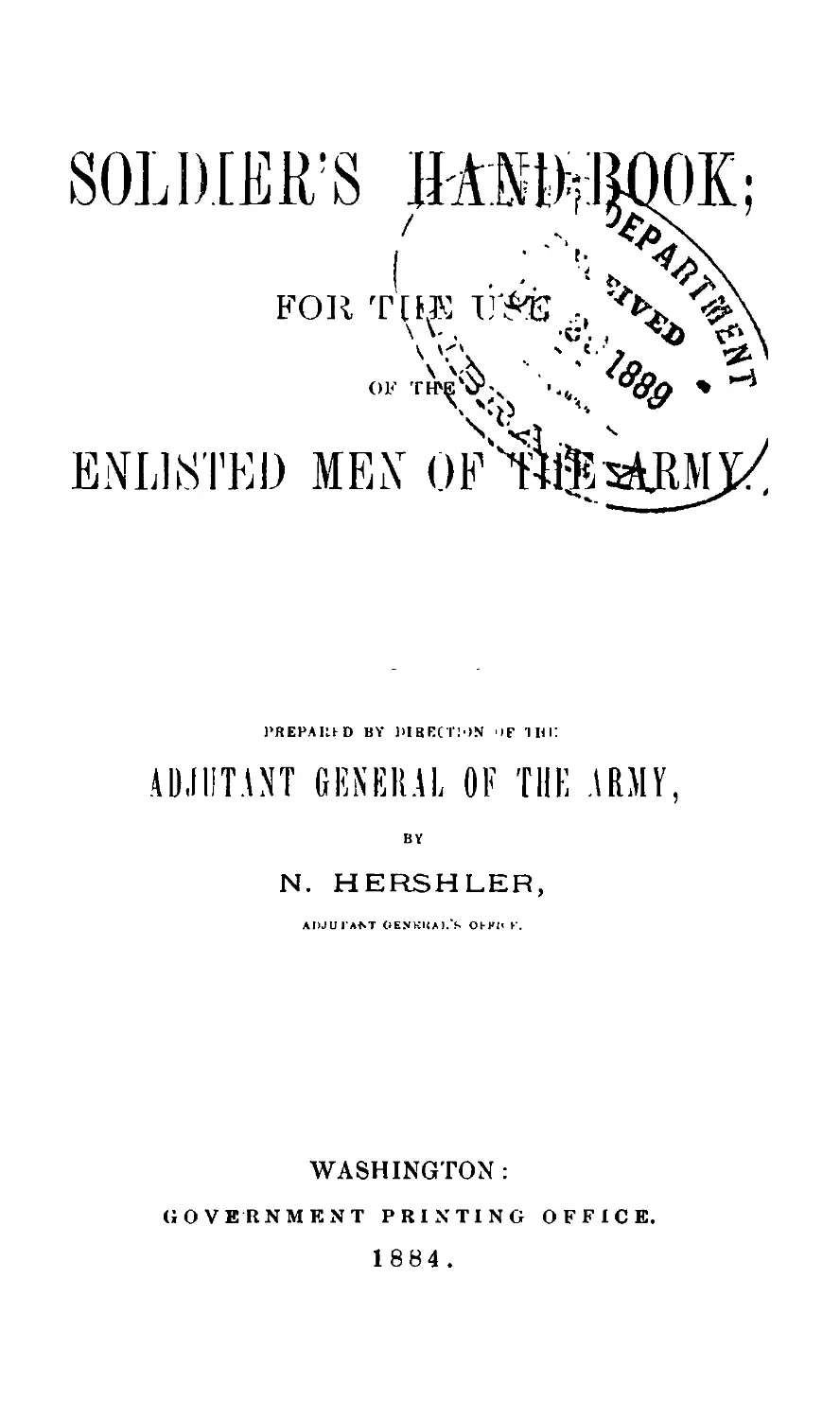
                    SOLDIER’S НА:ВД&0К;
FOR тпж тгй;
\ V л
OF TH^;4	<<5Й^ *
ENLISTED MEN ОЕ’^ВЩМ^
PREPAID BY }>IBRCT!')N )F 1HE
ADJUTANT GENERAL OF THE ARMY,
BY
N. HERSHLER,
AliJUlUT GENERAL'S OEHI< K.
WASHINGTON :
GOVERNMENT PRINTING OFFICE.
1 884.

) HEADQUARTERS OF THE ARMY,
Orders, >-	Adjutant Gftnerai.’s Office,
)	Washington, July 1, 188k.
I.	..The following order, received from the War Department, is publi0h0d
for the information and guidance of the Army:
War Department, June 20, 188k.
The “Soldier’s Hand-Book,” prepared under direction of Brigadier Gen-
eral R. C. Drum, Adjutant General of the Army, is approved and adopted
for issue to the enlisted men of the Army.
ROBERT T. LINCOLN,
Secretary of War.
II.	..Company commanders will see that all articles of clothing and the
price thereof are entered in the Soldier’s Hand-Book as soon as the issue
has been made to the soldier, and will also cause the soldier’s classification
in marksmanship to be noted therein, certifying to the correctness of the
entries with their signatures; and any of these books left by deserters, or
others, will be forwarded, by mail, to the Adjutant General of the Army.
III.	..The books will be issued to soldiers after their arrival at the General
Depots of the Recruiting Service, and to those now in the service who have
one year or more to serve, and they will not be replaced by the igsue of new
copies until those furnished the men are worn out by fair wear and tear.
New leaves properly ruled for the clothing account should be inserted when
necessary, as on the re-enlistment of soldiers, etc.
When lost or destroyed the cost of the book (45 cents) will be charged
to the men on the muster and pay rolls.
By command of Lieutenant General Sheridan:
R. C. DRUM,
Adjutant General,

THE SOLDIER’S HAND-BOOK.
EXTRACTS FROM THE ARMY REGULATIONS OF 1881.
MILITARY DISCIPLINE.
1.	All inferiors are required to obey strictly, and to execute
with alacrity and good faith, the lawful orders of the superiors
appointed over them.
2.	Military authority is to be exercised with firmness, but
with kindness and justice to inferiors. Punishments shall be
conformable to military law.
3.	Superiors of every grade are forbidden to injure those-
under them by tyrannical or capricious conduct, or by abusive
language.
4.	Courtesy among military men is indispensable to disci-
pline; respect to superiors will not be confined to obedience on
duty, but will be extended on all occasions.
5.	Deliberations or discussions among any class of military
men having the object of conveying praise or censure, or any
mark of approbation, toward their superiors or others in the
military service, an<l all publications relative to transactions
between officers of a private or personal nature, whether news-
paper, pamphlet, or handbill, are strictly prohibited.
SUBORDINATION TO CIVIL AUTHORITY.
6.	Respect for the civil authorities is the duty of all citizens,
and especially of those in the military service.
7.	As the objects of the military service are of national inter-
est, it is very desirable that kindly relations exist between sol-
diers and other citizens.
(5)
6
DUTIES OF GUARDS AND SENTINELS.
364.	Neither officers nor soldiers are to take off their clothing
or accouterments while they are on guard.
365.	Sentinels will be relieved every two hours, unless the
state of the weather, or other causes, should make it necessary
or proper that it be done at shorter or longer intervals. Those
at the guard-house or guard-tent will be the first relieved and
left behind.
366.	Each relief, before being posted, is inspected by the com-
mander of the guard. The corporal reports to him, and presents
the old relief on its return. If the sentinels are numerous, the
sergeants are to be employed, as well as the corporals, in reliev-
ing them.
367.	Sentinels will not take orders or allow themselves to be
relieved, except by an officer or non-commissioned officer of their
guard or party, the officer of the day, or the commanding officer;
in which case the orders will be immediately notified tc the com-
mander of the guard by the officer giving them. Sentinels will
report every breach of orders or regulations they are instructed
to enforce.
368.	Sentinels must keep themselves on the alert, observing
everything that takes place within sight and hearing of their
post. They will carry their arms habitually at support, or on
either shoulder, but will never quit them. In wet weather, if
there be no sentry-box, they will secure arms.
369.	No sentinel shall quit his post, nor hold conversation not
necessary to the proper discharge of his duties; nor shall he
suffer any one to converse with prisoners under his charge with-
out permission from competent authority.
370.	It is the duty of a sentinel to repeat all calls made from
posts more distant from the main body of the guard than his
own, and no sentinel will be posted so distant as not to be heard
by the guard, either directly or through other sentinels.
371.	In case of disorder, a sentinel must call out the guard;
and if a fire take place, he must cry—“Fire!” adding the num-
ber of his post. If in either case the danger be great, he must
discharge his piece before calling out.
7
372.	When a fire breaks out, or any alarm is raised in a gar-
rison, all guards are to be immediately under arms.
373.	After retreat (or the hour appointed by the commanding
officer), until broad daylight, a sentinel challenges every person
who approaches him,.taking, at the same time, the position of
charge bayonet. He will suffer no person, to come nearer than
within reach of his bayonet, until the person has given the coun-
tersign, or is passed by an officer or non-commissioned officer of
the guard.
374.	A sentinel, in challenging, will call out—“Who comes
there?" If answered—“Friend, with the countersign," and he
be instructed to pass persons with the countersign, he will
reply—“ Advance, friend, with the countersign!" If answered—
“Friends!" he will reply—“Halt, friends ! Advance one with
the countersign !” If answered—“ Relief,Patrol," or “ Grand
rounds," he will reply—“Halt! Advance, sergeant (or corporal),
with the countersign!” and satisfy himself that the party is what
it represents itself to be. If he have no authority to pass per-
sons with the countersign, if the wrong countersign be given, or
if the persons have not the countersign, lie will cause them to
stand, and call—“Corporal of the guard!"
375.	When any person approaches a post of the guard at
night, the sentinel before the post, after challenging, causes him
to halt until examined by a non-commissioned officer of the
guard. If it be the officer of the day, or any other officer en-
titled to inspect the guard and to make the rounds, the non-com-
missioned officer will call — “Turn out the guard!” when the
guard will be paraded, arms at a carry, and the officer of the
guard, if he think necessary, may demand the countersign and
parole.
[ Ruling ON paragraph 375,—The sentinel on No. 1 post
having challenged any person approaching his post at night and
received the reply, should command—“Halt," and call—“Cor-
poral of tke guard, friend,” or “friend with the countersign,"
according to the answer of the person challenged. The corporal
of the guard should then order the person to advance, receiving
the countersign, if the person has it. If the person challenge !
be the officer in charge, or any person entitled to inspect tli>-
8
guard, the corporal, after receiving the countersign, should say,
“The countersign is right,” and call — “Turn out the guard,"
announcing the title of the officer challenged. The guard being
paraded, the officer of the guard will say, “Advance, officer in
charge” (or “of the day”), adding, “with the countersign” (or
“parole”), should he deem it necessary.—Letter, Apr. 10, 84—
1274 A. G. 0., 1884. j
GRAND ROUNDS.
376.	Any general officer, or the commander of a post or gar-
rison, may visit the guards’ of his command, and go the grand
rounds, and be received in the same manner as prescribed for
the officer of the day.
377.	The officer of the day, wishing to make the rounds, will
take an escortr of a non-commissioned officer and two men.
When the rounds are challenged by a sentinel, the sergeant will
answer—“Grand rounds! ” and the sentinel will reply—“Halt,
grand rounds ! Advance, sergeant, with the countersign ! ” Upon
which the sergeant advances and gives the countersign. The
sentinel will then cry—“Advance, rounds ! ” and stand at a carry
till they have passed.
378.	When the sentinel before the guard challenges, and is an-
swered—“Grand rounds,” he will reply—“Halt, grand rounds!
Turn out the guard; grand rounds ! ” Upon which the guard will
be drawn up with arms at a carry. The officer commanding the
guard will then order a sergeant and two men to advance; when
within ten paces, the sergeant challenges. The sergeant of the
grand rounds answers—“Grand rounds ! ” The sergeant of the
guard replies—“Advance, sergeant, with the countersign ! The
sergeant of the rounds advances alone, gives the countersign,
and returns to his rounds- The sergeant of the guard calls to
his officer—“The countersign is right!” on which the officerot
the guard calls—“Advance rounds!" The guard being at a
carry, the officer of the rounds advances alone to the officer of
the guard, who keeps his post and gives to him the parole. He
then examines the guard, orders back his escort, and, taking a
new one, proceeds in the same manner to other guards.
379.	All material instructions given to a sentinel on post by
persons entitled to make grand rounds will be promptly reported
io the commander of the guard.
9
COMPLIMENTS FROM GUARDS AND SENTINELS.
380. The sentinel at any post of the guard, when he sees any
body of troops, or an officer entitled to compliment, approach,
will call—“Turn out the guard!" and announce who approaches.
381.	All guards will turn out and present arms to the officers
entitled to the compliment as often as they pass them, except
the personal guards of general officers, which turn out only to
the general whose guards they are, and to officers his superiors
in rank.	’
382.	When general officers, or persons entitled to a salute, pass
guards while in the act of relieving, both guards are to salute,
receiving the word of command from the senior officer of the
whole.
383.	When general officers, or officers entitled to a salute, pass
in rear of a guard, it does not salute, but stands at a carry, facing
to the front.
384 All guards turn out under arms when armed parties ap-
proach their posts, and to parties commanded by commissioned
officers they present arms, the officers saluting.
385.	The national or regimental colors passing a guard are
saluted, the trumpets or field-music sounding a march.
386 In the day-time, when the sentinel before the guard sees
the officer of the day approach, he will call—“ Turn out the guard!
officer of the day." The guard will be paraded, and salute with
presented arms.
387.	The guard of a camp or garrison turns out and presents
arms to the commander of the camp or garrison whenever he
approaches its post,
388.	All guards and sentinels will pay the same compliments
to the officers of the Navy, Marines, Volunteers, and Militia, in
the service of the United States, as are directed to be paid to the
officers of the Army, according to their relative ranks.
389.	Between reveille and retreat, sentinels (not in sentry-
boxes), armed with the saber, will salute all officers by present-
ing saber; if armed with the rifle or carbine, they will, under
similar conditions, present arms to general and field officers, to
the commandingofficer of the post, and to the officer of the day,
and will give all other officers the sergeants’salute prescribedin
tactics.
10
390.	When a sentry in a sentry-box sees an officer approach-
ing, he will stand at attention, except during the time of chal-
lenging at night, and, if armed with a rifle or carbine, will salute
as the officer passes, by bringing the left hand briskly to his piece
as high as the right shoulder.
391,	Guards do not turn out as a matter of compliment after
sunset, nor will any compliments be paid by the guard except as
prescribed for grand rounds between retreat and reveille.
392.	Between retreat and reveille, except when challenging, a
sentinel (not in a sentry-box) will, when an officer approaches,
face outward from his post, and stand steadily at a carry until
the officer has passed.
SALUTES.
600.	A non-commissioned officer or private in command of a
detachment without arms salutes all officers with the hand. If
the detachment be on foot, and armed with the rifle or carbine,
he brings the piece to a carry, and he salutes as prescribed for a
sergeant. If the detachment bearmed with the saber, he salutes
with the saber, if drawn ; otherwise as if he were unarmed.
601.	An enlisted man armed with the saber, when out of the
ranks, and not a file-closer, salutes all officers with the saber, if
drawn ; if not, he salutes with the hand. If on foot, and armed
With a rifle or carbine, he salutes as prescribed for a sergeant.
602.	Whenever a non-commissioned officer or soldier without
arms passes an officer, he salutes-him. qsing the hand farthest
from the officer. If mounted, he salutes with the right hand.
603.	A non-commissioned officer or soldier being seated, and
without particular occupation, rises on the approach of an officer,
faces toward him, and salutes. If standing, lie faces toward the
officer for the same purpose. If the parties remain in the same
place or on the same ground, such compliments need not be re-
peated. Soldiers actually at work do not cease it to salute an
officer unless addressed hy him.
604.	An enlisted man makes the prescribed salute with the
weapon he may be armed with, or (if unarmed) with the hand,
before addressing an officer. He also makes the same salute
after receiving a reply.
605; Indoors, a non-commissioned officer or soldier, when un-
armed, uncovers aud stands at attention, but does not salute; in
11
all other cases he salutes as heretofore prescribed, without un-
covering.
606.	A mounted soldier, in passing an officer, salutes with the
saber, if drawn ; otherwise, with his hand. He dismounts be-
fore addressing an officer not mounted.
607.	When an officer enters the room where there are soldiers,
the word “ Attention” is given by some one who perceives him,
when all rise and remain standing in the position of a soldier
until the officer leaves the room. Soldiers at meals do n<jt rise.
Officers in citizens’ dress are saluted in the same manner as
when in uniform.
608.	Soldiers, at all times and in all situations, pay the same
compliments to officers of the Army, Navy, and Marines, and to
all officers of the Volunteers and Militia in the service of the
United States, as to officers of their own particular regiments
and corps.
CARR OF PUBLIC ANIMALS.
300.	After an animal has been assigned, his rider or driver
shall not exchange or surrender him to the use of any other per-
son without the written permission of the captain of his company
or of the officer responsible for him.
301.	Every horse should be reshod at least ofice a month.
302.	Every soldier must examine his animal’s feet after every
day’s work, to ascertain that his shoes are in good order, and be
held responsible that his animal is at all times fit for immediate
service. This duty is by no means to be omitted on the march.
303.	The farrier must examine every animal’s feet systemat-
ically twice a week, to replace broken nails, fasten loose shoes,
and reduce projecting clinches. The appearance of thrush, or
any unhealthy condition of the feet, must be, without delay, re-
ported to the veterinary surgeon.
304.	A horse's feet should be stuffed with wet clay or cow
manure at least once a week.
305.	Horses should be groomed at least an hour and a half to
two hours each day. They are to be rubbed dry after being used,
and not allowed to stand without rubbing when heated. The
nostrils should occasionally be sponged with a weak mixture of
vinegar and water. The sheath must be washed once a month
with castile soap and then greased.
12
306.	A horse should never while heated be wet by use of a
hose or stream of water, and never with cold water.
307.	Feed must be prepared with great care, kept free.from
dust, foreign substances, and bad odors. Frequent feeding in
small quantities is best. When practicable, bran-mash is to be
given once a week; neve£,oftener than twice a week, except to
purge.л Salt should be given at least once a week.
308.	Watering before feeding is not objectionable; drinking
while warm, or after eating until an hour has elapsed, is to be
avoided, if possible. On the march frequent watering is prefer-
able, but should only be done by order of the commanding officer
present. An animal will rarely drink enough very early in the
morning.
309.	Stables and their vicinity are to be kept thoroughly po-
liced, free from smells, and well whitewashed; feed-boxes clean
and washed with vinegar and water once a week. Due care
must be given to ventilation, according to the weather, avoiding
both injudicious exposure to draughts and cold, and exclusion
of air to prevent cold.
310.	An animal with glanders or threatening discharge from
the nostrils is immediately to be isolated and kept tied to pre-
vent infection, of which [here is danger to both rnan and beast.
311.	The rack, manger, and every part of the wood and iron
work of the stall where an animal with glanders or farcy has
stood, as also the vessels used in watering or feeding him, must
be thoroughly cleansed with hot water and soap. They are then
to be covered with wash of quicklime, fresh mixed, which must
be scraped off and renewed after an interval of two days.
312.	After the disease in any animal has become infectious,
such equipments which may have been used with him as are
liable to become infected, and all horse-cloths, saddle-cloths, and
blankets used with glandered animals, must be destroyed.
313.	On the plains, where forage cannot be obtained, grazing
should be allowed at every spare moment. For this purpose
bits should always be removed and girths loosened. When
picketed for grazing, the places should be frequently changed.
Grazing should always be allowed as long as possible, early in
the morning, when dew is on the grass.
314.	To prevent stampeding in camp on the plains, if the men
of the command go among the animals quietly, but promptly,
13
on the first evidence of fright, and speak to them, they will in
most cases be quieted. After animals have been stampeded,
if tlrey are new to the service, men should mount the fastest
animals within reach, place themselves in front of those running,
and lead them back to camp. With old horses, the sound of the
stable call will often prevent stampeding, or stop them when
running.
315.	In marching, the walk should be the habitual gait, and
should not, under ordinary circumstances, be exceeded when
grazing only is relied on. When forage can be obtained, horses
may occasionally trot, say a mile in every hour’s march. Unless
the march be a forced one, horses must always be allowed to
walk at intervals.
, 316. The gallop very soon breaks down horses, and is strictly
prohibited on marches, escorts, express, and all other duties,
except when absolutely necessary.
-317. On marches, under whatever circumstances, a halt should
be made at the end of an hour after starting, and the saddles,
saddle-kits, bridles, &c., readjusted, and girths tightened.
SOLDIERS’ UNIFORM.
183. Soldiers will wear the prescribed uniform in camp or
garrison, and will not be permitted to keep.in their possession
any other clothing. When on fatigue parties, they will wear
the proper fatigue dress.
ARMS.
185. Arms will not be taken to pieces by soldiers unless by
permission of a commissioned officer, nor under any circum-
stances will attempts be permitted to beautify or change the
finish of the exterior by altering the metallic or wooden parts.
Arms shall not be left loaded in quarters or tents, or when the
men are oft’ duty, except under special orders. The use of
tompions in small-arms is prohibited. The surface of the bore
will be protected J’rom rust by occasional use of an oiled rag.
CERTIFICATES OF MERIT.
248.	The certificates authorized by section 1216, Revised
Statutes, will be awarded only for acts of extraordinary gal-
lantry in presence of the enemy, which acts must be specific
and certified to by an eye-witness, preferably the immediate
14
commanding officer of the soldier. Good standing and undoubted
courage in a soldier will also be required to entitle him to a cer-
tif^ca’e of merit.
250.	The extra pay granted on cert ificate of merit commences
at the date of the act of gallantry for which the certificate is
granted. This extra pay is two dollars per month while the
soldier remains continhously in service.
251.	Certificates of merit will not be granted to persons not
in the military service of tfie United States at the date of appli-
cation for them.
252.	Should a soldier die before receiving a certificate con-
ferred upon him, it will be deposited in the office of the Second
Auditor of the Treasury for the benefit of bis heirs,
253.	In case the soldier is discharged before the certificate is
issued, it will be retained in the office of the Adjutant General
until called for, when proof of the identity of the applicant will
be required.
POST SCHOOLS.
559.	The teachers and schools will be under the control of the
post commander, or such officer as the post commander may
designate.
560.	School teachers will be detailed from the enlisted mqn
of the Army. The number of teachers detailed will not exceed
one for each company serving at the post.
562.	A soldier while serving as school teacher will receive
extra-duty pay as overseer (35 cents per day) from the Quar-
termaster's Department, not deducting for Saturdays and Sun-
days.*
563.	Soldiers while detailed as school teachers will attend such
parades, inspections, and drills as, in the judgment of the post
commander, are necessary to keep them well instructed in their
company duties.
564.	While it is left optional with soldiers whether to attend
school or not, yet they are advised to avail themselves of the
means afforded to improve themselves, and commanding officers
will not only give them all possible opportunities, but advise
and encourage them to use them.
♦The extra pay allowed school teachers is not affected by vacation. He
is allowed extra pay for the whole month.
15
soldiers’ home.
242. An honest and faithful service of twenty years in the
Army entitles a soldier to admission to the Soldiers’ Home; but
applications for discharge by reason of twenty years’ service
will not be entertained unless the soldier is a fit subject for dis-
charge on certificate of disability, on upon condition that he shall
enter the Soldiers’ Home.
837. When a soldier, by reason of old age and long service,
or of disability contracted in the line of duty, becomes a candi-
date for admission to the Soldiers’ Home, his company com-
mander will so report, through proper military channels, to the
Adjutant General of the Army, giving all details that may be
needed for a full understanding of the case, including the date
of enlistment, with company and regiment, for each term of his
service, and a statement of the origin or cause and of the nature
of any disability which may exist. The certificate of a medical
officer will be forwarded with the papers. This report will be
referred to the board of commissioners of the .Home, and if, in
their opinion, the soldier be entitled to become an inmate, the
necessary authority will be given for his discharge, which will
be made at the place where he may be serving. Afterwards he
may proceed to Washington and report to the board of commis-
sioners for admission to the Home.
PAYMENT OF ENLISTED MEN.
2448. When a company is paraded for payment, the officer in
command shall attend the pay-table, witness the payment, and
certify at the foot of the muster and pay-rolls that payment of
the company was witnessed by him. All enlisted men present
for payment with their companies or detachments shall receipt
upon the pay-roll for amount due them thereon. When soldiers
cannot write, but sign by mark, each case must be witnessed by
a commissioned officer. Paymasters are not authorized to make
payment to any other than the soldier in person, and any pay
of a soldier intrusted to a third party will be at the risk of the.
paymaster making the payment.
2449. The paymaster will deduct from the pay of all enlisted
men twelve and a half cents per month for the support of the
Soldiers’ Home, and also the amount of the authorized stop-
pages entered on the muster-roll, descriptive-list, or certificate
of discharge.
16
DEPOSITS.
2456. The following are the regulations established under
section 1307, Revised Statutes:
Soldiers may deposit with the paymaster any portion of their
savings, in sums not less than five dollars, the same to remain
so deposited until final payment ou discharge.
The paymaster will furnish each depositor with a deposit-
book, in which each deposit made will be entered in the form of
a certificate, signed by the paymaster and the company com-
mander, setting forth the date, place, and amount (in words and
figures) of deposit, and the name of soldier making same.
The company commander shall keep in the company record-
book an account of every deposit made by the soldier; and
after each regular payment he, and all officers having charge of
distinct detachments of enlisted men at date of deposit, • shall
transmit direct to the Paymaster General a list of names of de-
positors, showing in each case the date, place, and amount of
deposit, and name of paymaster receiving the same.
In case a soldier who has made a former deposit has been
transferred to another company or regiment, or is made ordnance
sergeant, or commissary sergeant, or hospital steward, the fact
of such transfer shall be noted in the list sent to the Paymaster
General, so that the identity of the depositor may be matter of
record in the office of the Paymaster General.
In case of the transfer of a soldier, his descriptive roll will be
made to exhibit the date and amount of each separate deposit.
On the discharge of a soldier, the date and amount (in words
and figures) of each deposit will be entered upon his final state-
ments ; and his deposit-book will be taken up by the paymaster
who makes final payment, and filed with his voucher. In case
the deposits of a soldier are forfeited by desertion, the amounts
of the same should not be entered under the head of “Due sol-
dier” on the final statements, but should, with the facts and
authority for such forfeiture, be entered in the “ Remarks.”
Before delivering to discharged soldiers final statements upon
which deposits are credited, the officer signing the statements
will ascertain if the soldier has the deposit-book in his possession.
If so, he should be instructed to present it, with his final state-
ments, to the paymaster.
17
Should he claim to have lost the deposit-book, the officer will
cause the soldier’s affidavit to the facts to be made (before a
judge advocate or post adjutant) in duplicate and attached to-
the statements.
The affidavit should clearly set forth the facts and ciicum-
stances of loss of the'book, and that the soldier has not sold or
assigned it.
Upon this evidence the paymaster may pay without the deposit-
book, and the responsibility for the correctness of the amounts
credited on the statements will rest wholly with the officer certi-
fying them.
Paymasters will make no-payment of deposits excepting on
final statements. &
When repayment is not made on final statements, the soldier
should forward the deposit-book, or the evidence above described,
to the Paymaster General’s Office, where alone such claims will
be settled.
The attention of enlisted men should be called to the import-
ance of preserving deposit-books as the only certain means of
insuring absolutely correct repayment without delay.
On the death of a soldier, account shall be made of each deposit
in the inventory of his effects, and on the accompanying final
statements, with which his deposit-book will be filed. The
separate and accurate statement, by date and amount, of each
deposit is absolutely essential to the correcPcalculation of interest.
For any sums not less than five dollars deposited for the
period of six months or longer, the soldier, on his final discharge,
shall be paid interest at the rate of four per cent, per annum.
Deposits and inteiest thereon are forfeited by desertion, but
are wholly exempt from forfeiture by sentence of court-martial
and from liability for the soldier’s debts.
Paymasters will forward with each account an abstract of sol-
diers’ deposits, if any, received by them during the time embraced
therein. The abstract will set forth the name, company, and
regiment of each depositor, with the date and amount of his
deposit. The gross amount of the abstract will be carried to
the account current under the appropriation of “Pay of the
Army” for the fiscal year in which the deposits were received.
The amount may be disbursed by the paymaster under the same
appropriation.
2
18
The amounts of deposits and interest thereon paid on final
statements will be charged by the paymaster to “ Pay of the
Army” for the fiscal year in which the soldier is discharged.
..The Paymaster General will keep in his office such record as
may be necessary to show the deposits made by the enlisted men
of the Army.
EXTRA-DUTY PAY.
399. Non-commissioned officers and soldiers employed under
section 1287, Revised Statutes, are to be mustered as extra-duty
men. Commanding officers will- see that no man is paid as an
overseer or mechanic who is not actually employed as such, and
no soldier shall be rated at the higher pay except by their order.
Non-commissioned officers of the line of the. Army shall not be
allowed and paid extra-duty pay except as “overseers” (when
the working force is large enough to warrant an “overseer”);
but non-commissioned officers of the Signal Corps and of the
General Service Detachments on duty in the War Department
and its bureaus, or at army, division, department, and district
headquarters, and at superintendencies of the recruiting service,
shall be allowed and paid extra-duty pay as prescribed by the
Regulations.
• 403 Enlisted men of the Ordnance Department are not entitled
to extra-duty pay when employed as artificers or laborers in the
construction of permanent military works, public roads, or other
constant labor; but when employed continuously in hospitals as
cooks and nurses, for a period of not less than ten days, they
are entitled to the benefits of paragraph 2299 of the Regulations.
Hospital stewards and ordnance and commissary sergeants will
not receive extra-duty pay unless under special authority of the
Secretary of War.
404.	Company farriers, blacksmiths,and wagoners shall receive
no extra pay except when detailed on extra fluty in the Quarter-
master’s Department wholly disconnected with their companies;
nor shall the detail cf artificers on extra duty in the Quarter-
master’s or Subsistence Departments be permitted.
405.	Soldiers detailed as acting superintendents of national
cemeteries while so acting are entitled to extra pay as overseers.
408.	No extra-duty pay will be paid to any enlisted men
employed as clerks except in the manner authorized by the
Regulations.
19
409.	Soldiers employed as scouts are not to be paid extra-duty
pay, it being a military duty to which they are liable.
; 410. A prisoner undergoing sentence is not to receive extra-
duty pay.
411.	Enlisted men being liable to perform guard and other
military duty are entitled to extra pay when employed on extra
duty more than ten days in a month, though the employment
may not have been continuous.
412.	Eight hours constitutes a day’s work for all persons who
are employed and paid by the day, by or on behalf of the Govern-
ment of the United States. This does not extend to persons
who are paid regular salaries. Watchmen, clerks, messengers,
and others, whose time may be necessary at any or all hours,
are not considered to be embraced within the terms of the law.
413.	Men on extra-duty pay will be held to such hours as
may be expedient and necessary; but except in case of urgent
public necessity, as in military operations, when they must work
regardless of hours, not more than ten hours’ labor should be
required. But when more than eight hours’ work is required
in any one civil day, the soldier rendering the service will be
paid for more than a day’s labor, in proportion to the time
actually employed.
2299. Enlisted men employed continuously in hospitals as
cooks and nurses, under existing regulations, for a period of not
less than ten days, will be paid twenty cents per day as extra-
duty pay by the Paymaster General on the hospital -muster-
rolls, when the men so employed are properly mustered as
entitled to it.
RE-ENLISTMENT PAY.
2451. The rate of pay prescribed in section 1282, Revised
Statutes, is payable to the following classes of men :
1. Those who are entitled to longevity pay for re-enlistment
under the provisions of the act of August 4, 1854.
2. Those who have at any time re-enlisted under the terms
of that act, though not entitled to longevity pay thereunder
because of failure to remain continuously in service.
Men of class 1 will be indicated on the muster-rolls by the
remarks prescribed in paragraph 2453.
Those of class 2 will be indicated by the remark: “Entitled
to re-enlistment pay.” Lack of sufficient evidence to establish
20
a claim to re-enlistment pay will be supplied by application to
the Adjutant General.
2452. Men serving under a second, third, fourth, &c., enlist-
meftt, but who never “re-enlisted” under the act of August 4,
1854, will only be entitled to the pay provided in sections 1280
and 1281, Revised Statutes.
LONGEVITY PAY OF ENLISTED MEN.
2453. Under section 1284, Revised Statutes, a soldier who
completes a term of five years’ continuous service, and re-enlists
Within thirty days thereafter, is entitled to an additional allow-
ance of $2 per month; and for each successive and continuous
re-enlistment under the same conditions he is entitled to a
further addition of $1 per month. The rate of allowance is
indicated on the rolls by the remark: “$2 per mo. for five years’
continuous service;” “$3 per mo. for ten years’ continuous
service;” “$4 per mo. for fifteen years’ continuous service,” &c.
RETAINED PAY.
2454. The retained pay provided for the discharged soldier,
“but to be forfeited unless he shall have served honestly and
faithfully to the date of discharge,” by sections 1281 and 1282,
Revised Statutes, shall be withheld for the following causes,
either of which shall be noted on the final statements:
1.	Desertion during the period of enlistment.
2.	When discharged (by way of punishment for an offense)
before expiration of term of service by sentence of court-martial,
or by order from the War Department specifying that such for-
feiture shall be made.
3.	Conviction and imprisonment by the civil authorities.
4.	When discharged as a minor, or for other cause involving
fraud on his part in the enlistment.
5.	Repeated trials by court-martial and punishments for mis-
conduct, of which timely report shall be made to the War
Department and approved as basis of forfeiture. In which cash
the soldier shall be discharged without character, and shall not
be re-enlisted.
LAWS RELATING TO THE MILITARY SERVICE.
(FROM THE REVISED STATUTES.)
PAY OF ENLISTED MEN.
Section 1280. The monthly pay of the following enlisted
men of the Army shall, during their first term of enlistment, be
as follows, with the contingent [conditions] [additions] thereto,
hereinafter provided :
Sergeant-majors of cavalry, artillery, and infantry, twenty-
three dollars.
Quartermaster-sergeants of cavalry, artillery, and infantry,
twenty-three dollars.
Chief trumpeters of cavalry, twenty-two dollars.
Principal musicians of artillery and infantry, twenty-two
dollars.
Saddler-sergeants of cavalry, twenty-two dollars.
First sergeants of cavalry, artillery, and_ infantry, twenty-
two dollars.
Sergeants of cavalry, artillery, and infantry, seventeen dol-
lars.
Corporals of cavalry and light artillery, fifteen dollars.
Corporals of artillery and infantry, fifteen dollars.
Saddlers of cavalry, fifteen dollars
Blacksmiths and farriers of cavalry, fifteen dollars.
Trumpeters of -cavalry, thirteen dollars.
Musicians of artillery and infantry, thirteen dollars.
Privates of cavalry, artil ery, and infantry, thirteen dollars.
Hospital-stewards, first class, thirty dollars.
Hospital-stewards, second class, twenty-two dollars.
Hospital-stewards, third class, twenty dollars.
Ordnance-sergeants of posts, thirty-four dollars.
Sergeant-majors of engineers, thirty-six dollars.
Quartermaster-sergeants of engineers, thirty-six dollars.
Sergeants of engineers and ordnance, thirty-four dollars.
Corporals of engineers and ordnance, twenty dollars.
Musicians of engineers, thirteen dollars.
(21)
22
Privates (first class) of engineers and ordnance, seventeen
dollars.
Privates (second class) of engineers and ordnance, thirteen
dollars.
ADDITIONAL PAY.
Sec. 1281. To the rates of pay stated in the precedifig sec-
tion one dollar per month shall be added for the third year of
enlistment, one dollar more per month for the fourth year, and
one dollar more per month for the fifth year, making in all three
dollars’ increase per month for the last year of the first enlist-
ment of each enlisted man named in said section. But this
increase shall be considered as retained pay, and shall not be
paid to the soldier until his discharge from the service, and
shall be forfeited unless he serves honestly and faithfully to the
date of discharge.
RE-ENLISTMENT PAY.
Sec. 1282. All enlisted men mentioned in section twelve hun-
dred and eighty, who, having been honorably discharged, have
re-enlisted or shall re-enlist within one month thereafter, shall,
after five years’ service, including their first enlistment, be paid
at the rate allowed in said section to those serving in the fifth
year of their first enlistment: Provided, That one dollar per
month shall be retained from the pay of the re-enlisted men, of
whatever grade, named in section twelve hundred and eighty-
one during the whole period of their re-enlistment, to be paid
to the soldier on his discharge, but to be forfeited unless he
shall have served honestly and faithfully to the date of dis-
charge.
SERVICE PAY OF MEN ALREADY IN SERVICE.
Sec. 1283. Enlisted men, now in the service, shall receive
the rates of pay established in this chapter according to the
length of their service.
ON RE-ENLISTMENT.
Sec. 1284. Every soldier who, having been honorably dis-
charged, re-enlists within one month thereafter, shall be further
entitled, after five years’ service, including his first enlistment,
23
to receive, for the period of five years next thereafter, two dol-
lars per month in addition to the ordinary pay of his grade; and
for each successive periojd of five years of service, so long as he
shall remain continuously in the Army, a further sum of one
dollar per month. The past continuous service, of soldiers now
in the Army, shall be taken into account, and shall entitle such
soldier to additional pay according to this rule; but services
rendered prior to August fourth, eighteen hundred and fifty-
four, shall in no case be accounted as more than one enlistment.
ON CERTIFICATE OF MERIT.
Sf.c. 1285. A certificate of merit granted to a private soldier
by the President for distinguished services shall entitle him to
additional pay at the rate of two dollars per month, while he
remains continuously in the service; and such certificate of
merit granted to a private soldier who served in the war with
Mexico shall entitle him to such additional pay, although he
may not have remained continuously in the service.
NON-COMMISSIONED OFFICERS OF MEXICAN WAR.
Sec. 1286. Non-commissioned officers who served in the war
with Mexico, and have been recommended by the commanding
officers of their regiments for promotion by brevet to the lowest
grade of commissioned officer, but have not received such rec-
ommended promotion, shall be entitled to additional pay at the
rate of two dollars per month, although they may not have
remained continuously in the service.
EXTRA DUTY.
Sec. 1287. When soldiers are detailed for employment as
artificers or laborers in the construction of permanent military
works, public roads, or other constant labor of not less than ten
days’ duration, they shall receive, in addition to their regular
pay, the following compensation : Privates working as artificers,
and non-commissioned officers employed as overseers of such
work, not exceeding one overseer for twenty men, thirty-five
cents per day, and privates employed as laborers, twenty cents
per day. This allowance of extra pay shall not apply to the
troops of the Ordnance Department.
24
TRAVEL-PAY TO SOLDIERS.
SEC. 1290. When a soldier is honorably discharged from the
service, [except by way of punishment for an offense,] he shall
be‘allowed transportation and subsistence from the place of his
discharge to the place of his enlistment, enrollment, or original
muster into the service. The Government may -furnish ihe same
in kind, but in case it shall not do so, he shall he allowed travel-
pay and commutation of subsistence for such time as may be
sufficient for him to travel from the place of discharge to the
place of his enlistment, enrollment, or original muster into the
service, computed at the rate of one day for every twenty miles.
SOLDIERS’ PAY NOT ASSIGNABLE.
Sec. 1291. No assignment of pay by a non-commissioned
officer or private, previous to bis discharge, shall be valid
FOR ARTICLES PURCHASED.
Sec. 1300. The amount due from any enlisted man for articles
designated by the inspectors-general of the Army, and sold to
him on credit by commissaries of subsistence, shall be deducted
from the payment made to him next after such sale shall have
been reported to the Paymaster-General.
FOR TOBACCO PURCHASED.
Sec. 1301. The amount due from any enlisted man for tobacco
sold to him at cost prices by the United States shall be deducted
from his pay in the manner provided for the settlement of cloth-
ing accounts.
CLOTHING ALLOWANCES AND DEDUCTIONS.
SEC. 1302. The money value of all clothing overdrawn by
the soldier beyond his allowance shall be charged against him,
every six months, on the muster-roll of his company, or on his
final statements if sooner discharged, and he shall receive pay
for such articles of clothing as have not been issued to him in
any year, or which may be due io him at the time of his dis-
charge, according to the annual estimated value thereof. The
amount due him for clothing, when he draws less than his allow-
ance, shall not be paid to him until his final discliaige from the
service.
25
FOR DAMAGE TO ARMS.
Sec. 1303. The cost of repairs or damages done to arms,-equip-
ments, or implements, shall be deducted from the pay of any
officer or soldier in whose care or use the same were when such
damages occurred, if said damages were occasioned by the abuse
or negligence of said officer or soldier.

EXTRACTS FROM THE ARTICLES OF WAR.
(RELATING TO ENLISTED MEN.)
Section 1342. The armies of the United States shall be gov-
rned by the following rules and articles. The word officer, as
sed therein, shall be understood to designate commissioned
fficers; theword soldier shall be understood to include non-com-
lissioned officers, musicians, artificers, and privates, and other
nlisted men, and the convictions mentioned therein shall be
nderstood to be convictions by court-martial.
ARTICLES TO BE READ TO RECRUITS.
Art. 2. These rules and articles shall be read to every en-
isted man at the time of, or within six days after, his enlistment,
nd he shall thereupon take an oath or affirmation in the follow-
ng form: “I, A. В , do solemnly swear (or affirm) that I will
ear true faith and allegiance to the United States of America;
hat I will serve them honestly and faithfully against all their
nemies whomsoever; and that I will obey the orders of the
’resident of the United States, and the orders of the officers ap-
lointed over me, according to the rules and articles of war.”
?his oath may be taken before any commissioned officer of the
Lrtny.
DISCHARGES.
Art. 4. No enlisted man, duly sworn, shall be discharged
rom the service without a discharge in writing, signed by a
ield-officer of the regiment to which he belongs, or by the com-
nanding officer, when no field-officer is present; and no discharge
hall be given to any enlisted man before his term of service has
•xpired, except by order of the President, the Secretary of War,
he commanding officer of a department, or by sentence of a gen-
eral court-martial.
FURLOUGHS.
Art. 11. Every officer commanding a regiment or an inde-
>endent troop, battery, or company, not in the field, may, when
ictually quartered with such command, grant furloughs to the
•nlisted men, in such numbers and for such time as he shall deem
(27)
28
consistent with the good of the service. Every officer command-
ing a regiment, or an independent troop, battery, or company»
in the field, may grant furloughs not exceeding thirty days at
one time, to five per centum of the enlisted men, for good con-
duct in the line of duty, but subject to the approval of the com-
mander of the forces of which said enlisted men form a part.
Every company officer of a regiment, commanding any troop,
battery, or company not in the field, or commanding in any gar-
rison, fort, post, or barrack, may, in the absence of his field-
officer, grant furloughs to the enlisted men, for a time not ex-
ceeding twenty days in six months, and not to more than two
persons to be absent at the same time.
WASTING AMMUNITION.
Art. 16. Any enlisted man who sells, or willfully or through
neglect wastes the ammunition delivered out to him, shall be pun-
ished as a court-martial may direct.
LOSING OR SPOILING ACCOUTERMENTS, ЁТС.
Art. 17. Any soldier who sells or, through neglect, loses or
spoils his horse, arms, clothing, or accouterments, shall suffer
such stoppages, not exceeding one-half of his current pay, as a
court-martial may deem sufficient for repairing the loss or damage,
and shall be punished by confinement or such other corporal
punishment as the court may direct.
DISRESPECTFUL WORDS AGAINST THE PRESIDENT, ETC.
Art. 19. Any officer who uses contemptuous or disrespectful
words against the President, the Vice-President, the Congress
of the United States, or the chief magistrate or legislature ot any
of the United States in which he is quartered, shall be dismissed
from the service, or otherwise punished, as a court-martial may
direct. Any soldier who so offends shall be punished as a court-
martial may direct.
DISRESPECT TOWARD COMMANDING OFFICER.
Art. 20. Any officer or soldier who behaves himself with dis-
respect toward his commanding officer shall be punished as a
court-martial may direct.
STRIKING A SUPERIOR OFFICER.
Art. 21. Any officer or soldier who, on any pretense what-
soever, strikes his superior officer, or draws or lifts up any
29
weapon, or offers any violence against him, being in the execu-
tion of his office, or disobeys any lawful command of his superior
officer, shall suffer death, or such other punishment as a court-
martial may direct.
MUTINY.
Art. 22. Any officer or soldier who begins, excites, causes, or
joins in any mutiny or sedition, in any troop, battery, company,
party, post, detachment, or guard, shall suffer death, or such
other punishment as a court-martial may direct.
QUARRELS AND FRAYS.
Art. 24. All officers, of whtft condition soever, have power to
part and quell all quarrels, frays, and disorders, whether among
persons belonging to his own or to another corps, regiment, troop,
battery, or company, and to order officers into arrest, and non-
commissioned officers and soldiers into confinement, who take
part in the same, until their proper superior officer is acquainted
therewith. And whosoever, being so ordered, refuses to obey
such officer or non-commissioned officer, or draws a weapon upon
him, shall be punished as a court-martial may direct.
REPROACHFUL OR PROVOKING SPEECHES.
Art. 25. No officer or soldier shall use айу reproachful or
provoking speeches or gestures to another. Any officer who so
offends shall be put in arrest. Any soldier who so offends shall
be confined, and required to ask pardon of the party offended, in
the presence of his commanding officer.
CHALLENGES TO FIGHT D.UELS.
Акт. 26 No officer or soldier shall send a challenge to another
officer or soldier to fight a duel, or accept a challenge so sent.
Any officer who so offends shall be dismissed from the service.
Any soldier who so offends shall suffer such corporal punishment
as a court-martial may direct.
ALLOWING PERSONS TO GO OUT AND FIGHT; SECONDS AND
PROMOTERS.
Art. 27. Any officer or non-commissioned officer, command-
ing a guard, who, knowingly and willingly, suffers any person
to go forth to fight a duel, shall be punished as a challenger;
and all seconds or promoters of duels, and carriers of challenges
30
to fight duels, shall be deemed principals, and punished accord-
ingly. It shall be the duty of any officer commanding an army,
regiment, troop, battery, company, post, or detachment, who
knows or has reason to believe that a challenge has been given
or accepted by any officer or enlisted man under his command,
immediately to arrest the offender and bring him to trial.
UPBRAIDING ANOTHER FOR REFUSING CHALLENGE.
Art. 28. Any officer or soldier who upbraids another officer
or soldier for refusing a challenge shall himself be punished as
a challenger; ai|d all officers and soldiers are hereby discharged
from any disgrace or opinion of disadvantage which might arise
from their having refused to accept challenges, as they will only
have acted in obedience to the law, and have done their duty as
good soldiers, who subject themselves to discipline.
WRONGS TO SOLDIERS; REDRESS OF.
Art. 30. Any soldier who thinks himself wronged by any
officer may complain to the commanding officer of his regiment,
who shall summon a regimental court-martial for the doing of
justice to the complainant. Either party may appeal from such
regimental court-martial to a general court-martial; but if. upon
such second hearing, the appeal appears to be groundless and
vexatious, the party appealing shall be punished at the discre-.
tion of said general court-martial.
LYING OUT OF QUARTERS.
Art. 31. Any officer or soldier who lies out of his quarters,
garrison, or camp, without leave from his superior officer, shall
be punished as a court-martial may direct.
SOLDIER ABSENT WITHOUT LEAVE.
Art. 32. Any soldier who absents himself from his troop, bat-
tery, company, or detachment, without leave frpm his command-
ing officer, shall be punished as a court-martial may direct.
ABSENCE FROM PARADE WITHOUT LEAVE.
Art. 33. Any officer or soldier who fails, except when pre-
vented by sickness or. other necessity, to repair, at the fixed
time, to the place of parade, exercise, or other rendezvous ap-
pointed by his commanding officer, or goes from the same, with-
31
out leave from his commanding officer, before he is dismissed or
relieved, shall be punished as a court-martial may direct.
; ONE MILE FROM CAMP WITHOUT LEAVE.
Art. 34. Any soldier who is found one mile from camp, with-
out leave in writing from his commanding officer, shall be pun-
ished as a court-martial may direct.
FAILING TO RETIRE AT RETREAT.
Art. 35. Any soldier who fails to retire to his quarters or
tent at the beating of retreat, shall be punished according to the
nature of his offense.
HIRING DUTY.
Art. 36. No soldier, belonging to any regiment, troop, battery,
or company shall hire another to do his duty for him, or be ex-
cused from duty, except in cases of sickness, disability, or leave
of absence. Every such soldier found guilty of hiring his duty,
and the person so hired to do another’s duty, shall be punished
as a court-martial may direct.
CONNIVING AT HIRING DUTY.
Art. 37. Every non-commissioned officer who connives at
such hiring of duty shall be reduced Every officer who knows
and allows such practices shall be punished as a court-martial
may direct.
DRUNK ON DUTY.
Art. 38. Any officer who is found drunk on his guard, party,
or other duty, shall be dismissed from the service. Any soldier
who so offends shall suffer such punishment as a court-martial
may direct. [No court-martial shall sentence any soldier to be
branded, marked, or tattooed.]	>
SENTINEL SLEEPING ON POST.
Art. 39. Any sentinel who is found sleeping upon his post,
or who leaves it before he is regularly relieved, shall suffer death,
or such other punishment as a court-martial may direct.
QUITTING GUARD, ETC., WITHOUT LEAVE.
Art. 40. Any officer or soldier who quits his guard, platoon,
or division, without leave from his superior officer, except in a
case of urgent necessity, shall be punished as a court-martial
may direct.
32
MISBEHAVIOR BEFORE THE ENEMY, COWARDICE, ETC.
Art. 42. Any officer or soldier who misbehaves himself be-
fore the enemy, runs away, or shamefully abandons any fort,
post, or guard, which he is commanded to defend, or speaks
words inducing others to do the like, or casts away his arms or
ammunition, or quits his post or colors to plunder or pillage,
shall suffer death, or such other punishment as a court-martial
may direct.
COMPELLING A SURRENDER.
Art. 43. If any commander of any garrison, fortress, or post
is compelled, by the officers and soldiers under his command, to
give up to the enemy or to abandon it, the officers or soldiers so
offending shall suffer death, or such other punishment as a
court-martial may direct.
DISCLOSING WATCHWORD.
Art. 44. Any person belonging to the armies of the United
States who makes known the watchword to any person not en-
titled to receive it, according to the rules and discipline of war,
or presumes to give a parole or watchword different from that
which he received, shall suffer death, or such other punishment as
a court-martial may direct.
RELIEVING THE ENEMY.
/
Art. 45. Whosoever relieves the enemy with money, victuals,
or ammunition, or knowingly harbors or protects an enemy,
shall suffer death, or such other punishment as a court-martial
may direct.
CORRESPONDING WITH THE ENEMY.
Art. 46. Whosoever holds correspondence with, or gives in-
telligence to, the enemy, either directly or indirectly, shall suffer
death, or such other punishment as a court-martial may direct.
DESERTION.
Art. 47. Any officer or soldier who, having received pay, or
having been duly enlisted in the service of the United States,
deserts the same, shall, in time of war, suffer death, or such
other punishment as a court-martial may direct; and in time of
peace, any punishment, excepting death, which a court-martial
may direct.
33
DESERTER SHALL SERVE FULL TERM.
Art. 48. Every soldier who deserts the service of the United
States shall be liable to serve for such period as shall, with the
time he may have served previous to his desertion, amount to
the full term of his enlistment; and such soldier shall be tried
by a court-martial and punished, although the term of his en-
listment may have elapsed previous to his being apprehended
and tried.
ENLISTING IN OTHER REGIMENT WITHOUT DISCHARGE.
Art. 50. No non-commissioned officer or soldier shall enlist
himself in any other regiment, troop, or company, without a
regular discharge from the regiment, troop, or company in which
he last served, on a penalty of being reputed a deserter, and
suffering accordingly. And in case any officer shall knowingly
receive and entertain such non commissioned officer or soldier,
or shall not, after his being discovered to be a deserter, imme-
diately confine him and give notice thereof to the corps in which
he last served, the said officer shall, by a court-martial, be cash-
iered.
ADVISING TO DESERT.
Art. 51. Any officer or soldier who advises or persuades any
other officer or soldier to desert the service of the United States,
shall, in time of war, suffer death, or such other punishment as
a court-martial may direct; and, in time of peace, any punish-
ishment, excepting death, which a court-martial may direct.
MISCONDUCT AT DIVINE SERVICE.
Art. 52. It is earnestly recommended to all officers and soldiers
diligently to attend divine service. Any officer who behaves inde-
cently or irreverently at any place of divine worship shall be
brought before a general court-martial, there to be publicly and
severely reprimanded by the president thereof. Any soldier who
so offends shall, for his first offense, forfeit one-sixth of a dollar;
for each further offense he shall forfeit a like sum, and shall be
confined twenty-four hours. The money so forfeited shall be de-
ducted from his next pay, and shall be applied, by the captain or
senior officer of his troop, battery, or company, to the use of the
sick soldiers of the same.
3
34
PROFANE OATHS.
Art. 53. Any officer who uses any profane oath or execration
shall, for each offense, forfeit and pay one dollar. Any sol-
dier who so offends shall incur the penalties provided in the
preceding article; and all moneys forfeited for such offenses
shall be applied as therein provided.
WASTE OR SPOIL, AND DESTRUCTION OF PROPERTY WITHOUT.
ORDERS.
Art. 55. All officers and poldiers are to behave themselves
orderly in quarters and on the march ; and whoever commits any
waste or spoil, either in walks or trees, parks, warrens, fish-
ponds, houses, gardens, grain-fields, inclosures, or meadows, or
maliciously destroys any property whatsoever belonging to
inhabitants of the United States (unless by order of a general
officer commanding a separate army in the field), shall, besides
such penalties as he may be liable to by law, be punished as a •
court-martial may direct.
VIOLENCE TO PERSONS BRINGING PROVISIONS.
Art. 56. Any officer or soldier who does violence to any per-
son bringing provisions or other necessaries to the camp, garri-
son, or quarters of the forces of the United States in foreign
parts, shall suffer death, or such other punishment as a court-
martial may direct.
FORCING A SAFE-GUARD.
Art. 57. Whosoever, belonging to the armies of the United
States in foreign parts, or at any place within the United States
or their Territories during rebellion against the supreme author-
ity of the United States, forces a safe guard, shall suffer death.
CERTAIN CRIMES DURING REBELLION.
Art. 58. In time of war, insurrection, or rebellion, larceny,
robbery, burglary, arson, mayhem, manslaughter, murder, as-
sault and battery with an intent to kill, wounding, by shooting
or stabbing, with an intent to commit murder, rape, or assault
and battery with an intent to commit rape,-shall be punishable
by the sentence of a general court-martial, when committed by
persons in the military service of the United States, and the
35
punishment in any such case shall not be less than the punish-
ment provided, for the like offense, by the laws of the State, Ter-
ritory, or district in which such offense may have been committed.
OFFENDERS TO BE DELIVERED UP TO CIVIL MAGISTRATE.
Art. 59. When any officer or soldier is. accused of a capital
crime, or of any offense against the person or property of any
citizen of any of the United States, which is punishable by the
laws of the land, the commanding officer, and the officers of the
regiment, troop, battery, company, or detachment, to which the
person so accused belongs, are required, except in time of war,
upon application duly made by or in behalf of the party injured,
to use their utmost endeavors to deliver him over to the civil
magistrate, and to aid the officers of justice in apprehending and
securing him, in order to bring him to trial. If, upon such
application, any officer refuses or willfully neglects, except in
time of war, to deliver over such accused person io the civil
magistrates, or to aid the officers of justice in apprehending him,
he shall be dismissed from the service.
CERTAIN CRIMES OF FRAUD AGAINST THE UNITED STATES.
Art. 60. Any person in the military service'^of the United
States who makes or causes to be made any claim against the
United States, or any officer thereof, knowing such claim to be
false or fraudulent; or
Who presents or causes to be presented to any person in the
civil or military service thereof, for’approval or payment, any
claim against the United States or any officer thereof, knowing
such claim to be false or fraudulent; or
Who enters into any agreement or conspiracy to defraud the
United States by obtaining, or aiding others to obtain, the allow-
ance or payment of any false or fraudulent claim; or
Who, for the purpose of obtaining, or aiding others to obtain,
the approval, allowance, or payment of any claim against the
United States or against any officer thereof, makes or uses, or
procures or advises the making or use of, any writing, or other
paper, knowing the same to contain any false or fraudulent state-
ment; or *
Who, for the purpose of obtaining, or aiding others to obtain,
the approval, allowance, or payment of any claim against the
36
United States or any officer thereof, makes, or procures or advises
the making of, any oath to any fact or to any writing or other
paper, knowing such oath to be false; or
Who, for th# purpose of obtaining, or aiding others to obtain,
the approval, allowance, or payment of any claim against the
United States or any officer thereof, forges or counterfeits, or
procures or advises the forging or counterfeiting of, any signature,
upon any writing or other paper, or uses, or procures or advises
the use of, any such signature, knowing the same to be forged or
counterfeited; or
Who, having charge, possession, custody or control of any
money or other property of the United States, furnished or in-
tended for the military service thereof, knowingly delivers, or
causes to be delivered, to any person having authority to receive
Лё same, any amount thereof less than that for which he receives
a certificate or receipt; or
Who, being authorized to make or deliver any paper certifying
the receipt of any property of the United States, furnished or
intended for the military service thereof, makes, or delivers to
any person, such writing, without having full knowledge of the'
truth of the statements therein contained, and with intent to
defraud the United States; or
Who steals, embezzles, knowingly and willfully misappro-.
priates, applies to'his own use or benefit, or wrongfully or know-
ingly sells or disposes of any ordnance, arms, equipments, ammu-
nition, clothing, subsistence stores, money, or other property of
the United States, furnished or intended for the military service
thereof; or
Who knowingly purchases, or receives in pledge for any obli-
gation or indebtedness, from any soldier, officer, or other person
who is a part of or employed in said forces or service, any ord-
nance, arms, equipments, ammunition, Clothing, subsistence
stores, or other property of the United States, such soldier, offi-
cer, or other person not having lawful right to sell or pledge the
same,
Shall, on conviction thereof, be punished by fine or imprison-
ment, or by such other punishment as a court-martial may
adjudge. And if any person, being guilty of any of the offenses
aforesaid, while in the military service of the United States,
receives his discharge, or is dismissed from the service, he shall
37
continue to be liable to be arrested and held for trial and sentence
by a court-martial, in the same manner and to the same extent
as if he had not received such discharge nor been dismissed.
CRIMES AND DISORDERS TO PREJUDICE OF MILITARY DIS-
CIPLINE.
Art. 62. All crimes not capital, and all disorders and neg-
lects, which officers and soldiers may be guilty of, to the preju-
dice of good order and military discipline, though not mentioned
in the foregoing articles of war, are to be taken cognizance of by
a general, or a regimental, garrison, or field-officers’ court-mar-
tial, according to the nature and degree of the offense, and pun-
ished at the discretion of such court.
ALL TROOPS SUBJECT TO ARTICLES OF WAR.
Art. 64. The officers and soldiers of any troops, whether
militia or others, mustered and in pay of the United States, shall,
at all times and in all places, be governed by the articles of war,
and shall be subject to be tried by court-martial.
SOLDIERS ACCUSED OF CRIMES.
Art. 66. Soldiers charged with crimes shall be confined until
tried by court-martial, or released by proper authority.
DURATION OF CONFINEMENT.
Art. 70. No officer or soldier put in arrest shall be continued
in confinement more than eight days, or until such time as a
court-martial can be assembled.
CHALLENGES BY PRISONER.
Art. 88. Members of a court-martial may be challenged by a
prisoner, but only for cause stated to the court. The court shall
determine the relevancy and validity thereof, and shall not
receive a challenge to more than one member at a time.
PRISONER STANDING MUTE.
Art. 89. When a prisoner, arraigned before a general court-
martial, from obstinacy and deliberate design, stands mute, or
answers foreign to the purpose, the court may proceed to trial
and judgment, as if the prisoner had pleaded not guilty.
38
JUDGE ADVOCATE, PROSECUTOR, AND COUNSEL FOR
PRISONER.
Art. 90. The judge advocate, or some person deputed by him,
or by the general or officer commanding the army, detachment,
or garrison, shall prosecute in the name of the United States,
but when the prisoner has made his plea, he shall so far consider
himself counsel for the prisoner as to object to any leading
question to any of the witnesses, and to any question to the
prisoner, the answer to which might tend to criminate himself.
CONTINUANCES.
 Art. 93. A court-martial shall, for reasonable cause, grant a
continuance to either party, for such time, and as often, as may
appear to be just: Provided, That if the prisoner be in close con-
finement, the trial shall not be delayed for a period longer than
sixty days.
FLOGGING.
Art. 98'. No person in the military service shall be punished
by flogging, or by branding, marking, or tattooing on the body.
NO PERSON TRIED TWICE FOR SAME, ETC.
Art. 102. No person shall be tried a second time for the same
offense.
LIMITATION OF TIME OF PROSECUTION.
Art. 103. No person shall be liable to be tried and punished
by a general court-martial for any offense which appears to have
been committed more than two years before the issuing of the
order for such trial, unless by reason of having absented himself,
or of some other manifest impediment, he shall not have been
amenable to justice within that period.
PARTY ENTITLED TO A COPY.
Art. 114. Every party tried by a general court-martial shall,
upon demand thereof, made by himself or by any. person in his
behalf, be entitled to a copy of the proceedings and sentence of
such court.
COURTS OF INQUIRY, HOW ORDERED.
Art. 115. A court of inquiry, to examine into the nature of
any transaction of, or accusation oriniputation against, any officer
39
or soldier, may be ordered by tbe President or by any command-
ing officer: but, as courts of inquiry may be perverted to dishon-
orable purposes, and may be employed, in the hands of weak
and envious commandants, as engines for the destruction of mili-
tary merit, they shall never be ordered by any commanding officer,
except upon a demand by the officer or soldier whose conduct is
to be inquired of.
DECEASED SOLDIER’S EFFECTS.
Art. 126. In case of the death of any soldier, the command-
ing officer of his troop, battery, or company shall immediately
secure all his effects then in camp or quarters, and shall, in the
presence of two other officers, make an inventory thereof, which
he shall transmit to the office of the Department of War.
EFFECTS OF DECEASED OFFICERS AND SOLDIERS TO BE
ACCOUNTED FOR
Art. 127. Officers charged with the care of the effects of de-
ceased officers or soldiers shall account for and deliver the same,
or the proceeds thereof, to the legal representatives of such de-
ceased officers or soldiers. And no officer so charged shall be
permitted to quit the regiment or post until he has deposited in
the hands of the commanding officer all the effects of such de-
ceased officers or soldiers not so accounted for and delivered.
ARTICLES OF WAR TO BE PUBLISHED ONCE IN SIX MONTHS
TO EVERY REGIMENT, ETC.
Art. 128. The foregoing articles shall be read and published,
once in every six months, to every garrison, regiment, troop, or
company in the service of the United States, and shall be duly
observed and obeyed by all officers and soldiers in said service.

EXTRACTS FROM LAIDLEY’S RIFLE FIRING.
APPENDAGES.
63.	To enable the soldier to dismount his rifle for cleaning or
repairs, he is provided with a screw-driver, a tumbler and band-
spring punch, and headless-case extractor.
TO DISMOUNT THE RIFLE.
73.	The soldier will use the appendages furnished with the
rifle, and no other screw-driver, except with an officer’s permis-
sion, which will not be granted unless the blade of the driver be
broad and fill well the slots in the screw-heads. A small mallet,
or other such wooden instrument, will be required to remove the
lock, and a small hammer to take out the tumbler.
74.	The parts will be removed in the following order, and
carefully laid down where they cannot fall, and will not come
in contact with gritty substance:
Unfix the bayonet.
Insert a plug of soft wood in the muzzle of the barrel.
Draw the ramrod.
Take out the tang-screw.
Remove the lock. To do this, bring the hammer to the half-
cock, partly unscrew the side-screws, strike the heads gently
with a wooden instrument to loosen the lock from its bed in the
stock, turn out the side-screws, and the lock will drop off.
Take out the side-screws without disturbing the washers.
Remore first the upper, and then the lower, band.
Take out the barrel. To do this, bring the rifle to a horizontal
position, barrel underneath, holding it loosely in the left hand in
rear of the rear sight, the right hand grasping the stock at the
small; if it does not leave the stock, strike the plug in the
muzzle gently against the floor: this will detach it.
75.	This method is preferable to lifting the barrel out by the
muzzle, because, if the tang of the breech-screw should bind in
the wood, the head of the stock is liable to be split by first
raising the muzzle.
(41)
42
76.	Take out the hinge-pin, pressing it out with the tumbler-
punch until the pin-arm can be seized with the fingers.
Remove the breech-block, catching the extractor and ejector-
spring if they fall out.
Remove the extractor and ejector-spring
Unscrew the breech-block cap-screw, loosen the cap with the
point of the screw-driver, and take out the cam-latch.
Remove the cam-latch spring.
Unscrew the firing-pin screw and take out the firing-pin.
77.	The foregoing parts are all that it will usually be found
necessary to dismount. The soldier will never remove, except
on the order of an officer, the butt-plate, guard, side-screw
washers, band-springs, or rear-sight. The breech-screw will
never be taken out in ordinary cleaning, and when removed,
only by the armorer. The lock will not be taken apart, nor the
bayonet-clasp oft' except when, in the opinion of an officer, it is
deemed absolutely necessary, and this will rarely be found to be
the case if proper care be taken of the arm.
TO TAKE THE LOCK APART.
79.	Bring the hammer to the full-cock ; place the notch of the
screw-driver over both branches of the main-spring; letdown
the hammer and remove the main-spring, retaining it in the
notch.
Partly unscrew the sear-spring screw, insert the screw-driver
between the lock-plate and sear-spring so as to disengage it from
its mortise; remove the screw and spring; unscrew and remove
The sear-screw and sear;
The bridle-screw and bridle;
The tumbler-screw.
Remove the tumbler, driving it out with the tumbler-punch
in the screw-hole, observing the precaution mentioned in para-
graph 67 of Laidley’s Rifle Firing.
Drive out the main-spring swivel from the.tumbler with a
swivel-punch.
TO ASSEMBLE THE RIFLE.
80.	The rifle is assembled in the inverse order in which it is
dismounted.
43
THE PARTS OF THE LOCK.
81.	Assemble the parts in the following order:
The main-spring swivel.
The tumbler and hammer.
The turn bl er-screw.
The bridle and screw.
The sear and screw.
Th.e sear-spring and screw.
The main-spring.
82.	Before inserting the screws, dip the points into a shallow
basin of good sperm oil, and also put a drop on the arbor and
pivot of the tumbler: do not turn the screws in so hard as to-
bind the parts. Test this by moving the hammer, and see that
it moyes without undue friction.
THE breech-closing parts.
83.	Insert the firing-pin in its hole, and screw home the firing-
pin screw.
Put the cam-latch spring in place.
Insert the cam-latch and breech-block cap, and turn in the
cap-screw.
Put the ejector-spring in place.
Place the extractor in position, the ejector-spring spindle
entering tbe cavity in the back, and hold it with the left thumb.
Take the breech-block in the right hand, insert the hinge
between tbe ears as far as it will go; hold it with the left thumb
over the block; press it forward with the ball of the right thumb
against the thumb-piece, and at the same time downwards with
the left thumb until it falls into place.
Insert the hinge-pin in the left ear, and cause it to enter the
hinge by striking it a gentle blow with a wooden instrument;
turn it until the stud on the arm enters the recess on the side of
the receiver.
THE' BARREL, LOCK, ETC.
84.	Lay the barrel in its bed in the stock, press it down .with
the hand, strike the butt gently against the floor to settle the
breech end of the barrel against the head of the stock.
Put on first the middle, then the upper band, with the letter
U upwards; avoid marring the stock or barrel in sliding them to-
44
their places; press the band-springs with the thumb to see that
they play freely.
To put the lock in place, bring the hammer to the half-cock;
hold the stock with the left hand at the swell, the butt between
the knees; push the trigger forward ; take the lock if the right
hand, the outside towards the palm, and lay it in its bed ; press
it well down, turn the stock over, holding the lock in place with
the left hand.
Oil the threads of the side-screws and screw them home.
Do the same with the tang-screw. Work the lock to see that
the parts play freely and are not bound by the wood..
Return the ramrod.
Oil the bayonet-clasp and socket, and fix the bayonet.
Oil the stock with linseed oil, and after standing a few houis
rub it with a woolen rag until dry.
CLEANING AND HANDLING THE RIFLE.
85.	The attention of the men is called to the fact that the rifle
is a delicate instrument; that its efficiency will depend greatly
upon the care bestowed upon both its cleaning and handling,
and that neglect or a failure from any cause to clean it properly
at a given time, or a single act of carelessness by which the
barrel shall become bent or indented or the bore injured, will
prove fatal to all hopes of future accurate shooting. In order
that the rifle may give the best results, representing its highest
state of efficiency, the barrel must be preserved perfectly straight,
and to insure this the soldier must see that it does not receive
blows or falls by which it may become indented or bent; that
the bore is free from dirt, lead, or rust, which would derange the
flight of the bullet; that no gritty substance finds its way into
the chamber, on the cartridge, or otherwise, as this would mar
the surface and cause the cartridge-case to stick by being forced
by the explosion into the small cavities formed; that the lock
and breech-closing parts are kept clean, free from rust, and well
oiled ; that the action of the former may not be impeded, and
the tendency of the latter to stick and open hard may be
obviated. 4
TO CLEAN THE LOCK.
86.	Materials.—Clean dry rags, sperm oil; winter strained
is best; if not to be had, lard oil, free from salt, or neat’s-foot oil
45
are the next best. Linseed, rape, and sweet oil leave a gummy
residuum, and their use should be avoided.
to clean the barrel.
89.	Materials.—Clean cotton rags, tow, clean water, warm,
if it can be bad.
Implements.—The rifle appendages.
95.	As the barrels of all arms now issued are first browned,
the use of sand-paper, emery, tripoli, &c., for cleaning them is
strictly prohibited.
99.	It must be remembered that the presence of sand, dirt, or
other such foreign substances in the bore near the muzzle
renders the barrel liable to burst if fired in this condition; the
soldier will therefore be careful to preclude the possibility of
such substances finding their way there by keeping the muzzle
closed with a tompion, cork, or rag, being specially mindful to
remove them before firing the rifle; he will make it a point first
to wipe out the bore before firing, and the danger just referred
to need not be apprehended, and better shooting will be sure to
follow.
rfANDLING THE RIFLE.
100.	The men will be instructed to handle their rifles at all
times gently, and under no circumstances to use them for any
other purpose than that for which they were constructed. It
will be borne in mind that the rifle barrel near the muzzle is
thin and may be easily indented or bent; the men will therefore
be careful, in stacking arms and in placing them in the gun-rack,
that no undue strain is brought upon the barrel. Adopt the
rule of laying the rifle down rather than standing it on the butt,
a position in which it is liable to fall and thereby receive injury.
In coming to order arms, the butt will not be brought to the-
ground roughly; all violent shocks, which are injurious to the-
parts, loosening the screws, &c., will be carefully avoided. The
hammer, as a rule, will rest on the firing-pin, and should never
be left at full-cock. If, after cocking, the intention of firing
shall be deferred, bring the hammer to the half-cock notch.
Care will be taken that the front sight is not bruised, marred,
or in any way injured, and that the sight-leaf is close down on-
the base.

SIGNALS—GENERAL SERVICE CODE.
ARMY AND NAVY.
A___	22	Letters.				V	—.1222
		H.		122	0—	.21
B.__	__.2H2	I _		1	P— _	.1212	w._		1121
C.._.	—121	J .		1122	Q —	.1211	X	.—2122
D ..	...222	K_		2121	R		.211	Y __	-__.lll
E„_	— 12	L.		221	S —	.212	Z ...	— .2222
F___	—2221	M		1221	T--	.2		—1111
G._.	—2211	N.		11 tion		U— — 1112	..112	ing.		2212
			Numerals.
1„_.			„21112	6-__				12222
2....			-12221	7				— 11222
3....			-22122	8				—11112
4....			-22212	9.....			—11211
5___.			-22221	0				—.22222
DIRECTIONS FOR SIGNALING.
Day Signals.—Signalman faces exactly communicating sta-
tion—Flag is held directly above the head—butt of staff at the
waist.
tiT'Tlie Hag is always above the head at the end of each letter.
Letters are signaled by making one after the other, the fol-
lowing motions for the figures standing for each letter. When
two or more figures follow each other, there is no pause between
the motions of the figures :
To make “one” [1], the flag is waved to ground on right
side, and brought back above the head.
To make “two” [2], the flag is waved to the ground on left
side, and brought back above the head.
To make “three” [3] or FRONT, the flag is waved to ground
in front, and brought back above the head.
To make “A” or “twenty-two” [22], the flag is waved twice
to the ground on the left without any stop between the motions—
so for a number of “twos” following each other.
To make “N” [11], “one” “one” (as above).
(47)
48
To make “В,” or “twenty-one twelve” [2112], the'Hag is
waved to the ground, “left—right—right—left.”
To make‘^K,” or “twenty-one twenty-one” £2121], the flag
is waved to the ground, “left—right—left—right.”
To make “three” [3], the flag waved front, to make “thirty-
three ” [33]—FRONT—FRONT.
Night Signals.—A lighted torch, lantern, or any light is
placed in front and at feet of signalman. Another light fastened
at the end of staff is waved with precisely the same motions as
those for the flag in the day.
Conventional Signals.—Error— 212121. Repeat—121.
121.121.3. Assent—22.22.22.3. End of word, 3. End of sen-
tence, 33. End of message, 333. Cease signaling, 22.22.22.333.
“Address complete,” from first position, drop the flag to the front,
then move it horizontally to right, then vertically overhead to
the left, then horizontally by the front to the right—overhead to
the left again, then*to front—then to first position. “Signature
follows,” from first position, the reverse of “address complete.”
“Numerals follow,” in full circle once as in “ address complete.”
“Numerals ended,” reverse of “numerals follow.”
ROUTINE FOR SENDING A MESSAGE.
Call by waving from side to side until answered by 22.22.22.3.
Sender will then make 22.22.22.3 and proceed to send the mes-
sage in the following order: (Place of origin), signal for “nu-
merals follow;” (date), signal for “numerals ended;” “To”
(followed by address) signal for “address complete,” (body of
message), signal for “signature follows,” (signature) followed
by 333.
If a mistake is made, make “21.21.21.3” and begin again at
the beginning of the word in which the mistake was made.
The receiver will signify that the message is received and
understood by making “22.22.22.3” in acknowledgment of the
333 of the sending station.
The receiver can call for a repetition at any time.by making
121.121.121.3, followed by the last word correctly received.
The sender must then make 22.22.22.3 and begin again with
that word.
DETACHED SERVICE, ETC.
Where, from any circumstance, soldiers find themselves sepa-
rated or detached from their commands, without the necessary
means or authority for rejoining, in order to prevent their being
reported as deserters, they should at once report in person to
the nearest post or command, and state their case to the com-
manding officer, whose duty it is to provide for them and have
them forwarded to their proper commands at the earliest oppor-
tunity. Should this course be impossible, then the soldier
should report by letter to the commanding officer of the nearest
post, or to the Adjutant General of the Army.
The soldier should bear in mind that any failure to take
proper steps to join his command, when separated from it, no
matter what the cause, involves inconveniences and troubles
that are not overcome without much difficulty. Sickness, insur-
mountable accidents, &c., all require to be established by con-
clusive testimony, to free him from the suspicions that always
attend an unusual absence from his proper post.
Every soldier should make the art of cooking his study, at
least to such an extent that he may know how to prepare his
rations in a proper and palatable form when he is absent on de-
tached service from his company and from messing facilities.
Disease, and often death, is the result of bad and illy-prepared
food; therefore it is of vital importance to every soldier to know
this useful art.
(49)
4

TAKE CARE OF YOUR HEALTH.
The following extracts of advice to soldiers are from Dr. Hall
and others:
1.	In any ordinary campaign, sickness •disables or destroys
three times as many as the sword.
2.	Sunstroke may be prevented by wearing a silk handker-
chief in the crown of the hat, by a wet cloth, or by moistened
green leaves or grass.
3.	Never lie or sit down on the grass or bare earth for a
moment; rather use your hat: a handkerchief, even, is a pro-
tection. The warmer you are, the greater need of precaution, as
a'damp vapor is immediately generated, to be absorbed by the
clothing, and to cool you off too rapidly.
4.	While marching, or oh active duty, the more thirsty you
are, the more essential is it to safety of life itself to rinse out the
mouth two or three times, and then take a swallow of water at a
time, with short intervals. A brave French general, on a forced
march, fell dead on the instant by drinking largely of cold
water, when snow was on the ground.
5.	Abundant sleep is essential to bodily efficiency, and to that
alertness of mind which is all-important in an engagement.
Few things more certainly and more effectually prevent sound
sleep than eating heartily after sundown, especially after a heavy
march or desperate battle.
6.	Nothing is more certain to secure endurance and capa-
bility of long-continued effort than the avoidance of everything
as a drink except cold water (and coffee at breakfast). Drink
as little as possible of even cold water. Experience teaches old
soldiers that the less they drink on a march the better, and that
they suffer less in the end by controlling the desire to drink,
however urgent.
7.	After any sort of exhausting effort, a cup of coffee or tea,
hot or cold, is an admirable sustainer of the strength until nature
begins to recover herself.
8.	Never eat heartily just before a great undertaking, because
the nervous power is irresistibly drawn to the stomach to man-
age the food eateji, thus draining off that supply which the brain
and muscles so much need.
(51)
52
9.	‘‘Bread arid soup are the great items of a soldier’s diet in
every situation: to make them well is an essential part of his
instruction. Those great scourges of camp, scurvy and diarrhoea,
more frequently result from want of skill in cooking than from
any other cause whatever. Officers in command, and, more im-
mediately, regimental officers, will, therefore, give strict atten-
tion to this vital branch of interior economy.”—Winfield
Scott.
10.	If you will drink spirits, it is incomparably safer to do so
after an effort than before, for it gives only transient strength,
lasting but a few minutes. As it can never be known how long
any given effort is to last—and, if longer than a feW minutes, the
body becomes more feeble than it would have been without the
stimulus—it is clear that the use before an effort is hazardous,
and is unwise.
11.	Always eat at regular hours. Neglect in this tends to
indigestion, diarrhoea, &c.
12.	Stew or boil your meat, always. Roasting and frying
are wasteful and unhealthy modes for camp cooking (particu-
larly frying).
13.	An old soldier drinks and eats as little as possible whilst
marching. The recruit, on the contrary, is continually munch-
ing the contents of his haversack, and using his canteen; it is a
bad habit, and causes more suffering in the end.
14.	Never go to sleep, especially after a great effort, even in
hot "weather, without some covering over you.
15.	Rather than lie down on the bare ground, lie in the hollow
of two logs placed together, or across several smaller pieces of
wood laid side by side; or sit on your hat, leauing against«a
tree. A nap of ten or fifteen minutes in that position will refresh
you more than an hour on the bare earth, with the additional
advantage of perfect safety.
16.	A cut is less dangerous than a bullet-wound, and heals
more rapidly.
17.	If from any wound the blood spurts oht in jets, Tqstead of
a steady stream, you will die in a few minutes, unless it be rem-
edied; because an artery has been divided, and that takes the
blood direct from the fountain of life. To stop this instantly,
tie a handkerchief or other cloth very loosely BETWEEN the
wound and the heart, put a stick, bayonet, or ramrod between
53
the skin and the handkerchief, and twist it around until the
bleeding ceases, and keep it thus until the surgeon arrives.
18.	If the blood flows in a slow, regular stream, a vein has
been pierced4, and the handkerchief must be on the other side of
the wound from the heart, that is, below the wound.
19.	Fire low. — A bullet through the abdomen (belly or
stomach) is more certainly fatal than if aimed at the head or
heart; for in the latter cases the ball is often glanced off by the
bone, or follows round it under the skin. But when it enters
the stomach or bowels, from any direction, death is inevitable,
but scarcely ever instantaneous. Generally the person lives a
day or two, with perfect clearness of intellect, often not suffering
greatly. The practical bearing of this statement in reference to
the future is clear. Fire low.
20.	Whenever possible, take a plunge into any lake or run-
ning stream every morning, as soon as you get up; if none at
hand, endeavor to wash the body all over, as soon as you leave
your bed : for personal cleanliness acts like a charm against all
diseases, always either warding them off altogether, or greatly
mitigating their severity and shortening their duration.
21.	Keep the hair of the head closely cut, say within an inch
and a half of the scalp in every part, repeated on the first of
each month, and wash the whole scalp plentifully in cold water
every morning.
22.	Wear woolen stockings and moderately loose shoes, keep-
ing the toe and finger nails cut close. Wash the stockings
whenever soiled, and the under-clothing once a Week. Thor-
oughly dry both.
23.	It is important to wash the feet well every night (not in
the morning); because it aids to keep the skin and nails soft,
to prevent chafings, blisters, and corns, all of which greatly
interfere with a soldier’s duty.
24.	If the feet begin to chafe, rub the socks with common
soap where they come in contact with the sore places. If you
rub the feet well with soap (hard soap) before the march, you
will scarcely be troubled with sore feet.
25.	The most universally safe position, after all stunnings,
hurts, and wounds, is that of being placed on the back, the head
being elevated three or four incheeonly—aiding, more than any-
54
thing else can do, to equalize and restore the proper circulation
of the blood.
26.	The more weary you are after a march or other work, the
more easily will you take cold, if you remain still, after it is
over, unless the moment you cease motion you throw a coat or
blanket over your shoulders. This precaution should be taken
in the warmest weather, especially if there is even a slight air
stirring.
27.	The greatest physical kindness you can show a severely
wounded comrade is, first to place him on his back, and then
give him some water to drink from a canteen or ambulance-
bucket. I have seen a dying man clutch at a single drop of
water from the finger’s end with the voraciousness of a fam-
ished tiger.
28.	If wet to the skin by rain or swimming rivers, keep in
motion until the clothes are dried; and no harm will result.
29.	Whenever it is possible, do, by all means, when you have
to use water for cooking or drinking from ponds or sluggish
streams, boil it well, and, when eool, shake it, or stir it, so that
the oxygen of the air shall get to it, which greatly improves it
for drinking. This boiling arrests the process of fermentation,
which arises from the presence of organic and inorganic impu-
rities, thus tending to prevent cholera and tUl bowel-diseases.
If there is no time for boiling, at least strain it through a cloth,
even if you have to use a shirt or trousers-leg.
30.	Water can be made almost ice-cool in the hottest weather,
by closely enveloping a filled canteen, or other vessel, with
woolen cloth kept plentifully wetted and exposed.
31.	While on a march, lie down the momeut you halt for a
rest. Every minute spent in that position refreshes more than
five minutes standing or loitering about.
32.	A daily evacuation of the bowels is indispensable to bodily
health, vigor, and endurance: this is promoted, in many cases,
by stirring a table-spoonful of corn (Indian) meal in a glass of
water, and drinking it on rising in the morning.
33.	Inattention to nature's calls is a frequent source of disease.
The strictest discipline in the performance of these duties is
absolutely essential to health, as well as to decency. Men should
never be allowed to void their excrement elsewhere than in the
55
regular-established sinks. In well-regulated camps the sinks
are visited daily by a police party, a layer of earth thrown in,
and lime and other disinfecting agents employed to prevent them
from becoming offensive and unhealthy. It is the dnty of the
surgeon to call the attention of the commanding officer to any
neglect of this important item of camp police, to see that the
shambles, where the cattle are slaughtered, are not allowed to
become offensive, and that all offal is promptly buried at a suffi-
cient distance from camp, and covered by at least four feet of
earth.
34.	The site of a camp should be selected for the dryness of its
soil, its proximity to fresh water of good quality, and shelter from,
high winds. It should be on a slight declivity, in order to facili-
tate drainage, and not in the vicinity of swamps or stagnant
water. A trench at least eight inches deep should be dug around
each tent, to secure dryness, and these should lead into other
and deeper main drains or gutters, by which the water will be
conducted away from the tents.
35.	The tents for the men should be placed as far from each
other as the “Regulations” and the dimensions of the camp
permit (never less than two paces). Crowding is always inju-
rious to health. No refuse, slops, or excrement should Ьэ
allowed to be deposited in the trenches for drairfage around the
tents. Each tent should be thoroughly swept out daily, and the
materials used for bedding aired and sunned, if possible. The
canvas should be raised freely at its base, and it should be kept
open as much as possible during the day-time, in dry weather,
in order to secure ventilation ; for tents are liable to become very
unhealthy if not constantly and thoroughly aired. Free venti-
lation of tents should be secured at night, by opening and raising
the base of the tent to as great an extent as the weather will
permit.
36.	The crowding of men iu tents for sleeping is highly
injurious to health, and will always be prevented by a. com-
manding officer who is anxious for the welfare of bis men.
Experience has proved that sleeping beneath simple sheds of
canvas, or even in the open air, is less dangerous to health than
overcrowding in tents.
37,	The men should sleep in their shirts and drawers,
removing the shoes, stockings, and outer clothing, except when
56
absolutely impracticable. Sleeping in the clothes is never so
refreshing, and is absolutely unhealthy.
38.	Loose bowels, namely, acting more than once a day, with a
feeling of debility afterwards, is the first step towards cholera.
The best remedy is instant and perfect quietude of body, eating
nothing but boiled rice, with or without boiled milk. In more
decided cases, a woolen flannel, with two thicknesses in front,
should be bound tightly around the abdomen, especially if
marching is a necessity.
57
Clothing account of
Co. , Regiment
MONEY ALLOWANCE FOR CLOTHING.
(Note.—First sergeants will enter the amount allowed opposite each year
after the annual price list is received.)
For the 1st year............ $
“	2d year..............
“	3d year..............
“	4th year.............
“	5th year.............
Total for 5 years....... $
Clothing received.
When received.
Articles.
Price.
Due sol- Due U.S.
dieratset- at settle-
tlement. ment.
Dolls.
Cts. Dolls. Cts.
Dolls.' Cts.
58
Clothing received—Continued.
When received.	Articles.	Price.		Due sol- dier at set- tlement		Due U. S. at settle- ment.
		Dolls.	Cts.	Dolls.	Cts.	Dolls.	Cts.

59
Clothing received—Continued.
When received.	Articles.	Price.		Due sol- dierat set- tlement. ,		Due U.S. at settle- ment.
		Dolls.	Cts.	Dolle. Cts.		Doi Is.	Cts.

60
Clothing received—Continued.
When received.	Articles.	Price.		Due sol- dier at set- tlement.		Due U.S. at settle- ment.
		Dolls.	Cts.	Dolls.	Cts.	Dolls, lets.
		1				1
Annual classification in marksmanship of______________________________________________________ Co.---,---------Regt.-------------
Class.	8 P. c.	8 P. c.	j P. c.	8 P. c.	ij ooe b-	8 p. c.	8 P. c.	o'₽00..| 	il	8	II „ 1000.1!	P. c.	P. c.	Station and certificate of company commander.
(1st year, 18	.)	—		—	-			—	—		—	—	—	Station: 	 Correct. 	 Com' dg company.
(2d year, 18	.)		—	—	-	—	—	—	—				—	Station: 	 Correct. 		 Com'dg company.
(3d year, 18	.)	—	—	—	—	—	—	—			—			Station: 	 Correct. 	 Com'dg company.
(4th year, 18	.) (5th year, 18	.)	--	—			—	—	—	... 	 			-	-	—	Station: 	 Correct. 	 Com'dg company. Station:
	—		—	—	—	—	—	—	—		-		Correct. 	 Com'dg company.
<35
62
Military service of
Co. ,	Regiment
(On this should be noted the date and place of the soldier’s present enlist-
ment, and also all previous service in the Army, Nagy, or Marine Corps.)