/


Автор: Branden C. Tooze J.
Теги: chemistry biology biochemistry protein engineering
ISBN: 0-8153-2304-2
Год: 1999



Текст
                    introduction to
Protein Structure
Second Edition
Carl Branden & John Tooze
Introduction to
Protein Structure
Second Edition
An aerial view of the European Synchrotron Radiation Facility at Grenoble, France, an advanced source of synchrotron
x-ray radiation for use in the study of protein structure, as well as for use in the physical and material sciences. The
synchrotron radiation is produced in the circular building in the lower left of the photograph. (Courtesy of ESRF.)
Introduction to
Protein Structure
Second Edition
Carl Branden
Microbiology and Tumor Biology Center
Karolinska Institute
Stockholm
Sweden
John Tooze
Imperial Cancer Research Fund Laboratories
Lincolns Inn Fields
London
UK
THE COVER
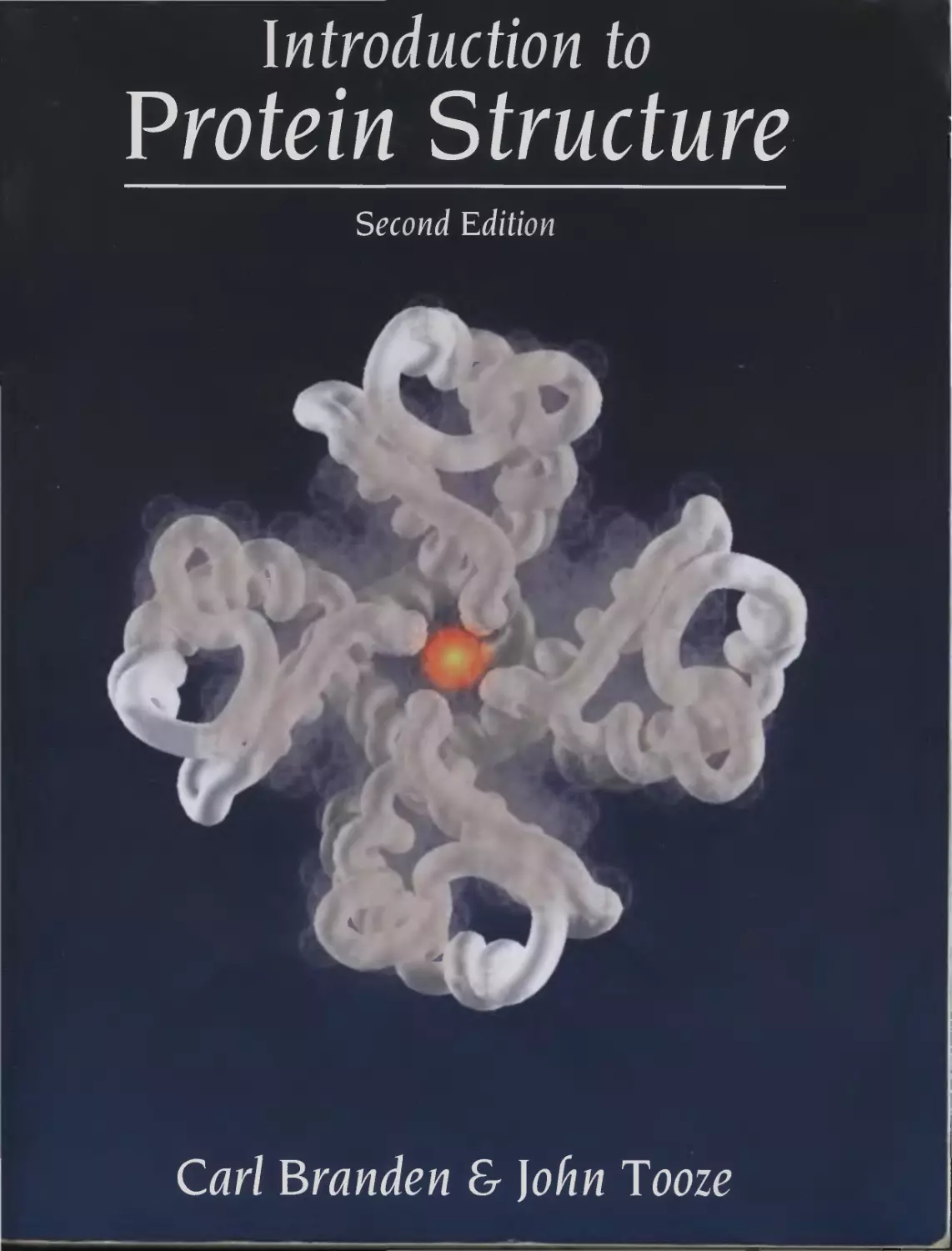
Front: The structure of the potassium channel from Streptomyces lividans,
determined by Rodney MacKinnon at the Rockefeller University, New York.
As discussed in Chapter 12, this structure—the first of such an ion channel—
shows how the channel allows the passage of potassium ions through cell
membranes with high efficiency and selectivity. The view is looking down
the protein as it sits in the cell membrane, as seen from outside the cell, with
a potassium ion shown in gold. This image was produced using the GRASP
program (A. Nicholls and B. Honig, Columbia University) from atomic
coordinates kindly provided by Rodney MacKinnon.
Back: A hand-drawn image of the potassium channel, in the same view as
on the front cover, with each subunit of the tetrameric protein shown in a
different color.
Cover design by Christopher Thorpe and Nigel Orme.
© 1991, 1999 Carl Branden and John Tooze
All rights reserved. No part of this book covered by the copyright hereon may
be reproduced or used in any form or by any means—graphic, electronic, or
mechanical, including photocopying, recording, taping, or information
storage and retrieval systems—without permission of the publisher.
Visit the Introduction to Protein Structure Web site:
http://www.proteinstructure.com/
For information on other textbooks available from Garland Publishing, visit:
http: //www. garlandpub. com/
Library of Congress Cataloging-in-Publication Data
Branden, Carl-lvar
Introduction to protein structure I Carl-Ivar Branden, John Tooze.
-2nd ed.
p. cm.
Includes bibliographical references and index.
ISBN 0-8153-2304-2 (hardcover). -ISBN 0-8153-2305-0 (pbk.)
1. Proteins-Structure. I. Tooze, John. II. Title.
QP551.B7635 1998
572'.633-dc21	98-34487
CIP
Published by Garland Publishing, Inc.
19 Union Square West, New York, NY 10003-3382
Printed in the United States of America
15 14 13 12 11 10 9 8 7 6 5 4 3 2 1
The determination of the atomic structures of proteins has seen an enormous
increase in impetus since the first edition of this book was published in 1991.
The number of new structures reported is close to doubling each year. Tech-
nical advances—for example the increased availability of synchrotron x-ray
beams and methods for freezing crystals so as to reduce radiation damage to
them, the development of multidimensional NMR and NMR machines with
ever more powerful magnetic fields, and the exploitation of gene cloning,
sequencing and expression systems have all contributed to the growth of pro-
tein structure determination. On the one hand, it is becoming increasingly
easy to obtain relatively large amounts of naturally rare proteins, on the
other hand the crystallographers can work with ever smaller crystals.
The fundamental tenet of molecular biology, namely that one cannot
really understand biological reactions without understanding the structure of
the participating molecules, is at last being vindicated. As the database of
known protein structures rapidly expands, so does the range of biological
pathways about which we can ask meaningful questions at close to atomic
levels of resolution. An understanding of the principles of protein structure
is becoming of ever widening significance to molecular biology.
The pharmaceutical industry has over the past decade become a major
user of the protein structure databases, and a major contributor of newly
determined structures. Knowledge of an enzyme's or a receptor's atomic
structure is invaluable in the search for specific and strongly binding
inhibitors. For example the quest for effective inhibitors of HIV protease, to
be used in combination therapy for AIDS, led many pharmaceutical compa-
nies to determine the structure of that protease with bound inhibitors. Over
120 of these structure determinations have been done so far and at least two
inhibitors of HIV protease are now being regularly used to treat AIDS. It
seems certain that the determination of the atomic structure of target mole-
cules will play an increasingly important role in drug design.
The commercial exploitation of our increased understanding of protein
structure will not, of course, be restricted to the pharmaceutical industry. The
industrial use of enzymes in the chemical industry, the development of new
and more specific pesticides and herbicides, the modification of enzymes in
order to change the composition of plant oils and plant carbohydrates are all
examples of other commercial developments that depend, in part, on under-
standing the structure of particular proteins at high resolution.
As the complete genomes of more and more species are sequenced, the
determination of the function of previously unidentified open reading
frames is becoming an increasing and challenging problem. The possibility of
v
setting up centers for automated high through-put structure determinations
is being seriously discussed. In the absence of any recognizable sequence
homology to proteins of known function, this approach, surprising though
it may seem, could become an effective way of determining function via
structural homology.
The growth in the interest in high-resolution protein structure over the
past decade and the reception of the first edition have encouraged us to pre-
pare a new edition of this book. Universities are devoting more time to cours-
es specifically on protein structure, or increasing the amount of time given to
protein structure in more generally based biology and biochemistry courses.
We hope that this new edition of Introduction to Protein Structure will prove
useful both to teachers and students.
In 1988 when we began writing the first edition, about 250 protein struc-
tures had been determined to medium to high resolution and in those days
a professional protein crystallographer was familiar with most of them. We
were not therefore faced with a severe problem of what to leave out as we
wrote. Today, the coordinates of over 6500 proteins have been deposited in
the Protein Data Bank at Brookhaven, New York. Both the number of struc-
tures and the variety of biological systems to which they relate are so high
that the field of protein structure is becoming more fragmented and special-
ized. It is becoming increasingly difficult to keep sight of the wood amongst
so many trees. The question of what to include and what to omit is, for
today's authors, crucially important. We have tried to resist the temptation to
describe more and more proteins, adding detail but not increasing under-
standing of the basic concepts. This edition is inescapably a little larger than
its predecessor, but to contain the increase in size we have deleted two chap-
ters while adding four. We run the risk of disappointing not a few structural
biologists whose favourite proteins are not mentioned. To them we apologize
and ask for their understanding.
vi
Acknowledgements
In preparing the second edition of this book we have again relied heavily on
and benefited greatly from the advice and constructive criticism of numerous
colleagues. We are particularly grateful to Ken Holmes (Max-Planck Institute,
Heidelberg), Lawrence Stern (MIT), Michelle Arkin (Sunesis Pharmaceuticals),
and Watson Fuller (Keele University, UK) for their contributions to, respec-
tively, Chapters 14 and 18, Chapter 15, Chapter 17 and Chapter 18. Stephen
Harrison (Harvard University) and Paul Sigler (Yale University) provided
extensive help and advice on Chapters 8-10, 13 and 16, and Chapters 8-10
and 13, respectively, for which we are especially grateful.
The following, in alphabetical order, have reviewed one or more chap-
ters, correcting our errors of fact or interpretation and helping to ensure they
have the appropriate balance and emphasis: Tom Alber (University of Cali-
fornia, Berkeley), Tom Blundell (Cambridge University, UK), Stephen Burley
(Rockefeller University), Charles Craik (University of California, San Francis-
co), Ken Dill (University of California, San Francisco), Chris Dobson (Oxford
University, UK), Anthony Fink (Unversity of California, Santa Cruz), Robert
Fletterick (University of California, San Francisco), Richard Henderson (LMB,
Cambridge, UK), Werner Kiihlbrandt (MPI, Frankfurt), David Parry (Massey
University, New Zealand), Greg Petsko (Brandeis University), and David
Trentham (NIMR, London, UK).
The book depends for its accessibility upon its illustrations and we are
hugely indebted to Nigel Orme, who, as with the first edition, has converted
sketches into lucid figures. Keith Roberts has again advised us on how best
graphically to represent chemical and structural phenomena. Jane Richard-
son (Duke University) has generously produced the Kinemage supplement to
this edition and the book relies upon Richardson-type diagrams throughout
to render the structures discussed comprehensible. We thank our publishers
Garland Publishing, now part of the Taylor and Francis Group, for their sup-
port, and in particular Matthew Day for his enthusiastic editing of the com-
plete manuscript. Miranda Robertson, in her inimitable style, has again
managed the entire project.
vii

Contents
Part I Basic Structural Principles
1. The Building Blocks
Proteins are polypeptide chains
The genetic code specifies 20 different amino
acid side chains
Cysteines can form disulfide bridges
Peptide units are building blocks of protein
structures
Glycine residues can adopt many different
conformations
Certain side-chain conformations are
energetically favorable
Many proteins contain intrinsic metal atoms
Conclusion
Selected readings
2. Motifs of Protein Structure
The interior of proteins is hydrophobic
The alpha (a) helix is an important
element of secondary structure
The a helix has a dipole moment
Some amino acids are preferred in
a helices
Beta (P) sheets usually have their p strands
either parallel or antiparallel
Loop regions are at the surface of
protein molecules
Schematic pictures of proteins highlight
secondary structure
Topology diagrams are useful for classification
of protein structures
Secondary structure elements are connected
to form simple motifs
The hairpin p motif occurs frequently in
protein structures
The Greek key motif is found in antiparallel
P sheets
The p-ct-p motif contains two parallel
P strands
Protein molecules are organized in a structural
hierarchy
Large polypeptide chains fold into several
domains
1	Domains are built from structural	motifs	30
3	Simple motifs combine to form	complex motifs 30
4	Protein structures can be divided into
three main classes	31
4	Conclusion	32
5	Selected readings	33
g 3. Alpha-Domain Structures	35
Coiled-coil a helices contain a repetitive
9	heptad amino acid sequence pattern	35
The four-helix bundle is a common domain
10	structure in a proteins	37
11	Alpha-helical domains are sometimes large
12	and complex	39
12	The globin fold is present in myoglobin and
hemoglobin	40
13	Geometric considerations determine
14	a-helix packing	40
Ridges of one a helix fit into grooves of an
14	adjacent helix	40
16	The globin fold has been preserved during
evolution	41
16 The hydrophobic interior is preserved	42
Helix movements accommodate interior
19	side-chain mutations	43
Sickle-cell hemoglobin confers resistance
21	to malaria	43
Conclusion	45
22	Selected readings	45
23	4.	Alpha/Beta Structures	47
Parallel p strands are arranged in barrels
24	or sheets	47
Alpha/beta barrels occur in many different
26	enzymes	48
Branched hydrophobic side chains dominate
27	the core of а/p barrels	49
Pyruvate kinase contains several domains,
27	one of which is an а/p barrel	51
Double barrels have occurred by gene
28	fusion	52
The active site is formed by loops at one
29	end of the а/p barrel	53
ix
Alpha/beta barrels provide examples of
evolution of new enzyme activities
Leucine-rich motifs form an cx/p-horseshoe
fold
Alpha/beta twisted open-sheet structures
contain a helices on both sides of the
P sheet
Open P-sheet structures have a variety
of topologies
The positions of active sites can be predicted
in а/p structures
Tyrosyl-tRNA synthetase has two different
domains (a/p + a)
Carboxypeptidase is an а/p protein with a
mixed P sheet
Arabinose-binding protein has two similar
а/p domains
Conclusion
Selected readings
5. Beta Structures
Up-and-down barrels have a simple topology
The retinol-binding protein binds retinol
inside an up-and-down p barrel
Amino acid sequence reflects p structure
The retinol-binding protein belongs to a
superfamily of protein structures
Neuraminidase folds into up-and-down p sheets
Folding motifs form a propeller-like structure
in neuraminidase
The active site is in the middle of one side of
the propeller
Greek key motifs occur frequently in
antiparallel p structures
The y-crystallin molecule has two domains
The domain structure has a simple topology
Two Greek key motifs form the domain
The two domains have identical topology
The two domains have similar structures
The Greek key motifs in у crystallin are
evolutionarily related
The Greek key motifs can form jelly roll barrels
The jelly roll motif is wrapped around a barrel
The jelly roll barrel is usually divided into
two sheets
The functional hemagglutinin subunit has two
polypeptide chains
The subunit structure is divided into a stem
and a tip
The receptor binding site is formed by the
jelly roll domain
Hemagglutinin acts as a membrane fusogen
The structure of hemagglutinin is affected
by pH changes
Parallel P-helix domains have a novel fold
Conclusion
Selected readings
6. Folding and Flexibility
Globular proteins are only marginally stable
Kinetic factors are important for folding
Molten globules are intermediates in folding
Burying hydrophobic side chains is a key event
Both single and multiple folding pathways
54	have been observed	93
55	Enzymes assist formation of proper disulfide
bonds during folding	96
Isomerization of proline residues can be
a rate-limiting step in protein folding	98
56	Proteins can fold or unfold inside chaperonins 99
GroEL is a cylindrical structure with a
57	central channel in which newly synthesized
polypeptides bind	100
57 GroES closes off one end of the GroEL cylinder 102
The GroEL-GroES complex binds and
59	releases newly synthesized polypeptides
in an ATP-dependent cycle	102
60 The folded state has a flexible structure	104
Conformational changes in a protein kinase
62	are important for cell cycle regulation 105
63 Peptide binding to calmodulin induces a
64	large interdomain movement	109
Serpins inhibit serine proteinases with
67	a spring-loaded safety catch mechanism	110
68 Effector molecules switch allosteric proteins
between R and T states	113
68	X-ray structures explain the allosteric
69	properties of phosphofructokinase	114
Conclusion	117
70	Selected readings	119
70
7. DNA Structures	121
71	The DNA double helix is different in A- and
B-DNA	121
72	The DNA helix has major and minor grooves	122
Z-DNA forms a zigzag pattern	123
72	B-DNA is the preferred conformation in vivo	124
74	Specific base sequences can be recognized
74	in B-DNA	124
74	Conclusion	125
75	Selected readings	126
76
Part 2 Structure, Function, and Engineering 127
76	8. DNA Recognition in Procaryotes by
77	Helix-Turn-Helix Motifs	129
77	A molecular mechanism for gene control	129
Repressor and Cro proteins operate a procaryotic
78	genetic switch region	130
The x-ray structure of the complete lambda
79	Cro protein is known	131
The x-ray structure of the DNA-binding
79	domain of the lambda repressor is known	132
Both lambda Cro and repressor proteins
80	have a specific DNA-binding motif	133
80	Model building predicts Cro-DNA interactions 134
Genetic studies agree with the structural model 135
81	The x-ray structure of DNA complexes with
84	434 Cro and repressor revealed novel
85	features of protein-DNA interactions	136
87 The structures of 434 Cro and the 434
repressor DNA-binding domain are very
89	similar	137
90	The proteins impose precise distortions on
91	the B-DNA in the complexes	138
92	Sequence-specific protein-DNA interactions
93	recognize operator regions	138
x
Protein-DNA backbone interactions determine
DNA conformation	139
Conformational changes of DNA are
important for differential binding of repressor
and Cro to different operator sites	140
The essence of phage repressor and Cro	141
DNA binding is regulated by allosteric control 142
The trp repressor forms a helix-turn-helix motif 142
A conformational change operates a
functional switch	142
Lac repressor binds to both the major and minor
grooves inducing a sharp bend in the DNA 143
САР-induced DNA bending could activate
transcription	146
Conclusion	147
Selected readings	148
9. DNA Recognition by Eucaryotic
Transcription Factors	151
Transcription is activated by protein-protein
interactions	152
The	TATA box-binding protein is ubiquitous	153
The three-dimensional structures of
TBP-TATA box complexes are known	154
A p	sheet in TBP forms the DNA-binding site	154
TBP binds in the minor groove and induces
large structural changes in DNA	155
The interaction area between TBP and the
TATA box is mainly hydrophobic	157
Functional implications of the distortion of
DNA by TBP	158
TFIIA and TFIIB bind to both TBP and DNA 159
Homeodomain proteins are involved in the
development of many eucaryotic organisms 159
Monomers of homeodomain proteins bind
to DNA through a helix-turn-helix motif 160
In vivo specificity of homeodomain
transcription factors depends on interactions
with other proteins	162
POU regions bind to DNA by two tandemly
oriented helix-turn-helix motifs	164
Much remains to be learnt about the function of
homeodomains in vivo	166
Understanding tumorigenic mutations	166
The monomeric p53 polypeptide chain is
divided in three domains	167
The oligomerization domain forms tetramers	167
The DNA-binding domain of p53 is an
antiparallel P barrel	168
Two loop regions and one a helix of p53 bind
to DNA	169
Tumorigenic mutations occur mainly in three
regions involved in DNA binding	170
Conclusions	172
Selected readings	172
10.	Specific Transcription Factors Belong	175
to a Few Families
Several different groups of zinc-containing	176
motifs have been observed
The classic zinc fingers bind to DNA in tandem 177
along the major groove
The finger region of the classic zinc finger
motif interacts with DNA
Two zinc-containing motifs in the
glucocorticoid receptor form one
DNA-binding domain
A dimer of the glucocorticoid receptor binds
to DNA
An a helix in the first zinc motif provides
the specific protein-DNA interactions
Three residues in the recognition helix provide
the sequence-specific interactions with DNA
The retinoid X receptor forms heterodimers
that recognize tandem repeats with
variable spacings
Yeast transcription factor GAL4 contains
a binuclear zinc cluster in its DNA-binding
domain
The zinc cluster regions of GAL4 bind at the
two ends of the enhancer element
The linker region also contributes to DNA
binding
DNA-binding site specificity among the Сб-zinc
cluster family of transcription factors is
achieved by the linker regions
Families of zinc-containing transcription
factors bind to DNA in several different ways
Leucine zippers provide dimerization
interactions for some eucaryotic
transcription factors
The GCN4 basic region leucine zipper binds
DNA as a dimer of two uninterrupted
a helices
GCN4 binds to DNA with both specific and
nonspecific contacts
The HLH motif is involved in homodimer
and heterodimer associations
The a-helical basic region of the b/HLH
motif binds in the major groove of DNA
The b/HLH/zip family of transcription factors
have both HLH and leucine zipper
dimerization motifs
Max and MyoD recognize the DNA HLH
consensus sequence by different specific
protein-DNA interactions
Conclusion
Selected readings
11.	An Example of Enzyme Catalysis:
Serine Proteinases
Proteinases form four functional families
The catalytic properties of enzymes are
reflected in Km and kcat values
Enzymes decrease the activation energy of
chemical reactions
Serine proteinases cleave peptide bonds by
forming tetrahedral transition states
Four important structural features are required
for the catalytic action of serine proteinases
Convergent evolution has produced two
different serine proteinases with similar
catalytic mechanisms
The chymotrypsin structure has two antiparallel
P-barrel domains
178
181
183
184
184
185
187
188
189
190
191
191
193
194
196
198
199
201
201
203
205
205
206
206
208
209
210
210
xi
The active site is formed by two loop regions
from each domain	211
Did the chymotrypsin molecule evolve by
gene duplication?	212
Different side chains in the substrate
specificity pocket confer preferential
cleavage	212
Engineered mutations in the substrate
specificity pocket change the rate of catalysis 213
The Asp 189-Lys mutation in trypsin causes
unexpected changes in substrate specificity 215
The structure of the serine proteinase subtilisin
is of the а/p type	215
The active sites of subtilisin and chymotrypsin
are similar	216
A structural anomaly in subtilisin has
functional consequences	217
Transition-state stabilization in subtilisin is
dissected by protein engineering	217
Catalysis occurs without a catalytic triad	217
Substrate molecules provide catalytic groups
in substrate-assisted catalysis	218
Conclusion	219
Selected readings	220
12.	Membrane Proteins	223
Membrane proteins are difficult to crystallize	224
Novel crystallization methods are being
developed	224
Two-dimensional crystals of membrane
proteins can be studied by electron
microscopy	225
Bacteriorhodopsin contains seven
transmembrane a helices	226
Bacteriorhodopsin is a light-driven proton
pump	227
Porins form transmembrane channels by
P strands	228
Porin channels are made by up and down
P barrels	229
Each porin molecule has three channels	230
Ion channels combine ion selectivity with
high levels of ion conductance	232
The K+ channel is a tetrameric molecule with
one ion pore in the interface between the
four subunits	232
The ion pore has a narrow ion selectivity filter 233
The bacterial photosynthetic reaction center
is built up from four different polypeptide
chains and many pigments	234
The L, M, and H subunits have transmembrane
a helices	236
The photosynthetic pigments are bound to the
L and M subunits	237
Reaction centers convert light energy into
electrical energy by electron flow through
the membrane	239
Antenna pigment proteins assemble into
multimeric light-harvesting particles	240
Chlorophyll molecules form circular rings
in the light-harvesting complex LH2	241
The reaction center is surrounded by a ring of 16
antenna proteins of the light-harvesting
complex LH1	242
Transmembrane a helices can be predicted
from amino acid sequences
Hydrophobicity scales measure the degree
of hydrophobicity of different amino acid
side chains
Hydropathy plots identii transmembrane
helices
Reaction center hydropathy plots agree with
crystal structural data
Membrane lipids have no specific interaction
with protein transmembrane a helices
Conclusion
Selected readings
13.	Signal Transduction
G proteins are molecular amplifiers
Ras proteins and the catalytic domain
of Ga have similar three-dimensional
structures
Ga is activated by conformational changes of
three switch regions
GTPases hydrolyze GTP through nucleophilic
attack by a water molecule
The Gp subunit has a seven-blade propeller fold,
built up from seven WD repeat units
The GTPase domain of Ga binds to Gp in the
heterotrimeric GapY complex
Phosducin regulates light adaptation in
retinal rods
Phosducin binding to GpY blocks binding of Ga
The human growth hormone induces
dimerization of its cognate receptor
Dimerization of the growth hormone receptor
is a sequential process
The growth hormone also binds to the
prolactin receptor
Tyrosine kinase receptors are important
enzyme-linked receptors
Small protein modules form adaptors for a
signaling network
SH2 domains bind to phosphotyrosine-
containing regions of target molecules
SH3 domains bind to proline-rich regions of
target molecules
Src tyrosine kinases comprise SH2 and SH3
domains in addition to a tyrosine kinase
The two domains of the kinase in the
inactive state are held in a closed
conformation by assembly of the
regulatory domains
Conclusion
Selected readings
14.	Fibrous Proteins
Collagen is a superhelix formed by three
parallel, very extended left-handed helices
Coiled coils are frequently used to form
oligomers of fibrous and globular proteins
Amyloid fibrils are suggested to be built up
from continuous p sheet helices
Spider silk is nature's high-performance fiber
Muscle fibers contain myosin and actin which
slide against each other during muscle
contraction
244
245
245
246
246
247
248
251
252
254
257
259
261
263
265
265
267
268
269
270
272
273
274
275
277
278
280
283
284
286
288
289
290
xii
Myosin heads form cross-bridges between the
actin and myosin filaments
Time-resolved x-ray diffraction of frog muscle
confirmed movement of the cross-bridges
Structures of actin and myosin have been
determined
The structure of myosin supports the swinging
cross-bridge hypothesis
The role of ATP in muscular contraction has
parallels to the role of GTP in G-protein
activation
Conclusion
Selected readings
15.	Recognition of Foreign Molecules by the
Immune System
The polypeptide chains of antibodies are
divided into domains
Antibody diversity is generated by several
different mechanisms
All immunoglobulin domains have similar
three-dimensional structures
The immunoglobulin fold is best described as
two antiparallel p sheets packed tightly
against each other
The hypervariable regions are clustered
in loop regions at one end of the
variable domain
The antigen-binding site is formed by close
association of the hypervariable regions
from both heavy and light chains
The antigen-binding site binds haptens in
crevices and protein antigens on large
flat surfaces
The CDR loops assume only a limited range
of conformations, except for the heavy
chain CDR3
An IgG molecule has several degrees of
conformational flexibility
Structures of MHC molecules have provided
insights into the molecular mechanisms
of T-cell activation
MHC molecules are composed of antigen-
binding and immunoglobulin-like domains
Recognition of antigen is different in MHC
molecules compared with immunoglobulins
Peptides are bound differently by class I and
class II MHC molecules
T-cell receptors have variable and constant
immunoglobulin domains and
hypervariable regions
МНС-peptide complexes are the ligands for
T-cell receptors
Many cell-surface receptors contain
immunoglobulin-like domains.
Conclusion
Selected readings
16.	The Structure of Spherical Viruses
The protein shells of spherical viruses have
icosahedral symmetry
The icosahedron has high symmetry
The simplest virus has a shell of 60 protein
subunits
291
292
293
295
296
297
298
299
300
302
303
304
305
306
308
311
312
312
313
314
315
316
318
318
320
321
325
327
327
328
Complex spherical viruses have more than one
polypeptide chain in the asymmetric unit 329
Structural versatility gives quasi-equivalent
packing in T = 3 plant viruses	331
The protein subunits recognize specific parts
of the RNA inside the shell	332
The protein capsid of picornaviruses contains
four polypeptide chains	333
There are four different structural proteins in
picornaviruses	334
The arrangement of subunits in the shell of
picornaviruses is similar to that of T = 3
plant viruses	334
The coat proteins of many different spherical
plant and animal viruses have similar
jelly roll barrel structures, indicating an
evolutionary relationship	335
Drugs against the common cold may be
designed from the structure of rhinovirus 337
Bacteriophage MS2 has a different subunit
structure	339
A dimer of MS2 subunits recognizes an RNA
packaging signal	339
The core protein of alphavirus has a
chymotrypsin-like fold	340
SV40 and polyomavirus shells are constructed
from pentamers of the major coat protein
with nonequivalent packing but largely
equivalent interactions	341
Conclusion	343
Selected readings	344
17.	Prediction, Engineering, and Design of
Protein Structures	347
Homologous proteins have similar structure
and function	348
Homologous proteins have conserved structural
cores and variable loop regions	349
Knowledge of secondary structure is necessary
for prediction of tertiary structure	350
Prediction methods for secondary structure
benefit from multiple alignment of
homologous proteins	351
Many different amino acid sequences give
similar three-dimensional structures	352
Prediction of protein structure from sequence
is an unsolved problem	352
Threading methods can assign amino acid
sequences to known three-dimensional folds 353
Proteins can be made more stable by
engineering	354
Disulfide bridges increase protein stability	355
Glycine and proline have opposite effects on
stability	356
Stabilizing the dipoles of a helices increases
stability	357
Mutants that fill cavities in hydrophobic cores
do not stabilize T4 lysozyme	358
Proteins can be engineered by combinatorial
methods	358
Phage display links the protein library
to DNA	359
Affinity and specificity of proteinase inhibitors
can be optimized by phage display	361
xiii
Structural scaffolds can be reduced in size
while function is retained
Phage display of random peptide libraries
identified agonists of erythropoetin receptor
DNA shuffling allows accelerated evolution
of genes
Protein structures can be designed from first
principles
A p structure has been converted to an a structure
by changing only half of the sequence
Conclusion
Selected readings
18.	Determination of Protein Structures
Several different techniques are used to study
the structure of protein molecules
Protein crystals are difficult to grow
X-ray sources are either monochromatic or
polychromatic
X-ray data are recorded either on image plates
or by electronic detectors
The rules for diffraction are given by Bragg's law
Phase determination is the major
crystallographic problem
Phase information can also be obtained by
Multiwavelength Anomalous Diffraction
experiments
Building a model involves subjective
363	interpretation of the data	381
Errors in the initial model are removed
364	by refinement	383
Recent technological advances have greatly
365	influenced protein crystallography	383
X-ray diffraction can be used to study the
367	structure of fibers as well as crystals	384
The structure of biopolymers can be studied
368	using fiber diffraction	386
370 NMR methods use the magnetic properties of
371	atomic nuclei	387
Two-dimensional NMR spectra of proteins are
373	interpreted by the method of sequential
assignment	389
373 Distance constraints are used to derive possible
374	structures of a protein molecule	390
Biochemical studies and molecular
376	structure give complementary functional
information	391
377	Conclusion	391
378	Selected readings	392
379 Protein Structure on the World Wide Web 393
381
xiv
Basic
Structural
Principles
Part 1
1

The Building Blocks
Recombinant DNA techniques have provided tools for the rapid determination
of DNA sequences and, by inference, the amino acid sequences of proteins
from structural genes. The number of such sequences is now increasing
almost exponentially, but by themselves these sequences tell little more
about the biology of the system than a New York City telephone directory
tells about the function and marvels of that city.
The proteins we observe in nature have evolved, through selective pres-
sure, to perform specific functions. The functional properties of proteins
depend upon their three-dimensional structures. The three-dimensional
structure arises because particular sequences of amino acids in polypeptide
chains fold to generate, from linear chains, compact domains with specific
three-dimensional structures (Figure 1.1). The folded domains can serve as
modules for building up large assemblies such as virus particles or muscle
fibers, or they can provide specific catalytic or binding sites, as found in
enzymes or proteins that carry oxygen or that regulate the function of DNA.
To understand the biological function of proteins we would therefore
like to be able to deduce or predict the three-dimensional structure from the
amino acid sequence. This we cannot do. In spite of considerable efforts over
the past 25 years, this folding problem is still unsolved and remains one of
the most basic intellectual challenges in molecular biology.
Figure 1.1 The amino acid sequence of a
protein’s polypeptide chain is called Its
primary structure. Different regions of the
sequence form local regular secondary
structures, such as alpha (a) helices or beta (P)
strands. The tertiary structure is formed by
packing such structural elements into one or
several compact globular units called domains.
The final protein may contain several
polypeptide chains arranged in a quaternary
structure. By formation of such tertiary and
quaternary structure amino acids far apart in
the sequence are brought close together in
three dimensions to form a functional region,
an active site.
Primary
Secondary	Tertiary	Quaternary
3
Protein folding remains a problem because there are 20 different amino
acids that can be combined into many more different proteins than there are
atoms in the known universe. In addition there is a vast number of ways in
which similar structural domains can be generated in proteins by different
amino acid sequences. By contrast, the structure of DNA, made up of only
four different nucleotide building blocks that occur in two pairs, is relatively
simple, regular, and predictable.
Since the three-dimensional structures of individual proteins cannot be
predicted, they must instead be determined experimentally by x-ray crystal-
lography, electron crystallography or nuclear magnetic resonance (NMR)
techniques. Over the past 30 years the structures of more than 6000 proteins
have been solved, and the sequences of more than 500,000 have been deter-
mined. This has generated a body of information from which a set of basic
principles of protein structure has emerged. These principles make it easier
for us to understand how protein structure is generated, to identify common
structural themes, to relate structure to function, and to see fundamental
relationships between different proteins. The science of protein structure is at
the stage of taxonomy where we can begin to discern patterns and motifs
among the relatively small number of proteins whose three-dimensional
structure is known.
The first six chapters of this book deal with the basic principles of pro-
tein structure as we understand them today, and examples of the different
major classes of protein structures are presented. Chapter 7 contains a brief
discussion on DNA structures with emphasis on recognition by proteins of
specific nucleotide sequences. The remaining chapters illustrate how during
evolution different structural solutions have been selected to fulfill particular
functions.
Proteins are polypeptide chains
AU of the 20 amino acids have in common a central carbon atom (Ca) to
which are attached a hydrogen atom, an amino group (NH2), and a carboxyl
group (COOH) (Figure 1.2a). What distinguishes one amino acid from
another is the side chain attached to the Ca through its fourth valence. There
are 20 different side chains specified by the genetic code; others occur, in rare
cases, as’the products of enzymatic modifications after translation.
Amino acids are joined end-to-end during protein synthesis by the for-
mation of peptide bonds when the carboxyl group of one amino acid con-
denses with the amino group of the next to eliminate water (Figure 1.2b).
This process is repeated as the chain elongates. One consequence is that the
amino group of the first amino acid of a polypeptide chain and the carboxyl
group of the last amino acid remain intact, and the chain is said to extend
from its amino terminus to its carboxy terminus. The formation of a succes-
sion of peptide bonds generates a "main chain," or "backbone," from which
project the various side chains.
The main-chain atoms are a carbon atom Ca to which the side chain is
attached, an NH group bound to Ca, and a carbonyl group C'=O, where the
carbon atom C' is attached to Ca. These units, or residues, are linked into a
polypeptide by a peptide bond between the C' atom of one residue and the
nitrogen atom of the next (see Figure 1.2b). The basic repeating unit along
the main chain from a biochemical or genetic viewpoint is thus
(NH-CaH-C'=O), which is the residue of the common parts of amino acids
after peptide bonds have been formed (see Figure 1.2b).
The genetic code specifies 20 different amino acid side chains
The 20 different side chains that occur in proteins are shown in Panel 1.1 (pp.
6-7). Their names are abbreviated with both a three-letter and a one-letter
code, which are also given in the panel. The one-letter codes are worth mem-
orizing, as they are widely used in the literature. A mnemonic device for link-
ing the one-letter code to the names of the amino acids is given in Panel 1.1.
Figure 1.2 Proteins are built up by amino
acids that are linked by peptide bonds to form
a polypeptide chain, (a) Schematic diagram of
an amino acid, illustrating the nomenclature
used in this book. A central carbon atom (Ca)
is attached to an amino group (NH2), a
carboxyl group (COOH), a hydrogen atom (H),
and a side chain (R). (b) In a polypeptide chain
the carboxyl group of amino acid n has formed
a peptide bond, C-N, to the amino group
of amino acid n + 1. One water molecule is
eliminated in this process. The repeating units,
which are called residues, are divided into
main-chain atoms and side chains. The
main-chain part, which is identical in all
residues, contains a central Ca atom attached
to an NH group, a C'=O group, and an H atom.
The side chain R, which is different for
different residues, is bound to the Ca atom.
(fl)
carboxyl group
amino group
и+I
4
The amino acids are usually divided into three different classes defined
by the chemical nature of the side chain. The first class comprises those with
strictly hydrophobic side chains: Ala (A), Vai (V), Leu (L), He (I), Phe (F), Pro
(P), and Met (M). The four charged residues, Asp (D), Glu (E), Lys (K), and Arg
(R), form the second class. The third class comprises those with polar side
chains: Ser (S), Thr (T), Cys (C), Asn (N), Gin (Q), His (H), Tyr (Y), and Trp
(W). The amino acid glycine (G), which has only a hydrogen atom as a side
chain and so is the simplest of the 20 amino acids, has special properties and
is usually considered either to form a fourth class or to belong to the first
class.
The four groups attached to the Ca atom are chemically different for all
the amino acids except glycine, where two H atoms bind to Ca. All amino
acids except glycine are thus chiral molecules that can exist in two different
forms with different "hands," L- or D-form (Figure 1.3).
Biological systems depend on specific detailed recognition of molecules
that distinguish between chiral forms. The translation machinery for protein
synthesis has evolved to utilize only one of the chiral forms of amino acids,
the L-form. All amino acids that occur in proteins therefore have the L-form.
There is, however, no obvious reason why the L-form was chosen during evo-
lution and not the D-form.
Figure 1.3 The "handedness" of amino acids.
Looking down the H-Ca bond from the
hydrogen atom, the L-form has CO, R, and
N substituents from Ca going in a clockwise
direction. There is a mnemonic to remember
this; for the L-form the groups read CORN in
clockwise direction.
Cysteines can form disulfide bridges
Two cysteine residues in different parts of the polypeptide chain but adjacent
in the three-dimensional structure of a protein can be oxidized to form a
disulfide bridge (Figure 1.4). The disulfide is usually the end product of air
oxidation according to the following reaction scheme:
2 -CH2SH + % O2 -CH2-S-S-CH2 + H2O
This reaction requires an oxidative environment, and such disulfide bridges
are usually not found in intracellular proteins, which spend their lifetime in
an essentially reductive environment. Disulfide bridges do, however, occur
quite frequently among extracellular proteins that are secreted from cells,
and in eucaryotes, formation of these bridges occurs within the lumen of the
endoplasmic reticulum, the first compartment of the secretory pathway.
Figure 1.4 The disulfide is usually the end
product of air oxidation according to the
following schematic reaction scheme:
2 -CH2SH + У2 O2 -CH2-S-S-CH2 + H2O
Disulfide bonds form between the side chains
of two cysteine residues. Two SH groups from
cysteine residues, which may be In different
parts of the amino acid sequence but adjacent
in the three-dimensional structure, are
oxidized to form one S-S (disulfide) group.
5
|я| Hydrophobic amino adds
CH3
H3N+—C—COO"
H
A Ala, Alanine
V Vai, Valine
H3C CH3
CH
9
HC^ ^CH
II I
HC .CH
c
CH2
F Phe, Phenylalanine
4	<?
V
J lie, Isoleucine

CH2
L Leu, Leucine
6
CH3
S
I
CH2
CH2
P Pro, Proline
M Met, Methionine
NH2
CH2
I Arg, Arginine	I
Panel 1.1 The 20 different amino acids that
occur in proteins. Only side chains are shown,
except for the first amino acid, alanine, where
all atoms are shown. The bond from the side
chain to CK is red. A ball-and stick model, the
chemical formula, the full name, and the
three-letter and one-letter codes are given for
each amino acid.
There are some easy ways of remembering
the one-letter code for amino acids. If only one
amino acid begins with a certain letter, that
letter is used:
C = Cys = Cysteine
H = His = Histidine
I = He = Isoleucine
M = Met = Methionine
S = Ser = Serine
V = Vai = Valine
If more than one amino acid begins with a
certain letter, that letter is assigned to the
most commonly occurring amino acid:
A = Ala = Alanine
G = Gly = Glycine
L = Leu = Leucine
P = Pro = Proline
T = Thr = Threonine
Some of the others are phonetically suggestive:
F = Phe = Phenylalanine ("Fenylalanine")
R = Arg = Arginine ("aRginine”)
Y = Tyr = Tyrosine ("tYrosine")
W = Trp = Tryptophan (double ring in
the molecule)
In other cases a letter close to the initial is
used. Amides have letters from the middle of
the alphabet. The smaller molecules (D, N, B)
are earlier in the alphabet than the larger ones
(E, Q, Z).
D = Asp = Aspartic acid (near A)
N = Asn = Asparagine (contains N)
В = Asx = Either of D or N
E = Glu = Glutamic acid (near G)
Q = Gin = Glutamine ("Q-tamine")
Z = Glx = Either of E or Q
К = Lys = Lysine (near L)
X = X = Undetermined amino acid
Ц His, Histidine
| Try, Tryptophan
(d) Glycine
H
i I
G Gly, Glycine
7
Disulfide bridges stabilize three-dimensional structure. In some proteins
these bridges hold together different polypeptide chains; for example, the A
and В chains of insulin are linked by two disulfide bridges between the
chains. More frequently intramolecular disulfide bridges stabilize the folding
of a single polypeptide chain, making the protein less susceptible to degra-
dation. There are many examples of this, including proteins with short
polypeptide chains, such as snake venom toxins and protease inhibitors, that
need additional stabilizing factors to produce a stable fold. Much effort is
currently spent on introducing extra intramolecular disulfide bridges into
enzymes by site-directed mutagenesis in order to make them more thermo-
stable and hence more useful for industrial applications as catalysts, as
described in Chapter 17.
Peptide units are building blocks of protein structures
Figure 1.2 shows one way of dividing a polypeptide chain, the biochemist's
way. There is, however, a different way to divide the main chain into repeat-
ing units that is preferable when we want to describe the structural proper-
ties of proteins. For this purpose it is more useful to divide the polypeptide
chain into peptide units that go from one Ca atom to the next Ca atom (see
Figure 1.5). Each Ca atom, except the first and the last, thus belongs to two
such units. The reason for dividing the chain in this way is that all the atoms
in such a unit are fixed in a plane with the bond lengths and bond angles
very nearly the same in all units in all proteins. Note that the peptide units
of the main chain do not involve the different side chains (Figure 1.5). We
will use both of these alternative descriptions of polypeptide chains—the bio-
chemical and the structural—and discuss proteins in terms of the sequence
of different amino acids and the sequence of planar peptide units.
Since the peptide units are effectively rigid groups that are linked into a
chain by covalent bonds at the Ca atoms, the only degrees of freedom they
have are rotations around these bonds. Each unit can rotate around two such
bonds: the Ca-C' and the N-Ca bonds (Figure 1.6). By convention the angle
of rotation around the N-Ca bond is called phi (ф) and the angle around the
Сд-С' bond from the same C„ atom is called psi (y).
In this way each amino acid residue is associated with two conforma-
tional angles ф and y. Since these are the only degrees of freedom, the con-
formation of the whole main chain of the polypeptide is completely deter-
mined when the ф and у angles for each amino acid are defined with high
accuracy.
Figure 1.5 Part of a polypeptide chain that
is divided into peptide units, represented
as blocks in the diagram. Each peptide unit
contains the Ca atom and the C'=O group of
residue n as well as the NH group and the
Ca atom of residue n + 1. Each such unit is a
planar, rigid group with known bond distances
and bond angles. R], R2, and R3 are the side
chains attached to the CK atoms that link the
peptide units in the polypeptide chain. The
peptide group is planar because the additional
electron pair of the C=O bond is delocalized
over the peptide group such that rotation
around the C-N bond is prevented by an
energy barrier.
Figure 1.6 Diagram showing a polypeptide chain where the main-chain
atoms are represented as rigid peptide units, linked through the Ca
atoms. Each unit has two degrees of freedom; it can rotate around two
bonds, its Co-C' bond and its N-Ca bond. The angle of rotation around
the N-Ca bond is called phi (ф) and that around the Cf/-C' bond is
called psi (y). The conformation of the main-chain atoms is therefore
determined by the values of these two angles for each amino acid.
8
Glycine residues can adopt many different conformations
Most combinations of ф and yr angles for an amino acid are not allowed
because of steric collisions between the side chains and main chain. It is rea-
sonably straightforward to calculate those combinations that are allowed.
Since the D- and L-forms of the amino acids have their side chain oriented
differently with respect to the CO group, they have different allowed ф and
V angles. Proteins built from D-amino acids would thus be expected to have
different conformations from those found in nature that are exclusively
made of L-amino acids. Since the L- and D-forms of each amino acid are mir-
ror images of one another, would a protein made exclusively of D-form
residues produce a structure that is the mirror image of the natural protein?
Stephen Kent and his colleagues at the Scripps Institute chemically synthe-
sized both the L- and the D-forms of HIV-1 protease. The D-enzyme proved
indeed to be the mirror image of the L-enzyme. Furthermore the D-enzyme
and L-enzyme had reciprocal chiral specificity on peptide substrates, the
D-enzyme only recognizing and cutting peptides made of D-amino acids. Per-
haps the choice of the L-form at the outset of the evolution of life on earth
was random and irrevocable.
The angle pairs ф and у are usually plotted against each other in a
diagram called a Ramachandran plot after the Indian biophysicist
G.N. Ramachandran who first made calculations of sterically allowed regions.
Figure 1.7 shows the results of such calculations and also a plot for all amino
-180
-180
Figure 1.7 Ramachandran plots showing
allowed combinations of the conformational
angles phi and psi defined in Figure 1.6. Since
phi (ф) and psi (y) refer to rotations of two
rigid peptide units around the same Ca atom,
most combinations produce steric collisions
either between atoms in different peptide
groups or between a peptide unit and the side
chain attached to CK. These combinations are
therefore not allowed, (a) Colored areas show
sterically allowed regions. The areas labeled
a, p, and L correspond approximately to
conformational angles found for the usual
right-handed a helices, P strands, and
left-handed a helices, respectively, (b)
Observed values for all residue types except
glycine. Each point represents ф and у values
for an amino acid residue in a well-refined
x-ray structure to high resolution, (c) Observed
values for glycine. Notice that the values
include combinations of ф and y that are not
allowed for other amino acids. (From J.
Richardson, Adv. Prot. Chem. 34: 174-175,
1981.)
(0
+ 180
psi 0
0 pfti
+180
9
acids except glycine from a number of accurately determined protein struc-
tures. It is apparent that the observed values are clustered in the sterically
allowed regions. There is one important exception. Glycine, with only a
hydrogen atom as a side chain, can adopt a much wider range of conforma-
tions than the other residues, as seen in Figure 1.7c. Glycine thus plays a
structurally very important role; it allows unusual main-chain conformations
in proteins. This is one of the main reasons why a high proportion of glycine
residues are conserved among homologous protein sequences.
Regions in the Ramachandran plot are named after the conformation
that results in a peptide if the corresponding ф and v angles are repeated in
successive amino acids along the chain. The major allowed regions in Figure
1.7a are the right-handed a-helical cluster in the lower left quadrant (see
Chapter 3); the broad region of extended 0 strands of both parallel and
antiparallel 0 structures (see Chapter 4) in the upper left quadrant; and the
small, sparsely populated left-handed a-helical region in the upper right
quadrant. Left-handed a helices are usually found in loop regions or in small
single-turn a helices.
Certain side-chain conformations are energetically favorable
Any side chain longer than that of alanine can in principle have several dif-
ferent conformations because of rotations around the bonds between the
side-chain carbon atoms. It is a general rule in chemistry that the most ener-
getically favored arrangements for two tetrahedrally coordinated carbon
atoms are the "staggered" conformations, in which the substituents of one
carbon atom are between those of the other when viewed along the axis of
rotation, as illustrated in Figure 1.8. For each carbon atom in a side chain,
there are three possible staggered conformations, which are related by a three
step, 120° rotation around the carbon-carbon bond. These three conforma-
tions are indistinguishable for alanine, since all three substituents on the
side-chain carbon atom Cp are the same.
For valine, however, the three staggered conformations are energetically dif-
ferent because the substituents on Cp are different; two of them are methyl
groups and the other is a hydrogen atom (see Figure 1.8b-d). It is energetically
most favorable to have the two methyl groups close to the small hydrogen atom
bound to Ca, as shown in Figure 1.8b, and therefore this is the
conformation most frequently found in proteins. An analysis of accurately
determined protein structures has shown that most side chains have one or a
few conformations that occur more frequently than the other possible staggered
Figure 1.8 The staggered conformations are
the most energetically favored conformations
of two tetrahedrally coordinated carbon atoms,
(a) A view along the C-C bond in ethane
(CH3CH3) showing how the two carbon atoms
can rotate so that their hydrogen atoms are
either not staggered (aligned) or staggered.Three
indistinguishable staggered conformations are
obtained by a rotation of 120° around the C-C
bond, (b-d) Similar views as in (a) of valine.
The three staggered conformations are different
for valine because the three groups attached
to Cp are different. The first staggered
conformation (b) is less crowded and
energetically most favored because the two
methyl groups bound to Cp are both close to
the small H atom bound to CK.
10
(fl)
(fe)
Туг (free radical)
alcohol
conformations. These are called rotamers. Today, collections of these favored
conformations, or rotamer libraries, are a standard tool in computer programs
used for modeling protein structures.
Many proteins contain intrinsic metal atoms
The side chains of the 20 different amino acids listed in Panel 1.1 (pp. 6-7)
have very different chemical properties and are utilized for a wide variety of
biological functions. However, their chemical versatility is not unlimited,
and for some functions metal atoms are more suitable and more efficient.
Electron-transfer reactions are an important example. Fortunately the side
chains of histidine, cysteine, aspartic acid, and glutamic acid are excellent
metal ligands, and a fairly large number of proteins have recruited metal
atoms as intrinsic parts of their structures; among the frequently used metals
are iron, zinc, magnesium, and calcium. Several metallo proteins are dis-
cussed in detail in later chapters and it suffices here to mention briefly a few
examples of iron and zinc proteins.
The most conspicuous use of iron in biological systems is in our blood,
where the erythrocytes are filled with the oxygen-binding protein hemoglo-
bin. The red color of blood is due to the iron atom bound to the heme group
in hemoglobin. Similar heme-bound iron atoms are present in a number
of proteins involved in electron-transfer reactions, notably cytochromes. A
chemically more sophisticated use of iron is found in an enzyme, ribo
nucleotide reductase, that catalyzes the conversion of ribonucleotides to
deoxyribonucleotides, an important step in the synthesis of the building
blocks of DNA.
Ribonucleotide reductase from Escherichia coli and mammals contains a
di-iron center (Figure 1.9a) that reacts with oxygen and oxidizes a nearby
tyrosine side chain, producing a tyrosyl free radical that is essential for the
catalysis. The two iron atoms in this iron center are close to each other and
bridged by the oxygen atoms of a glutamic acid side chain as well as by an
oxygen ion called a p-oxo bridge. Glutamic acid, aspartic acid, and histidine
side chains from the protein, as well as water molecules, complete the co-
ordination sphere of the octahedrally coordinated iron atom.
Zinc is used to stabilize the DNA-binding regions of a class of transcrip-
tion factors called zinc fingers, which are discussed in Chapter 10. Zinc ions
also participate directly in catalytic reactions in many different enzymes by
binding substrate molecules and providing a positive charge that influences
the electronic arrangement of the substrate and thereby facilitates the cat-
alytic reaction. One such example is found in the enzyme alcohol dehydro-
genase, which in yeast produces alcohol during fermentation and in our
livers detoxifies the alcohol we have consumed by oxidizing it. The enzyme
provides a scaffold containing three zinc ligands—one histidine and two cys-
teine side chains—which sequester a zinc atom so that it binds alcohol as a
fourth ligand in a tetrahedral coordination (Figure 1.9b).
Figure 1.9 Examples of functionally important
intrinsic metal atoms in proteins, (a) The
di-iron center of the enzyme ribonucleotide
reductase. Two iron atoms form a redox center
that produces a free radical in a nearby tyrosine
side chain. The iron atoms are bridged by a
glutamic acid residue and a negatively charged
oxygen atom called a ц-oxo bridge. The
coordination of the iron atoms is completed
by histidine, aspartic acid, and glutamic acid
side chains as well as water molecules, (b) The
catalytically active zinc atom in the enzyme
alcohol dehydrogenase. The zinc atom is
coordinated to the protein by one histidine
and two cysteine side chains. During catalysis
zinc binds an alcohol molecule in a suitable
position for hydride transfer to the coenzyme
moiety, a nicotinamide, [(a) Adapted from
P. Nordlund et al., Nature 345: 593-598, 1990.]
11
Conclusion
All protein molecules are polymers built up from 20 different amino acids
linked end-to-end by peptide bonds. The function of every protein molecule
depends on its three-dimensional structure, which in turn is determined by
its amino acid sequence, which in turn is determined by the nucleotide
sequence of the structural gene.
Each amino acid has atoms in common, and these form the main chain
of the protein. The remaining atoms form side chains that can be hydropho-
bic, polar, or charged.
The conformation of the whole main chain of a protein is determined by
two conformational angles, phi (ф) and psi (v), for each amino acid. Only cer-
tain combinations of these angles are allowed because of steric hindrance
between main-chain atoms and side-chain atoms, except for glycine.
Certain side-chain conformations are energetically more favorable than
others. Computer programs used to model protein structures contain rotamer
libraries of such favored conformations.
Many proteins contain intrinsic metal atoms that are functionally
important. The most frequently used metals are iron, zinc, magnesium, and
calcium. These metal atoms are mainly bound to the protein through the side
chains of cysteine, histidine, aspartic acid, and glutamic acid residues.
Selected readings
Alberts, B., et al. Molecular Biology of the Cell, 3rd ed.
New York: Garland, 1994.
Creighton, T.E. Proteins: Structures and Molecular Properties,
2nd ed. New York: Freeman, 1993.
Fletterick, R.J., Schroer, T, Matela, RJ. Molecular Structure:
Macromolecules in Three Dimensions. Oxford, UK:
Blackwell Scientific, 1985.
Judson, H.F. The Eighth Day of Creation: Makers of the
Revolution in Biology. New York: Simon & Schuster,
1979.
Karlin, K.D. Metalloenzymes, structural motifs, and
inorganic models. Science 261: 701-708, 1993.
Lesk, A. Protein Architecture: A Practical Approach. Oxford,
UK: Oxford University Press, 1991.
Mathews, C.K., van Holde, K.E. Biochemistry. Menlo Park,
CA: Benjamin/Cummings, 1990.
Perutz, M. Protein Structure: New Approaches to Disease and
Therapy. New York: Freeman, 1992.
Petsko, G.A. On the other hand... Science 256: 1403-1404,
1992.
Ramachandran, G.N., Sasisekharan, V. Conformation of
polypeptides and proteins. Adv. Prot. Chem. 28:
283-437, 1968.
Richardson, J.S., Richardson, D.C. Principles and patterns
of protein conformation. In Prediction of Protein
Structure and the Principles of Protein Conformation
(ed. Fasman, G.D.), pp. 1-98. New York: Plenum,
1989.
Schulz, G.E., Schirmer, R.H. Principles of Protein Structure.
New York: Springer, 1979.
Spiro, T.S. Zinc Enzymes. New York: Wiley, 1983.
Stryer, L. Biochemistry, 4th ed. New York: Freeman, 1995.
12
Motifs of Protein
Structure
2
X-ray structural studies have played a major role in transforming chemistry
from a descriptive science at the beginning of the twentieth century to one
in which the properties of novel compounds can be predicted on theoretical
grounds. When W.L. Bragg solved the very first crystal structure, that of rock
salt, NaCl, the results completely changed prevalent concepts of bonding
forces in ionic compounds.
The first x-ray crystallographic structural results on a globular protein
molecule were reported for myoglobin (Figure 2.1) in 1958, and came as a
shock to those who had hoped for simple, general principles of protein struc-
ture and function analogous to the simple and beautiful double-stranded
DNA structure that had been determined five years before by James Watson
and Francis Crick. John Kendrew at the Medical Research Council Labora
tory of Molecular Biology, in Cambridge, UK, who determined the myoglo-
bin structure to low resolution in 1958, expressed his disappointment about
the complexity of the structure in the following words: "Perhaps the most
remarkable features of the molecule are its complexity and its lack of sym-
metry. The arrangement seems to be almost totally lacking in the kind of reg-
ularities which one instinctively anticipates, and it is more complicated than
has been predicted by any theory of protein structure."
In retrospect it is easy to see that such structural irregularity is actually
required for proteins to fulfill their diverse functions. Information storage
and transfer from DNA is essentially linear, and DNA molecules of very dif-
ferent information content can therefore have essentially the same gross
structure. In contrast, proteins must recognize many thousands of different
molecules in the cell by detailed three-dimensional interactions, which
I____I
юА
Figure 2.1 Kendrew's model of the low-
resolution structure of myoglobin shown in
three different views. The sausage-shaped
regions represent a helices, which are arranged
in a seemingly irregular manner to form a
compact globular molecule. (Courtesy of
J.C. Kendrew.)
13
require diverse and irregular structures of the protein molecules. In spite of
these requirements, there are regular features in protein structures, the most
important of which is their secondary structure.
The interior of proteins is hydrophobic
When high-resolution studies of myoglobin became available, Kendrew
noticed that the amino acids in the interior of the protein had almost exclu-
sively hydrophobic side chains. This was one of the first important general
principles to emerge from studies of protein structure. The main driving force
for folding water-soluble globular protein molecules is to pack hydrophobic
side chains into the interior of the molecule, thus creating a hydrophobic
core and a hydrophilic surface.
The hydrophobic core is surprisingly densely packed with the side chains
in the interior of the protein. Given the constraints of the different shapes
of the hydrophobic side chains and considering that their positions must
be compatible with the regular secondary structure in the interior of the pro-
tein, fitting these shapes into a densely packed core is like solving a three-
dimensional jigsaw puzzle. In the few cases where there is a hole in the inte-
rior, the space is usually occupied by one or more water molecules that
hydrogen-bond to internal polar groups. Such firmly bound internal water
molecules can be regarded as integral parts of the protein structure.
There is a major problem, however, with creating such a hydrophobic
core from a protein chain. To bring the side chains into the core, the main
chain must also fold into the interior. The main chain is highly polar and
therefore hydrophilic, with one hydrogen bond donor, NH, and one hydro-
gen bond acceptor, C'=O, for each peptide unit. In a hydrophobic environ-
ment, these main-chain polar groups must be neutralized by the formation
of hydrogen bonds. This problem is solved in a very elegant way by the for-
mation of regular secondary structure within the interior of the protein mol-
ecule. Such secondary structure is usually one of two types: alpha helices or
beta sheets. Both types are characterized by hydrogen-bonding between the
main-chain NH and C'=O groups, and they are formed when a number of
consecutive residues have the same phi (ф), psi (v) angles.
The secondary structure elements, formed in this way and held together
by the hydrophobic core, provide a rigid and stable framework. They exhibit
relatively little flexibility with respect to each other, and they are the best-
defined parts of protein structures determined by both x-ray and NMR tech-
niques. Functional groups of the protein are attached to this framework,
either directly by their side chains or, more frequently, in loop regions that
connect sequentially adjacent secondary structure elements. We will now
have a closer look at these structural elements.
The alpha (a) helix is an important element of
secondary structure
The a helix is the classic element of protein structure. It was first described
in 1951 by Linus Pauling working at the California Institute of Technology.
He predicted that it was a structure which would be stable and energetically
favorable in proteins. He made this remarkable prediction on the basis of
accurate geometrical parameters that he had derived for the peptide unit
from the results of crystallographic analyses of the structures of a range of
small molecules. This prediction almost immediately received strong experi-
mental support from diffraction patterns obtained by Max Perutz in Cam-
bridge, UK, from hemoglobin crystals and keratin fibers. It was'completely
verified from John Kendrew's high-resolution structure of myoglobin, where
all secondary structure is helical.
Alpha helices in proteins are found when a stretch of consecutive
residues all have the ф, у angle pair approximately -60° and -50°, corre-
sponding to the allowed region in the bottom left quadrant of the
14
Figure 2.2 The a helix is one of the major elements of secondary
structure in proteins. Main-chain N and О atoms are hydrogen-bonded
to each other within a helices, (a) Idealized diagram of the path of the
main chain in an a helix. Alpha helices are frequently illustrated in this
way. There are 3.6 residues per turn in an a helix, which corresponds
to 5.4 A (1.5 A per residue), (b) The same as (a) but with approximate
positions for main-chain atoms and hydrogen bonds included. The
arrow denotes the direction from the N-terminus to the C-terminus.
(c) Schematic diagram of an a helix. Oxygen atoms are red, and N
atoms are blue. Hydrogen bonds between О and N are red and striated.
The side chains are represented as purple circles, (d) A ball-and-stick
model of one a helix in myoglobin. The path of the main chain is
outlined in yellow; side chains are purple. Main-chain atoms are not
colored, (e) One turn of an a helix viewed down the helical axis. The
purple side chains project out from the a helix.
Ramachandran plot (see Figure 1.7a). The a helix has 3.6 residues per turn
with hydrogen bonds between C'=O of residue n and NH of residue n + 4
(Figure 2.2). Thus all NH and C'O groups are joined with hydrogen bonds
except the first NH groups and the last C'O groups at the ends of the a helix.
As a consequence, the ends of a helices are polar and are almost always at the
surface of protein molecules.
Variations on the a helix in which the chain is either more loosely or
more tightly coiled, with hydrogen bonds to residues n + 5 or n + 3 instead
of n + 4 are called the я helix and Зю helix, respectively. The Зю helix has 3
residues per turn and contains 10 atoms between the hydrogen bond donor
and acceptor, hence its name. Both the я helix and the Зю helix occur rarely
and usually only at the ends of a helices or as single-turn helices. They are
not energetically favorable, since the backbone atoms are too tightly packed
in the Зю helix and so loosely packed in the я helix that there is a hole
through the middle. Only in the a helix are the backbone atoms properly
packed to provide a stable structure.
In globular proteins a helices vary considerably in length, ranging from
four or five amino acids to over forty residues. The average length is around
ten residues, corresponding to three turns. The rise per residue of an a helix
is 1.5 A along the helical axis, which corresponds to about 15 A from one end
to the other of an average a helix.
15
An a helix can in theory be either right-handed or left-handed depend-
ing on the screw direction of the chain. A left-handed a helix is not, how-
ever, allowed for L-amino acids due to the close approach of the side chains
and the C'O group. Thus the a helix that is observed in proteins is almost
always right-handed. Short regions of left-handed a helices (3-5 residues)
occur only occasionally.
The a helix has a dipole moment
All the hydrogen bonds in an a helix point in the same direction because the
peptide units are aligned in the same orientation along the helical axis. Since
a peptide unit has a dipole moment arising from the different polarity of NH
and C'O groups, these dipole moments are also aligned along the helical axis
(Figure 2.3). The overall effect is a significant net dipole for the a helix that
gives a partial positive charge at the amino end and a partial negative charge
at the carboxy end of the a helix. The magnitude of this dipole moment cor-
responds to about 0.5-0.7 unit charge at each end of the helix. These charges
would be expected to attract ligands of opposite charge and negatively
charged ligands, especially when they contain phosphate groups and fre-
quently bind at the N-termini of a helices. In contrast, positively charged lig-
ands rarely bind at the C-terminus. This may be because, in addition to the
dipole effect, the N-terminus of an a helix has free NH groups with favorable
geometry to position phosphate groups by specific hydrogen bonds (see
Figure 2.3). Such ligand-binding occurs frequently in proteins; it provides
examples of specific binding through main-chain conformation in which
side chains are not involved.
Some amino acids are preferred in a helices
The amino acid side chains project out from the a helix (see Figure 2.2e) and
do not interfere with it, except for proline. The last atom of the proline side
Figure 2.3 Negatively charged groups such as
phosphate ions frequently bind to the amino
ends of a helices. The dipole moment of an a
helix as well as the possibility of hydrogen-
bonding to free NH groups at the end of
the helix favors such binding, (a) The dipole
of a peptide unit. Values in boxes give the
approximate fractional charges of the atoms
of the peptide unit, (b) The dipoles of peptide
units are aligned along the a-helical axis,
which creates an overall dipole moment of
the a helix, positive at the amino end and
negative at the carboxy end. (c) A phosphate
group hydrogen-bonded to the NH end of an
a helix. Nitrogen atoms are blue; oxygen
atoms are red; main-chain carbon atoms are
black; and phosphorus is green.
16
Table 2.1 Amino acid sequences of three a helices
1.	- Leu - Ser - Phe Na - Ata - Ata - Met - Ash - Gly  Leu - Ata -
2.	- tie - Asn - Glu - Gly - Phe - Asif - Leu - Leu - Ary	Ser Gly -
3	- Lys Glu - \s: - Ata - Lys - Gly - Lys - Ser - Glu Glu	Glu -
The first sequence is from the enzyme citrate synthase, residues 260-270, which form
a buried helix; the second sequence is from the enzyme alcohol dehydrogenase,
residues 355-365, which form a partially exposed helix; and the third sequence is from
troponin-C, residues 87-97, which form a completely exposed helix. Charged residues
are colored red, polar residues are blue, and hydrophobic residues are green.
chain is bonded to the main-chain N atom, which forms a ring structure,
Ca-CH2-CH2-CH2~N (see Panel 1.1, p. 7). This prevents the N atom from par-
ticipating in hydrogen-bonding and also provides some steric hindrance to
the a-helical conformation. Proline fits very well in the first turn of an a
helix, but it usually produces a significant bend if it is anywhere else in the
helix. Such bends occur in many a helices, not just in those few that contain
a proline in the middle. Therefore, although we can predict that a proline
residue may cause a bend in an a helix, it does not follow that all bends result
from the presence of proline.
Different side chains have been found to have weak but definite prefer-
ences either for or against being in a helices. Thus Ala (A), Glu (E), Leu (L),
and Met (M) are good a-helix formers, while Pro (P), Gly (G), Tyr (Y), and Ser
(S) are very poor. Such preferences were central to all early attempts to pre-
dict secondary structure from amino acid sequence, but they are not strong
enough to give accurate predictions.
The most common location for an a helix in a protein structure is along
the outside of the protein, with one side of the helix facing the solution and
the other side facing the hydrophobic interior of the protein. Therefore, with
3.6 residues per turn, there is a tendency for side chains to change from
hydrophobic to hydrophilic with a periodicity of three to four residues.
Although this trend can sometimes be seen in the amino acid sequence, it is
not strong enough for reliable structural prediction by itself, because residues
that face the solution can be hydrophobic and, furthermore, a helices can be
either completely buried within the protein or completely exposed. Table 2.1
shows examples of the amino acid sequences of a totally buried, a partially
buried, and a completely exposed a helix.
A convenient way to illustrate the amino acid sequences in helices is the
helical wheel or spiral. Since one turn in an a helix is 3.6 residues long, each
residue can be plotted every 360/3.6 = 100° around a circle or a spiral, as
shown in Figure 2.4. Such a plot shows the projection of the position of the
citrate synthase
123456789 10 11
alcohol dehydrogenase
1 23456789 10 11
Figure 2.4 The helical wheel or spiral. Amino
acid residues are plotted every 100° around
the spiral, following the sequences given in
Table 2.1. The following color code is used:
green is an amino acid with a hydrophobic
side chain, blue is a polar side chain, and red
is a charged side chain. The first helix is all
hydrophobic, the second is polar on one side
and hydrophobic on the other side, and the
third helix is all polar.
troponin-C
1 23456789 10 11
17
С
Си
о=с
N —Н
с=о
Н—N
N —....О = С
N —Н
С =О
N —Н™„ О^ С
N—Н
N
N
Figure 2.5 Schematic illustrations of antiparallel p sheets. Beta sheets
are the second major element of secondary structure in proteins. The p
strands are either all antiparallel as in this figure or all parallel or mixed
as illustrated in following figures, (a) The extended conformation of a
P strand. Side chains are shown as purple circles. The orientation of the p
strand is at right angles to those of (b) and (c). A p strand is schematically
illustrated as an arrow, from N to C terminus, (b) Schematic illustration
of the hydrogen bond pattern in an antiparallel p sheet. Main-chain NH
and О atoms within a p sheet are hydrogen bonded to each other,
(c) A ball-and-stick version of (b). Oxygen atoms are red; nitrogen atoms
N —..О=С
С =О11П1‘"Н — N
О=С
О=С
N — ни™ О— С
N —..... ... .
N —Ни..
С ....... — N
N —...... . .
are blue. The hydrogen atom in N-H-O is white. The carbon atom in
the main chain, Ca, is black. Side chains are illustrated by one purple
atom. The orientation of the p strands is different from that in (a).
С =О111Н Н—N
....... Н — N
(d) Illustration of the pleat of a p sheet. Two antiparallel p strands are
viewed from the side of the p sheet. Note that the directions of the side
chains, R (purple), follow the pleat, which Is emphasized in yellow.
N —..... . С
С =Ои||||и Н — N
С =011111111Н — N
Н—N
N —Hiiiiiiii О = С
residues onto a plane perpendicular to the helical axis. Residues on one side
of the helix are plotted on one side of the spiral. The three helices whose
sequences are given in Table 2.1 are plotted in this way in Figure 2.4, using a
color code for hydrophobic, polar, and charged residues. It is immediately
obvious that one side of the helix from alcohol dehydrogenase is hydrophilic
and the other side hydrophobic.
Alpha helices that cross membranes are in a hydrophobic environment.
Therefore, most of their side chains are hydrophobic. Long regions of
hydrophobic residues in the amino acid sequence of a protein that is mem-
brane-bound can therefore be predicted with a high degree of confidence to
be transmembrane helices, as will be discussed in Chapter 12.
18
Figure 2.6 Parallel p sheet, (a) Schematic
diagram showing the hydrogen bond pattern
in a parallel p sheet, (b) Ball-and-stlck version
of (a). The same color scheme is used as in
Figure 2.5c. (c) Schematic diagram illustrating
the pleat of a parallel p sheet.
Beta (P) sheets usually have their p strands either parallel
or antiparallel
The second major structural element found in globular proteins is the p
sheet. This structure is built up from a combination of several regions of the
polypeptide chain, in contrast to the a helix, which is built up from one con-
tinuous region. These regions, P strands, are usually from 5 to 10 residues
long and are in an almost fully extended conformation with ф, у angles with-
in the broad structurally allowed region in the upper left quadrant of the
Ramachandran plot (see Figure 1.7). These p strands are aligned adjacent to
each other (see Figures 2.5 and 2.6) such that hydrogen bonds can form
between C'=O groups of one P strand and NH groups on an adjacent p strand
and vice versa. The p sheets that are formed from several such p strands are
"pleated" with Ca atoms successively a little above and below the plane of
the P sheet. The side chains follow this pattern such that within a p strand
they also point alternately above and below the p sheet.
Beta strands can interact in two ways to form a pleated sheet. Either the
amino acids in the aligned P strands can all run in the same biochemical
direction, amino terminal to carboxy terminal, in. which case the sheet is
described as parallel, or the amino acids in successive strands can have alter-
nating directions, amino terminal to carboxy terminal followed by carboxy
terminal to amino terminal, followed by amino terminal to carboxy terminal,
and so on, in which case the sheet is called antiparallel. Each of the two
forms has a distinctive pattern of hydrogen-bonding. The antiparallel p sheet
(Figure 2.5) has narrowly spaced hydrogen bond pairs that alternate with
widely spaced pairs. Parallel p sheets (Figure 2.6) have evenly spaced hydro-
gen bonds that bridge the P strands at an angle. Within both types of p sheets
all possible main-chain hydrogen bonds are formed, except for the two flank-
ing strands of the p sheet that have only one neighboring p strand.
19
(fl)
(6)
N
Figure 2.7 (a) Illustration of the twist of p
sheets. Beta strands are drawn as arrows from
the amino end to the carboxy end of the 0
strand in this schematic drawing of the protein
thioredoxin from E. coli, the structure of which
was determined in the laboratory of Carl
Branden, Uppsala, Sweden, to 2.8 A resolution.
The mixed 0 sheet is viewed from one of its
ends, (b) The hydrogen bonds between the
0 strands in the mixed 0 sheet of the same
protein, [(a) Adapted from B. Furugren.]
с
N — ..O=C
N —..... ...
Beta strands can also combine into mixed 0 sheets with some 0 strand
pairs parallel and some antiparallel. There is a strong bias against mixed 0
sheets; only about 20% of the strands inside the 0 sheets of known protein
structures have parallel bonding on one side and antiparallel bonding on the
other. Figure 2.7 illustrates how the hydrogen bonds between the 0 strands
are arranged in a mixed 0 sheet.
As they occur in known protein structures, almost all 0 sheets—parallel,
antiparallel, and mixed—have twisted strands. This twist always has the same
handedness as that shown in Figure 2.7, which is defined as a right-handed
twist.
20
Loop regions are at the surface of protein molecules
Most protein structures are built up from combinations of secondary struc-
ture elements, a helices and P strands, which are connected by loop regions
of various lengths and irregular shape. A combination of secondary structure
elements forms the stable hydrophobic core of the molecule. The loop
regions are at the surface of the molecule. The main-chain C'=O and NH
groups of these loop regions, which in general do not form hydrogen bonds
to each other, are exposed to the solvent and can form hydrogen bonds to
water molecules.
Loop regions exposed to solvent are rich in charged and polar hydro-
philic residues. This has been used in several prediction schemes, and it has
proved possible to predict loop regions from an amino acid sequence with a
higher degree of confidence than a helices or p strands, which is ironic since
the loops have irregular structures.
When homologous amino acid sequences from different species are com-
pared, it is found that insertions and deletions of a few residues occur almost
exclusively in the loop regions. During evolution, cores are much more sta-
ble than loops. Intron positions are also often found at sites in structural
genes that correspond to loop regions in the protein structure. Since proteins
that exhibit sequence homology in general have similar core structures, it is
apparent that the specific arrangement of secondary structure elements in
the core is rather insensitive to the lengths of the loop regions. In addition
to their function as connecting units between secondary structure elements,
loop regions frequently participate in forming binding sites and enzyme
active sites. Thus antigen-binding sites in antibodies are built up from six
loop regions, which vary both in length and in amino acid sequence between
different antibodies. Modeling antigen-binding sites from a known antibody
sequence (discussed in Chapter 17) is thus essentially a problem of modeling
the three-dimensional structures of loop regions since the core structures of
all antibodies are very similar. Such model building has been facilitated by
the recent findings that loop regions have preferred structures. Surveys of
known three-dimensional structures of loops have shown that they fall into
a rather limited set of structures and are not a random collection of possible
structures (Figure 2.8). Loop regions that connect two adjacent antiparallel P
strands are called hairpin loops. Short hairpin loops are usually called
reverse turns or simply turns. Figure 2.8b shows two of the most frequently
Figure 2.8 Adjacent antiparallel p strands
are joined by hairpin loops. Such loops are
frequently short and do not have regular
secondary structure. Nevertheless, many
loop regions in different proteins have similar
structures, (a) Histogram showing the
frequency of hairpin loops of different lengths
in 62 different proteins, (b) The two most
frequently occurring two-residue hairpin loops;
Type I turn to the left and Type II turn to
the right. Bonds within the hairpin loop are
green, [(a) Adapted from B.L. Sibanda and
J.M. Thornton, Nature 316: 170-174, 1985.]
Hairpin loop
Type 1
Hairpin loop
Type 11
28-
24 -
20 -
Number _
of loop
regions 2 -
8-
4 -
Number of residues in loop region
21
occurring turns; the Type I turn and the Type II turn. The Type II turn
usually has a glycine residue as the second of the two residues in the turn.
Long loop regions are often flexible and can frequently adopt several dif-
ferent conformations, making them "invisible" in x-ray structure determina-
tions and undetermined in NMR studies. Such loops are frequently involved
in the function of the protein and can switch from an "open" conformation,
which allows access to the active site, to a "closed" conformation, which
shields reactive groups in the active site from water.
Long loops are in many cases susceptible to proteolytic degradation. One
specific type of long loop, the omega loop, is compact with good internal
packing interactions and is therefore quite stable. Other long loops, which by
themselves would be attacked by proteolytic enzymes, are stabilized and pro-
tected by binding metal ions, especially calcium.
Schematic pictures of proteins highlight secondary
structure
All pictorial representations of molecules are simplified versions of our cur-
rent model of real molecules, which are quantum mechanical, probabilistic
collections of atoms as both particles and waves. These are difficult to illus-
trate. Therefore we use different types of simplified representations, includ-
ing space-filling models; ball-and-stick models, where atoms are spheres and
bonds are sticks; and models that illustrate surface properties. The most
detailed representation is the ball-and-stick model. However, a model of a
protein structure where all atoms are displayed is confusing because of the
sheer amount of information present (Figure 2.9a).
A two-dimensional picture of such a model is impossible to interpret.
Even if the side-chain atoms are stripped off, it is still difficult to extract
Figure 2.9 (a) The structure of
myoglobin displaying all atoms as
small circles connected by straight
lines. Even though only side chains
at the surface of the molecule are
shown, the picture contains so many
atoms that such a two-dimensional
representation is very confusing and
very little information can be gained
from it. (b-d) Computer-generated
schematic diagrams at different
degrees of simplification of the
structure of myoglobin, [(a) Half of
a stereo diagram by H.C. Watson,
Prog. Stereochem. 4: 299-333, 1969,
by permission of Plenum Press,
(b-d) From Arthur Lesk, Protein
Architecture: A Practical Approach,
1991, Oxford University Press.]
22
meaningful information from a flat picture of such a model, mainly because
it is difficult to see the relationships between the secondary structural ele-
ments. Since these elements dominate the structure, the picture becomes
clearer if they are simplified and highlighted in some way. This is usually
done by representing the path of the polypeptide chain by three different
symbols: cylinders for a helices; arrows for p strands, which give the direc-
tion of the strands from amino to carboxy end; and ribbons for the remain-
ing parts. Such schematic diagrams give good and very useful overall views
of protein structures but, of course, give no detailed information. Details
are best studied on graphic display systems where one can manipulate
the computer-generated model on the screen; in this way the power of the
graphics device makes it possible for the viewer to study much greater detail
intelligibly.
The Kin emage Supplement, produced by Jane Richardson at Duke
University, is available from the publisher as a complement to this book
for readers with access to a personal computer. The system is easy to use and
provides interactive three-dimensional viewing of many of the structures
discussed in various chapters.
Jane Richardson has also made a very popular collection of schematic
diagrams of various protein molecules with an artistic touch that gives an
aesthetic impression without losing too much accuracy. Arthur Lesk at the
MRC Laboratory of Molecular Biology in Cambridge, UK, and Karl Hardman
at IBM pioneered the use of computer programs to generate schematic dia-
grams on a computer display from a list of atomic coordinates of the main-
chain atoms. Figures 2.9b-d and 2.10 show representative examples of both
Lesk-type and Richardson-type diagrams.
Figure 2.10 Examples of schematic diagrams
of the type pioneered by Jane Richardson.
Diagram (a) illustrates the structure of
myoglobin in the same orientation as the
computer-drawn diagrams of Figures 2.9b-d.
Diagram (b), which is adapted from
J. Richardson, illustrates the structure of the
enzyme triosephosphate isomerase, determined
to 2.5 A resolution in the laboratory of David
Phillips, Oxford University. Such diagrams can
easily be obtained from databases of protein
structures, such as PDB, SCOP or CATH,
available on the World Wide Web.
Topology diagrams are useful for classification of
protein structures
It is very convenient for some purposes to have an even more simplified
schematic representation of the secondary structure elements, especially for
P sheets. The most characteristic features of a p sheet are the number of
strands, their relative directions (parallel or antiparallel), and how the strands
are connected along the polypeptide chain (the strand order). This informa-
tion can be easily conveyed through simple diagrams of connected arrows
like those in Figure 2.11, where such simple topology diagrams are com-
pared to the more elaborate Richardson diagrams. The twist of the p sheet
is not represented in these topology diagrams. They are, nevertheless,
very helpful when used to compare p structures and to analyze and present
data in computerized database searches of similar structures. Such topology
diagrams will be used frequently in this book.
23

Secondary structure elements are connected
to form simple motifs
Simple combinations of a few secondary structure elements with a specific
geometric arrangement have been found to occur frequently in protein struc-
tures. These units have been called either supersecondary structures or
motifs. We will use the term "motif" throughout this book. Some of these
motifs can be associated with a particular function such as DNA binding; oth-
ers have no specific biological function alone but are part of larger structural
and functional assemblies.
The simplest motif with a specific function consists of two a helices
joined by a loop region. Two such motifs, each with its own characteristic
geometry and amino acid sequence requirements, have been observed as
parts of many protein structures (Figure 2.12).
One of these motifs, called the helix-turn-helix motif, is specific for DNA
binding and is described in detail in Chapters 8 and 9. The second motif is
specific for calcium binding and is present in parvalbumin, calmodulin, tro-
ponin-C, and other proteins that bind calcium and thereby regulate cellular
activities. This calcium-binding motif was first found in 1973 by Robert
Kretsinger, University of Virginia, when he determined the structure of par-
valbumin to 1.8 A resolution.
Parvalbumin is a muscle protein with a single polypeptide chain of 109
amino acids. Its function is uncertain, but calcium binding to this protein
probably plays a role in muscle relaxation. The helix-loop-helix motif appears
three times in this structure, in two of the cases there is a calcium-binding
site. Figure 2.13 shows this motif which is called an EF hand because the fifth
and sixth helices from the amino terminus in the structure of parvalbumin,
which were labeled E and F, are the parts of the structure that were original-
ly used to illustrate calcium binding by this motif. Despite this trivial origin,
the name has remained in the literature.
Figure 2.11 Beta sheets are usually represented
simply by arrows in topology diagrams that
show both the direction of each p strand and
the way the strands are connected to each
other along the polypeptide chain. Such
topology diagrams are here compared with
more elaborate schematic diagrams for
different types of p sheets, (a) Four strands.
Antiparallel p sheet in one domain of the
enzyme aspartate transcarbamoylase. The
structure of this enzyme has been determined
to 2.8 A resolution in the laboratory of William
Lipscomb, Harvard University, (b) Five strands.
Parallel p sheet in the redox protein flavodoxin,
the structure of which has been determined to
1.8 A resolution in the laboratory of Martha
Ludwig, University of Michigan, (c) Eight
strands. Antiparallel barrel in the electron
carrier plastocyanin. This is a closed barrel
where the sheet Is folded such that p strands
2 and 8 are adjacent. The structure has
been determined to 1.6 A resolution in the
laboratory of Hans Freeman in Sydney,
Australia. (Adapted from J. Richardson.)
24
Figure 2.12 Two a helices that are connected
by a short loop region in a specific geometric
arrangement constitute a helix-tum-helix
motif. Two such motifs are shown: the DNA-
binding motif (a), which is further discussed in
Chapter 8, and the calcium-binding motif (b),
which is present in many proteins whose
function is regulated by calcium.
The loop region between the two a helices binds the calcium atom. Car-
boxyl side chains from Asp and Glu, main-chain C'=O and H2O form the lig-
ands to the metal atom (see Figure 2.13b). Thus both the specific main-chain
conformation of the loop and specific side chains are required to provide the
function of this motif. The helix-loop-helix motif provides a scaffold that
holds the calcium ligands in the proper position to bind and release calcium.
When Kretsinger analyzed in detail the structure of the calcium-binding
motif in parvalbumin in 1973, he deduced a set of constraints that an amino
add sequence must conform to in order to form such a motif, one of the first
to be recognized in protein structures. The motif comprises two a helices, E
and F, that flank a loop of 12 contiguous residues. Five of the loop residues
are calcium ligands, and their side chains should contain an oxygen atom
and preferably be Asp or Glu (Table 2.2). Residue 6 of the loop must be a
glycine because the side chain of any other residue would disturb the struc-
ture of the motif. Finally, a number of side chains form a hydrophobic core
between the a helices and thus must be hydrophobic. Applying these con-
straints, Kretsinger predicted that several different calcium-binding proteins
could form this motif. Among these proteins were the important muscle
Figure 2.13 Schematic diagrams of the
calcium-binding motif, (a) The calcium-
binding motif is symbolized by a right hand.
Helix E (red) runs from the tip to the base
of the forefinger. The flexed middle finger
corresponds to the green loop region of 12
residues that binds calcium (pink). Helix F
(blue) runs to the end of the thumb, (b) The
calcium atom is bound to one of the motifs in
the muscle protein troponin-C through six
oxygen atoms: one each from the side chains
of Asp (D) 9, Asn (N) 11, and Asp (D) 13; one
from the main chain of residue 15; and two
from the side chain of Glu (E) 20. In addition,
a water molecule (W) is bound to the calcium
atom, (c) Schematic diagram illustrating that
the structure of troponin-C is built up from
four EF motifs—colored as in (a). TWo of these
bind Ca (pink balls) in the molecules that
were used for the structure determination.
(Adapted from a diagram by J. Richardson
in O. Herzberg and M. James, Nature
313: 653-659, 1985.)
25
Table 2.2 Amino acid sequences of calcium-binding EF motifs in three different proteins
Parvalbumm VKKAPAI IDQDKSGFIEEDELKLFLQNF
Calmodulin FKEAFSLFDKDGDGTiTTKElGTVMRSL
Troponin-C LADCFR I FDKNADGF I D IEELGE I LRAT
E Itelix	loop	F helix
Calcium-binding residues are brown, and residues that form the hydrophobic core of the
motif are light green. The helix-loop-helix region shown underneath is colored as in
Figure 2.13.
protein troponin-C as well as calmodulin, which regulates a variety of cellu-
lar functions by calcium binding. Subsequent structure determinations of
these two proteins have shown that Kretsinger's prediction was correct. The
structure of one of these, troponin-C, which was determined by Osnat
Herzberg in the laboratory of Michael James in Edmonton, Canada, to 2.0 A
resolution, is shown in Figure 2.13. Functional aspects of calcium binding to
calmodulin and the dramatic structural change of this molecule when it
binds to target peptides are discussed in Chapter 6.
The hairpin fl motif occurs frequently in protein structures
The simplest motif involving 0 strands, simpler than the a-helical calcium-
binding motif, is two adjacent antiparallel strands joined by a loop. This
motif, which is called either a hairpin or a 0-0 unit, occurs quite frequently;
it is present in most antiparallel 0 structures both as an isolated ribbon and
as part of more complex 0 sheets. There is a strong preference for 0 strands to
be adjacent in 0 sheets when they are adjacent in the amino acid sequence
and thus to form a hairpin 0 motif (0 hairpin for short). The lengths of the
loop regions between the 0 strands vary but are generally from two to five
residues long (see Figure 2.8). There is no specific function associated with
this motif.
Figure 2.14 shows examples of both cases, an isolated ribbon and a 0
sheet. The isolated ribbon is illustrated by the structure of bovine trypsin
inhibitor (Figure 2.14a), a small, very stable polypeptide of 58 amino acids
that inhibits the activity of the digestive protease trypsin. The structure has
been determined to 1.0 A resolution in the laboratory of Robert Huber in
Munich, Germany, and the folding pathway of this protein is discussed in
Chapter 6. Hairpin motifs as parts of a 0 sheet are exemplified by the struc-
ture of a snake venom, erabutoxin (Figure 2.14b), which binds to and inhibits
(fl)
Figure 2.14 The hairpin motif is very
frequent in 0 sheets and is built up from two
adjacent 0 strands that are joined by a loop
region. Two examples of such motifs are
shown, (a) Schematic diagram of the structure
of bovine trypsin inhibitor. The hairpin motif
is colored red. (b) Schematic diagram of the
structure of the snake venom erabutoxin. The
two hairpin motifs within the 0 sheet are
colored red and green. (Adapted from
J. Richardson.)
26
Figure 2.15 The Greek key motif is
found in antiparallel 0 sheets when
four adjacent p strands are arranged
in the pattern shown as a topology
diagram in (a). The motif occurs in
many p sheets and is exemplified here
by the enzyme Staphylococcus nuclease
(b). The four p strands that form this
motif are colored red and blue.
The structure of this enzyme was
determined to 1.5 A resolution in
the laboratory of Al Cotton at MIT.
(Adapted from J. Richardson.)
the acetylcholine receptor in nerve cells. The structure has been determined
to 1.4 A resolution in the laboratory of Barbara Low at Columbia University.
The core of this structure is a 0 sheet of five strands that contains two hair-
pin motifs and one additional 0 strand.
The Greek key motif is found in antiparallel /3 sheets
Four adjacent antiparallel 0 strands are frequently arranged in a pattern sim-
ilar to the repeating unit of an ornamental pattern, or fret, used in ancient
Greece, which is now called a Greek key. In proteins the motif is therefore
called a Greek key motif, and Figure 2.15 shows an example of such a motif
in the structure of Staphylococcus nuclease, an enzyme that degrades DNA.
The Greek key motif is not associated with any specific function, but it occurs
frequently in protein structures.
The Greek key motifs have been analyzed in detail, and it has been sug-
gested that their frequent occurrence compared with other arrangements of
four antiparallel 0 strands is based on an initial formation of one long
antiparallel structure with loops in the middle of both 0 strands, as shown in
Figure 2.16. By structural changes in the loop regions between 0 strands 1
and 2 and between 0 strands 3 and 4, the top part folds down so that 0 strand
2 associates with 0 strand 1. Beta strands 1 and 2 then form hydrogen bonds,
and the Greek key motif is thus formed.
The /3-a-/3 motif contains two parallel /3 strands
The hairpin motif is a simple and frequently used way to connect two
antiparallel 0 strands, since the connected ends of the 0 strands are close
together at the same edge of the 0 sheet. How are parallel 0 strands connect-
ed? If two adjacent strands are consecutive in the amino acid sequence, the
two ends that must be joined are at opposite edges of the 0 sheet. The
polypeptide chain must cross the 0 sheet from one edge to the other and con-
nect the next 0 strand close to the point where the first 0 strand started. Such
crossover connections are frequently made by a helices. The polypeptide
chain must turn twice using loop regions, and the motif that is formed is thus
a 0 strand followed by a loop, an a helix, another loop, and, finally, the
second 0 strand.
Figure 2.16 Suggested folding pathway from a hairpinlike structure to
the Greek key motif. Beta strands 2 and 3 fold over such that strand 2 is
aligned adjacent and antiparallel to strand 1. The topology diagram of
the Greek key shown here is the same as in Figure 2.15a but rotated 180°
in the plane of the page.
27
Figure 2.17 Two adjacent parallel 0 strands
are usually connected by an a helix from
the C-terminus of strand 1 to the N-terminus
of strand 2. Most protein structures that
contain parallel 0 sheets are built up from
combinations of such 0-a-0 motifs. Beta
strands are red, and a helices are yellow.
Arrows represent 0 strands, and cylinders
represent helices, (a) Schematic diagram of
the path of the main chain, (b) Topological
diagrams of the 0-a-0 motif.
This motif is called a beta-alpha-beta motif (Figure 2.17) and is found
as part of almost every protein structure that has a parallel 0 sheet. For exam-
ple, the molecule shown in Figure 2.10b, triosephosphate isomerase, is entire-
ly built up by repeated combinations of this motif, where two successive
motifs share one 0 strand. Alternatively, it can be regarded as being built up
from four consecutive 0-a-0-a motifs.
The a helix in the 0-a-0 motif connects the carboxy end of one 0 strand
with the amino end of the next 0 strand (see Figure 2.17) and is usually ori-
ented so that the helical axis is approximately parallel to the 0 strands. The
a helix packs against the 0 strands and thus shields the hydrophobic residues
of the 0 strands from the solvent. The 0-a-0 motif thus consists of two paral-
lel 0 strands, an a helix, and two loop regions (except in a few cases where
the connection between the two parallel 0 strands is not an a helix but a
polypeptide chain of irregular structure). The loop regions can be of very dif-
ferent lengths, from one or two residues to over a hundred. The two loops
have different functions. The loop (dark green in Figure 2.17) that connects
the carboxy end of the 0 strand with the amino end of the a helix is often
involved in forming the functional binding site, or active site, of these struc-
tures. These loop regions thus usually have conserved amino acid sequences
in homologous proteins. In contrast, the other loop (light green in Figure
2.17) has not yet been found to contribute to an active site.
The 0-a-0 motif can be regarded as a loose helical turn from one 0 strand,
around the connection, and into the next 0 strand. The motif can thus in
principle have two different "hands" (Figure 2.18). Essentially every 0-a-0
motif in the known protein structures has been found to have the same hand
as a right-handed a helix and therefore is called right-handed. No convinc-
ing explanation has been found for this regularity, even though it is the only
general rule that describes how three secondary structure elements are
arranged relative to each other. This handedness has important structural
and functional consequences when several of these motifs are linked into a
domain structure, as will be described in Chapter 4.
Protein molecules are organized in a structural hierarchy
The Danish biochemist Kai Linderstrom-Lang coined the terms "primary,"
"secondary," and "tertiary" structure to emphasize the structural hierarchy in
(«1
(&)
Figure 2.18 The 0-a-0 motif can in principle
have two "hands." (a) This connection with
the helix above the sheet is found in almost all
proteins and is called right-handed because it
has the same hand as a right-handed a helix,
(b) The left-handed connection with the helix
below the sheet.
28
proteins (see Figure 1.1). Primary structure is the amino acid sequence, or,
in other words, the arrangement of amino acids along a linear polypeptide
chain. Two different proteins that have significant similarities in their
primary structures are said to be homologous to each other, and since their
corresponding DNA sequences also are significantly similar, it is generally
assumed that the two proteins are evolutionarily related, that they have
evolved from a common ancestral gene.
Secondary structure occurs mainly as a helices and 0 strands. The for-
mation of secondary structure in a local region of the polypeptide chain is to
some extent determined by the primary structure. Certain amino acid
sequences favor either a helices or 0 strands; others favor formation of loop
regions. Secondary structure elements usually arrange themselves in simple
motifs, as described earlier. Motifs are formed by packing side chains from
adjacent a helices or 0 strands close to each other.
Several motifs usually combine to form compact globular structures,
which are called domains. In this book we will use the term tertiary struc-
ture as a common term both for the way motifs are arranged into domain
structures and for the way a single polypeptide chain folds into one or sever-
al domains. In all cases examined so far it has been found that if there is sig-
nificant amino acid sequence homology in two domains in different pro-
teins, these domains have similar tertiary structures.
Protein molecules that have only one chain are called monomeric pro-
teins. But a fairly large number of proteins have a quaternary structure,
which consists of several identical polypeptide chains (subunits) that associ-
ate into a multimeric molecule in a specific way. These subunits can func-
tion either independently of each other or cooperatively so that the function
of one subunit is dependent on the functional state of other subunits. Other
protein molecules are assembled from several different subunits with differ-
ent functions; for example, RNA polymerase from E. coli contains five differ-
ent polypeptide chains.
Large polypeptide chains fold into several domains
The fundamental unit of tertiary structure is the domain. A domain is defined
as a polypeptide chain or a part of a polypeptide chain that can fold inde-
pendently into a stable tertiary structure. Domains are also units of function.
Often, the different domains of a protein are associated with different func-
tions. For example, in the lambda repressor protein, discussed in Chapter 8,
one domain at the N-terminus of the polypeptide chain binds DNA, while a
second domain at the C-terminus contains a site necessary for the dimeriza-
tion of two polypeptide chains to form the dimeric repressor molecule.
Proteins may comprise a single domain or as many as several dozen
domains (Figure 2.19). There is no fundamental structural distinction
Figure 2.19 Organization of polypeptide
chains into domains. Small protein molecules
like the epidermal growth factor, EGF,
comprise only one domain. Others, like the
serine proteinase chymotrypsin, are arranged
in two domains that are required to form a
functional unit (see Chapter 11). Many of the
proteins that are involved in blood coagulation
and fibrinolysis, such as urokinase, factor IX,
and plasminogen, have long polypeptide
chains that comprise different combinations
of domains homologous to EGF and serine
proteinases and, in addition, calcium-binding
domains and Kringle domains.
EGF
CHYMOTRYPSIN
UROKINASE
FACTOR IX
Domains that are homologous to the epider-
mal growth factor, EGF, which is a small
polypeptide chain of 53 amino acids.
Serine proteinase domains that are homolo-
gous to chymotrypsin, which has about
245 amino acids arranged in two domains.
PLASMINOGEN
Kringle domains, which have a characteristic
pattern of three internal disulfide bridges
within a region of about 85 amino acid
residues.
Calcium-binding domain (see Figure 2.13).
29
between a domain and a subunit, there are many known examples where sev-
eral biological functions that are carried out by separate polypeptide chains
in one species are performed by domains of a single protein in another
species. For example, synthesis of fatty acids requires catalysis of seven dif-
ferent chemical reactions. In plant chloroplasts these reactions are catalyzed
by seven different proteins, whereas in mammals they are performed by one
polypeptide chain arranged in seven domains with short linker regions
between the domains. Such differences thus reflect the organization of the
genome rather than the dictates of structure.
Domains are built from structural motifs
Domains are formed by different combinations of secondary structure ele-
ments and motifs. The a helices and 0 strands of the motifs are adjacent to
each other in the three-dimensional structure and connected by loop regions.
Sequentially adjacent motifs, or motifs that are formed from consecutive
regions of the primary structure of a polypeptide chain, are usually close
together in the three-dimensional structure (Figure 2.20). Thus to a first
approximation a polypeptide chain can be considered as a sequential
arrangement of these simple motifs. The number of such combinations
found in proteins is limited, and some combinations seem to be structurally
favored. Thus similar domain structures frequently occur in different proteins
with different functions and with completely different amino acid sequences.
Simple motifs combine to form complex motifs
Figure 2.21 illustrates the 24 possible ways in which two adjacent 0 hairpin
motifs, each consisting of two antiparallel 0 strands connected by a loop
region, can be combined to make a more complex motif.
A survey of all known structures in 1991 showed that only those eight
arrangements shown in Figure 2.21a occurred either as a complete 0 sheet or
as a fragment of a 0 sheet with more than four strands. The number of times
that these complex motifs occurred were 65, 29, 23, 11, 9, 3, 2, 1 for (i) to
(«)
N —jpj ct |0i a 0 a 0r a 0^ a 0^ a 0^ a 0«C
Figure 2.20 Motifs that are adjacent in the
amino acid sequence are also usually adjacent
in the three-dimensional structure. Triose-
phosphate isomerase is built up from four
0-a-0-a motifs that are consecutive both in
the amino acid sequence (a) and in the three-
dimensional structure (b).
30
(fl)
(i)	(ii)	(iii)	(iv)
(v)	(vi)	(vii)	(viii)
Figure 2.21 Two sequentially adjacent hairpin
motifs can be arranged in 24 different ways into
a p sheet of four strands, (a) Topology diagrams
for those arrangements that were found in a
survey of all known structures in 1991. The
Greek key motifs in (i) and (v) occurred 74
times, whereas the arrangement shown in (viii)
occurred only once, (b) Topology diagrams for
those 16 arrangements that did not occur in
any structure known at that time. Most of these
arrangements contain a pair of adjacent parallel
P strands.
(W
(viii), respectively. The Greek key motifs shown in (i) and (v) thus occur more
frequently than all the other possible motifs together. It is also apparent that
two hairpin motifs strongly prefer to combine in such a way that all four
strands become antiparallel, rather than being arranged with two adjacent
parallel P strands. Of 143 p sheets with 4 strands, 138 were antiparallel and
only 5 contained 2 adjacent parallel p strands.
The 16 possible motifs shown in Figure 2.21b never occur. Even if this
database is limited compared with the universe of existing proteins, the sur-
vey clearly demonstrates that a few topological arrangements occur much
more frequently than others, and that most possible complex motifs never
occur or occur only in a few cases. In 1995 a preliminary survey of a much
larger database of known structures yielded the same basic conclusions.
Protein structures can be divided into three main classes
On the basis of simple considerations of connected motifs, Michael Levitt
and Cyrus Chothia of the MRC Laboratory of Molecular Biology derived a
taxonomy of protein structures and have classified domain structures into
three main groups: a domains, p domains, and а/p domains. In a structures
the core is built up exclusively from a helices (see Figure 2.9); in p structures
the core comprises antiparallel p sheets and are usually two P sheets packed
31
against each other (see Figure 2.11c). The а/p structures are made from com-
binations of P-a-P motifs that form a predominantly parallel p sheet
surrounded by a helices (see Figures 2.10b and 2.11b).
Some proteins are built up from a combination of discrete a and p motifs
and usually form one small antiparallel p sheet in one part of the domain
packed against a number of a helices (see Figure 2.15). These structures can
be considered to belong to a small fourth group called a + p. In addition to
these groups, there are a number of small proteins that are rich in disulfide
bonds or metal atoms and form a special group. The structures of these pro-
teins seem to be strongly influenced by the presence of these metals or disul-
fides and often look like distorted versions of more regular proteins.
In this book the domains of the known protein structures are classified
according to Levitt and Chothia's scheme. The three main classes—a, p, and
a/p—will be examined in more detail in Chapters 3, 4, and 5. The group of
Cyrus Chothia has constructed a database in which all available protein
structures are arranged according to this hierarchy. Within each class the
structures are arranged in superfamilies according to their tertiary structure
and, within the superfamilies, in families according to function and sequence
homology. This database is freely available on the World Wide Web.
Conclusion
The interiors of protein molecules contain mainly hydrophobic side chains.
The main chain in the interior is arranged in secondary structures to neu-
tralize its polar atoms through hydrogen bonds. There are two main types of
secondary structure, a helices and p sheets. Beta sheets can have their strands
parallel, antiparallel, or mixed.
Protein structures are built up by combinations of secondary structural
elements, a helices, and p strands. These form the core regions—the interior
of the molecule—and they are connected by loop regions at the surface.
Schematic and simple topological diagrams where these secondary structure
elements are highlighted are very useful and are frequently used. Alpha
helices or p strands that are adjacent in the amino acid sequence are also
usually adjacent in the three-dimensional structure. Certain combinations,
called motifs, occur very frequently, including the helix-loop-helix motif and
the hairpin motif. A DNA-binding helix-loop-helix motif and a calcium-bind-
ing helix-loop-helix motif, each with its own specific geometry and amino
acid sequence requirements, are used in many different proteins.
The p-a-P motif, which consists of two parallel p strands joined by an a
helix, occurs in almost all structures that have a parallel p sheet. Four anti-
parallel p strands that are arranged in a specific way comprise the Greek key
motif, which is frequently found in structures with antiparallel p sheets.
Polypeptide chains are folded into one or several discrete units, domains,
which are the fundamental functional and three-dimensional structural
units. The cores of domains are built up from combinations of small motifs
of secondary structure, such as a-loop-a, p-loop-p, or p-a-p motifs. Domains
are classified into three main structural groups: a structures, where the core
is built up exclusively from a helices; p structures, which comprise antiparal-
lel p sheets; and а/p structures, where combinations of p-a-p motifs form a
predominantly parallel p sheet surrounded by a helices.
32
Selected readings
General
Chothia, C. Principles that determine the structure of
proteins. Annu. Rev. Biochem. 53: 537-572, 1984.
Doolittle, R.F. Proteins. Sci. Am. 253: 88-99, 1985.
Hardie, D.G., Coggins, J.R. Multidomain Proteins:
Structure and Evolution. Amsterdam: Elsevier, 1986.
Janin, J., Chothia, C. Domains in proteins: definitions,
location and structural principles. Methods Enzymol.
115: 420-430, 1985.
Klotz, I.M., et al. Quaternary structure of proteins.
Annu. Rev. Biochem. 39: 25-62, 1970.
Lesk, A.M. Themes and contrasts in protein structures.
Trends Biochem. Sci. 9: June V, 1984.
Levitt, M., Chothia, C. Structural patterns in globular
proteins. Nature 261: 552-558, 1976.
Matthews, B.W., Bernhard, S.A. Structure and symmetry
of oligomeric enzymes. Annu. Rev. Biophys. Bioeng.
2: 257-317, 1973.
Richardson, J.S. Describing patterns of protein tertiary
structure. Methods Enzymol. 115: 349-358, 1985.
Richardson, J.S. Schematic drawings of protein struc-
tures. Methods Enzymol. 115: 359-380, 1985.
Richardson, J.S. The anatomy and taxonomy of protein
structure. Adv. Prot. Chem. 34: 167-339, 1981.
Rossmann, M.G., Argos, P. Protein folding. Annu. Rev.
Biochem. 50: 497-532, 1981.
Schulz, G.E. Protein differentiation: emergence of novel
proteins during evolution. Angew. Chem., int. ed.
20: 143-151, 1981.
Schulz, G.E. Structural rules for globular proteins.
Angew. Chem., int. ed. 16: 23-33, 1977.
I Strynadka, N.C.J., James, M.N.G. Crystal structures of
the helix-loop-helix calcium-binding proteins.
Annu. Rev. Biochem. 58: 951-998, 1989.
Specific structures
Adams, M.J., et al. Structure of lactate dehydrogenase at
2.8 A resolution. Nature 227: 1098-1103, 1970.
Baba, Y.S., et al. Three-dimensional structure of calmod-
ulin. Nature 315: 37-40, 1985.
Banner, B.W., et al. Structure of chicken muscle triose
| phosphate isomerase determined crystallographical-
ly at 2.5 A resolution using amino acid sequence
data. Nature 255: 609-614, 1975.
Journe, P.E., et al. Erabutoxin b. Initial protein refine-
I ment and sequence analysis at 0.140 nm resolu-
। tion. Eur. J. Biochem. 153: 521-527, 1985.
fcmett, R.M., et al. The structure of oxidized form of
I clostridial flavodoxin at 1.9 A resolution. f. Biol.
I Chem. 249: 4383-4392, 1974.
I hothia C. Structural invariants in protein folding.
| Nature 254: 304-308, 1975.
Chothia, C., Levitt, M., Richardson, D. Structure of
proteins: packing of a-helices and pleated sheets.
Proc. Natl. Acad. Sci. USA 74: 4130-4134, 1977.
Chou, P.Y., Fasman, G.D. [Murns in proteins. J. Mol. Biol.
115: 135-175, 1977.
Colman, P., et al. X-ray crystal structure analysis of
plastocyanin at 2.7 A resolution. Nature
272: 319-324, 1978.
Crawford, J.L., Lipscomb, W.N., Schellmann, C.G.
The reverse turn as a polypeptide conformation
in globular proteins. Proc. Natl. Acad. Sci. USA
70: 538-542, 1973.
Efimov, A.V. Stereochemistry of a-helices and P-sheet
packing in compact globule. J. Mol. Biol.
134: 23-40, 1979.
Eklund, H., et al. Three-dimensional structure of horse
liver alcohol dehydrogenase at 2.4 A resolution.
J. Mol. Biol. 102: 27-59, 1976.
Gouaux, J.E., Lipscomb, W.N. Crystal structures of
phosphonoacetamide ligated T and phosphono-
acetamide and malonate ligated R states of aspartate
carbamoyltransferase at 2.8 A resolution and
neutral pH. Biochemistry 29: 389-402, 1990.
Herzberg, O., James, M.N.G. Structure of the calcium
regulatory muscle protein troponin-C at 2.8 A
resolution. Nature 313: 653-659, 1985.
Hol, W.G.J., van Duijnen, P.T., Berendsen, H.J.C. The
a-helix dipole and the properties of proteins.
Nature 2.73; 443-446, 1976.
Holmgren, A., et al. Three-dimensional structure of
E. coli thioredoxin-Sz to 2.8 A resolution. Proc. Natl.
Acad. Sci. USA 72: 2305-2309, 1975.
Jones, A., Thirup, S. Using known substructures in
protein model building and crystallography.
EMBO J. 5: 819-822, 1986.
Kendrew, J.C. The three-dimensional structure of a pro-
tein molecule. Sci. Am. 205: 96-110, 1961.
Kendrew, J.C., et al. A three-dimensional model of the
myoglobin molecule obtained by x-ray analysis.
Nature 181: 662-666, 1958.
Kendrew, J.C., et al. Structure of myoglobin. Nature
185: 422-427, 1960.
Koch, L, Kaden, E, Selbig, J. Analysis of protein sheet
topologies by graph theoretical methods. Prot: Struc.
Func. Genet. 12: 314-323, 1992.
Kretsinger, R.H. Structure and evolution of calcium-mod-
ulated proteins. CRC Crit. Rev. Biochem.
8: 119-174, 1980.
Lesk, A.M., Hardman, K.D. Computer-generated pictures
of proteins. Methods Enzymol. 115: 381-390, 1985.
Levitt, M. Conformational preferences of amino
acids in globular proteins. Biochemistry
17: 4277-4285, 1978.
Matthews, B.W., Rossmann, M.G. Comparison of protein
structures. Methods Enzymol. 115: 397-420, 1985.
Milner-White, E.J., Poet, R. Loops, bulges, turns and
hairpins in proteins. Trends Biochem. Sci.
12:189-192, 1987.
Moews, P.C., Kretsinger, R.H. Refinement of the struc-
ture of carp muscle calcium-binding parvalbumin
by model building and difference Fourier analysis.
J. Mol. Biol. 91: 201-228, 1975.
Park, C.H., Tulinsky, A. Three-dimensional structure of
the Kringle sequence: structure of prothrombin
fragment 1. Biochemistry 25: 3977-3982, 1986.
Pauling, L., Corey, R.B. Configurations of polypeptide
chains with favored orientations around single
bonds: two new pleated sheets. Proc. Natl. Acad. Sci.
USA 37: 729-740, 1951.
Pauling, L., Corey, R.B., Branson, H.R. The structure of
proteins: two hydrogen-bonded helical configura-
tions of the polypeptide chain. Proc. Natl. Acad. Sci.
USA 37: 205-211, 1951.
Perutz, M.F. Electrostatic effects in proteins. Science
201: 1187-1191, 1978.
Perutz, M.F. New x-ray evidence on the configuration of
polypeptide chains. Polypeptide chains in poly-g-
benzyl-t-glutamate, keratin and haemoglobin.
Nature 167: 1053-1054, 1951.
Perutz, M.F., et al. Structure of haemoglobin. A three-
dimensional Fourier synthesis at 5.5 A resolution,
obtained by x-ray analysis. Nature 185: 416-422,
1960.
Rao, S.T., Rossmann, M.G. Comparison of super-
secondary structures in proteins. J. Mol. Biol.
76: 241-256, 1973.
Remington, S.J., Matthews, B.W. A systematic approach
to the comparison of protein structures. J. Mol. Biol.
140: 77-99, 1980.
Richards, EM. Calculation of molecular volumes and
areas for structures of known geometry. Methods
Enzymol. 115: 440-464, 1985.
Rose, G.D. Automatic recognition of domains in globu-
lar proteins. Methods Enzymol. 115: 430-440, 1985.
Rose, G.D. Prediction of chain turns in globular
proteins on a hydrophobic basis. Nature
272: 586-590, 1978.
Rose, G.D., Roy, S. Hydrophobic basis of packing in
globular proteins. Proc. Natl. Acad. Sci. USA
77: 4643-4647, 1980.
Rose, G.D., Young, W.B., Gierasch, L.M. Interior turns in
globular proteins. Nature 304: 654-657, 1983.
Sibanda, B.L., Thornton, J.M. р-hairpin families in
globular proteins. Nature 316: 170-174, 1985.
Tucker, P.W., Hazen, E.E., Cotton, EA. Staphylococcal
nuclease reviewed: a prototypic study in contempo-
rary enzymology. III. Correlation of the three-
dimensional structure with the mechanisms of
enzymatic action. Mol. Cell. Biochem.
23: 67-86, 1979.
Venkatachalam, C.M. Stereochemical criteria for
polypeptides and proteins. V. Conformation of a
system of three linked peptide units. Biopolymers
6: 1425-1436, 1968.
Wiegand, G., et al. Crystal structure analysis and molec-
ular model of a complex of citrate synthase with
oxaloacetate and S-acetonyl-coenzyme A.
J. Mol. Biol. 174: 205-219, 1984.
Wlodawer, A., Deisenhofer, J., Huber, R. Comparison of
two highly refined structures of bovine pancreatic
trypsin inhibitor. J. Mol. Biol. 193: 145-156, 1987.
Wright, C.S., Alden, R., Kraut, J. Structure of subtilisin
BPN' at 2.5 A resolution. Nature
221: 235-242, 1969.
34
A Ipha-Domain
Structures
3
The first globular protein structure that was determined, myoglobin, belongs
to the class of alpha- (a-) domain structures. The structure illustrated in
Figure 2.9 is called the globin fold and is a representative example of one class
of a domains in proteins; short a helices, the building blocks, are connected
by loop regions and packed together to produce a hydrophobic core. Packing
interactions within the core hold the helices together in a stable globular
structure, while the hydrophilic residues on the surface make the protein sol-
uble in water. In this chapter we will describe some of the different a-domain
structures in soluble proteins.
Alpha helices are sufficiently versatile to produce many very different
classes of structures. In membrane-bound proteins, the regions inside the
membranes are frequently a helices whose surfaces are covered by hydropho-
bic side chains suitable for the hydrophobic environment inside the mem-
branes. Membrane-bound proteins are described in Chapter 12. Alpha helices
are also frequently used to produce structural and motile proteins with vari-
ous different properties and functions. These can be typical fibrous proteins
such as keratin, which is present in skin, hair, and feathers, or parts of the
cellular machinery such as fibrinogen or the muscle proteins myosin and
dystrophin. These a-helical proteins will be discussed in Chapter 14.
Coiled-coil a helices contain a repetitive heptad amino acid
sequence pattern
Despite its frequent occurrence in proteins an isolated a helix is only mar-
ginally stable in solution. Alpha helices are stabilized in proteins by being
packed together through hydrophobic side chains. The simplest way to
achieve such stabilization is to pack two a helices together. As early as 1953
Francis Crick showed that the side-chain interactions are maximized if the
two a helices are not straight rods but are wound around each other in a
supercoil, a so-called coiled-coil arrangement (Figure 3.1). Coiled-coils are
the basis for some of the fibrous proteins we shall discuss in Chapter 14.
Coiled coils in fibers can extend over many hundreds of amino acid residues
14 nm
Figure 3.1 Schematic diagram of the coiled-
coil structure. Two a helices are intertwined
and gradually coil around each other.
35
a b c d e f g
NH2 - Met -	Lys	- Gin	-	Leu	-	Glu	- Asp	-	Lys	-
Vai -	Glu	- Glu	-	Leu	-	Leu	- Ser	-	Lys	-
Asn -	Tyr	- His	-	Leu	-	Glu	- fan	-	Glu	-
Vai -	Ala	- Arg	-	Leu	-	Lys	- Lys	-	Leu	- COOH
Figure 3.2 Repetitive pattern of amino acids in a coiled-coil a helix,
(a) The amino acid sequence of the transcription factor GCN4 showing
a heptad repeat of leucine residues. Within each heptad the amino acids
are labeled a-g. (b) Schematic diagram of one heptad repeat in a coiled-
coil structure showing the backbone of the polypeptide chain. The a
helices in the coiled-coil are slightly distorted so that the helical repeat
is 3.5 residues rather than 3.6, as in a regular helix. There is therefore an
integral repeat of seven residues along the helix.
to produce long, flexible dimers that contribute to the strength and flexibil-
ity of the fibers. Much shorter coiled-coils are used in some transcription fac-
tors to promote or prevent formation of homo- and heterodimers, as we shall
discuss in Chapter 10.
Crick showed that a left-handed supercoil of two right-handed a helices
reduces the number of residues per turn in each helix from 3.6 to 3.5 so that
the pattern of side-chain interactions between the helices repeats every seven
residues, that is, after two turns. This is reflected in the amino acid sequences
of polypeptide chains that form ot-helical coiled-coils. Such sequences are
repetitive with a period of seven residues, the heptad repeat. The amino acid
residues within one such heptad repeat are usually labeled a-g (Figure 3.2a),
and one of these, the d-residue, is hydrophobic, usually a leucine or an
isoleucine. When two a helices form a coiled-coil structure the side chains of
these d-residues pack against each other every second turn of the a helices
(Figure 3.2b). The hydrophobic region between the a helices is completed by
the а-residues, which are frequently hydrophobic and also pack against each
other (Figure 3.3). Residues "e" and "g," which border the hydrophobic core
(see Figure 3.2b), frequently are charged residues. The side chains of these
residues provide ionic interactions (salt bridges) between the a helices that
define the relative chain alignment and orientation (Figure 3.4).
The repetitive heptad amino acid sequence pattern required for a coiled-
coil structure can be identified in computer searches of amino acid sequence
databases. Heptad repeats provide strong indications of ot-helical coiled-coil
structures, and they have been found in a number of different proteins with
very diverse functions. Fibrinogen, which plays an essential role in blood
coagulation; some RNA- and DNA-binding proteins; the class of cell-surface
recognition proteins called collectins; both spectrin and dystrophin, which
link actin molecules; and the muscle protein myosin all contain heptad
repeats and therefore coiled-coil a helices. An illustrative example is pro-
vided by GCN4, a DNA-binding protein. GCN4 contains one region of a
helix, the leucine zipper region, and its dimerization is accomplished by the
formation of an a-helical coiled-coil with the leucine zipper regions of two
subunits. The structure and DNA-binding function of this protein are
described in Chapter 10.
Detailed structure determinations of GCN4 and other coiled-coil pro-
teins have shown that the a helices pack against each other according to the
"knobs in holes" model first suggested by Francis Crick (Figure 3.5). Each side
chain in the hydrophobic region of one of the a helices can contact four side
chains from the second a helix. The side chain of a residue in position "d"
Figure 3.3 Schematic diagram showing the packing of hydrophobic
side chains between the two a helices in a coiled-coil structure. Every
seventh residue in both a helices is a leucine, labeled "d." Due to the
heptad repeat, the d-resldues pack against each other along the coiled-
coil. Residues labeled "a" are also usually hydrophobic and participate
in forming the hydrophobic core along the coiled-coil.
(6)
36
Figure 3.4 Salt bridges can stabilize coiled-coil
structures and are sometimes important for
the formation of heterodimeric coiled-coil
structures. The residues labeled "e" and "g"
in the heptad sequence are close to the
hydrophobic core and can form salt bridges
between the two a helices of a coiled-coil
structure, the e-residue in one helix with the
g-residue in the second and vice versa,
(a) Schematic view from the top of a heptad
repeat, (b) Schematic view from the side of a
coiled-coil structure.
in one helix is directed into a hole at the surface of the second helix sur-
rounded by one d-residue, two а-residues, and one e-residue, with numbers n,
n-3, ti + 4, and n + 1, respectively. The two helices are aligned in such a way
that the two d-residues, frequently leucines or isoleucines, face each other
(see Figure 3.3).
The four-helix bundle is a common domain structure
in a proteins
Two a helices packed together into a coiled-coil are building blocks within a
domain or a fiber but are not sufficient to form a complete domain. The sim-
plest and most frequent a-helical domain consists of four a helices arranged
in a bundle with the helical axes almost parallel to each other. A schematic
representation of the structure of the four-helix bundle is shown in Figure
3.6a. The side chains of each helix in the four-helix bundle are arranged so
that hydrophobic side chains are buried between the helices and hydro-
philic side chains are on the outer surface of the bundle (Figure 3.6b). This
arrangement creates a hydrophobic core in the middle of the bundle along
its length, where the side chains are so closely packed that water is excluded.
The four-helix bundle occurs in several widely different proteins, such as
myohemerythrin (an oxygen-transport protein in marine worms that does
not contain heme iron), cytochrome c' and cytochrome bs62 (heme-contain-
ing electron carriers) (Figure 3.7a), ferritin (a storage molecule for iron atoms
in eucaryotic cells), and the coat protein of tobacco mosaic virus. In these
examples, sequentially adjacent a helices are always antiparallel. However,
four-helix bundles can also be formed with different topological arrange-
ments of the a helices. In human growth hormone (Figure 3.7b), a four-helix
bundle is formed from two pairs of parallel a helices that are joined in an
Figure 3.5 Schematic diagram of packing side
chains in the hydrophobic core of coiled-coil
structures according to the "knobs in holes"
model. The positions of the side chains
along the surface of the cylindrical a helix
is pro-jected onto a plane parallel with the
helical axis for both a helices of the coiled-
coil. (a) Projected positions of side chains in
helix 1. (b) Projected positions of side chains
in helix 2. (c) Superposition of (a) and (b)
using the relative orientation of the helices
in the coiled-coil structure. The side-chain
positions of the first helix, the "knobs,"
superimpose between the side-chain positions
in the second helix, the "holes." The green
shading outlines a d-residue (leucine) from
helix 1 surrounded by four side chains from
helix 2, and the brown shading outlines an
а-residue (usually hydrophobic) from helix 1
surrounded by four side chains from helix 2.
37
Figure 3.6 Four-helix bundles frequently occur
as domains in a proteins. The arrangement of
the a helices is such that adjacent helices in
the amino acid sequence are also adjacent in
the three-dimensional structure. Some side
chains from all four helices are buried in the
middle of the bundle, where they form a
hydrophobic core, (a) Schematic representation
of the path of the polypeptide chain in a four-
helix-bundle domain. Red cylinders are a
helices, (b) Schematic view of a projection
down the bundle axis. Large circles represent
the main chain of the a helices; small circles
are side chains. Green circles are the buried
hydrophobic side chains; red circles are side
chains that are exposed on the surface of
the bundle, which are mainly hydrophilic,
[(a) Adapted from P.C. Weber and F.R. Salemme,
Nature 287: 82-84, 1980.]
antiparallel fashion. The interaction of this hormone with its receptor is
described in Chapter 13.
In most four-helix bundle structures, including those shown in Figure
3.7, the a helices are packed against each other according to the "ridges in
grooves" model discussed later in this chapter. However, there are also exam-
ples where coiled-coil dimers packed by the "knobs in holes" model partici-
pate in four-helix bundle structures. A particularly simple illustrative exam-
ple is the Rop protein, a small RNA-binding protein that is encoded by cer-
tain plasmids and is involved in plasmid replication. The monomeric sub
unit of Rop is a polypeptide chain of 63 amino acids built up from two
Figure 3.	7 The polypeptide chains of
cytochrome b$62 and human growth hormone
both form four-helix-bundle structures.
In cytochrome b$62 (a) adjacent helices are
antiparallel, whereas the human growth
hormone (b) has two pairs of parallel a helices
joined in an antiparallel fashion.
38
Figure 3.	8 Schematic diagram of the dimeric Rop molecule. Each
subunit comprises two a helices arranged in a coiled-coil structure with
side chains packed into the hydrophobic core according to the "knobs
in holes" model. The two subunits are arranged in such a way that a
bundle of four a helices is formed.
antiparallel a helices joined by a short loop of three amino acids. The struc-
ture of Rop was determined by David Banner at EMBL, Heidelberg, Germany.
The two a helices of the Rop subunit are arranged as an antiparallel
coiled-coil in which the hydrophobic side chains are packed against each
other according to the "knobs in holes" model. Two such subunits, each with
the same structure, form the dimeric Rop molecule in which the subunits are
arranged as a bundle of four a helices with their long axes aligned (Figure
3.8). The two dimers pack against each other according to the "ridges in
grooves" model. The helix-loop-helix (HLH) family of transcription factors,
discussed in Chapter 10, is another example of a four-helix bundle structure
involving coiled-coil helices.
Alpha-helical domains are sometimes large and complex
The structures of several enzymes are known in which a long polypeptide
chain of 300-400 amino acids is arranged in more than 20 a helices packed
together in a complex pattern to form a globular domain. One such enzyme
is a bacterial muramidase that is involved in the metabolism of peptidogly-
cans, which form part of the bacterial cell wall. The structure of this enzyme
was determined by Bauke Dijkstra and colleagues in Groningen, Netherlands,
as a basis for the design of specific inhibitors to the enzyme, which might
lead eventually to novel types of antibacterial drugs.
The polypeptide chain of this monomeric enzyme has 618 amino acids,
of which the N-terminal 450 residues form one ot-helical domain. This
domain is built up from 27 a helices arranged in a two-layered ring with a
right-handed superhelical twist (Figure 3.9). The ring has a large central hole,
like in a doughnut, with a diameter of about 30 A. The remaining residues
form the catalytic domain that lies on top of the ring. The function of the
Figure 3.	9 Schematic diagram of the structure
of one domain of a bacterial muramidase,
comprising 450 amino acid residues. The
structure is built up from 27 a helices arranged
in a two-layered ring. The ring has a large
central hole, like a doughnut, with a diameter
of about 30 A.
39
doughnut-shaped domain is not known, but its shape may be required for
the specificity of the catalytic reaction in vivo.
The globin fold is present in myoglobin and hemoglobin
One of the most important a structures is the globin fold. This fold has been
found in a large group of related proteins, including myoglobin, hemoglo-
bins, and the light-capturing assemblies in algae, the phycocyanins. The
functional and evolutionary aspects of these structures will not be discussed
in this book; instead, we will examine some features that are of general struc-
tural interest.
The pairwise arrangements of the sequential a helices in the globin fold
are quite different from the antiparallel organization found in the four-helix-
bundle a structures. The globin structure is a bundle of eight a helices, usu-
ally labeled A-H, connected by rather short loop regions and arranged so that
the helices form a pocket for the active site, which in myoglobin and the
hemoglobins binds a heme group (Figure 3.10). The lengths of the a helices
vary considerably, from 7 residues in the shortest helix (C) to 28 in the
longest helix (H) in myoglobin. In the globin fold the a helices wrap around
the core in different directions so that sequentially adjacent a helices are usu-
ally not adjacent to each other in the structure. The only exceptions are the
last two a helices (G and H), which form an antiparallel pair with extensive
packing interactions between them. All other packing interactions are
formed between pairs of a helices that are not sequentially adjacent. Because
the globin fold is not built up from an assembly of smaller motifs, it is quite
difficult to visualize conceptually in spite of its relatively small size and
simplicity.
Figure 3.10 Schematic diagram of the globin
domain. The eight a helices are labeled A-H.
А-D are red, E and F green, and G and H blue.
The heme group is shown in white. (Adapted
from originals provided by A. Lesk.)
Geometric considerations determine a-helix packing
When we compare the arrangements of the a helices in coiled-coil structures
(see Figure 3.1), in the four-helix-bundle structure (see Figure 3.8), and in the
globin fold (see Figure 3.10), it is obvious that the geometry of a-helix pack-
ing is quite different. We described earlier the way that the side chains of
coiled-coil a helices pack according to the "knobs in holes" model. In con-
trast, other a-helical structures pack their a helices according to a "ridges in
grooves" model. In the four-helix bundle the a helices pack almost parallel,
or antiparallel, to each other, with an angle of about 20° between the helical
axes. In the globin fold the angles between the helical axes are usually
larger, in most cases around 50°. These are the two main ways that a helices
pack against each other in the "ridges in grooves" model, a packing motif
dictated by the geometry of the surfaces of a helices.
Ridges of one a helix fit into grooves of an adjacent helix
Since the side chains of an a helix are arranged in a helical row along the sur-
face of the helix, they form ridges separated by shallow furrows, or grooves,
on the surface. Alpha helices pack with the ridges on one helix packing into
the grooves of the other and vice versa. The ridges and grooves are formed by
amino acids that are usually three or four residues apart. This is illustrated in
Figure 3.11, which shows slices through the surface of a polyalanine a helix
on which the directions of the ridges are marked. In contrast to the ridges
and grooves of the DNA double helix described in Chapter 7, which are
formed by the sugar-phosphate main-chain atoms, those of an a helix are
formed by the amino acid side chains. The detailed geometry of the ridges
and grooves of an a helix is thus dependent not only on the geometry of the
helix but also on the actual amino acid sequence.
The most common way of packing a helices is by fitting the ridges
formed by a row of residues separated in sequence by four in one helix into
the same type of grooves in the other helix. In this case the ridges and
40
Figure 3.11 The side chains on the surface
of an a helix form ridges separated by
grooves, as schematically illustrated here,
(a) An a helix with each residue represented
by the first atom in the side chain, Cp.
(b) The surface relief of a polyalanine a helix
in the orientation shown in (a). Sections
are cut through a space-filling model and
superimposed. The residue numbers are
placed on the side-chain atom. The ridges
caused by the side chains separated by four
residues are shown as lines, (c) The same as
(b), but here the ridges are caused by side
chains separated by three residues.
grooves form an angle of about 25° to the helical axis. In order to pack the
two helices shown in Figure 3.12a (red and blue) against each other, one of
these (the blue in Figure 3.12a) must be turned around 180° out of the plane
of the paper and placed on top of the other (red). In the interface between
!! the two a helices the directions of the ridges and grooves are then on oppo-
site sides of the vertical axis, as illustrated in Figure 3.12a. The a helices must
thus be inclined by an angle of about 50° (25° + 25°) in order for the ridges
of one helix to fit into the grooves of the other and vice versa. This is the type
of packing of several of the helix-helix interactions in the globin fold, and in
I many other helical structures.
In the second frequently occurring packing mode the ridges formed by
amino acids three residues apart fit into the grooves of amino acids four
I residues apart and vice versa. The direction of the first type of ridge forms an
angle of about 45° to the helical axis, whereas the other type makes an angle
of about 25° to the axis in the opposite direction (Figure 3.12b). In the inter-
i face, however, after one helix has been rotated 180°, these directions are on
the same side of the helical axis. Thus an inclination of about 20° (45°-25°)
between the two a helices will fit these ridges and grooves into each other.
I Some four-helix-bundle structures (see Figure 3.8b) have this mode of
packing.
These two rules for fitting ridges into grooves are quite general: they
J apply to most packing interactions between a helices, and they explain the
1 geometrical arrangements of adjacent a helices observed in many protein
structures.
I, globin fold has been preserved during evolution
к The three-dimensional structures of globin domains from many diverse
sources, including mammals, insects, and plant root nodules, have been
determined independently of each other. All these domains have amino acid
41
(fl)
helix 1
1
helix 11
(b)
Figure 3.12 By fitting the ridges of side
chains from one helix into the grooves
between side chains of the other helix
and vice versa, a helices pack against
each other, (a) Two a helices, I and II,
with ridges from side chains separated by
four residues marked in red and blue,
respectively. Panels 1 and 2 are the same
view of the two a helices. In panel 3 the
blue a helix is turned over through 180°
in order to form an interface with the red
a helix. In panel 4 the orientation of the
helices has been rotated 50° in order to
pack the ridges of one a helix into the
grooves of the other, (b) In the red a helix
the ridges are formed by side chains
separated by four residues and in the blue
a helix by three residues. The a helices
are rotated 20° in order to pack ridges
into grooves, in a direction opposite
that in (a). (Adapted from C. Chothia
et al., Proc. Natl. Acad. Sci. USA
74: 4130-4134, 1977.)
sequence homologies that range from 99% to 16% in pairwise comparisons,
but they all share the same essential features of the globin fold. This family
of structures is thus the prime example of a situation where natural selection
has produced proteins whose amino acid sequences have diverged widely
(although some homology is usually still recognizable) but whose three-
dimensional structure has been essentially preserved.
Arthur Lesk and Cyrus Chothia at the MRC Laboratory of Molecular Biol-
ogy in Cambridge, UK, compared the family of globin structures with the aim
of answering two general questions: How can amino acid sequences that are
very different form proteins that are very similar in their three-dimensional
structure? What is the mechanism by which proteins adapt to mutations in
the course of their evolution?
The hydrophobic interior is preserved
To answer the first question, Lesk and Chothia examined in detail residues at
structurally equivalent positions that are involved in helix-heme contacts
and in packing the a helices against each other. After comparing the nine glo-
bin structures then known, the 59 positions they found that fulfilled these
criteria were divided into 31 positions buried in the interior of the protein
and 28 in contact with the heme group. These positions are the principal
determinants of both the function and the three-dimensional structure of the
globin family.
One might expect these positions to exhibit a higher degree of amino
acid conservation and hence sequence homology than the rest of the mole-
cule. This is not, however, the case for distantly related molecules that have
low sequence homology and derive from distantly related species. The
sequence identity of these residues is no greater than in the rest of the
42
molecule. Since the important residues involved in packing the a helices are
not conserved, we used to assume that the changes which have occurred
compensate each other in size. This is not the case either. The volumes occu-
pied by the 31 buried residues vary considerably between individual mem-
bers. Thus neither conserved sequence nor size-compensatory mutations in
the hydrophobic core are important factors in preserving three-dimensional
structure during evolution. We now know that this is also true for other pro-
teins, such as the immunoglobulins.
Lesk and Chothia did find, however, that there is a striking preferential
conservation of the hydrophobic character of the amino acids at the 59
buried positions, but that no such conservation occurs at positions exposed
on the surface of the molecule. With a few exceptions on the surface,
hydrophobic residues have replaced hydrophilic ones and vice versa. How-
ever, the case of sickle-cell hemoglobin, which is described below, shows that
a charge balance must be preserved to avoid hydrophobic patches on the
surface. In summary, the evolutionary divergence of these nine globins has
been constrained primarily by an almost absolute conservation of the hydro-
phobicity of the residues buried in the helix-to-helix and helix-to-heme
contacts.
Helix movements accommodate interior
side chain mutations
Lesk and Chothia also found a simple answer to the question of how proteins
adapt to changes in size of buried residues. The mode of packing the a helices
is the same in all the globin structures: the same types of packing of ridges
into grooves occur in corresponding a helices in all these structures. How-
ever, the relative positions and orientations of the a helices change to
accommodate changes in the volume of side chains involved in the packing.
The proteins thus adapt to mutations of buried residues by changing
their overall structure, which in the globins involves movements of entire a
helices relative to each other. The structure of loop regions changes so that
the movement of one a helix is not transmitted to the rest of the structure.
Only movements that preserve the geometry of the heme pocket are ac-
cepted. Mutations that cause such structural shifts are tolerated because
many different combinations of side chains can produce well-packed helix-
helix interfaces of similar but not identical geometry and because the shifts
are coupled so that the geometry of the active site is retained.
Sickle-cell hemoglobin confers resistance to malaria
Sickle-cell anemia is the classic example of an inherited disease that is caused
by a change in a protein's amino acid sequence. Linus Pauling proposed in
1949 that it was caused by a defect in the hemoglobin molecule; he thus
coined the term molecular disease. Seven years later Vernon Ingram showed
that the disease was caused by a single mutation, a change in residue 6 of the
P chain of hemoglobin from Glu to Vai.
Hemoglobin is a tetramer built up of two copies each of two different
polypeptide chains, a- and P-globin chains in normal adults. Each of the four
chains has the globin fold with a heme pocket. Residue 6 in the p chain is on
the surface of a helix A, and it is also on the surface of the tetrameric mole-
cule (Figure 3.13).
The hemoglobin concentration in red blood cells, erythrocytes, is
1 extremely high, 340 mg/mL This is almost as high as in the crystalline state:
the hemoglobin molecules, which are spheroids of dimension 50 x 55 x 65 A,
are on average only 10 A apart in the cells. It is thus surprising that they can
I nevertheless rotate and flow past one another. The mutation in sickle-cell
hemoglobin converts a charged residue to a hydrophobic residue, and as a
I result, it produces a hydrophobic patch on the surface. This patch happens
to fit and bind a hydrophobic pocket in the deoxygenated form of another
43
Figure 3.13 The hemoglobin molecule is
built up of four polypeptide chains: two a
chains and two p chains. Compare this with
Figure 1.1 and note that for purposes of clarity
parts of the a chains are not shown here. Each
chain has a three-dimensional structure similar
to that of myoglobin: the globin fold. In sickle-
cell hemoglobin Glu 6 in the p chain is
mutated to Vai, thereby creating a hydrophobic
patch on the surface of the molecule. The
structure of hemoglobin was determined in
1968 to 2.8 A resolution in the laboratory
of Max Perutz at the MRC Laboratory of
Molecular Biology, Cambridge, UK.
hemoglobin molecule (Figure 3.14a). In the oxygenated form of hemoglobin
the shape of this pocket is slightly different, and thus no interaction occurs
between hemoglobin molecules in the lungs. However, when hemoglobin in
the blood capillaries delivers its oxygen, these hydrophobic interactions can
occur and the highly concentrated hemoglobin in the cells polymerizes into
fibers (Figure 3.14b and c). These fibers stiffen the erythrocytes and deform
them into a sickle shape: hence the name sickle-cell anemia. In heterozy-
gotes, where only one (3-globin allele is mutated, this occurs only to a minor
extent, whereas it is lethal for homozygotes, all of whose hemoglobin mole-
cules carry the mutation.
We thus have here a case where a mutation on the surface of the globin
fold, replacing a hydrophilic residue with a hydrophobic one, changes im-
portant properties of the molecule and produces a lethal disease. Why has the
Figure 3.14 Sickle-cell hemoglobin molecules
polymerize due to the hydrophobic patch
introduced by the mutation Glu 6 to Vai in the
P chain. The diagram (a) illustrates how this
hydrophobic patch (green) interacts with
a hydrophobic pocket (red) in a second
hemoglobin molecule, whose hydrophobic
patch interacts with the pocket in a third
molecule, and so on. Electron micrographs of
sickle-cell hemoglobin fibers are shown in
cross-section in (b) and along the fibers in (c).
[(b) and (c) from J.T. Finch et al., Proc. Natl.
Acad. Sci. USA 70: 718-722, 1973.1
44
mutation survived during evolution? It turns out that the disease gives
increased resistance to malaria which has had a high survival value for het-
erozygotes, especially in Africa. In evolutionary terms, the death of homozy-
gotes has been an acceptable price to pay for increased survival of heterozy-
gotes in a malarial environment.
Conclusion
Coiled-coil ot-helical structures are found both in fibrous proteins and as parts
of smaller domains in many globular proteins. Alpha- (a-) domain structures
consist of a bundle of a helices that are packed together to form a hydro-
phobic core. A common motif is the four-helix bundle structure, where four
helices are pairwise arranged in either a parallel or an antiparallel fashion and
packed against each other. The most intensively studied a structure is the glo-
bin fold, whicn has been found in a large group of related proteins, includ-
ing myoglobin and hemoglobin. This structure comprises eight a helices that
wrap around the core in different directions and form a pocket where the
heme group is bound.
Rules have been derived that explain the different geometrical arrange-
ments of a helices observed in ct-domain structures. The helix packing in
coiled-coil structures is determined by fitting the knobs of side chains in
the first helix into holes between side chains in the second helix. For other
a-helical structures the helix packing is determined by fitting ridges of side
chains along one a helix into grooves between side chains of another helix.
The globin fold has been used to study evolutionary constraints for
maintaining structure and function. Evolutionary divergence is primarily
constrained by conservation of the hydrophobicity of buried residues. In
contrast, neither conserved sequence nor size-compensatory mutations in
the hydrophobic core are important. Proteins adapt to mutations in buried
residues by small changes of overall structure that in the globins involve
movements of entire helices relative to each other.
Selected readings
General
I Chothia, C., Lesk, A.M. Helix movements in proteins.
Trends Biochem. Sci. 13: 116-118, 1985.
Chothia, C., Levitt, M., Richardson, D. Helix-to-helix
packing in proteins, f. Mol. Biol. 145: 215-250, 1981.
Dickerson, R.E., Geis, I. Hemoglobin: Structure, Function,
Evolution and Pathology. Menlo Park,
CA: Benjamin/Cummings, 1983.
I Lesk, A.M., Chothia, C. How different amino acid
sequences determine similar protein structures: the
I structure and evolutionary dynamics of the globins.
J. Mol. Biol. 136: 225-270, 1980.
Murzin, A.G., Finkelstein, A.V. General architecture of the
a-helical globule. J. Mol. Biol. 204: 749-769, 1988.
Pauling, L, et al. Sickle cell anemia: a molecular disease.
Science 110: 543-548, 1949.
Perutz, M.F. Hemoglobin structure and respiratory trans-
1 port. Sci. Am. 239(6): 92-125, 1978.
I'erutz, M.F. Protein Structure: New Approaches to Disease and
Therapy. New York: Freeman, 1992.
Specific structures
Argos, P., Rossmann, M.G., Johnsson, J.E. A four-helical
super-secondary structure. Biochem. Biophys. Res.
Comm. 75: 83-86, 1977.
Banner, D.W., Kokkinidis, M., Tsernoglou, D. Structure of
the coll rop protein at 1.7 A resolution, f. Mol. Biol.
196: 657-675, 1987.
Bashford, D., Chothia, C., Lesk, A.M. Determinants of a
protein fold. Unique features of the globin amino acid
sequences. J. Mol. Biol. 196: 199-216, 1987.
Bloomer, A.C., et al. Protein disk of tobacco mosaic virus
at 2.8 A resolution showing the interactions within
and between subunits. Nature 276: 362-368, 1978.
Blundell, T., et al. Solvent-induced distortions and the
curvature of ot-helices. Nature 306: 281-283, 1983.
Clegg, G.A., et al. Helix packing and subunit conformation
in horse spleen apoferritin. Nature 288: 298-300, 1980.
Cohen, C., Parry, D.A.D. Alpha-helical coiled coils—a
widespread motif in proteins. Trends Biochem. Sci.
11: 245-248, 1986.
Crick, F.H.C. The packing of ot-helices: simple coiled coils.
Acta Cryst. 6: 689-697, 1953.
45
de Vos, A.M., Ultsch, M., Kossiakoff, A.A. Human growth
hormone and extracellular domain of its receptor:
crystal structure of the complex. Science
255: 306-312, 1992.
Embury, S.H. The clinical pathophysiology of sickle-cell
disease. Anna. Rev. Med. 37: 361-376, 1986.
Fermi, G., et al. The crystal structure of human deoxy-
haemoglobin at 1.74 A resolution. /. Mol. Biol.
175: 159-174, 1984.
Fermi, G., Perutz, M.F. Atlas of Molecular Structures in
Biology. 2. Haemoglobin and Myoglobin. Oxford,
UK: Clarendon Press, 1981.
Finch, J.T., et al. Structure of sickled erythrocytes and of
sickle-cell hemoglobin fibers. Proc. Natl. Acad. Sci. USA
70: 718-722, 1973.
Finzel, B.C., et al. Structure of ferricytochrome c' from
Rhodospirillutn molischianum at 1.67 A resolution.
Л Mol. Biol. 186: 627-643, 1985.
Ingram, V.M. Gene mutation in human haemoglobin: the
chemical difference between normal and sickle cell
haemoglobin. Nature 180: 326-328, 1957.
Lederer, E, et al. Improvement of the 2.5 A resolution
model of cytochrome b$62 by redetermining the
primary structure and using molecular graphics.
J. Mol. Biol. 148: 427-448, 1981.
Nordlund, P., Sjoberg, B.-M., Eklund, H. Three-dimensional
structure of the free radical protein of ribonucleotide
reductase. Nature 345: 593-598, 1990.
Pastore, A., et al. Structural alignment and analysis of two
distantly related proteins: Aplysia litnacina myoglobin
and sea lamprey globin. Proteins 4: 240-250, 1988.
Pastore, A., Lesk, A.M. Comparison of the structures of
globins and phycocyanins: evidence for evolutionary
relationship. Proteins 8: 133-155, 1990.
Phillips, S.E.V. Structure and refinement of oxymyoglobin
at 1.6 A resolution. J. Mol. Biol. 142: 531-554, 1980.
Presnell, S.R., Cohen, EE. Topological distribution of
four-cc-helix bundles. Proc. Natl. Acad. Sci. USA
86: 6592-6596, 1989.
Richmond, T.J., Richards, EM. Packing of cc-helices: geo-
metrical constraints and contact areas. J. Mol. Biol.
119: 537-555, 1978.
Sheriff, S., Hendrickson, W.A., Smith, J.L. Structure of
myohemerythrin in the azidomet state at 1.7/1.3 A
resolution. J. Mol. Biol. 197: 273-296, 1987.
Thunissen, A.-M., et al. Doughnut-shaped structure of a
bacterial muramidase revealed by x-ray crystallogra-
phy. Nature 367: 750-753, 1994.
Watson, H.C. The stereochemistry of the protein myoglo-
bin. Progr. Stereochem. 4: 299-333, 1969.
Weber, P.C., Salemme, ER. Structural and functional diver-
sity in 4-a-helical proteins. Nature 287: 82-84, 1980.
46
Alpha/Beta Structures
The most frequent of the domain structures are the alpha/beta (cc/P) domains,
which consist of a central parallel or mixed P sheet surrounded by a helices.
All the glycolytic enzymes are oc/p structures as are many other enzymes as
well as proteins that bind and transport metabolites. In oc/p domains, bind-
ing crevices are formed by loop regions. These regions do not contribute to
the structural stability of the fold but participate in binding and catalytic
action.
Parallel ft strands are arranged in barrels or sheets
There are three main classes of oc/p proteins. In the first class there is a core
of twisted parallel p strands arranged close together, like the staves of a bar-
rel. The a helices that connect the parallel p strands are on the outside of this
barrel (Figure 4.1a). This domain structure is often called the TIM barrel from
the structure of the enzyme triosephosphate isomerase, where it was first
observed. The second class contains an open twisted p sheet surrounded by
a helices on both sides. A typical example is shown in Figure 4.1b, a
nucleotide-binding domain sometimes called the Rossman fold after
Michael Rossman, Purdue University, who first discovered this fold in the
enzyme lactate dehydrogenase in 1970. The third class is formed by amino
acid sequences that contain repetitive regions of a specific pattern of leucine
residues, so-called leucine-rich motifs, which form a helices and p strands.
The p strands form a curved parallel p sheet with all the a helices on the out-
side. The structure of one member of this class, a ribonuclease inhibitor (illus-
trated in Figure 4.11), is shaped like a horseshoe, and consequently this class
is called the horseshoe fold.
Barrels, open sheets, and horseshoe structures are all built up from P-cc-P
motifs. To illustrate how they differ, let us consider two P-cc-P motifs: Pi-ai,2-
P2 and Рз-ссз.4-Р4 linked together by helix 02,3. There are two fundamentally
different ways these two motifs can be connected into a p sheet of four par-
allel strands, as shown in Figure 4.2. Strand Рз can be aligned adjacent either
to strand P2, giving the strand order 1 2 3 4, or to strand Pi, giving the strand
order 4 3 1 2. In the first case the two P-cc-P motifs are joined with the same
orientation. Since the P-cc-P unit is almost always a right-handed structure, all
three a helices (one from each motif and the joining helix) are on the same
side, above the p sheet (Figure 4.2a). In barrel and horseshoe structures the P-
a-p motifs are linked in this way and consist of consecutive P-cc-P units, all in
the same orientation.
47
(fl)
In the second case we must turn the second motif around in order to
align p strands 1 and 3. As a result of the right-handed structure of the P-cc-P
motif, its a helix is on the other side of the p sheet (Figure 4.2b). In open
twisted p-sheet structures there are always one or more such alignments and
therefore there are a helices on both sides of the p sheet. These geometric
rules apply because virtually all P-cc-P motifs are right-handed. As pointed out
in Chapter 2, this is an empirical rule that almost always applies, although
no convincing explanation has been found. '
Alpha/beta barrels occur in many different enzymes
In cc/p structures where the strand order is 1 2 3 4, all connections are on the
same side of the P sheet. An open twisted P sheet of this sort with four or
more parallel p strands would leave one side of the parallel p sheet exposed
to the solvent and the other side shielded by the a helices. Such a domain
structure is rarely observed, except in the horseshoe structure or as part of
more complex structures where loop regions, extra a helices, or additional p
sheets cover the exposed side of the p sheet. Instead, a closed barrel of
twisted p strands is formed with all the connecting a helices on the outside
of the barrel, as shown in Figure 4.1a. However, more than four p strands are
needed to provide enough staves to form a closed barrel, and almost all the
closed cc/p barrels observed to date have eight parallel P strands. These are
arranged such that p strand 8 is adjacent and hydrogen-bonded to p strand
1. In a few cases the barrels do not have eight parallel P strands; there are also
barrels that contain ten parallel p strands and some that contain eight paral-
lel and two antiparallel P strands. In almost all cases the cross-connections
between the parallel P strands are a helices; in addition, there is usually an a
helix after the last P strand.
The eight-stranded cc/p-barrel structure is one of the largest and most reg-
ular of all domain structures. A minimum of about 200 residues are required
to form this structure. It has been found in many different proteins, most
of which are enzymes, with completely different amino acid sequences and
Figure 4.1 Alpha/beta domains are found in
many proteins. They occur in different classes,
two of which are shown here: (a) a closed
barrel exemplified by schematic and topological
diagrams of the enzyme triosephosphate
isomerase and (b) an open twisted sheet with
helices on both sides, as in the coenzyme-
binding domain of some dehydrogenases. Both
classes are built up from 0-a-0 motifs that are
linked such that the 0 strands are parallel.
Rectangles represent a helices, and arrows
represent 0 strands in the topological diagrams,
[(a) Adapted from J. Richardson, (b) Adapted
from B. Furugren.J
48
different functions. Superimposing the structures of these proteins shows
that around 160 residues are structurally equivalent. These residues form the
P strands and a helices. The remaining residues form the loop regions that
connect the P strands with the a helices. These loops have quite different
lengths and conformations in the different proteins. This reflects the fact that
the p strands and a helices form the structural framework of the enzyme,
whereas the loops contain the amino acids responsible for its catalytic chem-
istry. In some cases the loops are very long and form independent domains
in the overall subunit structure.
Branched hydrophobic side chains dominate the core
of (pp barrels
In barrels the hydrophobic side chains of the a helices are packed against
hydrophobic side chains of the p sheet. The a helices are antiparallel and
adjacent to the p strands that they connect. Thus the barrel is provided with
a shell of hydrophobic residues from the a helices and the p strands.
Since the side chains of consecutive amino acids of a p strand are on
opposite sides of the P sheet, every second residue of the p strands contributes
to this hydrophobic shell. The other side chains of the P strands point inside
the barrel to form a hydrophobic core; this core is therefore comprised exclu-
sively of side chains of P-strand residues (Figure 4.3).
The packing interactions between a helices and p strands are dominated
by the residues Vai (V), He (I), and Leu (L), which have branched hydropho-
bic side chains. This is reflected in the amino acid composition: these three
amino acids comprise approximately 40% of the residues of the p strands in
parallel p sheets. The important role that these residues play in packing a
helices against p sheets is particularly obvious in cc/P-barrel structures, as
shown in Table 4.1.
Figure 4.3 In most a/p-barrel structures the eight p strands of the
barrel enclose a tightly packed hydrophobic core formed entirely by side
chains from the p strands. The core is arranged in three layers, with each
layer containing four side chains from alternate p strands. The schematic
diagram shows this packing arrangement in the а/p barrel of the
enzyme glycolate oxidase, the structure of which was determined by
Carl Branden and colleagues in Uppsala, Sweden.
Figure 4.2 A p-a-p motif is a right-handed
structure. Two such motifs can be joined into a
four-stranded parallel p sheet in two different
ways. They can be aligned with the a helices
either on the same side of the p sheet (a) or on
opposite sides (b). In case (a) the last p strand of
motif 1 (red) is adjacent to the first p strand of
motif 2 (blue), giving the strand order 1 2 3 4.
The motifs are aligned in this way in barrel
structures (see Figure 4.1a) and in the
horseshoe fold (see Figure 4.11). In case (b) the
first p strands of both motifs are adjacent,
giving the strand order 4 3 12. Open twisted
sheets (see Figure 4.1b) contain at least one
motif alignment of this kind. In both cases the
motifs are joined by an a helix (green).
49
Table 4.1 The amino acid residues of the eight parallel 0 strands in the barrel
structure of the enzyme triosephosphate isomerase from chicken muscle
		Positions
Strand no.	Residue no.	1	2	3	4	5
1	6-10	Phe	Vai	Gly	Gly	Asn
2	37-41	Glu	Vai	Vai	Cys	Gly
3	59-63	Gly	Vai	Ala	Ala	Gin
4	89-93	Trp	Vai	He	Leu	Gly
5	121-125	Gly	Vai	He	Ala	Cys
6	158-162	Lys	Vai	Vai	Leu	Ala
7	204-208	Arg	He	He	Tyr	Gly
8	227-231	Gly	Phe	Leu	Vai	Gly
The sequences are aligned so that residues in positions 1, 3, and 5 point into the bar-
rel and residues in positions 2 and 4 point toward the a helices on the outside and are
involved in the hydrophobic interactions between the 0 strands and the a helices.
Bulky hydrophobic residues from positions 1, 3, and 5 of the 0 strands
fill the interior of the barrel and form a tightly packed hydrophobic core (see
Figure 4.3). Note from Table 4.1 that some of these residues are Lys, Arg, or
Gin, which have a polar end group (see Panel 1.1, pp. 6-7) terminating a
chain of hydrophobic -СЩ groups. These chains are in the hydrophobic
interior and traverse part of the barrel; their polar end groups are on the top
or bottom surface of the barrel and are in contact with the aqueous environ-
ment. By this arrangement even amino acids that are classified as polar can
participate in the formation of hydrophobic cores of compact globular
domains through the hydrophobic parts of their side chains.
There is one exception to the rule that requires bulky hydrophobic
residues to fill the interior of eight-stranded cz/0 barrels in order to form a
tightly packed hydrophobic core. The coenzyme Bi2-dependent enzyme
methylmalonyl-coenzyme A mutase, the x-ray structure of which was deter-
mined by Phil Evans and colleagues at the MRC Laboratory of Molecular
Figure 4.4 Schematic diagram of the structure
of the a/0-barrel domain of the enzyme
methylmalonyl-coenzyme A mutase. Alpha
helices are red, and 0 strands are blue. The
inside of the barrel is lined by small
hydrophilic side chains (serine and threonine)
from the 0 strands, which creates a hole in the
middle where one of the substrate molecules,
coenzyme A (green), binds along the axis of the
barrel from one end to the other. (Adapted
from a computer-generated diagram provided
by P. Evans.)
50


Figure 4.5 The polypeptide chain of the
enzyme pyruvate kinase folds into several
domains, one of which is an a/0 barrel (red).
One of the loop regions in this barrel domain
is extended and comprises about 100 amino
acid residues that fold into a separate domain
(blue) built up from antiparallel 0 strands. The
C-terminal region of about 140 residues forms
a third domain (green), which is an open
twisted a/0 structure.
Biology,
in Cambridge, UK, has a hole in the middle of its ot/0-barrel domain
(Figure 4.4). The serine and threonine side chains that project from the 0
strands into the interior of the barrel are small and polar, and therefore do
not fill up the space available inside the barrel. The resulting tunnel through
the barrel provides an ideal environment for the catalytic reaction and is suf-
ficiently large for the substrate molecule, methylmalonyl-coenzyme A, to
bind. Many enzyme-catalyzed reactions, including the reaction catalyzed by
this mutase, require that the reactive part of the substrate molecule be
shielded from solvent during the catalytic reaction. When the substrate is
bound in the tunnel inside the barrel, it is shielded from the outside world.
In a/0 barrels with a hydrophobic core, the substrate binds at the surface of
the barrel and conformational changes of loop regions shield the substrate
from the solvent.
Pyruvate kinase contains several domains, one of which
is an a/f barrel
All known eight-stranded a/0-barrel domains have enzymatic functions
that include isomerization of small sugar molecules, oxidation by flavin co-
enzymes, phosphate transfer, and degradation of sugar polymers. In some of
these enzymes the barrel domain comprises the whole subunit of the protein;
in others the polypeptide chain is longer and forms several additional
domains. An enzymatic function in these multidomain subunits, however, is
always associated with the barrel domain.
For example, each subunit of the dimeric glycolytic enzyme triosephos-
phate isomerase (see Figure 4.1a) consists of one such barrel domain. The
polypeptide chain has 248 residues in which the first 0 strand of the barrel
starts at residue 6 and the last a helix of the barrel ends at residue 246. In
contrast, the subunit of the glycolytic enzyme pyruvate kinase (Figure 4.5),
which was solved at 2.6 A resolution in the laboratory of Hilary Muirhead,
Bristol University, UK, is folded into four different domains. The polypeptide
chain of this cat muscle enzyme has 530 residues. In Figure 4.5, residues 1-42
51
Figure 4.6 The bifunctional enzyme PRA-
isomerase (PRAI):IGP-synthase (IGPS) catalyzes
two sequential reactions in the biosynthesis of
tryptophan. In the first reaction (top half),
which is catalyzed by the C-terminal PRAI
domain of the enzyme, the substrate N-
(5'-phosphoribosyl) anthranilate (PRA) is
converted to l-(o-carboxyphenylamino)-l-
deoxyribulose 5-phosphate (CdRP) by a
rearrangement reaction. The succeeding step
(bottom half), a ring closure reaction from
CdRP to indole-3-glycerol phosphate (IGP),
is catalyzed by the N-terminal IGPS domain.
НС
I
НС
н н н	о~
\ III	I
Ci —Cn—Co-Си—Ce—О— P —о
H I I I I I I
H OH OH OH H
form a small domain (yellow) involved in subunit contacts in the tetrameric
molecule; residues 43-115 and 224-387 form an cc/p-barrel domain (red) that
binds substrate and provides the catalytic groups; residues 116-223 loop out
from the end of p-strand number 3 in the barrel domain and are folded into
a separate domain consisting of an antiparallel p sheet (blue); and finally,
residues 388-530 form an open twisted oc/p domain (green). This structure
illustrates perfectly how a long polypeptide chain can be arranged in do-
mains of different structural types.
Double barrels have occurred by gene fusion
PRA-isomerase:IGP-synthase, a bifunctional enzyme from E. coli that cat-
alyzes two reactions in the synthesis of tryptophan (Figure 4.6), has a
polypeptide chain that forms two oc/p barrels. The structure of this enzyme,
solved at 2.8 A in the laboratory of Hans Jansonius in Basel, Switzerland,
showed that residues 48-254 form one barrel with IGP-synthase activity,
while residues 255-450 form the second barrel with PRA-isomerase activity
(Figure 4.7).
In Bacillus subtilis these two reactions are catalyzed by two separate
enzymes that have amino acid sequences homologous to the corresponding
regions of the bifunctional enzyme from E. coli, and thus each forms a barrel
52
Figure 4.7 Two of the enzymatic activities involved in the biosynthesis
of tryptophan in E. coll, phosphoribosyl anthranilate (PRA) isomerase
and indoleglycerol phosphate (IGP) synthase, are performed by two
separate domains in the polypeptide chain of a bifunctional enzyme.
Both these domains are a/0-barrel structures, oriented such that their
active sites are on opposite sides of the molecule. The two catalytic
reactions are therefore independent of each other. The diagram shows
the IGP-synthase domain (residues 48-254) with dark colors and the
PRA-isomerase domain with light colors. The a helices are sequentially
labeled a-h in both barrel domains. Residue 255 (arrow) is the first
residue of the second domain. (Adapted from J.P. Priestle et al., Proc.
Natl. Acad. Sci. USA 84: 5690-5694, 1987.)
structure. There is no obvious functional advantage to E. coli in having these
two enzymatic activities in one polypeptide chain, since the active sites of
the two barrels are on opposite sides of the molecule facing away from each
other and the two reactions are thus independent of each other. A third
organism, Neurospora crassa, has an enzyme with three catalytic activities
within the same polypeptide chain; here two domains similar to those of the
E. coli enzyme are linked to a third domain that has yet another enzymatic
function in the same biosynthetic pathway. These differences between
species reflect different ways to organize the genome. DNA sequences that
code for protein domains with different functions are organized into separate
genes in one organism and fused into a single gene in another. Although the
three-dimensional structures of these enzymes in Б. subtilis and N. crassa
have not been solved by crystallography, we can be certain that they are cz/0-
barrel domains because of their sequence homologies to the E. coli proteins.
The active site is formed by loops at one end
of the а/ft barrel
In all these а/0-barrel domains the active site is in a very similar position. It
is situated in the bottom of a funnel-shaped pocket created by the eight loops
that connect the carboxy end of the 0 strands with the amino end of the a
helices (Figure 4.8). Residues that participate in binding and catalysis are in
active
tite
Mfl
Figure 4.8 The active site in all a/0 barrels is in a
pocket formed by the loop regions that connect the
carboxy ends of the 0 strands with the adjacent a helices,
as shown schematically in (a), where only two such loops
are shown, (b) A view from the top of the barrel of the
active site of the enzyme RuBisCo (ribulose bisphosphate
carboxylase), which is involved in COz fixation in plants.
A substrate analog (red) binds across the barrel with the
two phosphate groups, Pl and P2, on opposite sides of
the pocket. A number of charged side chains (blue) from
different loops as well as a Mg2+ ion (yellow) form the
substrate-binding site and provide catalytic groups. The
structure of this 500 kD enzyme was determined to 2.4 A
resolution in the laboratory of Carl Branden, in Uppsala,
Sweden. (Adapted from an original drawing provided by
Bo Furugren.)
53
these loop regions. In other words, these enzymes are modeled on a common
stable scaffold of eight parallel P strands surrounded by eight a helices. In
each case the specific enzymatic activity is determined by the eight loop
regions at the carboxy end of the P strands, which do not contribute to the
structural stability of the scaffold. In some cases an additional loop region
from a second domain or a different subunit comes close to this active site
and also participates in binding and catalysis.
Alpha/beta barrels provide examples of evolution of new
enzyme activities
How do new enzyme activities evolve? Are new enzymes formed from ran-
dom sequences generated by recombination and other genetic rearrange-
ments or do they arise by divergent evolution from a preexisting set of
enzymes. Greg Petsko at Brandeis University has provided strong evidence for
the latter case from studies of cc/p-barrel enzymes in a rare metabolic path-
way, conversion of mandelate to benzoate. This rare metabolic pathway is
thought to be of recent evolutionary origin, since it is present in only a few
pseudomonad species.
The first enzyme in this pathway, mandelate racemase, catalyzes the
interconversion of the two optical isomers of mandelate (Figure 4.9a). The
key step in this reaction is proton abstraction from a carbon atom, produc-
ing an enolic intermediate. Petsko found that the three-dimensional struc-
ture of this enzyme, including its cc/p barrel, is very similar to that of a quite
different enzyme, muconate lactonizing enzyme, which catalyzes a different
chemical reaction (Figure 4.9b) but which also involves the formation of an
intermediate by proton abstraction. The amino acid sequences of the 350
residues of these enzymes showed 26% sequence identity, which clearly
demonstrates that they are evolutionarily related. By comparing these two
structures in detail Petsko found significant similarities in the region of the
active site that catalyzes proton abstraction and intermediate formation but
substantial differences in those regions of the active site that confer substrate
specificity.
These results are compatible with an evolutionary history in which the
new enzyme activity of mandelate racemase has evolved from a preexisting
enzyme that catalyzes the basic chemical reaction of proton abstraction and
formation of an intermediate. Subsequent mutations have modified the
(a) mandelate racemase
substrate —1 * enolic intermediate	* product
О
HC=CH	HC=CH
/ \	/ \
HC CH	HC CH
г //	\\	//
OH H
EH
(&) muconate lactonizing e zym
HC= CH
/ \
HC	CH
44 /f	о
. HC-CX	Z/°
E	c-c
Figure 4.9 Mechanisms of the reactions
catalyzed by the enzymes mandelate racemase
(a) and muconate lactonizing enzyme (b). The
two overall reactions are quite different: a
change of configuration of a carbon atom for
mandelate racemase versus ring closure for the
lactonizing enzyme. However, one crucial step
(red) in the two reactions is the same: addition
of a proton (blue) to an intermediate of
the substrate (red) from a lysine residue of
the enzyme (E) or, in the reverse direction,
formation of an intermediate by proton
abstraction from the carbon atom adjacent
to the carboxylate group.
54
— P strand —►	loop	-----a helix -----►
2	5	7	12	17	20	24
Hype A) NH2 -X-L-E-X-L-X-L-X-X-C-X-L-T-X-X-X-C-X-X-L-X-X-a-L-X-X-X-X-
(type B) NH2 -X-L-R-E-L-X-L-X-X-N-X-L-G-D-X-G-a-X-X-L-X-X-X-L-X-X-P-X-X-
Figure 4.10 Consensus amino acid sequence
and secondary structure of the leucine-rich
motifs of type A and type В. "X" denotes any
amino acid; "a" denotes an aliphatic amino
acid. Conserved residues are shown in bold in
type B.
substrate specificity while preserving the ability to catalyze the basic chemical
reaction. Chemistry is the important factor to preserve during evolution of
new enzymes, while specificity can be modified. It would therefore seem that
relatively nonspecific enzymes, which may have existed earlier in evolution
or which may arise occasionally through random genetic rearrangements,
are the clay from which nature sculpts new enzymes. To preserve the original
enzyme activity and at the same time allow divergence, the precursor gene
for the enzyme must first be duplicated at some point.
Further strong evidence that proteins with new functions evolve by the
process of gene duplication and subsequent modification by mutation has
recently been found by examination of the genome sequence of the bacter-
ium Haemophilus influenzae, the first free-living organism to be completely
sequenced. Sequence comparisons showed that, of the 1680 identified pro-
teins coded by this genome, at least one third are related to one or more other
proteins within the genome and therefore have arisen from processes that
involve gene duplications.
Alpha/beta barrels are particularly well suited to such an evolutionary
strategy, since substrate specificity and catalytic function reside in loop
regions which are separated from the residues of the a helices and p strands
that contribute to the structural stability of these domain structures. Such
enzymes should also be excellent targets for genetic redesign in vitro. By
changing the lengths and specific residues of the active-site loop regions, it
might be possible to produce novel substrate specificities without affecting
the stability of the structural framework and therefore the enzyme.
Leucine-rich motifs form an a/f-horseshoe fold
Leucine-rich motifs—tandem homologous amino acid sequences of about
20-30 residues—have been identified from sequence studies in over 60 dif-
ferent proteins, including receptors, cell adhesion molecules, bacterial viru-
lence factors, and molecules involved in RNA splicing and DNA repair. The
x-ray structure of one member of this class of proteins, a ribonuclease
inhibitor, has been determined by Johann Deisenhofer and colleagues at the
University of Texas, Dallas. The 456 amino acids of the polypeptide chain are
arranged in 15 tandem leucine-rich motifs of two types that alternate along
the chain: type A, with 29 residues, and type B, with 28 residues. In addition
there are two short regions with nonhomologous sequences at the termini of
the chain. The consensus sequence of these homologous repeats (Figure 4.10)
indicates that both types of repeat contain a characteristic pattern of leucine
residues that play an important structural role, as we will see.
Each repeat forms a right-handed P-loop-a structure similar to those
found in the two other classes of а/p structures described earlier. Sequential
P-loop-a repeats are joined together in a similar way to those in the a/P-bar-
rel structures. The p strands form a parallel p sheet, and all the a helices are
on one side of the P sheet. However, the P strands do not form a closed bar-
rel; instead they form a curved open structure that resembles a horseshoe
with a helices on the outside and a p sheet forming the inside wall of the
horseshoe (Figure 4.11). One side of the P sheet faces the a helices and par-
ticipates in a hydrophobic core between the a helices and the P sheet; the
other side of the p sheet is exposed to solvent, a characteristic other a/p
structures do not have.
The leucine residues in this leucine-rich motif form a hydrophobic core
between the P sheet and the a helices. Leucine residues 2, 5, and 7 (see Figure
55
Figure 4.11 Schematic diagram of the
structure of the ribonuclease inhibitor. The
molecule, which is built up by repetitive
P-loop-a motifs, resembles a horseshoe with a
17-stranded parallel P sheet on the inside and
16 a helices on the outside. The P sheet is light
red, a helices are blue, and loops that are part
of the р-loop-a motifs are orange. (Adapted
from B. Kobe et al., Nature 366: 751-756,
1993.)
4.10) from the p strand of the motif pack against leucine residues 20 and 24
of the a helix to form the main part of the hydrophobic region. Leucine
residue 12 from the loop region is also part of this hydrophobic core, as is
residue 17 from the a helix, which is usually hydrophobic (Figure 4.12).
Leucine residues 2, 5, 7, 12, 20, and 24 of the motif are invariant in both
type A and type В repeats of the ribonuclease inhibitor. An examination of
more than 500 tandem repeats from 68 different proteins has shown that
residues 20 and 24 can be other hydrophobic residues, whereas the remain-
ing four leucine residues are present in all repeats. On the basis of the crystal
structure of the ribonuclease inhibitor and the important structural role of
these leucine residues, it has been possible to construct plausible structural
models of several other proteins with leucine-rich motifs, such as the extra-
cellular domains of the thyrotropin and gonadotropin receptors.
Alpha/beta twisted open-sheet structures contain a helices
on both sides of the ft sheet
In the next class of а/p structures there are a helices on both sides of the p
sheet. This has at least three important consequences. First, a closed barrel
cannot be formed unless the p strands completely enclose the a helices on
one side of the p sheet. Such structures have never been found and are very
unlikely to occur, since a large number of p strands would be required to
enclose even a single a helix. Instead, the p strands are arranged into an open
twisted p sheet such as that shown in Figure 4.1b.
Second, there are always two adjacent p strands (pi and рз in Figure 4.2b)
in the interior of the p sheet whose connections to the flanking p strand are
on opposite sides of the p sheet. One of the loops from one of these two p
strands goes above the p sheet, whereas the other loop goes below. This cre-
ates a crevice outside the edge of the p sheet between these two loops (Figure
4.13). Almost all binding sites in this class of а/p proteins are located in
crevices of this type at the carboxy edge of the p sheet, as we discuss in detail
Figure 4.12 Schematic diagram illustrating the role of the conserved
leucine residues (green) in the leucine-rich motif in stabilizing the
P-loop-a structural module. In the ribonuclease inhibitor, leucine
residues 2, 5, and 7 from the P strand pack against leucine residues 17,
20, and 24 from the a helix as well as leucine residue 12 from the loop
to form a hydrophobic core between the P strand and the a helix.
P strand
56
Figure 4.13 (a) The active site in open twisted
a/p domains is in a crevice outside the carboxy
ends of the P strands. This crevice is formed by
two adjacent loop regions that connect the
two strands with a helices on opposite sides
of the P sheet. This is illustrated by the curled
fingers of two hands (b), where the top halves
of the fingers represent loop regions and the
bottom halves represent the P strands. The rod
represents a bound molecule in the binding
crevice.
later. (We define the carboxy edge of the sheet as the edge that is formed by
the carboxy ends of the parallel p strands in the sheet.)
Third, in open-sheet structures the a helices are packed against both
sides of the p sheet. Each p strand thus contributes hydrophobic side chains
to pack against a helices in two similar hydrophobic core regions, one on
each side of the p sheet.
Open p-sheet structures have a variety of topologies
We have seen that all members of the a/p-barrel domain structures have the
same basic arrangement of eight a helices and eight p strands. Within the
open а/p sheets, however, there is much more variation in structure, as is
obvious from purely geometric considerations. Since the p strands form an
open p sheet, there are no geometric restrictions on the number of strands
involved. In fact, the number varies from four to ten. Furthermore, the two
p strands joined by a crossover connection need not be adjacent in the p
sheet, although the p-a-p motif where the two p strands are adjacent is a pre-
ferred structural building block. In addition, there can be mixed p sheets in
which hairpin connections give rise to some antiparallel p strands mixed
with the parallel p strands. All these variations occur in actual structures,
some of which are illustrated in Figure 4.14a-d. There are thus many varia-
tions on the regular arrangement of six parallel p strands (see Figure 4.1b).
The positions of active sites can be predicted
in a/P structures
We have described a genera] relationship between structure and function for
the a/p-barrel structures. They all have the active site at the same position
with respect to their common structure in spite of having different functions
as well as different amino acid sequences. We can now ask if similar rela-
tionships also occur for the open a/p-sheet structures in spite of their much
greater variation in structure. Can the position of the active sites be predict-
ed from the structures of many open-sheet а/p proteins?
In almost every one of the more than 100 different known а/p structures
of this class the active site is at the carboxy edge of the p sheet. Functional
residues are provided by the loop regions that connect the carboxy end of the
p strands with the amino end of the a helices. In this one respect a fun-
damental similarity therefore exists between the a/p-barrel structures and the
open a/p-sheet structures.
The general shapes of the active sites are quite different, however. Open
а/p structures cannot form funnel-shaped active sites like the barrel struc-
tures. Instead, they form crevices at the edge of the p sheet. Such crevices
occur when there are two adjacent connections that are on opposite sides of
the p sheet. One of the loop regions in these two connections goes out from
57
Figure 4.14 Exam-
ples of different types
of open twisted a/p
structures. Both
schematic and topo-
logical diagrams are
given. In the
topological diagrams,
arrows denote
strands of p sheet and
rectangles denote a
helices, (a) The FMN-
binding redox protein
flavodoxin. (b) The
enzyme adenylate
kinase, which catalyzes
the reaction AMP +
ATP - 2 ADP.
The structure was
determined to 3.0 A
resolution in the
laboratory of Georg
Schulz in Heidelberg,
Germany, (c) The ATP-
binding domain of
the glycolytic enzyme
hexokinase, which
catalyzes the phospho-
rylation of glucose.
The structure was
determined to 2.8 A
resolution in the
laboratory of Tom
Steitz, Yale University,
(d) The glycolytic
enzyme phospho-
glycerate mutase,
which catalyzes
transfer of a phos-
phoryl group from
carbon 3 to carbon 2
in phosphoglycerate.
The structure was
determined to 2.5 A
resolution in the
laboratory of Herman
Watson, Bristol Uni-
versity, UK. (Adapted
from J. Richardson.)
58
its p strand above the p sheet and the other below, creating a crevice between
them (see Figure 4.13). The active site or part of it is usually found in such a
crevice. The position of such crevices is determined by the topology of the P
sheet and can be predicted from a topology diagram. The crevices occur when
the strand order is reversed, and can be easily identified in a topology dia-
gram as the place where connections from the carboxy ends of two adjacent
P strands go in opposite directions, one to the left and one to the right. Let
us examine the first two diagrams given in Figure 4.14.
The first structure, flavodoxin (Figure 4.14a), has one such position,
between strands 1 and 3. The connection from strand 1 goes to the right and
that from strand 3 to the left. In the schematic diagram in Figure 4.14a we
can see that the corresponding a helices are on opposite sides of the p sheet.
The loops from these two p strands, 1 and 3, to their respective a helices form
the major part of the binding cleft for the coenzyme FMN (flavin mononu-
cleotide).
The second structure, adenylate kinase (Figure 4.14b), has two such posi-
tions, one on each side of p strand 1. The connection from strand 1 to strand
2 goes to the right, whereas the connection from the flanking strands 3 and
4 both go to the left. Crevices are formed between p strands 1 and 3 and
I between strands 1 and 4. One of these crevices forms part of an AMP-binding
site, and the other crevice forms part of an ATP-binding site that catalyzes the
formation of ADP from AMP and ATP.
Such positions in a topology diagram are called topological switch
I points. It was postulated in 1980 by Carl Branden, in Uppsala, Sweden, that
; the position of active sites could be predicted from such switch points. Since
| then at least one part of the active site has been found in crevices defined by
I such switch points in almost all new а/p structures that have been deter-
I mined. Thus we can predict the approximate position of the active site and
 possible loop regions that form this site in a/P proteins. This is in contrast to
proteins of the other two main classes—a-helical proteins and antiparallel p
proteins—where no such predictive rules have been found. We will now
[examine a few examples that illustrate the relationship between the topolo-
1 gy diagrams of some а/p proteins, their switch points, and the active-site
residues. These examples have been chosen because they represent different
К types of а/p open-sheet structures.
। Tyrosyl-tRNA synthetase has two different
I domains (a/P + a)
	One of the crucial steps in protein synthesis is performed by the group of
nzymes called aminoacyl-tRNA synthetases. These enzymes connect each
imino acid with its specific transfer RNA molecule in a two-step reaction.
	first the amino acid is activated by ATP to give an enzyme-bound amino acid
adenylate; then this complex is attacked by the tRNA to give the aminoacyl-
I tRNA.
I The structure of the synthetase specific for the amino acid tyrosine was
termined to 2.7 A resolution in the laboratory of David Blow in London.
are 4.15 shows a schematic diagram of the first 320 residues of a single
ubunit of this dimeric molecule. The last 100 residues are disordered in the
Krystal and are not visible. There are essentially two different domains, one
Figure 4.15 Schematic diagram of the enzyme tyrosyl-tRNA
synthetase, which couples tyrosine to its cognate transfer RNA. The
central region of the catalytic domain (red and green) is an open twisted
।	a/p structure with five parallel p strands. The active site is formed by the
loops from the carboxy ends of P strands 2 and 5. These two adjacent
strands are connected to a helices on opposite sides of the P sheet.
Where more than one a helix connects two P strands (for example,
I	between strands 4 and 5), they are represented as one rectangle in the
]	topology diagram. (Adapted from T.N. Bhat et al., J. Mol. Biol. 158:
I	699-709, 1982.)
C
59
Figure 4.16 A schematic view of the active site of tyrosyl-tRNA
synthetase. Tyrosyl adenylate, the product of the first reaction
catalyzed by the enzyme, is bound to two loop regions: residues
38-47, which form the loop after p strand 2, and residues
190-193, which form the loop after P strand 5. The tyrosine and
adenylate moieties are bound on opposite sides of the P sheet
outside the carboxy ends of P strands 2 and 5.
Tyrosyl adenylate
a/P domain (red and green in Figure 4.15) that binds ATP and tyrosine, and
one a-helical domain (blue), the function of which is not known.
Let us now apply the rules for predicting active sites of а/p structures to
the topological diagram shown in Figure 4.15. The p sheet has six strands,
one of which, number 1, is antiparallel to the others. The remaining five par-
allel p strands are arranged in a way rather similar to the nucleotide-binding
fold (see Figure 4.1b), but here the strand order is 6 5 2 3 4. Alpha helix 2,3
(which connects p strands 2 and 3) and a helix 3,4 are on one side of the p
sheet (red helices in Figure 4.15), whereas a helices 4,5 and 5,6 are on the
other side (green helices). The switch point is thus between p strands 2 and
5. We would predict that the active site is outside the carboxy end of p
strands 2 and 5 and that the loop regions that connect these strands with
their respective a helices participate in binding the substrates. These loop
regions comprise residues 38-47 and 190-193, respectively. The active site
has been identified in the crystal structure by diffusing tyrosine and ATP into
the crystals. The enzyme molecules in the crystals are active, so tyrosyl
adenylate is formed, but because no tRNA is present, it stays bound to the
enzyme.
The position of this bound tyrosyl adenylate was determined from an
electron density map of the complex just after the predictive rules were for-
mulated. The region where it binds proved to be as predicted. Loop regions
38-47, after p strand 2, and 190-193, after p strand 5, line a cleft where the
substrate binds (Figure 4.16). The phosphate and the sugar moieties are
hydrogen-bonded to the main-chain nitrogen atoms of residues 38 and 192,
respectively. This part of the substrate is thus very close to the switch point.
The substrate straddles the edge of the p sheet so that the tyrosine and ade-
nine ends are on opposite sides of the p sheet. The substrate also interacts
with some of the other regions at this end of the p sheet, especially residues
173-177 of the a helix that connects p strands 4 and 5 and, in addition, some
residues within p strand 2. Figure 4.17 shows a schematic diagram of the posi-
tion of bound tyrosine (red) in relation to these regions of the protein, and
Figure 4.18 gives the important hydrogen bonds to the substrate, knowledge
of which formed the basis for the beautiful site-directed mutagenesis experi-
ments on this system by Alan Fersht in London.
Carboxypeptidase is an ct/fi protein with a mixed Д sheet
Carboxypeptidases are zinc-containing enzymes that catalyze the hydrolysis
of polypeptides at the C-terminal peptide bond. The bovine enzyme form A
is a monomeric protein comprising 307 amino acid residues. The structure
was determined in the laboratory of William Lipscomb, Harvard University,
in 1970 and later refined to 1.5 A resolution. Biochemical and x-ray studies
have shown that the zinc atom is essential for catalysis by binding to the car-
bonyl oxygen of the substrate. This binding weakens the C'=O bond by
Figure 4.17 Schematic diagram of bound tyrosine to tyrosyl-tRNA
synthetase. Colored regions correspond to van der Waals radii of atoms
within a layer of the structure through the tyrosine ring. Red is bound
tyrosine; green is the end of P strand 2 and the beginning of the
following loop region; yellow is the loop region 189-192; and brown
is part of the a helix in loop region 173-177.
40
60
Gin 195 MC38Asp His 48
I
MC 36 Cly
Figure 4.18 Side chains of the tyrosyl-tRNA
synthetase that form hydrogen bonds to
tyrosyl adenylate. Green residues are from p
strand 2 and the following loop regions,
yellow residues are from the loop after P strand
5, and brown residues are from the a helix
before P strand 5. (Adapted from T. Wells and
A. Fersht, Nature 316: 656-657, 1985.)
abstracting electrons from the carbon atom and thus facilitates cleavage of
the adjacent peptide bond. Carboxypeptidase is a large single domain struc-
ture comprising a mixed p sheet of eight p strands (Figure 4.19) with a helices
on both sides. Some of the loop regions are very long and curl around the
central theme of the structure.
Figure 4.19 Schematic and topological
diagrams for the structure of the enzyme
carboxypeptidase. The central region of the
mixed P sheet contains four adjacent parallel p
strands (numbers 8, 5, 3, and 4), where the
strand order is reversed between strands 5 and
3. The active-site zinc atom (yellow circle)
is bound to side chains in the loop regions
outside the carboxy ends of these two p
strands. The first part of the polypeptide chain
is red, followed by green, blue, and brown.
(Adapted from J. Richardson.)
61
Figure 4.20 Detailed view of the zinc environment in carboxy-
peptidase. The active-site zinc atom is bound to His 69 and Glu 72,
which are part of the loop region outside P strand 2. In addition, His
196, which is the last residue of P strand 5, also binds the zinc.
The four central strands of the p sheet are parallel and have the strand
order 8 5 3 4 (see Figure 4.19). The strand order is thus reversed once, and
there is a switch point in the middle of this p sheet between p strands 5
and 3 where we would expect the active site to be located.
This is precisely where the catalytically essential zinc atom is found. This
zinc atom is located precisely at this switch point, where it is firmly
anchored to the protein by three side-chain ligands, His 69, Glu 72, and His
196 (Figure 4.20). The last residue of p strand 3 is residue 66, so the two zinc
ligands His 69 and Glu 72 are at the beginning of the loop region that con-
nects this p strand with its corresponding a helix. The last residue of p strand
5 is the third zinc ligand. His 196.
In this structure the loop regions adjacent to the switch point do not pro-
vide a binding crevice for the substrate but instead accommodate the active-
site zinc atom. The essential point here is that this zinc atom and the active
site are in the predicted position outside the switch point for the four central
parallel p strands, even though these p strands are only a small part of the
total structure. This sort of arrangement, in which an active site formed from
parallel p strands is flanked by antiparallel P strands, has been found in a
number of other а/p proteins with mixed p sheets.
p strand 5
p strand 3
His 196
His 69
Arabinose-binding protein has two similar а/p domains
The arabinose-binding protein is one of the group of proteins that occur in
the periplasmic space between the inner and outer cell membranes of Gram-
negative bacteria such as E. coli. These proteins are components of active
transport systems for various sugars, amino acids, and ions. Arabinose-bind-
ing protein is involved in arabinose transport. It is a single polypeptide chain
of 306 amino acids folded into two domains of similar structure and topol-
ogy (Figure 4.21), as was ascertained in the laboratory of Florante Quiocho
in Houston, Texas, by a structure determination of the protein with bound
Figure 4.21 The polypeptide chain of the arabinose-binding protein in
E. coli contains two open twisted a/P domains of similar structure. A
schematic diagram of one of these domains is shown in (a). The two
domains are oriented such that the carboxy ends of the parallel P strands
face each other on opposite sides of a crevice in which the sugar mole-
cule binds, as illustrated in the topology diagram (b). [(a) Adapted from
J. Richardson.]
62
Т/1Г208
Figure 4.22 Schematic diagram of the
complex networks of hydrogen bonds formed
by polar side chains from the arabinose-
binding protein and L-arabinose. The residues
that interact with the sugar are in turn
hydrogen-bonded to each other or to other
residues or isolated water molecules. The pink
and green residues are in loop regions that,
from the topology diagram, are predicted to
form the binding site. The yellow residues are
from adjacent loop regions. (Adapted from
C.E Sams et al., Nature 310: 429-430, 1984.)
Asn 232----С
\
Met 204
ASM 205
Thrl47
arabinose at 1.7 A resolution. The first five p strands in both domains are par-
allel; the strand order is reversed once, and the switch points are between p
strands 1 and 3 in both domains.
A schematic diagram relating binding to the topology of the domains is
shown in Figure 4.21b. Twelve amino acid residues from both domains are
involved in forming a complicated network of hydrogen bonds to the oxy-
gen atoms of the bound arabinose (Figure 4.22). We predict from the topol-
ogy of these domains that loop residues from p strands 1 and 3 of both
domains should participate in these interactions. Five residues in loop
regions after p strand 1 in both domains (pink residues in Figure 4.22) and
three residues after p strand 3 in the second domain (green residues in Figure
4.22) participate in binding. The remaining four residues (yellow residues in
Figure 4.22) are all from loop regions after p strand 4 in both domains. These
are one p strand removed from the switch point. Both domains thus partici-
pate approximately equally in binding the sugar at the carboxy edge of the p
sheets, outside the switch point, where the strand order is reversed.
A number of proteins consist of two а/p open-sheet domains formed
from a single polypeptide chain, as in arabinose-binding protein. In almost
all these cases the active sites are found in cleft regions between these two
domains. The domains are oriented in such a way that the carboxy edge of
both p sheets points toward the active site. Loop regions adjacent to the
switch points of both domains participate in forming the active site. In enzy-
matic reactions where two different substrates participate, they are bound to
different domains and are brought together for catalytic reactions by the ori-
entation of these domains. In other proteins the two domains bind different
regions of the same ligand. Sugar-binding proteins from bacteria are exam-
ples of this second case.
. Conclusion
Alpha/beta (а/p) structures are the most frequent and most regular of the pro-
1 tein structures. They fall into three classes: the first class comprises a central
core of usually eight parallel p strands arranged close together like the staves
of a barrel, surrounded by a helices; the second class comprises an open twist-
ed parallel or mixed p sheet with a helices on both sides of the p sheet; and
the third class is formed by leucine-rich motifs in which a large number of
parallel p strands form a curved p sheet with all the a helices on the outside
of this sheet.
63
The a/p-barrel structure is one of the largest and most regular of all
domain structures, comprising about 250 amino acids. It has so far been
found in more than 20 different proteins, with completely different amino
acid sequences and different functions. They are all enzymes that are mod-
eled on this common scaffold of eight parallel p strands surrounded by eight
a helices. They all have their active sites in very similar positions, at the bot-
tom of a funnel-shaped pocket created by the loops that connect the carboxy
end of the p strands with the amino end of the a helices. The specific enzy-
matic activity is, in each case, determined by the lengths and amino acid
sequences of these loop regions, which do not contribute to the stability of
the fold.
The horseshoe structure is formed by homologous repeats of leucine-rich
motifs, each of which forms a P-loop-a unit. The units are linked together
such that the P strands form an open curved p sheet, like a horseshoe, with
the a helices on the outside of the p sheet and the inside exposed to solvent.
The invariant leucine residues of these motifs form the major part of the
hydrophobic region between the a helices and the p sheet.
The open a/p-sheet structures vary considerably in size, number of p
strands, and strand order. Independent of these variations, they all have their
active sites at the carboxy edge of the P strands, and these active sites are
lined by the loop regions that connect the p strands with the a helices. In this
respect, they are similar to the a/p-barrel structures. However, the active-site
regions are created differently in open structures. They are formed in those
regions outside the carboxy edge of the p sheet, where two adjacent loops are
on opposite sides of the p sheet. The positions of these regions can be pre-
dicted from topology diagrams. The rules that relate the general position of
functional binding sites to the overall structure of the protein are thus known
for p barrels and open-sheet а/p proteins.
Selected readings
General
Babbit, P.C., et al. A functionally diverse enzyme super-
family that abstracts the a protons of carboxylic
acids. Science 267: 1159-1161, 1995.
Branden, C.-I. Relation between structure and function
of a/P proteins. Q. Rev. Biophys. 13: 317-338, 1980.
Brenner, S.E. Gene duplications in H. influenzae. Nature
378: 140, 1995.
Cohen, F.E., Sternberg, M.J.E., Taylor, W.R. Analysis and
prediction of the packing of a-helices against a p-
sheet in the tertiary structure of globular proteins.
J. Mol. Biol. 156: 821-862, 1982.
Farber, G., Petsko, G.A. The evolution of a/p-barrel
enzymes. Trends Biochem. Sci. 15: 228-234, 1990.
Janin, J., Chothia, C. Packing of a-helices onto P-pleat-
ed sheets and the anatomy of а/р-proteins. J. Mol.
Biol. 143: 95-128, 1980.
Kajava, A.V., Vassart, G., Wodak, S.J. Modelling of the
three-dimensional structure of proteins with the
typical leucine-rich repeats. Structure
3: 867-877, 1995.
Lasters, I., et al. Structural principles of parallel p barrels
in proteins. Proc. Natl. Acad. Sci. USA 85:
3338-3342, 1988.
Lasters, L, Wodak, S.J., Pio, F. The design of idealized
a/p-barrels: analysis of P-sheet closure require-
ments. Proteins 7: 249-256, 1990.
Lesk, A.M., Branden, C.-L, Chothia, C. Structural princi-
ples of а/p barrel proteins: the packing of the inte-
rior of the sheet. Proteins 5: 139-148, 1989.
Murzin, A.G., Lesk, A.M., Chothia, C. Principles deter-
mining the structure of p sheet barrels in proteins.
J. Mol. Biol. 236: 1369-1400, 1994.
Ohlsson, L, Nordstrom, B., Branden, C.-L Structural and
functional similarities within the coenzyme bind-
ing domains of dehydrogenases. J. Mol. Biol. 89:
339-354, 1974.
Richardson, J.S. p-sheet topology and the relatedness of
proteins. Nature 268: 495-500, 1977.
Richardson, J.S. Handedness of crossover connections in
P sheets. Proc. Natl. Acad. Sci. USA 73: 2619-2623,
1976.
Sternberg, M.J.E., et al. Analysis and prediction of struc-
tural motifs in the glycolytic enzymes. Phil. Trans.
R. Soc. bond. B293: 177-189, 1981.
Sternberg, M.J.E., Thornton, J.M. On the conformation
of proteins: the handedness of the connection
between parallel p-strands. f. Mol. Biol. 110:
269-283, 1977.
Specific structures
Brick, P., Bhat, T.N., Blow, D.M. Structure of tyrosyl-
tRNA synthetase refined at 2.3 A resolution. Inter-
action of the enzyme with the tyrosyl adenylate
intermediate. J. Mol. Biol. 208: 83-98, 1988.
64
Campbell, J.W., Watson, H.C., Hodgson, G.I. Structure
of yeast phosphoglycerate mutase. Nature
250: 301-303, 1974.
Carrel, H.L., et al. X-ray structure of D-xylose isomerase
from Streptomyces rubiginosus at 4 A resolution.
J. Biol. Chem. 259: 3230-3236, 1984.
Dreusicke, D., Karplus, P.A., Schulz, G.E. Refined struc-
ture of porcine adenylate kinase at 2.1 A resolution.
J. Mol. Biol. 199: 359-371, 1988.
Eklund, H., et al. Three-dimensional structure of horse
liver alcohol dehydrogenase at 2.4 A resolution.
J. Mol. Biol. 102: 27-59, 1976.
Gilliland, G.L., Quiocho, F.A. Structure of the L-arabi-
nose-binding protein from Escherichia coli at 2.4 A
resolution. J. Mol. Biol. 146: 341-362, 1981.
Goldman, A., Ollis, D.L., Steitz, T.A. Crystal structure of
muconate lactonizing enzyme at 3 A resolution.
/. Mol. Biol. 194: 143-153, 1987.
Hofmann, B.E., Bender, H., Schulz, G.E. Three-dimen-
sional structure of cyclodextrin glycosyltransferase
from Bacillus circulans at 3.4 A resolution. J. Mol.
Biol. 209: 793-800, 1989.
Hyde, C.C., et al. Three-dimensional structure of the
tryptophan synthase «2 ₽2 multienzyme complex
from Salmonella typhimurium. J. Biol. Chem. 263:
17857-17871, 1988.
Knight, S., Andersson, I., Branden, C.-I. Crystallographic
analysis of ribulose-l,5-bisphosphate carboxylase
from spinach at 2.4 A resolution. Subunit interac-
tions and active site. J. Mol. Biol. 215: 113-160,
1990.
Kobe, B., Deisenhofer, J. Crystal structure of porcine
ribonuclease inhibitor, a protein with leucine-rich
repeats. Nature 366: 751-756, 1993.
Lebioda, L., Stec, B., Brewer, J.M. The structure of yeast
enolase at 2.5 A resolution. An 8-fold P + a barrel
with a novel рраа(Ра)б topology. J. Biol. Chem.
264: 3685-3693, 1989.
Lesk, A.M., Branden, C.-I., Chothia, C. Structural princi-
ples of а/p-barrel proteins: the packing of the inte-
rior of the sheet. Proteins 5: 139-148, 1989.
Lim, L.W., et al. Three-dimensional structure of the
iron-sulfur flavoprotein trimethylamine dehydroge-
nase at 2.4 A resolution, f. Biol. Chem. 261:
15140-15146, 1986.
Lindqvist, Y. Refined structure of spinach glycolate
oxidase at 2 A resolution. J. Mol. Biol. 209:
151-166, 1989.
t Mancia, E, et al. How coenzyme B12 radicals are gener-
ated: the crystal structure of methylmalonyl-coen-
zyme A mutase at 2 A resolution. Structure
4: 339-350, 1996.
Matsuura, Y., et al. Structure and possible catalytic
residues of taka-amylase A. J. Biochem. 95:
697-702, 1984.
Mavridis, I.M., et al. Structure of 2-keto-3-deoxy-
6-phosphogluconate aldolase at 2.8 A resolution.
J. Mol. Biol. 162: 419-444, 1982.
Muirhead, H., et al. The structure of cat muscle pyru-
vate kinase. EMBO J. 5: 475-481, 1986.
Neidhart, D.J., et al. Mandelate racemase and muconate
lactonizing enzyme are mechanistically distinct
and structurally homologous. Nature 347:
692-694, 1990.
Priestle, J.P., et al. Three-dimensional structure of the
bifunctional enzyme N-(5'-phosphoribosyl)
anthranilate isomerase-indole-3-glycerol-phosphate
synthase from Escherichia coli. Proc. Natl. Acad.
Sci. USA 84: 5690-5694, 1987.
Rees, D.C., Lewis, M., Lipscomb, W.N. Refined crystal
structure of carboxypeptidase A at 1.54 A resolu-
tion. J. Mol. Biol. 168: 367-387, 1983.
Rouvinen, J., et al. Three-dimensional structure of cel-
lobiohydrolase II from Trichoderma resei. Science
249: 380-386, 1990.
Schneider, G., Lindqvist, Y., Lundqvist, T. Crystallo-
graphic refinement and structure of ribulose-1,5-
bisphosphate carboxylase from Rhodospirillum
rubrum at 1.7 A resolution. J. Mol. Biol.
211: 989-1008, 1990.
Steitz, T.A., et al. High resolution x-ray structure of
yeast hexokinase, an allosteric protein exhibiting
a non-symmetric arrangement of subunits.
J. Mol. Biol. 104: 197-222, 1976.
Sygusch, J., Beaudry, D., Allaire, M. Molecular architec-
ture of rabbit skeletal muscle aldolase at 2.7 A
resolution. Proc. Natl. Acad. Sci. USA 84:
7846-7850, 1987.
Uhlin, U., Eklund, H. Structure of ribonucleotide reduc-
tase protein Rl. Nature 370: 553-559, 1994.
Xia, Z.-X., et al. Three-dimensional structure of flavocy-
tochrome bz from baker's yeast at 3.0 A resolution.
Proc. Natl. Acad. Sci. USA 84: 2629-2633, 1987.
65

Beta Structures
5
Antiparallel beta (0) structures comprise the second large group of protein
domain structures. Functionally, this group is the most diverse; it includes
enzymes, transport proteins, antibodies, cell surface proteins, and virus coat
proteins. The cores of these domains are built up by 0 strands that can vary
in number from four or five to over ten. The 0 strands are arranged in a
predominantly antiparallel fashion and usually in such a way that they form
two 0 sheets that are joined together and packed against each other.
The 0 sheets have the usual twist, and when two such twisted 0 sheets
are packed together, they form a barrel-like structure (Figure 5.1). Antiparal-
lel 0 structures, therefore, in general have a core of hydrophobic side chains
inside the barrel provided by residues in the 0 strands. The surface is formed
by residues from the loop regions and from the strands. The aim of this
chapter is to examine a number of antiparallel 0 structures and demonstrate
how these rather complex structures can be separated into smaller
comprehensible motifs.
Figure 5.1 The enzyme superoxide dismutase
(SOD). SOD is a 0 structure comprising eight
antiparallel 0 strands (a). In addition, SOD has
two metal atoms, Cu and Zn (yellow circles),
that participate in the catalytic action:
conversion of a superoxide radical to hydrogen
peroxide and oxygen. The eight 0 strands are
arranged around the surface of a barrel, which
is viewed along the barrel axis in (b) and
perpendicular to this axis in (c). [(a) Adapted
from J.S. Richardson. The structure of SOD
was determined in the laboratory of J.S. and
D.R. Richardson, Duke University.]
In Chapter 2 we described the 24 different ways that two 0-loop-0 units
can form a four-stranded 0 sheet. The number of possible ways to form
antiparallel 0-sheet structures rapidly increases as the number of strands
increases. It is thus surprising, but reassuring, that the number of topologies
actually observed is small and that most 0 structures fall into a few groups of
common or similar topology. The three most frequently occurring groups—
up-and-down barrels, Greek keys, and jelly roll barrels—can all be related to
simple ways of connecting antiparallel 0 strands arranged in a barrel structure.
Up-and-down barrels have a simple topology
The simplest topology is obtained if each successive 0 strand is added
adjacent to the previous strand until the last strand is joined by hydrogen
bonds to the first strand and the barrel is closed (Figure 5.2). These are called
up-and-down 0 sheets or barrels. The arrangement of 0 strands is similar to
that in the a/0-barrel structures we have just described in Chapter 4, except
that here the strands are antiparallel and all the connections are hairpins.
The structural and functional versatility of even this simple arrangement will
be illustrated by two examples.
The retinol-binding protein binds retinol inside
an up-and-down (3 barrel
The first example is the plasma-borne retinol-binding protein, RBP, which
is a single polypeptide chain of 182 amino acid residues. This protein is
responsible for transporting the lipid alcohol vitamin A (retinol) from its
storage site in the liver to the various vitamin-A-dependent tissues. It is a
disposable package in the sense that each RBP molecule transports only a
single retinol molecule and is then degraded.
RBP is synthesized in the hepatocytes, where it picks up one molecule of
retinol in the endoplasmic reticulum. Both its synthesis and its secretion
from the hepatocytes to the plasma are regulated by retinol. In plasma, the
Figure 5.2 Schematic and topological
diagrams of an up-and-down 0 barrel. The
eight 0 strands are all antiparallel to each other
and are connected by hairpin loops. Beta
strands that are adjacent in the amino acid
sequence are also adjacent in the three-
dimensional structure of up-and-down barrels.
Figure 5.3 Schematic diagram of the structure
of human plasma retinol-binding protein
(RBP), which is an up-and-down 0 barrel. The
eight antiparallel 0 strands twist and curl such
that the structure can also be regarded as two 0
sheets (green and blue) packed against each
other. Some of the twisted 0 strands (red)
participate in both 0 sheets. A retinol molecule,
vitamin A (yellow), is bound inside the barrel,
between the two 0 sheets, such that its only
hydrophilic part (an OH tail) is at the surface
of the molecule. The topological diagram of
this structure is the same as that in Figure 5.2. I
(Courtesy of Alwyn Jones, Uppsala, Sweden.)
68
Figure 5.4 The binding site for retinol inside
the RBP barrel is lined with hydrophobic
residues. They provide a hydrophobic
surrounding for the hydrophobic part of the
retinol molecule.
RBP-retinol complex binds to a larger protein molecule, prealbumin, which
further stabilizes it and prevents its loss via the kidney. Recognition of this
complex by a cell-surface receptor causes RBP to release the retinol and, as a
result, to undergo a conformational change that drastically reduces its affin-
ity for prealbumin. The free RBP molecule is then excreted through the
kidney glomerus, reabsorbed in the proximal tubule cells, and degraded.
The structure of RBP with bound retinol has been determined in the
«oratory of Alwyn Jones in Uppsala, Sweden to 2.0 A resolution. Its most
striking feature is a 0-barrel core consisting of eight up-and-down antiparallel
pstrands as shown in Figure 5.3. In addition, there is a four-turn a helix at
the carboxy end of the polypeptide chain that is packed against the outside
of the p barrel. The p strands are curved and twisted, and the barrel is
wrapped around the retinol molecule. One end of the barrel is open to the
solvent whereas the other end is closed by tight side-chain packing: the tail
of the retinol molecule is at the open end of the barrel.
I The hydrophobic retinol molecule is packed against hydrophobic side
.trains from the p strands in the barrel’s core (Figure 5.4). The structure of the
Bo-form where the retinol molecule is removed is also known. Surprisingly,
tee is almost no change in the barrel structure, and a large hole is left inside
tie barrel.
I Amino acid sequence reflects Д structure
na large part of the surface of RBP (the front face in Figure 5.3), side chains
tom residues in the p strands are exposed to the solvent. This is achieved by
iternating hydrophobic with polar or charged hydrophilic residues in the
69
strand residue
no. no.
amino acid sequence
- lie	-	Vai	-	Ala	-	Glu	-	Phe	-	Ser	-	Vai	-	Asp	-
- Met	-	Ser	-	Ala	-	Thr	-	Mu	-	Lys	-	Gly	-	Arg	-
- Ala	-	Asp	-	Met	-	Vai	-	Gly	-	Thr	-	Phe	-	Thr	-
2	41-48
3	53-60
4	71-78
Figure 5.5 Amino acid sequence of p strands
2 3 4 in human plasma retinol-binding pro-
tein. The sequences are listed in such a way
that residues which point into the barrel are
aligned. These hydrophobic residues are
arrowed and colored green. The remaining
residues are exposed to the solvent.
amino acid sequences of the 0 strands; in other words, side chains of the 0
strands form the hydrophobic core of the barrel as well as part of the
hydrophilic outer surface. Strands 2 3 4 of RBP clearly illustrate this arrange-
ment (Figure 5.5, where the core residues are colored green). This structure
also very clearly illustrates that an antiparallel 0 barrel is built up from two 0
sheets that are packed against each other (see Figure 5.3). Beta strands 12 3
4 5 6 (blue and red color) form one sheet, and strands 1 8 7 6 5 (green and
red color) form the second sheet. Strands 15 6 thus contribute to both sheets
by having sharp corners where they can turn over from one sheet to the other.
The retinol-binding protein belongs to a superfamily of
protein structures
RBP is one member of a superfamily of proteins with different functions,
marginally homologous amino acid sequences, but similar three-dimensional
structures. This superfamily also includes an insect protein that binds a blue
pigment, biliverdin, and 0-lactoglobulin, a protein that is abundant in milk.
All have polypeptide chains of approximately the same lengths that are
wrapped into very similar up-and-down eight-stranded antiparallel 0 barrels.
They all tightly bind hydrophobic ligands inside this barrel.
There is a second family of small lipid-binding proteins, the P2 family,
which include among others cellular retinol- and fatty acid-binding proteins
as well as a protein, P2, from myelin in the peripheral nervous system. How-
ever, members of this second family have ten antiparallel 0 strands in their
barrels compared with the eight strands found in the barrels of the RBP super-
family. Members of the P2 family show no amino acid sequence homology
to members of the RBP superfamily. Nevertheless, their three-dimensional
structures have similar architecture and topology, being up-and-down
0 barrels.
Neuraminidase folds into up-and-down Д sheets
A second example of up-and-down 0 sheets is the protein neuraminidase
from influenza virus. Here the packing of the sheets is different from that in
RBP. They do not form a simple barrel but instead six small sheets, each with
four 0 strands, which are arranged like the blades of a six-bladed propeller.
Loop regions between the 0 strands form the active site in the middle of one
side of the propeller. Other similar structures are known with different
numbers of the same motif arranged like propellers with different numbers
of blades such as the G-proteins discussed in Chapter 13.
Influenza virus is an RNA virus with an outer lipid envelope. There are
two viral proteins anchored in this membrane, neuraminidase and hemag-
glutinin. They are both transmembrane proteins with a few residues inside
the membrane and a transmembrane region followed by a stalk and a head-
piece outside the membrane. The heads are exposed on the surface of the viri-
on and thus provide the antigenic determinants of this epidemic virus. The
function of hemagglutinin, which is glycosylated, is to mediate the binding
of virus particles to host cells by recognizing and binding to sialic acid
residues on glycoproteins of the cell membrane, as we shall discuss in more
detail at the end of this chapter.
The role of the viral neuraminidase, conversely, seems to be to facilitate
the release of progeny virions from infected cells by cleaving sialic acid
70
residues from the carbohydrate side chains both of the viral hemagglutinin
and of the glycosylated cellular membrane proteins. This helps prevent prog-
eny virions from binding to and reinfecting the cells from whose surface they
have just budded. From the point of view of the viruses, reinfecting an
already infected cell is, of course, a waste of time.
The neuraminidase molecule is a homotetramer made up of four identi-
cal polypeptide chains, each of around 470 amino acids; the exact number
varies depending on the strain of the virus. If influenza virus is treated with
the proteolytic enzyme pronase, the head of the neuraminidase, which is
soluble, is cleaved off from the stalk projecting from the viral envelope. The
soluble head, comprising four subunits of about 400 amino acids each, can
be crystallized.
Folding motifs form a propeller-like structure in neuraminidase
The structure of these tetrameric neuraminidase heads was determined in the
laboratory of Peter Colman in Parkville, Australia to 2.9 A resolution. Each of
the four subunits of the tetramer is folded into a single domain built up from
six closely packed, similarly folded motifs. The motif is a simple up-and-
down antiparallel 0 sheet of four strands (Figure 5.6). The strands have a
rather large twist such that the directions of the first and the fourth strands
differ by 90°. To a first very rough approximation the six motifs are arranged
within each subunit with an approximate sixfold symmetry around an axis
through the center of the subunit (Figure 5.7a). These six 0 sheets are
arranged like six blades of a propeller.
(F)
Figure 5.6 Schematic and topological
diagrams of the folding motif in
neuraminidase from influenza virus The motif
is built up from four antiparallel 0 strands
joined by hairpin loops, an up-and-down open
0 sheet.
ijifijlfilifiiij
1234	1234	1234	1234
12	3	4
1Л1 Ш
C N
1 2 3 4	2 3 4 1
5	6
Figure 5.7 The subunit structure of the
neuraminidase headpiece (residues 84-469)
from influenza virus is built up from six
similar, consecutive motifs of four up-and-
down antiparallel 0 strands (Figure 5.6). Each
such motif has been called a propeller blade
and the whole subunit structure a six-blade
propeller. The motifs are connected by loop
regions from 0 strand 4 in one motif to 0
strand 1 in the next motif. The schematic
diagram (a) is viewed down an approximate
sixfold axis that relates the centers of the
motifs. Four such six-blade propeller subunits
are present in each complete neuraminidase
molecule (see Figure 5.8). In the topological
diagram (b) the yellow loop that connects the
N-terminal 0 strand to the first 0 strand of
motif 1 is not to scale. In the folded structure
it is about the same length as the other loops
that connect the motifs. (Adapted from
J. Varghese et al.. Nature 303: 35-40, 1983.)
71
Figure 5.8 Schematic view down the
fourfold axis of the tetrameric molecule of
neuraminidase as it appeared on the cover of
Nature, May 5, 1983.
In summary, the whole molecule has almost 1600 amino acid residues.
It is composed of four identical polypeptide chains, each of which is folded
into a superbarrel with 24 0 strands (Figure 5.8). These 24 0 strands are
arranged in six similar motifs, each of which contains four 0 strands that
form the blades of a propeller-like structure.
The active site is in the middle of one side of the propeller
Not only are the topologies within the six 0 sheets in each subunit identical,
but so are their connections to each other, with the exception of the last
0 sheet (see Figure 5.7b). The fourth strand of each 0 sheet is connected
across the top of the subunit (seen in Figure 5.7a coming out of the page) to
the first strand of the next sheet. The loop that connects strands 2 and 3
within the sheet is also at the top of the subunit.
Furthermore, because of the approximate sixfold symmetry of the 0-
sheet motifs, these 12-loop regions, derived from the six 0 sheets, are on the
same side of the molecule, as can be seen in Figure 5.9a, where we see a
single polypeptide chain (one of the four subunits) from the side of the
propeller. The 0 sheets are arranged cyclically around an axis through the
center of the molecule. The loop regions at the top of this barrel are exten-
sive (Figure 5.9a) and together they form a wide funnel-shaped pocket
containing the active site (Figure 5.9b). This is analogous to the active site
formed by the loop regions at the top of the a/0-barrel structures.
Greek key motifs occur frequently in antiparallel Д structures
We saw in Chapter 2 that the Greek key motif provides a simple way to
connect antiparallel 0 strands that are on opposite sides of a barrel structure.
We will now look at how this motif is incorporated into some of the simple
antiparallel 0-barrel structures and show that an antiparallel 0 sheet of eight
strands can be built up only by hairpin and/or Greek key motifs, if the
connections do not cross between the two ends of the 0 sheet.
72
(«)
Figure 5.9 The six four-stranded motifs in a
single subunit of neuraminidase form the six
blades of a propeller-like structure. A schematic
diagram of the subunit structure shows the
propeller viewed from its side (a). An idealized
propeller structure viewed from the side to
highlight the position of the active site is
shown in (b). The loop regions that connect
the motifs (red in b) in combination with the
loops that connect strands 2 and 3 within the
motifs (green in b) form a wide funnel-shaped
active site pocket, [(a) Adapted from P. Colman
et al., Nature 326: 358-363, 1987.]
Assume that we have eight antiparallel 0 strands arranged in a barrel
structure. We decide that we want to connect strand number n to an antipar-
allel strand at the same end of the barrel. We do not want to connect it to
strand number n + 1 as in the up-and-down barrels just described, nor do we
want to connect it to strand number n - 1 which is equivalent to turning the
up-and-down barrel in Figure 5.2 upside down. What alternatives remain?
It is easy to see from Figure 5.10 that there are only two alternatives. We
can connect it either to strand number n + 3 or to n - 3. Both cases require
only short loop regions that traverse the end of the barrel. How do we now
continue the connections? The simplest way to connect the strands that were
skipped over is to join them by up-and-down connections, as illustrated in
Figure 5.10.
Figure 5.10 Idealized diagrams of the Greek
key motif. This motif is formed when one of
the connections of four antiparallel 0 strands is
not a hairpin connection. The motif occurs
when strand number n is connected to strand
n + 3 (a) or n - 3 (b) instead of n + 1 or n - 1 in
an eight-stranded antiparallel 0 sheet or barrel.
The two different possible connections give
two different hands of the Greek key motif. In
all protein structures known so far only the
hand shown in (a) has been observed.
73
We have now connected four adjacent strands of the barrel in a simple
and logical fashion requiring only short loop regions. The result is the Greek
key motif described in Chapter 2, which is found in the large majority of
antiparallel 0 structures. The two cases represent the two possible different
hands, but in all structures known to us the hand that corresponds to the case
where 0 strand n is linked to 0 strand n + 3 as in Figure 5.10a is present.
The remaining four strands of the barrel can be joined either by up-and-
down connections before and after the motif or by another Greek key motif.
We will examine examples of both cases.
Figure 5.11 A computer-generated diagram of
the structure of у crystallin comprising one
polypeptide chain of 170 amino acid residues.
The diagram illustrates that the polypeptide
chain is arranged in two domains (blue and
red). Only main chain (N, C', Ca) atoms and no
side chains are shown.
The ^-crystallin molecule has two domains
The transparency and refractive power of the lenses of our eyes depend on a
smooth gradient of refractive index for visible light. This is achieved partly by
a regular packing arrangement of the cells in the lens and partly by a
smoothly changing concentration gradient of lens-specific proteins, the
crystallins.
There are at least three different classes of crystallins. The a and 0
are heterogeneous assemblies of different subunits specified by different
genes, whereas the gamma (y) crystallins are monomeric proteins with a
polypeptide chain of around 170 amino acid residues. The structure of one
such у crystallin was determined in the laboratory of Tom Blundell in
London to 1.9 A resolution. A picture of this molecule generated from a
graphics display is shown in Figure 5.11.
Let us now examine this molecule and dissect it into its structural
components to see if we can understand how these are put together. We will
reduce this rather complex, and at first sight bewildering, structure to its
simplest representation as a series of motifs. This will help us to understand
the structure and see its relationships to other structures.
We can immediately discern from Figure 5.11 that the molecule is
divided into two clearly separated domains that seem to be of similar size. For
the next step we would need a stereopicture of the model or, much better, a
graphics display where we could manipulate the model and look at it from
different viewpoints. Here instead we have made a schematic diagram of one
domain (Figure 5.12), which is normally not done until the analysis is
completed and the structural principles are clear.
The domain structure has a simple topology
We will now follow the main polypeptide chain and trace out a topological
diagram for this domain. We can immediately see from Figure 5.13 that the
only secondary structure in the molecule is made up of 0 strands, which are
arranged in an anti parallel fashion into two separate 0 sheets. Beta strands 1,
2, 4, and 7 form one antiparallel 0 sheet with the strand order 2 14 7. We
thus draw the left four arrows in Figure 5.13 and connect strands 1 and 2.
Similarly, we see that 0 strands 3, 5, 6, and 8 form another antiparallel 0 sheet
with the strand order 6 5 8 3. We notice that strands 7 and 6 are adjacent
although not hydrogen bonded to each other on the back side of the domain.
We thus position strand 6 adjacent to strand 7 in the topology diagram but
make a space between them to indicate that they belong to different 0 sheets.
Alternatively, we could have positioned strands 2 and 3 adjacent to each
other, which would have given a topologically identical diagram. We then
connect the strands in consecutive order along the polypeptide chain.
Figure 5.12 Schematic diagram of the path of
the polypeptide chain in one domain (the blue
region in Figure 5.11) of the y-crystallin
molecule. The domain structure is built up
from two 0 sheets of four antiparallel 0 strands,
sheet 1 from 0 strands 1, 2, 4, and 7 and sheet
2 from strands 3, 5, 6, and 8.
Figure 5.13 A preliminary topological
diagram of the structure of one domain of
у crystallin shown in Figure 5.12, illustrating
that the two 0 sheets are separate within the
domain.
Two Greek key motifs form the domain
The topological diagram of Figure 5.13 has been drawn to reflect the
observation that the two 0 sheets are separate: 0 strands 2 and 3 are not
hydrogen bonded to each other, nor are strands 6 and 7. The connections
74
look unnecessarily complicated, but notice from the schematic diagram of
the domain in Figure 5.12 that the two 0 sheets are packed against each other
so that they form a distorted barrel. To see if the diagram can be simplified,
we idealize the barrel and plot the strands along the surface of the barrel as
shown in Figure 5.14. It is then immediately obvious that strands 1, 2, 3, and
4 form a Greek key motif, as do strands 5, 6, 7, and 8. These two motifs are
joined by a loop across the bottom of the barrel, between strands 4 and 5.
On the basis of this new insight we can draw the topology diagram
shown in the left half of Figure 5.15b. What is the difference between this
and the previous topological diagram we made? The only changes we have
made are to move 0 strand 3 from the right edge to the left edge of the
domain topology and to close the gap between strands 7 and 6. We have
changed neither the strand order nor the connections between the strands;
thus the two diagrams are topologically identical.
The two domains have identical topology
Figure 5.14 The eight 0 strands in one
domain of the crystallin structure in this
idealized diagram are drawn along the surface
of a barrel. From this diagram it is obvious that
the 0 strands are arranged in two Greek key
motifs, one (red) formed by strands 1-4 and
the other (green) by strands 5-8. Notice that
the 0 strands that form one motif contribute to
both 0 sheets as shown in Figure 5.12.
Using a graphics display, we could do the same thing for the second domain
and arrive at the full topology diagram in Figure 5.15b. From this diagram it
is obvious that the two domains have identical topology and thus in all
probability similar structures. This realization is not at all trivial. To be able
(6)
Domain 1
motil 1
motil 2
motil 4
motil 3
Figure 5.15 Schematic diagram (a) and topol-
ogy diagram (b) for the y-crystallin molecule.
The two domains of the complete molecule
have the same topology; each is composed of
two Greek key motifs that are joined by a short
loop region, [(a) Adapted from T. Blundell et
al.. Nature 289: 771-777, 1981.]
75
to see it when one looks at the structure on the display requires considerable
experience because the two domains are in different orientations in the
molecule. The brain therefore has to store the image of one domain while
examining different orientations of the second domain. A topology diagram,
on the other hand, immediately reveals similarities in domain structures.
This illustrates one very important use of topology diagrams—namely, to
reduce a complicated pattern to a simpler one, from which conclusions can
be drawn that are also valid for the complicated pattern.
The two domains have similar structures
A relevant question to ask at this stage is, do the topological identities
displayed in the diagram reflect structural similarity? We can now see that
topologically the polypeptide chain is divided into four consecutive Greek
key motifs arranged in two domains. How similar are the domain structures
to each other, and how similar are the two motifs within each domain?
Tom Blundell has answered these questions by superposing the Ca atoms
of the two motifs within a domain with each other and by superposing the
Ca atoms of the two domains with each other. As a rule of thumb, when two
structures superpose with a mean deviation of less than 2 A they are consid-
ered structurally equivalent. For each pair of motifs Blundell found that 40 Ca
atoms superpose with a mean distance of 1.4 A. These 40 Ca atoms within
each motif are therefore structurally equivalent. Since each motif comprises
only 43 or 44 amino acid residues in total, these comparisons show that the
structures of the complete motifs are very similar. Not only are the individual
motifs similar in structure, but they are also pairwise arranged into the two
domains in a similar way since superposition of the two domains showed
that about 80 Ca atoms of each domain were structurally equivalent.
This structural similarity is also reflected in the amino acid sequences of
the domains, which show 40% identity. They are thus clearly homologous to
each other. The motif structures within the domains superpose equally well
but their sequence homology is less, being around 30% between motifs 1 and
2 and 20% between 3 and 4. This study, however, clearly shows that the topo-
logical description in terms of four Greek key motifs is also valid at the
structural and amino acid sequence levels.
The Greek key motifs in у crystallin are evolutionarily related
These comparisons strongly suggest that the four Greek key motifs are
evolutionarily related. We can guess from the amino acid sequence compari-
son that this protein evolved in two stages, beginning with the duplication
of a primordial gene coding for one motif of about 40 amino acid residues,
followed by fusion of the duplicated genes to give a single gene encoding one
domain. The gene for this domain, we may imagine, later duplicated in turn
and fused to give the full gene for the present-day y-crystallin polypeptide.
The evidence that this was the second step lies in the fact that the amino acid
sequence homology is greater between the domains than between the motifs
within each domain.
There is some circumstantial evidence in the organization of the crystallin
gene for the evolutionary history that we have reconstructed. The amino acid
sequence of a mouse P crystallin is homologous to that of у crystallin and
shows the same four homologous motifs. Its coding sequence is in separate
DNA sequences (exons) interrupted by noncoding DNA sequences (introns).
Walter Gilbert at Harvard University suggested in 1978 that genes for large
proteins might have evolved by the accidental juxtaposition of exons coding
for specific functions. In p crystallin the three introns are positioned at the
junctions between the four motifs, supporting Gilbert's ideas. These introns
could, therefore, be evolutionary remnants of the gene duplication and fusion
events.
76
The Greek key motifs can form felly roll barrels
In antiparallel barrel structures with the Greek key motif one of the
connections in the motif is made across one end of the barrel. Such connec-
tions can be made several times in a p barrel giving different variations and
combinations of the Greek key motif. In the structure of crystallin there are
two consecutive Greek key motifs that form a barrel with two such connec-
tions. There is a different but frequently occurring motif, the jelly roll motif,
in which there are four connections of this type. It is called jelly roll, or Swiss
roll, because the polypeptide chain is wrapped around a barrel core like a jelly
roll. This motif has been found in a variety of different structures including
the coat proteins of most of the spherical viruses examined thus far by x-ray
crystallography, the plant lectin concanavalin A and the hemagglutinin
protein from the influenza virus.
The felly roll motif is wrapped around a barrel
To illustrate how this rather complicated structure is built up, we will start by
wrapping a piece of string around a barrel as shown in Figure 5.16. The string
goes up and down the barrel four times, crosses over once at the bottom and
twice at the top of the barrel. This configuration is the basic pattern for the
jelly roll motif.
Let us do the same thing with a strip of paper the width of which is
approximately one-eighth of the circumference of the top of the barrel. We
imagine that a polypeptide chain follows the edges of this strip, starting
at the bottom right corner of the strip and ending at the bottom left corner
(Figure 5.17a). The polypeptide chain has eight straight sections, p strands,
interrupted by loop regions. The p strands are arranged in a long antiparallel
hairpin such that strand 1 is hydrogen bonded to strand 8, strand 2 to strand
7, and so on.
We now wrap the strip around the barrel following the path of the string
in Figure 5.16 and in such a way that the p strands go along the sides of the
barrel and the loop regions form the connections at the top and bottom of
the barrel (Figure 5.17b).
Figure 5.16 A diagram of a piece of string
wrapped around a barrel to illustrate the basic
pattern of a jelly roll motif.
Figure 5.17 A simple illustration of the way
eight p strands are arranged in a jelly roll
motif, (a) The eight p strands are drawn as
arrows along two edges of a strip of paper. The
strands are arranged such that strand 1 is
opposite strand 8, etc. The p strands are
separated by loop regions, (b) The strip of
paper in (a) is wrapped around a barrel in the
same way as the string in Figure 5.16, such
that the p strands follow the surface of the
barrel and the loop regions (gray) provide the
connections at both ends of the barrel. The p
strands are now arranged in a jelly roll motif.
77
Figure 5.18 Topological diagrams of the jelly
roll structure. The same color scheme is used as
in Figure 5.17.
The hydrogen-bonded antiparallel p strand pairs 1:8, 2:7, 3:6, and 4:5 are
now arranged such that p strand 1 is adjacent to strand 2, 7 is adjacent to 4,
5 to 6, and 3 to 8. These can also form hydrogen bonds to each other. All
adjacent P strands are antiparallel. This is the basic jelly roll P-barrel structure
for eight P strands (Figure 5.18a). Most such barrels have eight strands, but
any even number of strands greater than four can form a jelly roll barrel. In
eight-stranded barrels there are two connections across the top of the barrel
and two across the bottom. In addition, there are two connections between
adjacent P strands at the top and one at the bottom. A topological diagram
of this fold is given in Figure 5.18b.
The jelly roll barrel is thus conceptually simple, but it can be quite
puzzling if it is not considered in this way. Discussion of these structures will
be exemplified in this chapter by hemagglutinin and in Chapter 16 by viral
coat proteins.
The jelly roll barrel is usually divided into two sheets
The barrels we have used to illustrate both the Greek key and the jelly roll
structures provide topological descriptions, as defined in Chapter 2. A topo-
logical description accurately represents the connectivity and the strand
order around the barrel and thus is very useful in the same way that a
subway map tells you how stations are interconnected. However, when one
analyzes the pattern of hydrogen bonds between the p strands of such
barrels, one finds that they usually form two sheets with few if any hydrogen
bonds between strands that belong to the different p sheets, as we saw in the
crystallin structure. The barrel is distorted and adjacent p strands are
separated from each other in two places across the barrel. The division of p
strands into these two sheets does not necessarily follow the division into
topological motifs. The p strands in jelly roll barrels are also usually arranged
in two sheets that are packed against each other. This does not, however,
change either the topology or the usefulness of the description of these
structures as barrels as long as one keeps in mind that these barrels are
distorted and flattened.
Figure 5.19 Schematic picture of a single subunit of influenza virus
hemagglutinin. The two polypeptide chains HA] and НАг are held
together by disulfide bridges.
HA,
HA2
78
The functional hemagglutinin subunit has two
polypeptide chains
We have already discussed one envelope protein of influenza virus,
neuraminidase, as an example of an up-and-down antiparallel p motif. In
the second envelope protein, hemagglutinin, one domain of the polypeptide
chain is folded into a jelly roll motif. We shall now look at some other
features of hemagglutinin that are important for its biological function.
The hemagglutinin polypeptide chain is synthesized on membrane-
bound ribosomes of the rough endoplasmic reticulum and then cotransla-
tionally inserted into the membrane. The polypeptide chain is proteolytically
cleaved to yield two chains of 328 and 221 amino acids called HAj and НАг,
respectively, which are held together by disulfide bonds (Figure 5.19). Three
hemagglutinin monomers, each with one HAj and one HA2 chain, trimerize
in the rough endoplasmic reticulum and are transported from there through
the Golgi apparatus to the plasma membrane, where the functional part of
the molecule is now outside the cell anchored to the cell membrane via the
HA2 tails.
Progeny virus particles then bud from patches of the infected cell's
plasma membrane that contain both the viral hemagglutinin and
neuraminidase. The viral envelopes therefore contain both viral membrane
proteins but no cellular membrane proteins.
Protease treatment of influenza virus particles cleaves the three HA2
chains of the trimeric hemagglutinin molecules. Such cleavage leaves three
C-terminal chains, 47 amino acids long, still inserted into the viral envelope
and releases a second much larger soluble fragment. The soluble fragment
consists of three complete HAj chains disulfide bonded to three HA2 chains
complete except for their membrane anchor regions. This soluble trimeric
fragment has been crystallized at neutral pH and its structure was determined
at 3 A resolution and subsequently refined to a high resolution in the
laboratory of Don Wiley at Harvard University. The influenza virus that he
used was the Hong Kong 1968 strain, which caused the "Asian flu"
pandemic disease.
Figure 5.20 Schematic diagram of the subunit
structure of hemagglutinin from influenza
virus. The structure comprises about 550
amino acids arranged in two chains HAi (red)
and HAz (blue). The first half of each chain has
a lighter color in the diagram. The subunit is
very elongated with a long stemlike region
built up by residues from both chains and
includes one of the longest a helices known in
a globular structure, about 75 A long. The
globular head is formed by residues only
from HAi. (Courtesy of Don Wiley, Harvard
University.)
The subunit structure is divided into a stem and a tip
The monomeric subunit is divided into a long, fibrous stemlike region
extending outward from the membrane with a globular region at its tip
(Figure 5.20). The globular region contains only residues of НАЪ while the
stem contains some residues of HAi and all of HA2.
The amino terminus of HAi is found at the base of the stem close to the
viral membrane. The first 63 amino acids of HAj (pale red in Figure 5.20)
reach, in an almost fully extended structure, nearly 100 A along the length
of the molecule before the first compact fold. These 63 residues form part of
the stem region of the subunit. The globular tip is an eight-stranded distort-
ed jelly roll structure comprising residues 116 to 261, which are folded into
a distorted barrel. The remaining 70 residues of HAj return to the stem
region, running nearly antiparallel to the initial stretch of 63 residues.
The major structural feature of the HA2 chain (blue in Figure 5.20) is a
hairpin loop of two a helices packed together. The second a helix is 50 amino
acids long and reaches back 76 A toward the membrane. At the bottom of the
stem there is a [3 sheet of five antiparallel strands. The central [J strand is from
HAj, and this is flanked on both sides by hairpin loops from HA2. About 20
residues at the amino terminal end of HA2 are associated with the activity by
which the virus penetrates the host cell membrane to initiate infection. This
region, which is quite hydrophobic, is called the fusion peptide.
The hemagglutinin trimer molecule is 135 A long (from membrane to tip)
and varies in cross-section between 15 A and 40 A. It is thus an unusually
79
elongated molecule. The long fibrous stems of each subunit form the major
subunit contacts (Figure 5.21). In particular, the three long HA2 helices, one
from each subunit, intertwine by forming a coiled-coil structure (see Chapter
3) and pack against each other for part of their lengths forming a core 40 A
long stabilized by both hydrophobic residues and internal salt bridges. In
addition the three heads of the subunits are close together and interact with
each other, further stabilizing the trimer.
The receptor binding site is formed by the jelly roll domain
To initiate infection, the virus hemagglutinin binds to the sialic acid residues
of glycosylated receptor proteins on the target cell surface. Once bound to
the receptor, the virus is then taken into the cell by endocytosis. The recep-
tor binding site on the hemagglutinin molecule has been determined from
experiments with mutants of hemagglutinin and from the determination of
structures with bound inhibitors (modified sialic acid molecules with
substituents at two different positions of the sugar ring, Figure 5.22).
The binding site is located at the tip of the subunit within the jelly roll
structure (Figure 5.23). The sialic acid moiety of the hemagglutinin inhibitors
binds in the center of a broad pocket on the surface of the barrel (Figure
5.24). In addition to this groove there is a hydrophobic channel that can
accomodate large hydrophobic substituents at the C2 position of sialic acid
(Figures 5.22 and 5.24).
Antibodies in our immune system bind to the receptor binding site, so
preventing the virus from entering a cell. The virus can escape this neutral-
ization through mutations in residues that form this binding site. Such
mutations, however, are found only at the rim of the sialic acid binding pock-
et, presumably because mutation of residues inside this pocket would prevent
the virus from binding to the cell surface receptor and consequently prevent
viral propagation. The receptor binding site is therefore an ideal target for
drug design, and studies of inhibitor binding to this site have provided
valuable clues and ideas for the design of molecules that are candidate drug
therapies for influenza virus infections.
receptor site
membrane
Figure 5.21 The hemagglutinin molecule is
formed from three subunits. Each of these
subunits is anchored in the membrane of the
influenza virus. The globular heads contain the
receptor sites that bind to sialic acid residues
on the surface of eukaryotic cells. A major part
of the subunit interface is formed by the three
long intertwining helices, one from each
subunit. (Adapted from I. Wilson et al., Nature
289: 366-373, 1981.)
Hemagglutinin acts as a membrane fusogen
In addition to binding to sialic acid residues of the carbohydrate side chains
of cellular proteins that the virus exploits as receptors, hemagglutinin has a
second function in the infection of host cells. Viruses, bound to the plasma
membrane via their membrane receptors, are taken into the cells by endocy-
tosis. Proton pumps in the membrane of endocytic vesicles that now contain
the bound viruses cause an accumulation of protons and a consequent low-
ering of the pH inside the vesicles. The acidic pH (below pH 6) allows hemag-
glutinin to fulfill its second role, namely, to act as a membrane fusogen by
inducing the fusion of the viral envelope membrane with the membrane of
the endosome. This expels the viral RNA into the cytoplasm, where it can
begin to replicate.
This fusogenic activity of influenza hemagglutinin is frequently
exploited in the laboratory. If, for example, the virus is bound to cells at a
temperature too low for endocytosis and then the pH of the external medium
is lowered, the hemagglutinin causes direct fusion of the viral envelope with
the plasma membrane; infection is achieved without endocytosis. Similarly,
artificial vesicles with hemagglutinin in their membrane and other molecules
in their lumen can be caused to fuse with cells by first allowing the vesicles
to bind to the plasma membrane via the hemagglutinin and then lowering
the pH of the medium. In this way the contents of the vesicles are delivered
to the recipient cell's cytoplasm.
НО—С,
Figure 5.22 Chemical formula for sialic acid
(а-5-n-acetylneuraminic acid) drawn in
approximately the same orientation as the ball
and stick models in Figure 5.24. Rj and Rz’
which are H atoms in sialic acid, denote
substituents introduced to design tightly bound
inhibitors. These are large and hydrophobic as
shown in Figure 5.24.
80
The structure of hemagglutinin is affected by pH changes
The structure of the soluble trimeric hemagglutinin fragment above pH 6
gave no indication of how hemagglutinin induces membrane fusion. When
the soluble trimers were exposed to pH below 6 they aggregated and therefore
could not be crystallized. However, by using monoclonal antibodies to
specific epitopes on the two chains, HAj and НАг, it was shown that lowering
the pH causes a massive conformational change in hemagglutinin. As a result
of this induced conformational change the hemagglutinin becomes highly
susceptible to proteolytic cleavage. This property was used in the laboratory
of Don Wiley to produce a soluble fragment of the low pH form comprising
Figure 5.23 The globular head of the
hemagglutinin subunit is a distorted jelly
roll structure (a), p strand 1 contains a long
insertion, and P strand 8 contains a bulge in
the corresponding position. Each of these two
strands is therefore subdivided into shorter P
strands. The loop region between p strands 3
and 4 contains a short a helix, which forms
one side of the receptor binding site (yellow
circle). A schematic diagram (b) illustrates the
organization of the p strands into a jelly roll
motif.
Figure 5.24 Space-filling model (green) of the
sialic acid binding domain of hemagglutinin
with a bound inhibitor (red) illustrating the
different binding grooves. The sialic acid
moiety of the inhibitor binds in the central
groove. A large hydrophobic substituent, Ri,
at the Cz position of sialic acid binds in a
hydrophobic channel that runs from the
central groove to the bottom of the domain.
(Adapted from SJ. Watowich et al., Structure
2: 719-731, 1994.)
81
Figure 5.25 Schematic diagrams of the
structure of a proteolytic fragment of
hemagglutinin at low pH where the molecule
induces membrane fusion, (a) Residues 38-175
of the HA? polypeptide chain (green) form a
100-A long a helix starting at the N-terminus
followed by a loop, a P hairpin and finally a
short C-terminal helix. In addition the diagram
shows a p strand from the HAi polypeptide
chain (gray) which participates with the
P hairpin to form a three-stranded antiparallel
P sheet, (b) The proteolytic fragment forms a
trimer like the intact hemagglutinin molecule.
The three long a helices of the three subunits
intertwine to form a three-stranded coiled coil.
(Adapted from P.A. Bullough et al.. Nature
371: 37-43, 1994.)
residues 1-27 of the HAi chain and residues 38-175 of the HA2 chain that
could be crystallized; its structure was determined in 1994 (Figure 5.25).
The structure of this fragment, which like the high pH fragment is a
trimer, confirms that the HA2 subunit undergoes major structural changes at
low pH. Most of the secondary structure elements are essentially preserved
but there are two important exceptions (Figure 5.26). First, the loop region В
between the two long a helices A and C + D in the high pH structure changes
into an a helix. Second, an a-helical region in the middle of helix C + D
changes into a loop region (Figure 5.26). The resulting helix A + В + C
comprises 65 residues and is about 100 A long. Previous examination of the
amino acid sequence of this whole region, residues 40-106, had shown a very
clear heptad repeat typical of coiled-coil structures (see Chapter 3). It was
therefore surprising that in the high pH structure only a part of this region,
helix C, actually has a coiled-coil structure. Reassuringly, in the low pH
structure the whole region is a coiled coil which is involved in trimerization
(Figure 5.25).
The new loop region between helices C and D changes completely the
position and orientation of helix D so that instead of being continuous
with helix C it is packed sideways against helix C in an antiparallel fashion
(Figure 5.26). The small a helices and p strands at the C-terminal region of
the chain collectively follow the realignment of helix D and occupy totally
different positions (Figure 5.26).
The consequences for a possible fusion mechanism of this structural
change are significant. In the high pH structure, the fusion peptide is
attached to the N-terminus of helix A and is about 100 A away from the
receptor binding site. At low pH the N-terminus of helix A moves about 100
A and is brought to the same region of the molecule as the receptor binding
site (Figure 5.27). Even though the picture is incomplete, since only a prote-
olytic fragment of the low pH form was studied, it is quite clear that after
these structural changes the likely positions of the receptor binding site and
the fusion peptide are compatible with a fusion mechanism whereby
hemagglutinin brings the viral and cellular membranes close together.
82
Figure 5.26 Schematic diagram illustrating
the large conformational differences between
the high and low pH forms of hemagglutinin
The loop region В (blue) in the high pH form
has changed into an a helix producing a
continuous 100-A-long helix composed of
regions A (red), В (blue) and C (yellow) at low
pH. Furthermore, residues 105-113, which in
the high pH form are in the middle of helix
C-D, form a loop in the low pH form causing
helix D (green) to be at a very different
position. Consequently the P-hairpin E-F and
the C-terminal helix G as well as the P strand I
from HAi occupy very different positions in
the two forms even though they have the
same internal structure. The squiggle between
P strands F and 1 denotes the S-S bond that
joins HA] to HA2- (Adapted from P.A. Bullough
et al., Nature 371: 37-43, 1994.)
The large conformational change induced by low pH is irreversible. The
low pH form is more thermostable than the high pH form and does not revert
to the initial state when pH is raised. This suggests that the low pH form is
lower in energy than the high pH form and that the energy required for
fusion is stored up during the formation of the hemagglutinin molecule.
Each of the three subunits of the trimeric hemagglutinin starts out as a single
HA trimer
high pH
Low pH
fragment
Figure 5.27 Schematic representation of a
model for the conformational change of
hemagglutinin that at low pH brings the
fusion peptide to the same end of the molecule
as the receptor binding site. The fusion peptide
(purple) is at the end of helix A about 100 A
away from the receptor binding site in the
high pH form. In the low pH fragment this
region of helix A has moved about 100 A
towards the area where the receptor binding
sites are expected to be in the intact
hemagglutinin molecule. (Adapted from
D. Stuart, Nature 371: 19-20, 1994.)
83
Figure 5.28 Schematic diagrams of the two-sheet P helix. Three com-
plete coils of the helix are shown in (a). The two parallel P sheets are
colored green and red, the loop regions that connect the P strands are
yellow, (b) Each structural unit is composed of 18 residues forming a
P-loop-P-loop structure. Each loop region contains six residues of
sequence Gly-Gly-X-Gly-X-Asp where X is any residue. Calcium ions are
bound to both loop regions. (Adapted from F. Jumak et al., Cun. Opin.
Struct. Biol. 4: 802-806, 1994.)
polypeptide chain, folded into a stable conformation. On cleavage to form the
HAi and HA2 chains of the mature molecules the free ends snap 20 A apart
to give the metastable high pH structure. This molecule is like a set trap:
lowering the endosomal pH springs the trap, setting in motion a series of
events which starts with a large conformational change to bring the fusion
peptide into a position where it can engage the target membrane.
Parallel ft-helix domains have a novel fold
In the first edition of this book this chapter was entitled "Antiparallel Beta
Structures" but we have had to change this because an entirely unexpected
structure, the P helix, was discovered in 1993. The p helix, which is not
related to the numerous antiparallel p structures discussed so far, was first
seen in the bacterial enzyme pectate lyase, the structure of which was deter-
mined by the group of Frances Jurnak at the University of California, River-
side. Subsequently several other protein structures have been found to
contain p helices, including extracellular bacterial proteinases and the
bacteriophage P22 tailspike protein.
In these P-helix structures the polypeptide chain is coiled into a wide
helix, formed by p strands separated by loop regions. In the simplest form,
the two-sheet p helix, each turn of the helix comprises two p strands and two
loop regions (Figure 5.28). This structural unit is repeated three times in
extracellular bacterial proteinases to form a right-handed coiled structure
which comprises two adjacent three-stranded parallel p sheets with a
hydrophobic core in between.
This structural organization has striking similarities to that of ot/p proteins,
the difference being that the loop-ct helix-loop that connects the parallel p
strands in ot/p structures is substituted by a loop-р strand-loop in these p-helix
structures. Instead of having one p sheet adjacent to a stack of ct helices as in
the ot/p structures described in the previous chapter, p-helix structures have
two parallel p sheets. In ot/p structures a twist of about 20° between adjacent p
strands is imposed by the packing requirements of the ct helices: in order to
pack ridges into grooves, as described in Chapter 3, the a helices have to be
twisted with respect to each other and this forces the p strands also to be
twisted. In p-helix structures no such constraint is present and therefore the
sheets are almost planar and form straight walls (Figure 5.28a).
The basic structural unit of these two-sheet P helix structures contains 18
amino acids, three in each p strand and six in each loop. A specific amino
acid sequence pattern identifies this unit; namely a double repeat of a nine-
residue consensus sequence Gly-Gly-X-Gly-X-Asp-X-U-X where X is any
amino acid and U is large, hydrophobic and frequently leucine. The first six
residues form the loop and the last three form a p strand with the side chain
of U involved in the hydrophobic packing of the two p sheets. The loops are
stabilized by calcium ions which bind to the Asp residue (Figure 5.28). This
sequence pattern can be used to search for possible two-sheet p structures in
databases of amino acid sequences of proteins of unknown structure.
A more complex p helix is present in pectate lyase and the bacteriophage
P22 tailspike protein. In these p helices each turn of the helix contains three
short p strands, each with three to five residues, connected by loop regions.
The p helix therefore comprises three parallel p sheets roughly arranged as the
three sides of a prism. However, the cross-section of the p helix is not quite
triangular because of the arrangement of the p sheets. Two of the sheets are
(a)
(F)
g^^
84
arranged adjacent to each other as in the two-sheet p helix, and the third p
sheet is almost perpendicular to the other two (Figure 5.29). The p strands in
these three parallel sheets are connected by three loop regions. One loop
(loop a in Figure 5.29) is short and always formed by only two residues which
have invariant conformations. The other two loops are much longer and vary
in size and conformation. These long loops protrude from the P sheets and
probably form the active site regions on the external surface of the protein.
Since the long loop regions vary in size, the number and type of amino acids
in each turn of the p-helix structures vary. Consequently, no specific amino
acid sequence pattern has been identified for the three-sheet P-helix
structures.
The number of helical turns in these structures is larger than those found
so far in two-sheet p helices. The pectate lyase p helix consists of seven
complete turns and is 34 A long and 17-27 A in diameter (Figure 5.30) while
the p-helix part of the bacteriophage P22 tailspike protein has 13 complete
turns. Both these proteins have other structural elements in addition to the
P-helix moiety. The complete tailspike protein contains three intertwined,
identical subunits each with the three-sheet p helix and is about 200 A long
and 60 A wide. Six of these trimers are attached to each phage at the base of
the icosahedral capsid.
The interior of the p-helix structure in pectate lyase is completely filled
with side chains leaving no room for a channel. Interestingly, these side
chains are not limited to hydrophobic groups but include polar and charged
groups which are all neutralized either by hydrogen bonding or by electro-
static interactions. AU the side chains in the interior of the helix are stacked
such that the side chains of adjacent turns of the helix have a linear arrange-
ment parallel to the helix axis. These internal stacks fall into different classes;
polar stacks of Asn or Ser side chains, aliphatic stacks of Ala, Vai, Leu or He
side chains and aromatic stacks of Phe or Tyr side chains. Pectate lyase is an
unusually stable protein and this stacking arrangement no doubt contributes
to its stability.
Conclusion
Antiparallel p structures comprise the second major class of protein
conformations. In these the antiparallel P strands are usually arranged in two
P sheets that pack against each other and form a distorted barrel structure,
the core of the molecule. Depending on the way the P strands around the
barrel are connected along the polypeptide chain—in other words, depending
on the topology of the barrels—they are divided into three main groups: up-
and-down barrels, Greek key barrels, and jelly roll barrels.
The number of possible ways to form antiparallel p structures is very
large. The number of topologies actually observed is small, and most p
structures fall into these three major groups of barrel structures. The last two
groups—the Greek key and jelly roll barrels—include proteins of quite diverse
function, where functional variability is achieved by differences in the loop
regions that connect the p strands that build up the common core region.
Up-and-down barrels are the simplest structures. Each p strand is
connected to the next strand by a short loop region. Eight p strands arranged
(«)
Figure 5.29 Schematic diagrams of the three-sheet P helix, (a) The
three sheets of parallel P strands are colored green, blue and yellow.
Seven complete coils are shown in this diagram but the number of coils
varies in different structures. Two of the P sheets (blue and yellow) are
parallel to each other and are perpendicular to the third (green),
(b) Each structural unit is composed of three P strands connected by
three loop regions (labeled a, b and c). Loop a (red) is invariably
composed of only two residues, whereas the other two loop regions
vary in length. (Adapted from F. Jurnak et al., Curr. Opin. Struct. Biol.
4: 802-806, 1994.)
85
in this way form the core of a family of proteins that includes the plasma
retinol-binding protein in mammals, biliverdin-binding proteins in insects,
and P-lactoglobulin from milk. Members of this family, as well as of the relat-
ed P2 family with 10 p strands, bind large hydrophobic ligands inside the
barrel. The barrel seems to be particularly suited to act as a container for
chemically quite diverse ligands. Diversity in ligand binding is achieved by
differences in the size of the barrel and in the amino acids that also
participate in building up the common core.
Most of the known antiparallel p structures, including the immunoglob-
ulins and a number of different enzymes, have barrels that comprise at least
one Greek key motif. An example is у crystallin, which has two consecutive
Greek key motifs in each of two barrel domains. These four motifs are
homologous in terms of both their three-dimensional structure and amino
acid sequence and are thus evolutionarily related.
The jelly roll barrels are found in a variety of protein molecules, including
viral coat proteins and hemagglutinin from influenza virus. This structure
looks complicated but, in principle, is very simple if one thinks of the
analogy of wrapping a strip of paper around a barrel, like a jelly roll. The
hemagglutinin receptor-binding domain forms such a jelly roll barrel of eight
P strands, where the receptor binding site is at one end of the barrel. During
the membrane fusion process of influenza virus infection the hemagglutinin
molecule undergoes a major structural change in which the fusion peptide
moves about 100 A to a position close to the receptor binding site.
The second protein in the membrane of influenza virus, neuraminidase,
does not belong to any of these three groups of barrel structures. Instead, it
forms a propeller-like structure of 24 p strands, arranged in six similar motifs
that form the six blades of the propeller. Each motif is a P sheet of 4 up-and-
down-connected p strands. The enzyme active site is formed by loop regions
on one side of the propeller.
In addition to the antiparallel P-structures, there is a novel fold called the
P helix. In the p-helix structures the polypeptide chain is folded into a wide
helix with two or three P strands for each turn. The p strands align to form
either two or three parallel p sheets with a core between the sheets
completely filled with side chains.
Figure 5.30 Schematic diagrams of the
structure of the enzyme pectate lyase C, which
has a three-sheet parallel P-helix topology,
(a) Idealized diagram highlighting the helical
nature of the path of the polypeptide chain
which comprises eight helical turns. Dotted
regions indicate positions where large external
loops have been removed for clarity.
(b) Ribbon diagram of the polypeptide chain.
The predominant secondary structural elements
are three parallel P sheets which are colored
green, blue and yellow. Each p sheet is
composed of 7-10 parallel p strands with an
average length of four to five residues in each
strand. The short loop regions of two residues
length are shown in red. (Adapted from
M.D. Yoder et al., Science 260: 1503-1507, 1993.)
86
Selected readings
General
Chothia, C. Conformation of twisted P-pleated sheets in
proteins. J. Mol. Biol. 75: 295-302, 1973.
Chothia, C., Janin, J. Orthogonal packing of P-pleated
sheets in proteins. Biochemistry 21: 3955-3965, 1982.
Chothia, C., Janin, J. Relative orientation of close-packed
P-pleated sheets in proteins. Proc. Natl. Acad. Sci. USA
78: 4146-4150, 1981.
Cohen, EE., Sternberg, M.J.E., Taylor, W.R. Analysis of
the tertiary structure of protein p-sheet sandwiches.
f. Mol. Biol. 148: 253-272, 1981.
Edison, A.S. Propagation of an error: p-sheet structures.
Trends Biochem. Sci. 15: 216-217, 1990.
Efimov, A.E. Favoured structural motifs in globular
proteins. Structure 2: 999-1002, 1995.
Gilbert, W. Why genes in pieces? Nature 271: 501, 1978.
Godovac-Zimmerman, J. The structural motif of P-
lactoglobulin and retinol-binding protein: a basic
framework for binding and transport of small
hydrophobic molecules? Trends Biochem. Sci.
13: 64-66, 1988.
Jurnak, E, et al. Parallel p domains: a new fold in protein
structures. Curr. Opin. Struct. Biol. 4: 802-806, 1994.
Lifson, S., Sander, C. Antiparallel and parallel P-strands
differ in amino acid residue preference. Nature
282: 109-111, 1979.
Lifson, S., Sander, C. Specific recognition in the tertiary
structure of P-sheets of proteins, f. Mol. Biol.
139: 627-639, 1980.
Ptitsyn, O.B., Finkelstein, A.V. Similarities of protein
topologies: evolutionary divergence, functional con-
vergence or principles of folding? Q. Rev. Biophys.
13: 339-386, 1980.
Ptitsyn, O.B., Finkelstein, A.V., Falk, P. Principal folding
pathway and topology of all-P proteins. FEBS Lett.
101: 1-5, 1979.
Richardson, J.S. P-sheet topology and the relatedness of
proteins. Nature 268: 495-500, 1977.
[Richardson, J.S. Handedness of crossover connections in
P-sheets. Proc. Natl. Acad. Sci. USA
72: 1349-1353, 1975.
Richardson, J.S., Getzoff, E.D., Richardson, D.C. The
P-bulge: a common small unit of nonrepetitive
protein structure. Proc. Natl. Acad. Sci. USA
75: 2574-2578, 1978.
I Sawyer, L. Protein structure. One fold among many.
Nature У27: 659, 1987.
Sibanda, B.L., Blundell, T.L., Thornton, J. Conformation
of P-hairpins in protein structures. A systematic clas-
sification with applications to modelling by homolo-
gy, electron density fitting and protein engineering.
/. Mol. Biol. 206: 759-777, 1989.
Wilmot, C.M., Thornton, J.M. Analysis and prediction of
the different types of p-turns in proteins. J. Mol. Biol.
203: 221-232, 1988.
Specific structures
Boumann, U., et al. Three-dimensional structure of the
alkaline protease of Pseudomonas aeruginosa, a two-
domain protein with a calcium binding parallel beta
roll motif. EMBO f. 12: 3357-3364, 1993.
Bullough, P.A., et al. Structure of influenza haemagglu-
tinin at the pH of membrane fusion. Nature
371: 37-43, 1994.
Colman, P.M., Varghese, J.N., Laver, W.G. Structure of
the catalytic and antigenic sites in influenza virus
neuraminidase. Nature 303: 41-44, 1983.
Daniels, R.S., et al. Fusion mutants of the influenza virus
hemagglutinin glycoprotein. Cell 40: 431-439, 1985.
Jones, T.A., et al. The three-dimensional structure of P2
myelin protein. EMBO J. 7: 1597-1604, 1988.
McLachlan, A.D. Repeated folding pattern in copper-zinc
superoxide dismutase. Nature 285: 267-268, 1980.
Newcomer, M.E., et al. The three-dimensional structure
of retinol-binding protein. EMBO f.
3: 1451-1454, 1984.
Papiz, M.Z., et al. The structure of p-lactoglobulin and its
similarity to plasma retinol-binding protein. Nature
324: 383-385, 1986.
Richardson, J.S., et al. Similarity of three-dimensional
structure between the immunoglobulin domain and
the copper, zinc superoxide dismutase subunit.
J. Mol. Biol. 102: 221-235, 1976.
Sacchettini, J.C., et al. Refined apoprotein structure of rat
intestinal fatty acid binding protein produced in
Escherichia coli. Proc. Natl. Acad. Sci. USA
86: 7736-7740, 1989.
Steinbacher, S., et al. Crystal structure of P22 tailspike
protein: interdigitated subunits in a thermostable
trimer. Science 265: 383-386, 1994.
Summers, L., et al. X-ray studies of the lens specific
proteins. The crystallins. Pept. Protein Rev.
3: 147-168, 1984.
Tainer, J.A., et al. Determination and analysis of the 2 A
structure of copper, zinc superoxide dismutase.
f. Mol. Biol. 160: 181-217, 1982.
Varghese, J.N., Laver, W.G., Colman, P.M. Structure of
the influenza virus glycoprotein antigen
neuraminidase at 2.9 A resolution. Nature
303: 35-40, 1983.
Watowich, S.I., et al. Crystal structures of influenza virus
haemagglutinin in complex with high affinity
receptor analogs. Structure 2: 719-731, 1994.
Weiss, W., et al. Structure of the influenza virus
haemagglutinin complexed with its receptor, sialic
acid. Nature 333: 426-431, 1988.
87
Wiley, D.C., Skehel, J.J. The structure and function of the
hemagglutinin membrane glycoprotein of influenza
virus. Annu. Rev. Biochem. 56: 365-394, 1987.
Wiley, D.C., Wilson, LA., Skehel, J.J. Structural
identification of the antibody-binding sites of Hong
Kong influenza haemagglutinin and their
involvement in the antigenic variation. Nature
289: 373-378, 1981.
Wilson, I.A., Skehel, J.J., Wiley, D.C. Structure of the
haemagglutinin membrane glycoprotein of influenza
virus at 3 A resolution. Nature 289: 366-373, 1981.
Wistow, G., et al. X-ray analysis of the eye lens protein
gamma-crystallin at 1.9 A resolution. J. Mol. Biol.
170: 175-202, 1983.
Yoder, M.D., et al. New domain motifs: the structure of
pectate lyase C, a secreted plant virulence factor.
Science 260: 1503-1507, 1993.
88
Folding and
Flexibility
A protein, as we have seen, is a polypeptide chain folded into one or more
domains, each of which is made up of a helices, p sheets and loops. The
process by which a polypeptide chain acquires its correct three-dimensional
structure to achieve the biologically active native state is called protein fold-
ing. Although some polypeptide chains spontaneously fold into the native
state, others require the assistance of enzymes, for example, to catalyze the
formation and exchange of disulfide bonds; and many require the assistance
of a class of proteins called chaperones. A chaperone binds to a partly folded
polypeptide chain and prevents it from making illicit associations with other
folded or partly folded proteins, hence the name chaperone. A chaperone
also promotes the folding of the polypeptide chain it holds. After a polypep-
tide has acquired most of its correct secondary structure, with the a-helices
and p-sheets formed, it has a looser tertiary structure than the native
state and is said to be in the molten globular state. The compaction that is
necessary to go from the molten globular state to the final native state occurs
spontaneously.
Protein folding generates a particular three-dimensional structure from
an essentially linear, one-dimensional structure—a polypeptide chain with a
particular sequence of amino acid residues. How to predict the three-dimen-
sional structure of a protein from its amino acid sequence is the major
unsolved problem in structural molecular biology. If we had a general solu-
tion to the protein folding problem, it would be possible to write a comput-
er program to simulate protein folding and generate the precise three-dimen-
sional structure of any protein from its amino acid sequence. However, a
general solution to the folding problem is still not in sight, even though the
number of proteins whose three-dimensional structure has been solved
experimentally, in other words, the database of known protein structures, is
doubling every 2 years.
A protein in its native state is not static. The secondary structural
elements of the domains as well as the entire domains continually undergo
small movements in space, either fluctuations of individual atoms or collec-
tive motions of groups of atoms. Furthermore, the functional activities of
many proteins depend upon large conformational changes triggered by lig-
and binding. In this chapter, after discussing protein folding, we shall exam-
ine some examples of functionally important conformational changes of
proteins.
89
folded
Figure 6.1 A polypeptide chain is extended
and flexible in the unfolded, denatured state
whereas it is globular and compact in the
folded, native state.
Globular proteins are only marginally stable
Every biochemist or molecular biologist who has worked with proteins
knows by experience that they are unstable. Slight changes in pH or temper-
ature can convert a solution of biologically active protein molecules in their
native state to a biologically inactive denatured state. The energy difference
between these two states in physiological conditions is quite small, about
5-15 kcal/mol, not much more than the energy contribution of a single
hydrogen bond, which is of the order of 2-5 kcal/mol.
There are two major contributors to the energy difference between the
folded and the denatured state: enthalpy and entropy. Enthalpy derives from
the energy of the noncovalent interactions within the polypeptide chain—
the hydrophobic interactions, hydrogen bonds and ionic bonds. The cova-
lent bonds within and between the amino acid residues in the polypeptide
chain are the same in the native and denatured states, with the exceptions of
disulfide bonds in those proteins where these form between cysteine
residues. The noncovalent interactions on the other hand differ significantly
between the two states. In the native state these interactions are maximized
to produce a compact globular molecule with a tightly packed hydrophobic
core whereas the denatured state is more open and the side chains are more
loosely packed (Figure 6.1). These noncovalent interactions are therefore
stronger and more frequent in the native state and hence their energy con-
tribution, enthalpy, is much larger. The enthalpy difference between native
and denatured states can reach several hundred kcal/mol.
Entropy derives from the second law of thermodynamics which states
that energy is required to create order. Proteins in the native state are highly
ordered in one main conformation whereas the denatured state is highly dis-
ordered, with the protein molecules in many different conformations. A typ-
ical experimental preparation of unfolded protein (a solution in 6 M guan-
dinium chloride or 8 M urea) contains 1O15-1O20 protein molecules, each of
which will have a unique conformation. In the absence of compensating fac-
tors it would therefore be entropically much more favorable for the protein
to be in the disordered denatured state. The energy difference due to entropy
between the native ordered state and the denatured state can also reach sev-
eral hundred kcal/mole but in the opposite direction to the enthalpy differ-
ence. The total energy difference between the native and the denatured state
of 5-15 kcal/mol, which is called the free energy difference, is thus a differ-
ence between two large numbers, the enthalpy difference and the entropy
difference. The fact that this difference is very small is a severe complicating
factor both for predictions of possible native states and for interpretation of
factors responsible for the stability or instability of protein molecules,
because our knowledge about the denatured state is very incomplete.
We know much more about factors that influence the stability of the
native state, mainly from experiments using directed mutations in proteins
of known three-dimensional structure. Such experiments have yielded
90
precise information about energy contributions to the stability of the native
state from close packing of hydrophobic side chains in the interior of the pro-
tein, and from the presence of disulfide bridges and interior hydrogen bonds
and salt bridges, as well as from side chains that compensate the dipole
moment of a helices (see Chapter 3).
The marginal stability of the native state over the denatured state is
biologically very important. Living cells need globular proteins in correct
quantities at appropriate times. It is therefore as important to be able easily
to degrade these proteins as it is to be able to synthesize them. Globular pro-
teins in living cells usually have a rather rapid turnover and their native
states have therefore evolved to be only marginally stable. Moreover, the cat-
alytic activities of enzymes, and other important functions of proteins, gener-
ally require some structural flexibility, which would be inconsistent with a
rigidly stabilized structure.
Kinetic factors are important for folding
High resolution x-ray structure determinations of several hundred proteins
have shown that in each case the specific sequence of a polypeptide chain
appears to yield only a single, compact, biologically active fold in the native
state. This fold generally has many substates with minor structural differ-
ences between them, as will be discussed later in this chapter, but all of these
substates have the same general fold. Comparisons with structure determi-
nations in solution by NMR show that the same fold also prevails in solution.
In other words, under physiological conditions there appears to be one con-
formation for a given amino acid sequence that has a significantly lower free
energy than any other. How is this folded state reached?
Intuitively one might imagine that all protein molecules search through
all possible conformations in a random fashion until they are frozen at the
lowest energy in the conformation of native state. The biophysicist Cyrus
Levinthal showed in 1968 by a simple calculation that this is impossible.
Assume as a gross simplification that each peptide group has only three
possible conformations, the allowed regions a, p and L in the Ramachandran
diagram (see Figure 1.7), and that it converts one conformation into another
in the shortest possible time, one picosecond (10-12 seconds). A polypeptide
chain of 150 residues would then have 3150 = 1068 possible conformations. To
search all these conformations would require 1048 years (1056 seconds)—an
astronomical number compared with the actual folding time, which is
between 0.1 and 1000 seconds both in vivo and in vitro. To occur on this short
time scale, the folding process must be directed in some way through a kinet-
ic pathway of unstable intermediates to escape sampling a large number of
irrelevant conformations.
Such a folding mechanism raises several important questions that are dif-
ficult to examine experimentally, since the possible intermediates have a very
short lifetime. If kinetic factors are important for the folding process it is
possible that the observed folded conformation is not the one with the low-
est free energy but rather the most stable of those conformations that are
kinetically accessible. The protein might be kinetically trapped in a local low
energy state with a high energy barrier that prevents it from reaching the
global energy minimum which might have a different fold. In such a case
structure prediction by energy calculations would give the wrong structure
even if such calculations could be made with great accuracy. One important
question therefore is how a living cell can prevent the folding pathway from
becoming blocked at an intermediate stage. The most common obstacles to
correct folding seem to be (1) aggregation of the intermediates through
exposed hydrophobic groups, (2) formation of incorrect disulfide bonds, and
(3) isomerization of proline residues. To circumvent these three obstacles cells
produce special proteins that assist the folding process, as we shall discuss
later in this chapter.
91
Figure 6.2 The molten globule state is an
important intermediate in the folding pathway
when a polypeptide chain converts from an
unfolded to a folded state. The molten globule
has most of the secondary structure of the
native state but it is less compact and the
proper packing interactions in the interior
of the protein have not been formed.
An alternative way to remove kinetic barriers is exemplified by a-lytic
protease, a bacterial enzyme which belongs to the serine protease superfami-
ly of enzymes (Chapter 11). Like many other proteases it is synthesized and
folded in vivo as an inactive precursor protein with a prosegment of 77
residues. This segment is excised after folding to produce the active enzyme.
Unfolded precursor protein refolds easily in vitro but unfolded a-lytic protease
lacking the prosegment does not refold. However, a solution of unfolded
enzyme can be induced to refold by adding the excised prosegment. The
capacity for folding obviously exists in the unfolded enzyme but there is
a barrier present somewhere in the folding pathway that prevents folding.
The prosegment removes this kinetic barrier, presumably by interacting with
the enzyme in the unfolded state and thereby lowering the free energy of
the transition states for folding; just as enzymes lower the free energy of
transition states for chemical reactions and thereby increase the rates of the
reactions (see Chapter 11).
Molten globules are intermediates in folding
The first observable event in the folding pathway of at least some proteins is
a collapse of the flexible disordered unfolded polypeptide chain into a partly
organized globular state, which is called the molten globule (Figure 6.2).
This event is fast, usually within the deadtime of the experimental observa-
tion, which is a few milliseconds. We therefore know almost nothing about
the process that leads to the molten globule, but we know some of the prop-
erties of this state. The molten globule has most of the secondary structure of
the native state and in some cases even native-like positions of the a helices
and p strands. It is less compact than the native structure and the proper
packing interactions in the interior of the protein have not been formed. The
interior side chains may be mobile, more closely resembling a liquid than the
solid-like interior of the native state. Also loops and other elements of surface
structure remain largely unfolded, with different conformations. The molten
globule should, therefore, not be viewed as a single structural entity but
as an ensemble of related structures that are rapidly interconverting (see
Figure 6.3a).
In a second step, which can last up to 1 second, persistent native-like ele-
ments of tertiary structure begin to develop, possibly in the form of subdo-
mains that are not yet properly docked. The ensemble of conformations is
much reduced compared with those of the molten globule but it is still far
from a single form. The single native form is reached in the final stage of fold-
ing, which involves the formation of native interactions throughout the pro-
tein, including hydrophobic packing in the interior as well as the fixation of
surface loops.
92
Burying hydrophobic side chains is a key event
The collapse of the unfolded state to generate the molten globule embodies
the main mystery of protein folding. What is the driving force behind the
choice of native tertiary fold from a randomly oriented polypeptide chain?
There is very little change in free energy by forming the internal hydro-
gen bonds that are characteristic of a helices and p sheets because in the
unfolded state equally stable hydrogen bonds can be formed to water mole-
cules. Secondary structure formation therefore cannot be the thermodynam-
ic driving force of protein folding. On the other hand there is a large free
energy change by bringing hydrophobic side chains out of contact with
water and into contact with each other in the interior of a globular entity.
Thus the most likely scenario is that the polypeptide chain begins to form a
compact shape with hydrophobic side chains at least partially buried very
early in the folding process. This scenario has several important conse-
quences. It vastly reduces the number of possible conformations that need to
be searched because only those that are sterically accessible within this shape
can be sampled. Second, when some of the side chains are partly buried, their
polar backbone -NH and -CO groups are also buried in a hydrophobic envi-
ronment unable to form hydrogen bonds to water. This is energetically un-
favorable unless they form hydrogen bonds to each other, which they can
only do if they are close together. The simplest way to form such bonds is by
forming elements of secondary structure: a helices and p sheets. The forma-
tion of secondary structure early in the folding process can therefore be
regarded as a consequence of burying hydrophobic side chains and not as a
driving force for the formation of the molten globule.
Looking at the amino acid sequence of a globular protein one finds that
hydrophobic side chains are usually scattered along the entire sequence in a
seemingly random manner. In the native state of the folded protein about
half of these side chains are buried in the interior and the rest are scattered
on the surface of the protein, surrounded by hydrophilic side chains. The
buried hydrophobic side chains are not clustered in the sequence but are scat-
tered along the entire polypeptide chain. What causes these residues to
be selectively buried during the early and rapid formation of the molten glob-
ule? This question must be answered before one can solve the folding
problem and be able to predict the fold of a protein from its amino acid
sequence.
Both single and multiple folding pathways have
been observed
In order to understand fully any folding pathway, all states of the pathway
must be characterized both structurally and energetically. The simplified dia-
gram in Figure 6.3 illustrates that during the folding process the protein pro-
ceeds from a high energy unfolded state to a low energy native state through
metastable intermediate states with local low energy minima separated by
unstable transition states of higher energy. The characterization of these
states is not trivial and many different experimental techniques are
employed, including NMR, hydrogen exchange, spectroscopy and thermo-
chemistry.
Recently Alan Fersht, Cambridge University, has developed a protein
engineering procedure for such studies. The technique is based on investiga-
tion of the effects on the energetics of folding of single-site mutations in a
protein of known structure. For example, if minimal mutations such as Ala
to Gly in the solvent-exposed face of an a helix, destabilize both an inter-
mediate state and the native state, as well as the transition state between
them, it is likely that the helix is already fully formed in the intermediate
state. If on the other hand the mutations destabilize the native state but do
not affect the energy of the intermediate or transition states at all, it is likely
that the helix is not formed until after the transition state.
93
Figure 6.3 The unfolded state is an ensemble
of a large number of conformationally
different molecules, Ui...Un, which undergo
rapid interconversions. The molten globule is
an ensemble of structurally related molecules,
which are rapidly interconverting
and which slowly change to a single unique
conformation, the folded state E During the
folding process the protein proceeds from a
high energy unfolded state to a low energy
native state. The conversion from the molten
globule state to the folded state is slow and
passes through a high energy transition
state, T.
The small bacterial ribonuclease, barnase, is a single chain protein with
110 amino acids and no disulfide bridges. Its three-dimensional structure was
determined by the group of Guy Dodson, York University, and comprises
three amino terminal a helices and a carboxy terminal five-stranded antipar-
allel p sheet (Figure 6.4). The group of Alan Fersht have examined the effects
of mutations all along the structure and have made a detailed residue by
residue characterization of its folding intermediate and transition states.
They have concluded from their results that the intermediate molten globule
state already has not only most of the native secondary structure elements
but also the native-like relative positions of the a helix and p sheet as well as
Figure 6.4 Schematic diagram of the structure
of the enzyme barnase which is folded into a
five stranded antiparallel p sheet (blue) and
two a helices (red).
94
the relative positions of the p strands within the sheet. These results are
consistent with the notion that the folding of barnase proceeds through a
single major transition state and consequently through one major pathway
(Figure 6.5a).
In contrast, folding of the enzyme lysozyme involves parallel pathways
and distinct folding domains. Hen egg-white lysozyme was the first enzyme
to have its structure determined crystallographically, in the laboratory of
David Phillips then at the Royal Institution, London in 1965. The native
structure consists of two lobes separated by a cleft (Figure 6.6). The first lobe
comprises five a helices and the second is predominantly a three-stranded
antiparallel p sheet. The folding of lysozyme has been studied extensively by
a variety of complementary techniques (NMR, circular dichroism, fluores-
cence, hydrogen-deuterium exchange) to follow the development of differ-
ent aspects of the structure such as formation of secondary structure, burial
of hydrophobic aromatic groups and formation of hydrogen bonds. The
group of Christopher Dobson, Oxford University, has used pulsed amide
hydrogen-deuterium exchange to follow secondary structure formation.
Amide hydrogen atoms are readily exchanged with the solvent in unfolded
proteins, but this exchange is often strongly inhibited in a folded protein,
especially for those amide groups that are hydrogen bonded in secondary
structure elements. As a result, by measuring the rate of amide-hydrogen
exchange as a function of folding time it is possible to monitor the formation
of structure during the folding reaction. At 20 milliseconds, two major inter-
mediate stages of lysozyme were detected: one in which the a-helical domain
Figure 6.5 (a) Some proteins such as barnase
fold through one major pathway whereas
others fold through multiple pathways.
(b) The folding of the enzyme lysozyme
proceeds through at least two different
pathways.
Figure 6.6 Schematic diagram of the structure
of the enzyme lysozyme which folds into two
domains. One domain is essentially a-helical
whereas the second domain comprises a three
stranded antiparallel p sheet and two a helices.
There are three disulfide bonds (green), two in
the a-helical domain and one in the second
domain.
95
had achieved a high degree of secondary structure while the [3-sheet domain
contained no detectable structure, and a second state in which no stable
structure was observed in either the a or the [3 domain. In addition, a third,
less populated state was observed in which both the a domain and the [3
domain had significant structure. Therefore in this case it is likely that the
folding follows different pathways, two major and one minor, with different
molten globule states which in a later stage of the folding process converge
to one final native state (see Figure 6.5b).
Enzymes assist formation of proper disulfide bonds during
folding
The formation of correct disulfide bonds during the folding process poses
special problems for cells. In the denatured, unfolded state of proteins there
are no disulfide bridges; the cysteine residues are reduced. Formation of disul-
fide bonds requires oxidation of the cysteine residues. In bacteria this oxida-
tion occurs mainly in the periplasmic space and is catalyzed by a family of
enzymes called disulfide bridge-forming enzymes, Dsb. In bacteria proteins
with disulfide bridges are therefore essentially only found in the periplasmic
space and in the outer membrane or they are secreted. In eucaryotic cells
disulfide bond formation occurs in the endoplasmic recticulum before pro-
teins are exported to the cell surface. Here an enzyme called protein disul-
fide isomerase, PDI, catalyzes internal disulfide exchange to remove folding
intermediates with incorrectly formed disulfide bridges. Again, proteins with
disulfide bonds are not found in the cytosol but are located in the plasma
membrane or are secreted.
The influence of disulfide bond formation on folding in vitro has been
extensively studied by Thomas Creighton, EMBL, Heidelberg, and more
recently by Peter Kim at MIT. Creighton's pioneering work, which introduced
the trapping of disulfide-bonded intermediates as a method for studying the
folding pathways of proteins, as well as recent experiments, have shown that
these in vitro results are also relevant for the folding process in vivo. Both
Creighton and Kim have studied a small eucaryotic protein, bovine pancre-
atic trypsin inhibitor, BPTI, which has six cysteine residues that form three
disulfide bonds within its polypeptide chain of 58 residues (Figure 6.7a).
Figure 6.7 (a) Schematic diagram of the
structure of the small protein bovine
pancreatic trypsin Inhibitor, BPTI. The three
disulfide bonds are green, p strands are blue
and a helices are red. (b) The folding pathway
of BPTI according to Creighton. The unfolded
protein has six cysteine residues in their
reduced state. The major single disulfide bond
intermediate has a disulfide bond between
residues 30 and 51. This intermediate forms
double disulfide bond intermediates which
contain non-native disulfide bonds. According
to Creighton these intermediates are essential
for the formation of the native double
disulfide bond intermediate 30-51, 5-55
which rapidly forms the third native disulfide
bond 14-38.
(«)
(6)
96
The fully reduced protein is always unfolded and does not fold until the cys-
teine residues are oxidized to disulfide bridges. In the native state these bonds
are between cysteine residues 30-51, 5-55 and 14-38. During the folding
process formation of the first disulfide bond is almost random and the 15
possible folding intermediates are in rapidly interchanging equilibrium.
However, the intermediate with the disulfide bond at 30-51 is more stable
than the other 14 and about 60% of the molecules accumulate with the
30-51 bond. In addition the intermediate with the 5-55 disulfide bond accu-
mulates to about 5%. The productive folding pathway goes through these
more stable intermediates, consequently all other intermediates must even-
tually rearrange their disulfide bond to these states in order to fold properly.
The next step in the folding process is the formation of a second disulfide
bond within the 30-51 and 5-55 single disulfide bond intermediates.
Creighton and Kim agree that the last intermediate in the pathway, the
immediate precursor of the native state, is the molecule with 30-51 and 5-55
bonds (Figure 6.7b). Where they differ is in their view of the productive path-
way from the single disulfide bond early intermediate to the 30-51, 5-55 pre-
cursor. Creighton postulates that folding proceeds through incorrectly folded
intermediates in which disulfide bond rearrangement is necessary for folding
to continue. In his view non-native disulfide bonds (5-14 and 5-38) stabilize
folding intermediates and direct the folding, the rate-limiting step in folding
being disulfide bond rearrangement. Kim, on the other hand, argues that the
molecule with the native disulfide bonds 30-51, 14-38 is the crucial inter-
mediate. This molecule is relatively stable with the remaining two cysteine
residues 5 and 55 buried in the interior. To move from the 30-51,14-38 mol-
ecule to the 30-51, 5-55 precursor requires unfolding the former in order to
expose the buried, reduced cysteine residues 5 and 55 either to oxidizing
agents or to other cysteine residues for disulfide rearrangement. In Kim's
view, unfolding of the 30-51, 14-38 intermediate is the rate limiting step.
The folding pathway of BPTI illustrates clearly the importance of disul-
fide rearrangements for the folding process and hence the advantage for a cell
of having enzymes that increase the rate of this reaction. Adding the enzyme
protein disulfide isomerase significantly increases the rate of folding of BPTI
in vitro. The three-dimensional structure of a eucaryotic protein disulfide
isomerase has not yet been determined but the structure of DsbA from
Escherichia coli, a member of the Dsb family of enzymes, has been solved by
John Kuriyan, Rockefeller University. This monomeric enzyme has 189
amino acid residues that fold into two domains; one comprises five tightly
packed a helices while the second domain has a structure very similar to that
of thioredoxin (Figure 6.8). Thioredoxin, the x-ray structure of which was
determined by the group of Carl Branden, Uppsala, is a ubiquitous protein
that functions as a general protein disulfide oxido-reductase and in bacteria
is responsible for keeping disulfide bridges reduced. The well-characterized
mechanism of thioredoxin is based on reversible oxidation of two cysteine
thiol groups to a disulfide, accompanied by the transfer of two electrons
and two protons. Presumably DsbA functions in a similar way since the
redox-active disulfide bridges in these two proteins are very similar.
The thioredoxin domain (see Figure 2.7) has a central p sheet surround-
ed by a helices. The active part of the molecule is a pap unit comprising p
strands 2 and 3 joined by a helix 2. The redox-active disulfide bridge is at the
amino end of this a helix and is formed by a Cys-X-X-Cys motif where X is
any residue in DsbA, in thioredoxin, and in other members of this family of
redox-active proteins. The a-helical domain of DsbA is positioned so that this
disulfide bridge is at the center of a relatively extensive hydrophobic protein
surface. Since disulfide bonds in proteins are usually buried in a hydrophobic
environment, this hydrophobic surface in DsbA could provide an interaction
area for exposed hydrophobic patches on partially folded protein substrates.
Disulfide bonds in proteins are generally stable and nonreactive, acting
like bolts in the structure. However, oxidized DsbA is less stable than the
reduced form and its disulfide bond is very reactive. DsbA is thus a strong
Figure 6.8 Schematic diagram of the enzyme
DsbA which catalyzes disulfide bond formation
and rearrangement. The enzyme is folded into
two domains, one domain comprising five a
helices (green) and a second domain which has
a structure similar to the disulfide-containing
redox protein thioredoxin (violet). The N-
terminal extension (blue) is not present in
thioredoxin. (Adapted from J.L. Martin et al.,
Nature 365: 464-468, 1993.)
97
oxidizing agent which is consistent with its ability to catalyze the exchange
of disulfide bonds in other proteins. Although the structure of eucaryotic
protein disulfide isomerase is unknown, sequence alignment shows that its
189 amino acid polypeptide chain contains two domains that are homolo-
gous to thioredoxin. This indicates that both the bacterial and the eucaryot-
ic proteins that catalyze the formation of disulfide bonds in proteins during
folding use thioredoxin-like domains and presumably are evolutionarily
related.
Isomerization of proline residues can be a rate-limiting step
in protein folding
In Chapter 1 we presented a picture of the peptide as a planar unit with the
C=O and N-H groups pointing in opposite directions in the plane (see Figure
1.5). This so called trans-peptide is the most stable form of the peptide group.
However, there is another possible form, the cis-peptide, which is also planar
but in which the C=O and N-H groups point in the same direction (Figure
6.9a). For most peptides the cis-form is about 1000 times less stable than the
trans-form and consequently cis-peptides are rarely found in native proteins.
However, when the second residue (R2 in Figure 6.9a) is a proline the cis-form
is only about four times less stable than the trans-form (Figure 6.9b) and some
cis-proline peptides occur in many proteins. Most proline residues in proteins
are of course in the trans-configuration because in trans there are fewer steric
collisions, but cis-prolines are found in tight bends of the polypeptide chain
and are sometimes essential for activity or for conformational flexibility.
In the native protein these less stable cis-proline peptides are stabilized
by the tertiary structure but in the unfolded state these constraints are
relaxed and there is an equilibrium between cis- and trans-isomers at each
peptide bond. When the protein is refolded a substantial fraction of the mol-
ecules have one or more proline-peptide bonds in the incorrect form and the
greater the number of proline residues the greater the fraction of such mole-
cules. Cis-trans isomerization of proline peptides is intrinsically a slow
process and in vitro it is frequently the rate-limiting step in folding for those
molecules that have been trapped in a folding intermediate with the wrong
isomer.
In vivo the rate of this process is enhanced by enzymes initially called
peptidyl prolyl isomerases, which are found in both procaryotic and
eucaryotic organisms. Surprisingly these enzymes were later found to be
involved in immunosuppression by inhibiting T cell proliferation after bind-
ing of immunosuppressive drugs; this medically important activity of pep-
tidyl prolyl isomerases is unrelated to their isomerase activity in folding. The
first peptidyl prolyl isomerase to be discovered is now called cyclophilin
because of its role as target for the most frequently used therapeutic agent
for prevention of graft rejection, cyclosporin A. Cyclophilin is an abundant
soluble protein consisting of a single polypeptide chain of 165 amino acids.
Because it is a target for cyclosporin A the determination of its structure
was pursued in the early 1990s by several pharmaceutical companies intent
Figure 6.9 (a) Peptide units can adopt two
different conformations, trans and cis. In the
trans-form the C=O and the N-H groups point
in opposite directions whereas in the cis-form
they point in the same direction. For most
peptides the trans-form is about 1000 times
more stable than the cis-form. (b) When the
second residue in a peptide is proline the
trans-form is only about four times more stable
than the cis-form. Cis-proline peptides are
found in many proteins.
98
Figure 6.10 Schematic diagram of the
structure of the protein cyclophilin, a prolyl
peptide isomerase that catalyzes the conversion
between cis- and trans-proline peptides. The
protein is folded into an eight-stranded
antiparallel p barrel (blue) with two a helices
(red) on the outside. The active site, which
has been located by the binding of a proline
containing tetrapeptide (green), is on the
outside of the p barrel. (Adapted from J. Kallen
et al.. Nature 353: 276-279, 1991.)
upon designing better immunosuppressive drugs, and a group from Sandoz,
Basel, in collaboration with Kurt Wiirthrich, ETH, Zurich, published the first
structure of cyclophilin with a bound proline-containing peptide using a
combination of x-ray crystallography and NMR.
Their work showed that the structure of cyclophilin complexed with a
proline-containing tetrapeptide (Figure 6.10) is essentially an eight-stranded
P barrel with an unusual topology, different from both the up-and-down and
the Greek key [3 barrels discussed in Chapter 5. The interior of the barrel is
tightly packed with hydrophobic residues. In contrast to the up-and-down p
barrels that bind ligands inside the barrel, the tetrapeptide ligand of
cyclophilin is bound on the outside of the barrel in a deep groove between
one face of the [3 sheet and a long loop region (see Figure 6.10).
Cyclophilin enhances the rate of cis-trans isomerization of proline pep-
tides by a factor of one million over the nonenzymatic rate. The detailed
mechanism of the enzymatic process is still unclear but mechanisms based
on distortion or desolvation of the peptide group are possible. The proline
residue is tightly bound in a hydrophobic pocket of the binding groove and
the carbonyl oxygen atom is hydrogen-bonded to basic side chains. The
binding of a peptide segment into a hydrophobic environment may promote
cis-trans isomerization by decreasing the charge separation in the peptide
group (see Figure 2.3a) and thus creating a peptide bond with a more single-
bond character. Alternatively, the tight hydrophobic interactions with
cyclophilin might distort the geometry of the peptide group toward the tran-
sition state for isomerization. Both mechanisms or a combination of them
will decrease the energy barrier for rotation around the peptide bond, which
is required for the cis-trans isomerization.
Proteins can fold or unfold inside chaperonins
Before protein molecules attain their native folded state they may expose
hydrophobic patches to the solvent. Isolated purified proteins will aggregate
during folding even at relatively low protein concentrations. Inside cells,
where there are high concentrations of many different proteins, aggregation
could therefore occur during the folding process. This is prevented by
99
molecular chaperones, ubiquitous and abundant families of proteins that
assist the folding of both nascent polypeptides still attached to ribosomes
and released completed polypeptide chains. Several chaperones are induced
by heat shock, because protein unfolding and aggregation is increased at ele-
vated temperatures; and consequently chaperones were first classified as
heat-shock proteins (Hsps). Several of these heat-shock proteins, such as the
70 kDa protein DnaK (Hsp 70) are also expressed normally and participate in
various other cellular processes including assembly and disassembly of mul-
timeric proteins and membrane translocation of secreted proteins. The Hsp
70 polypeptide chain is divided into two functional regions, one that binds
and hydrolyses ATP and a second that binds hydrophobic segments of
unfolded polypeptide chains. The N-terminal ATP-binding region has a four-
domain structure very similar to that of actin (Chapter 14); the polypeptide-
binding domain is an antiparallel [3 sandwich in the C-terminal region. There
is as yet no structural information on the complete Hsp 70 molecule. By con-
trast, the role during folding of two other heat-shock proteins, Hsp 60 and
Hsp 10, with molecular weights of 60 kDa and 10 kDa, respectively, has been
studied extensively, especially in Escherichia coli where they are called GroEL
and GroES, respectively. These proteins function together as a large complex,
called a chaperonin, consisting of 14 subunits of GroEL and 7 subunits of
GroES and requiring ATP to function.
Chaperonins bind unfolded, partly folded and incorrectly folded protein
molecules but not proteins in their native state. They are promiscuous in that
they bind to and assist the folding of a large number of different proteins
independent of the latter's amino acid sequences. How can these chaper-
onins distinguish between correctly and incorrectly folded versions of almost
any water-soluble polypeptide chain and how can they mediate the efficient
conversion of unfolded or misfolded proteins to their native form? The x-ray
structure determinations of GroEL and GroES, in combination with electron
microscopic studies of GroEL-GroES-polypeptide complexes, have made
possible major steps towards understanding these processes.
Figure 6.11 Schematic diagram of the
chaperonin GroEL molecule as a cylinder with
14 subunits arranged in two rings of 7 subunits
each. The space occupied by one subunit is red
and the hole inside the cylinder is blue.
GroEL is a cylindrical structure with a central channel in
which newly synthesized polypeptides bind
The x-ray structure of GroEL was determined in 1994 by the groups of Paul
Sigler and Arthur Horwich, Yale University. The 14 subunits of GroEL, each
comprising 547 amino acids, form two rings in which the 7 subunits of each
ring are arranged with nearly exact sevenfold rotational symmetry. The rings
are arranged back-to-back, forming an extensive interface with one another
across an almost flat equatorial plane. The whole structure resembles a
porous thick-walled cylinder that is about 150 A long and 140 A in diameter
and contains a large central cavity or channel (Figure 6.11). Each subunit has
three distinct domains, equatorial, intermediate and apical, that are arranged
in the cylinder as shown in Figure 6.12. The equatorial domain which is
largest and comprises 243 residues is mainly a-helical. It serves as the foun-
dation of the GroEL structure providing all of the contacts between the two
sevenmembered rings across the equatorial plane. In addition it provides
most of the contacts between the subunits within each ring as well as the ATP
binding site, which is essential for function. The equatorial domain contains
both the N-terminus and the C-terminus of the polypeptide chain. About 30
residues at these ends are not visible in the x-ray structure; either they are dis-
ordered, or they occupy differently ordered positions in different molecules.
The visible ends point into the central cavity close to the equatorial plane
and presumably the nonvisible residues partially block the channel in this
region; three-dimensional electron microscopic reconstruction of individual
chaperonin particles shows that the channel is narrow in the center of the
molecule (Figure 6.13).
The apical domain (residues 191-376) is essentially a four-layer structure
comprising two [3 sheets sandwiched between a helices. One [3 sheet has
100
Figure 6.12 (a) Schematic diagram of one subunit of GroEL. The polypeptide chain is folded into three domains. The equatorial
domain (green) is the largest domain, comprising 10 a helices, and is built up from both the N-terminal and the C-terminal regions.
The apical domain (blue), which is a p sandwich flanked by a helices, is formed by the middle region of the polypeptide chain. The two
linker regions between the equatorial and the apical domains form a small intermediate domain (purple) comprising three a helices,
(b) Schematic diagram illustrating the domain arrangement of four subunits in the GroEL molecule, two in each of the seven
membered rings. The equatorial domains form the middle part of the molecule and interact with each other both within each ring
and between the rings. The apical domains are at the top and the bottom of the cylinder and form an opening to the interior of the
molecule. The small intermediate domains form the thinnest part of the cylinder wall In the middle of each ring, [(a) Adapted from
K. Braig et al., Nature 371: 578-586, 1994.]
(&)
apical
intermediate
equatorial
intermediate
apical
GroEL
apical
intermediate
equatorial GroEL-GroES-ATP
GroES
apical
intermediate
equatorial
Figure 6.13 Models of the GroEL molecule in two different functional states based on three-dimensional reconstruction from electron
microscopy pictures. A large conformational change of GroEL occurs when GroES and ATP are bound. The GroES molecule binds to
one of the GroEL rings and closes off the central cavity. The GroEL ring becomes larger and the cavity inside that part of the cylinder
becomes wider. (Adapted from S. Chen et al., Nature 371: 261-264, 1994.)
101
antiparallel p strands whereas the other is part of an а/p domain with four
parallel p strands. The apical domains form the opening to the solvent of the
central channel. The segments of this domain that form the top surface of
the molecule as well as those that face the upper regions of the channel are
flexible and not very well ordered. These segments are rich in hydrophobic
residues and they are involved in binding to the hydrophobic areas exposed
by non-native folds of polypeptide chains. Mutating these hydrophobic
residues to charged ones abolishes both GroES and polypeptide binding
whereas mutations conserving hydrophobic residues, such as Phe to Vai,
have no functional effects. The flexibility of these segments probably
accounts for the promiscuous binding of a wide range of unfolded polypep-
tide sequences.
The equatorial and apical domains are linked by a small intermediate
domain which forms part of the outer wall and extends only about 25 A in
the radial direction; consequently the internal cavity is wider in this region,
up to 90 A in diameter. In addition there are holes in the wall between the
intermediate domains in adjacent subunits. These seven holes are large
enough to permit ATP and ADP to diffuse in and out. The intermediate
domain is connected to the other two domains through short antiparallel
segments that could easily serve as hinges during conformational changes.
Electron microscopic studies of GroEL with different ligands bound have
shown that substantial changes in the orientations of the domains and in the
size of the central cavity occur during the functional cycle of the chaperonin
(see Figure 6.13).
GroES closes off one end of the GroEL cylinder
GroES binds to the apical domain of GroEL, closing off the central cavity
(see Figure 6.13). Once GroES has bound to one of the rings in the GroEL
molecule a conformational change occurs which decreases the affinity of the
second GroEL ring for GroES. The predominant functional state of the
GroEL-GroES complex is, therefore, asymmetric with GroES bound to only
one end of the GroEL cylinder. Obviously there is strong structural commu-
nication between the halves of the GroEL molecule since GroES binding to
one half affects the properties of the other half, despite a distance of about
150 A between the two GroES binding sites.
The GroES molecule comprises seven subunits, each of 97 amino acids
linked together around a sevenfold rotation axis, the same symmetry
arrangement as in one GroEL ring. The x-ray structure of GroES was deter-
mined in 1996 by the group of Johann Deisenhofer, University of Texas,
Dallas. The GroES molecule is shaped like a dome, about 75 A in diameter
and 30 A high with a small hole in the middle (Figure 6.14a). The core of the
subunit structure is a p barrel comprising two antiparallel p sheets packed
against each other (Figure 6.14b). Two large loop regions protrude from this
core, one of which extends above the plane of the ring creating a loosely
packed top of the dome that covers the central hole. The other loop region,
which is rich in hydrophobic residues, extends below the dome and presum-
ably interacts with the apical domain in the GroES-GroEL complex. This loop
is disordered in the x-ray structure of GroES but NMR studies have shown
that the loop becomes ordered when GroES binds to GroEL and mutational
studies have shown that the hydrophobic residues in this loop are important
for chaperonin function.
The GroEL-GroES complex binds and releases newly
synthesized polypeptides in an ATP-dependent cycle
How does the GroEL-GroES complex function as a chaperone to assist
protein folding? Although several aspects of the mechanism are not clear,
the main features of the functional cycle are known. The first step is the
102
Figure 6.14 (a) Schematic diagram of the
GroES molecule. Seven subunits are linked
together in a ring with the same symmetry
arrangement as in one of the rings of the
GroEL molecule. Two loop regions extend from
the core of the subunits (green), one of which
(yellow) is flexible and located on the outside
of the ring. This loop is hydrophobic and
interacts with the GroEL molecule in the
GroEL-GroES complex. The other loop (red)
covers the central cavity of GroEL when GroES
is bound, (b) Schematic diagram of the
structure of one subunit of GroES. The core
of the subunit structure is a 0 barrel (green)
comprising two antiparallel 0 sheets packed
against each other. The mobile loop (yellow) is
flexible and the roof 0 hairpin loop covers the
central part of the sevenmembered ring of the
GroES molecule. (Adapted from J.E Hunt et aL.
Nature 379: 37-45, 1996.)
(6)	Roof P Hairpin
N C
formation of a GroEL-ATP complex, one end of which which then binds
one molecule of GroES, with the hydrolysis of ATP. The resulting
GroEL-ADP-GroES is a stable complex the halves of which have very differ-
ent properties (Figure 6.15a). The GroEL ring where GroES is bound (cis-
position) has undergone a large structural change forming a wide internal
cavity whose walls are formed from both the apical and intermediate
domains. This cavity is partly closed off from the solvent by the GroES dome.
The other ring (trans-position) has a smaller cavity which is open to the sol-
vent. Unfolded proteins can bind in both the cis- and the trans-positions but
only those that are bound in the cis-position undergo subsequent folding
rearrangements (Figure 6.15c-e). Binding and release of polypeptides at the
tram-position seem to be functionally unimportant.
Release of bound polypeptides from the closed cavity in the cis-position
requires that GroES is first released. The release of GroES, like its binding,
requires ATP hydrolysis, but this time by ATP molecules bound to the distant
GroEL ring in the tram-position (Figure 6.15e,f). This is another example of
the strong structural communication between the halves of the complex
since ATP hydrolysis in the trans-GroEL ring affects the GroES binding site
almost 100 A away. Once GroES is released the polypeptide chain is released
and it can bind to another GroEL-GroES complex to repeat the cycle. The
native state is reached after iterative rounds involving multiple binding and
release to GroEL-GroES complex.
The crucial question that remains to be answered is, of course, what
happens to the polypeptide chain inside the closed cis-cavity. Two different
103
7ADP
7 ATP
Figure 6.15 Possible functional cycle of the
GroEL-GroES molecule, (a) An unfolded
protein molecule (yellow) binds to one end of
the GroEL-ADP complex (red) with bound
GroES (green) at the other end. (b and c)
GroES is released from the trans-position and
rebound together with ATP at the cis-position
(light red) of GroEL. (d) ATP hydrolysis occurs
as the protein is folding or unfolding inside
the central cavity, (e) ATP binding and
hydrolysis in the trans-position is required
for release of GroES and the protein molecule,
(f) A new unfolded protein molecule can now
bind to GroEL. (Adapted from M. Mayhew
et al., Nature 379: 420-426, 1996.)
models have been proposed. Both envisage that unfolded or incorrectly fold-
ed proteins are recognized by their exposed hydrophobic areas and bound to
hydrophobic regions inside the GroEL cavity. In one of these models the sub-
sequent function of the cavity is to unfold unproductive intermediates and
then eject them in the unfolded state into the bulk solution for spontaneous
folding, giving them another chance to reach the folded state. In this model
folding would occur in the solvent during jumps of the polypeptide between
GroEL-GroES complexes. In the second model folding occurs inside the cis-
cavity of the GroEL-GroES complex, either to the native state or to an inter-
mediate state along one of the productive pathways to the native state.
Experiments by the group of Ulrich Hartl, Memorial Sloan-Kettering Cancer
Center, New York, have provided support, at least for some proteins, for the
second model, which has the attractive feature that folding occurs in a closed
environment preventing aggregation with other unfolded proteins during
the folding process. However, GroEL-assisted folding of large protein mole-
cules must be different since they are too large to fit inside the cavity. In
addition, assisted folding by Hsp 70 does not occur inside a closed cavity.
The folded state has a flexible structure
For simplicity we have so far described a native folded protein molecule as
being in one single state. However, within this state, the protein molecule
does not have a static rigid structure at normal temperatures. Instead, all the
atoms are subject to small temperature-dependent fluctuations. The molecule
104
as a whole undergoes breathing and every atom is constantly in motion.
These atomic movements are in general random, but sometimes they can be
collective and cause groups of atoms to move in the same direction. Side
chains can flip from one conformation to another, some loop regions may
not be fixed in one single conformation, helices may slide relative to each
other and entire domains can change their packing contacts and open or
close the distance between them. Usually these motions are small, a few
tenths of an Angstrom; but occasionally the collective motions can be large
and very significant.
Such large collective movements are reflected in x-ray studies as a low
level of electron density and in some cases no electron density at all. The
regions that undergo these movements are usually described by crystallogra-
phers as flexible or disordered, but in order to distinguish between collective
movements and a few discrete and well-ordered but different conformations
of these regions, x-ray studies must be made at different temperatures. In
NMR studies the experimental data for these regions are compatible with
many different conformations. Insight into these individual and collective
motions has been obtained by theoretical studies, called molecular dynamics
simulations, which use classical Newtonian descriptions of atomic move-
ments.
These calculations have shown that collective movements occur on the
picosecond time scale for individual residues, and in nanoseconds for loop
regions. Such movements are very important for the function of many pro-
tein molecules. Reactions such as electron transfer or ligand binding and
release occur on these time scales and usually require movements of protein
atoms. As soon as the structure of myoglobin was determined it was imme-
diately apparent that the static picture of the myoglobin molecule seen in the
crystal did not allow oxygen atoms to enter its binding site or diffuse out. We
now know that while the myoglobin molecule is breathing, pathways are
opened up between the solvent and the buried binding site to allow oxygen
binding or release on a time scale of nanoseconds.
In addition to these small breathing movements of protein atoms there
can also be larger conformational changes between different functional states
of the molecule. Small differences in the environment such as different pH
or the presence or absence of ligands can stabilize different conformational
states of the protein. These conformational changes can vary from adjust-
ments of side chain orientations in the active site to movements of loop
regions, differences in relative orientation of domains or changes in the qua-
ternary structure of oligomeric proteins. Such movements are usually essen-
tial for function, for enzyme catalysis, binding of antigens to antibodies,
receptor-ligand interactions, muscle action and energy transduction and so
on. We have already discussed two extreme examples, the effect of pH change
on hemagglutinin (Chapter 5) and ATP hydrolysis in GroEL-GroES. We will
here give a few further examples of striking conformational transitions.
Conformational changes in a protein kinase are important
for cell cycle regulation
The cell division cycle of all eucaryotic cells can be divided into four major
phases: Gi, S, G2, and M (Figure 6.16a). In S phase (DNA synthesis), the
entire DNA content of the nucleus is duplicated and the number of chromo-
somes doubled; in M phase (mitosis), the duplicated chromosomes of the
parental cell are segregated using the microtubules of the mitotic spindle,
such that each daughter cell receives the same set of chromosomes. After
mitosis, including cytokinesis which divides the cytoplasm between the two
daughter cells, and before the onset of the next S phase there is an interval
designated Gap 1 or Gi- After the completion of DNA replication and chro-
mosome duplication, in other words after S phase is completed, there is a
second interval designated Gap 2, or G2, before the onset of mitosis. The
105
(«)
active CDK initiates
DNA replication
complete cycle therefore is M, Gi, S, G2 and M again. Throughout Gi, S and
G2 the cell's protein-synthesising machinery, macromolecules and organelles
are built up, and the cell increases in volume. During mitosis the chromo-
somes and the cytoplasm are divided into two essentially equal parts. An
additional stationary phase Go occurs in cells which are not actively dividing.
How is the progression of a dividing cell through the consecutive phases of
the cell cycle regulated? What triggers DNA synthesis in a Gi cell and mito-
sis in a G2 cell? Why don't the two daughter cells emerging from mitosis
immediately begin a new round of DNA synthesis?
A combination of biochemical and genetic studies have shown that the
progression through the cell cycle is dependent upon the successive activa-
tion of a series of enzymes called cyclin-dependent protein kinases, CDKs
(Figure 6.16b). Each CDK during its transient existence phosphorylates target
proteins that then directly or indirectly activate the next set of events of the
cell cycle. Each CDK is a heterodimer comprising a catalytic subunit, the pro-
tein kinase, complexed with a cyclin molecule which activates the kinase. In
vertebrate cells there are at least four different CDKs involved in control of
passage through the cell cycle, as well as other CDKs with other functions.
The different catalytic subunits are products of the genes of a closely related
gene family. The different cyclins, one or more for each sort of catalytic sub-
unit, are also members of a gene family. The cyclin components of the CDKs
undergo sequential programmed synthesis, accumulation and then degrada-
tion; the short half-lives of the cyclins ensure that the CDKs of which they
are part are active kinases only for short periods and at the correct time in
the cell cycle. The CDKs can therefore act as a relay of switches, governing
passage from Gi to S phase, from G2 to M phase and all other steps that
constitute the cell cycle.
Although there is still a very great deal to learn about the physiological
substrates of the CDKs and how the enzymes locate their targets, detailed
structural information, including the activation of the kinase by cyclin, is
available for CDK2-cyclin A, which regulates DNA replication in human cells.
The x-ray structure of a functional fragment of cyclin A was determined by
the group of Louise Johnson, Oxford University, that of inactive CDK2 by the
group of Sung-Но Kim, University of California, Berkeley, and that of the
Figure 6.16 (a) The five phases of a standard
eucaryotic cell cycle. During M phase growth
stops and the cell then divides. DNA
replication is confined to the S phase; Gi
phase is the gap between M phase and S phase;
G2 phase is the gap between S phase and M
phase. Cells which are not dividing enter the
stationary phase. Go- (b) The regulation of
CDKs by cyclin degradation. Only two types
of cyclin-CDK complexes are shown, one that
triggers S phase and one that triggers M phase.
In both cases the activation of CDK requires
cyclin binding and its inactivation depends on
cyclin degradation.
106
(6)
Figure 6.17 (a) Schematic diagram of the
structure of the cyclin-dependent kinase
CDK2. The molecule is folded into two
domains. The N-terminal domain comprises a
five stranded p sheet and an a helix which has
an amino acid sequence PSTA1RE (red) that is
highly conserved in all protein kinases. The C-
terminal domain is mainly a-helical and has a
flexible loop region called the T-loop (yellow).
This loop contains a threonone residue which
is phosphorylated in the fully active enzyme,
(b) Schematic diagram of the structure of a
fragment of cyclln A. The structure comprises
two very similar domains (red and blue). This
domain structure is called the cyclin fold and
contains five a helices. The N-terminal domain
(red) has an amino acid sequence that is
conserved in all cyclins and which is called
the cyclin box. (c) Schematic diagram of the
structure of the active complex between CDK2
(blue) and the fragment of cyclin A (green).
The cyclin box (helices 2-6) interacts with
the PSTAIRE helix (dark red) and the T-loop
(yellow) of CDK2. The structure of cyclin A in
this complex is the same as that of cyclin A
whereas that of CDK2 has undergone major
conformational changes involving the
PSTAIRE heix, the T-loop and the ATP binding
site (light red). (Adapted from RD. Jeffrey
et al.. Nature 376: 313-320, 1995.)
active cyclin A fragment-CDK2 complex by the group of Nicola Pavletich,
Memorial Sloan-Kettering Cancer Center, New York. Comparison of these
structures reveals how cyclin A binding to CDK2 causes large conformation-
al changes in the active site of CDK2, converting the protein from an inac-
tive to an active kinase. The structure of cyclin A, in contrast, is not changed.
CDK2 has two domains, a small (85 residue) amino-terminal domain
comprising a single a helix and a five-stranded p sheet and a larger (213
residues) domain that is mainly a-helical (Figure 6.17a). The cofactor in the
107
phosphorylating reaction, ATP, is bound in a cleft between the two domains.
The a helix in the small domain contains a sequence of residues, -Pro-Ser-Thr-
Ala-Ile-Arg-Glu-, which is highly conserved in all protein kinases and which
is called the PSTAIRE helix. Mutational studies have shown that the Glu
residue in the PSTAIRE helix plays a crucial role for activity of the enzyme.
The large, mainly a-helical domain has a flexible loop region, called the T-
loop, which contains a threonine residue, Thr 160 in human CDK2, that is
phosphorylated in the fully active enzyme. The cyclin A fragment (residues
173-432) that was used in these x-ray studies is built up from two domains
with a very similar structure that is now called the cyclin fold (Figure 6.17b)
and which comprises five a helices. The fragment activates CDK2 almost as
well as the complete cyclin A molecule. The first domain has an amino acid
sequence that is strongly conserved in all cyclins and which is called the
cyclin box. In spite of the almost identical structures of the two domains their
amino acid sequences are not similar, only one has the cyclin box.
In the cyclin A-CDK2 complex the cyclin box domain interacts with
CDK2, mainly with the PSTAIRE helix and the T-loop (Figure 6.17c). The
structure of cyclin A in the complex is virtually the same as that of cyclin A
alone whereas that of CDK2 has undergone major conformational changes.
The whole of the N-terminal domain has slightly changed its orientation
relative to the C-terminal domain. In addition the PSTAIRE helix has moved
closer to the active site cleft of CDK2 and rotated about 90° so that the cat-
alytically essential residue Glu 51 points into the cleft instead of away from it
in free CDK2 (Figure 6.18). Some of the main chain atoms of this helix have
moved up to 8 A due to these concerted movements. Coupled to the struc-
tural change of the PSTAIRE helix there is a major rearrangement of the T-
loop with some residues moving up to 20 A (Figure 6.19). As well as adopting
a completely new position, the T loop undergoes a structural transformation.
The part of the T-loop that is a-helical in free CDK2 melts away, and instead
a p strand appears in the complex.
In free CDK2 the active site cleft is blocked by the T-loop and Thr 160 is
buried (Figure 6.20a). Substrates cannot bind and Thr 160 cannot be phos-
phorylated; consequently free CDK2 is inactive. The conformational changes
induced by cyclin A binding not only expose the active site cleft so that ATP
and protein substrates can bind but also rearrange essential active site residues
to make the enzyme catalytically competent (Figure 6.20b). In addition Thr
Figure 6.18 The PSTAIRE helix undergoes a
major conformational change when CDK2
binds to cyclin A. In the Inactive free CDK2
(yellow) the active site residue Glu 51 Is far
from the active site. Upon binding of cyclin A
to CDK2 the PSTAIRE helix (blue) rotates 90°
and changes its position so that Glu 51
becomes positioned into the active site.
(Adapted from RD. Jeffry et al.. Nature
376: 313-320, 1995.)
108
Cyclin A - CDK2
(я)	(6)
160 is exposed and ready to become phosphorylated, which enhances the
catalytic activity. In short, spectacular flexibility of protein structure is essen-
tial for regulating the CDK family of enzymes and hence for controlling the
cell cycle.
Peptide binding to calmodulin induces a large interdomain
movement
Calmodulin is a ubiquitous calcium-binding protein of 148 amino acid
residues that is involved in a range of calcium-dependent signaling pathways.
Calmodulin binds to a variety of proteins such as kinases, calcium pumps
and proteins involved in motility, thereby regulating their activities. The
calmodulin-binding regions of these proteins, comprising about 20 sequen-
tially adjacent residues, vary in their amino acid sequences but they all have
a strong propensity to form a helices. Structure determinations of calmod-
ulin alone and of complexes with peptides have shown that peptide binding
induces a large conformational change in the calmodulin molecule.
The x-ray structure of free calmodulin was determined by the group of
Charles Bugg, University of Alabama. It is a dumbbell-shaped molecule
(fl)
(6)
Figure 6.19 Schematic diagram of the
conformational changes of CDK2 upon cyclin
binding, (a) In the inactive form the PSTA1RE
helix (red) is oriented such that Glu 51 points
away from the ATP binding site (purple)
and the T-loop (yellow) blocks the substrate
binding site and prevents proteins from
binding to CDK2. (b) In the active
cyclin-CDK2 complex the PSTAIRE helix is
reoriented so that Glu 51 points into the active
site and forms a salt bridge to another residue
involved in catalysis, Lys 33. The T-loop has
drastically changed its conformation and
one of its residues, Asp 145, forms ligands to
the Mg atom in the active site. The substrate-
binding site Is now open, proteins can
bind and the cyclin-CDK2 complex can
phosphorylate Ser/Thr residues and thereby
activate the bound proteins.
Figure 6.20 Space-filling diagram illustrating
the structural changes of CDK2 upon cyclin
binding, (a) The active site is in a cleft between
the N-terminal domain (blue) and the C-
termlnal domain (purple). In the inactive
form this site is blocked by the T-loop.
(b) In the active cyclin bound form of CDK2
the T-loop has changed Its structure, the active
site is open and available and Thr 160 is
available for phosphorylation.
N terminal
domain
109
Figure 6.21 Schematic diagram of the
conformational changes of calmodulin upon
peptide binding, (a) In the free form the
calmodulin molecule is dumbbell-shaped
comprising two domains (red and green),
each having two EF hands with bound calcium
(yellow), (b) In the form with bound peptides
(blue) the a helix linker has been broken, the
two ends of the molecule are close together
and they form a compact globular complex.
The internal structure of each domain is
essentially unchanged. The bound peptide
binds as an a helix.
(Figure 6.21a) comprising two domains separated by a long straight a helix,
similar in shape to troponin-C described in Chapter 2 (see Figure 2.13c). Each
domain comprises two EF hands (see Figure 2.13a), each of which binds a
calcium atom. The two domains are clearly separated in space at the two ends
of the a helix linker.
The structures of two different complexes of calmodulin with binding
peptides have been determined, one by the group of Ad Bax, National Insti-
tutes of Health, Bethesda, using NMR and the second by the group of Flo-
rante Quiocho, Baylor College of Medicine, Houston, using x-ray crystallog-
raphy. These two structures are quite similar but the molecular shape of
calmodulin in these complexes is very different from that of free calmodulin.
The internal structures of the two domains have not changed but the a helix
linker has been broken into two helices that are oriented in different direc-
tions so that the relative positions of the domains have changed (Figure
6.21b). They are now close together forming a compact molecule of ellip-
soidal shape. The bound peptide is in a wide cleft between the two domains
and adopts an a-helical conformation.
When calmodulin binds a ligand, only five groups actually change their
conformation. They are five consecutive residues in the linker helix, which
unwind and turn into a loop region. The a helix continues after this loop but
now in an entirely new direction, which positions the second domain close
to the first and in a different orientation. This rather small local change in
peptide conformation causes one of the largest ligand-induced interdomain
motions known in a protein, comparable to the large repositioning of
domains during the pH-induced conformational change of hemagglutinin
discussed in Chapter 5.
Serpins inhibit serine proteinases with a spring-loaded safety
catch mechanism
Infections in the lung elicit an accumulation of activated leucocytes that
secrete enzymes involved in removing the damage done by the infection.
The most important of these enzymes is neutrofil elastase, which belongs to
the serine proteinase family of enzymes described in Chapter 11. The health
of the lung depends to a large extent on proper control of the activity of this
enzyme, which is achieved by a blood plasma proteinase inhibitor named,
misleadingly, ai-antitrypsin because it also inhibits other serine proteinases,
110
among them trypsin. Alphai-antitrypsin belongs to a family of serine pro-
teinase inhibitors found in blood plasma that are collectively called serpins.
Other members of this family are antithrombin and plasminogen activator
inhibitor, PAI, both of which are essential regulators of the blood coagula-
tion cascade of reactions. All serpin molecules are homologous with very
similar three-dimensional structures.
Serpins form very tight complexes with their corresponding serine pro-
teinases, thereby inhibiting the latter. A flexible loop region of the serpin
binds to the active site of the proteinases. Upon release of the serpin from the
complex its polypeptide chain is cleaved by the proteinase in the middle of
this loop region and the molecule is subsequently degraded. In addition to
the active and cleaved states of the serpins there is also a latent state with an
intact polypeptide chain that is functionally inactive and does not bind to
the proteinase.
The structures of all three states of the serpins have been determined by
x-ray crystallography, the cleaved form of oq-antitrypsin by the group of
Robert Huber, Max-Planck Institute for Biochemistry, Munich, the latent
form of PAI by the group of Elizabeth Goldsmith, University of Texas, Dallas,
and the active form of antithrombin by the groups of Wim Hol, University
of Washington, Seattle, and of Robin Carrel, Cambridge University. In addi-
tion, the group of Robin Carrel has determined the structure of another
member of the serpin family, ovalbumin, which is present in uncleaved form
in egg white. The general folds of these serpin molecules in their different
states are the same, but the positions of the flexible loop regions vary in a
novel and intriguing way.
The serpin fold comprises a compact body of three antiparallel p sheets,
A, В and C, which are partly covered by a helices (Figure 6.22). In the struc-
ture of the uncleaved form of ovalbumin, which can be regarded as the
canonical structure of the serpins, sheet A has five strands. The flexible loop
starts at the end of strand number 5 of p sheet A (p!5 in Figure 6.22), then
Figure 6.22 Schematic diagram of the
structure of ovalbumin which illustrates the
serpin fold. The structure is built up of a
compact body of three antiparallel p sheets,
A, B, and C, surrounded by a helices. The
polypeptide chain is colored in sections from
the N-terminus to facilitate following the
chain tracing in the order green, blue, yellow,
red and pink. The red region corresponds to
the active site loop in the serpins which in
ovalbumin is protruding like a handle out of
the main body of the structure. (Adapted from
R.W. Carrell et al., Structure 2: 257-270, 1994.)
Ill
forms an a helix outside the top of the molecule followed by an edge strand
of p sheet С (pi6) and finally ends at the beginning of one of the strands in
P sheet В (P17). The central a-helical region of the loop, which contains the
cleavage site for the serpins, is extended like a handle on the outside of the
molecule.
The flexible loop region in the active form of antithrombin (Figure
6.23a) is in the same general position as in ovalbumin but the first few
residues form a short sixth p strand in p sheet A inserted between strands p5
and pi5. Furthermore there is no a helix in the loop which is extended out-
side the main body of the molecule, ready to be inserted into the active site
of thrombin.
In the cleaved form of ai-antitrypsin the first half of the loop region up
to the cleavage site forms a complete p strand inserted between strands p5
and pi5 in p sheet A (Figure 6.23b). The other half of the loop region has
approximately the same position as in the active form of antithrombin. The
two new ends of the polypeptide, which are joined in the active form, are
here at opposite ends of the molecule, 70 A apart. Finally, in the latent form
of PAI the additional p strand in p sheet A is present as in the cleaved form
of ai-antitrypsin, but the rest of the flexible loop region makes a loop on the
outside of the molecule and enters the p strand of p sheet В without forming
an edge strand of p sheet C (Figure 6.23c).
The conversion of the active form to the latent form involves the con-
version of a loop into a long p strand inserted in the middle of a p sheet. To
achieve the remarkable structural change of inserting a p strand in the mid-
dle of a stable preformed p sheet, adjacent strands in the p sheet must first be
separated. This involves breaking many hydrogen bonds as well as changing
a number of hydrophobic packing contacts in the interior of the molecule.
New hydrogen bonds and new packing contacts must then be made when
the extra p strand is inserted. Such major changes in a p structure were quite
unforseen before these serpin structures were determined and have not yet
been observed in any other system.
Which of these forms is most stable? Surprisingly, the active form is less
stable than the latent form. Conversion from the active to the latent form
can occur spontaneously over a period of hours or days in vitro and more
quickly under mild denaturing conditions. In contrast, recovery of the active
form from the latent form requires complete unfolding of the latent form
Figure 6.23 Schematic diagram illustrating
the active site loop regions (red) in three forms
of the serpins. (a) In the active form the loop
protrudes from the main part of the molecule
poised to interact with the active site of a
serine proteinase. The first few residues of the
loop form a short p strand inserted between P5
and pl5 of sheet A. (b) As a result of inhibiting
proteases, the serpin molecules are cleaved at
the tip of the active site loop region. In the
cleaved form the N-terminal part of the loop
inserts itself between p strands 5 and 15 and
forms a long p strand (red) in the middle of
the p sheet, (c) In the most stable form, the
latent form, which is inactive, the N-termlnal
part of the loop forms an inserted p strand as
in the cleaved form and the remaining residues
form a loop at the other end of the p sheet.
(Adapted from R.W. Carrell et al., Structure
2: 257-270, 1994.)
112
under strong denaturing conditions, and subsequent refolding. Refolding
does, however, produce the less stable active form in preference to the more
stable latent form. This is one of the few pieces of direct experimental evi-
dence that the folding process can be kinetically controlled through inter-
mediates that produce a native state that is not the thermodynamically most
stable state.
In vivo PAI and antithrombin are stabilized in their active forms by bind-
ing to vitronectin and heparin, respectively. These two serpins seem to have
evolved what Max Perutz has called "a spring-loaded safety catch" mecha-
nism that makes them revert to their latent, stable, inactive form unless the
catch is kept in a loaded position by another molecule. Only when the safe-
ty catch is in the loaded position is the flexible loop of these serpins exposed
and ready for action; otherwise it snaps back and is buried inside the protein.
This remarkable biological control mechanism is achieved by the flexibility
that is inherent in protein structures.
Emphysema is often associated with a specific mutation of the serpin
antitrypsin. The mutant serpin molecules form aggregates in the liver,
causing a deficiency of antitrypsin in the blood plasma and consequently
increased proteolytic degradation of elastin fibers in the lung by the enzyme
elastase. It has been shown that the formation of aggregates in vivo is due to
an extremely slow folding process of the mutant antitrypsin leading to accu-
mulation of a folding intermediate that aggregates. This is one example of
aggregation of incompletely folded or misfolded molecules that can lead to
pathologic consequences or even severe disease. Other examples involve the
formation of large aggregates, plaques, of proteins in amyloid structures asso-
ciated with Alzheimer's disease and spongiform encephalopathies such as
scrapie, BSE "mad cow disease" and Creutzfeld-Jacob disease (see Chapter 14).
A better understanding of the folding and misfolding processes might, there-
fore, open up new approaches to drugs for these diseases.
Effector molecules switch allosteric proteins between R and
T states
In 1963 Jaques Monod, Jean-Pierre Changeaux and Francois Jacob published
a theory that radically changed our views on the control of protein function
and which still influences protein biochemists as well as structural biologists.
Their theory of allosteric control provided a unifying theme for such diverse
concepts as feedback inhibition of enzymes, repressor/corepressor binding
(see Chapter 8) and cooperative binding of ligand by proteins, with oxygen
binding to hemoglobin as the prime example. The allosteric theory they pro-
posed has the following main features. Cooperative substrate binding and
modification of a protein's activity by allosteric effector molecules may arise
in proteins with two or more preformed structural states that are in equilib-
rium. Substrates and effector molecules bind at different sites on the protein
and therefore need no stereochemical relationship to each other, hence the
name allostery (different shapes).
The theory predicts that such proteins are built up of several subunits
which are symmetrically arranged and that the two states differ by the
arrangements of the subunits and the number of bonds between them. In
one state the subunits are constrained by strong bonds that would resist the
structural changes needed for substrate binding, and this state would conse-
quently bind substrates weakly; they called it the tense or T state. In the other
state, called the R state, these constraints are relaxed.
This concerted model assumes furthermore that the symmetry of the
molecule is conserved so that the activity of all its subunits is either equally
low or equally high, that is, all structural changes are concerted. Subse-
quently Daniel Koshland, University of California, Berkeley, postulated a
sequential model in which each subunit is allowed independently to change
its tertiary structure on substrate binding. In this model tertiary structural
changes in the subunit with bound ligand alter the interactions of this
113
subunit with its neighbours and this leads sequentially to changes in the
latter's reactive sites. Koshland's model was based on his theories of induced
fit; ligand binding induces a conformational change that converts an enzyme
from an inactive to an active state.
For many years hemoglobin was the only allosteric protein whose stere-
ochemical mechanism was understood in detail. However, more recently
detailed structural information has been obtained for both the R and the
T states of several enzymes as well as one genetic repressor system, the trp-
repressor, described in Chapter 8. We will here examine the structural differ-
ences between the R and the T states of a key enzyme in the glycolytic path-
way, phosphofructokinase.
X-ray structures explain the allosteric properties of
phosphofructokinase
Phosphofructokinase, PFK, is the key regulatory enzyme in glycolysis, the
breakdown of glucose to generate ATP which occurs in most cells (Figure
6.24a). The enzyme catalyzes one of the early steps in this pathway, phos-
phorylation by ATP of fructose-6-phosphate, F6P, to fructose-l,6-bisphos-
phate (Figure 6.24b). Binding to PFK of one of the substrate molecules,
F6P, is highly cooperative whereas binding of the second substrate ATP is
Glucose
Figure 6.24 The function of the enzyme
phosphofructokinase. (a) Phosphofructokinase
is a key enzyme in the gycolytlc pathway,
the breakdown of glucose to pyruvate. One
of the end products in this pathway,
phosphoenolpyruvate, is an allosteric feedback
inhibitor to this enzyme and ADP is an
activator, (b) Phosphofructokinase catalyzes
the phosphorylation by ATP of fructose-6-
phosphate to give fructose-l,6-blsphosphate.
(c) Phosphoglycolate, which has a structure
similar to phosphoenolpyruvate, is also an
inhibitor of the enzyme.
(6) Fructose-6-pfiosphate
Fructose-1,6-bispbospfiate
Phosphoenol-
(r) pyruvate PEP
о O^o
'c'
H — C—О—PO32“
H
Pbospboglycolate
114
noncooperative. Phosphofructokinase is inhibited by phosphoenolpyruvate,
PEP, one of the products of a late step in the glycolytic pathway, and by
chemical analogs of PEP, for example 2-phosphoglycolate (Figure 6.24c). By
contrast the reaction rate is enhanced by ADP, an allosteric effector molecule.
The regulation of PFK by effector molecules is the main way that the glucose
degradation by glycolysis is controlled in cells.
Because of the crucial role of this enzyme in one of the most important
biochemical pathways in the cell, its allosteric properties have been studied
extensively in solution. Interpretation of these studies in terms of the theory
of allosteric enzymes led Monod and coworkers to conclude that:
1.	The enzyme is made of four identical subunits each having a single bind-
ing site for each ligand.
2.	The subunits can switch between two distinct conformational states,
R and T, which are in equilibrium.
3.	The transitions between these states in each tetrameric molecule are con-
certed, in other words all four subunits of each molecule are in the same
state, either R or T.
4.	The two states have the same affinity for ATP but differ with respect to
their affinity for the substrate F6P, the allosteric effector ADP and the
inhibitor PEP. Because of these differences in affinity, ligand binding can
shift the equilibrium between the R and T states to favor one or the
other state depending on which ligand is bound.
The group of Phil Evans, MRC Laboratory of Molecular Biology, Cam-
bridge, UK, has determined x-ray structures of bacterial PFK both in the R and
the T states. These studies have confirmed the above conclusions and given
insight into how an allosteric enzyme accomplishes its complex behavior.
Each subunit of the homotetrameric PFK of Escherichia coli comprises 320
amino acids arranged in two domains, one large and one smaller, both of
which have an а/p structure reminiscent of the Rossman fold (Figure 6.25).
ATP-binding site
F6P-binding site
6-F loop
effector-binding
site
Figure 6.25 Schematic diagram of the
structure of one dimer of phosphofructokinase.
Each polypeptide chain is folded into two
domains (blue and red, and green and brown),
each of which has an а/p structure. Helices are
labeled A to M and p strands 1 to 11 from the
amino terminus of one polypeptide chain, and
respectively from A' to M' and 1' to 11' for the
second polypeptide chain. The binding sites
of substrate and effector molecules are
schematically marked in gray. The effector site
of one subunit is linked to the active site of
the other subunit of the dimer through the 6-F
loop between helix F and strand 6. (Adapted
from T. Schirmer and P.R. Evans, Nature
343: 140-145, 1990.)
115
The subunits are pairwise linked into two dimers (A-В and C-D in Figure
6.26a) with extensive close contacts between the subunits within the dimers.
The two dimers are loosely packed against each other into a symmetrical
tetramer. The close contacts between the two subunits of the dimer are the
same in the R and the T states but the interactions between the dimers are
quite different. The orientation of the dimers with respect to each other in
the R and T states differs by a rotation of 7°. This difference affects the pack-
ing of the dimers against each other and hence the quaternary structure. In
the T state the dimers are close together and there are direct hydrogen bonds
between two p strands, one from each dimer (Figure 6.26b). In the R state
these two p strands are further apart and the gap between them is filled with
water molecules that form hydrogen bond bridges (Figure 6.26c). The inclu-
sion or exclusion of water molecules between the dimers is an all-or-none
effect that acts like a two-way switch. As we shall see this change in quater-
nary structure of the tetrameric molecule is intimately linked to differences
in tertiary structure of the subunits in the R and T states.
Each of the four subunits contains three binding sites (see Figure 6.25).
There is one site for each of the substrate molecules, ATP and F6P, which
together form the active site facing a cleft between the two domains. The
third binding site of each subunit is the regulator binding site to which both
the inhibitor PEP and the allosteric activator ADP can bind; this site is distant
Figure 6.26 The quaternary structure of
phosphofructokinase, (a) The four subunits are
pairwise arranged in two dimers A-В (blue) and
C-D (red or green). The subunit interactions
within the dimers are extensive and tight
whereas the two dimers are loosely packed
against each other and the packing contacts
are different in the R and the T states. The
orientation of the dimers with respect to each
other in the T (red contours of the C-D dimer)
and R (green contours) differs by a rotation of
7°. (b) The dimers are close together in the T
state and there are direct hydrogen bonds
between two P strands, one from the A-B
dimer (blue) and one from the C-D dimer
(green). Hydrogen bonds are shown in yellow,
(c) The dimers are further apart in the R state
and there is a gap between the two P strands
from the two dimers which is filled by water
molecules (red). These water molecules form
bridges between the dimers by making
hydrogen bonds to the C=O and N-H groups
of the two P strands.
from the active site. Evans has studied crystals of the catalytically competent
R state of three types: (1) with the subunits complexed with substrates, (2)
subunits complexed with ADP, and (3) subunits unliganded. He also studied
crystals of the T state in which the subunits are complexed with the inhibitor
2-phosphoglycolate.
The catalytic site of each subunit is in the cleft between the two domains.
The large domain binds ATP with the terminal phosphate pointing into the
cleft. The main binding site for the second substrate molecule, F6P, is in the
smaller domain and the phosphate group of F6P interacts with a neighboring
subunit affecting subunit interactions that are crucial for catalytic activity. In
the active R state this phosphate group forms hydrogen bonds to an arginine
residue, Arg 162, of a small a helix, called the 6-F helix, in the neighboring
subunit (Figure 6.27a). By contrast in the T form this helix is unwound and
instead forms a loop with Arg 162 pointing away from the F6P molecule
(Figure 6.27b). In the T state a negatively charged glutamate side chain, Glu
161, occupies the same position as the positively charged Arg 162 in the R
state. This negatively charged glutamate 161 repels the negative charge of the
phosphate group of F6P. Consequently, when the R state is transformed to
116
Figure 6.27 Conformational changes in the active site of
phosphofructokinase. (a) In the active R state the phosphate group of
the substrate fructose-1-phosphate, F6P, (red) forms a salt bridge to an
arginine residue. Arg 162, of a small a helix (orange). This salt bridge
contributes substantially to promote binding of the substrate to the
enzyme, (b) In the inactive T state the helix has been partially unwound
and changed its orientation so that Arg 162 points away from the
substrate binding site. Instead a negatively charged glutamate residue,
Glu 161, points towards the phosphate binding site of the substrate
molecule. Repulsive forces between the negative charges of Glu 161
and the phosphate of F6P prevent binding and result in a thousandfold
lower affinity for F6P when the enzyme is in the T state compared with
the R state.
the T state the change in the F6P binding site results in a thousandfold lower
affinity for F6P. In addition, catalytically important residues are properly
arranged for catalysis in the R state but not in the T state. Since the binding
site of ATP is virtually identical in the R and T states the binding of ATP is not
affected by the structural differences between them.
The change in the quaternary structure and the structural change in the
6-F helix as the molecule moves from one state to the other are intimately
related. The dimer interactions in the T state are not compatible with the
presence of the 6-F helix, which would, if present, clash with the neighbour-
ing dimer. The quaternary structure of the T state requires that the 6-F helix
be unwound. Conversely the R state quaternary structure depends on the
presence of the 6-F helix.
The basic kinetic properties of this allosteric enzyme are clearly
explained by combining Monod's theory and these structural results. The
tetrameric enzyme exists in equilibrium between a catalytically active R state
and an inactive T state. There is a difference in the tertiary structure of the
subunits in these two states, which is closely linked to a difference in the
quaternary structure of the molecule. The substrate F6P binds preferentially
to the R state, thereby shifting the equilibrium to that state. Since the mech-
anism is concerted, binding of one F6P to the first subunit provides an addi-
tional three subunits in the R state, hence the cooperativity of F6P binding
and catalysis. ATP binds to both states, so there is no shift in the equilibrium
and hence there is no cooperativity of ATP binding. The inhibitor PEP pref-
erentially binds to the effector binding site of molecules in the T state and
as a result the equilibrium is shifted to the inactive state. By contrast the acti-
vator ADP preferentially binds to the effector site of molecules in the R state
and as a result shifts the equilibrium to the R state with its four available,
catalytically competent, active sites per molecule.
(6)
Conclusion
The thermodynamic stability of a protein in its native state is small and
depends on the differences in entropy and enthalpy between the native state
and the unfolded state. From the biological point of view it is important that
this free energy difference is small because cells must be able to degrade pro-
teins as well as synthesize them, and the functions of many proteins require
structural flexibility.
When a fully extended unfolded polypeptide chain begins to fold,
hydrophobic residues tend to be buried in the interior, greatly restricting the
number of possible conformations the chain can assume, and therefore
allowing proteins to fold in seconds rather than years. Within milliseconds
the polypeptide chain achieves the molten globule state, a term used to
describe a set of structures that have in common a loosely packed hydropho-
bic core and some secondary structure. Some proteins have one preferred
folding pathway, while others seem to have multiple parallel pathways to the
native state. There are certain high energy barriers to folding such as, for
117
example, the formation of correct disulfide bonds and the isomerization of
proline residues. Cells contain enzymes such as protein disulfide isomerases
and cis-trans-proline isomerases that catalyze these reactions and therefore
overcome what otherwise would be an insuperable energy barrier to rapid
folding.
The cytoplasm of all cells contains folded proteins and folding polypep-
tides at high concentrations. Unfolded proteins with exposed hydrophobic
patches aggregate easily by non-specific hydrophobic interactions. To cir-
cumvent this problem a class of proteins called chaperones have evolved to
sequester unfolded polypeptides. The complex structure of one class of mul-
timeric chaperones, the chaperonins GroEL and GroES, has been elucidated
and has shed light on how chaperones function. These chaperonins are short
cylinders which, because they have hydrophobic residues in the interior, can
bind to any unfolded polypeptide that has large exposed hydrophobic patch-
es, regardless of its amino acid sequence. Once the polypeptide chain is
shielded inside the chaperonins it is protected from aggregation with other
protein molecules. During folding some polypeptide chains go through
many cycles of binding and release from the chaperonins.
Even inside crystals all atoms in protein molecules undergo small oscil-
lations. Protein structures determined by x-rays are an average of these
breathing structures. In addition to breathing, some proteins undergo large
conformational changes in response to ligand binding or to changes in their
environment, and these conformational changes are essential for function.
The switches that control the successful passage through the eucaryotic cell
cycle depend on changes in the conformation of an a helix and a flexible
loop region in the cyclin-dependent kinases. In the case of calmodulin, struc-
tural changes play a crucial role in calcium signaling pathways. The dumb-
bell-shaped inactive molecule collapses into a globular structure that binds to
regulatory proteins in such pathways. The serpins, a class of specific serine
proteinase inhibitors, undergo an extraordinary conformational change: acti-
vation of the inactive form involves conversion of a p strand in the middle
of a p sheet into a flexible loop and the converse occurs when the active form
changes into the latent form.
Many multimeric enzymes and some other multimeric proteins, the
classic examples being hemoglobin and phosphofructokinase, PFK, are sub-
ject to allosteric control. Allosteric proteins exist in two states, classically
known as the R (relaxed) and the T (tense) states. Effector molecules have a
high affinity for only one of these states. Therefore when an effector mole-
cule is present it shifts the equilibrium to favor the high affinity state. The
binding site for effector molecules is unrelated to and distinct from the active
site. In the case of PFK there are two effector molecules, the activator ADP,
which shifts the four identical subunits of the enzyme to the enzymatically
active R state, and the inhibitor PEP, which shifts the four subunits to the
inactive T state. The active site in the R state has a thousandfold higher affin-
ity for the substrate F6P than does the active site of the T state, due to struc-
tural differences between the active sites in these two states. In the cell the
activity of PFK is controlled through this allosteric mechanism by the relative
concentrations of the two effectors. The inhibitor or negative effector is PEP,
which is the product of an enzyme downstream of PFK in the glycolytic path-
way. As the concentration of PEP increases it inhibits PFK and downregulates
the pathway. This is the classic case of feedback inhibition.
118
Selected readings
General
Cohen, F.E., et al. Structural clues to prion replication.
Science 264: 530-531, 1994.
Creighton, T.E. Up the kinetic pathway. Nature
356: 194-195, 1992.
Dobson, C.M. Finding the right fold. Nature (Struct. Biol.)
2: 513-517, 1995.
Fersht, A.R. Characterizing transition states in protein
folding: an essential step in the puzzle. Curr. Opin.
Struct. Biol 5: 79-84, 1994.
Finn, B.E., Forsen, S. The evolving model of calmodulin
structure, function and activation. Structure
3: 7-11, 1995.
Freedman, R.B. The formation of protein disulfide bonds.
Curr. Opin. Struct. Biol. 5: 85-91, 1995.
Goldsmith, E.J, Mottonen, J. Serpins: the uncut version.
Structure 2: 241-244, 1994.
Hartl, F.U. Molecular chaperones in cellular protein
folding. Nature 381: 571-580, 1996.
Lorimer, G.H. GroEL structure: a new chapter on assisted
folding. Structure 2: 1125-1128, 1994.
Matthews, C.R. Pathways of protein folding. Annu. Rev.
Biochem. 62: 653-683, 1993.
Miranker, A., Dobson, C.M. Collapse and cooperativity in
protein folding. Curr. Opin. Struct. Biol.
6: 31-42, 1996.
Morgan, D.O. Principles of CDK regulation.
Nature 374: 131-134, 1995.
Perutz, M. Mechanisms of cooperativity and allosteric regula-
tion in proteins. Cambridge: Cambridge University
Press, 1990.
Pines, J. Conformational change. Nature 376: 294-295,
1995.
Ptitsyn, O.B. Structures of folding intermediates.
Curr. Opin. Struct. Biol. 5: 74-78, 1995.
Radzio-Andzelm, E.R., Lew, J., Taylor, S. Bound to acti-
vate: conformational consequences of cyclin binding
to CDK2. Structure!: 1135-1141, 1995.
Saibil, H.R. The lid that shapes the pot: structure and
function of the chaperonin GroES. Structure
4: 1-4, 1996.
Weissman, J.S. All the roads lead to Rome? The multiple
pathways of protein folding. Chem. Biol. 2: 255-260,
1995.
Specific structures
Babu, Y.S., et al. Three-dimensional structure of calmod-
ulin. Nature 315: 37-40, 1985.
Baker, D., Sohl, J.L., Agard, D.A. A protein-folding reac-
tion under kinetic control. Nature 356: 263-265,
1992.
Braig, K., et al. The crystal structure of the bacterial chap-
eronin GroEL at 2.8 A. Nature 371: 578-586, 1994.
Brown, N.R., et al. The crystal structure of cyclin A.
Structure 3: 1235-1247, 1995.
Carrell, R.W., et al. Biological implications of a 3 A struc-
ture of dimeric antithrombin. Structure 2: 257-270,
1994.
Carrell, R.W., Evans, D.L., Stein, P.E. Mobile reactive
centre of serpins and the control of thrombosis.
Nature 353: 576-578, 1991.
Chen, S. et al. Location of a folding protein and shape
changes in GroEL-GroES complexes imaged by cryo-
electron microscopy. Nature 371: 261-264, 1994.
Creighton, T.E. The disulfide folding pathway of BPT1.
Science 256: 111-114, 1992.
De Bondt, H.L., et al. Crystal structure of cyclin-depen-
dent kinase 2. Nature 363: 595-602, 1993.
Dobson, C.M., Evans, P.A., Radford, S.E. Understanding
protein folding: the lysozyme story so far. Trends Biol.
Sci. 19: 31-37, 1994.
Fenton, W.A., et al. Residues in chaperonin GroEL
required for polypeptide binding and release.
Nature 371: 614-619, 1994.
Hunt, J.F., et al. The crystal structure of the GroES
co-chaperonin at 2.8 A resolution. Nature
379: 37-45, 1996.
Ikura, M., et al. Solution structure of a calmodulin-target
peptide complex by multidimensional NMR. Science
256: 632-638, 1992.
Jeffrey, P.D., et al. Mechanism of CDK activation revealed
by the structure of a cyclinA-CDK2 complex. Nature
376: 313-320, 1995.
Kabsch, W., et al. Atomic structure of the actin:DNAse I
complex. Nature 347: 37-44, 1990.
Kallen, J., et al. Structure of human cyclophilin and its
binding site for cyclosporin A determined by x-ray
crystallography and NMR spectroscopy. Nature
353: 276-279, 1991.
Loebermann, H., et al. Human щ-proteinase inhibitor.
f. Mol. Biol. 177: 531-556, 1984.
Martin, J.L., Bardwell, J.C.A., Kuriyan, J. Crystal structure
of the DsbA protein required for disulphide bond
formation in vivo. Nature 365: 464-468, 1993.
Mauguen, Y., et al. Molecular structure of a new family of
ribonucleases. Nature 297: 3162-3164, 1982.
Mayhew, M., et al. Protein folding in the central cavity of
the GroEL-GroES chaperonin complex. Nature
379: 420-426, 1996.
Meador, W.E., Means, A.R., Quiocho, F.A. Target enzyme
recognition by calmodulin: 2.4 A structure of a
calmodulin-peptide complex. Science
257: 1251-1255, 1992.
Mottonen, J., et al. Structural basis of latency in plas-
minogen activator inhibitor-1. Nature 355: 270-273,
1992.
Schirmer, T., Evans, P.R. Structural basis of the allosteric
behaviour of phosphofructokinase. Nature
343: 140-145, 1990.
119
Schreuder, H.A., et al. The intact and cleaved human
antithrombin III complex as a model for serpin-
proteinase interactions. Nature (Struct. Biol.)
1: 48-54, 1994.
Stein, P.E., et al. Crystal structure of ovalbumin as a model
for the reactive centre of serpins. Nature 347: 99-102,
1990.
Takahashi, N., Hayano, T., Suzuki, M. Peptidyl-prolyl
cis-trans isomerase is the cyclosporin A binding
protein cyclophilin. Nature 337: 473-475, 1989.
Weissman, J.S., Kim, P.S. Kinetic role of non-native species
in the folding of bovine pancreatic trypsin inhibitor.
Proc. Natl. Acad. Sci. USA 89: 9900-9904, 1992.
Weissman, J.S., Kim, P.S. Re-examination of the folding of
BPTI: predominance of native intermediates. Science
253: 1386-1393, 1992.
Yu, М.-H., Lee, K.N., Kim, J. The Z type variation of
human щ-antitrypsin causes a protein folding defect.
Nature (Struct. Biol.) 2: 363-367, 1995.
Zhu, X., et al. Structural analysis of substrate binding by
the molecular chaperone DnaK. Science 272:
1606-1614, 1996.
120
DNA Structures
DNA replication, DNA transcription, and the regulation of gene expression
all depend upon the recognition of DNA by proteins. By a powerful combi-
nation of structural and genetic studies, in recent years we have begun to
understand how these functions are achieved. These insights will be
described in Chapters 8 to 10, with emphasis on the contribution of struc-
tural studies. Before tackling the structures of DNA-binding proteins and the
complexes they form with DNA, however, we need to understand the
structure of the double-stranded, base-paired helical DNA molecule on its
own in order to see what possibilities it offers for the recognition of specific
sequences by proteins.
Figure 7.1 Schematic drawing of B-DNA. Each
atom of the sugar-phosphate backbones of the
double helix is represented as connected circles
within ribbons. The two sugar-phosphate
backbones are highlighted by orange ribbons.
The base pairs that are connected to the
backbone are represented as blue planks.
Notice that in B-DNA the central axis of this
double helix goes through the middle of the
base pairs and that the base pairs are
perpendicular to the axis.
The DNA double helix is different in A- and B-DNA
The DNA molecules in each cell of an organism contain all the genetic
information necessary to ensure the normal development and function of
that organism. This genetic information is encoded in the precise linear
sequence of the nucleotide bases from which the DNA is built. DNA is a lin-
ear molecule: while its diameter is only about 20 A, if stretched out its length
can reach many millimeters. This means that concentrated solutions of DNA
can be pulled into fibers in which the long thin DNA molecules are oriented
with their long axes parallel.
Early diffraction photographs of such DNA fibers taken by Rosalind
Franklin and Maurice Wilkins in London and interpreted by James Watson
and Francis Crick in Cambridge revealed two types of DNA structures: A-DNA
and B-DNA. The B-DNA form is obtained when DNA is fully hydrated as it is
in vivo. A-DNA is obtained under dehydrated nonphysiological conditions.
Improvements in the methods for the chemical synthesis of DNA have
recently made it possible to study crystals of short DNA molecules of any
selected sequence. These studies have essentially confirmed the refined fiber
diffraction models for A- and B-DNA and in addition have given details of
small structural variations for different DNA sequences. Furthermore, a new
structural form of DNA, called Z-DNA, has been discovered.
Both A-DNA and B-DNA have the familiar shape of a right-handed
helical staircase (Figure 7.1). The rails are two antiparallel phosphate-sugar
chains, and the rungs are purine-pyrimidine base pairs, which are hydrogen
bonded to each other. In A-DNA there are an average of 10.9 base pairs per
turn of the helix, which corresponds to an average helical-twist angle of 33.1°
(10.9 x 33.1 = 360°) from one base pair to the next. The spacing along the
helix axis from one base pair to the next is 2.9 A. In B-DNA these values are
121
Figure 7.2 Three helical forms of
DNA, each containing 22 nucleotide
pairs, shown in both side and top
views. The sugar-phosphate backbone
is dark; the paired nucleotide bases are
light, (a) B-DNA, which is the most
common form in cells, (b) A-DNA,
which is obtained under dehydrated
non physiological conditions. Notice
the hole along the helical axis in this
form, (c) Z-DNA, which can be formed
by certain DNA sequences under
special circumstances. (Courtesy of
Richard Feldmann.)
10.0 base pairs and 35.9° and 3.4 A, respectively. There are, however,
considerable variations in individual twist angles from the average values,
and these variations are larger in A-DNA than in B-DNA. These variations are
sequence dependent, and in B-DNA they might be important for the
specificity of interactions with proteins.
The DNA helix has major and minor grooves
The sugar-phosphate backbones are bulky and form ridges on the edges of
the helix, with grooves in between within which the bases are exposed
(Figure 7.2). These grooves are of two different widths, reflecting the asym-
metrical attachment of the base pairs to the sugar rings of the backbone.
Whereas in a regular helix the distance between the attachment points for
the rungs would be the same at the front and the back of each step (Figure
7.3), in the DNA molecule each base-pair "rung" is effectively wider at one
edge than at the other (Figure 7.4) so that the helical molecule has one
narrower groove, known as the minor groove, and one wider groove, known
as the major groove (Figure 7.5).
In B-DNA because the helical axis runs through the center of each base
pair and the base pairs are stacked nearly perpendicular to the helical axis
(see Figures 7.1 and 7.5), the major and minor grooves are of similar depths.
(a)
groove
groove
Figure 7.3 Schematic diagram illustrating that
there are two similar grooves in a helical
staircase. Four rungs are viewed from the top
of the staircase in (b).
122
5'
major groove edge
/fair
'minor groove edge
sugar phosphate
asymmetric attachment to
sugar-phosphate backbone
(F)
H,
major groove
major groove
^N4	,
V C-C
к" ;
4N=C'
N—Hllllllllll 0"
hz
minor groove
.OillllllIHlH-N H
4	//
N —HHIIIIIIIIIIIN
/	\
C- N
c-c
/
N lllllllllllll H-N <
N=C'	}c—N
H OZ/ \
minor groove sugar phosphate
C 41
sugar
phosphate
sugar phosphate
ADENINE : THYMINE
GUANINE : CYTOSINE
H
N 4 N-H llilllllll O,
M J'

H
In A-DNA, on the other hand, the helical axis is shifted from the center of
the bases into the major groove, bypassing the bases, and the base pairs are
not perpendicular to this axis but are tilted between 13° and 19°. This arrange-
ment makes the major groove very deep, extending from the surface all the
way past the central axis and part of the way out toward the opposite side,
while the minor groove is shallow, scarcely more than a helical depression
spiraling around the outside of the cylinder (see Figure 7.5).
The edges of the base pairs form the floors of the two grooves. The edge
of a base pair furthest from its attachment points to the sugar-phosphate
backbones is the major groove edge; the one closest is the minor groove edge
(see Figure 7.4a). These edges are accessible from the outside and form the
basis for the sequence-specific recognition of DNA by proteins.
Figure 7.4 The edges of the base pairs in DNA
that are In the major groove are wider than
those in the minor groove, due to the
asymmetric-attachment of the base pairs to the
sugar-phosphate backbone (a). These edges
contain different hydrogen bond donors and
acceptors for potentially specific interactions
with proteins (b).
Z.-DNA forms a zigzag pattern
Z-DNA has a quite different structure (see Figure 7.2c). The helix is left-hand-
ed, and the sugar-phosphate backbone follows a zigzag path. The structure
has been found for sequences with alternating G and C bases, such as CGCG
and CGCGCG. Each cytosine has its sugar attached to the base in such a way
that the pyrimidine ring swings away from the minor groove. This is the nor-
mal conformation for all four bases in A- and B-DNA. However, each guanine
in Z-DNA has its sugar ring rotated 180° so that it bends inward toward the
minor groove. The sugar-phosphate backbone of alternating C and G bases
with their different conformations make a zigzag pattern around the helix.
The shape of this helix is thin and elongated. It has a deep but quite narrow
minor groove, whereas the major groove is pushed to the surface so that it is
no longer a groove at all.
Figure 7.5 Schematic diagram illustrating the
major and minor grooves in A- and B-DNA.
The sugar-phosphate backbone is represented
by connected circles in color and the base pairs
as blue planks. Four base pairs are shown from
the top of the helix to highlight how the
grooves are formed due to the asymmetric
connections. The position of the helix axis is
marked by a cross.
123
B-DNA is the preferred conformation in vivo
The specific protein-DNA interactions described in this book are all with
DNA in its regular В-form, or, in some cases with distorted B-DNA. In
biological systems DNA appears not to adopt the A conformation, although
double-stranded RNA does preferentially adopt this conformation in vivo.
Whether or not Z-DNA occurs in nature is a matter of controversy. However,
the formation of A-DNA and Z-DNA in vitro does illustrate the large structural
changes that DNA can be forced to undergo.
Specific base sequences can be recognized in B-DNA
Figure 7.6 The edges of the base pairs contain
nitrogen and oxygen atoms that can make
hydrogen bonds to protein side chains. An H
atom in cytosine (C) and a methyl group in
thymine (T) form additional sequence-specific
recognition sites in DNA. Wl, W2, W2', and
Wl' are the recognition sites at the edges of
the base pairs in the major groove (W for
wide) and SI, S2, and SI' are those in the
minor groove (S for small). The recognition
sites are shown for all four base pairs: GC (a),
AT (b), TA (c), and CG (d).
Let us now look at how specific sequences might in principle be recognized
in B-DNA. The only regions where the bases are available for interaction are
at the floor of the grooves. These are paved with nitrogen and oxygen atoms
that can make hydrogen bonds with the side chains of a protein. The methyl
group of thymine and the corresponding hydrogen in cytosine provide
additional discriminatory recognition groups (see Figure 7.4). These sites,
which are represented in Figure 7.6 and schematically illustrated in Figure 7.7
in the form of a color code, form patterns that are different for the four pos-
sible Watson/Crick base pairs. If, for instance, we compare a GC and an AT
base-pair reading from the purine to the pyrimidine ring, we can read the
A-T pair
G-C pair
C-G pair
T-A pair
KEY
Figure 7.7 Color codes for the recognition
patterns at the edges of the base pairs in the
major (a) and minor (b) grooves of B-DNA.
Hydrogen-bond acceptors are red; hydrogen-
bond donors are blue. The methyl group of
thymine is yellow, while the corresponding H
atom of cytosine is white.
= H-bond acceptor
= H-bond donor
= hydrogen atom
= methyl group
124
Его RI
Bal 1
Т -
Figure 7.8 Sequence-specific recognition
sites in the major groove of DNA for three
restriction enzymes—Eco RI, Bal I, and Sma
I. The DNA sequences that are recognized
by these enzymes are represented by the
color code defined in Figure 7.7.
recognition pattern in the following way. For the GC pair, the major groove
exposes a hydrogen-bond acceptor, nitrogen 7 of guanine (G N7; Wl),
another acceptor, G 06 (W2), a hydrogen-bond donor, C NH4 (W2'), and,
finally, a hydrogen atom at C5 (Wl') (see Figure 7.6a). For the AT pair, the
corresponding groups are acceptor A N7, donor A NH6, acceptor T 04, and a
methyl group at T5 (see Figure 7.6b).
These patterns of potential hydrogen-bond acceptors and donors are
clearly quite different for the different base pairs in the major groove, and
they could easily be recognized and distinguished by a protein molecule. This
is not the case in the minor groove. If we look at the same two base pairs, we
see that for the GC pair we have an acceptor G N3 (SI), a donor G NH2 (S2),
and an acceptor C 02 (SI'). For the AT pair we find the following pattern: an
acceptor A N3, a hydrogen atom at A2, and an acceptor T 02. In the minor
groove there is only one distinguishing feature between these two base pairs:
a hydrogen-bond donor group in GC compared with a neutral hydrogen
atom in AT. We can represent these recognition patterns by a color code as
shown in Figure 7.7. Hydrogen-bond donors and acceptors of the base pairs
have different colors as well as the H and CH3 groups of cytosine and
thymine, respectively. In this way, each of the four different base pairs is
represented by a unique color code, comprising four positions in the major
groove and three in the minor groove. Clearly, the major groove is a much
better candidate for sequence-specific recognition than the minor groove for
two reasons. First, the major groove is wider than the minor, and the bases
are thus more accessible to a protein molecule. Second, the pattern of possi-
ble hydrogen bonds from the edges of the base pairs to a protein are more
specific and discriminatory in the major groove than in the minor
(see Figure 7.7).
Only a rather limited number of base pairs is needed to provide unique
and discriminatory recognition sites in the major groove. This is illustrated
in Figure 7.8, which gives the color codes for the hexanucleotide recognition
sites of three different restriction enzymes—Eco RI, Bal I, and Sma I. It is clear
that these patterns are quite different, and each can be uniquely recognized
by specific protein-DNA interactions.
Bacteriophage repressor proteins provide excellent examples of
sequence-specific interactions between the side chains of a protein and bases
lining the floor of the major groove of B-DNA. As we shall see, to fit the
protein's recognition module into this groove it has to be made even wider;
in other words, the B-DNA has to be distorted.
Conclusion
B-DNA is the conformation of DNA in vivo. It has a wide major groove and a
narrow minor groove. The edges of the base pairs form the bottom of the
grooves, where nitrogen and oxygen atoms are available to make hydrogen
bonds with the side chains of a protein. Such hydrogen bonds form the basis
for sequence-specific recognition of DNA.
125
Selected readings
General
Dickerson, R.E. The DNA helix and how it is read.
Sci. Am. 249(6): 94-111, 1983.
Dickerson, R.E., et al. The anatomy of A-, B- and Z-DNA.
Science 216: 475-485, 1982.
Felsenfeld, G. DNA. Sci. Am. 253(4): 58-66, 1985.
Kennard, O., Hunter, W.N. Oligonucleotide structure: a
decade of results from single crystal x-ray diffraction
studies. Q. Rev. Biophys. 22: 327-379, 1989.
Rich, A.A., Nordheim, A., Wang, A.H.-J. The chemistry and
biology of left-handed Z-DNA. Annu. Rev. Biochem. 53:
791-846, 1984.
Saenger, W. Principles of Nucleic Acid Structure. Berlin:
Springer, 1984.
Travers, A.A. DNA conformation and protein binding.
Annu. Rev. Biochem. 58: 427-452, 1989.
Travers, A.A. DNA-Protein Interactions. London: Chapman
and Hall, 1990.
Watson, J.D., Crick, F.H.C. Genetic implications of the
structure of deoxyribonucleic acid. Nature
171: 964-967, 1953.
Specific structures
Arnott, S., Hukins, D.W.J. Optimised parameters for
A-DNA and B-DNA. Biochem. Biophys. Res. Commun.
47: 1504-1509, 1972.
Franklin, R.E., Gosling, R.G. Molecular structure of
nucleic acids. Molecular configuration in sodium
thymonucleate. Nature 171: 740-741, 1953.
Seeman, N.C., Rosenberg, J.M., Rich, A. Sequence-specific
recognition of double helical nucleic acids by
proteins. Proc. Natl. Acad. Sci. USA 73: 804-809, 1976.
Wang, A.H.-J., et al. Molecular structure of a left-handed
DNA fragment at atomic resolution. Nature 282:
680-686, 1979.
Watson, J.D., Crick, F.H.C. Molecular structure of nucleic
acids. A structure for deoxyribose nucleic acid. Nature
171: 737-738, 1953.
Wilkins, M.H.F., Stokes, A.R., Wilson, H.R. Molecular
structure of nucleic acids. Molecular structure of
deoxypentose nucleic acids. Nature 171: 738-740,
1953.
Wing, R.M., et al. Crystal structure analysis of a complete
turn of B-DNA. Nature 287: 755-758, 1980.
126
Structure,
Function, and
Engineering
Part 2
127

DNA Recognition in
Procaryotes by Helix-
Turn-Helix Motifs
8
Proteins that regulate transcription of DNA recognize specific DNA sequences
through discrete DNA-binding domains within their polypeptide chains.
These domains are in general relatively small, less than 100 amino acid
residues. Many procaryotic DNA-binding domains contain a helix-turn-
helix motif that recognizes and binds specific regulatory regions of DNA.
The two a helices have the same orientation relative to each other, and they
are connected by a loop region of similar structure in all DNA-binding helix-
tum-helix motifs. In this chapter we will discuss the functional properties
of the helix-turn-helix motif and the way this motif is integrated into struc-
turally different DNA-binding domains of procaryotic repressors and activa-
tors. In the following two chapters we discuss the wider range of DNA bind-
ing motifs in eucaryotic DNA-binding proteins.
The mechanism of action of bacterial and bacteriophage repressors and
activators is in principle very simple. Repressors bind tightly to the DNA at
the promoter of a structural gene, preventing the RNA polymerase from gain-
ing access and hence blocking the initiation of transcription. Activators, on
the other hand, work by binding next to the promoter and helping the poly-
merase to bind to the adjacent promoter, thereby increasing the rate of tran-
scription of the gene. However, as we will see, the subtle regulation of these
binding interactions can be quite complex.
Some of the most thoroughly studied procaryotic regulator proteins
belong to bacteriophage lambda and related phages. These phages produce
two regulator proteins, namely, repressor and Cro. Repressor and Cro were
given their names at an early date and subsequent studies have shown that,
paradoxically, lambda Cro is a repressor protein, whereas lambda repressor
has both repressor and activator functions; the names, however, have been
kept for historical reasons. Repressor and Cro proteins operate a switch
between two states of lambda phage replication. Both proteins contain the
helix-turn-helix motif. Even though this motif was first observed in a differ-
ent protein, CAP—which activates operons involved in sugar breakdown in
Escherichia coli—we will focus our discussion on the two bacteriophage pro-
teins since they are amongst the best-understood DNA regulatory proteins.
A molecular mechanism for gene control
Certain strains of Escherichia coli can be stimulated by irradiation with a mod-
erate dose of ultraviolet (UV) light to stop normal growth and start produc-
ing bacteriophages that eventually lyse the bacterium. Bacteria of these so-
called lysogenic strains carry the DNA of the phage integrated into their own
129
gene for repressor	OR	gene for Cro
I	DNA
_______________I I________________________.______________ •
I repressor	I
RNA	OR3	OR2	QR1

I___________________________________________I
repressor promoter
Cro RNA
Cro promoter
Figure 8.1 A region of DNA in the related
bacteriophages lambda, 434, and P22 that
controls the switch for synthesis of new phage
particles. Two structural genes are involved in
this switch; one coding for a repressor protein
and one coding for the Cro protein. Between
these genes there is an operator region (OR)
that contains three protein binding sites—OR1,
OR2, and OR3.
chromosomes, where it is dormant during normal cell growth; the phage
DNA is replicated as an integral part of the bacterial chromosome, but the
phage genes are not expressed. The phage in this state is called a temperate
phage. Ultraviolet light switches on the phage genes which then produce
new phages and the cell eventually dies. We are now able to explain in part
the molecular mechanism of this genetic on-off switch from results obtained
by a powerful combination of genetic and x-ray structural studies.
Repressor and Cro proteins operate a procaryotic genetic
switch region
Three related species of temperate bacteriophages have been studied, lambda,
434, and P22. A relatively small region of the phage genome contains all the
genetic components of the on-off switch (Figure 8.1). In each of the three
species of phage this region comprises two structural genes coding for the
two regulator proteins, Cro and repressor, that operate the switch; and the
"right" operator region (OR) on which they act.
The two genes are transcribed in opposite directions from their two
promoters, which occupy opposite ends of the operator region (Figure 8.1).
When RNA polymerase is bound to the left-hand promoter, repressor is
switched on, Cro and the lytic genes are repressed (Figure 8.2a), and the cell
survives as a lysogenic strain. When the polymerase is bound to the right-
hand promoter, Cro is switched on, along with the early lytic genes that lie
to the right of Cro, and cell lysis results (Figure 8.2b).
The lysis-lysogeny decision depends upon which of the two promoters
in the operator region is able to bind polymerase, and that, in turn, depends
upon the binding of the Cro and repressor proteins to three binding
sites—OR1, OR2, and OR3—in OR. These binding sites are situated in the
middle of the operator in such a way that OR1 and OR2 overlap the promoter
(6)
repressor gene
RNA polymerase
Cro protein
Figure 8.2 (a) The situation in the lysogenic
bacterium. Repressor (red) and RNA
polymerase (yellow) bound to the switch
region in a lysogenic strain of E. coll. The
repressor binds to OR1 and OR2, thereby
turning off synthesis of Cro. The repressor
also works as an activator for its own synthesis
by facilitating RNA-polymerase binding to the
repressor promoter through its binding to OR2.
(b) The situation in the lytic phase. Synthesis
of the Cro protein turns off synthesis of the
repressor, since Cro binds to OR3 and blocks
RNA-polymerase binding to the repressor
promoter. Transcription of phage genes to the
right can now occur.
130
of the Cro gene and OR2 and OR3 overlap the promoter for the repressor gene
(see Figure 8.1). Both Cro and repressor bind as dimers to all three sites, but
Cro binds with the highest affinity to OR3, and when it is bound, it blocks
the access of RNA polymerase to the promoter for the repressor gene; con-
versely, repressor binds with the highest affinity to OR1, and when it is
bound, it blocks the access of the polymerase to the Cro promoter.
Thus, repressor establishes the lysogenic state by binding to OR1 and
switching off the lytic genes to the right of Cro. At the same time, it ensures
the maintenance of this state by binding to OR2, where instead of blocking
the access of the polymerase to its own promoter, it helps the polymerase to
bind, thus producing more repressor. In the lysogen, repressor dimers are
more or less continuously bound to OR1 and OR2 because once a molecule
of repressor is bound at its high-affinity site at OR1, it helps a second mole-
cule to bind at OR2 through a cooperative interaction between the two mol-
ecules. Thus repressor acts both to repress Cro synthesis and to activate its
own synthesis.
Cro, by contrast, acts purely as a repressor. When it is bound to its high-
affinity site at OR3, it prevents repressor synthesis by obstructing the access
of polymerase to the left-hand promoter. In the absence of repressor, RNA
polymerase can bind to the Cro promoter, and Cro can be synthesized along
with the early phage genes to its right.
Thus, for a lysogen to switch over to the production of phage particles,
repressor must be released from OR1 for long enough to allow Cro to be
synthesized and bind to OR3. This is brought about by ultraviolet radiation,
which activates a bacterial protease, Rec A, that cleaves the repressor mole-
cules into two so that they can no longer form stable dimers. The protease
activity of Rec A is activated when polymers of Rec A bind to single-stranded
DNA formed as a result of DNA damage by UV light. The cleaved repressor
fragments have a much lower affinity for OR1 and OR2 than the intact
repressor molecule, and after a while the Cro promoter site becomes free to
bind RNA polymerase, allowing transcription of the Cro gene along with the
early genes for viral replication. The newly formed Cro protein molecules
bind to OR3, blocking the access of RNA polymerase to the repressor pro-
moter, and synthesis of more repressor molecules is prevented (Figure 8.2b).
The switch has been flipped, and the machinery of the cell is converted to
the synthesis of phage particles.
The x-ray structure of the complete lambda Cro protein
is known
How do repressor and Cro recognize the specific operator regions and achieve
this subtle differential binding to the switch regions? The sequences of OR1,
0R2, and OR3 in lambda are similar but not identical (Table 8.1). They are
Table 8.1 The nucleotide sequences of the three protein-binding regions OR1,
OR2, and OR3 of the operator of bacteriophage lambda
1	2	3 4 5 6 7 8 9 10 11 12 13 14 15 16 17
5'	T	A	TCACCGCCAGTGGTA3'
°R	3'	A	1	AG 1 GGCGGTCACCA Г 5'
5'	T	A	ACACCGTGCG Г G T T G 3'
°R2	3'	AT	TGTGGCACGCACAAC5'
5' TATCACCGCAAGGGATA3'
°R3 3'ATAGTGGCGTTCCCTAT5'
Palindromic base pairs that are most frequent at the two ends are green, and the
pseudo-twofold symmetry axis is indicated by a red dot.
131
Figure 8.3 The DNA-binding protein Cro from bacteriophage lambda
contains 66 amino acid residues that fold into three a helices and three
0 strands, (a) A plot of the Ca positions of the first 62 residues of the
polypeptide chain. The four C-terminal residues are not visible in the
electron density map. (b) A schematic diagram of the subunit structure.
a helices 2 and 3 that form the helix-turn-helix motif are colored blue
Figure 8.4 Cro molecules from bacteriophage
lambda form dimers both in solution and in the
and red, respectively. The view is different from that in (a), [(a) Adapted
from W.F. Anderson et al., Nature 290: 754-758, 1981. (b) Adapted from
D. Ohlendorf et al., J. Mol. Biol. 169: 757-769, 1983.]
also partly palindromic, especially at their ends. The palindromic nature of
these sequences is important because it means that the halves of each bind-
ing site are related by an approximate twofold symmetry axis. Both Cro and
repressor proteins are dimers, and the palindromic parts of OR1, OR2, and
OR3 provide them with two almost but not quite identical recognition sites,
one for each dimer subunit.
crystal structure. The main dimer interactions
are between p strands 3 from each subunit. In
the diagram one subunit is green and the other
is brown. Alpha helices 2 and 3, the helix-
turn-hellx motifs, are colored blue and red,
respectively, in both subunits. (Adapted from
D. Ohlendorf et al., J. Mol. Biol. 169: 757-769,
1983.)
A first glimpse into the structural details of this system was obtained in
1981 when the group of Brian Matthews at Eugene, Oregon, determined the
crystal structure of the Cro protein of phage lambda at 2.8 A resolution. Cro
is a small protein that forms stable dimers in solution. Each subunit is a sin-
gle polypeptide chain of 66 amino acid residues with a very simple structure.
It folds into three a helices and three strands of antiparallel 0 sheet and
belongs therefore to the a + 0 class of structures, with the three a helices in
a loop region between 0 strands 1 and 2 (Figure 8.3).
However, the a helices are not packed against each other in the usual
way as described in Chapter 3. Instead, a helices 2 and 3, residues 15-36,
form a unique helix-turn-helix arrangement that in 1981 had only been
observed once, in a different bacterial DNA-binding protein, the catabolite
gene-activating protein CAR
Dimerization of pairs of Cro monomers depends primarily on interac-
tions between 0 strand 3 from each subunit (Figure 8.4). These strands, which
are at the carboxy end of the chains, are aligned in an antiparallel fashion
and hydrogen bonded to each other so that the three-stranded 0 sheets of the
monomers form a six-stranded antiparallel 0 sheet in the dimer (Figure 8.5).
The x-ray structure of the DNA-binding domain of the
lambda repressor is known
Superficially, the lambda repressor protein is very different from lambda Cro.
The polypeptide chain is much larger, 236 amino acids, and is composed of
two domains that can be released as separate fragments by mild proteolysis.
In repressor the domain responsible for dimerization is separate from the
Figure 8.5 The three 0 strands of each sub-
unit in lambda Cro are aligned in the dimer
so that a six-stranded antiparallel 0 sheet is
formed as shown in this topology diagram.
The 0 strands are colored as in Figure 8.4.
C
01 02 03 03 02
132
Figure 8.6 The N-terminal domain of lambda
repressor, which binds DNA, contains 92
amino acid residues folded into five a helices.
Two of these, a2 (blue) and a3 (red) form a
helix-turn-helix motif with a very similar
structure to that of lambda Cro shown in
Figure 8.4. The complete repressor monomer
contains in addition a larger C-terminal
domain. (Adapted from C. Pabo and M. Lewis,
Nature 298: 443-447, 1982.)
domain with DNA-binding functions; the C-terminal domains form the
strong subunit interactions that hold the dimer together, while the N-termi-
nal domains of 92 residues bind specifically to operator DNA. Although the
N-terminal domains can form dimers on their own, they do so only weakly,
and for this reason they also bind the operator more weakly than does the
intact repressor molecule. This feature is crucial for the switch from lysogeny
to the lytic cycle: the proteolytic cleavage that is activated by UV light sepa-
rates the C-terminal domain from the N-terminal domain and this is how the
affinity of repressor for OR1 is reduced and the switch from lysogeny to lysis
initiated.
The x-ray structure of the N-terminal DNA-binding domain of the lamb-
da repressor was determined to 3.2 A resolution in 1982 by Carl Pabo at
Harvard University and revealed a structure with striking similarities to that
of Cro, although the P strands in Cro are replaced by a helices in repressor.
The polypeptide chain of the 92 N-terminal residues is folded into five a
helices connected by loop regions (Figure 8.6). Again the helices are not
packed against each other in the usual way for a-helical structures. Instead,
a helices 2 and 3, residues 33-52, form a helix-turn-helix motif with a very
similar structure to that found in Cro.
In spite of the absence of the C-terminal domains, the DNA-binding
domains of lambda repressor form dimers in the crystals, as a result of inter-
actions between the C-terminal helix number 5 of the two subunits that are
somewhat analogous to the interactions of the C-terminal p strand 3 in
the Cro protein (Figure 8.7). The two helices pack against each other in the
normal way with an inclination of 20° between the helical axes. The struc-
ture of the C-terminal domain, which is responsible for the main subunit
interactions in the intact repressor, remains unknown.
Both lambda Cro and repressor proteins have a specific
DNA-binding motif
The specific arrangement of two a helices joined by a loop region in lambda
Cro and repressor, as well as in CAP, constitute the helix-turn-helix DNA-
binding motif (Figure 8.8), which also occurs in some eucaryotic transcrip-
tion factors as discussed in Chapter 9. The orientation of the two helices and
Figure 8.7 The N-terminal domains of lambda
repressor form dimers, in spite of the absence
of the C-terminal domains that are mainly
responsible for dimer formation in the intact
repressor. The dimers are formed by
interactions between a helix 5 from each
subunit. The different subunits are colored
green and brown, except the helix-turn-hellx
motif, which is colored blue and red as in
Figure 8.4. (Adapted from C. Pabo and
M. Lewis, Nature 298: 443-447, 1982.)
133
the conformation of the loop regions are very similar in these three mole-
cules, and this particular helix-turn-helix structure is unique to DNA-binding
proteins.
Since these protein structures were determined in the absence of DNA,
there was at that time no experimental evidence that these a helices were
involved in DNA binding. However, Brian Matthews in 1981 realized from
the structure of Cro that the subunit interactions in the dimer have an
important consequence. They cause the second a helix (red in Figure 8.8) in
the helix-turn-helix motifs of the two subunits to be at opposite ends of the
elongated dimeric molecule, separated by a distance of 34 A (see Figure 8.4).
This distance corresponds almost exactly to one turn of a B-DNA double
helix. As a result, if the second a helix of one subunit binds into the major
groove of B-DNA, the corresponding a helix of the other subunit can also
bind into the major groove one turn further along the DNA molecule. This a
helix (the second in the helix-turn-helix motif, colored red in the illustra-
tions) was, therefore, called the recognition a helix, and Matthews proceeded
to build a model of a possible Cro-DNA complex.
Model building predicts Cro-DNA interactions
Matthews was able to show, by model building on a graphics display, that the
two recognition helices of the Cro dimer indeed fitted very well into the
major groove of a piece of regular B-DNA as seen in Figure 8.9. The orientation
Figure 8.8 The DNA-binding helix-turn-helix
motif in lambda Cro. Ca positions of the
amino acids in this motif have been projected
onto a plane and the two helices outlined. The
second helix (red) is called the recognition
helix because it is involved in sequence-
specific recognition of DNA.
Figure 8.9 The helix-turn-hellx motif in lambda Cro bound to DNA (orange) with the
two recognition helices (red) of the Cro dimer sitting in the major groove of DNA.
The binding model, suggested by Brian Matthews, is shown schematically in (a) with
connected circles for the CK positions, (b) A schematic diagram of the Cro dimer with
different colors for the two subunits, (c) A schematic space-filling model of the dimer
of Cro bound to a bent B-DNA molecule. The sugar-phosphate backbone of DNA is
orange, and the bases are yellow. Protein atoms are colored red, blue, green, and white,
[(a) Adapted from D. Ohlendorf et al., J. Mol. Evol. 19: 109-114, 1983. (c) Courtesy of
Brian Matthews.)
134
of the two recognition a helices follows the orientation of the groove at both
sites. Amino acid residues from these a helices can make contact with the
edge of the base pairs in the major groove. These amino acids were thus
assumed to be involved in recognizing specific operator regions.
Approximately 10 base pairs are required to make one turn in B-DNA.
The centers of the palindromic sequences in the DNA-binding regions of the
operator are also separated by about 10 base pairs (see Table 8.1). Thus if one
of the recognition a helices binds to one of the palindromic DNA sequences,
the second recognition a helix of the protein dimer is poised to bind to the
second palindromic DNA sequence.
Both the relative orientation of the a helices and the distance between
them are determined by the way the dimer is formed through interactions
between the subunits. Three features of the Cro structure therefore were
claimed to be important for specific binding to operator DNA: (1) the pres-
ence of a helix-turn-helix motif that provides a recognition a helix, which
binds in the major groove of B-DNA; (2) the specific amino acid sequence of
this a helix, which recognizes different operator regions; and (3) the subunit
interactions that provide the correct distance and relative orientation
between the two recognition a helices of the dimer, thereby increasing the
affinity between Cro and operator DNA.
This model of Cro binding to DNA was arrived at by intuition and clever
model building. Its validity was considerably strengthened when the same
features were subsequently found in the DNA-binding domains of the lambda-
repressor molecule. The helix-turn-helix motif with a recognition helix is
present in the repressor, and moreover the repressor DNA-binding domains
dimerize in the crystals in such a way that the recognition helices are sep-
arated by 34 A as in Cro.
Genetic studies agree with the structural model
The presence of this common helix-turn-helix motif poised for DNA binding
in lambda Cro and repressor provided considerable stimulus for further
genetic and structural studies of these and other procaryotic DNA-binding
proteins. All the results essentially supported the proposed mode of binding
between these regulator proteins and DNA.
The most informative genetic experiments were made by the group of
Mark Ptashne at Harvard University. In one experiment they redesigned the
repressor from phage 434, replacing its recognition a helix with the corre-
sponding a helix from Cro of phage 434 (a difference of five amino acids).
The redesigned repressor thereby acquired the differential binding properties
of the 434 Cro protein. In another experiment the group changed selected
amino acid residues in the recognition a helix of the 434 repressor to those
that occur in the repressor of phage P22 (Figure 8.10). The amino acids select-
ed to be changed were those that in the structural model face the DNA and
therefore presumably interact with it.
The consequences of these changes were impressive. The parental 434
repressor had no affinity for the P22 operator in vivo, but the redesigned 434
repressor controlled only P22 operators and not 434 operator regions in vivo.
Purified redesigned 434 repressor bound specifically to P22 operator DNA in
vitro and showed the same hierarchy of affinities for the three regions OR1,
0R2, and OR3 as native P22 repressor.
These genetic experiments clearly demonstrated that the proposed struc-
tural model for the binding of these proteins to the phage operators was
essentially correct. The second a helix in the helix-turn-helix motif is
involved in recognizing operator sites as well as in the differential selection
of operators by P22 Cro and repressor proteins. However, a note of caution is
needed: many other early models of DNA-protein interactions proved to be
misleading, if not wrong. Modeling techniques are more sophisticated today
but are still not infallible and are certainly not replacements for experimen-
tal determinations of structure.
135
(«)
— Gly
434 Repressor
Vai	Val	Gin
P22 Repressor
(6)
Thr	Val	Gin
Redesigned Hybrid 434 repressor
(c)
away from DNA
clu- • 2Й ^Ser
ten-
ser	I 1 Gln
Arg Val
I____________i
towards DNA
The x-ray structure of DNA complexes with 434 Cro and
repressor revealed novel features of protein-DNA interactions
The general features of the model for DNA binding were confirmed experi-
mentally in 1987 when Stephen Harrison's group at Harvard University
determined the structure of a complex of DNA and the DNA-binding domain
of the 434 repressor to 3.2 A resolution. However, it also became evident,
both from the structure of this complex and from further site-directed muta-
genesis studies, that the selective recognition of the different operator regions
by the 434 repressor depends mostly on other factors than the amino acid
residues of the recognition helix. The complexity of the fine tuning of DNA
regulation has been clearly demonstrated by Harrison's subsequent studies of
complexes between different operator DNA regions and both 434 Cro and
the DNA-binding domain of 434 repressor.
For purely practical reasons, the complexes that Harrison first studied
contained the N-terminal DNA-binding domain of the repressor from phage
434, which comprises 69 amino acids, complexed with a 14 base-pair piece
of synthetic DNA ("14mer") having a completely palindromic sequence. In
other words, the DNA in the complex had a strict twofold symmetry analo-
gous to the twofold symmetry of the dimeric repressor molecule. This syn-
thetic DNA thus contains identical halves, each of which, as we shall see,
binds one subunit of Cro or one repressor fragment. The three 14 base-pair
operator regions that the 434 repressor recognizes in the phage right-hand
operator (OR) are not perfectly palindromic, however (Table 8.2). The 14mer
is closest in sequence to a site (OL2) in a second operator region of the phage,
the "left" operator (OL), as Table 8.2 shows. The only difference is an inver-
sion of base pair 7 from A-T to T-A, and experiments had shown that this
inversion did not alter the affinity for the DNA of either intact repressor or
the N-terminal DNA-binding fragment.
The crystals of the complex with 14mer diffracted to only medium reso-
lution, however, and by systematic variations of the length of the DNA frag-
ment and its sequences at the ends, Harrison and coworkers were later able
to find a piece of DNA that gave crystals that diffracted to high resolution,
both with 434 Cro and the DNA-binding domain of 434 repressor. This DNA
fragment contains 20 nucleotides in each chain, and the sequence of its mid-
dle region is identical to OR1 (see Table 8.2). The 5' ends contain one non-
paired nucleotide that is involved in packing the fragments in the crystal.
Figure 8.10 The proposed DNA-binding surface
of the recognition helix of bacteriophage 434
repressor was redesigned genetically to that
of P22 repressor by changing six amino acid
residues. The amino acid sequences of the
recognition helices of the wild-type repressors
are shown in (a) and that of the redesigned
repressor in (b) and (c) viewed from the side
and along the helix, respectively. The
redesigned 434 repressor acquired all the DNA-
binding properties of the P22 repressor. The six
amino acid residues that were changed in the
434 repressor are shown in boldface in (b) and
(c). (Adapted from R. Wharton and M. Ptashne,
Nature 316: 601-605, 1985.)
136
Table 8.2 The six operator regions (OR1-OR3 and OL1-OL3) in bacteriophage 434
		1	2	3	4	5	6	7	8	9	10	II	12	13	14
ORI	5'	A	C	A	A	G	A	A	A	G	T	T	T	G	T	3'
	3'	T	G	T	Г	C	T	T	T	C	A	A	A	C	A	5'
OR2	5'	A	C	A	A	G	A	T	A	G	T	T	T	G	T	3'
	3'	T	G	T	T	C	T	A	T	C	A	A	A	C	A	5'
OR3	5'	A	C	A	A	G	A	A	A	A	A	C	T	G	T	3'
	3'	T	G	T	T	C	T	T	T	T	T	G	A	C	A	5'

OLI	5'	A	C	A	A	G	G	A	A	G	A	T	T	G	1	3'
	3'	T	G	T	T	C	C	T	T	C	T	A	A		A	5'
OL2	5'	A	C	A	A	T	A	A	A	T	A	T	T	G	T	3'
	3'	T	G	T	Г	A	T	T	T	A	T	A	A	C	A	5'
OL3	5'	A	C	A	A	T	G	G	A	G	T	T	T	G	T	3'
	3'	T	G	T	Г	A	C	C	T	C	A	A	A	C	A	5'

Synthetic	5'	A	C	A	A	T	A	T	A	T	A	T	T	G	T	3'
DNA	3'	T	G	T	T	A	T	A	T	A	T	A	A	C	A	5'
		14'	13'	12'	11'	10'	9'	8'	7'	6'	5'	4'	3'	2'	1'
Each operator region is 14 base pairs long. The palindromic base pairs of these regions
are marked in green. Crystal structures have been determined of complexes between
both 434 Cro and the repressor fragment with synthetic DNA fragments—one 14 base
pairs long (a 14mer), which is completely palindromic, and one 20 base pairs long
(a 20mer), which contains the sequence of OR1 in its middle region.
By comparing the crystal structures of these complexes with a further
complex of the 434 repressor DNA-binding domain and a synthetic DNA
containing the operator region OR3, Harrison has been able to resolve at least
in part the structural basis for the differential binding affinity of 434 Cro and
repressor to the different 434 operator regions.
Figure 8.11 The DNA-binding domain of 434
repressor. It is a dimer in its complexes with
DNA fragments. Each subunit (green and
brown) folds into a bundle of four a helices
(1-4) that have a structure similar to the
corresponding region of the lambda repressor
(see Figure 8.7) including the helix-turn-helix
motif (blue and red). A fifth a helix (5) is
involved in the subunit interactions, details of
which are different from those of the lambda
repressor fragment. The structure of the 434
Cro dimer is very similar to the 434 repressor
shown here.
I The structures of434 Cro and the 434 repressor DNA-
binding domain are very similar
The 434 Cro molecule contains 71 amino acid residues that show 48%
sequence identity to the 69 residues that form the N-terminal DNA-binding
domain of 434 repressor. It is not surprising, therefore, that their three-
dimensional structures are very similar (Figure 8.11). The main difference lies
in two extra amino acids at the N-terminus of the Cro molecule. These are
not involved in the function of Cro. By choosing the 434 Cro and repressor
molecules for his studies, Harrison eliminated the possibility that any gross
structural difference of these two molecules can account for their different
DNA-binding properties.
The DNA-binding domain of 434 repressor also has significant sequence
homology (26% identity) with the corresponding part of the lambda repres-
sor and, consequently, a related three-dimensional structure (compare Figures
8.7 and 8.11). Like its lambda counterpart, the subunit structure of the DNA-
binding domain of 434 repressor, as well as that of 434 Cro, contains a clus-
I ter of four a helices, with helices 2 and 3 forming the helix-turn-helix motif.
I The two helix-turn-helix motifs are at either end of the dimer and contribute
I the main protein-DNA interactions, while protein-protein interactions at the
I C-terminal part of the chains hold the two subunits together in the com-
I plexes. Both 434 Cro and repressor fragments are monomers in solution even
I at high protein concentrations, whereas they form dimers when they are
I bound to DNA. (It should be noted once again, however, that in the intact
I repressor the main dimerization interactions are believed to be formed by the
I C-terminal domain, which is not present in the crystal complex.)
137
The proteins impose precise distortions on the B-DNA
in the complexes
The real significance of Harrison's work with these protein-DNA complexes
lies not in the structure of the protein domains but rather in the details of the
structures of the bound DNA and in the protein-DNA interactions. The DNA
in all the complexes is in the В-form but with significant distortions. Exami-
nation of the local twist between base pairs showed that the DNA was over-
wound (larger twist) at its center and underwound at the ends. The helical
axis was also somewhat bent toward the recognition helices at the ends of the
protein dimer. These distortions narrow the minor groove at the center and
widen it at the ends, as is shown in Figure 8.12, which compares the observed
structure of DNA complexed with 434 repressor fragments to that of regular
B-DNA. Since the same distortions have been observed in complexes of the
434 repressor fragment with various DNA sequences (the 14mer, the OR1-
containing 20mer, an OR2-containing 20mer, and others) and in more than
one crystal packing, it is reasonable to conclude that the conformational
characteristics of the DNA fragment in these complexes result directly from
the protein-DNA interactions.
In complexes with Cro, the overall bend and twist of the DNA are simi-
lar to those in the repressor complexes, but there is a significant difference in
the local structure of two of the nucleotides in each half-site. Binding of 434
Cro or repressor fragment thus imposes a distinct local structure (Figure
8.13), as a result of differences in both the identity and conformations of
various amino acid residues that interact with the DNA. The DNA conforma-
tional details are significant for the relative affinities of Cro and repressor for
various sites, as we describe in a later section.
Sequence-specific protein-DNA interactions recognize
operator regions
The protein-DNA interactions have been analyzed in detail at high resolu-
tion in the complex between the 434 repressor fragment and the OR1 con-
taining 20mer DNA. A pseudo-twofold symmetry axis relates the halves of
this complex. The symmetry is not exact since the nucleotide sequence of the
DNA is slightly different in each half (see Table 8.2). However, the interac-
tions between one protein subunit and one half of the DNA are very similar
to those between the second subunit and the other half of the DNA since
most of the bases that interact with the protein are identical in both halves.
Details of the interaction are very similar to those in the complex with the
palindromic synthetic 14mer of DNA shown in Figures 8.14 and 8.15. The
base pairs at one end of the DNA, 1-14', 2-13', etc. are called base pairs 1, 2,
etc.
The protein dimer binds so that the recognition a helices at opposite
ends of the protein molecule are in the major groove of the DNA as predict-
ed, where they interact with base pairs at the end of the DNA molecule. Since
these binding sites are separated by one turn of the DNA helix, it follows that
at the center of the DNA molecule the narrow groove faces the protein
Figure 8.13 (right) Binding of 434 repressor fragment (a) and 434 Cro
(b) to operator region OR1. This binding induces different structural
changes in the region of the DNA that binds the proteins illustrated
as different shapes of the binding regions of OR1. In the complex of
operator OR3 with the 434 repressor fragment (c) the two half sites of
OR3 are different: one is similar to OR1, with bound repressor, whereas
the other has a different nucleotide sequence that adopts the Cro-type
binding conformation on binding repressor. The binding surfaces of the
DNA and repressor fragment do not complement each other as they do
in the OR1 complex; consquently, the repressor fragment binds more
weakly to OR3 than to OR1. DNA is schematically shown in orange and
the proteins in blue or green.
(«)
Figure 8.12 (above) The changes of DNA
struture from regular B-DNA (a) to a distorted
version (b) when 434 Cro and repressor
fragment bind to operator regions. The
distortions essentially involve bending of DNA
and overwinding of the middle regions. The
diagram shows the sugar-phosphate backbones
of DNA as orange ribbons viewed in the
narrow groove in the middle region of the
operator.
(«)
OR1	434 R
(0
138
(Figure 8.14). There are no interactions between the protein and the bases of
the DNA in this middle region of the operator.
Residues of the recognition a helix project their side chains into the
major groove and interact with the edges of the DNA base pairs on the floor
of the groove (Figure 8.15a). Gin (Q) 28 forms two hydrogen bonds to NT, and
N? of Al in base pair 1 (T14-A1) (Figure 8.15b), and Gin 29 forms a hydro-
gen bond to Об of G13' in base pair 2 (G13-C2). At base pair 3 (T12-A3) no
hydrogen bonding to the protein occurs and direct contacts are all hydropho-
bic. The methyl groups of the side chains of Thr (T) 27 and Gin (Q) 29 form
a hydrophobic pocket to receive the methyl group of T12'.
The first three base pairs in all six operator regions recognized by phage
434 repressor are identical (see Table 8.2). This means that interactions
between these three base pairs and the two glutamine residues (28 and 29)
cannot contribute to the discrimination between the six binding sites in the
DNA; rather, these interactions provide a general recognition site for opera-
tor regions. This simple pattern of hydrogen bonds and hydrophobic inter-
actions therefore accounts for the specificity of phage 434 Cro and repressor
proteins for 434 operator regions. The role of Gin 29 is particularly important
since it interacts with both base pairs 2 and 3. Its hydrogen bond to guanine
specifies C-G at position 2 and the hydrophobic pocket formed by the
hydrophobic part of its side chain together with residue 27, specifies A-T at
base pair 3.
This general recognition function is crucial for the bacteriophage. When
glutamines 28 and 29 are replaced by any other amino acid, the mutant
phages are no longer viable. Moreover, 434 Cro protein has glutamine
residues at these two positions in its recognition helix as expected since it
binds to the same set of operator regions.
Protein-DNA backbone interactions determine DNA
conformation
It is apparent from the crystal structures of these protein-DNA complexes
that the differential affinities of 434 repressor and Cro for the different oper-
ator regions are not determined by sequence-specific interactions between
amino acid side chains of the recognition helix and base pairs in the major
groove of DNA. Instead, they seem to be determined mainly by the ability of
the DNA to undergo specific structural changes so that complementary sur-
faces are formed between the proteins and the DNA. Interactions between the
DNA sugar-phosphate backbone and the proteins are important for estab-
lishing such structural changes and thus for positioning the recognition helix
correctly in the major groove.
The interface between the repressor fragment and DNA covers an extend-
ed area. Most interactions between one monomer of the fragment and the
DNA occur within a single half-site; in other words, each repressor subunit
Figure 8.14 Overall view of the complex
between 434 repressor fragment and a
palindromic synthetic 14mer of DNA (see
Table 8.2). The two binding sites of the
repressor dimer to the DNA are identical.
The recognition helices of the repressor are
red, and the first helix of the helix-turn-helix
motif is blue. (Adapted from J. Anderson et al.,
Nature 326: 846-852, 1987.)
(6)
Figure 8.15 Sequence-specific protein-DNA
interactions provide a general recognition
signal for operator regions in 434 bacteriophage,
(a) In this complex between 434 repressor
fragment and a synthetic DNA there are two
glutamine residues (28 and 29) at the beginning
of the recognition helix in the helix-turn-helix
motif that provide such interactions with the
first three base pairs of the operator region.
The side chain of Gin 28 forms two hydrogen
bonds (b) to the edge of the adenine base of
base pair T14 -Al in the major groove of the
DNA. (Adapted from J. Anderson et al., Nature
326: 846-852, 1987.)
139
"sees" only one half of the operator. In order for interactions to occur at both
half-sites, giving tight binding, it is essential that the structural change in the
DNA coincides with the dimer organization of the repressor. Thus, con-
straints on the conformation of the central base pairs come not only from
local backbone interactions with the protein but also from the way in which
the dimer interface in the protein fixes the relative position and orientation
of the two recognition helices and their respective major groove contacts.
In all complexes studied the protein subunit is anchored across the major
groove with extensive contacts along two segments of the sugar-phosphate
backbone, one to either side of the groove. Hydrogen bonds between the
DNA phosphate groups and peptide backbone NH groups are remarkably
prevalent in these contacts (Figure 8.16).
One of these interaction regions involves the loop after the recognition
helix, residues 40-44 of the repressor (yellow in Figures 8.14 and 8.15a),
where three main-chain NH groups form hydrogen bonds with phosphates 9'
and 10'. The side chain of Arg 43 in this loop projects into the minor groove
and probably stabilizes its compression, by introducing a positive charge
between the phosphate groups on opposite sides of the narrow groove. All
residues in this loop, which are outside the helix-tum-helix motif, contribute
to the surface complementarity between the protein and the sugar-phosphate
surfaces of nucleotides 9'and 10'.
These and other interactions between groups on the protein and the
DNA sugar-phosphate backbone stabilize the distorted DNA conformation.
They involve a large number of residues that are distributed along most of
the polypeptide chain. In addition, other residues that are involved in the
subunit interactions in the protein dimer ensure that each subunit is proper-
ly poised for binding to its half site in the operator DNA. Thus, the "unit"
that is responsible for the differential binding to different operator DNA
regions is really an entire binding domain, appropriately dimerized, and
nearly all the protein-DNA contacts contribute to this specificity.
Figure 8.16 Nonspecific protein-DNA
interactions are frequently formed by hydrogen
bonds (red) between backbone phosphate
oxygen atoms of DNA and main-chain NH
groups of the protein.
Conformational changes of DNA are important for
differential binding of repressor and Cro to different
operator sites
Repressor and Cro distinguish the different operator sites in two distinct
ways. The first involves base pair 4, which is A-T everywhere except in one
half-site of OR3 (see Table 8.2). Cro, which binds most tightly to OR3, is
indifferent to whether there is A-T or G-C at position 4'; repressor, which
binds most tightly to OR1, strongly prefers A-T. The conformation of a syn-
thetic DNA containing the OR3 operator site complexed with the repressor
DNA-binding fragment, has provided an important clue to the molecular
basis for this discrimination. Binding of the 434 repressor fragment to DNA
induces different conformational changes in the halves of OR3. The left half,
which contains the consensus sequence 5'-ACAA..., has the same conforma-
tion as both halves have in other complexes with the repressor fragment,
whereas the right half has the conformation (around phosphate 11) that is
found in complexes with Cro.
These results indicate that the repressor fragment is unable to impose
upon the nonconsensus sequence on the right-hand side of OR3 the DNA
conformation that is required for tight binding between repressor and DNA.
It thus appears that the weaker binding of repressor to OR3 is a consequence
of the resulting less perfect "fit" between protein and DNA backbone (see
Figure 8.13).
The second way repressor and Cro distinguish different operator sites
involves the central base pairs, which are the only source of variation among
sites other than in OR3. The ability of the protein-DNA contacts to accom-
plish proper changes in the DNA structure, in particular the overwinding in
the central region, can be modulated by the nucleotide sequence of the DNA.
The overwinding causes a narrowing of the minor groove in the central
140
region of the operator. It is generally believed that A-T base pairs can more
readily be accommodated in narrow grooves than G-C base pairs. This means
that DNA with A-T base pairs in the central region of operator sequences
should be able to adopt the conformation necessary for proper DNA-protein
interaction more readily than DNA with G-C base pairs in these positions.
This is confirmed by mutation experiments using synthetic operator regions;
these show that it is possible to change the affinity between repressor and
DNA by changing the base pairs in the middle region. Thus, if base pairs 7
and 8 are changed from T-A and A-T to G-C and C-G, the affinity for the
repressor fragment is decreased fifteenfold. In other words, the base sequence
in this region, by influencing local conformational changes in the DNA,
alters the affinity of repressor for DNA. Here we have a case of local DNA
structure, rather than direct sequence-specific DNA-protein interactions,
modulating repressor binding.
The essence of phage repressor and Cro
The DNA-binding proteins Cro and repressor of the three phages lambda,
P22, and 434 all recognize operator regions in DNA through a helix-turn-
helix motif. The second a helix of this motif, the recognition helix, binds in
the major groove of DNA. These proteins form dimers such that two identi-
cal recognition helices, 34 A apart at the two ends of the elongated dimer, can
bind to the ends of the operator regions.
The first two amino acid residues of the recognition helix in these two
proteins from phage 434 are glutamines, which form specific hydrogen
bonds to the first two base pairs of the operator region. These interactions are
identical in all operator regions of phage 434. A few residues on the recogni-
tion helix of the helix-turn-helix motif thus form the recognition signal of
Cro and repressor proteins for the operator regions by specific interaction
with the edge of the base pairs in the major groove of DNA, as predicted by
Matthews.
Such sequence-specific interactions do not, however, account for the dif-
ferential affinity of Cro and repressor for the operator regions. These affini-
ties are instead determined by the ability of the DNA to undergo specific
structural changes. At least two factors are important to the ability of the
complex to achieve the proper DNA conformation (Figure 8.17). Interactions
between the sugar-phosphate backbone of DNA and regions of the protein
form a large interaction area of complementary surfaces that stabilizes the
structural change in the DNA. These protein regions are not restricted to the
1	H-bonds between sugar-
phosphate backbone and
protein help anchor protein
to DNA
2	Sequence-specific interaction
between DNA and recognition
helix allows recognition of
OR regions
3	DNA distortion allows close
interactions with other regions
of Cro and repressor and accounts
for differential affinities
Figure 8.17 Schematic diagram of the main
features of the interactions between DNA and
the helix-turn-helix motif in DNA-binding
proteins.
141
helix-turn-helix motif but are spread over almost the entire polypeptide
chain. The ability of these interactions to accomplish a structural change can
be modulated by the sequence of DNA.
DNA binding is regulated by allosteric control
The DNA-binding capacity of most repressors and activators is regulated by
small molecules, such as sugars, amino acids, or cyclic AMP, which bind to a
distinct site on the protein. This binding causes a conformational change
which alters the DNA binding site and therefore regulates its affinity for
DNA. As described in Chapter 6, Jacques Monod, at the Pasteur Institute
in Paris, introduced the term allosteric binding to emphasize that the small
ligands, known as allosteric effectors, and the sites at which they bind are
sterically quite distinct from the functional binding sites. We will discuss one
example of allosteric control of DNA binding—the tryptophan (trp) repressor
from Escherichia coli.
The trp repressor forms a helix-turn-helix motif
The trp repressor controls the operon for the synthesis of L-tryptophan in
Escherichia coli by a simple negative feedback loop. In the absence of L-tryp-
tophan, the repressor is inactive, the operon is switched on and the enzymes
which synthesize L-tryptophan are produced. As the concentration of L-tryp-
tophan increases, it binds to the repressor and converts it to an active form
so that it can bind to the operator region and switch off the gene.
The structure of the trp repressor has been determined both with and
without bound tryptophan to 1.8 A resolution by the group of Paul Sigler,
then at the University of Chicago. The trp repressor is a dimer, like the other
proteins we have discussed in this chapter. The polypeptide chain has 107
amino acids and is folded into six a helices (Figure 8.18). It therefore has an
а-type structure like the lambda repressor, but the arrangement of the helices
in the subunit is quite different. The six helices do not pack to form a regu-
lar structure with a hydrophobic core, and it is doubtful if monomers with
the arrangement of helices shown in Figure 8.18 would be stable alone. Sta-
bility is conferred by dimerization because the two subunits fit together to
give a functional molecule that, in contrast to its subunits, has a compact
globular form (Figure 8.19).
The helices at the N-terminal regions of the two polypeptide chains are
intertwined and make extensive contacts in the central part of the molecule
to form a stable core. This core supports two "heads", each comprising the
last three helices from one polypeptide chain. Alpha helix 3 in the middle of
the subunit chain is quite long and forms the main link between the core and
the head.
Structural studies of a repressor-DNA complex have shown that helices 4
and 5 form a helix-turn-helix motif and that side chains from the recognition
helix 5 form water-mediated interactions with bases in the major groove.
A conformational change operates a functional switch
What is the molecular mechanism by which the binding of tryptophan—the
allosteric effector—allows the trp repressor to bind DNA? The structures of the
trp repressor with and without bound tryptophan provided a simple answer.
In the absence of tryptophan the heads, and in particular the recognition
helices, are tilted inward toward the core (Figure 8.20a). This makes the dis-
tance between the two DNA binding sites of the repressor molecule too short
by 5-6 A to allow them to fit into the major groove. Specific DNA binding is
not possible, and the repressor is inactive. Tryptophan binding causes a con-
formational change in the repressor that alters the orientations of the recog-
nition helices. The heads tilt outward and two identical cavities are formed
between the heads and the core (Figure 8.20b). Two tryptophan molecules
Figure 8.18 The subunit of the trp repressor.
The subunit contains 107 amino acid residues
that are folded into six a helices. Helices 4
(blue) and 5 (red) form the DNA-binding helix-
turn-helix motif. (Adapted from R.W. Schevitz
et al., Nature 317: 782-786, 1985.)
Figure 8.19 The a helices of the N-terminal
region of the trp repressor are involved in
subunit interactions and form a stable core in
the middle of the dimer. Alpha helices 4-6,
which include the helix-turn-helix motif, form
two "head" regions at the two ends of the
molecule. Alpha helix 3 connects the core to
the head in both subunits. (Adapted from R.W.
Schevitz et al., Nature 317: 782-786, 1985.)
142
bind to the dimeric repressor in these cavities; they are wedged between the
long connecting a helices (3) and the recognition helices of the heads. When
tryptophan is bound in these cavities, the recognition helices are properly
poised 34 A apart for binding DNA in the major groove, as they are in the 434
repressor.
The elegant genetic studies by the group of Charles Yanofsky at Stanford
University, conducted before the crystal structure was known, confirm this
mechanism. The side chain of Ala 77, which is in the loop region of the helix-
turn-helix motif, faces the cavity where tryptophan binds. When this side
chain is replaced by the bulkier side chain of Vai, the mutant repressor does
not require tryptophan to be able to bind specifically to the operator DNA.
The presence of a bulkier valine side chain at position 77 maintains the heads
in an active conformation even in the absence of bound tryptophan. The
crystal structure of this mutant repressor, in the absence of tryptophan, is
basically the same as that of the wild-type repressor with tryptophan. This is
an excellent example of how ligand-induced conformational changes can be
mimicked by amino acid substitutions in the protein.
Figure 8.20 Schematic diagrams of docking
the trp repressor to DNA in its inactive (a) and
active (b) forms. When L-tryptophan, which
is a corepressor, binds to the repressor, the
"heads" change their positions relative to
the core to produce the active form of the
repressor, which binds to DNA. The structures
of DNA and the trp repressor are outlined.
The positions of the DNA recognition helices
(5) and the helices (3) that connect the core
with the heads are indicated. The approximate
position of the side chain of residue 77 is
marked as a purple ball (see text for the
significance of this residue). (Adapted from
R.-G. Zhang et al., Nature 327: 591-597, 1987.)
Lac repressor binds to both the major and the minor grooves
inducing a sharp bend in the DNA
More than 30 years ago Jacob and Monod introduced the Escherichia coli lac
operon as a model for gene regulation. The lac repressor molecule functions
as a switch, regulated by inducer molecules, which controls the synthesis of
enzymes necessary for E. coli to use lactose as an energy source. In the
absence of lactose the repressor binds tightly to the operator DNA preventing
the synthesis of these enzymes. Conversely when lactose is present, the
repressor dissociates from the operator, allowing transcription of the operon.
The lac repressor monomer, a chain of 360 amino acids, associates into a
functionally active homotetramer. It is the classic member of a large family
of bacterial repressors with homologous amino acid sequences. PurR, which
functions as the master regulator of purine biosynthesis, is another member
of this family. In contrast to the lac repressor, the functional state of PurR is
a dimer. The crystal structures of these two members of the Lac I family, in
their complexes with DNA fragments, are known. The structure of the
tetrameric lac repressor-DNA complex was determined by the group of
Mitchell Lewis, University of Pennsylvania, Philadelphia, and the dimeric
PurR-DNA complex by the group of Richard Brennan, Oregon Health Sciences
University, Portland.
143
Figure 8.21 Richardson-type diagram of the
structure of one subunit of the lac repressor.
The polypeptide chain is arranged in four
domains, an amino terminal DNA-binding
domain (red) with a helix-tum-helix motif, a
hinge helix (purple), a large core domain
which has two subdomains (green and blue)
and a C-terminal a helix. (Adapted from M.
Lewis et al., Science 271: 1247-1254, 1996.)
The polypeptide chain of the lac repressor subunit is arranged in four
domains (Figure 8.21): an N-terminal DNA-binding domain with a helix-
turn-helix motif, a hinge helix which binds to the minor groove of DNA, a
large core domain which binds the corepressor and has a structure very sim-
ilar to the periplasmic arabinose-binding protein described in Chapter 4, and
finally a C-terminal a helix which is involved in tetramerization. This a helix
is absent in the PurR subunit structure; otherwise their structures are
very similar.
The tetrameric structure of the lac repressor has a quite unusual V-shape
(Figure 8.22). Each arm of the V-shaped molecule is a tight dimer, which is
very similar in structure to the PurR dimer and which has the two N-termi-
nal DNA binding domains close together at the tip of the arm. The two
dimers of the lac repressor are held together at the other end by the four
carboxy-terminal a helices, which form a four-helix bundle.
Each dimer arm binds a separate copy of a palindromic DNA sequence.
The recognition helices of the two subunits insert into successive major
grooves in a way similar to the binding of bacteriophage Cro and repressor
molecules described above. In addition, the two hinge helices of the dimer,
which are close together, interact with the minor groove between the two
major-groove binding sites of the helix-turn-helix motifs (Figure 8.23). Both
the recognition helix and the hinge helix form sequence-specific interactions
between their amino acid side chains and the nucleotide bases of the DNA.
144
Figure 8.22 The lac repressor molecule is a
V-shaped tetramer in which each arm is a
dimer containing a DNA-binding site. The
helix-tum-helix motifs (red) of each dimer
bind in two successive major grooves and the
hinge helices (purple) bind adjacent to each
other in the minor groove between the two
major groove binding sites. The four subunits
of the tetramer are held together by the four
C-terminal helices (yellow) which form a four
helix bundle. The bound DNA fragments
are bent. (Adapted from M. Lewis et al.,
Science 271: 1247-1254, 1996.)
This is an example of minor groove base recognition in the context of major
groove recognition. Two bulky leucine residues from the hinge helices force
the minor groove to open up and become wide and shallow. As a result the
DNA is distorted from its В-form and sharply bent away from the protein
(see Figure 8.22). Due to this bending, the distance between the two recog-
nition helices in the major groove and their relative orientation are different
from those in bacteriophage Cro and repressor complexes with DNA. The
wild-type operator regions for the lac repressor are pseudo-palindromic with
a central base pair between the pseudo-symmetric halves whereas the DNA in
the crystals is strictly palindromic and lacks the central base pair. This differ-
ence would not affect binding of the recognition helices to DNA, but details
of the DNA bending and binding of the hinge helices in the central part
of the DNA could be somewhat different in the crystals compared with the
situation in vivo. However, such differences are expected to be minor since
the dimeric PurR repressor also bends DNA and essentially looks like one arm
of the tetrameric lac repressor. The DNA molecule in the crystals of the
PurR-DNA complex has the same number of base pairs as the PurR operator
regions. The two arms of the V-shaped tetramer of the lac repressor each bind
their DNA fragments in a similar way. Since the binding sites are far away
from each other in the tetramer at the tips of the two arms of the V there is
no interaction between the two DNA fragments (see Figure 8.22).
Figure 8.23 The helix-turn-helix motifs of the
subunits of both the PurR and the lac repressor
subunits bind to the major groove of DNA
with the N-terminus of the second helix, the
recognition helix, pointing into the groove.
The two hinge helices of each arm of the
V-shaped tetramer bind adjacent to each other
in the minor groove of DNA, which is wide
and shallow due to distortion of the B-DNA
structure. (Adapted from M.A. Schumacher
et al., Science 266: 763-770, 1994.)
145
САР-induced DNA bending could activate transcription
CAP, catabolite gene activating protein, is a DNA-binding protein that
assists RNA polymerase in binding effectively to certain Escherichia coli pro-
moters. In other words, it is a positive control protein that promotes more
frequent initiation of RNA synthesis. Alone, CAP is a nonspecific DNA-bind-
ing protein but it is converted by binding cyclic AMP to a form that binds
strongly to specific operator regions.
CAP controls a number of operons, all of which are involved in the
breakdown of sugar molecules and one of which is the lac operon. When the
level of the breakdown products of lactose is low, the concentration of cyclic
AMP in the cell increases and CAP is switched on, binds to its specific opera-
tors, and increases the rate of transcription of adjacent operons.
Many biochemical and biophysical studies of CAP-DNA complexes in
solution have demonstrated that CAP induces a sharp bend in DNA upon
binding. This was confirmed when the group of Thomas Steitz at Yale Uni-
versity determined the crystal structure of cyclic AMP-DNA complex to 3 A
resolution. The CAP molecule comprises two identical polypeptide chains of
209 amino acid residues (Figure 8.24). Each chain is folded into two domains
that have separate functions (Figure 8.24b). The larger N-terminal domain
binds the allosteric effector molecule, cyclic AMP, and provides all the sub-
unit interactions that form the dimer. The C-terminal domain contains the
helix-tum-helix motif that binds DNA.
The CAP dimer interacts directly with 27 of the 30 base pairs of the DNA
fragment present in the crystal. The amino ends of the recognition helices
(red in Figure 8.24) of the helix-turn-helix motifs are bound in the major
groove of DNA. These interactions provide sequence specificity between pro-
tein side chains and the exposed edges of base pairs. In addition 22 of the
phosphate groups of DNA interact directly with protein side chains or main-
chain amide groups providing a large number of contacts.
The central 10 base pairs of the palindromic DNA molecule have a regu-
lar B-DNA structure. Between base pairs 5 and 6 in each half of the fragment
(base pairs are counted from the center) there is a 40° kink which causes these
base pairs to be unstacked (Figure 8.24a). After this localized kink the two end
regions have an essentially B-DNA structure. The kink occurs at a TG step in
the sequence GTG. These TG steps at positions 5 and 6 are highly conserved
in both halves of different САР-binding sites, presumably in part because
they facilitate kinking.
Figure 8.24 (a) Structure of the CAP-cyclic
AMP-DNA complex. The two protein chains of
the dimeric CAP molecule are colored green
and brown. The helix-turn-helix motif is blue
and red with the recognition helix and the
C-terminus red. The DNA which is kinked
where the recognition helices bind is orange
and the cyclic AMP molecules are purple, (b)
Schematic diagram of the structure of one
subunit of CAP. The p strands (1-12) and a
helices (A-F) are labeled from the N-terminus.
The DNA-binding helix-turn-helix motif is
colored blue and red with the recognition
helix red. The binding site for cyclic AMP is
purple, [(a) Adapted from S.C. Schultz et al.,
Science 253: 1001-1007, 1991. (b) Adapted
from D. McKay and T. Steitz, Nature
290: 744-749, 1981.]
(F)
146
What contributes to the energy of bending in this complex? The central
10 base pairs are anchored to the protein by hydrogen bonds to the six DNA
phosphates that face the protein in this region. The surface of the protein is
complementary to B-DNA so that no bending of DNA is required to form
these interactions. In contrast, interactions between CAP and the 10 base
pairs at each end of DNA require that the DNA be bent. These base pairs inter-
act extensively with the protein to provide in each half of the molecule five
ionic interactions and four hydrogen bonds to DNA phosphates. These inter-
actions could not occur with straight DNA and therefore can contribute to
binding only if the DNA is bent. Thus, the energy required to bend the DNA
in this complex is largely supplied by extensive hydrogen bonding and ionic
interactions with the DNA phosphates of the two flanking segments.
Steitz has suggested that DNA bending by CAP could contribute to
activation of transcription by looping the DNA around CAP to provide for
contacts between RNA polymerase and DNA upstream of the CAP-binding
site. Such a model could explain how CAP can activate transcription from a
variety of distances from the RNA polymerase-binding site since the size of
the loop could vary.
Conclusion
Many proteins that switch off or on gene expression in bacteria are dimeric
molecules, and the DNA sequences that they specifically recognize are palin-
dromic at their ends. The twofold symmetry of the protein is therefore
matched by twofold symmetry at the ends of the recognition sequence.
The monomeric subunits have a helix-turn-helix motif that functions as
the specific DNA-binding region. The second helix of this motif is the recog-
nition helix, and its side chains form hydrogen bonds and hydrophobic con-
tacts with nucleotide bases at the bottom of the major groove in B-DNA.
These interactions form the recognition signal of Cro and repressor proteins
for the operator regions. In the dimeric protein molecules recognition helices
in each of the two helix-turn-helix motifs, at opposite ends of the elongated
molecule, are separated by 34 A, corresponding to one turn of B-DNA. When
one recognition helix binds to the DNA major groove, the second, 34 A away,
is positioned to bind into the major groove one helical turn along the DNA.
Binding of 434 Cro or repressor to operator sites imposes specific struc-
tural changes on the DNA. The changes imposed by the two proteins are
overall very similar, but they differ in one segment of the DNA backbone,
that is important for the key specificity difference between Cro and repressor
(their relative affinities for OR1 and OR3). The conformation of bound DNA
is stabilized by interactions between its sugar-phosphate backbone and
regions of the protein, which form a large interaction area with complemen-
tary surfaces. The ability of these interactions to accomplish a structural
change can be modulated by the actual sequence of the DNA, accounting for
affinity differences among the various sites.
Specific recognition of DNA targets by the helix-tum-helix motif
involves not only interactions between side chains of the recognition helix
and bases in the major groove of DNA, but is to a large extent governed by
interactions within complementary surfaces between the protein and the
DNA. These interactions frequently involve hydrogen bonds from protein
main-chain atoms to the DNA backbone in both the major and minor
grooves, and are dependent on sequence-specific deformability of the target
DNA. Water-mediated interactions often occur even between bases in the
major groove and side chains of the recognition helix.
Some of the procaryotic DNA-binding proteins are activated by the bind-
ing of an allosteric effector molecule. This event changes the conformation
of the dimeric protein, causing the helix-tum-helix motifs to move so that
they are 34 A apart and able to bind to the major groove. The dimeric repres-
sor for purine biosynthesis, PurR, induces a sharp bend in DNA upon
binding caused by insertion of a helices in the minor groove between the two
147
helix-tum-helix motif binding sites in the major groove. Each dimer of the
V-shaped tetrameric lac repressor, which has sequence homology to PurR,
binds independently to DNA fragments in a similar way to the PurR repres-
sor dimer. Such induced bending of DNA may allow the lac repressor mole-
cule to bind to two operator sites which are distant from each other in the
operon.
Binding of the catabolite gene activator protein, CAP, to DNA bends the
DNA by producing two localized kinks each of 40°. Such DNA bending could
activate transcription by facilitating contacts between RNA polymerase and
DNA upstream from the CAP binding site. Sequence specific binding of CAP
derives both from sequence-dependent distortions of the DNA helix and
from direct sequence-specific interactions between protein side chains and
exposed edges of base pairs in the major groove.
Genetics and model building provide a framework for the interpretation
of structural data, but they cannot reliably be used to predict the details of
the stereochemistry of specific interactions within or between molecules.
Selected Readings
General
Anderson, W.E, et al. Proposed a-helical super-secondary
structure associated with protein-DNA recognition.
/. Mol. Biol. 159: 745-751, 1982.
Brennan, R.G., Matthews, B.W. Structural basis of
DNA-protein recognition. Trends Biochem. Sci.
14: 286-290, 1989.
Brennan, R.G., Matthews, B.W. The helix-turn-helix DNA-
binding motif. /. Biol. Chem. 264: 1903-1906, 1989.
Harrison, S.C., Aggarwal, A.K. DNA recognition by pro-
teins with the helix-tum-helix motif. Annu. Rev.
Biochem. 59: 933-969, 1990.
Ptashne, M. A Genetic Switch: Gene Control And Phage
Lambda. Palo Alto: Blackwell, 1986.
Ptashne, M. Repressors. Trends Biochem. Sci. 9: 142-145,
1984.
Ptashne, M., Johnson, A.D. Pabo, C.O. A genetic switch in
a bacterial virus. Sci. Am. 247: 128-140, 1982.
Sauer, R.T., et al. Homology among DNA-binding proteins
suggests use of a conserved super-secondary structure.
Nature 298: 447-451, 1982.
Steitz, T.A. Structural studies of protein-nucleic acid inter-
action: the sources of sequence-specific binding.
Q. Rev. Biophys. 23: 205-280, 1990.
Steitz, T.A., et al. Structural similarity in the DNA-binding
domains of catabolite gene activator and Cro repressor
proteins. Proc. Natl. Acad. Sci. USA 79: 3097-3100,
1982.
Specific structures
Aggarwal, A.K., et al. Recognition of a DNA operator by
the repressor of phage 434: a view at high resolution.
Science 242: 899-907, 1988.
Anderson, J.E., Ptashne, M., Harrison, S.C. A phage repres-
sor-operator complex at 7 A resolution. Nature
316: 596-601, 1985.
Anderson, J.E., Ptashne, M., Harrison, S.C. Structure of the
repressor-operator complex of bacteriophage
434. Nature 326: 846-852, 1987.
Anderson, W.F., et al. Structure of the Cro repressor from
bacteriophage X and its interaction with DNA.
Nature 290: 754-758, 1981.
Boelens, R., et al. Complex of lac repressor headpiece with
a 14 base-pair lac operator fragment studied by two-
dimensional nuclear magnetic resonance, f. Mol. Biol.
193: 213-216, 1987.
Bushman, ED., et al. Ethylation interference and x-ray
crystallography identify similar interactions between
434 repressor and operator. Nature 316: 651-653,
1985.
Hochschild, A., Ptashne, M. Homologous interactions of
X repressor and X Cro with the X operator. Cell
44: 925-933, 1986.
Jordan, R.S., Pabo, C.O. Structure of the X complex at
2.5 A resolution: details of the repressor-operator
interactions. Science 242: 893-899, 1988.
Koudelka, G.B., et al. DNA twisting and the affinity of bac-
teriophage 434 operator for bacteriophage 434 repres-
sor. Proc. Natl. Acad. Sci. USA 85: 4633-4637, 1988.
Koudelka, G.B., Harrison, S.C., Ptashne, M. Effect of non-
contacted bases on the affinity of 434 operator for 434
repressor and Cro. Nature 326: 886-891, 1987.
Lawson, C.L., Sigler, P.B. The structure of trp pseudorepres-
sor at 1.65 A shows why indole propionate acts as a
trp "inducer." Nature 333: 869-871, 1988.
Lewis, M., et al. Crystal structure of the lactose operon
repressor and its complexes with DNA and inducer.
Science 271: 1247-1254, 1996.
Lim, W.A., Sauer, R.T. Alternative packing arrangements in
the hydrophobic core of X repressor. Nature 339:
31-36, 1989.
Mondragon, A., et al. Structure of the amino-terminal
domain of phage 434 repressor at 2.0 A resolution.
/. Mol. Biol. 205: 189-200, 1989.
148
Mondragon, A., Wolberger, C., Harrison, S.C. Structure of
phage 434 Cro protein at 2.35 A resolution. J. Mol.
Biol. 205: 179-188, 1989.
Ohlendorf, D.H., et al. Comparison of the structures of
Cro and X repressor proteins from bacteriophage L.
/. Mol. Biol. 169: 757-769, 1983.
Ohlendorf, D.H., et al. The molecular basis of DNA-
protein recognition inferred from the structure of
Cro repressor. Nature 298: 718-723, 1982.
Otwinowski, Z., et al. Crystal structure of trp
repressor/operator complex at atomic resolution.
Nature 335: 321-329, 1988.
Pabo, C.O., et al. Conserved residues make similar contacts
in two repressor-operator complexes. Science
247: 1210-1213, 1990.
Pabo, C.O., Lewis, M. The operator-binding domain of X
repressor: structure and DNA recognition. Nature
298: 443-447, 1982.
Schevitz, R.W., et al. The three-dimensional structure of trp
repressor. Nature 317: 782-786, 1985.
Schultz, S.C., Shields, G.C., Steitz, T.A. Crystal structure of
a CAP-DNA complex: the DNA is bent by 90 degrees.
Science 253: 1001-1007, 1991.
Schumacher, M.A., et al. Crystal structure of Lac I member,
PurR, bound to DNA: minor groove binding by a
helices. Science 266: 763-770, 1994.
Weber, L, Steitz, T.A. The structure of a complex of catabo-
lite gene activator protein and cyclic AMP refined at
2.5 A resolution, f. Mol. Biol. 198: 311-326, 1987.
Wharton, R.P., Brown, E.L., Ptashne, M. Substituting an a
helix switches the sequence-specific DNA interactions
of a repressor. Cell 38: 361-369, 1984.
Wharton, R.P., Ptashne, M. Changing the binding
specificity of a repressor by redesigning an a helix.
Nature 316: 601-605, 1985.
Wolberger, C., et al. Structure of phage 434 Cro/DNA
complex. Nature 335: 789-795, 1988.
Zhang, R.-G., et al. The crystal structure of trp aporepressor
at 1.8 A shows how binding tryptophan enhances
DNA affinity. Nature 327: 591-597, 1987.
149

DNA Recognition by
Eucaryotic
Transcription Factors
9
The regulation of transcription in eucaryotes is in general much more com-
plex and currently less well understood than the rather simple switch mech-
anisms that regulate procaryotic gene expression, examples of which we
discussed in Chapter 8. There are three classes of RNA polymerases in eucary-
otes. Two of these polymerases, RNA polymerase I and RNA polymerase III,
transcribe the genes encoding ribosomal RNAs and transfer RNAs, respective-
ly; genes that code for the messenger RNAs of proteins are transcribed by
RNA polymerase II, and it is these genes that will be our principal focus.
Complex sets of regulatory elements control the initiation of transcription of
these structural genes. Distal to the RNA polymerase II initiation site there are
different combinations of specific DNA sequences, each of which is recog-
nized by a corresponding site-specific DNA-binding protein. These proteins
are called transcription factors, and each combination of DNA sequence and
cognate transcription factor constitutes a control module. The essence of
transcriptional regulation in eucaryotes is to use different combinations of a
large set of control modules to regulate the expression of each gene. Given
the large number of modules that is now being discovered in the human
genome, the number of possible combinations is almost unlimited.
The DNA part of each control module can be divided into three main
regions, the core or basal promoter elements, the promoter proximal ele-
ments and the distal enhancer elements (Figure 9.1). The best characterized
core promoter element is the TATA box, a DNA sequence that is rich in A-T
base pairs and located 25 base pairs upstream of the transcription start site.
The TATA box is recognized by one of the basal transcription factors, the
TATA box-binding protein, TBP, which is part of a multisubunit complex
called TFIID. This complex in combination with RNA polymerase II and
other basal transcription factors such as TFIIA and TFIIB form a preinitiation
complex for transcription.
The promoter proximal elements are usually 100 to 200 base pairs long
and relatively close to the site of initiation of transcription. Within each of
these elements there are DNA sequences specifically recognized by several
different transcription factors which either interact directly with the pre-
initiation complex or indirectly through other proteins.
Figure 9.1 The transcriptional elements of a
eucaryotic structural gene extend over a large
region of DNA. The regulatory sequences can
be divided into three main regions: (1) the
basal promoter elements such as the TATA box,
(2) the promoter proximal elements close to
the initiation site, and (3) distal enhancer
elements far from the initiation site.
DNA
Promoter	TATA
proximal	box
element
Initiation
site
I________________
Structural gene
151
Figure 9.2 Schematic model for transcriptional
activation. The TATA box-binding protein,
which bends the DNA upon binding to the
TATA box, binds to RNA polymerase and a
number of associated proteins to form the
preinitiation complex. This complex interacts
with different specific transcription factors that
bind to promoter proximal elements and
enhancer elements.
Enhancer elements by contrast are short DNA sequences that occur fur-
ther upstream or downstream from the initiator site than the promoter prox-
imal elements. Enhancers contain specific sequences recognized by cognate
transcription factors. The remarkable feature of enhancers is their distance
from the promoters they control. They are often a few thousand base pairs
from the promoter but may be 20,000 base pairs or more distant. This means
that in eucaryotes transcription is regulated by a series of DNA sequences,
each specifically recognized by a DNA-binding protein, dispersed over very
long stretches of DNA (Figure 9.2). Efficient gene expression, therefore, can
take place only in cells in which the appropriate DNA-binding proteins are
present. Every cell of an organism has the same DNA control sequences, but
not the complete or the same set of DNA-binding proteins. The regulation
of transcription, including cell-specific gene expression, depends on the com-
plement of transcription factors present at any one time in each cell.
Transcription factors can be divided into two broad classes. The general
factors of the preinitiation complex are required for the expression of all
structural genes transcribed by RNA polymerase II and are, therefore, ubiqui-
tous. Each specific transcription factor that binds either to promoter proxi-
mal DNA sequences or to distal enhancer elements is present in only one or
a few types of cells, or in cells under particular physiological or environmen-
tal conditions. The presence or absence of such transcription factors and their
activation or inactivation therefore determine most of the functions of
eucaryotic cells, from the changes they undergo during development and dif-
ferentiation in a multicellular organism to their responses to environmental
changes, such as heat shock.
Transcription is activated by protein-protein interactions
The general transcription factor TFIID is believed to be the key link between
specific transcription factors and the general preinitiation complex. Howev-
er, the purification and molecular characterization of TFIID from higher
eucaryotes have been hampered by its instability and heterogeneity. All
preparations of TFIID contain the TATA box-binding protein in combination
with a variety of different proteins called TBP-associated factors, TAFs.
When the preinitiation complex has been assembled, strand separation of
the DNA duplex occurs at the transcription start site, and RNA polymerase II
is released from the promoter to initiate transcription. However, TFIID can
remain bound to the core promoter and support rapid reinitiation of tran-
scription by recruiting another molecule of RNA polymerase.
The polypeptide chains of the specific transcription factors usually
have two different functions: one is to bind to a specific DNA sequence
and another is to activate transcription. These two functions are often
152
embodied in separate domains of the protein. How the activating domains
function to increase the initiation of transcription is not well understood, but
in higher eucaryotes it is believed that they often act through interactions
with TAFs to enhance the binding of RNA polymerase to the promoter
by contributing to the formation of a stable initiation complex at the TATA
box (see Figure 9.2). When the specific transcription factor is part of a DNA
control module many hundreds of base pairs away from the promoter site,
the intervening DNA is thought to loop out to enable the activating region
of the protein to participate in the formation of the transcriptional initiation
complex.
A complete transcriptional initiation complex comprising many differ-
ent protein molecules as well as a large DNA molecule is very difficult to
reconstitute in vitro and has not yet been crystallized. We therefore know
little about the interactions in such complexes of the transcription factors
with each other, with RNA polymerase, or with TAFs. Biochemical evidence
from cooperative binding studies indicates that there are defined spatial rela-
tionships between the different proteins, but as yet we do not understand
them at atomic resolution. However, we have made considerable progress
toward understanding the structural basis for the recognition of target DNA
sequences by specific transcription factors. The DNA-binding domains of the
transcription factors are usually short polypeptide chains of around 100
amino acids and they bind to short DNA regions of less than 20 nucleotides.
These protein and DNA molecules are easily produced by recombinant DNA
technology and chemical synthesis, respectively. The structures of a large
number of such protein:DNA complexes have recently been determined by
NMR and x-ray techniques. Although the protein molecules used in these
studies are only fragments of complete transcription factors, we know
from biochemical and genetic studies that their DNA-binding properties in
general are the same as those of the intact transcription factors.
Genes that encode specific transcription factors are now being cloned
and sequenced at a rapid pace. By comparing the deduced amino acid
sequences of these proteins it has become apparent that their DNA-binding
regions are built up from a very limited number of structural motifs. Both
x-ray and NMR studies have given detailed structural information on com-
plexes of DNA with members of the four most important families of specific
transcription factors: those with helix-turn-helix motifs as in procaryotes,
and the leucine zipper, helix-loop-helix and zinc-containing motifs that we
shall discuss in Chapter 10. About 80% of the known transcription factors
have DNA-binding domains that belong to one or another of these four fam-
ilies, the first of which we shall discuss later in this chapter, while the next
chapter is devoted to the other three classes.
The TATA box-binding protein is ubiquitous
TBP, the TATA box-binding protein, was first isolated and purified from yeast
in 1988 and found to be composed of a single polypeptide chain with a mol-
ecular weight of 27 kDa. Yeast TBP is capable of binding specifically to the
TATA box of many promoters. Isolation of the corresponding cDNA clone led
quickly to the identification of genes encoding homologous proteins from a
wide variety of species including those of plants, insects and mammals. Com-
parison of the deduced amino acid sequences of TBPs reveals that they are
composed of a highly conserved C-terminal domain of 180 amino acids and
an N-terminal domain that varies in length and shows little or no sequence
conservation among different classes of organisms.
TBP mutants lacking the N-terminal region are fully functional in pro-
moter binding and stimulation of basal transcription and therefore these two
functions must be provided by the C-terminal domain. Furthermore, the C-
terminal domain of yeast TBP contains all the functions essential for normal
yeast cell growth and for responses to specific transcriptional activators with
a net negative charge. This C-terminal domain contains two homologous
153
12 3 4 5 6 7 8
5'- I А. ТА ! А £ А
З'-А* Т А Т t Т •/ Т
(«) consensus sequence of
the TATA box
G
5 - G T A T A 1 U A A C G G
ail т
3 - C A T A T A T T I T G C G
Q
(6) the DNA fragment used in
crystals of the complex with yeast TBP
5-GCTATAAAAGGGCA
3'- C G A T A T T T T С C CGT
(c) the DNA fragment used in crystals of
the complex with Arabidopsis thaliana
TBP
repeats of 88 amino acids each and mutation studies have indicated that
these repeats bind to the TATA consensus sequence (Figure 9.3a) with a dis-
sociation constant in the nanomolar range.
The three-dimensional structures of TBP-TATA box
complexes are known
The three-dimensional structures of two complexes between DNA fragments
containing a TATA box and the C-terminal domain of TBP were determined
in 1993. The group of Paul Sigler at Yale University, worked with yeast TBP
whilst the group of Stephen Burley at Rockefeller University, used TBP from
the plant Arabidopsis thaliana. Both groups used recombinant proteins that
were produced in Escherichia coli. Sigler's group produced complete yeast TBP
then enzymatically cleaved off the N-terminal domain. The C-terminal
domain was cocrystallized with a 29 nucleotide hairpin DNA sequence bear-
ing one of the TATA boxes present in the yeast genome (Figure 9.3b). The
plant protein studied by Burley had the N-terminal region of 20 amino acids
preceding the DNA-binding C-terminal domain, and was cocrystallized with
a 14 base pair construction containing the TATA element of the adenovirus
late promoter (see Figure 9.3c). Much of the short N-terminal segment was
not visible in the crystal structure, presumably because it is disordered. The
two structures are surprisingly similar bearing in mind that one protein is
from yeast, the other from a plant, and that the two TATA boxes are from
such diverse sources as yeast and an animal virus. The results are therefore in
all probability valid for all TBP-TATA box interactions, and provide a frame-
work for detailed functional studies of this fundamental part of gene regula-
tion in all species.
Figure 9.3 Comparison of the consensus
nucleotide sequence of the TATA box (a) and
the sequences of the DNA fragments used in
the crystal structure determinations of the
TATA box-binding proteins from yeast (b) and
the plant Arabidopsis thaliana (c).
A P sheet in TBP forms the DNA-binding site
The two homologous repeats, each of 88 amino acids, at both ends of the TBP
DNA-binding domain form two structurally very similar motifs. The two
motifs each comprise an antiparallel p sheet of five strands and two helices
(Figure 9.4). These two motifs are joined together by a short loop to make a
10-stranded p sheet which forms a saddle-shaped molecule. The loops that
connect p strands 2 and 3 of each motif can be visualized as the stirrups of
this molecular saddle. The underside of the saddle forms a concave surface
built up by the central eight strands of the p sheet (see Figure 9.4a). Side
chains from this side of the p sheet, as well as residues from the stirrups, form
the DNA-binding site. No a helices are involved in the interaction area,
in contrast to the situation in most other eucaryotic transcription factors
(see below).
The side of the p sheet that faces away from DNA is covered by two long
ct helices. One of these helices contains a number of basic residues from the
middle segment of the polypeptide chain while the second helix is formed by
the C-terminal residues. Residues from these two helices and from the short
loop that joins the two motifs (red in Figure 9.4) are likely candidates for
interactions with other subunits of the TFIID complex, and with specific
transcription factors.
154
Figure 9.	4 Schematic diagrams of the structure
of the TATA box-binding protein, (a and b)
Richardson-type diagrams illustrating the
structural similarity of the two domains (blue
and green), which together form a saddle-
shaped molecule with stirrups, with the saddle
formed from an eight-stranded p sheet. A loop
region connecting the two motifs is shown in
red. The view in (b) is rotated 90° from that in
(a), (c) Topological diagram of the secondary
structure elements along the polypeptide chain.
(Adapted from D.B. Nikolov et al.,
Nature 360: 40-46, 1992.)
2345	16	10	987
TBP binds in the minor groove and induces large structural
changes in DNA
In the two complexes studied by x-ray crystallography, the interactions
between TBP and the DNA, as well as the deformation of the B-DNA struc-
ture, are very similar, and we will illustrate some of these details for the yeast
structure. Minor details of the two complexes vary due to differences in some
of the side chains and nucleotides that are present in the interaction areas.
All eight base pairs of the TATA box are in contact with the protein and
their structure deviates greatly from the canonical В-form DNA (Figure 9.5).
When looking at the TBP structure alone, in the orientation shown in Figure
9.4a, one could imagine that the saddle would straddle normal B-DNA with
the helical axis of the DNA perpendicular to a line connecting the two
stirrups (perpendicular to the plane of the paper). But this is not the case.
Instead, the DNA is sharply bent in the TATA box region so that the local
helical axis is almost parallel to the line from stirrup to stirrup. Remarkably,
the normal B-DNA structure abruptly returns outside the TATA box. The heli-
cal axes of the DNA at each end of the TATA box form an angle of about 100°
1S5
Figure 9.	5 Schematic diagram illustrating the
structure of the complex between TBP and a
DNA fragment containing the TATA box. Both
the stirrups and the underside of the saddle
are in contact with the DNA. (Adapted from
Y. Kim et al., Nature 365: 514-520, 1993.)
to each other, instead of the expected 180° if the DNA was not bent (Figure
9.6). Thus the deformation is restricted to and persists over the entire TATA
box, producing severe bends that radically alter the direction taken by the
flanking B-DNA duplexes. In procaryotes, the catabolite-activating protein,
CAP, induces DNA bending of a similar magnitude when it binds to its spe-
cific binding site, as was described in Chapter 8.
Although all the nucleotides within the TATA box deviate in their con-
formations from regular B-DNA, there are two positions that are especially
distorted. Between the first two and the last two base pairs of the TATA box
there are very sharp kinks in the DNA. Between these kinks the DNA is
smoothly curved and partially unwound. Two pairs of phenylalanine
residues are partially inserted between the first two and the last two base pairs
of the TATA box. These phenylalanine wedges prevent the stacking of the
base pairs, keeping them apart, which causes a significant increase in the rise
of the DNA at this base pair step, hence a severe kink. The kinks at each end
of the TATA box, in combination with the partial unwinding of the DNA in
between, produce a wide and shallow minor groove. This groove is exposed
at the convex outer surface of the TATA box region and interacts intimately
with the entire concave undersurface of the TBP saddle between the stirrups
(see Figure 9.5). All three distortions of the TATA box—the bending of the
DNA, the widening of the minor groove and the unwinding of the DNA—are
mechanically coupled and overall there is no topological strain in the DNA.
Most sequence-specific regulatory proteins bind to their DNA targets by
presenting an a helix or a pair of antiparallel p strands to the major groove
of DNA. Recognition of the TATA box by TBP is therefore exceptional; it
utilizes a concave pleated sheet protein surface that interacts with the minor
groove of DNA. Since the minor groove has very few sequence-specific
Figure 9.	6 The DNA fragment is sharply bent
in the TATA box region (orange) so that the
DNA helices on both sides form an angle of
about 110° to each other instead of 180° for
undistorted B-DNA. The view of the DNA is
rotated about 90° compared with that of
Figure 9.5.
156
I functional groups (see Chapter 7) it is appropriate to ask what factors account
I for the 100,000-fold preference of TBP for a TATA-box sequence over random
DNA.
I The interaction area between TBP and the TATA box is
I mainly hydrophobic
The interaction area between the underside of the TBP saddle and the minor
I groove of DNA is formed by two large, complementary surfaces with no water
molecules between them. A surprisingly large amount of this area is
hydrophobic, in contrast to protein-DNA interactions that involve the major
I groove, which are mainly hydrophilic and sometimes mediated by water
molecules (see Chapter 8). In TBP, side chains from the eight central p strands
interact with both the phosphate sugar backbone and the minor groove of
I the eight nucleotides of the TATA box. Fifteen side chains projecting from the
P strands make hydrophobic contacts with the sugars and bases of DNA. The
phosphate groups are hydrogen bonded to arginine and lysine side chains at
the edges of the interaction area.
The only DNA sequence-specific aspect of these hydrophobic contacts is
I that they exclude G-C base pairs that are, of course, absent from the TATA
I box. The amino group of guanine (see Chapter 7) would, if present, sterical-
ly disrupt or modify the interface. Surprisingly, 12 of the 16 hydrogen
I bond acceptors of the minor groove (N3 of adenine and 02 of thymine) are
I buried in this interaction area without forming hydrogen bonds either to
protein side chains or to water molecules. Studies of site-directed mutations
have shown that burying polar side chains in a hydrophobic environment
I without satisfying their hydrogen-bonding requirements is energetically
unfavorable. Clearly, the large number of energetically favorable hydropho-
bic interactions between TBP and TATA-box DNA must compensate for these
I unfavorable interactions in order to achieve binding constants in the
I nanomolar range.
The only sequence-specific hydrogen bonds between TBP side chains
I and the bases in the minor groove occur at the very center of the TATA box
(Figure 9.7). The amide groups of two asparagine side chains donate four
I hydrogen bonds, two each to adjacent bases on the same DNA strand (Asn 69
Thr2i5
Asm 159
Asm 69
Tlir 124
Figure 9.7 Sequence specific interactions
between TBP and the TATA box. Asn 69 and
Thr 124 from one domain and the equivalent
residues Asn 159 and Thr 215 from the second
domain interact with the palindromic TATA
sequence of the central region of the TATA
box.
A
A
157
to 02 of T4' and to N3 of A5', and Asn 159 to 02 of T5 and to N3 of A4). In
addition, N3 of A5' and A4 accept hydrogen bonds from Thr 124 and Thr 215
respectively. There are also two conserved valine residues on each side of base
pairs 4 and 5, Vai 71 and 122 on one side and Vai 161 and 213 on the other
side. The side chains of the valine residues would cause steric interference
with the NH2 substituent from G-C or C-G base pair. The flanking valine
residues in combination with the six hydrogen bonds specify A-T or T-A at
positions 4 and 5 of the TATA box.
Like Thr 124 and Thr 215, the Asn 69 and Asn 159 residues occupy equiv-
alent positions in the two homologous motifs of TBP. By analogy with the
symmetric binding of a dimeric repressor molecule to a palindromic
sequence described in Chapter 8, the two motifs of TBP form symmetric
sequence-specific hydrogen bonds to the quasi-palindromic DNA sequence at
the center of the TATA box. The consensus TATA-box sequence has an A-T
base pair at position 4, but either a T-A or an A-T base pair at the symmetry-
related position 5, and the sequence is, therefore, not strictly palindromic.
However, the hydrogen bonds in the minor groove can be formed equally
well to an A-T base pair or to a T-A base pair, because 02 of thymine and
N3 of adenine occupy nearly stereochemically equivalent positions, and it
is sufficient, therefore, for the consensus sequence of the TATA box to be
quasi-palindromic.
In conclusion, one important factor that contributes to the strong affin-
ity of TBP proteins to TATA boxes is the large hydrophobic interaction area
between them. Major distortions of the B-DNA structure cause the DNA to
present a wide and shallow minor groove surface that is sterically comple-
mentary to the underside of the saddle structure of the TBP protein. The com-
plementarity of these surfaces, and in addition the six specific hydrogen
bonds between four side chains from TBP and four hydrogen bond acceptors
from bases in the minor groove, are the main factors responsible for causing
TBP to bind to TATA boxes 100,000-fold more readily than to a random DNA
sequence.
Functional implications of the distortion of DNA by TBP
The untwisting and strand separation of DNA are distortions necessary for
transcription. These distortions occur at specific DNA sequences that contain
a T-A step in the double helix, either in isolation, as described in Chapter 8
for CAP promoter regions in bacteria, or as the tandem repeat T-A-T-A in the
TATA box of eucaryotic DNA. The B-DNA structure of such sequences is less
stable than those containing G-C base pairs because the stacking interactions
between A-T and T-A base pairs are relatively weak. TBP exploits this proper-
ty of the TATA box to distort and bend the DNA and initiate transcription.
The TATA box thus carries information for transcriptional initiation primari-
ly at a physical level: its DNA is easily deformed. Chemical information,
in the form of sequence-specific interactions between nucleotides and the
protein, plays only a minor role, in contrast to the binding of specific tran-
scription factors to the major groove of DNA. This is also reflected in the
sequences of different TATA boxes, where the actual combinations of T-A and
A-T base pairs are quite diverse. The minor groove recognition and the bend-
ability of DNA works equally well for different combinations provided there
are no G-C or C-G base pairs involved.
The sharp bend of DNA at the TATA box induced by TBP binding is favor-
able for the formation of the complete DNA control module; in particular, for
the interaction of specific transcription factors with TFIID. Since these factors
may bind to DNA several hundred base pairs away from the TATA box, and
at the same time may interact with TBP through one or several TAFs, there
must be several protein-DNA interactions within this module that distort the
regular B-DNA structure (see Figure 9.2). The DNA bend caused by the bind-
ing of TBP to the TATA box is one important step to bring activators near to
the site of action of RNA polymerase.
158
TFIIA and TFIIB bind to both TBP and DNA
TFIIA and TFIIB are two basal transcription factors that are involved in the
nucleation stages of the preinitiation complex by binding to the TBP-TATA
box complex. Crystal structures of the ternary complex TFIIA-TBP-TATA
box have been determined by the groups of Paul Sigler, Yale University, and
Timothy Richmond, ETH, Zurich, and that of the TFIIB-TBP-TATA box by
Stephen Burley and collaborators. The TBP-DNA interactions and the distor-
tions of the DNA structure are essentially the same in these ternary com-
plexes as in the binary TBP-TATA complex.
TFIIB is arranged in two domains, both of which have the cyclin fold
described in Chapter 6. Both domains bind to the TBP-TATA box complex at
the C-terminal stirrup and helix of TBP. The phosphate and sugar moities of
DNA form extensive non-sequence-specific contacts with TFIIB both
upstream and downstream of the middle of the TATA box.
TFIIA also has two domains, one of which is a four-helix bundle and the
other an antiparallel p sandwich. The p sandwich interacts with the N-termi-
nal half of TBP and thus positions TFIIA on the other side of the complex
compared with TFIIB. This domain also interacts with phosphates and sugars
of DNA upstream of the TATA box. The four-helix bundle domain makes no
contact with DNA or TBP and is far removed from the position of TFIIB.
These structures have given us a first glimpse of the preinitiation com-
plex for transcription by RNA polymerase II. Only TBP provides sequence-
specific recognition of DNA. The transcription factors TFIIA and TFIIB bind
to both TBP and DNA in such a way that they are separated from each other
and provide large surfaces available for binding to other components of the
preinitiation complex. The components of the preinitiation complex assem-
ble on the promoters with high cooperativity. TBP exhibits no detectable
affinity toward either TFIIA or TFIIB in the absence of DNA. Similarly, the
promoter segment binds TFIIA and TFIIB poorly or not at all in the absence
of TBP. However, the bend imposed on the promoter by TBP repositions the
charges and functional groups on the DNA so that TFIIA and TFIIB bind with
high affinity, anchored properly in the complex by specific interactions with
TBP. In essence, the TBP-promoter complex is a nucleoprotein unit that
binds the basal factors TFIIA and TFIIB with high affinity and specificity.
Homeodomain proteins are involved in the development of
many eucaryotic organisms
Eucaryotes have many more genes and a broader range of specific transcrip-
tion factors than procaryotes and gene expression is regulated by using sets
of these factors in a combinatorial way. Eucaryotes have found several differ-
ent solutions to the problem of producing a three-dimensional scaffold that
allows a protein to interact specifically with DNA. In the next chapter we
shall discuss some of the solutions that have no counterpart in procaryotes.
However, the procaryotic helix-turn-helix solution to this problem (see
Chapter 8) is also exploited in eucaryotes, in homeodomain proteins and
some other families of transcription factors.
The homeobox, a DNA sequence of about 180 base pairs within the
coding region of certain genes, was first discovered in the fruitfly Drosophila
during studies of mutations that cause bizarre disturbances of the fly's body
plan, so-called homeotic transformations. In the mutation Antennapedia, for
example, legs grow from the head in place of antennae. Such homeotic muta-
tions cause a whole set of cells to be misinformed as to their location in the
organism and consequently to form a structure appropriate to another place.
Homeoboxes have since been found in several hundred different genes from
both vertebrates and invertebrates, and there are varying degrees of DNA
sequence homology between different members of this superfamily. A num-
ber of these homeobox genes have retained both their precisely ordered
tandem arrangement in the genome, and their developmental roles in axial
patterning across more than 500 million years of evolution.
159
Homeoboxes code for homeodomains, sequences of 60 amino acids that
function as the DNA-binding regions of transcription factors. Each homeo-
box gene in Drosophila is expressed only in its own characteristic subset of
embryonic cells, and almost every embryonic cell contains a unique combi-
nation of homeodomain proteins.
Monomers of homeodomain proteins bind to DNA through
a helix-tum-helix motif
Comparisons of the amino acid sequences of homeodomains with the
sequences of procaryotic DNA-binding proteins suggested that part of the
homeodomain forms a helix-turn-helix motif similar to the DNA-binding
motif of Cro and repressor, described in Chapter 8. This suggestion was veri-
fied by the NMR determination of the solution structures of the Antennapedia
homeodomain and its complex with a DNA fragment in the laboratory of
Kurt Wuthrich, ETH, Zurich, and by an x-ray structure determination of a
DNA complex with a different homeodomain from the Drosophila gene
engrailed, in the laboratory of Carl Pabo at Johns Hopkins University, Balti-
more. Subsequently, the x-ray structure of a DNA complex of the yeast Mat
a2 repressor, which regulates the expression of cell-type specific genes in
yeast, was determined by the group of Carl Pabo. The overall structures of
these three complexes are almost identical, differing only in the details of
their protein-DNA interactions.
The homeodomain is built up from three a helices, connected by rather
short loop regions (Figure 9.8). The three helices are formed by residues 10 to
22, 28 to 38, and 42 to 59 (see Figure 9.11). Alpha helices 2 and 3 and the
loop region between them form the helix-turn-helix motif, and the structure
of the region between residues 30 to 50 is very similar to the helix-turn-helix
motif of Cro and repressor. Indeed the three-dimensional structures of this
region of these three homeodomains are as similar to the procaryotic helix-
turn-helix motifs as they are to each other. The remaining regions of the
homeodomain structure, however, differ from the structures of procaryotic
DNA-binding proteins. Homeodomain helix 1 is differently arranged com-
pared with the additional helices in X or trp repressor, and homeodomain
helix 3 is considerable longer than the recognition helices of the procaryotic
helix-turn-helix motifs (Figure 9.9). Interestingly, the additional helical turns
of helix 3 in the Antennapedia homeodomain are apparently induced by DNA
binding because in the absence of DNA these residues are disordered.
The homeodomain frequently binds to DNA as a monomer, in contrast
to procaryotic DNA-binding proteins containing the helix-turn-helix motif,
which usually bind as dimers. In vitro the homeodomain binds specifically to
N
hi о
як
51
28
Figure 9.8 Schematic diagram of the three-
dimensional structure of the Antennapedia
homeodomain. The structure is built up from
three a helices connected by short loops.
Helices 2 and 3 form a helix-turn-helix motif
(blue and red) similar to those in procaryotic
DNA-binding proteins. (Adapted from
Y.Q. Qian et al., Cell 59: 573-580, 1989.)
160
Homeodomain
(fe)
Л repressor
Figure 9.9 Comparison of the helix-tum-helix
motifs in homeodomains (a) and X. repressor
(b). The recognition helix (red) of the
homeodomain is longer than in the
procaryotic repressor motif. In addition the
first helix of the homeodomain [(green in (a)]
is oriented differently.
DNA fragments containing the sequence 5'-A-T-T-A-3' with a dissociation
constant of about 1 nanomolar. It also binds nonspecifically to DNA frag-
ments with different sequences, but with about 100 times lower affinity. In
all three homeodomain structures the DNA fragment is essentially regular B-
DNA. As shown in Figure 9.10, the recognition helix of the homeodomain is
positioned in the major groove of the B-DNA and the extended polypeptide
chain at the N-terminus, before helix 1, is positioned on the opposite side of
the DNA, in the minor groove. The homeodomain-DNA complex is stabi-
lized by a number of salt bridges and hydrogen bonds between the DNA
backbone and protein side chains, involving mainly lysine and arginines,
from four regions of the protein: the N-terminus, the loop between helices 1
and 2, helix 2 and the recognition helix 3 (Figure 9.11). The positions of the
residues involved in these nonspecific DNA contacts vary slightly in these
homeodomain complexes but the overall arrangement of the homeodomains
bound to DNA is virtually identical. The amino acid sequence identity
between the three is only 20%, and such remarkable conformational identi-
ty between such distantly related members of the homeodomain family
strongly suggests that their conserved structure-function relationships have
played important roles in the evolution of eucaryotic organisms.
Residues 3, 5, 6, and 8 in the N-terminal arm lie in the minor groove and
form contacts with either the edge of the bases or with the DNA backbone.
Almost all homeodomains contain four conserved residues, Asn 51, Arg 53,
Trp 48 and Phe 49, in the middle of the long recognition helix. The first two
conserved polar residues interact with DNA. The second two are part of the
hydrophobic core of the homeodomain, and are important for the accurate
positioning of the recognition helix and the N-terminal arm with respect to
Figure 9.10 Schematic diagrams illustrating
the complex between DNA (orange) and
one monomer of the homeodomain. The
recognition helix (red) binds in the major
groove of DNA and provides the sequence-
specific interactions with bases in the DNA.
The N-terminus (green) binds in the minor
groove on the opposite side of the DNA
molecule and arginine side chains make
nonspecific interactions with the phosphate
groups of the DNA. (Adapted from C.R.
Kissinger et al.. Cell 63: 579-590, 1990.)
161
L T
L T
P T
зо
|RR|IE
T К G L E N
E RR|OO
|ee i т м
helix 2 --
35
AHA
M К N
S S E
ADO
H H turn ►! н-
40
C	L	T	EHH
L	S	R	I I
L	N	E	A Q
N	M	E	К	E V
45
55
|W F
W V
W F
W F
helix 3
50
R
R
К
R
А К I К К
□ К E К R
59
E
I
S
I
-COOH
-COOH
-COOH
-COOH
Figure 9.11 Amino acid sequences of
homeodomains from four different
transcription factors: Antp is from the
Antennapedia gene in the fruitfly
Drosophila, a2 is from the yeast Mat
a2 gene, eng is from the engrailed
gene in Drosophila and POU is from
the POU homeodomain in the
mammalian gene Oct-1. Residues
colored green form the hydrophobic
core of the homeodomain, blue form
nonspecific interactions with the DNA
backbone and red form contacts with
the edges of the DNA bases.
L
L
T
L
I
L
L
S
G
К
T
each other and to the remaining parts of the homeodomain structure. The
side chains of Asn 51 and residues 47, 50, and 54 point into the major groove
and make either direct or water-mediated contacts with the base edges of the
DNA recognition site (see Figure 9.10). These contacts allow homeodomains
to bind to operator sites containing the consensus sequence 5'-A-T-T-A-3',
and also to some extent differentiate between different operator sites by
interacting with flanking bases.
The NMR study by Wuthrich and coworkers has shown that there is a
cavity between the protein and the DNA in the major groove of the Anten-
napedia complex. There are several water molecules in this cavity with a res-
idence time with respect to exchange with bulk water in the millisecond
to nanosecond range. These observations indicate that at least some of the
specific protein-DNA interactions are short-lived and mediated by water
molecules. In particular, the interactions between DNA and the highly con-
served Gin 50 and the invariant Asn 51 are best rationalized as a fluctuating
network of weak-bonding interactions involving interfacial hydration water
molecules.
In vivo specificity of homeodomain transcription factors
depends on interactions with other proteins
Homeodomains that have closely related amino acid sequences bind with
comparable affinities to the same DNA sequence in vitro. But in vivo tran-
scription factors with similar homeodomains must activate the expression of
their different target genes in a highly selective and precise way to avoid, for
example, catastrophic deformations of the developing body plan of an organ-
ism. How is this selective activity achieved? How do functionally different
homeodomain proteins achieve the necessary selectivity and specificity
when their DNA binding regions are virtually identical? The answer lies in
the fact that homeodomain proteins, like other classes of transcription fac-
tors, do not operate alone but in concert with other transcription factors and
associated proteins.
These additional proteins cooperate with the homeodomain to provide
the required specificity for the target genes. For example combinations of the
Mat a2 homeodomain transcription factor with either of two different tran-
scription factors Mcml or Mat al specify two different cell types in yeast.
Mat al has a homeodomain whereas Mcml is a different type of transcrip-
tion factor. Mat a2 contains an N-terminal dimerization domain that binds
to Mcml and a C-terminal region that binds to Mat al in each case to form
a DNA-binding heterodimer. The crystal structure of the Mat a2-Mat al het-
erodimer in a complex with DNA has been determined by the group of Cyn-
thia Wolberger at Johns Hopkins University, and compared to the Mat
«2-DNA complex.
162
Figure 9.12 Schematic diagram of the structure
of the heterodimeric yeast transcription factor
Mat a2-Mat al bound to DNA. Both Mat a2
and Mat al are homeodomains containing the
helix-turn-helix motif. The first helix in this
motif is colored blue and the second, the
recognition helix, is red. (a) The assumed
structure of the Mat al homeodomain in
the absence of DNA, based on its sequence
similarity to other homeodomains of known
structure, (b) The structure of the Mat a2
homeodomain. The C-terminal tail (dotted) is
flexible in the monomer and has no defined
structure, (c) The structure of the Mat al-Mat
a2-DNA complex. The C-terminal domain of
Mat a2 (yellow) folds into an a helix (4) in the
complex and interacts with the first two
helices of Mat a2, to form a heterodimer that
binds to DNA. (Adapted from BJ. Andrews and
M.S. Donoviel, Science 270: 251-253, 1995.)
Mat al and Mat a2 bind in tandem to DNA with their recognition helices
in the major groove (Figure 9.12). The C-terminal tail of Mat «2 provides the
only contacts with Mat al in the heterodimer. A portion of the tail forms a
short a helix with three leucine residues which project into a hydrophobic
pocket between helices 1 and 2 of the Mat al homeodomain. In the absence
of Mat al this tail is flexible with no ordered structure. The 21-base pair DNA
in this complex has a significant overall bend of 60°, in contrast to the B-
DNA in the Mat a2-DNA complex. The DNA is smoothly bent without dra-
matic local distortion or kinks. Without the observed bend in the DNA the
C-terminal tail of Mat a2 would not be able to reach its binding site on Mat
al. Proper dimerization and positioning of the two recognition helices con-
sequently require the DNA to be bent and provide the necessary energy for
the bending.
How is the binding specificity of the heterodimer achieved compared
with the specificity of Mat a2 alone? The crystal structure rules out the sim-
ple model that the contacts made between the Mat a2 homeodomain and
DNA are altered as a result of heterodimerization. The contacts between the
Mat o.2 homeodomain and DNA in the heterodimer complex are virtually
indistinguishable from those seen in the structure of the Mat a2 monomer
bound to DNA. However, there are at least two significant factors that may
account for the increased specificity of the heterodimer. First, the Mat al
homeodomain makes significant contacts with the DNA, and the het-
erodimeric complex will therefore bind more tightly to sites that provide
the contacts required by both partners. Second, site-directed mutagenesis
experiments have shown that the protein-protein interactions involving the
163
POU-specific	linker	POU
domain	homeodomain
75aa	24aa	60aa
Figure 9.13 The DNA-binding region of the
protein Oct-1, the POU region (green), comprises
two domains, the POU-specific domain
(dark green) and the POU homeodomain
(light green) joined by a linker region (blue).
These two domains bind to DNA in a tandem
arrangement.
C-terminal tail of Mat «2 and the Mat al homeodomain are crucial for the
specificity of DNA binding. The heterodimer interface may increase specifici-
ty by dictating the precise spacing of the two binding sites for the recogni-
tion helices, analogous to the 434 Cro and repressor proteins discussed in
Chapter 8. This could be one way in which regions of transcription factors
outside the DNA-binding domains, the so-called activating regions, provide
specificity of transcriptional activation in vivo.
POU regions bind to DNA by two tandemly oriented
helix-turn-helix motifs
A tandem arrangement of two DNA-binding domains, called the POU region,
is present in a class of transcription factors involved in development and in
the expression of growth factors, histones and immunoglobulins. The POU
region is a 150-160 amino acid sequence consisting of a homeodomain and
a POU-specific domain joined by a short variable linker region (Figure 9.13).
NMR studies by the groups of Robert Kaptein in Utrecht University and Peter
Wright at The Scripps Research Institute, La Jolla, established that the POU-
specific domain has a structure very similar to the X repressor, in spite of
having no apparent sequence homology; as described in Chapter 8, this
structure is very simple, consisting of four a helices where helices 2 and 3
form a helix-turn-helix motif. The POU region has, therefore, two helix-turn-
helix motifs that are similar while the remaining structures of its two
domains are quite different.
Figure 9.14 The two domains of the POU
region bind in tandem on opposite sides of
the DNA double helix. Both the POU-specific
domain and the POU homeodomain have a
helix-turn-helix motif (blue and red) which
binds to DNA with their recognition helices
(red) in the major groove. The linker region
that joins these domains is partly disordered.
(Adapted from J.D. Klemm et al., Cell
77: 21-32, 1994.)
164
The x-ray structure of a DNA complex with the complete POU region
from the transcription factor Oct-1, which regulates transcription of small
nuclear RNA genes and the histone H2B gene, was subsequently determined
by the group of Carl Pabo. The Oct-1 POU region recognizes the octamer
nucleotide sequence 5'-A-T-G-C-A-A-A-T-3' in vivo, hence the name Oct-1.
Pabo found that the two helix-turn-helix domains bind in tandem along the
octamer DNA sequence (Figure 9.14). The X repressor-like POU-specific
domain makes its essential contacts with the 5' half of the octamer site, and
the POU homeodomain makes its contacts with the AAAT sequence in the 3'
half. These two domains bind on opposite sides of the DNA double helix with
their recognition helices in the major groove. There are no protein-protein
contacts between the POU-specific domain and the POU homeodomain, and
the 24-residue long linker region between the domains is disordered. This
tandem arrangement of the two domains increases the binding specificity of
the POU region to the octamer site above the specificities of the individual
domains. Such a tandem arrangement of DNA-binding domains is also
utilized by the "classic" zinc fingers to enhance their specificity, as will be
described in Chapter 10.
Both domains of the POU region bind to DNA by the usual combination
of non specific binding to the DNA backbone and specific binding to the
bases. The contacts between the homeodomain and DNA are similar to those
of the engrailed homeodomain (compare Figures 9.10b and 9.15a) and the
Figure 9.15 Diagram illustrating the sequence-specific contacts between DNA and the POU region, (a) Contacts from
the POU homeodomain. Three residues from the recognition helix, Vai 47, Cys 50 and Asn 51, interact with base pairs 7
to 8 in the major groove of the second half of the POU-binding site. In addition, Arg 5 in the N-terminal arm interacts
with base pair 5 of the DNA in the minor groove, (b) Contacts from the POU-specific region. Three residues from the
recognition helix, Gin 44, Thr 45 and Arg 49, interact with bases in the major groove of the first half of the POU-binding
site, base pairs 1 to 4. These contacts are from the opposite side of the DNA molecule compared with those in (a). The
numbering system starts from the first residue of the homeodomain. (Adapted from J.D. Klemm et al., Cell 77: 21-32,
1994.)
165
contacts between DNA and the POU-specific domain are almost identical to
those observed in the A repressor-DNA complex (Figure 9.15b). Helix 3 of the
POU-specific domain is positioned in the major groove and makes all the
base contacts with the ATGC subsite. The first residue of this helix, Gin 44,
makes two hydrogen bonds to the adenine at base pair 1 and is also involved
in a network of hydrogen bonds involving Arg 20, Gin 27, Glu 51 and the
DNA backbone. These four residues (Arg 20, Gin 27, Gin 44 and Glu 51) are
conserved in all of the over 20 different POU-specific domain sequences
known, and identical residues are found at corresponding positions of the
434 repressor- and 434 Cro-DNA complexes. Such similarities raise the pos-
sibility that the eucaryotic POU-specific domains are evolutionarily related to
bacteriophage repressors.
Much remains to be learnt about the function of
homeodomains in vivo
Although homeobox genes are easy to identify from their nucleotide
sequences, the target genes for homeodomain proteins have been difficult to
locate because we lack knowledge about the additional factors required for
the sequence specificity of these transcription factors in vivo. Which gene
products could be involved? When tissues are formed in multicellular organ-
isms, different types of cells are brought into contact with each other
through complex cellular interactions, and signals are exchanged between
cells leading to organized programs of cell division and cell differentiation.
Prime candidate proteins involved in these complex interactions are cell
adhesion molecules such as tenacin and cadherin, as well as growth factors
and associated proteins involved in signal transduction, some of which we
shall discuss in Chapter 13. How homeodomain proteins regulate the expres-
sion of such molecules is a key element of one of the central questions in
molecular cell biology: how do cells form tissues during embryonic develop-
ment, producing the characteristic body plan of a species?
Understanding tumorigenic mutations
A protein with the innocuous name p53 is one of the most frequently cited
biological molecules in the Science Citation Index. The "p" in p53 stands for
protein and "53" indicates a molecular mass of 53 kDa. The p53 protein plays
a fundamental role in human cell growth and mutations in this protein are
frequently associated with the formation of tumors. It is estimated that of the
6.5 million people diagnosed with one or another form of cancer each year
about half have p53 mutations in their tumor cells and that the vast majori-
ty of these mutations are single point mutations.
Wild-type p53 inhibits tumor formation, and its gene is therefore called
a tumor suppressor gene. Details of exactly how this suppression is accom-
plished are currently unknown, but one important role of p53 is to maintain
the integrity of the genome during cell division by controlling a critical step
in the cell cycle. A complex series of molecular interactions regulates the cell
cycle; the chief players are proteins called cyclins and their associated
enzymes, cyclin-dependent kinases, which we discussed in Chapter 6. These
kinases are inhibited by another protein, p21, whose expression is promoted
by p53. In the presence of p21 the cell cycle is halted before the cell is com-
mitted to divide. Presumably this gives the cell time either to repair damaged
DNA or, if it is beyond repair, to initiate programmed cell death (apoptosis).
One of the most important molecular functions of p53 is therefore to act
as an activator of p21 transcription. The wild-type protein binds to specific
DNA sequences, whereas tumor-derived p53 mutants are defective in
sequence-specific DNA binding and consequently cannot activate the tran-
scription of p53-controlled genes. As we will see more than half of the over
one thousand different mutations found in p53 involve amino acids which
are directly or indirectly associated with DNA binding.
166
The monomeric p53 polypeptide chain is divided in three
domains
100
200
300
h2n
COOH
The polypeptide chain of p53 is divided in three domains, each with its own
function (Figure 9.16). Like many other transcription factors, p53 has an N-
terminal activation domain followed by a DNA-binding domain, while the C-
terminal 100 residues form an oligomerization domain involved in the for-
mation of the p53 tetramers. Mutants lacking the C-terminal domain do not
form tetramers, but the monomeric mutant molecules retain their sequence-
specific DNA-binding properties in vitro.
Intact p53 has so far resisted crystallization, and it is too large for current
NMR technology, so the three-dimensional structure of the complete mole-
cule is not known. However, the group of Nikola Pavletich at the Memorial
Sloan-Kettering Cancer Center in New York has determined the crystal struc-
ture of the DNA-binding domain (residues 102-292) bound to a 21-base pair
DNA fragment containing a specific p53-binding sequence. Furthermore, the
same group has determined the x-ray structure of a region of the oligomer-
ization domain, residues 325-356, involved in the formation of tetramers.
These structural studies have enhanced our understanding of tumorigenic
mutants of p53, and they give a solid basis both for mutational studies of p53
and for the design of cancer drugs.
transactivation DNA-binding oligomerization
Figure 9.16 The polypeptide chain of the
protein p53 is divided into three domains
with different functions: transactivation, DNA
binding and oligomerization.
The oligomerization domain forms tetramers
The x-ray studies have shown that the 32-amino acid peptide comprising
residues 325-356 of the oligomerization domain of p53 is sufficient for
tetramer formation. The structure of each unit is very simple; a p-strand-turn-
a-helix motif (Figure 9.17). Two such units form a dimer through interactions
between the p strands and the a helices. The p strands form an antiparallel
two-stranded p sheet and the two a helices are arranged in an antiparallel
fashion. The interactions that hold the subunits together as dimers are main-
ly provided through eight backbone hydrogen bonds in the two-stranded p
sheet. In addition there is a small interior core of hydrophobic side chains
from both the p strands and the a helices.
Two such dimers form the tetramer through mainly hydrophobic inter-
actions between the a helices. The p strands are on the outside of the
tetramer and are not involved in the dimer-dimer interactions. The arrange-
ment of the four a helices is unusual and provides a rare example of four a
helices packed against each other in a way different from the four-helix
bundle motif.
Although most of the p53 mutations detected in tumors are located in
the DNA-binding domain, a few have also been observed in the oligomeriza-
tion domain. The structure provides a clear explanation of the effects of two
such mutations. One is a mutation of the p-strand residue Leu 330 to His. The
side chain of this Leu residue in the wild-type protein is in the center of the
hydrophobic core of the dimer; replacing it with the hydrophilic histidine
side chain of the mutant destabilizes the core, prevents formation of dimers,
and therefore inhibits p53 function. The second example is the mutation of
a glycine residue in the turn between the p strand and the a helix. The turn
comprises only this glycine residue, which adopts an unusual conformation
in a region of the Ramachandran plot (see Figure 1.7) that is energetically
Figure 9.17 Schematic diagram illustrating the tetrameric structure of
the p53 oligomerization domain. The four subunits have different
colors. Each subunit has a simple structure comprising a p strand and an
a helix joined by a one-residue turn. The tetramer is built up from a pair
of dimers (yellow-blue and red-green). Within each dimer the p strands
form a two-stranded antiparallel p sheet which provides most of the
subunit interactions. The two dimers are held together by interactions
between the four a helices, which are packed in a different way from
a four-helix bundle. (Adapted from RD. Jeffrey et al., Science
267: 1498-1502, 1995.)
167
(fl)
с
(6)
p53
unfavorable for any other residue than glycine. Mutation of this glycine
residue prevents the subunit from folding into the correct structure for
dimerization and hence abolishes p53 function.
The DNA-binding domain of p53 is an antiparallel ft barrel
Transcription factors frequently utilize a few standard motifs for DNA bind-
ing, for example zinc-fingers or helix-turn-helix motifs, but the DNA-binding
domain of p53 has none of these. Instead it binds to DNA using protruding
loops that are anchored to an antiparallel P-barrel scaffold. The fold of this
barrel is similar to the immunoglobulin fold which is the basic domain struc-
ture of immunoglobulins, as will be discussed in Chapter 15. The p barrel of
p53 comprises nine p strands, seven of which form the immunoglobulin fold
(Figure 9.18). From the ribbon diagram in Figure 9.18a it can be seen that p
strands 4 and 5 are short and at the edges of the p sheets that build up the
compressed barrel. The remaining seven strands of the barrel have not only
the topology of an immunoglobulin fold (Figure 9.18c) but also an overall
structure that is similar to members of the immunoglobulin superfamily,
such as one domain of the МНС-binding coreceptor CD4, which also acts as
a receptor for HIV.
p53 is not the only transcription factor having the immunoglobulin fold;
it also occurs in the mammalian transcription factor NF-кВ, which regulates
the expression of a number of genes involved in the response to infection
Figure 9.18 Schematic digram of the structure
of the DNA-binding domain of p53. (a) The
DNA binding domain of p53 folds into an
antiparallel p barrel with long loop regions—
LI (dark green), L2 (blue) and L3 (red)—at one
end of the molecule. The conformations of
loops L2 and L3 are stabilized by a zinc atom.
The C-terminus of the chain (purple) is at the
same end of the molecule as these loops, (b)
Topological diagram of the DNA-binding
domain of p53. Nine antiparallel p strands
form a P barrel, the central part of which has
a fold similar to that of immunoglobulin
domains. A region called SLH (strand-loop-
helix) spans residues 271-286. (c) Simplified
topological diagram of p53 compared with a
topological diagram of the constant
immunoglobulin domain (see Figure 15.7).
Strands of the same color belong to the same
P sheet. Strand numbers 4 and 5 are considered
to be part of the loop between strands 3 and 6.
The middle strand in these diagrams belongs
to different sheets but in the actual structures
these strands are at the edges of the two
sheets, in only slightly different positions
relative to the common structure, [(b) Adapted
from Y. Cho et al., Science 265: 346-355, 1994.]
168
15	10	15	20
ATAATTGGGCAAGTCTAGGAA
== z= = —
ATT AACCCGTTCACA T CCTT T
and stress, including immunoglobulin genes. NF-кВ is a member of a family
of transcription factors that is characterized by a homologous sequence of
about 280 amino acid residues, called the REL-homology region. The groups
of Steve Harrison and Paul Sigler determined the structure of the REL-homol-
ogy region from NF-кВ and showed that it has two immunoglobulin domains
that both use loop regions to bind DNA. Even though p53 does not have a
REL-homology region in its amino acid sequence, it is a member of the fam-
ily of transcription factors that use loop regions of the immunoglobulin fold
for DNA binding.
At one end of the barrel the p strands are close together, forming a com-
pact structure with short loop regions connecting the strands. The p strands
are highly twisted and their directions diverge as they reach the other end of
the barrel. Consequently the barrel is more open at this end, the loops are
longer and they extend outside the barrel; this is the end of the molecule to
which DNA binds (see Figure 9.20). The conformations of two of these loops
are stabilized by a zinc atom, which is bound to two cysteine side chains from
one loop and to one cysteine and one histidine side chain from the other.
There is no structural resemblance to the zinc finger domains discussed in the
next chapter, in spite of the similar zinc ligands: these ligands only reflect the
preference of zinc to form strong bonds to nitrogen- and sulfur-containing
side chains.
Figure 9.19 Nucleotide sequence of the 21-
base pair DNA fragment cocrystallized with the
DNA-binding domain of p53. The p53 binds in
a sequence-specific manner to the shaded
region.
Two loop regions and one a helix of p53 bind to DNA
Figure 9.19 shows the sequence of the DNA that was used for the structure
determination of the p53-DNA complex; the bases involved in sequence-
specific binding to the protein are shaded. One molecule of the DNA-bind-
ing domain of p53 binds to the minor and the major grooves of the
DNA making sequence-specific interactions with both strands (Figure 9.20).
Figure 9.20 Diagram illustrating the
sequence-specific interactions between DNA
and p53. The C-terminal a helix and loop LI
of p53 bind in the major groove of the DNA.
Arg 280 from the a helix and Lys 120 from LI
form important specific interactions with bases
of the DNA. in addition, Arg 248 from loop L3
binds to the DNA in the minor groove.
(Adapted from Y. Cho et al., Science
265: 346-355, 1994.)
169
Interactions that are not sequence specific are also an important part of the
binding and occur between the sugar and phosphate residues of the DNA and
the side-chain and main-chain atoms of the protein. In the crystals the DNA
fragment retains the B-DNA structure with only minor distortions.
Two of the four loop regions (LI and L3) at the open end of the barrel
are directly involved in DNA binding. In addition, the COOH terminus of the
polypeptide chain extends from the barrel and forms a protruding a helix
that is positioned in the major groove of the DNA. Residues from this a helix
as well as from the preceding loop (from p strand 9) participate in both spe-
cific and nonspecific binding. The most critical of these sequence-specific
contacts in the major groove of DNA is made by Arg 280 from the a helix,
which donates hydrogen bonds to the base of GIO (see Figure 9.20). Because
the C-G 10 base pair (see Figure 9.19) is invariant in all p53-specific binding
sites and several point mutations of Arg 280 have been observed in tumors,
we can infer that this contact is important for the proper function of p53.
Loop LI, which connects the first two strands of the barrel, interacts with a
second area of the major groove. The side chain of Lys 120 forms hydrogen
bonds with the base of G8 (see Figure 9.20), and its main-chain NH group
interacts with one phosphate oxygen atom.
The minor groove interactions occur in the AT-rich region (base pairs 11
and 12) and involve Arg 248 from loop L3, which connects p strands 7 and
8 (Figures 9.20 and 9.21a). The side chain of Arg 248 is wedged into the
minor groove and makes contact with the sugar and phosphate groups of
T12' and T14, as well as with a water molecule that in turn is hydrogen bond-
ed to the base G13. These interactions introduce slight distortions of the B-
DNA structure, by compressing the minor groove. This narrowing of the
groove allows Arg 248 to pack tightly against the sugar phosphate groups
inside the minor groove. It is likely that an AT-rich sequence is required for
this compression to occur.
Figure 9.21 Detailed views of two arginine
residues of p53 that are frequently mutated in
tumors, (a) Interactions between Arg 248
(green) and the DNA (orange). The side chain
of Arg 248 is wedged into the minor groove
and makes contacts with the sugar and
phosphate groups of T12' and T14. In
addition, a water molecule (blue) mediates a
hydrogen bond between Arg 248 and the base
of G13. (b) Interactions between L2 and L3 in
p53. The zinc atom is bound to two cysteine
residues in L3 and to one cysteine and one
histidine in L2. In addition, residue Arg 175
from L2 forms two hydrogen bonds to the
main chain C=O group of residue 237 in L3
and one hydrogen bond to the side chain of
Ser 183 in L2. Mutations in residues 175, 183
or 237 would distort loop L3 and prevent
proper binding of p53 to DNA.
Tumorigenic mutations occur mainly in three regions
involved in DNA binding
By examining some of the over one thousand tumor-causing point mutations
of p53 in the light of its structure, we can identify features of p53 that are
necessary for tumor suppression. The amino acids most frequently changed
in cancer cells are at or near the protein-DNA interface; residues that are
infrequently mutated, if at all, are in general far from the DNA-binding site.
170
residue numbers % mutations most frequently mutated residue	163-195 17 R175(6.1%)	236-251 30 R248(9.6%)	271-286 25 R273(8.8%)
94 1			316
	L2	L3	LSH
Figure 9.22 Most tumorigenic mutations of
p53 are found in the regions of the polypeptide
chain that are involved in protein-DNA
interactions. These regions are loops L2 (green)
and L3 (red) and a region called LSH (blue)
which comprises part of p strand 9 as well as
the C-terminal a helix.
Mutations are particularly common in three regions of the structure (Figure
9.22). One of these regions is at the C-terminus (residues 271-286), and
includes part of p strand 9, the C-terminal a helix and the loop between
them. This region is called SLH for strand-loop-helix (see Figure 9.18). The
other two regions are loop L3 (residues 236-251), which interacts with the
minor groove of DNA, and loop L2 (residues 163-195), which is wedged
between L3 and the p barrel and stabilizes the position of L3.
Thirty percent of the tumor-derived mutations are in L3, which contains
the single most frequently mutated residue, Arg 248. Clearly the interaction
between DNA and the specific side chain of an arginine residue inside the
minor groove is of crucial importance for the proper function of p53. It is
an open question whether this interaction is needed for the recognition of
specific DNA sequences, or is required for the proper distortion of the DNA
structure, or a combination of both. Other residues that are frequently mutat-
ed in this region participate in interactions with loop L2 and stabilize the
structures of loops L2 and L3. Mutations of these residues presumably desta-
bilize the structure so that efficient DNA binding can no longer take place.
Although the L2 loop does not interact directly with DNA, the numerous
interactions between both main-chain atoms and the side chains of loops L2
and L3 are necessary to keep L3 in the correct position for DNA binding. The
importance of the interactions between loops L2 and L3 is illustrated by Arg
175 in L2 (Figure 9.21b). The side chain of Arg 175 forms two hydrogen
bonds to the main-chain C=O group of residue 237 in L3 and one hydrogen
bond to the side-chain oxygen atom of Ser 183 in L2. It is therefore an essen-
tial residue for maintaining the structural stability of both L2 and L3, and in
fact it is the most tumorigenic residue in L2, being mutated in 6.1% of p53-
induced tumors. Another example of the importance of loop L2 for function
of p53 is provided by mutations that affect the binding of the zinc atom. The
zinc atom that stabilizes the structure of loops L2 and L3 is bound to two side
chains from L2 (Cys 176 and His 179) and to two side chains from L3 (Cys
238 and Cys 242) (Figure 9.21b). The crystal structure shows that mutations
in these four important residues would distort loop L3 and prevent efficient
binding to DNA, and such mutations are indeed frequently found in tumors.
Some of the residues from the SLH region bind directly to DNA in the
major groove as described earlier (see Figure 9.20). The most frequently
mutated residue in this region, Arg 273, binds to the phosphate group of
Til'. In addition it participates in an extended network of hydrogen bonds
with other side chains of the SLH region, including Arg 280, which makes the
critical sequence-specific DNA interaction with the base of GIO. Mutations of
Arg 280 are found in 2.1% of p53-induced tumors.
In conclusion it is obvious from a comparison of the structure of the
DNA-binding domain of p53 and the pattern of p53 mutations observed in
tumors that mutations that disturb or abolish specific p53 DNA-binding also
abolish the ability of p53 to suppress tumors. The mutated residues are of two
different types; those that participate directly in DNA binding and those in
the two loop regions that are important for the overall structural integrity of
the DNA-binding regions. The function of p53 may be particularly sensitive
to the second class of mutations. The challenge for designers of anticancer
drugs is to try to synthesize molecules that can stabilize these loop structures
in mutant p53 molecules, thereby restoring the protein's normal DNA-bind-
ing function.
171
Conclusions
The general transcription factor TBP sharply bends and unwinds TATA box
DNA, causing the minor groove of DNA to open up and become wide and
shallow enough to accomodate a p sheet. Hydrophobic interactions occur
between the side chains of the p sheet residues and sugars and bases of the
DNA. The mechanism of DNA binding by TBP is therefore very different from
that of the helix-turn-helix homeobox transcription factors that, like Cro and
repressor in bacteriophages, form hydrophilic interactions with the major
groove of DNA, in a base-specific manner. However, unlike Cro and repressor,
which bind as homodimers, homeobox factors bind as monomers. In addi-
tion to binding in the major groove, the homeodomain proteins also exhib-
it minor groove base recognition. TBP and the helix-turn-helix transcription
factors, like all other transcription factors, form salt bridges between their
lysine and arginine side chains and phosphate groups of the DNA to stabilize
the DNArprotein complex. The monomeric POU transcription factors have
two tandemly oriented helix-turn-helix motifs in the same polypeptide
chain, which bind to two sequential binding sites in the major groove of the
DNA.
DNA binding by TBP is strongly dependent on the presence of T-A base
pairs in the TATA box. Bending allows remote sites on the DNA, with their
bound cognate specific transcription factors, to come close together such that
the proteins can interact to form the transcriptional preinitiation complex.
The DNA-binding domains of the tetrameric tumor suppressor protein,
p53, has an antiparallel p barrel scaffold with an immunoglobulin fold, from
one end of which projects two loop regions that are directly involved in bind-
ing DNA in the major groove. In addition, the carboxy terminus of the DNA-
binding domain extends from the barrel as an a helix and is also involved in
binding to the major groove of DNA. Most of the tumorigenic point muta-
tions of p53 are in these DNA-binding regions. Transcription factors such as
NF-кВ that contain REL-homology regions also use the immunoglobulin fold
as scaffold for loops that bind DNA.
Selected readings
General
Burley, S.K. Picking up the TAB. Nature 381: 112-113,
1996.
Burley, S.K., Roeder, R.G. Biochemistry and structural biol-
ogy of transcription factor 11D. Anna. Rev. Biochem.
65: 769-799, 1996.
Conaway, R.C., Conaway, J.W. General initiation factors
for RNA polymerase II. Anna. Rev. Biochem. 62:
161-190, 1993.
Gehring, WJ., et al. Homeodomain-DNA recognition.
Cell 78: 211-223, 1994.
Goodrich, J.A., Tjian, R. TBP:TAF complexes: selectivity
factors for eucaryotic transcription. Curr. Opin. Cell
Biol. 6: 403-409, 1994.
Harris, C., Hollstein, M. Clinical implications of the p53
tumor-suppressor gene. N. Engl. f. Med.
329: 1318-1327, 1993.
Harrison, S.C., Sauer, R.T. (eds.) Protein-nucleic acid inter-
actions. Curr. Opin. Struc. Biol. 4: 1-35, 1994.
Hori, R., Carey, M. The role of activators in assembly of
RNA polymerase II transcription complexes.
Curr. Opin. Genet. Dev. 4: 236-244, 1994.
Kornberg, T.B. Understanding the homeodomain.
J. Biol. Chem. 268: 26813-26816, 1993.
Pabo, C.O., Sauer, R.T. Transcription factors: structural
families and principles for DNA recognition.
Annu. Rev. Biochem. 61: 1053-1098, 1992.
Philips, S.E.V., Moras, D. Protein-nucleic acid interactions.
Curr. Opin. Struct. Biol. 3: 1-16, 1993.
Phillips, S.E.V. Built by association: structure and function
of helix-loop-helix DNA-binding proteins. Structure
2: 1-4, 1994.
Rosenfeld, M.G. POU-domain transcription factors; pou-er-
ful developmental regulators. Genes Dev. 5: 897-907,
1991.
Struhl, K. Duality of TBP, the universal transcription factor.
Science 263: 1103-1104, 1994.
Tjian, R., Maniatis, T. Transcriptional activation: a com-
plex puzzle with few easy pieces. Cell 77: 5-8, 1994.
172
Specific structures
Billeter, M., et al. Determination of the nuclear magnetic
resonance solution structure of an Antennapedia home-
odomaimDNA complex. J. Mol. Biol. 234: 1084-1097,
1993.
Cho, Y., et al. Crystal structure of a p53 tumor suppres-
sor:DNA complex: understanding tumorigenic muta-
tions. Science 265: 346-355, 1994.
Clore, G.M., et al. High-resolution structure of the
oligomerization domain of p53 by multidimensional
NMR. Science 265: 386-391, 1994.
Decker, N., et al. Solution structure of the POU-specific
DNA-binding domain of Oct-1. Nature 362: 852-855,
1993.
Fairman, R., et al. Multiple oligomeric states regulate the
DNA binding of helix-loop-helix peptides. Proc. Natl.
Acad. Sci. USA 90: 10429-10433, 1993.
Geiger, J.H., et al. Crystal structure of the yeast
TFIIA/TBP/DNA complex. Science 272: 830-836, 1996.
Ghosh, G., et al. Structure of NF-кВ p50 homodimer
bound to а кВ site. Nature 373: 303-310, 1995.
Jeffrey, P.D., Gorina, S., Pavletich, N.P. Crystal structure of
the tetramerization domain of the p53 tumor suppres-
sor at 1.7 Angstroms. Science 267: 1498-1502, 1995.
Kim, J.L., Nikolov, D.B., Burley, S.K. Crystal structure of
TBP recognizing the minor groove of a TATA element.
Nature 365: 520-527, 1993.
Kim, Y., et al. Crystal structure of a yeast TBP/TATA-box
complex. Nature 365: 512-520, 1993.
Kissinger, C.R., et al. Crystal structure of an engrailed
homeodomain:DNA complex at 2.8 A resolution: a
framework for understanding homeodomain-DNA
interactions. Cell 63: 579-590, 1990.
Klemm, J.D., et al. Crystal structure of the Oct-1 POU
domain bound to an octamer site: DNA recognition
with tethered DNA-binding modules. Cell 77: 21-32,
1994.
Li, T., et al. Crystal structure of the MATal/MATa2 home-
odomain heterodimer bound to DNA. Science
270: 262-269, 1995.
Muller, C.W., et al. Structure of the NF-кВ p50 homodimer
bound to DNA. Nature 373: 311-317, 1995.
Nikolov, D.B., et al. Crystal structure of a TFIIB-TBP-TATA-
element ternary complex. Nature 377: 119-128, 1995.
Nikilov, D.B., et al. Crystal structure of TFIID TATA-box
binding protein. Nature 360: 40-46, 1992.
Tan, S., et al. Crystal structure of a yeast TFIIA/TBP/DNA
complex. Nature 381: 127-134, 1996.
Wilson, D.S., et al. Crystal structure of a paired (PAX) class
cooperative homeodomain dimer on DNA. Cell
82: 709-719, 1995.
Wolberger, C., et al. Crystal structure of a Mat a2 home-
odomaimoperator complex suggests a general mode)
for homeodomain-DNA interactions. Cell
67: 517-528, 1991.
173

Specific Transcription
Factors Belong to a
Few Families
10
Many procaryotic transcription factors are dimers that recognize palindromic
DNA sequences in such a way that each subunit binds one half-site. Dimer-
ization and DNA-binding activities usually reside in different domains or
regions of the protein, as was discussed in Chapter 8. The POU transcription
factors exhibit a variation of this theme by having two similar domains in
one polypeptide chain (see Chapter 9). A similar arrangement is found in
another important class of specific eucaryotic transcription factors—those
that have zinc atoms in their DNA-binding motifs. As we will see, the
polypeptide chains of these proteins may contain several homologous
domains, each capable of specific DNA binding and each containing zinc as
an integral part of the DNA-binding domain. These proteins belong to sever-
al different groups with different structures and different modes of DNA
binding. We will discuss three of them that illustrate three different ways by
which zinc-containing motifs recognize specific binding sites arranged
contiguously along DNA segments.
As we have already mentioned in Chapters 8 and 9, one unifying con-
cept to emerge from the study of different DNA-binding motifs is that these
motifs provide three-dimensional scaffolds that match the contours of DNA.
These scaffolds ensure proper positioning of the interacting protein surfaces
against the DNA, allowing both sequence-specific and nonspecific interac-
tions to occur. In some cases it is the amino acid sequences of the scaffolds,
rather than the sequences of amino acids involved in DNA interactions, that
make it possible to identify a DNA-binding motif in a protein sequence. This
principle applies in particular to two important families of eucaryotic tran-
scription factors that contain leucine zippers. Later in this chapter we will
discuss one example each from these two families: GCN4, which belongs to
the basic region/leucine zipper (b/zip) family, and Max, which is a member
of the basic region/helix-loop-helix/leucine zipper (b/HLH/zip) family. The
HLH motif, which is also present in many transcription factors that do not
have the leucine zipper region, is very different from the helix-turn-helix
motif that is so frequent in procaryotic DNA-binding proteins (see Chapter 8)
and in homeodomains (see Chapter 9).
The DNA-binding motifs discussed in this and the preceding two chap-
ters are those most frequently found in procaryotes and eucaryotes. Howev-
er, other motifs are known, for example the p sheet motif of the met repres-
sor in Escherichia coli which binds to the major groove of DNA. No doubt
others remain to be discovered.
175
Several different groups of zinc-containing motifs
have been observed
More than a thousand different transcription factors contain zinc as an essen-
tial element of their DNA-binding domains. The polypeptide chains of such
zinc-containing motifs are usually short, about 50 amino acids or less, with
regular patterns of cysteine and/or histidine residues along the chains. These
residues bind to the zinc atoms, thereby providing a scaffold for the folding
of the motif into a small compact domain. Several different subgroups of
such motifs have so far been discovered, each with a different pattern of zinc-
binding residues and with different three-dimensional structures.
The classic zinc finger motif was first described in 1985 in the laborato-
ry of Aaron Klug at the MRC Laboratory of Molecular Biology in Cambridge,
UK, where it was inferred from an analysis of the amino acid sequence of the
transcription factor TFI1IA from Xenopus laevis. This factor, which regulates
transcription of ribosomal 5S RNA, can be isolated in large quantities from
frog oocytes. Each oocyte contains about 20,000 molecules of ТИПА com-
plexed with 5S RNA to form 7S ribonucleoprotein particles. The amino acid
sequence of the 344-residue polypeptide chain of TFIIIA contains nine
repeated sequences of about 30 residues each. The repeats are not identical in
sequence but each contains two Cys residues at the amino end and two His
residues at the carboxy end. Since the protein contains intrinsic zinc atoms
and its transcriptional activity is dependent on the presence of these zinc
atoms, Klug suggested that the Cys and His atoms are ligands to a zinc atom
and that the loop between these residues forms the DNA-binding region.
Each of the nine repeats was therefore called a zinc finger. As we shall see,
these deductions were subsequently confirmed by structural studies. Since
1985, thousands of different genes coding for similar motifs have been iden-
tified and sequenced from a variety of eucaryotic organisms. They all contain
two cysteine residues separated by two or four amino acids and two histidine
residues separated by three to five amino acids (Figure 10.1a). The linker
region between the last cysteine and the first histidine is 12 residues long.
Figure 10.1 (a) The classic zinc finger motif
comprises about 30 amino acid residues, with
two cysteine and two histidine residues
which bind to a zinc atom. The linker region
between the last cysteine and the first histidine
is 12 residues long and is called the finger
region, (b) Schematic diagram of the three-
dimensional structure of a chemically
synthesized 25-residue peptide with an amino
acid sequence corresponding to one of the zinc
fingers in an embryonic protein, Xfin, from
Xenopus laevis. The structure is built up from
an antiparallel P hairpin motif (residues 1 to
10) followed by an a helix (residues 12 to 24).
The four zinc ligands Cys 3, Cys 6, His 19, and
His 23 anchor one end of the helix to one end
of the P sheet. Models, quite similar to the
observed structure, were predicted from amino
acid sequences of members of this zinc finger
family. (Adapted from M.S. Lee et al., Science
245: 635-637, 1989.)
176
TFIIIA has nine zinc fingers, but other proteins have anything from one to
more than 60 zinc finger motifs within their sequence.
The classic zinc finger is a motif that is repeated in tandem to recognize
DNA sequences of different lengths, with each finger interacting with a small
number of base pairs. Other zinc finger motifs bind as monomers to discrete
sites or as dimers to palindromic DNA sequences, and frequently several
binding sites in the DNA are separated by hundreds of base pairs in the tran-
scriptional control region. The strength of the interaction can be varied by
changes in the sequence of both the protein and the DNA and by varying the
length of the spacing between the fingers. These changes allow a high level
of specificity in recognition, and the modular design offers a large number of
combinatorial possibilities for the specific recognition of DNA.
The classic zinc fingers bind to DNA in tandem along the
major groove
Many attempts have been made to crystallize the transcription factor TFIIIA,
but so far no crystals have been obtained that diffract to high resolution.
However, the structures of a number of other individual classic zinc fingers
have been determined. The first were obtained in the laboratories of Rachel
Klevit, University of Washington, Seattle, and Peter Wright at the Scripps
Clinic, La Jolla, from chemically synthesized peptides. Wright used a peptide
corresponding to one zinc finger of a protein from Xenopus laevis, encoded by
an embryonic gene called Xfin (X for Xenopus, fin for fingers). This protein
has no less than 37 tandemly repeated classic zinc fingers.
The structure of the Xfin synthetic peptide confirms that a classic zinc
finger is an independent folding-unit; it can be described as a "miniglobular
protein" with a hydrophobic core and with polar side chains on the surface
(Figure 10.1b). Residues 1 to 10 form an antiparallel hairpin motif with the
zinc ligand Cys 3 in the first P strand and the second zinc ligand, Cys 6, in
the tight turn between the p strands. The hairpin is followed by a helix,
residues 12 to 24, of about three and a half turns. The remaining two zinc lig-
ands, His 19 and His 23, are in the C-terminal half of this helix. The helix is
distorted between these zinc ligands to form a so-called Зю helix, in which
hydrogen bonds occur between every third residue of the helix instead of
every fourth residue as in a normal a helix. The zinc atom is buried in the
interior of the protein and is necessary for the formation of a stable finger
structure, since a single folded conformation only occurs in the presence of
zinc ions in aqueous solution. Obviously the two ends of the molecule are
held together by the binding of side chains to the zinc atom. However, as will
be described in Chapter 17 it has been possible to design a peptide sequence
that has a stable zinc finger fold without binding zinc.
It has also been possible to determine the x-ray structures of classic zinc
finger motifs from several proteins bound to specific DNA fragments. We will
here describe one such structure containing three zinc fingers from a mouse
protein, Zif 268, which is expressed at an early developmental stage of the
mouse. Nikola Pavletich and Carl Pabo at the Johns Hopkins University
School of Medicine, Baltimore, determined the x-ray structure to 2.1 A reso-
lution of a recombinant polypeptide derived from Zif 268 bound to a 10-base
Figure 10.2 (a) Amino acid sequence of a
fragment of the Zif 268 protein that contains
three zinc fingers. Residues forming the
P strands and a helices are red and green,
respectively, and those involved in the turn
between the last P strand and the a helix are
blue, (b) The nucleotide sequence of the
DNA fragment that was used in the x-ray
structure determination of the Zif 268
fragment complexed with DNA.
(a)	(H
1	5	10	15	20	25	30	1 2 3 4 5 6 7 8 9 1011
NH2- MERPYACPVESCDRRFSRSDELTRHI R1HTGQK AGCGTGGGCGT
35	40	45	50	55	60	CGCACCCGCA
PFQCR1 - - CMRNFSRSDHLTTHI RTHTGEK
65	70	75	80	85	90
PFACDI - - CGRKFARSDERKRHTK1HLRQKD
177
соон
Л)
Figure 10.3 Schematic diagram of the structure
of three zinc fingers of Zif 268 bound to DNA.
The three zinc fingers, which bind In tandem
to the major groove of DNA, are colored blue,
red and green from the N-terminus. The zinc
fingers have the same structure and bind in a
similar way with the N-terminus of the a helix
pointing into the major groove. (Adapted from
N.P. Pavletich et al., Science 261: 1701-1707,
1993.)
pair DNA fragment, with a sequence corresponding to the consensus
sequence of Zif 268 binding sites (Figure 10.2b). The 90-residue Zif 268
polypeptide comprises three zinc finger motifs joined by linker regions each
of four residues (Figure 10.2a). The structures of the three zinc finger motifs
in the Zif 268-DNA complex are very similar to each other and are essential-
ly the same as that of the Xfin motif shown in Figure 10.1b, while the DNA
fragment in the complex is essentially undistorted B-DNA. Complex forma-
tion therefore does not appreciably change the structure of either the zinc
finger motifs or the DNA.
The DNA fragment binds to the polypeptide with a dissociation constant
of 6 nanomoles, indicating tight binding, and the overall structure of the
complex reveals why tandemly repeated zinc fingers are such efficient motifs
for protein-DNA recognition. The three zinc fingers are arranged in a semi-
helical structure that follows the major groove of the B-DNA (Figure 10.3).
The helix of each finger fits directly into the major groove, with residues
from the N-terminal region of each helix in contact with base pairs in the
major groove. Each of the three zinc fingers uses its helix in a similar fashion
and each finger makes its sequence-specific contacts with a subsite of three
base pairs. The three tandemly oriented zinc fingers therefore bind to nine
consecutive base pairs in the major groove. Although the a helix fits into the
major groove, it is tilted with respect to the groove such that the C-terminal
region of the helix is pointing away from the bases and does not make con-
tacts with DNA. The [3 sheet is on the other side of the helix, away from the
base pairs, and is shifted toward one side of the major groove. The two
strands of the [3 sheet have very different roles in the complex. The first does
not make any contacts with the DNA whereas the second (3 strand contacts
the sugar-phosphate backbone along one strand of the DNA.
The finger region of the classic zinc finger motif interacts
with DNA
The 12 residues between the second cysteine zinc ligand and the first histi-
dine ligand of the classic zinc finger motif form the "finger region". Struc-
turally, this region comprises the second (3 strand, the N-terminal half of the
helix and the two residues that form the turn between the (3 strand and the
helix. This is the region of the polypeptide chain that forms the main inter-
action area with DNA and these interactions are both sequence specific,
178
Figure 10.4 Detailed view of the binding of
the second zinc finger of Zif 268 to DNA. Two
side chains, Arg 46 and His 49, form sequence-
specific interactions with DNA. There are
also three nonspecific interactions between
phosphate groups of the DNA and the side
chains of Arg 42, Ser 45, and His 53.
between side chains of the protein and the bases of DNA, and nonspecific,
mainly between the phosphate oxygen atoms of DNA and side chains of
the protein.
A typical example of these interactions, for the second zinc finger of the
Zif 268-DNA complex, is shown in Figure 10.4. Five side chains from the
polypeptide bind to DNA, two of them in a sequence-specific manner. Arg 46,
which is the last residue in the loop region and immediately precedes the
helix, forms two hydrogen bonds with the guanine base of the G-C base pair
7. His 49, which is the third residue of the helix, forms hydrogen bonds with
the guanine base of the G-C base pair 6. In addition to these sequence-
specific hydrogen bonds, there are three nonspecific interactions between
phosphate oxygen atoms of base pairs 4, 5, and 6 and the side chains of His
53, Arg 42, and Ser 45, respectively. The participation of His 53 in interac-
tions with DNA is noteworthy, since this side chain is also one of the zinc
ligands. The role of this side chain is therefore twofold: to stabilize the finger
structure by providing a zinc ligand from one of the nitrogen atoms of the
imidazole ring, and to participate in DNA binding by forming a hydrogen
bond from the second nitrogen atom of the ring.
The same general picture of zinc finger binding to DNA observed in the
Zif 268-DNA complex has also been found in two other DNA complexes
formed by classic zinc fingers from the proteins GLI and TTK. GLI is the prod-
uct of a human oncogene and TKK is a transcriptional control regulator of
the Drosophila developmental gene fushi-tarazu. The GLI-DNA structure
contains five zinc finger motifs, of which fingers 4 and 5 are specifically
bound to DNA. The TTK-DNA structure contains two zinc fingers, both of
which are specifically bound to DNA. The arrangement of these fingers in the
major groove of DNA is very similar to the arrangement of two consecutive
zinc fingers in the Zif 268-DNA complex. In all cases, the specific DNA
contacts are made from the amino terminal half of the helix. This helix is ori-
ented around its axis in a similar way in all zinc fingers, such that the side
chain immediately preceding the first His ligand, residue 6 of the helix, is
facing the edge of the bases in DNA. Consequently helix residues 2 and 3 are
also facing the bases, as is the last residue of the loop region. Due to the
geometry of the a helix, these four residues are all on the same side of the
helix. Almost all sequence-specific contacts observed in these structures
involve different combinations of these four residues (Figure 10.5). The few
exceptions involve the remaining three residues of this N-terminal region of
the helix.
179
Figure 10.5 Comparison of the sequence-
specific binding to DNA of six different zinc
fingers. Residues in the N-terminus of the a
helix in the finger regions are numbered 1 to
6. The residue immediately preceding the a
helix is numbered -1. Amino acid residues
and nucleotides that make sequence-specific
contacts are colored. In spite of the structural
similarities between the zinc fingers and their
overall mode of binding, there is no simple
rule that governs which bases the fingers
contact.
GLI F5
The comparison of sequence-specific contacts shown in Figure 10.5
reveals that there is no specific correspondence between an amino acid
residue in one of the four critical positions of the a helix and the base that it
contacts. Although contiguous zinc fingers contact contiguous sets of base
pairs, there is no simple rule that governs which bases the fingers contact.
Furthermore, the number of bases in each set varies from three to five, and
sometimes the sets of bases are strictly contiguous while in other cases they
overlap or are spaced by one base pair that is not in contact with any finger.
In addition, contacts are made in a seemingly random fashion to bases of
both DNA strands. It is therefore not possible at present to predict from the
amino acid sequence of a zinc finger the DNA sequence to which it will
bind, or vice versa. However, one sequence-specific interaction occurs more
Figure 10.6 One sequence-specific interaction occurs more frequently
than others in protein-DNA complexes: two hydrogen bonds form
between an arginine side chain of the protein and a guanine base of the
DNA, as shown in this diagram.
180
frequently than the others: that between an arginine side chain and a gua-
nine base (Figure 10.6). The two strong hydrogen bonds that can be formed
between these two groups make an essential contribution to sequence-
specific recognition, as in the other families of DNA-binding proteins dis-
cussed in Chapters 8 and 9. The nonspecific interactions anchor the zinc
fingers into the major groove of the DNA and are important for the tandem
arrangement of the fingers along the groove. The interactions occur mainly
from the linker regions between the zinc finger motifs and from side chains
of the second P strand, which is aligned along one of the backbone chains of
the DNA. Furthermore, the hydrogen bond from the histidine zinc ligand,
exemplified above in the zinc finger 2 of the Zif 268-DNA complex, is found
in most zinc finger-DNA interactions.
In conclusion, the structures of the classic zinc finger-DNA complexes
reveal a simple and efficient mechanism for recognizing specific sites on
double-stranded DNA. The a helix of each zinc finger fits directly into the
major groove of B-DNA and side chains from the N-terminal region of this
helix contact the edges of the base pairs. Most sequence-specific interactions
involve side chains from the same four positions of the helix and arginine-
guanine contacts occur frequently. The zinc fingers are tandemly arranged in
the major groove and successive zinc fingers bind to successive subsites of
three to five base pairs along the DNA.
Two zinc-containing motifs in the glucocorticoid receptor
form one DNA-binding domain
The glucocorticoid receptor is a member of a family of transcription factors
that includes the thyroid hormone receptor, the retinoic acid receptors, the
vitamin D3 receptor and different steroid hormone receptors (Figure 10.7).
All members of this family have a highly conserved DNA-binding domain
containing zinc that consists of about 70 residues and that binds to activat-
ing elements of DNA called hormone-response elements. In addition, they all
contain a variable C-terminal ligand-binding domain, and some of them also
have a large N-terminal domain, involved in transcriptional activation.
Protein fragments, produced from recombinant DNA and containing the
glucocorticoid receptor DNA-binding domain, exhibit sequence-specific DNA
binding to glucocorticoid response elements. These protein fragments con-
tain two zinc atoms that are required for proper folding and DNA binding.
The three-dimensional solution structures of several such receptor fragments
have been determined by NMR methods. The first, from the glucocorticoid
receptor and from the estrogen receptor, were determined in the laboratories
of Robert Kaptein, University of Utrecht, and of Aaron Klug, University of
Cambridge, UK, respectively.
The amino acid sequence of the glucocorticoid fragment indicated that
there are two zinc-containing regions, each binding a zinc atom through four
cysteine residues instead of two Cys and two His residues (Figure 10.8a). In
the three-dimensional structure these two zinc-binding motifs (red and green
I	440 530______________795
N I_________________________ии	-*.1C Glucocorticoid receptor
N	C	Mineralocorticoid receptor
N	C Estrogen receptor
N	C	Vrogcsleronc
N	•	’C Vitamin D3 receptor
N ।	: C Thyroid hormone receptor
N W.	C Retinoic acid receptor
Figure 10.7 Evolutionarily related members
of the receptor family of transcription factors
that have four cysteine residues bound to zinc
in each of two regions of the sequence. The
DNA-binding domains (red) have highly
homologous amino acid sequences, whereas
the ligand-binding domains (blue) are more
variable. Residue numbers of the domain
boundaries are given for the glucocorticoid
receptor. Exchange of individual domains
between different members of the family
suggests that they can function as
interchangeable modules.
181
(fl)
450
Lx /
/С440
,P
NH2
Recognition helix	R
к'
COOH----------A-Q-L-c'
Figure 10.8 (a) Amino acid sequence of the
zinc-containing DNA-binding domain of the
glucocorticoid receptor. There are two zinc
atoms within this domain, each bound to four
cysteine residues. One of these stabilizes the
recognition helix (red) that provides sequence-
specific binding to DNA and the other zinc
region contains a loop (purple) that is involved
in formation of the dimeric molecule, (b)
Nucleotide sequence of the region of DNA
that binds to the glucocorticoid receptor, the
glucocorticoid response element, GRE. The two
palindromic half-sites (blue and orange) are
separated by a spacer region of three base
pairs, (c) The DNA fragment that was used
in the crystal structure determination of the
complex with the DNA-binding domain of
the glucocorticoid receptor.
500
(6)
5' -A-G-A-A-C-A-y-N-N-T-G-I-I-g-J- 3'
3' -T-C-T-T-G-f-N-N-N-A-C-A-A-G-A- 5'
W
5' -C-C-A-G-A-A-g-A-T-C-g-A-T-g-I-I-g-T-g- 3'
3' -G-T-C-T-T-G-T-A-G-C-T-A-C-A-A-G-A-C-C- 5'
in Figure 10.9) are not separated into discrete units but are interwoven into
a single globular domain with extensive interactions between them. In each
of the two zinc motifs the second pair of cysteine zinc ligands initiates an
amphipathic a helix. The hydrophobic sides of these two a helices pack
against each other to form a compact core with a hydrophobic interior.
Hydrophilic side chains on the other side of the first a helix are exposed
to solvent and form the DNA interaction area. The two zinc atoms and the
Figure 10.9 Schematic diagram of the three-
dimensional structure of the DNA-binding
domain of the glucocorticoid receptor. The two
zinc-binding regions, defined from the amino
acid sequence (see Figure 10.8a) are colored red
and green, respectively, and the region that
joins them is blue. Each has one a helix and
contains a zinc atom bound to four cysteine
residues. The two a helices are part of a
compact globular core, shown in gray. The
dimerization loop is shown in purple. The
zinc atoms and the residues between the zinc
ligands form protrusions from this globular
core. (Adapted from T. Hard et al., Science
249: 157-160, 1990.)
182
protein regions between the zinc ligands form protrusions from this globular
core. A comparison of a classic zinc finger (see Figure 10.1b) with the zinc-
binding motifs in the glucocorticoid receptor (see Figure 10.9) shows that
their three-dimensional structures are quite different. This difference is
reflected in their different modes of binding to DNA.
A ditner of the glucocorticoid receptor binds to DNA
The crystal structure of the DNA-binding domain of the glucocorticoid recep-
tor bound to a cognate DNA fragment was determined to 2.9 A resolution in
1991 by the group of Paul Sigler at Yale University. The regions of DNA that
bind to this receptor, the glucocorticoid response elements, GRE, comprise
two identical palindromic half-sites, each of six base pairs with the sequence
shown in Figure 10.8b. These half-sites are separated by a spacer region of
three base pairs whose sequence is essentially unimportant but whose length
is crucial for proper binding of the receptor to the two half-sites.
Solution studies have shown that the complete receptor molecule is a
dimer that is stabilized by the ligand-binding C-terminal domain. The DNA-
binding domains alone in solution are monomers but they dimerize upon
binding to DNA. Sigler's group found by serendipity that this dimer interac-
tion is very specific and crucial for binding to response elements with the
proper length of the spacer region. They used a DNA fragment (see Figure
10.8c) that contained a spacer of four instead of three base pairs because they
wanted an exactly symmetrical DNA fragment. Nevertheless, the monomer-
ic domains dimerized strongly, with the domains arranged such that they
could interact correctly only with DNA half-sites separated by the normal
three base pairs (Figure 10.10). In the crystal, using a spacer of four base pairs,
only one domain interacts properly with one half-site of the DNA. The extra
base pair in the spacer displaces the second half-site by one base pair, and as
a result the second domain is presented with a noncognate sequence with
which it forms a "nonspecific" interface. When presented with a DNA target
with the correct three-base pair spacer, both DNA-binding domains bound
symmetrically in a specific manner. Aaron Klug's group has since shown that
both domains of the estrogen receptor also bind to their cognate DNA half-
sites when the spacer has only three base pairs.
The two domains in the dimer bound to DNA are very similar (see Figure
10.10). There are, however, significant differences between the structure of
the monomer in solution and that of the subunits in the dimer. Although
their overall folds are similar, binding to DNA induces substantial conforma-
tional changes especially in the dimer interface area. Most of the interdomain
contacts are made by residues in the loop between the first two cysteine zinc
ligands of the second zinc region, Cys 476 and Cys 482 (see Figure 10.9). This
Figure 10.10 Structure of the complex
between the dimeric glucocorticoid receptor
molecule and a DNA fragment (orange). The
two zinc-binding regions of each subunit have
different colors; brown and dark green in one
subunit and red and light green in the second.
The linker region is blue. The recognition
helices of the dimer (red and brown) are
positioned in the major groove. The distance
between them, which corresponds to one turn
of the DNA helix, is fixed by the dimerization
loop (purple). This region undergoes a
significant conformational change when the
dimer binds to DNA. (Adapted from B.E Luisi
et al., Nature 352: 497-505, 1991.)
183
loop, called the "D (for dimerization) Box" is not well defined in the
monomer structure but is a fixed, well defined p turn in the dimer (see Figure
10.10). Furthermore, the structure around the second zinc is not well defined
in the free monomer, but becomes a well defined р-strand-loop-helix in the
DNA-bound dimer that forms the intersubunit interface of the dimer. In
short, DNA acts as an allosteric effector of its own recognition by supporting
tertiary structural changes that lead to a new quaternary structure uniquely
suited to bind cooperatively to the correct DNA target.
An a helix in the first zinc motif provides the specific
protein-DNA interactions
The two DNA-binding domains in the dimer bind to one face of the DNA,
with the interactive surfaces of each subunit in successive major grooves (see
Figure 10.10). The amphipatic a helix in the first zinc region, residues 457 to
469 in the glucocorticoid receptor, forms sequence-specific interactions with
the edge of the bases in the major groove, and is therefore called the recog-
nition helix. There are no protein contacts to the bases in the intervening
minor groove. The two recognition helices of the dimer have the correct ori-
entation and distance between them to fit into two successive major grooves
on one side of the DNA double helix. This mode of DNA contact, which is
very sensitive to the number of nucleotides separating successive binding
sites, bears a striking resemblance to the binding of Cro and repressor to pro-
caryotic DNA (compare Figures 8.14 and 10.10) but is quite different from the
way that two successive classic zinc fingers bind (see Figure 10.3).
The recognition helix is positioned in the major groove by a number of
nonspecific contacts between phosphate groups and protein side chains, as
in many other protein-DNA interactions. These contacts are made mainly by
residues from the two loop regions between the second and third cysteine
zinc ligands in both zinc motifs (see Figure 10.8a). One of the nitrogen atoms
of His 451 from the first zinc motif in the glucocorticoid receptor forms a
hydrogen bond to one of the phosphates of base pair T-A 8. The orientation
of the His 451 side chain is defined by a hydrogen bond network at the tip
of this loop involving Ser 448. The His 451 residue is conserved in this recep-
tor family, and Ser or Thr always occur at position 448, indicating that this
network of hydrogen bonds is of general importance for hormone receptor
recognition of response elements. A further important nonspecific interac-
tion is provided by Arg 489 in the second zinc region, which also hydrogen
bonds to a phosphate in the DNA backbone. Arg 489 is another conserved
residue in this receptor family and its functional importance is shown by
a spontaneous mutation that occurs in humans: Arg 489 is replaced with
Gin in the vitamin D receptor of patients with hereditary vitamin D-resistant
rickets.
Three residues in the recognition helix provide the sequence-
specific interactions with DNA
Three residues in the NHz terminal half of the glucocorticoid receptor recog-
nition helix—Lys 461, Vai 462, and Arg 466—make specific contacts with the
edges of the bases in the major groove (Figure 10.11). Arg 466 makes two
hydrogen bonds to G4, similar to the Arg-G interaction described previously
as a frequent feature of the classic zinc finger-DNA interactions (see Figure
10.6). If Arg is replaced with Lys or Gly, the mutated protein no longer func-
tions. Lys 461 provides one direct and one water-mediated hydrogen bond to
G7'. Both Lys 461 and Arg 466 are absolutely conserved in the receptor super-
family, and both their targeted base pairs G-C 4 and C-G 7 occur in most hor-
mone-response elements. Finally, in the glucocorticoid receptor Vai 462,
which is not conserved within the hormone receptor family, makes a favor-
able van der Waals contact with the methyl group of T5. Thymine at position
184
Figure 10.11 Sequence-specific interactions
between DNA (yellow) and the recognition
helix (red) of the glucocorticoid receptor.
Three residues, Lys 461, Vai 462 and Arg 466
make specific contacts with the edges of the
bases in the major groove.
5 is a unique and consistent feature of all glucocorticoid response elements
but is not conserved in the response elements of other members of the hor-
mone receptor family.
The two zinc ions fulfill important but different functions in the DNA-
binding domains. The first zinc ion is important for DNA-binding because it
properly positions the recognition helix; the last two cysteine zinc ligands are
part of this helix. The second zinc ion is important for dimerization since
the five-residue loop between the first two cysteine zinc ligands is the main
component of the dimer interaction area.
The retinoid X receptor forms heterodimers that recognize
tandem repeats with variable spacings
Generally, the family of nuclear receptors have low target affinity, high
amino acid sequence homology and similar DNA response elements. How
then are they targeted to their appropriate genes? The steroid hormone recep-
tors bind exclusively as homodimers to response elements where the half-
sites are organized in a palindromic orientation. Other nuclear receptors,
such as those for vitamin D (VDR), thyroid hormone (TR) or trans-retinoic
acid (RAR), form heterodimers with the cis-retinoic acid receptor (RXR) that
bind to response elements with half-sites organized as direct repeats. Differ-
ent heterodimers recognize response elements with different lengths of the
spacer region. Paul Sigler's group has determined the x-ray structure of the
heterodimer of the DNA-binding domains of RXR and TR bound to DNA, and
has suggested a mechanism by which different heterodimers involving the
common partner RXR can recognize response elements of identical target
sequences but with different lengths of the spacer regions.
The individual domains of the two receptors both have structures simi-
lar to that of the glucocorticoid receptor, and they bind to DNA in a similar
way, with their recognition helices in the major groove. The dimer contacts
are, however, totally different. In the glucocorticoid receptor, which binds to
a palindromic DNA sequence like the 434 repressor described in Chapter 8,
the domains interact symmetrically in a head-to-head fashion: equivalent
185
residues in the two domains interact across a twofold symmetry axis. By
contrast, in the RXR-TR heterodimer, which binds to direct DNA repeats like
the classic zinc finger transcription factors, the domains bind to each other
in a head-to-tail fashion: residues in one domain interact with totally differ-
ent residues in the other domain. As a consequence the dimer is polar, as is
the response element, and in the complex the RXR domain binds exclusive-
ly to the 5' half-site of the response element even though the two direct
repeats have the same nucleotide sequence.
The two domains are oriented in the dimer in such a way that each
recognition helix binds to its half-site in the major groove of B-DNA with a
spacer of four base pairs between the half-sites. The dimer interface region
straddles the minor groove of the spacer region. Residues from the second
zinc motif of RXR interact with residues in the first zinc motif of TR. These
residues are also involved in nonsequence-specific interactions with the DNA
backbone. Thus the DNA contacts support the dimer interface, which in turn
supports both the specific and nonspecific contacts with DNA. These mutu-
ally supporting interactions between the protein domains and the DNA back-
bone reinforce a lesson learned from the glucocorticoid receptor-DNA com-
plex concerning the importance of spacing beween the half-sites: the DNA-
binding domains of the nuclear receptors, which are monomers in the
absence of DNA and which generally bind weakly as monomers to a single
half-site, bind with high affinity and strong cooperativity to response
elements in which the appropriate half-sites are spaced correctly.
RXR forms heterodimers with VDR, TR and RAR that bind to response
elements that differ only in their inter half-site spacing (Figure 10.12), of
three, four and five base pairs, respectively. The DNA-binding domains of
these four nuclear receptors have highly similar amino acid sequences and
hence similar three-dimensional structures. How can RXR form dimers with
these similar partners such that their two recognition helices can bind to the
corresponding two specific B-DNA target sequences in the major groove
whose relative positions are different both in orientation and length of sepa-
ration due to the different lengths of the spacer between them? Using the
structure of the RXR-TR-DNA complex, Sigler's group has tried to answer this
question by modeling possible structures for the other two dimers, assuming
that RXR and its binding mode is the same in these complexes. They found
that by rotating the second RXR domain about 35° together with a transla-
tion of 3.4 A, plausible new interface regions occur that allow dimers to form
with the appropriate DNA-binding properties for the different complexes. It
is significant that the amino acid residues that participate in these interface
regions occupy nonconserved positions within the receptor family and are
relatively specific to a particular receptor, thereby ensuring a unique mode of
dimerization on the appropriate response element.
In summary, a DNA-supported asymmetric interface located within the
DNA-binding domains of these nuclear receptors provides the molecular
basis for receptor heterodimers to distinguish between closely related
response elements. RXR can provide a repertoire of different dimerization
surfaces, each one unique for a specific partner, allowing dimers to form that
are adapted to the length of the spacer region in their corresponding
response elements.
A-G-G-T-C-A и -и n A-G-G-T-C-A „v„ „„„
T-C-C-A-G-T	T-C-C-A-G-T RXR'VDR
A-G-G-T-C-A n n n n A-G-G-T-C-A DVr)
и и n - n t-C-C - A-G - T l<XR-|R
A-G-G-T-C-A
T-C-C-A-G-T
n -n-n-n-n
n-n-n-n-n
A-G-G-T-C-A
T-C-C-A-G-T
RXR-RAR
Figure 10.12 Response elements for
heterodimers of the nuclear receptor for
cis-retinoic acid (RXR) with the receptors for
vitamin D (VDR), thyroid hormone (TR) and
trans-retinoic acid (RAR). The half-sites of these
response elements have identical nucleotide
sequences and are organized as direct repeats.
They differ in the number of base pairs in
the spacer region between the half-sites. This
difference forms the basis for the ability of
the heterodimers to discriminate between the
different response elements.
186
Yeast transcription factor GAL4 contains a binuclear zinc
cluster in its DNA-binding domain
A third subfamily of zinc-containing motifs has been found in several tran-
scription factors from yeast and fungi. The most thoroughly studied member
of this family, GAL4, activates transcription of genes required for the break-
down of the sugars galactose and melibiose. GAL4 binds as a dimer to DNA
recognition sequences that are 17 base pairs in length, and some of the genes
that are activated by GAL4 have four of these upstream-activating sequences
(UAS).
The GAL4 protein is large, having 881 amino acids, and different func-
tions have been assigned to several regions of the polypeptide chain. In addi-
tion to the DNA-binding region, residues 1-49, and three acidic activating
regions, residues 94-106, 148-196 and 768-881, there is a dimerization
region formed by residues 50-94. The structure of a GAL4 fragment compris-
ing residues 1-65 complexed with a DNA sequence of 19 base pairs has been
determined by the group of Stephen Harrison, Harvard University. This pro-
tein fragment, which binds as a dimer to DNA, can be divided into three
structurally and functionally distinct regions: a zinc cluster domain at the N-
terminus, a dimerization region at the C-terminus and a 9-residue linker
region in between (Figure 10.13).
Residues 50-64 of the GAL4 fragment fold into an amphipathic a helix
and the dimer interface is formed by the packing of these helices into a coiled
coil, like those found in fibrous proteins (Chapters 3 and 14) and also in the
leucine zipper families of transcription factors to be described later. The frag-
ment of GAL4 comprising only residues 1-65 does not dimerize in the
absence of DNA, but the intact GAL4 molecule does, because in the complete
molecule residues between 65 and 100 also contribute to dimer interactions.
In contrast to the zinc-containing DNA-binding domains described so
far, the GAL4 family contains a cluster of two zinc atoms liganded to six cys-
teine residues, and two of these cysteines (residues 11 and 28) are bound to
Figure 10.13 Schematic diagram of the
dimeric GAL4 transcription factor bound to
DNA. The structure of each subunit is divided
into three distinct regions: a dimerization
region joined by a linker region to a DNA-
binding ZnzCyse zinc cluster region. The two
dimerization a helices are packed into a coiled
coil like a leucine zipper, and the length of
the linker regions determines the distance
between the DNA-binding sites. (Adapted from
R. Marmorstein et al.. Nature 356: 408-414,
1992.)
187
Figure 10.14 Schematic diagrams of the
DNA-binding zinc cluster region of the GAL4
subunit, (a) The zinc cluster contains two zinc
atoms each bound to four cysteine residues,
two of which bridge the zinc atoms. The
diagram illustrates the number of amino
acids in the loop regions between the cysteine
ligands, (b) Richardson-type diagram of the
DNA-binding region. The red region provides
the sequence-specific DNA interactions. The
zinc cluster stabilizes the structure to give the
proper fold for DNA binding.
both zinc atoms, forming two bridges between them (Figure 10.14). The
amino terminal polypeptide chain of GAL4 wraps around the zinc cluster and
contains two short a helices, one of which provides the specific interactions
with DNA (red in Figure 10.14b). It is clear from the structure that the func-
tion of the zinc cluster is to ensure the proper fold for DNA-binding by this
region of the polypeptide chain.
The zinc cluster regions ofGAL4 bind at the two ends of the
enhancer element
The 19-base pair DNA fragment used in the structure determination contains
a GAL4 upstream-activating sequence (UAS) of 17 base pairs that is semi-
palindromic, with a highly conserved CCG sequence at either end, reading
outwards 5' to 3' from the center of the sequence. These two conserved,
three-base pair recognition modules are always separated by 11 base pairs in
UAS that bind GAL4. In the UAS of each member of this subfamily of
enhancer elements the length of the spacer between the two CCG sequences
is constant and characteristic, but other subfamilies have spacers of different
lengths.
The zinc cluster modules of the GAL4 dimer bind in the major groove of
DNA, in contact with the CCG base pairs at the extreme ends of the consen-
sus region (see Figure 10.13). Since the DNA in the complex is essentially B-
DNA, these binding sites are separated by more than one full turn of DNA.
The two zinc cluster modules bind in an almost identical manner to the two
sites, and they are anchored to the sugar-phosphate backbone by hydrogen
bonds to phosphates 5 and 6 (Figure 10.15). These interactions position the
module so that the C-terminus of the first a helix (red in Figure 10.14b)
points into the groove. At the C-terminus of an a helix the C=O groups of
the main chain are not involved in helical hydrogen bonds (see Figure 2.2)
but point away from the helix. Consequently in the GAL4-DNA complex
these main-chain carbonyl groups are directed towards the edge of the bases
in the major groove. The carbonyl group of residue 17 accepts a hydrogen
bond from cytosine 8' and the carbonyl of residue 18 accepts hydrogen
bonds from both cytosines 7 and 8'. In addition, the side chain of Lys 18
donates hydrogen bonds to both guanines 6' and 7'. This pattern of contacts
uniquely specifies the CCG sequence at base pairs 6 to 8 (see Figure 10.15).
There are no other direct interactions between the protein and DNA base
pairs.
The GAL4 recognition module therefore contains only one protein side
chain, Lys 18, that provides specific interactions with the DNA. The remain-
ing specific interactions with DNA are from main-chain atoms and depend
critically on the correct conformation of the protein. The correct positioning
of the C-terminus of the a helix is particularly important for recognition.
This is to date the only example of a protein-DNA interaction in which
188
(«)	(b)
the main-chain carbonyl groups at the C-terminus of an a helix participate
in specific DNA contacts. Since Lys 18 is conserved in most members of
this family of transcription factors, it is quite clear that all their recognition
modules bind in the same way to DNA, and that discrimination between dif-
ferent upstream-activating sequences depends on factors other than the zinc-
containing modules.
The linker region also contributes to DNA binding
The linker region connecting the recognition zinc module with the dimer-
ization region of the GAL4 fragment is an extended chain (see Figure 10.13).
There are several nonspecific contacts from this linker region and the begin-
ning of the dimerization region to phosphate groups of the DNA (see Figure
10.15). The path of each linker follows one strand of the DNA backbone from
the zinc module towards the minor groove, thus positioning the dimeriza-
tion domain over the minor groove. In addition, the structure formed by
residues 47-51 of both subunits is sterically complementary to the phosphate
backbones of the minor groove, and this contributes to the binding affinity.
It is obvious from the structure of this GAL4 fragment that the linker regions
define the distance between the two sites at which the recognition modules
of the dimer bind to the DNA. A large region of the DNA major groove,
between the binding sites at the ends of the 17-base pair DNA fragment, is
not covered by the protein and is accessible to solvent (see Figure 10.13).
In conclusion, recognition of DNA enhancer elements by a GAL4 dimer
involves three components: (1) a specificity for the conserved CCG triplets,
which is provided by direct contacts between the major groove bases and the
C-terminus of an a helix in the zinc-containing recognition modules; (2) a
requirement for symmetrical sites, provided by a coiled-coil dimerization
region that lies over the minor groove; and (3) a preference for a spacer
between the CCG triplets of 11 base pairs, which is imposed by the structure
of the linker region.
Figure 10.15 Schematic diagrams of the
binding of one subunit of GAL4 to DNA.
(a) Shows the structure of the DNA-binding
domain in complex with the DNA; and (b)
shows the interactions between amino acid
residues and the DNA. The zinc cluster region
binds in the major groove of DNA and is
anchored to the sugar-phosphate backbone
by nonsequence-specific interactions (blue).
The C-terminus of the first a helix points into
the major groove, and two main-chain C=O
groups from residues 17 and 18 (yellow) form
hydrogen bonds to the edge of the bases.
There is only one sequence-specific interaction
with an amino acid side chain, which is
provided by Lys 18 (red). The linker region is
an extended chain that follows one strand of
the DNA and provides several nonspecific
contacts (blue) to the DNA. The numbering of
the base pairs starts from the center of the
DNA fragment. (Adapted from R. Marmorstein
et al., Nature 356: 408-414, 1992.)
189
DNA-binding site specificity among the Сб-zinc cluster
family of transcription factors is achieved by the
linker regions
At least 11 other fungal DNA-binding proteins are known to contain repeat-
ed Cys sequences like those found in the GAL4 recognition module. Residues
15-20 of GAL4, which are in closest proximity to DNA in the complex, are
highly conserved in these homologous proteins. Lys 18, which makes the
only direct sequence-specific contact with DNA, is conserved in all but three
cases. In addition, these proteins all recognize CCG triplets in their upstream-
activating sequences. Presumably, therefore, all the individual zinc-contain-
ing DNA-binding motifs of these proteins bind to CCG triplets in the same
way. In which case how do the proteins recognize their proper upstream-
activating sequences?
The group of Mark Ptashne at Harvard University, has tried to answer
this question by domain-swapping experiments between GAL4 and the relat-
ed yeast transcription factor, PPR1. Both Lys 18 and Lys 19 in GAL4 are con-
served in PPR1. Both proteins recognize a DNA site containing two palin-
dromic CCG triplets, but the triplets are separated by 6 base pairs in the
enhancer elements controlled by PPR1 instead of the 11 in those regulated by
GAL4. The PPR1 protein binds in vitro only to DNA fragments with a spacer
of 6 base pairs and GAL4 only to those with 11 base pairs.
The Ptashne group first constructed a chimeric protein comprising the
DNA-binding zinc module of PPR1 (residues 6-40 in the GAL4 numbering
system) and the linker and dimerization regions of GAL4 (residues 41-100)
(Figure 10.16). In spite of having the DNA-binding module of PPR1, this pro-
tein had the binding specificity of GAL4; in other words, it bound much
more strongly to DNA fragments in which the CCG triplets were separated by
11 base pairs than by 6 base pairs. To determine if the linker or the dimer-
ization region is responsible for this specificity, they constructed a second
chimeric protein containing the zinc module, the linker region and the first
residues of the dimerization module (residues 6-57) from PPR1 and the main
part of the dimerization module (residues 58-100) from GAI.4. In contrast to
the first chimera, this protein has a binding specificity for PPR1 binding sites
that is 200 times stronger than for GAL4 sites. Similar results have been
obtained using a third member of this family which has a spacer of 10 base
pairs between the CCG triplets.
Subsequently Stephen Harrison's group determined the x-ray structure of
a PPR1-DNA complex and showed that the zinc cluster domain of PPR1
and its mode of binding to DNA was very similar to that of GAL4, and that
PPR1 also dimerized through a coiled-coil region. However, the linker region
protein
GAL 4
PPR I
cfiimeric 1
cfiimeric 2
binding
specificity
GAL 4
PPR 1
GAL 4
PPR I
Figure 10.16 Domain-swapping experiments
with GAL4 (a) and a related transcription
factor PPR1 (b) have shown that the specificity
of DNA binding depends on the size of the
linker region. A chimeric protein with the
PPR1 zinc cluster combined with GAL4 linker
and dimerization regions (c) has GAL4 DNA-
binding specificity, whereas a chimeric protein
with PPR1 zinc cluster and linker regions
combined with a GAL4 dimerization region
(d) has PPR1 specificity.
190
was very different, comprising a p hairpin instead of an extended chain. This
gives a more compact asymmetric dimer, and since the DNA-binding zinc
cluster regions are closer together they are adapted to bind a DNA region with
a spacer of six base pairs between the two CCG recognition sequences.
These results prove that the zinc cluster domains of this family of tran-
scription factors work interchangeably to recognize the conserved CCG
triplets, while the region of about 20 amino acids comprising the linker and
the beginning of the dimerization domain directs the protein to its proper
upstream-activating sequences, with its appropriately sized spacer. Zinc and
its ligands fix the protein chain in a conformation that allows specific DNA
binding.
Families of zinc-containing transcription factors bind to
DNA in several different ways
We have now seen examples of three different ways in which zinc-contain-
ing transcription factors recognize their DNA-binding sites, and how the
specificity of the individual members within these three families is achieved.
In all three cases the DNA recognition module consists of a small polypeptide
chain wrapped around a zinc atom, such that an a helix is exposed to bind
into the major groove of DNA. But this is achieved in three different ways
with three different conformations of the polypeptide chains. The common
role of zinc and its ligands is to fix firmly the conformation of the polypep-
tide chain, so that the crucial a helix is held in a position to make specific
contacts to exposed bases of DNA, while the rest of the polypeptide chain
anchors the recognition module to the major groove of DNA by nonspecific
contacts to the DNA backbone.
The classic zinc fingers bind in tandem to successive recognition sites in
the major groove of DNA. Variability within the family is achieved by vary-
ing the number of zinc fingers as well as the side chains of their recognition
helices. Members of the nuclear receptor family bind to DNA response ele-
ments with very similar target sequences. Specificity is achieved in several
different ways; the target sequences are organized as palindromes or direct
repeats with linker regions of different lengths, and the DNA-binding
domains can form homo- or heterodimers. Finally, the GAL4 family of tran-
scription factors all recognize conserved CCG triplets at the ends of the
enhancer elements in the same way, using interchangeable zinc cluster recog-
nition modules. The specificity of recognition is achieved by varying the
linker regions between the dimerization domains and the recognition mod-
ules, so that they are compatible with the different lengths of the spacer DNA
between the CCG triplets in the different enhancer elements.
The world of zinc-containing DNA-binding proteins is by no means
exhausted by these three subfamilies. Several other subfamilies are already
known with different three-dimensional structures and different sequence
patterns of cysteine and histidine residues that form the zinc ligands. Further
subfamilies may well be discovered as the genomes of different species are
sequenced; whether or not any fundamentally new principles for DNA-
protein recognition will be discovered amongst these new subfamilies
remains to be seen.
Leucine zippers provide dimerization interactions for some
eucaryotic transcription factors
The leucine zipper motif (see Chapter 3) was first recognized in the amino
acid sequences of a yeast transcription factor GCN4, the mammalian tran-
scription factor C/EBP, and three oncogene products, Fos, Jun and Мус,
which also act as transcription factors. When the sequences of these proteins
are plotted on a helical wheel, a remarkable pattern of leucine residues
191
Figure 10.17 Amino acid sequences,
represented as a helical wheels with 3.5
residues per turn, of a region of 28 residues
from the DNA-binding domains of the
transcription factors (a) GCN4, (b) Max,
(c) Fos and (d) Jun. Positively charged residues
are blue, negatively charged red; polar residues
are yellow and hydrophobic, green. Residues
with a spacing of seven residues are connected
into spikes of the wheel which are labeled a to
g. Side chains from each residue in a spike
form a ridge on the outside of the a helix
which is parallel to the helical axis. Spike d in
all four sequences forms a heptad pattern of
leucine residues that is characteristic of a
leucine zipper coiled-coil a-helical structure.
emerges (Figure 10.17). In all of them there is a region of about 30 residues
where the sequence can be arranged in modules of seven residues, and in
almost all of these modules the fourth residue is leucine (position d in Figure
10.17), hence the name leucine zipper. In addition, the first residue of each
module is frequently hydrophobic (position a in Figure 10.17). As was
described in Chapter 3, the first structure determination of a synthetic pep-
tide containing such modules showed that the peptide dimerizes and forms
two parallel coiled-coil a helices with a helical repeat of 3.5 residues per turn,
so that the interaction pattern of side chains between the helices repeats inte-
grally every seven residues (see Figure 3.3) . The hydrophobic side chains in
positions a and d of the heptad repeats form a hydrophobic core between the
helices in this coiled-coil with the leucine residues facing each other (Figure
10.18a). This hydrophobic core is one major determinant of the stability of
the dimer. The side chains that are immediately outside this core (positions e
and g in Figure 10.17) are frequently charged and can either promote dimer
formation by forming complementary charge interactions between the
monomers, or prevent dimer formation by the repulsion of like charges
(Figure 10.18b). Leucine zippers can form either homodimers or hetero-
dimers in which the two monomers are either the same or different tran-
scription factors, respectively.
The proto-oncogenic transcription factors Fos and Jun provide an illus-
trative example of differential dimer formation. These proteins are found in
the transcription factor complex API (active gene regulatory protein), which
promotes transcription of many different genes including some that induce
cell proliferation. The mammalian genome contains a family of related genes
for Jun proteins, including c-Jun which is the cellular counterpart of the viral
oncogene v-Jun. Members of this family can form both homodimers and
heterodimers. In contrast, Fos cannot form homodimers and does not by
itself bind to DNA. From the sequence of Fos in Figure 10.17c it is obvious
that dimer formation is prevented by the strong charge repulsion of the five
glutamic acid residues in the e and g positions with no compensating
positive charge. However, Fos can form a heterodimer with Jun due to the
192
Figure 10.18 Side-chain interactions in the
leucine zipper structure, (a) The hydrophobic
side chains in spikes a and d (see Figure 10.17)
form a hydrophobic core between the two
coiled a helices, (b) Charged side chains in
spikes e and g can promote dimer formation by
forming complementary charge interactions
between the two a helices.
complementary positive charges in the e and g positions of Jun (Figure
10.17d). An x-ray structure determination of the Fos-Jun heterodimer bound
to DNA by the group of Stephen Harrison has confirmed the existence of
such g/e salt bridges (see Figure 10.18b). The heterodimer binds to DNA with
the same target specificity as the Jun homodimer and with an affinity to the
API binding site that is 10 times higher.
The ability of the leucine zipper proteins to form heterodimers greatly
expands the repertoire of DNA-binding specificities that these proteins can
display. As illustrated in Figure 10.19, for example, three distinct DNA-bind-
ing specificities could, in principle, be generated from two types of monomer,
while six could be created from three types of monomer and so on. This is an
example of combinatorial control, in which combinations of proteins, rather
than individual proteins, control a cellular process. It is one of the most
important mechanisms used by eucaryotic cells to control gene expression.
The GCN4 basic region leucine zipper binds DNA as a dimer
of two uninterrupted a helices
The yeast protein GCN4 is a typical member of the basic region-leucine zip-
per (b/Zip) family of transcription factors, which has more than 50 known
members from yeast, mammalian and plant cells. Monomeric GCN4, which
is 281 amino acids long, binds specifically to the promoter regions of more
than 30 genes that specify enzymes involved in amino acid biosynthesis,
inducing their transcription in response to amino acid starvation. The dimer-
ization and DNA-binding properties reside in a C-terminal region com-
prising about 55 amino acids. The amino acid sequence shows that this
region of GCN4 is divided into a basic region of about 20 residues followed
DNA
Figure 10.19 Heterodimerization of leucine
zipper proteins can alter their DNA-binding
specificity. Leucine zipper homodimers bind
to symmetric DNA sequences, as shown in
the left-hand and center drawings. These two
proteins recognize different DNA sequences,
as indicated by the red and blue regions in
the DNA. The two different monomers can
combine to form a heterodimer that recognizes
a hybrid DNA sequence, composed of one red
and one blue region.
193
(a) Amino acid and DNA sequences used in tfie structure determination
H---------------- basic region---------
H2N - M - К - D - P - A - A - L - К	А -Д- N - T - E - A - A	S fl- A -
224	230	240
----------•- --------------- zipper region -----------
 fl- L-Q|. M-K-Q fl -E-D-K-V-E-E-L-L-S-KN-Y-H-
250	260
L-E-N-E-V-A-R-L-K-K-L-VG-E-R-COOH
270	280
5'-T-T-C-C-T-A-T-G-A-C-T-C-A-T-C-C-A-G-T-T-3'
3'-A-G-G-A-T-A-C-T-G-A-G-T-A-G-G-T-C-A-A-A-5'
(£>) API -binding site
5'-A-T-G-A-C-T-C-A-T-3'
3'- T-A-C-T-G-A-G-T-A-5'
(c) Symmetric GCN4-binding site
5'-A-T-G-A-C-G-T-C-A-T-3'
3'-T-A-C-T-G-C-A-G-T-A-5'
Figure 10.20 (a) Amino acid sequence of the
DNA-binding domain of the transcription
factor GCN4 and nucleotide sequence of the
DNA used for the x-ray structure determina-
tion of the complex. The positively charged
residues arginine and lysine in the basic region
that are involved in DNA binding are colored
blue. The residues in the a and d positions that
form the hydrophobic core of the leucine
zipper region are green. The pseudosymmetric
nucleotide sequence to which GCN4 binds is
colored red. (b) The consensus nucleotide
sequence of the in vivo API pseudo-symmetric
DNA recognition sites of GCN4. (c) A
symmetric nucleotide sequence to which
GCN4 can also bind.
by a C-terminal leucine zipper region (Figure 10.20a). The basic region con-
tains eight charged residues, mainly arginines, which are involved in DNA
binding and which are disordered when the protein is in solution in the
absence of DNA. The transcriptional activation function is localized to a
short acidic region of about 40 residues around residue 100. Surprisingly,
large portions of the protein-coding sequence outside the DNA-binding and
activation regions can be deleted from the gene without significantly affect-
ing transcriptional activation.
The DNA recognition sites of GCN4 in vivo are similar to those for the
Fos/Jun heterodimer, the API site, the consensus sequence of which is shown
in Figure 10.20b. This sequence is pseudo-symmetric, but GCN4 also binds
to a perfectly symmetric sequence, which has one base pair inserted in the
middle of the recognition site (Figure 10.20c). The dimeric GCN4 molecule is
therefore able to bind to the two half-sites in both these DNA recognition
sequences even though they have spacer regions of different lengths. The
group of Stephen Harrison at Harvard University has determined the crystal
structure of the GCN4 b/zip region (the amino acid sequence shown in
Figure 10.20a) complexed with a DNA fragment of 20 base pairs containing
the pseudo-palindromic nucleotide sequence shown in Figure 10.20b.
The structure is in principle very simple (Figure 10.21). Each monomer
of the GCN4 fragment forms a smoothly curved, continous a helix (see
Figure 10.21a). The leucine zipper region of the monomers pack into a coiled
coil, essentially identical to the isolated leucine zipper (see Figure 3.3). The
two a helices diverge from the dimer axis in a segment comprising the junc-
tion between the leucine zipper and the basic regions. This fork creates a
smooth bend in each a helix which displaces the basic regions away from the
dimer interface so that they can pass through the major groove of DNA, with
one a helix on each side of the DNA (see Figure 10.21b and c). The DNA has
essentially the B-DNA structure. Each basic region binds to one half-site with
numerous contacts to the DNA, and the structure looks like a-helical forceps
gripping the major groove of DNA.
GCN4 binds to DNA with both specific and nonspecific
contacts
The consensus nucleotide sequence (see Figure 10.20b) used in the crystals is
a symmetrized version of naturally occuring API recognition sites, but GCN4
binds to this sequence with a high affinity. Each half-site in this DNA is
bound to one monomer of the GCN4 dimer by both sequence-specific and
194
nonspecific contacts. In the same way in both half-sites, four amino acid side
chains form sequence-specific contacts with bases (Figure 10.22). Asn 235,
which is strictly conserved in all members of the b/zip family, is at the cen-
ter of the interaction area. Its side chain forms two hydrogen bonds; the
oxygen atom accepts a hydrogen bond from a nitrogen atom of the base C2,
and the nitrogen atom of Asn 235 donates a hydrogen bond to an oxygen
atom of T3. These contacts require that the a helix of the GCN4 basic region
Figure 10.21 The structure of a complex
between the DNA-binding domain of GCN4
and a fragment of DNA. (a) Each monomer of
the GCN4 domain forms a smoothly curved
continuous a helix comprising both the basic
and the leucine zipper regions, (b) The
monomers are held together in a dimer in the
zipper region. They diverge from each other
in the basic regions, which are bound to DNA
in the major groove on opposite sides of the
B-DNA fragment (c), like helical forceps
gripping the DNA. (Adapted from
T.E. Ellenberger et al., Cell, 71: 1223-1237,
1992.)
Figure 10.22 Sequence-specific interactions
between one of the a-helical basic regions of
GCN4 (blue) and bases in the DNA fragment
(red). The methyl groups of the thymine bases
are shown as spheres.
195
lies deep in the major groove, and they specify two of the four base pairs in
each half-site. Asn 235 lies in a hydrophobic pocket formed by the methyl
side chains of alanines 238 and 239, which form hydrophobic contacts with
the methyl groups of T3 and Tl, respectively. In addition, the methylene
group of Ser 242 contacts the methyl group of T3. These hydrophobic con-
tacts specify the thymines of base pairs 1 and 3 of each half-site.
The asymmetry of the API site causes GCN4 to contact the central base
pair in an asymmetric manner. Arg 243 in one monomer (shown in Figure
10.22) donates hydrogen bonds to the guanine of the central G-C base pair
in the bidentate manner described earlier for zinc fingers (see Figure 10.6).
Arg 243 in the second monomer can not of course bind in the same way.
Instead it forms nonspecific hydrogen bonds to phosphate oxygen atoms in
the central region of the site. Despite this local asymmetry in the center of
the binding site, the positions of the two a helices in the major groove of the
DNA and the side chain contacts to bases Tl, C2, and T3 are the same in the
two half-sites.
The position of the basic region of the protein on the DNA is also
achieved by a number of basic and polar residues donating hydrogen bonds
to phosphate oxygens of the DNA backbone. All the eight positively charged
residues of the basic region are involved in these contacts, most of which are
conserved between the half-sites, with the exception of those near the center
of the binding site.
How does the GCN4 dimer bind to half-sites comprising Tl, C2, and T3
when these half sites are separated by two nucleotides instead of one? The
group of Tim Richmond.at ETH in Zurich has answered this question by
studying the crystal structure of GCN4 complexed with a DNA fragment con-
taining the sequence shown in Figure 10.20c. They found that flexibility in
both the DNA and the protein allows the GCN4 basic regions to interact with
the major groove of each half-site in essentially equivalent manners in the
two complexes. The basic region helices spread apart about 10 degrees, and
the DNA bends towards the coiled-coil region and is inserted a bit further up
into the fork. As a consequence, the actual specific protein-base pair contacts
are all conserved. The combination of protein and DNA flexibility apparent-
ly allows GCN4 and other b/zip proteins to tolerate different spacings
between half-sites.
The HLH motif is involved in homodimer and heterodimer
associations
The coiled-coil structure of the leucine zipper motif is not the only way that
homodimers and heterodimers of transcription factors are formed. As we saw
in Chapter 3 when discussing the RNA-binding protein ROP, the formation
of a four-helix bundle structure is also a way to achieve dimerization, and the
helix-loop-helix (HLH) family of transcription factors dimerize in this man-
ner. In these proteins, the helix-loop-helix region is preceded by a sequence
of basic amino acids that provide the DNA-binding site (Figure 10.23), and
basic Hl loop H2
zipper
b/HLH/z
basic	zipper
b/z
Figure 10.23 Domain arrangement along
the polypeptide chains of three families
of transcription factors; b/z , b/HLH and
b/HLH/z. All three have a basic region (blue)
that binds DNA. Dimerization is achieved by
the zipper region (purple) in the b/z family,
by the Hl-loop-H2 region (red-yellow-green)
in the b/HLH family and by a combination of
both the zipper and the HLH regions in the
b/HLH/z family.
196
therefore these proteins are called the b/HLH transcription factors, just as
members of the leucine zipper family are called the b/zip factors. Members of
the b/HLH family have substantia] amino acid sequence identity and they
bind to the consensus DNA sequence 5'-CANNTG-3', where N is any
nucleotide.
The myogenic proteins are an important class of b/HLH transcription
factors that are crucially involved in the development of muscle cells. A
mature muscle cell is distinguished from other cell types by a large number
of characteristic proteins, including specific types of actin and myosin (see
Chapter 14). The entire program of muscle differentiation can be triggered in
vitro in cultured skin fibroblast cells by introducing any one of the myogenic
proteins. Introduction of one myogenic protein activates the production of
all the others, which in combination with already present but inactive HLH
proteins then activate the muscle-specific genes. Thus, muscle differentiation
is determined by specific combinations of these transcription factors, includ-
ing heterodimers.
The crystal structure of the b/HLH domain of one myogenic protein,
MyoD, complexed with a DNA fragment containing the consensus recog-
nition sequence has been determined by the group of Carl Pabo at Massa-
chusetts Institute of Technology, Boston. The DNA fragment, having two
symmetric binding sites, binds to one dimer of the b/HLH domain. Each
monomer of the protein has a very simple structure comprising two a helices
joined by a loop region (Figure 10.24). The first a helix contains the basic
region followed by the Hl region; the second helix, joined to the first by a
loop, contains the H2 region of the HLH motif. The helical Hl and H2
regions of each monomer are involved in the dimer interface and participate
in forming the four-helix bundle of the dimer (Figure 10.25). Conserved
hydrophobic residues in both Hl and H2 form the hydrophobic core of the
four-helix bundle. This core stabilizes the dimer and keeps the monomers
together with the precise geometry that allows the two basic regions to inter-
act properly with the two recognition sites of the DNA fragment, which are
separated by two base pairs. These rather stringent stereochemical require-
ments impose constraints on the amino acid sequence of the HLH motif;
this is reflected in the high degree of sequence homology that allows new
proteins to be identified from their sequences as members of this family.
Figure 10.24 Structure of a monomer of the
DNA-binding domain of the transcription
factor MyoD. The domain, which belongs to
the b/HLH family, comprises two a helices
joined by a loop region. The basic region
(blue) and the first helix Hl (red) of the helix-
loop-helix region form one continous a helix.
(Adapted from P.C.M. Ma et al., Cell
77: 451-459, 1994.)
Figure 10.25 Structure of the dimerization
region of MyoD. The a helices Hl (red and
brown) and H2 (light and dark green) of the
two monomers form a four-helix bundle that
keeps the dimer together. The loops (yellow
and orange) are on the outside of the four-
helix bundle. (Adapted from P.C.M. Ma et al.,
Cell 77: 451-459, 1994.)
197
Figure 10.26 Schematic diagram of the
binding of MyoD to DNA. MyoD binds as a
dimer (red and green) with the N-terminal
basic regions interacting with the major groove
of DNA (orange). The monomers diverge from
each other after the Hl region and bind on
opposite sides of DNA, as for GCN4 (see Figure
10.21). The four-helix bundle, together
with contacts with phosphates of the DNA
backbone, rigidify the fork and allow MyoD
only to bind to enhancer elements with a
specific spacing between the half-sites. The
DNA structure is essentially B-DNA. (Adapted
from P.C.M. Ma et al., Cell 77: 451-459, 1994.)
The a-helical basic region of the b/HLH motif binds in the
major groove of DNA
The helical basic regions of the MyoD dimer bind in the major groove of
DNA in a very similar fashion to the basic regions of the leucine zipper
protein GCN4 (Figure 10.26). The DNA structure is essentially that of B-DNA
with a slightly narrower major groove and a wider minor groove. Three
residues from each of the two a helices make sequence specific contacts to
the edges of the bases in the major groove (Figure 10.27). These contacts are
Figure 10.27 Sequence-specific contacts
between DNA and one monomer of MyoD.
(a) The palindromic MyoD recognition
sequence. Bases that contact one monomer
of MyoD are shown in red. (b) Three residues,
Glu 118, Thr 115 and Arg 111 from the basic
region of MyoD, bind to the edges of the bases
in the major groove. Glu 118 recognizes
the first two bases, C and A, in the MyoD
consensus recognition sequence.
198
identical in the two half-sites. Glu 118 plays an especially important role in
the recognition of the specific nucleotides
5'-CAC-3'
3'-GTG-5'
in each half site of the recognition site for the MyoD dimer (see Figure
10.27a). The side chain of Glu 118 accepts a hydrogen bond from the nitro-
gen atom of N4 of the first cytosine and donates a hydrogen bond to N6 of
the following adenine. In addition, this side chain makes water-mediated
contacts to two other bases further away in the recognition site. The side
chain conformation of Glu 118 is stabilized by forming a salt bridge to Arg
121 which is located in the next turn of the a helix. Thr 115 and Arg 111,
whose side chains also face the major groove, form hydrogen bonds with T
and G in the complementary strand (see Figure 10.27). The methyl group of
Thr 115 forms a hydrophobic contact with the methyl group of thymine and
Arg 111 donates a hydrogen bond to a nitrogen atom of guanine. Thus four
bases of the three-base pair recognition site form sequence-specific contacts
with side chains of the helical basic region of MyoD (see Figure 10.27a).
In addition to these sequence-specific contacts there are a large number
of nonspecific contacts between phosphate groups of the DNA and polar or
positively charged groups on the protein, notably in the basic region (where
five of the eight positively charged residues are involved in such contacts),
but also in the HLH domain of MyoD. The half-site spacing is invariant in the
b/HLH family, in contrast to the b/zip family. This is because the small four-
helix bundle in b/HLH locks the basic regions in position and prevents them
spreading apart, as occurs in GCN4, for example.
The b/HLH/zip family of transcription factors have both
HLH and leucine zipper dimerization motifs
In Chapter 13 we discuss growth factors that activate phosphorylation cas-
cades leading to changes in gene expression. Several of the genes that are first
activated by growth factors, the early-response genes, code for transcription
factors that in turn activate other genes, the delayed-response genes, which
are more specific for the different cell types. The best-studied early-response
genes are the myc, fos and jun oncogenes. Мус has a critical role in the nor-
mal control of cell proliferation. Cells in which Мус expression is specifical-
ly prevented will not divide even in the presence of growth factors. When
Мус is overexpressed or hyperactivated by mutations, these cells will start
uncontrolled proliferation leading to cancerous growth.
As we have seen, the Fos and Jun proteins belong to the b/zip family of
transcription factors. The myc gene product also contains a leucine zipper
motif but in addition has an HLH motif; it therefore belongs to the
b/HLH/zip family of transcription factors (see Figure 10.23). Members of this
family occur in diverse eucaryotes ranging from mammals to yeast and are
important in regulating metabolism, cell differentiation and development.
Some members of this family have no basic region and therefore cannot bind
DNA. They can, however, form heterodimers with other members that do
contain the basic region, preventing them from binding DNA and thereby
acting as negative regulators of gene expression. The Мус protein does not
normally form homodimers and therefore does not by itself bind DNA.
However, Мус can form a heterodimer with a different member of the same
family, Max, that binds to DNA under physiological conditions. The associa-
tion of Max and Мус is required for malignant transformation by the myc
oncogene. Max probably also plays an essential role in orchestrating the
biological activities of many other b/HLH/zip transcription factors.
In contrast to Мус, Max can form homodimers that bind tightly to DNA.
These homodimers recognize the same consensus sequence as members of
the b/HLH family, 5'-CANNTG-3'. The three-dimensional structure of the
b/HLH/zip domain of Max complexed with a DNA fragment containing the
sequence 5'-CACGTG-3' has been determined by the group of Stephen
199
Figure 10.28 Schematic diagram of the
binding of the transcription factor Max to
DNA. The two monomers of Max (blue and
green) form a dimer through both the helix-
loop-helix regions which form a four-helix
bundle like MyoD, and the zipper regions,
which are arranged in a coiled coil. The
N-terminal basic regions bind to DNA in a
way similar to GCN4 and MyoD. (Adapted
from A.R. Ferre-D'Amare et al., Nature 363:
38-45, 1993.)
Burley at Rockefeller University, New York. The overall structure of the b/HLH
part of the domain is very similar to that in MyoD (see Figures 10.26 and
10.28), while the leucine zippers of the dimer form a helical coiled coil very
similar to that of GCN4 described earlier (see Figures 10.21b and 10.28). In
the Max monomer the zipper helix is a continuation of the helical H2 region,
so that H2 and zip form one long a helix (Figure 10.29). The overall structure
of the monomer is therefore two a helices joined by a loop, where the first
helix comprises the basic region followed by the Hl region of the HLH motif,
and the second helix is formed by the H2 region of HLH followed by the
zipper region.
The loop regions of both the b/HLH and the b/HLH/zip families are high-
ly variable both in sequence and in length (Figure 10.30). Homologous pro-
tein sequences have loops ranging from 5 to 23 residues. Since the two
helices in the HLH motif are parallel, the loop must be sufficiently long to
connect one end of the four-helix bundle with the other end (see Figure
10.25). Given that the distance between successive a carbon atoms in an
extended polypeptide chain is 3.8 A and that the distance between the end
of Hl and the beginning of H2 in the bundle is 15 A in these structures, it
follows that the loop must be at least four or five residues long. This has been
confirmed by shortening the loop of MyoD to four residues by deletion muta-
tions, whereupon the protein loses its DNA-binding activity.
Figure 10.29 The structure of the Max monomer is essentially built
up from two long a helices joined by a loop region (yellow). The basic
region (blue) and Hl (red) of the helix-loop-helix region form one
continous a helix, and H2 (green) and the zipper region (purple) form
a second continous a helix.
N
6/HLH/z
200
Max NH2 -	D	H	1	К	D	S
C-Myc	-	N	E	L	К	R	S
MyoD	-	S	К	V	N	E	A
CBF1	-	E	N	1	N	T	A
Pfio4	-	N	R	L	A	V	A
Hl —			—		-H H	loop
F	H S	L	R D S	V	P	SLQGE
F	F A	L	R D Q	I	P - - - - - ELENNE
F	E T	L	К R C	Г	S	SNPNQ
1	N V	L	SDL	L	P	VR
L	H E	L	A S L	I	P - AEWKQQNVSA
н------------H2------------H
К A S -	I	A Q	1 L	D К	A	T E	Y 1	Q Y	M
К A P -		V V	I L	К К	A	T A	Y 1	L S	V
R L P -		V E	1 L	R N	A	1 R	Y 1	E G	L
E S S -		A A	1 L	A R	A	A E	Y 1	Q К	L
APS-		A T	T V	E A	A	C R	Y 1	R H	L
-COOH
Max and MyoD recognize the DNA HLH consensus sequence
by different specific protein-DNA interactions
The helical basic region of Max binds to the major groove of DNA in the same
manner as MyoD (see Figures 10,26 and 10.28). The DNA structure is essen-
tially that of B-DNA with minor distortions as in the MyoD complex. Both
Max and MyoD recognize the same consensus half-site DNA sequence
5'-CAC-3'
3'-GTG-5'
However, specific contacts with the bases of DNA are formed by different pro-
tein side chains in the two complexes. In both complexes a central glutamic
acid residue, Glu 32 in Max and Glu 118 in MyoD, recognizes the 5' C and A
bases by similar hydrogen bonds (compare Figures 10.27 and 10.31). Howev-
er, in Max, His 28, which is located one turn of the a helix away from Glu
32, recognizes the 5' G in the complementary strand (Figure 10.31), which is
not recognized by MyoD. Conversely, the methyl groups of T recognized by
Thr 115 of MyoD is not recognized by Max. Finally, in both Max and MyoD,
an arginine residue, Arg 36 in the former and Arg 111 in the latter, recognizes
a G residue in the half-site (Figures 10.27 and 10.31).
Figure 10.30 Amino acid sequences of the
helix-loop-helix region of some members
of the b/HLH and b/HLH/zip families of
transcription factors. Residues that form the
hydrophobic core of the four-helix bundle are
colored green and a conserved lysine residue
is blue. The loop region between Hl and H2 is
highly variable in length but must be at least
four or five residues long.
Conclusion
A large group of eucaryotic transcription factors use liganded zinc atoms to
stabilize a DNA-binding motif, and most classic zinc finger transcription fac-
tors contain several and sometimes over 30 concatenated zinc finger motifs.
These motifs bind to a sequence of binding sites in the target DNA. Although
each motif only recognizes three or four bases via a loop region at the tip of
each finger, a zinc finger transcription factor containing multiple fingers,
each with its own short recognition site, becomes a highly discriminating
DNA-binding protein.
Figure 10.31 Sequence-specific interactions
between DNA and one monomer of Max.
Three residues, His 28, Glu 32 and Arg 36,
form specific interactions with the edges of the
bases in the major groove of DNA. Like MyoD,
a Glu residue recognizes the first two bases, C
and A, of the recognition sequence.
201
The nuclear receptors utilize pairs of zinc atoms to stabilize a DNA-bind-
ing domain. The steroid hormone receptors are homodimers with two DNA-
binding sites that recognize an almost palindromic sequence in the DNA. The
monomeric DNA-binding domains dimerize upon binding to DNA in such a
way that the two recognition helices of the dimer can bind to target
sequences of the response element with the appropriate spacer region. These
dimers are symmetrical, like the dimers of the 434 repressor. Other nuclear
receptors form heterodimers that are nonsymmetric and bind to response
elements in which the target sequences are organized as direct repeats. These
heterodimers discriminate response elements on the basis of the different
lengths of their spacer region. A DNA-supported asymmetric dimerization
interface located within the DNA-binding domains allows these heterodimers
to distinguish between closely related response elements.
The Сб-zinc cluster transcription factors utilize two zinc atoms bound by
six cysteine residues to stabilize the scaffold of the monomeric subunit.
Again, the active factor is a dimer with a distinct dimerization region. The
dimer resembles the letter T: the dimerization region is in the upright stem
and the two DNA binding motifs are at the ends of the crossbar. All members
of this family recognize the same base sequence, the triplet CCG; specificity
is achieved by the length of the crossbar, in other words, the separation of
the CCG triplet along the DNA.
Dimerization of the Сб-zinc cluster transcription factors involves an
a-helical coiled coil in the dimerization region. Coiled coils, often called
leucine zippers, are also found in a large group of transcription factors that
do not contain zinc. The leucine zipper is made up of two a helices in a coiled
coil with every seventh residue leucine or some other large hydrophobic
residue, such as isoleucine or valine. Leucine zipper transcription factors
(b/zip) include factors characterized by heterodimerization, for example Fos
and Jun. The a-helical DNA-binding motifs of the heterodimers recognize
quite different base sequences and are continous with the a helices of the
zipper.
Helix-loop-helix (b/HLH) transcription factors are either heterodimers or
homodimers with basic a-helical DNA-binding regions that lie across the
major groove, rather than along it, and these helices extend into the four-
helix bundle that forms the dimerization region. A modification of the
b/HLH structure is seen in some transcription factors (b/HLH/zip) in which
the four-helix bundle extends into a classic leucine zipper.
Homodimerization, the common feature of procaryotic transcription
factors, is in eucaryotes extended by heterodimerization (as in the leucine
zippers) and by concatenation (as in zinc fingers and POU). These devices
increase the range of DNA sequences that can be recognized and the degree
of binding specificity. In evolutionary terms this increase in range and speci-
ficity became necessary as genomes became larger and more complex. The
real complexity of regulation of gene expression in eucaryotes has so far bare-
ly been touched upon by structural biologists, because it lies in the assembly
of aggregates of general and specific transcription factors at the promoter
region. The biochemical data are strong enough to conclude that the var-
ious transcription factors bound to distinct sites at a complex promoter have
specific three-dimensional relationships, and so form a macromolecular
assembly analogous to a ribosome, proteosome or spliceosome.
202
Selected readings
General
Alber, T. How GCN4 binds DNA. Curr. Biol. 3: 182-184,
1993.
Berg, J.M., Shi, Y. The galvanization of biology: a growing
appreciation for the roles of zinc. Science
271: 1081-1085, 1996.
Buratowski, S. The basics of basal transcription by RNA
Polymerase II. Cell 77: 1-3, 1994.
Fairman, R., et al. Multiple oligomeric states regulate the
DNA binding of helix-loop-helix peptides. Proc. Natl.
Acad. Sci. USA 90: 10429-10433, 1993.
Freedman, L.P., Luisi, B.F. On the mechanism of DNA
binding by nuclear hormone receptor: a structural and
functional perspective. /. Cell. Biochem. 51: 140-150,
1993.
Harrison, S .C., Sauer, R.T. (eds.) Protein-nucleic acid inter-
actions. Curr. Opin. Struct. Biol. 4: 1-35, 1994.
Kerppola, T., Currant, T. Zen and the art of Fos and Jun.
Nature 373: 199-200, 1995.
Pabo, C.O., Sauer, R.T. Transcription factors: structural
families and principles for DNA recognition.
Annu. Rev. Biochem. 61: 1053-1098, 1992.
Phillips, S.E.V. Built by association: structure and function
of helix-loop-helix DNA-binding proteins. Structure
2: 1-4, 1994.
Philips, S.E.V., Moras, D. (eds.) Protein-nucleic acid inter-
actions. Curr. Opin. Struct. Biol. 3: 1-16, 1993.
Schwabe, J.W.R., Klug, A. Zinc mining for protein
domains. Nature Struct. Biol. 1: 345-350, 1994.
Tjian, R., Maniatis, T. Transcriptional activation: a com-
plex puzzle with few easy pieces. Cell 77: 5-8, 1994.
Specific structures
Ellenberger, T.E., et al. The GCN4 basic region leucine zip-
per binds DNA as a dimer of uninterrupted a helices:
crystal structure of the protein-DNA complex. Cell
71: 1223-1237, 1992.
Fairall, L., et al. The crystal structure of a two zinc finger
peptide reveals an extension to the rules for zinc
finger/DNA recognition. Nature 366: 483-487, 1993.
Ferre-D'Amare, A.R., et al. Recognition by Max of its
cognate DNA through a dimeric b/HLH/Z domain.
Nature 363: 38-45, 1993.
Ferre-D’Amare, A.R., et al. Structure and function of the
b/HLH/Z domain of USF. EMBO /. 13: 180-189, 1994.
Glover, J.N.M., Harrison, S.C. Crystal structure of the het-
erodimeric bZIP transcription factor c-Fos-c-Jun bound
to DNA. Nature 373: 257-261, 1995.
Hard, T., et al. Solution structure of the glucocorticoid
receptor DNA-binding domain. Science 249: 157-160,
1990.
Hegde, R.S., et al. Crystal structure at 1.7 A of the bovine
papillomavirus-1 E2 DNA-binding domain bound to
its DNA target. Nature 359: 505-512, 1992.
Konig, P., Richmond, TJ. The x-ray structure of the GCN4-
bZIP bound to ATF/CREB site DNA shows the complex
depends on DNA flexibility. J. Mol. Biol. 233: 139-154,
1993.
Lee, M.S., et al. Three-dimensional solution structure of a
single zinc finger DNA-binding domain. Science
245: 635-637, 1989.
Luisi, B.F., et al. Crystallographic analysis of the interac-
tion of the glucocorticoid receptor with DNA.
Nature 352: 497-505, 1991.
Ma, P.C.M., et al. Crystal structure of MyoD bHLH
domain-DNA complex: perspectives on DNA recogni-
tion and implications for transcriptional activation.
Cell 77: 451-459, 1994.
Marmorstein, R., et al. DNA recognition by GAL4: struc-
ture of a protein-DNA complex. Nature 356: 408-414,
1992.
Marmorstein, R., Harrison, S.C. Crystal structure of a
PPR1-DNA complex: DNA recognition by proteins
containing a Zn2Cys6 binuclear cluster. Genes Dev.
8: 2504-2512, 1994.
O'Shea, E.K., et aL Mechanism of specificity in the fos-jun
oncoprotein heterodimer. Cell 68: 699-708, 1992.
O'Shea, E.K., et al. X-ray structure of the GCN4 leucine
zipper, a two-stranded, parallel coiled coil. Science
254: 539-544, 1991.
Parraga, G., et aL Zinc-dependent structure of a single-fin-
ger domain of yeast ADRI. Science 241: 1489-1492,
1988.
Pavletich, N.P., Pabo, C.O. Crystal structure of a five-finger
GLI-DNA complex: new perspectives on zinc fingers.
Science 261: 1701-1707, 1993.
Pavletich, N.P., Pabo, C.O. Zinc finger-DNA recognition:
crystal structure of a Zif268-DNA complex at 2.1 A.
Science 252: 809-817, 1991.
Rastinejad, E, et al. Structural determinants of nuclear
receptor assembly on DNA direct repeats. Nature
375: 203-211, 1995.
Reece, R.J., Ptashne, M. Determinants of binding-site speci-
ficity among yeast Ce zinc cluster proteins. Science
261: 909-911, 1993.
Schwabe, J.W.R., et al. The crystal structure of the estrogen
receptor DNA-binding domain bound to DNA: how
receptors discriminate between their response
elements. Cell 75: 567-578, 1993.
203

An Example of
Enzyme Catalysis:
Serine Proteinases
11
In 1946 Linus Pauling first formulated the basic principle underlying enzyme
catalysis, namely, that an enzyme increases the rate of a chemical reaction by
binding and stabilizing the transition state of its specific substrate tighter
than the ground state. However, for many years it was not generally appreci-
ated that the high affinity of an enzyme for the transition state of a substrate
plays a major role in determining substrate specificity as well as the rate of
catalysis. In the past few years, kinetic studies of site-directed mutants, com-
bined with x-ray structures, have made it possible to identify unambiguous-
ly the role of particular amino acids in both the substrate specificity and the
catalytic reaction of an enzyme as well as providing information about the
energetic basis of catalysis itself. The full consequences of Pauling's principle
emerged only when it was found that mutants designed to change an
enzyme's catalytic rate also changed its substrate specificity and vice versa.
In this chapter we shall illustrate some fundamental aspects of enzyme
catalysis using as an example the serine proteinases, a group of enzymes that
hydrolyze peptide bonds in proteins. We also examine how the transition
state is stabilized in this particular case.
Proteinases form four functional families
Proteinases are widely distributed in nature, where they perform a variety of
different functions. Viral genes code for proteinases that cleave the precursor
molecules of their coat proteins, bacteria produce many different extracellu-
lar proteinases to degrade proteins in their surroundings, and higher organ-
isms use proteinases for such different functions as food digestion, cleavage
of signal peptides, and control of blood pressure and blood clotting. Many
proteinases occur as domains in large multifunctional proteins, but others
are independent smaller polypeptide chains. In vivo the activity of many pro-
teinases is controlled by endogenous protein inhibitors that complex with
the enzymes and block them. The three-dimensional structures of a large
number of the smaller proteinases and of their complexes with protein
inhibitors have been determined, and this wealth of data allows some general
conclusions to be drawn.
All the well-characterized proteinases belong to one or other of four
families: serine, cysteine, aspartic, or metallo proteinases. This classification
is based on a functional criterion, namely, the nature of the most prominent
functional group in the active site. Members of the same functional family
are usually evolutionarily related, but there are exceptions to this rule. We
205
have chosen two serine proteinases, mammalian chymotrypsin and bacte-
rial subtilisin, as representative examples to illustrate one of the catalytic
mechanisms leading to proteolysis. Before describing the structures, mecha-
nism, and engineering of these two enzymes, however, we shall define some
basic enzymological concepts.
The catalytic properties of enzymes are reflected in K„; and
kcat values
Leonor Michaelis and Maud Menten laid the foundation for enzyme kinetics
as early as 1913 by proposing the following scheme:
^cat
E + S ^ES^E + P
Enzyme and substrate first reversibly combine to give an enzyme-sub-
strate (ES) complex. Chemical processes then occur in a second step with a
rate constant called kCat, or the turnover number, which is the maximum
number of substrate molecules converted to product per active site of the
enzyme per unit time. The kcat is, therefore, a rate constant that refers to the
properties and reactions of the ES complex. For simple reactions kcat is the
rate constant for the chemical conversion of the ES complex to free enzyme
and products.
These definitions are valid only when the concentration of the enzyme
is very small compared with that of the substrate. Moreover, they apply only
to the initial rate of formation of products: in other words, the rate of for-
mation of the first few percent of the product, before the substrate has been
depleted and products that can interfere with the catalytic reaction have
accumulated.
The Michaelis-Menten scheme nicely explains why a maximum rate,
Vmax, is always observed when the substrate concentration is much higher
than the enzyme concentration (Figure 11.1). Vmax is obtained when the
enzyme is saturated with substrate. There are then no free enzyme molecules
available to turn over additional substrate. Hence, the rate is constant, Vmax,
and is independent of further increase in the substrate concentration.
The substrate concentration when the half maximal rate, (Vmax/2), is
achieved is called the Km. For many simple reactions it can easily be shown
that the Km is equal to the dissociation constant, Ka, of the ES complex. The
Km, therefore, describes the affinity of the enzyme for the substrate. For more
complex reactions, Km may be regarded as the overall dissociation constant
of all enzyme-bound species.
The quantity kCat/^m is a rate constant that refers to the overall conver-
sion of substrate into product. The ultimate limit to the value of kcat/Km is
therefore set by the rate constant for the initial formation of the ES complex.
This rate cannot be faster than the diffusion-controlled encounter of an
enzyme and its substrate, which is between 108 to 109 per mole per second.
The quantity ktat/Km is sometimes called the specificity constant because it
describes the specificity of an enzyme for competing substrates. As we shall
see, it is a useful quantity for kinetic comparison of mutant proteins.
Figure 11.1 A plot of the reaction rate as a
function of the substrate concentration for
an enzyme catalyzed reaction. Vmax is the
maximal velocity. The Michaelis constant, Km,
is the substrate concentration at half Vmax. The
rate v is related to the substrate concentration,
[S], by the Michaelis-Menten equation:
v= VmaxX[S]
Km + [S]
Enzymes decrease the activation energy of
chemical reactions
The Michaelis complex, ES, undergoes rearrangement to one or several tran-
sition states before product is formed. Energy is required for these rearrange-
ments. The input energy required to bring free enzyme and substrate to the
highest transition state of the ES complex is called the activation energy of
the reaction (Figure 11.2). In the absence of enzyme, spontaneous conversion
of substrate to product also proceeds through transition states that require
activation energy. The rate of a chemical reaction is strictly dependent on its
206
(6)
Figure 11.2 Enzymes accelerate
chemical reactions by decreasing the
activation energy. The activation
energy is higher for a noncatalyzed
reaction (a) than for the same reaction
catalyzed by an enzyme (b). Both
reactions proceed through one or
several transition states, ST. Only
one transition state is shown in (a),
whereas the two bumps in (b)
represent two different transition
states.
activation energy, and the more than 1 millionfold enhancement of rate
achieved by enzyme catalysis results from the ability of the enzyme to
decrease the activation energy of the reaction (Figure 11.2).
This decrease in activation energy is achieved by enzymes in several
different ways: for example, by providing catalytically active groups for a
specific reaction mechanism, by binding several substrates in an orientation
appropriate to the reaction catalyzed, and, most importantly, by using the
differential binding energy of the substrate in its transition state compared
with its normal state. The activation energy for the conversion of ES to E + P
is lower if the enzyme binds more tightly to the transition state of S than to
its normal structure (Figure 11.3). The higher affinity of the enzyme for the
transition state makes the transition energetically favorable and thus decreas-
es the activation energy. If, on the other hand, the enzyme were to bind the
unaltered substrate more strongly than the transition state, the decrease in
binding energy on the formation of the transition state would increase the
activation energy and catalysis would not be achieved (see Figure 11.3). It is
therefore catalytically advantageous for the enzyme's active site to be com-
plementary to the transition state of the substrate rather than to the normal
structure of the substrate.
Since this differential binding energy relates to the complete substrate
molecule, including groups that determine the substrate specificity, it is obvi-
ous that specificity and catalytic rate are interdependent. The importance of
the differential binding energy for catalysis is nicely illustrated by the recent
production of antibodies with catalytic activity. Such antibodies were raised
against small hapten molecules that simulate a transition state structure for
a specific chemical reaction, such as ester hydrolysis. These antibodies not
only bound the transition state more tightly than the normal structure of the
ester, but they also exhibited significant catalytic activity even though they
had not been selected to have any catalytically competent residues in the
binding site.
Figure 11.3 One of the most important fac-
tors in enzyme catalysis is the ability of an
enzyme to bind substrate more tightly in its
transition state than in Its ground state. The
difference in binding energy between these
states lowers the activation energy of the
reaction. This is Illustrated by energy profiles
for an enzyme in its wild-type form (a), for
a mutant that stabilizes the substrate In its
transition state and therefore decreases the
activation energy from ES to the transition
state EST giving higher rates (b), and for a
mutant that stabilizes the substrate In its
ground state giving lower rates (c). (Adapted
from A. Fersht, Enzyme Structure and
Mechanism, 2nd ed. pp. 314-315. New York:
W.H. Freeman, 1984.)
(«1	(Ы
progress of reaction
mutant that stabilizes
transition state
mutant that stabilizes
the ground state
207
scissile bond
polypeptide
Serine proteinases cleave peptide bonds by forming
tetrahedral transition states
The serine proteinases have been very extensively studied, both by kinetic
methods in solution and by x-ray structural studies to high resolution. From
all these studies the following reaction mechanism has emerged.
A serine proteinase cleaves peptide bonds within a polypeptide to pro-
duce two new smaller peptides (Figure 11.4). The reaction proceeds in two
steps. The first step produces a covalent bond between Ci of the substrate and
the hydroxyl group of a reactive Ser residue of the enzyme (Figure 11.5a). Pro-
duction of this acyl-enzyme intermediate proceeds through a negatively
charged transition state intermediate where the bonds of Ci have tetrahedral
geometry in contrast to the planar triangular geometry in the peptide group.
During this step the peptide bond is cleaved, one peptide product is attached
to the enzyme in the acyl-enzyme intermediate, and the other peptide prod-
uct rapidly diffuses away. In the second step of the reaction, deacylation, the
acyl-enzyme intermediate is hydrolyzed by a water molecule to release the
second peptide product with a complete carboxy terminus and to restore the
Ser-hydroxyl of the enzyme (Figure 11.5b). This step also proceeds through a
negatively charged tetrahedral transition state intermediate (Figure 11.5b).
What are the structural requirements for the enzyme to perform these
reactions?
Figure 11.4 Serine proteinases catalyze
the hydrolysis of peptide bonds within a
polypeptide chain. The bond that is cleaved
is called the scissile bond. (RaK and (Ru)y
represent polypeptide chains of varying
lengths.
Figure 11.5 (a) Formation of an acyl-enzyme
intermediate involving a reactive Ser residue of
the enzyme is the first step in hydrolysis of
peptide bonds by serine proteinases. First, a
transition state is formed where the peptide
bond is cleaved in which the Ci carbon has a
tetrahedral geometry with bonds to four
groups, including the reactive Ser residue of
the enzyme and a negatively charged oxygen
atom, (b) Deacylation of the acyl-enzyme
intermediate is the second step in hydrolysis.
This is essentially the reverse of the acylation
step, with water in the role of the NH2 group
of the polypeptide substrate. The base shown
in the figure is a His residue of the protein that
can accept a proton during the formation of
the tetrahedral transition state.
Acyl-enzyme intermediate
Enzyme-Ser Substrate
Tetrahedral transition state
peptide RB
f~~* released
RB- N-H
Base
(His)
Acyl-enzyme
intermediate
Tetrahedral transition state
Enzyme
Product
(His)
208
Main
chain
substrate
binding
Catalytic triad
* ?
CH2-CH2-C
о
Ser
/C"
CH2
'H^
Oxyanion
hole
HO—Cj °
Ca	,Ca
C=O H—N
HN
Ca
R
C=O
R—Ca
NH
Specificity pocket
Figure 11.6 A schematic view of the presumed
binding mode of the tetrahedral transition state
intermediate for the deacylation step. The four
essential features of the serine proteinases are
highlighted in yellow: the catalytic triad, the
oxyanion hole, the specificity pocket, and the
unspecific main-chain substrate binding.
H
Ca
\
C=O
HN
Ca-R
IH—N
\
C=O
/
Four important structural features are required for the
catalytic action of serine proteinases
The serine proteinases have four important structural features that facilitate
this mechanism of catalysis (Figure 11.6).
1.	The enzyme provides a general base, a His residue, that can accept the
proton from the hydroxyl group of the reactive Ser thus facilitating for-
mation of the covalent tetrahedral transition state. This His residue
is part of a catalytic triad consisting of three side chains from Asp, His,
and Ser, which are close to each other in the active site, although they
are far apart in the amino acid sequence of the polypeptide chain
(Figure 11.6).
2.	Tight binding and stabilization of the tetrahedral transition state inter-
mediate is accomplished by providing groups that can form hydrogen
bonds to the negatively charged oxygen atom attached to Ci. These
groups are in a pocket of the enzyme called the oxyanion hole (see
Figure 11.6). The positive charge that develops on the His residue after
it has accepted a proton also stabilizes the negatively charged transition
state. These features also presumably destabilize binding of substrate in
the normal state.
3.	Most serine proteinases have no absolute substrate specificity. They can
cleave peptide bonds with a variety of side chains adjacent to the pep-
tide bond to be cleaved (the scissile bond). This is because polypeptide
substrates exhibit a nonspecific binding to the enzyme through their
main-chain atoms, which form hydrogen bonds in a short antiparallel
p sheet with main-chain atoms of a loop region in the enzyme (see
Figure 11.6). One of these hydrogen bonds is long (3.6 A) in enzyme-
substrate complexes but short in complexes that simulate the transition
state. This nonspecific binding therefore also contributes to stabiliza-
tion of the transition state.
4.	Even though these enzymes have no absolute specificity, many of them
show a preference for a particular side chain before the scissile bond as
seen from the amino end of the polypeptide chain. The preference of
chymotrypsin to cleave after large aromatic side chains and of trypsin
to cleave after Lys or Arg side chains is exploited when these enzymes
are used to produce peptides suitable for amino acid sequence determi-
nation and fingerprinting. In each case, the preferred side chain is ori-
ented so as to fit into a pocket of the enzyme called the specificity
pocket.
209
Convergent evolution has produced two different serine
proteinases with similar catalytic mechanisms
These four features all occur in an almost identical fashion in all members of
the chymotrypsin superfamily of homologous enzymes, which includes
among others chymotrypsin, trypsin, elastase, and thrombin. Reasonably,
one might imagine that such a combination of four characteristic features
had arisen only once during evolution to give an ancestral molecule from
which all serine proteinases diverged. However, subtilisin, a bacterial serine
proteinase with an amino acid sequence and, as we will see, a three-dimen-
sional structure quite different from the mammalian serine proteinases,
exhibits these same four characteristic features. Subtilisin is not evolutionar-
ily related to the chymotrypsin family of enzymes; nevertheless, the atoms in
subtilisin that participate in the catalytic triad, in the oxyanion hole, and in
substrate binding are in almost identical positions relative to one another in
the three-dimensional structure as they are in chymotrypsin and its relatives.
Starting from unrelated ancestral proteins, convergent evolution has resulted
in the same structural solution to achieve a particular catalytic mechanism.
The serine proteinases, in other words, provide a spectacular example of con-
vergent evolution at the molecular level, which we can best appreciate by
explaining in detail the structures of chymotrypsin and subtilisin.
The chymotrypsin structure has two antiparallel
P-barrel domains
In 1967 the group of David Blow at the MRC Laboratory of Molecular
Biology, Cambridge, UK, determined the three-dimensional structure of chy-
motrypsin. This was one of the very first enzyme structures known at high
resolution. Since then a large number of serine proteinase structures, com-
plexed both with small peptide inhibitors and large endogenous polypeptide
inhibitors, have been determined to high resolution mainly by the groups of
Michael James, Edmonton, and Robert Huber, Munich.
The polypeptide chain of chymotrypsinogen, the inactive precursor of
chymotrypsin, comprises 245 amino acids. During activation of chy-
motrypsinogen residues 14-15 and 147-148 are excised. The remaining three
polypeptide chains are held together by disulfide bridges to form the active
chymotrypsin molecule.
Figure 11.7 Schematic diagram of the structure
of chymotrypsin, which is folded into two
antiparallel p domains. The six p strands of
each domain are red, the side chains of the
catalytic triad are dark blue, and the disulfide
bridges that join the three polypeptide chains
are marked in violet. Chain A (green, residues
1-13) is linked to chain В (blue, residues
16-146) by a disulfide bridge between Cys 1
and Cys 122. Chain В is in turn linked to chain
C (yellow, residues 149-245) by a disulfide
bridge between Cys 136 and Cys 201. Dotted
lines indicate residues 14-15 and 147-148
in the inactive precursor, chmotrypsinogen.
These residues are excised during the
conversion of chymotrypsinogen to the
active enzyme chymotrypsin.
210
The polypeptide chain is folded into two domains (Figure 11.7), each of
which contains about 120 amino acids. The two domains are both of the
antiparallel p-barrel type, each containing six p strands with the same topol-
ogy (Figure 11.8). Even though the actual structure looks complicated, the
topology is very simple, a Greek key motif (strands 1-4) followed by an
antiparallel hairpin motif (strands 5 and 6).
The active site is formed by two loop regions from
each domain
The active site is situated in a crevice between the two domains. Domain 1
contributes two of the residues in the catalytic triad, His 57 and Asp 102,
whereas the reactive Ser 195 is part of the second domain (see Figure 11.7).
Inhibitors as well as substrates bind in this crevice between the domains.
From the numerous studies of different inhibitors bound to serine pro-
teinases we have chosen as an illustration the binding of a small peptide
inhibitor, Ac-Pro-Ala-Pro-Tyr-COOH to a bacterial chymotrypsin (Figure
11.9). The enzyme-peptide complex was formed by adding a large excess of
the substrate Ac-Pro-Ala-Pro-Tyr-CO-NH2 to crystals of the enzyme. The
enzyme molecules within the crystals catalyze cleavage of the terminal amide
group to produce the products Ac-Pro-Ala-Pro-Tyr-COOH and NHs+. The
ammonium ions diffuse away, but the peptide product remains bound as an
inhibitor to the active site of the enzyme.
This inhibitor does not form a covalent bond to Ser 195 but one of its
carboxy oxygen atoms is in the oxyanion hole forming hydrogen bonds to
the main-chain NH groups of residues 193 and 195. The tyrosyl side chain is
positioned in the specificity pocket, which derives its specificity mainly from
three residues, 216, 226, and 189, as we shall see later. The main chain of
Figure 11.8 Topology diagrams of the domain
structure of chymotrypsin. The chain is folded
into a six-stranded antiparallel 0 barrel
arranged as a Greek key motif followed by
a hairpin motif.
Figure 11.9 A diagram of the active site of
chymotrypsin with a bound inhibitor, Ac-Pro-
Ala-Pro-Tyr-COOH. The diagram illustrates
how this inhibitor binds in relation to the
catalytic triad, the substrate specificity pocket,
the oxyanion hole and the nonspecific
substrate binding region. The Inhibitor is
red. Hydrogen bonds between Inhibitor and
enzyme are striped. (Adapted from M.N.G.
James et al., J. Mol. Biol. 144: 43-88, 1980.)
211
the inhibitor forms a short stretch of antiparallel p sheet with residues
215-216 of the enzyme forming hydrogen bonds to the NH and CO groups
of residue 216.
A closer examination of these essential residues, including the catalytic
triad, reveals that they are all part of the same two loop regions in the two
domains (Figure 11.10). The domains are oriented so that the ends of the two
barrels that contain the Greek key crossover connection (described in Chap-
ter 5) between p strands 3 and 4 face each other along the active site. The
essential residues in the active site are in these two crossover connections and
in the adjacent hairpin loops between p strands 5 and 6. Most of these essen-
tial residues are conserved between different members of the chymotrypsin
superfamily. They are, of course, surrounded by other parts of the polypep-
tide chains, which provide minor modifications of the active site, specific for
each particular serine proteinase.
His 57 and Ser 195 are within loop 3-4 of domains 1 and 2, respectively.
The third residue in the catalytic triad. Asp 102, is within loop 5-6 of domain
1. The rest of the active site is formed by two loop regions (3-4 and 5-6) of
domain 2. As in so many other protein structures described previously, the
barrels apparently provide a stable scaffold to position a few loop regions that
constitute the essential features of the active site.
Did the chymotrypsin molecule evolve by gene duplication?
Although the two domains of chymotrypsin have similar three-dimensional
structures there is no amino acid sequence identity between them. Never-
theless, based on the argument that three-dimensional structure is more con-
served than amino acid sequence, it has been suggested that the members of
the chymotrypsin superfamily evolved by gene duplication of a single ances-
tral proteinase domain. The putative ancestral domain, obviously, could not
have had the catalytic triad in present-day serine proteinases since the con-
temporary triad is derived from both domains. However, this is less of an
obstacle to the gene-duplication hypothesis than it seems at first sight. The
ancestral domain could have been a barrel structure similar to the second
domain of chymotrypsin, which contains most of the essential features of the
active site, including the reactive serine residue. We also now know from
experiments with genetically engineered mutants in which the triad has been
abolished that the catalytic triad is not absolutely essential for catalytic activ-
ity. As we will see later, these mutants retain some proteinase activity. It is,
therefore, quite possible that there was a single ancestral gene specifying a
single domain with some catalytic activity. This activity could then have
been enhanced by a gene-duplication event followed by mutation and
evolution leading to the catalytic triad of today. The fact that the active-site
residues that comprise the catalytic triad of chymotrypsin and its relatives are
clustered in the same two loop regions of domains 1 and 2 supports such an
evolutionary history.
Different side chains in the substrate specificity pocket
confer preferential cleavage
The serine proteinases all have the same substrate, namely, polypeptide
chains of proteins. However, different members of the family preferentially
cleave polypeptide chains at sites adjacent to different amino acid residues.
The structural basis for this preference lies in the side chains that line the
substrate specificity pocket in the different enzymes.
This is nicely illustrated by members of the chymotrypsin superfamily:
the enzymes chymotrypsin, trypsin, and elastase have very similar three-
dimensional structures but different specificity. They preferentially cleave
adjacent to bulky aromatic side chains, positively charged side chains, and
small uncharged side chains, respectively. Three residues, numbers 189, 216,
and 226, are responsible for these preferences (Figure 11.11). Residues 216
oxyanion hole
(res. 193-195)
ф main-chain
substrate binding
(res. 214-216)
substrate specificity pocket
(res. 189, 216, 226)
Figure 11.10 Topological diagram of the two
domains of chymotrypsin, illustrating that the
essential active-site residues are part of the
same two loop regions (3-4 and 5-6, red) of
the two domains. These residues form the
catalytic triad, the oxyanion hole (gteen), and
the substrate binding regions (yellow and blue)
including essential residues in the specificity
pocket.
212
Figure 11.11 Schematic diagrams of the
specificity pockets of chymotrypsin, trypsin
and elastase, illustrating the preference for a
side chain adjacent to the scissile bond In
polypeptide substrates. Chymotrypsin prefers
aromatic side chains and trypsin prefers
positively charged side chains that can interact
with Asp 189 at the bottom of the specificity
pocket. The pocket is blocked in elastase,
which therefore prefers small uncharged side
chains.
and 226 line the sides of the pocket. In trypsin and chymotrypsin these are
both glycine residues that allow side chains of the substrate to penetrate into
the interior of the specificity pocket. In elastase they are Val and Thr, respec-
tively, that fill up most of the pocket with hydrophobic groups (Figure 11.11).
Consequently, elastase does not cleave adjacent to large or charged side
chains but adjacent to small uncharged side chains instead.
Residue 189 is at the bottom of the specificity pocket. In trypsin the Asp
residue at this position interacts with the positively charged side chains Lys
or Arg of a substrate. This accounts for the preference of trypsin to cleave
adjacent to these residues. In chymotrypsin there is a Ser residue at position
189, which does not interfere with the binding of the substrate. Bulky aro-
matic groups are therefore preferred by chymotrypsin since such side chains
fill up the mainly hydrophobic specificity pocket. It has now become dear,
however, from site-directed mutagenesis experiments that this simple picture
does not tell the whole story.
Engineered mutations in the substrate specificity pocket
change the rate of catalysis
How would substrate preference be changed if the glycine residues in trypsin
at positions 216 and 226 were changed to alanine rather than to the more
bulky valine and threonine groups that are present in elastase? This question
was addressed by the groups of Charles Craik, William Rutter, and Robert
Fletterick in San Francisco, who have made and studied three such trypsin
mutants: one in which Ala is substituted for Gly at 216, one in which the
same substitution is made at Gly 226, and a third containing both substitu-
tions.
Model building shows that both Arg- and Lys-containing substrates
should be accommodated by the substrate specificity pocket after these Gly
to Ala changes but that some details of the binding mode at the bottom of
the pocket would be altered. The Ala 226 substitution would introduce a
methyl group in the region where the end of the substrate's side chain binds
(Figure 11.12) and would therefore be expected to accommodate Lys better
than Arg, since the latter has a longer and more bulky side chain. Based on
these steric arguments alone, one would therefore predict that the Km for an
Arg-containing substrate would be larger (less favorable binding) and that the
Km for Lys would be essentially unaltered. The specificity constant, katIKm,
would decrease more for an Arg-containing substrate than for one with Lys.
Model building also predicts that the Ala 216 mutant would displace a
water molecule at the bottom of the specificity pocket that in the wild type
enzyme binds to the Ь1Нз+ group of the substrate Lys side chain (Figure
11.12). The extra CH3 group of this mutant is not expected to disturb the
binding of the Arg side chain. One would therefore expect that the Km for Lys
213
substrates would increase and therefore kcat/^m would decrease more for Lys-
than for Arg-containing substrates. For the double mutant where both Gly
216 and Gly 226 are changed to Ala, one would predict an increase in the Km
values for both Lys- and Arg-containing substrates.
The experimentally determined ktat and Km values for the wild-type
enzyme and the mutants are shown in Table 11.1. The dramatic kinetic
effects of these mutations are best illustrated with the Arg substrate. The
three mutants have roughly similar Km values 15-35 times higher than for
the wild type, but the kcat values decrease by factors of 10 to about 1000. The
mutants were designed to change the specificity, but by far the largest
changes occur in the catalytic rates. Apparently, these mutations affect the
structure of the enzyme in additional ways, possibly by causing conforma-
tional changes outside the specificity pocket, so that the stabilization of the
transition state is reduced and consequently the activation energies for the
reactions are different.
The changes in the specificity constants, on the other hand, were as
expected from the predictions. The ratio of the ktat/Km values for the Arg and
Lys substrates (last column in Table 11.1) gives a measure of the relative speci-
ficities. This ratio decreases for the Ala 226 mutant and increases for the Ala
216 mutant as predicted. However, the changes in these values depend not
Figure 11.12 Schematic diagram of the
specificity pocket of mutant trypsin with Ala
(purple) at positions 216 and 226. (a) The
position of a bound Lys side chain (red) in
this pocket as observed in the structure of a
complex between trypsin (green) and a peptide
inhibitor. The МНз+ group of the Lys side
chain interacts with the COO- group of Asp
189 through a water molecule, (b) No structure
is available for an Arg side chain in the
substrate specificity pocket of trypsin. It is
assumed that the complex of trypsin (green)
with benzamide (red) Is a good model for
arginine binding in this pocket. One NH2
group of benzamide interacts directly with
the COO- group of Asp 189 and the second
NH2 group interacts with a water molecule
and the OH group of Ser 190. (Adapted from
C.S. Cralk et al., Science 228: 291-297, 1985.)
Table 11.1 Kinetic data for wild-type and mutant trypsins
Enzyme		Ary			Lys		Ary
	^cat	Km				^cat^m	Lys
Wild type	1	1	1	0.9	10	0.1	10
Gly 216, Gly226-Ala	0.001	15	0.0001	0.0005	25	0.00002	25
Gly 226-A/a	0.01	35	0.0003	0.1	250	0.0005	0.5
Gly 216—Ala	0.7	30	0.02	0.2	280	0.001	20
The substrates used were D-Val-Leu-Arg-amino fluorocoumarin (Arg) and D-Val-Leu-
Lys-amino fluorocoumarin (Lys). For clarity the Km and kat values have been normal-
ized to those of the wild-type enzyme for the Arg substrate.
214
only on changes in the Km values, which reflect binding of substrate, but
even more on changes in the kCat values, which reflect catalytic rate. It can,
therefore, be argued that the agreement with prediction is fortuitous.
The simple lesson to be learnt from these experiments is that critical
amino acid residues can have pleiotropic roles in determining a protein's
structure and therefore its function.
The Asp 189-Lys mutation in trypsin causes unexpected
changes in substrate specificity
Asp 189 at the bottom of the substrate specificity pocket interacts with Lys
and Arg side chains of the substrate, and this is the basis for the preferred
cleavage sites of trypsin (see Figures 11.11 and 11.12). It is almost trivial to
infer, from these observations, that a replacement of Asp 189 with Lys would
produce a mutant that would prefer to cleave substrates adjacent to nega-
tively charged residues, especially Asp. On a computer display, similar
Asp-Lys interactions between enzyme and substrate can be modeled within
the substrate specificity pocket but reversed compared with the wild-type
enzyme.
The results of experiments in which the mutation was made were, how-
ever, a complete surprise. The Asp 189-Lys mutant was totally inactive with
both Asp and Glu substrates. It was, as expected, also inactive toward Lys and
Arg substrates. The mutant was, however, catalytically active with Phe and
Tyr substrates, with the same low turnover number as wild-type trypsin. On
the other hand, it showed a more than 5000-fold increase in kCit/Km with Leu
substrates over wild type. The three-dimensional structure of this interesting
mutant has not yet been determined, but the structure of a related mutant
Asp 189-His shows the histidine side chain in an unexpected position, buried
inside the protein.
As these experiments with engineered mutants of trypsin prove, we still
have far too little knowledge of the functional effects of single point muta-
tions to be able to make accurate and comprehensive predictions of the prop-
erties of a point-mutant enzyme, even in the case of such well-characterized
enzymes as the serine proteinases. Predictions of the properties of mutations
using computer modeling are not infallible. Once produced, the mutant
enzymes often exhibit properties that are entirely surprising, but they may be
correspondingly informative.
The structure of the serine proteinase subtilisin is of the
a/p type
Subtilisins are a group of serine proteinases that are produced by different
species of bacilli. These enzymes are of considerable commercial interest
because they are added to the detergents in washing powder to facilitate
removal of proteinaceous stains. Numerous attempts have therefore recently
been made to change by protein engineering such properties of the subtilisin
molecule as its thermal stability, pH optimum, and specificity. In fact, in
1988 subtilisin mutants were the subject of the first US patent granted for an
engineered protein.
The subtilisin molecule is a single polypeptide chain of 275 amino acids
with no similarities in the amino acid sequence to chymotrypsin. The three-
dimensional structure of subtilisin BPNZ from Bacillus amyloliquefaciens was
determined in 1969 by the group of Joseph Kraut in San Diego, California,
and that of subtilisin Novo in 1971 by the group of Jan Drenth in Gronin-
gen, The Netherlands. The main feature of the subtilisin structure is a region
of five parallel p strands (blue in Figure 11.13) surrounded by four helices,
two on each side of the parallel P sheet. This a/p structure is thus quite dif-
ferent from the double antiparallel p-barrel structure of chymotrypsin (com-
pare with Figure 11.7).
215
Figure 11.13 Schematic diagram of the three-
dimensional structure of subtilisin viewed down
the central parallel p sheet. The N-terminal
region that contains the а/p structure is blue.
It is followed by a yellow region, which ends
with the fourth a helix of the a/P structure.
The C-terminal part is green. The catalytic triad
Asp 32, His 64, and Ser 221 as well as Asn 155,
which forms part of the oxyanion hole are
shown in purple. The main chain of part of a
polypeptide inhibitor is shown in red. Main-
chain residues around 101 and 127 (orange
circles) form the nonspecific binding regions of
peptide substrates.
The active sites of subtilisin and chymotrypsin are similar
The active site of subtilisin is outside the carboxy ends of the central 0 strands
analogous to the position of the binding sites in other a/0 proteins as dis-
cussed in Chapter 4. Details of this active site are surprisingly similar to those
of chymotrypsin, in spite of the completely different folds of the two
enzymes (Figures 11.14 and 11.9). A catalytic triad is present that comprises
residues Asp 32, His 64 and the reactive Ser 221. The negatively charged
oxygen atom of the tetrahedral transition state binds in an oxyanion hole,
Figure 11.14 Schematic diagram of the active
site of subtilisin. A region (residues 42-45) of a
bound polypeptide inhibitor, eglin, is shown
in red. The four essential features of the active
site—the catalytic triad, the oxyanion hole, the
specificity pocket, and the region for non-
specific binding of substrate—are highlighted
in yellow. Important hydrogen bonds between
enzyme and inhibitor are striped. This figure
should be compared to Figure 11.9, which
shows the same features for chymotrypsin.
(Adapted from W. Bode et al., EMBO J.
5: 813-818, 1986.)
216
forming hydrogen bonds with the side-chain amide group of Asn 155 and the
main-chain nitrogen atom of Ser 221. Peptide substrates and inhibitors bind
nonspecifically by forming a small antiparallel pleated sheet, which in sub-
tilisin comprises three 0 strands (Figure 11.14). There is also a hydrophobic
specificity pocket adjacent to the scissile bond.
All the four essential features of the active site of chymotrypsin are thus
also present in subtilisin. Furthermore, these features are spatially arranged
in the same way in the two enzymes, even though different framework
structures bring different loop regions into position in the active site. This is
a classical example of convergent evolution at the molecular level.
Figure 11.15 Topology diagram of the a/0
region of subtilisin illustrating that Рг-ац-Рз
has a different hand than the other 0-a-0
units.
A structural anomaly in subtilisin has functional
consequences
There is one anomalous and puzzling feature of the subtilisin structure. We
mentioned in Chapter 4 that virtually all 0-a-0 motifs were of the same hand,
they were right-handed. Subtilisin contains the one exception to this gener-
al rule, which is illustrated in the topology diagram Figure 11.15. There are
three 0-a-0 motifs in subtilisin, 02-ав-0з, 0з-«с-04, and 04-ctD-Ps- If these
motifs were of the same hand, the three a helices ав, ас, and ao would be on
the same side of the 0 sheet. However, ав is beneath the sheet in the topolo-
gy diagram in contrast to the other two helices because 02-ав-0з is left-hand-
ed. Why has this exception to the general rule of right-handed 0-a-0 motifs
evolved?
The answer is quite clear. His 64, which is part of the catalytic triad, is in
the first turn of helix ав (Figure 11.13). This helix would be on the other side
of the 0 sheet, far removed from the active site if the motif 02-ав-0з were
right-handed. Therefore, to produce a proper catalytic triad of Asp 32, His 64,
and Ser 221, helix ав must be on the same side of the 0 sheet as Ser 221;
consequently, the motif has evolved to be left-handed.
Transition-state stabilization in subtilisin is dissected by
protein engineering
Two essential features are required to stabilize the covalent tetrahedral tran-
sition state in serine proteinases—the oxyanion hole, which provides hydro-
gen bonds to the negatively charged oxygen atom in the transition state, and
the histidine residue of the catalytic triad, which provides a positive charge.
The charge on this histidine is, in turn, stabilized by the aspartic acid side
chain of the catalytic triad (Figure 11.6). The histidine residue also plays a
second role in the catalytic mechanism by accepting a proton from the reac-
tive serine residue and then donating that proton to the nitrogen atom of the
leaving group. The effects on the catalytic rate of the different side chains
involved in the catalytic triad and the oxyanion hole have been examined by
P. Carter, J.A. Wells, and D. Estell at Genentech, USA, by analyses of mutants
of subtilisin with one or several of these side chains have been changed.
Catalysis occurs without a catalytic triad
By changing Ser 221 in subtilisin to Ala the reaction rate (both kcat and
kcat/^m) is reduced by a factor of about 106 compared with the wild-type
enzyme. The Km value and, by inference, the initial binding of substrate are
essentially unchanged. This mutation prevents formation of the covalent
bond with the substrate and therefore abolishes the reaction mechanism out-
lined in Figure 11.5. When the Ser 221 to Ala mutant is further mutated by
changes of His 64 to Ala or Asp 32 to Ala or both, as expected there is no
effect on the catalytic reaction rate, since the reaction mechanism that
involves the catalytic triad is no longer in operation. However, the enzyme
still has an appreciable catalytic effect; peptide hydrolysis is still about
1O3-1O4 times the nonenzymatic rate. Whatever the reaction mechanism
217
used by these mutants, it is apparent that the remaining parts of the active
site must bind more tightly to the substrate in its transition state than in its
initial state, thereby giving a higher reaction rate than in the absence of
enzyme.
Substrate molecules provide catalytic groups in substrate-
assisted catalysis
The single mutation His 64-Ala decreases the reaction rate of subtilisin for
most substrates by the same factor (approx. 106) as the mutation of Ser 221.
This histidine (His 64), therefore, seems to be as important as Ser 221 for the
formation of a covalent tetrahedral intermediate. However, model building
suggested that it might be possible at least partly to compensate for the loss
of this histidine in the catalytic triad of the mutant protein with a histidine
side chain from a peptide substrate (Figure 11.16). Experiments confirmed
this prediction and showed that the mutant His 64-Ala catalyzes hydrolysis
of a peptide substrate about 400 times faster when the peptide has histidine
at the appropriate position in its sequence. However, the rate is still several
orders of magnitude below the rate of the wild-type enzyme, presumably
because of the slightly different position and orientation of the histidine side
chain. Nevertheless, the principle of substrate-assisted catalysis has been
demonstrated: an essential group that is lacked by a mutant enzyme can be
replaced by a similar group from the substrate. One consequence of substrate-
assisted catalysis is that the mutant enzyme is highly specific for substrates
containing the essential group. The His 64-Ala mutant of subtilisin, for
example, has a specificity factor (ratios of kcat/Km) of about 200 for substrates
containing histidine.
The single mutation Asp 32-Ala reduces the catalytic reaction rate by a
factor of about 104 compared with wild type. This rate reduction reflects the
role of Asp 32 in stabilizing the positive charge that His 64 acquires in the
transition state. A similar reduction of kcat and kcat/^m (2.5 x 10³) is obtained
for the single mutant Asn 155-Thr. Asn 155 provides one of the two hydro-
gen bonds to the substrate transition state in the oxyanion hole of subtilisin.
Figure 11.16 Substrate-assisted catalysis.
Schematic diagram from model building of a
substrate, NHz-Phe-Ala-I lis-Tyr-Gly-COOI I
(red), bound to the subtilisin mutant His
64-Ala. The diagram illustrates that the His
residue of the substrate can occupy roughly
the same position in this mutant as His 64 in
wild-type subtilisin (see Figure 11.14) and
thereby partly restore the catalytic triad.
218
Model building shows that the OH group of Thr in the mutant is too far away
to provide such a hydrogen bond. The loss of this feature of the stabilization
of the transition state thus reduces the rate by more than a thousandfold.
The subtilisin mutants described here illustrate the power of protein
engineering as a tool to allow us to identify the specific roles of side chains
in the catalytic mechanisms of enzymes. In Chapter 17 we shall discuss the
utility of protein engineering in other contexts, such as design of novel
proteins and the elucidation of the energetics of ligand binding to proteins.
Conclusion
Enzymes increase the rate of chemical reactions by decreasing the activation
energy of the reactions. This is achieved primarily by the enzyme preferen-
tially binding to the transition state of the substrate. Catalytic groups of the
enzyme are required to achieve a specific reaction path for the conversion of
substrate to product.
Serine proteinases such as chymotrypsin and subtilisin catalyze the
cleavage of peptide bonds. Four features essential for catalysis are present in
the three-dimensional structures of all serine proteinases: a catalytic triad, an
oxyanion binding site, a substrate specificity pocket, and a nonspecific bind-
ing site for polypeptide substrates. These four features, in a very similar
arrangement, are present in both chymotrypsin and subtilisin even though
they are achieved in the two enzymes in completely different ways by quite
different three-dimensional structures. Chymotrypsin is built up from two p-
barrel domains, whereas the subtilisin structure is of the a/p type. These two
enzymes provide an example of convergent evolution where completely dif-
ferent loop regions, attached to different framework structures, form similar
active sites.
The catalytic triad consists of the side chains of Asp, His, and Ser close to
each other. The Ser residue is reactive and forms a covalent bond with the
substrate, thereby providing a specific pathway for the reaction. His has a
dual role: first, it accepts a proton from Ser to facilitate formation of the cova-
lent bond; and, second, it stabilizes the negatively charged transition state.
The proton is subsequently transferred to the N atom of the leaving group.
Mutations of either of these two residues decrease the catalytic rate by a
factor of 106 because they abolish the specific reaction pathway. Asp, by sta-
bilizing the positive charge of His, contributes a rate enhancement of 104.
The oxyanion binding site stabilizes the transition state by forming two
hydrogen bonds to a negatively charged oxygen atom of the substrate. Muta-
tions that prevent formation of one of these bonds in subtilisin decrease the
rate by a factor of about 103.
Mutations in the specificity pocket of trypsin, designed to change the
substrate preference of the enzyme, also have drastic effects on the catalytic
rate. These mutants demonstrate that the substrate specificity of an enzyme
and its catalytic rate enhancement are tightly linked to each other because
both are affected by the difference in binding strength between the transition
state of the substrate and its normal state.
219
Selected readings
General
Blow, D.M. Structure and mechanism of chymotrypsin.
Acc. Chem. Res. 9: 145-152, 1976.
Fersht, A. Enzyme Structure and Mechanism, 2nd ed. New
York: W.H. Freeman, 1984.
Huber, R., Bode, W. Structural basis of the activation and
action of trypsin. Acc. Chem. Res. 11: 114-122, 1978.
James, M.N.G. An x-ray crystallographic approach to
enzyme structure and function. Can. J. Biochem.
58: 251-270, 1980.
Jencks, W.P. Binding energy, specificity, and enzymatic
catalysis: the Circe effect. Adv. Enzymol. 43: 219-410,
1975.
Knowles, J.R. Tinkering with enzymes: what are we learn-
ing? Science 236: 1252-1258, 1987.
Kraut, J. How do enzymes work? Science 242: 533-540,
1988.
Kraut, J. Serine proteases: structure and mechanism of
catalysis. Annu. Rev. Biochem. 46: 331-358, 1977.
Neurath, H. Evolution of proteolytic enzymes. Science
224: 350-357, 1984.
Pauling, L. Nature of forces between large molecules of
biological interest. Nature 161: 707-709, 1948.
Steitz, T.A., Shulman, R.G. Crystallographic and NMR
studies of the serine proteases. Annu. Rev. Biochem.
Biophys. 11: 419-444, 1982.
Stroud, R.M. A family of protein-cutting proteins.
Sci. Am. 231(1): 74-88, 1974.
Walsh, C. Enzymatic Reaction Mechanisms. New York:
W.H. Freeman, 1979.
Warshel, A., et al. How do serine proteases really work?
Biochemistry 28:3629-3637, 1989.
Wells, J.A., et al. On the evolution of specificity and catal-
ysis in subtilisin. Cold Spring Harbor Symp. Quant. Biol.
52: 647-652, 1987.
Specific structures
Bode, W., et al. Refined 1.2 A crystal structure of the com-
plex formed between subtilisin Carlsberg and the
inhibitor eglin c. Molecular structure of eglin and its
detailed interaction with subtilisin. EMBO J. 5:
813-818, 1986.
Bode, W., et al. The refined 1.9 A crystal structure of
human a-thrombin: interaction with D-Phe-Pro-Arg
chloromethylketone and significance of the Tyr-Pro-
Pro-Trp insertion segment. EMBO ]. 8: 3467-3475,
1989.
Bryan, P., et al. Site-directed mutagenesis and the role of
the oxyanion hole in subtilisin. Proc. Natl. Acad. Sci.
USA 83: 3743-3745, 1986.
Carter, P., Wells, J.A. Dissecting the catalytic triad of a
serine protease. Nature 332: 564-568, 1988.
Carter, P., Wells, J.A. Engineering enzyme specificity by
"substrate-assisted catalysis." Science 237: 394-399,
1987.
Craik, C.S., et al. Redesigning trypsin: alteration of sub-
strate specificity. Science 228: 291-297, 1985.
Craik, C.S., et al. The catalytic role of the active site
aspartic acid in serine proteases. Science 237: 909-913,
1987.
Cunningham, B.C., Wells, J.A. Improvement in the alka-
line stability of subtilisin using an efficient random
mutagenesis and screening procedure. Prot. Eng.
1: 319-325, 1987.
Drenth, J., et al. Subtilisin novo. The three-dimensional
structure and its comparison with subtilisin BPN.
Eur. J. Biochem. 26: 177-181, 1972.
Estell, D.A., Graycar, T.P., Wells, J.A. Engineering an
enzyme by site-directed mutagenesis to be resistant
to chemical oxidation. J. Biol. Chem. 260: 6518-6521,
1985.
Fehlhammer, H., Bode, W, Huber, R. Crystal structure of
bovine trypsinogen at 1.8 A resolution. II. Crystallo-
graphic refinement, refined crystal structure and
comparison with bovine trypsin. J. Mol. Biol.
Ill: 415-438, 1977.
Fujinaga, M., et al. Crystal and molecular structures of
the complex of a-chymotrypsin with its inhibitor
turkey ovomucoid third domain at 1.8 A resolution.
J. Mol. Biol. 195: 397-418, 1987.
Graf, L., et al. Selective alteration of substrate specificity
by replacement of aspartic acid 189 with lysine in the
binding pocket of trypsin. Biochemistry 26:
2616-2623, 1987.
Grutter, M.G., et al. Crystal structure of the thrombin-
hirudin complex: a novel mode of serine protease
inhibition. EMBO J. 9: 2361-2365, 1990.
James, M.N.G., et al. Structures of product and inhibitor
complexes of Streptomyces griseus protease A at 1.8 A
resolution. A model for serine protease catalysis.
J. Mol. Biol. 144: 43-88, 1980.
Krieger, M., Kay, L.M., Stroud, R.M. Structure and specific
binding of trypsin: comparison of inhibited deriva-
tives and a model for substrate binding. J. Mol. Biol.
83: 209-230, 1974.
Matthews, B.W., Sigler, P.B., Henderson, R., Blow, D.M.
Three-dimensional structure of tosyl-a-chymotrypsin.
Nature 214: 652-656, 1967.
McLachlan, A.D. Gene duplications in the structural evo-
lution of chymotrypsin. J. Mol. Biol. 128: 49-79,
1979.
Poulos, T.L., et al. Polypeptide halomethyl ketones bind
to serine proteases as analogs of the tetrahedral inter-
mediate. J. Biol. Chem. 251: 1097-1103, 1976.
Read, R.J., James, M.N.G. Refined crystal structure of
Streptomyces griseus trypsin at 1.7 A resolution. J. Mol.
Biol. 200: 523-551, 1988.
220
Riihlman, A., et al. Structure of the complex formed by
bovine trypsin and bovine pancreatic trypsin
inhibitor. J. Mol. Biol. 77: 417-436, 1973.
Shotton, D.M., Watson, H.C. Three-dimensional structure
of tosyl-elastase. Nature 225: 811-816, 1970.
Sigler, P.B., et al. Structure of crystalline a-chymotrypsin
II. A preliminary report including a hypothesis for
the activation mechanism, f. Mol. Biol. 35: 143-164,
1968.
Smith, S.O., et al. Crystal versus solution structures of
enzymes: NMR spectroscopy of a crystalline serine
protease. Science 244: 961-964, 1989.
Sprang, S., et al. The three-dimensional structure of
Asn102 mutant of trypsin: role of Asp102 in serine
protease catalysis. Science 237: 905-909, 1987.
Thomas, P.G., Russel, AJ., Fersht, A. Tailoring the pH
dependence of enzyme catalysis using protein
engineering. Nature 318: 375-376, 1985.
Tsukada, H., Blow, D.M. Structure of a-chymotrypsin
refined at 1.68 A resolution. /. Mol. Biol.
184: 703-711, 1985.
Wang, D., Bode, W., Huber, R. Bovine chymotrypsinogen
A. X-ray crystal structure analysis and refinement of a
new crystal form at 1.8 A resolution. J. Mol. Biol.
185: 595-624, 1985.
Wells, J.A., et al. Designing substrate specificity by protein
engineering of electrostatic interactions. Proc. Natl.
Acad. Sci. USA 84: 1219-1223, 1987.
Wells, J.A., et al. Recruitment of substrate-specificity prop-
erties from one enzyme into a related one by protein
engineering. Proc. Natl. Acad. Sci. USA 84: 5167-5171,
1987.
Wright, C.S., Alden, R.A., Kraut, J. Structure of subtilisin
BPN' at 2.5 A resolution. Nature 221: 235-242, 1969.
221

Membrane Proteins
Cells and organelles within them are bounded by membranes, which are
extremely thin (4.5 nm) films of lipids and protein molecules. The lipids
form a bilayered sheet structure that is hydrophilic on its two outer surfaces
and hydrophobic in between. Protein molecules are embedded in this layer,
and in the simplest case they are arranged with three distinct regions: one
hydrophobic transmembrane segment and two hydrophilic regions, one on
each side of the membrane. Those proteins whose polypeptide chain travers-
es the membrane only once usually form functional globular domains on at
least one side of the membrane (Figure 12.1a). Often these can be cleaved off
by proteolytic enzymes. The hemagglutinin and neuraminidase of influenza
virus (discussed in Chapter 5), G-proteins and receptors (discussed in Chap-
ter 13), and HLA proteins (discussed in Chapter 15) are examples of such
cleavage products that can be handled as functional soluble globular
domains. The polypeptide chain of other transmembrane proteins passes
through the membrane several times, usually as a helices but in some cases
as p strands (Figure 12.1b,c). In these cases the hydrophilic regions on either
side of the membrane are the termini of the chain and the loops between the
membrane-spanning parts. Proteolytic cleavage of these hydrophilic regions
produces a number of fragments, and function is not preserved. Some pro-
teins do not traverse the membrane but are instead attached to one side
either through a helices that lie parallel to the membrane surface (Figure
12. Id) or by fatty acids, covalently linked to the protein, that intercalate in
the lipid bilayer of the membrane.
Figure 12.1 Four different ways in which
protein molecules may be bound to a
membrane. Membrane-bound regions are
green and regions outside the membrane are
red. Alpha-helices are drawn as cylinders and
P strands as arrows. From left to right are
(a) a protein whose polypeptide chain traverses
the membrane once as an a helix, (b) a protein
that forms several transmembrane a helices
connected by hydrophilic loop regions,
(c) a protein with several p strands that form a
channel through the membrane, and (d) a
protein that is anchored to the membrane
by one a helix parallel to the plane of the
membrane.
223
A biological membrane functions basically as a permeability barrier that
establishes discrete compartments and prevents the random mixing of the
contents of one compartment with those of another. However, biological
membranes are more than passive containers. The embedded proteins serve
as highly active mediators between the cell and its environment or the inte-
rior of an organelle and the cytosol. They catalyze specific transport of
metabolites and ions across the membrane barriers. They convert the energy
of sunlight into chemical and electrical energy, and they couple the flow of
electrons to the synthesis of ATP. Furthermore, they act as signal receptors
and transduce signals across the membrane. The signals can be, for example,
neurotransmitters, growth factors, hormones, light or chemotactic stimuli.
The transmembrane proteins of the plasma membrane are also involved in
cell-cell recognition.
In this chapter we describe some examples of structures of membrane-
bound proteins known to high resolution, and outline how the elucidation
of these structures has contributed to understanding the specific function of
these proteins, as well as some general principles for the construction of
membrane-bound proteins. In Chapter 13 we describe some examples of the
domain organization of receptor families and their associated proteins
involved in signal transduction through the membrane.
Membrane proteins are difficult to crystallize
Membrane proteins, which have both hydrophobic and hydrophilic regions
on their surfaces, are not soluble in aqueous buffer solutions and denature in
organic solvents. However, if detergents, such as octylglucoside, are added to
an aqueous solution, these proteins can be solubilized and purified in their
native conformation. The hydrophobic part of the detergent molecules binds
to the protein's hydrophobic surfaces, while the detergents' polar head-
groups face the solution (Figure 12.2a). In this way the protein-detergent
complex acquires an essentially hydrophilic surface with the hydrophobic
parts buried inside the complex.
Such solubilized protein-detergent complexes are the starting material
for purification and crystallization. For some proteins, the addition of small
amphipathic molecules to the detergent-solubilized protein promotes crys-
tallization, probably by facilitating proper packing interactions between the
molecules in all three dimensions in a crystal (Figure 12.2b). Therefore, many
different amphipathic molecules are added in separate crystallization experi-
ments until, by trial and error, the correct one is found.
Despite considerable efforts very few membrane proteins have yielded
crystals that diffract x-rays to high resolution. In fact, only about a dozen
such proteins are currently known, among which are porins (which are outer
membrane proteins from bacteria), the enzymes cytochrome c oxidase and
prostaglandin synthase, and the light-harvesting complexes and photosyn-
thetic reaction centers involved in photosynthesis. In contrast, many other
membrane proteins have yielded small crystals that diffract poorly, or not at
all, using conventional x-ray sources. However, using the most advanced syn-
chrotron sources (see Chapter 18) it is now possible to determine x-ray struc-
tures from protein crystals as small as 20 pm wide which will permit more
membrane protein structures to be elucidated.
Novel crystallization methods are being developed
These difficulties have prompted a search for novel techniques for crystal-
lization of membrane proteins. Two approaches have given promising
results; one using antibodies to solubilize the proteins and the second using
continuous lipidic phases as crystallization media. Complexes with specific
antibodies have larger polar surfaces than the membrane protein itself and
are therefore likely to form crystals more easily in an aqueous enviroment. A
recent example of an antibody-membrane protein complex utilized an Fv
224
+ detergent
и
Ip detergents । lipids
fragment (see Chapter 15) to crystallize a bacterial cytochrome c oxidase. In
these crystals the major packing interactions are formed by the polar surfaces
of the complex.
A continuous lipidic cubic phase is obtained by mixing a long-chain lipid
such as monoolein with a small amount of water. The result is a highly vis-
cous state where the lipids are packed in curved continuous bilayers extend-
ing in three dimensions and which are interpenetrated by communicating
aqueous channels. Crystallization of incorporated proteins starts inside the
lipid phase and growth is achieved by lateral diffusion of the protein mole-
cules to the nucleation sites. This system has recently been used to obtain
three-dimensional crystals 20 x 20 x 8 pm in size of the membrane protein
bacteriorhodopsin, which diffracted to 2 A resolution using a microfocus
beam at the European Synchrotron Radiation Facility.
Figure 12.2 (a) Schematic drawing of
membrane proteins in a typical membrane
and their solubilization by detergents. The
hydrophilic surfaces of the membrane proteins
are indicated by red. (b) A membrane protein
crystallized with detergents bound to its
hydrophobic protein surface. The hydrophilic
surfaces of the proteins and the symbols for
detergents are as in (a). (Adapted from H.
Michel, Trends Biochem. Sci. 8: 56-59, 1983.)
Two-dimensional crystals of membrane proteins can be
studied by electron microscopy
The first really useful information about the structure of membrane proteins
came not from x-ray crystallography but from high-resolution electron
microscopy of two-dimensional crystals. Two-dimensional crystals can be
thought of as crystalline membranes in which the membrane protein is
arranged on a two-dimensional lattice. Naturally abundant membrane pro-
teins sometimes form two-dimensional crystals in vivo or in isolated native
membranes, in particular when some components such as lipids or other
proteins are selectively extracted. A different way of making two-dimension-
al crystals is by reconstitution of detergent-solubilized membrane proteins
into bilayers, which provide a natural, membrane-like environment for the
protein. When the detergent is removed from a lipid-protein detergent
mixture by dialysis or absorption, the hydrophobic effect causes the
hydrophobic fatty acid tails of the lipids to associate with each other, and
225
with the hydrophobic surface of the membrane protein. In this way, the pro-
tein is incorporated into lipid sheets or vesicles. In favorable conditions it can
then form a crystalline lattice.
Given the difficulty of obtaining three-dimensional crystals of mem-
brane proteins, it is not surprising that the electron microscope technique is
now widely used to study large membrane-bound complexes such as the
acetylcholine receptor, rhodopsin, ion pumps, gap junctions, water channels
and light-harvesting complexes, which crystallize in two dimensions.
Bacteriorhodopsin contains seven transmembrane a helices
The purple membrane of Halobacterium halobium contains ordered sheets of
bacteriorhodopsin, a protein of 248 amino acid residues which binds retinal,
the same photosensitive pigment that is used to capture light in our eyes.
Bacteriorhodopsin uses the energy of light to pump protons across the mem-
brane. Richard Henderson and Nigel Unwin at LMB, Cambridge, UK, pio-
neered high-resolution three-dimensional reconstruction of tilted low-dose
electron microscopy images using such two-dimensional crystals. The 7-A
model of bacteriorhodopsin (Figure 12.3a) that they obtained in this way in
1975 provided the first glimpse of how membrane proteins are constructed.
The fundamental observation that this protein has a number of trans-
membrane a helices (Figure 12.3b) has had a great impact on subsequent
theories and experiments on membrane proteins; it also provided the first
ШН uul‘
Figure 12.3 Two-dimensional crystals of the
protein bacteriorhodopsin were used to
pioneer three-dimensional high-resolution
structure determination from electron
micrographs. An electron density map to
7 A resolution (a) was obtained and interpreted
in terms of seven transmembrane helices (b).
In 1990 the resolution was extended to 3 A,
which confirmed the presence of the seven a
helices (c). This structure also showed how
these helices were connected by loop regions
and where the retina] molecule was bound to
bacteriorhodopsin. (Courtesy of R. Henderson.)
226
experimental evidence behind the now extensively used methods to predict
transmembrane helices from amino acid sequences.
This electron microscopy reconstruction has since been extended to high
resolution (3 A) where the connections between the helices and the bound
retinal molecule are visible together with the seven helices (Figure 12.3c). The
helices are tilted by about 20° with respect to the plane of the membrane.
This is the first example of a high-resolution three-dimensional protein struc-
ture determination using electron microscopy. The structure has subsequently
been confirmed by x-ray crystallographic studies to 2 A resolution.
Bacteriorhodopsin is a light-driven proton pump
Halobacteria have the simplest biological system for the conversion of light
to chemical energy. Under conditions of low oxygen tension and intense illu-
mination the cells synthesize bacteriorhodopsin. When the bound retinal
absorbs a photon it undergoes an isomerization from trans to cis (Figure 12.4)
and, as a consequence, protons are pumped from the cytosol to the extracel-
lular space, creating a proton gradient. This gradient is used to generate ATP
and to transport ions and molecules across the membrane. The mechanism
by which bacteriorhodopsin acts as a proton pump has been studied by
many biophysical methods over several decades and the results, in conjunc-
tion with Henderson's structural studies, have given the following simplified
scheme for proton pumping.
Retinal is bound in a pocket of bacteriorhodopsin about equidistant from
the two sides of the membrane (Figure 12.5). The pigment forms a Schiff base
with a lysine residue, Lys 216; in other words, it is covalently linked to the
nitrogen atom of the lysine side chain that is protonated and therefore has a
positive charge (see Figure 12.5). This positive charge is positioned in a chan-
nel of the protein that extends across the membrane and through which pro-
tons are pumped from the cytosolic to the extracellular side. The channel is
narrow on the cytosolic side and lined with hydrophobic residues with the
exception of Asp 96, which has been shown by studies of mutant proteins to
be essential for proton pumping. In contrast, the channel is wide and
hydrophilic on the extracellular side and includes a second essential acidic
residue, Asp 85.
Figure 12.4 The light-absorbing pigment
retinal undergoes a conformational change
called isomerization, when it absorbs light.
One part of the molecule (dark blue and red)
rotates 180° around a double bond between
two carbon atoms (green). The geometry of the
molecule is changed by this rotation from a
trans form to a cis form. Carbon atoms are
blue, hydrogen atoms gray and the oxygen
atom red.
227
Figure 12.5 Schematic diagram of the
bacteriorhodopsin molecule illustrating the
relation between the proton channel and
bound retinal in its trans form. A to E are
the seven transmembrane helices. Retinal is
covalently bound to a lysine residue. The
relative positions of two Asp residues, which
are important for proton transfer, are also
shown. (Adapted from R. Henderson et al.,
/. Mol. Biol. 213: 899-929, 1990.)
In the unisomerized trans state of retinal, Asp 85 is close to the positive
charge of the Schiff base (Figure 12.6a). The structural change of the retinal
molecule due to the trans to cis photoisomerization causes the Schiff base to
change its position relative to Asp 85, which induces transfer of the Schiff
base proton to the aspartate group (Figure 12.6b). Once the Schiff base-Asp
85 ion pair is converted to a neutral pair by this proton transfer the protein
undergoes a conformational change from the T state to the relaxed R state
(see Chapter 6). X-ray diffraction and electron microscopy studies have
shown that this conformational change involves a reorganization of some of
the transmembrane helices that bind retinal, with the consequence that the
Schiff base is moved from the extracellular part of the channel to the cyto-
plasmic part, away from Asp 85 towards Asp 96. Asp 85 then delivers a pro-
ton through the hydrophilic part of the channel to the extracellular space
and Asp 96 reprotonates the Schiff base, which subsequently reverts to the
trans state and the protein changes its conformation back to the T-state ready
for another cycle of photoisomerization-induced proton transfer (Figure
12.6c,d). In short, light causes a chemical change at the active site that alters
the conformation of the protein, which in turn drives protons from the
cytosolic side of the membrane to the extracellular side.
Porins form transmembrane channels by fl strands
Gram-negative bacteria are surrounded by two membranes, an inner plasma
membrane and an outer membrane. These are separated by a periplasmic
space. Most plasma membrane proteins contain long, continuous sequences
of about 20 hydrophobic residues that are typical of transmembrane a helices
such as those found in bacteriorhodopsin. In contrast, most outer membrane
proteins do not show such sequence patterns.
This enigma was resolved in 1990 when the x-ray structure of an outer
membrane protein, porin, showed that the transmembrane regions were 0
228
(«)
strands and not a helices. Sequence comparisons have since shown that most
if not all bacterial outer membrane porins have transmembrane p strands.
Porins are among the most abundant proteins in bacteria. Each Escherichia
coli cell contains about 100,000 copies of porin molecules in its outer mem-
brane. Each porin forms an open water-filled channel that allows passive
diffusion of nutrients and waste products across the outer membrane. These
channels are restricted in size, and this excludes larger, potentially toxic
compounds from entering the cell.
Porin channels are made by up and down [i barrels
The first x-ray structure of a porin was determined by the group of Georg
Schulz and Wolfram Welte at Freiburg University, Germany, who succeeded
in growing crystals of a porin from Rhodobacter capsulatus that diffracted to
1.8 A resolution. Since then the x-ray structures of several other porin mole-
cules have been determined and found to be very similar to the R. capsulatus
porin despite having no significant sequence identity.
Each subunit of the trimeric porin molecule from R. capsulatus folds into
a 16-stranded up and down antiparallel P barrel in which all p strands form
Figure 12.6 Schematic diagram illustrating
the proton movements in the photocycle of
bacteriorhodopsin. The protein adopts two
main conformational states, tense (T) and
relaxed (R). The T state binds trans-retinal
tightly and the R state binds cis-retinal. (a)
Structure of bacteriorhodopsin in the T state
with trans-retinal bound to Lys 216 via a Schiff
base, (b) A proton is transferred from the Schiff
base to Asp 85 following isomerization of retinal
and a conformational change of the protein,
(c) Structure of bacteriorphodopsin in the
R state with cis-retinal bound. A proton is
transferred from Asp 96 to the Schiff base
and from Asp 85 to the extracellular space,
(d) A proton is transferred from the cytoplasm
to Asp 96. (Adapted from R. Henderson et al.,
J. Mol. Biol. 213: 899-929, 1990.)
229
Figure 12.7 Ribbon diagram of one subunit of
porin from Rhodobacter capsulatus viewed from
within the plane of the membrane. Sixteen
p strands form an antiparallel p barrel that
traverses the membrane. The loops at the top
of the picture are extracellular whereas the
short turns at the bottom face the periplasm.
The long loop between p strands 5 and 6 (red)
constricts the channel of the barrel. Two
calcium atoms are shown as orange circles.
(Adapted from S.W. Cowan, Curr. Opin. Struct.
Biol. 3: 501-507, 1993.)
hydrogen bonds to their neighbors (Figure 12.7). All other known porin bar-
rels also contain 16 p strands except a maltoporin from E. coli, which con-
tains 18 p strands. In contrast to the p barrels we have previously discussed,
which have a tightly packed hydrophobic core, the porin barrels contain a
central channel because of the large number of p strands. The channel is,
however, partially blocked by a long loop region between p strands 5 and 6
that projects into the channel. This arrangement creates a narrow region in
the middle of the channel, called the eyelet, about 9 A long and 8 A in diam-
eter, which defines the size of solute molecules that can traverse the channel
(see Figure 12.8).
The eyelet is lined almost exclusively with positively and negatively
charged groups that are arranged on opposite sides of the channel, causing a
transversal electric field across the pore. One His, two Lys and three Arg
residues form the positive side and four Glu and seven Asp residues are on
the negative side. The large local surplus of negative charges is partially com-
pensated by two bound calcium atoms. This asymmetric arrangement of
charges no doubt contributes to the selection of molecules that can pass
through the channel.
Since the outside of the barrel faces hydrophobic lipids of the membrane
and the inside forms the solvent-exposed channel, one would expect the P
strands to contain alternating hydrophobic and hydrophilic side chains. This
requirement is not strict, however, because internal residues can be
hydrophobic if they are in contact with hydrophobic residues from loop
regions. The prediction of transmembrane p strands from amino acid
sequences is therefore more difficult and less reliable than the prediction of
transmembrane a helices.
Each porin molecule has three channels
The complete porin molecule is a stable trimer of three identical subunits,
three each with a functional channel (Figure 12.8). About one-third of the
230
Figure 12.8 Schematic diagram of the trimeric
porin molecule viewed from the extracellular
space. Blue regions illustrate the walls of the
three porin barrels, the loop regions that
constrict the channel are red and the calcium
atoms are orange.
barrel’s outer surface is involved in subunit interactions with the other two
subunits, comprising polar interactions from loop regions and hydrophobic
interactions from side chains of the P strands. The bottom part of the trimer
(as shown in Figure 12.7) facing the periplasmic space has a flat and smooth
surface made up of the short loop regions at this end of the three p barrels.
In contrast the upper part has long loop regions and is funnel-shaped, with
the channels of the three barrels providing three outlets from the single
funnel. The inner sides of the funnel are lined with hydrophilic residues that
are in contact with solvent from the extracellular space.
The journey of an extracellular solute molecule through the channel
may now be depicted in the following way. Large molecules are prevented
from entering by the size of the funnel of the trimer. Further screening occurs
at the entrance of the channel in the individual barrels. Finally, a molecule
small enough to enter the central channel then encounters the eyelet, where
the charged side chains determine the size limitations and the ion selectivi-
ty of the pore. After this narrow passage the molecule is effectively released
into the periplasmic space. It should, however, be borne in mind that this
picture describes only one state of the channel. Triggers such as an electric
potential or a change in osmotic pressure can modify the structure of the
channel and therefore its permeability, but as yet we have no structural
information on such changes.
The outer surface of the trimeric porin molecule shows a pronounced
partitioning with respect to hydrophobicity. Polar side chains of the loop
regions are abundant at the top of the trimer, followed by a hydrophobic
band with a width of 25 A that encircles the molecule. This band presumably
forms the region that is embedded in the core of the outer membrane, which
has a thickness of about 25 A. The top and the bottom of this hydrophobic
band are largely composed of aromatic residues, Phe and Tyr, whereas the
central region is composed of small to medium-sized aliphatic residues. This
suggests that aromatic rings are energetically favored at the interface between
the inner lipid part of the membrane and the hydrophilic regions facing
the extracellular and periplasmic spaces. A similar distribution of aromatic
and aliphatic residues is also present in other membrane proteins such as the
photosynthetic reaction center and bacteriorhodopsin.
231
Ion channels combine ion selectivity with high levels of
ion conductance
Outer membrane channel-forming proteins such as porins, which have rela-
tively large and permissive pores, would have disastrous effects if they direct-
ly connected the inside of a cell to the extracellular space. Therefore, most
channel proteins in the plasma membranes of plant and animal cells have
narrow and highly selective pores that are concerned specifically with the
transport of inorganic ions, and so are referred to as ion channels. The func-
tion of such channels is to allow specific inorganic ions, mainly K+, Na+, Ca2+
and Cl- to diffuse rapidly across the lipid bilayer and therefore balance dif-
ferences in electric charge between the two sides of the membrane, the mem-
brane potential. The membrane potential of resting cells is determined large-
ly by K+, which is actively pumped into the cell by an ATP-driven Na+, K+
pump, but which can also move freely in or out through K+ leak channels
in the plasma membrane.
The K+ leak channels are highly selective for K+ ions by a factor of 10,000
over Na+. Two aspects of ion conduction by these K+ channels have intrigued
biophysicists. First, what is the chemical basis for this selectivity since both
K+ and Na+ are featureless spheres? Steric occlusion cannot account for the
selectivity since Na+ is smaller than K+ (0.95 A and 1.35 A radii respectively).
Second, how can K+ channels be so selective and at the same time exhibit a
throughput of 108 ions per second, which approaches the diffusion-limited
rate? The selectivity implies strong interactions between K+ and the pore and
intuitively one would assume that the off velocity of K+ binding would be
low, and consequently the rate of release would be low. A recent x-ray struc-
ture determination of a K+ channel from the bacterium Streptomyces lividans
by the group of Roderick MacKinnon at Rockefeller University, New York, has
revealed the structural basis for combining ion selectivity with a high rate of
ion conduction in these and other ion channels.
The K+ channel is a tetrameric molecule with one ion pore
in the interface between the four subunits
The polypeptide chain of the bacterial K+ channel comprises 158 residues
folded into two transmembrane helices, a pore helix and a cytoplasmic tail
of 33 residues that was removed before crystallization. Four subunits
Figure 12.9 Schematic diagram of the struc-
ture of a potassium channel viewed perpendic-
ular to the plane of the membrane. The mole-
cule is tetrameric with a hole in the middle
that forms the ion pore (purple). Each subunit
forms two transmembrane helices, the inner
and the outer helix. The pore helix and loop
regions build up the ion pore in combination
with the inner helix. (Adapted from S.A. Doyle
et al., Science 280: 69-77, 1998.)
232
Figure 12.10 Diagram showing two subunits
of the K+ channel, illustrating the way the
selectivity filter is formed. Main-chain atoms
line the walls of this narrow passage with
carbonyl oxygen atoms pointing into the pore,
forming binding sites for K+ ions. (Adapted
from D.A. Doyle et al., ‘Science 280: 69-77,
1998.)
arranged around a central fourfold symmetry axis form the K+ channel
molecule (Figure 12.9). The subunits pack together in such a way that there
is a hole in the center which forms the ion pore through the membrane.
The C-terminal transmembrane helix, the inner helix, faces the central
pore while the N-terminal helix, the outer helix, faces the lipid membrane.
The four inner helices of the molecule are tilted and kinked so that the sub-
units open like petals of a flower towards the outside of the cell (Figure
12.10). The open petals house the region of the polypeptide chain between
the two transmembrane helices. This segment of about 30 residues contains
an additional helix, the pore helix, and loop regions which form the outer
part of the ion channel. One of these loop regions with its counterparts from
the three other subunits forms the narrow selectivity filter that is responsible
for ion selectivity. The central and inner parts of the ion channel are lined by
residues from the four inner helices.
The ion pore has a narrow ion selectivity filter
The overall length of the ion pore is 45 A and its diameter varies along its
length (Figure 12.11). As expected for a K+ channel, there is a surplus of
extracellular
space
cytosol
Figure 12.11 Schematic diagram of the ion
pore of the K+ channel. From the cytosolic side
the pore begins as a water-filled channel that
opens up into a water-filled cavity near the
middle of the membrane. A narrow passage,
the selectivity filter, links this cavity to the
external solution. Three potassium ions (purple
spheres) bind in the pore. The pore helices
(red) are oriented such that their carboxyl end
(with a negative dipole moment) is oriented
towards the center of the cavity to provide a
compensating dipole charge to the K+ ions.
(Adapted from D.A. Doyle et al., Science 280:
69-77, 1998.)
233
negative charges at both ends of the pore, which attract positively charged
ions. From the cytosolic side, the pore begins as a channel 18 A long, which
opens into a wider cavity of about 10 A diameter near the middle of the
membrane. A narrow passage, the selectivity filter, links this cavity to the
external solution. Main-chain atoms from all four subunits line the walls of
this passage with carbonyl oxygen atoms pointing into the channel (see
Figure 12.10). Three metal-binding sites have been identified in the ion pore
(green in Figure 12.11), two within the selectivity filter and one in the cavity.
The structure of the selectivity filter has two essential features. First, the
main-chain atoms create a stack of sequential oxygen rings along the passage,
providing several closely spaced binding sites of the required dimensions for
coordinating naked, dehydrated K+ ions. The K+ thus have only a small dis-
tance to diffuse from one site to the next within the selectivity filter. Second,
the side chains of the residues that provide these binding sites point away
from the channel and pack against the side chains from the pore helices. This
packing firmly fixes the positions of the main-chain atoms, including the
oxygen atoms that bind K+. Since the side chains involved in these packing
interactions are invariant in all known K+ channels it is reasonable to assume
that the carbonyl oxygen atoms are fixed in positions with the correct
dimensions to provide strong binding sites for K+. The resolution of the struc-
ture determination is, however, too low to establish details of these binding
sites.
On the basis of the structure, MacKinnon has suggested a plausible
mechanism for the ion selectivity and conductivity of the channel. When
an ion, which in solution has a water hydration shell, enters the selectivity
filter it dehydrates. Binding to the carbonyl oxygen atoms in the filter com-
pensates the energetic cost of dehydration. The dimensions of the binding
sites are such that a K+ ion fits in the filter precisely so that the energetic costs
and gains are well balanced, but the firm packing of the side chains prevents
the carbonyl oxygen atoms from approaching close enough to compensate
for the cost of dehydration of a Na+ ion.
In the crystal, the selectivity filter has two K+ ions, one bound at each
end of the filter, separated by a distance of 7.5 A. This is the same distance as
the average distance between K+ ions in 4 M KC1. There is thus a high local
concentration of K+ ions in the filter, implying that the filter attracts and
concentrates K+ ions. However, since there are no negative ions within the
filter to balance these positive charges there is also a repulsive force between
the two K+ ions. Since in the crystal there is no concentration gradient of K+
ions across the channel there is no net flow of the ions. When, however,
channel molecules are embedded in cell membranes across which there is a
K+ ion concentration gradient, the ions flow through the channel. They are
forced through by a combination of the mutual repulsion of the ions in the
channel and the membrane potential. Within the filter the ions cascade from
one carbonyl atom to the next.
All K+ channels are tetrameric molecules. There are two closely related
varieties of subunits for K+ channels, those containing two membrane-
spanning helices and those containing six. However, residues that build up
the ion channel, including the pore helix and the inner helix, show a strong
sequence similarity among all K+ channels. Consequently, the structural
features and the mechanism for ion selectivity and conductance described for
the bacterial K+ channel in all probability also apply for K+ channels in plant
and animal cells.
The bacterial photosynthetic reaction center is built up from
four different polypeptide chains and many pigments
The crystallographic world was stunned when at a meeting in Erice, Sicily, in
1982, Hartmut Michel of the Max-Planck Institute in Martinsried, Germany,
displayed the x-ray diagram shown in Figure 12.12. Not only was this the first
x-ray picture to high resolution of a membrane protein, but the crystal was
234
formed not from a small protein of trivial function but from a large complex
of polypeptide chains that represents a class of proteins having a function
of central importance for life on earth. The protein complex was a photo-
synthetic reaction center from the photosynthetic purple bacterium
Rhodopseudotnonas viridis, which converts the energy of captured sunlight
into electrical and chemical energy in the first steps of photosynthesis by
pumping protons from one side of a membrane to the other. The structure
has subsequently been resolved to 2.5 A by H. Michel in collaboration with
Hans Deisenhofer and Robert Huber at the same institute.
The interiors of rhodopseudomonad bacteria are filled with photosyn-
thetic vesicles, which are hollow, membrane-enveloped spheres. The photo-
synthetic reaction centers are embedded in the membrane of these vesicles.
One end of the protein complex faces the inside of the vesicle, which is
known as the periplasmic side; the other end faces the cytoplasm of the cell.
Around each reaction center there are about 100 small membrane proteins,
the antenna pigment protein molecules, which will be described later in this
chapter. Each of these contains several bound chlorophyll molecules that
catch photons over a wide area and funnel them to the reaction center. By
this arrangement the reaction center can utilize about 300 times more pho-
tons than those that directly strike the special pair of chlorophyll molecules
at the heart of the reaction center.
The reaction center is built up from four polypeptide chains, three of
which are called L, M, and H because they were thought to have light, medi-
um, and heavy molecular masses as deduced from their electrophoretic
mobility on SDS-PAGE. Subsequent amino acid sequence determinations
showed, however, that the H chain is in fact the smallest with 258 amino
acids, followed by the L chain with 273 amino acids. The M chain is the
largest polypeptide with 323 amino acids. This discrepancy between appar-
ent relative masses and real molecular weights illustrates the uncertainty in
deducing molecular masses of membrane-bound proteins from their mobili-
ty in electrophoretic gels.
The L and M subunits show about 25% sequence identity and are there-
fore homologous and evolutionarily related proteins. The H subunit, on the
other hand, has a completely different sequence. The fourth subunit of the
reaction center is a cytochrome that has 336 amino acids with a sequence
that is not similar to any other known cytochrome sequence.
Figure 12.12 X-ray diffraction pattern from
crystals of a membrane-bound protein, the
bacterial photosynthetic reaction center.
(Courtesy of H. Michel.)
235
(6)
о
II
-С.
н3со—с	с—СН3	СН
Н3СО — С	С — (СН2— сн=с — сн2,	н
с''
Figure 12.13 Photosynthetic pigments are
used by plants and photosynthetic bacteria to
capture photons of light and for electron flow
from one side of a membrane to the other
side. The diagram shows two such pigments
that are present in bacterial reaction centers,
bacteriochlorophyll (a) and ubiquinone (b).
The light-absorbing parts of the molecules are
shown in yellow, attached to hydrocarbon
"tails" shown in green.
In addition to these polypeptide chains, the reaction center contains a
number of pigments. There are four bacteriochlorophyll molecules (Figure
12.13a), two of which form the strongly interacting dimer called "the special
pair." Furthermore, there is one Fe atom, a carotenoid, two quinone mole-
cules (Figure 12.13b) and two bacteriopheophytin molecules, which are
chlorophyll molecules without the central Mg2+ atom. Finally, the
cytochrome subunit has four bound heme groups. The crystal structure
shows how the polypeptide chains bind these pigments into a functional
unit allowing electrons to flow from one side of the membrane to the other.
The L, M, and H subunits have transmembrane a helices
The L and the M subunits are firmly anchored in the membrane, each by five
hydrophobic transmembrane a helices (yellow and red, respectively, in Fig-
ure 12.14). The structures of the L and M subunits are quite similar as expect-
ed from their sequence similarity; they differ only in some of the loop
regions. These loops, which connect the membrane-spanning helices, form
rather flat hydrophilic regions on either side of the membrane to provide
interaction areas with the H subunit (green in Figure 12.14) on the cytoplas-
mic side and with the cytochrome (blue in Figure 12.14) on the periplasmic
side. The H subunit, in addition, has one transmembrane a helix at the car-
boxy terminus of its polypeptide chain. The carboxy end of this chain is
therefore on the same side of the membrane as the cytochrome. In total,
eleven transmembrane a helices attach the L, M, and H subunits to the
membrane.
No region of the cytochrome penetrates the membrane; nevertheless, the
cytochrome subunit is an integral part of this reaction center complex, held
through protein-protein interactions similar to those in soluble globular
multisubunit proteins. The protein-protein interactions that bind
cytochrome in the reaction center of Rhodopseudomonas viridis are strong
enough to survive the purification procedure. However, when the reaction
center of Rhodobacter sphaeroides is isolated, the cytochrome is lost, even
though the structures of the L, M, and H subunits are very similar in the two
species.
Alpha helices D and E from the L and M subunits (Figure 12.14) form the
core of the membrane-spanning part of the complex. These four helices are
tightly packed against each other in a way quite similar to the four-helix
bundle motif in water-soluble proteins. Each of these four helices provides
a histidine side chain as ligand to the Fe atom, which is located between
the helices close to the cytoplasm. The role of the Fe atom is probably to
236
Figure 12.14 The three-dimensional structure
of a photosynthetic reaction center of a
purple bacterium was the first high-resolution
structure to be obtained from a membrane-
bound protein. The molecule contains four
subunits: L, M, H, and a cytochrome. Subunits
L and M bind the photosynthetic pigments,
and the cytochrome binds four heme groups.
The L (yellow) and the M (red) subunits each
have five transmembrane a helices A-E. The H
subunit (green) has one such transmembrane
helix, AH, and the cytochrome (blue) has
none. Approximate membrane boundaries are
shown. The photosynthetic pigments and the
heme groups appear in black. (Adapted from
L. Stryer, Biochemistry, 3rd ed. New York:
W.H. Freeman, 1988, after a drawing provided
by Jane Richardson.)
membrane
stabilize the structure of the four-helix bundle. Since its removal does not
change the rate of electron flow through the system, the Fe atom cannot
have a functional role in electron transfer. The remaining three helices of
each subunit are arranged around the core in a manner that is not found in
water-soluble proteins. Presumably, their positions are at least partly deter-
mined by the positions of the loop regions outside the membrane and not by
close packing of the a helices inside the membrane. It is interesting that none
of the a helices are perpendicular to the assumed plane of the membrane;
instead, they are all tilted at angles of about 20° to 25°, similar to the tilt of
the transmembrane helices in bacteriorhodopsin (see Figure 12.3) and other
transmembrane proteins.
The photosynthetic pigments are bound to the L and M
subunits
The structurally similar L and M subunits are related by a pseudo-twofold
symmetry axis through the core, between the helices of the four-helix bun-
dle motif. The photosynthetic pigments are bound to these subunits, most of
them to the transmembrane helices, and they are also related by the same
twofold symmetry axis (Figure 12.15). The pigments are arranged so that they
form two possible pathways for electron transfer across the membrane, one
on each side of the symmetry axis.
This symmetry is important in bringing the two chlorophyll molecules
of the "special pair" into close contact, giving them their unique function in
initiating electron transfer. They are bound in a hydrophobic pocket close to
the symmetry axis between the D and E transmembrane a helices of both
237
cytochrome
pseudo-twofold symmetry axis
periplasmic space
cytoplasm
Figure 12.15 Schematic arrangement
of the photosynthetic pigments in the
reaction center of Rhodopseudomonas
viridis. The twofold symmetry axis
that relates the L and the M subunits
is aligned vertically in the plane of
the paper. Electron transfer proceeds
preferentially along the branch to the
right. The periplasmic side of the
membrane is near the top, and the
cytoplasmic side is near the bottom
of the structure. (From B. Furugren,
courtesy of the Royal Swedish Academy
of Science.)
subunits. The pyrrol ring systems of these chlorophyll molecules are parallel
and interact closely with each other; in particular, two pyrrol rings, one from
each molecule, are stacked on top of each other, 3 A apart (Figure 12.15). The
twofold symmetry axis passes between these stacked pyrrol rings.
This pair of chlorophyll molecules, which as we shall see accepts photons
and thereby excites electrons, is close to the membrane surface on the
periplasmic side. At the other side of the membrane the symmetry axis pass-
es through the Fe atom. The remaining pigments are symmetrically arranged
on each side of the symmetry axis (Figure 12.15). Two bacteriochlorophyll
molecules, the accessory chlorophylls, make hydrophobic contacts with the
special pair of chlorophylls on one side and with the pheophytin molecules
on the other side. Both the accessory chlorophyll molecules and the pheo-
phytin molecules are bound between transmembrane helices from both
subunits in pockets lined by hydrophobic residues from the transmembrane
helices (Figure 12.16).
The functional reaction center contains two quinone molecules. One of
these, Qb (Figure 12.15), is loosely bound and can be lost during purification.
The reason for the difference in the strength of binding between Qa and Qb
is unknown, but as we will see later, it probably reflects a functional asym-
metry in the molecule as a whole. Qa is positioned between the Fe atom and
one of the pheophytin molecules (Figure 12.15). The polar-head group is out-
side the membrane, bound to a loop region, whereas the hydrophobic tail is
Figure 12.16 View of the reaction center
perpendicular to the membrane illustrating
that the pigments are bound between
the transmembrane helices. The five
transmembrane-spanning a helices of
the L (yellow) and the M (red) subunits are
shown as well as the chlorophyll (green)
and pheophytin (blue) molecules.
238
bound to the pheophytin molecule and to hydrophobic side chains of trans-
membrane helices of the L subunit. If Qb is lost during purification prior to
crystallization, the corresponding binding site on the other side of the pseudo-
twofold axis is empty. Certain weedkillers that are inhibitors of photosyn-
thesis in plants can bind in the crystal to this empty binding site.
Reaction centers convert light energy into electrical energy
by electron flow through the membrane
In photosynthesis light energy is converted to electrical energy by an elec-
tron flow that causes the separation of negatively and positively charged
molecules. Many molecules can absorb photons and use the energy of this
process to donate an electron to a nearby electron acceptor. The electron
donor then becomes positively charged and the electron acceptor negatively
charged. In most cases, however, the transfer of electrons back from the
acceptor to the donor is as fast as the forward reaction and the absorbed ener-
gy is lost, usually as fluorescent radiation. The arrangement of photoreaction
centers in both bacteria and green plants results in a very fast forward reac-
tion and a slow back reaction; therefore, the electric charges induced by the
absorbed light energy stay separated. This separation of charge represents a
storage of energy because energy would be released if the charges were able
to come together. This is the basic primary process of photosynthesis, the
detailed mechanism of which we do not yet understand. However, by inter-
preting spectroscopic and genetic experiments in terms of the structure of
the bacterial reaction center we may come to understand this process and
be able to re-create this primary biological function—that of a solar-powered
electrolytic battery.
In the bacterial reaction center the photons are absorbed by the special
pair of chlorophyll molecules on the periplasmic side of the membrane (see
Figure 12.14). Spectroscopic measurements have shown that when a photon
is absorbed by the special pair of chlorophylls, an electron is moved from the
special pair to one of the pheophytin molecules. The close association and
the parallel orientation of the chlorophyll ring systems in the special pair
facilitates the excitation of an electron so that it is easily released. This
process is very fast; it occurs within 2 picoseconds. From the pheophytin the
electron moves to a molecule of quinone, Qa, in a slower process that takes
about 200 picoseconds. The electron then passes through the protein, to the
second quinone molecule, Qb. This is a comparatively slow process, taking
about 100 microseconds.
There are two pheophytin molecules, one on each side of the twofold
axis, that in principle could accept the electrons (see Figure 12.15). However,
only one pathway, on the right side of the symmetry axis that is shown in
Figure 12.15, is used for electron transfer. Electrons do not pass through the
chain of pigments on the left side, which appear to have no role in the charge
separation. The best guess as to why these pigments are present is that the L
and M chains have evolved from an ancestral chain that formed symmetrical
homodimers in which both pigment chains were utilized. Presumably, the
present-day reaction centers are more efficient for charge separation than the
ancestral homodimers. Qa is most stable when excited by two electrons, and
if each electron arrived randomly at Qa and Qb the energy stored in Qa after
absorption of one electron might be dissipated before a second electron was
absorbed.
One apparent discrepancy between the spectroscopic data and the crystal
structure is that no spectroscopic signal has been measured for participation
of the accessory chlorophyll molecule BA in the electron transfer process.
However, as seen in Figure 12.15, this chlorophyll molecule is between the
special pair and the pheophytin molecule and provides an obvious link for
electron transfer in two steps from the special pair through BA to the pheo-
phytin. This discrepancy has prompted recent, very rapid measurements of
the electron transfer steps, still without any signal from BA. This means either
239
that the electron bypasses Ba and is transferred directly over the very long
distance of about 25 A from the special pair to pheophytin, or that the trans-
fer through В is too rapid to detect with current technology, less than 0.01
picosecond. Neither of these conclusions is compatible with current theories
for electron transfer. However, the components for electron transfer are
embedded in the protein environment of subunits L and M with special
properties that are not taken into account in the theories.
While this electron flow takes place, the cytochrome on the periplasmic
side donates an electron to the special pair and thereby neutralizes it. Then
the entire process occurs again: another photon strikes the special pair, and
another electron travels the same route from the special pair on the periplas-
mic side of the membrane to the quinone, Qb, on the cytosolic side, which
now carries two extra electrons. This quinone is then released from the reac-
tion center to participate in later stages of photosynthesis. The special pair is
again neutralized by an electron from the cytochrome.
The charge separation that stores the energy of the photons is now com-
plete: two positive charges have been left on the cytochrome side of the
membrane, and two electrons have traveled through the membrane to a
quinone molecule on the cytosolic side. In the photosynthetic reaction cen-
ters charge separation is remarkably efficient for capturing light energy. The
forward electron transfer from the reaction center to Qa is more than eight
orders of magnitude faster than the back reaction. This large difference allows
the reaction center to capture the energy of between 98 and 100% of the pho-
tons it absorbs. As a solar cell, it is extraordinarily efficient: the energy stored
in separated charges is about half of the energy inherent in the photons. The
rest of the energy is lost in other ways, some of which are the reactions that
drive the electrons along the pathway of photosynthetic pigment molecules.
Antenna pigment proteins assemble into multimeric
light-harvesting particles
If the special pair of chlorophyll molecules of the reaction center was the
only photon acceptor in the bacterial membrane, only a tiny fraction of the
incoming sunlight would be captured and converted to chemical energy. All
photosynthetic organisms have therefore evolved a system of light-harvesting
complexes, which surrounds the reaction centers and increases the photon
capturing area. The reaction centers receive practically all their light energy
from such complexes. Detailed structural information is now available for the
arrangement of the light-absorbing pigment molecules around the reaction
center in photosynthetic bacteria. The pigments are firmly bound to small
Figure 12.17 Computer-generated diagram of
the structure of light-harvesting complex LH2
from Rhodopseudomonas acidophila. Nine a
chains (gray) and nine p chains (light blue)
form two rings of transmembrane helices
between which are bound nine carotenoids
(yellow) and 27 bacteriochlorophyll molecules
(red, green and dark blue). (Courtesy of
M.Z. Papiz.)
240
hydrophobic protein molecules that are embedded in the membrane and
which assemble into two types of multimeric complexes, called LH1 and
LH2. The crystal structures of two LH2 complexes have been determined to
high resolution, one from the purple bacterium Rhodopseudomonas acidophila
by the group of Richard Cogdell and Neil Isaacs, Glasgow University, UK, and
the other from Rhodospirillum molischianum by the group of Hartmut Michel
at the Max-Planck Institute in Frankfurt, Germany. In addition, an 8.5-A
electron crystallography map of LH1 using two-dimensional crystals has
given a broad outline of the structure of that complex. Strangely, plants seem
to have evolved a totally different system of light-harvesting complexes.
Werner Kiihlbrandt at EMBL, Heidelberg, has determined the structure of a
plant light-harvesting complex by electron crystallography and shown that
the structure is quite different from those of the purple bacteria. We will here
discuss only the bacterial system.
Chlorophyll molecules form circular rings in the
light-harvesting complex LH2
The structure of the LH2 complex of R. acidophila is both simple and elegant
(Figure 12.17). It is a ring of nine identical units, each containing an a and a
P polypeptide of 53 and 41 residues, respectively, which both span the mem-
brane once as a helices (Figure 12.18). The two polypeptides bind a total of
three chlorophyll molecules and two carotenoids. The nine heterodimeric
units form a hollow cylinder with the a chains forming the inner wall and
the P chains the outer wall. The hole in the middle of the cylinder is empty,
except for lipid molecules from the membrane.
Two of the chlorophyll molecules from each unit are in the space
between the two walls and form a ring of 18 chlorophyll molecules near the
periplasmic membrane surface (Figure 12.19a). The planar chlorophyll rings
are oriented almost perpendicular to the plane of the membrane. Each mag-
nesium atom of these chlorophyll molecules is bound to a histidine residue
of either the a or the p chain. The third chlorophyll molecule is bound
between the P chains forming part of the outer wall and oriented parallel to
the plane of the membrane (Figure 12.19b). The magnesium atom is bound
to an oxygen atom of the formylated N-terminus of the a chain and has a
much more polar environment than the other two chlorophyll molecules.
The third chlorophyll molecule therefore absorbs light at a considerably
shorter wavelength than the other two molecules, with an absorption maxi-
mum at 800 nm compared with 850 nm. This arrangement allows the complex
efficiently to capture a much broader energy band of the sunlight than would
be possible if all the chlorophyll molecules had similar environments.
In contrast to bacteriorhodopsin or the reaction center, there is no direct
contact within the membrane between the a helices in this complex. The
helices are held together through contacts mediated by the pigments and by
contacts at the ends of the polypeptide chains outside the membrane.
The LH2 complex of R. molischianum is very similar to that of R. aci-
dophila except that the complex is built up into a ring of eight identical units
instead of nine. In addition the third chlorophyll is coordinated to the О
atom of an Asp residue of the a chain. Since the a and P chains of all bacte-
rial light-harvesting complexes show some sequence similarity one can safely
predict that they are all arranged in essentially the same way, except that the
number of units forming the cylinder may differ. This prediction has been
used to build a model of LH1 using the electron crystallographic map to 8.5 A.
Figure 12.18 Ribbon diagram showing the a (red) and the P (blue)
chains of the light-harvesting complex LH2. Each chain forms one
transmembrane a helix, which contains a histidine residue that binds
to the Mg atom of one bacteriochlorophyll molecule. (Adapted from
G. McDermott et al., Nature 374: 517-521, 1995.)
P chain	a chain
241
(«)
(6)
The reaction center is surrounded by a ring of 16 antenna
proteins of the light-harvesting complex LH1
The light-harvesting complex LH1 is directly associated with the reaction
center in purple bacteria and is therefore referred to as the core or inner
antenna, whereas LH2 is known as the peripheral antenna. Both are built up
from hydrophobic a and 0 polypeptides of similar size and with low but sig-
nificant sequence similarity. The two histidines that bind to chlorophyll with
absorption maxima at 850 nm in the periplasmic ring of LH2 are also present
in LH1, but the sequence involved in binding the third chlorophyll in LH2 is
quite different in LH1. Not surprisingly, the chlorophyll molecules of the
periplasmic ring are present in LH1 but the chlorophyll molecules with the
800 nm absorption maximum are absent.
The electron crystallographic map of LH1 at 8.5 A resolution (Figure
12.20) shows a striking similarity in molecular design to LH2. The LH1 ring
clearly consists of the same basic units as LH2. The a and 0 polypeptides form
an inner and an outer wall with the pigment molecules in between. Howev-
er, the LH1 ring contains 16 rather than 9 units and has a hole 68 A in diam-
eter in the middle. By analogy with the structure of LH2 it can be assumed
that LH1 has a ring of 32 chlorophyll molecules in the region between these
two walls at the same distance from the periplasmic side of the membrane as
in LH2. These chlorophyll molecules presumably have an even more
hydrophobic environment than those in LH2 since they have an absorption
maximum at 875 nm.
On the basis of these structural results it is now possible to derive the fol-
lowing schematic picture (Figure 12.21) of the photosynthetic apparatus in
purple bacteria, and to begin to understand the design of this highly efficient
apparatus for capturing photons from the sun and funneling them to the
reaction center with minimum loss of energy.
Spectroscopic measurements show that the reaction center and LH1 are
tightly associated and therefore it is assumed that the ring of pigments in
LH1 surrounds the reaction center. Careful model building indicates that the
hole in the middle of LH1 is large enough to accommodate the whole reac-
tion center molecule. We do not know exactly how the LH2 complexes are
arranged in the membrane around the LHl-reaction center complex, but at
least some of them should be in contact with the outer rim of LH1 for efficient
Figure 12.19 Schematic diagrams illustrating
the arrangement of bacteriochlorophyll
molecules in the light-harvesting complex
LH2, viewed from the periplasmic space, (a)
Eighteen bacteriochlorophyll molecules (green)
are bound between the two rings of a (red)
and 0 (blue) chains. The planes of these
molecules are oriented perpendicular to the
plane of the membrane and the molecules are
bound close to the periplasmic space, (b) Nine
bacteriochlorophyll molecules (green) are
bound between the 0 chains (blue) with their
planes oriented parallel to the plane of the
membrane. These molecules are bound in the
middle of the membrane.
242
Figure 12.20 Electron density projection of
the light-harvesting complex LH1 from
Rhodospirillum rubrum determined by electron
crystallography. On the basis of comparison
with the LH2 complex the red regions can be
interpreted as corresponding to the a chains,
the blue regions to the 0 chains and each
green region to two bacteriochlorophyll
molecules bound between the a and the
0 chains. The ring of 16 units has a hole in the
middle that is large enough to accommodate
a complete reaction center molecule.
(Adapted from Karrasch et al., EMBO J. 14:
631-638, 1995.)
energy transfer. There are 8 to 10 LH2 complexes for each reaction center
and consequently around 300 energy-capturing chlorophyll molecules per
reaction center.
In the photosynthetic membrane there is a downhill flow of energy from
the light-harvesting proteins to the reaction centers. In purple bacteria, LH2
absorbs radiation at a shorter wavelength (higher energy) than LH1 and
therefore delivers it to LH1, which in turn passes it on to the reaction center.
A photon that is absorbed by the 800-nm chlorophylls in LH2 is rapidly
transmitted to the energetically lower periplasmic ring of 850-nm chloro-
phyll in the same complex. Spectroscopic measurements have shown that
the energy absorbed by a chlorophyll in the periplasmic rings spreads to the
others, within 0.2 to 0.3 picoseconds. When a photon is absorbed by any of
these chlorophylls it becomes in effect delocalized between the chlorophyll
molecules of the ring. It can then easily jump to another chlorophyll in an
adjacent complex, where it again becomes delocalized until it ends up at the
reaction center, as schematically illustrated in Figure 12.22.
periplasmic side
Figure 12.21 Schematic diagram of the rela-
tive positions of bacteriochlorophylls (green)
in the photosynthetic membrane complexes
LH1, LH2, and the reaction center. The special
pair of bacteriochlorophyll molecules in the
reaction center is located at the same level
within the membrane as the periplasmic
bacteriochlorophyll molecules Chi 875 in
LH1 and the Chi 850 in LH2. (Adapted from
W. Kiihlbrandt, Structure 3: 521-525, 1995.)
243
Figure 12.22 Schematic diagram showing the
flow of excitation energy in the bacterial
photosynthetic apparatus. The energy of a
photon absorbed by LH2 spreads rapidly
through the periplasmic ring of bacterio-
chlorophyll molecules (green). Where two
complexes touch in the membrane , the
energy can be transmitted to an adjacent
LH2 ring. From there it passes by the same
mechanism to LH1 and is finally transmitted
to the special chlorophyll pair in the reaction
center. (Adapted from W. Kiihlbrandt, Structure
3: 521-525, 1995.)
Modeling of the reaction center inside the hole of LH1 shows that the
primary photon acceptor—the special pair of chlorophyll molecules—is
located at the same level in the membrane, about 10 A from the periplasmic
side, as the 850-nm chlorophyll molecules in LH2, and by analogy the 875-
nm chlorophyll molecules of LH1. Furthermore, the orientation of these
chlorophyll molecules is such that very rapid energy transfer can take place
within a plane parallel to the membrane surface. The position and orienta-
tion of the chlorophyll molecules in these rings are thus optimal for efficient
energy transfer to the reaction center.
Energy transfer and energy conversion in photosynthetic systems occur
virtually without energy loss, whereas solid-state solar cells operate at effi-
ciencies of around 20%. By learning some of the lessons implicit in the
arrangement and the reactions of the pigment molecules in the bacterial
photosynthetic membrane, and applying these principles to the design of
new types of solar cells, it may one day become possible to devise a system
of clean, environmentally compatible energy production that operates effi-
ciently at low light intensities.
Transmembrane a helices can be predicted from
amino acid sequences
We have seen in previous chapters that only short continuous regions of the
polypeptide chains contribute to the hydrophobic interior of water-soluble
globular proteins. In such proteins a helices are generally arranged so that
one side of the helix is hydrophobic and faces the interior while the other
side is hydrophilic and at the surface of the protein as discussed in Chapter
3. Beta strands are usually short, with the residues alternating between the
hydrophobic interior and hydrophilic surface. Loop regions between these
secondary structure elements are usually very hydrophilic. Therefore, in
soluble globular proteins, regions of more than 10 consecutive hydrophobic
amino acids in the sequence are rarely encountered.
In contrast, the transmembrane helices observed in the reaction center
are embedded in a hydrophobic surrounding and are built up from continu-
ous regions of predominantly hydrophobic amino acids. To span the lipid
bilayer, a minimum of about 20 amino acids are required. In the photosyn-
thetic reaction center these a helices each comprise about 25 to 30 residues,
some of which extend outside the hydrophobic part of the membrane. From
the amino acid sequences of the polypeptide chains, the regions that comprise
the transmembrane helices can be predicted with reasonable confidence.
Naively, one might assume that it should be possible to scan the
sequence and pick out regions with about 20 consecutive hydrophobic
amino acids. However, no such regions occur in the reaction center pro-
teins. Just as in soluble proteins there are hydrophobic side chains at the
244
Table 12	.1 Hydrophobicity scales
icid	Met He Leu Vol Cys
A	2.8	1.9	4.5	3.8	4.2	2.5
В	3.7	3.4	3.1	2.8	2.6	2.0
Trp	Ata	Thr	Cly	Ser	Pro	Tyr
-0.9	1.8	-0.7	-0.4	-0.8	-1.6	-1.3
1.9	1.6	1.2	1.0	0.6	-0.2	-0.7
His Gin Asn |	| ЦЦ
-3.2	-3.5	-3.5	-3.5	-3.9	-3.5 -4.5
-3.0	-4.1	-4.8	-8.2	-8.8	-9.2 -12.3
Row A is from J. Kyte and R.F. Doolittle; row B, from D. A. Engelman, T.A. Steitz, and A. Goldman.
hydrophilic surface of the molecule, in the transmembrane helices of the
reaction center there are hydrophilic side chains (which are often important
for function) among the hydrophobic. However, hydrophobic residues are in
a clear majority in transmembrane helices, and such residues occur less fre-
quently in other continuous regions of the polypeptide chain. Therefore, we
need some method to measure the amount of hydrophobicity in a segment
of the amino acid sequence in order to be able to predict whether or not it is
likely to be a transmembrane helix.
Hydrophobicity scales measure the degree of hydrophobicity
of different amino acid side chains
Each amino acid side chain within a transmembrane helix has a different
hydrophobicity. It is easy to state that side chains such as Vai, Met, and Leu
are the most hydrophobic and that charged residues such as Arg and Asp are
at the other end of the scale. However, to order all side chains according to
hydrophobicity and to assign actual numbers that represent their degree of
hydrophobicity is not trivial. Many such hydrophobicity scales have been
developed over the past decade on the basis of solubility measurements of
the amino acids in different solvents, vapor pressures of side-chain analogs,
analysis of side-chain distributions within soluble proteins, and theoretical
energy calculations. In Table 12.1 two of these hydrophobicity scales are list-
ed. The most frequently used scale, which was introduced by J. Kyte and R.F.
Doolittle at University of California, San Diego, is based on experimental
data. A more refined scale was developed by D.A. Engelman, T.A. Steitz, and
A. Goldman at Yale University. They used a semitheoretical approach to cal-
culating the hydrophobicity, taking into account the fact that the side chains
are attached to an a-helical framework.
Hydropathy plots identify transmembrane helices
These hydrophobicity scales are frequently used to identify those segments of
the amino acid sequence of a protein that have hydrophobic properties con-
sistent with a transmembrane helix. For each position in the sequence, a
hydropathy index is calculated. The hydropathy index is the mean value of
the hydrophobicity of the amino acids within a "window," usually 19
residues long, around each position. In transmembrane helices the hydropa-
thy index is high for a number of consecutive positions in the sequence.
Charged amino acids are usually absent in the middle region of transmem-
brane helices because it would cost too much energy to have a charged
residue in the hydrophobic lipid environment. It might be possible, however,
to have two residues of opposite charge close together inside the lipid mem-
brane because they neutralize each other. Such charge neutralization has
been observed in the hydrophobic interior of soluble globular proteins.
When the hydropathy indices are plotted against residue numbers, the
resulting curves, called hydropathy plots, identify possible transmembrane
helices as broad peaks with high positive values. Such hydropathy plots are
shown in Figure 12.23 for the L and M chains of the reaction center.
245
2 -
1 -
0 Z
-1 —
-2 -
А В C D
• A 4* А. ..--ж
M-subunit
50	100	150	200	250	300
residue number
Figure 12.23 Hydropathy plots for the
polypeptide chains L and M of the reaction
center of Rhodobacter sphaeroides. A window
of 19 amino acids was used with the
hydrophobicity scales of Kyte and Doolittle.
The hydropathy index is plotted against the
tenth amino acid of the window. The positions
of the transmembrane helices as found by
subsequent x-ray analysis by the group of
G. Feher, La Jolla, California, are indicated by
the green regions.
Е
Reaction center hydropathy plots agree with crystal
structural data
The hydropathy plots in Figure 12.23 were calculated and published several
years before the x-ray structure of the reaction center was known. It is there-
fore of considerable interest to compare the predicted positions of the
transmembrane-spanning helices with those actually observed in the x-ray
structure. These observed positions are indicated in green in Figure 12.23.
It is immediately apparent that these plots correctly predict the number
of transmembrane helices, five each in the L and M chains, and also their
approximate positions in the polypeptide chain. This gives us confidence in
the hydropathy plot method. Transmembrane helices are the only secondary
structure elements that can be predicted from novel amino acid sequences
with a high degree of confidence using current knowledge and methods. The
exact ends of transmembrane helices, however, cannot be predicted, essen-
tially because they are usually inserted within the polar head-groups of the
membrane lipids and therefore contain charged and polar residues. The
transmembrane helices in the reaction center, for example, contain a num-
ber of charged residues at their ends (Table 12.2), most of which are at the
cytoplasmic side. All of the helices, however, have a segment of at least 19
consecutive amino acids that contain no charged side chains. The majority
of residues in these segments are hydrophobic, but there are a number of
polar residues, such as Ser, Thr, Tyr, and Trp, among them. The presence of
histidine residues in the D and E helices of subunits L and M is accounted
for by their special function in the reaction center; they are ligands to the
magnesium atoms of chlorophyll molecules and to the Fe atom.
Membrane lipids have no specific interaction with protein
transmembrane a helices
Comparison of the amino acid sequences of the L and M subunits of the reac-
tion centers from three different bacterial species shows that about 50% of all
residues in those two subunits are conserved in all three species. In the
transmembrane helices, sequence conservation varies. Residues that are
buried and have contacts either with pigments or with other transmembrane
helices are about 60% conserved. In contrast, residues that are fully exposed
to the membrane lipids are only 16% conserved. Clearly, fewer restrictions
246
Table 12	.2 Amino acid sequences of the transmembrane helices of the photosynthetic
reaction center in Rhodobacter sphaeroides
LA	GFFGVATFFFAALG11LIAWSAVL
LB	LKRCIEVERLAWSVFAGTACIT11QWLGG
LC	H1PFAFAFA1LAYLTLVLF RPVM
LD AASLVLAGHLALALANTFFFS 1 A I MHAP
LE	GTLG1H RLGLLLSLSAVFFSALCMII
MA	SLGVLSLFSGLMWFFTIGIWFWYQA
MB	A Q А ф L Y T £ G W W S W V A V F M F F S A 1 LWLGGEKL
MC	AWAFLSAIWLWMVLGFI^PILM
MD VAL1TAGHMAFLLASGYLFAISLGHFP
ME	MEG1HRWA1WMAVLVTLTGG1GILL
HA	MN ElTQLYYILGALFlWFSYIALSAL
The helices are aligned according to approximate positions within the membrane and with respect to the photosynthetic pigments. LA is
the first helix of subunit L, ME is the last helix of subunit M, HA is the only transmembrane helix of subunit H. Charged residues are col-
ored red, polar residues are blue, hydrophobic residues are green, and glycine is yellow. (From T.O. Yeates et al.. Proc. Natl. Acad. Sci. USA
84: 6438-6442, 1987.)
are placed on residues that are exposed to the membrane lipids than to
residues having contact with polypeptide chains or pigments. This implies
that there are relatively few specific interactions between these transmem-
brane helices and the fatty acid side chains of the membrane that require the
presence of specific residues. This is consistent with the observation that
membrane proteins can move within the plane of the membrane, by lateral
diffusion, and are not at fixed positions.
Conclusion
The x-ray structure of a bacterial photosynthetic reaction center and the asso-
ciated light-harvesting complexes has given insight into the mechanism for
the primary reaction of photosynthesis: the capture and conversion of light
energy to chemical energy by a stable separation of negatively and positive-
ly charged molecules. In addition, the structure has provided geometrical
constraints for theoretical calculations on the electron flow through pigments
across the membrane during this charge separation.
Important novel information has thus been obtained for the specific bio-
logical function of those molecules, but disappointingly few general lessons
have been learned that are relevant for other membrane-bound proteins with
different biological functions. In that respect the situation is similar to the
failure of the structure of myoglobin to provide general principles for the
construction of soluble protein molecules as described in Chapter 2.
The most important general lesson is that there are hydrophobic trans-
membrane helices, the positions of which within the amino acid sequence
can be predicted with reasonable accuracy. This applies both to the single
transmembrane-spanning helix within the H polypeptide chain of the reac-
tion center and the five transmembrane helices of the L and M chains that
247
are connected by loop regions. This does not imply, however, that it is equal-
ly simple to predict the positions of transmembrane helices in different
classes of proteins by hydropathy plots. The transmembrane helices of ion
channels, for example, contain charged residues facing the channel. The latter
would give quite different hydropathy plots from a single transmembrane
helix in a receptor protein.
The structure of the reaction center also established that membrane-
spanning helices can be tilted with respect to the plane of the membrane and
that their relative positions within the membrane might be determined by
the way they are anchored to the loop regions. Finally, several structures pro-
vide examples of how binding pockets for ligands are formed between such
transmembrane-spanning helices.
The three-dimensional structure of the bacterial membrane protein, bac-
teriorhodopsin, was the first to be obtained from electron microscopy of
two-dimensional crystals. This method is now being successfully applied to
several other membrane-bound proteins.
Unlike the other membrane proteins discussed here, the porins in the
outer membrane of Gram-negative bacteria have transmembrane regions that
are p strands, not a helices. The p strands, 16 in some porins, 18 in others,
are arranged into up and down antiparallel P barrels. These barrels, because
they have so many strands in their walls, do not have a tightly packed
hydrophobic core. Their center is a channel, which is partially blocked by
loop regions between two of the strands, leaving an eyelet about 9 A long and
8 A in diameter. The complete functional porin molecule comprises three of
these barrels; loop regions from the upper surface of the three barrels are in
contact with the extracellular space and form a broad funnel leading to the
barrels and via their eyelets to the periplasmic space. The porins in this way
form size-restricted channels for the passive diffusion of molecules in and out
of the periplasmic space.
Like the photosynthetic reaction center and bacteriorhodopsin, the bac-
terial K+ ion channel also has tilted transmembrane helices, two in each of
the subunits of the homotetrameric molecule that has fourfold symmetry.
These transmembrane helices line the central and inner parts of the channel
but do not contribute to the remarkable 10,000-fold selectivity for K+ ions
over Na+ ions. This crucial property of the channel is achieved through the
narrow selectivity filter that is formed by loop regions from thefour subunits
and lined by main-chain carbonyl oxygen atoms, to which dehydrated K+
ions bind.
Selected readings
General
Barber, J., Andersson, B. Revealing the blueprint of photo-
synthesis. Nature 370: 31-34, 1994.
Cowan, S.W. Bacterial porins: lessons from three high-
resolution structures. Curr. Opin. Struct. Biol.
3: 501-507, 1993.
Cowan, S.W., Rosenbusch, J.P. Folding pattern diversity of
integral membrane proteins. Science 264: 914-916,
1994.
Deisenhofer, J., Michael, H. Nobel lecture. The photosyn-
thetic reaction center from the purple bacterium
Rhodopseudomonas viridis. EMBO /. 8: 2149-2169, 1989.
Engelman, D.M., Steitz, T.A., Goldman, A. Identifying
nonpolar transbilayer helices in amino acid sequences
of membrane proteins. Annu. Rev. Biophys. Biophys.
Chetn. 15: 321-353, 1986.
Fasman, G.D., Gilbert, W.A. The prediction of transmem-
brane protein sequences and their conformation: an
evaluation. Trends Biochem. Sci. 15: 89-95, 1990.
Garavito, R.M., Rosenbusch, J.P. Isolation and crystalliza-
tion of bacterial porin. Methods Enzymol.
125: 309-328, 1986
Gust, D., Moore, T.A. Mimicking photosynthesis. Science
244: 35-41, 1989.
Huber, R. Nobel lecture. A structural basis of light energy
and electron transfer in biology. EMBO J.
8: 2125-2147, 1989.
Kovari, L.C., Momany, C., Rossmann, M.C. The use of
antibody fragments for crystallization and structure
determinations. Structure 3: 1291-1293, 1995.
Kiihlbrandt, W. Structure and function of bacterial light-
harvesting complexes. Structure 3: 521-525, 1995.
248
Landau, E.M., Rosenbuch, J.P. Lipid cubic phases: a con-
cept for the crystallization of membrane proteins.
Proc. Natl. Acad. Sci. USA 93: 14532-14535, 1996.
Lanyi, J.K. Bacteriorhodopsin as a model for proton
pumps. Nature 375: 461-464, 1995.
Michel, H. Crystallization of membrane proteins.
Trends Biochem. Sci. 8: 56-59, 1983.
Michel, H., Deisenhofer, J. Relevance of the photosynthet-
ic reaction center from purple bacteria to the structure
of photosystem II. Biochemistry 27: 1-7, 1988.
Nikaido, H. Porins and specific diffusion channels in bac-
terial outer membranes. /. Biol. Chem. 269: 3905-3908,
1994.
Norris, J.R., Schiffer, M. Photosynthetic reaction centers in
bacteria. Chem. Eng. News 68(31): 22-37, 1990.
Rees, D.C., et al. The bacterial photosynthetic reaction
center as a model for membrane proteins. Annu. Rev.
Biochem. 58: 607-633, 1989.
Unwin, N., Henderson, R. The structure of proteins in bio-
logical membranes. Sci. Am. 250(2): 78-95, 1984.
Youvan, D.C., Marrs, B.L. Molecular mechanisms of photo-
synthesis. Sci. Am. 256(6): 42-49, 1987
Specific structures
Allen, J.P., et al. Structure of the reaction center from
Rhodobacter sphaeroides R-26: the cofactors. Proc. Natl.
Acad. Sci. USA 84: 5730-5734, 1987.
Allen, J.P., et al. Structure of the reaction center from
Rhodobacter sphaeroides R-26: the protein subunits.
Proc. Natl. Acad. Sci. USA 84: 6162-6166, 1987.
Brisson, A., Unwin, P.N.T. Quaternary structure of the
acetylcholine receptor. Nature 315: 474-477, 1985.
Cowan, S.W., et al. Crystal structures explain functional
properties of two E. coli porins. Nature 358: 727-733,
1992.
Deisenhofer, J., et al. Structure of the protein subunits in
the photosynthetic reaction center of
Rhodopseudomonas viridis at 3 A resolution. Nature
318: 618-624, 1985.
Deisenhofer, J., et al. X-ray structure analysis of a mem-
brane protein complex. Electron density map at 3 A
resolution and a model of the chromophores of the
photosynthetic reaction center from
Rhodopseudomonas viridis. f. Mol. Biol. 180: 385-398,
1984.
Doyle, D.A., et al. The structure of the potassium channel:
molecular basis of K+ conduction and selectivity.
Science 280: 69-77, 1998.
Dutzler, R., et al. Crystal structures of various mal-
tooligosaccharides bound to maltoporin reveal a
specific sugar translocation pathway. Structure
4: 127-134, 1996.
Eisenberg, D., Weiss, R.M., Terwilliger, T.C. The hydropho-
bic moment detects periodicity in protein hydropho-
bicity. Proc. Natl. Acad. Sci. USA 82: 140-144, 1984.
Garavito, R.M., Rosenbusch, J.P. Three-dimensional crys-
tals of an integral membrane protein: an initial x-ray
analysis. J. Cell. Biol. 86: 327-329, 1980.
Henderson, R., et al. Model for the structure of bacteri-
orhodopsin based on high-resolution electron cryo-
microscopy. J. Mol. Biol. 213: 899-929, 1990.
Henderson, R., Unwin, P.N.T. Three-dimensional model of
purple membrane obtained by electron microscopy.
Nature 257: 28-32, 1975.
Iwata, S., Ostermeier, C., Ludwig, B., Michel, H. Structure
at 2.8 A resolution of cytochrome c oxidase from
Paracoccus denitrificans. Nature 376: 660-669, 1995.
Karrasch, S., Bullough, P.A., Ghosh, R. 8.5-A projection
map of the light-harvesting complex I from Rhodospir-
illum rubrum reveals a ring composed of 16 subunits.
EMBO J. 14: 631-638, 1995.
Koepke, J., et al. The crystal structure of the light-harvest-
ing complex II (B800-850) from Rhodospirillum molis-
chianum. Structure 4: 581-597, 1996.
Kiihlbrandt, W., Wang, D.A., Fujiyoshi, Y. Atomic model of
the plant light-harvesting complex. Nature
367: 614-621, 1994.
Kyte, J., Doolittle, R.F. A simple method for displaying the
hydropathic character of a protein. J. Mol. Biol.
157: 105-132, 1982.
Leifer, D., Henderson, R. Three-dimensional structure of
orthorhombic purple membrane at 6.5 A resolution.
J. Mol. Biol. 163: 451-466, 1983.
MacKinnon, R., et al. Structural conservation in prokaryot-
ic and eukaryotic potassium channels. Science
280: 106-109, 1998.
McDermott, G., et al. Crystal structure of an integral mem-
brane light-harvesting complex from photosynthetic
bacteria. Nature 374: 517-521, 1995.
Michel, H. Three-dimensional crystals of a membrane pro-
tein complex. The photosynthetic reaction center
from Rhodopseudomonas viridis. J. Mol. Biol.
158: 567-572, 1982.
Michel, H., et al. The "heavy" subunit of the photosyn-
thetic reaction center from Rhodopseudomonas viridis:
isolation of the gene, nucleotide and amino acid
sequence. EMBO J. 4: 1667-1672, 1985.
Michel, H., et al. The "light" and "medium" subunits of
the photosynthetic reaction center from
Rhodopseudomonas viridis: isolation of the genes,
nucleotide and amino acid sequence. EMBO J.
5: 1149-1158, 1986.
Michel, H., Epp, O., Deisenhofer, J. Pigment-protein inter-
actions in the photosynthetic reaction center from
Rhodopseudomonas viridis. EMBO J. 5: 2445-2451, 1986.
Picot, D., Loll, P.J., Garavito, R.M. The x-ray crystal struc-
ture of the membrane protein prostaglandin H2 syn-
thase-1. Nature 367: 243-249, 1994.
Rees, D.C., DeAntonio, L., Eisenberg, D. Hydrophobic
organization of membrane proteins. Science
245: 510-513, 1989.
249
Schirmer, T., Keller, T.A., Wang, Y.-E, Rosenbusch, J.P.
Structural basis for sugar translocation through malto-
porin channels at 3.1 A resolution. Science
267: 512-514, 1995.
Tsukihara, T., et al. The whole structure of the 13-subunit
oxidized cytochrome c oxidase at 2.8 A resolution.
Science 272: 1136-1144, 1996.
Unwin, N. Acetylcholine receptor channel imaged in the
open state. Nature 373: 37-43, 1995.
Valpuesta, J.M., Henderson, R., Frey, T.G. Electron cryo-
microscopic analysis of crystalline cytochrome oxi-
dase. J. Mol. Biol. 214: 237-251, 1990.
Weiss, M.S., et al. Molecular architecture and electrostatic
properties of a bacterial porin. Science 254: 1627-1630,
1991.
Yeates, TO., et al. Structure of the reaction center from
Rhodobacter sphaeroides R-26: membrane-protein inter-
actions. Proc. Natl. Acad. Sci. USA 84: 6438-6442, 1987.
250
Signal Transduction
13
Many signal-transducing receptors are plasma membrane proteins that bind
specific extracellular molecules, such as growth factors, hormones, or neuro-
transmitters, and then transmit to the cell's interior a signal that elicits a
specific response. These responses are usually cascades of enzymatic reactions
giving rise to many different effects within the cell, including changes in
gene expression. Interference with receptor-signaling systems can therefore
have drastic consequences. For example, oncogene products that simulate
the function of receptors or their associated signal transmitters cause the loss
of cellular growth control.
The DNA sequences of membrane-bound signal-transducing receptor
molecules have shown that many are structurally and evolutionarily related,
and they can be grouped into a few families making up three major classes:
ion-channel linked receptors homologous to the K+ channel molecule
described in Chapter 12, G protein-linked receptors, and enzyme-linked
receptors. These last two classes of receptor molecules have an extracellular
domain that recognizes a specific molecular signal, a transmembrane region
through which the signal is transmitted, and an intracellular domain that
produces a response (Figure 13.1). These proteins provide yet another exam-
ple of the now familiar story that there are only a limited number of differ-
ent types of domains and that protein molecules with different functions
have evolved either by accumulation of point mutations or by combining
domains in different ways, by gene shuffling.
signal
recognition
signal
transmission
signal
response and
amplification
extracellular
domain
transmembrane
domain
intracellular
domain
Figure 13.1 The basic organization of a
membrane receptor molecule consists of an
extracellular domain, a transmembrane region,
and an intracellular domain.
251
No three-dimensional structure is yet available for any complete receptor
because they are large and membrane bound, and hence difficult to crystal-
lize, and are too large to study by NMR. However, by recombinant DNA
techniques it has been possible to crystallize isolated extracellular and intra-
cellular domains of receptor molecules. In this chapter we will give examples
of signal recognition by the binding of growth hormone to the extracellular
domain of its receptor, and of the intracellular signal response and amplifi-
cation by G protein and protein tyrosine kinase-linked receptors. We have no
detailed structural knowledge on how signals are transmitted through the
membrane, nor on how receptors are linked to ion channel signaling.
G proteins are molecular amplifiers
Several important physiological responses, including vision, smell, and stress
response, involve large metabolic effects produced from a small number of
input signals. The receptors that trigger these responses have two things in
common. First, their transmembrane regions contain seven helices each
spanning the lipid bilayer of the plasma membrane. Second, the signals
transmitted to the intracellular domain of these receptors are amplified, and
the amplifiers are members of a common family of proteins with homolo-
gous amino acid sequences called G proteins. G proteins bind guanine
nucleotides (hence the term G protein) and act as molecular switches that are
activated by binding GTP and are inactivated when the GTP is hydrolyzed to
GDP. The hydrolysis of GTP is catalyzed by the G protein itself, but G pro-
teins on their own are very slow GTPases, and switching off the G protein is
normally accelerated by regulatory molecules, known as RGS (regulators of
GTP hydrolysis), which bind to the active G protein and increase the rate of
GTP hydrolysis. When in the active GTP-bound state, the G protein can acti-
vate many downstream effectors, greatly amplifying the signal, before RGS
binds and the signal is switched off. The structural basis of this important
switch mechanism is now understood.
Most G proteins are heterotrimers consisting of one copy each of a (45
kDa), p (35 kDa), and у (8 kDa) subunits. It is the a subunit that contains
the GTPase activity. When the G protein is activated by binding GTP, the
heterotrimer dissociates into the a subunit and a ₽y heterodimer. Both the
a subunit and the Py heterodimer can independently transmit the signal
received from the receptor to different effector proteins. The human
genome is estimated to contain over 1000 different genes for these receptors
with seven transmembrane helices and, in addition, enough genes for differ-
ent a, p and у subunits to allow the formation of hundreds of different G pro-
teins. Consequently, there is a very large number of possible combinations of
these receptors and G proteins, which provide the potential for a cell to
respond to a wide variety of external signals. Table 13.1 gives some examples
of physiological responses by G proteins.
Both the a and the у subunits of G proteins are anchored to the mem-
brane by lipids covalently bound to the N-terminal region of the Ga chain
Table 13.1 Examples of physiological processes mediated by G proteins
Stimulus	Receptor	Effector	Physiological response
Epinephrine	p-adrenergic receptor	adenylate cyclase	glycogen breakdown
Light	rhodopsin	c-GMP phosphodiesterase visual excitation
IgE-antigen complexes mast cell IgE receptor	phospholipase C	histamine secretion
in all allergic reactions
Acetylcholine	muscarinic receptor	potassium channel	slowing of pacemaker
activity that controls
the rate of the
heartbeat
252
receptor
effectors
and the C-terminal region of the Gy chain (Figure 13.2). The p subunit lacks
such lipid modification but remains at the membrane because it is always
complexed with the у subunit, forming the heterodimeric species Gpy. All
three species that exist in the cell—Ga, Gpy, and Gapy—are consequently
attached to the cell membrane through the lipid modification of subunits a
and y. On their own both the p and the у subunits are unstable and easily
degraded, whereas the a subunit is stable as a monomer. When GDP is bound
to Go, it forms a heterotrimeric complex with Gpy but when GTP is bound,
Ga remains monomeric. Because they are attached to the cell membrane, G
proteins are correctly oriented with respect to each other and to receptors
and effector molecules as they move about in two dimensions (see Figure
13.2). Thus, the lipid anchors markedly enhance the search for physiological
partners.
In the inactive state, the G protein consists of a Ga-GDP complex com-
bined with a dimeric Gpy molecule to form a stable heterotrimeric Gapy,
which binds to the cytosolic domain of a receptor (Figure 13.3). When the
external domain of a receptor binds its specific ligand (or, as in the case of
the visual receptor, rhodopsin, when the ligand is photoisomerized, as dis-
cussed in Chapter 12), a signal passes through the membrane causing the
cytosolic domain to become activated by a conformational change. The G
protein is activated when the changed cytosolic surface of the receptor cat-
alyzes the exchange of bound GDP for GTP. The activated G protein is then
released from the receptor and dissociates into the two active components
Gpy and GU-GTP. These transmit the signal to effector proteins that in turn
produce second messenger molecules, such as cyclic AMP, which give rise to
physiological responses.
Figure 13.2 Activated G protein receptors,
here represented as seven red transmembrane
helices, catalyze the exchange of GTP for
GDP on the Gapy trimer. The then separated
Go-GTP and Gpy molecules activate various
effector molecules. The receptor is embedded
in the membrane, and Ga, Gpy and G„py
are attached to the membrane by lipid
anchors, and they all therefore move in
two dimensions. (Adapted from D. Clapham,
Nature 379: 297-299, 1996.)
hormone
.ATP
cAMP
second
messenger
Figure 13.3 G protein-mediated activation
of adenylate cyclase by hormone binding.
Hormone binding on the extracellular side of
a receptor such as the P adrenergic receptor
activates a G protein on the cytoplasmic
side. The activated form of the G protein
(a subunit with bound GTP) dissociates from
the p and у subunits and activates adenylate
cyclase to produce cyclic AMP, which is a
second messenger that affects a diverse range
of cellular processes.
253
As long as the ligand remains on the extracellular domain of the receptor,
its cytoplasmic domain can continue to trigger the production of active
Ga-GTP molecules. Each active Ga-GTP, by complexing with an effector
molecule, in turn triggers the production of many second messenger mole-
cules. For example, one molecule of the hormone epinephrine bound to the
receptor in this way produces a cascade of molecules of the second messen-
ger, cyclic AMP, through the action of G proteins and adenylate cyclase. The
GTPase activity of the Ga subunit determines the length of time that the
signal remains on. Once hydrolysis to GDP has occurred, the a subunit is
inactivated and able to bind to free Gpy, ready for the cycle to recommence.
A failure to turn off GTP-activated Ga has dire consequences. For exam-
ple, in the disease cholera, cholera toxin produced by the bacterium Vibrio
cholerae binds to Ga and prevents GTP hydrolysis, resulting in the continued
excretion of sodium and water into the gut.
To illustrate the structural basis of signal transduction by G proteins, we
shall discuss the following: (i) the structural similarities and differences of Ga
and the regulator molecule Ras; (ii) the structural changes that convert rest-
ing Ga-GDP to active Ga-GTP; (iii) the mechanism of the intrinsic GTPase
activity of G„ and Ras, and how the rate of GTP hydrolysis is changed by
binding to regulators; (iv) the structure of the complex of Ga with Gpy, in
which the GTPase activity is inhibited and the G protein is prepared for
binding to the receptor; (v) the formation of complexes of Gpy with regula-
tors, which prevents the formation of G„py.
Ras proteins and the catalytic domain ofGa have similar
three-dimensional structures
The Ras proteins, regulators of signal transduction processes leading to cell
multiplication and differentiation, are molecular switches activated in
response to protein tyrosine kinase receptors. They are GTP-binding proteins
with essentially no GTPase activity, and like Ga they are activated as molec-
ular switches by binding GTP and are inactive when complexed with GDP. To
be switched off they require the action of a GTPase-activating protein called
GAP. About 25% of all tumor cells have mutant Ras proteins that cannot be
switch 11
Figure 13.4 Schematic diagram (a) and
topology diagram (b) of the polypeptide chain
of cH-ras p21. The central p sheet of this a/P
structure comprises six p strands, five of which
are parallel; a helices are green, p strands are
blue, and the adenine, ribose, and phosphate
parts of the GTP analog are blue, green, and
red, respectively. The loop regions that are
involved in the activity of this protein are red
and labeled G1-G5. The GI, G3, and G4 loops
have the consensus sequences G-X-X-X-X-G-K-
S/T, D-X-X-E, and N-K-X-D, respectively.
(Adapted from E.F. Pai et al., Nature
341: 209-214, 1989.)
254
Figure 13.5 A Mg2+ atom links GTP to the Ras
protein. Mg is coordinated to one oxygen
atom each from the p and у phosphates of GTP
as well as to the side chains of Ser 17 and Thr
35 of Ras. Two water molecules complete the
octahedral coordination of Mg.
activated to hydrolyze GTP; as a result, these mutant Ras molecules remain
bound to GTP and activated, and this leads to uncontrolled cell growth.
The three-dimensional structure of Ras was determined by the groups of
Sung-Hou Kim at the University of California, Berkeley, and Ken Holmes at
the Max-Planck Institute, Heidelberg. Ras has an а/р-type structure in which
the central p sheet comprises six p strands, five of which are parallel (Figure
13.4). There are five a helices positioned on both sides of the p sheet. The
GTP is bound in a pocket at the carboxy ends of the p strands in a way simi-
lar to the binding of nucleotides to other nucleotide-binding proteins. Loop
regions that connect the p strands with the a helices form the binding pocket.
The topology of this fold, shown in Figure 13.4b, as well as the mode of
nucleotide binding, is exactly the same as that observed earlier by Jens
Nyborg in Brian Clark's laboratory at Aarhus University, Denmark, and
Frances Jurnak at the University of California, Riverside, in their crystal struc-
tures of the elongation factor Tu, which is involved in protein synthesis on
the ribosome.
Almost all nucleotide triphosphate hydrolyzing enzymes, including Ras
and Ga, require magnesium ions for their catalytic activities. Mg2+ is pre-
sumably required both for proper positioning of the у phosphate and for
weakening the P-О bond that is split during catalysis, as well as for main-
taining the stability of the guanine nucleotide complex. In the structure of
Ras and all GTPases bound to a GTP analog, a magnesium ion is coordinated
to two phosphate oxygen atoms, one each from the p and у phosphates. In
addition the Mg2+ coordinates two water molecules and two protein oxygen
ligands, in Ras one from the side chain of Ser 17 in loop GI and one from
Thr 35 in loop G2 (Figure 13.5).
Five of the six loop regions (G1-G5 in Figure 13.4) that are present at the
carboxy end of the p sheet in the Ras structure participate in the GTP bind-
ing site. Three of these loops, GI (residues 10-17), G3 (57-60), and G4
(116-119), contain regions of amino acid sequence conserved among small
GTP-binding proteins and the Ga subunits of trimeric G proteins.
The first loop region, GI, of Ras, which is also called the diphosphate-
binding loop or P-loop, connects the pi strand with the al helix (see Figure
13.4) and is essential for proper positioning of the phosphate groups by bind-
ing to the a and P phosphates of the guanine nucleotide. Loop G3, which
connects p3 with a2, forms a link between the subsites that bind Mg2+ and
the у phosphate of GTP. The consensus amino acid sequences of these two
255
loop regions have been found in other nucleotide-binding proteins such as
myosin, described in Chapter 14, and are frequently used as a fingerprint
motif to identify from amino acid sequences ATP- and GTP- binding proteins.
Loop G2 contains the threonine residue conserved in both Ras and Ga pro-
teins that binds Mg2+ and which is important in both structural switching
and GTP hydrolysis. Loops G4 and G5 are involved in recognizing and bind-
ing the guanine base of the nucleotide. Two regions in the Ras molecule
undergo large conformational changes when the molecule switches from the
active GTP-bound form to the inactive GDP-bound form. They are called
switch regions and are found in loop G2 (switch I) and the region compris-
ing loop G3 and helix a2 (switch II) (Figure 13.4a).
X-ray structures of Ga protein complexes with GDP and GTP analogs that
simulate both the ground state and transition states of the GTPase reaction
have been determined by the groups of Paul Sigler at Yale University, New
Haven and Stephen Sprang at the University of Texas, Dallas. These studies
have given a detailed picture of the structural aspects of the mechanism for
GTP hydrolysis by Ga. Paul Sigler's group has studied the Ga subunit of trans-
ducin, a G protein that mediates vision in the retina by transmitting light
signals detected by rhodopsin, the photon receptor in the eye, to cyclic GMP
phosphodiesterase, the effector. Both groups have obtained essentially simi-
lar results with similar conclusions and we will here focus on the Ga subunit
of transducin, from which Sigler's group removed the covalently bound lipid
at the N-terminus in order to promote crystallization.
The polypeptide chain of transducin Ga is about twice as long as that of
Ras and is divided in two domains, a GTPase domain with a structure similar
to Ras and an a-helical domain with a unique topology (Figure 13.6). The
helical domain is connected to the GTPase domain by two linker regions, one
of which follows helix al and the other precedes strand ₽2 in the GTPase
domain. The whole helical domain including parts of the linker regions can
be regarded as a large insertion in the GTPase domain at a position corre-
sponding to the G2 loop in Ras (compare Figures 13.4 and 13.6). The bound
nucleotide, GTP-yS, which is a chemically modified GTP with a sulfur atom
instead of oxygen in the у phosphate to prevent hydrolysis, is completely
buried between the two domains. The inaccessibility of the GTP analog in Ga
Figure 13.6 Schematic diagram of Ga from
transducin with a bound GTP analog. The
polypeptide chain is organized into two
domains; a catalytic domain (light red) with a
structure similar to Ras, and a helical domain
(green) which is an insert in the loop between
al and P2. There are three switch regions
(violet) that have different conformations in
the different catalytic states of Ga. The GTP
analog (brown) is bound to the catalytic
domain in a cleft between the two domains.
(Adapted from J. Noel et al., Nature
366: 654-663, 1993.)
256
suggests that in order to exchange guanine nucleotides there may be a con-
formational change that opens the cleft.
The helical domain is built up from one long a helix of 28 residues that
acts as a scaffold, supporting five smaller helices through hydrophobic inter-
actions. These interactions provide a rigid internal structure consistent with
the notion that the whole domain functions as a rigid lid on the nucleotide
binding site, and that conformational changes might operate through hinge
movements opening and closing the whole lid.
Compared to Ras, Ga subunits are extended at their N-termini by about
30 residues that in free Ga are disordered but, as we will see, obtain a helical
conformation in association with Gpy.
Ga is activated by conformational changes of three
switch regions
The transduction of signals by G proteins depends on the ability of Ga to
cycle between the resting (GDP-bound) conformation primed for interaction
with stimulated receptors, and the active (GTP-bound) conformation capable
of activating or inhibiting a variety of effector molecules. How can the pres-
ence or absence of a phosphate in the bound nucleotide cause such drastic
effects? Both Sigler’s and Sprang's groups have revealed details of the confor-
mational differences between these two states of Ga by comparing high-
resolution structures of Ga complexed with GDP (resting form) and GTP-yS
(active form).
The structural differences are essentially localized to three regions in the
GTPase domain (see Figure 13.6), two of which are the same as switch regions
I and II described for the Ras structure, while the third, switch region III, is
another loop region linking ₽4 with cc3, corresponding to G4 in Ras (see
Figures 13.4 and 13.6). The structural changes of these regions are consider-
able, as can be seen in Figure 13.7. The trigger for the conformational change
from the GDP form to the GTP form seems to be the formation of hydrogen
bonds between the protein and the у-phosphate of GTP, coupled to the
formation of new bonds to the Mgz+ ion from protein ligands.
Figure 13.7 Structural differences between the
inactive and active forms of Ga. The major
part of the structure is unchanged (gray
regions) but the three switch regions change
conformation. In the active GTP-bound form
(green) the switch regions are closer to the
catalytic site than they are in the inactive
GDP-bound form (blue). (Adapted from D.
Lambright et al., Nature 369: 621-628, 1994.)
257
Figure 13.8 Interactions involved in the
switch from the inactive GDP- (blue) to the
active GTP- (green) bound forms of Ga from
transducin. The diagram illustrates the local
changes required in the switch I and II regions
in order to bring the side chain of Thr 177 and
the main chain N of Gly 199 into contact with
the у phosphate of GTP. (Adapted from
D. Lambright et al., Nature 369: 621-628,
1994.)
In both structures the Mg2+ ion is coordinated to six ligands with octa-
hedral geometry. Four water molecules as well as the side chain oxygen atom
of a serine residue from the P-loop and one oxygen atom from the 0-phos-
phate bind to Mg2+ in the GDP structure. Two of the water molecules are
replaced in the GTP structure by a threonine residue from switch 1 and an
oxygen atom from the у phosphate (similar to the arrangement shown in
Switch
111
E232
GDP
R201
Switch II
Switch Ill
GTP
Switch II
Figure 13.9 Conformational changes in
the switch II and switch III regions of Ga.
(a) Structure of the a2-p4-a3 region, which
includes switch II and switch III, in the
GDP-bound form, (b) The same region in the
active GTP-bound form. As a result of the
conformational change, Gly 199 in switch II
is brought in contact with the y-phosphate of
GTP and new salt bridges are formed between
Arg 204 and 201 in the switch II region and
Glu 241 residue in switch III. (Adapted from
D. Lambright et aL, Nature 369: 621-628, 1994.)
258
Figure 13.10 Rearrangements of the hydrogen
bond network between strands 1, 2, and 3 in
the p sheet of Ga as a consequence of the
switch from the GDP (blue) to the GTP (green)
conformation. Strand P3 pulls away from pi and
disrupts two hydrogen bonds in order to bring
Gly 199 into contact with the y-phosphate of
GTP. As a consequence new hydrogen bonds are
formed between P2 and P3. (Adapted from
D. Lambright et al., Nature 369: 621-628,
1994.)
Figure 13.5). Structural changes in the switch I region are induced by hydro-
gen bonds to the у phosphate from both the main chain N and side chain OH
of the threonine residue, Thr 177, the oxygen of which is also coordinated to
the Mg2+ ion (Figure 13.8). These structural changes are conceptually simple:
after exchange of GDP for GTP, switch region I is drawn essentially as a whole
towards the у phosphate, bringing the side chain of Thr 177 into position for
hydrogen bonding with the oxygen of the phosphate, and also into the vicin-
ity of the Mg2+ where it replaces one of the water molecules observed in the
GDP form (see Figure 13.8).
Changes in the switch II region are initiated by the formation of a hydro-
gen bond between the main chain NH of Gly 199 and the у phosphate of GTP
(Figures 13.8 and 13.9). Switch II comprises both the loop containing Gly 199
and helix cc2. Movement in this loop is coupled to cc2 so that to bring Gly
199 into this position, the region is stretched and rotated relative to the con-
formation in the GDP form (see Figure 13.7). As a consequence the end of рз
pulls away from pi, disrupting two hydrogen bonds (Figure 13.10). The
new conformation is stabilized by the formation of additional hydrogen
bonds between P3 and P2 and also by new salt bridges involving arginine
residues in the switch II region and a glutamate residue in the switch III region
(Figure 13.9).
The switch III region has no direct interactions with the у phosphate, but
forms a network of new highly conserved interactions with residues in switch
II. The structural changes in switches I and II, which are triggered by the у
phosphate, have thus indirectly propagated to switch III. These three switch-
es are clustered in one area of the Ga molecule that structural studies show is
involved both in interactions with the P subunit of GpT and with GTPase acti-
vator molecules. Structural changes in this region can therefore explain why
the GTP form of Ga, but not the GDP form, binds to effectors and vice versa
for binding to GpY.
GTPases hydrolyze GTP through nucleophilic attack by a
water molecule
Some G proteins are slow GTP hydrolases with turnover numbers around two
per minute, others such as Ras are only marginally catalytic. Kinetic experi-
ments in solution have shown that in both cases the most likely mechanism
259
of hydrolysis of GTP to GDP and phosphate is direct transfer of the у phos-
phate to water without the formation of a covalently bound intermediate
with the protein, as described for serine proteases in Chapter 11. This mech-
anism requires the GTPase to provide a catalytic base to remove a proton
from a water molecule, producing a hydroxyl group that can directly attack
the phophorous atom of the у phosphate. GTP is not hydrolyzed in solution
by negatively charged hydroxyl groups in the absence of the GTPase because
the у phosphate is negatively charged too. The GTPase must therefore also
reduce the negative charge on the phosphate to catalyze hydrolysis. Ideally,
to identify groups on the protein that carry out these two crucial functions
we would determine the structure of the protein in complex with the transi-
tion state, but because transition states are very short-lived, even for slow
enzymatic reactions, their structures cannot easily be studied. Instead, stable
analogs that simulate the transition state are used; the complex between Ga,
GDP and A1F4- is such an analog for the GTPase reaction (Figure 13.11).
The structures of two different Ga molecules complexed with A1F4- show
only minor conformational changes compared with the structure of the
ground state, represented by the complex with GTP-yS. These changes bring
a glutamine side chain from the switch II region deeper into the active site
closer to the у phosphate. This glutamine residue acts as the catalytically
required base when its oxygen atom accepts a proton from a water molecule,
with the glutamine nitrogen atom donating a proton to the у phosphate. This
glutamine residue together with an arginine and a threonine residue from
the switch I region reduce the negative charge of the у phosphate through the
formation of hydrogen bonds, thereby stabilizing the presumed transition
state complex, as shown in Figure 13.12. The hydrogen atom taken from the
water molecule to generate the attacking hydroxyl group is a part of this
stabilizing network of hydrogen bonds. The phosphorous atom in the у phos-
phate is assumed to be pentacoordinated, with the hydrogen bonds firmly
stabilizing the geometry of the pentacoordinate у phosphate.
All the residues involved in important functions in the catalytic mecha-
nism are strictly conserved in all homologous GTPases with one notable
exception. Ras does not have the arginine in the switch I region that stabi-
lizes the transition state. The assumption that the lack of this catalytically
important residue was one reason for the slow rate of GTP hydrolysis by Ras
was confirmed when the group of Alfred Wittinghofer, Max-Planck Institute,
GtoGTPyS
GtoGTP-AlF4“-H2O
Figure 13.11 Interactions
that are relevant for the
GTPase mechanism, involving
GTP-yS and GDP-A1F4--H2O at
the active site of transducin
G„. GTP-yS mimics the ground
state of bound GTP and
GDP-A1F4--H2O mimics
the transition state during
catalysis. The positively
charged guanidinium group
of Arg 174 would increase the
transfer of negative charge
from the attacking hydroxyl
to the 0-y bridging oxygen
thereby facilitating hydrolysis
of the terminal phosphate.
(Adapted from J. Sondek et al.,
Nature 372: 276-279, 1994.)
260
Figure 13.12 A concerted
mechanism for GTP hydrolysis
by Ga in which transfer of a
proton to the у phosphate is
coupled to deprotonation of the
attacking water by Gin 200.
(Adapted from J. Sondek et al.,
Nature 372: 276-279, 1994.)
GTP form
Pentavalent Intermediate
Dortmund, determined the structure of a complex between Ras, a transition
state analog GDP. AIF3 and the GTPase-activating protein GAP. GAP proteins
accelerate the GTPase reaction of Ras nearly 100,000-fold. The structure of
the Ras-GAP complex shows that GAP provides an arginine residue in the
active site of Ras with the guanidinium group occupying a very similar
position to that of the arginine in the switch I region in Ga. This arginine of
GAP can increase the rate of the reaction by a factor of about 1000. The
remainder of the rate increase results from the stabilization of the active con-
formations of switch regions I and II of Ras in the complex with GAP. The
GAP binds to these regions such that the switches are locked in the structure
that stabilizes the transition state of the reactants. The RGS molecules that
regulate G protein signaling bind to Ga and enhance its rate of GTP hydrol-
ysis by a similar mechanism. RGS molecules do not provide additional
residues in the active site of Ga but rather bind to all three switch regions and
stabilize their conformations.
Disruption of the Ras-GAP relationship can have profound conse-
quences for a cell, leading to unregulated cell division. For instance, about
25% of human tumors contain either of two mutated forms of Ras which
resist GAP stimulation. In one of these oncogenic forms of Ras, the glutamine
residue in the switch II region that stabilizes the transition state is mutated.
In the other mutant the glycine residue in the P-loop, which is intimately
packed against both the glutamine residue in Ras and the arginine residue
from GAP, is changed. Any mutation of this residue changes the geometry
of the GAP stabilized transition state, leading to loss of GAP-mediated activa-
tion of the catalytic activity of Ras.
In summary, structural studies of Ras and Ga with GTP-yS and a transi-
tion state analog have illuminated the catalytic mechanism of their GTPase
activity, as well as the mechanism by which GTP hydrolysis is stimulated by
GAP and RGS. In addition, these structural studies have shown how tumor-
causing mutations affect the function of Ras and Ga.
The Gp subunit has a seven-blade propeller fold, built up
from seven WD repeat units
The Gp polypeptide chain has about 350 amino acid residues whereas the у
chain has only about 70 residues. There are small variations in these lengths
between species and between different gene products within the same
species, but all known p chains and у chains show significant sequence
261
(6)
homology among each other. Most of a p chain comprises seven repeats of a
unit of approximately 40 amino acids. These repeated motifs are called WD
repeats because they often end with a tryptophan, W, and an aspartate, D,
residue. Such WD repeats occur not only in G proteins but also in effector
molecules for signal transduction as well as in proteins involved in RNA
processing, gene regulation, vesicular traffic, cell cycle regulation, and in a
number of proteins of unknown function.
Structure determinations of Gapy by both Sigler's and Sprang’s groups
have shown that WD repeats form the blades of a p propeller structure, as
described in Chapter 5 for neuraminidase, but with seven blades instead of
the six p sheet blades of neuraminidase (Figure 13.13). Each blade consists of
four antiparallel p strands forming a four-stranded P sheet. The seven blades
are arranged like the blades of a propeller with the first p strand (Pl) of each
sheet close to the center of the structure and the last strand (P4) at the outer
edge of the blade. Intuitively one would assume that each blade of four p
strands would correspond to each WD sequence repeat. However, this is not
the case. Instead, each WD sequence repeat forms the outermost p strand of
one blade followed by the inner three strands of the following blade (Figure
13.13b). The outer strand of the seventh blade is provided by the N-terminal
strand of the first WD repeat, thus linking the beginning and the end of the
propeller. This arrangement of the p strands elegantly links the blades so that
seven sequence repeat units form a circular superbarrel.
Analysis of the sequences of the seven repeats in Gp shows that there are
five residues that are almost totally invariant (Table 13.2). These residues
Figure 13.13 (a) Schematic diagram of the
Gp-, heterodimer from transducin. The view
is along the central tunnel. The seven four-
stranded p sheets that form the seven blades of
the propeller-like structure are labeled SI to S7.
The strands are colored to highlight the seven
WD sequence repeats. The N-terminal a helices
of the p and у chains form a coiled coil,
(b) Topological diagram of the seven-blade
propeller domain of Gp. The strands are
colored to highlight the seven WD sequence
repeats, [(a) Adapted from J. Sondek et al.,
Nature 379: 369-374, 1996. (b) Adapted from
D. Lambright et al., Nature 379: 311-319,
1996.]
Table 13.2 Sequence alignments of the seven WD repeats in the Gp subunit of transducin
5	10
20	30	40	42
3
WD-1
WD-2
WD-3
WD-4
WD-5
WD-6
WD-7
-RTRRTLR
SYT--- TNKVHA1P
LKTREGNVRVSRELA
IET-	-	-	GQQTTTFT
VRE	-GMCRQTFT
LRA -	-	-	-	DQELMTYS
ALK -	-	-	-	ADRAGVLA
GHLAK - - TYAMHWGTD
LRSSW - - VMTCAYAPS
GHTGY - - LSCCRFLDD
GHTGD - - VMSLSLAPD
GHESD - - INAICFFPN
HDN1 ICGITSVSFSKS
GHDNR - - VSCLGVTDD
SRLLLSASQDGKL1 I
GNYVACGGLDN I CS I
-NQIVTSSGDTTCAL
TRLFVSGACDASAKL
GNAFATGSDDATCRL
GRLLLAGYDDFNCNV
GMAVATGSWDS FLKT
W D
V N
W D
W D
F D
W D
W N
Arrows denote p strands. Colored columns correspond to the five almost Invariant residues described in the text and shown in Figure 13.14.
262
P sheet 3
Figure 13.14 (a) Schematic diagram of
the main chain and four almost invariant
residues of the fourth WD repeat of Gp
from transducin. The view is roughly
perpendicular to the central tunnel and
the plane of the sheet. The red stripes
denote hydrogen bonds, (b) Schematic
view of two WD repeats illustrating the
structural relationships between two
consecutive repeats. The first repeat is
brown and the second repeat is orange.
The positions of the four almost invariant
residues in the first repeat are circled.
(Adapted from J. Sondek et al., Nature
379: 369-374, 1996.)
occupy strategic positions to couple the outer strand of each blade to the
inner three strands of the next blade (Figure 13.14). An Asp residue, which is
present in all seven strands, is located in a tight turn between the middle two
P strands. Side chain oxygens of this Asp form hydrogen bonds to main chain
nitrogen atoms both in the tight turn and in the loop connecting the first
and second strand of the same sequence repeat, which is the loop between
two adjacent blades. This hydrogen bonding arrangement stabilizes and
effectively couples the tight turn of one p sheet to the outer strand of the pre-
vious p sheet (Figure 13.14). A conserved His in the same loop between the
blades participates in a hydrogen bond network to a Ser or Thr in the second
strand which in turn forms a hydrogen bond to a Trp in the third strand. This
spatial arrangement of conserved residues preserves a network of interactions
that link the blades together in proper orientation. However, these conserved
residues are not invariant, so there are small structural differences when one
or the other conserved residue is absent.
The structure of Gp7 (see Figure 13.13a) also explains why the dimer is
stable whereas Gp alone is unstable and G7 alone is unfolded in vitro. GY,
which in the dimer is folded into two a helices in an extended arrangement
lacking intrachain tertiary interactions (see Figure 13.13a), forms extensive,
mainly hydrophobic interactions with Gp. The N-terminal a helix of G7 forms
a parallel coiled coil (see Chapter 3) with a long N-terminal a helix of Gp that
precedes the seven WD repeats in the P-polypeptide chain. While these
coiled-coil helices interact with one edge of the propeller region, the C-
terminal half of GT is bound at the bottom side of the propeller structure as
shown in Figure 13.13a. This unusual structure of G7is stabilized by the inter-
actions with Gp; in the absence of these interactions the у chain is unfolded
and has no stable structure. The major side-chain interactions between Gp
and GT involve residues that are conserved in different p and у chains, so that
the arrangement shown in Figure 13.13a is likely to be valid for all types of
GpT dimers.
The GTPase domain ofGa binds to Gp in the heterotrimeric
Gapr complex
Ga-GDP binds to the Gpy dimer through its GTPase domain in a region of the
P propeller opposite to where G7 is bound (Figure 13.15). There are, therefore,
no contacts between Ga and GY in the heterotrimeric GapT complex. The
263
Figure 13.15 Schematic diagram of the
heterotrimeric Gapy complex based on the
crystal structure of the transducin molecule.
The a subunit is blue with some of the a
helices and 0 strands outlined. The switch
regions of the catalytic domain of Ga are
violet. The p subunit is light red and the seven
WD repeats are represented as seven orange
propeller blades. The у subunit is yellow. The
switch regions of Ga interact with the p sub-
unit, thereby locking them into an inactive
conformation that binds GDP but not GTP.
interactions between Ga and Gp occur at two distinct interfaces; these sur-
faces do not involve the helical domain of Ga, which is far from the 0 sub-
unit and has no interactions with it. The more extensive interface involves
residues in or adjacent to switch regions I and II of the GTPase domain of Ga,
which interact with loops and turns on the top side of the 0 propeller. The
second interface is formed between an N-terminal a helix of Ga and one edge
of the 0 propeller. The N-terminal region in free Ga is disordered but it
becomes stabilized into an a helix by interactions with the 0 subunit. Most
of the contacts in the two interfaces involve residues that are highly con-
served in both Ga and Gp. Substitutions at these positions are conservative
even in sequences from distantly related organisms. It is, therefore, likely that
the arrangement of subunits seen in Sigler's and Sprang's structures can be
generalized to other members of the heterotrimeric G protein family.
The structure of Gp7 is not changed at all on formation of the complex
with Ga. The overall structure of Ga is also preserved except for the ordering
of the N-terminal region into an a helix and significant conformational
changes within the switch I and II regions (violet in Figure 13.15). The largest
local structural changes in the switch interface occur in the switch II region,
and involve those residues that interact with Gp directly. Some of these are
conserved residues that are important to the function of Ga, for example Gly
199, which triggers conformational changes in the switch II region through
hydrogen bonding with the у phosphate of GTP, and Gin 200, which stabi-
lizes the transition state for GTP hydrolysis (see Figures 13.8 and 13.9).
Binding to Gpy locks the flexible switch regions I and II of Ga into a con-
formation that firmly binds GDP but is nonproductive for GTP binding and
hydrolysis. The replacement of GDP with GTP causes local but dramatic con-
formational changes to switch regions I and II, as shown in the Go-GTP-yS
structure, which disrupt nearly all of the contacts between Gp7 and Ga in the
switch interface, thereby triggering release of Ga from Gp7 (see Figures 13.10
and 13.11).
The Gp7 dimer appears to function as a rigid unit with critical residues
positioned to interact with Ga-GDP. Whereas Ga activation proceeds through
nucleotide-dependent structural reorganization, activation of Gpy occurs solely
as a function of its release from Ga. As we will see, the Ga subunit acts as a
negative regulator of Gp7 by masking sites on the surface of Gpy that interact
with downstream effector molecules.
264
Phosducin regulates light adaptation in retinal rods
One of the best characterized heterotrimeric G protein coupled pathways is
the visual transduction system in rod cells, where rhodopsin absorbs photons
through its retinal chromophore in a similar way as bacteriorhodopsin (see
Chapter 12). Instead of initiating proton transfers through the membrane, as
occurs in bacteriorhodopsin, rhodopsin activates the G protein transducin by
catalyzing nucleotide exchange, leading to an activation of cyclic GMP phos-
phodiesterase, which degrades cyclic GMP. In a dark-adapted rod cell the
absorption of one photon is sufficient to activate one rhodopsin molecule,
leading to the degradation of more than 100,000 cyclic GMP molecules,
enough to cause a neural impulse. This level of amplification is too high for
daytime vision and a G protein regulator molecule called phosducin plays an
important role in long-term light adaptation of rod cells.
Phosducin is expressed at high levels in retinal rods, and reaches a con-
centration similar to that of the G protein transducin. In light-adapted rods,
unphosphorylated phosducin binds the Gpy of transducin with high affinity,
sequestering GpT and translocating it from the membrane to the cytosol. This
prevents reassociation with Ga, thereby reducing signal amplification by
transducin. In dark-adapted rods, phosducin is phosphorylated at serine 73,
which reduces the stability of the phosducin-Gpy complex, allowing Ga to
reassociate with Gpy and increase signal amplification. The crystal structure
of a phosducin-Gp7 complex, determined by Sigler's group explains some of
these biological effects.
Phosducin binding to Gp7 blocks binding ofGa
The phosducin polypeptide chain, of some 240 amino acids, is folded into
two domains (Figure 13.16). The N-terminal domain is mostly a-helical and
appears to be quite flexible since only a weak electron density is obtained in
the structure determination. The actual path of the polypeptide chain from
the end of helix Aa to the beginning of helix Ba is tentative due to slight dis-
order. This region is close to serine 73 at the beginning of Ba, which also
becomes disordered on phosphorylation.
The C-terminal domain of phosducin is a five-stranded mixed p sheet
with a helices on both sides, similar to the thioredoxin fold of disulfide iso-
merase DsbA described in Chapter 6. Despite significant sequence homology
to thioredoxin, the phosducin domain, unlike other members of this family,
Figure 13.16 Schematic diagram of the
phosducin molecule. Helices are blue, p strands
are red and loop regions are orange. The
structure folds into two separate domains, a
N-terminal helical domain and a C-terminal
domain that has the thioredoxin fold. Some
of the loop regions in the helical domain are
not well defined. (Adapted from R. Gaudet
et al., Cell 87: 577-588, 1996.)
265
Figure 13.17 Schematic diagram of the
structure of a complex between phosducin
and the transducin Gpy dimer. The p subunit
of transducin is light red and the seven WD
repeats are represented as seven orange blades
of a propeller. The у subunit is yellow and the
phosducin molecule is blue. The helical
domain of phosducin interacts with Gp in the
same region that Ga binds, thereby blocking
the formation of a trimeric Gapy complex.
does not have a redox function because it contains only one of the two con-
served cysteine residues that form the redox-active disulfide bridge.
In the complex with Gpy the two phosducin domains do not interact
with each other, instead they wrap around the edge and the top side of the p
propeller, to form an extensive interaction surface (Figure 13.17). The N-
terminal domain of phosducin interacts with all of the top loops of the p pro-
peller including part of the surface of Gpy that interacts with Ga (Figures 13.15
and 13.17). This interface between phosducin's N-terminal domain and Gpy
clearly precludes association of the latter with Ga.
The C-terminal domain of phosducin binds to the edge of the p propeller
opposite the P-у coiled-coil region and close to the C-terminal region of the у
chain that carries the lipid anchoring Gpy to the membrane (see Figure 13.2).
This surface of Gpy has also been implicated in receptor binding, raising the
possibility that, by disrupting the orientation of Gpy relative to the membrane
and the receptor, phosducin can interfere with the assembly and activation
of the Gapy heterotrimer, in addition to blocking Ga binding to Gpy.
In the structure of unphosphorylated phosducin that binds to Gpy, Ser 73
points towards the flexible loop of phosducin and not towards Gpy; it is,
therefore, accessible on the surface for phosphorylation. Phosphorylation of
Ser 73 cannot lead to the direct disruption of the phosducin/Gpy interaction.
Rather, the structure suggests that phosphorylation may lead to conforma-
tional changes in the N-terminal domain of phosducin, especially in the
flexible loop region, that could weaken or alter the phosducin/Gpy interface.
Two types of regulators of heterotrimeric G proteins have been identi-
fied. The RGS (regulators of G protein signaling) proteins act on the Ga sub-
units like GAP acts on Ras proteins, increasing their rate of GTP hydrolysis
and thereby decreasing signal amplification as discussed above. By contrast,
phosducin downregulates G protein function by acting on Gpy subunits,
binding to Gpy and translocating it from the membrane to the cytosol, thereby
preventing Gapy reassociation and subsequent rounds of receptor-mediated
Ga activation. Gpy is an active component of the signal transduction system,
interacting with numerous effector molecules so phosducin binding also
directly inhibits the signaling pathway. As phosducin is present in various
tissues and binds Gpy through conserved Gp residues, it is likely to be an
important modulator of Gpy in several signal transduction pathways.
266
The human growth hormone induces dimerization of
its cognate receptor
Peptide hormone receptors are sensory machines that direct cells to prolifer-
ate, differentiate, or even die. The growth hormone receptor belongs to one
class of the cytokine or hematopoietic superfamily of hormone receptors
that mediate signals from more than 20 known cytokines such as interleukin,
erythropoietin and prolactin, as well as growth factors. Members of this
receptor superfamily have a three-domain organization comprising an extra-
cellular ligand-binding domain, a single transmembrane segment, and an
intracellular domain that is quite diverse in sequence among the family
members. The intracellular domain is structurally not well characterized, but
it is known to associate reversibly with different cytoplasmic tyrosine kinas-
es, which transmit the hormone-induced signal to activate a specific family
of transcription factors. We shall describe here the crystal structure of the
complex between the human growth hormone, GH, and the extracellular
domain of its specific receptor, GHR, and compare this structure with that
of growth hormone complexed with the prolactin receptor, PLR. These
structures were determined by the group of Anthony Kossiakoff, Genentech,
San Francisco.
The complex between GH and GHR contains one molecule of the hor-
mone and two molecules of the receptor, even though the hormone does not
have a pseudosymmetric structure with two similar binding sites. Instead,
there are two completely different binding sites on the hormone, each of
which binds to similar sites on the receptor molecules. These interactions are
so far unique.
Like other hormones in this class of cytokines, GH has a four-helix bundle
structure as described in Chapter 3 (see Figures 3.7 and 13.18). Two of the a
helices, A and D, are long (around 30 residues) and the other two are about
10 residues shorter. Similar to other four-helix bundle structures, the internal
core of the bundle is made up almost exclusively of hydrophobic residues.
The topology of the bundle is up-up-down-down with two cross-over
connections from one end of the bundle to the other, linking helix A with В
and helix C with D (see Figure 13.18). Two short additional helices are in the
first cross-over connection and a further one in the loop connecting helices
C and D.
The two receptor extracellular domains in the complex are of course
chemically identical and have very similar structures. Each polypeptide chain
is arranged in two immunoglobulin-like domains joined by a linker region
(Figure 13.19). Compared with an immunoglobulin constant domain (see
Chapter 15) there is a "strand-switching" such that the edge of strand D,
which forms hydrogen bonds to strand E in the immunoglobulin, is instead
hydrogen bonded to strand C in the receptor and forms part of the sheet
GFCD. This modified immunoglobulin fold is called a fibronectin III domain,
since it also occurs in fibronectin.
The two domains are arranged with an acute angle between them so that
loop regions from both domains come close together, forming the hormone-
binding site (yellow in Figure 13.19). The loop regions are from different ends
of the two domains; loops A-В, C-D and E-F in the N-terminal domain and
loops B-C and F-G in the C-terminal domain. In contrast to the TIM-barrel
domains (see Chapter 4), where the active site is always found at the same
place in relation to the fold, immunoglobulin-like domains are much more
promiscuous and utilize different areas of the fold for specific interactions
with different molecules.
Figure 13.18 Ribbon diagram of the structure
of human growth hormone. The fold is a
four-helix bundle with up-up-down-down
topology, and consequently there are two long
cross-connections between helices A and В as
well as between helices C and D. (Adapted
from J. Wells et al., Annu. Rev. Biochem.
65: 609-634, 1996.)
Figure 13.19 Ribbon diagram of the structure of the extracellular
domain of the human growth hormone. The hormone-binding region is
formed by loops (yellow) at the hinge region between two fibronectin
type 111 domains. (Adapted from J. Wells et al., Annu. Rev.
Biochem. 65: 609-634, 1996.)
267
Figure 13.20 Ribbon diagram of the structure
of a 1:2 complex between the human growth
hormone and the extracellular domains of
two receptor molecules. The two receptor
molecules (blue) bind the hormone (red) with
essentially the same loop regions (yellow).
In contrast, the hormone molecule uses totally
different surface regions to bind the two
receptor molecules. (Adapted from Somers
et al., Nature 372: 478-481, 1994.)
In the complex with the hormone, the two receptor domains form a
dimer through direct interactions between their C-terminal regions and
indirect interactions mediated by the hormone (see Figure 13.20). The two C-
terminal domains are almost parallel, each having its C-terminus pointing
away from the hormone towards the membrane. Biochemical and genetic
studies have shown that dimerization of the receptor is the essential step
responsible for activation of the intracellular domain. A reasonable specula-
tion is that the close joining of the extracellular domains immediately above
the membrane forces the transmembrane and intracellular domains into
close proximity within and below the membrane, so as to initiate signaling.
Dimerization of the growth hormone receptor is a
sequential process
The crystal structure of the GH-GHR complex shows that the receptor has a
single ligand-binding site that can interact with either of two different sites
on the hormone. Both receptor molecules in the complex use their A-В, C-D
and E-F loops of the N-terminal domain as well as the linker and loops B-C
and F-G of the C-terminal domain to form the binding site. Not only are
essentially the same amino acid residues on both receptors used for binding,
but the three-dimensional structures of these loop regions are also very sim-
ilar. In contrast, the two binding sites on the hormone are very different; one
site comprises residues from a helices A and D, and the other site is formed
by residues from helices A and C (see Figure 13.20).
There is no structural similarity to these two binding sites; the A-C bind-
ing site is flat whereas the А-D site is concave, neither is there any similarity
in the nature of the amino acids that form these two different binding sites.
Nevertheless they bind to the same site on the receptor. However, the binding
strengths of these two sites on the hormone are different. At high concen-
trations of the hormone a 1:1 complex is formed with receptor instead of the
normal 1:2 complex. Experiments with mutants of the hormone show that
this complex is formed by interactions to the А-D site on the hormone.
Mutants in which binding to the A-C site is blocked still form the 1:1 com-
plex whereas mutants that block binding to the А-D site do not form such
268
complexes. These results nicely correlate to the structure of the complex. The
А-D binding site involves 31 residues and the receptor covers an area of 1300
A2 of the hormone surface. The A-C site on the other hand only involves 24
residues and the binding area is 850 A2. Even though binding strength
depends on the specific interactions involved there is in general a direct
correlation between the size of the binding area and the strength of binding
when proteins interact.
These results suggest that activation of the receptor by dimerization
through binding the hormone is a sequential process. A 1:1 complex is first
formed by hormone binding firmly to one receptor molecule through its A-D
site. Once this complex is formed the binding of a second receptor to the A-C
site of the hormone is facilitated by the interactions between the C-terminal
domains of the two receptor molecules (see Figure 13.20). This latter interac-
tion area is 500 A2 which together with the 850 A2 of the A-C site, provides
a total binding area of 1350 A2, sufficient to stabilize the binding of the
second receptor molecule to form the active complex.
The growth hormone also binds to the prolactin receptor
The prolactin receptor, PLR, which regulates milk production in mammals,
belongs to the same receptor class as the growth hormone receptor. In
addition to binding the hormone prolactin, PLR also binds and is activated
by growth hormone. The extracellular domain of PLR forms a very stable
1:1 complex with growth hormone in solution: this complex has been
crystallized and its structure determined (Figure 13.21). We shall compare
this structure with the 1:2 complex of the same hormone with GHR.
The structure of the growth hormone in these two complexes is essen-
tially the same, differing only in some of the loop regions and cross-over
connections. The hormone interacts with the prolactin receptor through the
same area that forms the strong А-D binding site to the growth hormone
receptor. The structures of the individual domains of the prolactin receptor
are very similar to the corresponding domains of the growth hormone recep-
tor (even though their amino acid sequences share only 28% identity). The
orientation of the domains with respect to each other is, however, signifi-
cantly different. In spite of these differences the same loop regions of both
Figure 13.21 Ribbon diagram of the structure
of a 1:1 complex between the human growth
hormone (red) and the extracellular domain
of the prolactin receptor (green). The hormone
binds to the prolactin receptor using the same
binding area as in the strong binding site
to the growth hormone receptor. The two
domains of the prolactin receptor have similar
structures to the corresponding domains of the
growth hormone receptor, but the orientation
between the domains is different, causing
differences in the details of the binding area.
(Adapted from W. Somers et al.. Nature
372: 478-481, 1994.)
269
receptors interact with the hormone. An example is given in Figure 13.22,
which shows part of the interactions between growth hormone and the linker
regions of the two receptors. The first four residues (124-127) of the linker
regions are Ser-Val-Asp-Glu in GHR and Asp-Val-Thr-Tyr in PLR. The remain-
ing seven residues of the linker regions are identical in the two molecules.
The orientation of the linker in GHR is such that Glu 127 forms a salt link-
age with Arg 167 of the hormone (Figure 13.22a). In PLR the corresponding
Tyr 127 residue cannot form such a salt bridge. However, the different orien-
tation of the linker region in the PLR complex removes the tyrosine from the
interaction area and instead brings Asp 124 into a position where it forms a
salt linkage with Arg 167 (Figure 13.22b).
A unique feature of the interaction of the hormone and PLR is at the
beginning of the F-G loop in the C-terminal domain. In HGR the sequence is
Arg-Asn-Ser whereas in PLR it is Asp-His-deletion. This loop interacts with His
18 and Glu 174 of the hormone. In PLR the orientation of this loop is such
that the Asp and His residues, in combination with His and Glu from the hor-
mone, form a strong binding site for a zinc atom that links the hormone and
the receptor (Figure 13.23b). The presence of zinc increases the affinity of the
hormone for the receptor in vitro by a factor of 10,000. As shown by mutage-
nesis studies His 18 and Glu 174 of the hormone are important for the tight
binding to PRL but not to GHR.
These two examples demonstrate that both sequence differences and dif-
ferences in the relative orientation of receptor domains are important factors
for forming ligand-binding sites. This has considerable consequences for
modeling binding sites of a receptor based on sequence homology with
another receptor of known structure. Such modeling studies are frequently
done, especially by drug companies, since many of these receptors are impor-
tant targets for drugs. It is reasonably simple to model amino acid substitu-
tions based on a structure with fixed main chain conformations. It is consid-
erably more difficult to predict possible changes in the orientations of the
domains due to sequence differences or ligand-induced structural changes.
Figure 13.22 Hormone-receptor interactions
involving the domain-domain linker region
in the receptor, (a) Interactions between
the growth hormone (red) and the growth
hormone receptor (blue) linker region. Glu 127
of the receptor forms a salt bridge to Arg 167
in the hormone, (b) The same interaction
area in the growth hormone (red)-prolactin
receptor (green) complex. The displacement
of the linker region due to differences in the
domain orientations have brought Asp 124 in
the prolactin receptor into contact with Arg
167 of the hormone. (Adapted from W. Somers
et al.. Nature 372: 478-481, 1994.)
Tyrosine kinase receptors are important enzyme-linked
receptors
There are five known classes of enzyme-linked receptors: (1) receptor tyro-
sine kinases, which phosphorylate specific tyrosine residues on intracellular
signaling proteins; (2) tyrosine kinase-associated receptors, such as the
prolactin and growth hormone receptors we have already discussed, which
270
His 21
Growth hormone receptor Growth hormone
Prolactin receptor
Growth hormone
associate with proteins that have tyrosine kinase activity; (3) receptor tyro-
sine phosphatases, which remove phosphate groups from tyrosine residues of
specific intracellular signaling proteins; (4) transmembrane receptor
serine/threonine kinases, which add a phosphate group to serine and threo-
nine side chains on target proteins; and (5) transmembrane guanyl cyclases,
which catalyze the production of cyclic GMP in the cytosol.
The protein kinase domains of groups 1, 2, and 4 all have homologous
amino acid sequences and belong to one of the largest superfamilies known;
the cyclin-dependent protein kinase CDK2 described in Chapter 6 (see Figure
6.16a) is one such member. In the complete yeast genome sequence more
than 100 genes for members of this superfamily have been identified by
sequence similarities, and it has been estimated that there are about 1000
members in humans. The first two types of receptors are by far the most
numerous and they are thought to work in a similar way: ligand binding
induces the receptors to oligomerize, which activates the tyrosine kinase
activity of either the receptor itself or its associated nonreceptor tyrosine
kinase. When activated, receptor tyrosine kinases usually cross-phosphorylate
themselves on multiple tyrosine residues, with the phosphotyrosine residues
then serving as docking sites for intracellular proteins. This results in the
formation of an ensemble of proteins immobilized at the cell membrane,
bringing together a diverse range of proteins such as kinases, phosphatases,
phospholipases and G proteins such as Ras. In this way, a multisignaling
complex is activated from which the signal spreads from the membrane to
the cell interior.
Signaling through tyrosine kinase domains is involved in a variety of
diverse biological processes including cell growth, cell shape, cell cycle con-
trol, transcription, and apoptosis (programmed cell death). Receptors regu-
lating cell growth and differentiation were among the first to be studied, and
they show a similar overall structural organization (Figure 13.24). The cytoso-
lic region has a tyrosine kinase domain of 250-300 amino acid residues and,
in addition, regions that contain tyrosine residues, in different sequence
environments, which bind to different adaptor proteins when phosphorylat-
ed. The extracellular domains are different for different subclasses of these
receptors, but are in many cases built up from immunoglobulin or
fibronectin domains. A single transmembrane a helix links the two domains.
The second group, the tyrosine kinase associated receptors, have cytoso-
lic domains that lack a defined catalytic function. This large and heteroge-
neous group includes receptors for cytokines as well as for some hormones
including growth hormone and prolactin, discussed earlier. These receptors
work through associated cytosolic tyrosine kinases, which phosphorylate
various target proteins when the receptor binds its ligand. The best character-
ized of these associated tyrosine kinases are members of the Src family, so
called because the first identified member of this family, the transforming
agent of Rous sarcoma virus, induces sarcoma tumors of connective tissues.
The structure and regulation of Src will be described later in this chapter.
Figure 13.23 The F-G loop in the C-terminal
domain of the prolactin receptor is involved
in a unique interaction, (a) The F-G loop of
the growth hormone receptor (blue) is not
involved in any specific interactions with the
growth hormone (red), (b) The F-G loop in the
prolactin receptor forms a strong zinc-binding
site that links the receptor (green) to the
hormone (red). (Adapted from W. Somers
et al., Nature 372: 478-481, 1994.)
271
receptor
PDGF
receptor,
M-CSF
VEGF
receptor
Figure 13.24 Six subfamilies of receptor
tyrosine kinases involved in cell growth and
differentiation. Only one or two members of
each subfamily are indicated. Note that the
tyrosine kinase domain is interrupted by
a "kinase insert region" in some of the
subfamilies. The functional significance of
the cysteine-rich and immunoglobulin-like
domains is unknown.
receptor
Small protein modules form adaptors for a signaling
network
How are the internal pathways controlled and organized in the complex
network of signaling molecules involving more than a thousand different
protein kinase domains and probably even more target molecules? A set of
protein modules, which are covalently attached either to their associated pro-
tein kinases or to their target molecules, play an important role in regulating
signal pathways (Figure 13.25a). These modules function as adaptors that
bring together a kinase domain with its proper targets. Three important such
modules are the SH2 (Src-homology-2) and SH3 (Src-homology-3) domains,
whose names derive from the Src protein kinase molecule where they were
first discovered, and the PH (pleckstrin-homology) domain, which was first
defined as two repeated sequences in pleckstrin, the major substrate for
Ser/Thr phosphorylation by protein kinase C in platelets. The SH2 and SH3
domains recognize short peptide motifs containing phosphotyrosine (pTyr)
(«)
Src/Hcb * SH3 « SH2 « Kinase P
Btft/Tec PHl'SH3 SH2 Kinase
PLC-y PH-'PLC P SH2 -SH2.-1 SH3 I PLC
P120GAP SH2 SH3 SH2 PH GAP^p
Pro
_______t
Membrane фв{Рн SH3 k SH2
 р-Тугшш.
Figure 13.25 (a) Receptor-associated tyrosine
kinases frequently contain within their
polypeptide chains small modules such as Src
homology domains, SH2 or SH3 and pleckstrin
homology domains, PH. These modules
function as adaptors to bring the kinase to
its correct target molecule, (b) SH2 domains
bind phosphotyrosine-containing peptide
regions of the target molecules, SH3 domains
bind proline-rich peptide regions of the target
molecules and PH domains are involved in
membrane association of kinases with their
target molecules.
272
in the case of SH2, and proline-rich motifs in the case of SH3 (Figure 13.25b).
The PH domains appear to mediate membrane association of kinases with
their target molecules, in some cases by interaction with the headgroup of a
phosphoinositide lipid.
SH2 domains bind to phosphotyrosine-containing regions of
target molecules
The structures of many SH2 domains have been determined both by x-ray
crystallography and by NMR. The overall fold of these domains is very similar,
but residues involved in peptide binding differ, giving recognition specificity
to SH2 domains from different signaling molecules. Figure 13.26 shows the
crystal structure of the Src SH2 domain complexed with a peptide, deter-
mined by the group of John Kuriyan at the Rockefeller University, New York.
The basic structure of the SH2 domain is an essentially antiparallel p sheet
flanked by two helices. The p sheet comprises three long antiparallel p
strands PB-PD and in addition two short strands PA and PG, which are hydro-
gen bonded in a parallel fashion to PB. These secondary structure elements
are connected by relatively short loops, except the loop between pD and otB,
which includes a small antiparallel p sheet. Hydrophobic cores are formed by
packing the two a helices against each side of the p sheet.
The peptide binds to a relatively flat surface created by the two helices
and the edge of the p sheet. Screening different phosphotyrosine-containing
peptides showed the motif p-Tyr-Glu-Glu-Ile to be optimal for binding to Src.
The peptide that Kuriyan studied contains this motif, and the structure
shows that the phosphotyrosine moiety is firmly anchored to SH2 by three
positively charged residues (green in Figure 13.26): two arginines from aA
and pB and a lysine from PD. The two Glu residues of the peptide make weak
SH2 domain
Figure 13.26 Schematic diagram of the
SH2 domain from the Src tyrosine kinase
with bound peptide. The SH2 domain (blue)
comprises a central p sheet surrounded by
two a helices. Three positively charged
residues (green) are involved in binding the
phosphotyrosine moiety of the bound peptide
(red). (Adapted from G. Waksman et al.. Cell
72: 779-790, 1993.)
273
(6)
Туг'
I
Р
Glu-Glu
Src - SH2
Figure 13.27 (a) All SH2 domains have a
binding pocket with strong affinity for
phosphotyrosine. Src-SH2 binds strongly to
peptides containing two polar side chains
followed by an aliphatic residue, after the
phosphotyrosine, (b) SH3 domains bind
proline-rich peptide regions with the consensus
sequence X-Pro-X-X-Pro-X-Arg where X is any
residue. These peptide regions bind in a helical
conformation called polyproline II, which has
three residues per turn. Such a helix has three
ridges of side chains, two of which contact the
binding surface of SH3 (green).
yet specific interactions with polar side chains of SH2, but the He residue is
bound tightly to SH2 inside a hydrophobic pocket. This so-called pY+3 pocket
is critical for determining peptide specificity and is formed by side chains
from aB and ₽D, with loop regions from aB-pG and the small sheet pE-pF
forming "jaws" that residue pY+3 fits between. The general hydrophobic
character of the pocket is conserved in all SH2 domains, but the precise
nature of the specific side chains that form the pocket in different SH2
domains determines the specificity of binding to target molecules.
The Src SH2 domain typifies a large number of those characterized to
date. The pTyr fits into a pocket on the opposite side of the central sheet to
the pY+3 pocket (Figure 13.27a). All known SH2 domains bind pTyr in essen-
tially the same way, but some have a different pattern of contacts for the
residues that follow. For example, in the Grb2 SH2 domain, a tryptophan side
chain from the small sheet fills the pY+3 pocket, and the bound peptide takes
a different course, with important interactions to an asparagine at pY+2.
Screens of peptide libraries have detected the importance of this asparagine.
The SH2 domain from PLC-yl contacts five mainly hydrophobic residues that
follow pTyr.
SH3 domains bind to proline-rich regions of target molecules
The structures of many SH3 domains have also been determined; as an exam-
ple, Figure 13.28a shows the SH3 domain from the tyrosine kinase Fyn, a
member of the Src family, as determined by the group of Ian Campbell,
Oxford University, using NMR methods. The SH3 domain consists of a five-
stranded up-and-down antiparallel p structure, twisted into a barrel compris-
ing two antiparallel p sheets that pack against each other so that their strands
are nearly orthogonal. Strand p2 takes part in both sheets. This fold is common
to all SH3 modules. The loop regions differ, however, and in some SH3
domains they contain small regions of secondary structure.
The peptide-binding site is a hydrophobic groove flanked by the RT loop
between pi and p2 and the n-Src loop between p3 and P4 (see Figure 13.28a).
The latter is so named because neuronal Src has an insertion of six residues
in this loop. The groove is lined with conserved aromatic residues.
SH3 binding elements in target molecules consist of proline-rich pep-
tides. Upon binding, these segments adopt a left-handed polyproline type II
helix with three residues per turn (see Figure 13.27b)—a structure discussed
further in Chapter 14. The peptide ligand therefore has three ridges, two of
which contact the SH3 domain (Figure 13.28b). Combinatorial screening
studies (see Chapter 17) have shown that SH3 domains recognize sequences
of about 10 residues. In the case of the Src SH3 domain, two classes of con-
sensus motif were found: RXLPPLPXX (class I) and XXXPPLPXR (class II),
where X is any residue. These were shown by subsequent NMR analysis to lie
in opposite directions in the SH3 binding groove. Because proline is an imino
acid, polyproline II helices with opposite N to C polarities present very similar
surfaces. The ridges of these surfaces fit into notches formed by the aromatic
274
SH3
SH3
side chains in the SH3 groove. The polarity of binding is determined by
additional interactions at one end of the groove. In the case of Src SH3, a neg-
atively charged pocket helps to select the orientation of the bound peptide
by receiving an arginine residue at one end or the other of the proline-rich
segment.
The interactions of SH3 domains with their targets are strikingly promis-
cuous and relatively weak. Specificity is provided either by parallel contacts
involving additional interacting modules (Grb2, for example, contains two
SH3 domains, which bind to neighboring proline-rich sequences on its tar-
get), or by SH3-target interactions outside the polyproline helix, elegantly
illustrated by the HIV protein, Nef. Nef is a regulatory protein encoded in the
HIV genome; it is critical for viral pathogenesis and progression to AIDS. Nef
has a high affinity for the SH3 domain of the Src family member Hck but not
for the SH3 domain of the closely related kinase, Fyn. A key determinant of
this specificity is an isoleucine residue, present in Hck but not in Fyn. Muta-
tion of the corresponding Fyn residue (Arg 96) to lie produces high specifici-
ty for Nef. John Kuriyan has determined the crystal structure of a complex
between Nef and this mutant Fyn-SH3. As expected, a P-X-X-P element in Nef
lies in the binding groove of the SH3 domain (Figure 13.29). The key lie
residue, which lies in the RT-loop of the SH3, forms a hydrophobic contact
with side chains from two a helices in Nef (Figures 13.28b,c). Moreover, the
polyproline helix itself is stabilized within the Nef molecule by packing
against an a helix. Thus, the polyproline element is pre-formed, saving the
free-energy "cost" of folding a disordered segment and increasing its affinity
for the SH3 domain. Interactions of SH3 domains with their cellular targets
are generally weak in order to be able to regulate the signal-transduction
pathways in which they participate (which we discuss below). That is, the
interaction must be readily reversed. Nef appears to have evolved to inter-
vene strongly and irreversibly in a signaling pathway, but its physiological
target is still not known. Identification of its partner might lead to a new
target for anti-HIV drugs.
Figure 13.28 Schematic diagrams of the
structure and binding modes of SH3 domains,
(a) The polypeptide chain of the SH3 domain
is folded into a five-stranded antiparallel p
barrel with orthogonal packing of the p sheets.
The peptide-binding site is at one end of
the barrel, flanked by two loop regions, the
RT-loop and the n-Src loop, (b) Isolated
peptides (red triangular prism) bind rather
weakly to SH3 even in the form of a
polyproline helix, (c) Complete target
molecules with the same peptide region bind
much more strongly to the same SH3 module.
The target molecule, Nef (red), which is
involved in AIDS, interacts strongly with an
He residue (violet) in the RT-loop of SH3, in
addition to the proline-rich peptide binding
(red triangular prism), [(a) Adapted from
C.J. Morton et al., Structure 4: 705-714, 1996.
(c) Adapted from W. Lim, Structure 4: 657-659,
1996.]
Src tyrosine kinases comprise SH2 and SH3 domains in
addition to a tyrosine kinase
The polypeptide chain of Src tyrosine kinase, and related family members,
comprises an N-terminal "unique" region, which directs membrane associa-
tion and other as yet unknown functions, followed by a SH3 domain, a SH2
domain, and the two lobes of the protein kinase. Members of this family
can be phosphorylated at two important tyrosine residues—one in the "act-
ivation loop" of the kinase domain (Tyr 419 in c-Src), the other in a short
275
Figure 13.29 Schematic diagram of the
proline-rich region of Nef bound to an SH3
domain. The peptide region (red) binds in a
groove that extends across the surface of SH3
(green). (Adapted from W. Lim, Structure
4: 657-659, 1996.)
C-terminal tail (Tyr 527 in c-Src). Phosphorylation of Tyr 419 activates the
kinase; phosphorylation of Tyr 527 inhibits it. Crystal structures of a fragment
containing the last four domains of two members of this family were report-
ed simultaneously in 1997—cellular Src by the group of Stephen Harrison
and Hck by the group of John Kuriyan. The two structures are very similar,
as expected since the 440 residue polypeptide chains have 60% sequence
identity. The crucial C-proximal tyrosine that inhibits the activity of the
kinases was phosphorylated in both cases; the activation loop was not.
The structures of each of the domains in the fragment (Figure 13.30) are
very similar to previously described structures; the small N- and the large
SH2
Figure 13.30 Ribbon diagram of the
structure of Src tyrosine kinase. The
structure is divided in three units starting
from the N-terminus; an SH3 domain
(green), an SH2 domain (blue), and a
tyrosine kinase (orange) that is divided into
two domains and has the same fold as
the cyclin dependent kinase described in
Chapter 6 (see Figure 6.16a). The linker
region (red) between SH2 and the kinase
is bound to SH3 in a polyproline helical
conformation. A tyrosine residue in the
carboxy tail of the kinase is phosphorylated
and bound to SH2 in its phosphotyrosine-
binding site. A disordered part of the
activation segment in the kinase is dashed.
(Adapted from W. Xu et al., Nature
385: 595-602, 1997.)
276
Figure 13.31 Space-filling diagram of Src
tyrosine kinase in the same view as Figure
13.30. The SH2 domain makes only a few
contacts with the rest of the molecule except
for the tail region of the kinase. The SH3
domain contacts the N-domain of the kinase
in addition to the linker region. There are
extensive contacts between the N- and
C-domains of the kinase. (Adapted from
W. Xu et al., Nature 385: 596-602, 1997.)
C-terminal lobes of the tyrosine kinase are similar to those of cyclin-depen-
dent kinase described in Chapter 6 (see Figure 6.16a), while the SH2 and SH3
domains of Src and Hck have structures very similar to those of the isolated
domains (see Figures 13.26 and 13.28a).
The inactive state of the kinase is a compact ensemble of the four
domains. The SH2 and SH3 domains lie respectively beside the large and
small domains of the tyrosine kinase, on the opposite side to the catalytic
cleft. The phosphorylated C-terminal tail extends from the base of the large
catalytic domain of the kinase into SH2, where the phosphotyrosine is bound
in the usual SH2 binding site for phosphotyrosine. The mode of interaction
between other residues of this tail and the binding groove of SH2 suggest a
low-affinity interaction, because there is no side chain of the tail in the pY+3
pocket that binds He in high-affinity complexes of Src-SH2 (Figure 13.27a).
The phosphorylated tail is a short but flexible tether that anchors the SH2
domain to the kinase. Apart from this tail, the SH2 domain makes only a few
contacts with the catalytic domain of the kinase (Figure 13.31).
The linker region between the SH2 domain and the N-terminal domain
of the kinase interacts with the groove of the SH3 domain. Residues 249-253
of the linker adopt a polyproline II helix structure in the SH3-binding groove
even though the sequence around this region, -Pro-Gln-Thr-Gln-Gly-
Leu-, deviates significantly from the consensus SH3 recognition sequence -P-
X-X-P-X-R-. The proline residue occupies the position of the first proline in
the consensus sequence, but the Gin residue cannot be accommodated in the
binding pocket for the second proline, and so the course of the linker devi-
ates from that of proline-rich peptides at this point. Contacts between the
SH2 and SH3 domains are very limited (see Figure 13.31).
The two domains of the kinase in the inactive state are held
in a closed conformation by assembly of the regulatory
domains
A number of kinase structures have been determined in various catalytic
states. For example, structures of the cyclin-dependent kinase, CDK2, in its
inactive state and in a partially active state after cyclin binding have been dis-
cussed in Chapter 6. The most thoroughly studied kinase is the cyclic AMP-
dependent protein kinase; the structure of both the inactive and the active
277
Inactive
(6)
active
states have been determined by the group of Susan Taylor at the University
of California, San Diego. In the inactive state the two domains of the kinase
are wide apart, in an open conformation. In the active form the domains
have moved toward each other and are in a closed conformation. A compar-
ison of the phosphorylated Src kinase structure with these other kinases
shows that the Src kinase domains are in a closed conformation but that their
close approach is accompanied by a displacement and a rotation of the a
helix, aC, in the N-terminal domain, away from its position in active kinas-
es (Figure 13.32). Helix aC of Src is equivalent to the PSTAIRE helix in CDK2,
where a similar rearrangement of the helix and the activation segment is seen
in the inactive form (compare Figures 6.17 and 13.32). Because aC (like
PSTAIRE) contributes to the active site of the enzyme, the observed, closed
form of Src is catalytically inactive. What causes this inactivation, and how
is the kinase activated?
The interaction of the phosphotyrosine tail with SH2 is clearly important
for inactivation of the tyrosine kinase, because regulation in vivo is lost upon
dephosphorylation or mutation of Tyr 527. The observed interactions of the
SH2 and SH3 domains with the linker, the phosphorylated C-terminal tail
and the kinase itself, all serve to hold the kinase lobes together, thereby
stabilizing ejection of the aC from the catalytic site (see Figure 13.32) as well
as holding the activation loop in a conformation that protects Tyr 419 from
phosphorylation. A key feature of the assembled regulatory apparatus is the
position of the SH3 domain, which binds the linker regions between SH2 and
the N-terminal lobe of the kinase and may affect the conformation of aC.
Dephosphorylation of tyrosine 527 or recruitment of the SH2 or SH3
domains by strongly binding target molecules abolishes the intermolecular
interaction of the linker region and presumably allows helix aC and the acti-
vation segment to shift into their active conformations. The SH2 and SH3
domains apparently not only function as adaptors between the kinase and
target molecules but are also important for autoregulation of the intrinsic
catalytic activity of Src-tyrosine kinases.
Figure 13.32 Regulation of the catalytic
activity of members of the Src family of
tyrosine kinases, (a) The inactive form based
on structure determinations. Helix aC is
in a position and orientation where the
catalytically important Glu residue is facing
away from the active site. The activation
segment has a conformation that through
steric contacts blocks the catalytically
competent positioning of helix aC. (b) A
hypothetical active conformation based on
comparisons with the active forms of other
similar protein kinases. The linker region is
released from SH3, and the activation segment
changes its structure to allow helix aC to move
and bring the Glu residue into the active site
in contact with an important Lys residue.
In the activation segment an Arg binds to
phosphotyrosine, another Arg binds to the
у phosphate of ATP and an Asp binds to the
Mg atom in the active site. (Adapted from
F. Sicheri et al., Nature 385: 602-609, 1997.)
Conclusion
Signal-transducing receptors are plasma membrane proteins that bind specif-
ic molecules, such as growth factors, hormones, or neurotransmitters, and
then transmit a signal to the cell's interior, causing the cell to respond in a
278
specific manner. All membrane-bound receptor molecules have an extracel-
lular domain that receives and recognizes a specific signal, a transmembrane
region through which the signal is transmitted, and an intracellular domain
that elicits a response. In many cases, the signal is amplified by a network of
intracellular signaling pathways.
G proteins are molecular amplifiers for a large number of seven-trans-
membrane helix receptors that regulate responses like vision, smell and stress
response. They are heterotrimeric molecules, G(,p7, that dissociate into mem-
brane-bound Ga and GpT signal transmitters upon activation of the receptor.
Ga has two domains: a helical domain and a catalytically active GTPase
domain, which is similar to the small G protein, Ras. Both Ras and Ga switch
between two conformations, an active GTP-bound form and an inactive
GDP-bound form. Only the inactive GDP-bound form binds to Gp7. Three
switch regions have different conformations in the two forms. The cellular
response of Ga and Ras depends on the length of time these molecules stay
in the active GTP form—that is, on the catalytic rate of their GTPase activity.
The rate of Ras GTPase activity is enhanced by binding to GAP, which pro-
vides a catalytically important arginine to the GTPase active site and stabi-
lizes the switch regions in their active conformations. Mutations of Ras that
abolish this rate enhancement are oncogenic because they render Ras consti-
tutively active, promoting undifferentiated cell growth. The activity of Ga,
which has a far higher catalytic rate than Ras due to the presence of an intrin-
sic corresponding Arg, is regulated by proteins that affect the conformation
of the switch regions.
Gp has an N-terminal a helix that forms a coiled-coil structure with an
N-terminal helix of GT in the Gpv dimer. The remaining part of Gp contains
seven WD sequence repeats, which build up a circular seven-blade propeller
structure, where each blade is an antiparallel p sheet of four strands. Each
blade is formed by regions from two WD repeats, facilitating the formation
of a circular structure. The GTPase domain of Ga binds to Gp in trimeric GapT
in such a way that the switch region of Ga is locked into the inactive form
that binds GDP. The negative regulator of GpT signaling, phosducin, binds to
the same region of GpT as Ga, thereby both preventing Gp7 activating down-
stream signaling molecules and preventing reactivation of Ga by blocking the
formation of the G,,p7 complex. Essentially all of the molecular mechanisms
discussed (switch region conformational changes, hydrolysis, association and
dissociation) are conserved throughout the trimeric G protein superfamily.
Growth hormones activate their cognate receptors by inducing the
formation of receptor dimers. The structure of a complex between human
growth hormone and the extracellular domains of the growth hormone
receptor shows that one hormone molecule can bind two receptors. The
hormone uses quite different surface areas for binding the same regions of
the two receptor molecules. The structure of a complex between the growth
hormone and the prolactin receptor has shown that subtle conformational
differences can provide novel binding interactions, thereby increasing the
range of possible interactions between a hormone and receptors.
Signaling through tyrosine kinase domains is involved in such diverse
biological activities as cell growth, cell shape, cell cycle control, transcription
and apoptosis. Receptor-associated cytosolic tyrosine kinases contain a set of
protein modules such as SH2, SH3, and PH domains that function as adap-
tors to bring together a kinase domain and its appropriate target. SH2 and
SH3 domains recognize short peptide sequences containing phosphotyrosine
and proline-rich regions, respectively; some PH domains recognize lipid head
groups. SH2 domains fold into a central p sheet surrounded by two helices
and have a specific phosphotyrosine-binding pocket. SH3 domains fold into
a p barrel structure with the peptide-binding site at one end of the barrel,
wedged between two loop regions. The peptide region binds in a polyproline
type II helix conformation with three residues per turn. Proline-rich
sequences favor such a conformation. Additional specificity for target pro-
teins can be provided by interactions between the loop regions and residues
of the target protein outside the proline-rich sequence.
279
Src tyrosine kinase contains both an SH2 and an SH3 domain linked to
a tyrosine kinase unit with a structure similar to other protein kinases. The
phosphorylated form of the kinase is inactivated by binding of a phosphoty-
rosine in the C-terminal tail to its own SH2 domain. In addition the linker
region between the SH2 domain and the kinase is bound in a polyproline II
conformation to the SH3 domain. These interactions lock regions of the
active site into a nonproductive conformation. Dephosphorylation or muta-
tion of the C-terminal tyrosine abolishes this autoinactivation.
Selected readings
General
Bohm, A., Gaudet, R., Sigler, P.B. Structural aspects of het-
erotrimeric G-protein signaling. Curr. Opin. Struct. Biol.
8: 480-487, 1997.
Bos, J.L. Ras oncogenes in human cancer: a review. Cancer
Res. 49: 4682-4689, 1989.
Clapham, D.E. The G-protein nanomachine. Nature
379: 297-299, 1996.
Harrison, S.C. Peptide-surface association: the case of PDZ
and PTB domains. Cell 86: 341-343, 1996.
Hunter, T., Plowman, G.D. The protein kinases of budding
yeast: six score and more. Trends Biochem. Sci.
22: 18-22, 1997.
Johnson, L.N., Noble, M.E.M., Owen, DJ. Active and inac-
tive protein kinases: structural basis for regulation.
Cell 85: 149-158, 1996.
Kjeldgaard, M., Nyborg, J., Clark, B.F.C. The GTP binding
motif: variations on a theme. FASEB J. 10: 1347-1368,
1996.
Kuriyan, J., Cowburn, D. Structures of SH2 and SH3
domains. Curr. Opin. Struct. Biol. 3: 828-837, 1993.
Murzin, A.G. Structural principles for the propeller assem-
bly of p sheets: the preference for seven-fold symme-
try. Proteins 14: 191-201, 1992.
Neer, E.J., et al. The ancient regulatory-protein family of
WD-repeat proteins. Nature 371: 297-300, 1994.
Pawson, T. Protein modules and signaling networks. Nature
373: 573-580, 1995.
Polakis, P., McCormick, E Structural requirements for the
interaction of p21ras with GAP, exchange factors, and
its biological effector target. /. Biol. Chem. 268:
9157-9160, 1993.
Sprang, S.R. G protein mechanisms: insights from structur-
al analysis. Anna. Rev. Biochem. 66: 639-678, 1997.
Sprang, S.R., Bazan, J.E Cytokine structural taxonomy and
mechanisms of receptor engagement. Curr. Opin.
Struct. Biol. 3: 815-827, 1993.
Staub, O., Rotin, D. WW domains. Structure 4: 495-499,
1996.
Wedegaertner, P.B., Wilson, P.T., Bourne, H.R. Lipid modifi-
cations of trimeric G proteins. J. Biol. Chem. 270:
503-506, 1995.
Wells, J.A., De Vos, A.M. Hematopoietic receptor complex-
es. Anna. Rev. Biochem. 65: 609-634, 1996.
Specific structures
Berghuis, A.M., et al. Structure of the GDP-Pi complex of
Gly203-Ala Gjai: a mimic of the ternary product com-
plex of Ga-catalyzed GTP hydrolysis. Structure
4: 1277-1290, 1996.
Coleman, D.E., et al. Structures of active conformations of
Gja] and the mechanism of GTP hydrolysis. Science
265: 1405-1412, 1994.
De Vos, A.M., Ultsch, M., Kossiakoff, A.A. Human growth
hormone and extracellular domain of its receptor:
crystal structure of the complex. Science 255: 306-312,
1992.
Eck, M.J., Shoelson, S.E., Harrison, S.C. Recognition of a
high-affinity phosphotyrosyl peptide by the Src
homology-2 domain of p56lck. Nature 362: 87-91,
1993.
Ferguson, K.M., et al. Structure of the high affinity com-
plex of inositol triphosphate with a phospholipase C
pleckstrin homology domain. Cell 83: 1037-1046,
1995.
Gaudet, R., Bohm, A., Sigler, P.B. Crystal structure at 2.4 A
resolution of the complex of transducin Py and its
regulator, phosducin. Cell 87: 577-588, 1996.
Holbrook, S.R., Kim, S.-H. Molecular model of the G pro-
tein, a subunit based on the crystal structure of the H-
ras protein. Proc. Natl. Acad. Sci. USA 86: 1751-1755,
1989.
Jumak, F. Structure of the GDP domain of EF-Tu and loca-
tion of the amino acids homologous to ras oncogene
proteins. Science 230: 32-36, 1985.
280
LaCour, T.F.M., et al. Structural details of the binding of
guanosine diphosphate to eton^ahon taetox Tw hovcv
E. coli as studied by x-ray crystallography. EMBO J.
4: 2385-2388, 1985.
Lambright, D.G., et al. Structural determinants for activa-
tion of the a-subunit of heterotrimeric G protein.
Nature 369: 621-628, 1994.
Lambright, D.G., et al. The 2.0 A crystal structure of a het-
erotrimeric G protein. Nature 379: 311-319, 1996.
Lee, С.-H., et al. Crystal structure of the conserved core of
HIV-1 Nef complexed with a Src-family SH3 domain.
Cell 85: 931-942, 1996.
Lim, W.A. Reading between the lines: SH3 recognition of
an intact protein. Structure 4: 657-659, 1996.
Mixon, M.B., et al. Tertiary and quaternary structural
changes in Giai induced by GTP hydrolysis. Science
270: 954-960, 1995.
Morton, C.J., et al. Solution structure and peptide binding
of the SH3 domain from human Fyn. Structure
4: 705-714, 1996.
Noel, J.P., Hamm, H.E., Sigler, P.B. The 2.2 A crystal struc-
ture of transducin-a complexed with GTPyS. Nature
366: 654-663, 1993.
Pai, E.E, et aL Refined crystal structure of the triphosphate
conformation of H-ras at 1.35 A resolution: implica-
tions for the mechanism of GTP hydrolysis. EMBO J.
9: 2351-2360, 1990.
Pai, E.E, et al. Structure of the guanine-nucleotide-binding
domain of the Ha-ra.s oncogene product p21 in the
triphosphate conformation. Nature 341: 209-214,
1989.
Rittinger, K. et al. Crystal structure of a small G protein in
complex with GTPase-activating protein rhoGAP.
Nature 388: 693-697, 1997.
Rittinger, K., et al. Structure at 1.65 A of RhoA and its
GTPase-activating protein in complex with a transi-
tion-state analogue. Nature 389: 758-762, 1997.
Scheffzek, K., et al. The Ras-RasGAP complex: structural
basis for GTPase activation and its loss in oncogenic
Ras mutants. Science 277: 333-338, 1997.
Schlichting, L, et al. Time-resolved x-ray crystallographic
study of the conformational change in Ha-ras p21
protein on GTP hydrolysis. Nature 345: 309-315,
1990.
Schreuder, H., et al. A new cytokine-receptor binding
mode хехезХе&Х^ th yyjsXA shwetwre vA the \YA
receptor with an antagonist. Nature 386: 194-200,
1997.
Sicheri, E, Moarefi, L, Kuriyan, J. Crystal structure of the
Src family tyrosine kinase Hck. Nature 385: 602-609,
1997.
Somers, W., Ultsch, M, De Vos, A.M., Kossiakoff, A.A. The
X-ray structure of a growth hormone-prolactin recep-
tor complex. Nature 372: 478-481, 1994.
Sondek, J., et al. Crystal structure of a Ga protein Py dimer
at 2.1 A resolution. Nature 379: 369-374, 1996.
Sondek, J., et al. GTPase mechanism of G proteins from
the 1.7 A crystal structure of transducin cx.GDP.AIEf.
Nature 372: 276-279, 1994.
Sunahara, R.K., et al. Crystal structure of the adenylyl
cyclase activator GSC(. Science 278: 1943-1947, 1997.
Tesmer, J.J.G., et al. Structure of RGS4 bound to A1F4—acti-
vated Giai: Stabilization of the transition state for GTP
hydrolysis. Cell 89: 251-261, 1997.
Tesmer, J.J.G., et al. Crystal structure of the catalytic
domains of adenylyl cyclase in a complex with
Gsa.GTPyS. Science 278: 1907-1916, 1997.
Vigers, G.P.A., et al. Crystal structure of the type-I inter-
leukin-1 receptor complexed with interleukin-ip.
Nature 386: 190-194, 1997.
Waksman, G., et al. Binding of a high affinity phosphoty-
rosyl peptide to the Src SH2 domain: crystal structures
of the complexed and peptide-free forms. Cell
72: 779-790, 1993.
Wall, M.A., et al. The structure of the G protein het-
erotrimer Giaipiy2- Cell 83: 1047-1058, 1995.
Xu, W., Harrison, S.C., Eck, M.J. Three-dimensional struc-
ture of the tyrosine kinase c-Src. Nature 385: 595-602,
1997.
Yamaguchi, H., Hendrickson, W. Structural basis for activa-
tion of human kinase Lek upon tyrosine phosphoryla-
tion. Nature 384: 484-489, 1996.
Yu, H„ et al. Solution structure of the SH3 domain of Src
and identification of its ligand-binding site. Science
258: 1665-1668, 1992.
Zhang, G., Ruoho, A.E., Hurley, J.H. Structure of the
adenylyl cyclase catalytic core. Nature 386: 247-253,
1997.
281

Fibrous Proteins
14
Proteins are usually separated into two distinct functional classes: passive
structural materials, which are built up from long fibers, and active compo-
nents of cellular machinery in which the protein chains are arranged in small
compact domains, as we have discussed in earlier chapters. In spite of their
differences in structure and function, both these classes of proteins contain
a helices and/or p sheets separated by regions of irregular structure. In most
cases the fibrous proteins contain specific repetitive amino acid sequences
that are necessary for their specific three-dimensional structure.
Fibrous proteins can serve as structural materials for the same reason
that other polymers do; they are long-chain molecules. By cross-linking,
interleaving and intertwining the proper combination of individual long-
chain molecules, bulk properties are obtained that can serve many different
functions. Fibrous proteins are usually divided in three different groups
dependent on the secondary structure of the individual molecules: coiled-coil
a helices present in keratin and myosin, the triple helix in collagen, and
P sheets in amyloid fibers and silks.
The a-helical fibers of wool are flexible, can be extended up to twice their
length, and are also elastic so that the fibers return to their original length
when the tension is released. Collagen fibers by contrast are strong, resistant
to stretching and relatively rigid. The p sheet fibers are both strong and very
flexible. A prime example are the fibers of spiders' webs, some of which are
stronger than steel wires of the same dimension, and at the same time are
flexible enough not to break when an insect is caught in the web. Fibrous p
sheets can also be formed in vivo by misfolding of soluble globular proteins,
thereby causing conditions such as Alzheimer’s disease and prion diseases.
Fibrous proteins often form protofilaments or protofibrils that assemble
into structurally specific, higher-ordered filaments and fibrils. Examples
include collagen, amyloids, intermediate filaments, tubulin, myosin, and
fibrinogen. Such filaments or fibrils cannot be crystallized because they can
only be ordered in two dimensions. However, ordered fibers give two-dimen-
sional diffraction patterns from which information on their overall structure
can be deduced (see Chapter 18). On the other hand, some fibrous proteins,
or fragments thereof, such as fibrinogen, tropomyosin, collagens, spectrin,
and myosin, have been crystallized and their detailed atomic structures deter-
mined. Such information has been useful for interpretation of diffraction
patterns or electron micrographs of ordered filaments or fibers.
283
The assembly of fibrous proteins into higher-ordered structures is
in some cases a dynamic process. Microtubules, which are long, hollow
polymers of globular proteins, tubulins, continually depolymerize and re-
polymerize, thereby governing the location of organelles and other cell
components. In fibroblasts the half-life of an individual microtubule is about
10 minutes, while the average lifetime of a tubulin molecule is more than
20 hours. Thus each tubulin molecule will be recycled through many
microtubules during its lifetime.
Collagen is a superhelix formed by three parallel, very
extended left-handed helices
The term collagen derives from the Greek word for glue and was defined in
the 1893 edition of the Oxford Dictionary as "that constituent of connective
tissue which yields gelatin on boiling." A modem definition, based on
sequence determinations of different family members, would be that colla-
gens are proteins that assemble into fibrous supramolecular aggregates in the
extracellular space and which comprise three polypeptide chains with a large
number of repeat sequences Gly-X-Y where X is often proline and Y is often
hydroxyproline. Hydroxyproline is formed by the posttranslational modifi-
cation of proline by a specific enzyme, prolyl hydroxylase, and is rarely found
in other proteins. Each collagen polypeptide chain contains about 1000
amino acid residues and the entire triple chain molecule is about 3000 A
long.
Collagen chains are synthesized as longer precursors, called procollagens,
with globular extensions—propeptides of about 200 residues—at both ends.
These procollagen polypeptide chains are transported into the lumen of the
rough endoplasmic reticulum where they undergo hydroxylation and other
chemical modifications before they are assembled into triple chain mole-
cules. The terminal propeptides are essential for proper formation of triple
Figure 14.1 Each polypeptide chain in the
collagen molecule folds into an extended
polyproline type II helix with a rise per turn
along the helix of 9.6 A comprising 3.3
residues. In the collagen molecule three such
chains are supercoiled about a common axis
to form a 3000-A-long rod-like molecule. The
amino acid sequence contains repeats of -Gly-
X-Y- where X is often proline and Y is often
hydroxyproline, (a) Ball and stick model of
two turns of one polypeptide chain.
(b) A model of one collagen chain in which
each amino acid is represented by a sphere,
(c) A small part of the collagen superhelix in
which the three chains have different color,
[(a) Adapted from R. Fraser et al., /. Mol. Biol.
129: 463-481, 1979.]
284
chains: they form interchain disulfide bonds that align the three chains in
register before formation of the triple chain structure. Only following exocy-
tosis are the propeptides cleaved off, by extracellular enzymes. Excision of
both propeptides allows the triple chain molecules to polymerize into fibrils
several micrometers long and 50-200 nanometers in diameter. These fibrils
then pack side by side into parallel bundles, the collagen fibers, which are
stronger than steel of the same size. When mature collagen is denatured,
since there are no propeptides present, the polypeptides associate at many
different places other than their ends, forming triple chains that are out of
register. These polymerize to form a gel, gelatin.
Early interpretations of fiber diffraction studies of collagen by, among
others, Linus Pauling, Francis Crick, and Alexander Rich, established that
each of the three polypeptide chains is folded into an extended left-handed
helix with 3.3 residues per turn and a rise per residue along the helical axis
of 2.9 A. In contrast the more compact right-handed a helix has 3.6 residues
per turn and a rise per residue of 1.5 A (see Chapter 2). The rise per turn in
the collagen helix is therefore 9.6 A, compared with 5.4 A for the a helix, and
this gives such an extended chain that it must aggregate to form a stable
structure (Figure 14.1). Synthetic polymers of proline or glycine fold into
similar extended, left-handed helices and so this helix type is called a
polyproline type II helix. SH3 domains, described in Chapter 13, recognize
short proline-rich segments in other proteins and these segments have a
similar helical conformation when bound to SH3.
The three polyproline type II helices in collagen form a trimeric molecule
by coiling about a central axis to form a right-handed superhelix with a
repeat distance of about 100 A (see Figure 14.1c). In this superhelix the side
chain of every third residue is close to the central axis where there is no space
available for a side chain, consequently every third residue must be a glycine.
Any other residue deforms the superhelix and certain Inherited connective
tissue diseases are due to mutations in codons for these glycine residues. This
sequence requirement is a hallmark of triple helix collagen-like domains that
is used in sequence analyses of proteins of unknown structure. Triple-helical
domains are found in a variety of supramolecular aggregates, ranging from
the collagen fibrils in tendons and cartilage, to network forms seen in base-
ment membranes, and to the parallel clusters of short triple helices seen in
the blood complement component Clq or in the sugar-binding collectins.
A detailed picture of the collagen triple helix has been obtained by the
group of Helen Berman at Rutgers University, who have determined the
crystal structure to 1.9 A resolution of a synthetic collagen-like peptide (Pro-
Hydroxypro-Gly)io with one Gly substituted by Ala. This collagen-like peptide
did not form fibers but single crystals. The specific sequence was chosen in
order to study both the details of the regular collagen triple helix structure
and the effect of mutation at a glycine position. The structure shows the
importance of direct as well as water-mediated hydrogen bonds in stabilizing
the triple helix structure. In addition it shows that the alanine side chain
can be accommodated inside the triple helix by a local small change of the
helix geometry (Figure 14.2), which allows the incorporation of interstitial
water molecules to link the chains. Such conformational shifts may help to
accommodate sequence variations that deviate from the consensus.
Figure 14.2 Models of a collagen-like peptide with a mutation Gly
to Ala in the middle of the peptide (orange). Each polypeptide chain
is folded into a polyproline type II helix and three chains form a
superhelix similar to part of the collagen molecule. The alanine side
chain is accommodated inside the superhelix causing a slight change in
the twist of the individual chains, (a) Space-filling model, (b) Ribbon
diagram. Compare with Figure 14.1c for the change caused by
the alanine substitution. (Adapted from J. Bella et al., Science
266: 75-81, 1994.)
285
chain I chain 2
chain 3 chain I
In the regular, triple helix collagen structure the three chains are held
close together by direct hydrogen bonds between proline C=O groups of one
chain and the glycine NH groups of another (Figure 14.3a). In the region
around the alanine residues the three polypeptide chains are forced apart by
the alanine side chains and four water molecules are incorporated between
the chains; this allows the direct hydrogen bonds to be replaced by water-
mediated hydrogen bonds (Figure 14.3b).
All side chains as well as the C=O group of glycines in all three chains are
on the outside of the triple helix molecule and in contact with water mole-
cules. These water molecules mediate hydrogen bonds between the hydroxy]
groups of hydroxyproline and the peptide C=O and NH groups both within
each chain and between different chains (Figure 14.4). These water mediated
hydrogen bonds are essential for the stability of the triple helix and are
presumably the reason for the presence of hydroxyproline in collagen.
Coiled coils are frequently used to form oligomers of fibrous
and globular proteins
We described in Chapter 3 the basic features of a-helical coiled coils whose
amino acid sequences are recognized by heptad repeats a to g in which posi-
tions a and d frequently are hydrophobic residues (see Figures 3.2 and 3.3).
Figure 14.3 Schematic diagrams of interchain
hydrogen bonding (stripes) in the collagen
triple helix showing a cylindrical projection
with chain 1 repeated at the right side to
provide a clear picture of the chain 3 to chain
1 hydrogen bonds. The three chains are
staggered by one residue and go clockwise
from 1 to 3. (a) Interchain hydrogen bonds
in regular collagen triple helix between proline
C=O groups and glycine NH groups, (b) Water-
mediated hydrogen bonds in the middle of
the Gly-Ala substituted peptide structure. Four
water molecules are inserted in the interior of
the triple helix to mediate hydrogen bonds
between the polypeptide chains, which are
displaced due to the alanine side chains in
this region. Interchain hydrogen bonds are
also shown. (Adapted from J. Bella et al.,
Science 266: 75-81, 1994.)
(fl)
Figure 14.4 Space-filling models of intrachain
water bridges observed in the crystal structure
of a collagen-like peptide. The three peptide
chains are green, blue and red. The oxygen
atoms of the water molecules are yellow and
the hydrogen atoms are white, (a) A bridge of
three water molecules hydrogen bonded to
two C=O groups and linked to other water
molecules, (b) Long bridges of water molecules
establish a network that surrounds the triple
helix. (Adapted from J. Bella et al., Structure
3: 893-906, 1995.)
286
keratins
neurofilament proteins
a-ftelical rod domain
carbonyl terminus
amino terminus
vimentin
nuclear lamins
regions containing heptad repeats
Figure 14.5 The domain organization of
intermediate filament protein monomers. Most
intermediate filament proteins share a similar
rod domain that is usually about 310 amino
acids long and forms an extended a helix. The
amino-terminal and carboxy-terminal domains
are non-oc-helical and vary greatly in size and
sequence in different intermediate filaments.
The leucine zipper DNA-binding proteins, described in Chapter 10, are
examples of globular proteins that use coiled coils to form both homo- and
heterodimers. A variety of fibrous proteins also have heptad repeats in their
sequences and use coiled coils to form oligomers, mainly dimers and trimers.
Among these are myosin, fibrinogen, actin cross-linking proteins such as
spectrin and dystrophin as well as the intermediate filament proteins keratin,
vimentin, desmin, and neurofilament proteins.
Keratins, which are the major structural protein in skin, hair, and feathers,
belong to the superfamily of intermediate filaments that comprise about 60
genes of greatly differing sizes in the human genome. All members of this
family contain a homologous central region of about 300 amino acid residues
that exhibit heptad repeats typical for coiled coil formation (Figure 14.5). It
is assumed that these central regions form a double-stranded coiled coil
giving a homodimer with a rod-like central domain and two globular
domains, one at each end. In assembling into an intermediate filament, the
rod-like domains interact with one another to form the uniform core of the
filament, while the globular domains, which vary in size in different inter-
mediate filament proteins, project from the filament surface. A hypothetical
view of the assembly of the peptide chains into intermediate filaments is
shown in Figure 14.6.
Figure F4.6 A model of intermediate filament construction.
The monomer shown in (a) pairs with an identical monomer
to form a coiled-coil dimer (b). The dimers then line up to
form an antiparallel tetramer (c). Within each tetramer the
dimers are staggered with respect to one another, allowing
it to associate with another tetramer (d). In the final 10-nm
rope-like intermediate filament, tetramers are packed
together in a helical array (e).
staggered tetramer of two coiled-coil dimers
two tetramers packed together
10 nm
287
Amyloid fibrils are suggested to be built up from continuous
P sheet helices
Amyloidosis are diseases in which proteins that are normally globular and
soluble are deposited as stable, insoluble fibrils in the extracellular space of
tissues such as the brain or the eye. Deposition of such fibrils is associated
with several amyloid diseases including the transmissable spongiform
encephalopathies (BSE and Creutzfeld-Jacob diseases), Alzheimer's disease
and type II diabetes. Amyloid fibrils from different sources frequently share
a common ultrastructure; they are long, straight, unbranched rods about 100
A in diameter. A unifying model for fibril structures has been proposed on the
basis of amyloid fibers of the protein transthyretin. Colin Blake and Louise
Serpell at Oxford University have obtained fiber diffraction patterns to high
resolution, using synchrotron radiation, of such amyloid fibers from patients
suffering from familial amyloidotic polyneuropathy. These patients have an
inherited single-point mutation, Vai to Met, in the protein transthyretin
which carries the hormone thyroxine in the bloodstream. This seemingly
innocuous mutation causes the soluble, globular transthyretin molecule to
polymerize and gradually deposit as fibrous material in the heart or eye. The
group of Colin Blake had earlier determined the crystal structure of the solu-
ble form of transthyretin and showed it to be a homotetramer with the
subunits folded into an antiparallel p structure (Figure 14.7).
Earlier fiber diffraction studies to lower resolution of amyloid fibers had
established that they have a p structure, with fibers from different sources
giving similar diffraction patterns. Structural models had been suggested
based on planar pleated P sheets, similar to a model suggested for silk fibers,
which we shall discuss later. Blake and Serpell’s high resolution data, how-
ever, showed a distinct, repeating pattern corresponding to structural repeats
of 115.5 A along the fiber axis. Because almost all p sheets in globular pro-
teins are twisted and not planar, they proposed, therefore, that the 115.5 A
repeats they observed are compatible with a twisted p sheet completing one
revolution of 360° every 115.5 A (Figure 14.8). Since the mean distance
between p strands in globular proteins is about 4.8 A, the repeating unit
along the fibril would correspond to 24 p strands with an average twist of 15°
between each successive p strand, a value that is in good agreement with the
values observed in p sheets in globular proteins. Finally, they suggested that
each repeat unit is built up from four transthyretin molecules, each con-
tributing six p strands to the p sheet helix. The model includes the idea that
a partially unfolded form that has lost two strands forms the fibril. This idea
is supported by the absence of fibrils in the brain, where hormone binding
stabilizes the native state.
Electron microscopy of transthyretin fibrils shows that they have a uni-
form width of about 130 A and are composed of four parallel protofilaments
each 50-60 A in diameter. Blake and Serpell propose that each protofilament
is built up of four continuous twisted p sheets of indefinite length running
parallel to the axis of the fibril, with their constituent p strands, each con-
taining about 10 amino acid residues, running perpendicular to the axis. The
four p sheets are arranged in pairs, each pair being stabilized by a hydropho-
bic core between the two sheets, as is usually the case in globular proteins
with p structure. The two pairs of p helices coil about each other. The twisted
P helix only comprises the regular, diffracting, core structure of the protofil-
ament and must be surrounded by other material such as loops of polypeptide
chains that do not contribute to the x-ray pattern.
Figure 14.7 Ribbon diagram of one subunit of the globular form
of transthyretin. The p strands are labeled A to H from the amino
end. Strands C and D are thought to be unfolded to produce the
conformation that forms amyloid fibrils. (Adapted from C.C.F. Blake
et al., J. Mol. Biol. 121: 339-356, 1978.)
288
Figure F4.8 Proposed model of p sheet helix of the fibrous form of
transthyretin. The repeating unit of the p helix comprises 24 P strands
with an average twist of 15° between each strand giving a complete turn
of 360°. Four transthyretin polypeptide chains contribute to the repeat
unit and are shown here in different colors. (Adapted from C. Blake and
L. Serpell, Structure 4: 989-998, 1996.)
This model implies a considerable refolding of the globular state of
transthyretin to form the fibrous state. However, large refolding events are
known to occur in other proteins which form amyloid P sheet fibers from
subunits that are mainly a-helical in their globular state, for example prions
and a lactalbumin. Even though not every detail of this model may
be correct, it not only is compatible with the fiber diffraction model but
also incorporates knowledge gained from structural studies of p sheets in
globular proteins.
Spider silk is nature's high-performance fiber
Individual spiders generate up to seven distinct silk fibers by drawing liquid-
crystalline proteins from a set of separate gland-spinneret complexes. The
proteins, called silk fibroins, are produced inside the glands from a family of
homologous genes and stored as a highly concentrated (up to 50%) solution
of mainly a-helical globular molecules. This solution is passed through the
spinning machinery of the spider and mixed with other components, pro-
ducing a variety of different fibers in which the proteins have adopted a
P structure. Spiders can produce different types of silk with different mechan-
ical properties for different functions. The most remarkable properties are
exhibited by the dragline fiber that the spider spins rapidly and uses to climb
from the web to its hiding place. This fiber is stronger than steel, yet it
can contract, stretch out and bend without breaking. The structure of silk
fibers has therefore attracted the attention of materials scientists who are
increasingly willing to turn to biology for lessons that might be applied to
synthetic systems.
Several silk fibroin genes have been cloned and sequenced and they all
show a similar sequence pattern: variable domains at the N- and C-termini
flank a large region of repetitive short sequences of alternating poly-Ala (8 to
10 residues) and Gly-Gly-X repeats (where X is usually Ser Tyr, or Gin). This
middle region varies in length and may comprise up to 800 residues.
Early fiber diffraction studies in the 1950s established that at least some
of the proteins in the spider silk fibers adopt a p sheet structure, similar to the
P sheets that had been observed in common silk. Simple models of planar
P sheets were suggested to explain these diffraction patterns. They were, how-
ever, at very low resolution due to the difficulty in aligning thousands of
fibers into a large enough bundle to obtain visible diffraction spots. Bundles
of fibers that are not precisely aligned give broad and diffuse diffraction pat-
terns that do not reveal structural details (see Chapter 18). Not until very
recently has it been possible to obtain x-ray diffraction patterns from indi-
vidual spider dragline fibers that are only a few micrometers thick, using the
very intense x-ray beams from the new generation of synchrotrons.
Progress in deducing more structural details of these fibers has instead
been achieved using NMR, electron microscopy and electron diffraction.
These studies reveal that the fibers contain small microcrystals of ordered
regions of the polypeptide chains interspersed in a matrix of less ordered or
disordered regions of the chains (Figure 14.9). The microcrystals comprise
about 30% of the protein in the fibers, are arranged in p sheets, are 70 to 100
nanometers in size, and contain trace amounts of calcium ions. It is not yet
established if the p sheets are planar or twisted as proposed for the amyloid
fibril discussed in the previous section.
289
Figure 14.9 Spider fibers are composite
materials formed by large silk fibroin
polypeptide chains with repetitive sequences
that form p sheets. Some regions of the chains
participate in forming 100-nm crystals, while
other regions are part of a less-ordered mesh-
work in which the crystals are embedded. The
diagram shows a model of the current concepts
of how these fibers are built up, which
probably will be modified and extended as
new knowledge is gained. (Adapted from
F. Vollrath, Sci. Am. p. 54-58, March 1992 and
A.H. Simmons, Science 271: 84-87, 1996.
Photograph courtesy of Science Photo Library.)
An elegant NMR experiment by the group of Lynn Jelinski at Cornell
University has established that at least part of the microcrystals is built up
from the polyalanine repeats in the protein chains. These experiments,
which were made on 13C-enriched proteins produced by feeding the spiders
13C-labeled alanine, showed that there were two populations of alanine side
chains, one ordered and oriented perpendicular to the fiber axis and a second
less ordered. Jelinski's interpretation is that parts of the polyalanine
sequences are incorporated as p strands in the microcrystals with an orienta-
tion parallel to the fiber axis. Whether or not the Gly-Gly-X repeats also form
P strands in the microcrystals remains an open question.
Even if much remains to be done to clarify the relations between struc-
ture and mechanical properties of the spider fibers, the knowledge obtained
so far gives two important messages. First, the process of spinning converts
the silk proteins from a soluble a-helical form to a fibrous form containing p
sheets, analogous to the conversion in humans and other animals of soluble
amyloid and prion proteins to insoluble fibrous forms. Second, the mechan-
ical properties of silk fibers, like those of synthetic fibers, are dependent on
having well-ordered crystalline regions which give strength, within a matrix
of less-ordered regions, which give flexibility. An understanding of the struc-
tural details of these regions, as well as the interplay between them, might
pave the way for fascinating new materials.
Muscle fibers contain myosin and actin which slide against
each other during muscle contraction
Muscle contraction takes place by the mutual sliding of two sets of inter-
digitating filaments made of fibrous proteins: thick filaments (containing
myosin) and thin filaments (containing actin). The thick and thin filaments
are organized in basic contractile units called sarcomeres, each 2-3 pm long,
which also contain other proteins and give muscle its cross-striated appear-
ance in the microscope (Figure 14.10). Another fibrous component of the
sarcomere, titin, is the largest known polypeptide chain, with a molecular
290
(fl)
thick filament (myosin] —
thin filament (actin] ————
Figure 14.10 A muscle viewed under
the microscope is seen to contain many
myofibrils that show a cross-striated appearance
of alternating light and darkbands, arranged in
repeating units called sarcomeres. The dark
bands comprise myosin filaments and are
interupted by M (middle) lines, which link
adjacent myosin filaments to each other.
The light bands comprise actin filaments
that are attached to disks at each end of the
sarcomeres. (Courtesy of Roger Craig.)
weight of approximately 3000 kDa. Titin is thought to help measure the
length of the sarcomere and return the stretched muscle to the correct
length. Figure 14.11 shows how the sarcomeres contract as the actin and
myosin filaments slide past each other.
Myosin heads form cross-bridges between the actin and
myosin filaments
Within each sarcomere the relative sliding of thick and thin filaments is
brought about by "cross-bridges," parts of the myosin molecules that stick
out from the myosin filaments and interact cyclically with the thin actin fil-
aments, transporting them by a kind of rowing action. During this process,
the hydrolysis of ATP to ADP and phosphate couples the conformational
thin filament	thick filament
Figure 14.11 The sliding filament model of
muscle contraction. The actin (red) and
myosin (green) filaments slide past each other
without shortening.
291
Figure 14.12 The swinging cross-bridge
model of muscle contraction driven by ATP
hydrolysis, (a) A myosin cross-bridge (green)
binds tightly in a 45° conformation to actin
(red), (b) The myosin cross-bridge is released
from the actin and undergoes a conformational
change to a 90° conformation (c), which then
rebinds to actin (d). The myosin cross-bridge
then reverts back to its 45° conformation (a),
causing the actin and myosin filaments to
slide past each other. This whole cycle is then
repeated.
changes in myosin to actin binding and release. Myosin in the thick
filaments is a fibrous protein with individual chains arranged in helical coiled
coils. Actin by contrast is a fibrous protein formed by linking together glob-
ular monomeric subunits.The first molecular theories of muscle contraction,
which appeared in the 1930s, were based on polymer science. They proposed
that there was a rubber-like shortening of myosin filaments brought about by
altering the state of ionization of myosin. This aberration was corrected in
1954 by the work of H.E. and A.E Huxley, which showed that sarcomeres
contain two sets of filaments that glide over each other without altering their
length. The question naturally arose: what makes them glide?
Following the discovery by electron microscopy of the myosin cross-
bridges to the actin filaments, two conformations of the cross-bridge were
observed in insect flight muscle. This seminal finding led to the swinging
cross-bridge model to explain the sliding of the actin filaments into myosin
filaments (Figure 14.12). The myosin cross-bridge was thought to bind to
actin in an initial (90°) conformation and then go over to an angled (45°)
conformation, followed by release from the actin. For each complete cycle
one molecule of ATP would be hydrolyzed. The actual movement per cycle
of ATP hydrolysis was measured in physiological experiments to be about
80-100 A and since the cross-bridge was an elongated structure such a move-
ment could be accommodated by swinging the cross-bridge. However, this
model basically rested on the observation of two conformations of cross-
bridges in fixed and sectioned insect flight muscle under the electron micro-
scope. It required the development of synchrotron radiation x-ray beams to
provide more direct evidence.
Time-resolved x-ray diffraction of frog muscle confirmed
movement of the cross-bridges
Excised living frog muscles will continue to contract for many hours if
bathed in Ringer solution and stimulated electrically. H.E. Huxley showed
that living frog muscles give detailed low-angle x-ray fiber diffraction pat-
terns (see Chapter 18) with a series of layer-lines arising from the helical
arrangement of cross-bridges. A strong reflection on one of these layer-lines
indicates that the distance between cross-bridges along the myosin filament
helix is 143.5 A. If the cross-bridges tilt during contraction, then this reflex-
ion should get weaker. Muscles contract fast, so millisecond time resolution
is necessary. Initial attempts to observe this effect with conventional x-ray
sources failed: the signal in the short times available for the diffractions
was too weak. The first beam lines for x-ray diffraction experiments using
synchrotron radiation were set up at DESY, Hamburg, by Ken Holmes and his
colleagues from Heidelberg; these provided the requisite power to allow data
292
collection over only a few milliseconds. The key experiments, carried out
in 1980 by H.E. Huxley, showed the anticipated changes in intensity of the
diffraction data. If a contracting muscle is allowed to relax, the intensity of
the strong reflection arising from the cross-bridges drops within a few mil-
liseconds to a fraction of its initial value. If one waits some time with the
muscle at its new length, the intensity recovers. These and subsequent time-
resolved experiments at synchrotrons are fully consistent with the swinging
cross-bridge hypothesis.
Structures of actin and myosin have been determined
Structural studies to atomic resolution of both actin and myosin have clari-
fied a number of long-standing questions concerning the mechanism of
cross-bridge movements in muscle. Fibrous actin, F-actin, is a helical polymer
of a globular polypeptide chain, G-actin, comprising about 375 amino acid
residues. The first crystal structure of a monomeric G-actin molecule was
determined by the group of Ken Holmes, Max-Planck Institute, Heidelberg,
who prevented polymerization by forming a complex with the enzyme
DNAse. Subsequently the structures of several other G-actin molecules have
been determined in complex with other inhibitors of actin polymerization.
The structure comprises four domains, two of which are similar a/p domains
that contain an ATPase catalytic site (Figure 14.13). Related structures have
also been found in such diverse ATP-requiring enzymes as hexokinase and
the chaperone hsc70. These molecules probably form an evolutionary family,
but their specific functions and amino acid sequences have completely
diverged. Only their ATPase activity and three-dimensional structures are
retained.
The F-actin helix has 13 molecules of G-actin in six turns of the helix,
repeating every 360 A. Oriented gels of actin fibers yield x-ray fiber diffrac-
tion patterns to about 6 A resolution. Knowing the atomic structure of G-
actin it was possible for the group of Ken Holmes to determine its orientation
in the F-actin fiber, and thus arrive at an atomic model of the actin filament
that best accounted for the fiber diffraction pattern.
Figure 14.13 Structure of G-actin. Two oc/P-
domains, (red and green) bind an ATP
molecule between them. This ATP is
hydrolyzed when the actin monomer
polymerizes to F-actin.
293
Figure 14.14 Schematic diagram of the
myosin molecule, comprising two heavy
chains (green) that form a coiled-coil tail with
two globular heads and four light chains (gray)
of two slightly differing sizes, each one bound
to each heavy-chain globular head.
The myosin molecule, which is a dimer consisting of two heavy chains
and four light chains, forms a 1400-A-long tail and two heads, each of
120,000 kDa molecular weight (Figure 14.14). The C-terminal regions of the
heavy chains are folded into long a helices that form the tail by dimerizing
through parallel coiled coils. Fragments of myosin called subfragment 1, or
SI, can be cleaved off; SI consists of the two light chains and the N-terminal
region of one heavy chain that includes the globular head and a short part of
the helical tail. The structure of SI from chicken myosin has been determined
by the group of Ivan Rayment at the University of Wisconsin, Madison. The
fragment is tadpole-like in form, with an elongated head and a tail (Figure
14.15). The head contains a seven-stranded p sheet (green) and numerous
associated a helices (red) which form a deep cleft, with the actin-binding
site and the nucleotide-binding site on opposite sides of the P sheet. The
ATP-binding site contains a typical switch II region, which is also found
in the G-proteins (see Chapter 13) that changes conformation depending
on whether ATP or ADP is bound. The cleft separates two parts of the head,
which are referred to as the 50K upper and 50K lower domains (see Figure
14.15b). The tail, which also provides the connection to the thick filament,
has a long extended a helix formed by the heavy chain that binds two light
chains (yellow and magenta in Figure 14.15).
Figure 14.15 Structure of the SI
fragment of chicken myosin as a
Richardson diagram (a) and a
space-filling model (b). The two
light chains are shown in magenta
and yellow. The heavy chain is
colored according to three prote-
olytic fragments produced by
trypsin: a 25-kDa N-terminal
domain (green); a central 50-kDa
fragment (red) divided by a cleft
into a 50K upper and a 50K lower
domain; and a 20-kDa C-terminal
domain (blue) that links the
myosin head to the coiled-coil tail.
The 50-kDa and 20-kDa domains
both bind actin, while the 25-kDa
domain binds ATP. [(b) Courtesy
of 1. Rayment.]
294
The groups of Rayment and Holmes fitted the atomic structures of F-
actin and the SI fragment of myosin into a low-resolution three-dimensional
cryoelectron microscopy image of the actin-myosin complex determined by
Ronald Milligan, Scripps Research Institute, California and obtained a
detailed model of the complex (Figure 14.16a). This model establishes the
spatial orientation of the SI myosin fragment and shows that a cleft in
myosin extends from the ATP-binding site to the actin-binding site. These
sites are likely to be coupled by the opening and closing of this cleft. Fur-
thermore, the very extended C-terminal a-helical tail of SI is ideally placed
to be a lever arm. The lever arm joins onto the bulk of the molecule via a
small compact "converter domain" that lies just distal to a kinked a helix
containing two reactive thiol groups. Numerous experiments point to the
putative "hinge" for the lever arm being in the region of these thiol groups.
The structure of myosin supports the swinging
cross-bridge hypothesis
According to the swinging cross-bridge scheme (see Figure 14.12) the myosin
cross-bridge is envisaged as having two discrete conformations: (1) when it
first attaches to actin with the ADP still bound and with the lever at the
beginning of the working stroke; and (2) at the end of the working stroke
when the ADP is released. The switch from state 1 to state 2 is often referred
to as the "power stroke." The end state is referred to as “rigor," since it is the
state muscles enter on ATP depletion when they become locked in rigor
mortis. It is also called "strong" because it binds to actin quite tightly. The ini-
tial state is called the “weak binding state” because of its low affinity for
actin. We might anticipate that these two states of the myosin cross-bridge
exist independently from actin and indeed protein crystallography shows
this to be the case.
The crystal structure of chicken SI, which was solved without bound
nucleotide, fits well into the electron micrograph reconstructions of the
strong actin-myosin, nucleotide-free interaction. In addition, Rayment and
his colleagues at the University of Wisconsin have studied a crystalline trun-
cated fragment of the Dictyostelium myosin II cross-bridge. The truncation
eliminates the lever arm and the associated light chains, helping crystalliza-
tion. However, the converter domain is still present. The crystal structures of
this fragment have been determined with a number of ATP analogs bound,
particularly ADP-vanadate, which is considered to be an analog of the
transition state or possibly of the ADP-Pj state. The ADP-vanadate structure
Figure 14.16 Structure of the actin-myosin
complex, in the absence of bound nucleotide
(a) and with ADP-vanadate bound (b). Five
actin subunits (two pale blue and three gray)
are shown on the right of each panel. The
myosin on the left of each panel is colored
similarly to Figure 14.15 with the light chains
yellow and magenta and the 25-kDa domain
green. The 50-kDa domain is colored red and
white to show the 50K upper and 50K lower
domains, respectively; a portion of the 20-kDa
fragment, containing the converter region, is
dark blue; a short linker region between the
20-kDa and the 50-kDa domains is shown in
yellow; and the first part of the 20-kDa
domain that is proposed to form part of the
"hinge" region of the myosin head is shown
in pale blue between the red, green and white
domains. Note that the view is rotated
with respect to Figure 14.15. (Courtesy of
Ken Holmes.)
295
shows dramatic changes in the shape of SI compared with the chicken struc-
ture. There is a closing of the cleft associated with a movement of the helix
corresponding to the switch II region in G-proteins (see Chapter 13), which
is coupled to a rotation of the converter domain by 70°.
A model of this new state is shown in Figure 14.16b and compared with
the chicken SI structure. The coordinates of the missing lever arm have been
generated from the chicken coordinates by superimposing the converter
domains. Since the converter domain has been rotated 70° the end of the
lever arm has moved through 120 A along the actin helix axis, which is
greater than most estimates of the size of the power stroke. The mechanism
for coupling the movement of the lever arm with the status of the nucleotide-
binding pocket that is revealed by this structure suggests that the two events
are tightly coupled: cleft closed, lever up (beginning); cleft open, lever down
(end).
The role of ATP in muscular contraction has parallels to the
role of GTP in G-protein activation
The essence of the sliding filament model is that the myosin head binds to
the actin filament in one position relative to its anchor point on the myosin
filament, changes this relative position about 100 A along the fiber axis, and
during this process the two filaments slide relative to each other by about the
same distance. The myosin head then detaches from the actin filament ready
to repeat the process. We will now discuss the molecular mechanisms of
the power stroke suggested by Ken Holmes, from the known structures of
myosin and the actin-myosin complex, that couple ATP binding and
hydrolysis, myosin-actin interactions and the repositioning of the myosin
heads by conformational changes.
In the absence of nucleotides, the myosin nucleotide-binding cleft is
open, the lever arm is "down," the actin-binding site is intact and this form
binds strongly to actin (Figure 14.17a). This is the rigor state into which in
the absence of nucleotides the muscle is locked as in rigor mortis. If ATP is
added, the myosin head, bound to actin, will bind ATP, and then dissociate
from the actin (Figure 14.17b). Binding of ATP to the nucleotide-binding
domain in the cleft causes the P loop, which corresponds to the switch II
region in G-proteins, described in Chapter 13, to change its conformation.
The y-phosphate of ATP plays the same role in this conformational change as
the y-phosphate of GTP in G-proteins. This change in the loop conformation
is coupled to a major conformational change of parts of the head protein; as
a result the cleft closes and the region that binds actin releases the actin fila-
ment. The bound ATP is then hydrolyzed to ADP and phosphate (Figure
14.17c).
It seems likely, therefore, that as the bound phosphate molecule is
released, the cleft starts to open and the myosin head binds to actin (Figure
14.17d). Release of ADP coincides with a conformational change that fully
opens the myosin cleft, causing actin to be tightly bound, and moves the lever
arm to the "down" position. Since the myosin head is now strongly bound to
actin at one end and covalently linked to the myosin fibril at the other
Hgure 14.17 A sequence of events combining
the swinging cross-bridge model of actin and
myosin filament sliding with structural data of
myosin with and without bound nucleotides,
(a) Myosin in the absence of nucleotide
binds tightly to actin in a 45° conformation,
(b) The binding of ATP induces myosin
to dissociate from actin, (c) As a result of
ATP hydrolysis the myosin undergoes a
conformational switch to the 90° state,
(d) The release of phosphate coincides with
myosin binding weakly to actin, and the
subsequent release of ADP returns the myosin
to the initial 45° state. This conformational
switch completes the power stroke that drives
the sliding of the actin and myosin filaments
relative to each other by about 100 A.
release of
P, initiates ,
power	л
—Айр
(d) transient
intermediate
POWER
STROKE
ADP
release
(e)
296
end, the conformational change leads to a relative displacement of the actin
and myosin filaments; they slide past each other (Figure 14.17e).
The conformational change of myosin that leads to the sliding of the
filaments thus consists of switching a lever arm that changes the relative
position of the two ends of the elongated heads by about 100 A. Part of the
energy of ATP hydrolysis must be stored as a mechanical "spring" to drive
this conformational change. The two major states described here are not the
only states of the actin-myosin complex; additional intermediate states are
now being defined but it is unlikely that we shall have to change the current
overall picture of the mechanism of muscle contraction.
Conclusion
Fibrous proteins are long-chain polymers that are used as structural materials.
Most contain specific repetitive amino acid sequences and fall into one of
three groups: coiled-coil a helices as in keratin and myosin; triple helices as
in collagen; and p sheets as in silk and amyloid fibrils.
The coiled-coil fibrous proteins have heptad repeats in their amino acid
sequence and form oligomers—usually dimers or trimers—through their
coiled coils. These oligomeric units then assemble into fibers.
Collagen is a large trimeric superhelical molecule about 3000 A long.
Each of the three polypeptide chains has about 1000 amino acids, and is fold-
ed into an extended left-handed helix with a rise per turn of 9.6 A. Proper
assembly of the chains requires propeptide regions that are cleaved upon
maturation of the triple helix. The three helical subunits coil about a central
axis to form a right-handed superhelix with a 100-A repeat distance. Steric
constraints within this superhelix account for the large number of repeat
sequences Gly-X-Y, where X is proline and Y is hydroxyproline, in the
polypeptide chains. The crystal structure of a synthetic collagen-like peptide
has shown the importance of both direct and water-mediated hydrogen
bonds in stabilizing the triple helix.
Amyloid fibers, which are deposited in cells of the eye, brain, and heart,
amongst others, are associated with a variety of inherited or infectious dis-
eases. The amyloid fibers are formed as a result of the refolding of normally
globular soluble proteins, which leads to their polymerization into long,
straight, unbranched fibrils, about 100 A in diameter, that aggregate into
fibers. In a rare and fatal disease, familial amyloidotic polyneuropathy, point
mutations in transthyretin, a carrier of the hormone thyroxine, causes the
normally soluble globular transthyretin to deposit in the heart and brain. The
structure of normal transthyretin and the fibrillar form have been studied by
high-resolution crystallography and fiber diffraction, respectively. A model
for the fibrillar form has been proposed, with four parallel protofilaments
packed together to form a fibril. Each protofilament is built up from four con-
tinuous twisted p sheets running parallel to the fiber axis, with the con-
stituent p strands in each at right angles to the axis.
Silk fibers, which have incredible strength, comprise well-ordered micro-
crystals of P-sheets that make up about 30% of the protein mass, interspersed
in a matrix of polypeptide chains without order. The p strands of the sheets
are oriented parallel to the fiber axis.
Muscle is composed of two sets of interdigitating filaments: thick fila-
ments containing the fibrous protein myosin and thin filaments containing
F-actin, a helical polymer of the soluble, globular, monomeric G-actin. In
addition there are a number of other muscle proteins that regulate muscle
activity. When muscles contract, actin filaments and myosin filaments slide
with respect to each other. This movement is brought about by rounds of
conformational changes of the heads of myosin molecules that project as
cross-bridges from the myosin thick filaments to actin subunits in F-actin.
Each round requires the hydrolysis of one molecule of ATP. Detailed struc-
tural studies of fragments of myosin and of actin at atomic resolution have
clarified many of the molecular changes that occur during the movement of
myosin cross-bridges.
297
Selected readings
General
Cohen, C., Parry, D.A.D. a-Helical coiled coils and
bundles: how to design an a-helical protein.
Proteins 7: 1-15, 1990.
Cohen, C., Parry, D.A.D. a-Helical coiled coils: more facts
and better predictions. Science 263: 488-489, 1993.
Crick, F.H.C. The packing of a helices: simple coiled coils.
Acta Cryst. 6: 689-697, 1953.
Fuchs, E. Keratins and the skin. Annu. Rev. Cell Dev. Biol.
11: 123-153, 1995.
Harbury, P.H., et al. A switch between two-, three-, and
four-stranded coiled coils in GCN4 leucine zipper
mutants. Science 262: 1401-1407, 1993.
Holmes, K.C. Muscle proteins—their actions and interac-
tions. Curr. Opin. Struct. Biol. 6: 781-789, 1996.
Huxley, A.E, Simmons, R. Proposed mechanism of force
generation in striated muscle. Nature 233: 533-538,
1971.
Huxley, E. The mechanism of muscular contraction.
Science 164: 1356-1366, 1969.
Kielty, C.M., Hopkinson, 1., Grant, M.E. Collagen: struc-
ture, assembly and organization in the extracellular
matrix. In Connective Tissue and its Heritable Disorders
Wiley-Liss, Chichester, pp. 103-147, 1993.
Lymn, R.W. Taylor, E.W. Mechanism of adenosine triphos-
phate hydrolysis of actomyosin. Biochemistry
10: 4617-4624, 1971.
Matsudaira, P. Modular organization of actin crosslinking
proteins. TIBS 16: 87-92, 1991.
Prockop, D.J., Kivirikko, K.I. Collagens: molecular biology,
diseases and potentials for therapy. Annu. Rev.
Biochem. 64: 403-434, 1995.
Van der Rest, M., et al. Collagen family of proteins. FASEB
J. 5: 2814-2823, 1991.
Vollrath, F. Spider webs and silks. Sci. Am., pp. 52-58,
March 1992.
Specific structures
Bella, J., Brodsky, B., Berman, H.M. Hydration structure of
a collagen peptide. Structure 3: 893-906, 1995.
Bella, J., et al. Crystal and molecular structure of a colla-
gen-like peptide at 1.9 A resolution. Science 266:
75-81, 1994.
Blake, C., Serpell, L. Synchrotron x-ray studies suggest that
the core of the transthyretin amyloid fibril is a contin-
uous P sheet helix. Structure 4: 989-998, 1996.
Blake, C.C.E, et al. Structure of human plasma prealbumin
at 2.5 A resolution. A preliminary report on the
polypeptide chain conformation, quaternary structure
and thyroxine binding. J. Mol. Biol. 88: 1-12, 1974.
Bram, A., et al. X-ray diffraction from single spider silk
fibers. J. Appl. Cryst. 30: 390-394, 1997.
Guerette, P.A., et al. Silk properties determined by a gland-
specific expression of a spider fibroin gene family.
Science 272: 112-115, 1996.
Hijirida, D.H., et al. 13C NMR of Nephila clavipes major
ampullate gland. Biophys. J. 71: 3442-3447, 1996.
Holmes, K.C., et. al. Atomic model of the actin filament.
Nature 347: 44-49, 1990.
Kabsch, W., et. al. Atomic structure of the actin: DNase 1
complex. Nature 347: 37-44, 1990.
North, A.C.T., Steinert, P.M., Parry, D.A.D. Coiled-coil stut-
ter and link segments in keratin and other intermedi-
ate filament molecules: a computer modeling study.
Proteins 20: 174-184, 1994.
Rayment, I., et al. Structure of the actin-myosin complex
and its implications for muscle contraction. Science
261: 58-65, 1996.
Rayment, I., et al. Three-dimensional structure of myosin
subfragment-1: a molecular motor. Science 261: 5-58,
1996.
Schroeder, R.R., et. al. Three-dimensional atomic model of
F-actin decorated with Dictyostelium myosin SI. Nature
364: 171-174, 1993.
Simmons, A.H., Michal, C.A., Jelinski, L.W. Molecular ori-
entation and two-component nature of the crystalline
fraction of spider dragline silk. Science 271: 84-87,
1996.
Smith, C. A., Rayment, 1. X-ray structure of the magne-
sium (I I). ADP-vanadate complex of the Dictyostelium
discoideum myosin motor domain to 1.9 A resolution.
Biochemistry 35: 5404-5407, 1996.
Spraggon, G., et al. Crystal structures of fragment D from
human fibrinogen and its crosslinked counterpart
from fibrin. Nature 389: 455-462, 1997.
Thiel, B.L., Kunkel, D.D., Viney, C. Physical and chemical
microstructure of spider dragline: a study by analytical
transmission electron microscopy. Biopolymers
34: 1089-1097, 1994.
Warwicker, J.O. Comparative studies of fibroins. II.
The crystal structure of various fibroins. J. Mol. Biol.
2: 350-362, 1960.
Wess, T.J., et al. Type I collagen packing, conformation of
the triclinic unit cell. ). Mol. Biol. 248: 487-493, 1995.
Xu, M., Lewis, R.V. Structure of a protein superfiber: spider
dragline silk. Proc. Natl. Acad. Sci. USA 87: 7120-7124,
1990.
298
Recognition of Foreign
Molecules by the
Immune System
The immune system in vertebrates provides a defense mechanism against
foreign parasites such as viruses and bacteria. Three main properties are
essential to its successful operation: specific recognition of foreign molecules,
the ability to destroy the foreign parasite, and a memory mechanism that
allows a more rapid response to a second infection by the same microorganism.
Foreign invaders are recognized through specific and tight binding of the
proteins of the immune system to molecules specific to the foreign organ-
isms. The sites on foreign molecules that are recognized by the immune sys-
tem are called antigenic determinants, and they interact with two different
classes of antigen receptors produced by two major cell types of the immune
system. Antibodies, also known as immunoglobulins, are produced by В
cells, which are stimulated by antigen binding to secrete antibodies into the
bloodstream (Figure 15.1a). Related molecules known as T-cell receptors,
found on the surface of T cells, recognize and destroy virus-infected cells and
play an important role in coordinating the immune response (Figure 15.1b).
Antibodies secreted by В cells bind to foreign material (antigen) and
serve as tags or identifiers for such material. Antibody-tagged bacteria,
(«)
(b}
antigen
different В cells
clone of В cells
that secrete
antigen-binding
immunoglobulins
T cell
antigen-presenting
cell
Figure 15.1 (a) The clonal
selection theory. An antigen (red)
activates those В cells that have
immunoglobulin molecules on
their surfaces that can recognize
and bind the antigen. This
binding triggers production of a
clone of identical В cells that
secrete soluble antigen-binding
immunoglobulins into the
bloodstream, (b) T cells recognize
foreign viral antigens (red),
through a T-cell receptor (blue)
that can bind degraded fragments
of the antigen when they are
associated with an MHC
molecule (green). The polypeptide
chains of both T-cell receptors and
MHC molecules are folded into
immunoglobulin-like domains,
represented as ellipsoids in the
diagram.
299
pathogens, or other foreign objects are recognized and disposed of by
macrophages and other effector cells in the immune system; in addition,
antibody-tagged bacteria can be directly lysed by a set of nonspecific serum
proteins collectively called complement (because they are required in addi-
tion to antibody in triggering cell lysis). В cells rearrange the genes that code
for their antibody proteins, so that each cell makes a unique antibody. В cells
can display on their surface a membrane-bound form of their antibody. Bind-
ing of antigen to this form triggers a process that eventually activates the В
cell to synthesize and secrete many copies of the antibody. In this way a small
amount of antigen can elicit an amplified and specific immune response that
helps to clear the body of the source of the antigen.
By contrast, T-cell receptors recognize antigenic determinants only when
presented as part of a complex with a third important group of proteins, the
MHC molecules, which fall into two classes, I and II. These proteins are
encoded by the major histocompatibility gene complex, a region of chromo-
some six (in humans) originally identified as the genetic element that con-
trols transplant rejection. Each individual carries a discrete set of MHC
molecules, and differences in this set from one individual to another cause a
transplanted organ to appear foreign to the immune system. MHC molecules
bind degraded fragments of peptide antigens, generated inside infected cells
or taken up by specialized phagocytotic cells, and display the fragments at
the cell surface for recognition by T cells. T cells also rearrange their receptor
genes so that the receptor carried by each T cell is unique. Binding of a T-cell
receptor to an МНС-antigen complex triggers activation of the T cell to kill
the infected cell, or elicits help from other cells in generating an immune
response against the phagocytosed material.
In this chapter we will see that all three of the molecules directly
involved in the specific recognition of antigen—immunoglobulins, the T-cell
receptor, and the molecules of the MHC—belong to a family of proteins that
seems to have evolved by duplication and diversification from a single ances-
tral domain. Because antibodies are naturally produced in very large quanti-
ties as soluble molecules, the crystal structure of an immunoglobulin was
solved long before the structure of either of the other two molecules could be
experimentally approached: hence the presumed ancestral domain structure
is known as an immunoglobulin or immunoglobulin-like domain. MHC
proteins and T-cell receptors are cell surface proteins that occur naturally in
low abundance. Since the development of recombinant sources of protein for
crystallization, structures have been determined for soluble forms of MHC pro-
teins and T-cell receptors. We shall examine in detail the three-dimensional
structures of antibodies and their bound antigens, and discuss the relation-
ship between the genetic basis for antibody diversity and the structural basis
for specific recognition. We shall also examine the structure of an MHC mol-
ecule and show that the structural principles for recognition and binding of
antigens to MHC are quite different from those of antibodies and that they
reflect the special requirement for presentation of bound antigen to the T-cell
receptor. We will then look at the structure of a T-cell receptor and its special
adaptations for binding to its ligand, which is the complex of an MHC
molecule with bound antigen. Finally, we shall discuss the use of the
immunoglobulin-like domain in other proteins of immunological interest.
The polypeptide chains of antibodies are divided into
domains
The basic structure of all immunoglobulin (Ig) molecules comprises two iden-
tical light chains and two identical heavy chains linked together by disulfide
bonds (Figure 15.2a). There are two different classes, or isotypes, of light
chains, X and к, but there is no known functional distinction between them.
Heavy chains, by contrast, have five different isotypes that divide the
immunoglobulins into different functional classes: IgG, IgM, IgA, IgD, and
IgE, each with different effector properties in the elimination of antigen
300
(Figure 15.2b). Each class of heavy chains can combine with either of the two
different classes of light chains.
In this chapter we will discuss immunoglobulins of the IgG class, which
is the major type of immunoglobulin in normal human serum, and which
has the simplest structure. Each chain of an IgG molecule is divided into
domains of about 110 amino acid residues. The light chains have two such
domains, and the heavy chains have four.
The most remarkable feature of the antibody molecule is revealed by
comparing the amino acid sequences from many different immunoglobulin
IgG molecules. This comparison shows that between different IgGs the
amino-terminal domain of each polypeptide chain is highly variable, where-
as the remaining domains have constant sequences. A light chain is thus
built up from one amino-terminal variable domain (Vl) and one carboxy-
terminal constant domain (Cl), and a heavy chain from one amino-termi-
nal variable domain (Vh), followed by three constant domains (CHi, Ch2, and
Снз)-
The variable domains are not uniformly variable throughout their
lengths; in particular, three small regions show much more variability than
the rest of the domain: they are called hypervariable regions or comple-
mentarity determining regions, CDR1-CDR3 (Figure 15.3). They vary both
in size and in sequence among different immunoglobulins. These are the
regions that determine the specificity of the antigen-antibody interactions.
The remaining parts of the variable domains have quite similar amino acid
sequences. In fact, all variable domains show significant overall sequence
homology and, hence, evolutionary relationships among each other. Simi-
larly, the different constant domains—Cl, Chi, CH2, and СНз—show signifi-
cant (30-40%) sequence identity with each other and with constant domains
from immunoglobulin chains of different classes. This strongly suggests that
the genes that code for these constant domains arose by successive gene
duplication of an ancestral antibody gene. In contrast, there is no significant
sequence homology between constant and variable domains, even though,
as we will see, there are striking structural similarities. Before describing
the structures of the immunoglobulin domains, however, we pause to outline
the genetic mechanisms underlying the variability of immunoglobulin
molecules.
Figure 15.2 (a) The immunoglobulin
molecule, IgG, is built up from two copies each
of two different polypeptide chains, heavy (H)
and light (L). The L chain folds into two
domains: Vl with variable sequence between
different IgG molecules and Cl with constant
sequence. The H chain folds into four
domains: one variable VH and three constant
domains, Chi, Снг, and Снз- Disulfide bridges
connect the four chains. The antigen-binding
sites are at the ends of the variable domains,
(b) Schematic polypeptide chain structure of
different immunoglobulin molecules. IgM is a
pentamer where the heavy chains have one
variable domain and four constant domains.
An additional polypeptide chain, the J chain,
(black bar) is associated with the pentameric
molecule. The J chain also links two units to
form the dimeric IgA. IgG, IgD, and IgE are
monomeric immunoglobulin molecules.
301
The human body generates as many as 50 million new antibody-producing В
cells every day. The vast majority of these cells produce an antibody molecule
unique to that cell and its progeny. Genetic information for this diversity is
contained in more than 1000 small segments of DNA. One of the outstand-
ing achievements of modern biology has been the elucidation of the mecha-
nisms that generate antibody diversity.
The gene segments encoding the variable and constant regions of anti-
bodies are clustered in three gene pools, one for the heavy chain and one for
each of the two light-chain isotypes, on separate chromosomes. In the heavy-
chain gene pool the variable domain is encoded by three types of segments,
V, D, and J (Figure 15.4). V codes for approximately the first 90 residues, D
for the hypervariable region CDR3, and J for the remaining 15 residues of the
variable domain.
There are about 1000 different V segments, about 10 different D segments
of variable lengths, and about 4 different J segments in the heavy-chain gene
pool. The DNA for the variable domain of a new В cell is assembled by ran-
dom joining of one of each of these segments into a single continuous exon
(Figure 15.5), a process called combinatorial joining that can occur in about
40,000 different ways. The joining of these segments is not precise at the jun-
ction of D with V and J, and this creates additional junction diversity. Extra
nucleotides can be added during this joining procedure, giving still further
diversity. The D segment and nearby junctional regions encodes CDR3,
which is thus a focus of particular diversity in the heavy chain.
The newly created V-D-J exon becomes joined to one of the eight C seg-
ments that encode the constant regions of the various classses of heavy
chain. Usually, a variable region is first expressed in an IgM molecule. Later,
further genetic rearrangements will delete the mu (p) exons encoding the
IgM constant region, and the variable region will become joined to a second
set of constant-region exons encoding IgA, IgD, IgE, or most commonly IgG.
This exchange of variable regions among heavy chains is called class-switch-
ing.
The genetic mechanisms underlying light chain diversity are similar
except that there are no D segments, and the diversity of CDR3 therefore
depends largely upon junctional diversity generated during V-J joining.
Figure 15.3 Certain regions within the 110
amino acid variable domains show a high
degree of sequence variation. These regions
determine the antigen specificity and
are called hypervariable regions or
complementarity determining regions, CDR
(a). There are three such regions, CDR1-CDR3,
in each variable domain. The sequences of a
large number of variable domains in L chains
have been compared, and the sequence
variability is plotted as a function of residue
number along the polypeptide chain in (b).
The three large peaks in this diagram
correspond to the three hypervariable regions
in (a): CDR1-CDR3. [(b) Adapted from
T.T. Wu and E.A. Kabat, /. Exp. Med.
132: 211-250, 197O.j
VH1 VH2 VH3 DfD2 D„ JHI—JH4 Cr C8 C7 Ce Ca
h i Yintrfinnui- ни» >
germ-line DNA
Figure 15.4 Variable domains in
immunoglobulins (and T-cell receptors)
are made by combinatorial joining of gene
segments. Three such segments, V, D, and J,
are joined to make the variable domain of a
heavy chain. In the mouse the gene-segment
pool for an H chain contains about 1000 V
segments, 12 D segments, 4 J segments, and
a cluster of C segments, each encoding a
different class of H chain.
302
5'
DNA rearrangement
Figure 15.5 The V-D-J joining process
involved in making a heavy chain in the
mouse. In the germ-line DNA the cluster
of about 4 J gene segments and about 10 D
segments are separated from the C gene
segment by a short intron and from the about
1000 V gene segments by long regions of DNA.
During В cell development the chosen V gene
segment (V3) is moved to lie precisely next to
the chosen D and J segments (D2 and J2). The
"extra" J genes (J3 and J4) and the intron
sequence are transcribed along with the V3, D2,
J2, and C segments and then removed by RNA
splicing to generate mRNA molecules.
V3 Dj J2 C
Heavy chain
I translation
H2N ITT"--------- •“ .1 COOH
V3 D2 J2 c
By these genetic mechanisms we can estimate that at least 90,000 differ-
ent heavy chains and 3000 different light chains can be produced. We will
see that it is reasonable to assume from structural considerations that almost
any heavy chain can combine with almost any light chain to produce a func-
tional antibody. Since the antigen-binding sites are built up from the CDR
regions of both chains, this ability of light and heavy chains to combine and
form functionally viable pairs generates considerable additional diversity. By
this combinatorial association, the number of different antibody molecules a
new В cell can choose from is increased to 3000 x 90,000 = 270 million. The
actual number of antibody molecules with different antigen binding sites
is, however, several orders of magnitude higher because of yet one more
mechanism for increasing diversity in mature В cells. In these cells, point
mutations can be introduced into the exons for the variable domains by
somatic hypermutation.
All immunoglobulin domains have similar three-
dimensional structures
Complete IgG molecules have been difficult to crystallize because of the con-
formational flexibility in the hinge region between Chi and CH2 of the
heavy chains (see Figure 15.2). When an IgG molecule is partially digested
with the proteolytic enzyme papain, however, the heavy chains are cleaved
in the hinge region to give two identical Fab fragments (for Fragment, Anti-
gen binding) and one Fc fragment (for Fragment, crystallizes easily) (Figure
15.6). The Fab molecule comprises one complete light chain linked by a
disulfide bridge to a fragment of the heavy chain consisting of Vh and Chi-
The Fc molecule comprises Снг and Снз from both heavy chains, which are
also linked by disulfide bridges. Until recently, all detailed high-resolution
x-ray structural information on immunoglobulins has been obtained from
structure determinations of Fab, Fc, or similar fragments including those of
complexes with antigen.
303
Figure 15.6 Enzymatic cleavage of
immunoglobulin IgG. The enzyme papain
splits the molecule in the hinge region,
yielding two Fab fragments and one
Fc fragment.
Before the advent of monoclonal antibody technology, Allen Edmundson
and collaborators at Argonne National Laboratories, US, obtained the first
detailed description of an immunoglobulin domain. The high-resolution
structure they determined in 1973 was that of a Bence-Jones protein, a
tumor-derived molecule that is a dimer of two light chains. In the same year
Roberto Poljak and collaborators at Johns Hopkins Medical School, Baltimore,
determined the first high-resolution structure of an intact immunoglobulin
Fab fragment, and David Davies and collaborators at the National Institutes
of Health demonstrated the binding of an antigenic determinant to the anti-
gen-binding site in a Fab fragment. Since then the structures of over one
hundred various other proteolytic fragments of immunoglobulin molecules,
alone or in complex with antigen, have been solved to high resolution. In all
cases both constant and variable domains from both heavy and light chains
have proved to have similar structures, which has become known as the
immunoglobulin fold.
The immunoglobulin fold is best described as two
antiparallel Д sheets packed tightly against each other
All constant domains are built up from seven p strands arranged so that four
strands form one p sheet and three strands form a second sheet (Figure 15.7).
The sheets are closely packed against each other and joined together by a
disulfide bridge from p strand F in the three-stranded sheet, to p strand В in
the four-stranded sheet. The topology of the sheets is quite simple, as can be
seen from the topological diagram in Figure 15.7b. Even though the actual
structure consists of two separate p sheets, it is convenient to regard the
topology as a form of a Greek key barrel.
The loops are short, and as a result the majority of the residues of the
domain are in the two p sheets. These framework residues have the same
structure in every constant domain studied, and the structure is the same in
both heavy and light chains. Most of the invariant residues of the constant
domain, including the disulfide bridge, are found in the sheets of the frame-
work region. These invariant residues have two important functions. One is
to form and stabilize the framework by packing the p sheets through
hydrophobic interactions to give a hydrophobic core between the sheets; the
other is to provide interactions between constant domains of different chains
to form a complete immunoglobulin molecule.
The residues not in the framework region form the loops between the p
strands. These loops may vary in length and sequence among immuno-
globulin chains of different classes but are constant within each class; the
sequence of the loops is invariant. The functions of these loops are not
known, but they are probably involved in the effector functions of anti-
bodies. When an antibody-antigen complex has been formed, signals are
Figure 15.7 The constant domains of
immunoglobulins are folded into a compressed
antiparallel p barrel built up from one three-
stranded p sheet packed against a four-
stranded sheet (a). A topological diagram (b)
shows the connected Greek key motifs of
this fold.
304
CDRI
Figure 15.8 (a) Comparison of the structures
of the constant and variable domains of
immunoglobulins. Beta strands labeled A-G
have the same topology and similar structures.
There are two extra p strands, C' and C" (red)
in the variable domain. The loop between
these strands contains the hypervariable region
CDR2. The remaining CDR regions are at the
same end of the barrel in the loops connecting
P strands В and C and strands F and G. A
disulfide bond bridges strand В in one sheet
with strand F in the other sheet in both the
constant and the variable domains, (b) The
P strands viewed end on, illustrating that one
P sheet has the same four p strands in the two
domains.
constant domain
variable domain
mediated through the Fc region to different systems, such as phagocytic cells
or the complement system, which will destroy the complex. These activities
are triggered by specific interactions of ligands with the constant domains of
immunoglobulins.
The overall structure of the variable domain is very similar to that of the
constant domain, but there are nine p strands instead of seven. The two addi-
tional p strands are inserted into the loop region that connects p strands C
and D (red in Figure 15.8). Functionally, this part of the polypeptide chain is
important since it contains the hypervariable region CDR2. The two extra p
strands, called C' and C", provide the framework that positions CDR2 close
to the other two hypervariable regions in the domain structure (Figure 15.8).
The hypervariable regions are clustered in loop regions at
one end of the variable domain
The specificity of immunoglobulins is determined by the sequence and size
of the hypervariable regions in the variable domains. From amino acid
sequence comparisons of several hundred different variable domains, these
hypervariable regions have been defined as amino acids 24-34, 50-56, and
89-97 in the light chains and 31-35, 50-65, and 95-102 in the heavy chains.
In the three-dimensional structures these residues occur in the loop regions
that connect p strands B-C, C'-C", and F-G. We can see in Figure 15.8 that
these loop regions are clustered together at one end of the p sheets. CDR2
and CDR3 are hairpin loops between p strands C-C" and F-G in the five-
stranded p sheet. The third hypervariable region CDRI is a cross-over con-
nection from p strand В in the four-stranded sheet to strand C in the five-
stranded sheet. All strands in the five-stranded sheet thus contribute loops to
the hypervariable regions, whereas only one strand from the four-stranded
sheet is involved. The additional loop at this end of the sheet, between p
strands D and E in the four-stranded sheet, does not have a variable sequence
and does not participate in antigen binding. It is thus evident that loops from
the five-stranded p sheet contribute more residues to the complete antigen-
binding site than the four-stranded sheet.
305
The variable domains of immunoglobulins are excellent examples of the
important structural principle discussed in Chapter 4 in connection with ot/p-
barrel structures. Functional residues in protein molecules are frequently
provided by loop regions attached to one end of a stable structural framework
that is built up mainly by secondary structure elements. In a/p-barrel struc-
tures this framework is built from eight parallel p strands surrounded by eight
helices, whereas in the variable domains of immunoglobulins it consists of
nine antiparallel p strands arranged in two sheets packed against each other.
The fact that there exists a great number of sequence variations in the loop
regions of antibodies demonstrates that the folding of the structural frame-
work is quite insensitive to changes in the functional loop regions. Thus, it
has been possible to construct, using recombinant DNA methods, chimeric
antibodies carrying CDR loop regions from one antibody, and framework
regions from another antibody.
The antigen-binding site is formed by close association of
the hypervariable regions from both heavy and light chains
Fab fragments contain one arm of the IgG molecule with an intact antigen
binding site. In these molecules, as in intact IgG, the light chain is associated
with the heavy chain in such a way that Cl associates with Chi and Vl with
Vh (Figure 15.9). These associations are very tight and extensive. The seg-
ments of the light and heavy polypeptide chains that join Vl to Cl and Vh
to Chi have few contacts. As a result, the Fab fragment consists of two glob-
ular regions, one formed by the two constant domains and the other by the
two variable domains. Together, they make an elongated molecule. The
hypervariable regions of both the light and heavy chains are close together
(6)
hypervariable
regions
VH I vL
, A
chi | cL
' Л У
Figure 15.9 (a) The variable and constant
domains in the light chain of
immunoglobulins are folded into two
separate globular units. In both domains the
four-stranded p sheet is blue and the other
sheet is yellow. The hypervariable CDR regions
are at one end of this elongated molecule, (b)
In the Fab fragment, as well as in the intact
immunoglobulin molecule, the domains
associate pairwise so that VH interacts with Vl
and Chi with Cl. By this interaction the CDR
regions of both variable domains are brought
close to each other and together form the
antigen-binding site.
306
Figure 15.10 Schematic diagrams of the packing of the four-stranded p
sheets of the constant domains Chi and Cl in an Fab fragment of IgG.
The sheets are viewed perpendicular to the p strands in (a) and end-on
in (b), where the four-stranded p sheets are blue.
at one end of this elongated molecule. We will now examine more closely
how these domains associate.
The constant domains associate by interactions between the four-strand-
ed p sheets in both Cl and Chi, which are closely packed with mainly
hydrophobic residues in the interface. The directions of the p strands in the
two domains are almost at right angles to each other (Figure 15.10a). This
mode of packing p sheets against each other occurs frequently within the
core of single domains that are built up from two p sheets—for example, in
retinol-binding protein discussed in Chapter 5—but they are rather unusual
for domain-domain associations. The effect of this packing is to bury the
central regions of the four-stranded p sheets away from the solvent. Each
four-stranded p sheet has the three-stranded p sheet of the same domain on
one side and the four-stranded p sheet from the second domain on its other
side (Figure 15.10b). This places rather stringent constraints on the sequence
of these regions and most of the residues that occur in the interface are, in
fact, conserved. In addition, residues that form the hydrophobic core within
each domain are generally conserved.
The variable domains associate in a strikingly different manner. It is obvi-
ous from Figure 15.11 that if they were associated in the same way as the con-
stant domains, via the four-stranded p sheets, the CDR loops, which are
linked mainly to the five-stranded p sheet, would be too far apart on the out-
side of each domain to contribute jointly to the antigen-binding site. Thus in
the variable domains the five-stranded p sheets form the domain-domain
interaction area (Figure 15.11). Furthermore, the relative orientation of the p
strands in the two domains is closer to parallel than in the constant domains
and the curvature of the five-stranded P sheets is such that they do not pack
(6)
Figure 15.11 The two variable domains Vh
and Vl are packed against each other so that
the six hypervariable regions are close to each
other, (a) Schematic diagram of the packing of
the five-stranded p sheets of Vh and Vl in IgG.
Only four of the p strands are involved in
packing the variable domains against each
other. Strand C" is not involved, (b) Schematic
diagram of the strands viewed end-on in the
variable domain. Hypervariable loop regions
are red. (c) Diagram illustrating a hypothetical
packing of the variable domains through their
four-stranded sheets. The hypervariable regions
would be far apart.
307
L3
Figure 15.12 Schematic diagram of the barrel
arrangement of four p strands from each of the
variable domains in Fab. The six hypervariable
regions, CDR1-CDR3 from the light chain
(L1-L3) and from the heavy chain (H1-H3),
are at one end of this barrel. (From J. Novotny
et al., J. Biol. Chem. 258: 14433-14437, 1983.)
tightly against each other. Instead, each sheet forms half a barrel. When the
two sheets associate, four of the five strands from both domains complete a
barrel structure of eight antiparallel P strands with the six CDR loops at the
same end of the barrel (Figure 15.12). Hydrophobic side chains fill the inside
of this barrel.
The antigen-binding site binds haptens in crevices and
protein antigens on large flat surfaces
The six CDR loops from the two variable chains at the rim of the eight-
stranded barrel provide an ideal arrangement for generating antigen-binding
sites of different shapes depending on the size and sequence of the loops
(Figure 15.13). They can create flat extended binding surfaces for protein
antigens or specific deep binding cavities for small hapten molecules.
Haptens, a special class of antigen, are small molecules that induce spe-
cific antibody production when they are attached to a protein that acts as a
carrier. Phosphorylcholine is one such hapten that has been widely used in
the investigation of immune responses. The specific binding of this hapten
Figure 15.13 (a) Drawing of a space-filling
model of the hypervariable regions of an Fab
fragment. The superpositions of five sections
are shown, cut through a model as shown in
(b). It is clearly seen that all six hypervariable
regions (L1-L3, H1-H3) contribute to the
surface shown here. (From C. Chothia and
A. Lesk, J. Mol. Biol. 196: 901-917, 1987.)
(fl)
308
Figure 15.14 Schematic representation
of the specific interactions between
phosphorylcholine (orange) and the protein
side groups (green) in Fab. The binding cavity
is in a cleft between the light and the heavy
chains. Choline binds in the interior while
the phosphate group is toward the surface.
(Adapted from E.A. Padlan et al.,
Immunochemistry 13: 945-949, 1976.)
to an Fab fragment has been studied crystallographically by David Davies and
coworkers at National Institutes of Health. The binding cavity is about 15 A
wide at the mouth and 12 A deep. It is lined by residues from all CDR loops
except the short CDR2 from the light chain. A number of side chains from
these loops bind phosphorylcholine in a manner that is very similar to that
of a substrate or inhibitor binding to an enzyme (Figure 15.14).
In enzyme-catalyzed reactions, substrates in their transition state bind
very tightly to the enzyme and are positioned close to polar or charged side
chains that participate in catalyzing the enzymatic reaction. It has recently
been possible to induce production of antibodies with enzymatic activity by
choosing haptens that are analogs of the transition state of the substrate for
a chemical reaction. When an animal is immunized with a transition-state
analog as a hapten, an array of different antibodies that bind the hapten
specifically are produced. Some of these antibodies happen to have charged
or polar side chains suitably placed to promote catalytic reactions involving
the corresponding substrate. These catalytic antibodies can be isolated and
improved upon by recombinant DNA techniques.
The analysis of hapten binding to antibodies was possible before mono-
clonal antibodies became available because some myeloma proteins bind
haptens. Thus hapten binding was studied as early as 1974. Once monoclonal
antibodies with any chosen specificity could be produced, it became possible
in principle to study the interactions of antibodies with protein antigens.
However, the path from a cell line to a high-resolution three-dimensional
antigen-antibody structure is long, and not until 1986 was the first such
investigation reported by Roberto Poljak and coworkers at the Pasteur Insti-
tute, France. They chose a lysozyme-Fab complex because the structure of
the enzyme lysozyme was known and its antigenic properties had been
extensively studied.
The shape of the interaction area between lysozyme and the CDR loops
of the antibody is easily distinguished from the hapten-binding crevice. The
interaction extends over a large area with maximum dimensions of about 20
x 30 A (Figure 15.15). The interaction surface is irregular but relatively flat,
with small protuberances and depressions that are complementary in the
antigen and the antibody. Residues from all six CDR loops contribute to the
309
Figure 15.15 Space-filling representation of a
complex between lysozyme (green) and the
Fab fragment of a monoclonal antilysozyme
(blue and yellow). The Fab fragment and the
antigen (lysozyme) have been separated in this
diagram, and their combining surfaces are
viewed end-on. Atoms that are in contact in
the complex are colored red both in Fab and
lysozyme, except Gin 121 in lysozyme, which
is violet. The diagram illustrates the large size
of the interaction surfaces. (After A.G. Amit
et al., Science 233: 747-753, 1986; courtesy
of R. Poljak.)
antibody surface, and residues from two stretches of the polypeptide chain of
lysozyme, 18-27 and 116-129, form the antigen surface. Seventeen antibody
residues make close contact with 16 lysozyme residues. These residues pack
against each other with a density similar to that found in the interior of pro-
tein molecules. For example, Gin 121 in lysozyme (violet in Figure 15.15)
protrudes from the lysozyme surface and fits snugly into a cleft between the
CDR3 loops of Vh and Vl (Figure 15.16). On the other hand, there are some
imperfections, in the form of holes, in the interaction area. Appropriate
changes in the CDR loops could fill these holes and produce an even better
fit. Presumably, such adjustment could occur through somatic mutations in
the antibody genes to give rise to higher-affinity antibodies.
The interaction area is centered on CDR3 of the heavy chain, which
makes a proportionally greater contribution to the formation of this area
than any of the other CDR loops. Four residues in the heavy-chain CDR3 par-
ticipate in interactions with lysozyme, and they are all encoded in the D seg-
ment, the special significance of which now becomes clear. CDR3 of the
heavy chain is the principal focus of the somatic mechanisms for generating
antibody diversity and is central to the specific recognition of protein anti-
gens. It is also the loop that eludes the structural predictive formula of
Chothia and Lesk that we describe in the following section.
The structure of lysozyme in the complex is the same as that in crystals
of free lysozyme, and no conformational changes are seen even in the regions
Figure 15.16 Detailed views of the
environment of Gin 121 in the
lysozyme-antilysozyme complex. Gin 121
in lysozyme is colored green both in the
space-filling representation to the left and in
the ball and stick model to the right. This side
chain of the antigen fits into a hole between
CDR3 regions of both the heavy (Tyr 101) and
the light (Trp 92) chains as well as CDR1 from
the light chain (Tyr 32). (After A.G. Amit et al.,
Science 233: 747-753, 1986.)
310
that bind to the antibody. The structure of the Fab fragment complexed to
lysozyme is also similar to its structure when not bound to antigen. However,
in other cases, conformational changes that increase the complementarity
between the interacting surfaces of antigen and antibody can accompany
antigen binding. Adjustments ranging from simple side chain rotations, to
CDR loop reorientations of up to 6 A, to rigid body domain motions of up to
15°, have been observed for various complexes. Although antibody-antigen
interactions have been always at the forefront of "lock-and-key" versus
"induced-fit" debate about the physical origin of biological specificity, no
general rules have yet emerged.
The CDR loops assume only a limited range of
conformations, except for the heavy chain CDR3
We have discussed how antibodies are able to bind a wide range of antigens
and even catalyze chemical reactions through variations in their hypervari-
able CDR loops, which are attached to the essentially invariant p-sheet frame-
work of the immunoglobulin domain. Therefore, in order to engineer an
antibody with a predetermined binding specificity, or to predict the binding
specificity of an antibody with known sequence but unknown function, we
must be able to predict and model accurately the conformations of CDR
loops. Thus the question arises: can the structure of CDR loops vary ran-
domly, or are there certain preferred conformations that can be deduced from
the lengths and sequences of these regions?
Cyrus Chothia and Arthur Lesk at MRC, Cambridge, UK, have attempt-
ed to answer this question by an analysis of the CDR-loop conformations in
known structures. For each observed conformation they identified those
residues that were mainly responsible for maintaining that conformation,
either through interactions with framework residues or through their ability
to assume unusual conformations. Examples of the latter are Gly or Pro.
Examination of the sequences of variable domains of unknown structure
showed that many have CDR loops that are similar in size to those of one of
the known structures, with identical residues at the sites responsible for the
observed conformation. Thus, for these loops, conformations could reliably
be predicted. In addition to their value in the modeling and design of new
antibodies, these results have interesting implications for the molecular
mechanisms involved in the generation of antibody diversity. For five of the
six hypervariable regions of most immunoglobulins (CDR3 of the heavy
chain is an exception) there appears to be only a small repertoire of main-
chain conformations, most of which are known from the set of immunoglob-
ulin structures so far determined. Sequence variations within the hypervari-
able regions modulate the surface that these canonical loop structures pre-
sent to the antigens. Sequence variations within both the framework and the
hypervariable regions shift the canonical structures relative to each other by
small but significant amounts.
Three examples from the analysis by Chothia and Lesk, which is further
described in Chapter 17, demonstrate these phenomena. The loop between p
strands C' and C" in CDR2 of the light chain is three residues long in all
known sequences. This loop has very similar conformations in the known
structures, and 95% of 250 known sequences of mouse and human light
chains fit the sequence constraints of this structure. There is thus a high
probability that this loop has the same conformation in almost all
immunoglobulins. Four different conformations of CDR2 from the heavy
chain have been found in the 10 x-ray structures that were analyzed. For each
of these conformations there are specific constraints at a few residues. For 236
of 300 known sequences of heavy chains, the sequence of the CDR2 loop fits
one of these constraints and would therefore be expected to have one of
these four canonical CDR2-loop structures. The CDR3 loop of the heavy
chain, however, varies in length from 6 to 14 residues in the known
sequences and forms a long hairpin loop. For such large loops many confor-
mations are possible. The one actually found will depend both on the size
311
and sequence of the loop and on its packing against the rest of the protein.
This loop, therefore, is difficult to predict and model correctly.
An IgG molecule has several degrees of conformational
flexibility
Early physicochemical and electron microscopy studies suggested that in the
intact IgG molecule the Fab arms were flexible and could move relative to
each other and to the Fc stem. The region of the heavy chains that connects
Chi with Снг, (and therefore Fab with Fc) is called the hinge region. The
amino acid sequence of this region includes the cysteine residues that form
disulfide bridges between heavy chains, and has a high proportion of proline
residues frequently found in flexible regions of proteins. The flexibility of
the hinge region is important for the function of immunoglobulins, but it
complicates crystallization, and in many cases crystallized intact antibodies
have disordered Fc and hinge regions that are not visualized in the crystal
structure.
The structure of an intact antibody, an antitumor IgG that forms unusu-
ally well-ordered crystals, was determined by Alexander McPherson and
colleagues in 1992 (Figure 15.17). All segments of the antibody, including the
hinge domain and attached carbohydrate, are visible in the electron density
maps. As expected from earlier studies of Fc domains, the Снг and Снз
domains of each of the heavy chains associate in Снг-Снг and Снз-Снз pairs.
The Снз pair is associated in the same way as the Chi-Cl pair discussed pre-
viously. In contrast, there is no protein-protein interaction between the Снг
domains: instead, a carbohydrate chain is attached to each Снг domain in
the interface region and forms a weak bridge between them. Polypeptide seg-
ments between the Fab and Fc portions are extended (compare Figures 15.2a
and 15.17) and exhibit large temperature factors indicative of a high degree
of mobility. Thus, the hinge "domain" is better considered as a flexible tether
approximately 50 A long than as a rigid hinge. There is no overall symmetry
to the molecule: the local twofold rotation axis relating the Fc Снз-Снз
domains is different from that relating the Fab Chi-Cl domains. The orien-
tation of the two Fab arms is such that the intact IgG molecule resembles a
"T". However, studies of other intact antibodies by crystallography and NMR
spectroscopy indicate that there is no preferred orientation of the arms.
Because the two Fab arms can move relative both to each other and to Fc, the
two antigen-binding sites at the tips of the Fab arms can move to bind anti-
genic determinants separated by different distances and in different orienta-
tions, and the Fc region can move relative to the Fab to facilitate interaction
with effector molecules that bind Fc.
Figure 15.17 The three-dimensional structure
of an intact IgG. Hinge regions connecting
the Fab arms with the Fc stem are relatively
flexible, despite the presence of disulfide bonds
in this region linking the heavy and light
chains. Carbohydrate residues that bridge the
two Снг domains are not shown. (Courtesy of
A. McPherson and L. Harris, Nature 360:
369-372, 1992, by copyright permission of
Macmillan Magazines Limited.)
Structures of MHC molecules have provided insights into the
molecular mechanisms of T-cell activation
Few protein crystal structures have had such a direct impact in biology as that
of the human class I major histocompatibility complex (MHC) molecule,
human lymphocyte antigen A2 (HLA-A2), determined in 1987 by Pamela
Bjorkman and others in Don Wiley's group at Harvard University. MHC mol-
ecules are crucial to the activation of T cells, which play a major role in
immune defense. Many years of detailed molecular genetic analysis had
established that T-cell activation is initiated when the antigen receptors on
the surface of these cells come into contact with foreign peptide antigen
bound to MHC molecules on the surface of antigen-presenting cells. Several
major questions arose from these observations. How can a few different MHC
molecules recognize and bind an almost unlimited number of antigens? How
are these antigens presented to T-cell receptors so that they discriminate
between self and nonself? Do the T cells see antigen and MHC molecules,
which are firmly attached to the surface of the antigen-presenting cells, as a
single structure or as two separate entities?
312
The answering of these questions began with the structure determina-
tion of the human class I MHC protein HLA-A2 (see Figure 15.18a). Subse-
quently, as methods became available for producing MHC proteins in recom-
binant expression systems and loading them in vitro with defined peptides,
structures were determined for a class II MHC protein, and for single peptide
complexes of both class 1 and class II proteins. These structures elegantly
demonstrated that T cells recognize antigens as peptides bound in a groove
in the MHC protein, and that peptide and MHC are recognized as a single
surface. They have also helped to answer some important questions about
MHC polymorphism and T-cell recognition and activation.
MHC molecules are composed of antigen-binding and
immunoglobulin-like domains
Class I MHC molecules are plasma membrane proteins expressed in all cells
and are composed of two polypeptide chains, a heavy chain of about 360
residues that spans the membrane bilayer and a noncovalently attached light
chain of 99 residues. Class I MHC molecules present antigen to cytotoxic or
"killer" T cells that destroy infected cells. The light chain, which is called P2
microglobulin (Р2П1), is homologous to the immunoglobulin constant
domains and has essentially the same three-dimensional structure. The extra-
cellular portion of the heavy chain is divided into three domains, al, a2, and
a3, each about 90 amino acids long. The carboxy-terminal domain a3 also
shows sequence and structural similarities to immunoglobulin constant
domains, whereas al and a2 have very different structures. For structural
analysis by x-ray crystallography, the extracellular portion of HLA-A2, com-
posed of al, a2, a3, and Ргт, was removed from the cells by proteolytic
cleavage of a short flexible linker region that connects аЗ to the transmem-
brane domain.
The class I MHC structure is divided into two globular regions (Figure
15.18). One region is built up from the two immunoglobulin-like domains аЗ
Figure 15.18 (a) Schematic representation
of the path of the polypeptide chain in the
structure of the class I MHC protein HLA-A2.
Disulfide bonds are indicated as two connected
spheres. The molecule is shown with the
membrane proximal immunoglobulin-like
domains (аЗ and Pzm) at the bottom and the
polymorphic al and a2 domains at the top.
(b) The domain arrangement in class I and
class II MHC proteins. The domain structures
of the MHC class II molecule are similar to
those of the class I molecule shown in (a),
[(a) Adapted from P.J. Bjorkman et al.. Nature
329: 506-512, 1987.]
Class 1
MHC
plasma
membrane
Class 11
MHC
313
Figure 15.19 Schematic representation of
the peptide-binding domain of a class 1 MHC
protein. The al and a2 domains are viewed
from the top of the molecule, showing the
empty antigen-binding site as well as the
surface that is contacted by a T-cell receptor.
(Adapted from P.J. Bjorkman et al.. Nature 329:
506-512, 1987.)
and Ргт. Since ot3 is attached to tne membrane in the intact HLA molecule,
this region is closest to the cell surface. These domains are packed together
through their four-stranded p sheets as for the pairing of the constant
domains Chi-Cl and Снз-Снз in IgG, but the relative orientation of the
domains and the details of the packing are different. The second region,
which contains the antigen binding site and presumably faces away from the
membrane surface, is composed of domains al and a2. Each domain has a
similar simple structure: starting from the N-terminus each region of the
chain forms four up-and-down antiparallel P strands followed by a helical
region across the p strands on one side of the p sheet. The two domains asso-
ciate in such a way that their p sheets are hydrogen-bonded to each other in
an antiparallel fashion. By this association, the structure of the complete
region has a "floor" of a continuous eight-stranded antiparallel p sheet (Fig-
ure 15.19). This floor sits on top of and is stabilized by the immunoglobulin-
like domains a3 and Р2П1. Two helical regions are above the floor almost
parallel to each other, and separated by a large distance, about 18 A from
center to center. A large crevice that faces the solution is thus formed with
the floor forming its bottom and the helices its sides. This crevice is the
antigen-binding site.
Recognition of antigen is different in MHC molecules
compared with immunoglobulins
In the first structures determined for class I MHC proteins, the antigen bind-
ing site was occupied by a heterogeneous mixture of tightly bound peptides
that copurified with the MHC. Subsequent structures for complexes with
single, defined peptides have provided much information about the molecu-
lar details of peptide binding, which appears to be similar for all class I MHC
proteins. Peptides bind with their N- and C-termini buried in the peptide-
binding site, and their central regions exposed and bulging out from the cleft
(Figure 15.20a). Sets of residues conserved in all class I MHC proteins form
hydrogen bonds with these buried termini (Figure 15.20b). Peptides of 7 to
11 residues bind in this way to class I MHC, with varying conformations in
the bulged region. Some of the side chains of the peptide are bound into
small pockets or subsites within the overall binding cleft. These side chains
are important to the overall peptide-binding affinity, while residues with side
chains that project away from the MHC do not contribute substantially to
the binding. In many cases the pockets accommodate the penultimate and
the last residues of the peptide, but some class 1 MHC proteins have pockets
into which central residues of the peptide bind.
The genes for MHC molecules, unlike immunoglobulin genes, do not
undergo rearrangements to create structural diversity. The 02m light chain is
invariant, but the class I MHC heavy chain is the most genetically polymorphic
314
(fl) class I
(&) class I
(c) class 11
a chain
protein known, and more than one hundred alleles (alternate forms of a gene
within the species) have been characterized for the three human class I MHC
genes. Because of this polymorphism and the expression of MHC genes from
both copies of chromosome 6, any given individual is likely to have a set
of six different class I molecules that is almost unique to that individual.
Differences among the MHC genes of different (mismatched) individuals
account for transplantation rejection, and may contribute to differences in
susceptibility to infection and autoimmune disease. Different MHC alleles
have different binding preferences, as determined by analysis of the mixtures
of endogenously bound peptides. How MHC gene polymorphism influences
the selection of peptides by MHC proteins is clear from examination of MHC
crystal structures: the polymorphic residues cluster in the side chain binding
pockets.
Thus the mechanism of antigen recognition by MHC proteins differs
from that of antibodies. Antibodies recognize a wide variety of different mol-
ecular species and conformations, and are sensitive to the three-dimensional
structure of their antigen. MHC proteins recognize peptide antigens based on
their sequence, and force the antigen into an extended conformation that
displays many of the peptide side chains to the T-cell receptor (see below).
Because MHC proteins almost always recognize peptides, some parts of their
binding sites are conserved, while the pockets in the MHC molecule that
bind the side chains of peptide antigens can vary between alleles to provide
a range of binding specificity.
Figure 15.20 Peptide binding by MHC class I
and class II molecules, (a) A cross-section of a
peptide antigen (green) bound to pockets in
the class I molecule (orange), (b) Hydrogen
bonds (red) form between the ends of the
bound peptide and conserved residues of the
class I molecule (orange), (c) Class II molecules
bind longer peptides than class I molecules,
with the ends of the peptide extending beyond
the peptide-binding site, (d) Hydrogen bonds
between bound peptide and the class II
molecule occur along the length of the
binding site, also in contrast to the case with
class I complexes.
Peptides are bound differently by class I and class II MHC
molecules
Class II MHC proteins are expressed on specialized antigen-presenting cells,
such as macrophages or В cells, and are important in presenting antigen to
helper T cells that regulate and coordinate the immune response to foreign
antigen. Class II MHC proteins have the same basic tertiary structure as class
1 MHC, but the domains are distributed differently between the a and p sub-
units (see Figure 15.18b). In class II MHC, the subunits are of equal size,
around 320 residues, and each chain folds into one immunoglobulin-like
domain and one antigen-binding domain. Class II MHC proteins have a
315
different binding specificity to class I MHC; they prefer to bind longer pep-
tides (greater than 10 residues) with their ends extending from the binding
site (see Figure 15.20c). The class II MHC molecule specifically recognizes side
chains at more positions in the antigenic peptide than class I MHC, with
strong preferences usually observed for positions 1, 4, 6, 9, where 1 refers to
an arbitrary position near the N-terminus of the peptide (see Figure 15.20d).
This difference between class I and class II peptide-binding specificity
appears to be due to small alterations and changes in the binding site. Addi-
tional conserved hydrogen-bonding residues are found in the center of the
class II peptide-binding site, and the peptide does not bulge out from the
MHC (compare Figures 15.20a and 15.20c). Interestingly, in all class II-pep-
tide complexes determined to date, the peptide adopts a polyproline type
И-like structure similar to polypeptides bound to SH3 domains as described
in Chapter 13. This conformational homogeneity is in dramatic contrast to
the conformational flexibility observed for peptides bound to class I MHC
proteins.
The differences in peptide-binding specificity between short peptides
with defined length for class I MHC and longer peptides for class II MHC may
be related to the different mechanisms and intracellular locations for loading
class I and class II MHC proteins with peptides. As membrane glycoproteins,
both class I and class II MHC proteins are synthesized by membrane-bound
ribosomes and assemble on the endoplasmic reticulum membrane. Class I
MHC proteins generally bind peptides that have been derived from cytoplas-
mic proteins and transported into the endoplasmic reticulum by a dedicated
transmembrane peptide pump (a mechanism used to alert the immune sys-
tem to intracellular pathogens, for example, viruses that replicate in the cyto-
plasm). In contrast, class II MHC proteins move from the endoplasmic retic-
ulum to a specialized endosomal compartment where they bind peptides
derived from cell surface and extracellular proteins, a mechanism that detects
extracellular or microsomal pathogens such as bacteria. These two mechanisms
for peptide generation and loading, together with the ability of any particu-
lar MHC protein to bind many different peptide sequences, allow MHC mol-
ecules to display antigens derived from all types of cellular pathogens to the
immune system.
T-cell receptors have variable and constant immunoglobulin
domains and hypervariable regions
T-cell receptors (TCR) are heterodimeric transmembrane glycoproteins found
exclusively in T cells, with extracellular domains that closely resemble anti-
body Fab structures. Each of the TCR a and p chains forms half of an extra-
cellular antigen-binding domain, and in addition has one transmembrane
germline
DNA
rearranged
DNA
VpiDpdp Cpi
T-cell
receptor
Figure 15.21 T-cell receptor a and 0 genes
undergo rearrangments much like
immunoglobin genes (see Figure 15.5).
The VcJa and VpDpJp regions correspond to
the CDR loops. Nucleotides can also be added
or deleted from the junctions, adding further
amino acid sequence diversity.
316
Figure 15.22 T-cell receptor stucture shown
as a ribbon diagram. The antigen-binding site
is formed by CDR loops (labeled 1 to 3) from
the Va and Vp domain, as for antibodies.
A disulfide bond (yellow) links the two peptide
chains. (Courtesy of A.l. Wilson.)
domain and a short cytoplasmic tail. Like the antibody light chains, TCR a
and p chains both have one variable and one constant domain as well as
hypervariable regions that are involved in antigen recognition. In the T-cell
plasma membrane, TCR assembles with other proteins to form a signaling
complex that transmits information across the T-cell membrane in response
to antigen binding. TCR otp genes are rearranged during T cell development
much as are antibody genes, except that the number of J genes is larger, and
nucleotides are added to both Va-Da-Ja and Vp-Jp junctions (Figure 15.21).
Unlike antibody genes, however, TCR genes are not subject to somatic muta-
tion after rearrangement.
In 1996, crystal structures were determined for a murine TCR (by the
group of Ian Wilson at Scripps Institute) and for a human TCR-MHC-peptide
complex (by the group of Don Wiley at Harvard University), which together
with earlier structures for isolated TCR a and P chains (by Roy Mariuzza and
coworkers, University of Maryland), provided a coherent view of TCR struc-
ture. As predicted much earlier by Cyrus Chothia on the basis of homology
with immunoglobulins, each TCR chain forms two immunoglobulin-like
domains (Figure 15.22). The membrane proximal constant domains Ca and
Cp are similar to Chi, Ch2, and Снз, and the membrane distal variable
domains V„ and Vp are similar to Vh and Vp. Packing between the Va and Vp
domains and between the Ca and Cp domains is similar to that found in anti-
body Fab fragments. A single disulfide bond at the end of the protein links
the Ca and Cp domains, and is equivalent to the bond that links Chi with Cl-
Finally, the antigen combining site is formed by hypervariable CDR loops in
the variable domains, as it is in antibodies.
In spite of these similarities, some alterations to the basic immuno-
globulin fold are found in the TCR subunits and these may be important for
function. The C" strand in the Vp domain is switched from the inner G-F-C-
C' sheet to the outer A-B-E-D sheet, resulting in a different shape for the CDR2
loop. There is also an unusual insertion in the Cp F-G connection that places a
large loop near the VpCp interface, which extends away from the protein sur-
face (see the right edge of Figure 15.22). This loop may well be important in
interactions with other components of the overall TCR complex. Finally, the
Ca domain is unusual and structurally divergent from other Ig domains.
317
Figure 15.23 Interactions between the class I МНС-peptide complex
with the T-cell receptor, (a) The T-cell receptor (top) binds to the
МНС-peptide complex with its hypervariable CDR loops effectively
burying the eight-residue foreign peptide (yellow, with the N- and
C-termlnal residues labeled Pl and P8, respectively). The TCR a subunit
loops 1-3 are colored light purple (CDRla), dark purple (CDR2a), and
yellow (CDR3a); the p chain loops 1-3 are colored light blue (CDR2P),
dark blue (CDR3P), and green (CDR3P). The p subunit hypervariable
loop that has no counterpart in immunoglobulins, HV4, is shown in
red. (b) A finger-print of how the TCR hypervariable loops contact the
МНС-peptide complex, as seen looking down onto the MHC surface as
oriented in (a). The TCR sits diagonally across the peptide-binding site,
contacting both the MHC molecule (brown and green space-filling
model) and its bound peptide (pale green space-filling model).
(Courtesy of A.I. Wilson.)
МНС-peptide complexes are the ligands for T-cell receptors
The physiological role of TCR is to bind МНС-peptide complexes presented
by antigen-presenting cells. During T cell development, cells bearing TCR
that bind to MHC complexed with self peptides are removed from the
immune system; thus mature T cells carry only receptor that can bind to
MHC proteins with foreign antigens bound in their peptide binding groove.
The structures of several class 1 МНС-peptide complexes bound to TCR a₽
have been determined. These all show the MHC and TCR proteins interact-
ing diagonally, with the TCR contacting the peptide and both helices of the
MHC protein such that the peptide is virtually buried in the interface (Figure
15.23a).
In the TCR, packing of the Va and Vp domains brings together CDR1,
CDR2, and CDR3 to form a relatively flat combining site well-suited to inter-
act with the surface of the МНС-peptide complex. Among these three loops,
CDR3 is the largest and most variable as it is in immunoglobulins, and
appears strongly to determine peptide specificity. In the TCR-MHC-peptide
complex, the CDR loops lie over the MHC peptide-combining site, with the
CDR3 loops from V„ and Vp (CDR3a and CDR3P) packed together over the
center of the bound peptide (see Figure 15.23b). CDRla and CDR2a extend
diagonally towards the N-terminal end of peptide, and also contact MHC
residues from the аг subunit helix. CDRip and CDR2p are oriented corre-
spondingly toward the peptide's C-terminus and the MHC ai subunit helix.
Thus, all the CDR loops of the TCR can potentially contact the MHC mole-
cule and/or bound peptide. Small changes in the CDR loops of the receptor,
and in exposed regions of the peptide and MHC protein, have been observed
upon complex formation, but no large conformational changes that could
account for signal transduction have been seen.
To date, there has not been a reported structure determination of a class
II MHC-peptide-TCR complex. However, T-cell receptors that recognize class
I МНС-peptide complexes and those that recognize class II MHC-peptide
complexes utilize the same set of Va and Vp genes, and the principal feature
that defines the site of class I MHC-TCR interaction, the cleft formed by the
ai and аг subunits of the MHC molecule, is shared by both class I and class
II proteins (see Figure 15.20b and c). Thus, the general mode of class II MHC
interaction with TCR is expected to be similar to that determined for class I
MHC.
Many cell-surface receptors contain immunoglobulin-like
domains.
Many other cell-surface proteins involved in immunological recognition uti-
lize immunoglobulin-like domains as structural elements. Immunoglobulin
domains have been classified into five types, namely V (like antibody variable
318
(6)
А В E С' C F G
Figure 15.24 Ribbon diagram (a) and topology
diagram (b) of the fibronectin type 111 domain,
which is composed of a three-stranded and a
four-stranded p sheet packed together as a
compressed barrel.
domains), Cl (like antibody constant domains) C2 (strand-switched variant
of Cl), I, and E, based on structural and sequence homology. A close cousin
of the immunoglobulin domain is the fibronectin type III domain, which has
a P-sandwich fold closely related to the immunoglobulin fold (Figure 15.24).
Hundreds of proteins appear to be made up of combinations of these
domains in an essentially modular fashion. Interaction sites on immunoglob-
ulin domains are sometimes found in the CDR loops or equivalent regions,
but can also involve other parts of the domain. In many cases, the
immunoglobulin domains appear to play a structural role not directly
involved in ligand binding.
An interesting adaptation is found in CD4, a T-cell coreceptor that binds
class II MHC along with the TCR during T cell activation. In addition to its
role in T cell activation, CD4 also serves as the major binding site for the
human immunodeficiency virus (HIV), through interactions with the HIV
surface glycoprotein receptor, gpl20. CD4 is a monomer with four extracel-
lular Ig domains. The structure of the first and second extracellular domains,
which include the binding sites for MHC and for gpl20, was determined
simultaneously in 1990 by the groups of Stephen Harrison at Harvard Uni-
verisity, and Wayne Hendrickson at Columbia University. The first domain is
a V-type immunoglobulin with strand A completely switched to the G-F-C-
C'-C" sheet: the second domain is a conventional C2 type. At the junction of
the first and second domains, the last strand from one domain continues
uninterrupted to form the first strand of the next domain (Figure 15.25).
Presumably this arrangement provides rigidity to the molecule. A similar
arrangement has also been observed between the third and fourth domains
of CD4. Sharing P strands between domains is one way to confer rigidity to a
modular protein.
Figure 15.25 Ribbon digram for the first two domains of CD4. The G
strand of domain 1 is contiguous with the A strand of domain 2. The C"
ridge has been implicated in binding to the HIV surface protein, gpl20.
319
Conclusion
IgG antibody molecules are composed of two light chains and two heavy
chains joined together by disulfide bonds. Each light chain has one variable
domain and one constant domain, while each heavy chain has one variable
and three constant domains. All of the domains have a similar three-dimen-
sional structure known as the immunoglobulin fold. The Fc stem of the mol-
ecule is formed by constant domains from each of the heavy chains, while
two Fab arms are formed by constant and variable domains from both heavy
and light chains. The hinge region between the stem and the arms is flexible
and allows the arms to move relative to each other and to the stem.
The constant domain has a stable framework structure composed of two
antiparallel sheets comprising seven p strands, four in one sheet and three in
the other. The variable domains have a similar framework structure but com-
prising nine p strands, five in one sheet and four in the other. The three
hypervariable regions are in loops at one end of the variable domain. The
variable domains from the heavy and light chains associate through their
five-stranded p sheets to form a barrel with the hypervariable loop regions
from both domains close together at the top of the barrel.
By this arrangement the hypervariable loops can form antigen-binding
sites of different shapes depending on the size and sequence of the loops.
Haptens induce antibodies with binding cavities, and protein antigens
induce antibodies with extended binding surfaces, which contain grooves or
pockets for protruding antigen residues. In general, no gross structural alter-
ations occur in the antibody or antigen when they bind together, although a
variety of small conformational changes may be seen. The third hypervari-
able region, CDR3, of the heavy chain is in the center of the interaction area
and makes a large number of contacts with the antigen. This region corre-
sponds to the D gene segment, which, through junctional diversity and addi-
tion of nucleotides during the recombination events, has the largest
sequence variation of the hypervariable regions.
Class I and class II MHC molecules bind peptide antigens and present
them at the cell surface for interaction with receptors on T cells. The extra-
cellular portion of these molecules consists of a peptide-binding domain
formed by two helical regions on top of an eight-stranded antiparallel p
sheet, separated from the membrane by two lower domains with
immunoglobulin folds. These domains are differently disposed between the
two protein subunits in class I and class II molecules.
Class I MHC molecules bind short peptides of 8-11 residues, with the
peptide's termini buried within the protein and the central regions exposed
for interactions with the T-cell receptor. Conserved residues interact with
main chain groups of the peptide's termini, and two or three peptide side
chains at particular positions bind into pockets within the overall binding
groove. These pockets vary between MHC class I alleles, and define the pep-
tide-binding specificity for different class I MHC molecules. Class II MHC
molecules bind longer peptides, the ends of which are exposed and extend
beyond the peptide-binding pocket. Conserved residues in the MHC mole-
cules interact with main-chain atoms along the peptide. Class II peptide-
binding motifs generally bind their ligands at more positions than those of
class I. Both class I and class II MHC proteins are extremely polymorphic,
with hundreds of alleleic variants for some MHC genes.
T-cell receptors are cell surface proteins with extracellular domains
composed of two similarly sized subunits, each with a variable and a constant
immunoglobulin-like domain, arranged similarly to the Fab arms of antibod-
ies. Like antibodies, T-cell receptors have an antigen-binding site formed by
hypervariable loop regions from both variable domains, with the CDR3 loops
playing a key role in antigen recognition. Unlike antibodies, T-cell receptors
recognize antigen only when it is bound in the peptide-binding site of an
MHC protein. In ternary complexes of T-cell receptor, MHC molecule, and
320
peptide antigen that have been determined to date, the T-cell receptor lies
diagonally across the top of the MHC peptide-binding site, and contacts
exposed regions of the peptide as well as the MHC helices.
The immune system can use a few different types of protein modules to
bind to an almost infinite number of antigens, achieving binding diversity by
using variable loops or pockets supported by a constant framework. The
immunoglobulin-like fold often forms the basis of this framework. If a par-
ticular type of antigen is to be recognized, the binding site will contain
conserved regions that contact invariant portions of the antigen; if the anti-
gens are diverse, the binding regions will be variable. For antibodies and
T-cell receptors, the required variability exceeds the number of genes in the
genome, and gene recombination and mutation are utilized to generate
diversity.
Selected readings
General
Alzari, P.N., Lascombe, M.-B., Poljak, RJ. Three-dimensional
structure of antibodies. Annu. Rev. Immunol. 6:
555-580, 1988.
Chothia, C. Jones, E.Y. The molecular structure of cell
adhesion molecules. Annu. Rev. Biochem. 66: 823-862,
1997.
Colman, P.M. Structure of antibody-antigen complexes:
implications for immune recognition. Adv. Immunol.
43: 99-132, 1988.
Davies, D.R., Metzger, H. Structural basis of antibody func-
tion. Annu. Rev. Immunol. 1: 87-117, 1983.
Fremont, D.H., Rees, W.A., Kozono, H. Biophysical studies
of T-cell receptors and their ligands. Curr. Opin. Struct.
Immunol. 8: 93-100, 1996.
Kennedy, R.C., Melnick, J.L., Dreesman, G.R. Anti-idio-
types and immunity. Sci. Am. 255(1): 40-63, 1986.
Leder, P. The genetics of antibody diversity. Sci. Am.
247(5): 72-83, 1982.
Lerner, R.A., Tramontane, A. Catalytic antibodies. Sci. Am.
258(3): 42-53, 1988.
Madden, D.R The three-dimensional structure of pep-
tide-MHC complexes. Annu. Rev. Immunol. 13:
587-622, 1995.
Mariuzza, R.A., Phillips, S.E.V., Poljak, RJ. The structural
basis of antigen-antibody recognition. Annu. Rev.
Biophys. Biophys. Chem. 16: 139-159, 1987.
Marrack, P., Kappler, J. The T cell and its receptor. Sci. Am.
254(2): 28-37, 1986.
Raghavan M., Bjorkman PJ. Fc receptors and their interac-
tions with immunoglobulins. Annu. Rev. Cell Dev. Biol.
12: 181-220, 1996.
Rammensee, H.-G. Chemistry of peptides associated with
class I and class II molecules. Curr. Opin. Struct.
Immunol. 7: 85-96, 1995.
Riechmann, L., et al. Reshaping human antibodies for
therapy. Nature 332: 323-327, 1988.
Shokat, K.M., Schultz, P.G. Catalytic antibodies. Annu. Rev.
Immunol. 8: 335-364, 1990.
Stern, L.J., Wiley, D.C. Antigenic peptide binding by class I
and class II histocompatibility proteins. Structure
2: 245-251, 1994.
Tonegawa, S. Somatic generation of antibody diversity.
Nature 302: 575-581, 1983.
Wilson, LA., Bjorkman, PJ. Unusual МНС-like molecules:
CD1, Fc receptor, the hemochromatosis gene product,
and viral homologs. Curr. Opin. Struct. Biol. 10: 67-73,
1998.
Wilson, LA., Garcia, K.C. T-cell receptor structure and TCR
complexes. Curr. Opin. Struct. Biol. 7: 839-848, 1997.
Wilson, LA., Stanfield, R.L. Antibody-antigen interactions:
new structures and new conformational changes.
Curr. Opin. Struct. Biol. 4: 857-867, 1994.
Specific structures
Amit, A.G., et al. Three-dimensional structure of an anti-
gen-antibody complex at 2.8 A resolution. Science
233: 747-753, 1986.
Bjorkman, P.J., et al. Structure of the human class I histo-
compatibility antigen, HLA-A2. Nature 329: 506-512,
1987.
Braden, B.C., et al. Crystal structure of an Fv-Fv
idiotope-anti-idiotope complex at 1.9 A resolution.
J. Mol. Biol. 264: 137-151, 1996.
Brown, J.H., Wiley, D.C. The three-dimensional structure
of the human class II histocompatibility antigen
HLA-DR1. Nature 364: 33-39, 1993.
Bruccoleri, R.E., Haber, E., Novotny, J. Structure of anti-
body hypervariable loops reproduced by a conforma-
tional search algorithm. Nature 335: 564-568, 1988.
321
Burnmeister, W.P., Gastinel, L.N., Sinister, N.E., Blum M.L.,
Bjorkman, PJ. Crystal structure of the complex of rat
neonatal Fc receptor with Fc. Nature 372: 379-383,
1994.
Chothia, C., et al. Conformations of immunoglobulin
hypervariable regions. Nature 343: 877-883, 1989.
Chothia, C., et al. Domain association in immunoglobulin
molecules. The packing of variable domains. J. Mol.
Biol. 186: 651-663, 1985.
Chothia, C., Boswell, D.R., Lesk, A.M. The outline struc-
ture of the T-cell otp receptor. EMBO J. 7: 3745-3755,
1988.
Colman, P.M., et al. Three-dimensional structure of a com-
plex of antibody with influenza virus neuraminidase.
Nature 326: 358-363, 1987.
Dall’Acqua, W., Goldman, E.R., Eisenstien, E., Mariuzza,
R.A. A mutational analysis of the binding of two
different proteins to the same antibody. Biochemistry
25: 9667-9676, 1996.
Deisenhofer, J. Crystallographic refinement and atomic
models of a human Fc fragment and its complex with
fragment В of protein A from Staphylococcus aureus at
2.9 and 2.8 A resolution. Biochemistry 20: 2361-2369,
1981.
Fields, B.A., et al. Crystal stucture of the V„ domain of a T-
cell antigen receptor. Science 270: 1821-1824, 1995.
Fields, B.A., et al. Molecular basis of antigen mimicry by
an anti-idiotope. Nature 374: 739-742, 1995.
Fremont, D.H., Hendrickson, W.A., Marrack, R, Kappler, J.
Structures of an MHC class II molecule with covalent-
ly bound single peptides. Science 272: 1001-1004,
1996.
Fremont, D.H., Matsumura, M„ Stura, E.A., Peterson, P.A.,
Wilson, LA. Crystal structures of two viral peptides in
complex with murine MHC class I H2-Kb. Science
257: 919-927, 1992.
Fremont, D.H., Monnaie, D., Nelson, C.A., Hendrickson,
W.A., Unanue, E.R. Crystal structure of I-Ak in com-
plex with a dominant epitope of lysozyme. Immunity
8: 305-317, 1998.
Furey, W., Jr., et al. Structure of a novel Bence-Jones pro-
tein (Rhe) fragment at 1.6 A resolution. J. Mol. Biol.
167: 661-692, 1983.
Garboczi, D.N., Ghosh, P., Utz, U., Fan, Q.R., Biddison,
W.E., Wiley, D.C., Structure of the complex between
human T-cell receptor, viral peptide, and HLA-A2.
Nature 384: 134-141, 1996.
Garcia, K.C., et al. An otp T cell receptor structure at 2.5 A
and its orientation in the TCR-MHC complex. Science,
274: 209-219, 1996.
Guo, H.-С., et al. Comparison of the P2 specificity pocket
in three human histocompatibility antigens: HLA-
A*6801, HLA-A*0201, and HLA-B*2705. Proc. Natl.
Acad. Sci. USA 90: 8053-8057, 1993.
Harris, L.J., Larson, S.B., Hasel, K.W., McPherson, A.
Refined structure of an intact IgG2a monoclonal anti-
body. Biochemistry 36: 1581-1597, 1997.
Huber, R., et al. Crystallographic structure studies of an
IgG molecule and an Fc fragment. Nature 264:
415-420, 1976.
Janda, K.D., Benkovic, S.J., Lerner, R.A. Catalytic antibod-
ies with lipase activity and R or S substrate selectivity.
Science 244: 437-440, 1989.
Jardetzky, T.S., Wiley, D.C. Crystallographic analysis of
endogenous peptides associated with HLA-DR1 sug-
gests a common, polyproline П-like conformation for
bound peptides. Proc. Natl. Acad. Sci. USA 93: 734-728,
1996.
Lascombe, M.-B., et al. Three-dimensional structure of Fab
R 19.9, a monoclonal murine antibody specific for the
p-azobenzenearsonate group. Proc. Natl. Acad. Sci. USA
86: 607-611, 1989.
Leahy, D.J., Hendrickson, W.A., Aukhil, A., Erickson, H.P.
Structure of a fibronectin type II domain from
tenascin phased by MAD analysis of the selenome-
thionyl protein. Science 258: 987-991, 1992.
Madden, D.R., Garboczi, D.N., Wiley, D.C. The antigenic
identity of peptide-МНС complexes: a comparison of
the conformation of five viral peptides persented by
HLA-A2. Cell 75: 693-708, 1993.
Madden, D.R., Gorga, J.C., Strominger, J.L., Wiley, D.C.
The three-dimensional structure of HLA-B27 at 2.1 A
resolution suggests a general mechanism for tight pep-
tide binding to MHC. Cell 70: 1035-1048, 1992.
Murthy, V.L., Stern, LJ. The class II MHC protein HLA-Drl
in complex with an endogenous peptide: implications
for the structural basis of the specificity of peptide
binding. Structure 5: 1385-1396, 1997.
Novotny, J., et al. Molecular anatomy of the antibody
binding site. J. Biol. Chem. 258: 14433-14437, 1983.
Padlan, E.A., et al. Structure of an antibody-antigen com-
plex. Crystal structure of the HyHEL-10 Fab-lysozyme
complex. Proc. Natl. Acad. Sci. USA 86: 5938-5942,
1989.
Poljak, R.J., et al. Three-dimensional structure of the Fab
fragment of a human immunoglobulin at 2.8 A resolu-
tion. Proc. Natl. Acad. Sci. USA 70: 3305-3310, 1973.
Pollack, S.J., Jacobs, J.W., Schultz, P.G. Selective chemical
catalysis by an antibody. Science 234: 1570-1573,
1986.
Ryu, S.-E., et al. Crystal structure of an HIV-binding recom-
binant fragment of human CD4. Nature 348: 419-426,
1990.
Saper, M.A., Bjorkman, P.J., Wiley, D.C. Refined structure
of the human histocompatibility antigen HLA-A2
at 2.6 A resolution. J. Mol. Biol. 219: 277-319,
1991.
Satow, Y., et al. Phosphorylcholine-binding immunoglobu-
lin Fab МсРСбОЗ. An x-ray diffraction study at 2.7 A.
J. Mol. Biol. 190: 593-604, 1986.
Scott, C.A., Peterson. P.A., Teyton, L., Wilson, LA. Crystal
structures of two I-Ad-peptide complexes reveal that
high affinity can be achieved without large anchor
residues. Immunity 8: 319-329, 1998.
322
Segal, D.M., et al. The three-dimensional structure of a
phosphorylcholine-binding mouse immunoglobulin
Fab and the nature of the antigen-binding site. Proc.
Natl. Acad. Sci. USA 71: 4298-4302, 1974.
Sheriff, S., et al. Three-dimensional structure of an anti-
body-antigen complex. Proc. Natl. Acad. Sci. USA
84: 8075-8079, 1987.
Stanfield, R.L., et al. Crystal structures of an antibody to a
peptide and its complex with peptide antigen at 2.8 A.
Science 248: 712-719, 1990.
Stanfield, R.L., et al. Major antigen-induced domain
rearrangements in an antibody. Structure 1: 83-93,
1993.
Stern, L.J., Brown, J.H., Jardetzky, T.S., Gorga, J.C., Urban,
R.G., Strominger, J.L., Wiley, D.C. Crystal structure of
the human class II MHC protein HLA-DR1 complexed
with an influenza virus peptide. Nature 368: 215-221,
1994.
Wang, J., et al. Atomic structure of a fragment of human
CD4 containing two immunoglobulin-like domains.
Nature 348: 411-418, 1990.
Wang, J., et al. Atomic structure of an otp T-cell receptor
(TCR) heterodimer in complex with an anti-TCR Fab
fragment derived from a mitogenic antibody. EMBO J.
17: 10-26, 1988.
Zheng, Z.-H., Catano, A. R., Segelke, B.W., Stura, E.A.,
Peterson, P.A., Wilson, LA. Crystal structure of mouse
CD1: an МНС-like fold with a large hydrophobic
binding groove. Science 277: 339-345, 1997.
323

The Structure of
Spherical Viruses
16
All viruses depend for their existence on their ability to infect cells, causing
them to make more virus particles. The infected cells generally die in the
process. Even though the infection cycles of different types of viruses vary in
detail, they all follow the same basic pattern. First, the viruses deliver their
nucleic acid genome into the host cell, often in association with viral pro-
teins; the mechanism of delivery varies depending on the virus, but the end
result is the same. Second, the host cell’s biosynthetic machinery is subvert-
ed for the replication, transcription, and translation of the viral genes at the
expense of cellular gene expression. Finally, progeny virus particles assemble
in the infected cell and by one route or another leave it to infect a fresh host
cell. Individual viruses can only infect a restricted range of hosts, and the
host organisms usually have defense mechanisms, ranging from restriction
enzymes in bacteria to the immune system of vertebrates. The combination
of restricted host ranges and host defense mechanisms keeps in check the
extent of viral infections.
Viruses come in many different sizes, shapes, and compositions. They all
have a nucleic acid genome, but this is DNA in some viruses and RNA in oth-
ers, double stranded in some but single stranded in others, a single molecule
in some but segmented into several different molecules in others. The nucle-
ic acid genome is always surrounded by a protein shell, a capsid. Some virus-
es also have a lipid bilayer membrane, an envelope, enclosing the capsid; one
example is the influenza viruses discussed in Chapter 5. For animal viruses
the distinction between nonenveloped and enveloped viruses is important
because it corresponds to different strategies for entry into and exit from a
cell. Enveloped viruses bud out through a cellular membrane, acquiring the
lipid bilayer in the process. Their entry into cells involves a membrane fusion
event. Nonenveloped viruses have evolved more complex strategies and
some have elaborately differentiated structures. For example, bacteriophage
T4, which must penetrate the bacterial cell wall at specific sites and inject its
DNA into the cell, is seen in electron micrographs to resemble a hypodermic
syringe.
A nucleic acid can never code for a single protein molecule that is big
enough to enclose and protect it. Therefore, the protein shell of viruses is
built up from many copies of one or a few polypeptide chains. The simplest
viruses have just one type of capsid polypeptide chain, which forms either a
rod-shaped or a roughly spherical shell around the nucleic acid. The simplest
such viruses whose three-dimensional structures are known are plant and
insect viruses: the rod-shaped tobacco mosaic virus, the spherical satellite
tobacco necrosis virus, tomato bushy stunt virus, southern bean mosaic virus,
325
and flock house virus. The mammalian parvoviruses also have a simple,
single-subunit design. The mammalian picornaviruses have a spherical shell
built up of four different polypeptide chains. The structures of several picor-
naviruses are known: common cold virus, Mengo virus, poliovirus, and foot-
and-mouth disease virus. The largest virus particles whose structures have
been determined are SV40 and polyomavirus, which are closely related
double-stranded DNA viruses, and the inner capsid particle of bluetongue
virus, a double-stranded RNA virus. These viruses all infect species of
mammals. Schematic diagrams illustrating the size and shape of some of the
viruses mentioned above are given in Figure 16.1.
The protein shells, or capsids, of the simple spherical animal and plant
viruses are made up of symmetrically arranged protein subunits. This sym-
metry of subunits has been exploited by crystallographers to facilitate the
determination of the structure of the capsids at atomic resolution by x-ray
methods. Consequently, these viruses are the largest aggregates of biological
macromolecules whose structures have been determined at high resolution.
The nucleic acid genome, which is inside the protein shell of the virus, lacks
symmetry and is unlikely to have a unique structure. However, we are begin-
ning to understand packaging signals and the unique protein-RNA or pro-
tein-DNA interactions that initiate virus particle assembly. As we will see
later, the unique interactions in the interior of an RNA phage have been
seen crystallographically by making a complex of the MS2 capsid with 90
identical RNA fragments.
Detailed knowledge of the structure of viral capsids alone is valuable for
both practical and theoretical reasons. In principle, it should be possible to
exploit this information for the rational design of antiviral drugs. For
instance, the entry of mammalian viruses into cells depends upon specific
recognition by the viral capsid of proteins or carbohydrates that occur on the
surface of mammalian cells. This interaction thus plays a crucial part in deter-
mining the viral host range, and compounds that interfere with it should
block infection. Understanding the capsid structure should help in designing
such compounds. Because viral binding sites for surface molecules of host
cells are also a target for protective antibodies, the immune system of the
host has in all probability played a major role in the evolution of animal
viruses. Detailed knowledge of the surface regions of these viruses should
therefore teach us more about the structural adaptations that viruses have
evolved to evade host defences.
(«) Satellite Tobacco
Necrosis Virus
(bj Picornavirus
(c) Tobacco Mosaic
Virus
I I
100 nm
Figure 16.1 Viruses vary in size and shape
from the simplest satellite viruses (a) that need
another virus for their replication to the
T-even bacteriophages (d) that have developed
sophisticated mechanisms for injecting DNA
into bacteria. Four different virus particles are
shown to scale.
326
In this chapter we will examine the construction principles of spherical
viruses, the structures of individual subunits and the host cell binding prop-
erties of the surface of one of the picornaviruses, the common cold virus.
The protein shells of spherical viruses have icosahedral
symmetry
Two basic principles govern the arrangement of protein subunits within the
shells of spherical viruses. The first is specificity; subunits must recognize
each other with precision to form an exact interface of noncovalent interac-
tions because virus particles assemble spontaneously from their individual
components. The second principle is genetic economy; the shell is built up
from many copies of a few kinds of subunits. These principles together imply
symmetry; specific, repeated bonding patterns of identical building blocks
lead to a symmetric final structure.
The first question then is, what types of symmetry can form roughly
spherical objects that are built up from identical units. In other words, how
can one make a sphere by arranging identical objects symmetrically on its
surface?—a problem also faced by producers of soccer balls. This question was
answered more than 2000 years ago by the classical Greek mathematicians,
who showed that there is only a very limited number of ways to build such
objects. Among these, the icosahedron and dodecahedron have the highest
possible symmetry, generally called icosahedral symmetry, and therefore
allow a maximum number of identical objects to form a closed symmetrical
shell (Figure 16.2). Do these geometric principles apply to viral structures?
Fortunately, virus particles are large enough to be studied by electron
microscopy using negative staining. In the 1950s and 1960s such studies,
mainly by Aaron Klug and his collaborators in Cambridge, England, showed
that indeed all the spherical viruses examined exhibited icosahedral symme-
try. They could also demonstrate from the x-ray diffraction patterns of virus
crystals that not only does the external surface obey this symmetry, but so
also does the arrangement of subunits that make up this surface. Since
icosahedral symmetry is central to an understanding of the architecture of
spherical viruses, it will be examined in detail.
Figure 16.2 The icosahedron (top) and
dodecahedron (bottom) have identical
symmetries but different shapes. Protein
subunits of spherical viruses form a coat
around the nucleic acid with the same
symmetry arrangement as these geometrical
objects. Electron micrographs of these viruses
have shown that their shapes are often well
represented by icosahedra. One each of the
twofold, threefold, and fivefold symmetry
axes is indicated by an ellipse, triangle, and
pentagon, respectively.
The icosahedron has high symmetry
The icosahedron is a roughly spherical object that is built up from 20 identi-
cal equilateral triangles. These triangular tiles are arranged side by side in
such a way that they enclose the volume inside the icosahedron. Figure 16.3
shows a view of an icosahedron where there are 5 tiles at the top, 5 at the
bottom, and 10 in a band around the middle region. These faces are identi-
cal: in other words, identical icosahedra are obtained irrespective of which of
the vertices is at the top in Figure 16.3a.
The symmetry of the icosahedron is described by the different types of
rotations that bring it into self-coincidence (see Figure 16.3). There are 12
vertices, each of which has a fivefold rotation axis that passes through it and
through the center. Rotation by a fifth of a revolution about one of these axes
brings the icosahedron to an orientation indistinguishable from the starting
orientation. In addition, there are 20 threefold symmetry axes through the
center of the icosahedron and the middle of each of the 20 faces, and 30
twofold axes through the middle of each of the 30 edges. All this symmetry
has important consequences for the way in which the shell of spherical
viruses are constructed.
Any symmetric object is built up from smaller pieces that are identical
and that are related to each other by symmetry. An icosahedron can there-
fore be divided into a number of smaller identical pieces called symmetry-
related units. Protein subunits are asymmetric objects; hence, a symmetry
axis cannot pass through them. The minimum number of protein subunits
that can form a virus shell with icosahedral symmetry is therefore equal to
327
5-fold axis
Figure 16.3 (a) The symmetry properties of
a regular icosahedron. There are 12 fivefold
symmetry axes through each corner, 20
threefold axes through the middle of each
face, and 30 twofold axes through the middle
of each edge. All these symmetry axes intersect
at the middle of the icosahedron. An
asymmetric object that is placed on an
icosahedron is repeated 60 times by combining
the symmetry operations of the fivefold,
threefold, and twofold symmetry axes.
Therefore the protein coat of a virus particle
with icosahedral symmetry must be built up
from n = 60 subunits, where n is equal to 1 or
some higher number, (b) The icosahedron can
be regarded as being built up of 5 Identical
the number of symmetry-related units in an icosahedron. This number can
easily be deduced by regarding the 20 triangular tiles on the surface of the
icosahedron. These tiles have threefold symmetry, and therefore, by defini-
tion, three identical objects are required to form one tile. One obvious way
to regard such tiles is shown in Figure 16.4a, which illustrates the division of
one such triangle into three equal parts, each of which contains an object.
Since there are 20 tiles the total number of units in the icosahedron is 20 x 3
equilateral triangular tiles at the top, 5 at the
bottom, and 10 in a band around the middle
region, (c) The icosahedron viewed along each
of its different symmetry axes.
= 60. We could equally well have regarded the 12 different corners with five-
fold symmetry or the 30 edges with twofold symmetry. Such units are called
asymmetric units; thus the icosahedron and, by inference, spherical viruses
have 60 asymmetric units (Figure 16.4b). Hence at least 60 protein subunits
are required to form a virus shell with icosahedral symmetry.
The symmetry properties of an icosahedron are not restricted to the
surface but extend through the whole volume. An asymmetric unit is there-
fore a part of this volume; it is a wedge from the surface to the center of the
icosahedron. Sixty such wedges completely fill the volume of the icosahedron.
The simplest virus has a shell of 60 protein subunits
The asymmetric unit of an icosahedron can contain one or several polypep-
tide chains. The protein shell of a spherical virus with icosahedral symmetry
(«1
Figure 16.4 The division of the surface of
an icosahedron into asymmetric units, (a) One
triangular face is divided into three asymmetric
units into which an object is placed. These
are related by the threefold symmetry axis,
(b) Triangular tiles with the three symmetry-
related objects have been positioned on the
surface of the icosahedron in such orientations
that the objects are related by the fivefold and
twofold symmetry axes.
328
must therefore have a minimum number of 60 identical units. Such a unit
can be a single protein chain, a dimer of two identical protein chains as
in the inner shell of bluetongue virus or several different protein chains as in
the picornaviruses to be described later. Is there any virus known with only
60 protein chains, or is the volume inside such a shell too small to enclose
the viral genome?
Very few self-sufficient viruses have only 60 protein chains in their
shells. The satellite viruses do not themselves encode all of the functions
required for their replication and are therefore not self-sufficient. The first
satellite virus to be discovered, satellite tobacco necrosis virus, which is also
one of the smallest known with a diameter of 180 A, has a protein shell of 60
subunits. This virus cannot replicate on its own inside a tobacco cell but
needs a helper virus, tobacco necrosis virus, to supply the functions it does
not encode. The RNA genome of the satellite virus has only 1120 nucleotides,
which code for the viral coat protein of 195 amino acids but no other pro-
tein. With this minimal genome the satellite viruses are obligate parasites of
the viruses that parasitize cells.
The structure of satellite tobacco necrosis virus has been determined to
2.5 A resolution by the group of Bror Strandberg in Uppsala, Sweden. As
expected, the viral capsid has icosahedral symmetry with one polypeptide
chain in the asymmetric unit. This is schematically illustrated in Figure
16.5a. The subunits are arranged so that they are quite close together around
the fivefold axes forming tight contacts at the surface of the particle (Figure
16.5b). On the inside of the shell, on the other hand, the polypeptide chains
are clustered around the threefold axes, one a helix from each subunit form-
ing a bundle of three a helices. These tight interactions around the fivefold
and threefold axes form a scaffold that links all subunits together to complete
the shell.
The outer diameter of the shell is approximately 180 A and the inner
diameter about 125 A except around the threefold axes, where the N-ter-
minal a helices project about 20 A into the core. The RNA molecule that is
present in the core is not visible in the electron density map.
Figure 16.5 Schematic Illustration of the way
the 60 protein subunits are arranged around
the shell of satellite tobacco necrosis virus.
Each subunit is shown as an asymmetric A.
The view is along one of the threefold axes,
as in Figure 16.3a. (a) Three subunits are
positioned on one triangular tile of an
icosahedron, in a similar way to that shown in
16.4a. The red lines represent a different way
to divide the surface of the icosahedron into
60 asymmetric units. This representation will
be used in the following diagrams because it
is easier to see the symmetry relations when
there are more than 60 subunits in the shells,
(b) All subunits are shown on the surface of
the virus, seen in the same orientation as
16.4a. The shell has been subdivided into 60
asymmetric units by the red lines. When the
corners are joined to the center of the virus,
the particle is divided into 60 triangular
wedges, each comprising an asymmetric unit
of the virus. In satellite tobacco necrosis virus
each such unit contains one polypeptide chain.
Complex spherical viruses have more than one polypeptide
chain in the asymmetric unit
We have seen in the structure of this simple satellite virus that 60 subunits
are sufficient to form a shell around an RNA molecule that codes for the
subunit protein, but there is little room for additional genetic information.
329
Self-sufficient viruses have longer genomes, which code for enzymes essential
for the replication of the viral nucleic acid in addition to the structural pro-
teins of the capsid. These genomes need a larger volume inside the capsid and
therefore need a larger capsid. How are such larger shells constructed within
the constraints of icosahedral symmetry? Very little might be gained by
increasing the size of each subunit because the shell could become thicker as
it is enlarged. The only way out is to increase the number of subunits. To pre-
serve icosahedral symmetry, the asymmetric unit itself must then contain
more than one subunit. Since there are 60 asymmetric units, the total num-
ber of subunits in the shell must therefore be a multiple of 60. These subunits
can be either identical or different. Genetic economy is achieved by using
many identical subunits; only one gene is needed to code for the entire
protein shell. There are many examples of viruses of this type, and we will
examine one example before describing viruses that contain different types
of subunits in their capsids.
Can any number of identical subunits be accommodated in the asym-
metric unit while preserving specificity of interactions within an icosahedral
arrangement? This question was answered by Don Caspar then at Children's
Hospital, Boston, and Aaron Klug in Cambridge, England, who showed in a
classical paper in 1962 that only certain multiples (1, 3, 4, 7...) of 60 subunits
are likely to occur. They called these multiples triangulation numbers, T.
Icosahedral virus structures are frequently referred to in terms of their trian-
gulation numbers; a T = 3 virus structure therefore implies that the number
of subunits in the icosahedral shell is 3 x 60 = 180.
Caspar and Klug based their arguments on the principle of specificity, or
that the protein-protein contacts should be approximately similar. When T
is larger than one, it is no longer possible to pack the protein subunits into
an icosahedral shell in a strictly equivalent way as it is for a T = 1 structure
like satellite tobacco necrosis virus where all subunits have the same envi-
ronment and hence the same packing interactions. What Caspar and Klug
showed is that for certain specific values of T above one (3, 4, 7...) it is possi-
ble to pack the subunits with only slightly different bonding patterns, in a
quasi-equivalent way.
As examples of such quasi-equivalent arrangement of subunits, we will
examine the T = 3 and T = 4 packing modes, both of which are found in
known virus particles. In the T = 3 structure, which has 180 subunits (3 x 60),
Figure 16.6 A T = 3 icosahedral virus
structure contains 180 subunits in its protein
shell. Each asymmetric unit (one such unit is
shown in thick lines) contains three protein
subunits A, B, and C. The icosahedral structure
is viewed along a threefold axis, the same view
as in Figure 16.5. One asymmetric unit is
shown in dark colors.
330
Figure 16.7 A T = 4 icosahedral virus structure
contains 240 subunits in its protein shell. Each
asymmetric unit (one such unit is shown in
dark colors) contains four protein subunits,
А, В, C, and D. We have now twisted the
icosahedron somewhat, compared with Figure
16.6, so that we view the structure along one
of the twofold axes, the same view as in
Figure 16.3c.
each asymmetric unit contains three protein subunits with different envi-
ronments, which we will call A, B, and C. These are arranged so that the A
subunits interact around the fivefold axes, and the В and C subunits alternate
around the threefold axes (Figure 16.6). There are thus six subunits, three
each of В and C, arranged in a pseudosymmetric way around the threefold
axes, which therefore are also pseudosixfold axes. Caspar and Klug argued
that the subunits could pack around a fivefold and a pseudosixfold axis in a
rather similar fashion with only minor alterations of the packing mode. We
will see in the structure of tomato bushy stunt virus that they were right. This
viral capsid is made from chemically identical proteins that are able to
accommodate the necessary differences in packing mode by changing their
conformation according to their different environments.
In the T = 4 structure there are 240 subunits (4 x 60) in four different
environments, А, В, C, and D, in the asymmetric unit. The A subunits inter-
act around the fivefold axes, and the D subunits around the threefold axes
(Figure 16.7). The В and C subunits are arranged so that two copies of each
interact around the twofold axes in addition to two D subunits. For a T = 4
structure the twofold axes thus form pseudosixfold axes. The A, B, and C
subunits interact around pseudothreefold axes clustered around the fivefold
axes. There are 60 such pseudothreefold axes. The T = 4 structure therefore
has a total of 80 threefold axes: 20 with strict icosahedral symmetry and 60
with pseudosymmetry.
Structural versatility gives quasi-equivalent packing in T = 3
plant viruses
The molecular basis for quasi-equivalent packing was revealed by the very
first structure determination to high resolution of a spherical virus, tomato
bushy stunt virus. The structure of this T = 3 virus was determined to 2.9 A
resolution in 1978 by Stephen Harrison and co-workers at Harvard University.
The virus shell contains 180 chemically identical polypeptide chains, each of
386 amino acid residues. Each polypeptide chain folds into distinct mod-
ules: an internal domain R that is disordered in the structure, a region (a) that
connects R with the S domain that forms the viral shell, and, finally, a
domain P that projects out from the surface. The S and P domains are joined
by a hinge region (Figure 16.8).
When they form the three subunits A, B, and C of the asymmetric unit,
the identical polypeptides adopt different three-dimensional structures. The
C subunit in particular is distinct from the A and В structures, its hinge
region assuming a different conformation so that the S and P domains are
331
Figure 16.8 Architecture of the tomato bushy
stunt virus particle. The polypeptide chain of
each subunit folds into three domains (R, S, P)
with a 35-residue connecting arm (a) between
R and S and a hinge (h) between S and P.
The number of amino acid residues in each
structural module is indicated. The subunits
pack into the virus particle in one of three
conformations, colored red (A), blue (Б), and
green (C). The S domains of the red subunits
pack around fivefold axes; the S domains of
the blue and green subunits alternate around
the threefold axes. The P domains project out
from the surface of the particle. The cutaway
region in the large diagram shows the
connecting arm (a) between domains S and R
and the region that the disordered domain R
might occupy. (Adapted from S.C. Harrison
et al., Nature 276: 368-373, 1978.)
quite differently oriented. In addition, the arm region (a) is ordered in C but
disordered in A and B. There are no gross conformational differences between
A and B, but there are significant local structural differences, especially in the
interaction areas. The subunits thus accommodate to the three different
environments and preserve quasi-equivalence in most contact regions by
conformational differences of the protein chain; structural diversity has been
achieved without sacrificing genetic economy.
The S domains form the viral shell by tight interactions in a manner
predicted by the Caspar and Klug theory and shown in Figure 16.8. The P
domains interact pairwise across the twofold axes and form protrusions on
the surface. There are 30 twofold axes with icosahedral symmetry that relate
the P domains of C subunits (green) and in addition 60 pseudotwofold axes
relating the A (red) and В (blue) subunits (Figure 16.9). By this arrangement
the 180 P domains form 90 dimeric protrusions.
One of the remarkable features of this structure as well as other T = 3
plant virus structures is the way in which the ordered connecting arms of C
subunits interdigitate to form an internal framework (Figure 16.10). These
arms (a in Figure 16.8) extend along the inner face of the S domain and loop
around icosahedral threefold axes. Three such C subunit arms contact each
other in this way, and all 60 C subunits form a coherent network (see Figure
16.10). The function of this framework is to determine the size of the particle—
that is, to ensure that the viral shell closes round on itself correctly during
assembly. It does so by serving as a molecular switch. The curvature of the
shell along the line joining two threefold axes is much less than the curva-
ture along a line joining a threefold and a fivefold symmetry axis. This dif-
ference results from insertion of the ordered C-subunit arms into the C-C
contact thereby separating the inner parts of the S domains and flattening
the surface lattice.
The size of this viral particle is of course larger than that of a virus with
only 60 subunits. The diameter of tomato bushy stunt virus is 330 A com-
pared with 180 A for satellite tobacco necrosis virus. The increase in volume
of the capsid means that a roughly four times larger RNA molecule can be
accommodated.
The protein subunits recognize specific parts of the RNA
inside the shell
The N-terminal part of the tomato bushy stunt virus polypeptide chain (the
R-segment in Figure 16.8) is disordered in all the subunits. As in the core of
many other single-strand RNA viruses this region of the polypeptide chain
Figure 16.9 Contacts between P domains in
tomato bushy stunt virus. Sa, Sb, and Sc are
the shell domains of subunits A, B, and C,
respectively. PA, Pb, and Pc are the protruding
domains of subunits A, B, and C, respectively.
332
Figure 16.10 The arms of all 60 C subunits
in tomato bushy stunt virus form an internal
framework, (a) Configuration of interdigitated
arms from the three C subunits, viewed down
a threefold axis. The p strands are shown as
arrows, (b) Cutaway view of the virus particle,
emphasizing the framework function of the
C-subunit arms. These arms are shown as
chains of small balls, one per residue. The
region where three arms meet and interdigitate
is shown schematically in (a). The main part
of each subunit is represented by large balls.
Only about one hemisphere of these is drawn,
but all the C-subunit arms are included,
[(a) Adapted from AJ. Olson et al., J. Mol. Biol.
171: 61-93, 1983. (b) Courtesy of A.J. Olson.]
contains many positively charged residues. They appear to serve two func-
tions. One is to bind RNA "nonspecifically" and neutralize its negative
charge; the other is to recognize specifically a unique "packaging sequence"
in the viral genome. The precise structure of this packaging interaction has
yet to be worked out, but it is likely to involve a specific RNA structure and
some part of the R-segment bound in a defined way by the RNA.
The protein capsid of picornaviruses contains four
polypeptide chains
A protein capsid built up from identical subunits is an economical way for
the virus to protect its RNA. However, more elaborate schemes have also
evolved, such as that found in picornaviruses. These viruses constitute a
large family of animal viruses with single-stranded RNA genomes. They have
been classified into four groups: (1) cardioviruses, such as encephalomy-
ocarditis virus and Mengo virus; (2) enteroviruses such as poliovirus and
hepatitis A virus; (3) rhinoviruses, which cause common colds and of which
there are about 100 serotypes; and (4) aphtoviruses, which include foot-and-
mouth disease virus. The three-dimensional structures of representative
examples from each of these groups are known. The group of Michael Ross-
mann at Purdue University, Indiana, has determined the structure of Mengo
virus to 3.0 A resolution and that of human rhinovirus strain 14 to 2.6 A
resolution. The structure of poliovirus was determined by the group of James
Hogle at Scripps Clinic, La Jolla, California, to 2.9 A resolution, and the struc-
ture of foot-and-mouth disease virus, by the group of David Stuart at Oxford
University to 2.5 A resolution.
All these viruses have a molecular mass of around 8.5 million daltons;
one long RNA molecule of around 8000 nucleotides accounts for 30% of this
molecular mass. The RNA chain occupies the interior of the spherical virion
and extends from its center to a radius of about 110 A (Figure 16.11). A con-
tinuous protective shell of protein subunits surrounds the RNA chain. This
continuous shell has an average thickness of about 30 A, giving the virus
particle an approximate total diameter of 300 A. The loops of the polypep-
tide chain that project from the main part of the protein shell are recognized
by the immune defense mechanism of the host, and they contain most of the
binding sites for host antibodies. The surface cavities bounded by these pro-
trusions are believed in some cases to be specific sites for receptors on the
surface of the host cell. The structural properties of the protein molecules
that form the shell must thus include not only the usual requirements for
assembly into an icosahedron but also the ability to preserve the receptor
sites that render the virus infectious, while accommodating mutations in
neighboring antigenic sites in order to escape the immune defenses of the host.
Figure 16.11 Schematic diagram of a
picornavirus particle, illustrating the volume
occupied by RNA and protein. The surface
of the particle contains protrusions and
depressions.
I______________________________I
30 nm
333
There are four different structural proteins in picomaviruses
The shell of all picomaviruses is built up from 60 copies each of four polypep-
tide chains, called VP1 to VP4. These are translated from the viral RNA into
a single polypeptide, which is posttranslationally processed by stepwise
proteolysis involving virally encoded enzymes. First, the polypeptide chain is
cleaved into three proteins VPO (which is the precursor for VP2 and VP4),
VP1 and VP3. These proteins begin the assembly process. The last step of the
processing cascade occurs during completion of the virion assembly; the
precursor protein VPO is cleaved into VP2 and VP4 by a mechanism that is
probably autocatalytic but may also involve the viral RNA. VP1, VP2, and
VP3 have molecular masses of around 30,000 daltons, whereas VP4 is small,
being 7000 daltons, and is completely buried inside the virion.
The arrangement of subunits in the shell of picomaviruses
is similar to that ofT = 3 plant viruses
The capsids of many plant viruses, like tomato bushy stunt virus, have 180
polypeptide subunits (T = 3) that are chemically identical. Picomaviruses also
have 180 polypeptide subunits in their capsids; these, however, are 60 copies
each of three different types, VP1, VP2, and VP3, with no significant amino
acid sequence homology between them. The 60 copies of the fourth small
subunit, VP4, we consider as a continuation of VP2 that has become
detached. Given this diversity of subunits, the picomaviruses could, in prin-
ciple, form an icosahedral shell with a completely different subunit arrange-
ment and different subunit structures from those of the plant viruses. This is
not the case, however. The 180 large subunits of the picomaviruses are
arranged in an extraordinarily similar way to the 180 subunits of the T = 3
plant viruses. This packing is achieved not by conformational changes, as
is the case with the single polypeptide of the plant viruses, but by having
within the shell three chemically different polypeptide chains with local
structural differences.
The asymmetric unit contains one copy each of the subunits VP1, VP2,
VP3, and VP4. VP4 is buried inside the shell and does not reach the surface.
The arrangement of VP1, VP2, and VP3 on the surface of the capsid is shown
in Figure 16.12a. These three different polypeptide chains build up the virus
shell in a way that is analogous to that of the three different conformations
A, C, and В of the same polypeptide chain in tomato bushy stunt virus. The
viral coat assembles from 12 compact aggregates, or pen tamers, which con-
tain five of each of the coat proteins. The contours of the outward-facing
surfaces of the subunits give to each pentamer the shape of a molecular
mountain: the VP1 subunits, which correspond to the A subunits in T = 3
plant viruses, cluster at the peak of the mountain; VP2 and VP3 alternate
around the foot; and VP4 provides the foundation. The amino termini of the
five VP3 subunits of the pentamer intertwine around the fivefold axis in the
interior of the virion to form a p structure that stabilizes the pentamer and in
addition interacts with VP4.
Figure 16.12 (a) Schematic diagram of
the surface of a picornavlrus. Each triangle
represents an asymmetric unit that contains
three protein subunits on its surface: VP1
is red, VP2 is green, and VP3 is blue. The
diagram illustrates that, at the surface, VP1
subunits are clustered around the fivefold axes,
forming pentamers, whereas VP2 and VP3
alternate around the threefold axes, forming
hexamers, (b) The hexameric arrangement of
VP2 and VP3.
334
Subunits VP2 and VP3 from different pentamers alternate around the
threefold symmetry axes like subunits В and C in the plant viruses (Figure
16.12b). Since VP2 and VP3 are quite different polypeptide chains, they cannot
be related to each other by strict symmetry, or even by quasi-symmetry in the
original sense of the word. To a first approximation, however, they are
related by a quasi-sixfold symmetry axis, since the folded structures of the
cores of the subunits are very similar.
The fact that spherical plant viruses and some small single-stranded RNA
animal viruses build their icosahedral shells using essentially similar asym-
metric units raises the possibility that they have a common evolutionary
ancestor. The folding of the main chain in the protein subunits of these
viruses supports this notion.
The coat proteins of many different spherical plant and
animal viruses have similar jelly roll barrel structures,
indicating an evolutionary relationship
One of the most striking results that has emerged from the high-resolution
crystallographic studies of these icosahedral viruses is that their coat proteins
have the same basic core structure, that of a jelly roll barrel, which was dis-
cussed in Chapter 5. This is true of plant, insect, and mammalian viruses. In
the case of the picornaviruses, VP1, VP2, and VP3 all have the same jelly roll
structure as the subunits of satellite tobacco necrosis virus, tomato bushy
stunt virus, and the other T = 3 plant viruses. Not every spherical virus has
subunit structures of the jelly roll type. As we will see, the subunits of the
RNA bacteriophage, MS2, and those of alphavirus cores have quite different
structures, although they do form regular icosahedral shells.
The canonical jelly roll barrel is schematically illustrated in Figure 16.13.
Superposition of the structures of coat proteins from different viruses show
that the eight p strands of the jelly roll barrel form a conserved core. This is
illustrated in Figure 16.14, which shows structural diagrams of three different
coat proteins. These diagrams also show that the p strands are clearly
arranged in two sheets of four strands each: P strands 1, 8, 3, and 6 form one
sheet and strands 2, 7, 4, and 5 form the second sheet. Hydrophobic residues
from these sheets pack inside the barrel.
In all jelly roll barrels the polypeptide chain enters and leaves the barrel
at the same end, the base of the barrel. In the viral coat proteins a fairly large
number of amino acids at the termini of the polypeptide chain usually lie
outside the actual barrel structure. These regions vary considerably both in
size and conformation between different coat proteins. In addition, there are
three loop regions at this end of the barrel that usually are quite long and
that also show considerable variation in size in the plant viruses and the
Figure 16.13 The known subunit structures
of plant, insect and animal viruses are of the
jelly roll antiparallel p barrel type, described
in Chapter 5. This fold, which is schematically
illustrated in two different ways, (a) and (b),
forms the core of the S domain of the subunit
of tomato bushy stunt virus (c). [(b), (c) Adapted
from AJ. Olson et al., J. Mol. Biol. 171: 61-93,
1983.]
335
picornaviruses. In contrast, the four loop regions at the other end of the
barrel, the top, are short and exhibit only minor variations in size. As a con-
sequence all coat proteins are shaped like a wedge or flattened cone with a
broad base formed by the long loops and a narrow tip where the short loops
keep the 0 strands together (see Figure 16.14d).
The finding that the coat proteins of these spherical viruses have the
same general topology and that the subunit arrangements of picornaviruses
and T = 3 plant viruses are very similar means it is highly likely that all these
viruses are evolutionarily related. Amino acid sequence comparisons reveal
relationships only within the same class of viruses. The three major protein
chains of a picornavirus, VP1, VP2, and VP3, which range in size from 230 to
280 amino acids, have different sequences and show no obvious homology
with each other, either at the gene or protein level. Furthermore, there are
no sequence similarities to the coat proteins of spherical viruses of other
families such as the plant viruses. In contrast, the same protein from differ-
ent picornaviruses show significant sequence similarity. For example, VP2
from Mengo virus and rhinovirus have about 30% sequence identity. Simi-
lar sequence similarity is found in other proteins that are coded by the
Figure 16.14 Schematic diagrams of three
different viral coat proteins, viewed in
approximately the same direction. Beta strands
1 through 8 form the common jelly roll barrel
core, (a) Satellite tobacco necrosis virus coat
protein, (b) Subunit VP1 from poliovirus,
(c) Subunit VP2 from human rhinovirus,
(d) Canonical jelly roll barrel, illustrating the
wedge-shaped arrangement of the (3 strands in
the subunit structures of viruses, [(a) Adapted
from L. Liljas et al., J. Mol. Biol. 159: 93-108,
1982. (b) Adapted from J. Hogle et al., Science
229: 1358-1365, 1985. (c) Adapted from
M.G. Rossmann et al.. Nature 317: 145-153,
1985.]
336
picornaviral genome, such as RNA polymerase. The picomaviruses obviously
are an evolutionarily related family.
From sequence data alone no one would suggest that picomaviruses and
T = 3 plant viruses are related. However, in order to obtain both the same
topology of the subunits and a similar packing arrangement, there must be
constraints on a large number of amino acids. Even though they are not the
same in the different proteins, they must fulfill the same functional role.
Despite their different sequences, the common topology and packing prop-
erties suggest that they all derive from the same ancestor. The alternative,
that both the same topology and packing arrangements of the coat proteins
have arisen independently many times during evolution, seems much less
likely.
Drugs against the common cold may be designed from the
structure of rhinovirus
Most drugs are effective because they bind to a specific receptor site and block
the physiological function of a protein. Classical drug design has been based
on this concept for several decades. Compounds that are structural variants
of substrates for selected target proteins are synthesized and tested in bind-
ing studies. In this way it is usually possible to obtain inhibitors that bind
better than the physiological substrates, although several thousands of
compounds may have to be synthesized and tested before a suitable drug is
found. It has, therefore, been the dream of many pharmaceutical chemists to
be able to design new drugs in a more rational way based on a knowledge of
the three-dimensional structure of the binding sites of relevant proteins.
Understandably, Michael Rossmann attracted considerable attention in 1986
by reporting a detailed crystallographic analysis of the binding of an antivi-
ral drug called WIN 51711 to human rhinovirus. This work raised hopes that
it might eventually be possible to design efficient drugs against the common
cold, as well as many other viral diseases.
The cleft where this drug binds is inside the jelly roll barrel of subunit
VP1. Most spherical viruses of known structure have the tip of one type of
subunit close to the fivefold symmetry axes (Figure 16.15a). In all the picor-
naviruses this position is, as we have described, occupied by the VP1 subunit.
Two of the four loop regions at the tip are considerably longer in VP1 than
in the other viral coat proteins. These long loops at the tips of VP1 subunits
protrude from the surface of the virus shell around its 12 fivefold axes
(Figure 16.15b).
In rhinoviruses there are depressions, or "canyons," which are 25 A deep
and 12 to 30 A wide and which encircle the protrusions (Figure 16.15b). One
wall of the canyons is lined by residues from the base of VP1. The structure
of VP1 is such that the barrel is open at the base and permits access to the
hydrophobic interior of the barrel, as in the up-and-down barrel structure of
the retinol-binding protein described in Chapter 5.
(6)
'mountain'
I I
antibody
binding sites
‘canyon’
VP1
VP1
Figure 16.15 Subunits VP1 in picomaviruses
cluster around the fivefold axis (a) so that their
tips form a protrusion on the viral surface.
In rhinoviruses a depression or "canyon"
surrounds the protrusion and contains a
binding site for initial attachment of the virus
to its receptor, the adhesion molecule ICAM-1.
(b) Antiviral agents bind below the floor of this
canyon in a cavity within VP1. [(b) Adapted
from M. Luo et al., Science 235: 182-191,
1987.]
337
The antiviral compound that Rossmann studied binds inside the barrel
of VP1 (Figure 16.16a). It appears to gain access to this site through an open-
ing of the floor of the canyon. One end of the compound is a 3-methylisox-
azole group that is inserted into the hydrophobic interior of the VP1 barrel
(Figure 16.16b). This end is connected by an aliphatic chain to a 4-oxazolinyl
phenoxy group, OP. Both the aliphatic chain and the OP group are contact-
ed by side chains of the amino acids that line the bottom of the canyon. It
is quite apparent by looking at the geometries of the cleft and the anti
viral compound that the fit is not optimal and that it should be possible
to design compounds with stronger binding to this site. In fact, such com-
pounds have been designed and synthesized and are now subject to clinical
trials.
Rossmann suggested that the canyons form the binding site for the rhi-
novirus receptor on the surface of the host cells. The receptor for the major
group of rhinoviruses is an adhesion protein known as ICAM-1. Cryoelectron
microscopic studies have since shown that ICAM-1 indeed binds at the
canyon site. Such electron micrographs of single virus particles have a low
resolution and details are not visible. However, it is possible to model com-
ponents, whose structure is known to high resolution, into the electron
microscope pictures and in this way obtain rather detailed information, an
approach pioneered in studies of muscle proteins as described in Chapter 14.
(fe)
canyon floor
RNA
interior
Figure 16.16 Schematic diagrams illustrating
the binding of an antiviral agent to human
rhinovirus strain 14. (a) The drug binds in a
hydrophobic pocket of VP1 below the floor
of the canyon, (b) Schematic diagram of
VP1 illustrating the pocket in the jelly roll
barrel where the drug binds. (Adapted from
T.J. Smith et al., Science 233: 1286-1293, 1986.)
338
Bacteriophage MS2 has a different subunit
structure
The structures of many different plant, insect, and animal spherical viruses
have now been determined to high resolution, and in most of them the
subunit structures have the same jelly roll topology. However, a very differ-
ent fold of the subunit was found in bacteriophage MS2, whose structure
was determined to 3 A resolution by Karin Valegard in the laboratory of Lars
Liljas, Uppsala.
MS2 belongs to a family of small single-stranded RNA phages—MS2, RI 7,
f2, and Q0—that infect Escherichia coli. These phages are about 250 A in diam-
eter and contain only four genes in their 4000-nucleotide-long chromosome.
One of these genes codes for the 129 amino acid coat protein that is present
in 180 copies in the T = 3 virus particle. A second gene encodes a protein 393
amino acids long that is present in a single copy in each virus particle and is
needed both for attachment of the phage to its host and penetration of the
viral RNA into the bacterium.
The x-ray structure of the MS2 particle was determined by similar meth-
ods to those applied to other viral structures; the icosahedral symmetry of the
particle was used to compute an average electron density for the subunits.
The electron densities for both the attachment protein and the RNA, one
copy of which are present in each virus, are lost in this process and only the
structure of the coat protein is obtained. The subunit folds into a five-stranded
up-and-down antiparallel 0 sheet with an additional short hairpin at the
amino terminus and two a helices at the other end of the chain (Figure
16.17). The a helices are responsible for interactions with a second subunit
to form a tight dimer. The two 0 sheets, one from each subunit in the dimer,
are aligned at their edges so that a large continuous 0 sheet of 10 adjacent
antiparallel 0 strands is formed, with a helices from one subunit packing
against the 0 sheets of the second subunit (Figure 16.18). This structure is
quite different from the jelly roll found in all other spherical viruses so far.
Since all members of this family of RNA phages have homologous coat
proteins, their subunits are expected to have the same three-dimensional
structure. It remains to be seen if the MS2 fold is also present in any other
unrelated viruses. The fold is so far unique for the MS2 subunit, but similar
structures have been observed in other proteins such as the major histocom-
patibility antigen, HLA, which was discussed in Chapter 15.
A dimer ofMS2 subunits recognizes an RNA
packaging signal
The coat protein of MS2 recognizes and binds to a sequence of 19 nucleotides
in the viral genome that contains the start codon for the phage replicase
gene. This recognition controls two processes: translation of the replicase
protein and packaging of the correct RNA molecule, the phage genome,
into the protein shell. In solution, the MS2 subunits associate as stable
dimers, and encapsidation of viral genomic RNA is initiated when a dimer
binds to the 19-nucleotide recognition sequence. Once this assembly initi-
ation complex has been formed, capsid growth occurs, with coat protein
dimers adding to the complex until the complete virus particle has been
formed.
Capsids can also be formed in the absence of RNA as well as in the
presence of small RNA molecules comprising the 19 nucleotides of the
Figure 16.18 A dimer is the basic unit that builds up the capsid of
bacteriophage MS2. The two subunits (red and blue) are arranged so that
the dimer has a 0 sheet of 10 antiparallel strands on one side and the
hairpins and a helices on the other side. The helices from one subunit
pack against 0 strands from the other subunit and vice versa. (Adapted
from a diagram provided by L. Liljas.)
Figure 16.17 The subunit structure of the
bacteriophage MS2 coat protein is different
from those of other spherical viruses. The 129
amino acid polypeptide chain is folded into an
up-and-down antiparallel 0 sheet of five
strands, 03-07, with a hairpin at the amino
end and two C-terminal a helices. (Adapted
from a diagram provided by L. Liljas.)
339
Figure 16.19 Schematic drawing illustrating
the structure and sequence of the RNA
fragment that is recognized and bound by the
coat protein of bacteriophage MS2. The RNA
fragment forms a base-paired stem with a
bulge at base -10 and a loop of four bases.
Bases that form sequence-specific interactions
with the coat protein are red. (Adapted from
a diagram provided by L. Lilj as.)
recognition sequence. The structure of such a capsid complex has been deter-
mined by the group of Lars Liljas, and it has given insight into the recogni-
tion of viral RNA by the MS2 coat protein. The RNA molecule forms a stem
of five base pairs with a loop of four nucleotides at the top (Figure 16.19).
There is a bulge in the middle of the stem causing an adenine base to project
out from the base-paired double helix of the stem. This adenine in combina-
tion with two bases in the loop region form sequence-specific interactions
with amino acid residues from the extended 0 sheet of the coat protein dimer
(Figure 16.20). These interactions require a complementarity between the
structures of the RNA and of the protein. Consequently, recognition involves
not only the proper sequence of the three interacting bases in the RNA but
also the formation of a stem-loop structure, as well as a rigidly folded and
assembled protein dimer.
The core protein of alphavirus has a chymotrypsin-like fold
Alphaviruses, such as Sindbis virus and Semliki Forest virus, are a group of
mosquito-borne, enveloped RNA viruses that can cause encephalitis, fever,
arthritis and rashes in mammals. These viruses have two protein shells—an
outer glycoprotein layer and an inner core—which are separated by a lipid
bilayer, a membrane. Studies by cryoelectron microscopy have shown that
Figure 16.20 The structure of the complex
between a dimer of the coat protein of
bacteriophage MS2 and the RNA fragment
shown in Figure 16.19. One subunit of the
coat protein dimer is green, the other is violet
and the RNA fragment is orange. Bases that
form sequence specific interactions with the
protein are red. (Adapted from a diagram
provided by L. Liljas.)
340
Figure 16.21 Structure of one subunit of the
core protein of Sindbis virus. The protein has
a similar fold to chymotrypsin and other
serine proteases, comprising two Greek key
motifs separated by an active site cleft. The
C-terminus of the protein is bound in the
catalytic site, making the coat protein inactive
(Adapted from S. Lee et al., Structure 4:
531-541, 1996.)
both the core and the outer glycoprotein shell conform to T = 4 icosahedral
lattices. No high-resolution structure of an alphavirus has yet been obtained,
but the subunit structure of the core protein of Sindbis virus has been
determined by x-ray crystallography by the group of Michael Rossmann. It
differs from both the MS2 coat protein and the jelly roll fold.
The core protein of alphaviruses is generated from a longer precursor
protein by an autocatalytic cleavage; in other words the precursor protein has
protease activity. This activity resides in the part of the precursor that after
cleavage forms the inner shell of the virus, the core. Unassembled subunits
of this core protein have two domains: a flexible N-terminal domain of
roughly 110 residues rich in positive charges, which binds to RNA, and a 150-
residue C-terminal domain with a structure similar to chymotrypsin and
other serine proteases described in Chapter 11. In Rossmann's crystals the
flexible N-terminal domain is not visible. The C-terminal domain comprises
two Greek key 0 barrel motifs with the active site in a cleft between them
(compare Figures 16.21 and 11.7). In contrast to chymotrypsin, there is only
one polypeptide chain, and there are no disulfide bridges. Like chymo-
trypsin, however, the coat protein protease domain has a catalytic triad of
Asp-His-Ser residues in the active site, and therefore the catalytic mechanism
of cleavage is similar to chymotrypsin (see Chapter 11).
Each precursor protein molecule is cleaved only once to generate one
molecule of the coat protein, and catalytic activity is restricted to the precur-
sor protein. Why is the coat protein itself catalytically inactive? The structure
of the coat protein shows that its C-terminus is bound in the active site cleft
and thereby prevents other proteins entering the cleft and being cleaved.
This arrangement allows the precursor protein to fulfill its function to gener-
ate the coat protein and prevents the coat protein from destroying other
proteins in the infected cell, including other coat proteins.
SV40 and polyomavirus shells are constructed from
pentamers of the major coat protein with nonequivalent
packing but largely equivalent interactions
Polyomavirus, simian virus 40 (SV40), and the papilloma viruses are mem-
bers of the papovavirus family and were for a long time thought to have a
simple T = 7 icosahedral design. Electron micrographs by Klug and co-workers
of negatively stained particles showed strongly contrasted projections, or
capsomers, that would correspond to clusters of five and six subunits around
the 12 fivefold and the 60 pseudosixfold positions of an icosahedral T = 7
lattice. This arrangement would give 72 capsomers and 420 subunits (7 x 60
= 12 x 5 + 60 x 6), per virus particle.
341
Figure 16.22 Polyomavirus was believed from
electron micrographs to have a simple T = 7
design until x-ray studies showed otherwise.
A view down the fivefold symmetry axis of
the icosahedral structure (a) shows that the
central capsomer is pentameric in shape
and surrounded by five other capsomers as
expected. The view down the pseudosixfold
axis (b) shows, however, that the central
capsomer is pentameric in shape and not
hexameric as required for a T = 7 structure.
(Adapted from I. Rayment et al., Nature
295: 110-115, 1982, by copyright permission
of Macmillan Magazines Limited.)
X-ray studies at 22.5 A resolution of murine polyomavirus by 1. Rayment
and D.L.D. Caspar at Brandeis University confirmed the presence of these 72
capsomers at the expected positions, but even at low resolution the pentago-
nal shape of all 72 capsomers was evident (Figure 16.22). They concluded
that each capsomer must be a pentameric assembly of the major viral sub-
unit, known as viral protein 1 (VP1). Each of the 60 icosahedral asymmetric
units contains 6 VP1 subunits, not 7, and the complete shell contains 360
VP1 subunits. The 12 VP1 pentamers centered on icosahedral fivefold axes
are identically related to their five neighbors, but the 60 pentamers centered
on pseudosixfold positions "see" each of their 6 neighbors quite differently
(Figure 16.23). How can such diversity of interaction be incorporated into the
bonding properties of just one type of protein subunit, without compromising
specificity and accuracy of assembly?
The structures of SV40 and polyomavirus, determined by Stephen
Harrison and coworkers at 3.1 A and 3.6 A resolution, respectively, provide
a striking answer to this question. The major part of each VP1 subunit folds
into a jelly roll domain, which together with four others make up the core of
the pentameric capsomers (Figures 16.24 and 16.25). About 45 N-terminal
residues and 60 C-terminal residues are not part of the jelly-roll domain. The
C-terminal segment projects from each VP1 subunit and "invades" a neigh-
boring pentamer. Part of this C-terminal arm forms a 0 strand, which aug-
ments one 0 sheet of the jelly roll in a VP1 subunit in the invaded pentamer
(yellow in Figure 16.25). This 0 strand is clamped in place by an additional
short strand made by residues in the N-terminal segment of the target subunit
(see Figure 16.25). Thus, the pentamers are building blocks tied together by
the C-terminal arms of their subunits rather than cemented together across
preformed complementary interfaces (Figure 16.26).
The interactions of all 360 arms with their targets are essentially identi-
cal. Most of the variability is in how the arms span the interpentamer gap—
that is in how they get from their subunit of origin to the pentamer they
invade. By expanding our notion of functional contacts between subunits
to include such linkages, rather than restricting ourselves to the extensive
surface contacts implied by diagrams such as those in Figures 16.6 or 16.7, we
can readily explain the high degree of specificity seen in these assemblies.
The links between VP1 pentamers are quite tenuous. With one excep-
tion, (across the twofold axis between the у subunits in Figure 16.26), all
Figure 16.24 A six-coordinated pentamer of SV40 "extracted" from the
model shown in Figure 16.23. The extended carboxy-terminal arms are
shown in the conformations they adopt in the assembled particle; in the
free pentamer they are disordered and flexible. (Courtesy of S. Harrison.)
Figure 16.23 Overview of the structure of
the SV40 virus particle, showing the packing
of pentamers. The subunits of pentamers on
fivefold positions are shown in white; those
of pentamers in six-coordinated positions are
shown in colors. The six colors indicate six
quite different environments for the subunit.
(Courtesy of S. Harrison.)
342
Figure 16.25 Schematic diagram of the SV40
subunit, p strands are represented as ribbons;
a helices as cylinders and loops as narrow tubes.
The two sheets of the p barrel domain are
colored blue and red, the intervening loops
are violet; the carboxy-terminal arms are yellow
and the amino-terminal arms are green. The
P strand in pale red is from a neighboring
subunit in the pentamer. The complete yellow
carboxy-terminal arm emanates from a subunit
in another pentamer; only the initial, a-helical
segment of the arm from this subunit is shown,
since it extends out of the page. Note how the
green amino-terminal segment clamps the
invading yellow arm in place. (Courtesy of
S. Harrison.)
interpentamer contacts involve the C-terminal arms—a single segment of
polypeptide chain rather than a complex surface. Rigidity is imparted to the
shell by short a helices that are formed by the proximal segments of the C-
terminal arms (see Figure 16.26). These helices act like wedges, stabilizing the
curvature of the capsid. We can think of the C-terminal arms as ropes that tie
together the pentameric building blocks. We can then extend the analogy by
imagining that the ropes are drawn tight and that these helices act like small,
rigid spacers, which bear against each other and against the pentamer cores.
The augmentation of a 0 sheet in one protein by a strand emanating
from another is a mode of protein association not restricted to viral shells.
Small domains involved in intracellular signal transduction bind to "arms"
of other proteins by presenting the edge of a sheet on which those arms can
form an additional strand.
Quasi-equivalence was conceived to explain why icosahedral symmetry
should be selected for the design of closed containers built of a large number
of identical structural units with conserved binding specificity. In simple
viruses preformed complementary surfaces provide quasi-equivalent interac-
tions between the units. In the papovaviruses on the other hand, the pen-
tameric units are packed in a nonequivalent way and linked together by
extended polypeptide chains that become ordered only on association with
targets. The actual contacts between different pentamers are largely equivalent,
differing primarily by the conformations of the linker regions.
Conclusion
Small spherical viruses have a protein shell around their nucleic acid that is
constructed according to icosahedral symmetry. Objects with icosahedral
symmetry have 60 identical units related by fivefold, threefold, and twofold
symmetry axes. Each such unit can accommodate one or several polypeptide
chains. Hence, virus shells are built up from multiples of 60 polypeptide
chains. To preserve quasi-equivalent symmetry when packing subunits into
the shell, only certain multiples (T = 1, 3, 4, 7...) are allowed.
Satellite tobacco necrosis virus is an example of a T = 1 virus structure.
The 60 identical subunits interact tightly around the fivefold axes on the
surface of the shell and around the threefold axes on the inside. These inter-
actions form a scaffold that links all subunits together to complete the shell.
Tomato bushy stunt virus is a T = 3 plant virus with 180 chemically
identical subunits. Each polypeptide chain is divided into several domains.
The subunits preserve quasi-equivalent packing in most contact regions by
conformational differences of the protein chains, especially a large change in
Figure 16.26 Schematic diagram illustrating
the different conformations of the flexible
arms that link the pentamers in SV40. The
color scheme corresponds to Figure 16.23. The
body of a pentamer is shown as a five-petaled
flower; the arms are cylinders (a helices) and
lines.
343
the orientation of the domains. A 35-residue region in 60 of the subunits
forms a connected network of interactions around the icosahedral threefold
axis that determines the size and shape of the particle.
Picornaviruses construct their shells from 60 copies each of three differ-
ent polypeptide chains. These 180 subunits are arranged within the shell in
a manner very similar to the 180 identical subunits of bushy stunt virus. In
some picornaviruses there are protrusions around the fivefold axes, which are
surrounded by deep "canyons." In rhinoviruses, the canyons form the virus's
attachment site for protein receptors on the surface of the host cells, and they
are adjacent to cavities that bind antiviral drugs.
Most subunits of plant and animal spherical viruses have the same topol-
ogy in their core, that of a jelly roll antiparallel 0 barrel structure. This implies
evolutionary relationships even though there is no significant sequence sim-
ilarity. The barrel is flattened with short loop regions at the top and long at
the base, giving the barrel a wedge shape. The subunit structures of
alphaviruses and of the bacteriophage MS2 have different arrangements
of antiparallel 0 strands. The coat protein of the core of Sindbis virus has a
chymotrypsin fold and its precursor protein has an autocatalytic protease
activity. Dimers of the MS2 coat protein bind to a specific recognition structure
of RNA, initiating assembly of the bacteriophage particle.
The capsids of polyoma virus and the related SV40 have icosahedral
symmetry, with 72 pentameric assemblies of the major capsid protein. The
pentamers are linked to their neighbors by flexible arms, with a 0 strand that
augments a 0 sheet in the invaded pentamer. These flexible arms allow the
pentamers to be linked together with both fivefold and sixfold symmetry.
Selected readings
General
Baltimore, D. Picornaviruses are no longer black boxes.
Science 229: 1366-1367, 1985.
Caspar, D.L.D., Klug, A. Physical principles in the con-
struction of regular viruses. Cold Spring Harbor Symp.
Quant. Biol. 27: 1-24, 1962.
Harrison, S.C. Finding the receptors. Nature 338: 205-206,
1989.
Harrison, S.C. Multiple modes of subunit association in
the structures of simple spherical viruses. Trends
Biochem. Sci. 9: 345-351, 1984.
Harrison, S.C. Structure of simple viruses: specificity and
flexibility in protein assemblies. Trends Biochem. Sci.
3: 3-7, 1978.
Harrison, S.C., Skehel, J.J., Wiley, D.C. Virus structure.
In Fields Virology, 3rd edn. (eds. Fields, B.N. et al.),
pp 59-99. New York: Raven Press, 1996.
Hogle, J.M., Chow, M., Filman, DJ. The structure of
poliovirus. Sci. Am. 256(3): 28-35, 1987.
Hurst, C.J., Benton, W.H., Enneking, J.M. Three-
dimensional model of human rhinovirus type 14.
Trends Biochem. Sci. 12: 460, 1987.
Liljas, L. Viruses. Curr. Opin. Struct. Biol. 6: 151-156, 1996.
McKinlay, M.A., Rossmann, M.G. Rational design of antivi-
ral agents. Annu. Rev. Pharmacol. Toxicol. 29: 111-122,
1989.
Rossmann, M.G. The canyon hypothesis. /. Biol. Chem.
264: 14587-14590, 1989.
Rossmann, M.G. Virus structure, function, and evolution.
Harvey Lectures, Series 83: 107-120, 1989.
Rossmann , M.G., Johnson, J.E. Icosahedral RNA virus
structure. Annu. Rev. Biochem. 58: 533-573, 1989.
Specific structures
Abad-Zapatero, C., et al. Structure of southern bean mosaic
virus at 2.8 A resolution. Nature 286: 33-39, 1980.
Acharya, R., et al. The three-dimensional structure of
foot-and-mouth disease virus at 2.9 A resolution.
Nature 337: 709-716, 1989.
Arnold, E., et al. Implications of the picornavirus capsid
structure for polyprotein processing. Proc. Natl. Acad.
Sci. USA. 84: 21-25, 1987.
Arnold, E., Rossmann, M.G. Analysis of the structure of a
common cold virus, human rhinovirus 14, refined at a
resolution of 3.0 A. f. Mol. Biol. 211: 763-801, 1990.
Badger, J., et al. Structural analysis of a series of antiviral
agents complexed with rhinovirus 14. Proc. Natl. Acad.
Sci. USA 35: 3304-3308, 1988.
Badger, J., et al. Three-dimensional structures of drug-resis-
tant mutants of human rhinovirus 14. f. Mol. Biol.
207: 163-174, 1989.
Chen, Z., et al. Protein-nucleic acid interactions in a
spherical virus: the structure of beanpod mottle virus
at 3.0 A resolution. Science 245: 154-159, 1989.
344
Choi, H.-К., et al. Structure of Sindbis virus core protein
reveals a chymotrypsin-like serine proteinase and the
organization of the virion. Nature 354: 37-43, 1991.
Filman, D.J., et al. Structural factors that control confor-
mational transitions and serotype specificity in type 3
poliovirus. EMBO J. 8: 1567-1579, 1989.
Harrison, S.C., et al. Tomato bushy stunt virus at 2.9 A
resolution. Nature 276: 368-373, 1978.
Hogle, J.M., Chow, M., Filman, D.J. Three-dimensional
structure of poliovirus at 2.9 A resolution. Science
229: 1358-1365, 1985.
Hogle, J.M., Maeda, A., Harrison, S.C. Structure and assem-
bly of turnip crinkle virus. I. X-ray crystallographic
structure analysis at 3.2 A resolution. J. Mol. Biol.
191: 625-638, 1986.
Hosur, M.V., et al. Structure of an insect virus at 3.0 A res-
olution. Protein: Struct. Fund. Gen. 2: 167-176, 1987.
Jones, T.A., Liljas, L. Structure of satellite tobacco necrosis
virus after crystallographic refinement at 2.5 A resolu-
tion. J. Mol. Biol. 177: 735-768, 1984.
Kim, S., et al. Crystal structure of human rhinovirus
serotype 1A (HRV1A). f. Mol. Biol. 210: 91-111, 1989.
Krishnaswamy, S., Rossmann, M.G. Structural refinement
and analysis of mengo virus. J. Mol. Biol.
211: 803-844, 1990.
Liddington, R.C., et al. Structure of simian virus 40 at
3.8 A resolution. Nature 354: 278-284, 1991.
Luo, M., et al. The atomic structure of mengo virus at
3.0 A resolution. Science 235: 182-191, 1987.
Olson, A.J., Bricogne, G., Harrison, S.C. Structure of toma-
to bushy stunt virus IV. J. Mol. Biol. 171: 61-93, 1983.
Rayment, L, et al. Polyoma virus capsid structure at 22.5 A
resolution. Nature 295: 110-115, 1982.
Robinson, I.K., Harrison, S.C. Structure of the expanded
state of tomato bushy stunt virus. Nature 297:
563-568, 1982.
Rossmann, M.G. Antiviral agents targeted to interact with
viral capsid proteins and a possible application to
human immunodeficiency virus. Proc. Natl. Acad. Sci.
USA, 85: 4625-4627, 1988.
Rossmann, M.G., et aL Structure of a human common
cold virus and functional relationship to other picor-
naviruses. Nature 317: 145-153, 1985.
Rossmann, M.G., et al. Subunit interactions in southern
bean mosaic virus, f. Mol. Biol. 166: 37-72, 1983.
Smith, T.J., et al. The site of attachment in human rhi-
novirus 14 for antiviral agents that inhibit uncoating.
Science 233: 1286-1293, 1986.
Stehle, T, Gamblin, S.J., Yan, Y., Harrison, S.C. The struc-
ture of simian virus 40 refined at 3.1 A resolution.
Structure 4: 165-182, 1996.
Valegard, K., et al. The three-dimensional structure of the
bacterial virus MS2. Nature 345: 36-41, 1990.
Valegard, K., et al. The three-dimensional structures of two
complexes between recombinant MS2 capsids and
RNA operator fragments reveal sequence-specific pro-
tein-RNA interactions. J. Mol. Biol. 270: 724-738,
1997.
345

Prediction, Engineering,
and Design of Protein
Structures
17
Over a period of more than 3 billion years, a large variety of protein mole-
cules has evolved to become the complex machinery of present-day cells and
organisms. These molecules have evolved by random changes of genes by
point mutations, exon shuffling, recombination and gene transfer between
species, in combination with natural selection for those gene products that
have conferred some functional advantage contributing to the survival of
individual organisms.
Long before Darwin and Wallace proposed the theory of evolution and
Mendel discovered the laws of genetics, plant and animal breeders had begun
to interfere with the process of evolution in the species that gave rise to
domesticated animals and cultivated plants. Considering their total lack of
knowledge of both evolutionary theory and genetics, their achievements,
brought about by forcing the pace of and subverting natural selection, were
impressive albeit very gradual. With the advent of molecular genetics and in
particular techniques for gene manipulation, we have now entered an era of
genetic exploitation of organisms undreamed of only 50 years ago. We can
now design genes to produce, in host organisms, novel gene products for the
benefit of human beings; we are no longer restricted to selecting useful genes
that arise by mutation. We are, however, only at the beginning of this new
era, and so far we have only scratched the surface of the knowledge that is
required for true engineering and design of protein molecules. We distin-
guish protein engineering, by which we mean mutating the gene of an
existing protein in an attempt to alter its function in a predictable way, from
protein design, which has the more ambitious goal of designing de novo a
protein to fulfill a desired function.
Genome projects have now provided us with a description of the com-
plete sequences of all the genes in more than a dozen organisms, and they
will provide many more complete genome sequences within the next decade,
including that of the human genome. These databases provide great oppor-
tunities for the analysis and exploitation of genes and their corresponding
proteins. Central to reaping the intellectual and commercial benefits of this
genetic information is the ability to find out the function of individual gene
products. Almost all functional assignments to date have been based on
sequence similarity to proteins of known function.
Knowledge of a protein's tertiary structure is a prerequisite for the proper
understanding and engineering of its function. Unfortunately, in spite of
recent significant technological advances, the experimental determination
347
of tertiary structure is still slow compared with the rate of accumulation of
amino acid sequence data. This makes the folding problem, the successful
prediction of a protein's tertiary structure from its amino acid sequence, cen-
tral to rapid progress in post-genomic biology. We will, therefore, in this
chapter first briefly describe implications of protein homology and methods
for the prediction of secondary and tertiary structure before giving some
examples of protein engineering and protein design.
Homologous proteins have similar structure and
function
The term homology as used in a biological context is defined as similarity of
structure, physiology, development and evolution of organisms based upon
common genetic factors. The statement that two proteins are homologous
therefore implies that their genes have evolved from a common ancestral
gene.
Homologous proteins are mostly recognized by statistically significant
similarities in their amino acid sequences. Usually, they also have similar
functions although there are some known exceptions, where genes for
ancient enzymes have been recruited at a later stage in evolution to produce
proteins with quite different functions. An example is provided by one of the
structural components in the eye lens that is homologous to the ancient gly-
colytic enzyme lactate dehydrogenase. Once a novel gene has been cloned and
sequenced, a search for amino acid sequence similarity between the corre-
sponding protein and other known protein sequences should be made. Usual-
ly, this is done by comparison with databases of known protein sequences
using one of the standard sequence alignment computer programs.
Two proteins are considered to be homologous when they have identical
amino acid residues in a significant number of sequential positions along the
polypeptide chains. Using statistical methods based on comparisons of com-
puter-generated random sequences, it is relatively straightforward to assess
how many positions need to be identical for a statistically significant identi-
ty between two sequences. However, it is frequently found that two proteins
with sequence identity below the level of statistical significance have similar
functions and similar three-dimensional structures. In these cases, function-
ally important residues are identical and usually such residues form sequence
patterns or motifs that can be used to identify other proteins that belong to
the same functional family. Frequently, members of such families are also
considered to be homologous, even though the identities are not statistically
significant, only functionally significant. Databases for such families, based
on identical or similar sequence motifs, are available on the World Wide Web
(see pp. 393-394) and they are very useful for assigning function to a novel
protein.
If significant amino acid sequence identity is found with a protein of
known crystal structure, a three-dimensional model of the novel protein can
be constructed, using computer modeling, on the basis of the sequence align-
ment and the known three-dimensional structure. This model can then serve
as an excellent basis for identifying amino acid residues involved in the
active site or in antigenic epitopes, and the model can be used for protein
engineering, drug design, or immunological studies.
Since the sequence databases are large and growing exponentially, cur-
rently comprising more than 500,000 known protein sequences, the standard
sequence alignment programs have been designed to provide a compromise
between the speed and the accuracy of the search. As a result, they work well
only when there is a reasonably high degree of sequence identity, usually of
the order of 30% or more. Much more sensitive programs have been written
that search for both identity and conserved structural properties and also for
relatedness in different physical properties, but these inevitably require far
more computing time. Carefully used, such programs can identify structural
and functional similarity where the standard programs fail to do so.
348
Homologous proteins have conserved structural cores and
variable loop regions
Homologous proteins always contain a core region where the general folds of
the polypeptide chains are very similar. This core region contains mainly the
secondary structure elements that build up the interior of the protein: in
other words, the scaffolds of homologous proteins have similar three-dimen-
sional structures. Even distantly related proteins with low sequence identity
have similar scaffold structures, although minor adjustments occur in the
positions of the secondary structure elements to accommodate differences in
the arrangements of the hydrophobic side chains in the interior of the pro-
tein. The greater the sequence identity, the more closely related are the scaf-
fold structures (Figure 17.1). This has important implications for model
building of homologous proteins; the more distantly related two proteins are,
the more the scaffold must be adjusted to model the new structure.
Loop regions that connect the building blocks of scaffolds can vary con-
siderably both in length and in structure. The problem of predicting the
three-dimensional structure of a protein that is homologous to a protein of
known three-dimensional structure is therefore mainly a question of predict-
ing the structure of loop regions and side-chain conformations, after the scaf-
fold has been adjusted. As mentioned in Chapter 2, loop regions do not have
random structures, and their main-chain conformations cluster in sets of
similar structures. The conformation of each set depends more on the num-
ber of amino acids in the loop and the type of secondary structure elements
that it connects, whether they are a-a, [3-P, a-[3, or fj-a connections, than on
the actual amino acid sequences. Therefore it is possible to use a database of
loop regions from proteins of known structure to obtain a preliminary model
of the loops of an unknown structure. To model a protein structure, suitable
main-chain loop conformations from this database are attached to the scaf-
fold modeled to have a structure similar to that of the known homologous
protein. Finally, the conformations of the side chains are predicted by energy
refinement of the model, which minimizes the free energy of the protein by
maximizing the interaction energies of the amino acids. Analysis of struc-
tures determined to high resolution has shown that only a few side-chain
conformations frequently occur. These are called rotamers and model build-
ing of side chains employs databases of such rotamers.
An instructive example of the use of such procedures has been in mod-
eling antigen-binding sites in immunoglobulins. These binding sites are built
up from three hypervariable loop regions, CDR1-CDR3, from the variable
domains of both the light and the heavy chains of immunoglobulins as
described in Chapter 15. There is usually high sequence identity within the
scaffolds of the variable domains in different immunoglobulin molecules.
Consequently, the scaffold of variable domains of known three-dimensional
structures can be used in modeling a new monoclonal antibody with a
known amino acid sequence. However, the CDR regions of a new antibody
are usually very different in sequence from those of any other known anti-
body, and their three-dimensional structures must be predicted. By comparing
Figure 17.1 The relation between the divergence of amino acid
sequence and three-dimensional structure of the core region of
homologous proteins. Known structures of 32 pairs of homologous
proteins such as globins, serine proteinases, and immunoglobulin
domains have been compared. The root mean square deviation of the
main-chain atoms of the core regions is plotted as a function of amino
acid homology (red dots). The curve represents the best fit of the dots to
an exponential function. Pairs with high sequence homology are almost
identical in three-dimensional structure, whereas deviations in atomic
positions for pairs of low homology are of the order of 2 A.
(From C. Chothia and A. Lesk, EMBO J. 5: 823-826, 1986.)
349
known antibody structures and sequences, it has been shown that there is
only a small repertoire of main-chain conformations for at least five of the
six CDR regions and that the particular conformation adopted is determined
by a few key conserved residues for each loop conformation. For example,
three different conformations were found for the CDR3 regions of the light
chains in nine known x-ray structures. More than 90% of the known
sequences of light-chain CDR3 regions obey the sequence constraints of one or
other of these three conformations. By using this repertoire of loop conforma-
tions, considerable success has been achieved in correctly predicting the struc-
ture of antigen-binding surfaces. An example of such a prediction compared
with the actual structure, subsequently determined, is given in Figure 17.2.
Knowledge of secondary structure is necessary for prediction
of tertiary structure
What can be done by predictive methods if the sequence search fails to reveal
any homology with a protein of known tertiary structure? Is it possible to
model a tertiary structure from the amino acid sequence alone? There are no
methods available today to do this and obtain a model detailed enough to be
of any use, for example, in drug design and protein engineering. This is, how-
ever, a very active area of research and quite promising results are being
obtained; in some cases it is possible to predict correctly the type of protein,
a, p, or a/p, and even to derive approximations to the correct fold.
Today's predictive methods rely on prediction of secondary structure: in
other words, which amino acid residues are a-helical and which are in p
strands. We have emphasized in Chapter 12 that secondary structure cannot
in general be predicted with a high degree of confidence with the possible
exceptions of transmembrane helices and a-helical coiled coils. This imposes
a basic limitation on the prediction of tertiary structure. Once the correct
secondary structure is known, we know enough about the rules for packing
elements of secondary structure against each other (see Chapter 2 for helix
packing) to derive a very limited number of possible stable globular folds.
Consequently, secondary structure prediction lies at the heart of the predic-
tion of tertiary structure from the amino acid sequence.
Figure 17.2 An example of prediction of
the conformations of three CDR regions of a
monoclonal antibody (top row) compared with
the unrefined x-ray structure (bottom row). LI
and L2 are CDR regions of the light chain, and
Hl is from the heavy chain. The amino acid
sequences of the loop regions were modeled by
comparison with the sequences of loop regions
selected from a database of known antibody
structures. The three-dimensional structure of
two of the loop regions, LI and L2, were in
good agreement with the preliminary x-ray
structure, whereas Hl was not. However,
during later refinement of the x-ray structure
errors were found in the conformations of Hl,
and in the refined x-ray structure this loop
was found to agree with the predicted
conformations. In fact, all six loop
conformations were correctly predicted in
this case. (From C. Chothia et al., Science
233: 755-758, 1986.)
350
Unfortunately for predictive methods, secondary and tertiary structures
are closely linked in the sense that global tertiary structure imposes local
secondary structure at least in some regions of the polypeptide chain. The
ability of a specific short sequence of amino acids to form an a helix, a p
strand, or a loop region is dependent not only on the sequence of that region
but also on its environment in the three-dimensional structure. For example,
by analyzing all the known tertiary structures, it has been shown that pep-
tide regions of up to five residues long with identical amino acid sequences
are a-helical in one structure and a P strand or a loop in other structures.
While this interdependence of secondary and tertiary structure complicates
secondary structure predictions, it can, sometimes, be used to improve such
predictions, by an iterative scheme in which a preliminary assignment of sec-
ondary structure is used to predict the type of domain structure, for example,
a four-helix bundle or an а/p barrel. The structure type of the domain imposes
additional constraints on possible secondary structure, which can be used to
refine the secondary structure prediction.
Prediction methods for secondary structure benefit from
multiple alignment of homologous proteins
Over 20 different methods have been proposed for predictions of secondary
structure; they can be categorized in two broad classes. The empirical statis-
tical methods use parameters obtained from analyses of known sequences
and tertiary structures. All such methods are based on the assumption that
the local sequence in a short region of the polypeptide chain determines local
structure; as we have seen, this is not a universally valid assumption. The sec-
ond group of methods is based on stereochemical criteria, such as compact-
ness of form with a tightly packed hydrophobic core and a polar surface.
Three frequently used methods are the empirical approaches of P.Y. Chou and
G.D. Fasman and of J. Garnier, D.J. Osguthorpe and B. Robson (the GOR
method), and third, the stereochemical method of V.I. Lim.
Although these three methods use quite different approaches to the
problem, the accuracy of their secondary structure prediction is about the
same. All three methods can be used to assign one of three states to each
residue: a helix, p strand, or loop. Random assignment of these three states
to residues in a polypeptide chain will give an average score of 33% correct-
ly predicted states. The methods have been assessed in an analysis of single
sequences of a large number of known x-ray structures comprising more than
10,000 residues. For the three-state definition of secondary structure, the
overall accuracy of prediction was about 55%. Other objective assessments
have given similar results.
However, when these predictive methods are used on a set of homolo-
gous proteins the predictive power is considerably higher. The underlying
assumption is that secondary and tertiary structure has been more conserved
during evolution than amino acid sequence; in other words only such
changes have been retained during evolution that conserve the structure.
Consequently, the pattern of residue changes within homologous proteins
contains specific information about the structure. Conserved hydrophobic
residues are usually in the interior of the protein with a high probability of
belonging to helices or sheet strands. Insertions and deletions almost always
occur in loop regions and not in the scaffold built up from helices and
strands.
Several programs are now available that use multiple alignment of
homologous proteins for prediction of secondary structure. One such pro-
gram, called PHD, which was developed by Chris Sander and coworkers,
EMBL, Heidelberg, has reached a mean accuracy of prediction of 72% for new
structures.
A large fraction of the remaining errors occur at the ends of a helices and
p strands and, in addition, some errors occur because of occasional difficulties
351
in distinguishing between a helices and P strands. These latter errors can be
corrected if the structural class, a, p, or ct/p, can be deduced from a combi-
nation of physical studies, for example, circular dichroism spectra, and the
general features of the secondary structure prediction. For example, if the
prediction scheme assigns one or two short a helices among many p strands
in a protein of the p class, there is a high probability that the regions of sec-
ondary structures are essentially correctly predicted but that they should all
be p strands.
These predictive methods are very useful in many contexts; for example,
in the design of novel polypeptides for the identification of possible anti-
genic epitopes, in the analysis of common motifs in sequences that direct
proteins into specific organelles (for instance, mitochondria), and to provide
starting models for tertiary structure predictions.
Many different amino acid sequences give similar
three-dimensional structures
How many completely different amino acid sequences might give a similar
three-dimensional structure for an average-sized domain of 150 amino acid
residues? Simple combinatorial calculations show that there are a total of
2O150 or roughly IO200 possible amino acid sequences for such a domain,
given the 20 different amino acids in natural proteins. This number is much
larger than the number of atoms in the known universe. A more laborious
calculation shows that out of these IO200 possible combinations we can
extract about 1038 members that have less than 20% amino acid sequence
identity with each other and that therefore can be considered to have differ-
ent sequences. In other words, there are 1038 different ways of constructing
a domain of 150 amino acids using the 20 standard amino acids as building
blocks. We do not know how many of these can form a stable three-dimen-
sional structure but, assuming say that one out of a billion (109) can, we are
left with 1029 folded possible proteins. In the previous chapters we have seen
that simple structural motifs arrange themselves into a limited number of
topologically different domain structures. It has been estimated on reason-
able grounds that there are about 1000 topologically different domain struc-
tures. Since there are 1029 possible different sequences that might fold into
103 different structures, it follows that there are of the order of 1026 different
side chain arrangements with less than 20% amino acid sequence identity
that can give similar polypeptide folds. Only a small fraction of these possi-
ble proteins will be found in nature.
For each of the 500 or so different domain structures that have so far
been observed, we might at best know about a dozen of these different pos-
sible sequences. It is not trivial to recognize the general sequence patterns
that are common to specific domain structures from such a limited knowl-
edge base.
Prediction of protein structure from sequence is an
unsolved problem
How to predict the three-dimensional structure of a protein from its amino
acid sequence is the major unsolved problem in structural molecular biology.
We would like to have a computer program that could simulate the action of
the processes that operate in a test tube or a living cell when a polypeptide
chain with a specific amino acid sequence folds into a precise three-dimen-
sional structure. Why is this prediction of protein folding so difficult? The
answer is usually formulated in terms of the complexity of the task of search-
ing through all the possible conformations of a polypeptide chain to find
those with low energy. It requires enormous amounts of computing time, in
addition to the complication discussed in Chapter 6 that the energy differ-
ence between a stable folded molecule and its unfolded state is a small number
containing large errors.
352
With the realization that there are only a limited number of stable folds
and many unrelated sequences that have the same fold, biologically oriented
computer scientists started to address what is called the inverse folding
problem; namely, which sequence patterns are compatible with a specific
fold? If this question can be answered, such patterns could be used to search
through the genome sequence databases and extract those sequences that
have a specific fold, such as the a/p barrel or the immunoglobulin fold.
However, given the large number of possible unrelated sequences for
each fold and the limited number of known sequences, a variation of this
problem has recently been addressed by a large number of groups; namely,
which of the known folds, if any, is most compatible with a specific
sequence? The methodology used is called threading because it involves
threading a specific sequence through all known folds and, for each fold,
estimating the probability that the sequence can have that fold. Considerable
progress has recently been made in threading, and in blind tests several struc-
tures have been correctly predicted by different groups.
Threading methods can assign amino acid sequences to
known three-dimensional folds
Threading methods, which are also called protein fold assignments or fold
recognition, are a promising and rapidly evolving field of computational
structural biology. The goal is to assign to each genome-derived protein
sequence the protein fold to which it most closely corresponds, or to deter-
mine whether there is no known fold to which the sequence belongs. A fur-
ther goal is to align the new sequence properly to the three-dimensional
structure of the fold to which it belongs to provide a low-resolution model.
In order to test different methods of threading, blind tests are arranged,
called Critical Assessment of Structure Prediction (CASP), in which the par-
ticipants are given sequences and invited to predict the fold and make an
alignment before the structure is determined experimentally. We will briefly
describe here the methods used by one of the more successful participants in
these tests, the group of David Eisenberg at University of California, Los
Angeles.
The first requirement for threading is to have a database of all the known
different protein folds. Eisenberg has used his own library of about 800 folds,
which represents a minimally redundant set of the more than 6000 structures
deposited at the Protein Data Bank. Other groups use databases available on
the World Wide Web, where the folds are hierarchically ordered according to
structural and functional similarities, such as SCOP, designed by Alexey
Murzin and Cyrus Chothia in Cambridge, UK.
For each fold one searches for the best alignment of the target sequence
that would be compatible with the fold; the core should comprise hydropho-
bic residues and polar residues should be on the outside, predicted helical
and strand regions should be aligned to corresponding secondary structure
elements in the fold, and so on. In order to match a sequence alignment to
a fold, Eisenberg developed a rapid method called the 3D profile method. The
environment of each residue position in the known 3D structure is charac-
terized on the basis of three properties: (1) the area of the side chain that is
buried by other protein atoms, (2) the fraction of side chain area that is cov-
ered by polar atoms, and (3) the secondary structure, which is classified in
three states: helix, sheet, and coil. The residue positions are rather arbitrarily
divided into six classes by properties 1 and 2, which in combination with
property 3 yields 18 environmental classes. This classification of environ-
ments enables a protein structure to be coded by a sequence in an 18-letter
alphabet, in which each letter represents the environmental class of a residue
position.
Each of the 20 different amino acids has different preferences for each of
the 18 environmental classes; for instance a Leu has a high preference for
being in a helical class with a high fraction of buried side chain area, whereas
353
an Asp has a very low preference for that position. Numerical values for these
preferences, called 3D-ID scores, were derived from a set of well-refined high-
resolution protein structures, together with sets of sequences similar to the
sequences of the 3D structures. This produced a scoring table in which for
each environmental class a numerical value of preference is associated with
each of the 20 amino acids. This table is used to set up a 3D profile table of
a protein structure, in which each residue position is assigned an environ-
mental class with corresponding numerical values for preference for each
type of amino acid. The essence of this method is that the three-dimensional
structure is reduced to a one-dimensional array, which facilitates matching to
a one-dimensional sequence.
A target amino acid sequence is aligned against this structure profile in
such a way that the best possible match—the highest total score—is
obtained, allowing gaps and insertions. Such an alignment is conceptually
similar to alignment of two sequences and similar methods have been used.
The match of a sequence to a 3D structure profile for a specific fold is
expressed quantitatively by a value called the Z-score, which is the number
of standard deviations above the mean alignment score for other sequences
of similar length. A high Z-score means there is a high probability that the
sequence has the corresponding fold.
The methods described here have subsequently been improved and
extended by Eisenberg, but the principle remains essentially the same. Other
groups use different methods to screen the sequence-structure alignments
and different criteria to assess the matches. Manfred Sippl at the University
of Salzburg, Austria, has developed a set of potentials to screen and assess the
alignments, the essence of which is to maximize the number of hydrophobic
interactions and to minimize the number of buried polar atoms that do not
participate in hydrogen bonds. These and similar potentials are now used by
many groups in their threading programs. Correct folds can be predicted
with a reasonably high probability for small and medium-sized proteins. Cor-
rect alignment of the sequence to the selected fold is, however, less accurate.
Proteins can be made more stable by engineering
Protein engineering, via site-directed mutagenesis of DNA, can be used to
answer very specific questions about protein stability, and the results of these
studies are now being used to increase the stability of industrially important
enzymes. To illustrate some of the factors of importance for protein stability
that have been revealed by protein engineering studies, we have chosen the
extensive work on the enzyme lysozyme from bacteriophage T4 that has
been done by the group of Brian Mathews, University of Oregon, Eugene.
Lysozyme from bacteriophage T4 is a 164 amino acid polypeptide chain
that folds into two domains (Figure 17.3) There are no disulfide bridges; the
two cysteine residues in the amino acid sequence, Cys 54 and Cys 97, are far
apart in the folded structure. The stability of both the wild-type and mutant
proteins is expressed as the melting temperature, Tm, which is the tempera-
ture at which 50% of the enzyme is inactivated during reversible heat denat-
uration. For the wild-type T4 lysozyme the Tm is 41.9 °C.
We will discuss three different approaches to engineer a more thermostable
protein than wild-type T4 lysozyme, namely (1) reducing the difference in
entropy between folded and unfolded protein, which in practice means reduc-
ing the number of conformations in the unfolded state, (2) stabilizing the a
helices, and (3) increasing the number of hydrophobic interactions in the
interior core.
Disulfide bridges increase protein stability
The greater the number of unfolded conformations of a protein, the higher
the entropic cost of folding that protein into its single native state (see Chap-
ter 6). Reducing the number of unfolded conformations therefore increases
354
Figure 17.3 The polypeptide chain of
lysozyme from bacteriophage T4 folds into
two domains. The N-terminal domain is of the
a + p type, built up from two a helices (red)
and a four-stranded antiparallel P sheet
(green). The C-terminal domain comprises
seven short a helices (brown and blue) in a
rather irregular arrangement. (The last half
of this domain is colored blue for clarity.)
One long a helix connects the two domains
(purple). Thermostable mutants of this protein
were constructed by introducing disulfide
bridges at three different places (yellow).
The position of Cys 54, which was mutated
to Thr, is also shown. (Adapted from
M. Matsumura et al., Nature 342: 291-293,
1989.)
the stability of the native state. The most obvious way to decrease the num-
ber of unfolded conformations is to introduce a novel disulfide bond based
on knowledge of the tertiary structure of the folded protein. The longer the
loop between the cysteine residues, the more restricted is the unfolded
polypeptide chain, giving more stabilization of the folded structure. To
design such bridges is, however, not a simple task, since the geometry of an
unstrained -CH2-S-S-CH2- bridge in proteins is confined to rather narrow con-
formational limits, and deviations from this geometry will introduce strains
into the folded structure and hence reduce rather than increase its stability.
It is, therefore, not sufficient to choose at random two residues close togeth-
er in space to make such a bridge, rather the protein engineer must carefully
select pairs of residues with main-chain conformations that fulfill the condi-
tions needed for an unstrained disulfide bridge.
Mathews made a very careful comparison between the geometry of the
295 disulfide bridges in known x-ray structures and all possible pairs of
amino acid residues close enough to each other in the refined T4 lysozyme
structure to accommodate a disulfide bridge. This was followed by energy
minimization of the most likely candidate disulfide bridges and an analysis
of stabilizing interactions present in the wild-type structure that would be
lost by mutation to a Cys residue. Such losses should be minimized. Three
candidate disulfide bridges remained after this filtering, one of which, Cys
3-Cys 97, contained one of the cysteine residues (Cys 97) that is present in
the wild type. The five amino acid residues—He 3, He 9, Thr 21, Thr 142, and
Leu 164 (see Figure 17.3)—were mutated to Cys residues in separate experi-
ments so that all single (3-97, 9-164, and 21-142) as well as combinations of
double and triple disulfide bonds could be formed. In addition, the second
Cys residue of the wild-type enzyme, Cys 54, was mutated to Thr to avoid the
formation of incorrect disulfide bonds during folding.
The results of this careful design of novel disulfide bridges were very
encouraging (Figure 17.4). All the mutants were more stable in their oxidized
forms than wild-type protein. The longer the loop between the cysteine
355
Figure 17.4 Melting temperatures, Tm,
of engineered single-, double-, and triple-
disulfide-containing mutants of T4 lysozyme
relative to wild-type lysozyme. The red bars
show the differences in Tm values of the
oxidized and reduced forms of the mutant
lysozymes. The green bars for the multiple-
bridged proteins correspond to the sum of the
differences in Tm values for the constituent
single-bridged lysozymes. (Adapted from
M. Matsumura et al.. Nature 342: 291-293,
1989.)
Engineered disulfide bonds
residues of the mutants with single disulfide bonds, the larger was the effect
on stability. Furthermore, the effects were additive so that the increase in Tm
of 23 °C for the mutant with three disulfide bonds was approximately equal
to that of the sum of the increases in Tm values for the three mutants with
single disulfide bonds (4.8 °C + 6.4 °C + 11.0 °C ~ 22 °C). The effect on the
stability of the protein from reducing the number of possible unfolded struc-
tures through introduction of disulfide bridges, the entropic effect, is even
larger than these values show because the reduced forms of the mutants had
a lower Tm than wild type, which indicates that favorable contacts in the
folded structure had been lost by the mutations. These experiments show
that engineered disulfide bridges can be combined together to enhance sta-
bility dramatically. Needless to say, knowledge of the three-dimensional
structure of the protein is a prerequisite to engineer increased stability in
this way.
Glycine and proline have opposite effects on stability
Glycine residues have more conformational freedom than any other amino
acid, as discussed in Chapter 1. A glycine residue at a specific position in a
protein has usually only one conformation in a folded structure but can have
many different conformations in different unfolded structures of the same
protein and thereby contribute to the diversity of unfolded conformations.
Proline residues, on the other hand, have less conformational freedom in
unfolded structures than any other residue since the proline side chain is
fixed by an extra covalent bond to the main chain. Another way to decrease
the number of possible unfolded structures of a protein, and hence stabilize
the native structure, is, therefore, to mutate glycine residues to any other
residue and to increase the number of proline residues. Such mutations can
only be made at positions that neither change the conformation of the main
chain in the folded structure nor introduce unfavorable, or cause the loss of
favorable, contacts with neighboring side chains.
356
Both types of mutations have been made in T4 lysozyme. The chosen
mutations were Gly 77-Ala, which caused an increase in Tm of 1 °C, and Ala
82-Pro, which increased Tm by 2 °C. The three-dimensional structures of
these mutant enzymes were also determined: the Ala 82-Pro mutant had a
structure essentially identical to the wild type except for the side chain of
residue 82; this strongly indicates that the effect on Tm of Ala 82-Pro is
indeed due to entropy changes. Such effects are expected to be additive, so
even though each mutation makes only a small contribution to increased
stability, the combined effect of a number of such mutations should signifi-
cantly increase a protein's stability.
Stabilizing the dipoles of a helices increases stability
In Chapter 2 we described the a helix as a dipole with a positive charge at its
N-terminus and a negative charge at the C-terminus. Negative ions, such as
phosphate groups in coenzymes or substrates, are usually bound to the posi-
tive ends of such helical dipoles. The a helices that are not part of a binding
site frequently have a negatively charged side chain at the N-terminus or a
positively charged residue at the C-terminus that interacts with the dipole of
the helix. Such dipole-compensating residues stabilize the helical forms of
small synthetic peptides in solution. Do these helix-stabilizing residues also
contribute to the overall stability of globular proteins? Of the Ila helices
of T4 lysozyme, 7 helices have negatively charged residues close to their N-
termini; two of the remaining four a helices were therefore chosen for engi-
neering studies to answer this question (Figure 17.5).
Two different mutant proteins with single substitutions at the N-termi-
nus of each of these helices, Ser 38-Asp and Asn 144-Asp, were made as well
as the corresponding double mutant. The single mutants both showed an
increase in Tm of about 2 °C; the effects are additive since the double mutant
had a Tm about 4 °C higher than wild type. This corresponds to 1.6 kcal/mol
of stabilization energy. From the x-ray structures of these mutants it is appar-
ent that the stabilization is due to electrostatic interactions and not to spe-
cific hydrogen bonding between the substituted amino acid and the end of
the helix. Alan Fersht in Cambridge, UK has shown, using a different sys-
tem, the small bacterial ribonuclease, barnase, that a histidine residue at
As« 144—Asp
Ser 38—Asp
Figure 17.5 Diagram of the T4 lysozyme
structure showing the locations of two
mutations that stabilize the protein structure
by providing electrostatic interactions with
the dipoles of a helices. (Adapted from
H. Nicholson et al.. Nature 336: 6S1-6S6,
1988.)
357
the C-terminus of a helix stabilizes the barnase structure by about 2.1 kcal/mol.
Significant stabilization of a-helical structures might, therefore, be obtained
by combining several such helix-stabilizing mutations.
Mutants that fill cavities in hydrophobic cores do not
stabilize T4 lysozyme
We emphasized in Chapter 2 that burying the hydrophobic side chains in the
interior of the molecule, thereby shielding them from contact with solvent,
is a major determinant in the folding of proteins. The surface that is buried
inside a folded protein contributes directly to the stabilization energy of the
molecule. Studies of destabilizing mutants in barnase, where cavities have
been engineered into the hydrophobic core of the wild-type enzyme by
mutations such as He to Vai or Phe to Leu show that the introduction of
a cavity the size of one -CH2- group destabilizes the enzyme by about 1
kcal/mol. By analogy it should be possible to stabilize a wild-type protein by
making mutations that fill existing cavities in its hydrophobic core. Even
though proteins have the atoms of their hydrophobic cores packed approxi-
mately as tight as atoms are packed in crystals of simple organic molecules,
there are cavities in the cores of almost every protein.
T4 lysozyme has two such cavities in the hydrophobic core of its a heli-
cal domain. From a careful analysis of the side chains that form the walls of
the cavities and from building models of different possible mutations, it was
found that the best mutations to make would be Leu 133-Phe for one cavity
and Ala 129-Val for the other. These specific mutants were chosen because
the new side chains were hydrophobic and large enough to fill the cavities
without making too close contacts with surrounding atoms.
The two single mutants were constructed, purified, analyzed for stabili-
ty, and crystallized. They were both less stable than wild type by 0.5 to 1.0
kcal/mol. The x-ray structures of the mutants provide a rational explanation
for this disappointing result. It turns out that in order to fill the cavities, the
new side chains in the mutants adopt energetically unfavorable conforma-
tions. This introduces strain in the structure, which obviously costs more
energy than is gained by the new hydrophobic interactions. Even careful
model building is obviously not sufficient to predict detailed structural and
energetic effects of mutations in the hydrophobic core of proteins. Appar-
ently, the observed core structure in T4 lysozyme, and probably in most pro-
teins, reflects a compromise between the hydrophobic effect, which will tend
to maximize the core-packing density, and the strain energy that would be
incurred in eliminating all packing defects. Therefore, mutations designed to
fill existing cavities may be effective in some cases, but they are not likely to
provide a general route to substantial improvement in protein stability.
Proteins can be engineered by combinatorial methods
The ultimate goal of protein engineering is to design proteins to carry out
predicted functions. However, we do not yet completely understand the rules
governing protein folding and molecular recognition, making design of pro-
teins difficult. Protein engineers have therefore invented combinatorial
methods, in which libraries of related proteins are analyzed simultaneously.
By sorting these libraries to select for a particular function, the small number
of active proteins can be separated from millions of inactive variants. Com-
binatorial libraries have been used to increase the activity of enzymes, to
improve the binding affinity and specificity of proteins, and even to identify
novel peptide ligands. Additionally, researchers hope to use the structural
and functional data obtained through library selection to improve their
ability precisely to engineer molecular interactions.
Combinatorial methods are often referred to as in vitro or directed evo-
lution techniques. In nature, the random DNA mutations that lead to
changes in protein sequences occur rarely and so evolution is usually a slow
358
(a)	oligonucleotide-directed mutagenesis
(6)	error-prone PCR
GG GG
5' AAA GAC CAC £AG AAG GGG CTG 3'
CC CC
G G
5' AAA GAC CAC AAA CA GGG CTG 3'
C T
5'	C	3'
3'	G	5'
replicate
bottom strand
MM 5'
replicate
top strand
5'MBAMB 3'
3' МВТ MM 5'
(c)	DNA shuffling
5'MMHH^M 3' 5'MMMMMI 3' 2 copies of a DNA
3'MMHH^M 5' 3'MMMMM 3' molecule
I cut DNA and
I reanneal pieces
amplify DNA
random mutation
Figure 17.6 Methods of random mutagenesis.
Several techniques are available for generating
DNA libraries, (a) Oligonucleotides (short
molecules of DNA) can be synthesized to
contain mixtures of nucleotides at specific
codons. An NNS or NNK codon, containing
all bases at the first two positions and only
two bases at the third position, each allows 20
possible amino acids. Alternatively, a restricted
set of bases gives a more focused library; the
lower example shown would permit only
hydrophilic amino acids (E, K, Q, D, N, H).
Oligonucleotide libraries are then incorporated
into the gene of interest, (b) Error-prone
polymerase chain reaction (PCR) uses a
DNA polymerase to replicate the target gene.
Conditions are chosen to decrease the fidelity
of replication, leading to single base pair errors
throughout the gene, (c) In DNA shuffling,
a gene is first cut into pieces and then
regenerated using a DNA polymerase.
The polymerase introduces mutations similar
to error-prone PCR; additionally, the pieces
of DNA get mixed, so that mutations from
separate copies of the gene can be combined.
process. Combinatorial methods accelerate evolution by controlling both the
level and location of genetic mutation. Usually, a large number of mutations
are concentrated in a single gene through random mutagenesis. Because
mutagenesis techniques differ in the number and dispersion of mutations
introduced to a gene, the appropriate method of mutagenesis depends on
what questions the protein engineer seeks to address; the most widely used
mutagenesis strategies are outlined in Figure 17.6. The mutated genes are
then selected in vivo, by conferring a function to cells, or in vitro, by binding
to an immobilized target. The most common method for in vitro selection,
phage display, is discussed in the following section. The optimal strategies
for generating and sorting a library depend on the affinity and specificity of
the library for the target. The following examples will therefore illustrate
some important combinatorial methods as well as the information that has
been gained by using these techniques.
Phage display links the protein library to DNA
In designing a selection strategy, we must consider how to isolate and char-
acterize the functional proteins in a library. Classically, molecular biologists
have screened for altered protein function in vivo, by measuring effects on
whole cells. There are, however, several possible advantages to using in vitro
selections. For example, we no longer require a selection which modifies the
growth of a host organism and can instead focus on an isolated function,
such as a ligand binding to its receptor. However, in vitro selection does
require that we connect each member of the protein library to its gene so that
we can readily amplify and identify selectants. Bacteriophage (phage) display
provides a simple mechanism to link the protein to its DNA.
Phage display typically utilizes bacteriophage M13. This filamentous
phage contains single-stranded DNA encased in a protein coat. In contrast to
the spherical viruses discussed in Chapter 16, M13 is long (1-2 pm) and nar-
row (7 nm) and contains five coat proteins, including approximately 2700
copies of the major coat protein gVIIIp (gene VIII protein) and five copies of
the infectivity protein glllp. In phage display, the gene encoding the peptide
359
glllp display
gVIIIp display
Figure 17.7 Proteins displayed on
filamentous phage. In phage display, proteins
are usually fused to the major coat protein,
gVIIIp (2700 copies per phage), or to the
infectivity protein, glllp (S copies per phage).
During assembly of the virus in bacteria,
capsid fusion proteins are incorporated into
the virus and are displayed on the surface of
the phage. When gVIIIp fusions are produced,
there can be many copies of protein per phage
particle, leading to multivalent display. By
contrast, glllp fusions typically give only one
copy per phage (monovalent display).
or protein of interest is usually fused to one of these genes (Figure 17.7).
When phage particles are produced in bacterial cells, the capsid fusion pro-
tein is incorporated into the viral particle and the phage DNA, containing the
gene fusion, is packaged into the phage. The protein phenotype on the phage
surface is thereby linked to the DNA genotype within the virus. Since proge-
ny phage will not usually assemble from only capsid fusion proteins, wild-
type capsid proteins are also expressed in the bacteria using a so-called helper
phage that specifies wild-type capsid proteins but which is deficient in phage
packaging. Several copies of the gVIIIp fusion protein molecules can be incor-
porated into each phage, giving multivalent display, but usually only one
glllp fusion protein molecule is incorporated, giving monovalent display. A
phage-display library results from each bacterium producing phage with a
different capsid fusion protein. The typical phage display experiment
includes three steps, shown in Figure 17.8. First, a library containing around
108 phage is screened for binding to an immobilized target. The selected
phage are then propagated in bacteria and the phage DNA is characterized to
determine the sequence of the gene corresponding to the mutated binding
Phage DNA
Figure 17.8 Sorting phage display libraries.
Each phage particle in a library contains one
protein-phage fusion and its corresponding
DNA code. This phage library is added to an
immobilized target protein; if a fusion protein
does not bind the target, the phage displaying
that protein is washed away. If a fusion protein
does bind, its phage is eluted from the target,
propagated in bacteria, and resorted under
more stringent binding conditions. After
several rounds of this sorting procedure, the
DNA from phage are sequenced in order to
determine the amino acid sequence of the
selected protein.
360
protein. These three steps can then be repeated after mutagenesis of the
selected genes to improve further the properties of the selected proteins.
In 1985, George Smith at the University of Missouri first demonstrated
that peptide-phage fusions could be selected through the binding of the pep-
tide to an antibody immobilized on a plate. Since that time, phage display
has been used to improve the affinity and specificity of both antibodies and
antigens, hormones and receptors; researchers have also studied the interac-
tions of proteins with small molecules or nucleic acids. In the sections below,
we focus on the use of phage display to characterize the interactions between
proteins, including examples in which a protein scaffold is mutated to
change the ligand specificity, a truncated protein is mutated to construct a
minimized binding domain, and a random peptide library is sorted to iden-
tify a novel receptor agonist.
Affinity and specificity of proteinase inhibitors can be
optimized by phage display
The blood coagulation cascade involves several trypsin-like serine proteinas-
es (see Chapter 11) including plasmin, kallikrein, factor Xia, and the tissue
factor-factor Vila (TF-FVIIa) complex. While there would be important clin-
ical benefits to engineering specific protease inhibitors, the active sites of
these enzymes are highly conserved, showing as high as 81% identity, mak-
ing the design of specific inhibitors difficult. Kunitz domains make up one
family of protein inhibitors of the trypsin-like proteinases (Figure 17.9).
These protein domains of approximately 60 residues, stabilized by three
disulfide bonds, maintain a highly conserved structure with a sequence iden-
tity as low as 33%. Each Kunitz domain recognizes one or more proteinases
through a set of 10-14 residues, most of which are in the "binding loop"
(residues 11-19, green in Figure 17.9).
As described in Chapter 11, the active site cleft of a serine protease forms
a row of subsite pockets, named S5 through S4', which fit the substrate
residues, numbered P5 through P4'. Table 17.1 gives the correlation between
subsite and residue number for APPI (Alzheimer's amyloid р-protein precur-
sor inhibitor) and LACI-D1 (lipoprotein-associated coagulation inhibitor DI)
Kunitz domains. The major binding determinant of inhibitors for all trypsin-
like proteinases is the presence of Lys 15 or Arg 15 at the Pl site; the speci-
ficity of Kunitz domains for different enzymes is then determined by the
other subsite residues. Phage display experiments have identified specific
Kunitz domain inhibitors with mutations in the subsite residues of the
primary binding loop. From the sequences of these specific inhibitors, we
can learn the rules governing the recognition between Kunitz domains and
serine proteinases.
Figure 17.9 Structure and protease-binding
properties of Kunitz domains, (a) Structure of
APPI determined by x-ray crystallography. This
58 residue protein domain is characteristic of
Kunitz domains. The three disulfide bonds
are colored yellow. Residues 11-19, colored
green, constitute the primary loop involved
in binding to trypsin-like serine proteinases.
Residues 34-39, colored orange, are also
thought to be involved in binding to the
proteinase or structuring the binding loop,
(b) Amino acid sequence of Kunitz domain
LACI-D1. Residues in Kunitz domains making
the principal contacts with trypsin-like
proteinases are shown in dark colors, colored
according to (a). While most important
proteinase interactions are with the primary
binding loop (11-19), the second loop (34-39)
contains some residues which contact either
the proteinase or the primary binding
loop, [(b) Adapted from W. Markland et al.,
Biochemistry 35: 8045-8057, 1996.]
361
Table 17.1 Phage-optimized sequences of Kunitz domain libraries
wt sequence and target	primary binding loop								secondary loop	К; for target (M)
	P5	P<	P3	Pl	Р/	Р/	P3'	Р/
residue number	11	12	13	15	16	17	18	19	34 39
LAC1-DI	D	G	P	К	A	1	M	К	1 E
kallikrein	D	G	P	R	A	A	H	P	S G	40 x IO'12
APPI	T	G	P	R	A	M	1	s	F G
kallikrein	D	G	H	R	A	A	H	p	Y G	15 x 10'12
TF-FVIIa + kallikrein	P	G	p	R	A	L	1	L	F Y	~2x 10'9
TF-Vlla	P	G	p	K/R	A	UM	M	К	1 Y/H	-10 x 10'9
The sequences of LACI-D1 and APPI Kunitz domain protease-binding regions are
shown, with the sequences of phage-optimized kallikrein and TF-FVIIa-binding
variants given below. Variants of both LACI-D1 and APPI were selected for binding
to kallikrein, and additionally APPI variants that bound TF-FVIIa and kallikrein were
further selected for TF-VIIa preferential binding.
Two groups have selected phage-displayed Kunitz domains for binding to
kallikrein. Mark Dennis and Robert Lazarus at Genentech, US, used the
human Kunitz domain APPI as a scaffold. They made three libraries, each
containing four or five randomized codons, and combined the selected muta-
tions from all libraries to form a consensus sequence. The consensus
sequence, given in Table 17.1, showed an inhibition constant (Ki) for
kallikrein of 15 pM, which was lower than the Kj of any of the individual
libraries. This result is consistent with the additivity principle which states
that the effects of noninteracting mutations tend to be independent. Robert
Ladner and coworkers at Protein Engineering Corporation, US, used a differ-
ent human Kunitz domain, LACI-D1 as a scaffold for their kallikrein-binding
libraries. These researchers designed DNA libraries using a restricted set of
codons (see Figure 17.6) based on the residues commonly found in Kunitz
domains at each position. This strategy reduces diversity, thus permitting
more residues to be randomized in each library. However, important interac-
tions might be missed when only a subset of amino acids are available. Nev-
ertheless, the phage selectants identified by this method had very similar
sequences and Kj values (40 pM) to the proteins selected at Genentech. The
fact that these two phage display libraries arrived at very similar sequences,
having started from different scaffolds and library designs, can be described
as convergent in vitro evolution.
Dennis and Lazarus also sorted their APPI libraries against TF-FVIIa. They
found that the tightest inhibitors, (Kj approximately 2 nM), also inhibited
factor Xia and kallikrein. To identify inhibitors specific for TF-FVIIa, they
employed a competitive, or subtractive, sorting strategy in which soluble
competitor (factor Xia) was added during sorting. Kunitz domains that had a
high affinity for soluble factor Xia thus remained in solution and were not
selected for binding to immobilized TF-FVIIa. Selectants from this competi-
tive sorting maintained nanomolar affinity for TF-FVIIa but inhibited both
factor Xia and kallikrein -1000-fold more weakly. Subtractive sorting thus
shifted in vitro selection towards mutations that were tolerated only by the
desired target.
How do the mutations identified by phage display improve binding
specificity? There is as yet no direct structural information on the phage-
selected inhibitors; however they can be modeled using data from the crystal
structures of other Kunitz domains bound to serine proteinases. These stud-
ies lead to the conclusion that the mutations identified by phage display
improve binding specificity by maximizing complementarity between the
362
primary binding loop and the proteinase active site. Analysis of the models
of these new Kunitz domains with altered specificity has given novel insights
into the mechanisms of Kunitz domain-protease specificity.
Structural scaffolds can be reduced in size while function
is retained
In most proteins, only a small number of residues are directly involved in
ligand or receptor binding; the rest of the protein provides the three-dimen-
sional structure to position correctly the functional parts of the molecule.
James Wells and colleagues at Genentech have used phage display to ask
whether a binding epitope can be transferred to a smaller scaffold. This is an
interesting question because protein scaffolds often seem larger than they
need to be, and also the production of useful proteins is most efficient if the
proteins are small. One such minimization involved the Z domain of bacter-
ial protein A, shown in Figure 17.10. The 59-residue Z domain forms an
antiparallel three-helix bundle that binds to the Fc portion of IgG (see Chap-
ter 15) with a dissociation constant (Ka) of 20 nM. The Fc-binding epitope is
discontinuous, involving residues from both helix 1 and helix 2. The third
helix does not contact Fc, but is required to maintain the structure of the
binding domain. Minimizing the Z domain thus poses a difficult design prob-
lem: a smaller version must maintain the correct three-dimensional place-
ment of functional groups that are not adjacent in sequence. Furthermore,
protein structures smaller than 50 residues are relatively rare, and only
recently have 30 residue peptides been designed as stable domains (see
below).
Andrew Braisted and J.A. Wells prepared phage containing Z domain
helices 1 and 2 and restored Fc binding of this 38 residue minidomain in
three iterative stages (see Figure 17.10). The truncated peptide was first ran-
domized at four hydrophobic residues which contact helix 3 in the complete
Z domain. The consensus sequence from this library maintained the wild-
type residues He 17 and Leu 23 while the hydrophobic residues Leu 20 and
“exoface"
“intraface"
"interface"
Figure 17.10 Construction of a two helix
truncated Z domain, (a) Diagram of the three-
helix bundle Z domain of protein A (blue)
bound to the Fc fragment of IgG (green). The
third helix stabilizes the two Fc-binding
helices, (b) Three phage-display libraries of the
truncated Z-domaln peptide were selected for
binding to the Fc. First, four residues at the
former helix 3 interface ("exoface") were
sorted; the consensus sequence from this
library was used as the template for an
"intraface" library, in which residues between
helices 1 and 2 were randomized. The most
active sequence from this library was used
as a template for five libraries in which
residues on the Fc-binding face ("interface")
were randomized. Colored residues were
randomized; blue residues were conserved as
the wild-type amino acid while yellow residues
reached a nonwild-type consensus, [(b)
Adapted from A.C. Braisted and J.A. Wells,
Proc. Natl. Acad. Sci. USA 93: 5688-5692, 1996.]
363
Phe 31 were mutated to the charged residues Asp and Lys, respectively. This
double mutant bound Fc with a IQ of 3.4 pM, a greater than a hundredfold
improvement over the unmutated fragment, and had a large increase in a-
helical content as shown by circular dichroism spectroscopy. This face of
the two-helix peptide was thus converted from a protein core to a protein
surface. The second library fixed Asp 20 and Lys 31 and randomized five posi-
tions at the "intraface" of helix 1 and helix 2. From this library, three new
residues were selected at the open end of the intrahelix interface, and the IQ
for this peptide was around 300 nM, a tenfold improvement over the first
library. Finally, five libraries were randomized at the Fc-binding face of the
two-helix bundle and the consensus mutations were combined. Some
libraries yielded mutations that improved binding 2-3 fold, and all together
the two-helix bundle contained 12 mutations from the Z domain sequence.
A final truncation of the five N-terminal residues yielded a 33 residue peptide
with a IQ of 40 nM, very close to the wild-type value of 20 nM. X-ray crys-
tallography and NMR spectroscopy indicated that the two helix bundle had
the same three-dimensional structure and the same Fc-binding epitope as the
Z domain. Thus, iterative cycles of phage display were used to create a more
stable protein surface and to repack the protein core. The resulting scaffold
was half the size of the native domain but maintained the three-dimensional
arrangement of Fc-binding residues at the interface.
Phage display of random peptide libraries identified agonists
of erythropoietin receptor
Many biological processes are activated by hormone-receptor interactions,
and a great deal of research has been devoted to identifying peptides or small
molecules which either inhibit or simulate hormone function. The idea that
a small molecule can mimic the function of a large protein is based on the
"hot-spot" principle that a small number of residues at a binding interface
contribute most of the binding energy. Nicholas Wrighton and coworkers at
Affymax, US, in collaboration with scientists at Johnson & Johnson and at
the Scripps Institute, have used phage display methods to isolate a 20 residue
peptide, called EMP1, which mimics the activity of erythropoietin (EPO) by
promoting dimerization and activation of erythropoietin receptor (EPOR; the
extracellular domain of which is called EBP). Erythropoietin is a cytokine
hormone which stimulates formation of red blood cells (see Chapter 13).
EMP1 was selected by two cycles of phage display. First, random peptide
libraries of the sequence CXrC, where X is any residue and the cysteines form
an intramolecular disulfide bond, were displayed as gVIIIp fusions (see Figure
17.7). Multivalent gVIIl protein fusion display permitted selection of weak
binders by avidity (multiple) binding to immobilized dimers of EBP. These
weakly binding peptides were expanded to the form X5CX8CX3 and partial-
ly randomized in the Xr residues. Fusion of the new library to glllp yielded a
lower valency of display and allowed selection of tight binders. EMP1, isolat-
ed from this library, bound to EBP with a IQ of 0.2 pM and stimulated EPOR
activity in vivo. The dimerization of EMP1, critical for its agonist activity, was
probably selected through the interactions of the multivalent peptides with
the immobilized EBP dimer.
The crystal structure of EMP1 bound to EBP shows the remarkable struc-
tural economy of the EMP1 dimer (Figure 17.11). Each peptide monomer
forms a p hairpin, stabilized by an intramolecular disulfide bond. The peptide
dimer forms a four-stranded p sheet maintained by four main-chain hydro-
gen bonds and by the packing of hydrophobic residues. Each monomer
makes hydrogen bonds and hydrophobic contacts to both EBP receptors,
forming a total of 20 interactions between the peptide dimer and the two EBP
proteins; most of the peptide is directly involved in binding (Figure 17.12).
Furthermore, EMP1 seems to mimic the binding interactions used by EPO
itself. Although there is no structural information on the EPO-EBP complex,
the structure of another cytokine hormone, human growth hormone, bound
364
Figure 17.11 Structure of EMP1 dimer from
x-ray crystallography. In the presence of EBP,
the EMP1 peptide forms a dimer. Each
monomer (shown in red and blue) forms a p
hairpin structure stabilized by hydrogen bonds
(red dashes) and a disulfide bond (yellow).
The two peptides form a symmetrical dimer
stabilized by four hydrogen bonds (red dashes)
and hydrophobic contacts. The two monomers
form a four-stranded, anti-parallel pleated
sheet.
to its receptor (see Chapter 13) was used as a model. Like EPO, EMP1 contacts
four of the six loops on EBP that have sequence similarities to loops of the
growth hormone receptor involved in hormone binding. In particular, the
three residues of the growth hormone receptor most critical for binding of
growth hormone, which correspond to residues Phe 93, Phe 205, and Met
150 in EBP, are well-buried in the EMP1-EBP crystal structure.
EMP1, selected by phage display from random peptide libraries, demon-
strates that a dimer of a 20-residue peptide can mimic the function of a
monomeric 166-residue protein. In contrast to the minimized Z domain, this
selected peptide shares neither the sequence nor the structure of the natural
hormone. Thus, there can be a number of ways to solve a molecular recogni-
tion problem, and combinatorial methods such as phage display allow us to
sort through a multitude of structural scaffolds to discover novel solutions.
DNA shuffling allows accelerated evolution of genes
Natural selection works through the complementary processes of mutation
and genetic reassortment by recombination. The oligonucleotide-directed
mutagenesis methods used in the foregoing examples do not allow for
recombination; instead, mutations are combined manually to optimize a pro-
tein sequence. Willem Stemmer at Maxygen invented a method of directed
evolution that uses both mutation and recombination. This method, called
Figure 17.12 Ribbon diagram of EMP1
bound to the extracellular domain of the
erythropoietin receptor (EBP). Binding of
EMP1 causes dimerization of erythropoietin
receptor. The x-ray crystal structure of
the EMP1-EBP complex shows a nearly
symmetrical dimer complex in which both
peptide monomers interact with both copies
of EBP. Recognition between the EMP1
peptides and EBP utilizes more than 60%
of the EMP1 surface and four of six loops in
the erythropoietin-binding pocket of EBP.
In particular, three residues thought to be
critical for binding erythropoietin (Phe 93,
Met 150, and Phe 205) are fully buried in the
structure of the peptide-receptor complex.
(From J.A. Wells, Science 273: 449-450, 1996.)
365
(«)
Cephalosporinase genes
single gene shuffling
library of
single point
mutants
library of
chimeras
plate on moxalactam and select best mutant
8-fold increased resistance	270-540-fold increased resistance
lb)
signal peptide
MMKKSICCALLLTAiFSTFAAAKTEOOIAIIVNRTvTPLMOEDAIPGMAVAVLRSGKAHYFNYGVATRESGORVSEOTLFEFGSVSKTLTATLGAY
44	51
AA\ KGGFEMDDKY SCHAPMLKGSAFDGVTMAELATYSACGI PLOTGE D(4ASI Ll< > C'\ A OLQ'A TPGAKRLYANSSIGLFGALAVKSSGiSVKB
134	141 143 148 150	163
ARfLRVL(JPLK.L<.H1WlTVPQSEORNYAWGlLEGKPFOVFPGOLDAEUYINVKSSVIDlVRRhQANLlASHFQEKfLOC)GIELAOSRYWRIGDRRQG
286
LGWEMLNWRVEANTVVEGSDSKVALAPLPVAEVNSPAPPVKASWVHKTGSTGGFGSYVAFVPARGIAIVMLANRNYPIEARVKAAWRILEKLQ
298	334	349	367	374	381
DNA shuffling (see Figure 17.6), begins by randomly cutting a gene into frag-
ments about 100-300 base pairs in length. This DNA pool is then reassem-
bled with a DNA polymerase, which combines fragments from different
copies of the original gene. This process also incorporates point mutations at
a defined rate. When point mutations originally in different copies of a gene
end up in the same piece of DNA, in vitro recombination has occurred. These
shuffled DNA libraries are then sorted in vitro by phage display or selected in
vivo through bacterial selection, as described below.
Stemmer and coworkers have extended DNA shuffling to include homol-
ogous genes from different organisms. In their first attempt, they mixed the
genes encoding class C cephalosporinases from four species (the DNA being
58-82% identical). Their goals were to select for bacterial resistance to the
antibiotic moxalactam and to compare the evolution of individual genes
with a shuffled gene family. As shown in Figure 17.13, one cycle of evolution
using all four genes resulted in recombination of DNA segments as well as
incorporation of random point mutations. By contrast, one cycle of DNA
shuffling of a single gene only introduced point mutations. The results of
recombination of different genes was dramatic: the single genes yielded
eightfold increases in antibiotic resistance, while the four genes together gave
270 to 540-fold improvements. The best clone contained eight discrete DNA
segments from three of the four genes as well as 33 point mutations. Figure
17.14 shows a three-dimensional model based on the crystal structure of one
of the native enzymes. The different colors identify the origin of each protein
segment; interestingly, these segments form units of secondary structure.
This example demonstrates the utility of recombination and mutation in
directed evolution. Additionally, this work underscores the power of combi-
natorial techniques to construct enzymes whose design would be impossible
given our current understanding of the factors governing protein structure
and function.
Figure 17.13 DNA shuffling of
cephalosporinase genes, (a) Four homologous
genes from bacteria were subjected to one
cycle of cleavage and recombination, resulting
in mutant genes containing point mutations
(shown in red circles) and large pieces of each
wild-type sequence. These mutant genes were
transformed into bacteria and screened for
resistance to the antibiotic moxalactam; the
most active mutants increased resistance by
540-fold over the wild-type genes. By contrast,
DNA shuffling of each individual gene yielded
only point mutations; the most active of
these mutants only increased resistance to
moxalactam eightfold, (b) Amino acid
sequence of the most active mutant, colored
as in (a) to show the origin of regions of the
protein, with point mutations shown in
red. The gray regions cannot be
unambiguously assigned to one of the
original cephalosporinase genes. (From
A. Crameri et al., Nature 391: 288-291, 1998.)
366
Figure 17.14 Model of evolved mutant from
cephalosphorinase shuffling. The sequence of
the most active cephalosporinase mutant was
modeled using the crystal structure of the class
C cephalosporinase from Enterobacter cloacae.
The mutant and wild-type proteins were 63%
identical. This chimeric protein contained
portions from three of the starting genes,
including Enterobacter (blue), Klebsiella
(yellow), and Citrobacter (green), as well as
33 point mutations (red). (Courtesy of
A. Crameri.)
Protein structures can be designed from first principles
The ultimate goal of protein engineering is to design an amino acid sequence
that will fold into a protein with a predetermined structure and function.
Paradoxically, this goal may be easier to achieve than its inverse, the solution
of the folding problem. It seems to be simpler to start with a three-dimen-
sional structure and find one of the numerous amino acid sequences that will
fold into that structure than to start from an amino acid sequence and pre-
dict its three-dimensional structure. We will illustrate this by the design of a
stable zinc finger domain that does not require stabilization by zinc.
The classic zinc fingers, the DNA-binding properties of which are dis-
cussed in Chapter 10, are small compact domains of about 30 residues that
fold into an antiparallel (3 hairpin followed by an a helix. All known classic
zinc fingers have a zinc atom bound to two cysteines in the hairpin and two
histidines in the helix, creating a sequence motif common to all zinc finger
genes. In the absence of zinc the structure is unfolded.
Stephen Mayo and Bassil Dahiyat at the California Institute of Technol-
ogy asked the question: Is it possible to design from first principles a
sequence whose main chain obtains this zinc finger fold without a zinc atom
to stabilize the structure? They chose the second zinc finger of Zif 268 (see
Chapter 10) with 28 residues as their target fold and applied their recently
developed computer algorithm to the problem. Briefly, this algorithm search-
es through a very large number of possible sequences using a fast selection
procedure for those sequences that stabilize a given fold.
On the basis of the template fold, side chain positions are divided into
three categories: core, surface, and boundary positions. Allowed residues at
the core positions are Ala, Vai, Leu, He, Phe, Tyr and Trp, and at the surface
positions Ala, Ser, Thr, His, Asp, Asn, Glu, Gin, Lys and Arg. The combined
367
Table 17.2 Amino acid sequences of the second zinc finger of Zif 268 and the designed peptide FSD-1
1	II	21	28
FSD-1 Q - Q T - A - К -ft- К - G - R - T - IF - R - N - E - К - E - L - R - D - F - < - E - К - F - К - G - R
Zif 268 K-P-F-Q-C-R- I -C-M-R-N-F-S-R-S-D-H-L-T-T-H- I -R-T-H-T-G-E
Residues in the hydrophobic core of FSD-1 are green.
core and surface sets (16 residues since Ala belongs to both) are allowed at the
boundary positions. They are thus using a restricted set of residues where Pro,
Cys, and Met are absent and the only hydrophobic residue allowed at the
surface is Ala. Gly is used in special positions to minimize backbone strain
due to the conformation of the template.
The selection algorithm used involves energy functions for van der Waals
interactions, hydrogen bonding and solvation combined with a secondary
structure propensity potential. The total number of amino acid sequences
that must be screened is the product of the number of possible amino acids
at each residue position. For Zif 268 there is one core position with seven pos-
sible amino acids, 20 surface positions each with 10 possible amino acids and
seven boundary positions each with 16 possible amino acids, giving a total of
about IO27 possible sequences. This virtual library size is 15 orders of magni-
tude larger than an experimental combinatorial library using current methods.
A corresponding peptide library consisting of only a single molecule for each
28-residue sequence would have a mass of 11,600 kilograms. The actual vir-
tual search space is, however, even larger since different conformations,
rotamers, must be considered for every possible side chain.
The optimal sequence obtained, called FSD-1 for full sequence design, is
shown in Table 17.2 and compared with the sequence of the template Zif
268. A search of the FSD-1 sequence against protein databases did not reveal
a statistically significant similarity with any other protein, including zinc
finger proteins.
In order to examine whether this sequence gave a fold similar to the tem-
plate, the corresponding peptide was synthesized and its structure experi-
mentally determined by NMR methods. The result is shown in Figure 17.15
and compared to the design target whose main chain conformation is iden-
tical to that of the Zif 268 template. The folds are remarkably similar even
though there are some differences in the loop region between the two p
strands. The core of the molecule, which comprises seven hydrophobic side
chains, is well-ordered whereas the termini are disordered. The root mean
square deviation of the main chain atoms are 2.0 A for residues 3 to 26 and
1.0 A for residues 8 to 26.
In addition to being a remarkable demonstration of the power of com-
puter-based combinatorial design of a protein fold, this designed peptide is
the shortest known peptide consisting entirely of naturally occurring amino
acids that folds into a well-ordered structure without metal binding,
oligomerization or disulfide bond formation.
A p structure has been converted to an a structure by
changing only half of the sequence
In 1994 a prize of $1000 called the Paracelsus challenge was offered to any
designer of protein structures who could convert one protein fold into anoth-
er while retaining 50% of the original sequence. The spirit of this challenge
was to take one important step towards solving the folding problem by
assessing the fraction of a protein's amino acid sequence that is sufficient to
specify its structure. On the basis of our knowledge of naturally occurring
proteins, this challenge did not look like a feasible project: all proteins of
known structure with more than 30% sequence identity had been shown to
have identical folds. Yet, it did not take more than three years before the prize
Figure 17.15 Schematic diagrams of the
main-chain conformations of the second zinc
finger domain of Zif 268 (red) and the
designed peptide FSD-1 (blue). The zinc finger
domain is stabilized by a zinc atom whereas
FSD-1 is stabilized by hydrophobic interactions
between the p strands and the a helix. (Adapt-
ed from B.I. Dahlyat and S.L. Mayo, Science
278: 82-87, 1997.)
(«)
368
Figure 17.16 Ribbon diagram representations
of the structures of domain Bl from protein G
(blue) and the dimer of Rop (red). The fold of
Bl has been converted to an a-helical protein
like Rop by changing 50% of its amino acids
sequence. (Adapted from S. Dalal et al.,
Nature Struct. Biol. 4: 548-552, 1997.)
was won. In 1997 the group of Lynne Regan at Yale University converted a
protein that folded into a mainly P-sheet structure into an a-helical structure
by changing 50% of its sequence.
They started from the sequence of a domain, Bl, from an IgG-binding
protein called Protein G. This domain of 56 amino acid residues folds into a
four-stranded p sheet and one a helix (Figure 17.16). Their aim was to con-
vert this structure into an all a-helical structure similar to that of Rop (see
Chapter 3). Each subunit of Rop is 63 amino acids long and folds into two a
helices connected by a short loop. The last seven residues are unstructured
and were not considered in the design procedure. Two subunits of Rop form
a four-helix bundle (Figure 17.16).
Aligning the two sequences from their amino ends produces only three
identical residues in the 56 aligned positions (Table 17.3). In order to retain
50% of the original sequence, 28 residues could be changed in the Bl domain
for the fold to switch to a Rop-like structure. The rationale for these changes
was to use current knowledge about helix formation and stability to identify
and change the subset of residues that are key determinants of the fold, con-
sidering both local and long-range interactions. Residues in the Bl domain
Table 17.3 Amino acid sequences of domain Bl, the
designed protein Janus, and Rop
-K-L-I-L-	N	- G	-	к	ll - T -	L	- К -	G	"Iе		T	- T -	T -	E
- К - A - I - L -	A	- L	-	N	- T -	A	- К -	F	-Il	-	R	- T -	Q -	A
- Q - E - К - T -	A	- L	-	N	- M -	A	- R -	F	- i	-	R	- S -	Q -	T
Bl M - T - Y
J«hms M - T - К
Rop G - T - К
21
BI A-V-D-A-A-T-A
JflJius A-V-L-A-A-K-L-E-K-
Rop L-T-L-L-E-K-L-N-E-
41
BI V - D - G - E - W- T - V - D - D -
Jflwus V-D-L-E-D-T-A-D-D-
Rop E-S-L-H-D-H-A-D-E-
- E - К -
	31
V	F -	К	-Q-Y-A-N-D-N-q-
L		A	-Q-E-A-N-D-N-A-
L	- D -	A	-D-E-Q-A-D- I - C •
51
A	T	-K-T-F-	T	- V 	T	E
L 	Y	-K-T-L-	L	- V -	Ц	A
L 	Y	- R - S - C -	L	- A -	R -	F
Red residues have been changed to the same type as present in Rop, blue residues have
been changed to a different type, and black are unchanged.
369
with high preference for [3 sheet formation were replaced with residues with
high preference for a helix formation, such as Tyr to Lys and Leu to Ala, in
regions that were required to switch conformation. Since Rop is a coiled-coil
protein, hydrophobic residues were incorporated in appropriate a and d posi-
tions of the heptad repeat (see Chapter 3). Among other changes was the
introduction of an intramonomer salt bridge between Arg 16 and Asp 46 that
is present between the two helices of Rop.
During this process of designing sequence changes, models were built
and assessed to ensure that there were no obvious steric clashes and that the
hydrophobic core was well packed. Furthermore, secondary structure predic-
tion was also used to monitor the progress of change and to choose among
different possible substitutions. The final sequence (see Table 17.3) contains
28 changes; it had 50% identity to Bl and the similarity to Rop had increased
from 5.4% identity to 41%.
A gene encoding this sequence was synthesized and the corresponding
protein, called Janus, was expressed, purified, and characterized. The atomic
structure of this protein has not been determined at the time of writing but
circular dichroic and NMR spectra show very clear differences from Bl and
equally clear similarities to Rop. The protein is a dimer in solution like Rop
and thermodynamic data indicate that it is a stably folded protein and not a
molten globule fold like several other designed proteins.
These results indicate that is it possible to change the fold of a protein by
changing a restricted set of residues. They also confirm the validity of the
rules for stability of helical folds that have been obtained by analysis of
experimentally determined protein structures. One obvious impliction of this
work is that it might be possible, by just changing a few residues in Janus, to
design a mutant that flip-flops between a helical and p sheet structures. Such
a polypeptide would be a very interesting model system for prions and other
amyloid proteins.
Conclusion
Homologous proteins have similar three-dimensional structures. They con-
tain a core region, a scaffold of secondary structure elements, where the folds
of the polypeptide chains are very similar. Loop regions that connect the
building blocks of the scaffolds can vary considerably both in length and in
structure. From a database of known immunoglobulin structures it has, nev-
ertheless, been possible to predict successfully the conformation of hyper-
variable loop regions of antibodies of known amino acid sequence.
Methods for the prediction of the secondary structure of a set of homol-
ogous proteins can reach an accuracy of about 75%, most of the errors occur
at the ends of a helices or p strands. The central regions of these secondary
structure elements are often correctly predicted but the methods do not
always correctly distinguish between a helices and p strands.
Prediction of tertiary structure from the amino acid sequence is the
major unsolved problem in structural molecular biology. The inverse prob-
lem, to predict which amino acid sequences can have a given fold seem to be
easier to solve. Significant progress has been made in recent years in thread-
ing methods, which assign a known fold to a given sequence by threading
the sequence through all known folds.
Protein engineering is now routinely used to modify protein molecules
either via site-directed mutagenesis or by combinatorial methods. Factors
that are important for the stability of proteins have been studied, such as sta-
bilization of a helices and reducing the number of conformations in the
unfolded state. Combinatorial methods produce a large number of random
mutants from which those with the desired properties are selected in vitro
using phage display. Specific enzyme inhibitors, increased enzymatic activity
and agonists of receptor molecules are examples of successful use of this
method.
370
Small protein molecules with a predetermined fold can be designed in silico
by energy calculations of all possible combinations of a restricted set of
amino acid residues. A designed zinc finger fold that is stable in the absence
of zinc showed no significant sequence similarity to any known protein
sequence. Important progress has been made in assessing the fraction of a
protein's amino acid sequence that is sufficient to specify its structure. A
protein that folds into a mainly [3-sheet structure was converted into an a-
helical structure by changing only 50% of its sequence.
Selected readings
General
Alber, T. Mutational effects on protein stability. Annu. Rev.
Biochem. 58: 765-798, 1989.
Barton, GJ. Protein secondary structure prediction. Curr.
Opin. Struct. Biol. 5: 372-376, 1995.
Blundell, T.L., et al. Knowledge-based prediction of protein
structures and the design of novel molecules. Nature
326: 347-352, 1987.
Bowie, J.U., Eisenberg, D. Inverted protein structure pre-
diction. Curr. Opin. Struct. Biol. 3: 437-444, 1993.
DeGrado, W.F., Wasserman, Z.R., Lear, J.D. Protein design,
a minimalist approach. Science 243: 622-628, 1989.
Fasman, G.D. Protein conformational prediction. Trends
Biochem. Sci. 14: 295-299, 1989.
Fersht, A.R. Protein engineering. Protein Eng. 1: 7-16, 1986.
Fersht, A.R. The hydrogen bond in molecular recognition.
Trends Biochem. Sci. 12: 301-304, 1987.
Finkelstein, A.V. Protein structure: what is possible to pre-
dict now? Curr. Opin. Struct. Biol. 7: 60-71, 1997.
Jones, D.T., Thornton, J. Potential energy functions for
threading. Curr. Opin. Struct. Biol. 6: 210-216, 1996.
Kay, B.K, Winter, J., McCafferty, J. eds. Phage Display of
Peptides and Proteins: a Laboratory Manual. San Diego:
Academic Press, 1996.
Moult, J., et al. A large-scale experiment to assess
protein-structure prediction methods. Proteins 23:
ii-iv, 1995.
Murzin, A., et al. Scop: a structural classification of pro-
teins. Database for the investigation of sequences and
structures. /. Mol. Biol. 247: 536-540, 1995.
Orengo, C.A., et al. CATH—a hierarchic classification of
protein domain structures. Structure 5: 1093-1108,
1997.
Richardson, J.S., Richardson, D.C. The de novo design of
protein structures. Trends Biochem. Sci. 14: 304-309,
1989.
Sippl, MJ. Knowledge-based potentials for proteins. Curr.
Opin. Struct. Biol. 5: 229-235, 1995.
Sonnhammer, E.L., Eddy, S.R., Durbin, R. Pfam: a compre-
hensive database of protein domain families based on
seed alignments. Proteins 28: 405-420, 1997.
Thornton, J.M., Gardner, S.P. Protein motifs and data-base
searching. Trends Biochem. Sci. 14: 300-304, 1989.
von Heijne, G. Sequence Analysis in Molecular Biology: Trea-
sure Trove or Trivial Pursuit. San Diego: Academic Press,
1987.
Wells, J.A. Additivity of mutational effects in proteins.
Biochemistry 29: 8509-8517, 1990.
Specific structures
Aszodi, A., Taylor, W.R. Homology modelling by distance
geometry. Fold. Des. 1: 325-334, 1996.
Bowie, J.U. Deciphering the message in protein sequences:
tolerance to amino acid substitutions. Science 247:
1306-1310, 1990.
Bowie, J.U., Luthy, R., Eisenberg, D. A method to identify
protein sequences that fold into a known three-
dimensional structure. Science 253: 164-170, 1991.
Braisted, A.C., Wells, J.A. Minimizing a binding domain
from protein A. Proc. Natl. Acad. Sci. USA 93:
5688-5692, 1996.
Bryant, S.H. Evaluation of threading specificity and accura-
cy. Proteins 26: 172-185, 1996.
Chothia, C., et al. Conformations of immunoglobulin
hypervariable regions. Nature 342: 877-883, 1989.
Chothia, C., et al. The predicted structure of immunoglob-
ulin D 1.3 and its comparison with the crystal struc-
ture. Science 233: 755-758, 1986.
Chothia, C., Lesk, A. The relation between the divergence
of sequence and structure in proteins. EMBO f. 5:
823-826, 1986.
Chou, P.Y., Fasman, G.D. Prediction of protein conforma-
tion. Biochemistry 13: 222-245, 1974.
371
Cohen, C., Parry, D.A.D. a-helical coiled coils and bundles:
how to design an a-helical protein. Proteins: Struct.
Fund. Gen. 7: 1-15, 1990.
Crameri, A., Raillard, S.-A., Bermudez, E., Stemmer, W.P.C.
DNA shuffling of a family of genes from diverse
species accelerates directed evolution. Nature 391:
288-291, 1998.
Dahiyat, B.I., Mayo, S.L. De novo protein design: fully
automated sequence selection. Science 278: 82-87,
1997.
Dalal, S., Balasubramanian, S., Regan, L. Protein alchemy:
changing p sheet into a helix. Nature Struct. Biol.
4: 548-552, 1997.
DeGrado, W.F., Regan, L., Ho, S.P. The design of a four-
helix bundle protein. Cold Spring Harbor Symp. Quant.
Biol. 52: 521-526, 1987.
Dennis, M.S., Herzka, A., Lazarus, R.A. Potent and selective
Kunitz domain inhibitors of plasma kallikrein
designed by phage display. J. Biol. Chem. 270:
25411-25417, 1995.
Dennis, M.S., Lazarus, R.A. Kunitz domain inhibitors of
tissue factor-factor Vila. I. Potent inhibitors selected
from libraries by phage display. J. Biol. Chem. 269:
22129-22136, 1994.
Dennis, M.S., Lazarus, R.A. Kunitz domain inhibitors of
tissue factor-factor Vila. II. Potent and specific
inhibitors by competitive phage selection. J. Biol.
Chem. 269: 22137-22144, 1994.
Faber, H.R., Matthews, B.W. A mutant T4 lysozyme dis-
plays five different crystal conformations. Nature 348:
263-266, 1990.
Fersht, A.R., et al. Hydrogen bonding and biological speci-
ficity analyzed by protein engineering. Nature 314:
235-238, 1985.
Garnier, J., Osguthorpe, DJ., Robson, B. Analysis of the
accuracy and implications of simple methods for pre-
dicting the secondary structure of globular proteins.
J. Mol. Biol. 120: 97-120, 1978.
Gribskov, M., McLaschlan, A.D., Eisenberg, D.E. Profile
analysis: detection of distantly related proteins. Proc.
Natl. Acad. Sci. USA 84: 4355-4358, 1987.
Jones, D.T., Taylor, W.R., Thornton, J.M. A new approach
to protein fold recognition. Nature 358: 86-89, 1992.
Karpusas, M., et al. Hydrophobic packing in T4 lysozyme
probed by cavity-filling mutants. Proc. Natl. Acad. Sci.
USA 86: 8237-8241, 1989.
Kellis, J.T., et al. Contribution of hydrophobic interactions
to protein stability. Nature 333: 784-786, 1988.
Lim, VI. Algorithms for prediction of a-helical and p-struc-
tural regions in globular proteins. J. Mol. Biol. 88:
873-894, 1974.
Livnah, O., Stura, E.A., Johnson, D.L., Middleton, S.A.,
Mulcahy, L.S., Wrighton, N.C., Dower, W.J., Jolliffe,
L.K., Wilson, LA. Functional mimicry of a protein hor-
mone by a peptide agonist: the EPO receptor complex
at 2.8 A. Science 273: 464-471, 1996.
Matsumura, M., Signor, G., Matthews, B.W. Substantial
increase of protein stability by multiple disulfide
bonds. Nature 342: 291-293, 1989.
Matthews, B.W., Nicholson, H., Becktel, WJ. Enhanced
protein thermostability from site-directed mutations
that decrease the entropy of unfolding. Proc. Natl.
Acad. Sci. USA 84: 6663-6667, 1987.
Nicholson, H., Becktel, W.J., Matthews, B.W. Enhanced
protein thermostability from designed mutations that
interact with a-helix dipoles. Nature 336: 651-656,
1988.
Regan, L., DeGrado, W.F. Characterization of a helical pro-
tein designed from first principles. Science 241:
976-978, 1988.
Rice, D.W., et al. A 3D-1D substitution matrix for protein
fold recognition that includes predicted secondary
structure of the sequence. J. Mol. Biol. 267: 1026-1038,
1997.
Rice, D.W., et al. Fold assignments for amino acid
sequences of the CASP2 experiment. Proteins (Suppl. 1)
113-122, 1997.
Richardson, J.S., Richardson, D.C. Amino acid preferences
for specific locations at the ends of a helices. Science
240: 1648-1652, 1988.
Rost, B., Sander, C. Combining evolutionary information
and neural networks to predict secondary structure.
Proteins 19: 55-72, 1994.
Rost, B., Sander, C., Schneider, R. Redefining the goals of
protein secondary structure prediction. J. Mol. Biol.
235: 13-26, 1994.
Smith, G.P. Filamentous fusion phage: novel expression
vectors that display cloned antigens on the virion
surface. Science 228: 1315-1317, 1985.
Starovasnik, M.A., Braisted, A.C., Wells, J.A. Structural
mimicry of a native protein by a minimized binding
domain. J. A. Proc. Natl. Acad. Sci. USA 94:
10080-10085, 1997.
Stemmer, W.P.C. DNA shuffling by random fragmentation
and reassembly: In vitro recombination for molecular
evolution. Proc. Natl. Acad. Sci. USA 91: 10747-10751,
1994.
Weaver, L.H., Matthews, B.W. Structure of bacteriophage
T4 lysozyme refined at 1.7 A resolution. /. Mol. Biol.
193: 189-199, 1987.
Wells, T.N.C., Fersht, A.R. Hydrogen bonding in enzymatic
catalysis analyzed by protein engineering. Nature
316: 656-657, 1985.
Wetzel, R. Harnessing disulfide bonds using protein engi-
neering. Trends Biochem. Sci. 12: 478-482, 1987.
Wrighton, N.C., et al. Small peptides as potent mimetics of
the protein hormone erythropoietin. Science 273:
458-463, 1996.
Zvelebil, MJ., et al. Prediction of protein secondary struc-
ture and active sites using the alignment of homolo-
gous sequences. /. Mol. Biol. 195: 957-961, 1987.
372
Determination of
Protein Structures
18
The structures described in this book have been determined by physical
methods: most of them by x-ray crystallography, some of the smaller ones by
nuclear magnetic resonance (NMR). We conclude the book with a short
description of these techniques. It is not our aim to convert biologists into
x-ray crystallographers and NMR spectroscopists; a complete explanation of
the physical basis of these techniques and of the methods as currently prac-
ticed would fill more than one textbook. Our purpose is rather to convey
the essence of the principles and procedures involved, so as to provide a gen-
eral understanding of what is entailed in solving protein structures by these
means. We will see how deriving a three-dimensional protein structure
from x-ray or NMR data depends not only on the quality of the data them-
selves, but also on biochemical and sometimes genetic information that are
essential to their interpretation.
Several different techniques are used to study the structure
of protein molecules
Different techniques give different and complementary information about
protein structure. The primary structure is obtained by biochemical meth-
ods, either by direct determination of the amino acid sequence from the
protein or indirectly, but more rapidly, from the nucleotide sequence of the
Figure 18.1 A crystal is built up from many
billions of small identical units, or unit cells.
These unit cells are packed against each other in
three dimensions much as identical boxes are
packed and stored In a warehouse The unit cell
may contain one or more than one molecule
Although the number of molecules per unit cell
is always the same for all the unit cells of a
single crystal, it may vary between different
crystal forms of the same protein. The diagram
shows in two dimensions several identical unit
cells, each containing two objects packed
against each other. The two objects within each
unit cell are related by twofold symmetry to
illustrate that each unit cell in a protein crystal
can contain several molecules that are related
by symmetry to each other. (The pattern is
adapted from a Japanese stencil of unknown
origin from the nineteenth century.)
373
(fl)
corresponding gene or cDNA. The quaternary structure of large proteins or
aggregates such as virus particles, ribosomes, or gap junctions can be deter-
mined by electron microscopy. In general, this method gives structural
information at very low resolution, with no atomic details, although, if one
can obtain ordered two-dimensional arrays of the object, the noise in the
electron microscopic image can be reduced enough to reveal the shape of
individual subunits or, in rare cases, even determine the path of the polypep-
tide chain within a protein molecule.
To obtain the secondary and tertiary structure, which requires detailed
information about the arrangement of atoms within a protein, the main
method so far has been x-ray crystallography. In recent years NMR methods
have been developed to obtain three-dimensional models of small protein mol-
ecules, and NMR is becoming increasingly useful as it is further developed.
Protein crystals are difficult to grow
The first prerequisite for solving the three-dimensional structure of a protein
by x-ray crystallography is a well-ordered crystal that will diffract x-rays
strongly. The crystallographic method depends, as we will see, upon direct-
ing a beam of x-rays onto a regular, repeating array of many identical mole-
cules (Figure 18.1) so that the x-rays are diffracted from it in a pattern, a
diffraction pattern, from which the structure of an individual molecule can
be retrieved. The repeating unit forming the crystal is called the unit cell,
and each unit cell may contain one or more molecules. Well-ordered crystals
(Figure 18.2) are difficult to grow because globular protein molecules are
large, spherical, or ellipsoidal objects with irregular surfaces, and it is impos-
sible to pack them into a crystal without forming large holes or channels
between the individual molecules. These channels, which usually occupy
Figure 18.2 Well-ordered protein crystals
diffract x-rays and produce diffraction patterns
that can be recorded on film. The crystal shown
in (a) is of the enzyme RuBisCo from spinach
and the photograph in (b) is a recording (Laue
photograph) of the diffraction pattern of a
similar crystal of the same enzyme. The
diffraction pattern was obtained using
polychromatic radiation from a synchrotron
source in the wavelength region 0.5 to 2.0 A.
More than 100,000 diffracted beams have been
recorded on this film during an exposure of the
crystal to x-rays for less than one second. (The
Laue photograph was recorded by Janos Haijdu,
Oxford, and Inger Andersson, Uppsala, at the
synchrotron radiation source in Daresbury,
England.)
374
Figure 18.3 Protein crystals contain large
channels and holes filled with solvent
molecules, as shown in this diagram of the
molecular packing in crystals of the enzyme
glycolate oxidase. The subunits (colored disks)
form octamers of molecular weight around
300 kDa, with a hole in the middle of each of
about 15 A diameter. Between the molecules
there are channels (white) of around 70 A
diameter through the crystal. (Courtesy of
Ylva Lindqvist, who determined the structure
of this enzyme to 2.0 A resolution in the
laboratory of Carl Branden, Uppsala.)
more than half the volume of the crystal, are filled with disordered solvent
molecules (Figure 18.3). The protein molecules are in contact with each other
at only a few small regions, and even in these regions many interactions are
indirect, through one or several layers of solvent molecules, usually water.
This is one reason why structures of proteins determined by x-ray crystallog-
raphy are the same as those for the proteins in solution.
Crystallization is usually quite difficult to achieve, and crystal growth
can be slow; in some cases it may require months for sufficiently large crys-
tals (~0.5 mm) to grow from microcrystals. The formation of crystals is also
critically dependent on a number of different parameters, including pH, tem-
perature, protein concentration, the nature of the solvent and precipitant as
well as the presence of added ions or ligands to the protein. Many crystal-
lization experiments are therefore required to screen all these parameters for
the few combinations that might give crystals suitable for x-ray diffraction
analysis. Crystallization robots and commercially available crystallization
kits automate and speed up the tedious work of reproducibly setting up large
numbers of crystallization experiments.
A pure and homogeneous protein sample is crucial for successful crystal-
lization, and recombinant DNA techniques have been a major breakthrough
in this regard. Proteins obtained from cloned genes in efficient expression
vectors can be purified quickly to homogeneity in large quantities in a few
purification steps. As a rule of thumb, a protein to be crystallized should
ideally be more than 97% pure according to standard criteria of homogene-
ity. Crystals form when molecules are precipitated very slowly from super-
saturated solutions. The most frequently used procedure for making protein
crystals is the hanging-drop method (Figure 18.4), in which a drop of pro-
tein solution is brought very gradually to supersaturation by loss of water
from the droplet to the larger reservoir that contains salt or polyethylene
glycol solution.
Since there are so few direct packing interactions between protein mole-
cules in a crystal, small changes in, for example, the pH of the solution can
cause the molecules to pack in different ways to produce different crystal
forms. The structures of some protein molecules such as lysozyme and myo-
globin have been determined in different crystal forms and found to be
essentially similar, except for a few side chains involved in packing interac-
tions. Because they are so few, these interactions between protein molecules
in a crystal do not change the overall structure of the protein. However,
375
protein
(fe)
Figure 18.4 The hanging-drop method of
protein crystallization, (a) About 10 pl of a
10 mg/ml protein solution in a buffer with
added precipitant—such as ammonium sulfate,
at a concentration below that at which it
causes the protein to precipitate—is put on a
thin glass plate that is sealed upside down on
the top of a small container. In the container
there is about 1 ml of concentrated precipitant
solution. Equilibrium between the drop and
the container is slowly reached through vapor
diffusion, the precipitant concentration in
the drop is increased by loss of water to the
reservoir, and once the saturation point is
reached the protein slowly comes out of
solution. If other conditions such as pH and
temperature are right, protein crystals will
occur in the drop, (b) Crystals of recombinant
enzyme RuBisCo from Anacystis nidulans
formed by the hanging-drop method.
(Courtesy of Janet Newman, Uppsala, who
produced these crystals.)
different crystal forms can be more or less well ordered and hence give dif-
fraction patterns of different quality. As a general rule, the more closely the
protein molecules pack, and consequently the less water the crystals contain,
the better is the diffraction pattern because the molecules are better ordered
in the crystal.
X-ray sources are either monochromatic or polychromatic
X-rays are electromagnetic radiation at short wavelengths, emitted when
electrons jump from a higher to a lower energy state. X-rays can be produced
by high-voltage tubes in which a metal plate, the anode, is bombarded with
accelerating electrons and thereby caused to emit x-rays of a specific wave-
length, so-called monochromatic x-rays. The high voltage rapidly heats up
the metal plate, which therefore has to be cooled. Efficient cooling is
achieved by so-called rotating anode x-ray generators, where the metal plate
revolves during the experiment so that different parts are heated up. Rotat-
ing anode x-ray generators are the conventional equipment used in most
protein crystallography laboratories.
More powerful x-ray beams can be produced in synchrotron storage rings
where electrons (or positrons) travel close to the speed of light. These parti-
cles emit very strong radiation at all wavelengths from short gamma rays to
visible light. When used as an x-ray source, only radiation within a window
of suitable wavelengths is channeled from the storage ring. Polychromatic
x-ray beams are produced by having a broad window that allows through
x-ray radiation with wavelengths of 0.2-2.0 A. Such beams were used to
record the Laue diffraction picture shown in Figure 18.2b. These very intense
beams allow extremely short exposure times in diffraction experiments and
can be used to collect data in experiments designed to observe changes in
protein structure over very short periods of time; for example, electron trans-
fer occurring in nanoseconds. Such studies are called time-resolved crystal-
lography.
A very narrow window produces monochromatic radiation that is still
several orders of magnitude more intense than the beam from conventional
rotating anode x-ray sources. Such beams allow crystallographers to record
diffraction patterns from very small crystals of the order of 50 micrometers
or smaller. In addition, the diffraction pattern extends to higher resolution
and consequently more accurate structural details are obtained as described
later in this chapter. The availability and use of such beams have increased
enormously in recent years and have greatly facilitated the x-ray determination
of protein structures.
376
In diffraction experiments a narrow and parallel beam of x-rays is taken
out from the x-ray source and directed onto the crystal to produce diffracted
beams (Figure 18.5a). The primary beam must strike the crystal from many
different directions to produce all possible diffraction spots; and so the crys-
tal is rotated in the beam during the experiment. Rotating the crystal is much
easier than rotating the x-ray source, especially when it is a synchrotron.
The incident primary beam causes damage to both protein and solvent
molecules. This produces free radicals that in turn damage other molecules in
the crystal. In addition, heat is generated, especially from synchrotron radia-
tion, and eventually the primary beam burns through the crystal. To mini-
mize this damage the crystal in the x-ray beam can be cooled to about
-150 °C Such cooling does not prevent the formation of free radicals but
greatly reduces the rate at which they can diffuse in the crystal, and greatly
prolongs the life of the crystal in the x-ray beam. To prevent ice forming and
destroying the crystal, it is essential to replace some of the water in the crys-
tal with cryoprotectants. The crystal is suspended in the cryoprotectant, then
chilled in liquid nitrogen and transferred to the x-ray beam where it is kept
in a fine jet of nitrogen gas from boiling liquid nitrogen. Cryocooling has
proved to be one very important technical innovation and during recent
years has been adopted by most crystallographic laboratories.
Figure 18.5 Schematic view of a diffraction
experiment, (a) A narrow beam of x-rays (red)
is taken out from the x-ray source through a
collimating device. When the primary beam
hits the crystal, most of it passes straight
through, but some is diffracted by the crystal.
These diffracted beams, which leave the crystal
in many different directions, are recorded on
a detector, either a piece of x-ray film or an
area detector, (b) A diffraction pattern from
a crystal of the enzyme RuBisCo using
monochromatic radiation (compare with
Figure 18.2b, the pattern using polychromatic
radiation). The crystal was rotated one degree
while this pattern was recorded.
X-ray data are recorded either on image plates or by
electronic detectors
Today the diffracted spots are usually recorded on an image plate rather than
on x-ray film, the classical method (see Figure 18.5b), or by an electronic
detector. The image plate is in effect a reusable film. The diffraction pattern
recorded on the plate is scanned and stored in a computer. The image plate
is then erased and ready for reuse. Electronic area detectors feed the signals
they detect directly in a digitized form into a computer, and can therefore be
regarded as an electronic film. They significantly reduce the time required to
collect and measure diffraction data. To determine the structure of a protein,
as we will see, it is necessary to compare x-ray data from native crystals of the
protein with those from crystals in which different atoms of the protein are
complexed with heavy metals. Moreover, to elucidate a protein's function
x-ray data must also be collected from complexes with different types of
bound ligands. In total, therefore, several hundred thousand diffraction spots
are usually collected and measured for each protein.
377
diffracted
beam
primary
beam
crystal
(fe)
The rules for diffraction are given by Bragg's law
When the primary beam from an x-ray source strikes the crystal, most of the
x-rays travel straight through it. Some, however, interact with the electrons
on each atom and cause them to oscillate. The oscillating electrons serve as
a new source of x-rays, which are emitted in almost all directions. We refer to
this rather loosely as scattering. When atoms and hence their electrons are
arranged in a regular three-dimensional array, as in a crystal, the x-rays emit-
ted from the oscillating electrons interfere with one another. In most cases,
these x-rays, colliding from different directions, cancel each other out; those
from certain directions, however, will add together to produce diffracted
beams of radiation that can be recorded as a pattern on a photographic plate
or detector (Figure 18.6a).
How is the diffraction pattern obtained in an x-ray experiment such as
that shown in Figure 18.5b related to the crystal that caused the diffraction?
This question was addressed in the early days of x-ray crystallography by Sir
Lawrence Bragg of Cambridge University, who showed that diffraction by a
crystal can be regarded as the reflection of the primary beam by sets of par-
allel planes, rather like a set of mirrors, through the unit cells of the crystal
(see Figure 18.6b and c).
X-rays that are reflected from adjacent planes travel different distances
(see Figure 18.6c), and Bragg showed that diffraction only occurs when the
difference in distance is equal to the wavelength of the x-ray beam. This
distance is dependent on the reflection angle, which is equal to the angle
between the primary beam and the planes (see Figure 18.6c).
The relationship between the reflection angle, 6, the distance between
the planes, d, and the wavelength, Z, is given by Bragg's law: ZdsinQ = Z. This
relation can be used to determine the size of the unit cell (see legend to Fig-
ure 18.6c and Figure 18.7). Briefly, the position on the film of the diffraction
data relates each spot to a specific set of planes through the crystal. By using
Bragg's law, these positions can be used to determine the size of the unit cell.
Figure 18.6 Diffraction of x-rays by a crystal,
(a) When a beam of x-rays (red) shines on a
crystal all atoms (green) in the crystal scatter
x-rays in all directions. Most of these scattered
x-rays cancel out, but in certain directions
(blue arrow) they reinforce each other and add
up to a diffracted beam, (b) Different sets of
parallel planes can be arranged through the
crystal so that each corner of all unit cells is
on one of the planes of the set. The diagram
shows in two dimensions three simple sets of
parallel lines: red, blue, and green. A similar
effect is seen when driving past a plantation
of regularly spaced trees. One sees the trees
arranged in different sets of parallel rows,
(c) X-ray diffraction can be regarded as
reflection of the primary beam from sets of
parallel planes in the crystal. Two such planes
are shown (green), separated by a distance d.
The primary beam strikes the planes at an
angle 6 and the reflected beam leaves at the
same angle, the reflection angle. X-rays (red)
that are reflected from the lower plane have
traveled farther than those from the upper
plane by a distance BC + CD, which is equal to
2dsin6. Reflection can only occur when this
distance is equal to the wavelength Z of the
x-ray beam and Bragg's law—2d-sine = Z—gives
the conditions for diffraction. To determine
the size of the unit cell, the crystal is oriented
in the beam so that reflection is obtained from
the specific set of planes in which any two
adjacent planes are separated by the length of
one of the unit cell axes. This distance, d, is
then equal to Z/(2-sm6). The wavelength, Z,
of the beam is known since we use
monochromatic radiation. The reflection
angle, 6, can be calculated from the position
of the diffracted spot on the film, using the
relation derived in Figure 18.7, where the
crystal to film distance can be easily measured.
The crystal is then reoriented, and the
procedure is repeated for the other two
axes of the unit cell.
378
Figure 18.7 The reflection angle, 6, for a
diffracted beam can be calculated from the
distance (r) between the diffracted spot on a
film and the position where the primary beam
hits the film. From the geometry shown in the
diagram the tangent of the angle 26 = r/A. A is
the distance between crystal and film that can
be measured on the experimental equipment,
while r can be measured on the film. Hence
6 can be calculated. The angle between the
primary beam and the diffracted beam is 26
as can be seen on the enlarged insert at the
bottom. It shows that this angle is equal to
the angle between the primary beam and the
reflecting plane plus the reflection angle, both
of which are equal to 6.
Phase determination is the major crystallographic problem
Each atom in a crystal scatters x-rays in all directions, and only those that
positively interfere with one another, according to Bragg's law, give rise to dif-
fracted beams (see Figure 18.6a) that can be recorded as a distinct diffraction
spot above background. Each diffraction spot is the result of interference of
all x-rays with the same diffraction angle emerging from all atoms. For a
typical protein crystal, myoglobin, each of the about 20,000 diffracted beams
that have been measured contains scattered x-rays from each of the around
1500 atoms in the molecule. To extract information about individual atoms
from such a system requires considerable computation. The mathematical
tool that is used to handle such problems is called the Fourier transform,
invented by the French mathematician Jean Baptiste Joseph Fourier while he
served as a bureaucrat in the government of Napoleon Bonaparte.
Each diffracted beam, which is recorded as a spot on the film, is defined
by three properties: the amplitude, which we can measure from the intensi-
ty of the spot; the wavelength, which is set by the x-ray source; and the
phase, which is lost in x-ray experiments (Figure 18.8). We need to know all
three properties for all of the diffracted beams to determine the position of
the atoms giving rise to the diffracted beams. How do we find the phases of
the diffracted beams? This is the so-called phase problem in x-ray crystallog-
raphy.
In small-molecule crystallography the phase problem was solved by so-
called direct methods (recognized by the award of a Nobel Prize in chemistry
to Jerome Karie, US Naval Research Laboratory, Washington, DC, and Herbert
Hauptman, the Medical Foundation, Buffalo). For larger molecules, protein
crystallographers have stayed at the laboratory bench using a method pio-
neered by Max Perutz and John Kendrew and their co-workers to circumvent
the phase problem. This method, called multiple isomorphous replacement
Figure F8.8 Two diffracted beams (purple and
orange), each of which is defined by three
properties: amplitude, which is a measure
of the strength of the beam and which is
proportional to the intensity of the recorded
spot; phase, which is related to its interference,
positive or negative, with other beams; and
wavelength, which is set by the x-ray source
for monochromatic radiation.
379
(MIR), requires the introduction of new x-ray scatterers into the unit cell of
the crystal. These additions should be heavy atoms (so that they make a
significant contribution to the diffraction pattern); there should not be too
many of them (so that their positions can be located); and they should not
change the structure of the molecule or of the crystal cell—in other words,
the crystals should be isomorphous. In practice, isomorphous replacement is
usually done by diffusing different heavy-metal complexes into the channels
of preformed protein crystals. With luck the protein molecules expose side
chains in these solvent channels, such as SH groups, that are able to bind
heavy metals. It is also possible to replace endogenous light metals in metal-
loproteins with heavier ones, e.g., zinc by mercury or calcium by samarium.
Since such heavy metals contain many more electrons than the light
atoms, H, N, С, O, and S, of the protein, they scatter x-rays more strongly. AU
diffracted beams would therefore increase in intensity after heavy-metal sub-
stitution if all interference were positive. In fact, however, some interference
is negative; consequently, following heavy-metal substitution, some spots
measurably increase in intensity, others decrease, and many show no
detectable difference.
How do we find phase differences between diffracted spots from intensi-
ty changes following heavy-metal substitution? We first use the intensity dif-
ferences to deduce the positions of the heavy atoms in the crystal unit cell.
Fourier summations of these intensity differences give maps of the vectors
between the heavy atoms, the so-called Patterson maps (Figure 18.9). From
these vector maps it is relatively easy to deduce the atomic arrangement of
the heavy atoms, so long as there are not too many of them. From the posi-
tions of the heavy metals in the unit cell, one can calculate the amplitudes
and phases of their contribution to the diffracted beams of the protein crys-
tals containing heavy metals.
How is that knowledge used to find the phase of the contribution from
the protein in the absence of the heavy-metal atoms? We know the phase and
amplitude of the heavy metals and the amplitude of the protein alone. In
addition, we know the amplitude of protein plus heavy metals (i.e., protein
heavy-metal complex); thus we know one phase and three amplitudes. From
this we can calculate whether the interference of the x-rays scattered by the
heavy metals and protein is constructive or destructive (Figure 18.10). The
extent of positive or negative interference plus knowledge of the phase
of the heavy metal together give an estimate of the phase of the protein.
Figure 18.9 Fourier summations of the
intensity differences between diffracted spots
from crystals of the protein alone and protein
plus heavy metals give vector maps between
the heavy atoms. Three atoms—A, B, and
C—are at specific positions in the unit cell
in (a). They give vectors A-В, A-C, and B-C,
which are drawn from a common origin in (b)
in dark colors. They also give the same vectors
in the opposite directions as shown in light
colors. The experimentally observed vector
map is shown in (c) with a large peak at the
origin corresponding to zero vectors between
an atom and itself. It is straightforward to
deduce the map in (c) from the atomic
arrangement in (a). It is more difficult to do
the reverse, to deduce the atomic arrangement
in (a) from the vector map in (c), especially if
there are many atoms in the unit cell that give
rise to a large number of peaks in the vector
map. For example, with 10 atoms in the unit
cell there are 90 different vectors between
the atoms.
Figure 18.10 The diffracted waves from the
protein part (red) and from the heavy metals
(green) interfere with each other in crystals of
a heavy-atom derivative. If this interference is
positive as illustrated in (a), the intensity of
the spot from the heavy-atom derivative
(blue) crystal will be stronger than that of the
protein (red) alone (larger amplitude). If the
interference is negative as in (b). the reverse is
true (smaller amplitude).
-----protein
-----heavy metal
-----protein+heavy metal
380
Unfortunately, the problem is underdetermined so that two different phase
angles are equally good solutions. To distinguish between these two possible
solutions, a second heavy-metal complex must be used, which also gives two
possible phase angles. Only one of these will have the same value as one of
the two previous phase angles; it therefore represents the correct phase angle.
In practice, more than two different heavy-metal complexes are needed to
give a reasonably good phase determination for all reflections. Each individ-
ual phase estimate contains experimental errors arising from errors in the
measured amplitudes; furthermore, for many reflections, the intensity differ-
ences are too small to measure after one particular isomorphous replacement,
and others must be tried.
Phase information can also be obtained by Multiwavelength
Anomalous Diffraction experiments
For certain x-ray wavelengths, the interaction between the x-rays and the
electrons of an atom causes the electrons to absorb the energy of the x-ray.
This causes a change in the x-ray scattering of the atom, called anomalous
scattering, that depends both on the type of atom and on the wavelength of
the x-rays. The size of this change is small and negligible for light atoms such
as hydrogen, carbon, nitrogen and oxygen but is measurable for heavier
atoms such as selenium, iron, zinc, and mercury. Due to this effect, small
changes of the wavelength of the incident x-ray beam around the absorption
edge of the heavy atom produce measurable intensity differences in the dif-
fraction pattern. It is sufficient to have only one such heavy atom bound to
each protein molecule of medium size (about 200 amino acid residues) for
the effect to be measurable.
The intensity differences obtained in the diffraction pattern by illumi-
nating such a crystal by x-rays of different wavelengths can be used in a way
similar to the method of multiple isomorphous replacement to obtain the
phases of the diffracted beams. This method of phase determination which
is called Multiwavelength Anomalous Diffraction, MAD, and which was
pioneered by Wayne Hendrickson at Columbia University, US, is now in-
creasingly used by protein cystallographers.
The MAD method requires access to synchrotron radiation since differ-
ent wavelengths are used, and it also requires that the crystal contains heavy
atoms. Some protein molecules, such as metalloenzymes, contain intrinsic
metal atoms but most proteins do not. However, using recombinant DNA
technology it is possible to incorporate selenomethionine instead of methio-
nine into recombinant proteins, thereby fulfilling the requirements for using
the MAD method. Proteins with selenomethionine have very similar struc-
tures to the methionine-containing proteins. The structure of a number of
selenomethionine-containing proteins, including several described in earlier
chapters, has been determined using data collected at experimental stations
specifically designed for MAD experiments at several synchrotron sources.
Alternatively, proteins can be soaked in heavy metal solutions as for conven-
tional x-ray structure determination (as discussed above).
Building a model involves subjective interpretation of
the data
The amplitudes and the phases of the diffraction data from the protein crys-
tals are used to calculate an electron-density map of the repeating unit of
the crystal. This map then has to be interpreted as a polypeptide chain with
a particular amino acid sequence. The interpretation of the electron-density
map is complicated by several limitations of the data. First of all, the map
itself contains errors, mainly due to errors in the phase angles. In addition,
the quality of the map depends on the resolution of the diffraction data,
which in turn depends on how well-ordered the crystals are. This directly
influences the image that can be produced. The resolution is measured in A
381
(«) 5.0 A
(fe) з.о A
(c) 1.5 A
Figure 18.11 Electron-density maps at
different resolution show more detail at higher
resolution (a) At low resolution (5.0 A)
individual groups of atoms are not resolved,
and only the rodlike feature of an a helix can
be deduced, (b) At medium resolution (3.0 A)
the path of the polypeptide chain can be
traced, and (c) at high resolution (1.5 A)
individual atoms start to become resolved.
Relevant parts of the protein chain (red) are
superimposed on the electron densities (gray)
The diagrams show one a helix from a small
protein, myohemerythrin. [Adapted from
W.A. Hendrickson in Protein Engineering
(eds. D.L. Oxender and C.F. Fox.), p. 11.
New York: Liss, 1987.]
units; the smaller this number is, the higher the resolution and therefore the
greater the amount of detail that can be seen (Figure 18.11).
From a map at low resolution (5 A or higher) one can obtain the shape
of the molecule and sometimes identify a-helical regions as rods of electron
density. At medium resolution (around 3 A) it is usually possible to trace the
path of the polypeptide chain and to fit a known amino acid sequence into
the map. At this resolution it should be possible to distinguish the density of
an alanine side chain from that of a leucine, whereas at 4 A resolution there
is little side chain detail. Gross features of functionally important aspects of
a structure usually can be deduced at 3 A resolution, including the identifi-
cation of active-site residues. At 2 A resolution details are sufficiently well
resolved in the map to decide between a leucine and an isoleucine side chain,
and at 1 A resolution one sees atoms as discrete balls of density. However, the
structures of only a few small proteins have been determined to such high
resolution.
Building the initial model is a trial-and-error process. First, one has to
decide how the polypeptide chain weaves its way through the electron-
density map. The resulting chain trace constitutes a hypothesis, by which
one tries to match the density of the side chains to the known sequence of
the polypeptide. This sounds easy, but it is not; a map showing continuous
density from N-terminus to C-terminus is rare. More usually one produces a
number of matches between the electron density and discontinuous regions
of the sequence that may initially account for only a small fraction of the
molecule and may be internally inconsistent. When a reasonable chain trace
has finally been obtained, an initial model is built to give the best fit of the
atoms to the electron density (Figure 18.12). Today, computer graphics are
exploited both for chain tracing and for model building to present the data
and manipulate the models.
Figure 18.12 The electron-density map is
interpreted by fitting into it pieces of a
polypeptide chain with known stereochemistry
such as peptide groups and phenyl rings. The
electron density (blue) is displayed on a graph-
ics screen in combination with a part of the
polypeptide chain (red) in an arbitrary orienta-
tion (a). The units of the polypeptide chain
can then be rotated and translated relative to
the electron density until a good fit is obtained
(b). Notice that individual atoms are not
resolved in such electron densities, there are
instead lumps of density corresponding to
groups of atoms. [Adapted from A. Jones
Methods Enzym. (eds. H.W. Wyckoff, C.H. Hirs,
and S.N. Timasheff) 115B: 162, New York:
Academic Press, 1985.]
382
Errors in the initial model are removed by refinement
The initial model will contain errors. Provided the protein crystals diffract to
high enough resolution (better than -2.5 A), most of the errors can be
removed by crystallographic refinement of the model. In this process the
model is changed to minimize the difference between the experimentally
observed diffraction amplitudes and those calculated for a hypothetical crys-
tal containing the model instead of the real molecule. This difference is
expressed as an R factor, residual disagreement, which is 0.0 for exact agree-
ment and around 0.59 for total disagreement.
In general, the R factor is between 0.15 and 0.20 for a well-determined
protein structure. The residual difference rarely is due to large errors in the
model of the protein molecule, but rather it is an inevitable consequence of
errors and imperfections in the data. These derive from various sources,
including slight variations in conformation of the protein molecules and
inaccurate corrections both for the presence of solvent and for differences in
the orientation of the microcrystals from which the crystal is built. This
means that the final model represents an average of molecules that are slight-
ly different both in conformation and orientation, and not surprisingly the
model never corresponds precisely to the actual crystal.
The atoms of a protein's structure are usually defined by four parameters,
three coordinates that give their position in space and one quantity, B, which
is called the temperature factor. For well refined, correct structures these B-
values are of the order of 20 or less. High B-values, 40 or above, in a local
region can be due to flexibility or slight disorder, but also serve as a warning
that the model of this region may be incorrect.
In refined structures at high resolution (around 2 A) there are usually no
major errors in the orientation of individual residues, and the estimated
errors in atomic positions are around 0.1-0.2 A provided the amino acid
sequence is known. Hydrogen bonds both within the protein and to bound
ligands can be identified with a high degree of confidence.
At medium resolution (around 3 A) it is possible to make serious errors
in the interpretation of the electron-density map, and there are, unfortu-
nately, a number of them in the literature. Errors usually arise because ele-
ments of secondary structure are wrongly connected by the loop regions.
Alpha helices and (3 strands in the interior of the protein are rigid in structure
and well defined in the electron-density map. The loop regions, however, are
usually more flexible, and therefore the corresponding electron density is less
well defined. It is easy to make errors in such regions in the preliminary inter-
pretations of electron-density maps at medium resolution. These errors are usu-
ally caught and corrected before publication since such models will not refine
properly and are likely to be incompatible with existing biochemical data.
However, some models containing serious errors have been published.
They all have been based on data to only medium resolution together with
insufficient phase information, which gives large errors in the electron density.
It should, therefore, be kept in mind that unrefined structures with R values
higher than 0.30 at medium resolution may contain errors, although the
overwhelming majority of such published structures have survived subse-
quent refinement at high resolution.
Recent technological advances have greatly influenced
protein crystallography
In the early days of protein crystallography the determination of a protein
structure was laborious and time consuming. The diffracted beams were
obtained from weak x-ray sources and recorded on films that had to be man-
ually scanned and measured. The available computers were far from adequate
for the problem, with a computing power roughly equal to present-day pock-
et calculators. Computer graphics were not available, and models of the
protein had to be built manually from pieces of steel rod. To determine the
383
structure of even a small protein molecule, therefore, required many years of
work and entailed time-consuming bottlenecks at almost every stage.
The situation is radically different today. The diffraction pattern can now
be recorded on electronic area detectors coupled to powerful microcomput-
ers that immediately interpret and process the recorded signals. Data collec-
tion that only a few years ago required many months of work is now done in
a few days. If the in-house x-ray source is too weak for the problem, there are
synchrotron sources available in several centers around the world that pro-
vide x-ray beams that are brighter by several orders of magnitude. Powerful
computers in the laboratory provide the crystallographer with immediate
access to almost all the computing power he or she needs. The electron-
density maps are interpreted, and models of the protein molecules are built
by the crystallographer sitting in front of a computer graphics screen. He or
she is greatly aided by sophisticated software that involves semiautomatic
methods for the model building using knowledge from databases of previ-
ously determined and refined protein structures.
These technical advances have greatly facilitated the use of crystallogra-
phy for protein structure determination. One significant problem, however,
still remains: obtaining crystals that diffract to high resolution. Some protein
molecules give excellent crystals after the first few trials, others may require
several months of screening for the proper crystallization conditions, and
many have so far resisted all attempts to crystallize them. Fortunately, it is
now possible to determine the structure of small protein molecules in solu-
tion by nuclear magnetic resonance (NMR) methods, and of large complexes
by a combination of x-ray or NMR studies of individual or smaller pieces and
fiber diffraction or electron microscopy studies of the complete complex.
X-ray diffraction can be used to study the structure of fibers
as well as crystals
As described in Chapter 2, the first complete protein structure to be deter-
mined was the globular protein myoglobin. However, the a helix that was
recognized in this structure, and which has emerged as a persistent structur-
al motif in the many hundreds of globular proteins determined subsequent-
ly, was first observed in x-ray diffraction studies of fibrous proteins.
Polymer molecules that have a high degree of regularity in their
monomer sequence tend to assume helical rather than globular conforma-
tions, and fibers are formed when these helices become aligned with each
other. This is well illustrated by the proteins keratin and collagen and by the
nucleic acid, DNA. The regularity in the DNA double-helix is so high that
fibers drawn from a concentrated DNA gel are highly ordered; the long,
thread-like DNA molecules extend parallel to the length of the fiber with a
high degree of regularity in their side-by-side packing extending over many
molecules. These regularly packed molecules form structures know as crys-
tallites, and a typical fiber of 100 microns diameter contains a large number
of such crystallites separated by less ordered regions where the molecules,
while still largely parallel to the fiber length, are much less regularly packed.
Because the crystallites are in random orientation about the direction of the
fiber length, a diffraction pattern recorded from the fiber is similar to the pat-
tern obtained when a single crystal is rotated 360° about the vertical axis while
the data is being recorded. Therefore the diffraction pattern from a crystalline
fiber can be analyzed using standard crystallographic techniques. The power of
crystalline fiber diffraction analysis is illustrated by the detailed stereochemical
information on the A and В conformations of DNA, reviewed in Chapter 7.
The polymer molecules in fibers typically assume helical structures with
one pitch of the helix forming the repeating unit. This symmetry is the ori-
gin of the characteristic "cross-like" variation in overall intensity across the
diffraction pattern from helical molecules. As the degree of regularity in the
arrangement of repeating units in an array decreases, the diffraction spots
become broader. For a completely irregular array, such as a crystalline powder,
384
x-rays
x-rays
x-rays
Figure 18.13 Typical fiber diffraction patterns
(left) for differently ordered arrays of molecules
(right), (a) A randomly oriented array, such
as a powder of small crystals. The molecules
within each crystal are highly ordered, but the
crystals are in random orientation with respect
to each other, (b) A fiber formed from an array
of poorly ordered molecules. Three molecules
within the array are shown (in a typical x-ray
specimen there would be many more); they
are parallel but have little regularity in their
side-by-side packing, (c) A fiber consisting of
crystallites of well ordered molecules. Two
crystallites are shown, each with only three
of the many molecules they would typically
contain. The molecules within each crystallite
are aligned with a high degree of order in their
side-by-side packing and relative orientation,
but the crystallites are rotated with respect to
each other. A similar pattern is obtained for a
single crystal that is rotated during the data
collection.
the diffraction pattern reduces to the scattering from a single molecule aver-
aged over all orientations and is observed as a continuous distribution with-
out any characteristic diffraction spots (Figure 18.13a). However, the chains
of extended helical molecules in a fiber tend to remain parallel even when
there is no regularity in the orientation about the helix axis. This parallelism
is reflected in the overall intensity distribution within the diffraction pattern
and in particular the restriction of diffraction to layer lines (see
Figure 18.13b,c). The main features in the cross-like diffraction pattern of a
helical structure can be illustrated by considering diffraction by a single slit
that has the shape of a sine curve and that therefore corresponds to a pro-
jection of a helix. The diffraction patterns for projections of two helices dif-
fering in pitch length are illustrated in Figure 18.14. The separation between
the layer lines is determined by the helix pitch: as the helix pitch increases
the layer lines move closer together (compare parts a and b of Figure 18.14).
In addition to the reciprocal relationship between the helix pitch and
layer line spacing, Figure 18.14 illustrates the reciprocal relationship
between the orientation of the arms of the cross and the angle of climb of
the helix: as the helix becomes steeper the arms of the cross become more
horizontal.
Figure F8.14The diffraction pattern of
helices in fiber crystallites can be simulated
by the diffraction pattern of a single slit with
the shape of a sine curve (representing the
projection of a helix). Two such simulations
are given in (a) and (b), with the helix shown
to the left of its diffraction pattern. The
spacing between the layer lines is inversely
related to the helix pitch, P and the angle of
the cross arms in the diffraction pattern is
related to the angle of climb of the helix, 6.
The helix in (b) has a smaller pitch and angle
of climb than the helix in (a). (Courtesy of
W. Fuller.)
385
The structure of biopolymers can be studied using
fiber diffraction
A number of important protein molecules occur in vivo as fibrous structures.
In keratin and collagen, groups of extended polymer molecules are wound
around each other like strands in a rope, while muscle fibers contain a mix-
ture of extended and globular components in a highly ordered array (see
Chapter 14). The periodicities in these complex arrays of polymer molecules
may be as large as hundreds or thousands of angstroms, whereas the period-
icities of structural features in individual polymer molecules such as the pitch
of the DNA double helix are typically a few tens of angstroms. The fibrous
state offers a less constrained environment than a single crystal so that it is
possible to follow changes in the x-ray fiber diffraction pattern as a conse-
quence of structural transitions. In the case of DNA, changes of helix pitch
and the number of nucleotide-pairs per pitch have been followed, while in
muscle such time-resolved techniques have allowed changes in the diffrac-
tion pattern to be recorded during the contractile cycle.
The diffraction from helical molecules can be illustrated by the diffrac-
tion patterns from DNA (Figure 18.15). The pattern from the A form on the
left has sharp diffraction spots across the whole pattern, indicating the regu-
lar packing of molecules in crystallites. In contrast, the pattern from the В
form consists almost entirely of continuous diffraction along layer lines and
the structure is said to be semi-crystalline. The pitch of the A form is 28 A
compared with 34 A for the В form and this is reflected in Figure 18.15 by the
smaller spacing between layer lines in the В form. The strong meridional
diffraction near the top of the pattern from the В form is due to scattering
from the stack of base pairs that form the core of the DNA double helix. Its
position indicates that the distance between successive base pairs is 3.4 A and
therefore that there are 10 base pairs per helix pitch.
Knowing the helix pitch, it is possible to determine an approximate
value for the radius of the helix in the В form from the inclination of the
Figure 18.15 Diffraction patterns of DNA,
showing the patterns obtained for both A-DNA
(left half) and B-DNA (right half). (Courtesy of
W. Fuller.)
386
Chemical shift (ppm)
arms of the cross in the В diffraction pattern. Arguments such as those out-
lined above, based on x-ray fiber diffraction patterns obtained by Maurice
Wilkins and Rosalind Franklin, were used by Jim Watson and Francis Crick in
the construction of their double-helical model for DNA.
NMR methods use the magnetic properties of atomic nuclei
Certain atomic nuclei, such as 'H, 13C, 15N, and 31P have a magnetic moment
or spin. The chemical environment of such nuclei can be probed by nuclear
magnetic resonance (NMR) and this technique can be exploited to give
information on the distances between atoms in a molecule. These distances
can then be used to derive a three-dimensional model of the molecule. Most
structure determinations of protein molecules by NMR have used the spin of
1H, since hydrogen atoms are abundant in proteins. Small proteins can be
analyzed by *H (proton) NMR but to study larger proteins and to obtain suf-
ficient data to determine side chain conformations it is necessary to intro-
duce l3C and 15N into the protein. This is usually done by producing the
protein in microorganisms grown in media enriched with these isotopes.
NMR studies of proteins containing one of the isotopes are called 3-D NMR,
and when both 13C and 15N are present they are called 4-D NMR.
When protein molecules are placed in a strong magnetic field, the spin
of their hydrogen atoms aligns along the field. This equilibrium alignment
can be changed to an excited state by applying radio frequency (RF) pulses
to the sample. When the nuclei of the protein molecule revert to their equi-
librium state, they emit RF radiation that can be measured. The exact fre-
quency of the emitted radiation from each nucleus depends on the molecular
environment of the nucleus and is different for each atom, unless they are
chemically equivalent and have the same molecular environment (Figure
18.16a). These different frequencies are obtained relative to a reference signal
and are called chemical shifts. The nature, duration, and combination of
applied RF pulses can be varied enormously, and different molecular proper-
ties of the sample can be probed by selecting the appropriate combination
of pulses.
Figure 18.16 One-dimensional NMR spectra,
(a) 1H-NMR spectrum of ethanol. The NMR
signals (chemical shifts) for all the hydrogen
atoms In this small molecule are clearly
separated from each other. In this spectrum
the signal from the СНз protons is split Into
three peaks and that from the CH2 protons
into four peaks close to each other, due to the
experimental conditions, (b) 1 H-NMR spectrum
of a small protein, the C-terminal domain of a
cellulase, comprising 36 amino acid residues.
The NMR signals from many individual hydro-
gen atoms overlap and peaks are obtained that
comprise signals from many hydrogen atoms.
(Courtesy of Per Kraulis, Uppsala, from data
published in Kraulis et al., Biochemistry 28:
7241-7257, 1989.)
387
Figure 18.17 Two-dimensional NMR spectrum
of the C-terminaJ domain of a cellulase. The
peaks along the diagonal correspond to the
spectrum shown in Figure 18.16b. The off-
diagonal peaks in this NOE spectrum represent
interactions between hydrogen atoms that are
closer than 5 A to each other in space. From
such a spectrum one can obtain information
on both the secondary and tertiary structures
of the protein. (Courtesy of Per Kraulis,
Uppsala.)
In principle, it is possible to obtain a unique signal (chemical shift) for
each hydrogen atom in a protein molecule, except those that are chemically
equivalent, for example, the protons on the СНз side chain of an alanine
residue. In practice, however, such one-dimensional NMR spectra of protein
molecules (see Figure 18.16b) contain overlapping signals from many hydro-
gen atoms because the differences in chemical shifts are often smaller than
the resolving power of the experiment. In recent years this problem has been
bypassed by designing experimental conditions that yield a two-dimension-
al NMR spectrum, the results of which are usually plotted in a diagram as
shown in Figure 18.17.
The diagonal in such a diagram corresponds to a normal one-dimensional
NMR spectrum. The peaks off the diagonal result from interactions between
hydrogen atoms that are close to each other in space. By varying the nature
of the applied RF pulses these off-diagonal peaks can reveal different types of
interactions. A COSY (correlation spectroscopy) experiment gives peaks
between hydrogen atoms that are covalently connected through one or two
other atoms, for example, the hydrogen atoms attached to the nitrogen and
Ca atoms within the same amino acid residue (Figure 18.18a). An NOE
(nuclear Overhauser effect) spectrum, on the other hand, gives peaks between
pairs of hydrogen atoms that are close together in space even if they are
from amino acid residues that are quite distant in the primary sequence (see
Figure 18.18b).
(a)
Figure 18.18 (a) COSY NMR experiments give
signals that correspond to hydrogen atoms
that are covalently connected through one or
two other atoms. Since hydrogen atoms in two
adjacent residues are covalently connected
through at least three other atoms (for
instance, HCa-C'-NH), all COSY signals reveal
interactions within the same amino acid
residue. These interactions are different for
different types of side chains. The NMR signals
therefore give a “fingerprint" of each amino
acid. The diagram illustrates fingerprints
(red) of residues Ala and Ser. (b) NOE NMR
experiments give signals that correspond to
hydrogen atoms that are close together in
space (less than 5 A), even though they may
be far apart in the amino acid sequence. Both
secondary and tertiary structures of small
protein molecules can be derived from a
collection of such signals, which define
distance constraints between a number of
hydrogen atoms along the polypeptide chain.
Ser
Ala
388
Two-dimensional NMR spectra of proteins are interpreted by
the method of sequential assignment
Two-dimensional NOE spectra, by specifying which groups are close together
in space, contain three-dimensional information about the protein molecule.
It is far from trivial, however, to assign the observed peaks in the spectra to
hydrogen atoms in specific residues along the polypeptide chain because the
order of peaks along the diagonal has no simple relation to the order of
amino acids along the polypeptide chain. This problem has in principle been
solved in the laboratory of Kurt Wuthrich in the ETH, Zurich, where the
method of sequential assignment was developed.
Sequential assignment is based on the differences in the number of
hydrogen atoms and their covalent connectivity in the different amino acid
residues. Each type of amino acid has a specific set of covalently connected
hydrogen atoms that will give a specific combination of cross-peaks, a "fin-
gerprint," in a COSY spectrum (see Figure 18.18a). From the COSY spectrum
it is therefore possible to identify the H atoms that belong to each amino acid
residue and, in addition, determine the nature of the side chain of that
residue. However, the order of these fingerprints along the diagonal has no
relation to the amino acid sequence of the protein. For example, when the
fingerprint in one specific region of the COSY spectrum of the lac-repressor
segment was assigned to a Ser residue, it was not known whether this finger-
print corresponded to Ser 16, Ser 28, or Ser 31 in the amino acid sequence.
The sequence-specific assignment, however, can be made from NOE
spectra (see Figures 18.17 and 18.18b) that record signals from H atoms that
are close together in space. In addition to the interactions between H atoms
that are far apart in the sequence, these spectra also record interactions
between H atoms from sequentially adjacent residues, specifically, interac-
tions from the H atom attached to the main chain N of residue number i + 1
to H atoms bonded to N, Ca, and Cp of residue number i (Figure 18.19a).
Figure 18.19 (a) Adjacent residues in the
amino acid sequence of a protein can be
identified from NOE spectra. The H atom
attached to residue i + 1 (orange) is dose to
and interacts with (purple arrows) the H atoms
attached to N, Ca- and Cp of residue i (light
green). These interactions give cross-peaks in
the NOE spectrum that identify adjacent
residues and are used for sequence-specific
assignment of the amino acid fingerprints
derived from a COSY spectrum, (b) Regions of
secondary structure in a protein have specific
interactions between hydrogen atoms in
sequentially nonadjacent residues that give a
characteristic pattern of cross-peaks in an NOE
spectrum. In antiparallel p-sheet regions there
are interactions between Ca-H atoms of
adjacent strands (pink arrows), between N-H
and Ca-H atoms (dark purple arrows), and
between N-H atoms of adjacent strands (light
purple arrows). The corresponding pattern
of cross-peaks in an NOE spectrum identifies
the residues that form the antiparallel p sheet.
Parallel p sheets and a helices are identified in
a similar way.
(h)
H—N
C = O	UH---N
H—C
N------H 110-------------C
C=O
O=C
H — c,
Ca— H
H—N
c=o
H —c
IH-----N
O=C
H—N
C=OM	н—N
с—H
H—c
N-----HiuUUl O=C
H—c,
C —H
C=OUII	H—N
H—ca
C = O Hill IIII'"JH-----------------N
С —О
N---H in ишН0==С
N---H
N---------H lllllllliMe ni О— C
с,— H
c	H—N
N------HHIHlJi л O=C
N-----H •>.«ffliiio==C
N—H
C — H
C = O
N—H
389
These signals in the NOE spectra therefore in principle make it possible to
determine which fingerprint in the COSY spectrum comes from a residue
adjacent to the one previously identified. For example, in the case of the lac-
repressor fragment the specific Ser residue that was identified from the COSY
spectrum was shown in the NOE spectrum to interact with a His residue,
which in turn interacted with a Vai residue. Comparison with the known
amino acid sequence revealed that the tripeptide Ser-His-Val occurred only
once, for residues 28-30.
In practice, it is difficult to make unique assignments for longer pieces
than di- or tri-peptides, since NOE signals also occur between residues close
together in space but far apart in the sequence. Therefore, the peptide seg-
ments that have been uniquely identified by NMR are usually matched with
corresponding segments in the independently determined amino acid
sequence of the protein. Thus knowledge of the amino acid sequence is just
as essential for the correct interpretation of NMR spectra as it is for the inter-
pretation of electron-density maps in x-ray crystallography. Whereas x-ray
crystallography directly gives an image of a three-dimensional model of the
protein molecule, NMR spectroscopy identifies H atoms in the protein that
are close together in space, and this information is then used to derive, indi-
rectly, a three-dimensional model of the protein.
Distance constraints are used to derive possible structures
of a protein molecule
The final result of the sequence-specific assignment of NMR signals, prefer-
ably done using interactive computer graphics, is a list of distance con-
straints from specific hydrogen atoms in one residue to hydrogen atoms in
a second residue. The list contains a large number of such distances, which
are usually divided into three intervals within the region 1.8 A to 5 A,
depending on the intensity of the NOE peak. This list immediately identifies
the secondary structure elements of the protein molecule because both a
helices and p sheets have very specific sets of interactions of less than 5 A
between their hydrogen atoms (see Figure 18.19b). It is also possible to derive
models of the three-dimensional structure of the protein molecule. However,
usually a set of possible structures rather than a unique structure (Figure
18.20) is obtained, each of the possible structures obeying the distance con-
straints equally well. The sets of possible structures, which are frequently seen
in NMR articles, do not, therefore, represent different actual conformations
of a protein molecule present in solution. Rather they are simply the differ-
ent structures that are compatible with data obtained by current methods.
The primary source of this ambiguity is an insufficient number of measured
distance constraints. Because of this ambiguity, the accuracy of an NMR
structure is not constant over the whole molecule and is also difficult to
quantify.
In addition to the problem of ambiguity, there are other limitations to
the use of NMR methods for the determination of protein structures. The
most severe concerns the size of the protein molecules whose structures can
be determined. Currently, the upper limit is molecules with molecular
weights of around 25 kDa, but this limit will be increased in the future by
using improved methods and equipment. Furthermore, the method requires
highly concentrated protein solutions, on the order of 1-2 mM, with the
additional requirement that the protein molecules must not aggregate at
these concentrations. In addition, the pH of the solution should be lower
than about 6 for proton NMR experiments. The exchanges of the NH protons
in the main chain become so fast at higher pH that it is very difficult to
observe them with NMR, and the signals from these hydrogen atoms are
essential for the sequential assignment procedure.
How well do NMR-derived structures agree with those determined by x-ray
methods? The structures of some different globular proteins that have been
independently obtained by the two methods—such as bovine pancreatic
Figure 18.20 The two-dimensional NMR
spectrum shown in Figure 18.17 was used to
derive a number of distance constraints for
different hydrogen atoms along the polypep-
tide chain of the C-terminal domain of a
cellulase. The diagram shows 10 superimposed
structures that all satisfy the distance
constraints equally well. These structures are
all quite similar since a large number of
constraints were experimentally obtained.
(Courtesy of P. Kraulis, Uppsala, from data
published in P. Kraulis et al., Biochemistry
28: 7241-7257, 1989, by copyright permission
of the American Chemical Society.)
390
trypsin inhibitor (see Figure 2.14a), plastocyanin (see Figure 2.11c) and
thioredoxin from E. coli (see Figure 2.7)—show that NMR and x-ray crystal-
lography give nearly identical results. The minor differences that exist are of
the same order of magnitude as usually seen between x-ray structures of unre-
lated crystal forms of the same protein or determinations made under differ-
ent experimental conditions. In other words, they are mostly small differ-
ences in loop regions of the main chain and different conformations of
exposed side chains.
The situation is different for other examples—for example, the peptide
hormone glucagon and a small peptide, metallothionein, which binds seven
cadmium or zinc atoms. Here large discrepancies were found between the
structures determined by x-ray diffraction and NMR methods. The differ-
ences in the case of glucagon can be attributed to genuine conformational
variability under different experimental conditions, whereas the disagree-
ment in the metallothionein case was later shown to be due to an incorrectly
determined x-ray structure. A re-examination of the x-ray data of metalloth-
ionein gave a structure very similar to that determined by NMR.
NMR and x-ray crystallography are in many respects complementary. X-
ray crystallography deals with the structure of proteins in the crystalline
state, while NMR determines the structure in solution. The time scales of the
measurements are different: NMR is more suitable for investigation of various
dynamic processes such as those during folding, while x-ray crystallography
is more suitable for characterization of protein surfaces and the water struc-
ture around the protein. X-ray crystallography remains the only method
available to determine the structure of large protein molecules, whereas NMR
is the method of choice for small protein molecules that might be difficult to
crystallize.
Biochemical studies and molecular structure give
complementary functional information
Our current knowledge of the relation between structure and function of pro-
tein molecules is insufficient to deduce the function of a protein from its
structure alone, although, as we have seen, structural homology with pro-
teins of known function can sometimes allow this. It is necessary to combine
biochemical studies with structural information. Biochemical and cell bio-
logical studies can tell us if a protein is a receptor, a transport molecule, or an
enzyme and, in addition, which ligands can bind to it, as well as the func-
tional effects of such ligand binding. Studies of the three-dimensional struc-
ture of complexes between specific ligands and the protein will then give
detailed information on how the active site is constructed and which amino
acid residues are involved in ligand binding. Examples that we have
described include protein-DNA interaction in Chapters 8, 9, and 10, sugar
binding to a sugar transport protein in Chapter 4, and binding of inhibitors
to enzymes that cleave peptide bonds in Chapter 11.
The specific role of each amino acid residue for the function of the pro-
tein can be tested by making specific mutations of the residue in question
and examining the properties of the mutant protein. By combining in this
way functional studies in solution, site-directed mutagenesis by recombinant
DNA techniques, and three-dimensional structure determination, we are now
in a position to gain fresh insights into the way protein molecules work.
Conclusion
The three-dimensional structure of protein molecules can be experimentally
determined by two different methods, x-ray crystallography and NMR. The
interaction of x-rays with electrons in molecules arranged in a crystal is used
to obtain an electron-density map of the molecule, which can be interpreted
in terms of an atomic model. Recent technical advances, such as powerful
computers including graphics work stations, electronic area detectors, and
391
very strong x-ray sources from synchrotron radiation, have greatly facilitated
the use of x-ray crystallography.
Crystallization of proteins can be difficult to achieve and usually requires
many different experiments varying a number of parameters, such as pH,
temperature, protein concentration, and the nature of solvent and precipi-
tant. Protein crystals contain large channels and holes filled with solvents,
which can be used for diffusion of heavy metals into the crystals. The addi-
tion of heavy metals is necessary for the phase determination of the diffracted
beams.
X-ray structures are determined at different levels of resolution. At low
resolution only the shape of the molecule is obtained, whereas at high reso-
lution most atomic positions can be determined to a high degree of accuracy.
At medium resolution the fold of the polypeptide chain is usually correctly
revealed as well as the approximate positions of the side chains, including
those at the active site. The quality of the final three-dimensional model of
the protein depends on the resolution of the x-ray data and on the degree of
refinement. In a highly refined structure, with an R value less than 0.20 at a
resolution around 2.0 A, the estimated errors in atomic positions are around
0.1 A to 0.2 A, provided the amino acid sequence is known.
Biological fibers, such as can be formed by DNA and fibrous proteins,
may contain crystallites of highly ordered molecules whose structure can in
principle be solved to atomic resolution by x-ray crystallography. In practice,
however, these crystallites are rarely as ordered as true crystals, and in order
to locate individual atoms it is necessary to introduce stereochemical con-
straints in the x-ray analysis so that the structure can be refined by molecu-
lar modeling.
In NMR the magnetic-spin properties of atomic nuclei within a molecule
are used to obtain a list of distance constraints between those atoms in the
molecule, from which a three-dimensional structure of the protein molecule
can be obtained. The method does not require protein crystals and can be
used on protein molecules in concentrated solutions. It is, however, restrict-
ed in its use to small protein molecules.
Selected readings
Bernstein, EC., et al. The protein data bank: a computer-
based archival file for macromolecular structures.
J. Mol. Biol. 112: 535-542, 1977.
Blundell, T.L., Johnson, L.N. Protein Crystallography. Lon-
don: Academic Press, 1976.
Branden, C.-L, Jones, A. Between objectivity and subjectiv-
ity. Nature 343: 687-689, 1990.
Clore, G.M., Gronenborn, A.M. Determination of three-
dimensional structures of proteins and nucleic acids in
solution by nuclear magetic resonance spectroscopy.
CRC Crit. Rev. Biochem. 24: 479-564, 1989.
Drenth, J. Principles of protein x-ray crystallogrphy. Berlin:
Springer-Verlag, 1994.
Eisenberg, D., Hill, C.P. Protein crystallography: more sur-
prises ahead. Trends Biochem. Sci. 14: 260-264, 1989.
Ferre-D'Amare, A.R., Burley, S.K. Use of dynamic light scat-
tering to assess crystallizability of macromolecules and
macromolecular assemblies. Structure 2: 357-359,
1994.
Hendrickson, W. Determination of macromolecular struc-
tures from anomalous diffraction of synchrotron radi-
ation. Science 254: 51-58, 1991.
Kleywegt, G.J., Jones, T.A. Where freedom is given, liberties
are taken. Structure 3: 535-540, 1995.
McPherson, A. The Preparation and Analysis of Protein Crys-
tals. New York: Wiley, 1982.
McPherson, A., et aL The science of macromolecular crys-
tallization. Structure 3: 759-768, 1995.
Rodgers, D.W. Cryocrystallography. Structure 2: 1135-1140,
1994.
Walter, R.L., et al. High resolution macromolecular struc-
ture determination using CCD detectors and synchro-
tron radiation. Structure 3: 835-844, 1995.
Wilson, H.R. Diffraction of X-rays by Proteins, Nucleic Acids
and Viruses. London: Edward Arnold, 1966.
Wright, P. What can two-dimensional NMR tell us
about proteins? Trends Biochem. Sci. 14: 255-260,
1989.
Wuthrich, K. NMR of Proteins and Nucleic Acids. New York:
Wiley, 1986.
Wuthrich, K. Protein structure determination in solution
by nuclear magnetic resonance spectroscopy. Science
243: 45-50, 1989.
Wyckoff, H.W., Hirs, C.H.W., Timasheff, S.N. Diffraction
methods for biological macromolecules. Methods
Enzymol. 114: 330-386, 1985.
392
Protein Structure on
the World Wide Web
The World Wide Web has transformed the way in which we obtain and
analyze published information on proteins. What only a few years ago
would take days or weeks and require the use of expensive computer work-
stations can now be achieved in a few minutes or hours using personal
computers, both PCs and Macintosh, connected to the internet. The Web
contains hundreds of sites of interest to molecular biologists, many of
which are listed in Pedro's BioMolecular Research Tools (http://
www.fmi.ch/biology/research_tools.html). Many sites provide free access
to databases that make it very easy to obtain information on structurally
related proteins, the amino acid sequences of homologous proteins, relevant
literature references, medical information and metabolic pathways. This
development has opened up new opportunities for even non-specialists to
view and manipulate a structure of interest or to carry out amino-acid
sequence comparisons, and one can now rapidly obtain an overview of a
particular area of molecular biology. We shall here describe some Web sites
that are of interest from a structural point of view. Updated links to these sites
can be found in the Introduction to Protein Structure Web site (http://
www.ProteinStructure.com/).
Many Web sites offer the opportunity to view the structures of proteins
interactively, using a protein's atomic coordinates to produce images of dif-
ferent types that can be rotated and zoomed. Both the atomic coordinates
and the computer software required for this can be freely either accessed from
the Web or downloaded to desktop computers for off-line use. Three com-
monly used and free programs to view proteins structures on personal com-
puters are RasMol, Chime and Mage. RasMol (http://www.umass.edu/mi
crobio/rasmol/) runs on personal computers and produces interactive
molecular images from a molecule's atomic coordinates. Chime
(http//www.mdli.com/tech/chemscape.html) is a plug-in for Web
browsers that allows interactive RasMol-like images to be embedded within
Web pages. Kinemages (http://www.faseb.org/protein/kinemages/kin
page.html) are interactive molecular images produced by the program Mage.
Many on-line journals use the kinemage format to display protein structures,
and kinemages illustrating many of the protein structures discussed in this
book can be found in the Introduction to Protein Structure Kinemage supple-
ment disks (for further information, see http://www.ProteinStructure.com).
The Brookhaven Protein Data Bank, PDB (http://www.pdb.bnl.gov),
is the primary store of experimentally determined atomic coordinates of
proteins. Each coordinate set has a unique identification code that can be
393
retrieved together with the coordinates and other information about the
structure, including interactive images, by searching for the protein's name
or publication details. The ENTREZ search engine at the National Center for
Biotechnology Information (NCBI; http://www3.ncbi.nlm.nih.gov/En
trez/) allows the searching of integrated databases for, amongst other things,
protein sequence data, protein structures and bibliographic data. This site
also provides the Vector Alignment Tool (VAST), allowing one to find and
view similar structures, and the Basic Alignment Search Tool (BLAST), allowing
one to find similar sequences.
There are also several databases that have arranged all known protein
structures into some classification scheme. SCOP (http://scop.mrclmb.cam.ac.uk/scop/) is a database of structural domains arranged in a hier-
archical manner according to structural and evolutionary relatedness. The
SCOP site allows structures to be viewed interactively and enables the search
for proteins with similar amino acid sequences using BLAST. CATH
(http://www.biochem.ucl.ac.uk/bsm/cath/) arranges domains according
to class (secondary structure composition), architecture (orientations of the
secondary structures) and topology (shape and connectivity of secondary
structure). The CATH site also includes a useful glossary of terms used in the
description of protein structures. Protein topologies are extensively discussed
in TOPS (http://www3.ebi.ac.uk/tops/), a site that searches for specific
topologies and which can determine the topology of a new protein. FSSP
(http://www2.ebi.ac.uk/dali/fssp/) is based on an all-against-all compari-
son of known structures. FSSP allows one to view similar structures superim-
posed and to obtain sequences of homologous proteins. A network service
that allows the comparison of three-dimensional structures is DALI
(http://www2.ebi.ac.uk/dali/). The coordinates of a new structure can be
submitted to the site and DALI will check these coordinates against known
structures to reveal biologically interesting similarities.
The ExPASy molecular biology Web site of the Swiss Institute of Bio-
informatics (http://www.expasy.ch) covers many aspects of protein
sequence and structure. It includes SWISS-PROT, which is an annotated pro-
tein sequence database, and SWISS-MODEL, an automated knowledge-based
protein modeling server that allows one to model the three-dimensional
structure of a protein whose sequence is known, based on the known struc-
ture of a homologous protein. Two very useful databases concerning the
compilation and multiple sequence alignment of homologous domains are
Pfram (http://www.sanger.ac.uk/Pfam/) and ProDom (http://protein.tou
louse.inra.fr/prodom.html).
There are now a large number of Web sites devoted to particular fields
of research. The Nucleic Acid Database atlas (http://ndbserver.
rutgers.edu/NDB/ndb.html) provides a resource for viewing many DNA,
RNA, protein-DNA and protein-RNA structures that have been solved by x-
ray crystallography. In addition, many researchers produce Web pages that
are concerned with their own particular research interests. As examples, an
interesting site to learn about viruses is http://www.bocklabs.wisc.edu/
Welcome.html, and an introduction to the disulfide bond-coupled folding
pathway of bovine pancreatic trypsin inhibitor can be found at http://www.
biology.utah.edu/People/regfaculty/~goldenberg/GoldenbergLab/research/bp
ti.html.
394
Index
Accessory chlorophyll 238, 238F, 239
Actin 197, 290-291, 291F
cross-bridges with myosin 291-292
F-actin 293
fibrous protein 292
G-actin 293, 293F
myosin complex structure 295, 295F
structure 293-295
Activation energy of reactions 206
enzymes decreasing 206-207, 207F
Active sites 3F
а/p structures
barrels 53-54, 53F
domains 57, 59
open twisted domains 56, 57, 57F, 59,
59F
prediction 57, 59
arabinose-binding protein 62F, 63
carboxypeptidase 62F
chymotrypsin 211-212, 211F, 212F
crevices 57, 59, 63
neuraminidase 71F, 72
parallel p strands flanked by antiparallel
P strands 62
RuBisCo 53F
serine protease 211-212, 211E 212F, 361
subtilisin 216-217, 216F
tyrosyl-tRNA synthetase 59-60, 59F, 60F
Acyl-enzyme Intermediates 208, 208F
Additivity principle 362
Adenine
bacteriophage MS2 RNA 340
in DNA, hydrogen bonds 123F
Adenylate cyclase, G protein-mediated
activation 253, 253F
Adenylate kinase 58F, 59
ADP 115
ADP-vanadate 295
Alanine
collagen mutation 285, 285F
specificity of serine proteinases 213, 214F
structure 6F
substrate-assisted catalysis 218
Alcohol dehydrogenase
helical wheel 17T
a helix 18
zinc in 11, 11F
Allosteric control 113,142
Allosteric effectors 142
see also trp repressor
Allosteric proteins
phosphofructokinase 114-117
switch between T and R states 113-114
see also trp repressor
Allostery 113
a + p structures 32
Cro protein 132
lysozyme from T4 bacteriophage 355F
a domains 31, 35-46
coiled-coil a helices 35-37
doughnut-shaped 39-40, 39F
evolutionary conservation 41-42
four-helix bundle 37-39, 38F
globin fold 22F, 35, 40, 40F
helix movements and side-chain mutations
43
hydrophobic interior 35, 42-43
packing of a helices 40-41, 4IF, 42F
size and complexity 39-40
tyrosyl-tRNA synthetase 59-60, 59F, 60F
a helix (helices) 14-19, 15F
3m helix 15,177
6-F helix 116
amino acids preferred 16-18
in а/p structures
barrels 49, 49F
horseshoe folds 55, 56F
twisted open sheets 56-57, 57F
in p-a-p motif 27-28, 28F
bacteriophage MS2 subunits 339
barnase folding intermediate 94, 94F
b/HLH/zip family 200
burled and exposed types and sequences
17T
C- and N-termlni 16
calmodulin 110
CDK2 (PSTAIRE helix) 107F, 108, 108F,
109F
coiled-coil 35-37, 35F, 36F
GAL4 187
heptad repeats 35-37, 36F, 192, 286
leucine zipper dimerization 192
oligomers of fibrous proteins 286-287
stabilization by salt bridges 36, 37F
conversion from p sheet (protein design)
368-370, 369F, 369T
Cro protein 132
dipole moment 16
stabilizing to increase protein stability
357-358, 35 7F
in a domains 31, 35
DsbA 97
electron-density maps 381F, 382
F-actin 293
four-helix bundle 37-39, 38F
GAL4 187
Gy 263
globin fold 40, 40F
globular proteins 15
GroEL domain 100, 102
growth hormone 267, 267F
handedness 16, 285
helical wheel 17T
in helix-turn-helix motif 129
hemagglutinin 79
homeodomains 160
hydrogen bonds 15
hydrophilic and hydrophobic residues 17
lambda repressor 133
length 15
leucine zipper motif 192, 192F
ligand-binding 16
location in proteins 17
loop region connections 21
membrane proteins 223
in membrane-bound proteins 35
motifs using 24
movements and side-chain mutations 43
MyoD 197, 198-199
myosin 294
p53 169-170
domain 167
packing arrangements 40-41
packing in a domains 40-41, 41F, 42F
prediction of secondary structure 352
proline in 16-17
Ramachandran plot 10
Ras protein 255
recognition a helix 134
residues per turn 15
ridges and grooves geometry 40-41, 41F
Rop protein 38-39, 39F
schematic diagram representation 23
secondary structure of proteins 14-16
Page numbers in bold refer to a major text
discussion; page numbers with an F refer to
a figure; page numbers with a T refer to a
table.
395
serpins 111-112
SH2 domain 273
side chains 17, 43
subtilisin 215
SV4O 343, 343F
TATA box-binding protein 154
transducin Ga 256, 257
transmembrane see Transmembrane
a helices
transmembrane proteins 18, 223
trp repressor 142
variations 15
x-ray diffraction data 382
in zinc motif of glucocorticoid receptor
184-185
a/P barrels 44, 48^9
active sites 53-54, 53F
prediction 57, 59
amino acid residues 48, 50T
branched hydrophobic side chains 49-51
double 52-53, 52F
enzymes containing 48-49
evolution of new enzyme activities 54-55
methylmalonyl-coenzyme A mutase
50-51, 50T
parallel P strands 48, 49F, 306
in pyruvate kinase 51-52, 51F
a/P domains 32, 47-65, 48F
active site prediction 57, 59
arabinose-binding protein 62-63, 62F
a/p horseshoe folds 55, 56F
a/p twisted open-sheet structures 47,
56-57
carboxypeptidase 60-62, 61F
classes 47
a domain with in tyrosyl-tRNA
synthetase 59-60, 59F, 60F
G-actin 293, 293F
mixed P sheet with 60-62, 61F
pyruvate kinase 51-52, 5IF
two similar in arabinose-binding protein
62-63, 62F
tyrosyl-tRNA synthetase 59-60, 59F, 60F
see also a/p barrels; a/p proteins
a/p proteins/structures
P helix relationship 84
carboxypeptidase 60-62, 61F
classes 47-48
phosphofructokinase 115, 115F
Ras protein 255
subtilisin 215
see also a/p domains
a/p sheets
open twisted 47, 56-57
active-site crevice 56-57, 57F, 63
two domains in proteins 63
types 56-57
Alphaviruses 340-341
catalytic triad in coat protein protease 341
core proteins 341, 341F
Alzheimer's amyloid р-protein precursor
inhibitor (APR!) 361, 362, 362T
Alzheimer’s disease 113, 283, 288
Amide-hydrogen exchange 95
Amino acid sequence 3F, 4
assignment to three-dimensional folds
353-354
calcium-binding motif 26F
calculation of possible number 352
-/-crystallin 76
DNA binding domain of glucocorticoid
receptor 182F
Fos and Jun 192F
GCN4 192F, 193, 194F
heptad, in coiled-coil a helix 35-37, 36F
HLH region 20IF
homeodomains 160, 162, 162F
homologous from different species 21
homologous proteins 348
in interpretation of NMR spectra 390
Max protein 192F
photosynthetic reaction center 247F
protein structure prediction from 352-353
retinol-binding protein (RBP) 69-70, 70F
Rop 369T
similar three-dimensional structures 352
TATA box-binding protein 153
transmembrane a helices prediction
244-245
Zif 268 protein 177F, 368T
Amino acids
in a/p barrels 48, 50T
basic, in helix-loop-helix region 196
classes 5
D- and L- forms 5, 9
handedness 5
nomenclature 7F
preferred in a helix 16-18
role of individual residues 391
side chains see Side chains
structures 4, 4F
Amino groups 4, 4F
Aminoacyl-tRNA synthetases, domains
59-60, 59F, 60F
Ammonium ions 211, 213
Amplitude, diffracted beams 370F, 379,
380, 380F
P Amyloid 290
Amyloid P-protein precursor inhibitor,
Alzheimer’s (APP1) 361, 362, 362T
Amyloid fibers 289, 297
Amyloid fibrils 288-289
Amyloidosis 288
Antenna pigment proteins 235, 240-241
ring in LH1 light-harvesting complex
242-244, 243F
Antennapedia 159, 160, 162, 162F
Antibodies 299
antigen-binding sites see Antigen-
binding sites
catalytic 207, 309
production 309
chimeric 306
diversity 302-303
membrane protein solubilization 224-225
polypeptide chains 300-301
see also Immunoglobulin(s)
Antigen, recognition in MHC molecules
314-315, 315F, 316
Antigen-binding sites 21
for antigens 308-311
for haptens 308-309, 309F
of immunoglobulins 21, 306-308, 306F,
308-311
modeling 349-350
for lysozyme 309-310, 310F
of MHC class I molecule 314
of T-cell receptors (TCR) 317F
Antigenic determinants 299
Antigen-presenting cells 315
Antiparallel P barrels
chymotrypsin 210-211, 210F
cyclophilin 99, 99F
GroES 102
p53 DNA-binding domain 168-169, 168F
porins 229-230, 230F
viruses 335, 335F
Antiparallel p hairpin see Hairpin p motif
Antiparallel p sandwich, TFIIA 159
Antiparallel P sheets 18F, 19, 67, 67F
in p domains 31
bacteriophage MS2 subunits 339
DNA-binding site of TATA box-binding
protein 154
Greek key motifs 27
immunoglobulin fold 304-305, 304F
lambda Cro protein 132
MHC class I molecule 314
neuraminidase 71-72, 71F
p53 domain 167
serpin fold 111
SH2 domain 273
topology diagram 24F
Antiparallel p strands
active site of carboxypeptidase 62
GroEL 102
jelly roll barrel formation 77-78, 77F
in Up-and-down P barrel 68F, 69-70, 70F
variable domain of immunoglobulin
306, 308
Antiparallel P structures 67-84
y-crystallin 74, 74F
Greek key motifs 72-74
see also Greek key motif proteins
included 67
SH3 domain 274, 275F
up-and-down p barrels (sheets) see Up-and-
down p barrels; Up-and-down p sheets
Antithrombin 111, 112, 113
ai-Antitrypsin 110-111
active, cleaved and latent forms 112, 112F
deficiency 113
Antiviral compounds, design for common
cold 337-338, 337F, 338F
API complex 192
pseudo-symmetric binding site 194,
194F, 196
Aphthoviruses 333
APP1 (Alzheimer's amyloid P-protein
precursor inhibitor) 361, 362, 362T
Arabidopsis thaliana 154
Arabinose 63F
transport 62
Arabinose-binding protein, a/p domains
62-63, 62F
Area detectors 377
Arginine
p53 binding to DNA 170, 170F, 171
recognition helix of glucocorticoid receptor
184-185
structure 7F
zinc finger interaction with DNA 179, 179F,
181
Aromatic residues, hydrophobicity in porins
231
Asparagine
structure 6F
TATA box and TBP binding 157-158
Aspartate transcarbamoylase 24F
Aspartic acid
in Gp subunit 263
mutation in trypsin 215
in parvalbumin calcium-binding motif 25
in serine proteinases 209
structure 6F
substrate-assisted catalysis 218
Aspartic proteinases 205
Asymmetric units
definition 328
icosahedron 328, 328F
A-T base pair 123F
TATA box 158
AT sequence, p53 binding to DNA 170
ATP
binding to phosphofructokinase 116
cyclin A and CDK2 binding 108, 109F
depletion in rigor mortis 295, 296
GroEL-GroES complex 101F, 103
396
hydrolysis
GroEL-GroES binding 103
swinging cross-bridge model 292F
role in muscular contraction 296-297
В cells (B lymphocytes) 299
antibody formation 300
numbers produced 302
Bacillus amyloliquefaciens 215
Bacillus subtilis, PRA-isomerase and IGP-
synthase 52
'Backbone', formation 4, 4F
Bacteria
antibody-tagged 299, 300
disulfide bridge formation 96
lysogenic strains 129-130
lytic strains 130
outer membrane proteins see Porins
photosynthetic reaction center see Photo
synthetic reaction center
protein Л 363, 363F
purple 242
see also specific genera
Bacteriochlorophyll 236, 236F
LH2 light-harvesting complex 241, 242F
Bacteriophage
filamentous 359-361, 360F
gene control 129-130
helper 360
lytic-lysogenic cycle switch 130-131,
130F, 133
repressors see Repressor proteins; specific
bacteriophage
temperate 130
T-even 326F
Bacteriophage 434
Cro protein
DNA complex structure 136-137
DNA distortion after binding 138, 138F
operator region binding 138-139, 138F,
139F
repressor DNA-binding domain similarity
137
genetic switch region 130-131, 130F
operator regions 137T
base pair 4 140
central region and overwinding 140-141
repressor 137, 137F
DNA complex structure 136-137
DNA distortion after binding 138, 138F
DNA-binding surface 135, 136F
sequence-specific OR interactions
138-139, 138F, 139F, 140
Bacteriophage display 359-363
applications 361-365
binding specificity of proteinase inhibitors
362-363
DNA shuffled libraries 366
Kunitz domains 362, 362T
libraries of erythropoietin receptor agonists
364-365
procedures 360
protein linked to DNA by 359-361
proteinase inhibitor optimization 361-363
sorting of libraries 360F
Bacteriophage lambda
Cro protein 129
dimer 132, 132F
DNA-binding motif 133-134, 134F
structure 131-132
Cro-DNA interactions model 134-135
genetic studies supporting 135
genetic switch region 130-131, 130F
operator regions, nucleotide sequences
130, 131-132, 131T
repressor 129, 161F
dimers 132, 132F, 133 133F
DNA-binding domain 132-133, 133F
DNA-binding motif 133-134
N-terminal domain 133F
POU region structure similarity 164
Bacteriophage M13 359-361
Bacteriophage MS2 339-340
dimer recognizing RNA packaging signal
339-340, 339F, 340F
polypeptide chain fold 339
subunit structure 339, 339F
Bacteriophage P22 130-131, 130F
repressor, DNA-binding surface 135, 136F
tailspike protein 84-85
Bacteriophage replicase 339
Bacteriophage T4 325
lysozyme 354
a+ ptype 355F
cavities in hydrophobic core 358
dipoles of a helices 357, 357F
glycine and proline effect on stability
356-357
melting temperatures 356F
mutations to increase proline 356-357
polypeptide chain 355F
stability increased by disulfide bridges
355-356
Bacteriorhodopsin
light-driven proton pump 227-228, 229F
retinal binding site 227
transmembrane a helices 226-227, 226F
Ball-and-stick diagram 22
antiparallel p sheet 18F
collagen model 284F
parallel P sheet 19F
Banner, David 39
Barnase 357-358
destabilizing mutants 358
folding 94-95, 94F
stability increased by histidine 357-358
Bax, Ad 110
B-DNA see DNA
Bence-Jones protein 304
Benzoate, mandelate conversion to 54-55,
54F
Berman, Helen 285
P barrels, antiparallel see Antiparallel p
barrels
P domains 31
P hairpin see Hairpin P motif
P sheets 14, 19-20, 47, 48
active sites in a/p structures 57, 59
antiparallel see Antiparallel P sheets
in antiparallel P structures 67, 67F
in p helix 84-85, 84F, 85F
P strand insertion in latent serpin 112, 112F
in a/p twisted open sheets 56-57, 57F
barnase folding intermediate 94, 94F
DNA-binding site of TATA box-binding
protein 154
four-stranded 30-31, 31F, 68
GroEL domain 100
hairpin P motifs in 26, 26F
immunoglobulins 307
jelly roll barrel 78
MHC class I molecule 314
mixed 20, 20F
carboxypeptidase 60-62, 61F
thioredoxin 97
open structures, topologies 57, 58F
open twisted 47, 48, 48F
parallel 19, 19F
a/p-horseshoe folds 55, 56F
subtilisin 215, 216F
topology diagram 24F
see also P strands
pleated 19, 19F
silk fibroins 289 290F
topology diagrams 23, 24F
twisted 20, 20F
transthyretin 288, 288F, 289F
up-and-down see Up-and-down p sheets
zinc finger motif binding 178
P strand-loop-helix 184
P strands 19
antiparallel see Antiparallel P strands;
Antiparallel P structures
in P helix 84
barrel or sheet structures 47-48
change of active to latent form of serpins
112, 112F
conversion to a structure (protein design)
368-370 369E 3691
Cro protein 132F
in hairpin p motif 26-27, 26F
hairpin loops 21-22, 21F
hydrogen bonds 19
immunoglobulins 304, 304F, 305, 308F
interactions 19
jelly roll barrel formation 77-78, 77F
loop region connections 21
membrane proteins 223
p53 167, 168, 169
parallel
active site of carboxypeptidase 62
in a/p barrels 48, 49F, 306
p-a-P motif 27-28, 28F
barrels or sheet structures 47-48
subtilisin 215
see also p sheet
phosphofructokinase 116
pleated 19
prediction of secondary structure 352
Ramachandran plot 10, 19
Ras protein 255
schematic diagram representation 23
superbarrel formation in neuraminidase 72
SV40 343, 343F
transmembrane
porins 228-229
prediction 230
twisted in p sheet 20, 20F
see also P sheet
P strand-turn-a-helix motif, p53 domain 167
P structures 67-88
antiparallel see Antiparallel [5 structures
P-helix 84-85
P-a-P motif 27-28, 28F
in a/p domains 32
in barrel and sheet structures 47, 49F
handedness 28, 48, 49F
left-handed in subtilisin 217
orientation and alignments 47-48, 49F
thioredoxin 97
P-a-p-a motifs 30, 30F
p-p unit (hairpin P motif) 26-^7, 26F
see also Hairpin P motif
P-helix 84-85
P strands in 84
a/p structure relationship 84
three-sheet 85, 85F, 86F
twisted, in transthyretin 288, 288F, 289F
two-sheet 84, 84F
P-loop-a structure 55, 56F
Page numbers in bold refer to a major text
discussion; page numbers with an F refer to
a figure; page numbers with a T refer to a
table.
397
P-loop-P units 31F, 68
b/HLH transcription factors 175, 196F,
197, 202
amino acid sequences 201F
consensus sequence recognized 197, 199,
201
homodimer and heterodimers 196-197,
196F
structure 197, 200
b/HLH/zip transcription factors 196F,
199-200
amino acid sequences 201F
motif structure 200
Мус 199
Biliverdin 70
Biochemical studies 391
Biopolymers, fiber diffraction 386-387
Bjorkman, Pamela 312
Blake, Colin 288
Blow, David 59, 210
Bluetongue virus 326
Blundell, Tom 74, 76
Bovine pancreatic trypsin inhibitor (BPTI)
26, 26F, 96-97, 96F
folding pathway 96-97, 96F
NMR and x-ray crystallography
comparison 390-391
Bragg, Lawrence 378
Bragg, W.L. 13
Bragg’s law 378, 379F
Braisted, Andrew 363
Branden, Carl 20F, 49F, 53F, 59, 97
Breathing, proteins 105
Brennan, Richard 143
Bugg, Charles 109
Burley, Stephen 154, 159, 199-200
b/zip family, Fos and Jun 199
b/zip transcription factor 196F, 197
Ce-zinc cluster family 190-191, 190F, 202
Calcium 25F
Calcium-binding domain 29F
Calcium-binding motif 24, 25F
amino acid sequences 26F
Calcium-binding proteins 25
Calmodulin 24, 26, 109-110
calcium binding 26
domains and structure 110, 110F
peptide binding 109-110, 110F
Campbell, Ian 274
Canonical loop structures 311
CAP see Catabolite gene activating protein
(CAP)
Capsid 325, 326
bacteriophage MS2 339-340
see also specific viruses
Carbon atoms 4
Carbonyl groups, GAL4 binding to DNA
188, 189F
Carboxyl groups 4, 4F
Carboxypeptidase
active site 62F
a/P protein with mixed p sheet 60-62, 61F
zinc environment 62F
Cardioviruses 333
Carrel, Robin 111
Caspar, Don 330, 342
Catabolite gene activating protein (CAP) 132
cAMP-DNA complex 146, 146F
DNA bending 146-147, 156
helix-turn-helix motif 146, 146F
Catalysis 205
reactions, а/p barrels in 51
substrate-assisted 218-219, 218F
without catalytic triad in subtilisin 217-218
see also Serine proteinases
Catalytic triad 209
alphavirus coat protein protease 341
catalysis without 217-218
chymotrypsin 211, 21 IF, 212F
subtilisin 216, 217
CCG triplets 191
GAL4 binding 188, 189
zinc-containing motifs binding to 190,
191
CD4 168, 319, 319F
CDK see Cydin-dependent protein kinases
(CDKs)
CDR see Complementarity determining
regions
Cell cycle 105-106, 106F
Go phase 106
Gap 1 (Gj phase) 105
Gap 2 (Ga phase) 105-106
M phase 105
protein kinase conformational changes
105-109
regulation by p21 166
S phase 105
Cell growth/differentiation 271, 272F
Cellulase, NMR 387F, 390F
Cephalosporinase genes, DNA shuffling 366,
366F, 367F
Ch see Immunoglobins, constant domains
Chaperones 89
hsc70 293
Chaperonin
definition 100
GroEL see GroEL
protein folding/unfolding in 99-100
Chemical shifts, in NMR methods 387,
387F, 388
Chimeric protein 190
Chiral forms, amino acids 5
Chlorophyll
accessory molecules 238, 238F, 239
arrangement 238F
circular rings in light-harvesting complex
LH2 241, 241F, 242F, 243
photon absorption 239
‘special pair' 236, 238, 238F, 239, 244
Cholera toxin 254
Chothia, Cyrus 31, 32, 42. 311, 317
cH-ras p21 254F
Chymotrypsin 29F
active site structure 211-212, 21 IF, 212F
domains 211, 21 IF
evolution 210
gene duplication 212
preferential cleavage mechanism 212-213
specificity mechanism 209
specificity pockets 212-213, 213F
structure 210-211, 210F
subtilisin similarity 216-217
superfamily 210, 212
see also Serine proteinases
cis-peptide 98, 98F
cis-retinoid acid receptor (RXR) 185
heterodimer formation 186, 186F
Citrate synthase 17T
Classification of protein structure
classes 31-32
topology diagrams 23
Clonal selection theory 299F, 300
Coagulation cascade 361
Cogdell, Richard 241
Coiled-coil a helix see a helix
Collagen 284-286
alanine mutation 285, 285F
fibers 283
polypeptide chains 284, 284F, 285
superhelix of left-handed helices 284-286,
284F
hydrogen bonding 286, 286F
synthesis 284
Collectins 36
Colman, Peter 71
Combinatorial control, leucine zipper
dimerization 193
Combinatorial design, FSD-1 peptide 368
Combinatorial joining 302, 302F, 303
Combinatorial libraries 358
Combinatorial methods
definition 358
protein engineering 358-359
in vitro selection see Bacteriophage display
Combinatorial screening, sequence
recognition by SH3 274
Common cold, drugs 337-338
Complementarity determining regions
(CDR) 301, 302F
CDR1 305
CDR2 305, 311
CDR3 302-303,305,310,311
loop conformations and sequences 350
conformation prediction 350, 350F
conformational changes 311-312
limited range 311-312, 350
lysozyme and Fab binding 309-310, 310F
T-cell receptor 317F
see also Hypervariable regions,
immunoglobulins
Computer-generated diagrams
y-crystallin structure 74, 74F
myoglobin 22F
Computer-generated models 23
building from x-ray diffraction data 382,
382F, 384
Concanavalin A 77
Concerted model 113-114
Conformational changes 105
calmodulin and peptide binding
109-110, 110F
complementarity determining regions
311-312
ligand-induced 142-143
protein kinase 105-109
R and T states of allosteric proteins 113-114
phosphofructokinase 114-117, 117F
serpins 111-113, 112F
switch regions in Ga 257-259
trp repressor 142-143
Consensus motif, sequence recognition by
SH3 274
Consensus sequence
b/HLH transcription factors binding to 197,
199, 201
a/P-horseshoe fold 55
TATA box 154F
Continuous lipidic cubic phase 225
Control module 151
Cooperative binding 113
Coreceptors, CD4 319	*
Corepressor 142-143, 143F
COSY (correlation spectroscopy) NMR
experiments 388, 388F, 389
cross-peaks ('fingerprints') 388F, 389
Covalent bonds
native/denatured state of proteins 90
peptide units 8
Craik, Craig 213
Creighton, Thomas 96
Creutzfeldt-Jacob disease 113
Crick, Francis 13, 35, 36, 121, 285, 387
Critical Assessment of Structure Prediction
(CASP) 353
Cro gene, repression by repressor protein 130
Cro protein 129
398
action in genetic switch region 130-131,
130F
differential binding to operator sites
140-141
as dimer 132, 132F
dimerization 132
DNA interactions 134-135
helix-turn-helix motif 132, 134F
lambda see Bacteriophage lambda
phage 434 see Bacteriophage 434
phage P22 135, 136F
as repressor 131
summary 141-142
synthesis 131
Cross-bridges see under Myosin
Cross-peaks, in COSY spectra 388F, 389
Cryocooling 377
Cryoelectron microscopy, alphaviruses
340-341
Cryoprotectants 377
Р-Crystallin, mouse 76
y-Crystallin
coding sequence 76
evolution 76
Greek key motifs 74-75, 75F, 76
two domains 74, 74F
amino acid sequences 76
identical topology 75-76
structures 76
Crystallites 384, 385F
Crystallization 375
hanging-drop method 375, 376F
membrane proteins 224-225
Crystals, protein
channels in 374-375, 375F
cooling 377
difficulties in obtaining 374, 375, 384
growth 375
isomorphous 380
structure 373F
unit cell 374
Cyclic AMP 253
Cyclic AMP-dependent protein kinase
277-278
Cyclic GMP phosphodiesterase 265
Cyclin 106, 166
half-life 106
Cyclin A 106
binding to CDK2 107, 107F, 108F, 109F
structure 107F
Cyclin box 108
Cyclin fold 108, 159
Cyclin-dependent protein kinases (CDKs)
106, 272
CDK2 106-108, 107F, 272
cyclin A binding and conformational
change 107-108, 107F, 108F, 109F
domains 107-108, 107F
T-loop 108, 109F
as relay of switches 106
Cyclophilin 98-99, 99F
cis-trans isomerization enhancement 99
structure 99, 99F
Cyclosporin A 98-99
Cysteine
disulfide bridge formation 5-8
DNA-binding domain of GAL4 187, 188F
loop length between, effect of stability
355-356
side chain in alcohol dehydrogenase 11,
11F
structure 6F
zinc finger motif 176, 176F
DNA-binding domain of glucocorticoid
receptor 181-182, 183, 184
Cysteine proteinase 205
Cys-X-X-Cys motif 97
Cytochrome, in photosynthetic reaction
center 235, 236, 240
Cytochrome b$62 37, 38F
Cytochrome c' 37
Cytochrome c oxidase, crystallization 225
Cytosine, in DNA, hydrogen bonds 123F
'D (dimerization) box’ 184
3D profile method 353
D-form of amino acids 5, 9
Dahiyat, Bassil 367
Database
homologous proteins 348
protein folds 353
on World Wide Web 393, 394
Davies, David 304, 309
Deacylation 208, 209F
Dehydration, ion selectivity filter mechanism
234
Deisenhofer, Hans 235
Deisenhofer, Johann 55,102
Denatured state of proteins 90
Dennis, Mark 362
Detergents, membrane protein solubilization
224, 225F
D-form, of amino acids 5, 9
Dictyostelium myosin 295
Diffraction patterns see also X-ray diffraction
Diffraction spot 379, 386
Dijkstra, Bauke 39
Dimeric proteins
bacteriophage MS2 339-340, 339F, 340F
glucocorticoid receptor 183-184
lambda Cro protein 132, 132F
lambda repressor 132, 132F
phosphofructokinase (PFK) 116
see also Heterodimers
Dipole moment
a helix 16, 16F, 357-358, 357F
peptide unit 16, 16F
Distance constraints, NMR methods 390-391
Disulfide bonds/bridges 5
in a + p domains 32
chymotrypsin 210
collagen 285
formation 5-8
during protein folding 96-98
insulin 8
protein stability increased 354-356
stability 97-98
Disulfide bridge-forming enzymes (Dsb)
96, 97, 97F
DNA 121
A-DNA 121, 122F
diffraction patterns 386, 386F
major groove 123, 123F
base pairs, in major and minor grooves
123F, 124F
B-DNA 121, 121F, 122F
base pairs in turn 135
base sequences 124-125, 124F
deformation after TBP binding 155-157
diffraction patterns 386, 386F
distortions due to protein binding 138,
138F, 145
helix-turn-helix motif binding 134
hydrogen bonds with protein side
chains 124-125
major and minor grooves 122-123, 123F
as preferred conformation 124
bending
CAP-induced 146-147, 156
energy 147
functional implications 158
TATA box-binding protein inducing
155-157, 156F, 158
conformational changes
differential binding of repressors and Cro
140-141
glucocorticoid receptor binding 182F, 183
protein-DNA backbone interactions
139-140
in control module 151
y-crystallin sequence 76
diffraction patterns 386-387, 386F
distortion, p53 binding 170
hairpin, in TATA box 154
helix regularity, fiber formation 384
helix structure 121-122, 122F
major and minor grooves 122-123,
122F, 123F
homeodomain complex 161, 161F
homeodomain protein monomer
binding 160-162, 161F
kinks 156, 156F
major groove
b/HLH motif binding 198-199, 198F
classic zinc fingers binding 177-178
Cro protein binding 134-135
GCN4 binding 196
homeodomain binding 161, 161F
hydrophilic protein-DNA interactions
157
lac repressor binding 143-145, 145F
p53 binding 169-170, 169F, 171
sequence-specific recognition 124-125,
125F
zinc cluster of GAL4 binding 188, 189F
zinc finger of glucocorticoid receptor
binding 184
Mat a2-Mat al complex binding 163, 163F
minor groove
homeodomain recognition 161
lac repressor binding 143-145, 145F
p53 binding 169-170, 169F, 171
TATA box-binding protein binding
155-157, 156F
palindromic sequences 131-132, 131T, 135
POU region binding 165-166, 165F
protein interactions see Protein-DNA
interactions
protein linked to 359-361
recognition see DNA recognition
sequence-specific interactions, operator
regions and repressors 139, 139F
sequence-specific recognition pattern
124-125, 125F
site-directed mutagenesis 354
structural change after TBP binding
155-157
structures 121-126
sugar-phosphate backbone 139, 141
synthesis, cell cycle 105, 106
twist angles 121
unwinding, TATA box-binding protein
binding 156, 156F
Z-DNA see Z-DNA
DNA recognition 129
by helix-turn-helix motifs 129-149
see also Cro proteins; Helix-turn-helix
motif; Repressor proteins
sequence-specific 124-125, 125F
recognition pattern 124-125, 125F
Page numbers in bold refer to a major text
discussion; page numbers with an F refer to
a figure; page numbers with a T refer to a
table.
399
for restriction enzymes 125
by transcription factors 151-174
DNA shuffling 359F, 365-366
cephalosporinase genes 366, 366F, 367F
process 366, 366F
DNA-binding domain 129
cis-retinoic acid receptor (RXR) 186, 186F
GCN4 194, 195F
glucocorticoid receptor 181-183
MyoD 197F
p53 167, 167F, 168-169, 168F
DNA-binding motifs
helix-turn-helix 133, 134F
see also Helix-turn-helix motif
lambda Cro and repressor proteins 133-134
zinc in 175
DNA-binding proteins 121, 152
catabolite gene activating protein (CAP)
146
procaryotic, homeodomain differences 160
transcription factors see Transcription
factors
see also Cro protein; Repressor proteins
DnaK (Hsp 70) 100
Dodecahedron 327F
Dodson, Christopher 95
Dodson, Guy 94
Domain-domain associations,
immunoglobulin hypervariable
region 307
Domains 3F, 29, 29F
CDK2 107-108, 107F
definition 29
GroEL see GroEL
interdomain movements 109-110
large polypeptide chains 29-30
lysozyme 95 F
movements 89
from structural motifs 30
thioredoxin 97
types 29F
see also a domains; a/P domains; P
domains; P structures
Doolittle, D.F. 245
Drenth, Jan 215
Drosophila 159, 160, 162F, 179
Drug design, for common cold 337-338, 337F
DsbA 96, 97, 97F
as oxidizing agent 98
Dystrophin 36
Edmundson, Allen 304
EF motif (EF hand) 24, 25F
amino acid sequences 26F
calmodulin 110
Eisenberg, David 353
Elastase 212-213, 213F
Electron microscopy 374
membrane proteins 225-226, 226F
myosin cross-bridges 292
transthyretin 288
Electron-density map 381-382, 382F, 384
Electronic area detectors 377
Electrons
scattering 378
transfer in photosynthesis 239
x-ray interactions 381
Electron-transfer reactions 11
Elongation factor, Tu 255
Emphysema 113
Endoplasmic reticulum, MHC molecule
loading 316
Energy
folded and denatured state of proteins 90
light, conversion to electrical energy
239-240
Engelman, D.A. 245
engrailed gene 160, 162F
engrailed homeodomain 162F, 165
Enhancer elements, distal 151, 151F, 152
distance from promoters 152
Enhancer elements, GAL4 zinc cluster
regions binding to 188-189, 189F
Enteroviruses 333
Enthalpy, folded/denatured proteins 90
Entropy
cost of folding proteins 354
native/denatured state of proteins 90
Enzyme(s)
activation energy of reactions decreased by
206-207, 207F
antibodies as see Antibodies, catalytic
a/P barrels 48-49
catalysis see Catalysis
catalytic properties 206
evolution 54-55
Km and Kcat values 206
multidomain subunits 51
in protein folding 89
R and T states 114-117
phosphofructokinase 115, 116-117, 117F
reactions see Catalysis
transition-state affinities 207, 207F
Enzyme-linked receptors 251
classes 270-271
tyrosine kinase receptors 270-271
Enzyme-substrate (ES) complex 206
Epidermal growth factor (EGF) 29F
Epinephrine 253, 254
Erabutoxin 26, 26F
Erythropoietin 364
Erythropoietin receptor (EPOR)
agonists, phage display of random peptide
libraries 364-365
EMP1 peptide 364, 365, 365F
extracellular domain (EBP) 364, 365, 365F
Escherichia coli
arabinose-binding protein 62-63, 62F
bacteriophage growth 129-130
DsbA structure 97, 97F
heat-shock proteins see GroEL; GroES
lac operon 143-145
maltoporin 230
met repressor 175
phosphofructokinase 115-116, 115F
porins 229
PRA isomerase and IGP synthase 53, 53F
ribonucleotide reductase 11, 11F
Estrogen receptor 181, 181F, 183
Ethane 10F
Eucaryotic cells, disulfide bridge formation
96
Evans, Phil 50, 115
Evolution
antibodies, T-cell receptor and MHC 300
chymotrypsin 210, 212
combinatorial methods accelerating
358-359
conservation
of a domains 41-42
of heme pocket 43
y-crystallin 76
directed, recombination and mutation in
365-366, 366F
DNA shuffling 365-366
enzymes 54-55
globin fold preservation 41-42
homeodomain proteins role 159-160
immunoglobulin domains 301
jelly roll barrel structures of viruses
335-337, 335F
new enzyme activities and a/p barrels
54-55
POU-specific domains 166
proteinases 205
serine proteinases 210
subtilisin 210
transcription factors 202
Evolutionary relatedness, primary structure of
proteins 29
6-F Helix 116
Fab fragments 303, 304, 306, 307F, 308F
lysozyme complex 309-310, 310F
F-actin 293
Factor IX 29F
Familial amyloidotic polyneuropathy 288
Fatty acids, synthesis 30
Fc fragment 303, 312
Fe atom, in photosynthetic reaction center
236, 238
Feedback, negative loop 142
Feedback inhibition 113
Feher, G. 246F
Fersht, Alan 60, 93, 357
Fiber diffraction methods 384-385, 385F
biopolymers 386-387
diffraction patterns 385F
DNA 386-387, 386F
transthyretin 288
Fibers
symmetry 384
x-ray diffraction see Fiber diffraction
methods
Fibrils 283, 285
Fibrinogen, heptad repeats 36
Fibronectin type III domain 267, 319, 319F
Fibrous proteins 283-298
amyloid and transthyretin 288-289
coiled-coil a helix 35
oligomers, coiled coil a helices 286-287
silk fibroins 289-290
see also Actin; Collagen; Myosin
Filamentous bacteriophage 359-361, 360F
Filaments 283
Flavodoxin 24F, 58F, 59
Fletterick, Robert 213
Flexibility of proteins 91
folded proteins 104-105
FMN-binding redox protein 58F, 59
Fold recognition (threading) 353-354
Folding of proteins see Protein folding
Foot-and-mouth disease virus 333
Fos 191, 192, 199
amino acid sequence 192, 192F
fos gene 199
Fos-Jun heterodimer 192-193
Four-helix bundle 37-39, 38F
Fourier, Jean Baptiste Joseph 379
Fourier transform 379
Franklin, Rosalind 121, 387
Free energy 90, 92, 93
Freeman, Hans 24F
Frog muscle 292-293
Fructose-6-phosphate (F6P) 114F, 115,
116, 117
FSD-1 peptide 368, 368F, 368T
Functions of proteins 3
Fusogen, hemagglutinin as 80
Fv fragment 224-225
Fyn 274, 275
G protein-linked receptors 251
G proteins 252-264
activated (Ga-GTP) 253, 254, 256
structure 253, 253F
activation 252, 264
by rhodopsin 265
400
adenylate cyclase activation 253, 253F
definition 252
Ga 252
activation by switch region change
257-259
Gpy binding blocked by phosducin
265-266
GTP complex structure 256
GTP hydrolysis mechanism 260, 260F,
261F
GTPase domain binding to Gp 263-264
inactive and active forms 258F
Ras comparison 256-257
RGS regulating via 252, 261, 266
switch regions 257-259, 258F
three-dimensional structure 254-257, 264
Gp 253
binding to GTPase domain of Ga 263-264
seven-blade propeller fold and WD
units 261-263
genes 252
Gy 252
structure 263
as GTPases 252, 259-260
heterodimer (GpT) 253
phosducin binding in rod cells
265-266, 266F
regulation by phosducin 265, 266
structure 262, 262F, 263, 263F, 264
heterotrimer (Gapy) 252, 253, 253F
Ga binding to Gp 263-264
regulators 266
structure 262-263
inactive (Gapy) 253, 253F
as molecular amplifiers 252-254
physiological processed mediated by 252T
signal transduction 254-264
subunits 252
amino acid residues 261
see also Transducin
G-actin 293, 293F
GAL4 187-189
amino acids 187
dimerization regions 187, 190
DNA binding, linker region role 189
DNA-binding domain 187F
binuclear zinc cluster 187-188, 188F
domain swapping with PPR1 190, 190F
upstream-activating sequence (UAS) 188
zinc cluster regions 187-188, 188F
binding to enhancer (CCG triplet)
188-189, 189F, 191
GAP (GTPase-activating protein) 254, 261
GCN4 36, 175, 191
amino acid sequence 192F, 193, 194F
DNA binding
nucleotide sequence 194, 194F
specific and nonspecific contacts 194-196
DNA recognition sites 194, 194F
DNA-binding domain 194, 195F
leucine zipper binding to DNA 193-194
GDP, GTP hydrolysis to 252, 260
Gelatin 285
Gene control, lysogeny and lytic cycle
129-130
Gene duplication
antibodies, T-cell receptor and MHC 300
chymotrypsin evolution 212
y-crystallin Greek key motifs and 76
enzyme evolution 55
immunoglobulin evolution 301
Gene expression, regulation 151
eucaryotes 159
procaryotes 159
Gene fusion, double а/p barrel formation
52-53, 52F
Genetic code, amino acid side chains 4-5
Genetic economy, viruses 327, 330
Genome organization, enzyme differences
and 53
Gilbert, Walter 76
GLI 179, 180F
Globin
hydrophobic interior 42-43
low sequence homology between 42-43
Globin family 42
Globin fold 22F, 35, 40, 40F
conservation during evolution 41-42
Globular proteins 90-91
coiled coils in 287
a helix 15
turnover and flexibility 91
Glucagon, NMR and x-ray crystallography
comparison 391
Glucocorticoid receptor 181-183, 182F
a helix in zinc motif 184-185
dimer binding to DNA 183-184
DNA-binding domain 181-183, 181F
amino acid sequence 182F
sequence-specific interactions 184-185,
185F
function of two zinc ions 185
recognition helix 184-185
structure 182F, 183, 183F
Glucocorticoid response element (GRE) 183
Glutamic acid
side chain in ribonucleotide reductase
11, 11F
structure 6F
Glutamine
GTP hydrolysis mechanism 260, 260F
lysozyme-antilysozyme complex 31 OF
parvalbumin calcium-binding motif 25
recognition helix of repressor and Cro
139, 141
structure 6F
Glycine
collagen 285, 286
conformations 9-10
in folded structures 356
effect on protein stability 356-357
p53 mutations 167-168
side chain 5, 7F
in silk fibroins 289
specificity of serine proteinases 213
structure 7F
Glycolysis 114
Glycolytic enzymes 47
Gly-Gly-X repeats 289, 290
Goldman, A. 245
Goldsmith, Elizabeth 111
Greek key motif 27, 27F, 73F
alphaviruses core proteins 341
in antiparallel P structures 72-74
chymotrypsin 211, 21 IF
complex arrangements 31, 31F
constant domain of immunoglobulin
304, 304F
Y-crystallin 74-75, 75F, 76
evolution 76
jelly roll barrel formation 77
see also Jelly roll motifs
GroEL 100-102
ATP complex 103
cylindrical structure 100-102, 100F
model 101F
domains 100-101, 101F
apical 100, 101F, 102
equatorial 100, 101F
intermediate 101F, 102
GroES binding 101F, 102-104
model 101F
GroEL-GroES complex 102-104
functional cycle 104F
protein folding inside 104
GroES 100
binding to GroEL 101F, 102
subunits and structure 102, 103F
Growth hormone 37, 38F, 267-270
binding to prolactin receptor 269-270,
269F, 270F, 271F
dimerization of receptor induced by
267-268, 269
four-helix bundle structure 37, 38F, 267,
267F
receptor complex 268F, 365
Growth hormone receptor 267
1:1 complex 268-269
1:2 complex 268
C-terminal regions 267, 268
dimerization
induced by growth hormone 267-268,
269
sequential process 268-269
extracellular domains 267, 267F
ligand-binding site 268
as model for erythropoietin receptor agonist
364-365
GTP
G protein activation 252
hydrolysis see GTP hydrolysis
linking to Ras proteins 255, 255F
GTP hydrolysis 252
by Ga 259-260, 260F, 261F
mechanism 259-261, 260F, 261F
prevention by cholera toxin 254
by Ras 260-261
rate, GAP and RGS effect 261
regulators (RGS) 252, 261, 266
GTP hydrolyzing enzymes 255
see also G proteins, Ga; GTPase; Ras protein
GTPase 254
G proteins as 252, 259-260
mechanism of GTP hydrolysis 259-261,
260F, 261F
transducin Ga 256, 256F
see also GTP hydrolysis
GTPase-activating protein (GAP) 254, 261
GTP-binding proteins 254
see also G proteins
Guanine
in DNA, hydrogen bonds 123F
G proteins binding 252
zinc finger motif binding 181
Guanyl cyclases, transmembrane 271
H subunit, photosynthetic reaction center
235, 236-237
Haemophilus influenzae, genome 55
Hairpin p motif 26-27, 26F
chymotrypsin 211, 21 IF
complex motif arrangement 30-31, 31F
hemagglutinin and pH changes 82F
Hairpin loops 21, 21F
reverse turns 21-22, 21F
Halobacterium halobium 226
Handedness
amino acids 5
P-a-P motif 28, 48, 49F, 217
Page numbers in bold refer to a major text
discussion; page numbers with an F refer to
a figure; page numbers with a T refer to a
table.
401
a helix 16, 285
polyproline type 11 (left-handed) 285
Hanging-drop method 375, 376F
Haptens 308
antigen-binding site 308-309, 309F
Hardman, Karl 23
Harrison, Stephen 136, 169, 187, 190, 276,
319, 331, 342
Hartl, Ulrich 104
Hck 275, 276
Heat-shock proteins (Hsps) 100
Heavy chains see under Immunoglobulin(s)
Heavy metals, in x-ray diffraction 380-381
Helical wheel 17T
Helix, a see a helix (helices)
6-F Helix 116
r. Helix 15
Helix-loop-helix (HLH) motif 24, 39,
196-197
amino acid sequences 201F
calcium binding 24, 25F
consensus sequence recognized 197, 199,
201
homodimer and heterodimers 196-197,
196F
transcription factors see b/HLH
transcription factors
Helix-turn-helix motif 24, 25F, 129-149,
133, 134F, 159
catabolite gene activating protein (CAP)
146, 146F
Cro proteins 132, 134F
DNA binding 133, 134F
homeodomain similarity 160, 161F
lac repressor 144, 145F
lambda repressor 133, 133F
phage 434 repressor and Cro protein 137
POU region binding to DNA 164-166,
164F, 165F
trp repressor 142, 142F
two tandemly orientated in POU region
164-166, 164F
Hemagglutinin 77
HAi and HA2 79, 79F
inhibitors 80
jelly roll motif 80, 81F
low and high pH forms 82-83, 82F, 83F
as membrane fusogen 80
pH effect 82
polypeptide chains 78F, 79
sialic acid binding domain 80, 81F
subunit structure 79, 79F
pH change effect 81-84
stem and tip 79-80, 80F
synthesis 79
trimer molecule 79-80
Heme pocket 43
evolutionary conservation 43
Hemoglobin
concentrations 43
globin fold in 40
polymerization in sickle-cell anemia 44
sickle-cell see Sickle-cell hemoglobin
structure 43, 44F
Hen egg-white lysozyme, folding pathways
95-96, 95F
Henderson, Richard 226
Hendrickson, Wayne 319, 381
Heparin 113
Heptad repeats 36, 36F, 192,286
in fibrous proteins 287
Herzberg, Osnat 26
Heterodimers
Fos-Jun 192-193
HLH motif 196-197, 196F
leucine zippers 192-193, 193F
Мус with Max 199
retinoid X receptor 185-186
transcription factor binding to DNA 163,
163F
Hexokinase 58E 293
Hinge helix, lac repressor 144
Hinge region, immunoglobulins 303, 312,
312F
Histidine
barnase stabilization 357-358
DNA binding domain of glucocorticoid
receptor 181-182
in LH1 light-harvesting complex 242
in LH2 light-harvesting complex 241. 241F
in serine proteinases 209
side chain in alcohol dehydrogenase 11,
11F
structure 7F
substrate-assisted catalysis 218
zinc finger motif 176, 176F
interaction with DNA 179, 179F
HIV
CD4 receptor 319
Nef protein 275, 276F
HIV-1 protease, L- and D- forms 9
HLA-A2 312, 313, 313F
HLH motif see Helix-loop-helix (HLH) motif
Hogle, James 333
Hol, Wim 111
Holmes, Ken 255, 292, 296
Homeobox 159
Homeodomain proteins 159-160, 160
definition 159
evolutionary role 159-160
monomer binding to DNA 160-162, 161F
Homeodomains 160
amino acid sequences 160, 162, 162F
conserved residues 161
engrailed 162F, 165
function in vivo 166
helix-turn-helix motif comparison 160,
161F
recognition helix 161
selectivity 162-164
structure 160, 160F
Homeotic transformations 159
Homodimerization 202
Homologous proteins 29, 348-350
conserved structural cores and variable
loops 349-350, 349F
definition 348
multiple alignment, secondary structure
prediction 351-352
similar structure and function 348
Homology, definition 348
Hormone-response elements 181
Horseshoe folds 47, 55
leucine-rich motifs in 55-56
Horwich, Arthur 100
'Hot-spot' principle 364
hsc70 293
Hsp 10 100
Hsp 60 100
Hsp 70 (DnaK) 100
Huber, Robert 26, 26F, 111, 210, 235
Human growth hormone see Growth
hormone
Human lymphocyte antigen (HLA), HLA-A2
312, 313, 313F
Human rhinovirus 333, 336F
antiviral drug design 337-338, 337F, 338F
'canyons’ in VP1 337, 337F, 338
ICAM-1 receptor 338
Huxley, A.F. 292
Huxley, H.E. 292, 293
Hydrogen atoms, in NMR 387
Hydrogen bonds
in a helix 15
acceptors and donors in DNA 125
in p strands 19
B-DNA-protein interactions 124-125
Ga activation 257, 259F
jelly roll motif 78
mixed P sheet 20, 20F
nonspecific protein-DNA interactions
139-140, 140F
subtilisin 217
TATA box and TBP binding 157, 158
triple helix collagen 286, 286F
zinc finger motif 177
Hydropathy index 245
Hydropathy plots 245, 246F
photosynthetic reaction center 245, 246,
246F
Hydrophilic regions, membrane proteins 223,
223F
Hydrophilic residues
in a domains 35
in a helix 17
Hydrophobic core 14
a domains 35, 42-43
formation 14
T4 lysozyme 358
Hydrophobic interactions, TATA box and TBP
157-158
Hydrophobic residues, in a helix 17
Hydrophobic side chains see Side chains
Hydrophobicity
light-harvesting complex 242
porins 231
scales 245, 245T
transmembrane regions 223
Hydroxyproline, in collagen 284
Hypervariable regions, immunoglobulins
301, 302F, 305-306, 349
antigen-binding site 306-308, 306F
formation 306-308, 306F, 307F, 308F
conformations 305-306
loop structure 305-306, 306F
modeling 349
space filling model 308F
see also Complementarity determining
regions
Hypervariable regions, T-cell receptor 316,
317, 318F
ICAM-1 338
Icosahedral symmetry 327-328, 328F
viruses 327, 327F
Icosahedron 327-328, 328F
asymmetric units 328, 328F
quasi-equivalent packing 330-331
satellite tobacco necrosis virus 329
symmetry 327-328
triangulation numbers (T) 330
IgG see Immunoglobulin G (IgG)
IGP-synthase 52
Image plates 377
Immune system 299-323
Immunoglobulin(s) 299
antigen recognition 315
antigen-binding site see Antigen-binding
site
class-switching 302
conformational flexibility 312, 312F
constant domains 301, 301F, 302
association in antigen-binding site 307,
307F
comparison with variant domains 305,
305F
globular units 306, 306F
structure 304, 304F
402
diversity 302-303
domains 301, 301F, 302, 302F
classification 318-319
three-dimensional structures 303-304,
304F
evolution 301
genetic recombination 302, 302E 303F
heavy chain 300-301
antigen-binding site formation
306-308, 306F
CDR3 and CDR2 311
diversity generation 302
genes 302
hinge region 303, 312, 312F
hypervariable regions see Hypervariable
regions
light chain 300-301
antigen-binding site formation
306-308, 306F
CDR2 311
diversity generation 302-303
structure 30IF
variable domains 301, 301F, 302F, 305, 3O5F
association in antigen-binding site
307-308, 3O7F
globular units 306, 306F
hypervariable regions in loops 305-306
V-D-J joining process 302, 303F
see also Antibodies
Immunoglobulin A (IgA) 301F
Immunoglobulin D (IgD) 301F
Immunoglobulin E (IgE) 301F
Immunoglobulin fold 168, 304, 304-305
antiparallel P sheets 304-305, 304F
in transcription factors 168-169
Immunoglobulin G (IgG) 301, 302
cleavage 304F
crystallization 312
Immunoglobulin M (IgM) 302
structure 30IF
Immunoglobulin like domain 300
Immunosuppression, peptidyl
prolylisomerases in 98
Indoleglycerol phosphate (IGF) synthase
52-53, 53F
Induced fit: ligand binding theory 114
Influenza virus 70
binding site 80
drug design targets 80
hemagglutinin see Hemagglutinin
infection initiation 80, 82
neuraminidase see Neuraminidase
progeny and release 79
protease treatment 79
Insulin, disulfide bridges 8
Interdomain movements 109-110
Intermediate filaments 287, 287F
construction model 287F
Inverse folding problem 353
Ion channels 232-234, 251
definition 232
see also Potassium channels
Iron
functions 11
in ribonucleotide reductase 11, 11F
Iron atom, in photosynthetic reaction
center 236, 238
Isaacs, Neil 241
Isoleucine
binding to SH2 domain 274
Nef binding to SH3 domain 275
structure 6F
x-ray diffraction data 382
Isomerization 227F
proline residues 98-99, 99F
retinal 227F, 228, 229F
Isotypes 300
Jacob, Francois 143
James, Michael 210
Jansonius, Hans 52
Janus protein 369T, 370
Jelinski, Lynn 290
Jelly roll barrel
canonical 335, 336F
formation 77-78
in two p sheets 78
viruses 335, 335F
VP1 of rhinovirus 337, 338F
Jelly roll domain, SV40 and polyomavirus
VP1 342
Jelly roll motif 77
formation/folding 77-78, 77F
hemagglutinin 80, 8IF
Jelly roll structure
picomaviruses 335, 336F
spherical plant viruses 335-337, 335F, 336F
Johnson, Louise 106
Jones, Alwyn 69
Jun 191, 192, 199
amino acid sequence 192F
jun gene 199
Junction diversity, immunoglobulins 302
Jurnak, Frances 255
K+ leak channels see Potassium (K+) channels
Kallikrein 362
Kaptein, Robert 164, 181
Karie, Jerome 379
KMt values 206, 213, 214
Kendrew, John 13, 13F, 14, 370F, 379-381,
380F
Kent, Stephen 9
Keratins 287
Kim, Peter 96
Kim, Sung-Ho 106 255
'Kinase insert region' 272F
Kinderstrom-Lang, Kai 28
Kinemage Supplement 23
Kinetic factors, protein folding 91-92
Klevit, Rachel 177
Klug, Aaron 176, 181, 183, 327, 330
Km values 206, 213, 214
'Knobs in holes' model 36-37, 37F
Koshland, Daniel 113
Kossiakoff, Anthony 267
Kraut, Joseph 215
Kretsinger, Robert 24, 25
Kringle domains 29F
Kiihlbrandt, Werner 241
Kunitz domains 361, 361F
inhibitors 361
phage-optimized sequences 362T
Kuriyan, John 273, 276
Kyte, J. 245
L subunit, photosynthetic reaction center
235. 236-237, 246F
conservation between species 246-247
pigments bound to 237-239
L amino acids 5, 9
lac operon 143,146
Lac repressor 143-145
binding to major and minor DNA
grooves 143-145, 145F
helix-turn-helix motif 144, 145F
subunit structure 144 144F
V-shape tetrameric structure 144, 145F
LACI-D1 (Lipoprotein-associated coagulation
inhibitor DI) 361 362, 362T
Lactate dehydrogenase, Rossman fold 47
P-Lactoglobulin 70
Ladner, Robert 362
Lambda bacteriophage see Bacteriophage
lambda
Laue diffraction picture 374F, 376
Lazarus, Robert 362
Lens, crystallin structure 74, 74F
Lesk, Arthur 22F, 23, 42, 311
Leucine
structure 6F
x-ray diffraction data 382
Leucine zippers 175,191-193,202
in b/HLH/zip family 196F, 199-200
definition 192
dimerization interactions 191-193
globular proteins using coiled coils 287
heterodimers 192-193, 193F
side chain interactions 192 193F
see also GCN4
Leucine-rich motifs 47, 55, 56F
a/P-horseshoe fold 55-56
Levinthal, Cyrus 91
Lewis, Mitchell 143
L-form of amino acids 5, 9
LH1 and LH2 see Light-harvesting complexes
Ligand-binding sites
a helix 16
orientation importance 270
see also Receptors
Light chains see under Immunoglobulin(s)
Light-harvesting complexes 240-241
LH1 241
antenna protein ring 242-244, 243F
LH2 241
circular ring of chlorophyll 241, 241F,
242F, 243
Liljas, Lars 339, 340
Linker regions
Ce-zinc cluster family binding to DNA
190-191, 190F
GAL4 binding to DNA 189
growth hormone binding to prolactin
receptor 270, 270F
transducin Gn 256
Lipid-binding proteins 70
Lipids, membrane 223, 246-247, 253
Lipscomb, William 60
Loop regions 21-22
in a/p barrels 49
in P-a-P motif 28
b/HLH family 200
b/HLH/zip family 200
carboxypeptidase 61, 61F
CDK2 (T-loop) 108
chymotrypsin 211, 21 IF, 212
complementarity determining regions 311
GroES 102
growth hormone receptor 267, 267F
hairpin 21-22, 21F
homeodomains 160
immunoglobulins 304-305 304F, 305-306
model building from x-ray diffraction
data 383
movements time scale 105
MyoD 197
neuraminidase 71, 71F
omega loop 22
'open' and 'closed' conformations 22
p53 169-170, 171, 171F
Page numbers in bold refer to a major text
discussion, page numbers with an F refer to
a figure, page numbers with a T refer to a
table
403
prediction 21
Ras protein 255-256
serpins 111
spherical viruses 335-336
three-dimensional structure 21
variable in homologous proteins 349-350
Low, Barbara 27
Lysine
GAL4 binding to DNA 188, 189F
recognition helix of glucocorticoid
receptor 184-185
specificity of serine proteinases 213
structure 6F
trypsin mutation 215
Lysozyme
antilysozyme complex, structure
310-311, 310F
Fab binding 309-310, 310F
folding pathways 95-96, 95F
structure 310-311
T4 bacteriophage see Bacteriophage T4
a-Lytic protease 92
folding with prosegment 92
Lytic-lysogenic cycle switch 130-131,
130F, 133
M subunit, photosynthetic reaction center
235, 236-237, 246F
conservation between species 246-247
pigments bound to 237-239
MacKinnon, Roderick 232, 234
‘Mad cow disease' 113
Magnesium
Ga activation 258
GTP linking to Ras protein by 255, 255F
LH2 light-harvesting complex 241
Main-chain
formation 4, 4F
modeling of protein structures 349
polarity 14
Major histocompatibility complex 300
see also MHC molecules
Malaria, resistance and sickle-cell hemoglobin
43-45, 44F
Maltoporin 230
Mandelate, conversion to benzoate 54-55,
54F
Mandelate racemase 54-55, 54F
Mariuzza, Roy 317
Mat al 162
Mat a2 gene, homeodomain 162, 162F
Mat a2 repressor 160
Mat a2-Mat al complex 163, 163F
Matthews, Brian 132, 134, 354, 355
Max 175, 192F
binding to DNA 200F
heterodimer with Мус 199
homodimers 199-200
monomer structure 200F
sequence-specific interactions with DNA
201, 201F
Mayo, Stephen 367
Mcml 162
McPherson, Alexander 312
Melting temperature (Tm) 354, 356F
Membrane fusogen, hemagglutinin as 80
Membrane lipids 223, 246-247, 253
Membrane proteins 223-250
crystallization
difficulties 224
novel methods 224-225
functions 224
signal transduction 251
solubilization by detergents 224, 225F
two-dimensional crystals and EM
225-226, 226F
types 223, 223F
see also specific proteins
Membrane-bound proteins, a helices 35
Membranes 223
functions 224
Mengo virus 333, 336
Menten, Maud 206
Met repressor 175
Metal atoms, in proteins 11, 11F
Metallo proteinases 205
Metallo proteins 11
Methallothionein, NMR and x-ray
crystallography comparison 391
Methionine, structure 7F
3-Methylisoxazole groups 338
Methylmalonyl-coenzyme A mutase, a/p
barrel domain 50-51, 50T
MHC genes 314-315
polymorphism 315
MHC molecules 300, 312-313
antigen recognition 314-315, 316
class I 300
antigen-binding site 314
peptide binding 315F, 316
peptide complexes 318, 318F
structure 312, 313, 313F
class II 300
domains 315
peptide binding 315-316, 315F
domains 313-314, 313F
peptide complex as ligand for T-cell
receptor 318, 318F
structures 312-313
synthesis 316
Michaelis, Leonor 206
Michaelis-Menten equation 206F
Michaelis-Menten scheme 206, 206F
Michel, Hartmut 234, 241
P2 Microglobulin 313, 314-315
Microtubules 284
Milligan, Ronald 295
Mineralocorticoid receptor 181F
'Miniglobular protein’ 177
Model building
antigen-binding sites of immunoglobulins
349-350
Cro-DNA interactions 134-135
hypervariable regions, immunoglobulins
349
x-ray diffraction data 381-382, 382F
see also specific models
Modeling of protein structures 349
Molecular chaperones see Chaperones
Molecular disease see Sickle-cell anemia
Molecular dynamics simulations 105
Molten globular proteins 89, 92, 92F
barnase folding intermediate 94
Monoclonal antibodies, CDR conformation
prediction 350, 350F
Monod, Jacques 113, 117, 142, 143
Monomeric proteins 29
Motifs 13-34,29
in barrel and sheet structures 47-48, 49F
P-a-P motif see p-a-P motif
combined into domains 29, 30
Greek key see Greek key motif
hairpin p see Hairpin p motif
jelly roll see Jelly roll motifs
simple 24-26
combination into complex motifs 30-31
see also a helices; p sheets; Loop regions;
other specific motifs
Muconate lactonizing enzyme 54, 54F
Muirhead, Hilary 51
Multimeric proteins 29
Multiple isomorphous replacement (MIR)
379-380
Multiwavelength Anomalous Diffraction
(MAD) 381
ц-oxo bridge 11, I IF
Muramidase, bacterial 39, 39F
Muscle contraction 292
ATP role 296-297
Muscle fibers 290-291
thick and thin filaments 290, 291
see also Actin; Myosin
Mutagenesis
oligonudeotide-directed 359F
random 359, 359F
site-directed 163-164
Mutations
DNA shuffling method 365-366
enzyme evolution 55
point 366
protein folding studies 93-95
Мус 191
heterodimer with Max 199
myc gene 199
Myeloma proteins 309
MyoD 197
binding to DNA 198F
dimerization region structure 197F
a helix region 197, 198-199
sequence-specific interactions with DNA
201
Myofibrils 291F
Myogenic proteins 197
Myoglobin
breathing of molecule 105
as a domain structure 35
globin fold in 40
oxygen binding 105
structural irregularity 13
structure 384
computer-generated schematic diagram
22F
early results 13, 13F
schematic diagram 23F
two-dimensional 22F
x-ray diffraction 379
Myohemerythrin 37, 381F
Myosin 36, 197, 256, 290-291, 291F
actin complex, structure 295, 295F
conformational change 294-295, 296
cross-bridge movement 291-292, 295
confirmation 292-293, 295-296
nucleotide-binding cleft 295, 296
SI fragment 294, 294F, 295
sliding filament model 291, 291F
structure 292, 294-295, 294F
swinging cross-bridge hypothesis 292, 292F,
295-296, 296F
Nef protein 275, 275F, 276F
Neuraminidase 70-71
active site 71F, 72
amino acids 71
folding motifs in propeller-like structure
71-72, 71F, 73F
function 70-71
subunit structure 71, 71F, 72F
Neurofilament proteins 287F
Neurospora crassa, PRA isomerase and IGP
synthase 53
Neutrofil elastase 110
NF-кВ 168-169
NMR 374, 387-388
advantages 391
COSY 388, 388F, 389
distance constraints 390-391
folded protein flexibility 105
homeodomain binding to DNA 162
404
interpretation of spectra 390
limitations 390, 391
NOE 388, 388F, 389, 389F
one-dimensional spectra 387F, 388
radio frequency (RF) 387
SH2 domain 273
silk fibroins 290
two-dimensional spectra 388, 388F, 390F
sequential assignment 389-390
x-ray crystallography results comparisons
390-391
NOE NMR 388, 388F, 389, 389F
NOE (nuclear Overhauser effect) spectrum
388, 388F, 389, 389F
Nuclear lamins 287F
Nuclear magnetic resonance see NMR
Nuclear receptors 181, 191, 202
see also Glucocorticoid receptor
Nyborg, Jens 255
Oct-1 164F, 165
Octylglucoside 224
Oligonucleotide-directed mutagenesis 359F
Omega loop 22
Operator regions (OR) 130
bacteriophage 434 137T
overwinding 140-141
repressor recognition 135,136
bacteriophage lambda 130, 131-132, 131T
differential binding of Cro and repressor
DNA conformation changes 140-141
sequence-specific 138-139
palindromic sequences 131-132, 131T, 135
sequence-specific protein-DNA
interactions 138-139, 139F
Ovalbumin 111, 11 IF
Overwinding, operator region, phage 434
140-141
4-Oxazolinyl phenoxy group 338
Oxidation, disulfide bridge formation 5
Oxidizing agents 98
p-Oxo bridge 11, 11F
Oxyanion hole 209
chymotrypsin 211, 21 IF
subtilisin 216-217
Oxygen
binding to myoglobin 105
ion selectivity filter of K+ channel 234
P2 family 70
p21 166, 254F
transcription activation by p53 166
p53 166
Arg mutations 170, 170F, 171
DNA binding 169-170, 169F
DNA-binding domain 167, 167F
antiparallel 0 barrel 168-169, 168F
mutations 167 170-171, 170F, 171F
nucleotide sequence of DNA 169F
domains 167, 167F
function 166
loop regions 169-170, 171, 171F
mutations, regions 170-171, 170F, 171F
oligomerization domain 167-168, 167F
tetramers 167
formation 167-168, 167F
Pabo, Carl 133, 160, 165, 177, 197
Palindromic sequences 131-132, 131T, 135
glucocorticoid receptor binding 185, 191
MyoD recognition sequence 198F
Papain 304F
Papovavirus family 341
Paracelsus challenge 368-370, 369F, 369T
Parvalbumin, motif 24, 25
Parvoviruses 326
Patterson maps 380, 380F
Pauling, Linus 14, 43, 205, 285
Pavletich, Nikola 107, 167, 177
Pectate lyase, 0 helix structure 84, 84F, 86F
Peptide, binding to MHC molecules
314-315, 315F, 316
Peptide bonds
cleavage by serine proteinases 208, 208F
formation 4, 4F
hydrolysis 208, 208F
Peptide inhibitor, binding to chymotrypsin
211
Peptide units 8
dipole moment 16, 16F
Peptidyl prolyl isomerases 98
Periplasmic space 228, 231
Perutz, Max 14, 44F, 113, 370F, 379-381,
380F
Petsko, Greg 54
pH, hemagglutinin structural change 81-84
PH domain 272
Phage see Bacteriophage
Phage display see Bacteriophage display
Phage replicase 339
Phase determination, diffracted beams
370F, 379-381, 380F
PHD program 351
Phenylalanine
insertion in TATA box 156
structure 6F
Pheophytin 238, 239
Phi (ф) angle 8, 9, 14
Ramachandran plot 9, 9F, 10
Phillips, David 23F, 95F
Phosducin 265-266
binding to Gpy 265-266, 266F
C-terminal domain 265, 266
structure and domains 265-266, 265F
thioredoxin homology 265-266
Phosphate
in a helix 16F
Ras and GH binding to GTP 255, 257, 259
Phosphoenolpyruvate (PEP) 115, 117
Phosphofructokinase (PFK) 114-117
allosteric properties 114-117
amino acids 115-116
dimers and packing of 116
Escherichia coli 115-116, 115F
quaternary structure 116F
R and T states 115, 116-117, 117F
reaction 114F
subunit structure 115
catalytic sites 116
Phosphoglycerate mutase 58F
2-Phosphoglycolate 115
Phosphoribosyl anthranilate (PRA)
isomerase 52-53, 53F
Phosphorylation, Src tyrosine kinase 275,
276
Phosphorylcholine 308-309, 309F
Phosphotyrosine (pTyr) 272-273
binding to SH2 domain 273-274, 278
Photoisomerization, retinal 227, 228, 229F
Photon absorption
photosynthesis 239-240, 243
rhodopsin 265
Photosynthesis
energy flow and mechanisms 243-244,
244F
process 239-240
Photosynthetic pigments 234-236, 235
236, 236F
arrangement 238F
bound to L and M subunits 237-239
in photosynthetic reaction center 235,
236, 236F
Photosynthetic reaction center 234-236
amino acid sequences 247F
definition 235
Fe atom 236, 238
hydropathy plots, correlation with crystal
structure data 246
L, M and H subunits 235
transmembrane a helices 236-237, 237F
light energy converted to electrical
energy 239-240
light-harvesting (LH1 and LH2) complexes
surrounding 240-241, 243F
modeling 244
pigments see Photosynthetic pigments
polypeptide chains 234-236
three-dimensional structure 237F
transmembrane a helices 244-245
see also Light-harvesting complexes
Picornaviruses 326, 326F, 333-335, 333F
antibody binding sites 333
capsid 333
subunit arrangement 334-335, 334F
jelly roll structure 335, 336F
structural proteins (VP1 VP4) 334, 336
T=3 plant virus relationship 337
see also Human rhinovirus
Pigments, photosynthetic see Photosynthetic
pigments
л helix 15
Plasma membrane proteins 228
Plasminogen 29F
Plasminogen activator inhibitor (PAI) 111,
113
Plastocyanin 24F
NMR and x-ray crystallography comparison
391
Pleated 0 sheets 19, 19F
Pleckstrin 272
Pleckstrin-homology (PH) domain 272
Point mutations 366
Poliovirus 336F
Poljak, Roberto 304, 309
Polyalanine repeats 290
Polymerase chain reaction (PCR), random
mutagenesis method 359F
Polyomavirus 326, 341-343
structure 342
Polypeptide chains (subunits) 4, 29
antibodies 300-301
in hemagglutinin 78F, 79, 79F
large, domains 29-30
main-chains 4
organization 29F
unfolded and folded states 90F
virus capsid 325
Polyproline type II helix 274
Porins 228-231
channels 230-231, 231F
eyelet 230, 231F
up and down 0 barrels 229-230, 230F
transmembrane channels formed by 0
strands 228-229
Positive control protein 146
Potassium (K+) channels 232
ion pore 232F, 233
ion selectivity filter mechanism 233-234,
233F
selectivity filter structure 233F
tetrameric molecule 232-233, 232F
Page numbers in bold refer to a major text
discussion; page numbers with an F refer to
a figure; page numbers with a T refer to a
table.
405
POU homeodomain 162F
POU regions 164-166,175
binding to DNA by helix-turn-helix motifs
164-166, 164F, 165F
domains 164F
structure 164, 164F
PPR] transcription factor 190-191, 190F
PRA-isomerase:IGp-synthase, double
barrels 52-53, 52F
Prealbumin 69
Prediction of structure 348-354
active sites in a/p barrels 57, 59
a helix (helices) 352
from amino acid sequences 352-353
CDR regions 35OF
complementarity determining regions
350, 35OF
loop regions 21
secondary structure see Secondary structure
of proteins
side chain conformation 349
tertiary structure, secondary structure
knowledge needed 350-351
threading methods 353-354
three-dimensional, in homologous proteins
349-350
transmembrane a helix from, amino acid
sequence 244-245
Primary structure of proteins 3F, 4, 28, 29
Prion diseases 283
Prion proteins 290
model system for 370
Procollagen 284
Prolactin receptor 267
extracellular domain 269
growth hormone complex 269-270,
269F, 270F, 271F
Proline
a helix 16-17
cis-trans isomerization 98-99, 98F
in collagen 284
effect on protein stability 356-357
structure 7F
Proline-rich regions, binding to SH3
domain 273, 274-275
Prolyl hydroxylase 284
Promoter elements 130
core (basal) 151, 151F
see also TATA box
enhancer element distance from 152
proximal 151, 151F
Pronase 71
Protein (s)
aggregation 99
breathing 105
classes 283
conformational state changes see
Conformational changes
denatured state 90
folded 90F, 92F
flexible structure 104-105
folding see Protein folding
functions 3
homologous see Homologous proteins
membrane see Membrane proteins
molten globules see Molten globular
proteins
native state 89, 90
secondary structure 92
stability 90
techniques to determine structure 373-392
see also x-ray crystallography; NMR
unfolded 90F, 92F
as ensemble of interconverting structures
92, 94F
unfolding, in chaperonins 99-100
Protein Data Bank 353
Protein design
P structure conversion to a structure
368-370, 369F, 369T
definition 347
from first principles 367-368
zinc finger not stabilized by zinc
367-368, 368F, 368T
Protein disulfide isomerase (PDI) 96, 97
Protein engineering 347-354
combinatorial methods 358-359
definition 347
goal 367
protein folding studies 93-95
specificity pockets 213-215
stability increased 354-358
disulfide bridges 354-356
increasing proline residues 356-357
stabilizing dipoles of a helices 357-358,
357F
see also Bacteriophage T4, lysozyme
subtilisin 215, 217, 219
Protein fold, database 353
Protein fold assignments (threading) 353-354
Protein folding 4, 89-120
assignment of amino acid sequences
(threading) 353-354
blocked, prevention 91
definition 89
disulfide bond formation 96-98
enzymes role in 89, 96-98
in GroEL-GroES complex 104
hydrophobic side chain burying 93
inside chaperonins 99-100
intermediates 93, 94
accumulation 113
disulfide-bonded 96-97
unstable 91
inverse folding problem 353
isomerization of proline residues 98-99, 98F
kinetic factors 91-92
molten globule as intermediate 93, 94
multiple pathways 95F
problem in protein engineering 348
rate limiting step 98-99, 98F
single pathway 93-95
single-site mutations and energetics 93-95
temperature-dependent fluctuations
104-105
see also Conformational changes
Protein G 369-370, 369F
Protein kinase 106
conformational changes 105-109
cyclin-dependent (CDKs) see Cydin-
dependent protein kinases (CKDs)
domains of enzyme-linked receptors 27]
Protein structure see specific entries
Proteinase
families 205-206
see also Serine proteinases
Proteinase inhibitors 110-111
affinity and specificity optimization
361-363
Protein-DNA interactions
carbonyl groups of GAL4 in 188-189, 189F
glucocorticoid receptor 184
Max and MyoD 201, 201F
water mediating 162
see also other specific proteins
Protein-protein interactions
cytochrome subunit of photosynthetic
reaction center 236
Mat a 2-Mat al binding 163-164
transcription activation 152-153, 159
Proteolytic degradation, loop regions 22
Protofibrils 283
Protofilaments 283
Proton abstraction 54, 54F
Proton channel, bacteriorhodopsin 227, 228F
Proton pump 227
light-driven, bacteriorhodopsin as
227-228, 229F
Psi (v) angle 8, 9, 14
Ramachandran plot 9, 9F, 10
PSTAIRE helix 107F, 108, 108F, 109F, 278
Ptashne, Mark 135, 190
Pulse amide hydrogen-deuterium
exchange 95
PurR 143
repressor 144
pY+3 pocket 274, 277
Pyrrol rings 238
Pyruvate kinase, domains and a/p barrel
51-52, 51F
Quasi-equivalent packing
icosahedral subunits 330, 343
T=3 plant viruses 331-332
Quaternary structure of proteins 3F, 29
phosphofructokinase 116F
Quinone in photosynthetic reaction center
238, 238F
Qa and Qb 238, 238F, 239
Quiocho, Florante 62, 110
R factors 383
R (relaxed) state 113-114
Radio frequency (RF), in NMR 387
Ramachandran plot 9-10, 9F, 15, 19, 167
Random mutagenesis 359, 359F
Ras protein 254-257
diphosphate-binding loop (P-loop) 255-256
Ga comparison 256-257
GTP hydrolysis mechanism 260-261
GTP linking via Mg2+ 255, 255F
loop regions 255-256
mutants 254, 261
switch regions 256
three-dimensional structure 254-257, 254F
Rayment, Ivan 294, 295, 342
Rec A 131
Receptor tyrosine kinases 270
activation and signaling 271
in cell growth and differentiation 271, 272F
Receptors
enzyme-linked see Enzyme-linked receptors
extracellular domains 251, 251F
genes 252
immunoglobulin-like domains 318-319
organization 251F
orientation importance 270
peptide hormones 267
transmembrane helices 252
see also specific types
Recognition a helix 134
Recombinant DNA techniques 3, 252, 375
Multiwavelength Anomalous Diffraction
method 381
Recombination 365-366
immunoglobulin genes 302, 302F, 3O3F
Reflection angle 378, 379F
Regan, Lynne 369
REL-homology region 169
Repressor proteins 125, 129
action in genetic switch region 130-131,
130F
actions/functions 130-131
as activator for own synthesis 130F, 131
differential binding to operator sites
140-141
dimerization 132-133, 133F
dimers 131, 132
406
DNA-binding
allosteric control 142
Cro protein and DNA 134-135
phage 434 136-137, 137, 137F
phage 434 and P22 135, 136F
DNA-binding domain 132-133, 133F
lac see Lac repressor
Mat «2 160
met 175
repression of Cm gene 130
summary 141-142
trp see trp repressor
see also Bacteriophage lambda
Restriction enzymes 125
Retinal 226
binding to bacteriorhodopsin 227
isomerization 227F, 228, 229F
trans state 228, 229F
Retinoic acid receptor 181, 181F
Retinoid X receptor 185-186
Retinol 68, 69F
Retinol-binding protein (RBP)
amino acid sequence 69-70, 70F
binding site for retinol 69F
structure 68F
superfamily 70
synthesis 68-69
up-and-down P barrels 68-69, 68F
RGS (Regulators of GTP hydrolysis) 252,
261, 266
Rhinovirus see Human rhinovirus
Rhinoviruses 333
Rhodobacter capsulatus, porins 229, 230F
Rhodobacter sphaeroides 236, 246F, 247F
Rhodopseudomonas acidophila 240F, 241
Rhodopseudomonas viridis 235, 236
Rhodopsin 265
Rhodospirillim molischianum 241
Rhodospirillum rubrum 243F
Ribonuclease barnase, folding 94-95, 94F
Ribonuclease inhibitor 47
horseshoe folds 55, 56F
Ribonucleotide reductase, iron in 11, 11F
Ribulose bisphosphate carboxylase (RuBisCo)
see RuBisCo
Rich, Alexander 285
Richardson, Jane 23, 23F, 25F
Richmond, Tim 196
'Ridges in grooves' model 38, 40, 41F
geometry 40-41
Rigor mortis 295, 296
RNA
bacteriophage MS2 packaging 339-340,
34OF
virus capsid units recognizing 332-333,
333F
RNA phage 339
RNA polymerase, classes 151
RNA polymerase 1 151
RNA polymerase II 151, 152
RNA polymerase III 151
RNA-binding protein ROP see ROP
Rod cells 265
light-adapted and dark-adapted 265
Rop protein 38-39, 39F, 196
amino acid sequence 369T
Rossman fold 47, 115
Rossmann, Michael 47, 333, 337, 341
Rotamers 11, 349
libraries 11
Rotating anode x-ray generators 376
Rous sarcoma virus 271
RuBisCo
active site 53F
crystals 374F
Rutter, William 213
Salt bridges 36, 37F
Ga activation 258F, 259
Sander, Chris 351
Sarcomeres 29 IF
Satellite tobacco necrosis virus 326F, 329,
329F
coat 336F
jelly roll structure 336F
Satellite viruses 329
Scaffolds, structural
homologous proteins 349
Kunitz domains of LACLD1 and APPI 362
size reduction with full function 363-364
Scattering of electrons 378
Scattering of x-rays, anomalous 381
Schematic diagrams 22-23
ot/P domains 48F
Antennapedia homeodomains 160F
arabinose-binding protein 62F, 63F
P sheet
antiparallel 18F
parallel 19F
bacterial muramidase 39F
B-DNA 121F
P helix 84F, 85F, 86F
p-a-P motif 28F
bovine pancreatic trypsin inhibitor
(BPTI) 96F
carboxypeptidase 61F
CDK2 106
chymotrypsin 210F
coiled-coil a helix 35F, 36F
Y-crystallin 74F, 75F
DNA-binding domain of glucocorticoid
receptor 182F
four-helix bundle 38F
Gapr complex 264F
Gp and WD repeat 263F
Gp, from transducin 262F
globin fold 40F
GroEL 100F, 101F
GroES 103F
hemagglutinin 78F, 82F
hydrogen bonding in collagen 286F
immunoglobulins 301F, 3O8F
constant and variable domains 307F, 308F
ion pore of K+ channel 233F
‘knobs in holes' model 37F
major and minor grooves of DNA 122F,
123F
Max binding to DNA 200F
MHC molecules 313F
MyoD binding to DNA 198F
myosin 294F
neuraminidase 71F, 72F
open twisted а/p structures 58F
ovalbumin 11 IF
p53 DNA-binding domain 168F
p53 oligomerization domain 167
phosphofructokinase 115F
Ras proteins 254F
representations in 23
Rop molecule 39F
serpin fold 11 IF
SH2 domain 273F
SH3 domain 275F
specificity pockets of serine proteinases
213F
subtilisin 216F
SV40 343F
TATA box-binding protein 155F
transducin G„ 256F
up-and-down p barrels 68F
virus jelly roll barrels 336F
zinc finger motif 176F
zinc fingers of Zif 268 178F
Schematic model, transcriptional activation
152F
Schiff base 227, 228, 229F
Schulz, Georg 58F, 229
Scissile bonds 209. 213F
Scrapie 113
Second messengers 253
Secondary structure of proteins 3F, 14, 28,
29, 89
formation during folding process 93
local, imposed by tertiary structure 351
motif formation 24-26
prediction
a helix (helices) 352
from amino acid sequences 352-353
from homologous proteins 351-352
in prediction of tertiary structure 350-351
x-ray crystallography and NMR 374-392
see also a helix (helices) p sheets
Secretory pathway, proteins 5
Selenomethionine 381
Semliki Forest virus 340
Sequences see Amino acid sequence
Sequential assignment, two-dimensional
NMR 389-390
Sequential model 113
Serine
in serine proteinases 209
structure 6F
Serine proteinases 205-221
active sites 211-212, 211F, 212F, 361
domains 29F, 210F, 211F
essential structural features 209
evolution 210
inhibition by serpins 110-113
reaction mechanisms 208, 208F
see also Chymotrypsin; Subtilisin
Serine/threonine kinases 271
Serpell, Louise 288
Serpin fold 111, 111F
Serpins 110-113
active, cleaved and latent forms 112, 112F
serine proteinase inhibition mechanism
110-113
structure 111-112, 11 IF
SH2 domain 272, 273-274
phosphotyrosine-containing regions
binding 272, 273-274, 278
pY+3 pocket 274, 277
in Src tyrosine kinase 273F, 2.1S-2T1
structure 273F
SH3 domain 272, 274-275, 285
Nef binding 275, 275F, 276F
proline-rich regions binding 273, 274-275
in Src tyrosine kinase 275-277
structure 274, 275F
Sialic acid
binding domain of hemagglutinin 80, 81F
chemical formula 80F
hemagglutinin binding 80
neuraminidase role 70-71
Sickle-cell anemia 43-45
malaria resistance 44-45
Sickle-cell hemoglobin 43-45, 44F
hydrophobic patch on surface 43, 44F
mutation in 44F
Side chains 4, 4F
alcohol dehydrogenase 11, 11F
Page numbers in bold refer to a major text
discussion; page numbers with an F refer to
a figure; page numbers with a T refer to a
table.
407
a helix 17
antigen recognition in MHC molecules
314-315, 316
branched hydrophobic, in a/p barrels
49-51
charged 5, 6F
conformation prediction 349
energetically favourable 10-11
hydrophobic 5, 6F, 14
antiparallel P structures 67
a/P barrels 49-51
burying as event in protein folding 93
coiled-coil a helix 36, 36F
hydrophobicity scales 245
interactions in leucine zippers 192, 193F
mutations, a helix movements
accommodating 43
number 4-5
pectate lyase p helix 85
polar 5, 6F
porins 231
in Xfin 177
ribonucleotide reductase 11, 11F
serine proteinase specificity 209
staggered conformations 10-11, 10F
TATA box-binding protein 154, 157
tyrosyl-tRNA synthetase 61F
Sigler, Paul 100, 154, 159, 169, 183, 185,
256, 262
Signal transduction 251-281
amplification by rhodopsin 265
by G proteins 254-264
see also G proteins
phosducin system 265-266
protein modules as adaptors 272-273
see also SH2 domain; SH3 domain
receptor tyrosine kinases 271
tyrosine kinases 271
Signal-transducing receptors 251
G proteins see G proteins
Silk fibroins 289, 290F
genes 289
Sindbis virus 340
core protein 341, 341F
Sippl, Manfred 354
SLH (strand-loop-helix) motif 168F, 171
Sliding filament model 291, 291F
Smith, George 361
Snake venom 26, 26F
Solar cells 240, 244
Somatic hypermutation 303
Specificity constant 206
Specificity pocket 209
chymotrypsin 211, 21 IF
engineered mutations 213-215
hydrophobic, in subtilisin 217
preferential cleavage conferred by side
chains 212-213
Spectrin 36
Spider dragline fibers 289
Spider silk 289-290, 290F
see also Silk fibroins
Spiders' webs 283
Spin, of nuclei 387
Spiral see Helical wheel
Spongiform encephalopathies 113, 288
Sprang, Stephen 256, 262
'Spring-loaded safety catch' mechanism
110-113
Src tyrosine kinase 275-277
active and inactive forms 278
helix aC 278
phosphorylation 275, 276
regulation 278F
SH2 domain 273F, 275-277
linker region with N-terminal domain 277
SH3 domain 275-277
structure 276F, 277F
Src-homology-2 see SH2 domain
Src-homology-3 see SH3 domain
Stability in protein engineering see Protein
engineering
Staggered conformations 10-11, 10F
Staphylococcus nuclease 27, 27F
Steitz, Thomas 58F, 146, 245
Stemmer, Willem 365
Stereochemical data, prediction of secondary
structure 351
Strandberg, Bror 329
Streptomyces lividans 232
Structural hierarchy, of proteins 28-29
Stuart, David 333
Substrate specificity
chymotrypsin family 212-213
trypsin mutation 213, 215
Substrate-assisted catalysis 218-219, 218F
Substrates, transition state 207, 207F
Subtilisin 28F, 215
active sites 216-217, 216F
amino acids 215
P-a-P motif and handedness 217
catalysis without catalytic triad 217-218
catalytic triad 216, 217
evolution 210
protein engineering 215, 217, 219
structural anomaly and functional effects
217
structure 215, 216F
substrate-assisted catalysis 218-219
transition-state stabilization 217
Sugar-binding proteins 62F, 6363F
Superbarrel, neuraminidase 72
Superfamily
chymotrypsin 210, 212
retinol-binding protein (RBP) 70
Superoxide dismutase (SOD) 67F
Supersaturated solutions 375
Supersecondary structures see Motifs
SV40 326, 341-343
structure 342, 342F
Swinging cross-bridge model 292, 292F, 296F
myosin structure supporting 295-296
Switch points, topological 59, 60
Switch regions 256
Ga activation 257-259
myosin SI fragment 294
Synchrotrons 376, 377, 384
T (tense) state 113-114
T4 bacteriophage see Bacteriophage T4
Tandem repeats
leucine-rich in in a/p-horseshoe folds 56
retinoid X receptor recognizing 185-186
TATA box 151, 151F, 155
consensus sequence 154F
DNA deformation 155-157
TBP binding
hydrogen bonds 157, 158
hydrophobic interactions 157-158
sequence-specific 157-158, 157F
TBP complexes with 154
TBP preference for 157, 158
TATA box-binding protein (TBP) 151, 152,
152F, 153-154
amino acid sequences 153
binding to minor groove of DNA
155-157, 156F
C-terminal domain 153-154
DNA deformation after binding 155-157,
156F
DNA-binding sites as P sheet 154
isolation 153
motifs 158
mutants 153-154
N-terminal segment 154
preference for TATA box 157, 158
promoter complex 159
side chains 154, 157
TATA box complexes 154
TFIIA and TFI1B binding 159
ubiquity 153-154
Taylor, Susan 278
TBP see TATA box-binding protein (TBP)
TBP-associated factors (TAFs) 152, 153
T-cell receptors (TCR) 299, 300, 316-317
antigen-binding site 317F
gene rearrangements 316F, 317
hypervariable regions 316, 317, 318F
МНС-peptide complexes as ligands 318,
318F
variable and constant regions 316-317
T-cells, activation 312-313
Temperature, melting (Tm) 354, 356F
Temperature factor (B) 383
Tertiary structure of proteins 3F, 28, 29
local secondary structure imposed by 351
molten globular state 89
prediction, secondary structure knowledge
required 350-351
protein engineering 347-348
see also Domains; Motifs; Three-
dimensional structure
TFIIA see Transcription factor TFIIA
Thioredoxin
NMR and x-rav crystallography comparison
391
phosducin homology 265-266
structure 20F, 97
Threading methods 353-354
Three-dimensional model, homologous
proteins 348
Three-dimensional structure of proteins 3, 4
disulfide bridge stabilization of 8
prediction 89, 349, 349F
similar with different amino acid
sequences 352
see also Domains; Motifs; Tertiary
structure of proteins
Threonine
Ras and Ga proteins 256
structure 6F
Thymine, in DNA, hydrogen bonds 123F
Thyroid hormone receptor 185, 186F
TIM barrel 47, 267
Tissue factor-factor Vila (TF-FVIla) 361,
362, 362T
Titin 290-291
T-loop 108, 109F
Tm (melting temperature) 354, 356F
Tobacco mosaic virus 326F
coat protein 37
Tomato bushy stunt virus 331-332, 332F
capsid structure 331-332, 332F
jelly roll structure 335F
S and P domains 332, 332F
size 332
subnits recognizing RNA 332-333, 333F
Topological switch points 59, 60
Topology diagram 23
a/p domains 48F
P-a-P motif 28F
carboxypeptidase 61F
chymotrypsin 21 IF
complex motifs 31, 31F
y-crystallin 74F, 75F
fibronectin type III domain 319F
Greek key motifs 27F
immunoglobulin 304F
408
jelly roll motif 78F
neuraminidase 71F
open twisted a/p structures 58F
pS3 DNA-binding domain 168
Ras proteins 2S4F
subtilisin 217F
TATA box-binding protein 1SSF
up-and-down P barrels 68F
uses and advantages 76
Transcription
activation
by САР-induced DNA bending 146-147
model 1S2F
protein-protein interactions 152-153
DNA elements involved 151F
initiation, TBP binding to TATA box and
158
initiation complex 153
preinitiation complex 151, 152, 159
regulation 152
eucaryotes 151
Transcription factor 151-174, 175-203
classes 152
definition 151
domains 153
eucaryotic 175, 191
evolution 202
families 153, 175-203
functions of polypeptide chains 152-153
genes encoding, cloning 153
helix-loop-helix (HLH) family 39
heterodimer binding to DNA 163, 163F
homeodomains see Homeodomains
Immunoglobulin fold in 168-169
leucine zipper motifs 191-193
POU region 164F
procaryotic 175
selectivity, homeodomains 162-164
zinc-containing motifs see Zinc-containing
motifs
Transcription factor GCN4 see GCN4
Transcription factor Oct-1 164F 165
Transcription factor PPR1 190-191, 190F
Transcription factor TFI1A
binding to TBP and DNA 159
domains 159
Transcription factor TFIIB
binding to TBP and DNA 159
domains 159
Transcription factor TFIID 151, 152, 158
Transcription factor TFII1A, zinc finger
motifs 176, 177
Transducin 256
activation by rhodopsin 265
GK structure 256, 256F
Gpy structure 262, 262F, 263, 263F
Transition states 206
Transmembrane a helices 226-227
bacteriorhodopsin 226-227, 226F
hydropathy plots 245, 246F
LH2 light-harvesting complex 241, 241F,
242F
no specific interaction with membrane
lipids 246-247
photosynthetic reaction center 244-245
prediction from amino acid sequences
244-245
subunits of photosynthetic reaction center
236-237, 237F
Transmembrane enzyme-linked receptors 271
Transmembrane proteins a helices 18
Trans-peptide 98, 98F
trans-retinoic acid (RAR) receptor 185, 186F
Transthyretin 288
twisted p helix 288, 288F, 289F
Triangulation numbers (T) 330
Triosephosphate isomerase
amino acids of p strands 48, SOT
P-a-P motif 28, 28F
P-a-P-a motifs 30, 30F
structure 23F
TIM barrel structure 47
Troponin-C 24, 26
helical wheel 17T
trp repressor
conformational change effect 142-143
dimerization 142, 142F
helix-turn-helix motif 142, 142F
structure 142
tryptophan binding 142-143, 143F
Trypsin
Asp 189-Lys mutation 215
kinetic data 214F
mutant, specificity pocket 214F
preferential cleavage sites 212, 213, 213F
specificity mechanism 209
specificity pocket 214F
Tryptophan
binding to trp repressor 142-143, 143F
operon 142
structure 7F
synthesis 142
TTK 179, 180F
Tu, elongation factor 255
Tubulin 284
Tumor suppressor gene 166
see also p53
Tumorigenic mutations 166
p53 regions 170-171, 170F
Turnover number (K.dt) 206
Two-dimensional crystals, membrane
proteins 225-226, 226F
Tyrosine, structure 6F, 59
Tyrosine kinase
receptor 270-271 271 272F
Src see Src tyrosine kinase
Tyrosine kinase-associated receptors 270,
271, 272F
adaptor modules 272, 272F
Tyrosine phosphatases 271
Tyrosyl adenylate 60F
Tyrosyl-tRNA synthetase
domains 59-60, 59F, 60F
side chains 6IF
tyrosine bound to 60, 60F
Ubiquinone 236F
Ultraviolet light, Cro formation and lytic
cycle 131 133
Unit cell 374
Unwin, Nigel 226
Up-and-down P barrels 68, 68-71, 68F
porin channels 229 230, 230F
SH3 domain 274, 275F
see also Retinol-binding protein (RBP)
Up-and-down P sheets, in neuraminidase
70-71, 71F
Upstream-activating sequence (UAS), GAL4
188
Urokinase 29F
Valegard, Karin 339
Valine
recognition helix of glucocorticoid receptor
184-185
staggered conformations 10-11, 10F
structure 6F
Vibrio cholerae 254
Vimentin 287F
Viruses 325-345
capsid 325, 326
polypeptide chains 325
enveloped 325
genomes 325, 326, 330
infections 325
jelly roll structures 335-337, 335F, 336F
pentamers of coat protein 341-343, 342F
simplest 328-239
sizes and shapes 326F
spherical 325-345
complex 329-331
icosahedral symmetry 327, 327F
T=3 structure 330, 33OF
plant viruses 331-332, 337
T=4 structure 331, 331F
Sindbis virus 34]
T=7 design 341-342, 342F
see also specific viruses
Vitamin A (retinol) 68, 68F, 69F
Vitamin D receptor 185, 186F
Vitamin D-resistant rickets 184
Vitronectin 113
Vmax 206
Water
in Ga activation 258
GTP hydrolysis by GTPase 259-261
interchain bridges in collagen 286, 286F
protein-DNA interactions 162
Water-mediated hydrogen bonds 286, 286F
Watson, Herman 58F
Watson, James 13, 121, 387
Wavelength, diffracted beams 37OF, 379,
38OF
WD repeats 262, 262T, 263 F
Weedkillers 239
Wells, James 363
Welte, Wolfram 229
Wiley, Don 79, 81, 317
Wilkins, Maurice 121, 387
Wilson, Ian 317
WIN 51711 drug 337
Wittinghofer, Alfred 260
Wolberger, Cynthia 162
Wool, a-helical fibers 283
WorldWideWeb 393-394
homologous proteins sequences 348
Protein Data Bank 353
websites 393-394
Wright, Peter 164, 177
Wrighton, Nicholas 364
Wiirthrich, Kurt 99, 160, 389
Xenopus laevis 176, 176F, 177
Xfin 176F 177
Xray 376-377
electron interactions 381
monochromatic 376
polychromatic 376
X-ray crystallography 13,374
advantages and limitations 391
bacteriophage MS2 339
calmodulin 109
data interpretation 381-382, 382F
DNA complex with phage 434 Cro and
repressor 136-137
DNA-binding domain of lambda repressor
132-133, 133F
EMP1 dimer from erythropoietin receptor
365F
Page numbers in bold refer to a major text
discussion, page numbers with an F refer to
a figure; page numbers with a T refer to a
table.
409
Ga protein with GDP/GTP 256
GroEL 100
GroES 102
lambda Cro protein 131-132
NMR results comparison 390-391
phase determination 379-381
phosphofructokinase 114-117
polyomaviruses 342
POU region 165
PPR1NA complex 190-191
recording of x-ray data 377
serpins 111
SH2 domain 273
TBP binding to DNA 155-157
technological advances 383-384
thioredoxin 20F, 97
time-resolved 376
zinc finger motif 177
see also Crystallization; Crystals; X-ray
diffraction
X-ray diffraction 374
amplitude and wavelength of beam 379,
379F, 380, 380F
Bragg’s law 378, 379F
diffraction pattern 374, 374F
diffraction spots 379, 386
fibers see Fiber diffraction methods
heavy metals in 380-381
interference calculation 380-381, 380F
model building
data interpretation 381-382, 382F
error removal by refinement 383
patterns 374, 374F, 378F
phase determination 379-381, 379F, 380F
Multiwavelength Anomalous Diffraction
381
photosynthetic reaction center 234, 235F
porins 229
principles 376-377, 377F, 378F
recording of data 377
resolution of data 381-382
scattering and anomalous scattering 378,
381
schematic view 377F
time-resolved, cross-bridge movement
292-293
x-ray sources 376-377
see also X-ray crystallography
Yanofsky, Charles 143
Yeast
genome 271
TATA box-binding protein 153
transcription factor see GAL4
Yeast transcription factor GCN4 see GCN4
Yeast transcription factor PPR1 190-191, 190F
Z domains, bacterial protein A 363, 363F
Z-DNA 121, 122F
zigzag pattern 123
Zif, DNA binding sequence 180F
Zif 268 protein 177-178, 178F
amino acid sequences 177F, 368T
design without stabilization by zinc
(FSD-1) 367-368, 368F, 368T
DNA interactions 179, 179F
Zinc
in carboxypeptidase 62F
DNA-binding motifs 175
functions 11
in glucocorticoid receptor 185
growth hormone binding to prolactin
receptor 270, 271F
p53 DNA-binding domain 169, 171
in proteins 11, 11F
transcription factors 176-177
with cysteine residues bound to 181F
see also Zinc finger motif
Zinc finger motif 11, 176, 176F
cis-retinoic acid receptor (RXR) 186, 186F
classic 176, 176F, 191, 367
binding to DNA in tandem 177-178
finger region interaction with DNA
178-181
sequence-specific binding 180-181, 180F
TTK and GLI 179
without zinc stabilization, design
367-368, 368F, 368T
Xfin 177
Zif 268 177-178, 178F
definition 176
DNA binding
classic motif 177-181, 179F, 180F
dimers 183-184
glucocorticoid receptor 183-185
monomers 177
glucocorticoid receptor 181-183, 191
see also Glucocorticoid receptor
nuclear receptor family 181-183, 191
Zinc-containing motifs 191
binudear zinc cluster 187-188, 188F
Ce-zinc cluster family 190-191, 190F, 202
GAL4 family 187-188, 191
see also Zinc finger motif; specific motifs
Z-scores 354
410
About the Authors
Carl Branden was educated at Uppsala University (Ph.D.)
and the MRC Laboratory for Molecular Biology, Cambridge,
where he was a postdoctoral fellow in the laboratory of J.C.
Kendrew. He has pursued a career in basic research, science
administration (as science advisor to the Swedish
Government), and biotechnology. Having recently stepped
down as Research Director of the European Synchrotron
Radiation Facility in Grenoble, France, he is now at the
Microbiology and Tumor Biology Center at the Karolinska
Institute in Stockholm. A protein crystallographer with a dis-
tinguished academic career in research and teaching, he has
made major contributions to the understanding of many bio-
logical structures, and is an editor of Structure.
John Tooze was educated at Cambridge University
(M.A), London University (Ph.D.) and Harvard University
(where he was a postdoctoral fellow in the laboratory of J.D.
Watson). After several years in basic research, he moved
principally into science administration and science publish-
ing, notably as the executive secretary of the European
Molecular Biology Organisation, Heidelberg, Germany. He is
currently Director of Support Services at the Imperial Cancer
Research Fund Laboratories, London, and editor of EMBO
journal. A molecular biologist, his previous books include
Molecular Biology of Tumor Viruses, The DNA Story (with |.D.
Watson) and the very successful first edition of Recombinant
DNA: A Short Course (with J.D. Watson and D.T. Kurtz).
Scanned by Semeniuchenko Volodymyr
chem_vova@mail.univ.kiev.ua
vova2002@mail.ru
9H780815 323050